EP2544535B1 - Phenoxy thiophene sulfonamides and their use as inhibitors of glucuronidase - Google Patents
Phenoxy thiophene sulfonamides and their use as inhibitors of glucuronidase Download PDFInfo
- Publication number
- EP2544535B1 EP2544535B1 EP11754110.2A EP11754110A EP2544535B1 EP 2544535 B1 EP2544535 B1 EP 2544535B1 EP 11754110 A EP11754110 A EP 11754110A EP 2544535 B1 EP2544535 B1 EP 2544535B1
- Authority
- EP
- European Patent Office
- Prior art keywords
- benzyl
- brite
- glucuronidase
- compound
- thiophene
- Prior art date
- Legal status (The legal status is an assumption and is not a legal conclusion. Google has not performed a legal analysis and makes no representation as to the accuracy of the status listed.)
- Not-in-force
Links
- 108010060309 Glucuronidase Proteins 0.000 title claims description 39
- 102000053187 Glucuronidase Human genes 0.000 title claims description 38
- 239000003112 inhibitor Substances 0.000 title description 7
- CXBLWIRXCMJQLI-UHFFFAOYSA-N n-phenoxythiophene-2-sulfonamide Chemical class C=1C=CSC=1S(=O)(=O)NOC1=CC=CC=C1 CXBLWIRXCMJQLI-UHFFFAOYSA-N 0.000 title description 3
- -1 naphthalene-1-ylmethyl Chemical group 0.000 claims description 98
- 150000001875 compounds Chemical class 0.000 claims description 63
- YMWUJEATGCHHMB-UHFFFAOYSA-N Dichloromethane Chemical compound ClCCl YMWUJEATGCHHMB-UHFFFAOYSA-N 0.000 claims description 27
- 150000003839 salts Chemical class 0.000 claims description 21
- ZMXDDKWLCZADIW-UHFFFAOYSA-N N,N-Dimethylformamide Chemical group CN(C)C=O ZMXDDKWLCZADIW-UHFFFAOYSA-N 0.000 claims description 20
- 238000000034 method Methods 0.000 claims description 19
- 239000000203 mixture Substances 0.000 claims description 18
- 125000001997 phenyl group Chemical group [H]C1=C([H])C([H])=C(*)C([H])=C1[H] 0.000 claims description 16
- 239000002904 solvent Substances 0.000 claims description 14
- 230000001580 bacterial effect Effects 0.000 claims description 12
- FJDQFPXHSGXQBY-UHFFFAOYSA-L caesium carbonate Chemical compound [Cs+].[Cs+].[O-]C([O-])=O FJDQFPXHSGXQBY-UHFFFAOYSA-L 0.000 claims description 12
- 230000002401 inhibitory effect Effects 0.000 claims description 12
- NOGNMEFFMUXIKX-UHFFFAOYSA-N 3-phenoxythiophene-2-sulfonamide Chemical compound S1C=CC(OC=2C=CC=CC=2)=C1S(=O)(=O)N NOGNMEFFMUXIKX-UHFFFAOYSA-N 0.000 claims description 10
- DTQVDTLACAAQTR-UHFFFAOYSA-N Trifluoroacetic acid Chemical compound OC(=O)C(F)(F)F DTQVDTLACAAQTR-UHFFFAOYSA-N 0.000 claims description 8
- 239000003814 drug Substances 0.000 claims description 8
- 239000003054 catalyst Substances 0.000 claims description 7
- 125000006279 3-bromobenzyl group Chemical group [H]C1=C([H])C(=C([H])C(Br)=C1[H])C([H])([H])* 0.000 claims description 6
- 125000003852 3-chlorobenzyl group Chemical group [H]C1=C([H])C(=C([H])C(Cl)=C1[H])C([H])([H])* 0.000 claims description 6
- 125000006482 3-iodobenzyl group Chemical group [H]C1=C([H])C(=C([H])C(I)=C1[H])C([H])([H])* 0.000 claims description 6
- IVTWLTRKVRJPNG-UHFFFAOYSA-N 4,5-dichlorothiophene-2-sulfonyl chloride Chemical group ClC=1C=C(S(Cl)(=O)=O)SC=1Cl IVTWLTRKVRJPNG-UHFFFAOYSA-N 0.000 claims description 6
- 206010012735 Diarrhoea Diseases 0.000 claims description 6
- UFWIBTONFRDIAS-UHFFFAOYSA-N Naphthalene Chemical compound C1=CC=CC2=CC=CC=C21 UFWIBTONFRDIAS-UHFFFAOYSA-N 0.000 claims description 6
- GLUUGHFHXGJENI-UHFFFAOYSA-N Piperazine Chemical group C1CNCCN1 GLUUGHFHXGJENI-UHFFFAOYSA-N 0.000 claims description 6
- 229910000024 caesium carbonate Inorganic materials 0.000 claims description 6
- 229910052801 chlorine Inorganic materials 0.000 claims description 6
- 239000012351 deprotecting agent Substances 0.000 claims description 6
- MYNNDEMJLPNOKP-UHFFFAOYSA-N 3,4-dichlorothiophene-2-sulfonyl chloride Chemical compound ClC1=CSC(S(Cl)(=O)=O)=C1Cl MYNNDEMJLPNOKP-UHFFFAOYSA-N 0.000 claims description 5
- 125000006284 3-fluorobenzyl group Chemical group [H]C1=C([H])C(=C([H])C(F)=C1[H])C([H])([H])* 0.000 claims description 5
- GQZNPEXGTHGGQV-UHFFFAOYSA-N [bromo(methoxy)methyl]benzene Chemical compound COC(Br)C1=CC=CC=C1 GQZNPEXGTHGGQV-UHFFFAOYSA-N 0.000 claims description 5
- 229910052794 bromium Inorganic materials 0.000 claims description 5
- 229910052731 fluorine Inorganic materials 0.000 claims description 5
- 230000002496 gastric effect Effects 0.000 claims description 5
- 229910052740 iodine Inorganic materials 0.000 claims description 5
- UWKQSNNFCGGAFS-XIFFEERXSA-N irinotecan Chemical compound C1=C2C(CC)=C3CN(C(C4=C([C@@](C(=O)OC4)(O)CC)C=4)=O)C=4C3=NC2=CC=C1OC(=O)N(CC1)CCC1N1CCCCC1 UWKQSNNFCGGAFS-XIFFEERXSA-N 0.000 claims description 5
- 239000008194 pharmaceutical composition Substances 0.000 claims description 5
- 229910000104 sodium hydride Inorganic materials 0.000 claims description 5
- GIGRWGTZFONRKA-UHFFFAOYSA-N 1-(bromomethyl)-4-methoxybenzene Chemical group COC1=CC=C(CBr)C=C1 GIGRWGTZFONRKA-UHFFFAOYSA-N 0.000 claims description 4
- 229910052739 hydrogen Inorganic materials 0.000 claims description 4
- 239000000546 pharmaceutical excipient Substances 0.000 claims description 4
- 125000004178 (C1-C4) alkyl group Chemical group 0.000 claims description 3
- 125000006280 2-bromobenzyl group Chemical group [H]C1=C([H])C(Br)=C(C([H])=C1[H])C([H])([H])* 0.000 claims description 3
- 125000006282 2-chlorobenzyl group Chemical group [H]C1=C([H])C(Cl)=C(C([H])=C1[H])C([H])([H])* 0.000 claims description 3
- 125000004847 2-fluorobenzyl group Chemical group [H]C1=C([H])C(F)=C(C([H])=C1[H])C([H])([H])* 0.000 claims description 3
- 125000006481 2-iodobenzyl group Chemical group [H]C1=C([H])C(I)=C(C([H])=C1[H])C([H])([H])* 0.000 claims description 3
- 125000006288 3,5-difluorobenzyl group Chemical group [H]C1=C(F)C([H])=C(C([H])=C1F)C([H])([H])* 0.000 claims description 3
- 125000006275 3-bromophenyl group Chemical group [H]C1=C([H])C(Br)=C([H])C(*)=C1[H] 0.000 claims description 3
- 125000004179 3-chlorophenyl group Chemical group [H]C1=C([H])C(*)=C([H])C(Cl)=C1[H] 0.000 claims description 3
- 125000004180 3-fluorophenyl group Chemical group [H]C1=C([H])C(*)=C([H])C(F)=C1[H] 0.000 claims description 3
- 125000006305 3-iodophenyl group Chemical group [H]C1=C([H])C(I)=C([H])C(*)=C1[H] 0.000 claims description 3
- 125000006497 3-methoxybenzyl group Chemical group [H]C1=C([H])C(=C([H])C(OC([H])([H])[H])=C1[H])C([H])([H])* 0.000 claims description 3
- 125000004207 3-methoxyphenyl group Chemical group [H]C1=C([H])C(*)=C([H])C(OC([H])([H])[H])=C1[H] 0.000 claims description 3
- 125000006180 3-methyl benzyl group Chemical group [H]C1=C([H])C(=C([H])C(=C1[H])C([H])([H])[H])C([H])([H])* 0.000 claims description 3
- 125000006281 4-bromobenzyl group Chemical group [H]C1=C([H])C(=C([H])C([H])=C1Br)C([H])([H])* 0.000 claims description 3
- 125000006283 4-chlorobenzyl group Chemical group [H]C1=C([H])C(=C([H])C([H])=C1Cl)C([H])([H])* 0.000 claims description 3
- 125000004176 4-fluorobenzyl group Chemical group [H]C1=C([H])C(=C([H])C([H])=C1F)C([H])([H])* 0.000 claims description 3
- 125000006483 4-iodobenzyl group Chemical group [H]C1=C([H])C(=C([H])C([H])=C1I)C([H])([H])* 0.000 claims description 3
- 125000004217 4-methoxybenzyl group Chemical group [H]C1=C([H])C(=C([H])C([H])=C1OC([H])([H])[H])C([H])([H])* 0.000 claims description 3
- 125000004172 4-methoxyphenyl group Chemical group [H]C1=C([H])C(OC([H])([H])[H])=C([H])C([H])=C1* 0.000 claims description 3
- KEAYESYHFKHZAL-UHFFFAOYSA-N Sodium Chemical group [Na] KEAYESYHFKHZAL-UHFFFAOYSA-N 0.000 claims description 3
- 125000001797 benzyl group Chemical group [H]C1=C([H])C([H])=C(C([H])=C1[H])C([H])([H])* 0.000 claims description 3
- 239000003085 diluting agent Substances 0.000 claims description 3
- 125000001475 halogen functional group Chemical group 0.000 claims description 3
- NVSYANRBXPURRQ-UHFFFAOYSA-N naphthalen-1-ylmethanamine Chemical group C1=CC=C2C(CN)=CC=CC2=C1 NVSYANRBXPURRQ-UHFFFAOYSA-N 0.000 claims description 3
- ISWSIDIOOBJBQZ-UHFFFAOYSA-N phenol group Chemical group C1(=CC=CC=C1)O ISWSIDIOOBJBQZ-UHFFFAOYSA-N 0.000 claims description 3
- 239000012312 sodium hydride Substances 0.000 claims description 3
- MIQHJGPQPMQVOT-UHFFFAOYSA-N tert-butyl 4-(3-hydroxyphenyl)piperazine-1-carboxylate Chemical group C1CN(C(=O)OC(C)(C)C)CCN1C1=CC=CC(O)=C1 MIQHJGPQPMQVOT-UHFFFAOYSA-N 0.000 claims description 3
- 239000003937 drug carrier Substances 0.000 claims description 2
- 125000004923 naphthylmethyl group Chemical group C1(=CC=CC2=CC=CC=C12)C* 0.000 claims description 2
- 125000004193 piperazinyl group Chemical group 0.000 claims 4
- 238000001816 cooling Methods 0.000 claims 1
- 238000010438 heat treatment Methods 0.000 claims 1
- XMBWDFGMSWQBCA-UHFFFAOYSA-N hydrogen iodide Chemical compound I XMBWDFGMSWQBCA-UHFFFAOYSA-N 0.000 claims 1
- HEDRZPFGACZZDS-MICDWDOJSA-N Trichloro(2H)methane Chemical compound [2H]C(Cl)(Cl)Cl HEDRZPFGACZZDS-MICDWDOJSA-N 0.000 description 28
- 239000007787 solid Substances 0.000 description 21
- 238000005160 1H NMR spectroscopy Methods 0.000 description 19
- 239000000047 product Substances 0.000 description 18
- IAZDPXIOMUYVGZ-UHFFFAOYSA-N Dimethylsulphoxide Chemical compound CS(C)=O IAZDPXIOMUYVGZ-UHFFFAOYSA-N 0.000 description 17
- 238000002330 electrospray ionisation mass spectrometry Methods 0.000 description 17
- 230000000694 effects Effects 0.000 description 14
- 108020004414 DNA Proteins 0.000 description 13
- 238000006243 chemical reaction Methods 0.000 description 9
- IAZDPXIOMUYVGZ-WFGJKAKNSA-N Dimethyl sulfoxide Chemical compound [2H]C([2H])([2H])S(=O)C([2H])([2H])[2H] IAZDPXIOMUYVGZ-WFGJKAKNSA-N 0.000 description 8
- 239000002246 antineoplastic agent Substances 0.000 description 8
- 229940041181 antineoplastic drug Drugs 0.000 description 7
- 238000003556 assay Methods 0.000 description 7
- VSJKWCGYPAHWDS-FQEVSTJZSA-N camptothecin Chemical compound C1=CC=C2C=C(CN3C4=CC5=C(C3=O)COC(=O)[C@]5(O)CC)C4=NC2=C1 VSJKWCGYPAHWDS-FQEVSTJZSA-N 0.000 description 7
- 229940127093 camptothecin Drugs 0.000 description 7
- KLWPJMFMVPTNCC-UHFFFAOYSA-N Camptothecin Natural products CCC1(O)C(=O)OCC2=C1C=C3C4Nc5ccccc5C=C4CN3C2=O KLWPJMFMVPTNCC-UHFFFAOYSA-N 0.000 description 6
- FAPWRFPIFSIZLT-UHFFFAOYSA-M Sodium chloride Chemical compound [Na+].[Cl-] FAPWRFPIFSIZLT-UHFFFAOYSA-M 0.000 description 6
- VSJKWCGYPAHWDS-UHFFFAOYSA-N dl-camptothecin Natural products C1=CC=C2C=C(CN3C4=CC5=C(C3=O)COC(=O)C5(O)CC)C4=NC2=C1 VSJKWCGYPAHWDS-UHFFFAOYSA-N 0.000 description 6
- RAXXELZNTBOGNW-UHFFFAOYSA-N imidazole Natural products C1=CNC=N1 RAXXELZNTBOGNW-UHFFFAOYSA-N 0.000 description 6
- YBYRMVIVWMBXKQ-UHFFFAOYSA-N phenylmethanesulfonyl fluoride Chemical compound FS(=O)(=O)CC1=CC=CC=C1 YBYRMVIVWMBXKQ-UHFFFAOYSA-N 0.000 description 6
- ARQXEQLMMNGFDU-JHZZJYKESA-N 4-methylumbelliferone beta-D-glucuronide Chemical compound C1=CC=2C(C)=CC(=O)OC=2C=C1O[C@@H]1O[C@H](C(O)=O)[C@@H](O)[C@H](O)[C@H]1O ARQXEQLMMNGFDU-JHZZJYKESA-N 0.000 description 5
- 102000004190 Enzymes Human genes 0.000 description 5
- 108090000790 Enzymes Proteins 0.000 description 5
- 210000004027 cell Anatomy 0.000 description 5
- 239000000460 chlorine Substances 0.000 description 5
- 238000002360 preparation method Methods 0.000 description 5
- 239000000243 solution Substances 0.000 description 5
- DPKBAXPHAYBPRL-UHFFFAOYSA-M tetrabutylazanium;iodide Chemical compound [I-].CCCC[N+](CCCC)(CCCC)CCCC DPKBAXPHAYBPRL-UHFFFAOYSA-M 0.000 description 5
- 238000011282 treatment Methods 0.000 description 5
- XLYOFNOQVPJJNP-UHFFFAOYSA-N water Substances O XLYOFNOQVPJJNP-UHFFFAOYSA-N 0.000 description 5
- JKMHFZQWWAIEOD-UHFFFAOYSA-N 2-[4-(2-hydroxyethyl)piperazin-1-yl]ethanesulfonic acid Chemical compound OCC[NH+]1CCN(CCS([O-])(=O)=O)CC1 JKMHFZQWWAIEOD-UHFFFAOYSA-N 0.000 description 4
- 102000053602 DNA Human genes 0.000 description 4
- OKKJLVBELUTLKV-MZCSYVLQSA-N Deuterated methanol Chemical compound [2H]OC([2H])([2H])[2H] OKKJLVBELUTLKV-MZCSYVLQSA-N 0.000 description 4
- XEKOWRVHYACXOJ-UHFFFAOYSA-N Ethyl acetate Chemical compound CCOC(C)=O XEKOWRVHYACXOJ-UHFFFAOYSA-N 0.000 description 4
- 238000005481 NMR spectroscopy Methods 0.000 description 4
- 239000007832 Na2SO4 Substances 0.000 description 4
- 206010028980 Neoplasm Diseases 0.000 description 4
- SSJQVDUAKDRWTA-CAYKMONMSA-N SN38 glucuronide Chemical compound C1=C2C(CC)=C3CN(C(C4=C([C@@](C(=O)OC4)(O)CC)C=4)=O)C=4C3=NC2=CC=C1O[C@@H]1O[C@H](C(O)=O)[C@@H](O)[C@H](O)[C@H]1O SSJQVDUAKDRWTA-CAYKMONMSA-N 0.000 description 4
- CDBYLPFSWZWCQE-UHFFFAOYSA-L Sodium Carbonate Chemical compound [Na+].[Na+].[O-]C([O-])=O CDBYLPFSWZWCQE-UHFFFAOYSA-L 0.000 description 4
- PMZURENOXWZQFD-UHFFFAOYSA-L Sodium Sulfate Chemical compound [Na+].[Na+].[O-]S([O-])(=O)=O PMZURENOXWZQFD-UHFFFAOYSA-L 0.000 description 4
- UIIMBOGNXHQVGW-UHFFFAOYSA-M Sodium bicarbonate Chemical compound [Na+].OC([O-])=O UIIMBOGNXHQVGW-UHFFFAOYSA-M 0.000 description 4
- ZMANZCXQSJIPKH-UHFFFAOYSA-N Triethylamine Chemical compound CCN(CC)CC ZMANZCXQSJIPKH-UHFFFAOYSA-N 0.000 description 4
- 239000012267 brine Substances 0.000 description 4
- 230000005764 inhibitory process Effects 0.000 description 4
- 210000004185 liver Anatomy 0.000 description 4
- VLKZOEOYAKHREP-UHFFFAOYSA-N n-Hexane Chemical compound CCCCCC VLKZOEOYAKHREP-UHFFFAOYSA-N 0.000 description 4
- 238000002415 sodium dodecyl sulfate polyacrylamide gel electrophoresis Methods 0.000 description 4
- 229910052938 sodium sulfate Inorganic materials 0.000 description 4
- HPALAKNZSZLMCH-UHFFFAOYSA-M sodium;chloride;hydrate Chemical compound O.[Na+].[Cl-] HPALAKNZSZLMCH-UHFFFAOYSA-M 0.000 description 4
- 239000000126 substance Substances 0.000 description 4
- 230000001225 therapeutic effect Effects 0.000 description 4
- LWIHDJKSTIGBAC-UHFFFAOYSA-K tripotassium phosphate Chemical compound [K+].[K+].[K+].[O-]P([O-])([O-])=O LWIHDJKSTIGBAC-UHFFFAOYSA-K 0.000 description 4
- 241000894006 Bacteria Species 0.000 description 3
- OKTJSMMVPCPJKN-UHFFFAOYSA-N Carbon Chemical compound [C] OKTJSMMVPCPJKN-UHFFFAOYSA-N 0.000 description 3
- ZAMOUSCENKQFHK-UHFFFAOYSA-N Chlorine atom Chemical compound [Cl] ZAMOUSCENKQFHK-UHFFFAOYSA-N 0.000 description 3
- 241000588724 Escherichia coli Species 0.000 description 3
- 239000007995 HEPES buffer Substances 0.000 description 3
- OKKJLVBELUTLKV-UHFFFAOYSA-N Methanol Chemical compound OC OKKJLVBELUTLKV-UHFFFAOYSA-N 0.000 description 3
- 239000004480 active ingredient Substances 0.000 description 3
- 201000011510 cancer Diseases 0.000 description 3
- 229910052799 carbon Inorganic materials 0.000 description 3
- 229940079593 drug Drugs 0.000 description 3
- 230000000968 intestinal effect Effects 0.000 description 3
- 108090000623 proteins and genes Proteins 0.000 description 3
- 102000004169 proteins and genes Human genes 0.000 description 3
- 238000000746 purification Methods 0.000 description 3
- 238000010898 silica gel chromatography Methods 0.000 description 3
- 239000011780 sodium chloride Substances 0.000 description 3
- 229940124530 sulfonamide Drugs 0.000 description 3
- CZDYPVPMEAXLPK-UHFFFAOYSA-N tetramethylsilane Chemical compound C[Si](C)(C)C CZDYPVPMEAXLPK-UHFFFAOYSA-N 0.000 description 3
- PVOAHINGSUIXLS-UHFFFAOYSA-N 1-Methylpiperazine Chemical compound CN1CCNCC1 PVOAHINGSUIXLS-UHFFFAOYSA-N 0.000 description 2
- WGCYRFWNGRMRJA-UHFFFAOYSA-N 1-ethylpiperazine Chemical compound CCN1CCNCC1 WGCYRFWNGRMRJA-UHFFFAOYSA-N 0.000 description 2
- QLEIDMAURCRVCX-UHFFFAOYSA-N 1-propylpiperazine Chemical compound CCCN1CCNCC1 QLEIDMAURCRVCX-UHFFFAOYSA-N 0.000 description 2
- MSOITIYVJQQFCF-UHFFFAOYSA-N 3,4-dichlorothiophene-2-sulfonamide Chemical compound NS(=O)(=O)C=1SC=C(Cl)C=1Cl MSOITIYVJQQFCF-UHFFFAOYSA-N 0.000 description 2
- GQFVLJNUKAVNJD-UHFFFAOYSA-N 4,5-dichloro-n-(naphthalen-1-ylmethyl)thiophene-2-sulfonamide Chemical compound S1C(Cl)=C(Cl)C=C1S(=O)(=O)NCC1=CC=CC2=CC=CC=C12 GQFVLJNUKAVNJD-UHFFFAOYSA-N 0.000 description 2
- PFASPUUQZYOHHV-UHFFFAOYSA-N 4,5-dichloro-n-[(4-methoxyphenyl)methyl]-n-(naphthalen-1-ylmethyl)thiophene-2-sulfonamide Chemical compound C1=CC(OC)=CC=C1CN(S(=O)(=O)C=1SC(Cl)=C(Cl)C=1)CC1=CC=CC2=CC=CC=C12 PFASPUUQZYOHHV-UHFFFAOYSA-N 0.000 description 2
- JKBNSTFOQDGQLS-UHFFFAOYSA-N 4,5-dichlorothiophene-2-sulfonamide Chemical compound NS(=O)(=O)C1=CC(Cl)=C(Cl)S1 JKBNSTFOQDGQLS-UHFFFAOYSA-N 0.000 description 2
- ZCYVEMRRCGMTRW-UHFFFAOYSA-N 7553-56-2 Chemical compound [I] ZCYVEMRRCGMTRW-UHFFFAOYSA-N 0.000 description 2
- IJGRMHOSHXDMSA-UHFFFAOYSA-N Atomic nitrogen Chemical compound N#N IJGRMHOSHXDMSA-UHFFFAOYSA-N 0.000 description 2
- 229940087064 Beta-glucuronidase inhibitor Drugs 0.000 description 2
- 208000003174 Brain Neoplasms Diseases 0.000 description 2
- KXDHJXZQYSOELW-UHFFFAOYSA-M Carbamate Chemical compound NC([O-])=O KXDHJXZQYSOELW-UHFFFAOYSA-M 0.000 description 2
- 230000004543 DNA replication Effects 0.000 description 2
- YTPLMLYBLZKORZ-UHFFFAOYSA-N Divinylene sulfide Natural products C=1C=CSC=1 YTPLMLYBLZKORZ-UHFFFAOYSA-N 0.000 description 2
- PXGOKWXKJXAPGV-UHFFFAOYSA-N Fluorine Chemical compound FF PXGOKWXKJXAPGV-UHFFFAOYSA-N 0.000 description 2
- 241001465754 Metazoa Species 0.000 description 2
- MUBZPKHOEPUJKR-UHFFFAOYSA-N Oxalic acid Natural products OC(=O)C(O)=O MUBZPKHOEPUJKR-UHFFFAOYSA-N 0.000 description 2
- 229940124639 Selective inhibitor Drugs 0.000 description 2
- 0 [*+]C(*1)=C(O*)S=C1[S-](N*)=O Chemical compound [*+]C(*1)=C(O*)S=C1[S-](N*)=O 0.000 description 2
- 239000002253 acid Substances 0.000 description 2
- 125000003710 aryl alkyl group Chemical group 0.000 description 2
- 239000012131 assay buffer Substances 0.000 description 2
- 230000008901 benefit Effects 0.000 description 2
- 108010033961 beta-glucuronidase inhibitor Proteins 0.000 description 2
- GDTBXPJZTBHREO-UHFFFAOYSA-N bromine Substances BrBr GDTBXPJZTBHREO-UHFFFAOYSA-N 0.000 description 2
- 229940088954 camptosar Drugs 0.000 description 2
- 230000003197 catalytic effect Effects 0.000 description 2
- 230000008878 coupling Effects 0.000 description 2
- 238000010168 coupling process Methods 0.000 description 2
- 238000005859 coupling reaction Methods 0.000 description 2
- WGLUMOCWFMKWIL-UHFFFAOYSA-N dichloromethane;methanol Chemical compound OC.ClCCl WGLUMOCWFMKWIL-UHFFFAOYSA-N 0.000 description 2
- 239000002552 dosage form Substances 0.000 description 2
- 230000008030 elimination Effects 0.000 description 2
- 238000003379 elimination reaction Methods 0.000 description 2
- 235000019439 ethyl acetate Nutrition 0.000 description 2
- 239000013613 expression plasmid Substances 0.000 description 2
- 239000011737 fluorine Substances 0.000 description 2
- 230000036541 health Effects 0.000 description 2
- 238000011534 incubation Methods 0.000 description 2
- 239000004615 ingredient Substances 0.000 description 2
- 210000000936 intestine Anatomy 0.000 description 2
- 239000011630 iodine Substances 0.000 description 2
- 229960004768 irinotecan Drugs 0.000 description 2
- SUMDYPCJJOFFON-UHFFFAOYSA-N isethionic acid Chemical compound OCCS(O)(=O)=O SUMDYPCJJOFFON-UHFFFAOYSA-N 0.000 description 2
- 230000000670 limiting effect Effects 0.000 description 2
- 238000004895 liquid chromatography mass spectrometry Methods 0.000 description 2
- 210000004072 lung Anatomy 0.000 description 2
- 208000037841 lung tumor Diseases 0.000 description 2
- 238000004519 manufacturing process Methods 0.000 description 2
- 238000002844 melting Methods 0.000 description 2
- 230000008018 melting Effects 0.000 description 2
- 230000004060 metabolic process Effects 0.000 description 2
- 150000007522 mineralic acids Chemical class 0.000 description 2
- 238000012986 modification Methods 0.000 description 2
- 230000004048 modification Effects 0.000 description 2
- 231100000252 nontoxic Toxicity 0.000 description 2
- 230000003000 nontoxic effect Effects 0.000 description 2
- 150000007524 organic acids Chemical class 0.000 description 2
- ZRSNZINYAWTAHE-UHFFFAOYSA-N p-methoxybenzaldehyde Chemical compound COC1=CC=C(C=O)C=C1 ZRSNZINYAWTAHE-UHFFFAOYSA-N 0.000 description 2
- 125000003170 phenylsulfonyl group Chemical group C1(=CC=CC=C1)S(=O)(=O)* 0.000 description 2
- DHRLEVQXOMLTIM-UHFFFAOYSA-N phosphoric acid;trioxomolybdenum Chemical compound O=[Mo](=O)=O.O=[Mo](=O)=O.O=[Mo](=O)=O.O=[Mo](=O)=O.O=[Mo](=O)=O.O=[Mo](=O)=O.O=[Mo](=O)=O.O=[Mo](=O)=O.O=[Mo](=O)=O.O=[Mo](=O)=O.O=[Mo](=O)=O.O=[Mo](=O)=O.OP(O)(O)=O DHRLEVQXOMLTIM-UHFFFAOYSA-N 0.000 description 2
- BWHMMNNQKKPAPP-UHFFFAOYSA-L potassium carbonate Chemical compound [K+].[K+].[O-]C([O-])=O BWHMMNNQKKPAPP-UHFFFAOYSA-L 0.000 description 2
- 229910000160 potassium phosphate Inorganic materials 0.000 description 2
- 235000011009 potassium phosphates Nutrition 0.000 description 2
- JUJWROOIHBZHMG-UHFFFAOYSA-N pyridine Substances C1=CC=NC=C1 JUJWROOIHBZHMG-UHFFFAOYSA-N 0.000 description 2
- UMJSCPRVCHMLSP-UHFFFAOYSA-N pyridine Natural products COC1=CC=CN=C1 UMJSCPRVCHMLSP-UHFFFAOYSA-N 0.000 description 2
- 230000002829 reductive effect Effects 0.000 description 2
- 238000013207 serial dilution Methods 0.000 description 2
- 229910000030 sodium bicarbonate Inorganic materials 0.000 description 2
- 229910000029 sodium carbonate Inorganic materials 0.000 description 2
- 239000011877 solvent mixture Substances 0.000 description 2
- 238000001228 spectrum Methods 0.000 description 2
- 239000000758 substrate Substances 0.000 description 2
- 125000000472 sulfonyl group Chemical group *S(*)(=O)=O 0.000 description 2
- 239000006188 syrup Substances 0.000 description 2
- 235000020357 syrup Nutrition 0.000 description 2
- 230000004797 therapeutic response Effects 0.000 description 2
- 238000004809 thin layer chromatography Methods 0.000 description 2
- 229930192474 thiophene Natural products 0.000 description 2
- UCFGDBYHRUNTLO-QHCPKHFHSA-N topotecan Chemical compound C1=C(O)C(CN(C)C)=C2C=C(CN3C4=CC5=C(C3=O)COC(=O)[C@]5(O)CC)C4=NC2=C1 UCFGDBYHRUNTLO-QHCPKHFHSA-N 0.000 description 2
- 231100000331 toxic Toxicity 0.000 description 2
- 230000002588 toxic effect Effects 0.000 description 2
- 238000013518 transcription Methods 0.000 description 2
- 230000035897 transcription Effects 0.000 description 2
- UWYVPFMHMJIBHE-OWOJBTEDSA-N (e)-2-hydroxybut-2-enedioic acid Chemical compound OC(=O)\C=C(\O)C(O)=O UWYVPFMHMJIBHE-OWOJBTEDSA-N 0.000 description 1
- NAOLWIGVYRIGTP-UHFFFAOYSA-N 1,3,5-trihydroxyanthracene-9,10-dione Chemical compound C1=CC(O)=C2C(=O)C3=CC(O)=CC(O)=C3C(=O)C2=C1 NAOLWIGVYRIGTP-UHFFFAOYSA-N 0.000 description 1
- RYHBNJHYFVUHQT-UHFFFAOYSA-N 1,4-Dioxane Chemical compound C1COCCO1 RYHBNJHYFVUHQT-UHFFFAOYSA-N 0.000 description 1
- QXQAPNSHUJORMC-UHFFFAOYSA-N 1-chloro-4-propylbenzene Chemical compound CCCC1=CC=C(Cl)C=C1 QXQAPNSHUJORMC-UHFFFAOYSA-N 0.000 description 1
- 238000001644 13C nuclear magnetic resonance spectroscopy Methods 0.000 description 1
- LBLYYCQCTBFVLH-UHFFFAOYSA-N 2-Methylbenzenesulfonic acid Chemical compound CC1=CC=CC=C1S(O)(=O)=O LBLYYCQCTBFVLH-UHFFFAOYSA-N 0.000 description 1
- KTFDYVNEGTXQCV-UHFFFAOYSA-N 2-Thiophenesulfonamide Chemical compound NS(=O)(=O)C1=CC=CS1 KTFDYVNEGTXQCV-UHFFFAOYSA-N 0.000 description 1
- OZDAOHVKBFBBMZ-UHFFFAOYSA-N 2-aminopentanedioic acid;hydrate Chemical compound O.OC(=O)C(N)CCC(O)=O OZDAOHVKBFBBMZ-UHFFFAOYSA-N 0.000 description 1
- BMYNFMYTOJXKLE-UHFFFAOYSA-N 3-azaniumyl-2-hydroxypropanoate Chemical compound NCC(O)C(O)=O BMYNFMYTOJXKLE-UHFFFAOYSA-N 0.000 description 1
- YEJRWHAVMIAJKC-UHFFFAOYSA-N 4-Butyrolactone Chemical compound O=C1CCCO1 YEJRWHAVMIAJKC-UHFFFAOYSA-N 0.000 description 1
- HVBSAKJJOYLTQU-UHFFFAOYSA-N 4-aminobenzenesulfonic acid Chemical compound NC1=CC=C(S(O)(=O)=O)C=C1 HVBSAKJJOYLTQU-UHFFFAOYSA-N 0.000 description 1
- QISOBCMNUJQOJU-UHFFFAOYSA-N 4-bromo-1h-pyrazole-5-carboxylic acid Chemical compound OC(=O)C=1NN=CC=1Br QISOBCMNUJQOJU-UHFFFAOYSA-N 0.000 description 1
- MWOAJDCTLPMDGA-UHFFFAOYSA-N 4-chloro-5-(3-piperazin-1-ylphenoxy)-n-[[3-(trifluoromethyl)phenyl]methyl]thiophene-2-sulfonamide Chemical compound FC(F)(F)C1=CC=CC(CNS(=O)(=O)C=2SC(OC=3C=C(C=CC=3)N3CCNCC3)=C(Cl)C=2)=C1 MWOAJDCTLPMDGA-UHFFFAOYSA-N 0.000 description 1
- NMVRNTDIYHLLGU-UHFFFAOYSA-N 4-chloro-5-(3-piperazin-1-ylphenoxy)thiophene-2-sulfonamide Chemical compound S1C(S(=O)(=O)N)=CC(Cl)=C1OC1=CC=CC(N2CCNCC2)=C1 NMVRNTDIYHLLGU-UHFFFAOYSA-N 0.000 description 1
- HUHCMXRNOWIRMW-UHFFFAOYSA-N 4-chloro-5-[3-(4-methylpiperazin-1-yl)phenoxy]-n-(naphthalen-1-ylmethyl)thiophene-2-sulfonamide Chemical compound C1CN(C)CCN1C1=CC=CC(OC2=C(C=C(S2)S(=O)(=O)NCC=2C3=CC=CC=C3C=CC=2)Cl)=C1 HUHCMXRNOWIRMW-UHFFFAOYSA-N 0.000 description 1
- APSTXZKGSXGFCF-UHFFFAOYSA-N 4-chloro-N-[(3-chlorophenyl)methyl]-5-(3-piperazin-1-ylphenoxy)thiophene-2-sulfonamide Chemical compound ClC=1C=C(S(=O)(=O)NCC=2C=C(Cl)C=CC=2)SC=1OC(C=1)=CC=CC=1N1CCNCC1 APSTXZKGSXGFCF-UHFFFAOYSA-N 0.000 description 1
- QGRHKYYEPPJJKO-UHFFFAOYSA-N 4-chloro-n-(3-chlorophenyl)-5-(3-piperazin-1-ylphenoxy)thiophene-2-sulfonamide Chemical compound ClC=1C=C(S(=O)(=O)NC=2C=C(Cl)C=CC=2)SC=1OC(C=1)=CC=CC=1N1CCNCC1 QGRHKYYEPPJJKO-UHFFFAOYSA-N 0.000 description 1
- UMKANHGBCGSFLW-UHFFFAOYSA-N 4-chloro-n-(3-methoxyphenyl)-5-(3-piperazin-1-ylphenoxy)thiophene-2-sulfonamide Chemical compound COC1=CC=CC(NS(=O)(=O)C=2SC(OC=3C=C(C=CC=3)N3CCNCC3)=C(Cl)C=2)=C1 UMKANHGBCGSFLW-UHFFFAOYSA-N 0.000 description 1
- ZFKFMPCJSKYJNU-UHFFFAOYSA-N 4-chloro-n-(4-methoxyphenyl)-5-(3-piperazin-1-ylphenoxy)thiophene-2-sulfonamide Chemical compound C1=CC(OC)=CC=C1NS(=O)(=O)C(S1)=CC(Cl)=C1OC1=CC=CC(N2CCNCC2)=C1 ZFKFMPCJSKYJNU-UHFFFAOYSA-N 0.000 description 1
- YAAVQYDOVJQDFZ-UHFFFAOYSA-N 4-chloro-n-(naphthalen-1-ylmethyl)-5-(3-piperazin-1-ylphenoxy)thiophene-2-sulfonamide Chemical compound ClC=1C=C(S(=O)(=O)NCC=2C3=CC=CC=C3C=CC=2)SC=1OC(C=1)=CC=CC=1N1CCNCC1 YAAVQYDOVJQDFZ-UHFFFAOYSA-N 0.000 description 1
- MMHZTOXWXRTRDA-UHFFFAOYSA-N 4-chloro-n-(naphthalen-1-ylmethyl)-5-(4-piperazin-1-ylphenoxy)thiophene-2-sulfonamide Chemical compound ClC=1C=C(S(=O)(=O)NCC=2C3=CC=CC=C3C=CC=2)SC=1OC(C=C1)=CC=C1N1CCNCC1 MMHZTOXWXRTRDA-UHFFFAOYSA-N 0.000 description 1
- YEXTZQAIKBSIKH-UHFFFAOYSA-N 4-chloro-n-[(2-chlorophenyl)methyl]-5-(3-piperazin-1-ylphenoxy)thiophene-2-sulfonamide Chemical compound ClC=1C=C(S(=O)(=O)NCC=2C(=CC=CC=2)Cl)SC=1OC(C=1)=CC=CC=1N1CCNCC1 YEXTZQAIKBSIKH-UHFFFAOYSA-N 0.000 description 1
- ZIYSODLNIBMTDX-UHFFFAOYSA-N 4-chloro-n-[(3,5-dichlorophenyl)methyl]-5-(3-piperazin-1-ylphenoxy)thiophene-2-sulfonamide Chemical compound ClC=1C=C(S(=O)(=O)NCC=2C=C(Cl)C=C(Cl)C=2)SC=1OC(C=1)=CC=CC=1N1CCNCC1 ZIYSODLNIBMTDX-UHFFFAOYSA-N 0.000 description 1
- HQQQBRURCVIDJN-UHFFFAOYSA-N 4-chloro-n-[(3-fluorophenyl)methyl]-5-(3-piperazin-1-ylphenoxy)thiophene-2-sulfonamide Chemical compound FC1=CC=CC(CNS(=O)(=O)C=2SC(OC=3C=C(C=CC=3)N3CCNCC3)=C(Cl)C=2)=C1 HQQQBRURCVIDJN-UHFFFAOYSA-N 0.000 description 1
- AQVCAXJMJNFRDX-UHFFFAOYSA-N 4-chloro-n-[(3-methoxyphenyl)methyl]-5-(3-piperazin-1-ylphenoxy)thiophene-2-sulfonamide Chemical compound COC1=CC=CC(CNS(=O)(=O)C=2SC(OC=3C=C(C=CC=3)N3CCNCC3)=C(Cl)C=2)=C1 AQVCAXJMJNFRDX-UHFFFAOYSA-N 0.000 description 1
- GSPUNZUSWDKXKO-UHFFFAOYSA-N 4-chloro-n-[(3-methylphenyl)methyl]-5-(3-piperazin-1-ylphenoxy)thiophene-2-sulfonamide Chemical compound CC1=CC=CC(CNS(=O)(=O)C=2SC(OC=3C=C(C=CC=3)N3CCNCC3)=C(Cl)C=2)=C1 GSPUNZUSWDKXKO-UHFFFAOYSA-N 0.000 description 1
- XDXADVDZZWWNRR-UHFFFAOYSA-N 4-chloro-n-[(4-chlorophenyl)methyl]-5-(3-piperazin-1-ylphenoxy)thiophene-2-sulfonamide Chemical compound ClC=1C=C(S(=O)(=O)NCC=2C=CC(Cl)=CC=2)SC=1OC(C=1)=CC=CC=1N1CCNCC1 XDXADVDZZWWNRR-UHFFFAOYSA-N 0.000 description 1
- PRSMXWKETDCJLA-UHFFFAOYSA-N 4-chloro-n-[(4-methoxyphenyl)methyl]-5-(3-piperazin-1-ylphenoxy)thiophene-2-sulfonamide Chemical compound C1=CC(OC)=CC=C1CNS(=O)(=O)C(S1)=CC(Cl)=C1OC1=CC=CC(N2CCNCC2)=C1 PRSMXWKETDCJLA-UHFFFAOYSA-N 0.000 description 1
- JEZRIUPJUHOQON-UHFFFAOYSA-N 4-chloro-n-methyl-n-(naphthalen-1-ylmethyl)-5-(3-piperazin-1-ylphenoxy)thiophene-2-sulfonamide Chemical compound C=1C=CC2=CC=CC=C2C=1CN(C)S(=O)(=O)C(S1)=CC(Cl)=C1OC(C=1)=CC=CC=1N1CCNCC1 JEZRIUPJUHOQON-UHFFFAOYSA-N 0.000 description 1
- PSGQCCSGKGJLRL-UHFFFAOYSA-N 4-methyl-2h-chromen-2-one Chemical group C1=CC=CC2=C1OC(=O)C=C2C PSGQCCSGKGJLRL-UHFFFAOYSA-N 0.000 description 1
- HSHNITRMYYLLCV-UHFFFAOYSA-N 4-methylumbelliferone Chemical compound C1=C(O)C=CC2=C1OC(=O)C=C2C HSHNITRMYYLLCV-UHFFFAOYSA-N 0.000 description 1
- 108010039627 Aprotinin Proteins 0.000 description 1
- 239000004475 Arginine Substances 0.000 description 1
- BSYNRYMUTXBXSQ-UHFFFAOYSA-N Aspirin Chemical compound CC(=O)OC1=CC=CC=C1C(O)=O BSYNRYMUTXBXSQ-UHFFFAOYSA-N 0.000 description 1
- 229930003347 Atropine Natural products 0.000 description 1
- WKBOTKDWSSQWDR-UHFFFAOYSA-N Bromine atom Chemical compound [Br] WKBOTKDWSSQWDR-UHFFFAOYSA-N 0.000 description 1
- COVZYZSDYWQREU-UHFFFAOYSA-N Busulfan Chemical compound CS(=O)(=O)OCCCCOS(C)(=O)=O COVZYZSDYWQREU-UHFFFAOYSA-N 0.000 description 1
- ZIAWTSBVHUKUAD-UHFFFAOYSA-N CN(CCNCI)c1cc(OC(C2)=CC=C2S(NC2CCCCCC2)(O)=O)ccc1 Chemical compound CN(CCNCI)c1cc(OC(C2)=CC=C2S(NC2CCCCCC2)(O)=O)ccc1 ZIAWTSBVHUKUAD-UHFFFAOYSA-N 0.000 description 1
- DUCPSYOBOLMTLK-QGZVFWFLSA-O CNCCNC(C1)=CC=C[C@H]1Oc([s]1)ccc1[S+](NCc1ccc2OCOc2c1)(O)=O Chemical compound CNCCNC(C1)=CC=C[C@H]1Oc([s]1)ccc1[S+](NCc1ccc2OCOc2c1)(O)=O DUCPSYOBOLMTLK-QGZVFWFLSA-O 0.000 description 1
- MPJLCYWOIBMBDT-SAPNQHFASA-N COc(ccc(CCN[S+](c1cc(Cl)c(O/C(/C=C)=C/C(N2CCNCC2)I)[s]1)([O-])=O)c1)c1OC Chemical compound COc(ccc(CCN[S+](c1cc(Cl)c(O/C(/C=C)=C/C(N2CCNCC2)I)[s]1)([O-])=O)c1)c1OC MPJLCYWOIBMBDT-SAPNQHFASA-N 0.000 description 1
- 241000759905 Camptotheca acuminata Species 0.000 description 1
- 102000013392 Carboxylesterase Human genes 0.000 description 1
- 108010051152 Carboxylesterase Proteins 0.000 description 1
- 206010008674 Cholinergic syndrome Diseases 0.000 description 1
- 241000193163 Clostridioides difficile Species 0.000 description 1
- 102000003915 DNA Topoisomerases Human genes 0.000 description 1
- 108090000323 DNA Topoisomerases Proteins 0.000 description 1
- 239000006144 Dulbecco’s modified Eagle's medium Substances 0.000 description 1
- 241000196324 Embryophyta Species 0.000 description 1
- 238000005967 Finkelstein reaction Methods 0.000 description 1
- IAJILQKETJEXLJ-UHFFFAOYSA-N Galacturonsaeure Natural products O=CC(O)C(O)C(O)C(O)C(O)=O IAJILQKETJEXLJ-UHFFFAOYSA-N 0.000 description 1
- 101000830681 Homo sapiens DNA topoisomerase 1 Proteins 0.000 description 1
- VEXZGXHMUGYJMC-UHFFFAOYSA-N Hydrochloric acid Chemical compound Cl VEXZGXHMUGYJMC-UHFFFAOYSA-N 0.000 description 1
- UFHFLCQGNIYNRP-UHFFFAOYSA-N Hydrogen Chemical compound [H][H] UFHFLCQGNIYNRP-UHFFFAOYSA-N 0.000 description 1
- RKUNBYITZUJHSG-UHFFFAOYSA-N Hyosciamin-hydrochlorid Natural products CN1C(C2)CCC1CC2OC(=O)C(CO)C1=CC=CC=C1 RKUNBYITZUJHSG-UHFFFAOYSA-N 0.000 description 1
- GDBQQVLCIARPGH-UHFFFAOYSA-N Leupeptin Natural products CC(C)CC(NC(C)=O)C(=O)NC(CC(C)C)C(=O)NC(C=O)CCCN=C(N)N GDBQQVLCIARPGH-UHFFFAOYSA-N 0.000 description 1
- 101710128782 Liver carboxylesterase Proteins 0.000 description 1
- 206010025323 Lymphomas Diseases 0.000 description 1
- KDXKERNSBIXSRK-UHFFFAOYSA-N Lysine Chemical class NCCCCC(N)C(O)=O KDXKERNSBIXSRK-UHFFFAOYSA-N 0.000 description 1
- 239000004472 Lysine Chemical class 0.000 description 1
- 241000124008 Mammalia Species 0.000 description 1
- GRYLNZFGIOXLOG-UHFFFAOYSA-N Nitric acid Chemical compound O[N+]([O-])=O GRYLNZFGIOXLOG-UHFFFAOYSA-N 0.000 description 1
- HWMMJVQNMBKVAW-UHFFFAOYSA-O O[S+](c1cc(Cl)c(Oc2cccc(N3CCNCC3)c2)[s]1)(NCc1ccc2OCOc2c1)=O Chemical compound O[S+](c1cc(Cl)c(Oc2cccc(N3CCNCC3)c2)[s]1)(NCc1ccc2OCOc2c1)=O HWMMJVQNMBKVAW-UHFFFAOYSA-O 0.000 description 1
- XJYHBWHGOLZZLD-UHFFFAOYSA-O O[S+](c1ccc(Oc2cccc(N3CCNCC3)c2)[s]1)(NCCc1ccccc1F)=O Chemical compound O[S+](c1ccc(Oc2cccc(N3CCNCC3)c2)[s]1)(NCCc1ccccc1F)=O XJYHBWHGOLZZLD-UHFFFAOYSA-O 0.000 description 1
- AIJRUIIGHBRBTK-UHFFFAOYSA-N O[S-](c1cc(Cl)c(Oc2cccc(N3CCNCC3)c2)[s]1)(NCCc1ccccc1F)=O Chemical compound O[S-](c1cc(Cl)c(Oc2cccc(N3CCNCC3)c2)[s]1)(NCCc1ccccc1F)=O AIJRUIIGHBRBTK-UHFFFAOYSA-N 0.000 description 1
- 206010061535 Ovarian neoplasm Diseases 0.000 description 1
- NBIIXXVUZAFLBC-UHFFFAOYSA-N Phosphoric acid Chemical compound OP(O)(O)=O NBIIXXVUZAFLBC-UHFFFAOYSA-N 0.000 description 1
- 241000700159 Rattus Species 0.000 description 1
- 229930182558 Sterol Natural products 0.000 description 1
- QAOWNCQODCNURD-UHFFFAOYSA-N Sulfuric acid Chemical compound OS(O)(=O)=O QAOWNCQODCNURD-UHFFFAOYSA-N 0.000 description 1
- 101710183280 Topoisomerase Proteins 0.000 description 1
- 229920004890 Triton X-100 Polymers 0.000 description 1
- 239000013504 Triton X-100 Substances 0.000 description 1
- LGZZXSKSKJICBE-UHFFFAOYSA-N [O-][S+](c1cc(Cl)c(Sc2ccncc2)[s]1)(NCc1cccc2ccccc12)=O Chemical compound [O-][S+](c1cc(Cl)c(Sc2ccncc2)[s]1)(NCc1cccc2ccccc12)=O LGZZXSKSKJICBE-UHFFFAOYSA-N 0.000 description 1
- 238000002835 absorbance Methods 0.000 description 1
- 230000002378 acidificating effect Effects 0.000 description 1
- 230000004913 activation Effects 0.000 description 1
- IAJILQKETJEXLJ-QTBDOELSSA-N aldehydo-D-glucuronic acid Chemical compound O=C[C@H](O)[C@@H](O)[C@H](O)[C@H](O)C(O)=O IAJILQKETJEXLJ-QTBDOELSSA-N 0.000 description 1
- 229930013930 alkaloid Natural products 0.000 description 1
- 150000003797 alkaloid derivatives Chemical class 0.000 description 1
- 208000026935 allergic disease Diseases 0.000 description 1
- 229910000147 aluminium phosphate Inorganic materials 0.000 description 1
- 150000001412 amines Chemical class 0.000 description 1
- 150000001413 amino acids Chemical class 0.000 description 1
- 239000003242 anti bacterial agent Substances 0.000 description 1
- 230000000118 anti-neoplastic effect Effects 0.000 description 1
- 229940088710 antibiotic agent Drugs 0.000 description 1
- 239000004599 antimicrobial Substances 0.000 description 1
- 230000006907 apoptotic process Effects 0.000 description 1
- 238000013459 approach Methods 0.000 description 1
- 229960004405 aprotinin Drugs 0.000 description 1
- ODKSFYDXXFIFQN-UHFFFAOYSA-N arginine Natural products OC(=O)C(N)CCCNC(N)=N ODKSFYDXXFIFQN-UHFFFAOYSA-N 0.000 description 1
- 239000012298 atmosphere Substances 0.000 description 1
- RKUNBYITZUJHSG-SPUOUPEWSA-N atropine Chemical compound O([C@H]1C[C@H]2CC[C@@H](C1)N2C)C(=O)C(CO)C1=CC=CC=C1 RKUNBYITZUJHSG-SPUOUPEWSA-N 0.000 description 1
- 229960000396 atropine Drugs 0.000 description 1
- 244000052616 bacterial pathogen Species 0.000 description 1
- WPYMKLBDIGXBTP-UHFFFAOYSA-N benzoic acid Chemical compound OC(=O)C1=CC=CC=C1 WPYMKLBDIGXBTP-UHFFFAOYSA-N 0.000 description 1
- 239000003613 bile acid Substances 0.000 description 1
- 210000000013 bile duct Anatomy 0.000 description 1
- 230000003115 biocidal effect Effects 0.000 description 1
- 125000001246 bromo group Chemical group Br* 0.000 description 1
- 239000000872 buffer Substances 0.000 description 1
- XSRUBDMWKJGTKY-UHFFFAOYSA-N butyl 2-(2-hydroxyphenyl)piperazine-1-carboxylate Chemical compound CCCCOC(=O)N1CCNCC1C1=CC=CC=C1O XSRUBDMWKJGTKY-UHFFFAOYSA-N 0.000 description 1
- 230000023852 carbohydrate metabolic process Effects 0.000 description 1
- 235000021256 carbohydrate metabolism Nutrition 0.000 description 1
- 230000030833 cell death Effects 0.000 description 1
- 239000013592 cell lysate Substances 0.000 description 1
- 238000005119 centrifugation Methods 0.000 description 1
- 239000003153 chemical reaction reagent Substances 0.000 description 1
- 238000002512 chemotherapy Methods 0.000 description 1
- 229940126523 co-drug Drugs 0.000 description 1
- 210000001072 colon Anatomy 0.000 description 1
- 208000029742 colonic neoplasm Diseases 0.000 description 1
- 229940125782 compound 2 Drugs 0.000 description 1
- 235000008504 concentrate Nutrition 0.000 description 1
- 239000012141 concentrate Substances 0.000 description 1
- 238000011109 contamination Methods 0.000 description 1
- 239000012043 crude product Substances 0.000 description 1
- 238000002425 crystallisation Methods 0.000 description 1
- 230000008025 crystallization Effects 0.000 description 1
- 230000003247 decreasing effect Effects 0.000 description 1
- 230000003111 delayed effect Effects 0.000 description 1
- 230000002939 deleterious effect Effects 0.000 description 1
- 238000010511 deprotection reaction Methods 0.000 description 1
- 239000003599 detergent Substances 0.000 description 1
- SPWVRYZQLGQKGK-UHFFFAOYSA-N dichloromethane;hexane Chemical compound ClCCl.CCCCCC SPWVRYZQLGQKGK-UHFFFAOYSA-N 0.000 description 1
- IJKVHSBPTUYDLN-UHFFFAOYSA-N dihydroxy(oxo)silane Chemical compound O[Si](O)=O IJKVHSBPTUYDLN-UHFFFAOYSA-N 0.000 description 1
- 238000010790 dilution Methods 0.000 description 1
- 239000012895 dilution Substances 0.000 description 1
- 229940042399 direct acting antivirals protease inhibitors Drugs 0.000 description 1
- 201000010099 disease Diseases 0.000 description 1
- 208000037265 diseases, disorders, signs and symptoms Diseases 0.000 description 1
- 238000006073 displacement reaction Methods 0.000 description 1
- 231100000673 dose–response relationship Toxicity 0.000 description 1
- 239000000839 emulsion Substances 0.000 description 1
- 210000002919 epithelial cell Anatomy 0.000 description 1
- AFAXGSQYZLGZPG-UHFFFAOYSA-N ethanedisulfonic acid Chemical compound OS(=O)(=O)CCS(O)(=O)=O AFAXGSQYZLGZPG-UHFFFAOYSA-N 0.000 description 1
- OAYLNYINCPYISS-UHFFFAOYSA-N ethyl acetate;hexane Chemical compound CCCCCC.CCOC(C)=O OAYLNYINCPYISS-UHFFFAOYSA-N 0.000 description 1
- 230000005284 excitation Effects 0.000 description 1
- 230000029142 excretion Effects 0.000 description 1
- 238000009472 formulation Methods 0.000 description 1
- 210000001035 gastrointestinal tract Anatomy 0.000 description 1
- 238000002523 gelfiltration Methods 0.000 description 1
- 229940097043 glucuronic acid Drugs 0.000 description 1
- 150000008134 glucuronides Chemical group 0.000 description 1
- 239000008187 granular material Substances 0.000 description 1
- 230000005484 gravity Effects 0.000 description 1
- 125000005843 halogen group Chemical group 0.000 description 1
- 239000007902 hard capsule Substances 0.000 description 1
- 238000002744 homologous recombination Methods 0.000 description 1
- 230000006801 homologous recombination Effects 0.000 description 1
- 102000056859 human TOP1 Human genes 0.000 description 1
- 239000001257 hydrogen Substances 0.000 description 1
- 238000001727 in vivo Methods 0.000 description 1
- 208000015181 infectious disease Diseases 0.000 description 1
- ZPNFWUPYTFPOJU-LPYSRVMUSA-N iniprol Chemical compound C([C@H]1C(=O)NCC(=O)NCC(=O)N[C@H]2CSSC[C@H]3C(=O)N[C@@H](CCCCN)C(=O)N[C@@H](C)C(=O)N[C@@H](CCCNC(N)=N)C(=O)N[C@H](C(N[C@H](C(=O)N[C@@H](CCCNC(N)=N)C(=O)N[C@@H](CC=4C=CC(O)=CC=4)C(=O)N[C@@H](CC=4C=CC=CC=4)C(=O)N[C@@H](CC=4C=CC(O)=CC=4)C(=O)N[C@@H](CC(N)=O)C(=O)N[C@@H](C)C(=O)N[C@@H](CCCCN)C(=O)N[C@@H](C)C(=O)NCC(=O)N[C@@H](CC(C)C)C(=O)N[C@@H](CSSC[C@H](NC(=O)[C@H](CC(O)=O)NC(=O)[C@H](CCC(O)=O)NC(=O)[C@H](C)NC(=O)[C@H](CO)NC(=O)[C@H](CCCCN)NC(=O)[C@H](CC=4C=CC=CC=4)NC(=O)[C@H](CC(N)=O)NC(=O)[C@H](CC(N)=O)NC(=O)[C@H](CCCNC(N)=N)NC(=O)[C@H](CCCCN)NC(=O)[C@H](C)NC(=O)[C@H](CCCNC(N)=N)NC2=O)C(=O)N[C@@H](CCSC)C(=O)N[C@@H](CCCNC(N)=N)C(=O)N[C@@H]([C@@H](C)O)C(=O)N[C@@H](CSSC[C@H](NC(=O)[C@H](CC=2C=CC=CC=2)NC(=O)[C@H](CC(O)=O)NC(=O)[C@H]2N(CCC2)C(=O)[C@@H](N)CCCNC(N)=N)C(=O)N[C@@H](CC(C)C)C(=O)N[C@@H](CCC(O)=O)C(=O)N2[C@@H](CCC2)C(=O)N2[C@@H](CCC2)C(=O)N[C@@H](CC=2C=CC(O)=CC=2)C(=O)N[C@@H]([C@@H](C)O)C(=O)NCC(=O)N2[C@@H](CCC2)C(=O)N3)C(=O)NCC(=O)NCC(=O)N[C@@H](C)C(O)=O)C(=O)N[C@@H](CCC(N)=O)C(=O)N[C@H](C(=O)N[C@@H](CC=2C=CC=CC=2)C(=O)N[C@H](C(=O)N1)C(C)C)[C@@H](C)O)[C@@H](C)CC)=O)[C@@H](C)CC)C1=CC=C(O)C=C1 ZPNFWUPYTFPOJU-LPYSRVMUSA-N 0.000 description 1
- 238000007918 intramuscular administration Methods 0.000 description 1
- 238000007912 intraperitoneal administration Methods 0.000 description 1
- 238000001990 intravenous administration Methods 0.000 description 1
- 238000010253 intravenous injection Methods 0.000 description 1
- 230000007794 irritation Effects 0.000 description 1
- 229940045996 isethionic acid Drugs 0.000 description 1
- 229960000318 kanamycin Drugs 0.000 description 1
- 229930027917 kanamycin Natural products 0.000 description 1
- SBUJHOSQTJFQJX-NOAMYHISSA-N kanamycin Chemical compound O[C@@H]1[C@@H](O)[C@H](O)[C@@H](CN)O[C@@H]1O[C@H]1[C@H](O)[C@@H](O[C@@H]2[C@@H]([C@@H](N)[C@H](O)[C@@H](CO)O2)O)[C@H](N)C[C@@H]1N SBUJHOSQTJFQJX-NOAMYHISSA-N 0.000 description 1
- 229930182823 kanamycin A Natural products 0.000 description 1
- 208000032839 leukemia Diseases 0.000 description 1
- GDBQQVLCIARPGH-ULQDDVLXSA-N leupeptin Chemical compound CC(C)C[C@H](NC(C)=O)C(=O)N[C@@H](CC(C)C)C(=O)N[C@H](C=O)CCCN=C(N)N GDBQQVLCIARPGH-ULQDDVLXSA-N 0.000 description 1
- 108010052968 leupeptin Proteins 0.000 description 1
- 238000004811 liquid chromatography Methods 0.000 description 1
- 230000007774 longterm Effects 0.000 description 1
- 239000007937 lozenge Substances 0.000 description 1
- 239000006166 lysate Substances 0.000 description 1
- VZCYOOQTPOCHFL-UPHRSURJSA-N maleic acid Chemical compound OC(=O)\C=C/C(O)=O VZCYOOQTPOCHFL-UPHRSURJSA-N 0.000 description 1
- 238000001819 mass spectrum Methods 0.000 description 1
- 239000000463 material Substances 0.000 description 1
- 238000005259 measurement Methods 0.000 description 1
- 239000002609 medium Substances 0.000 description 1
- 239000002207 metabolite Substances 0.000 description 1
- 244000005706 microflora Species 0.000 description 1
- LNOPIUAQISRISI-UHFFFAOYSA-N n'-hydroxy-2-propan-2-ylsulfonylethanimidamide Chemical compound CC(C)S(=O)(=O)CC(N)=NO LNOPIUAQISRISI-UHFFFAOYSA-N 0.000 description 1
- NBNWXLVYWVDIIW-UHFFFAOYSA-N n-(naphthalen-1-ylmethyl)-5-(3-piperazin-1-ylphenoxy)thiophene-2-sulfonamide Chemical compound C=1C=CC2=CC=CC=C2C=1CNS(=O)(=O)C(S1)=CC=C1OC(C=1)=CC=CC=1N1CCNCC1 NBNWXLVYWVDIIW-UHFFFAOYSA-N 0.000 description 1
- 229930014626 natural product Natural products 0.000 description 1
- 210000005170 neoplastic cell Anatomy 0.000 description 1
- 229910017604 nitric acid Inorganic materials 0.000 description 1
- 229910052757 nitrogen Inorganic materials 0.000 description 1
- 230000000269 nucleophilic effect Effects 0.000 description 1
- 239000002674 ointment Substances 0.000 description 1
- 230000003287 optical effect Effects 0.000 description 1
- 235000005985 organic acids Nutrition 0.000 description 1
- 239000003960 organic solvent Substances 0.000 description 1
- 230000002611 ovarian Effects 0.000 description 1
- 238000007911 parenteral administration Methods 0.000 description 1
- 230000036961 partial effect Effects 0.000 description 1
- 239000008188 pellet Substances 0.000 description 1
- 239000000137 peptide hydrolase inhibitor Substances 0.000 description 1
- 150000002989 phenols Chemical class 0.000 description 1
- WLJVXDMOQOGPHL-UHFFFAOYSA-N phenylacetic acid Chemical compound OC(=O)CC1=CC=CC=C1 WLJVXDMOQOGPHL-UHFFFAOYSA-N 0.000 description 1
- DCWXELXMIBXGTH-UHFFFAOYSA-N phosphotyrosine Chemical compound OC(=O)C(N)CC1=CC=C(OP(O)(O)=O)C=C1 DCWXELXMIBXGTH-UHFFFAOYSA-N 0.000 description 1
- RFIOZSIHFNEKFF-UHFFFAOYSA-M piperazine-1-carboxylate Chemical compound [O-]C(=O)N1CCNCC1 RFIOZSIHFNEKFF-UHFFFAOYSA-M 0.000 description 1
- 239000013641 positive control Substances 0.000 description 1
- 229910000027 potassium carbonate Inorganic materials 0.000 description 1
- 230000003389 potentiating effect Effects 0.000 description 1
- 239000000843 powder Substances 0.000 description 1
- 230000008569 process Effects 0.000 description 1
- 238000012545 processing Methods 0.000 description 1
- 229940002612 prodrug Drugs 0.000 description 1
- 239000000651 prodrug Substances 0.000 description 1
- 238000011321 prophylaxis Methods 0.000 description 1
- 125000006239 protecting group Chemical group 0.000 description 1
- 238000013094 purity test Methods 0.000 description 1
- 239000011541 reaction mixture Substances 0.000 description 1
- 238000001953 recrystallisation Methods 0.000 description 1
- 239000013557 residual solvent Substances 0.000 description 1
- 238000012216 screening Methods 0.000 description 1
- 208000026775 severe diarrhea Diseases 0.000 description 1
- 239000007901 soft capsule Substances 0.000 description 1
- 238000010186 staining Methods 0.000 description 1
- 150000003432 sterols Chemical class 0.000 description 1
- 235000003702 sterols Nutrition 0.000 description 1
- 238000003756 stirring Methods 0.000 description 1
- 238000003860 storage Methods 0.000 description 1
- 238000007920 subcutaneous administration Methods 0.000 description 1
- 239000000829 suppository Substances 0.000 description 1
- 239000000725 suspension Substances 0.000 description 1
- 230000002194 synthesizing effect Effects 0.000 description 1
- 239000003826 tablet Substances 0.000 description 1
- UALKUHCSPKNLID-UHFFFAOYSA-N tert-butyl 2-(2-hydroxyphenyl)piperazine-1-carboxylate Chemical compound CC(C)(C)OC(=O)N1CCNCC1C1=CC=CC=C1O UALKUHCSPKNLID-UHFFFAOYSA-N 0.000 description 1
- SRNGALOWXHQTEQ-UHFFFAOYSA-N tert-butyl 4-[3-[5-[bis[(4-methoxyphenyl)methyl]sulfamoyl]-3-chlorothiophen-2-yl]oxyphenyl]piperazine-1-carboxylate Chemical compound C1=CC(OC)=CC=C1CN(S(=O)(=O)C=1SC(OC=2C=C(C=CC=2)N2CCN(CC2)C(=O)OC(C)(C)C)=C(Cl)C=1)CC1=CC=C(OC)C=C1 SRNGALOWXHQTEQ-UHFFFAOYSA-N 0.000 description 1
- 125000000999 tert-butyl group Chemical group [H]C([H])([H])C(*)(C([H])([H])[H])C([H])([H])[H] 0.000 description 1
- 238000012360 testing method Methods 0.000 description 1
- 238000002560 therapeutic procedure Methods 0.000 description 1
- 210000001519 tissue Anatomy 0.000 description 1
- 238000011200 topical administration Methods 0.000 description 1
- 229960000303 topotecan Drugs 0.000 description 1
- 231100000419 toxicity Toxicity 0.000 description 1
- 230000001988 toxicity Effects 0.000 description 1
- 238000012800 visualization Methods 0.000 description 1
- 229930003231 vitamin Natural products 0.000 description 1
- 235000013343 vitamin Nutrition 0.000 description 1
- 239000011782 vitamin Substances 0.000 description 1
- 229940088594 vitamin Drugs 0.000 description 1
- 150000003722 vitamin derivatives Chemical class 0.000 description 1
- 239000002676 xenobiotic agent Substances 0.000 description 1
Classifications
-
- C—CHEMISTRY; METALLURGY
- C07—ORGANIC CHEMISTRY
- C07D—HETEROCYCLIC COMPOUNDS
- C07D333/00—Heterocyclic compounds containing five-membered rings having one sulfur atom as the only ring hetero atom
- C07D333/02—Heterocyclic compounds containing five-membered rings having one sulfur atom as the only ring hetero atom not condensed with other rings
- C07D333/04—Heterocyclic compounds containing five-membered rings having one sulfur atom as the only ring hetero atom not condensed with other rings not substituted on the ring sulphur atom
- C07D333/26—Heterocyclic compounds containing five-membered rings having one sulfur atom as the only ring hetero atom not condensed with other rings not substituted on the ring sulphur atom with hetero atoms or with carbon atoms having three bonds to hetero atoms with at the most one bond to halogen, e.g. ester or nitrile radicals, directly attached to ring carbon atoms
- C07D333/30—Hetero atoms other than halogen
- C07D333/34—Sulfur atoms
-
- A—HUMAN NECESSITIES
- A61—MEDICAL OR VETERINARY SCIENCE; HYGIENE
- A61K—PREPARATIONS FOR MEDICAL, DENTAL OR TOILETRY PURPOSES
- A61K31/00—Medicinal preparations containing organic active ingredients
- A61K31/13—Amines
- A61K31/135—Amines having aromatic rings, e.g. ketamine, nortriptyline
- A61K31/137—Arylalkylamines, e.g. amphetamine, epinephrine, salbutamol, ephedrine or methadone
-
- A—HUMAN NECESSITIES
- A61—MEDICAL OR VETERINARY SCIENCE; HYGIENE
- A61K—PREPARATIONS FOR MEDICAL, DENTAL OR TOILETRY PURPOSES
- A61K31/00—Medicinal preparations containing organic active ingredients
- A61K31/33—Heterocyclic compounds
- A61K31/395—Heterocyclic compounds having nitrogen as a ring hetero atom, e.g. guanethidine or rifamycins
- A61K31/41—Heterocyclic compounds having nitrogen as a ring hetero atom, e.g. guanethidine or rifamycins having five-membered rings with two or more ring hetero atoms, at least one of which being nitrogen, e.g. tetrazole
- A61K31/42—Oxazoles
-
- A—HUMAN NECESSITIES
- A61—MEDICAL OR VETERINARY SCIENCE; HYGIENE
- A61K—PREPARATIONS FOR MEDICAL, DENTAL OR TOILETRY PURPOSES
- A61K31/00—Medicinal preparations containing organic active ingredients
- A61K31/33—Heterocyclic compounds
- A61K31/395—Heterocyclic compounds having nitrogen as a ring hetero atom, e.g. guanethidine or rifamycins
- A61K31/435—Heterocyclic compounds having nitrogen as a ring hetero atom, e.g. guanethidine or rifamycins having six-membered rings with one nitrogen as the only ring hetero atom
- A61K31/44—Non condensed pyridines; Hydrogenated derivatives thereof
- A61K31/4409—Non condensed pyridines; Hydrogenated derivatives thereof only substituted in position 4, e.g. isoniazid, iproniazid
-
- A—HUMAN NECESSITIES
- A61—MEDICAL OR VETERINARY SCIENCE; HYGIENE
- A61K—PREPARATIONS FOR MEDICAL, DENTAL OR TOILETRY PURPOSES
- A61K31/00—Medicinal preparations containing organic active ingredients
- A61K31/33—Heterocyclic compounds
- A61K31/395—Heterocyclic compounds having nitrogen as a ring hetero atom, e.g. guanethidine or rifamycins
- A61K31/435—Heterocyclic compounds having nitrogen as a ring hetero atom, e.g. guanethidine or rifamycins having six-membered rings with one nitrogen as the only ring hetero atom
- A61K31/47—Quinolines; Isoquinolines
- A61K31/4709—Non-condensed quinolines and containing further heterocyclic rings
-
- A—HUMAN NECESSITIES
- A61—MEDICAL OR VETERINARY SCIENCE; HYGIENE
- A61K—PREPARATIONS FOR MEDICAL, DENTAL OR TOILETRY PURPOSES
- A61K31/00—Medicinal preparations containing organic active ingredients
- A61K31/33—Heterocyclic compounds
- A61K31/395—Heterocyclic compounds having nitrogen as a ring hetero atom, e.g. guanethidine or rifamycins
- A61K31/55—Heterocyclic compounds having nitrogen as a ring hetero atom, e.g. guanethidine or rifamycins having seven-membered rings, e.g. azelastine, pentylenetetrazole
- A61K31/553—Heterocyclic compounds having nitrogen as a ring hetero atom, e.g. guanethidine or rifamycins having seven-membered rings, e.g. azelastine, pentylenetetrazole having at least one nitrogen and one oxygen as ring hetero atoms, e.g. loxapine, staurosporine
-
- A—HUMAN NECESSITIES
- A61—MEDICAL OR VETERINARY SCIENCE; HYGIENE
- A61P—SPECIFIC THERAPEUTIC ACTIVITY OF CHEMICAL COMPOUNDS OR MEDICINAL PREPARATIONS
- A61P35/00—Antineoplastic agents
-
- C—CHEMISTRY; METALLURGY
- C07—ORGANIC CHEMISTRY
- C07D—HETEROCYCLIC COMPOUNDS
- C07D295/00—Heterocyclic compounds containing polymethylene-imine rings with at least five ring members, 3-azabicyclo [3.2.2] nonane, piperazine, morpholine or thiomorpholine rings, having only hydrogen atoms directly attached to the ring carbon atoms
- C07D295/04—Heterocyclic compounds containing polymethylene-imine rings with at least five ring members, 3-azabicyclo [3.2.2] nonane, piperazine, morpholine or thiomorpholine rings, having only hydrogen atoms directly attached to the ring carbon atoms with substituted hydrocarbon radicals attached to ring nitrogen atoms
- C07D295/12—Heterocyclic compounds containing polymethylene-imine rings with at least five ring members, 3-azabicyclo [3.2.2] nonane, piperazine, morpholine or thiomorpholine rings, having only hydrogen atoms directly attached to the ring carbon atoms with substituted hydrocarbon radicals attached to ring nitrogen atoms substituted by singly or doubly bound nitrogen atoms
- C07D295/135—Heterocyclic compounds containing polymethylene-imine rings with at least five ring members, 3-azabicyclo [3.2.2] nonane, piperazine, morpholine or thiomorpholine rings, having only hydrogen atoms directly attached to the ring carbon atoms with substituted hydrocarbon radicals attached to ring nitrogen atoms substituted by singly or doubly bound nitrogen atoms with the ring nitrogen atoms and the substituent nitrogen atoms separated by carbocyclic rings or by carbon chains interrupted by carbocyclic rings
-
- C—CHEMISTRY; METALLURGY
- C07—ORGANIC CHEMISTRY
- C07D—HETEROCYCLIC COMPOUNDS
- C07D409/00—Heterocyclic compounds containing two or more hetero rings, at least one ring having sulfur atoms as the only ring hetero atoms
- C07D409/02—Heterocyclic compounds containing two or more hetero rings, at least one ring having sulfur atoms as the only ring hetero atoms containing two hetero rings
- C07D409/06—Heterocyclic compounds containing two or more hetero rings, at least one ring having sulfur atoms as the only ring hetero atoms containing two hetero rings linked by a carbon chain containing only aliphatic carbon atoms
-
- C—CHEMISTRY; METALLURGY
- C07—ORGANIC CHEMISTRY
- C07D—HETEROCYCLIC COMPOUNDS
- C07D409/00—Heterocyclic compounds containing two or more hetero rings, at least one ring having sulfur atoms as the only ring hetero atoms
- C07D409/02—Heterocyclic compounds containing two or more hetero rings, at least one ring having sulfur atoms as the only ring hetero atoms containing two hetero rings
- C07D409/12—Heterocyclic compounds containing two or more hetero rings, at least one ring having sulfur atoms as the only ring hetero atoms containing two hetero rings linked by a chain containing hetero atoms as chain links
-
- C—CHEMISTRY; METALLURGY
- C07—ORGANIC CHEMISTRY
- C07D—HETEROCYCLIC COMPOUNDS
- C07D413/00—Heterocyclic compounds containing two or more hetero rings, at least one ring having nitrogen and oxygen atoms as the only ring hetero atoms
- C07D413/02—Heterocyclic compounds containing two or more hetero rings, at least one ring having nitrogen and oxygen atoms as the only ring hetero atoms containing two hetero rings
- C07D413/12—Heterocyclic compounds containing two or more hetero rings, at least one ring having nitrogen and oxygen atoms as the only ring hetero atoms containing two hetero rings linked by a chain containing hetero atoms as chain links
-
- C—CHEMISTRY; METALLURGY
- C07—ORGANIC CHEMISTRY
- C07D—HETEROCYCLIC COMPOUNDS
- C07D417/00—Heterocyclic compounds containing two or more hetero rings, at least one ring having nitrogen and sulfur atoms as the only ring hetero atoms, not provided for by group C07D415/00
- C07D417/02—Heterocyclic compounds containing two or more hetero rings, at least one ring having nitrogen and sulfur atoms as the only ring hetero atoms, not provided for by group C07D415/00 containing two hetero rings
- C07D417/12—Heterocyclic compounds containing two or more hetero rings, at least one ring having nitrogen and sulfur atoms as the only ring hetero atoms, not provided for by group C07D415/00 containing two hetero rings linked by a chain containing hetero atoms as chain links
-
- C—CHEMISTRY; METALLURGY
- C12—BIOCHEMISTRY; BEER; SPIRITS; WINE; VINEGAR; MICROBIOLOGY; ENZYMOLOGY; MUTATION OR GENETIC ENGINEERING
- C12Q—MEASURING OR TESTING PROCESSES INVOLVING ENZYMES, NUCLEIC ACIDS OR MICROORGANISMS; COMPOSITIONS OR TEST PAPERS THEREFOR; PROCESSES OF PREPARING SUCH COMPOSITIONS; CONDITION-RESPONSIVE CONTROL IN MICROBIOLOGICAL OR ENZYMOLOGICAL PROCESSES
- C12Q1/00—Measuring or testing processes involving enzymes, nucleic acids or microorganisms; Compositions therefor; Processes of preparing such compositions
- C12Q1/34—Measuring or testing processes involving enzymes, nucleic acids or microorganisms; Compositions therefor; Processes of preparing such compositions involving hydrolase
-
- G—PHYSICS
- G01—MEASURING; TESTING
- G01N—INVESTIGATING OR ANALYSING MATERIALS BY DETERMINING THEIR CHEMICAL OR PHYSICAL PROPERTIES
- G01N2333/00—Assays involving biological materials from specific organisms or of a specific nature
- G01N2333/90—Enzymes; Proenzymes
- G01N2333/914—Hydrolases (3)
- G01N2333/924—Hydrolases (3) acting on glycosyl compounds (3.2)
-
- G—PHYSICS
- G01—MEASURING; TESTING
- G01N—INVESTIGATING OR ANALYSING MATERIALS BY DETERMINING THEIR CHEMICAL OR PHYSICAL PROPERTIES
- G01N2500/00—Screening for compounds of potential therapeutic value
- G01N2500/02—Screening involving studying the effect of compounds C on the interaction between interacting molecules A and B (e.g. A = enzyme and B = substrate for A, or A = receptor and B = ligand for the receptor)
Definitions
- This invention relates generally to compounds that are glucuronidase inhibitors.
- This invention relates to phenoxy thiophene sulfonamides that inhibit bacterial glucuronidase.
- Compositions including one or more of such compounds and methods of using one or more of such compounds as a co-drug to be used in combination with a camptothecin-derived anticancer drug.
- Camptothecin a plant alkaloid derived from the Chinese Camptotheca acuminata tree, was added to the National Cancer Institute's natural products screening set in 1966. It showed strong anti-neoplastic activity but poor bioavailability and toxic side effects. After thirty years of modifying the camptothecin scaffold, two derivatives emerged and are now approved for clinical use 1 .
- Topotecan (Hycamptin ® ; GlaxoSmithKline) is currently employed to treat solid ovarian, lung and brain tumors 1 .
- CPT-11 also called Irinotecan, and Camptosar ® ; Pfizer
- CPT-11 This dipiperidino group is removed from the CPT-11 prodrug in vivo by carboxylesterase enzymes that hydrolyze the carbamate linkage to produce the drug's active metabolite, SN-38 2 .
- CPT-11 is currently used to treat solid colon, lung and brain tumors, along with refractory forms of leukemia and lymphoma 3 .
- topoisomerase I 4 The sole target of the camptothecins is human topoisomerase I 4 .
- This enzyme relieves superhelical tension throughout the genome and is essential for DNA metabolism, including DNA replication, transcription and homologous recombination 5 .
- Topoisomerase I breaks one strand in duplex DNA, forming a covalent 3'-phosphotyrosine linkage, and guides the relaxation of DNA supercoils 6,7 . It then reseals the single-strand DNA break and releases a relaxed duplex DNA molecule.
- the camptothecins bind to the covalent topoisomerase I-DNA complex and prevent the religation of the broken single DNA strand, effectively trapping the 91 kDa protein on the DNA 4 .
- Such immobilized macromolecular adducts act as roadblocks to the progression of DNA replication and transcription complexes, causing double-strand DNA breaks and apoptosis 3 .
- cancer cells are growing rapidly, the camptothecins impact neoplastic cells more significantly than normal human tissues.
- Structural studies have established that the camptothecins stack into the duplex DNA, replacing the base pair adjacent to the covalent phosphotyrosine linkage 8,9 . Religation of the nicked DNA strand is prevented by increasing the distance between the 5'-hydroxyl and the 3'-phosphotyrosine linkage to >11 ⁇ 8,9 .
- CPT-11 efficacy is severely limited by delayed diarrhea that accompanies treatment 10 . While an early cholinergic syndrome that generates diarrhea within hours can be successfully treated with atropine, the diarrhea that appears ⁇ 2-4 days later is significantly more debilitating and difficult to control 11 . CPT-11 undergoes a complex cycle of activation and metabolism that directly contributes to drug-induced diarrhea 1 . CPT-11 administered by intravenous injection can traffic throughout the body, but concentrates in the liver where it is activated to SN-38 by the human liver carboxylesterase hCE1. The SN-38 generated in the liver is conjugated in the liver to yield SN-38 glucuronide (SN-38G) 12 .
- SN-38G SN-38 glucuronide
- Glucuronidases hydrolyze glucuronic acid sugar moieties in a variety of compounds 25 .
- the presence of glucuronidases in a range of bacteria is exploited in commonly-used water purity tests, in which the conversion of 4-methylumbelliferyl glucuronide (4-MUG) to 4-methylumbelliferone (4-MU) by glucuronidases is assayed to detect bacterial contamination 26 .
- 4-MUG 4-methylumbelliferyl glucuronide
- 4-MU 4-methylumbelliferone
- the present invention relates to a compound that is effective as an inhibitor of glucuronidase activity.
- the present invention relates to a compound for use with camptothecin-derived anticancer drugs.
- Use of a compound of the invention with an camptothecin-derived anticancer drug like CPT-11 for treating cancer reduces the dose-limiting side effects and improves the efficacy of CPT-11 (also called Irinotecan, and Camptosar ® ; Pfizer.
- CPT-11 also called Irinotecan, and Camptosar ® ; Pfizer.
- the compound is of formula (I) as described below, which are phenoxy thiophene sulfonamides.
- the compound may be a pyridine sulfonyl, benzene sulfonyl, thioophene sulfonyl, thiazole sulfonyl, thiophene carbonyl, and/or thiazole carbonyl.
- the compound of formula (I), or a compound that is a pyridine sulfonyl, benzene sulfonyl, thioophene sulfonyl, thiazole sulfonyl, thiophene carbonyl, and/or thiazole carbonyl is administered prior to, at the same time as or following administration of CPT-11.
- the present invention also relates to a method for synthesizing compounds for inhibiting glucuronidases.
- the compound used of formula (I) as described below which is a phenoxy thiophene sulfonamide.
- the present invention also relates to a method for inhibiting glucuronidase in a subject in need thereof which comprises administering to the subject one or more compounds that inhibit glucuronidase.
- the present invention also relates to a method for inhibiting ⁇ glucuronidases in a subject in need thereof which comprises administering to the subject one or more compounds that inhibit glucuronidase.
- the present invention relates to a compound of the formula (I): or a pharmaceutically acceptable salt thereof wherein
- any numerical range recited herein is intended to include all sub-ranges subsumed therein.
- a range of "1 to 10" is intended to include all sub-ranges between (and including) the recited minimum value of 1 and the recited maximum value of 10, that is, having a minimum value equal to or greater than 1 and a maximum value of equal to or less than 10.
- 76 phenoxythiophene sulfonamides from a 35,000 compound diversity set library were tested for their ability to inhibit the bacterial enzyme ⁇ -glucuronidase.
- the structures and inhibitory activity of the compounds are shown in Table 1.
- BRITE-355252 18 analogs of BRITE-355252 were synthesized and tested to initially explore the structural relationship these compounds display towards inhibition of ⁇ -glucuronidase.
- the structures and inhibitory activity of the 18 analogs of BRITE-355252 are shown in Table 2.
- R 1 , R 2 , R 3 , R 4 and R 5 are as defined above can be prepared by a process comprising the steps of
- the halogen atom of the halo thiophene-sulfonyl halo compound is selected from bromine, chlorine, fluorine and iodine.
- Any base that will in combination with the N-monoprotected amide with R 2 -N-halo and a catalyst result in a N,N-diprotected thiophene sulfonamide can be used.
- Non-limiting examples of bases that can be used are Et 3 N, Na 2 CO 3 , K 2 CO 3 and NaH and any base described in the examples.
- the halo thiophene-sulfonyl halo is dichlorothiophene-sulfonyl chloride and R1-N-H 2 is naphthylmethylamine. These groups are mixed and cooled to form a N-monoprotected thiophene sulfonamide, having a first N-protecting group that comprises naphthylmethyl.
- the resultant N-monoprotected thiophene sulfonamide is mixed with methoxybenzyl bromide and a catalyst that can be used in a Finkelstein reaction in sodium hydride, and cooled thereby forming a N,N-diprotected thiophene sulfonamide having also a second N-protecting group that comprises methoxybenzyl, and the resultant N,N-monoprotected thiophene sulfonamide, and Cs 2 CO 3 and tert-butyl (hydroxyphenyl)piperazine- carboxylate in a solvent, are mixed and heated. The solvent is then removed to obtain a resultant N,N-diprotected phenoxy thiophene sulfonamide.
- the resultant N,N-diprotected phenoxy thiophene sulfonamide is mixed with a deprotecting agent that is selective for deprotecting the second N-protecting group, thereby removing the methoxy benzyl that is the second N-protecting group, and thereby forming a N-alkyl or N-aryl phenoxy thiophene sulfonamide.
- Examples of non-limiting embodiments of the invention are where: the dichlorothiophene-sulfonyl chloride is 4,5-dichlorothiophene-2-sulfonyl chloride; the naththylmethylamine is 1-naphthylmethylamine; the methoxybenzyl bromide is 4-methoxybenzyl bromide; the catalyst is tetrabutyl-ammonium iodide; the butyl (hydroxyphenyl)piperazine-carboxylate is tert-butyl-4-(3-hydroxyphenyl)piperazine-1-carboxylate; the solvent is dimethyl formamide and/or the selective deprotecting agent comprises dichloromethane and triflouroacetic acid; or a combination thereof.
- Scheme 1 refers to the preparation of compounds of formula I.
- compounds of the formula I are prepared by reacting commercially available 4,5-dichlorothiophene-2-sulfonyl chloride 1 with an amine to generate dichlorothiophene sulfonamide 2.
- PMB p -methoxybenzyl protected 4,5-dichlorothiophene sulfonamide 3 is generated by reacting compound 2 with NaH in DMF, p methoxybenzyl bromide and a catalytic amount of TBAI.
- pharmaceutically acceptable salts refers to the non-toxic, inorganic and organic acid addition salts and base addition salts of compounds of the present invention.
- Such conventional non-toxic salts include those derived from inorganic acids such as hydrochloric, hydrobromic, sulfuric, sulfamic, phosphoric, and nitric acid; and the salts prepared from organic acids such as acetic, propionic, succinic, glycolic, stearic, lactic, malic, tartaric, citric, ascorbic, palmoic, maleic, hydroxy-maleic, phenylacetic, glutamic, benzoic, salicylic, sulfanilic, 2-acetoxybenzoic, fumaric, toluenesulfonic, methanesulfonic, ethane disulfonic, oxalic, and isethionic acid.
- Pharmaceutically acceptable salts from amino acids may also be used. Such as salts of arginine and lysine.
- salts may be synthesized from the parent compound which contains a basic or acidic moiety by conventional chemical methods. Generally, such salts may be prepared by reacting the free acid or base forms of these compounds with a stoichiometric amount of the appropriate base or acid in water or in an organic solvent, or in a mixture of the two.
- treatment and “therapy” and the like refer to alleviate, slow the progression, prophylaxis, or attenuation of existing disease.
- the terms “inhibit,” “inhibiting,” and the like means that the activity of glucuronidase is reduced.
- the term "subject” means an animal or human.
- compositions of this invention comprise one or more compounds that inhibit glucuronidase and one or more pharmaceutically acceptable carriers, diluents, and excipients.
- compositions of the present invention may be in a form suitable for use in this invention for examples compositions may be formulated for i) oral use, for example, aqueous or oily suspensions, dispersible powders or granules, elixirs, emulsions, hard or soft capsules, lozenges, syrups, tablets or trouches; ii) parenteral administration, for example, sterile aqueous or oily solution for intravenous, subcutaneous, intraperitoneal, or intramuscular; iii) delivered intracerebrally or iv) topical administration, for example, a suppository or ointment.
- oral use for example, aqueous or oily suspensions, dispersible powders or granules, elixirs, emulsions, hard or soft capsules, lozenges, syrups, tablets or trouches
- parenteral administration for example, sterile aqueous or oily solution for intravenous, subcutaneous, intra
- the term "pharmaceutically acceptable” is meant that the carrier, diluent, excipients, and/or salt must be compatible with the other ingredients of the formulation including the active ingredient(s), and not deleterious to the recipient thereof.
- compositions, or dosage forms are within the scope of sound medical judgment, suitable for use for an animal or human without excessive toxicity, irritation, allergic response, or other problem or complication, commensurate with a reasonable benefit/risk ratio.
- a compound can also be used in the manufacture of a medicament. This medicament can be used for the purposes described herein.
- compositions or medicaments normally contain about 1 to 99 %, for example, about 5 to 70%, or from about 5 to about 30 % by weight of the compound or its pharmaceutically acceptable salt.
- amount of the compound or its pharmaceutically acceptable salt in the composition will depend on the type of dosage form and the pharmaceutically acceptable excipients used to prepare it.
- the dose of the compounds of this invention can cover a wide range.
- the dose to be administered daily is to be selected to suit the desired effect.
- Actual dosage levels of the active ingredients in the pharmaceutical compositions of this invention may be varied so as to obtain an amount of the active ingredient, which is effective to achieve the desired therapeutic response for a particular patient, composition, and mode of administration without causing undue side effects or being toxic to the patient.
- the selected dosage level will depend upon a variety of factors, including the activity of the particular compound of the present invention employed, the route of administration, the time of administration, the rate of excretion of the particular compound being employed, the duration of the treatment, other drugs, compounds and /or materials used in combination with the particular compounds employed, the age, sex, weight, condition, general health and prior medical history of the patient being treated, and like factors well known in the medical arts.
- An effective amount of the therapeutic compound necessary to achieve a therapeutic effect may vary according to factors such as the age, sex, and weight of the subject. Dosage regimens can be adjusted to provide the optimum therapeutic response. For example, several divided doses may be administered daily or the dose may be proportionally reduced as indicated by the exigencies of the therapeutic situation.
- compositions that can be administered to a subject in need of a glucuronidase inhibitor.
- the compounds or compositions thereof are used for inhibition of glucuronidase.
- the compounds or compositions thereof are used in methods for treating a subject in need of a glucuronidase inhibitor.
- the compounds or compositions are administered in an amount that is effective to inhibit the glucuronidase.
- it is ⁇ glucuronidase or bacterial ⁇ glucoronidase that is inhibited.
- the compounds or compositions can be administered prior to, concurrently with or after administration of a camptothecin-derived anticancer agent such as CPT-11.
- Administration of the compounds or compositions may result in certain benefits such as decreasing the dose of the anticancer drug, increasing the tolerance of the anticancer drug and alleviating side effects from the use of the anticancer drug.
- Side effects include gastrointestinal side effects.
- E. coli ⁇ -Glucuronidase The full-length E. coli ⁇ -glucuronidase gene was obtained from bacterial genomic DNA and was cloned into the pET-28a expression plasmid (Novagen) with an N-terminal 6x-Histidine tag.
- BL21-DE3 competent cells were transformed with the expression plasmid and grown in the presence of kanamycin (25 ug/ml) in LB medium with vigorous shaking at 37°C until an OD 600 of 0.6 was attained. The expression was induced with the addition of 0.3 mM isopropyl-1-thio-D-galactopyranoside (IPTG) and further incubated at 37°C for 4 hours.
- IPTG isopropyl-1-thio-D-galactopyranoside
- Cells were collected by centrifugation at 4500xg for 20 min at 4°C. Cell pellets were resuspended in Buffer A (20 mM Potassium Phosphate, pH 7.4, 25 mM Imidazole, 500 mM NaCl), along with PMSF (2 ⁇ L/mL from 100 mM stock) and 0.05 ⁇ L/mL of protease inhibitors containing 1 mg/mL of aprotinin and leupeptin. Resuspended cells were sonicated and centrifuged at 14,500xg for 30 min to clarify the lysate. The cell lysate was flowed over a preformed Ni-NTA His-Trap gravity column and washed with Buffer A.
- Buffer A 20 mM Potassium Phosphate, pH 7.4, 25 mM Imidazole, 500 mM NaCl
- PMSF 2 ⁇ L/mL from 100 mM stock
- protease inhibitors containing 1 mg
- Ni-bound protein was eluted with Buffer B (20 mM Potassium Phosphate, pH 7.4, 500 mM Imidazole, 500 mM NaCl). Collected fractions were then tested for initial purity by SDS-PAGE. Relatively pure ( ⁇ 85%) fractions were combined and loaded into the ⁇ ktaxpress FPLC system and passed over a HiLoadTM 16/60 SuperdexTM 200 gel filtration column. The protein was eluted into 20 mM HEPES, pH 7.4, and 50 mM NaCl for crystallization and activity assays. Two milliliter fractions were collected based on highest ultraviolet absorbance at 280 nm. Fractions were analyzed by SDS-PAGE (which indicated >95% purity), combined, and concentrated to 10 mg/mL for long-term storage at -80°C.
- Buffer B 20 mM Potassium Phosphate, pH 7.4, 500 mM Imidazole, 500 mM NaCl.
- ⁇ -Glucuronidase Assay The ⁇ -glucuronidase assay was performed by the addition of 0.5 ⁇ l of compound (or DMSO) to the well of a black 384-well plate followed by the addition of 30 ⁇ l of diluted ⁇ -glucuronidase enzyme. The enzyme was diluted in assay buffer (50 mM HEPES, pH 7.4) plus 0.0166% Triton X-100 for a final enzyme concentration of 50 pM and final detergent concentration of 0.01%.
- assay buffer 50 mM HEPES, pH 7.4
- BRITE-355252 4-Chloro- N -(naphthalen-1-ylmethyl)-5-(3-(piperazin-1-yl)phenoxy)thiophene-2-sulfonamide
- BRITE-492808 4-Chloro- N -(3-methylbenzyl)-5-(3-(piperazin-1-yl)phenoxy)thiophene-2-sulfonamide
- BRITE-492806 4-Chloro- N -(naphthalen-1-ylmethyl)-5-(4-(piperazin-1-yl)phenoxy)thiophene-2-sulfonamide
- BRITE-492805 4-Chloro- N -(2-chlorobenzyl)-5-(3-(piperazin-1-yl)phenoxy)thiophene-2-sulfonamide
- BRITE-355123 4-Chloro- N -(3-chlorobenzyl)-5-(3-(piperazin-1-yl)phenoxy)thiophene-2-sulfonamide
- BRITE-492802 4-Chloro- N -(4-chlorobenzyl)-5-(3-(piperazin-1-yl)phenoxy)thiophene-2-sulfonamide
- BRITE-355227 4-Chloro- N -(3-methoxybenzyl)-5-(3-(piperazin-1-yl)phenoxy)thiophene-2-sulfonamide
- BRITE-492800 4-Chloro- N -(3-chlorophenyl)-5-(3-(piperazin-1-yl)phenoxy)thiophene-2-sulfonamide
Landscapes
- Chemical & Material Sciences (AREA)
- Organic Chemistry (AREA)
- Health & Medical Sciences (AREA)
- Life Sciences & Earth Sciences (AREA)
- General Health & Medical Sciences (AREA)
- Animal Behavior & Ethology (AREA)
- Pharmacology & Pharmacy (AREA)
- Medicinal Chemistry (AREA)
- Public Health (AREA)
- Veterinary Medicine (AREA)
- Epidemiology (AREA)
- Wood Science & Technology (AREA)
- Proteomics, Peptides & Aminoacids (AREA)
- Zoology (AREA)
- Engineering & Computer Science (AREA)
- Analytical Chemistry (AREA)
- Bioinformatics & Cheminformatics (AREA)
- Physics & Mathematics (AREA)
- Biotechnology (AREA)
- Immunology (AREA)
- Microbiology (AREA)
- Molecular Biology (AREA)
- Emergency Medicine (AREA)
- Genetics & Genomics (AREA)
- Biochemistry (AREA)
- Biophysics (AREA)
- General Engineering & Computer Science (AREA)
- General Chemical & Material Sciences (AREA)
- Nuclear Medicine, Radiotherapy & Molecular Imaging (AREA)
- Chemical Kinetics & Catalysis (AREA)
- Pharmaceuticals Containing Other Organic And Inorganic Compounds (AREA)
Description
- This invention was supported in part by funds from the U.S. Government (National Cancer Institute 04-051311). The U.S. Government may have certain rights in the invention.
- This invention relates generally to compounds that are glucuronidase inhibitors. This invention relates to phenoxy thiophene sulfonamides that inhibit bacterial glucuronidase. Compositions including one or more of such compounds and methods of using one or more of such compounds as a co-drug to be used in combination with a camptothecin-derived anticancer drug.
- Camptothecin, a plant alkaloid derived from the Chinese Camptotheca acuminata tree, was added to the National Cancer Institute's natural products screening set in 1966. It showed strong anti-neoplastic activity but poor bioavailability and toxic side effects. After thirty years of modifying the camptothecin scaffold, two derivatives emerged and are now approved for clinical use1. Topotecan (Hycamptin®; GlaxoSmithKline) is currently employed to treat solid ovarian, lung and brain tumors1. CPT-11 (also called Irinotecan, and Camptosar®; Pfizer) contains a carbamate-linked dipiperidino moiety that significantly increases bioavailability in mammals1. This dipiperidino group is removed from the CPT-11 prodrug in vivo by carboxylesterase enzymes that hydrolyze the carbamate linkage to produce the drug's active metabolite, SN-382. CPT-11 is currently used to treat solid colon, lung and brain tumors, along with refractory forms of leukemia and lymphoma3.
- The sole target of the camptothecins is human topoisomerase I4. This enzyme relieves superhelical tension throughout the genome and is essential for DNA metabolism, including DNA replication, transcription and homologous recombination 5. Topoisomerase I breaks one strand in duplex DNA, forming a covalent 3'-phosphotyrosine linkage, and guides the relaxation of DNA supercoils6,7. It then reseals the single-strand DNA break and releases a relaxed duplex DNA molecule. The camptothecins bind to the covalent topoisomerase I-DNA complex and prevent the religation of the broken single DNA strand, effectively trapping the 91 kDa protein on the DNA4. Such immobilized macromolecular adducts act as roadblocks to the progression of DNA replication and transcription complexes, causing double-strand DNA breaks and apoptosis3. Because cancer cells are growing rapidly, the camptothecins impact neoplastic cells more significantly than normal human tissues. Structural studies have established that the camptothecins stack into the duplex DNA, replacing the base pair adjacent to the covalent phosphotyrosine linkage8,9. Religation of the nicked DNA strand is prevented by increasing the distance between the 5'-hydroxyl and the 3'-phosphotyrosine linkage to >11 Å8,9.
- CPT-11 efficacy is severely limited by delayed diarrhea that accompanies treatment10. While an early cholinergic syndrome that generates diarrhea within hours can be successfully treated with atropine, the diarrhea that appears ∼2-4 days later is significantly more debilitating and difficult to control11. CPT-11 undergoes a complex cycle of activation and metabolism that directly contributes to drug-induced diarrhea1. CPT-11 administered by intravenous injection can traffic throughout the body, but concentrates in the liver where it is activated to SN-38 by the human liver carboxylesterase hCE1. The SN-38 generated in the liver is conjugated in the liver to yield SN-38 glucuronide (SN-38G)12. SN-38G is excreted from the liver via the bile duct and into the intestines. Once in the intestines, however, SN-38G serves as a substrate for bacterial glucuronidase enzymes in the intestinal flora that remove the glucuronide moiety and produce the active SN-3813. SN-38 in the intestinal lumen produced in this manner contributes to epithelial cell death and the severe diarrhea that limits CPT-11 tolerance and efficacy. This effect has been partially reversed in rats using the relatively weak (IC50=90µM) β-glucuronidase inhibitor saccharic acid 1,4-lactone14.
- While broad-spectrum antibiotics have been used to eliminate enteric bacteria from the gastrointestinal tract prior to CPT-11 treatment15, this approach has several drawbacks. First, intestinal flora play essential roles in carbohydrate metabolism, vitamin production, and the processing of bile acids, sterols and xenobiotics16,17. Thus, the partial or complete removal of gastrointestinal bacteria is non-ideal for patients already challenged by neoplastic growths and chemotherapy. Second, it is well established that the elimination of the symbiotic gastrointestinal flora from even healthy patients significantly increases the chances of infections by pathogenic bacteria, including enterohemorrhagic E. coli and C. difficile 18-24. Third, bacterial antibiotic resistance is a human health crisis, and the unnecessary use of antimicrobials is a significant contributor to this problem19. For these reasons, we pursued the targeted inhibition of gastrointestinal bacterial glucuronidases rather than the broad-spectrum elimination of all enteric microflora.
- Glucuronidases hydrolyze glucuronic acid sugar moieties in a variety of compounds 25. The presence of glucuronidases in a range of bacteria is exploited in commonly-used water purity tests, in which the conversion of 4-methylumbelliferyl glucuronide (4-MUG) to 4-methylumbelliferone (4-MU) by glucuronidases is assayed to detect bacterial contamination26. Whereas relatively weak inhibitors of glucuronidase have been reported27, no potent and/or selective inhibitors of the bacterial enzymes have been presented. Thus, there is a need for selective inhibitors of bacterial glucuronidase with a purpose of reducing the dose-limiting side effect and improving the efficacy of the CPT-11 anticancer drug.
- The present invention relates to a compound that is effective as an inhibitor of glucuronidase activity.
- The present invention relates to a compound for use with camptothecin-derived anticancer drugs. Use of a compound of the invention with an camptothecin-derived anticancer drug like CPT-11 for treating cancer reduces the dose-limiting side effects and improves the efficacy of CPT-11 (also called Irinotecan, and Camptosar®; Pfizer. In an aspect of the invention the compound is of formula (I) as described below, which are phenoxy thiophene sulfonamides. In another aspect of the invention, the compound may be a pyridine sulfonyl, benzene sulfonyl, thioophene sulfonyl, thiazole sulfonyl, thiophene carbonyl, and/or thiazole carbonyl. In still another aspect of the invention, the compound of formula (I), or a compound that is a pyridine sulfonyl, benzene sulfonyl, thioophene sulfonyl, thiazole sulfonyl, thiophene carbonyl, and/or thiazole carbonyl, is administered prior to, at the same time as or following administration of CPT-11. The present invention also relates to a method for synthesizing compounds for inhibiting glucuronidases. In an aspect of the invention the compound used of formula (I) as described below, which is a phenoxy thiophene sulfonamide.
- The present invention also relates to a method for inhibiting glucuronidase in a subject in need thereof which comprises administering to the subject one or more compounds that inhibit glucuronidase. The present invention also relates to a method for inhibiting β glucuronidases in a subject in need thereof which comprises administering to the subject one or more compounds that inhibit glucuronidase.
- In particular, the present invention relates to a compound of the formula (I):
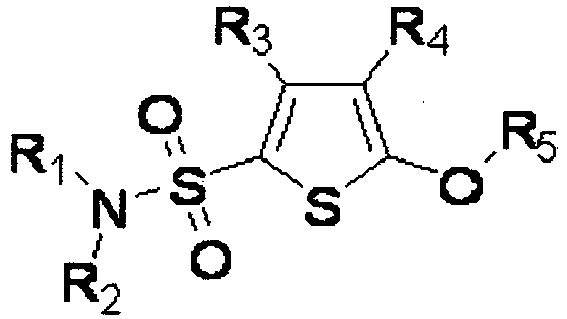
- each of R1 and R2 is the same or different and is selected from H, naphthalene, naphthalene-(C1-C4) alkyl, naphthalene-1-ylmethyl, naphthalene-1-ylethyl, naphthalene-1-ylpropyl,-3-fluorobenzyl, 3-chlorobenzyl, 3-bromobenzyl, 3-iodobenzyl, 3-(trifluoromethyl)benzyl, 3-(trichloromethyl)benzyl, 3-(tribromomethyl) benzyl, 3-(triiodomethyl)benzyl, 3-(C1-C4 alkyl)-benzyl, 3-methylbenzyl, 3-ethyl-benzyl, 3-propylbenzyl, 3,5-dichlorobenzyl, 3,5-difluorobenzyl, 3,5,-dibromobenzyl, 3,5-diiodobenzyl, 3-chlorophenyl, 3-fluorophenyl, 3-bromophenyl, 3-iodophenyl, 3-(C1-C4 alkyoxy) phenyl, 3-methoxyphenyl, 3-ethoxyphenyl, 3-propoxyphenyl, 4-methoxyphenyl, 4-(C1-C4 alkyoxy) phenyl, 4-ethoxyphenyl, 4-propoxyphenyl, 2-chlorobenzyl, 3-chlorobenzyl, 4-chlorobenzyl, 2-fluorobenzyl, 3-fluorobenzyl, 4-fluorobenzyl, 2-bromobenzyl, 3-bromobenzyl, 4-bromobenzyl, 2-iodobenzyl, 3-iodobenzyl, 4-iodobenzyl, 3-(C1-C4 alkyoxy) benzyl; 3-methoxybenzyl, 4-methoxy-benzyl, 3-ethoxybenzyl, 4-ethoxybenzyl, 3-propoxybenzyl, 4-(C1-C4 alkyoxy)phenyl and 4 propoxybenzyl;
- each of R3 and R4 is the same or different and is selected from H, F, Cl, Br, and I, and
- R5 is selected from 3-(R-1-yl)phenyl, and 4-(R-1-yl)phenyl, wherein R is selected from piperazin, 4-(C1-C4 alkyl) piperazin, 4-methylpiperazin, 4-ethyl-piperazin, and 4-propylpiperazin.
- The compounds of the invention are useful in eliminating the diarrhea associated with CPT-11 use for the treatment of cancer.
-
- Br = bromine
- Cl = chlorine
- CPT= camptothecin
- DCM = Dichloromethane
- DMEM = Dulbecco's Minimal Essential Media
- DMF = Dimethylformamide
- DMSO = Dimethylsulfoxide
- DNA = deoxyribonucleic acid
- F = fluorine
- FPLC = fast performance liquid chromatography
- H = hydrogen
- HEPES = (4-(2-hydroxyethyl)-1-piperazineethanesulfonic acid
- I = iodine
- kDal = kilodalton
- MHz = megahertz
- mmol = millimole
- µMol = micromolar
- NMR = nuclear magnetic resonance
- Nm = nanometer
- OD = optical density
- PMB =p-methoxybenzyl
- PMSF = phenylmethylsulfonyl fluoride
- ppm = parts per million
- SDS-PAGE = sodium dodecyl sulfate polyacrylamide gel electrophoresis
- TBAI = tetrabutylammonium iodide
- TFA = Trifluoroacetic acid
- For purposes of the following detailed description, it is to be understood that the invention may assume various alternative variations and step sequences, except where expressly specified to the contrary. Moreover, other than in any operating examples, or where otherwise indicated, all numbers expressing, for example, quantities of ingredients used in the specification and claims are to be understood as being modified in all instances by the term "about". Accordingly, unless indicated to the contrary, the numerical parameters set forth in the following specification and attached claims are approximations that may vary depending upon the desired properties to be obtained by the present invention. At the very least, and not as an attempt to limit the application of the doctrine of equivalents to the scope of the claims, each numerical parameter should at least be construed in light of the number of reported significant digits and by applying ordinary rounding techniques.
- Notwithstanding that the numerical ranges and parameters setting forth the broad scope of the invention are approximations, the numerical values set forth in the specific examples are reported as precisely as possible. Any numerical value, however, inherently contains certain errors necessarily resulting from the standard variation found in their respective testing measurements.
- Also, it should be understood that any numerical range recited herein is intended to include all sub-ranges subsumed therein. For example, a range of "1 to 10" is intended to include all sub-ranges between (and including) the recited minimum value of 1 and the recited maximum value of 10, that is, having a minimum value equal to or greater than 1 and a maximum value of equal to or less than 10.
- In this application, the use of the singular includes the plural and plural encompasses singular, unless specifically stated otherwise. In addition, in this application, the use of "or" means "and/or" unless specifically stated otherwise, even though "and/or" may be explicitly used in certain instances.
- In the present invention, 76 phenoxythiophene sulfonamides from a 35,000 compound diversity set library were tested for their ability to inhibit the bacterial enzyme β-glucuronidase. The structures and inhibitory activity of the compounds are shown in Table 1.
- In the present invention, 18 analogs of BRITE-355252 were synthesized and tested to initially explore the structural relationship these compounds display towards inhibition of β-glucuronidase. The structures and inhibitory activity of the 18 analogs of BRITE-355252 are shown in Table 2.
-
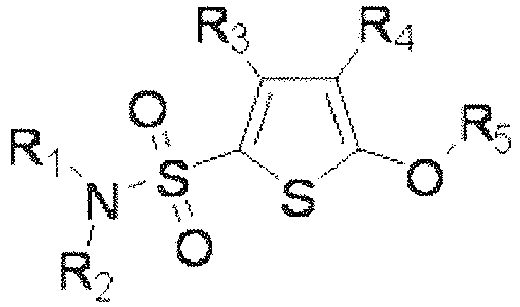
- (a) reacting a halo thiophene-sulfonyl halo and R1-N-H2, to form a resultant N-monoprotected thiophene sulfonamide having a first N-protecting group comprising R1,
- (b) reacting the resultant N-monoprotected amide with R2-N-halo and a catalyst in a base, to form a resultant N,N-diprotected thiophene sulfonamide having also a second N-protecting group comprising R2,
- (c) reacting the resultant N,N-diprotected thiophene sulfonamide with Cs2CO3 and phenol group substituted by R;
wherein R is selected from piperazin, 4-(C1-C4 alkyl) piperazin , 4-methylpiperazin, 4-ethyl-piperazin, and 4-propylpiperazin, in a solvent, and then removing the solvent, to obtain a resultant N,N-diprotected phenoxy thiophene sulfonamide, and - (d) reacting the resultant N,N-diprotected phenoxy thiophene sulfonamide with a deprotecting agent that is selective for deprotecting the second N-protecting group, thereby removing the second N-protecting group, and forming a N-monoprotected phenoxy thiophene sulfonamide.
- The halogen atom of the halo thiophene-sulfonyl halo compound is selected from bromine, chlorine, fluorine and iodine.
- Any base that will in combination with the N-monoprotected amide with R2-N-halo and a catalyst result in a N,N-diprotected thiophene sulfonamide can be used.
- Non-limiting examples of bases that can be used are Et3N, Na2CO3, K2CO3 and NaH and any base described in the examples.
- In an embodiment of the invention the halo thiophene-sulfonyl halo is dichlorothiophene-sulfonyl chloride and R1-N-H2 is naphthylmethylamine. These groups are mixed and cooled to form a N-monoprotected thiophene sulfonamide, having a first N-protecting group that comprises naphthylmethyl.
- In an embodiment of the invention the resultant N-monoprotected thiophene sulfonamide, is mixed with methoxybenzyl bromide and a catalyst that can be used in a Finkelstein reaction in sodium hydride, and cooled thereby forming a N,N-diprotected thiophene sulfonamide having also a second N-protecting group that comprises methoxybenzyl, and the resultant N,N-monoprotected thiophene sulfonamide, and Cs2CO3 and tert-butyl (hydroxyphenyl)piperazine- carboxylate in a solvent, are mixed and heated. The solvent is then removed to obtain a resultant N,N-diprotected phenoxy thiophene sulfonamide.
- In an embodiment of the invention the resultant N,N-diprotected phenoxy thiophene sulfonamide is mixed with a deprotecting agent that is selective for deprotecting the second N-protecting group, thereby removing the methoxy benzyl that is the second N-protecting group, and thereby forming a N-alkyl or N-aryl phenoxy thiophene sulfonamide.
- Examples of non-limiting embodiments of the invention are where: the dichlorothiophene-sulfonyl chloride is 4,5-dichlorothiophene-2-sulfonyl chloride; the naththylmethylamine is 1-naphthylmethylamine; the methoxybenzyl bromide is 4-methoxybenzyl bromide; the catalyst is tetrabutyl-ammonium iodide; the butyl (hydroxyphenyl)piperazine-carboxylate is tert-butyl-4-(3-hydroxyphenyl)piperazine-1-carboxylate; the solvent is dimethyl formamide and/or the selective deprotecting agent comprises dichloromethane and triflouroacetic acid; or a combination thereof.
- In addition to dimethyl formamide, non-limiting examples of solvents that can be used are DMSO and dioxane and the solvents described in the examples.
- The following reaction Scheme 1 illustrates the preparation of compounds within the scope of the present invention:

- Scheme 1 refers to the preparation of compounds of formula I. Referring to Scheme 1, compounds of the formula I are prepared by reacting commercially available 4,5-dichlorothiophene-2-sulfonyl chloride 1 with an amine to generate dichlorothiophene sulfonamide 2. PMB (p-methoxybenzyl) protected 4,5-dichlorothiophene sulfonamide 3 is generated by reacting compound 2 with NaH in DMF, pmethoxybenzyl bromide and a catalytic amount of TBAI. Nucleophilic displacement of the C-5 chlorine with a phenol in the presence of Cs2CO3 produce N,N-diprotected 5-(3-phenoxy)-thiophene-2-sulfonamide 3. In the final step, the protecting group is removed using TFA in DCM (1:1) to give the desired compound.
- The term "pharmaceutically acceptable salts" refers to the non-toxic, inorganic and organic acid addition salts and base addition salts of compounds of the present invention.
- Such conventional non-toxic salts include those derived from inorganic acids such as hydrochloric, hydrobromic, sulfuric, sulfamic, phosphoric, and nitric acid; and the salts prepared from organic acids such as acetic, propionic, succinic, glycolic, stearic, lactic, malic, tartaric, citric, ascorbic, palmoic, maleic, hydroxy-maleic, phenylacetic, glutamic, benzoic, salicylic, sulfanilic, 2-acetoxybenzoic, fumaric, toluenesulfonic, methanesulfonic, ethane disulfonic, oxalic, and isethionic acid. Pharmaceutically acceptable salts from amino acids may also be used. Such as salts of arginine and lysine.
- Pharmaceutically acceptable salts may be synthesized from the parent compound which contains a basic or acidic moiety by conventional chemical methods. Generally, such salts may be prepared by reacting the free acid or base forms of these compounds with a stoichiometric amount of the appropriate base or acid in water or in an organic solvent, or in a mixture of the two.
- As used herein, the terms "treatment" and "therapy" and the like refer to alleviate, slow the progression, prophylaxis, or attenuation of existing disease.
- As used herein, the terms "inhibit," "inhibiting," and the like means that the activity of glucuronidase is reduced.
- As used herein, the term "subject" means an animal or human.
- The pharmaceutical compositions of this invention comprise one or more compounds that inhibit glucuronidase and one or more pharmaceutically acceptable carriers, diluents, and excipients.
- Pharmaceutical compositions of the present invention may be in a form suitable for use in this invention for examples compositions may be formulated for i) oral use, for example, aqueous or oily suspensions, dispersible powders or granules, elixirs, emulsions, hard or soft capsules, lozenges, syrups, tablets or trouches; ii) parenteral administration, for example, sterile aqueous or oily solution for intravenous, subcutaneous, intraperitoneal, or intramuscular; iii) delivered intracerebrally or iv) topical administration, for example, a suppository or ointment.
- As used herein the term "pharmaceutically acceptable" is meant that the carrier, diluent, excipients, and/or salt must be compatible with the other ingredients of the formulation including the active ingredient(s), and not deleterious to the recipient thereof.
- "Pharmaceutically acceptable" also means that the compositions, or dosage forms are within the scope of sound medical judgment, suitable for use for an animal or human without excessive toxicity, irritation, allergic response, or other problem or complication, commensurate with a reasonable benefit/risk ratio.
- A compound can also be used in the manufacture of a medicament. This medicament can be used for the purposes described herein.
- The compositions or medicaments normally contain about 1 to 99 %, for example, about 5 to 70%, or from about 5 to about 30 % by weight of the compound or its pharmaceutically acceptable salt. The amount of the compound or its pharmaceutically acceptable salt in the composition will depend on the type of dosage form and the pharmaceutically acceptable excipients used to prepare it.
- The dose of the compounds of this invention, which is to be administered, can cover a wide range. The dose to be administered daily is to be selected to suit the desired effect. Actual dosage levels of the active ingredients in the pharmaceutical compositions of this invention may be varied so as to obtain an amount of the active ingredient, which is effective to achieve the desired therapeutic response for a particular patient, composition, and mode of administration without causing undue side effects or being toxic to the patient.
- The selected dosage level will depend upon a variety of factors, including the activity of the particular compound of the present invention employed, the route of administration, the time of administration, the rate of excretion of the particular compound being employed, the duration of the treatment, other drugs, compounds and /or materials used in combination with the particular compounds employed, the age, sex, weight, condition, general health and prior medical history of the patient being treated, and like factors well known in the medical arts.
- As used herein, "effective amount" and the like means the amount of the compound or composition necessary to achieve a therapeutic effect.
- An effective amount of the therapeutic compound necessary to achieve a therapeutic effect may vary according to factors such as the age, sex, and weight of the subject. Dosage regimens can be adjusted to provide the optimum therapeutic response. For example, several divided doses may be administered daily or the dose may be proportionally reduced as indicated by the exigencies of the therapeutic situation.
- Compounds of the invention can be formulated into compositions that can be administered to a subject in need of a glucuronidase inhibitor.
- The compounds or compositions thereof are used for inhibition of glucuronidase.
- The compounds or compositions thereof are used in methods for treating a subject in need of a glucuronidase inhibitor. The compounds or compositions are administered in an amount that is effective to inhibit the glucuronidase. In some embodiments of the invention it is β glucuronidase or bacterial β glucoronidase that is inhibited.
- The compounds or compositions can be administered prior to, concurrently with or after administration of a camptothecin-derived anticancer agent such as CPT-11. Administration of the compounds or compositions may result in certain benefits such as decreasing the dose of the anticancer drug, increasing the tolerance of the anticancer drug and alleviating side effects from the use of the anticancer drug. Side effects include gastrointestinal side effects.
- The invention is further understood by reference to the following Examples, which are intended to be purely exemplary of the invention. The present invention is not limited in scope by the exemplified embodiments, which are intended as illustrations of single aspects of the invention only. Any methods that are functionally equivalent to those described in the Examples are within the scope of the invention. Various modifications of the invention in addition to those described herein will become apparent to those skilled in the art from the foregoing description. Such modifications fall within the scope of the appended claims.
- Expression and Purification of E. coli β-Glucuronidase. The full-length E. coli β-glucuronidase gene was obtained from bacterial genomic DNA and was cloned into the pET-28a expression plasmid (Novagen) with an N-terminal 6x-Histidine tag. BL21-DE3 competent cells were transformed with the expression plasmid and grown in the presence of kanamycin (25 ug/ml) in LB medium with vigorous shaking at 37°C until an OD600 of 0.6 was attained. The expression was induced with the addition of 0.3 mM isopropyl-1-thio-D-galactopyranoside (IPTG) and further incubated at 37°C for 4 hours. Cells were collected by centrifugation at 4500xg for 20 min at 4°C. Cell pellets were resuspended in Buffer A (20 mM Potassium Phosphate, pH 7.4, 25 mM Imidazole, 500 mM NaCl), along with PMSF (2 µL/mL from 100 mM stock) and 0.05 µL/mL of protease inhibitors containing 1 mg/mL of aprotinin and leupeptin. Resuspended cells were sonicated and centrifuged at 14,500xg for 30 min to clarify the lysate. The cell lysate was flowed over a preformed Ni-NTA His-Trap gravity column and washed with Buffer A. The Ni-bound protein was eluted with Buffer B (20 mM Potassium Phosphate, pH 7.4, 500 mM Imidazole, 500 mM NaCl). Collected fractions were then tested for initial purity by SDS-PAGE. Relatively pure (∼85%) fractions were combined and loaded into the Äktaxpress FPLC system and passed over a HiLoad™ 16/60 Superdex™ 200 gel filtration column. The protein was eluted into 20 mM HEPES, pH 7.4, and 50 mM NaCl for crystallization and activity assays. Two milliliter fractions were collected based on highest ultraviolet absorbance at 280 nm. Fractions were analyzed by SDS-PAGE (which indicated >95% purity), combined, and concentrated to 10 mg/mL for long-term storage at -80°C.
- β-Glucuronidase Assay The β-glucuronidase assay was performed by the addition of 0.5 µl of compound (or DMSO) to the well of a black 384-well plate followed by the addition of 30 µl of diluted β-glucuronidase enzyme. The enzyme was diluted in assay buffer (50 mM HEPES, pH 7.4) plus 0.0166% Triton X-100 for a final enzyme concentration of 50 pM and final detergent concentration of 0.01%. After a 15 minute incubation at room temperature (23°C), 20 ul of substrate, 4-Methylumbelliferyl β-D-glucuronide hydrate (4MUG) diluted into assay buffer, was added to the reaction for a final concentration of 125 uM. β-glucuronidase hydrolyzes the non-fluorescent 4MUG resulting in a fluorescent product, 4-methylumbelliferyl. After a 30 minute incubation at room temperature, the reaction was stopped by the addition of 20 ul 1 M Na2CO3. The fluorescence (in relative fluorescence units, RFU) was measured using a 355 nm excitation filter and 460 nm emission filter using a Victor V (Perkin Elmer) plate reader. Minimum (min) controls were performed using reactions with no enzyme. Maximum (max) controls were performed using no compound. 1% DMSO was maintained in all reactions. Percent inhibition was calculated using RFU data by the following formula: [1-(assay readout-average of min)/(Average of Max-Average of Min)] x 100. The known β-glucuronidase inhibitor, D-Glucaric acid-1,4 - lactone monohydrate, was used to validate the assay and serve as a positive control. IC50 value was defined as the concentration of inhibitor calculated to inhibit 50% of the assay signal based on a serial dilution of compound. Values were calculated using either a four or three-parameter dose response (variable slope) equation in GraphPad Prism™ or ActivityBase™. For the IC50 determinations, serial dilutions of compounds were performed in 100% DMSO with a two-fold dilution scheme resulting in 10 concentrations of compound. These results are shown in Tables 1 and 2.
- All solvents and reagents were obtained from commercial sources and used without further purification unless otherwise stated. All reactions were performed in oven-dried glassware (either in RB flasks or 20 ml vials equipped with septa) under an atmosphere of nitrogen and the progress of reactions was monitored by thin-layer chromatography and LC-MS. Analytical thin-layer chromatography was performed on precoated 250 µm layer thickness silica gel 60 F254 plates (EMD Chemicals Inc.). Visualization was performed by ultraviolet light and/or by staining with phosphomolybdic acid (PMA) or p-anisaldehyde. All the silica gel chromatography purifications were carried out by using Combiflash® Rf (Teledyne Isco) and CombiFlash® Companion® (Teledyne Isco) either with EtOAc/hexane or MeOH/CH2Cl2 mixtures as the eluants. Melting points were measured on a MELTEMP® capillary melting point apparatus and are uncorrected. Proton nuclear magnetic resonance (1H NMR) spectra and carbon nuclear magnetic resonance (13C NMR) spectra were recorded on a Varian VNMRS-500 (500 MHz) spectrometer. Chemical shifts (δ) for proton are reported in parts per million (ppm) downfield from tetramethylsilane and are referenced to it (TMS 0.0 ppm). Coupling constants (J) are reported in Hertz. Multiplicities are reported using the following abbreviations: br = broad; s = singlet; d = doublet; t = triplet; q = quartet; m = multiplet. Chemical shifts (δ) for carbon are reported in parts per million (ppm) downfield from tetramethylsilane and are referenced to residual solvent peaks: carbon (CDCl3 77.0 ppm). Mass spectra were recorded on an Agilent 1200 Series LC/MS instrument equipped with a XTerra® MS (C-18, 3.5 µm) 3.0 x 100 mm column.
- To a solution of 4,5-dichlorothiophene-2-sulfonyl chloride (1.000 g, 4.002 mmol) in anhydrous CH2Cl2 (20 mL) was added 1-naphthylmethylamine (0.630 g, 4.007 mmol) followed by Et3N (0.84 mL, 6.027 mmol) and stirred at room temperature for 2 h. The reaction mixture was diluted with water (20 mL) and extracted with CH2Cl2 (100 mL), washed with brine, dried (Na2SO4) and concentrated under vacuo. The residue was purified by recrystallization from CH2Cl2-hexane to afford the pure 4,5-dichloro-N-(naphthalen-1-ylmethyl)thiophene-2-sulfonamide (1.350 g, 91%) as a white crystalline product.
- Sodium hydride (0.081 g, 3.375 mmol) was slowly added in portions to a solution of 4,5-dichloro-N-(naphthalen-1-ylmethyl)thiophene-2-sulfonamide (1.250 g, 3.358 mmol) in anhydrous DMF (10 mL) at 0 °C and stirred for 15 min. Then, 4-methoxybenzyl bromide (PMBBr) (0.675 g, 3.357 mmol), and a catalytic amount of TBAI (0.030 g, 0.081 mmol) were added at 0°C, and allowed to stir at room temperature for 2 h. After completion of the reaction, it was quenched by slow addition of water (5 mL) and extracted with EtOAc (100 mL), washed with water and brine, dried (Na2SO4), concentrated under vacuo and the residue purified by flash silica gel column chromatography (Combiflash® Rf) using EtOAc-hexane (1:9) as eluant to afford 4,5-dichloro-N-(4-methoxybenzyl)-N-(naphthalen-1-ylmethyl)thiophene-2-sulfonamide (1.500 g, 91%) as a white solid.
- A mixture of 4,5-dichloro-N-(4-methoxybenzyl)-N-(naphthalen-1-ylmethyl)thiophene-2-sulfonamide (0.100 g, 0.203 mmol), tert-butyl 4-(3-hydroxyphenyl)piperazine-1-carboxylate (0.068 g, 0.244 mmol) and Cs2CO3 (0.099 g, 0.304 mmol) in anhydrous DMF (2 mL) was heated at 80°C for 2.5 h. The solvent was removed under vacuo and the residue was purified by Combiflash® Rf (Isco) using EtOAc-hexanes (1:9) to obtain a white solid (0.140 g, 94%).
- To a solution of tert-butyl 4-(3-(3-chloro-5-(N-(4-methoxybenzyl)-N-(naphthalen-1-ylmethyl)sulfamoyl)thio-phen-2-yloxy)phenyl)piperazine-1-carboxylate (0.085 g, 0.116 mmol) in anhydrous CH2Cl2 (2 mL) was added TFA (2 mL) and stirred at room temperature for 3 h. The solvent mixture was removed under vacuo and the residue was re-dissolved in CH2Cl2 (20 mL), washed with aqueous sat. NaHCO3 followed by brine, dried (Na2SO4), and concentrated under vacuo.
- The crude product was purified by flash silica gel column chromatography using MeOH-CH2Cl2 (1:9) to afford a light orange solid (0.055 g, 92%). 1H NMR (500 MHz, DMSO-d6):δ (ppm): 2.81 (t, 4H, J = 5.0 Hz), 3.09 (t, 4H, J = 5.0 Hz), 4.56 (s, 2H), 6.43 (dd, 1H, J = 2.0, 8.0 Hz), 6.75 (t, 1H, J = 2.5 Hz), 6.83 (dd, 1H, J = 2.5, 8.0 Hz), 7.26 (t, 1H, J = 8.0 Hz), 7.43-7.48 (m, 3H), 7.54-7.58 (m, 2H), 7.87 (dd, 1H, J= 1.5, 7.5 Hz), 7.93-7.96 (m, 1H), 8.06-8.09 (m, 1H). APCI/ESI MS: m/z 513.9 [M+H]+
- The product was prepared in 89%% yield; White solid, mp: 144-146°C;
1H NMR (500 MHz, DMSO-d6): δ (ppm): 2.55 (s, 3H), 2.86 (t, 4H, J = 4.5 Hz), 3.14 (t, 4H, J = 4.5 Hz), 4.63 (s, 2H), 6.62-6.66 (m, 1H), 6.84-6.88 (m, 2H), 7.30 (t, 1H, J = 8.0 Hz), 7.48-7.62 (m, 4H), 7.91 (s, 1H), 7.94 (d, 1H, J = 8.0 Hz), 7.98 (d, 1H, J= 9.0 Hz), 8.29 (d, 1H, J= 8.0 Hz). APCI/ESI MS mlz 527.9 [M+H]+ - The product was prepared in 89%% yield; White solid, mp: 156-158°C; 1H NMR (500 MHz, DMSO-d6): δ (ppm): 2.21 (s, 3H), 2.43 (t, 4H, J = 5.0 Hz), 3.17 (t, 4H, J = 5.0 Hz), 4.55 (d, 2H, J = 4.5 Hz), 6.44 (dd, 1H, J = 2.0, 8.0 Hz), 6.78 (t, 1H, J = 2.0 Hz), 6.84 (dd, 1H, J = 2.0, 8.0 Hz), 7.27 (t, 1H, J = 8.0 Hz), 7.43-7.48 (m, 3H), 7.53-7.58 (m, 2H), 7.88 (dd, 1H, J= 1.5, 7.5 Hz), 7.93-7.97 (m, 1H), 8.05-8.09 (m, 1H), 8.52 (t, 1H, J = 4.5 Hz, NH). APCI/ESI MS Im/z 527.9 [M+H]+
- The product was prepared in 75% yield; White solid, mp: 86-88°C (decomposed); 1H NMR (500 MHz, DMSO-d6): δ (ppm): 3.06 (t, 4H, J = 5.0 Hz), 3.20 (t, 4H, J = 5.0 Hz), 4.23 (s, 2H), 6.54 (dd, 1H, J= 2.5, 8.0 Hz), 6.67 (t, 1H, J = 2.5 Hz), 6.77 (dd, 1H, J = 2.5, 8.0 Hz), 6.95-7.02 (m, 2H), 7.04 (d, 1H, J = 7.0 Hz), 7.23-7.32 (m, 2H), 7.33 (s, 1H).
APCI/ESI MS m/z481.9 [M+H]+ - The product was prepared in 71% yield; White solid, mp: 58-60°C (decomposed): 1H NMR (500 MHz, CDCl3): δ (ppm): 3.03 (t, 4H, J = 5.0 Hz), 3.17 (t, 4H, J = 5.0 Hz), 4.29 (s, 2H), 6.53 (dd, 1H, J = 2.5, 8.0 Hz), 6.66 (t, 1H, J = 2.5 Hz), 6.76 (dd, 1H, J = 2.5, 8.0 Hz), 7.22-7.25 (m, 1H), 7.31 (s, 1H), 7.43-7.50 (m, 3H), 7.56 (d, 1H, J = 7.0 Hz).
APCI/ESI MS m/z531.9 [M+H]+ - The product was prepared in 71% yield; White solid, mp: 122-124°C: 1H NMR (500 MHz, CDCl3): δ (ppm): 2.33 (s, 3H), 3.03 (t, 4H, J= 5.0 Hz), 3.17 (t, 4H, J = 5.0 Hz), 4.20 (s, 2H), 6.52 (dd, 1H, J = 2.5, 8.0 Hz), 6.66 (t, 1H, J = 2.5 Hz), 6.76 (dd, 1H, J = 2.5, 8.0 Hz), 7.02 (d, 1H, J = 8.0 Hz), 7.04 (s, 1H), 7.11 (d, 1H, J = 7.5 Hz), 7.20 (d, 1H, J = 8.0 Hz), 7.23 (d, 1H, J = 8.0 Hz), 7.32 (s, 1H). APCI ESI-MS m/z477.9 [M+H]+
- The product was prepared in 89% yield; Yellowish syrup: 1H NMR (500 MHz, CDCl3): δ (ppm): 3.06 (t, 4H, J = 5.0 Hz), 3.20 (t, 4H, J = 5.0 Hz), 4.19 (s, 2H), 6.56 (dd, 1H, J = 1.5, 8.0 Hz), 6.68 (s, 1H), 6.77 (dd, 1H, J = 1.5, 8.0 Hz), 7.14 (d, 2H, J= 0.5 Hz), 7.24-7.29 (m, 2H), 7.31 (s, 1H). APCI/ESI MS m/z 531.8 [M+H]+
- The product was prepared in 89% yield; White solid, mp: 118-120°C: 1H NMR (500 MHz, CDCl3+CD3OD): δ (ppm): 3.02 (t, 4H, J = 5.0 Hz), 3.16 (t, 4H, J = 5.0 Hz), 3.79 (s, 3H), 6.48 (dd, 1H, J = 1.5, 8.0 Hz), 6.60 (t, 1H, J = 1.5 Hz), 6.74 (dd, 1H, J = 2.0, 8.5 Hz), 6.81-6.85 (m, 2H), 7.05-7.09 (m, 2H), 7.18 (s, 1H), 7.22 (t, 1H, J= 8.0 Hz). APCI/ESI MS m/z479.9 [M+H]+
- The product was prepared in 97% yield; Light orange solid, mp: 156-158 °C: 1H NMR (500 MHz, CDCl3): δ (ppm): 3.04-3.07 (m, 4H), 3.13-3.16 (m, 4H), 4.65 (s, 2H), 6.89-6.92 (m, 2H), 7.02-7.05 (m, 2H), 7.32 (s, 1H), 7.37-7.42 (m, 2H), 7.52-7.55 (m, 2H), 7.83 (dd, 1H, J= 2.0, 7.0 Hz), 7.86-7.89 (m, 1H), 7.92-7.94 (m, 1H).
APCI/ESI MS m/z 514.0 [M+H]+ - The product was prepared in 83% yield; Light orange solid, mp: 99-101°C: 1H NMR (500 MHz, CDCl3): δ (ppm): 3.02-3.04 (m, 4H), 3.15-3.18 (m, 4H), 4.35 (s, 2H), 6.49 (dd, 1H, J = 2.0, 8.0 Hz), 6.64 (t, 1H, J = 2.0 Hz), 6.75 (dd, 1H, J = 2.5, 8.5 Hz), 7.20 (s, 1H), 7.22 (d, 1H, J = 0.5 Hz), 7.24 (s, 1H), 7.30 (s, 1H), 7.32-7.35 (m, 2H).
APCI/ESI MS m/z 497.9 [M+H]+ - The product was prepared in 85% yield; White solid, mp: 123-125°C: 1H NMR (500 MHz, CDCl3): δ (ppm): 3.01-3.04 (m, 4H), 3.15-3.18 (m, 4H), 4.21 (s, 2H), 6.54 (dd, 1H, J = 2.5, 8.0 Hz), 6.67 (t, 1H, J = 2.5 Hz), 6.77 (dd, 1H, J = 2.5, 8.0 Hz), 7.13-7.16 (m, 1H), 7.21-7.30 (m, 4H), 7.32 (s, 1H). APCI/ESI MS m/z 497.9 [M+H]+
- The product was prepared in 78% yield; Light orange solid, mp: 118-120°C: 1H NMR (500 MHz, CDCl3): δ (ppm): 3.01-3.04 (m, 4H), 3.15-3.18 (m, 4H), 4.20 (s, 2H), 6.53 (ddd, 1H, J = 0.5, 2.0, 8.0 Hz), 6.67 (t, 1H, J = 2.0 Hz), 6.77 (dd, 1H, J = 2.0, 8.0 Hz), 7.18-7.21 (m, 2H), 7.22 (s, 1H), 7.29-7.32 (m, 2H), 7.34 (s, 1H).
APCI/ESI MS m/z 497.9 [M+H]+ - The product was prepared in 48% yield; White solid, mp: 106-108°C: 1H NMR (500 MHz, CDCl3): δ (ppm): 2.97 (t, 4H, J= 5.0 Hz), 3.12 (t, 4H, J= 5.0 Hz), 3.77 (s, 3H), 4.14 (s, 2H), 6.51 (dd, 1H, J = 2.0, 8.0 Hz), 6.64 (t, 1H, J = 2.0 Hz), 6.73 (dd, 1H, J= 2.0, 8.0 Hz), 6.82 (d, 2H, J= 8.5 Hz), 7.14 (d, 2H, J= 8.5 Hz), 7.23 (t, 1H, J= 8.5 Hz), 7.28 (s, 1H). APCI/ESI MS m/z 494.0 [M+H]+
- The product was prepared in 31% yield; White solid, mp: 60-62°C: 1H NMR (500 MHz, CDCl3): δ (ppm): 2.97 (t, 4H, J = 5.0 Hz), 3.12 (t, 4H, J = 5.0 Hz), 3.76 (s, 3H), 4.18 (s, 2H), 6.52 (dd, 1H, J = 2.0, 8.0 Hz), 6.64 (t, 1H, J = 2.0 Hz), 6.73 (dd, 1H, J= 2.0, 8.5 Hz), 6.76 (s, 1H), 6.78-6.83 (m, 2H), 7.22 (ABq, 2H, J = 8.5 Hz), 7.28 (s, 1H). APCI/ESI MS m/z 494.1 [M+H]+
- The product was prepared in 78% yield; White solid, mp: 154-156°C: 1H NMR (500 MHz, CDCl3): δ (ppm): 3.17 (t, 4H, J = 5.0 Hz), 3.28 (t, 4H, J = 5.0 Hz), 6.49 (dd, 1H, J = 2.0, 8.0 Hz), 6.74 (s, 1H), 6.78 (d, 1H, J = 7.5 Hz), 6.83 (dd, 1H, J = 2.0, 8.0 Hz), 6.86 (dd, 1H, J = 1.0, 7.5 Hz), 6.96 (s, 1H), 7.10 (t, 1H, J = 8.0 Hz), 7.23 (s, 1H), 7.26 (t, 1H, J= 8.0 Hz), 8.34 (br s, 1H, NH). APCI/ESIMS m/z 484.0 [M+H]+
- The product was prepared in 78% yield; White solid, mp: 180-182°C: 1H NMR (500 MHz, CDCl3): δ (ppm): 3.03 (t, 4H, J = 5.0 Hz), 3.14 (t, 4H, J = 5.0 Hz), 3.78 (s, 3H), 6.47 (dd, 1H, J = 2.0, 8.0 Hz), 6.59 (t, 1H, J = 2.0 Hz), 6.65-6.68 (m, 1H), 6.71-6.76 (m, 3H), 7.18-7.23 (m, 2H), 7.27 (s, 1H). APCI/ESI MS m/z 480.0 [M+H]+
- To a solution of tert-butyl 4-(3-(5-(N,N-bis(4-methoxybenzyl) sulfamoyl)-3-chlorothiophen-2-yloxy)phenyl)piperazine-1-carboxylate (0.430 g, 0.602 mmol) in anhydrous CH2Cl2 (0.5 mL) was added TFA (4.5 mL) and stirred at room temperature for 4 h. The solvent mixture was removed under vacuo and the residue was re-dissolved in CH2Cl2 (30 mL), washed with aqueous sat. NaHCO3 followed by brine, dried (Na2SO4), and concentrated under vacuo. The residue was purified by Combiflash® Rf (Isco) using MeOH-CH2Cl2 (1:5) to give a white solid (0.180 g, 80%). 1H NMR (500 MHz, CD3OD): δ (ppm): 3.02-3.05 (m, 4H), 3.19-3.22 (m, 4H), 6.56 (dd, 1H, J= 2.0, 8.0 Hz), 6.73 (t, 1H, J = 2.0 Hz), 6.84 (dd, 1H, J = 2.0, 8.5 Hz), 7.27 (t, 1H, J= 8.5 Hz), 7.40 (s, 1H).
APCI/ESI MS m/z 374.0 [M+H]+ - The product was prepared in 87% yield; Light orange solid, mp: 65-67°C: 1H NMR (500 MHz, CDCl3): δ (ppm): 2.92 (t, 4H, J = 5.0 Hz), 3.08 (t, 4H, J = 5.0 Hz), 4.62 (s, 2H), 6.43 (d, 1H, J = 4.5 Hz), 6.56-6.60 (m, 1H), 6.65 (t, 1H, J = 2.5 Hz), 6.71 (dd, 1H, J = 2.0, 8.5 Hz), 7.23 (t, 1H, J = 8.5 Hz), 7.37 (d, 2H, J = 4.5 Hz), 7.39 (d, 1H, J = 4.0 Hz), 7.48-7.54 (m, 2H), 7.79 (t, 1H, J = 4.5 Hz), 7.82-7.86 (m, 1H), 7.95 (dd, 1H, J = 1.0, 7.5 Hz). APCI/ESI MS m/z 480.1 [M+H]+
-
- 1. Pizzolato, J.F. & Saltz, L.B. The camptothecins. Lancet 361, 2235-42 (2003).
- 2. Smith, N.F., Figg, W.D. & Sparreboom, A. Pharmacogenetics of irinotecan metabolism and transport: an update. Toxicol In Vitro 20, 163-75 (2006).
- 3. Pommier, Y. Topoisomerase I inhibitors: camptothecins and beyond. Nat Rev Cancer 6, 789-802 (2006).
- 4. Hsiang, Y.H., Hertzberg, R., Hecht, S. & Liu, L.F. Camptothecin induces protein-linked DNA breaks via mammalian DNA topoisomerase I. J Biol Chem 260, 14873-8 (1985).
- 5. Redinbo, M.R., Champoux, J.J. & Hol, W.G. Structural insights into the function of type IB topoisomerases. Curr Opin Struct Biol 9, 29-36 (1999).
- 6. Redinbo, M.R., Stewart, L., Kuhn, P., Champoux, J.J. & Hol, W.G. Crystal structures of human topoisomerase I in covalent and noncovalent complexes with DNA. Science 279, 1504-13 (1998).
- 7. Stewart, L., Redinbo, M.R., Qiu, X., Hol, W.G. & Champoux, J.J. A model for the mechanism of human topoisomerase I. Science 279, 1534-41 (1998).
- 8. Chrencik, J.E. et al. Mechanisms of camptothecin resistance by human topoisomerase I mutations. J Mol Biol 339, 773-84 (2004).
- 9. Staker, B.L. et al. The mechanism of topoisomerase I poisoning by a camptothecin analog. Proc Natl Acad Sci USA 99, 15387-92 (2002).
- 10. Mathijssen, R.H.J. et al. Clinical Pharmacokinetics and Metabolism of Irinotecan (CPT-11). Clin Cancer Res 7, 2182-2194 (2001).
- 11. Ma, M.K. & McLeod, H.L. Lessons learned from the irinotecan metabolic pathway. Curr Med Chem 10, 41-9 (2003).
- 12. Nagar, S. & Blanchard, R.L. Pharmacogenetics of uridine diphosphoglucuronosyltransferase (UGT) 1A family members and its role in patient response to irinotecan. Drug Metab Rev 38, 393-409 (2006).
- 13. Tobin, P.J., Dodds, H.M., Clarke, S., Schnitzler, M. & Rivory, L.P. The relative contributions of carboxylesterase and beta-glucuronidase in the formation of SN-38 in human colorectal tumours. Oncol Rep 10, 1977-9 (2003).
- 14. Fittkau, M., Voigt, W., Holzhausen, H.J. & Schmoll, H.J. Saccharic acid 1.4-lactone protects against CPT-11-induced mucosa damage in rats. J Cancer Res Clin Oncol 130, 388-94 (2004).
- 15. Flieger, D. et al. Phase II clinical trial for prevention of delayed diarrhea with cholestyramine/levofloxacin in the second-line treatment with irinotecan biweekly in patients with metastatic colorectal carcinoma. Oncology 72, 10-6 (2007).
- 16. Cummings, J.H. & Macfarlane, G.T. Role of intestinal bacteria in nutrient metabolism. JPENJParenter Enteral Nutr 21, 357-65 (1997).
- 17. Guarner, F. & Malagelada, J.R. Gut flora in health and disease. Lancet 361, 512-519 (2003).
- 18. Job, M.L. & Jacobs, N.F., Jr. Drug-induced Clostridium difficile-associated disease. Drug Saf 17, 37-46 (1997).
- 19. Levy, S.B. & Marshall, B. Antibacterial resistance worldwide: causes, challenges and responses. Nat Med 10, S122-9 (2004).
- 20. Nord, C.E., Kager, L. & Heimdahl, A. Impact of antimicrobial agents on the gastrointestinal microflora and the risk of infections. Am J Med 76, 99-106 (1984).
- 21. Settle, C.D. & Wilcox, M.H. Review article: antibiotic-induced Clostridium difficile infection. Aliment Pharmacol Ther 10, 835-41 (1996).
- 22. Sears, S., McNally, P., Bachinski, M.S. & Avery, R. Irinotecan (CPT-11) induced colitis: report of a case and review of Food and Drug Administration MEDWATCH reporting. Gastrointest Endosc 50, 841-4 (1999).
- 23. Stamp, D. Antibiotic therapy may induce cancers in the colon and breasts through a mechanism involving bile acids and colonic bacteria. Med Hypotheses 63, 555-6 (2004).
- 24. Yang, L. & Pei, Z. Bacteria, inflammation, and colon cancer. World J Gastroenterol 12, 6741-6 (2006).
- 25. Basinska, A. & Florianczyk, B. Beta-glucuronidase in physiology and disease. Ann Univ Mariae Curie Sklodowska Med 58, 386-9 (2003).
- 26. Farnleitner, A.H., Hocke, L., Beiwl, C., Kavka, G.C. & Mach, R.L. Hydrolysis of 4-methylumbelliferyl-beta-D-glucuronide in differing sample fractions of river waters and its implication for the detection of fecal pollution. Water Res. 36, 975-981 (2002).
- 27. Russell, W.M. & Klaenhammer, T.R. Identification and cloning of gusA, encoding a new beta-glucuronidase from Lactobacillus gasseri ADH. Appl Environ Microbiol 67, 1253-61 (2001).
| β-Glucuronidase Inhibitory activity of phenoxythiophene sulfonamides | ||
| Compound ID | Structure | IC50 (µm) |
| BRITE-354972 |
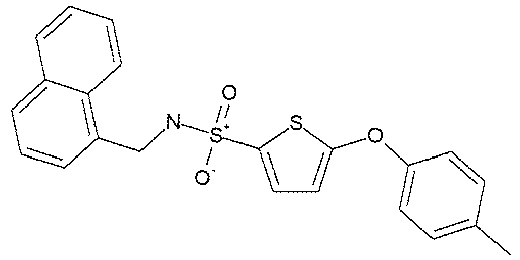 |
0.000 |
| BRITE-355123 |
 |
0.090 |
| BRITE-355252 |
 |
0.090 |
| BRITE-354975 |
 |
0.120 |
| BRITE-354989 |
 |
0.150 |
| BRITE-354909 |
 |
0.170 |
| BRITE-354725 |
 |
0.190 |
| BRITE-354969 |
 |
0.200 |
| BRITE-355417 |
 |
0.210 |
| BRITE-355006 |
 |
0.210 |
| BRITE-355017 |
 |
0.220 |
| BRITE-354979 |
 |
0.230 |
| BRITE-355004 |
 |
0.240 |
| BRITE-354667 |
 |
0.270 |
| BRITE-354966 |
 |
0.270 |
| BRITE-355262 |
 |
0.280 |
| BRITE-354965 |
 |
0.290 |
| BRITE-354873 |
 |
0.290 |
| BRITE-354615 |
 |
0.310 |
| BRITE-355016 |
 |
0.320 |
| BRITE-354517 |
 |
0.320 |
| BRITE-354958 |
 |
0.330 |
| BRITE-355360 |
 |
0.340 |
| BRITE-355227 |
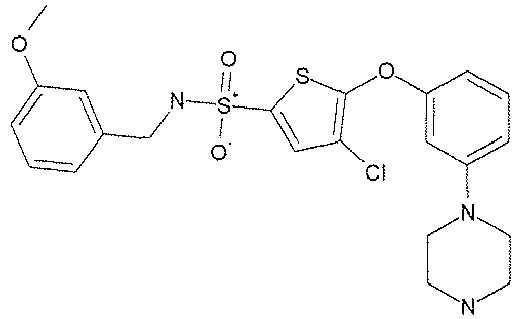 |
0.350 |
| BRITE-354948 |
 |
0.390 |
| BRITE-355336 |
 |
0.410 |
| BRITE-355423 |
 |
0.430 |
| BRITE-355468 |
 |
0.500 |
| BRITE-355202 |
 |
0.510 |
| BRITE-355003 |
 |
0.510 |
| BRITE-354946 |
 |
0.560 |
| BRITE-354983 |
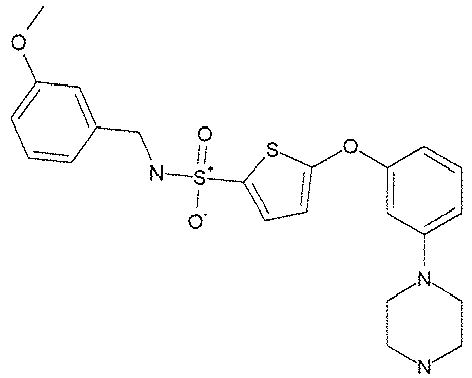 |
0.570 |
| BRITE-355014 |
 |
0.600 |
| BRITE-355015 |
 |
0.630 |
| BRITE-354627 |
 |
0.710 |
| BRITE-354764 |
 |
0.730 |
| BRITE-354993 |
 |
0.730 |
| BRITE-354956 |
 |
0.750 |
| BRITE-354984 |
 |
0.750 |
| BRITE-354974 |
 |
0.760 |
| BRITE-354947 |
 |
0.770 |
| BRITE-354392 |
 |
0.790 |
| BRITE-355045 |
 |
0.880 |
| BRITE-354994 |
 |
0.900 |
| BRITE-354957 |
 |
0.920 |
| BRITE-355074 |
 |
0.970 |
| BRITE-354565 |
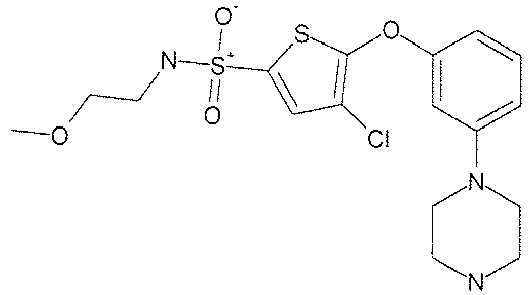 |
1.000 |
| BRITE-354998 |
 |
1.000 |
| BRITE-354955 |
 |
1.310 |
| BRITE-355296 |
 |
1.370 |
| BRITE-355008 |
 |
1.390 |
| BRITE-355005 |
 |
6.700 |
| BRITE-355192 |
 |
16.140 |
| BRITE-354839 |
 |
20.030 |
| BRITE-354428 |
 |
20.560 |
| BRITE-355224 |
 |
22.910 |
| BRITE-355018 |
 |
23.330 |
| BRITE-355240 |
 |
28.570 |
| BRITE-355329 |
 |
31.510 |
| BRITE-355250 |
 |
50.060 |
| BRITE-355339 |
 |
76.560 |
| BRITE-355319 |
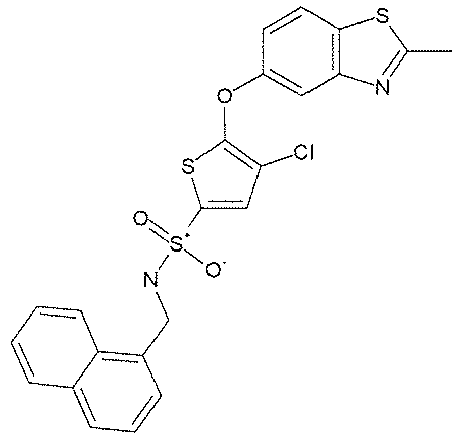 |
84.560 |
| BRITE-355243 |
 |
92.780 |
| BRITE-355180 |
 |
101.980 |
| BRITE-355244 |
 |
123.470 |
| BRITE-355214 |
 |
134.850 |
| BRITE-355030 |
 |
149.400 |
| BRITE-355234 |
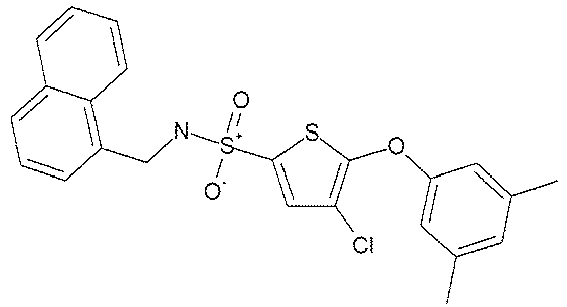 |
151.550 |
| BRITE-355169 |
 |
152.600 |
| BRITE-354458 |
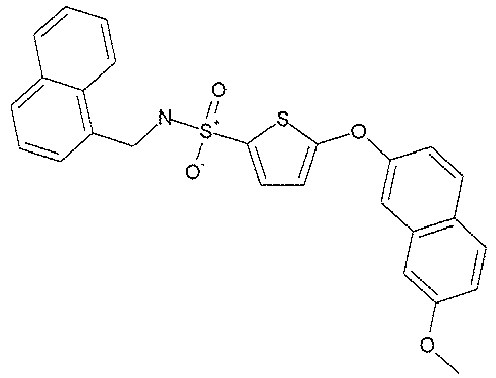 |
175.430 |
| BRITE-355211 |
 |
192.490 |
| BRITE-355201 |
 |
201.630 |
| BRITE-355233 |
 |
375.580 |
| BRITE-355221 |
 |
401.950 |
| BRITE-355253 |
 |
443.900 |
| BRITE-354502 |
 |
965.440 |
| Structure and β-Glucuronidase InhibitoryActivity of BRITE-355252 analogs | ||
| Compound ID | Structure | IC50 (µM) |
| BRITE-354873 |
 |
0.030 |
| BRITE-354909 |
 |
0.060 |
| BRITE-355123 |
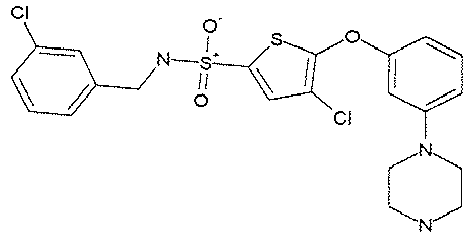 |
0.020 |
| BRITE-355227 |
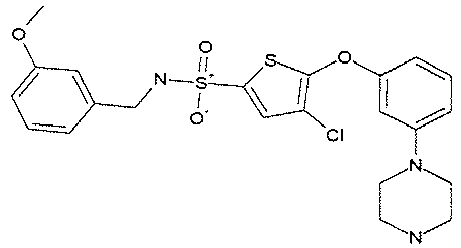 |
0.050 |
| BRITE-355252 |
 |
0.020 |
| BRITE--492794 |
 |
10.170 |
| BRITE--492796 |
 |
0.120 |
| BRITE--492797 |
 |
0.090 |
| BRITE--492798 |
 |
0.330 |
| BRITE--492799 |
 |
0.070 |
| BRITE--492800 |
 |
0.070 |
| BRITE--492802 |
 |
0.030 |
| BRITE--492803 |
 |
0.100 |
| BRITE--492805 |
 |
0.040 |
| BRITE--492806 |
 |
0.300 |
| BRITE--492807 |
 |
0.130 |
| BRITE--492808 |
 |
0.030 |
| BRITE--492809 |
 |
0.040 |
Claims (13)
- A compound of formula (I)
 each of R1 and R2 is the same or different and is selected from H, naphthalene, naphthalene-(C1-C4) alkyl, naphthalene-1-ylmethyl, naphthalene-1-ylethyl, naphthalene-1-ylpropyl, 3-fluorobenzyl, 3-chlorobenzyl, 3-bromobenzyl, 3-iodobenzyl, 3-(trifluoromethyl)benzyl, 3-(trichloromethyl)benzyl, 3-(tribromomethyl) benzyl, 3-(triiodomethyl)benzyl, 3-(C1-C4 alkyl)-benzyl, 3-methylbenzyl, 3-ethyl-benzyl, 3-propylbenzyl, 3,5-dichlorobenzyl, 3,5-difluorobenzyl, 3,5,-dibromobenzyl, 3,5-diiodobenzyl, 3-chlorophenyl, 3-fluorophenyl, 3-bromophenyl, 3-iodophenyl, 3-(C1-C4 alkyoxy) phenyl, 3-methoxyphenyl, 3-ethoxyphenyl, 3-propoxyphenyl, 4-methoxyphenyl, 4-(C1-C4 alkyoxy) phenyl, 4-ethoxyphenyl, 4-propoxyphenyl, 2-chlorobenzyl, 3-chlorobenzyl, 4-chlorobenzyl, 2-fluorobenzyl, 3-fluorobenzyl, 4-fluorobenzyl, 2-bromobenzyl, 3-bromobenzyl, 4-bromobenzyl, 2-iodobenzyl, 3-iodobenzyl, 4-iodobenzyl, 3-(C1-C4 alkyoxy) benzyl; 3-methoxybenzyl, 4-methoxy-benzyl, 3-ethoxybenzyl, 4-ethoxybenzyl, 3-propoxybenzyl, 4-(C1-C4 alkyoxy)phenyl and 4-propoxybenzyl;each of R3 and R4 is the same or different and is selected from H, F, Cl, Br, and I, andR5 is selected from 3-(R-1-yl)phenyl, and 4-(R-1-yl)phenyl, wherein R is selected from piperazinyl, 4-(C1-C4 alkyl) piperazinyl, 4-methylpiperazinyl, 4-ethylpiperazinyl, and 4-propylpiperazinyl,or a pharmaceutically acceptable salt of the compound.
 - A compound as claimed in claim 1 of the formula

- A composition comprising a compound according to claim 1 or 2 and one or more pharmaceutically acceptable carriers, diluents and excipients.
- A compound according to claim 1 or 2 or a pharmaceutically acceptable salt thereof for use as a medicament.
- A compound according to claim 1 or 2 or a pharmaceutically acceptable salt thereof for use in inhibiting glucuronidase.
- The compound according to claim 1 or 2 for use in inhibiting gastrointestinal bacterial glucuronidase.
- The compound according to claims 1 or 2 for use in inhibiting the diarrhea associated with use of CPT-11.
- A pharmaceutical composition comprising at least an effective amount of a compound of Formula (I) as claimed in claim 1 or 2 a pharmaceutically acceptable salt thereof for use in a method of inhibiting glucuronidase.
- A pharmaceutical composition according to claim 8 wherein the glucuronidase is a bacterial glucuronidase.
- A medicament comprising at least an effective amount of a compound of Formula (I) as claimed in claim 1 or 2 or a pharmaceutically acceptable salt thereof for use in a method of inhibiting glucuronidase.
- A method for making a compound of formula (I):

wherein:each of R1 and R2 is the same or different and is selected from H, naphthalene, naphthalene-(C1-C4) alkyl, naphthalene-1-ylmethyl, naphthalene-1-ylethyl, naphthalene-1-ylpropyl, 3-fluorobenzyl, 3-chlorobenzyl, 3-bromobenzyl, 3-iodobenzyl, 3-(trifluoromethyl)benzyl, 3-(trichloromethyl)benzyl, 3-(tribromomethyl) benzyl, 3-(triiodomethyl)benzyl, 3-(C1-C4 alkyl)-benzyl, 3-methylbenzyl, 3-ethyl-benzyl, 3-propylbenzyl, 3,5-dichlorobenzyl, 3,5-difluorobenzyl, 3,5,-dibromobenzyl, 3,5-diiodobenzyl, 3-chlorophenyl, 3-fluorophenyl, 3-bromophenyl, 3-iodophenyl, 3-(C1-C4 alkyoxy) phenyl, 3-methoxyphenyl, 3-ethoxyphenyl, 3-propoxyphenyl, 4-methoxyphenyl, 4-(C1-C4 alkyoxy) phenyl, 4-ethoxyphenyl, 4-propoxyphenyl, 2-chlorobenzyl, 3-chlorobenzyl, 4-chlorobenzyl, 2-fluorobenzyl, 3-fluorobenzyl, 4-fluorobenzyl, 2-bromobenzyl, 3-bromobenzyl, 4-bromobenzyl, 2-iodobenzyl, 3-iodobenzyl, 4-iodobenzyl, 3-(C1-C4 alkyoxy) benzyl; 3-methoxybenzyl, 4-methoxybenzyl, 3-ethoxybenzyl, 4-ethoxybenzyl, 3-propoxybenzyl, 4-(C1-C4 alkyoxy)phenyl and 4-propoxybenzyl;each of R3 and R4 is the same or different and is selected from H, F, Cl, Br, and I, and R5 is selected from 3-(R-1-yl)phenyl and 4-(R-1-yl)phenyl, wherein R is selected from piperazin, 4-(C1-C4 alkyl) piperazinyl, 4-methylpiperazinyl, 4-ethyl-piperazinyl, and 4-propylpiperazinyl, comprising the steps of:(a) reacting a halo thiophene-sulfonyl halo and R1-N-H2, wherein R1 as defined above to form an N-monoprotected thiophene sulfonamide having a first N-protecting group comprising R1,(b) reacting the resultant N-monoprotected thiophene sulfonamide with R2-N-halo wherein R2 is as defined above and a catalyst in a base, forming a resultant N,N-diprotected thiophene sulfonamide having a second N-protecting group comprising R2,(c) reacting the N,N-diprotected thiophene sulfonamide of step (b) with Cs2CO3; and a phenol substituted by R, wherein R is selected from piperazin, 4-(C1-C4 alkyl) piperazinyl, 4-methylpiperazinyl, 4-ethylpiperazinyl, and 4-propylpiperazinyl, in a solvent, and then removing the solvent, to obtain N,N-diprotected phenoxy thiophene sulfonamide, and(d) reacting the N,N-diprotected phenoxy thiophene sulfonamide with a deprotecting agent that is selective for deprotecting the second N-protecting group, removing the second N-protecting group, and forming a N-monoprotected phenoxy thiophene sulfonamide. - The method of claim 11 for making a compound of formula (I) wherein:(a) the halothiophene sulfonyl halo is dichlorothiophene-sulfonyl chloride and the group R1-N-H is naphthylmethylamine, and the dichlorothiophene-sulfonyl chloride and naphthylmethylamine, are mixed and cooled, thereby forming a N-monoprotected thiophene sulfonamide, having a first N-protecting group that comprises naphthylmethyl,(b) adding with mixing and cooling to the resultant N-monoprotected thiophene sulfonamide, methoxybenzyl bromide and a catalyst in a base that is sodium hydride, thereby forming a N,N-diprotected thiophene sulfonamide having also a second N-protecting group that comprises methoxybenzyl,(c) adding with mixing and heating to the resultant N,N-diprotected thiophene sulfonamide, and Cs2CO3 and butyl (hydroxyphenyl) piperazine-carboxylate in a solvent, and then removing the solvent, to obtain a resultant N,N-diprotected phenoxy thiophene sulfonamide, and(d) mixing the resultant N,N-diprotected phenoxy thiophene sulfonamide with a deprotecting agent that is selective for deprotecting the second N-protecting group, thereby removing the methoxy benzyl that is the second N-protecting group, and forming a N-monoprotected phenoxy thiophene sulfonamide.
- The method of claim 12, wherein (i) the dichlorothiophene-sulfonyl chloride is 4,5-dichlorothiophene-2-sulfonyl chloride, (ii) the naththylmethylamine is 1-naphthylmethylamine, (iii) the methoxybenzyl bromide is 4-methoxybenzyl bromide, (iv) the catalyst is tetrobutylamonium iodide, (v) the butyl (hydroxyphenyl) piperzine-carboxylate is tert-butyl-4-(3-hydroxyphenyl)piperazine-1-carboxylate, (vi) the solvent is dimethyl formamide, or (vii) the selective deprotecting agent comprises dichloromethane and triflouroacetic acid; or a combination of two or more thereof.
Applications Claiming Priority (2)
| Application Number | Priority Date | Filing Date | Title |
|---|---|---|---|
| US31251210P | 2010-03-10 | 2010-03-10 | |
| PCT/US2011/027974 WO2011112858A1 (en) | 2010-03-10 | 2011-03-10 | Phenoxy thiophene sulfonamides and their use as inhibitors of glucuronidase |
Publications (3)
| Publication Number | Publication Date |
|---|---|
| EP2544535A1 EP2544535A1 (en) | 2013-01-16 |
| EP2544535A4 EP2544535A4 (en) | 2013-08-21 |
| EP2544535B1 true EP2544535B1 (en) | 2017-04-19 |
Family
ID=44563852
Family Applications (1)
| Application Number | Title | Priority Date | Filing Date |
|---|---|---|---|
| EP11754110.2A Not-in-force EP2544535B1 (en) | 2010-03-10 | 2011-03-10 | Phenoxy thiophene sulfonamides and their use as inhibitors of glucuronidase |
Country Status (4)
| Country | Link |
|---|---|
| US (4) | US9617239B2 (en) |
| EP (1) | EP2544535B1 (en) |
| CA (1) | CA2792613C (en) |
| WO (1) | WO2011112858A1 (en) |
Families Citing this family (2)
| Publication number | Priority date | Publication date | Assignee | Title |
|---|---|---|---|---|
| CN111514144B (en) | 2015-05-26 | 2021-10-26 | 高雄医学大学 | Pyrazolo [4,3-c ] quinoline derivatives having inhibitory activity on bacterial glucuronidase |
| CN120081851B (en) * | 2022-08-10 | 2026-03-06 | 浙江大学 | Gabosine derivatives, and preparation method and application thereof |
Family Cites Families (4)
| Publication number | Priority date | Publication date | Assignee | Title |
|---|---|---|---|---|
| US6342610B2 (en) * | 1993-05-20 | 2002-01-29 | Texas Biotechnology Corp. | N-aryl thienyl-, furyl-, and pyrrolyl-sulfonamides and derivatives thereof that modulate the activity of endothelin |
| DE19631288A1 (en) * | 1996-08-02 | 1998-02-05 | Hoechst Ag | New inhibitors of β-glucuronidase |
| UA82093C2 (en) * | 2003-03-31 | 2008-03-11 | Уайт | Fluoro- and trifluoroalkyl-containing heterocyclic sulfonamide inhibitors of beta amyloid production and derivatives thereof |
| WO2011084503A1 (en) * | 2009-12-16 | 2011-07-14 | North Carolina Central University | Phenoxy thiophene sulfonamides and their use in the treatment of neurodegenerative diseases |
-
2011
- 2011-03-10 CA CA2792613A patent/CA2792613C/en not_active Expired - Fee Related
- 2011-03-10 WO PCT/US2011/027974 patent/WO2011112858A1/en not_active Ceased
- 2011-03-10 EP EP11754110.2A patent/EP2544535B1/en not_active Not-in-force
- 2011-03-10 US US13/641,713 patent/US9617239B2/en not_active Expired - Fee Related
-
2012
- 2012-05-24 US US13/479,590 patent/US20130345196A1/en not_active Abandoned
-
2016
- 2016-03-03 US US15/060,179 patent/US20160237058A1/en not_active Abandoned
-
2020
- 2020-12-01 US US17/108,668 patent/US20210087163A1/en not_active Abandoned
Also Published As
| Publication number | Publication date |
|---|---|
| US20130345235A1 (en) | 2013-12-26 |
| CA2792613A1 (en) | 2011-09-15 |
| US20130345196A1 (en) | 2013-12-26 |
| CA2792613C (en) | 2016-06-28 |
| US20210087163A1 (en) | 2021-03-25 |
| EP2544535A1 (en) | 2013-01-16 |
| US20160237058A1 (en) | 2016-08-18 |
| US9617239B2 (en) | 2017-04-11 |
| EP2544535A4 (en) | 2013-08-21 |
| WO2011112858A1 (en) | 2011-09-15 |
Similar Documents
| Publication | Publication Date | Title |
|---|---|---|
| EP3070089B1 (en) | Aminomethyl tryptanthrin derivative, preparation method and application thereof | |
| US20110223132A1 (en) | Isothiazoloquinolones and related compounds as anti-infective agents | |
| US4680299A (en) | 2-phenyl-4-quinolinecarboxylic acids and pharmaceutical compositions thereof | |
| EP1590328B1 (en) | (2-carboxamido) (3-amino) thiophene compounds | |
| KR20070070233A (en) | (2-Carboxamido) (3-amino) thiophene compound | |
| CN116568302B (en) | Heterocyclic substituted fused γ-carboline derivatives, preparation methods, intermediates and applications thereof | |
| US5414001A (en) | Antineoplastic pyrrolo[4,3,2-de]quinolin-8(1H)-ones | |
| KR20070085264A (en) | Quinolone homologues as cell proliferation inhibitors | |
| EP2324031B1 (en) | Nitrogenated derivatives of pancratistatin | |
| EP1848723B1 (en) | New isothiazoloquinolones and related compounds as anti-infective agents | |
| US20210087163A1 (en) | Phenoxy thiophene sulfonamides and other compounds for use as inhibitors of bacterial glucuronidase | |
| EP4204097B1 (en) | Methods of treating cancer | |
| EP3302060B1 (en) | Pyrazolo[4,3-c]quinoline derivatives for inhibition of -glucuronidase | |
| EP3388419A1 (en) | Gli1 inhibitors and uses thereof | |
| EP1145713A1 (en) | Telomerase inhibitors | |
| US6187783B1 (en) | Phenanthridinium derivatives | |
| KR102674225B1 (en) | Benzoimidazole derivate as Transglutaminase 2 inhibitors and composition for preventing or treating cancer containing the derivate | |
| US20090202571A1 (en) | Bioreductively-activated prodrugs | |
| EP3546454B1 (en) | Benzoheterocyclyl alkylamine compound and use thereof | |
| KR20250177242A (en) | Novel blood cancer target polycomb repressive complex 2 inhibitor and composition for treating blood cancer comprsising the same | |
| EP0707579B1 (en) | Piperidinyl substituted methanoanthracenes as d1/d2-antagonists and 5ht2-serotanin-antagonists | |
| ES2350711T3 (en) | CAMPTOTECHINE DERIVATIVES WITH ANTITUMORAL ACTIVITY. | |
| CN121517399A (en) | Valine-containing VCP/p97 inhibitors, their preparation methods and applications | |
| AU2004204135B2 (en) | (2-carboxamido) (3-amino) thiophene compounds | |
| JP2001002647A (en) | Benzophenanthridinium derivative |
Legal Events
| Date | Code | Title | Description |
|---|---|---|---|
| PUAI | Public reference made under article 153(3) epc to a published international application that has entered the european phase |
Free format text: ORIGINAL CODE: 0009012 |
|
| 17P | Request for examination filed |
Effective date: 20121005 |
|
| AK | Designated contracting states |
Kind code of ref document: A1 Designated state(s): AL AT BE BG CH CY CZ DE DK EE ES FI FR GB GR HR HU IE IS IT LI LT LU LV MC MK MT NL NO PL PT RO RS SE SI SK SM TR |
|
| DAX | Request for extension of the european patent (deleted) | ||
| A4 | Supplementary search report drawn up and despatched |
Effective date: 20130718 |
|
| RIC1 | Information provided on ipc code assigned before grant |
Ipc: A01N 41/06 20060101AFI20130712BHEP Ipc: A61K 31/18 20060101ALI20130712BHEP |
|
| 17Q | First examination report despatched |
Effective date: 20151110 |
|
| GRAP | Despatch of communication of intention to grant a patent |
Free format text: ORIGINAL CODE: EPIDOSNIGR1 |
|
| INTG | Intention to grant announced |
Effective date: 20161006 |
|
| GRAS | Grant fee paid |
Free format text: ORIGINAL CODE: EPIDOSNIGR3 |
|
| GRAA | (expected) grant |
Free format text: ORIGINAL CODE: 0009210 |
|
| AK | Designated contracting states |
Kind code of ref document: B1 Designated state(s): AL AT BE BG CH CY CZ DE DK EE ES FI FR GB GR HR HU IE IS IT LI LT LU LV MC MK MT NL NO PL PT RO RS SE SI SK SM TR |
|
| REG | Reference to a national code |
Ref country code: GB Ref legal event code: FG4D |
|
| REG | Reference to a national code |
Ref country code: CH Ref legal event code: EP |
|
| REG | Reference to a national code |
Ref country code: AT Ref legal event code: REF Ref document number: 885012 Country of ref document: AT Kind code of ref document: T Effective date: 20170515 |
|
| REG | Reference to a national code |
Ref country code: IE Ref legal event code: FG4D |
|
| REG | Reference to a national code |
Ref country code: DE Ref legal event code: R096 Ref document number: 602011037134 Country of ref document: DE |
|
| REG | Reference to a national code |
Ref country code: NL Ref legal event code: MP Effective date: 20170419 |
|
| REG | Reference to a national code |
Ref country code: LT Ref legal event code: MG4D |
|
| REG | Reference to a national code |
Ref country code: AT Ref legal event code: MK05 Ref document number: 885012 Country of ref document: AT Kind code of ref document: T Effective date: 20170419 |
|
| PG25 | Lapsed in a contracting state [announced via postgrant information from national office to epo] |
Ref country code: NL Free format text: LAPSE BECAUSE OF FAILURE TO SUBMIT A TRANSLATION OF THE DESCRIPTION OR TO PAY THE FEE WITHIN THE PRESCRIBED TIME-LIMIT Effective date: 20170419 |
|
| PG25 | Lapsed in a contracting state [announced via postgrant information from national office to epo] |
Ref country code: FI Free format text: LAPSE BECAUSE OF FAILURE TO SUBMIT A TRANSLATION OF THE DESCRIPTION OR TO PAY THE FEE WITHIN THE PRESCRIBED TIME-LIMIT Effective date: 20170419 Ref country code: GR Free format text: LAPSE BECAUSE OF FAILURE TO SUBMIT A TRANSLATION OF THE DESCRIPTION OR TO PAY THE FEE WITHIN THE PRESCRIBED TIME-LIMIT Effective date: 20170720 Ref country code: HR Free format text: LAPSE BECAUSE OF FAILURE TO SUBMIT A TRANSLATION OF THE DESCRIPTION OR TO PAY THE FEE WITHIN THE PRESCRIBED TIME-LIMIT Effective date: 20170419 Ref country code: ES Free format text: LAPSE BECAUSE OF FAILURE TO SUBMIT A TRANSLATION OF THE DESCRIPTION OR TO PAY THE FEE WITHIN THE PRESCRIBED TIME-LIMIT Effective date: 20170419 Ref country code: NO Free format text: LAPSE BECAUSE OF FAILURE TO SUBMIT A TRANSLATION OF THE DESCRIPTION OR TO PAY THE FEE WITHIN THE PRESCRIBED TIME-LIMIT Effective date: 20170719 Ref country code: LT Free format text: LAPSE BECAUSE OF FAILURE TO SUBMIT A TRANSLATION OF THE DESCRIPTION OR TO PAY THE FEE WITHIN THE PRESCRIBED TIME-LIMIT Effective date: 20170419 Ref country code: AT Free format text: LAPSE BECAUSE OF FAILURE TO SUBMIT A TRANSLATION OF THE DESCRIPTION OR TO PAY THE FEE WITHIN THE PRESCRIBED TIME-LIMIT Effective date: 20170419 |
|
| PG25 | Lapsed in a contracting state [announced via postgrant information from national office to epo] |
Ref country code: BG Free format text: LAPSE BECAUSE OF FAILURE TO SUBMIT A TRANSLATION OF THE DESCRIPTION OR TO PAY THE FEE WITHIN THE PRESCRIBED TIME-LIMIT Effective date: 20170719 Ref country code: LV Free format text: LAPSE BECAUSE OF FAILURE TO SUBMIT A TRANSLATION OF THE DESCRIPTION OR TO PAY THE FEE WITHIN THE PRESCRIBED TIME-LIMIT Effective date: 20170419 Ref country code: IS Free format text: LAPSE BECAUSE OF FAILURE TO SUBMIT A TRANSLATION OF THE DESCRIPTION OR TO PAY THE FEE WITHIN THE PRESCRIBED TIME-LIMIT Effective date: 20170819 Ref country code: PL Free format text: LAPSE BECAUSE OF FAILURE TO SUBMIT A TRANSLATION OF THE DESCRIPTION OR TO PAY THE FEE WITHIN THE PRESCRIBED TIME-LIMIT Effective date: 20170419 Ref country code: SE Free format text: LAPSE BECAUSE OF FAILURE TO SUBMIT A TRANSLATION OF THE DESCRIPTION OR TO PAY THE FEE WITHIN THE PRESCRIBED TIME-LIMIT Effective date: 20170419 Ref country code: RS Free format text: LAPSE BECAUSE OF FAILURE TO SUBMIT A TRANSLATION OF THE DESCRIPTION OR TO PAY THE FEE WITHIN THE PRESCRIBED TIME-LIMIT Effective date: 20170419 |
|
| REG | Reference to a national code |
Ref country code: DE Ref legal event code: R097 Ref document number: 602011037134 Country of ref document: DE |
|
| PG25 | Lapsed in a contracting state [announced via postgrant information from national office to epo] |
Ref country code: RO Free format text: LAPSE BECAUSE OF FAILURE TO SUBMIT A TRANSLATION OF THE DESCRIPTION OR TO PAY THE FEE WITHIN THE PRESCRIBED TIME-LIMIT Effective date: 20170419 Ref country code: SK Free format text: LAPSE BECAUSE OF FAILURE TO SUBMIT A TRANSLATION OF THE DESCRIPTION OR TO PAY THE FEE WITHIN THE PRESCRIBED TIME-LIMIT Effective date: 20170419 Ref country code: DK Free format text: LAPSE BECAUSE OF FAILURE TO SUBMIT A TRANSLATION OF THE DESCRIPTION OR TO PAY THE FEE WITHIN THE PRESCRIBED TIME-LIMIT Effective date: 20170419 Ref country code: CZ Free format text: LAPSE BECAUSE OF FAILURE TO SUBMIT A TRANSLATION OF THE DESCRIPTION OR TO PAY THE FEE WITHIN THE PRESCRIBED TIME-LIMIT Effective date: 20170419 Ref country code: EE Free format text: LAPSE BECAUSE OF FAILURE TO SUBMIT A TRANSLATION OF THE DESCRIPTION OR TO PAY THE FEE WITHIN THE PRESCRIBED TIME-LIMIT Effective date: 20170419 |
|
| PLBE | No opposition filed within time limit |
Free format text: ORIGINAL CODE: 0009261 |
|
| STAA | Information on the status of an ep patent application or granted ep patent |
Free format text: STATUS: NO OPPOSITION FILED WITHIN TIME LIMIT |
|
| PG25 | Lapsed in a contracting state [announced via postgrant information from national office to epo] |
Ref country code: SM Free format text: LAPSE BECAUSE OF FAILURE TO SUBMIT A TRANSLATION OF THE DESCRIPTION OR TO PAY THE FEE WITHIN THE PRESCRIBED TIME-LIMIT Effective date: 20170419 Ref country code: IT Free format text: LAPSE BECAUSE OF FAILURE TO SUBMIT A TRANSLATION OF THE DESCRIPTION OR TO PAY THE FEE WITHIN THE PRESCRIBED TIME-LIMIT Effective date: 20170419 |
|
| 26N | No opposition filed |
Effective date: 20180122 |
|
| PG25 | Lapsed in a contracting state [announced via postgrant information from national office to epo] |
Ref country code: SI Free format text: LAPSE BECAUSE OF FAILURE TO SUBMIT A TRANSLATION OF THE DESCRIPTION OR TO PAY THE FEE WITHIN THE PRESCRIBED TIME-LIMIT Effective date: 20170419 |
|
| REG | Reference to a national code |
Ref country code: CH Ref legal event code: PL |
|
| PG25 | Lapsed in a contracting state [announced via postgrant information from national office to epo] |
Ref country code: MC Free format text: LAPSE BECAUSE OF FAILURE TO SUBMIT A TRANSLATION OF THE DESCRIPTION OR TO PAY THE FEE WITHIN THE PRESCRIBED TIME-LIMIT Effective date: 20170419 |
|
| REG | Reference to a national code |
Ref country code: BE Ref legal event code: MM Effective date: 20180331 |
|
| REG | Reference to a national code |
Ref country code: IE Ref legal event code: MM4A |
|
| PG25 | Lapsed in a contracting state [announced via postgrant information from national office to epo] |
Ref country code: LU Free format text: LAPSE BECAUSE OF NON-PAYMENT OF DUE FEES Effective date: 20180310 |
|
| PG25 | Lapsed in a contracting state [announced via postgrant information from national office to epo] |
Ref country code: IE Free format text: LAPSE BECAUSE OF NON-PAYMENT OF DUE FEES Effective date: 20180310 |
|
| PG25 | Lapsed in a contracting state [announced via postgrant information from national office to epo] |
Ref country code: BE Free format text: LAPSE BECAUSE OF NON-PAYMENT OF DUE FEES Effective date: 20180331 Ref country code: LI Free format text: LAPSE BECAUSE OF NON-PAYMENT OF DUE FEES Effective date: 20180331 Ref country code: CH Free format text: LAPSE BECAUSE OF NON-PAYMENT OF DUE FEES Effective date: 20180331 |
|
| PG25 | Lapsed in a contracting state [announced via postgrant information from national office to epo] |
Ref country code: FR Free format text: LAPSE BECAUSE OF NON-PAYMENT OF DUE FEES Effective date: 20180331 |
|
| PG25 | Lapsed in a contracting state [announced via postgrant information from national office to epo] |
Ref country code: MT Free format text: LAPSE BECAUSE OF NON-PAYMENT OF DUE FEES Effective date: 20180310 |
|
| PG25 | Lapsed in a contracting state [announced via postgrant information from national office to epo] |
Ref country code: TR Free format text: LAPSE BECAUSE OF FAILURE TO SUBMIT A TRANSLATION OF THE DESCRIPTION OR TO PAY THE FEE WITHIN THE PRESCRIBED TIME-LIMIT Effective date: 20170419 |
|
| PG25 | Lapsed in a contracting state [announced via postgrant information from national office to epo] |
Ref country code: HU Free format text: LAPSE BECAUSE OF FAILURE TO SUBMIT A TRANSLATION OF THE DESCRIPTION OR TO PAY THE FEE WITHIN THE PRESCRIBED TIME-LIMIT; INVALID AB INITIO Effective date: 20110310 Ref country code: PT Free format text: LAPSE BECAUSE OF FAILURE TO SUBMIT A TRANSLATION OF THE DESCRIPTION OR TO PAY THE FEE WITHIN THE PRESCRIBED TIME-LIMIT Effective date: 20170419 |
|
| PG25 | Lapsed in a contracting state [announced via postgrant information from national office to epo] |
Ref country code: MK Free format text: LAPSE BECAUSE OF NON-PAYMENT OF DUE FEES Effective date: 20170419 Ref country code: CY Free format text: LAPSE BECAUSE OF FAILURE TO SUBMIT A TRANSLATION OF THE DESCRIPTION OR TO PAY THE FEE WITHIN THE PRESCRIBED TIME-LIMIT Effective date: 20170419 |
|
| PG25 | Lapsed in a contracting state [announced via postgrant information from national office to epo] |
Ref country code: AL Free format text: LAPSE BECAUSE OF FAILURE TO SUBMIT A TRANSLATION OF THE DESCRIPTION OR TO PAY THE FEE WITHIN THE PRESCRIBED TIME-LIMIT Effective date: 20170419 |
|
| PGFP | Annual fee paid to national office [announced via postgrant information from national office to epo] |
Ref country code: DE Payment date: 20210224 Year of fee payment: 11 Ref country code: GB Payment date: 20210308 Year of fee payment: 11 |
|
| REG | Reference to a national code |
Ref country code: DE Ref legal event code: R119 Ref document number: 602011037134 Country of ref document: DE |
|
| GBPC | Gb: european patent ceased through non-payment of renewal fee |
Effective date: 20220310 |
|
| PG25 | Lapsed in a contracting state [announced via postgrant information from national office to epo] |
Ref country code: GB Free format text: LAPSE BECAUSE OF NON-PAYMENT OF DUE FEES Effective date: 20220310 Ref country code: DE Free format text: LAPSE BECAUSE OF NON-PAYMENT OF DUE FEES Effective date: 20221001 |