EP2543728A1 - Process for production of useful substance using genetically modified streptomyces ray fungus - Google Patents
Process for production of useful substance using genetically modified streptomyces ray fungus Download PDFInfo
- Publication number
- EP2543728A1 EP2543728A1 EP11750694A EP11750694A EP2543728A1 EP 2543728 A1 EP2543728 A1 EP 2543728A1 EP 11750694 A EP11750694 A EP 11750694A EP 11750694 A EP11750694 A EP 11750694A EP 2543728 A1 EP2543728 A1 EP 2543728A1
- Authority
- EP
- European Patent Office
- Prior art keywords
- gene
- promoter
- poly
- expression vector
- seq
- Prior art date
- Legal status (The legal status is an assumption and is not a legal conclusion. Google has not performed a legal analysis and makes no representation as to the accuracy of the status listed.)
- Granted
Links
- 238000004519 manufacturing process Methods 0.000 title claims abstract description 71
- 239000000126 substance Substances 0.000 title claims abstract description 64
- 241000187747 Streptomyces Species 0.000 title claims abstract description 30
- 238000000034 method Methods 0.000 title claims description 41
- 241000233866 Fungi Species 0.000 title claims description 10
- 230000014509 gene expression Effects 0.000 claims abstract description 62
- 241001446247 uncultured actinomycete Species 0.000 claims abstract description 49
- 230000003698 anagen phase Effects 0.000 claims abstract description 18
- 108090000623 proteins and genes Proteins 0.000 claims description 104
- 229920001351 ε-poly-L-lysine Polymers 0.000 claims description 102
- 101150084957 pls gene Proteins 0.000 claims description 100
- 241000972623 Streptomyces albulus Species 0.000 claims description 91
- 239000013604 expression vector Substances 0.000 claims description 61
- 150000001875 compounds Chemical class 0.000 claims description 21
- 230000015572 biosynthetic process Effects 0.000 claims description 20
- 102000004169 proteins and genes Human genes 0.000 claims description 19
- 108091008053 gene clusters Proteins 0.000 claims description 16
- 239000002773 nucleotide Substances 0.000 claims description 16
- 125000003729 nucleotide group Chemical group 0.000 claims description 16
- 230000033228 biological regulation Effects 0.000 claims description 10
- 238000011144 upstream manufacturing Methods 0.000 claims description 9
- 101150097869 hasA gene Proteins 0.000 claims description 8
- 101150039161 hasB gene Proteins 0.000 claims description 8
- 241000204057 Kitasatospora Species 0.000 claims description 7
- 108091081024 Start codon Proteins 0.000 claims description 7
- 101150033407 bpsA gene Proteins 0.000 claims description 7
- 230000001939 inductive effect Effects 0.000 claims description 6
- 108700026220 vif Genes Proteins 0.000 claims description 5
- 241000221752 Epichloe Species 0.000 claims description 4
- FWMNVWWHGCHHJJ-SKKKGAJSSA-N 4-amino-1-[(2r)-6-amino-2-[[(2r)-2-[[(2r)-2-[[(2r)-2-amino-3-phenylpropanoyl]amino]-3-phenylpropanoyl]amino]-4-methylpentanoyl]amino]hexanoyl]piperidine-4-carboxylic acid Chemical compound C([C@H](C(=O)N[C@H](CC(C)C)C(=O)N[C@H](CCCCN)C(=O)N1CCC(N)(CC1)C(O)=O)NC(=O)[C@H](N)CC=1C=CC=CC=1)C1=CC=CC=C1 FWMNVWWHGCHHJJ-SKKKGAJSSA-N 0.000 claims description 3
- 238000005580 one pot reaction Methods 0.000 claims description 3
- 229920001184 polypeptide Polymers 0.000 claims description 3
- 108090000765 processed proteins & peptides Proteins 0.000 claims description 3
- 102000004196 processed proteins & peptides Human genes 0.000 claims description 3
- 238000003541 multi-stage reaction Methods 0.000 claims description 2
- 229930000044 secondary metabolite Natural products 0.000 abstract description 22
- 239000002243 precursor Substances 0.000 abstract description 17
- 108700019146 Transgenes Proteins 0.000 abstract description 5
- 210000004027 cell Anatomy 0.000 description 34
- 239000013598 vector Substances 0.000 description 24
- 102000004190 Enzymes Human genes 0.000 description 20
- 108090000790 Enzymes Proteins 0.000 description 20
- 229920002674 hyaluronan Polymers 0.000 description 18
- 235000018102 proteins Nutrition 0.000 description 18
- KIUKXJAPPMFGSW-DNGZLQJQSA-N (2S,3S,4S,5R,6R)-6-[(2S,3R,4R,5S,6R)-3-Acetamido-2-[(2S,3S,4R,5R,6R)-6-[(2R,3R,4R,5S,6R)-3-acetamido-2,5-dihydroxy-6-(hydroxymethyl)oxan-4-yl]oxy-2-carboxy-4,5-dihydroxyoxan-3-yl]oxy-5-hydroxy-6-(hydroxymethyl)oxan-4-yl]oxy-3,4,5-trihydroxyoxane-2-carboxylic acid Chemical compound CC(=O)N[C@H]1[C@H](O)O[C@H](CO)[C@@H](O)[C@@H]1O[C@H]1[C@H](O)[C@@H](O)[C@H](O[C@H]2[C@@H]([C@@H](O[C@H]3[C@@H]([C@@H](O)[C@H](O)[C@H](O3)C(O)=O)O)[C@H](O)[C@@H](CO)O2)NC(C)=O)[C@@H](C(O)=O)O1 KIUKXJAPPMFGSW-DNGZLQJQSA-N 0.000 description 17
- 229960003160 hyaluronic acid Drugs 0.000 description 17
- ALDIVIWLBSDGGN-ONEGZZNKSA-N indigoidine Chemical compound O=C1NC(=O)C(N)=C\C1=C\1C(=O)NC(=O)C(N)=C/1 ALDIVIWLBSDGGN-ONEGZZNKSA-N 0.000 description 17
- 239000001055 blue pigment Substances 0.000 description 14
- 238000006243 chemical reaction Methods 0.000 description 13
- 238000003786 synthesis reaction Methods 0.000 description 13
- KDXKERNSBIXSRK-YFKPBYRVSA-N L-lysine Chemical compound NCCCC[C@H](N)C(O)=O KDXKERNSBIXSRK-YFKPBYRVSA-N 0.000 description 12
- ZMXDDKWLCZADIW-UHFFFAOYSA-N N,N-Dimethylformamide Chemical compound CN(C)C=O ZMXDDKWLCZADIW-UHFFFAOYSA-N 0.000 description 12
- 230000001580 bacterial effect Effects 0.000 description 11
- 239000000047 product Substances 0.000 description 11
- 108700039691 Genetic Promoter Regions Proteins 0.000 description 10
- 230000002378 acidificating effect Effects 0.000 description 10
- 230000001851 biosynthetic effect Effects 0.000 description 10
- 230000008929 regeneration Effects 0.000 description 10
- 238000011069 regeneration method Methods 0.000 description 10
- 241000588724 Escherichia coli Species 0.000 description 9
- 108700007698 Genetic Terminator Regions Proteins 0.000 description 9
- 239000013587 production medium Substances 0.000 description 9
- 108091008146 restriction endonucleases Proteins 0.000 description 9
- 244000005700 microbiome Species 0.000 description 8
- 229960004927 neomycin Drugs 0.000 description 8
- 229930193140 Neomycin Natural products 0.000 description 7
- 102000007056 Recombinant Fusion Proteins Human genes 0.000 description 7
- 108010008281 Recombinant Fusion Proteins Proteins 0.000 description 7
- XZNUGFQTQHRASN-XQENGBIVSA-N apramycin Chemical compound O([C@H]1O[C@@H]2[C@H](O)[C@@H]([C@H](O[C@H]2C[C@H]1N)O[C@@H]1[C@@H]([C@@H](O)[C@H](N)[C@@H](CO)O1)O)NC)[C@@H]1[C@@H](N)C[C@@H](N)[C@H](O)[C@H]1O XZNUGFQTQHRASN-XQENGBIVSA-N 0.000 description 7
- 229950006334 apramycin Drugs 0.000 description 7
- 230000006698 induction Effects 0.000 description 7
- 108020004414 DNA Proteins 0.000 description 6
- 235000019766 L-Lysine Nutrition 0.000 description 6
- 108090000364 Ligases Proteins 0.000 description 6
- 102000003960 Ligases Human genes 0.000 description 6
- 239000004472 Lysine Substances 0.000 description 6
- 230000003247 decreasing effect Effects 0.000 description 6
- 238000010586 diagram Methods 0.000 description 6
- 230000000694 effects Effects 0.000 description 6
- 239000012634 fragment Substances 0.000 description 6
- JVTAAEKCZFNVCJ-UHFFFAOYSA-N lactic acid Chemical compound CC(O)C(O)=O JVTAAEKCZFNVCJ-UHFFFAOYSA-N 0.000 description 6
- 230000009707 neogenesis Effects 0.000 description 6
- 239000013543 active substance Substances 0.000 description 5
- 239000013611 chromosomal DNA Substances 0.000 description 5
- 239000002244 precipitate Substances 0.000 description 5
- 238000000746 purification Methods 0.000 description 5
- 239000006228 supernatant Substances 0.000 description 5
- 238000013519 translation Methods 0.000 description 5
- 108091032973 (ribonucleotides)n+m Proteins 0.000 description 4
- 108010016626 Dipeptides Proteins 0.000 description 4
- LFQSCWFLJHTTHZ-UHFFFAOYSA-N Ethanol Chemical compound CCO LFQSCWFLJHTTHZ-UHFFFAOYSA-N 0.000 description 4
- ZDXPYRJPNDTMRX-VKHMYHEASA-N L-glutamine Chemical compound OC(=O)[C@@H](N)CCC(N)=O ZDXPYRJPNDTMRX-VKHMYHEASA-N 0.000 description 4
- 229930182816 L-glutamine Natural products 0.000 description 4
- FAPWRFPIFSIZLT-UHFFFAOYSA-M Sodium chloride Chemical compound [Na+].[Cl-] FAPWRFPIFSIZLT-UHFFFAOYSA-M 0.000 description 4
- 241000187389 Streptomyces lavendulae Species 0.000 description 4
- 238000004458 analytical method Methods 0.000 description 4
- 101150034124 ask gene Proteins 0.000 description 4
- 238000005119 centrifugation Methods 0.000 description 4
- 210000000349 chromosome Anatomy 0.000 description 4
- 238000010276 construction Methods 0.000 description 4
- 229920000729 poly(L-lysine) polymer Polymers 0.000 description 4
- 239000007787 solid Substances 0.000 description 4
- 239000000243 solution Substances 0.000 description 4
- 230000002459 sustained effect Effects 0.000 description 4
- 241000186361 Actinobacteria <class> Species 0.000 description 3
- 108091026890 Coding region Proteins 0.000 description 3
- PEDCQBHIVMGVHV-UHFFFAOYSA-N Glycerine Chemical compound OCC(O)CO PEDCQBHIVMGVHV-UHFFFAOYSA-N 0.000 description 3
- OKKJLVBELUTLKV-UHFFFAOYSA-N Methanol Chemical compound OC OKKJLVBELUTLKV-UHFFFAOYSA-N 0.000 description 3
- OVRNDRQMDRJTHS-UHFFFAOYSA-N N-acelyl-D-glucosamine Natural products CC(=O)NC1C(O)OC(CO)C(O)C1O OVRNDRQMDRJTHS-UHFFFAOYSA-N 0.000 description 3
- OVRNDRQMDRJTHS-FMDGEEDCSA-N N-acetyl-beta-D-glucosamine Chemical compound CC(=O)N[C@H]1[C@H](O)O[C@H](CO)[C@@H](O)[C@@H]1O OVRNDRQMDRJTHS-FMDGEEDCSA-N 0.000 description 3
- MBLBDJOUHNCFQT-LXGUWJNJSA-N N-acetylglucosamine Natural products CC(=O)N[C@@H](C=O)[C@@H](O)[C@H](O)[C@H](O)CO MBLBDJOUHNCFQT-LXGUWJNJSA-N 0.000 description 3
- 241000120569 Streptococcus equi subsp. zooepidemicus Species 0.000 description 3
- 241000187398 Streptomyces lividans Species 0.000 description 3
- HSCJRCZFDFQWRP-UHFFFAOYSA-N Uridindiphosphoglukose Natural products OC1C(O)C(O)C(CO)OC1OP(O)(=O)OP(O)(=O)OCC1C(O)C(O)C(N2C(NC(=O)C=C2)=O)O1 HSCJRCZFDFQWRP-UHFFFAOYSA-N 0.000 description 3
- HDYANYHVCAPMJV-UHFFFAOYSA-N Uridine diphospho-D-glucuronic acid Natural products O1C(N2C(NC(=O)C=C2)=O)C(O)C(O)C1COP(O)(=O)OP(O)(=O)OC1OC(C(O)=O)C(O)C(O)C1O HDYANYHVCAPMJV-UHFFFAOYSA-N 0.000 description 3
- 238000009825 accumulation Methods 0.000 description 3
- 238000001261 affinity purification Methods 0.000 description 3
- 210000004899 c-terminal region Anatomy 0.000 description 3
- 230000010261 cell growth Effects 0.000 description 3
- 230000021615 conjugation Effects 0.000 description 3
- 238000011161 development Methods 0.000 description 3
- 230000018109 developmental process Effects 0.000 description 3
- 108020001507 fusion proteins Proteins 0.000 description 3
- 102000037865 fusion proteins Human genes 0.000 description 3
- 230000012010 growth Effects 0.000 description 3
- 238000004128 high performance liquid chromatography Methods 0.000 description 3
- 238000000703 high-speed centrifugation Methods 0.000 description 3
- 230000006801 homologous recombination Effects 0.000 description 3
- 238000002744 homologous recombination Methods 0.000 description 3
- 238000009776 industrial production Methods 0.000 description 3
- 235000014655 lactic acid Nutrition 0.000 description 3
- 239000004310 lactic acid Substances 0.000 description 3
- 239000002609 medium Substances 0.000 description 3
- 239000012528 membrane Substances 0.000 description 3
- 229950006780 n-acetylglucosamine Drugs 0.000 description 3
- 108020000161 polyphosphate kinase Proteins 0.000 description 3
- 238000011160 research Methods 0.000 description 3
- 238000010839 reverse transcription Methods 0.000 description 3
- 238000003757 reverse transcription PCR Methods 0.000 description 3
- 238000012546 transfer Methods 0.000 description 3
- HDYANYHVCAPMJV-USQUEEHTSA-N udp-glucuronic acid Chemical compound O([P@](O)(=O)O[P@](O)(=O)OC[C@H]1[C@@H]([C@H]([C@@H](O1)N1C(NC(=O)C=C1)=O)O)O)[C@H]1O[C@@H](C(O)=O)[C@H](O)[C@@H](O)[C@@H]1O HDYANYHVCAPMJV-USQUEEHTSA-N 0.000 description 3
- XLYOFNOQVPJJNP-UHFFFAOYSA-N water Substances O XLYOFNOQVPJJNP-UHFFFAOYSA-N 0.000 description 3
- GMVPRGQOIOIIMI-DODZYUBVSA-N 7-[(1R,2R,3R)-3-hydroxy-2-[(3S)-3-hydroxyoct-1-enyl]-5-oxocyclopentyl]heptanoic acid Chemical compound CCCCC[C@H](O)C=C[C@H]1[C@H](O)CC(=O)[C@@H]1CCCCCCC(O)=O GMVPRGQOIOIIMI-DODZYUBVSA-N 0.000 description 2
- 241000894006 Bacteria Species 0.000 description 2
- 108020004705 Codon Proteins 0.000 description 2
- 108700010070 Codon Usage Proteins 0.000 description 2
- 102000053602 DNA Human genes 0.000 description 2
- 102000004163 DNA-directed RNA polymerases Human genes 0.000 description 2
- 108090000626 DNA-directed RNA polymerases Proteins 0.000 description 2
- 230000005526 G1 to G0 transition Effects 0.000 description 2
- IAJILQKETJEXLJ-UHFFFAOYSA-N Galacturonsaeure Natural products O=CC(O)C(O)C(O)C(O)C(O)=O IAJILQKETJEXLJ-UHFFFAOYSA-N 0.000 description 2
- WQZGKKKJIJFFOK-GASJEMHNSA-N Glucose Natural products OC[C@H]1OC(O)[C@H](O)[C@@H](O)[C@@H]1O WQZGKKKJIJFFOK-GASJEMHNSA-N 0.000 description 2
- 102000005720 Glutathione transferase Human genes 0.000 description 2
- 108010070675 Glutathione transferase Proteins 0.000 description 2
- 240000004808 Saccharomyces cerevisiae Species 0.000 description 2
- 229920002684 Sepharose Polymers 0.000 description 2
- 241001468227 Streptomyces avermitilis Species 0.000 description 2
- IAJILQKETJEXLJ-QTBDOELSSA-N aldehydo-D-glucuronic acid Chemical compound O=C[C@H](O)[C@@H](O)[C@H](O)[C@H](O)C(O)=O IAJILQKETJEXLJ-QTBDOELSSA-N 0.000 description 2
- 229930013930 alkaloid Natural products 0.000 description 2
- 150000003797 alkaloid derivatives Chemical class 0.000 description 2
- 235000001014 amino acid Nutrition 0.000 description 2
- 150000001413 amino acids Chemical class 0.000 description 2
- 239000003242 anti bacterial agent Substances 0.000 description 2
- 230000008901 benefit Effects 0.000 description 2
- 230000003115 biocidal effect Effects 0.000 description 2
- 238000006555 catalytic reaction Methods 0.000 description 2
- 238000010367 cloning Methods 0.000 description 2
- 230000000295 complement effect Effects 0.000 description 2
- 238000001816 cooling Methods 0.000 description 2
- 239000012228 culture supernatant Substances 0.000 description 2
- 230000001419 dependent effect Effects 0.000 description 2
- 238000000855 fermentation Methods 0.000 description 2
- 230000004151 fermentation Effects 0.000 description 2
- 239000008103 glucose Substances 0.000 description 2
- 229940097043 glucuronic acid Drugs 0.000 description 2
- 150000004676 glycans Chemical class 0.000 description 2
- 238000010438 heat treatment Methods 0.000 description 2
- 230000003834 intracellular effect Effects 0.000 description 2
- 239000007788 liquid Substances 0.000 description 2
- 230000007246 mechanism Effects 0.000 description 2
- 239000002207 metabolite Substances 0.000 description 2
- 238000002156 mixing Methods 0.000 description 2
- 239000003471 mutagenic agent Substances 0.000 description 2
- 231100000707 mutagenic chemical Toxicity 0.000 description 2
- 230000003505 mutagenic effect Effects 0.000 description 2
- 230000002093 peripheral effect Effects 0.000 description 2
- 239000000049 pigment Substances 0.000 description 2
- 239000013612 plasmid Substances 0.000 description 2
- 229920001282 polysaccharide Polymers 0.000 description 2
- 239000005017 polysaccharide Substances 0.000 description 2
- 230000019525 primary metabolic process Effects 0.000 description 2
- 238000001742 protein purification Methods 0.000 description 2
- 230000002441 reversible effect Effects 0.000 description 2
- 230000019702 secondary metabolite biosynthetic process Effects 0.000 description 2
- 239000011780 sodium chloride Substances 0.000 description 2
- 238000002415 sodium dodecyl sulfate polyacrylamide gel electrophoresis Methods 0.000 description 2
- 238000000527 sonication Methods 0.000 description 2
- 239000000758 substrate Substances 0.000 description 2
- 238000013518 transcription Methods 0.000 description 2
- 230000035897 transcription Effects 0.000 description 2
- 230000009466 transformation Effects 0.000 description 2
- 238000012795 verification Methods 0.000 description 2
- QKNYBSVHEMOAJP-UHFFFAOYSA-N 2-amino-2-(hydroxymethyl)propane-1,3-diol;hydron;chloride Chemical compound Cl.OCC(N)(CO)CO QKNYBSVHEMOAJP-UHFFFAOYSA-N 0.000 description 1
- YCZATMZTIWSFLZ-UHFFFAOYSA-N 3-(5-amino-2-hydroxy-6-oxo-1H-pyridin-3-yl)-5-iminopyridine-2,6-dione Chemical compound Nc1cc(C2=CC(=N)C(=O)NC2=O)c(O)[nH]c1=O YCZATMZTIWSFLZ-UHFFFAOYSA-N 0.000 description 1
- FNEHAOQZWPHONV-UHFFFAOYSA-N 9h-carbazole;sulfuric acid Chemical compound OS(O)(=O)=O.C1=CC=C2C3=CC=CC=C3NC2=C1 FNEHAOQZWPHONV-UHFFFAOYSA-N 0.000 description 1
- 241001156739 Actinobacteria <phylum> Species 0.000 description 1
- NLXLAEXVIDQMFP-UHFFFAOYSA-N Ammonium chloride Substances [NH4+].[Cl-] NLXLAEXVIDQMFP-UHFFFAOYSA-N 0.000 description 1
- VHUUQVKOLVNVRT-UHFFFAOYSA-N Ammonium hydroxide Chemical compound [NH4+].[OH-] VHUUQVKOLVNVRT-UHFFFAOYSA-N 0.000 description 1
- 108010055400 Aspartate kinase Proteins 0.000 description 1
- DYDCUQKUCUHJBH-UWTATZPHSA-N D-Cycloserine Chemical compound N[C@@H]1CONC1=O DYDCUQKUCUHJBH-UWTATZPHSA-N 0.000 description 1
- DYDCUQKUCUHJBH-UHFFFAOYSA-N D-Cycloserine Natural products NC1CONC1=O DYDCUQKUCUHJBH-UHFFFAOYSA-N 0.000 description 1
- QNAYBMKLOCPYGJ-UWTATZPHSA-N D-alanine Chemical compound C[C@@H](N)C(O)=O QNAYBMKLOCPYGJ-UWTATZPHSA-N 0.000 description 1
- 108020003338 D-alanine-D-alanine ligase Proteins 0.000 description 1
- QNAYBMKLOCPYGJ-UHFFFAOYSA-N D-alpha-Ala Natural products CC([NH3+])C([O-])=O QNAYBMKLOCPYGJ-UHFFFAOYSA-N 0.000 description 1
- 241000196324 Embryophyta Species 0.000 description 1
- 241000940986 Epichloe sp. Species 0.000 description 1
- 241000588722 Escherichia Species 0.000 description 1
- 108010064711 Homoserine dehydrogenase Proteins 0.000 description 1
- 102000003918 Hyaluronan Synthases Human genes 0.000 description 1
- 108090000320 Hyaluronan Synthases Proteins 0.000 description 1
- 102100034343 Integrase Human genes 0.000 description 1
- 125000001176 L-lysyl group Chemical group [H]N([H])[C@]([H])(C(=O)[*])C([H])([H])C([H])([H])C([H])([H])C(N([H])[H])([H])[H] 0.000 description 1
- 108010006035 Metalloproteases Proteins 0.000 description 1
- 241001465754 Metazoa Species 0.000 description 1
- 108091028043 Nucleic acid sequence Proteins 0.000 description 1
- 238000012408 PCR amplification Methods 0.000 description 1
- 108010039918 Polylysine Proteins 0.000 description 1
- 108010092799 RNA-directed DNA polymerase Proteins 0.000 description 1
- 238000010240 RT-PCR analysis Methods 0.000 description 1
- 108700005075 Regulator Genes Proteins 0.000 description 1
- 241000316848 Rhodococcus <scale insect> Species 0.000 description 1
- 108010019477 S-adenosyl-L-methionine-dependent N-methyltransferase Proteins 0.000 description 1
- 241000315804 Streptomyces avermitilis MA-4680 = NBRC 14893 Species 0.000 description 1
- 241001468228 Streptomyces mashuensis Species 0.000 description 1
- 241000933216 Streptomyces roseoverticillatus Species 0.000 description 1
- 108700005078 Synthetic Genes Proteins 0.000 description 1
- 108020005038 Terminator Codon Proteins 0.000 description 1
- 229920004890 Triton X-100 Polymers 0.000 description 1
- 239000013504 Triton X-100 Substances 0.000 description 1
- LFTYTUAZOPRMMI-CFRASDGPSA-N UDP-N-acetyl-alpha-D-glucosamine Chemical compound O1[C@H](CO)[C@@H](O)[C@H](O)[C@@H](NC(=O)C)[C@H]1OP(O)(=O)OP(O)(=O)OC[C@@H]1[C@@H](O)[C@@H](O)[C@H](N2C(NC(=O)C=C2)=O)O1 LFTYTUAZOPRMMI-CFRASDGPSA-N 0.000 description 1
- 108010061048 UDPacetylglucosamine pyrophosphorylase Proteins 0.000 description 1
- LFTYTUAZOPRMMI-UHFFFAOYSA-N UNPD164450 Natural products O1C(CO)C(O)C(O)C(NC(=O)C)C1OP(O)(=O)OP(O)(=O)OCC1C(O)C(O)C(N2C(NC(=O)C=C2)=O)O1 LFTYTUAZOPRMMI-UHFFFAOYSA-N 0.000 description 1
- 108010054269 Uridine Diphosphate Glucose Dehydrogenase Proteins 0.000 description 1
- 238000001042 affinity chromatography Methods 0.000 description 1
- 238000000246 agarose gel electrophoresis Methods 0.000 description 1
- QGZKDVFQNNGYKY-UHFFFAOYSA-N ammonia Natural products N QGZKDVFQNNGYKY-UHFFFAOYSA-N 0.000 description 1
- 235000011114 ammonium hydroxide Nutrition 0.000 description 1
- 239000007864 aqueous solution Substances 0.000 description 1
- 238000013528 artificial neural network Methods 0.000 description 1
- 239000011942 biocatalyst Substances 0.000 description 1
- 238000005842 biochemical reaction Methods 0.000 description 1
- 230000006696 biosynthetic metabolic pathway Effects 0.000 description 1
- 238000006664 bond formation reaction Methods 0.000 description 1
- 238000009395 breeding Methods 0.000 description 1
- 230000001488 breeding effect Effects 0.000 description 1
- 150000001720 carbohydrates Chemical class 0.000 description 1
- 230000004663 cell proliferation Effects 0.000 description 1
- 230000008859 change Effects 0.000 description 1
- 239000007795 chemical reaction product Substances 0.000 description 1
- 238000004587 chromatography analysis Methods 0.000 description 1
- 239000012539 chromatography resin Substances 0.000 description 1
- 238000006482 condensation reaction Methods 0.000 description 1
- 239000000470 constituent Substances 0.000 description 1
- 239000000287 crude extract Substances 0.000 description 1
- 230000000593 degrading effect Effects 0.000 description 1
- 239000008367 deionised water Substances 0.000 description 1
- 229910021641 deionized water Inorganic materials 0.000 description 1
- 150000002016 disaccharides Chemical group 0.000 description 1
- 239000003814 drug Substances 0.000 description 1
- 238000002451 electron ionisation mass spectrometry Methods 0.000 description 1
- 230000037149 energy metabolism Effects 0.000 description 1
- 238000005516 engineering process Methods 0.000 description 1
- 238000001976 enzyme digestion Methods 0.000 description 1
- 238000002474 experimental method Methods 0.000 description 1
- 239000000284 extract Substances 0.000 description 1
- 239000012467 final product Substances 0.000 description 1
- 239000005452 food preservative Substances 0.000 description 1
- 235000019249 food preservative Nutrition 0.000 description 1
- 238000010230 functional analysis Methods 0.000 description 1
- 230000002068 genetic effect Effects 0.000 description 1
- 238000010353 genetic engineering Methods 0.000 description 1
- 239000011539 homogenization buffer Substances 0.000 description 1
- KIUKXJAPPMFGSW-MNSSHETKSA-N hyaluronan Chemical compound CC(=O)N[C@H]1[C@H](O)O[C@H](CO)[C@@H](O)C1O[C@H]1[C@H](O)[C@@H](O)[C@H](O[C@H]2[C@@H](C(O[C@H]3[C@@H]([C@@H](O)[C@H](O)[C@H](O3)C(O)=O)O)[C@H](O)[C@@H](CO)O2)NC(C)=O)[C@@H](C(O)=O)O1 KIUKXJAPPMFGSW-MNSSHETKSA-N 0.000 description 1
- 229940099552 hyaluronan Drugs 0.000 description 1
- 239000003018 immunosuppressive agent Substances 0.000 description 1
- 230000006872 improvement Effects 0.000 description 1
- 230000000977 initiatory effect Effects 0.000 description 1
- 238000003780 insertion Methods 0.000 description 1
- 230000037431 insertion Effects 0.000 description 1
- 125000003588 lysine group Chemical group [H]N([H])C([H])([H])C([H])([H])C([H])([H])C([H])([H])C([H])(N([H])[H])C(*)=O 0.000 description 1
- 239000003550 marker Substances 0.000 description 1
- 230000001404 mediated effect Effects 0.000 description 1
- 239000000203 mixture Substances 0.000 description 1
- 238000012986 modification Methods 0.000 description 1
- 230000004048 modification Effects 0.000 description 1
- 238000007857 nested PCR Methods 0.000 description 1
- 108010000785 non-ribosomal peptide synthase Proteins 0.000 description 1
- 108020004707 nucleic acids Proteins 0.000 description 1
- 102000039446 nucleic acids Human genes 0.000 description 1
- 150000007523 nucleic acids Chemical class 0.000 description 1
- 230000005868 ontogenesis Effects 0.000 description 1
- 238000005457 optimization Methods 0.000 description 1
- 230000001717 pathogenic effect Effects 0.000 description 1
- 239000012450 pharmaceutical intermediate Substances 0.000 description 1
- 150000002989 phenols Chemical class 0.000 description 1
- 229920000656 polylysine Polymers 0.000 description 1
- 238000006116 polymerization reaction Methods 0.000 description 1
- 239000002994 raw material Substances 0.000 description 1
- 238000011084 recovery Methods 0.000 description 1
- 239000012925 reference material Substances 0.000 description 1
- 230000014493 regulation of gene expression Effects 0.000 description 1
- 230000001105 regulatory effect Effects 0.000 description 1
- 230000002787 reinforcement Effects 0.000 description 1
- 230000003252 repetitive effect Effects 0.000 description 1
- 230000003362 replicative effect Effects 0.000 description 1
- 150000003839 salts Chemical class 0.000 description 1
- 230000024053 secondary metabolic process Effects 0.000 description 1
- 230000003248 secreting effect Effects 0.000 description 1
- 238000000926 separation method Methods 0.000 description 1
- 239000013605 shuttle vector Substances 0.000 description 1
- 238000002798 spectrophotometry method Methods 0.000 description 1
- 238000001228 spectrum Methods 0.000 description 1
- 230000006641 stabilisation Effects 0.000 description 1
- 238000011105 stabilization Methods 0.000 description 1
- 150000003505 terpenes Chemical class 0.000 description 1
- 210000001519 tissue Anatomy 0.000 description 1
- 108091005703 transmembrane proteins Proteins 0.000 description 1
- 102000035160 transmembrane proteins Human genes 0.000 description 1
Images

Classifications
-
- C—CHEMISTRY; METALLURGY
- C12—BIOCHEMISTRY; BEER; SPIRITS; WINE; VINEGAR; MICROBIOLOGY; ENZYMOLOGY; MUTATION OR GENETIC ENGINEERING
- C12N—MICROORGANISMS OR ENZYMES; COMPOSITIONS THEREOF; PROPAGATING, PRESERVING, OR MAINTAINING MICROORGANISMS; MUTATION OR GENETIC ENGINEERING; CULTURE MEDIA
- C12N15/00—Mutation or genetic engineering; DNA or RNA concerning genetic engineering, vectors, e.g. plasmids, or their isolation, preparation or purification; Use of hosts therefor
- C12N15/09—Recombinant DNA-technology
- C12N15/63—Introduction of foreign genetic material using vectors; Vectors; Use of hosts therefor; Regulation of expression
-
- C—CHEMISTRY; METALLURGY
- C12—BIOCHEMISTRY; BEER; SPIRITS; WINE; VINEGAR; MICROBIOLOGY; ENZYMOLOGY; MUTATION OR GENETIC ENGINEERING
- C12N—MICROORGANISMS OR ENZYMES; COMPOSITIONS THEREOF; PROPAGATING, PRESERVING, OR MAINTAINING MICROORGANISMS; MUTATION OR GENETIC ENGINEERING; CULTURE MEDIA
- C12N15/00—Mutation or genetic engineering; DNA or RNA concerning genetic engineering, vectors, e.g. plasmids, or their isolation, preparation or purification; Use of hosts therefor
- C12N15/09—Recombinant DNA-technology
- C12N15/63—Introduction of foreign genetic material using vectors; Vectors; Use of hosts therefor; Regulation of expression
- C12N15/74—Vectors or expression systems specially adapted for prokaryotic hosts other than E. coli, e.g. Lactobacillus, Micromonospora
- C12N15/76—Vectors or expression systems specially adapted for prokaryotic hosts other than E. coli, e.g. Lactobacillus, Micromonospora for Actinomyces; for Streptomyces
-
- C—CHEMISTRY; METALLURGY
- C12—BIOCHEMISTRY; BEER; SPIRITS; WINE; VINEGAR; MICROBIOLOGY; ENZYMOLOGY; MUTATION OR GENETIC ENGINEERING
- C12P—FERMENTATION OR ENZYME-USING PROCESSES TO SYNTHESISE A DESIRED CHEMICAL COMPOUND OR COMPOSITION OR TO SEPARATE OPTICAL ISOMERS FROM A RACEMIC MIXTURE
- C12P17/00—Preparation of heterocyclic carbon compounds with only O, N, S, Se or Te as ring hetero atoms
- C12P17/16—Preparation of heterocyclic carbon compounds with only O, N, S, Se or Te as ring hetero atoms containing two or more hetero rings
- C12P17/165—Heterorings having nitrogen atoms as the only ring heteroatoms
-
- C—CHEMISTRY; METALLURGY
- C12—BIOCHEMISTRY; BEER; SPIRITS; WINE; VINEGAR; MICROBIOLOGY; ENZYMOLOGY; MUTATION OR GENETIC ENGINEERING
- C12P—FERMENTATION OR ENZYME-USING PROCESSES TO SYNTHESISE A DESIRED CHEMICAL COMPOUND OR COMPOSITION OR TO SEPARATE OPTICAL ISOMERS FROM A RACEMIC MIXTURE
- C12P19/00—Preparation of compounds containing saccharide radicals
- C12P19/04—Polysaccharides, i.e. compounds containing more than five saccharide radicals attached to each other by glycosidic bonds
-
- C—CHEMISTRY; METALLURGY
- C12—BIOCHEMISTRY; BEER; SPIRITS; WINE; VINEGAR; MICROBIOLOGY; ENZYMOLOGY; MUTATION OR GENETIC ENGINEERING
- C12P—FERMENTATION OR ENZYME-USING PROCESSES TO SYNTHESISE A DESIRED CHEMICAL COMPOUND OR COMPOSITION OR TO SEPARATE OPTICAL ISOMERS FROM A RACEMIC MIXTURE
- C12P21/00—Preparation of peptides or proteins
- C12P21/02—Preparation of peptides or proteins having a known sequence of two or more amino acids, e.g. glutathione
Definitions
- the invention relates to a method for producing useful substances by a recombinant actinomycete, Streptomyces species.
- a genome sequence has been determined also in the actinomycete, Streptomyces species, in recent years. Therefore, researches are expected to be actively conducted on new physiologically active substances based on genome information in the future.
- linking of genetic information in the genome with production of the useful substances or an enzyme protein that catalyzes synthesis thereof is important, and a host-vector system applicable as a tool is essential.
- a gene expression system in microorganisms such as Escherichia coli and yeast has been widely spread and commonly utilized.
- proteins that can be expressed as an active form in a common expression system therefor is limited.
- an industrially important gene (P-450 or the like) from the actinomycete can be expressed in closely-related Streptomyces species, the gene can not be expressed as an active protein or enzyme in the common system therefor in many cases.
- the reason therefor is that achievement of high productivity of a secondary metabolite by using the recombinant microorganisms simultaneously requires specific inducible gene expression during a period suitable for producing the secondary metabolite definitive to the host and also an improvement of precursor supply ability of the host.
- thermostable polyphosphate kinase is coexpressed together with an ATP-dependent D-alanine-D-alanine ligase as a dipeptide synthetase in Escherichia coli to carry out dipeptide synthesis reaction using the engeneered cells, and thus dipeptide synthesis has been achieved with the aid of ATP regeneration system mediated by the polyphosphate kinase.
- Non-patent document 3 Sato et al., J Biosci Bioeng. 2007 Feb; 103(2): 179-84 ).
- the dipeptide synthesis has been achieved at a yield of 80% (mol/mol) as an added D-alanine without adding ATP from outside a system.
- the amount of the product was not so high with a productivity of approximately 0.02 mol/l, indicating that the amount of ATP available for the reaction was approximately 0.02 mol/l.
- Non-patent document 6 Hiraki et al., Seibutsu-kogaku Kaishi 76(12) pp. 487-493 1998 12 25 ;
- Non-patent document 7 Kahar et al., J Biosci Bioeng. 2001; 91(2): 190-4 ), and has been actually utilized for industrial production of the ⁇ -poly-L-lysine.
- a development has been required for a host-vector system that can regulate specific expression of a transgene in an actinomycete ( Streptomyces species, for example) having a high substance production ability and precursor supply ability, and can be a tool for researching new physiologically active substances or producing useful physiologically active substances.
- a development has also been required for a more effective ATP regeneration system that can be applied to mass production of useful substances.
- the invention provides a promoter, an expression vector, a host cell, and a method for producing desired substances as described below.
- a recombinant ⁇ -poly-L-lysine synthetase that has never been previously produced in any conventional expression system can be efficiently produced and accumulated using the promoter, the expression vector, the host cell or the method for producing useful substances according to the invention. According to the invention, enhanced production of ⁇ -poly-L-lysine is also achieved.
- desired useful substances can also be effectively produced by using the promoter, the expression vector, the host cell or the method for producing useful substances according to the invention.
- the invention provides a promoter for specifically inducing gene expression in and after a late logarithmic growth phase suitable for producing a secondary metabolite in an actinomycete, Streptomyces species.
- a promoter sequence of the invention is typically derived from a genome of the actinomycete, Streptomyces species, and exists within an approximately 350 bp upstream region of an initiation codon (ATG) of the pls gene.
- the promoter of the invention typically includes a promoter including the nucleotide sequence of SEQ ID NO: 1, SEQ ID NO: 2, SEQ ID NO: 3 or SEQ ID NO: 4, but is not limited thereto.
- the promoter also includes a functional equivalent, namely, an arbitrary promoter that is derived from an ⁇ -poly-L-lysine producer strain, and specifically induces expression of an ⁇ -poly-L-lysine synthetase ( pls ) gene in and after the late logarithmic growth phase.
- the promoter sequence of the invention can be identified by searching a peripheral region of the pls gene cluster, for example, by using a promoter prediction program as specifically shown in Examples described later, or utilizing a method pursuant therewith.
- a promoter region of the invention can be identified, when necessary, by analyzing expression of the pls gene using the method specifically shown in Examples described later, or a method equivalent thereto.
- Utilization of the promoter of the invention has an advantage that useful substances can be produced by catalysis of an arbitrary transgene product (enzyme protein or the like) because a high secondary metabolite production ability of the actinomycete, typically, the ⁇ -poly-L-lysine producer, particularly, S . albulus, and a strong and sustained ATP regeneration capability thereof (precursor supply capability) can be utilized in and after the late logarithmic growth phase.
- the promoter of the invention and an arbitrary objective gene cloned downstream (under regulation) thereof are carried in an expression vector, and can be transferred into the ⁇ -poly-L-lysine producer ( S . albulus, for example).
- the arbitrary objective gene can be inserted into a chromosome of the ⁇ -poly-L-lysine producer (actinomycete, Streptomyces species ( S. albulus ), for example) under control of the promoter by homologous recombination or the like without using the expression vector.
- the ⁇ -poly-L-lysine producer a strain having the high secondary metabolite production ability and the strong and sustained ATP regeneration capability (precursor supply capability) in and after the late logarithmic growth phase, such as the S. albulus, is advantageously used.
- Promoter herein means a region in which a RNA polymerase is bound at initiating m-RNA synthesis (transcription). Moreover, “ pls promoter” means an approximately 343-bp upstream region of the pls gene.
- pls gene herein means a gene that encodes an ⁇ -poly-L-lysine synthetase (see Yamanaka et al., Nat Chem Biol. 2008 Dec; 4(12): 766-72. Epub 2008 Nov 9 , and Patent document 1: JP 2008-263868 A ).
- useful substances or “useful compounds” herein means industrially useful substances, such as ⁇ -poly-L-lysine or the enzyme protein that synthesizes the ⁇ -poly-L-lysine, and substances that can be produced (directly or indirectly) in accordance with a method for producing useful substances according to the invention.
- High producer strain herein for desired useful substances or useful compounds means a strain that produces the desired useful substances or useful compounds with a high efficiency and in mass.
- secondary metabolite herein is used in referring to the secondary metabolite usually used in the relevant field. More specifically, primary metabolism refers to a biochemical reaction (energy metabolism, or biosynthesis of amino acid, protein, nucleic acid, for example) that is commonly observed in many organisms. On the contrary, some biosynthetic reactions have no important role on maintaining its own life cycle and accumulate a mass of alkaloid, terpenoid, phenols, an antibiotic, pigment or the like in various kinds of animals and plants or microorganisms. Such biosynthetic reactions are referred to as secondary metabolism, and substances such as the alkaloid produced thereby are referred to as the secondary metabolite. Many of the secondary metabolites are produced only during a specific period or only in a specific tissue of ontogenesis (see Iwanami Seibutsugaku Jiten (Biology Encyclopedia), 4th edition, first copy, issued on March 21, 1996).
- Objective gene or “target gene” herein means a gene encoding a desired arbitrary protein (or polypeptide), an enzyme protein that synthesizes the desired useful substances, or the like.
- objective gene include a pls gene, a bpsA gene, a hasA gene, a mhasA gene, a hasB gene, a hasB homolog gene ( sav5025 ), a hasD gene or a hasD homolog gene ( sav3561 ) as shown in Examples described later, but are not limited thereto.
- the "objective gene” includes an arbitrary gene derived from both related and unrelated organism of ⁇ -poly-L-lysine producer, and a cluster of plurality of genes therefrom.
- the invention provides the expression vector carrying the promoter of the invention.
- the expression vector of the invention can be used for expression of a desired objective gene in the actinomycete, preferably, an actinomycete, Streptomyces species, further preferably, an ⁇ -poly-L-lysine-producing actinomycete.
- the ⁇ -poly-L-lysine producer includes an arbitrary bacterial strain that is known to produce the ⁇ -poly-L-lysine. Specific examples include an actinomycete, Streptomyces species ( S. albulus , S. mashuense , S. roseoverticillatus , S. lavendulae ), an actinomycete, Kitasatospora species ( K. kifnense ) and a filamentous fungus ( Epichloe sp.), but are not limited thereto.
- the expression vector of the invention may further include a terminator sequence at downstream of the promoter.
- the terminator sequence typically includes partially or wholly the nucleotide sequence of SEQ ID NO: 7 or SEQ ID NO: 8, but is not limited thereto.
- the terminator sequence also includes a functional equivalent thereof, more specifically, an arbitrary nucleotide sequence that functions as a terminator (signal of termination of transcription) in expression of the objective gene cloned under regulation of the promoter.
- the terminator sequence used in the expression vector of the invention can be found in a region downstream of the ⁇ -poly-L-lysine biosynthetic gene cluster in S. albulus, for example. Stabilization and/or promotion of efficiency of transcription-translation of the objective gene can be achieved by including the terminator sequence in the expression vector of the invention.
- the protein to be produced by using the expression vector of the invention may be produced as a fusion protein with a tag protein so as to be convenient for affinity purification. Therefore, the expression vector of the invention may include a tag coding sequence in addition to the objective gene. Specific examples of the tag coding sequence include the nucleotide sequence of SEQ ID NO: 9 or SEQ ID NO: 10 as shown in Examples described later. Specific examples of a tag to be fused include His-tag or glutathione S-transferase (GST)-tag, but are not limited thereto. Expression as a tag fusion protein provides an advantage that the affinity purification can be utilized in production (recovery) of a recombinant protein, for example.
- expression vector of the invention are shown as an expression vector of SEQ ID NO: 13, SEQ ID NO: 14 or SEQ ID NO: 15 in the Examples of the invention.
- the invention provides a host cell harboring the objective gene cloned under control of the promoter of the invention, or the expression vector of the invention that includes the objective gene under control of the promoter is transferred.
- a cell that can be used as the host of the invention includes a cell of the actinomycete including Streptomyces species, Kitasatospora species and Rhodococcus species, but is not limited thereto.
- a cell of the ⁇ -poly-L-lysine producer can be used as the host of the invention.
- the host cell of the invention is used for producing the arbitrary useful substances, because a more efficient production of the useful substances can be achieved.
- a strain such as a S . albulus ⁇ pls strain in which the pls gene is disrupted in advance
- no consumption of secondary metabolite production ability and ATP regeneration ability in and after the late logarithmic growth phase is required for production of the ⁇ -poly-L-lysine, a major metabolite of the strain.
- the invention also provides the method for efficiently producing the useful substances utilizing the promoter or the expression vector of the invention.
- the method includes expression of the objective gene under control of the promoter of the invention in the actinomycete, typically, the ⁇ -poly-L-lysine producer.
- an objective protein that is encoded by the objective gene may be produced by transferring the expression vector of the invention into the ⁇ -poly-L-lysine producer using a technology well known to those skilled in the art.
- the arbitrary useful substances may be produced by cultivating the host cell harboring the expression vector of the invention. Cultivation conditions (a cultivation liquid composition, a cultivation period or the like) may be varied by those skilled in the art for any purpose.
- S. albulus shows characteristic ⁇ -poly-L-lysine production profile; high levels of ⁇ -poly-L-lysine production is observed only under acidic pH conditions of late-logarithmic growth phase that inhibits its own growth. - This observation indicates that S. albulus preferentially utilizes L-lysine and ATP, as a precursor molecule and a energy source respectively, for the ⁇ -poly-L-lysine production than for its growth (primary metabolism) under the acidic condition.
- a S. albulus S410 strain (strain induced from S . albulus NBRC14147) produces and accumulates as high as 48.3 g/l of ⁇ -poly-L-lysine in a culture broth in 8 days cultivation.
- the S . albulus or its derivatives can be referred to as a ⁇ -poly-L-lysinehigh producer and simultaneously as a L-lysine high producer.
- ATP as another precursor is converted into AMP in association with an ⁇ -poly-L-lysine synthetic reaction ( JP 2008-263868 A ). Therefore, although neogenesis of a certain ATP may occur in a cell of an ⁇ -poly-L-lysine producer, a regeneration system from AMP to ATP obviously functions continuously and intensively.
- ATP 0.37 mol/l of ATP is consumed to produce 48.3 g/l of ⁇ -poly-L-lysine during the cultivation for 8 days in the S . albulus S410 strain.
- the amount of ATP consumption is much larger than an amount of ATP regenerated by a thermostable polyphosphate kinase as described above (corresponding to as high as 203.9 g/l as ATP-2Na salt).
- a gene expression system using the ⁇ -poly-L-lysine producer, S . albulus NBRC14147 or its derivatives as a host was considered to allow high levels of desired secondary metabolite production due to strong and sustained ATP regeneration capability of S . albulus under acidic conditions.
- the gene expression system was considered to be a powerful means for simultaneously solving the both objectives of the efficient ATP regeneration applicable to mass production of the useful substances, and the production of arbitrary useful substances by the actinomycete.
- pLAE001 a Escherichia coli -actinomycete shuttle vector, which can be utilized in an actinomycete, Streptomyces species including S . albulus, has been already developed from a S . albulus cryptic plasmid pNO33 ( JP 2005-237335 A ).
- pLAE003 as a derivative thereof and having an universally used resistant marker, aphII (kanamycin-neomycin resistance gene) ( Hamano et al., J Biosci Bioeng.
- pLAE006 in which a strong constitutive promoter (erm E) is added to pLAE003 have been constructed ( Hamano et al., Appl Microbiol Biotechnol. 2007 Sep; 76(4): 873-82. Epub 2007 Jul 5 ), and effectiveness thereof has also been assessed.
- erm E a strong constitutive promoter
- pLAE006- pls constructed by inserting the pls gene (including a ribosome binding site upstream of the ORF and His x8-tag coding sequence immediately before the termination codon) into a BamH I- Hind III site of pLAE006 was introduced into S . albulus ⁇ pls by intergeneric conjugation with Escherichia coli S17-1 strain in accordance with the method described in Patent document 1.
- albulus ⁇ pls / pLAE006-pls as the resultant transformant was aerobically cultivated in an ⁇ -poly-L-lysine production medium containing 25 ⁇ g/ml of apramycin and 50 ⁇ g/ml of neomycin ( Kahar et al., J Biosci Bioeng. 2001; 91(2): 190-4 ) at 30°C for 48 hours.
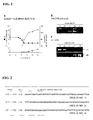
- RNA total RNA from a bacterial cell in accordance with an ordinary method ( FIG. 1b ).
- the pls gene was subjected to reverse transcription (RT) using an ⁇ -PL-NRPS-R primer as shown below and Rever Tra Ace made by TOYOBO CO., LTD as a reverse transcriptase.
- RT reverse transcription
- an aspartokinase gene ( ask ) was also prepared in the same way by reverse transcription using an Ask-C4 primer shown below as a control.
- ⁇ -PL-NRPS-F 5'-GGGGGATCCTCGTCGCCCCTTCTCGAATCG-3' (SEQ ID NO: 16)
- ⁇ -PL-NRPS-R 5'-ACCAAGCTTTCACGCGGCCGCACCTCCCTC-3' (SEQ ID NO: 17)
- Ask-C4 5'-ACCAAGCTTTCATCGCCCGGTGCCGCCGTA-3' (SEQ ID NO: 18)
- Ask-N4 5'-GGGGGATCCGGCCTTGTCGTGCAGAAGTAC-3'
- PCR was performed with ⁇ -PL-NRPS-F and ⁇ -PL-NRPS-R primers using the resultant reverse transcript ( pls gene) as a template.
- PCR was also performed with Ask-C4 and Ask-N4 primers also for the reverse transcript ( ask gene) as the control in a similar manner ( FIG. 1c ).
- the ask gene used as the control was demonstrated to be expressed from an initial phase of cultivation, and its expression level was remarkably decreased after a late logarithmic growth phase at which pH of culture broth starts dropping.
- Ask is the key enzyme for L-lysine synthesis, an ask gene expression profile closely associated with cell proliferation can be recognized to be reasonable.
- the expression of the pls gene was detected in and after the late logarithmic growth phase at which a pH of the culture broth starts dropping, and the expression reached a maximum near pH 4.2 at which production of the ⁇ -poly-L-lysine was detected. Moreover, expression with a high level was maintained even after 24 hours in which the cell growth was negligible. From the results of RT PCR analysis described above, it was demonstrated that the expression of the pls gene was specifically induced from late logarithmic growth phase in which the cell growth is blunted to a stationary phase, and under a low pH environment suitable for producing a secondary metabolite. Normaly, gene expression (neogenesis of protein) hardly occurs near the stationary phase in which such cell growth is not detected. However, because the pls gene is specifically and sustainably expressed during the phase, regulation of the pls gene expression is likely to be unusual.
- pls promoter Identification of a promoter region of a pls gene ( pls promoter) and construction of pDC007,a recombinant vector having the pls promoter
- flanking region of the gene cluster was analyzed by a Neural Network Promoter Prediction (http://www.fruitfly.org/seq_tools/promoter.html) program, no promoter region that gives a significant score (larger than 0.8) was found.
- the promoter region of the cluster was supposed to be any one of the three predicted regions described above. Therefore, inclusion of the promoter of the cluster in any one of the three predicted regions was verified in accordance with the method described below.
- plsnde-F plsnde-F; 5'-GGAATTC CATATG TCGTCGCCCCTTCTCG-3' (SEQ ID NO: 22) (an underlined part represents an Nde I site) plshind-R; 5'-ACCC AAGCTT TCACGCGGCCGCACCTCC-3' (SEQ ID NO: 23) (an underlined part represents a Hind III site).
- the pls gene digested with the restriction enzymes was inserted into an Nde I- Hind III site located downstream of a predicted pls promoter on pDC007 to construct pDC007- pls , and the pDC007- pls was transfered into S .
- albulus ⁇ pls by conjugal transfer from Escherichia coli S 17-1 strain in accordance with the method described in Non-patent document 4.
- the amount of production was 1.32 g/l in cultivation for 30 hours in Although the parental strain of S . albulus ⁇ pls (as disclosed in JP 2005-237335 A , anative plasmid pNO33-cured S . albulus strain that shows equal ⁇ -poly-L-lysine productivity to that of S . albulus NBRC14147)showed ⁇ -poly-L-lysine productivity at 1.32 g/l in 30h cultivation,. S . albulus ⁇ pls /pDC007 -pls strain surprisingly showed the productivityof 2.73 g/l, which was twice higher than that of wild strain (NBRC14147).
- pls promoter region for regulating expression of ⁇ -poly-L-lysine biosynthetic gene cluster
- the promoter region was identified and simultaneously utilized, resulted in successfully achieving the subject of constructing the gene expression vector pDC007 that specifically induces expression of the objective gene under acidic conditions in and after a logarithmic growth phase in which supply of a secondary metabolite synthetic precursor is enhanced in S . albulus.
- a ⁇ -poly-L-lysine high producer also successfully established beyond expectation was by utilizing the vector.
- the reason for improving the productivity is supposed to be that the pls gene originally existing only one copy on a chromosome was introduced with the vector, and thus multi- copies of the pls gene existed in a host cell, as a result, an amount of Pls accumulated as a translation product and also an amount of ⁇ -poly-L-lysine produced as a Pls reaction product were improved.
- the result of the Example shows effectiveness of the pls promoter and S . albulus as a host for producing arbitrary useful substances.
- a vector region other than the pls promoter of the recombinant vector is considered to be not necessarily a derivative of pLAE001 or 003 having an autonomously replicating region of pN033 used in the Example, if the vector region can be autonomously replicated stably in the host ⁇ -poly-L-lysine producer.
- it is expected that more remarkable effect of the pls promoter can be obtained with higher copy number of the vector.
- a similar effect is considered to be obtainable even without using the expression vector if an arbitrary objective gene is inserted into the chromosome of S . albulus under control of the pls promoter by homologous recombination, although an amount of objective product production may be decreased to some extent because an effect of the copy number can not be obtained.
- genes and gene clusters that are considered to perform biosynthesis of a new secondary metabolite from various kinds of actinomycetes are found. These genes (and clusters) are under control of a potentially weak or nonfunctional promoter. Therefore, most of the genes (and clusters) actually do not produce a secondary metabolite, and have escaped through exploratory researches energetically conducted for useful physiologically active substances all over the world.
- a new way for a search of new physiologically active substances and a research for production thereof is possibly opened by utilizing a newly found pls promoter of the invention in place of a potential promoter of the secondary metabolite biosynthesis genes (and clusters) to forcibly express the genes (and clusters), and to actually produce the secondary metabolite by utilizing an abundant precursor in S . albulus.
- the gene induction expression system of the invention is effective.
- a pDC007 derivative was constructed in order to apply a gene expression vector having a pls promoter according to the invention not only as a tool for producing useful substances but also for producing a recombinant protein.
- a terminator sequence found downstream of an ⁇ -poly-L-lysine biosynthetic gene cluster was introduced into downstream of a multiple-cloning site of pDC007 in accordance with the method described below.
- a vector is more advantageous when the vector can be expressed a protein as tag-fused protein allowing affinity purification. Therefore, based on pDC008 constructed in accordance with the method described above, a derivative that can express an inserted gene product as a C-terminal His-tag fused protein was constructed.
- Two mutually complementary types of single-stranded oligo DNA as His8C-F and His8C-R shown below were prepared. After mixing the DNAs, heating and cooling were carried out to form a double-stranded DNA, which was then inserted into a PstI-Hind III site of pDC008 to construct pD009 as shown in FIG. 3 .
- a gene expression vector having a pls promoter according to the invention is also effective to produce a recombinant protein
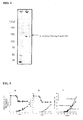
- production and purification were attempted for recombinant Pls using pDC009 that can express the inserted gene product as a C-terminal His-tag fused protein.
- the pls gene was amplified from S . albulus chromosomal DNA by PCR with plsnde-F and plshindhis8-R primers described below, the fragment was digested with restriction enzymes NdeI and HindIII.
- plsnde-F 5'-GGAATTC CATATG TCGTCGCCCCTTCTCG-3' (SEQ ID NO: 24) (an underlined part represents an NdeI site) plshindhis8-R; 5'- GTGGTG AAGCTT CGCGGCCGCACCTC-3' (SEQ ID NO: 25) (an underlined part represents a HindIII site).
- the digested pls gene was inserted into an Nde I -Hind III site of pDC009 to construct pDC009- pls , which was then transferred into S . albulus ⁇ pls by conjugal transfer with Escherichia coli S 17-1 strain in accordance with the method described in Non-patent literature No. 4.
- S . albulus ⁇ pls by conjugal transfer with Escherichia coli S 17-1 strain in accordance with the method described in Non-patent literature No. 4.
- albulus ⁇ pls /pDC009- pls as the resultant transformant was aerobically cultivated in an ⁇ -poly-L-lysine production medium containing 25 ⁇ g/ml of apramycin and 50 ⁇ g/ml of neomycin at 30°C for 30 hours in a 3L Jar-fermentor according to the method described in JP 2008-263868 A .
- the gene induction expression system using S. albulus and the gene expression vector having the pls promoter according to the invention is not a so-called high expression system such as a pET system in Escherichia coli.
- the gene is expressed constitutively (permanently) and in large quantities from an initial phase of cultivation for achieving an objective of producing the secondary metabolites by recombinant microorganisms.
- even a system allowing induction regulation of gene expression does not fully function in many cases in the late phase of cultivation suitable for production ofsecondary metabolites in which protein neogenesis hardly occurs. In this regard, too, the gene induction expression system of the invention is effective.
- a product of the gene, BpsA catalyzes a reaction for forming one indigoidine molecule from two L-glutamine molecules and two ATP molecules as a substrate. Accordingly, effectiveness of the gene induction expression system of the invention can be easily assessed by expressing the bpsA gene with a host-vector system of the invention, quantitatively determining an amount of blue pigment (indigoidine) to be produced, and further calculating an amount of ATP consumption in the reaction from the amount of pigment.
- bpsA gene was amplified from S . lavendulae chromosomal DNA by PCR with bpsAnde-F and bpsAhind-R primers described below using , the amplified fragment was digested with restriction enzymes Nde I and HindIII.
- bpsAnde-F 5'-GGAATTC CATATG ACTCTTCAGGAGACCAGCGTGCTCGAG-3' (SEQ ID NO: 26) (an underlined part represents an Nde I site as a restriction enzyme)
- bpsAhind-R 5'-CCC AAGCTT CTCGCCGAGCAGGTAGCGGATGTGC-3' (SEQ ID NO: 27) (an underlined part represents a Hind III site as a restriction enzyme).
- a fragment digested with the restriction enzyme was inserted into an Nde I- Hind III site of pDC009 to construct pDC009- bpsA , which was then transferred into S . albulus ⁇ pls by intergeneric conjugation with Escherichia coli S 17-1 strain.
- S. albulus ⁇ pls /pDC009- bpsA as the resultant transformant was aerobically cultivated in an ⁇ -poly-L-lysine production medium containing 25 ⁇ g/ml of apramycin and 50 ⁇ g/ml of neomycin at 30°C in a 3L Jar-fermentor in accordance with the method described in JP 2008-263868 A .
- a cultivation period of time was limited up to 21 hours after starting the cultivation (approximately 10 hours after pH of the culture broth decreased to approximately 4.0, namely, induced gene expression). Although no color change of the culture broth was observed before its pH decreased from an initial value, a significant blue stain of the culture was observed after pH decreased.
- the blue pigment produced in the culture broth was recovered together with bacterial cells by high-speed centrifugation.
- the resultant precipitate was resuspended in water and methanol, and then subjected to high-speed centrifugation again to wash the blue pigment and the bacterial cells.
- precipitate was dried.
- Dimethylformamide (DMF) was added to the dry substance containing the blue pigment, followed by thorough sonication until the blue pigment was dissolved, and then bacterial cell residues were removed by high-speed centrifugation and a 0.2 micrometer membrane filter. The resultant solution was used as a crude blue pigment solution.
- S . albulus ⁇ pls strain produced a remarkable amount of indigoidine without using exogenous L-glutamine as a precursor.
- the finding shows that S . albulus per se also synthesized a remarkable amount of L-glutamine required for producing indigoidine.
- the mechanism to supply significant amount of L-glutamine is unclear.
- S . albulus may have a mechanism for keeping a constant intracellular pool of not only ATP but also a compound such as consumed amino acids in the cell.
- HasA is a membrane-bound enzyme. Furthermore, codon usage in actinobacteria whose gene has an average GC content of approximately 70% is significantly different from that in lactic acid bacteria whose gene has an average GC content of approximately 40%. Thus, it was supposedthat the native hasA gene from Streptococcus zooepidemicus was not functionally expressed in S . albulus. Therefore, in order to functionally express the hasA gene in S .
- the hasA gene in the lactic acid bacterium Streptococcus zooepidemicus was redesigned (40% GC to 63% GC) by optimization of codon usage definitive to the actinomycete, and thus artificial gene mhasA (SEQ ID NO: 28) was synthesized.
- UDP-glucuronic acid and N-acetyl glucosamine as precursors for hyaluronic acid synthesis need to be supplied in a sufficient amount.
- an UDP-glucose dehydrogenase gene (hasB) as an enzyme having UDP-glucuronic acid synthesis activity
- an UDP-N-acetyl glucosamine pyrophosphorylase gene (hasD) were coexpressed with the codon optimized hasA ( mhasA ) gene and the method described below.
- the hasB gene homolog, sav5025, from Streptomyces avermitilis found by database search was amplified from Streptomyces avermitilis NBRC14893 chromosomal DNA by PCR with sav5025-assembleF and sav5025-hindR primers.
- sav5025-assembleF 5'-CTCGCATGAGCCTCAAGATCACCGTGATCGGCACCGG-3' (SEQ ID NO: 29)
- sav5025-assembleR 5'-ATGGCGCTCATGCGGTGGCCTCCCCCATCGCGCGGTACGTCCAGC-3' (SEQ ID NO: 30).
- sav3561 found in Streptomyces avermitilis genome by database search was amplified by PCR with sav3561-assembleF and sav3561-hindR primers.
- sav3561-assembleF 5' -CGATGGGGGAGGCCACCGCATGAGCGCCATCCGCCCGGCAGCCGT-3' (SEQ ID NO: 31) sav3561-hindR; 5'-CCC AAGCTT TCAGTCTTCGCCTTCCGGCTTCCGGGAA-3' (SEQ ID NO: 32) (an underlined part represents a restriction enzyme Hind III site).
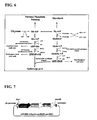
- the mhasA gene, the sav5025, and sav3561 genes were assembled into a single fragment according to an overlap extension PCR method to construct an artificial hyaluronic acid biosynthetic gene cluster in which the mhasA, sav5025 and sav3561 genes were coupled ( FIG. 7 , SEQ ID NO: 33).
- the gene cluster ( mhasA-sav5025-sav3561 ) was subjected to restriction enzyme digestion with Xba I and Hind III, and then inserted into a Xba I- Hind III site of pDC009 to construct pDC009- mhasA-sav5025-sav3561. Because the gene cluster is designed to be transcribed as a single unit by the promoter of the invention, and a ribosome binding sites are provided upstream of each gene, each gene can be efficiently translated. Moreover, as a control, pDC009-mhasA in which only mhasA was inserted into Xba I -Hind III of pDC009 was simultaneously constructed.
- S. albulus ⁇ pls were introduced into S. albulus ⁇ pls by intergeneric conjugation with Escherichia coli S17-1 strain, and S. albulus ⁇ pls /pDC009- mhasA-sav5025-sav3561 and S. albulus ⁇ pls /pDC009- mhasA as the resultant transformants were aerobically cultivated in an ⁇ -poly-L-lysine production medium containing 25 ⁇ g/ml of apramycin and 50 ⁇ g/ml of neomycin at 30°C in a 3L Jar-fermentor in accordance with the method described in JP 2008-263868 A .
- a cultivation liquid was provided for centrifugal separation to remove bacterial cells.
- Three volumes of ethanol was added to the supernatant to precipitate polysaccharides containing the hyaluronic acid, and the precipitates were recovered by centrifugation.
- three volumes of ethanol was added again to precipitate polysaccharides.
- the precipitates were dissolved in deionized water and recovered as a crude sample.
- the content of hyaluronic acid produced was measured in accordance with a carbazole-sulfuric acid method ( Anal Biochem. 1962 Oct; 4: 330-4 ).
- an amount of ATP per 1L of medium to be consumed in hyaluronan synthesis was substantially equivalent to the amount of ATP consumption in producing ⁇ -poly-L-lysine in a S. albulus ⁇ pls /pDC009- pls strain ( FIGs. 5b, c ).
- the result shows that the hyaluronic acid as an objective compound was synthesized by efficiently utilizing theoretically available ATP which is strongly regenerated in a S . albulus cell (partially including neogenesis also).
- the invention has been proved to be very effective in producing useful substances biosynthesized through the multiple reaction, and also in producing compounds in which ATP is required indirectly for the biosynthesis.
- Any and all arbitrary useful compounds can be produced in large quantities using the promoter, the recombinant vector having the promoter, and S. albulus as the host according to the invention, and also applying a procedure in a manner similar to the Examples, such as codon modification of transgene and reinforcement of a precursor supply gene, when necessary.
- the productivity is evaluated within a relatively short period of time without resupplying carbonhydrates in fermentation process.
- production and accumulation of the objective compound can be sustained for approximately eight days in the method for producing useful substances according to the invention in the same manner as the production of ⁇ -poly-L-lysine as described in Kahar et al. (J Biosci Bioeng. 2001; 91(2): 190-4 ).
- pDC009- pls that has been already constructed in Example 4 was transferred into a Streptomyces lividans TK23 strain ( ⁇ -poly-L-lysine non-producing actinomycete) in accordance with the method described in Reference Material ( Practical Streptomyces Genetics (2000) P. 301-302 ).
- the resultant transformant was aerobically cultivated in an ⁇ -poly-L-lysine production medium containing 650 ⁇ g/ml ofneomycin at 30°C for 30 hours (3L Jar-fermentor).
- the invention is useful for producing desired useful substances.
- the invention is also useful as a host-vector system which is to be a tool for linking gene information obtained by genomic analyses with production of useful substances, an enzyme catalyzing synthesis thereof, or the like.
Landscapes
- Life Sciences & Earth Sciences (AREA)
- Organic Chemistry (AREA)
- Chemical & Material Sciences (AREA)
- Health & Medical Sciences (AREA)
- Engineering & Computer Science (AREA)
- Genetics & Genomics (AREA)
- Zoology (AREA)
- Wood Science & Technology (AREA)
- Biotechnology (AREA)
- General Engineering & Computer Science (AREA)
- Bioinformatics & Cheminformatics (AREA)
- General Health & Medical Sciences (AREA)
- Microbiology (AREA)
- Biochemistry (AREA)
- Biomedical Technology (AREA)
- Molecular Biology (AREA)
- Chemical Kinetics & Catalysis (AREA)
- General Chemical & Material Sciences (AREA)
- Physics & Mathematics (AREA)
- Biophysics (AREA)
- Plant Pathology (AREA)
- Proteomics, Peptides & Aminoacids (AREA)
- Preparation Of Compounds By Using Micro-Organisms (AREA)
- Micro-Organisms Or Cultivation Processes Thereof (AREA)
Abstract
Description
- The invention relates to a method for producing useful substances by a recombinant actinomycete, Streptomyces species.
- An actinomycete, Streptomyces species, has been widely utilized all over the world as a producer for various useful substances including pharmaceuticals and pharmaceutical intermediates as typified by an antibiotic or an immunosuppressor, and is industrially very useful microorganisms. Even with development of genetic engineering technologies in recent years, a classical method by mutagen treatment is still predominant in breeding a high producer strain for useful substances in the actinomycete including the Streptomyces species because not only homologous recombination on the chromosome but also gene transfer and transformation as a vector are currently limited to certain actinomycete strains.
- A genome sequence has been determined also in the actinomycete, Streptomyces species, in recent years. Therefore, researches are expected to be actively conducted on new physiologically active substances based on genome information in the future. However, for the purpose of developing such substances, linking of genetic information in the genome with production of the useful substances or an enzyme protein that catalyzes synthesis thereof is important, and a host-vector system applicable as a tool is essential.
- A gene expression system in microorganisms such as Escherichia coli and yeast has been widely spread and commonly utilized. However, proteins that can be expressed as an active form in a common expression system therefor is limited. Similarly, even though an industrially important gene (P-450 or the like) from the actinomycete can be expressed in closely-related Streptomyces species, the gene can not be expressed as an active protein or enzyme in the common system therefor in many cases.
- Several gene expression systems in the Streptomyces species have been developed. In one case, a powerful gene expression system in which large quantities of recombinant proteins as high as 40% of all intracellular soluble proteins can be produced has been reported (Non-patent document 1: Herai et al., Proc Natl Acad Sci USA. 2004 Sep 28; 101(39): 14031-5. Epub 2004 Sep 17). However, the systems are provided for the purpose of producing the recombinant proteins. An actinomycete host-vector system that can be applied for producing useful compounds by recombinant microorganisms is virtually unknown. The reason therefor is that achievement of high productivity of a secondary metabolite by using the recombinant microorganisms simultaneously requires specific inducible gene expression during a period suitable for producing the secondary metabolite definitive to the host and also an improvement of precursor supply ability of the host.
- Meanwhile, among reactions catalyzed by an organism and a biocatalyst (enzyme) in the organism, reactions catalyzed by ATP-dependent enzymes include many physiologically and also industrially useful reactions. However, ATP is very expensive. Therefore, use of a remarkable amount of ATP as a raw material is quite difficult in industrial production. Thus, many ATP regeneration systems have been reported in which ATP once consumed in the reaction is regenerated by utilizing other energy substances (Non-patent document 2: Zhao & von der Donk, Curr Opin Biotechnol. 2003 Dec; 14(6): 583-9).
- An example has been recently reported in which a thermostable polyphosphate kinase is coexpressed together with an ATP-dependent D-alanine-D-alanine ligase as a dipeptide synthetase in Escherichia coli to carry out dipeptide synthesis reaction using the engeneered cells, and thus dipeptide synthesis has been achieved with the aid of ATP regeneration system mediated by the polyphosphate kinase. (Non-patent document 3: Sato et al., J Biosci Bioeng. 2007 Feb; 103(2): 179-84). In the method, the dipeptide synthesis has been achieved at a yield of 80% (mol/mol) as an added D-alanine without adding ATP from outside a system. However, the amount of the product was not so high with a productivity of approximately 0.02 mol/l, indicating that the amount of ATP available for the reaction was approximately 0.02 mol/l.
- Several Streptomyces species, a certain Kitasatospora strain, and aEpichloe strain, a filamentous fungi have been reported to extracellularly perform secretory production of ε-poly-L-lysine that is widely utilized as a food preservative in Japan, Republic of Korea and the United States (Non-patent document 4: Nishikawa & Ogawa, Appl Environ Microbiol. 2002 Jul; 68(7): 3575-81). Among such ε-poly-L-lysine producers, S. albulus NBRC 14147 is particularly industrially useful because the S. albulus NBRC 14147 shows a remarkably high productivity
- In recent years, an ε-poly-L-lysine synthetase (Pls) and a gene thereof (pls gene) in S. albulus have been identified, and ε-poly-L-lysine has been elucidated to be directly synthesized from L-lysine and ATP both as a precursor (Non-patent document 5: Yamanaka et al., Nat Chem Biol. 2008 Dec; 4(12): 766-72. Epub 2008 Nov 9, Patent document 1:
JP 2008-263868 A -
- Patent document 1:
JP 2008-263868 A -
- Non-patent document 1: Herai et al., Proc Natl Acad Sci U S A. 2004 Sep 28; 101(39): 14031-5. Epub 2004 Sep 17.
- Non-patent document 2: Zhao & von der Donk, Curr Opin Biotechnol. 2003 Dec; 14(6): 583-9.
- Non-patent document 3: Sato et al., J Biosci Bioeng. 2007 Feb; 103(2): 179-84.
- Non-patent document 4: Nishikawa & Ogawa, Appl Environ Microbiol. 2002 Jul; 68(7): 3575-81.
- Non-patent document 5: Yamanaka et al., Nat Chem Biol. 2008 Dec; 4(12): 766-72. Epub 2008 Nov 9.
- Non-patent document 6: Hiraki et al., Seibutsu-kogaku Kaishi 76(12) pp. 487-493 1998 1225.
- Non-patent document 7: Kahar et al., J Biosci Bioeng. 2001; 91(2): 190-4.
- Considering such background, a development has been required for a host-vector system that can regulate specific expression of a transgene in an actinomycete (Streptomyces species, for example) having a high substance production ability and precursor supply ability, and can be a tool for researching new physiologically active substances or producing useful physiologically active substances. A development has also been required for a more effective ATP regeneration system that can be applied to mass production of useful substances.
- Accordingly, the invention provides a promoter, an expression vector, a host cell, and a method for producing desired substances as described below.
-
Item 1. A promoter capable of specifically inducing gene expression in and after a logarithmic growth phase in an actinomycete, Streptomyces species. -
Item 2. The promoter according toitem 1, wherein the actinomycete, Streptomyces species, is an ε-poly-L-lysine producer. -
Item 3. The promoter according toitem 2, which is present in an approximately 350-bp upstream region of an initiation codon (ATG or GTG) of a pls gene of ε-poly-L-lysine producer. - Item 4. The promoter according to any one of
items 1 to 3, comprising the nucleotide sequence of SEQ ID NO: 1, SEQ ID NO: 2, SEQ ID NO: 3 or SEQ ID NO: 4. -
Item 5. The promoter according to any one ofitems 1 to 4, comprising the nucleotide sequence of SEQ ID NO: 4. -
Item 6. An expression vector, comprising the promoter according to any one ofitems 1 to 5. -
Item 7. The expression vector according toitem 6, for use in expressing an objective gene in an ε-poly-L-lysine producer. -
Item 8. The expression vector according toitem 7, wherein the ε-poly-L-lysine producer is an actinomycete, Streptomyces species, an actinomycete, Kitasatospora species, or a filamentous fungus, Epichloe species. -
Item 9. The expression vector according toitem 8, wherein the actinomycete, Streptomyces species, is S. albulus. -
Item 10. The expression vector according to any one ofitems 6 to 9, further comprising a terminator downstream of the promoter. -
Item 11. The expression vector according toitem 10, wherein the nucleotide sequence of the terminator includes the nucleotide sequence of SEQ ID NO: 7 or SEQ ID NO: 8. -
Item 12. The expression vector according toitem - Item 13. The expression vector according to
item 12, wherein the tag sequence comprises the nucleotide sequence of SEQ ID NO: 9 or SEQ ID NO: 10. - Item 14. The expression vector according to any one of
items 6 to 13, comprising an objective gene under the control of the promoter. -
Item 15. The expression vector according to item 14, wherein the objective gene is a gene or a gene cluster derived from an organism of a kind identical with or different from the ε-poly-L-lysine producer. - Item 16. The expression vector according to
item 15, wherein the objective gene is a pls gene, a bpsA gene, a hasA gene, a mhasA gene, a hasB gene, a hasB homolog gene, a hasD gene or a hasD homolog gene. - Item 17. An expression vector, comprising the nucleotide sequence of SEQ ID NO: 13, SEQ ID NO: 14 or SEQ ID NO: 15.
-
Item 18. A host cell, into which the promoter according to any one ofitems 1 to 5 and an objective gene under regulation of the promoter, or the expression vector according to any one of items 14 to 16 have been transferred. - Item 19. The host cell according to
item 18, which is an actinomycete, Streptomyces specie, an actinomycete, Kitasatospora species, or a filamentous fungus, Epichloe species. -
Item 20. The host cell according to item 19, which is an ε-poly-L-lysine producer. - Item 21. A method for producing useful substances, comprising expressing an objective gene under regulation of the promoter according to any one of
items 1 to 5 to produce a protein or a polypeptide to be encoded by the gene in a host cell. - Item 22. The method according to item 21, comprising transferring the expression vector according to any one of items 14 to 16 into the host cell.
- Item 23. A method for producing useful substances, comprising cultivating the host cell according to any one of
items 18 to 20. -
Item 24. The method for producing useful substances according to item 21, comprising cultivating a pls gene-defective or gene-disrupted strain of S. albulus and any other ε-poly-L-lysine producer. -
Item 25. The method for producing useful substances according toitem 24, comprising transferring the expression vector according to any one of items 14 to 16 into the pls gene-defective or gene-disrupted strain. - Item 26. The method for producing useful substances according to any one of items 21 to 25, wherein the useful substances are compounds prepared by biosynthesis through a one-step or multi-step reaction.
- A recombinant ε-poly-L-lysine synthetase (recombinant Pls) that has never been previously produced in any conventional expression system can be efficiently produced and accumulated using the promoter, the expression vector, the host cell or the method for producing useful substances according to the invention. According to the invention, enhanced production of ε-poly-L-lysine is also achieved.
- Moreover, desired useful substances can also be effectively produced by using the promoter, the expression vector, the host cell or the method for producing useful substances according to the invention.
-
-
FIG. 1a is a graph showing pH of the culture broth (solid circle), an amount of ε-poly-L-lysine accumulated in the broth (open square) and an growth of bacterial cell (open triangle) upon aerobically cultivating S. albulus NBRC14147 in the ε-poly-L-lysine production medium for 30 hours in a Jar-fermentor.FIG. 1b is a diagram showing a photograph of agarose gel electrophoresis performed to assess total RNA extracted from the cells at each time point shown inFIG. 1a. FIG. 1c is a diagram showing a result of RT-PCR performed with total RNA. -
FIG. 2 is a diagram showing a predicted promoter region of the ε-poly-L-lysine biosynthetic gene cluster. Each number shows a distance from an initiation codon (ATG) of the pls gene, and an underline shows a predicted translation start site. -
FIG. 3 is a map of vectors that have inducible pls promotor for gene expression available in an actinomycete, Streptomyces species. -
FIG. 4 is a diagram showing results of SDS-PAGE analysis of recombinant C-terminal His-tag fused Pls purified from a S. albulus Δpls/pDC009 pls strain. -
FIG. 5a is a graph showing a time course of indigoidine production and pH of the culture broth (solid square and ×-mark, respectively) upon aerobically cultivating a S. albulus Δpls/pDC009-bpsA strain in the ε-poly-L-lysine production medium containing 25 µg/ml of apramycin and 50 µg/ml of neomycin at 30°C in a 3L Jar-fermentor, and a graph showing a time course of hyaluronic acid (HA) production and pH of the culture broth (solid rhombus and solid circle, respectively) upon aerobically cultivating a S. albulus Δpls/pDC009-mhasA strain in an ε-poly-L-lysine production medium containing 25 µg/ml of apramycin and 50 µg/ml of neomycin at 30°C in a 3L Jar-fermentor.FIG. 5b is a graph showing time course of ε-poly-L-lysine (ε-PL) production and pH of the culture broth upon cultivating a S. albulus Δpls/pDC009-pls strain in a manner similar to cultivation inFIG. 5a. FIG. 5c is a graph showing ATP consumption during production of indigoidine and ε-PL (calculated from the amounts of indigoidine and ε-PL produced). -
FIG. 6 is a diagram showing a biosynthetic pathway from glucose to hyaluronic acid. -
FIG. 7 is a diagram schematically showing an artificial hyaluronic acid biosynthetic gene cluster in which mhasA, sav5025 and sav3561 genes are translationally coupled. - According to one embodiment, the invention provides a promoter for specifically inducing gene expression in and after a late logarithmic growth phase suitable for producing a secondary metabolite in an actinomycete, Streptomyces species.
- A promoter sequence of the invention is typically derived from a genome of the actinomycete, Streptomyces species, and exists within an approximately 350 bp upstream region of an initiation codon (ATG) of the pls gene. The promoter of the invention typically includes a promoter including the nucleotide sequence of SEQ ID NO: 1, SEQ ID NO: 2, SEQ ID NO: 3 or SEQ ID NO: 4, but is not limited thereto. The promoter also includes a functional equivalent, namely, an arbitrary promoter that is derived from an ε-poly-L-lysine producer strain, and specifically induces expression of an ε-poly-L-lysine synthetase (pls) gene in and after the late logarithmic growth phase. The promoter sequence of the invention can be identified by searching a peripheral region of the pls gene cluster, for example, by using a promoter prediction program as specifically shown in Examples described later, or utilizing a method pursuant therewith. A promoter region of the invention can be identified, when necessary, by analyzing expression of the pls gene using the method specifically shown in Examples described later, or a method equivalent thereto.
- Utilization of the promoter of the invention has an advantage that useful substances can be produced by catalysis of an arbitrary transgene product (enzyme protein or the like) because a high secondary metabolite production ability of the actinomycete, typically, the ε-poly-L-lysine producer, particularly, S. albulus, and a strong and sustained ATP regeneration capability thereof (precursor supply capability) can be utilized in and after the late logarithmic growth phase. In order to produce desired useful substances, the promoter of the invention and an arbitrary objective gene cloned downstream (under regulation) thereof are carried in an expression vector, and can be transferred into the ε-poly-L-lysine producer (S. albulus, for example). Alternatively, the arbitrary objective gene can be inserted into a chromosome of the ε-poly-L-lysine producer (actinomycete, Streptomyces species (S. albulus), for example) under control of the promoter by homologous recombination or the like without using the expression vector. As the ε-poly-L-lysine producer, a strain having the high secondary metabolite production ability and the strong and sustained ATP regeneration capability (precursor supply capability) in and after the late logarithmic growth phase, such as the S. albulus, is advantageously used.
- "Promoter" herein means a region in which a RNA polymerase is bound at initiating m-RNA synthesis (transcription). Moreover, "pls promoter" means an approximately 343-bp upstream region of the pls gene.
- Furthermore, "pls gene" herein means a gene that encodes an ε-poly-L-lysine synthetase (see Yamanaka et al., Nat Chem Biol. 2008 Dec; 4(12): 766-72. Epub 2008 , and Patent document 1:
JP 2008-263868 A - The term "useful substances" or "useful compounds" herein means industrially useful substances, such as ε-poly-L-lysine or the enzyme protein that synthesizes the ε-poly-L-lysine, and substances that can be produced (directly or indirectly) in accordance with a method for producing useful substances according to the invention.
- "High producer strain" herein for desired useful substances or useful compounds means a strain that produces the desired useful substances or useful compounds with a high efficiency and in mass.
- The term "secondary metabolite" herein is used in referring to the secondary metabolite usually used in the relevant field. More specifically, primary metabolism refers to a biochemical reaction (energy metabolism, or biosynthesis of amino acid, protein, nucleic acid, for example) that is commonly observed in many organisms. On the contrary, some biosynthetic reactions have no important role on maintaining its own life cycle and accumulate a mass of alkaloid, terpenoid, phenols, an antibiotic, pigment or the like in various kinds of animals and plants or microorganisms. Such biosynthetic reactions are referred to as secondary metabolism, and substances such as the alkaloid produced thereby are referred to as the secondary metabolite. Many of the secondary metabolites are produced only during a specific period or only in a specific tissue of ontogenesis (see Iwanami Seibutsugaku Jiten (Biology Encyclopedia), 4th edition, first copy, issued on March 21, 1996).
- "Objective gene" or "target gene" herein means a gene encoding a desired arbitrary protein (or polypeptide), an enzyme protein that synthesizes the desired useful substances, or the like. Specific examples of the "objective gene" include a pls gene, a bpsA gene, a hasA gene, a mhasA gene, a hasB gene, a hasB homolog gene (sav5025), a hasD gene or a hasD homolog gene (sav3561) as shown in Examples described later, but are not limited thereto. The "objective gene" includes an arbitrary gene derived from both related and unrelated organism ofε-poly-L-lysine producer, and a cluster of plurality of genes therefrom.
- According to a further embodiment, the invention provides the expression vector carrying the promoter of the invention. The expression vector of the invention can be used for expression of a desired objective gene in the actinomycete, preferably, an actinomycete, Streptomyces species, further preferably, an ε-poly-L-lysine-producing actinomycete. The ε-poly-L-lysine producer includes an arbitrary bacterial strain that is known to produce the ε-poly-L-lysine. Specific examples include an actinomycete, Streptomyces species (S. albulus, S. mashuense, S. roseoverticillatus, S. lavendulae), an actinomycete, Kitasatospora species (K. kifnense) and a filamentous fungus (Epichloe sp.), but are not limited thereto.
- The expression vector of the invention may further include a terminator sequence at downstream of the promoter. The terminator sequence typically includes partially or wholly the nucleotide sequence of SEQ ID NO: 7 or SEQ ID NO: 8, but is not limited thereto. The terminator sequence also includes a functional equivalent thereof, more specifically, an arbitrary nucleotide sequence that functions as a terminator (signal of termination of transcription) in expression of the objective gene cloned under regulation of the promoter. The terminator sequence used in the expression vector of the invention can be found in a region downstream of the ε-poly-L-lysine biosynthetic gene cluster in S. albulus, for example. Stabilization and/or promotion of efficiency of transcription-translation of the objective gene can be achieved by including the terminator sequence in the expression vector of the invention.
- The protein to be produced by using the expression vector of the invention may be produced as a fusion protein with a tag protein so as to be convenient for affinity purification. Therefore, the expression vector of the invention may include a tag coding sequence in addition to the objective gene. Specific examples of the tag coding sequence include the nucleotide sequence of SEQ ID NO: 9 or SEQ ID NO: 10 as shown in Examples described later. Specific examples of a tag to be fused include His-tag or glutathione S-transferase (GST)-tag, but are not limited thereto. Expression as a tag fusion protein provides an advantage that the affinity purification can be utilized in production (recovery) of a recombinant protein, for example.
- Specific non-limiting examples of the expression vector of the invention are shown as an expression vector of SEQ ID NO: 13, SEQ ID NO: 14 or SEQ ID NO: 15 in the Examples of the invention.
- According to a still further example, the invention provides a host cell harboring the objective gene cloned under control of the promoter of the invention, or the expression vector of the invention that includes the objective gene under control of the promoter is transferred. A cell that can be used as the host of the invention includes a cell of the actinomycete including Streptomyces species, Kitasatospora species and Rhodococcus species, but is not limited thereto. Typically, a cell of the ε-poly-L-lysine producer can be used as the host of the invention.
- It is advantageous that the host cell of the invention is used for producing the arbitrary useful substances, because a more efficient production of the useful substances can be achieved. For example, as shown in Reference Examples and Examples described later, when a strain such as a S. albulus Δpls strain in which the pls gene is disrupted in advance is used, no consumption of secondary metabolite production ability and ATP regeneration ability in and after the late logarithmic growth phase is required for production of the ε-poly-L-lysine, a major metabolite of the strain.
- According to a still further embodiment, the invention also provides the method for efficiently producing the useful substances utilizing the promoter or the expression vector of the invention. The method includes expression of the objective gene under control of the promoter of the invention in the actinomycete, typically, the ε-poly-L-lysine producer.
- Alternatively, an objective protein that is encoded by the objective gene may be produced by transferring the expression vector of the invention into the ε-poly-L-lysine producer using a technology well known to those skilled in the art.
- Alternatively, the arbitrary useful substances may be produced by cultivating the host cell harboring the expression vector of the invention. Cultivation conditions (a cultivation liquid composition, a cultivation period or the like) may be varied by those skilled in the art for any purpose.
- In the following, the invention will be explained in greater detail by way of Examples, but the scope of the invention is not limited to the Examples.
- During theε-poly-L-lysine fermentation, S. albulus shows characteristic ε-poly-L-lysine production profile; high levels of ε-poly-L-lysine production is observed only under acidic pH conditions of late-logarithmic growth phase that inhibits its own growth. - This observation indicates that S. albulus preferentially utilizes L-lysine and ATP, as a precursor molecule and a energy source respectively, for the ε-poly-L-lysine production than for its growth (primary metabolism) under the acidic condition.
- According to the report by Kahar et al. (J Biosci Bioeng. 2001; 91(2): 190-4), a S. albulus S410 strain (strain induced from S. albulus NBRC14147) produces and accumulates as high as 48.3 g/l of ε-poly-L-lysine in a culture broth in 8 days cultivation. Accordingly, the S. albulus or its derivatives can be referred to as a ε-poly-L-lysinehigh producer and simultaneously as a L-lysine high producer. Furthermore, ATP as another precursor is converted into AMP in association with an ε-poly-L-lysine synthetic reaction (
JP 2008-263868 A - The mass number per one lysine residue in the ε-poly-L-lysine is 128. Accordingly, the L-lysine residue in 48.3 g/l of ε-poly-L-lysine is approximately equal to an amount of 0.38 mol/l. Because an average polymerization degree of the ε-poly-L-lysine is 30 mer, the number of peptide bonds in one molecule is calculated to be 29 from an equation: 30 - 1 = 29. Because Pls requires one ATP molecule per single peptide bond formation (condensation reaction), an amount of ATP consumption is calculated to be 0.37 mol/l from an equation: 0.38 mol/l × 29/30 = 0.37mol/l. Therefore, 0.37 mol/l of ATP is consumed to produce 48.3 g/l of ε-poly-L-lysine during the cultivation for 8 days in the S. albulus S410 strain. The amount of ATP consumption is much larger than an amount of ATP regenerated by a thermostable polyphosphate kinase as described above (corresponding to as high as 203.9 g/l as ATP-2Na salt).
Accordingly, a gene expression system using the ε-poly-L-lysine producer, S. albulus NBRC14147 or its derivatives as a host was considered to allow high levels of desired secondary metabolite production due to strong and sustained ATP regeneration capability of S. albulus under acidic conditions. Furthermore, the gene expression system was considered to be a powerful means for simultaneously solving the both objectives of the efficient ATP regeneration applicable to mass production of the useful substances, and the production of arbitrary useful substances by the actinomycete. - Moreover, disruption of a pls gene in S. albulus as a host in advance (S. albulus Δpls strain) was considered to allow more efficient production of desired useful substances because ability to produce secondary metabolite and regenerate ATP under acidic conditions wouldn't be used for the production ofε-poly-L-lysine, main product in this strain.
- pLAE001 , a Escherichia coli-actinomycete shuttle vector, which can be utilized in an actinomycete, Streptomyces species including S. albulus, has been already developed from a S. albulus cryptic plasmid pNO33 (
JP 2005-237335 A - Accordingly, use of the S. albulus Δpls strain (
JP 2008-263868 A - Then, pLAE006-pls constructed by inserting the pls gene (including a ribosome binding site upstream of the ORF and His x8-tag coding sequence immediately before the termination codon) into a BamHI-HindIII site of pLAE006 was introduced into S. albulus Δpls by intergeneric conjugation with Escherichia coli S17-1 strain in accordance with the method described in
Patent document 1. S. albulus Δpls/pLAE006-pls as the resultant transformant was aerobically cultivated in an ε-poly-L-lysine production medium containing 25 µg/ml of apramycin and 50 µg/ml of neomycin (Kahar et al., J Biosci Bioeng. 2001; 91(2): 190-4) at 30°C for 48 hours. - After completion of the cultivation, when the amount of ε-poly-L-lysine produced in the culture supernatant was measured in accordance with a HPLC method as described in
JP 2008-263868 A - A functional analysis of Pls was also partially performed using the present method (2009 Annual Meeting of The Society for Biotechnology, Japan, P. 194). The results described above show the objective of high production of useful substances by microorganisms is quite difficult even by induction of the gene expression from constitutive ermE promoter on pLAE006 because even the gene from itself cn be hardly expressed under the acidic condition after the logarithmic growth phase.
- Accordingly, a search for "promoter that specifically induces gene expression under acidic conditions in and after the logarithmic growth phase" suitable for producing substances in S. albulus was required.
- In view of the fact that S. albulus produces a remarkable amount of ε-poly-L-lysine only under acidic conditions in and after a logarithmic growth phase, a possibility that the expression of the pls gene could be specifically induced only under the characteristic conditions was considered.
- To clarify the possibility, expression profile of the pls gene was analyzed by RT-PCR method. In accordance with the method described in
JP 2008-263868 A FIG. 1a ). Moreover, after a decrease in pH in association with cultivation, a 10% aqueous ammonia solution was appropriately fed to maintain culture pH at 4.2 suitable for ε-poly-L-lysine production. - During the cultivation, an aliquote was appropriately sampledto extract total RNA from a bacterial cell in accordance with an ordinary method (
FIG. 1b ). From the total RNA, the pls gene was subjected to reverse transcription (RT) using an ε-PL-NRPS-R primer as shown below and Rever Tra Ace made by TOYOBO CO., LTD as a reverse transcriptase. Moreover, an aspartokinase gene (ask),a key enzyme for L-lysine synthesis, was also prepared in the same way by reverse transcription using an Ask-C4 primer shown below as a control.
ε-PL-NRPS-F; 5'-GGGGGATCCTCGTCGCCCCTTCTCGAATCG-3' (SEQ ID NO: 16)
ε-PL-NRPS-R; 5'-ACCAAGCTTTCACGCGGCCGCACCTCCCTC-3' (SEQ ID NO: 17)
Ask-C4; 5'-ACCAAGCTTTCATCGCCCGGTGCCGCCGTA-3' (SEQ ID NO: 18)
Ask-N4; 5'-GGGGGATCCGGCCTTGTCGTGCAGAAGTAC-3' (SEQ ID NO: 19).
Then, PCR was performed with ε-PL-NRPS-F and ε-PL-NRPS-R primers using the resultant reverse transcript (pls gene) as a template. PCR was also performed with Ask-C4 and Ask-N4 primers also for the reverse transcript (ask gene) as the control in a similar manner (FIG. 1c ). - As a result, the ask gene used as the control was demonstrated to be expressed from an initial phase of cultivation, and its expression level was remarkably decreased after a late logarithmic growth phase at which pH of culture broth starts dropping. Because Ask is the key enzyme for L-lysine synthesis, an ask gene expression profile closely associated with cell proliferation can be recognized to be reasonable.
- Meanwhile, in contrast with the ask gene, the expression of the pls gene was detected in and after the late logarithmic growth phase at which a pH of the culture broth starts dropping, and the expression reached a maximum near pH 4.2 at which production of the ε-poly-L-lysine was detected. Moreover, expression with a high level was maintained even after 24 hours in which the cell growth was negligible. From the results of RT PCR analysis described above, it was demonstrated that the expression of the pls gene was specifically induced from late logarithmic growth phase in which the cell growth is blunted to a stationary phase, and under a low pH environment suitable for producing a secondary metabolite. Normaly, gene expression (neogenesis of protein) hardly occurs near the stationary phase in which such cell growth is not detected. However, because the pls gene is specifically and sustainably expressed during the phase, regulation of the pls gene expression is likely to be unusual.
- Moreover, as described above, several kinds of actinomycetes and certain filamentous fungi are known to produce the ε-poly-L-lysine. Both of the actinomycete and the filamentous fungus commonly produce the ε-poly-L-lysine only after pH of the cultures dropped to lower than pH 4.5. Accordingly, Pls enzymes in these producers are supposed to be specifically expressed in association with a decrease of culture pH.
- From the result, using a gene expression vector having a promoter that regulates the pls gene expression to give a characteristic expression behavior, and an ε-poly-L-lysine producer strain as a host, it was considered to be applicable to the objective of producing arbitrary useful substances.
- Identification of a promoter region related to regulation of pls gene expression was attempted. A DNA sequence of 33-kb including a pls gene has been already disclosed (GeneBank, accession No. AB385841). Moreover, a metalloprotease gene translationally-coupled with downstream of the pls gene has also been demonstrated to be a major ε-poly-L-lysine degrading enzyme (PldII, end type) gene in S. albulus (Proceedings of 2008 Annual Meeting of The Society for Biotechnology, Japan, p. 206). Therefore, the pls gene and a pldII gene can be recognized to form an ε-poly-L-lysine biosynthetic gene cluster. When flanking region of the gene cluster was analyzed by a Neural Network Promoter Prediction (http://www.fruitfly.org/seq_tools/promoter.html) program, no promoter region that gives a significant score (larger than 0.8) was found.
- Then, when a search was conducted again with lowered threshold (larger than 0.4), three predicted promoter regions shown in
FIG. 2 were found. However, all three regions has a low score, and thus the promoter region was not identified. Moreover, in detailed analysis of flanking resion of the gene cluster, a terminator sequence was found directly downstream of the gene cluster, but no regulatory gene was found. - However, no other promoter candidate regions existed in the peripheral region. Thus, the promoter region of the cluster was supposed to be any one of the three predicted regions described above. Therefore, inclusion of the promoter of the cluster in any one of the three predicted regions was verified in accordance with the method described below.
- All of the three predicted regions were located within 350-bp upstream of a pls gene initiation codon (ATG). Therefore, 343-bp region including all three predicted promoters was amplified from S. albulus chromosomal DNA by PCR with eplP-F and eplP-R primers as shown below. The PCR amplified fragment was inserted into a FseI-BamHI site of the pLAE003 to construct pDC007 shown in
FIG. 3 . - eplP-F; 5'-ACTATGGCCGGCCGTTGGTCGACGTCC-3' (SEQ ID NO: 20) (an underlined part represents a FseI site)Next, a function and effectiveness of the vector were verified by a expression experiment using the pls gene described below. After the pls gene was subjected to PCR amplification according to PCR with plsnde-F and plshind-R primers using the S. albulus chromosomal DNA as the template, an amplified fragment was digested with restriction enzymes NdeI and HindIII.

plsnde-F; 5'-GGAATTCCATATGTCGTCGCCCCTTCTCG-3' (SEQ ID NO: 22) (an underlined part represents an NdeI site)
plshind-R; 5'-ACCCAAGCTTTCACGCGGCCGCACCTCC-3' (SEQ ID NO: 23) (an underlined part represents a HindIII site).
The pls gene digested with the restriction enzymes was inserted into an NdeI-HindIII site located downstream of a predicted pls promoter on pDC007 to construct pDC007-pls, and the pDC007-pls was transfered into S. albulus Δpls by conjugal transfer from Escherichia coli S 17-1 strain in accordance with the method described in Non-patent document 4. The resultant transformant, S. albulus Δpls/pDC007-pls, was aerobically cultivated in an ε-poly-L-lysine production medium containing 25 µg/ml of apramycin and 50 µg/ml of neomycin at 30°C for 30 hours in a 3L Jar-fermentor in accordance with the method described inJP 2008-263868 A - After completion of the cultivation, an amount of ε-poly-L-lysine in cultue supernatant was quantitatively determined. As a result, the S. albulus Δpls/pDC007 strain into which only the recombinant vector was transferred (no insertion of the pls gene) obviously lacked ε-poly-L-lysine production ability due to disruption of the pls gene. However, production and accumulation of a remarkable amount of ε-poly-L-lysine were detected in the culture of the S. albulus Δpls/pDC007-pls strain into which pDC007-pls was transferred.
- The amount of production was 1.32 g/l in cultivation for 30 hours in Although the parental strain of S. albulus Δpls (as disclosed in
JP 2005-237335 A - From the result described above, the region for regulating expression of ε-poly-L-lysine biosynthetic gene cluster (pls promoter) was identified to be in a 343-bp upstream range of the pls gene initiation codon (ATG). Accordingly, in the following, the 343-bp upstream region of the pls gene initiation codon (ATG) is referred to as the pls promoter (SEQ ID NO: 4) herein.
- Moreover, the promoter region was identified and simultaneously utilized, resulted in successfully achieving the subject of constructing the gene expression vector pDC007 that specifically induces expression of the objective gene under acidic conditions in and after a logarithmic growth phase in which supply of a secondary metabolite synthetic precursor is enhanced in S. albulus.
- The result demonstrates that recombinant Pls expressed under control of the pls promoter has synthesized the ε-poly-L-lysine as an objective compound by utilizing ATP subjected to regeneration (partially including neogenesis also) in a cell of the S. albulus Δpls strain, and effectiveness of S. albulus and the gene expression vector having the pls promoter was verified as a tool for producing useful substances.
- Moreover, a ε-poly-L-lysine high producer also successfully established beyond expectation was by utilizing the vector. The reason for improving the productivity is supposed to be that the pls gene originally existing only one copy on a chromosome was introduced with the vector, and thus multi- copies of the pls gene existed in a host cell, as a result, an amount of Pls accumulated as a translation product and also an amount of ε-poly-L-lysine produced as a Pls reaction product were improved.
- Accordingly, the result of the Example shows effectiveness of the pls promoter and S. albulus as a host for producing arbitrary useful substances. A vector region other than the pls promoter of the recombinant vector is considered to be not necessarily a derivative of pLAE001 or 003 having an autonomously replicating region of pN033 used in the Example, if the vector region can be autonomously replicated stably in the host ε-poly-L-lysine producer. Moreover, from the same reason, it is expected that more remarkable effect of the pls promoter can be obtained with higher copy number of the vector. Furthermore, a similar effect is considered to be obtainable even without using the expression vector if an arbitrary objective gene is inserted into the chromosome of S. albulus under control of the pls promoter by homologous recombination, although an amount of objective product production may be decreased to some extent because an effect of the copy number can not be obtained.
- Moreover, as described above, several kinds of actinomycetes and certain filamentous fungi are known to produce the ε-poly-L-lysine. Also in these producer strains, expression of Pls is considered to be specifically induced in association with a decrease in pH of the culture broth. Accordingly, a similar effect is considered to be obtained even using a promoter region of ε-poly-L-lysine biosynthetic gene cluster derived from an ε-poly-L-lysine producer other than S. albulus.
- According to genomics in recent years, a number of genes and gene clusters (clusters) that are considered to perform biosynthesis of a new secondary metabolite from various kinds of actinomycetes are found. These genes (and clusters) are under control of a potentially weak or nonfunctional promoter. Therefore, most of the genes (and clusters) actually do not produce a secondary metabolite, and have escaped through exploratory researches energetically conducted for useful physiologically active substances all over the world. Accordingly, a new way for a search of new physiologically active substances and a research for production thereof is possibly opened by utilizing a newly found pls promoter of the invention in place of a potential promoter of the secondary metabolite biosynthesis genes (and clusters) to forcibly express the genes (and clusters), and to actually produce the secondary metabolite by utilizing an abundant precursor in S. albulus. In this regard, too, the gene induction expression system of the invention is effective.
- Subsequently, a pDC007 derivative was constructed in order to apply a gene expression vector having a pls promoter according to the invention not only as a tool for producing useful substances but also for producing a recombinant protein.
- In order to suppress read through by a RNA polymerase and to stabilize transcription-translation and promote efficiency thereof, a terminator sequence found downstream of an ε-poly-L-lysine biosynthetic gene cluster was introduced into downstream of a multiple-cloning site of pDC007 in accordance with the method described below.
- Based on the terminator sequence (an underlined part in the sequence described below) found immediately downstream of the cluster, two mutually complementary single-stranded oligo DNA, Term-F and Term-R shown below, were synthesized. After mixing the DNAs, heating and cooling were carried out to form a double-stranded DNA, which was then inserted into a PstI-HindIII site of pDC007 to construct pD008 as shown in
FIG. 3 . In producing the recombinant protein, a vector is more advantageous when the vector can be expressed a protein as tag-fused protein allowing affinity purification. Therefore, based on pDC008 constructed in accordance with the method described above, a derivative that can express an inserted gene product as a C-terminal His-tag fused protein was constructed.
- Two mutually complementary types of single-stranded oligo DNA as His8C-F and His8C-R shown below were prepared. After mixing the DNAs, heating and cooling were carried out to form a double-stranded DNA, which was then inserted into a PstI-HindIII site of pDC008 to construct pD009 as shown in
FIG. 3 . -


- In order to assess that a gene expression vector having a pls promoter according to the invention is also effective to produce a recombinant protein, production and purification were attempted for recombinant Pls using pDC009 that can express the inserted gene product as a C-terminal His-tag fused protein.
After the pls gene was amplified from S. albulus chromosomal DNA by PCR with plsnde-F and plshindhis8-R primers described below, the fragment was digested with restriction enzymes NdeI and HindIII.
plsnde-F; 5'-GGAATTCCATATGTCGTCGCCCCTTCTCG-3' (SEQ ID NO: 24) (an underlined part represents an NdeI site)
plshindhis8-R; 5'- GTGGTGAAGCTTCGCGGCCGCACCTC-3' (SEQ ID NO: 25) (an underlined part represents a HindIII site).
The digested pls gene was inserted into an NdeI-HindIII site of pDC009 to construct pDC009-pls, which was then transferred into S. albulus Δpls by conjugal transfer with Escherichia coli S 17-1 strain in accordance with the method described in Non-patent literature No. 4. S. albulus Δpls/pDC009-pls as the resultant transformant was aerobically cultivated in an ε-poly-L-lysine production medium containing 25 µg/ml of apramycin and 50 µg/ml of neomycin at 30°C for 30 hours in a 3L Jar-fermentor according to the method described inJP 2008-263868 A - After completion of the cultivation, an amount of ε-poly-L-lysine in cultivation supernatant was quantitatively determined according to a HPLC method described in
JP 2008-263868 A - Next, 15g (wet weight) of bacterial cells recovered by centrifugation was resuspended in 45 ml of a homogenization buffer containing 50 mM Tris-HCl (pH 7.8), 30% (w/v) glycerol, 0.5 M NaCl, 2% (w/v) Triton X-100 and 5 mM DTT, subjected to sonication and subsequent centrifugation in accordance with the method described in
JP 2008-263868 A Ni Sepharose 6 Fast Flow (made by GE Healthcare Corporation). - As a result, as shown in SDS-PAGE analytical results in
FIG. 4 , purified recombinant Pls with a high purity was obtained, and a yield (amount of protein) of the purified recombinant Pls as measured in accordance with the method described inJP 2008-263868 A JP 2008-263868 A - It is well known that a construction of a recombinant transmembrane protein is not easy. Similarly, since Pls is amembrane protein with six transmembrane domains, a construction of the recombinant Pls was quite difficult even using any of general purpose gene expression systems in which microorganisms such as Escherichia coli, a yeast and also an actinomycete, Streptomyces lividans are used as a host. However, it was made possible by sustainably expressing the pls gene under control of the pls promoter for specifically inducing gene expression under a low pH environment in and after a late logarithmic growth phase that the high producer strain for ε-poly-L-lysine could be established, and also the recombinant Pls that had not been previously produced as functional enzyme was successfully produced and accumulated.
- As described above, effectiveness of the pls promoter and the gene expression vector having the pls promoter according to the invention was shown by using the pls gene. It is obviously possible that, by inserting an industrially important gene into the vector in a similar manner for transformation of S. albulus Δpls , production of the arbitrary useful substances utilizing high precursor supply ability of the host for secondary metabolite biosynthesis at a maximum level can also be achieved. In this case, precursors for biosynthesis of an arbitrary substance can also be exogenously added to the system if the precursor other than ATP runs short.
- The gene induction expression system using S. albulus and the gene expression vector having the pls promoter according to the invention is not a so-called high expression system such as a pET system in Escherichia coli. However, because many of secondary metabolites are generally produced under limited conditions in a late phase of cultivation, it is not necessarily preferable that the gene is expressed constitutively (permanently) and in large quantities from an initial phase of cultivation for achieving an objective of producing the secondary metabolites by recombinant microorganisms. Moreover, even a system allowing induction regulation of gene expression does not fully function in many cases in the late phase of cultivation suitable for production ofsecondary metabolites in which protein neogenesis hardly occurs. In this regard, too, the gene induction expression system of the invention is effective.
- Effectiveness was assessed for the promoter and the recombinant vector having the promoter, and also the method for producing arbitrary useful substances using S. albulus as a host according to the invention by the method described below. A bpsA gene in a D-cycloserine-producing actinomycete, Streptomyces lavendulae, encodes a single module type non-ribosomal peptide synthetase and functions as a biosynthesis gene for a blue pigment, indigoidine (Takahashi et al. (J Biol Chem. 2007 Mar 23; 282(12): 9073-81. Epub 2007 Jan 19;
JP 2007-189969 A - A product of the gene, BpsA, catalyzes a reaction for forming one indigoidine molecule from two L-glutamine molecules and two ATP molecules as a substrate. Accordingly, effectiveness of the gene induction expression system of the invention can be easily assessed by expressing the bpsA gene with a host-vector system of the invention, quantitatively determining an amount of blue pigment (indigoidine) to be produced, and further calculating an amount of ATP consumption in the reaction from the amount of pigment.
- Then, the effectiveness of the gene induction expression system of the invention was assessed also for producing arbitrary substances using a gene derived from a heterogeneous actinomycete, bpsA gene from S. lavendulae NBRC12340 (a strain identical with ATCC 11924 described in Takahashi et al. (J Biol Chem. 2007 Mar 23; 282(12): 9073-81. Epub 2007 Jan 19, and
JP 2007-189969 A - After the bpsA gene was amplified from S. lavendulae chromosomal DNA by PCR with bpsAnde-F and bpsAhind-R primers described below using , the amplified fragment was digested with restriction enzymes NdeI and HindIII. bpsAnde-F; 5'-GGAATTCCATATGACTCTTCAGGAGACCAGCGTGCTCGAG-3' (SEQ ID NO: 26) (an underlined part represents an NdeI site as a restriction enzyme) bpsAhind-R; 5'-CCCAAGCTTCTCGCCGAGCAGGTAGCGGATGTGC-3' (SEQ ID NO: 27) (an underlined part represents a HindIII site as a restriction enzyme).
A fragment digested with the restriction enzyme was inserted into an NdeI-HindIII site of pDC009 to construct pDC009-bpsA, which was then transferred into S. albulus Δpls by intergeneric conjugation with Escherichia coli S 17-1 strain. S. albulus Δpls/pDC009-bpsA as the resultant transformant was aerobically cultivated in an ε-poly-L-lysine production medium containing 25 µg/ml of apramycin and 50 µg/ml of neomycin at 30°C in a 3L Jar-fermentor in accordance with the method described inJP 2008-263868 A - After completion of the cultivation, the blue pigment produced in the culture broth was recovered together with bacterial cells by high-speed centrifugation. The resultant precipitate was resuspended in water and methanol, and then subjected to high-speed centrifugation again to wash the blue pigment and the bacterial cells. After the operation was further repeated twice to fully wash the blue pigment and the bacterial cells, precipitate was dried. Dimethylformamide (DMF) was added to the dry substance containing the blue pigment, followed by thorough sonication until the blue pigment was dissolved, and then bacterial cell residues were removed by high-speed centrifugation and a 0.2 micrometer membrane filter. The resultant solution was used as a crude blue pigment solution. Then, in accordance with the method described in
JP 2007-189969 A - λmax of the purified blue pigment in DMF was 600 nm. Moreover, an EI-MS spectrum (m/z = 248) also showed good agreement with the measured value of indigoidine as described in Takahashi et al. (J Biol Chem. 2007 Mar 23; 282(12): 9073-81. Epub 2007 Jan 19). Thus, the blue pigment produced with S. albulus Δpls/pDC009-bpsA was determined to be indigoidine.
- The productivity of indigoidine was measured according to spectrophotometry at a wavelength of 600 nm in DMF (logε = 4.37). As a result, rapid production and significant accumulation of indigoidine were detected after pH of the culture broth dropped to approximately 4.2, and an amount of production thereof reached 1.13 g/l in cultivation for only 21 hours (
FIG. 5a ). Moreover, an amount ofATP per 1L of medium to be consumed in indigoidine synthesis (calculated from the amount of indigoidine production) was equivalent to the amount of ATP consumption in producing ε-poly-L-lysine in the S. albulus Δpls/pDC009-pls strain (FIGs. 5b, c ). - The result shows that even a gene from a heterogeneous organism can be expressed specifically and efficiently in a late logarithmic phase suitable for producing a secondary metabolite by using the host-vector system of the invention, and also that indigoidine as an objective compound was synthesized by utilizing virtually 100% of theoretically available ATP which is strongly regenerated in a S. albulus cell (partially including neogenesis also).
- Surprisingly, the S. albulus Δpls strain produced a remarkable amount of indigoidine without using exogenous L-glutamine as a precursor. The finding shows that S. albulus per se also synthesized a remarkable amount of L-glutamine required for producing indigoidine. The mechanism to supply significant amount of L-glutamine is unclear. S. albulus may have a mechanism for keeping a constant intracellular pool of not only ATP but also a compound such as consumed amino acids in the cell.
- In producing compounds such as ε-poly-L-lysine and indigoidine in which ATP is required directly and in a one-step reaction, effectiveness was assessed for the promoter, the recombinant vector having the promoter, and also the method for producing arbitrary useful compounds using S. albulus as the host according to the invention. However, many of natural useful compounds are biosynthesized through a multiple reaction, and ATP is required indirectly for the biosynthesis in many cases. Therefore, verification was conducted in accordance with the method described below as to whether or not the promoter, the recombinant vector having the promoter, and also the method for producing arbitrary useful compounds using S. albulus as the host according to the invention can be applied also for producing arbitrary compounds in which the compounds are biosynthesized through the multiple reaction in which ATP is required indirectly.
- A hasA gene in pathogenic lactic acid bacterium, Streptococcus zooepidemicus, encodes a hyaluronan synthetase, and a product of the gene, HasA, synthesizes hyaluronic acid comprising from a repetitive structure of glucuronic acid and N-acetyl glucosamine from UDP-N-acetyl glucosamine and UDP-glucuronic acid as a substrate (J Mol Evol. 2008 Jul; 67(1): 13-22. Epub 2008 Jun 13). As shown in
FIG. 6 , three ATP molecules are required indirectly for synthesis of a disaccharide unit of glucuronic acid and N-acetyl glucosamine as a constituent saccharide of a final product, the hyaluronic acid, from glucose. Therefore, effectiveness of the invention was verified in regard to production of the hyaluronic acid. - HasA is a membrane-bound enzyme. Furthermore, codon usage in actinobacteria whose gene has an average GC content of approximately 70% is significantly different from that in lactic acid bacteria whose gene has an average GC content of approximately 40%. Thus, it was supposedthat the native hasA gene from Streptococcus zooepidemicus was not functionally expressed in S. albulus. Therefore, in order to functionally express the hasA gene in S. albulus, the hasA gene in the lactic acid bacterium Streptococcus zooepidemicus was redesigned (40% GC to 63% GC) by optimization of codon usage definitive to the actinomycete, and thus artificial gene mhasA (SEQ ID NO: 28) was synthesized.
- Moreover, in order to efficiently produce the hyaluronic acid in S. albulus, UDP-glucuronic acid and N-acetyl glucosamine as precursors for hyaluronic acid synthesis need to be supplied in a sufficient amount. Accordingly, an UDP-glucose dehydrogenase gene (hasB) as an enzyme having UDP-glucuronic acid synthesis activity and an UDP-N-acetyl glucosamine pyrophosphorylase gene (hasD) were coexpressed with the codon optimized hasA (mhasA) gene and the method described below.
- The hasB gene homolog, sav5025, from Streptomyces avermitilis found by database search was amplified from Streptomyces avermitilis NBRC14893 chromosomal DNA by PCR with sav5025-assembleF and sav5025-hindR primers. sav5025-assembleF;
5'-CTCGCATGAGCCTCAAGATCACCGTGATCGGCACCGG-3' (SEQ ID NO: 29)
sav5025-assembleR;
5'-ATGGCGCTCATGCGGTGGCCTCCCCCATCGCGCGGTACGTCCAGC-3' (SEQ ID NO: 30). - In a similar manner, a hasD gene homolog, sav3561 found in Streptomyces avermitilis genome by database search was amplified by PCR with sav3561-assembleF and sav3561-hindR primers.
sav3561-assembleF;
5' -CGATGGGGGAGGCCACCGCATGAGCGCCATCCGCCCGGCAGCCGT-3' (SEQ ID NO: 31)
sav3561-hindR; 5'-CCCAAGCTTTCAGTCTTCGCCTTCCGGCTTCCGGGAA-3' (SEQ ID NO: 32) (an underlined part represents a restriction enzyme HindIII site). - Next, the mhasA gene, the sav5025, and sav3561 genes were assembled into a single fragment according to an overlap extension PCR method to construct an artificial hyaluronic acid biosynthetic gene cluster in which the mhasA, sav5025 and sav3561 genes were coupled (
FIG. 7 , SEQ ID NO: 33). - The gene cluster (mhasA-sav5025-sav3561) was subjected to restriction enzyme digestion with XbaI and HindIII, and then inserted into a XbaI-HindIII site of pDC009 to construct pDC009-mhasA-sav5025-sav3561. Because the gene cluster is designed to be transcribed as a single unit by the promoter of the invention, and a ribosome binding sites are provided upstream of each gene, each gene can be efficiently translated. Moreover, as a control, pDC009-mhasA in which only mhasA was inserted into XbaI-HindIII of pDC009 was simultaneously constructed. These constructs were introduced into S. albulus Δpls by intergeneric conjugation with Escherichia coli S17-1 strain, and S. albulus Δpls/pDC009-mhasA-sav5025-sav3561 and S. albulus Δpls/pDC009-mhasA as the resultant transformants were aerobically cultivated in an ε-poly-L-lysine production medium containing 25 µg/ml of apramycin and 50 µg/ml of neomycin at 30°C in a 3L Jar-fermentor in accordance with the method described in
JP 2008-263868 A - After completion of the cultivation, a cultivation liquid was provided for centrifugal separation to remove bacterial cells. To the resultant cultivation supernatant, Three volumes of ethanol was added to the supernatant to precipitate polysaccharides containing the hyaluronic acid, and the precipitates were recovered by centrifugation. Subsequently, after the precipitates were dissolved in a 0.3 mol/L sodium chloride aqueous solution, three volumes of ethanol was added again to precipitate polysaccharides. Then the precipitates were dissolved in deionized water and recovered as a crude sample. The content of hyaluronic acid produced was measured in accordance with a carbazole-sulfuric acid method (Anal Biochem. 1962 Oct; 4: 330-4).
- As a result, no production of hyaluronic acid was detected in the culture broth of S. albulus Δpls/pDC009-mhasA. However, S. albulus Δpls/pDC009-mhasA-hasB-sav3561 produced remarkable amount of hyaluronic acid after pH of the culture broth decreased to approximately 4.2, and the productivity thereof reached 2.2 g/l in cultivation for only 30 hours (
FIG. 5a ). Moreover, an amount of ATP per 1L of medium to be consumed in hyaluronan synthesis (calculated from the amount of hyaluronic acid production) was substantially equivalent to the amount of ATP consumption in producing ε-poly-L-lysine in a S. albulus Δpls/pDC009-pls strain (FIGs. 5b, c ). Moreover, the result shows that the hyaluronic acid as an objective compound was synthesized by efficiently utilizing theoretically available ATP which is strongly regenerated in a S. albulus cell (partially including neogenesis also). - From the result described above, the invention has been proved to be very effective in producing useful substances biosynthesized through the multiple reaction, and also in producing compounds in which ATP is required indirectly for the biosynthesis.
- Any and all arbitrary useful compounds, without limiting to poly-lysine, indigoidin and hyaluronic acid, can be produced in large quantities using the promoter, the recombinant vector having the promoter, and S. albulus as the host according to the invention, and also applying a procedure in a manner similar to the Examples, such as codon modification of transgene and reinforcement of a precursor supply gene, when necessary.
- Moreover, according to the Examples shown herein relating to productivity of substances, the productivity is evaluated within a relatively short period of time without resupplying carbonhydrates in fermentation process. However, when carbonhydrates consumed are sustainably fed, production and accumulation of the objective compound can be sustained for approximately eight days in the method for producing useful substances according to the invention in the same manner as the production of ε-poly-L-lysine as described in Kahar et al. (J Biosci Bioeng. 2001; 91(2): 190-4).
- Function of a pls promoter was verified not only in S. albulus but also in any other actinomycete, particularly, an ε-poly-L-lysine non-producer in accordance with the method described below.
pDC009-pls that has been already constructed in Example 4 was transferred into a Streptomyces lividans TK23 strain (ε-poly-L-lysine non-producing actinomycete) in accordance with the method described in Reference Material (Practical Streptomyces Genetics (2000) P. 301-302). The resultant transformant was aerobically cultivated in an ε-poly-L-lysine production medium containing 650 µg/ml ofneomycin at 30°C for 30 hours (3L Jar-fermentor). - After completion of the cultivation, purification of the recombinant Pls was carried out from 15 g (wet weight) of a bacterial cell recovered by centrifugation in a manner similar to Example 4 by using a chromatography resin for His-tag fused protein purification,
Ni Sepharose 6 Fast Flow (made by GE Healthcare Corporation). When the crude extract was subjected to purification to clarify whether or not His-tag fused recombinant Pls was expressed, approximately 1 mg of recombinant Pls could be obtained similarly to the case where S. albulus was used as a host. Thus, the expression vector having the pls promoter fully functioned in an actinomycete other than S. albulus even in an ε-poly-L-lysine non-producing actinomycete, and could be utilized for producing a recombinant protein. - On the other hand, the amount of ε-poly-L-lysine accumulated in culture supernatant was very small with a productivity of 0.1 g/l after 30 hours cultivation when quantitatively measured by HPLC method described in
JP 2008-263868 A - The invention is useful for producing desired useful substances.
- The invention is also useful as a host-vector system which is to be a tool for linking gene information obtained by genomic analyses with production of useful substances, an enzyme catalyzing synthesis thereof, or the like.
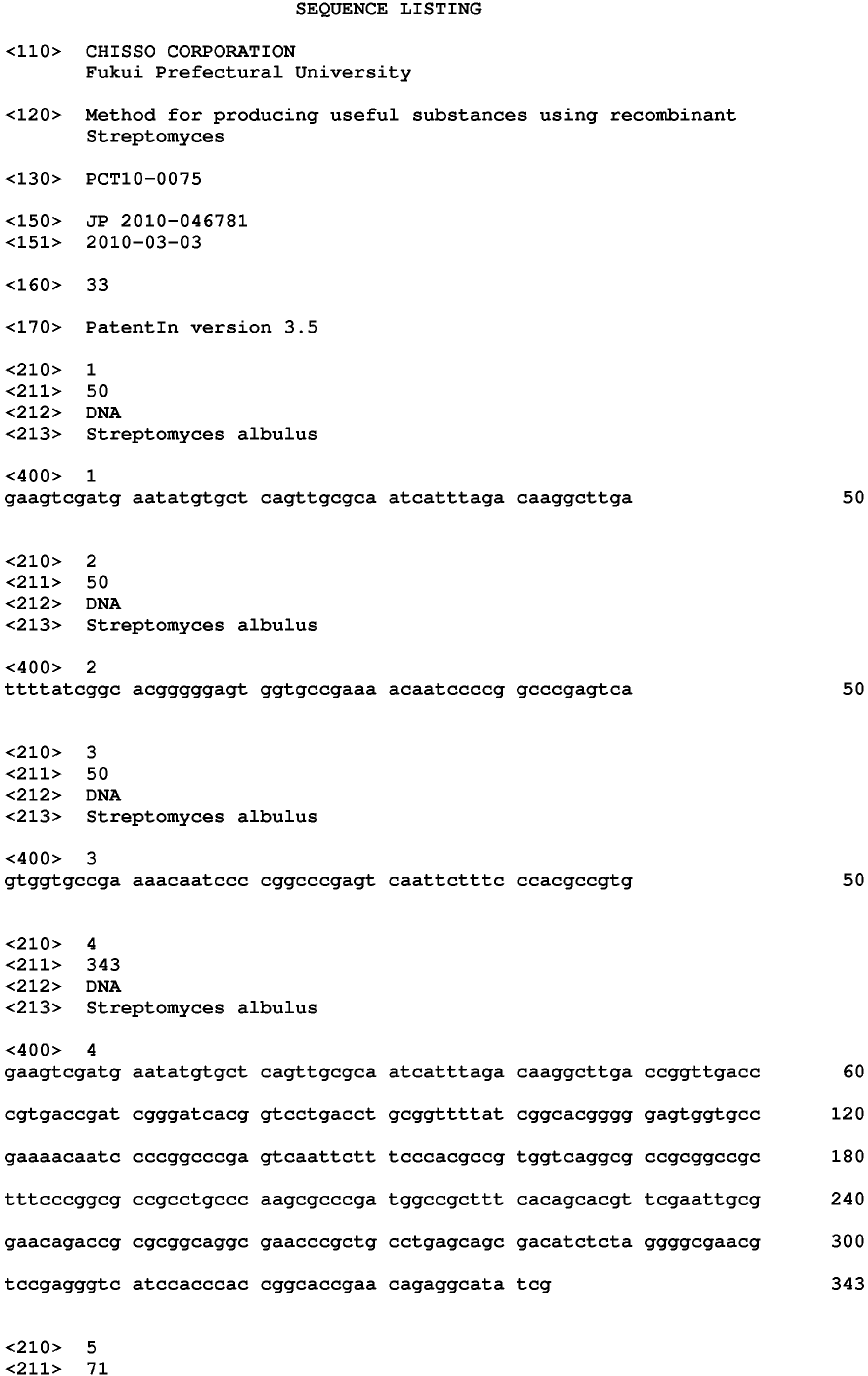


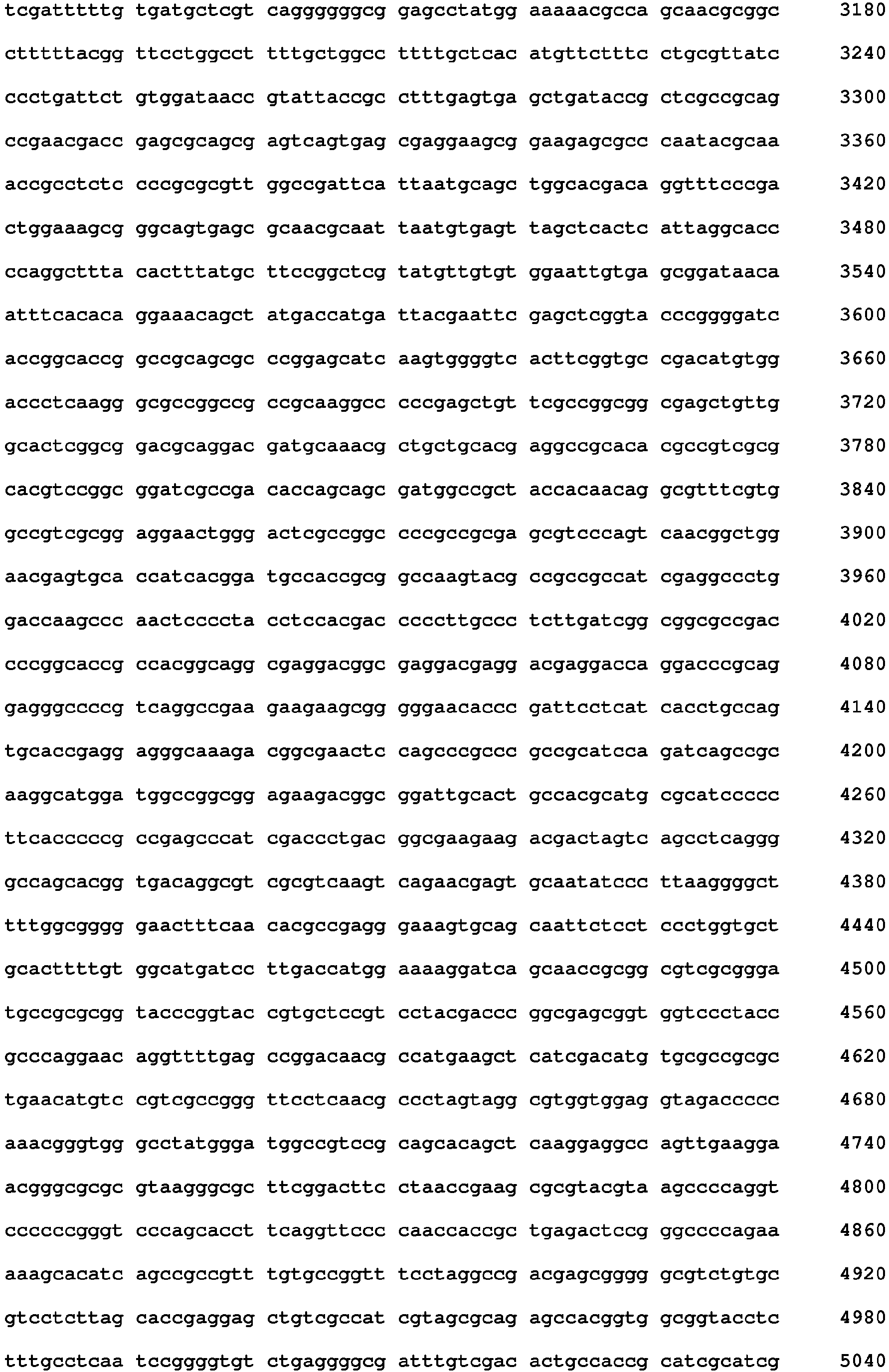


Claims (26)
- A promoter capable of specifically inducing gene expression in and after a logarithmic growth phase in an actinomycete, Streptomyces species.
- The promoter according to claim 1, wherein the actinomycete, Streptomyces species, is an ε-poly-L-lysine producer.
- The promoter according to claim 2, which is present in an approximately 350-bp upstream region of an initiation codon (ATG or GTG) of a pls gene of ε-poly-L-lysine producer.
- The promoter according to any one of claims 1 to 3, comprising the nucleotide sequence of SEQ ID NO: 1, SEQ ID NO: 2, SEQ ID NO: 3 or SEQ ID NO: 4.
- The promoter according to any one of claims 1 to 4, comprising the nucleotide sequence of SEQ ID NO: 4.
- An expression vector, comprising the promoter according to any one of claims 1 to 5.
- The expression vector according to claim 6, for use in expressing an objective gene in an ε-poly-L-lysine producer.
- The expression vector according to claim 7, wherein the ε-poly-L-lysine producer is an actinomycete, Streptomyces species, an actinomycete, Kitasatospora species, or a filamentous fungus, Epichloe species.
- The expression vector according to claim 8, wherein the actinomycete, Streptomyces species, is S. albulus.
- The expression vector according to any one of claims 6 to 9, further comprising a terminator downstream of the promoter.
- The expression vector according to claim 10, wherein the nucleotide sequence of the terminator includes the nucleotide sequence of SEQ ID NO: 7 or SEQ ID NO: 8.
- The expression vector according to claim 10 or 11, further comprising a tag sequence under regulation of the promoter.
- The expression vector according to claim 12, wherein the tag sequence comprises the nucleotide sequence of SEQ ID NO: 9 or SEQ ID NO: 10.
- The expression vector according to any one of claims 6 to 13, comprising an objective gene under the control of the promoter.
- The expression vector according to claim 14, wherein the objective gene is a gene or gene cluster derived from an organism of a kind identical with or different from the ε-poly-L-lysine producer.
- The expression vector according to claim 15, wherein the objective gene is a pls gene, a bpsA gene, a hasA gene, a mhasA gene, a hasB gene, a hasB homolog gene, a hasD gene or a hasD homolog gene.
- An expression vector, comprising the nucleotide sequence of SEQ ID NO: 13, SEQ ID NO: 14 or SEQ ID NO: 15.
- A host cell, into which the promoter according to any one of claims 1 to 5 and an objective gene under regulation of the promoter, or the expression vector according to any one of claims 14 to 16 have been transferred.
- The host cell according to claim 18, which is an actinomycete, Streptomyces species, and an actinomycete, Kitasatospora species, or a filamentous fungus, Epichloe species.
- The host cell according to claim 19, which is an ε-poly-L-lysine producer.
- A method for producing useful substances, comprising expressing an objective gene under regulation of the promoter according to any one of claims 1 to 5 to produce a protein or a polypeptide to be encoded by the gene in a host cell.
- The method according to claim 21, comprising transferring the expression vector according to any one of claims 14 to 16 into the host cell.
- A method for producing useful substances, comprising cultivating the host cell according to any one of claims 18 to 20.
- The method for producing useful substances according to claim 21, comprising cultivating a pls gene-defective or gene-disrupted strain of S. albulus and any other ε-poly-L-lysine producer.
- The method for producing useful substances according to claim 24, comprising transferring the expression vector according to any one of claims 14 to 16 into the pls gene-defective or gene-disrupted strain.
- The method for producing useful substances according to any one of claims 21 to 25, wherein the useful substances are compounds prepared by biosynthesis through a one-step or multi-step reaction.
Applications Claiming Priority (2)
| Application Number | Priority Date | Filing Date | Title |
|---|---|---|---|
| JP2010046781 | 2010-03-03 | ||
| PCT/JP2011/054763 WO2011108585A1 (en) | 2010-03-03 | 2011-03-02 | Process for production of useful substance using genetically modified streptomyces ray fungus |
Publications (3)
| Publication Number | Publication Date |
|---|---|
| EP2543728A1 true EP2543728A1 (en) | 2013-01-09 |
| EP2543728A4 EP2543728A4 (en) | 2013-11-13 |
| EP2543728B1 EP2543728B1 (en) | 2017-07-26 |
Family
ID=44542232
Family Applications (1)
| Application Number | Title | Priority Date | Filing Date |
|---|---|---|---|
| EP11750694.9A Not-in-force EP2543728B1 (en) | 2010-03-03 | 2011-03-02 | Method for producing useful substances by a recombinant actinomycete, Streptomyces species |
Country Status (4)
| Country | Link |
|---|---|
| US (1) | US8986989B2 (en) |
| EP (1) | EP2543728B1 (en) |
| JP (1) | JP5810077B2 (en) |
| WO (1) | WO2011108585A1 (en) |
Families Citing this family (5)
| Publication number | Priority date | Publication date | Assignee | Title |
|---|---|---|---|---|
| CN109112169B (en) * | 2017-06-26 | 2021-12-14 | 安泰生物工程股份有限公司 | Polylysine glyceride and its preparation method, use and preparation method of polylysine |
| JP7252536B2 (en) * | 2018-12-05 | 2023-04-05 | 学校法人 関西大学 | Polylysine-producing fungus and method for producing polylysine using the same |
| WO2020172438A1 (en) * | 2019-02-20 | 2020-08-27 | The Regents Of The University Of California | Host yeast cells and methods useful for producing indigoidine |
| CN114075525B (en) * | 2020-08-13 | 2025-02-25 | 宜昌东阳光生化制药有限公司 | Genetically engineered strains of Streptococcus zooepidemicus and their applications |
| CN116064363B (en) * | 2023-02-07 | 2023-09-19 | 徐州合谷生命科技有限公司 | Genetic engineering strain for producing blue-looking and application thereof |
Family Cites Families (4)
| Publication number | Priority date | Publication date | Assignee | Title |
|---|---|---|---|---|
| JP2005237335A (en) | 2004-02-27 | 2005-09-08 | Chisso Corp | Recombinant plasmid for Streptomyces bacteria |
| JP2007189969A (en) | 2006-01-20 | 2007-08-02 | Hiroshima Univ | Blue pigment synthesis gene |
| WO2008130034A1 (en) | 2007-04-20 | 2008-10-30 | Chisso Corporation | Polyamino acid synthetase and gene encoding the same |
| JP2008263868A (en) | 2007-04-20 | 2008-11-06 | Fukui Prefecture | Polyamino acid synthase and gene encoding it |
-
2011
- 2011-03-02 JP JP2012503214A patent/JP5810077B2/en active Active
- 2011-03-02 US US13/581,878 patent/US8986989B2/en active Active
- 2011-03-02 WO PCT/JP2011/054763 patent/WO2011108585A1/en not_active Ceased
- 2011-03-02 EP EP11750694.9A patent/EP2543728B1/en not_active Not-in-force
Non-Patent Citations (3)
| Title |
|---|
| KAZUYA YAMANAKA ET AL: "Development of a recombinant -poly--lysine synthetase expression system to perform mutational analysis", JOURNAL OF BIOSCIENCE AND BIOENGINEERING, ELSEVIER, AMSTERDAM, NL, vol. 111, no. 6, 8 March 2011 (2011-03-08) , pages 646-649, XP028224316, ISSN: 1389-1723, DOI: 10.1016/J.JBIOSC.2011.01.020 [retrieved on 2011-02-10] * |
| See also references of WO2011108585A1 * |
| YAMANAKA KAZUYA ET AL: "Supplementary information: epsilon-Poly-L-lysine dispersity is controlled by a highly unusual nonribosomal peptide synthetase", NATURE CHEMICAL BIOLOGY, vol. 4, no. 12, December 2008 (2008-12), pages 1-16, XP002714079, * |
Also Published As
| Publication number | Publication date |
|---|---|
| US20130052684A1 (en) | 2013-02-28 |
| US8986989B2 (en) | 2015-03-24 |
| EP2543728A4 (en) | 2013-11-13 |
| EP2543728B1 (en) | 2017-07-26 |
| WO2011108585A1 (en) | 2011-09-09 |
| JP5810077B2 (en) | 2015-11-11 |
| JPWO2011108585A1 (en) | 2013-06-27 |
Similar Documents
| Publication | Publication Date | Title |
|---|---|---|
| KR102116734B1 (en) | Ergothioneine production through metabolic engineering | |
| Lv et al. | Enhancing l-glutamine production in Corynebacterium glutamicum by rational metabolic engineering combined with a two-stage pH control strategy | |
| WO2023069900A9 (en) | Custom bacterial strain for recombinant protein production | |
| KR101944150B1 (en) | Recombinant microorganism for the fermentative production of methionine | |
| CN102015756B (en) | NRPS-PKS gene cluster and its manipulation and application | |
| CN105492616A (en) | Method for producing l-leucine, l-valine, l-isoleucine, alpha-ketoisovalerate, alpha-keto-beta-methylvalerate, or alpha-ketoisocaproate using recombinant corynebacteria that contain the ilvbn operon which can be induced by propionate | |
| SK285870B6 (en) | Method for microbially producing L-valine | |
| EP2889378B1 (en) | Method for producing hydroxy-l-lysine employing an l-lysine hydroxylase and method for producing hydroxy-l-pipecolic acid | |
| JP6646075B2 (en) | Microorganism producing L-lysine and method for producing L-lysine using the same | |
| US8986989B2 (en) | Method for producing useful substances by a recombinant actinomycete, streptomyces species | |
| US12365885B2 (en) | Production of riboflavin | |
| AU2019300837A1 (en) | Engineered galactose oxidase variant enzymes | |
| KR20080007263A (en) | Method for preparing L-amino acid by fermentation | |
| CN104673814A (en) | L-threonine aldolase from enterobacter cloacae and application thereof | |
| JP6724285B2 (en) | Method for producing cis-5-hydroxy-L-pipecolic acid | |
| EP3101123B1 (en) | Pipecolinic acid position-4 hydroxylase and method for producing 4-hydroxyamino acid using same | |
| US20230074955A1 (en) | Compound Library and Method for Producing Compound Library | |
| CN1507493A (en) | Biosynthetic genes for the production of the butenyl-spinosyn insecticide | |
| CN116286696B (en) | Application of an L-pantolactone dehydrogenase and its co-expressed engineered bacteria in the synthesis of D-pantolactone. | |
| CN117987399B (en) | Threonine deaminase mutant and application thereof in preparation of isoleucine | |
| Airen | Genome-wide functional genomic analysis for physiological investigation and improvement of cell-free protein synthesis | |
| WO2024094483A1 (en) | Improved biotechnological process to produce guanidinoacetic acid (gaa) by targeted introduction or by increasing the activity of a transmembrane transport protein belonging to the amino acid-polyamine-organocation superfamily | |
| JP2023127730A (en) | Plasmid vector, recombinant actinomycete, and method for producing target protein | |
| CN118957003A (en) | Construction and application of genetically engineered bacteria for producing NMN using basic carbon source fermentation |
Legal Events
| Date | Code | Title | Description |
|---|---|---|---|
| PUAI | Public reference made under article 153(3) epc to a published international application that has entered the european phase |
Free format text: ORIGINAL CODE: 0009012 |
|
| 17P | Request for examination filed |
Effective date: 20120921 |
|
| AK | Designated contracting states |
Kind code of ref document: A1 Designated state(s): AL AT BE BG CH CY CZ DE DK EE ES FI FR GB GR HR HU IE IS IT LI LT LU LV MC MK MT NL NO PL PT RO RS SE SI SK SM TR |
|
| DAX | Request for extension of the european patent (deleted) | ||
| RAP1 | Party data changed (applicant data changed or rights of an application transferred) |
Owner name: JNC CORPORATION |
|
| A4 | Supplementary search report drawn up and despatched |
Effective date: 20131016 |
|
| RIC1 | Information provided on ipc code assigned before grant |
Ipc: C12N 15/09 20060101AFI20131007BHEP Ipc: C12N 1/21 20060101ALI20131007BHEP Ipc: C12P 21/02 20060101ALI20131007BHEP |
|
| 17Q | First examination report despatched |
Effective date: 20150123 |
|
| GRAP | Despatch of communication of intention to grant a patent |
Free format text: ORIGINAL CODE: EPIDOSNIGR1 |
|
| INTG | Intention to grant announced |
Effective date: 20170206 |
|
| RIN1 | Information on inventor provided before grant (corrected) |
Inventor name: HAMANO, YOSHIMITSU Inventor name: YAMANAKA, KAZUYA Inventor name: YOSHIMURA, TOMOHIRO |
|
| GRAS | Grant fee paid |
Free format text: ORIGINAL CODE: EPIDOSNIGR3 |
|
| GRAA | (expected) grant |
Free format text: ORIGINAL CODE: 0009210 |
|
| AK | Designated contracting states |
Kind code of ref document: B1 Designated state(s): AL AT BE BG CH CY CZ DE DK EE ES FI FR GB GR HR HU IE IS IT LI LT LU LV MC MK MT NL NO PL PT RO RS SE SI SK SM TR |
|
| REG | Reference to a national code |
Ref country code: GB Ref legal event code: FG4D |
|
| REG | Reference to a national code |
Ref country code: CH Ref legal event code: EP |
|
| REG | Reference to a national code |
Ref country code: AT Ref legal event code: REF Ref document number: 912417 Country of ref document: AT Kind code of ref document: T Effective date: 20170815 |
|
| REG | Reference to a national code |
Ref country code: IE Ref legal event code: FG4D |
|
| REG | Reference to a national code |
Ref country code: DE Ref legal event code: R096 Ref document number: 602011039944 Country of ref document: DE |
|
| REG | Reference to a national code |
Ref country code: NL Ref legal event code: MP Effective date: 20170726 |
|
| REG | Reference to a national code |
Ref country code: LT Ref legal event code: MG4D |
|
| REG | Reference to a national code |
Ref country code: AT Ref legal event code: MK05 Ref document number: 912417 Country of ref document: AT Kind code of ref document: T Effective date: 20170726 |
|
| PG25 | Lapsed in a contracting state [announced via postgrant information from national office to epo] |
Ref country code: HR Free format text: LAPSE BECAUSE OF FAILURE TO SUBMIT A TRANSLATION OF THE DESCRIPTION OR TO PAY THE FEE WITHIN THE PRESCRIBED TIME-LIMIT Effective date: 20170726 Ref country code: FI Free format text: LAPSE BECAUSE OF FAILURE TO SUBMIT A TRANSLATION OF THE DESCRIPTION OR TO PAY THE FEE WITHIN THE PRESCRIBED TIME-LIMIT Effective date: 20170726 Ref country code: LT Free format text: LAPSE BECAUSE OF FAILURE TO SUBMIT A TRANSLATION OF THE DESCRIPTION OR TO PAY THE FEE WITHIN THE PRESCRIBED TIME-LIMIT Effective date: 20170726 Ref country code: SE Free format text: LAPSE BECAUSE OF FAILURE TO SUBMIT A TRANSLATION OF THE DESCRIPTION OR TO PAY THE FEE WITHIN THE PRESCRIBED TIME-LIMIT Effective date: 20170726 Ref country code: NO Free format text: LAPSE BECAUSE OF FAILURE TO SUBMIT A TRANSLATION OF THE DESCRIPTION OR TO PAY THE FEE WITHIN THE PRESCRIBED TIME-LIMIT Effective date: 20171026 Ref country code: NL Free format text: LAPSE BECAUSE OF FAILURE TO SUBMIT A TRANSLATION OF THE DESCRIPTION OR TO PAY THE FEE WITHIN THE PRESCRIBED TIME-LIMIT Effective date: 20170726 Ref country code: AT Free format text: LAPSE BECAUSE OF FAILURE TO SUBMIT A TRANSLATION OF THE DESCRIPTION OR TO PAY THE FEE WITHIN THE PRESCRIBED TIME-LIMIT Effective date: 20170726 |
|
| REG | Reference to a national code |
Ref country code: FR Ref legal event code: PLFP Year of fee payment: 8 |
|
| PG25 | Lapsed in a contracting state [announced via postgrant information from national office to epo] |
Ref country code: LV Free format text: LAPSE BECAUSE OF FAILURE TO SUBMIT A TRANSLATION OF THE DESCRIPTION OR TO PAY THE FEE WITHIN THE PRESCRIBED TIME-LIMIT Effective date: 20170726 Ref country code: IS Free format text: LAPSE BECAUSE OF FAILURE TO SUBMIT A TRANSLATION OF THE DESCRIPTION OR TO PAY THE FEE WITHIN THE PRESCRIBED TIME-LIMIT Effective date: 20171126 Ref country code: BG Free format text: LAPSE BECAUSE OF FAILURE TO SUBMIT A TRANSLATION OF THE DESCRIPTION OR TO PAY THE FEE WITHIN THE PRESCRIBED TIME-LIMIT Effective date: 20171026 Ref country code: GR Free format text: LAPSE BECAUSE OF FAILURE TO SUBMIT A TRANSLATION OF THE DESCRIPTION OR TO PAY THE FEE WITHIN THE PRESCRIBED TIME-LIMIT Effective date: 20171027 Ref country code: RS Free format text: LAPSE BECAUSE OF FAILURE TO SUBMIT A TRANSLATION OF THE DESCRIPTION OR TO PAY THE FEE WITHIN THE PRESCRIBED TIME-LIMIT Effective date: 20170726 Ref country code: PL Free format text: LAPSE BECAUSE OF FAILURE TO SUBMIT A TRANSLATION OF THE DESCRIPTION OR TO PAY THE FEE WITHIN THE PRESCRIBED TIME-LIMIT Effective date: 20170726 Ref country code: ES Free format text: LAPSE BECAUSE OF FAILURE TO SUBMIT A TRANSLATION OF THE DESCRIPTION OR TO PAY THE FEE WITHIN THE PRESCRIBED TIME-LIMIT Effective date: 20170726 |
|
| PG25 | Lapsed in a contracting state [announced via postgrant information from national office to epo] |
Ref country code: RO Free format text: LAPSE BECAUSE OF FAILURE TO SUBMIT A TRANSLATION OF THE DESCRIPTION OR TO PAY THE FEE WITHIN THE PRESCRIBED TIME-LIMIT Effective date: 20170726 Ref country code: DK Free format text: LAPSE BECAUSE OF FAILURE TO SUBMIT A TRANSLATION OF THE DESCRIPTION OR TO PAY THE FEE WITHIN THE PRESCRIBED TIME-LIMIT Effective date: 20170726 Ref country code: CZ Free format text: LAPSE BECAUSE OF FAILURE TO SUBMIT A TRANSLATION OF THE DESCRIPTION OR TO PAY THE FEE WITHIN THE PRESCRIBED TIME-LIMIT Effective date: 20170726 |
|
| REG | Reference to a national code |
Ref country code: DE Ref legal event code: R097 Ref document number: 602011039944 Country of ref document: DE |
|
| PG25 | Lapsed in a contracting state [announced via postgrant information from national office to epo] |
Ref country code: SM Free format text: LAPSE BECAUSE OF FAILURE TO SUBMIT A TRANSLATION OF THE DESCRIPTION OR TO PAY THE FEE WITHIN THE PRESCRIBED TIME-LIMIT Effective date: 20170726 Ref country code: EE Free format text: LAPSE BECAUSE OF FAILURE TO SUBMIT A TRANSLATION OF THE DESCRIPTION OR TO PAY THE FEE WITHIN THE PRESCRIBED TIME-LIMIT Effective date: 20170726 Ref country code: IT Free format text: LAPSE BECAUSE OF FAILURE TO SUBMIT A TRANSLATION OF THE DESCRIPTION OR TO PAY THE FEE WITHIN THE PRESCRIBED TIME-LIMIT Effective date: 20170726 Ref country code: SK Free format text: LAPSE BECAUSE OF FAILURE TO SUBMIT A TRANSLATION OF THE DESCRIPTION OR TO PAY THE FEE WITHIN THE PRESCRIBED TIME-LIMIT Effective date: 20170726 |
|
| PLBE | No opposition filed within time limit |
Free format text: ORIGINAL CODE: 0009261 |
|
| STAA | Information on the status of an ep patent application or granted ep patent |
Free format text: STATUS: NO OPPOSITION FILED WITHIN TIME LIMIT |
|
| 26N | No opposition filed |
Effective date: 20180430 |
|
| PG25 | Lapsed in a contracting state [announced via postgrant information from national office to epo] |
Ref country code: SI Free format text: LAPSE BECAUSE OF FAILURE TO SUBMIT A TRANSLATION OF THE DESCRIPTION OR TO PAY THE FEE WITHIN THE PRESCRIBED TIME-LIMIT Effective date: 20170726 |
|
| REG | Reference to a national code |
Ref country code: CH Ref legal event code: PL |
|
| PG25 | Lapsed in a contracting state [announced via postgrant information from national office to epo] |
Ref country code: MC Free format text: LAPSE BECAUSE OF FAILURE TO SUBMIT A TRANSLATION OF THE DESCRIPTION OR TO PAY THE FEE WITHIN THE PRESCRIBED TIME-LIMIT Effective date: 20170726 |
|
| REG | Reference to a national code |
Ref country code: BE Ref legal event code: MM Effective date: 20180331 |
|
| REG | Reference to a national code |
Ref country code: IE Ref legal event code: MM4A |
|
| PG25 | Lapsed in a contracting state [announced via postgrant information from national office to epo] |
Ref country code: LU Free format text: LAPSE BECAUSE OF NON-PAYMENT OF DUE FEES Effective date: 20180302 |
|
| PG25 | Lapsed in a contracting state [announced via postgrant information from national office to epo] |
Ref country code: IE Free format text: LAPSE BECAUSE OF NON-PAYMENT OF DUE FEES Effective date: 20180302 |
|
| PG25 | Lapsed in a contracting state [announced via postgrant information from national office to epo] |
Ref country code: CH Free format text: LAPSE BECAUSE OF NON-PAYMENT OF DUE FEES Effective date: 20180331 Ref country code: BE Free format text: LAPSE BECAUSE OF NON-PAYMENT OF DUE FEES Effective date: 20180331 Ref country code: LI Free format text: LAPSE BECAUSE OF NON-PAYMENT OF DUE FEES Effective date: 20180331 |
|
| PG25 | Lapsed in a contracting state [announced via postgrant information from national office to epo] |
Ref country code: MT Free format text: LAPSE BECAUSE OF NON-PAYMENT OF DUE FEES Effective date: 20180302 |
|
| PG25 | Lapsed in a contracting state [announced via postgrant information from national office to epo] |
Ref country code: TR Free format text: LAPSE BECAUSE OF FAILURE TO SUBMIT A TRANSLATION OF THE DESCRIPTION OR TO PAY THE FEE WITHIN THE PRESCRIBED TIME-LIMIT Effective date: 20170726 |
|
| PG25 | Lapsed in a contracting state [announced via postgrant information from national office to epo] |
Ref country code: PT Free format text: LAPSE BECAUSE OF FAILURE TO SUBMIT A TRANSLATION OF THE DESCRIPTION OR TO PAY THE FEE WITHIN THE PRESCRIBED TIME-LIMIT Effective date: 20170726 Ref country code: HU Free format text: LAPSE BECAUSE OF FAILURE TO SUBMIT A TRANSLATION OF THE DESCRIPTION OR TO PAY THE FEE WITHIN THE PRESCRIBED TIME-LIMIT; INVALID AB INITIO Effective date: 20110302 |
|
| PG25 | Lapsed in a contracting state [announced via postgrant information from national office to epo] |
Ref country code: CY Free format text: LAPSE BECAUSE OF FAILURE TO SUBMIT A TRANSLATION OF THE DESCRIPTION OR TO PAY THE FEE WITHIN THE PRESCRIBED TIME-LIMIT Effective date: 20170726 Ref country code: MK Free format text: LAPSE BECAUSE OF NON-PAYMENT OF DUE FEES Effective date: 20170726 |
|
| PG25 | Lapsed in a contracting state [announced via postgrant information from national office to epo] |
Ref country code: AL Free format text: LAPSE BECAUSE OF FAILURE TO SUBMIT A TRANSLATION OF THE DESCRIPTION OR TO PAY THE FEE WITHIN THE PRESCRIBED TIME-LIMIT Effective date: 20170726 |
|
| PGFP | Annual fee paid to national office [announced via postgrant information from national office to epo] |
Ref country code: FR Payment date: 20230208 Year of fee payment: 13 |
|
| PGFP | Annual fee paid to national office [announced via postgrant information from national office to epo] |
Ref country code: GB Payment date: 20230202 Year of fee payment: 13 Ref country code: DE Payment date: 20230131 Year of fee payment: 13 |
|
| P01 | Opt-out of the competence of the unified patent court (upc) registered |
Effective date: 20230517 |
|
| REG | Reference to a national code |
Ref country code: DE Ref legal event code: R119 Ref document number: 602011039944 Country of ref document: DE |
|
| GBPC | Gb: european patent ceased through non-payment of renewal fee |
Effective date: 20240302 |
|
| PG25 | Lapsed in a contracting state [announced via postgrant information from national office to epo] |
Ref country code: DE Free format text: LAPSE BECAUSE OF NON-PAYMENT OF DUE FEES Effective date: 20241001 |
|
| PG25 | Lapsed in a contracting state [announced via postgrant information from national office to epo] |
Ref country code: GB Free format text: LAPSE BECAUSE OF NON-PAYMENT OF DUE FEES Effective date: 20240302 |
|
| PG25 | Lapsed in a contracting state [announced via postgrant information from national office to epo] |
Ref country code: FR Free format text: LAPSE BECAUSE OF NON-PAYMENT OF DUE FEES Effective date: 20240331 |
|
| PG25 | Lapsed in a contracting state [announced via postgrant information from national office to epo] |
Ref country code: GB Free format text: LAPSE BECAUSE OF NON-PAYMENT OF DUE FEES Effective date: 20240302 Ref country code: FR Free format text: LAPSE BECAUSE OF NON-PAYMENT OF DUE FEES Effective date: 20240331 Ref country code: DE Free format text: LAPSE BECAUSE OF NON-PAYMENT OF DUE FEES Effective date: 20241001 |