EP2543699A1 - Electrode for lithium secondary battery, method of manufacturing the same, and lithium secondary battery including the same - Google Patents
Electrode for lithium secondary battery, method of manufacturing the same, and lithium secondary battery including the same Download PDFInfo
- Publication number
- EP2543699A1 EP2543699A1 EP12175362A EP12175362A EP2543699A1 EP 2543699 A1 EP2543699 A1 EP 2543699A1 EP 12175362 A EP12175362 A EP 12175362A EP 12175362 A EP12175362 A EP 12175362A EP 2543699 A1 EP2543699 A1 EP 2543699A1
- Authority
- EP
- European Patent Office
- Prior art keywords
- electrode
- active material
- polymer
- composite
- clay
- Prior art date
- Legal status (The legal status is an assumption and is not a legal conclusion. Google has not performed a legal analysis and makes no representation as to the accuracy of the status listed.)
- Withdrawn
Links
Images



Classifications
-
- H—ELECTRICITY
- H01—ELECTRIC ELEMENTS
- H01M—PROCESSES OR MEANS, e.g. BATTERIES, FOR THE DIRECT CONVERSION OF CHEMICAL ENERGY INTO ELECTRICAL ENERGY
- H01M4/00—Electrodes
- H01M4/02—Electrodes composed of, or comprising, active material
- H01M4/13—Electrodes for accumulators with non-aqueous electrolyte, e.g. for lithium-accumulators; Processes of manufacture thereof
-
- H—ELECTRICITY
- H01—ELECTRIC ELEMENTS
- H01M—PROCESSES OR MEANS, e.g. BATTERIES, FOR THE DIRECT CONVERSION OF CHEMICAL ENERGY INTO ELECTRICAL ENERGY
- H01M10/00—Secondary cells; Manufacture thereof
- H01M10/02—Details
-
- H—ELECTRICITY
- H01—ELECTRIC ELEMENTS
- H01M—PROCESSES OR MEANS, e.g. BATTERIES, FOR THE DIRECT CONVERSION OF CHEMICAL ENERGY INTO ELECTRICAL ENERGY
- H01M10/00—Secondary cells; Manufacture thereof
- H01M10/05—Accumulators with non-aqueous electrolyte
- H01M10/052—Li-accumulators
-
- H—ELECTRICITY
- H01—ELECTRIC ELEMENTS
- H01M—PROCESSES OR MEANS, e.g. BATTERIES, FOR THE DIRECT CONVERSION OF CHEMICAL ENERGY INTO ELECTRICAL ENERGY
- H01M4/00—Electrodes
- H01M4/02—Electrodes composed of, or comprising, active material
- H01M4/04—Processes of manufacture in general
- H01M4/0402—Methods of deposition of the material
- H01M4/0404—Methods of deposition of the material by coating on electrode collectors
-
- H—ELECTRICITY
- H01—ELECTRIC ELEMENTS
- H01M—PROCESSES OR MEANS, e.g. BATTERIES, FOR THE DIRECT CONVERSION OF CHEMICAL ENERGY INTO ELECTRICAL ENERGY
- H01M4/00—Electrodes
- H01M4/02—Electrodes composed of, or comprising, active material
- H01M4/13—Electrodes for accumulators with non-aqueous electrolyte, e.g. for lithium-accumulators; Processes of manufacture thereof
- H01M4/131—Electrodes based on mixed oxides or hydroxides, or on mixtures of oxides or hydroxides, e.g. LiCoOx
-
- H—ELECTRICITY
- H01—ELECTRIC ELEMENTS
- H01M—PROCESSES OR MEANS, e.g. BATTERIES, FOR THE DIRECT CONVERSION OF CHEMICAL ENERGY INTO ELECTRICAL ENERGY
- H01M4/00—Electrodes
- H01M4/02—Electrodes composed of, or comprising, active material
- H01M4/13—Electrodes for accumulators with non-aqueous electrolyte, e.g. for lithium-accumulators; Processes of manufacture thereof
- H01M4/136—Electrodes based on inorganic compounds other than oxides or hydroxides, e.g. sulfides, selenides, tellurides, halogenides or LiCoFy
-
- H—ELECTRICITY
- H01—ELECTRIC ELEMENTS
- H01M—PROCESSES OR MEANS, e.g. BATTERIES, FOR THE DIRECT CONVERSION OF CHEMICAL ENERGY INTO ELECTRICAL ENERGY
- H01M4/00—Electrodes
- H01M4/02—Electrodes composed of, or comprising, active material
- H01M4/13—Electrodes for accumulators with non-aqueous electrolyte, e.g. for lithium-accumulators; Processes of manufacture thereof
- H01M4/139—Processes of manufacture
-
- H—ELECTRICITY
- H01—ELECTRIC ELEMENTS
- H01M—PROCESSES OR MEANS, e.g. BATTERIES, FOR THE DIRECT CONVERSION OF CHEMICAL ENERGY INTO ELECTRICAL ENERGY
- H01M4/00—Electrodes
- H01M4/02—Electrodes composed of, or comprising, active material
- H01M4/13—Electrodes for accumulators with non-aqueous electrolyte, e.g. for lithium-accumulators; Processes of manufacture thereof
- H01M4/139—Processes of manufacture
- H01M4/1397—Processes of manufacture of electrodes based on inorganic compounds other than oxides or hydroxides, e.g. sulfides, selenides, tellurides, halogenides or LiCoFy
-
- H—ELECTRICITY
- H01—ELECTRIC ELEMENTS
- H01M—PROCESSES OR MEANS, e.g. BATTERIES, FOR THE DIRECT CONVERSION OF CHEMICAL ENERGY INTO ELECTRICAL ENERGY
- H01M4/00—Electrodes
- H01M4/02—Electrodes composed of, or comprising, active material
- H01M4/36—Selection of substances as active materials, active masses, active liquids
- H01M4/60—Selection of substances as active materials, active masses, active liquids of organic compounds
- H01M4/602—Polymers
-
- H—ELECTRICITY
- H01—ELECTRIC ELEMENTS
- H01M—PROCESSES OR MEANS, e.g. BATTERIES, FOR THE DIRECT CONVERSION OF CHEMICAL ENERGY INTO ELECTRICAL ENERGY
- H01M4/00—Electrodes
- H01M4/02—Electrodes composed of, or comprising, active material
- H01M4/62—Selection of inactive substances as ingredients for active masses, e.g. binders, fillers
-
- H—ELECTRICITY
- H01—ELECTRIC ELEMENTS
- H01M—PROCESSES OR MEANS, e.g. BATTERIES, FOR THE DIRECT CONVERSION OF CHEMICAL ENERGY INTO ELECTRICAL ENERGY
- H01M4/00—Electrodes
- H01M4/02—Electrodes composed of, or comprising, active material
- H01M4/62—Selection of inactive substances as ingredients for active masses, e.g. binders, fillers
- H01M4/621—Binders
- H01M4/622—Binders being polymers
-
- H—ELECTRICITY
- H01—ELECTRIC ELEMENTS
- H01M—PROCESSES OR MEANS, e.g. BATTERIES, FOR THE DIRECT CONVERSION OF CHEMICAL ENERGY INTO ELECTRICAL ENERGY
- H01M4/00—Electrodes
- H01M4/02—Electrodes composed of, or comprising, active material
- H01M4/62—Selection of inactive substances as ingredients for active masses, e.g. binders, fillers
- H01M4/621—Binders
- H01M4/622—Binders being polymers
- H01M4/623—Binders being polymers fluorinated polymers
-
- H—ELECTRICITY
- H01—ELECTRIC ELEMENTS
- H01M—PROCESSES OR MEANS, e.g. BATTERIES, FOR THE DIRECT CONVERSION OF CHEMICAL ENERGY INTO ELECTRICAL ENERGY
- H01M10/00—Secondary cells; Manufacture thereof
- H01M10/05—Accumulators with non-aqueous electrolyte
- H01M10/056—Accumulators with non-aqueous electrolyte characterised by the materials used as electrolytes, e.g. mixed inorganic/organic electrolytes
-
- H—ELECTRICITY
- H01—ELECTRIC ELEMENTS
- H01M—PROCESSES OR MEANS, e.g. BATTERIES, FOR THE DIRECT CONVERSION OF CHEMICAL ENERGY INTO ELECTRICAL ENERGY
- H01M4/00—Electrodes
- H01M4/02—Electrodes composed of, or comprising, active material
- H01M4/64—Carriers or collectors
-
- Y—GENERAL TAGGING OF NEW TECHNOLOGICAL DEVELOPMENTS; GENERAL TAGGING OF CROSS-SECTIONAL TECHNOLOGIES SPANNING OVER SEVERAL SECTIONS OF THE IPC; TECHNICAL SUBJECTS COVERED BY FORMER USPC CROSS-REFERENCE ART COLLECTIONS [XRACs] AND DIGESTS
- Y02—TECHNOLOGIES OR APPLICATIONS FOR MITIGATION OR ADAPTATION AGAINST CLIMATE CHANGE
- Y02E—REDUCTION OF GREENHOUSE GAS [GHG] EMISSIONS, RELATED TO ENERGY GENERATION, TRANSMISSION OR DISTRIBUTION
- Y02E60/00—Enabling technologies; Technologies with a potential or indirect contribution to GHG emissions mitigation
- Y02E60/10—Energy storage using batteries
-
- Y—GENERAL TAGGING OF NEW TECHNOLOGICAL DEVELOPMENTS; GENERAL TAGGING OF CROSS-SECTIONAL TECHNOLOGIES SPANNING OVER SEVERAL SECTIONS OF THE IPC; TECHNICAL SUBJECTS COVERED BY FORMER USPC CROSS-REFERENCE ART COLLECTIONS [XRACs] AND DIGESTS
- Y02—TECHNOLOGIES OR APPLICATIONS FOR MITIGATION OR ADAPTATION AGAINST CLIMATE CHANGE
- Y02P—CLIMATE CHANGE MITIGATION TECHNOLOGIES IN THE PRODUCTION OR PROCESSING OF GOODS
- Y02P70/00—Climate change mitigation technologies in the production process for final industrial or consumer products
- Y02P70/50—Manufacturing or production processes characterised by the final manufactured product
Definitions
- One or more embodiments relate to an electrode for a lithium secondary battery, a method of manufacturing the same, and a lithium secondary battery including the electrode.
- a lithium secondary battery consists of a positive electrode, a negative electrode, a separator, and an electrolyte.
- lithium ions are deintercalated from the positive electrode and migrate toward the negative electrode, and during discharging, lithium ions are deintercalated from the negative electrode and return to the positive electrode.
- the positive and negative electrodes and the electrolyte do not induce any chemical reactions.
- an electrode typically includes a mixture including an active material for storing energy, a conducting agent for supplying electric conductivity, and a binder.
- an active material for the positive electrode a lithium transition metal oxide is used
- an active material for the negative electrode a carbonaceous active material is used.
- the mixture is mixed with a solvent to prepare a slurry, and then the slurry is coated and dried on a current collector.
- the binder improves dispersion of the conducting agent, an adhesive force between active material particles, between the active material and the current collector, and between the active material and the conducting agent, and conductivity of the conducting agent.
- a fluorine-based polymer material that is insoluble with respect to an organic electrolytic solution and is chemically stable such as polyvinylidene fluoride (PVdF)
- PVdF polyvinylidene fluoride
- the binder since chains of the fluorine-based polymer material are entangled, the binder has a high swelling ratio that indicates a degree to which the binder swells when the electrolytic solution permeates thereinto. Also, due to the interaction between the chains, when a nano-sized active material and the conducting agent are used, the solvent may separately leak out. Also, the swollen binder leads to an increase in a distance between active material particles, thereby increasing resistance of an electrode including the binder.
- the fluorine-based polymer material such as PVdF
- One or more embodiments include an electrode for a lithium secondary battery in which polymer chains are less entangled and which swells less with respect to an electrolytic solution, a method of manufacturing the same, and a lithium secondary battery including the electrode.
- an electrode for a lithium secondary battery includes: an electrode active material; and a composite including a clay and a polymer intercalated between layers of the clay.
- a method of manufacturing an electrode for a lithium secondary battery includes: preparing a clay dispersion by dispersing clay in a first solvent; preparing a composite by mixing the clay dispersion with a polymer or a polymer solution prepared by dissolving the polymer in a second solvent: preparing a composition for forming an electrode active material layer by adding an electrode active material to the composite and mixing the electrode active material and the composite; and coating and drying the composition on a current collector to form an electrode active material layer.
- a method of manufacturing an electrode for a lithium secondary battery includes: melting clay and a polymer by using a heat treatment; extruding the molten product to form a composite; preparing a composition for forming an electrode active material layer by dissolving the composite in a third solvent, adding an electrode active material thereto, and mixing the resultant mixture; and coating and drying the composition on a current collector to form an electrode active material layer.
- a lithium secondary battery includes the electrode.
- the electrode may be a positive electrode.
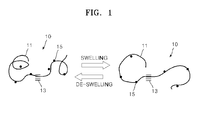
- FIG. 1 is a conceptual view of a composite included in an electrode for a lithium secondary battery, according to an embodiment
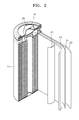
- FIG. 2 is a schematic view of a lithium ion battery according to an embodiment
- FIGS. 3 and 4 show changes in impedance when lithium batteries manufactured according to Example 1 and Comparative Example 1 are charged and discharged, respectively;
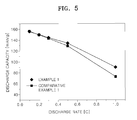
- FIG. 5 is a graph of discharge capacities of coin cells manufactured according to Example 1 and Comparative Example 1;
- FIG. 6 is a graph of lifetime characteristics of coin cells manufactured according to Example 1 and Comparative Example 1.
- An electrode according to an embodiment includes an electrode active material and a composite including a clay and a polymer intercalated between layers of the clay.
- the electrode may include a conducting agent.
- the electrode may be a positive electrode.
- FIG. 1 is a conceptual view of a composite 10 included in an active material layer included in an electrode for a lithium secondary battery, according to an embodiment, before and after swelling of the composite 10.
- the composite 10 includes a polymer 11 and a clay 13, and the polymer 11 is intercalated between layers of the clay 13.
- the polymer 11 is introduced to a conducting agent 15.
- the clay 13 has a layered structure.
- an interlayer distance of the clay 13 may be from about 1 to about 10 nm. If the interlayer distance is within this range, the polymer may be easily intercalated between layers of the clay 13.
- the polymer 11 Since the polymer 11 is present between layers of the clay 13 having a restricted distance, chains of the polymer 11 present between the layers of the clay 13 are not entangled, and thus, all chains of the polymer are less entangled. If an electrolytic solution permeates into the composite 10 when the chains of the polymer 11 are entangled, the polymer 11 swells more due to adjacent chains of the polymer 11. However, if an electrolytic solution permeates into the composite 10 when the chains of the polymer 11 are not entangled, since the number of adjacent chains of the polymer 11 is relatively decreased, a swelling degree of the polymer 11 is decreased compared to when the polymer 11 is not intercalated between layers of the clay 13. Accordingly, even when the electrolytic solution permeates into the composite 10, a swelling degree of an electrode mixture remains at a moderate level.
- electrode mixture refers to a mixture including the electrode active material and the composite. If an electrode includes a conducting agent, the term “electrode mixture” refers to a mixture including the electrode active material, the composite, and the conducting agent.
- a swelling ratio of the electrode mixture may be from about 1 to about 8%.
- the swelling ratio of the electrode mixture is measured as follows: a formation capacity evaluation is performed on a battery, the battery is dissembled, and then the electrolytic solution is removed from the battery and a thickness of an electrode plate is measured.
- the swelling ratio of the polymer 11 is reduced and thus, in the composite used as the binder, a distance between active material particles is not increased, thereby preventing an increase in resistance of the electrode.
- the resistance of the electrode including the composite is from about 5 to about 30% lower than that of an electrode that is generally used.
- the electrode active material examples include a LFP-based material such as lithium iron phosphate (LiFePO 4 ), a LCO-based material such as lithium cobalt oxide (LiCoO 2 ), a LMO-based material such as lithium manganese oxide (LiMnO 2 ), a LNO-based material such as lithium nickel oxide (LiNiO 2 ), an NCM-based material such as lithium nickel cobalt manganese oxide (LiNiCoMnO 2 ), and a mixture thereof.
- the electrode active material is not limited to the materials described above.
- the clay may include at least one selected from the group consisting of montmorillonite, bentonite, saponite, beidellite, nontronite, hectorite, and stevensite.
- the polymer may include at least one selected from the group consisting of polyvinylidene fluoride (PVDF), polyvinyl alcohol (PVA), and polyacrylic acid (PAA).
- PVDF polyvinylidene fluoride
- PVA polyvinyl alcohol
- PAA polyacrylic acid
- a weight average molecular weight of the polymer is from about 100,000 to about 1,000,000.
- Substituents of the polymers may enhance an adhesive force with respect to a substrate.
- An amount of the composite may be from about 0.1 to about 20 parts by weight, for example, about 0.2 to about 1 part by weight, based on 100 parts by weight of the electrode active material. If the amount of the composite is within the ranges described above, the swelling of the electrode mixture is suppressed without an increase in resistance of the electrode and thus, the formed electrode has excellent conductivity and mechanical characteristics.
- the electrode may further include a conducting agent.
- a carbonaceous material may be used as the conducting agent.
- a carbonaceous material is vapor grown carbon fiber (VGCF), acetylene black, carbon nanotube (CNT), or the like.
- An amount of the conducting agent may be from about 1 to about 10 parts by weight based on 100 parts by weight of the electrode active material. As described above, although the amount of the conducting agent is smaller than a level that is generally used in the art, the formed electrode has excellent conductivity.
- a composite in which a polymer is intercalated in clay is prepared by solution intercalation.
- clay is dispersed in a first solvent at a temperature of about 40 to about 60°C to prepare a clay dispersion.
- a first solvent is N-methylpyrrolidone (NMP).
- An amount of the first solvent is from about 5000 to about 10000 parts by weight based on 100 parts by weight of the clay.
- a polymer or a polymer solution is added to the clay dispersion and then mixed.
- the polymer solution is prepared by dissolving the polymer in a second solvent.
- the second solvent may be the same as the first solvent, and an amount of the second solvent may be from about 5000 to about 10000 parts by weight based on 100 parts by weight of the clay. If the amount of the second solvent is within the range described above, the polymer may be homogeneously dissolved in the second solvent.
- the polymer solution is added to the clay dispersion and then stirred, thereby completing the preparation of a composite composition in which the polymer is intercalated between layers of the clay.
- a conducting agent and an electrode active material are added to the composite composition to prepare a composition for forming an electrode active material layer.
- composition for forming an electrode active material layer is coated and dried on a current collector to form an electrode active material layer on a current collector.
- the drying may be performed at a temperature of about 80 to about 160°C.
- a composite in which a polymer is intercalated in layers of clay is prepared by melt intercalation.
- a polymer and clay are melted together by using a heat treatment and then extruded to prepare a composite. Due to a rotary force or a shear force generated during the extrusion, the polymer is intercalated between layers of the clay in the composite.
- the heat treatment temperature may be from about 175 to about 200°C. If the heat treatment temperature is within the range described above, the composite may have excellent flow characteristics.
- the composite is dissolved in a third solvent to prepare a composite solution in which the polymer is intercalated between layers of the clay.
- the third solvent may be, for example, N-methylpyrrolidone (NMP), and an amount thereof may be from about 5000 to about 10000 parts by weight based on 100 parts by weight of the composite.
- NMP N-methylpyrrolidone
- the amount of the third solvent is within the range described above, a composite solution of which constituents are homogeneously dissolved may be obtained.
- a conducting agent and an electrode active material are added to the composite solution to prepare a composition for forming an electrode active material layer.
- composition for forming an electrode active material layer is coated and dried on a current collector to form an electrode active material layer on the current collector, thereby completing the manufacture of the electrode.
- the drying may be performed at a temperature of about 50 to about 150°C.
- an amount of the polymer may be from about 5 to about 2000 parts by weight, for example, about 500 to about 2000 parts by weight, based on 100 parts by weight of the clay.
- the prepared composite is stable.
- a solid content in a composition for forming an electrode active material layer may be increased by about 1 to about 10% compared to a binder that is generally used in the art.
- FIG. 2 is a schematic view of a lithium ion battery according to an embodiment.
- the lithium secondary battery 30 basically includes a positive electrode 23, a negative electrode 22, a separator 24 disposed between the positive electrode 23 and the negative electrode 22, an electrolytic solution (not shown) with which the positive electrode 23, the negative electrode 22, and the separator 24 are impregnated, a battery case 25, and a sealing member 26 for sealing the battery case 25.
- the lithium secondary battery 30 may be assembled by depositing the positive electrode 23, the negative electrode 22, and the separator 24, rolling the deposited structure, and placing the rolled deposited structure in the battery case 25.
- the positive electrode 23 includes a composite including a polymer intercalated between layers of clay.
- the polymer solution was prepared by dissolving 1 g of polyvinylidene fluoride as a polymer in 10 g of NMP as a solvent.
- Lithium iron phosphate (LiFePO 4 ) as a positive electrode active material and acetylene black as a conducting agent were mixed with the composite as a binder at a weight ratio of 92:4:4 to prepare a slurry for forming a positive electrode plate active material layer.
- the slurry was uniformly coated on an aluminum foil, and dried at a temperature of 110°C, and pressed by using a roll press, thereby forming a positive electrode plate.
- a coin cell was manufactured in the same manner as in Example 1, except that polyvinylidene fluoride (PVdF) was used instead of the composite in manufacturing the positive electrode plate.
- PVdF polyvinylidene fluoride
- a coin cell was manufactured in the same manner as in Example 1, except that a mixture including 0.5 g of clay bentonite and 10 g of PVDF was used instead of the composite in manufacturing the positive electrode plate.
- FIGS. 3 and 4 Changes in impedance of the coin cells manufactured according to Example 1 and Comparative Example 1 during charging and discharging are shown in FIGS. 3 and 4 , respectively.
- the coin cell manufactured according to Example 1 has a lower resistance than the coin cell manufactured according to Comparative Example 1.
- the decrease in resistance may be achieved by controlling distances between electrode active material particles to an appropriate level due to the decrease in swelling of the composite as the binder.
- the coin cells manufactured according to Example 1 and Comparative Example 1 were charged with a constant current of 0.1C rate within a voltage range of about 2.5 to about 4.1 V with respect to metallic lithium at room temperature, and a discharge capacity with respect to a current density during the discharging is shown in FIG. 5 . Also, measured current densities during discharging were 0.1C, 0.2C, 0.3 C, 0.5C, and 1C rates.
- the coin cell manufactured according to Example 1 shows substantially improved high-rate characteristics compared to the coin cell manufactured according to Comparative Example 1.
- the coin cells manufactured according to Example 1 and Comparative Example 1 were charged and discharged with a constant current of 1C rate within a voltage range of about 2.5 to about 4.1 V with respect to metallic lithium at room temperature up to a 50 th cycle, and at a 100 th cycle, the coin cells were then charged and discharged with a constant current of 1C rate.
- a discharge capacity of the coin cells was measured in the respective cases and results thereof are shown in FIG. 6 .
- the coin cell manufactured according to Example 1 showed substantially improved lifetime characteristics compared to the coin cell manufactured according to Comparative Example 1.
- the electrode mixture is a mixture including a lithium iron phosphate (LiFePO 4 ) as an active material, acetylene black as a conducting agent, and the composite as a binder.
- LiFePO 4 lithium iron phosphate
- the swelling ratio value of the electrode mixture is shown in Table 1 below.
- electrodes for a lithium secondary battery polymer swell less when an electrolytic solution permeates thereinto and thus, an increase in resistance thereof is prevented. Also, an active material and a conducting agent disperse well in the electrode and thus, performance of the electrode is improved.
Landscapes
- Chemical & Material Sciences (AREA)
- Chemical Kinetics & Catalysis (AREA)
- Electrochemistry (AREA)
- General Chemical & Material Sciences (AREA)
- Engineering & Computer Science (AREA)
- Manufacturing & Machinery (AREA)
- Materials Engineering (AREA)
- Inorganic Chemistry (AREA)
- Battery Electrode And Active Subsutance (AREA)
- Secondary Cells (AREA)
Abstract
Description
- One or more embodiments relate to an electrode for a lithium secondary battery, a method of manufacturing the same, and a lithium secondary battery including the electrode.
- A lithium secondary battery consists of a positive electrode, a negative electrode, a separator, and an electrolyte. During charging, lithium ions are deintercalated from the positive electrode and migrate toward the negative electrode, and during discharging, lithium ions are deintercalated from the negative electrode and return to the positive electrode. The positive and negative electrodes and the electrolyte do not induce any chemical reactions.
- Typically, an electrode includes a mixture including an active material for storing energy, a conducting agent for supplying electric conductivity, and a binder. In general, as an active material for the positive electrode, a lithium transition metal oxide is used, and as an active material for the negative electrode, a carbonaceous active material is used. To manufacture the electrode, the mixture is mixed with a solvent to prepare a slurry, and then the slurry is coated and dried on a current collector. In this case, the binder improves dispersion of the conducting agent, an adhesive force between active material particles, between the active material and the current collector, and between the active material and the conducting agent, and conductivity of the conducting agent.
- As the binder, a fluorine-based polymer material that is insoluble with respect to an organic electrolytic solution and is chemically stable, such as polyvinylidene fluoride (PVdF), is widely used.
- However, if the fluorine-based polymer material, such as PVdF, is used as the binder, since chains of the fluorine-based polymer material are entangled, the binder has a high swelling ratio that indicates a degree to which the binder swells when the electrolytic solution permeates thereinto. Also, due to the interaction between the chains, when a nano-sized active material and the conducting agent are used, the solvent may separately leak out. Also, the swollen binder leads to an increase in a distance between active material particles, thereby increasing resistance of an electrode including the binder.
- One or more embodiments include an electrode for a lithium secondary battery in which polymer chains are less entangled and which swells less with respect to an electrolytic solution, a method of manufacturing the same, and a lithium secondary battery including the electrode.
- Additional aspects will be set forth in part in the description which follows and, in part, will be apparent from the description, or may be learned by practice of the presented embodiments.
- According to one or more embodiments, an electrode for a lithium secondary battery, includes: an electrode active material; and a composite including a clay and a polymer intercalated between layers of the clay.
- According to one or more embodiments, a method of manufacturing an electrode for a lithium secondary battery includes: preparing a clay dispersion by dispersing clay in a first solvent; preparing a composite by mixing the clay dispersion with a polymer or a polymer solution prepared by dissolving the polymer in a second solvent: preparing a composition for forming an electrode active material layer by adding an electrode active material to the composite and mixing the electrode active material and the composite; and coating and drying the composition on a current collector to form an electrode active material layer.
- According to one or more embodiments, a method of manufacturing an electrode for a lithium secondary battery includes: melting clay and a polymer by using a heat treatment; extruding the molten product to form a composite; preparing a composition for forming an electrode active material layer by dissolving the composite in a third solvent, adding an electrode active material thereto, and mixing the resultant mixture; and coating and drying the composition on a current collector to form an electrode active material layer.
- According to one or more embodiments, a lithium secondary battery includes the electrode.
- The electrode may be a positive electrode.
- These and/or other aspects will become apparent and more readily appreciated from the following description of the embodiments, taken in conjunction with the accompanying drawings of which:
-
FIG. 1 is a conceptual view of a composite included in an electrode for a lithium secondary battery, according to an embodiment; -
FIG. 2 is a schematic view of a lithium ion battery according to an embodiment; -
FIGS. 3 and4 show changes in impedance when lithium batteries manufactured according to Example 1 and Comparative Example 1 are charged and discharged, respectively; -
FIG. 5 is a graph of discharge capacities of coin cells manufactured according to Example 1 and Comparative Example 1; and -
FIG. 6 is a graph of lifetime characteristics of coin cells manufactured according to Example 1 and Comparative Example 1. - Reference will now be made in detail to embodiments, examples of which are illustrated in the accompanying drawings, wherein like reference numerals refer to like elements throughout. In this regard, the present embodiments may have different forms and should not be construed as being limited to the descriptions set forth herein. Accordingly, the embodiments are merely described below, by referring to the figures, to explain aspects of the present description.
- An electrode according to an embodiment includes an electrode active material and a composite including a clay and a polymer intercalated between layers of the clay.
- The electrode may include a conducting agent.
- The electrode may be a positive electrode.
-
FIG. 1 is a conceptual view of acomposite 10 included in an active material layer included in an electrode for a lithium secondary battery, according to an embodiment, before and after swelling of thecomposite 10. - Referring to
FIG. 1 , thecomposite 10 includes apolymer 11 and aclay 13, and thepolymer 11 is intercalated between layers of theclay 13. - In
FIG. 1 , thepolymer 11 is introduced to a conductingagent 15. - The
clay 13 has a layered structure. In this regard, an interlayer distance of theclay 13 may be from about 1 to about 10 nm. If the interlayer distance is within this range, the polymer may be easily intercalated between layers of theclay 13. - Since the
polymer 11 is present between layers of theclay 13 having a restricted distance, chains of thepolymer 11 present between the layers of theclay 13 are not entangled, and thus, all chains of the polymer are less entangled. If an electrolytic solution permeates into thecomposite 10 when the chains of thepolymer 11 are entangled, thepolymer 11 swells more due to adjacent chains of thepolymer 11. However, if an electrolytic solution permeates into thecomposite 10 when the chains of thepolymer 11 are not entangled, since the number of adjacent chains of thepolymer 11 is relatively decreased, a swelling degree of thepolymer 11 is decreased compared to when thepolymer 11 is not intercalated between layers of theclay 13. Accordingly, even when the electrolytic solution permeates into thecomposite 10, a swelling degree of an electrode mixture remains at a moderate level. - The term "electrode mixture" refers to a mixture including the electrode active material and the composite. If an electrode includes a conducting agent, the term "electrode mixture" refers to a mixture including the electrode active material, the composite, and the conducting agent.
- A swelling ratio of the electrode mixture may be from about 1 to about 8%.
- The swelling ratio of the electrode mixture is measured as follows: a formation capacity evaluation is performed on a battery, the battery is dissembled, and then the electrolytic solution is removed from the battery and a thickness of an electrode plate is measured.
- During the permeation of the electrolytic solution, the swelling ratio of the
polymer 11 is reduced and thus, in the composite used as the binder, a distance between active material particles is not increased, thereby preventing an increase in resistance of the electrode. - The resistance of the electrode including the composite is from about 5 to about 30% lower than that of an electrode that is generally used.
- Hereinafter, an electrode according to another embodiment will be described in detail. First, materials that are used in the electrode mixture will be described in detail.
- Examples of the electrode active material are a LFP-based material such as lithium iron phosphate (LiFePO4), a LCO-based material such as lithium cobalt oxide (LiCoO2), a LMO-based material such as lithium manganese oxide (LiMnO2), a LNO-based material such as lithium nickel oxide (LiNiO2), an NCM-based material such as lithium nickel cobalt manganese oxide (LiNiCoMnO2), and a mixture thereof. However, the electrode active material is not limited to the materials described above.
- The clay may include at least one selected from the group consisting of montmorillonite, bentonite, saponite, beidellite, nontronite, hectorite, and stevensite.
- The polymer may include at least one selected from the group consisting of polyvinylidene fluoride (PVDF), polyvinyl alcohol (PVA), and polyacrylic acid (PAA). A weight average molecular weight of the polymer is from about 100,000 to about 1,000,000.
- Substituents of the polymers may enhance an adhesive force with respect to a substrate.
- An amount of the composite may be from about 0.1 to about 20 parts by weight, for example, about 0.2 to about 1 part by weight, based on 100 parts by weight of the electrode active material. If the amount of the composite is within the ranges described above, the swelling of the electrode mixture is suppressed without an increase in resistance of the electrode and thus, the formed electrode has excellent conductivity and mechanical characteristics.
- The electrode may further include a conducting agent.
- As the conducting agent, a carbonaceous material may be used. An example of the carbonaceous material is vapor grown carbon fiber (VGCF), acetylene black, carbon nanotube (CNT), or the like.
- An amount of the conducting agent may be from about 1 to about 10 parts by weight based on 100 parts by weight of the electrode active material. As described above, although the amount of the conducting agent is smaller than a level that is generally used in the art, the formed electrode has excellent conductivity.
- A method of manufacturing an electrode for a lithium secondary battery, according to an embodiment, will now be described in detail.
- A composite in which a polymer is intercalated in clay is prepared by solution intercalation.
- First, clay is dispersed in a first solvent at a temperature of about 40 to about 60°C to prepare a clay dispersion. An example of the first solvent is N-methylpyrrolidone (NMP).
- An amount of the first solvent is from about 5000 to about 10000 parts by weight based on 100 parts by weight of the clay.
- A polymer or a polymer solution is added to the clay dispersion and then mixed.
- The polymer solution is prepared by dissolving the polymer in a second solvent.
- The second solvent may be the same as the first solvent, and an amount of the second solvent may be from about 5000 to about 10000 parts by weight based on 100 parts by weight of the clay. If the amount of the second solvent is within the range described above, the polymer may be homogeneously dissolved in the second solvent.
- The polymer solution is added to the clay dispersion and then stirred, thereby completing the preparation of a composite composition in which the polymer is intercalated between layers of the clay.
- A conducting agent and an electrode active material are added to the composite composition to prepare a composition for forming an electrode active material layer.
- The composition for forming an electrode active material layer is coated and dried on a current collector to form an electrode active material layer on a current collector.
- The drying may be performed at a temperature of about 80 to about 160°C.
- A method of manufacturing an electrode for a lithium secondary battery, according to another embodiment, will now be described in detail.
- A composite in which a polymer is intercalated in layers of clay is prepared by melt intercalation.
- A polymer and clay are melted together by using a heat treatment and then extruded to prepare a composite. Due to a rotary force or a shear force generated during the extrusion, the polymer is intercalated between layers of the clay in the composite.
- The heat treatment temperature may be from about 175 to about 200°C. If the heat treatment temperature is within the range described above, the composite may have excellent flow characteristics.
- The composite is dissolved in a third solvent to prepare a composite solution in which the polymer is intercalated between layers of the clay.
- The third solvent may be, for example, N-methylpyrrolidone (NMP), and an amount thereof may be from about 5000 to about 10000 parts by weight based on 100 parts by weight of the composite.
- If the amount of the third solvent is within the range described above, a composite solution of which constituents are homogeneously dissolved may be obtained.
- A conducting agent and an electrode active material are added to the composite solution to prepare a composition for forming an electrode active material layer.
- The composition for forming an electrode active material layer is coated and dried on a current collector to form an electrode active material layer on the current collector, thereby completing the manufacture of the electrode.
- The drying may be performed at a temperature of about 50 to about 150°C.
- In the method of manufacturing the electrode, an amount of the polymer may be from about 5 to about 2000 parts by weight, for example, about 500 to about 2000 parts by weight, based on 100 parts by weight of the clay.
- If an amount of the polymer is within the range described above, the prepared composite is stable.
- According to the methods of manufacturing an electrode according to the above embodiments, due to the use of the composite, a solid content in a composition for forming an electrode active material layer may be increased by about 1 to about 10% compared to a binder that is generally used in the art.
-
FIG. 2 is a schematic view of a lithium ion battery according to an embodiment. - Referring to
FIG. 2 , the lithiumsecondary battery 30 basically includes apositive electrode 23, anegative electrode 22, aseparator 24 disposed between thepositive electrode 23 and thenegative electrode 22, an electrolytic solution (not shown) with which thepositive electrode 23, thenegative electrode 22, and theseparator 24 are impregnated, abattery case 25, and a sealingmember 26 for sealing thebattery case 25. The lithiumsecondary battery 30 may be assembled by depositing thepositive electrode 23, thenegative electrode 22, and theseparator 24, rolling the deposited structure, and placing the rolled deposited structure in thebattery case 25. In this regard, thepositive electrode 23 includes a composite including a polymer intercalated between layers of clay. - Hereinafter, one or more non-limitative embodiments will be described in detail. However, the present embodiments are not limited to the one or more embodiments.
- First, 0.5 g of bentonite as clay was dispersed in 50 g of NMP as a solvent at a temperature of about 50°C to prepare a clay dispersion.
- 100 g of a polymer solution was added to the clay dispersion and then stirred to complete the preparation of a composite.
- The polymer solution was prepared by dissolving 1 g of polyvinylidene fluoride as a polymer in 10 g of NMP as a solvent.
- Lithium iron phosphate (LiFePO4) as a positive electrode active material and acetylene black as a conducting agent were mixed with the composite as a binder at a weight ratio of 92:4:4 to prepare a slurry for forming a positive electrode plate active material layer.
- The slurry was uniformly coated on an aluminum foil, and dried at a temperature of 110°C, and pressed by using a roll press, thereby forming a positive electrode plate.
- A 2032-standard coin cell was manufactured using an electrolytic solution in which 1.3M LiPF6 was dissolved in a mixed solvent including ethylene carbonate: ethymethyl carbonate: dimethyl carbonate = 3 : 4 : 3 (volumetric ratio) by placing a solid separator between the positive electrode plate and a reference electrode including metallic lithium.
- A coin cell was manufactured in the same manner as in Example 1, except that polyvinylidene fluoride (PVdF) was used instead of the composite in manufacturing the positive electrode plate.
- A coin cell was manufactured in the same manner as in Example 1, except that a mixture including 0.5 g of clay bentonite and 10 g of PVDF was used instead of the composite in manufacturing the positive electrode plate.
- Changes in impedance of the coin cells manufactured according to Example 1 and Comparative Example 1 were evaluated.
- Changes in impedance of the coin cells manufactured according to Example 1 and Comparative Example 1 during charging and discharging are shown in
FIGS. 3 and4 , respectively. - Referring to
FIGS. 3 and4 , it is confirmed that the coin cell manufactured according to Example 1 has a lower resistance than the coin cell manufactured according to Comparative Example 1. The decrease in resistance may be achieved by controlling distances between electrode active material particles to an appropriate level due to the decrease in swelling of the composite as the binder. - The coin cells manufactured according to Example 1 and Comparative Example 1 were charged with a constant current of 0.1C rate within a voltage range of about 2.5 to about 4.1 V with respect to metallic lithium at room temperature, and a discharge capacity with respect to a current density during the discharging is shown in
FIG. 5 . Also, measured current densities during discharging were 0.1C, 0.2C, 0.3 C, 0.5C, and 1C rates. - Referring to
FIG. 5 , the coin cell manufactured according to Example 1 shows substantially improved high-rate characteristics compared to the coin cell manufactured according to Comparative Example 1. - The coin cells manufactured according to Example 1 and Comparative Example 1 were charged and discharged with a constant current of 1C rate within a voltage range of about 2.5 to about 4.1 V with respect to metallic lithium at room temperature up to a 50th cycle, and at a 100th cycle, the coin cells were then charged and discharged with a constant current of 1C rate. In this regard, a discharge capacity of the coin cells was measured in the respective cases and results thereof are shown in
FIG. 6 . - Referring to
FIG. 6 , it is confirmed that at a high rate, the coin cell manufactured according to Example 1 showed substantially improved lifetime characteristics compared to the coin cell manufactured according to Comparative Example 1. - A swelling ratio of the electrode mixture used in Example 1 was evaluated by using the following method. In this regard, the electrode mixture is a mixture including a lithium iron phosphate (LiFePO4) as an active material, acetylene black as a conducting agent, and the composite as a binder.
- The swelling ratio value of the electrode mixture is shown in Table 1 below.
Table 1 Swelling ratio of electrode mixture (%) Example 1 8 - As described above, according to the one or more of the above embodiments, due to the inclusion of a composite in which a polymer is intercalated between layers of clay and thus chains of the polymer are not entangled, electrodes for a lithium secondary battery polymer swell less when an electrolytic solution permeates thereinto and thus, an increase in resistance thereof is prevented. Also, an active material and a conducting agent disperse well in the electrode and thus, performance of the electrode is improved.
- It should be understood that the example embodiments described herein should be considered in a descriptive sense only and not for purposes of limitation. Descriptions of features or aspects within each embodiment should typically be considered as available for other similar features or aspects in other embodiments.
Claims (15)
- An electrode for a lithium secondary battery, the electrode comprising:an electrode active material; anda composite comprising a clay and a polymer intercalated between layers of the clay.
- The electrode of claim 1, wherein the clay comprises at least one selected from the group consisting of montmorillonite, bentonite, saponite, beidellite, nontronite, hectorite, and stevensite.
- The electrode of claim 1 or 2, wherein the polymer comprises at least one selected from the group consisting of polyvinylidene fluoride (PVDF), polyvinyl alcohol (PVA), and polyacrylic acid (PAA).
- The electrode of anyone of claims 1 to 3, wherein an amount of the composite is from about 0.1 to about 20 parts by weight based on 100 parts by weight of the electrode active material.
- The electrode of anyone of claims 1 to 4, wherein the electrode active material comprises at least one selected from the group consisting of lithium iron phosphate (LiFePO4), lithium cobalt oxide (LiCoO2) lithium manganese oxide (LiMnO2), lithium nickel oxide (LiNiO2) and lithium nickel cobalt manganese oxide (LiNiCoMnO2).
- The electrode of anyone of claims 1 to 5, further comprising a conducting agent.
- The electrode of claim 6, wherein the conducting agent comprises a carbonaceous material.
- The electrode of claim 6 or 7, wherein the amount of the conducting agent is from about 1 to about 10 parts by weight based on 100 parts by weight of the electrode active material.
- The electrode of anyone of claims 1 to 8, wherein the electrode is a positive electrode.
- A lithium secondary battery comprising an electrode as defined in anyone of claims 1 to 9.
- A method of manufacturing an electrode for a lithium secondary battery, the method comprising:preparing a clay dispersion by dispersing clay in a first solvent;preparing a composite by mixing the clay dispersion with a polymer or a polymer solution prepared by dissolving the polymer in a second solvent;preparing a composition for forming an electrode active material layer by adding an electrode active material to the composite and mixing the electrode active material and the composite; andcoating and drying the composition on a current collector to form an electrode active material layer.
- A method of manufacturing an electrode for a lithium secondary battery, the method comprising:melting clay and a polymer by using a heat treatment;extruding the molten product to form a composite;preparing a composition for forming an electrode active material layer by dissolving the composite in a solvent, adding an electrode active material thereto, and mixing the resultant mixture; andcoating and drying the composition on a current collector to form an electrode active material layer.
- The method of claim 11 or 12, wherein the amount of the polymer is from about 5 to about 2000 parts by weight based on 100 parts by weight of the clay.
- The method of anyone of claims 11 to 13, wherein a conducting agent is further used in preparing the composition.
- A lithium secondary battery comprising an electrode manufactured by the method of anyone of claims 11 to 14.
Applications Claiming Priority (1)
| Application Number | Priority Date | Filing Date | Title |
|---|---|---|---|
| KR1020110067532A KR101264336B1 (en) | 2011-07-07 | 2011-07-07 | Electrode for lithium secondary battery, manufacturing method thereof, and lithium secondary battery employing the same |
Publications (1)
| Publication Number | Publication Date |
|---|---|
| EP2543699A1 true EP2543699A1 (en) | 2013-01-09 |
Family
ID=46458357
Family Applications (1)
| Application Number | Title | Priority Date | Filing Date |
|---|---|---|---|
| EP12175362A Withdrawn EP2543699A1 (en) | 2011-07-07 | 2012-07-06 | Electrode for lithium secondary battery, method of manufacturing the same, and lithium secondary battery including the same |
Country Status (5)
| Country | Link |
|---|---|
| US (2) | US20130011733A1 (en) |
| EP (1) | EP2543699A1 (en) |
| JP (1) | JP2013020967A (en) |
| KR (1) | KR101264336B1 (en) |
| CN (1) | CN102867960A (en) |
Cited By (1)
| Publication number | Priority date | Publication date | Assignee | Title |
|---|---|---|---|---|
| EP4261923A4 (en) * | 2020-12-14 | 2025-05-07 | Panasonic Intellectual Property Management Co., Ltd. | METHOD FOR PRODUCING THICK SLURRY FOR POSITIVE ELECTRODE AND METHOD FOR PRODUCING POSITIVE ELECTRODE |
Families Citing this family (20)
| Publication number | Priority date | Publication date | Assignee | Title |
|---|---|---|---|---|
| US8641273B2 (en) * | 2010-11-02 | 2014-02-04 | Sinoelectric Powertrain Corporation | Thermal interlock for battery pack, device, system and method |
| WO2014200063A1 (en) * | 2013-06-12 | 2014-12-18 | 日立化成株式会社 | Aluminum silicate complex, conductive material, conductive material for lithium ion secondary cell, composition for forming lithium ion secondary cell negative electrode, composition for forming lithium ion secondary cell positive electrode, negative electrode for lithium ion secondary cell, positive electrode for lithium ion secondary cell, and lithium ion secondary cell |
| CN104752706B (en) * | 2013-12-31 | 2017-01-25 | 比亚迪股份有限公司 | Lithium-ion battery negative electrode active material and preparation method, lithium-ion battery negative electrode material, lithium-ion battery negative electrode, and lithium-ion battery |
| USD779450S1 (en) | 2014-10-01 | 2017-02-21 | Samsung Electronics Co., Ltd. | Portable electronic device |
| USD785586S1 (en) | 2014-10-01 | 2017-05-02 | Samsung Electronics Co., Ltd. | Portable electronic device |
| USD781275S1 (en) | 2014-10-01 | 2017-03-14 | Samsung Electronics Co., Ltd. | Portable electronic device |
| USD797713S1 (en) | 2014-10-01 | 2017-09-19 | Samsung Electronics Co., Ltd. | Portable electronic device |
| USD803818S1 (en) | 2014-10-01 | 2017-11-28 | Samsung Electronics Co., Ltd. | Portable electronic device |
| USD795855S1 (en) | 2014-10-01 | 2017-08-29 | Samsung Electronics Co., Ltd. | Portable electronic device |
| USD784972S1 (en) | 2014-10-01 | 2017-04-25 | Samsung Electronics Co., Ltd. | Portable electronic device |
| USD779449S1 (en) | 2014-10-01 | 2017-02-21 | Samsung Electronics Co., Ltd. | Portable electronic device |
| USD788103S1 (en) | 2015-07-01 | 2017-05-30 | Samsung Electronics Co., Ltd. | Mobile terminal |
| KR102258081B1 (en) | 2016-07-28 | 2021-05-27 | 삼성에스디아이 주식회사 | Negative electrode for rechargeable lithium battery, and rechargeable lithium battery including same |
| WO2018237188A1 (en) * | 2017-06-21 | 2018-12-27 | University Of Utah Research Foundation | CATHODES FOR USE IN LITHIUM-AIR BATTERIES |
| CN111316475B (en) * | 2017-11-06 | 2023-08-11 | 株式会社Lg新能源 | Negative electrode slurry composition for lithium secondary battery and its manufacturing method |
| WO2019226674A1 (en) | 2018-05-21 | 2019-11-28 | University Of Utah Research Foundation | Composite solid electrolyte including lithium iron phosphate |
| CN114628674A (en) * | 2021-07-06 | 2022-06-14 | 万向一二三股份公司 | Positive active material slurry, preparation method and positive pole piece |
| CN116825941B (en) * | 2022-04-01 | 2024-04-09 | 江苏大学 | Manganese oxide-based positive electrode of zinc-manganese quasi-solid flow battery and semi-dry electrode manufacturing method thereof |
| KR102863610B1 (en) * | 2022-10-24 | 2025-09-22 | 삼성에스디아이 주식회사 | Negative electrode active material for all soilid-state battery and all solid-state battery including same |
| CN115986046B (en) * | 2022-11-30 | 2025-11-07 | 江苏鑫华半导体科技股份有限公司 | Three-dimensional electrode and preparation method and application thereof |
Citations (3)
| Publication number | Priority date | Publication date | Assignee | Title |
|---|---|---|---|---|
| WO2001029915A2 (en) * | 1999-10-15 | 2001-04-26 | North Carolina State University | Composite electrodes for lithium-ion batteries using single-ion conducting electrolytes |
| WO2005068551A1 (en) * | 2004-01-13 | 2005-07-28 | Seoul National University Industry Foundation | A exfoliated nano-composite from polyaniline graft copolymer/clay |
| US20060194117A1 (en) * | 2005-01-28 | 2006-08-31 | Paulsen Jens M | Paste electrolyte and rechargeable lithium battery containing the same |
Family Cites Families (19)
| Publication number | Priority date | Publication date | Assignee | Title |
|---|---|---|---|---|
| JP2529474B2 (en) * | 1991-01-25 | 1996-08-28 | 松下電器産業株式会社 | Solid electrode composition |
| JPH08279354A (en) | 1994-08-01 | 1996-10-22 | Ricoh Co Ltd | Electrode and secondary battery using the electrode |
| JP2708097B2 (en) * | 1995-11-07 | 1998-02-04 | 工業技術院長 | Spherical shell carbon-containing polymer clay composite |
| JP3587935B2 (en) * | 1996-05-16 | 2004-11-10 | Tdk株式会社 | Lithium secondary battery |
| JPH09320606A (en) * | 1996-05-27 | 1997-12-12 | Shin Kobe Electric Mach Co Ltd | Method for producing electrode for non-aqueous electrolyte secondary battery and non-aqueous electrolyte secondary battery |
| JPH1012269A (en) * | 1996-06-20 | 1998-01-16 | Sanyo Electric Co Ltd | Solid electrolyte and solid electrolyte battery |
| JPH10106542A (en) * | 1996-09-24 | 1998-04-24 | Sanyo Electric Co Ltd | Lithium secondary battery |
| DE69825797T2 (en) | 1997-03-13 | 2005-09-01 | Matsushita Electric Industrial Co., Ltd., Kadoma | Lithium Ion Battery |
| US6544689B1 (en) * | 1999-06-30 | 2003-04-08 | North Carolina State University | Composite electrolytes based on smectite clays and high dielectric organic liquids and electrodes |
| JP3594233B2 (en) * | 2000-03-23 | 2004-11-24 | 松下電池工業株式会社 | Method for producing electrode for non-aqueous electrolyte secondary battery and non-aqueous electrolyte secondary battery |
| US7077983B2 (en) * | 2002-12-31 | 2006-07-18 | University Of Chicago | Polymer nanocomposites for lithium battery applications |
| JP2007305546A (en) | 2006-05-15 | 2007-11-22 | Sony Corp | Lithium ion battery |
| JP2008041502A (en) | 2006-08-08 | 2008-02-21 | Sony Corp | Non-aqueous electrolyte secondary battery positive electrode, method for producing the same, and non-aqueous electrolyte secondary battery |
| KR100927246B1 (en) * | 2006-09-11 | 2009-11-16 | 주식회사 엘지화학 | Electrode mixture containing clay mineral and electrochemical cell using the same |
| JP5168535B2 (en) | 2007-02-20 | 2013-03-21 | トヨタ自動車株式会社 | Lithium secondary battery and manufacturing method thereof |
| JP5196969B2 (en) | 2007-11-22 | 2013-05-15 | 旭化成イーマテリアルズ株式会社 | Multilayer porous membrane |
| CN101499538B (en) | 2008-02-01 | 2012-07-11 | 索尼株式会社 | Non-aqueous electrolyte cell, anode and manufacturing method of the same |
| US8445134B2 (en) * | 2009-04-30 | 2013-05-21 | Edgar D. Young | Secondary batteries with treated bentonite cathodes having enhanced conductivity |
| EP2277557B1 (en) * | 2009-07-20 | 2014-06-25 | The Procter and Gamble Company | Coated superabsorbent polymer particles and processes therefore |
-
2011
- 2011-07-07 KR KR1020110067532A patent/KR101264336B1/en not_active Expired - Fee Related
-
2012
- 2012-06-26 JP JP2012142805A patent/JP2013020967A/en active Pending
- 2012-07-02 US US13/540,160 patent/US20130011733A1/en not_active Abandoned
- 2012-07-04 CN CN2012102305950A patent/CN102867960A/en active Pending
- 2012-07-06 EP EP12175362A patent/EP2543699A1/en not_active Withdrawn
-
2013
- 2013-12-05 US US14/098,340 patent/US9203076B2/en not_active Expired - Fee Related
Patent Citations (3)
| Publication number | Priority date | Publication date | Assignee | Title |
|---|---|---|---|---|
| WO2001029915A2 (en) * | 1999-10-15 | 2001-04-26 | North Carolina State University | Composite electrodes for lithium-ion batteries using single-ion conducting electrolytes |
| WO2005068551A1 (en) * | 2004-01-13 | 2005-07-28 | Seoul National University Industry Foundation | A exfoliated nano-composite from polyaniline graft copolymer/clay |
| US20060194117A1 (en) * | 2005-01-28 | 2006-08-31 | Paulsen Jens M | Paste electrolyte and rechargeable lithium battery containing the same |
Cited By (1)
| Publication number | Priority date | Publication date | Assignee | Title |
|---|---|---|---|---|
| EP4261923A4 (en) * | 2020-12-14 | 2025-05-07 | Panasonic Intellectual Property Management Co., Ltd. | METHOD FOR PRODUCING THICK SLURRY FOR POSITIVE ELECTRODE AND METHOD FOR PRODUCING POSITIVE ELECTRODE |
Also Published As
| Publication number | Publication date |
|---|---|
| US9203076B2 (en) | 2015-12-01 |
| KR101264336B1 (en) | 2013-05-14 |
| JP2013020967A (en) | 2013-01-31 |
| CN102867960A (en) | 2013-01-09 |
| US20140093772A1 (en) | 2014-04-03 |
| US20130011733A1 (en) | 2013-01-10 |
| KR20130005876A (en) | 2013-01-16 |
Similar Documents
| Publication | Publication Date | Title |
|---|---|---|
| US9203076B2 (en) | Electrode for lithium secondary battery, method of manufacturing the same, and lithium secondary battery including the same | |
| CN107925058B (en) | Negative electrode for secondary battery, method for producing same, and secondary battery comprising same | |
| US20240055586A1 (en) | Negative electrode active material for lithium secondary battery, method for preparing same, and lithium secondary battery comprising same | |
| CN111989805A (en) | Positive electrode material for lithium secondary battery, and positive electrode for lithium secondary battery and lithium secondary battery comprising same | |
| KR20150078432A (en) | A surface-treated cathode active material and lithium secondary battery using it | |
| CN109904404B (en) | Lithium secondary battery negative active material, preparation method thereof and lithium secondary battery containing same | |
| KR102405902B1 (en) | Negavive electrode for lithium secondary battery, and lithium secondary battery comprising the same | |
| KR20220007260A (en) | Negative electrode and lithium secondary battery with improved fast charging performance | |
| KR20170030518A (en) | Cathode for lithium batteries | |
| KR102756676B1 (en) | Anode Having Double Active Material Layers, Method of Preparing the Same, and Secondary Battery Comprising the Same | |
| CN116368639A (en) | Positive electrode for lithium secondary battery and lithium secondary battery containing same | |
| CN116544342A (en) | Electrode, lithium battery including the same, and method of preparing the electrode | |
| CN118489165A (en) | Positive electrode for lithium secondary battery and method for producing same | |
| CN117461209A (en) | Separator for lithium secondary battery, lithium secondary battery including the separator, and method for preparing separator for lithium secondary battery | |
| KR20240032689A (en) | Anode and secondary battery comprising the same | |
| US11848447B2 (en) | Multi layer electrode for secondary battery | |
| DE102022127631A1 (en) | CARBON ADDITIVES FOR SILICON-CONTAINING ELECTRODES | |
| KR20240118951A (en) | Electrode assemblly including positive and negative active material layers having double layer structure and secondary battery including the same | |
| KR102743362B1 (en) | Positive electrode for lithium-sulfur battery and lithium-sulfur battery having high energy density | |
| KR102711290B1 (en) | Cathode for lithium secondary battery, lithium secondary battery comprising the same, and method for manufacturing the cathode | |
| KR102658395B1 (en) | Anode for secondary battery and secondary battery comprising the same | |
| EP4571874A1 (en) | Anode for lithium secondary battery and lithium secondary battery including the same | |
| US20230223548A1 (en) | Secondary battery having low cell resistance and excellent lifespan characteristics | |
| KR20240077784A (en) | Composite solid electrolyte, method for preparing the same and all solid state battery comprisign the same | |
| KR20240101314A (en) | Porous carbon material, lithium-sulfur battery comprising same, and manufacturing method thereof |
Legal Events
| Date | Code | Title | Description |
|---|---|---|---|
| PUAI | Public reference made under article 153(3) epc to a published international application that has entered the european phase |
Free format text: ORIGINAL CODE: 0009012 |
|
| AK | Designated contracting states |
Kind code of ref document: A1 Designated state(s): AL AT BE BG CH CY CZ DE DK EE ES FI FR GB GR HR HU IE IS IT LI LT LU LV MC MK MT NL NO PL PT RO RS SE SI SK SM TR |
|
| AX | Request for extension of the european patent |
Extension state: BA ME |
|
| 17P | Request for examination filed |
Effective date: 20130604 |
|
| RBV | Designated contracting states (corrected) |
Designated state(s): AL AT BE BG CH CY CZ DE DK EE ES FI FR GB GR HR HU IE IS IT LI LT LU LV MC MK MT NL NO PL PT RO RS SE SI SK SM TR |
|
| STAA | Information on the status of an ep patent application or granted ep patent |
Free format text: STATUS: THE APPLICATION HAS BEEN WITHDRAWN |
|
| 18W | Application withdrawn |
Effective date: 20160303 |