EP2542537B1 - Novel compounds for modulation of orphan nuclear receptor rar-related orphan receptor-gamma (ror gamma, nr1f3) activity and for the treatment of chronic inflammatory and autoimmune disease - Google Patents
Novel compounds for modulation of orphan nuclear receptor rar-related orphan receptor-gamma (ror gamma, nr1f3) activity and for the treatment of chronic inflammatory and autoimmune disease Download PDFInfo
- Publication number
- EP2542537B1 EP2542537B1 EP11706184.6A EP11706184A EP2542537B1 EP 2542537 B1 EP2542537 B1 EP 2542537B1 EP 11706184 A EP11706184 A EP 11706184A EP 2542537 B1 EP2542537 B1 EP 2542537B1
- Authority
- EP
- European Patent Office
- Prior art keywords
- alkyl
- group
- independently selected
- halo
- ring system
- Prior art date
- Legal status (The legal status is an assumption and is not a legal conclusion. Google has not performed a legal analysis and makes no representation as to the accuracy of the status listed.)
- Active
Links
- 150000001875 compounds Chemical class 0.000 title claims description 126
- 108091008773 RAR-related orphan receptors γ Proteins 0.000 title claims description 51
- 238000011282 treatment Methods 0.000 title claims description 12
- 230000000694 effects Effects 0.000 title description 15
- 208000023275 Autoimmune disease Diseases 0.000 title description 12
- 208000037976 chronic inflammation Diseases 0.000 title description 3
- 208000037893 chronic inflammatory disorder Diseases 0.000 title description 2
- 125000004169 (C1-C6) alkyl group Chemical group 0.000 claims description 186
- 229910052757 nitrogen Inorganic materials 0.000 claims description 71
- 125000003118 aryl group Chemical group 0.000 claims description 59
- 229910052717 sulfur Inorganic materials 0.000 claims description 59
- 229910052760 oxygen Inorganic materials 0.000 claims description 58
- 125000005842 heteroatom Chemical group 0.000 claims description 56
- 229910052736 halogen Inorganic materials 0.000 claims description 55
- 150000002367 halogens Chemical group 0.000 claims description 51
- 125000001424 substituent group Chemical group 0.000 claims description 50
- 125000002950 monocyclic group Chemical group 0.000 claims description 46
- 125000002887 hydroxy group Chemical group [H]O* 0.000 claims description 42
- 125000004093 cyano group Chemical group *C#N 0.000 claims description 41
- 125000005913 (C3-C6) cycloalkyl group Chemical group 0.000 claims description 36
- 125000004043 oxo group Chemical group O=* 0.000 claims description 36
- -1 halo-C1-12-alkyl Chemical group 0.000 claims description 32
- IPZJQDSFZGZEOY-UHFFFAOYSA-N dimethylmethylene Chemical compound C[C]C IPZJQDSFZGZEOY-UHFFFAOYSA-N 0.000 claims description 31
- 125000001072 heteroaryl group Chemical group 0.000 claims description 30
- 125000000896 monocarboxylic acid group Chemical group 0.000 claims description 30
- 125000000623 heterocyclic group Chemical group 0.000 claims description 26
- 125000002619 bicyclic group Chemical group 0.000 claims description 24
- 208000037265 diseases, disorders, signs and symptoms Diseases 0.000 claims description 23
- 229920006395 saturated elastomer Polymers 0.000 claims description 22
- 125000004122 cyclic group Chemical group 0.000 claims description 19
- RAHZWNYVWXNFOC-UHFFFAOYSA-N sulfur dioxide Inorganic materials O=S=O RAHZWNYVWXNFOC-UHFFFAOYSA-N 0.000 claims description 19
- 150000003839 salts Chemical class 0.000 claims description 18
- 201000010099 disease Diseases 0.000 claims description 15
- 125000001997 phenyl group Chemical group [H]C1=C([H])C([H])=C(*)C([H])=C1[H] 0.000 claims description 15
- 125000000217 alkyl group Chemical group 0.000 claims description 14
- 125000004429 atom Chemical group 0.000 claims description 11
- 229910052799 carbon Inorganic materials 0.000 claims description 11
- 125000004178 (C1-C4) alkyl group Chemical group 0.000 claims description 10
- 125000004400 (C1-C12) alkyl group Chemical group 0.000 claims description 9
- 125000004432 carbon atom Chemical group C* 0.000 claims description 9
- 125000006376 (C3-C10) cycloalkyl group Chemical group 0.000 claims description 8
- 208000022559 Inflammatory bowel disease Diseases 0.000 claims description 8
- 125000000753 cycloalkyl group Chemical group 0.000 claims description 8
- 208000035475 disorder Diseases 0.000 claims description 8
- 230000005764 inhibitory process Effects 0.000 claims description 8
- IJGRMHOSHXDMSA-UHFFFAOYSA-N nitrogen Substances N#N IJGRMHOSHXDMSA-UHFFFAOYSA-N 0.000 claims description 8
- 208000010668 atopic eczema Diseases 0.000 claims description 7
- 229910002091 carbon monoxide Inorganic materials 0.000 claims description 7
- 239000003814 drug Substances 0.000 claims description 7
- 201000004681 Psoriasis Diseases 0.000 claims description 6
- 230000004913 activation Effects 0.000 claims description 6
- 201000006417 multiple sclerosis Diseases 0.000 claims description 6
- 206010039073 rheumatoid arthritis Diseases 0.000 claims description 6
- 208000024891 symptom Diseases 0.000 claims description 6
- 208000011231 Crohn disease Diseases 0.000 claims description 5
- 206010012438 Dermatitis atopic Diseases 0.000 claims description 5
- 208000006673 asthma Diseases 0.000 claims description 5
- 201000008937 atopic dermatitis Diseases 0.000 claims description 5
- 125000004435 hydrogen atom Chemical group [H]* 0.000 claims description 5
- 206010025135 lupus erythematosus Diseases 0.000 claims description 5
- 125000004433 nitrogen atom Chemical group N* 0.000 claims description 5
- 125000004076 pyridyl group Chemical group 0.000 claims description 5
- 125000000714 pyrimidinyl group Chemical group 0.000 claims description 5
- HBAQYPYDRFILMT-UHFFFAOYSA-N 8-[3-(1-cyclopropylpyrazol-4-yl)-1H-pyrazolo[4,3-d]pyrimidin-5-yl]-3-methyl-3,8-diazabicyclo[3.2.1]octan-2-one Chemical class C1(CC1)N1N=CC(=C1)C1=NNC2=C1N=C(N=C2)N1C2C(N(CC1CC2)C)=O HBAQYPYDRFILMT-UHFFFAOYSA-N 0.000 claims description 4
- 239000001257 hydrogen Substances 0.000 claims description 4
- 229910052739 hydrogen Inorganic materials 0.000 claims description 4
- 230000001404 mediated effect Effects 0.000 claims description 4
- 239000012453 solvate Substances 0.000 claims description 4
- 206010002556 Ankylosing Spondylitis Diseases 0.000 claims description 3
- 206010061218 Inflammation Diseases 0.000 claims description 3
- 230000001363 autoimmune Effects 0.000 claims description 3
- 125000001797 benzyl group Chemical group [H]C1=C([H])C([H])=C(C([H])=C1[H])C([H])([H])* 0.000 claims description 3
- 239000003937 drug carrier Substances 0.000 claims description 3
- 230000004054 inflammatory process Effects 0.000 claims description 3
- 206010009900 Colitis ulcerative Diseases 0.000 claims description 2
- 206010067584 Type 1 diabetes mellitus Diseases 0.000 claims description 2
- 201000006704 Ulcerative Colitis Diseases 0.000 claims description 2
- 125000003342 alkenyl group Chemical group 0.000 claims description 2
- 125000000304 alkynyl group Chemical group 0.000 claims description 2
- 206010002026 amyotrophic lateral sclerosis Diseases 0.000 claims description 2
- QJGQUHMNIGDVPM-UHFFFAOYSA-N nitrogen group Chemical group [N] QJGQUHMNIGDVPM-UHFFFAOYSA-N 0.000 claims description 2
- 238000011321 prophylaxis Methods 0.000 claims description 2
- 125000005412 pyrazyl group Chemical group 0.000 claims description 2
- 125000005495 pyridazyl group Chemical group 0.000 claims description 2
- 125000005843 halogen group Chemical group 0.000 claims 4
- 208000035874 Excoriation Diseases 0.000 claims 1
- 208000002193 Pain Diseases 0.000 claims 1
- 208000003251 Pruritus Diseases 0.000 claims 1
- 230000007803 itching Effects 0.000 claims 1
- 239000008194 pharmaceutical composition Substances 0.000 claims 1
- 208000017520 skin disease Diseases 0.000 claims 1
- 239000000203 mixture Substances 0.000 description 124
- 239000000243 solution Substances 0.000 description 110
- XLYOFNOQVPJJNP-UHFFFAOYSA-N water Substances O XLYOFNOQVPJJNP-UHFFFAOYSA-N 0.000 description 63
- WYURNTSHIVDZCO-UHFFFAOYSA-N Tetrahydrofuran Chemical compound C1CCOC1 WYURNTSHIVDZCO-UHFFFAOYSA-N 0.000 description 62
- PMZURENOXWZQFD-UHFFFAOYSA-L Sodium Sulfate Chemical compound [Na+].[Na+].[O-]S([O-])(=O)=O PMZURENOXWZQFD-UHFFFAOYSA-L 0.000 description 61
- 239000007832 Na2SO4 Substances 0.000 description 60
- 229910052938 sodium sulfate Inorganic materials 0.000 description 60
- 230000002829 reductive effect Effects 0.000 description 59
- OKKJLVBELUTLKV-UHFFFAOYSA-N Methanol Chemical compound OC OKKJLVBELUTLKV-UHFFFAOYSA-N 0.000 description 58
- 239000007787 solid Substances 0.000 description 58
- 229910001868 water Inorganic materials 0.000 description 56
- YMWUJEATGCHHMB-UHFFFAOYSA-N dichloromethane Natural products ClCCl YMWUJEATGCHHMB-UHFFFAOYSA-N 0.000 description 54
- ZMANZCXQSJIPKH-UHFFFAOYSA-N Triethylamine Chemical compound CCN(CC)CC ZMANZCXQSJIPKH-UHFFFAOYSA-N 0.000 description 49
- 239000012044 organic layer Substances 0.000 description 48
- 239000011541 reaction mixture Substances 0.000 description 48
- HEDRZPFGACZZDS-MICDWDOJSA-N Trichloro(2H)methane Chemical compound [2H]C(Cl)(Cl)Cl HEDRZPFGACZZDS-MICDWDOJSA-N 0.000 description 42
- VLKZOEOYAKHREP-UHFFFAOYSA-N n-Hexane Chemical compound CCCCCC VLKZOEOYAKHREP-UHFFFAOYSA-N 0.000 description 38
- 239000012267 brine Substances 0.000 description 34
- HPALAKNZSZLMCH-UHFFFAOYSA-M sodium;chloride;hydrate Chemical compound O.[Na+].[Cl-] HPALAKNZSZLMCH-UHFFFAOYSA-M 0.000 description 34
- 239000004698 Polyethylene Substances 0.000 description 30
- 238000006243 chemical reaction Methods 0.000 description 30
- 239000002904 solvent Substances 0.000 description 30
- 210000004027 cell Anatomy 0.000 description 26
- 239000003446 ligand Substances 0.000 description 26
- 238000004809 thin layer chromatography Methods 0.000 description 26
- 238000005160 1H NMR spectroscopy Methods 0.000 description 24
- 102000013691 Interleukin-17 Human genes 0.000 description 23
- 108050003558 Interleukin-17 Proteins 0.000 description 23
- 238000000746 purification Methods 0.000 description 22
- 238000004895 liquid chromatography mass spectrometry Methods 0.000 description 21
- 239000003921 oil Substances 0.000 description 20
- 235000019198 oils Nutrition 0.000 description 20
- VEXZGXHMUGYJMC-UHFFFAOYSA-N Hydrochloric acid Chemical compound Cl VEXZGXHMUGYJMC-UHFFFAOYSA-N 0.000 description 19
- IXCSERBJSXMMFS-UHFFFAOYSA-N hydrogen chloride Substances Cl.Cl IXCSERBJSXMMFS-UHFFFAOYSA-N 0.000 description 19
- 229910000041 hydrogen chloride Inorganic materials 0.000 description 19
- VYPSYNLAJGMNEJ-UHFFFAOYSA-N Silicium dioxide Chemical compound O=[Si]=O VYPSYNLAJGMNEJ-UHFFFAOYSA-N 0.000 description 18
- 239000012043 crude product Substances 0.000 description 18
- 108091008778 RORγ2 Proteins 0.000 description 17
- 239000000706 filtrate Substances 0.000 description 17
- 238000001914 filtration Methods 0.000 description 17
- 238000000034 method Methods 0.000 description 17
- 239000000741 silica gel Substances 0.000 description 16
- 229910002027 silica gel Inorganic materials 0.000 description 16
- 108091008731 RAR-related orphan receptors α Proteins 0.000 description 15
- HEMHJVSKTPXQMS-UHFFFAOYSA-M Sodium hydroxide Chemical compound [OH-].[Na+] HEMHJVSKTPXQMS-UHFFFAOYSA-M 0.000 description 15
- 230000014509 gene expression Effects 0.000 description 15
- 239000000047 product Substances 0.000 description 15
- 108090000623 proteins and genes Proteins 0.000 description 15
- KQZLRWGGWXJPOS-NLFPWZOASA-N 1-[(1R)-1-(2,4-dichlorophenyl)ethyl]-6-[(4S,5R)-4-[(2S)-2-(hydroxymethyl)pyrrolidin-1-yl]-5-methylcyclohexen-1-yl]pyrazolo[3,4-b]pyrazine-3-carbonitrile Chemical compound ClC1=C(C=CC(=C1)Cl)[C@@H](C)N1N=C(C=2C1=NC(=CN=2)C1=CC[C@@H]([C@@H](C1)C)N1[C@@H](CCC1)CO)C#N KQZLRWGGWXJPOS-NLFPWZOASA-N 0.000 description 14
- RTZKZFJDLAIYFH-UHFFFAOYSA-N Diethyl ether Chemical compound CCOCC RTZKZFJDLAIYFH-UHFFFAOYSA-N 0.000 description 14
- JGFZNNIVVJXRND-UHFFFAOYSA-N N,N-Diisopropylethylamine (DIPEA) Chemical compound CCN(C(C)C)C(C)C JGFZNNIVVJXRND-UHFFFAOYSA-N 0.000 description 14
- 108020001756 ligand binding domains Proteins 0.000 description 14
- LFQSCWFLJHTTHZ-UHFFFAOYSA-N Ethanol Chemical compound CCO LFQSCWFLJHTTHZ-UHFFFAOYSA-N 0.000 description 13
- 238000004458 analytical method Methods 0.000 description 13
- 229940125877 compound 31 Drugs 0.000 description 13
- 238000003756 stirring Methods 0.000 description 13
- VHYFNPMBLIVWCW-UHFFFAOYSA-N 4-Dimethylaminopyridine Chemical compound CN(C)C1=CC=NC=C1 VHYFNPMBLIVWCW-UHFFFAOYSA-N 0.000 description 12
- IAZDPXIOMUYVGZ-UHFFFAOYSA-N Dimethylsulphoxide Chemical compound CS(C)=O IAZDPXIOMUYVGZ-UHFFFAOYSA-N 0.000 description 12
- 108010081690 Pertussis Toxin Proteins 0.000 description 12
- JUJWROOIHBZHMG-UHFFFAOYSA-N Pyridine Chemical compound C1=CC=NC=C1 JUJWROOIHBZHMG-UHFFFAOYSA-N 0.000 description 12
- 210000000068 Th17 cell Anatomy 0.000 description 12
- KRKNYBCHXYNGOX-UHFFFAOYSA-N citric acid Chemical compound OC(=O)CC(O)(C(O)=O)CC(O)=O KRKNYBCHXYNGOX-UHFFFAOYSA-N 0.000 description 12
- 108090000765 processed proteins & peptides Proteins 0.000 description 12
- 241000699670 Mus sp. Species 0.000 description 11
- 102000002233 Myelin-Oligodendrocyte Glycoprotein Human genes 0.000 description 11
- 108010000123 Myelin-Oligodendrocyte Glycoprotein Proteins 0.000 description 11
- 108091008680 RAR-related orphan receptors Proteins 0.000 description 11
- 238000003556 assay Methods 0.000 description 11
- BWHMMNNQKKPAPP-UHFFFAOYSA-L potassium carbonate Chemical compound [K+].[K+].[O-]C([O-])=O BWHMMNNQKKPAPP-UHFFFAOYSA-L 0.000 description 11
- 238000010992 reflux Methods 0.000 description 11
- 102000004127 Cytokines Human genes 0.000 description 10
- 108090000695 Cytokines Proteins 0.000 description 10
- 238000011161 development Methods 0.000 description 10
- 230000018109 developmental process Effects 0.000 description 10
- 239000000284 extract Substances 0.000 description 10
- 239000000543 intermediate Substances 0.000 description 10
- 238000002360 preparation method Methods 0.000 description 10
- 239000007858 starting material Substances 0.000 description 10
- RIOQSEWOXXDEQQ-UHFFFAOYSA-N triphenylphosphine Chemical compound C1=CC=CC=C1P(C=1C=CC=CC=1)C1=CC=CC=C1 RIOQSEWOXXDEQQ-UHFFFAOYSA-N 0.000 description 10
- 0 *=CN1CCOCC1 Chemical compound *=CN1CCOCC1 0.000 description 9
- YXFVVABEGXRONW-UHFFFAOYSA-N Toluene Chemical compound CC1=CC=CC=C1 YXFVVABEGXRONW-UHFFFAOYSA-N 0.000 description 9
- 238000002649 immunization Methods 0.000 description 9
- 239000011734 sodium Substances 0.000 description 9
- WEVYAHXRMPXWCK-UHFFFAOYSA-N Acetonitrile Chemical compound CC#N WEVYAHXRMPXWCK-UHFFFAOYSA-N 0.000 description 8
- XKRFYHLGVUSROY-UHFFFAOYSA-N Argon Chemical compound [Ar] XKRFYHLGVUSROY-UHFFFAOYSA-N 0.000 description 8
- 102100039556 Galectin-4 Human genes 0.000 description 8
- 239000002585 base Substances 0.000 description 8
- HVYWMOMLDIMFJA-DPAQBDIFSA-N cholesterol Chemical compound C1C=C2C[C@@H](O)CC[C@]2(C)[C@@H]2[C@@H]1[C@@H]1CC[C@H]([C@H](C)CCCC(C)C)[C@@]1(C)CC2 HVYWMOMLDIMFJA-DPAQBDIFSA-N 0.000 description 8
- 102000006255 nuclear receptors Human genes 0.000 description 8
- 108020004017 nuclear receptors Proteins 0.000 description 8
- 238000002953 preparative HPLC Methods 0.000 description 8
- 102000004169 proteins and genes Human genes 0.000 description 8
- 150000003254 radicals Chemical class 0.000 description 8
- 230000009467 reduction Effects 0.000 description 8
- VZGDMQKNWNREIO-UHFFFAOYSA-N tetrachloromethane Chemical compound ClC(Cl)(Cl)Cl VZGDMQKNWNREIO-UHFFFAOYSA-N 0.000 description 8
- FYSNRJHAOHDILO-UHFFFAOYSA-N thionyl chloride Chemical compound ClS(Cl)=O FYSNRJHAOHDILO-UHFFFAOYSA-N 0.000 description 8
- 230000002103 transcriptional effect Effects 0.000 description 8
- DTQVDTLACAAQTR-UHFFFAOYSA-N trifluoroacetic acid Substances OC(=O)C(F)(F)F DTQVDTLACAAQTR-UHFFFAOYSA-N 0.000 description 8
- RYHBNJHYFVUHQT-UHFFFAOYSA-N 1,4-Dioxane Chemical compound C1COCCO1 RYHBNJHYFVUHQT-UHFFFAOYSA-N 0.000 description 7
- NLXLAEXVIDQMFP-UHFFFAOYSA-N Ammonia chloride Chemical compound [NH4+].[Cl-] NLXLAEXVIDQMFP-UHFFFAOYSA-N 0.000 description 7
- PCLIMKBDDGJMGD-UHFFFAOYSA-N N-bromosuccinimide Substances BrN1C(=O)CCC1=O PCLIMKBDDGJMGD-UHFFFAOYSA-N 0.000 description 7
- 210000001744 T-lymphocyte Anatomy 0.000 description 7
- 239000012230 colorless oil Substances 0.000 description 7
- 150000003951 lactams Chemical group 0.000 description 7
- 239000010410 layer Substances 0.000 description 7
- 239000007788 liquid Substances 0.000 description 7
- 239000012280 lithium aluminium hydride Substances 0.000 description 7
- QKASDIPENBEWBU-UHFFFAOYSA-N methyl 2-(bromomethyl)benzoate Chemical compound COC(=O)C1=CC=CC=C1CBr QKASDIPENBEWBU-UHFFFAOYSA-N 0.000 description 7
- 239000002244 precipitate Substances 0.000 description 7
- OLYROHNEUYTUOI-HSZRJFAPSA-N (4r)-4-benzyl-5-quinolin-8-ylsulfonyl-1,2,4,6-tetrahydro-2,5-benzodiazocin-3-one Chemical compound C([C@H]1N(CC2=CC=CC=C2CNC1=O)S(=O)(=O)C=1C2=NC=CC=C2C=CC=1)C1=CC=CC=C1 OLYROHNEUYTUOI-HSZRJFAPSA-N 0.000 description 6
- 229960000549 4-dimethylaminophenol Drugs 0.000 description 6
- HEDRZPFGACZZDS-UHFFFAOYSA-N Chloroform Chemical compound ClC(Cl)Cl HEDRZPFGACZZDS-UHFFFAOYSA-N 0.000 description 6
- 108010001515 Galectin 4 Proteins 0.000 description 6
- PEDCQBHIVMGVHV-UHFFFAOYSA-N Glycerine Chemical compound OCC(O)CO PEDCQBHIVMGVHV-UHFFFAOYSA-N 0.000 description 6
- 241000254158 Lampyridae Species 0.000 description 6
- 229910010084 LiAlH4 Inorganic materials 0.000 description 6
- 108010029485 Protein Isoforms Proteins 0.000 description 6
- 102000001708 Protein Isoforms Human genes 0.000 description 6
- 108091008730 RAR-related orphan receptors β Proteins 0.000 description 6
- UIIMBOGNXHQVGW-UHFFFAOYSA-M Sodium bicarbonate Chemical compound [Na+].OC([O-])=O UIIMBOGNXHQVGW-UHFFFAOYSA-M 0.000 description 6
- 239000002253 acid Substances 0.000 description 6
- 239000002609 medium Substances 0.000 description 6
- 239000012071 phase Substances 0.000 description 6
- 102000004196 processed proteins & peptides Human genes 0.000 description 6
- UMJSCPRVCHMLSP-UHFFFAOYSA-N pyridine Natural products COC1=CC=CN=C1 UMJSCPRVCHMLSP-UHFFFAOYSA-N 0.000 description 6
- JUYUYCIJACTHMK-UHFFFAOYSA-N quinoline-8-sulfonyl chloride Chemical compound C1=CN=C2C(S(=O)(=O)Cl)=CC=CC2=C1 JUYUYCIJACTHMK-UHFFFAOYSA-N 0.000 description 6
- DYHSDKLCOJIUFX-UHFFFAOYSA-N tert-butoxycarbonyl anhydride Chemical compound CC(C)(C)OC(=O)OC(=O)OC(C)(C)C DYHSDKLCOJIUFX-UHFFFAOYSA-N 0.000 description 6
- XEKOWRVHYACXOJ-UHFFFAOYSA-N Ethyl acetate Chemical compound CCOC(C)=O XEKOWRVHYACXOJ-UHFFFAOYSA-N 0.000 description 5
- SJRJJKPEHAURKC-UHFFFAOYSA-N N-Methylmorpholine Chemical compound CN1CCOCC1 SJRJJKPEHAURKC-UHFFFAOYSA-N 0.000 description 5
- 108091008779 RORγ1 Proteins 0.000 description 5
- 150000007513 acids Chemical class 0.000 description 5
- 150000001413 amino acids Chemical class 0.000 description 5
- WPYMKLBDIGXBTP-UHFFFAOYSA-N benzoic acid Chemical compound OC(=O)C1=CC=CC=C1 WPYMKLBDIGXBTP-UHFFFAOYSA-N 0.000 description 5
- 239000003153 chemical reaction reagent Substances 0.000 description 5
- 229940079593 drug Drugs 0.000 description 5
- 201000002491 encephalomyelitis Diseases 0.000 description 5
- 235000019441 ethanol Nutrition 0.000 description 5
- 230000028993 immune response Effects 0.000 description 5
- 230000003993 interaction Effects 0.000 description 5
- 125000002496 methyl group Chemical group [H]C([H])([H])* 0.000 description 5
- 210000003819 peripheral blood mononuclear cell Anatomy 0.000 description 5
- 229910000027 potassium carbonate Inorganic materials 0.000 description 5
- 210000003289 regulatory T cell Anatomy 0.000 description 5
- 238000003571 reporter gene assay Methods 0.000 description 5
- 230000004044 response Effects 0.000 description 5
- 239000000725 suspension Substances 0.000 description 5
- XYQCDGPNRZYMRC-CYBMUJFWSA-N (2r)-1-[[2-(bromomethyl)phenyl]methoxy]pent-4-en-2-amine Chemical compound C=CC[C@@H](N)COCC1=CC=CC=C1CBr XYQCDGPNRZYMRC-CYBMUJFWSA-N 0.000 description 4
- VEHQUBWHJTWCFR-HSZRJFAPSA-N (4r)-4-(pyridin-3-ylmethyl)-5-quinolin-8-ylsulfonyl-1,3,4,6-tetrahydro-2,5-benzoxazocine Chemical compound C([C@@H]1COCC2=CC=CC=C2CN1S(=O)(=O)C=1C2=NC=CC=C2C=CC=1)C1=CC=CN=C1 VEHQUBWHJTWCFR-HSZRJFAPSA-N 0.000 description 4
- KPNWCLZBDWSEFA-LBPRGKRZSA-N (4s)-4-[(2-methylpropan-2-yl)oxymethyl]-1,3,4,5-tetrahydro-2,5-benzoxazocin-6-one Chemical compound O=C1N[C@H](COC(C)(C)C)COCC2=CC=CC=C21 KPNWCLZBDWSEFA-LBPRGKRZSA-N 0.000 description 4
- JNPGUXGVLNJQSQ-BGGMYYEUSA-M (e,3r,5s)-7-[4-(4-fluorophenyl)-1,2-di(propan-2-yl)pyrrol-3-yl]-3,5-dihydroxyhept-6-enoate Chemical compound CC(C)N1C(C(C)C)=C(\C=C\[C@@H](O)C[C@@H](O)CC([O-])=O)C(C=2C=CC(F)=CC=2)=C1 JNPGUXGVLNJQSQ-BGGMYYEUSA-M 0.000 description 4
- GYOBZOBUOMDRRN-UHFFFAOYSA-N 2-methoxybenzenesulfonyl chloride Chemical compound COC1=CC=CC=C1S(Cl)(=O)=O GYOBZOBUOMDRRN-UHFFFAOYSA-N 0.000 description 4
- KWBKQGWBSGRWFT-UHFFFAOYSA-N 4-[(4-bromophenyl)methyl]-5-(2-methoxyphenyl)sulfonyl-1,3,4,6-tetrahydro-2,5-benzoxazocine Chemical compound COC1=CC=CC=C1S(=O)(=O)N1C(CC=2C=CC(Br)=CC=2)COCC2=CC=CC=C2C1 KWBKQGWBSGRWFT-UHFFFAOYSA-N 0.000 description 4
- PAZMEIINGJELHI-UHFFFAOYSA-N 4-benzyl-5-(2-methoxyphenyl)sulfonyl-1,3,4,6-tetrahydro-2,5-benzoxazocine Chemical compound COC1=CC=CC=C1S(=O)(=O)N1C(CC=2C=CC=CC=2)COCC2=CC=CC=C2C1 PAZMEIINGJELHI-UHFFFAOYSA-N 0.000 description 4
- 102000008169 Co-Repressor Proteins Human genes 0.000 description 4
- 108010060434 Co-Repressor Proteins Proteins 0.000 description 4
- OKKJLVBELUTLKV-MZCSYVLQSA-N Deuterated methanol Chemical compound [2H]OC([2H])([2H])[2H] OKKJLVBELUTLKV-MZCSYVLQSA-N 0.000 description 4
- 239000007821 HATU Substances 0.000 description 4
- 108010002350 Interleukin-2 Proteins 0.000 description 4
- 102000000588 Interleukin-2 Human genes 0.000 description 4
- WMFOQBRAJBCJND-UHFFFAOYSA-M Lithium hydroxide Chemical compound [Li+].[OH-] WMFOQBRAJBCJND-UHFFFAOYSA-M 0.000 description 4
- 108060001084 Luciferase Proteins 0.000 description 4
- 241000124008 Mammalia Species 0.000 description 4
- YNAVUWVOSKDBBP-UHFFFAOYSA-N Morpholine Chemical compound C1COCCN1 YNAVUWVOSKDBBP-UHFFFAOYSA-N 0.000 description 4
- OPFJDXRVMFKJJO-ZHHKINOHSA-N N-{[3-(2-benzamido-4-methyl-1,3-thiazol-5-yl)-pyrazol-5-yl]carbonyl}-G-dR-G-dD-dD-dD-NH2 Chemical compound S1C(C=2NN=C(C=2)C(=O)NCC(=O)N[C@H](CCCN=C(N)N)C(=O)NCC(=O)N[C@H](CC(O)=O)C(=O)N[C@H](CC(O)=O)C(=O)N[C@H](CC(O)=O)C(N)=O)=C(C)N=C1NC(=O)C1=CC=CC=C1 OPFJDXRVMFKJJO-ZHHKINOHSA-N 0.000 description 4
- 108020005497 Nuclear hormone receptor Proteins 0.000 description 4
- 102100037226 Nuclear receptor coactivator 2 Human genes 0.000 description 4
- 108010058846 Ovalbumin Proteins 0.000 description 4
- 229910006124 SOCl2 Inorganic materials 0.000 description 4
- CDBYLPFSWZWCQE-UHFFFAOYSA-L Sodium Carbonate Chemical compound [Na+].[Na+].[O-]C([O-])=O CDBYLPFSWZWCQE-UHFFFAOYSA-L 0.000 description 4
- PXIPVTKHYLBLMZ-UHFFFAOYSA-N Sodium azide Chemical compound [Na+].[N-]=[N+]=[N-] PXIPVTKHYLBLMZ-UHFFFAOYSA-N 0.000 description 4
- 230000002378 acidificating effect Effects 0.000 description 4
- 239000000556 agonist Substances 0.000 description 4
- 230000003042 antagnostic effect Effects 0.000 description 4
- 229910052786 argon Inorganic materials 0.000 description 4
- 230000027455 binding Effects 0.000 description 4
- FJDQFPXHSGXQBY-UHFFFAOYSA-L caesium carbonate Chemical compound [Cs+].[Cs+].[O-]C([O-])=O FJDQFPXHSGXQBY-UHFFFAOYSA-L 0.000 description 4
- 239000002775 capsule Substances 0.000 description 4
- 150000001721 carbon Chemical group 0.000 description 4
- 239000003054 catalyst Substances 0.000 description 4
- 229940126086 compound 21 Drugs 0.000 description 4
- 230000001419 dependent effect Effects 0.000 description 4
- 239000006185 dispersion Substances 0.000 description 4
- 231100000673 dose–response relationship Toxicity 0.000 description 4
- 230000002401 inhibitory effect Effects 0.000 description 4
- KWGKDLIKAYFUFQ-UHFFFAOYSA-M lithium chloride Chemical compound [Li+].[Cl-] KWGKDLIKAYFUFQ-UHFFFAOYSA-M 0.000 description 4
- 210000004185 liver Anatomy 0.000 description 4
- 238000004519 manufacturing process Methods 0.000 description 4
- 238000005259 measurement Methods 0.000 description 4
- SDSWSVBXRBXPRL-GFCCVEGCSA-N methyl (2r)-2-[(2-methylpropan-2-yl)oxycarbonylamino]-3-phenylpropanoate Chemical compound CC(C)(C)OC(=O)N[C@@H](C(=O)OC)CC1=CC=CC=C1 SDSWSVBXRBXPRL-GFCCVEGCSA-N 0.000 description 4
- FDFQRJWLHKSHPZ-UHFFFAOYSA-N methyl 3-(4-bromophenyl)-2-[(2-methylpropan-2-yl)oxycarbonylamino]propanoate Chemical compound CC(C)(C)OC(=O)NC(C(=O)OC)CC1=CC=C(Br)C=C1 FDFQRJWLHKSHPZ-UHFFFAOYSA-N 0.000 description 4
- XEITYTMOXHSTKU-HXUWFJFHSA-N n'-acetyl-2-[(4r)-5-quinolin-8-ylsulfonyl-1,3,4,6-tetrahydro-2,5-benzoxazocin-4-yl]acetohydrazide Chemical compound CC(=O)NNC(=O)C[C@@H]1COCC2=CC=CC=C2CN1S(=O)(=O)C1=CC=CC2=CC=CN=C12 XEITYTMOXHSTKU-HXUWFJFHSA-N 0.000 description 4
- XGWCEQFDHMBZFS-RUZDIDTESA-N n-phenacyl-2-[(4r)-5-quinolin-8-ylsulfonyl-1,3,4,6-tetrahydro-2,5-benzoxazocin-4-yl]acetamide Chemical compound C([C@H]1N(CC2=CC=CC=C2COC1)S(=O)(=O)C=1C2=NC=CC=C2C=CC=1)C(=O)NCC(=O)C1=CC=CC=C1 XGWCEQFDHMBZFS-RUZDIDTESA-N 0.000 description 4
- 229940092253 ovalbumin Drugs 0.000 description 4
- 150000003384 small molecules Chemical class 0.000 description 4
- YCHOOOKNACVRDJ-MRXNPFEDSA-N tert-butyl n-[(2r)-1-[[2-(bromomethyl)phenyl]methoxy]pent-4-en-2-yl]carbamate Chemical compound CC(C)(C)OC(=O)N[C@H](CC=C)COCC1=CC=CC=C1CBr YCHOOOKNACVRDJ-MRXNPFEDSA-N 0.000 description 4
- ZJTYRNPLVNMVPQ-GFCCVEGCSA-N tert-butyl n-[(2r)-1-oxo-3-phenylpropan-2-yl]carbamate Chemical compound CC(C)(C)OC(=O)N[C@@H](C=O)CC1=CC=CC=C1 ZJTYRNPLVNMVPQ-GFCCVEGCSA-N 0.000 description 4
- YLQBMQCUIZJEEH-UHFFFAOYSA-N tetrahydrofuran Natural products C=1C=COC=1 YLQBMQCUIZJEEH-UHFFFAOYSA-N 0.000 description 4
- GLGNXYJARSMNGJ-VKTIVEEGSA-N (1s,2s,3r,4r)-3-[[5-chloro-2-[(1-ethyl-6-methoxy-2-oxo-4,5-dihydro-3h-1-benzazepin-7-yl)amino]pyrimidin-4-yl]amino]bicyclo[2.2.1]hept-5-ene-2-carboxamide Chemical compound CCN1C(=O)CCCC2=C(OC)C(NC=3N=C(C(=CN=3)Cl)N[C@H]3[C@H]([C@@]4([H])C[C@@]3(C=C4)[H])C(N)=O)=CC=C21 GLGNXYJARSMNGJ-VKTIVEEGSA-N 0.000 description 3
- JPIGKSXWRAJHBK-OAQYLSRUSA-N (4r)-4-(cyclopropylmethyl)-5-quinolin-8-ylsulfonyl-1,3,4,6-tetrahydro-2,5-benzoxazocine Chemical compound C([C@@H]1COCC2=CC=CC=C2CN1S(=O)(=O)C=1C2=NC=CC=C2C=CC=1)C1CC1 JPIGKSXWRAJHBK-OAQYLSRUSA-N 0.000 description 3
- HSKBEXWQIVYGPH-OAQYLSRUSA-N (4r)-4-(pyrazol-1-ylmethyl)-5-quinolin-8-ylsulfonyl-1,3,4,6-tetrahydro-2,5-benzoxazocine Chemical compound C([C@@H]1COCC2=CC=CC=C2CN1S(=O)(=O)C=1C2=NC=CC=C2C=CC=1)N1C=CC=N1 HSKBEXWQIVYGPH-OAQYLSRUSA-N 0.000 description 3
- PGXURSVLQMIAIO-HXUWFJFHSA-N (4r)-4-[(5-methyl-1,3,4-oxadiazol-2-yl)methyl]-5-quinolin-8-ylsulfonyl-1,3,4,6-tetrahydro-2,5-benzoxazocine Chemical compound O1C(C)=NN=C1C[C@H]1N(S(=O)(=O)C=2C3=NC=CC=C3C=CC=2)CC2=CC=CC=C2COC1 PGXURSVLQMIAIO-HXUWFJFHSA-N 0.000 description 3
- JTSCQEHYGZWTMQ-RUZDIDTESA-N (4r)-4-[(5-phenyl-1h-imidazol-2-yl)methyl]-5-quinolin-8-ylsulfonyl-1,3,4,6-tetrahydro-2,5-benzoxazocine Chemical compound C([C@@H]1COCC2=CC=CC=C2CN1S(=O)(=O)C=1C2=NC=CC=C2C=CC=1)C(NC=1)=NC=1C1=CC=CC=C1 JTSCQEHYGZWTMQ-RUZDIDTESA-N 0.000 description 3
- ZOXOZAUDOYWPQS-XMMPIXPASA-N (4r)-4-benzyl-2-methyl-5-quinolin-8-ylsulfonyl-4,6-dihydro-1h-2,5-benzodiazocin-3-one Chemical compound C([C@H]1N(CC2=CC=CC=C2CN(C1=O)C)S(=O)(=O)C=1C2=NC=CC=C2C=CC=1)C1=CC=CC=C1 ZOXOZAUDOYWPQS-XMMPIXPASA-N 0.000 description 3
- ZXLOLLYXGPKPGP-CYBMUJFWSA-N (4r)-4-prop-2-enyl-3,4,5,6-tetrahydro-1h-2,5-benzoxazocine Chemical compound C1N[C@H](CC=C)COCC2=CC=CC=C21 ZXLOLLYXGPKPGP-CYBMUJFWSA-N 0.000 description 3
- RWXDDXYVQKZMQC-HXUWFJFHSA-N (4r)-4-prop-2-enyl-5-quinolin-8-ylsulfonyl-1,3,4,6-tetrahydro-2,5-benzoxazocine Chemical compound C=CC[C@@H]1COCC2=CC=CC=C2CN1S(=O)(=O)C1=CC=CC2=CC=CN=C12 RWXDDXYVQKZMQC-HXUWFJFHSA-N 0.000 description 3
- IZNKYZAPTQOCKC-JOCHJYFZSA-N (7r)-7-benzyl-6-quinolin-8-ylsulfonyl-5,7,8,10-tetrahydropyrido[3,2-f][1,4]oxazocine Chemical compound C([C@@H]1COCC2=NC=CC=C2CN1S(=O)(=O)C=1C2=NC=CC=C2C=CC=1)C1=CC=CC=C1 IZNKYZAPTQOCKC-JOCHJYFZSA-N 0.000 description 3
- SDXBRZFOGYWYAR-ZPMKCOPCSA-N (e,4r)-4-amino-5-phenylpent-2-enenitrile Chemical compound N#C/C=C/[C@H](N)CC1=CC=CC=C1 SDXBRZFOGYWYAR-ZPMKCOPCSA-N 0.000 description 3
- DBUHIFUCKLYJAO-UHFFFAOYSA-N 1-[[2-(bromomethyl)phenyl]methoxy]-3-(4-bromophenyl)propan-2-amine;2,2,2-trifluoroacetic acid Chemical compound OC(=O)C(F)(F)F.C=1C=C(Br)C=CC=1CC(N)COCC1=CC=CC=C1CBr DBUHIFUCKLYJAO-UHFFFAOYSA-N 0.000 description 3
- YQNUFNXWLWCHSH-UHFFFAOYSA-N 1-phenylpent-4-en-2-ol Chemical compound C=CCC(O)CC1=CC=CC=C1 YQNUFNXWLWCHSH-UHFFFAOYSA-N 0.000 description 3
- GUNQKSQJOMGVLZ-GOSISDBHSA-N 2-[(4r)-5-quinolin-8-ylsulfonyl-1,3,4,6-tetrahydro-2,5-benzoxazocin-4-yl]acetic acid Chemical compound OC(=O)C[C@@H]1COCC2=CC=CC=C2CN1S(=O)(=O)C1=CC=CC2=CC=CN=C12 GUNQKSQJOMGVLZ-GOSISDBHSA-N 0.000 description 3
- IKKOGJBUCCUYCL-IBGZPJMESA-N 2-[[(2s)-5-[(2-methylpropan-2-yl)oxycarbonylamino]-1-phenylpentan-2-yl]-[2-(trifluoromethoxy)phenyl]sulfonylamino]acetic acid Chemical compound C([C@H](CCCNC(=O)OC(C)(C)C)N(CC(O)=O)S(=O)(=O)C=1C(=CC=CC=1)OC(F)(F)F)C1=CC=CC=C1 IKKOGJBUCCUYCL-IBGZPJMESA-N 0.000 description 3
- MVQXBXLDXSQURK-UHFFFAOYSA-N 2-aminoethanesulfonamide Chemical compound NCCS(N)(=O)=O MVQXBXLDXSQURK-UHFFFAOYSA-N 0.000 description 3
- HNFMVVHMKGFCMB-UHFFFAOYSA-N 3-[3-[4-(1-aminocyclobutyl)phenyl]-5-phenylimidazo[4,5-b]pyridin-2-yl]pyridin-2-amine Chemical compound NC1=NC=CC=C1C1=NC2=CC=C(C=3C=CC=CC=3)N=C2N1C1=CC=C(C2(N)CCC2)C=C1 HNFMVVHMKGFCMB-UHFFFAOYSA-N 0.000 description 3
- ZVWOLKMUCKFXGG-UHFFFAOYSA-N 3-benzyl-2-quinolin-8-ylsulfonyl-3,4,5,6-tetrahydro-1h-2-benzazocine Chemical compound C=1C=CC2=CC=CN=C2C=1S(=O)(=O)N1CC2=CC=CC=C2CCCC1CC1=CC=CC=C1 ZVWOLKMUCKFXGG-UHFFFAOYSA-N 0.000 description 3
- QCQCHGYLTSGIGX-GHXANHINSA-N 4-[[(3ar,5ar,5br,7ar,9s,11ar,11br,13as)-5a,5b,8,8,11a-pentamethyl-3a-[(5-methylpyridine-3-carbonyl)amino]-2-oxo-1-propan-2-yl-4,5,6,7,7a,9,10,11,11b,12,13,13a-dodecahydro-3h-cyclopenta[a]chrysen-9-yl]oxy]-2,2-dimethyl-4-oxobutanoic acid Chemical compound N([C@@]12CC[C@@]3(C)[C@]4(C)CC[C@H]5C(C)(C)[C@@H](OC(=O)CC(C)(C)C(O)=O)CC[C@]5(C)[C@H]4CC[C@@H]3C1=C(C(C2)=O)C(C)C)C(=O)C1=CN=CC(C)=C1 QCQCHGYLTSGIGX-GHXANHINSA-N 0.000 description 3
- UOZOJSYNBOHFPJ-UHFFFAOYSA-N 4-benzyl-3,4,5,6-tetrahydro-1h-2,5-benzoxazocine;hydrochloride Chemical compound Cl.C1OCC2=CC=CC=C2CNC1CC1=CC=CC=C1 UOZOJSYNBOHFPJ-UHFFFAOYSA-N 0.000 description 3
- OMWOMBCSVRDXHK-UHFFFAOYSA-N 4-benzyl-5-(2-methoxyphenyl)sulfonyl-2,3,4,6-tetrahydro-1,5-benzoxazocine Chemical compound COC1=CC=CC=C1S(=O)(=O)N1C(CC=2C=CC=CC=2)CCOC2=CC=CC=C2C1 OMWOMBCSVRDXHK-UHFFFAOYSA-N 0.000 description 3
- WOXMEFWTXMDUSF-UHFFFAOYSA-N 4-benzyl-5-(5-fluoro-2-morpholin-4-ylphenyl)sulfonyl-1,3,4,6-tetrahydro-2,5-benzoxazocine Chemical compound C1C2=CC=CC=C2COCC(CC=2C=CC=CC=2)N1S(=O)(=O)C1=CC(F)=CC=C1N1CCOCC1 WOXMEFWTXMDUSF-UHFFFAOYSA-N 0.000 description 3
- XRSCDIHVIBKDMK-UHFFFAOYSA-N 4-benzyl-5-quinolin-8-ylsulfonyl-1,3,4,6-tetrahydro-2,5-benzoxazocin-10-ol Chemical compound C1OCC=2C(O)=CC=CC=2CN(S(=O)(=O)C=2C3=NC=CC=C3C=CC=2)C1CC1=CC=CC=C1 XRSCDIHVIBKDMK-UHFFFAOYSA-N 0.000 description 3
- XHZPOTAIGIKUGV-UHFFFAOYSA-N 5-[2-(bromomethyl)phenyl]-1-phenylpentan-2-amine Chemical compound C=1C=CC=CC=1CC(N)CCCC1=CC=CC=C1CBr XHZPOTAIGIKUGV-UHFFFAOYSA-N 0.000 description 3
- QTBSBXVTEAMEQO-UHFFFAOYSA-N Acetic acid Chemical compound CC(O)=O QTBSBXVTEAMEQO-UHFFFAOYSA-N 0.000 description 3
- RPNHQELKIPRJKE-NRFANRHFSA-N C([C@H](CCCNC(=O)OC(C)(C)C)N(CC(=O)OCC)S(=O)(=O)C=1C(=CC=CC=1)OC(F)(F)F)C1=CC=CC=C1 Chemical compound C([C@H](CCCNC(=O)OC(C)(C)C)N(CC(=O)OCC)S(=O)(=O)C=1C(=CC=CC=1)OC(F)(F)F)C1=CC=CC=C1 RPNHQELKIPRJKE-NRFANRHFSA-N 0.000 description 3
- LPCLEIKBRWLGDH-UHFFFAOYSA-N CC(C)(C)OC(=O)NC(COCc1ccccc1CO)Cc1ccc(Br)cc1 Chemical compound CC(C)(C)OC(=O)NC(COCc1ccccc1CO)Cc1ccc(Br)cc1 LPCLEIKBRWLGDH-UHFFFAOYSA-N 0.000 description 3
- OKTJSMMVPCPJKN-UHFFFAOYSA-N Carbon Chemical group [C] OKTJSMMVPCPJKN-UHFFFAOYSA-N 0.000 description 3
- 230000004568 DNA-binding Effects 0.000 description 3
- 201000004624 Dermatitis Diseases 0.000 description 3
- 101000602930 Homo sapiens Nuclear receptor coactivator 2 Proteins 0.000 description 3
- 108010074328 Interferon-gamma Proteins 0.000 description 3
- 108090001005 Interleukin-6 Proteins 0.000 description 3
- 102000004889 Interleukin-6 Human genes 0.000 description 3
- 239000005089 Luciferase Substances 0.000 description 3
- OFOBLEOULBTSOW-UHFFFAOYSA-N Malonic acid Chemical compound OC(=O)CC(O)=O OFOBLEOULBTSOW-UHFFFAOYSA-N 0.000 description 3
- 241000699666 Mus <mouse, genus> Species 0.000 description 3
- 102100037223 Nuclear receptor coactivator 1 Human genes 0.000 description 3
- MUBZPKHOEPUJKR-UHFFFAOYSA-N Oxalic acid Chemical compound OC(=O)C(O)=O MUBZPKHOEPUJKR-UHFFFAOYSA-N 0.000 description 3
- KDLHZDBZIXYQEI-UHFFFAOYSA-N Palladium on carbon Substances [Pd] KDLHZDBZIXYQEI-UHFFFAOYSA-N 0.000 description 3
- DNIAPMSPPWPWGF-UHFFFAOYSA-N Propylene glycol Chemical compound CC(O)CO DNIAPMSPPWPWGF-UHFFFAOYSA-N 0.000 description 3
- RWRDLPDLKQPQOW-UHFFFAOYSA-N Pyrrolidine Chemical compound C1CCNC1 RWRDLPDLKQPQOW-UHFFFAOYSA-N 0.000 description 3
- 241000242739 Renilla Species 0.000 description 3
- FAPWRFPIFSIZLT-UHFFFAOYSA-M Sodium chloride Chemical compound [Na+].[Cl-] FAPWRFPIFSIZLT-UHFFFAOYSA-M 0.000 description 3
- 102100036832 Steroid hormone receptor ERR1 Human genes 0.000 description 3
- 239000007983 Tris buffer Substances 0.000 description 3
- LNUFLCYMSVYYNW-ZPJMAFJPSA-N [(2r,3r,4s,5r,6r)-2-[(2r,3r,4s,5r,6r)-6-[(2r,3r,4s,5r,6r)-6-[(2r,3r,4s,5r,6r)-6-[[(3s,5s,8r,9s,10s,13r,14s,17r)-10,13-dimethyl-17-[(2r)-6-methylheptan-2-yl]-2,3,4,5,6,7,8,9,11,12,14,15,16,17-tetradecahydro-1h-cyclopenta[a]phenanthren-3-yl]oxy]-4,5-disulfo Chemical compound O([C@@H]1[C@@H](COS(O)(=O)=O)O[C@@H]([C@@H]([C@H]1OS(O)(=O)=O)OS(O)(=O)=O)O[C@@H]1[C@@H](COS(O)(=O)=O)O[C@@H]([C@@H]([C@H]1OS(O)(=O)=O)OS(O)(=O)=O)O[C@@H]1[C@@H](COS(O)(=O)=O)O[C@H]([C@@H]([C@H]1OS(O)(=O)=O)OS(O)(=O)=O)O[C@@H]1C[C@@H]2CC[C@H]3[C@@H]4CC[C@@H]([C@]4(CC[C@@H]3[C@@]2(C)CC1)C)[C@H](C)CCCC(C)C)[C@H]1O[C@H](COS(O)(=O)=O)[C@@H](OS(O)(=O)=O)[C@H](OS(O)(=O)=O)[C@H]1OS(O)(=O)=O LNUFLCYMSVYYNW-ZPJMAFJPSA-N 0.000 description 3
- 239000012190 activator Substances 0.000 description 3
- 239000004480 active ingredient Substances 0.000 description 3
- 230000000172 allergic effect Effects 0.000 description 3
- 150000001408 amides Chemical class 0.000 description 3
- 150000001412 amines Chemical class 0.000 description 3
- 239000007864 aqueous solution Substances 0.000 description 3
- 230000009286 beneficial effect Effects 0.000 description 3
- 238000010241 blood sampling Methods 0.000 description 3
- 239000007853 buffer solution Substances 0.000 description 3
- 229910000024 caesium carbonate Inorganic materials 0.000 description 3
- 235000012000 cholesterol Nutrition 0.000 description 3
- 229940125758 compound 15 Drugs 0.000 description 3
- 230000008878 coupling Effects 0.000 description 3
- 238000010168 coupling process Methods 0.000 description 3
- 238000005859 coupling reaction Methods 0.000 description 3
- 238000010511 deprotection reaction Methods 0.000 description 3
- YZTFIKANQHTFDZ-UHFFFAOYSA-N diazocine Chemical compound C1=CC=CN=NC=C1 YZTFIKANQHTFDZ-UHFFFAOYSA-N 0.000 description 3
- 238000005516 engineering process Methods 0.000 description 3
- 230000006870 function Effects 0.000 description 3
- 210000002443 helper t lymphocyte Anatomy 0.000 description 3
- 239000005457 ice water Substances 0.000 description 3
- RAXXELZNTBOGNW-UHFFFAOYSA-N imidazole Natural products C1=CNC=N1 RAXXELZNTBOGNW-UHFFFAOYSA-N 0.000 description 3
- 238000005462 in vivo assay Methods 0.000 description 3
- 208000027866 inflammatory disease Diseases 0.000 description 3
- 238000002347 injection Methods 0.000 description 3
- 239000007924 injection Substances 0.000 description 3
- 230000024949 interleukin-17 production Effects 0.000 description 3
- QARBMVPHQWIHKH-UHFFFAOYSA-N methanesulfonyl chloride Chemical compound CS(Cl)(=O)=O QARBMVPHQWIHKH-UHFFFAOYSA-N 0.000 description 3
- CNXQYZKSFHSJII-UHFFFAOYSA-N methyl 2-(4-azido-5-phenylpentyl)benzoate Chemical compound COC(=O)C1=CC=CC=C1CCCC(N=[N+]=[N-])CC1=CC=CC=C1 CNXQYZKSFHSJII-UHFFFAOYSA-N 0.000 description 3
- KFNLQCSJIBLJCQ-UHFFFAOYSA-N methyl 2-(4-hydroxy-5-phenylpentyl)benzoate Chemical compound COC(=O)C1=CC=CC=C1CCCC(O)CC1=CC=CC=C1 KFNLQCSJIBLJCQ-UHFFFAOYSA-N 0.000 description 3
- NVQWEKLJTLLZTL-UHFFFAOYSA-N methyl 2-(4-methylsulfonyloxy-5-phenylpentyl)benzoate Chemical compound COC(=O)C1=CC=CC=C1CCCC(OS(C)(=O)=O)CC1=CC=CC=C1 NVQWEKLJTLLZTL-UHFFFAOYSA-N 0.000 description 3
- UTRHTGZYDFYRSL-UHFFFAOYSA-N methyl 2-[[3-(4-bromophenyl)-2-[(2-methylpropan-2-yl)oxycarbonylamino]propoxy]methyl]benzoate Chemical compound COC(=O)C1=CC=CC=C1COCC(NC(=O)OC(C)(C)C)CC1=CC=C(Br)C=C1 UTRHTGZYDFYRSL-UHFFFAOYSA-N 0.000 description 3
- YQWYXOBDKUWXCE-UHFFFAOYSA-N methyl 2-amino-3-(4-bromophenyl)propanoate Chemical compound COC(=O)C(N)CC1=CC=C(Br)C=C1 YQWYXOBDKUWXCE-UHFFFAOYSA-N 0.000 description 3
- WVWZECQNFWFVFW-UHFFFAOYSA-N methyl 2-methylbenzoate Chemical compound COC(=O)C1=CC=CC=C1C WVWZECQNFWFVFW-UHFFFAOYSA-N 0.000 description 3
- 244000005700 microbiome Species 0.000 description 3
- KFOKBWPZPYLQMW-HXUWFJFHSA-N n,n-dimethyl-2-[(4r)-5-quinolin-8-ylsulfonyl-1,3,4,6-tetrahydro-2,5-benzoxazocin-4-yl]acetamide Chemical compound CN(C)C(=O)C[C@@H]1COCC2=CC=CC=C2CN1S(=O)(=O)C1=CC=CC2=CC=CN=C12 KFOKBWPZPYLQMW-HXUWFJFHSA-N 0.000 description 3
- SGIWFELWJPNFDH-UHFFFAOYSA-N n-(2,2,2-trifluoroethyl)-n-{4-[2,2,2-trifluoro-1-hydroxy-1-(trifluoromethyl)ethyl]phenyl}benzenesulfonamide Chemical compound C1=CC(C(O)(C(F)(F)F)C(F)(F)F)=CC=C1N(CC(F)(F)F)S(=O)(=O)C1=CC=CC=C1 SGIWFELWJPNFDH-UHFFFAOYSA-N 0.000 description 3
- ZWLPBLYKEWSWPD-UHFFFAOYSA-N o-toluic acid Chemical compound CC1=CC=CC=C1C(O)=O ZWLPBLYKEWSWPD-UHFFFAOYSA-N 0.000 description 3
- 239000013612 plasmid Substances 0.000 description 3
- 239000003755 preservative agent Substances 0.000 description 3
- 230000000770 proinflammatory effect Effects 0.000 description 3
- 102000005962 receptors Human genes 0.000 description 3
- 108020003175 receptors Proteins 0.000 description 3
- 210000002966 serum Anatomy 0.000 description 3
- 239000012279 sodium borohydride Substances 0.000 description 3
- 229910000033 sodium borohydride Inorganic materials 0.000 description 3
- GTWMTLBGHFIIQV-RNVIBTMRSA-N tert-butyl n-[(e,2r)-4-cyano-1-phenylbut-3-en-2-yl]carbamate Chemical compound CC(C)(C)OC(=O)N[C@@H](\C=C\C#N)CC1=CC=CC=C1 GTWMTLBGHFIIQV-RNVIBTMRSA-N 0.000 description 3
- WHWUXGXKXNAINU-UHFFFAOYSA-N tert-butyl n-[1-(4-bromophenyl)-3-hydroxypropan-2-yl]carbamate Chemical compound CC(C)(C)OC(=O)NC(CO)CC1=CC=C(Br)C=C1 WHWUXGXKXNAINU-UHFFFAOYSA-N 0.000 description 3
- NYPITAZHWOTLKC-UHFFFAOYSA-N tert-butyl n-[5-[2-(bromomethyl)phenyl]-1-phenylpentan-2-yl]carbamate Chemical compound C=1C=CC=CC=1CC(NC(=O)OC(C)(C)C)CCCC1=CC=CC=C1CBr NYPITAZHWOTLKC-UHFFFAOYSA-N 0.000 description 3
- 210000001519 tissue Anatomy 0.000 description 3
- JOXIMZWYDAKGHI-UHFFFAOYSA-N toluene-4-sulfonic acid Chemical compound CC1=CC=C(S(O)(=O)=O)C=C1 JOXIMZWYDAKGHI-UHFFFAOYSA-N 0.000 description 3
- LENZDBCJOHFCAS-UHFFFAOYSA-N tris Chemical compound OCC(N)(CO)CO LENZDBCJOHFCAS-UHFFFAOYSA-N 0.000 description 3
- 239000013598 vector Substances 0.000 description 3
- 239000003981 vehicle Substances 0.000 description 3
- HBENZIXOGRCSQN-VQWWACLZSA-N (1S,2S,6R,14R,15R,16R)-5-(cyclopropylmethyl)-16-[(2S)-2-hydroxy-3,3-dimethylpentan-2-yl]-15-methoxy-13-oxa-5-azahexacyclo[13.2.2.12,8.01,6.02,14.012,20]icosa-8(20),9,11-trien-11-ol Chemical compound N1([C@@H]2CC=3C4=C(C(=CC=3)O)O[C@H]3[C@@]5(OC)CC[C@@]2([C@@]43CC1)C[C@@H]5[C@](C)(O)C(C)(C)CC)CC1CC1 HBENZIXOGRCSQN-VQWWACLZSA-N 0.000 description 2
- SZUVGFMDDVSKSI-WIFOCOSTSA-N (1s,2s,3s,5r)-1-(carboxymethyl)-3,5-bis[(4-phenoxyphenyl)methyl-propylcarbamoyl]cyclopentane-1,2-dicarboxylic acid Chemical compound O=C([C@@H]1[C@@H]([C@](CC(O)=O)([C@H](C(=O)N(CCC)CC=2C=CC(OC=3C=CC=CC=3)=CC=2)C1)C(O)=O)C(O)=O)N(CCC)CC(C=C1)=CC=C1OC1=CC=CC=C1 SZUVGFMDDVSKSI-WIFOCOSTSA-N 0.000 description 2
- QMGHHBHPDDAGGO-IIWOMYBWSA-N (2S,4R)-1-[(2S)-2-[[2-[3-[4-[3-[4-[[5-bromo-4-[3-[cyclobutanecarbonyl(methyl)amino]propylamino]pyrimidin-2-yl]amino]phenoxy]propoxy]butoxy]propoxy]acetyl]amino]-3,3-dimethylbutanoyl]-4-hydroxy-N-[[4-(4-methyl-1,3-thiazol-5-yl)phenyl]methyl]pyrrolidine-2-carboxamide Chemical compound CN(CCCNC1=NC(NC2=CC=C(OCCCOCCCCOCCCOCC(=O)N[C@H](C(=O)N3C[C@H](O)C[C@H]3C(=O)NCC3=CC=C(C=C3)C3=C(C)N=CS3)C(C)(C)C)C=C2)=NC=C1Br)C(=O)C1CCC1 QMGHHBHPDDAGGO-IIWOMYBWSA-N 0.000 description 2
- WNNNWFKQCKFSDK-SCSAIBSYSA-N (2r)-2-azaniumylpent-4-enoate Chemical compound [O-]C(=O)[C@H]([NH3+])CC=C WNNNWFKQCKFSDK-SCSAIBSYSA-N 0.000 description 2
- PHDIJLFSKNMCMI-ITGJKDDRSA-N (3R,4S,5R,6R)-6-(hydroxymethyl)-4-(8-quinolin-6-yloxyoctoxy)oxane-2,3,5-triol Chemical compound OC[C@@H]1[C@H]([C@@H]([C@H](C(O1)O)O)OCCCCCCCCOC=1C=C2C=CC=NC2=CC=1)O PHDIJLFSKNMCMI-ITGJKDDRSA-N 0.000 description 2
- NRDZWPUTYHGQBE-GOSISDBHSA-N (4r)-5-quinolin-8-ylsulfonyl-4-(2h-tetrazol-5-ylmethyl)-1,3,4,6-tetrahydro-2,5-benzoxazocine Chemical compound C([C@@H]1COCC2=CC=CC=C2CN1S(=O)(=O)C=1C2=NC=CC=C2C=CC=1)C1=NN=NN1 NRDZWPUTYHGQBE-GOSISDBHSA-N 0.000 description 2
- VPMIAOSOTOODMY-KJAPKAAFSA-N (4r)-6-[(e)-2-[6-tert-butyl-4-(4-fluorophenyl)-2-propan-2-ylpyridin-3-yl]ethenyl]-4-hydroxyoxan-2-one Chemical compound C([C@H](O)C1)C(=O)OC1/C=C/C=1C(C(C)C)=NC(C(C)(C)C)=CC=1C1=CC=C(F)C=C1 VPMIAOSOTOODMY-KJAPKAAFSA-N 0.000 description 2
- IIFUAYRTFRJSTF-AWEZNQCLSA-N (4s)-4-[(2-methylpropan-2-yl)oxymethyl]-3,4,5,6-tetrahydro-1h-2,5-benzoxazocine Chemical compound C1N[C@H](COC(C)(C)C)COCC2=CC=CC=C21 IIFUAYRTFRJSTF-AWEZNQCLSA-N 0.000 description 2
- AANMKWKCWBMMLC-NRFANRHFSA-N (4s)-4-[(2-methylpropan-2-yl)oxymethyl]-5-quinolin-8-ylsulfonyl-1,3,4,6-tetrahydro-2,5-benzoxazocine Chemical compound CC(C)(C)OC[C@@H]1COCC2=CC=CC=C2CN1S(=O)(=O)C1=CC=CC2=CC=CN=C12 AANMKWKCWBMMLC-NRFANRHFSA-N 0.000 description 2
- CQZKTGWAGSBLHG-INIZCTEOSA-N (5s)-5-benzyl-4-[2-(trifluoromethoxy)phenyl]sulfonyl-1,4-diazocan-2-one Chemical compound FC(F)(F)OC1=CC=CC=C1S(=O)(=O)N1[C@H](CC=2C=CC=CC=2)CCCNC(=O)C1 CQZKTGWAGSBLHG-INIZCTEOSA-N 0.000 description 2
- ZRYMMWAJAFUANM-INIZCTEOSA-N (7s)-3-fluoro-4-[3-(8-fluoro-1-methyl-2,4-dioxoquinazolin-3-yl)-2-methylphenyl]-7-(2-hydroxypropan-2-yl)-6,7,8,9-tetrahydro-5h-carbazole-1-carboxamide Chemical compound C1[C@@H](C(C)(C)O)CCC2=C1NC1=C2C(C2=C(C(=CC=C2)N2C(C3=CC=CC(F)=C3N(C)C2=O)=O)C)=C(F)C=C1C(N)=O ZRYMMWAJAFUANM-INIZCTEOSA-N 0.000 description 2
- QRDAPCMJAOQZSU-KQQUZDAGSA-N (e)-3-[4-[(e)-3-(3-fluorophenyl)-3-oxoprop-1-enyl]-1-methylpyrrol-2-yl]-n-hydroxyprop-2-enamide Chemical compound C1=C(\C=C\C(=O)NO)N(C)C=C1\C=C\C(=O)C1=CC=CC(F)=C1 QRDAPCMJAOQZSU-KQQUZDAGSA-N 0.000 description 2
- LVEYOSJUKRVCCF-UHFFFAOYSA-N 1,3-bis(diphenylphosphino)propane Chemical compound C=1C=CC=CC=1P(C=1C=CC=CC=1)CCCP(C=1C=CC=CC=1)C1=CC=CC=C1 LVEYOSJUKRVCCF-UHFFFAOYSA-N 0.000 description 2
- YCGQPIRMLGEWMW-UHFFFAOYSA-N 1-[1-butyl-4-(3-methoxyphenyl)-2-oxo-1,8-naphthyridin-3-yl]-3-[4-[(dimethylamino)methyl]-2,6-di(propan-2-yl)phenyl]urea;hydrochloride Chemical compound Cl.CC(C)C=1C=C(CN(C)C)C=C(C(C)C)C=1NC(=O)NC=1C(=O)N(CCCC)C2=NC=CC=C2C=1C1=CC=CC(OC)=C1 YCGQPIRMLGEWMW-UHFFFAOYSA-N 0.000 description 2
- YKYWUHHZZRBGMG-JWTNVVGKSA-N 1-methyl-2-[[(1r,5s)-6-[[5-(trifluoromethyl)pyridin-2-yl]methoxymethyl]-3-azabicyclo[3.1.0]hexan-3-yl]methyl]benzimidazole Chemical compound C1([C@@H]2CN(C[C@@H]21)CC=1N(C2=CC=CC=C2N=1)C)COCC1=CC=C(C(F)(F)F)C=N1 YKYWUHHZZRBGMG-JWTNVVGKSA-N 0.000 description 2
- GNRNHWYDOMWBIJ-UHFFFAOYSA-N 2-(2-amino-3-phenylpropyl)isoindole-1,3-dione Chemical compound O=C1C2=CC=CC=C2C(=O)N1CC(N)CC1=CC=CC=C1 GNRNHWYDOMWBIJ-UHFFFAOYSA-N 0.000 description 2
- HZAXFHJVJLSVMW-UHFFFAOYSA-N 2-Aminoethan-1-ol Chemical compound NCCO HZAXFHJVJLSVMW-UHFFFAOYSA-N 0.000 description 2
- QUIPOXOVWVNKDG-UHFFFAOYSA-N 2-[(2-amino-3-phenylpropoxy)methyl]benzoic acid;hydrochloride Chemical compound Cl.C=1C=CC=CC=1CC(N)COCC1=CC=CC=C1C(O)=O QUIPOXOVWVNKDG-UHFFFAOYSA-N 0.000 description 2
- YYNOFOXGXYHHPD-UHFFFAOYSA-N 2-[(4-benzyl-1,3,4,6-tetrahydro-2,5-benzoxazocin-5-yl)sulfonyl]-4-fluorophenol Chemical compound OC1=CC=C(F)C=C1S(=O)(=O)N1C(CC=2C=CC=CC=2)COCC2=CC=CC=C2C1 YYNOFOXGXYHHPD-UHFFFAOYSA-N 0.000 description 2
- MSIMSFGZAJVQBA-GOSISDBHSA-N 2-[(4r)-5-quinolin-8-ylsulfonyl-1,3,4,6-tetrahydro-2,5-benzoxazocin-4-yl]acetamide Chemical compound NC(=O)C[C@@H]1COCC2=CC=CC=C2CN1S(=O)(=O)C1=CC=CC2=CC=CN=C12 MSIMSFGZAJVQBA-GOSISDBHSA-N 0.000 description 2
- YCEGRXKSNPYSBB-LJQANCHMSA-N 2-[(4r)-5-quinolin-8-ylsulfonyl-1,3,4,6-tetrahydro-2,5-benzoxazocin-4-yl]acetonitrile Chemical compound C1C2=CC=CC=C2COC[C@@H](CC#N)N1S(=O)(=O)C1=CC=CC2=CC=CN=C12 YCEGRXKSNPYSBB-LJQANCHMSA-N 0.000 description 2
- WGABOZPQOOZAOI-UHFFFAOYSA-N 2-[4-[[(3,5-dimethoxy-4-methylbenzoyl)-(3-phenylpropyl)amino]methyl]phenyl]acetic acid Chemical compound COC1=C(C)C(OC)=CC(C(=O)N(CCCC=2C=CC=CC=2)CC=2C=CC(CC(O)=O)=CC=2)=C1 WGABOZPQOOZAOI-UHFFFAOYSA-N 0.000 description 2
- CNMOYHGQULTMBL-UHFFFAOYSA-N 2-[[(1-amino-3-phenylpropan-2-yl)-(2-methoxyphenyl)sulfonylamino]methyl]benzoic acid Chemical compound COC1=CC=CC=C1S(=O)(=O)N(C(CN)CC=1C=CC=CC=1)CC1=CC=CC=C1C(O)=O CNMOYHGQULTMBL-UHFFFAOYSA-N 0.000 description 2
- VPJPBAPRBHGXJF-LBPRGKRZSA-N 2-[[(2s)-2-amino-3-[(2-methylpropan-2-yl)oxy]propoxy]methyl]benzoic acid Chemical compound CC(C)(C)OC[C@@H](N)COCC1=CC=CC=C1C(O)=O VPJPBAPRBHGXJF-LBPRGKRZSA-N 0.000 description 2
- UMSWEOSHOLNOCH-INIZCTEOSA-N 2-[[(2s)-5-amino-1-phenylpentan-2-yl]-[2-(trifluoromethoxy)phenyl]sulfonylamino]acetic acid Chemical compound C([C@H](CCCN)N(CC(O)=O)S(=O)(=O)C=1C(=CC=CC=1)OC(F)(F)F)C1=CC=CC=C1 UMSWEOSHOLNOCH-INIZCTEOSA-N 0.000 description 2
- CVLXNRIQVFIVGY-UHFFFAOYSA-N 2-[[1-[2-fluoro-4-[[5-methyl-4-(1-propan-2-ylpyrazol-4-yl)pyrimidin-2-yl]amino]phenyl]piperidin-4-yl]-methylamino]ethanol Chemical compound CC(C)n1cc(cn1)-c1nc(Nc2ccc(N3CCC(CC3)N(C)CCO)c(F)c2)ncc1C CVLXNRIQVFIVGY-UHFFFAOYSA-N 0.000 description 2
- UHXBGTILKSSEAS-UHFFFAOYSA-N 2-[[[1-(1,3-dioxoisoindol-2-yl)-3-phenylpropan-2-yl]-(2-methoxyphenyl)sulfonylamino]methyl]benzoic acid Chemical compound COC1=CC=CC=C1S(=O)(=O)N(C(CN1C(C2=CC=CC=C2C1=O)=O)CC=1C=CC=CC=1)CC1=CC=CC=C1C(O)=O UHXBGTILKSSEAS-UHFFFAOYSA-N 0.000 description 2
- HEQOJEGTZCTHCF-UHFFFAOYSA-N 2-amino-1-phenylethanone Chemical compound NCC(=O)C1=CC=CC=C1 HEQOJEGTZCTHCF-UHFFFAOYSA-N 0.000 description 2
- QLVGHFBUSGYCCG-UHFFFAOYSA-N 2-amino-n-(1-cyano-2-phenylethyl)acetamide Chemical compound NCC(=O)NC(C#N)CC1=CC=CC=C1 QLVGHFBUSGYCCG-UHFFFAOYSA-N 0.000 description 2
- UPISKCXIYINHKS-HXUWFJFHSA-N 2-methyl-1-[(4r)-5-quinolin-8-ylsulfonyl-1,3,4,6-tetrahydro-2,5-benzoxazocin-4-yl]propan-2-ol Chemical compound CC(C)(O)C[C@@H]1COCC2=CC=CC=C2CN1S(=O)(=O)C1=CC=CC2=CC=CN=C12 UPISKCXIYINHKS-HXUWFJFHSA-N 0.000 description 2
- KLDLRDSRCMJKGM-UHFFFAOYSA-N 3-[chloro-(2-oxo-1,3-oxazolidin-3-yl)phosphoryl]-1,3-oxazolidin-2-one Chemical compound C1COC(=O)N1P(=O)(Cl)N1CCOC1=O KLDLRDSRCMJKGM-UHFFFAOYSA-N 0.000 description 2
- NYYOACYDXSGRCB-UHFFFAOYSA-N 3-benzyl-1,2,3,4,5,6-hexahydro-2-benzazocine Chemical compound C1CCC2=CC=CC=C2CNC1CC1=CC=CC=C1 NYYOACYDXSGRCB-UHFFFAOYSA-N 0.000 description 2
- XLIVHVMDMWSZLU-UHFFFAOYSA-N 3-benzyl-2-(2-methoxyphenyl)sulfonyl-1,3,4,5-tetrahydro-2,5-benzodiazocin-6-one Chemical compound COC1=CC=CC=C1S(=O)(=O)N1C(CC=2C=CC=CC=2)CNC(=O)C2=CC=CC=C2C1 XLIVHVMDMWSZLU-UHFFFAOYSA-N 0.000 description 2
- NPOPQJQHKQLUBT-UHFFFAOYSA-N 3-benzyl-2-(2-methoxyphenyl)sulfonyl-5-methyl-3,4-dihydro-1h-2,5-benzodiazocin-6-one Chemical compound COC1=CC=CC=C1S(=O)(=O)N1C(CC=2C=CC=CC=2)CN(C)C(=O)C2=CC=CC=C2C1 NPOPQJQHKQLUBT-UHFFFAOYSA-N 0.000 description 2
- KSMDXBPJKBNUNR-UHFFFAOYSA-N 4-[(4-bromophenyl)methyl]-3,4,5,6-tetrahydro-1h-2,5-benzoxazocine Chemical compound C1=CC(Br)=CC=C1CC1NCC2=CC=CC=C2COC1 KSMDXBPJKBNUNR-UHFFFAOYSA-N 0.000 description 2
- TXEBWPPWSVMYOA-UHFFFAOYSA-N 4-[3-[(1-amino-2-chloroethyl)amino]propyl]-1-[[3-(2-chlorophenyl)phenyl]methyl]-5-hydroxyimidazolidin-2-one Chemical compound NC(CCl)NCCCC1NC(=O)N(Cc2cccc(c2)-c2ccccc2Cl)C1O TXEBWPPWSVMYOA-UHFFFAOYSA-N 0.000 description 2
- JJMHYPSJARUNIP-UHFFFAOYSA-N 4-benzyl-5-(2-methoxyphenyl)sulfonyl-2-methyl-1,3,4,6-tetrahydro-2,5-benzodiazocine Chemical compound COC1=CC=CC=C1S(=O)(=O)N1C(CC=2C=CC=CC=2)CN(C)CC2=CC=CC=C2C1 JJMHYPSJARUNIP-UHFFFAOYSA-N 0.000 description 2
- HIHOEGPXVVKJPP-JTQLQIEISA-N 5-fluoro-2-[[(1s)-1-(5-fluoropyridin-2-yl)ethyl]amino]-6-[(5-methyl-1h-pyrazol-3-yl)amino]pyridine-3-carbonitrile Chemical compound N([C@@H](C)C=1N=CC(F)=CC=1)C(C(=CC=1F)C#N)=NC=1NC=1C=C(C)NN=1 HIHOEGPXVVKJPP-JTQLQIEISA-N 0.000 description 2
- FCBOUJYKAGWYQM-DEOSSOPVSA-N 6-[[(2s)-1-hydroxy-3-phenylpropan-2-yl]amino]-n-(2-phenoxyethyl)-2-(3,4,5-trimethoxyphenyl)pyridine-3-carboxamide Chemical compound COC1=C(OC)C(OC)=CC(C=2C(=CC=C(N[C@H](CO)CC=3C=CC=CC=3)N=2)C(=O)NCCOC=2C=CC=CC=2)=C1 FCBOUJYKAGWYQM-DEOSSOPVSA-N 0.000 description 2
- OYXZMSRRJOYLLO-UHFFFAOYSA-N 7alpha-Hydroxycholesterol Natural products OC1C=C2CC(O)CCC2(C)C2C1C1CCC(C(C)CCCC(C)C)C1(C)CC2 OYXZMSRRJOYLLO-UHFFFAOYSA-N 0.000 description 2
- OYXZMSRRJOYLLO-KGZHIOMZSA-N 7beta-hydroxycholesterol Chemical compound C([C@@H]1O)=C2C[C@@H](O)CC[C@]2(C)[C@@H]2[C@@H]1[C@@H]1CC[C@H]([C@H](C)CCCC(C)C)[C@@]1(C)CC2 OYXZMSRRJOYLLO-KGZHIOMZSA-N 0.000 description 2
- QGZKDVFQNNGYKY-UHFFFAOYSA-N Ammonia Chemical compound N QGZKDVFQNNGYKY-UHFFFAOYSA-N 0.000 description 2
- CIWBSHSKHKDKBQ-JLAZNSOCSA-N Ascorbic acid Chemical compound OC[C@H](O)[C@H]1OC(=O)C(O)=C1O CIWBSHSKHKDKBQ-JLAZNSOCSA-N 0.000 description 2
- 239000005711 Benzoic acid Substances 0.000 description 2
- 239000004342 Benzoyl peroxide Substances 0.000 description 2
- OMPJBNCRMGITSC-UHFFFAOYSA-N Benzoylperoxide Chemical compound C=1C=CC=CC=1C(=O)OOC(=O)C1=CC=CC=C1 OMPJBNCRMGITSC-UHFFFAOYSA-N 0.000 description 2
- REDUQXCPUSNJOL-UHFFFAOYSA-N C(C1=CC=CC=C1)NC(CN(C(C1=CC=C(C=C1)C(C)C)=O)CC1=CC=C(C=C1)C(NO)=O)=O Chemical compound C(C1=CC=CC=C1)NC(CN(C(C1=CC=C(C=C1)C(C)C)=O)CC1=CC=C(C=C1)C(NO)=O)=O REDUQXCPUSNJOL-UHFFFAOYSA-N 0.000 description 2
- YPMYERJRYRCNAP-UHFFFAOYSA-N CC(C)(C)OC(=O)NC(COCc1ccccc1CBr)Cc1ccc(Br)cc1 Chemical compound CC(C)(C)OC(=O)NC(COCc1ccccc1CBr)Cc1ccc(Br)cc1 YPMYERJRYRCNAP-UHFFFAOYSA-N 0.000 description 2
- JGLMVXWAHNTPRF-CMDGGOBGSA-N CCN1N=C(C)C=C1C(=O)NC1=NC2=CC(=CC(OC)=C2N1C\C=C\CN1C(NC(=O)C2=CC(C)=NN2CC)=NC2=CC(=CC(OCCCN3CCOCC3)=C12)C(N)=O)C(N)=O Chemical compound CCN1N=C(C)C=C1C(=O)NC1=NC2=CC(=CC(OC)=C2N1C\C=C\CN1C(NC(=O)C2=CC(C)=NN2CC)=NC2=CC(=CC(OCCCN3CCOCC3)=C12)C(N)=O)C(N)=O JGLMVXWAHNTPRF-CMDGGOBGSA-N 0.000 description 2
- SXFFMFAQNAFSLF-UHFFFAOYSA-N CCc(cc1)ccc1C#N Chemical compound CCc(cc1)ccc1C#N SXFFMFAQNAFSLF-UHFFFAOYSA-N 0.000 description 2
- MMMZZZKEKRMRAM-UHFFFAOYSA-N CCc1cccc(-c2cccc(OC)n2)c1 Chemical compound CCc1cccc(-c2cccc(OC)n2)c1 MMMZZZKEKRMRAM-UHFFFAOYSA-N 0.000 description 2
- GAKPBHPWVNLPHJ-UHFFFAOYSA-N CCc1cccc(-c2cncnc2)c1 Chemical compound CCc1cccc(-c2cncnc2)c1 GAKPBHPWVNLPHJ-UHFFFAOYSA-N 0.000 description 2
- CYSWUSAYJNCAKA-FYJFLYSWSA-N ClC1=C(C=CC=2N=C(SC=21)OCC)OC1=CC=C(C=N1)/C=C/[C@H](C)NC(C)=O Chemical compound ClC1=C(C=CC=2N=C(SC=21)OCC)OC1=CC=C(C=N1)/C=C/[C@H](C)NC(C)=O CYSWUSAYJNCAKA-FYJFLYSWSA-N 0.000 description 2
- QBXVXKRWOVBUDB-GRKNLSHJSA-N ClC=1C(=CC(=C(CN2[C@H](C[C@H](C2)O)C(=O)O)C1)OCC1=CC(=CC=C1)C#N)OCC1=C(C(=CC=C1)C1=CC2=C(OCCO2)C=C1)C Chemical compound ClC=1C(=CC(=C(CN2[C@H](C[C@H](C2)O)C(=O)O)C1)OCC1=CC(=CC=C1)C#N)OCC1=C(C(=CC=C1)C1=CC2=C(OCCO2)C=C1)C QBXVXKRWOVBUDB-GRKNLSHJSA-N 0.000 description 2
- 229940126279 Compound 14f Drugs 0.000 description 2
- 229920002261 Corn starch Polymers 0.000 description 2
- RGHNJXZEOKUKBD-SQOUGZDYSA-N D-gluconic acid Chemical compound OC[C@@H](O)[C@@H](O)[C@H](O)[C@@H](O)C(O)=O RGHNJXZEOKUKBD-SQOUGZDYSA-N 0.000 description 2
- 108020004414 DNA Proteins 0.000 description 2
- IAZDPXIOMUYVGZ-WFGJKAKNSA-N Dimethyl sulfoxide Chemical compound [2H]C([2H])([2H])S(=O)C([2H])([2H])[2H] IAZDPXIOMUYVGZ-WFGJKAKNSA-N 0.000 description 2
- ROSDSFDQCJNGOL-UHFFFAOYSA-N Dimethylamine Chemical compound CNC ROSDSFDQCJNGOL-UHFFFAOYSA-N 0.000 description 2
- QUSNBJAOOMFDIB-UHFFFAOYSA-N Ethylamine Chemical compound CCN QUSNBJAOOMFDIB-UHFFFAOYSA-N 0.000 description 2
- VZCYOOQTPOCHFL-OWOJBTEDSA-N Fumaric acid Chemical compound OC(=O)\C=C\C(O)=O VZCYOOQTPOCHFL-OWOJBTEDSA-N 0.000 description 2
- 108090000353 Histone deacetylase Proteins 0.000 description 2
- 102000003964 Histone deacetylase Human genes 0.000 description 2
- 101000608765 Homo sapiens Galectin-4 Proteins 0.000 description 2
- CPELXLSAUQHCOX-UHFFFAOYSA-N Hydrogen bromide Chemical compound Br CPELXLSAUQHCOX-UHFFFAOYSA-N 0.000 description 2
- 101150106931 IFNG gene Proteins 0.000 description 2
- SIKJAQJRHWYJAI-UHFFFAOYSA-N Indole Chemical compound C1=CC=C2NC=CC2=C1 SIKJAQJRHWYJAI-UHFFFAOYSA-N 0.000 description 2
- 102000008070 Interferon-gamma Human genes 0.000 description 2
- TWRXJAOTZQYOKJ-UHFFFAOYSA-L Magnesium chloride Chemical compound [Mg+2].[Cl-].[Cl-] TWRXJAOTZQYOKJ-UHFFFAOYSA-L 0.000 description 2
- 102000010904 Mediator Complex Subunit 1 Human genes 0.000 description 2
- 108010062495 Mediator Complex Subunit 1 Proteins 0.000 description 2
- AFVFQIVMOAPDHO-UHFFFAOYSA-N Methanesulfonic acid Chemical compound CS(O)(=O)=O AFVFQIVMOAPDHO-UHFFFAOYSA-N 0.000 description 2
- 239000012359 Methanesulfonyl chloride Substances 0.000 description 2
- XJTWGMHOQKGBDO-GOSISDBHSA-N N-[(3-Fluorophenyl)methyl]-1-[(1r)-1-Naphthalen-1-Ylethyl]piperidine-4-Carboxamide Chemical compound C1CN([C@H](C)C=2C3=CC=CC=C3C=CC=2)CCC1C(=O)NCC1=CC=CC(F)=C1 XJTWGMHOQKGBDO-GOSISDBHSA-N 0.000 description 2
- UFWIBTONFRDIAS-UHFFFAOYSA-N Naphthalene Chemical compound C1=CC=CC2=CC=CC=C21 UFWIBTONFRDIAS-UHFFFAOYSA-N 0.000 description 2
- 102100023170 Nuclear receptor subfamily 1 group D member 1 Human genes 0.000 description 2
- 108091028043 Nucleic acid sequence Proteins 0.000 description 2
- ZQHQRQYRELKZQX-UHFFFAOYSA-N O=S(c(cccc1)c1F)(N1C(Cc2ccccc2)COCc2ccccc2C1)=O Chemical compound O=S(c(cccc1)c1F)(N1C(Cc2ccccc2)COCc2ccccc2C1)=O ZQHQRQYRELKZQX-UHFFFAOYSA-N 0.000 description 2
- QPMYKNFRVXQLSF-UHFFFAOYSA-N O=S(c1c2OCCc2ccc1)(N1C(Cc2ccccc2)COCc2ccccc2C1)=O Chemical compound O=S(c1c2OCCc2ccc1)(N1C(Cc2ccccc2)COCc2ccccc2C1)=O QPMYKNFRVXQLSF-UHFFFAOYSA-N 0.000 description 2
- PEMUHKUIQHFMTH-UHFFFAOYSA-N P-Bromo-DL-phenylalanine Chemical compound OC(=O)C(N)CC1=CC=C(Br)C=C1 PEMUHKUIQHFMTH-UHFFFAOYSA-N 0.000 description 2
- NBIIXXVUZAFLBC-UHFFFAOYSA-N Phosphoric acid Chemical compound OP(O)(O)=O NBIIXXVUZAFLBC-UHFFFAOYSA-N 0.000 description 2
- GLUUGHFHXGJENI-UHFFFAOYSA-N Piperazine Chemical compound C1CNCCN1 GLUUGHFHXGJENI-UHFFFAOYSA-N 0.000 description 2
- NQRYJNQNLNOLGT-UHFFFAOYSA-N Piperidine Chemical compound C1CCNCC1 NQRYJNQNLNOLGT-UHFFFAOYSA-N 0.000 description 2
- KYQCOXFCLRTKLS-UHFFFAOYSA-N Pyrazine Chemical compound C1=CN=CC=N1 KYQCOXFCLRTKLS-UHFFFAOYSA-N 0.000 description 2
- WTKZEGDFNFYCGP-UHFFFAOYSA-N Pyrazole Chemical compound C=1C=NNC=1 WTKZEGDFNFYCGP-UHFFFAOYSA-N 0.000 description 2
- KAESVJOAVNADME-UHFFFAOYSA-N Pyrrole Chemical compound C=1C=CNC=1 KAESVJOAVNADME-UHFFFAOYSA-N 0.000 description 2
- SMWDFEZZVXVKRB-UHFFFAOYSA-N Quinoline Chemical compound N1=CC=CC2=CC=CC=C21 SMWDFEZZVXVKRB-UHFFFAOYSA-N 0.000 description 2
- 229940125426 RORyt inverse agonist Drugs 0.000 description 2
- 108091027981 Response element Proteins 0.000 description 2
- 201000007737 Retinal degeneration Diseases 0.000 description 2
- 108010048349 Steroidogenic Factor 1 Proteins 0.000 description 2
- 102100029856 Steroidogenic factor 1 Human genes 0.000 description 2
- CZMRCDWAGMRECN-UGDNZRGBSA-N Sucrose Chemical compound O[C@H]1[C@H](O)[C@@H](CO)O[C@@]1(CO)O[C@@H]1[C@H](O)[C@@H](O)[C@H](O)[C@@H](CO)O1 CZMRCDWAGMRECN-UGDNZRGBSA-N 0.000 description 2
- 229930006000 Sucrose Natural products 0.000 description 2
- QAOWNCQODCNURD-UHFFFAOYSA-N Sulfuric acid Chemical compound OS(O)(=O)=O QAOWNCQODCNURD-UHFFFAOYSA-N 0.000 description 2
- 230000006044 T cell activation Effects 0.000 description 2
- 210000000447 Th1 cell Anatomy 0.000 description 2
- 210000004241 Th2 cell Anatomy 0.000 description 2
- YTPLMLYBLZKORZ-UHFFFAOYSA-N Thiophene Chemical compound C=1C=CSC=1 YTPLMLYBLZKORZ-UHFFFAOYSA-N 0.000 description 2
- 102000040945 Transcription factor Human genes 0.000 description 2
- 108091023040 Transcription factor Proteins 0.000 description 2
- 102000004887 Transforming Growth Factor beta Human genes 0.000 description 2
- 108090001012 Transforming Growth Factor beta Proteins 0.000 description 2
- KPISLVDIUWQHDW-GOSISDBHSA-N [(4r)-5-quinolin-8-ylsulfonyl-1,3,4,6-tetrahydro-2,5-benzoxazocin-4-yl]methanol Chemical compound OC[C@@H]1COCC2=CC=CC=C2CN1S(=O)(=O)C1=CC=CC2=CC=CN=C12 KPISLVDIUWQHDW-GOSISDBHSA-N 0.000 description 2
- MGJANFMSWYKNSG-IBGZPJMESA-N [(4s)-5-quinolin-8-ylsulfonyl-1,3,4,6-tetrahydro-2,5-benzoxazocin-4-yl]methyl methanesulfonate Chemical compound CS(=O)(=O)OC[C@@H]1COCC2=CC=CC=C2CN1S(=O)(=O)C1=CC=CC2=CC=CN=C12 MGJANFMSWYKNSG-IBGZPJMESA-N 0.000 description 2
- SORGEQQSQGNZFI-UHFFFAOYSA-N [azido(phenoxy)phosphoryl]oxybenzene Chemical compound C=1C=CC=CC=1OP(=O)(N=[N+]=[N-])OC1=CC=CC=C1 SORGEQQSQGNZFI-UHFFFAOYSA-N 0.000 description 2
- WNLRTRBMVRJNCN-UHFFFAOYSA-N adipic acid Chemical compound OC(=O)CCCCC(O)=O WNLRTRBMVRJNCN-UHFFFAOYSA-N 0.000 description 2
- 230000001270 agonistic effect Effects 0.000 description 2
- 150000001298 alcohols Chemical class 0.000 description 2
- 230000029936 alkylation Effects 0.000 description 2
- 238000005804 alkylation reaction Methods 0.000 description 2
- SRVFFFJZQVENJC-IHRRRGAJSA-N aloxistatin Chemical compound CCOC(=O)[C@H]1O[C@@H]1C(=O)N[C@@H](CC(C)C)C(=O)NCCC(C)C SRVFFFJZQVENJC-IHRRRGAJSA-N 0.000 description 2
- 150000001414 amino alcohols Chemical class 0.000 description 2
- 235000019270 ammonium chloride Nutrition 0.000 description 2
- 239000005557 antagonist Substances 0.000 description 2
- XRWSZZJLZRKHHD-WVWIJVSJSA-N asunaprevir Chemical compound O=C([C@@H]1C[C@H](CN1C(=O)[C@@H](NC(=O)OC(C)(C)C)C(C)(C)C)OC1=NC=C(C2=CC=C(Cl)C=C21)OC)N[C@]1(C(=O)NS(=O)(=O)C2CC2)C[C@H]1C=C XRWSZZJLZRKHHD-WVWIJVSJSA-N 0.000 description 2
- 239000012298 atmosphere Substances 0.000 description 2
- 235000010233 benzoic acid Nutrition 0.000 description 2
- 235000019400 benzoyl peroxide Nutrition 0.000 description 2
- 229960003328 benzoyl peroxide Drugs 0.000 description 2
- KGNDCEVUMONOKF-UGPLYTSKSA-N benzyl n-[(2r)-1-[(2s,4r)-2-[[(2s)-6-amino-1-(1,3-benzoxazol-2-yl)-1,1-dihydroxyhexan-2-yl]carbamoyl]-4-[(4-methylphenyl)methoxy]pyrrolidin-1-yl]-1-oxo-4-phenylbutan-2-yl]carbamate Chemical compound C1=CC(C)=CC=C1CO[C@H]1CN(C(=O)[C@@H](CCC=2C=CC=CC=2)NC(=O)OCC=2C=CC=CC=2)[C@H](C(=O)N[C@@H](CCCCN)C(O)(O)C=2OC3=CC=CC=C3N=2)C1 KGNDCEVUMONOKF-UGPLYTSKSA-N 0.000 description 2
- NRDAHDXOOBINDC-ZDUSSCGKSA-N benzyl n-[(2s)-1-hydroxy-3-[(2-methylpropan-2-yl)oxy]propan-2-yl]carbamate Chemical compound CC(C)(C)OC[C@H](CO)NC(=O)OCC1=CC=CC=C1 NRDAHDXOOBINDC-ZDUSSCGKSA-N 0.000 description 2
- 239000011230 binding agent Substances 0.000 description 2
- 230000004071 biological effect Effects 0.000 description 2
- 230000015572 biosynthetic process Effects 0.000 description 2
- ILAHWRKJUDSMFH-UHFFFAOYSA-N boron tribromide Chemical compound BrB(Br)Br ILAHWRKJUDSMFH-UHFFFAOYSA-N 0.000 description 2
- 210000004556 brain Anatomy 0.000 description 2
- 230000003197 catalytic effect Effects 0.000 description 2
- 230000001413 cellular effect Effects 0.000 description 2
- 210000003169 central nervous system Anatomy 0.000 description 2
- 239000003795 chemical substances by application Substances 0.000 description 2
- 229940126543 compound 14 Drugs 0.000 description 2
- 229940127206 compound 14d Drugs 0.000 description 2
- 229940126212 compound 17a Drugs 0.000 description 2
- 229940125833 compound 23 Drugs 0.000 description 2
- 229940125961 compound 24 Drugs 0.000 description 2
- 229940125796 compound 3d Drugs 0.000 description 2
- 239000008120 corn starch Substances 0.000 description 2
- 230000007423 decrease Effects 0.000 description 2
- 230000003247 decreasing effect Effects 0.000 description 2
- 230000006735 deficit Effects 0.000 description 2
- 238000001514 detection method Methods 0.000 description 2
- 229960004132 diethyl ether Drugs 0.000 description 2
- 230000004069 differentiation Effects 0.000 description 2
- XBDQKXXYIPTUBI-UHFFFAOYSA-N dimethylselenoniopropionate Natural products CCC(O)=O XBDQKXXYIPTUBI-UHFFFAOYSA-N 0.000 description 2
- 238000010931 ester hydrolysis Methods 0.000 description 2
- 150000002148 esters Chemical class 0.000 description 2
- 108091008559 estrogen-related receptor alpha Proteins 0.000 description 2
- UCFPEXDIRVJZLE-SFHVURJKSA-N ethyl 2-[[(2s)-5-amino-1-phenylpentan-2-yl]-[2-(trifluoromethoxy)phenyl]sulfonylamino]acetate Chemical compound C([C@H](CCCN)N(CC(=O)OCC)S(=O)(=O)C=1C(=CC=CC=1)OC(F)(F)F)C1=CC=CC=C1 UCFPEXDIRVJZLE-SFHVURJKSA-N 0.000 description 2
- AOPRSVNEVZAZSH-MZEUMTGBSA-N ethyl 2-[[(e,2r)-4-cyano-1-phenylbut-3-en-2-yl]-[2-(trifluoromethoxy)phenyl]sulfonylamino]acetate Chemical compound C([C@@H](N(CC(=O)OCC)S(=O)(=O)C=1C(=CC=CC=1)OC(F)(F)F)\C=C\C#N)C1=CC=CC=C1 AOPRSVNEVZAZSH-MZEUMTGBSA-N 0.000 description 2
- 235000019439 ethyl acetate Nutrition 0.000 description 2
- MVEAAGBEUOMFRX-UHFFFAOYSA-N ethyl acetate;hydrochloride Chemical compound Cl.CCOC(C)=O MVEAAGBEUOMFRX-UHFFFAOYSA-N 0.000 description 2
- 125000001495 ethyl group Chemical group [H]C([H])([H])C([H])([H])* 0.000 description 2
- 238000002474 experimental method Methods 0.000 description 2
- 238000003818 flash chromatography Methods 0.000 description 2
- 238000002866 fluorescence resonance energy transfer Methods 0.000 description 2
- 235000003599 food sweetener Nutrition 0.000 description 2
- 108020001507 fusion proteins Proteins 0.000 description 2
- 102000037865 fusion proteins Human genes 0.000 description 2
- RWSXRVCMGQZWBV-WDSKDSINSA-N glutathione Chemical compound OC(=O)[C@@H](N)CCC(=O)N[C@@H](CS)C(=O)NCC(O)=O RWSXRVCMGQZWBV-WDSKDSINSA-N 0.000 description 2
- IKDUDTNKRLTJSI-UHFFFAOYSA-N hydrazine hydrate Chemical compound O.NN IKDUDTNKRLTJSI-UHFFFAOYSA-N 0.000 description 2
- 150000004678 hydrides Chemical class 0.000 description 2
- 238000001727 in vivo Methods 0.000 description 2
- 230000002779 inactivation Effects 0.000 description 2
- 230000004968 inflammatory condition Effects 0.000 description 2
- 229960003130 interferon gamma Drugs 0.000 description 2
- 238000001990 intravenous administration Methods 0.000 description 2
- TWBYWOBDOCUKOW-UHFFFAOYSA-N isonicotinic acid Chemical compound OC(=O)C1=CC=NC=C1 TWBYWOBDOCUKOW-UHFFFAOYSA-N 0.000 description 2
- AWJUIBRHMBBTKR-UHFFFAOYSA-N isoquinoline Chemical compound C1=NC=CC2=CC=CC=C21 AWJUIBRHMBBTKR-UHFFFAOYSA-N 0.000 description 2
- 238000011813 knockout mouse model Methods 0.000 description 2
- JVTAAEKCZFNVCJ-UHFFFAOYSA-N lactic acid Chemical compound CC(O)C(O)=O JVTAAEKCZFNVCJ-UHFFFAOYSA-N 0.000 description 2
- CFHGBZLNZZVTAY-UHFFFAOYSA-N lawesson's reagent Chemical compound C1=CC(OC)=CC=C1P1(=S)SP(=S)(C=2C=CC(OC)=CC=2)S1 CFHGBZLNZZVTAY-UHFFFAOYSA-N 0.000 description 2
- 102000004311 liver X receptors Human genes 0.000 description 2
- 108090000865 liver X receptors Proteins 0.000 description 2
- 239000000314 lubricant Substances 0.000 description 2
- HQKMJHAJHXVSDF-UHFFFAOYSA-L magnesium stearate Chemical compound [Mg+2].CCCCCCCCCCCCCCCCCC([O-])=O.CCCCCCCCCCCCCCCCCC([O-])=O HQKMJHAJHXVSDF-UHFFFAOYSA-L 0.000 description 2
- 239000000463 material Substances 0.000 description 2
- 230000007246 mechanism Effects 0.000 description 2
- 239000002207 metabolite Substances 0.000 description 2
- BDAGIHXWWSANSR-UHFFFAOYSA-N methanoic acid Natural products OC=O BDAGIHXWWSANSR-UHFFFAOYSA-N 0.000 description 2
- APXWRHACXBILLH-MRVPVSSYSA-N methyl (2r)-2-[(2-methylpropan-2-yl)oxycarbonylamino]pent-4-enoate Chemical compound COC(=O)[C@@H](CC=C)NC(=O)OC(C)(C)C APXWRHACXBILLH-MRVPVSSYSA-N 0.000 description 2
- VSDUZFOSJDMAFZ-SECBINFHSA-N methyl (2r)-2-amino-3-phenylpropanoate Chemical compound COC(=O)[C@H](N)CC1=CC=CC=C1 VSDUZFOSJDMAFZ-SECBINFHSA-N 0.000 description 2
- JHQZRHILTYGZQL-RXMQYKEDSA-N methyl (2r)-2-aminopent-4-enoate Chemical compound COC(=O)[C@H](N)CC=C JHQZRHILTYGZQL-RXMQYKEDSA-N 0.000 description 2
- WAQXEZWEUVQNOR-UHFFFAOYSA-N methyl 2-(4-amino-5-phenylpentyl)benzoate Chemical compound COC(=O)C1=CC=CC=C1CCCC(N)CC1=CC=CC=C1 WAQXEZWEUVQNOR-UHFFFAOYSA-N 0.000 description 2
- CQLVBWIVQAWTIS-LJQANCHMSA-N methyl 2-[(4r)-5-quinolin-8-ylsulfonyl-1,3,4,6-tetrahydro-2,5-benzoxazocin-4-yl]acetate Chemical compound COC(=O)C[C@@H]1COCC2=CC=CC=C2CN1S(=O)(=O)C1=CC=CC2=CC=CN=C12 CQLVBWIVQAWTIS-LJQANCHMSA-N 0.000 description 2
- FDCNFCISACMLFL-YRNVUSSQSA-N methyl 2-[(e)-4-hydroxy-5-phenylpent-1-enyl]benzoate Chemical compound COC(=O)C1=CC=CC=C1\C=C\CC(O)CC1=CC=CC=C1 FDCNFCISACMLFL-YRNVUSSQSA-N 0.000 description 2
- VRCZAKKDDUTCHU-UHFFFAOYSA-N methyl 2-[4-[(2-methylpropan-2-yl)oxycarbonylamino]-5-phenylpentyl]benzoate Chemical compound COC(=O)C1=CC=CC=C1CCCC(NC(=O)OC(C)(C)C)CC1=CC=CC=C1 VRCZAKKDDUTCHU-UHFFFAOYSA-N 0.000 description 2
- KNLXNVJRRGKFNQ-FQEVSTJZSA-N methyl 2-[[(2s)-3-[(2-methylpropan-2-yl)oxy]-2-(phenylmethoxycarbonylamino)propoxy]methyl]benzoate Chemical compound COC(=O)C1=CC=CC=C1COC[C@@H](COC(C)(C)C)NC(=O)OCC1=CC=CC=C1 KNLXNVJRRGKFNQ-FQEVSTJZSA-N 0.000 description 2
- CWCDDTCHNQSQSZ-UHFFFAOYSA-N methyl 2-[[2-[(2-methylpropan-2-yl)oxycarbonylamino]-3-phenylpropoxy]methyl]benzoate Chemical compound COC(=O)C1=CC=CC=C1COCC(NC(=O)OC(C)(C)C)CC1=CC=CC=C1 CWCDDTCHNQSQSZ-UHFFFAOYSA-N 0.000 description 2
- YWPSWYPNWFNAGA-UHFFFAOYSA-N methyl 2-[[[1-(1,3-dioxoisoindol-2-yl)-3-phenylpropan-2-yl]-(2-methoxyphenyl)sulfonylamino]methyl]benzoate Chemical compound COC(=O)C1=CC=CC=C1CN(S(=O)(=O)C=1C(=CC=CC=1)OC)C(CC=1C=CC=CC=1)CN1C(=O)C2=CC=CC=C2C1=O YWPSWYPNWFNAGA-UHFFFAOYSA-N 0.000 description 2
- 150000007522 mineralic acids Chemical class 0.000 description 2
- 238000012544 monitoring process Methods 0.000 description 2
- QAPTWHXHEYAIKG-RCOXNQKVSA-N n-[(1r,2s,5r)-5-(tert-butylamino)-2-[(3s)-2-oxo-3-[[6-(trifluoromethyl)quinazolin-4-yl]amino]pyrrolidin-1-yl]cyclohexyl]acetamide Chemical compound CC(=O)N[C@@H]1C[C@H](NC(C)(C)C)CC[C@@H]1N1C(=O)[C@@H](NC=2C3=CC(=CC=C3N=CN=2)C(F)(F)F)CC1 QAPTWHXHEYAIKG-RCOXNQKVSA-N 0.000 description 2
- GVOISEJVFFIGQE-YCZSINBZSA-N n-[(1r,2s,5r)-5-[methyl(propan-2-yl)amino]-2-[(3s)-2-oxo-3-[[6-(trifluoromethyl)quinazolin-4-yl]amino]pyrrolidin-1-yl]cyclohexyl]acetamide Chemical compound CC(=O)N[C@@H]1C[C@H](N(C)C(C)C)CC[C@@H]1N1C(=O)[C@@H](NC=2C3=CC(=CC=C3N=CN=2)C(F)(F)F)CC1 GVOISEJVFFIGQE-YCZSINBZSA-N 0.000 description 2
- QPNILFIGSINACR-PPYMECGQSA-N n-[(e,2r)-4-cyano-1-phenylbut-3-en-2-yl]-2-(trifluoromethoxy)benzenesulfonamide Chemical compound FC(F)(F)OC1=CC=CC=C1S(=O)(=O)N[C@@H](\C=C\C#N)CC1=CC=CC=C1 QPNILFIGSINACR-PPYMECGQSA-N 0.000 description 2
- MCGBBLHDQUWVPK-UHFFFAOYSA-N n-[1-(1,3-dioxoisoindol-2-yl)-3-phenylpropan-2-yl]-2-methoxybenzenesulfonamide Chemical compound COC1=CC=CC=C1S(=O)(=O)NC(CC=1C=CC=CC=1)CN1C(=O)C2=CC=CC=C2C1=O MCGBBLHDQUWVPK-UHFFFAOYSA-N 0.000 description 2
- 239000012299 nitrogen atmosphere Substances 0.000 description 2
- 150000007524 organic acids Chemical class 0.000 description 2
- 239000012074 organic phase Substances 0.000 description 2
- 125000004430 oxygen atom Chemical group O* 0.000 description 2
- YJVFFLUZDVXJQI-UHFFFAOYSA-L palladium(ii) acetate Chemical compound [Pd+2].CC([O-])=O.CC([O-])=O YJVFFLUZDVXJQI-UHFFFAOYSA-L 0.000 description 2
- DTUQWGWMVIHBKE-UHFFFAOYSA-N phenylacetaldehyde Chemical compound O=CCC1=CC=CC=C1 DTUQWGWMVIHBKE-UHFFFAOYSA-N 0.000 description 2
- IPNPIHIZVLFAFP-UHFFFAOYSA-N phosphorus tribromide Chemical compound BrP(Br)Br IPNPIHIZVLFAFP-UHFFFAOYSA-N 0.000 description 2
- XHXFXVLFKHQFAL-UHFFFAOYSA-N phosphoryl trichloride Chemical compound ClP(Cl)(Cl)=O XHXFXVLFKHQFAL-UHFFFAOYSA-N 0.000 description 2
- WLJVNTCWHIRURA-UHFFFAOYSA-N pimelic acid Chemical compound OC(=O)CCCCCC(O)=O WLJVNTCWHIRURA-UHFFFAOYSA-N 0.000 description 2
- 238000007747 plating Methods 0.000 description 2
- 229920001223 polyethylene glycol Polymers 0.000 description 2
- 230000029279 positive regulation of transcription, DNA-dependent Effects 0.000 description 2
- LJCNRYVRMXRIQR-OLXYHTOASA-L potassium sodium L-tartrate Chemical compound [Na+].[K+].[O-]C(=O)[C@H](O)[C@@H](O)C([O-])=O LJCNRYVRMXRIQR-OLXYHTOASA-L 0.000 description 2
- 239000000843 powder Substances 0.000 description 2
- 238000010791 quenching Methods 0.000 description 2
- XSCHRSMBECNVNS-UHFFFAOYSA-N quinoxaline Chemical compound N1=CC=NC2=CC=CC=C21 XSCHRSMBECNVNS-UHFFFAOYSA-N 0.000 description 2
- 230000001105 regulatory effect Effects 0.000 description 2
- 230000000754 repressing effect Effects 0.000 description 2
- 230000004258 retinal degeneration Effects 0.000 description 2
- YGSDEFSMJLZEOE-UHFFFAOYSA-N salicylic acid Chemical compound OC(=O)C1=CC=CC=C1O YGSDEFSMJLZEOE-UHFFFAOYSA-N 0.000 description 2
- 239000002002 slurry Substances 0.000 description 2
- 229910000030 sodium bicarbonate Inorganic materials 0.000 description 2
- 229910000029 sodium carbonate Inorganic materials 0.000 description 2
- 239000011780 sodium chloride Substances 0.000 description 2
- 235000011006 sodium potassium tartrate Nutrition 0.000 description 2
- DAEPDZWVDSPTHF-UHFFFAOYSA-M sodium pyruvate Chemical compound [Na+].CC(=O)C([O-])=O DAEPDZWVDSPTHF-UHFFFAOYSA-M 0.000 description 2
- 210000004988 splenocyte Anatomy 0.000 description 2
- 230000000638 stimulation Effects 0.000 description 2
- 238000003860 storage Methods 0.000 description 2
- 239000000126 substance Substances 0.000 description 2
- 239000005720 sucrose Substances 0.000 description 2
- 235000000346 sugar Nutrition 0.000 description 2
- YBBRCQOCSYXUOC-UHFFFAOYSA-N sulfuryl dichloride Chemical class ClS(Cl)(=O)=O YBBRCQOCSYXUOC-UHFFFAOYSA-N 0.000 description 2
- 239000006228 supernatant Substances 0.000 description 2
- 239000003765 sweetening agent Substances 0.000 description 2
- 230000009885 systemic effect Effects 0.000 description 2
- 201000000596 systemic lupus erythematosus Diseases 0.000 description 2
- 239000003826 tablet Substances 0.000 description 2
- 238000003419 tautomerization reaction Methods 0.000 description 2
- NSVWRLYLRYNVEG-MRXNPFEDSA-N tert-butyl n-[(2r)-1-[[2-(hydroxymethyl)phenyl]methoxy]pent-4-en-2-yl]carbamate Chemical compound CC(C)(C)OC(=O)N[C@H](CC=C)COCC1=CC=CC=C1CO NSVWRLYLRYNVEG-MRXNPFEDSA-N 0.000 description 2
- ABDSMVSRKFOYMR-MRVPVSSYSA-N tert-butyl n-[(2r)-1-hydroxypent-4-en-2-yl]carbamate Chemical compound CC(C)(C)OC(=O)N[C@@H](CO)CC=C ABDSMVSRKFOYMR-MRVPVSSYSA-N 0.000 description 2
- MZRVYSZNFPUQGW-UHFFFAOYSA-N tert-butyl n-[5-[2-(hydroxymethyl)phenyl]-1-phenylpentan-2-yl]carbamate Chemical compound C=1C=CC=CC=1CC(NC(=O)OC(C)(C)C)CCCC1=CC=CC=C1CO MZRVYSZNFPUQGW-UHFFFAOYSA-N 0.000 description 2
- 210000001541 thymus gland Anatomy 0.000 description 2
- 238000002877 time resolved fluorescence resonance energy transfer Methods 0.000 description 2
- VZCYOOQTPOCHFL-UHFFFAOYSA-N trans-butenedioic acid Natural products OC(=O)C=CC(O)=O VZCYOOQTPOCHFL-UHFFFAOYSA-N 0.000 description 2
- 238000012546 transfer Methods 0.000 description 2
- UAOUIVVJBYDFKD-XKCDOFEDSA-N (1R,9R,10S,11R,12R,15S,18S,21R)-10,11,21-trihydroxy-8,8-dimethyl-14-methylidene-4-(prop-2-enylamino)-20-oxa-5-thia-3-azahexacyclo[9.7.2.112,15.01,9.02,6.012,18]henicosa-2(6),3-dien-13-one Chemical compound C([C@@H]1[C@@H](O)[C@@]23C(C1=C)=O)C[C@H]2[C@]12C(N=C(NCC=C)S4)=C4CC(C)(C)[C@H]1[C@H](O)[C@]3(O)OC2 UAOUIVVJBYDFKD-XKCDOFEDSA-N 0.000 description 1
- AOSZTAHDEDLTLQ-AZKQZHLXSA-N (1S,2S,4R,8S,9S,11S,12R,13S,19S)-6-[(3-chlorophenyl)methyl]-12,19-difluoro-11-hydroxy-8-(2-hydroxyacetyl)-9,13-dimethyl-6-azapentacyclo[10.8.0.02,9.04,8.013,18]icosa-14,17-dien-16-one Chemical compound C([C@@H]1C[C@H]2[C@H]3[C@]([C@]4(C=CC(=O)C=C4[C@@H](F)C3)C)(F)[C@@H](O)C[C@@]2([C@@]1(C1)C(=O)CO)C)N1CC1=CC=CC(Cl)=C1 AOSZTAHDEDLTLQ-AZKQZHLXSA-N 0.000 description 1
- DIXMBHMNEHPFCX-MCMMXHMISA-N (2r)-2-[5-[6-amino-5-[(1r)-1-[5-fluoro-2-(triazol-2-yl)phenyl]ethoxy]pyridin-3-yl]-4-methyl-1,3-thiazol-2-yl]propane-1,2-diol Chemical compound O([C@H](C)C=1C(=CC=C(F)C=1)N1N=CC=N1)C(C(=NC=1)N)=CC=1C=1SC([C@](C)(O)CO)=NC=1C DIXMBHMNEHPFCX-MCMMXHMISA-N 0.000 description 1
- KAFZOLYKKCWUBI-HPMAGDRPSA-N (2s)-2-[[(2s)-2-[[(2s)-1-[(2s)-3-amino-2-[[(2s)-2-[[(2s)-2-(3-cyclohexylpropanoylamino)-4-methylpentanoyl]amino]-5-methylhexanoyl]amino]propanoyl]pyrrolidine-2-carbonyl]amino]-5-(diaminomethylideneamino)pentanoyl]amino]butanediamide Chemical compound N([C@@H](CC(C)C)C(=O)N[C@@H](CCC(C)C)C(=O)N[C@@H](CN)C(=O)N1[C@@H](CCC1)C(=O)N[C@@H](CCCN=C(N)N)C(=O)N[C@@H](CC(N)=O)C(N)=O)C(=O)CCC1CCCCC1 KAFZOLYKKCWUBI-HPMAGDRPSA-N 0.000 description 1
- HPJGEESDHAUUQR-SKGSPYGFSA-N (2s)-2-[[(2s)-5-(diaminomethylideneamino)-2-[[(2s)-1-[(2s)-5-(diaminomethylideneamino)-2-[[(2s)-2-[[(2s)-3-naphthalen-2-yl-2-(3-pyridin-3-ylpropanoylamino)propanoyl]amino]-3-phenylpropanoyl]amino]pentanoyl]pyrrolidine-2-carbonyl]amino]pentanoyl]amino]buta Chemical compound NC(=O)C[C@@H](C(N)=O)NC(=O)[C@H](CCCN=C(N)N)NC(=O)[C@@H]1CCCN1C(=O)[C@H](CCCN=C(N)N)NC(=O)[C@@H](NC(=O)[C@H](CC=1C=C2C=CC=CC2=CC=1)NC(=O)CCC=1C=NC=CC=1)CC1=CC=CC=C1 HPJGEESDHAUUQR-SKGSPYGFSA-N 0.000 description 1
- WWTBZEKOSBFBEM-SPWPXUSOSA-N (2s)-2-[[2-benzyl-3-[hydroxy-[(1r)-2-phenyl-1-(phenylmethoxycarbonylamino)ethyl]phosphoryl]propanoyl]amino]-3-(1h-indol-3-yl)propanoic acid Chemical compound N([C@@H](CC=1C2=CC=CC=C2NC=1)C(=O)O)C(=O)C(CP(O)(=O)[C@H](CC=1C=CC=CC=1)NC(=O)OCC=1C=CC=CC=1)CC1=CC=CC=C1 WWTBZEKOSBFBEM-SPWPXUSOSA-N 0.000 description 1
- QFLWZFQWSBQYPS-AWRAUJHKSA-N (3S)-3-[[(2S)-2-[[(2S)-2-[5-[(3aS,6aR)-2-oxo-1,3,3a,4,6,6a-hexahydrothieno[3,4-d]imidazol-4-yl]pentanoylamino]-3-methylbutanoyl]amino]-3-(4-hydroxyphenyl)propanoyl]amino]-4-[1-bis(4-chlorophenoxy)phosphorylbutylamino]-4-oxobutanoic acid Chemical compound CCCC(NC(=O)[C@H](CC(O)=O)NC(=O)[C@H](Cc1ccc(O)cc1)NC(=O)[C@@H](NC(=O)CCCCC1SC[C@@H]2NC(=O)N[C@H]12)C(C)C)P(=O)(Oc1ccc(Cl)cc1)Oc1ccc(Cl)cc1 QFLWZFQWSBQYPS-AWRAUJHKSA-N 0.000 description 1
- IWZSHWBGHQBIML-ZGGLMWTQSA-N (3S,8S,10R,13S,14S,17S)-17-isoquinolin-7-yl-N,N,10,13-tetramethyl-2,3,4,7,8,9,11,12,14,15,16,17-dodecahydro-1H-cyclopenta[a]phenanthren-3-amine Chemical compound CN(C)[C@H]1CC[C@]2(C)C3CC[C@@]4(C)[C@@H](CC[C@@H]4c4ccc5ccncc5c4)[C@@H]3CC=C2C1 IWZSHWBGHQBIML-ZGGLMWTQSA-N 0.000 description 1
- FOLCUFKJHSQMEL-BIXPGCQOSA-N (4-butylcyclohexyl) N-[(2S)-4-methyl-1-oxo-1-[[(2S)-1-oxo-3-[(3S)-2-oxopyrrolidin-3-yl]propan-2-yl]amino]pentan-2-yl]carbamate Chemical compound CCCCC1CCC(CC1)OC(=O)N[C@@H](CC(C)C)C(=O)N[C@@H](C[C@@H]2CCNC2=O)C=O FOLCUFKJHSQMEL-BIXPGCQOSA-N 0.000 description 1
- FRJJJAKBRKABFA-TYFAACHXSA-N (4r,6s)-6-[(e)-2-[6-chloro-4-(4-fluorophenyl)-2-propan-2-ylquinolin-3-yl]ethenyl]-4-hydroxyoxan-2-one Chemical compound C(\[C@H]1OC(=O)C[C@H](O)C1)=C/C=1C(C(C)C)=NC2=CC=C(Cl)C=C2C=1C1=CC=C(F)C=C1 FRJJJAKBRKABFA-TYFAACHXSA-N 0.000 description 1
- CHADEQDQBURGHL-UHFFFAOYSA-N (6'-acetyloxy-3-oxospiro[2-benzofuran-1,9'-xanthene]-3'-yl) acetate Chemical compound O1C(=O)C2=CC=CC=C2C21C1=CC=C(OC(C)=O)C=C1OC1=CC(OC(=O)C)=CC=C21 CHADEQDQBURGHL-UHFFFAOYSA-N 0.000 description 1
- MNIPVWXWSPXERA-IDNZQHFXSA-N (6r,7r)-1-[(4s,5r)-4-acetyloxy-5-methyl-3-methylidene-6-phenylhexyl]-4,7-dihydroxy-6-(11-phenoxyundecanoyloxy)-2,8-dioxabicyclo[3.2.1]octane-3,4,5-tricarboxylic acid Chemical compound C([C@@H](C)[C@H](OC(C)=O)C(=C)CCC12[C@@H]([C@@H](OC(=O)CCCCCCCCCCOC=3C=CC=CC=3)C(O1)(C(O)=O)C(O)(C(O2)C(O)=O)C(O)=O)O)C1=CC=CC=C1 MNIPVWXWSPXERA-IDNZQHFXSA-N 0.000 description 1
- QBTROWHSMGZXCV-RQURQNPSSA-N (6r,7r)-1-[(4s,5r)-4-acetyloxy-5-methyl-3-methylidene-6-phenylhexyl]-4,7-dihydroxy-6-(11-phenoxyundecoxy)-2,8-dioxabicyclo[3.2.1]octane-3,4,5-tricarboxylic acid Chemical compound C([C@@H](C)[C@H](OC(C)=O)C(=C)CCC12[C@@H]([C@@H](OCCCCCCCCCCCOC=3C=CC=CC=3)C(O1)(C(O)=O)C(O)(C(O2)C(O)=O)C(O)=O)O)C1=CC=CC=C1 QBTROWHSMGZXCV-RQURQNPSSA-N 0.000 description 1
- UXKLQDCALAWFIU-VKNDCNMPSA-N (6r,7r)-1-[(4s,5r)-4-acetyloxy-5-methyl-3-methylidene-6-phenylhexyl]-4,7-dihydroxy-6-tetradecoxy-2,8-dioxabicyclo[3.2.1]octane-3,4,5-tricarboxylic acid Chemical compound C([C@@H](C)[C@H](OC(C)=O)C(=C)CCC12[C@H](O)[C@H](C(O2)(C(O)=O)C(O)(C(O1)C(O)=O)C(O)=O)OCCCCCCCCCCCCCC)C1=CC=CC=C1 UXKLQDCALAWFIU-VKNDCNMPSA-N 0.000 description 1
- VGNCBRNRHXEODV-XXVHXNRLSA-N (6r,7r)-1-[(4s,5r)-4-acetyloxy-5-methyl-3-methylidene-6-phenylhexyl]-6-dodecoxy-4,7-dihydroxy-2,8-dioxabicyclo[3.2.1]octane-3,4,5-tricarboxylic acid Chemical compound C([C@@H](C)[C@H](OC(C)=O)C(=C)CCC12[C@H](O)[C@H](C(O2)(C(O)=O)C(O)(C(O1)C(O)=O)C(O)=O)OCCCCCCCCCCCC)C1=CC=CC=C1 VGNCBRNRHXEODV-XXVHXNRLSA-N 0.000 description 1
- 125000004209 (C1-C8) alkyl group Chemical group 0.000 description 1
- BJEPYKJPYRNKOW-REOHCLBHSA-N (S)-malic acid Chemical compound OC(=O)[C@@H](O)CC(O)=O BJEPYKJPYRNKOW-REOHCLBHSA-N 0.000 description 1
- KTZQTRPPVKQPFO-UHFFFAOYSA-N 1,2-benzoxazole Chemical compound C1=CC=C2C=NOC2=C1 KTZQTRPPVKQPFO-UHFFFAOYSA-N 0.000 description 1
- KGKAYWMGPDWLQZ-UHFFFAOYSA-N 1,2-bis(bromomethyl)benzene Chemical compound BrCC1=CC=CC=C1CBr KGKAYWMGPDWLQZ-UHFFFAOYSA-N 0.000 description 1
- BCMCBBGGLRIHSE-UHFFFAOYSA-N 1,3-benzoxazole Chemical compound C1=CC=C2OC=NC2=C1 BCMCBBGGLRIHSE-UHFFFAOYSA-N 0.000 description 1
- UWXIKAZQXAYFPT-UHFFFAOYSA-N 1,4-benzoxazepine Chemical class O1C=CN=CC2=CC=CC=C12 UWXIKAZQXAYFPT-UHFFFAOYSA-N 0.000 description 1
- ONBQEOIKXPHGMB-VBSBHUPXSA-N 1-[2-[(2s,3r,4s,5r)-3,4-dihydroxy-5-(hydroxymethyl)oxolan-2-yl]oxy-4,6-dihydroxyphenyl]-3-(4-hydroxyphenyl)propan-1-one Chemical compound O[C@@H]1[C@H](O)[C@@H](CO)O[C@H]1OC1=CC(O)=CC(O)=C1C(=O)CCC1=CC=C(O)C=C1 ONBQEOIKXPHGMB-VBSBHUPXSA-N 0.000 description 1
- VFTFKUDGYRBSAL-UHFFFAOYSA-N 15-crown-5 Chemical compound C1COCCOCCOCCOCCO1 VFTFKUDGYRBSAL-UHFFFAOYSA-N 0.000 description 1
- HYZJCKYKOHLVJF-UHFFFAOYSA-N 1H-benzimidazole Chemical compound C1=CC=C2NC=NC2=C1 HYZJCKYKOHLVJF-UHFFFAOYSA-N 0.000 description 1
- OFUCCBIWEUKISP-UHFFFAOYSA-N 2,2,2-trifluoroacetohydrazide Chemical compound NNC(=O)C(F)(F)F OFUCCBIWEUKISP-UHFFFAOYSA-N 0.000 description 1
- JLTBWYIUMFEOTN-UHFFFAOYSA-N 2-(trifluoromethoxy)benzenesulfonyl chloride Chemical compound FC(F)(F)OC1=CC=CC=C1S(Cl)(=O)=O JLTBWYIUMFEOTN-UHFFFAOYSA-N 0.000 description 1
- OXQGTIUCKGYOAA-UHFFFAOYSA-N 2-Ethylbutanoic acid Chemical compound CCC(CC)C(O)=O OXQGTIUCKGYOAA-UHFFFAOYSA-N 0.000 description 1
- QKNYBSVHEMOAJP-UHFFFAOYSA-N 2-amino-2-(hydroxymethyl)propane-1,3-diol;hydron;chloride Chemical compound Cl.OCC(N)(CO)CO QKNYBSVHEMOAJP-UHFFFAOYSA-N 0.000 description 1
- YSUIQYOGTINQIN-UZFYAQMZSA-N 2-amino-9-[(1S,6R,8R,9S,10R,15R,17R,18R)-8-(6-aminopurin-9-yl)-9,18-difluoro-3,12-dihydroxy-3,12-bis(sulfanylidene)-2,4,7,11,13,16-hexaoxa-3lambda5,12lambda5-diphosphatricyclo[13.2.1.06,10]octadecan-17-yl]-1H-purin-6-one Chemical compound NC1=NC2=C(N=CN2[C@@H]2O[C@@H]3COP(S)(=O)O[C@@H]4[C@@H](COP(S)(=O)O[C@@H]2[C@@H]3F)O[C@H]([C@H]4F)N2C=NC3=C2N=CN=C3N)C(=O)N1 YSUIQYOGTINQIN-UZFYAQMZSA-N 0.000 description 1
- TVTJUIAKQFIXCE-HUKYDQBMSA-N 2-amino-9-[(2R,3S,4S,5R)-4-fluoro-3-hydroxy-5-(hydroxymethyl)oxolan-2-yl]-7-prop-2-ynyl-1H-purine-6,8-dione Chemical compound NC=1NC(C=2N(C(N(C=2N=1)[C@@H]1O[C@@H]([C@H]([C@H]1O)F)CO)=O)CC#C)=O TVTJUIAKQFIXCE-HUKYDQBMSA-N 0.000 description 1
- KWMBADTWRIGGGG-UHFFFAOYSA-N 2-diethoxyphosphorylacetonitrile Chemical compound CCOP(=O)(CC#N)OCC KWMBADTWRIGGGG-UHFFFAOYSA-N 0.000 description 1
- YOETUEMZNOLGDB-UHFFFAOYSA-N 2-methylpropyl carbonochloridate Chemical compound CC(C)COC(Cl)=O YOETUEMZNOLGDB-UHFFFAOYSA-N 0.000 description 1
- FOHKWLSHKLCZSM-UHFFFAOYSA-N 2H-1,5-benzoxazocine Chemical class C1=NC=CCOC2=CC=CC=C21 FOHKWLSHKLCZSM-UHFFFAOYSA-N 0.000 description 1
- QBWKPGNFQQJGFY-QLFBSQMISA-N 3-[(1r)-1-[(2r,6s)-2,6-dimethylmorpholin-4-yl]ethyl]-n-[6-methyl-3-(1h-pyrazol-4-yl)imidazo[1,2-a]pyrazin-8-yl]-1,2-thiazol-5-amine Chemical compound N1([C@H](C)C2=NSC(NC=3C4=NC=C(N4C=C(C)N=3)C3=CNN=C3)=C2)C[C@H](C)O[C@H](C)C1 QBWKPGNFQQJGFY-QLFBSQMISA-N 0.000 description 1
- MWDVCHRYCKXEBY-LBPRGKRZSA-N 3-chloro-n-[2-oxo-2-[[(1s)-1-phenylethyl]amino]ethyl]benzamide Chemical compound N([C@@H](C)C=1C=CC=CC=1)C(=O)CNC(=O)C1=CC=CC(Cl)=C1 MWDVCHRYCKXEBY-LBPRGKRZSA-N 0.000 description 1
- NHQDETIJWKXCTC-UHFFFAOYSA-N 3-chloroperbenzoic acid Chemical compound OOC(=O)C1=CC=CC(Cl)=C1 NHQDETIJWKXCTC-UHFFFAOYSA-N 0.000 description 1
- XMIIGOLPHOKFCH-UHFFFAOYSA-N 3-phenylpropionic acid Chemical compound OC(=O)CCC1=CC=CC=C1 XMIIGOLPHOKFCH-UHFFFAOYSA-N 0.000 description 1
- ZAPMTSHEXFEPSD-UHFFFAOYSA-N 4-(2-chloroethyl)morpholine Chemical compound ClCCN1CCOCC1 ZAPMTSHEXFEPSD-UHFFFAOYSA-N 0.000 description 1
- OSWFIVFLDKOXQC-UHFFFAOYSA-N 4-(3-methoxyphenyl)aniline Chemical compound COC1=CC=CC(C=2C=CC(N)=CC=2)=C1 OSWFIVFLDKOXQC-UHFFFAOYSA-N 0.000 description 1
- RRELDGDKULRRDM-UHFFFAOYSA-N 6-[2-chloro-4-nitro-5-(oxan-4-yloxy)anilino]-3,4-dihydro-1H-quinolin-2-one Chemical compound [O-][N+](=O)c1cc(Cl)c(Nc2ccc3NC(=O)CCc3c2)cc1OC1CCOCC1 RRELDGDKULRRDM-UHFFFAOYSA-N 0.000 description 1
- YIKKMWSQVKJCOP-ABXCMAEBSA-N 7-ketocholesterol Chemical compound C1C[C@H](O)CC2=CC(=O)[C@H]3[C@@H]4CC[C@H]([C@H](C)CCCC(C)C)[C@@]4(C)CC[C@@H]3[C@]21C YIKKMWSQVKJCOP-ABXCMAEBSA-N 0.000 description 1
- ZCYVEMRRCGMTRW-UHFFFAOYSA-N 7553-56-2 Chemical compound [I] ZCYVEMRRCGMTRW-UHFFFAOYSA-N 0.000 description 1
- JYSLFQTWNRYWJT-UHFFFAOYSA-N 8-(3,5-dichlorophenyl)sulfanyl-9-[3-(propan-2-ylamino)propyl]purin-6-amine Chemical compound N=1C2=C(N)N=CN=C2N(CCCNC(C)C)C=1SC1=CC(Cl)=CC(Cl)=C1 JYSLFQTWNRYWJT-UHFFFAOYSA-N 0.000 description 1
- 101150092476 ABCA1 gene Proteins 0.000 description 1
- 108700005241 ATP Binding Cassette Transporter 1 Proteins 0.000 description 1
- 102100022594 ATP-binding cassette sub-family G member 1 Human genes 0.000 description 1
- 229910016455 AlBN Inorganic materials 0.000 description 1
- HJCMDXDYPOUFDY-WHFBIAKZSA-N Ala-Gln Chemical compound C[C@H](N)C(=O)N[C@H](C(O)=O)CCC(N)=O HJCMDXDYPOUFDY-WHFBIAKZSA-N 0.000 description 1
- GUBGYTABKSRVRQ-XLOQQCSPSA-N Alpha-Lactose Chemical compound O[C@@H]1[C@@H](O)[C@@H](O)[C@@H](CO)O[C@H]1O[C@@H]1[C@@H](CO)O[C@H](O)[C@H](O)[C@H]1O GUBGYTABKSRVRQ-XLOQQCSPSA-N 0.000 description 1
- USFZMSVCRYTOJT-UHFFFAOYSA-N Ammonium acetate Chemical compound N.CC(O)=O USFZMSVCRYTOJT-UHFFFAOYSA-N 0.000 description 1
- VHUUQVKOLVNVRT-UHFFFAOYSA-N Ammonium hydroxide Chemical compound [NH4+].[OH-] VHUUQVKOLVNVRT-UHFFFAOYSA-N 0.000 description 1
- 241000416162 Astragalus gummifer Species 0.000 description 1
- 206010003591 Ataxia Diseases 0.000 description 1
- 208000032116 Autoimmune Experimental Encephalomyelitis Diseases 0.000 description 1
- 229910015845 BBr3 Inorganic materials 0.000 description 1
- 229910015844 BCl3 Inorganic materials 0.000 description 1
- 241000894006 Bacteria Species 0.000 description 1
- 201000004569 Blindness Diseases 0.000 description 1
- 241000167854 Bourreria succulenta Species 0.000 description 1
- 108091003079 Bovine Serum Albumin Proteins 0.000 description 1
- WKBOTKDWSSQWDR-UHFFFAOYSA-N Bromine atom Chemical compound [Br] WKBOTKDWSSQWDR-UHFFFAOYSA-N 0.000 description 1
- RGQFYDMVYCWGEO-SANMLTNESA-N C=C([C@H](COCc1c(C2)cccc1)N2S(c1cccc2c1nccc2)(=O)=O)OCc1ccccc1 Chemical compound C=C([C@H](COCc1c(C2)cccc1)N2S(c1cccc2c1nccc2)(=O)=O)OCc1ccccc1 RGQFYDMVYCWGEO-SANMLTNESA-N 0.000 description 1
- IUBHRVMROOBXFU-UHFFFAOYSA-N C=Nc1cc(F)ccc1O Chemical compound C=Nc1cc(F)ccc1O IUBHRVMROOBXFU-UHFFFAOYSA-N 0.000 description 1
- DIBDOXXHMFXLPR-UHFFFAOYSA-N C=Nc1cccc(Cl)c1Cl Chemical compound C=Nc1cccc(Cl)c1Cl DIBDOXXHMFXLPR-UHFFFAOYSA-N 0.000 description 1
- ARCBXQAYPQAQHI-SFHVURJKSA-N CC(C)(C)OC[C@H](COCc1ncccc1C1)N1S(c1c2OCCc2ccc1)(=O)=O Chemical compound CC(C)(C)OC[C@H](COCc1ncccc1C1)N1S(c1c2OCCc2ccc1)(=O)=O ARCBXQAYPQAQHI-SFHVURJKSA-N 0.000 description 1
- ISPBEETWYSGCDQ-UHFFFAOYSA-N CC(C)c1cc(Cl)ccc1C Chemical compound CC(C)c1cc(Cl)ccc1C ISPBEETWYSGCDQ-UHFFFAOYSA-N 0.000 description 1
- YCKRJNYTGWQAON-UHFFFAOYSA-N CC(C)c1cccc(Cl)c1F Chemical compound CC(C)c1cccc(Cl)c1F YCKRJNYTGWQAON-UHFFFAOYSA-N 0.000 description 1
- CMFWJKLVNDEGPZ-AWJCPTIPSA-N CC/C=C\C=C/NC(C[C@H](COCc1c(C2)cccc1)N2S(c1cccc2c1nccc2)(=O)=O)=O Chemical compound CC/C=C\C=C/NC(C[C@H](COCc1c(C2)cccc1)N2S(c1cccc2c1nccc2)(=O)=O)=O CMFWJKLVNDEGPZ-AWJCPTIPSA-N 0.000 description 1
- XVLYOSZTBMUVKT-UHFFFAOYSA-N CC[O](C)c(c(N)c1)ccc1F Chemical compound CC[O](C)c(c(N)c1)ccc1F XVLYOSZTBMUVKT-UHFFFAOYSA-N 0.000 description 1
- WEDBHNMGFLTQNC-UHFFFAOYSA-N CCc1cc(C#N)ccc1 Chemical compound CCc1cc(C#N)ccc1 WEDBHNMGFLTQNC-UHFFFAOYSA-N 0.000 description 1
- MFEIKQPHQINPRI-UHFFFAOYSA-N CCc1cccnc1 Chemical compound CCc1cccnc1 MFEIKQPHQINPRI-UHFFFAOYSA-N 0.000 description 1
- BCNGLIYISAXCPD-UHFFFAOYSA-N CN(C)COCCOC Chemical compound CN(C)COCCOC BCNGLIYISAXCPD-UHFFFAOYSA-N 0.000 description 1
- QYVRKKKXGYXYIT-LJQANCHMSA-N CN(C1)[C@H](Cc2nc(-c3ccccc3)c[nH]2)COCc2c1cccc2 Chemical compound CN(C1)[C@H](Cc2nc(-c3ccccc3)c[nH]2)COCc2c1cccc2 QYVRKKKXGYXYIT-LJQANCHMSA-N 0.000 description 1
- QCMHGCDOZLWPOT-FMNCTDSISA-N COC1=C(CC[C@@H]2CCC3=C(C2)C=CC(=C3)[C@H]2CC[C@](N)(CO)C2)C=CC=C1 Chemical compound COC1=C(CC[C@@H]2CCC3=C(C2)C=CC(=C3)[C@H]2CC[C@](N)(CO)C2)C=CC=C1 QCMHGCDOZLWPOT-FMNCTDSISA-N 0.000 description 1
- XIFAAQSFIXLYSE-UHFFFAOYSA-N COc(cc1N=C)ccc1OC Chemical compound COc(cc1N=C)ccc1OC XIFAAQSFIXLYSE-UHFFFAOYSA-N 0.000 description 1
- NSXNRGNDIXNLKM-UHFFFAOYSA-N COc1c(CN(C(Cc2ccccc2)COC2)S(c3ccccc3OC)(=O)=O)c2ccc1 Chemical compound COc1c(CN(C(Cc2ccccc2)COC2)S(c3ccccc3OC)(=O)=O)c2ccc1 NSXNRGNDIXNLKM-UHFFFAOYSA-N 0.000 description 1
- PAZMEIINGJELHI-QFIPXVFZSA-N COc1ccccc1S(N1[C@@H](Cc2ccccc2)COCc2ccccc2C1)(=O)=O Chemical compound COc1ccccc1S(N1[C@@H](Cc2ccccc2)COCc2ccccc2C1)(=O)=O PAZMEIINGJELHI-QFIPXVFZSA-N 0.000 description 1
- UXVMQQNJUSDDNG-UHFFFAOYSA-L Calcium chloride Chemical compound [Cl-].[Cl-].[Ca+2] UXVMQQNJUSDDNG-UHFFFAOYSA-L 0.000 description 1
- BQENDLAVTKRQMS-SBBGFIFASA-L Carbenoxolone sodium Chemical compound [Na+].[Na+].C([C@H]1C2=CC(=O)[C@H]34)[C@@](C)(C([O-])=O)CC[C@]1(C)CC[C@@]2(C)[C@]4(C)CC[C@@H]1[C@]3(C)CC[C@H](OC(=O)CCC([O-])=O)C1(C)C BQENDLAVTKRQMS-SBBGFIFASA-L 0.000 description 1
- UGFAIRIUMAVXCW-UHFFFAOYSA-N Carbon monoxide Chemical compound [O+]#[C-] UGFAIRIUMAVXCW-UHFFFAOYSA-N 0.000 description 1
- WVGCFMJLDLSWGA-UHFFFAOYSA-N Cc(c(C)n[n]1C)c1Cl Chemical compound Cc(c(C)n[n]1C)c1Cl WVGCFMJLDLSWGA-UHFFFAOYSA-N 0.000 description 1
- BIZQGLCQKSJCKO-UHFFFAOYSA-N Cc(c(NC)ccc1)c1F Chemical compound Cc(c(NC)ccc1)c1F BIZQGLCQKSJCKO-UHFFFAOYSA-N 0.000 description 1
- BUWSFDLUTRHPBO-UHFFFAOYSA-N Cc(cc([s]1)Cl)c1Cl Chemical compound Cc(cc([s]1)Cl)c1Cl BUWSFDLUTRHPBO-UHFFFAOYSA-N 0.000 description 1
- 206010008027 Cerebellar atrophy Diseases 0.000 description 1
- 102000019034 Chemokines Human genes 0.000 description 1
- 108010012236 Chemokines Proteins 0.000 description 1
- VEXZGXHMUGYJMC-UHFFFAOYSA-M Chloride anion Chemical compound [Cl-] VEXZGXHMUGYJMC-UHFFFAOYSA-M 0.000 description 1
- ZAMOUSCENKQFHK-UHFFFAOYSA-N Chlorine atom Chemical compound [Cl] ZAMOUSCENKQFHK-UHFFFAOYSA-N 0.000 description 1
- BHYOQNUELFTYRT-UHFFFAOYSA-N Cholesterol sulfate Natural products C1C=C2CC(OS(O)(=O)=O)CCC2(C)C2C1C1CCC(C(C)CCCC(C)C)C1(C)CC2 BHYOQNUELFTYRT-UHFFFAOYSA-N 0.000 description 1
- 108091007403 Cholesterol transporters Proteins 0.000 description 1
- 229940126657 Compound 17 Drugs 0.000 description 1
- 229940126650 Compound 3f Drugs 0.000 description 1
- 229940125761 Compound 6g Drugs 0.000 description 1
- RGHNJXZEOKUKBD-UHFFFAOYSA-N D-gluconic acid Natural products OCC(O)C(O)C(O)C(O)C(O)=O RGHNJXZEOKUKBD-UHFFFAOYSA-N 0.000 description 1
- FEWJPZIEWOKRBE-JCYAYHJZSA-N Dextrotartaric acid Chemical compound OC(=O)[C@H](O)[C@@H](O)C(O)=O FEWJPZIEWOKRBE-JCYAYHJZSA-N 0.000 description 1
- 235000019739 Dicalciumphosphate Nutrition 0.000 description 1
- SNRUBQQJIBEYMU-UHFFFAOYSA-N Dodecane Natural products CCCCCCCCCCCC SNRUBQQJIBEYMU-UHFFFAOYSA-N 0.000 description 1
- 238000012286 ELISA Assay Methods 0.000 description 1
- 108010032363 ERRalpha estrogen-related receptor Proteins 0.000 description 1
- 241000854350 Enicospilus group Species 0.000 description 1
- IAYPIBMASNFSPL-UHFFFAOYSA-N Ethylene oxide Chemical compound C1CO1 IAYPIBMASNFSPL-UHFFFAOYSA-N 0.000 description 1
- PXGOKWXKJXAPGV-UHFFFAOYSA-N Fluorine Chemical compound FF PXGOKWXKJXAPGV-UHFFFAOYSA-N 0.000 description 1
- 108010058643 Fungal Proteins Proteins 0.000 description 1
- 241000233866 Fungi Species 0.000 description 1
- KGPGFQWBCSZGEL-ZDUSSCGKSA-N GSK690693 Chemical compound C=12N(CC)C(C=3C(=NON=3)N)=NC2=C(C#CC(C)(C)O)N=CC=1OC[C@H]1CCCNC1 KGPGFQWBCSZGEL-ZDUSSCGKSA-N 0.000 description 1
- 108010010803 Gelatin Proteins 0.000 description 1
- 108010024636 Glutathione Proteins 0.000 description 1
- 206010019280 Heart failures Diseases 0.000 description 1
- 241000282412 Homo Species 0.000 description 1
- 101001051083 Homo sapiens Galectin-12 Proteins 0.000 description 1
- 101001034009 Homo sapiens Glutamate receptor-interacting protein 1 Proteins 0.000 description 1
- 101000974356 Homo sapiens Nuclear receptor coactivator 3 Proteins 0.000 description 1
- 101000978926 Homo sapiens Nuclear receptor subfamily 1 group D member 1 Proteins 0.000 description 1
- 101001109700 Homo sapiens Nuclear receptor subfamily 4 group A member 1 Proteins 0.000 description 1
- 101000914514 Homo sapiens T-cell-specific surface glycoprotein CD28 Proteins 0.000 description 1
- 101000912503 Homo sapiens Tyrosine-protein kinase Fgr Proteins 0.000 description 1
- 102100037850 Interferon gamma Human genes 0.000 description 1
- 108090000978 Interleukin-4 Proteins 0.000 description 1
- GUBGYTABKSRVRQ-QKKXKWKRSA-N Lactose Natural products OC[C@H]1O[C@@H](O[C@H]2[C@H](O)[C@@H](O)C(O)O[C@@H]2CO)[C@H](O)[C@@H](O)[C@H]1O GUBGYTABKSRVRQ-QKKXKWKRSA-N 0.000 description 1
- 235000010643 Leucaena leucocephala Nutrition 0.000 description 1
- 240000007472 Leucaena leucocephala Species 0.000 description 1
- 208000019693 Lung disease Diseases 0.000 description 1
- YJPIGAIKUZMOQA-UHFFFAOYSA-N Melatonin Natural products COC1=CC=C2N(C(C)=O)C=C(CCN)C2=C1 YJPIGAIKUZMOQA-UHFFFAOYSA-N 0.000 description 1
- 108010090314 Member 1 Subfamily G ATP Binding Cassette Transporter Proteins 0.000 description 1
- 108010029279 Member 3 Group F Nuclear Receptor Subfamily 1 Proteins 0.000 description 1
- 102000001691 Member 3 Group F Nuclear Receptor Subfamily 1 Human genes 0.000 description 1
- 241001465754 Metazoa Species 0.000 description 1
- 229920000168 Microcrystalline cellulose Polymers 0.000 description 1
- 102000016943 Muramidase Human genes 0.000 description 1
- 108010014251 Muramidase Proteins 0.000 description 1
- 241001529936 Murinae Species 0.000 description 1
- 101100091494 Mus musculus Rorc gene Proteins 0.000 description 1
- 108010062010 N-Acetylmuramoyl-L-alanine Amidase Proteins 0.000 description 1
- 238000007126 N-alkylation reaction Methods 0.000 description 1
- 101150081376 NR1D1 gene Proteins 0.000 description 1
- 108091008637 NR5A Proteins 0.000 description 1
- JCYROOANFKVAIB-UHFFFAOYSA-N Nc1cc(Cl)ccc1F Chemical compound Nc1cc(Cl)ccc1F JCYROOANFKVAIB-UHFFFAOYSA-N 0.000 description 1
- 229910021586 Nickel(II) chloride Inorganic materials 0.000 description 1
- GRYLNZFGIOXLOG-UHFFFAOYSA-N Nitric acid Chemical compound O[N+]([O-])=O GRYLNZFGIOXLOG-UHFFFAOYSA-N 0.000 description 1
- 108090001146 Nuclear Receptor Coactivator 1 Proteins 0.000 description 1
- 108010062309 Nuclear Receptor Interacting Protein 1 Proteins 0.000 description 1
- 102000011244 Nuclear receptor coactivator Human genes 0.000 description 1
- 108050001461 Nuclear receptor coactivator Proteins 0.000 description 1
- 102100022883 Nuclear receptor coactivator 3 Human genes 0.000 description 1
- 102100023171 Nuclear receptor subfamily 1 group D member 2 Human genes 0.000 description 1
- 102100022679 Nuclear receptor subfamily 4 group A member 1 Human genes 0.000 description 1
- 102100029558 Nuclear receptor-interacting protein 1 Human genes 0.000 description 1
- QCWIUFUYZBQDMZ-UHFFFAOYSA-N O=S(c(c1n[o]nc1cc1)c1Cl)(N1C(Cc2ccccc2)COCc2ccccc2C1)=O Chemical compound O=S(c(c1n[o]nc1cc1)c1Cl)(N1C(Cc2ccccc2)COCc2ccccc2C1)=O QCWIUFUYZBQDMZ-UHFFFAOYSA-N 0.000 description 1
- RWOOXGNBGWRDIC-UHFFFAOYSA-N O=S(c1cccc2n[o]nc12)(N1C(Cc2ccccc2)COCc2ccccc2C1)=O Chemical compound O=S(c1cccc2n[o]nc12)(N1C(Cc2ccccc2)COCc2ccccc2C1)=O RWOOXGNBGWRDIC-UHFFFAOYSA-N 0.000 description 1
- RWOOXGNBGWRDIC-UHFFFAOYSA-O O=S(c1cccc2n[o]nc12)(N1C(Cc2ccccc2)COCc2ccccc2C1)=[OH+] Chemical compound O=S(c1cccc2n[o]nc12)(N1C(Cc2ccccc2)COCc2ccccc2C1)=[OH+] RWOOXGNBGWRDIC-UHFFFAOYSA-O 0.000 description 1
- MRVCISLKPDCYKJ-UHFFFAOYSA-N O=S(c1cccc2n[s]nc12)(N1C(Cc2ccccc2)COCc2ccccc2C1)=O Chemical compound O=S(c1cccc2n[s]nc12)(N1C(Cc2ccccc2)COCc2ccccc2C1)=O MRVCISLKPDCYKJ-UHFFFAOYSA-N 0.000 description 1
- 208000008589 Obesity Diseases 0.000 description 1
- 239000012124 Opti-MEM Substances 0.000 description 1
- 102000016978 Orphan receptors Human genes 0.000 description 1
- 108070000031 Orphan receptors Proteins 0.000 description 1
- ZCQWOFVYLHDMMC-UHFFFAOYSA-N Oxazole Chemical compound C1=COC=N1 ZCQWOFVYLHDMMC-UHFFFAOYSA-N 0.000 description 1
- 229910020667 PBr3 Inorganic materials 0.000 description 1
- 229910019213 POCl3 Inorganic materials 0.000 description 1
- PCNDJXKNXGMECE-UHFFFAOYSA-N Phenazine Natural products C1=CC=CC2=NC3=CC=CC=C3N=C21 PCNDJXKNXGMECE-UHFFFAOYSA-N 0.000 description 1
- BELBBZDIHDAJOR-UHFFFAOYSA-N Phenolsulfonephthalein Chemical compound C1=CC(O)=CC=C1C1(C=2C=CC(O)=CC=2)C2=CC=CC=C2S(=O)(=O)O1 BELBBZDIHDAJOR-UHFFFAOYSA-N 0.000 description 1
- 102100025731 Phosphatidate phosphatase LPIN1 Human genes 0.000 description 1
- 108050005456 Phosphatidate phosphatase LPIN1 Proteins 0.000 description 1
- 102100033616 Phospholipid-transporting ATPase ABCA1 Human genes 0.000 description 1
- 241000254064 Photinus pyralis Species 0.000 description 1
- 239000002202 Polyethylene glycol Substances 0.000 description 1
- 229910019020 PtO2 Inorganic materials 0.000 description 1
- CZPWVGJYEJSRLH-UHFFFAOYSA-N Pyrimidine Chemical compound C1=CN=CN=C1 CZPWVGJYEJSRLH-UHFFFAOYSA-N 0.000 description 1
- 101001109695 Rattus norvegicus Nuclear receptor subfamily 4 group A member 1 Proteins 0.000 description 1
- 241000242743 Renilla reniformis Species 0.000 description 1
- 108091008770 Rev-ErbAß Proteins 0.000 description 1
- 229910019891 RuCl3 Inorganic materials 0.000 description 1
- 240000004808 Saccharomyces cerevisiae Species 0.000 description 1
- 229920002684 Sepharose Polymers 0.000 description 1
- 229920001800 Shellac Polymers 0.000 description 1
- 229920002472 Starch Polymers 0.000 description 1
- 229930182558 Sterol Natural products 0.000 description 1
- 108010090804 Streptavidin Proteins 0.000 description 1
- KDYFGRWQOYBRFD-UHFFFAOYSA-N Succinic acid Natural products OC(=O)CCC(O)=O KDYFGRWQOYBRFD-UHFFFAOYSA-N 0.000 description 1
- 102100027213 T-cell-specific surface glycoprotein CD28 Human genes 0.000 description 1
- FEWJPZIEWOKRBE-UHFFFAOYSA-N Tartaric acid Natural products [H+].[H+].[O-]C(=O)C(O)C(O)C([O-])=O FEWJPZIEWOKRBE-UHFFFAOYSA-N 0.000 description 1
- DHXVGJBLRPWPCS-UHFFFAOYSA-N Tetrahydropyran Chemical compound C1CCOCC1 DHXVGJBLRPWPCS-UHFFFAOYSA-N 0.000 description 1
- 229940123464 Thiazolidinedione Drugs 0.000 description 1
- 229910021626 Tin(II) chloride Inorganic materials 0.000 description 1
- 229920001615 Tragacanth Polymers 0.000 description 1
- 102000009618 Transforming Growth Factors Human genes 0.000 description 1
- GSEJCLTVZPLZKY-UHFFFAOYSA-N Triethanolamine Chemical compound OCCN(CCO)CCO GSEJCLTVZPLZKY-UHFFFAOYSA-N 0.000 description 1
- 208000035896 Twin-reversed arterial perfusion sequence Diseases 0.000 description 1
- 238000007239 Wittig reaction Methods 0.000 description 1
- HCHKCACWOHOZIP-UHFFFAOYSA-N Zinc Chemical compound [Zn] HCHKCACWOHOZIP-UHFFFAOYSA-N 0.000 description 1
- HXQVNFXVFPTBMI-PXYINDEMSA-N [(2r)-1-hydroxy-4,4-dimethyl-3-phenylpentan-2-yl] carbamate Chemical compound NC(=O)O[C@@H](CO)C(C(C)(C)C)C1=CC=CC=C1 HXQVNFXVFPTBMI-PXYINDEMSA-N 0.000 description 1
- 235000011054 acetic acid Nutrition 0.000 description 1
- OFLXLNCGODUUOT-UHFFFAOYSA-N acetohydrazide Chemical compound C\C(O)=N\N OFLXLNCGODUUOT-UHFFFAOYSA-N 0.000 description 1
- 230000009471 action Effects 0.000 description 1
- 230000003213 activating effect Effects 0.000 description 1
- 125000005073 adamantyl group Chemical group C12(CC3CC(CC(C1)C3)C2)* 0.000 description 1
- YKIOKAURTKXMSB-UHFFFAOYSA-N adams's catalyst Chemical compound O=[Pt]=O YKIOKAURTKXMSB-UHFFFAOYSA-N 0.000 description 1
- 239000001361 adipic acid Substances 0.000 description 1
- 235000011037 adipic acid Nutrition 0.000 description 1
- 210000003486 adipose tissue brown Anatomy 0.000 description 1
- 210000000593 adipose tissue white Anatomy 0.000 description 1
- 239000002671 adjuvant Substances 0.000 description 1
- 239000000443 aerosol Substances 0.000 description 1
- 150000001299 aldehydes Chemical class 0.000 description 1
- 239000000783 alginic acid Substances 0.000 description 1
- 235000010443 alginic acid Nutrition 0.000 description 1
- 229920000615 alginic acid Polymers 0.000 description 1
- 229960001126 alginic acid Drugs 0.000 description 1
- 150000004781 alginic acids Chemical class 0.000 description 1
- 229910052783 alkali metal Inorganic materials 0.000 description 1
- 229910052784 alkaline earth metal Inorganic materials 0.000 description 1
- 208000028004 allergic respiratory disease Diseases 0.000 description 1
- BHELZAPQIKSEDF-UHFFFAOYSA-N allyl bromide Chemical compound BrCC=C BHELZAPQIKSEDF-UHFFFAOYSA-N 0.000 description 1
- HSFWRNGVRCDJHI-UHFFFAOYSA-N alpha-acetylene Natural products C#C HSFWRNGVRCDJHI-UHFFFAOYSA-N 0.000 description 1
- BJEPYKJPYRNKOW-UHFFFAOYSA-N alpha-hydroxysuccinic acid Natural products OC(=O)C(O)CC(O)=O BJEPYKJPYRNKOW-UHFFFAOYSA-N 0.000 description 1
- 229910000147 aluminium phosphate Inorganic materials 0.000 description 1
- 125000003277 amino group Chemical group 0.000 description 1
- 229910021529 ammonia Inorganic materials 0.000 description 1
- 239000000908 ammonium hydroxide Substances 0.000 description 1
- 150000003863 ammonium salts Chemical class 0.000 description 1
- 238000010171 animal model Methods 0.000 description 1
- 238000005349 anion exchange Methods 0.000 description 1
- 239000000427 antigen Substances 0.000 description 1
- 108091007433 antigens Proteins 0.000 description 1
- 102000036639 antigens Human genes 0.000 description 1
- 230000006907 apoptotic process Effects 0.000 description 1
- 239000008346 aqueous phase Substances 0.000 description 1
- 239000012300 argon atmosphere Substances 0.000 description 1
- 235000010323 ascorbic acid Nutrition 0.000 description 1
- 239000011668 ascorbic acid Substances 0.000 description 1
- 229960005070 ascorbic acid Drugs 0.000 description 1
- 238000003149 assay kit Methods 0.000 description 1
- 230000002238 attenuated effect Effects 0.000 description 1
- 230000006472 autoimmune response Effects 0.000 description 1
- 230000001357 autoimmunogenic effect Effects 0.000 description 1
- 150000001540 azides Chemical class 0.000 description 1
- 230000001580 bacterial effect Effects 0.000 description 1
- 239000011324 bead Substances 0.000 description 1
- RFRXIWQYSOIBDI-UHFFFAOYSA-N benzarone Chemical compound CCC=1OC2=CC=CC=C2C=1C(=O)C1=CC=C(O)C=C1 RFRXIWQYSOIBDI-UHFFFAOYSA-N 0.000 description 1
- 102000016966 beta-2 Adrenergic Receptors Human genes 0.000 description 1
- 108010014499 beta-2 Adrenergic Receptors Proteins 0.000 description 1
- 239000003613 bile acid Substances 0.000 description 1
- 230000008236 biological pathway Effects 0.000 description 1
- AZWXAPCAJCYGIA-UHFFFAOYSA-N bis(2-methylpropyl)alumane Chemical compound CC(C)C[AlH]CC(C)C AZWXAPCAJCYGIA-UHFFFAOYSA-N 0.000 description 1
- 210000004369 blood Anatomy 0.000 description 1
- 239000008280 blood Substances 0.000 description 1
- 230000037396 body weight Effects 0.000 description 1
- 210000001185 bone marrow Anatomy 0.000 description 1
- GDTBXPJZTBHREO-UHFFFAOYSA-N bromine Substances BrBr GDTBXPJZTBHREO-UHFFFAOYSA-N 0.000 description 1
- 229910052794 bromium Inorganic materials 0.000 description 1
- 125000005997 bromomethyl group Chemical group 0.000 description 1
- KDYFGRWQOYBRFD-NUQCWPJISA-N butanedioic acid Chemical compound O[14C](=O)CC[14C](O)=O KDYFGRWQOYBRFD-NUQCWPJISA-N 0.000 description 1
- OSVHLUXLWQLPIY-KBAYOESNSA-N butyl 2-[(6aR,9R,10aR)-1-hydroxy-9-(hydroxymethyl)-6,6-dimethyl-6a,7,8,9,10,10a-hexahydrobenzo[c]chromen-3-yl]-2-methylpropanoate Chemical compound C(CCC)OC(C(C)(C)C1=CC(=C2[C@H]3[C@H](C(OC2=C1)(C)C)CC[C@H](C3)CO)O)=O OSVHLUXLWQLPIY-KBAYOESNSA-N 0.000 description 1
- 210000004899 c-terminal region Anatomy 0.000 description 1
- 239000001110 calcium chloride Substances 0.000 description 1
- 229910001628 calcium chloride Inorganic materials 0.000 description 1
- 239000001506 calcium phosphate Substances 0.000 description 1
- 159000000007 calcium salts Chemical class 0.000 description 1
- 238000004177 carbon cycle Methods 0.000 description 1
- 125000003178 carboxy group Chemical group [H]OC(*)=O 0.000 description 1
- 239000000969 carrier Substances 0.000 description 1
- 238000005341 cation exchange Methods 0.000 description 1
- 238000004113 cell culture Methods 0.000 description 1
- 230000030833 cell death Effects 0.000 description 1
- 230000011712 cell development Effects 0.000 description 1
- 230000024245 cell differentiation Effects 0.000 description 1
- 210000001638 cerebellum Anatomy 0.000 description 1
- 230000008859 change Effects 0.000 description 1
- 235000019693 cherries Nutrition 0.000 description 1
- 239000007958 cherry flavor Substances 0.000 description 1
- 239000000460 chlorine Substances 0.000 description 1
- 229910052801 chlorine Inorganic materials 0.000 description 1
- BHYOQNUELFTYRT-DPAQBDIFSA-N cholesterol sulfate Chemical compound C1C=C2C[C@@H](OS(O)(=O)=O)CC[C@]2(C)[C@@H]2[C@@H]1[C@@H]1CC[C@H]([C@H](C)CCCC(C)C)[C@@]1(C)CC2 BHYOQNUELFTYRT-DPAQBDIFSA-N 0.000 description 1
- 230000006020 chronic inflammation Effects 0.000 description 1
- 238000011260 co-administration Methods 0.000 description 1
- 238000000576 coating method Methods 0.000 description 1
- 239000003086 colorant Substances 0.000 description 1
- 238000004440 column chromatography Methods 0.000 description 1
- 230000009918 complex formation Effects 0.000 description 1
- 229940125904 compound 1 Drugs 0.000 description 1
- 229940125773 compound 10 Drugs 0.000 description 1
- 229940126142 compound 16 Drugs 0.000 description 1
- 229940125782 compound 2 Drugs 0.000 description 1
- 229940125810 compound 20 Drugs 0.000 description 1
- 229940126208 compound 22 Drugs 0.000 description 1
- 229940125846 compound 25 Drugs 0.000 description 1
- 229940125851 compound 27 Drugs 0.000 description 1
- 238000013329 compounding Methods 0.000 description 1
- 230000001276 controlling effect Effects 0.000 description 1
- 238000001816 cooling Methods 0.000 description 1
- 239000013256 coordination polymer Substances 0.000 description 1
- 239000006071 cream Substances 0.000 description 1
- 238000002425 crystallisation Methods 0.000 description 1
- 230000008025 crystallization Effects 0.000 description 1
- 125000001995 cyclobutyl group Chemical group [H]C1([H])C([H])([H])C([H])(*)C1([H])[H] 0.000 description 1
- 125000000113 cyclohexyl group Chemical group [H]C1([H])C([H])([H])C([H])([H])C([H])(*)C([H])([H])C1([H])[H] 0.000 description 1
- 125000001511 cyclopentyl group Chemical group [H]C1([H])C([H])([H])C([H])([H])C([H])(*)C1([H])[H] 0.000 description 1
- 125000001559 cyclopropyl group Chemical group [H]C1([H])C([H])([H])C1([H])* 0.000 description 1
- 230000016396 cytokine production Effects 0.000 description 1
- DEZRYPDIMOWBDS-UHFFFAOYSA-N dcm dichloromethane Chemical compound ClCCl.ClCCl DEZRYPDIMOWBDS-UHFFFAOYSA-N 0.000 description 1
- 125000002704 decyl group Chemical group [H]C([H])([H])C([H])([H])C([H])([H])C([H])([H])C([H])([H])C([H])([H])C([H])([H])C([H])([H])C([H])([H])C([H])([H])* 0.000 description 1
- 230000007547 defect Effects 0.000 description 1
- 230000007812 deficiency Effects 0.000 description 1
- 230000002950 deficient Effects 0.000 description 1
- 150000004985 diamines Chemical class 0.000 description 1
- NEFBYIFKOOEVPA-UHFFFAOYSA-K dicalcium phosphate Chemical compound [Ca+2].[Ca+2].[O-]P([O-])([O-])=O NEFBYIFKOOEVPA-UHFFFAOYSA-K 0.000 description 1
- 229940038472 dicalcium phosphate Drugs 0.000 description 1
- 229910000390 dicalcium phosphate Inorganic materials 0.000 description 1
- WBKFWQBXFREOFH-UHFFFAOYSA-N dichloromethane;ethyl acetate Chemical compound ClCCl.CCOC(C)=O WBKFWQBXFREOFH-UHFFFAOYSA-N 0.000 description 1
- MWPIIMNHWGOFBL-UHFFFAOYSA-N dichloromethane;toluene Chemical compound ClCCl.CC1=CC=CC=C1 MWPIIMNHWGOFBL-UHFFFAOYSA-N 0.000 description 1
- 235000005911 diet Nutrition 0.000 description 1
- 230000037213 diet Effects 0.000 description 1
- HQWPLXHWEZZGKY-UHFFFAOYSA-N diethylzinc Chemical compound CC[Zn]CC HQWPLXHWEZZGKY-UHFFFAOYSA-N 0.000 description 1
- NZZFYRREKKOMAT-UHFFFAOYSA-N diiodomethane Chemical compound ICI NZZFYRREKKOMAT-UHFFFAOYSA-N 0.000 description 1
- SIPUZPBQZHNSDW-UHFFFAOYSA-N diisobutylaluminium hydride Substances CC(C)C[Al]CC(C)C SIPUZPBQZHNSDW-UHFFFAOYSA-N 0.000 description 1
- 239000003085 diluting agent Substances 0.000 description 1
- 238000010790 dilution Methods 0.000 description 1
- 239000012895 dilution Substances 0.000 description 1
- UXGNZZKBCMGWAZ-UHFFFAOYSA-N dimethylformamide dmf Chemical compound CN(C)C=O.CN(C)C=O UXGNZZKBCMGWAZ-UHFFFAOYSA-N 0.000 description 1
- 239000002270 dispersing agent Substances 0.000 description 1
- 239000002612 dispersion medium Substances 0.000 description 1
- 125000005066 dodecenyl group Chemical group C(=CCCCCCCCCCC)* 0.000 description 1
- 125000003438 dodecyl group Chemical group [H]C([H])([H])C([H])([H])C([H])([H])C([H])([H])C([H])([H])C([H])([H])C([H])([H])C([H])([H])C([H])([H])C([H])([H])C([H])([H])C([H])([H])* 0.000 description 1
- 239000002552 dosage form Substances 0.000 description 1
- 230000002222 downregulating effect Effects 0.000 description 1
- 230000003828 downregulation Effects 0.000 description 1
- 229940000406 drug candidate Drugs 0.000 description 1
- 239000000839 emulsion Substances 0.000 description 1
- 238000003821 enantio-separation Methods 0.000 description 1
- 230000002124 endocrine Effects 0.000 description 1
- 239000006274 endogenous ligand Substances 0.000 description 1
- 108020004067 estrogen-related receptors Proteins 0.000 description 1
- PQJJJMRNHATNKG-UHFFFAOYSA-N ethyl bromoacetate Chemical compound CCOC(=O)CBr PQJJJMRNHATNKG-UHFFFAOYSA-N 0.000 description 1
- 125000002534 ethynyl group Chemical group [H]C#C* 0.000 description 1
- 208000012997 experimental autoimmune encephalomyelitis Diseases 0.000 description 1
- 239000010685 fatty oil Substances 0.000 description 1
- 239000012091 fetal bovine serum Substances 0.000 description 1
- 230000001605 fetal effect Effects 0.000 description 1
- 239000000796 flavoring agent Substances 0.000 description 1
- 239000012530 fluid Substances 0.000 description 1
- GNBHRKFJIUUOQI-UHFFFAOYSA-N fluorescein Chemical compound O1C(=O)C2=CC=CC=C2C21C1=CC=C(O)C=C1OC1=CC(O)=CC=C21 GNBHRKFJIUUOQI-UHFFFAOYSA-N 0.000 description 1
- 239000011737 fluorine Substances 0.000 description 1
- 229910052731 fluorine Inorganic materials 0.000 description 1
- 235000013355 food flavoring agent Nutrition 0.000 description 1
- 235000019253 formic acid Nutrition 0.000 description 1
- 239000012634 fragment Substances 0.000 description 1
- 239000001530 fumaric acid Substances 0.000 description 1
- 230000004927 fusion Effects 0.000 description 1
- 230000005021 gait Effects 0.000 description 1
- 229920000159 gelatin Polymers 0.000 description 1
- 239000008273 gelatin Substances 0.000 description 1
- 235000019322 gelatine Nutrition 0.000 description 1
- 235000011852 gelatine desserts Nutrition 0.000 description 1
- 239000000174 gluconic acid Substances 0.000 description 1
- 235000012208 gluconic acid Nutrition 0.000 description 1
- 229960003180 glutathione Drugs 0.000 description 1
- 150000002334 glycols Chemical class 0.000 description 1
- 239000003979 granulating agent Substances 0.000 description 1
- 208000035474 group of disease Diseases 0.000 description 1
- 230000012010 growth Effects 0.000 description 1
- JAXFJECJQZDFJS-XHEPKHHKSA-N gtpl8555 Chemical compound OC(=O)C[C@H](N)C(=O)N[C@@H](CCC(O)=O)C(=O)N[C@@H](C(C)C)C(=O)N[C@@H](C(C)C)C(=O)N1CCC[C@@H]1C(=O)N[C@H](B1O[C@@]2(C)[C@H]3C[C@H](C3(C)C)C[C@H]2O1)CCC1=CC=C(F)C=C1 JAXFJECJQZDFJS-XHEPKHHKSA-N 0.000 description 1
- 229940093915 gynecological organic acid Drugs 0.000 description 1
- 239000007902 hard capsule Substances 0.000 description 1
- 125000003187 heptyl group Chemical group [H]C([*])([H])C([H])([H])C([H])([H])C([H])([H])C([H])([H])C([H])([H])C([H])([H])[H] 0.000 description 1
- 125000004051 hexyl group Chemical group [H]C([H])([H])C([H])([H])C([H])([H])C([H])([H])C([H])([H])C([H])([H])* 0.000 description 1
- 230000006195 histone acetylation Effects 0.000 description 1
- 229940088597 hormone Drugs 0.000 description 1
- 239000005556 hormone Substances 0.000 description 1
- 229910000042 hydrogen bromide Inorganic materials 0.000 description 1
- FUKUFMFMCZIRNT-UHFFFAOYSA-N hydron;methanol;chloride Chemical compound Cl.OC FUKUFMFMCZIRNT-UHFFFAOYSA-N 0.000 description 1
- 239000001863 hydroxypropyl cellulose Substances 0.000 description 1
- 235000010977 hydroxypropyl cellulose Nutrition 0.000 description 1
- 229940071676 hydroxypropylcellulose Drugs 0.000 description 1
- 210000000987 immune system Anatomy 0.000 description 1
- 230000036039 immunity Effects 0.000 description 1
- 238000000099 in vitro assay Methods 0.000 description 1
- 238000011534 incubation Methods 0.000 description 1
- PZOUSPYUWWUPPK-UHFFFAOYSA-N indole Natural products CC1=CC=CC2=C1C=CN2 PZOUSPYUWWUPPK-UHFFFAOYSA-N 0.000 description 1
- RKJUIXBNRJVNHR-UHFFFAOYSA-N indolenine Natural products C1=CC=C2CC=NC2=C1 RKJUIXBNRJVNHR-UHFFFAOYSA-N 0.000 description 1
- HOBCFUWDNJPFHB-UHFFFAOYSA-N indolizine Chemical compound C1=CC=CN2C=CC=C21 HOBCFUWDNJPFHB-UHFFFAOYSA-N 0.000 description 1
- 239000000411 inducer Substances 0.000 description 1
- 230000006698 induction Effects 0.000 description 1
- 230000028709 inflammatory response Effects 0.000 description 1
- 230000000977 initiatory effect Effects 0.000 description 1
- 150000007529 inorganic bases Chemical class 0.000 description 1
- 230000031261 interleukin-10 production Effects 0.000 description 1
- 229940100601 interleukin-6 Drugs 0.000 description 1
- 210000005206 intestinal lamina propria Anatomy 0.000 description 1
- 210000000936 intestine Anatomy 0.000 description 1
- 229940125425 inverse agonist Drugs 0.000 description 1
- 239000011630 iodine Substances 0.000 description 1
- 229910052740 iodine Inorganic materials 0.000 description 1
- INQOMBQAUSQDDS-UHFFFAOYSA-N iodomethane Chemical compound IC INQOMBQAUSQDDS-UHFFFAOYSA-N 0.000 description 1
- 125000000959 isobutyl group Chemical group [H]C([H])([H])C([H])(C([H])([H])[H])C([H])([H])* 0.000 description 1
- 125000001972 isopentyl group Chemical group [H]C([H])([H])C([H])(C([H])([H])[H])C([H])([H])C([H])([H])* 0.000 description 1
- 125000001449 isopropyl group Chemical group [H]C([H])([H])C([H])(*)C([H])([H])[H] 0.000 description 1
- CTAPFRYPJLPFDF-UHFFFAOYSA-N isoxazole Chemical compound C=1C=NOC=1 CTAPFRYPJLPFDF-UHFFFAOYSA-N 0.000 description 1
- ZLVXBBHTMQJRSX-VMGNSXQWSA-N jdtic Chemical compound C1([C@]2(C)CCN(C[C@@H]2C)C[C@H](C(C)C)NC(=O)[C@@H]2NCC3=CC(O)=CC=C3C2)=CC=CC(O)=C1 ZLVXBBHTMQJRSX-VMGNSXQWSA-N 0.000 description 1
- 239000004310 lactic acid Substances 0.000 description 1
- 235000014655 lactic acid Nutrition 0.000 description 1
- 239000008101 lactose Substances 0.000 description 1
- XMGQYMWWDOXHJM-UHFFFAOYSA-N limonene Chemical compound CC(=C)C1CCC(C)=CC1 XMGQYMWWDOXHJM-UHFFFAOYSA-N 0.000 description 1
- 238000012417 linear regression Methods 0.000 description 1
- 230000037356 lipid metabolism Effects 0.000 description 1
- 230000033001 locomotion Effects 0.000 description 1
- 230000005923 long-lasting effect Effects 0.000 description 1
- 238000003670 luciferase enzyme activity assay Methods 0.000 description 1
- 210000004072 lung Anatomy 0.000 description 1
- 210000001165 lymph node Anatomy 0.000 description 1
- 210000004698 lymphocyte Anatomy 0.000 description 1
- 210000003563 lymphoid tissue Anatomy 0.000 description 1
- 239000004325 lysozyme Substances 0.000 description 1
- 235000010335 lysozyme Nutrition 0.000 description 1
- 229960000274 lysozyme Drugs 0.000 description 1
- 210000002540 macrophage Anatomy 0.000 description 1
- 229910001629 magnesium chloride Inorganic materials 0.000 description 1
- 159000000003 magnesium salts Chemical class 0.000 description 1
- 235000019359 magnesium stearate Nutrition 0.000 description 1
- NXPHGHWWQRMDIA-UHFFFAOYSA-M magnesium;carbanide;bromide Chemical compound [CH3-].[Mg+2].[Br-] NXPHGHWWQRMDIA-UHFFFAOYSA-M 0.000 description 1
- VZCYOOQTPOCHFL-UPHRSURJSA-N maleic acid Chemical compound OC(=O)\C=C/C(O)=O VZCYOOQTPOCHFL-UPHRSURJSA-N 0.000 description 1
- 239000011976 maleic acid Substances 0.000 description 1
- 239000001630 malic acid Substances 0.000 description 1
- 235000011090 malic acid Nutrition 0.000 description 1
- 229960003987 melatonin Drugs 0.000 description 1
- DRLFMBDRBRZALE-UHFFFAOYSA-N melatonin Chemical compound COC1=CC=C2NC=C(CCNC(C)=O)C2=C1 DRLFMBDRBRZALE-UHFFFAOYSA-N 0.000 description 1
- BRMYZIKAHFEUFJ-UHFFFAOYSA-L mercury diacetate Chemical compound CC(=O)O[Hg]OC(C)=O BRMYZIKAHFEUFJ-UHFFFAOYSA-L 0.000 description 1
- 210000000713 mesentery Anatomy 0.000 description 1
- 108020004999 messenger RNA Proteins 0.000 description 1
- VNWKTOKETHGBQD-UHFFFAOYSA-N methane Natural products C VNWKTOKETHGBQD-UHFFFAOYSA-N 0.000 description 1
- 229940098779 methanesulfonic acid Drugs 0.000 description 1
- MUTCAPXLKRYEPR-ITWZMISCSA-N methyl (e,3r,5s)-7-[4-bromo-2,3-bis(4-fluorophenyl)-5-propan-2-ylpyrrol-1-yl]-3,5-dihydroxyhept-6-enoate Chemical compound COC(=O)C[C@H](O)C[C@H](O)\C=C\N1C(C(C)C)=C(Br)C(C=2C=CC(F)=CC=2)=C1C1=CC=C(F)C=C1 MUTCAPXLKRYEPR-ITWZMISCSA-N 0.000 description 1
- BXXLTVBTDZXPTN-UHFFFAOYSA-N methyl 2-iodobenzoate Chemical compound COC(=O)C1=CC=CC=C1I BXXLTVBTDZXPTN-UHFFFAOYSA-N 0.000 description 1
- 235000010270 methyl p-hydroxybenzoate Nutrition 0.000 description 1
- 235000019813 microcrystalline cellulose Nutrition 0.000 description 1
- 239000008108 microcrystalline cellulose Substances 0.000 description 1
- 229940016286 microcrystalline cellulose Drugs 0.000 description 1
- 230000003278 mimic effect Effects 0.000 description 1
- 239000002480 mineral oil Substances 0.000 description 1
- 235000010446 mineral oil Nutrition 0.000 description 1
- 239000007758 minimum essential medium Substances 0.000 description 1
- 230000009456 molecular mechanism Effects 0.000 description 1
- 230000035772 mutation Effects 0.000 description 1
- 208000010125 myocardial infarction Diseases 0.000 description 1
- PEECTLLHENGOKU-UHFFFAOYSA-N n,n-dimethylpyridin-4-amine Chemical compound CN(C)C1=CC=NC=C1.CN(C)C1=CC=NC=C1 PEECTLLHENGOKU-UHFFFAOYSA-N 0.000 description 1
- PHHRKRGXWSEXFZ-UHFFFAOYSA-N n-(pyridin-3-ylmethyl)-3-[[2-[(2,3,4-trifluorophenoxy)methyl]-1,3-benzoxazol-4-yl]oxy]propan-1-amine Chemical compound FC1=C(F)C(F)=CC=C1OCC(OC1=CC=C2)=NC1=C2OCCCNCC1=CC=CN=C1 PHHRKRGXWSEXFZ-UHFFFAOYSA-N 0.000 description 1
- PHVXTQIROLEEDB-UHFFFAOYSA-N n-[2-(2-chlorophenyl)ethyl]-4-[[3-(2-methylphenyl)piperidin-1-yl]methyl]-n-pyrrolidin-3-ylbenzamide Chemical compound CC1=CC=CC=C1C1CN(CC=2C=CC(=CC=2)C(=O)N(CCC=2C(=CC=CC=2)Cl)C2CNCC2)CCC1 PHVXTQIROLEEDB-UHFFFAOYSA-N 0.000 description 1
- RCSBCWXPGSPJNF-UHFFFAOYSA-N n-[4-[5-[3-chloro-4-(trifluoromethoxy)phenyl]-1,3,4-oxadiazol-2-yl]butyl]-4-(1,8-naphthyridin-2-yl)butanamide Chemical compound C1=C(Cl)C(OC(F)(F)F)=CC=C1C(O1)=NN=C1CCCCNC(=O)CCCC1=CC=C(C=CC=N2)C2=N1 RCSBCWXPGSPJNF-UHFFFAOYSA-N 0.000 description 1
- 125000004108 n-butyl group Chemical group [H]C([H])([H])C([H])([H])C([H])([H])C([H])([H])* 0.000 description 1
- WOOWBQQQJXZGIE-UHFFFAOYSA-N n-ethyl-n-propan-2-ylpropan-2-amine Chemical compound CCN(C(C)C)C(C)C.CCN(C(C)C)C(C)C WOOWBQQQJXZGIE-UHFFFAOYSA-N 0.000 description 1
- HBEDNENASUYMPO-LJQANCHMSA-N n-hydroxy-4-[[(2r)-3-oxo-2-(thiophen-2-ylmethyl)-2,4-dihydroquinoxalin-1-yl]methyl]benzamide Chemical compound C1=CC(C(=O)NO)=CC=C1CN1C2=CC=CC=C2NC(=O)[C@H]1CC1=CC=CS1 HBEDNENASUYMPO-LJQANCHMSA-N 0.000 description 1
- 125000000740 n-pentyl group Chemical group [H]C([H])([H])C([H])([H])C([H])([H])C([H])([H])C([H])([H])* 0.000 description 1
- YZMHQCWXYHARLS-UHFFFAOYSA-N naphthalene-1,2-disulfonic acid Chemical class C1=CC=CC2=C(S(O)(=O)=O)C(S(=O)(=O)O)=CC=C21 YZMHQCWXYHARLS-UHFFFAOYSA-N 0.000 description 1
- 125000001971 neopentyl group Chemical group [H]C([*])([H])C(C([H])([H])[H])(C([H])([H])[H])C([H])([H])[H] 0.000 description 1
- QMMRZOWCJAIUJA-UHFFFAOYSA-L nickel dichloride Chemical compound Cl[Ni]Cl QMMRZOWCJAIUJA-UHFFFAOYSA-L 0.000 description 1
- 229910017604 nitric acid Inorganic materials 0.000 description 1
- 231100000252 nontoxic Toxicity 0.000 description 1
- 230000003000 nontoxic effect Effects 0.000 description 1
- 125000001400 nonyl group Chemical group [H]C([*])([H])C([H])([H])C([H])([H])C([H])([H])C([H])([H])C([H])([H])C([H])([H])C([H])([H])C([H])([H])[H] 0.000 description 1
- 102000039446 nucleic acids Human genes 0.000 description 1
- 108020004707 nucleic acids Proteins 0.000 description 1
- 150000007523 nucleic acids Chemical class 0.000 description 1
- 235000020824 obesity Nutrition 0.000 description 1
- 125000002347 octyl group Chemical group [H]C([*])([H])C([H])([H])C([H])([H])C([H])([H])C([H])([H])C([H])([H])C([H])([H])C([H])([H])[H] 0.000 description 1
- 239000002674 ointment Substances 0.000 description 1
- 230000003287 optical effect Effects 0.000 description 1
- 239000006186 oral dosage form Substances 0.000 description 1
- 239000007968 orange flavor Substances 0.000 description 1
- 235000005985 organic acids Nutrition 0.000 description 1
- 150000007530 organic bases Chemical class 0.000 description 1
- 108090000629 orphan nuclear receptors Proteins 0.000 description 1
- 102000004164 orphan nuclear receptors Human genes 0.000 description 1
- 230000002018 overexpression Effects 0.000 description 1
- WCPAKWJPBJAGKN-UHFFFAOYSA-N oxadiazole Chemical compound C1=CON=N1 WCPAKWJPBJAGKN-UHFFFAOYSA-N 0.000 description 1
- 235000006408 oxalic acid Nutrition 0.000 description 1
- 150000002924 oxiranes Chemical class 0.000 description 1
- 229960000649 oxyphenbutazone Drugs 0.000 description 1
- FJKROLUGYXJWQN-UHFFFAOYSA-N papa-hydroxy-benzoic acid Natural products OC(=O)C1=CC=C(O)C=C1 FJKROLUGYXJWQN-UHFFFAOYSA-N 0.000 description 1
- 230000036961 partial effect Effects 0.000 description 1
- 230000037361 pathway Effects 0.000 description 1
- 210000005259 peripheral blood Anatomy 0.000 description 1
- 239000011886 peripheral blood Substances 0.000 description 1
- 239000003208 petroleum Substances 0.000 description 1
- 210000001986 peyer's patch Anatomy 0.000 description 1
- 239000000546 pharmaceutical excipient Substances 0.000 description 1
- 229960003531 phenolsulfonphthalein Drugs 0.000 description 1
- 229940100595 phenylacetaldehyde Drugs 0.000 description 1
- XNGIFLGASWRNHJ-UHFFFAOYSA-L phthalate(2-) Chemical compound [O-]C(=O)C1=CC=CC=C1C([O-])=O XNGIFLGASWRNHJ-UHFFFAOYSA-L 0.000 description 1
- 239000006187 pill Substances 0.000 description 1
- LYKMMUBOEFYJQG-UHFFFAOYSA-N piperoxan Chemical compound C1OC2=CC=CC=C2OC1CN1CCCCC1 LYKMMUBOEFYJQG-UHFFFAOYSA-N 0.000 description 1
- IUGYQRQAERSCNH-UHFFFAOYSA-N pivalic acid Chemical compound CC(C)(C)C(O)=O IUGYQRQAERSCNH-UHFFFAOYSA-N 0.000 description 1
- BASFCYQUMIYNBI-UHFFFAOYSA-N platinum Chemical compound [Pt] BASFCYQUMIYNBI-UHFFFAOYSA-N 0.000 description 1
- 229920005862 polyol Polymers 0.000 description 1
- 150000003077 polyols Chemical class 0.000 description 1
- 235000010482 polyoxyethylene sorbitan monooleate Nutrition 0.000 description 1
- 229920000053 polysorbate 80 Polymers 0.000 description 1
- 230000023603 positive regulation of transcription initiation, DNA-dependent Effects 0.000 description 1
- 159000000001 potassium salts Chemical class 0.000 description 1
- 229920001592 potato starch Polymers 0.000 description 1
- 230000003389 potentiating effect Effects 0.000 description 1
- 238000001556 precipitation Methods 0.000 description 1
- 229940071643 prefilled syringe Drugs 0.000 description 1
- 230000002335 preservative effect Effects 0.000 description 1
- 125000002924 primary amino group Chemical group [H]N([H])* 0.000 description 1
- 230000037452 priming Effects 0.000 description 1
- 238000012545 processing Methods 0.000 description 1
- 230000035755 proliferation Effects 0.000 description 1
- 125000004368 propenyl group Chemical group C(=CC)* 0.000 description 1
- 235000019260 propionic acid Nutrition 0.000 description 1
- 125000001436 propyl group Chemical group [H]C([*])([H])C([H])([H])C([H])([H])[H] 0.000 description 1
- 235000010232 propyl p-hydroxybenzoate Nutrition 0.000 description 1
- 125000002568 propynyl group Chemical group [*]C#CC([H])([H])[H] 0.000 description 1
- 125000006239 protecting group Chemical group 0.000 description 1
- 230000002685 pulmonary effect Effects 0.000 description 1
- LDIJKUBTLZTFRG-UHFFFAOYSA-N pyrazolo[1,5-a]pyrimidine Chemical compound N1=CC=CN2N=CC=C21 LDIJKUBTLZTFRG-UHFFFAOYSA-N 0.000 description 1
- 150000003230 pyrimidines Chemical class 0.000 description 1
- IUVKMZGDUIUOCP-BTNSXGMBSA-N quinbolone Chemical compound O([C@H]1CC[C@H]2[C@H]3[C@@H]([C@]4(C=CC(=O)C=C4CC3)C)CC[C@@]21C)C1=CCCC1 IUVKMZGDUIUOCP-BTNSXGMBSA-N 0.000 description 1
- 229940044601 receptor agonist Drugs 0.000 description 1
- 239000000018 receptor agonist Substances 0.000 description 1
- 230000006798 recombination Effects 0.000 description 1
- 238000005215 recombination Methods 0.000 description 1
- 210000001525 retina Anatomy 0.000 description 1
- 150000004492 retinoid derivatives Chemical class 0.000 description 1
- 108091008679 retinoid hormone receptors Proteins 0.000 description 1
- 102000027483 retinoid hormone receptors Human genes 0.000 description 1
- YBCAZPLXEGKKFM-UHFFFAOYSA-K ruthenium(iii) chloride Chemical compound [Cl-].[Cl-].[Cl-].[Ru+3] YBCAZPLXEGKKFM-UHFFFAOYSA-K 0.000 description 1
- CVHZOJJKTDOEJC-UHFFFAOYSA-N saccharin Chemical compound C1=CC=C2C(=O)NS(=O)(=O)C2=C1 CVHZOJJKTDOEJC-UHFFFAOYSA-N 0.000 description 1
- 229940081974 saccharin Drugs 0.000 description 1
- 235000019204 saccharin Nutrition 0.000 description 1
- 239000000901 saccharin and its Na,K and Ca salt Substances 0.000 description 1
- 229960004889 salicylic acid Drugs 0.000 description 1
- 238000012216 screening Methods 0.000 description 1
- 238000000926 separation method Methods 0.000 description 1
- 239000012679 serum free medium Substances 0.000 description 1
- 239000004208 shellac Substances 0.000 description 1
- ZLGIYFNHBLSMPS-ATJNOEHPSA-N shellac Chemical compound OCCCCCC(O)C(O)CCCCCCCC(O)=O.C1C23[C@H](C(O)=O)CCC2[C@](C)(CO)[C@@H]1C(C(O)=O)=C[C@@H]3O ZLGIYFNHBLSMPS-ATJNOEHPSA-N 0.000 description 1
- 229940113147 shellac Drugs 0.000 description 1
- 235000013874 shellac Nutrition 0.000 description 1
- 229940126586 small molecule drug Drugs 0.000 description 1
- 239000001476 sodium potassium tartrate Substances 0.000 description 1
- 229940054269 sodium pyruvate Drugs 0.000 description 1
- 159000000000 sodium salts Chemical class 0.000 description 1
- 239000007901 soft capsule Substances 0.000 description 1
- 238000000527 sonication Methods 0.000 description 1
- 210000000952 spleen Anatomy 0.000 description 1
- 239000007921 spray Substances 0.000 description 1
- 235000019698 starch Nutrition 0.000 description 1
- 150000003432 sterols Chemical class 0.000 description 1
- 235000003702 sterols Nutrition 0.000 description 1
- 239000012258 stirred mixture Substances 0.000 description 1
- 238000006467 substitution reaction Methods 0.000 description 1
- 150000008163 sugars Chemical class 0.000 description 1
- IIACRCGMVDHOTQ-UHFFFAOYSA-N sulfamic acid Chemical compound NS(O)(=O)=O IIACRCGMVDHOTQ-UHFFFAOYSA-N 0.000 description 1
- 230000006103 sulfonylation Effects 0.000 description 1
- 238000005694 sulfonylation reaction Methods 0.000 description 1
- 239000013589 supplement Substances 0.000 description 1
- 230000001629 suppression Effects 0.000 description 1
- 239000004094 surface-active agent Substances 0.000 description 1
- 239000012730 sustained-release form Substances 0.000 description 1
- 238000003786 synthesis reaction Methods 0.000 description 1
- 239000006188 syrup Substances 0.000 description 1
- 235000020357 syrup Nutrition 0.000 description 1
- 239000011975 tartaric acid Substances 0.000 description 1
- 235000002906 tartaric acid Nutrition 0.000 description 1
- FDMCEXDXULPJPG-RFVHGSKJSA-N tert-butyl (2r)-2-amino-3-phenylpropanoate;hydrochloride Chemical compound Cl.CC(C)(C)OC(=O)[C@H](N)CC1=CC=CC=C1 FDMCEXDXULPJPG-RFVHGSKJSA-N 0.000 description 1
- JYRWUSXRTGACLY-UHFFFAOYSA-N tert-butyl 4-[[3-(4-methylsulfonylphenyl)-[1,2]oxazolo[4,5-d]pyrimidin-7-yl]oxy]piperidine-1-carboxylate Chemical compound C1CN(C(=O)OC(C)(C)C)CCC1OC1=NC=NC2=C1ON=C2C1=CC=C(S(C)(=O)=O)C=C1 JYRWUSXRTGACLY-UHFFFAOYSA-N 0.000 description 1
- 125000000999 tert-butyl group Chemical group [H]C([H])([H])C(*)(C([H])([H])[H])C([H])([H])[H] 0.000 description 1
- ZBCKKSQEEBLGDU-UHFFFAOYSA-N tert-butyl n-[1-(1,3-dioxoisoindol-2-yl)-3-phenylpropan-2-yl]carbamate Chemical compound O=C1C2=CC=CC=C2C(=O)N1CC(NC(=O)OC(C)(C)C)CC1=CC=CC=C1 ZBCKKSQEEBLGDU-UHFFFAOYSA-N 0.000 description 1
- 125000005931 tert-butyloxycarbonyl group Chemical group [H]C([H])([H])C(OC(*)=O)(C([H])([H])[H])C([H])([H])[H] 0.000 description 1
- 238000012360 testing method Methods 0.000 description 1
- WHRNULOCNSKMGB-UHFFFAOYSA-N tetrahydrofuran thf Chemical compound C1CCOC1.C1CCOC1 WHRNULOCNSKMGB-UHFFFAOYSA-N 0.000 description 1
- WROMPOXWARCANT-UHFFFAOYSA-N tfa trifluoroacetic acid Chemical compound OC(=O)C(F)(F)F.OC(=O)C(F)(F)F WROMPOXWARCANT-UHFFFAOYSA-N 0.000 description 1
- ZRKFYGHZFMAOKI-QMGMOQQFSA-N tgfbeta Chemical compound C([C@H](NC(=O)[C@H](C(C)C)NC(=O)CNC(=O)[C@H](CCC(O)=O)NC(=O)[C@H](CCCNC(N)=N)NC(=O)[C@H](CC(N)=O)NC(=O)[C@H](CC(C)C)NC(=O)[C@H]([C@@H](C)O)NC(=O)[C@H](CCC(O)=O)NC(=O)[C@H]([C@@H](C)O)NC(=O)[C@H](CC(C)C)NC(=O)CNC(=O)[C@H](C)NC(=O)[C@H](CO)NC(=O)[C@H](CCC(N)=O)NC(=O)[C@@H](NC(=O)[C@H](C)NC(=O)[C@H](C)NC(=O)[C@@H](NC(=O)[C@H](CC(C)C)NC(=O)[C@@H](N)CCSC)C(C)C)[C@@H](C)CC)C(=O)N[C@@H]([C@@H](C)O)C(=O)N[C@@H](C(C)C)C(=O)N[C@@H](CC=1C=CC=CC=1)C(=O)N[C@@H](C)C(=O)N1[C@@H](CCC1)C(=O)N[C@@H]([C@@H](C)O)C(=O)N[C@@H](CC(N)=O)C(=O)N[C@@H](CCC(O)=O)C(=O)N[C@@H](C)C(=O)N[C@@H](CC=1C=CC=CC=1)C(=O)N[C@@H](CCCNC(N)=N)C(=O)N[C@@H](C)C(=O)N[C@@H](CC(C)C)C(=O)N1[C@@H](CCC1)C(=O)N1[C@@H](CCC1)C(=O)N[C@@H](CCCNC(N)=N)C(=O)N[C@@H](CCC(O)=O)C(=O)N[C@@H](CCCNC(N)=N)C(=O)N[C@@H](CO)C(=O)N[C@@H](CCCNC(N)=N)C(=O)N[C@@H](CC(C)C)C(=O)N[C@@H](CC(C)C)C(O)=O)C1=CC=C(O)C=C1 ZRKFYGHZFMAOKI-QMGMOQQFSA-N 0.000 description 1
- 210000001103 thalamus Anatomy 0.000 description 1
- 230000001225 therapeutic effect Effects 0.000 description 1
- 230000004797 therapeutic response Effects 0.000 description 1
- VLLMWSRANPNYQX-UHFFFAOYSA-N thiadiazole Chemical compound C1=CSN=N1.C1=CSN=N1 VLLMWSRANPNYQX-UHFFFAOYSA-N 0.000 description 1
- 150000001467 thiazolidinediones Chemical class 0.000 description 1
- 238000007280 thionation reaction Methods 0.000 description 1
- 229930192474 thiophene Natural products 0.000 description 1
- AXZWODMDQAVCJE-UHFFFAOYSA-L tin(II) chloride (anhydrous) Chemical compound [Cl-].[Cl-].[Sn+2] AXZWODMDQAVCJE-UHFFFAOYSA-L 0.000 description 1
- 230000000699 topical effect Effects 0.000 description 1
- 230000037426 transcriptional repression Effects 0.000 description 1
- 238000001890 transfection Methods 0.000 description 1
- 239000012096 transfection reagent Substances 0.000 description 1
- 150000003852 triazoles Chemical class 0.000 description 1
- FAQYAMRNWDIXMY-UHFFFAOYSA-N trichloroborane Chemical compound ClB(Cl)Cl FAQYAMRNWDIXMY-UHFFFAOYSA-N 0.000 description 1
- QAEDZJGFFMLHHQ-UHFFFAOYSA-N trifluoroacetic anhydride Chemical compound FC(F)(F)C(=O)OC(=O)C(F)(F)F QAEDZJGFFMLHHQ-UHFFFAOYSA-N 0.000 description 1
- 125000002023 trifluoromethyl group Chemical group FC(F)(F)* 0.000 description 1
- UFTFJSFQGQCHQW-UHFFFAOYSA-N triformin Chemical compound O=COCC(OC=O)COC=O UFTFJSFQGQCHQW-UHFFFAOYSA-N 0.000 description 1
- 230000007306 turnover Effects 0.000 description 1
- 125000002948 undecyl group Chemical group [H]C([*])([H])C([H])([H])C([H])([H])C([H])([H])C([H])([H])C([H])([H])C([H])([H])C([H])([H])C([H])([H])C([H])([H])C([H])([H])[H] 0.000 description 1
- 230000003827 upregulation Effects 0.000 description 1
- 125000005500 uronium group Chemical group 0.000 description 1
- 235000015112 vegetable and seed oil Nutrition 0.000 description 1
- 239000008158 vegetable oil Substances 0.000 description 1
- 230000035899 viability Effects 0.000 description 1
- 125000000391 vinyl group Chemical group [H]C([*])=C([H])[H] 0.000 description 1
- 238000005406 washing Methods 0.000 description 1
- 229910052725 zinc Inorganic materials 0.000 description 1
- 239000011701 zinc Substances 0.000 description 1
Images


Classifications
-
- C—CHEMISTRY; METALLURGY
- C07—ORGANIC CHEMISTRY
- C07D—HETEROCYCLIC COMPOUNDS
- C07D267/00—Heterocyclic compounds containing rings of more than six members having one nitrogen atom and one oxygen atom as the only ring hetero atoms
- C07D267/22—Eight-membered rings
-
- A—HUMAN NECESSITIES
- A61—MEDICAL OR VETERINARY SCIENCE; HYGIENE
- A61P—SPECIFIC THERAPEUTIC ACTIVITY OF CHEMICAL COMPOUNDS OR MEDICINAL PREPARATIONS
- A61P1/00—Drugs for disorders of the alimentary tract or the digestive system
-
- A—HUMAN NECESSITIES
- A61—MEDICAL OR VETERINARY SCIENCE; HYGIENE
- A61P—SPECIFIC THERAPEUTIC ACTIVITY OF CHEMICAL COMPOUNDS OR MEDICINAL PREPARATIONS
- A61P1/00—Drugs for disorders of the alimentary tract or the digestive system
- A61P1/04—Drugs for disorders of the alimentary tract or the digestive system for ulcers, gastritis or reflux esophagitis, e.g. antacids, inhibitors of acid secretion, mucosal protectants
-
- A—HUMAN NECESSITIES
- A61—MEDICAL OR VETERINARY SCIENCE; HYGIENE
- A61P—SPECIFIC THERAPEUTIC ACTIVITY OF CHEMICAL COMPOUNDS OR MEDICINAL PREPARATIONS
- A61P11/00—Drugs for disorders of the respiratory system
- A61P11/06—Antiasthmatics
-
- A—HUMAN NECESSITIES
- A61—MEDICAL OR VETERINARY SCIENCE; HYGIENE
- A61P—SPECIFIC THERAPEUTIC ACTIVITY OF CHEMICAL COMPOUNDS OR MEDICINAL PREPARATIONS
- A61P17/00—Drugs for dermatological disorders
-
- A—HUMAN NECESSITIES
- A61—MEDICAL OR VETERINARY SCIENCE; HYGIENE
- A61P—SPECIFIC THERAPEUTIC ACTIVITY OF CHEMICAL COMPOUNDS OR MEDICINAL PREPARATIONS
- A61P17/00—Drugs for dermatological disorders
- A61P17/06—Antipsoriatics
-
- A—HUMAN NECESSITIES
- A61—MEDICAL OR VETERINARY SCIENCE; HYGIENE
- A61P—SPECIFIC THERAPEUTIC ACTIVITY OF CHEMICAL COMPOUNDS OR MEDICINAL PREPARATIONS
- A61P19/00—Drugs for skeletal disorders
- A61P19/02—Drugs for skeletal disorders for joint disorders, e.g. arthritis, arthrosis
-
- A—HUMAN NECESSITIES
- A61—MEDICAL OR VETERINARY SCIENCE; HYGIENE
- A61P—SPECIFIC THERAPEUTIC ACTIVITY OF CHEMICAL COMPOUNDS OR MEDICINAL PREPARATIONS
- A61P25/00—Drugs for disorders of the nervous system
-
- A—HUMAN NECESSITIES
- A61—MEDICAL OR VETERINARY SCIENCE; HYGIENE
- A61P—SPECIFIC THERAPEUTIC ACTIVITY OF CHEMICAL COMPOUNDS OR MEDICINAL PREPARATIONS
- A61P29/00—Non-central analgesic, antipyretic or antiinflammatory agents, e.g. antirheumatic agents; Non-steroidal antiinflammatory drugs [NSAID]
-
- A—HUMAN NECESSITIES
- A61—MEDICAL OR VETERINARY SCIENCE; HYGIENE
- A61P—SPECIFIC THERAPEUTIC ACTIVITY OF CHEMICAL COMPOUNDS OR MEDICINAL PREPARATIONS
- A61P3/00—Drugs for disorders of the metabolism
- A61P3/08—Drugs for disorders of the metabolism for glucose homeostasis
- A61P3/10—Drugs for disorders of the metabolism for glucose homeostasis for hyperglycaemia, e.g. antidiabetics
-
- A—HUMAN NECESSITIES
- A61—MEDICAL OR VETERINARY SCIENCE; HYGIENE
- A61P—SPECIFIC THERAPEUTIC ACTIVITY OF CHEMICAL COMPOUNDS OR MEDICINAL PREPARATIONS
- A61P37/00—Drugs for immunological or allergic disorders
-
- C—CHEMISTRY; METALLURGY
- C07—ORGANIC CHEMISTRY
- C07D—HETEROCYCLIC COMPOUNDS
- C07D245/00—Heterocyclic compounds containing rings of more than seven members having two nitrogen atoms as the only ring hetero atoms
- C07D245/04—Heterocyclic compounds containing rings of more than seven members having two nitrogen atoms as the only ring hetero atoms condensed with carbocyclic rings or ring systems
- C07D245/06—Heterocyclic compounds containing rings of more than seven members having two nitrogen atoms as the only ring hetero atoms condensed with carbocyclic rings or ring systems condensed with one six-membered ring
-
- C—CHEMISTRY; METALLURGY
- C07—ORGANIC CHEMISTRY
- C07D—HETEROCYCLIC COMPOUNDS
- C07D281/00—Heterocyclic compounds containing rings of more than six members having one nitrogen atom and one sulfur atom as the only ring hetero atoms
- C07D281/18—Eight-membered rings
-
- C—CHEMISTRY; METALLURGY
- C07—ORGANIC CHEMISTRY
- C07D—HETEROCYCLIC COMPOUNDS
- C07D403/00—Heterocyclic compounds containing two or more hetero rings, having nitrogen atoms as the only ring hetero atoms, not provided for by group C07D401/00
- C07D403/02—Heterocyclic compounds containing two or more hetero rings, having nitrogen atoms as the only ring hetero atoms, not provided for by group C07D401/00 containing two hetero rings
- C07D403/12—Heterocyclic compounds containing two or more hetero rings, having nitrogen atoms as the only ring hetero atoms, not provided for by group C07D401/00 containing two hetero rings linked by a chain containing hetero atoms as chain links
-
- C—CHEMISTRY; METALLURGY
- C07—ORGANIC CHEMISTRY
- C07D—HETEROCYCLIC COMPOUNDS
- C07D413/00—Heterocyclic compounds containing two or more hetero rings, at least one ring having nitrogen and oxygen atoms as the only ring hetero atoms
- C07D413/02—Heterocyclic compounds containing two or more hetero rings, at least one ring having nitrogen and oxygen atoms as the only ring hetero atoms containing two hetero rings
- C07D413/10—Heterocyclic compounds containing two or more hetero rings, at least one ring having nitrogen and oxygen atoms as the only ring hetero atoms containing two hetero rings linked by a carbon chain containing aromatic rings
-
- C—CHEMISTRY; METALLURGY
- C07—ORGANIC CHEMISTRY
- C07D—HETEROCYCLIC COMPOUNDS
- C07D413/00—Heterocyclic compounds containing two or more hetero rings, at least one ring having nitrogen and oxygen atoms as the only ring hetero atoms
- C07D413/02—Heterocyclic compounds containing two or more hetero rings, at least one ring having nitrogen and oxygen atoms as the only ring hetero atoms containing two hetero rings
- C07D413/12—Heterocyclic compounds containing two or more hetero rings, at least one ring having nitrogen and oxygen atoms as the only ring hetero atoms containing two hetero rings linked by a chain containing hetero atoms as chain links
-
- C—CHEMISTRY; METALLURGY
- C07—ORGANIC CHEMISTRY
- C07D—HETEROCYCLIC COMPOUNDS
- C07D417/00—Heterocyclic compounds containing two or more hetero rings, at least one ring having nitrogen and sulfur atoms as the only ring hetero atoms, not provided for by group C07D415/00
- C07D417/02—Heterocyclic compounds containing two or more hetero rings, at least one ring having nitrogen and sulfur atoms as the only ring hetero atoms, not provided for by group C07D415/00 containing two hetero rings
- C07D417/12—Heterocyclic compounds containing two or more hetero rings, at least one ring having nitrogen and sulfur atoms as the only ring hetero atoms, not provided for by group C07D415/00 containing two hetero rings linked by a chain containing hetero atoms as chain links
-
- C—CHEMISTRY; METALLURGY
- C07—ORGANIC CHEMISTRY
- C07D—HETEROCYCLIC COMPOUNDS
- C07D487/00—Heterocyclic compounds containing nitrogen atoms as the only ring hetero atoms in the condensed system, not provided for by groups C07D451/00 - C07D477/00
- C07D487/02—Heterocyclic compounds containing nitrogen atoms as the only ring hetero atoms in the condensed system, not provided for by groups C07D451/00 - C07D477/00 in which the condensed system contains two hetero rings
- C07D487/04—Ortho-condensed systems
-
- C—CHEMISTRY; METALLURGY
- C07—ORGANIC CHEMISTRY
- C07D—HETEROCYCLIC COMPOUNDS
- C07D498/00—Heterocyclic compounds containing in the condensed system at least one hetero ring having nitrogen and oxygen atoms as the only ring hetero atoms
- C07D498/02—Heterocyclic compounds containing in the condensed system at least one hetero ring having nitrogen and oxygen atoms as the only ring hetero atoms in which the condensed system contains two hetero rings
- C07D498/04—Ortho-condensed systems
Definitions
- the invention provides modulators for the orphan nuclear receptor ROR ⁇ and methods for treating ROR ⁇ mediated chronic inflammatory and autoimmune diseases by administrating these novel ROR ⁇ modulators to a human or a mammal in need thereof.
- the retinoid-receptor related orphan receptors consist of three family members, namely ROR ⁇ ( Beckerandre et al., Biochem. Biophys. Res. Commun. 1993, 194:1371 ), ROR ⁇ ( Andre et al., Gene 1998, 516:277 ) and ROR ⁇ ( He et al., Immunity 1998, 9:797 ) and constitute the NR1F (ROR/RZR) subgroup of the nuclear receptor superfamily ( Mangelsdorf et al., Cell 1995, 83:835 ).
- the nuclear receptor superfamily shares common modular structural domains consisting of a hypervariable N-terminal domain, a conserved DNA binding domain (DBD), a hinge region, and a conserved ligand-binding domain (LBD).
- the DBD targets the receptor to specific DNA sequences (nuclear hormone response elements or NREs), and the LBD functions in the recognition of endogenous or exogenous chemical ligands.
- NREs nuclear hormone response elements
- a constitutive transcriptional activation domain is found at the N-terminus (AF1) and a ligand regulated transcriptional activation domain is embedded within the C-terminal LBD of typical NRs.
- the nuclear receptors can exist in a transcriptional activating or repressing state when bound to their target NREs.
- co-regulatory proteins namely co-activators and co-repressors
- a NR in the repressing state is bound to its DNA recognition element and is associated with co-repressor proteins that recruit histone-deacetylases (HDACs).
- HDACs histone-deacetylases
- co-repressors are exchanged for coactivators that recruit transcription factors, which contribute to assembling of a chromatin-remodelling complex, which relieves transcriptional repression and stimulates transcriptional initiation via histone acetylation.
- the AF-2 domain of the LBD acts as a ligand dependant molecular switch presenting interaction surfaces for co-repressor or co-activator proteins and providing with a conserved mechanism for gene activation or repression that is shared by the members of the nuclear receptor superfamily.
- the members of the NR1F family of nuclear receptors have been considered to be constitutively active transcription factors in the absence of known ligands, which is similar to the estrogen-related receptor alpha ( Vanacker et al., Mol. Endocrinol. 1999, 13:764 ).
- ROR ⁇ nuclear receptors
- 7-oxygenated oxysterols were identified to be high affinity ligands for ROR ⁇ and ROR ⁇ ( Wang et al., J. Biol. Chem. 2010, 285:5013 ).
- 7-Hydroxycholesterol is a key metabolite during the conversion of cholesterol into bile acids, but to date it is not clear whether it is a true endogenous ligand for the RORs. In any case it can be expected that inverse agonists of ROR ⁇ should reduce the transcriptional activity of ROR ⁇ and influence the biological pathways controlled by ROR ⁇ .
- RORs are expressed as isoforms arising from differential splicing or alternative transcriptional start sites. So far, isoforms have been described that differ only in their N- terminal domain (A/B-domain). In humans, four different ROR ⁇ isoforms have been identified (ROR ⁇ 1-4) while only two isoforms are known for both ROR ⁇ (1 and 2) and ROR ⁇ (1 and 2) ( Andre et al., Gene 1998, 216:277 ; Villey et al., Eur. J. Immunol. 1999, 29:4072 ). ROR ⁇ is used herein as a term describing both, ROR ⁇ 1 and/or ROR ⁇ 2.
- the ROR isoforms show different tissue expression patterns and regulate different target genes and physiological pathways.
- the ROR ⁇ 2 also called ROR ⁇ t
- ROR ⁇ t is highly restricted to CD4 + CD8 + thymocytes and to interleukin-17 (IL-17) producing T cells while other tissues express ROR ⁇ 1 ( Eberl et al., Science 2004, 305:248 , Zhou and Littmann, Curr. Opin. Immunol. 2009, 21:146 ).
- RORs exhibit a structural architecture that is typical of nuclear receptors.
- RORs contain four major functional domains: an amino-terminal (A/B) domain, a DNA-binding domain (DBD), a hinge domain, and a ligand-binding domain (LBD) ( Evans et al., Science 1988, 240:889 ).
- the DBD consists of two highly conserved zinc finger motifs involved in the recognition of ROR response elements (ROREs) which consist of the consensus motif AGGTCA preceded by an AT-rich sequence ( Andre et al., Gene 1998, 216:277 ) which is similar to that of the nuclear receptors Rev-ErbA ⁇ and Rev-Erb ⁇ (NR1D1 and D2, respectively) ( Giguere et al., Genomics 1995, 28:596 ).
- ROREs ROR response elements
- These recognition elements do also show high similarity to those identified for the estrogen related receptors and in particular ERR ⁇ (ERRs, NR3B1, -2, -3) ( Vanacker et al., Mol. Endocrinol. 1999, 13:764 ), steroidogenic factor 1 (SF-1, NR5A) and NGFI-B (NR4A1, -2, -3) ( Wilson et al., Mol. Cell. Biol. 1993, 13:5794 ).
- ROR ⁇ is highly expressed in different brain regions and most highly in cerebellum and thalamus.
- ROR ⁇ knock-out mice show ataxia with strong cerebellar atrophy, highly similar to the symptoms displayed in the so-called staggerer mutant mouse (ROR ⁇ sg/sg ).
- This mouse carries mutations in ROR ⁇ that results in a truncated ROR ⁇ which does not contain a LBD ( Hamilton et al., Nature 1996, 379:736 ).
- ROR ⁇ expression is mainly restricted to the brain and most abundantly found in the retina.
- ROR ⁇ knock-out mice display a duck-like gait and retinal degeneration which leads to blindness ( Andre et al., EMBO J. 1998, 17:3867 ). The molecular mechanisms behind this retinal degeneration are still poorly understood.
- ROR ⁇ (particularly ROR ⁇ 2) null-mutant mice lack lymph nodes and Peyer's patches ( Eberl and Littmann, Immunol. Rev. 2003, 195:81 ) and lymphatic tissue inducer (LTi) cells are completely absent from spleen mesentery and intestine.
- LTi lymphatic tissue inducer
- the size of the thymus and the number of thymocytes is greatly reduced in ROR ⁇ null mice ( Sun et al., Science 2000, 288:2369 ) due to a reduction in double-positive CD4 + CD8 + and single positive CD4 - CD8 + or CD4 + CD8 - cells suggesting a very important role of ROR ⁇ 2 in thymocyte development.
- Thymocyte development follows a complex program involving coordinated cycles of proliferation, differentiation, cell death and gene recombination in cell populations dedicated by their microenvironment.
- Pluripotent lymphocyte progenitors migrating from fetal liver or adult bone marrow to the thymus are being committed to the T-cell lineage. They develop through a series of steps from CD4-CD8- double negative cells to CD4 + CD8 + cells and those with low affinity towards self-MHC peptides are eliminated by negative selection. These develop further into CD4 - CD8 + (killer) or CD4 + CD8 - (helper) T-cell lineages.
- ROR ⁇ 2 is not expressed in double negative and little expressed in immature single negative thymocytes ( He et al., J. Immunol. 2000, 164:5668 ), while highly upregulated in double-positive thymocytes and downregulated during differentiation in single-positive thymocytes.
- ROR ⁇ deficiency results in increased apoptosis in CD4 + CD8 + cells and the number of peripheral blood thymocytes is decreased by 6-fold (10-fold CD4 + and 3-fold CD8 + thymocytes).
- T-helper cells were previously considered to consist of Th1 and Th2 cells.
- Th17 cells which produce IL-17
- Th17 cells were also identified as a unique class of T-cells that are considered to be pro-inflammatory. They are recognized as key players in autoimmune and inflammatory diseases since IL-17 expression has been associated with many inflammatory diseases such as rheumatoid arthritis, systemic lupus erythematosis (SLE) and allograft rejection. ( Tesmer et al., Immunol. Rev. 2008, 223:87 ).
- ROR ⁇ 2 is exclusively expressed in cells of the immune system and has been identified as a master regulator of Th17 cell differentiation. Expression of ROR ⁇ 2 is induced by TGF-beta or IL-6 and overexpression of ROR ⁇ 2 results in increased Th17 cell lineage and IL-17 expression. ROR ⁇ 2 KO mice show very little Th17 cells in the intestinal lamina intestinal and demonstrate an attenuated response to challenges that usually lead to autoimmune disease ( Ivanov et al., Cell 2006, 126:1121 ).
- Inhibition of IL-17 production via inhibition of Th17 cell development may also be advantageous in atopic dermatitis and psoriasis where IL-17 is deeply involved.
- IL-10 suppresses the expression of IL-17 secreted by both, macrophages and T-cells.
- the expression of the Th17 transcription factor ROR ⁇ 2 was suppressed ( Gu et al., Eur. J. Immunol. 2008, 38:1807 ).
- IL-10 deficient mice provide a good model for inflammatory bowel disease (IBD) where a shift towards a Th1 type inflammatory response is frequently observed.
- Oral IL-10 delivery poses a potential treatment option for IBD.
- IL-17 producing Th17 cells are counteracted by another T-helper cell type, so-called regulatory T-cells or Tregs.
- Na ⁇ ve T cells are differentiated into Tregs upon stimulation by TGF ⁇ . This results in upregulation of the transcriptional modulator FoxP3 resulting in CD4 + FoxP3 + Tregs.
- FoxP3 expression is suppressed and ROR ⁇ t expression is induced.
- CD4 + FoxP3 - ROR ⁇ t + T-helper cells then differentiate into IL-17 producing Th17 cells.
- Th17 cells are responsible for the etiology of a whole range of autoimmune diseases such as multiple sclerosis, rheumatoid arthritis, ankylosing spondylitis, psoriasis, Crohn's disease and other types of inflammatory bowel disease, lupus erythematosus and asthma.
- retinoids including all-trans retinoid acid have been demonstrated to bind to ROR ⁇ and function as partial antagonists for ROR ⁇ but not ROR ⁇ ( Stehlin-Gaon et al., Nat. Struct. Biol. 2003, 10:820 ).
- the present invention provides ROR ⁇ modulators, which can be used for treating or preventing a disease or disorder associated with the inactivation or activation of the ROR ⁇ receptor.
- the present invention relates to compounds identified by the methods described herein.
- the present invention relates to a ROR ⁇ modulator for use in the treatment or prophylaxis of a disease or disorder associated with the inhibition or activation of ROR ⁇ .
- the activity of said receptor is preferably reduced.
- the disease or disorder is selected from the group consisting of autoimmune diseases.
- Autoimmune diseases comprise a group of diseases with a similar etiology of an overshooting immune response against endogenous targets resulting in chronic inflammation and physical disabilities or other severe symptoms.
- Autoimmune diseases comprise e.g. rheumatoid arthritis, ankylosing spondylitis, lupus erythematosus, psoriasis, atopic eczema, inflammatory bowel diseases such as Crohn's disease, asthma, multiple sclerosis, type 1 diabetes and amyotrophic lateral sclerosis.
- JP-A-2006/056881 describes 6 to 9-membered heterocyclic fused pyrimidine compounds as TGF receptor agonists for the treatment of e.g. heart failure or myocardial infarction.
- TGF receptor agonists for the treatment of e.g. heart failure or myocardial infarction.
- all of the examples in JP-A-2006/056881 bear a cyclic structure as substituent at the atom position neighbouring the bridgehead atom "*".
- the present invention provides compounds to be used in the treatment of diseases or disorders associated with the inactivation or activation of the ROR ⁇ receptor. Specifically, the present invention provides compounds of Formula (1) and the enantiomers, diastereomers, tautomers, solvates and pharmaceutically acceptable salts thereof, wherein:
- the radical X represents NH or a CH 2 group. More preferably, X represents a CH 2 group.
- the radical Y represents an oxygen atom, NH, or N(C 1-6 -alkyl), wherein the alkyl group is unsubsituted or substituted by 1,2 or 3 substituents independently selected from the group consisting of hydroxy, oxo, halogen and cyano. More preferably, Y represents an oxygen atom or a CH 2 group.
- the radical Z represents a CH 2 group.
- X Y Z NR 13 CO CH 2 , C(CH 3 ) 2 NR 13 CH 2 CH 2 , C(CH 3 ) 2 NR 13 SO 2 CH 2 , C(CH 3 ) 2 S CH 2 , C(CH 3 ) 2 CH 2 , C(CH 3 ) 2 CH 2 , C(CH 3 ) 2 S CH 2 , C(CH 3 ) 2 SO 2 CH 2 , C(CH 3 ) 2 CH 2 , C(CH 3 ) 2 SO 2 NR 7 CH 2 , C(CH 3 ) 2 SO 2 NR 7 CO CH 2 , C(CH 3 ) 2 CO CH 2 , C(CH 3 ) 2 CH 2 , C(CH 3 ) 2 CH 2 , C(CH 3 ) 2 CO CH 2 , C(CH 3 ) 2 SO 2 CH 2 , C(CH 3 ) 2 CH 2 , C(CH 3 ) 2 CH 2 , C(CH 3 ) 2 CO CH 2 , C(CH 3 ) 2 SO 2 CH 2 ,
- the radical L is preferably -CH 2 -, -CH 2 CH 2 -, -CH 2 CH 2 CH 2 -, -CH 2 CH 2 CH 2 CH 2 -, -CF 2 -, -CH 2 CF 2 -, -CF 2 CH 2 -, -CH 2 CH 2 CF 2 -, -CH 2 -NH-, -CH 2 -N(CH 3 )-,-CH 2 -O-, -CH 2 CH 2 -O-, or -CH 2 -O-CH 2 -, more preferably -CH 2 -, -CF 2 -, -CH 2 -NH-, -CH 2 -O-CH 2 - or -CH 2 -O- .
- the radical L is -CH 2 -, -CH 2 -O- or -CH 2 OCH 2 -.
- Ar is phenyl, pyridyl, pyrazyl, pyridazyl and pyrimidyl, wherein Ar is unsubstituted or substituted by 1, 2, or 3 substituents independently selected from the group consisting of hydroxy, halogen, cyano, C 1-6 -alkyl, halo-C 1-6 -alkyl, C 3-6 -cycloalkyl, O-C 1-6 -alkyl, and halo-(C 1-6 -alkyl).
- Ar is phenyl, pyridyl, or pyrimidyl, wherein Ar is unsubstituted or substituted by 1, 2, or 3 substituents independently selected from the group consisting of hydroxy, halogen, C 1-4 -alkyl, halo-C 1-4 -alkyl, O-C 1-4 -alkyl, and halo-(C 1-4 -alkyl);
- the radical R 1 is C 1-12 -alkyl; C 3-10 -cycloalkyl, a 5-6 membered monocyclic heteroaromatic ring containing 1, 2, 3 or 4 heteroatoms independently selected from the group consisting of N, O and S; or a 6- membered monocyclic aromatic ring wherein the alkyl group, the cycloalkyl group, the heteroaromatic and the aromatic rings are independently from each other unsubstituted or substituted by 1, 2 or 3 substituents independently selected from the group consisting of hydroxy, oxo, halogen, cyano, halo-C 112 -alkyl, C 1-6 -alkyl, C 3-6 -cycloalkyl, O-C 1-6 -alkyl, COOH, a 5-10 membered mono- or bicyclic heteroaromatic ring sytem containing 1, 2 or 3 heteroatoms independently selected from the group consisting of
- the alkyl group, the cycloalkyl group, the heteroaromatic and the aromatic rings are independently from each other unsubstituted or substituted by 1, 2 or 3 substituents independently selected from the group consisting of hydroxy, oxo, halogen, halo-C 1-12 -alkyl, O-C 1-6 -alkyl and O-(halo-C 1-6 -alkyl).
- the radical R 1 is C 1-12 -alkyl; C 3-10 -cycloalkyl or a 6-membered aromatic ring system wherein the alkyl and the cycloalkyl groups are unsubstituted or substituted by 1, 2 or 3 substituents independently selected from the group consisting of halogen, cyano, halo-C 1-6 -alkyl, O-C 1-6 -alkyl and O-(halo-C 1-6 -alkyl); and wherein the 6-membered aromatic ring system is unsubstituted or substituted by 1, 2 or 3 substituents independently selected from the group consisting of halogen, cyano, C 1-6 -alkyl, halo-C 1-6 -alkyl, O-C 1-6 -alkyl and O-(halo-C 1-6 -alkyl).
- L-R 1 represents
- the radical R 2 represents a 5-10 membered mono- or bicyclic heteroaromatic ring system containing 1, 2 or 3 heteroatoms independently selected from the group consisting of N, O and S or a 6-10 membered mono- or bicyclic aromatic ring system wherein the ring systems are unsubstituted or substituted as defined above.
- R 2 represents a 10-membered bicyclic heteroaromatic ring containing 1, 2 or 3 heteroatoms independently selected from the group consisting of N, O and S, a 8-10 membered bicyclic heteroaromatic ring system containing 1, 2 or 3 heteroatoms independently selected from the group consisting of N, O and S, or a phenyl, wherein each ring of bicyclic rings and of the phenyl is unsubstituted or substituted by 1, 2 or 3 substituents independently selected from the group consisting of halogen, C 1-6 -alkyl, halo-C 1-6 -alkyl, C 3-6 -cycloalkyl, O-C 1-6 -alkyl and O-(halo-C 1-6 -alkyl).
- R 2 represents a phenyl fused with a 5 or 6 membered saturated heterocycle containing 1 or 2 heteroatoms independently selected from the
- R 2 represents
- C 1-12 -alkyl means a saturated alkyl chain having 1 to 12 carbon atoms which may be straight chained or branched. Examples thereof include methyl, ethyl, propyl, isopropyl, n-butyl, isobutyl, tert-butyl, n-pentyl, isopentyl, neopentyl, hexyl, heptyl, octyl, nonyl, decyl, undecyl and dodecyl.
- halo-C 1-12 -alkyl means that one or more hydrogen atoms in the alkyl chain are replaced by a halogen.
- a preferred example thereof is CF 3 .
- C 1-12 -alkenyl means an alkyl chain having 1 to 12 carbon atoms which may be straight chained or branched, containing at least one carbon to carbon double bond. Examples thereof include ethenyl, propenyl, dodecenyl, 2-methylenehexyl and (2E,4E)-hexa-2,4-dienyl.
- C 1-12 -alkynyl means an alkyl chain having 1 to 12 carbon atoms which may be straight chained or branched, containing at least one carbon to carbon triple bond. Examples thereof include ethynyl, propynyl and dodecynyl.
- a C 3-10 -cycloalkyl group means a saturated mono-, bi- or multicyclic ring system comprising 3 to 10 carbon atoms. Examples include cyclopropyl, cyclobutyl, cyclopentyl, cyclohexyl, bicyclo[2.2.2]octyl, bicyclo[2.2.1]heptyl, pentacyclo[4.2.0.0 2,5 .0 3,8 .0 4,7 ]octyl and adamantyl.
- a saturated heterocycle having at least 3 up to 10 ring members and containing up to 3 heteroatoms means a 3 to 10 membered carbon mono-, bi- or multicyclic ring wherein 1, 2 or 3 carbon atoms are replaced by 1; 2 or 3 heteroatoms, respectively, wherein the heteroatoms are independently selected from N, O and S.
- Examples thereof include epoxide, oxiran, pyrrolidine, tetrahydrofuran, piperidine, piperazine, tetrahydropyran, dioxane, morpholine and 4-quinuclidinyl.
- a 5-10 membered mono- or bicyclic heteroaromatic ring system containing up to 4 heteroatoms means a monocyclic heteroaromatic ring such as pyrrole, imidazole, furan, thiophene, pyridine, pyrimidine, pyrazine, pyrazole, oxazole, isoxazole, triazole, oxadiazole, and thiadiazole. It further means a bicyclic ring system wherein the heteroatom(s) may be present in one or both rings including the bridgehead atoms.
- Examples thereof include quinoline, isoquinoline, quinoxaline, benzimidazole, benzisoxazole, benzodioxane, benzofuran, benzoxazole, indole, indolizine and pyrazolo[1,5-a]pyrimidine.
- a 6-10 membered mono- or bicyclic aromatic ring system means an aromatic carbon cycle such as phenyl or naphthalene.
- Halogen is selected from fluorine, chlorine, bromine and iodine.
- the compounds of the present invention are optical isomers.
- the stereoisomer of Formula (1) with the following structure is preferred:
- the compounds of the present invention are partly subject to tautomerism.
- tautomerism For example, if a heteroaromatic group containing a nitrogen atom in the ring is substituted with a hydroxy group on the carbon atom adjacent to the nitrogen atom, the following tautomerism can appear:
- the circle depicting the group Ar in Formula (1) is to be interpreted that the bridgehead atoms connecting Ar to the 8 membered ring system can be independently from each other a carbon atom or a nitrogen atom and, furthermore, is to be interpreted that both bridgehead atoms are vicinal to each other.
- the compounds used in the present invention can be in the form of a pharmaceutically acceptable salt or a solvate.
- pharmaceutically acceptable salts refers to salts prepared from pharmaceutically acceptable non-toxic bases or acids, including inorganic bases or acids and organic bases or acids.
- the invention also comprises their corresponding pharmaceutically or toxicologically acceptable salts, in particular their pharmaceutically utilizable salts.
- the compounds of the present invention which contain acidic groups can be used according to the invention, for example, as alkali metal salts, alkaline earth metal salts or ammonium salts.
- salts include sodium salts, potassium salts, calcium salts, magnesium salts or salts with ammonia or organic amines such as, for example, ethylamine, ethanolamine, triethanolamine or amino acids.
- the compounds of the present invention which contain one or more basic groups, i.e. groups which can be protonated, can be used according to the invention in the form of their addition salts with inorganic or organic acids.
- acids include hydrogen chloride, hydrogen bromide, phosphoric acid, sulfuric acid, nitric acid, methanesulfonic acid, p-toluenesulfonic acid, naphthalenedisulfonic acids, oxalic acid, acetic acid, tartaric acid, lactic acid, salicylic acid, benzoic acid, formic acid, propionic acid, pivalic acid, diethylacetic acid, malonic acid, succinic acid, pimelic acid, fumaric acid, maleic acid, malic acid, sulfaminic acid, phenylpropionic acid, gluconic acid, ascorbic acid, isonicotinic acid, citric acid, adipic acid, and other acids known to the person skilled in the art.
- the invention also includes, in addition to the salt forms mentioned, inner salts or betaines (zwitterions).
- inner salts or betaines can be obtained by customary methods which are known to the person skilled in the art like, for example, by contacting these with an organic or inorganic acid or base in a solvent or dispersant, or by anion exchange or cation exchange with other salts.
- the present invention also includes all salts of the compounds of the present invention which, owing to low physiological compatibility, are not directly suitable for use in pharmaceuticals but which can be used, for example, as intermediates for chemical reactions or for the preparation of pharmaceutically acceptable salts.
- the compounds used in the present invention can be combined as the active ingredient in intimate admixture with a pharmaceutical carrier according to conventional pharmaceutical compounding techniques.
- the carrier may take a wide variety of forms depending on the form of preparation desired for administration, e.g., oral or parenteral (including intravenous).
- any of the usual pharmaceutical media may be employed, such as, for example, water, glycols, oils, alcohols, flavoring agents, preservatives, coloring agents and the like in the case of oral liquid preparations, such as, for example, suspensions, elixirs and solutions; or carriers such as starches, sugars, microcrystalline cellulose, diluents, granulating agents, lubricants, binders, disintegrating agents and the like in the case of oral solid preparations such as, for example, powders, hard and soft capsules and tablets, with the solid oral preparations being preferred over the liquid preparations.
- oral liquid preparations such as, for example, suspensions, elixirs and solutions
- carriers such as starches, sugars, microcrystalline cellulose, diluents, granulating agents, lubricants, binders, disintegrating agents and the like in the case of oral solid preparations such as, for example, powders, hard and soft capsules and tablets, with the solid oral preparations being preferred over the liquid preparation
- tablets and capsules represent the most advantageous oral dosage unit form in which case solid pharmaceutical carriers are obviously employed. If desired, tablets may be coated by standard aqueous or nonaqueous techniques. Such compositions and preparations should contain at least 0.1 percent of active compound. The percentage of active compound in these compositions may, of course, be varied and may conveniently be between about 2 percent to about 60 percent of the weight of the unit. The amount of active compound in such therapeutically useful compositions is such that an effective dosage will be obtained.
- the active compounds can also be administered intranasally as, for example, liquid drops or spray.
- the tablets, pills, capsules, and the like may also contain a binder such as gum tragacanth, acacia, corn starch or gelatin; excipients such as dicalcium phosphate; a disintegrating agent such as corn starch, potato starch, alginic acid; a lubricant such as magnesium stearate; and a sweetening agent such as sucrose, lactose or saccharin.
- a dosage unit form is a capsule, it may contain, in addition to materials of the above type, a liquid carrier such as a fatty oil.
- tablets may be coated with shellac, sugar or both.
- a syrup or elixir may contain, in addition to the active ingredient, sucrose as a sweetening agent, methyl and propylparabens as preservatives, a dye and a flavoring such as cherry or orange flavor.
- the compounds used in the present invention may also be administered parenterally. Solutions or suspensions of these active compounds can be prepared in water suitably mixed with a surfactant such as hydroxy-propylcellulose. Dispersions can also be prepared in glycerol, liquid polyethylene glycols and mixtures thereof in oils. Under ordinary conditions of storage and use, these preparations contain a preservative to prevent the growth of microorganisms.
- the pharmaceutical forms suitable for injectable use include sterile aqueous solutions or dispersions and sterile powders for the extemporaneous preparation of sterile injectable solutions or dispersions.
- the form must be sterile and must be fluid to the extent that easy syringability exists. It must be stable under the conditions of manufacture and storage and must be preserved against the contaminating action of microorganisms such as bacteria and fungi.
- the carrier can be a solvent or dispersion medium containing, for example, water, ethanol, polyol (e.g., glycerol, propylene glycol and liquid polyethylene glycol), suitable mixtures thereof, and vegetable oils.
- Any suitable route of administration may be employed for providing a mammal, especially a human, with an effective dose of a compound of the present invention.
- oral, rectal, topical, parenteral (including intravenous), ocular, pulmonary, nasal, and the like may be employed.
- Dosage forms include tablets, troches, dispersions, suspensions, solutions, capsules, creams, ointments, aerosols, and the like.
- compounds of the present invention are administered orally.
- the effective dosage of active ingredient employed may vary depending on the particular compound employed, the mode of administration, the condition being treated and the severity of the condition being treated. Such dosage may be ascertained readily by a person skilled in the art.
- the compounds When treating or preventing ROR ⁇ -mediated conditions for which compounds of Formula (1) are indicated, generally satisfactory results are obtained when the compounds are administered at a daily dosage of from about 0.1 milligram to about 100 milligram per kilogram of mammal body weight, preferably given as a single daily dose or in divided doses two to six times a day, or in sustained release form.
- the total daily dosage is from about 1.0 milligram to about 1000 milligrams, preferably from about 1 milligram to about 50 milligrams. In the case of a 70 kg adult human, the total daily dose will generally be from about 7 milligrams to about 350 milligrams. This dosage regimen may be adjusted to provide the optimal therapeutic response.
- the present invention describes modulators, in the following also referred to as ligands, which bind to the ROR ⁇ receptor. Surprisingly, it has been found that compounds of Formula (1) act as modulators of the ROR ⁇ receptor.
- the ROR ⁇ receptor is considered to be involved in thymocyte development, thus the modulators described herein may be useful in the treatment of inflammatory skin diseases such as atopic eczema and psoriasis. It is further suggested that down-modulation of ROR ⁇ transcriptional activity with a ligand could result in a shift of the immune response towards a Th2 type response which could be beneficial in the treatment of certain allergic inflammatory conditions such as rheumatoid arthritis, systemic lupus erythomatosis, inflammatory bowel disease (Crohn's Disease), and multiple sclerosis ( Tesmer et. al., Immunol. Rev. 2008, 223:97 ).
- the compounds of Formula (1) show antagonistic activity, with respect to the dose dependent modulation of the constitutive interaction of the ROR ⁇ ligand binding domain with peptides derived from the co-activators such as SRC-1, TRAP 220 or TIF-2.
- the identification of high affinity ligands for ROR ⁇ with agonistic and antagonistic properties is the basis to enable experts knowledgeable in the field to establish assays for the identification of novel agonistic and antagonistic ROR ⁇ ligands from libraries of small molecules.
- the identification of ligands which bind to and modulate the activity of ROR ⁇ 1 and ROR ⁇ 2 is the first mandatory step to develop new small molecule based medicines with a potential to be developed for the treatment of diseases which are directly or indirectly controlled by the activity of ROR ⁇ 1 or ROR ⁇ 2.
- Such diseases include but are not restricted to inflammatory diseases, asthma, rheumatoid arthritis, autoimmune diseases or diseases with an autoimmune component such as systemic lupus erythomatosis, inflammatory bowel disease (Crohn's disease), ulcerative colitis, inflammatory skin diseases such as atopic eczema or psoriasis, multiple sclerosis or similar diseases.
- Scheme I depicts the alkylation of an amino alcohol of formula (A-II) with a (hetero)aromatic methylester ortho-substituted with a bromomethyl substituent (A-I) in the presence of an appropriate base in a suitable solvent.
- the resulting ether intermediate (A-III) can be successively amine deprotected and saponified to yield amino acids of formula (A-IV).
- the eight-membered lactam ring can be formed by the use of suitable amide coupling reagents and after reduction to the corresponding cyclic amines (A-VI) by suitable hydride donor reagents final compounds (A-VII) can be obtained by reaction with sulfonylchlorides in the presence of appropriate bases in appropriate solvents.
- intermediates of formula (A-III) can be reduced to the corresponding alcohols (B-I) by use of appropriate hydride donor reagents.
- B-I can be reacted with phosphorous tribromide to afford bromomethyl intermediate (B-II).
- the compounds described in the present invention are racemates and can be prepared as single enantiomers when homochiral aminoalcohols (A-II) or diamines (C-I) are used.
- the stereoisomer of Formula (1) with the following structure usually shows a higher biological activity:
- Step 4 4-Benzyl-4,5-dihydro-1 H -benzof[ f ][1,4]oxazocin-6(3 H )-one (1d )
- Step 6 4-Benzyl-5-(2-methoxyphenylsulfonyl)-3,4,5,6-tetrahydro-1 H -benzo[ f ][1,4]-oxazocine (1)
- Step 2 N -(1-(1,3-Dioxoisoindolin-2-yl)-3-phenylpropan-2-yl)-2-methoxybenzenesulfon-amide (2c)
- Step 3 Methyl 2-(( N -(1-(1,3-dioxoisoindolin-2-yl)-3-phenylpropan-2-yl)-2-methoxyphenyl-sulfonamido)methyl)benzoate (2d)
- Step 4 2-(( N- (1-(1,3-Dioxoisoindolin-2-yl)-3-phenylpropan-2-yl)-2-methoxyphenylsulfon-amido)methyl)benzoic acid (2e)
- Step 5 2-(( N- (1-Amino-3-phenylpropan-2-yl)-2-methoxyphenylsulfonamido)methyl)-benzoic acid (2f)
- Step 6 4-Benzyl-5-(2-methoxyphenylsulfonyl)-3,4,5,6-tetrahydrobenzo[ f ][1,4]diazocin-1(2 H )-one (2g)
- Step 7 4-Benzyl-5-(2-methoxyphenylsulfonyl)-2-methyl-3,4,5,6-tetrahydrobenzo[ f ] [1,4]diazocin-1(2 H )-one (2h)
- Step 8 3-Benzyl-2-(2-methoxyphenylsulfonyl)-5-methyl-1,2,3,4,5,6-hexahydrobenzo-[ f ][1,4]-diazocine (2)
- Step 4 tert -Butyl (1-(4-bromophenyl)-3-hydroxypropan-2-yl)carbamate (3f)
- Step 6 tert -Butyl (1-(4-bromophenyl)-3-((2-(hydroxymethyl)benzyl)oxy)propan-2-yl)carbamate (3h)
- Step 7 tert -Butyl (1-((2-(bromomethyl)benzyl)oxy)-3-(4-bromophenyl)propan-2-yl)carbamate (3i)
- Step 8 1-((2-(Bromomethyl)benzyl)oxy)-3-(4-bromophenyl)propan-2-amine trifluoroacetic acid salt (3k)
- Step 9 4-(4-Bromobenzyl)-3,4,5,6-tetrahydro-1 H -benzo[ f ][1,4]oxazocine (3l)
- Step 10 4-(4-Bromobenzyl)-5-((2-methoxyphenyl)sulfonyl)-3,4,5,6-tetrahydro-1 H -benzo-[ f ][1,4]oxazocine (3)
- Step 8 ( R )-7-Benzyl-6-(quinolin-8-ylsulfonyl)-6,7,8,10-tetrahydro-5 H -pyrido[3,2- f ][1,4]oxazocine (6)
- Step 5 ( R )-4-(Pyridin-3-ylmethyl)-5-(quinolin-8-ylsulfonyl)-3,4,5,6-tetrahydro-1 H- benzo[ f ][1,4]oxazocine (7)
- Step 6 ( R )-4-Benzyl-5-(quinolin-8-ylsulfonyl)-1,2,5,6-tetrahydrobenzo[ f ][1,4]diazocin-3(4 H )-one (8)
- Step 7 ( R )-4-Benzyl-2-methyl-5-(quinolin-8-ylsulfonyl)-1,2,5,6-tetrahydrobenzo[ f ][1,4]diazocin-3(4 H )-one (9)
- Step 1 2-(4-Benzyl-3,4-dihydro-1 H- benzo[ f ][1,4]oxazocin-5(6 H )-ylsulfonyl)-4-fluorophenol (10)
- Step 2 ( R )-4-Benzyl-5-(quinolin-8-ylsulfonyl)-1,2,5,6-tetrahydrobenzo[ f ][1,4]diazocin-3(4 H )-one (11)
- Step 1 ( S )-Benzyl (1-( tert -butoxy)-3-hydroxypropan-2-yl)carbamate (14b)
- Step 2 ( S )-Methyl 2-((2-(((benzvloxy)carbonyl)amino)-3-( tert- butoxy)propoxy)methyl)benzoate (14c)
- Step 3 ( S )-2-((2-Amino-3-( tert -butoxy)propoxy)methyl)benzoic acid (14d)
- Step 4 ( S )-4-( tert -Butoxymethyl)-4,5-dihydro-1 H -benzo[ f ][1,4]oxazocin-6(3 H )-one (14e)
- Step 5 ( S )-4-( tert -Butoxymethyl)-3,4,5,6-tetrahydro-1 H- benzo[ f ][1,4]oxazocine (14f)
- Step 6 ( S )-4-( tert -Butoxymethyl)-5-(quinolin-8-ylsulfonyl)-3,4,5,6-tetrahydro-1 H- benzo[ f ][1,4]oxazocine (14)
- Step 7 ( R )-(5-(Quinolin-8-ylsulfonyl)-3,4,5,6-tetrahydro-1 H -benzo[ f ][1,4]oxazocin-4-yl)methanol (15)
- Step 8 ( R )-4-Methoxymethyl)-5-(quinolin-8-ylsulfonyl)-3,4,5,6-tetrahydro-1 H- benzo[ f ][1,4]oxazocine (16)
- Step 1 ( S )-(5-(Quinolin-8-ylsulfonyl)-3,4,5,6-tetrahydro-1 H -benzo[ f ][1,4]oxazocin-4-yl)methyl methanesulfonate (17a)
- Step 2 ( R )-4-((1 H- Pyrazol-1-yl)methyl)-5-(quinolin-8-ylsulfonyl)-3,4,5,6-tetrahydro-1 H- benzo[ f ][1,4]oxazocine (17)
- Step 4 ( R )-Methyl 2-(( tert -butoxycarbonyl)amino)pent-4-enoate (1 8f)
- Step 6 ( R )-Methyl 2-(((2-(( tert -butoxycarbonyl)aminolpent-4-en-1-yl)oxy)methyl)benzoate (18h)
- Step 7 ( R ) -tert -Butyl (1-((2-(hydroxymethyl)benzyl)oxy)pent-4-en-2-yl)carbamate (18i)
- Step 8 ( R )- tert -Butyl (1-((2-(bromomethyl)benzyl)oxy)pent-4-en-2-yl)carbamate (18j)
- Step 10 ( R )-4-Allyl-3,4,5,6-tetrahydro-1H-benzo[ f ][1,4]oxazocine (181)
- Step 11 ( R )-4-Allyl-5-(quinolin-8-ylsulfonyl)-3,4,5,6-tetrahydro-1 H -benzo[ f ][1,4]oxazocine (18 )
- Step 1 ( R )-4-(Cyclopropylmethyl)-5-(quinolin-8-ylsulfonyl)-3,4,5,6-tetrahydro-1 H- benzo[ f ][1,4]oxazocine (20)
- Step 1 ( R )-2-(5-(Quinolin-8-ylsulfonyl)-3,4,5,6-tetrahydro-1 H- benzo[ f ][1,4]oxazocin-4-yl)acetic acid (21 a)
- Step 2 ( R )-Methyl 2-(5-(quinolin-8-ylsulfonyl)-3,4,5,6-tetrahydro-1 H -benzo[ f ][1,4]oxazocin-4-yl)acetate (21 )
- Step 3 ( R )-2-Methyl-1-(5-(quinolin-8-ylsulfonyl)-3,4,5,6-tetrahydro-1 H- benzo[ f ][1,4]oxazocin-4-yl)propan-2-ol (22)
- Step 1 ( R )-2-(5-(Quinolin-8-ylsulfonyl)-3,4,5,6-tetrahydro-1 H- benzo[ f ][1,4]oxazocin-4-yl)acetamide (23)
- Step 2 ( R )-2-(5-(Quinolin-8-ylsulfonyl)-3,4,5,6-tetrahydro-1 H -benzo[ f ][1,4]oxazocin-4-yl)acetonitrile (24)
- Step 3 ( R )-4-((1 H -Tetrazol-5-yl)methyl)-5-(quinolin-8-ylsulfonyl)-3,4,5,6-tetrahydro-1 H- benzo[ f ][1,4]oxazocine (25)
- Step 1 ( R )- N , N -Dimethyl-2-(5-(quinolin-8-ylsulfonyl)-3,4,5,6-tetrahydro-1 H- benzo[ f ][1,4]oxazocin-4-yl)acetamide (26)
- Step 1 ( R )- N '-Acetyl-2-(5-(quinolin-8-ylsulfonyl)-3,4,5,6-tetrahydro-1 H- benzo[ f ][1,4]oxazocin-4-yl)acetohydrazide (27a)
- Step 2 ( R )-4-((5-Methyl-1,3,4-oxadiazol-2-yl)methyl)-5-(quinolin-8-ylsulfonyl)-3,4,5,6-tetrahydro-1 H- benzo[ f ][1,4]oxazocine (27)
- Step 1 ( R )- N- (2-Oxo-2-phenylethyl)-2-(5-(quinolin-8-ylsulfonyl)-3,4,5,6-tetrahydro-1 H- benzo[ f ][1,4]oxazocin-4-yl)acetamide (28a)
- Step 2 ( R )-4-((4-Phenyl-1 H -imidazol-2-yl)methyl)-5-(quinolin-8-ylsulfonyl)-3,4,5,6-tetrahydro-1H-benzo[ f ][1,4]oxazocine (28)
- Step 1 To a solution of compound 29a (2.2 g, 6.7 mmol) in dry THF (30 mL) was added NBS (1.8 g, 10 mmol) and PPh 3 (2.6 g, 10 mmol) at 0°C. The mixture was stirred at 0°C for 30 min. Then the mixture was allowed to stir at rt for 2 h. The solvent was removed under vacuum to give a white solid (2.44 g).
- Step 2 To a solution of the white solid from Step 1 (2.44 g) in DCM (20 mL) was added slowly TFA (2 mL) at 0°C. The mixture was stirred at 0°C for 2 h. The solvent was removed under vacuum to give a white solid (1.96 g).
- Step 3 A mixture of the solid residue from Step 2 (1.96 g) and K 2 CO 3 (1.96 g, 14.3 mmol) in dry THF (30 mL) was stirred at rt overnight. The reaction mixture was filtered and the filtrate was evaporated under vacuum to give a white solid (1.28 g).
- Step 4 To a mixture of the solid residue from Step 3 (256 mg) and TEA (360 mg, 3.57 mmol) in ACN (20 mL) was added 2-methoxy-phenyl sulfonyl chloride (267 mg, 1.31 mmol) and a catalytic amount of DMAP. The reaction mixture was stirred at rt overnight. The solvent was evaporated in vacuo to give a white solid (384 mg).
- reaction mixture was filtered hot through celite, which was washed with 1,4-dioxane.
- Step 7 Methyl 2-(4-(( tert -butoxycarbonyl)amino)-5-phenylpentyl)benzoate (30h)
- Step 8 tert -Butyl (5-(2-(hydroxymethyl)phenyl)-1-phenylpentan-2-yl)carbamate (30i)
- Step 9 tert- Butyl (5-(2-(bromomethyl)phenyl)-1-phenylpentan-2-yl)carbamate (30j)
- Step 12 3-Benzyl-2-(quinolin-8-ylsulfonyl)-1,2,3,4,5,6-hexahydrobenzo[ c ]azocine (30)
- Step 2 ( R )-Methyl 2-(( tert -butoxycarbonyl)amino)-3-phenylpropanoate (31c)
- Step 3 ( R ) -tert- Butyl (1-oxo-3-phenylpropan-2-yl)carbamate (31d)
- Step 4 ( R,E ) -tert -Butyl (4-cyano-1-phenylbut-3-en-2-yl)carbamate (31e)
- Step 6 ( R,E )- N -(4-Cyano-1-phenylbut-3-en-2-yl)-2-(trifluoromethoxy)benzenesulfonamide (31g)
- Step 7 ( R,E )-Ethyl 2-( N -(4-cyano-1-phenylbut-3-en-2-yl)-2-(trifluoromethoxy)phenylsulfonamido)acetate (31h)
- Step 8 ( S )-Ethyl 2-( N -(5-amino-1-phenylpentan-2-yl)-2-(trifluoromethoxy)phenylsulfonamido)acetate (31i)
- Step 9 ( S )-Ethyl 2-( N -(5-((tert-butoxycarbonyl)amino)-1-phenylpentan-2-yl)-2-(trifluoromethoxy)phenylsulfonamido)acetate (31j)
- Step 10 ( S )-2-( N -(5-(( tert -Butoxycarbonyl)amino)-1-phenylpentan-2-yl)-2-(trifluoromethoxy)phenylsulfonamido)acetic acid (31k)
- Step 11 (S ) -2-( N -(5-Amino-1-phenylpentan-2-yl)-2-(trifluoromethoxy)phenylsulfonamido)acetic acid (31l)
- Step 12 ( S )-5-Benzyl-4-((2-(trifluoromethoxy)phenyl)sulfonyl)-1,4-diazocan-2-one (31 m)
- Step 13 ( S )-5-Benzyl-4-((2-(trifluoromethoxylphenyl)sulfonyl)-1,4-diazocane-2-thione (31n)
- Step 14 ( S )-8-Benzyl-9-((2-(trifluoromethoxy)phenyl)sulfonyl)-3-(trifluoromethyl)-5,6,7,8,9,10-hexahydro-[1,2,4]triazolof4,3- a ][1,4]diazocine (31)
- Protein expression and purification was done as described in WO2010/049144 .
- This method measures the ability of putative ligands to modulate the interaction between the purified bacterial expressed ROR ⁇ ligand binding domain (LBD) and synthetic N-terminally biotinylated peptides which are derived from nuclear receptor coactivator proteins such as but not limited to SRC1 (NcoA1), SRC2 (NcoA2,TIF2), SRC3 (NcoA3), PGC1 ⁇ , PGC1 ⁇ , CBP, GRIP1, TRAP220, RIP140.
- Table 1 Peptide Name (aa range) DB entry Protein DB entry DNA Sequence SRC1(676-700) NP_003734 NM_003743.4 NH2 - CPSSHSSLTERHKILHRLLQEGSPS - COOH TRAP220(631-655) NP_004765 NM_004774.3 NH2 - PVSSMAGNTKNHPMLMNLLKDNPAQ - COOH TIF2(628-651) NP_006531 NM_006540.2 NH2-GQSRLHDSKGQTKLLQLLTTKSDQ-COOH
- the ligand-binding domain (LBD) of ROR ⁇ was expressed as fusion protein with GST in BL-21 (BL3) cells using the vector pDEST15. Cells were lysed by lysozyme-treatment and sonication, and the fusion proteins purified over glutathione sepharose (Pharmacia) according to the manufacturers instructions. For screening of compounds for their influence on the ROR ⁇ -peptide interaction, the LANCE technology (Perkin Elmer) was applied. This method relies on the binding dependent energy transfer from a donor to an acceptor fluorophor attached to the binding partner of interest.
- the potentially ROR ⁇ modulating ligands were diluted.
- protein, peptide and fluorescent acceptor and donor solutions were mixed in the Tris-based buffer system and have been added to the compound dilutions, after this addition of 'detection mix', the assay was equilibrated for one hour in the dark at rt in FIA-plates black 384 well (Corning).
- the LANCE signal was detected by a Perkin Elmer EnVisionTM Multilabel Counter. The results were visualized by plotting the ratio between the emitted light at 665 nm and 615 nm. A basal level of ROR ⁇ -peptide formation is observed in the absence of added ligand.
- Ligands that promote the complex formation induce a concentration-dependent increase in time-resolved fluorescent signal.
- Compounds which bind equally well to both monomeric ROR ⁇ and to the ROR ⁇ -peptide complex would be expected to give no change in signal, whereas ligands, which bind preferentially to the monomeric receptor would be expected to induce a concentration-dependent decrease in the observed signal.
- IC 50 values were determined using a Ligand Sensing Assay based on Time-resolved Fluorescence Energy Transfer (TR-FRET) as described above.
- TR-FRET Time-resolved Fluorescence Energy Transfer
- IC 50 values are calculated using this equation.
- Preparative examples listed below do reduce the signal in the TR-FRET assay in a dose dependent manner.
- the Preparative Examples of the present invention usually have an inhibition activity (IC 50 FRET) ranging from below 100 nM to about 10 ⁇ M, and, typically, from about 100 nM to about 1 ⁇ M.
- the ROR ⁇ modulating compounds of the invention desirably have an inhibition in the TR-FRET Activity Assay ranging from below 100 nM to about 1 ⁇ M.
- Table 2 lists typical examples of compounds of the invention that have an ROR ⁇ activity in the TR-FRET Activity Assay lower than 500 nM (Group A), from about 500 nM to 2 ⁇ M (Group B) and above 2 ⁇ M (Group C).
- Table 2 Group Preparative Example # A 1, 1/2, 1/3, 1/5, 1/6, 1/8, 1/9, 1/10, 1/12, 1/14, 1/18, 1/19, 1/22, 1/24, 1/38, 1/40, 1/43, 1/44, 3/2, 5/3, 6, 6/2, 14, 17/4, 20 B 1/11, 1/13, 1/17, 1/20, 1/23, 1/25, 1/28, 1/36, 1/37, 1/39, 1/41, 2, 4, 6/3, 6/5, 7, 16/1, 16/3, 16/4, 18, 30, 31/1, 31/2 C 1/2, 1/27, 1/29, 1/30, 1/31, 1/32, 1/33, 1/34, 1/35, 3, 3/1, 5/1, 5/2, 5/4, 5/5, 5/6, 6/1, 6/4, 9, 11, 12, 13, 16, 16/2, 17, 17/2, 22, 26, 27, 29, 31
- Determination of a ligand mediated Gal4 promoter driven transactivation to quantify ligand binding to ROR ⁇ was performed as follows: DNA encoding three different ROR ⁇ protein fragments was cloned into vector pCMV-BD (Stratagene). Expression was under control of a CMV promoter and as fusion to the DNA-binding domain of the yeast protein GAL4. The amino acid boundaries of the three proteins and the respective database entries are listed in Table 3. Other vectors used were pFR-Luc (Stratagene) as regulated reporter plasmid. pFR-Luc contains a synthetic promoter with five tandem repeats of the yeast GAL4 binding sites that control expression of the Photinus pyralis (American firefly) luciferase gene.
- pRL-CMV contains the constitutive CMV promoter, controlling the expression of the Renilla reniformis luciferase.
- Table 3 construct name aa borders (RefSeq) Ref sequence ID hRORg-LBD aa259-518 NP_005051.2 hRORgt aa1-497 NP_001001523 (RORg, t isoform, 497aa) mRORg-LBD aa264-516 NP_035411
- Gal4 reporter gene assays were done in 293T cells (DSMZ (German Collection of Microorganisms and Cell Cultures), Braunschweig, Germany, ACC635) grown in Minimum Essential Medium (MEM) with Phenol Red. The medium is supplemented with 10% fetal bovine serum, 0.1 mM nonessential amino acids, 1 mM sodium pyruvate, 1% Glutamax and 100 units Penicilin/Streptavidin per mL at 37°C in 5% CO 2 .
- MEM Minimum Essential Medium
- the Preparative Examples of the present invention usually have an inhibition activity (IC 50 FF resp. IC 50 RENnorm) ranging from below 100 nM to about 10 ⁇ M, and typically, from about 100 nM to about 1 ⁇ M.
- the ROR ⁇ modulating compounds of the invention desirably have an inhibition in the Gal4 reporter gene assay ranging from below 100 nM to about 1 ⁇ M.
- Table 4 and 5 list typical examples of compounds of the invention that have an ROR ⁇ activity in the Gal4 reporter gene assay lower than 500 nM (Group A), from about 500 nM to 2 ⁇ M (Group B) and above 2 ⁇ M (Group C) for firefly (FF, Table 4) and renilla normalised (RENnorm, Table 5) luciferase measurements.
- PBMCs Peripheral blood mononuclear cells
- Cryopreserved human PBMCs were purchased from Cellular Technology Ltd. thawed and counted as outlined in the supplier's protocol using CTL-anti-Aggregate-Wash-Supplement. Cells were washed and plated in CTL's serum free medium to ⁇ 10 5 cells/well in anti-human CD3 coated 96 well T-cell activation plates (BD; Cat.No: 354725) together with anti-human CD28 antibody (BD; Cat.No: 555725) to a final concentration of 2 ⁇ g/mL. Samples were either treated with vehicle (0.1 %) or small chemical molecules of the indicated concentrations.
- cytokine production For end point determination of cytokine production the cells were incubated for 72 h at 37°C and 5% CO 2 . Supernatants were harvested and stored frozen at -80°C until further processing. The cells were assayed for viability by incubation for 15 min with fluoresceindiacetate (5 ⁇ g/mL in PBS) and subsequent measurement of fluorescein (485 nm/535 nm).
- Cytokine concentrations in the supernatants were determined in bead-based multiplex ELISA assays using Procarta Cytokine Assay Kits (Panomics) following the manufacturers instructions.
- the samples were read in a Luminex100 device and analysed with the IS Luminex 2.3 Software using a 5 parameter non-linear regression curve-fitting model.
- Th17 indicator cytokines such as IL-17A and IL-22 as shown (but also of IL-21 and IL-17F) is inhibited with half effective inhibitory concentrations (EC 50 s) ranging typically from 0.08 to 0.9 ⁇ M.
- the inhibitory efficacy of the molecules for these cytokines is in the range of 50-95%. Effects on cytokines like IFN ⁇ produced mainly by Th1 cells; IL-4 (Th2 cells) or IL-10 (regulatory T cells) remain marginal.
- Figure 2 illustrates the selective inhibitory effects on Th17-cytokine production in activated human PBMCs of Preparative Example 1, 16/4, 16/3 and 1/44.
- EAE Experimental Autoimmune Encephalomyelitis
- Table 6 shows the immunisation, compound administration and blood sampling scheme: Table 6 Day 0 Day 1 Day 2 Day 3 - 17 17:00h 9:00h 10:00h 12:00h 17:00h 17:30h 9:00h 10:00h 17:00h 17:30h 9:00h 17:00h 17:30h 17:30h Drug i.p. injection 10 mpk i.p.
- This immunisation scheme while disturbing the regular development of macroscopic EAE symptoms in mice, allows for the monitoring of proinflammatory cytokines in plasma, specifically for IL-17, IL-2 and Interferon gamma (IFN ⁇ ).
- proinflammatory cytokines specifically for IL-17, IL-2 and Interferon gamma (IFN ⁇ ).
- mice 10 - 14 weeks old C57/bl6 mice (breeder: Janvier) were immunised with MOG peptide plus CFA in a pre-filled syringe (MOG 35-55 in CFA emulsion; Catalogue No. EK-0114 with PTX 3,75x, Hooke Laboratories, EAE induction kit) and CFA without MOG (Catalogue No. CK-5114, Hooke Laboratories) as well as untreated mice were used as controls.
- the immunisation was enhanced by administration of a fixed dose of Pertussis Toxin (PTX) on the same day and one day after the priming immunisation according to the manufacturer's instructions.
- PTX Pertussis Toxin
Landscapes
- Chemical & Material Sciences (AREA)
- Organic Chemistry (AREA)
- Health & Medical Sciences (AREA)
- Public Health (AREA)
- Veterinary Medicine (AREA)
- Chemical Kinetics & Catalysis (AREA)
- General Chemical & Material Sciences (AREA)
- Medicinal Chemistry (AREA)
- Nuclear Medicine, Radiotherapy & Molecular Imaging (AREA)
- Pharmacology & Pharmacy (AREA)
- Life Sciences & Earth Sciences (AREA)
- Animal Behavior & Ethology (AREA)
- General Health & Medical Sciences (AREA)
- Bioinformatics & Cheminformatics (AREA)
- Engineering & Computer Science (AREA)
- Diabetes (AREA)
- Rheumatology (AREA)
- Pulmonology (AREA)
- Dermatology (AREA)
- Immunology (AREA)
- Hematology (AREA)
- Biomedical Technology (AREA)
- Neurology (AREA)
- Neurosurgery (AREA)
- Pain & Pain Management (AREA)
- Obesity (AREA)
- Endocrinology (AREA)
- Emergency Medicine (AREA)
- Orthopedic Medicine & Surgery (AREA)
- Physical Education & Sports Medicine (AREA)
- Pharmaceuticals Containing Other Organic And Inorganic Compounds (AREA)
Description
- The invention provides modulators for the orphan nuclear receptor RORγ and methods for treating RORγ mediated chronic inflammatory and autoimmune diseases by administrating these novel RORγ modulators to a human or a mammal in need thereof.
- The retinoid-receptor related orphan receptors consist of three family members, namely RORα (Beckerandre et al., Biochem. Biophys. Res. Commun. 1993, 194:1371), RORβ (Andre et al., Gene 1998, 516:277) and RORγ (He et al., Immunity 1998, 9:797) and constitute the NR1F (ROR/RZR) subgroup of the nuclear receptor superfamily (Mangelsdorf et al., Cell 1995, 83:835).
- The nuclear receptor superfamily shares common modular structural domains consisting of a hypervariable N-terminal domain, a conserved DNA binding domain (DBD), a hinge region, and a conserved ligand-binding domain (LBD). The DBD targets the receptor to specific DNA sequences (nuclear hormone response elements or NREs), and the LBD functions in the recognition of endogenous or exogenous chemical ligands. A constitutive transcriptional activation domain is found at the N-terminus (AF1) and a ligand regulated transcriptional activation domain is embedded within the C-terminal LBD of typical NRs. The nuclear receptors can exist in a transcriptional activating or repressing state when bound to their target NREs. The basic mechanism of gene activation involves ligand dependent exchange of co-regulatory proteins, namely co-activators and co-repressors (McKenna et al., Endocrine Rev. 1999, 20:321). A NR in the repressing state is bound to its DNA recognition element and is associated with co-repressor proteins that recruit histone-deacetylases (HDACs). In the presence of an agonist, co-repressors are exchanged for coactivators that recruit transcription factors, which contribute to assembling of a chromatin-remodelling complex, which relieves transcriptional repression and stimulates transcriptional initiation via histone acetylation. The AF-2 domain of the LBD acts as a ligand dependant molecular switch presenting interaction surfaces for co-repressor or co-activator proteins and providing with a conserved mechanism for gene activation or repression that is shared by the members of the nuclear receptor superfamily.
- The members of the NR1F family of nuclear receptors (such as RORγ) have been considered to be constitutively active transcription factors in the absence of known ligands, which is similar to the estrogen-related receptor alpha (Vanacker et al., Mol. Endocrinol. 1999, 13:764). Most recently, 7-oxygenated oxysterols were identified to be high affinity ligands for RORα and RORγ (Wang et al., J. Biol. Chem. 2010, 285:5013). 7-Hydroxycholesterol is a key metabolite during the conversion of cholesterol into bile acids, but to date it is not clear whether it is a true endogenous ligand for the RORs. In any case it can be expected that inverse agonists of RORγ should reduce the transcriptional activity of RORγ and influence the biological pathways controlled by RORγ.
- The RORs are expressed as isoforms arising from differential splicing or alternative transcriptional start sites. So far, isoforms have been described that differ only in their N-terminal domain (A/B-domain). In humans, four different RORα isoforms have been identified (RORα 1-4) while only two isoforms are known for both RORβ (1 and 2) and RORγ (1 and 2) (Andre et al., Gene 1998, 216:277; Villey et al., Eur. J. Immunol. 1999, 29:4072). RORγ is used herein as a term describing both, RORγ1 and/or RORγ2.
- The ROR isoforms show different tissue expression patterns and regulate different target genes and physiological pathways. For example, the RORγ2 (also called RORγt) is highly restricted to CD4+CD8+ thymocytes and to interleukin-17 (IL-17) producing T cells while other tissues express RORγ1 (Eberl et al., Science 2004, 305:248, Zhou and Littmann, Curr. Opin. Immunol. 2009, 21:146).
- RORs exhibit a structural architecture that is typical of nuclear receptors. RORs contain four major functional domains: an amino-terminal (A/B) domain, a DNA-binding domain (DBD), a hinge domain, and a ligand-binding domain (LBD) (Evans et al., Science 1988, 240:889). The DBD consists of two highly conserved zinc finger motifs involved in the recognition of ROR response elements (ROREs) which consist of the consensus motif AGGTCA preceded by an AT-rich sequence (Andre et al., Gene 1998, 216:277) which is similar to that of the nuclear receptors Rev-ErbAα and Rev-Erbβ (NR1D1 and D2, respectively) (Giguere et al., Genomics 1995, 28:596). These recognition elements do also show high similarity to those identified for the estrogen related receptors and in particular ERRα (ERRs, NR3B1, -2, -3) (Vanacker et al., Mol. Endocrinol. 1999, 13:764), steroidogenic factor 1 (SF-1, NR5A) and NGFI-B (NR4A1, -2, -3) (Wilson et al., Mol. Cell. Biol. 1993, 13:5794).
- RORα is highly expressed in different brain regions and most highly in cerebellum and thalamus. RORα knock-out mice show ataxia with strong cerebellar atrophy, highly similar to the symptoms displayed in the so-called staggerer mutant mouse (RORαsg/sg). This mouse carries mutations in RORα that results in a truncated RORα which does not contain a LBD (Hamilton et al., Nature 1996, 379:736).
- Analysis of RORαsg/sg staggerer-mice have revealed a strong impact on lipid metabolism beyond the CNS defects, namely significant decreases in serum and liver triglyceride, reduced serum HDL cholesterol levels and reduced adiposity. SREBP1c and the cholesterol transporters ABCA1 and ABCG1 are reduced in livers of staggerer mice and CHIP analysis suggest that RORα is directly recruited to and regulates the SREBP1c promoter. In addition, PGC1α, PGC1β, lipin1 and β2-adrenergic receptor were found to be increased in tissues such as liver or white and brown adipose tissue, which may help to explain the observed resistance to diet-induced obesity in staggerer mice (Lau et al., J. Biol. Chem. 2008, 283:18411).
- RORβ expression is mainly restricted to the brain and most abundantly found in the retina. RORβ knock-out mice display a duck-like gait and retinal degeneration which leads to blindness (Andre et al., EMBO J. 1998, 17:3867). The molecular mechanisms behind this retinal degeneration are still poorly understood.
- RORγ (particularly RORγ2) null-mutant mice lack lymph nodes and Peyer's patches (Eberl and Littmann, Immunol. Rev. 2003, 195:81) and lymphatic tissue inducer (LTi) cells are completely absent from spleen mesentery and intestine. In addition, the size of the thymus and the number of thymocytes is greatly reduced in RORγ null mice (Sun et al., Science 2000, 288:2369) due to a reduction in double-positive CD4+CD8+ and single positive CD4-CD8+ or CD4+CD8- cells suggesting a very important role of RORγ2 in thymocyte development.
- Thymocyte development follows a complex program involving coordinated cycles of proliferation, differentiation, cell death and gene recombination in cell populations dedicated by their microenvironment. Pluripotent lymphocyte progenitors migrating from fetal liver or adult bone marrow to the thymus are being committed to the T-cell lineage. They develop through a series of steps from CD4-CD8- double negative cells to CD4+CD8+ cells and those with low affinity towards self-MHC peptides are eliminated by negative selection. These develop further into CD4-CD8+ (killer) or CD4+CD8- (helper) T-cell lineages. RORγ2 is not expressed in double negative and little expressed in immature single negative thymocytes (He et al., J. Immunol. 2000, 164:5668), while highly upregulated in double-positive thymocytes and downregulated during differentiation in single-positive thymocytes. RORγ deficiency results in increased apoptosis in CD4+CD8+ cells and the number of peripheral blood thymocytes is decreased by 6-fold (10-fold CD4+ and 3-fold CD8+ thymocytes).
- Recent experiments in a model of ovalbumin (OVA)-induced inflammation in mice, as a model for allergic airway disease, demonstrated a severe impairment of the development of the allergic phenotype in the RORγ KO mice with decreased numbers of CD4+ cells and lower Th2 cytokine/chemokine protein and mRNA expression in the lungs after challenge with OVA (Tilley et al., J. Immunol. 2007, 178:3208). IFN-γ and IL-10 production were increased in splenocytes following re-stimulation with the OVA antigen compared to wt splenocytes suggesting a shift towards a Th1 type immune response on cost of a reduction of Th2 type response. This suggests that down-modulation of RORγ transcriptional activity with a ligand could result in a similar shift of the immune response towards a Th1 type response, which could be beneficial in the treatment of certain pulmonary diseases like asthma or allergic inflammatory conditions.
- T-helper cells were previously considered to consist of Th1 and Th2 cells. However, a new class of Th cells, the Th17 cells, which produce IL-17, were also identified as a unique class of T-cells that are considered to be pro-inflammatory. They are recognized as key players in autoimmune and inflammatory diseases since IL-17 expression has been associated with many inflammatory diseases such as rheumatoid arthritis, systemic lupus erythematosis (SLE) and allograft rejection. (Tesmer et al., Immunol. Rev. 2008, 223:87).
- RORγ2 is exclusively expressed in cells of the immune system and has been identified as a master regulator of Th17 cell differentiation. Expression of RORγ2 is induced by TGF-beta or IL-6 and overexpression of RORγ2 results in increased Th17 cell lineage and IL-17 expression. RORγ2 KO mice show very little Th17 cells in the intestinal lamina propria and demonstrate an attenuated response to challenges that usually lead to autoimmune disease (Ivanov et al., Cell 2006, 126:1121).
- Inhibition of IL-17 production via inhibition of Th17 cell development may also be advantageous in atopic dermatitis and psoriasis where IL-17 is deeply involved. Interestingly, recent evidence was presented that IL-10 suppresses the expression of IL-17 secreted by both, macrophages and T-cells. In addition, the expression of the Th17 transcription factor RORγ2 was suppressed (Gu et al., Eur. J. Immunol. 2008, 38:1807). Moreover, IL-10 deficient mice provide a good model for inflammatory bowel disease (IBD) where a shift towards a Th1 type inflammatory response is frequently observed. Oral IL-10 delivery poses a potential treatment option for IBD.
- The proinflammatory actions of IL-17 producing Th17 cells are counteracted by another T-helper cell type, so-called regulatory T-cells or Tregs. Naïve T cells are differentiated into Tregs upon stimulation by TGFβ. This results in upregulation of the transcriptional modulator FoxP3 resulting in CD4+FoxP3+ Tregs. In case the naïve T-cells are co-stimulated by IL-6, FoxP3 expression is suppressed and RORγt expression is induced. These CD4+FoxP3-RORγt+ T-helper cells then differentiate into IL-17 producing Th17 cells. (reviewed in Awasthi and Kuchroo, Int. Immunol. 2009, 21:489, and Zhou and Littmann, Curr. Opin. Immunol. 2009, 21:146). Several lines of evidence suggest that these Th17 cells are responsible for the etiology of a whole range of autoimmune diseases such as multiple sclerosis, rheumatoid arthritis, ankylosing spondylitis, psoriasis, Crohn's disease and other types of inflammatory bowel disease, lupus erythematosus and asthma. The severity of disease seems to correlate with the presence of IL-17+ Th17 cells and it is believed that interception of RORγt by a small molecule inverse agonist or antagonist should result in a reduction of these IL-17+ Th17 cells ultimately leading to alleviation of disease symptoms and outcome (Crome et al., Clin. Exp. Immunol. 2010, 159:109).
- It was reported that cholesterol and its sulfated derivatives might function as RORα ligands and in particular cholesterol-sulfate could restore transcriptional activity of RORα in cholesterol-depleted cells (Kallen et al., Structure 2002, 10:1697). Previously, melatonin (Missbach et al., J. Biol. Chem. 1998, 271:13515) and thiazolidinediones were suggested to bind to RORα (Wiesenberg et al., Nucleic Acid Res. 1995, 23:327). However, none of these have been shown to be functional ligands of RORα or of any other of the RORs. Certain retinoids including all-trans retinoid acid have been demonstrated to bind to RORβ and function as partial antagonists for RORβ but not RORα (Stehlin-Gaon et al., Nat. Struct. Biol. 2003, 10:820).
- Recently, 7-oxygenated sterols such as 7-hydroxy-cholesterol and 7-keto-cholesterol were identified as highly potent modulators of RORγ activity (Wang et al., J. Biol. Chem. 2010, 285:5013) in in vitro assays. The same group of investigators also found that a known LXR agonist, T0901317 ([N-(2,2,2-trifluoroethyl)-N-(4-(2,2,2-trifluoro-1-hydroxy-1-(trifluoro-methyl)ethyl]phenyl]-benzenesulfonamide]) acts as a RORγ inverse agonist at submicromolar potency (Kumar et al., Mol. Pharmacol. 2010, 77:228). In neither case, however, in vivo data were obtained that demonstrate a beneficial impact of these RORγ modulating compounds. In case of the 7-oxysterols their endogenous presence as metabolites naturally produced by the body itself as well as their rapid turnover and their biological activities on many cellular proteins prevent a meaningful animal study that allows drawing conclusions on the role of RORγ. In case of the T0901317 its polypharmacodynamic properties, acting on at least six different nuclear receptors (LXRα/β, FXR, PXR, RORα/γ) prevents its usefulness as a drug candidate for the development in an autoimmune disease application (Houck et al., Mol. Genet. Metab. 2004, 83:184; Xue et al., Bioorg. Med. Chem. 2007, 15:2156).
- It is therefore the object of the present invention to provide compounds, which bind to the orphan nuclear receptors RORγ1 and/or RORγ2 and, thus, to open new methods for treating diseases associated with the modulation of RORγ, such as autoimmune diseases, inflammatory skin diseases or multiple sclerosis.
- This object is solved by the surprising discovery of small molecule ligands for the human RORγ.
- Thus, the present invention provides RORγ modulators, which can be used for treating or preventing a disease or disorder associated with the inactivation or activation of the RORγ receptor.
- Furthermore, the present invention relates to compounds identified by the methods described herein.
- The present invention relates to a RORγ modulator for use in the treatment or prophylaxis of a disease or disorder associated with the inhibition or activation of RORγ.
- When treating the disease or disorder associated with the modulation of the RORγ receptor, the activity of said receptor is preferably reduced.
- Preferably, the disease or disorder is selected from the group consisting of autoimmune diseases. Autoimmune diseases comprise a group of diseases with a similar etiology of an overshooting immune response against endogenous targets resulting in chronic inflammation and physical disabilities or other severe symptoms. Autoimmune diseases comprise e.g. rheumatoid arthritis, ankylosing spondylitis, lupus erythematosus, psoriasis, atopic eczema, inflammatory bowel diseases such as Crohn's disease, asthma, multiple sclerosis,
type 1 diabetes and amyotrophic lateral sclerosis. -
JP-A-2006/056881 JP-A-2006/056881 
- The synthesis of substituted 1,4-benzoxazepines, 1,5-benzoxazocines and N- and S-variants thereof is described by Rujirawanisch and Gallagher in Org. Lett. 2009, 11:5494.
- R. Mohan and R. A. Heyman (Curr. Top. Med. Chem. 2003, 3:1637) describe orphan nuclear receptors and the opportunities for therapeutic intervention with small-molecule drugs, however, for RORγt no synthetic ligands were presented (see Table 1 of said reference).
-
-
Fig. 1 in general shows the daily development of plasma key cytokine levels after immunisation with CFA + PTX alone ("CP"), with MOG peptide + CFA + PTX ("MCP") and dosing of vehicle and with MOG peptide + CFA + PTX ("MCP") and dosing of 2 x 10 mg/(kg x day) of the compound of Preparative Example 1/8. -
Fig. 1a shows the development of interleukin-17 levels upon compound of Preparative Example 1/8 dosing. -
Fig. 1b describes the development of interferon gamma levels upon compound of Preparative Example 1/8 dosing. -
Fig. 1c shows the development of interleukin-6 levels upon compound of Preparative Example 1/8 dosing. -
Fig. 2a andFig. 2b show Preparative Examples of compounds according to Formula (1) with selective inhibitory effects on Th17-cytokine production in activated human PBMCs. - The present invention provides compounds to be used in the treatment of diseases or disorders associated with the inactivation or activation of the RORγ receptor. Specifically, the present invention provides compounds of Formula (1)

wherein: - R1 is hydrogen; C1-12-alkyl; C1-12-alkenyl; C1-12-alkynyl; C3-10-cycloalkyl; COOC1-6-alkyl; CONR10R11; CN; NR10R11, a saturated 3-10 membered heterocycle containing 1 or 2 heteroatoms independently selected from the group consisting of N, O and S; a 5-10 membered mono- or bicyclic heteroaromatic ring system containing 1, 2, 3 or 4 heteroatoms independently selected from the group consisting of N, O and S; or a 6-10 membered mono- or bicyclic aromatic ring system
wherein the alkyl, the alkenyl, the alkynyl, the cycloalkyl and the heterocyclic groups are unsubstituted or substituted by 1, 2 or 3 substituents independently selected from the group consisting of hydroxy, oxo, halogen, cyano, halo-C1-6-alkyl, O-C1-6-alkyl, O-(halo-C1-6-alkyl), COOH, CONR10R11 and NR10R11;
or wherein the heteroaromatic and the aromatic ring systems are independently from each other unsubstituted or substituted by 1, 2 or 3 substituents independently selected from the group consisting of hydroxy, oxo, halogen, cyano, C1-6-alkyl, halo-C1-12-alkyl, C3-6-cycloalkyl, O-C1-6-alkyl, O-(halo-C1-6-alkyl), COOH, CO2NR10R11, NR10R11, a 5-10 membered mono- or bicyclic heteroaromatic ring system containing 1, 2 or 3 heteroatoms independently selected from the group consisting of N, O and S, a 6-10 membered mono- or bicyclic aromatic ring system, and a saturated 3-8 membered heterocycle containing 1 or 2 heteroatoms independently selected from the group consisting of N, O and S
wherein the ring systems, the alkyl and the cycloalkyl groups are independently from each other unsubstituted or substituted by 1, 2 or 3 substituents selected from the group consisting of hydroxy, oxo, halogen, cyano, C1-6-alkyl, halo-C1-6. alkyl, O-C1-6-alkyl, O-(halo-C1-6-alkyl) and COOH;
or wherein the heteroaromatic and the aromatic ring systems are fused with a saturated 5-8 membered heterocycle containing 1, 2, or 3 heteroatoms independently selected from the group consisting of N, O and S
wherein the fused ring system is unsubstituted or substituted by 1, 2 or 3 substituents independently selected from the group consisting of hydroxy, oxo, halogen, cyano, C1-6-alkyl, halo-C1-6-alkyl, C3-6-cycloalkyl, O-C1-6-alkyl, O-(halo-C1-6-alkyl), COOH, CO2NR10R11 and NR10R11; - R2 is a 5-10 membered mono- or bicyclic heteroaromatic ring system containing 1, 2 or 3 heteroatoms independently selected from the group consisting of N, O and S; or a 6-10 membered mono- or bicyclic aromatic ring system
wherein the heteroaromatic and the aromatic ring systems are independently from each other unsubstituted or substituted by 1, 2 or 3 substituents independently selected from the group consisting of hydroxy, oxo, halogen, cyano, C1-6-alkyl, halo-C112-alkyl, C3-6-cycloalkyl, O-C1-6-alkyl, O-(halo-C1-6-alkyl), O-C1-6-alkyl substituted with a saturated 5 or 6 membered heterocycle containing 1 or 2 heteroatoms independently selected from the group consisting of N, O and S, COOH, CO2(C1-6-alkyl), CONR10R11, NR10R11, SO2(C1-6-alkyl), a saturated 3-10 membered heterocycle containing 1 or 2 heteroatoms independently selected from the group consisting of N, O and S, a 5-10 membered mono- or bicyclic heteroaromatic ring system containing 1, 2 or 3 heteroatoms independently selected from the group consisting of N, O and S, and a 6-10 membered mono- or bicyclic aromatic ring system
wherein the heteroaromatic and the aromatic ring systems are independently from each other unsubstituted or substituted by 1, 2 or 3 substituents independently selected from the group consisting of hydroxy, oxo, halogen, cyano, C1-6-alkyl, halo-C1-6-alkyl, C3-6-cycloalkyl, O-C1-6-alkyl, O-(halo-C1-6-alkyl), COOH, CO2NR10R11 and NR10R11;
or wherein the heteroaromatic and the aromatic ring systems are fused with a saturated 5-8 membered heterocycle containing 1, 2, or 3 heteroatoms independently selected from the group consisting of N, O and S
wherein the fused ring system is unsubstituted or substituted by 1, 2 or 3 substituents independently selected from the group consisting of hydroxy, oxo, halogen, cyano, C1-6-alkyl, halo-C1-6-alkyl, C3-6-cycloalkyl, O-C1-6-alkyl, O-(halo-C1-6-alkyl), COOH, CO2NR10R11 and NR10R11; - L is -(CR6 2)x-, -NR7-(CR6 2)x-, -(CR6 2)x-NR7-, -(CR6 2)x-O-, or -(CR6 2)x-O-(CR8 2)x;
- R6 is independently H, C1-6-alkyl, halo-C1-6-alkyl or halogen;
- R7 is H, C1-8-alkyl, halo-C1-6-alkyl and hydroxy-C1-6-alkyl;
- R10 and R11 in each occurrence are independently selected from hydrogen, C1-6-alkyl, halo-C1-6-alkyl, C3-6-cycloalkyl; or R10 and R11 when taken together with the nitrogen to which they are attached complete a 3- to 8-membered ring containing carbon atoms and optionally containing a heteroatom selected from O S, SO, SO2 or NR7 and which is optionally substituted one or more with halogen, oxo or C1-6-alkyl;
- R12 is H, C1-6-alkyl or halo-C1-6-alkyl;
- x is independently 1, 2, 3 or 4;
- Ar is a 5-10 membered mono- or bicyclic heteroaromatic ring system containing 1, 2, or 3 heteroatoms independently selected from the group consisting of N, O and S; or a 6-10 membered mono- or bicyclic aromatic ring system
wherein the heteroaromatic and the aromatic ring system is unsubstituted or substituted by 1, 2 or 3 substituents independently selected from the group consisting of hydroxy, halogen, cyano, halo-C1-6-alkyl, C1-6-alkyl, C3-6-cycloalkyl, O-C1-6-alkyl, O-(halo-C1-6-alkyl), COOH, CO2NR10R11, NR10R11, a saturated 3-10 membered heterocycle containing 1 or 2 heteroatoms independently selected from the group consisting of N, O and S, a 5-10 membered mono- or bicyclic heteroaromatic ring system containing 1, 2 or 3 heteroatoms independently selected from the group consisting of N, O and S and a 6-10 membered mono- or bicyclic aromatic ring system
wherein the heteroaromatic and aromatic ring system is unsubstituted or substituted by 1, 2 or 3 substituents independently selected from the group consisting of hydroxy, oxo, halogen, cyano, halo-C1-12-alkyl, C1-6-alkyl, C3-6-cycloalkyl, O-C1-6-alkyl and COOH, and
wherein in the circle depicting the group Ar in Formula (1) the bridgehead atoms connecting Ar to the 8 membered ring system can be independently from each other a carbon atom or a nitrogen atom and both bridgehead atoms are vicinal to each other; - X, and Y are independently from each other selected from the group consisting of O CH2, C(CH3)2, NH, N(C1-6-alkyl), N(hydroxy-C1-6-alkyl), S, SO2, C=O and

whereby- (1) combinations of X, Y and Z where O is directly connected to O NH, N(C1-6-alkyl), N(hydroxy-C1-6-alkyl), S, CO or SO2,
- (2) combinations of X, Y and Z where NH, N(C1-6-alkyl), N(hydroxy-C1-6-alkyl) is directly connected to S, NH, N(C1-6-alkyl), N(hydroxy-C1-6-alkyl) and
- (3) combinations of X, Y and Z where S is directly connected to S, CO or SO2 are excluded and
- (1) the compound wherein Ar is unsubstituted phenyl, X is O Y is CH2, Z is CH2, R2 is phenyl para-substituted with CH3 and (L)a-R1 is CH2Ph and
- (2) the compounds, where the carbon atom in ring Ar directly neighbouring the bridgehead atom marked with "*" is substituted with an aromatic, C3-6-cycloalkyl or heterocyclic group are excluded.
- In a preferred embodiment in combination with any of the above or below embodiments, the radical X represents NH or a CH2 group. More preferably, X represents a CH2 group.
- In a further preferred embodiment in combination with any of the above or below embodiments, the radical Y represents an oxygen atom, NH, or N(C1-6-alkyl), wherein the alkyl group is unsubsituted or substituted by 1,2 or 3 substituents independently selected from the group consisting of hydroxy, oxo, halogen and cyano. More preferably, Y represents an oxygen atom or a CH2 group.
- In a further preferred embodiment in combination with any of the above or below embodiments, the radical Z represents a CH2 group.
- The following combinations of X, Y and Z are preferred within the invention in combination with any of the above or below embodiments:
X Y Z NR13 CO CH2, C(CH3)2 NR13 CH2 CH2, C(CH3)2 NR13 SO2 CH2, C(CH3)2 S CH2, C(CH3)2 CH2, C(CH3)2 CH2, C(CH3)2 S CH2, C(CH3)2 SO2 CH2, C(CH3)2 CH2, C(CH3)2 SO2 NR7 CH2, C(CH3)2 SO2 NR7 CO CH2, C(CH3)2 CO CH2, C(CH3)2 CH2, C(CH3)2 CH2, C(CH3)2 CO CH2, C(CH3)2 SO2 CH2, C(CH3)2 CH2, C(CH3)2 CH2, C(CH3)2 CH2, C(CH3)2 CH2, C(CH3)2 NR7 CH2, C(CH3)2 CH2, C(CH3)2 NR7 CO CO CH2, C(CH3)2 CH2, C(CH3)2 CO NR7 CH2, C(CH3)2 - In a further preferred embodiment in combination with any of the above or below embodiments, the radical L is preferably -CH2-, -CH2CH2-, -CH2CH2CH2-, -CH2CH2CH2CH2-, -CF2-, -CH2CF2-, -CF2CH2-, -CH2CH2CF2-, -CH2-NH-, -CH2-N(CH3)-,-CH2-O-, -CH2CH2-O-, or -CH2-O-CH2-, more preferably -CH2-, -CF2-, -CH2-NH-, -CH2-O-CH2- or -CH2-O- . In a particular preferred embodiment in combination with any of the above or below embodiments, the radical L is -CH2-, -CH2-O- or -CH2OCH2-.
- In a further preferred embodiment in combination with any of the above or below embodiments, Ar is phenyl, pyridyl, pyrazyl, pyridazyl and pyrimidyl, wherein Ar is unsubstituted or substituted by 1, 2, or 3 substituents independently selected from the group consisting of hydroxy, halogen, cyano, C1-6-alkyl, halo-C1-6-alkyl, C3-6-cycloalkyl, O-C1-6-alkyl, and halo-(C1-6-alkyl). More preferably, Ar is phenyl, pyridyl, or pyrimidyl, wherein Ar is unsubstituted or substituted by 1, 2, or 3 substituents independently selected from the group consisting of hydroxy, halogen, C1-4-alkyl, halo-C1-4-alkyl, O-C1-4-alkyl, and halo-(C1-4-alkyl);
- In a further preferred embodiment in combination with any of the above or below embodiments, the radical R1 is C1-12-alkyl; C3-10-cycloalkyl, a 5-6 membered monocyclic heteroaromatic ring containing 1, 2, 3 or 4 heteroatoms independently selected from the group consisting of N, O and S; or a 6- membered monocyclic aromatic ring
wherein the alkyl group, the cycloalkyl group, the heteroaromatic and the aromatic rings are independently from each other unsubstituted or substituted by 1, 2 or 3 substituents independently selected from the group consisting of hydroxy, oxo, halogen, cyano, halo-C112-alkyl, C1-6-alkyl, C3-6-cycloalkyl, O-C1-6-alkyl, COOH, a 5-10 membered mono- or bicyclic heteroaromatic ring sytem containing 1, 2 or 3 heteroatoms independently selected from the group consisting of N, O and S, and a 6-10 membered mono- or bicyclic aromatic ring system
wherein the heteroaromatic and the aromatic ring systems are independently from each other unsubstituted or substituted by 1, 2 or 3 substituents independently selected from the group consisting of hydroxy, oxo, halogen, cyano, halo-C1-12-alkyl, C1-6-alkyl, C3-6-cycloalkyl, O-C1-6-alkyl and COOH.
More preferably, the alkyl group, the cycloalkyl group, the heteroaromatic and the aromatic rings are independently from each other unsubstituted or substituted by 1, 2 or 3 substituents independently selected from the group consisting of hydroxy, oxo, halogen, halo-C1-12-alkyl, O-C1-6-alkyl and O-(halo-C1-6-alkyl). - In a more preferred embodiment in combination with any of the above or below embodiments, the radical R1 is C1-12-alkyl; C3-10-cycloalkyl or a 6-membered aromatic ring system
wherein the alkyl and the cycloalkyl groups are unsubstituted or substituted by 1, 2 or 3 substituents independently selected from the group consisting of halogen, cyano, halo-C1-6-alkyl, O-C1-6-alkyl and O-(halo-C1-6-alkyl);
and wherein the 6-membered aromatic ring system is unsubstituted or substituted by 1, 2 or 3 substituents independently selected from the group consisting of halogen, cyano, C1-6-alkyl, halo-C1-6-alkyl, O-C1-6-alkyl and O-(halo-C1-6-alkyl). - In a preferred embodiment in combination with any of the above or below embodiments, L-R1 represents


- In another preferred embodiment in combination with any of the above or below embodiments, the radical R2 represents a 5-10 membered mono- or bicyclic heteroaromatic ring system containing 1, 2 or 3 heteroatoms independently selected from the group consisting of N, O and S or a 6-10 membered mono- or bicyclic aromatic ring system wherein the ring systems are unsubstituted or substituted as defined above. In a more preferred embodiment in combination with any of the above or below embodiments, R2 represents a 10-membered bicyclic heteroaromatic ring containing 1, 2 or 3 heteroatoms independently selected from the group consisting of N, O and S, a 8-10 membered bicyclic heteroaromatic ring system containing 1, 2 or 3 heteroatoms independently selected from the group consisting of N, O and S, or a phenyl, wherein each ring of bicyclic rings and of the phenyl is unsubstituted or substituted by 1, 2 or 3 substituents independently selected from the group consisting of halogen, C1-6-alkyl, halo-C1-6-alkyl, C3-6-cycloalkyl, O-C1-6-alkyl and O-(halo-C1-6-alkyl). In an equally more preferred embodiment, R2 represents a phenyl fused with a 5 or 6 membered saturated heterocycle containing 1 or 2 heteroatoms independently selected from the group consisting of N, O and S.
- Most preferred, R2 represents


- In the context of the present invention C1-12-alkyl means a saturated alkyl chain having 1 to 12 carbon atoms which may be straight chained or branched. Examples thereof include methyl, ethyl, propyl, isopropyl, n-butyl, isobutyl, tert-butyl, n-pentyl, isopentyl, neopentyl, hexyl, heptyl, octyl, nonyl, decyl, undecyl and dodecyl.
- The term "halo-C1-12-alkyl" means that one or more hydrogen atoms in the alkyl chain are replaced by a halogen. A preferred example thereof is CF3.
- C1-12-alkenyl means an alkyl chain having 1 to 12 carbon atoms which may be straight chained or branched, containing at least one carbon to carbon double bond. Examples thereof include ethenyl, propenyl, dodecenyl, 2-methylenehexyl and (2E,4E)-hexa-2,4-dienyl.
- C1-12-alkynyl means an alkyl chain having 1 to 12 carbon atoms which may be straight chained or branched, containing at least one carbon to carbon triple bond. Examples thereof include ethynyl, propynyl and dodecynyl.
- A C3-10-cycloalkyl group means a saturated mono-, bi- or multicyclic ring system comprising 3 to 10 carbon atoms. Examples include cyclopropyl, cyclobutyl, cyclopentyl, cyclohexyl, bicyclo[2.2.2]octyl, bicyclo[2.2.1]heptyl, pentacyclo[4.2.0.02,5.03,8.04,7]octyl and adamantyl.
- A saturated heterocycle having at least 3 up to 10 ring members and containing up to 3 heteroatoms means a 3 to 10 membered carbon mono-, bi- or multicyclic ring wherein 1, 2 or 3 carbon atoms are replaced by 1; 2 or 3 heteroatoms, respectively, wherein the heteroatoms are independently selected from N, O and S. Examples thereof include epoxide, oxiran, pyrrolidine, tetrahydrofuran, piperidine, piperazine, tetrahydropyran, dioxane, morpholine and 4-quinuclidinyl.
- A 5-10 membered mono- or bicyclic heteroaromatic ring system containing up to 4 heteroatoms means a monocyclic heteroaromatic ring such as pyrrole, imidazole, furan, thiophene, pyridine, pyrimidine, pyrazine, pyrazole, oxazole, isoxazole, triazole, oxadiazole, and thiadiazole. It further means a bicyclic ring system wherein the heteroatom(s) may be present in one or both rings including the bridgehead atoms. Examples thereof include quinoline, isoquinoline, quinoxaline, benzimidazole, benzisoxazole, benzodioxane, benzofuran, benzoxazole, indole, indolizine and pyrazolo[1,5-a]pyrimidine.
- A 6-10 membered mono- or bicyclic aromatic ring system means an aromatic carbon cycle such as phenyl or naphthalene.
- Halogen is selected from fluorine, chlorine, bromine and iodine.
- The compounds of the present invention are optical isomers. The stereoisomer of Formula (1) with the following structure is preferred:

- Furthermore, the compounds of the present invention are partly subject to tautomerism. For example, if a heteroaromatic group containing a nitrogen atom in the ring is substituted with a hydroxy group on the carbon atom adjacent to the nitrogen atom, the following tautomerism can appear:

- Moreover, the circle depicting the group Ar in Formula (1) is to be interpreted that the bridgehead atoms connecting Ar to the 8 membered ring system can be independently from each other a carbon atom or a nitrogen atom and, furthermore, is to be interpreted that both bridgehead atoms are vicinal to each other.
- It will be appreciated by the skilled person that when lists of alternative substituents include members which, because of their valency requirements or other reasons, cannot be used to substitute a particular group, the list is intended to be read with the knowledge of the skilled person to include only those members of the list which are suitable for substituting the particular group.
- The compounds used in the present invention can be in the form of a pharmaceutically acceptable salt or a solvate. The term "pharmaceutically acceptable salts" refers to salts prepared from pharmaceutically acceptable non-toxic bases or acids, including inorganic bases or acids and organic bases or acids. In case the compounds of the present invention contain one or more acidic or basic groups, the invention also comprises their corresponding pharmaceutically or toxicologically acceptable salts, in particular their pharmaceutically utilizable salts. Thus, the compounds of the present invention which contain acidic groups can be used according to the invention, for example, as alkali metal salts, alkaline earth metal salts or ammonium salts. More precise examples of such salts include sodium salts, potassium salts, calcium salts, magnesium salts or salts with ammonia or organic amines such as, for example, ethylamine, ethanolamine, triethanolamine or amino acids. The compounds of the present invention which contain one or more basic groups, i.e. groups which can be protonated, can be used according to the invention in the form of their addition salts with inorganic or organic acids. Examples of suitable acids include hydrogen chloride, hydrogen bromide, phosphoric acid, sulfuric acid, nitric acid, methanesulfonic acid, p-toluenesulfonic acid, naphthalenedisulfonic acids, oxalic acid, acetic acid, tartaric acid, lactic acid, salicylic acid, benzoic acid, formic acid, propionic acid, pivalic acid, diethylacetic acid, malonic acid, succinic acid, pimelic acid, fumaric acid, maleic acid, malic acid, sulfaminic acid, phenylpropionic acid, gluconic acid, ascorbic acid, isonicotinic acid, citric acid, adipic acid, and other acids known to the person skilled in the art. If the compounds of the present invention simultaneously contain acidic and basic groups in the molecule, the invention also includes, in addition to the salt forms mentioned, inner salts or betaines (zwitterions). The respective salts can be obtained by customary methods which are known to the person skilled in the art like, for example, by contacting these with an organic or inorganic acid or base in a solvent or dispersant, or by anion exchange or cation exchange with other salts. The present invention also includes all salts of the compounds of the present invention which, owing to low physiological compatibility, are not directly suitable for use in pharmaceuticals but which can be used, for example, as intermediates for chemical reactions or for the preparation of pharmaceutically acceptable salts.
- In practical use, the compounds used in the present invention can be combined as the active ingredient in intimate admixture with a pharmaceutical carrier according to conventional pharmaceutical compounding techniques. The carrier may take a wide variety of forms depending on the form of preparation desired for administration, e.g., oral or parenteral (including intravenous). In preparing the compositions for oral dosage form, any of the usual pharmaceutical media may be employed, such as, for example, water, glycols, oils, alcohols, flavoring agents, preservatives, coloring agents and the like in the case of oral liquid preparations, such as, for example, suspensions, elixirs and solutions; or carriers such as starches, sugars, microcrystalline cellulose, diluents, granulating agents, lubricants, binders, disintegrating agents and the like in the case of oral solid preparations such as, for example, powders, hard and soft capsules and tablets, with the solid oral preparations being preferred over the liquid preparations.
- Because of their ease of administration, tablets and capsules represent the most advantageous oral dosage unit form in which case solid pharmaceutical carriers are obviously employed. If desired, tablets may be coated by standard aqueous or nonaqueous techniques. Such compositions and preparations should contain at least 0.1 percent of active compound. The percentage of active compound in these compositions may, of course, be varied and may conveniently be between about 2 percent to about 60 percent of the weight of the unit. The amount of active compound in such therapeutically useful compositions is such that an effective dosage will be obtained. The active compounds can also be administered intranasally as, for example, liquid drops or spray.
- The tablets, pills, capsules, and the like may also contain a binder such as gum tragacanth, acacia, corn starch or gelatin; excipients such as dicalcium phosphate; a disintegrating agent such as corn starch, potato starch, alginic acid; a lubricant such as magnesium stearate; and a sweetening agent such as sucrose, lactose or saccharin. When a dosage unit form is a capsule, it may contain, in addition to materials of the above type, a liquid carrier such as a fatty oil.
- Various other materials may be present as coatings or to modify the physical form of the dosage unit. For instance, tablets may be coated with shellac, sugar or both. A syrup or elixir may contain, in addition to the active ingredient, sucrose as a sweetening agent, methyl and propylparabens as preservatives, a dye and a flavoring such as cherry or orange flavor.
- The compounds used in the present invention may also be administered parenterally. Solutions or suspensions of these active compounds can be prepared in water suitably mixed with a surfactant such as hydroxy-propylcellulose. Dispersions can also be prepared in glycerol, liquid polyethylene glycols and mixtures thereof in oils. Under ordinary conditions of storage and use, these preparations contain a preservative to prevent the growth of microorganisms.
- The pharmaceutical forms suitable for injectable use include sterile aqueous solutions or dispersions and sterile powders for the extemporaneous preparation of sterile injectable solutions or dispersions. In all cases, the form must be sterile and must be fluid to the extent that easy syringability exists. It must be stable under the conditions of manufacture and storage and must be preserved against the contaminating action of microorganisms such as bacteria and fungi. The carrier can be a solvent or dispersion medium containing, for example, water, ethanol, polyol (e.g., glycerol, propylene glycol and liquid polyethylene glycol), suitable mixtures thereof, and vegetable oils.
- Any suitable route of administration may be employed for providing a mammal, especially a human, with an effective dose of a compound of the present invention. For example, oral, rectal, topical, parenteral (including intravenous), ocular, pulmonary, nasal, and the like may be employed. Dosage forms include tablets, troches, dispersions, suspensions, solutions, capsules, creams, ointments, aerosols, and the like. Preferably compounds of the present invention are administered orally.
- The effective dosage of active ingredient employed may vary depending on the particular compound employed, the mode of administration, the condition being treated and the severity of the condition being treated. Such dosage may be ascertained readily by a person skilled in the art.
- When treating or preventing RORγ-mediated conditions for which compounds of Formula (1) are indicated, generally satisfactory results are obtained when the compounds are administered at a daily dosage of from about 0.1 milligram to about 100 milligram per kilogram of mammal body weight, preferably given as a single daily dose or in divided doses two to six times a day, or in sustained release form. For most large mammals, the total daily dosage is from about 1.0 milligram to about 1000 milligrams, preferably from about 1 milligram to about 50 milligrams. In the case of a 70 kg adult human, the total daily dose will generally be from about 7 milligrams to about 350 milligrams. This dosage regimen may be adjusted to provide the optimal therapeutic response.
- The present invention describes modulators, in the following also referred to as ligands, which bind to the RORγ receptor. Surprisingly, it has been found that compounds of Formula (1) act as modulators of the RORγ receptor.
- The RORγ receptor is considered to be involved in thymocyte development, thus the modulators described herein may be useful in the treatment of inflammatory skin diseases such as atopic eczema and psoriasis. It is further suggested that down-modulation of RORγ transcriptional activity with a ligand could result in a shift of the immune response towards a Th2 type response which could be beneficial in the treatment of certain allergic inflammatory conditions such as rheumatoid arthritis, systemic lupus erythomatosis, inflammatory bowel disease (Crohn's Disease), and multiple sclerosis (Tesmer et. al., Immunol. Rev. 2008, 223:97).
- The compounds of Formula (1) show antagonistic activity, with respect to the dose dependent modulation of the constitutive interaction of the RORγ ligand binding domain with peptides derived from the co-activators such as SRC-1, TRAP 220 or TIF-2.
- It has been surprisingly found that the interaction between RORγ ligand binding domain and the peptides can be determined by a homogenous FRET based ligand-sensing assays. Even more surprising was the identification of compounds of Formula (1) as ligands for RORγ.
- The identification of high affinity ligands for RORγ with agonistic and antagonistic properties is the basis to enable experts knowledgeable in the field to establish assays for the identification of novel agonistic and antagonistic RORγ ligands from libraries of small molecules. The identification of ligands which bind to and modulate the activity of RORγ1 and RORγ2 is the first mandatory step to develop new small molecule based medicines with a potential to be developed for the treatment of diseases which are directly or indirectly controlled by the activity of RORγ1 or RORγ2. Such diseases include but are not restricted to inflammatory diseases, asthma, rheumatoid arthritis, autoimmune diseases or diseases with an autoimmune component such as systemic lupus erythomatosis, inflammatory bowel disease (Crohn's disease), ulcerative colitis, inflammatory skin diseases such as atopic eczema or psoriasis, multiple sclerosis or similar diseases.
- The compounds of the present invention can be prepared by a combination of methods known in the art including the procedures described in Schemes I to IV below.
Scheme I depicts the alkylation of an amino alcohol of formula (A-II) with a (hetero)aromatic methylester ortho-substituted with a bromomethyl substituent (A-I) in the presence of an appropriate base in a suitable solvent. The resulting ether intermediate (A-III) can be successively amine deprotected and saponified to yield amino acids of formula (A-IV). The eight-membered lactam ring can be formed by the use of suitable amide coupling reagents and after reduction to the corresponding cyclic amines (A-VI) by suitable hydride donor reagents final compounds (A-VII) can be obtained by reaction with sulfonylchlorides in the presence of appropriate bases in appropriate solvents.

- Another way of preparing compounds of the present invention is depicted in Scheme III. Protected aminoethylsulfonamide (C-I) is alkylated with compounds of formula (A-I) in the presence of a base like NaH in solvents like DMF to afford intermediates (C-II). Ester hydrolysis and amino-deprotection afford compounds (C-III) which can be cyclized to eight membered lactams (C-IV) by the use of appropriate amide coupling reagents. Alkylation of the lactam nitrogen and reduction of the lactam to an amine yields final compounds (C-VI).

- Another way of preparing compounds of the present invention is depicted in Scheme IV. Protected aminoester (D-I) is reduced to the corresponding aldehyde followed by Wittig reaction to afford intermediates (D-II). Amino deprotection and subsequent sulfonylation afford compounds (D-III). N-alkylation with bromo ester and base affords intermediates (D-IV). Reduction followed by ester hydrolysis yields amino acid intermediates (D-V) which can be cyclized to eight membered lactams (C-VI) by the use of appropriate amide coupling reagents. Thionation of the lactam carbonyl affords intermediates (D-VII) which can be converted to heterocylic compounds (D-VIII).

- The compounds described in the present invention are racemates and can be prepared as single enantiomers when homochiral aminoalcohols (A-II) or diamines (C-I) are used. The stereoisomer of Formula (1) with the following structure usually shows a higher biological activity:

- In the following examples the abbreviations listed below are used.
- ACN
- acetonitrile
- Boc
- tert-butyloxycarbonyl
- BOP-Cl
- (bis(2-oxo-3-oxazolidin)yl)phosphonic chloride
- CC
- column chromatography
- DCM
- dichloromethane
- DIBAL-H
- Diisobutylaluminium hydride
- DIPEA
- diisopropyl-ethylamine
- DMAP
- 4-(dimethylamino)-pyridine
- DMF
- dimethylformamide
- DPPA
- diphenylphosporyl azide
- EA
- ethyl acetate
- Et
- ethyl
- HATU
- 2-(1H-7-azabenzotriazol-1-yl)-1,1,3,3-tetramethyl uronium hexafluorophosphate
- LAH
- lithium aluminium hydride
- mCPBA
- meta-chloroperoxybenzoic acid
- Ms
- methanesulfonyl
- NBS
- N-bromo-succinimide
- Phth
- phthalate
- Pg
- protecting group
- PE
- petroleum ether
- rt
- room temperature
- SM
- starting material
- TEA
- triethylamine
- TFA
- trifluoro acetic acid
- THF
- tetrahydrofuran
- TLC
- thin layer chromatography
-

- To a solution of methyl 2-(bromomethyl)benzoate (25.1 g, 100 mmol) in dry THF (600 mL) was added NaH (60 percent, 8.8 g, 220 mmol) in small portions at 5°C and stirred for 10 min. Then tert-butyl 1-hydroxy-3-phenylpropan-2-yl carbamate (22.9 g, 100 mmol) in THF (100 mL) was added dropwise, and the reaction mixture was allowed to stir at rt overnight. The reaction was quenched with water (400 mL) and extracted with EA (2 x 400 mL). The combined organic extracts were dried over anhydrous Na2SO4 and concentrated under reduced pressure. The residue was purified by CC eluting with PE:EA = 7:1 to give compound 1a as a white solid (18.0 g, 45% yield). 1H NMR (400 MHz, CDCl3): δ 7.93 (d, J=8.0 Hz, 1H), 7.62 (d, J=8.0 Hz, 1H), 7.52 (t, J=8.0 Hz, 1H), 7.33 (t, J=7.2 Hz, 1H), 7.25-7.16 (m, 5H), 4.95-4.93 (m, 1H), 4.90-4.79 (m, 2H), 3.87 (s, 3H), 3.49-3.43 (m, 2H), 2.91-2.84 (m, 2H), 1.40 (s, 9H).
- The suspension of compound 1a (39.9 g, 100 mmol) in 3.5N aqueous NaOH (130 mL) and MeOH (350 mL) was heated to 50°C for 3 hr. Then the mixture was cooled to rt and acidified to pH=3 with 3.5N aqueous HCl, extracted with EA (2 x 300 mL). The organic extracts were combined and dried over anhydrous Na2SO4, concentrated under reduced pressure to get compound 1b as a white solid (34.7 g, 90% yield). 1H NMR (400 MHz, CDCl3): δ 8.08-8.06 (m, 1H), 7.73-7.53 (m, 2H), 7.42-7.40 (m, 1H), 7.30-7.19 (m, 5H), 4.95-4.84 (m, 2H), 4.05-4.02 (m, 1H), 3.55-3.48 (m, 2H), 2.93-2.91 (m, 2H), 1.45 (s, 9H).
- Compound 1b (34.7 g, 90 mmol) was treated with HCl (g) in dioxane (700 mL) at rt overnight. Concentrated in vacuo gave the hydrochloride salt of compound 1c which was used for next step without any further purification (28.3 g, 98% yield). MS (ESI+): 286 [M+1]+.
- To a solution of compound 1c (28 g, 87 mmol) obtained above in CH3CN (1.5 L) was added DIPEA (68 g, 520 mmol) at 0°C, followed by BOP-Cl (70 g, 275 mmol). The resulting mixture was stirred at 0°C for 30 min and then warmed to rt overnight. The solid was removed by filtration and the filtrate was concentrated in vacuo. The residue was dissolved in EA, washed with 2N HCl and dried over anhydrous Na2SO4. Concentration in vacuo and purification by CC eluting with PE:EA = 1:2 gave compound 1d as a yellow oil (7.0 g, 30% yield). 1H NMR (400 MHz, CDCl3): δ 7.50 (dd, J=7.6, 1.6 Hz, 1H), 7.41-7.34 (m, 2H), 7.28-7.19 (m, 4H), 7.05 (d, J=7.2 Hz, 2H), 5.83 (m, 1H), 4.82 (d, J=14.0 Hz, 1H), 4.61 (d, J=13.6 Hz, 1H), 3.82-3.78 (m, 1H), 3.78-3.67 (m, 1H), 3.58-3.55 (m, 1H), 2.75-2.71 (m, 2H). MS (ESI+): 268 [M+1]+.
- To a solution of compound 1d (7.0 g, 26.2 mmol) in THF (150 mL) was added slowly LiAlH4 (6.0 g, 157 mmol) at 0°C. The resulting mixture was heated to reflux for 2 hr. Then the reaction was cooled to 5°C, quenched with water (6 mL) and aqueous NaOH (15% w/w; 6 mL) under vigorous stirring. The precipitate was removed by filtration and the filtrate was concentrated in vacuo. The residue was dissolved in 2N HCl (100 mL) and extracted with EA (2 x 80 mL). The aqueous phase was basified with 2N aq. NaOH and extracted with EA (2 x 100 mL). The combined organic layers were dried over anhydrous Na2SO4 and concentrated in vacuo to give compound 1e as pale yellow oil (3.7 g, 56% yield). 1H NMR (400 MHz, CDCl3): δ 7.27-7.16 (m, 5H), 7.12-7.06 (m, 4H), 4.96-4.82 (m, 2H), 4.34 (d, J=14.4 Hz, 1H), 3.96 (d, J=14.4 Hz, 1H), 3.82 (dd, J=12.0, 2.0 Hz, 1H), 3.60 (dd, J=12.0, 8.0 Hz, 1 H), 3.20-3.14 (m, 1H), 2.63 (dd, J=14.0, 5.2 Hz, 1H), 2.52 (dd, J=14.0, 8.4 Hz, 1 H).
- The solution of compound 1e (5.4 g, 21 mmol) in EA (10 mL) was treated with HCl (1.0N in EA, 45 mL) at rt for 10 min and then concentrated in vacuo to one fifth of its original volume. Hexane (50 mL) was added to the residue under stirring. The solid formed was collected by filtration and washed with hexane, dried in vacuo to afford the hydrochloride salt of compound 1e as a light pink solid (5.95 g, 96% yield). 1H NMR (400 MHz, CDCl3): δ 10.36 (brs, 1H), 10.21 (brs, 1H), 7.62 (d, J=6.8 Hz, 1H), 7.42-7.11 (m, 8H), 5.18 (d, J=12.8 Hz,1H), 5.10 (d, J=16.0 Hz, 1H), 4.63 (d, J=16.4 Hz, 1H), 4.50 (d, J=12.4 Hz, 1H), 4.25 (dd, J=12.8, 9.2 Hz, 1H), 3.73 (dd, J=13.2, 2.8 Hz, 1H), 3.52-3.49 (m, 2H), 3.09 (t, J=12.0 Hz, 1H). MS (ESI+): 254 [M+H]+.
- To a solution of compound 1e - HCl salt (50 mg, 0.17 mmol) in DCM (3 mL) and Et3N (34 mg, 0.34 mmol) was added 2-methoxybenzene-1-sulfonyl chloride (41 mg, 0.2 mmol). The mixture was stirred at rt overnight. The solvent was removed under vacuum and the resulting crude product was purified by prep-HPLC to afford the target compound 1 (46 mg, 64% yield). 1H NMR (400 MHz, CDCl3): δ 7.89 (d, J=6.0Hz, 1 H), 7.46 (m, 1 H), 7.25-7.10 (m, 5H), 7.06-6.99 (m, 4H), 6.82 (d, J=8.4Hz, 1 H), 5,10 (d, J=14.8 Hz, 1H), 4.93 (d, J=14.7, 1H), 4.82 (d, J=14.7, 1 H), 3.99 (d, J=10.8 Hz, 1H), 3.74 (s, 3H), 3.75-3.73 (m, 1H), 3.51 (d, J=12.8 Hz, 1H), 3.15 (t, J=12.4 Hz, 1H), 2.49-2.45 (m, 1H). MS (ESI+): 424 [M+H]+.
- Following similar procedures as described in the Preparative Example 1 the following compounds were prepared.
# Structure MW (g/mol) Measured m/z of [M+H]+ 1/1 
423,5 424 with subsequent separation by chiral chromatography 1/2 
423,5 424 from homochiral SM 1/3 
477,5 478 1/4 
418,5 441 of [M+Na]+ 1/5 
441,5 442 1/6 
458,0 458; 460 1/7 
453,6 454 1/8 
444,5 445 1/9 
435,5 436 1/10 
435,5 436 1/11 
469,9 492; 494 of [M+Na]+ 1/12 
451,6 452 1/13 
465,6 466 1/14 
411,5 412 1/15 
427,9 428;430 1/16 
445,9 468; 470 of [M+Na]+ 1/17 
425,5 426 1/18 
445,9 468; 470 of [M+Na]+ 1/19 
453,0 475; 477 of [M+Na]+ 1/20 
442,0 464; 466 of [M+Na]+ 1/21 
462,4 484;486 of [M+Na]+ 1/22 
429,5 430 1/23 
462,4 484;486 of [M+Na]+ 1/24 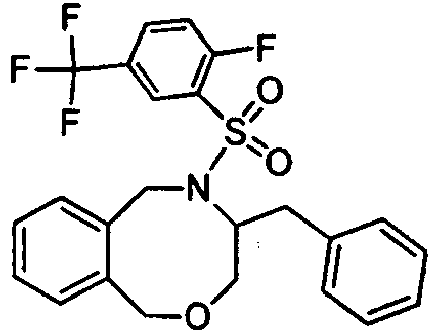
479,5 480 1/25 
461,5 462 1/26 
471,6 472 1/27 
468,4 468,470 1/28 
423,5 424 1/29 
423,5 424 1/30 
411,5 412 1/31 
431,9 432;434 1/32 
446,0 446;448 1/33 
441,5 442 1/34 
453,6 454 1/35 
441,5 442 1/36 
453,6 454 1/37 
441,5 442 1/38 
474,6 475 1/39 
451,5 452 1/40 
474,6 475 1/41 
389,5 390 1/42 
410,5 411 1/43 
424,5 425 1/44 
436,6 437 -

- A solution of 2-(2-tert-butyloxycarbonylamino-3-phenylpropyl)isoindoline-1,3-dione (1.14 g, 3 mmol) in TFA (5 mL) and DCM (30 mL) was stirred at rt for 2 h. The solution was concentrated to give the compound as white solid which was dissolved in Na2CO3 (sat.) and extracted by EA (3 x 50 mL). The organic phase was washed with brine (20 mL) and dried over anhydrous Na2SO4 and concentrated in vacuo to give compound 2b as colorless oil (800 mg, yield 95%).
- To a solution of compound 2b (800 mg, 2.8 mmol) in pyridine (20 mL) was added 2-methoxybenzene-1-sulfonyl chloride (942 mg, 4.5 mmol) at 10°C. The mixture was stirred at rt overnight and then concentrated in vacuo. The residue was dissolved in DCM (20 mL), washed with water (20 mL) and brine (20 mL). The organic layer was dried over anhydrous Na2SO4 and concentrated in vacuo. The residue was purified by silica gel flash chromatography (PE:EA = 2:1) to give compound 2c as a white solid (1.13 g, 83% yield).
- To a solution of compound 2c (500 mg, 1.1 mmol) in DMF (10 mL) at 10°C, NaH (60wt%, 44 mg, 1.1 mmol) was added in portions. The mixture was stirred for an additional 30 min and then the solution of methyl 2-(bromomethyl)-benzoate (253 mg, 1.1 mmol) in DMF (2 mL) was added dropwise. The resulting mixture was stirred at 10°C for 30 min and warmed to rt overnight. The reaction was quenched with water and diluted with EA (40 mL), washed with brine (3 x 20 mL).The organic phase was dried over anhydrous Na2SO4 and concentrated in vacuo. The residue was purification by silica gel flash chromatography (PE:EA = 2:1) to give compound 2d as a white solid (520 mg, 79% yield).
- To the solution of compound 2d (100 mg, 0.17 mmol) in H2O (2 mL) and MeOH (10 mL) was added aqueous NaOH (33 mg, 0.84 mmol). The resulting mixture was heated to reflux for 2 hr. Then the mixture was cooled to rt and acidified to pH=3 with 3.5N aqueous HCl, concentrated in vacuo to remove the volatile solvent. The resulting mixture was extracted with EA (2 x 30 mL). The organic extracts were combined and dried over anhydrous Na2SO4, concentrated in vacuo to give compound 2e as a white solid (80 mg, 80% yield).
- The mixture of compound 2e (100 mg, 0.17 mmol) and hydrazine monohydrate 98% (85 mg, 1.7 mmol) in ethanol (5 mL) was heated to reflux for 2 hr. The reaction mixture was cooled down to rt and acidified to pH=3 with 1 N aqueous HCl. The precipitate was removed by filtration and the filtrate was concentrated in vacuo. The residue was purified by prep-HPLC to give compound 2f as a white solid (30 mg, 39% yield).
- To a solution of compound 2f (45 mg, 0.1 mmol) in dry DMF (15 mL) was added 4-methylmorpholine (33 mg, 0.32 mmol). The mixture was stirred at rt for 10 min and DPPA (41 mg, 0.15 mmol) was added. This resulting mixture was stirred at rt for 24 h and then concentrated in vacuo to remove the solvent. The residue was dissolved in EA (10 mL), washed with saturated aqueous NH4Cl and brine, dried over anhydrous Na2SO4. Concentration in vacuo and purification by prep-TLC gave compound 2g as a white solid (40 mg, 91% yield). 1H-NMR (400 MHz, CDCl3) δ 8.03 (dd, 1H, J=8.0, 1.6 Hz), 7.47-6.99 (m, 11 H), 6.86 (d, 1H, J=8.0 Hz), 6.15 (m, 1H), 5.02 (d, J=15.6 Hz, 1H), 4.22 (d, J=15.6 Hz, 1H), 4.18 (m, 1H), 3.76 (s, 3H), 3.20 (dd, J=15.2, 8.8 Hz, 1H), 3.02-2.88 (m, 2H), 2.39 (d, J=8.8 Hz, 1H). MS (ESI+) m/z: 437 [M+H]+, 459 [M+Na]+.
- To a solution of compound 2g (120 mg, 0.28 mmol) in DMF (15 mL) at 10°C, NaH (60% in mineral oil; 13 mg, 0.33 mmol) was added in portions. The mixture was stirred for an additional 45 min and then Mel (116 mg, 0.82 mmol) was added dropwise. The resulting mixture was stirred at 10°C for 30 min and warmed to rt overnight. The reaction was quenched with water (30 mL) and extracted with EA (40 mL). The organic layer was washed with brine (2 x 20 mL) and dried over anhydrous Na2SO4. Concentration in vacuo and purification by prep-TLC (PE:EA = 1:1) gave compound 2h as a white solid (110 mg, 89% yield). 1H-NMR (400 MHz, CD3OD) δ 7.82 (dd, 1H, J=8.0, 1.6 Hz), 7.51 (t, J=8.8 Hz, 1H), 7.36-7.23 (m, 4H), 7.05-6.99 (m, 5H), 6.72-6.70 (m, 2H), 5.41 (d, J=18.8 Hz, 1H), 4.55 (d, J=19.2 Hz, 1 H), 4.10 (m, 1 H), 3.82 (s, 3H), 3.28 (dd, J=14.4, 11.6 Hz, 1 H), 2.98 (dd, J=15.2, 4.8 Hz, 1 H), 2.86 (s, 3H), 2.61 (dd, J=12.8, 9.6 Hz, 1H), 2.47 (dd, J=12.8, 4.8 Hz, 1H). MS (ESI+) m/z: 451 [M+H]+
- To a solution of compound 2h (150 mg, 0.33 mmol) in tetrahydrofuran (10 mL) at 5°C, LAH. (76 mg, 2 mmol) was added. The resulting mixture was heated to reflux for 2 h and then cooled to 5°C, quenched with one drop of water. The precipitate formed was removed by filtration. The filtrate was diluted with 1 N aqueous NaOH and extracted with EA. The organic layer was washed with brine and dried over anhydrous Na2SO4, concentrated in vacuo. The residue was purified by prep-HPLC to give
compound 2 as a yellow solid (20 mg, 13% yield). 1H-NMR (400 MHz, CDCl3) δ 8.00 (dd, 1H, J=8.0, 2.0 Hz), 7.44 (m, 1H), 7.19-7.00 (m, 8H), 6.87-6.81 (m, 3H), 5.30 (d, J=17.6 Hz, 1 H), 4.59-4.55 (m, 2H), 4.29 (m, 1H), 3.72 (s, 3H), 3.45 (d, J=12.4 Hz, 1H), 2.62 (dd, J=13.2, 10.4 Hz, 1H), 2.49-2.39 (m, 3H), 2.24 (s, 3H). MS (ESI+) m/z: 437 [M+H]+ -

- To a solution of methyl 2-(methyl)benzoate 3a (9.46 g, 6.3 mmol) in chloroform (200 mL) were added NBS (13.8 g, 7.6 mmol) and benzoyl peroxide (760 mg, 0.32 mmol). The reaction mixture was stirred at reflux overnight. When the mixture was cooled to rt, filtered and concentrated. The residue was purified by CC, eluted with PE to give 3b as a colorless oil (9 g, 62% yield).
- A mixture of 2-amino-3-(4-bromophenyl)propanoic acid 3c (24.4 g, 100 mmol) in HCl/MeOH (300 mL) was stirred at reflux overnight. TLC analysis indicated the total consumption of compound 3c. The mixture was concentrated to give 3d as a pale yellow solid (24 g, 92% yield).
- To a stirred mixture of compound 3d (24 g, 93 mmol) and TEA (19 g, 186 mmol) in DCM (300 mL) was added (Boc)2O (22 g, 102.3 mmol) at 0°C. Then the mixture was stirred at rt overnight. TLC analysis indicated the total consumption of compound 3d. Diluted HCl was added until the pH of the mixture was adjust to 7. Then the mixture was extracted with DCM (3 x 200 mL). The organic layer was washed with brine, dried over Na2SO4 and concentrated to give 3e as a pale yellow solid (32 g, 96% yield).
- To a solution of compound 3e (15 g, 42 mmol) in ethanol (50 mL) and THF (50 mL) was added LiCl·H2O (10 g, 170 mmol) and NaBH4 (6.3 g, 170 mmol) at 0°C. The mixture was stirred at rt overnight. LCMS analysis indicated the total consumption of compound 3e. The precipitate was removed by filtration and the filtrate was concentrated in vacuo to give 3f as a white solid (13 g, 94% yield).
- To a solution of compound 3f (6.6 g, 20 mmol) in dry THF (100 mL) was added NaH (60%, 960 mg, 24 mmol) in small portions at 0°C and stirred for 1 hr. Then compound 3b (5 g, 22 mmol) in THF (50 mL) was added dropwise, and the reaction mixture was allowed to stir at rt overnight. The reaction was quenched with water and extracted with EA (2 x 100 mL). The combined organic extracts were dried over anhydrous Na2SO4 and concentrated under reduced pressure. The residue was purified by CC eluting with PE:EA = 9:1 to give 3g as a white solid (3.2 g, 34% yield).
- To a solution of compound 3g (5 g, 10 mmol) in dry ether (80 mL) was added slowly LiAlH4 (1M in THF, 15.7 mL, 15.7 mmol) at 0°C. The mixture was stirred at 0°C for 30 min. Then the mixture was quenched with water (1 mL) under vigorous stirring. The precipitate was removed by filtration and the filtrate was concentrated in vacuo to give 3h as a white solid (4.3 g, 92% yield).
- To a solution of compound 3h (4.15 g, 9.2 mmol) in dry THF (50 mL) was added NBS (4.1 g, 23 mmol) and PPh3 (6 g, 23 mmol) at 0°C. The mixture was stirred at 0°C for 20 min. Then the mixture was stirred at rt for 2 hr. The solvent was evaporated in vacuo and purified by CC eluting with PE:EA = 4:1 to give 3i as a white solid (2.3 g, 50% yield).
- To a solution of compound 3i (2.2 g, 4.3 mmol) in DCM (20 mL) was added slowly TFA (2 mL) at 0°C. The mixture was stirred at 0°C for 2 hr. LCMS analysis indicated the total consumption of compound 3i. The solvent was removed in vacuum to give 3k as a white solid (1.68 g, 95% yield).
- A mixture of compound 3k (1.6 g, 3.9 mmol) and K2CO3 (1.6 g, 12 mmol) in dry THF (30 mL) was stirred at rt overnight. LCMS indicated the total consumption of compound 3k. The reaction mixture was filtered and the filtrate was evaporated in vacuum to give 3l as a white solid (1.1 g, 86% yield).
- To a mixture of compound 31 (900 mg, 2.7 mmol) and TEA (546 mg, 5.4 mmol) in acetonitrile (30 mL) was added 2-methoxybenzene sulfonyl chloride (559 mg, 2.7 mmol) and catalytic amount of DMAP. The reaction mixture was stirred at rt overnight. The solvent was evaporated in vacuo and purified by CC to give 3 as a white solid (510 mg, 38% yield).
- Following similar procedures as described in the Preparative Example 3 the following compounds were prepared.
# Structure MW (g/mol) Measured m/z of [M+H]+ 3/1 
502,4 502;504 3/2 
502,4 502;504 -

- Following a similar procedure as described in Org. Lett. 2009, 11:5494, compound 4-benzyl-5-(2-methoxyphenylsulfonyl)-3,4,5,6-tetrahydro-2H-benzo[b][1,5]oxazocine (4) was prepared.
- By using Pd-catalysed Br substitution the following compounds were prepared.
# Structure SM # MW (g/mol) Measured m/z of [M+H]+ 5/1 
3/1 453,6 454 5/2 
3/1 448,5 449 5/3 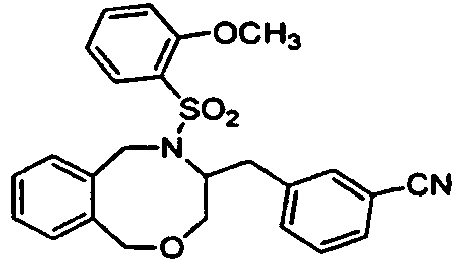
3/2 448,5 449 5/4 
3 448,5 449 5/5 
3/2 501,6 502 5/6 
3/2 530,6 531 -

- A mixture of 6a (1 g, 5.8 mmol), benzoylperoxide (101 mg, 0.4 mmol) and NBS (1.1 g, 6.39 mmol) in CCl4 (58 mL) was heated under reflux for 4 h. The reaction mixture was cooled to rt, quenched with H2O and extracted with DCM (3 x 30 mL). The combined organic layers were dried over Na2SO4, filtered and concentrated under reduced pressure. The residue was purified by CC on silica gel, eluting with PE:EA = 15:1 to afford 6b (1.1 g, 78% yield) as a yellow oil.
- To a solution of (R)-tert-butyl-1-hydroxy-3-phenylpropan-2-yl carbamate (200 mg, 0.8 mmol) in DMF (8 mL) at 0°C was added NaH (29 mg, 1.2 mmol) in portions. The reaction mixture was stirred at rt for 10 min and 6b (200 mg, 0.8 mmol) was added. The mixture was stirred at rt for 16 h, quenched with H2O and extracted with EA (3 x 30 mL). The combined organic layers were dried over Na2SO4, filtered and concentrated under reduced pressure. The crude product was purified by Prep-TLC to afford 6c (70 mg, 21% yield) as a colorless oil.
- A mixture of 6c (1.3 g, 3 mmol), palladium acetate (106 mg, 0.5 mmol), 1,3-bis(diphenylphosphino)propane (635 mg, 1.54 mmol) and triethylamine (939 mg, 9.3 mmol) in MeOH (30 mL) was stirred at 120°C under a carbon monoxide atmosphere (10 bar) for 30 h. The reaction mixture was cooled to rt and concentrated under reduced pressure. The crude product was purified by CC on silica gel, eluted with PE/EA = 5:1 to afford 6d (840 mg, 68% yield) as a colorless oil.
- To a solution of 6d (200 mg, 0.5 mmol) in diethylether (10 mL) at 0°C was added LiAlH4 (76 mg, 2 mmol). The reaction mixture was stirred at rt for 0.5 h and quenched with H2O. The mixture was diluted with EA, dried over Na2SO4, filtered and concentrated under reduced pressure. The residue was purified by CC on silica gel, eluted with PE/EA = 5:1 to afford 6e (181 mg, 97% yield) as a colorless oil.
- To a solution of 6e (65 mg, 0.18 mmol) in THF at 0°C was added NBS (78 mg, 0.44 mmol) followed by PPh3 (115 mg, 0.44 mmol). The reaction mixture was stirred at rt for 2 h and concentrated under reduced pressure. The residue was purified by CC on silica gel, eluted with PE/EA = 5:1 to afford 6f (28 mg, 37% yield) as a colorless oil.
- To a solution of 6f (133 mg, 0.31 mmol) in DMF (40 mL) at 0°C was added NaH (60%, 42 mg, 0.62 mmol) in portions. The reaction mixture was stirred at rt for 24 h, quenched with H2O and extracted with EA (3 x 30 mL). The combined organic layers were dried over Na2SO4, filtered and concentrated under reduced pressure. The residue was purified by Prep-HPLC, eluted with PE/EA = 5:1 to afford 6g (79 mg, 72% yield) as a colorless oil.
- A solution of 6g (109 mg, 0.31 mmol) in EA-HCl (3 mL) was stirred at rt for 1 h and concentrated under reduced pressure to afford 6h (130 mg, 100%) as a white solid.
- To a solution of 6h (79 mg, 0.31 mmol) and DIPEA (120 mg, 0.93 mmol) in DCM (3 mL) at 0°C was added quinoline-8-sulfonyl chloride (71 mg, 0.31 mmol) followed by DMAP (8 mg, 0.07 mmol). The reaction mixture was stirred at rt for 24 h and concentrated under reduced pressure. The residue was purified by CC on silica gel, eluted with PE/EA = 5:1 to afford 6 (54 mg, 39%) as a white solid. 1H NMR (400 MHz, CDCl3) δ 9.08 (s, 1H), 8.57 (d, J=8.0 Hz, 1H), 8.34-8.33 (m, 1H), 8.21 (d, 1 H, J=8.0 Hz), 8.04 (d, 1 H, J=8.0 Hz), 7.81 (d, 1 H, J=8.0 Hz), 7.69 (t, 1 H, J=8.0 Hz), 7.51-7.48 (m, 1H), 7.22-7.12 (m, 3H), 7.03-6.96 (m, 3H), 5.47 (d, 1 H, J=16.0 Hz), 5.20-5.14 (m, 2H), 4.79 (d, 1H, J=16.0 Hz), 4.34 (m, 1 H), 3.98 (d, 1 H, J=8.4 Hz), 3.57-3.51 (m, 1H), 3.12 (m, 1H), 2.22 (m, 1H). MS (ESI+) m/z: 446.5 [M+H]+.
- Following similar procedures as described in the Preparative Example 6 the following compounds were prepared.
# Structure MW (g/mol) Measured m/z of [M+H]+ 6/1 
441,5 442 6/2 
474,5 475 6/3 
442,5 453 6/4 
426,5 427 6/5 
432,5 433 -

- To a solution of 7a (110 mg, 0.41 mmol) and Et3N (83 mg, 0.82 mmol) in MeOH (4 mL) was added EDC·HCl (118.5 mg, 0.62 mmol). The reaction mixture was stirred at rt for 3 h and concentrated under reduced pressure. The residue was partitioned between water and EA. The organic layer was dried over Na2SO4, filtered and concentrated under reduced pressure. The residue was purified by CC on silica gel, eluting with PE/EA = 3:1 to 1:2 to afford 7b (89 mg, 77% yield) as a white solid.
- To a solution of 7b (4.18 g, 15 mmol) in Et2O (100 mL) at rt was slowly added LiAlH4 (567 mg, 30 mmol). The reaction mixture was stirred for 0.5 h, quenched with H2O and diluted with EA. The mixture was dried over Na2SO4, filtered and concentrated under reduced pressure to afford 7c (3.52 g, 93% yield) as a pale yellow oil.
- To a solution of 7c (418 mg, 1.66 mmol) and 1,2-bis(bromomethyl)benzene (480 mg, 1.83 mmol) in dry DMF (3 mL) at 0°C was added NaH (166 mg, 4.15 mmol). The reaction mixture was stirred at 0°C for 1.5 h, quenched with H2O and extracted with EA (10 mL). The organic layer was dried over Na2SO4, filtered and concentrated under reduced pressure. The residue was purified by CC on silica gel, eluting with PE/EA = 5:1 to 1:1 to give 7d (92 mg, 15% yield).
- A solution of 7d (92 mg, 0.26 mmol) in EA-HCl (3 mL) was stirred at rt for 1 h and filtered to afford 7e (73 mg, 100% yield) as a white solid.
- To a solution of 7e (73 mg, 0.25 mmol) in dry pyridine (2.5 mL) at rt was added quinoline-8-sulfonyl chloride (86 mg, 0.38 mmol). The reaction mixture was stirred at rt for 16 h and concentrated under reduced pressure. The residue was purified by Prep-TLC to give 7 (13 mg, 11%). 1H NMR (400 MHz, CDCl3) δ 8.89-8.87 (m, 1H), 8.56 (d, 1H, J=8.0 Hz), 8.45-8.40 (m, 2H), 8.16 (d, 1H, J=8.0 Hz), 8.00 (d, 2H, J=8.0 Hz), 7.62-7.58 (m, 2H), 7.45-7.42 (m, 1 H), 7.20-7.17 (m, 2H), 7.02 (t, 1H, J=7.6 Hz), 6.93-6.86 (m, 2H), 5.10-5.01 (m, 3H), 4.62-4.57 (m, 2H), 3.82 (d, 1H, J=8.0 Hz), 3.79 (d, 1H, J=8.0 Hz), 3.15-3.09 (m, 1 H), 2.63-2.60 (m, 1H). MS (ESI+) m/z: 446.2 [m+H]+.
-

- To a solution of 8a (4 g, 29.2 mmol) in DCM (20 mL) and MeOH (10 mL) was added Boc2O (6.4 g, 29.2 mmol). The reaction mixture was stirred at rt for 24 h and concentrated under reduce pressure. The residue was purified by CC on silica gel, eluting with PE/EA = 10:1 to 5:1 to give 8b (3.2 g, 46% yield) as a white solid.
- To a solution of 8b (1 g, 4.21 mmol) in DCM (10 mL) at rt was added DIPEA (1.6 g, 12.4 mmol) followed by methanesulfonyl chloride. The mixture was stirred at rt for 3 h and concentrated under reduced pressure to give crude 8c (1.2 g, 100% yield) as a yellow oil.
- To a solution of (R)-tert-butyl 2-amino-3-phenylpropanoate hydrochloride (1.08 g, 4.21 mmol) in dioxane (15 mL) was added DIPEA (1.6 g, 12.4 mmol) followed by 8c (1.2 g, 4.21 mmol). The mixture was heated under reflux for 14 h, cooled to rt and concentrated under reduced pressure. The residue was partitioned between EA (100 mL) and H2O (50 mL). The organic layer was separated, washed with brine (50 mL), dried over Na2SO4, filtered and concentrated under reduced pressure. The residue was purified by CC on silica gel, eluting with PE/EA = 10:1 to 2:1 to give 8d (1 g, 54% yield) as a pale yellow oil.
- To a solution of 8d (1 g, 2.27 mmol) in pyridine (10 mL) at rt was added quinoline-8-sulfonyl chloride (0.517 g, 2.27 mmol). The mixture was stirred for 16 h and concentrated under reduced pressure. The residue was partitioned between EA (100 mL) and H2O (50 mL). The organic layer was separated, washed with brine (30 mL), dried over Na2SO4, filtered and concentrated under reduced pressure. The residue was purified by CC on silica gel, eluting with PE/EA = 5:1 to 1:1 to give 8e (620 mg, 44% yield) as a pale yellow oil.
- A mixture of 8e (620 mg, 0.98 mmol) in DCM (2 mL) and TFA (5 mL) was stirred at rt for 4 h and concentrated under reduced pressure. The residue was partitioned between EA (100 mL) and sat. aq. NaHCO3 (50 mL). The organic layer was separated, washed with brine (30 mL), dried over Na2SO4, filtered and concentrated under reduced pressure. The residue was purified by CC on silica gel, eluting with DCM/MeOH = 20:1 to 8:1 to give 8f (400 mg, 86% yield) as a pale yellow oil.
- To a solution of 8f (400 mg, 0.84 mmol) in DMF (5 mL) at rt was added HATU (479 mg, 1.26 mmol). The reaction mixture was stirred for 16 h, diluted with EA (20 mL) and washed with H2O (20 mL) and brine (10 mL). The organic solution was dried over Na2SO4, filtered and concentrated under reduced pressure. The residue was purified by CC on silica gel, eluting with DCM-EA (10:1 to 2:1) to give crude product (200 mg), which was purified by Prep-TLC and crystallization from diethyl ether to give 8 (50 mg, 13% yield) as a white solid. 1H-NMR (400 MHz, CDCl3) δ 9.01-8.99 (m, 1 H), 8.24 (d, J=7.2 Hz, 1H), 8.18 (d, J=8.0 Hz, 1H), 7.93 (d, J=8.0 Hz, 1 H), 7.51-7.40 (m, 2H), 7.30-7.20 (m, 2H), 7.12 (t, J=7.6 Hz, 1H), 7.10-6.95 (m, 5H), 6.81 (d, J=7.2 Hz, 1 H), 5.96 (t, J=6.8 Hz, 1 H), 5.45-5.36 (m, 2H), 5.08-5.03 (m, 1H), 4.45 (d, J=16.8 Hz, 1H), 3.77-3.71 (m, 1H), 3.32-3.25 (m, 1H), 2.90-2.87 (m, 1H); MS (ESI+) m/z: 458 [M+H]+.
- To a solution of 8 (50 mg, 0.11 mmol) in THF (3 mL) at -10°C was slowly added NaH (5.2 mg, 0.12 mmol). The mixture was warmed to rt and stirred for 1 h. To it was added CH3I (50 mg, 0.33 mmol). The reaction mixture was stirred at rt for 16 h, diluted with H2O (10 mL) and extracted with EA (2 x 20 mL). The combined organic layers were dried over Na2SO4, filtered and concentrated under reduced pressure. The residue was purified by Prep-TLC to give 9 (50 mg, 96% yield) as a white solid. 1H-NMR (400 MHz, CDCl3) δ 9.14-9.11 (m, 1H), 8.24-8.19 (m, 2H), 7.92 (d, J=8.0 Hz, 1H), 7.59-7.54 (m, 1H), 7.44-7.36 (m, 3H), 7.22-7.13 (m, 5H), 7.08-7.04 (m, 1 H), 6.72 (d, J=7.2 Hz, 1H), 5.80-5.76 (m, 1H), 5.43-5.30 (m, 2H), 4.20 (d, J=16.8 Hz, 1H), 3.46-3.30 (m, 2H), 3.06-3.00 (m, 1H), 2.75 (s, 3H); MS (ESI+) m/z: 472 [M+H]+.
-

- To a mixture of compound Example 1/5 (441 mg, 1 mmol) in THF (10 mL), was added BCl3 (234 mg, 2 mmol) at -78°C and stirred overnight at rt. The solvent was evaporated in vacuo and purified by CC to give
compound 10 as a white solid (400 mg, 90% yield). - A mixture of 10 (43 mg, 0.1 mmol), cesium carbonate (130 mg, 0.4 mmol) and 4-(2-chloroethyl)-morpholine (45 mg, 0.3 mmol) in 1,4-dioxane (3 mL) was heated in a microwave oven at 160°C for 2 h. The reaction mixture was filtrated and the solvent was removed at reduced pressure. The residue was purified by prep-HPLC to give compound 11 as a white solid (20 mg, 30 % yield). 1H-NMR (400 MHz, CDCl3) δ 7.65-7.60 (m, 1H), 7.37-7.02 (m, 9H), 6.83 (br s, 2H), 5.35-5.31 (m, 1H), 5.10-4.90 (m, 3H), 3.83-3.75 (m, 2H), 3.65-3.61 (m, 4H), 3.43-3.41 (m, 1H), 3.32-3.18 (m, 2H), 3.00-2.90 (m, 1H), 2.86-2.79 (m, 1H), 2.41-2.20 (m, 6H). MS (ESI+) m/z: 541.2 [M+H]+.
-
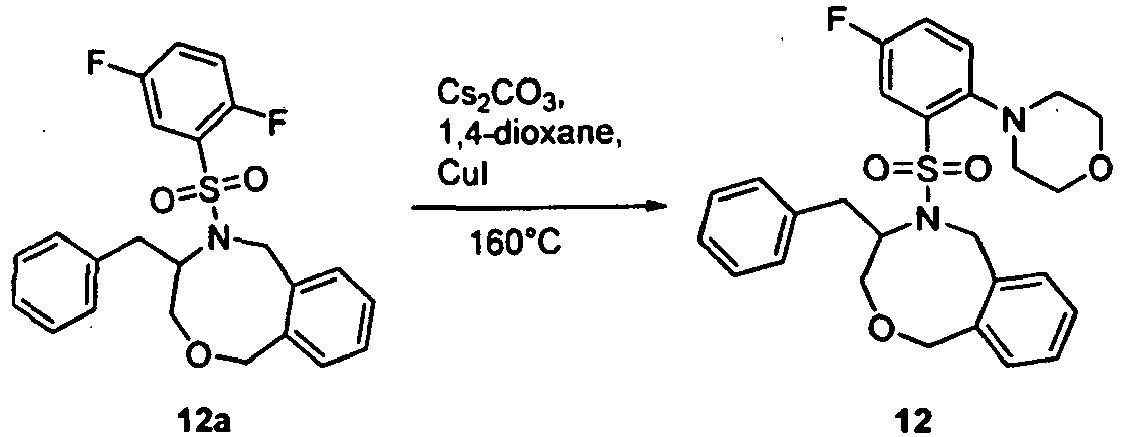
- A mixture of 12a (prepared similar as Prep. Ex. 1; 43 mg, 0.1 mmol), cesium carbonate (130 mg, 0.4 mmol), Cul (10 mg, 0.05 mmol) and morpholine (35 mg, 0.4 mmol) in 1,4-dioxane (3 mL) was heated in a microwave oven at 160°C for 2 h. After cooling to rt the reaction mixture was filtered and the solvent was removed under reduced pressure. The residue was purified by prep-HPLC to give 4-benzyl-5-(5-fluoro-2-morpholinophenylsulfonyl)-3,4,5,6-tetrahydro-1H-benzo[f][1,4]oxazocine (12) as a white solid (30 mg, 61% yield). 1H NMR (400 MHz, CDCl3) δ 7.70-7.68 (m, 1H), 7.35-7.15 (m, 8H), 7.10 (d, J=6.4 Hz, 2H), 6.96 (d, J=6.5 Hz, 1 H), 5.16 (d, J=12.5 Hz, 1 H), 5.04 (d, J=12.5 Hz, 1H), 4.89 (d, J=12.5 Hz, 1H), 4.65 (d, J=12.5 Hz, 1H), 4.25-4.21 (m, 1H), 3.91-3.85 (m, 2H), 3.79-3.65 (m, 3H), 3.51-3.46 (m, 1H), 3.32-3.25 (m 1H), 3.14 (t, J=10 Hz, 1H), 2.58-2.50 (m, 2H), 2.38-2.31 (m, 1H), MS (ESI+) m/z: 497.0 [M+H]+.
-

- To Preparative Example 1/40 (474 mg, 1 mmol) in dry DCM (10 mL) at -78°C was added BBr3 (1 mL, 2M in DCM, 2 mol) and the mixture was stirred at -78°C for 2 h. Saturated aq. NH4Cl (5 mL) was added to quench the reaction. The organic layer was separated and the aqueous layer was extracted with DCM. The organic layer was washed with brine and dried over anhydrous Na2SO4. The solvent was removed under reduced pressure and the residue was purified by CC to give 4-benzyl-5-(quinolin-8-ylsulfonyl)-3,4,5,6-tetrahydro-1H-benzo[f][1,4]oxazocin-10-ol (13) as a white solid (312 mg, 68% yield). MS (ESI+) m/z: 461.1 [M+H]+.
-

- To a solution of compound 14a (5 g, 17 mmol) and isobutyl chloroformate (2.79 g, 20.4 mmol) in THF (60 mL) at -20°C was added N-methylmorpholine (2.06 g, 20.4 mmol). The reaction mixture was stirred for 10 min and filtered. The filtrate was cooled to -20°C and to it was added NaBH4 (969 mg, 25.5 mmol) followed by H2O (40 mL). The mixture was stirred for 30 min, poured into H2O and extracted with EA (150 mL). The organic layer was dried over Na2SO4, filtered and concentrated under reduced pressure to give compound 14b (4.14 g, 87% yield) as an oil.
- To a solution of compound 14b (562 mg, 2.0 mmol) in DMF (10 mL) at 0°C was added NaH (200 mg, 5.0 mmol). The reaction was stirred for 30 min and to it was added methyl 2-(bromomethyl)benzoate (366 mg, 1.6 mmol). The reaction mixture was stirred for 3 h, poured into H2O and extracted with EA (10 mL). The organic layer was dried over Na2SO4, filtered and concentrated under reduced pressure. The residue was purified by Prep-TLC to give compound 14c (275 mg, 40% yield) as an oil.
- A mixture of compound 14c (1.4 g, 3.3 mmol) and Pd-C (37 mg) in MeOH (20 mL) was stirred under a H2 atmosphere (1 atm) at rt for 16 h. The reaction mixture was filtered and concentrated under reduced pressure. The residue was purified by CC on silica gel to give the ester (900 mg, 92% yield) as an oil. To a solution of this ester (900 mg, 3.05 mmol) in THF (10 mL) at 0°C was added a solution of LiOH (513 mg, 12.2 mmol) in H2O (3 mL). The reaction mixture was stirred at rt for 16 h, acidified with 1 N HCl to pH=3 and extracted with EA (3 x 15 mL). The combined organic layers were dried over Na2SO4, filtered and concentrated under reduced pressure to give compound 14d (720 mg, 84% yield) as a white solid.
- To a solution of compound 14d (394 mg, 1.4 mmol) and HATU (639 mg, 1.68 mmol) in DMF (20 mL) at rt was added DIPEA (1 mL). The reaction mixture is stirred for 16 h, quenched with H2O and extracted with EA (100 mL). The organic layer was dried over Na2SO4, filtered and concentrated under reduced pressure. The residue was purified by CC on silica gel, eluting with PE/EA = 4:1 to give compound 14e (171 mg, 46% yield) as a yellow solid.
- To a solution of compound 14e (171 mg, 0.65 mmol) in THF (6 mL) at 0°C was added LiAlH4 (247 mg, 6.5 mmol). The reaction mixture was heated under reflux for 16 h, cooled to rt, quenched with H2O and filtered. The mixture was extracted with CHCl3 (10 mL), washed with brine, dried over Na2SO4, filtered and concentrated under reduced pressure. The residue was washed with hexanes to give compound 14f (129 mg), which was used in the next step without further purification.
- To a mixture of compound 14f (crude, 129 mg, 0.5 mmol) in pyridine (4 mL) at rt was added quinoline-8-sulfonyl chloride (142 mg, 0.6 mmol). The reaction mixture was stirred for 16 h and concentrated under reduced pressure. The residue was partitioned between CHCl3 and H2O. The organic layer was washed with brine, dried over Na2SO4, filtered and concentrated under reduced pressure. The residue was purified by Prep-TLC to give compound 14 (100 mg, 44% yield). 1H NMR (400 MHz, CDCl3) δ 8.97 (s, 1 H), 8.49 (d, 1H, J=8.0 Hz), 8.17 (d, 1H, J=8.0 Hz), 7.97 (d, 1H, J=8.0 Hz), 7.56 (t, 1H, J=8.0 Hz), 7.47-7.44 (m, 1 H), 7.21 (d, 1 H, J=8.0 Hz), 7.02-7.00 (m, 1 H), 6.94-6.93 (m, 1 H), 6.87 (d, 1 H, J=8.0 Hz), 5.17 (d, 1 H, J=8.0 Hz), 4.98-4.93 (m, 2H), 4.66 (d, 1H, J=8.0 Hz), 4.51 (s, 1H), 4.27 (d, 1H, J=8.0 Hz), 3.78 (d, 1H, J=8.0 Hz), 3.53 (t, 1H, J=7.2 Hz), 3.21-3.18 (m, 1H), 1.00 (s, 9H). MS (ESI) calcd for [C24H28N2O4S+H]+ (m/z): 441.56, found: 441.3.
- A solution of compound 14 (58 mg, 0.13 mmol) in HCl-MeOH (1M, 5 mL) was stirred at rt for 24 h. The solvent was removed under reduced pressure to give compound 15 (45 mg, 89% yield) as a solid. 1H NMR (400 MHz, CDCl3) δ 8.94-8.93 (m, 1H), 8.59 (d, 1H, J=8.0 Hz), 8.22 (d, 1H, J=8.0 Hz), 8.03 (d, 1H, J=8.0 Hz), 7.63 (t, 1H, J=8.0 Hz), 7.51-7.47 (m, 1H), 7.03 (t, 2H, J=8.0 Hz), 6.94-6.87 (m, 2H), 4.94 (d, 2H, J=8.0 Hz), 4.85-4.80 (m, 2H), 4.60 (d, 1H, J=8.0 Hz), 4.24-4.19 (m, 1H), 3.82 (d, 1H, J=8.0 Hz), 3.73-3.71 (t, 2H), 2.79-2.76 (m, 1H). MS (ESI) calcd for [C20H20N2O4S+H]+ (m/z): 385.45, found: 384.8.
- To a solution of compound 15 (40 mg, 0.1 mmol) in DMF (3 mL) at 0°C was added NaH (168 mg, 0.4 mmol). The mixture was stirred at rt for 0.5 h and to it was added Mel (22 mg, 0.16 mmol). The reaction was stirred at rt for 2.5 h, quenched with H2O and extracted with EA (3 x 10 mL). The combined organic layers were washed with brine, dried over Na2SO4, filtered and concentrated under reduced pressure. The residue was purified by Prep-TLC to give compound 16 (22 mg, 53% yield) as a solid. 1H NMR (400 MHz, CDCl3) δ 8.93 (s, 1H), 8.51 (d, 1H, J=8.0 Hz), 8.16 (d, 1H, J=8.0 Hz), 7.97 (d, 1 H, J=8.0 Hz), 7.60 (t, 1H, J=8.0 Hz), 7.46-7.43 (m, 1H), 7.18 (d, 1 H, J=8.0 Hz), 7.00 (d, 1H, J=7.6 Hz), 6.91-6.82 (m, 2H), 5.12 (d, 1 H, J=8.0 Hz), 4.99-4.90 (m, 2H), 4.72 (s, 1H), 4.62-4.59 (d, 1 H), 4.23 (d, 1 H, J=8.0 Hz), 3.76 (d, 1 H, J=8.8 Hz), 3.60 (t, 1H, J=8.0 Hz), 3.33-3.29 (m, 1 H), 3.17 (s, 3H). MS (ESI) calcd for [C21H22N2O4S+H]+ (m/z): 399.48, found: 399.2.
- Following similar procedures as described in the Preparative Example 14 to 16, Step 8 the following compounds were prepared.
# Structure MW (g/mol) Measured m/z of [M+H]+ 16/1 
474,6 475,2 16/2 
442,5 443,0 16/3 
452,6 453,3 16/4 
438,5 439,2 -

- To the mixture of compound 15 (200 mg, 0.52 mmol) and TEA (0.2 mL, 1.5 mmol) in THF (25 mL) at rt, methanesulfonyl chloride (71 mg, 0.62 mmol) was added. The resulting mixture was stirred at rt for overnight. The reaction mixture was poured in ice water (100 mL), extracted with EA (3 x 100 mL). The combined organic layer was washed with water (100 mL) and brine (100 mL), dried over anhydrous Na2SO4. Concentration in vacuo and purified by CC, eluting with PE:EA = 2:1 afforded compound 17a as white solid (210 mg, 87% yield).
- Compound 17a (100 mg, 0.21 mmol) was added to DMSO (1 mL) and Cs2CO3 (500 mg, 1.5 mmol). 1H-Pyrazole (70 mg, 1.0 mmol) was added in the mixture and sealed in a microwave tube. The mixture was heated to 110°C for 30 min under microwave irradiation. The reaction mixture was poured into ice/water (50 mL) and extracted with EA (3 x 50 mL) and washed with brine (2 x 50 mL) and dried over anhydrous Na2SO4. The residue was purified by CC eluting with PE:EA = 3:1 to give
compound 17 as white solid (30 mg, 32% yield). 1H-NMR (400 MHz, CD3OD) δ: 8.73 (d, J=1.6 Hz, 1H), 8.33 (d, J=7.2 Hz, 1H), 8.20 (d, 1H), 7.97 (d, 1H), 7.52-7.50 (m, 2H), 7.40-7.38 (m, 2H), 6.80 (d, 1H), 6.70 (t, 1H), 6.14 (s, 1H), 5.10 (m, 1H), 4.92 (d, J=14.4 Hz, 1H), 4.80 (m, 2H), 4.43 (d, J=14.4 Hz, 1H), 4.35 (q, 1H), 4.22 (q, 1H), 3.76 (d, 1H), 3.66 (d, 1H). MS (ESI+) m/z: 435.0 [M+H]+. - Following similar procedures as described in the Preparative Example 17,
Step 2 the following compounds were prepared.# Structure MW (g/mol) Measured m/z of [M+H]+ 17/1 
435,5 436,2 17/2 
451,6 452,4 17/3 
467,6 468,3 17/4 
453,6 454,4 17/5 
434,5 435,4 -

- A solution of 2-methylbenzoic acid (18a) (5 g, 36.8 mmol) in MeOH·HCl (2.4M, 50 mL) was stirred at 70°C overnight. The mixture was concentrated under reduced pressure to give compound 18b (4.5 g, 82% yield), which was used without purification.
- A solution of compound 18b (4.5 g, 30 mmol), NBS (5.9 g, 33 mmol) and AlBN (0.5 g, 3 mmol) in CCl4 (20 mL) was refluxed overnight. The mixture was taken up in H2O (20 mL) and extracted with DCM (100 mL). The organic layer was washed with brine, dried over Na2SO4, filtered and concentrated. The crude product was purified by CC to give the compound 18c (5.5 g, 80% yield).
- A solution of (R)-2-aminopent-4-enoic acid (18d) (5 g, 43.5 mmol) in MeOH·HCl (2.4M, 50 mL) was stirred at 70°C overnight. The mixture was concentrated under reduced pressure to give compound 18e (5.5 g, 98% yield), which was used without purification.
- A solution of compound 18e (5.5 g, 42.6 mmol) in DCM (50 mL) containing Boc2O (12.1 g, 55.4 mmol) and TEA (9.4 g, 85.2 mmol) was stirred at rt for 1 hr. The mixture was concentrated under reduced pressure to give compound 18f (9.5 g, 98% yield), which was used without purification.
- A solution of compound 18f (9.5 g, 41.5 mmol) in THF (50 mL) was cooled in an ice bath under argon. To this mixture was added LAH (3.9 g, 104 mmol) portionwise, and then the ice bath was removed and the reaction mixture was allowed to stir at rt for 2 h and then quenched with water (30 mL). The aqueous layer was extracted with EA (3 x 50 mL). The combined extracts were washed with brine, dried over Na2SO4, filtered, concentrated and purified by CC to give compound 18g (6.2 g, 75% yield) as yellow oil.
- A solution of compound 18g (6.2 g, 30.8 mmol) and compound 18c (8.5 g, 36.9 mmol) in THF (30 mL) was cooled in an ice bath under argon. To this mixture was added NaH (2.5 g, 61.6 mmol, 60 % wt in oil) portionwise. The ice bath was removed and the reaction mixture was allowed to stir at rt for 2 h and then quenched with MeOH (10 mL). The mixture was concentrated under reduced pressure and the residue was purified by CC to give the desired compound 18h (4.2 g, 39% yield) as a yellow oil. LCMS (m/z): 350.2 (MH+).
- A solution of compound 18h (4.2 g, 12.0 mmol) in EtOH/THF (30 mL, v/v = 1/1) was treated with CaCl2 (5.3 g, 48.0 mmol) and the resulting slurry was cooled under argon in an ice bath. To this mixture was added NaBH4 (3.6 g, 96 mmol) portionwise. After 1 h the ice bath was removed and the reaction mixture was allowed to stir at rt for 16 hr. The mixture was quenched with 10% aq. Na2CO3 and water and the resulting thick, white slurry was extracted with EtOAc (3 x 50 mL). The combined organic layers were washed with brine, dried over Na2SO4 and concentrated. The crude product was purified by CC to give the desired compound 18i (3.0 g, 78% yield) as yellow oil. LCMS (m/z): 322.1 (MH+).
- A solution of compound 18i (3.0 g, 9 mmol) in CCl4 (10 mL) was cooled in an ice bath. To this mixture was added PBr3 (1.0 g, 4.5 mmol) dropwise and the mixture was stirred at 0°C for 2 hr. The mixture was quenched with water and extracted witt DCM (3 x 50 mL). The combined organic layers were washed with brine and concentrated. The crude compound 18j (2.8 g, 80% yield) was used in the next step without purification. LCMS (m/z): 385.1 (MH+).
- A solution of compound 18j (2.8 g, 7.3 mmol) in TFA/DCM (25 mL, v/v = 1/4) was stirred at rt for 1 hr. The mixture was concentrated under reduced pressure to give compound 18k (2.0 g, 98% yield), which was used without purification. LCMS (m/z): 285.1 (MH+).
- To a solution of compound 18k (2.0 g, 7.0 mmol) in EtOH (20 mL) was added K2CO3 (4.8 g, 35.0 mmol) portionwise. The mixture was heated to reflux for 2 h to complete the reaction. The reaction mixture was cooled down to rt and concentrated under reduced pressure to give compound 181 (1.2 g, 84% yield), which was used without purification. LCMS (m/z): 204.1 (MH+).
- A solution of compound 18l (1.2 g, 5.9 mmol), quinoline-8-sulfonyl chloride (1.5 g, 6.5 mmol), TEA (1.8 g, 17.7 mmol) and DMAP (366 mg, 3 mmol) in 20 mL of DCM was stirred at rt overnight. The mixture was concentrated and the residue was purified by CC to give the desired compound 18 (1.3 g, 56% yield) as a white solid. 1H NMR (500 MHz, CDCl3) δ 8.94 (m, 1H), 8.46 (d, J=7.5 Hz, 1H), 8.13 (d, J=8.5 Hz, 1H), 7.93 (d, J=8.0 Hz, 1H), 7.54 (t, J=8.0 Hz, 1H), 7.43 (dd, J=4.0, 8.0 Hz, 1H), 7.20 (d, J=7.5 Hz, 1 H), 6.98 (m, 1H), 6.91 (m, 1H), 6.80 (d, J=7.5 Hz, 1H), 5,69 (m, 1H), 5.07-4.86 (m, 5H), 4.58 (d, J=15.0 Hz, 1H), 4.54 (m, 1H), 4.01 (d, J=12.5 Hz, 1H), 3.68 (d, J=12.5 Hz, 1H), 2.47 (m, 1H), 2.09 (m, 1H). LCMS (m/z): 395.5 (MH+).
-

- To a stirred solution of compound 18 (100 mg, 0.25 mmol) in dry THF (5 mL) was added diethyl zinc (1 M solution in hexane, 2.5 mL) at 0°C under nitrogen atmosphere followed by diiodomethane (667 mg, 2.5 mmol). The reaction was stirred at 0°C for 6 h and poured over cold aqueous solution of ammonium chloride. The organic layer was separated and the aqueous layer extracted repeatedly with EA. The combined organic layer was washed with brine, dried over Na2SO4, filtered and concentrated. The crude product was purified by Prep-TLC to afford the compound 20 (32 mg, 31% yield). 1H NMR (500 MHz, CDCl3) δ 8.94 (m, 1H), 8.47 (d, J=7.5 Hz, 1H), 8.13 (d, J=8.0 Hz, 1H), 7.93 (d, J=8.5 Hz, 1H), 7.55 (t, J=8.0 Hz, 1 H), 7.43 (dd, J=8.0 Hz, 4.0 Hz 1H), 7.17 (d, J=7.5 Hz, 1H), 6.98 (t, J=7.5 Hz, 1H), 6.89 (m, 1 H), 6.80 (d, J=7.5 Hz, 1 H), 5.07 (d, J=15.5 Hz, 1H), 4.95 (d, J=15.0 Hz, 1H), 4.86 (d, J=15.5 Hz, 1 H), 4.60 (d, J=15.0 Hz, 1H), 4.49 (m, 1H), 4.14 (d, J=12.0 Hz, 1H), 3.75 (d, J=12.0 Hz, 1 H), 1.71 (m, 1H), 1.10 (m, 1 H), 0.63 (m, 1H), 0.33 (m, 2H), -0.11 (m, 2H). MS (ESI+) m/z: 409 [M+H]+. LCMS (m/z): 409.2 (MH+).
-
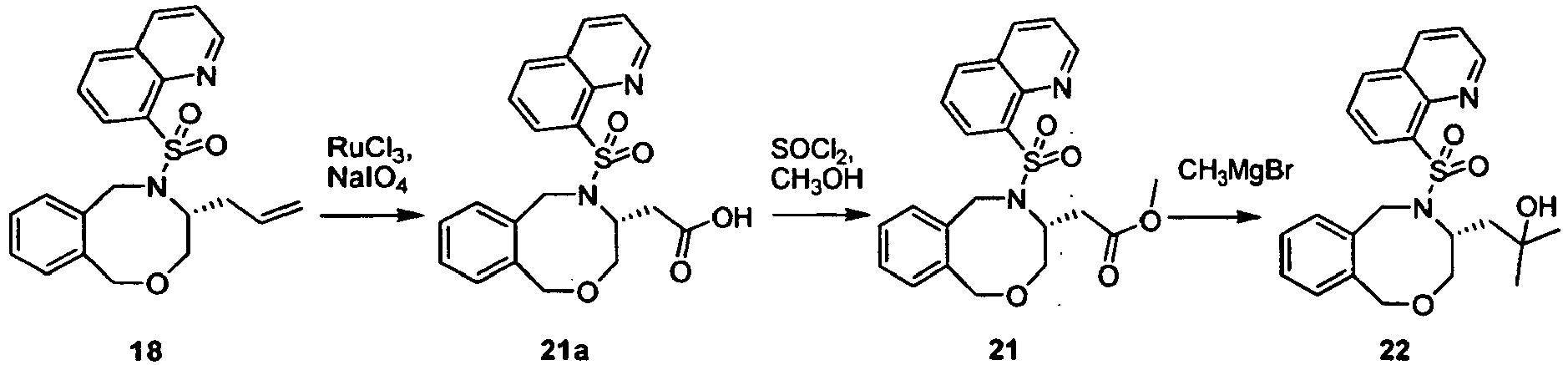
- A solution of compound 18 (1.0 g, 2.5 mmol) and NalO4 (2.1 g, 10 mmol) in CCl4/CH3CN/H2O (10 mL, v/v/v = 1:1:1.5) was added RuCl3 (11 mg, 0.05 mmol). The resulting solution was stirred at rt for 16 hr. The reaction mixture was diluted with DCM and the aqueous layer was further extracted with DCM. The combined organic extracts were washed with brine, dried over Na2SO4 and concentrated. The crude product was purified by CC to give the compound 21a (800 mg, 77% yield) as a white solid. LCMS (m/z): 413.2 (MH+).
- A solution of compound 19 (200 mg, 0.48 mmol) in SOCl2 (5 mL) was stirred at rt for 0.5 hr, and CH3OH (10 mL) was added after the reaction mixture was cooled to 0°C. The mixture was stirred for another 0.5 h and the solvent was removed. The residue was diluted with DCM and washed with water and brine, the organic layers were concentrated to get the desired compound 21 (160 mg, 78% yield) without purification. LCMS (m/z): 427.2 (MH+).
- Compound 21 (160 mg, 0.37 mmol) was dissolved in anhydrous THF (5 mL) and the solution was cooled in an ice-water bath. A solution of 3M methylmagnesium bromide in THF (0.25 mL, 0.74 mmol) was added dropwise via syringe and the stirred reaction mixture was allowed to warm to rt and react for 2 hr. The reaction mixture was quenched with NH4Cl solution and extracted with EA. The organic extracts were dried over anhydrous Na2SO4, filtered and concentrated. The crude product was purified by Prep-TLC to give the desired compound 22 (35 mg, 22% yield). LCMS (m/z): 427.2 (MH+).
-

- A solution of compound 21a (100 mg, 0.24 mmol), HATU (137 mg, 0.36 mmol), DIPEA (77 mg, 0.6 mmol) in DCM (5 mL) was stirred at rt for 0.5 hr. Ammonium hydroxide (12 mg, 0.36 mmol) was added and the mixture was stirred at rt for 2 hr. The reaction mixture was quenched with water and extracted with DCM. The organic extracts were dried over anhydrous Na2SO4, filtered and concentrated. The crude product was purified by Prep-TLC to give the desired compound 23 (32 mg, 32% yield). LCMS (m/z): 412.2 (MH+).
- A solution of compound 23 (100 mg, 0.24 mmol), pyridine (47 mg, 0.6 mmol) and (CF3CO)2O (76 mg, 0.36 mmol) in DCM (5 mL) was stirred at rt for 2 hr. The reaction mixture was quenched with water and extracted with DCM. The organic extracts were dried over anhydrous Na2SO4, filtered and concentrated. The crude product was purified by Prep-TLC to give the desired compound 24 (34 mg, 36% yield). LCMS (m/z): 394.2 (MH+).
- To the mixture of sodium azide (48 mg, 0.75 mmol) and ammonium chloride (40 mg, 0.75 mmol) in dry DMF (5 mL) was added compound 24 (100 mg, 0.25 mmol) under a nitrogen atmosphere. The mixture was stirred at 125°C for 48 hr. The cooled reaction was poured into ice water and acidified to pH=1 with 1 N HCl. The mixture was concentrated in vacuo and purified by Prep-HPLC to obtain compound 25 (30 mg, 27% yield). LCMS (m/z): 437.2 (MH+).
-

- A solution of compound 21 a (100 mg, 0.24 mmol) in SOCl2 (3 mL) was stirred at rt for 1 h and concentrated. Dimethylamine (32.8 mg, 0.4 mmol) and triethylamine (81 mg, 0.81 mmol) in DCM (5 mL) were added to the above residue. The mixture was stirred at rt for 1 h. The mixture was taken up in H2O (10 mL) and extracted with DCM (30 mL). The organic layers were dried over Na2SO4 and concentrated. The crude product was purified Prep-TLC to give the pure compound 26 (40 mg, 38% yield). LCMS (m/z): 440.1 (MH+).
-
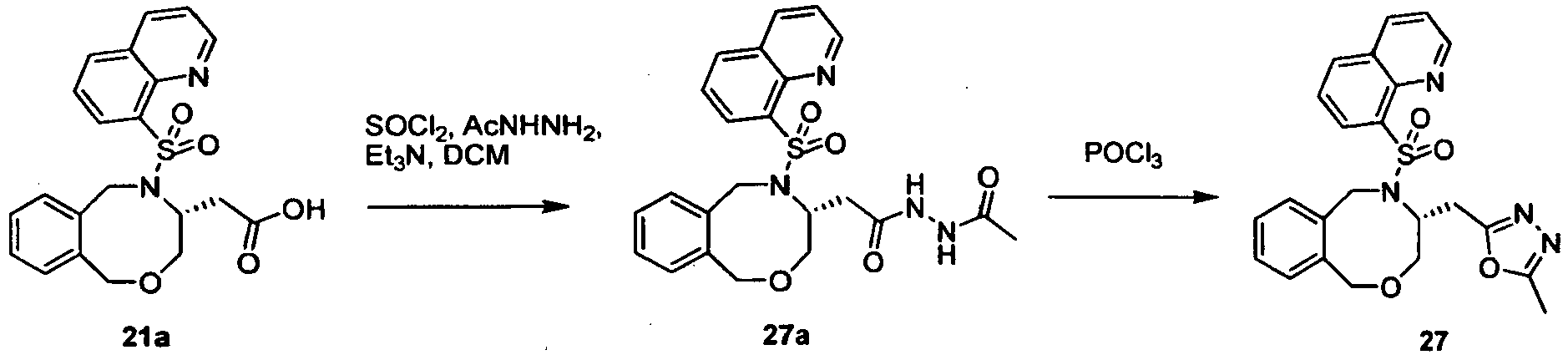
- A solution of compound 21 a (412 mg, 1 mmol) in SOCl2 (3 mL) was stirred for 1 h at rt and concentrated. Acetohydrazide (148 mg, 2 mmol) and triethylamine (303 mg, 3 mmol) in DCM (5 mL) were added to the above residue. The mixture was stirred at rt for 1 h. The reaction was taken up in H2O (10 mL) and extracted with DCM (30 mL). The combined organic layers were dried over Na2SO4 and concentrated. The crude product was purified by CC to give the compound 27a (400 mg, 85% yield).
- A mixture of compound 27a (100 mg, 0.21 mmol) and POCl3 (3 mL) was stirred at 110°C for 3 h. The mixture was taken up in H2O (10 mL) and extracted with DCM (30 mL). The combined organic layers were dried over Na2SO4, filtered and concentrated. The crude product was purified by Prep-TLC to give the pure compound 27 (40 mg, 42% yield). LCMS (m/z): 451.1 (MH+).
-

- A mixture of compound 21a (412 mg, 1 mmol) and SOCl2 (3 mL) was stirred at rt for 1 h and concentrated. 2-Amino-1-phenylethanone (342 mg, 2 mmol) and triethylamine (303 mg, 3 mmol) in DCM (5 mL) were added to the above residue. The mixture was stirred at rt for 1 h. The reaction was taken up in H2O (10 mL) and extracted with DCM (30 mL). The combined organic layers were dried over Na2SO4, filtered and concentrated. The crude product was purified by CC to give compound 28a (400 mg, 75% yield).
- A microwave tube was charged with compound 28a (100 mg, 0.19 mmol), AcONH4 (44 mg, 0.57 mmol) and DMF (3 mL), and then was sealed and heated to 150°C for 1 h under microwave irradiation. The mixture was taken up in H2O (10 mL) and extracted with DCM (30 mL). The combined organic layers were dried over Na2SO4, filtered and concentrated. The crude product was purified by Prep-TLC to give compound 28 (30 mg, 30% yield). LCMS (m/z): 511.1 (MH+).
-

- Step 1: To a solution of compound 29a (2.2 g, 6.7 mmol) in dry THF (30 mL) was added NBS (1.8 g, 10 mmol) and PPh3 (2.6 g, 10 mmol) at 0°C. The mixture was stirred at 0°C for 30 min. Then the mixture was allowed to stir at rt for 2 h. The solvent was removed under vacuum to give a white solid (2.44 g).
- Step 2: To a solution of the white solid from Step 1 (2.44 g) in DCM (20 mL) was added slowly TFA (2 mL) at 0°C. The mixture was stirred at 0°C for 2 h. The solvent was removed under vacuum to give a white solid (1.96 g).
- Step 3: A mixture of the solid residue from Step 2 (1.96 g) and K2CO3 (1.96 g, 14.3 mmol) in dry THF (30 mL) was stirred at rt overnight. The reaction mixture was filtered and the filtrate was evaporated under vacuum to give a white solid (1.28 g).
- Step 4: To a mixture of the solid residue from Step 3 (256 mg) and TEA (360 mg, 3.57 mmol) in ACN (20 mL) was added 2-methoxy-phenyl sulfonyl chloride (267 mg, 1.31 mmol) and a catalytic amount of DMAP. The reaction mixture was stirred at rt overnight. The solvent was evaporated in vacuo to give a white solid (384 mg).
- Step 5: A mixture of the solid residue from Step 4 (38 mg) and mCPBA (70%, 68.8 mg, 0.28 mmol) in DCM (10 mL) was stirred at rt overnight. The solvent was evaporated in vacuo and purified by CC eluting with PE:EA = 3:1 to give a white solid (40 mg). 1H NMR (400 MHz, DMSO-d6) δ 8.03 (d, J=6.4 Hz, 1H), 7.74 (t, J=6.1Hz, 1H), 7.45-7.42 (m, 2H), 7.26-7.24 (m, 2H), 7.23-7.18 (m, 5H), 6.85 (d, J=6.4 Hz, 2H), 5.45 (d, J=15.2 Hz, 1H), 5.35 (d, J=11.6 Hz, 1H), 4.82 (d, J=15.2 Hz, 1 H), 4.42-4.32 (m, 2H), 4.03 (s, 3H), 3.47-3.37 (m, 1H), 2.89 (t, J=9.6 Hz, 1 H), 2.45 (d, J=8.0 Hz, 1 H), 2.22 (d, J=7.8 Hz, 1 H); MS (ESI+) m/z: 472.0 [M+H]+.
-
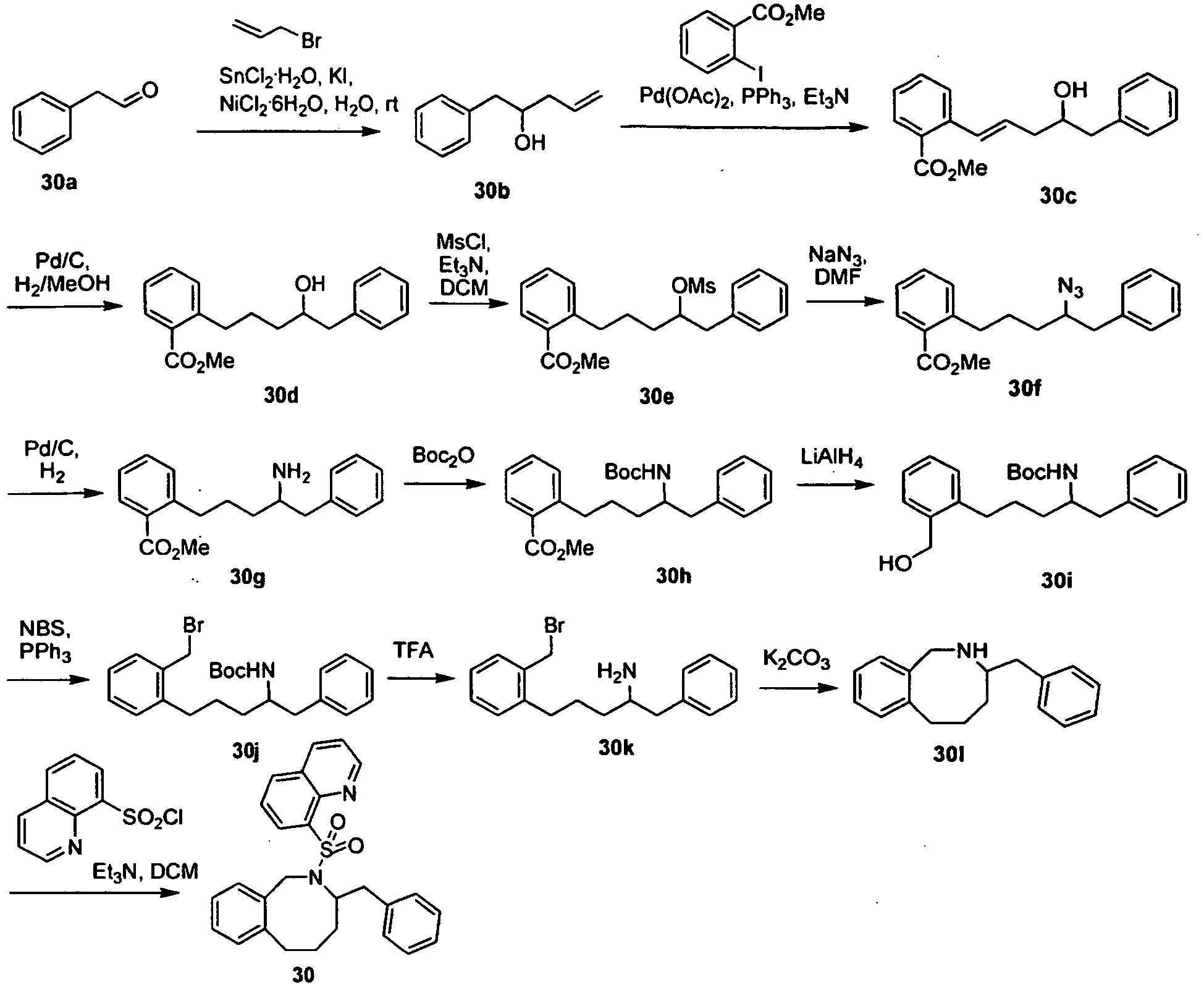
- To a mixture of phenylacetaldehyde 30a (7.84 g, 65.3 mmol) and 3-bromoprop-1-ene (11.1 g, 91.5 mmol) in water (50 mL), Kl (3.25 g, 19.6 mmol) and NiCl2·6H2O (3.1 g, 13 mmol) were added. After the mixture was stirred for several minutes, SnCl2·H2O (29.5 g, 13 mmol) was added. The mixture was vigorously stirred at rt overnight and then extracted with EA. The combined organic layer was washed by brine, dried over anhydrous sodium sulfate, evaporated in vacuo. The residue was purified by CC using PE:EA = 5:1 as mobile phase to give the desired product (5.75 g, 54% yield).
- A mixture of triethylamine (7.6 mL, 54.7 mmol), triphenylphosphine (0.778 g, 2.97 mmol) and palladium acetate (0.35 g, 1.56 mmol) in 1,4-dioxane (50 mL) was refluxed to form a homogeneous dark-red solution. The reaction temperature was then reduced to just below reflux. Compound 30b (4.56 g, 28 mmol), methyl 2-iodobenzoate (4.10 g, 15.6 mmol) and triethylamine (2.88 mL, 10.2 mmol) were added subsequently with stirring. The reaction mixture was then refluxed for about 30 min until TLC showed the SM had disappeared. The reaction mixture was filtered hot through celite, which was washed with 1,4-dioxane. The combined filtrate and washings were evaporated in vacuo to a small volume and purified by CC using PE:EA = 5:1 as mobile phase to give the desired product (2.59 g, 56% yield).
- A solution of 30c (2.59 g, 8.75 mmol) in MeOH (100 mL) was hydrogenated using 10% Pd/C (0.93 g, 0.88 mmol) as catalyst at atmospheric pressure overnight. The catalyst was removed by filtration, and the solution was evaporated at reduced pressure to afford the desired product (2.27 g, 97% yield).
- To a solution of 30d (2.27 g, 7.62 mmol) and Et3N (2.12 mL, 15.2 mmol), MsCl (1.2 mL, 15.2 mmol) was added dropwise at 0°C. After addition was complete, the reaction was stirred at rt until LC-MS analysis indicated the total consumption of the SM. The solvent was removed and the residue was purified by CC using PE:EA = 5:1 as mobile phase to afford the desired product (2.9 g, quant.)
- Sodium azide (1 g, 15.4 mmol) and 15-crown-5 (0.17 g, 0.77 mmol) were added to a stirred solution of 30e (2.9 g, 7.7 mmol) in DMF (60 mL). The mixture was heated at 85°C for 24 h under argon atmosphere. Then DCM (300 mL) was added, the solution was washed with a saturated NaHCO3 solution (2 x 150 mL) and brine (3 x 200 mL), and dried over Na2SO4. After removal of the solvent under reduced pressure, the desired product was obtained as yellow oil, which was used without further purification in the next step.
- A solution of 30f (crude 7.7 mmol) in MeOH (40 mL) was hydrogenated using 10% Pd/C (817 mg, 0.77 mmol) as catalyst at atmospheric pressure overnight. The catalyst was removed by filtration, and the solution was evaporated at reduced pressure to afford the crude desired product as yellow oil, which was used without further purification in the next step.
- To a solution of 30g (2.42 g 8.17 mmol) and Et3N (2.27 mL, 16.4 mmol) in DCM (60 mL), (Boc)2O (3.56 g, 16.4 mmol) was added dropwise at 0°C. The mixture was stirred at rt until TLC analysis indicated the total consumption of the SM. The solvent was removed and the residue was purified by CC using PE:EA = 5:1 as mobile phase to afford the desired product (2.2 g, 68% yield over three steps).
- 30h (1.8 g, 4.55 mmol) in THF (5 mL) was added dropwise to a stirred solution of LiAlH4 (0.35 g, 9.1 mmol) in THF (25 mL) at 0°C. Then the mixture was stirred at rt until TLC analysis indicated the total consumption of the SM. The reaction was quenched carefully by the slow addition of water (10 mL), and then the liquid was decanted away from the precipitate. The precipitate was washed with DCM (3 x 50 mL) and the organic layers were combined and dried over Na2SO4. The solvent was removed and the residue was purified by CC using PE:EA = 5:1 as mobile phase to afford the desired product (1.3 g, 79% yield).
- To a mixture of NBS (550 mg, 3.65 mmol) and PPh3 (978 mg, 3.65 mmol) in DCM (25 mL), the solution of 30i (900 mg, 2.44 mmol) in DCM (15 mL) was added at rt. The mixture was stirred at rt until TLC analysis indicated the total consumption of the SM. The solvent was evaporated and the residue was purified by CC using PE:EA = 6:1 as mobile phase to afford the desired product (680 mg, 65% yield).
- To a solution of 30j (680 mg, 1.58 mmol) in DCM (20 mL) was added CF3COOH (1.79 g, 15.8 mmol). The solution was left to stir at rt until TLC analysis indicated the total consumption of the SM. Then the solvent was removed to get the crude desired product as yellow oil, which was used without further purification in the next step.
- To a solution of 30k (crude 1.58 mmol) in THF (10 mL) was added K2CO3 (436 mg, 3.16 mmol). The mixture was left to stir at rt until LC-MS analysis indicated the total consumption of the SM. Then the solid was removed by filtration and the solution was concentrated under reduced pressure to obtain the crude desired product. It was used without further purification in the next step.
- To a solution of 301 (crude 1.58 mmol), Et3N (0.33 mL, 2.4 mmol) and DMAP (39 mg, 0.32 mmol) in DCM (25 mL), quinoline-8-sulfonyl chloride (538 mg, 2.37 mmol) in DCM (5 mL) was added dropwise at 0°C. After addition was complete, the solution was left to stir at rt overnight. The mixture was washed with water (2 x 30 mL) and brine. The organic layer was combined, dried over Na2SO4, concentrated in vacuo. MeOH (10 mL) was added to the residue and the precipitation was filtered to give the desired product (60 mg, 81% over three steps). 1H NMR (500 MHz, CDCl3) δ: 9.07 (m, 1H), 8.51 (d, 1H), 8.13 (d, 1H), 7.93 (d, 1H), 7.57 (t, 1 H), 7.44 (m, 1H), 7.29 (d, 1H), 7.12 (m, 2H), 6.98 (m, 1H), 6.90 (m, 3H), 6.59 (d, 2H), 5.76 (d, 1 H), 5.53 (d, 1H), 4.34 (m, 1H), 3.61 (m, 1H), 2.59 (m, 1H), 2.27 (t, 1H), 2.07 (m, 1H), 1.88 (m, 1H), 1.60 (m, 1H), 1.34 (m, 1H), 1.24 (m, 1 H). MS (ESI+) m/z: 443 [M+H]+.
-

- A mixture of compound 31 a and 2M HCl/MeOH was refluxed for 4 h. The mixture was cooled to rt and concentrated in vacuo to obtain compound 31 b.
- Saturated NaHCO3 aqueous solution (125 mL) was added to a solution of compound 31 b (50 g, 0.279 mol) and (Boc)2O (133 g, 0.418 mol) in DCM and the resulting mixture was stirred at rt for 3 h. The reaction was complete as indicated by TLC. The organic layer was separated and the aqueous layer was extracted with DCM. The combined organic layers were dried (Na2SO4), concentrated and the residue was purified by CC (hexane/EA = 6:1) to give compound 31c as a white solid (74 g, 95% yield).
- To a stirred solution of compound 31c (25.0 g, 90 mmol) in toluene-DCM (4:1, 1000 mL) was added dropwise a solution of DIBAL-H in toluene (1.0 M, 179 mL, 179 mmol) at -78°C under argon and the mixture was stirred for 1 h at this temperature. Methanol (200 mL) was added immediately to quench the reaction. The reaction mixture was poured into a solution of 200 mL of 20% sodium potassium tartrate (Rochelle salt) and stirred at rt until the two layers separated. The organic layer was concentrated in vacuo and the residue was purified by CC (hexane/EA = 2:1) to give compound 31d as a white solid (19.9 g, 89% yield).
- To a stirred suspension of LiCl (1.0 g, 24 mmol) in dry ACN (200 mL) under nitrogen at rt, was added (EtO)2POCH2CN (4.2 g, 24 mmol), DBU (3.0 g, 20 mmol) and compound 31d (5.0 g, 20 mmol). Almost all of the salt soon dissolved and the reaction completed in 1.5 h. The reaction was quenched with citric acid, and the mixture was extracted with EA three times. The combined organic layers were washed with brine and dried over anhydrous Na2SO4. After filtration, the filtrate was evaporated and the residue was purified by CC (hexane/EAc = 5:1) to give compound 31 e (4.2 g, 77% yield).
- Compound 31e (4.0 g, 14.7 mmol) was treated with 2M HCl/MeOH (300 mL). After the reaction was over, the solvents were removed under reduced pressure to give a white solid. The product was directly used in the next reaction step without further purification.
- To a solution of compound 31f (2.5 g, 14.5 mmol) in DCM (100 mL) was added 2-(trifluoromethoxy)benzene-1-sulfonyl chloride (4.2 g, 16.0 mmol) and TEA (4.4 g, 3.5 mmol). The mixture was stirred at rt for 12 h, then DCM (50 mL) and 2N HCl (20mL) were added to the mixture. The organic layer was separated and washed with brine and dried over anhydrous Na2SO4. After filtration, the filtrate was evaporated and the residue was purified by CC (hexane/EA = 5:1) to give compound 31g (4.2 g, 74% yield).
- To a solution of compound 31g (4.2 g, 10.6 mmol) in DMF (100 mL) was added ethyl bromoacetate (2.1 g, 12.7 mmol) and K2CO3 (3.5 g, 25.4 mmol). The mixture was stirred at rt for 12 h, then water (100 mL) was added to the mixture. The mixture was extracted with EA three times and the combined organic layer was washed with brine and dried over anhydrous Na2SO4. After filtration, the filtrate was evaporated and the residue was purified by CC (hexane/EA = 5: 1) to give compound 31 h (3.7 g, 73% yield).
- To a solution of compound 31 h (3.7 g, 7.7 mmol) in MeOH (200 mL) were added PtO2 (0.1 g), Pt/C (0.3 g) and TFA (1.9 g). The mixture was hydrogenated in a Parr shaker at 48 psi for 12 h. The mixture was filtered and concentrated. The product was directly used in the next reaction step without further purification.
- To an ice-cooled solution of compound 31i (3.4 g, 7.0 mmol) in DCM (150 mL), TEA (2.1 g, 21.0 mmol) and DMAP (50 mg) were added, followed by the dropwise addition of a solution of di-tert-butyl dicarbonate (1.7 g, 7.7 mmol) in DCM (50 mL). The reaction mixture was stirred for 12 h at rt. The solvent was evaporated and the crude product was dissolved in EA. The organic layer was washed with water, 10% citric acid and brine, dried over anhydrous Na2SO4 and concentrated in vacuo. The resulting crude product was purified by CC (hexane/EA = 4:1) to give compound 31 j (3.3 g, 80% yield over two steps).
- To a solution of compound 31j (3.3 g, 5.6 mmol) in MeOH/THF (1:1, 100 mL) was added LiOH (2N, 30 mL). The mixture was stirred at rt for 2 h. After the reaction was over, 2N HCl (30 mL) was added. The mixture was extracted with EA three times and the combined organic layer was washed with brine and dried over anhydrous Na2SO4. After filtration, the filtrate was evaporated and the residue was purified by CC (hexane/EA = 1:1) to give compound 31 k (2.8 g, 90% yield).
- To a solution of compound 31k (2.8 g, 5 mmol) in DCM (100 mL) was added TFA (20 mL). After the reaction was over, the solvents were removed by reduced pressure to give a white solide. The product was used in the next reaction step without further purification.
- To a solution of compound 31l (2.3 g, 5.0 mmol) in DCM (50 mL) was added DIPEA (2.6 g, 20 mmol) and BOP-Cl (1.5 g, 6.0 mmol). The reaction mixture was stirred at rt for 5 h under nitrogen, then 50 mL DCM and 10% citric acid were added to the mixture. The organic layer was separated, washed with brine and dried over anhydrous Na2SO4. After filtration, the filtrate was evaporated and the residue was purified by CC (hexane/EA = 3:1) to give compound 31 m (1.9 g, 88% yield).
- A solution of compound 31 m (500 mg, 1.13 mmol) in toluene (30 mL) was treated with 2,4-bis(4-methoxyphenyl)-1,3,2,4-
dithiadiphosphetane 2,4-disulfide (Lawesson's reagent) (457 mg, 1.13 mmol), heated at 80°C for 30 min, cooled to rt, treated with NaHCO3 (95 mg, 1.13 mmol) and stirred for 10 min. The mixture was extracted with EA three times and the combined organic layer was washed with brine and dried over anhydrous Na2SO4. After filtration, the filtrate was evaporated and the residue was purified by CC (hexane/EA = 4:1) to give compound 31 n (491 mg, 95% yield). - A solution of compound 31n (150 mg, 0.33 mmol) in THF (15 mL) was cooled to 0°C, treated with Hg(OAc)2 (118 mg, 0.36 mmol) and CF3CONHNH2 (173 mg, 1.65 mmol), stirred for 2 h, diluted with Et2O (20 mL), filtered through Celite and evaporated. A solution of the residue in toluene/H2O (30:1, 15 mL) was treated with TsOH·H2O (250 mg, 1.32 mmol) and stirred at 75°C for 12 h. The mixture was diluted with EA (30 mL) and washed with saturated K2CO3. The aqueous layer was extracted with EA (20 mL). The combined organic layers were dried over Na2SO4. After filtration, the filtrate was evaporated and the residue was purified by Preparative HPLC to give compound 31 as a white solid (113 mg, 64% yield). 1H NMR (500 MHz, CDCl3) δ 8.14 (d, J=7.5 Hz, 1H), 7.68 (t, J=8.5 Hz, 1H), 7.50 (t, J=7.5 Hz, 1H), 7.40 (d, J=8.5 Hz, 1H), 7.15-7.10 (m, 3H), 6.76-6.70 (m, 2H), 5.71 (d, J=18.0 Hz, 1H), 4.97 (m, 1 H), 4.90 (d, J=8.0 Hz, 1H), 4.26 (dd, J=15.0, 8.0 Hz, 1 H) 4.21 (m, 1H), 2.59 (dd, J=13.0, 10.5 Hz, 1H), 2.33 (dd, J=13.0, 5.0 Hz, 1 H), 2.12-1.90 (m, 2H), 1.70-1.60 (m, 2H). MS (ESI+) m/z: 535 [M+H]+.
- Following similar procedures as described in the Preparative Example 31, Step 14 the following compounds were prepared.
# Structure MW Measured m/z 31/1 
466,5 467.1 31/2 
465,5 466.1 - Protein expression and purification was done as described in
WO2010/049144 . - This method measures the ability of putative ligands to modulate the interaction between the purified bacterial expressed RORγ ligand binding domain (LBD) and synthetic N-terminally biotinylated peptides which are derived from nuclear receptor coactivator proteins such as but not limited to SRC1 (NcoA1), SRC2 (NcoA2,TIF2), SRC3 (NcoA3), PGC1α, PGC1β, CBP, GRIP1, TRAP220, RIP140. The peptides used are listed in Table 1 below:
Table 1 Peptide Name (aa range) DB entry Protein DB entry DNA Sequence SRC1(676-700) NP_003734 NM_003743.4 NH2 - CPSSHSSLTERHKILHRLLQEGSPS - COOH TRAP220(631-655) NP_004765 NM_004774.3 NH2 - PVSSMAGNTKNHPMLMNLLKDNPAQ - COOH TIF2(628-651) NP_006531 NM_006540.2 NH2-GQSRLHDSKGQTKLLQLLTTKSDQ-COOH - The ligand-binding domain (LBD) of RORγ was expressed as fusion protein with GST in BL-21 (BL3) cells using the vector pDEST15. Cells were lysed by lysozyme-treatment and sonication, and the fusion proteins purified over glutathione sepharose (Pharmacia) according to the manufacturers instructions. For screening of compounds for their influence on the RORγ-peptide interaction, the LANCE technology (Perkin Elmer) was applied. This method relies on the binding dependent energy transfer from a donor to an acceptor fluorophor attached to the binding partner of interest. For ease of handling and reduction of background from compound fluorescence LANCE technology makes use of generic fluorophore labels and time resolved detection assays were done in a final volume of 25 µL in a 384 well plate, in a Tris-based buffer system (20 mM Tris-HCl pH6.8; 60 mM KCI, 1 mM DTT; 5 mM MgCl2; 35 ng/µL BSA), containing 20-60 ng/well recombinantly expressed RORγ-LBD fused to GST, 200-600 nM N-terminally biotinylated peptide, 200 ng/well Streptavidin-xIAPC conjugate (Prozyme) and 6-10 ng/well Eu W1024 - antiGST (Perkin Elmer). DMSO content of the samples was kept at 1%.
- After generation of the Tris-based buffer system, the potentially RORγ modulating ligands were diluted. After his step, protein, peptide and fluorescent acceptor and donor solutions were mixed in the Tris-based buffer system and have been added to the compound dilutions, after this addition of 'detection mix', the assay was equilibrated for one hour in the dark at rt in FIA-plates black 384 well (Corning). The LANCE signal was detected by a Perkin Elmer EnVision™ Multilabel Counter. The results were visualized by plotting the ratio between the emitted light at 665 nm and 615 nm. A basal level of RORγ-peptide formation is observed in the absence of added ligand. Ligands that promote the complex formation induce a concentration-dependent increase in time-resolved fluorescent signal. Compounds which bind equally well to both monomeric RORγ and to the RORγ-peptide complex would be expected to give no change in signal, whereas ligands, which bind preferentially to the monomeric receptor would be expected to induce a concentration-dependent decrease in the observed signal.
- To assess the antagonistic potential of the compounds, IC50 values were determined using a Ligand Sensing Assay based on Time-resolved Fluorescence Energy Transfer (TR-FRET) as described above. The normalised TR-FRET assay values, using the following equation: 1000 * 665 nm measurement value/615 nm measurement value, were transferred to the program GraphPad Prism to generate graphs and dose response curves using the following equation:

- X is the logarithm of the concentration. Y is the response.
- Y starts at Bottom and goes to Top with a sigmoidal shape.
- This is identical to the "four parameter logistic equation". The IC50 values are calculated using this equation. Preparative examples listed below do reduce the signal in the TR-FRET assay in a dose dependent manner. The Preparative Examples of the present invention usually have an inhibition activity (IC50 FRET) ranging from below 100 nM to about 10 µM, and, typically, from about 100 nM to about 1 µM. The RORγ modulating compounds of the invention desirably have an inhibition in the TR-FRET Activity Assay ranging from below 100 nM to about 1 µM. Table 2 lists typical examples of compounds of the invention that have an RORγ activity in the TR-FRET Activity Assay lower than 500 nM (Group A), from about 500 nM to 2 µM (Group B) and above 2 µM (Group C).
Table 2 Group Preparative Example # A 1, 1/2, 1/3, 1/5, 1/6, 1/8, 1/9, 1/10, 1/12, 1/14, 1/18, 1/19, 1/22, 1/24, 1/38, 1/40, 1/43, 1/44, 3/2, 5/3, 6, 6/2, 14, 17/4, 20 B 1/11, 1/13, 1/17, 1/20, 1/23, 1/25, 1/28, 1/36, 1/37, 1/39, 1/41, 2, 4, 6/3, 6/5, 7, 16/1, 16/3, 16/4, 18, 30, 31/1, 31/2 C 1/2, 1/27, 1/29, 1/30, 1/31, 1/32, 1/33, 1/34, 1/35, 3, 3/1, 5/1, 5/2, 5/4, 5/5, 5/6, 6/1, 6/4, 9, 11, 12, 13, 16, 16/2, 17, 17/2, 22, 26, 27, 29, 31 - Determination of a ligand mediated Gal4 promoter driven transactivation to quantify ligand binding to RORγ was performed as follows: DNA encoding three different RORγ protein fragments was cloned into vector pCMV-BD (Stratagene). Expression was under control of a CMV promoter and as fusion to the DNA-binding domain of the yeast protein GAL4. The amino acid boundaries of the three proteins and the respective database entries are listed in Table 3. Other vectors used were pFR-Luc (Stratagene) as regulated reporter plasmid. pFR-Luc contains a synthetic promoter with five tandem repeats of the yeast GAL4 binding sites that control expression of the Photinus pyralis (American firefly) luciferase gene. In order to improve experimental accuracy the plasmid pRL-CMV was cotransfected. pRL-CMV contains the constitutive CMV promoter, controlling the expression of the Renilla reniformis luciferase.
Table 3 construct name aa borders (RefSeq) Ref sequence ID hRORg-LBD aa259-518 NP_005051.2 hRORgt aa1-497 NP_001001523 (RORg, t isoform, 497aa) mRORg-LBD aa264-516 NP_035411 - All Gal4 reporter gene assays were done in 293T cells (DSMZ (German Collection of Microorganisms and Cell Cultures), Braunschweig, Germany, ACC635) grown in Minimum Essential Medium (MEM) with Phenol Red. The medium is supplemented with 10% fetal bovine serum, 0.1 mM nonessential amino acids, 1 mM sodium pyruvate, 1% Glutamax and 100 units Penicilin/Streptavidin per mL at 37°C in 5% CO2.
- For the assay, 5x10⁵ cells were plated per well in 96well plates in 100 µL per well, incubated over night at 37°C in 5% CO2. The following day, medium was discarded and the cells were transiently transfected using 20 µL per well of a OptiMEM - PEI-based transfection-reagent (Sigma-Aldrich, 408727) including the three plasmids described above. About 4 h after addition of the transfection solution, fresh Minimal Essential Medium (MEM, same composition as used for plating cells, but without serum) was added. Then compound stocks, prediluted in MEM (same composition as used for plating cells) were added (final vehicle concentration not exceeding 0.1%).
- Cells were incubated for additional 16 h before firefly (FF) and renilla (REN) luciferase activities were measured sequentially in the same cell extract using a Dual-Light-Luciferase-Assay system (Dyer et al., Anal. Biochem. 2000, 282:158). All experiments were done in triplicates.
- Applying the Gal4 reporter gene assay as described above, the Preparative Examples of the present invention usually have an inhibition activity (IC50 FF resp. IC50 RENnorm) ranging from below 100 nM to about 10 µM, and typically, from about 100 nM to about 1 µM. The RORγ modulating compounds of the invention desirably have an inhibition in the Gal4 reporter gene assay ranging from below 100 nM to about 1 µM. Table 4 and 5 list typical examples of compounds of the invention that have an RORγ activity in the Gal4 reporter gene assay lower than 500 nM (Group A), from about 500 nM to 2 µM (Group B) and above 2 µM (Group C) for firefly (FF, Table 4) and renilla normalised (RENnorm, Table 5) luciferase measurements.
Table 4 Group Preparative Example # A 1, 1/2, 1/3, 1/4, 1/5, 1/6, 1/9, 1/10, 1/12, 1/14, 1/15, 1/18, 1/22, 1/37, 1/38, 1/44, 3/2, 5/2, 5/3, 6/2, 14, 16/3, 16/4, B 1/7, 1/13, 1/16, 1/17, 1/19, 1/20, 1/24, 1/26, 1/28, 1/29, 1/31, 1/34, 1/36, 1/39, 1/40, 1/43, 2, 3/1, 6, 6/3, 6/5, 16/1, 16/2, 17/2, 17/4, 17/5, 18, 20, 28, 30, 31/2 C 1/11, 1/21, 1/23, 1/25, 1/30, 1/35, 4, 5/6, 11, 12, 13, 17/1, 17/3, 23, 25, 31/1 Table 5 Group Preparative Example # A 1, 1/2, 1/3, 1/4, 1/5, 1/6, 1/9, 1/10, 1/12, 1/14, 1/18, 1/22, 1/38, 1/39, 1/44, 3/2, 5/3, 6/2, 14, 16/1, 16/3, 16/4, 18 B 1/7, 1/15, 1/16, 1/17, 1/19, 1/20, 1/21, 1/24, 1/25, 1/26, 1/28, 1/29, 1/31, 1/34, 1/36, 1/37, 1/40, 1/43, 2, 3/1, 5/2, 6, 6/3, 6/5, 16/2, 17/2, 17/4, 17/5, 20, 30, 31/2 C 1/11, 1/13, 1/23, 1/35, 4, 11, 12, 13, 17/1, 17/3, 22, 23, 24, 25, 28, 31/1 - Cryopreserved human PBMCs were purchased from Cellular Technology Ltd. thawed and counted as outlined in the supplier's protocol using CTL-anti-Aggregate-Wash-Supplement. Cells were washed and plated in CTL's serum free medium to ∼105 cells/well in anti-human CD3 coated 96 well T-cell activation plates (BD; Cat.No: 354725) together with anti-human CD28 antibody (BD; Cat.No: 555725) to a final concentration of 2 µg/mL. Samples were either treated with vehicle (0.1 %) or small chemical molecules of the indicated concentrations.
- For end point determination of cytokine production the cells were incubated for 72 h at 37°C and 5% CO2. Supernatants were harvested and stored frozen at -80°C until further processing. The cells were assayed for viability by incubation for 15 min with fluoresceindiacetate (5 µg/mL in PBS) and subsequent measurement of fluorescein (485 nm/535 nm).
- Cytokine concentrations in the supernatants were determined in bead-based multiplex ELISA assays using Procarta Cytokine Assay Kits (Panomics) following the manufacturers instructions. The samples were read in a Luminex100 device and analysed with the IS Luminex 2.3 Software using a 5 parameter non-linear regression curve-fitting model.
- Production of Th17 indicator cytokines such as IL-17A and IL-22 as shown (but also of IL-21 and IL-17F) is inhibited with half effective inhibitory concentrations (EC50s) ranging typically from 0.08 to 0.9 µM. The inhibitory efficacy of the molecules for these cytokines is in the range of 50-95%. Effects on cytokines like IFNγ produced mainly by Th1 cells; IL-4 (Th2 cells) or IL-10 (regulatory T cells) remain marginal.
Figure 2 illustrates the selective inhibitory effects on Th17-cytokine production in activated human PBMCs of Preparative Example 1, 16/4, 16/3 and 1/44. - All animal models that mimic human autoimmune disease suffer from the issue that they are long lasting, require substantial amounts of exploratory drugs and do mostly not allow for monitoring IL-17 production in a simple setup. We therefore developed an in vivo assay based on an immunisation protocol that stems from a typical mouse Experimental Autoimmune Encephalomyelitis (EAE) model. Such EAE models employ the administration of certain autoimmunogenic peptides derived from i.e. Myelin Oligodendrocyte Glycoprotein (MOG) in conjunction with co-administration of a strong immune stimulans such as Complete Freund's Adjuvans (CFA) and a booster for T-cell activation such as Pertussis Toxin (PTX) to induce an autoimmune response. IL-17 producing Th17 cells are elevated under these conditions and about 14-21 days after the immunisation macroscopic signs of CNS inflammation such as impairment of movement become visible.
- We used the same immunisation protocol not to induce the full symptoms of EAE but to prime and induce IL-17 production by Th17 cells and to demonstrate down-regulation of IL-17 in plasma by administration of an RORγ inverse agonist. Table 6 shows the immunisation, compound administration and blood sampling scheme:
Table 6 Day 0Day 1Day 2Day 3 - 17 17:00h 9:00h 10:00h 12:00h 17:00h 17:30h 9:00h 10:00h 17:00h 17:30h 9:00h 17:00h 17:30h Drug i.p. injection 10 mpk i.p. X X X X X X (MOG)/CFA or PTX (MOG)/C PTX PTX Blood sampling X X X X IL-x analysis IL-17, IFNg, IL-2 X X X X Cpd levels X X [X] Druq i.p. injection 10 mpk i.p. X X X X X X (MOG) /CFA or PTX (MOG)/C PTX PTX Blood sampling X X X X IL-x analysis IL-17, IFNg, IL-2 X X X X Cpd levels X X [X] - This immunisation scheme, while disturbing the regular development of macroscopic EAE symptoms in mice, allows for the monitoring of proinflammatory cytokines in plasma, specifically for IL-17, IL-2 and Interferon gamma (IFNψ).
- For this protocol, 10 - 14 weeks old C57/bl6 mice (breeder: Janvier) were immunised with MOG peptide plus CFA in a pre-filled syringe (MOG 35-55 in CFA emulsion; Catalogue No. EK-0114 with PTX 3,75x, Hooke Laboratories, EAE induction kit) and CFA without MOG (Catalogue No. CK-5114, Hooke Laboratories) as well as untreated mice were used as controls. The immunisation was enhanced by administration of a fixed dose of Pertussis Toxin (PTX) on the same day and one day after the priming immunisation according to the manufacturer's instructions. Starting with day 0 (one day prior to immunisation) daily blood samples from the same time of the day were obtained and subjected to plasma cytokine analysis (Bio Plex x-plex assays for murine IL-17, IFNγ, IL-2 used in a
Luminex ® 200 instrument according to the manufacturer's instructions). The drug injection was performed at doses of 2 x 10 mg/(kg x day) intraperitoneally. The test article was dissolved in DMSO and then diluted into sterile saline (0,9% NaCl) + 0,1% Tween 80 up to a final concentration of DMSO of maximal 5%. - Results from this in vivo assay using the compound of Preparative Example 1/8 as drug are shown in
Figure 1 . It can be taken fromFigure 1 that the IL-17 peaks are nearly completely reduced upon Preparative Example 1/8 dosing. The reduction of IL-17 and the increase of IFNγ upon Preparative Example 1/8 dosing shows the shift from a Th17 to a Th1 driven immune response thereby demonstrating the impact of downregulating RORγ activity in vivo.
Claims (14)
- A compound represented by Formula (1)

wherein:R1 is hydrogen; C1-12-alkyl; C1-12-alkenyl; C1-12-alkynyl; C3-10-cycloalkyl; COOC1-6-alkyl; CONR10R11; CN; NR10R11; a saturated 3-10 membered heterocycle containing 1 or 2 heteroatoms independently selected from the group consisting of N, O and S; a 5-10 membered mono- or bicyclic heteroaromatic ring system containing 1, 2, 3 or 4 heteroatoms independently selected from the group consisting of N, O and S; or a 6-10 membered mono- or bicyclic aromatic ring system
wherein the alkyl, the alkenyl, the alkynyl, the cycloalkyl and the heterocyclic groups are unsubstituted or substituted by 1, 2 or 3 substituents independently selected from the group consisting of hydroxy, oxo, halogen, cyano, halo-C1-6-alkyl, O-C1-6-alkyl, O-(halo-C1-6-alkyl), CONR10R11 and NR10R11;
and wherein the heteroaromatic and the aromatic ring systems are independently from each other unsubstituted or substituted by 1, 2 or 3 substituents independently selected
from the group consisting of hydroxy, oxo, halogen, cyano, C1-6-alkyl, halo-C1-12-alkyl, C3-6-cycloalkyl, O-C1-6-alkyl, O-(halo-C1-6-alkyl), COOH, CO2NR10R11, NR10R11, a 5-10 membered mono- or bicyclic heteroaromatic ring system containing 1, 2 or 3 heteroatoms independently selected from the group consisting of N, O and S, a 6-10 membered mono-or bicyclic aromatic ring system, and a saturated 3-8 membered heterocycle containing 1 or 2 heteroatoms independently selected from the group consisting of N, O and S
wherein the ring systems, the alkyl and the cycloalkyl groups are independently from each other unsubstituted or substituted by 1, 2 or 3 substituents selected from the group consisting of hydroxy, oxo, halogen, cyano, C1-6-alkyl, halo-C1-6-alkyl, O-C1-6-alkyl, O-(halo-C1-6-alkyl) and COOH;
or wherein the heteroaromatic and the aromatic ring systems are fused with a saturated 5-8 membered heterocycle containing 1, 2, or 3 heteroatoms independently selected from the group consisting of N, O and S
wherein the fused ring system is unsubstituted or substituted by 1, 2 or 3 substituents independently selected from the group consisting of hydroxy, oxo, halogen, cyano, C1-6-alkyl, halo-C1-6-alkyl, C3-6-cycloalkyl, O-C1-6-alkyl, O-(halo-C1-6-alkyl), COOH, CO2NR10R11 and NR10R11;R2 is a 5-10 membered mono- or bicyclic heteroaromatic ring system containing 1, 2 or 3 heteroatoms independently selected from the group consisting of N, O and S; or a 6-10 membered mono- or bicyclic aromatic ring system
wherein the heteroaromatic and the aromatic ring systems are independently from each other unsubstituted or substituted by 1, 2 or 3 substituents independently selected from the group consisting of hydroxy, oxo, halogen, cyano, C1-6-alkyl, halo-C1-12-alkyl, C3-6-cycloalkyl, O-C1-6-alkyl, O-(halo-C1-6-alkyl), O-C1-6-alkyl substituted with a saturated 5 or 6 membered heterocycle containing 1 or 2 heteroatoms independently selected from the group consisting of N, O and S, COOH, CO2(C1-6-alkyl), CONR10R11, NR10R11, SO2(C1-6-alkyl), a saturated 3-10 membered heterocycle containing 1 or 2 heteroatoms independently selected from the group consisting of N, O and S, a 5-10 membered mono-or bicyclic heteroaromatic ring system containing 1, 2 or 3 heteroatoms independently selected from the group consisting of N, O and S, and a 6-10 membered mono- or bicyclic aromatic ring system
wherein the heteroaromatic and the aromatic ring systems are independently from each other unsubstituted or substituted by 1, 2 or 3 substituents independently selected from the group consisting of hydroxy, oxo, halogen, cyano, C1-6-alkyl, halo-C1-6-alkyl, C3-6-cycloalkyl, O-C1-6-alkyl, O-(halo-C1-6-alkyl), COOH, CO2NR10R11 and NR10R11;
or wherein the heteroaromatic and the aromatic ring systems are fused with a saturated 5-8 membered heterocycle containing 1, 2, or 3 heteroatoms independently selected from the group consisting of N, O and S
wherein the fused ring system is unsubstituted or substituted by 1, 2 or 3 substituents independently selected from the group consisting of hydroxy, oxo, halogen, cyano, C1-6-alkyl, halo-C1-6-alkyl, C3-6-cycloalkyl, O-C1-6-alkyl, O-(halo-C1-6-alkyl), COOH, CO2NR10R11 and NR10R11;L is -(CR6 2)x-, -NR7-(CR6 2)x-, -(CR6 2)x-NR7-, -(CR6 2)x-O-, or -(CR6 2)x-O-(CR6 2)x-;R6 is independently H, C1-6-alkyl, halo-C1-6-alkyl or halogen;R7 is H, C1-6-alkyl, halo-C1-6-alkyl and hydroxy-C1-6-alkyl;R10 and R11 in each occurrence are independently selected from hydrogen, C1-6-alkyl, halo-C1-6-alkyl, C3-6-cycloalkyl; or R10 and R11 when taken together with the nitrogen to which they are attached complete a 3- to 8-membered ring containing carbon atoms and optionally containing a heteroatom selected from O, S, SO, SO2 or NR7, wherein the ring is unsubstituted or substituted with one or more halogen, oxo or C1-6-alkyl;R12 is H, C1-6-alkyl or halo-C1-6-alkyl;x is independently 1, 2, 3 or 4;Ar is a 5-10 membered mono- or bicyclic heteroaromatic ring system containing 1, 2, or 3 heteroatoms independently selected from the group consisting of N, O and S; or a 6-10 membered mono- or bicyclic aromatic ring system
wherein the heteroaromatic and the aromatic ring system is unsubstituted or substituted by 1, 2 or 3 substituents independently selected from the group consisting of hydroxy, halogen, cyano, halo-C1-6-alkyl, C1-6-alkyl, C3-6-cycloalkyl, O-C1-6-alkyl, O-(halo-C1-6-alkyl), COOH, CO2NR10R11, NR10R11, a saturated 3-10 membered heterocycle containing 1 or 2 heteroatoms independently selected from the group consisting of N, O and S, a 5-10 membered mono- or bicyclic heteroaromatic ring system containing 1, 2 or 3 heteroatoms independently selected from the group consisting of N, O and S and a 6-10 membered mono- or bicyclic aromatic ring system
wherein the heteroaromatic and aromatic ring system is unsubstituted or substituted by 1, 2 or 3 substituents independently selected from the group consisting of hydroxy, oxo, halogen, cyano, halo-C1-12-alkyl, C1-6-alkyl, C3-6-cycloalkyl, O-C1-6-alkyl and COOH, and
wherein in the circle depicting the group Ar in Formula (1) the bridgehead atoms connecting Ar to the 8 membered ring system can be independently from each other a carbon atom or a nitrogen atom and both bridgehead atoms are vicinal to each other;X, and Y are independently from each other selected from the group consisting of O, CH2, C(CH3)2, NH, N(C1-6-alkyl), N(hydroxy-C1-6-alkyl), S, SO2, C=O and Z is CH2, C(CH3)2 or CO;whereby(1) combinations of X, Y and Z where O is directly connected to O, NH, N(C1-6-alkyl), N(hydroxy-C1-6-alkyl), S, CO or SO2,(2) combinations of X, Y and Z where NH, N(C1-6-alkyl), N(hydroxy-C1-6-alkyl) is directly connected to S, NH, N(C1-6-alkyl), N(hydroxy-C1-6-alkyl) and(3) combinations of X, Y and Z where S is directly connected to S, CO or SO2 are excluded and
with the proviso that(1) the compound wherein Ar is unsubstituted phenyl, X is O, Y is CH2, Z is CH2, R2 is phenyl para-substituted with CH3 and (L)a-R1 is CH2Ph and(2) the compounds, where the carbon atom in ring Ar directly neighbouring the bridgehead atom marked with "*" is substituted with an aromatic, C3-6-cycloalkyl or heterocyclic group are excluded. - The compound according to claim 1, whereinR1 is C1-12-alkyl; C3-6-cycloalkyl; a saturated 3-8 membered heterocycle containing 1 or 2 heteroatoms independently selected from the group consisting of N, O and S; a 5-10 membered mono- or bicyclic heteroaromatic ring system containing 1, 2 or 3 heteroatoms independently selected from the group consisting of N, O and S; or a 6-10 membered mono- or bicyclic aromatic ring system
wherein the heteroaromatic and the aromatic ring systems are independently from each other unsubstituted or substituted by 1, 2 or 3 substituents independently selected from the group consisting of hydroxy, oxo, halogen, cyano, halo-C1-12-alkyl, C1-6-alkyl, C3-6-cycloalkyl, O-C1-6-alkyl, COOH, a 5-10 membered mono- or bicyclic heteroaromatic ring system containing 1, 2 or 3 heteroatoms independently selected from the group consisting of N, O and S, and a 6-10 membered mono- or bicyclic aromatic ring system
wherein the heteroaromatic and the aromatic ring systems are independently from each other unsubstituted or substituted by 1, 2 or 3 substituents independently selected from the group consisting of hydroxy, oxo, halogen, cyano, halo-C1-12-alkyl, C1-6-alkyl, C3-6-cycloalkyl, O-C1-6-alkyl and COOH;
or wherein the heteroaromatic and the aromatic ring systems are fused with a saturated 5-8 membered heterocycle containing 1, 2, or 3 heteroatoms independently selected from the group consisting of N, O and S
wherein the fused ring system is unsubstituted or substituted by 1, 2 or 3 substituents independently selected from the group consisting of hydroxy, oxo, halogen, cyano, halo-C1-12-alkyl, C1-6-alkyl, C3-6-cycloalkyl, O-C1-6-alkyl and COOH;
R2 is a 5-10 membered mono- or bicyclic heteroaromatic ring system containing 1, 2 or 3 heteroatoms independently selected from the group consisting of N, O and S; or a 6-10 membered mono- or bicyclic aromatic ring system
wherein the heteroaromatic and the aromatic ring systems are independently from each other unsubstituted or substituted by 1, 2 or 3 substituents independently selected from the group consisting of hydroxy, oxo, halogen, cyano, halo-C1-12-alkyl, C1-6-alkyl, C3-6-cycloalkyl, O-C1-6-alkyl, COOH, a 5-10 membered mono- or bicyclic heteroaromatic ring system containing 1, 2 or 3 heteroatoms independently selected from the group consisting of N, O and S, and a 6-10 membered mono- or bicyclic aromatic ring system
wherein the heteroaromatic and the aromatic ring systems are independently from each other unsubstituted or substituted by 1, 2 or 3 substituents independently selected from the group consisting of hydroxy, oxo, halogen, cyano, halo-C1-12-alkyl, C1-6-alkyl, C3-6-cycloalkyl, O-C1-6-alkyl and COOH;
or wherein the heteroaromatic and the aromatic ring systems are fused with a saturated 5-8 membered heterocycle containing 1, 2, or 3 heteroatoms independently selected from the group consisting of N, O and S
wherein the fused ring system is unsubstituted or substituted by 1, 2 or 3 substituents independently selected from the group consisting of hydroxy, oxo, halogen, cyano, halo-C1-12-alkyl, C1-6-alkyl, C3-6-cycloalkyl, O-C1-6-alkyl and COOH;L is -(CR6 2)x-, -NR7-(CH2)x-, -(CH2)x-NR7- or -(CH2)x-O-;R6 is independently H, C1-6-alkyl or halogen;R7 is H or C1-4-alkyl;R12 is H;x is 1, 2, 3 or 4;Ar is a 5-10 membered mono- or bicyclic heteroaromatic ring system containing 1, 2, or 3 heteroatoms independently selected from the group consisting of N, O and S; or a 6-10 membered mono- or bicyclic aromatic ring system
wherein the heteroaromatic and the aromatic ring system is unsubstituted or substituted by 1, 2 or 3 substituents independently selected from the group consisting of hydroxy, halogen, cyano, halo-C1-12-alkyl, C1-6-alkyl, C3-6-cycloalkyl, O-C1-6-alkyl, COOH, a 5-10 membered mono- or bicyclic heteroaromatic ring system containing 1, 2 or 3 heteroatoms independently selected from the group consisting of N, O and S and a 6-10 membered mono- or bicyclic aromatic ring system
wherein the heteroaromatic and aromatic ring system is unsubstituted or substituted by 1, 2 or 3 substituents independently selected from the group consisting of hydroxy, oxo, halogen, cyano, halo-C1-12-alkyl, C1-6-alkyl, C3-6-cycloalkyl, O-C1-6-alkyl and COOH;X, and Y are independently from each other selected from the group consisting of O, CH2, C(CH3)2, NH, N(C1-6-alkyl), N(hydroxy-C1-6-alkyl), S, SO2 and C=O;Z is CH2, C(CH3)2 or CO;whereby(1) combinations of X, Y and Z where O is directly connected to O, NH, N(C1-6-alkyl), N(hydroxy-C1-6-alkyl), S, CO or SO2,(2) combinations of X, Y and Z where NH, N(C1-6-alkyl), N(hydroxy-C1-6-alkyl) is directly connected to S, N(C1-6-alkyl), N(hydroxy-C1-6-alkyl) and(3) combinations of X, Y and Z where S is directly connected to S, CO or SO2
are excluded and
with the proviso that the compound wherein Ar is unsubstituted phenyl, X is O, Y is CH2, Z is CH2, R2 is phenyl para-substituted with CH3 and (L) a -R1 is CH2Ph is excluded. - The compound according to claim 1 or 2 whereinX is CH2;Z is CH2;L is -CH2-, -CH2O- and -, -CH2OCH2-;andAr is phenyl, pyridyl, pyrazyl, pyridazyl and pyrimidyl, wherein Ar is unsubstituted or substituted by 1, 2, or 3 substituents independently selected from the group consisting of hydroxy, halogen, cyano, C1-6-alkyl, halo-C1-6-alkyl, C3-6-cycloalkyl, O-C1-6-alkyl, and halo-(C1-6-alkyl).
- The compound according to any of claims 1 to 3 whereinX is CH2;Z is CH2;L is -CH2-, -CH2O- and -, -CH2OCH2-;R2 is a 5-10 membered mono- or bicyclic heteroaromatic ring system containing 1, 2 or 3 heteroatoms independently selected from the group consisting of N, O and S; or a 6-10 membered mono- or bicyclic aromatic ring system
wherein the heteroaromatic and the aromatic ring systems are independently from each other unsubstituted or substituted by 1, 2 or 3 substituents independently selected from the group consisting of hydroxy, oxo, halogen, cyano, C1-6-alkyl, halo-C1-6-alkyl, C3-6-cycloalkyl, O-C1-6-alkyl, O-(halo-C1-6-alkyl), COOH, CO2(C1-6-alkyl), CONR10R11, NR10R11, SO2(C1-6-alkyl), a saturated 3-10 membered heterocycle containing 1 or 2 heteroatoms independently selected from the group consisting of N, O and S, a 5-10 membered mono-or bicyclic heteroaromatic ring system containing 1, 2 or 3 heteroatoms independently selected from the group consisting of N, O and S, and a 6-10 membered mono- or bicyclic aromatic ring system
wherein the heteroaromatic and the aromatic ring systems are independently from each other unsubstituted or substituted by 1, 2 or 3 substituents independently selected from the group consisting of hydroxy, oxo, halogen, cyano, C1-6-alkyl, halo-C1-6-alkyl, C3-6-cycloalkyl, O-C1-6-alkyl, O-(halo-C1-6-alkyl), COOH, CO2NR10R11 and NR10R11;
or wherein the heteroaromatic and the aromatic ring systems are fused with a saturated 5-8 membered heterocycle containing 1, 2, or 3 heteroatoms independently selected from the group consisting of N, O and S
wherein the fused ring system is unsubstituted or substituted by 1, 2 or 3 substituents independently selected from the group consisting of hydroxy, oxo, halogen, cyano, C1-6-alkyl, halo-C1-6-alkyl, C3-6-cycloalkyl, O-C1-6-alkyl, O-(halo-C1-6-alkyl), COOH, CO2NR10R11 and NR10R11. - The compound according to any of claims 1 to 4 whereinX is CH2;Z is CH2;L is -CH2-, -CH2O- and -, -CH2OCH2-;R1 is C1-12-alkyl; C3-10-cycloalkyl or a 6-membered aromatic ring system
wherein the alkyl and the cycloalkyl groups are unsubstituted or substituted by 1, 2 or 3 substituents independently selected from the group consisting of halogen, cyano, halo-C1-6-alkyl, O-C1-6-alkyl and O-(halo-C1-6-alkyl);
and wherein the 6-membered-aromatic ring system is unsubstituted or substituted by 1, 2 or 3 substituents independently selected from the group consisting of halogen, cyano, C1-6-alkyl, halo-C1-6-alkyl, O-C1-6-alkyl and O-(halo-C1-6-alkyl). - The compound according to any of claims 1 to 5 whereinY is selected from the group consisting of O, NH and N(C1-6-alkyl), wherein C1-6-alkyl is unsubstituted or substituted by 1, 2 or 3 substituents independently selected from the group consisting of hydroxy, oxo, halogen and cyano.
- The compound according to any of claims 1 to 6 whereinX is CH2;Y is O;Z is CH2;L is -CH2-, -CH2O- and -, -CH2OCH2-;Ar is phenyl, pyridyl, and pyrimidyl, wherein Ar is unsubstituted or substituted by 1, 2, or 3 substituents independently selected from the group consisting of hydroxy, halogen, C1-4-alkyl, halo-C1-4-alkyl, O-C1-4-alkyl, and halo-(C1-4-alkyl);R1 is C1-12-alkyl; C3-10-cycloalkyl; a 5 to 6-membered monocyclic heteroaromatic ring system containing 1, 2, 3 or 4 heteroatoms independently selected from the group consisting of N, O and S; or a 6-membered monoaromatic ring system,
wherein C1-12-alkyl, C3-10-cycloalkyl, a 5 to 6-membered monocyclic heteroaromatic ring system containing 1, 2, 3 or 4 heteroatoms independently selected from the group consisting of N, O and S, and a 6-membered monoaromatic ring system is optionally substituted by 1, 2 or 3 substituents independently selected from the group consisting of hydroxy, oxo, halogen, halo-C1-6-alkyl, O-C1-6-alkyl, and O-(halo-C1-6-alkyl);R2 is a 10-membered bicyclic heteroaromatic ring system containing 1, 2 or 3 heteroatoms independently selected from the group consisting of N, O and S; or a 6-membered monoaromatic ring system
wherein the heteroaromatic and the aromatic ring systems are independently from each other unsubstituted or substituted by 1, 2 or 3 substituents independently selected from the group consisting of halogen, C1-6-alkyl, halo-C1-6-alkyl, C3-6-cycloalkyl, O-C1-6-alkyl, and O-(halo-C1-6-alkyl). - The compound according to any of claims 1 to 7 whereinX is CH2;YisO;Z is CH2;Ar is phenyl, pyridyl, and pyrimidyl, wherein Ar is unsubstituted or substituted by 1, 2, or 3 substituents independently selected from the group consisting of hydroxy, halogen, C1-4-alkyl, halo-C1-4-alkyl, O-C1-4-alkyl, and halo-(C1-4-alkyl);L-R1 is selected from


 R2 is selected from





- The compound according to any of claims 1 to 8 selected from


- The compound according to any of claims 1 to 9 for use as a medicament.
- The compound according to any claims 1 to 9 for use in the treatment or prophylaxis of a disease or disorder associated with the inhibition or activation of the RORγ receptor.
- The compound for use according to claim 11 wherein the diseases or disorders are Th17 mediated tissue inflammation, or of autoimmune etiology or which are a skin disease with associated symptoms such as pain, itching or excoriations.
- The compound for use according to claim 11 or 12 wherein the disease or disorder is selected from the group of rheumatoid arthritis, ankylosing spondylitis, lupus erythematosus, psoriasis, atopic eczema, inflammatory bowel diseases such as Crohn's disease or ulcerative colitis, asthma, multiple sclerosis, type 1 diabetes and amyotrophic lateral sclerosis.
- A pharmaceutical composition comprising a compound according to any of claims 1 to 9 and a pharmaceutically acceptable carrier.
Priority Applications (1)
| Application Number | Priority Date | Filing Date | Title |
|---|---|---|---|
| EP11706184.6A EP2542537B1 (en) | 2010-03-01 | 2011-02-28 | Novel compounds for modulation of orphan nuclear receptor rar-related orphan receptor-gamma (ror gamma, nr1f3) activity and for the treatment of chronic inflammatory and autoimmune disease |
Applications Claiming Priority (4)
| Application Number | Priority Date | Filing Date | Title |
|---|---|---|---|
| US30906210P | 2010-03-01 | 2010-03-01 | |
| EP10002069A EP2368886A1 (en) | 2010-03-01 | 2010-03-01 | Novel compounds for modulation of orphan nuclear receptor RAR-related orphan receptor-gamma (ROR gamma, NR1F3) activity and for the treatment of chronic inflammatory and autoimmune desease |
| EP11706184.6A EP2542537B1 (en) | 2010-03-01 | 2011-02-28 | Novel compounds for modulation of orphan nuclear receptor rar-related orphan receptor-gamma (ror gamma, nr1f3) activity and for the treatment of chronic inflammatory and autoimmune disease |
| PCT/EP2011/000976 WO2011107248A1 (en) | 2010-03-01 | 2011-02-28 | NOVEL COMPOUNDS FOR MODULATION OF ORPHAN NUCLEAR RECEPTOR RAR-RELATED ORPHAN RECEPTOR-GAMMA (RORγ GAMMA, NR1F3) ACTIVITY AND FOR THE TREATMENT OF CHRONIC INFLAMMATORY AND AUTOIMMUNE DISEASE |
Publications (2)
| Publication Number | Publication Date |
|---|---|
| EP2542537A1 EP2542537A1 (en) | 2013-01-09 |
| EP2542537B1 true EP2542537B1 (en) | 2014-05-21 |
Family
ID=42342875
Family Applications (2)
| Application Number | Title | Priority Date | Filing Date |
|---|---|---|---|
| EP10002069A Withdrawn EP2368886A1 (en) | 2010-03-01 | 2010-03-01 | Novel compounds for modulation of orphan nuclear receptor RAR-related orphan receptor-gamma (ROR gamma, NR1F3) activity and for the treatment of chronic inflammatory and autoimmune desease |
| EP11706184.6A Active EP2542537B1 (en) | 2010-03-01 | 2011-02-28 | Novel compounds for modulation of orphan nuclear receptor rar-related orphan receptor-gamma (ror gamma, nr1f3) activity and for the treatment of chronic inflammatory and autoimmune disease |
Family Applications Before (1)
| Application Number | Title | Priority Date | Filing Date |
|---|---|---|---|
| EP10002069A Withdrawn EP2368886A1 (en) | 2010-03-01 | 2010-03-01 | Novel compounds for modulation of orphan nuclear receptor RAR-related orphan receptor-gamma (ROR gamma, NR1F3) activity and for the treatment of chronic inflammatory and autoimmune desease |
Country Status (4)
| Country | Link |
|---|---|
| US (1) | US8940722B2 (en) |
| EP (2) | EP2368886A1 (en) |
| ES (1) | ES2474166T3 (en) |
| WO (1) | WO2011107248A1 (en) |
Families Citing this family (39)
| Publication number | Priority date | Publication date | Assignee | Title |
|---|---|---|---|---|
| US8741905B2 (en) * | 2010-11-05 | 2014-06-03 | The Broad Institute, Inc. | Compounds and methods for treating autoimmune diseases |
| EP2511263A1 (en) | 2011-04-14 | 2012-10-17 | Phenex Pharmaceuticals AG | Pyrrolo sulfonamide compounds for modulation of orphan nuclear receptor RAR-related orphan receptor-gamma (RORgamma, NR1F3) activity and for the treatment of chronic inflammatory and autoimmune diseases |
| WO2012158784A2 (en) * | 2011-05-16 | 2012-11-22 | Theodore Mark Kamenecka | Modulators of the nuclear hormone receptor ror |
| US20140315881A1 (en) * | 2011-07-29 | 2014-10-23 | Tempero Pharmaceuticals, Inc. | Compounds and methods |
| WO2013064231A1 (en) | 2011-10-31 | 2013-05-10 | Phenex Pharmaceuticals Ag | SEVEN-MEMBERED SULFONAMIDES AS MODULATORS OF RAR-RELATED ORPHAN RECEPTOR-GAMMA (RORγ, NR1F3) |
| US9815851B2 (en) | 2011-12-02 | 2017-11-14 | Phenex Pharmaceuticals Ag | Pyrrolo carboxamides as modulators of orphan nuclear receptor RAR-related orphan receptor-gamma (RORγ, NR1F3) activity and for the treatment of chronic inflammatory and autoimmune diseases |
| NZ702539A (en) | 2012-05-31 | 2016-11-25 | Phenex Pharmaceuticals Ag | Carboxamide or sulfonamide substituted thiazoles and related derivatives as modulators for the orphan nuclear receptor ror[gamma] |
| AR092348A1 (en) | 2012-07-11 | 2015-04-15 | Hoffmann La Roche | ARIL-SULTAMO DERIVATIVES AS RORc MODULATORS |
| JO3215B1 (en) | 2012-08-09 | 2018-03-08 | Phenex Pharmaceuticals Ag | Carboxamide or Sulfonamide Substituted Nitrogen-Containing 5-Membered Heterocycles as Modulators for the Orphan Nuclear Receptor RORy |
| JP6466335B2 (en) | 2012-10-16 | 2019-02-06 | ヤンセン ファーマシューティカ エヌ.ベー. | ROR-γ-T methylene-linked quinolinyl modulators |
| US9309222B2 (en) | 2012-10-16 | 2016-04-12 | Janssen Pharmaceutica Nv | Phenyl linked quinolinyl modulators of RORγt |
| CN104884448A (en) | 2012-10-16 | 2015-09-02 | 詹森药业有限公司 | Heteroaryl linked quinolinyl modulators of roryt |
| WO2015035278A1 (en) * | 2013-09-09 | 2015-03-12 | Bristol-Myers Squibb Company | RORγ MODULATORS |
| EP3046906B1 (en) * | 2013-09-20 | 2017-08-16 | Bristol-Myers Squibb Company | Ror gamma modulators |
| US9328095B2 (en) | 2013-10-15 | 2016-05-03 | Janssen Pharmaceutica Nv | Heteroaryl linked quinolinyl modulators of RORgammat |
| US9403816B2 (en) | 2013-10-15 | 2016-08-02 | Janssen Pharmaceutica Nv | Phenyl linked quinolinyl modulators of RORγt |
| CN105873439A (en) | 2013-10-15 | 2016-08-17 | 詹森药业有限公司 | Alkyl linked quinolinyl modulators of RORyt |
| KR20160068956A (en) | 2013-10-15 | 2016-06-15 | 얀센 파마슈티카 엔.브이. | QUINOLINYL MODULATORS OF RORyT |
| JP6346275B2 (en) * | 2013-10-15 | 2018-06-20 | ヤンセン ファーマシューティカ エヌ.ベー. | Methylene-linked quinolinyl modulator of ROR-γ-T |
| US9221804B2 (en) | 2013-10-15 | 2015-12-29 | Janssen Pharmaceutica Nv | Secondary alcohol quinolinyl modulators of RORγt |
| US10555941B2 (en) | 2013-10-15 | 2020-02-11 | Janssen Pharmaceutica Nv | Alkyl linked quinolinyl modulators of RORγt |
| US9284308B2 (en) | 2013-10-15 | 2016-03-15 | Janssen Pharmaceutica Nv | Methylene linked quinolinyl modulators of RORγt |
| JP6458040B2 (en) | 2014-01-10 | 2019-01-23 | エフ.ホフマン−ラ ロシュ アーゲーF. Hoffmann−La Roche Aktiengesellschaft | Aryl sultam derivatives as RORc modulators |
| EP3527569B1 (en) | 2014-02-03 | 2021-08-25 | Vitae Pharmaceuticals, LLC | Dihydropyrrolopyridine inhibitors of ror-gamma for use in treating drye eye |
| TWI675032B (en) | 2014-10-14 | 2019-10-21 | 美商維它藥物公司 | Dihydropyrrolopyridine inhibitors of ror-gamma |
| TWI667230B (en) * | 2014-10-30 | 2019-08-01 | 比利時商健生藥品公司 | Trifluoromethyl alcohols as modulators of rorγt |
| US9663515B2 (en) | 2014-11-05 | 2017-05-30 | Vitae Pharmaceuticals, Inc. | Dihydropyrrolopyridine inhibitors of ROR-gamma |
| US9845308B2 (en) | 2014-11-05 | 2017-12-19 | Vitae Pharmaceuticals, Inc. | Isoindoline inhibitors of ROR-gamma |
| CA2973185C (en) | 2015-01-08 | 2021-02-16 | Advinus Therapeutics Limited | Bridgehead nitrogen bicyclic inhibitors/modulators of retinoic acid-related orphan receptor gamma (ror.gamma.) |
| WO2016128908A1 (en) | 2015-02-12 | 2016-08-18 | Advinus Therapeutics Limited | Bicyclic compounds, compositions and medicinal applications thereof |
| ES2856931T3 (en) | 2015-08-05 | 2021-09-28 | Vitae Pharmaceuticals Llc | ROR-gamma modulators |
| EP3868750A1 (en) | 2015-11-20 | 2021-08-25 | Vitae Pharmaceuticals, LLC | Modulators of ror-gamma |
| TW202220968A (en) | 2016-01-29 | 2022-06-01 | 美商維它藥物有限責任公司 | Modulators of ror-gamma |
| US9481674B1 (en) | 2016-06-10 | 2016-11-01 | Vitae Pharmaceuticals, Inc. | Dihydropyrrolopyridine inhibitors of ROR-gamma |
| KR102506326B1 (en) * | 2016-10-13 | 2023-03-03 | 브리스톨-마이어스 스큅 컴퍼니 | Heterocyclic sulfones as ROR gamma modifiers |
| MA49685A (en) | 2017-07-24 | 2021-04-14 | Vitae Pharmaceuticals Llc | MMR gamma INHIBITORS |
| WO2019018975A1 (en) | 2017-07-24 | 2019-01-31 | Vitae Pharmaceuticals, Inc. | Inhibitors of ror gamma |
| CN112334450A (en) | 2018-06-18 | 2021-02-05 | 詹森药业有限公司 | Phenyl and pyridyl substituted imidazoles as modulators of ROR γ t |
| CN112898224B (en) * | 2019-12-04 | 2023-02-17 | 中国科学院上海药物研究所 | Allyl alcohol-supported macrolide compound and application thereof |
Family Cites Families (3)
| Publication number | Priority date | Publication date | Assignee | Title |
|---|---|---|---|---|
| US6107291A (en) * | 1997-12-19 | 2000-08-22 | Amgen Inc. | Azepine or larger medium ring derivatives and methods of use |
| JP2006056881A (en) | 2004-07-21 | 2006-03-02 | Takeda Chem Ind Ltd | Fused ring compound |
| EP2181710A1 (en) | 2008-10-28 | 2010-05-05 | Phenex Pharmaceuticals AG | Ligands for modulation of orphan receptor-gamma (NR1F3) activity |
-
2010
- 2010-03-01 EP EP10002069A patent/EP2368886A1/en not_active Withdrawn
-
2011
- 2011-02-28 US US13/581,961 patent/US8940722B2/en not_active Expired - Fee Related
- 2011-02-28 EP EP11706184.6A patent/EP2542537B1/en active Active
- 2011-02-28 ES ES11706184.6T patent/ES2474166T3/en active Active
- 2011-02-28 WO PCT/EP2011/000976 patent/WO2011107248A1/en not_active Ceased
Non-Patent Citations (1)
| Title |
|---|
| RAJU MOHAN ET AL: "Orphan Nuclear Receptor Modulators", CURRENT TOPICS IN MEDICINAL CHEMISTRY, vol. 3, no. 14, 1 October 2003 (2003-10-01), pages 1637 - 1647, XP055077063, ISSN: 1568-0266, DOI: 10.2174/1568026033451709 * |
Also Published As
| Publication number | Publication date |
|---|---|
| WO2011107248A1 (en) | 2011-09-09 |
| US20130053380A1 (en) | 2013-02-28 |
| EP2368886A1 (en) | 2011-09-28 |
| ES2474166T3 (en) | 2014-07-08 |
| EP2542537A1 (en) | 2013-01-09 |
| US8940722B2 (en) | 2015-01-27 |
Similar Documents
| Publication | Publication Date | Title |
|---|---|---|
| US8940722B2 (en) | Compounds for modulation of orphan nuclear receptor RAR-related orphan receptor-gamma (RORγ, NR1F3) activity and for the treatment of chronic inflammatory and autoimmune disease | |
| US10301272B2 (en) | Carboxamide or sulfonamide substituted thiazoles and related derivatives as modulators for the orphan nuclear receptor ROR[γ] | |
| US9815851B2 (en) | Pyrrolo carboxamides as modulators of orphan nuclear receptor RAR-related orphan receptor-gamma (RORγ, NR1F3) activity and for the treatment of chronic inflammatory and autoimmune diseases | |
| WO2013064231A1 (en) | SEVEN-MEMBERED SULFONAMIDES AS MODULATORS OF RAR-RELATED ORPHAN RECEPTOR-GAMMA (RORγ, NR1F3) | |
| TWI488839B (en) | Carboxamide or sulfonamide substituted nitrogen-containing 5-membered heterocycles as modulators for the orphan nuclear receptor rorγ | |
| JP5408434B2 (en) | Amide compounds | |
| US8946446B2 (en) | Pyrrolo sulfonamide compounds for modulation of orphan nuclear receptor RAR-related orphan receptor-γ (ROR-γ, NR1F3) activity and for the treatment of chronic inflammatory and autoimmune diseases | |
| KR101115891B1 (en) | Aza-pyridopyrimidinone derivatives | |
| WO2009111943A1 (en) | The compounds as the estrogen related receptors modulators and the uses thereof | |
| TWI836960B (en) | Thiocarbamate derivatives as a2a inhibitors and methods for use in the treatment of cancers | |
| CN113993845A (en) | N-(phenyl)-indole-3-sulfonamide derivatives and related compounds as GPR17 modulators for the treatment of CNS disorders such as multiple sclerosis | |
| JP7030802B2 (en) | Naftilidinone derivatives and their use in the treatment of arrhythmias | |
| TW202003472A (en) | Calpain modulators and therapeutic uses thereof | |
| JP2008520715A (en) | Niacin receptor agonists, compositions comprising such compounds, and therapeutic methods | |
| RU2296759C2 (en) | N-substituted 1h-indole-5-propionic acids, pharmaceutical composition containing these compounds and their using (variants) | |
| JPH11240832A (en) | Amide or amine derivative | |
| EP3548016A1 (en) | ROR GAMMA (RORy) MODULATORS | |
| JP2000080086A (en) | Retinoid-associated receptor function-adjusting agent | |
| HK40062458A (en) | N-(phenyl)-indole-3-sulfonamide derivatives and related compounds as gpr17 modulators for treating cns disorders such as multiple sclerosis |
Legal Events
| Date | Code | Title | Description |
|---|---|---|---|
| PUAI | Public reference made under article 153(3) epc to a published international application that has entered the european phase |
Free format text: ORIGINAL CODE: 0009012 |
|
| 17P | Request for examination filed |
Effective date: 20120927 |
|
| AK | Designated contracting states |
Kind code of ref document: A1 Designated state(s): AL AT BE BG CH CY CZ DE DK EE ES FI FR GB GR HR HU IE IS IT LI LT LU LV MC MK MT NL NO PL PT RO RS SE SI SK SM TR |
|
| AX | Request for extension of the european patent |
Extension state: BA ME |
|
| 17Q | First examination report despatched |
Effective date: 20130904 |
|
| GRAP | Despatch of communication of intention to grant a patent |
Free format text: ORIGINAL CODE: EPIDOSNIGR1 |
|
| INTG | Intention to grant announced |
Effective date: 20131216 |
|
| GRAS | Grant fee paid |
Free format text: ORIGINAL CODE: EPIDOSNIGR3 |
|
| GRAA | (expected) grant |
Free format text: ORIGINAL CODE: 0009210 |
|
| AK | Designated contracting states |
Kind code of ref document: B1 Designated state(s): AL AT BE BG CH CY CZ DE DK EE ES FI FR GB GR HR HU IE IS IT LI LT LU LV MC MK MT NL NO PL PT RO RS SE SI SK SM TR |
|
| AX | Request for extension of the european patent |
Extension state: BA ME |
|
| REG | Reference to a national code |
Ref country code: GB Ref legal event code: FG4D |
|
| REG | Reference to a national code |
Ref country code: CH Ref legal event code: EP |
|
| REG | Reference to a national code |
Ref country code: AT Ref legal event code: REF Ref document number: 669529 Country of ref document: AT Kind code of ref document: T Effective date: 20140615 |
|
| REG | Reference to a national code |
Ref country code: IE Ref legal event code: FG4D |
|
| REG | Reference to a national code |
Ref country code: DE Ref legal event code: R096 Ref document number: 602011007200 Country of ref document: DE Effective date: 20140703 |
|
| REG | Reference to a national code |
Ref country code: ES Ref legal event code: FG2A Ref document number: 2474166 Country of ref document: ES Kind code of ref document: T3 Effective date: 20140708 |
|
| REG | Reference to a national code |
Ref country code: NL Ref legal event code: VDEP Effective date: 20140521 Ref country code: AT Ref legal event code: MK05 Ref document number: 669529 Country of ref document: AT Kind code of ref document: T Effective date: 20140521 |
|
| REG | Reference to a national code |
Ref country code: LT Ref legal event code: MG4D |
|
| PG25 | Lapsed in a contracting state [announced via postgrant information from national office to epo] |
Ref country code: NO Free format text: LAPSE BECAUSE OF FAILURE TO SUBMIT A TRANSLATION OF THE DESCRIPTION OR TO PAY THE FEE WITHIN THE PRESCRIBED TIME-LIMIT Effective date: 20140821 Ref country code: LT Free format text: LAPSE BECAUSE OF FAILURE TO SUBMIT A TRANSLATION OF THE DESCRIPTION OR TO PAY THE FEE WITHIN THE PRESCRIBED TIME-LIMIT Effective date: 20140521 Ref country code: IS Free format text: LAPSE BECAUSE OF FAILURE TO SUBMIT A TRANSLATION OF THE DESCRIPTION OR TO PAY THE FEE WITHIN THE PRESCRIBED TIME-LIMIT Effective date: 20140921 Ref country code: GR Free format text: LAPSE BECAUSE OF FAILURE TO SUBMIT A TRANSLATION OF THE DESCRIPTION OR TO PAY THE FEE WITHIN THE PRESCRIBED TIME-LIMIT Effective date: 20140822 Ref country code: FI Free format text: LAPSE BECAUSE OF FAILURE TO SUBMIT A TRANSLATION OF THE DESCRIPTION OR TO PAY THE FEE WITHIN THE PRESCRIBED TIME-LIMIT Effective date: 20140521 |
|
| PG25 | Lapsed in a contracting state [announced via postgrant information from national office to epo] |
Ref country code: PL Free format text: LAPSE BECAUSE OF FAILURE TO SUBMIT A TRANSLATION OF THE DESCRIPTION OR TO PAY THE FEE WITHIN THE PRESCRIBED TIME-LIMIT Effective date: 20140521 Ref country code: SE Free format text: LAPSE BECAUSE OF FAILURE TO SUBMIT A TRANSLATION OF THE DESCRIPTION OR TO PAY THE FEE WITHIN THE PRESCRIBED TIME-LIMIT Effective date: 20140521 Ref country code: RS Free format text: LAPSE BECAUSE OF FAILURE TO SUBMIT A TRANSLATION OF THE DESCRIPTION OR TO PAY THE FEE WITHIN THE PRESCRIBED TIME-LIMIT Effective date: 20140521 Ref country code: LV Free format text: LAPSE BECAUSE OF FAILURE TO SUBMIT A TRANSLATION OF THE DESCRIPTION OR TO PAY THE FEE WITHIN THE PRESCRIBED TIME-LIMIT Effective date: 20140521 Ref country code: AT Free format text: LAPSE BECAUSE OF FAILURE TO SUBMIT A TRANSLATION OF THE DESCRIPTION OR TO PAY THE FEE WITHIN THE PRESCRIBED TIME-LIMIT Effective date: 20140521 Ref country code: HR Free format text: LAPSE BECAUSE OF FAILURE TO SUBMIT A TRANSLATION OF THE DESCRIPTION OR TO PAY THE FEE WITHIN THE PRESCRIBED TIME-LIMIT Effective date: 20140521 |
|
| PG25 | Lapsed in a contracting state [announced via postgrant information from national office to epo] |
Ref country code: PT Free format text: LAPSE BECAUSE OF FAILURE TO SUBMIT A TRANSLATION OF THE DESCRIPTION OR TO PAY THE FEE WITHIN THE PRESCRIBED TIME-LIMIT Effective date: 20140922 |
|
| PG25 | Lapsed in a contracting state [announced via postgrant information from national office to epo] |
Ref country code: DK Free format text: LAPSE BECAUSE OF FAILURE TO SUBMIT A TRANSLATION OF THE DESCRIPTION OR TO PAY THE FEE WITHIN THE PRESCRIBED TIME-LIMIT Effective date: 20140521 Ref country code: SK Free format text: LAPSE BECAUSE OF FAILURE TO SUBMIT A TRANSLATION OF THE DESCRIPTION OR TO PAY THE FEE WITHIN THE PRESCRIBED TIME-LIMIT Effective date: 20140521 Ref country code: EE Free format text: LAPSE BECAUSE OF FAILURE TO SUBMIT A TRANSLATION OF THE DESCRIPTION OR TO PAY THE FEE WITHIN THE PRESCRIBED TIME-LIMIT Effective date: 20140521 Ref country code: RO Free format text: LAPSE BECAUSE OF FAILURE TO SUBMIT A TRANSLATION OF THE DESCRIPTION OR TO PAY THE FEE WITHIN THE PRESCRIBED TIME-LIMIT Effective date: 20140521 Ref country code: BE Free format text: LAPSE BECAUSE OF FAILURE TO SUBMIT A TRANSLATION OF THE DESCRIPTION OR TO PAY THE FEE WITHIN THE PRESCRIBED TIME-LIMIT Effective date: 20140521 Ref country code: CZ Free format text: LAPSE BECAUSE OF FAILURE TO SUBMIT A TRANSLATION OF THE DESCRIPTION OR TO PAY THE FEE WITHIN THE PRESCRIBED TIME-LIMIT Effective date: 20140521 |
|
| REG | Reference to a national code |
Ref country code: DE Ref legal event code: R097 Ref document number: 602011007200 Country of ref document: DE |
|
| PG25 | Lapsed in a contracting state [announced via postgrant information from national office to epo] |
Ref country code: NL Free format text: LAPSE BECAUSE OF FAILURE TO SUBMIT A TRANSLATION OF THE DESCRIPTION OR TO PAY THE FEE WITHIN THE PRESCRIBED TIME-LIMIT Effective date: 20140521 |
|
| PLBE | No opposition filed within time limit |
Free format text: ORIGINAL CODE: 0009261 |
|
| STAA | Information on the status of an ep patent application or granted ep patent |
Free format text: STATUS: NO OPPOSITION FILED WITHIN TIME LIMIT |
|
| 26N | No opposition filed |
Effective date: 20150224 |
|
| REG | Reference to a national code |
Ref country code: DE Ref legal event code: R097 Ref document number: 602011007200 Country of ref document: DE Effective date: 20150224 |
|
| PG25 | Lapsed in a contracting state [announced via postgrant information from national office to epo] |
Ref country code: SI Free format text: LAPSE BECAUSE OF FAILURE TO SUBMIT A TRANSLATION OF THE DESCRIPTION OR TO PAY THE FEE WITHIN THE PRESCRIBED TIME-LIMIT Effective date: 20140521 |
|
| PG25 | Lapsed in a contracting state [announced via postgrant information from national office to epo] |
Ref country code: LU Free format text: LAPSE BECAUSE OF FAILURE TO SUBMIT A TRANSLATION OF THE DESCRIPTION OR TO PAY THE FEE WITHIN THE PRESCRIBED TIME-LIMIT Effective date: 20150228 |
|
| REG | Reference to a national code |
Ref country code: CH Ref legal event code: PL |
|
| PG25 | Lapsed in a contracting state [announced via postgrant information from national office to epo] |
Ref country code: MC Free format text: LAPSE BECAUSE OF FAILURE TO SUBMIT A TRANSLATION OF THE DESCRIPTION OR TO PAY THE FEE WITHIN THE PRESCRIBED TIME-LIMIT Effective date: 20140521 Ref country code: CH Free format text: LAPSE BECAUSE OF NON-PAYMENT OF DUE FEES Effective date: 20150228 Ref country code: LI Free format text: LAPSE BECAUSE OF NON-PAYMENT OF DUE FEES Effective date: 20150228 |
|
| REG | Reference to a national code |
Ref country code: IE Ref legal event code: MM4A |
|
| PG25 | Lapsed in a contracting state [announced via postgrant information from national office to epo] |
Ref country code: IE Free format text: LAPSE BECAUSE OF NON-PAYMENT OF DUE FEES Effective date: 20150228 |
|
| REG | Reference to a national code |
Ref country code: FR Ref legal event code: PLFP Year of fee payment: 6 |
|
| PG25 | Lapsed in a contracting state [announced via postgrant information from national office to epo] |
Ref country code: MT Free format text: LAPSE BECAUSE OF FAILURE TO SUBMIT A TRANSLATION OF THE DESCRIPTION OR TO PAY THE FEE WITHIN THE PRESCRIBED TIME-LIMIT Effective date: 20140521 |
|
| REG | Reference to a national code |
Ref country code: FR Ref legal event code: PLFP Year of fee payment: 7 |
|
| PG25 | Lapsed in a contracting state [announced via postgrant information from national office to epo] |
Ref country code: SM Free format text: LAPSE BECAUSE OF FAILURE TO SUBMIT A TRANSLATION OF THE DESCRIPTION OR TO PAY THE FEE WITHIN THE PRESCRIBED TIME-LIMIT Effective date: 20140521 Ref country code: BG Free format text: LAPSE BECAUSE OF FAILURE TO SUBMIT A TRANSLATION OF THE DESCRIPTION OR TO PAY THE FEE WITHIN THE PRESCRIBED TIME-LIMIT Effective date: 20140521 Ref country code: HU Free format text: LAPSE BECAUSE OF FAILURE TO SUBMIT A TRANSLATION OF THE DESCRIPTION OR TO PAY THE FEE WITHIN THE PRESCRIBED TIME-LIMIT; INVALID AB INITIO Effective date: 20110228 |
|
| PG25 | Lapsed in a contracting state [announced via postgrant information from national office to epo] |
Ref country code: CY Free format text: LAPSE BECAUSE OF FAILURE TO SUBMIT A TRANSLATION OF THE DESCRIPTION OR TO PAY THE FEE WITHIN THE PRESCRIBED TIME-LIMIT Effective date: 20140521 |
|
| PG25 | Lapsed in a contracting state [announced via postgrant information from national office to epo] |
Ref country code: TR Free format text: LAPSE BECAUSE OF FAILURE TO SUBMIT A TRANSLATION OF THE DESCRIPTION OR TO PAY THE FEE WITHIN THE PRESCRIBED TIME-LIMIT Effective date: 20140521 |
|
| REG | Reference to a national code |
Ref country code: FR Ref legal event code: PLFP Year of fee payment: 8 |
|
| PG25 | Lapsed in a contracting state [announced via postgrant information from national office to epo] |
Ref country code: MK Free format text: LAPSE BECAUSE OF FAILURE TO SUBMIT A TRANSLATION OF THE DESCRIPTION OR TO PAY THE FEE WITHIN THE PRESCRIBED TIME-LIMIT Effective date: 20140521 |
|
| PG25 | Lapsed in a contracting state [announced via postgrant information from national office to epo] |
Ref country code: AL Free format text: LAPSE BECAUSE OF FAILURE TO SUBMIT A TRANSLATION OF THE DESCRIPTION OR TO PAY THE FEE WITHIN THE PRESCRIBED TIME-LIMIT Effective date: 20140521 |
|
| PGFP | Annual fee paid to national office [announced via postgrant information from national office to epo] |
Ref country code: DE Payment date: 20200227 Year of fee payment: 10 Ref country code: ES Payment date: 20200309 Year of fee payment: 10 Ref country code: IT Payment date: 20200228 Year of fee payment: 10 Ref country code: GB Payment date: 20200219 Year of fee payment: 10 |
|
| PGFP | Annual fee paid to national office [announced via postgrant information from national office to epo] |
Ref country code: FR Payment date: 20200219 Year of fee payment: 10 |
|
| REG | Reference to a national code |
Ref country code: DE Ref legal event code: R119 Ref document number: 602011007200 Country of ref document: DE |
|
| GBPC | Gb: european patent ceased through non-payment of renewal fee |
Effective date: 20210228 |
|
| PG25 | Lapsed in a contracting state [announced via postgrant information from national office to epo] |
Ref country code: DE Free format text: LAPSE BECAUSE OF NON-PAYMENT OF DUE FEES Effective date: 20210901 Ref country code: GB Free format text: LAPSE BECAUSE OF NON-PAYMENT OF DUE FEES Effective date: 20210228 Ref country code: FR Free format text: LAPSE BECAUSE OF NON-PAYMENT OF DUE FEES Effective date: 20210228 |
|
| PG25 | Lapsed in a contracting state [announced via postgrant information from national office to epo] |
Ref country code: IT Free format text: LAPSE BECAUSE OF NON-PAYMENT OF DUE FEES Effective date: 20210228 |
|
| REG | Reference to a national code |
Ref country code: ES Ref legal event code: FD2A Effective date: 20220523 |
|
| PG25 | Lapsed in a contracting state [announced via postgrant information from national office to epo] |
Ref country code: ES Free format text: LAPSE BECAUSE OF NON-PAYMENT OF DUE FEES Effective date: 20210301 |