EP2542403B1 - Structural composite laminate - Google Patents
Structural composite laminate Download PDFInfo
- Publication number
- EP2542403B1 EP2542403B1 EP11710363.0A EP11710363A EP2542403B1 EP 2542403 B1 EP2542403 B1 EP 2542403B1 EP 11710363 A EP11710363 A EP 11710363A EP 2542403 B1 EP2542403 B1 EP 2542403B1
- Authority
- EP
- European Patent Office
- Prior art keywords
- reinforcement layer
- structural foam
- epoxy
- composite laminate
- reinforcement
- Prior art date
- Legal status (The legal status is an assumption and is not a legal conclusion. Google has not performed a legal analysis and makes no representation as to the accuracy of the status listed.)
- Active
Links
Images


Classifications
-
- B—PERFORMING OPERATIONS; TRANSPORTING
- B32—LAYERED PRODUCTS
- B32B—LAYERED PRODUCTS, i.e. PRODUCTS BUILT-UP OF STRATA OF FLAT OR NON-FLAT, e.g. CELLULAR OR HONEYCOMB, FORM
- B32B27/00—Layered products comprising a layer of synthetic resin
- B32B27/06—Layered products comprising a layer of synthetic resin as the main or only constituent of a layer, which is next to another layer of the same or of a different material
- B32B27/065—Layered products comprising a layer of synthetic resin as the main or only constituent of a layer, which is next to another layer of the same or of a different material of foam
-
- B—PERFORMING OPERATIONS; TRANSPORTING
- B29—WORKING OF PLASTICS; WORKING OF SUBSTANCES IN A PLASTIC STATE IN GENERAL
- B29C—SHAPING OR JOINING OF PLASTICS; SHAPING OF MATERIAL IN A PLASTIC STATE, NOT OTHERWISE PROVIDED FOR; AFTER-TREATMENT OF THE SHAPED PRODUCTS, e.g. REPAIRING
- B29C44/00—Shaping by internal pressure generated in the material, e.g. swelling or foaming ; Producing porous or cellular expanded plastics articles
- B29C44/02—Shaping by internal pressure generated in the material, e.g. swelling or foaming ; Producing porous or cellular expanded plastics articles for articles of definite length, i.e. discrete articles
- B29C44/12—Incorporating or moulding on preformed parts, e.g. inserts or reinforcements
- B29C44/128—Internally reinforcing constructional elements, e.g. beams
-
- B—PERFORMING OPERATIONS; TRANSPORTING
- B29—WORKING OF PLASTICS; WORKING OF SUBSTANCES IN A PLASTIC STATE IN GENERAL
- B29C—SHAPING OR JOINING OF PLASTICS; SHAPING OF MATERIAL IN A PLASTIC STATE, NOT OTHERWISE PROVIDED FOR; AFTER-TREATMENT OF THE SHAPED PRODUCTS, e.g. REPAIRING
- B29C44/00—Shaping by internal pressure generated in the material, e.g. swelling or foaming ; Producing porous or cellular expanded plastics articles
- B29C44/02—Shaping by internal pressure generated in the material, e.g. swelling or foaming ; Producing porous or cellular expanded plastics articles for articles of definite length, i.e. discrete articles
- B29C44/12—Incorporating or moulding on preformed parts, e.g. inserts or reinforcements
- B29C44/18—Filling preformed cavities
-
- B—PERFORMING OPERATIONS; TRANSPORTING
- B32—LAYERED PRODUCTS
- B32B—LAYERED PRODUCTS, i.e. PRODUCTS BUILT-UP OF STRATA OF FLAT OR NON-FLAT, e.g. CELLULAR OR HONEYCOMB, FORM
- B32B15/00—Layered products comprising a layer of metal
- B32B15/04—Layered products comprising a layer of metal comprising metal as the main or only constituent of a layer, which is next to another layer of the same or of a different material
-
- B—PERFORMING OPERATIONS; TRANSPORTING
- B32—LAYERED PRODUCTS
- B32B—LAYERED PRODUCTS, i.e. PRODUCTS BUILT-UP OF STRATA OF FLAT OR NON-FLAT, e.g. CELLULAR OR HONEYCOMB, FORM
- B32B15/00—Layered products comprising a layer of metal
- B32B15/04—Layered products comprising a layer of metal comprising metal as the main or only constituent of a layer, which is next to another layer of the same or of a different material
- B32B15/046—Layered products comprising a layer of metal comprising metal as the main or only constituent of a layer, which is next to another layer of the same or of a different material of foam
-
- B—PERFORMING OPERATIONS; TRANSPORTING
- B32—LAYERED PRODUCTS
- B32B—LAYERED PRODUCTS, i.e. PRODUCTS BUILT-UP OF STRATA OF FLAT OR NON-FLAT, e.g. CELLULAR OR HONEYCOMB, FORM
- B32B15/00—Layered products comprising a layer of metal
- B32B15/04—Layered products comprising a layer of metal comprising metal as the main or only constituent of a layer, which is next to another layer of the same or of a different material
- B32B15/08—Layered products comprising a layer of metal comprising metal as the main or only constituent of a layer, which is next to another layer of the same or of a different material of synthetic resin
- B32B15/092—Layered products comprising a layer of metal comprising metal as the main or only constituent of a layer, which is next to another layer of the same or of a different material of synthetic resin comprising epoxy resins
-
- B—PERFORMING OPERATIONS; TRANSPORTING
- B32—LAYERED PRODUCTS
- B32B—LAYERED PRODUCTS, i.e. PRODUCTS BUILT-UP OF STRATA OF FLAT OR NON-FLAT, e.g. CELLULAR OR HONEYCOMB, FORM
- B32B27/00—Layered products comprising a layer of synthetic resin
- B32B27/16—Layered products comprising a layer of synthetic resin specially treated, e.g. irradiated
-
- B—PERFORMING OPERATIONS; TRANSPORTING
- B32—LAYERED PRODUCTS
- B32B—LAYERED PRODUCTS, i.e. PRODUCTS BUILT-UP OF STRATA OF FLAT OR NON-FLAT, e.g. CELLULAR OR HONEYCOMB, FORM
- B32B27/00—Layered products comprising a layer of synthetic resin
- B32B27/28—Layered products comprising a layer of synthetic resin comprising synthetic resins not wholly covered by any one of the sub-groups B32B27/30 - B32B27/42
- B32B27/281—Layered products comprising a layer of synthetic resin comprising synthetic resins not wholly covered by any one of the sub-groups B32B27/30 - B32B27/42 comprising polyimides
-
- B—PERFORMING OPERATIONS; TRANSPORTING
- B32—LAYERED PRODUCTS
- B32B—LAYERED PRODUCTS, i.e. PRODUCTS BUILT-UP OF STRATA OF FLAT OR NON-FLAT, e.g. CELLULAR OR HONEYCOMB, FORM
- B32B27/00—Layered products comprising a layer of synthetic resin
- B32B27/28—Layered products comprising a layer of synthetic resin comprising synthetic resins not wholly covered by any one of the sub-groups B32B27/30 - B32B27/42
- B32B27/285—Layered products comprising a layer of synthetic resin comprising synthetic resins not wholly covered by any one of the sub-groups B32B27/30 - B32B27/42 comprising polyethers
-
- B—PERFORMING OPERATIONS; TRANSPORTING
- B32—LAYERED PRODUCTS
- B32B—LAYERED PRODUCTS, i.e. PRODUCTS BUILT-UP OF STRATA OF FLAT OR NON-FLAT, e.g. CELLULAR OR HONEYCOMB, FORM
- B32B27/00—Layered products comprising a layer of synthetic resin
- B32B27/28—Layered products comprising a layer of synthetic resin comprising synthetic resins not wholly covered by any one of the sub-groups B32B27/30 - B32B27/42
- B32B27/286—Layered products comprising a layer of synthetic resin comprising synthetic resins not wholly covered by any one of the sub-groups B32B27/30 - B32B27/42 comprising polysulphones; polysulfides
-
- B—PERFORMING OPERATIONS; TRANSPORTING
- B32—LAYERED PRODUCTS
- B32B—LAYERED PRODUCTS, i.e. PRODUCTS BUILT-UP OF STRATA OF FLAT OR NON-FLAT, e.g. CELLULAR OR HONEYCOMB, FORM
- B32B27/00—Layered products comprising a layer of synthetic resin
- B32B27/30—Layered products comprising a layer of synthetic resin comprising vinyl (co)polymers; comprising acrylic (co)polymers
-
- B—PERFORMING OPERATIONS; TRANSPORTING
- B32—LAYERED PRODUCTS
- B32B—LAYERED PRODUCTS, i.e. PRODUCTS BUILT-UP OF STRATA OF FLAT OR NON-FLAT, e.g. CELLULAR OR HONEYCOMB, FORM
- B32B27/00—Layered products comprising a layer of synthetic resin
- B32B27/30—Layered products comprising a layer of synthetic resin comprising vinyl (co)polymers; comprising acrylic (co)polymers
- B32B27/304—Layered products comprising a layer of synthetic resin comprising vinyl (co)polymers; comprising acrylic (co)polymers comprising vinyl halide (co)polymers, e.g. PVC, PVDC, PVF, PVDF
-
- B—PERFORMING OPERATIONS; TRANSPORTING
- B32—LAYERED PRODUCTS
- B32B—LAYERED PRODUCTS, i.e. PRODUCTS BUILT-UP OF STRATA OF FLAT OR NON-FLAT, e.g. CELLULAR OR HONEYCOMB, FORM
- B32B27/00—Layered products comprising a layer of synthetic resin
- B32B27/30—Layered products comprising a layer of synthetic resin comprising vinyl (co)polymers; comprising acrylic (co)polymers
- B32B27/306—Layered products comprising a layer of synthetic resin comprising vinyl (co)polymers; comprising acrylic (co)polymers comprising vinyl acetate or vinyl alcohol (co)polymers
-
- B—PERFORMING OPERATIONS; TRANSPORTING
- B32—LAYERED PRODUCTS
- B32B—LAYERED PRODUCTS, i.e. PRODUCTS BUILT-UP OF STRATA OF FLAT OR NON-FLAT, e.g. CELLULAR OR HONEYCOMB, FORM
- B32B27/00—Layered products comprising a layer of synthetic resin
- B32B27/30—Layered products comprising a layer of synthetic resin comprising vinyl (co)polymers; comprising acrylic (co)polymers
- B32B27/308—Layered products comprising a layer of synthetic resin comprising vinyl (co)polymers; comprising acrylic (co)polymers comprising acrylic (co)polymers
-
- B—PERFORMING OPERATIONS; TRANSPORTING
- B32—LAYERED PRODUCTS
- B32B—LAYERED PRODUCTS, i.e. PRODUCTS BUILT-UP OF STRATA OF FLAT OR NON-FLAT, e.g. CELLULAR OR HONEYCOMB, FORM
- B32B27/00—Layered products comprising a layer of synthetic resin
- B32B27/34—Layered products comprising a layer of synthetic resin comprising polyamides
-
- B—PERFORMING OPERATIONS; TRANSPORTING
- B32—LAYERED PRODUCTS
- B32B—LAYERED PRODUCTS, i.e. PRODUCTS BUILT-UP OF STRATA OF FLAT OR NON-FLAT, e.g. CELLULAR OR HONEYCOMB, FORM
- B32B27/00—Layered products comprising a layer of synthetic resin
- B32B27/36—Layered products comprising a layer of synthetic resin comprising polyesters
-
- B—PERFORMING OPERATIONS; TRANSPORTING
- B32—LAYERED PRODUCTS
- B32B—LAYERED PRODUCTS, i.e. PRODUCTS BUILT-UP OF STRATA OF FLAT OR NON-FLAT, e.g. CELLULAR OR HONEYCOMB, FORM
- B32B27/00—Layered products comprising a layer of synthetic resin
- B32B27/36—Layered products comprising a layer of synthetic resin comprising polyesters
- B32B27/365—Layered products comprising a layer of synthetic resin comprising polyesters comprising polycarbonates
-
- B—PERFORMING OPERATIONS; TRANSPORTING
- B32—LAYERED PRODUCTS
- B32B—LAYERED PRODUCTS, i.e. PRODUCTS BUILT-UP OF STRATA OF FLAT OR NON-FLAT, e.g. CELLULAR OR HONEYCOMB, FORM
- B32B27/00—Layered products comprising a layer of synthetic resin
- B32B27/38—Layered products comprising a layer of synthetic resin comprising epoxy resins
-
- B—PERFORMING OPERATIONS; TRANSPORTING
- B32—LAYERED PRODUCTS
- B32B—LAYERED PRODUCTS, i.e. PRODUCTS BUILT-UP OF STRATA OF FLAT OR NON-FLAT, e.g. CELLULAR OR HONEYCOMB, FORM
- B32B27/00—Layered products comprising a layer of synthetic resin
- B32B27/42—Layered products comprising a layer of synthetic resin comprising condensation resins of aldehydes, e.g. with phenols, ureas or melamines
-
- B—PERFORMING OPERATIONS; TRANSPORTING
- B32—LAYERED PRODUCTS
- B32B—LAYERED PRODUCTS, i.e. PRODUCTS BUILT-UP OF STRATA OF FLAT OR NON-FLAT, e.g. CELLULAR OR HONEYCOMB, FORM
- B32B5/00—Layered products characterised by the non- homogeneity or physical structure, i.e. comprising a fibrous, filamentary, particulate or foam layer; Layered products characterised by having a layer differing constitutionally or physically in different parts
- B32B5/18—Layered products characterised by the non- homogeneity or physical structure, i.e. comprising a fibrous, filamentary, particulate or foam layer; Layered products characterised by having a layer differing constitutionally or physically in different parts characterised by features of a layer of foamed material
-
- B—PERFORMING OPERATIONS; TRANSPORTING
- B32—LAYERED PRODUCTS
- B32B—LAYERED PRODUCTS, i.e. PRODUCTS BUILT-UP OF STRATA OF FLAT OR NON-FLAT, e.g. CELLULAR OR HONEYCOMB, FORM
- B32B5/00—Layered products characterised by the non- homogeneity or physical structure, i.e. comprising a fibrous, filamentary, particulate or foam layer; Layered products characterised by having a layer differing constitutionally or physically in different parts
- B32B5/18—Layered products characterised by the non- homogeneity or physical structure, i.e. comprising a fibrous, filamentary, particulate or foam layer; Layered products characterised by having a layer differing constitutionally or physically in different parts characterised by features of a layer of foamed material
- B32B5/20—Layered products characterised by the non- homogeneity or physical structure, i.e. comprising a fibrous, filamentary, particulate or foam layer; Layered products characterised by having a layer differing constitutionally or physically in different parts characterised by features of a layer of foamed material foamed in situ
-
- B—PERFORMING OPERATIONS; TRANSPORTING
- B32—LAYERED PRODUCTS
- B32B—LAYERED PRODUCTS, i.e. PRODUCTS BUILT-UP OF STRATA OF FLAT OR NON-FLAT, e.g. CELLULAR OR HONEYCOMB, FORM
- B32B7/00—Layered products characterised by the relation between layers; Layered products characterised by the relative orientation of features between layers, or by the relative values of a measurable parameter between layers, i.e. products comprising layers having different physical, chemical or physicochemical properties; Layered products characterised by the interconnection of layers
- B32B7/04—Interconnection of layers
- B32B7/10—Interconnection of layers at least one layer having inter-reactive properties
-
- B—PERFORMING OPERATIONS; TRANSPORTING
- B62—LAND VEHICLES FOR TRAVELLING OTHERWISE THAN ON RAILS
- B62D—MOTOR VEHICLES; TRAILERS
- B62D29/00—Superstructures, understructures, or sub-units thereof, characterised by the material thereof
-
- C—CHEMISTRY; METALLURGY
- C08—ORGANIC MACROMOLECULAR COMPOUNDS; THEIR PREPARATION OR CHEMICAL WORKING-UP; COMPOSITIONS BASED THEREON
- C08J—WORKING-UP; GENERAL PROCESSES OF COMPOUNDING; AFTER-TREATMENT NOT COVERED BY SUBCLASSES C08B, C08C, C08F, C08G or C08H
- C08J9/00—Working-up of macromolecular substances to porous or cellular articles or materials; After-treatment thereof
-
- B—PERFORMING OPERATIONS; TRANSPORTING
- B32—LAYERED PRODUCTS
- B32B—LAYERED PRODUCTS, i.e. PRODUCTS BUILT-UP OF STRATA OF FLAT OR NON-FLAT, e.g. CELLULAR OR HONEYCOMB, FORM
- B32B2266/00—Composition of foam
- B32B2266/02—Organic
- B32B2266/0214—Materials belonging to B32B27/00
- B32B2266/0221—Vinyl resin
- B32B2266/0228—Aromatic vinyl resin, e.g. styrenic (co)polymers
-
- B—PERFORMING OPERATIONS; TRANSPORTING
- B32—LAYERED PRODUCTS
- B32B—LAYERED PRODUCTS, i.e. PRODUCTS BUILT-UP OF STRATA OF FLAT OR NON-FLAT, e.g. CELLULAR OR HONEYCOMB, FORM
- B32B2266/00—Composition of foam
- B32B2266/02—Organic
- B32B2266/0214—Materials belonging to B32B27/00
- B32B2266/0242—Acrylic resin
-
- B—PERFORMING OPERATIONS; TRANSPORTING
- B32—LAYERED PRODUCTS
- B32B—LAYERED PRODUCTS, i.e. PRODUCTS BUILT-UP OF STRATA OF FLAT OR NON-FLAT, e.g. CELLULAR OR HONEYCOMB, FORM
- B32B2266/00—Composition of foam
- B32B2266/02—Organic
- B32B2266/0214—Materials belonging to B32B27/00
- B32B2266/025—Polyolefin
-
- B—PERFORMING OPERATIONS; TRANSPORTING
- B32—LAYERED PRODUCTS
- B32B—LAYERED PRODUCTS, i.e. PRODUCTS BUILT-UP OF STRATA OF FLAT OR NON-FLAT, e.g. CELLULAR OR HONEYCOMB, FORM
- B32B2266/00—Composition of foam
- B32B2266/02—Organic
- B32B2266/0214—Materials belonging to B32B27/00
- B32B2266/0264—Polyester
-
- B—PERFORMING OPERATIONS; TRANSPORTING
- B32—LAYERED PRODUCTS
- B32B—LAYERED PRODUCTS, i.e. PRODUCTS BUILT-UP OF STRATA OF FLAT OR NON-FLAT, e.g. CELLULAR OR HONEYCOMB, FORM
- B32B2266/00—Composition of foam
- B32B2266/02—Organic
- B32B2266/0214—Materials belonging to B32B27/00
- B32B2266/0271—Epoxy resin
-
- B—PERFORMING OPERATIONS; TRANSPORTING
- B32—LAYERED PRODUCTS
- B32B—LAYERED PRODUCTS, i.e. PRODUCTS BUILT-UP OF STRATA OF FLAT OR NON-FLAT, e.g. CELLULAR OR HONEYCOMB, FORM
- B32B2266/00—Composition of foam
- B32B2266/02—Organic
- B32B2266/0214—Materials belonging to B32B27/00
- B32B2266/0278—Polyurethane
-
- B—PERFORMING OPERATIONS; TRANSPORTING
- B32—LAYERED PRODUCTS
- B32B—LAYERED PRODUCTS, i.e. PRODUCTS BUILT-UP OF STRATA OF FLAT OR NON-FLAT, e.g. CELLULAR OR HONEYCOMB, FORM
- B32B2270/00—Resin or rubber layer containing a blend of at least two different polymers
-
- B—PERFORMING OPERATIONS; TRANSPORTING
- B32—LAYERED PRODUCTS
- B32B—LAYERED PRODUCTS, i.e. PRODUCTS BUILT-UP OF STRATA OF FLAT OR NON-FLAT, e.g. CELLULAR OR HONEYCOMB, FORM
- B32B2307/00—Properties of the layers or laminate
- B32B2307/50—Properties of the layers or laminate having particular mechanical properties
-
- B—PERFORMING OPERATIONS; TRANSPORTING
- B32—LAYERED PRODUCTS
- B32B—LAYERED PRODUCTS, i.e. PRODUCTS BUILT-UP OF STRATA OF FLAT OR NON-FLAT, e.g. CELLULAR OR HONEYCOMB, FORM
- B32B2307/00—Properties of the layers or laminate
- B32B2307/50—Properties of the layers or laminate having particular mechanical properties
- B32B2307/54—Yield strength; Tensile strength
-
- B—PERFORMING OPERATIONS; TRANSPORTING
- B32—LAYERED PRODUCTS
- B32B—LAYERED PRODUCTS, i.e. PRODUCTS BUILT-UP OF STRATA OF FLAT OR NON-FLAT, e.g. CELLULAR OR HONEYCOMB, FORM
- B32B2307/00—Properties of the layers or laminate
- B32B2307/50—Properties of the layers or laminate having particular mechanical properties
- B32B2307/542—Shear strength
-
- Y—GENERAL TAGGING OF NEW TECHNOLOGICAL DEVELOPMENTS; GENERAL TAGGING OF CROSS-SECTIONAL TECHNOLOGIES SPANNING OVER SEVERAL SECTIONS OF THE IPC; TECHNICAL SUBJECTS COVERED BY FORMER USPC CROSS-REFERENCE ART COLLECTIONS [XRACs] AND DIGESTS
- Y10—TECHNICAL SUBJECTS COVERED BY FORMER USPC
- Y10T—TECHNICAL SUBJECTS COVERED BY FORMER US CLASSIFICATION
- Y10T428/00—Stock material or miscellaneous articles
- Y10T428/249921—Web or sheet containing structurally defined element or component
- Y10T428/249953—Composite having voids in a component [e.g., porous, cellular, etc.]
-
- Y—GENERAL TAGGING OF NEW TECHNOLOGICAL DEVELOPMENTS; GENERAL TAGGING OF CROSS-SECTIONAL TECHNOLOGIES SPANNING OVER SEVERAL SECTIONS OF THE IPC; TECHNICAL SUBJECTS COVERED BY FORMER USPC CROSS-REFERENCE ART COLLECTIONS [XRACs] AND DIGESTS
- Y10—TECHNICAL SUBJECTS COVERED BY FORMER USPC
- Y10T—TECHNICAL SUBJECTS COVERED BY FORMER US CLASSIFICATION
- Y10T428/00—Stock material or miscellaneous articles
- Y10T428/249921—Web or sheet containing structurally defined element or component
- Y10T428/249953—Composite having voids in a component [e.g., porous, cellular, etc.]
- Y10T428/249987—With nonvoid component of specified composition
-
- Y—GENERAL TAGGING OF NEW TECHNOLOGICAL DEVELOPMENTS; GENERAL TAGGING OF CROSS-SECTIONAL TECHNOLOGIES SPANNING OVER SEVERAL SECTIONS OF THE IPC; TECHNICAL SUBJECTS COVERED BY FORMER USPC CROSS-REFERENCE ART COLLECTIONS [XRACs] AND DIGESTS
- Y10—TECHNICAL SUBJECTS COVERED BY FORMER USPC
- Y10T—TECHNICAL SUBJECTS COVERED BY FORMER US CLASSIFICATION
- Y10T428/00—Stock material or miscellaneous articles
- Y10T428/249921—Web or sheet containing structurally defined element or component
- Y10T428/249953—Composite having voids in a component [e.g., porous, cellular, etc.]
- Y10T428/249987—With nonvoid component of specified composition
- Y10T428/249991—Synthetic resin or natural rubbers
Definitions
- the present invention relates generally to laminate structures for sealing, baffling and structural reinforcement. More specifically, the present invention relates to laminate structures including structural foam and carrier materials.
- Structural reinforcement of vehicle cavities is commonly achieved by molding polymeric carriers into specific shapes that reflect the contours of the cavity requiring reinforcement, and locating expandable foam materials onto certain surfaces of the carriers.
- each carrier must be customized to a particular shape which requires the formation and use of multiple molds and further requires injection molding processes that are both time-consuming and costly.
- Many carriers require overmolding or multi-shot injection molding in order be formed in the correct shape and with sufficient density for reinforcing purposes.
- attempts to reduce the cost and effort associated with manufacture of the carriers attempts have been made to provide expandable foam materials without the inclusion of a carrier, as structural foams. The benefit is that that the size and shape of the structural foam can be quickly modified and customized to any necessary shape.
- the strength of the reinforcement member that includes only the structural foam is reduced. Further, without a carrier it is difficult to control the expansion of the structural foam. It is thus desirable to provide a reinforcing structure that has the customization benefits of a structural foam alone, but still provides the requisite strength for cavity reinforcement. It is further desirable that the carrier add minimal weight and cost to the resulting structure, but still provide improved strength and reinforcement ability than would be realized from either the structural foam or the carrier alone.
- the present invention meets some or all of the above needs by providing a composite laminate structure having a reinforcement layer and structural foam so that the bond formed between the reinforcement layer and structural foam provides strength that exceeds that of the either the structural foam or reinforcement layer alone.
- the present invention is directed toward a method of forming a composite laminate for providing sealing, baffling or reinforcement to a structure by providing a reinforcement layer and locating an epoxy-based expandable structural foam thereon.
- the reinforcement layer may have a surface tension of at least about 35 dynes/cm.
- the surface tensions of the structural foam and reinforcement layer are within about 15 dynes/cm of one another.
- the surface tensions of the reinforcement layer and structural foam provide sufficient wetting for load transfer from the structural foam to the reinforcement layer to increase the tensile strength of the composite laminate and to increase the lap shear strength of the composite laminate.
- the present invention is further directed toward a composite laminate for providing sealing, baffling or reinforcement to a structure that includes a reinforcement layer and an epoxy-based expandable structural foam.
- the reinforcement layer may have a surface tension of at least about 35 dynes/cm.
- the epoxy-based expandable structural foam material is located onto the reinforcement layer to form the composite laminate.
- the surface tensions of the structural foam and reinforcement layer are within about 15 dynes/cm of one another so that adhesion between the structural foam and reinforcement layer is improved.
- the present invention is also directed toward a method of forming a composite laminate by providing a polymeric reinforcement layer and locating an epoxy-based expandable structural foam material onto the reinforcement layer by a co-extrusion process to form the composite laminate.
- the composite laminate is then exposed to a temperature greater than 150°C.
- the reinforcement layer has a surface tension of at least about 35 dynes/cm and may include at least one chemical functional group free to react, such as a carboxylic acid or a primary or secondary amine.
- the structural foam may include an epoxy resin, an epoxy/elastomer adduct including about 1:3 to 3:1 parts of epoxy to elastomer, and a core/shell polymer impact modifier.
- the epoxy resin may form a covalent bond with the reinforcement, such as with the carboxylic acid or amine of the reinforcement layer, upon exposure to temperatures greater than 150°C.
- the covalent bond allows for load transfer from the structural foam to the reinforcement layer to increase the tensile strength of the composite laminate.
- the composite laminate includes improved physical properties over existing structures and materials for use in the sealing, baffling and reinforcement of cavities. These improved physical properties may include but are not limited to increased vertical rise, improved lap shear strength, increased tensile and flexural properties and increased T-Peel strength as compared to the use of structural foams alone.
- the structures of the present invention may also have improved storage and transport stability and improved shelf-life.
- the structures disclosed herein may also allow for customization of the size, shape and foam expansion direction of the structures in that the carrier is easily manipulated.
- the presence of the carrier allows for improved control over the expansion of the structural foam as compared to uses of structural foam alone.
- a laminate structure that includes at least a reinforcement layer and a structural foam material located thereon.
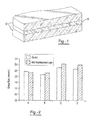
- Fig. 1 shows a composite laminate having a reinforcement layer 10 and a structural foam layers 12 located on both surfaces of the reinforcement layer.
- the reinforcement layer provides a support mechanism for the structural foam material whereby a bond is formed between the reinforcement layer and the structural foam so that load transfer occurs from the structural foam to the reinforcement layer.
- the surface tensions of both the reinforcement layer and the structural foam may be similar (e.g., matched) so that the bond between the reinforcement layer and structural foam is strengthened.
- the strengthened bond between the reinforcement layer and the structural foam results in the laminate having one or more of improved peel strength, improved tensile properties, improved lap shear properties, improved compression properties, increased vertical rise, and improved flexural properties.
- the bond between the reinforcement layer and structural foam may be formed by a variety of processes.
- the surface tension of the reinforcement layer and the surface tension of the structural foam may be matched so that bonding between the reinforcement layer and structural foam is improved. Improved bonding is observed as ease of wetting increases.
- the exceptional mechanical and structural properties exhibited by the present invention require increased adhesion of the structural foam to the reinforcement layer so that load placed on the resulting composite laminate can be transferred from the adhesive to the reinforcement layer to support part of or substantially all of the load.
- one technique relied upon to ensure improved adhesion is through matching the surface tensions of the adhesive and the reinforcement layer so that wetting is improved.
- the surface tension of both the reinforcement layer and the structural foam may be at least about 35 dynes/cm.
- the surface tension of both the reinforcement layer and structural foam may be less than about 80 dynes/cm.
- the reinforcement layer may be treated to increase its surface tension. Even when the surface tension of the reinforcement layer is at or above 35 dynes/cm, the reinforcement layer may still be treated to modify its surface tension to match the surface tension of the structural foam.
- the structural foam may include an epoxy resin that provides for a surface tension of about 47 dynes/cm.
- the reinforcement layer has a surface tension of at least about 38 dynes/cm, but preferably at least about 42 dynes/cm, or greater.
- the structural foam preferably includes an epoxy resin.
- Epoxy resin is used herein to mean any of the conventional dimeric, oligomeric or polymeric epoxy materials containing at least one epoxy functional group.
- the epoxy resin may be a bisphenol-A epoxy resin.
- the epoxy resin may comprise from about 2% to about 80% by weight of the structural foam.
- the epoxy resin may comprise from about 10% to about 30% by weight of the structural foam.
- the epoxy resin may comprise at least about 10% by weight of the structural foam.
- the epoxy resin may comprise less than about 30% by weight of the structural foam.
- the epoxy resin may be a liquid or a solid epoxy resin or may be a combination of liquid and solid epoxy resins.
- the structural foam may also include an epoxy/elastomer adduct. More specifically, the adduct is composed substantially entirely (i.e., at least 70%, 80%, 90% or more) of one or more adducts that are solid at a temperature of 23 °C.
- the adduct may comprise from about 5% to about 80% by weight of the structural foam.
- the adduct may comprise at least about 5% by weight of the structural foam.
- the adduct may comprise at least about 10% by weight of the structural foam.
- the adduct may comprise less than about 70% by weight of the structural foam.
- the adduct may comprise less than about 30% by weight of the structural foam.
- the adduct itself generally includes about 1:5 to 5:1 parts of epoxy to elastomer, and more preferably about 1:3 to 3:1 parts or epoxy to elastomer.
- exemplary elastomers include, without limitation, natural rubber, styrene-butadiene rubber, polyisoprene, polyisobutylene, polybutadiene, isoprene-butadiene copolymer, neoprene, nitrile rubber (e.g., a butyl nitrile, such as carboxy-terminated butyl nitrile (CTBN)), butyl rubber, polysulfide elastomer, acrylic elastomer, acrylonitrile elastomers, silicone rubber, polysiloxanes, polyester rubber, diisocyanate-linked condensation elastomer, EPDM (ethylene-propylene diene rubbers), chlorosulphonated polyethylene, fluorinated hydrocarbons and the like.
- the structural foam may include from about 5% to about 20% by weight CTBN/epoxy adduct.
- the structural foam may also include an impact modifier.
- the impact modifier may comprise at least about 4% by weight of the structural foam.
- the impact modifier may comprise at least about 10% by weight of the structural foam.
- the impact modifier may comprise at least about 17% by weight of the structural foam.
- the impact modifier may comprise less than about 40% by weight of the structural foam.
- the impact modifier may comprise from about 2% to about 60% by weight of the structural foam.
- the impact modifier may include at least one core/shell polymer.
- core/shell polymer describes an impact modifier wherein a substantial portion (e.g., greater than 30%, 50%, 70% or more by weight) thereof is comprised of a first polymeric material (i.e., the first or core material) that is substantially entirely encapsulated by a second polymeric material (i.e., the second or shell material).
- first and second polymeric materials can be comprised of one, two, three or more polymers that are combined and/or reacted together (e.g., sequentially polymerized) or may be part of separate or same core/shell systems.
- the first polymeric material, the second polymeric material or both of the core/shell impact modifier include or are substantially entirely composed of (e.g., at least 70%, 80%, 90% or more by weight) one or more thermoplastics.
- Exemplary thermoplastics include, without limitation, styrenics, acrylonitriles, acrylates, acetates, polyamides, polyethylenes or the like. It may be desirable for the glass transition temperature of the first or core polymeric material to be below 23 °C while the glass temperature of the second or shell polymeric material to be above 23 °C, although not required.
- useful core-shell graft copolymers are those where hard containing compounds, such as styrene, acrylonitrile or methyl methacrylate, are grafted onto cores made from polymers of soft or elastomeric containing compounds such as butadiene or butyl acrylate.
- hard containing compounds such as styrene, acrylonitrile or methyl methacrylate
- cores made from polymers of soft or elastomeric containing compounds such as butadiene or butyl acrylate.
- U.S. Pat. No. 3,985,703 which is herein incorporated by reference, describes useful core-shell polymers, the cores of which are made from butyl acrylate but can be based on ethyl isobutyl, 2-ethylhexel or other alkyl acrylates or mixtures thereof.
- the core polymer may also include other copolymerizable containing compounds, such as styrene, vinyl acetate, methyl methacrylate, butadiene, isoprene, or the like.
- the shell portion may be polymerized from methyl methacrylate and optionally other alkyl methacrylates, such as ethyl, butyl, or mixtures thereof methacrylates.
- core-shell graft copolymers include, but are not limited to, "MBS" (methacrylate-butadiene-styrene) polymers, which are made by polymerizing methyl methacrylate in the presence of polybutadiene or a polybutadiene copolymer rubber.
- the MBS graft copolymer resin generally has a styrene butadiene rubber core and a shell of acrylic polymer or copolymer.
- core-shell graft copolymer resins include, ABS (acrylonitrile-butadiene-styrene), MABS (methacrylate-acrylonitrile-butadiene-styrene), ASA (acrylate-styrene-acrylonitrile), all acrylics, SA EPDM (styrene-acrylonitrile grafted onto elastomeric backbones of ethylene-propylene diene monomer), MAS (methacrylic-acrylic rubber styrene), and the like and mixtures thereof.
- the structural foam may also include one or more additional polymer and/or copolymer materials, such as thermoplastics, elastomers, plastomers, combinations thereof or the like.
- Polymers that might be appropriately incorporated into the structural foam include halogenated polymers, polycarbonates, polyketones, urethanes, polyesters, silanes, sulfones, allyls, olefins, styrenes, acrylates, methacrylates, epoxies, silicones, phenolics, rubbers, polyphenylene oxides, terphthalates, acetates (e.g., EVA), acrylates, methacrylates (e.g., ethylene methyl acrylate polymer) or mixtures thereof.
- EVA e.g., EVA
- polystyrene may be or may include, without limitation, polyolefin (e.g., polyethylene, polypropylene) polystyrene, polyacrylate, poly(ethylene oxide), poly(ethyleneimine), polyester. polyurethane, polysiloxane, polyether, polyphosphazine, polyamide, polyimide, polyisobutylene, polyacrylonitrile, poly(vinyl chloride), poly(methyl methacrylate), poly(vinyl acetate), poly(vinylidene chloride), polytetrafluoroethylene, polyisoprene, polyacrylamide, polyacrylic acid, polymethacrylate.
- polyolefin e.g., polyethylene, polypropylene
- polystyrene polyacrylate
- poly(ethyleneimine) poly(ethyleneimine)
- polyester polyurethane, polysiloxane, polyether, polyphosphazine, polyamide, polyimide, polyisobuty
- the structural foam may include at least about 2% but less than about 15% of a thermoplastic polyether.
- the structural foam may include at least about 10% by weight polyvinyl chloride.
- the structural foam may include less than about 30% by weight polyvinyl chloride.
- the structural foam may include at least about 0.1% by weight and less than about 5% by weight polyethylene oxide.
- the structural foam may include at least about 1% by weight of an ethylene copolymer (which may be and EVA or EMA copolymer).
- the structural foam may include at least about 15% by weight of an ethylene copolymer.
- the structural foam may include less than about 40% by weight of an ethylene copolymer.
- the structural foam may include at least about 5% by weight acrylonitrile.
- the structural foam may include at least about 20% by weight acrylonitrile.
- the structural foam may include less than about 50% by weight acrylonitrile.
- the structural foam may also include a variety of blowing agents, curing agents and fillers.
- suitable blowing agents include azodicarbonamide, dinitrosopentamethylenetetramine, 4,4 i -oxy-bis-(benzenesulphonylhydrazide), trihydrazinotriazine and N, N i -dimethyl-N,N i -dinitrosoterephthalamide.
- An accelerator for the blowing agents may also be provided in the activatable material. Various accelerators may be used to increase the rate at which the blowing agents form inert gasses.
- One preferred blowing agent accelerator is a metal salt, or is an oxide, e.g. a metal oxide, such as zinc oxide.
- Other preferred accelerators include modified and unmodified thiazoles or imidazoles.
- Suitable curing agents include materials selected from aliphatic or aromatic amines or their respective adducts, amidoamines, polyamides, cycloaliphatic amines, anhydrides, polycarboxylic polyesters, isocyanates, phenol-based resins (e.g., phenol or cresol novolak resins, copolymers such as those of phenol terpene, polyvinyl phenol, or bisphenol-A formaldehyde copolymers, bishydroxyphenyl alkanes or the like), or mixtures thereof.
- phenol-based resins e.g., phenol or cresol novolak resins, copolymers such as those of phenol terpene, polyvinyl phenol, or bisphenol-A formaldehyde copolymers, bishydroxyphenyl alkanes or the like
- Particular preferred curing agents include modified and unmodified polyamines or polyamides such as triethylenetetramine, diethylenetriamine tetraethylenepentamine, cyanoguanidine, dicyandiamides and the like.
- An accelerator for the curing agents e.g., a modified or unmodified urea such as methylene diphenyl bis urea, an imidazole or a combination thereof
- a modified or unmodified urea such as methylene diphenyl bis urea, an imidazole or a combination thereof
- suitable fillers include silica, diatomaceous earth, glass, clay (e.g., including nanoclay), talc, pigments, colorants, glass beads or bubbles, glass, carbon or ceramic fibers, nylon or polyamide fibers (e.g., Kevlar), antioxidants, and the like.
- Such fillers, particularly clays can assist the activatable material in leveling itself during flow of the material.
- the clays that may be used as fillers may include clays from the kaolinite, illite, chloritem, smecitite or sepiolite groups, which may be calcined.
- suitable fillers include, without limitation, talc, vermiculite, pyrophyllite, sauconite, saponite, nontronite, montmorillonite or mixtures thereof.
- the clays may also include minor amounts of other ingredients such as carbonates, feldspars, micas and quartz.
- the fillers may also include ammonium chlorides such as dimethyl ammonium chloride and dimethyl benzyl ammonium chloride. Titanium dioxide might also be employed.
- One or more mineral or stone type fillers such as calcium carbonate, sodium carbonate or the like may be used as fillers.
- silicate minerals such as mica may be used as fillers.
- the filler includes a material that is generally non-reactive with the other components present in the activatable material. While the fillers may generally be present within the activatable material to take up space at a relatively low weight, it is contemplated that the fillers may also impart properties such as strength and impact resistance to the activatable material.
- Examples of materials that may be included as the structural foam include those disclosed in U.S. Patent Nos. 7,892,396 and 7,125,461 ; and U.S. Application Nos. 2004/0204551 ; 2007/0090560 ; 2007/0101679 ; 2008/0060742 ; and 2009/0269547 , which are incorporated by reference herein for all purposes.
- the reinforcement layer includes any substantially solid material having the requisite capability to bond to the structural foam.
- the surface tension of the reinforcement layer is preferably at or above 35 dynes/cm and is also matched (e.g., similar to) the surface tension of the structural foam. Materials having surface tensions below this threshold (or considerably higher than that of the structural foam) may also be utilized as the reinforcement layer, but must first be treated to modify the surface tension of the material.
- Polymeric materials may be used as the reinforcement layer. Certain polymeric materials have surface tension values that correspond with the surface tension of the epoxy-based materials generally utilized for the structural foam. Examples of polymeric materials that may be used as the reinforcement layer (with no treatment steps to modify surface tension) may include, but are not limited to acetals (about 47 dynes/cm), acrylics (about 41 dynes/cm), polyamides (about 41 dynes/cm), polycarbonates (about 46 dynes/cm), thermoplastic or cured thermoset epoxies (about 46 dynes/cm), polyethylene terephthalate (about 43 dynes/cm), polyimides (about 40 dynes/cm), polysulfones (about 41 dynes/cm), polyvinyl chlorides (about 39 dynes/cm) and phenolics (about 52 dynes/cm). Polyamides and polyethylene terephthalate (PET film) are two preferred materials for the reinforcement
- the reinforcement layer may include metal materials such as aluminum, steel, magnesium, tin, iron, nickel, copper, titanium or the like.
- the reinforcement layer may be a combination of different metal materials.
- Three common methods for modifying the surface tension of a substrate are: (1) applying a liquid primer (including the use of strong acids and/or bases); (2) corona discharge; and (3) flaming with a petroleum based gas and air mixture. These methods typically succeed by oxidizing the surface of the substrate, thus raising its surface tension.
- Covalent bonding occurs via a chemical reaction between the reinforcement layer and structural foam.
- the composite laminate may require exposure to elevated temperatures (e.g., temperatures exceeding 150°C) in order for the covalent bonds to form.
- elevated temperatures e.g., temperatures exceeding 150°C
- temperatures are not typically elevated to levels required for covalent bonds to form.
- the covalent bonds may form during a vehicle paint bake cycle when a vehicle is exposed to such elevated temperatures.
- the structural foam itself is a multicomponent compound whose active ingredients include epoxy resins of various molecular weights.
- the epoxy resins may be based on diglycidyl ether of bisphenol A (DGBA) and their general chemical structure can be represented by:
- the functional components of the epoxy resins are the epoxide group (e.g., an oxirane ring), which reside at the ends of the epoxy resin molecules.
- Epoxy resins residing in the structural foam adhesive have epoxy equivalent weights in the range of 170 to 6000 g/eq, but more likely in the range of 170 to 2000 g/eq and most ideally in the range of 180 to 1000 g/eq. Therefore, in order to form a bond between a structural foam and the reinforcement layer, the reinforcement layer must contain chemical functional groups which will react with epoxy resins. Examples of chemical functional groups which will react with epoxides include hydroxyl, carboxylic acid, amine, isocyanate and anhydride groups. Many thermoplastics contain one or more of these groups, especially if they have been constructed through condensation polymerizations. Examples of condensation thermoplastics are polyamides, polyesters, polycarbonates and polyurethanes.
- the reinforcement layer may comprise a thermoplastic film that contains the chemical functional group which may result in covalent chemical bonds following a final bake cycle of the composite laminate.
- Films available commercially are commonly made from condensation polymers, such as polyesters (e.g. Mylar), polyamides (Nylons) and polycarbonates.
- polyester/epoxy bond may be formed.
- the composite laminate's reinforcing layer is a polyester such as polyethylene terephthalate
- chemical reactions necessary to form the covalent bonds may take place upon exposure to elevated temperatures.
- polyester resins are high molecular weight condensation polymers which are chain terminated with both carboxylic acid and alcohol chemical functionality.
- polyesters that are commonly converted in to film are polyethylene terephthalate (PET) and polybutylene terephthalate (PBT). In both cases the polymers are end-capped with both an alcohol and carboxylic acid.
- PET polyethylene terephthalate
- PBT polybutylene terephthalate
- the reaction of the epoxide group with a carboxylic acid on the end of a polyester, such as polyethylene terephthalate (shown below as “PET”) proceeds via:
- the reaction of the epoxide group with an alcohol on the end of a polyester, such as polyethylene terephthalate (shown below as "PET”) proceeds via:
- the composite laminate's reinforcing layer may be a polyamide (PA), (e.g., Nylon (polyamide-6 (PA-6)) and thus may result in an epoxide/polyamide reaction.
- PA polyamide
- polyamides are high molecular weight condensation polymers which are chain terminated with both carboxylic acid and primary amine chemical functionality. These polymers are often end-capped with both a primary amine and carboxylic acid.
- the reaction of an epoxide group with a carboxylic acid on the end of a polyamide such as PA-6 proceeds in the same manner as shown above for the polyester.
- the reaction of an epoxide group with a primary amine of a polyamide proceeds according to:
- the improved bond between the reinforcement layer and structural foam results in improved characteristics that include an increased vertical rise during expansion of the structural foam.
- Vertical rise is defined as the thickness of the structural foam upon expansion as compared to the thickness of the structural foam prior to expansion.
- the reinforcement layer acts to restrict the lateral expansion of the structural foam which results in more controlled expansion direction and increased vertical rise.
- An increase in the vertical rise coupled with controlled expansion improves the reinforcing capability of the composite laminate by providing more precise contact of the structural foam with a cavity wall and increasing the density of the structural foam upon expansion.
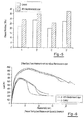
- Fig. 2 includes a graphic representation of the vertical rise of structural foams A, B, C, and D shown both with and without a reinforcement layer.
- the improved bond between the reinforcement layer and structural foam also results in improved lap shear strength when comparing structural foams without a reinforcement layer to those including a reinforcement layer.
- Increased lap shear strength results in improved reinforcing capabilities by increasing the overall strength of the composite laminate.
- Lap shear strength of structural foams is generally directly related to volume expansion, such that lower foam density (higher expansion) results in lower lap shear strength, and to bond-line, such that smaller bond lines lead to higher lap shear strengths.
- the bond-line can be defined as the bonding gap or the distance between two surfaces that an adhesive is bonding together.
- Fig. 3 includes a graphic representation of the lap shear stress of structural foams A, B, C, and D shown with and without a reinforcement layer.
- Table 2 below includes numerical results for vertical rise and lap shear stress.
- Table 2 Material Vertical Rise Lap Shear Stress ctrl w/ reinf. ctrl w/ reinf.
- the improved bond between the reinforcement layer and structural foam also results in improved flexural strength and flexural modulus when comparing structural foams without a reinforcement layer to those including a reinforcement layer.
- Flexural strength and modulus was measured according to ASTM D790, using a 3-point bend testing mode.
- Figures 4 and 5 include graphic representations of the flexural strength and flexural modulus, respectively, of structural foams A, B, C, and D shown with and without a reinforcement layer.
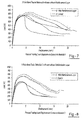
- Figures 6-9 include graphic representations of the flexural testing load displacement curves for structural foams A ( figure 6 ), B ( figure 7 ), C ( figure 8 ) and D ( figure 9 ), shown both with and without a reinforcement layer.
- the composite laminates are fabricated by locating a 0.18 mm thick polyethylene terephthalate film between two pieces of epoxy-based expandable structural foam.
- This epoxy-based expandable structural foam is disclosed in US Patent No. 7,892,396 .
- the resulting sandwich structure is compressed in a hot press at 82°C(180°F) for 2 to 3 minutes such that the film forms a middle layer of the composite laminate and the final thickness of the total structure is about 3 mm.
- Table 3 provides a comparison of two epoxy-based expandable structural foam properties in the neat state (e.g., with no reinforcement layer) and as a composite laminate, using polyester terephthalate film. All properties listed are for materials in the post-activation state.
- Table 3 shows that the relative vertical rise of the composite laminate of this invention is higher than that of the neat material.
- the reinforcing layer constrains the lateral (horizontal or in-plane) movement of the activated material, resulting in the expansion to be directed perpendicular to the plane or axis of the reinforcing layer.
- Lap shear strength is measured according to ASTM D1002, using a 3 mm bond line and an EG-60 metal substrate. Table 3 shows greater lap shear strength for the composite structures than the neat epoxy-resin adhesive. The reinforcing layer effectively reduces the apparent bond line, resulting in higher lap shear strengths.
- Flexural testing is accomplished according to ASTM D790, using a 3-point bend testing mode.
- the test specimens were constructed using a sandwich configuration.
- the top and bottom substrates were 0.762 mm (0.030") thick EG60 steel with dimensions of 2.54 cm x 15.24 cm (1" x 6") Structural foam filled the middle, giving a total thickness (foam and steel) of 6 mm.
- Table 3 shows greater flexural strength and modulus for the composite laminate samples than the neat epoxy-resin adhesive.
- Tensile testing was conducted in the spirit of ASTM D638, using a JISK 6301-1-MET dog bone configuration at 10 mm wide, 3 mm thick and tested at a speed of 5mm/min.
- the test specimens were constructed by expanding the foam between two release surfaces with 3 mm spacers and then die cutting the tensile bars while the samples were still warm.
- Samples containing the PET film have the film orientated in the plane of the sample so that under tension the film is being stretched along with the rest of the sample.
- Table 3 shows greater tensile strength and modulus for the composite laminate samples than the neat epoxy-resin adhesive.
- composite structural laminates are fabricated by pressing a 0.18 mm thick polyethylene terephthalate film between to pieces of epoxy-based expandable structural foam.
- An example of this epoxy-based expandable structural foam is similar to the activatable material disclosed in US Patent No. 7,892,396 , except for the absence of a core/shell polymer impact modifier.
- the sandwich structure is compressed in a hot press at 82°C (180°F) for 2 to 3 minutes such that the film is essentially in the middle of the structure and the final thickness of the total structure is about 3 mm.
- Table 4 provides a comparison of an epoxy-based expandable structural foam property in the neat state (with no reinforcement) and as a composite laminate, using polyester terephthalate film. All properties listed are for materials in the post-activation state.
- TABLE 4 Material D no reinforcement w/reinforcement Vertical Rise 2.66 3.02 Lap Shear (MPa) 2.99 3.67 Flex Strength (MPa) 111.9 156.2 Flex Modulus (GPa) 27.1 37.3 Tensile Stress (MPa) 5.6 10.0 Tensile Modulus (MPa) 998 1152
- Structural foam materials formed in accordance to the present invention have also exhibited desirable post activation compression properties.
- structural foam materials of the present invention were foamed to form samples that were then tested according to a method that is based upon ASTM C39. While the method is described herein, it should be understood that any unspecified parameters will be in accordance with ASTM C39.
- the first sample was formed by foaming the neat (non-reinforced) epoxy based foam material in cylinders or cylinder cups followed by removing excess foam that extends out of the cylinders or cups (e.g., by cutting away foam that extends out of the cylinders or cups).
- the second sample was constructed by cutting discs from a flat composite laminate sample and stacking them in a cylinder or cylinder cup such that the plane of the PET reinforcing layers are perpendicular to the axis of the cylinder.
- This sample was then finished by foaming the layered composite laminate in the cylinders or cylinder cups followed by removing excess foam that extends out of the cylinders or cups (e.g., by cutting away foam that extends out of the cylinders or cups).
- the third sample was constructed by rolling a flat composite laminate sample and sliding them in a cylinder or cylinder cup such that the plane of the PET reinforcing layers are parallel to the axis of the cylinder.
- This sample was then finished by foaming the layered composite laminate in the cylinders or cylinder cups followed by removing excess foam that extends out of the cylinders or cups (e.g., by cutting away foam that extends out of the cylinders or cups).
- test samples are typically foamed to a volume that is less than 1000%, more typically less than 750% and even more typically less than 500% relative to the original volume of the structural foam material prior to foaming. This is done to form cylindrical samples that are 60 mm in height and 30 mm in diameter. The cylinder samples are then tested according to ASTM C39.
- Table 5 provides a comparison of cylinder compression properties of an epoxy-based expandable structural foam in the neat state and composite structural laminates where the PET film resides in stacked layers perpendicular to the cylinder axis and parallel to the cylinder axis. All properties listed are for materials in the post-activation state.
- MPa Peak Compression Stress
- MPa Compression Modulus
- Table 5 shows that the orientation of the film has a large effect on the compression properties of the sample, and in every instance compression of the composite laminate sample is greater than the neat sample.
- an activatable composite laminate according to the present invention may be employed as a structural adhesive material.
- the composite material is typically activated and cured (e.g., at temperatures common to e-coat or automotive painting operations) to adhere to a first member and a second member. Contact with attachment surface of the first member and the second member may occur prior to or during activation and curing of the material.
- Examples of structural adhesive applications are disclosed in US Patent Nos. 6,887,914 and 6,846,559 ; and US Patent Publication No. 2004/0204551 , all of which are incorporated herein by reference for all purposes.
- one or more fasteners or adhesives may be attached to the composite laminate for attachment to a cavity wall or other location within a cavity.
- the fasteners may be mechanical fasteners and may include but are not limited to push-pins, tree fasteners, hinges, screws, a mechanical interlock, integral locks, a male feature, a female feature or any combination thereof.
- the composite laminate may include one push pin on each opposing end of the composite laminate.
- the ease of manufacture associated with the composite laminates make them easily customized to any shape or size required for a given cavity.
- the composite laminates may be co-extruded and then easily modified (e.g., die-cut, sliced). They can be modified prior to distribution to a customer or on on-site during assembly of the composite laminate within a cavity.
- the scope of the invention should, therefore, be determined not with reference to the above description, but should instead be determined with reference to the appended claims, along with the full scope of equivalents to which such claims are entitled.
Landscapes
- Chemical & Material Sciences (AREA)
- Engineering & Computer Science (AREA)
- Mechanical Engineering (AREA)
- Structural Engineering (AREA)
- Combustion & Propulsion (AREA)
- Transportation (AREA)
- Architecture (AREA)
- Materials Engineering (AREA)
- Health & Medical Sciences (AREA)
- Chemical Kinetics & Catalysis (AREA)
- Medicinal Chemistry (AREA)
- Polymers & Plastics (AREA)
- Organic Chemistry (AREA)
- Laminated Bodies (AREA)
Description
- The present invention relates generally to laminate structures for sealing, baffling and structural reinforcement. More specifically, the present invention relates to laminate structures including structural foam and carrier materials.
- Structural reinforcement of vehicle cavities is commonly achieved by molding polymeric carriers into specific shapes that reflect the contours of the cavity requiring reinforcement, and locating expandable foam materials onto certain surfaces of the carriers. Thus, each carrier must be customized to a particular shape which requires the formation and use of multiple molds and further requires injection molding processes that are both time-consuming and costly. Many carriers require overmolding or multi-shot injection molding in order be formed in the correct shape and with sufficient density for reinforcing purposes. In attempts to reduce the cost and effort associated with manufacture of the carriers, attempts have been made to provide expandable foam materials without the inclusion of a carrier, as structural foams. The benefit is that that the size and shape of the structural foam can be quickly modified and customized to any necessary shape. Unfortunately, without a carrier, the strength of the reinforcement member that includes only the structural foam is reduced. Further, without a carrier it is difficult to control the expansion of the structural foam. It is thus desirable to provide a reinforcing structure that has the customization benefits of a structural foam alone, but still provides the requisite strength for cavity reinforcement. It is further desirable that the carrier add minimal weight and cost to the resulting structure, but still provide improved strength and reinforcement ability than would be realized from either the structural foam or the carrier alone.
- The present invention meets some or all of the above needs by providing a composite laminate structure having a reinforcement layer and structural foam so that the bond formed between the reinforcement layer and structural foam provides strength that exceeds that of the either the structural foam or reinforcement layer alone. The present invention is directed toward a method of forming a composite laminate for providing sealing, baffling or reinforcement to a structure by providing a reinforcement layer and locating an epoxy-based expandable structural foam thereon. The reinforcement layer may have a surface tension of at least about 35 dynes/cm. The surface tensions of the structural foam and reinforcement layer are within about 15 dynes/cm of one another. The surface tensions of the reinforcement layer and structural foam provide sufficient wetting for load transfer from the structural foam to the reinforcement layer to increase the tensile strength of the composite laminate and to increase the lap shear strength of the composite laminate.
- The present invention is further directed toward a composite laminate for providing sealing, baffling or reinforcement to a structure that includes a reinforcement layer and an epoxy-based expandable structural foam. The reinforcement layer may have a surface tension of at least about 35 dynes/cm. The epoxy-based expandable structural foam material is located onto the reinforcement layer to form the composite laminate. The surface tensions of the structural foam and reinforcement layer are within about 15 dynes/cm of one another so that adhesion between the structural foam and reinforcement layer is improved.
- The present invention is also directed toward a method of forming a composite laminate by providing a polymeric reinforcement layer and locating an epoxy-based expandable structural foam material onto the reinforcement layer by a co-extrusion process to form the composite laminate. The composite laminate is then exposed to a temperature greater than 150°C. The reinforcement layer has a surface tension of at least about 35 dynes/cm and may include at least one chemical functional group free to react, such as a carboxylic acid or a primary or secondary amine. The structural foam may include an epoxy resin, an epoxy/elastomer adduct including about 1:3 to 3:1 parts of epoxy to elastomer, and a core/shell polymer impact modifier. The epoxy resin may form a covalent bond with the reinforcement, such as with the carboxylic acid or amine of the reinforcement layer, upon exposure to temperatures greater than 150°C. The covalent bond allows for load transfer from the structural foam to the reinforcement layer to increase the tensile strength of the composite laminate.
- The composite laminate includes improved physical properties over existing structures and materials for use in the sealing, baffling and reinforcement of cavities. These improved physical properties may include but are not limited to increased vertical rise, improved lap shear strength, increased tensile and flexural properties and increased T-Peel strength as compared to the use of structural foams alone. The structures of the present invention may also have improved storage and transport stability and improved shelf-life. The structures disclosed herein may also allow for customization of the size, shape and foam expansion direction of the structures in that the carrier is easily manipulated. In addition, the presence of the carrier allows for improved control over the expansion of the structural foam as compared to uses of structural foam alone.
-
-
Fig. 1 is a cross-sectional view of an illustrative laminate structure in accordance with the present teachings. -
Fig. 2 shows a graphic representation of the vertical rise of structural foams A, B, C, and D shown with and without a reinforcement layer. -
Fig. 3 shows a graphic representation of the lap shear strength of structural foams A, B, C, and D shown with and without a reinforcement layer. -
Fig. 4 shows a graphic representation of the flexural strength of structural foams A, B, C, and D shown with and without a reinforcement layer. -
Fig. 5 shows a graphic representation of the flexural modulus of structural foams A, B, C, and D shown with and without a reinforcement layer. -
Fig. 6 shows a graphic representation of the flexural testing load displacement curves for structural foam A, shown with and without a reinforcement layer. -
Fig. 7 shows a graphic representation of the flexural testing load displacement curves for structural foam B, shown with and without a reinforcement layer. -
Fig. 8 shows a graphic representation of the flexural testing load displacement curves for structural foam C, shown with and without a reinforcement layer. -
Fig. 9 shows a graphic representation of the flexural testing load displacement curves for structural foam D, shown with and without a reinforcement layer. - In general, the teachings herein provide for a laminate structure that includes at least a reinforcement layer and a structural foam material located thereon. As an example,
Fig. 1 shows a composite laminate having areinforcement layer 10 and a structural foam layers 12 located on both surfaces of the reinforcement layer. The reinforcement layer provides a support mechanism for the structural foam material whereby a bond is formed between the reinforcement layer and the structural foam so that load transfer occurs from the structural foam to the reinforcement layer. The surface tensions of both the reinforcement layer and the structural foam may be similar (e.g., matched) so that the bond between the reinforcement layer and structural foam is strengthened. The strengthened bond between the reinforcement layer and the structural foam results in the laminate having one or more of improved peel strength, improved tensile properties, improved lap shear properties, improved compression properties, increased vertical rise, and improved flexural properties. - The bond between the reinforcement layer and structural foam may be formed by a variety of processes. As an example, the surface tension of the reinforcement layer and the surface tension of the structural foam may be matched so that bonding between the reinforcement layer and structural foam is improved. Improved bonding is observed as ease of wetting increases. The exceptional mechanical and structural properties exhibited by the present invention require increased adhesion of the structural foam to the reinforcement layer so that load placed on the resulting composite laminate can be transferred from the adhesive to the reinforcement layer to support part of or substantially all of the load. Thus, one technique relied upon to ensure improved adhesion is through matching the surface tensions of the adhesive and the reinforcement layer so that wetting is improved.
- In order to achieve the improved bond strength between the structural foam and reinforcement layer, the surface tension of both the reinforcement layer and the structural foam may be at least about 35 dynes/cm. The surface tension of both the reinforcement layer and structural foam may be less than about 80 dynes/cm. In the event that the surface tension of the reinforcement layer falls below 35 dynes/cm, the reinforcement layer may be treated to increase its surface tension. Even when the surface tension of the reinforcement layer is at or above 35 dynes/cm, the reinforcement layer may still be treated to modify its surface tension to match the surface tension of the structural foam. Methods for treating the reinforcement layer to modify its surface tension are described herein. As an example, the structural foam may include an epoxy resin that provides for a surface tension of about 47 dynes/cm. Thus, for improved bond strength with the structural foam, the reinforcement layer has a surface tension of at least about 38 dynes/cm, but preferably at least about 42 dynes/cm, or greater.
- The structural foam preferably includes an epoxy resin. Epoxy resin is used herein to mean any of the conventional dimeric, oligomeric or polymeric epoxy materials containing at least one epoxy functional group. The epoxy resin may be a bisphenol-A epoxy resin. The epoxy resin may comprise from about 2% to about 80% by weight of the structural foam. The epoxy resin may comprise from about 10% to about 30% by weight of the structural foam. The epoxy resin may comprise at least about 10% by weight of the structural foam. The epoxy resin may comprise less than about 30% by weight of the structural foam. The epoxy resin may be a liquid or a solid epoxy resin or may be a combination of liquid and solid epoxy resins.
- The structural foam may also include an epoxy/elastomer adduct. More specifically, the adduct is composed substantially entirely (i.e., at least 70%, 80%, 90% or more) of one or more adducts that are solid at a temperature of 23 °C. The adduct may comprise from about 5% to about 80% by weight of the structural foam. The adduct may comprise at least about 5% by weight of the structural foam. The adduct may comprise at least about 10% by weight of the structural foam. The adduct may comprise less than about 70% by weight of the structural foam. The adduct may comprise less than about 30% by weight of the structural foam. The adduct itself generally includes about 1:5 to 5:1 parts of epoxy to elastomer, and more preferably about 1:3 to 3:1 parts or epoxy to elastomer. Exemplary elastomers include, without limitation, natural rubber, styrene-butadiene rubber, polyisoprene, polyisobutylene, polybutadiene, isoprene-butadiene copolymer, neoprene, nitrile rubber (e.g., a butyl nitrile, such as carboxy-terminated butyl nitrile (CTBN)), butyl rubber, polysulfide elastomer, acrylic elastomer, acrylonitrile elastomers, silicone rubber, polysiloxanes, polyester rubber, diisocyanate-linked condensation elastomer, EPDM (ethylene-propylene diene rubbers), chlorosulphonated polyethylene, fluorinated hydrocarbons and the like. Examples of additional or alternative epoxy/elastomer or other adducts suitable for use in the present invention are disclosed in
U.S. Patent Publication 2004/0204551 , which is incorporated herein by reference for all purposes. As a specific example, the structural foam may include from about 5% to about 20% by weight CTBN/epoxy adduct. - The structural foam may also include an impact modifier. The impact modifier may comprise at least about 4% by weight of the structural foam. The impact modifier may comprise at least about 10% by weight of the structural foam. The impact modifier may comprise at least about 17% by weight of the structural foam. The impact modifier may comprise less than about 40% by weight of the structural foam. The impact modifier may comprise from about 2% to about 60% by weight of the structural foam.
- The impact modifier may include at least one core/shell polymer. As used herein, the term core/shell polymer describes an impact modifier wherein a substantial portion (e.g., greater than 30%, 50%, 70% or more by weight) thereof is comprised of a first polymeric material (i.e., the first or core material) that is substantially entirely encapsulated by a second polymeric material (i.e., the second or shell material). The first and second polymeric materials, as used herein, can be comprised of one, two, three or more polymers that are combined and/or reacted together (e.g., sequentially polymerized) or may be part of separate or same core/shell systems. The first polymeric material, the second polymeric material or both of the core/shell impact modifier include or are substantially entirely composed of (e.g., at least 70%, 80%, 90% or more by weight) one or more thermoplastics. Exemplary thermoplastics include, without limitation, styrenics, acrylonitriles, acrylates, acetates, polyamides, polyethylenes or the like. It may be desirable for the glass transition temperature of the first or core polymeric material to be below 23 °C while the glass temperature of the second or shell polymeric material to be above 23 °C, although not required.
- Examples of useful core-shell graft copolymers are those where hard containing compounds, such as styrene, acrylonitrile or methyl methacrylate, are grafted onto cores made from polymers of soft or elastomeric containing compounds such as butadiene or butyl acrylate.
U.S. Pat. No. 3,985,703 , which is herein incorporated by reference, describes useful core-shell polymers, the cores of which are made from butyl acrylate but can be based on ethyl isobutyl, 2-ethylhexel or other alkyl acrylates or mixtures thereof. The core polymer, may also include other copolymerizable containing compounds, such as styrene, vinyl acetate, methyl methacrylate, butadiene, isoprene, or the like. The shell portion may be polymerized from methyl methacrylate and optionally other alkyl methacrylates, such as ethyl, butyl, or mixtures thereof methacrylates. Examples of core-shell graft copolymers include, but are not limited to, "MBS" (methacrylate-butadiene-styrene) polymers, which are made by polymerizing methyl methacrylate in the presence of polybutadiene or a polybutadiene copolymer rubber. The MBS graft copolymer resin generally has a styrene butadiene rubber core and a shell of acrylic polymer or copolymer. Examples of other useful core-shell graft copolymer resins include, ABS (acrylonitrile-butadiene-styrene), MABS (methacrylate-acrylonitrile-butadiene-styrene), ASA (acrylate-styrene-acrylonitrile), all acrylics, SA EPDM (styrene-acrylonitrile grafted onto elastomeric backbones of ethylene-propylene diene monomer), MAS (methacrylic-acrylic rubber styrene), and the like and mixtures thereof. - The structural foam may also include one or more additional polymer and/or copolymer materials, such as thermoplastics, elastomers, plastomers, combinations thereof or the like. Polymers that might be appropriately incorporated into the structural foam include halogenated polymers, polycarbonates, polyketones, urethanes, polyesters, silanes, sulfones, allyls, olefins, styrenes, acrylates, methacrylates, epoxies, silicones, phenolics, rubbers, polyphenylene oxides, terphthalates, acetates (e.g., EVA), acrylates, methacrylates (e.g., ethylene methyl acrylate polymer) or mixtures thereof. Other potential polymeric materials may be or may include, without limitation, polyolefin (e.g., polyethylene, polypropylene) polystyrene, polyacrylate, poly(ethylene oxide), poly(ethyleneimine), polyester. polyurethane, polysiloxane, polyether, polyphosphazine, polyamide, polyimide, polyisobutylene, polyacrylonitrile, poly(vinyl chloride), poly(methyl methacrylate), poly(vinyl acetate), poly(vinylidene chloride), polytetrafluoroethylene, polyisoprene, polyacrylamide, polyacrylic acid, polymethacrylate.
- As a specific example, the structural foam may include at least about 2% but less than about 15% of a thermoplastic polyether. The structural foam may include at least about 10% by weight polyvinyl chloride. The structural foam may include less than about 30% by weight polyvinyl chloride. The structural foam may include at least about 0.1% by weight and less than about 5% by weight polyethylene oxide. The structural foam may include at least about 1% by weight of an ethylene copolymer (which may be and EVA or EMA copolymer). The structural foam may include at least about 15% by weight of an ethylene copolymer. The structural foam may include less than about 40% by weight of an ethylene copolymer. The structural foam may include at least about 5% by weight acrylonitrile. The structural foam may include at least about 20% by weight acrylonitrile. The structural foam may include less than about 50% by weight acrylonitrile.
- The structural foam may also include a variety of blowing agents, curing agents and fillers. Examples of suitable blowing agents include azodicarbonamide, dinitrosopentamethylenetetramine, 4,4i-oxy-bis-(benzenesulphonylhydrazide), trihydrazinotriazine and N, Ni-dimethyl-N,Ni-dinitrosoterephthalamide. An accelerator for the blowing agents may also be provided in the activatable material. Various accelerators may be used to increase the rate at which the blowing agents form inert gasses. One preferred blowing agent accelerator is a metal salt, or is an oxide, e.g. a metal oxide, such as zinc oxide. Other preferred accelerators include modified and unmodified thiazoles or imidazoles.
- Examples of suitable curing agents include materials selected from aliphatic or aromatic amines or their respective adducts, amidoamines, polyamides, cycloaliphatic amines, anhydrides, polycarboxylic polyesters, isocyanates, phenol-based resins (e.g., phenol or cresol novolak resins, copolymers such as those of phenol terpene, polyvinyl phenol, or bisphenol-A formaldehyde copolymers, bishydroxyphenyl alkanes or the like), or mixtures thereof. Particular preferred curing agents include modified and unmodified polyamines or polyamides such as triethylenetetramine, diethylenetriamine tetraethylenepentamine, cyanoguanidine, dicyandiamides and the like. An accelerator for the curing agents (e.g., a modified or unmodified urea such as methylene diphenyl bis urea, an imidazole or a combination thereof) may also be provided for preparing the structural foam.
- Examples of suitable fillers include silica, diatomaceous earth, glass, clay (e.g., including nanoclay), talc, pigments, colorants, glass beads or bubbles, glass, carbon or ceramic fibers, nylon or polyamide fibers (e.g., Kevlar), antioxidants, and the like. Such fillers, particularly clays, can assist the activatable material in leveling itself during flow of the material. The clays that may be used as fillers may include clays from the kaolinite, illite, chloritem, smecitite or sepiolite groups, which may be calcined. Examples of suitable fillers include, without limitation, talc, vermiculite, pyrophyllite, sauconite, saponite, nontronite, montmorillonite or mixtures thereof. The clays may also include minor amounts of other ingredients such as carbonates, feldspars, micas and quartz. The fillers may also include ammonium chlorides such as dimethyl ammonium chloride and dimethyl benzyl ammonium chloride. Titanium dioxide might also be employed. One or more mineral or stone type fillers such as calcium carbonate, sodium carbonate or the like may be used as fillers. In another preferred embodiment, silicate minerals such as mica may be used as fillers. Preferably the filler includes a material that is generally non-reactive with the other components present in the activatable material. While the fillers may generally be present within the activatable material to take up space at a relatively low weight, it is contemplated that the fillers may also impart properties such as strength and impact resistance to the activatable material.
- Examples of materials that may be included as the structural foam include those disclosed in
U.S. Patent Nos. 7,892,396 and7,125,461 ; andU.S. Application Nos. 2004/0204551 ;2007/0090560 ;2007/0101679 ;2008/0060742 ; and2009/0269547 , which are incorporated by reference herein for all purposes. - The reinforcement layer includes any substantially solid material having the requisite capability to bond to the structural foam. As previously mentioned, the surface tension of the reinforcement layer is preferably at or above 35 dynes/cm and is also matched (e.g., similar to) the surface tension of the structural foam. Materials having surface tensions below this threshold (or considerably higher than that of the structural foam) may also be utilized as the reinforcement layer, but must first be treated to modify the surface tension of the material.
- Polymeric materials may be used as the reinforcement layer. Certain polymeric materials have surface tension values that correspond with the surface tension of the epoxy-based materials generally utilized for the structural foam. Examples of polymeric materials that may be used as the reinforcement layer (with no treatment steps to modify surface tension) may include, but are not limited to acetals (about 47 dynes/cm), acrylics (about 41 dynes/cm), polyamides (about 41 dynes/cm), polycarbonates (about 46 dynes/cm), thermoplastic or cured thermoset epoxies (about 46 dynes/cm), polyethylene terephthalate (about 43 dynes/cm), polyimides (about 40 dynes/cm), polysulfones (about 41 dynes/cm), polyvinyl chlorides (about 39 dynes/cm) and phenolics (about 52 dynes/cm). Polyamides and polyethylene terephthalate (PET film) are two preferred materials for the reinforcement layer.
- The reinforcement layer may include metal materials such as aluminum, steel, magnesium, tin, iron, nickel, copper, titanium or the like. The reinforcement layer may be a combination of different metal materials.
- Those materials that have critical surface tensions which fall below 38 dynes/cm, may still be used as a reinforcement layer for this invention if they can be modified to meet the surface tension requirement. Three common methods for modifying the surface tension of a substrate are: (1) applying a liquid primer (including the use of strong acids and/or bases); (2) corona discharge; and (3) flaming with a petroleum based gas and air mixture. These methods typically succeed by oxidizing the surface of the substrate, thus raising its surface tension.
- Another mechanism that ensures improved adhesion between the structural foam and the reinforcement layer is covalent bonding. Covalent bonding occurs via a chemical reaction between the reinforcement layer and structural foam. The composite laminate may require exposure to elevated temperatures (e.g., temperatures exceeding 150°C) in order for the covalent bonds to form. Thus, during manufacture of the composite laminate (e.g., during a co-extrusion process), temperatures are not typically elevated to levels required for covalent bonds to form. However, the covalent bonds may form during a vehicle paint bake cycle when a vehicle is exposed to such elevated temperatures.
- In addition to appropriate time and temperature exposure, a chemical reaction leading to covalent bonds requires appropriate chemical matches between the structural foam and reinforcement layer. The structural foam itself is a multicomponent compound whose active ingredients include epoxy resins of various molecular weights. The epoxy resins may be based on diglycidyl ether of bisphenol A (DGBA) and their general chemical structure can be represented by:

- The functional components of the epoxy resins are the epoxide group (e.g., an oxirane ring), which reside at the ends of the epoxy resin molecules. Epoxy resins residing in the structural foam adhesive have epoxy equivalent weights in the range of 170 to 6000 g/eq, but more likely in the range of 170 to 2000 g/eq and most ideally in the range of 180 to 1000 g/eq. Therefore, in order to form a bond between a structural foam and the reinforcement layer, the reinforcement layer must contain chemical functional groups which will react with epoxy resins. Examples of chemical functional groups which will react with epoxides include hydroxyl, carboxylic acid, amine, isocyanate and anhydride groups. Many thermoplastics contain one or more of these groups, especially if they have been constructed through condensation polymerizations. Examples of condensation thermoplastics are polyamides, polyesters, polycarbonates and polyurethanes.
- The reinforcement layer may comprise a thermoplastic film that contains the chemical functional group which may result in covalent chemical bonds following a final bake cycle of the composite laminate. Films available commercially are commonly made from condensation polymers, such as polyesters (e.g. Mylar), polyamides (Nylons) and polycarbonates.
- In the event that a polyester film is utilized as the reinforcement layer, a polyester/epoxy bond may be formed. When the composite laminate's reinforcing layer is a polyester such as polyethylene terephthalate, chemical reactions necessary to form the covalent bonds may take place upon exposure to elevated temperatures. In general, polyester resins are high molecular weight condensation polymers which are chain terminated with both carboxylic acid and alcohol chemical functionality.
- As an example, polyesters that are commonly converted in to film are polyethylene terephthalate (PET) and polybutylene terephthalate (PBT). In both cases the polymers are end-capped with both an alcohol and carboxylic acid. The reaction of the epoxide group with a carboxylic acid on the end of a polyester, such as polyethylene terephthalate (shown below as "PET"), proceeds via:


- Similar to the epoxide/polyester reactions shown above, the composite laminate's reinforcing layer may be a polyamide (PA), (e.g., Nylon (polyamide-6 (PA-6)) and thus may result in an epoxide/polyamide reaction. Generally, polyamides are high molecular weight condensation polymers which are chain terminated with both carboxylic acid and primary amine chemical functionality. These polymers are often end-capped with both a primary amine and carboxylic acid. The reaction of an epoxide group with a carboxylic acid on the end of a polyamide such as PA-6, proceeds in the same manner as shown above for the polyester. The reaction of an epoxide group with a primary amine of a polyamide (shown below as "PA") proceeds according to:

- In both of the epoxide/polyester and epoxide/polyamide reactions shown above, a covalent bond is formed between the epoxy of the structural foam and the carboxylic acid, alcohol, or amine of the reinforcement layer. The resulting composite laminate exhibits the improved physical characteristics identified herein based upon the strength of the bond between the reinforcement layer and structural foam. The increased bond strength between the reinforcement layer and structural foam results in a number of improved physical characteristics of the composite laminate. Data depicting those improvements is shown below. Various examples of structural foams have been utilized to obtain the data, those structural foams being identified as having the compositions shown at Table 1.
Table 1 Wt.% Ingredient A B C D Epoxy/Elastomer Adduct 15.70 15.58 15.58 14.71 Epoxidized Ethylene Copolymer 1.95 1.93 1.93 1.74 Ethylene Methacrylate 1.95 1.93 1.93 8.03 Filler 43.1 46.56 43.09 50.93 Epoxy Resins (solid-liquid mixture) 17.05 14.21 16.71 9.00 Multifunctional Phenolic Novalac Epoxy Resin 2.93 2.94 2.94 3.59 Curing Agent and/or Accelerator 2.20 2.06 2.27 3.23 Impact Modifier 14.1 13.98 13.98 7.36 Blowing Agent 0.88 0.65 1.53 1.21 Pigment 0.15 0.15 0.025 0.2 - The improved bond between the reinforcement layer and structural foam results in improved characteristics that include an increased vertical rise during expansion of the structural foam. Vertical rise is defined as the thickness of the structural foam upon expansion as compared to the thickness of the structural foam prior to expansion. The reinforcement layer acts to restrict the lateral expansion of the structural foam which results in more controlled expansion direction and increased vertical rise. An increase in the vertical rise coupled with controlled expansion improves the reinforcing capability of the composite laminate by providing more precise contact of the structural foam with a cavity wall and increasing the density of the structural foam upon expansion.
Fig. 2 includes a graphic representation of the vertical rise of structural foams A, B, C, and D shown both with and without a reinforcement layer. - The improved bond between the reinforcement layer and structural foam also results in improved lap shear strength when comparing structural foams without a reinforcement layer to those including a reinforcement layer. Increased lap shear strength results in improved reinforcing capabilities by increasing the overall strength of the composite laminate. Lap shear strength of structural foams is generally directly related to volume expansion, such that lower foam density (higher expansion) results in lower lap shear strength, and to bond-line, such that smaller bond lines lead to higher lap shear strengths. The bond-line can be defined as the bonding gap or the distance between two surfaces that an adhesive is bonding together. The improvement in lap shear strength gained from the present invention over structural foams without a reinforcement layer can be attributed to an increase in foam density, but more significantly from the reinforcing layer effectively reducing the bond-line by half.
Fig. 3 includes a graphic representation of the lap shear stress of structural foams A, B, C, and D shown with and without a reinforcement layer. Table 2 below includes numerical results for vertical rise and lap shear stress.Table 2 Material Vertical Rise Lap Shear Stress ctrl w/ reinf. ctrl w/ reinf. mm/mm mm/mm MPa psi MPa psi A 2.42 2.34 4.32 627 5.33 773 B 2.16 2.34 3.68 534 5.03 730 C 2.77 3.10 2.97 431 4.21 611 D 2.66 3.02 2.99 434 3.67 532 - The improved bond between the reinforcement layer and structural foam also results in improved flexural strength and flexural modulus when comparing structural foams without a reinforcement layer to those including a reinforcement layer. Flexural strength and modulus was measured according to ASTM D790, using a 3-point bend testing mode.
Figures 4 and5 include graphic representations of the flexural strength and flexural modulus, respectively, of structural foams A, B, C, and D shown with and without a reinforcement layer. - The improved bond between the reinforcement layer and structural foam also results in improved energy absorption.
Figures 6-9 include graphic representations of the flexural testing load displacement curves for structural foams A (figure 6 ), B (figure 7 ), C (figure 8 ) and D (figure 9 ), shown both with and without a reinforcement layer. - In Examples I, II and III below, the composite laminates are fabricated by locating a 0.18 mm thick polyethylene terephthalate film between two pieces of epoxy-based expandable structural foam. One example of this epoxy-based expandable structural foam is disclosed in
US Patent No. 7,892,396 . The resulting sandwich structure is compressed in a hot press at 82°C(180°F) for 2 to 3 minutes such that the film forms a middle layer of the composite laminate and the final thickness of the total structure is about 3 mm. - Table 3 provides a comparison of two epoxy-based expandable structural foam properties in the neat state (e.g., with no reinforcement layer) and as a composite laminate, using polyester terephthalate film. All properties listed are for materials in the post-activation state.
- Table 3 shows that the relative vertical rise of the composite laminate of this invention is higher than that of the neat material. The reinforcing layer constrains the lateral (horizontal or in-plane) movement of the activated material, resulting in the expansion to be directed perpendicular to the plane or axis of the reinforcing layer.
- Lap shear strength is measured according to ASTM D1002, using a 3 mm bond line and an EG-60 metal substrate. Table 3 shows greater lap shear strength for the composite structures than the neat epoxy-resin adhesive. The reinforcing layer effectively reduces the apparent bond line, resulting in higher lap shear strengths.
- Flexural testing is accomplished according to ASTM D790, using a 3-point bend testing mode. The test specimens were constructed using a sandwich configuration. The top and bottom substrates were 0.762 mm (0.030") thick EG60 steel with dimensions of 2.54 cm x 15.24 cm (1" x 6") Structural foam filled the middle, giving a total thickness (foam and steel) of 6 mm. Table 3 shows greater flexural strength and modulus for the composite laminate samples than the neat epoxy-resin adhesive.
- Tensile testing was conducted in the spirit of ASTM D638, using a JISK 6301-1-MET dog bone configuration at 10 mm wide, 3 mm thick and tested at a speed of 5mm/min. The test specimens were constructed by expanding the foam between two release surfaces with 3 mm spacers and then die cutting the tensile bars while the samples were still warm. Samples containing the PET film have the film orientated in the plane of the sample so that under tension the film is being stretched along with the rest of the sample. Table 3 shows greater tensile strength and modulus for the composite laminate samples than the neat epoxy-resin adhesive.
TABLE 3 Material B Material C no reinforcement w/reinforcement no reinforcement w/reinforcement Vertical Rise 2.16 2.34 2.77 3.10 Lap Shear (MPa) 3.68 5.03 2.97 4.21 Flex Strength (MPa) 122.5 143.3 94.4 120.4 Flex Modulus (GPa) 28.1 34.2 19.4 25.1 Tensile Stress (MPa) 5.5 16.2 4.8 10.3 Tensile Modulus (MPa) 685 1318 655 1065 - In this example, composite structural laminates are fabricated by pressing a 0.18 mm thick polyethylene terephthalate film between to pieces of epoxy-based expandable structural foam. An example of this epoxy-based expandable structural foam is similar to the activatable material disclosed in
US Patent No. 7,892,396 , except for the absence of a core/shell polymer impact modifier. The sandwich structure is compressed in a hot press at 82°C (180°F) for 2 to 3 minutes such that the film is essentially in the middle of the structure and the final thickness of the total structure is about 3 mm. - Table 4 provides a comparison of an epoxy-based expandable structural foam property in the neat state (with no reinforcement) and as a composite laminate, using polyester terephthalate film. All properties listed are for materials in the post-activation state.
TABLE 4 Material D no reinforcement w/reinforcement Vertical Rise 2.66 3.02 Lap Shear (MPa) 2.99 3.67 Flex Strength (MPa) 111.9 156.2 Flex Modulus (GPa) 27.1 37.3 Tensile Stress (MPa) 5.6 10.0 Tensile Modulus (MPa) 998 1152 - Test details are the same as those given in Example I. Table 4 shows all properties of the composite laminate are improved over those of the neat epoxy-resin adhesive.
- Structural foam materials formed in accordance to the present invention have also exhibited desirable post activation compression properties. In particular, structural foam materials of the present invention were foamed to form samples that were then tested according to a method that is based upon ASTM C39. While the method is described herein, it should be understood that any unspecified parameters will be in accordance with ASTM C39.
- Three distinct sample types were formed. The first sample was formed by foaming the neat (non-reinforced) epoxy based foam material in cylinders or cylinder cups followed by removing excess foam that extends out of the cylinders or cups (e.g., by cutting away foam that extends out of the cylinders or cups). The second sample was constructed by cutting discs from a flat composite laminate sample and stacking them in a cylinder or cylinder cup such that the plane of the PET reinforcing layers are perpendicular to the axis of the cylinder. This sample was then finished by foaming the layered composite laminate in the cylinders or cylinder cups followed by removing excess foam that extends out of the cylinders or cups (e.g., by cutting away foam that extends out of the cylinders or cups). The third sample was constructed by rolling a flat composite laminate sample and sliding them in a cylinder or cylinder cup such that the plane of the PET reinforcing layers are parallel to the axis of the cylinder. This sample was then finished by foaming the layered composite laminate in the cylinders or cylinder cups followed by removing excess foam that extends out of the cylinders or cups (e.g., by cutting away foam that extends out of the cylinders or cups).
- The test samples are typically foamed to a volume that is less than 1000%, more typically less than 750% and even more typically less than 500% relative to the original volume of the structural foam material prior to foaming. This is done to form cylindrical samples that are 60 mm in height and 30 mm in diameter. The cylinder samples are then tested according to ASTM C39.
- Table 5 provides a comparison of cylinder compression properties of an epoxy-based expandable structural foam in the neat state and composite structural laminates where the PET film resides in stacked layers perpendicular to the cylinder axis and parallel to the cylinder axis. All properties listed are for materials in the post-activation state.
TABLE 5 Material C Peak Compression Stress (MPa) Compression Modulus (MPa) Neat epoxy based structural foam 4.7 420 Film perpendicular to cylinder axis 7.0 433 Film parallel to cylinder axis 15.6 1035 - Table 5 shows that the orientation of the film has a large effect on the compression properties of the sample, and in every instance compression of the composite laminate sample is greater than the neat sample.
- It is contemplated that an activatable composite laminate according to the present invention may be employed as a structural adhesive material. In such an embodiment, the composite material is typically activated and cured (e.g., at temperatures common to e-coat or automotive painting operations) to adhere to a first member and a second member. Contact with attachment surface of the first member and the second member may occur prior to or during activation and curing of the material. Examples of structural adhesive applications are disclosed in
US Patent Nos. 6,887,914 and6,846,559 ; andUS Patent Publication No. 2004/0204551 , all of which are incorporated herein by reference for all purposes. - During use of the composite laminates, one or more fasteners or adhesives may be attached to the composite laminate for attachment to a cavity wall or other location within a cavity. The fasteners may be mechanical fasteners and may include but are not limited to push-pins, tree fasteners, hinges, screws, a mechanical interlock, integral locks, a male feature, a female feature or any combination thereof. The composite laminate may include one push pin on each opposing end of the composite laminate.
- In addition to the improved physical characteristics of the composite laminate structures disclosed herein, the ease of manufacture associated with the composite laminates make them easily customized to any shape or size required for a given cavity. The composite laminates may be co-extruded and then easily modified (e.g., die-cut, sliced). They can be modified prior to distribution to a customer or on on-site during assembly of the composite laminate within a cavity. The scope of the invention should, therefore, be determined not with reference to the above description, but should instead be determined with reference to the appended claims, along with the full scope of equivalents to which such claims are entitled.
Claims (15)
- A method of forming a composite laminate for providing sealing, baffling or reinforcement to a structure, the method comprising:providing a reinforcement layer having a surface tension of at least 35 dynes/cm;locating an epoxy-based expandable structural foam material onto the reinforcement layer to form the composite laminate characterized in that the surface tensions of the structural foam and reinforcement layer are within 15 dynes/cm of one another; and the reinforcement layer includes a carboxylic acid or amine chemical functional group and the structural foam material includes a component that forms a covalent bond with the carboxylic acid or amine functional group of the reinforcement layer upon exposure to temperatures greater than 150°C.
- The method of claim 1, including a step of exposing the composite structure to a temperature greater than 150°C so that a covalent bond is formed between the reinforcement layer and structural foam.
- The method of claim 1 or claim 2, wherein the reinforcement layer includes an amine chemical functional group and the structural foam material includes a component that forms a covalent bond with the amine of the reinforcement layer upon exposure to temperatures greater than 150°C.
- The method of any of the preceding claims, wherein the reinforcement layer comprises a metal foil.
- The method of any of claims 1 to 3, wherein the reinforcement layer comprises a polymeric film selected from the group consisting of: acetals, acrylics, polyamides, poycarbonates, polyetheramines, polyethylene terephthalate, polyimides, polysulfones, polyvinyl chlorides, phenolics, or any combination thereof.
- The method of any of the preceding claims, wherein the surface of the reinforcement layer is treated to raise its surface tension to at least 35 dynes/cm.
- The method of claim 6, wherein the reinforcement layer is treated by applying a liquid primer, corona discharge or flaming with petroleum based gas and air mixture.
- A method according to any of the preceding claims where the epoxy based expandable structural foam material comprisesi. an epoxy resinii. an epoxy/elastomer adduct including 1:3 to 3:1 parts of epoxy to elastomer andiii. a core/shell polymer impact modifier
- The method of any of the preceding claims, wherein the structural foam is located onto the reinforcement layer by a co-extrusion process.
- The method of claim 9, wherein the covalent bond between the reinforcement layer and the structural foam is not formed during the co-extrusion process.
- A composite laminate for providing sealing, baffling or reinforcement to a structure comprising:a reinforcement layer having a surface tension of at least 35 dynes/cm; andan epoxy-based expandable structural foam material located onto the reinforcement layer characterized in that the surface tensions of the structural foam and reinforcement layer are within 15 dynes/cm of one another andthe reinforcement layer includes a carboxylic acid or amine chemical functional group and the epoxy-based expandable structural foam forms a covalent bond with the carboxylic acid or amine group of the reinforcement layer upon exposure to temperatures greater than 150°C.
- The composite laminate of claim 11, wherein the reinforcement layer comprises a metal foil.
- The composite laminate of claim 11, wherein the reinforcement layer comprises a polymeric film selected from the group consisting of: acetals, acrylics, polyamides, poycarbonates, polyetheramines, polyethylene terephthalate, polyimides, polysulfones, polyvinyl chlorides, phenolics, or any combination thereof.
- The composite laminate of any of claims 11 to 13, wherein the structural foam comprises:i. an epoxy resin;ii. an epoxy/elastomer adduct, the adduct including 1:3 to 3:1 parts of epoxy to elastomer; andiii. a core/shell polymer impact modifier.
- The composite laminate of any claims 11 to 14, wherein the reinforcement layer includes an amine chemical functional group and the epoxy resin of the structural foam forms a covalent bond with the amine of the reinforcement layer upon exposure to temperatures greater than 150°C.
Applications Claiming Priority (2)
| Application Number | Priority Date | Filing Date | Title |
|---|---|---|---|
| US31058010P | 2010-03-04 | 2010-03-04 | |
| PCT/US2011/027166 WO2011109699A1 (en) | 2010-03-04 | 2011-03-04 | Structural composite laminate |
Publications (3)
| Publication Number | Publication Date |
|---|---|
| EP2542403A1 EP2542403A1 (en) | 2013-01-09 |
| EP2542403B1 true EP2542403B1 (en) | 2015-05-06 |
| EP2542403B2 EP2542403B2 (en) | 2023-08-16 |
Family
ID=43901454
Family Applications (1)
| Application Number | Title | Priority Date | Filing Date |
|---|---|---|---|
| EP11710363.0A Active EP2542403B2 (en) | 2010-03-04 | 2011-03-04 | Structural composite laminate |
Country Status (7)
| Country | Link |
|---|---|
| US (1) | US9096039B2 (en) |
| EP (1) | EP2542403B2 (en) |
| JP (1) | JP2013521163A (en) |
| KR (1) | KR20130020772A (en) |
| CN (1) | CN103153604B (en) |
| BR (1) | BR112012022319B1 (en) |
| WO (1) | WO2011109699A1 (en) |
Cited By (1)
| Publication number | Priority date | Publication date | Assignee | Title |
|---|---|---|---|---|
| EP3254939A1 (en) | 2016-06-10 | 2017-12-13 | Sika Technology AG | Baffle |
Families Citing this family (19)
| Publication number | Priority date | Publication date | Assignee | Title |
|---|---|---|---|---|
| GB0806434D0 (en) | 2008-04-09 | 2008-05-14 | Zephyros Inc | Improvements in or relating to structural adhesives |
| GB0916205D0 (en) | 2009-09-15 | 2009-10-28 | Zephyros Inc | Improvements in or relating to cavity filling |
| US9096039B2 (en) | 2010-03-04 | 2015-08-04 | Zephyros, Inc. | Structural composite laminates |
| US20120143347A1 (en) * | 2010-12-03 | 2012-06-07 | University Of Pittsburgh - Of The Commonwealth System Of Higher Education | Elastomeric, Polymeric Bone Engineering and Regeneration Compositions and Methods of Making |
| CN105722933A (en) | 2013-07-26 | 2016-06-29 | 泽费罗斯股份有限公司 | Improvements in or relating to thermosetting adhesive films |
| GB201417985D0 (en) | 2014-10-10 | 2014-11-26 | Zephyros Inc | Improvements in or relating to structural adhesives |
| US11198236B2 (en) | 2014-11-14 | 2021-12-14 | Zephyros, Inc. | Multi-shot injection molded method and product |
| MX2017008589A (en) * | 2014-12-30 | 2018-04-26 | Toray Plastics America Inc | Coextruded, crosslinked multilayer polyolefin foam structures from recycled polyolefin material and methods of making the same. |
| US20180229407A1 (en) * | 2017-02-03 | 2018-08-16 | Marhaygue, Llc | Structural Composition and Method |
| CN106639210B (en) * | 2016-04-25 | 2019-01-01 | 上海哈肯广告材料有限公司 | A kind of self-adhesion foam wall patch and its manufacturing process |
| EP3583161B1 (en) | 2017-02-17 | 2021-09-01 | Zephyros Inc. | Activatable polymer composition comprising at least two carboxylic acids as blowing agent |
| US11007761B2 (en) | 2017-03-31 | 2021-05-18 | Toray Plastics (America), Inc. | Method of making coextruded, cross-linked polyolefin foam with TPU cap layers |
| US11505143B2 (en) * | 2019-02-27 | 2022-11-22 | Ford Global Technologies, Llc | Supercapacitor mounting assemblies and vehicle mounting locations |
| US11590677B2 (en) | 2019-03-29 | 2023-02-28 | Toray Plastics (America), Inc. | Method of making coextruded, crosslinked polyolefin foam with KEE cap layers |
| US11590730B2 (en) | 2019-03-29 | 2023-02-28 | Toray Plastics (America), Inc. | Coextruded, crosslinked polyolefin foam with KEE cap layers |
| WO2021018624A1 (en) | 2019-07-26 | 2021-02-04 | Sika Technology Ag | Expansion element |
| WO2022162058A1 (en) | 2021-01-27 | 2022-08-04 | Zephyros, Inc. | Low odor heat-expandable materials |
| CN113085939B (en) * | 2021-05-06 | 2023-03-24 | 中车青岛四方机车车辆股份有限公司 | Obstacle removing device and rail vehicle |
| US12061070B2 (en) * | 2022-12-15 | 2024-08-13 | Saudi Arabian Oil Company | Multipurpose blast, ballistic resistance, thermal and noise insulation non-metallic wall panels |
Citations (7)
| Publication number | Priority date | Publication date | Assignee | Title |
|---|---|---|---|---|
| US20030183317A1 (en) | 2002-03-29 | 2003-10-02 | L&L Products | Structurally reinforced members |
| US20040204551A1 (en) | 2003-03-04 | 2004-10-14 | L&L Products, Inc. | Epoxy/elastomer adduct, method of forming same and materials and articles formed therewith |
| WO2005077634A2 (en) | 2004-02-05 | 2005-08-25 | L & L Products, Inc. | Member for sealing, baffling or reinforcing and method of forming same |
| US7249415B2 (en) | 2003-06-26 | 2007-07-31 | Zephyros, Inc. | Method of forming members for sealing or baffling |
| US20080029200A1 (en) | 2006-06-07 | 2008-02-07 | Zephyros, Inc. | Toughened activatable material for sealing, baffling or reinforcing and method of forming same |
| US20090246506A1 (en) | 2008-03-31 | 2009-10-01 | Ford Global Technologies, Llc | Structural polymer insert and method of making the same |
| US20100197882A1 (en) | 2009-01-30 | 2010-08-05 | Toyoda Gosei Co., Ltd. | Composite material engineered from metal and resin and production method thereof |
Family Cites Families (342)
| Publication number | Priority date | Publication date | Assignee | Title |
|---|---|---|---|---|
| US625559A (en) | 1899-05-23 | Signal-repeater | ||
| US2804416A (en) * | 1954-10-05 | 1957-08-27 | Sidney Rothberg | Laminated foil adhesive tapes and sheets |
| GB903146A (en) | 1959-10-14 | 1962-08-09 | Illinois Tool Works | Improvements relating to fasteners |
| US3392225A (en) | 1965-06-21 | 1968-07-09 | Frederick W Rohe | Method for installing molded-in inserts in sandwich panels |
| US3485282A (en) | 1968-01-26 | 1969-12-23 | Hughes Aircraft Co | Expandable insert for solid and cellular structures |
| US3579942A (en) | 1969-12-05 | 1971-05-25 | Thomas & Betts Corp | Fastener anchored in honeycomb panel |
| US3984497A (en) | 1971-12-13 | 1976-10-05 | Rohm And Haas Company | Acrylic modifiers for polycarbonamides |
| BE793212A (en) | 1971-12-24 | 1973-06-22 | Ciba Geigy | HARDENABLE MATERIALS BASED ON EPOXIDIC RESINS |
| US4138462A (en) | 1973-10-15 | 1979-02-06 | Aktieselskabet Nordiske Kabel- Og Traadfabriker | Method of manufacturing cross-linked moulded objects from cross-linkable polymeric materials |
| US3944631A (en) | 1974-02-01 | 1976-03-16 | Stauffer Chemical Company | Acrylate-styrene-acrylonitrile composition and method of making the same |
| US3985703A (en) | 1975-06-24 | 1976-10-12 | Rohm And Haas Company | Process for manufacture of acrylic core/shell polymers |
| US4034013A (en) | 1975-11-13 | 1977-07-05 | Rohm And Haas Company | Impact and melt strength improvement of poly(alkylene terephthalate) |
| US4096202A (en) | 1976-06-09 | 1978-06-20 | Rohm And Haas Company | Impact modified poly(alkylene terephthalates) |
| US4427481A (en) | 1978-02-27 | 1984-01-24 | R & D Chemical Company | Magnetized hot melt adhesive and method of preparing same |
| JPS5516073A (en) * | 1978-07-24 | 1980-02-04 | Sunstar Giken Kk | Epoxy resin composition and method of reinforcing damping and soundproofing of metal plate using the same |
| JPS564432A (en) | 1979-05-01 | 1981-01-17 | Union Carbide Corp | Molding method and device used for said method |
| US4304709A (en) | 1979-11-01 | 1981-12-08 | Hooker Chemicals & Plastics Corp. | Polymer blends with improved hydrolytic stability |
| US4306040A (en) | 1980-11-03 | 1981-12-15 | Monsanto Company | Multiphase core//shell polymers |
| JPS57117542A (en) | 1981-01-13 | 1982-07-22 | Nitto Electric Ind Co Ltd | Molded article of expandable resin |
| JPS58156899A (en) | 1982-03-15 | 1983-09-17 | 化成オプトニクス株式会社 | Radiation image conversion screen |
| US4495324A (en) | 1983-10-24 | 1985-01-22 | Allied Corporation | Glass reinforced polyamide composition containing acrylic core/shell polymer |
| JPS6096681A (en) | 1983-10-31 | 1985-05-30 | Nitto Electric Ind Co Ltd | Standard-size fixing sealing material for rotor parts |
| US4538380A (en) | 1983-11-16 | 1985-09-03 | Profile Extrusions Company | Low friction weather seal |
| US4833191A (en) | 1985-08-30 | 1989-05-23 | Wyrough & Loser | Process for preparing predispersed fiber compositions |
| JPS6262882A (en) | 1985-09-13 | 1987-03-19 | Toyota Motor Corp | Low-temperature vulcanizable and highly expandable sealer |
| US4601769A (en) | 1985-09-27 | 1986-07-22 | Dehoff Ronald L | Process for stabilizing the viscosity of an epoxy resin-acid anhydride system during reaction and cure |
| US4693775A (en) | 1986-03-06 | 1987-09-15 | United Technologies Automotive, Inc. | Hot melt, synthetic, magnetic sealant |
| CH666899A5 (en) | 1986-05-09 | 1988-08-31 | Sika Ag | REACTIVE MELT ADHESIVE. |
| CH669955A5 (en) | 1986-08-04 | 1989-04-28 | Sika Ag | |
| US4749434A (en) | 1986-12-29 | 1988-06-07 | United Technologies Automotive, Inc. | Hot melt magnetic sealant, method of making and method of using same |
| US4724243A (en) | 1986-12-29 | 1988-02-09 | United Technologies Automotive, Inc. | Hot melt magnetic sealant, method of making and method of using same |
| US4908273A (en) | 1987-03-24 | 1990-03-13 | Ciba-Geigy Corporation | Multi-layer, heat-curable adhesive film |
| US4769166A (en) | 1987-06-01 | 1988-09-06 | United Technologies Automotive, Inc. | Expandable magnetic sealant |
| US4922596A (en) | 1987-09-18 | 1990-05-08 | Essex Composite Systems | Method of manufacturing a lightweight composite automotive door beam |
| CA1312408C (en) | 1987-10-09 | 1993-01-05 | Peter W. Merz | Reactive, thixotropic hot-melt adhesive on silane basis |
| US4898630A (en) | 1987-11-18 | 1990-02-06 | Toyota Jidosha Kabushiki | Thermosetting highly foaming sealer and method of using it |
| US4923902A (en) | 1988-03-10 | 1990-05-08 | Essex Composite Systems | Process and compositions for reinforcing structural members |
| US4995545A (en) | 1988-03-10 | 1991-02-26 | Essex Composite Systems | Method of reinforcing a structure member |
| EP0360214A3 (en) | 1988-09-21 | 1991-03-27 | Nitto Denko Corporation | Spot-weldable sheet adhesive |
| DE3838655A1 (en) | 1988-11-15 | 1990-05-17 | Bayerische Motoren Werke Ag | Process and apparatus for filling vehicle body cavities with foam |
| US4900771A (en) | 1989-01-26 | 1990-02-13 | Aster, Inc. | Hot applied plastisol compositions |
| GB8903211D0 (en) | 1989-02-13 | 1989-03-30 | Exxon Chemical Patents Inc | Thermoplastic foamable compositions and car body inserts made from such composition |
| US5164472A (en) | 1990-01-18 | 1992-11-17 | The Dow Chemical Company | Hydroxy-functional polyethers as thermoplastic barrier resins |
| US5124186A (en) | 1990-02-05 | 1992-06-23 | Mpa Diversified Products Co. | Composite tubular door beam reinforced with a reacted core localized at the mid-span of the tube |
| US4978562A (en) | 1990-02-05 | 1990-12-18 | Mpa Diversified Products, Inc. | Composite tubular door beam reinforced with a syntactic foam core localized at the mid-span of the tube |
| US5240543A (en) | 1990-06-11 | 1993-08-31 | Atr International, Inc. | Apparatus for and method of seating a fastener insert in a honeycomb panel |
| JPH0459819A (en) | 1990-06-28 | 1992-02-26 | Nitto Denko Corp | Epoxy resin composition |
| EP0479445B1 (en) | 1990-10-03 | 1998-03-11 | The Dow Chemical Company | Hydroxyl functionalized polyetheramines as barrier packaging for oxygen-sensitive materials |
| US5074913A (en) | 1990-12-24 | 1991-12-24 | Nalco Chemical Company | Hot melt pipe coating compositions |
| JPH0772233B2 (en) | 1991-02-19 | 1995-08-02 | 日本ゼオン株式会社 | Epoxy resin type foamable composition |
| US5344208A (en) | 1991-12-09 | 1994-09-06 | Chrysler Corporation | Reinforcement assembly for vehicle panels |
| ES2193138T3 (en) | 1992-04-28 | 2003-11-01 | Sika Schweiz Ag | COURTING AGENTS FOR WATERPROOF DISPERSIONS OF EPOXIDIC RESINS, PROCEDURE FOR PREPARATION AND USE. |
| ES2148213T3 (en) | 1992-07-09 | 2000-10-16 | Vantico Ag | ENDURABLE SUSPENSIONS BASED ON EPOXY RESINS. |
| US5266133A (en) | 1993-02-17 | 1993-11-30 | Sika Corporation | Dry expansible sealant and baffle composition and product |
| US6228449B1 (en) | 1994-01-31 | 2001-05-08 | 3M Innovative Properties Company | Sheet material |
| US7575653B2 (en) | 1993-04-15 | 2009-08-18 | 3M Innovative Properties Company | Melt-flowable materials and method of sealing surfaces |
| DE69433206T2 (en) | 1993-06-16 | 2004-06-24 | Minnesota Mining And Mfg. Co., St. Paul | VIBRATION DAMPING CONSTRUCTIONS THAT USE THERMAL POLYMERIZED EPOXIES |
| US5783272A (en) | 1993-08-10 | 1998-07-21 | Dexter Corporation | Expandable films and molded products therefrom |
| US5401814A (en) | 1993-10-13 | 1995-03-28 | The Dow Chemical Company | Process for the preparation of thermoplastic poly(hydroxy ethers) |
| DE69434203T2 (en) | 1993-11-10 | 2006-01-12 | Minnesota Mining And Mfg. Co., St. Paul | Thermosetting pressure-sensitive adhesive film |
| US5932680A (en) | 1993-11-16 | 1999-08-03 | Henkel Kommanditgesellschaft Auf Aktien | Moisture-curing polyurethane hot-melt adhesive |
| US6312668B2 (en) | 1993-12-06 | 2001-11-06 | 3M Innovative Properties Company | Optionally crosslinkable coatings, compositions and methods of use |
| EP0739367A4 (en) | 1993-12-27 | 1997-12-10 | Henkel Corp | Self-dispersing curable epoxy resins and coatings |
| US5464924A (en) | 1994-01-07 | 1995-11-07 | The Dow Chemical Company | Flexible poly(amino ethers) for barrier packaging |
| EP0679501A1 (en) | 1994-03-14 | 1995-11-02 | YMOS AKTIENGESELLSCHAFT Industrieprodukte | Composite material with foamable core |
| US5470886A (en) | 1994-03-31 | 1995-11-28 | Ppg Industries, Inc. | Curable, sprayable compositions for reinforced thin rigid plates |
| DK0678544T4 (en) | 1994-04-15 | 2004-08-02 | Sika Ag | Two-component adhesive, sealant or coating composition and use thereof |
| US5884960A (en) | 1994-05-19 | 1999-03-23 | Henkel Corporation | Reinforced door beam |
| US5575526A (en) | 1994-05-19 | 1996-11-19 | Novamax Technologies, Inc. | Composite laminate beam for radiator support |
| GB9411367D0 (en) | 1994-06-07 | 1994-07-27 | Ici Composites Inc | Curable Composites |
| US6852814B2 (en) | 1994-09-02 | 2005-02-08 | Henkel Corporation | Thermosetting resin compositions containing maleimide and/or vinyl compounds |
| US5708042A (en) | 1994-10-27 | 1998-01-13 | Hasegawa; Itsuro | Method of manufacturing adhesive foamed product |
| US5506025A (en) | 1995-01-09 | 1996-04-09 | Sika Corporation | Expandable baffle apparatus |
| DE19502381A1 (en) | 1995-01-26 | 1996-08-01 | Teroson Gmbh | Structural raw rubber-based adhesives |
| JP2721327B2 (en) | 1995-02-09 | 1998-03-04 | 株式会社ネオックスラボ | Support structure of foamable material in hollow structure |
| DE19518673A1 (en) | 1995-05-20 | 1996-11-21 | Henkel Teroson Gmbh | Heat-curing foamed rubber compounds with high structural strength |
| US5755486A (en) | 1995-05-23 | 1998-05-26 | Novamax Technologies Holdings, Inc. | Composite structural reinforcement member |
| US6165588A (en) | 1998-09-02 | 2000-12-26 | Henkel Corporation | Reinforcement of hollow sections using extrusions and a polymer binding layer |
| WO1997002967A1 (en) | 1995-07-12 | 1997-01-30 | L & L Products, Inc. | Hollow molded-to-shape expandable sealer |
| DE19528825A1 (en) | 1995-08-05 | 1997-02-06 | Sika Ag | Soundproofing partition |
| JP3073673B2 (en) | 1995-08-24 | 2000-08-07 | 株式会社ネオックスラボ | Mounting structure of foamable material in hollow structure |
| EP0851894B1 (en) | 1995-09-20 | 2004-04-07 | Minnesota Mining And Manufacturing Company | Semi-interpenetrating polymer networks of epoxy and polyolefin resins, methods therefor, and uses thereof |
| EP0857186A4 (en) | 1995-10-05 | 1998-10-28 | Henkel Corp | Thermosetting resin compositions |
| WO1997019124A1 (en) | 1995-11-18 | 1997-05-29 | Ciba Specialty Chemicals Holding Inc. | Powderable reactive resin compositions |
| JPH09176616A (en) | 1995-12-26 | 1997-07-08 | Nitto Denko Corp | Foaming sheet for filling voids |
| US5985435A (en) | 1996-01-23 | 1999-11-16 | L & L Products, Inc. | Magnetized hot melt adhesive articles |
| DE69729352T2 (en) | 1996-02-02 | 2005-06-02 | Toray Industries, Inc. | RESIN COMPOSITION FOR FIBER-REINFORCED COMPOSITE MATERIALS AND METHOD FOR THE PRODUCTION THEREOF, PREPEGS, FIBER-REINFORCED COMPOSITE MATERIALS AND WAVE STRUCTURES |
| DE59700128D1 (en) | 1996-02-14 | 1999-05-20 | Sika Ag | Flame retardant polyurethane systems |
| JPH09249730A (en) | 1996-03-14 | 1997-09-22 | Nitto Denko Corp | Thermosetting foam and method of using the same |
| JP3492847B2 (en) | 1996-04-26 | 2004-02-03 | 日本プラスト株式会社 | Polyolefin automotive interior parts |
| US5725272A (en) | 1996-06-27 | 1998-03-10 | Sika Corporation | Drain assembly for acoustic baffle system |
| US6270600B1 (en) | 1996-07-03 | 2001-08-07 | Henkel Corporation | Reinforced channel-shaped structural member methods |
| JPH1045031A (en) | 1996-07-30 | 1998-02-17 | Neox Lab:Kk | Isolating structure of vehicle hollow body |
| US6232433B1 (en) | 1996-10-02 | 2001-05-15 | Henkel Corporation | Radiation curable polyesters |
| WO1998015597A1 (en) | 1996-10-08 | 1998-04-16 | Hitachi Chemical Company, Ltd. | Phase-separation structure, resin composition comprising said structure, molding material for sealing electronic component, and electronic component device |
| US5648401A (en) | 1996-10-09 | 1997-07-15 | L & L Products, Inc. | Foamed articles and methods for making same |
| DE19644855A1 (en) | 1996-10-29 | 1998-04-30 | Henkel Teroson Gmbh | Sulfur-free expanding, thermosetting rubber moldings |
| US6077884A (en) | 1996-11-20 | 2000-06-20 | Sika Chemie Gmbh | Aqueous dispersion of epoxy resin and blend of epoxy resin-polyoxyalkylene amines |
| EP0961715A1 (en) | 1997-02-24 | 1999-12-08 | Raychem Corporation | Cavity sealing article and method |
| US5931474A (en) | 1997-02-24 | 1999-08-03 | Raychem Corporation | Cavity sealing article and method |
| US6074458A (en) | 1997-02-24 | 2000-06-13 | Separation Technologies, Inc. | Method and apparatus for separation of unburned carbon from flyash |
| SE508853C2 (en) | 1997-03-10 | 1998-11-09 | Perstorp Ab | Foamed laminated plastic article and process for its manufacture |
| US6444713B1 (en) | 1997-05-21 | 2002-09-03 | Denovus Llc | Foaming compositions and methods for making and using the compositions |
| DE69831664T2 (en) | 1997-05-21 | 2006-06-14 | Denovus L L C | HARDENABLE SEALANT COMPOSITION |
| US6479560B2 (en) | 1997-05-21 | 2002-11-12 | Denovus Llc | Foaming compositions and methods for making and using the composition |
| US6174932B1 (en) | 1998-05-20 | 2001-01-16 | Denovus Llc | Curable sealant composition |
| US6277898B1 (en) | 1997-05-21 | 2001-08-21 | Denovus Llc | Curable sealant composition |
| ES2184264T3 (en) | 1997-05-21 | 2003-04-01 | Denovus L L C | FOAMING COMPOSITIONS CONTAINING EPOXY AND USE OF THE SAME. |
| US5911932A (en) | 1997-07-09 | 1999-06-15 | R. Charles Balmer | Method of prepregging with resin |
| DE19729982A1 (en) | 1997-07-12 | 1999-01-14 | Sika Chemie Gmbh | Thixotropic two-component polyurethane systems |
| DE19730425A1 (en) | 1997-07-16 | 1999-01-21 | Henkel Teroson Gmbh | Heat-curing laundry-resistant shell sealant |
| US6233826B1 (en) | 1997-07-21 | 2001-05-22 | Henkel Corp | Method for reinforcing structural members |
| US6096403A (en) | 1997-07-21 | 2000-08-01 | Henkel Corporation | Reinforced structural members |
| US5830395A (en) | 1997-08-12 | 1998-11-03 | E. I. Du Pont De Nemours And Company | Process for making a uniform dispersion of aramid fibers and polymer |
| US5834078A (en) | 1997-08-14 | 1998-11-10 | The Dow Chemical Company | Hydroxy-functionalized poly(amino ether) salts |
| US5964979A (en) | 1997-08-15 | 1999-10-12 | 3M Innovative Properties Company | Sealing method and article |
| US5948508A (en) | 1997-08-15 | 1999-09-07 | 3M Innovative Properties Company | On-line paintable insert |
| US6451231B1 (en) | 1997-08-21 | 2002-09-17 | Henkel Corporation | Method of forming a high performance structural foam for stiffening parts |
| DE19736839A1 (en) | 1997-08-23 | 1999-02-25 | Volkswagen Ag | Deformation structure for occupant protection in vehicles |
| JPH1160900A (en) | 1997-08-26 | 1999-03-05 | Nissan Motor Co Ltd | Epoxy resin composition for reinforcing vehicle body and method of reinforcing vehicle body |
| WO1999016840A1 (en) | 1997-09-26 | 1999-04-08 | The Dow Chemical Company | Flexible epoxy sound damping coatings |
| JPH11106544A (en) | 1997-10-07 | 1999-04-20 | Hitachi Kasei Polymer Co Ltd | Thermosetting foamable sealing material composition and molding method |
| US5962093A (en) | 1997-10-22 | 1999-10-05 | The Dow Chemical Company | Thermally stable polyetheramines |
| US6162504A (en) | 1997-12-04 | 2000-12-19 | Henkel Corporation | Adhesives and sealants containing adhesion promoter comprising waste powder prime |
| US6103341A (en) | 1997-12-08 | 2000-08-15 | L&L Products | Self-sealing partition |
| US6103309A (en) | 1998-01-23 | 2000-08-15 | Henkel Corporation | Self-levelling plastisol composition and method for using same |
| US6093358A (en) | 1998-01-27 | 2000-07-25 | Lear Corporation | Method of making an expandable gap filling product |
| FR2774995B1 (en) | 1998-02-17 | 2002-07-19 | Cfpi Ind | COMPOSITION OR PREMIX BASED ON VOLATILE CORROSION INHIBITORS, ARTICLES COMPRISING THE SAME AND PREPARATION METHOD THEREOF |
| US6720387B1 (en) | 1998-02-18 | 2004-04-13 | 3M Innovative Properties Company | Hot-melt adhesive compositions comprising acidic polymer and basic polymer blends |
| US6518362B1 (en) | 1998-02-18 | 2003-02-11 | 3M Innovative Properties Company | Melt blending polyphenylene ether, polystyrene and curable epoxy |
| US6740379B1 (en) | 1998-03-13 | 2004-05-25 | 3M Innovative Properties Company | Adhesive tape for adhering inserts to a page of a magazine |
| ATE274006T1 (en) | 1998-04-02 | 2004-09-15 | Sika Schweiz Ag | POLYURETHANE PREPOLYMERS HAVING LATENT AMINO GROUPS AND ISOCYANATE GROUPS, METHOD FOR THE PRODUCTION THEREOF AND THEIR USE |
| US6057382A (en) | 1998-05-01 | 2000-05-02 | 3M Innovative Properties Company | Epoxy/thermoplastic photocurable adhesive composition |
| US6136398A (en) | 1998-05-01 | 2000-10-24 | 3M Innovative Properties Company | Energy cured sealant composition |
| US6455476B1 (en) | 1998-06-09 | 2002-09-24 | Henkel Corporation | Composition and process for lubricated plastic working of metals |
| US6350791B1 (en) | 1998-06-22 | 2002-02-26 | 3M Innovative Properties Company | Thermosettable adhesive |
| US6589621B1 (en) | 1998-07-01 | 2003-07-08 | Dow Global Technologies Inc. | Thermally stable polyetheramines |
| US6146565A (en) | 1998-07-15 | 2000-11-14 | Noble Polymers, L.L.C. | Method of forming a heat expandable acoustic baffle |
| DE19832629A1 (en) | 1998-07-21 | 2000-02-03 | Daimler Chrysler Ag | Adhesive system for the formation of reversible adhesive bonds |
| US6103152A (en) | 1998-07-31 | 2000-08-15 | 3M Innovative Properties Co. | Articles that include a polymer foam and method for preparing same |
| US6135541A (en) | 1998-08-12 | 2000-10-24 | Honda Giken Kogyo Kabushiki Kaisha | Automobile door to provide high-quality closing sound |
| US6376564B1 (en) | 1998-08-27 | 2002-04-23 | Henkel Corporation | Storage-stable compositions useful for the production of structural foams |
| ZA991856B (en) | 1998-08-27 | 1999-09-22 | Henkel Corp | Storage-stable compositions useful for the production of structural foams. |
| US6103784A (en) | 1998-08-27 | 2000-08-15 | Henkel Corporation | Corrosion resistant structural foam |
| US6136944A (en) | 1998-09-21 | 2000-10-24 | Shell Oil Company | Adhesive of epoxy resin, amine-terminated polyamide and polyamine |
| JP4205786B2 (en) | 1998-10-05 | 2009-01-07 | 住友化学株式会社 | Polypropylene resin composition and injection molded body thereof |
| DE19845607A1 (en) | 1998-10-06 | 2000-04-20 | Henkel Teroson Gmbh | Impact-resistant epoxy resin compositions |
| US20040181013A1 (en) | 1998-10-06 | 2004-09-16 | Henkel Teroson Gmbh | Impact resistant epoxide resin compositions |
| US6486256B1 (en) | 1998-10-13 | 2002-11-26 | 3M Innovative Properties Company | Composition of epoxy resin, chain extender and polymeric toughener with separate base catalyst |
| US6033300A (en) | 1998-10-21 | 2000-03-07 | L & L Products, Inc. | Automotive vehicle HVAC rainhat |
| TWI289578B (en) | 1998-10-30 | 2007-11-11 | Mitsui Chemicals Inc | Elastomer composition for crosslinked olefin elastomer foam |
| US6387470B1 (en) | 1998-11-05 | 2002-05-14 | Sika Corporation | Sound deadening and structural reinforcement compositions and methods of using the same |
| JP4572006B2 (en) | 1998-12-08 | 2010-10-27 | 日東電工株式会社 | Adhesive composition, method for producing the same, and adhesive sheet |
| DE19858921A1 (en) | 1998-12-19 | 2000-06-21 | Henkel Teroson Gmbh | Compositions used as structural adhesives contain epoxide-reactive copolymer, reaction product of polyurethane prepolymer with poly:phenol or amino-phenol and epoxy resin |
| CA2358534C (en) | 1998-12-21 | 2009-02-17 | Magna International Of America, Inc. | Structural foam composite having nano-particle reinforcement and method of making the same |
| DE19859728A1 (en) | 1998-12-23 | 2000-06-29 | Henkel Kgaa | Water-swellable hot melt adhesive |
| US6734256B1 (en) | 1998-12-29 | 2004-05-11 | 3M Innovative Properties Company | Block copolymer hot-melt processable adhesives, methods of their preparation, and articles therefrom |
| DE19959916A1 (en) | 1998-12-30 | 2000-07-20 | Henkel Chile Sa | Aqueous polymer dispersion, useful for adhesives and coatings, contains organic and/or inorganic filler particles and organic polymer particles that are formed in presence of at least one filler |
| US6133335A (en) | 1998-12-31 | 2000-10-17 | 3M Innovative Properties Company | Photo-polymerizable compositions and articles made therefrom |
| WO2001019667A1 (en) | 1999-02-11 | 2001-03-22 | Tyco Electronics Corporation | Article for sealing a cavity whose cross-section includes an acute corner and method of using the same |
| DE19908347C1 (en) | 1999-02-26 | 2001-01-04 | Moeller Plast Gmbh | Holder plate with means for fixing the functional position |
| DE19909270A1 (en) | 1999-03-03 | 2000-09-07 | Henkel Teroson Gmbh | Thermosetting, thermally expandable molded body |
| US6131897A (en) | 1999-03-16 | 2000-10-17 | L & L Products, Inc. | Structural reinforcements |
| AU3101299A (en) | 1999-03-19 | 2000-10-09 | Minnesota Mining And Manufacturing Company | Plasticized pressure sensitive adhesive |
| BR9917240A (en) | 1999-03-31 | 2003-01-14 | Minnesota Mining & Mfg | Seal establishment article, and construction comprising the same |
| US6316099B1 (en) | 1999-03-31 | 2001-11-13 | 3M Innovative Properties Company | Multi-layered sealant |
| US6391931B1 (en) | 1999-04-28 | 2002-05-21 | 3M Innovative Properties Co | Uniform small cell foams and a continuous process for making same |
| DE19919783B4 (en) | 1999-04-30 | 2007-03-29 | Audi Ag | Manufacturing method for a formed by deep drawing, at least two-layer composite sheet metal part |
| JP4573373B2 (en) | 1999-05-20 | 2010-11-04 | スリーエム イノベイティブ プロパティズ カンパニー | Adhesive structure |
| US6403668B1 (en) | 1999-05-28 | 2002-06-11 | Neo-Ex Lab, Inc. | Foam materials and foam precursor materials |
| KR20010011778A (en) | 1999-07-30 | 2001-02-15 | 정몽규 | Expandable reinforcement pad for automative panel |
| JP2001062833A (en) | 1999-08-26 | 2001-03-13 | Neoex Lab Inc | Reinforcing structure of hollow construction and reinforcement fitting therefor |
| US6180715B1 (en) | 1999-09-03 | 2001-01-30 | The Dow Chemical Company | Aqueous solution and dispersion of an acid salt of a polyetheramine |
| US6150428A (en) | 1999-09-28 | 2000-11-21 | Sika Corporation | Expansion temperature tolerant dry expandable sealant and baffle product and method of preparing same |
| US6313448B1 (en) | 1999-10-21 | 2001-11-06 | 3M Innovative Properties Company | Adhesive bonding method and device |
| US6358584B1 (en) | 1999-10-27 | 2002-03-19 | L&L Products | Tube reinforcement with deflecting wings and structural foam |
| US6753379B1 (en) | 1999-11-05 | 2004-06-22 | 3M Innovative Properties Company | Heat activated adhesive |
| USH2047H1 (en) | 1999-11-10 | 2002-09-03 | Henkel Corporation | Reinforcement laminate |
| US6263635B1 (en) | 1999-12-10 | 2001-07-24 | L&L Products, Inc. | Tube reinforcement having displaceable modular components |
| US6668457B1 (en) | 1999-12-10 | 2003-12-30 | L&L Products, Inc. | Heat-activated structural foam reinforced hydroform |
| KR100680095B1 (en) | 1999-12-20 | 2007-02-12 | 쓰리엠 이노베이티브 프로퍼티즈 캄파니 | One-part curable epoxy adhesive with ambient temperature stability |
| JP2001191949A (en) | 2000-01-07 | 2001-07-17 | Neoex Lab Inc | Reinforcing tool and reinforcing method for hollow structure |
| US6305136B1 (en) | 2000-01-31 | 2001-10-23 | Sika Corporation | Reinforcing member with beam shaped carrier and thermally expansible reinforcing material |
| US20030211308A1 (en) | 2001-02-02 | 2003-11-13 | Khandpur Ashish K | Adhesive for bonding to low surface energy surfaces |
| US20020013389A1 (en) | 2000-02-02 | 2002-01-31 | Taylor Donald W. | Polymeric blends and composites and laminates thereof |
| US6467834B1 (en) | 2000-02-11 | 2002-10-22 | L&L Products | Structural reinforcement system for automotive vehicles |
| WO2001061894A2 (en) | 2000-02-18 | 2001-08-23 | Penguinradio, Inc. | Method and system for providing digital audio broadcasts and digital audio files via a computer network |
| US6296298B1 (en) | 2000-03-14 | 2001-10-02 | L&L Products, Inc. | Structural reinforcement member for wheel well |
| US6482486B1 (en) | 2000-03-14 | 2002-11-19 | L&L Products | Heat activated reinforcing sleeve |
| US6382635B1 (en) | 2000-03-17 | 2002-05-07 | Sika Corporation | Double walled baffle |
| US6437055B1 (en) | 2000-04-07 | 2002-08-20 | Ppg Industries Ohio, Inc. | Electrodepositable coating from gelled epoxy-polyester and amine |
| ES2221909T3 (en) | 2000-04-10 | 2005-01-16 | Henkel Kommanditgesellschaft Auf Aktien | RESILIENT EPOXY RESIN COMPOSITIONS. |
| JP2002012167A (en) | 2000-04-26 | 2002-01-15 | Neoex Lab Inc | Reinforcing structure of hollow structure and reinforcing tool therefor |
| JP2001310759A (en) | 2000-04-26 | 2001-11-06 | Neoex Lab Inc | Implement and method for reinforcing hollow structure |
| US6413611B1 (en) | 2000-05-01 | 2002-07-02 | Sika Corporation | Baffle and reinforcement assembly |
| EP1152019A1 (en) | 2000-05-02 | 2001-11-07 | Sika AG, vorm. Kaspar Winkler & Co. | Thixotropic agents |
| AU2001259772A1 (en) | 2000-05-16 | 2001-11-26 | Sika Corporation | Sound deadening and structural reinforcement compositions and methods of using the same |
| US6440257B1 (en) | 2000-05-18 | 2002-08-27 | Hexcel Corporation | Self-adhesive prepreg face sheets for sandwich panels |
| CA2411895C (en) * | 2000-06-06 | 2009-12-08 | The Dow Global Technologies Inc. | Epoxy based reinforcing patches with improved adhesion to oily metal surfaces |
| US6740067B2 (en) | 2000-06-14 | 2004-05-25 | Hollister Incorporated | Reformable convex adapter for ostomy appliance |
| US6319964B1 (en) | 2000-06-30 | 2001-11-20 | Sika Corporation | Acoustic baffle with predetermined directional expansion characteristics |
| US6820923B1 (en) | 2000-08-03 | 2004-11-23 | L&L Products | Sound absorption system for automotive vehicles |
| DE10037884A1 (en) | 2000-08-03 | 2002-02-21 | Henkel Kgaa | Accelerated curing process |
| US6620501B1 (en) | 2000-08-07 | 2003-09-16 | L&L Products, Inc. | Paintable seal system |
| US6634698B2 (en) | 2000-08-14 | 2003-10-21 | L&L Products, Inc. | Vibrational reduction system for automotive vehicles |
| JP2002067826A (en) | 2000-08-25 | 2002-03-08 | Nissan Motor Co Ltd | Sound absorbing and insulating structure for vehicles |
| US6403222B1 (en) | 2000-09-22 | 2002-06-11 | Henkel Corporation | Wax-modified thermosettable compositions |
| US6561571B1 (en) | 2000-09-29 | 2003-05-13 | L&L Products, Inc. | Structurally enhanced attachment of a reinforcing member |
| US6419305B1 (en) | 2000-09-29 | 2002-07-16 | L&L Products, Inc. | Automotive pillar reinforcement system |
| US6471285B1 (en) | 2000-09-29 | 2002-10-29 | L&L Products, Inc. | Hydroform structural reinforcement system |
| US6451876B1 (en) | 2000-10-10 | 2002-09-17 | Henkel Corporation | Two component thermosettable compositions useful for producing structural reinforcing adhesives |
| DE60118230T2 (en) | 2000-10-10 | 2006-12-28 | Henkel Kgaa | TWO-COMPONENT THERMOMETRIC COMPOSITES SUITABLE FOR THE PRODUCTION OF REINFORCING ADHESIVES |
| US6455146B1 (en) | 2000-10-31 | 2002-09-24 | Sika Corporation | Expansible synthetic resin baffle with magnetic attachment |
| US20040079478A1 (en) | 2000-11-06 | 2004-04-29 | Sika Ag, Vorm. Kaspar Winkler & Co. | Adhesives for vehicle body manufacturing |
| ATE317881T1 (en) | 2000-12-01 | 2006-03-15 | 3M Innovative Properties Co | CROSS-LINKED ADHESIVE COMPOSITIONS AND ADHESIVE OBJECTS BASED THEREOF USABLE FOR HIGH TEMPERATURE APPLICATIONS |
| US6911109B2 (en) | 2000-12-11 | 2005-06-28 | Henkel Corporation | Two-part, room temperature curable epoxy resin/ (meth)acrylate compositions and process for using same to bond substrates |
| US6489400B2 (en) | 2000-12-21 | 2002-12-03 | 3M Innovative Properties Company | Pressure-sensitive adhesive blends comprising ethylene/propylene-derived polymers and propylene-derived polymers and articles therefrom |
| US6607831B2 (en) | 2000-12-28 | 2003-08-19 | 3M Innovative Properties Company | Multi-layer article |
| US20020123575A1 (en) | 2000-12-28 | 2002-09-05 | Kabushiki Kaisha Toyota Chuo Kenkyusho | Resin composite material |
| US6455634B1 (en) | 2000-12-29 | 2002-09-24 | 3M Innovative Properties Company | Pressure sensitive adhesive blends comprising (meth)acrylate polymers and articles therefrom |
| JP4638062B2 (en) | 2001-01-19 | 2011-02-23 | 株式会社豊田自動織機 | Phenolic resin composite material |
| EP1239016A1 (en) | 2001-03-08 | 2002-09-11 | Sika AG, vorm. Kaspar Winkler & Co. | Elastic meth (acrylic) adhesive compositions |
| EP1239015A1 (en) | 2001-03-08 | 2002-09-11 | Sika AG, vorm. Kaspar Winkler & Co. | Easy to manufacture meth (acrylic) adhesive compositions |
| US6546693B2 (en) | 2001-04-11 | 2003-04-15 | Henkel Corporation | Reinforced structural assembly |
| US20030018095A1 (en) | 2001-04-27 | 2003-01-23 | Agarwal Rajat K. | Thermosettable compositions useful for producing structural adhesive foams |
| US6619009B2 (en) | 2001-04-30 | 2003-09-16 | Orbseal Llc | Reinforcement for expandable compositions and methods for using the reinforcement |
| US7473715B2 (en) | 2001-05-02 | 2009-01-06 | Zephyros, Inc. | Two component (epoxy/amine) structural foam-in-place material |
| US6787579B2 (en) | 2001-05-02 | 2004-09-07 | L&L Products, Inc. | Two-component (epoxy/amine) structural foam-in-place material |
| JP2002362412A (en) | 2001-06-01 | 2002-12-18 | Neoex Lab Inc | Reinforcement structure of hollow panel and reinforcement tool therefor |
| US20020192387A1 (en) * | 2001-06-04 | 2002-12-19 | Agarwal Rajat K. | Composites with improved foam-metal adhesion |
| US7169467B2 (en) | 2001-06-21 | 2007-01-30 | Magna International Of America, Inc. | Structural foam composite having nano-particle reinforcement and method of making the same |
| DE10131668B4 (en) | 2001-06-29 | 2006-05-18 | Infineon Technologies Ag | Process for abrasive surface treatment on semiconductor wafers |
| WO2003005118A1 (en) | 2001-07-02 | 2003-01-16 | Loctite Corporation | Epoxy-based composition |
| US20030082362A1 (en) | 2001-07-31 | 2003-05-01 | Khandpur Ashish K. | High cohesive strength pressure sensitive adhesive foam |
| US6682818B2 (en) | 2001-08-24 | 2004-01-27 | L&L Products, Inc. | Paintable material |
| US6706802B2 (en) | 2001-08-31 | 2004-03-16 | L & L Products, Inc. | Sealants |
| US20030050352A1 (en) | 2001-09-04 | 2003-03-13 | Symyx Technologies, Inc. | Foamed Polymer System employing blowing agent performance enhancer |
| US6887914B2 (en) | 2001-09-07 | 2005-05-03 | L&L Products, Inc. | Structural hot melt material and methods |
| US6890964B2 (en) | 2001-09-24 | 2005-05-10 | L&L Products, Inc. | Homopolymerized epoxy-based form-in-place material |
| US6730713B2 (en) | 2001-09-24 | 2004-05-04 | L&L Products, Inc. | Creation of epoxy-based foam-in-place material using encapsulated metal carbonate |
| US20030162017A1 (en) * | 2001-09-24 | 2003-08-28 | Weir Matthew G. | Composite tape construction and method |
| FR2831316B1 (en) | 2001-10-23 | 2006-07-21 | Nexans | METHOD OF MANUFACTURING A CABLE SHEATH BY EXTRUSION AND CROSS-LINKING OF A COMPOSITION BASED ON SILANE GRAFT POLYMER, AND CABLE INCLUDING A SHEATH OBTAINED BY THIS PROCESS |
| US6624213B2 (en) | 2001-11-08 | 2003-09-23 | 3M Innovative Properties Company | High temperature epoxy adhesive films |
| EP1323588A1 (en) | 2001-12-19 | 2003-07-02 | Sika Schweiz AG | Acoustic baffle equipped with flap assembly |
| AU2002361136A1 (en) | 2001-12-21 | 2003-07-09 | Henkel Teroson Gmbh | Expandable epoxy resin-based systems modified with thermoplastic polymers |
| DE60209527T2 (en) | 2002-01-04 | 2006-09-21 | Dow Global Technologies, Inc., Midland | ABSORBENT SOUND CONTAINING MULTIMODAL POLYMERSHOICE |
| DE10201200B4 (en) | 2002-01-15 | 2012-03-22 | Wilfried Donner | Lens swivel device with crossed pivot axes |
| US7043815B2 (en) | 2002-01-25 | 2006-05-16 | L & L Products, Inc. | Method for applying flowable materials |
| US6774171B2 (en) | 2002-01-25 | 2004-08-10 | L&L Products, Inc. | Magnetic composition |
| US6722720B2 (en) | 2002-02-04 | 2004-04-20 | Ford Global Technologies, Llc | Engine compartment sound baffle |
| JP2003253251A (en) | 2002-02-27 | 2003-09-10 | Three M Innovative Properties Co | Sealing method |
| US20030192643A1 (en) | 2002-03-15 | 2003-10-16 | Rainer Schoenfeld | Epoxy adhesive having improved impact resistance |
| US6787593B2 (en) | 2002-03-27 | 2004-09-07 | Lear Corporation | Sound-deadening composites of metallocene copolymers for use in vehicle applications |
| US6846559B2 (en) | 2002-04-01 | 2005-01-25 | L&L Products, Inc. | Activatable material |
| EP1359202A1 (en) | 2002-05-03 | 2003-11-05 | Sika Schweiz AG | Temperature curable epoxy resin composition |
| US6989416B2 (en) | 2002-05-07 | 2006-01-24 | Sika Technology Ag | Methacrylate structural adhesive |
| GB0211287D0 (en) | 2002-05-17 | 2002-06-26 | L & L Products Inc | Improved baffle precursors |
| US20040011282A1 (en) | 2002-07-18 | 2004-01-22 | Myers Robert D. | System and method for manufacturing physical barriers |
| US6920693B2 (en) | 2002-07-24 | 2005-07-26 | L&L Products, Inc. | Dynamic self-adjusting assembly for sealing, baffling or structural reinforcement |
| US6811864B2 (en) | 2002-08-13 | 2004-11-02 | L&L Products, Inc. | Tacky base material with powder thereon |
| US7094843B2 (en) | 2002-08-19 | 2006-08-22 | 3M Innovative Properties Company | Epoxy compositions having improved shelf life and articles containing the same |
| US6894082B2 (en) | 2002-09-16 | 2005-05-17 | Henkel Corporation | Foamable compositions |
| US20040056472A1 (en) | 2002-09-25 | 2004-03-25 | L&L Products, Inc. | Fuel fill assembly and method of forming same |
| US6692347B1 (en) | 2002-09-27 | 2004-02-17 | L&L Products, Inc. | Filter housing assembly for transportation vehicles |
| US6806320B2 (en) | 2002-11-15 | 2004-10-19 | 3M Innovative Properties Company | Block copolymer melt-processable compositions, methods of their preparation, and articles therefrom |
| US7396869B2 (en) | 2002-12-04 | 2008-07-08 | Denovus Llc | Metallic acrylate curing agents and usage thereof in intermediate compositions |
| KR100713256B1 (en) | 2002-12-04 | 2007-05-02 | 데노버스 엘엘씨 | Metal-Acrylates As Curing Agents For Polybutadiene, Melamine And Epoxy Functional Compounds |
| EP1576026A1 (en) | 2002-12-17 | 2005-09-21 | Dow Global Technologies Inc. | Amine-epoxy autocatalytic polymers and polyurethane products made therefrom |
| EP1431325A1 (en) | 2002-12-17 | 2004-06-23 | Sika Technology AG | Heat-curable epoxy resin composition with improved low-temperatur impact strength |
| KR20050092021A (en) | 2002-12-27 | 2005-09-16 | 다우 글로벌 테크놀로지스 인크. | Heat activated epoxy adhesive and use in a structural foam insert |
| US7119149B2 (en) | 2003-01-03 | 2006-10-10 | Henkel Kommanditgesellschaft Auf | High expansion two-component structural foam |
| DE10302298A1 (en) * | 2003-01-22 | 2004-08-05 | Henkel Kgaa | Heat-curable, thermally expandable composition with a high degree of expansion |
| JP2004250529A (en) | 2003-02-19 | 2004-09-09 | Nitto Denko Corp | Composition for polyolefin-based resin foam, foam, and method for producing foam |
| GB0304276D0 (en) | 2003-02-25 | 2003-03-26 | Dow Benelux | Reactive hot melt adhesive |
| JP3791502B2 (en) | 2003-03-11 | 2006-06-28 | 日産自動車株式会社 | Resin composition and method for producing resin composition |
| US7157143B2 (en) | 2003-03-24 | 2007-01-02 | Dow Global Technologies Inc. | Two-component epoxy adhesive formulation for high elongation with low modulus |
| US20040191523A1 (en) | 2003-03-24 | 2004-09-30 | Jihong Kye | Reactive hot melt adhesive formulation for joining stamped metal and plastic parts |
| JP4449325B2 (en) | 2003-04-17 | 2010-04-14 | 住友ベークライト株式会社 | Adhesive film for semiconductor, semiconductor device, and manufacturing method of semiconductor device. |
| EP1475412A1 (en) | 2003-05-05 | 2004-11-10 | Sika Technology AG | Epoxy compositions containing a Mannich base suitable for high temperature applications |
| US7125461B2 (en) | 2003-05-07 | 2006-10-24 | L & L Products, Inc. | Activatable material for sealing, baffling or reinforcing and method of forming same |
| US7071263B2 (en) | 2003-05-19 | 2006-07-04 | 3M Innovative Properties Company | Epoxy adhesives and bonded substrates |
| US6955593B2 (en) | 2003-06-03 | 2005-10-18 | L & L Products, Inc. | HVAC protection system for automotive vehicles |
| US7199165B2 (en) | 2003-06-26 | 2007-04-03 | L & L Products, Inc. | Expandable material |
| ES2373464T3 (en) * | 2003-06-26 | 2012-02-03 | Zephyros Inc. | EXPANSIBLE MATERIAL AND FIXING MEMBER TO CLOSE, SCREEN OR REINFORCE, AND PROCEDURE FOR THE FORMATION OF THE SAME. |
| US7008680B2 (en) | 2003-07-03 | 2006-03-07 | 3M Innovative Properties Company | Heat-activatable adhesive |
| EP1498441A1 (en) | 2003-07-16 | 2005-01-19 | Sika Technology AG | Temperature curable compositions with low temperature impact strength modifier |
| US20050016677A1 (en) | 2003-07-22 | 2005-01-27 | L&L Products, Inc. | Two-component adhesive material and method of use therefor |
| JP3771567B2 (en) | 2003-09-02 | 2006-04-26 | 日東電工株式会社 | Filling foam composition, filled foam member and filling foam |
| US7469459B2 (en) | 2003-09-18 | 2008-12-30 | Zephyros, Inc. | System and method employing a porous container for sealing, baffling or reinforcing |
| US20050082111A1 (en) | 2003-10-18 | 2005-04-21 | Sika Technology Ag | Acoustic baffle |
| ES2313128T3 (en) | 2003-10-31 | 2009-03-01 | Dow Global Technologies Inc. | SOUND INSULATION SYSTEM. |
| JP3689418B2 (en) | 2003-11-04 | 2005-08-31 | 日東電工株式会社 | Steel plate reinforcing resin composition, steel plate reinforcing sheet, and method of reinforcing steel plate |
| WO2005047393A1 (en) | 2003-11-11 | 2005-05-26 | Dow Global Technologies Inc. | Reactive hot melt adhesive |
| JP2005187508A (en) | 2003-12-24 | 2005-07-14 | Sumitomo Bakelite Co Ltd | Adhesive film for semiconductor and semiconductor device |
| US20050159531A1 (en) | 2004-01-20 | 2005-07-21 | L&L Products, Inc. | Adhesive material and use therefor |
| GB0402221D0 (en) | 2004-02-02 | 2004-03-03 | L & L Products Inc | Improvements in or relating to composite materials |
| KR101149662B1 (en) | 2004-03-11 | 2012-07-05 | 다우 글로벌 테크놀로지스 엘엘씨 | Attached, high reactivity rigid polyurethane foams |
| ATE352576T1 (en) | 2004-03-12 | 2007-02-15 | Dow Global Technologies Inc | EPOXY RESIN ADHESIVE COMPOSITION |
| CA2558885A1 (en) | 2004-03-15 | 2005-09-29 | Dow Global Technologies Inc. | Method to adhere an expandable flexible polyurethane to a substrate |
| US20050221046A1 (en) | 2004-04-01 | 2005-10-06 | L&L Products, Inc. | Sealant material |
| US20050230027A1 (en) | 2004-04-15 | 2005-10-20 | L&L Products, Inc. | Activatable material and method of forming and using same |
| EP1591224A1 (en) | 2004-04-27 | 2005-11-02 | Sika Technology AG | Device and method for sound damping device in cavities of vehicles |
| US20050241756A1 (en) | 2004-04-28 | 2005-11-03 | L&L Products, Inc. | Adhesive material and structures formed therewith |
| JP4162624B2 (en) | 2004-05-06 | 2008-10-08 | 日東電工株式会社 | Foam filling material |
| EP1595902A1 (en) | 2004-05-10 | 2005-11-16 | Sika Technology AG | Polyurethane composition having high early strength |
| EP1598382A1 (en) | 2004-05-17 | 2005-11-23 | Sika Technology AG | One part aqueous adhesive dispersion |
| EP1602702B2 (en) | 2004-06-01 | 2020-09-16 | Dow Global Technologies LLC | Epoxy adhesive composition |
| JP4421389B2 (en) | 2004-06-17 | 2010-02-24 | 共和産業株式会社 | Hollow structure barrier |
| ATE336557T1 (en) | 2004-06-23 | 2006-09-15 | Sika Technology Ag | LOW-ODOR (METH)ACRYLATE ADHESIVES WITH HIGH IMPACT POWER |
| US7392929B1 (en) | 2004-07-26 | 2008-07-01 | Zephyros, Inc. | Weldable synthetic material |
| US20060021697A1 (en) | 2004-07-30 | 2006-02-02 | L&L Products, Inc. | Member for reinforcing, sealing or baffling and reinforcement system formed therewith |
| US20060065483A1 (en) | 2004-09-29 | 2006-03-30 | L&L Products, Inc. | Baffle with flow-through medium |
| US20060090343A1 (en) | 2004-10-28 | 2006-05-04 | L&L Products, Inc. | Member for reinforcing, sealing or baffling and reinforcement system formed therewith |
| US7819377B2 (en) | 2004-12-01 | 2010-10-26 | Nitto Denko Corporation | Foam filling member |
| US7621373B2 (en) | 2004-12-15 | 2009-11-24 | Sika Technology Ag | Acoustic drain |
| WO2006074394A2 (en) | 2005-01-07 | 2006-07-13 | Denovus Llc | Heat activated sealants and foamed materials |
| WO2006076310A2 (en) * | 2005-01-12 | 2006-07-20 | Permacel | Reinforcing sheet |
| JP2006209923A (en) | 2005-01-31 | 2006-08-10 | Toshiba Corp | Information recording / reproducing apparatus and signal reading method |
| GB0506404D0 (en) | 2005-03-30 | 2005-05-04 | L & L Products Inc | Improvements in or relating to components |
| GB0506513D0 (en) | 2005-03-31 | 2005-05-04 | L & L Products Inc | Improvements in or relating to joints |
| US7494179B2 (en) | 2005-04-26 | 2009-02-24 | Zephyros, Inc. | Member for baffling, reinforcement or sealing |
| US20070087848A1 (en) | 2005-04-29 | 2007-04-19 | L&L Products, Inc. | Dampener |
| US7503620B2 (en) | 2005-05-12 | 2009-03-17 | Zephyros, Inc. | Structural reinforcement member and method of use therefor |
| US7428774B2 (en) | 2005-05-25 | 2008-09-30 | Zephyros, Inc. | Baffle for an automotive vehicle and method of use therefor |
| DE102005026356A1 (en) | 2005-06-07 | 2006-12-14 | Henkel Kgaa | Foamable moldings without chemical crosslinking agents |
| US7926179B2 (en) * | 2005-08-04 | 2011-04-19 | Zephyros, Inc. | Reinforcements, baffles and seals with malleable carriers |
| US20070045042A1 (en) | 2005-08-25 | 2007-03-01 | L&L Products, Inc. | Sound reduction system with sound reduction chamber |
| US8475694B2 (en) | 2005-10-25 | 2013-07-02 | Zephyros, Inc. | Shaped expandable material |
| US20070101679A1 (en) | 2005-10-25 | 2007-05-10 | L&L Products, Inc. | Panel structure |
| US20100025147A1 (en) | 2005-10-31 | 2010-02-04 | L&L Products, Inc. | Damping material, method of forming the damping material and method of using the damping material |
| US20070095475A1 (en) | 2005-11-01 | 2007-05-03 | L&L Products, Inc. | Adhesive material and method of using same |
| US20070116961A1 (en) | 2005-11-23 | 2007-05-24 | 3M Innovative Properties Company | Anisotropic conductive adhesive compositions |
| TWI410442B (en) | 2005-11-29 | 2013-10-01 | Ajinomoto Kk | A resin composition for an insulating layer of a multilayer printed circuit board |
| US8087916B2 (en) | 2005-12-15 | 2012-01-03 | Cemedine Henkel Co., Ltd. | Holding jig for a foamable material |
| GB0610695D0 (en) | 2006-05-31 | 2006-07-12 | L & L Products Inc | Improvements in or relating to honeycomb structures |
| US7438782B2 (en) | 2006-06-07 | 2008-10-21 | Zephyros, Inc. | Activatable material for sealing, baffling or reinforcing and method of forming same |
| US20080029214A1 (en) | 2006-08-04 | 2008-02-07 | Zephyros, Inc. | Multiple or single stage cure adhesive material and method of use |
| US8105460B2 (en) | 2006-09-08 | 2012-01-31 | Zephyros, Inc. | Handling layer and adhesive parts formed therewith |
| GB0806434D0 (en) | 2008-04-09 | 2008-05-14 | Zephyros Inc | Improvements in or relating to structural adhesives |
| GB0818498D0 (en) | 2008-10-09 | 2008-11-19 | Zephyros Inc | Provision of inserts |
| GB2475025A (en) | 2009-07-28 | 2011-05-11 | Zephyros Inc | Laminate, for vehicle, includes foam layer and anchorage holes |
| US9096039B2 (en) | 2010-03-04 | 2015-08-04 | Zephyros, Inc. | Structural composite laminates |
-
2011
- 2011-03-04 US US13/040,704 patent/US9096039B2/en active Active
- 2011-03-04 WO PCT/US2011/027166 patent/WO2011109699A1/en not_active Ceased
- 2011-03-04 JP JP2012556261A patent/JP2013521163A/en not_active Ceased
- 2011-03-04 KR KR1020127025220A patent/KR20130020772A/en not_active Withdrawn
- 2011-03-04 EP EP11710363.0A patent/EP2542403B2/en active Active
- 2011-03-04 CN CN201180022580.9A patent/CN103153604B/en not_active Expired - Fee Related
- 2011-03-04 BR BR112012022319A patent/BR112012022319B1/en not_active IP Right Cessation
Patent Citations (7)
| Publication number | Priority date | Publication date | Assignee | Title |
|---|---|---|---|---|
| US20030183317A1 (en) | 2002-03-29 | 2003-10-02 | L&L Products | Structurally reinforced members |
| US20040204551A1 (en) | 2003-03-04 | 2004-10-14 | L&L Products, Inc. | Epoxy/elastomer adduct, method of forming same and materials and articles formed therewith |
| US7249415B2 (en) | 2003-06-26 | 2007-07-31 | Zephyros, Inc. | Method of forming members for sealing or baffling |
| WO2005077634A2 (en) | 2004-02-05 | 2005-08-25 | L & L Products, Inc. | Member for sealing, baffling or reinforcing and method of forming same |
| US20080029200A1 (en) | 2006-06-07 | 2008-02-07 | Zephyros, Inc. | Toughened activatable material for sealing, baffling or reinforcing and method of forming same |
| US20090246506A1 (en) | 2008-03-31 | 2009-10-01 | Ford Global Technologies, Llc | Structural polymer insert and method of making the same |
| US20100197882A1 (en) | 2009-01-30 | 2010-08-05 | Toyoda Gosei Co., Ltd. | Composite material engineered from metal and resin and production method thereof |
Non-Patent Citations (1)
| Title |
|---|
| SURFACE TENSION MEASUREMENT OF A SAMPLE REINFORCER, May 2008 (2008-05-01) |
Cited By (2)
| Publication number | Priority date | Publication date | Assignee | Title |
|---|---|---|---|---|
| EP3254939A1 (en) | 2016-06-10 | 2017-12-13 | Sika Technology AG | Baffle |
| US10384419B2 (en) | 2016-06-10 | 2019-08-20 | Sika Technology Ag | Baffle |
Also Published As
| Publication number | Publication date |
|---|---|
| BR112012022319B1 (en) | 2020-01-28 |
| US20120028032A1 (en) | 2012-02-02 |
| CN103153604B (en) | 2016-04-13 |
| EP2542403B2 (en) | 2023-08-16 |
| JP2013521163A (en) | 2013-06-10 |
| WO2011109699A1 (en) | 2011-09-09 |
| WO2011109699A8 (en) | 2013-03-14 |
| BR112012022319A2 (en) | 2017-10-03 |
| EP2542403A1 (en) | 2013-01-09 |
| CN103153604A (en) | 2013-06-12 |
| KR20130020772A (en) | 2013-02-28 |
| US9096039B2 (en) | 2015-08-04 |
Similar Documents
| Publication | Publication Date | Title |
|---|---|---|
| EP2542403B2 (en) | Structural composite laminate | |
| US7892396B2 (en) | Toughened activatable material for sealing, baffling or reinforcing and method of forming same | |
| US10800462B2 (en) | Reinforcement structure | |
| US8702889B2 (en) | Method of forming a toughened adhesive material | |
| US7438782B2 (en) | Activatable material for sealing, baffling or reinforcing and method of forming same | |
| US20130056153A1 (en) | Structural adhesives | |
| US20070095475A1 (en) | Adhesive material and method of using same | |
| US20150000839A1 (en) | Structural adhesives | |
| US12447713B2 (en) | Non-continuous mesh structures | |
| US12202933B2 (en) | High elastic modulus structural foam materials with improved strain to failure | |
| EP2900446B1 (en) | Foam core composites | |
| GB2463858A (en) | Foamed insulation | |
| CN107001864A (en) | Improvements in or relating to structural adhesives | |
| WO2009112259A1 (en) | Edging system for panels having a cellular structure, particularly for honeycomb panels | |
| WO2020046485A2 (en) | Structural reinforcement for a fuel tank |
Legal Events
| Date | Code | Title | Description |
|---|---|---|---|
| PUAI | Public reference made under article 153(3) epc to a published international application that has entered the european phase |
Free format text: ORIGINAL CODE: 0009012 |
|
| 17P | Request for examination filed |
Effective date: 20120928 |
|
| AK | Designated contracting states |
Kind code of ref document: A1 Designated state(s): AL AT BE BG CH CY CZ DE DK EE ES FI FR GB GR HR HU IE IS IT LI LT LU LV MC MK MT NL NO PL PT RO RS SE SI SK SM TR |
|
| DAX | Request for extension of the european patent (deleted) | ||
| GRAP | Despatch of communication of intention to grant a patent |
Free format text: ORIGINAL CODE: EPIDOSNIGR1 |
|
| INTG | Intention to grant announced |
Effective date: 20140911 |
|
| GRAP | Despatch of communication of intention to grant a patent |
Free format text: ORIGINAL CODE: EPIDOSNIGR1 |
|
| GRAS | Grant fee paid |
Free format text: ORIGINAL CODE: EPIDOSNIGR3 |
|
| INTG | Intention to grant announced |
Effective date: 20150204 |
|
| GRAA | (expected) grant |
Free format text: ORIGINAL CODE: 0009210 |
|
| AK | Designated contracting states |
Kind code of ref document: B1 Designated state(s): AL AT BE BG CH CY CZ DE DK EE ES FI FR GB GR HR HU IE IS IT LI LT LU LV MC MK MT NL NO PL PT RO RS SE SI SK SM TR |
|
| REG | Reference to a national code |
Ref country code: GB Ref legal event code: FG4D |
|
| REG | Reference to a national code |
Ref country code: CH Ref legal event code: EP |
|
| REG | Reference to a national code |
Ref country code: IE Ref legal event code: FG4D |
|
| REG | Reference to a national code |
Ref country code: AT Ref legal event code: REF Ref document number: 725385 Country of ref document: AT Kind code of ref document: T Effective date: 20150615 |
|
| REG | Reference to a national code |
Ref country code: DE Ref legal event code: R096 Ref document number: 602011016276 Country of ref document: DE Effective date: 20150618 |
|
| REG | Reference to a national code |
Ref country code: AT Ref legal event code: MK05 Ref document number: 725385 Country of ref document: AT Kind code of ref document: T Effective date: 20150506 |
|
| REG | Reference to a national code |
Ref country code: NL Ref legal event code: MP Effective date: 20150506 |
|
| REG | Reference to a national code |
Ref country code: LT Ref legal event code: MG4D |
|
| PG25 | Lapsed in a contracting state [announced via postgrant information from national office to epo] |
Ref country code: NO Free format text: LAPSE BECAUSE OF FAILURE TO SUBMIT A TRANSLATION OF THE DESCRIPTION OR TO PAY THE FEE WITHIN THE PRESCRIBED TIME-LIMIT Effective date: 20150806 Ref country code: LT Free format text: LAPSE BECAUSE OF FAILURE TO SUBMIT A TRANSLATION OF THE DESCRIPTION OR TO PAY THE FEE WITHIN THE PRESCRIBED TIME-LIMIT Effective date: 20150506 Ref country code: FI Free format text: LAPSE BECAUSE OF FAILURE TO SUBMIT A TRANSLATION OF THE DESCRIPTION OR TO PAY THE FEE WITHIN THE PRESCRIBED TIME-LIMIT Effective date: 20150506 Ref country code: HR Free format text: LAPSE BECAUSE OF FAILURE TO SUBMIT A TRANSLATION OF THE DESCRIPTION OR TO PAY THE FEE WITHIN THE PRESCRIBED TIME-LIMIT Effective date: 20150506 Ref country code: ES Free format text: LAPSE BECAUSE OF FAILURE TO SUBMIT A TRANSLATION OF THE DESCRIPTION OR TO PAY THE FEE WITHIN THE PRESCRIBED TIME-LIMIT Effective date: 20150506 Ref country code: PT Free format text: LAPSE BECAUSE OF FAILURE TO SUBMIT A TRANSLATION OF THE DESCRIPTION OR TO PAY THE FEE WITHIN THE PRESCRIBED TIME-LIMIT Effective date: 20150907 |
|
| PG25 | Lapsed in a contracting state [announced via postgrant information from national office to epo] |
Ref country code: BG Free format text: LAPSE BECAUSE OF FAILURE TO SUBMIT A TRANSLATION OF THE DESCRIPTION OR TO PAY THE FEE WITHIN THE PRESCRIBED TIME-LIMIT Effective date: 20150806 Ref country code: RS Free format text: LAPSE BECAUSE OF FAILURE TO SUBMIT A TRANSLATION OF THE DESCRIPTION OR TO PAY THE FEE WITHIN THE PRESCRIBED TIME-LIMIT Effective date: 20150506 Ref country code: GR Free format text: LAPSE BECAUSE OF FAILURE TO SUBMIT A TRANSLATION OF THE DESCRIPTION OR TO PAY THE FEE WITHIN THE PRESCRIBED TIME-LIMIT Effective date: 20150807 Ref country code: LV Free format text: LAPSE BECAUSE OF FAILURE TO SUBMIT A TRANSLATION OF THE DESCRIPTION OR TO PAY THE FEE WITHIN THE PRESCRIBED TIME-LIMIT Effective date: 20150506 Ref country code: AT Free format text: LAPSE BECAUSE OF FAILURE TO SUBMIT A TRANSLATION OF THE DESCRIPTION OR TO PAY THE FEE WITHIN THE PRESCRIBED TIME-LIMIT Effective date: 20150506 Ref country code: IS Free format text: LAPSE BECAUSE OF FAILURE TO SUBMIT A TRANSLATION OF THE DESCRIPTION OR TO PAY THE FEE WITHIN THE PRESCRIBED TIME-LIMIT Effective date: 20150906 |
|
| PG25 | Lapsed in a contracting state [announced via postgrant information from national office to epo] |
Ref country code: DK Free format text: LAPSE BECAUSE OF FAILURE TO SUBMIT A TRANSLATION OF THE DESCRIPTION OR TO PAY THE FEE WITHIN THE PRESCRIBED TIME-LIMIT Effective date: 20150506 Ref country code: EE Free format text: LAPSE BECAUSE OF FAILURE TO SUBMIT A TRANSLATION OF THE DESCRIPTION OR TO PAY THE FEE WITHIN THE PRESCRIBED TIME-LIMIT Effective date: 20150506 |
|
| REG | Reference to a national code |
Ref country code: DE Ref legal event code: R026 Ref document number: 602011016276 Country of ref document: DE |
|
| PLBI | Opposition filed |
Free format text: ORIGINAL CODE: 0009260 |
|
| PG25 | Lapsed in a contracting state [announced via postgrant information from national office to epo] |
Ref country code: PL Free format text: LAPSE BECAUSE OF FAILURE TO SUBMIT A TRANSLATION OF THE DESCRIPTION OR TO PAY THE FEE WITHIN THE PRESCRIBED TIME-LIMIT Effective date: 20150506 Ref country code: CZ Free format text: LAPSE BECAUSE OF FAILURE TO SUBMIT A TRANSLATION OF THE DESCRIPTION OR TO PAY THE FEE WITHIN THE PRESCRIBED TIME-LIMIT Effective date: 20150506 Ref country code: SK Free format text: LAPSE BECAUSE OF FAILURE TO SUBMIT A TRANSLATION OF THE DESCRIPTION OR TO PAY THE FEE WITHIN THE PRESCRIBED TIME-LIMIT Effective date: 20150506 Ref country code: RO Free format text: LAPSE BECAUSE OF NON-PAYMENT OF DUE FEES Effective date: 20150506 |
|
| PLAX | Notice of opposition and request to file observation + time limit sent |
Free format text: ORIGINAL CODE: EPIDOSNOBS2 |
|
| 26 | Opposition filed |
Opponent name: SIKA TECHNOLOGY AG Effective date: 20160205 |
|
| REG | Reference to a national code |
Ref country code: FR Ref legal event code: PLFP Year of fee payment: 6 |
|
| PG25 | Lapsed in a contracting state [announced via postgrant information from national office to epo] |
Ref country code: IT Free format text: LAPSE BECAUSE OF FAILURE TO SUBMIT A TRANSLATION OF THE DESCRIPTION OR TO PAY THE FEE WITHIN THE PRESCRIBED TIME-LIMIT Effective date: 20150506 |
|
| PG25 | Lapsed in a contracting state [announced via postgrant information from national office to epo] |
Ref country code: SI Free format text: LAPSE BECAUSE OF FAILURE TO SUBMIT A TRANSLATION OF THE DESCRIPTION OR TO PAY THE FEE WITHIN THE PRESCRIBED TIME-LIMIT Effective date: 20150506 |
|
| PLAF | Information modified related to communication of a notice of opposition and request to file observations + time limit |
Free format text: ORIGINAL CODE: EPIDOSCOBS2 |
|
| PG25 | Lapsed in a contracting state [announced via postgrant information from national office to epo] |
Ref country code: BE Free format text: LAPSE BECAUSE OF FAILURE TO SUBMIT A TRANSLATION OF THE DESCRIPTION OR TO PAY THE FEE WITHIN THE PRESCRIBED TIME-LIMIT Effective date: 20150506 |
|
| PLBB | Reply of patent proprietor to notice(s) of opposition received |
Free format text: ORIGINAL CODE: EPIDOSNOBS3 |
|
| PG25 | Lapsed in a contracting state [announced via postgrant information from national office to epo] |
Ref country code: LU Free format text: LAPSE BECAUSE OF FAILURE TO SUBMIT A TRANSLATION OF THE DESCRIPTION OR TO PAY THE FEE WITHIN THE PRESCRIBED TIME-LIMIT Effective date: 20160304 Ref country code: MC Free format text: LAPSE BECAUSE OF FAILURE TO SUBMIT A TRANSLATION OF THE DESCRIPTION OR TO PAY THE FEE WITHIN THE PRESCRIBED TIME-LIMIT Effective date: 20150506 |
|
| REG | Reference to a national code |
Ref country code: CH Ref legal event code: PL |
|
| GBPC | Gb: european patent ceased through non-payment of renewal fee |
Effective date: 20160304 |
|
| REG | Reference to a national code |
Ref country code: IE Ref legal event code: MM4A |
|
| PG25 | Lapsed in a contracting state [announced via postgrant information from national office to epo] |
Ref country code: LI Free format text: LAPSE BECAUSE OF NON-PAYMENT OF DUE FEES Effective date: 20160331 Ref country code: CH Free format text: LAPSE BECAUSE OF NON-PAYMENT OF DUE FEES Effective date: 20160331 Ref country code: IE Free format text: LAPSE BECAUSE OF NON-PAYMENT OF DUE FEES Effective date: 20160304 Ref country code: GB Free format text: LAPSE BECAUSE OF NON-PAYMENT OF DUE FEES Effective date: 20160304 |
|
| REG | Reference to a national code |
Ref country code: FR Ref legal event code: PLFP Year of fee payment: 7 |
|
| PG25 | Lapsed in a contracting state [announced via postgrant information from national office to epo] |
Ref country code: SE Free format text: LAPSE BECAUSE OF FAILURE TO SUBMIT A TRANSLATION OF THE DESCRIPTION OR TO PAY THE FEE WITHIN THE PRESCRIBED TIME-LIMIT Effective date: 20150506 Ref country code: NL Free format text: LAPSE BECAUSE OF FAILURE TO SUBMIT A TRANSLATION OF THE DESCRIPTION OR TO PAY THE FEE WITHIN THE PRESCRIBED TIME-LIMIT Effective date: 20150506 |
|
| PG25 | Lapsed in a contracting state [announced via postgrant information from national office to epo] |
Ref country code: MT Free format text: LAPSE BECAUSE OF FAILURE TO SUBMIT A TRANSLATION OF THE DESCRIPTION OR TO PAY THE FEE WITHIN THE PRESCRIBED TIME-LIMIT Effective date: 20150506 |
|
| PLCK | Communication despatched that opposition was rejected |
Free format text: ORIGINAL CODE: EPIDOSNREJ1 |
|
| STAA | Information on the status of an ep patent application or granted ep patent |
Free format text: STATUS: THE PATENT HAS BEEN GRANTED |
|
| APAH | Appeal reference modified |
Free format text: ORIGINAL CODE: EPIDOSCREFNO |
|
| APBM | Appeal reference recorded |
Free format text: ORIGINAL CODE: EPIDOSNREFNO |
|
| APBP | Date of receipt of notice of appeal recorded |
Free format text: ORIGINAL CODE: EPIDOSNNOA2O |
|
| APBQ | Date of receipt of statement of grounds of appeal recorded |
Free format text: ORIGINAL CODE: EPIDOSNNOA3O |
|
| REG | Reference to a national code |
Ref country code: FR Ref legal event code: PLFP Year of fee payment: 8 |
|
| PG25 | Lapsed in a contracting state [announced via postgrant information from national office to epo] |
Ref country code: SM Free format text: LAPSE BECAUSE OF FAILURE TO SUBMIT A TRANSLATION OF THE DESCRIPTION OR TO PAY THE FEE WITHIN THE PRESCRIBED TIME-LIMIT Effective date: 20150506 Ref country code: CY Free format text: LAPSE BECAUSE OF FAILURE TO SUBMIT A TRANSLATION OF THE DESCRIPTION OR TO PAY THE FEE WITHIN THE PRESCRIBED TIME-LIMIT Effective date: 20150506 Ref country code: HU Free format text: LAPSE BECAUSE OF FAILURE TO SUBMIT A TRANSLATION OF THE DESCRIPTION OR TO PAY THE FEE WITHIN THE PRESCRIBED TIME-LIMIT; INVALID AB INITIO Effective date: 20110304 |
|
| PG25 | Lapsed in a contracting state [announced via postgrant information from national office to epo] |
Ref country code: MK Free format text: LAPSE BECAUSE OF FAILURE TO SUBMIT A TRANSLATION OF THE DESCRIPTION OR TO PAY THE FEE WITHIN THE PRESCRIBED TIME-LIMIT Effective date: 20150506 Ref country code: MT Free format text: LAPSE BECAUSE OF FAILURE TO SUBMIT A TRANSLATION OF THE DESCRIPTION OR TO PAY THE FEE WITHIN THE PRESCRIBED TIME-LIMIT Effective date: 20160331 Ref country code: TR Free format text: LAPSE BECAUSE OF FAILURE TO SUBMIT A TRANSLATION OF THE DESCRIPTION OR TO PAY THE FEE WITHIN THE PRESCRIBED TIME-LIMIT Effective date: 20150506 |
|
| PG25 | Lapsed in a contracting state [announced via postgrant information from national office to epo] |
Ref country code: AL Free format text: LAPSE BECAUSE OF FAILURE TO SUBMIT A TRANSLATION OF THE DESCRIPTION OR TO PAY THE FEE WITHIN THE PRESCRIBED TIME-LIMIT Effective date: 20150506 |
|
| APAH | Appeal reference modified |
Free format text: ORIGINAL CODE: EPIDOSCREFNO |
|
| PLAB | Opposition data, opponent's data or that of the opponent's representative modified |
Free format text: ORIGINAL CODE: 0009299OPPO |
|
| APBU | Appeal procedure closed |
Free format text: ORIGINAL CODE: EPIDOSNNOA9O |
|
| R26 | Opposition filed (corrected) |
Opponent name: SIKA TECHNOLOGY AG Effective date: 20160205 |
|
| PLAY | Examination report in opposition despatched + time limit |
Free format text: ORIGINAL CODE: EPIDOSNORE2 |
|
| PLBC | Reply to examination report in opposition received |
Free format text: ORIGINAL CODE: EPIDOSNORE3 |
|
| PLAY | Examination report in opposition despatched + time limit |
Free format text: ORIGINAL CODE: EPIDOSNORE2 |
|
| PLBC | Reply to examination report in opposition received |
Free format text: ORIGINAL CODE: EPIDOSNORE3 |
|
| PLAY | Examination report in opposition despatched + time limit |
Free format text: ORIGINAL CODE: EPIDOSNORE2 |
|
| PLBC | Reply to examination report in opposition received |
Free format text: ORIGINAL CODE: EPIDOSNORE3 |
|
| P01 | Opt-out of the competence of the unified patent court (upc) registered |
Effective date: 20230523 |
|
| PUAH | Patent maintained in amended form |
Free format text: ORIGINAL CODE: 0009272 |
|
| STAA | Information on the status of an ep patent application or granted ep patent |
Free format text: STATUS: PATENT MAINTAINED AS AMENDED |
|
| 27A | Patent maintained in amended form |
Effective date: 20230816 |
|
| AK | Designated contracting states |
Kind code of ref document: B2 Designated state(s): AL AT BE BG CH CY CZ DE DK EE ES FI FR GB GR HR HU IE IS IT LI LT LU LV MC MK MT NL NO PL PT RO RS SE SI SK SM TR |
|
| REG | Reference to a national code |
Ref country code: DE Ref legal event code: R102 Ref document number: 602011016276 Country of ref document: DE |
|
| REG | Reference to a national code |
Ref country code: DE Ref legal event code: R082 Ref document number: 602011016276 Country of ref document: DE Representative=s name: KUTZENBERGER WOLFF & PARTNER PATENTANWALTSPART, DE |
|
| PGFP | Annual fee paid to national office [announced via postgrant information from national office to epo] |
Ref country code: DE Payment date: 20260319 Year of fee payment: 16 |
|
| PGFP | Annual fee paid to national office [announced via postgrant information from national office to epo] |
Ref country code: FR Payment date: 20260320 Year of fee payment: 16 |