EP2541328A2 - Polymer toner and method for manufacturing same - Google Patents
Polymer toner and method for manufacturing same Download PDFInfo
- Publication number
- EP2541328A2 EP2541328A2 EP11747683A EP11747683A EP2541328A2 EP 2541328 A2 EP2541328 A2 EP 2541328A2 EP 11747683 A EP11747683 A EP 11747683A EP 11747683 A EP11747683 A EP 11747683A EP 2541328 A2 EP2541328 A2 EP 2541328A2
- Authority
- EP
- European Patent Office
- Prior art keywords
- molecular weight
- monomer
- polymerized toner
- binder resin
- toner according
- Prior art date
- Legal status (The legal status is an assumption and is not a legal conclusion. Google has not performed a legal analysis and makes no representation as to the accuracy of the status listed.)
- Withdrawn
Links
- 229920000642 polymer Polymers 0.000 title claims abstract description 63
- 238000000034 method Methods 0.000 title claims abstract description 46
- 238000004519 manufacturing process Methods 0.000 title 1
- 239000000178 monomer Substances 0.000 claims description 111
- 239000011347 resin Substances 0.000 claims description 76
- 229920005989 resin Polymers 0.000 claims description 76
- 239000011230 binding agent Substances 0.000 claims description 74
- 239000000203 mixture Substances 0.000 claims description 70
- PPBRXRYQALVLMV-UHFFFAOYSA-N Styrene Chemical group C=CC1=CC=CC=C1 PPBRXRYQALVLMV-UHFFFAOYSA-N 0.000 claims description 53
- 239000002245 particle Substances 0.000 claims description 48
- 239000003795 chemical substances by application Substances 0.000 claims description 47
- 239000000049 pigment Substances 0.000 claims description 39
- 239000006185 dispersion Substances 0.000 claims description 31
- 239000002270 dispersing agent Substances 0.000 claims description 27
- 238000004260 weight control Methods 0.000 claims description 22
- 238000009826 distribution Methods 0.000 claims description 18
- 239000000654 additive Substances 0.000 claims description 17
- 239000003999 initiator Substances 0.000 claims description 16
- 229920001577 copolymer Polymers 0.000 claims description 14
- 238000010557 suspension polymerization reaction Methods 0.000 claims description 11
- 150000001336 alkenes Chemical class 0.000 claims description 10
- JRZJOMJEPLMPRA-UHFFFAOYSA-N olefin Natural products CCCCCCCC=C JRZJOMJEPLMPRA-UHFFFAOYSA-N 0.000 claims description 10
- NIXOWILDQLNWCW-UHFFFAOYSA-M Acrylate Chemical compound [O-]C(=O)C=C NIXOWILDQLNWCW-UHFFFAOYSA-M 0.000 claims description 9
- CERQOIWHTDAKMF-UHFFFAOYSA-M Methacrylate Chemical compound CC(=C)C([O-])=O CERQOIWHTDAKMF-UHFFFAOYSA-M 0.000 claims description 9
- 230000000996 additive effect Effects 0.000 claims description 9
- 150000001993 dienes Chemical class 0.000 claims description 9
- 229910000389 calcium phosphate Inorganic materials 0.000 claims description 8
- 239000011248 coating agent Substances 0.000 claims description 8
- 238000000576 coating method Methods 0.000 claims description 8
- 239000003381 stabilizer Substances 0.000 claims description 8
- HJUGFYREWKUQJT-UHFFFAOYSA-N tetrabromomethane Chemical compound BrC(Br)(Br)Br HJUGFYREWKUQJT-UHFFFAOYSA-N 0.000 claims description 8
- VZGDMQKNWNREIO-UHFFFAOYSA-N tetrachloromethane Chemical compound ClC(Cl)(Cl)Cl VZGDMQKNWNREIO-UHFFFAOYSA-N 0.000 claims description 8
- 239000001506 calcium phosphate Substances 0.000 claims description 7
- 235000011010 calcium phosphates Nutrition 0.000 claims description 7
- 238000006243 chemical reaction Methods 0.000 claims description 7
- 239000003431 cross linking reagent Substances 0.000 claims description 7
- 238000001035 drying Methods 0.000 claims description 7
- QORWJWZARLRLPR-UHFFFAOYSA-H tricalcium bis(phosphate) Chemical compound [Ca+2].[Ca+2].[Ca+2].[O-]P([O-])([O-])=O.[O-]P([O-])([O-])=O QORWJWZARLRLPR-UHFFFAOYSA-H 0.000 claims description 7
- 230000002378 acidificating effect Effects 0.000 claims description 6
- WNAHIZMDSQCWRP-UHFFFAOYSA-N dodecane-1-thiol Chemical compound CCCCCCCCCCCCS WNAHIZMDSQCWRP-UHFFFAOYSA-N 0.000 claims description 6
- 238000010008 shearing Methods 0.000 claims description 5
- YAJYJWXEWKRTPO-UHFFFAOYSA-N 2,3,3,4,4,5-hexamethylhexane-2-thiol Chemical compound CC(C)C(C)(C)C(C)(C)C(C)(C)S YAJYJWXEWKRTPO-UHFFFAOYSA-N 0.000 claims description 4
- 238000005227 gel permeation chromatography Methods 0.000 claims description 4
- 239000007788 liquid Substances 0.000 claims description 4
- KZCOBXFFBQJQHH-UHFFFAOYSA-N octane-1-thiol Chemical compound CCCCCCCCS KZCOBXFFBQJQHH-UHFFFAOYSA-N 0.000 claims description 4
- 239000003945 anionic surfactant Substances 0.000 claims description 3
- 229920000620 organic polymer Polymers 0.000 claims 1
- 238000011161 development Methods 0.000 abstract description 8
- 239000001993 wax Substances 0.000 description 21
- 230000000052 comparative effect Effects 0.000 description 19
- CQEYYJKEWSMYFG-UHFFFAOYSA-N butyl acrylate Chemical compound CCCCOC(=O)C=C CQEYYJKEWSMYFG-UHFFFAOYSA-N 0.000 description 18
- -1 vinyl amine Chemical class 0.000 description 14
- VYPSYNLAJGMNEJ-UHFFFAOYSA-N silicon dioxide Inorganic materials O=[Si]=O VYPSYNLAJGMNEJ-UHFFFAOYSA-N 0.000 description 12
- XLYOFNOQVPJJNP-UHFFFAOYSA-N water Substances O XLYOFNOQVPJJNP-UHFFFAOYSA-N 0.000 description 11
- 238000002474 experimental method Methods 0.000 description 9
- 238000006116 polymerization reaction Methods 0.000 description 9
- GWEVSGVZZGPLCZ-UHFFFAOYSA-N Titan oxide Chemical compound O=[Ti]=O GWEVSGVZZGPLCZ-UHFFFAOYSA-N 0.000 description 8
- 238000002360 preparation method Methods 0.000 description 8
- 239000002002 slurry Substances 0.000 description 7
- 125000000542 sulfonic acid group Chemical group 0.000 description 7
- KAKZBPTYRLMSJV-UHFFFAOYSA-N Butadiene Chemical compound C=CC=C KAKZBPTYRLMSJV-UHFFFAOYSA-N 0.000 description 6
- 229960001714 calcium phosphate Drugs 0.000 description 6
- 238000002156 mixing Methods 0.000 description 6
- 239000000377 silicon dioxide Substances 0.000 description 6
- 230000009477 glass transition Effects 0.000 description 5
- 238000007639 printing Methods 0.000 description 5
- VEXZGXHMUGYJMC-UHFFFAOYSA-N Hydrochloric acid Chemical compound Cl VEXZGXHMUGYJMC-UHFFFAOYSA-N 0.000 description 4
- 239000002253 acid Substances 0.000 description 4
- 230000006866 deterioration Effects 0.000 description 4
- 238000001914 filtration Methods 0.000 description 4
- 239000000843 powder Substances 0.000 description 4
- 230000008569 process Effects 0.000 description 4
- FRQQKWGDKVGLFI-UHFFFAOYSA-N 2-methylundecane-2-thiol Chemical compound CCCCCCCCCC(C)(C)S FRQQKWGDKVGLFI-UHFFFAOYSA-N 0.000 description 3
- 206010047571 Visual impairment Diseases 0.000 description 3
- 239000011324 bead Substances 0.000 description 3
- 239000013078 crystal Substances 0.000 description 3
- 230000000694 effects Effects 0.000 description 3
- 229910052751 metal Inorganic materials 0.000 description 3
- 239000002184 metal Substances 0.000 description 3
- 239000012188 paraffin wax Substances 0.000 description 3
- 229920000728 polyester Polymers 0.000 description 3
- 150000003839 salts Chemical class 0.000 description 3
- 239000000243 solution Substances 0.000 description 3
- 239000004408 titanium dioxide Substances 0.000 description 3
- MYRTYDVEIRVNKP-UHFFFAOYSA-N 1,2-Divinylbenzene Chemical compound C=CC1=CC=CC=C1C=C MYRTYDVEIRVNKP-UHFFFAOYSA-N 0.000 description 2
- OZAIFHULBGXAKX-UHFFFAOYSA-N 2-(2-cyanopropan-2-yldiazenyl)-2-methylpropanenitrile Chemical compound N#CC(C)(C)N=NC(C)(C)C#N OZAIFHULBGXAKX-UHFFFAOYSA-N 0.000 description 2
- LEJBBGNFPAFPKQ-UHFFFAOYSA-N 2-(2-prop-2-enoyloxyethoxy)ethyl prop-2-enoate Chemical compound C=CC(=O)OCCOCCOC(=O)C=C LEJBBGNFPAFPKQ-UHFFFAOYSA-N 0.000 description 2
- SOGAXMICEFXMKE-UHFFFAOYSA-N Butylmethacrylate Chemical compound CCCCOC(=O)C(C)=C SOGAXMICEFXMKE-UHFFFAOYSA-N 0.000 description 2
- VTYYLEPIZMXCLO-UHFFFAOYSA-L Calcium carbonate Chemical compound [Ca+2].[O-]C([O-])=O VTYYLEPIZMXCLO-UHFFFAOYSA-L 0.000 description 2
- UXVMQQNJUSDDNG-UHFFFAOYSA-L Calcium chloride Chemical compound [Cl-].[Cl-].[Ca+2] UXVMQQNJUSDDNG-UHFFFAOYSA-L 0.000 description 2
- RRHGJUQNOFWUDK-UHFFFAOYSA-N Isoprene Chemical compound CC(=C)C=C RRHGJUQNOFWUDK-UHFFFAOYSA-N 0.000 description 2
- BAPJBEWLBFYGME-UHFFFAOYSA-N Methyl acrylate Chemical compound COC(=O)C=C BAPJBEWLBFYGME-UHFFFAOYSA-N 0.000 description 2
- 230000009471 action Effects 0.000 description 2
- ROOXNKNUYICQNP-UHFFFAOYSA-N ammonium persulfate Chemical compound [NH4+].[NH4+].[O-]S(=O)(=O)OOS([O-])(=O)=O ROOXNKNUYICQNP-UHFFFAOYSA-N 0.000 description 2
- 125000000129 anionic group Chemical group 0.000 description 2
- TZCXTZWJZNENPQ-UHFFFAOYSA-L barium sulfate Chemical compound [Ba+2].[O-]S([O-])(=O)=O TZCXTZWJZNENPQ-UHFFFAOYSA-L 0.000 description 2
- 230000015572 biosynthetic process Effects 0.000 description 2
- FACXGONDLDSNOE-UHFFFAOYSA-N buta-1,3-diene;styrene Chemical compound C=CC=C.C=CC1=CC=CC=C1.C=CC1=CC=CC=C1 FACXGONDLDSNOE-UHFFFAOYSA-N 0.000 description 2
- OSGAYBCDTDRGGQ-UHFFFAOYSA-L calcium sulfate Chemical compound [Ca+2].[O-]S([O-])(=O)=O OSGAYBCDTDRGGQ-UHFFFAOYSA-L 0.000 description 2
- 125000002091 cationic group Chemical group 0.000 description 2
- 150000001875 compounds Chemical class 0.000 description 2
- 239000012153 distilled water Substances 0.000 description 2
- 239000000975 dye Substances 0.000 description 2
- 238000007720 emulsion polymerization reaction Methods 0.000 description 2
- STVZJERGLQHEKB-UHFFFAOYSA-N ethylene glycol dimethacrylate Chemical compound CC(=C)C(=O)OCCOC(=O)C(C)=C STVZJERGLQHEKB-UHFFFAOYSA-N 0.000 description 2
- FFUAGWLWBBFQJT-UHFFFAOYSA-N hexamethyldisilazane Chemical compound C[Si](C)(C)N[Si](C)(C)C FFUAGWLWBBFQJT-UHFFFAOYSA-N 0.000 description 2
- FBCQUCJYYPMKRO-UHFFFAOYSA-N prop-2-enyl 2-methylprop-2-enoate Chemical compound CC(=C)C(=O)OCC=C FBCQUCJYYPMKRO-UHFFFAOYSA-N 0.000 description 2
- 238000010298 pulverizing process Methods 0.000 description 2
- 239000001488 sodium phosphate Substances 0.000 description 2
- 229910000162 sodium phosphate Inorganic materials 0.000 description 2
- 238000003756 stirring Methods 0.000 description 2
- 238000003860 storage Methods 0.000 description 2
- 229920000468 styrene butadiene styrene block copolymer Polymers 0.000 description 2
- 238000003786 synthesis reaction Methods 0.000 description 2
- 238000012546 transfer Methods 0.000 description 2
- RYFMWSXOAZQYPI-UHFFFAOYSA-K trisodium phosphate Chemical compound [Na+].[Na+].[Na+].[O-]P([O-])([O-])=O RYFMWSXOAZQYPI-UHFFFAOYSA-K 0.000 description 2
- RYHBNJHYFVUHQT-UHFFFAOYSA-N 1,4-Dioxane Chemical compound C1COCCO1 RYHBNJHYFVUHQT-UHFFFAOYSA-N 0.000 description 1
- LNETULKMXZVUST-UHFFFAOYSA-N 1-naphthoic acid Chemical compound C1=CC=C2C(C(=O)O)=CC=CC2=C1 LNETULKMXZVUST-UHFFFAOYSA-N 0.000 description 1
- GOXQRTZXKQZDDN-UHFFFAOYSA-N 2-Ethylhexyl acrylate Chemical compound CCCCC(CC)COC(=O)C=C GOXQRTZXKQZDDN-UHFFFAOYSA-N 0.000 description 1
- SBYMUDUGTIKLCR-UHFFFAOYSA-N 2-chloroethenylbenzene Chemical compound ClC=CC1=CC=CC=C1 SBYMUDUGTIKLCR-UHFFFAOYSA-N 0.000 description 1
- WDQMWEYDKDCEHT-UHFFFAOYSA-N 2-ethylhexyl 2-methylprop-2-enoate Chemical compound CCCCC(CC)COC(=O)C(C)=C WDQMWEYDKDCEHT-UHFFFAOYSA-N 0.000 description 1
- BTOVVHWKPVSLBI-UHFFFAOYSA-N 2-methylprop-1-enylbenzene Chemical compound CC(C)=CC1=CC=CC=C1 BTOVVHWKPVSLBI-UHFFFAOYSA-N 0.000 description 1
- RUMACXVDVNRZJZ-UHFFFAOYSA-N 2-methylpropyl 2-methylprop-2-enoate Chemical compound CC(C)COC(=O)C(C)=C RUMACXVDVNRZJZ-UHFFFAOYSA-N 0.000 description 1
- CFVWNXQPGQOHRJ-UHFFFAOYSA-N 2-methylpropyl prop-2-enoate Chemical compound CC(C)COC(=O)C=C CFVWNXQPGQOHRJ-UHFFFAOYSA-N 0.000 description 1
- BXAAQNFGSQKPDZ-UHFFFAOYSA-N 3-[1,2,2-tris(prop-2-enoxy)ethoxy]prop-1-ene Chemical compound C=CCOC(OCC=C)C(OCC=C)OCC=C BXAAQNFGSQKPDZ-UHFFFAOYSA-N 0.000 description 1
- DBCAQXHNJOFNGC-UHFFFAOYSA-N 4-bromo-1,1,1-trifluorobutane Chemical compound FC(F)(F)CCCBr DBCAQXHNJOFNGC-UHFFFAOYSA-N 0.000 description 1
- QNRSQFWYPSFVPW-UHFFFAOYSA-N 5-(4-cyanobutyldiazenyl)pentanenitrile Chemical compound N#CCCCCN=NCCCCC#N QNRSQFWYPSFVPW-UHFFFAOYSA-N 0.000 description 1
- 239000004342 Benzoyl peroxide Substances 0.000 description 1
- OMPJBNCRMGITSC-UHFFFAOYSA-N Benzoylperoxide Chemical compound C=1C=CC=CC=1C(=O)OOC(=O)C1=CC=CC=C1 OMPJBNCRMGITSC-UHFFFAOYSA-N 0.000 description 1
- LSNNMFCWUKXFEE-UHFFFAOYSA-M Bisulfite Chemical compound OS([O-])=O LSNNMFCWUKXFEE-UHFFFAOYSA-M 0.000 description 1
- OKTJSMMVPCPJKN-UHFFFAOYSA-N Carbon Chemical compound [C] OKTJSMMVPCPJKN-UHFFFAOYSA-N 0.000 description 1
- 229920002134 Carboxymethyl cellulose Polymers 0.000 description 1
- JIGUQPWFLRLWPJ-UHFFFAOYSA-N Ethyl acrylate Chemical compound CCOC(=O)C=C JIGUQPWFLRLWPJ-UHFFFAOYSA-N 0.000 description 1
- 239000001856 Ethyl cellulose Substances 0.000 description 1
- ZZSNKZQZMQGXPY-UHFFFAOYSA-N Ethyl cellulose Chemical compound CCOCC1OC(OC)C(OCC)C(OCC)C1OC1C(O)C(O)C(OC)C(CO)O1 ZZSNKZQZMQGXPY-UHFFFAOYSA-N 0.000 description 1
- 239000005977 Ethylene Substances 0.000 description 1
- YCKRFDGAMUMZLT-UHFFFAOYSA-N Fluorine atom Chemical compound [F] YCKRFDGAMUMZLT-UHFFFAOYSA-N 0.000 description 1
- 108010010803 Gelatin Proteins 0.000 description 1
- 229920002153 Hydroxypropyl cellulose Polymers 0.000 description 1
- YIVJZNGAASQVEM-UHFFFAOYSA-N Lauroyl peroxide Chemical compound CCCCCCCCCCCC(=O)OOC(=O)CCCCCCCCCCC YIVJZNGAASQVEM-UHFFFAOYSA-N 0.000 description 1
- VVQNEPGJFQJSBK-UHFFFAOYSA-N Methyl methacrylate Chemical compound COC(=O)C(C)=C VVQNEPGJFQJSBK-UHFFFAOYSA-N 0.000 description 1
- QECVIPBZOPUTRD-UHFFFAOYSA-N N=S(=O)=O Chemical compound N=S(=O)=O QECVIPBZOPUTRD-UHFFFAOYSA-N 0.000 description 1
- GRYLNZFGIOXLOG-UHFFFAOYSA-N Nitric acid Chemical compound O[N+]([O-])=O GRYLNZFGIOXLOG-UHFFFAOYSA-N 0.000 description 1
- 229910019142 PO4 Inorganic materials 0.000 description 1
- 239000004698 Polyethylene Substances 0.000 description 1
- 239000004743 Polypropylene Substances 0.000 description 1
- 239000004372 Polyvinyl alcohol Substances 0.000 description 1
- NRCMAYZCPIVABH-UHFFFAOYSA-N Quinacridone Chemical compound N1C2=CC=CC=C2C(=O)C2=C1C=C1C(=O)C3=CC=CC=C3NC1=C2 NRCMAYZCPIVABH-UHFFFAOYSA-N 0.000 description 1
- 229920002125 Sokalan® Polymers 0.000 description 1
- 229920002472 Starch Polymers 0.000 description 1
- ULUAUXLGCMPNKK-UHFFFAOYSA-N Sulfobutanedioic acid Chemical compound OC(=O)CC(C(O)=O)S(O)(=O)=O ULUAUXLGCMPNKK-UHFFFAOYSA-N 0.000 description 1
- UCKMPCXJQFINFW-UHFFFAOYSA-N Sulphide Chemical compound [S-2] UCKMPCXJQFINFW-UHFFFAOYSA-N 0.000 description 1
- DAKWPKUUDNSNPN-UHFFFAOYSA-N Trimethylolpropane triacrylate Chemical compound C=CC(=O)OCC(CC)(COC(=O)C=C)COC(=O)C=C DAKWPKUUDNSNPN-UHFFFAOYSA-N 0.000 description 1
- 239000012190 activator Substances 0.000 description 1
- 125000001931 aliphatic group Chemical group 0.000 description 1
- 125000005262 alkoxyamine group Chemical group 0.000 description 1
- 125000002877 alkyl aryl group Chemical group 0.000 description 1
- 150000001343 alkyl silanes Chemical class 0.000 description 1
- 150000008051 alkyl sulfates Chemical class 0.000 description 1
- WNROFYMDJYEPJX-UHFFFAOYSA-K aluminium hydroxide Chemical compound [OH-].[OH-].[OH-].[Al+3] WNROFYMDJYEPJX-UHFFFAOYSA-K 0.000 description 1
- PNEYBMLMFCGWSK-UHFFFAOYSA-N aluminium oxide Inorganic materials [O-2].[O-2].[O-2].[Al+3].[Al+3] PNEYBMLMFCGWSK-UHFFFAOYSA-N 0.000 description 1
- ILRRQNADMUWWFW-UHFFFAOYSA-K aluminium phosphate Chemical compound O1[Al]2OP1(=O)O2 ILRRQNADMUWWFW-UHFFFAOYSA-K 0.000 description 1
- 150000001412 amines Chemical class 0.000 description 1
- 229910001870 ammonium persulfate Inorganic materials 0.000 description 1
- 150000003863 ammonium salts Chemical class 0.000 description 1
- 239000008346 aqueous phase Substances 0.000 description 1
- 239000007864 aqueous solution Substances 0.000 description 1
- 239000000981 basic dye Substances 0.000 description 1
- 230000009286 beneficial effect Effects 0.000 description 1
- 230000008901 benefit Effects 0.000 description 1
- 239000000440 bentonite Substances 0.000 description 1
- 229910000278 bentonite Inorganic materials 0.000 description 1
- SVPXDRXYRYOSEX-UHFFFAOYSA-N bentoquatam Chemical compound O.O=[Si]=O.O=[Al]O[Al]=O SVPXDRXYRYOSEX-UHFFFAOYSA-N 0.000 description 1
- 235000019400 benzoyl peroxide Nutrition 0.000 description 1
- 230000000903 blocking effect Effects 0.000 description 1
- 238000012662 bulk polymerization Methods 0.000 description 1
- MPMBRWOOISTHJV-UHFFFAOYSA-N but-1-enylbenzene Chemical compound CCC=CC1=CC=CC=C1 MPMBRWOOISTHJV-UHFFFAOYSA-N 0.000 description 1
- YYRMJZQKEFZXMX-UHFFFAOYSA-L calcium bis(dihydrogenphosphate) Chemical compound [Ca+2].OP(O)([O-])=O.OP(O)([O-])=O YYRMJZQKEFZXMX-UHFFFAOYSA-L 0.000 description 1
- 229910000019 calcium carbonate Inorganic materials 0.000 description 1
- 239000001110 calcium chloride Substances 0.000 description 1
- 229910001628 calcium chloride Inorganic materials 0.000 description 1
- 229940062672 calcium dihydrogen phosphate Drugs 0.000 description 1
- AXCZMVOFGPJBDE-UHFFFAOYSA-L calcium dihydroxide Chemical compound [OH-].[OH-].[Ca+2] AXCZMVOFGPJBDE-UHFFFAOYSA-L 0.000 description 1
- FUFJGUQYACFECW-UHFFFAOYSA-L calcium hydrogenphosphate Chemical compound [Ca+2].OP([O-])([O-])=O FUFJGUQYACFECW-UHFFFAOYSA-L 0.000 description 1
- 239000000920 calcium hydroxide Substances 0.000 description 1
- 229910001861 calcium hydroxide Inorganic materials 0.000 description 1
- 235000012241 calcium silicate Nutrition 0.000 description 1
- 229910052918 calcium silicate Inorganic materials 0.000 description 1
- OYACROKNLOSFPA-UHFFFAOYSA-N calcium;dioxido(oxo)silane Chemical compound [Ca+2].[O-][Si]([O-])=O OYACROKNLOSFPA-UHFFFAOYSA-N 0.000 description 1
- 229910052799 carbon Inorganic materials 0.000 description 1
- 239000006229 carbon black Substances 0.000 description 1
- 239000004203 carnauba wax Substances 0.000 description 1
- 235000013869 carnauba wax Nutrition 0.000 description 1
- 239000012185 ceresin wax Substances 0.000 description 1
- 239000013522 chelant Substances 0.000 description 1
- 238000004587 chromatography analysis Methods 0.000 description 1
- 239000001031 chromium pigment Substances 0.000 description 1
- 230000015271 coagulation Effects 0.000 description 1
- 238000005345 coagulation Methods 0.000 description 1
- 230000003247 decreasing effect Effects 0.000 description 1
- 235000019700 dicalcium phosphate Nutrition 0.000 description 1
- 235000014113 dietary fatty acids Nutrition 0.000 description 1
- 238000010790 dilution Methods 0.000 description 1
- 239000012895 dilution Substances 0.000 description 1
- 239000004205 dimethyl polysiloxane Substances 0.000 description 1
- 235000013870 dimethyl polysiloxane Nutrition 0.000 description 1
- LIKFHECYJZWXFJ-UHFFFAOYSA-N dimethyldichlorosilane Chemical compound C[Si](C)(Cl)Cl LIKFHECYJZWXFJ-UHFFFAOYSA-N 0.000 description 1
- 238000004090 dissolution Methods 0.000 description 1
- GMSCBRSQMRDRCD-UHFFFAOYSA-N dodecyl 2-methylprop-2-enoate Chemical compound CCCCCCCCCCCCOC(=O)C(C)=C GMSCBRSQMRDRCD-UHFFFAOYSA-N 0.000 description 1
- 230000008030 elimination Effects 0.000 description 1
- 238000003379 elimination reaction Methods 0.000 description 1
- SUPCQIBBMFXVTL-UHFFFAOYSA-N ethyl 2-methylprop-2-enoate Chemical compound CCOC(=O)C(C)=C SUPCQIBBMFXVTL-UHFFFAOYSA-N 0.000 description 1
- 229920001249 ethyl cellulose Polymers 0.000 description 1
- 235000019325 ethyl cellulose Nutrition 0.000 description 1
- 238000011156 evaluation Methods 0.000 description 1
- 239000000194 fatty acid Substances 0.000 description 1
- 229930195729 fatty acid Natural products 0.000 description 1
- 229910052731 fluorine Inorganic materials 0.000 description 1
- 239000011737 fluorine Substances 0.000 description 1
- 239000008273 gelatin Substances 0.000 description 1
- 229920000159 gelatin Polymers 0.000 description 1
- 235000019322 gelatine Nutrition 0.000 description 1
- 235000011852 gelatine desserts Nutrition 0.000 description 1
- RBTKNAXYKSUFRK-UHFFFAOYSA-N heliogen blue Chemical compound [Cu].[N-]1C2=C(C=CC=C3)C3=C1N=C([N-]1)C3=CC=CC=C3C1=NC([N-]1)=C(C=CC=C3)C3=C1N=C([N-]1)C3=CC=CC=C3C1=N2 RBTKNAXYKSUFRK-UHFFFAOYSA-N 0.000 description 1
- 229920006158 high molecular weight polymer Polymers 0.000 description 1
- 238000000265 homogenisation Methods 0.000 description 1
- 229910052588 hydroxylapatite Inorganic materials 0.000 description 1
- 239000001863 hydroxypropyl cellulose Substances 0.000 description 1
- 235000010977 hydroxypropyl cellulose Nutrition 0.000 description 1
- 229940071676 hydroxypropylcellulose Drugs 0.000 description 1
- 230000006872 improvement Effects 0.000 description 1
- 239000012535 impurity Substances 0.000 description 1
- 230000001788 irregular Effects 0.000 description 1
- PBOSTUDLECTMNL-UHFFFAOYSA-N lauryl acrylate Chemical compound CCCCCCCCCCCCOC(=O)C=C PBOSTUDLECTMNL-UHFFFAOYSA-N 0.000 description 1
- ZLNQQNXFFQJAID-UHFFFAOYSA-L magnesium carbonate Chemical compound [Mg+2].[O-]C([O-])=O ZLNQQNXFFQJAID-UHFFFAOYSA-L 0.000 description 1
- 239000001095 magnesium carbonate Substances 0.000 description 1
- 229910000021 magnesium carbonate Inorganic materials 0.000 description 1
- VTHJTEIRLNZDEV-UHFFFAOYSA-L magnesium dihydroxide Chemical compound [OH-].[OH-].[Mg+2] VTHJTEIRLNZDEV-UHFFFAOYSA-L 0.000 description 1
- 239000000347 magnesium hydroxide Substances 0.000 description 1
- 229910001862 magnesium hydroxide Inorganic materials 0.000 description 1
- GVALZJMUIHGIMD-UHFFFAOYSA-H magnesium phosphate Chemical compound [Mg+2].[Mg+2].[Mg+2].[O-]P([O-])([O-])=O.[O-]P([O-])([O-])=O GVALZJMUIHGIMD-UHFFFAOYSA-H 0.000 description 1
- 239000004137 magnesium phosphate Substances 0.000 description 1
- 229910000157 magnesium phosphate Inorganic materials 0.000 description 1
- 229960002261 magnesium phosphate Drugs 0.000 description 1
- 235000010994 magnesium phosphates Nutrition 0.000 description 1
- 238000005259 measurement Methods 0.000 description 1
- 238000002844 melting Methods 0.000 description 1
- 229910044991 metal oxide Inorganic materials 0.000 description 1
- 150000004706 metal oxides Chemical class 0.000 description 1
- FQPSGWSUVKBHSU-UHFFFAOYSA-N methacrylamide Chemical compound CC(=C)C(N)=O FQPSGWSUVKBHSU-UHFFFAOYSA-N 0.000 description 1
- 229920000609 methyl cellulose Polymers 0.000 description 1
- 239000001923 methylcellulose Substances 0.000 description 1
- 235000010981 methylcellulose Nutrition 0.000 description 1
- 239000004200 microcrystalline wax Substances 0.000 description 1
- 235000019808 microcrystalline wax Nutrition 0.000 description 1
- 150000007522 mineralic acids Chemical class 0.000 description 1
- 235000019691 monocalcium phosphate Nutrition 0.000 description 1
- 239000000983 mordant dye Substances 0.000 description 1
- DYUWTXWIYMHBQS-UHFFFAOYSA-N n-prop-2-enylprop-2-en-1-amine Chemical compound C=CCNCC=C DYUWTXWIYMHBQS-UHFFFAOYSA-N 0.000 description 1
- 229910017604 nitric acid Inorganic materials 0.000 description 1
- HMMGMWAXVFQUOA-UHFFFAOYSA-N octamethylcyclotetrasiloxane Chemical compound C[Si]1(C)O[Si](C)(C)O[Si](C)(C)O[Si](C)(C)O1 HMMGMWAXVFQUOA-UHFFFAOYSA-N 0.000 description 1
- 150000001451 organic peroxides Chemical class 0.000 description 1
- 239000003973 paint Substances 0.000 description 1
- XYJRXVWERLGGKC-UHFFFAOYSA-D pentacalcium;hydroxide;triphosphate Chemical compound [OH-].[Ca+2].[Ca+2].[Ca+2].[Ca+2].[Ca+2].[O-]P([O-])([O-])=O.[O-]P([O-])([O-])=O.[O-]P([O-])([O-])=O XYJRXVWERLGGKC-UHFFFAOYSA-D 0.000 description 1
- PNJWIWWMYCMZRO-UHFFFAOYSA-N pent‐4‐en‐2‐one Natural products CC(=O)CC=C PNJWIWWMYCMZRO-UHFFFAOYSA-N 0.000 description 1
- 238000005504 petroleum refining Methods 0.000 description 1
- 239000010452 phosphate Substances 0.000 description 1
- IEQIEDJGQAUEQZ-UHFFFAOYSA-N phthalocyanine Chemical compound N1C(N=C2C3=CC=CC=C3C(N=C3C4=CC=CC=C4C(=N4)N3)=N2)=C(C=CC=C2)C2=C1N=C1C2=CC=CC=C2C4=N1 IEQIEDJGQAUEQZ-UHFFFAOYSA-N 0.000 description 1
- 229920000435 poly(dimethylsiloxane) Polymers 0.000 description 1
- 239000004584 polyacrylic acid Substances 0.000 description 1
- 229920000573 polyethylene Polymers 0.000 description 1
- 229920001155 polypropylene Polymers 0.000 description 1
- 229920002451 polyvinyl alcohol Polymers 0.000 description 1
- 235000019422 polyvinyl alcohol Nutrition 0.000 description 1
- USHAGKDGDHPEEY-UHFFFAOYSA-L potassium persulfate Chemical compound [K+].[K+].[O-]S(=O)(=O)OOS([O-])(=O)=O USHAGKDGDHPEEY-UHFFFAOYSA-L 0.000 description 1
- 238000012545 processing Methods 0.000 description 1
- 125000001453 quaternary ammonium group Chemical group 0.000 description 1
- 150000003242 quaternary ammonium salts Chemical class 0.000 description 1
- 238000011160 research Methods 0.000 description 1
- FZHAPNGMFPVSLP-UHFFFAOYSA-N silanamine Chemical compound [SiH3]N FZHAPNGMFPVSLP-UHFFFAOYSA-N 0.000 description 1
- 229910000077 silane Inorganic materials 0.000 description 1
- 159000000000 sodium salts Chemical class 0.000 description 1
- 239000008107 starch Substances 0.000 description 1
- 235000019698 starch Nutrition 0.000 description 1
- 229920001909 styrene-acrylic polymer Polymers 0.000 description 1
- 238000010558 suspension polymerization method Methods 0.000 description 1
- VPYJNCGUESNPMV-UHFFFAOYSA-N triallylamine Chemical compound C=CCN(CC=C)CC=C VPYJNCGUESNPMV-UHFFFAOYSA-N 0.000 description 1
- 229920002554 vinyl polymer Polymers 0.000 description 1
- LRXTYHSAJDENHV-UHFFFAOYSA-H zinc phosphate Chemical compound [Zn+2].[Zn+2].[Zn+2].[O-]P([O-])([O-])=O.[O-]P([O-])([O-])=O LRXTYHSAJDENHV-UHFFFAOYSA-H 0.000 description 1
- 229910000165 zinc phosphate Inorganic materials 0.000 description 1
Images
Classifications
-
- G—PHYSICS
- G03—PHOTOGRAPHY; CINEMATOGRAPHY; ANALOGOUS TECHNIQUES USING WAVES OTHER THAN OPTICAL WAVES; ELECTROGRAPHY; HOLOGRAPHY
- G03G—ELECTROGRAPHY; ELECTROPHOTOGRAPHY; MAGNETOGRAPHY
- G03G9/00—Developers
- G03G9/08—Developers with toner particles
- G03G9/087—Binders for toner particles
- G03G9/08784—Macromolecular material not specially provided for in a single one of groups G03G9/08702 - G03G9/08775
- G03G9/08795—Macromolecular material not specially provided for in a single one of groups G03G9/08702 - G03G9/08775 characterised by their chemical properties, e.g. acidity, molecular weight, sensitivity to reactants
-
- G—PHYSICS
- G03—PHOTOGRAPHY; CINEMATOGRAPHY; ANALOGOUS TECHNIQUES USING WAVES OTHER THAN OPTICAL WAVES; ELECTROGRAPHY; HOLOGRAPHY
- G03G—ELECTROGRAPHY; ELECTROPHOTOGRAPHY; MAGNETOGRAPHY
- G03G9/00—Developers
- G03G9/08—Developers with toner particles
-
- G—PHYSICS
- G03—PHOTOGRAPHY; CINEMATOGRAPHY; ANALOGOUS TECHNIQUES USING WAVES OTHER THAN OPTICAL WAVES; ELECTROGRAPHY; HOLOGRAPHY
- G03G—ELECTROGRAPHY; ELECTROPHOTOGRAPHY; MAGNETOGRAPHY
- G03G9/00—Developers
- G03G9/08—Developers with toner particles
- G03G9/0802—Preparation methods
- G03G9/0804—Preparation methods whereby the components are brought together in a liquid dispersing medium
- G03G9/0806—Preparation methods whereby the components are brought together in a liquid dispersing medium whereby chemical synthesis of at least one of the toner components takes place
-
- G—PHYSICS
- G03—PHOTOGRAPHY; CINEMATOGRAPHY; ANALOGOUS TECHNIQUES USING WAVES OTHER THAN OPTICAL WAVES; ELECTROGRAPHY; HOLOGRAPHY
- G03G—ELECTROGRAPHY; ELECTROPHOTOGRAPHY; MAGNETOGRAPHY
- G03G9/00—Developers
- G03G9/08—Developers with toner particles
- G03G9/087—Binders for toner particles
-
- G—PHYSICS
- G03—PHOTOGRAPHY; CINEMATOGRAPHY; ANALOGOUS TECHNIQUES USING WAVES OTHER THAN OPTICAL WAVES; ELECTROGRAPHY; HOLOGRAPHY
- G03G—ELECTROGRAPHY; ELECTROPHOTOGRAPHY; MAGNETOGRAPHY
- G03G9/00—Developers
- G03G9/08—Developers with toner particles
- G03G9/087—Binders for toner particles
- G03G9/08702—Binders for toner particles comprising macromolecular compounds obtained by reactions only involving carbon-to-carbon unsaturated bonds
- G03G9/08704—Polyalkenes
-
- G—PHYSICS
- G03—PHOTOGRAPHY; CINEMATOGRAPHY; ANALOGOUS TECHNIQUES USING WAVES OTHER THAN OPTICAL WAVES; ELECTROGRAPHY; HOLOGRAPHY
- G03G—ELECTROGRAPHY; ELECTROPHOTOGRAPHY; MAGNETOGRAPHY
- G03G9/00—Developers
- G03G9/08—Developers with toner particles
- G03G9/087—Binders for toner particles
- G03G9/08702—Binders for toner particles comprising macromolecular compounds obtained by reactions only involving carbon-to-carbon unsaturated bonds
- G03G9/08706—Polymers of alkenyl-aromatic compounds
- G03G9/08708—Copolymers of styrene
-
- G—PHYSICS
- G03—PHOTOGRAPHY; CINEMATOGRAPHY; ANALOGOUS TECHNIQUES USING WAVES OTHER THAN OPTICAL WAVES; ELECTROGRAPHY; HOLOGRAPHY
- G03G—ELECTROGRAPHY; ELECTROPHOTOGRAPHY; MAGNETOGRAPHY
- G03G9/00—Developers
- G03G9/08—Developers with toner particles
- G03G9/087—Binders for toner particles
- G03G9/08702—Binders for toner particles comprising macromolecular compounds obtained by reactions only involving carbon-to-carbon unsaturated bonds
- G03G9/08706—Polymers of alkenyl-aromatic compounds
- G03G9/08708—Copolymers of styrene
- G03G9/08711—Copolymers of styrene with esters of acrylic or methacrylic acid
-
- G—PHYSICS
- G03—PHOTOGRAPHY; CINEMATOGRAPHY; ANALOGOUS TECHNIQUES USING WAVES OTHER THAN OPTICAL WAVES; ELECTROGRAPHY; HOLOGRAPHY
- G03G—ELECTROGRAPHY; ELECTROPHOTOGRAPHY; MAGNETOGRAPHY
- G03G9/00—Developers
- G03G9/08—Developers with toner particles
- G03G9/087—Binders for toner particles
- G03G9/08702—Binders for toner particles comprising macromolecular compounds obtained by reactions only involving carbon-to-carbon unsaturated bonds
- G03G9/08726—Polymers of unsaturated acids or derivatives thereof
- G03G9/08728—Polymers of esters
-
- G—PHYSICS
- G03—PHOTOGRAPHY; CINEMATOGRAPHY; ANALOGOUS TECHNIQUES USING WAVES OTHER THAN OPTICAL WAVES; ELECTROGRAPHY; HOLOGRAPHY
- G03G—ELECTROGRAPHY; ELECTROPHOTOGRAPHY; MAGNETOGRAPHY
- G03G9/00—Developers
- G03G9/08—Developers with toner particles
- G03G9/087—Binders for toner particles
- G03G9/08784—Macromolecular material not specially provided for in a single one of groups G03G9/08702 - G03G9/08775
- G03G9/08793—Crosslinked polymers
-
- G—PHYSICS
- G03—PHOTOGRAPHY; CINEMATOGRAPHY; ANALOGOUS TECHNIQUES USING WAVES OTHER THAN OPTICAL WAVES; ELECTROGRAPHY; HOLOGRAPHY
- G03G—ELECTROGRAPHY; ELECTROPHOTOGRAPHY; MAGNETOGRAPHY
- G03G9/00—Developers
- G03G9/08—Developers with toner particles
- G03G9/087—Binders for toner particles
- G03G9/08784—Macromolecular material not specially provided for in a single one of groups G03G9/08702 - G03G9/08775
- G03G9/08797—Macromolecular material not specially provided for in a single one of groups G03G9/08702 - G03G9/08775 characterised by their physical properties, e.g. viscosity, solubility, melting temperature, softening temperature, glass transition temperature
-
- G—PHYSICS
- G03—PHOTOGRAPHY; CINEMATOGRAPHY; ANALOGOUS TECHNIQUES USING WAVES OTHER THAN OPTICAL WAVES; ELECTROGRAPHY; HOLOGRAPHY
- G03G—ELECTROGRAPHY; ELECTROPHOTOGRAPHY; MAGNETOGRAPHY
- G03G9/00—Developers
- G03G9/08—Developers with toner particles
- G03G9/097—Plasticisers; Charge controlling agents
Definitions
- the present invention relates to a polymerized toner and a method for preparing the same. More specifically, the present invention relates to a polymerized toner and a method for preparing the same wherein the toner can realize excellent gloss and offset feature and thus can exhibit excellent performances in the applications of high-speed copying, development of transferred photos, etc.
- Toners are used in the development of electronic pictures, electrostatic printers, copy machines, etc., and can be defined as paint that is capable of being transferred to and fixed on an object to form a desired pattern.
- computers are more commonly used in word processing in recent years, there have been rapidly growing demands for image forming apparatuses such as printers, resulting in an increase of the amount of toners used as well.
- toners are prepared by using a pulverization method or a polymerization method.
- the most widely known is a preparation method by using the pulverization, wherein resins and pigments are put into a melt-mixing process together, melt-mixed or extruded, and then pulverized and sorted to give toner particles.
- this method has drawbacks in that the toner particles thus obtained have a broad particle size distribution and very irregular shapes including sharpened edges resulting in inferior chargeabiiity or flowability.
- a method for preparing spherical toner particles by using a polymerization method was proposed.
- emulsion polymerization coagulation method
- suspension polymerization are known in the art.
- the method for preparing toners by using the suspension polymerization is preferred since the emulsion polymerization has difficulties in controlling the particle size distribution and reproducing the quality of the obtained toners.
- the binder resin monomer and various additives including a pigment, a wax, a charge control agent, an initiator, etc. are uniformly dispersed to provide a monomer mixture, which is then dispersed in an aqueous dispersion and subjected to a polymerization reaction to give particles having a diameter of about 6 to 10 ⁇ m that is appropriate as toner particles.
- a binder resin having a high molecular weight is contained as a monomer for the binder resin to be polymerized. Due to the binder resin having a high molecular weight, there is a problem that the gloss of prints is lowered. In order to solve such a problem, a method for realizing high gloss in prints has been proposed by adding a molecular weight control agent along with a variety of additives such as a wax, a charge control agent, etc. However, according to this method, the molecular weight of the binder resin is lowered to deteriorate the offset feature. Accordingly, there has been a need for research to develop a polymerized toner that not only may be prepared by a suspension polymerization method but that may also realize high gloss as well as an excellent offset feature.
- the present invention provides a polymerized toner which can realize the excellent gloss and offset feature and can also exhibit excellent performance in the applications of high speed copying, development of transferred photos, etc.
- the present invention also provides a method for the preparation of said polymerized toner.
- the present invention provides a polymerized toner which includes 20 to 90 wt% of a binder resin; 3 to 30 wt% of a low molecular weight polymer having the same type of repeating unit as the binder resin and a weight average molecular weight of 3000 to 30,000; and a balances of a pigment, a charge control agent, and a wax, wherein said polymer, pigment, charge control agent, and wax are dispersed in said binder resin.
- the present invention provides a method for preparing the polymerized toner, which includes the steps of forming an aqueous dispersion containing a dispersant, forming a monomer mixture which includes 20 to 90 wt% of a binder resin monomer, 3 to 30 wt% of low molecular weight polymer having the same type of repeating unit as the binder resin and a weight average molecular weight of 3000 to 30,000, and a balance of a pigment, a charge control agent, and a wax, and forming toner particles through suspension polymerization after adding said monomer mixture to said aqueous dispersion.
- a polymerized toner which includes 20 to 90 wt% of binder resin; 3 to 30 wt% of low molecular weight polymer having the same type of repeating unit as the binder resin and a weight average molecular weight of 3000 to 30,000; and balances of pigment, charge control agent and wax, wherein said polymer, pigment, charge control agent and wax are dispersed in said binder resin, is provided.
- a polymerized toner including 3 to 30 wt%, preferably 5 to 25 wt%, of the low molecular weight polymer which has the same type of repeating unit as the binder resin and is dispersed in the binder resin of the toner particles can improve the gloss of prints as well as minimize the occurrence of hot offset, and then completed the present invention. Since such a polymerized toner can improve the gloss of prints, it may be applied to a field of photograph printing, etc., wherein high resolution and a high degree of color realization are required, or to a field wherein high speed copying is required.
- the polymerized toner according to one embodiment of the invention may show a first peak of 100,000 to 200,000 (preferably, 120,000 to 170,000) and a second peak of 3000 to 30,000 in molecular weight distribution measured by gei-permeation chromatography of a THF-soluble component.
- the first peak is due to the binder resin on the toner particles.
- the second peak is due to the low molecular weight polymer having a weight average molecular weight of 3000 to 30,000.
- the polymerized toner may have the bi-modal peak distribution.
- the existing polymerized toner whose binder resin includes only the high molecular weight polymer having a weight average molecular weight of 100,000 or more is used, it is not easy to obtain the high gloss. If a molecular weight control agent is added to realize high gloss, the offset feature is deteriorated (see Comparative Examples I and 4).
- the polymerized toner of one embodiment of the present invention is identified to show the bi-modal molecular weight distribution and can realize high gloss and an excellent offset feature since the above low molecular weight polymer is dispersed in the binder resin having a high weight average molecular weight of 100,000 or more.
- the toner particles may include the low molecular weight polymer in the amount of 3 to 30 wt%, preferably 5 to 25 wt%.
- This low molecular weight polymer includes the same repeating unit as the binder resin and thus has excellent compatibility with the binder resin and can be uniformly distributed in the binder resin.
- the low molecular weight polymer uniformly distributed in the toner particles may allow the toner particles to have excellent storage stability even at a high temperature.
- the content of the low molecular weight resin increases to appropriately control the molecular weight distribution together with the binder resin.
- the fixedness and gloss of the toner particles may be improved. If the content of the low molecular weight polymer is less than 3 wt%, the effect of improving the gloss is trifling to show gloss of 20 or less. But, if the content is more than 30 wt%, hot-offset may occur during the printing.
- the "same type" of the repeating unit as the binder resin monomer means the repeating unit derived from the compounds used as the binder resin monomer, their derivatives, or compounds in the same family.
- the low molecular weight polymer has a weight average molecular weight of 3000 to 30,000, it can play a role of placing more weight on the low molecular weight portion in the molecular weight distribution of the polymerized toner and can increase the fixedness and gloss of the toner. If the weight average molecular weight of the low molecular weight polymer is less then 3000, a resulting picture may not be uniform due to deterioration of print quality as a result of evaluation of photo development. However, if it exceeds 30,000, the low molecular weight polymer can hardly be applied to the field of development of transferred photos, etc., due to deterioration of gloss in the prints.
- the polymerized toner may further include 0.01 to 5 wt%, preferably 0.1 to 3 wt%, of the molecular weight control agent distributed in the binder resin. If the molecular weight control agent is added to the binder resin, the average molecular weight of the binder resin may be suitably controlled, e.g., lowered to a certain level, to improve the fixedness and gloss of the toner particles.
- the content of the molecular weight control agent is less than 0.01 wt%, it is not easy to control the molecular weight of the binder resin, and the fixedness and gloss of the toner particles cannot be sufficiently secured. Also, when the content of the molecular weight control agent exceeds 5 wt%, some problems of broadening the particle diameter distribution and the deterioration of transfer efficiency may occur.
- the molecular weight control agent may include t-dodecyl mercaptan, n-dodecyl mercaptan, n-octyl mercaptan, carbon tetrachloride, carbon tetrabromide, or mixtures thereof.
- the binder resin may include a polymer of one or more monomers selected from the group consisting of a styrene monomer, an acrylate monomer, a methacrylate monomer, a diene monomer, an acidic olefin monomer, and a basic olefin monomer. More preferably, such a binder resin may include a copolymer of (a) a styrene monomer and (b) one or more monomers selected from the group consisting of an acrylate monomer, a methacrylate monomer, and a diene monomer.
- the styrene monomer may include styrene, monochlorostyrene, ethyl styrene, dimethyl styrene, etc.
- the acrylate monomer may include methyl acrylate, ethyl acrylate, n-butyl acrylate, isobutyl acrylate, dodecyl acrylate, 2-ethylhexyl acrylate, etc.
- the methacrylate monomer may include methyl methacrylate, ethyl methacrylate, n-butyl methacrylate, isobutyl methacrylate, dodecyl methacrylate, 2-ethylhexyl methacrylate, etc.
- the diene monomer may include butadiene, isoprene, etc. Also, an ⁇ , ⁇ -ethylene compound, etc. may be used as the acidic olefin monomer, and an aliphatic alcohol methacrylic acid ester having an amine or quaternary ammonium group, methacryl amide, vinyl amine, diallyl amine, their ammonium salts, etc. may be used as the basic olefin monomer.
- the binder resin may include polymers or copolymers having a weight average molecular weight of 100,000 to 200,000, preferably 120,000 to 180,000. If the weight average molecular weight of such polymers or copolymers is less than 100,000, the offset feature may be deteriorated, If it exceeds 200,000, the gloss of prints may be deteriorated.
- the low molecular weight polymer having a weight average molecular weight of 3000 to 30,000 may include the same repeating unit as the binder resin.
- the binder resin includes one or more monomers selected from the group consisting of a styrene monomer, an acrylate monomer, a methacrylate monomer, a diene monomer, an acidic olefin monomer, and a basic olefin monomer.
- the low molecular weight polymer may include the same repeating unit as the polymer that can be used as the binder resin.
- the pigment includes a metal powder pigment, a metal oxide pigment, a carbon pigment, a sulfide pigment, a chromium pigment, a ferrocyanide pigment, an azo pigment, an acidic dye pigment, a basic dye pigment, a mordant dye pigment, a phthalocyanine pigment, a quinacridone pigment, a dioxane pigment, or mixtures thereof.
- the pigment is not restricted to the above, and any pigment known to be applicable to a polymerized toner may be used without special limitation.
- the wax may include petroleum refining waxes such as paraffin wax, microcrystalline wax, ceresin wax, etc., natural wax such as carnauba wax, etc., synthetic wax such as polyester wax, polyethylene wax, polypropylene wax, etc., or mixtures thereof.
- the wax is not restricted to the above, and any wax known to be applicable to the polymerized toner may be used without special limitation.
- the charge control agent may include a cationic charge control agent, an anionic charge control agent, or mixtures thereof.
- a cationic charge control agent nigrosine dye, a higher aliphatic metal salt, an alkoxyamine, a chelate, a quaternary ammonium salt, an alkyl amide, a fluorine-treated activator, a naphthalenic acid metal salt, or mixtures thereof may be mentioned.
- the anionic charge control agent a chlorinated paraffin, a chlorinated polyester, a polyester having an acid, a sulfonylamine of copper phthalocyanine, a sulfonic acid group, or mixtures thereof may be mentioned.
- the copolymer having a sulfonic acid group as the charge control agent, and it is more preferable to use the copolymer having a sulfonic acid group whose weight average molecular weight is between 2000 and 200,000. Still more preferably, a copolymer having a sulfonic acid group whose acid value is between 1 and 40 mg KOH/g and glass transition temperature is between 30 and 120 °C may be used. If the acid value is less than I, it cannot play a role as the charge control agent. And, if the acid value is 40 or more, it may influence the interfacial properties of the monomer mixture to deteriorate the polymerization stability.
- the glass transition temperature is less than 30 °C, due to the low glass transition temperature of the electron control agent which is exposed on the surface, friction-melting of the toner versus toner may occur during printing to cause a blocking phenomena. And, if the glass transition temperature exceeds 120 °C, the surface of the toner becomes too hard to have beneficial characteristics in coating property and fixedness. If the weight average molecular weight is less than 2000, the surface concentration may be lowered and the function as the charge control agent may not be effective due to the high compatibility with the binder resin. Further, a weight average molecular weight of 200,000 or more is not advantageous for the polymerization stability and particle size distribution because of a viscosity increase of the monomer mixture due to the high molecular weight.
- copolymer having a sulfonic acid group a styrene-acrylic copolymer having a sulfonic acid group, a styrene-methacrylic copolymer having a sulfonic acid group, or mixtures thereof may be mentioned, but are not limited thereto.
- Some additives such as reaction initiator, a cross-linking agent, a pigment stabilizer, etc. may be further dispersed in the binder resin.
- the reaction initiator may include an oil-soluble initiator and a water-soluble initiator.
- azo initiators such as azobisisobutyronitrile, azobisvaleronitrile, etc.
- organic peroxides such as benzoyl peroxide, lauroyl peroxide, etc.
- water-soluble initiators such as potassium persulfate, ammonium persulfate, etc. may be mentioned, and mixtures of two or more selected therefrom may be used.
- the cross-linking agent may include divinyl benzene, ethylene dimethacrylate, ethylene glycol dimethacrylate, diethylene glycol diacrylate, 1,6-hexamethylene diac.rylate, allyl methacrylate, 1,1,1-trimethylol propane triacrylate, triallyl amine, tetraallyloxy ethane, or mixtures thereof.
- a styrene-butadiene-styrene (SBS) copolymer having a weight average molecular weight of 2000 to 200,000 may be used.
- the copolymer whose styrene to butadiene content is 10-90 to 90-10 by weight may be used. If the styrene content exceeds 90 %, the block length of butadiene becomes short and thus the copolymer cannot sufficiently play a role as a stabilizer due to the high compatibility with the binder resin.
- the copolymer sufficiently plays a role as a stabilizer but it cannot sufficiently control the action of pigment to pigment due to the short length of the styrene block. If the molecular weight is less than 2000, the copolymer cannot play a role as a pigment due to the high compatibility with the binder resin. Also, if the molecular weight is 200,000 or more, the viscosity of the monomer mixture becomes so high that the dispersion stability and polymerization stability may be deteriorated and ultimately the demerit of broadening the particle size distribution may be shown.
- the polymerized toner may further include an external additive including one or more selected from the group consisting of silica and titanium dioxide.
- an external additive may be present in the form of a coating on the outside of the toner particles.
- the silica is preferably surface-treated with a silane compound such as dimethyldichlorosilane, dimethylpolysiloxane, hexamethyldisilazane, aminosilane, alkylsilane, octamethylcyclotetrasiloxane, etc.
- the titanium dioxide may be used alone or as a mixture in a rutile structure that is stable at a high temperature or an anatase structure that is stable at a low temperature, and it may have a particle size of 80 to 200 nm, preferably 100 to 150 nm.
- a method for preparing the polymerized toner which includes steps of forming an aqueous dispersion containing a dispersant, forming a monomer mixture which includes 20 to 90 wt% of a binder resin monomer, 3 to 30 wt% of a low molecular weight polymer having the same type of repeating unit as the binder resin monomer and a weight average molecular weight of 3000 to 30,000, and a balance of a pigment, a wax, and a charge control agent, and adding said monomer mixture to said aqueous dispersion to form toner particles through suspension polymerization.
- a polymerized toner that can improve the gloss of prints as well as minimize the occurrence of hot offset may be prepared if a monomer mixture containing the low molecular weight polymer having a weight average molecular weight of 3000 to 30,000 in a specific amount is mixed with the aqueous dispersion containing the specific dispersant and subjected to suspension polymerization, and then completed the present invention. Accordingly, since the polymerized toner as prepared above can improve the gloss of prints, it may easily be applied to a field of photograph printing, etc., wherein high resolution and a high degree of color realization are required, or to a field wherein high speed copying is required.
- the monomer mixture may contain the same type of repeating unit as the binder resin monomer and 3 to 30 wt%, preferably 5 to 25 wt%, of the low molecular weight polymer having a weight average molecular weight of 3000 to 30,000.
- the low molecular weight polymer has the same type of repeating unit as the binder resin and is highly compatible with the binder resin. Thus, it may be uniformly distributed in the binder resin and also uniformly distributed in the toner particles., which makes the toner particles have excellent storage stability at a high temperature.
- the content of the low molecular weight polymer is less than 3 wt%, the improvement of gloss is insignificant to show gloss of 20 or less. If the content thereof exceeds 30 wt%, hot offset may occur during the printing process.
- the monomer mixture may further include 0.01 to 5 wt%, preferably 0.1 to 3 wt%, of the molecular weight control agent dispersed in the binder resin.
- the average molecular weight of the binder resin may be suitably controlled, e.g., decreased to some level, to improve the fixedness and gloss of the toner particles. If the content of the molecular weight control agent is less than 0.01 wt%, it is not easy to control the molecular weight of the binder resin, and the fixedness and gloss of the toner particles may not be sufficiently secured. On the contrary, if the content of the molecular weight control agent exceeds 5 wt%, the particle size distribution of the toner is broadened to cause the problem of deterioration of the transfer efficiency.
- t-dodecyl mercaptan t-dodecyl mercaptan, n-dodecyl mercaptan, n-octyl mercaptan, carbon tetrachloride, carbon tetrabromide, or mixtures thereof may be used.
- an inorganic dispersant an organic dispersant, an anionic surfactant, or mixtures thereof may be used.
- Such a dispersant may be applied in the amount of 1 to 5 parts by weight with respect to 100 parts by weight of the monomer mixture.
- the inorganic dispersant include calcium phosphate, calcium hydrogen phosphate, calcium dihydrogen phosphate, hydroxy apatite, magnesium phosphate, aluminum phosphate, zinc phosphate, calcium carbonate, magnesium carbonate, calcium hydroxide, magnesium hydroxide, aluminum hydroxide, calcium metasilicate, calcium sulfate, barium sulfate, bentonite, silica, alumina, mixtures thereof, etc.
- organic dispersant examples include polyvinyl alcohol, gelatin, methyl cellulose, methyl hydroxy propyl cellulose, ethyl cellulose, carboxyl methyl cellulose and its sodium salt, polyacrylic acid and its salt, starch, mixtures thereof, etc.
- anionic surfactant examples include fatty acid salts, alkyl sulfate, alkyl aryl sulfate, dialkyl sulfosuccinate, alkyl phosphate, mixtures thereof, etc.
- the more preferable example of the dispersant is calcium phosphate.
- Calcium phosphate may be obtained by mixing an aqueous sodium phosphate solution and an aqueous calcium chloride solution to precipitate crystals in an aqueous solution.
- the calcium phosphate crystals may be uniformly dispersed in the aqueous dispersion.
- the monomer mixture may be formed by mixing the binder resin monomer, the low molecular weight polymer having a weight average molecular weight of 3000 to 30,000, the pigment, the wax, the charge control agent, etc., and sufficiently dissolving them.
- the monomer mixture may be homogenized in the aqueous dispersion using a homogenizer.
- the binder resin monomer may include a styrene monomer, an acrylate monomer, a methacrylate monomer, a diene monomer, or mixtures thereof, and selectively an acidic olefin monomer, a basic olefin monomer, or mixtures thereof may be used. More preferably, the binder resin monomer may include the styrene monomer, and one or more monomers selected from the group consisting of an acrylate monomer, a methacrylate monomer, and a diene monomer in the weight ratio of 10:1 to 1:1.
- the glass transition temperature (Tg) of the resulting binder resin may be controlled to an appropriate range to realize the excellent offset feature. That is, cold offset may occur when the weight ratio exceeds 10:1, and hot offset may occur when the ratio is less than 1:1.
- the binder resin monomer may be contained in the amount of 20 to 90 parts by weight with respect to 100 parts by weight of the monomer mixture, and specific examples thereof are as mentioned above.
- the repeating unit contained in the low molecular weight polymer having a weight average molecular weight of 3000 to 30,000 may be the same as the repeating unit contained in the binder resin which is formed by the polymerization of the binder resin monomer.
- the specific examples of the pigment, wax, and charge control agent contained in the monomer mixture are as mentioned above.
- the pigment may be used in an amount of 1 to 20 parts by weight, the wax in an amount of 0.1 to 30 parts by weight, and the charge control agent in an amount of 0.1 to 5 parts by weight, each of which is with respect to 100 parts by weight of the monomer mixture.
- the monomer mixture may further include additives such as a reaction initiator, a cross-linking agent, a pigment stabilizer, mixtures thereof, etc.
- additives such as a reaction initiator, a cross-linking agent, a pigment stabilizer, mixtures thereof, etc.
- the reaction initiator may be used in the amount of 0.01 to 5 parts by weight, more preferably 0.1 to 2.0 parts by weight, the cross-linking agent in the amount of 0.001 to 10 parts by weight, and the pigment stabilizer in the amount of 0.1 to 20 parts by weight, respectively.
- the monomer mixture may be added to the aqueous dispersion to form toner particles through the suspension polymerization.
- the method for forming the toner particles may include the step of adding the monomer mixture to the aqueous dispersion, the step of applying shearing force to the aqueous dispersion and the monomer mixture to homogenize the monomer mixture in the aqueous dispersion in the form of liquid droplets, and the step of subjecting the homogenized monomer mixture to suspension polymerization.
- the monomer mixture and aqueous dispersion may be homogenized using a homogenizer.
- spherical toner particles having an appropriate size can be formed.
- shearing force may be applied to the monomer mixture and aqueous dispersion using a homogenizer to homogenize the monomer mixture in the aqueous dispersion.
- the monomer mixture in the aqueous dispersion may be homogenized at a rate of 5000 to 20,000 rpm, preferably 8000 to 17,000 rpm using a homogenizer to disperse the monomer mixture in the aqueous dispersion in the form of a fine water droplets.
- the method may further include the step of removing the dispersant and the step of drying the toner particles.
- the step of removing the dispersant may include the step of controlling pH to be suitable for the dissolution of the dispersant. If the dispersion wherein the toner particles are formed is controlled to have pH of 2 or less, preferably 1.5 or less, by adding water-soluble inorganic acids such as hydrochloric acid, nitric acid, etc., the dispersant can be dissolved into the aqueous phase and removed from the toner particles. In the step of removing the dispersant, the pH is suitably controlled, the mixture is stirred for 5 h or more to sufficiently dissolve the dispersant, and then the toner slurry containing less than 50 wt% of water may be obtained using a filter.
- pH is suitably controlled, the mixture is stirred for 5 h or more to sufficiently dissolve the dispersant, and then the toner slurry containing less than 50 wt% of water may be obtained using a filter.
- the step of removing the dispersant may include the step of applying the shearing force using a homogenizer to homogenize the solution and the step of separating using a centrifuge. After the step of removing the dispersant, elimination of moisture using a filter and addition of excess distilled water may be repeated several times to remove the dispersant more efficiently.
- the step of drying the toner particles includes the step of introducing a toner cake having no dispersant into an oven and drying it under vacuum at room temperature.
- the drying method is not limited thereto, and any drying method conventionally used in the preparation step of polymerized toner may be used without special limitation.
- a step of coating the outside of the toner particles with an external additive may be further included.
- the surface of the toner particles may be coated with a separate external additive, for example, an inorganic powder containing silica, titanium dioxide, mixtures thereof, etc.
- This coating step with such an external additive may be done by adding the external additive to the toner particles and then stirring at a high speed using a Henschel mixer.
- Any silica known to be applicable to the polymerized toner may be used without special limitation.
- the inorganic powder that is applicable to the coating step is specifically explained above, and thus the detailed explanation thereon is omitted here.
- a polymerized toner and a preparation method of the same are provided, wherein the toner can realize the excellent gloss and offset feature and can also exhibit excellent performances in the applications of high speed copying, development of transferred photos, etc.
- a 0.1 M aqueous sodium phosphate solution (686 g) and 1. M calcium chloride (100 g) were mixed in water (500 g) at the reaction temperature of 70 °C to give an aqueous dispersion wherein calcium phosphate was precipitated as crystals.
- FCA1001NS charge control agent
- the weight of the monomer mixture was 243 g, and the content of the low molecular weight polymer in this monomer mixture was 8.23 wt%.
- the monomer mixture was added to the aqueous dispersion, and a homogenization process was carried out by applying shearing force to the aqueous dispersion and the monomer mixture using a homogenizer at a rate of 13,000 rpm to disperse the monomer mixture in the aqueous dispersion in the form of fine liquid droplets.
- the thus homogenized mixture was reacted for 10 h at 70 °C while stirring using a paddle stirrer at 200 rpm to give the polymerized toner.
- Hydrochloric acid was added to the slurry containing the above polymerized toner particles to control pH to less than 2.
- the water content in the slurry was adjusted to less than 30 wt% by filtering.
- the slurry was diluted by adding distilled water in the amount of double the initial weight of the slurry, and the water content in the slurry was again adjusted to less than 30 wt% by filtering.
- Such dilution and filtering processes were repeated ten times to remove calcium phosphate and other impurities on the surface of the toner.
- the toner slurry cake was introduced into a vacuum oven and dried under vacuum for 48 h at room temperature to give the polymerized toner powder.
- the volume average particle diameter of the resulting polymerized toner core and the ratio (standard deviation) of the volume average particle diameter to the number average particle diameter were measured to be 7 ⁇ m and 1.26, respectively, by SEM.
- a low molecular weight polymer having a weight average molecular weight of 15,000 was prepared according to the same procedure as Example 1, except that 4 parts by weight of the azo nitrile initiator (V65, Waco Chemical Co.) and 0.5 part by weight of the molecular weight control agent (tertiary-dodecyl mercaptan, TDDM) were applied to 100 parts by weight of styrene and n-butyl acrylate in the mixing ratio of 8:2.
- V65 azo nitrile initiator
- TDDM tertiary-dodecyl mercaptan
- polymerized toner was prepared according to the same procedure as Example 1 except that said low molecular weight polymer having a weight average molecular weight of 15,000 (20 g) was used.
- a low molecular weight polymer having a weight average molecular weight of 25,000 was prepared according to the same procedure as Example 1, except that 4 parts by weight of the azo nitrile initiator (V65, Waco Chemical Co.) and 0.5 part by weight of the molecular weight control agent (tertiary-dodecyl mercaptan, TDDM) were applied to 100 parts by weight of styrene and n-butyl acrylate in the mixing ratio of 8:2.
- the azo nitrile initiator V65, Waco Chemical Co.
- TDDM tertiary-dodecyl mercaptan
- the polymerized toner was prepared according to the same procedure as Example 1 except that said low molecular weight polymer having a weight average molecular weight of 25,000 (20 g) was used.
- a low molecular weight polymer having a weight average molecular weight of 50,000 was prepared according to the same procedure as Example 1, except that 2 parts by weight of the azo nitrile initiator (V65, Waco Chemical Co.) was used with respect to 100 parts by weight of styrene and n-butyl acrylate in the mixing ratio of 8:2 and the molecular weight control agent was not used.
- V65 azo nitrile initiator
- polymerized toner was prepared according to the same procedure as Example I except that said low molecular weight polymer having a weight average molecular weight of 50,000 (20 g) was used.
- a polymerized toner was prepared according to the same procedure as Example I except that the low molecular weight polymer was not added and n-dodecyl mercaptan (10 g) was used as the molecular weight control agent.
- An image (width: 1cm, length: 5cm) was printed five times at an interval of 5 cm on a sheet of A4-sized paper with a laser printer (HP2600, made by Hewlett Packard). Then, the offset feature was evaluated by determining whether any afterimage remained on the paper at an interval of 5.7 cm, a circumference of the fixing roll, in the rectangular print.
- the degree of afterimage was observed with a microscope to count the number of afterimages in the form of spots in the area of 1 cm length and 1 cm width.
- the offset feature was determined to be poor when the number of spot is 20 or more, moderate when the number is 10-20, and good when the number is less than 10.
- the front page of a sheet of A4-sized paper was printed with a laser printer (HP2600, made by Hewlett Packard). Then, the gloss was measured using a gloss meter (RD918, Macbeth).
- Example 1 The polymerized toners according to Example 1 and Comparative Examples 1 and 4 were dissolved in THF, and the THF-soluble component was loaded on the gel permeation chromatography equipment to measure the molecular weight distribution.
- THF-soluble component was loaded on the gel permeation chromatography equipment to measure the molecular weight distribution.
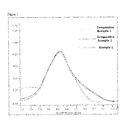
- Figure 1 The measured molecular weight distribution is shown in Figure 1 .
- Comparative Examples 1 and 4 show a molecular weight distribution in a uni-modal shape
- Example 1 in which the low molecular weight polymer having the molecular weight of 5000 is dispersed in the binder resin shows a molecular weight distribution in a bi-modal shape.
Landscapes
- Physics & Mathematics (AREA)
- General Physics & Mathematics (AREA)
- Spectroscopy & Molecular Physics (AREA)
- Chemical & Material Sciences (AREA)
- Chemical Kinetics & Catalysis (AREA)
- Developing Agents For Electrophotography (AREA)
Abstract
The present invention relates to a polymerized toner including a low molecular weight polymer having a weight average molecular weight of 3000 to 30,000 and a method for preparing the same, wherein the polymerized toner can realize excellent gloss and offset feature and can also can exhibit excellent performance in the applications of high speed copying, development of transferred photos, etc.
Description
- The present invention relates to a polymerized toner and a method for preparing the same. More specifically, the present invention relates to a polymerized toner and a method for preparing the same wherein the toner can realize excellent gloss and offset feature and thus can exhibit excellent performances in the applications of high-speed copying, development of transferred photos, etc.
- The present application claims priority to and the benefit of Korean Patent Application Nos.
10-2010-0016410 10-2011-0015586 - Toners are used in the development of electronic pictures, electrostatic printers, copy machines, etc., and can be defined as paint that is capable of being transferred to and fixed on an object to form a desired pattern. As computers are more commonly used in word processing in recent years, there have been rapidly growing demands for image forming apparatuses such as printers, resulting in an increase of the amount of toners used as well.
- Typically, toners are prepared by using a pulverization method or a polymerization method. The most widely known is a preparation method by using the pulverization, wherein resins and pigments are put into a melt-mixing process together, melt-mixed or extruded, and then pulverized and sorted to give toner particles. However, this method has drawbacks in that the toner particles thus obtained have a broad particle size distribution and very irregular shapes including sharpened edges resulting in inferior chargeabiiity or flowability.
- For the purpose of addressing the above-mentioned problems, a method for preparing spherical toner particles by using a polymerization method was proposed. For such a preparation method of toners by using polymerization, emulsion polymerization (coagulation method) and suspension polymerization are known in the art. The method for preparing toners by using the suspension polymerization is preferred since the emulsion polymerization has difficulties in controlling the particle size distribution and reproducing the quality of the obtained toners.
- In the suspension polymerization, the binder resin monomer and various additives including a pigment, a wax, a charge control agent, an initiator, etc. are uniformly dispersed to provide a monomer mixture, which is then dispersed in an aqueous dispersion and subjected to a polymerization reaction to give particles having a diameter of about 6 to 10 µm that is appropriate as toner particles.
- In the polymerized toner given by the suspension polymerization, a binder resin having a high molecular weight is contained as a monomer for the binder resin to be polymerized. Due to the binder resin having a high molecular weight, there is a problem that the gloss of prints is lowered. In order to solve such a problem, a method for realizing high gloss in prints has been proposed by adding a molecular weight control agent along with a variety of additives such as a wax, a charge control agent, etc. However, according to this method, the molecular weight of the binder resin is lowered to deteriorate the offset feature. Accordingly, there has been a need for research to develop a polymerized toner that not only may be prepared by a suspension polymerization method but that may also realize high gloss as well as an excellent offset feature.
- The present invention provides a polymerized toner which can realize the excellent gloss and offset feature and can also exhibit excellent performance in the applications of high speed copying, development of transferred photos, etc.
- The present invention also provides a method for the preparation of said polymerized toner.
- The present invention provides a polymerized toner which includes 20 to 90 wt% of a binder resin; 3 to 30 wt% of a low molecular weight polymer having the same type of repeating unit as the binder resin and a weight average molecular weight of 3000 to 30,000; and a balances of a pigment, a charge control agent, and a wax, wherein said polymer, pigment, charge control agent, and wax are dispersed in said binder resin.
- In addition, the present invention provides a method for preparing the polymerized toner, which includes the steps of forming an aqueous dispersion containing a dispersant, forming a monomer mixture which includes 20 to 90 wt% of a binder resin monomer, 3 to 30 wt% of low molecular weight polymer having the same type of repeating unit as the binder resin and a weight average molecular weight of 3000 to 30,000, and a balance of a pigment, a charge control agent, and a wax, and forming toner particles through suspension polymerization after adding said monomer mixture to said aqueous dispersion.
- Hereinafter, the polymerized toner and preparation method of the same according to one embodiment of the invention will be explained in detail.
- According to one embodiment of the invention, a polymerized toner which includes 20 to 90 wt% of binder resin; 3 to 30 wt% of low molecular weight polymer having the same type of repeating unit as the binder resin and a weight average molecular weight of 3000 to 30,000; and balances of pigment, charge control agent and wax, wherein said polymer, pigment, charge control agent and wax are dispersed in said binder resin, is provided.
- The present inventors have confirmed through experiments that a polymerized toner including 3 to 30 wt%, preferably 5 to 25 wt%, of the low molecular weight polymer which has the same type of repeating unit as the binder resin and is dispersed in the binder resin of the toner particles can improve the gloss of prints as well as minimize the occurrence of hot offset, and then completed the present invention. Since such a polymerized toner can improve the gloss of prints, it may be applied to a field of photograph printing, etc., wherein high resolution and a high degree of color realization are required, or to a field wherein high speed copying is required.
- Furthermore, as confirmed in the following Experiment 2, the polymerized toner according to one embodiment of the invention may show a first peak of 100,000 to 200,000 (preferably, 120,000 to 170,000) and a second peak of 3000 to 30,000 in molecular weight distribution measured by gei-permeation chromatography of a THF-soluble component.
- The first peak is due to the binder resin on the toner particles., and the second peak is due to the low molecular weight polymer having a weight average molecular weight of 3000 to 30,000. According to this, the polymerized toner may have the bi-modal peak distribution. When the existing polymerized toner whose binder resin includes only the high molecular weight polymer having a weight average molecular weight of 100,000 or more is used, it is not easy to obtain the high gloss. If a molecular weight control agent is added to realize high gloss, the offset feature is deteriorated (see Comparative Examples I and 4). On the contrary, as can be seen from the following
Experiments 1 and 2 andFigure 1 , the polymerized toner of one embodiment of the present invention is identified to show the bi-modal molecular weight distribution and can realize high gloss and an excellent offset feature since the above low molecular weight polymer is dispersed in the binder resin having a high weight average molecular weight of 100,000 or more. - On the other hand, the toner particles may include the low molecular weight polymer in the amount of 3 to 30 wt%, preferably 5 to 25 wt%. This low molecular weight polymer includes the same repeating unit as the binder resin and thus has excellent compatibility with the binder resin and can be uniformly distributed in the binder resin. Also, the low molecular weight polymer uniformly distributed in the toner particles may allow the toner particles to have excellent storage stability even at a high temperature. In particular, as the low molecular weight polymer is contained in the toner particles in the amount of 3 to 30 wt%, preferably 5 to 25 wt%, the content of the low molecular weight resin increases to appropriately control the molecular weight distribution together with the binder resin. According to this, the fixedness and gloss of the toner particles may be improved. If the content of the low molecular weight polymer is less than 3 wt%, the effect of improving the gloss is trifling to show gloss of 20 or less. But, if the content is more than 30 wt%, hot-offset may occur during the printing. The "same type" of the repeating unit as the binder resin monomer means the repeating unit derived from the compounds used as the binder resin monomer, their derivatives, or compounds in the same family.
- In addition, as the low molecular weight polymer has a weight average molecular weight of 3000 to 30,000, it can play a role of placing more weight on the low molecular weight portion in the molecular weight distribution of the polymerized toner and can increase the fixedness and gloss of the toner. If the weight average molecular weight of the low molecular weight polymer is less then 3000, a resulting picture may not be uniform due to deterioration of print quality as a result of evaluation of photo development. However, if it exceeds 30,000, the low molecular weight polymer can hardly be applied to the field of development of transferred photos, etc., due to deterioration of gloss in the prints.
- On the other hand, the polymerized toner may further include 0.01 to 5 wt%, preferably 0.1 to 3 wt%, of the molecular weight control agent distributed in the binder resin. If the molecular weight control agent is added to the binder resin, the average molecular weight of the binder resin may be suitably controlled, e.g., lowered to a certain level, to improve the fixedness and gloss of the toner particles. When the content of the molecular weight control agent is less than 0.01 wt%, it is not easy to control the molecular weight of the binder resin, and the fixedness and gloss of the toner particles cannot be sufficiently secured. Also, when the content of the molecular weight control agent exceeds 5 wt%, some problems of broadening the particle diameter distribution and the deterioration of transfer efficiency may occur.
- The molecular weight control agent may include t-dodecyl mercaptan, n-dodecyl mercaptan, n-octyl mercaptan, carbon tetrachloride, carbon tetrabromide, or mixtures thereof.
- The binder resin may include a polymer of one or more monomers selected from the group consisting of a styrene monomer, an acrylate monomer, a methacrylate monomer, a diene monomer, an acidic olefin monomer, and a basic olefin monomer. More preferably, such a binder resin may include a copolymer of (a) a styrene monomer and (b) one or more monomers selected from the group consisting of an acrylate monomer, a methacrylate monomer, and a diene monomer.
- The styrene monomer may include styrene, monochlorostyrene, ethyl styrene, dimethyl styrene, etc., and the acrylate monomer may include methyl acrylate, ethyl acrylate, n-butyl acrylate, isobutyl acrylate, dodecyl acrylate, 2-ethylhexyl acrylate, etc. The methacrylate monomer may include methyl methacrylate, ethyl methacrylate, n-butyl methacrylate, isobutyl methacrylate, dodecyl methacrylate, 2-ethylhexyl methacrylate, etc. The diene monomer may include butadiene, isoprene, etc. Also, an α,β-ethylene compound, etc. may be used as the acidic olefin monomer, and an aliphatic alcohol methacrylic acid ester having an amine or quaternary ammonium group, methacryl amide, vinyl amine, diallyl amine, their ammonium salts, etc. may be used as the basic olefin monomer.
- The binder resin may include polymers or copolymers having a weight average molecular weight of 100,000 to 200,000, preferably 120,000 to 180,000. If the weight average molecular weight of such polymers or copolymers is less than 100,000, the offset feature may be deteriorated, If it exceeds 200,000, the gloss of prints may be deteriorated.
- On the other hand, the low molecular weight polymer having a weight average molecular weight of 3000 to 30,000 may include the same repeating unit as the binder resin. As mentioned above, the binder resin includes one or more monomers selected from the group consisting of a styrene monomer, an acrylate monomer, a methacrylate monomer, a diene monomer, an acidic olefin monomer, and a basic olefin monomer. Also, the low molecular weight polymer may include the same repeating unit as the polymer that can be used as the binder resin.
- The pigment includes a metal powder pigment, a metal oxide pigment, a carbon pigment, a sulfide pigment, a chromium pigment, a ferrocyanide pigment, an azo pigment, an acidic dye pigment, a basic dye pigment, a mordant dye pigment, a phthalocyanine pigment, a quinacridone pigment, a dioxane pigment, or mixtures thereof. However, the pigment is not restricted to the above, and any pigment known to be applicable to a polymerized toner may be used without special limitation.
- The wax may include petroleum refining waxes such as paraffin wax, microcrystalline wax, ceresin wax, etc., natural wax such as carnauba wax, etc., synthetic wax such as polyester wax, polyethylene wax, polypropylene wax, etc., or mixtures thereof. However, the wax is not restricted to the above, and any wax known to be applicable to the polymerized toner may be used without special limitation.
- The charge control agent may include a cationic charge control agent, an anionic charge control agent, or mixtures thereof. As the cationic charge control agent, nigrosine dye, a higher aliphatic metal salt, an alkoxyamine, a chelate, a quaternary ammonium salt, an alkyl amide, a fluorine-treated activator, a naphthalenic acid metal salt, or mixtures thereof may be mentioned. As the anionic charge control agent, a chlorinated paraffin, a chlorinated polyester, a polyester having an acid, a sulfonylamine of copper phthalocyanine, a sulfonic acid group, or mixtures thereof may be mentioned.
- Also, it is preferable to use the copolymer having a sulfonic acid group as the charge control agent, and it is more preferable to use the copolymer having a sulfonic acid group whose weight average molecular weight is between 2000 and 200,000. Still more preferably, a copolymer having a sulfonic acid group whose acid value is between 1 and 40 mg KOH/g and glass transition temperature is between 30 and 120 °C may be used. If the acid value is less than I, it cannot play a role as the charge control agent. And, if the acid value is 40 or more, it may influence the interfacial properties of the monomer mixture to deteriorate the polymerization stability. If the glass transition temperature is less than 30 °C, due to the low glass transition temperature of the electron control agent which is exposed on the surface, friction-melting of the toner versus toner may occur during printing to cause a blocking phenomena. And, if the glass transition temperature exceeds 120 °C, the surface of the toner becomes too hard to have beneficial characteristics in coating property and fixedness. If the weight average molecular weight is less than 2000, the surface concentration may be lowered and the function as the charge control agent may not be effective due to the high compatibility with the binder resin. Further, a weight average molecular weight of 200,000 or more is not advantageous for the polymerization stability and particle size distribution because of a viscosity increase of the monomer mixture due to the high molecular weight. As specific examples of the copolymer having a sulfonic acid group, a styrene-acrylic copolymer having a sulfonic acid group, a styrene-methacrylic copolymer having a sulfonic acid group, or mixtures thereof may be mentioned, but are not limited thereto.
- Some additives such as reaction initiator, a cross-linking agent, a pigment stabilizer, etc. may be further dispersed in the binder resin.
- The reaction initiator may include an oil-soluble initiator and a water-soluble initiator. Specifically, azo initiators such as azobisisobutyronitrile, azobisvaleronitrile, etc., organic peroxides such as benzoyl peroxide, lauroyl peroxide, etc., typically used water-soluble initiators such as potassium persulfate, ammonium persulfate, etc. may be mentioned, and mixtures of two or more selected therefrom may be used.
- The cross-linking agent may include divinyl benzene, ethylene dimethacrylate, ethylene glycol dimethacrylate, diethylene glycol diacrylate, 1,6-hexamethylene diac.rylate, allyl methacrylate, 1,1,1-trimethylol propane triacrylate, triallyl amine, tetraallyloxy ethane, or mixtures thereof.
- As the pigment stabilizer, a styrene-butadiene-styrene (SBS) copolymer having a weight average molecular weight of 2000 to 200,000 may be used. Preferably, the copolymer whose styrene to butadiene content is 10-90 to 90-10 by weight may be used. If the styrene content exceeds 90 %, the block length of butadiene becomes short and thus the copolymer cannot sufficiently play a role as a stabilizer due to the high compatibility with the binder resin. Further, if the styrene content is less than 10 %, the copolymer sufficiently plays a role as a stabilizer but it cannot sufficiently control the action of pigment to pigment due to the short length of the styrene block. If the molecular weight is less than 2000, the copolymer cannot play a role as a pigment due to the high compatibility with the binder resin. Also, if the molecular weight is 200,000 or more, the viscosity of the monomer mixture becomes so high that the dispersion stability and polymerization stability may be deteriorated and ultimately the demerit of broadening the particle size distribution may be shown.
- On the other hand, the polymerized toner may further include an external additive including one or more selected from the group consisting of silica and titanium dioxide. Such an external additive may be present in the form of a coating on the outside of the toner particles. The silica is preferably surface-treated with a silane compound such as dimethyldichlorosilane, dimethylpolysiloxane, hexamethyldisilazane, aminosilane, alkylsilane, octamethylcyclotetrasiloxane, etc. The titanium dioxide may be used alone or as a mixture in a rutile structure that is stable at a high temperature or an anatase structure that is stable at a low temperature, and it may have a particle size of 80 to 200 nm, preferably 100 to 150 nm.
- According to one embodiment of the invention, there may be provided a method for preparing the polymerized toner which includes steps of forming an aqueous dispersion containing a dispersant, forming a monomer mixture which includes 20 to 90 wt% of a binder resin monomer, 3 to 30 wt% of a low molecular weight polymer having the same type of repeating unit as the binder resin monomer and a weight average molecular weight of 3000 to 30,000, and a balance of a pigment, a wax, and a charge control agent, and adding said monomer mixture to said aqueous dispersion to form toner particles through suspension polymerization.
- The present inventors have confirmed through experiments that a polymerized toner that can improve the gloss of prints as well as minimize the occurrence of hot offset may be prepared if a monomer mixture containing the low molecular weight polymer having a weight average molecular weight of 3000 to 30,000 in a specific amount is mixed with the aqueous dispersion containing the specific dispersant and subjected to suspension polymerization, and then completed the present invention. Accordingly, since the polymerized toner as prepared above can improve the gloss of prints, it may easily be applied to a field of photograph printing, etc., wherein high resolution and a high degree of color realization are required, or to a field wherein high speed copying is required.
- The monomer mixture may contain the same type of repeating unit as the binder resin monomer and 3 to 30 wt%, preferably 5 to 25 wt%, of the low molecular weight polymer having a weight average molecular weight of 3000 to 30,000. The low molecular weight polymer has the same type of repeating unit as the binder resin and is highly compatible with the binder resin. Thus, it may be uniformly distributed in the binder resin and also uniformly distributed in the toner particles., which makes the toner particles have excellent storage stability at a high temperature. When the content of the low molecular weight polymer is less than 3 wt%, the improvement of gloss is insignificant to show gloss of 20 or less. If the content thereof exceeds 30 wt%, hot offset may occur during the printing process.
- The monomer mixture may further include 0.01 to 5 wt%, preferably 0.1 to 3 wt%, of the molecular weight control agent dispersed in the binder resin. As the molecular weight control agent is additionally used in the binder resin, the average molecular weight of the binder resin may be suitably controlled, e.g., decreased to some level, to improve the fixedness and gloss of the toner particles. If the content of the molecular weight control agent is less than 0.01 wt%, it is not easy to control the molecular weight of the binder resin, and the fixedness and gloss of the toner particles may not be sufficiently secured. On the contrary, if the content of the molecular weight control agent exceeds 5 wt%, the particle size distribution of the toner is broadened to cause the problem of deterioration of the transfer efficiency.
- As the molecular weight control agent, t-dodecyl mercaptan, n-dodecyl mercaptan, n-octyl mercaptan, carbon tetrachloride, carbon tetrabromide, or mixtures thereof may be used.
- On the other hand, as the dispersant for the step of forming the aqueous dispersion, an inorganic dispersant, an organic dispersant, an anionic surfactant, or mixtures thereof may be used. Such a dispersant may be applied in the amount of 1 to 5 parts by weight with respect to 100 parts by weight of the monomer mixture.
- Specific examples of the inorganic dispersant include calcium phosphate, calcium hydrogen phosphate, calcium dihydrogen phosphate, hydroxy apatite, magnesium phosphate, aluminum phosphate, zinc phosphate, calcium carbonate, magnesium carbonate, calcium hydroxide, magnesium hydroxide, aluminum hydroxide, calcium metasilicate, calcium sulfate, barium sulfate, bentonite, silica, alumina, mixtures thereof, etc.
- Specific examples of the organic dispersant include polyvinyl alcohol, gelatin, methyl cellulose, methyl hydroxy propyl cellulose, ethyl cellulose, carboxyl methyl cellulose and its sodium salt, polyacrylic acid and its salt, starch, mixtures thereof, etc.
- Specific examples of the anionic surfactant include fatty acid salts, alkyl sulfate, alkyl aryl sulfate, dialkyl sulfosuccinate, alkyl phosphate, mixtures thereof, etc.
- The more preferable example of the dispersant is calcium phosphate. Calcium phosphate may be obtained by mixing an aqueous sodium phosphate solution and an aqueous calcium chloride solution to precipitate crystals in an aqueous solution. The calcium phosphate crystals may be uniformly dispersed in the aqueous dispersion.
- On the other hand, the monomer mixture may be formed by mixing the binder resin monomer, the low molecular weight polymer having a weight average molecular weight of 3000 to 30,000, the pigment, the wax, the charge control agent, etc., and sufficiently dissolving them. The monomer mixture may be homogenized in the aqueous dispersion using a homogenizer.
- The binder resin monomer may include a styrene monomer, an acrylate monomer, a methacrylate monomer, a diene monomer, or mixtures thereof, and selectively an acidic olefin monomer, a basic olefin monomer, or mixtures thereof may be used. More preferably, the binder resin monomer may include the styrene monomer, and one or more monomers selected from the group consisting of an acrylate monomer, a methacrylate monomer, and a diene monomer in the weight ratio of 10:1 to 1:1. If the monomers are mixed in the above ratio and polymerized, the glass transition temperature (Tg) of the resulting binder resin may be controlled to an appropriate range to realize the excellent offset feature. That is, cold offset may occur when the weight ratio exceeds 10:1, and hot offset may occur when the ratio is less than 1:1.
- The binder resin monomer may be contained in the amount of 20 to 90 parts by weight with respect to 100 parts by weight of the monomer mixture, and specific examples thereof are as mentioned above.
- As aforementioned, the repeating unit contained in the low molecular weight polymer having a weight average molecular weight of 3000 to 30,000 may be the same as the repeating unit contained in the binder resin which is formed by the polymerization of the binder resin monomer.
- The specific examples of the pigment, wax, and charge control agent contained in the monomer mixture are as mentioned above. The pigment may be used in an amount of 1 to 20 parts by weight, the wax in an amount of 0.1 to 30 parts by weight, and the charge control agent in an amount of 0.1 to 5 parts by weight, each of which is with respect to 100 parts by weight of the monomer mixture.
- The monomer mixture may further include additives such as a reaction initiator, a cross-linking agent, a pigment stabilizer, mixtures thereof, etc. Specific examples of the additives are as mentioned above. With respect to 100 parts by weight of the monomer mixture (e.g., with respect to 100 parts by weight of the mixture of the binder resin monomer, the low molecular weight polymer, the pigment, the wax, the charge control agent, and the additives), the reaction initiator may be used in the amount of 0.01 to 5 parts by weight, more preferably 0.1 to 2.0 parts by weight, the cross-linking agent in the amount of 0.001 to 10 parts by weight, and the pigment stabilizer in the amount of 0.1 to 20 parts by weight, respectively.
- In one embodiment of the invention, the monomer mixture may be added to the aqueous dispersion to form toner particles through the suspension polymerization. More specifically, the method for forming the toner particles may include the step of adding the monomer mixture to the aqueous dispersion, the step of applying shearing force to the aqueous dispersion and the monomer mixture to homogenize the monomer mixture in the aqueous dispersion in the form of liquid droplets, and the step of subjecting the homogenized monomer mixture to suspension polymerization. Further, as mentioned above, the monomer mixture and aqueous dispersion may be homogenized using a homogenizer.
- If the polymerization is carried out by uniformly dispersing the monomer mixture in the aqueous dispersion in the form of fine water droplets, spherical toner particles having an appropriate size can be formed. For the purpose of dispersion in the form of fine water droplets (liquid droplets), shearing force may be applied to the monomer mixture and aqueous dispersion using a homogenizer to homogenize the monomer mixture in the aqueous dispersion. Specifically, the monomer mixture in the aqueous dispersion may be homogenized at a rate of 5000 to 20,000 rpm, preferably 8000 to 17,000 rpm using a homogenizer to disperse the monomer mixture in the aqueous dispersion in the form of a fine water droplets.
- On the other hand, in one embodiment of the invention, the method may further include the step of removing the dispersant and the step of drying the toner particles.
- The step of removing the dispersant may include the step of controlling pH to be suitable for the dissolution of the dispersant. If the dispersion wherein the toner particles are formed is controlled to have pH of 2 or less, preferably 1.5 or less, by adding water-soluble inorganic acids such as hydrochloric acid, nitric acid, etc., the dispersant can be dissolved into the aqueous phase and removed from the toner particles. In the step of removing the dispersant, the pH is suitably controlled, the mixture is stirred for 5 h or more to sufficiently dissolve the dispersant, and then the toner slurry containing less than 50 wt% of water may be obtained using a filter. Also, the step of removing the dispersant may include the step of applying the shearing force using a homogenizer to homogenize the solution and the step of separating using a centrifuge. After the step of removing the dispersant, elimination of moisture using a filter and addition of excess distilled water may be repeated several times to remove the dispersant more efficiently.
- The step of drying the toner particles includes the step of introducing a toner cake having no dispersant into an oven and drying it under vacuum at room temperature. However, the drying method is not limited thereto, and any drying method conventionally used in the preparation step of polymerized toner may be used without special limitation.
- Also, in one embodiment of the invention, a step of coating the outside of the toner particles with an external additive may be further included. In this coating step, the surface of the toner particles may be coated with a separate external additive, for example, an inorganic powder containing silica, titanium dioxide, mixtures thereof, etc. This coating step with such an external additive may be done by adding the external additive to the toner particles and then stirring at a high speed using a Henschel mixer. Any silica known to be applicable to the polymerized toner may be used without special limitation. The inorganic powder that is applicable to the coating step is specifically explained above, and thus the detailed explanation thereon is omitted here.
- According to the present invention, a polymerized toner and a preparation method of the same are provided, wherein the toner can realize the excellent gloss and offset feature and can also exhibit excellent performances in the applications of high speed copying, development of transferred photos, etc.
-
Figure 1 represents the results of measuring the molecular weight distribution for the polymerized toner of Example 1 and Comparative Examples 1 and 4. - Hereinafter, the actions and effects of the present invention will be illustrated in more detail by means of the following examples. However, these examples are provided only to assist the understanding of the present invention and it is not intended for the scope of the present invention to be limited in any manner by them.
- To 100 parts by weight of a mixture of styrene and n-butyl acrylate in the ratio of 8:2, 4 parts by weight of an azo nitrile initiator (V65, Waco Chemical Co.) and 2 parts by weight of a molecular weight control agent (tertiary-dodecyl mercaptan, TDDM) were added, which were then mixed at room temperature and subjected to bulk polymerization for 24 h at 90 °C to give a low molecular weight polymer having a weight average molecular weight of 5000.
- A 0.1 M aqueous sodium phosphate solution (686 g) and 1. M calcium chloride (100 g) were mixed in water (500 g) at the reaction temperature of 70 °C to give an aqueous dispersion wherein calcium phosphate was precipitated as crystals.
- A binder resin monomer containing styrene (144 g) and n-butyl acrylate (36 g); the low molecular weight polymer having a weight average molecular weight of 5000 as prepared above (20 g); allyl methacrylate (4 g) as a cross-linking agent; n-dodecyl mercaptan (0.4 g) as a molecular weight control agent; and a sulfonic acid-containing styrene-acryl polymer having a weight average molecular weight of 16,500 (5 g) as a charge control agent (FCA1001NS, Fujikura Kasei) were mixed and thoroughly dissolved. Carbon black (MA100, Cabot) (10 g) was added thereto. The mixture was stirred for 2 h in a bead mill at 2000 rpm, then the beads were removed.
- The mixture containing no beads was then heated to 70 °C in a water bath. Paraffin wax (20 g) was added, and stirred for 20 min. An azo nitrile initiator (V65, Wako) (3.6 g) was added and further stirred for 1 min and 30 sec to form a monomer mixture.
- At this point, the weight of the monomer mixture was 243 g, and the content of the low molecular weight polymer in this monomer mixture was 8.23 wt%.
- The monomer mixture was added to the aqueous dispersion, and a homogenization process was carried out by applying shearing force to the aqueous dispersion and the monomer mixture using a homogenizer at a rate of 13,000 rpm to disperse the monomer mixture in the aqueous dispersion in the form of fine liquid droplets. The thus homogenized mixture was reacted for 10 h at 70 °C while stirring using a paddle stirrer at 200 rpm to give the polymerized toner.
- Hydrochloric acid was added to the slurry containing the above polymerized toner particles to control pH to less than 2. The water content in the slurry was adjusted to less than 30 wt% by filtering. The slurry was diluted by adding distilled water in the amount of double the initial weight of the slurry, and the water content in the slurry was again adjusted to less than 30 wt% by filtering. Such dilution and filtering processes were repeated ten times to remove calcium phosphate and other impurities on the surface of the toner.
- After the water was finally removed by filtering, the toner slurry cake was introduced into a vacuum oven and dried under vacuum for 48 h at room temperature to give the polymerized toner powder. The volume average particle diameter of the resulting polymerized toner core and the ratio (standard deviation) of the volume average particle diameter to the number average particle diameter were measured to be 7 µm and 1.26, respectively, by SEM.
- With respect to 100 parts by weight of the polymerized toner core, 2 parts by weight of silica was added, and the mixture was stirred at a high speed of 5000 rpm for 7 min using a Henschel mixer to coat the external additive on the surface of the polymerized toner core.
- A low molecular weight polymer having a weight average molecular weight of 15,000 was prepared according to the same procedure as Example 1, except that 4 parts by weight of the azo nitrile initiator (V65, Waco Chemical Co.) and 0.5 part by weight of the molecular weight control agent (tertiary-dodecyl mercaptan, TDDM) were applied to 100 parts by weight of styrene and n-butyl acrylate in the mixing ratio of 8:2.
- Further, the polymerized toner was prepared according to the same procedure as Example 1 except that said low molecular weight polymer having a weight average molecular weight of 15,000 (20 g) was used.
- A polymerized toner was prepared according to the same procedure as Example 1, except that styrene (120.8 g), n-butyl acrylate (30.2 g) (maintaining the condition of styrene:n-butyl acrylate=4:1), and the low molecular weight polymer having a weight average molecular weight of 5000 (49 g) were used.
- A polymerized toner was prepared according to the same procedure as Example 1, except that monomers for the binder resin of styrene (150.28 g) and n-butyl acrylate (37.57 g) (maintaining the condition of styrene:n-butyl acrylate=4:1) and the low molecular weight polymer having a weight average molecular weight of 5000 (12.15 g) were used.
- A polymerized toner was prepared according to the same procedure as Example 1, except that monomers for the binder resin of styrene (175.6 g) and n-butyl acrylate (44.15 g) (maintaining the condition of styrene:n-butyl acrylate=4:1) and the low molecular weight polymer having a weight average molecular weight of 5000 (60.75 g) were used.
- A low molecular weight polymer having a weight average molecular weight of 25,000 was prepared according to the same procedure as Example 1, except that 4 parts by weight of the azo nitrile initiator (V65, Waco Chemical Co.) and 0.5 part by weight of the molecular weight control agent (tertiary-dodecyl mercaptan, TDDM) were applied to 100 parts by weight of styrene and n-butyl acrylate in the mixing ratio of 8:2.
- Further, the polymerized toner was prepared according to the same procedure as Example 1 except that said low molecular weight polymer having a weight average molecular weight of 25,000 (20 g) was used.
- A polymerized toner was prepared according to the same procedure as Example 1, except that styrene (160 g) and n-butyl acrylate (40 g) (maintaining the condition of styrene:n-butyl acrylate=4:1) were used and the low molecular weight polymer having a weight average molecular weight of 5000 was not added.
- A polymerized toner was prepared according to the same procedure as Example 1, except that styrene (65.6 g), n-butyl acrylate (16.4 g) (maintaining the condition of styrene:n-butyl acrylate=4:1), and the low molecular weight polymer having a weight average molecular weight of 5000 (98 g) were used.
- A low molecular weight polymer having a weight average molecular weight of 50,000 was prepared according to the same procedure as Example 1, except that 2 parts by weight of the azo nitrile initiator (V65, Waco Chemical Co.) was used with respect to 100 parts by weight of styrene and n-butyl acrylate in the mixing ratio of 8:2 and the molecular weight control agent was not used.
- Further, the polymerized toner was prepared according to the same procedure as Example I except that said low molecular weight polymer having a weight average molecular weight of 50,000 (20 g) was used.
- A polymerized toner was prepared according to the same procedure as Example I except that the low molecular weight polymer was not added and n-dodecyl mercaptan (10 g) was used as the molecular weight control agent.
- A polymerized toner was prepared according to the same procedure as Example 1, except that monomers for the binder resin of styrene (92 g) and n-butyl acrylate (23 g) (maintaining the condition of styrene:n-butyl acrylate=4:1) and the low molecular weight polymer having a weight average molecular weight of 5000 (85 g) were used.
- An image (width: 1cm, length: 5cm) was printed five times at an interval of 5 cm on a sheet of A4-sized paper with a laser printer (HP2600, made by Hewlett Packard). Then, the offset feature was evaluated by determining whether any afterimage remained on the paper at an interval of 5.7 cm, a circumference of the fixing roll, in the rectangular print.
- The degree of afterimage was observed with a microscope to count the number of afterimages in the form of spots in the area of 1 cm length and 1 cm width. The offset feature was determined to be poor when the number of spot is 20 or more, moderate when the number is 10-20, and good when the number is less than 10.
- The front page of a sheet of A4-sized paper was printed with a laser printer (HP2600, made by Hewlett Packard). Then, the gloss was measured using a gloss meter (RD918, Macbeth).
- The results of
Experiments 1 and 2 obtained by using the polymerized toners of Examples 1 to 6 and Comparative Examples 1 to 5 are shown in the following Table 1.[Table 1] Results of measuring the offset feature and gloss Content of low molecular weight polymer in toner particles (wt%) Mw of low molecular weight polymer Gloss Offset feature Example 1 8.23 5000 30 Good Example 2 8.23 15,000 28 Good Example3 20.2 5000 32 Good Example 4 5 5000 30 Good Example 5 25 5000 25 Good Example 6 8.23 25,000 28 Good Comparative Example 1 - - 20 Good Comparative Example 2 40.3 5000 32 Poor Comparative 8.23 50,000 22 Good Example 3 Comparative Example 4 - - 30 Poor Comparative Example 5 35 15,000 30 Poor - Generally, color very similar to an ordinary photograph and high print quality can be realized only when the gloss unit of the print measured by the contact gloss meter such as RD918 (Macbeth Co.), etc. is 25 or more. As is confirmed from the above Table 1, when the polymerized toners according to Examples 1 to 6 are applied, not only is the gloss unit 25 or more, but also a good offset feature can be realized. Thus, such polymerized toners may be applied to the development of transferred photos, etc. that require high print quality.
- On the contrary, the results of Table 1 confirm that a gloss unit of less than 25 or a poor offset feature is shown in such cases when the low molecular weight polymer having a weight average molecular weight of 3000 to 30,000 is not included (Comparative Examples 1 and 4), the content of the low molecular weight polymer is out of the range of 3 to 30 wt% (Comparative Examples 2 and 5), or the low molecular weight polymer has a weight average molecular weight out of the range of 3000 to 30,000 (Comparative Example 3).
- The polymerized toners according to Example 1 and Comparative Examples 1 and 4 were dissolved in THF, and the THF-soluble component was loaded on the gel permeation chromatography equipment to measure the molecular weight distribution. Thus measured molecular weight distribution is shown in
Figure 1 . - As can be seen from
Figure 1 , Comparative Examples 1 and 4 show a molecular weight distribution in a uni-modal shape, whereas Example 1 in which the low molecular weight polymer having the molecular weight of 5000 is dispersed in the binder resin shows a molecular weight distribution in a bi-modal shape.
Claims (20)
- A polymerized toner which comprises:20 to 90 wt% of a binder resin;3 to 30 wt% of a low molecular weight polymer having the same type of repeating unit as the binder resin and a weight average molecular weight of 3000 to 30,000; anda balance of a pigment, a charge control agent, and a wax,wherein said low molecular weight polymer, pigment, charge control agent, and wax are dispersed in said binder resin.
- The polymerized toner according to Claim 1, which has a first peak of 100,000 to 200,000 and a second peak of 3000 to 30,000 in molecular weight distribution measured by gel-permeation chromatography of a THF-soluble component.
- The polymerized toner according to Claim 1, which comprises 5 to 25 wt% of the low molecular weight polymer having the same type of repeating unit as the binder resin and a weight average molecular weight of 3000 to 30,000.
- The polymerized toner according to Claim 1, which further comprises 0.01 to I wt% of the molecular weight control agent dispersed in the binder resin.
- The polymerized toner according to Claim 4, wherein the molecular weight control agent comprises one or more selected from the group consisting of t-dodecyl mercaptan, n-dodecyl mercaptan, n-octyl mercaptan, carbon tetrachloride, and carbon tetrabromide.
- The polymerized toner according to Claim 1, wherein the binder resin comprises a polymer of one or more monomers selected from the group consisting of a styrene monomer, an acrylate monomer, a methacrylate monomer, a diene monomer, an acidic olefin monomer, and a basic olefin monomer.
- The polymerized toner according to Claim 1, wherein the binder resin is a copolymer of (a) a styrene monomer and (b) one or more monomers selected from the group consisting of an acrylate monomer, a methacrylate monomer, and a diene monomer.
- The polymerized toner according to Claim 6, wherein the polymer comprised in the binder resin has a weight average molecular weight of 100,000 to 200,000.
- The polymerized toner according to Claim 1, wherein one or more additives selected from the group consisting of a reaction initiator, a cross-linking agent, and a pigment stabilizer are further dispersed in the binder resin.
- A method for preparing a polymerized toner, which comprises the steps of:forming an aqueous dispersion containing a dispersant;forming a monomer mixture which comprises 20 to 90 wt% of a binder resin monomer, 3 to 30 wt% of a low molecular weight polymer having the same type of repeating unit as the binder resin monomer and a weight average molecular weight of 3000 to 30,000, and a balance of a pigment, a wax, and a charge control agent; andforming toner particles through suspension polymerization after adding said monomer mixture to said aqueous dispersion.
- The method for preparing a polymerized toner according to Claim 10, wherein the polymerized toner comprises 5 to 25 wt% of the low molecular weight polymer having the same type of repeating unit as the binder resin monomer and a weight average molecular weight of 3000 to 30,000.
- The method for preparing a polymerized toner according to Claim 10, wherein the monomer mixture further comprises 0.01 to 5 wt% of the molecular weight control agent.
- The method for preparing a polymerized toner according to Claim 12, wherein the molecular weight control agent comprises one or more selected from the group consisting of t-dodecyl mercaptan, n-dodecyl mercaptan, n-octyl mercaptan, carbon tetrachloride, and carbon tetrabromide.
- The method for preparing a polymerized toner according to Claim 10, wherein the dispersant comprises one or more selected from the group consisting of an inorganic dispersant, an aqueous organic polymer dispersant, and an anionic surfactant.
- The method for preparing a polymerized toner according to Claim 10, wherein the dispersant comprises calcium phosphate.
- The method for preparing a polymerized toner according to Claim 10, wherein the binder resin monomer comprises the styrene monomer and one or more monomers selected from the group consisting of an acrylate monomer, a methacrylate monomer, and a diene monomer in a weight ratio of 10:1 to 1:1.
- The method for preparing a polymerized toner according to Claim 10, wherein the monomer mixture further comprises one or more additives selected from the group consisting of a reaction initiator, a cross-linking agent, and a pigment stabilizer.
- The method for preparing a polymerized toner according to Claim 10, wherein the step for forming the toner particles comprises the steps of:adding the monomer mixture to the aqueous dispersion;applying shearing force to the aqueous dispersion and the monomer mixture to homogenize the monomer mixture in the aqueous dispersion in the form of liquid droplets; andsubjecting the homogenized monomer mixture to suspension polymerization.
- The method for preparing a polymerized toner according to Claim 10, which further comprises a step of removing the dispersant and a step of drying the toner particles.
- The method for preparing a polymerized toner according to Claim 10, which further comprises a step of coating the outside of the toner particles with an external additive.
Applications Claiming Priority (3)
| Application Number | Priority Date | Filing Date | Title |
|---|---|---|---|
| KR20100016410 | 2010-02-23 | ||
| KR1020110015586A KR20110097668A (en) | 2010-02-23 | 2011-02-22 | Polymerized toner and preparation method thereof |
| PCT/KR2011/001242 WO2011105793A2 (en) | 2010-02-23 | 2011-02-23 | Polymer toner and method for manufacturing same |
Publications (1)
| Publication Number | Publication Date |
|---|---|
| EP2541328A2 true EP2541328A2 (en) | 2013-01-02 |
Family
ID=44932596
Family Applications (1)
| Application Number | Title | Priority Date | Filing Date |
|---|---|---|---|
| EP11747683A Withdrawn EP2541328A2 (en) | 2010-02-23 | 2011-02-23 | Polymer toner and method for manufacturing same |
Country Status (6)
| Country | Link |
|---|---|
| US (1) | US8530128B2 (en) |
| EP (1) | EP2541328A2 (en) |
| JP (1) | JP2013520704A (en) |
| KR (1) | KR20110097668A (en) |
| CN (1) | CN102934032A (en) |
| WO (1) | WO2011105793A2 (en) |
Cited By (1)
| Publication number | Priority date | Publication date | Assignee | Title |
|---|---|---|---|---|
| CN105348426A (en) * | 2015-11-26 | 2016-02-24 | 宁波佛来斯通新材料有限公司 | Preparation method for low-temperature fixing chemical ink powder resin and method for preparing ink powders |
Families Citing this family (1)
| Publication number | Priority date | Publication date | Assignee | Title |
|---|---|---|---|---|
| KR20130073817A (en) * | 2011-12-23 | 2013-07-03 | 주식회사 엘지화학 | Polymerized toner and preparation method of the same |
Family Cites Families (20)
| Publication number | Priority date | Publication date | Assignee | Title |
|---|---|---|---|---|
| JPS6350859A (en) * | 1986-08-21 | 1988-03-03 | Minolta Camera Co Ltd | Electrostatic latent image developing toner |
| US5244765A (en) | 1990-03-15 | 1993-09-14 | Ricoh Company, Ltd. | Toner for developing latent electrostatic images |
| DE69425725T2 (en) | 1993-12-24 | 2001-04-19 | Canon K.K., Tokio/Tokyo | Toner for developing electrostatic images, imaging processes and process cartridges |
| JP3218900B2 (en) * | 1994-12-15 | 2001-10-15 | ミノルタ株式会社 | One-component developing toner |
| US5856055A (en) * | 1997-04-04 | 1999-01-05 | Canon Kabushiki Kaisha | Toner for developing electrostatic images and process for production thereof |
| JP4119519B2 (en) * | 1998-03-30 | 2008-07-16 | 株式会社東芝 | Developer |
| JP2001056584A (en) * | 1999-08-18 | 2001-02-27 | Konica Corp | Electrostatic latent image developing toner, its production, developer using same and image forming method |
| DE60330448D1 (en) * | 2002-04-10 | 2010-01-21 | Fujifilm Imaging Colorants Ltd | CHEMICALLY MANUFACTURED TONER AND ITS MANUFACTURING PROCESS |
| JP4453263B2 (en) * | 2003-03-24 | 2010-04-21 | 富士ゼロックス株式会社 | Toner for electrostatic charge development and method for producing the same, image forming method, image forming apparatus, and toner cartridge |
| US7842447B2 (en) * | 2004-12-06 | 2010-11-30 | Canon Kabushiki Kaisha | Toner |
| US7514194B2 (en) * | 2005-07-07 | 2009-04-07 | Fuji Xerox Co., Ltd. | Toner for developing electrostatic latent image and production method thereof, electrostatic latent image developer, image forming method, and image forming apparatus |
| JP4557855B2 (en) * | 2005-09-22 | 2010-10-06 | キヤノン株式会社 | Method for producing polymerized toner |
| EP2031451B1 (en) * | 2006-06-08 | 2012-06-13 | Canon Kabushiki Kaisha | Toner |
| JP5017932B2 (en) * | 2006-06-08 | 2012-09-05 | 富士ゼロックス株式会社 | Bronsted acid compound, method for producing condensation compound, method for producing condensation compound particle dispersion, method for producing binder resin, resin particle dispersion, electrostatic charge image developing toner, electrostatic charge image developer, and image forming method |
| US7927776B2 (en) * | 2006-12-08 | 2011-04-19 | Samsung Electronics Co., Ltd. | Toner for electrophotography |
| JP2008292657A (en) * | 2007-05-23 | 2008-12-04 | Fuji Xerox Co Ltd | Electrostatic charge image-developing toner, electrostatic charge image-developing developer, electrostatic charge image-developing developer cartridge, image forming device and process cartridge |
| JP5046749B2 (en) * | 2007-05-31 | 2012-10-10 | キヤノン株式会社 | Image forming method |
| JP4328831B1 (en) * | 2008-02-19 | 2009-09-09 | キヤノン株式会社 | Developing device, electrophotographic image forming apparatus |
| JP5137702B2 (en) * | 2008-06-13 | 2013-02-06 | キヤノン株式会社 | Toner production method |
| TWI403867B (en) * | 2008-08-29 | 2013-08-01 | Trend Tone Imaging Inc | Chemical toner composition and method for preparing the same |
-
2011
- 2011-02-22 KR KR1020110015586A patent/KR20110097668A/en not_active Abandoned
- 2011-02-23 WO PCT/KR2011/001242 patent/WO2011105793A2/en not_active Ceased
- 2011-02-23 CN CN2011800205383A patent/CN102934032A/en active Pending
- 2011-02-23 JP JP2012554925A patent/JP2013520704A/en active Pending
- 2011-02-23 US US13/580,914 patent/US8530128B2/en not_active Expired - Fee Related
- 2011-02-23 EP EP11747683A patent/EP2541328A2/en not_active Withdrawn
Non-Patent Citations (1)
| Title |
|---|
| See references of WO2011105793A2 * |
Cited By (2)
| Publication number | Priority date | Publication date | Assignee | Title |
|---|---|---|---|---|
| CN105348426A (en) * | 2015-11-26 | 2016-02-24 | 宁波佛来斯通新材料有限公司 | Preparation method for low-temperature fixing chemical ink powder resin and method for preparing ink powders |
| CN105348426B (en) * | 2015-11-26 | 2018-04-27 | 宁波佛来斯通新材料有限公司 | The preparation method of low-temperature fixing chemistry ink powder resin and the method for preparing ink powder |
Also Published As
| Publication number | Publication date |
|---|---|
| US20130052579A1 (en) | 2013-02-28 |
| US8530128B2 (en) | 2013-09-10 |
| WO2011105793A3 (en) | 2012-01-12 |
| CN102934032A (en) | 2013-02-13 |
| WO2011105793A2 (en) | 2011-09-01 |
| KR20110097668A (en) | 2011-08-31 |
| JP2013520704A (en) | 2013-06-06 |
Similar Documents
| Publication | Publication Date | Title |
|---|---|---|
| EP2541327A2 (en) | Polymerized toner and method for preparing same | |
| WO2000058790A1 (en) | Toner for electrostatic-image development | |
| US7378207B2 (en) | Magenta toner and production process thereof | |
| US8216761B2 (en) | Method of producing polymerized toner | |
| US8530128B2 (en) | Polymerized toner and method for manufacturing same | |
| US20130029261A1 (en) | Polymerized toner and preparation method of the same | |
| JP4670812B2 (en) | Polymerized toner and method for producing the same | |
| US8198000B2 (en) | Method of producing polymerized toner | |
| KR102517820B1 (en) | Toner for High-Speed Laser Printer | |
| KR20130073817A (en) | Polymerized toner and preparation method of the same | |
| KR102743723B1 (en) | Toner for High-Speed Laser Printer | |
| KR20220089375A (en) | Polymerized toner and manufacturing method thereof | |
| KR20150005191A (en) | Polymerized toner and preparation method of the same | |
| KR20130127314A (en) | Polymerized toner and preparation method of the same | |
| JP2007178954A (en) | Yellow toner for developing electrostatic image and method for producing the same | |
| JP2015506490A (en) | Polymerized toner and method for producing the same | |
| KR20120049599A (en) | Polymerized toner and preparation method of the same | |
| WO2008093996A1 (en) | Method for manufacturing toner | |
| KR20130075390A (en) | Process for preparing polymerized toner | |
| KR20130042814A (en) | Polymerized toner and method of producing the same | |
| WO2013094899A1 (en) | Polymerized toner and method for manufacturing same | |
| KR20110114270A (en) | Polymerized toner and preparation method thereof | |
| KR20130012924A (en) | Magenta polymerized toner |
Legal Events
| Date | Code | Title | Description |
|---|---|---|---|
| PUAI | Public reference made under article 153(3) epc to a published international application that has entered the european phase |
Free format text: ORIGINAL CODE: 0009012 |
|
| 17P | Request for examination filed |
Effective date: 20120918 |
|
| AK | Designated contracting states |
Kind code of ref document: A2 Designated state(s): AL AT BE BG CH CY CZ DE DK EE ES FI FR GB GR HR HU IE IS IT LI LT LU LV MC MK MT NL NO PL PT RO RS SE SI SK SM TR |
|
| DAX | Request for extension of the european patent (deleted) | ||
| STAA | Information on the status of an ep patent application or granted ep patent |
Free format text: STATUS: THE APPLICATION IS DEEMED TO BE WITHDRAWN |
|
| 18D | Application deemed to be withdrawn |
Effective date: 20150804 |