EP2540698A1 - Method for making phenylethylamine compounds - Google Patents
Method for making phenylethylamine compounds Download PDFInfo
- Publication number
- EP2540698A1 EP2540698A1 EP12179825A EP12179825A EP2540698A1 EP 2540698 A1 EP2540698 A1 EP 2540698A1 EP 12179825 A EP12179825 A EP 12179825A EP 12179825 A EP12179825 A EP 12179825A EP 2540698 A1 EP2540698 A1 EP 2540698A1
- Authority
- EP
- European Patent Office
- Prior art keywords
- hydrogen
- formula
- reduction
- aryl
- alkyl
- Prior art date
- Legal status (The legal status is an assumption and is not a legal conclusion. Google has not performed a legal analysis and makes no representation as to the accuracy of the status listed.)
- Granted
Links
Classifications
-
- C—CHEMISTRY; METALLURGY
- C07—ORGANIC CHEMISTRY
- C07C—ACYCLIC OR CARBOCYCLIC COMPOUNDS
- C07C209/00—Preparation of compounds containing amino groups bound to a carbon skeleton
-
- C—CHEMISTRY; METALLURGY
- C07—ORGANIC CHEMISTRY
- C07C—ACYCLIC OR CARBOCYCLIC COMPOUNDS
- C07C227/00—Preparation of compounds containing amino and carboxyl groups bound to the same carbon skeleton
- C07C227/14—Preparation of compounds containing amino and carboxyl groups bound to the same carbon skeleton from compounds containing already amino and carboxyl groups or derivatives thereof
- C07C227/16—Preparation of compounds containing amino and carboxyl groups bound to the same carbon skeleton from compounds containing already amino and carboxyl groups or derivatives thereof by reactions not involving the amino or carboxyl groups
-
- C—CHEMISTRY; METALLURGY
- C07—ORGANIC CHEMISTRY
- C07C—ACYCLIC OR CARBOCYCLIC COMPOUNDS
- C07C231/00—Preparation of carboxylic acid amides
- C07C231/12—Preparation of carboxylic acid amides by reactions not involving the formation of carboxamide groups
-
- C—CHEMISTRY; METALLURGY
- C07—ORGANIC CHEMISTRY
- C07D—HETEROCYCLIC COMPOUNDS
- C07D263/00—Heterocyclic compounds containing 1,3-oxazole or hydrogenated 1,3-oxazole rings
- C07D263/02—Heterocyclic compounds containing 1,3-oxazole or hydrogenated 1,3-oxazole rings not condensed with other rings
- C07D263/08—Heterocyclic compounds containing 1,3-oxazole or hydrogenated 1,3-oxazole rings not condensed with other rings having one double bond between ring members or between a ring member and a non-ring member
- C07D263/16—Heterocyclic compounds containing 1,3-oxazole or hydrogenated 1,3-oxazole rings not condensed with other rings having one double bond between ring members or between a ring member and a non-ring member with hetero atoms or with carbon atoms having three bonds to hetero atoms with at the most one bond to halogen, e.g. ester or nitrile radicals, directly attached to ring carbon atoms
- C07D263/18—Oxygen atoms
- C07D263/20—Oxygen atoms attached in position 2
- C07D263/22—Oxygen atoms attached in position 2 with only hydrogen atoms or radicals containing only hydrogen and carbon atoms, directly attached to other ring carbon atoms
Definitions
- the present invention relates to a method for making phenylethylamine compounds, and a group of novel phenylethylamine intermediates.
- the present invention relates to a method for making phenylethylamine compounds, and a group of novel phenylethylamine intermediates.
- Amphetamine is commonly considered to be the most important phenylethylamine, and to date amphetamine has been made by many different methods. Only a few of these methods have been practiced commercially, and each of these methods has its disadvantages.
- the classic method used to make amphetamines is the reduction of a derivative of norephedrine or norpseudoephedrine.
- the advantage this method has is that the resulting stereochemistry of the amphetamine product is controlled by the stereochemistry of the starting material.
- the reduction of norephedrine is difficult and can give rise to by-products that are difficult to remove.
- Various derivatives of norephedrine have been prepared to facilitate the reduction. For example, converting norephedrine to the benzylic chloride ( Noggle F T, DeRuiter J, Clark C R, J. Chem. Sci.
- Amphetamines may also be manufactured from phenylalanine ( Repke D B, Bates D K, Ferguson W J, J. Pharm. Sci., 1978, 67, 1167-1168 ), which enables the stereochemistry of the amphetamine product to be controlled by the stereochemistry of the amino acid used.
- These syntheses involve many steps and require the use of hydride reagents or multiple catalytic hydrogenations, some of which use Raney Nickel thereby incurring the disadvantages mentioned above.
- Dextroamphetamine may be obtained by the resolution of the racemate through the tartrate salt ( US 6,399,828 ). However, this is a labour-intensive, low yield process.
- the invention provides a method of making a phenylethylamine of formula B: wherein R 2 , R 3 , R 4 , R 5 , R 6 , R ⁇ , R ⁇ and R n are each independently selected from hydrogen, alkyl, acyl, aryl, amido, amino acids, sugars and nucleotides; said method comprising the reduction of a compound of formula A in the absence of base: wherein R 2 , R 3 , R 4 , R 5 , R 6 , R ⁇ , R ⁇ and R n are as defined above.
- the compounds of formulae A and B can contain one or more chiral centres.
- the present invention therefore relates to all enantiomers, diastereomers and mixtures thereof.
- alkyl refers to an optionally substituted cyclic, branched or straight chain saturated hydrocarbon group preferably having 1 to 20 carbon atoms.
- C 1 -C 20 alkyl groups include, but are not limited to, methyl, ethyl, n-propyl, isopropyl, n-butyl, t-butyl, n-pentyl, cyclopentyl, n-hexyl, cyclohexyl and the like.
- the alkyl group may be substituted with one or more groups independently selected from alkyl, acyl, aryl, aralkyl, alkoxy, amido, halo, -OH and -CN.
- Acyl, aryl, aralkyl, alkoxy, amido and halo are as defined herein.
- acyl refers to an optionally substituted group of the formula -C(O)R' preferably having 1 to 20 carbon atoms, wherein R' is a substituent selected from hydrogen, alkyl, acyl, aryl, aralkyl, alkoxyl, amido, halo, -OH and the like. More preferably, R' is a substituent selected from hydrogen, alkyl, acyl, aryl, aralkyl, alkoxyl, amido, -OH and the like.
- the R' group may be substituted with one or more groups independently selected from alkyl, acyl, aryl, aralkyl, alkoxy, amido, halo, -OH and -CN.
- R' is an optionally substituted alkyl or aryl group. Alkyl, acyl, aryl, aralkyl, alkoxy, amido and halo are as defined herein.
- aryl refers to an optionally substituted aromatic carbocyclic group preferably having 6 to 20 carbon atoms.
- the aryl group may have a single ring or multiple condensed rings. Examples of C 6 -C 20 aryl groups include, but are not limited to, phenyl, naphthyl, anthracenyl and the like.
- the aryl group may be substituted with one or more groups independently selected from alkyl, acyl, aryl, aralkyl, alkoxy, amido, halo, -OH and -CN. Unless otherwise specified, the aryl group may be attached at any suitable carbon atom and, if substituted, may be substituted at any suitable carbon atom. Alkyl, acyl, aryl, aralkyl, alkoxy, amido and halo are as defined herein.
- aralkyl refers to an optionally substituted group of the formula -alkyl-aryl, where aryl and alkyl are as defined above.
- R n is -CH 2 Ph (i.e. benzyl)
- a debenzylation reaction may occur prior to, concomitantly with or after the reduction of the compound of formula A.
- alkoxy refers to an optionally substituted group of the formula -O-alkyl.
- Alkyl is as defined above. Examples of alkoxy groups include, but are not limited to, methoxy, ethoxy, isopropoxy, n-butoxy, isobutoxy, t-butoxy, n-pentoxy, cyclopentoxy, n-hexyloxy and the like.
- amido refers to an optionally substituted group of the formula -C(O)NR'R" preferably having 1 to 20 carbon atoms, wherein R' and R" are substituents independently selected from hydrogen, alkyl, acyl, aryl, aralkyl, alkoxy, amido, halogen, -OH, -CN and the like. More preferably, R' and R" are substituents independently selected from hydrogen, alkyl, acyl, aryl, aralkyl, alkoxy, amido, -OH, - CN and the like.
- R' and R" groups may be substituted with one or more groups independently selected from alkyl, acyl, aryl, aralkyl, alkoxy, amido, halo, -OH or -CN.
- R' and R" are independently optionally substituted alkyl or aryl groups.
- Alkyl, acyl, aryl, aralkyl, alkoxy, amido and halo are as defined herein.
- halo refers to -F, -Cl, -Br and -I.
- amino acid refers to a substituent comprising an amino and a carboxylic acid group.
- Amino acids and their nomenclature are well-known in the art, for example, see Biochem. J. 1984, vol. 219, p.345 ; Eur. J. Chem., 1984, vol. 138, p.9 ; Eur. J. Chem., 1985, vol. 152, p.1 ; Eur. J. Chem., 1993, vol. 213, p.2 ; Internal. J. Pep. Prot. Res., 1984, vol. 24, p.84 ; J. Biol. Chem., 1985, vol. 260, p.14 ; Pure Applied Chem., 1984, vol. 56, p. 595 ; Amino Acids and Peptides, 1985, vol. 16, p.387 , which are incorporated herein by reference. Unless otherwise specified, the amino acid may be attached at any suitable atom.
- sugar refers to carbohydrates of general formula C n H 2n O n , which may be optionally derivatised.
- Sugars and their nomenclature are well-known in the art, for example, see A. D. MacNaught and A. Wilkinson, "Compendium of Chemical Terminology: IUPAC Recommendations", 1997, Oxford ; Adv. Carbohydr. Chem. Biochem., 1997, vol. 52, p.43 ; Carbohydr. Res., 1997, vol. 297, p.10 ; J. Carbohydr. Chem., 1997, vol. 16, p.1191 ; Pure Appl. Chem. 1996, vol. 68, p.1919 , which are incorporated herein by reference. Unless otherwise specified, the sugar may be attached at any suitable atom.
- nucleotide refers to a substituent comprising a purine or pyrimidine base, a pentose sugar and a phosphate group. Nucleotides and their nomenclature are well-known in the art, for example, see Arch. Biochem. Biophys. 1971, vol. 145, p.425 ; Biochem. J., 1971, vol. 120, p.449 ; Biochemistry, 1971, vol. 9, p.4022 ; Biochim. Biophys. Acta 1971, vol. 247, p.1 ; Eur. J. Biochem., 1970, vol. 15, p.203 ; Eur. J. Biochem., 1972, vol. 25, p.1 ; J. Biol.
- nucleotide may be attached at any suitable atom.
- Functional groups in the amino acid, sugar or nucleotide may be protected from participating in unwanted reactions by one or more suitable protecting groups which are known to the person skilled in the art and as described by, for example, P. G. M. Wuts and T. Greene, "Greene's Protective Groups in Organic Synthesis", John Wiley & Sons .
- the method of the present invention is carried out in the absence of base. This offers the processing advantage in that the compounds of formula B can be isolated as the free amine by simple solvent minimisation.
- the reduction is carried out using gaseous hydrogen and a catalyst.
- the reduction will be carried out using gaseous hydrogen at atmospheric pressure or above (e.g. 5-25 psig).
- the catalyst is palladium on carbon.
- Such means may include carrying out transfer hydrogenolysis using hydrogen donor agents such as readily dehydrogenatable hydrocarbons, (e.g. methyl cyclohexene), formic acid, ammonium or potassium formate, and hydrazine ( Brieger G, Nestrick T, J. Chem. Rev., 1974, 74, 567-580 ).
- hydrogen donor agents such as readily dehydrogenatable hydrocarbons, (e.g. methyl cyclohexene), formic acid, ammonium or potassium formate, and hydrazine ( Brieger G, Nestrick T, J. Chem. Rev., 1974, 74, 567-580 ).
- the skilled person will appreciate that other means of carrying out the reduction may also be used.
- T e reduction is commonly carried out at a temperature of from about 0°C to about 30°C, conveniently from about 20°C to about 25°C.
- the method of the present invention may be carried out in the absence of acid.
- the advantage of carrying out the reaction in such a way is that the phenylethylamine of formula B may be prepared as the free base. If lesired, the phenylethylamine of formula B as the free base may then be treated directly with an acid to prepare a salt. In this instance, there is no requirement for an exchange of salts to be performed to obtain a desired pharmaceutically acceptable salt once the reduction reaction has taken place.
- a solvent switch may also be necessary if the solvent or solvent mixtures present are not amenable to the freebasing operation. When carried out in the absence of an acid, therefore, the method of the present invention may additionally avoid the necessity of a solvent switch.
- solvents or solvent mixtures may be used with the method of the present invention, including those comprising alcohols and/or aromatic hydrocarbons.
- the alcoholic solvent is methanol, ethanol, butanol or SDA-3A (a solvent constituting 95% ethanol and 5% methanol). More preferably, the alcohol is butanol or SDA-3A.
- the solvent is an aromatic hydrocarbon, it is preferably, benzene or toluene.
- phenylethylamines include amphetamine, i.e. when the R groups of formulae A and B are defined as follows: R 2 , R 3 , R 4 , R 5 , R 6 , R ⁇ and R n are hydrogen, and R ⁇ is a -CH 3 group, and methamphetamine, i.e. when the R groups of formulae A and B are defined as follows R 2 , R 3 , R 4 , R 5 , R 6 and R ⁇ are hydrogen, and R ⁇ and R n are -CH 3 groups.
- More complex phenylethylamines may also be manufactured, such as those when the R groups of formulae A and B are defined as follows: R 2 , R 3 , R 4 , R 5 , R 6 and R ⁇ are hydrogen, and R n is an aryl group, amino acid, sugar or nucleotide, and wherein the amino acid, sugar or nucleotide is optionally protected.
- R groups of formulae A and B are defined as follows: R 2 , R 3 , R 4 , R 5 , R 6 and R ⁇ are hydrogen, and R n is an aryl group, amino acid, sugar or nucleotide, and wherein the amino acid, sugar or nucleotide is optionally protected.
- R n is an aryl group, amino acid, sugar or nucleotide, and wherein the amino acid, sugar or nucleotide is optionally protected.
- the inventors believe that any of the known amino acids may be used.
- the method of the present invention further comprises the preparation of a pharmaceutically acceptable salt of the compound of formula B.
- pharmaceutically acceptable salt we mean a therapeutically active, non-toxic salt which may be derived from organic or inorganic counterions.
- Pharmaceutically acceptable salts are well known in the art, for example, see “ Pharmaceutical Sciences: The Science and Practice of Pharmacy (Remington: The Science and Practice of Pharmacy)", Lippincott Williams and Wilkins , which is incorporated herein by reference.
- Examples of pharmaceutically acceptable salts include, but are not limited to, hydrochloride, hydrobromide, sulphate, saccharate, aspartate, mesylate, dimesylate and the like.
- the compound of formula B is recovered prior to the preparation of the pharmaceutically acceptable salt.
- the pharmaceutically acceptable salt is prepared by the direct addition of the acid to the reaction mixture once the reduction is complete.
- the reaction mixture may be heated if required and the catalyst removed (e.g. by filtering through Celite).
- An aqueous acid solution is added (e.g. aqueous sulphuric acid, aqueous saccharic acid solution or aqueous aspartic acid solution) and excess water removed.
- the pharmaceutically acceptable salt of the compound of formula B is recovered, for example, by filtering or decanting, and optionally dried.
- the pharmaceutically acceptable salt is preferably sulphate or aspartate.
- the pharmaceutically acceptable salt is preferably hydrochloride.
- the pharmaceutically acceptable salt is preferably sulphate, aspartate or saccharate and more preferably, sulfate.
- Example 1 The method of Example 1 was followed until the catalyst was filtered away whereupon a total of 7 mL 25% H 2 SO 4 (aq) was added dropwise to the filtrate over 3 min. After cooling in an ice/water bath for 15 min, the mixture was filtered to collect the dextroamphetamine sulfate using cold SDA-3A as a flask and cake rinse. After drying, a total of 5.79g of dextroamphetamine sulfate was obtained, 93% yield. This material was assayed at 100% by HPLC.
- aqueous Saccharic Acid solution (132 mL, 0.09 g/mL, 56.5 mmol) was then added to the filtrate.
- the resulting solution was then concentrated under reduced pressure at a temperature of not more than 65 °C to a volume of about 180 mL to remove Water by azeotropic distillation.
- a total of 105 mL 1-Butanol was added and the distillation repeated.
- the addition of 1-Butanol and subsequent distillation was repeated until the Water content was less than or equal to 2.0%.
- To the resulting solution was added 358 mL Acetone, the mixture cooled to -5-0 °C, and the Dextroamphetamine Saccharate was then collected by vacuum filtration. After drying, 22.93 g (85%) of Dextroamphetamine Saccharate was obtained.
- the filtrate was heated to 40-50 °C and added to an aqueous solution of Aspartic Acid (28.50 g, 214.1 mmol, dissolved in 410 mL Water) also at 40-50 °C.
- the resulting mixture was then polish filtered at 55-60 °C.
- the filtrate was vacuum distilled at less than 65 °C to bring the Water content to not more than 1.0%.
- the final target volume was 431 mL.
- the distillation was repeated several times in order to achieve this by adding 1-Butanol and then distilling. Once the desired Water content was achieved, the target volume was attained by either continuing the distillation or adding more 1-Butanol.
- the resulting mixture was cooled to 0-5 °C and 232 mL SDA-3A was added.
- the Amphetamine Aspartate was then collected and dried to give 47.72 g (83%).
Landscapes
- Chemical & Material Sciences (AREA)
- Organic Chemistry (AREA)
- Chemical Kinetics & Catalysis (AREA)
- Organic Low-Molecular-Weight Compounds And Preparation Thereof (AREA)
Abstract

Description
- The present invention relates to a method for making phenylethylamine compounds, and a group of novel phenylethylamine intermediates.
- The present invention relates to a method for making phenylethylamine compounds, and a group of novel phenylethylamine intermediates.
- Amphetamine is commonly considered to be the most important phenylethylamine, and to date amphetamine has been made by many different methods. Only a few of these methods have been practiced commercially, and each of these methods has its disadvantages.
- The classic method used to make amphetamines is the reduction of a derivative of norephedrine or norpseudoephedrine. The advantage this method has is that the resulting stereochemistry of the amphetamine product is controlled by the stereochemistry of the starting material. However, the reduction of norephedrine is difficult and can give rise to by-products that are difficult to remove. Various derivatives of norephedrine have been prepared to facilitate the reduction. For example, converting norephedrine to the benzylic chloride (Noggle F T, DeRuiter J, Clark C R, J. Chem. Sci. 1997, 25, 38-42) improves the ease of the reduction and has been known for some time, however the preparation of the chloride requires the use of hazardous, corrosive reagents. In another approach (
US 6,399,828 ) norephedrine in converted to the benzylic acetate, which also improves the ease of the reduction, however the preparation of the acetate gives rise to undesired acetamide by-products. - Many of the other methods that are used to make amphetamines start with phenyl-2-propanone, a highly flammable liquid, which is a Schedule II controlled substance, i.e. its use is strictly regulated. The Schedule II designation and flammability impose a need for special storage and handling. These limitations complicate and add cost to the use of phenyl 2-propanone as a starting material. The condensation between phenylacetone and ammonia or an ammonia derivative typically uses Raney Nickel to reduce the resulting imine derivative (Haskelberg L, J. Am. Chem. Soc., 1948, 70, 2811-2812). This approach produces various by-products and impurities, while Raney Nickel itself is pyrophoric and therefore requires careful handling. The Leukart-Wallach reaction between formamide or ammonium formate and phenylacetone requires high temperatures and produces many by-products and impurities (Moore M L in "The Leukart Reaction", Adams R, Bachman, W E, Blatt A H, Fieser L F, Johnson J R, Synder H R, Eds. Organic Reactions, Vol. V; Wiley & Sons: New York, 1949, 301-330; Sinnema A, Verweij A M A, Bull. Narcotics, 1981, 33, 37-54). Additionally, the reaction times of methods progressing via this route are variable, as is the complexity of the necessary workup of impure product.
- Amphetamines may also be manufactured from phenylalanine (Repke D B, Bates D K, Ferguson W J, J. Pharm. Sci., 1978, 67, 1167-1168), which enables the stereochemistry of the amphetamine product to be controlled by the stereochemistry of the amino acid used. These syntheses, however, involve many steps and require the use of hydride reagents or multiple catalytic hydrogenations, some of which use Raney Nickel thereby incurring the disadvantages mentioned above.
- Dextroamphetamine may be obtained by the resolution of the racemate through the tartrate salt (
US 6,399,828 ). However, this is a labour-intensive, low yield process. - The hydrogenation of 1,3-oxazolidin-2-ones has been reported in Effenburger et al (Chem. Eur. J., 1997, 3(8), 1370). The method involves the use of triethylamine which must be later removed in high vacuo before an amphetamine hydrochloride salt can be precipitated. The authors appear to believe that the presence of triethylamine is essential in order to facilitate the hydrogenation reaction. The inventors, however, believe that the addition of triethylamine prevents the hydrogenation reaction being commercially viable as the separation of the amine from the amphetamine would be extremely difficult and expensive on a commercial scale.
- We have developed a method for the manufacture of phenylethylamines, including amphetamine, that avoids the use of bases, avoids the use of toxic and dangerous reagents, requires mild reaction conditions, produces essentially no by-products or impurities in the final products thereby eliminating the need for separate purification steps, is short, does not use controlled substances, is very robust and is suited to large-scale manufacture. This method also takes advantage of the innate stereochemistry of the starting materials, thereby eliminating the need for resolution steps.
- According to a first aspect, the invention provides a method of making a phenylethylamine of formula B:

said method comprising the reduction of a compound of formula A in the absence of base: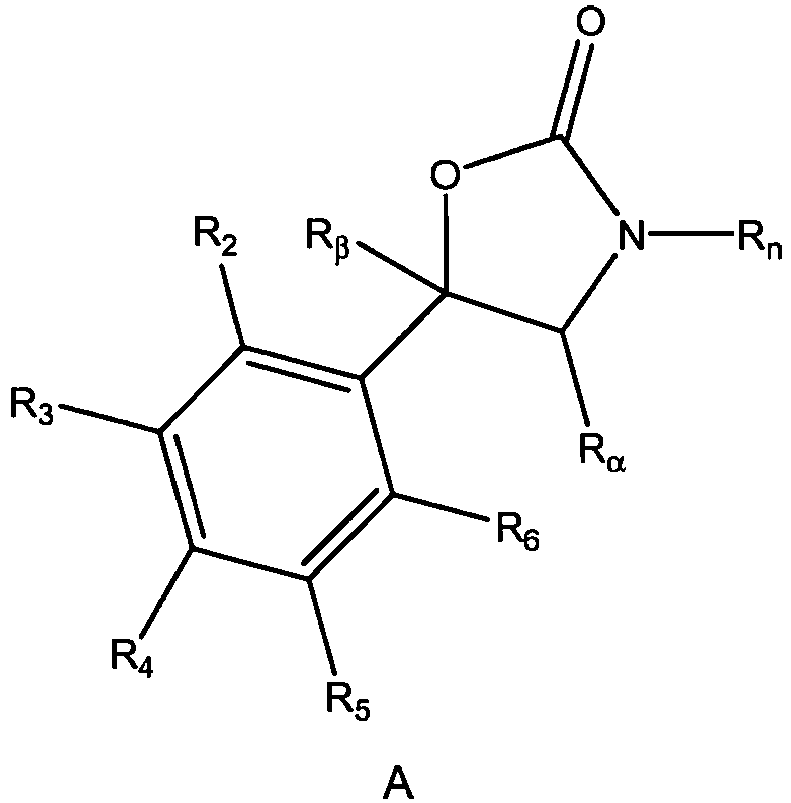
- The compounds of formulae A and B can contain one or more chiral centres. The present invention therefore relates to all enantiomers, diastereomers and mixtures thereof.
- As used herein, the term "alkyl" refers to an optionally substituted cyclic, branched or straight chain saturated hydrocarbon group preferably having 1 to 20 carbon atoms. Examples of C1-C20 alkyl groups include, but are not limited to, methyl, ethyl, n-propyl, isopropyl, n-butyl, t-butyl, n-pentyl, cyclopentyl, n-hexyl, cyclohexyl and the like. The alkyl group may be substituted with one or more groups independently selected from alkyl, acyl, aryl, aralkyl, alkoxy, amido, halo, -OH and -CN. Acyl, aryl, aralkyl, alkoxy, amido and halo are as defined herein.
- The term "acyl" refers to an optionally substituted group of the formula -C(O)R' preferably having 1 to 20 carbon atoms, wherein R' is a substituent selected from hydrogen, alkyl, acyl, aryl, aralkyl, alkoxyl, amido, halo, -OH and the like. More preferably, R' is a substituent selected from hydrogen, alkyl, acyl, aryl, aralkyl, alkoxyl, amido, -OH and the like. The R' group may be substituted with one or more groups independently selected from alkyl, acyl, aryl, aralkyl, alkoxy, amido, halo, -OH and -CN. Preferably, R' is an optionally substituted alkyl or aryl group. Alkyl, acyl, aryl, aralkyl, alkoxy, amido and halo are as defined herein.
- The term "aryl" refers to an optionally substituted aromatic carbocyclic group preferably having 6 to 20 carbon atoms. The aryl group may have a single ring or multiple condensed rings. Examples of C6-C20 aryl groups include, but are not limited to, phenyl, naphthyl, anthracenyl and the like. The aryl group may be substituted with one or more groups independently selected from alkyl, acyl, aryl, aralkyl, alkoxy, amido, halo, -OH and -CN. Unless otherwise specified, the aryl group may be attached at any suitable carbon atom and, if substituted, may be substituted at any suitable carbon atom. Alkyl, acyl, aryl, aralkyl, alkoxy, amido and halo are as defined herein.
- The term "aralkyl" refers to an optionally substituted group of the formula -alkyl-aryl, where aryl and alkyl are as defined above. When Rn is -CH2Ph (i.e. benzyl), a debenzylation reaction may occur prior to, concomitantly with or after the reduction of the compound of formula A.
- The term "alkoxy" refers to an optionally substituted group of the formula -O-alkyl. Alkyl is as defined above. Examples of alkoxy groups include, but are not limited to, methoxy, ethoxy, isopropoxy, n-butoxy, isobutoxy, t-butoxy, n-pentoxy, cyclopentoxy, n-hexyloxy and the like.
- The term "amido" refers to an optionally substituted group of the formula -C(O)NR'R" preferably having 1 to 20 carbon atoms, wherein R' and R" are substituents independently selected from hydrogen, alkyl, acyl, aryl, aralkyl, alkoxy, amido, halogen, -OH, -CN and the like. More preferably, R' and R" are substituents independently selected from hydrogen, alkyl, acyl, aryl, aralkyl, alkoxy, amido, -OH, - CN and the like. The R' and R" groups may be substituted with one or more groups independently selected from alkyl, acyl, aryl, aralkyl, alkoxy, amido, halo, -OH or -CN. Preferably, R' and R" are independently optionally substituted alkyl or aryl groups. Alkyl, acyl, aryl, aralkyl, alkoxy, amido and halo are as defined herein.
- The term "halo" refers to -F, -Cl, -Br and -I.
- The term "amino acid" refers to a substituent comprising an amino and a carboxylic acid group. Amino acids and their nomenclature are well-known in the art, for example, see Biochem. J. 1984, vol. 219, p.345; Eur. J. Chem., 1984, vol. 138, p.9; Eur. J. Chem., 1985, vol. 152, p.1; Eur. J. Chem., 1993, vol. 213, p.2; Internal. J. Pep. Prot. Res., 1984, vol. 24, p.84; J. Biol. Chem., 1985, vol. 260, p.14; Pure Applied Chem., 1984, vol. 56, p. 595; Amino Acids and Peptides, 1985, vol. 16, p.387, which are incorporated herein by reference. Unless otherwise specified, the amino acid may be attached at any suitable atom.
- The term "sugar" refers to carbohydrates of general formula CnH2nOn, which may be optionally derivatised. Sugars and their nomenclature are well-known in the art, for example, see A. D. MacNaught and A. Wilkinson, "Compendium of Chemical Terminology: IUPAC Recommendations", 1997, Oxford; Adv. Carbohydr. Chem. Biochem., 1997, vol. 52, p.43; Carbohydr. Res., 1997, vol. 297, p.10; J. Carbohydr. Chem., 1997, vol. 16, p.1191; Pure Appl. Chem. 1996, vol. 68, p.1919, which are incorporated herein by reference. Unless otherwise specified, the sugar may be attached at any suitable atom.
- The term "nucleotide" refers to a substituent comprising a purine or pyrimidine base, a pentose sugar and a phosphate group. Nucleotides and their nomenclature are well-known in the art, for example, see Arch. Biochem. Biophys. 1971, vol. 145, p.425; Biochem. J., 1971, vol. 120, p.449; Biochemistry, 1971, vol. 9, p.4022; Biochim. Biophys. Acta 1971, vol. 247, p.1; Eur. J. Biochem., 1970, vol. 15, p.203; Eur. J. Biochem., 1972, vol. 25, p.1; J. Biol. Chem., 1970, vol. 245, p.5171; J. Mol. Biol., 1971, vol. 55,p.299; Pure Appl. Chem., 1974, vol. 40, p.277, which are incorporated herein by reference. Unless otherwise specified, the nucleotide may be attached at any suitable atom.
- Functional groups in the amino acid, sugar or nucleotide may be protected from participating in unwanted reactions by one or more suitable protecting groups which are known to the person skilled in the art and as described by, for example, P. G. M. Wuts and T. Greene, "Greene's Protective Groups in Organic Synthesis", John Wiley & Sons.
- The method of the present invention is carried out in the absence of base. This offers the processing advantage in that the compounds of formula B can be isolated as the free amine by simple solvent minimisation.
- In one embodiment, the reduction is carried out using gaseous hydrogen and a catalyst. Conveniently, the reduction will be carried out using gaseous hydrogen at atmospheric pressure or above (e.g. 5-25 psig). In a preferred embodiment, the catalyst is palladium on carbon. However, there are alternative means of carrying out the reducing step. Such means may include carrying out transfer hydrogenolysis using hydrogen donor agents such as readily dehydrogenatable hydrocarbons, (e.g. methyl cyclohexene), formic acid, ammonium or potassium formate, and hydrazine (Brieger G, Nestrick T, J. Chem. Rev., 1974, 74, 567-580). The skilled person will appreciate that other means of carrying out the reduction may also be used.
- T e reduction is commonly carried out at a temperature of from about 0°C to about 30°C, conveniently from about 20°C to about 25°C.
- The method of the present invention may be carried out in the absence of acid. The advantage of carrying out the reaction in such a way is that the phenylethylamine of formula B may be prepared as the free base. If lesired, the phenylethylamine of formula B as the free base may then be treated directly with an acid to prepare a salt. In this instance, there is no requirement for an exchange of salts to be performed to obtain a desired pharmaceutically acceptable salt once the reduction reaction has taken place. Moreover, if the salt exchange requires the intermediate preparation of the phenylethylamine of formula B as a free base, a solvent switch may also be necessary if the solvent or solvent mixtures present are not amenable to the freebasing operation. When carried out in the absence of an acid, therefore, the method of the present invention may additionally avoid the necessity of a solvent switch.
- A variety of solvents or solvent mixtures may be used with the method of the present invention, including those comprising alcohols and/or aromatic hydrocarbons. Preferably, the alcoholic solvent is methanol, ethanol, butanol or SDA-3A (a solvent constituting 95% ethanol and 5% methanol). More preferably, the alcohol is butanol or SDA-3A. When the solvent is an aromatic hydrocarbon, it is preferably, benzene or toluene.
- As explained above the method disclosed herein may be used to manufacture a range of phenylethylamines. Such phenylethylamines include amphetamine, i.e. when the R groups of formulae A and B are defined as follows: R2, R3, R4, R5, R6, Rβ and Rn are hydrogen, and Rα is a -CH3 group, and methamphetamine, i.e. when the R groups of formulae A and B are defined as follows R2, R3, R4, R5, R6 and Rβ are hydrogen, and Rα and Rn are -CH3 groups. More complex phenylethylamines may also be manufactured, such as those when the R groups of formulae A and B are defined as follows: R2, R3, R4, R5, R6 and Rβ are hydrogen, and Rn is an aryl group, amino acid, sugar or nucleotide, and wherein the amino acid, sugar or nucleotide is optionally protected. The inventors believe that any of the known amino acids may be used.
- The method of the present invention further comprises the preparation of a pharmaceutically acceptable salt of the compound of formula B. By "pharmaceutically acceptable salt" we mean a therapeutically active, non-toxic salt which may be derived from organic or inorganic counterions. Pharmaceutically acceptable salts are well known in the art, for example, see "Pharmaceutical Sciences: The Science and Practice of Pharmacy (Remington: The Science and Practice of Pharmacy)", Lippincott Williams and Wilkins, which is incorporated herein by reference. Examples of pharmaceutically acceptable salts include, but are not limited to, hydrochloride, hydrobromide, sulphate, saccharate, aspartate, mesylate, dimesylate and the like.
- In one embodiment, the compound of formula B is recovered prior to the preparation of the pharmaceutically acceptable salt.
- In another embodiment, the pharmaceutically acceptable salt is prepared by the direct addition of the acid to the reaction mixture once the reduction is complete. In this case, the once the reduction is complete, the reaction mixture may be heated if required and the catalyst removed (e.g. by filtering through Celite). An aqueous acid solution is added (e.g. aqueous sulphuric acid, aqueous saccharic acid solution or aqueous aspartic acid solution) and excess water removed. Preferably, the pharmaceutically acceptable salt of the compound of formula B is recovered, for example, by filtering or decanting, and optionally dried.
- When the compound of formula B is amphetamine, the pharmaceutically acceptable salt is preferably sulphate or aspartate. When the compound of formula B is methamphetamine, the pharmaceutically acceptable salt is preferably hydrochloride. When the compound of formula B is dextroamphetamine, the pharmaceutically acceptable salt is preferably sulphate, aspartate or saccharate and more preferably, sulfate.
- In order that the invention may be more fully understood, the following Examples are provided by way of illustration only:
- A mixture of 6.00 g (33.9 mmol) (4S,5R)-(-)-4-methyl-5-phenyl-2-oxazolidinone, 0.34 g 10% palladium-on-carbon (50% water wet), and 60 mL SDA-3A (a solvent constituting 95% Ethanol and 5% Methanol) was stirred under a hydrogen filled balloon at ambient temperature (approximately 20°C) until no more oxazolidinone was detected by HPLC, 4 h. The reaction mixture was then filtered through a pad of Celite to remove the catalyst. For the purposes of isolating the free base, a filtered reaction mixture was carefully concentrated under reduced pressure to leave 4.47 g of a crystalline semi-solid, which was found to be a mixture of 96% dextroamphetamine and 4% ethanol by 1H NMR. Some dextroamphetamine was detected in the distillate. Yield = 94%. 400 MHz 1H NMR (CDCl3) 7.34-7.20 (m, 5), 3.22-3.17 (m, 1), 2.76-2.72 (d of d, J = 13.2 Hz, J' = 5.4 Hz, 1), 2.57-2.52 (d of d, J = 13.2 Hz, J' = 8.1 Hz, 1), 1.16-1.14 (d, J = 6.3 Hz, 3).
- A mixture of 6.00 g (33.9 mmol) rac-cis-4-methyl-5-phenyl-2-oxazolidinone, 0.34 g 10% palladium-on-carbon (50% water wet), and 60 mL SDA-3A was stirred under a hydrogen filled balloon at ambient temperature until no more oxazolidinone was detected by HPLC (7 h). The reaction mixture was then filtered through a pad of Celite to remove the catalyst.
- A mixture of 1.00 g (5.23 mmol) (4S,5R)-3,4-dimethyl-5-phenyl-2-oxazolidinone, 0.0530 g 10% palladium-on-carbon (50% water wet), and 10 mL SDA-3A was stirred under a hydrogen filled balloon at ambient temperature overnight. The reaction had no detectable oxazolidinone by HPLC in the morning.
- A mixture of 1.00 g (4.56 mmol) (4S,5R)-3-Acetyl-4-methyl-5-phenyl-2-oxazolidinone, 0.0460 g 10% palladium-on-carbon (51% water wet), and 10 mL SDA-3A was stirred under a hydrogen filled balloon at ambient temperature overnight. The reaction had no detectable oxazolidinone by HPLC in the morning. The reaction mixture was then filtered through a pad of Celite to remove the catalyst. The filtrate was carefully concentrated under reduced pressure to leave 0.98 g of a liquid, which proved to be a mixture of 81%, N-acetyl-d-amphetamine, 19% ethanol, and 1% methanol. Yield = 98%. 400 MHz 1H NMR (CDCl3) 7.34-7.18 (m, 5), 4.30-4.26 (m, 1), 2.87-2.83 (d of d, J = 13.5 Hz, J' = 5.7 Hz, 1), 2.76-2.71 (d of d, J = 13.5 Hz, J' = 7.2 Hz, 1), 1.95 (s, 3), 1.13-1.11 (d, J = 6.7 Hz, 3).
- The method of Example 1 was followed until the catalyst was filtered away whereupon a total of 7 mL 25% H2SO4 (aq) was added dropwise to the filtrate over 3 min. After cooling in an ice/water bath for 15 min, the mixture was filtered to collect the dextroamphetamine sulfate using cold SDA-3A as a flask and cake rinse. After drying, a total of 5.79g of dextroamphetamine sulfate was obtained, 93% yield. This material was assayed at 100% by HPLC.
- A mixture of (4S,5R)-4-Methyl-5-phenyl-2-oxazolidinone (20.00 g, 112.9 mmol), 210 mL 1-Butanol, and 1.14 g Water wet 10% Palladium-on-Carbon was made. The Palladium-on-Carbon was about 50% Water wet. The mixture was hydrogenated at 20-25 °C, 20-25 psig until there was not more than 0.09% remaining Oxazolidinone when normalized to the Dextroamphetamine by HPLC. This took approximately 5.5 h. The reaction mixture was heated to 30-35 °C and filtered through Celite to remove the catalyst using 42 mL 1-Butanol as a flask and cake rinse. An aqueous Saccharic Acid solution (132 mL, 0.09 g/mL, 56.5 mmol) was then added to the filtrate. The resulting solution was then concentrated under reduced pressure at a temperature of not more than 65 °C to a volume of about 180 mL to remove Water by azeotropic distillation. A total of 105 mL 1-Butanol was added and the distillation repeated. The addition of 1-Butanol and subsequent distillation was repeated until the Water content was less than or equal to 2.0%. To the resulting solution was added 358 mL Acetone, the mixture cooled to -5-0 °C, and the Dextroamphetamine Saccharate was then collected by vacuum filtration. After drying, 22.93 g (85%) of Dextroamphetamine Saccharate was obtained.
- A mixture of rac-cis-4-Methyl-5-phenyl-2-oxazolidinone (38.00 g, 214.4 mmol), 380 mL 1-Butanol, and 2.15 g Water wet 10% Palladium-on-Carbon was made. The Palladium-on-Carbon was about 50% Water wet. The mixture was hydrogenated at 20-25 °C, 20-25 psig until there was not more than 0.09% remaining Oxazolidinone when normalized to the Amphetamine by HPLC. The mixture was then heated to 30-35 °C and filtered through Celite using 1-Butanol as a flask and cake rinse. The filtrate was heated to 40-50 °C and added to an aqueous solution of Aspartic Acid (28.50 g, 214.1 mmol, dissolved in 410 mL Water) also at 40-50 °C. The resulting mixture was then polish filtered at 55-60 °C. The filtrate was vacuum distilled at less than 65 °C to bring the Water content to not more than 1.0%. The final target volume was 431 mL. The distillation was repeated several times in order to achieve this by adding 1-Butanol and then distilling. Once the desired Water content was achieved, the target volume was attained by either continuing the distillation or adding more 1-Butanol. The resulting mixture was cooled to 0-5 °C and 232 mL SDA-3A was added. The Amphetamine Aspartate was then collected and dried to give 47.72 g (83%).
- A mixture of rac-cis-4-Methyl-5-phenyl-2-oxazolidinone (40.00 g, 225.7 mmol), 400 mL SDA-3A, and 2.27 g Water wet 10% Palladium-on-Carbon was made. The Palladium-on-Carbon was about 50% Water wet. The mixture was hydrogenated at 20-25 °C, 5-10 psig until there was not more than 0.09% remaining Oxazolidinone when normalized to the Amphetamine by HPLC. The mixture was then filtered through Celite to remove the catalyst and 37.53 mL Water was added. The temperature was brought to 68-75 °C and 44.28 g 25% Sulfuric Acid (aq) was added maintaining 68-75 °C. The mixture was then cooled to 0-5 °C and the Amphetamine Sulfate was then collected to give 33.35 g (80%).
Claims (14)
- A method of making a phenylethylamine of formula B:

said method comprising the reduction of a compound of formula A in the absence of base:
- A method according to claim 1, wherein the reduction is carried out using (a) gaseous hydrogen and a catalyst or (b) a hydrogen transfer agent.
- A method according to claim 2, wherein the reduction is carried out using gaseous hydrogen at atmospheric pressure or above.
- A method according to claim 2, wherein the catalyst is palladium on carbon.
- A method according to any one of the preceding claims, wherein the reduction is carried out at a temperature of from about 0°C to about 30°C.
- A method according to claim 5, wherein the temperature is from about 20°C to about 25°C.
- A method according to any one of the preceding claims, wherein the reduction is carried out in the absence of acid.
- A method according to any one of the preceding claims, wherein the reduction is carried out in the presence of at least one solvent selected from the group consisting of alcohols and aromatic hydrocarbons.
- A method according to any one of the preceding claims, wherein R2, R3, R4, R5, R6, Rβ and Rn are hydrogen, and Rα is a -CH3 group.
- A method according to any one of claims 1 to 8, wherein R2, R3, R4, R5, R6 and Rβ are hydrogen, and Rα and Rn are -CH3 groups.
- A method according to any one of claims 1 to 8, wherein R2, R3, R4, R5, R6 and Rβ are hydrogen, and Rn is a aryl group, amino acid, sugar or nucleotide, and wherein the amino acid, sugar or nucleotide is optionally protected.
- A method according to any one of the preceding claims, further comprising the preparation of a pharmaceutically acceptable salt of the compound of formula B.
- A compound of formula A, wherein R2, R3, R4, R5, R6 and Rβ are hydrogen, and Rn is a aryl group, amino acid, sugar, or nucleotide, and wherein the amino acid, sugar or nucleotide is optionally protected.
- A phenylethylamine of formula B:

Applications Claiming Priority (2)
| Application Number | Priority Date | Filing Date | Title |
|---|---|---|---|
| US12/273,825 US20100125146A1 (en) | 2008-11-19 | 2008-11-19 | Method for making pharmaceutical compounds |
| EP09756166.6A EP2387555B1 (en) | 2008-11-19 | 2009-11-17 | Method for making phenylethylamine compounds |
Related Parent Applications (3)
| Application Number | Title | Priority Date | Filing Date |
|---|---|---|---|
| EP09756166.6 Division | 2009-11-17 | ||
| EP09756166.6A Division EP2387555B1 (en) | 2008-11-19 | 2009-11-17 | Method for making phenylethylamine compounds |
| EP09756166.6A Division-Into EP2387555B1 (en) | 2008-11-19 | 2009-11-17 | Method for making phenylethylamine compounds |
Publications (2)
| Publication Number | Publication Date |
|---|---|
| EP2540698A1 true EP2540698A1 (en) | 2013-01-02 |
| EP2540698B1 EP2540698B1 (en) | 2017-04-05 |
Family
ID=41614897
Family Applications (2)
| Application Number | Title | Priority Date | Filing Date |
|---|---|---|---|
| EP09756166.6A Active EP2387555B1 (en) | 2008-11-19 | 2009-11-17 | Method for making phenylethylamine compounds |
| EP12179825.0A Active EP2540698B1 (en) | 2008-11-19 | 2009-11-17 | Method for making phenylethylamine compounds |
Family Applications Before (1)
| Application Number | Title | Priority Date | Filing Date |
|---|---|---|---|
| EP09756166.6A Active EP2387555B1 (en) | 2008-11-19 | 2009-11-17 | Method for making phenylethylamine compounds |
Country Status (5)
| Country | Link |
|---|---|
| US (1) | US20100125146A1 (en) |
| EP (2) | EP2387555B1 (en) |
| CA (1) | CA2744198C (en) |
| ES (2) | ES2604316T3 (en) |
| WO (1) | WO2010058206A1 (en) |
Families Citing this family (1)
| Publication number | Priority date | Publication date | Assignee | Title |
|---|---|---|---|---|
| US10544434B2 (en) | 2015-06-29 | 2020-01-28 | Noramco, Inc. | Process for the preparation of lisdexamfetamine and related derivatives |
Citations (1)
| Publication number | Priority date | Publication date | Assignee | Title |
|---|---|---|---|---|
| US6399828B1 (en) | 2001-10-29 | 2002-06-04 | Boehringer Ingelheim Chemicals, Inc. | Preparation of amphetamines from phenylpropanolamines |
Family Cites Families (7)
| Publication number | Priority date | Publication date | Assignee | Title |
|---|---|---|---|---|
| IT1173329B (en) * | 1984-02-21 | 1987-06-24 | Lepetit Spa | PROCEDURE FOR THE QUANTITATIVE TRANSFORMATION OF TEICOPLANINA A2 FACTOR 1 TO TEICOPLANINA A2 FACTOR 3 |
| GB8531887D0 (en) * | 1985-12-30 | 1986-02-05 | Lepetit Spa | Rifamycin sv derivatives |
| CA2126216A1 (en) * | 1991-12-18 | 1993-06-24 | Aldo Trani | 7'-amino-naphthazarin antibiotic derivatives |
| FR2719590B1 (en) * | 1994-05-09 | 1996-07-26 | Claude Nofre | Improved process for the preparation of a compound derived from aspartame useful as a sweetening agent. |
| US5827827A (en) * | 1995-02-16 | 1998-10-27 | The Scripps Research Institute | HIV-1 protease inhibitors |
| CZ20012886A3 (en) * | 1999-02-11 | 2001-11-14 | Schering Aktiengesellschaft | Epothilone derivatives, process of their preparation and pharmaceutical use thereof |
| US20040214232A1 (en) * | 2002-08-16 | 2004-10-28 | Burke Martin D. | Generation of skeletal diversity within a combinatorial library |
-
2008
- 2008-11-19 US US12/273,825 patent/US20100125146A1/en not_active Abandoned
-
2009
- 2009-11-17 ES ES09756166.6T patent/ES2604316T3/en active Active
- 2009-11-17 WO PCT/GB2009/051553 patent/WO2010058206A1/en not_active Ceased
- 2009-11-17 CA CA2744198A patent/CA2744198C/en active Active
- 2009-11-17 ES ES12179825.0T patent/ES2631983T3/en active Active
- 2009-11-17 EP EP09756166.6A patent/EP2387555B1/en active Active
- 2009-11-17 EP EP12179825.0A patent/EP2540698B1/en active Active
Patent Citations (1)
| Publication number | Priority date | Publication date | Assignee | Title |
|---|---|---|---|---|
| US6399828B1 (en) | 2001-10-29 | 2002-06-04 | Boehringer Ingelheim Chemicals, Inc. | Preparation of amphetamines from phenylpropanolamines |
Non-Patent Citations (32)
| Title |
|---|
| A. D. MACNAUGHT; A. WILKINSON, COMPENDIUM OF CHEMICAL TERMINOLOGY: IUPAC RECOMMENDATIONS, 1997 |
| ADV. CARBOHYDR. CHEM. BIOCHEM., vol. 52, 1997, pages 43 |
| AMINO ACIDS AND PEPTIDES, vol. 16, 1985, pages 387 |
| ARCH. BIOCHEM. BIOPHYS., vol. 145, 1971, pages 425 |
| BIOCHEM. J., vol. 120, 1971, pages 449 |
| BIOCHEM. J., vol. 219, 1984, pages 345 |
| BIOCHEMISTRY, vol. 9, 1971, pages 4022 |
| BIOCHIM. BIOPHYS. ACTA, vol. 247, 1971, pages 1 |
| BRIEGER G; NESTRICK T, J. CHEM. REV., vol. 74, 1974, pages 567 - 580 |
| CARBOHYDR. RES., vol. 297, 1997, pages 10 |
| EFFENBURGER ET AL., CHEM. EUR. J., vol. 3, no. 8, 1997, pages 1370 |
| EUR. J. BIOCHEM., vol. 15, 1970, pages 203 |
| EUR. J. BIOCHEM., vol. 25, 1972, pages 1 |
| EUR. J. CHEM., vol. 138, 1984, pages 9 |
| EUR. J. CHEM., vol. 152, 1985, pages 1 |
| EUR. J. CHEM., vol. 213, 1993, pages 2 |
| FRANZ EFFENBERGER ET AL.: "Stereoselctive Synthesis of (S)-3.4-Methylenedioxyamphetamines from (R)-Cyanohydrins", CHEMISTRY A EUROPEAN JOURNAL, vol. 3, no. 8, 1997, Weinheim DE, pages 1370 - 1374, XP002567952 * |
| HASKELBERG L, J. AM. CHEM. SOC., vol. 70, 1948, pages 2811 - 2812 |
| INTERNAT. J. PEP. PROT. RES., vol. 24, 1984, pages 84 |
| J. BIOL. CHEM., vol. 245, 1970, pages 5171 |
| J. BIOL. CHEM., vol. 260, 1985, pages 14 |
| J. CARBOHYDR. CHEM., vol. 16, 1997, pages 1191 |
| J. MOL. BIOL., vol. 55, 1971, pages 299 |
| MOORE M L: "Organic Reactions", vol. V, 1949, WILEY & SONS, article "The Leukart Reaction", pages: 301 - 330 |
| NOGGLE F T; DERUITER J; CLARK C R, J. CHEM. SCI., vol. 25, 1997, pages 38 - 42 |
| P. G. M. WUTS; T. GREENE: "Greene's Protective Groups in Organic Synthesis", JOHN WILEY & SONS |
| PURE APPL. CHEM., vol. 40, 1974, pages 277 |
| PURE APPL. CHEM., vol. 68, 1996, pages 1919 |
| PURE APPLIED CHEM., vol. 56, 1984, pages 595 |
| REPKE D B; BATES D K; FERGUSON W J, J. PHARM. SCI., vol. 67, 1978, pages 1167 - 1168 |
| SINNEMA A; VERWEIJ A M A, BULL. NARCOTICS, vol. 33, 1981, pages 37 - 54 |
| YONGEUN KIM ET AL.: "Asymmetric Formal Synthesis of (-)-Formoterol and (-)-Tamsulosin", HETEROCYCLES, vol. 71, 15 June 2007 (2007-06-15), Japan, pages 2243 - 2248, XP008118699 * |
Also Published As
| Publication number | Publication date |
|---|---|
| ES2631983T3 (en) | 2017-09-07 |
| ES2604316T3 (en) | 2017-03-06 |
| CA2744198C (en) | 2017-06-06 |
| CA2744198A1 (en) | 2010-05-27 |
| EP2540698B1 (en) | 2017-04-05 |
| EP2387555B1 (en) | 2016-08-24 |
| US20100125146A1 (en) | 2010-05-20 |
| EP2387555A1 (en) | 2011-11-23 |
| WO2010058206A1 (en) | 2010-05-27 |
Similar Documents
| Publication | Publication Date | Title |
|---|---|---|
| EP3302441B1 (en) | Processes to produce brivaracetam | |
| US5043466A (en) | Preparation of cyclohexanol derivatives and novel thioamide intermediates | |
| MX2008014759A (en) | Synthesis of (s)-(+)-3-(aminomethyl)-5-methyl hexanoic acid. | |
| WO2013011526A1 (en) | Process for preparation of lisdexamphetamine and salts thereof | |
| CA2744198C (en) | Method for making pharmaceutical compounds | |
| WO2014072998A1 (en) | An improved process for preparation of agomelatine | |
| CN110028422A (en) | A kind of method of imidazole hydrochloride catalytic amino protection | |
| CN102391143B (en) | Method for preparing broad-spectrum antibiotic chloramphenicol | |
| CN102399160B (en) | Method for synthesizing chloramphenicol | |
| CN101977890A (en) | Process for producing optically active fluoroamine | |
| JPS6115048B2 (en) | ||
| CA3051856A1 (en) | Enamide process | |
| US5723667A (en) | Method of producing optically active tert-leucinol and its use | |
| US6340773B1 (en) | Preparation of halogenated primary amines | |
| US5861535A (en) | Reductive alkylation process to prepare tertiary aminoaryl compounds | |
| JP3140698B2 (en) | Production method and purification method of 4-hydroxy-2-pyrrolidinone | |
| CN103172567B (en) | The method of synthesis of ivabradine and pharmaceutically acceptable acid additive salt thereof | |
| WO2000039071A1 (en) | Process for producing l-erythro-(1r,2s)-2-amino-1-phenylpropan-1-ol | |
| Alexakis et al. | Unusually facile palladium catalysed oxidation of imidazolidines and oxazolidines | |
| RU2337092C1 (en) | Method of obtaining 4-hydroxylamino-2,6-dinitrotoluene and 3,5 dinitro-1 - hydroxylaminobenzol | |
| JP3150436B2 (en) | Method for separating α- (m-nitrophenyl) alkylamine and α- (p-nitrophenyl) alkylamine, and α- (m-aminophenyl) alkylamine and α- (p-aminophenyl) alkyl using the same Method for producing amines | |
| EP3160937B1 (en) | A novel method for synthesis of optically pure beta-amino alcohols | |
| WO2013114315A1 (en) | Process and intermediates for the preparation of retigabine | |
| Bacherikov et al. | Ethyl acetate as a pro-reducing agent in an one-pot reductive deamination of nitroanilines | |
| WO2025062312A1 (en) | One-pot process for the preparation of gabapentin intermediate |
Legal Events
| Date | Code | Title | Description |
|---|---|---|---|
| PUAI | Public reference made under article 153(3) epc to a published international application that has entered the european phase |
Free format text: ORIGINAL CODE: 0009012 |
|
| 17P | Request for examination filed |
Effective date: 20120809 |
|
| AC | Divisional application: reference to earlier application |
Ref document number: 2387555 Country of ref document: EP Kind code of ref document: P |
|
| AK | Designated contracting states |
Kind code of ref document: A1 Designated state(s): AT BE BG CH CY CZ DE DK EE ES FI FR GB GR HR HU IE IS IT LI LT LU LV MC MK MT NL NO PL PT RO SE SI SK SM TR |
|
| 17Q | First examination report despatched |
Effective date: 20150401 |
|
| GRAP | Despatch of communication of intention to grant a patent |
Free format text: ORIGINAL CODE: EPIDOSNIGR1 |
|
| INTG | Intention to grant announced |
Effective date: 20160420 |
|
| GRAJ | Information related to disapproval of communication of intention to grant by the applicant or resumption of examination proceedings by the epo deleted |
Free format text: ORIGINAL CODE: EPIDOSDIGR1 |
|
| INTC | Intention to grant announced (deleted) | ||
| GRAP | Despatch of communication of intention to grant a patent |
Free format text: ORIGINAL CODE: EPIDOSNIGR1 |
|
| GRAS | Grant fee paid |
Free format text: ORIGINAL CODE: EPIDOSNIGR3 |
|
| GRAA | (expected) grant |
Free format text: ORIGINAL CODE: 0009210 |
|
| INTG | Intention to grant announced |
Effective date: 20170208 |
|
| AC | Divisional application: reference to earlier application |
Ref document number: 2387555 Country of ref document: EP Kind code of ref document: P |
|
| AK | Designated contracting states |
Kind code of ref document: B1 Designated state(s): AT BE BG CH CY CZ DE DK EE ES FI FR GB GR HR HU IE IS IT LI LT LU LV MC MK MT NL NO PL PT RO SE SI SK SM TR |
|
| REG | Reference to a national code |
Ref country code: GB Ref legal event code: FG4D |
|
| REG | Reference to a national code |
Ref country code: CH Ref legal event code: EP |
|
| REG | Reference to a national code |
Ref country code: AT Ref legal event code: REF Ref document number: 881684 Country of ref document: AT Kind code of ref document: T Effective date: 20170415 |
|
| REG | Reference to a national code |
Ref country code: IE Ref legal event code: FG4D |
|
| REG | Reference to a national code |
Ref country code: DE Ref legal event code: R096 Ref document number: 602009045311 Country of ref document: DE |
|
| REG | Reference to a national code |
Ref country code: CH Ref legal event code: NV Representative=s name: BOVARD AG PATENT- UND MARKENANWAELTE, CH |
|
| REG | Reference to a national code |
Ref country code: NO Ref legal event code: T2 Effective date: 20170405 |
|
| REG | Reference to a national code |
Ref country code: NL Ref legal event code: MP Effective date: 20170405 |
|
| REG | Reference to a national code |
Ref country code: LT Ref legal event code: MG4D |
|
| REG | Reference to a national code |
Ref country code: ES Ref legal event code: FG2A Ref document number: 2631983 Country of ref document: ES Kind code of ref document: T3 Effective date: 20170907 |
|
| REG | Reference to a national code |
Ref country code: AT Ref legal event code: MK05 Ref document number: 881684 Country of ref document: AT Kind code of ref document: T Effective date: 20170405 |
|
| PG25 | Lapsed in a contracting state [announced via postgrant information from national office to epo] |
Ref country code: NL Free format text: LAPSE BECAUSE OF FAILURE TO SUBMIT A TRANSLATION OF THE DESCRIPTION OR TO PAY THE FEE WITHIN THE PRESCRIBED TIME-LIMIT Effective date: 20170405 |
|
| REG | Reference to a national code |
Ref country code: FR Ref legal event code: PLFP Year of fee payment: 9 |
|
| PG25 | Lapsed in a contracting state [announced via postgrant information from national office to epo] |
Ref country code: GR Free format text: LAPSE BECAUSE OF FAILURE TO SUBMIT A TRANSLATION OF THE DESCRIPTION OR TO PAY THE FEE WITHIN THE PRESCRIBED TIME-LIMIT Effective date: 20170706 Ref country code: FI Free format text: LAPSE BECAUSE OF FAILURE TO SUBMIT A TRANSLATION OF THE DESCRIPTION OR TO PAY THE FEE WITHIN THE PRESCRIBED TIME-LIMIT Effective date: 20170405 Ref country code: HR Free format text: LAPSE BECAUSE OF FAILURE TO SUBMIT A TRANSLATION OF THE DESCRIPTION OR TO PAY THE FEE WITHIN THE PRESCRIBED TIME-LIMIT Effective date: 20170405 Ref country code: AT Free format text: LAPSE BECAUSE OF FAILURE TO SUBMIT A TRANSLATION OF THE DESCRIPTION OR TO PAY THE FEE WITHIN THE PRESCRIBED TIME-LIMIT Effective date: 20170405 Ref country code: LT Free format text: LAPSE BECAUSE OF FAILURE TO SUBMIT A TRANSLATION OF THE DESCRIPTION OR TO PAY THE FEE WITHIN THE PRESCRIBED TIME-LIMIT Effective date: 20170405 |
|
| PG25 | Lapsed in a contracting state [announced via postgrant information from national office to epo] |
Ref country code: SE Free format text: LAPSE BECAUSE OF FAILURE TO SUBMIT A TRANSLATION OF THE DESCRIPTION OR TO PAY THE FEE WITHIN THE PRESCRIBED TIME-LIMIT Effective date: 20170405 Ref country code: PL Free format text: LAPSE BECAUSE OF FAILURE TO SUBMIT A TRANSLATION OF THE DESCRIPTION OR TO PAY THE FEE WITHIN THE PRESCRIBED TIME-LIMIT Effective date: 20170405 Ref country code: LV Free format text: LAPSE BECAUSE OF FAILURE TO SUBMIT A TRANSLATION OF THE DESCRIPTION OR TO PAY THE FEE WITHIN THE PRESCRIBED TIME-LIMIT Effective date: 20170405 Ref country code: BG Free format text: LAPSE BECAUSE OF FAILURE TO SUBMIT A TRANSLATION OF THE DESCRIPTION OR TO PAY THE FEE WITHIN THE PRESCRIBED TIME-LIMIT Effective date: 20170705 Ref country code: IS Free format text: LAPSE BECAUSE OF FAILURE TO SUBMIT A TRANSLATION OF THE DESCRIPTION OR TO PAY THE FEE WITHIN THE PRESCRIBED TIME-LIMIT Effective date: 20170805 |
|
| REG | Reference to a national code |
Ref country code: DE Ref legal event code: R097 Ref document number: 602009045311 Country of ref document: DE |
|
| PG25 | Lapsed in a contracting state [announced via postgrant information from national office to epo] |
Ref country code: EE Free format text: LAPSE BECAUSE OF FAILURE TO SUBMIT A TRANSLATION OF THE DESCRIPTION OR TO PAY THE FEE WITHIN THE PRESCRIBED TIME-LIMIT Effective date: 20170405 Ref country code: CZ Free format text: LAPSE BECAUSE OF FAILURE TO SUBMIT A TRANSLATION OF THE DESCRIPTION OR TO PAY THE FEE WITHIN THE PRESCRIBED TIME-LIMIT Effective date: 20170405 Ref country code: DK Free format text: LAPSE BECAUSE OF FAILURE TO SUBMIT A TRANSLATION OF THE DESCRIPTION OR TO PAY THE FEE WITHIN THE PRESCRIBED TIME-LIMIT Effective date: 20170405 Ref country code: RO Free format text: LAPSE BECAUSE OF FAILURE TO SUBMIT A TRANSLATION OF THE DESCRIPTION OR TO PAY THE FEE WITHIN THE PRESCRIBED TIME-LIMIT Effective date: 20170405 Ref country code: SK Free format text: LAPSE BECAUSE OF FAILURE TO SUBMIT A TRANSLATION OF THE DESCRIPTION OR TO PAY THE FEE WITHIN THE PRESCRIBED TIME-LIMIT Effective date: 20170405 |
|
| PLBE | No opposition filed within time limit |
Free format text: ORIGINAL CODE: 0009261 |
|
| STAA | Information on the status of an ep patent application or granted ep patent |
Free format text: STATUS: NO OPPOSITION FILED WITHIN TIME LIMIT |
|
| PG25 | Lapsed in a contracting state [announced via postgrant information from national office to epo] |
Ref country code: SM Free format text: LAPSE BECAUSE OF FAILURE TO SUBMIT A TRANSLATION OF THE DESCRIPTION OR TO PAY THE FEE WITHIN THE PRESCRIBED TIME-LIMIT Effective date: 20170405 |
|
| 26N | No opposition filed |
Effective date: 20180108 |
|
| PG25 | Lapsed in a contracting state [announced via postgrant information from national office to epo] |
Ref country code: SI Free format text: LAPSE BECAUSE OF FAILURE TO SUBMIT A TRANSLATION OF THE DESCRIPTION OR TO PAY THE FEE WITHIN THE PRESCRIBED TIME-LIMIT Effective date: 20170405 |
|
| PG25 | Lapsed in a contracting state [announced via postgrant information from national office to epo] |
Ref country code: MC Free format text: LAPSE BECAUSE OF FAILURE TO SUBMIT A TRANSLATION OF THE DESCRIPTION OR TO PAY THE FEE WITHIN THE PRESCRIBED TIME-LIMIT Effective date: 20170405 |
|
| PG25 | Lapsed in a contracting state [announced via postgrant information from national office to epo] |
Ref country code: LU Free format text: LAPSE BECAUSE OF NON-PAYMENT OF DUE FEES Effective date: 20171117 |
|
| REG | Reference to a national code |
Ref country code: BE Ref legal event code: MM Effective date: 20171130 |
|
| PG25 | Lapsed in a contracting state [announced via postgrant information from national office to epo] |
Ref country code: MT Free format text: LAPSE BECAUSE OF NON-PAYMENT OF DUE FEES Effective date: 20171117 |
|
| REG | Reference to a national code |
Ref country code: FR Ref legal event code: PLFP Year of fee payment: 10 |
|
| PG25 | Lapsed in a contracting state [announced via postgrant information from national office to epo] |
Ref country code: BE Free format text: LAPSE BECAUSE OF NON-PAYMENT OF DUE FEES Effective date: 20171130 |
|
| PG25 | Lapsed in a contracting state [announced via postgrant information from national office to epo] |
Ref country code: HU Free format text: LAPSE BECAUSE OF FAILURE TO SUBMIT A TRANSLATION OF THE DESCRIPTION OR TO PAY THE FEE WITHIN THE PRESCRIBED TIME-LIMIT; INVALID AB INITIO Effective date: 20091117 |
|
| REG | Reference to a national code |
Ref country code: DE Ref legal event code: R082 Ref document number: 602009045311 Country of ref document: DE Representative=s name: BARDEHLE PAGENBERG PARTNERSCHAFT MBB PATENTANW, DE |
|
| PG25 | Lapsed in a contracting state [announced via postgrant information from national office to epo] |
Ref country code: CY Free format text: LAPSE BECAUSE OF NON-PAYMENT OF DUE FEES Effective date: 20170405 |
|
| PG25 | Lapsed in a contracting state [announced via postgrant information from national office to epo] |
Ref country code: MK Free format text: LAPSE BECAUSE OF FAILURE TO SUBMIT A TRANSLATION OF THE DESCRIPTION OR TO PAY THE FEE WITHIN THE PRESCRIBED TIME-LIMIT Effective date: 20170405 |
|
| PG25 | Lapsed in a contracting state [announced via postgrant information from national office to epo] |
Ref country code: TR Free format text: LAPSE BECAUSE OF FAILURE TO SUBMIT A TRANSLATION OF THE DESCRIPTION OR TO PAY THE FEE WITHIN THE PRESCRIBED TIME-LIMIT Effective date: 20170405 |
|
| PG25 | Lapsed in a contracting state [announced via postgrant information from national office to epo] |
Ref country code: PT Free format text: LAPSE BECAUSE OF FAILURE TO SUBMIT A TRANSLATION OF THE DESCRIPTION OR TO PAY THE FEE WITHIN THE PRESCRIBED TIME-LIMIT Effective date: 20170405 |
|
| REG | Reference to a national code |
Ref country code: GB Ref legal event code: 732E Free format text: REGISTERED BETWEEN 20240829 AND 20240904 |
|
| REG | Reference to a national code |
Ref country code: DE Ref legal event code: R081 Ref document number: 602009045311 Country of ref document: DE Owner name: MACFARLAN SMITH LTD., GB Free format text: FORMER OWNER: JOHNSON MATTHEY PLC, LONDON, GB |
|
| REG | Reference to a national code |
Ref country code: ES Ref legal event code: PC2A Owner name: MACFARLAN SMITH LIMITED Effective date: 20241127 |
|
| REG | Reference to a national code |
Ref country code: CH Ref legal event code: U11 Free format text: ST27 STATUS EVENT CODE: U-0-0-U10-U11 (AS PROVIDED BY THE NATIONAL OFFICE) Effective date: 20251201 |
|
| PGFP | Annual fee paid to national office [announced via postgrant information from national office to epo] |
Ref country code: DE Payment date: 20251022 Year of fee payment: 17 |
|
| PGFP | Annual fee paid to national office [announced via postgrant information from national office to epo] |
Ref country code: GB Payment date: 20251022 Year of fee payment: 17 |
|
| PGFP | Annual fee paid to national office [announced via postgrant information from national office to epo] |
Ref country code: NO Payment date: 20251024 Year of fee payment: 17 |
|
| PGFP | Annual fee paid to national office [announced via postgrant information from national office to epo] |
Ref country code: IT Payment date: 20251022 Year of fee payment: 17 |
|
| PGFP | Annual fee paid to national office [announced via postgrant information from national office to epo] |
Ref country code: FR Payment date: 20251022 Year of fee payment: 17 |
|
| PGFP | Annual fee paid to national office [announced via postgrant information from national office to epo] |
Ref country code: CH Payment date: 20251201 Year of fee payment: 17 |
|
| PGFP | Annual fee paid to national office [announced via postgrant information from national office to epo] |
Ref country code: IE Payment date: 20251024 Year of fee payment: 17 |
|
| PGFP | Annual fee paid to national office [announced via postgrant information from national office to epo] |
Ref country code: ES Payment date: 20251201 Year of fee payment: 17 |