EP2537839A1 - B-dihydrofuran deriving compound, method for producing b-dihydrofuran deriving compound or b-tetrahydrofuran deriving compound, b -glycoside compound, method for producing b-glycoside compound, and method for producing 4'-ethynyl d4t and analogue compounds thereof - Google Patents
B-dihydrofuran deriving compound, method for producing b-dihydrofuran deriving compound or b-tetrahydrofuran deriving compound, b -glycoside compound, method for producing b-glycoside compound, and method for producing 4'-ethynyl d4t and analogue compounds thereof Download PDFInfo
- Publication number
- EP2537839A1 EP2537839A1 EP11742187A EP11742187A EP2537839A1 EP 2537839 A1 EP2537839 A1 EP 2537839A1 EP 11742187 A EP11742187 A EP 11742187A EP 11742187 A EP11742187 A EP 11742187A EP 2537839 A1 EP2537839 A1 EP 2537839A1
- Authority
- EP
- European Patent Office
- Prior art keywords
- group
- optionally protected
- formula
- optionally
- optionally substituted
- Prior art date
- Legal status (The legal status is an assumption and is not a legal conclusion. Google has not performed a legal analysis and makes no representation as to the accuracy of the status listed.)
- Granted
Links
- NWOYKBFQQJGFLJ-PXAZEXFGSA-N CC(C)(C)OC(OC[C@@](C=C1)(C#C)O[C@H]1N(C=C(C)C(N1)=O)C1=O)=O Chemical compound CC(C)(C)OC(OC[C@@](C=C1)(C#C)O[C@H]1N(C=C(C)C(N1)=O)C1=O)=O NWOYKBFQQJGFLJ-PXAZEXFGSA-N 0.000 description 1
- JTJUMFMVKYAWME-ARHKQHADSA-N CC(C)[C@]1(OC(OC(C)(C)C)=O)OC(C2)(C2OC(OC(C)(C)C)=O)C=C1 Chemical compound CC(C)[C@]1(OC(OC(C)(C)C)=O)OC(C2)(C2OC(OC(C)(C)C)=O)C=C1 JTJUMFMVKYAWME-ARHKQHADSA-N 0.000 description 1
Classifications
-
- C—CHEMISTRY; METALLURGY
- C07—ORGANIC CHEMISTRY
- C07D—HETEROCYCLIC COMPOUNDS
- C07D307/00—Heterocyclic compounds containing five-membered rings having one oxygen atom as the only ring hetero atom
- C07D307/02—Heterocyclic compounds containing five-membered rings having one oxygen atom as the only ring hetero atom not condensed with other rings
- C07D307/26—Heterocyclic compounds containing five-membered rings having one oxygen atom as the only ring hetero atom not condensed with other rings having one double bond between ring members or between a ring member and a non-ring member
- C07D307/30—Heterocyclic compounds containing five-membered rings having one oxygen atom as the only ring hetero atom not condensed with other rings having one double bond between ring members or between a ring member and a non-ring member with hetero atoms or with carbon atoms having three bonds to hetero atoms with at the most one bond to halogen, e.g. ester or nitrile radicals, directly attached to ring carbon atoms
- C07D307/32—Oxygen atoms
-
- C—CHEMISTRY; METALLURGY
- C07—ORGANIC CHEMISTRY
- C07D—HETEROCYCLIC COMPOUNDS
- C07D405/00—Heterocyclic compounds containing both one or more hetero rings having oxygen atoms as the only ring hetero atoms, and one or more rings having nitrogen as the only ring hetero atom
- C07D405/02—Heterocyclic compounds containing both one or more hetero rings having oxygen atoms as the only ring hetero atoms, and one or more rings having nitrogen as the only ring hetero atom containing two hetero rings
- C07D405/04—Heterocyclic compounds containing both one or more hetero rings having oxygen atoms as the only ring hetero atoms, and one or more rings having nitrogen as the only ring hetero atom containing two hetero rings directly linked by a ring-member-to-ring-member bond
-
- C—CHEMISTRY; METALLURGY
- C07—ORGANIC CHEMISTRY
- C07H—SUGARS; DERIVATIVES THEREOF; NUCLEOSIDES; NUCLEOTIDES; NUCLEIC ACIDS
- C07H19/00—Compounds containing a hetero ring sharing one ring hetero atom with a saccharide radical; Nucleosides; Mononucleotides; Anhydro-derivatives thereof
- C07H19/02—Compounds containing a hetero ring sharing one ring hetero atom with a saccharide radical; Nucleosides; Mononucleotides; Anhydro-derivatives thereof sharing nitrogen
- C07H19/04—Heterocyclic radicals containing only nitrogen atoms as ring hetero atom
- C07H19/06—Pyrimidine radicals
- C07H19/073—Pyrimidine radicals with 2-deoxyribosyl as the saccharide radical
-
- Y—GENERAL TAGGING OF NEW TECHNOLOGICAL DEVELOPMENTS; GENERAL TAGGING OF CROSS-SECTIONAL TECHNOLOGIES SPANNING OVER SEVERAL SECTIONS OF THE IPC; TECHNICAL SUBJECTS COVERED BY FORMER USPC CROSS-REFERENCE ART COLLECTIONS [XRACs] AND DIGESTS
- Y02—TECHNOLOGIES OR APPLICATIONS FOR MITIGATION OR ADAPTATION AGAINST CLIMATE CHANGE
- Y02P—CLIMATE CHANGE MITIGATION TECHNOLOGIES IN THE PRODUCTION OR PROCESSING OF GOODS
- Y02P20/00—Technologies relating to chemical industry
- Y02P20/50—Improvements relating to the production of bulk chemicals
- Y02P20/582—Recycling of unreacted starting or intermediate materials
Definitions
- the present invention relates to a ⁇ -dihydrofuran derivative, to a process for producing a ⁇ -dihydrofuran derivative or a ⁇ -tetrahydrofuran derivative, to a ⁇ -glycoside compound, to a process for producing a ⁇ -glycoside compound, and to a process for producing a 4'-ethynyl-2',3'-didehydro-3'-deoxythymidine (i.e., 4'-ethynyl d4T) or an analog thereof.
- a 4'-ethynyl-2',3'-didehydro-3'-deoxythymidine i.e., 4'-ethynyl d4T
- HAART highly active anti-retroviral therapy
- HAART has a downside in that replacement of one or more constituent drugs is unavoidable if and when a drug-resistant virus emerges or adverse side effects are observed.
- a new active ingredient, 4'-ethynyl-2',3'-didehydro-3'-deoxythymidine i.e., 4'-ethynyl d4T
- Patent Document 1 The compound 4'-ethynyl d4T is effective on multi-drug resistant virus and is considered to have low mitochondrial toxicity (i.e., high safety). From these points, this compound is expected to ensure long-term administration and maintenance of adherence.
- thymidine or uridine is employed as a synthesis starting material (see Patent Document 1 and Non-Patent Document 1).
- This synthesis method employing such a natural starting material, requires a number of synthesis steps, thereby elevates the production cost. Thus, the method is not suited for large-scale production, which is problematic.
- Non-Patent Document 2 discloses that the method employs an achiral phosphine ligand and an ⁇ - ⁇ -mixed form dihydrofuran compound serving as a starting material, to thereby yield a product of an ⁇ - ⁇ -mixed form.
- the document also discloses that, when an optically active Trost ligand is used, only a ⁇ -glycoside compound is produced, and the starting ⁇ -form material is recovered. This clearly indicates that an ⁇ -form product is yielded from an ⁇ -form starting material, and a ⁇ -form product is yielded from a ⁇ -form starting material.
- a ⁇ -form-pure dihydrofuran compound must be synthesized and provided for attaining high-yield glycosylation.
- a dihydrofurandiol compound corresponding to the target and serving as a starting material is diacetylized (see Patent Document 2).
- Non-Patent Document 4 In the synthesis of a tetrahydrofuran compound, ⁇ -form-selective synthesis is known to be difficult. In one case, the 1-position ol and the 5-position ol of a tetrahydrofurantriol compound are modified by two steps. However, the product is indicated to have an ⁇ - ⁇ -mixed form (Non-Patent Document 4).
- An object of the present invention is to provide a process for selectively synthesizing a ⁇ -form glycoside compound. Another object is to provide a process for producing 4'-ethynyl-2',3'-didehydro-3'-deoxythymidine (hereinafter may be referred to as "4'-ethynyl d4T”) and an analog thereof, which process is based on the selective ⁇ -form glycoside compound production process and which realizes large-scale synthesis thereof at high efficiency.
- 4'-ethynyl d4T 4'-ethynyl-2',3'-didehydro-3'-deoxythymidine
- the present inventors have conducted extensive studies in order to attain the aforementioned objects, and have found that a ⁇ -form compound can be selectively produced at high yield through carbonating, carbamating, or phosphating the 5-hydroxyl group of a dihydrofurandiol compound or a tetrahydrofurandiol compound, which can be readily synthesized through various techniques.
- the inventors have also found that 4'-ethynyl d4T and an analog thereof can be effectively produced through the above production process.
- the present invention has been accomplished on the basis of these findings.
- the present invention provides the following.
- Y 1 represents an alkoxycarbonyl group, an aralkyloxycarbonyl group, an aminocarbonyl group, a dialkylphosphoryl group, or a diarylphosphoryl group
- Y 2 represents an acyl group, an alkoxycarbonyl group, an aralkyloxycarbonyl group, an aminocarbonyl group, a dialkylphosphoryl group, or a diarylphosphoryl group
- Y 3 , Y 4 , and Y 5 each represent a hydrogen atom, a halogen atom, an alkyl group, an aryl group, an acyl group, an alkenyl group, an aralkyl group, a cycloalkyl group, a hydroxyl group, an alkoxy group, an aryloxy group, an aralkyloxy group, an alkylthio group, an arylthio group, an amino group, an alkylamino group, a trialkylsilyloxy group, a trisub
- Y 1 represents an alkoxycarbonyl group, an aralkyloxycarbonyl group, an aminocarbonyl group, a dialkylphosphoryl group, or a diarylphosphoryl group
- Y 2 represents an acyl group, an alkoxycarbonyl group, an aralkyloxycarbonyl group, an aminocarbonyl group, a dialkylphosphoryl group, or a diarylphosphoryl group
- Y 3 , Y 4 , and Y 5 each represent a hydrogen atom, a halogen atom, an alkyl group, an aryl group, an acyl group, an alkenyl group, an aralkyl group, a cycloalkyl group, a hydroxyl group, an alkoxy group, an aryloxy group, an aralkyloxy group, an alkylthio group, an arylthio group, an amino group, an alkylamino group, a trialkylsilyloxy group, a trisub
- Y 1 , Y 2 , Y 3 , Y 4 , and Y 5 have the same meanings as defined in formula (1)), characterized in that the process comprises causing to act a dialkyl dicarbonate, a diaralkyl dicarbonate, or a halide on a diol compound represented by formula (2) or (3) :
- Y 1 represents an alkoxycarbonyl group, an aralkyloxycarbonyl group, an aminocarbonyl group, a dialkylphosphoryl group, or a diarylphosphoryl group
- Y 3 , Y 4 , and Y 5 each represent a hydrogen atom, a halogen atom, an alkyl group, an aryl group, an acyl group, an alkenyl group, an aralkyl group, a cycloalkyl group, a hydroxyl group, an alkoxy group, an aryloxy group, an aralkyloxy group, an alkylthio group, an arylthio group, an amino group, an alkylamino group, a trialkylsilyloxy group, a trisubstituted silyl group, an alkylaminocarbonyl group, a halomethyl group, an optionally protected formyl group, a C1 to C7 ester group, an optionally protected hydroxymethyl group,
- Y 1 represents an alkoxycarbonyl group, an aralkyloxycarbonyl group, an aminocarbonyl group, a dialkylphosphoryl group, or a diarylphosphoryl group
- Y 3 , Y 4 , and Y 5 each represent a hydrogen atom, a halogen atom, an alkyl group, an aryl group, an acyl group, an alkenyl group, an aralkyl group, a cycloalkyl group, a hydroxyl group, an alkoxy group, an aryloxy group, an aralkyloxy group, an alkylthio group, an arylthio group, an amino group, an alkylamino group, a trialkylsilyloxy group, a trisubstituted silyl group, an alkylaminocarbonyl group, a halomethyl group, an optionally protected formyl group, a C1 to C7 ester group, an optionally protected hydroxymethyl group,
- Y 1 represents an alkoxycarbonyl group, an aralkyloxycarbonyl group, an aminocarbonyl group, a dialkylphosphoryl group, or a diarylphosphoryl group
- Y 2 represents an acyl group, an alkoxycarbonyl group, an aralkyloxycarbonyl group, an aminocarbonyl group, a dialkylphosphoryl group, or a diarylphosphoryl group
- Y 3 , Y 4 , and Y 5 each represent a hydrogen atom, a halogen atom, an alkyl group, an aryl group, an acyl group, an alkenyl group, an aralkyl group, a cycloalkyl group, a hydroxyl group, an alkoxy group, an aryloxy group, an aralkyloxy group, an alkylthio group, an arylthio group, an amino group, an alkylamino group, a trialkylsilyloxy group, a trisub
- Y 1 represents an alkoxycarbonyl group, an aralkyloxycarbonyl group, an aminocarbonyl group, a dialkylphosphoryl group, or a diarylphosphoryl group
- Y 3 , Y 4 , and Y 5 each represent a hydrogen atom, a halogen atom, an alkyl group, an aryl group, an acyl group, an alkenyl group, an aralkyl group, a cycloalkyl group, a hydroxyl group, an alkoxy group, an aryloxy group, an aralkyloxy group, an alkylthio group, an arylthio group, an amino group, an alkylamino group, a trialkylsilyloxy group, a trisubstituted silyl group, an alkylaminocarbonyl group, a halomethyl group, an optionally protected formyl group, a C1 to C7 ester group, an optionally protected hydroxymethyl group,
- ⁇ -glycoside compounds can be selectively produced at high yield, whereby 4'-ethynyl d4T and analogs thereof can be more effectively produced on a large scale under milder conditions, as compared with currently employed processes. Since the compound 4'-ethynyl d4T is a candidate active ingredient of an effective drug for the treatment of HIV infections, the production process of the present invention is very useful for attaining the treatment in practice by use of the drug. Modes for Carrying Out the Invention
- N-bromosuccinimide is abbreviated as NBS, tetrahydrofuran as THF, sodium acetate as AcONa, acetic anhydride as Ac 2 O, Lipase PS Amano SD (trade name, product of Amano Enzyme) as Lipase PS, isopropanol as IPA, trimethylsilyl as TMS, acetonitrile as MeCN, 4-dimethylaminopyridine as DMAP, and ethyl acetate as EtOAc.
- an isomer having a substituent OY 2 or R 1 on the lower side of the sheet is called an ⁇ -form
- another isomer having a substituent OY 2 or R 1 on the upper side of the sheet is called a ⁇ -form, when the OY 1 is fixed on the upper side of the sheet.
- the alkoxycarbonyl group may be linear-chain, branched, or cyclic.
- alkoxycarbonyl group examples include methoxycarbonyl, ethoxycarbonyl, n-propoxycarbonyl, i-propoxycarbonyl, c-propoxycarbonyl, n-butoxycarbonyl, i-butoxycarbonyl, s-butoxycarbonyl, t-butoxycarbonyl, c-butoxycarbonyl, n-pentyloxycarbonyl, 1-methyl-n-butoxycarbonyl, 2-methyl-n-butoxycarbonyl, 3-methyl-n-butoxycarbonyl, 1,1-dimethyl-n-propoxycarbonyl, c-pentyloxycarbonyl, 2-methyl-c-butoxycarbonyl, n-hexyloxycarbonyl, 1-methyl-n-pentyloxycarbonyl, 2-methyl-n-pentyloxycarbonyl, 1,1-dimethyl-n-butoxycarbonyl, 1-ethyl-n-butoxycarbonyl, 1,1,2-trimethyl
- examples of the aralkyloxycarbonyl group include benzyloxycarbonyl, 1-phenethyloxycarbonyl, and 2-phenethyloxycarbonyl. Of these, benzyloxycarbonyl is particularly preferred.
- the aminocarbonyl group may be linear-chain, branched, or cyclic.
- the aminocarbonyl group include methylaminocarbonyl, ethylaminocarbonyl, n-propylaminocarbonyl, i-propylaminocarbonyl, c-propylaminocarbonyl, n-butylaminocarbonyl, i-butylaminocarbonyl, s-butylaminocarbonyl, t-butylaminocarbonyl, c-butylaminocarbonyl, n-pentylaminocarbonyl, n-heptylaminocarbonyl, n-octylaminocarbonyl, n-nonylaminocarbonyl, n-decylaminocarbonyl, dimethylaminocarbonyl, diethylaminocarbonyl, di-n-propylaminocarbonyl, di-n-propylaminocarbon
- the dialkylphosphoryl group may be linear-chain, branched, or cyclic.
- Specific examples include diphenylphosphoryl, di-o-methylphenylphosphoryl, di-m-methylphenylphosphoryl, di-p-methylphenylphosphoryl, di-o-trifluoromethylphenylphosphoryl, di-m-trifluoromethylphenylphosphoryl, di-p-trifluoromethylphenylphosphoryl, di-p-ethylphenylphosphoryl, di-p-i-propylphenylphosphoryl, di-p-t-butylphenylphosphoryl, di-o-chlorophenylphosphoryl, di-m-chlorophenylphosphoryl, dip-chlorophenylphosphoryl, di-o-bromophenylphosphoryl, di-m-bromophenylphosphoryl, di-m-bromophenylphospho
- examples of the acyl group include formyl, acetyl, fluoroacetyl, difluoroacetyl, trifluoroacetyl, chloroacetyl, dichloroacetyl, trichloroacetyl, propionyl, pivaloyl, tigloyl, benzoyl, benzoylformyl, benzoylpropionyl, and phenylpropionyl.
- substituents include a hydrogen atom, a halogen atom, an alkyl group, an aryl group, an acyl group, an alkenyl group, an aralkyl group, a cycloalkyl group, a hydroxyl group, an alkoxy group, an aryloxy group, an aralkyloxy group, an alkylthio group, an arylthio group, an amino group, an alkylamino group, a trialkylsilyloxy group, a trisubstituted silyl group, an alkylaminocarbonyl group, a halomethyl group, an optionally protected formyl group, a C1 to C7 ester group, an optionally protected hydroxymethyl group, a vinyl group, an optionally protected alkynyl group, a cyano group and an optionally substituted iminomethyl.
- R 1 which may be employed in the ⁇ -glycoside compounds represented by formula (5) include heterocyclic base substituents such as optionally substituted uracil-1-yl, optionally protected thymin-1-yl (e.g., 4-O-methylthymin-1-yl), optionally protected thymin-3-yl, optionally amino-protected cytosin-1-yl, imidazol-1-yl, benzimidazol-1-yl, benzo-1,2,3-triazol-1-yl, benzo-1,2,3-triazol-2-yl, optionally substituted thiouracil-1-yl, and optionally substituted purin-9-yl.
- heterocyclic base substituents such as optionally substituted uracil-1-yl, optionally protected thymin-1-yl (e.g., 4-O-methylthymin-1-yl), optionally protected thymin-3-yl, optionally amino-protected cytosin-1
- optionally substituted uracil-1-yl optionally protected thymin-1-yl, cytosin-1-yl, imidazol-1-yl, benzimidazol-1-yl, benzo-1,2,3-triazol-1-yl, optionally substituted thiouracil-1-yl, and optionally substituted purin-9-yl are preferred.
- the expression "optionally substituted” refers to that a hydrogen atom or hydrogen atoms are optionally substituted by one or more substituents, which are identical to or different from one another, selected from among a halogen atom, a C1 to C7 alkyl group, a C1 to C7 alkoxy group, a C6 to C12 aryl group, a carboxyl group, a C1 to C7 acyl group, a nitro group, and a cyano group.
- substituents which are identical to or different from one another, selected from among a halogen atom, a C1 to C7 alkyl group, a C1 to C7 alkoxy group, a C6 to C12 aryl group, a carboxyl group, a C1 to C7 acyl group, a nitro group, and a cyano group.
- the expression “optionally protected” refers to that a group is optionally protected by a protective group which is employed in general organic synthetic reaction.
- Protective groups preferably in the reaction are as follows.
- Examples of the protective group for a hydroxy group or a mercapto group include alkyl protective groups such as methyl, benzyl, p-methoxybenzyl, and t-butyl; acetal protective groups such as methoxymethyl, 2-tetrahydropyranyl, and ethoxyethyl; acyl protective groups such as acetyl, pivaloyl, and benzoyl; and silyl protective groups such as trimethylsilyl, triethylsilyl, t-butyldimethylsilyl, triisopropylsilyl, and t-butyldiphenylsilyl.
- amino-group-protective group examples include protective groups forming carbamate such as t-butoxycarbonyl, benzyloxycarbonyl, 9-fluorenylmethyloxycarbonyl, 2,2,2-trichloroethoxycarbonyl, and allyloxycarbonyl; protective groups forming amide such as trifluoroacetyl; protective groups forming imide such as phthaloyl; and protective groups forming sulfonamide such as p-toluenesulfonyl or 2-nitrobenzenesulfonyl.
- protective groups forming carbamate such as t-butoxycarbonyl, benzyloxycarbonyl, 9-fluorenylmethyloxycarbonyl, 2,2,2-trichloroethoxycarbonyl, and allyloxycarbonyl
- protective groups forming amide such as trifluoroacetyl
- protective groups forming imide such as phthaloyl
- protective groups forming sulfonamide such as
- ketone-protective group examples include protective groups forming cyclic or acyclic acetal such as dimethylacetal, ethylene glycol acetal, 1,3-propanediol acetal, or dithioacetal.
- carboxyl-group-protective group examples include protective groups forming ester such as a methyl ester, an ethyl ester, a benzyl ester, or a t-butyl ester.
- alkynyl-group-protective group examples include silyl protective groups such as trimethylsilyl, triethylsilyl, t-butyldimethylsilyl, triisopropylsilyl, and t-butyldiphenylsilyl.
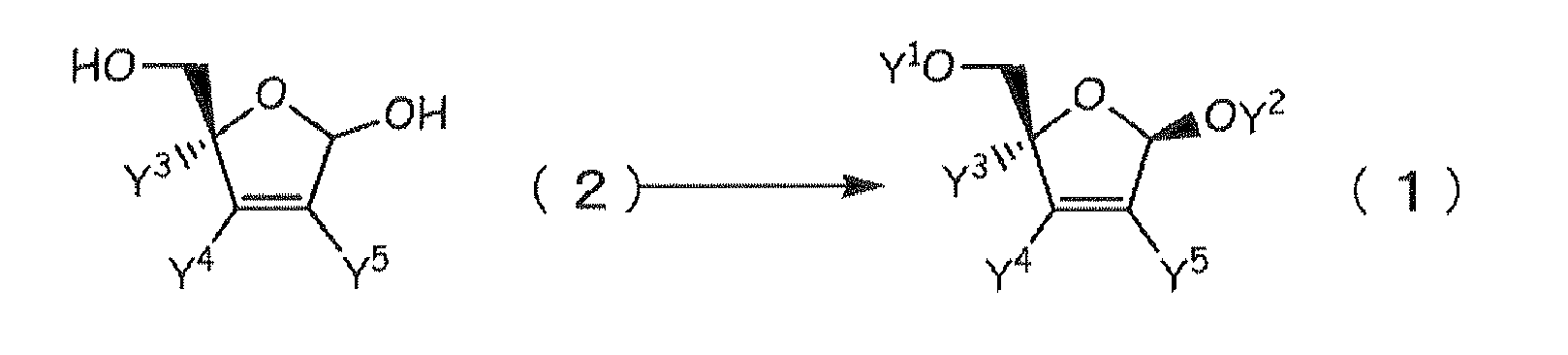
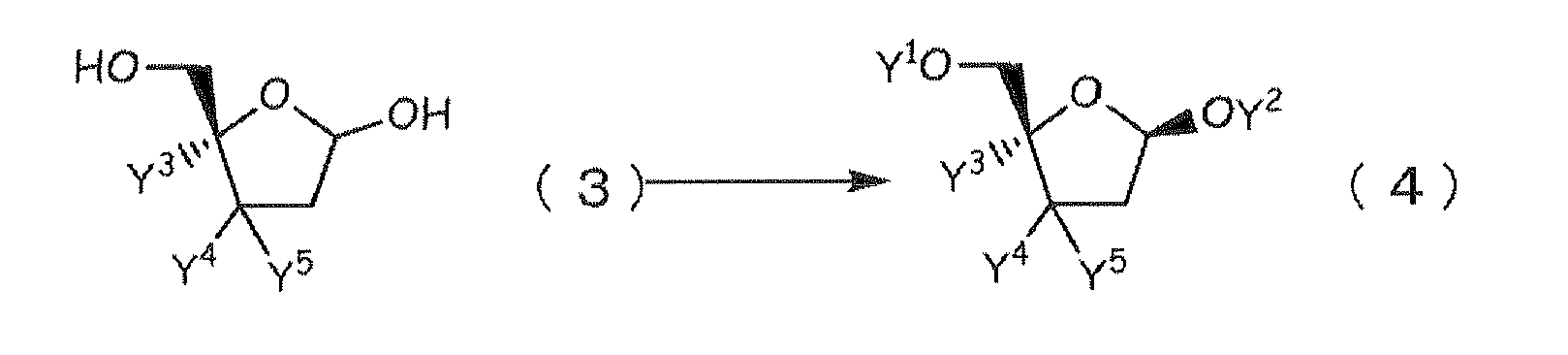
- a diol compound represented by formula (2) or (3) is caused to be reacted with a dialkyl dicarbonate, a diaralkyl dicarbonate, or a halide, to thereby produce a ⁇ -dihydrofuran derivatives represented by formula (1) or a ⁇ -tetrahydrofuran derivatives represented by formula (4) .
- the diol compound represented by formula (2) or the diol compound represented by formula (3) is generally in an equilibrium state between the 5-membered ring structure and the 6-membered ring structure.
- the 5-membered cyclic compound is also in an equilibrium state between the ⁇ -form and the ⁇ -form.
- a target ⁇ -form compound i.e., a ⁇ -dihydrofuran derivative represented by formula (1) or a ⁇ -tetrahydrofuran derivative represented by formula (4)
- these structures involved in the equilibrium are not shown in the present specification, and it is understood that any of these is equivalent to a diol compound represented by formula (2) or (3).
- dialkyl dicarbonate which may be employed in the reaction include dimethyl dicarbonate, diethyl dicarbonate, di-n-propyl dicarbonate, di-i-propyl dicarbonate, di-c-propyl dicarbonate, di-n-butyl dicarbonate, di-i-butyl dicarbonate, di-s-butyl dicarbonate, di-t-butyl dicarbonate, di-c-butyl dicarbonate, di-n-pentyl dicarbonate, di-(1-methyl-n-butyl) dicarbonate, di-(2-methyl-n-butyl) dicarbonate, di-(3-methyl-n-butyl) dicarbonate, di-(1,1-dimethyl-n-propyl) dicarbonate, di-c-pentyl dicarbonate, di-(2-methyl-c-butyl) dicarbonate, di-n-hexyl dicarbonate, di-(1-methyl-n-pentyl)
- diaralkyl dicarbonate examples include dibenzyl dicarbonate, di-1-phenethyl dicarbonate, and di-2-phenethyl dicarbonate.
- halide examples include methoxycarbonyl chloride, ethoxycarbonyl chloride, n-propoxycarbonyl chloride, i-propoxycarbonyl chloride, c-propoxycarbonyl chloride, n-butoxycarbonyl chloride, i-butoxycarbonyl chloride, s-butoxycarbonyl chloride, t-butoxycarbonyl chloride, c-butoxycarbonyl chloride, n-pentyloxycarbonyl chloride, 1-methyl-n-butoxycarbonyl chloride, 2-methyl-n-butoxycarbonyl chloride, 3-methyl-n-butoxycarbonyl chloride, 1,1-dimethyl-n-propoxycarbonyl chloride, c-pentyloxycarbonyl chloride, 2-methyl-c-butoxycarbonyl chloride, n-hexyloxycarbonyl chloride, 1-methyl-n-pentyloxycarbonyl chloride, 2-methyl-n-pentyloxycarbonyl chloride
- the dialkyl dicarbonate, diaralkyl dicarbonate, or halide may be used in an amount of about 1.0 to about 3.0 eqv. by mole with respect to 1.0 eqv. by mole of the diol compound represented by formula (2) or (3), preferably 2.0 to 2.5 eqv. by mole.
- dialkyl dicarbonates, diaralkyl dicarbonates, and halides may be used singly or in combination.
- the dialkyl dicarbonates, diaralkyl dicarbonates, and halides may be used in combination with an acylating agent.
- the diol compound represented by formula (2) or (3) reacts with the dialkyl dicarbonate, diaralkyl dicarbonate, or halide in an amount of 1.0 to 1.5 eqv. by mole with respect to 1.0 eqv. by mole of the diol compound represented by formula (2) or (3) and then with the acylating agent.
- an optional base may be added.
- the base include inorganic bases such as sodium hydroxide, potassium hydroxide, sodium carbonate, potassium carbonate, cesium carbonate, sodium hydrogencarbonate, potassium hydrogencarbonate, and sodium hydride; organic bases such as pyridine, 4-dimethylaminopyridine, triethylamine, tributylamine, N,N-dimethylaniline, and 1,8-diazabicyclo[5.4.0]-7-undecene; organic lithiums such as butyllithium and s-butyllithium; organic lithiumamides such as lithiumdiisopropylamide and lithiumbis(trimethylsilyl)amide; and metal alkoxides such as sodium methoxide, sodium ethoxide, and potassium t-butoxide.
- bases such as 4-dimethylaminopyridine, pyridine, and triethylamine are preferred.
- the base may be used in an amount of about 0 to about 10 eqv. by mole with respect to 1.0 eqv. by mole of the diol compound represented by formula (2) or (3), preferably in an amount of 0 to 3 eqv. by mole.
- reaction solvent No particular limitation is imposed on the reaction solvent, so long as it is stable under the aforementioned reaction conditions and is sufficiently inert so as not to impede reaction.
- the solvent include ethers such as diethyl ether, methyl t-butyl ether, tetrahydrofuran, diethyl ether, dimethoxymethane, diethoxymethane, ethylene glycol dimethyl ether, ethylene glycol diethyl ether, ethylene glycol dibutyl ether, diethylene glycol dimethyl ether, diethylene glycol diethyl ether, diethylene glycol dibutyl ether, triethylene glycol dimethyl ether, 1,4-dioxane, and anisole; ketones such as acetone, methyl ethyl ketone, diethyl ketone, 2-pentanone, methyl isobutyl ketone, and cyclohexanone; aliphatic hydrocarbons such as pentane, hex
- the reaction may be carried out in a wide temperature range. However, when economic factors including the amount(s) of reagent(s) used in the reaction are taken into consideration, generally, the reaction temperature is preferably -80 to 100°C, particularly preferably -20 to 50°C. Alternatively, the reaction may be performed at room temperature.
- the reaction time (i.e., the time required for terminating the reaction), which varies depending on the amount of reactant used in the reaction, reactant concentration, reaction temperature, etc., is generally 0.1 to 20 hours, preferably 0.5 to 10 hours.
- the reaction may be carried out in a batch manner or in a continuous manner.
- the reaction format may be chosen depending on the substrate concentration, percent conversion, productivity, etc. required for the reaction.
- the solvent remaining in the reaction system is evaporated in accordance with needs, and the reaction mixture is distilled, to thereby directly yield a target product.
- the crude reaction product is sufficiently washed with water and a solvent which is not dissolved in water, and the obtained organic layer is subjected to a routine work-up process such as distillation or column chromatography, to thereby purify and isolate a ⁇ -glycoside compound.
- the ⁇ -glycoside compound of the present invention represented by formula (5) is produced through the following reaction scheme.
- a transition metal catalyst and a nucleophile are caused to act on a ⁇ -dihydrofuran derivative represented by formula (1), to thereby produce a ⁇ -glycoside compound represented by formula (5).
- the metallic catalyst which may be employed in the present invention is preferably a transition metal catalyst, particularly preferably a metallic catalyst selected from among an iron catalyst, a nickel catalyst, a ruthenium catalyst, a rhodium catalyst, a palladium catalyst, an iridium catalyst, a molybdenum catalyst, a tungsten catalyst, and a platinum catalyst.
- a transition metal catalyst particularly preferably a metallic catalyst selected from among an iron catalyst, a nickel catalyst, a ruthenium catalyst, a rhodium catalyst, a palladium catalyst, an iridium catalyst, a molybdenum catalyst, a tungsten catalyst, and a platinum catalyst.
- the catalyst which may be employed in the reaction are as follows.
- the iron catalyst include iron complex catalysts such as pentacarbonyliron, enneacarbonyldiiron, dodecacarbonyltriiron, dichlorobis(triphenylphosphine)iron, tetracarbonyl(triphenylphosphine)iron, tricarbonylbis(triphenylphosphine)iron, sodium cyclopentadienyldicarbonylferrate, cyclopentadienyldicarbonyliron dimer, pentamethylcyclopentadienyldicarbonyliron dimer, cyclopentadienetricarbonyliron, cyclohexadienetricarbonyliron, butadienetricarbonyliron, sodium tetracarbonylferrate, bis(cyclopentadienyl)iron (ferrocene), bis(tetramethylcyclopentadienyl)iron, bis(methylcyclopentadieny
- nickel catalyst examples include solid and supported nickel catalysts such as nickel-on-silica, nickel-on-alumina, and nickel-on-carbon; and nickel complex catalysts such as tetracarbonylnickel, dichlorobis (triphenylphosphine) nickel, tetrakis (triphenylphosphine) nickel, tetrakis(triphenylphosphite)nickel, bis(cyclooctadienyl)nickel, and dichloro(diphenylphosphinoethylene)nickel.
- solid and supported nickel catalysts such as nickel-on-silica, nickel-on-alumina, and nickel-on-carbon
- nickel complex catalysts such as tetracarbonylnickel, dichlorobis (triphenylphosphine) nickel, tetrakis (triphenylphosphine) nickel, tetrakis(triphenylphosphite)nickel, bis(cyclooctadienyl)nic
- ruthenium catalyst examples include supported ruthenium catalysts such as ruthenium-on-silica, ruthenium-on-alumina, and ruthenium-on-carbon; ruthenium complex catalysts such as pentacarbonylruthenium, dodecacarbonyltriruthenium, tetrahydridododecacarbonyltetraruthenium, dihydrido (dinitrogen) tris (triphenylphosphine) ruthenium, dicarbonyltris (triphenylphosphine) ruthenium, tetracarbonyl(trimethylphosphite)ruthenium, pentakis(trimethylphosphite)ruthenium, tris (acetylacetonato) ruthenium, diacetatodicarbonylbis (triphenylphosphine) ruthenium, dichlorobis(chlorotricarbonyl)ruthenium, carbonylchlorohydrid
- the palladium catalyst examples include solid and supported palladium catalysts such as metallic palladium, palladium black, a palladium-on-silica catalyst, a palladium-on-alumina catalyst, a palladium-on-carbon catalyst, a palladium-on-barium sulfate catalyst, a palladium-on-zeolite catalyst, a palladium-on-silica.alumina catalyst, and a palladium-on-polymer catalyst; palladium complex catalysts such as dichlorobis(triphenylphosphine)palladium, dichlorobis(trimethylphosphine)palladium, dichlorobis(tributylphosphine)palladium, bis(tricyclohexylphosphine)palladium, tetrakis(triethylphosphite)palladium, bis(cycloocta-1,5-diene)palladium, tetrakis(triphenylphosphin
- rhodium catalyst examples include supported rhodium catalysts such as a rhodium-on-silica catalyst, a rhodium-on-alumina catalyst, and a rhodium-on-carbon catalyst; rhodium complex catalysts such as chlorotris(triphenylphosphine)rhodium, hexadecacarbonylhexarhodium, dodecacarbonyltetrarhodium, dichlorotetracarbonyldirhodium, hydridotetracarbonylrhodium, hydridocarbonyltris(triphenylphosphine)rhodium, hydridotetrakis(triphenylphosphine)rhodium, dichlorobis(cyclooctadiene)dirhodium, dicarbonyl(pentamethylcyclopentadienyl)rhodium, cyclopentadienylbis(tri
- iridium catalyst examples include iridium complex catalysts such as chloro(cyclooctadienyl)iridium dimer.
- molybdenum catalyst examples include molybdenum complex catalysts such as hexacarbonylmolybdenum, biscarbonyltetra(isocyano)molybdenum, tricarbonyltris(acetonitrile)molybdenum, pentacarbonylbis(trifluoromethanesulfonyl)molybdenum, dibromotetracarbonylmolybdenum dimer, chlorotetracarbonylbis(acetonitrile)-(trichlorostannyl)molybdenum, tetracarbonyl(bipyridyl)molybdenum, tricarbonyl(bipyridyl)(acetonitrile)molybdenum, and (N,N'-bis(cyclohexyl)ethylenediimine)tetracarbonylmolybdenum.
- molybdenum complex catalysts such as hexacarbonylmolybdenum, biscarbonyl
- tungsten catalyst examples include tungsten complex catalysts such as tetracarbonyltetra(acetonitrile)tungsten, pentacarbonylbis(trifluoromethanesulfonyl)tungsten, and dibromotetracarbonyltungsten dimer.
- platinum catalyst examples include supported platinum catalysts such as a platinum-on-silica catalyst, a platinum-on-alumina catalyst, and a platinum-on-carbon catalyst; platinum complex catalysts such as dichlorobis(triphenylphosphine)platinum, dichlorobis(trimethylphosphine)platinum, dichlorobis(tributylphosphine)platinum, tetrakis(triphenylphosphine)platinum, tetrakis(triphenylphosphite)platinum, tris(triphenylphosphine)platinum, dicarbonylbis(triphenylphosphine)platinum, carbonyltris(triphenylphosphine)platinum, cis-bis(benzonitrile)dichloroplatinum, bis(1,5-cyclooctadiene)platinum, and methylenebis(triphenylphosphine)platinum; and other platinum catalyst
- a nickel catalyst, a palladium catalyst, a ruthenium catalyst, and a rhodium catalyst are preferred.
- a complex catalyst is a suitably employed form of the catalyst.
- These catalysts may be used singly or in combination.
- the amount of transition metal catalyst used in the reaction is generally 0.0001 to 50 mol% with respect to the ⁇ -dihydrofuran derivative represented by formula (1), preferably 0.001 to 20 mol%.
- a ligand may be added to the aforementioned catalyst.
- the ligand include monodentate and polydentate tertiary phosphines such as trimethylphosphine, triethylphosphine, tributylphosphine, triphenylphosphine, tris(p-tolyl)phosphine, tris(2,6-dimethylphenyl)phosphine, sodium diphenylphosphinobenzene-3-sulfonate, bis(3-sulfonatophenyl)phosphinobenzene sodium salt, tri(2-furyl)phosphine, bis(diphenylphosphino)methane, 1,2-bis(diphenylphosphino)ethane, 1,3-bis(diphenylphosphino)propane, 1,4-bis(diphenylphosphino)butane, 2,3-bis(diphenylphosphino)but
- the amount thereof is generally 0.1 to 10,000 mol% with respect to transition metal catalyst, preferably 1 to 5,000 mol%.
- an optional base may be added.
- the base include inorganic bases such as sodium hydroxide, potassium hydroxide, sodium carbonate, potassium carbonate, cesium carbonate, sodium hydrogencarbonate, potassium hydrogencarbonate, and sodium hydride; organic bases such as pyridine, 4-dimethylaminopyridine, triethylamine, tributylamine, N,N-dimethylaniline, and 1,8-diazabicyclo[5.4.0]-7-undecene; organic lithiums such as butyllithium and s-butyllithium; organic lithiumamides such as lithiumdiisopropylamide and lithiumbis(trimethylsilyl)amide; and metal alkoxides such as sodium methoxide, sodium ethoxide, and potassium t-butoxide.
- bases such as sodium carbonate, potassium carbonate, sodium hydrogencarbonate, triethylamine, and sodium hydride are preferred, with sodium hydride being more preferred.
- the base may be used in an amount of about 0 to about 10 eqv. by mole with respect to 1.0 eqv. by mole of the ⁇ -dihydrofuran derivative represented by formula (1), preferably 0 to 2 eqv. by mole.
- nucleophile examples include heterocyclic bases such as optionally substituted uracils, optionally protected thymines (e.g., 4-O-methylthymine), cytosine, imidazole, benzimidazole, benzotriazole, optionally substituted thiouracils, and purines.
- heterocyclic bases such as optionally substituted uracils, optionally protected thymines (e.g., 4-O-methylthymine), cytosine, imidazole, benzimidazole, benzotriazole, optionally substituted thiouracils, and purines.
- preferred are optionally substituted uracil, optionally protected thymine, cytosine, imidazole, benzimidazole, benzotriazole, optionally substituted thiouracil, optionally substituted purine.
- the nucleophile may be siliyalted in advance with a silylating reagent such as chlorotrimethylsilane or bistrimethylsilylacetamide.
- the reaction is performed under solvent-diluted conditions for smoothly performing the reaction including sufficient mixing and dispersing the reagents used in the reaction.
- the solvent include ethers such as diethyl ether, methyl t-butyl ether, tetrahydrofuran, diethyl ether, dimethoxymethane, diethoxymethane, ethylene glycol dimethyl ether, ethylene glycol diethyl ether, ethylene glycol dibutyl ether, diethylene glycol dimethyl ether, diethylene glycol diethyl ether, diethylene glycol dibutyl ether, triethylene glycol dimethyl ether, 1,4-dioxane, and anisole; alcohols such as methanol, ethanol, 1-propanol, 2-propanol, 1-butanol, 2-butanol, isobutanol, 2-methyl-2-propano
- the reaction may be carried out in a wide temperature range. However, when economic factors including the amount(s) of reagent(s) used in the reaction are taken into consideration, generally, the reaction temperature is preferably -80 to 100°C, particularly preferably -20 to 50°C. Alternatively, the reaction may be performed at room temperature.
- the reaction time (i.e., the time required for terminating the reaction), which varies depending on the amount of reactant used in the reaction, reactant concentration, reaction temperature, etc., is generally 0.1 to 20 hours, preferably 0.5 to 10 hours.
- the reaction may be carried out in a batch manner or in a continuous manner.
- the reaction format may be chosen depending on the substrate concentration, percent conversion, productivity, etc. required for the reaction.
- the solvent remaining in the reaction system is evaporated in accordance with needs, and the reaction mixture is distilled, to thereby directly yield a target product.
- the crude reaction product is sufficiently washed with water and a solvent which is not dissolved in water, and the obtained organic layer is subjected to a routine work-up process such as distillation or column chromatography, to thereby purify and isolate a ⁇ -glycoside compound.
- a ⁇ -glycoside compound represented by formula (5) is deprotected, to thereby form a compound represented by formula (7); i.e., 4'-ethynyl d4T or an analog thereof.
- the term "deprotection” refers not only to elimination of substituent Y 1 but also to optional elimination of a protective group in substituent Y 3 , Y 4 , Y 5 , or R 1 .
- an isomer having a substituent R 1 ' on the lower side of the sheet is called an ⁇ -form
- another isomer having a substituent R 1' on the upper side of the sheet is called a ⁇ -form, when -CH 2 -OH is fixed on the upper side of the sheet.
- the deprotection reaction may be performed through a known technique; for example, a method disclosed in Greene and Wuts, "Protective Groups in Organic Synthesis (Fourth Sedition)."
- Tetrahydrofuran (2,700 mL) and water (300 mL) were added to a glass reactor with a nitrogen atmosphere and stirred.
- Sodium hydrogencarbonate (343 g) and sodium acetate (167 g) were added to the reactor.
- the reaction mixture was cooled to -15°C, and N-bromosuccinimide (376 g) and furfuryl alcohol (200 g) were added dropwise thereto, followed by mixing at -15°C for 10 minutes.
- 4-dimethylaminopyridine (50 g) and acetic anhydride (416 g) were added to the mixture.
- the resultant mixture was warmed to room temperature and stirred for 3 hours.
- This reaction mixture was cooled to 5°C or lower, and the pH of the mixture was adjusted to 6.5 through addition of 10N aqueous sodium hydroxide (200 mL) and 2N sodium hydroxide (760 mL).
- Ethyl acetate (1,500 mL) was added thereto under stirring, and saturated aqueous sodium hydrogencarbonate (1,500 mL) was added to the thus-separated organic layer under stirring, for phase separation.
- the organic layer was concentrated under reduced pressure, to thereby yield 279 g of 2-acetyloxy-5,6-dihydro-2H-pyrano-5-one (yield: 73%).
- the resultant mixture was warmed to room temperature, and a mixture of acetic acid (34 g) and tetrahydrofuran (174 mL) and water (300 mL) were added thereto under stirring for phase separation.
- Saturated aqueous sodium hydrogencarbonate (300 mL) was added to the thus-separated organic layer under stirring, for phase separation.
- water (300 mL) was added to the thus-separated organic layer under stirring, for phase separation.
- Acetonitrile (300 mL) and (2R,5R)-2-acetyloxy-5,6-dihydro-2H-pyrano-5-(2-trimethylsilylethynyl)-5-ol (100 g) were added to a glass reactor under stirring, and the mixture was heated to 40°C.
- An aqueous solution of Lipase PS Amano SD (trade name, product of Amano Enzyme Co., Ltd.) (10 g) dissolved in water (400 mL) was added dropwise to the mixture, and stirring was performed for 15 hours.
- the reaction mixture was cooled to 20°C, and water and ethyl acetate were added to the reaction mixture under stirring for phase separation.
- the process of the present invention is enables large-scale synthesis, under mild conditions, of 4'-ethynyl-2',3'-didehydro-3'-deoxythymidine, which is a possible candidate of an active ingredient of a drug effective for the treatment of HIV infections, as well as analogs thereof, which are important intermediates for fine chemicals such as pharmaceuticals and agrochemicals.
- the process of the invention has industrial applicability.
Landscapes
- Chemical & Material Sciences (AREA)
- Organic Chemistry (AREA)
- Health & Medical Sciences (AREA)
- Life Sciences & Earth Sciences (AREA)
- Engineering & Computer Science (AREA)
- Biochemistry (AREA)
- Biotechnology (AREA)
- General Health & Medical Sciences (AREA)
- Genetics & Genomics (AREA)
- Molecular Biology (AREA)
- Saccharide Compounds (AREA)
- Pharmaceuticals Containing Other Organic And Inorganic Compounds (AREA)
- Plural Heterocyclic Compounds (AREA)
Abstract
Description
- The present invention relates to a β-dihydrofuran derivative, to a process for producing a β-dihydrofuran derivative or a β-tetrahydrofuran derivative, to a β-glycoside compound, to a process for producing a β-glycoside compound, and to a process for producing a 4'-ethynyl-2',3'-didehydro-3'-deoxythymidine (i.e., 4'-ethynyl d4T) or an analog thereof.
- Currently, pharmacotherapy of HIV infections is mainly carried out through a highly active anti-retroviral therapy (HAART), which is a multi-drug therapy employing a plurality of drugs in combination. HAART, however, has a downside in that replacement of one or more constituent drugs is unavoidable if and when a drug-resistant virus emerges or adverse side effects are observed. In order to solve this problem, a new active ingredient, 4'-ethynyl-2',3'-didehydro-3'-deoxythymidine (i.e., 4'-ethynyl d4T) was previously developed (see Patent Document 1). The compound 4'-ethynyl d4T is effective on multi-drug resistant virus and is considered to have low mitochondrial toxicity (i.e., high safety). From these points, this compound is expected to ensure long-term administration and maintenance of adherence.
- In one known method for producing 4'-ethynyl d4T, thymidine or uridine is employed as a synthesis starting material (see Patent Document 1 and Non-Patent Document 1). This synthesis method, employing such a natural starting material, requires a number of synthesis steps, thereby elevates the production cost. Thus, the method is not suited for large-scale production, which is problematic.
- In recent years, in order to overcome the drawback, another method for synthesizing 4'-ethynyl d4T employing inexpensive furfuryl alcohol serving as a starting material was developed, and this method requires relatively a small number of steps (see Patent Document 2). In this method, when a Lewis acid is used, α-form and β-form (43:53) are formed in the step of glycosylation (thymination) of a dihydrofuran compound. Thus, a subsequent separation/purification step considerably degrades the target yield, making the synthesis method unsuitable for mass production.
- Meanwhile, in another known method for synthesizing a β-glycoside compound from a dihydrofuran compound, a palladium reagent is employed as a catalyst (see, for example, Non-Patent Document 2). Non-Patent Document 2 discloses that the method employs an achiral phosphine ligand and an α-β-mixed form dihydrofuran compound serving as a starting material, to thereby yield a product of an α-β-mixed form. The document also discloses that, when an optically active Trost ligand is used, only a β-glycoside compound is produced, and the starting α-form material is recovered. This clearly indicates that an α-form product is yielded from an α-form starting material, and a β-form product is yielded from a β-form starting material.
- Through the aforementioned methods, a β-form-pure dihydrofuran compound must be synthesized and provided for attaining high-yield glycosylation.
- Generally, methods for synthesizing a dihydrofuran compound are disclosed by several documents. In one disclosed method, a dihydrofurandiol compound corresponding to the target and serving as a starting material is diacetylized (see Patent Document 2). However, when the method is employed, the produced dihydrofuran compound has an α-β-mixed form (α : β or β : α = 21 : 79), and no β-form-pure product is yielded.
- There has also been reported a method for synthesizing a dihydrofuran compound in which a dihydrofurandiol compound having an asymmetric substituent serving as a starting material is silylated. However, the yielded dihydrofuran compound has an α-β-mixed form (α : β or β : α = 80 : 20) (see Non-Patent Document 3).
- Also known is a similar synthesis method in which a corresponding lactone is reduced and then acetylated. However, the yielded dihydrofuran compound has an α-β-mixed form (α : β = 1 : 1) (see Non-Patent Document 2).
- In the synthesis of a tetrahydrofuran compound, β-form-selective synthesis is known to be difficult. In one case, the 1-position ol and the 5-position ol of a tetrahydrofurantriol compound are modified by two steps. However, the product is indicated to have an α-β-mixed form (Non-Patent Document 4).
- Through synthesis of a tetrahydrofuran compound from glyceraldehyde, the product is indicated to have an α-β-mixed form (α : β = 2 : 1) (Non-Patent Document 5).
- As described above, those skilled in the art know that difficulty is encountered in selectively yielding a β-dihydrofuran compound, a β-tetrahydrofuran compound, and a β-glycoside compound.
-
- Patent Document 1: Japanese Patent Application Laid-Open (kokai) No.
2006-528972 - Patent Document 2:
WO 2009/84655 -
- Non-Patent Document 1: Yoshino, "The Journal of Therapy," Vol. 88, No. 12 (2006.12), p. 2903
- Non-Patent Document 2: Journal of Organic Chemistry, Vol. 67, p. 4076 (2002)
- Non-Patent Document 3: Organic and Biomolecular Chemistry, Vol. 1, p. 2393 (2003)
- Non-Patent Document 4: Journal of the American Chemical Society, Vol. 127, p. 15612 (2005)
- Non-Patent Document 5: Journal of Medicinal Chemistry, Vol. 47, p. 3399 (2004)
- An object of the present invention is to provide a process for selectively synthesizing a β-form glycoside compound. Another object is to provide a process for producing 4'-ethynyl-2',3'-didehydro-3'-deoxythymidine (hereinafter may be referred to as "4'-ethynyl d4T") and an analog thereof, which process is based on the selective β-form glycoside compound production process and which realizes large-scale synthesis thereof at high efficiency.
- The present inventors have conducted extensive studies in order to attain the aforementioned objects, and have found that a β-form compound can be selectively produced at high yield through carbonating, carbamating, or phosphating the 5-hydroxyl group of a dihydrofurandiol compound or a tetrahydrofurandiol compound, which can be readily synthesized through various techniques. The inventors have also found that 4'-ethynyl d4T and an analog thereof can be effectively produced through the above production process. The present invention has been accomplished on the basis of these findings.
- Accordingly, the present invention provides the following.
-

- (wherein Y1 represents an alkoxycarbonyl group, an aralkyloxycarbonyl group, an aminocarbonyl group, a dialkylphosphoryl group, or a diarylphosphoryl group; Y2 represents an acyl group, an alkoxycarbonyl group, an aralkyloxycarbonyl group, an aminocarbonyl group, a dialkylphosphoryl group, or a diarylphosphoryl group; and Y3, Y4, and Y5 each represent a hydrogen atom, a halogen atom, an alkyl group, an aryl group, an acyl group, an alkenyl group, an aralkyl group, a cycloalkyl group, a hydroxyl group, an alkoxy group, an aryloxy group, an aralkyloxy group, an alkylthio group, an arylthio group, an amino group, an alkylamino group, a trialkylsilyloxy group, a trisubstituted silyl group, an alkylaminocarbonyl group, a halomethyl group, an optionally protected formyl group, a C1 to C7 ester group, an optionally protected hydroxymethyl group, a vinyl group, an optionally protected alkynyl group, a cyano group, or an optionally substituted iminomethyl group).
- [2] A process for producing a β-dihydrofuran derivative or a β-tetrahydrofuran derivative represented by formula (1) :
-

- (wherein Y1 represents an alkoxycarbonyl group, an aralkyloxycarbonyl group, an aminocarbonyl group, a dialkylphosphoryl group, or a diarylphosphoryl group; Y2 represents an acyl group, an alkoxycarbonyl group, an aralkyloxycarbonyl group, an aminocarbonyl group, a dialkylphosphoryl group, or a diarylphosphoryl group; and Y3, Y4, and Y5 each represent a hydrogen atom, a halogen atom, an alkyl group, an aryl group, an acyl group, an alkenyl group, an aralkyl group, a cycloalkyl group, a hydroxyl group, an alkoxy group, an aryloxy group, an aralkyloxy group, an alkylthio group, an arylthio group, an amino group, an alkylamino group, a trialkylsilyloxy group, a trisubstituted silyl group, an alkylaminocarbonyl group, a halomethyl group, an optionally protected formyl group, a C1 to C7 ester group, an optionally protected hydroxymethyl group, a vinyl group, an optionally protected alkynyl group, a cyano group, or an optionally substituted iminomethyl group) or formula (4):
-

- (wherein Y1, Y2, Y3, Y4, and Y5 have the same meanings as defined in formula (1)), characterized in that the process comprises causing to act a dialkyl dicarbonate, a diaralkyl dicarbonate, or a halide on a diol compound represented by formula (2) or (3) :
-


- (wherein Y3, Y4, and Y5 have the same meanings as defined in formula (1)).
- [3] A β-glycoside compound represented by formula (5):
-

- (wherein Y1 represents an alkoxycarbonyl group, an aralkyloxycarbonyl group, an aminocarbonyl group, a dialkylphosphoryl group, or a diarylphosphoryl group; Y3, Y4, and Y5 each represent a hydrogen atom, a halogen atom, an alkyl group, an aryl group, an acyl group, an alkenyl group, an aralkyl group, a cycloalkyl group, a hydroxyl group, an alkoxy group, an aryloxy group, an aralkyloxy group, an alkylthio group, an arylthio group, an amino group, an alkylamino group, a trialkylsilyloxy group, a trisubstituted silyl group, an alkylaminocarbonyl group, a halomethyl group, an optionally protected formyl group, a C1 to C7 ester group, an optionally protected hydroxymethyl group, a vinyl group, an optionally protected alkynyl group, a cyano group, or an optionally substituted iminomethyl group; and R1 represents optionally substituted uracil-1-yl, optionally protected thymin-1-yl, optionally protected thymin-3-yl, optionally amino-protected cytosin-1-yl, imidazol-1-yl, benzimidazol-1-yl, benzo-1,2,3-triazol-1-yl, benzo-1,2,3-triazol-2-yl, optionally substituted thiouracil-1-yl, or optionally substituted purin-9-yl).
- [4] A process for producing a β-glycoside compound represented by formula (5):
-

- (wherein Y1 represents an alkoxycarbonyl group, an aralkyloxycarbonyl group, an aminocarbonyl group, a dialkylphosphoryl group, or a diarylphosphoryl group; Y3, Y4, and Y5 each represent a hydrogen atom, a halogen atom, an alkyl group, an aryl group, an acyl group, an alkenyl group, an aralkyl group, a cycloalkyl group, a hydroxyl group, an alkoxy group, an aryloxy group, an aralkyloxy group, an alkylthio group, an arylthio group, an amino group, an alkylamino group, a trialkylsilyloxy group, a trisubstituted silyl group, an alkylaminocarbonyl group, a halomethyl group, an optionally protected formyl group, a C1 to C7 ester group, an optionally protected hydroxymethyl group, a vinyl group, an optionally protected alkynyl group, a cyano group, or an optionally substituted iminomethyl group; and R1 represents optionally substituted uracil-1-yl, optionally protected thymin-1-yl, optionally protected thymin-3-yl, optionally amino-protected cytosin-1-yl, imidazol-1-yl, benzimidazol-1-yl, benzo-1,2,3-triazol-1-yl, benzo-1,2,3-triazol-2-yl, optionally substituted thiouracil-1-yl, or optionally substituted purin-9-yl), characterized in that the process comprises causing, to react in the presence of a transition metal catalyst, a nucleophile selected from among optionally substituted uracil, optionally protected thymine, optionally amino-protected cytosine, imidazole, benzimidazole, benzo-1,2,3-triazole, optionally substituted thiouracil, and optionally substituted purine with a β-dihydrofuran derivative represented by formula (1):
-

- (wherein Y1 represents an alkoxycarbonyl group, an aralkyloxycarbonyl group, an aminocarbonyl group, a dialkylphosphoryl group, or a diarylphosphoryl group; Y2 represents an acyl group, an alkoxycarbonyl group, an aralkyloxycarbonyl group, an aminocarbonyl group, a dialkylphosphoryl group, or a diarylphosphoryl group; and Y3, Y4, and Y5 each represent a hydrogen atom, a halogen atom, an alkyl group, an aryl group, an acyl group, an alkenyl group, an aralkyl group, a cycloalkyl group, a hydroxyl group, an alkoxy group, an aryloxy group, an aralkyloxy group, an alkylthio group, an arylthio group, an amino group, an alkylamino group, a trialkylsilyloxy group, a trisubstituted silyl group, an alkylaminocarbonyl group, a halomethyl group, an optionally protected formyl group, a C1 to C7 ester group, an optionally protected hydroxymethyl group, a vinyl group, an optionally protected alkynyl group, a cyano group, or an optionally substituted iminomethyl group).
- [5] A process for producing 4'-ethynyl d4T or an analog thereof, characterized in that the process comprises deprotecting a β-glycoside compound represented by formula (5) :
-

- (wherein Y1 represents an alkoxycarbonyl group, an aralkyloxycarbonyl group, an aminocarbonyl group, a dialkylphosphoryl group, or a diarylphosphoryl group; Y3, Y4, and Y5 each represent a hydrogen atom, a halogen atom, an alkyl group, an aryl group, an acyl group, an alkenyl group, an aralkyl group, a cycloalkyl group, a hydroxyl group, an alkoxy group, an aryloxy group, an aralkyloxy group, an alkylthio group, an arylthio group, an amino group, an alkylamino group, a trialkylsilyloxy group, a trisubstituted silyl group, an alkylaminocarbonyl group, a halomethyl group, an optionally protected formyl group, a C1 to C7 ester group, an optionally protected hydroxymethyl group, a vinyl group, an optionally protected alkynyl group, a cyano group, or an optionally substituted iminomethyl group; and R1 represents optionally substituted uracil-1-yl, optionally protected thymin-1-yl, optionally protected thymin-3-yl, optionally amino-protected cytosin-1-yl, imidazol-1-yl, benzimidazol-1-yl, benzo-1,2,3-triazol-1-yl, benzo-1,2,3-triazol-2-yl, optionally substituted thiouracil-1-yl, or optionally substituted purin-9-yl), to thereby produce a compound represented by formula (7) :
-

- (wherein Y3' represents Y3 in formula (5) or a residue formed by deprotecting Y3 , Y4' represents Y4 in formula (5) or a residue formed by deprotecting Y4, Y5' represents Y5 in formula (5) or a residue formed by deprotecting Y5, and R1' represents R1 in formula (5) or a residue formed by deprotecting R1).
- [6] A β-dihydrofuran derivative as described in [1] above, wherein Y3 is an optionally protected alkynyl group, and each of Y4 and Y5 is a hydrogen atom.
- [7] A β-dihydrofuran derivative as described in [1] or [6] above, wherein each of Y1 and Y2 is an alkoxycarbonyl group.
- [8] A β-glycoside compound as described in [3] above, wherein Y3 is an optionally protected alkynyl group, each of Y4 and Y5 is a hydrogen atom, and R1 is an optionally protected thymin-1-yl.
- [9] A β-glycoside compound as described in [3] or [8] above, wherein Y1 is an alkoxycarbonyl group.
- [10] A process for producing a β-dihydrofuran derivative or a β-tetrahydrofuran derivative as described in [2] above, wherein Y3 is an optionally protected alkynyl group, and each of Y4 and Y5 is a hydrogen atom.
- [11] A process for producing a β-dihydrofuran derivative or a β-tetrahydrofuran derivative as described in [2] or [10] above, wherein each of Y1 and Y2 is an alkoxycarbonyl group.
- [12] A process for producing a β-glycoside compound as described in [4] above, wherein Y3 is an optionally protected alkynyl group, each of Y4 and Y5 is a hydrogen atom, and the nucleophile is thymine.
- [13] A process for producing a β-glycoside compound as described in [4] or [12] above, wherein each of Y1 and Y2 is an alkoxycarbonyl group.
- According to the present invention, β-glycoside compounds can be selectively produced at high yield, whereby 4'-ethynyl d4T and analogs thereof can be more effectively produced on a large scale under milder conditions, as compared with currently employed processes. Since the compound 4'-ethynyl d4T is a candidate active ingredient of an effective drug for the treatment of HIV infections, the production process of the present invention is very useful for attaining the treatment in practice by use of the drug. Modes for Carrying Out the Invention
- The present invention will next be described in detail.
Among the diol compounds represented by formula (2) or (3), serving as the starting materials of the production process of the present invention, the compound represented by formula (6): -

- can be synthesized through a method disclosed in
WO 2009/084655 (pamphlet) from 2-furylmethanol as a starting material. More specifically, the compound (6) may be produced according to, for example, the following reaction scheme. Notably, in the following scheme, N-bromosuccinimide is abbreviated as NBS, tetrahydrofuran as THF, sodium acetate as AcONa, acetic anhydride as Ac2O, Lipase PS Amano SD (trade name, product of Amano Enzyme) as Lipase PS, isopropanol as IPA, trimethylsilyl as TMS, acetonitrile as MeCN, 4-dimethylaminopyridine as DMAP, and ethyl acetate as EtOAc. -

- Generally, regarding the stereoisomerism of the dihydrofuran derivatives represented by formula (1), tetrahydrofuran derivatives represented by formula (4), glycoside compounds represented by formula (5), etc., an isomer having a substituent OY2 or R1 on the lower side of the sheet is called an α-form, and another isomer having a substituent OY2 or R1 on the upper side of the sheet is called a β-form, when the OY1 is fixed on the upper side of the sheet.
- Among the substituents (Y1 and Y2) which may be employed in the β-dihydrofuran derivatives represented by formula (1), diol compounds represented by formula (2) or (3), β-tetrahydrofuran derivatives represented by formula (4), and β-glycoside compounds represented by formula (5), the alkoxycarbonyl group may be linear-chain, branched, or cyclic. Examples of the alkoxycarbonyl group include methoxycarbonyl, ethoxycarbonyl, n-propoxycarbonyl, i-propoxycarbonyl, c-propoxycarbonyl, n-butoxycarbonyl, i-butoxycarbonyl, s-butoxycarbonyl, t-butoxycarbonyl, c-butoxycarbonyl, n-pentyloxycarbonyl, 1-methyl-n-butoxycarbonyl, 2-methyl-n-butoxycarbonyl, 3-methyl-n-butoxycarbonyl, 1,1-dimethyl-n-propoxycarbonyl, c-pentyloxycarbonyl, 2-methyl-c-butoxycarbonyl, n-hexyloxycarbonyl, 1-methyl-n-pentyloxycarbonyl, 2-methyl-n-pentyloxycarbonyl, 1,1-dimethyl-n-butoxycarbonyl, 1-ethyl-n-butoxycarbonyl, 1,1,2-trimethyl-n-propoxycarbonyl, c-hexyloxycarbonyl, 1-methyl-c-pentyloxycarbonyl, 1-ethyl-c-butoxycarbonyl, 1,2-dimethyl-c-butoxycarbonyl, n-heptyloxycarbonyl, n-octyloxycarbonyl, n-nonyloxycarbonyl, and n-decyloxycarbonyl. Of these, t-butoxycarbonyl is particularly preferred.
- Among the substituents (Y1 and Y2), examples of the aralkyloxycarbonyl group include benzyloxycarbonyl, 1-phenethyloxycarbonyl, and 2-phenethyloxycarbonyl. Of these, benzyloxycarbonyl is particularly preferred.
- Among the substituents (Y1 and Y2), the aminocarbonyl group may be linear-chain, branched, or cyclic. Examples of the aminocarbonyl group include methylaminocarbonyl, ethylaminocarbonyl, n-propylaminocarbonyl, i-propylaminocarbonyl, c-propylaminocarbonyl, n-butylaminocarbonyl, i-butylaminocarbonyl, s-butylaminocarbonyl, t-butylaminocarbonyl, c-butylaminocarbonyl, n-pentylaminocarbonyl, n-heptylaminocarbonyl, n-octylaminocarbonyl, n-nonylaminocarbonyl, n-decylaminocarbonyl, dimethylaminocarbonyl, diethylaminocarbonyl, di-n-propylaminocarbonyl, di-i-propylaminocarbonyl, di-c-propylaminocarbonyl, di-n-butylaminocarbonyl, di-i-butylaminocarbonyl, di-s-butylaminocarbonyl, di-c-butylaminocarbonyl, di-n-pentylaminocarbonyl, di-n-heptylaminocarbonyl, di-n-octylaminocarbonyl, di-n-nonylaminocarbonyl, di-n-decylaminocarbonyl, methylethylaminocarbonyl, methyl-n-propylaminocarbonyl, and methyl-n-butylaminocarbonyl. Of these, methylaminocarbonyl and t-butylaminocarbonyl are particularly preferred.
- Among the substituents (Y1 and Y2), the dialkylphosphoryl group may be linear-chain, branched, or cyclic. Examples of the dialkylphosphoryl group include phosphoryl groups in which the R moiety of the phosphoryl group represented by (R-O)2P(=O)- is an alkyl group. Specific examples include dimethylphosphoryl, diethylphosphoryl, di-n-propylphosphoryl, di-i-propylphosphoryl, di-c-propylphosphoryl, di-n-butylphosphoryl, di-i-butylphosphoryl, di-s-butylphosphoryl, di-t-butylphosphoryl, di-c-butylphosphoryl, di-n-pentylphosphoryl, di-(1-methyl-n-butyl)phosphoryl, di-(2-methyl-n-butyl)phosphoryl, di-(3-methyl-n-butyl)phosphoryl, di-(1,1-dimethyl-n-propyl)phosphoryl, di-c-pentylphosphoryl, di-(2-methyl-c-butyl)phosphoryl, di-n-hexylphosphoryl, di-(1-methyl-n-pentyl)phosphoryl, di-(2-methyl-n-pentyl)phosphoryl, di-(1,1-dimethyl-n-butyl)phosphoryl, di-(1-ethyl-n-butyl)phosphoryl, di-(1,1,2-trimethyl-n-propyl)phosphoryl, di-c-hexylphosphoryl, di-(1-methyl-c-pentyl)phosphoryl, di-(1-ethyl-c-butyl)phosphoryl, and di-(1,2-dimethyl-c-butyl)phosphoryl.
- Among the substituents (Y1 and Y2), examples of the diarylphosphoryl group include phosphoryl groups in which the R moiety of the phosphoryl group represented by (R-O)2P(=O)-is an aryl group. Specific examples include diphenylphosphoryl, di-o-methylphenylphosphoryl, di-m-methylphenylphosphoryl, di-p-methylphenylphosphoryl, di-o-trifluoromethylphenylphosphoryl, di-m-trifluoromethylphenylphosphoryl, di-p-trifluoromethylphenylphosphoryl, di-p-ethylphenylphosphoryl, di-p-i-propylphenylphosphoryl, di-p-t-butylphenylphosphoryl, di-o-chlorophenylphosphoryl, di-m-chlorophenylphosphoryl, dip-chlorophenylphosphoryl, di-o-bromophenylphosphoryl, di-m-bromophenylphosphoryl, di-p-bromophenylphosphoryl, di-o-fluorophenylphosphoryl, di-p-fluorophenylphosphoryl, di-o-methoxyphenylphosphoryl, di-p-methoxyphenylphosphoryl, di-o-trifluoromethoxyphenylphosphoryl, di-p-trifluoromethoxyphenylphosphoryl, di-p-nitrophenylphosphoryl, di-p-cyanophenylphosphoryl, di-3,5-dimethylphenylphosphoryl, di-3,5-bistrifluoromethylphenylphosphoryl, di-3,5-dimethoxyphenylphosphoryl, di-3,5-bistrifluoromethoxyphenylphosphoryl, di-3,5-diethylphenylphosphoryl, di-3,5-di-i-propylphenylphosphoryl, di-3,5-dichlorophenylphosphoryl, di-3,5-dibromophenylphosphoryl, di-3,5-difluorophenylphosphoryl, di-3,5-dinitrophenylphosphoryl, di-3,5-dicyanophenylphosphoryl, di-2,4,6-trimethylphenylphosphoryl, di-2,4,6-tristrifluoromethylphenylphosphoryl, di-2,4,6-trimethoxyphenylphosphoryl, di-2,4,6-tristrifluoromethoxyphenylphosphoryl, di-2,4,6-trichlorophenylphosphoryl, di-2,4,6-tribromophenylphosphoryl, di-2,4,6-trifluorophenylphosphoryl, di-α-naphthylphosphoryl, di-β-naphthylphosphoryl, di-o-biphenylylphosphoryl, di-m-biphenylylphosphoryl, and di-p-biphenylylphosphoryl. Of these, diphenylphosphoryl is particularly preferred.
- Among the substituents (Y2) , examples of the acyl group include formyl, acetyl, fluoroacetyl, difluoroacetyl, trifluoroacetyl, chloroacetyl, dichloroacetyl, trichloroacetyl, propionyl, pivaloyl, tigloyl, benzoyl, benzoylformyl, benzoylpropionyl, and phenylpropionyl.
- No particular limitation is imposed on the substituent (Y3 , Y4 , or Y5) which may be employed in the β-dihydrofuran derivatives represented by formula (1), diol compounds represented by formula (2) or (3), β-tetrahydrofuran derivatives represented by formula (4), and β-glycoside compounds represented by formula (5), and any substituents including a hydrogen atom may be employed. Examples of preferred substituents include a hydrogen atom, a halogen atom, an alkyl group, an aryl group, an acyl group, an alkenyl group, an aralkyl group, a cycloalkyl group, a hydroxyl group, an alkoxy group, an aryloxy group, an aralkyloxy group, an alkylthio group, an arylthio group, an amino group, an alkylamino group, a trialkylsilyloxy group, a trisubstituted silyl group, an alkylaminocarbonyl group, a halomethyl group, an optionally protected formyl group, a C1 to C7 ester group, an optionally protected hydroxymethyl group, a vinyl group, an optionally protected alkynyl group, a cyano group and an optionally substituted iminomethyl.
- Examples of the R1 which may be employed in the β-glycoside compounds represented by formula (5) include heterocyclic base substituents such as optionally substituted uracil-1-yl, optionally protected thymin-1-yl (e.g., 4-O-methylthymin-1-yl), optionally protected thymin-3-yl, optionally amino-protected cytosin-1-yl, imidazol-1-yl, benzimidazol-1-yl, benzo-1,2,3-triazol-1-yl, benzo-1,2,3-triazol-2-yl, optionally substituted thiouracil-1-yl, and optionally substituted purin-9-yl. Among them, optionally substituted uracil-1-yl, optionally protected thymin-1-yl, cytosin-1-yl, imidazol-1-yl, benzimidazol-1-yl, benzo-1,2,3-triazol-1-yl, optionally substituted thiouracil-1-yl, and optionally substituted purin-9-yl are preferred.
- As used herein, the expression "optionally substituted" refers to that a hydrogen atom or hydrogen atoms are optionally substituted by one or more substituents, which are identical to or different from one another, selected from among a halogen atom, a C1 to C7 alkyl group, a C1 to C7 alkoxy group, a C6 to C12 aryl group, a carboxyl group, a C1 to C7 acyl group, a nitro group, and a cyano group.
- Also, as used herein, the expression "optionally protected" refers to that a group is optionally protected by a protective group which is employed in general organic synthetic reaction.
- Protective groups preferably in the reaction are as follows.
Examples of the protective group for a hydroxy group or a mercapto group include alkyl protective groups such as methyl, benzyl, p-methoxybenzyl, and t-butyl; acetal protective groups such as methoxymethyl, 2-tetrahydropyranyl, and ethoxyethyl; acyl protective groups such as acetyl, pivaloyl, and benzoyl; and silyl protective groups such as trimethylsilyl, triethylsilyl, t-butyldimethylsilyl, triisopropylsilyl, and t-butyldiphenylsilyl. - Examples of the amino-group-protective group include protective groups forming carbamate such as t-butoxycarbonyl, benzyloxycarbonyl, 9-fluorenylmethyloxycarbonyl, 2,2,2-trichloroethoxycarbonyl, and allyloxycarbonyl; protective groups forming amide such as trifluoroacetyl; protective groups forming imide such as phthaloyl; and protective groups forming sulfonamide such as p-toluenesulfonyl or 2-nitrobenzenesulfonyl.
- Examples of the ketone-protective group include protective groups forming cyclic or acyclic acetal such as dimethylacetal, ethylene glycol acetal, 1,3-propanediol acetal, or dithioacetal.
- Examples of the carboxyl-group-protective group include protective groups forming ester such as a methyl ester, an ethyl ester, a benzyl ester, or a t-butyl ester.
- Examples of the alkynyl-group-protective group include silyl protective groups such as trimethylsilyl, triethylsilyl, t-butyldimethylsilyl, triisopropylsilyl, and t-butyldiphenylsilyl.
- The reactions of the present invention will next be described in more detail.
The β-dihydrofuran derivatives represented by formula (1) and the β-tetrahydrofuran derivatives represented by formula (4), falling within the scope of the invention, are produced through the following reaction schemes. -


- In the above reactions, a diol compound represented by formula (2) or (3) is caused to be reacted with a dialkyl dicarbonate, a diaralkyl dicarbonate, or a halide, to thereby produce a β-dihydrofuran derivatives represented by formula (1) or a β-tetrahydrofuran derivatives represented by formula (4) .
- The diol compound represented by formula (2) or the diol compound represented by formula (3) is generally in an equilibrium state between the 5-membered ring structure and the 6-membered ring structure. The 5-membered cyclic compound is also in an equilibrium state between the α-form and the β-form. However, even when such an equilibrium is established, a target β-form compound (i.e., a β-dihydrofuran derivative represented by formula (1) or a β-tetrahydrofuran derivative represented by formula (4)) can be produced. Thus, unless otherwise specified, these structures involved in the equilibrium are not shown in the present specification, and it is understood that any of these is equivalent to a diol compound represented by formula (2) or (3).
- Examples of the dialkyl dicarbonate which may be employed in the reaction include dimethyl dicarbonate, diethyl dicarbonate, di-n-propyl dicarbonate, di-i-propyl dicarbonate, di-c-propyl dicarbonate, di-n-butyl dicarbonate, di-i-butyl dicarbonate, di-s-butyl dicarbonate, di-t-butyl dicarbonate, di-c-butyl dicarbonate, di-n-pentyl dicarbonate, di-(1-methyl-n-butyl) dicarbonate, di-(2-methyl-n-butyl) dicarbonate, di-(3-methyl-n-butyl) dicarbonate, di-(1,1-dimethyl-n-propyl) dicarbonate, di-c-pentyl dicarbonate, di-(2-methyl-c-butyl) dicarbonate, di-n-hexyl dicarbonate, di-(1-methyl-n-pentyl) dicarbonate, di-(2-methyl-n-pentyl) dicarbonate, di-(2-methyl-n-pentyl) dicarbonate, di-(1,1-dimethyl-n-butyl) dicarbonate, di-(1-ethyl-n-butyl) dicarbonate, di-(1,1,2-trimethyl-n-propyl) dicarbonate, di-c-hexyl dicarbonate, di-(1-methyl-c-pentyl) dicarbonate, di-(1-ethyl-c-butyl) dicarbonate, di-(1,2-dimethyl-c-butyl) dicarbonate, di-n-heptyl dicarbonate, di-n-octyl dicarbonate, di-n-nonyl dicarbonate, and di-n-decyl dicarbonate.
- Examples of the diaralkyl dicarbonate include dibenzyl dicarbonate, di-1-phenethyl dicarbonate, and di-2-phenethyl dicarbonate.
- Examples of the halide include methoxycarbonyl chloride, ethoxycarbonyl chloride, n-propoxycarbonyl chloride, i-propoxycarbonyl chloride, c-propoxycarbonyl chloride, n-butoxycarbonyl chloride, i-butoxycarbonyl chloride, s-butoxycarbonyl chloride, t-butoxycarbonyl chloride, c-butoxycarbonyl chloride, n-pentyloxycarbonyl chloride, 1-methyl-n-butoxycarbonyl chloride, 2-methyl-n-butoxycarbonyl chloride, 3-methyl-n-butoxycarbonyl chloride, 1,1-dimethyl-n-propoxycarbonyl chloride, c-pentyloxycarbonyl chloride, 2-methyl-c-butoxycarbonyl chloride, n-hexyloxycarbonyl chloride, 1-methyl-n-pentyloxycarbonyl chloride, 2-methyl-n-pentyloxycarbonyl chloride, 1,1-dimethyl-n-butoxycarbonyl chloride, 1-ethyl-n-butoxycarbonyl chloride, 1,1,2-trimethyl-n-propoxycarbonyl chloride, c-hexyloxycarbonyl chloride, 1-methyl-c-pentyloxycarbonyl chloride, 1-ethyl-c-butoxycarbonyl chloride, 1,2-dimethyl-c-butoxycarbonyl chloride, n-heptyloxycarbonyl chloride, n-octyloxycarbonyl chloride, n-nonyloxycarbonyl chloride, n-decyloxycarbonyl chloride, benzyloxycarbonyl chloride, 1-phenethyloxycarbonyl chloride, 2-phenethyloxycarbonyl chloride, methylaminocarbonyl chloride, ethylaminocarbonyl chloride, n-propylaminocarbonyl chloride, i-propylaminocarbonyl chloride, c-propylaminocarbonyl chloride, n-butylaminocarbonyl chloride, i-butylaminocarbonyl chloride, s-butylaminocarbonyl chloride, t-butylaminocarbonyl chloride, c-butylaminocarbonyl chloride, n-pentylaminocarbonyl chloride, n-heptylaminocarbonyl chloride, n-octylaminocarbonyl chloride, n-nonylaminocarbonyl chloride, n-decylaminocarbonyl chloride, dimethylaminocarbonyl chloride, diethylaminocarbonyl chloride, di-n-propylaminocarbonyl chloride, di-i-propylaminocarbonyl chloride, di-c-propylaminocarbonyl chloride, di-n-butylaminocarbonyl chloride, di-i-butylaminocarbonyl chloride, di-s-butylaminocarbonyl chloride, di-c-butylaminocarbonyl chloride, di-n-pentylaminocarbonyl chloride, di-n-heptylaminocarbonyl chloride, di-n-octylaminocarbonyl chloride, di-n-nonylaminocarbonyl chloride, di-n-decylaminocarbonyl chloride, methylethylaminocarbonyl chloride, methyl-n-propylaminocarbonyl chloride, methyl-n-butylaminocarbonyl chloride, dimethylphosphoryl chloride, diethylphosphoryl chloride, di-n-propylphosphoryl chloride, di-i-propylphosphoryl chloride, di-c-propylphosphoryl chloride, di-n-butylphosphoryl chloride, di-i-butylphosphoryl chloride, di-s-butylphosphoryl chloride, di-t-butylphosphoryl chloride, di-c-butylphosphoryl chloride, di-n-pentylphosphoryl chloride, di-(1-methyl-n-butyl)phosphoryl chloride, di-(2-methyl-n-butyl)phosphoryl chloride, di-(3-methyl-n-butyl)phosphoryl chloride, di-(1,1-dimethyl-n-propyl)phosphoryl chloride, di-c-pentylphosphoryl chloride, di-(2-methyl-c-butyl)phosphoryl chloride, di-n-hexylphosphoryl chloride, di-(1-methyl-n-pentyl)phosphoryl chloride, di-(2-methyl-n-pentyl)phosphoryl chloride, di-(1,1-dimethyl-n-butyl)phosphoryl chloride, di-(1-ethyl-n-butyl)phosphoryl chloride, di-(1,1,2-trimethyl-n-propyl)phosphoryl chloride, di-c-hexylphosphoryl chloride, di-(1-methyl-c-pentyl)phosphoryl chloride, di-(1-ethyl-c-butyl)phosphoryl chloride, di-(1,2-dimethyl-c-butyl)phosphoryl chloride, diphenylphosphoryl chloride, di-o-methylphenylphosphoryl chloride, di-m-methylphenylphosphoryl chloride, di-p-methylphenylphosphoryl chloride, di-o-trifluoromethylphenylphosphoryl chloride, di-m-trifluoromethylphenylphosphoryl chloride, di-p-trifluoromethylphenylphosphoryl chloride, di-p-ethylphenylphosphoryl chloride, di-p-i-propylphenylphosphoryl chloride, di-p-t-butylphenylphosphoryl chloride, di-o-chlorophenylphosphoryl chloride, di-m-chlorophenylphosphoryl chloride, di-p-chlorophenylphosphoryl chloride, di-o-bromophenylphosphoryl chloride, di-m-bromophenylphosphoryl chloride, di-p-bromophenylphosphoryl chloride, di-o-fluorophenylphosphoryl chloride, di-p-fluorophenylphosphoryl chloride, di-o-methoxyphenylphosphoryl chloride, di-p-methoxyphenylphosphoryl chloride, di-o-trifluoromethoxyphenylphosphoryl chloride, di-p-trifluoromethoxyphenylphosphoryl chloride, di-p-nitrophenylphosphoryl chloride, di-p-cyanophenylphosphoryl chloride, di-3,5-dimethylphenylphosphoryl chloride, di-3,5-bistrifluoromethylphenylphosphoryl chloride, di-3,5-dimethoxyphenylphosphoryl chloride, di-3,5-bistrifluoromethoxyphenylphosphoryl chloride, di-3,5-diethylphenylphosphoryl chloride, di-3,5-di-i-propylphenylphosphoryl chloride, di-3,5-dichlorophenylphosphoryl chloride, di-3,5-dibromophenylphosphoryl chloride, di-3,5-difluorophenylphosphoryl chloride, di-3,5-dinitrophenylphosphoryl chloride, di-3,5-dicyanophenylphosphoryl chloride, di-2,4,6-trimethylphenylphosphoryl chloride, di-2,4,6-tristrifluoromethylphenylphosphoryl chloride, di-2,4,6-trimethoxyphenylphosphoryl chloride, di-2,4,6-tristrifluoromethoxyphenylphosphoryl chloride, di-2,4,6-trichlorophenylphosphoryl chloride, di-2,4,6-tribromophenylphosphoryl chloride, di-2,4,6-trifluorophenylphosphoryl chloride, di-α-naphthylphosphoryl chloride, di-β-naphthylphosphoryl chloride, di-o-biphenylylphosphoryl chloride, di-m-biphenylylphosphoryl chloride, and di-p-biphenylylphosphoryl chloride.
- The dialkyl dicarbonate, diaralkyl dicarbonate, or halide may be used in an amount of about 1.0 to about 3.0 eqv. by mole with respect to 1.0 eqv. by mole of the diol compound represented by formula (2) or (3), preferably 2.0 to 2.5 eqv. by mole.
- The aforementioned dialkyl dicarbonates, diaralkyl dicarbonates, and halides may be used singly or in combination. The dialkyl dicarbonates, diaralkyl dicarbonates, and halides may be used in combination with an acylating agent. In this case, preferably, the diol compound represented by formula (2) or (3) reacts with the dialkyl dicarbonate, diaralkyl dicarbonate, or halide in an amount of 1.0 to 1.5 eqv. by mole with respect to 1.0 eqv. by mole of the diol compound represented by formula (2) or (3) and then with the acylating agent.
- To the aforementioned reaction systems, an optional base may be added. Examples of the base include inorganic bases such as sodium hydroxide, potassium hydroxide, sodium carbonate, potassium carbonate, cesium carbonate, sodium hydrogencarbonate, potassium hydrogencarbonate, and sodium hydride; organic bases such as pyridine, 4-dimethylaminopyridine, triethylamine, tributylamine, N,N-dimethylaniline, and 1,8-diazabicyclo[5.4.0]-7-undecene; organic lithiums such as butyllithium and s-butyllithium; organic lithiumamides such as lithiumdiisopropylamide and lithiumbis(trimethylsilyl)amide; and metal alkoxides such as sodium methoxide, sodium ethoxide, and potassium t-butoxide. Of these, bases such as 4-dimethylaminopyridine, pyridine, and triethylamine are preferred.
- The base may be used in an amount of about 0 to about 10 eqv. by mole with respect to 1.0 eqv. by mole of the diol compound represented by formula (2) or (3), preferably in an amount of 0 to 3 eqv. by mole.
- No particular limitation is imposed on the reaction solvent, so long as it is stable under the aforementioned reaction conditions and is sufficiently inert so as not to impede reaction. Examples of the solvent include ethers such as diethyl ether, methyl t-butyl ether, tetrahydrofuran, diethyl ether, dimethoxymethane, diethoxymethane, ethylene glycol dimethyl ether, ethylene glycol diethyl ether, ethylene glycol dibutyl ether, diethylene glycol dimethyl ether, diethylene glycol diethyl ether, diethylene glycol dibutyl ether, triethylene glycol dimethyl ether, 1,4-dioxane, and anisole; ketones such as acetone, methyl ethyl ketone, diethyl ketone, 2-pentanone, methyl isobutyl ketone, and cyclohexanone; aliphatic hydrocarbons such as pentane, hexane, cyclohexane, methylcyclohexane, heptane, octane, and decane; halohydrocarbons such as dichloromethane, chloroform, tetrachlorocarbon, dichloroethane, and tetrachloroethylene; aromatic hydrocarbons such as benzene, toluene, xylene, chlorobenzene, o-dichlorobenzene, m-dichlorobenzene, p-dichlorobenzene, nitrobenzene, and tetrahydronaphthalene; nitriles such as acetonitrile and propionitrile; esters such as methyl acetate, ethyl acetate, butyl acetate, and ethyl propionate; amides such as N,N-dimethylformamide, N,N-dimethylacetamide, and N-methylpyrrolidone; ureas such as 1,3-dimethylimidazolidinone and N,N,N',N'-tetramethylurea; and pyridines such as pyridine, 2-picoline, 3-picoline, 4-picoline, and 5-ethyl-2-picoline. These solvents may be used singly or in combination. Of these, halohydrocarbons are preferred, with dichloromethane being more preferred.
- The reaction may be carried out in a wide temperature range. However, when economic factors including the amount(s) of reagent(s) used in the reaction are taken into consideration, generally, the reaction temperature is preferably -80 to 100°C, particularly preferably -20 to 50°C. Alternatively, the reaction may be performed at room temperature.
- The reaction time (i.e., the time required for terminating the reaction), which varies depending on the amount of reactant used in the reaction, reactant concentration, reaction temperature, etc., is generally 0.1 to 20 hours, preferably 0.5 to 10 hours.
- The reaction may be carried out in a batch manner or in a continuous manner. The reaction format may be chosen depending on the substrate concentration, percent conversion, productivity, etc. required for the reaction.
- After completion of reaction, the solvent remaining in the reaction system is evaporated in accordance with needs, and the reaction mixture is distilled, to thereby directly yield a target product. Alternatively, the crude reaction product is sufficiently washed with water and a solvent which is not dissolved in water, and the obtained organic layer is subjected to a routine work-up process such as distillation or column chromatography, to thereby purify and isolate a β-glycoside compound.
- The β-glycoside compound of the present invention represented by formula (5) is produced through the following reaction scheme.
-

- In the above reaction, a transition metal catalyst and a nucleophile are caused to act on a β-dihydrofuran derivative represented by formula (1), to thereby produce a β-glycoside compound represented by formula (5).
- The metallic catalyst which may be employed in the present invention is preferably a transition metal catalyst, particularly preferably a metallic catalyst selected from among an iron catalyst, a nickel catalyst, a ruthenium catalyst, a rhodium catalyst, a palladium catalyst, an iridium catalyst, a molybdenum catalyst, a tungsten catalyst, and a platinum catalyst.
- Examples of the catalyst which may be employed in the reaction are as follows.
Examples of the iron catalyst include iron complex catalysts such as pentacarbonyliron, enneacarbonyldiiron, dodecacarbonyltriiron, dichlorobis(triphenylphosphine)iron, tetracarbonyl(triphenylphosphine)iron, tricarbonylbis(triphenylphosphine)iron, sodium cyclopentadienyldicarbonylferrate, cyclopentadienyldicarbonyliron dimer, pentamethylcyclopentadienyldicarbonyliron dimer, cyclopentadienetricarbonyliron, cyclohexadienetricarbonyliron, butadienetricarbonyliron, sodium tetracarbonylferrate, bis(cyclopentadienyl)iron (ferrocene), bis(tetramethylcyclopentadienyl)iron, bis(methylcyclopentadienyl)iron(1,1'-dimethylferrocene), sodium tricarbonyl (nitroso) ferrate, tetrabutylammonium tricarbonyl(nitrosyl)ferrate, acetylferrocene, and acetylacetonatoiron. - Examples of the nickel catalyst include solid and supported nickel catalysts such as nickel-on-silica, nickel-on-alumina, and nickel-on-carbon; and nickel complex catalysts such as tetracarbonylnickel, dichlorobis (triphenylphosphine) nickel, tetrakis (triphenylphosphine) nickel, tetrakis(triphenylphosphite)nickel, bis(cyclooctadienyl)nickel, and dichloro(diphenylphosphinoethylene)nickel.
- Examples of the ruthenium catalyst include supported ruthenium catalysts such as ruthenium-on-silica, ruthenium-on-alumina, and ruthenium-on-carbon; ruthenium complex catalysts such as pentacarbonylruthenium, dodecacarbonyltriruthenium, tetrahydridododecacarbonyltetraruthenium, dihydrido (dinitrogen) tris (triphenylphosphine) ruthenium, dicarbonyltris (triphenylphosphine) ruthenium, tetracarbonyl(trimethylphosphite)ruthenium, pentakis(trimethylphosphite)ruthenium, tris (acetylacetonato) ruthenium, diacetatodicarbonylbis (triphenylphosphine) ruthenium, dichlorobis(chlorotricarbonyl)ruthenium, carbonylchlorohydridotris(triphenylphosphine)ruthenium, tetrahydridotris (triphenylphosphine) ruthenium, acetatohydridotris(triphenylphosphine)ruthenium, dichlorobis(acetonitrile)bis(triphenylphosphine)ruthenium, ruthenocene, bis(pentamethylcyclopentadienyl)ruthenium, dichloro(pentamethylcyclopentadienyl)ruthenium, chloro(cyclopentadienyl)bis(triphenylphosphine)ruthenium, hydrido(cyclopentadienyl)bis(triphenylphosphine)ruthenium, chlorocarbonyl(cyclopentadienyl)ruthenium, hydrido(cyclopentadienyl)(1,5-cyclooctadiene)ruthenium, chloro(cyclopentadienyl)(1,5-cyclooctadiene)ruthenium, dihydridotetrakis(triphenylphosphine)ruthenium, cyclooctatriene(cyclooctadiene)ruthenium, chlorohydridotris(triphenylphosphine)ruthenium, tricarbonylbis(triphenylphosphine)ruthenium, tricarbonyl(cyclootcatetraene)ruthenium, tricarbonyl(1,5-cyclooctadiene)ruthenium, and dichlorotris(triphenylphosphine)ruthenium; and other ruthenium catalysts such as ruthenium chloride, ruthenium oxide, and ruthenium black.
- Examples of the palladium catalyst include solid and supported palladium catalysts such as metallic palladium, palladium black, a palladium-on-silica catalyst, a palladium-on-alumina catalyst, a palladium-on-carbon catalyst, a palladium-on-barium sulfate catalyst, a palladium-on-zeolite catalyst, a palladium-on-silica.alumina catalyst, and a palladium-on-polymer catalyst; palladium complex catalysts such as dichlorobis(triphenylphosphine)palladium, dichlorobis(trimethylphosphine)palladium, dichlorobis(tributylphosphine)palladium, bis(tricyclohexylphosphine)palladium, tetrakis(triethylphosphite)palladium, bis(cycloocta-1,5-diene)palladium, tetrakis(triphenylphosphine)palladium, dicarbonylbis(triphenylphosphine)palladium, carbonyltris(triphenylphosphine)palladium, bis[1,2-bis (diphenylphosphino)ethane]palladium, bis[1,4-bis(diphenylphosphino)butane]palladium, dichloro[1,1'-bis(diphenylphosphino)ferrocene]palladium dichlorometnane complex, bis(tri-t-butylphosphine)palladium, bis(tricyclohexylphosphine)palladium, bis(triphenylphosphine)palladium acetate, dichloro[1,2-bis(diphenylphosphino)ethane]palladium, dichlorobis(tri-o-tolylphosphine)palladium, dimethylbis(diphenylmethylphosphine)palladium, dibromobis(tri-t-butylphosphino)dipalladium, tridichlorodiaminepalladium, dichlorobis(acetonitrile)palladium, tetrakis(acetonitrile)palladium tetrafluoroborate, dichlorobis(benzonitrile)palladium, dichloro(1,5-cyclooctadiene)palladium, allylpalladium chloride dimer, bis(2-methylallyl)palladium chloride dimer, bis(dibenzylideneacetone)palladium, tris(dibenzylideneacetone)(chloroform)dipalladium, tris(dibenzylideneacetone)dipalladium, acetylacetonepalladium, 2,4-pentadionepalladium, hexafluoropentadionepalladium, palladium acetate, palladium trifluoroacetate, and palladium trifluoromethanesulfonate; and other palladium catalysts such as palladium chloride and palladium oxide.
- Examples of the rhodium catalyst include supported rhodium catalysts such as a rhodium-on-silica catalyst, a rhodium-on-alumina catalyst, and a rhodium-on-carbon catalyst; rhodium complex catalysts such as chlorotris(triphenylphosphine)rhodium, hexadecacarbonylhexarhodium, dodecacarbonyltetrarhodium, dichlorotetracarbonyldirhodium, hydridotetracarbonylrhodium, hydridocarbonyltris(triphenylphosphine)rhodium, hydridotetrakis(triphenylphosphine)rhodium, dichlorobis(cyclooctadiene)dirhodium, dicarbonyl(pentamethylcyclopentadienyl)rhodium, cyclopentadienylbis(triphenylphosphine)rhodium, and dichlorotetrakis(aryl)dirhodium; and other rhodium catalysts such as rhodium chloride and rhodium oxide.
- Examples of the iridium catalyst include iridium complex catalysts such as chloro(cyclooctadienyl)iridium dimer.
- Examples of the molybdenum catalyst include molybdenum complex catalysts such as hexacarbonylmolybdenum, biscarbonyltetra(isocyano)molybdenum, tricarbonyltris(acetonitrile)molybdenum, pentacarbonylbis(trifluoromethanesulfonyl)molybdenum, dibromotetracarbonylmolybdenum dimer, chlorotetracarbonylbis(acetonitrile)-(trichlorostannyl)molybdenum, tetracarbonyl(bipyridyl)molybdenum, tricarbonyl(bipyridyl)(acetonitrile)molybdenum, and (N,N'-bis(cyclohexyl)ethylenediimine)tetracarbonylmolybdenum.
- Examples of the tungsten catalyst include tungsten complex catalysts such as tetracarbonyltetra(acetonitrile)tungsten, pentacarbonylbis(trifluoromethanesulfonyl)tungsten, and dibromotetracarbonyltungsten dimer.
- Examples of the platinum catalyst include supported platinum catalysts such as a platinum-on-silica catalyst, a platinum-on-alumina catalyst, and a platinum-on-carbon catalyst; platinum complex catalysts such as dichlorobis(triphenylphosphine)platinum, dichlorobis(trimethylphosphine)platinum, dichlorobis(tributylphosphine)platinum, tetrakis(triphenylphosphine)platinum, tetrakis(triphenylphosphite)platinum, tris(triphenylphosphine)platinum, dicarbonylbis(triphenylphosphine)platinum, carbonyltris(triphenylphosphine)platinum, cis-bis(benzonitrile)dichloroplatinum, bis(1,5-cyclooctadiene)platinum, and methylenebis(triphenylphosphine)platinum; and other platinum catalysts such as platinum chloride, platinum oxide (Adams catalyst), and platinum black.
- Among these metallic catalysts, a nickel catalyst, a palladium catalyst, a ruthenium catalyst, and a rhodium catalyst are preferred. A complex catalyst is a suitably employed form of the catalyst.
- These catalysts may be used singly or in combination.
- The amount of transition metal catalyst used in the reaction is generally 0.0001 to 50 mol% with respect to the β-dihydrofuran derivative represented by formula (1), preferably 0.001 to 20 mol%.
- In accordance with needs, a ligand may be added to the aforementioned catalyst. Examples of the ligand include monodentate and polydentate tertiary phosphines such as trimethylphosphine, triethylphosphine, tributylphosphine, triphenylphosphine, tris(p-tolyl)phosphine, tris(2,6-dimethylphenyl)phosphine, sodium diphenylphosphinobenzene-3-sulfonate, bis(3-sulfonatophenyl)phosphinobenzene sodium salt, tri(2-furyl)phosphine, bis(diphenylphosphino)methane, 1,2-bis(diphenylphosphino)ethane, 1,3-bis(diphenylphosphino)propane, 1,4-bis(diphenylphosphino)butane, 2,3-bis(diphenylphosphino)butane, 2,4-bis(diphenylphosphino)pentane, 1,1'-bis(diphenylphosphino)ferrocene, 1,3-bis(diisopropylphosphino)propane, 2,2'-bis(diphenylphosphino)biphenyl, 4,5-bis[(diphenylphosphinyl)methyl]-2,2-dimethyl[l,3]dioxolane, 1,2-bis(o-anisylphenylphosphino)ethane, 2,2'-bis(diphenylphosphino)-1,1'-binaphthyl, Trost ligand, tris(3-sulfonatophenyl)phosphine sodium salt; phosphorous acid esters such as trimethyl phosphite, triethyl phosphite, tripropyl phosphite, tributyl phosphite, triphenyl phosphite, and tris(2,6-dimethylphenyl) phosphite; phosphonium salts such as triphenylmethylphosphonium iodide, triphenylmethylphosphonium bromide, triphenylmethylphosphonium chloride, triphenylallylphosphonium iodide, triphenylallylphosphonium bromide, triphenylallylphosphonium chloride, tetraphenylphosphonium iodide, tetraphenylphosphonium bromide, and tetraphenylphosphonium chloride; phosphoric acid esters such as triphenyl phosphate, trimethyl phosphate, triethyl phosphate, and triallyl phosphate; organic arsines such as triphenylarsine; nitriles such as benzonitrile and acetonitrile; ketones such as acetylacetone; dienes such as cyclopentadiene, pentamethylcyclopentadiene, and 1,5-cyclooctadiene; azo heterocyclic system ligands such as pyridine, 2-picoline, 3-picoline, 4-picoline, 2,2-bipyridyl, terpyridine, 1,10-phenanthroline, 8-hydroxyquinoline, bisoxazolinylpyridine (Pybox), 1,4-dimethylpyrazole, 1,3,5-trimethylpyrazole, pyrimidine, and pyrazine; π acid ligands such as dimethyl maleate, dimethyl fumarate, phenylacetylene, and diphenylacetylene; reaction atmosphere gas such as carbon monoxide; and N-heterocyclic carbenes such as 1,3-bis(2,6-diisopropylphenyl)imidazolium chloride.
- When a ligand is added, the amount thereof is generally 0.1 to 10,000 mol% with respect to transition metal catalyst, preferably 1 to 5,000 mol%.
- To the aforementioned reaction systems, an optional base may be added. Examples of the base include inorganic bases such as sodium hydroxide, potassium hydroxide, sodium carbonate, potassium carbonate, cesium carbonate, sodium hydrogencarbonate, potassium hydrogencarbonate, and sodium hydride; organic bases such as pyridine, 4-dimethylaminopyridine, triethylamine, tributylamine, N,N-dimethylaniline, and 1,8-diazabicyclo[5.4.0]-7-undecene; organic lithiums such as butyllithium and s-butyllithium; organic lithiumamides such as lithiumdiisopropylamide and lithiumbis(trimethylsilyl)amide; and metal alkoxides such as sodium methoxide, sodium ethoxide, and potassium t-butoxide. Among them, bases such as sodium carbonate, potassium carbonate, sodium hydrogencarbonate, triethylamine, and sodium hydride are preferred, with sodium hydride being more preferred.
- The base may be used in an amount of about 0 to about 10 eqv. by mole with respect to 1.0 eqv. by mole of the β-dihydrofuran derivative represented by formula (1), preferably 0 to 2 eqv. by mole.
- Examples of the nucleophile which may be employed in the reaction include heterocyclic bases such as optionally substituted uracils, optionally protected thymines (e.g., 4-O-methylthymine), cytosine, imidazole, benzimidazole, benzotriazole, optionally substituted thiouracils, and purines. Among them, preferred are optionally substituted uracil, optionally protected thymine, cytosine, imidazole, benzimidazole, benzotriazole, optionally substituted thiouracil, optionally substituted purine. Through increasing the amount of nucleophile, the β-form compound can be produced at higher yield.
- In order to attain smooth reaction, the nucleophile may be siliyalted in advance with a silylating reagent such as chlorotrimethylsilane or bistrimethylsilylacetamide.
- Preferably, the reaction is performed under solvent-diluted conditions for smoothly performing the reaction including sufficient mixing and dispersing the reagents used in the reaction. No particular limitation is imposed on the solvent employed in the reaction, so long as the solvent is inert to the reaction. Examples of the solvent include ethers such as diethyl ether, methyl t-butyl ether, tetrahydrofuran, diethyl ether, dimethoxymethane, diethoxymethane, ethylene glycol dimethyl ether, ethylene glycol diethyl ether, ethylene glycol dibutyl ether, diethylene glycol dimethyl ether, diethylene glycol diethyl ether, diethylene glycol dibutyl ether, triethylene glycol dimethyl ether, 1,4-dioxane, and anisole; alcohols such as methanol, ethanol, 1-propanol, 2-propanol, 1-butanol, 2-butanol, isobutanol, 2-methyl-2-propanol, methyl cellosolve, ethyl cellosolve, i-propyl cellosolve, diethylene glycol monomethyl ether, diethylene glycol monoethyl ether, diethylene glycol monobutyl ether, cyclohexanol, and benzyl alcohol; ketones such as acetone, methyl ethyl ketone, diethyl ketone, 2-pentanone, methyl isobutyl ketone, and cyclohexanone; aliphatic hydrocarbons such as pentane, hexane, cyclohexane, methylcyclohexane, heptane, octane, and decane; halohydrocarbons such as chloroform, tetrachlorocarbon, dichloroethane, and tetrachloroethylene; aromatic hydrocarbons such as benzene, toluene, xylene, chlorobenzene, o-dichlorobenzene, m-dichlorobenzene, p-dichlorobenzene, nitrobenzene, and tetrahydronaphthalene; nitriles such as acetonitrile and propionitrile; esters such as methyl acetate, ethyl acetate, butyl acetate, and ethyl propionate; amides such as N,N-dimethylformamide, N,N-dimethylacetamide, and N-methylpyrrolidone; ureas such as 1,3-dimethylimidazolidinone and N,N,N',N'-tetramethylurea; pyridines such as pyridine, 2-picoline, 3-picoline, 4-picoline, and 5-ethyl-2-picoline; and water. These solvents may be used singly or in combination.
- The reaction may be carried out in a wide temperature range. However, when economic factors including the amount(s) of reagent(s) used in the reaction are taken into consideration, generally, the reaction temperature is preferably -80 to 100°C, particularly preferably -20 to 50°C. Alternatively, the reaction may be performed at room temperature.
- The reaction time (i.e., the time required for terminating the reaction), which varies depending on the amount of reactant used in the reaction, reactant concentration, reaction temperature, etc., is generally 0.1 to 20 hours, preferably 0.5 to 10 hours.
- The reaction may be carried out in a batch manner or in a continuous manner. The reaction format may be chosen depending on the substrate concentration, percent conversion, productivity, etc. required for the reaction.
- After completion of reaction, the solvent remaining in the reaction system is evaporated in accordance with needs, and the reaction mixture is distilled, to thereby directly yield a target product. Alternatively, the crude reaction product is sufficiently washed with water and a solvent which is not dissolved in water, and the obtained organic layer is subjected to a routine work-up process such as distillation or column chromatography, to thereby purify and isolate a β-glycoside compound.
- Next, 4'-ethynyl d4T and an analog thereof, which are represented by formula (7), are produced through the following reaction scheme.
-

- In the above reaction, a β-glycoside compound represented by formula (5) is deprotected, to thereby form a compound represented by formula (7); i.e., 4'-ethynyl d4T or an analog thereof. As used herein, the term "deprotection" refers not only to elimination of substituent Y1 but also to optional elimination of a protective group in substituent Y3, Y4, Y5, or R1. Notably, similar to the case of formula (5), in formula (7), an isomer having a substituent R1' on the lower side of the sheet is called an α-form, and another isomer having a substituent R1' on the upper side of the sheet is called a β-form, when -CH2-OH is fixed on the upper side of the sheet.
- The deprotection reaction may be performed through a known technique; for example, a method disclosed in Greene and Wuts, "Protective Groups in Organic Synthesis (Fourth Sedition)."
- The present invention will next be described in detail by way of examples, which should not be construed as limiting the invention thereto. Needless to say, those skilled in the art may carry out the steps with appropriate modification based on common technical knowledge in the art.
- 1H-NMR and LC were measured by means of the following apparatuses under the following conditions (NMR: nuclear magnetic resonance spectrometry, LC: liquid chromatography). Stereochemistry (β/α ratio) was determined from the HPLC peak area ratio.
-
- [1] 1H-NMR
Apparatus: JNM-ECP300 (product of JEOL) (300 MHz)
Solvent: CDCl3 , CD3 OD - [2] LC
Exemplary LC measurement conditions:- Column: Capcellpak C18 MGII 4.6x100 mm 3 µm
- Oven Temp: 40°C
- Eluent: CH3CN, H2O
- CH3CN = 20% (0 min) → 80% (15 min)
- Flow rate: 1.2 mL/min
- Detector: UV 254 nm
- Tetrahydrofuran (2,700 mL) and water (300 mL) were added to a glass reactor with a nitrogen atmosphere and stirred. Sodium hydrogencarbonate (343 g) and sodium acetate (167 g) were added to the reactor. The reaction mixture was cooled to -15°C, and N-bromosuccinimide (376 g) and furfuryl alcohol (200 g) were added dropwise thereto, followed by mixing at -15°C for 10 minutes. Subsequently, 4-dimethylaminopyridine (50 g) and acetic anhydride (416 g) were added to the mixture. The resultant mixture was warmed to room temperature and stirred for 3 hours. This reaction mixture was cooled to 5°C or lower, and the pH of the mixture was adjusted to 6.5 through addition of 10N aqueous sodium hydroxide (200 mL) and 2N sodium hydroxide (760 mL). Ethyl acetate (1,500 mL) was added thereto under stirring, and saturated aqueous sodium hydrogencarbonate (1,500 mL) was added to the thus-separated organic layer under stirring, for phase separation. The organic layer was concentrated under reduced pressure, to thereby yield 279 g of 2-acetyloxy-5,6-dihydro-2H-pyrano-5-one (yield: 73%).
- 2-Acetyloxy-5,6-dihydro-2H-pyrano-5-one (150 g) and 2-propanol (3,000 mL) were added to a glass reactor, and the reaction mixture was heated to 30°C. An aqueous solution of Lipase PS Amano SD (trade name, product of Amano Enzyme Co., Ltd.) (15 g) dissolved in water (300 mL) was added dropwise to the reaction mixture, and stirring was performed for 2.5 hours. The thus-obtained reaction mixture was filtered, and the filtrate was concentrated under reduced pressure.
Subsequently, water (350 mL) and toluene (750 mL) were added to the residue, and the mixture was stirred for phase separation. Saturated aqueous sodium hydrogencarbonate (350 mL) was added to the thus-separated organic layer under stirring, for phase separation. Saturated aqueous sodium hydrogencarbonate (350 mL) was added to the thus-separated organic layer under stirring, for phase separation. The organic layer was concentrated under reduced pressure, to thereby yield 27 g of (R)-2-acetyloxy-5,6-dihydro-2H-pyrano-5-one (yield: 18%). - Dehydrated tetrahydrofuran (440 mL) and trimethylsilylacetylene (47 g) were added to a glass reactor with a nitrogen atmosphere and stirred, and the mixture was cooled to -30°C. Separately, a solution (310 mL) of 1.57-mol/L n-butyllithium in hexane was prepared, and (R)-2-acetyloxy-5,6-dihydro-2H-pyrano-5-one (62 g) was dissolved in dehydrated tetrahydrofuran (437 mL). Then, the two solutions were added dropwise to the mixture, followed by stirring for 30 minutes. The resultant mixture was warmed to room temperature, and a mixture of acetic acid (34 g) and tetrahydrofuran (174 mL) and water (300 mL) were added thereto under stirring for phase separation. Saturated aqueous sodium hydrogencarbonate (300 mL) was added to the thus-separated organic layer under stirring, for phase separation. Then, water (300 mL) was added to the thus-separated organic layer under stirring, for phase separation.
The organic layer was concentrated under reduced pressure, to thereby yield 100 g of (2R,5R)-2-acetyloxy-5,6-dihydro-2H-pyrano-5-(2-trimethylsilylethynyl)-5-ol (yield: 98%). - Acetonitrile (300 mL) and (2R,5R)-2-acetyloxy-5,6-dihydro-2H-pyrano-5-(2-trimethylsilylethynyl)-5-ol (100 g) were added to a glass reactor under stirring, and the mixture was heated to 40°C. An aqueous solution of Lipase PS Amano SD (trade name, product of Amano Enzyme Co., Ltd.) (10 g) dissolved in water (400 mL) was added dropwise to the mixture, and stirring was performed for 15 hours. The reaction mixture was cooled to 20°C, and water and ethyl acetate were added to the reaction mixture under stirring for phase separation. The thus-separated organic layer was concentrated under reduced pressure. The residue was purified through silica gel column chromatography, to thereby yield 21 g of (5R)-2-hydroxy-5-hydroxymethyl-5-(2-trimethylsilylethynyl)-2,5-dihydrofuran (yield: 25%). The 1H-NMR data of the compound are as follows.
- 1H-NMR: δH (300 MHz; CDCl3) 5.83-6.22 (m, 3H), 3.60-4.25 (m, 2H), 0.17-0.35 (m, 9H).
- Example 1
-

- The above-produced (5R)-2-hydroxy-5-hydroxymethyl-5-(2-trimethylsilylethynyl)-2,5-dihydrofuran (2.5 g) was added to a glass reactor, and the atmosphere of the reactor was changed to nitrogen. To the reactor, dichloromethane (12.5 mL) and 4-dimethylaminopyridine (144 mg) were added under stirring, and the mixture was cooled to 0°C. To the resultant mixture, di-t-butyl dicarbonate (6.4 g) was added dropwise, and the mixture was stirred for 2 hours. Water (8 mL) was added to the reaction mixture under stirring, and the thus-separated organic layer was concentrated under reduced pressure. The residue was purified through silica gel column chromatography, to thereby yield 4.6 g of (2S,5R)-5-t-butoxycarbonyloxymethyl-5-(2-trimethylsilylethynyl)-2-t-butoxycarbonyloxy-2,5-dihydrofuran as an oil (yield: 94%, β/α. = >99/1). The 1H-NMR data of the compound are as follows.
- 1H-NMR: δH (300 MHz; CDCl3) 6.79 (m, 1H), 6.22 (dd, 1H), 5.98 (dd, 1H), 4.31 (d, 1H), 4.23 (d, 1H), 1.48 (m, 18H), 0.15 (s, 9H)
- Example 2
-

- (2S,5R)-5-t-Butoxycarbonyloxymethyl-5-(2-trimethylsilylethynyl)-2-t-butoxycarbonyloxy-2,5-dihydrofuran (β/α = >99/1) (2.0 g) was added to a glass reactor, and the atmosphere of the reactor was changed to nitrogen. To the reactor, thymine (3.1 g) and N,N'-dimethylformamide (40 mL) were added under stirring. To the resultant mixture, tetrakis (triphenylphosphine) palladium (0) (560 mg) was added, and the mixture was stirred at room temperature for 30 minutes. The reaction mixture was concentrated, and the residue was purified through silica gel column chromatography, to thereby yield 1.6 g of (2R,5R)-5-t-butoxycarbonyloxymethyl-5-(2-trimethylsilylethynyl)-2-(thymin-1-yl)-2,5-dihydrofuran (yield: 78%, (β/α = >99/1). The 1H-NMR data of the compound are as follows.
- 1H-NMR: δH (300 MHz; CDCl3) 7.95 (brs, 1H), 7.45 (d, 1H), 7.15 (dd, 1H), 6.21 (dd, 1H), 5.88 (d, 1H), 4.56 (d, 1H), 4.19 (d, 1H), 1.93 (s, 3H), 1.48 (s, 9H), 0.17 (s, 9H).
- Example 3
-

- (2R,5R)-5-t-Butoxycarbonyloxymethyl-5-(2-trimethylsilylethynyl)-2-(thymin-1-yl)-2,5-dihydrofuran (35 mg) was added to a glass reactor, and the atmosphere of the reactor was changed to nitrogen. To the reactor, potassium carbonate (72 mg) and methanol (3.5 mL) were added, and the mixture was stirred at room temperature for 18 hours. The reaction mixture was mixed with water and acetonitrile so as to form a uniform solution, and the solution was quantitated (LC). The yielded compound was found to be 4'-ethynyl-2',3'-didehydro-3'-deoxythymidine (yield: 94%, calculated through quantitation) (internal standard: methyl phthalate). The 1H-NMR data of the compound are as follows.
- 1H-NMR: δH (300 MHz; CD3OD) 7.71 (s, 1H), 7.03 (m, 1H), 6.32 (dd, 1H), 6.00 (dd, 1H), 3.82 (d, 1H), 3.75 (d, 1H), 3.08 (s, 1H), 1.82 (s, 3H).
- (Example 4)
-

- (5R)-2-Hydroxy-5-hydroxymethyl-5-(2-trimethylsilylethynyl)-2,5-dihydrofuran (620.5 g) was dissolved in toluene (3 kg). The solution was added to a glass reactor under nitrogen and cooled to 2°C. To the reactor, 4-dimethylaminopyridine (17.9 g) was added under stirring. Then, di-t-butyl dicarbonate (1.9 kg) was added dropwise, and the mixture was stirred for 20 minutes. To the reaction mixture, methanol (5.6 kg) and potassium fluoride (347 g) were added, and the mixture was stirred for 4 hours. Then, water was added thereto under stirring for phase separation, to thereby recover an organic layer. A portion (11/20 amount) of the organic layer was taken and concentrated, and the residue was purified through recrystallization from ethanol and heptane, to thereby yield 331 g of (2S,5R)-5-t-butoxycarbonyloxymethyl-5-ethynyl-2-t-butoxycarbonyloxy-2,5-dihydrofuran (yield: 61%, (β/α = >99/1). The 1H-NMR data of the compound are as follows.
- 1H-NMR: 6H (300 MHz; CDCl3) 6.80 (m, 1H), 6.26 (dd, 1H), 6.00 (dd, 1H), 4.31 (d, 1H), 4.23 (d, 1H), 2.60 (s, 1H), 1.49 (m, 18H).
- (Example 5)
-


- Thymine (16.7 g), N,N'-dimethylformamide (162 g), and tetrakis(triphenylphosphine)palladium(0) (917 mg) were added to a glass reactor under nitrogen, and the mixture was heated to 55°C. Then, a solution of (2S,5R)-5-t-butoxycarbonyloxymethyl-5-ethynyl-2-t-butoxycarbonyloxy-2,5-dihydrofuran (β/α = >99/1) (9.0 g) in N,N'-dimethylformamide was added dropwise thereto, and the mixture was stirred for 30 minutes. The reaction mixture was filtered, and water was added to the filtrate, followed by stirring for phase separation. The thus-separated organic layer was concentrated. The residue was purified through recrystallization from acetonitrile and toluene, to thereby yield 6.5 g of (2R,5R)-5-t-butoxycarbonyloxymethyl-5-ethynyl-2-(thymin-1-yl)-2,5-dihydrofuran (yield: 72%, (β/α = >99/1). The 1H-NMR data of the compound are as follows.
- 1H-NMR: δH (300 MHz; CDCl3) 8.47 (brs, 1H), 7.42 (d, 1H), 7.17 (dd, 1H), 6.22 (dd, 1H), 5.93 (d, 1H), 4.56 (d, 1H), 4.22 (d, 1H), 2.66 (s, 1H), 1.93 (s, 3H), 1.49 (s, 9H).
- Example 6
-

- (2R,5R)-5-t-Butoxycarbonyloxymethyl-5-ethynyl-2-(thymin-1-yl)-2,5-dihydrofuran (5 g) was added to a glass reactor under nitrogen, and methanol (150 g) and potassium carbonate (9.9 g) were added. The mixture was stirred at 37°C for 4 hours. The reaction mixture was concentrated and dissolved in water. Aqueous sodium hydroxide and toluene were added to the solution under stirring for phase separation, and hydrochloric acid and methyl ethyl ketone were added to the aqueous layer, followed by stirring for further phase separation. The thus-separated organic layer was concentrated, and the residue was purified through recrystallization from ethanol and heptane, to thereby yield 3.2 g of 4'-ethynyl-2',3'-didehydro-3'-deoxythymidine (yield: 91%, (β/α = >99/1). The 1H-NMR data of the compound are the same as those of the compound produced in Example 3.
- The process of the present invention is enables large-scale synthesis, under mild conditions, of 4'-ethynyl-2',3'-didehydro-3'-deoxythymidine, which is a possible candidate of an active ingredient of a drug effective for the treatment of HIV infections, as well as analogs thereof, which are important intermediates for fine chemicals such as pharmaceuticals and agrochemicals. Thus, the process of the invention has industrial applicability.
Claims (13)
- A (β-dihydrofuran derivative represented by formula (1) :

- A process for producing a β-dihydrofuran derivative or a β-tetrahydrofuran derivative represented by formula (1) :


- A (β-glycoside compound represented by formula (5):

- A process for producing a β-glycoside compound represented by formula (5):


- A process for producing 4'-ethynyl d4T or an analog thereof, characterized in that the process comprises deprotecting a β-glycoside compound represented by formula (5) :


- A β-dihydrofuran derivative according to claim 1, wherein Y3 is an optionally protected alkynyl group, and each of Y4 and Y5 is a hydrogen atom.
- A (β-dihydrofuran derivative according to claim 1 or 6, wherein each of Y1 and Y2 is an alkoxycarbonyl group.
- A (β-glycoside compound according to claim 3, wherein Y3 is an optionally protected alkynyl group, each of Y4 and Y5 is a hydrogen atom, and R1 is an optionally protected thymin-1-yl.
- A β-glycoside compound according to claim 3 or 8, wherein Y1 is an alkoxycarbonyl group.
- A process for producing a (β-dihydrofuran derivative or a (β-tetrahydrofuran derivative according to claim 2, wherein Y3 is an optionally protected alkynyl group, and each of Y4 and Y5 is a hydrogen atom.
- A process for producing a (β-dihydrofuran derivative or a β-tetrahydrofuran derivative according to claim 2 or 10, wherein each of Y1 and Y2 is an alkoxycarbonyl group.
- A process for producing a β-glycoside compound according to claim 4, wherein Y3 is an optionally protected alkynyl group, each of Y4 and Y5 is a hydrogen atom, and the nucleophile is thymine.
- A process for producing a β-glycoside compound according to claim 4 or 12, wherein each of Y1 and Y2 is an alkoxycarbonyl group.
Applications Claiming Priority (4)
| Application Number | Priority Date | Filing Date | Title |
|---|---|---|---|
| JP2010030150 | 2010-02-15 | ||
| JP2010270835 | 2010-12-03 | ||
| JP2010277546 | 2010-12-13 | ||
| PCT/JP2011/052508 WO2011099443A1 (en) | 2010-02-15 | 2011-02-07 | Β-dihydrofuran deriving compound, method for producing β-dihydrofuran deriving compound or β-tetrahydrofuran deriving compound, β-glycoside compound, method for producing β-glycoside compound, and method for producing 4'-ethynyl d4t and analogue compounds thereof |
Publications (3)
| Publication Number | Publication Date |
|---|---|
| EP2537839A1 true EP2537839A1 (en) | 2012-12-26 |
| EP2537839A4 EP2537839A4 (en) | 2013-07-10 |
| EP2537839B1 EP2537839B1 (en) | 2016-12-14 |
Family
ID=44367717
Family Applications (1)
| Application Number | Title | Priority Date | Filing Date |
|---|---|---|---|
| EP11742187.5A Not-in-force EP2537839B1 (en) | 2010-02-15 | 2011-02-07 | B-dihydrofuran deriving compound, method for producing b-dihydrofuran deriving compound or b-tetrahydrofuran deriving compound, b -glycoside compound, method for producing b-glycoside compound, and method for producing 4'-ethynyl d4t and analogue compounds thereof |
Country Status (6)
| Country | Link |
|---|---|
| US (1) | US9212174B2 (en) |
| EP (1) | EP2537839B1 (en) |
| JP (1) | JP5924479B2 (en) |
| KR (1) | KR20130008547A (en) |
| CN (1) | CN102741237B (en) |
| WO (1) | WO2011099443A1 (en) |
Families Citing this family (6)
| Publication number | Priority date | Publication date | Assignee | Title |
|---|---|---|---|---|
| EP2852583A1 (en) | 2012-05-23 | 2015-04-01 | Bristol-Myers Squibb Company | Sulfilimine and sulphoxide methods for producing festinavir |
| WO2014172264A1 (en) | 2013-04-16 | 2014-10-23 | Bristol-Myers Squibb Company | Method for producing festinavir using 5-methyluridine as starting material |
| US20160130260A1 (en) | 2013-06-13 | 2016-05-12 | Bristol-Myers Squibb Company | Tert-butyl sulphoxide method for producing festinavir |
| MX2021008751A (en) | 2019-01-25 | 2021-11-12 | Univ Brown | Compositions and methods for treating, preventing or reversing age-associated inflammation and disorders. |
| CA3169348A1 (en) | 2020-03-20 | 2021-09-23 | Gilead Sciences, Inc. | Prodrugs of 4'-c-substituted-2-halo-2'-deoxyadenosine nucleosides and methods of making and using the same |
| CN112961196B (en) * | 2021-02-07 | 2022-05-31 | 中国人民大学 | Preparation method of 1,2, 3-triazole compound modified by glycosyl and polypeptide |
Family Cites Families (8)
| Publication number | Priority date | Publication date | Assignee | Title |
|---|---|---|---|---|
| JPH02152976A (en) * | 1988-05-06 | 1990-06-12 | Bristol Myers Co | Prodrug of 2',3'-didehydro-2',3'-dideoxynucleoside |
| EP0500610A1 (en) * | 1989-11-06 | 1992-09-02 | Nycomed Imaging As | Nucleoside derivatives |
| AU1810399A (en) * | 1997-12-10 | 1999-06-28 | Government Of The United States Of America, As Represented By The Secretary Of The Department Of Health And Human Services, The | Method for synthesizing |
| FR2781229B1 (en) * | 1998-07-17 | 2001-11-30 | Univ Nice Sophia Antipolis | NOVEL NUCLEOTIDE-LIKE COMPOUNDS, PROCESSES FOR THEIR PREPARATION AND APPLICATIONS |
| FR2796384A1 (en) * | 1999-07-12 | 2001-01-19 | Laphal Sa Lab | NOVEL ESTERS DERIVED FROM NUCLEOSIDES, PROCESSES FOR PREPARING THEM AND PHARMACEUTICAL COMPOSITIONS COMPRISING THE SAME |
| BRPI0407374A (en) * | 2003-02-19 | 2006-01-10 | Univ Yale | Antiviral nucleoside analogues and methods for treating viral infections, especially HIV infections |
| JP5511389B2 (en) * | 2007-12-27 | 2014-06-04 | オンコリスバイオファーマ株式会社 | Method for producing 4'-ethynyl d4T |
| US8445669B2 (en) | 2008-04-10 | 2013-05-21 | Hamari Chemicals, Ltd. | Production process of ethynylthymidine compounds from 5-methyluridine as a starting material |
-
2011
- 2011-02-07 WO PCT/JP2011/052508 patent/WO2011099443A1/en not_active Ceased
- 2011-02-07 CN CN201180009624.4A patent/CN102741237B/en not_active Expired - Fee Related
- 2011-02-07 JP JP2011553828A patent/JP5924479B2/en not_active Expired - Fee Related
- 2011-02-07 KR KR1020127023908A patent/KR20130008547A/en not_active Withdrawn
- 2011-02-07 EP EP11742187.5A patent/EP2537839B1/en not_active Not-in-force
- 2011-02-07 US US13/579,004 patent/US9212174B2/en not_active Expired - Fee Related
Also Published As
| Publication number | Publication date |
|---|---|
| WO2011099443A1 (en) | 2011-08-18 |
| EP2537839B1 (en) | 2016-12-14 |
| KR20130008547A (en) | 2013-01-22 |
| US20120322995A1 (en) | 2012-12-20 |
| CN102741237A (en) | 2012-10-17 |
| JPWO2011099443A1 (en) | 2013-06-13 |
| EP2537839A4 (en) | 2013-07-10 |
| JP5924479B2 (en) | 2016-05-25 |
| CN102741237B (en) | 2015-04-29 |
| US9212174B2 (en) | 2015-12-15 |
Similar Documents
| Publication | Publication Date | Title |
|---|---|---|
| EP2537839B1 (en) | B-dihydrofuran deriving compound, method for producing b-dihydrofuran deriving compound or b-tetrahydrofuran deriving compound, b -glycoside compound, method for producing b-glycoside compound, and method for producing 4'-ethynyl d4t and analogue compounds thereof | |
| Dangroo et al. | An efficient synthesis of phosphoramidates from halides in aqueous ethanol | |
| KR102107429B1 (en) | A method for synthesis of entecavir and intermediate compounds thereof | |
| Fiandanese et al. | Synthesis of naturally occurring polyacetylenes via a bis-silylated diyne | |
| Liu et al. | 1-(Arylsulfonyl) cyclopropanol, a new cyclopropanone equivalent and its application to prepare 1-alkynyl cyclopropylamine | |
| EP2537851B1 (en) | Process for preparation of b-glycoside compounds | |
| Yavari et al. | An efficient organocatalytic method for tandem synthesis of functionalized 2-pyridones | |
| Cheval et al. | Vinyl nosylates as partner in copper and silver co-catalyzed Sonogashira cross-coupling reactions | |
| CN114957174A (en) | A kind of alkyl-substituted α-methylene-γ-butyrolactone derivative and synthesis method thereof | |
| CN110511197B (en) | A kind of N-furanonyl arylsulfonyl hydrazone compound and its synthesis method and application | |
| EP2576518A1 (en) | Improved process for the preparation of propenal intermediate and derivatives thereof | |
| Yamamoto et al. | Synthesis of γ-trifluoromethyl tetronate derivatives from squarates | |
| CN107474017B (en) | A kind of method for synthesizing chiral N1-allylpyrimidine by asymmetric allylation reaction | |
| JP5613168B2 (en) | Method for producing deoxyribofuranose compound | |
| Zhang et al. | Magnesium-promoted reductive acylation of aromatic conjugated ynones accompanying with transposition of the triple bond | |
| 전태식 | Process development of the dinucleotides for RNA-cap analogs and regioselective synthesis of 2, 3-disubstituted indoles via the Suzuki-Miyaura coupling | |
| JP3294594B2 (en) | Method for producing vinylpyrimidine | |
| JP2009256335A (en) | Preparation method of ribonucleic acid having alkyl protective group at position 2' | |
| CN110683943B (en) | Fluoro 1, 3-eneyne compound and preparation method thereof | |
| Moreno‐Mañas et al. | 2, 4, 6‐Triphenylpyridine as a neutral leaving group in the palladium (0)‐catalyzed allylation of nucleophiles | |
| CN120943824A (en) | A synthetic method for a WRN inhibitor | |
| EP4563570A1 (en) | Alkyl halide, alkylating agent using same, and method for producing derivative of nucleoside | |
| CN120247769A (en) | A method for synthesizing fluorine-containing 3-hydroxyindole-2-one compounds | |
| EP2644605B1 (en) | Method for producing optically active fluorine-containing oxeten | |
| KR20050083983A (en) | Process for producing phosphoroamidite |
Legal Events
| Date | Code | Title | Description |
|---|---|---|---|
| PUAI | Public reference made under article 153(3) epc to a published international application that has entered the european phase |
Free format text: ORIGINAL CODE: 0009012 |
|
| 17P | Request for examination filed |
Effective date: 20120824 |
|
| AK | Designated contracting states |
Kind code of ref document: A1 Designated state(s): AL AT BE BG CH CY CZ DE DK EE ES FI FR GB GR HR HU IE IS IT LI LT LU LV MC MK MT NL NO PL PT RO RS SE SI SK SM TR |
|
| DAX | Request for extension of the european patent (deleted) | ||
| A4 | Supplementary search report drawn up and despatched |
Effective date: 20130606 |
|
| RIC1 | Information provided on ipc code assigned before grant |
Ipc: C07H 19/073 20060101ALI20130531BHEP Ipc: C07D 405/04 20060101ALI20130531BHEP Ipc: C07D 307/32 20060101AFI20130531BHEP |
|
| 17Q | First examination report despatched |
Effective date: 20140210 |
|
| GRAP | Despatch of communication of intention to grant a patent |
Free format text: ORIGINAL CODE: EPIDOSNIGR1 |
|
| INTG | Intention to grant announced |
Effective date: 20160713 |
|
| RAP1 | Party data changed (applicant data changed or rights of an application transferred) |
Owner name: NISSAN CHEMICAL INDUSTRIES, LTD. |
|
| GRAS | Grant fee paid |
Free format text: ORIGINAL CODE: EPIDOSNIGR3 |
|
| GRAA | (expected) grant |
Free format text: ORIGINAL CODE: 0009210 |
|
| STAA | Information on the status of an ep patent application or granted ep patent |
Free format text: STATUS: THE PATENT HAS BEEN GRANTED |
|
| AK | Designated contracting states |
Kind code of ref document: B1 Designated state(s): AL AT BE BG CH CY CZ DE DK EE ES FI FR GB GR HR HU IE IS IT LI LT LU LV MC MK MT NL NO PL PT RO RS SE SI SK SM TR |
|
| REG | Reference to a national code |
Ref country code: GB Ref legal event code: FG4D |
|
| REG | Reference to a national code |
Ref country code: CH Ref legal event code: EP |
|
| REG | Reference to a national code |
Ref country code: IE Ref legal event code: FG4D |
|
| REG | Reference to a national code |
Ref country code: AT Ref legal event code: REF Ref document number: 853437 Country of ref document: AT Kind code of ref document: T Effective date: 20170115 |
|
| REG | Reference to a national code |
Ref country code: DE Ref legal event code: R096 Ref document number: 602011033394 Country of ref document: DE |
|
| REG | Reference to a national code |
Ref country code: FR Ref legal event code: PLFP Year of fee payment: 7 |
|
| PG25 | Lapsed in a contracting state [announced via postgrant information from national office to epo] |
Ref country code: LV Free format text: LAPSE BECAUSE OF FAILURE TO SUBMIT A TRANSLATION OF THE DESCRIPTION OR TO PAY THE FEE WITHIN THE PRESCRIBED TIME-LIMIT Effective date: 20161214 |
|
| REG | Reference to a national code |
Ref country code: LT Ref legal event code: MG4D |
|
| REG | Reference to a national code |
Ref country code: NL Ref legal event code: MP Effective date: 20161214 |
|
| PG25 | Lapsed in a contracting state [announced via postgrant information from national office to epo] |
Ref country code: LT Free format text: LAPSE BECAUSE OF FAILURE TO SUBMIT A TRANSLATION OF THE DESCRIPTION OR TO PAY THE FEE WITHIN THE PRESCRIBED TIME-LIMIT Effective date: 20161214 Ref country code: NO Free format text: LAPSE BECAUSE OF FAILURE TO SUBMIT A TRANSLATION OF THE DESCRIPTION OR TO PAY THE FEE WITHIN THE PRESCRIBED TIME-LIMIT Effective date: 20170314 Ref country code: GR Free format text: LAPSE BECAUSE OF FAILURE TO SUBMIT A TRANSLATION OF THE DESCRIPTION OR TO PAY THE FEE WITHIN THE PRESCRIBED TIME-LIMIT Effective date: 20170315 Ref country code: SE Free format text: LAPSE BECAUSE OF FAILURE TO SUBMIT A TRANSLATION OF THE DESCRIPTION OR TO PAY THE FEE WITHIN THE PRESCRIBED TIME-LIMIT Effective date: 20161214 |
|
| PGFP | Annual fee paid to national office [announced via postgrant information from national office to epo] |
Ref country code: DE Payment date: 20170216 Year of fee payment: 7 Ref country code: FR Payment date: 20170220 Year of fee payment: 7 Ref country code: CH Payment date: 20170127 Year of fee payment: 7 |
|
| REG | Reference to a national code |
Ref country code: AT Ref legal event code: MK05 Ref document number: 853437 Country of ref document: AT Kind code of ref document: T Effective date: 20161214 |
|
| PG25 | Lapsed in a contracting state [announced via postgrant information from national office to epo] |
Ref country code: FI Free format text: LAPSE BECAUSE OF FAILURE TO SUBMIT A TRANSLATION OF THE DESCRIPTION OR TO PAY THE FEE WITHIN THE PRESCRIBED TIME-LIMIT Effective date: 20161214 Ref country code: BE Free format text: LAPSE BECAUSE OF NON-PAYMENT OF DUE FEES Effective date: 20170228 Ref country code: RS Free format text: LAPSE BECAUSE OF FAILURE TO SUBMIT A TRANSLATION OF THE DESCRIPTION OR TO PAY THE FEE WITHIN THE PRESCRIBED TIME-LIMIT Effective date: 20161214 Ref country code: HR Free format text: LAPSE BECAUSE OF FAILURE TO SUBMIT A TRANSLATION OF THE DESCRIPTION OR TO PAY THE FEE WITHIN THE PRESCRIBED TIME-LIMIT Effective date: 20161214 |
|
| PGFP | Annual fee paid to national office [announced via postgrant information from national office to epo] |
Ref country code: GB Payment date: 20170127 Year of fee payment: 7 Ref country code: IE Payment date: 20170209 Year of fee payment: 7 |
|
| PG25 | Lapsed in a contracting state [announced via postgrant information from national office to epo] |
Ref country code: NL Free format text: LAPSE BECAUSE OF FAILURE TO SUBMIT A TRANSLATION OF THE DESCRIPTION OR TO PAY THE FEE WITHIN THE PRESCRIBED TIME-LIMIT Effective date: 20161214 |
|
| PG25 | Lapsed in a contracting state [announced via postgrant information from national office to epo] |
Ref country code: IS Free format text: LAPSE BECAUSE OF FAILURE TO SUBMIT A TRANSLATION OF THE DESCRIPTION OR TO PAY THE FEE WITHIN THE PRESCRIBED TIME-LIMIT Effective date: 20170414 Ref country code: CZ Free format text: LAPSE BECAUSE OF FAILURE TO SUBMIT A TRANSLATION OF THE DESCRIPTION OR TO PAY THE FEE WITHIN THE PRESCRIBED TIME-LIMIT Effective date: 20161214 Ref country code: SK Free format text: LAPSE BECAUSE OF FAILURE TO SUBMIT A TRANSLATION OF THE DESCRIPTION OR TO PAY THE FEE WITHIN THE PRESCRIBED TIME-LIMIT Effective date: 20161214 Ref country code: RO Free format text: LAPSE BECAUSE OF FAILURE TO SUBMIT A TRANSLATION OF THE DESCRIPTION OR TO PAY THE FEE WITHIN THE PRESCRIBED TIME-LIMIT Effective date: 20161214 Ref country code: EE Free format text: LAPSE BECAUSE OF FAILURE TO SUBMIT A TRANSLATION OF THE DESCRIPTION OR TO PAY THE FEE WITHIN THE PRESCRIBED TIME-LIMIT Effective date: 20161214 |
|
| PG25 | Lapsed in a contracting state [announced via postgrant information from national office to epo] |
Ref country code: IT Free format text: LAPSE BECAUSE OF FAILURE TO SUBMIT A TRANSLATION OF THE DESCRIPTION OR TO PAY THE FEE WITHIN THE PRESCRIBED TIME-LIMIT Effective date: 20161214 Ref country code: SM Free format text: LAPSE BECAUSE OF FAILURE TO SUBMIT A TRANSLATION OF THE DESCRIPTION OR TO PAY THE FEE WITHIN THE PRESCRIBED TIME-LIMIT Effective date: 20161214 Ref country code: PL Free format text: LAPSE BECAUSE OF FAILURE TO SUBMIT A TRANSLATION OF THE DESCRIPTION OR TO PAY THE FEE WITHIN THE PRESCRIBED TIME-LIMIT Effective date: 20161214 Ref country code: BG Free format text: LAPSE BECAUSE OF FAILURE TO SUBMIT A TRANSLATION OF THE DESCRIPTION OR TO PAY THE FEE WITHIN THE PRESCRIBED TIME-LIMIT Effective date: 20170314 Ref country code: PT Free format text: LAPSE BECAUSE OF FAILURE TO SUBMIT A TRANSLATION OF THE DESCRIPTION OR TO PAY THE FEE WITHIN THE PRESCRIBED TIME-LIMIT Effective date: 20170414 Ref country code: ES Free format text: LAPSE BECAUSE OF FAILURE TO SUBMIT A TRANSLATION OF THE DESCRIPTION OR TO PAY THE FEE WITHIN THE PRESCRIBED TIME-LIMIT Effective date: 20161214 Ref country code: AT Free format text: LAPSE BECAUSE OF FAILURE TO SUBMIT A TRANSLATION OF THE DESCRIPTION OR TO PAY THE FEE WITHIN THE PRESCRIBED TIME-LIMIT Effective date: 20161214 Ref country code: BE Free format text: LAPSE BECAUSE OF FAILURE TO SUBMIT A TRANSLATION OF THE DESCRIPTION OR TO PAY THE FEE WITHIN THE PRESCRIBED TIME-LIMIT Effective date: 20161214 |
|
| REG | Reference to a national code |
Ref country code: DE Ref legal event code: R097 Ref document number: 602011033394 Country of ref document: DE |
|
| PG25 | Lapsed in a contracting state [announced via postgrant information from national office to epo] |
Ref country code: MC Free format text: LAPSE BECAUSE OF FAILURE TO SUBMIT A TRANSLATION OF THE DESCRIPTION OR TO PAY THE FEE WITHIN THE PRESCRIBED TIME-LIMIT Effective date: 20161214 |
|
| PLBE | No opposition filed within time limit |
Free format text: ORIGINAL CODE: 0009261 |
|
| STAA | Information on the status of an ep patent application or granted ep patent |
Free format text: STATUS: NO OPPOSITION FILED WITHIN TIME LIMIT |
|
| 26N | No opposition filed |
Effective date: 20170915 |
|
| PG25 | Lapsed in a contracting state [announced via postgrant information from national office to epo] |
Ref country code: DK Free format text: LAPSE BECAUSE OF FAILURE TO SUBMIT A TRANSLATION OF THE DESCRIPTION OR TO PAY THE FEE WITHIN THE PRESCRIBED TIME-LIMIT Effective date: 20161214 |
|
| PG25 | Lapsed in a contracting state [announced via postgrant information from national office to epo] |
Ref country code: LU Free format text: LAPSE BECAUSE OF NON-PAYMENT OF DUE FEES Effective date: 20170207 |
|
| PG25 | Lapsed in a contracting state [announced via postgrant information from national office to epo] |
Ref country code: SI Free format text: LAPSE BECAUSE OF FAILURE TO SUBMIT A TRANSLATION OF THE DESCRIPTION OR TO PAY THE FEE WITHIN THE PRESCRIBED TIME-LIMIT Effective date: 20161214 |
|
| REG | Reference to a national code |
Ref country code: DE Ref legal event code: R119 Ref document number: 602011033394 Country of ref document: DE |
|
| REG | Reference to a national code |
Ref country code: CH Ref legal event code: PL |
|
| PG25 | Lapsed in a contracting state [announced via postgrant information from national office to epo] |
Ref country code: MT Free format text: LAPSE BECAUSE OF NON-PAYMENT OF DUE FEES Effective date: 20170207 |
|
| GBPC | Gb: european patent ceased through non-payment of renewal fee |
Effective date: 20180207 |
|
| PG25 | Lapsed in a contracting state [announced via postgrant information from national office to epo] |
Ref country code: LI Free format text: LAPSE BECAUSE OF NON-PAYMENT OF DUE FEES Effective date: 20180228 Ref country code: CH Free format text: LAPSE BECAUSE OF NON-PAYMENT OF DUE FEES Effective date: 20180228 |
|
| REG | Reference to a national code |
Ref country code: FR Ref legal event code: ST Effective date: 20181031 |
|
| REG | Reference to a national code |
Ref country code: IE Ref legal event code: MM4A |
|
| PG25 | Lapsed in a contracting state [announced via postgrant information from national office to epo] |
Ref country code: DE Free format text: LAPSE BECAUSE OF NON-PAYMENT OF DUE FEES Effective date: 20180901 Ref country code: IE Free format text: LAPSE BECAUSE OF NON-PAYMENT OF DUE FEES Effective date: 20180207 |
|
| PG25 | Lapsed in a contracting state [announced via postgrant information from national office to epo] |
Ref country code: GB Free format text: LAPSE BECAUSE OF NON-PAYMENT OF DUE FEES Effective date: 20180207 Ref country code: FR Free format text: LAPSE BECAUSE OF NON-PAYMENT OF DUE FEES Effective date: 20180228 |
|
| PG25 | Lapsed in a contracting state [announced via postgrant information from national office to epo] |
Ref country code: HU Free format text: LAPSE BECAUSE OF FAILURE TO SUBMIT A TRANSLATION OF THE DESCRIPTION OR TO PAY THE FEE WITHIN THE PRESCRIBED TIME-LIMIT; INVALID AB INITIO Effective date: 20110207 |
|
| PG25 | Lapsed in a contracting state [announced via postgrant information from national office to epo] |
Ref country code: CY Free format text: LAPSE BECAUSE OF NON-PAYMENT OF DUE FEES Effective date: 20161214 |
|
| PG25 | Lapsed in a contracting state [announced via postgrant information from national office to epo] |
Ref country code: MK Free format text: LAPSE BECAUSE OF FAILURE TO SUBMIT A TRANSLATION OF THE DESCRIPTION OR TO PAY THE FEE WITHIN THE PRESCRIBED TIME-LIMIT Effective date: 20161214 |
|
| PG25 | Lapsed in a contracting state [announced via postgrant information from national office to epo] |
Ref country code: TR Free format text: LAPSE BECAUSE OF FAILURE TO SUBMIT A TRANSLATION OF THE DESCRIPTION OR TO PAY THE FEE WITHIN THE PRESCRIBED TIME-LIMIT Effective date: 20161214 |
|
| PG25 | Lapsed in a contracting state [announced via postgrant information from national office to epo] |
Ref country code: AL Free format text: LAPSE BECAUSE OF FAILURE TO SUBMIT A TRANSLATION OF THE DESCRIPTION OR TO PAY THE FEE WITHIN THE PRESCRIBED TIME-LIMIT Effective date: 20161214 |