EP2537831B1 - Imidazole derivative - Google Patents
Imidazole derivative Download PDFInfo
- Publication number
- EP2537831B1 EP2537831B1 EP11744690.6A EP11744690A EP2537831B1 EP 2537831 B1 EP2537831 B1 EP 2537831B1 EP 11744690 A EP11744690 A EP 11744690A EP 2537831 B1 EP2537831 B1 EP 2537831B1
- Authority
- EP
- European Patent Office
- Prior art keywords
- group
- compound
- isotope
- imidazol
- ethanone
- Prior art date
- Legal status (The legal status is an assumption and is not a legal conclusion. Google has not performed a legal analysis and makes no representation as to the accuracy of the status listed.)
- Not-in-force
Links
- 0 CNC(C(*)=O)=N Chemical compound CNC(C(*)=O)=N 0.000 description 1
Classifications
-
- C—CHEMISTRY; METALLURGY
- C07—ORGANIC CHEMISTRY
- C07D—HETEROCYCLIC COMPOUNDS
- C07D233/00—Heterocyclic compounds containing 1,3-diazole or hydrogenated 1,3-diazole rings, not condensed with other rings
- C07D233/54—Heterocyclic compounds containing 1,3-diazole or hydrogenated 1,3-diazole rings, not condensed with other rings having two double bonds between ring members or between ring members and non-ring members
- C07D233/64—Heterocyclic compounds containing 1,3-diazole or hydrogenated 1,3-diazole rings, not condensed with other rings having two double bonds between ring members or between ring members and non-ring members with substituted hydrocarbon radicals attached to ring carbon atoms, e.g. histidine
-
- A—HUMAN NECESSITIES
- A61—MEDICAL OR VETERINARY SCIENCE; HYGIENE
- A61P—SPECIFIC THERAPEUTIC ACTIVITY OF CHEMICAL COMPOUNDS OR MEDICINAL PREPARATIONS
- A61P1/00—Drugs for disorders of the alimentary tract or the digestive system
-
- A—HUMAN NECESSITIES
- A61—MEDICAL OR VETERINARY SCIENCE; HYGIENE
- A61P—SPECIFIC THERAPEUTIC ACTIVITY OF CHEMICAL COMPOUNDS OR MEDICINAL PREPARATIONS
- A61P1/00—Drugs for disorders of the alimentary tract or the digestive system
- A61P1/04—Drugs for disorders of the alimentary tract or the digestive system for ulcers, gastritis or reflux esophagitis, e.g. antacids, inhibitors of acid secretion, mucosal protectants
-
- A—HUMAN NECESSITIES
- A61—MEDICAL OR VETERINARY SCIENCE; HYGIENE
- A61P—SPECIFIC THERAPEUTIC ACTIVITY OF CHEMICAL COMPOUNDS OR MEDICINAL PREPARATIONS
- A61P11/00—Drugs for disorders of the respiratory system
-
- A—HUMAN NECESSITIES
- A61—MEDICAL OR VETERINARY SCIENCE; HYGIENE
- A61P—SPECIFIC THERAPEUTIC ACTIVITY OF CHEMICAL COMPOUNDS OR MEDICINAL PREPARATIONS
- A61P11/00—Drugs for disorders of the respiratory system
- A61P11/02—Nasal agents, e.g. decongestants
-
- A—HUMAN NECESSITIES
- A61—MEDICAL OR VETERINARY SCIENCE; HYGIENE
- A61P—SPECIFIC THERAPEUTIC ACTIVITY OF CHEMICAL COMPOUNDS OR MEDICINAL PREPARATIONS
- A61P11/00—Drugs for disorders of the respiratory system
- A61P11/06—Antiasthmatics
-
- A—HUMAN NECESSITIES
- A61—MEDICAL OR VETERINARY SCIENCE; HYGIENE
- A61P—SPECIFIC THERAPEUTIC ACTIVITY OF CHEMICAL COMPOUNDS OR MEDICINAL PREPARATIONS
- A61P17/00—Drugs for dermatological disorders
-
- A—HUMAN NECESSITIES
- A61—MEDICAL OR VETERINARY SCIENCE; HYGIENE
- A61P—SPECIFIC THERAPEUTIC ACTIVITY OF CHEMICAL COMPOUNDS OR MEDICINAL PREPARATIONS
- A61P17/00—Drugs for dermatological disorders
- A61P17/02—Drugs for dermatological disorders for treating wounds, ulcers, burns, scars, keloids, or the like
-
- A—HUMAN NECESSITIES
- A61—MEDICAL OR VETERINARY SCIENCE; HYGIENE
- A61P—SPECIFIC THERAPEUTIC ACTIVITY OF CHEMICAL COMPOUNDS OR MEDICINAL PREPARATIONS
- A61P17/00—Drugs for dermatological disorders
- A61P17/04—Antipruritics
-
- A—HUMAN NECESSITIES
- A61—MEDICAL OR VETERINARY SCIENCE; HYGIENE
- A61P—SPECIFIC THERAPEUTIC ACTIVITY OF CHEMICAL COMPOUNDS OR MEDICINAL PREPARATIONS
- A61P19/00—Drugs for skeletal disorders
- A61P19/02—Drugs for skeletal disorders for joint disorders, e.g. arthritis, arthrosis
-
- A—HUMAN NECESSITIES
- A61—MEDICAL OR VETERINARY SCIENCE; HYGIENE
- A61P—SPECIFIC THERAPEUTIC ACTIVITY OF CHEMICAL COMPOUNDS OR MEDICINAL PREPARATIONS
- A61P21/00—Drugs for disorders of the muscular or neuromuscular system
-
- A—HUMAN NECESSITIES
- A61—MEDICAL OR VETERINARY SCIENCE; HYGIENE
- A61P—SPECIFIC THERAPEUTIC ACTIVITY OF CHEMICAL COMPOUNDS OR MEDICINAL PREPARATIONS
- A61P25/00—Drugs for disorders of the nervous system
-
- A—HUMAN NECESSITIES
- A61—MEDICAL OR VETERINARY SCIENCE; HYGIENE
- A61P—SPECIFIC THERAPEUTIC ACTIVITY OF CHEMICAL COMPOUNDS OR MEDICINAL PREPARATIONS
- A61P27/00—Drugs for disorders of the senses
- A61P27/02—Ophthalmic agents
- A61P27/14—Decongestants or antiallergics
-
- A—HUMAN NECESSITIES
- A61—MEDICAL OR VETERINARY SCIENCE; HYGIENE
- A61P—SPECIFIC THERAPEUTIC ACTIVITY OF CHEMICAL COMPOUNDS OR MEDICINAL PREPARATIONS
- A61P29/00—Non-central analgesic, antipyretic or antiinflammatory agents, e.g. antirheumatic agents; Non-steroidal antiinflammatory drugs [NSAID]
-
- A—HUMAN NECESSITIES
- A61—MEDICAL OR VETERINARY SCIENCE; HYGIENE
- A61P—SPECIFIC THERAPEUTIC ACTIVITY OF CHEMICAL COMPOUNDS OR MEDICINAL PREPARATIONS
- A61P35/00—Antineoplastic agents
-
- A—HUMAN NECESSITIES
- A61—MEDICAL OR VETERINARY SCIENCE; HYGIENE
- A61P—SPECIFIC THERAPEUTIC ACTIVITY OF CHEMICAL COMPOUNDS OR MEDICINAL PREPARATIONS
- A61P37/00—Drugs for immunological or allergic disorders
-
- A—HUMAN NECESSITIES
- A61—MEDICAL OR VETERINARY SCIENCE; HYGIENE
- A61P—SPECIFIC THERAPEUTIC ACTIVITY OF CHEMICAL COMPOUNDS OR MEDICINAL PREPARATIONS
- A61P37/00—Drugs for immunological or allergic disorders
- A61P37/02—Immunomodulators
- A61P37/06—Immunosuppressants, e.g. drugs for graft rejection
-
- A—HUMAN NECESSITIES
- A61—MEDICAL OR VETERINARY SCIENCE; HYGIENE
- A61P—SPECIFIC THERAPEUTIC ACTIVITY OF CHEMICAL COMPOUNDS OR MEDICINAL PREPARATIONS
- A61P37/00—Drugs for immunological or allergic disorders
- A61P37/08—Antiallergic agents
-
- A—HUMAN NECESSITIES
- A61—MEDICAL OR VETERINARY SCIENCE; HYGIENE
- A61P—SPECIFIC THERAPEUTIC ACTIVITY OF CHEMICAL COMPOUNDS OR MEDICINAL PREPARATIONS
- A61P41/00—Drugs used in surgical methods, e.g. surgery adjuvants for preventing adhesion or for vitreum substitution
-
- A—HUMAN NECESSITIES
- A61—MEDICAL OR VETERINARY SCIENCE; HYGIENE
- A61P—SPECIFIC THERAPEUTIC ACTIVITY OF CHEMICAL COMPOUNDS OR MEDICINAL PREPARATIONS
- A61P43/00—Drugs for specific purposes, not provided for in groups A61P1/00-A61P41/00
-
- A—HUMAN NECESSITIES
- A61—MEDICAL OR VETERINARY SCIENCE; HYGIENE
- A61P—SPECIFIC THERAPEUTIC ACTIVITY OF CHEMICAL COMPOUNDS OR MEDICINAL PREPARATIONS
- A61P9/00—Drugs for disorders of the cardiovascular system
- A61P9/14—Vasoprotectives; Antihaemorrhoidals; Drugs for varicose therapy; Capillary stabilisers
-
- C—CHEMISTRY; METALLURGY
- C07—ORGANIC CHEMISTRY
- C07D—HETEROCYCLIC COMPOUNDS
- C07D233/00—Heterocyclic compounds containing 1,3-diazole or hydrogenated 1,3-diazole rings, not condensed with other rings
- C07D233/54—Heterocyclic compounds containing 1,3-diazole or hydrogenated 1,3-diazole rings, not condensed with other rings having two double bonds between ring members or between ring members and non-ring members
-
- C—CHEMISTRY; METALLURGY
- C07—ORGANIC CHEMISTRY
- C07D—HETEROCYCLIC COMPOUNDS
- C07D233/00—Heterocyclic compounds containing 1,3-diazole or hydrogenated 1,3-diazole rings, not condensed with other rings
- C07D233/54—Heterocyclic compounds containing 1,3-diazole or hydrogenated 1,3-diazole rings, not condensed with other rings having two double bonds between ring members or between ring members and non-ring members
- C07D233/66—Heterocyclic compounds containing 1,3-diazole or hydrogenated 1,3-diazole rings, not condensed with other rings having two double bonds between ring members or between ring members and non-ring members with hetero atoms or with carbon atoms having three bonds to hetero atoms with at the most one bond to halogen, e.g. ester or nitrile radicals, directly attached to ring carbon atoms
- C07D233/90—Carbon atoms having three bonds to hetero atoms with at the most one bond to halogen, e.g. ester or nitrile radicals
-
- C—CHEMISTRY; METALLURGY
- C07—ORGANIC CHEMISTRY
- C07D—HETEROCYCLIC COMPOUNDS
- C07D401/00—Heterocyclic compounds containing two or more hetero rings, having nitrogen atoms as the only ring hetero atoms, at least one ring being a six-membered ring with only one nitrogen atom
- C07D401/02—Heterocyclic compounds containing two or more hetero rings, having nitrogen atoms as the only ring hetero atoms, at least one ring being a six-membered ring with only one nitrogen atom containing two hetero rings
- C07D401/12—Heterocyclic compounds containing two or more hetero rings, having nitrogen atoms as the only ring hetero atoms, at least one ring being a six-membered ring with only one nitrogen atom containing two hetero rings linked by a chain containing hetero atoms as chain links
-
- C—CHEMISTRY; METALLURGY
- C07—ORGANIC CHEMISTRY
- C07D—HETEROCYCLIC COMPOUNDS
- C07D403/00—Heterocyclic compounds containing two or more hetero rings, having nitrogen atoms as the only ring hetero atoms, not provided for by group C07D401/00
- C07D403/02—Heterocyclic compounds containing two or more hetero rings, having nitrogen atoms as the only ring hetero atoms, not provided for by group C07D401/00 containing two hetero rings
- C07D403/12—Heterocyclic compounds containing two or more hetero rings, having nitrogen atoms as the only ring hetero atoms, not provided for by group C07D401/00 containing two hetero rings linked by a chain containing hetero atoms as chain links
-
- C—CHEMISTRY; METALLURGY
- C07—ORGANIC CHEMISTRY
- C07D—HETEROCYCLIC COMPOUNDS
- C07D405/00—Heterocyclic compounds containing both one or more hetero rings having oxygen atoms as the only ring hetero atoms, and one or more rings having nitrogen as the only ring hetero atom
- C07D405/02—Heterocyclic compounds containing both one or more hetero rings having oxygen atoms as the only ring hetero atoms, and one or more rings having nitrogen as the only ring hetero atom containing two hetero rings
- C07D405/04—Heterocyclic compounds containing both one or more hetero rings having oxygen atoms as the only ring hetero atoms, and one or more rings having nitrogen as the only ring hetero atom containing two hetero rings directly linked by a ring-member-to-ring-member bond
-
- C—CHEMISTRY; METALLURGY
- C07—ORGANIC CHEMISTRY
- C07D—HETEROCYCLIC COMPOUNDS
- C07D405/00—Heterocyclic compounds containing both one or more hetero rings having oxygen atoms as the only ring hetero atoms, and one or more rings having nitrogen as the only ring hetero atom
- C07D405/02—Heterocyclic compounds containing both one or more hetero rings having oxygen atoms as the only ring hetero atoms, and one or more rings having nitrogen as the only ring hetero atom containing two hetero rings
- C07D405/06—Heterocyclic compounds containing both one or more hetero rings having oxygen atoms as the only ring hetero atoms, and one or more rings having nitrogen as the only ring hetero atom containing two hetero rings linked by a carbon chain containing only aliphatic carbon atoms
-
- C—CHEMISTRY; METALLURGY
- C07—ORGANIC CHEMISTRY
- C07D—HETEROCYCLIC COMPOUNDS
- C07D405/00—Heterocyclic compounds containing both one or more hetero rings having oxygen atoms as the only ring hetero atoms, and one or more rings having nitrogen as the only ring hetero atom
- C07D405/02—Heterocyclic compounds containing both one or more hetero rings having oxygen atoms as the only ring hetero atoms, and one or more rings having nitrogen as the only ring hetero atom containing two hetero rings
- C07D405/12—Heterocyclic compounds containing both one or more hetero rings having oxygen atoms as the only ring hetero atoms, and one or more rings having nitrogen as the only ring hetero atom containing two hetero rings linked by a chain containing hetero atoms as chain links
-
- C—CHEMISTRY; METALLURGY
- C07—ORGANIC CHEMISTRY
- C07D—HETEROCYCLIC COMPOUNDS
- C07D413/00—Heterocyclic compounds containing two or more hetero rings, at least one ring having nitrogen and oxygen atoms as the only ring hetero atoms
- C07D413/02—Heterocyclic compounds containing two or more hetero rings, at least one ring having nitrogen and oxygen atoms as the only ring hetero atoms containing two hetero rings
- C07D413/04—Heterocyclic compounds containing two or more hetero rings, at least one ring having nitrogen and oxygen atoms as the only ring hetero atoms containing two hetero rings directly linked by a ring-member-to-ring-member bond
Definitions
- the present invention relates to novel imidazole derivatives or isotopes thereof or pharmaceutically acceptable salts thereof having sphingosine-1-phosphate (hereinafter, also referred to as S1P) lyase inhibitory activity, and to pharmaceutical compositions containing these as active ingredients.
- S1P sphingosine-1-phosphate
- cytokines such as IL-2.
- fingolimod shows no action of suppressing the production of cytokines in vitro, but acts as a S1P receptor agonist after being phosphorylated in vivo, inducing a decrease in the number of lymphocytes in the blood. This allows the activity of the immune system to be suppressed (see, e.g., Non-Patent Document 1).
- THI 2-acetyl-4-tetrahydroxybutylimidazole
- S1P lyase inhibitors other than THI, an imidazole derivative having a polyol as a substituent (see, e.g., Patent Document 2, Patent Document 3, Non-Patent Document 4, Non-Patent Document 5, etc.), an imidazole derivative with a hetero ring being bonded directly thereto (see, e.g., Patent Document 4, Patent Document 5, Non-Patent Document 4, Non-Patent Document 5, etc.), and the like are known. Further, as compounds inducing a decrease in the number of lymphocytes, a thiazole derivative having a polyol as a substituent (see, e.g., Patent Document 6), and the like are known.
- the present invention has an object of providing a novel compound or an isotope thereof or a pharmaceutically acceptable salt thereof having S1P lyase inhibitory capacity and inducing a decrease in the number of lymphocytes, and a pharmaceutical composition containing these as active ingredients.
- the present invention provides:
- the compound or isotope thereof or pharmaceutically acceptable salt thereof of the present invention has excellent S1P lyase inhibitory capacity and membrane permeability, and achieves an effect of decreasing the number of lymphocytes in the blood in vivo.
- the pharmaceutical composition of the present invention achieves effects capable of treating or preventing inflammatory bowel disease, acute lung injury, autoimmune disease, multiple sclerosis, allergic disease, or the like in a mammal, in particular, in a human, and capable of suppressing rejection response against transplant.
- One embodiment of the present invention is a compound represented by the general formula (I): [wherein,
- Another embodiment of the present invention is a compound represented by the general formula (II): [wherein,
- halogen atom refers to a fluorine atom, a chlorine atom, a bromine atom or an iodine atom.
- methyl group which may be substituted with the same or different 1 to 3 halogen atoms refers to a group in which 1 to 3 hydrogen atoms in a methyl group may be substituted with the above same or different "halogen atoms”.
- C1-C6 alkyl group refers to a linear or branched alkyl group with 1 to 6 carbon atoms. Specific examples include a methyl group, an ethyl group, a propyl group, an isopropyl group, a butyl group, an isobutyl group, a sec-butyl group, a tert-butyl group, a pentyl group, a 1,2-dimethyl-propyl group, an isopentyl group, a hexyl group, an isohexyl group, and the like.
- C1-C8 alkyl group refers to a linear or branched alkyl group with 1 to 8 carbon atoms. Specific examples include, in addition to the groups exemplified in the above “C1-C6 alkyl group", a heptyl group, an octyl group, and the like.
- C1-C6 alkyl group which may be substituted with the same or different 1 to 3 halogen atoms refers to a group in which 1 to 3 hydrogen atoms in the above “C1-C6 alkyl group” may be substituted with the above same or different "halogen atoms”.
- Specific examples include a fluoromethyl group, a difluoromethyl group, a dichloromethyl group, a dibromomethyl group, a trifluoromethyl group, a trichloromethyl group, a 2-fluoroethyl group, a 2-chloroethyl group, a 2-bromoethyl group, a 2-iodoethyl group, a 2,2-dibromoethyl group, a 2,2,2-trifluoroethyl group, a 2,2,2-trichloroethyl group, a 3-chloropropyl group, a 4-fluorobutyl group, a 6-iodohexyl group, and the like.
- C3-C6 cycloalkyl group refers to a cyclopropyl group, a cyclobutyl group, a cyclopentyl group or a cyclohexyl group.
- C3-C8 cycloalkyl group refers to the above “C3-C6 cycloalkyl group", a cycloheptyl group or a cyclooctyl group.
- C1-C6 alkoxy group refers to a group in which the above “C1-C6 alkyl group” is bonded to an oxygen atom.
- Specific examples include a methoxy group, an ethoxy group, a propoxy group, a butoxy group, a pentyloxy group, a hexyloxy group, and the like.
- C1-C8 alkoxy group refers to a group in which the above “C1-C8 alkyl group” is bonded to an oxygen atom.
- Specific examples include, in addition to the groups exemplified in the above “C1-C6 alkoxy group", a heptyloxy group, an octyloxy group, and the like.
- C1-C6 alkoxy C1-C6 alkyl group refers to a group in which the above “C1-C6 alkoxy group” is bonded to the above "C1-C6 alkyl group”.
- Specific examples include a methoxymethyl group, a methoxyethyl group, an ethoxymethyl group, a propoxymethyl group, a butoxymethyl group, a pentyloxymethyl group, a hexyloxymethyl group, and the like.
- C1-C8 alkoxycarbonyl group refers to a group in which the above “C1-C8 alkoxy group” is bonded to a carbonyl group.
- Specific examples include a methoxycarbonyl group, an ethoxycarbonyl group, a propoxycarbonyl group, a butoxycarbonyl group, a tert-butoxycarbonyl group, a heptyloxycarbonyl group, and the like.
- C3-C6 cycloalkoxy group refers to a cyclopropyloxy group, a cyclobutyloxy group, a cyclopentyloxy group or a cyclohexyloxy group.
- C3-C8 cycloalkoxy group refers to the above “C3-C6 cycloalkoxy group", a cycloheptyloxy group or a cyclooctyloxy group.
- C3-C6 cycloalkoxy C1-C6 alkyl group refers to a group in which the above “C3-C6 cycloalkoxy group” is bonded to the above “C1-C6 alkyl group”.
- Specific examples include a cyclopropyloxymethyl group, a cyclobutyloxymethyl group, a cyclopentyloxymethyl group, a cyclohexyloxymethyl group, a cyclopropyloxyethyl group, a cyclohexyloxybutyl group, and the like.
- C2-C6 alkenyl group refers to a linear or branched alkenyl group with 2 to 6 carbon atoms, for example, a vinyl group, a 1-propenyl group, a 2-propenyl group, an isopropenyl group, a 1-butenyl group, a 2-butenyl group, a 1-pentenyl group, a 1-hexenyl group, and the like.
- mono or di(C1-C6 alkyl)amino group refers to a group in which one or two "C1-C6 alkyl group” mentioned above is bonded to an amino group, and examples include a dimethylamino group, a diethylamino group, an N-ethyl-N-methylamino group, a dipropylamino group, a dibutylamino group, a dipentylamino group, a dihexylamino group, and the like.
- pharmaceutically acceptable salt refers to a salt formed by reacting the compound of the present invention with an acid or a base.
- the examples of the salt include hydrogen halide acid salts such as hydrofluorides, hydrochlorides, hydrobromides or hydroiodides; inorganic acid salts such as hydrochlorides, nitrates, perchlorates, sulfates or phosphates; lower alkanesulfonates such as methanesulfonates, trifluoromethanesulfonates or ethanesulfonates; aryl sulfonates such as benzenesulfonates or p-toluenesulfonates; organic acid salts such as acetates, malates, fumarates, succinates, citrates, ascorbates, tartrates, oxalates or maleates; alkali metal salts such as sodium salts, potassium salts or lithium salts; alkaline earth metal salts such as calcium salts or magnesium salts; metal salts such as aluminum salts or iron salts; inorganic salts such as ammonium salt
- the compound of the present invention may absorb moisture or have adsorbed water adhered thereto so as to be a hydrate, which hydrate is also included in the salt of the present invention.
- optical isomers are present. All of these isomers, and mixtures of these isomers are represented by a single formula, i.e., the general formula (I) or (II). Accordingly, the compound of the present invention includes all optical isomers as well as mixtures of optical isomers in an arbitrary ratio.
- the present invention may also include a compound in which one or more atoms constituting the compound of the present invention are substituted with isotopes of the atoms.
- isotopes There are two types of isotopes: radioactive isotopes and stable isotopes, and examples of isotopes include, for example, hydrogen isotope ( 2 H and 3 H), carbon isotope ( 11 C, 13 C and 14 C), nitrogen isotope ( 13 N and 15 N), oxygen isotope ( 15 O, 17 O and 18 O), fluorine isotope ( 18 F), and the like.
- a composition containing a compound labeled with isotope is useful as, for example, a therapeutic agent, a preventive agent, a research reagent, an assay reagent, a diagnostic agent, an in vivo diagnostic imaging agent, and the like.
- the compound labeled with isotope is also included in the compound of the present invention, and all the mixtures of the compounds labeled with isotope in an arbitrary ratio are also included in the compound of the present invention.
- the compound of the present invention labeled with isotope can be produced with a method known in this field, for example, using a raw material labeled with isotope instead of a raw material in the production process of the present invention described later.
- R 1 is preferably a methyl group which may be substituted with one to three fluorine atoms, and more preferably a methyl group or a difluoromethyl group.
- R 2 is preferably an ethyl group, a propyl group, a sec-butyl group, a tert-butyl group, a pentyl group, a hexyl group, a cyclopropyl group, a methoxymethyl group, a methoxyethyl group, a methoxyisopropyl group, an ethoxymethyl group, a cyclohexyloxymethyl group, a vinyl group, a furanylmethyl group, an oxetanyl group or a dimethylaminosulfonyl group, and more preferably an ethyl group or vinyl group.
- R 3 is preferably a hydrogen atom.
- R 4 is preferably a hydrogen atom or a fluorine atom, and more preferably a hydrogen atom.
- R 7 is a hydrogen atom.
- R 9 is preferably a hydrogen atom.
- R 1 , R 2 , R 3 and R 4 in the general formula (I) is a combination in which R 1 is a methyl group which may be substituted with one to three fluorine atoms, R 2 is a C2-C6 alkyl group, a cyclopropyl group, a C1-C2 alkoxy C1-C3 alkyl group, a cyclohexyloxymethyl group, a vinyl group, a furanylmethyl group, an oxetanyl group or a dimethylaminosulfonyl group, R 3 is a hydrogen atom, and R 4 is a hydrogen atom or a fluorine atom.
- a more preferred combination is a combination in which R 1 is a methyl group or a difluoromethyl group, R 2 is an ethyl group, a propyl group, a sec-butyl group, a tert-butyl group, a pentyl group, a hexyl group, a cyclopropyl group, a methoxymethyl group, a methoxyethyl group, a methoxyisopropyl group, an ethoxymethyl group, a cyclohexyloxymethyl group, a vinyl group, a furanylmethyl group, an oxetanyl group or a dimethylaminosulfonyl group, R 3 is a hydrogen atom, and R 4 is a hydrogen atom.
- a preferred combination of R 1 , R 7 and R 9 in the general formula (II) is a combination in which R 1 is a methyl group which may be substituted with one to three fluorine atoms, R 7 is a hydrogen atom, and R 9 is a hydrogen atom.
- a more preferred combination is a combination in which R 1 is a methyl group or a difluoromethyl group, and R 7 and R 9 are both hydrogen atoms.
- the compound of the present invention can be produced, for example, by the following process. [wherein, P 1 is a protecting group, R 2a is a hydrogen atom or R 2 , R 10 is R 4 or R 9 , and R 1 , R 2 , R 4 , R 8 and R 9 are as defined above]
- Examples of the protecting group P 1 include a tetrahydropyranyl group, a paramethoxybenzyl group, a benzyl group, silylether protecting groups such as a tert-butyldiphenylsilyl group, alkoxymethylether protecting groups such as a methoxymethyl group, and the like, with, inter alia, a silylether protecting group being preferred.
- Step A is a step for protecting the primary hydroxyl group of compound (1) or salts thereof (e.g., hydrochloride) which is commercially available or can be produced by a method known in this technical field (e.g., Journal of the Chemical Society, Perkin Transactions 1: Organic and Bio-organic Chemistry, 10, 2310-2315, 1980 ) with a protecting group P 1 to produce compound (2).
- Introduction reaction of a protecting group can be conducted in accordance with an ordinary method such as the one described in T. H. Greene, P. G. Wuts, Protective Groups in Organic Synthesis, Fourth Edition, 2007, John Wiley & Sons, Inc .
- Step B is a step for allowing commercially available R 2a -X (wherein X is a leaving group such as a halogen atom, a methanesulfonyloxy group, a p-toluenesulfonyloxy group, or a trifluoromethanesulfonyloxy group) to act on compound (2) in a reaction solution in the presence of a base, and introducing the R 2a group onto a nitrogen atom on the imidazol ring of the compound (2) to produce compound (3).
- R 2a -X wherein X is a leaving group such as a halogen atom, a methanesulfonyloxy group, a p-toluenesulfonyloxy group, or a trifluoromethanesulfonyloxy group
- the reaction temperature is within the range of -78°C to the boiling point of the solvent, with the range of 0 to 130°C being preferred.
- the reaction time is usually about 1 to 24 hours.
- the amount of R 2a -X to be used is usually within the range of 1 to 10 equivalents per 1 equivalent of the compound (1), with the range of 1 to 2 equivalents being preferred.
- reaction solvent can include hydrocarbon solvents such as hexane and toluene, halogenated hydrocarbon solvents such as dichloromethane and chloroform, ether solvents such as diethylether, tetrahydrofuran (hereinafter, also referred to as THF) and 1,4-dioxane, ester solvents such as ethyl acetate, and aprotic polar solvents such as acetonitrile, N,N-dimethylformamide (hereinafter, also referred to as DMF) and dimethyl sulfoxide (hereinafter, also referred to as DMSO).
- hydrocarbon solvents such as hexane and toluene
- halogenated hydrocarbon solvents such as dichloromethane and chloroform
- ether solvents such as diethylether, tetrahydrofuran (hereinafter, also referred to as THF) and 1,4-dioxane
- ester solvents
- the base can include organic amine bases such as triethylamine (hereinafter, also referred to as TEA), diisopropylethylamine (hereinafter, also referred to as DIEA), N-methylmorpholine, pyridine and 4-(N,N-dimethylamino)pyridine (hereinafter, also referred to as DMAP), inorganic bases such as sodium hydride, potassium carbonate and cesium carbonate, and organic lithium reagents such as n-butyl lithium, sec-butyl lithium and lithium diisopropylamide (hereinafter, also referred to as LDA).
- organic amine bases such as triethylamine (hereinafter, also referred to as TEA), diisopropylethylamine (hereinafter, also referred to as DIEA), N-methylmorpholine, pyridine and 4-(N,N-dimethylamino)pyridine (hereinafter, also referred to as DMAP)
- the amount of the above base to be used is usually within the range of 1 to 10 equivalents per 1 equivalent of the compound (1), with the range of 1 to 2 equivalents being preferred. Further, when using a salt of the compound (1), it is preferable to use the above base in a stoichiometrically equivalent amount or more in addition to the above-mentioned equivalents thereof in order to neutralize the salt.
- a compound (3a) in which R 10 in the compound (3) is a hydrogen atom can also be produced by the following process. [wherein, R 6 is a C1-C6 alkyl group, and P 1 and R 2a are as defined above]
- Step C is a step for reacting the compound (3) with R 1 CO-Y (wherein Y is a halogen atom, a N-methoxy-N-methylamino group, a 1-pyrrolidinyl group or a lower alkoxy group, and R 1 is as defined above) or (R 1 CO) 2 O which is commercially available or can be produced by a method known in this technical field (e.g., Tetrahedron Letters, 48, 377-380, 2006 ) in a reaction solvent in the presence of a base, and introducing an acyl group to produce compound (4).
- R 1 CO-Y wherein Y is a halogen atom, a N-methoxy-N-methylamino group, a 1-pyrrolidinyl group or a lower alkoxy group, and R 1 is as defined above
- R 1 CO 2 O which is commercially available or can be produced by a method known in this technical field (e.g., Tetrahedron Letters, 48, 3
- the reaction temperature is within the range of -78°C to room temperature, with the range of -78 to 0°C being preferred.
- the reaction time is usually about 0.5 hours to 12 hours.
- the amount of R 1 CO-Y or (R 1 CO) 2 O to be used is usually within the range of 1 to 10 equivalents per 1 equivalent of the compound (3), with the range of 1 to 2 equivalents being preferred.
- reaction solvent can include hydrocarbon solvents such as hexane and toluene, halogenated hydrocarbon solvents such as dichloromethane and chloroform, ether solvents such as diethylether, THF and 1,4-dioxane, and aprotic polar solvents such as acetonitrile, DMF and DMSO.
- hydrocarbon solvents such as hexane and toluene
- halogenated hydrocarbon solvents such as dichloromethane and chloroform
- ether solvents such as diethylether, THF and 1,4-dioxane
- aprotic polar solvents such as acetonitrile, DMF and DMSO.
- the base can include organic amine bases such as TEA, DIEA, N-methylmorpholine, pyridine and DMAP, and organic lithium reagents such as n-butyl lithium, sec-butyl lithium and LDA.
- organic amine bases such as TEA, DIEA, N-methylmorpholine, pyridine and DMAP
- organic lithium reagents such as n-butyl lithium, sec-butyl lithium and LDA.
- the amount of the base to be used is usually within the range of 1 to 10 equivalents per 1 equivalent of the compound (3), with the range of 1 to 2 equivalents being preferred.
- an organic lithium reagent it is preferable to use a hydrocarbon solvent or an ether solvent as the above reaction solvent.
- Step D is a step for deprotecting protecting group P 1 of the compound (4) to produce a compound (a) in which R 3 in the general formula (I) or R 7 in the general formula (II) is a hydrogen atom.
- the deprotection reaction can be conducted in accordance with an ordinary method such as the one described in T. H. Greene, P. G. Wuts, Protective Groups in Organic Synthesis, Fourth Edition, 2007, John Wiley & Sons, Inc .
- Step E is a step for reacting the compound (a) with commercially available R 8 COX or (R 8 CO) 2 O (wherein R 8 and X are as defined above) in a reaction solvent in the presence of a base, and forming an ester bond to produce a compound (b) in which R 3 in the general formula (I) is an acetyl group, a benzoyl group or a pivaloyl group, or wherein R 7 in the general formula (II) is -C(O)-R 8 .
- the reaction temperature is within the range of -20°C to the boiling point of the solvent, with the range of 0°C to room temperature being preferred.
- the reaction time is usually about 0.5 to 24 hours.
- the amount of R 8 COX or (R 8 CO) 2 O to be used is usually within the range of 1 to 10 equivalents per 1 equivalent of the compound (a), with the range of 1 to 2 equivalents being preferred.
- reaction solvent can include hydrocarbon solvents such as hexane and toluene, halogenated hydrocarbon solvents such as dichloromethane and chloroform, ether solvents such as diethylether, THF and 1,4-dioxane, and aprotic polar solvents such as acetonitrile, DMF and DMSO.
- hydrocarbon solvents such as hexane and toluene
- halogenated hydrocarbon solvents such as dichloromethane and chloroform
- ether solvents such as diethylether, THF and 1,4-dioxane
- aprotic polar solvents such as acetonitrile, DMF and DMSO.
- Examples of the base can include organic amine bases such as TEA, DIEA, N-methylmorpholine, pyridine and DMAP.
- the amount of the base to be used is usually within the range of 1 to 10 equivalents per 1 equivalent of the compound (a), with the range of 1 to 2 equivalents being preferred.
- the compound of the present invention produced by the above process can be isolated or purified by means of methods known in this technical field, for example, extraction, precipitation, fraction, chromatography, and the like.
- the compound of the present invention can be easily produced from known compounds in accordance with the Reference Examples and Examples described later, other than using the above process for the production thereof.
- the compound or isotope thereof or pharmaceutically acceptable salt thereof obtainable by the above process has excellent S1P lyase inhibitory capacity, and thus can suppress the activity of the immune system. Accordingly, the compound or isotope thereof or pharmaceutically acceptable salt thereof of the present invention can be used for preventing or treating inflammatory bowel disease (IBD) (e.g., ulcerative colitis, Crohn's disease, etc.), acute lung injury, autoimmune disease (e.g., rheumatoid arthritis, systemic lupus erythematosus, antiphospholipid antibody syndrome, multiple myositis, dermatomyositis, systemic scleroderma, Sjogren's syndrome, polyarteritis nodosa, microscopic polyarteritis, allergic granulomatous angiitis, Wegener's granulomatosis, mixed connective tissue disease, etc.), multiple sclerosis (MS), allergic disease (e.g., atopic dermatitis, allergic
- composition containing as an active ingredient the compound or isotope thereof or pharmaceutically acceptable salt thereof of the present invention when administered to a mammal (e.g., a human, horse, cow, pig, etc., preferably a human), may be administered systemically or locally, and orally or parenterally.
- a mammal e.g., a human, horse, cow, pig, etc., preferably a human
- composition of the present invention can be prepared according to various preparation methods of formulations which are usually employed by selecting an appropriate form depending on the administration method.
- Examples of forms of the pharmaceutical compositions for oral administration include tablets, pills, powders, granules, capsules, solutions, suspensions, emulsions, syrups, elixirs, and the like.
- excipients, binders, disintegrants, lubricants, swelling agents, swelling adjuvants, coating agents, plasticizers, stabilizers, antiseptics, antioxidants, colorants, dissolution aids, suspending agents, emulsifiers, sweeteners, preservatives, buffers, diluents, wetting agents, and the like which are usually employed as additives may be appropriately selected as needed, to allow the pharmaceutical compositions to be produced according to ordinary methods.
- compositions for parenteral administration examples include injection solutions, ointments, gels, creams, poultices, patches, nebulas, inhalants, sprays, eye drops, nose drops, suppositories, inhalants, and the like.
- stabilizing agents for preparation of pharmaceutical compositions in such forms, stabilizing agents, antiseptics, dissolution aids, humectants, preservatives, antioxidants, flavoring agents, gelling agents, neutralizers, buffers, isotonic agents, surfactants, colorants, thickeners, wetting agents, fillers, absorption promoters, suspending agents, binders, and the like which are usually employed as additives may be appropriately selected as needed, to allow the pharmaceutical compositions to be produced according to ordinary methods.
- the dosage of the compound or isotope thereof or pharmaceutically acceptable salt thereof of the present invention varies depending on symptoms, age, body weight, or the like, in the case of oral administration, the dosage is 1 to 3000 mg, preferably 1 to 1000 mg, in terms of the amount of the compound, per dose once to several times a day for an adult, and in the case of parenteral administration, the dosage is 0.01 to 1500 mg, preferably 0.1 to 500 mg, in terms of the amount of the compound, per dose once to several times a day for an adult.
- Imidazole-4(5)-carboxylic acid methyl ester(3.00 g) was dissolved in acetonitrile (100 mL), and at room temperature TEA (6.63 mL) and then chloromethylethylether (3.28 mL) were added, followed by heating to reflux for 10 hours. After being allowed to cool to room temperature, the mixture was diluted with water, and extracted with ethyl acetate. The combined extract was washed with saturated brine, dried over anhydrous sodium sulfate, and subsequently the solvent was distilled off under reduced pressure.
- the compound (520 mg) obtained in (2) was dissolved in dichloromethane (30 mL), followed by addition of triethylsilyl chloride (1.12 mL), TEA (1.16 mL) and DMAP (catalytic amount) under stirring, and the stirring was continued for 17 hours.
- the reaction solution was diluted with water, and extracted with chloroform. The combined extract was washed with saturated brine, dried over anhydrous sodium sulfate, and subsequently the solvent was distilled off under reduced pressure.
- the compound (8.81 g) obtained in (2) was dissolved in dichloromethane (100 mL), followed by addition of tert-butyldiphenylsilyl chloride (hereinafter, also referred to as TBDPSCl) (24.3 mL), DIEA (21.6 mL) and DMAP (0.760 g) under stirring, and the stirring was continued for 1 day.
- the compound (0.910 g) obtained in (2) was dissolved in THF (10 mL), followed by addition of TBAF (1.0 M THF solution, 4.08 mL) under stirring, and the stirring was continued for 21 hours.
- the reaction solution was diluted with ethyl acetate, washed with saturated brine, and subsequently dried over anhydrous magnesium sulfate to distill off the solvent under reduced pressure.
- Lithium aluminum hydride (2.97 g) was suspended in THF (100 mL), and a THF solution (50 mL) of the compound (4.75 g) obtained in (1) was added dropwise over 20 minutes under ice cooling. After completion of the dropwise addition, the reaction solution was stirred at the same temperature for 2 hours. To this reaction solution, under ice cooling, were added water (2.97 mL), a 1 N aqueous sodium hydroxide solution (2.97 mL) and water (11.9 mL), followed by stirring for a while. Further, to this reaction solution was added chloroform followed by stirring to obtain the suspension. The insolubles were filtered off, and the resulting mother liquor was concentrated to afford (1-isopropyl-1H-imidazol-4-yl)methanol, which was then subjected to the next reaction.
- This (1-isopropyl-1H-imidazol-4-yl)methanol was dissolved in dichloroethane (200 mL), and at room temperature TEA (10.9 mL), TBDPSCI (10.2 mL) and DMAP (0.320 g) were added, followed by stirring for 17 hours.
- the reaction solution was poured into water, and extracted with dichloromethane. The extract was washed with saturated brine, dried over anhydrous sodium sulfate, and subsequently the solvent was distilled off under reduced pressure.
- Imidazole-4(5)-carbaldehyde (20.0 g) was suspended in THF (400 mL), and at room temperature 60% sodium hydride (13.6 g) was added, followed by heating to reflux for 1.5 hours. The temperature of the reaction mixture was brought back to room temperature, and subsequently 2-fluoroethyl tosylate (J. Org. Chem., 2004, 69, 5934, 90.6 g) was added, followed by heating to reflux for a further 22 hours. The temperature of the reaction mixture was brought back to room temperature, which was subsequently poured into water, followed by extraction with ethyl acetate. The resulting aqueous layer was further extracted with a 10% methanol/chloroform solution.
- the compound (5.35 g) obtained in (2) was dissolved in THF (200 mL), and cooled to -78°C while stirring under nitrogen stream. To the present solution was added dropwise n-butyl lithium (2.76 M hexane solution, 7.60 mL), followed by stirring at the same temperature for 30 minutes. Then, N-methoxy-N-methylacetamide (2.91 mL) was added, and stirring was continued for 4 hours while the temperature was gradually brought back to room temperature. A saturated aqueous ammonium chloride solution was added to the reaction solution to terminate the reaction, followed by extraction with ethyl acetate.
- the compound (6.70 g) obtained in (2) was dissolved in THF (200 mL), and cooled to -78°C while stirring under nitrogen stream. To the present solution was added dropwise n-butyl lithium (2.76 M hexane solution, 19.0 mL), and stirring was continued at the same temperature for 1 hour. A saturated aqueous ammonium chloride solution was added to the reaction solution to terminate the reaction, followed by extraction with ethyl acetate. The extract was washed with saturated brine, dried over anhydrous sodium sulfate, and subsequently the solvent was distilled off under reduced pressure.
- Imidazole-4-carboxylic acid methylester (5.00 g) was dissolved in acetonitrile (100 mL), and under ice cooling and stirring, were added TEA (11.1 mL) and then chloromethylmethylether (4.47 mL), followed by heating to reflux for 3 days. After being allowed to cool to room temperature, the mixture was diluted with ethyl acetate, and washed with saturated brine. The organic layer was dried over anhydrous sodium sulfate, and the solvent was distilled off under reduced pressure.
- Lithium aluminum deuteride (1.80 g) was added to THF (50 mL), and under ice cooling and stirring a THF (10 mL) solution of the compound (3.64 g) obtained in (1) was added dropwise, followed by stirring for 4 hours.
- a THF (10 mL) solution of the compound (3.64 g) obtained in (1) was added dropwise, followed by stirring for 4 hours.
- To the reaction mixture at the same temperature, were added dropwise water (1.8 mL), a 1 N aqueous sodium hydroxide solution (1.8 mL) and water (7.2 mL) in this order, and stirring was continued for 1 hour and 30 minutes while the temperature was gradually brought back to room temperature.
- the resulting solid material was removed by filtration, and the solvent of the filtrate was distilled off under reduced pressure to afford the title compound (1.65 g).
- the mixture (35.4 g) obtained in (1) was dissolved in acetonitrile (500 mL), followed by addition of TEA (37.8 mL) and then 2-trimethylsilylethoxymethyl chloride (hereinafter, also referred to as SEMCl) (21.4 mL) while stirring under ice cooling, followed by stirring at 70°C for 12 hours.
- TEA 37.8 mL
- SEMCl 2-trimethylsilylethoxymethyl chloride
- the compound (1.85 g) obtained in (3) was dissolved in THF (20 mL), followed by addition of TBAF (1.0 M THF solution, 3.54 mL) under stirring, and the stirring was continued for 1 hour.
- the reaction solution was diluted with water, followed by extraction with ethyl acetate.
- the combined extract was washed with saturated brine, dried over anhydrous sodium sulfate, and subsequently the solvent was distilled off under reduced pressure.
- mice Collected cells were suspended in RPMI1640 medium so as to be 1 x 10 8 cells/mL, each 50 ⁇ L of which was injected into soles of the right and left hind paws of BALB/c mice to induce mouse host-versus-graft reaction (mHvGR).
- mHvGR mouse host-versus-graft reaction
- Methyl Cellulose #400 (MC, Nacalai Tesque, Inc.) was dissolved with sterilized distilled water so as to be 0.5% (0.5% MC solution), and was used as solvent. The necessary amount of the analyte was weighed, and subsequently suspended in the solvent using a mortar and a pestle. The solution to be administered was prepared so as to be 10 mL per 1 kg of body weight. The prepared compound solution was administered orally using a stomach tube once a day for 3 days from the day on which mHvGR was induced.
- mice were euthanized by exsanguination from inferior vena cava and abdominal aorta under deep diethylether anesthesia, and popliteal lymph nodes were extirpated. The wet weight of the right and left lymph nodes was measured individually.
- mice at age 6 weeks Male BALB/c mice at age 6 weeks were purchased from Charles River Laboratories Japan Inc. Mice that had reached age 7 weeks after 1-week acclimation were used for the experiment. A group of 5 animals was used for the experiment. The necessary amount of the analyte was weighed, and subsequently suspended in a 0.5% MC solution using a mortar and a pestle. The solution to be administered was prepared so as to be 10 mL per 1 kg of body weight. The prepared compound solution was administered orally in a single dose using a stomach tube.
- mice Dipotassium dihydrogen ethylenediaminetetraacetate (EDTA-2K, Nacalai Tesque, Inc.) was dissolved with water for injection so as to be 5% (5% EDTA-2K solution).
- mice were subjected to laparotomy under diethylether anesthesia, and 0.5 mL of blood was collected from inferior vena cava using a syringe with a 5% EDTA-2K solution having been passed therethrough in advance. At that time, the thymus was also extirpated. The obtained blood was handled under the condition of room temperature until measurement. For measurement of the number of lymphocytes, an automatic blood cell counter (ADVIA120, Siemens Healthcare Diagnostic, Inc.) was used.
- ADVIA120 Siemens Healthcare Diagnostic, Inc.
- Male LEW/Crj rats at age 3 or 6 weeks were purchased from Charles River Laboratories Japan Inc. The rats were acclimated for 1 week, and used for the experiment. A group of 3 or 5 animals was used for the experiment. The necessary amount of the analyte was weighed, and subsequently suspended in a 0.5% MC solution using a mortar and a pestle or a homogenizer. The solution to be administered was prepared so as to be 5 mL per 1 kg of body weight. The prepared solution was administered orally in a single dose using a stomach tube.
- rats were subjected to laparotomy under diethylether anesthesia or under isoflurane anesthesia, and 2 mL of blood was collected from inferior vena cava immediately into an anticoagulant(EDTA-2K)-coated vacuum sealed blood collection tube (Nipro Corporation). After being inverted, the tube was handled under the condition of room temperature until measurement. For measurement of the number of lymphocytes, an automatic blood cell counter (ADVIA120, Siemens Healthcare Diagnostic, Inc.) was used.
- ADVIA120 Siemens Healthcare Diagnostic, Inc.
- Compounds of Examples 2, 5, 6, 15, 16, and 35 reduced the number of lymphocytes in peripheral blood.
- Female cynomolgus monkeys (from China/Philippines) were purchased from Hamri Co. Ltd. or LSG Corporation. The necessary amount of the analyte was weighed, and subsequently suspended in a 0.5% MC solution using a mortar and a pestle. The solution to be administered was prepared so as to be 5 mL per 1 kg of body weight. The cynomolgus monkeys were fasted from about 17 hours before administration up to 7 hours after administration. The prepared compound solution was administered orally in a single dose using a stomach tube.
- Compounds of Examples 1, 2, 5, 9, 15, and 35 reduced the number of lymphocytes in peripheral blood.
- S1P lyase inhibitory capacity was measured in accordance with FEBS Letters 350 (1994) 91-95 , JBC Vol. 266, No.19, pp. 12502-12507, 1991 . Examples 2 and 35 inhibited S1P lyase in rats.
- MDCK cells Madin-Darby canine kidney (obtained from American Type Culture Collection) cells (hereinafter, referred to as MDCK cells) are cultured in Minimum Essential Medium (manufactured by GIBCO, Inc.) containing 10% (v/v) fetal bovine serum (manufactured by GIBCO, Inc.), a penicillin-streptomycin mixture (manufactured by GIBCO, Inc.) and L-glutamine.
- Minimum Essential Medium manufactured by GIBCO, Inc.
- fetal bovine serum manufactured by GIBCO, Inc.
- penicillin-streptomycin mixture manufactured by GIBCO, Inc.
- L-glutamine L-glutamine
- inoculation is conducted in HTS-24 well transwell (manufactured by Costar Corporation) so as to be 1.65 ⁇ 10 5 cells/mL, followed by culturing for 6 days.
- Transport Buffer (pH 6.0) (100 ⁇ L) of 10 ⁇ M of each test substance is added to the apical side of the cell.
- Metoprolol is used as a positive control.
- LC/MS/MS system (10 mM HCO 2 NH 4 /acetonitrile, 100/0 ⁇ 20/80 ⁇ 100/0) equipped with Alliance 2790 HPLC (manufactured by Waters Corporation), Atlantis dC18 column (2.1 mm x 20 mm, 3 ⁇ m, manufactured by Waters Corporation) and TSQ7000 mass spectrometer (manufactured by ThermoQuest Corporation) is used to analyze the basolateral side.
- the concentration of each test substance at the basolateral side is calculated from a peak area with respect to each calibration curve.
- Permeation coefficient (P app ) from the apical side to the basolateral side of each test substance is calculated from the test substance concentration (C b ( ⁇ M)) at the basolateral side measured by LC/MS/MS and the initial concentration of 10 ⁇ M at the apical side using the following mathematical expression.
- C b ( ⁇ M) test substance concentration
- 3600 sec denotes the reflux time for the compound
- 0.33 cm 2 denotes the area of transwell filter.
- P app cm / sec C b ⁇ ⁇ M ⁇ 600 ⁇ ⁇ M 10 ⁇ ⁇ M ⁇ 3600 sec ⁇ 0.33 cm 2
- a pharmaceutical composition for preventing or treating inflammatory bowel disease, acute lung injury, autoimmune disease, multiple sclerosis or allergic disease, or for suppressing rejection response against transplant.
Landscapes
- Chemical & Material Sciences (AREA)
- Organic Chemistry (AREA)
- Health & Medical Sciences (AREA)
- Nuclear Medicine, Radiotherapy & Molecular Imaging (AREA)
- Pharmacology & Pharmacy (AREA)
- Chemical Kinetics & Catalysis (AREA)
- General Chemical & Material Sciences (AREA)
- Medicinal Chemistry (AREA)
- Engineering & Computer Science (AREA)
- Bioinformatics & Cheminformatics (AREA)
- Veterinary Medicine (AREA)
- Life Sciences & Earth Sciences (AREA)
- Animal Behavior & Ethology (AREA)
- General Health & Medical Sciences (AREA)
- Public Health (AREA)
- Immunology (AREA)
- Pulmonology (AREA)
- Dermatology (AREA)
- Neurology (AREA)
- Rheumatology (AREA)
- Physical Education & Sports Medicine (AREA)
- Orthopedic Medicine & Surgery (AREA)
- Neurosurgery (AREA)
- Biomedical Technology (AREA)
- Cardiology (AREA)
- Transplantation (AREA)
- Pain & Pain Management (AREA)
- Ophthalmology & Optometry (AREA)
- Vascular Medicine (AREA)
- Surgery (AREA)
- Heart & Thoracic Surgery (AREA)
- Otolaryngology (AREA)
- Pharmaceuticals Containing Other Organic And Inorganic Compounds (AREA)
- Plural Heterocyclic Compounds (AREA)
Description
- The present invention relates to novel imidazole derivatives or isotopes thereof or pharmaceutically acceptable salts thereof having sphingosine-1-phosphate (hereinafter, also referred to as S1P) lyase inhibitory activity, and to pharmaceutical compositions containing these as active ingredients.
- Currently, as immunosuppressive agents, for example, cyclosporine, tacrolimus, and the like are utilized, which suppress the production of cytokines such as IL-2. In recent years, research has been conducted with regard to compounds which suppress the activity of the immune system by inducing a decrease in the number of lymphocytes in the blood. For example, fingolimod shows no action of suppressing the production of cytokines in vitro, but acts as a S1P receptor agonist after being phosphorylated in vivo, inducing a decrease in the number of lymphocytes in the blood. This allows the activity of the immune system to be suppressed (see, e.g., Non-Patent Document 1).
- As compounds inducing a decrease in the number of lymphocytes in the blood by means of a mechanism other than as a S1P receptor agonist, 2-acetyl-4-tetrahydroxybutylimidazole (THI) (see, for example, Patent Document 1) is known. THI induces a decrease in the number of lymphocytes in the blood by inhibiting S1P lyase (see, e.g., Non-Patent Document 2, Non-Patent Document 3, etc.).
- As such S1P lyase inhibitors, other than THI, an imidazole derivative having a polyol as a substituent (see, e.g., Patent Document 2, Patent Document 3, Non-Patent Document 4, Non-Patent Document 5, etc.), an imidazole derivative with a hetero ring being bonded directly thereto (see, e.g., Patent Document 4, Patent Document 5, Non-Patent Document 4, Non-Patent Document 5, etc.), and the like are known. Further, as compounds inducing a decrease in the number of lymphocytes, a thiazole derivative having a polyol as a substituent (see, e.g., Patent Document 6), and the like are known.
-
- [Patent Document 1]
WO 84/03441 - [Patent Document 2]
WO 07/100617 - [Patent Document 3]
WO 08/128045 - [Patent Document 4]
WO 08/109314 - [Patent Document 5]
US 2009/0318516 A - [Patent Document 6]
WO 97/46543 -
- [Non-Patent Document 1] Science, 296, 346-349 (2002)
- [Non-Patent Document 2] Science, 309, 1735-1739 (2005)
- [Non-Patent Document 3] Xenobiotica, 2010; 40(5): 350-356
- [Non-Patent Document 4] J. Med. Chem. 2009, 52, 3941-3953
- [Non-Patent Document 5] J. Med. Chem. 2010, 53, 8650-8662
- However, the compound of the present invention is not specifically described in any of the above-mentioned Patent Documents 1 to 6 and Non-Patent Documents 1 to 4.
- Thus, the present invention has an object of providing a novel compound or an isotope thereof or a pharmaceutically acceptable salt thereof having S1P lyase inhibitory capacity and inducing a decrease in the number of lymphocytes, and a pharmaceutical composition containing these as active ingredients.
- The present invention provides:
- (1) a compound represented by the general formula (I):

R1 is a methyl group which may be substituted with the same or different 1 to 3 halogen atoms,
R2 is a C2-C6 alkyl group, a cyclopropyl group, a C1-C2 alkoxy C1-C3 alkyl group, a cyclohexyloxymethyl group, a vinyl group, a furanylmethyl group, an oxetanyl group or a dimethylaminosulfonyl group,
R3 is a hydrogen atom, an acetyl group, a benzoyl group or a pivaloyl group, and
R4 is a hydrogen atom or a halogen atom] or an isotope thereof or a pharmaceutically acceptable salt thereof; - (2) the compound or isotope thereof or pharmaceutically acceptable salt thereof described in (1) above, wherein R1 is a methyl group which may be substituted with 1 to 3 fluorine atoms;
- (3) the compound or isotope thereof or pharmaceutically acceptable salt thereof described in (1) above, wherein R1 is a methyl group or a difluoromethyl group;
- (4) the compound or isotope thereof or pharmaceutically acceptable salt thereof described in any one of (1) to (3) above, wherein R2 is an ethyl group, a propyl group, a sec-butyl group, a tert-butyl group, a pentyl group, a hexyl group, a cyclopropyl group, a methoxymethyl group, a methoxyethyl group, a methoxyisopropyl group, an ethoxymethyl group, a cyclohexyloxymethyl group, a vinyl group, a furanylmethyl group, an oxetanyl group or a dimethylaminosulfonyl group;
- (5) the compound or isotope thereof or pharmaceutically acceptable salt thereof described in any one of (1) to (3) above, wherein R2 is an ethyl group or a vinyl group;
- (6) the compound or isotope thereof or pharmaceutically acceptable salt thereof described in any one of (1) to (5) above, wherein R3 is a hydrogen atom;
- (7) the compound or isotope thereof or pharmaceutically acceptable salt thereof described in any one of (1) to (6) above, wherein R4 is a hydrogen atom;
- (8) a compound represented by the general formula (II):
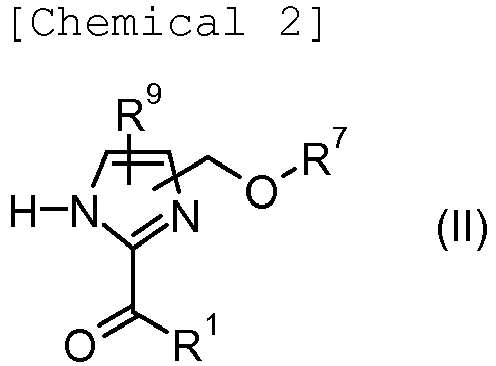
R1 is a methyl group which may be substituted with the same or different 1 to 3 halogen atoms,
R7 is a hydrogen atom, and
R9 is a hydrogen atom, a halogen atom or a C1-C6 alkyl group] or an isotope thereof or a pharmaceutically acceptable salt thereof; - (9) the compound or isotope thereof or pharmaceutically acceptable salt thereof described in (8) above, wherein R1 is a methyl group which may be substituted with 1 to 3 fluorine atoms;
- (10) the compound or isotope thereof or pharmaceutically acceptable salt thereof described in (8) above, wherein R1 is a methyl group or a difluoromethyl group;
- (11) the compound or isotope thereof or pharmaceutically acceptable salt thereof described in any one of (8) to (10) above, wherein R9 is a hydrogen atom;
- (12) a compound selected from the group consisting of:
- 1-((4-hydroxymethyl-1-methoxymethyl-1H-imidazol-2-yl)ethanone,
- 1-((4-hydroxymethyl-1-isopropyl-1H-imidazol-2-yl)ethanone,
- 1-((4-hydroxymethyl-1-vinyl-1H-imidazol-2-yl)ethanone,
- 1-((4-hydroxymethyl-1H-imidazol-2-yl)ethanone,
- 1-((5-hydroxymethyl-1H-imidazol-2-yl)ethanone,
- 1-[4-[hydroxy[(2H)]2methyl]-1H-imidazol-2-yl]ethanone,
- 1-[5-[hydroxy[(2H)]2methyl]-1H-imidazol-2-yl]ethanone, and
- 1-[4-[hydroxy[(2H)2]methyl]-1-methoxymethyl-1H-imidazol-2-yl]ethanone;
- (13) a pharmaceutical composition containing as an active ingredient the compound or isotope thereof or pharmaceutically acceptable salt thereof described in any one of (1) to (11) above or the compound or isotope thereof described in (12) above;
- (14) the pharmaceutical composition described in (13) above for use in preventing or treating inflammatory bowel disease, acute lung injury, autoimmune disease, multiple sclerosis or allergic disease, or in suppressing rejection response against transplant;
- (15) the pharmaceutical composition described in (14) above, wherein the inflammatory bowel disease is ulcerative colitis or Crohn's disease;
- (16) the pharmaceutical composition described in (14) above, wherein the autoimmune disease is rheumatoid arthritis, systemic lupus erythematosus, antiphospholipid antibody syndrome, multiple myositis, dermatomyositis, systemic scleroderma, Sjogren's syndrome, polyarteritis nodosa, microscopic polyarteritis, allergic granulomatous angiitis, Wegener's granulomatosis or mixed connective tissue disease;
- (17) the pharmaceutical composition described in (14) above, wherein the allergic disease is atopic dermatitis, allergic rhinitis, pollinosis, allergic conjunctivitis, allergic gastroenteritis, bronchial asthma, infantile asthma, food allergy, drug allergy or urticaria;
- (18) a compound or isotope thereof or pharmaceutically acceptable salt thereof described in any one of (1) to (11) above or the compound described in (12) above, for use in preventing or treating inflammatory bowel disease, acute lung injury, autoimmune disease, multiple sclerosis or allergic disease, or for suppressing rejection response against transplant;
- (19) the compound or isotope thereof or pharmaceutically acceptable salt thereof for use as described in (18), for administration to a mammal; and
- (20) the compound or isotope thereof or pharmaceutically acceptable salt thereof for use described in (19) above, wherein the mammal is a human.
- The compound or isotope thereof or pharmaceutically acceptable salt thereof of the present invention has excellent S1P lyase inhibitory capacity and membrane permeability, and achieves an effect of decreasing the number of lymphocytes in the blood in vivo. In addition, the pharmaceutical composition of the present invention achieves effects capable of treating or preventing inflammatory bowel disease, acute lung injury, autoimmune disease, multiple sclerosis, allergic disease, or the like in a mammal, in particular, in a human, and capable of suppressing rejection response against transplant.
- One embodiment of the present invention is a compound represented by the general formula (I):

- R1 is a methyl group which may be substituted with the same or different 1 to 3 halogen atoms,
- R2 is a C2-C6 alkyl group, a cyclopropyl group, a C1-C2 alkoxy C1-C3 alkyl group, a cyclohexyloxymethyl group, a vinyl group, a furanylmethyl group, an oxetanyl group or a dimethylaminosulfonyl group,
- R3 is a hydrogen atom, an acetyl group, a benzoyl group or a pivaloyl group, and
- R4 is a hydrogen atom or a halogen atom] or an isotope thereof or a pharmaceutically acceptable salt thereof.
- Another embodiment of the present invention is a compound represented by the general formula (II):
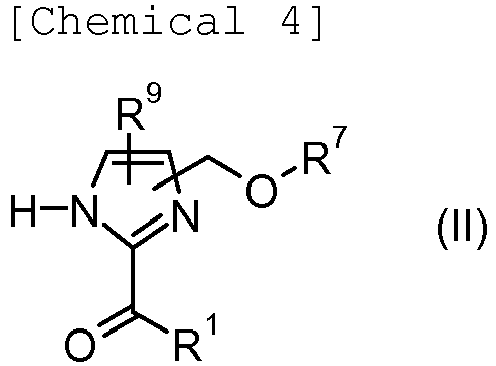
- R1 is a methyl group which may be substituted with the same or different 1 to 3 halogen atoms,
- R7 is a hydrogen atom,
- R9 is a hydrogen atom, a halogen atom or a C1-C6 alkyl group] or an isotope thereof or a pharmaceutically acceptable salt thereof.
- In the present description, "halogen atom" refers to a fluorine atom, a chlorine atom, a bromine atom or an iodine atom.
- In the present description, "methyl group which may be substituted with the same or different 1 to 3 halogen atoms" refers to a group in which 1 to 3 hydrogen atoms in a methyl group may be substituted with the above same or different "halogen atoms".
- In the present description, "C1-C6 alkyl group" refers to a linear or branched alkyl group with 1 to 6 carbon atoms. Specific examples include a methyl group, an ethyl group, a propyl group, an isopropyl group, a butyl group, an isobutyl group, a sec-butyl group, a tert-butyl group, a pentyl group, a 1,2-dimethyl-propyl group, an isopentyl group, a hexyl group, an isohexyl group, and the like.
- In the present description, "C1-C8 alkyl group" refers to a linear or branched alkyl group with 1 to 8 carbon atoms. Specific examples include, in addition to the groups exemplified in the above "C1-C6 alkyl group", a heptyl group, an octyl group, and the like.
- In the present description, "C1-C6 alkyl group which may be substituted with the same or different 1 to 3 halogen atoms" refers to a group in which 1 to 3 hydrogen atoms in the above "C1-C6 alkyl group" may be substituted with the above same or different "halogen atoms". Specific examples include a fluoromethyl group, a difluoromethyl group, a dichloromethyl group, a dibromomethyl group, a trifluoromethyl group, a trichloromethyl group, a 2-fluoroethyl group, a 2-chloroethyl group, a 2-bromoethyl group, a 2-iodoethyl group, a 2,2-dibromoethyl group, a 2,2,2-trifluoroethyl group, a 2,2,2-trichloroethyl group, a 3-chloropropyl group, a 4-fluorobutyl group, a 6-iodohexyl group, and the like.
- In the present description, "C3-C6 cycloalkyl group" refers to a cyclopropyl group, a cyclobutyl group, a cyclopentyl group or a cyclohexyl group.
- In the present description, "C3-C8 cycloalkyl group" refers to the above "C3-C6 cycloalkyl group", a cycloheptyl group or a cyclooctyl group.
- In the present description, "C1-C6 alkoxy group" refers to a group in which the above "C1-C6 alkyl group" is bonded to an oxygen atom. Specific examples include a methoxy group, an ethoxy group, a propoxy group, a butoxy group, a pentyloxy group, a hexyloxy group, and the like.
- In the present description, "C1-C8 alkoxy group" refers to a group in which the above "C1-C8 alkyl group" is bonded to an oxygen atom. Specific examples include, in addition to the groups exemplified in the above "C1-C6 alkoxy group", a heptyloxy group, an octyloxy group, and the like.
- In the present description, "C1-C6 alkoxy C1-C6 alkyl group" refers to a group in which the above "C1-C6 alkoxy group" is bonded to the above "C1-C6 alkyl group". Specific examples include a methoxymethyl group, a methoxyethyl group, an ethoxymethyl group, a propoxymethyl group, a butoxymethyl group, a pentyloxymethyl group, a hexyloxymethyl group, and the like.
- In the present description, "C1-C8 alkoxycarbonyl group" refers to a group in which the above "C1-C8 alkoxy group" is bonded to a carbonyl group. Specific examples include a methoxycarbonyl group, an ethoxycarbonyl group, a propoxycarbonyl group, a butoxycarbonyl group, a tert-butoxycarbonyl group, a heptyloxycarbonyl group, and the like.
- In the present description, "C3-C6 cycloalkoxy group" refers to a cyclopropyloxy group, a cyclobutyloxy group, a cyclopentyloxy group or a cyclohexyloxy group.
- In the present description, "C3-C8 cycloalkoxy group" refers to the above "C3-C6 cycloalkoxy group", a cycloheptyloxy group or a cyclooctyloxy group.
- In the present description, "C3-C6 cycloalkoxy C1-C6 alkyl group" refers to a group in which the above "C3-C6 cycloalkoxy group" is bonded to the above "C1-C6 alkyl group". Specific examples include a cyclopropyloxymethyl group, a cyclobutyloxymethyl group, a cyclopentyloxymethyl group, a cyclohexyloxymethyl group, a cyclopropyloxyethyl group, a cyclohexyloxybutyl group, and the like.
- In the present description, "C2-C6 alkenyl group" refers to a linear or branched alkenyl group with 2 to 6 carbon atoms, for example, a vinyl group, a 1-propenyl group, a 2-propenyl group, an isopropenyl group, a 1-butenyl group, a 2-butenyl group, a 1-pentenyl group, a 1-hexenyl group, and the like.
- In the present description, "mono or di(C1-C6 alkyl)amino group" refers to a group in which one or two "C1-C6 alkyl group" mentioned above is bonded to an amino group, and examples include a dimethylamino group, a diethylamino group, an N-ethyl-N-methylamino group, a dipropylamino group, a dibutylamino group, a dipentylamino group, a dihexylamino group, and the like.
- In the present description, "pharmaceutically acceptable salt" refers to a salt formed by reacting the compound of the present invention with an acid or a base.
- The examples of the salt include hydrogen halide acid salts such as hydrofluorides, hydrochlorides, hydrobromides or hydroiodides; inorganic acid salts such as hydrochlorides, nitrates, perchlorates, sulfates or phosphates; lower alkanesulfonates such as methanesulfonates, trifluoromethanesulfonates or ethanesulfonates; aryl sulfonates such as benzenesulfonates or p-toluenesulfonates; organic acid salts such as acetates, malates, fumarates, succinates, citrates, ascorbates, tartrates, oxalates or maleates; alkali metal salts such as sodium salts, potassium salts or lithium salts; alkaline earth metal salts such as calcium salts or magnesium salts; metal salts such as aluminum salts or iron salts; inorganic salts such as ammonium salts; amine salts such as organic salts, e.g., t-octylamine salts, dibenzylamine salts, morpholine salts, glucosamine salts, phenylglycine alkyl ester salts, ethylenediamine salts, N-methylglucamine salts, guanidine salts, diethylamine salts, triethylamine salts, dicyclohexylamine salts, N,N'-dibenzylethylenediamine salts, chloroprocaine salts, procaine salts, diethanolamine salts, N-benzylphenethylamine salts, piperazine salts, tetramethylammonium salts or tris(hydroxymethyl)aminomethane salts; and amino acid salts such as glycine salts, lysine salts, arginine salts, ornithine salts, glutamates or aspartates.
- For example, by being left in the air, the compound of the present invention may absorb moisture or have adsorbed water adhered thereto so as to be a hydrate, which hydrate is also included in the salt of the present invention.
- In cases where the compound of the present invention has asymmetric carbon atoms in its molecule, optical isomers are present. All of these isomers, and mixtures of these isomers are represented by a single formula, i.e., the general formula (I) or (II). Accordingly, the compound of the present invention includes all optical isomers as well as mixtures of optical isomers in an arbitrary ratio.
- When, in the compound of the present invention, a tautomer of an imidazole ring is present, all of the respective tautomers and their mixtures in an arbitrary ratio are included therein.
- The present invention may also include a compound in which one or more atoms constituting the compound of the present invention are substituted with isotopes of the atoms. There are two types of isotopes: radioactive isotopes and stable isotopes, and examples of isotopes include, for example, hydrogen isotope (2H and 3H), carbon isotope (11C, 13C and 14C), nitrogen isotope (13N and 15N), oxygen isotope (15O, 17O and 18O), fluorine isotope (18F), and the like. A composition containing a compound labeled with isotope is useful as, for example, a therapeutic agent, a preventive agent, a research reagent, an assay reagent, a diagnostic agent, an in vivo diagnostic imaging agent, and the like. The compound labeled with isotope is also included in the compound of the present invention, and all the mixtures of the compounds labeled with isotope in an arbitrary ratio are also included in the compound of the present invention. Further, the compound of the present invention labeled with isotope can be produced with a method known in this field, for example, using a raw material labeled with isotope instead of a raw material in the production process of the present invention described later.
- R1 is preferably a methyl group which may be substituted with one to three fluorine atoms, and more preferably a methyl group or a difluoromethyl group.
- R2 is preferably an ethyl group, a propyl group, a sec-butyl group, a tert-butyl group, a pentyl group, a hexyl group, a cyclopropyl group, a methoxymethyl group, a methoxyethyl group, a methoxyisopropyl group, an ethoxymethyl group, a cyclohexyloxymethyl group, a vinyl group, a furanylmethyl group, an oxetanyl group or a dimethylaminosulfonyl group, and more preferably an ethyl group or vinyl group.
- R3 is preferably a hydrogen atom.
- R4 is preferably a hydrogen atom or a fluorine atom, and more preferably a hydrogen atom.
- R7 is a hydrogen atom.
- R9 is preferably a hydrogen atom.
- A preferred combination of R1, R2, R3 and R4 in the general formula (I) is a combination in which R1 is a methyl group which may be substituted with one to three fluorine atoms, R2 is a C2-C6 alkyl group, a cyclopropyl group, a C1-C2 alkoxy C1-C3 alkyl group, a cyclohexyloxymethyl group, a vinyl group, a furanylmethyl group, an oxetanyl group or a dimethylaminosulfonyl group, R3 is a hydrogen atom, and R4 is a hydrogen atom or a fluorine atom.
- A more preferred combination is a combination in which R1 is a methyl group or a difluoromethyl group, R2 is an ethyl group, a propyl group, a sec-butyl group, a tert-butyl group, a pentyl group, a hexyl group, a cyclopropyl group, a methoxymethyl group, a methoxyethyl group, a methoxyisopropyl group, an ethoxymethyl group, a cyclohexyloxymethyl group, a vinyl group, a furanylmethyl group, an oxetanyl group or a dimethylaminosulfonyl group, R3 is a hydrogen atom, and R4 is a hydrogen atom.
- A preferred combination of R1, R7 and R9 in the general formula (II) is a combination in which R1 is a methyl group which may be substituted with one to three fluorine atoms, R7 is a hydrogen atom, and R9 is a hydrogen atom. A more preferred combination is a combination in which R1 is a methyl group or a difluoromethyl group, and R7 and R9 are both hydrogen atoms.
- The compound of the present invention can be produced, for example, by the following process.

- Examples of the protecting group P1 include a tetrahydropyranyl group, a paramethoxybenzyl group, a benzyl group, silylether protecting groups such as a tert-butyldiphenylsilyl group, alkoxymethylether protecting groups such as a methoxymethyl group, and the like, with, inter alia, a silylether protecting group being preferred.
- The following provides a description of each step.
- Step A is a step for protecting the primary hydroxyl group of compound (1) or salts thereof (e.g., hydrochloride) which is commercially available or can be produced by a method known in this technical field (e.g., Journal of the Chemical Society, Perkin Transactions 1: Organic and Bio-organic Chemistry, 10, 2310-2315, 1980) with a protecting group P1 to produce compound (2). Introduction reaction of a protecting group can be conducted in accordance with an ordinary method such as the one described in T. H. Greene, P. G. Wuts, Protective Groups in Organic Synthesis, Fourth Edition, 2007, John Wiley & Sons, Inc.
- Step B is a step for allowing commercially available R2a-X (wherein X is a leaving group such as a halogen atom, a methanesulfonyloxy group, a p-toluenesulfonyloxy group, or a trifluoromethanesulfonyloxy group) to act on compound (2) in a reaction solution in the presence of a base, and introducing the R2a group onto a nitrogen atom on the imidazol ring of the compound (2) to produce compound (3).
- The reaction temperature is within the range of -78°C to the boiling point of the solvent, with the range of 0 to 130°C being preferred. The reaction time is usually about 1 to 24 hours. Further, the amount of R2a-X to be used is usually within the range of 1 to 10 equivalents per 1 equivalent of the compound (1), with the range of 1 to 2 equivalents being preferred.
- Examples of the reaction solvent can include hydrocarbon solvents such as hexane and toluene, halogenated hydrocarbon solvents such as dichloromethane and chloroform, ether solvents such as diethylether, tetrahydrofuran (hereinafter, also referred to as THF) and 1,4-dioxane, ester solvents such as ethyl acetate, and aprotic polar solvents such as acetonitrile, N,N-dimethylformamide (hereinafter, also referred to as DMF) and dimethyl sulfoxide (hereinafter, also referred to as DMSO).
- Examples of the base can include organic amine bases such as triethylamine (hereinafter, also referred to as TEA), diisopropylethylamine (hereinafter, also referred to as DIEA), N-methylmorpholine, pyridine and 4-(N,N-dimethylamino)pyridine (hereinafter, also referred to as DMAP), inorganic bases such as sodium hydride, potassium carbonate and cesium carbonate, and organic lithium reagents such as n-butyl lithium, sec-butyl lithium and lithium diisopropylamide (hereinafter, also referred to as LDA). The amount of the above base to be used is usually within the range of 1 to 10 equivalents per 1 equivalent of the compound (1), with the range of 1 to 2 equivalents being preferred. Further, when using a salt of the compound (1), it is preferable to use the above base in a stoichiometrically equivalent amount or more in addition to the above-mentioned equivalents thereof in order to neutralize the salt.
- A compound (3a) in which R10 in the compound (3) is a hydrogen atom can also be produced by the following process.

- Compound (5) which is commercially available or can be produced by a method known in this technical field (e.g., Organic Letters, 4, 4133-4134, 2002) is subjected to a reduction reaction to produce compound (6). Then, analogously to Step A, a protecting group P1 can be introduced to produce compound (3a). The above reduction reaction can be conducted referring to Experimental Chemistry (see 4th ed., Vol. 26, Chemical Society of Japan, Maruzen Publishing, "Organic Synthesis III: asymmetric synthesis/reduction/sugar/labeled compound, pp. 185-245").
- Step C is a step for reacting the compound (3) with R1CO-Y (wherein Y is a halogen atom, a N-methoxy-N-methylamino group, a 1-pyrrolidinyl group or a lower alkoxy group, and R1 is as defined above) or (R1CO)2O which is commercially available or can be produced by a method known in this technical field (e.g., Tetrahedron Letters, 48, 377-380, 2006) in a reaction solvent in the presence of a base, and introducing an acyl group to produce compound (4).
- The reaction temperature is within the range of -78°C to room temperature, with the range of -78 to 0°C being preferred. The reaction time is usually about 0.5 hours to 12 hours. Further, the amount of R1CO-Y or (R1CO)2O to be used is usually within the range of 1 to 10 equivalents per 1 equivalent of the compound (3), with the range of 1 to 2 equivalents being preferred.
- Examples of the reaction solvent can include hydrocarbon solvents such as hexane and toluene, halogenated hydrocarbon solvents such as dichloromethane and chloroform, ether solvents such as diethylether, THF and 1,4-dioxane, and aprotic polar solvents such as acetonitrile, DMF and DMSO.
- Examples of the base can include organic amine bases such as TEA, DIEA, N-methylmorpholine, pyridine and DMAP, and organic lithium reagents such as n-butyl lithium, sec-butyl lithium and LDA. The amount of the base to be used is usually within the range of 1 to 10 equivalents per 1 equivalent of the compound (3), with the range of 1 to 2 equivalents being preferred. Further, when using an organic lithium reagent as a base, it is preferable to use a hydrocarbon solvent or an ether solvent as the above reaction solvent.
- Step D is a step for deprotecting protecting group P1 of the compound (4) to produce a compound (a) in which R3 in the general formula (I) or R7 in the general formula (II) is a hydrogen atom. The deprotection reaction can be conducted in accordance with an ordinary method such as the one described in T. H. Greene, P. G. Wuts, Protective Groups in Organic Synthesis, Fourth Edition, 2007, John Wiley & Sons, Inc.
- Step E is a step for reacting the compound (a) with commercially available R8COX or (R8CO)2O (wherein R8 and X are as defined above) in a reaction solvent in the presence of a base, and forming an ester bond to produce a compound (b) in which R3 in the general formula (I) is an acetyl group, a benzoyl group or a pivaloyl group, or wherein R7 in the general formula (II) is -C(O)-R8.
- The reaction temperature is within the range of -20°C to the boiling point of the solvent, with the range of 0°C to room temperature being preferred. The reaction time is usually about 0.5 to 24 hours. Further, the amount of R8COX or (R8CO)2O to be used is usually within the range of 1 to 10 equivalents per 1 equivalent of the compound (a), with the range of 1 to 2 equivalents being preferred.
- Examples of the reaction solvent can include hydrocarbon solvents such as hexane and toluene, halogenated hydrocarbon solvents such as dichloromethane and chloroform, ether solvents such as diethylether, THF and 1,4-dioxane, and aprotic polar solvents such as acetonitrile, DMF and DMSO.
- Examples of the base can include organic amine bases such as TEA, DIEA, N-methylmorpholine, pyridine and DMAP. The amount of the base to be used is usually within the range of 1 to 10 equivalents per 1 equivalent of the compound (a), with the range of 1 to 2 equivalents being preferred.
- The compound of the present invention produced by the above process can be isolated or purified by means of methods known in this technical field, for example, extraction, precipitation, fraction, chromatography, and the like.
- The compound of the present invention can be easily produced from known compounds in accordance with the Reference Examples and Examples described later, other than using the above process for the production thereof.
- The compound or isotope thereof or pharmaceutically acceptable salt thereof obtainable by the above process has excellent S1P lyase inhibitory capacity, and thus can suppress the activity of the immune system. Accordingly, the compound or isotope thereof or pharmaceutically acceptable salt thereof of the present invention can be used for preventing or treating inflammatory bowel disease (IBD) (e.g., ulcerative colitis, Crohn's disease, etc.), acute lung injury, autoimmune disease (e.g., rheumatoid arthritis, systemic lupus erythematosus, antiphospholipid antibody syndrome, multiple myositis, dermatomyositis, systemic scleroderma, Sjogren's syndrome, polyarteritis nodosa, microscopic polyarteritis, allergic granulomatous angiitis, Wegener's granulomatosis, mixed connective tissue disease, etc.), multiple sclerosis (MS), allergic disease (e.g., atopic dermatitis, allergic rhinitis (including pollinosis), allergic conjunctivitis, allergic gastroenteritis, bronchial asthma, infantile asthma, food allergy, drug allergy, urticaria, etc.), and the like, or can be used as an active ingredient of a pharmaceutical composition for suppressing rejection response against transplant.
- The pharmaceutical composition containing as an active ingredient the compound or isotope thereof or pharmaceutically acceptable salt thereof of the present invention, when administered to a mammal (e.g., a human, horse, cow, pig, etc., preferably a human), may be administered systemically or locally, and orally or parenterally.
- The pharmaceutical composition of the present invention can be prepared according to various preparation methods of formulations which are usually employed by selecting an appropriate form depending on the administration method.
- Examples of forms of the pharmaceutical compositions for oral administration include tablets, pills, powders, granules, capsules, solutions, suspensions, emulsions, syrups, elixirs, and the like. For preparation of pharmaceutical compositions in such forms, excipients, binders, disintegrants, lubricants, swelling agents, swelling adjuvants, coating agents, plasticizers, stabilizers, antiseptics, antioxidants, colorants, dissolution aids, suspending agents, emulsifiers, sweeteners, preservatives, buffers, diluents, wetting agents, and the like which are usually employed as additives may be appropriately selected as needed, to allow the pharmaceutical compositions to be produced according to ordinary methods.
- Examples of forms of the pharmaceutical compositions for parenteral administration include injection solutions, ointments, gels, creams, poultices, patches, nebulas, inhalants, sprays, eye drops, nose drops, suppositories, inhalants, and the like. For preparation of pharmaceutical compositions in such forms, stabilizing agents, antiseptics, dissolution aids, humectants, preservatives, antioxidants, flavoring agents, gelling agents, neutralizers, buffers, isotonic agents, surfactants, colorants, thickeners, wetting agents, fillers, absorption promoters, suspending agents, binders, and the like which are usually employed as additives may be appropriately selected as needed, to allow the pharmaceutical compositions to be produced according to ordinary methods.
- While the dosage of the compound or isotope thereof or pharmaceutically acceptable salt thereof of the present invention varies depending on symptoms, age, body weight, or the like, in the case of oral administration, the dosage is 1 to 3000 mg, preferably 1 to 1000 mg, in terms of the amount of the compound, per dose once to several times a day for an adult, and in the case of parenteral administration, the dosage is 0.01 to 1500 mg, preferably 0.1 to 500 mg, in terms of the amount of the compound, per dose once to several times a day for an adult.
- Although the following provides Reference Examples, Examples, Formulation Examples and Test Examples to explain the present invention in more detail, the scope of the present invention is not limited thereto.
-
-

- Imidazole-4(5)-carboxylic acid methyl ester(3.00 g) was dissolved in acetonitrile (100 mL), and at room temperature TEA (6.63 mL) and then chloromethylethylether (3.28 mL) were added, followed by heating to reflux for 10 hours. After being allowed to cool to room temperature, the mixture was diluted with water, and extracted with ethyl acetate. The combined extract was washed with saturated brine, dried over anhydrous sodium sulfate, and subsequently the solvent was distilled off under reduced pressure. The resulting residue was purified by flash chromatography (ethyl acetate/hexane = 10%→100%) using silica gel column (product name: SNAP Cartridge KP-Sil 50g, manufactured by Biotage, Ltd.) to afford the title compound (2.67 g).
1H-NMR (CDCl3) δ: 1.20 (3H, t, J = 7.1 Hz), 3.48 (2H, q, J = 7.1 Hz), 3.91 (3H, s), 5.31 (2H, s), 7.62 (1H, d, J = 1.2 Hz), 7.74 (1H, d, J = 1.2 Hz). -

- To THF (200 mL) was added lithium aluminum hydride (3.85 g), and, with stirring under ice cooling, a THF (150 mL) solution of the resulting compound (39.4 g) obtained in (1) was added dropwise over 30 minutes, followed by stirring at the same temperature for 30 minutes. To the reaction mixture, at the same temperature, were added dropwise water (3.85 mL), a 15% aqueous sodium hydroxide solution (3.85 mL) and water (11.6 mL) in this order, and stirring was continued for 10 hours while the temperature was gradually brought back to room temperature. The resulting solid material was removed by Celite filtration, and the solvent of the filtrate was distilled off under reduced pressure to afford the title compound (21.0 g).
1H-NMR (CDCl3) δ: 1.19 (3H, t, J = 7.1 Hz), 3.46 (2H, q, J = 7.1 Hz), 4.62 (2H, s), 5.25 (2H, s), 7.00 (1H, s), 7.56 (1H, d, J = 1.2 Hz). -

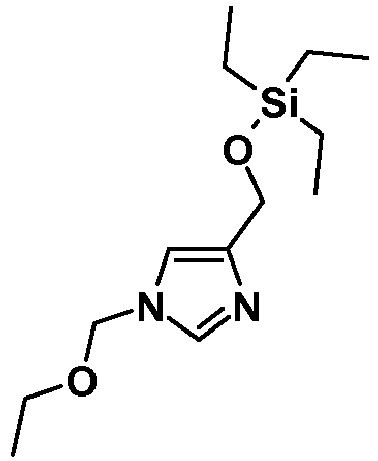
- The compound (520 mg) obtained in (2) was dissolved in dichloromethane (30 mL), followed by addition of triethylsilyl chloride (1.12 mL), TEA (1.16 mL) and DMAP (catalytic amount) under stirring, and the stirring was continued for 17 hours. The reaction solution was diluted with water, and extracted with chloroform. The combined extract was washed with saturated brine, dried over anhydrous sodium sulfate, and subsequently the solvent was distilled off under reduced pressure. The resulting residue was purified by flash chromatography (ethyl acetate/hexane = 10%→80%) using silica gel column (product name: SNAP Cartridge KP-Sil 50g, manufactured by Biotage, Ltd.) to afford the title compound (665 mg).
1H-NMR (CDCl3) δ: 0.63-0.68 (6H, m), 0.95-0.99 (9H, m), 1.18 (3H, t, J = 7.1 Hz), 3.44 (2H, q, J = 7.1 Hz), 4.69 (2H, d, J = 1.2 Hz), 5.23 (2H, s), 6.98 (1H, d, J = 1.2 Hz), 7.51 (1H, d, J = 1.2 Hz). -

- The compound (665 mg) obtained in (3) was dissolved in THF (20 mL), and cooled to -78°C while stirring under an argon atmosphere. To the present solution was added dropwise n-butyl lithium (2.69 M hexane solution, 1.50 mL) slowly using a syringe, followed by stirring at the same temperature for 30 minutes. Then, N-methoxy-N-methylacetamide (0.50 mL) was added using a syringe, and stirring was continued for 17 hours while the temperature was raised to room temperature. A saturated aqueous ammonium chloride solution was added to the reaction solution to terminate the reaction, followed by extraction with ethyl acetate. The combined extract was washed with saturated brine, dried over anhydrous sodium sulfate, and subsequently the solvent was distilled off under reduced pressure. The resulting residue was purified by flash chromatography (ethyl acetate/hexane = 5%→30%) using silica gel column (product name: SNAP Cartridge KP-Sil 50g, manufactured by Biotage, Ltd.) to afford the title compound (520 mg).
1H-NMR (CDCl3) δ: 0.62-0.69 (6H, m), 0.96-1.01 (9H, m), 1.19 (3H, t, J = 6.9 Hz), 2.64 (3H, s), 3.53 (2H, q, J = 6.9 Hz), 4.73 (2H, s), 5.76 (2H, s), 7.24 (1H, s). -

- The compound (520 mg) obtained in (4) was dissolved in THF (10 mL), followed by addition of tetrabutylammonium fluoride (TBAF, 1.0 M THF solution, 3.32 mL) under stirring, and the stirring was continued for 1 hour. The reaction solution was concentrated under reduced pressure, and the resulting residue was purified by flash chromatography (ethyl acetate/hexane = 25%→100%) using amino column (product name: SNAP Cartridge KP-NH 55g, manufactured by Biotage, Ltd.) to afford the title compound (288 mg).
1H-NMR (DMSO-D6) δ: 1.07 (3H, t, J = 6.9 Hz), 2.53 (3H, s), 3.46 (2H, q, J = 7.0 Hz), 4.41 (2H, d, J = 5.7 Hz), 5.11 (1H, t, J = 5.7 Hz), 5.67 (2H, s), 7.49 (1H, s).
Anal. Calcd for C9H14N2O3: C, 54.53; H, 7.12; N, 14.13. Found: C, 54.46; H, 7.06; N, 14.12. -

- The compound (4.95 g) obtained in Example 1 was dissolved in 1 N hydrochloric acid (180 mL), and stirring was continued for 30 hours while the mixture was warmed to 70°C. A 1 N aqueous sodium hydroxide solution was added to the reaction solution for neutralization, and subsequently the solvent was distilled off under reduced pressure. The resulting residue was purified by flash chromatography (methanol/chloroform = 0%→10%) using silica gel column (product name: SNAP Cartridge KP-Sil 100g, manufactured by Biotage, Ltd.) to afford the mixture (3.30 g) of the title compound. 1H-NMR (CD3OD) δ: 2.54 (3H, s), 4.59 (2H, s), 7.11-7.27 (1H, m).
MS (FAB) m/z: 141 [(M+H)+].
Anal. Calcd for C6H8N2O2: C, 51.42; H, 5.75; N, 19.99. Found: C, 51.59; H, 5.81; N, 19.90. -


- In analogy to Step (1) of Example 1, but using ethyl imidazole-4-carboxylate (26.3 g) and chloromethylmethylether (21.2 mL), the title compound (17.2 g) was afforded.
1H-NMR (CDCl3) δ: 1.39 (3H, t, J = 7.2 Hz), 3.31 (3H, s), 4.38 (2H, q, J = 7.4 Hz), 5.25 (2H, s), 7.62-7.63 (1H, m), 7.72-7.73 (1H, m). MS (ESI) m/z: 185 [(M+H)+]. -

- In analogy to Step (2) of Example 1, but using the compound (17.2 g) obtained in (1), the title compound (8.81 g) was afforded.
1H-NMR (CDCl3) δ: 3.28 (3H, s), 4.62 (2H, s), 5.20 (2H, s), 7.00 (1H, br s), 7.56-7.57 (1H, m). -

- The compound (8.81 g) obtained in (2) was dissolved in dichloromethane (100 mL), followed by addition of tert-butyldiphenylsilyl chloride (hereinafter, also referred to as TBDPSCl) (24.3 mL), DIEA (21.6 mL) and DMAP (0.760 g) under stirring, and the stirring was continued for 1 day. The reaction solution was concentrated, and the resulting residue was purified by flash chromatography (ethyl acetate/hexane = 50%→100%) using silica gel column (product name: Hi-Flash Column 4 L, manufactured by Yamazen Corporation) to afford the title compound (16.9 g).
1H-NMR (CDCl3) δ: 1.08 (9H, s), 3.26 (3H, s), 4.75 (2H, d, J = 0.9 Hz), 5.19 (2H, s), 6.92-6.93 (1H, m), 7.34-7.44 (6H, m), 7.51-7.52 (1H, m), 7.73-7.68 (4H, m).
MS (ESI) m/z: 381 [(M+H)+]. -

- In analogy to Step (4) of Example 1, but using the compound (1.00 g) obtained in (3), the title compound (0.875 g) was afforded.
1H-NMR (CDCl3) δ: 1.09 (9H, s), 2.62 (3H, s), 3.33 (3H, s), 4.77 (2H, s), 5.69 (2H, s), 7.14 (1H, s), 7.45-7.34 (6H, m), 7.71-7.66 (4H, m).
MS (ESI) m/z: 423 [(M+H)+]. -


- In analogy to Step (5) of Example 1, but using the compound (10.47 g) obtained in (4), the title compound (3.71 g) was afforded. 1H-NMR (CDCl3) δ: 2.23 (1H, br s), 2.67 (3H, s), 3.36 (3H, s), 4.68 (2H, s), 5.71 (2H, s), 7.24 (1H, s).
MS (ESI) m/z: 185 [(M+H)+].
Anal. Calcd for C8H12N2O3: C, 52.17; H, 6.57; N, 15.21. Found: C, 52.08; H, 6.57; N, 15.34. -

- 4(5)-(tert-Butyldiphenylsilyloxymethyl)-1H-imidazole (5.00 g) was dissolved in dichloromethane (50 mL), and under ice cooling and stirring TEA (4.14 mL) and dimethylsulfamoyl chloride (2.47 mL) were added, followed by stirring at room temperature for 20 hours. The reaction solution was diluted with ethyl acetate, washed with saturated brine, and subsequently dried over anhydrous magnesium sulfate to distill off the solvent under reduced pressure. The resulting residue was purified by flash chromatography (ethyl acetate/hexane = 25%→50%) using silica gel column (product name: Hi-Flash Column 4 L, manufactured by Yamazen Corporation) to afford 4-(tert-butyldiphenylsilyloxymethyl)imidazole-1-sulfonic acid dimethylamide (4.59 g) as a low polar fraction and 5-(tert-butyldiphenylsilyloxymethyl)imidazole-1-sulfonic acid dimethylamide (1.55 g) as a high polar fraction.
- 1H-NMR (CDCl3) δ: 1.08 (9H, s), 2.82 (6H, s), 4.74 (2H, d, J = 0.9 Hz), 7.09 (1H, d, J = 0.9 Hz), 7.45-7.35 (6H, m), 7.70-7.66 (4H, m), 7.82 (1H, d, J = 1.8 Hz).
MS (ESI) m/z: 444 [(M+H)+]. - 1H-NMR (CDCl3) δ: 1.07 (9H, s), 2.75 (6H, s), 4.82 (2H, d, J = 0.9 Hz), 7.01-7.02 (1H, m), 7.37-7.47 (6H, m), 7.66-7.70 (4H, m), 7.86-7.84 (1H, m).
MS (ESI) m/z: 444 [(M+H)+]. -

- In analogy to Step (4) of Example 1, but using 4-(tert-butyldiphenylsilyloxymethyl)imidazole-1-sulfonic acid dimethylamide (2.00 g), the title compound (0.905 g) was afforded.
MS (ESI) m/z: 486 [(M+H)+]. -

- The compound (0.910 g) obtained in (2) was dissolved in THF (10 mL), followed by addition of TBAF (1.0 M THF solution, 4.08 mL) under stirring, and the stirring was continued for 21 hours. The reaction solution was diluted with ethyl acetate, washed with saturated brine, and subsequently dried over anhydrous magnesium sulfate to distill off the solvent under reduced pressure. The resulting residue was purified by flash chromatography (ethyl acetate/hexane = 20%→100%) using amino column (product name: Hi-Flash Column 2 L, manufactured by Yamazen Corporation) to afford the title compound (0.170 g).
1H-NMR (CD3OD) δ: 2.59 (3H, s), 3.04 (6H, s), 4.54 (2H, s), 7.62 (1H, s).
MS (ESI) m/z: 248 [(M+H)+]. -

- Ethyl 3-(N,N-dimethylamino)-2-isocyanoacrylate (Org. Lett. 2002, 4, 4133, 5.00 g) and isopropylamine (12.3 mL) were heated at 70°C for 22 hours while stirring. The temperature of the reaction solution was brought back to room temperature, and subsequently purified by flash chromatography (ethyl acetate/hexane = 30%→100%) using amino column (product name: Hi-Flash Column 3 L, manufactured by Yamazen Corporation) to afford the title compound (4.75 g).
1H-NMR (CDCl3) δ: 1.39 (3H, t, J = 7.4 Hz), 1.52 (6H, d, J = 6.3 Hz), 4.33-4.41 (3H, m), 7.54 (1H, s), 7.66-7.68 (1H, m).
MS (ESI) m/z: 183 [(M+H)+]. -

- Lithium aluminum hydride (2.97 g) was suspended in THF (100 mL), and a THF solution (50 mL) of the compound (4.75 g) obtained in (1) was added dropwise over 20 minutes under ice cooling. After completion of the dropwise addition, the reaction solution was stirred at the same temperature for 2 hours. To this reaction solution, under ice cooling, were added water (2.97 mL), a 1 N aqueous sodium hydroxide solution (2.97 mL) and water (11.9 mL), followed by stirring for a while. Further, to this reaction solution was added chloroform followed by stirring to obtain the suspension. The insolubles were filtered off, and the resulting mother liquor was concentrated to afford (1-isopropyl-1H-imidazol-4-yl)methanol, which was then subjected to the next reaction.
- This (1-isopropyl-1H-imidazol-4-yl)methanol was dissolved in dichloroethane (200 mL), and at room temperature TEA (10.9 mL), TBDPSCI (10.2 mL) and DMAP (0.320 g) were added, followed by stirring for 17 hours. The reaction solution was poured into water, and extracted with dichloromethane. The extract was washed with saturated brine, dried over anhydrous sodium sulfate, and subsequently the solvent was distilled off under reduced pressure. The resulting residue was purified by flash chromatography (ethyl acetate/hexane = 20%→100%) using silica gel column (product name: Hi-Flash Column 3 L, manufactured by Yamazen Corporation) to afford the title compound (9.11 g).
1H-NMR (CDCl3) δ: 1.07 (9H, s), 1.45 (6H, d, J = 6.3 Hz), 4.22-4.31 (1H, m), 4.73 (2H, s), 6.78 (1H, d, J = 1.1 Hz), 7.33-7.45 (7H, m), 7.73-7.69 (4H, m).
MS (ESI) m/z: 379 [(M+H)+]. -

- In analogy to Step (4) of Example 1, but using the compound (5.40 g) obtained in (2), the title compound (3.98 g) was afforded.
1H-NMR (CDCl3) δ: 1.09 (9H, s), 1.38 (6H, d, J = 7.4 Hz), 2.61 (3H, s), 4.76 (2H, s), 5.52-5.44 (1H, m), 7.05 (1H, s), 7.45-7.34 (6H, m), 7.71-7.67 (4H, m).
MS (ESI) m/z: 421 [(M+H)+]. -

- In analogy to Step (5) of Example 1, but using the compound (3.98 g) obtained in (3), the title compound (1.31 g) was afforded.
1H-NMR (CDCl3) δ: 1.43 (6H, d, J = 6.3 Hz), 2.12-2.07 (1H, m), 2.66 (3H, s), 4.66 (2H, d, J = 5.7 Hz), 5.48-5.57 (1H, m), 7.23 (1H, s). Anal. Calcd for C3H14N2O2: C, 59.32; H, 7.74; N, 15.37. Found: C, 59.23; H, 7.71; N, 15.43.
MS (ESI) m/z: 183 [(M+H)+]. -

- 4-(tert-Butyldiphenylsilyloxymethyl)-1-ethoxymethyl-1H-imidazole (2.00 g) was dissolved in THF (10 mL), and was cooled to - 78°C while stirring under an argon atmosphere. To the present solution was added dropwise n-butyl lithium (2.69 M hexane solution, 3.18 mL) slowly using a syringe, followed by stirring at the same temperature for 30 minutes. Then, N-methoxy-N-methyl difluoroacetamide (1.41 g) was added using a syringe, and stirring was continued for 17 hours while the temperature was raised to room temperature. A saturated aqueous ammonium chloride solution was added to the reaction solution to terminate the reaction, followed by extraction with ethyl acetate. The combined extract was washed with saturated brine, dried over anhydrous sodium sulfate, and subsequently the solvent was distilled off under reduced pressure. The resulting residue was purified by flash chromatography (ethyl acetate/hexane = 0%→20%) using silica gel column (product name: SNAP Cartridge KP-Sil 50g, manufactured by Biotage, Ltd.) to afford the title compound (1.74 g).
1H-NMR (CDCl3) δ: 1.09 (9H, s), 1.21 (3H, t, J = 7.1 Hz), 3.53 (2H, q, J = 7.1 Hz), 4.78 (2H, s), 5.76 (2H, s), 6.85 (1H, t, J = 53.8 Hz), 7.33 (1H, s), 7.36-7.47 (6H, m), 7.67-7.69 (4H, m). -

- In analogy to Step (3) of Example 6, but using the compound (1.74 g) obtained in (1), the title compound (505 mg) was afforded.
1H-NMR (CDCl3) δ: 1.22 (3H, t, J = 7.0 Hz), 2.06 (1H, t, J = 5.4 Hz), 3.57 (2H, q, J = 7.0 Hz), 4.71 (2H, d, J = 5.7 Hz), 5.79 (2H, s), 6.92 (1H, t, J = 53.8 Hz), 7.43 (1H, s).
MS (ESI) m/z: 235 (M+H)+. -

- Imidazole-4(5)-carbaldehyde (20.0 g) was suspended in THF (400 mL), and at room temperature 60% sodium hydride (13.6 g) was added, followed by heating to reflux for 1.5 hours. The temperature of the reaction mixture was brought back to room temperature, and subsequently 2-fluoroethyl tosylate (J. Org. Chem., 2004, 69, 5934, 90.6 g) was added, followed by heating to reflux for a further 22 hours. The temperature of the reaction mixture was brought back to room temperature, which was subsequently poured into water, followed by extraction with ethyl acetate. The resulting aqueous layer was further extracted with a 10% methanol/chloroform solution. The combined extract was dried over anhydrous sodium sulfate, and subsequently the solvent was distilled off under reduced pressure. The resulting residue was purified by flash chromatography (methanol/chloroform = 10%) using silica gel column (product name: Hi-Flash 5 L, manufactured by Yamazen Corporation) to afford the title compound (10.0 g).
1H-NMR (CDCl3) δ: 4.32 (2H, dt, J = 27.1, 4.6 Hz), 4.71 (2H, dt, J = 47.2, 4.6 Hz), 7.62 (1H, s), 7.71 (1H, s), 9.90 (1H, s).
MS (ESI) m/z: 143 [(M+H)+]. -

- In analogy to Steps (2) and (3) of Example 5, but using the compound (10.1 g) obtained in (1), the title compound (11.5 g) was afforded.
1H-NMR (CDCl3) δ: 1.08 (9H, s), 4.19 (2H, dt, J = 26.9, 4.6 Hz), 4.64 (2H, dt, J = 46.8, 4.9 Hz), 4.73-4.74 (2H, m), 6.85 (1H, s), 7.34-7.45 (7H, m), 7.69-7.72 (4H, m).
MS (ESI) m/z: 383 [(M+H)+]. -

- The compound (5.35 g) obtained in (2) was dissolved in THF (200 mL), and cooled to -78°C while stirring under nitrogen stream. To the present solution was added dropwise n-butyl lithium (2.76 M hexane solution, 7.60 mL), followed by stirring at the same temperature for 30 minutes. Then, N-methoxy-N-methylacetamide (2.91 mL) was added, and stirring was continued for 4 hours while the temperature was gradually brought back to room temperature. A saturated aqueous ammonium chloride solution was added to the reaction solution to terminate the reaction, followed by extraction with ethyl acetate. The extract was washed with saturated brine, dried over anhydrous sodium sulfate, and subsequently the solvent was distilled off under reduced pressure. The resulting residue was purified by flash chromatography (ethyl acetate/hexane = 4%→40%) using silica gel column (product name: Hi-Flash Column 3 L, manufactured by Yamazen Corporation) to afford the title compound (1.48 g) and 1-[4-(tert-butyldiphenylsilyloxymethyl)-1-(2-fluoroethyl)-1H-imidazol-2-yl)ethanone (3.91 g).
- 1H-NMR (CDCl3) δ: 1.10 (9H, s), 2.61 (3H, s), 4.76 (2H, s), 4.97-5.01 (1H, m), 5.22-5.28 (1H, m), 7.34-7.45 (7H, m), 7.72-7.66 (4H, m), 7.92 (1H, dd, J = 16.0, 8.6 Hz).
MS (ESI) m/z: 405 [(M+H)+]. - 1H-NMR (CDCl3) δ: 1.08 (9H, s), 2.61 (3H, s), 4.63 (2H, s), 4.66-4.74 (2H, m), 4.75 (2H, s), 7.04 (1H, s), 7.34-7.45 (6H, m), 7.67-7.71 (4H, m).
MS (ESI) m/z: 425 [(M+H)+]. -

- The compound (6.70 g) obtained in (2) was dissolved in THF (200 mL), and cooled to -78°C while stirring under nitrogen stream. To the present solution was added dropwise n-butyl lithium (2.76 M hexane solution, 19.0 mL), and stirring was continued at the same temperature for 1 hour. A saturated aqueous ammonium chloride solution was added to the reaction solution to terminate the reaction, followed by extraction with ethyl acetate. The extract was washed with saturated brine, dried over anhydrous sodium sulfate, and subsequently the solvent was distilled off under reduced pressure. The resulting residue was purified by flash chromatography (ethyl acetate/hexane = 10%→60%) using silica gel column (product name: Hi-Flash Column 3 L, manufactured by Yamazen Corporation) to afford the title compound (3.88 g).
1H-NMR (CDCl3) δ: 1.09 (9H, s), 4.73-4.75 (2H, m), 4.86 (1H, dd, J = 8.6, 1.7 Hz), 5.23 (1H, dd, J = 15.5, 1.7 Hz), 6.85 (1H, dd, J = 15.8, 8.9 Hz), 7.04-7.05 (1H, m), 7.36-7.44 (6H, m), 7.55-7.57 (1H, m), 7.72-7.69 (4H, m). - 4(5)-(tert-Butyldiphenylsilyloxymethyl)-1H-imidazole (80.0 g) and 2-fluoroethyl tosylate (82.8 g) were dissolved in DMF (500 mL), and cooled with ice while stirring under nitrogen stream. To this reaction solution was added 60% sodium hydride (15.7 g), followed by stirring for 23 hours. The reaction solution was poured into ice water, followed by extraction with ethyl acetate. The extract was washed with ice water and saturated brine in this order, dried over anhydrous sodium sulfate, and subsequently the solvent was distilled off under reduced pressure. The resulting residue was purified by flash chromatography (ethyl acetate/hexane=10%→100%) using silica gel column (product name: KiloPack 40E, manufactured by Yamazen Corporation) to afford the title compound (6.30 g) and 5-(tert-butyldiphenylsilyloxymethyl)-1-vinyl-1H-imidazole (7.79 g), as well as the mixture (58.87 g) of 4-(tert-butyldiphenylsilyloxymethyl)-1-(2-fluoroethyl)-1H-imidazole and 5-(tert-butyldiphenylsilyloxymethyl)-1-(2-fluoroethyl)-1H-imidazole.
- The above-mentioned mixture (58.87 g) of 4-(tert-butyldiphenylsilyloxymethyl)-1-(2-fluoroethyl)-1H-imidazole and 5-(tert-butyldiphenylsilyloxymethyl)-1-(2-fluoroethyl)-1H-imidazole was dissolved in THF (1000 mL), and cooled to -78°C while stirring under nitrogen stream. To the present solution was added dropwise n-butyl lithium (2.76 M hexane solution, 167 mL), followed by stirring at the same temperature for 1 hour. A saturated aqueous ammonium chloride solution was added to the reaction solution to terminate the reaction, followed by extraction with ethyl acetate. The extract was washed with saturated brine, dried over anhydrous sodium sulfate, and subsequently the solvent was distilled off under reduced pressure. The resulting residue was purified by flash chromatography (ethyl acetate/hexane = 10%→65%) using silica gel column (product name: KiloPack 40E, manufactured by Yamazen Corporation) to afford the title compound (18.8 g) and 5-(tert-butyldiphenylsilyloxymethyl)-1-vinyl-1H-imidazole (5.73 g).
- In analogy to Step (4) of Example 1, but using 4-(tert-butyldiphenylsilyloxymethyl)-1-vinyl-1H-imidazole (3.88 g), the title compound (2.85 g) was afforded.
-

- In analogy to Step (3) of Example 6, but using the compound (2.85 g) obtained in (3-1) or (3-2), the title compound (0.649 g) was afforded.
1H-NMR (CDCl3) δ: 2.03 (1H, t, J = 5.7 Hz), 2.67 (3H, s), 4.68 (2H, d, J = 5.7 Hz), 5.03 (1H, dd, J = 8.9, 1.4 Hz), 5.31 (1H, dd, J = 16.0, 1.7 Hz), 7.40 (1H, s), 7.92 (1H, dd, J = 15.8, 8.9 Hz).
Anal. Calcd for C8H10N2O2: C, 57.82; H, 6.07; N, 16.86. Found: C, 57.84; H, 6.29; N, 16.51. -

- Imidazole-4-carboxylic acid methylester (5.00 g) was dissolved in acetonitrile (100 mL), and under ice cooling and stirring, were added TEA (11.1 mL) and then chloromethylmethylether (4.47 mL), followed by heating to reflux for 3 days. After being allowed to cool to room temperature, the mixture was diluted with ethyl acetate, and washed with saturated brine. The organic layer was dried over anhydrous sodium sulfate, and the solvent was distilled off under reduced pressure. The resulting residue was purified by flash chromatography (methanol/chloroform = 0%→7%) using silica gel column (product name: Hi-Flash Column 5 L, manufactured by Yamazen Corporation) to afford the title compound (3.64 g).
1H-NMR (CDCl3) δ: 3.31 (3H, s), 3.91 (3H, s), 5.27 (2H, s), 7.64-7.63 (1H, m), 7.74-7.73 (1H, m). -

- Lithium aluminum deuteride (1.80 g) was added to THF (50 mL), and under ice cooling and stirring a THF (10 mL) solution of the compound (3.64 g) obtained in (1) was added dropwise, followed by stirring for 4 hours. To the reaction mixture, at the same temperature, were added dropwise water (1.8 mL), a 1 N aqueous sodium hydroxide solution (1.8 mL) and water (7.2 mL) in this order, and stirring was continued for 1 hour and 30 minutes while the temperature was gradually brought back to room temperature. The resulting solid material was removed by filtration, and the solvent of the filtrate was distilled off under reduced pressure to afford the title compound (1.65 g).
1H-NMR (CDCl3) δ: 3.27-3.28 (3H, m), 4.01-4.34 (1H, br m), 5.20-5.19 (2H, m), 6.99-7.01 (1H, m), 7.56-7.58 (1H, m). -


- In analogy to Step (3) of Example 5, but using the compound (1.65 g) obtained in (2), the title compound (4.38 g) was afforded.
1H-NMR (CDCl3) δ: 1.08 (9H, s), 3.26 (3H, s), 5.18 (2H, s), 6.91-6.93 (1H, m), 7.34-7.44 (6H, m), 7.52-7.51 (1H, m), 7.72-7.69 (4H, m).
MS (ESI) m/z: 383 [(M+H)+]. -

- In analogy to Step (4) of Example 1, but using the compound (5.00 g) obtained in (3), the title compound (3.10 g) was afforded. 1H-NMR (CDCl3) δ: 1.09 (9H, s), 2.62 (3H, s), 3.32 (3H, s), 5.69 (2H, s), 7.14 (1H, s), 7.45-7.35 (6H, m), 7.71-7.68 (4H, m).
MS (ESI) m/z: 425 [(M+H)+]. -


- In analogy to Step (5) of Example 1, but using the compound (3.10 g) obtained in (4), the title compound (1.10 g) was afforded.
1H-NMR (CDCl3) δ: 2.67 (3H, s), 3.35 (3H, s), 5.71 (2H, s), 7.24 (1H, s).
MS (ESI) m/z: 187 [(M+H)+]. -

- The compound (200 mg) obtained in (5) and a 1.25 N HCl methanol solution (5 mL) were mixed, followed by stirring at 50°C for 4 hours, and a 1 N aqueous HCl solution (5 mL) was further added to the reaction solution, followed by stirring continued at 70°C for 19 hours. The reaction solution was concentrated under reduced pressure, diluted with methanol, and subsequently rendered alkaline using saturated sodium bicarbonate water, followed by concentration again under reduced pressure. The resulting residue was purified by flash chromatography (methanol/chloroform = 0%→20%) using silica gel column (product name: Hi-Flash Column 2 L, manufactured by Yamazen Corporation) to afford the mixture (136 mg) of the title compound.
1H-NMR (CD3OD) δ: 2.54 (3H, s), 7.32-7.07 (1H, br m).
MS (ESI) m/z: 143 [(M+H)+]. - In analogy to the above-mentioned Examples, or using methods known in this field, the following compounds are afforded.
[Table 1] Example Compound Name Structural Formula Physical Property Data 12 1-(4-Hydroxymethyl-1-propyl-1H-imidazol-2-yl)ethanone 
1H-NMR (CDCl3) δ: 0.93 (3H, t, J = 7.4 Hz), 1.74-1.83 (2H, m), 2.65 (3H, s), 4.32 (2H, t, J = 7.4 Hz), 4.65 (2H, d, J = 5.7 Hz), 7.04 (1H, s). MS (ESI) m/z: 183 [(M+H)+]. Anal. Calcd for C4H14N2O2: C, 59.32; H, 7.74; N, 15.37. Found: C, 59.85; H, 7.75; N, 15.10. 13 1-[4-Hydroxymethyl-1-(2-methoxyethyl)-1H-imidazol-2-yl]ethanone 
1H-NMR (CDCl3) δ: 2.16 (1H, t, J = 5.7 Hz), 2.66 (3H, s), 3.31 (3H, s), 3.66 (2H, t, J = 4.9 Hz), 4.54 (2H, t, J = 4.6 Hz), 4.65 (2H, d, J = 5.7 Hz), 7.13 (1H, s). MS (ESI) m/z: 199 [(M+H)+]. Anal. Calcd for C9H14N2O3: C, 54.53; H, 7.12; N, 14.13. Found: C, 54.85; H, 7.15; N, 13.75. 14 1-[5-Hydroxymethyl-1-(2-methoxyethyl)-1H-imidazol-2-yl]ethanone 
1H-NMR (CDCl3) δ: 2.68 (3H, s), 3.32 (3H, s), 3.78 (2H, t, J = 4.6 Hz), 3.91 (1H, t, J = 6.0 Hz), 4.55-4.58 (2H, m), 4.59 (2H, d, J = 6.3 Hz), 7.18 (1H, s). MS (ESI) m/z: 199 [(M+H)+]. 15 1-(1-Ethyl-4-hydroxymethyl-1H-imidazol-2-yl)ethanone 
1H-NMR (CDCl3) δ: 1.41 (3H, t, J = 6.9 Hz), 2.65 (3H, s), 2.95 (1H, br s), 4.40 (2H, q, J = 7.4 Hz), 4.65 (2H, d, J = 4.0 Hz), 7.07 (1H, s). MS (ESI) m/z: 169 [(M+H)+]. Anal. Calcd for C8H12N2O2: C, 57.13; H, 7.19; N, 16.66. Found: C, 57.14; H, 7.03; N, 16.77. 16 2-Acetyl-5-hydroxymethylimida zole-1-sulfonic acid dimethylamide 
1H-NMR (CDCl3) δ: 2.66 (3H, s), 3.11 (6H, s), 4.75-4.79 (2H, m), 7.07 (1H, s). MS (ESI) m/z: 248 [(M+H)+]. Anal. Calcd for C8H13N3O4S: C, 38.86; H, 5.30; N, 16.99; S, 12.97. Found: C, 38.97; H, 5.34; N, 16.77; S, 12.77. 17 1-(1-Cyclohexyloxymethy 1-5-hydroxymethyl--1H-imidazol-2-yl)ethanone 
1H-NMR (CDCl3) δ: 1.16-1.35 (4H, m), 1.46-1.59 (2H, m), 1.65-1.86 (4H, m), 2.69 (3H, s), 3.09 (1H, t, J = 6.3 Hz), 3.46-3.55 (1H, m), 4.69 (2H, d, J = 6.3 Hz), 6.03 (2H, s), 7.17 (1H, s). MS (ESI) m/z: 253 [(M+H)+]. 18 1-(1-Hexyl-4-hydroxymethyl-1H-imidazol-2-yl)ethanone 
1H-NMR (CDCl3) δ: 0.88 (3H, t, J = 6.9 Hz), 1.26-1.33 (6H, m), 1.72-1.78 (2H, m), 2.20 (1H, t, J = 5.7 Hz), 2.65 (3H, s), 4.34 (2H, t, J = 7.2 Hz), 4.65 (2H, d, J = 5.7 Hz), 7.03 (1H, s). MS (ESI) m/z: 225 (M+H)+. Anal. Calcd for C12H20N2O2: C, 64.26; H, 8.99; N, 12.49. Found: C, 64.22; H, 8.90; N, 12.07. [Table 2] Example Compound Name Structural Formula Physical Property Data 19 1-(1-Cyclopropyl-4-hydroxymethyl-1H-imidazol-2-yl)ethanone 
1H-NMR (CDCl3) δ: 0.86-0.92 (2H, m), 1.09-1.14 (2H, m), 2.05-2.10 (1H, m), 2.65 (3H, s), 3.84-3.89 (1H, m), 4.62 (2H, d, J = 5.7 Hz), 7.03 (1H, s). MS (ESI) m/z: 181 [(M+H)+]. Anal. Calcd for C9H12N2O2: C, 59.99; H, 6.71; N, 15.55. Found: C, 60.02; H, 6.63; N, 15.48. 20 1- (4-Hydroxymethyl-1-pentyl-1H-imidazol-2-yl)ethanone 
1H-NMR (CDCl3) δ: 0.90 (3H, t, J = 7.2 Hz), 1.25-1.38 (4H, m), 1.73-1.79 (2H, m), 2.38 (1H, t, J = 5.7 Hz), 2.65 (3H, s), 4.34 (2H, t, J = 7.4 Hz), 4.65 (2H, d, J = 5.7 Hz), 7.04 (1H, s). MS (ESI) m/z: 211 (M+H)+. Anal. Calcd for C11H10N2O2: C, 62.83; H, 8.63; N, 13.32. Found: C, 62.92; H, 8.60; N, 13.05. 21 2,2-Difluoro-1-(4-hydroxymethyl-1-methoxymethyl-1H-imidazol-2-yl)ethanone 
1H-NMR (CDCl3) δ: 3.39 (3H, s), 4.71 (2H, s), 5.74 (2H, s), 6.92 (1H, t, J = 53.8 Hz), 7.41 (1H, s). MS (ESI) m/z: 221 [(M+H)+]. 22 Acetic acid(2-acetyl-1-ethyl-1H-imidazol-4-yl)methylester 
1H-NMR (CDCl3) δ: 1.41 (3H, t, J = 7.4 Hz), 2.09 (3H, s), 2.66 (3H, s), 4.40 (2H, q, J = 7.4 Hz), 5.06 (2H, s), 7.14 (1H, s). 23 Benzoic acid (2-acetyl-1-ethyl-1H-imidazol-4-yl)methylester 
1H-NMR (CDCl3) δ: 1.42 (3H, t, J = 6.9 Hz), 2.68 (3H, s), 4.40 (2H, q, J = 6.9 Hz), 5.33 (2H, s), 7.22 (1H, s), 7.41-7.45 (2H, m), 7.53-7.58 (1H, m), 8.08-8.05 (2H, m). MS (ESI) m/z: 273 [(M+H)+]. MS m/z: 273 [(M+H)+]. Anal. Calcd for C15H16N2O3: C, 66.16; H, 5.92; N, 10.29. Found: C, 65.98; H, 5.91; N, 10.25. 24 Pivalic acid (2-acetyl-1-ethyl-1H-imidazol-4-yl)methylester 
1H-NMR (CDCl3) δ: 1.21 (9H, s), 1.41 (3H, t, J = 6.9 Hz), 2.65 (3H, s), 4.40 (2H, q, J = 6.3 Hz), 5.07 (2H, s), 7.10 (1H, s). MS (ESI) m/z: 253 [(M+H)+]. 25 1-[4-Hydroxymethyl-1-(2-methoxy-1-methylethyl)-1H-imidazol-2-yl]ethanone 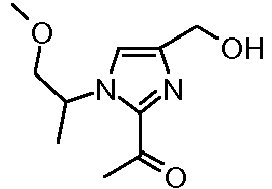
1H-NMR (CDCl3) δ: 1.45 (3H, d, J = 6.9 Hz), 2.24 (1H, t, J = 5.7 Hz), 2.66 (3H, s), 3.32 (3H, s), 3.52-3.59 (2H, m), 4.66 (2H, d, J = 5.7 Hz), 5.64-5.67 (1H, m), 7.31 (1H, s). MS (ESI) m/z: 213 [(M+H)+]. 26 1-(1-tert-Butyl-4-hydroxymethyl-1H-imidazol-2-yl)ethanone 
1H-NMR (CDCl3) δ: 1.67 (9H, s), 2.08-2.02 (1H, m), 2.70 (3H, s), 4.64 (2H, d, J = 5.7 Hz), 7.29 (1H, s). [Table 3] Example Compound Name Structural Formula Physical Property Data 27 2,2-Difluoro-1-(1-ethyl-4-hydroxymethyl-1H-imidazol-2-yl)ethanone 
1H-NMR (CDCl3) δ: 1.46 (3H, t, J = 7.2 Hz), 2.16 (1H, t, J = 5.7 Hz), 4.45 (2H, q, J = 7.2 Hz), 4.69 (2H, d, J = 5.2 Hz), 6.93 (1H, t, J = 53.8 Hz), 7.25 (1H, s). MS (ESI) m/z: 205 (M+H)+. 28 1-[1-(Furan-2-ylmethyl)-4-hydroxymethyl-1H-imidazol-2-yl]ethanone 
1H-NMR (CDCl3) δ: 2.07 (1H, t, J = 6.0 Hz), 2.66 (3H, s), 4.63 (2H, d, J = 6.3 Hz), 5.58 (2H, s), 6.34 (1H, dd, J = 3.1, 2.0 Hz), 6.41 (1H, d, J = 2.9 Hz), 7.07 (1H, s), 7.38 (1H, d, J = 1.2 Hz). MS (FAB) m/z: 221 [(M+H)+]. Anal. Calcd for C11H12N2O3: C, 59.99; H, 5.49; N, 12.72. Found: C, 60.34; H, 5.54; N, 12.73. 29 1-[4-Hydroxymethyl-1-(oxetan-3-yl)-1H-imidazol-2-yl]ethanone 
1H-NMR (CDCl3) δ: 2.09 (1H, t, J = 6.3 Hz), 2.64 (3H, s), 4.70 (2H, d, J = 5.7 Hz), 4.74 (2H, t, J = 7.4 Hz), 5.13 (2H, t, J = 7.2 Hz), 6.05-6.11 (1H, m), 7.48 (1H, s). MS (ESI) m/z: 197 [(M+H)+]. Anal. Calcd for C9H12N2O3: C, 55.09; H, 6.16; N, 14.28. Found: C, 55.25; H, 6.15; N, 14.29. 30 1-[1-(sec-Butyl)-4-hydroxymethyl-1H-imidazol-2-yl]ethanone 
1H-NMR (CDCl3) δ: 0.84 (3H, t, J = 7.3 Hz), 1.41 (3H, d, J = 6.4 Hz), 1.69-1.79 (2H, m), 2.66 (3H, s), 4.66 (2H, s), 5.35-5.45 (1H, m), 7.19 (1H, s). MS(ESI)m/z:197[(M+H)+]. 31 1-[1-(2-Fluoroethyl)-4-hydroxymethyl-1H-imidazol-2-yl]ethanone 
1H-NMR (CDCl3) δ: 2.04 (1H, t, J = 5.7 Hz), 2.67 (3H, s), 4.64-4.76 (6H, m), 7.13 (1H, s). MS (ESI) m/z:187[(M+H)+]. Anal. Calcd for C8H11FN2O2: C, 51.61; H, 5.96; F,10.20; N, 15.05. Found: C, 51.74; H, 5.96; F,9.98; N, 15.05. 32 1-[1-(3-Fluoropropyl)-5-hydroxymethyl-1H-imidazol-2-yl]ethanone 
1H-NMR (CDCl3) δ: 1.70 (1H, t, J = 5.5 Hz), 2.14-2.29 (2H, m), 2.67 (3H, s), 4.44 (1H, t, J = 5.5 Hz), 4.52-4.58 (3H, m), 4.72 (2H, d, J = 5.5 Hz), 7.15 (1H, s). MS (ESI) m/z: 201[(M+H)+]. Anal. Calcd for C4H13FN2O2: C, 53.99; H, 6.54; F,9.49; N, 13.99. Found: C, 54.05; H, 6.55; F,9.23; N, 13.92. 33 1-(1-Dimethylamino-4-hydroxymethyl-1H-imidazol-2-yl)ethanone 
1H-NMR (CDCl3) δ: 2.04 (1H, t, J = 5.7 Hz), 2.66 (3H, s), 2.91 (6H, s), 4.63 (2H, d, J = 5.7 Hz), 7.33 (1H, s). MS (ESI) m/z: 184 [(M+H)+]. 34 1-[4-[Hydroxy[(2H)2]met hyl]-1-methoxymethyl-1H-imidazol-2-yl]ethanone 
1H-NMR (CDCl3) δ: 2.67 (3H, s), 3.35 (3H, s), 5.71 (2H, s), 7.24 (1H, s). MS (ESI) m/z: 187 [(M+H)+]. -

- (5-Methyl-1H-imidazol-4-yl)methanol hydrochloride, and (4-methyl-1H-imidazol-5-yl)methanol hydrochloride (5.00 g) were suspended in dichloromethane (100 mL), followed by addition of triethylamine (14.1 mL) and TBDPSCl (13.1 mL) under stirring, and the stirring was continued for 3 days. The reaction solution was diluted with water, and extracted with chloroform. The combined extract was washed with saturated brine, dried over anhydrous sodium sulfate, and subsequently the solvent was distilled off under reduced pressure. The resulting residue was purified by flash chromatography (methanol/chloroform = 0%→5%) using silica gel column (product name: cartridge 40M, manufactured by Biotage, Ltd.) to afford the mixture (7.77 g) of the title compound.
1H-NMR (CDCl3) δ: 1.05 (9H, s), 2.03 (3H, s), 4.68 (2H, s), 7.37-7.47 (7H, m), 7.66-7.68 (4H, m). -

- The mixture (35.4 g) obtained in (1) was dissolved in acetonitrile (500 mL), followed by addition of TEA (37.8 mL) and then 2-trimethylsilylethoxymethyl chloride (hereinafter, also referred to as SEMCl) (21.4 mL) while stirring under ice cooling, followed by stirring at 70°C for 12 hours. The reaction mixture was allowed to cool to room temperature, and the solvent was distilled off under reduced pressure. The residue was diluted with ethyl acetate, subsequently washed with saturated brine, and dried over anhydrous sodium sulfate. The solvent was distilled off under reduced pressure, and the resulting residue was purified by flash chromatography (ethyl acetate/hexane = 15%→50%) using silica gel column (product name: cartridge 65i, manufactured by Biotage, Ltd.) to afford 4-(tert-butyldiphenylsilyloxymethyl)-5-methyl-1-(2-trimethylsilylethoxymethyl)-1H-imidazole (17.9 g) as a low polar component, and 5-(tert-butyldiphenylsilyloxymethyl)-4-methyl-1-(2-trimethylsilylethoxymethyl)-1H-imidazole (9.42 g) as a high polar component.
- 1H-NMR (CDCl3) δ: -0.02 (9H, s), 0.89 (2H, t, J = 8.2 Hz), 1.04 (9H, s), 2.10 (3H, s), 3.45 (2H, t, J = 8.2 Hz), 4.65 (2H, s), 5.14 (2H, s), 7.34-7.45 (3H, m), 7.75-7.70 (4H, m).
MS (ESI) m/z: 481 [M+H]+. - 1H-NMR (CDCl3) δ: -0.03 (9H, s), 0.89 (2H, t, J = 8.0 Hz), 1.01 (9H, s), 1.92 (3H, s), 3.46 (2H, t, J = 8.3 Hz), 4.68 (2H, s), 5.38 (2H, s), 7.37-7.47 (3H, m), 7.66-7.68 (4H, m).
MS (ESI) m/z: 481 [M+H]+. -

- The mixture (2.24 g) obtained in (2) was dissolved in THF (30 mL), followed by cooling to -78°C while stirring under an argon atmosphere. To the present solution was added dropwise n-butyl lithium (2.69 M hexane solution, 2.82 mL) slowly using a syringe, followed by stirring at the same temperature for 30 minutes. Then, N-methoxy-N-methylacetamide (0.95 mL) was added using a syringe, and stirring was continued for 17 hours while the temperature was raised to room temperature. A saturated aqueous ammonium chloride solution was added to the reaction solution to terminate the reaction, followed by extraction with ethyl acetate. The combined extract was washed with saturated brine, dried over anhydrous sodium sulfate, and subsequently the solvent was distilled off under reduced pressure. The resulting residue was purified by flash chromatography (ethyl acetate/hexane = 0%→15%) using silica gel column (product name: SNAP Cartridge KP-Sil 100g, manufactured by Biotage, Ltd.) to afford the title compound (1.85 g).
1H-NMR (CDCl3) δ: -0.05 (9H, s), 0.86 (2H, t, J = 8.3 Hz), 1.02 (9H, s), 1.97 (3H, s), 2.65 (3H, s), 3.50 (2H, t, J = 8.0 Hz), 4.73 (2H, s), 5.93 (2H, s), 7.38-7.47 (6H, m), 7.65-7.66 (4H, m). -

- The compound (1.85 g) obtained in (3) was dissolved in THF (20 mL), followed by addition of TBAF (1.0 M THF solution, 3.54 mL) under stirring, and the stirring was continued for 1 hour. The reaction solution was diluted with water, followed by extraction with ethyl acetate. The combined extract was washed with saturated brine, dried over anhydrous sodium sulfate, and subsequently the solvent was distilled off under reduced pressure. The resulting residue was purified by flash chromatography (ethyl acetate/hexane = 5%→70%) using amino column (product name: SNAP Cartridge NH 55g, manufactured by Biotage, Ltd.) to afford the title compound (1.01 g).
1H-NMR (CDCl3) δ: -0.02 (9H, s), 0.87-0.92 (2H, m), 2.31 (3H, s), 2.67 (3H, s), 2.99 (1H, t, J = 6.3 Hz), 3.57-3.61 (2H, m), 4.63 (2H, d, J = 6.3 Hz), 5.96 (2H, s). -

- The compound (1.01 g) obtained in (4) was dissolved in a 4 N hydrochloric acid/1,4-dioxane solution (10 mL), and stirring was continued for 1.5 hours while the mixture was warmed to 100°C. After being allowed to cool to room temperature, a 1 N aqueous sodium hydroxide solution was added for neutralization, and subsequently the solvent was distilled off under reduced pressure. The resulting residue was purified by flash chromatography (ethyl acetate/hexane = 5%→90%, then methanol/ethyl acetate = 5%) using amino column (product name: SNAP Cartridge KP-NH 55g, manufactured by Biotage, Ltd.) to afford the mixture (0.24 g) of the title compound.
1H-NMR (CD3OD) δ: 2.26-2.32 (3H, m), 2.51 (3H, s), 4.54 (2H, br s). MS (ESI) m/z: 155 [M+H]+.
Anal. Calcd for C7H10N2O2: C, 54.54; H, 6.54; N, 18.17. Found: C, 54.35; H, 6.49; N, 17.96. - Referring to the above-mentioned Examples, the following compounds can be prepared.
[Table 14] Preparative Example Compound Name Structural Formula 1 1-(4-Fluoro-5-hydroxymethyl-1H-imidazol-2-yl)-ethanone 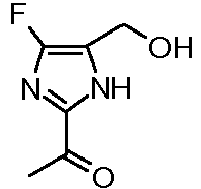
2 1-(5-Fluoro-4-hydroxymethyl-1H-imidazol-2-yl)-ethanone 
3 1-(4-Chloro-5-hydroxymethyl-1H-imidazol-2-yl)-ethanone 
4 1-(5-Chloro-4-hydroxymethyl-1H-imidazol-2-yl)-ethanone 
- 5 g of a compound obtained in an Example, 90 g of lactose, 34 g of corn starch, 20 g of crystalline cellulose and 1 g of magnesium stearate are mixed with a blender, and subsequently the mixture is tableted with a tablet-making machine to obtain tablets.
- Male BALB/c mice at age 6 weeks and Male C57BL/6j mice at age 6 weeks were purchased from Charles River Laboratories Japan Inc. Mice that had reached age 7 weeks after 1-week acclimation were used for the experiment. A group of 5 animals was used for the experiment. The spleens extirpated from BALB/c mice or C57BL/6j mice were crushed in RPMI1640 medium (Invitrogen corp.). Subsequent filtration using 70 µm Cell Strainer (Becton, Dickinson and Company, Japan) allowed spleen cells to be prepared. Collected cells were suspended in RPMI1640 medium so as to be 1 x 10⁸ cells/mL, each 50 µL of which was injected into soles of the right and left hind paws of BALB/c mice to induce mouse host-versus-graft reaction (mHvGR).
- Methyl Cellulose #400 (MC, Nacalai Tesque, Inc.) was dissolved with sterilized distilled water so as to be 0.5% (0.5% MC solution), and was used as solvent. The necessary amount of the analyte was weighed, and subsequently suspended in the solvent using a mortar and a pestle. The solution to be administered was prepared so as to be 10 mL per 1 kg of body weight. The prepared compound solution was administered orally using a stomach tube once a day for 3 days from the day on which mHvGR was induced. At 4 days after the induction of mHvGR, the mice were euthanized by exsanguination from inferior vena cava and abdominal aorta under deep diethylether anesthesia, and popliteal lymph nodes were extirpated. The wet weight of the right and left lymph nodes was measured individually.
- Compounds of Examples 1 to 34 reduced host-versus-graft reaction.
- Male BALB/c mice at age 6 weeks were purchased from Charles River Laboratories Japan Inc. Mice that had reached age 7 weeks after 1-week acclimation were used for the experiment. A group of 5 animals was used for the experiment. The necessary amount of the analyte was weighed, and subsequently suspended in a 0.5% MC solution using a mortar and a pestle. The solution to be administered was prepared so as to be 10 mL per 1 kg of body weight. The prepared compound solution was administered orally in a single dose using a stomach tube.
- Dipotassium dihydrogen ethylenediaminetetraacetate (EDTA-2K, Nacalai Tesque, Inc.) was dissolved with water for injection so as to be 5% (5% EDTA-2K solution). At 1, 3, 8, 24, 48 hours before and after oral administration, mice were subjected to laparotomy under diethylether anesthesia, and 0.5 mL of blood was collected from inferior vena cava using a syringe with a 5% EDTA-2K solution having been passed therethrough in advance. At that time, the thymus was also extirpated. The obtained blood was handled under the condition of room temperature until measurement. For measurement of the number of lymphocytes, an automatic blood cell counter (ADVIA120, Siemens Healthcare Diagnostic, Inc.) was used.
- The extirpated thymus was crushed by means of either a method using zirconia beads in the presence of 500 µL of a homogenization buffer (50 mM HEPES-NaOH (pH=7.4), 0.15 M NaCl, 10% Glycerol, 1 mM EDTA, 1 mM DTT, complete protease inhibitor cocktail (Roche, #4693132)), or a method using Potter-Elvehjem type homogenizer after mincing. After further ultrasonication with a sonicator, centrifugation was conducted at 4°C and 1000 G for 3 minutes to collect the supernatant. After the proteins of the supernatant were quantified with Bradford method, the supernatant was instantly frozen with liquid nitrogen, and subsequently stored at -80°C (thymus extract).
- In order to measure S1P lyase activity, the thymus extract was diluted to 1 mg/mL with a homogenization buffer, and reacted at 37°C for 1 hour in an enzyme reaction solution (0.1 M K-Pi (pH=7.4), 25 mM NaF, 5 mM Na3VO4, 1 mM EDTA, 1 mM DTT, 0.1% Triton X-100, 2 µM cold dhS1P) containing [3H]dh S1P (3.4 nM) which is a substrate. Those subjected to the reaction for 1 hour on ice were set as negative controls. After the reaction, sodium hydroxide was added so as to have the final concentration of 0.1 M, and an equivalent of CHCl3/MeOH (2:1) mixed solution was further added followed by stirring. After centrifugation at room temperature and 8400 G for 3 minutes, the aqueous layer portion was collected, and the radioactivity was measured with a liquid scintillation counter.
- Compounds of Examples 1 and 5 inhibited S1P lyase in mice.
- Male LEW/Crj rats at age 3 or 6 weeks were purchased from Charles River Laboratories Japan Inc. The rats were acclimated for 1 week, and used for the experiment. A group of 3 or 5 animals was used for the experiment. The necessary amount of the analyte was weighed, and subsequently suspended in a 0.5% MC solution using a mortar and a pestle or a homogenizer. The solution to be administered was prepared so as to be 5 mL per 1 kg of body weight. The prepared solution was administered orally in a single dose using a stomach tube. At 1, 3, 7, 8, 24 or 48 hours before and after the oral administration, rats were subjected to laparotomy under diethylether anesthesia or under isoflurane anesthesia, and 2 mL of blood was collected from inferior vena cava immediately into an anticoagulant(EDTA-2K)-coated vacuum sealed blood collection tube (Nipro Corporation). After being inverted, the tube was handled under the condition of room temperature until measurement. For measurement of the number of lymphocytes, an automatic blood cell counter (ADVIA120, Siemens Healthcare Diagnostic, Inc.) was used.
- Compounds of Examples 2, 5, 6, 15, 16, and 35 reduced the number of lymphocytes in peripheral blood.
- Female cynomolgus monkeys (from China/Philippines) were purchased from Hamri Co. Ltd. or LSG Corporation. The necessary amount of the analyte was weighed, and subsequently suspended in a 0.5% MC solution using a mortar and a pestle. The solution to be administered was prepared so as to be 5 mL per 1 kg of body weight. The cynomolgus monkeys were fasted from about 17 hours before administration up to 7 hours after administration. The prepared compound solution was administered orally in a single dose using a stomach tube. At 0.5, 1, 2, 4 and 7 hours before and after the oral administration, and on 1, 2, 3 days after administration, about 0.8 mL of blood was collected from cephalic vein or saphenous vein using an injector immediately into an anticoagulant-coated vacuum sealed blood collection tube. After being inverted, the tube was handled under the condition of room temperature until measurement. For measurement of the number of lymphocytes, an automatic blood cell counter was used.
- Compounds of Examples 1, 2, 5, 9, 15, and 35 reduced the number of lymphocytes in peripheral blood.
- S1P lyase inhibitory capacity was measured in accordance with FEBS Letters 350 (1994) 91-95, JBC Vol. 266, No.19, pp. 12502-12507, 1991. Examples 2 and 35 inhibited S1P lyase in rats.
- Pathological models such as experimental autoimmune encephalomyelitis (Clin. Exp. Immunol., 120, 526-531 (2000), J. Neuroimmunol., 129, 1-9 (2002), Annu. Rev. Immunol., 10, 153-187 (1992), Eur. J. Immunol., 25, 1951-1959 (1995)), collagen-induced arthritis (Current Protocols in Immunology (1996) 15.5.1-15.5.24), aspirin asthma (Arthritis Rheum. 2010 Jan; 62(1): 82-92), GPI-induced arthritis (Arthritis Res Ther. 2008; 10(3): R66. Epub 2008 Jun 5.), antibody-induced arthritis (J Immunol. 2003 Apr 15; 170(8): 4318-24.), psoriasis (J Immunol. 2009 May 1; 182(9): 5836-45., J Clin Invest. 2008 Feb; 118(2): 597-607., Nature 2007 445: 648-651.), inflammatory bowel disease (Current Protocols in Immunology (2001) 15.19.1-15.19.14, Proc Natl Acad Sci U S A. 2009 Mar 3; 106(9): 3300-5. Epub 2009 Feb 6.), systemic lupus erythematosus (Current Protocols in Immunology (2002) 15.20.1-15.20.22), and acute lung injury (Am. J. Respir. Cell Mol. Biol. 2010 Dec. 10 as doi: 10.1165/rcmb. 2010-04220C) are used to evaluate the test substances.
- Pursuant to Journal of pharmaceutical sciences, 97(2), 712-725 (2008), the membrane permeability of the test substances is evaluated as follows.
- Madin-Darby canine kidney (obtained from American Type Culture Collection) cells (hereinafter, referred to as MDCK cells) are cultured in Minimum Essential Medium (manufactured by GIBCO, Inc.) containing 10% (v/v) fetal bovine serum (manufactured by GIBCO, Inc.), a penicillin-streptomycin mixture (manufactured by GIBCO, Inc.) and L-glutamine.
- After cells are inoculated so as to form a monolayer, inoculation is conducted in HTS-24 well transwell (manufactured by Costar Corporation) so as to be 1.65 × 10⁵ cells/mL, followed by culturing for 6 days. To 10 × Hanks' Balanced Salt Solution (manufactured by GIBCO, Inc.) are added NaHCO3 (final concentration: 0.35 g/L), D-glucose (final concentration: 3.5 g/L), HEPES (manufactured by Sigma Corporation, final concentration: 10 mM), CaCl2 (final concentration 0.14 g/l) and MgSO4 (final concentration: 0.098 g/L), followed by adjustment of the pH to 6.0 or 7.4 using 1 M HCl or 1 M NaOH to prepare Transport Buffer.
- Then, Transport Buffer (pH = 6.0) (100 µL) of 10 µM of each test substance is added to the apical side of the cell. Transport Buffer (pH 7.4) (600 µL) containing 4% (w/v) bovine serum albumin is added to the basolateral side thereof. Metoprolol is used as a positive control.
- After incubation at 37°C for 1 hour, LC/MS/MS system (10 mM HCO2NH4/acetonitrile, 100/0→20/80→100/0) equipped with Alliance 2790 HPLC (manufactured by Waters Corporation), Atlantis dC18 column (2.1 mm x 20 mm, 3 µm, manufactured by Waters Corporation) and TSQ7000 mass spectrometer (manufactured by ThermoQuest Corporation) is used to analyze the basolateral side. The concentration of each test substance at the basolateral side is calculated from a peak area with respect to each calibration curve. Permeation coefficient (Papp) from the apical side to the basolateral side of each test substance is calculated from the test substance concentration (Cb(µM)) at the basolateral side measured by LC/MS/MS and the initial concentration of 10 µM at the apical side using the following mathematical expression. In the following mathematical expression, 3600 sec denotes the reflux time for the compound, and 0.33 cm2 denotes the area of transwell filter.
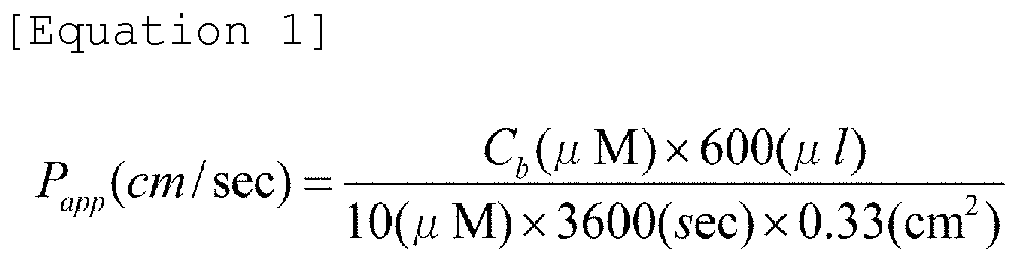
- According to the present invention, it is possible to provide a pharmaceutical composition for preventing or treating inflammatory bowel disease, acute lung injury, autoimmune disease, multiple sclerosis or allergic disease, or for suppressing rejection response against transplant.
Claims (18)
- A compound represented by the general formula (I):
 R1 is a methyl group which may be substituted with the same or different 1 to 3 halogen atoms,R2 is a C2-C6 alkyl group, a cyclopropyl group, a C1-C2 alkoxy C1-C3 alkyl group, a cyclohexyloxymethyl group, a vinyl group, a furanylmethyl group, an oxetanyl group or a dimethylaminosulfonyl group,R3 is a hydrogen atom, an acetyl group, a benzoyl group or a pivaloyl group, andR4 is a hydrogen atom or a halogen atom] or an isotope thereof or a pharmaceutically acceptable salt thereof.
 - The compound or isotope thereof or pharmaceutically acceptable salt thereof according to claim 1, wherein R1 is a methyl group which may be substituted with 1 to 3 fluorine atoms.
- The compound or isotope thereof or pharmaceutically acceptable salt thereof according to claim 1, wherein R1 is a methyl group or a difluoromethyl group.
- The compound or isotope thereof or pharmaceutically acceptable salt thereof according to any one of claims 1 to 3, wherein R2 is an ethyl group, a propyl group, a sec-butyl group, a tert-butyl group, a pentyl group, a hexyl group, a cyclopropyl group, a methoxymethyl group, a methoxyethyl group, a methoxyisopropyl group, an ethoxymethyl group, a cyclohexyloxymethyl group, a vinyl group, a furanylmethyl group, an oxetanyl group or a dimethylaminosulfonyl group.
- The compound or isotope thereof or pharmaceutically acceptable salt thereof according to any one of claims 1 to 3, wherein R2 is an ethyl group or a vinyl group.
- The compound or isotope thereof or pharmaceutically acceptable salt thereof according to any one of claims 1 to 5, wherein R3 is a hydrogen atom.
- The compound or isotope thereof or pharmaceutically acceptable salt thereof according to any one of claims 1 to 6, wherein R4 is a hydrogen atom.
- A compound represented by the general formula (II):
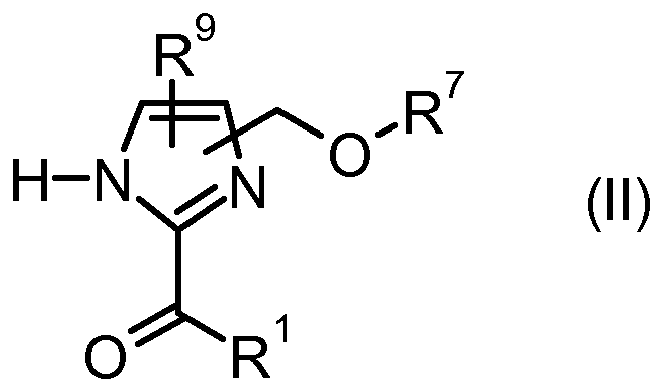 R1 is a methyl group which may be substituted with the same or different 1 to 3 halogen atoms,R7 is a hydrogen atom, andR9 is a hydrogen atom, a halogen atom or a C1-C6 alkyl group] or an isotope thereof or a pharmaceutically acceptable salt thereof.
 - The compound or isotope thereof according to claim 1, selected from the group consisting of:1-((4-hydroxymethyl-1-methoxymethyl-1H-imidazol-2-yl)ethanone,1-((4-hydroxymethyl-1-isopropyl-1H-imidazol-2-yl)ethanone,1-((4-hydroxymethyl-1-vinyl-1H-imidazol-2-yl)ethanone, and1-[4-[hydroxy[(2H)2]methyl]-1-methoxymethyl-1H-imidazol-2-yl]ethanone.
- The compound or isotope thereof according claim 8, selected from the group consisting of:1-((4-hydroxymethyl-1H-imidazol-2-yl)ethanone,1-((5-hydroxymethyl-1H-imidazol-2-yl)ethanone,1-[4-[hydroxy[(2H)2]methyl]-1H-imidazol-2-yl]ethanone, and1-[5-[hydroxy[(2H)2]methyl]-1H-imidazol-2-yl]ethanone.
- A pharmaceutical composition containing as an active ingredient the compound or isotope thereof or pharmaceutically acceptable salt thereof according to any one of claims 1 to 8 or the compound or isotope thereof according to claim 9 or claim 10.
- The pharmaceutical composition according to claim 11 for use in preventing or treating inflammatory bowel disease, acute lung injury, autoimmune disease, multiple sclerosis or allergic disease, or in suppressing rejection response against transplant.
- The pharmaceutical composition for use according to claim 12,
wherein the inflammatory bowel disease is ulcerative colitis or Crohn's disease. - The pharmaceutical composition for use according to claim 12,
wherein the autoimmune disease is rheumatoid arthritis, systemic lupus erythematosus, antiphospholipid antibody syndrome, multiple myositis, dermatomyositis, systemic scleroderma, Sjogren's syndrome, polyarteritis nodosa, microscopic polyarteritis, allergic granulomatous angiitis, Wegener's granulomatosis or mixed connective tissue disease. - The pharmaceutical composition for use according to claim 12,
wherein the allergic disease is atopic dermatitis, allergic rhinitis, pollinosis, allergic conjunctivitis, allergic gastroenteritis, bronchial asthma, infantile asthma, food allergy, drug allergy or urticaria. - A compound or isotope thereof or pharmaceutically acceptable salt thereof according to any one of claims 1 to 8 or the compound or isotope thereof according to claim 9 or claim 10, for use in preventing or treating inflammatory bowel disease, acute lung injury, autoimmune disease, multiple sclerosis or allergic disease, or in suppressing rejection response against transplant.
- The compound or isotope thereof or pharmaceutically acceptable salt thereof for use according to claim 16, for administration to a mammal.
- The compound or isotope thereof or pharmaceutically acceptable salt thereof for use according to claim 17, wherein the mammal is a human.
Applications Claiming Priority (2)
| Application Number | Priority Date | Filing Date | Title |
|---|---|---|---|
| JP2010033413 | 2010-02-18 | ||
| PCT/JP2011/053336 WO2011102404A1 (en) | 2010-02-18 | 2011-02-17 | Imidazole derivative |
Publications (3)
| Publication Number | Publication Date |
|---|---|
| EP2537831A1 EP2537831A1 (en) | 2012-12-26 |
| EP2537831A4 EP2537831A4 (en) | 2013-09-04 |
| EP2537831B1 true EP2537831B1 (en) | 2014-12-03 |
Family
ID=44482990
Family Applications (1)
| Application Number | Title | Priority Date | Filing Date |
|---|---|---|---|
| EP11744690.6A Not-in-force EP2537831B1 (en) | 2010-02-18 | 2011-02-17 | Imidazole derivative |
Country Status (5)
| Country | Link |
|---|---|
| US (1) | US8653126B2 (en) |
| EP (1) | EP2537831B1 (en) |
| JP (1) | JP5645318B2 (en) |
| TW (1) | TW201132630A (en) |
| WO (1) | WO2011102404A1 (en) |
Families Citing this family (6)
| Publication number | Priority date | Publication date | Assignee | Title |
|---|---|---|---|---|
| WO2012002274A1 (en) | 2010-06-28 | 2012-01-05 | 第一三共株式会社 | Method for screening for s1p lyase inhibitor using cultured cell |
| WO2013002248A1 (en) | 2011-06-28 | 2013-01-03 | 第一三共株式会社 | Phosphoric acid ester derivative |
| EP3443986A1 (en) * | 2017-08-17 | 2019-02-20 | AC BioScience | Enhancement of chemotherapy efficiency by sphingosine-1-phosphate |
| FR3071501A1 (en) | 2017-09-28 | 2019-03-29 | Bostik Sa | LIQUID HYDROCARBON COPOLYMERS WITH TWO TERMINAL GROUPS ETHER CYCLOCARBONATE |
| EP3782702A1 (en) * | 2019-08-21 | 2021-02-24 | AC BioScience SA | Compounds and use thereof for the treatment of infectious diseases and cancer |
| WO2025027051A1 (en) * | 2023-07-31 | 2025-02-06 | Ab Science | Sphingosine-1-phosphate lyase inhibitors for use in the treament of neurodegenerative diseases |
Family Cites Families (6)
| Publication number | Priority date | Publication date | Assignee | Title |
|---|---|---|---|---|
| US4567194A (en) | 1983-03-10 | 1986-01-28 | The Coca-Cola Company | 2-Acylimidazole compounds, their synthesis and use as medicinal agents |
| ZA974811B (en) | 1996-05-31 | 1997-12-30 | Univ Wollongong | Novel therapeutic compounds. |
| US7649098B2 (en) | 2006-02-24 | 2010-01-19 | Lexicon Pharmaceuticals, Inc. | Imidazole-based compounds, compositions comprising them and methods of their use |
| TW200848029A (en) | 2007-03-01 | 2008-12-16 | Lexicon Pharmaceuticals Inc | Heterocyclic compounds, compositions comprising them and methods of their use |
| TWI412362B (en) | 2007-04-12 | 2013-10-21 | Lexicon Pharmaceuticals Inc | Solid form of (E)-1-(4-((1R,2S,3R)-1,2,3,4-tetrahydroxybutyl)-1H-imidazol-2-yl)ethanone oxime |
| CN102131803A (en) | 2008-06-18 | 2011-07-20 | 莱西肯医药有限公司 | Solid forms of (1R,2S,3R)-1-(2-(isoxazol-3-yl)-1H-imidazol-4-yl)butane-1,2,3,4-tetrol and uses thereof method |
-
2011
- 2011-02-17 JP JP2012500636A patent/JP5645318B2/en not_active Expired - Fee Related
- 2011-02-17 TW TW100105225A patent/TW201132630A/en unknown
- 2011-02-17 EP EP11744690.6A patent/EP2537831B1/en not_active Not-in-force
- 2011-02-17 WO PCT/JP2011/053336 patent/WO2011102404A1/en not_active Ceased
- 2011-02-17 US US13/579,791 patent/US8653126B2/en not_active Expired - Fee Related
Non-Patent Citations (1)
| Title |
|---|
| BAGDANOFF JEFFREY T ET AL: "Inhibition of Sphingosine-1-Phosphate Lyase for the Treatment of Autoimmune Disorders", JOURNAL OF MEDICINAL CHEMISTRY, AMERICAN CHEMICAL SOCIETY, US, vol. 52, no. 13, 9 July 2009 (2009-07-09), pages 3941 - 3953, XP002563337, ISSN: 0022-2623, [retrieved on 20090521], DOI: 10.1021/JM900278W * |
Also Published As
| Publication number | Publication date |
|---|---|
| US20120316170A1 (en) | 2012-12-13 |
| EP2537831A1 (en) | 2012-12-26 |
| US8653126B2 (en) | 2014-02-18 |
| EP2537831A4 (en) | 2013-09-04 |
| JPWO2011102404A1 (en) | 2013-06-17 |
| JP5645318B2 (en) | 2014-12-24 |
| WO2011102404A1 (en) | 2011-08-25 |
| TW201132630A (en) | 2011-10-01 |
Similar Documents
| Publication | Publication Date | Title |
|---|---|---|
| JP7098716B2 (en) | Pyrazolo and triazolobicyclic compounds as JAK kinase inhibitors | |
| EP3761980B1 (en) | Amino acid compounds and methods of use | |
| JP6881879B2 (en) | Pyrimidine compounds as JAK kinase inhibitors | |
| TWI789446B (en) | Pyrimidine compound as jak kinase inhibitor | |
| EP4520329A2 (en) | Treatment of respiratory diseases with amino acid compounds | |
| US8653126B2 (en) | Imidazole derivative | |
| EP4590675A1 (en) | Heterocyclic sik inhibitors | |
| US9120835B2 (en) | Phosphoric acid ester derivatives | |
| JP2006515880A (en) | Thienopyridazinone and its use in the regulation of autoimmune diseases | |
| RU2817349C1 (en) | Aminopyrimidinyl derivatives | |
| AU2021301417B2 (en) | Aminopyrimidinyl derivatives | |
| KR20230100919A (en) | Aminopyrimidinyl derivatives | |
| OA19911A (en) | Pyrimidine compound as JAK kinase inhibitor. |
Legal Events
| Date | Code | Title | Description |
|---|---|---|---|
| PUAI | Public reference made under article 153(3) epc to a published international application that has entered the european phase |
Free format text: ORIGINAL CODE: 0009012 |
|
| 17P | Request for examination filed |
Effective date: 20120713 |
|
| AK | Designated contracting states |
Kind code of ref document: A1 Designated state(s): AL AT BE BG CH CY CZ DE DK EE ES FI FR GB GR HR HU IE IS IT LI LT LU LV MC MK MT NL NO PL PT RO RS SE SI SK SM TR |
|
| DAX | Request for extension of the european patent (deleted) | ||
| A4 | Supplementary search report drawn up and despatched |
Effective date: 20130802 |
|
| RIC1 | Information provided on ipc code assigned before grant |
Ipc: A61K 31/4164 20060101ALI20130729BHEP Ipc: A61P 29/00 20060101ALI20130729BHEP Ipc: A61P 11/06 20060101ALI20130729BHEP Ipc: C07D 233/64 20060101AFI20130729BHEP Ipc: A61P 17/02 20060101ALI20130729BHEP Ipc: A61P 35/00 20060101ALI20130729BHEP Ipc: C07D 233/90 20060101ALI20130729BHEP Ipc: A61P 21/00 20060101ALI20130729BHEP Ipc: A61P 17/00 20060101ALI20130729BHEP Ipc: A61P 1/04 20060101ALI20130729BHEP Ipc: A61P 25/00 20060101ALI20130729BHEP Ipc: A61P 11/02 20060101ALI20130729BHEP Ipc: A61P 9/14 20060101ALI20130729BHEP Ipc: A61P 37/06 20060101ALI20130729BHEP Ipc: A61P 37/08 20060101ALI20130729BHEP Ipc: A61P 17/04 20060101ALI20130729BHEP Ipc: A61P 43/00 20060101ALI20130729BHEP Ipc: A61P 19/02 20060101ALI20130729BHEP Ipc: A61P 27/14 20060101ALI20130729BHEP Ipc: A61P 37/00 20060101ALI20130729BHEP |
|
| GRAP | Despatch of communication of intention to grant a patent |
Free format text: ORIGINAL CODE: EPIDOSNIGR1 |
|
| INTG | Intention to grant announced |
Effective date: 20140626 |
|
| GRAS | Grant fee paid |
Free format text: ORIGINAL CODE: EPIDOSNIGR3 |
|
| GRAA | (expected) grant |
Free format text: ORIGINAL CODE: 0009210 |
|
| AK | Designated contracting states |
Kind code of ref document: B1 Designated state(s): AL AT BE BG CH CY CZ DE DK EE ES FI FR GB GR HR HU IE IS IT LI LT LU LV MC MK MT NL NO PL PT RO RS SE SI SK SM TR |
|
| REG | Reference to a national code |
Ref country code: GB Ref legal event code: FG4D |
|
| REG | Reference to a national code |
Ref country code: AT Ref legal event code: REF Ref document number: 699277 Country of ref document: AT Kind code of ref document: T Effective date: 20141215 Ref country code: CH Ref legal event code: EP |
|
| REG | Reference to a national code |
Ref country code: IE Ref legal event code: FG4D |
|
| REG | Reference to a national code |
Ref country code: DE Ref legal event code: R096 Ref document number: 602011011955 Country of ref document: DE Effective date: 20150108 |
|
| REG | Reference to a national code |
Ref country code: NL Ref legal event code: VDEP Effective date: 20141203 |
|
| REG | Reference to a national code |
Ref country code: AT Ref legal event code: MK05 Ref document number: 699277 Country of ref document: AT Kind code of ref document: T Effective date: 20141203 |
|
| PG25 | Lapsed in a contracting state [announced via postgrant information from national office to epo] |
Ref country code: NO Free format text: LAPSE BECAUSE OF FAILURE TO SUBMIT A TRANSLATION OF THE DESCRIPTION OR TO PAY THE FEE WITHIN THE PRESCRIBED TIME-LIMIT Effective date: 20150303 Ref country code: LT Free format text: LAPSE BECAUSE OF FAILURE TO SUBMIT A TRANSLATION OF THE DESCRIPTION OR TO PAY THE FEE WITHIN THE PRESCRIBED TIME-LIMIT Effective date: 20141203 Ref country code: FI Free format text: LAPSE BECAUSE OF FAILURE TO SUBMIT A TRANSLATION OF THE DESCRIPTION OR TO PAY THE FEE WITHIN THE PRESCRIBED TIME-LIMIT Effective date: 20141203 Ref country code: NL Free format text: LAPSE BECAUSE OF FAILURE TO SUBMIT A TRANSLATION OF THE DESCRIPTION OR TO PAY THE FEE WITHIN THE PRESCRIBED TIME-LIMIT Effective date: 20141203 Ref country code: ES Free format text: LAPSE BECAUSE OF FAILURE TO SUBMIT A TRANSLATION OF THE DESCRIPTION OR TO PAY THE FEE WITHIN THE PRESCRIBED TIME-LIMIT Effective date: 20141203 |
|
| REG | Reference to a national code |
Ref country code: LT Ref legal event code: MG4D |
|
| PG25 | Lapsed in a contracting state [announced via postgrant information from national office to epo] |
Ref country code: RS Free format text: LAPSE BECAUSE OF FAILURE TO SUBMIT A TRANSLATION OF THE DESCRIPTION OR TO PAY THE FEE WITHIN THE PRESCRIBED TIME-LIMIT Effective date: 20141203 Ref country code: HR Free format text: LAPSE BECAUSE OF FAILURE TO SUBMIT A TRANSLATION OF THE DESCRIPTION OR TO PAY THE FEE WITHIN THE PRESCRIBED TIME-LIMIT Effective date: 20141203 Ref country code: AT Free format text: LAPSE BECAUSE OF FAILURE TO SUBMIT A TRANSLATION OF THE DESCRIPTION OR TO PAY THE FEE WITHIN THE PRESCRIBED TIME-LIMIT Effective date: 20141203 Ref country code: GR Free format text: LAPSE BECAUSE OF FAILURE TO SUBMIT A TRANSLATION OF THE DESCRIPTION OR TO PAY THE FEE WITHIN THE PRESCRIBED TIME-LIMIT Effective date: 20150304 Ref country code: CY Free format text: LAPSE BECAUSE OF FAILURE TO SUBMIT A TRANSLATION OF THE DESCRIPTION OR TO PAY THE FEE WITHIN THE PRESCRIBED TIME-LIMIT Effective date: 20141203 Ref country code: LV Free format text: LAPSE BECAUSE OF FAILURE TO SUBMIT A TRANSLATION OF THE DESCRIPTION OR TO PAY THE FEE WITHIN THE PRESCRIBED TIME-LIMIT Effective date: 20141203 Ref country code: SE Free format text: LAPSE BECAUSE OF FAILURE TO SUBMIT A TRANSLATION OF THE DESCRIPTION OR TO PAY THE FEE WITHIN THE PRESCRIBED TIME-LIMIT Effective date: 20141203 |
|
| PG25 | Lapsed in a contracting state [announced via postgrant information from national office to epo] |
Ref country code: RO Free format text: LAPSE BECAUSE OF FAILURE TO SUBMIT A TRANSLATION OF THE DESCRIPTION OR TO PAY THE FEE WITHIN THE PRESCRIBED TIME-LIMIT Effective date: 20141203 Ref country code: PT Free format text: LAPSE BECAUSE OF FAILURE TO SUBMIT A TRANSLATION OF THE DESCRIPTION OR TO PAY THE FEE WITHIN THE PRESCRIBED TIME-LIMIT Effective date: 20150403 Ref country code: CZ Free format text: LAPSE BECAUSE OF FAILURE TO SUBMIT A TRANSLATION OF THE DESCRIPTION OR TO PAY THE FEE WITHIN THE PRESCRIBED TIME-LIMIT Effective date: 20141203 Ref country code: SK Free format text: LAPSE BECAUSE OF FAILURE TO SUBMIT A TRANSLATION OF THE DESCRIPTION OR TO PAY THE FEE WITHIN THE PRESCRIBED TIME-LIMIT Effective date: 20141203 Ref country code: EE Free format text: LAPSE BECAUSE OF FAILURE TO SUBMIT A TRANSLATION OF THE DESCRIPTION OR TO PAY THE FEE WITHIN THE PRESCRIBED TIME-LIMIT Effective date: 20141203 |
|
| PG25 | Lapsed in a contracting state [announced via postgrant information from national office to epo] |
Ref country code: IS Free format text: LAPSE BECAUSE OF FAILURE TO SUBMIT A TRANSLATION OF THE DESCRIPTION OR TO PAY THE FEE WITHIN THE PRESCRIBED TIME-LIMIT Effective date: 20150403 Ref country code: PL Free format text: LAPSE BECAUSE OF FAILURE TO SUBMIT A TRANSLATION OF THE DESCRIPTION OR TO PAY THE FEE WITHIN THE PRESCRIBED TIME-LIMIT Effective date: 20141203 |
|
| REG | Reference to a national code |
Ref country code: DE Ref legal event code: R097 Ref document number: 602011011955 Country of ref document: DE |
|
| PG25 | Lapsed in a contracting state [announced via postgrant information from national office to epo] |
Ref country code: LU Free format text: LAPSE BECAUSE OF FAILURE TO SUBMIT A TRANSLATION OF THE DESCRIPTION OR TO PAY THE FEE WITHIN THE PRESCRIBED TIME-LIMIT Effective date: 20150217 |
|
| REG | Reference to a national code |
Ref country code: CH Ref legal event code: PL |
|
| PLBE | No opposition filed within time limit |
Free format text: ORIGINAL CODE: 0009261 |
|
| STAA | Information on the status of an ep patent application or granted ep patent |
Free format text: STATUS: NO OPPOSITION FILED WITHIN TIME LIMIT |
|
| PG25 | Lapsed in a contracting state [announced via postgrant information from national office to epo] |
Ref country code: DK Free format text: LAPSE BECAUSE OF FAILURE TO SUBMIT A TRANSLATION OF THE DESCRIPTION OR TO PAY THE FEE WITHIN THE PRESCRIBED TIME-LIMIT Effective date: 20141203 Ref country code: LI Free format text: LAPSE BECAUSE OF NON-PAYMENT OF DUE FEES Effective date: 20150228 Ref country code: CH Free format text: LAPSE BECAUSE OF NON-PAYMENT OF DUE FEES Effective date: 20150228 Ref country code: MC Free format text: LAPSE BECAUSE OF FAILURE TO SUBMIT A TRANSLATION OF THE DESCRIPTION OR TO PAY THE FEE WITHIN THE PRESCRIBED TIME-LIMIT Effective date: 20141203 |
|
| 26N | No opposition filed |
Effective date: 20150904 |
|
| REG | Reference to a national code |
Ref country code: IE Ref legal event code: MM4A |
|
| PG25 | Lapsed in a contracting state [announced via postgrant information from national office to epo] |
Ref country code: IT Free format text: LAPSE BECAUSE OF FAILURE TO SUBMIT A TRANSLATION OF THE DESCRIPTION OR TO PAY THE FEE WITHIN THE PRESCRIBED TIME-LIMIT Effective date: 20141203 |
|
| REG | Reference to a national code |
Ref country code: FR Ref legal event code: PLFP Year of fee payment: 6 |
|
| PG25 | Lapsed in a contracting state [announced via postgrant information from national office to epo] |
Ref country code: IE Free format text: LAPSE BECAUSE OF NON-PAYMENT OF DUE FEES Effective date: 20150217 |
|
| PG25 | Lapsed in a contracting state [announced via postgrant information from national office to epo] |
Ref country code: SI Free format text: LAPSE BECAUSE OF FAILURE TO SUBMIT A TRANSLATION OF THE DESCRIPTION OR TO PAY THE FEE WITHIN THE PRESCRIBED TIME-LIMIT Effective date: 20141203 |
|
| PG25 | Lapsed in a contracting state [announced via postgrant information from national office to epo] |
Ref country code: BE Free format text: LAPSE BECAUSE OF FAILURE TO SUBMIT A TRANSLATION OF THE DESCRIPTION OR TO PAY THE FEE WITHIN THE PRESCRIBED TIME-LIMIT Effective date: 20141203 |
|
| PG25 | Lapsed in a contracting state [announced via postgrant information from national office to epo] |
Ref country code: MT Free format text: LAPSE BECAUSE OF FAILURE TO SUBMIT A TRANSLATION OF THE DESCRIPTION OR TO PAY THE FEE WITHIN THE PRESCRIBED TIME-LIMIT Effective date: 20141203 |
|
| REG | Reference to a national code |
Ref country code: FR Ref legal event code: PLFP Year of fee payment: 7 |
|
| PG25 | Lapsed in a contracting state [announced via postgrant information from national office to epo] |
Ref country code: SM Free format text: LAPSE BECAUSE OF FAILURE TO SUBMIT A TRANSLATION OF THE DESCRIPTION OR TO PAY THE FEE WITHIN THE PRESCRIBED TIME-LIMIT Effective date: 20141203 Ref country code: BG Free format text: LAPSE BECAUSE OF FAILURE TO SUBMIT A TRANSLATION OF THE DESCRIPTION OR TO PAY THE FEE WITHIN THE PRESCRIBED TIME-LIMIT Effective date: 20141203 Ref country code: HU Free format text: LAPSE BECAUSE OF FAILURE TO SUBMIT A TRANSLATION OF THE DESCRIPTION OR TO PAY THE FEE WITHIN THE PRESCRIBED TIME-LIMIT; INVALID AB INITIO Effective date: 20110217 |
|
| PG25 | Lapsed in a contracting state [announced via postgrant information from national office to epo] |
Ref country code: TR Free format text: LAPSE BECAUSE OF FAILURE TO SUBMIT A TRANSLATION OF THE DESCRIPTION OR TO PAY THE FEE WITHIN THE PRESCRIBED TIME-LIMIT Effective date: 20141203 |
|
| REG | Reference to a national code |
Ref country code: FR Ref legal event code: PLFP Year of fee payment: 8 |
|
| PG25 | Lapsed in a contracting state [announced via postgrant information from national office to epo] |
Ref country code: MK Free format text: LAPSE BECAUSE OF FAILURE TO SUBMIT A TRANSLATION OF THE DESCRIPTION OR TO PAY THE FEE WITHIN THE PRESCRIBED TIME-LIMIT Effective date: 20141203 |
|
| PG25 | Lapsed in a contracting state [announced via postgrant information from national office to epo] |
Ref country code: AL Free format text: LAPSE BECAUSE OF FAILURE TO SUBMIT A TRANSLATION OF THE DESCRIPTION OR TO PAY THE FEE WITHIN THE PRESCRIBED TIME-LIMIT Effective date: 20141203 |
|
| PGFP | Annual fee paid to national office [announced via postgrant information from national office to epo] |
Ref country code: DE Payment date: 20200204 Year of fee payment: 10 Ref country code: GB Payment date: 20200206 Year of fee payment: 10 |
|
| PGFP | Annual fee paid to national office [announced via postgrant information from national office to epo] |
Ref country code: FR Payment date: 20200113 Year of fee payment: 10 |
|
| REG | Reference to a national code |
Ref country code: DE Ref legal event code: R119 Ref document number: 602011011955 Country of ref document: DE |
|
| GBPC | Gb: european patent ceased through non-payment of renewal fee |
Effective date: 20210217 |
|
| PG25 | Lapsed in a contracting state [announced via postgrant information from national office to epo] |
Ref country code: FR Free format text: LAPSE BECAUSE OF NON-PAYMENT OF DUE FEES Effective date: 20210228 Ref country code: GB Free format text: LAPSE BECAUSE OF NON-PAYMENT OF DUE FEES Effective date: 20210217 Ref country code: DE Free format text: LAPSE BECAUSE OF NON-PAYMENT OF DUE FEES Effective date: 20210901 |