EP2537557B1 - Method and system for detecting the performance of a crew oxygen system - Google Patents
Method and system for detecting the performance of a crew oxygen system Download PDFInfo
- Publication number
- EP2537557B1 EP2537557B1 EP12172546.9A EP12172546A EP2537557B1 EP 2537557 B1 EP2537557 B1 EP 2537557B1 EP 12172546 A EP12172546 A EP 12172546A EP 2537557 B1 EP2537557 B1 EP 2537557B1
- Authority
- EP
- European Patent Office
- Prior art keywords
- oxygen
- crew
- temperature
- crew oxygen
- pressure
- Prior art date
- Legal status (The legal status is an assumption and is not a legal conclusion. Google has not performed a legal analysis and makes no representation as to the accuracy of the status listed.)
- Active
Links
Images


Classifications
-
- A—HUMAN NECESSITIES
- A62—LIFE-SAVING; FIRE-FIGHTING
- A62B—DEVICES, APPARATUS OR METHODS FOR LIFE-SAVING
- A62B7/00—Respiratory apparatus
- A62B7/14—Respiratory apparatus for high-altitude aircraft
-
- B—PERFORMING OPERATIONS; TRANSPORTING
- B64—AIRCRAFT; AVIATION; COSMONAUTICS
- B64F—GROUND OR AIRCRAFT-CARRIER-DECK INSTALLATIONS SPECIALLY ADAPTED FOR USE IN CONNECTION WITH AIRCRAFT; DESIGNING, MANUFACTURING, ASSEMBLING, CLEANING, MAINTAINING OR REPAIRING AIRCRAFT, NOT OTHERWISE PROVIDED FOR; HANDLING, TRANSPORTING, TESTING OR INSPECTING AIRCRAFT COMPONENTS, NOT OTHERWISE PROVIDED FOR
- B64F5/00—Designing, manufacturing, assembling, cleaning, maintaining or repairing aircraft, not otherwise provided for; Handling, transporting, testing or inspecting aircraft components, not otherwise provided for
- B64F5/60—Testing or inspecting aircraft components or systems
-
- A—HUMAN NECESSITIES
- A62—LIFE-SAVING; FIRE-FIGHTING
- A62B—DEVICES, APPARATUS OR METHODS FOR LIFE-SAVING
- A62B27/00—Methods or devices for testing respiratory or breathing apparatus for high altitudes
-
- A—HUMAN NECESSITIES
- A62—LIFE-SAVING; FIRE-FIGHTING
- A62B—DEVICES, APPARATUS OR METHODS FOR LIFE-SAVING
- A62B7/00—Respiratory apparatus
- A62B7/02—Respiratory apparatus with compressed oxygen or air
-
- B—PERFORMING OPERATIONS; TRANSPORTING
- B64—AIRCRAFT; AVIATION; COSMONAUTICS
- B64D—EQUIPMENT FOR FITTING IN OR TO AIRCRAFT; FLIGHT SUITS; PARACHUTES; ARRANGEMENT OR MOUNTING OF POWER PLANTS OR PROPULSION TRANSMISSIONS IN AIRCRAFT
- B64D10/00—Flight suits
-
- G—PHYSICS
- G01—MEASURING; TESTING
- G01M—TESTING STATIC OR DYNAMIC BALANCE OF MACHINES OR STRUCTURES; TESTING OF STRUCTURES OR APPARATUS, NOT OTHERWISE PROVIDED FOR
- G01M99/00—Subject matter not provided for in other groups of this subclass
-
- B—PERFORMING OPERATIONS; TRANSPORTING
- B64—AIRCRAFT; AVIATION; COSMONAUTICS
- B64D—EQUIPMENT FOR FITTING IN OR TO AIRCRAFT; FLIGHT SUITS; PARACHUTES; ARRANGEMENT OR MOUNTING OF POWER PLANTS OR PROPULSION TRANSMISSIONS IN AIRCRAFT
- B64D2231/00—Emergency oxygen systems
- B64D2231/02—Supply or distribution systems
Definitions
- the present invention relates to a method and a system for detecting the operation conditions of equipments of an aircraft, in particular to a method and a system for detecting the performance of a crew oxygen system.
- US 5,159,839 A1 describes an apparatus for gauging high pressure gas in particular for the supply of oxygen gas on board an aircraft, the apparatus being associated with a gas tank or with a plurality of gas tanks having their outlets interconnected, wherein each individual tank is provided both with a pressure regulator connected to a common outlet duct, and with a pressure sensor producing a signal proportional to the pressure in the, or each, tank, with the or each, pressure sensor being connected to a calculation and storage unit suitable for determining the content of each individual tank on the basis of the signal associated therewith and taking account of the coefficient of compressibility of the gas contained in each individual tank on the basis of data stored in the storage unit for different values of pressure, and consequently deducing the overall available content, the calculation unit further including a readout for displaying the overall available content.
- a modern aircraft generally flies at a height between 7000-15000 meters. At such height, the oxygen content in the air is very low and the oxygen partial pressure always is only about 10kpa (kilopascals), which is not sufficient to maintain normal breath.
- air is pressurized and then pressed into a cabin by an engine to provide oxygen.
- the aircraft must provide additional oxygen to crew members and passengers for breathing.
- a crew oxygen system uses hyperbaric oxygen stored in an oxygen cylinder in the aircraft.
- the hyperbaric oxygen is decompressed and diluted, and then is specially provided to crew members in the control cabin.
- the passenger oxygen system provides oxygen, which is obtained through chemical reaction, to passengers and crew members in the passenger cabin.
- the crew oxygen system is very important to ensure safety of flight of the aircraft.
- the pressure of the crew oxygen system is recorded through artificial way, and the oxygen cylinder is replaced when the pressure of the crew oxygen system is lower than a certain threshold.
- the aircraft system is configured to give an alarm to indicate the oxygen cylinder needs to be replaced, when the pressure of the crew oxygen system is lower than a certain threshold.
- one aspect of the invention provides a method for detecting the performance of a crew oxygen system, comprising: obtaining an oxygen pressure in an oxygen cylinder of the crew oxygen system, a temperature outside an airplane and a cockpit temperature; generating crew oxygen messages from the obtained oxygen pressure in the oxygen cylinder of the crew oxygen system, the temperature outside the airplane and the cockpit temperature; receiving the crew oxygen messages, and determining an oxygen pressure in the oxygen cylinder under standard temperature; and determining performance of the crew oxygen system.
- a system for detecting the performance of a crew oxygen system comprising: a crew oxygen pressure data obtaining device; a crew oxygen messages generating device configured to generate crew oxygen messages according to an oxygen pressure in a oxygen cylinder of the crew oxygen system obtained by the crew oxygen pressure data obtaining device, an temperature outside an airplane and a cockpit temperature, wherein the crew oxygen messages are transmitted through a crew oxygen messages transmitting device; and a crew oxygen pressure data processing device configured to receive the crew oxygen messages, determine an oxygen pressure of the oxygen cylinder under standard temperature, and determine performance of the crew oxygen system accordingly.
- the crew oxygen pressure data obtaining device comprises a pressure sensor configured to measure an oxygen pressure of an oxygen cylinder of the crew oxygen system;
- the crew oxygen message generating device comprises a DMU of AIDS of ACMS or a part thereof configured to obtain the oxygen pressure of the oxygen cylinder of the crew oxygen system, the temperature outside an airplane and the cockpit temperature, and generate crew oxygen messages, wherein the crew oxygen messages are transmitted through the ACARS;
- the crew oxygen pressure data processing device comprises a server configured to receive the crew oxygen messages from the ACARS, determine an oxygen pressure of the oxygen cylinder under standard temperature, and determine performance of the crew oxygen system accordingly.
- the method for maintenance of a crew oxygen system may comprise: determining an oxygen pressure of the oxygen cylinder under standard temperature; and arranging maintenance for the crew oxygen system in respond to degradation of the crew oxygen system.
- Fig. 1 is a schematic illustrating a structure of the aircraft crew oxygen system according to one embodiment of the present invention.
- the crew oxygen system 100 includes an oxygen cylinder 101 (storing hyperbaric oxygen inside), a decompression regulator 102 and an oxygen pipeline 103.
- the oxygen cylinder 101 is connected to the decompression regulator 102.
- Hyperbaric oxygen is transformed into hypobaric oxygen through the decompression regulator 102.
- the hypobaric oxygen is supplied to a driver mask 110, a copilot mask 130, an observer mask 120 and a second observer mask 140 via the oxygen pipeline 103.
- the driver mask 110, the copilot mask 130 and the second observer mask 140 also show their respective storage boxes for storing an oxygen mask (the oxygen mask is placed in the storage box); while the observer mask in the figure shows separate observer mask 120 and a storage box 121 for storing the observer mask.
- the oxygen cylinder 101 is further connected to a fragile disc 105 via a release tube 104. When the pressure in the oxygen cylinder is too high, the fragile disc 105 breaks so that the oxygen will flow out of the cabin.
- Fig. 2 is a schematic illustrating a branch structure of the aircraft crew oxygen system according to one embodiment of the present invention.
- the whole branch of the crew oxygen system can be divided into hyperbaric section and hypobaric section.
- the hyperbaric oxygen stored in the oxygen cylinder 101 passes through a splitter 210, one branch of which is connected to the release tube, and to outside of the cabin via the fragile disc so as to prevent overpressure, and another branch of which is connected to a decompression splitter 220.
- the decompression splitter 220 has both decompression and splitting functions. After decompressing and splitting, two branches are connected to the oxygen pipeline and respectively supply oxygen to the oxygen masks of crew members; while another branch is connected to a test port to perform the test.
- the decompression regulator or the decompression splitter is provided with a pressure sensor, such as a pressure sensor 230, for measuring the oxygen pressure in the oxygen cylinder.
- a pressure sensor such as a pressure sensor 230
- the pressure sensor 230 can be installed on one branch of the splitter 210 or one branch of the oxygen cylinder. In a word, the pressure sensor 230 can be installed in any position of the hyperbaric section to measure the oxygen pressure in the oxygen cylinder.
- Fig. 3 is a schematic illustrating a circuit structure of a pressure sensor according to one embodiment of the present invention.
- the pressure sensor 300 includes a casing 310 for protecting internal circuit structure.
- the pressure sensor 300 is a piezoelectric crystal sensor including a piezoelectric crystal 320 connected between a power supply Va and a ground.
- the oxygen pressure is applied on the piezoelectric crystal.
- the oxygen pressure is transformed into electrical signals by the piezoelectric crystal.
- the electrical signals indicating the oxygen pressure is transmitted to an aircraft data system.
- Different aircrafts have different aircraft data systems, such as Aircraft Condition Monitoring System (ACMS) of Airbus or Aircraft Heath Monitor (AHM) of Boeing.
- ACMS Aircraft Condition Monitoring System
- AHM Aircraft Heath Monitor
- Fig. 4 is a schematic illustrating a system for detecting the performance of the crew oxygen system according to one embodiment of the present invention.
- the system for detecting the performance of the crew oxygen includes a crew oxygen pressure data acquisition device 401, a crew oxygen message generating device 402, a crew oxygen message transmitting device 403 and a crew oxygen data processing device 404.
- the crew oxygen pressure data acquisition device 401 is configured to obtain the oxygen pressure data in the oxygen cylinder of the crew oxygen system.
- the aircraft crew oxygen system and the pressure sensor thereof in the embodiments shown in figs. 1-3 can be applied in crew oxygen pressure data acquisition device 401 in the present embodiment so as to obtain the required oxygen pressure data.
- the crew oxygen pressure data acquisition device 401 also can obtain the oxygen pressure data in the oxygen cylinder in other ways. Since the crew oxygen is important for safety of flight, almost every aircraft can automatically obtain the crew oxygen pressure data. That is, every existing aircraft is provided with respective crew oxygen pressure data acquisition device. According to another embodiment of the present invention, the crew oxygen pressure data acquisition device 401 can be any type of crew oxygen pressure data acquisition device.
- the aircraft data system has been greatly developed.
- the ACMS of Airbus and AHM of Boeing have been greatly developed.
- CFDS centralized fault display system
- Such systems have a characteristic, i.e., they can automatically generate messages including specific data according to data monitored in real time when specific trigger condition is satisfied.
- the crew oxygen message generating device 402 in the embodiment can be such system or a part of such system.
- the ACMS includes an aircraft integrated data system (AIDS).
- the core of the AIDS is a data management unit (DMU).
- the DMU has the following two important functions:
- the crew oxygen message generating device 402 is the DMU or a part of the DMU.
- the crew oxygen message generating device 402 obtains the oxygen pressure data in the oxygen cylinder from the crew oxygen pressure data acquisition device 401.
- a temperature sensor generally is not provided in the oxygen system. Therefore, the temperature in the oxygen cylinder need to be calculated based on other temperature which can be measured. According to one embodiment of the present invention, a temperature sensor for measuring the oxygen temperature can be provided into the crew oxygen system.
- k 1.
- the oxygen temperature obtained based on the formula (3) which may be less precise than those calculated from the formula (1) and the formula (2), is enough for the system for detecting the performance of the crew oxygen system in this embodiments of the present invention.
- the aircraft data system such as the ACMS of Airbus or the AHM of Boeing, can automatically obtain many flight parameters. Theses parameters include the ambient air temperature Tat and the cockpit temperature Tc.
- the trigger condition is satisfied, and when the oxygen pressure data in the oxygen cylinder of the crew oxygen system is obtained, the ambient air temperature or the temperature Tat outside the airplane and the cockpit temperature Tc at present are obtained simultaneously, so as to generate crew oxygen messages.
- the crew oxygen messages are transmitted to the crew oxygen data processing device 404 through the crew oxygen message transmitting device in real time or at certain timing.
- the crew oxygen message transmitting device includes an aircraft portion 403 and a ground portion 410, for performing communication from the aircraft to the ground.
- One example of the crew oxygen message transmitting device is an aircraft communication addressing and reporting system (ACARS).
- ACARS aircraft communication addressing and reporting system
- the ACARS is a digital data link system for transmitting messages (i.e., short messages) between the aircraft and the ground station through radio or a satellite, and offers services to the air-ground or ground-ground heavy data communication of the airline, so that all kinds of information can be exchanged.
- the ACARS is comprised of an avionics computer called ACARS managing unit (MU), and a control display unit (CDU).
- the MU is used for sending and receiving VHF radio digital messages to and from the ground.
- the ACARS is comprised of a network including the ground station 410 having a radio transceiver, which can receive or send messages (data link messages). These ground stations generally are owned by service providers, and distribute received messages to respective servers of different airlines on the network.
- the ACARS can make the flying aircraft automatically provide real-time data such as flight dynamics, engine parameters and like to the ground station of the airline without crew members' intervention, meanwhile, also transmit other information to the ground station, so that the operating control center of the airline can obtain real-time, uninterrupted, and a great deal of flight data and relevant information on an application system thereof and master their own aircraft's dynamic, monitor the aircraft in real time, meet requirements of relevant departments such as a flight operations department, a operations department, a maintenance department and like.
- the ground station can provide multiple services to the flying aircraft, such as meteorological information, airway information, troubleshooting measures for air emergency fault and like, so as to enhance the guaranteed ability of safety of aircraft and the service level to passengers.
- the crew oxygen message transmitting device also can be a communication device or system based on the Aviation Telecommunication Network (ATN).
- ATN Aviation Telecommunication Network
- the crew oxygen message transmitting device also can be a solid state memory device.
- the crew oxygen messages are stored in the solid state memory device.
- the transmission of crew oxygen messages can be performed through the transmission of the solid state memory device.
- the crew oxygen data processing device 404 receives crew oxygen messages from the crew oxygen message transmitting device 403.
- the crew oxygen data processing device 404 can be a server of a certain airline.
- the server receives crew oxygen messages from a certain aircraft through ACARS or ATN.
- the crew oxygen data processing device 404 decodes messages through a device such as an ACARS message decoder so as to obtain data and store the obtained data in the server.
- Fig. 5 is a flow chart illustrating a process of generating a crew oxygen message according to one embodiment of the present invention.
- the aircraft takes off.
- the oxygen pressure data in the oxygen cylinder at the time of 1 minute before its taking-off is obtained.
- the ambient air temperature and the cockpit temperature at the time of 1 minute before taking-off are obtained.
- steps 521 and 522 are separately described, they can be performed simultaneously and become one step, or the step 522 is performed before the step 521 is performed. This also applies to the following steps of acquisition.
- the operation data of aircraft including the oxygen pressure data in the oxygen cylinder in the crew oxygen system, the ambient air temperature and the cockpit temperature, can be measured in real time and stored in data caches.
- the trigger condition which is set to be the taking-off of the airplane, it is entirely possible to obtain relevant data of 1 minute before taking-off from data caches.
- other trigger conditions such as a timer, may be used to directly obtain data of 1 minute before taking-off, including the oxygen pressure data in the oxygen cylinder in the crew oxygen system, the ambient air temperature and the cockpit temperature.
- the oxygen pressure data, the ambient air temperature and the cockpit temperature at the time of 30 seconds before taking-off are obtained, and then the oxygen pressure data, the ambient air temperature and the cockpit temperature at the time of taking-off are obtained again. That is, three sets of data, i.e., the crew oxygen pressure data, the ambient air temperature and the cockpit temperature at the time of 1 minute before taking-off, at the time of 30 seconds before taking-off and at the time of taking-off, are respectively obtained.
- the mean value or the median of the data measured 3 times serves as the data for generating the crew oxygen messages. The crew oxygen messages generated in such way are more accurate.
- crew oxygen messages can be directly generated according to the obtained oxygen pressure data, the ambient air temperature and the cockpit temperature before taking-off (or at the time of taking-off). Proceeding to step 560 after step 522 to generate the crew oxygen messages.
- the crew oxygen messages can be generated according to combination of the crew oxygen pressure data and temperature data obtained before taking-off (or at the time of taking-off) and the data obtained after landing. Or uncompleted messages can be generated when the crew oxygen pressure data and temperature data before taking-off are obtained, and then can be stored in a memory; uncompleted messages are completed when the crew oxygen pressure data and temperature data after taking-off are obtained.
- the obtained oxygen pressure data, the ambient air temperature and the cockpit temperature before taking-off (or at the time of taking-off) or the uncompleted messages including such data are stored in the memory in the air data system.
- the aircraft lands.
- the oxygen pressure data in the oxygen cylinder at the time of 1 hour after landing is obtained;
- the ambient air temperature and the cockpit temperature at the time of 1 hour after landing is obtained.
- time after landing is trigger condition for obtaining above data.
- the obtained data before taking-off (or when taking-off) is combined with the obtained data after landing to generate complete crew oxygen messages.
- the crew oxygen pressure data, the ambient air temperature and the cockpit temperature at the time of 1 hour and 30 seconds after landing are obtained, and then the crew oxygen pressure data, the ambient air temperature and the cockpit temperature at the time of 1 hour and 60 seconds after landing are obtained. That is, three sets of data, i.e., the crew oxygen pressure data, the ambient air temperature and the cockpit temperature at the time of 1 hour, at the time of 1 hour and 30 seconds and at the time of 1 hour and 60 seconds after landing, are respectively obtained.
- the mean value or the median of data measured 3 times serves as the data for generating the crew oxygen messages.
- steps 551 and 552 if it can be ensured that the temperature of the aircraft is identical with the ambient temperature and the effect of flight is eliminated, other time can be selected to obtain the crew oxygen pressure data and temperature data.
- the oxygen pressure data, the ambient air temperature and the cockpit temperature before re-taking-off (or at the time of the re-taking-off) are obtained, to replace the data at the time of 1 hour after landing.
- multiple measurements and adoption of mean value or the median also can be applied.
- Fig. 6 is a schematic illustrating a system for detecting the performance of the crew oxygen system according to an example of one embodiment of the present invention.
- the system for detecting the performance of the crew oxygen includes the DMU onboard.
- the DMU obtains the crew oxygen pressure data, the ambient air temperature and the cockpit temperature before taking-off (during taking-off) and after landing, and generates the crew oxygen messages.
- the DMU transmits the crew oxygen messages to the manage unit (MU) onboard of ACARS.
- the MU directly transmits the crew oxygen messages to the service provider in the ground station of ACARS through VHF radio; or, communicates with the satellite and then the crew oxygen messages are transmitted to the service provider in the ground station by the satellite.
- the ground service provider transmits the received crew oxygen messages to the server of corresponding airline.
- the crew oxygen data included in crew oxygen messages is processed by the server. A user can check the status of crew oxygen through logging into the server, so as to determine performance of crew oxygen.
- Fig. 7 is a schematic illustrating a performance curve of the crew oxygen system. Every oxygen system has a certain level of gas leakage, therefore, when the temperature is fixed, pressure difference ⁇ P will be produced at different time.
- the detection of deterioration period has the following advantages: firstly, when the crew oxygen system enters deterioration period, the probability of failure is low. Therefore, safety of flight will be guaranteed if the aircraft is maintained at this time; secondly, when it is determined the crew oxygen system enters failure period, the airline can timely arrange maintenance for the aircraft, so as to avoid unscheduled maintenance, reduce the delay of the aircraft and the waste of cost of maintenance caused by replacement of oxygen cylinder according to time limit or during maintenance. Certainly, embodiments of the present invention also can be applied to detect the failure period.
- Fig. 8 is a flow chart illustrating a method for detecting the performance of the crew oxygen system according to one embodiment of the present invention.
- the oxygen pressure data in the oxygen cylinder in the crew oxygen system, the ambient air temperature and the cockpit temperature are obtained.
- crew oxygen messages are generated according to obtained oxygen pressure data in the oxygen cylinder in the crew oxygen system, the ambient air temperature and the cockpit temperature.
- the generated crew oxygen messages are transmitted to the server for processing crew oxygen messages.
- the oxygen pressure data in the oxygen cylinder in the crew oxygen system is transformed into standard state pressure under the standard temperature by the server according to the ambient air temperature and the cockpit temperature.
- the standard temperature can be 20°C. Certainly, the standard temperature also can be other temperature.
- the crew oxygen pressure measured under different temperatures can be transformed into the standard state pressure under the standard temperature, so as to make a comparison and calculate the leakage rate.
- the standard temperature can be 20°C. Certainly, the standard temperature also can be other temperature.
- step 850 multiple sets of standard state pressure data of crew oxygen system at different time are obtained in the way of steps 810-840. After multiple sets of standard state pressure data of the oxygen of the crew oxygen system at different time are obtained, the performance of the crew oxygen system can be determined by processing and evaluating the obtained data.
- the multiple sets of standard state pressure data at different time are analyzed, so as to determine if the performance of crew oxygen system deteriorates.
- the multiple sets of standard state pressure data at different time serve as one sample and then the sample is compared with another sample of another set of standard state pressure data of the same type of aircraft, so as to determine if performance of the crew oxygen system deteriorates.
- the leg leakage rate is used to determine if performance of the crew oxygen system deteriorates.
- the pressure of the crew oxygen system under a certain temperature can be evaluated according to the calculated leg leakage rate. This can obviously reduce such case, i.e., unscheduled replacement of oxygen cylinder before flight caused by the fact that the aircraft temperature of the aircraft after the flight and the temperature when the engine is cold are greatly different.
- performance of the crew oxygen system can be determined through statistical relation between the oxygen standard state pressure Ps of the crew oxygen system and installation time t o of oxygen cylinder of the crew oxygen system, and through the calculation of the slope of fitting curves.
- P s is the standard state pressure
- t o is the installation time of oxygen cylinder of the crew oxygen system
- ⁇ 1 is an intercept term which relate s to flight time
- ⁇ 2 is a slope term which indicates the gas tightness of oxygen system
- ⁇ is a random term which indicates uncertainty between P s and t o .
- the ⁇ 2 is a negative value.
- the performance of crew oxygen system can be determined through detecting change of ⁇ 2, i.e., the slope term.
- the performance of crew oxygen system also can be determined through making a comparison between slope terms of different aircrafts.
- the deterioration of the performance of the crew oxygen system can be determined through the independent sample test to leakage rate.
- one embodiment of the present invention does not use the leg leakage rate, but uses two points which are more than 24-hour apart to compare the pressure at those two points, that is, adopts the 24-hour interval leakage rate P L24 .
- P L24 may be 3 days rolling average which means the average value is calculated from all of P L24 in 3 days. The person skilled in the art can understand that 3 days is only an example, other days, such 2-4 days also can be used based on special data condition.
- the data in that period can be selected as a set of samples; meanwhile, another set of data of a aircraft of the same type can be selected as another set of samples. It is determined if the two sets of data are significantly different, through making a comparison between respective P L-avg24 of two sets of samples, according to the statistical probability, so that the period and degree of deterioration of performance of crew oxygen system can be determined.
- respective P L-avg24 of two sets of data and variance of P L-avg24 are calculated firstly.
- S1 2 is the variance of the first set of PL-avg24 (including n data)
- S2 2 is the variance of the second set of P L-avg24 (including m data). Since S1 2 /S2 2 should follow F (n-1,m-1) distribution, the value of F can be determined by searching the F distribution table. It can be determined if the difference between two sets of data is significant according to the value of F. If the probability that the two sets of data belong to the same distribution is less than 2.5%, it can be determined that the difference of two sets of data is significant.
- the independent sample test for average leakage rate either uses data at different time of the same aircraft, or uses data of a different aircraft of the same type. Therefore, this method is flexible. Moreover, this detection manner is not limited by replacement of oxygen cylinder and oxygenation, and can be used to determine if significant change occurred on performance of crew oxygen system between before and after replacement of oxygen cylinder and oxygenating.
- Fig. 9 is a schematic illustrating the relationship between standard state pressure of oxygen in the oxygen cylinder of the crew oxygen system and measuring time according to one embodiment of the present invention.
- the curve shown in fig. 9 indicates the standard state pressure of actual sampling and transforming, straight line indicates regression line according to the standard state pressure of oxygen and measuring time. It can be found using the formula (9) of slope detection method that leakage rate of crew oxygen system is large, slope is -0.024929 which is much lower than a normal slope -0.015. This indicates performance of crew oxygen system deteriorates and has entered deterioration period.
- Fig. 10 is a schematic illustrating the relationship between standard state pressure of oxygen in the oxygen cylinder of the crew oxygen system and measuring time according to one embodiment of the present invention.
- Fig. 10 shows a process of replacement of oxygen cylinder of crew oxygen system.
- the dots shown in fig. 10 indicate the standard state pressure representing actual sampling and transforming.
- Fig. 11 is a schematic illustrating the relationship between a 24-hour 3-days rolling average leakage rate and measuring time of oxygen in the oxygen cylinder of the crew oxygen system according to the embodiment shown in Fig. 10 .
- Two sets of data obtained respectively before and after replacement of oxygen cylinder serve as two samples, and independent sample T test is used to determine if the two samples are identical.
- the calculation results indicate the probability that two sets of data obtained respectively before and after replacement of oxygen cylinder are identical is zero.
- the performance of crew oxygen system degrades, and the average leakage rate doubles.
- the performance of crew oxygen system has entered deterioration period.
- the method described in the present invention can determine if performance of crew oxygen system degrades and enters deterioration period or failure period of crew oxygen system, through processing and analyzing oxygen pressure data of crew oxygen system and temperature data obtained from crew oxygen messages, and through calculation of slope or independent sample T test and like.
- Fig. 12 is a flow chart illustrating a method for maintaining the aircraft crew oxygen system according to one embodiment of the present invention.
- oxygen pressure data of the oxygen cylinder in the crew oxygen system, the ambient air temperature and the cockpit temperature are obtained.
- oxygen messages are generated from obtained oxygen pressure data of the oxygen cylinder in the crew oxygen system, the ambient air temperature and the cockpit temperature.
- the generated crew oxygen messages are transmitted to the server.
- the crew oxygen messages are processed by the server to obtain standard state pressure of oxygen cylinder of the crew oxygen system under the standardized temperature.
- step 1250 it can be determined if performance of crew oxygen system deteriorates based on multiple sets of standard state pressure data at different times.
- step 1260 if performance of crew oxygen system deteriorates, maintenance of crew oxygen system at the appropriate time is arranged.
- the present invention need not manual recording and can save human's labor. Moreover, the present invention can determine performance of oxygen system onboard based on standard state pressure of oxygen and oxygen leakage rate obtained from oxygen messages, and thus can perform maintenance before the oxygen system onboard enters failure period, can speed up the fault diagnosis and reduce troubleshooting time, so that service time of oxygen system onboard can be extended and operating costs of airline can be reduced, meanwhile also can make the oxygen system onboard free from passengers' safety issue caused by sudden massive leakage, and can enhance operating safety of aircraft. The invention can predict the remaining service time of the oxygen system onboard based on the leakage rate, so that the service time can be extended obviously and maintenance cost of aircraft can be reduced.
Landscapes
- Health & Medical Sciences (AREA)
- Pulmonology (AREA)
- General Health & Medical Sciences (AREA)
- Business, Economics & Management (AREA)
- Emergency Management (AREA)
- Engineering & Computer Science (AREA)
- Aviation & Aerospace Engineering (AREA)
- Emergency Medicine (AREA)
- Physics & Mathematics (AREA)
- Transportation (AREA)
- Manufacturing & Machinery (AREA)
- General Physics & Mathematics (AREA)
- Examining Or Testing Airtightness (AREA)
- Respiratory Apparatuses And Protective Means (AREA)
- Emergency Alarm Devices (AREA)
- Investigating Or Analyzing Materials By The Use Of Electric Means (AREA)
- Testing Of Engines (AREA)
- Filling Or Discharging Of Gas Storage Vessels (AREA)
- Arrangements For Transmission Of Measured Signals (AREA)
- Sampling And Sample Adjustment (AREA)
Description
- The present invention relates to a method and a system for detecting the operation conditions of equipments of an aircraft, in particular to a method and a system for detecting the performance of a crew oxygen system.
-
US 5,159,839 A1 describes an apparatus for gauging high pressure gas in particular for the supply of oxygen gas on board an aircraft, the apparatus being associated with a gas tank or with a plurality of gas tanks having their outlets interconnected, wherein each individual tank is provided both with a pressure regulator connected to a common outlet duct, and with a pressure sensor producing a signal proportional to the pressure in the, or each, tank, with the or each, pressure sensor being connected to a calculation and storage unit suitable for determining the content of each individual tank on the basis of the signal associated therewith and taking account of the coefficient of compressibility of the gas contained in each individual tank on the basis of data stored in the storage unit for different values of pressure, and consequently deducing the overall available content, the calculation unit further including a readout for displaying the overall available content. - A modern aircraft generally flies at a height between 7000-15000 meters. At such height, the oxygen content in the air is very low and the oxygen partial pressure always is only about 10kpa (kilopascals), which is not sufficient to maintain normal breath. Generally, air is pressurized and then pressed into a cabin by an engine to provide oxygen. However, in special conditions, such as loss of cabin pressure and like, the aircraft must provide additional oxygen to crew members and passengers for breathing.
- In an aircraft, there are two independent oxygen systems, i.e., a crew oxygen system and a passenger oxygen system. The crew oxygen system uses hyperbaric oxygen stored in an oxygen cylinder in the aircraft. The hyperbaric oxygen is decompressed and diluted, and then is specially provided to crew members in the control cabin. The passenger oxygen system provides oxygen, which is obtained through chemical reaction, to passengers and crew members in the passenger cabin.
- The crew oxygen system is very important to ensure safety of flight of the aircraft. In the conventional method for detecting performance of crew oxygen system, the pressure of the crew oxygen system is recorded through artificial way, and the oxygen cylinder is replaced when the pressure of the crew oxygen system is lower than a certain threshold. Or the aircraft system is configured to give an alarm to indicate the oxygen cylinder needs to be replaced, when the pressure of the crew oxygen system is lower than a certain threshold.
- However, all of the above methods can increase the costs of operation for airlines. The more important thing is, if there is only slight leakage existing in the crew oxygen system, all of the above methods cannot help recognize the leakage in time and thus the problem cannot be eliminated in time. Under this situation, the troubleshooting and maintenance of the crew oxygen system always are post-processing, so that the safety of flight cannot be guaranteed. Moreover, the troubleshooting of the leakage of the crew oxygen system is a time-consuming process, which can cause airline delays even grounding.
- For one or more technical problem of the conventional technology, one aspect of the invention provides a method for detecting the performance of a crew oxygen system, comprising: obtaining an oxygen pressure in an oxygen cylinder of the crew oxygen system, a temperature outside an airplane and a cockpit temperature; generating crew oxygen messages from the obtained oxygen pressure in the oxygen cylinder of the crew oxygen system, the temperature outside the airplane and the cockpit temperature; receiving the crew oxygen messages, and determining an oxygen pressure in the oxygen cylinder under standard temperature; and determining performance of the crew oxygen system.
- According to another aspect of the invention there is provided a system for detecting the performance of a crew oxygen system, comprising: a crew oxygen pressure data obtaining device; a crew oxygen messages generating device configured to generate crew oxygen messages according to an oxygen pressure in a oxygen cylinder of the crew oxygen system obtained by the crew oxygen pressure data obtaining device, an temperature outside an airplane and a cockpit temperature, wherein the crew oxygen messages are transmitted through a crew oxygen messages transmitting device; and a crew oxygen pressure data processing device configured to receive the crew oxygen messages, determine an oxygen pressure of the oxygen cylinder under standard temperature, and determine performance of the crew oxygen system accordingly.
- Preferably, the crew oxygen pressure data obtaining device comprises a pressure sensor configured to measure an oxygen pressure of an oxygen cylinder of the crew oxygen system; the crew oxygen message generating device comprises a DMU of AIDS of ACMS or a part thereof configured to obtain the oxygen pressure of the oxygen cylinder of the crew oxygen system, the temperature outside an airplane and the cockpit temperature, and generate crew oxygen messages, wherein the crew oxygen messages are transmitted through the ACARS; and the crew oxygen pressure data processing device comprises a server configured to receive the crew oxygen messages from the ACARS, determine an oxygen pressure of the oxygen cylinder under standard temperature, and determine performance of the crew oxygen system accordingly.
- The method for maintenance of a crew oxygen system may comprise: determining an oxygen pressure of the oxygen cylinder under standard temperature; and arranging maintenance for the crew oxygen system in respond to degradation of the crew oxygen system.
- Hereinafter, some preferred embodiments of the invention will be described in reference to the accompanying drawings.
-
Fig. 1 is a schematic illustrating a structure of the aircraft crew oxygen system according to one embodiment of the present invention. -
Fig. 2 is a schematic illustrating a branch structure of the aircraft crew oxygen system according to one embodiment of the present invention. -
Fig. 3 is a schematic illustrating a circuit structure of a pressure sensor according to one embodiment of the present invention. -
Fig. 4 is a schematic illustrating a system for detecting the performance of the crew oxygen system according to one embodiment of the present invention. -
Fig. 5 is a flow chart illustrating a process of generating a crew oxygen message according to one embodiment of the present invention. -
Fig. 6 is a schematic illustrating a system for detecting the performance of the crew oxygen system according to an example of one embodiment of the present invention. -
Fig. 7 is a schematic illustrating a performance curve of the crew oxygen system. -
Fig. 8 is a flow chart illustrating a method for detecting the performance of the crew oxygen system according to one embodiment of the present invention. -
Fig. 9 is a schematic illustrating the relationship between the oxygen pressure in the oxygen cylinder in standard state and measuring time according to one embodiment of the present invention. -
Fig. 10 is a schematic illustrating the relationship between the oxygen pressure in the oxygen cylinder in standard state and measuring time according to one embodiment of the present invention. -
Fig. 11 is a schematic illustrating the relationship between a 24-hour 3-days rolling average leakage rate and measuring time of oxygen in the oxygen cylinder of the crew oxygen system according to the embodiment shown inFig. 10 . -
Fig. 12 is a flow chart illustrating a method for maintenance of the aircraft crew oxygen system according to one embodiment of the present invention. -
Fig. 1 is a schematic illustrating a structure of the aircraft crew oxygen system according to one embodiment of the present invention. As shown infig. 1 , thecrew oxygen system 100 includes an oxygen cylinder 101 (storing hyperbaric oxygen inside), adecompression regulator 102 and anoxygen pipeline 103. Theoxygen cylinder 101 is connected to thedecompression regulator 102. Hyperbaric oxygen is transformed into hypobaric oxygen through thedecompression regulator 102. The hypobaric oxygen is supplied to adriver mask 110, acopilot mask 130, anobserver mask 120 and asecond observer mask 140 via theoxygen pipeline 103. In the figure, thedriver mask 110, thecopilot mask 130 and thesecond observer mask 140 also show their respective storage boxes for storing an oxygen mask (the oxygen mask is placed in the storage box); while the observer mask in the figure showsseparate observer mask 120 and astorage box 121 for storing the observer mask. Theoxygen cylinder 101 is further connected to afragile disc 105 via arelease tube 104. When the pressure in the oxygen cylinder is too high, thefragile disc 105 breaks so that the oxygen will flow out of the cabin. -
Fig. 2 is a schematic illustrating a branch structure of the aircraft crew oxygen system according to one embodiment of the present invention. As shown infig. 2 , the whole branch of the crew oxygen system can be divided into hyperbaric section and hypobaric section. The hyperbaric oxygen stored in theoxygen cylinder 101 passes through asplitter 210, one branch of which is connected to the release tube, and to outside of the cabin via the fragile disc so as to prevent overpressure, and another branch of which is connected to adecompression splitter 220. Unlike the decompression regulator shown infig. 1 , thedecompression splitter 220 has both decompression and splitting functions. After decompressing and splitting, two branches are connected to the oxygen pipeline and respectively supply oxygen to the oxygen masks of crew members; while another branch is connected to a test port to perform the test. - According to one embodiment of the present invention, the decompression regulator or the decompression splitter is provided with a pressure sensor, such as a
pressure sensor 230, for measuring the oxygen pressure in the oxygen cylinder. According to one embodiment of the present invention, thepressure sensor 230 can be installed on one branch of thesplitter 210 or one branch of the oxygen cylinder. In a word, thepressure sensor 230 can be installed in any position of the hyperbaric section to measure the oxygen pressure in the oxygen cylinder. -
Fig. 3 is a schematic illustrating a circuit structure of a pressure sensor according to one embodiment of the present invention. As shown, thepressure sensor 300 includes acasing 310 for protecting internal circuit structure. According to one embodiment of the present invention, thepressure sensor 300 is a piezoelectric crystal sensor including apiezoelectric crystal 320 connected between a power supply Va and a ground. The oxygen pressure is applied on the piezoelectric crystal. The oxygen pressure is transformed into electrical signals by the piezoelectric crystal. The electrical signals indicating the oxygen pressure is transmitted to an aircraft data system. Different aircrafts have different aircraft data systems, such as Aircraft Condition Monitoring System (ACMS) of Airbus or Aircraft Heath Monitor (AHM) of Boeing. -
Fig. 4 is a schematic illustrating a system for detecting the performance of the crew oxygen system according to one embodiment of the present invention. As shown in the figure, the system for detecting the performance of the crew oxygen includes a crew oxygen pressuredata acquisition device 401, a crew oxygenmessage generating device 402, a crew oxygenmessage transmitting device 403 and a crew oxygendata processing device 404. - The crew oxygen pressure
data acquisition device 401 is configured to obtain the oxygen pressure data in the oxygen cylinder of the crew oxygen system. The aircraft crew oxygen system and the pressure sensor thereof in the embodiments shown infigs. 1-3 can be applied in crew oxygen pressuredata acquisition device 401 in the present embodiment so as to obtain the required oxygen pressure data. The crew oxygen pressuredata acquisition device 401 also can obtain the oxygen pressure data in the oxygen cylinder in other ways. Since the crew oxygen is important for safety of flight, almost every aircraft can automatically obtain the crew oxygen pressure data. That is, every existing aircraft is provided with respective crew oxygen pressure data acquisition device. According to another embodiment of the present invention, the crew oxygen pressuredata acquisition device 401 can be any type of crew oxygen pressure data acquisition device. - As the aircraft system is more and more complex, the aircraft data system has been greatly developed. For example, the ACMS of Airbus and AHM of Boeing. In addition, the centralized fault display system (CFDS) also has been greatly developed. Such systems have a characteristic, i.e., they can automatically generate messages including specific data according to data monitored in real time when specific trigger condition is satisfied. The crew oxygen
message generating device 402 in the embodiment can be such system or a part of such system. - Taking the ACMS of Airbus as an example (the AHM of Boeing can be comparable with the ACMS of Airbus), the ACMS includes an aircraft integrated data system (AIDS). The core of the AIDS is a data management unit (DMU). The DMU has the following two important functions:
- collecting, processing and recording many parameters in the aircraft, including data from the black box. These parameters are stored in an internal storage memory of the DMU or an external recorder, such as a digital AIDS recorder (DAR);
- generating system messages, and triggering the messages when the trigger condition is satisfied by the aircraft state or system parameters. These messages are stored a nonvolatile storage memory in the DMU.
- According to one embodiment of the present invention, the crew oxygen
message generating device 402 is the DMU or a part of the DMU. The crew oxygenmessage generating device 402 obtains the oxygen pressure data in the oxygen cylinder from the crew oxygen pressuredata acquisition device 401. - Since the oxygen pressure in the oxygen cylinder of the crew oxygen system is related to the temperature, the oxygen pressure and the temperature in the oxygen cylinder must be obtained simultaneously. However, a temperature sensor generally is not provided in the oxygen system. Therefore, the temperature in the oxygen cylinder need to be calculated based on other temperature which can be measured. According to one embodiment of the present invention, a temperature sensor for measuring the oxygen temperature can be provided into the crew oxygen system.
- In consideration of the position of the oxygen cylinder in the crew oxygen system, according to one embodiment of the present invention, the following formula can be used to obtain the oxygen temperature in the oxygen cylinder:

- According to one embodiment of the present invention, k1 = k2. That is, the formula (1) can be changed to:

- According to one embodiment of the present invention, k = 1. Then formula (2) can be changed to:

- As described above, the aircraft data system, such as the ACMS of Airbus or the AHM of Boeing, can automatically obtain many flight parameters. Theses parameters include the ambient air temperature Tat and the cockpit temperature Tc. When the trigger condition is satisfied, and when the oxygen pressure data in the oxygen cylinder of the crew oxygen system is obtained, the ambient air temperature or the temperature Tat outside the airplane and the cockpit temperature Tc at present are obtained simultaneously, so as to generate crew oxygen messages.
- The crew oxygen messages are transmitted to the crew oxygen
data processing device 404 through the crew oxygen message transmitting device in real time or at certain timing. According to one embodiment of the present invention, the crew oxygen message transmitting device includes anaircraft portion 403 and aground portion 410, for performing communication from the aircraft to the ground. One example of the crew oxygen message transmitting device is an aircraft communication addressing and reporting system (ACARS). The ACARS is a digital data link system for transmitting messages (i.e., short messages) between the aircraft and the ground station through radio or a satellite, and offers services to the air-ground or ground-ground heavy data communication of the airline, so that all kinds of information can be exchanged. - The ACARS is comprised of an avionics computer called ACARS managing unit (MU), and a control display unit (CDU). The MU is used for sending and receiving VHF radio digital messages to and from the ground. On the ground, the ACARS is comprised of a network including the
ground station 410 having a radio transceiver, which can receive or send messages (data link messages). These ground stations generally are owned by service providers, and distribute received messages to respective servers of different airlines on the network. - On the one hand, the ACARS can make the flying aircraft automatically provide real-time data such as flight dynamics, engine parameters and like to the ground station of the airline without crew members' intervention, meanwhile, also transmit other information to the ground station, so that the operating control center of the airline can obtain real-time, uninterrupted, and a great deal of flight data and relevant information on an application system thereof and master their own aircraft's dynamic, monitor the aircraft in real time, meet requirements of relevant departments such as a flight operations department, a operations department, a maintenance department and like. On the other hand, the ground station can provide multiple services to the flying aircraft, such as meteorological information, airway information, troubleshooting measures for air emergency fault and like, so as to enhance the guaranteed ability of safety of aircraft and the service level to passengers. In the case, i.e., normal VHF ground-air communication channel is increasingly burdened, the amount of information transmitted by it is low and speed is slow, such bi-directional data communication system can obviously improve and enhance guaranteed ability of the communication between the ground and the aircraft flying in the air.
- According to one embodiment of the present invention, the crew oxygen message transmitting device also can be a communication device or system based on the Aviation Telecommunication Network (ATN).
- According to one embodiment of the present invention, the crew oxygen message transmitting device also can be a solid state memory device. The crew oxygen messages are stored in the solid state memory device. The transmission of crew oxygen messages can be performed through the transmission of the solid state memory device.
- The crew oxygen
data processing device 404 receives crew oxygen messages from the crew oxygenmessage transmitting device 403. According to one embodiment of the present invention, the crew oxygendata processing device 404 can be a server of a certain airline. According to one embodiment of the present invention, the server receives crew oxygen messages from a certain aircraft through ACARS or ATN. - The crew oxygen
data processing device 404 decodes messages through a device such as an ACARS message decoder so as to obtain data and store the obtained data in the server. - For improving the accuracy of the method for detecting the performance of the crew oxygen system of the present invention, more accurate oxygen pressure in the oxygen cylinder of the crew oxygen system, ambient air temperature and cockpit temperature should be obtained, so as to generate more accurate crew oxygen messages.
-
Fig. 5 is a flow chart illustrating a process of generating a crew oxygen message according to one embodiment of the present invention. In themethod 500 of generating a crew oxygen message shown infig. 5 , atstep 510, the aircraft takes off. When the aircraft takes off or after it takes off, atstep 521, the oxygen pressure data in the oxygen cylinder at the time of 1 minute before its taking-off is obtained. Atstep 522, the ambient air temperature and the cockpit temperature at the time of 1 minute before taking-off are obtained. Thoughsteps step 522 is performed before thestep 521 is performed. This also applies to the following steps of acquisition. - The operation data of aircraft including the oxygen pressure data in the oxygen cylinder in the crew oxygen system, the ambient air temperature and the cockpit temperature, can be measured in real time and stored in data caches. When the trigger condition, which is set to be the taking-off of the airplane, it is entirely possible to obtain relevant data of 1 minute before taking-off from data caches. According to one embodiment of the present invention, other trigger conditions, such as a timer, may be used to directly obtain data of 1 minute before taking-off, including the oxygen pressure data in the oxygen cylinder in the crew oxygen system, the ambient air temperature and the cockpit temperature.
- According to one embodiment of the present invention, at
steps - According to one embodiment of the present invention, crew oxygen messages can be directly generated according to the obtained oxygen pressure data, the ambient air temperature and the cockpit temperature before taking-off (or at the time of taking-off). Proceeding to step 560 after
step 522 to generate the crew oxygen messages. - The crew oxygen messages can be generated according to combination of the crew oxygen pressure data and temperature data obtained before taking-off (or at the time of taking-off) and the data obtained after landing. Or uncompleted messages can be generated when the crew oxygen pressure data and temperature data before taking-off are obtained, and then can be stored in a memory; uncompleted messages are completed when the crew oxygen pressure data and temperature data after taking-off are obtained.
- As shown by the example in
fig. 10 , atstep 530, the obtained oxygen pressure data, the ambient air temperature and the cockpit temperature before taking-off (or at the time of taking-off) or the uncompleted messages including such data are stored in the memory in the air data system. Atstep 540, the aircraft lands. Atstep 551, the oxygen pressure data in the oxygen cylinder at the time of 1 hour after landing is obtained; atstep 552, the ambient air temperature and the cockpit temperature at the time of 1 hour after landing is obtained. As tosteps step 560, the obtained data before taking-off (or when taking-off) is combined with the obtained data after landing to generate complete crew oxygen messages. - According to one embodiment of the present invention, after the data, i.e., oxygen pressure data, the ambient air temperature and the cockpit temperature at the time of 1 hour after landing are obtained, the crew oxygen pressure data, the ambient air temperature and the cockpit temperature at the time of 1 hour and 30 seconds after landing are obtained, and then the crew oxygen pressure data, the ambient air temperature and the cockpit temperature at the time of 1 hour and 60 seconds after landing are obtained. That is, three sets of data, i.e., the crew oxygen pressure data, the ambient air temperature and the cockpit temperature at the time of 1 hour, at the time of 1 hour and 30 seconds and at the time of 1 hour and 60 seconds after landing, are respectively obtained. The mean value or the median of data measured 3 times serves as the data for generating the crew oxygen messages. As to
steps - According to one embodiment of the present invention, if the aircraft takes off again within less than 1 hour after landing, the oxygen pressure data, the ambient air temperature and the cockpit temperature before re-taking-off (or at the time of the re-taking-off) are obtained, to replace the data at the time of 1 hour after landing. Certainly, multiple measurements and adoption of mean value or the median also can be applied.
-
Fig. 6 is a schematic illustrating a system for detecting the performance of the crew oxygen system according to an example of one embodiment of the present invention. As shown infig.6 , the system for detecting the performance of the crew oxygen includes the DMU onboard. The DMU obtains the crew oxygen pressure data, the ambient air temperature and the cockpit temperature before taking-off (during taking-off) and after landing, and generates the crew oxygen messages. The DMU transmits the crew oxygen messages to the manage unit (MU) onboard of ACARS. The MU directly transmits the crew oxygen messages to the service provider in the ground station of ACARS through VHF radio; or, communicates with the satellite and then the crew oxygen messages are transmitted to the service provider in the ground station by the satellite. The ground service provider transmits the received crew oxygen messages to the server of corresponding airline. The crew oxygen data included in crew oxygen messages is processed by the server. A user can check the status of crew oxygen through logging into the server, so as to determine performance of crew oxygen. - Through the system for detecting the performance of crew oxygen described in the present invention, it is realized that the performance of the crew oxygen onboard can be automatically detected, so as to avoid cost of artificial record and potential mistakes or omittance caused by artificial record.
-
Fig. 7 is a schematic illustrating a performance curve of the crew oxygen system. Every oxygen system has a certain level of gas leakage, therefore, when the temperature is fixed, pressure difference Δ P will be produced at different time. The gas leakage rate can be represented as PL = Δ P/t. When the gas leakage rate is stable, the performance of the crew oxygen system is in stable period; when the gas leakage ratio PL gradually increases, the performance of the crew oxygen system enters deterioration period; when the gas leakage ratio PL is larger than a threshold PLg, the performance of the crew oxygen system enters failure period, failure may happen, which can influence safety of flight and easily causes unscheduled maintenance, and thus result in delay of aircraft and being grounded. In present technology, there is no any means to detect if the crew oxygen system enters deterioration period. However, according to one embodiment of the present invention, this detection is possible. - The detection of deterioration period has the following advantages: firstly, when the crew oxygen system enters deterioration period, the probability of failure is low. Therefore, safety of flight will be guaranteed if the aircraft is maintained at this time; secondly, when it is determined the crew oxygen system enters failure period, the airline can timely arrange maintenance for the aircraft, so as to avoid unscheduled maintenance, reduce the delay of the aircraft and the waste of cost of maintenance caused by replacement of oxygen cylinder according to time limit or during maintenance. Certainly, embodiments of the present invention also can be applied to detect the failure period.
-
Fig. 8 is a flow chart illustrating a method for detecting the performance of the crew oxygen system according to one embodiment of the present invention. In themethod 800 for detecting the performance of the crew oxygen system as shown infig. 8 , atstep 810, the oxygen pressure data in the oxygen cylinder in the crew oxygen system, the ambient air temperature and the cockpit temperature are obtained. Atstep 820, crew oxygen messages are generated according to obtained oxygen pressure data in the oxygen cylinder in the crew oxygen system, the ambient air temperature and the cockpit temperature. Atstep 830, the generated crew oxygen messages are transmitted to the server for processing crew oxygen messages. Atstep 840, the oxygen pressure data in the oxygen cylinder in the crew oxygen system is transformed into standard state pressure under the standard temperature by the server according to the ambient air temperature and the cockpit temperature. The standard temperature can be 20°C. Certainly, the standard temperature also can be other temperature. - After the oxygen temperature is obtained, the crew oxygen pressure measured under different temperatures can be transformed into the standard state pressure under the standard temperature, so as to make a comparison and calculate the leakage rate. The standard state pressure can be calculated by the following formula:

- As shown in
fig. 8 , atstep 850, multiple sets of standard state pressure data of crew oxygen system at different time are obtained in the way of steps 810-840. After multiple sets of standard state pressure data of the oxygen of the crew oxygen system at different time are obtained, the performance of the crew oxygen system can be determined by processing and evaluating the obtained data. - At
step 860, the multiple sets of standard state pressure data at different time are analyzed, so as to determine if the performance of crew oxygen system deteriorates. Or, atstep 870, the multiple sets of standard state pressure data at different time serve as one sample and then the sample is compared with another sample of another set of standard state pressure data of the same type of aircraft, so as to determine if performance of the crew oxygen system deteriorates. - According to one embodiment of the present invention, the leg leakage rate is used to determine if performance of the crew oxygen system deteriorates. The leg leakage rate of the crew oxygen system can be calculated by the following formula:

- Performance of the crew oxygen system also can be determined according to the leg leakage rate. For example, if the leg leakage rate

- The pressure of the crew oxygen system under a certain temperature can be evaluated according to the calculated leg leakage rate. This can obviously reduce such case, i.e., unscheduled replacement of oxygen cylinder before flight caused by the fact that the aircraft temperature of the aircraft after the flight and the temperature when the engine is cold are greatly different.
- According to one embodiment of the present invention, performance of the crew oxygen system can be determined through statistical relation between the oxygen standard state pressure Ps of the crew oxygen system and installation time to of oxygen cylinder of the crew oxygen system, and through the calculation of the slope of fitting curves.
- The relationship between Ps and to meet the following formula:

- Mean value of to can be expressed as following:

- Mean value of Ps can be expressed as following:

- β2 also can be determined by the following formula according to formulas (6)-(8):
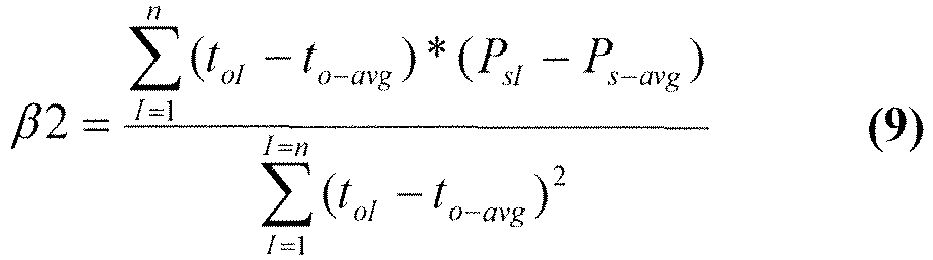
- The β2 is a negative value. The smaller the value of β2 is, the worse the air tightness of crew oxygen system is. The performance of crew oxygen system can be determined through detecting change of β2, i.e., the slope term. The performance of crew oxygen system also can be determined through making a comparison between slope terms of different aircrafts.
- When performing performance detection of crew oxygen system using above slope detection method, it would be better if there is no replacement of oxygen cylinder or oxygenating in the period represented by data points which are used in the calculation.
- According to one embodiment of the present invention, the deterioration of the performance of the crew oxygen system can be determined through the independent sample test to leakage rate.
- Since the interval of flight leg time is short, the change of system pressure may be slight, the obtained standard state pressure fluctuates greatly sometimes due to the influence by the fitting accuracy of external temperature and detection accuracy of the pressure sensor. For reducing the influence by the accuracy of external temperature and accuracy of the pressure sensor, one embodiment of the present invention does not use the leg leakage rate, but uses two points which are more than 24-hour apart to compare the pressure at those two points, that is, adopts the 24-hour interval leakage rate PL24. Certainly, other intervals also can be adopted, such as an interval which is greater than 12-hour or 36-hour. Meanwhile, for removing bad data point effect caused by sampling, PL24 may be 3 days rolling average which means the average value is calculated from all of PL24 in 3 days. The person skilled in the art can understand that 3 days is only an example, other days, such 2-4 days also can be used based on special data condition.
- According to one embodiment of the present invention, the 24-
hour interval 3 days rolling average leakage rate PL-avg24 ,which indicates performance of crew oxygen system, can be calculated by the following formula:
- According to one embodiment of the present invention, when it is required to know if performance of crew oxygen system changes in a certain period, the data in that period can be selected as a set of samples; meanwhile, another set of data of a aircraft of the same type can be selected as another set of samples. It is determined if the two sets of data are significantly different, through making a comparison between respective PL-avg24 of two sets of samples, according to the statistical probability, so that the period and degree of deterioration of performance of crew oxygen system can be determined.
- According to one embodiment of the present invention, respective PL-avg24 of two sets of data and variance of PL-avg24 are calculated firstly. Assume S12 is the variance of the first set of PL-avg24 (including n data), S22 is the variance of the second set of PL-avg24 (including m data). Since S12/S22 should follow F (n-1,m-1) distribution, the value of F can be determined by searching the F distribution table. It can be determined if the difference between two sets of data is significant according to the value of F. If the probability that the two sets of data belong to the same distribution is less than 2.5%, it can be determined that the difference of two sets of data is significant.
- It can be determined if the difference between two sets of data is significant through other independent sample T test. If the difference is significant, it can be determined there is significant change on performance of crew oxygen system. Given it is determined there occurs significant change on performance of crew oxygen system, it is easy to determine which set of data indicates that the performance of crew oxygen system deteriorate according to the average value of leakage rate.
- The independent sample test for average leakage rate either uses data at different time of the same aircraft, or uses data of a different aircraft of the same type. Therefore, this method is flexible. Moreover, this detection manner is not limited by replacement of oxygen cylinder and oxygenation, and can be used to determine if significant change occurred on performance of crew oxygen system between before and after replacement of oxygen cylinder and oxygenating.
- Hereinafter, how to determine if significant change occurs to the performance of crew oxygen system using the method of the present invention is described through some embodiments.
-
Fig. 9 is a schematic illustrating the relationship between standard state pressure of oxygen in the oxygen cylinder of the crew oxygen system and measuring time according to one embodiment of the present invention. The curve shown infig. 9 indicates the standard state pressure of actual sampling and transforming, straight line indicates regression line according to the standard state pressure of oxygen and measuring time. It can be found using the formula (9) of slope detection method that leakage rate of crew oxygen system is large, slope is -0.024929 which is much lower than a normal slope -0.015. This indicates performance of crew oxygen system deteriorates and has entered deterioration period. -
Fig. 10 is a schematic illustrating the relationship between standard state pressure of oxygen in the oxygen cylinder of the crew oxygen system and measuring time according to one embodiment of the present invention.Fig. 10 shows a process of replacement of oxygen cylinder of crew oxygen system. The dots shown infig. 10 indicate the standard state pressure representing actual sampling and transforming.Fig. 11 is a schematic illustrating the relationship between a 24-hour 3-days rolling average leakage rate and measuring time of oxygen in the oxygen cylinder of the crew oxygen system according to the embodiment shown inFig. 10 . Two sets of data obtained respectively before and after replacement of oxygen cylinder serve as two samples, and independent sample T test is used to determine if the two samples are identical. The calculation results indicate the probability that two sets of data obtained respectively before and after replacement of oxygen cylinder are identical is zero. The performance of crew oxygen system degrades, and the average leakage rate doubles. The performance of crew oxygen system has entered deterioration period. - It can be seen from
Figs. 9-11 , the method described in the present invention can determine if performance of crew oxygen system degrades and enters deterioration period or failure period of crew oxygen system, through processing and analyzing oxygen pressure data of crew oxygen system and temperature data obtained from crew oxygen messages, and through calculation of slope or independent sample T test and like. -
Fig. 12 is a flow chart illustrating a method for maintaining the aircraft crew oxygen system according to one embodiment of the present invention. In themethod 1200 for maintaining the aircraft crew oxygen system shown infig. 12 , atstep 1210, oxygen pressure data of the oxygen cylinder in the crew oxygen system, the ambient air temperature and the cockpit temperature are obtained. Atstep 1220, oxygen messages are generated from obtained oxygen pressure data of the oxygen cylinder in the crew oxygen system, the ambient air temperature and the cockpit temperature. Atstep 1230, the generated crew oxygen messages are transmitted to the server. Atstep 1240, the crew oxygen messages are processed by the server to obtain standard state pressure of oxygen cylinder of the crew oxygen system under the standardized temperature. Atstep 1250, it can be determined if performance of crew oxygen system deteriorates based on multiple sets of standard state pressure data at different times. Atstep 1260, if performance of crew oxygen system deteriorates, maintenance of crew oxygen system at the appropriate time is arranged. - The present invention need not manual recording and can save human's labor. Moreover, the present invention can determine performance of oxygen system onboard based on standard state pressure of oxygen and oxygen leakage rate obtained from oxygen messages, and thus can perform maintenance before the oxygen system onboard enters failure period, can speed up the fault diagnosis and reduce troubleshooting time, so that service time of oxygen system onboard can be extended and operating costs of airline can be reduced, meanwhile also can make the oxygen system onboard free from passengers' safety issue caused by sudden massive leakage, and can enhance operating safety of aircraft. The invention can predict the remaining service time of the oxygen system onboard based on the leakage rate, so that the service time can be extended obviously and maintenance cost of aircraft can be reduced.
- The above embodiments of the invention have been disclosed for illustrative purposes and the invention is not to be limited to the particular forms or methods disclosed. Those skilled in the art will appreciate that various modifications, additions and substitutions are possible. Therefore, the invention is to cover all modifications, equivalents and alternatives falling within the scope of the appended claims.
Claims (35)
- A method for detecting the performance of a crew oxygen system (100), comprising:obtaining an oxygen pressure in an oxygen cylinder (101) of the crew oxygen system, a temperature outside an airplane and a cockpit temperature,generating a crew oxygen message from the obtained oxygen pressure in the oxygen cylinder (101), the temperature outside the airplane and the cockpit temperature;receiving the crew oxygen message and determining an oxygen pressure in the oxygen cylinder (101) under standard temperature; anddetermining the performance of the crew oxygen system.
- The method according to claim 1, further comprising:obtaining an oxygen pressure in the oxygen cylinder (101) under a standard temperature before taking-off; andobtaining an oxygen pressure in the oxygen cylinder (101) under the standard temperature after landing.
- The method according to claim 2, further comprising:
determining the performance of the crew oxygen system (100) deteriorates, if a difference between pressures in the oxygen cylinder (101) under the standard temperature before taking-off and after landing is greater than 100 PSI. - The method according to claim 2, further comprising:
determining performance of the crew oxygen system (100) deteriorates, if a leakage rate of the oxygen cylinder (101) from taking-off to landing is greater than 48 PSI/day. - The method according to claim 1, further comprising:
determining a slope of a fitting curve through statistical relation between a pressure Ps in the oxygen cylinder (101) under the standard temperature and an installation time to of the oxygen cylinder (101). - The method according to claim 5, further comprising:
determining the slope β2 of the fitting curve according to the following formula:
- The method according to claim 1, further comprising:calculating a set of rolling average leakage rates in a certain period;making a comparison between the set of rolling average leakage rates and another set of rolling average leakage rates which serves as a reference; anddetermining if significant change occurs.
- The method according to claim 7, further comprising:calculating a variance of the set of rolling average leakage rates, and a variance of another set of rolling average leakage rates which serves as a reference; anddetermining if significant change occurs according to a F distribution which is followed by a ratio of the variance of the set of rolling average leakage rates and the variance of another set of rolling average leakage rates which serves as a reference.
- The method according to claim 7, wherein the period is longer than 24 hours.
- The method according to claim 7, wherein the rolling average leakage rate is a rolling average leakage rate in 2-4 days.
- The method according to claim 1, further comprising:
determining an oxygen temperature in the oxygen cylinder (101) according to the temperature outside the airplane and the cockpit temperature. - The method according to claim 11, wherein
the oxygen temperature in the oxygen cylinder (101) is determined according to the following formula:
- The method according to claim 12, wherein k1 is greater than k2.
- The method according to claim 12, wherein k1 = k2 = 1.
- The method according to claim 1, wherein
the step of obtaining the oxygen pressure in the oxygen cylinder (101) of the crew oxygen system (100), the temperature outside the airplane and the cockpit temperature comprises:
obtaining the oxygen pressure in the oxygen cylinder (101) of the crew oxygen system (100), the temperature outside the airplane and the cockpit temperature at a first time before taking-off. - The method according to claim 15, wherein the first time is 1 minute before taking-off.
- The method according to claim 1, wherein
the step of obtaining an oxygen pressure in the oxygen cylinder (101) of the crew oxygen system (100), a temperature outside an airplane and a cockpit temperature comprises:
obtaining the oxygen pressure in the oxygen cylinder (101) of the crew oxygen system (100), the temperature outside the airplane and the cockpit temperature at the time of 1 minute before taking-off, at the time of 30 seconds before taking-off and at the time of taking-off. - The method according to claim 1, wherein
the step of obtaining an oxygen pressure in the oxygen cylinder (101) of the crew oxygen system (100), a temperature outside an airplane and a cockpit temperature comprises:
obtaining the oxygen pressure in the oxygen cylinder (101) of the crew oxygen system (100), the temperature outside the airplane and the cockpit temperature at a second time after landing. - The method according to claim 1, wherein
the step of obtaining an oxygen pressure of an oxygen cylinder (101) of the crew oxygen system (100), a temperature outside an airplane and a cockpit temperature comprises:
obtaining the oxygen pressure of the oxygen cylinder (101) of the crew oxygen system (100), the temperature outside the airplane and the cockpit temperature at a second time after landing, 30 seconds after the second time, and 60 seconds after the second time. - The method according to claim 19, wherein the second time is 1 hour after landing.
- The method according to claim 19, further comprising
obtaining the oxygen pressure in the oxygen cylinder (101) of the crew oxygen system (100), the temperature outside the airplane and the cockpit temperature before re-taking-off, if the aircraft takes off again within 1 hour after landing. - A system for detecting the performance of a crew oxygen system (100), comprising:a crew oxygen pressure data obtaining device (401),a crew oxygen message generating device (402) configured to generate a crew oxygen message according to the obtained oxygen pressure in the oxygen cylinder (101) obtained by the crew oxygen pressure data obtaining device (401), a temperature outside an airplane and a cockpit temperature, wherein the crew oxygen messages are transmitted through a crew oxygen messages transmitting device (403); anda crew oxygen pressure data processing device (404) configured to receive the crew oxygen messages, determine an oxygen pressure of the oxygen cylinder (101) under standard temperature, and thereby determine the performance of the crew oxygen system (100).
- The system according to claim 22, wherein the crew oxygen pressure data obtaining device (401) comprises a pressure sensor (230) installed on a hyperbaric section of the crew oxygen system (100).
- The system according to claim 22, wherein the crew oxygen messages generating device (402) is an aircraft data system or is a part thereof.
- The system according to claim 24, wherein the crew oxygen messages generating device (402) is ACMS of Airbus or AHM of Boeing, or is a part thereof.
- The system according to claim 22, wherein the crew oxygen pressure data processing device (404) determines the performance of the crew oxygen system (100) deteriorates if it determines a difference of pressures in the oxygen cylinder (101) under the standard temperature before taking-off and after landing is greater than 100 PSI.
- The system according to claim 22, wherein the crew oxygen pressure data processing device (404) determines the performance of the crew oxygen system (100) deteriorates if it determines a difference of leakage rates of the oxygen cylinder (101) before taking-off and after landing is greater than 48 PSI/day.
- The system according to claim 22, wherein the crew oxygen pressure data processing device (404) determines a slope of a fitting curve through statistical relation between a pressure Ps in the oxygen cylinder (101) under the standard temperature and an installation time to of the oxygen cylinder (101).
- The system according to claim 28, wherein the slope β2 of the fitting curve is determined according to the following formula:

- The system according to claim 22, wherein the crew oxygen pressure data processing device (404) calculates a set of rolling average leakage rates in a certain period, and makes a comparison between the set of rolling average leakage rates and another set of rolling average leakage rates which serves as a reference, so as to determine if significant change occurs.
- The system according to claim 30, wherein the crew oxygen pressure data processing device (404) calculates a variance of the set of rolling average leakage rates, and a variance of another set of rolling average leakage rates which serves as a reference; and determines if obvious change occurs according to a F distribution which is followed by a radio of the variance of the set of rolling average leakage rates and the variance of another set of rolling average leakage rates which serves as a reference.
- The system according to claim 30, wherein the period is longer than 24 hours.
- The system according to claim 30, wherein the rolling average leakage rate is a rolling average leakage rate in 2-4 days.
- The system according to claim 22, wherein:the crew oxygen pressure data obtaining device (401) comprises a pressure sensor (230) configured to measure the oxygen pressure in the oxygen cylinder (101) of the crew oxygen system (100);the crew oxygen message generating device (402) comprises a DMU of AIDS of ACMS or a part thereof configured to obtain the oxygen pressure in the oxygen cylinder (101) of the crew oxygen system (100), the temperature outside the airplane and the cockpit temperature, and generate crew oxygen messages, wherein the crew oxygen messages are transmitted through the ACARS; andthe crew oxygen pressure data processing device (404) comprises a server configured to receive the crew oxygen messages from the ACARS, determine the oxygen pressure in the oxygen cylinder (101) under standard temperature, and determine the performance of the crew oxygen system (100) accordingly:
- The method according to claim 1, further comprising:determining whether the performance of the crew oxygen system (100) deteriorates; andarranging maintenance for the crew oxygen system in response to the deterioration of the crew oxygen system (100).
Applications Claiming Priority (1)
| Application Number | Priority Date | Filing Date | Title |
|---|---|---|---|
| CN201110165219A CN102331331A (en) | 2011-06-20 | 2011-06-20 | Method for detecting performance of onboard oxygen of aircraft |
Publications (3)
| Publication Number | Publication Date |
|---|---|
| EP2537557A2 EP2537557A2 (en) | 2012-12-26 |
| EP2537557A3 EP2537557A3 (en) | 2016-12-21 |
| EP2537557B1 true EP2537557B1 (en) | 2021-12-15 |
Family
ID=45483186
Family Applications (1)
| Application Number | Title | Priority Date | Filing Date |
|---|---|---|---|
| EP12172546.9A Active EP2537557B1 (en) | 2011-06-20 | 2012-06-19 | Method and system for detecting the performance of a crew oxygen system |
Country Status (9)
| Country | Link |
|---|---|
| US (1) | US20130019865A1 (en) |
| EP (1) | EP2537557B1 (en) |
| JP (1) | JP6257882B2 (en) |
| KR (1) | KR101769167B1 (en) |
| CN (2) | CN102331331A (en) |
| AU (1) | AU2012203594B2 (en) |
| CA (1) | CA2780565C (en) |
| SG (2) | SG186570A1 (en) |
| TW (1) | TWI548564B (en) |
Families Citing this family (14)
| Publication number | Priority date | Publication date | Assignee | Title |
|---|---|---|---|---|
| CN102331331A (en) * | 2011-06-20 | 2012-01-25 | 中国国际航空股份有限公司 | Method for detecting performance of onboard oxygen of aircraft |
| EP3402086B1 (en) * | 2012-11-15 | 2023-12-27 | Huawei Technologies Co., Ltd. | Method for information transmission, base station, and user equipment |
| WO2015198213A1 (en) * | 2014-06-26 | 2015-12-30 | Bombardier Inc. | Methods and apparatus for assisting in the maintenance of aircraft and other mobile platforms |
| CN105628294B (en) * | 2014-10-31 | 2018-12-14 | 中国航空工业集团公司西安飞机设计研究所 | A kind of oxygen source pressure correction display methods |
| US10447723B2 (en) * | 2015-12-11 | 2019-10-15 | Microsoft Technology Licensing, Llc | Creating notes on lock screen |
| CN108106871B (en) * | 2016-11-24 | 2020-06-30 | 中航贵州飞机有限责任公司 | Ground detection device before flight of pilot personal harness |
| US11617847B2 (en) | 2017-01-11 | 2023-04-04 | Model Software Corporation | Methods for minimizing delayed effects of exposure to reduced oxygen partial pressure via administration of supplemental oxygen |
| US20180193584A1 (en) * | 2017-01-11 | 2018-07-12 | Model Software Corporation | Methods for minimizing delayed effects of exposure to reduced oxygen partial pressure via administration of supplemental oxygen |
| CN108974367B (en) * | 2018-08-14 | 2020-04-03 | 晨龙飞机(荆门)有限公司 | Emergency device for falling of airplane windshield |
| CN110530586A (en) * | 2019-09-27 | 2019-12-03 | 东方航空技术有限公司 | A kind of A320 unit oxygen leakage monitoring method |
| WO2021242625A1 (en) * | 2020-05-23 | 2021-12-02 | The Climate Foundation | Method and apparatuses for delivering hyperbaric gas and/or treating respiratory illnesses, post covid syndrome(s) and chronic traumatic encephalopathy |
| CN111721480B (en) * | 2020-06-29 | 2021-07-20 | 南京航空航天大学 | An early warning method for oxygen system leakage of civil aircraft crew based on flight data |
| US12479592B2 (en) * | 2021-04-30 | 2025-11-25 | The Boeing Company | Aircraft mask monitoring system |
| CN114313227B (en) * | 2021-12-17 | 2024-08-27 | 中国南方航空股份有限公司 | A method for improving the reliability of landing gear system of civil aircraft |
Family Cites Families (15)
| Publication number | Priority date | Publication date | Assignee | Title |
|---|---|---|---|---|
| US5022393A (en) * | 1988-10-14 | 1991-06-11 | The Boeing Company | Apparatus for warning a pilot of life-support system failures |
| FR2646237B1 (en) * | 1989-04-21 | 1994-01-07 | Fabrication Instruments Mesure | HIGH-PRESSURE GAS GAUGE DEVICE, PARTICULARLY FOR THE RESERVATION OF GASEOUS OXYGEN ON BOARD AN AIRCRAFT |
| US6216066B1 (en) * | 1998-07-01 | 2001-04-10 | General Electric Company | System and method for generating alerts through multi-variate data assessment |
| US7489992B2 (en) * | 2004-04-12 | 2009-02-10 | Sagem Avionics, Inc. | Method and system for remotely communicating and interfacing with aircraft condition monitoring systems |
| FR2872327B1 (en) * | 2004-06-28 | 2006-10-06 | Avions De Transp Regional Grou | METHOD AND DEVICE FOR DETECTING PERFORMANCE DEGRADATION OF AN AIRCRAFT |
| US7620374B2 (en) | 2004-09-16 | 2009-11-17 | Harris Corporation | System and method of transmitting data from an aircraft |
| US7583359B2 (en) * | 2006-05-05 | 2009-09-01 | Asml Netherlands B.V. | Reduction of fit error due to non-uniform sample distribution |
| US20100024822A1 (en) * | 2006-11-15 | 2010-02-04 | Life-Pack Technologies, Inc. | Reduced profile multiple gas cylinder alternative |
| JP4413915B2 (en) * | 2006-12-13 | 2010-02-10 | 株式会社東芝 | Abnormal sign detection apparatus and method |
| US20090030563A1 (en) * | 2007-07-26 | 2009-01-29 | United Technologies Corp. | Systems And Methods For Providing Localized Heat Treatment Of Metal Components |
| WO2009068058A1 (en) * | 2007-11-29 | 2009-06-04 | Airbus Operations Gmbh | Test equipment and method for testing an aircraft oxygen system control device |
| FR2931553B1 (en) * | 2008-05-22 | 2010-10-29 | Airbus France | ESTIMATING A CHARGING CRITERION SUBJECTED BY A STRUCTURAL COMPONENT OF AN AIRCRAFT AND ASSISTING THE DETECTION OF A "HARD" DRAWING THROUGH SUCH A CRITERION |
| CN102331331A (en) * | 2011-06-20 | 2012-01-25 | 中国国际航空股份有限公司 | Method for detecting performance of onboard oxygen of aircraft |
| CN102320382A (en) * | 2011-07-07 | 2012-01-18 | 中国国际航空股份有限公司 | Aircraft performance detection method |
| CN102343983A (en) * | 2011-07-07 | 2012-02-08 | 中国国际航空股份有限公司 | Airplane APU (Auxiliary Power Unit) performance detecting method |
-
2011
- 2011-06-20 CN CN201110165219A patent/CN102331331A/en active Pending
-
2012
- 2012-06-19 SG SG2012045613A patent/SG186570A1/en unknown
- 2012-06-19 EP EP12172546.9A patent/EP2537557B1/en active Active
- 2012-06-19 CA CA2780565A patent/CA2780565C/en active Active
- 2012-06-19 SG SG10201408558VA patent/SG10201408558VA/en unknown
- 2012-06-20 AU AU2012203594A patent/AU2012203594B2/en active Active
- 2012-06-20 JP JP2012138733A patent/JP6257882B2/en active Active
- 2012-06-20 TW TW101121995A patent/TWI548564B/en active
- 2012-06-20 KR KR1020120066137A patent/KR101769167B1/en active Active
- 2012-06-20 CN CN201210209112.9A patent/CN102840881B/en active Active
- 2012-06-20 US US13/528,357 patent/US20130019865A1/en not_active Abandoned
Also Published As
| Publication number | Publication date |
|---|---|
| TW201318921A (en) | 2013-05-16 |
| CN102840881A (en) | 2012-12-26 |
| AU2012203594B2 (en) | 2015-07-16 |
| JP6257882B2 (en) | 2018-01-10 |
| HK1179685A1 (en) | 2013-10-04 |
| EP2537557A2 (en) | 2012-12-26 |
| SG186570A1 (en) | 2013-01-30 |
| US20130019865A1 (en) | 2013-01-24 |
| CA2780565A1 (en) | 2012-12-20 |
| EP2537557A3 (en) | 2016-12-21 |
| KR20120140219A (en) | 2012-12-28 |
| CA2780565C (en) | 2019-06-11 |
| SG10201408558VA (en) | 2015-02-27 |
| JP2013001396A (en) | 2013-01-07 |
| AU2012203594A1 (en) | 2013-01-10 |
| CN102331331A (en) | 2012-01-25 |
| TWI548564B (en) | 2016-09-11 |
| KR101769167B1 (en) | 2017-08-17 |
| CN102840881B (en) | 2015-02-04 |
Similar Documents
| Publication | Publication Date | Title |
|---|---|---|
| CA2780565C (en) | Method and system for detecting the performance of a crew oxygen system | |
| EP2551805A1 (en) | A method for detecting performance of an aircraft based on a customized message | |
| Schwartz | The quantitative use of PIREPs in developing aviation weather guidance products | |
| EP2829698B1 (en) | System and method for monitoring lubricant of an engine | |
| US8262019B2 (en) | Method and system for health monitoring of aircraft landing gear | |
| AU2014206167B2 (en) | Method and apparatus for monitoring the wing anti-icing valve | |
| US20110125348A1 (en) | Automatic Emergency Reporting | |
| CN101674544A (en) | Airplane information real-time message monitoring system and method | |
| Baidzawi et al. | A review of accidents & incidents on Boeing and Airbus commercial aircraft’s avionics-related system in two decades (1996-2015) | |
| HK1179685B (en) | Method for detecting the performance of a crew oxygen system | |
| Zarikoff et al. | Lightweight, low-cost and flexible flight data monitoring | |
| Wohl | Adapting Space Vehicle Checkout Procedures and Philosophy to Near-Future Transport Aircraft | |
| HK1179585B (en) | A method for detecting performance of an aircraft based on a customized message and method for maintenance of an aircraft |
Legal Events
| Date | Code | Title | Description |
|---|---|---|---|
| PUAI | Public reference made under article 153(3) epc to a published international application that has entered the european phase |
Free format text: ORIGINAL CODE: 0009012 |
|
| AK | Designated contracting states |
Kind code of ref document: A2 Designated state(s): AL AT BE BG CH CY CZ DE DK EE ES FI FR GB GR HR HU IE IS IT LI LT LU LV MC MK MT NL NO PL PT RO RS SE SI SK SM TR |
|
| AX | Request for extension of the european patent |
Extension state: BA ME |
|
| PUAL | Search report despatched |
Free format text: ORIGINAL CODE: 0009013 |
|
| AK | Designated contracting states |
Kind code of ref document: A3 Designated state(s): AL AT BE BG CH CY CZ DE DK EE ES FI FR GB GR HR HU IE IS IT LI LT LU LV MC MK MT NL NO PL PT RO RS SE SI SK SM TR |
|
| AX | Request for extension of the european patent |
Extension state: BA ME |
|
| RIC1 | Information provided on ipc code assigned before grant |
Ipc: A62B 7/14 20060101ALI20161111BHEP Ipc: B64D 10/00 20060101ALI20161111BHEP Ipc: A62B 27/00 20060101ALI20161111BHEP Ipc: B64D 13/00 20060101ALN20161111BHEP Ipc: A62B 7/02 20060101AFI20161111BHEP |
|
| STAA | Information on the status of an ep patent application or granted ep patent |
Free format text: STATUS: REQUEST FOR EXAMINATION WAS MADE |
|
| 17P | Request for examination filed |
Effective date: 20170621 |
|
| RBV | Designated contracting states (corrected) |
Designated state(s): AL AT BE BG CH CY CZ DE DK EE ES FI FR GB GR HR HU IE IS IT LI LT LU LV MC MK MT NL NO PL PT RO RS SE SI SK SM TR |
|
| GRAP | Despatch of communication of intention to grant a patent |
Free format text: ORIGINAL CODE: EPIDOSNIGR1 |
|
| STAA | Information on the status of an ep patent application or granted ep patent |
Free format text: STATUS: GRANT OF PATENT IS INTENDED |
|
| RIC1 | Information provided on ipc code assigned before grant |
Ipc: A62B 7/02 20060101AFI20210625BHEP Ipc: A62B 7/14 20060101ALI20210625BHEP Ipc: A62B 27/00 20060101ALI20210625BHEP Ipc: B64D 10/00 20060101ALI20210625BHEP Ipc: B64D 13/00 20060101ALN20210625BHEP |
|
| INTG | Intention to grant announced |
Effective date: 20210726 |
|
| GRAS | Grant fee paid |
Free format text: ORIGINAL CODE: EPIDOSNIGR3 |
|
| GRAA | (expected) grant |
Free format text: ORIGINAL CODE: 0009210 |
|
| STAA | Information on the status of an ep patent application or granted ep patent |
Free format text: STATUS: THE PATENT HAS BEEN GRANTED |
|
| AK | Designated contracting states |
Kind code of ref document: B1 Designated state(s): AL AT BE BG CH CY CZ DE DK EE ES FI FR GB GR HR HU IE IS IT LI LT LU LV MC MK MT NL NO PL PT RO RS SE SI SK SM TR |
|
| REG | Reference to a national code |
Ref country code: GB Ref legal event code: FG4D Ref country code: CH Ref legal event code: EP |
|
| REG | Reference to a national code |
Ref country code: DE Ref legal event code: R096 Ref document number: 602012077354 Country of ref document: DE |
|
| REG | Reference to a national code |
Ref country code: IE Ref legal event code: FG4D |
|
| REG | Reference to a national code |
Ref country code: AT Ref legal event code: REF Ref document number: 1455031 Country of ref document: AT Kind code of ref document: T Effective date: 20220115 |
|
| REG | Reference to a national code |
Ref country code: LT Ref legal event code: MG9D |
|
| REG | Reference to a national code |
Ref country code: NL Ref legal event code: MP Effective date: 20211215 |
|
| PG25 | Lapsed in a contracting state [announced via postgrant information from national office to epo] |
Ref country code: RS Free format text: LAPSE BECAUSE OF FAILURE TO SUBMIT A TRANSLATION OF THE DESCRIPTION OR TO PAY THE FEE WITHIN THE PRESCRIBED TIME-LIMIT Effective date: 20211215 Ref country code: LT Free format text: LAPSE BECAUSE OF FAILURE TO SUBMIT A TRANSLATION OF THE DESCRIPTION OR TO PAY THE FEE WITHIN THE PRESCRIBED TIME-LIMIT Effective date: 20211215 Ref country code: FI Free format text: LAPSE BECAUSE OF FAILURE TO SUBMIT A TRANSLATION OF THE DESCRIPTION OR TO PAY THE FEE WITHIN THE PRESCRIBED TIME-LIMIT Effective date: 20211215 Ref country code: BG Free format text: LAPSE BECAUSE OF FAILURE TO SUBMIT A TRANSLATION OF THE DESCRIPTION OR TO PAY THE FEE WITHIN THE PRESCRIBED TIME-LIMIT Effective date: 20220315 |
|
| REG | Reference to a national code |
Ref country code: AT Ref legal event code: MK05 Ref document number: 1455031 Country of ref document: AT Kind code of ref document: T Effective date: 20211215 |
|
| PG25 | Lapsed in a contracting state [announced via postgrant information from national office to epo] |
Ref country code: SE Free format text: LAPSE BECAUSE OF FAILURE TO SUBMIT A TRANSLATION OF THE DESCRIPTION OR TO PAY THE FEE WITHIN THE PRESCRIBED TIME-LIMIT Effective date: 20211215 Ref country code: NO Free format text: LAPSE BECAUSE OF FAILURE TO SUBMIT A TRANSLATION OF THE DESCRIPTION OR TO PAY THE FEE WITHIN THE PRESCRIBED TIME-LIMIT Effective date: 20220315 Ref country code: LV Free format text: LAPSE BECAUSE OF FAILURE TO SUBMIT A TRANSLATION OF THE DESCRIPTION OR TO PAY THE FEE WITHIN THE PRESCRIBED TIME-LIMIT Effective date: 20211215 Ref country code: HR Free format text: LAPSE BECAUSE OF FAILURE TO SUBMIT A TRANSLATION OF THE DESCRIPTION OR TO PAY THE FEE WITHIN THE PRESCRIBED TIME-LIMIT Effective date: 20211215 Ref country code: GR Free format text: LAPSE BECAUSE OF FAILURE TO SUBMIT A TRANSLATION OF THE DESCRIPTION OR TO PAY THE FEE WITHIN THE PRESCRIBED TIME-LIMIT Effective date: 20220316 |
|
| PG25 | Lapsed in a contracting state [announced via postgrant information from national office to epo] |
Ref country code: NL Free format text: LAPSE BECAUSE OF FAILURE TO SUBMIT A TRANSLATION OF THE DESCRIPTION OR TO PAY THE FEE WITHIN THE PRESCRIBED TIME-LIMIT Effective date: 20211215 |
|
| PG25 | Lapsed in a contracting state [announced via postgrant information from national office to epo] |
Ref country code: SM Free format text: LAPSE BECAUSE OF FAILURE TO SUBMIT A TRANSLATION OF THE DESCRIPTION OR TO PAY THE FEE WITHIN THE PRESCRIBED TIME-LIMIT Effective date: 20211215 Ref country code: SK Free format text: LAPSE BECAUSE OF FAILURE TO SUBMIT A TRANSLATION OF THE DESCRIPTION OR TO PAY THE FEE WITHIN THE PRESCRIBED TIME-LIMIT Effective date: 20211215 Ref country code: RO Free format text: LAPSE BECAUSE OF FAILURE TO SUBMIT A TRANSLATION OF THE DESCRIPTION OR TO PAY THE FEE WITHIN THE PRESCRIBED TIME-LIMIT Effective date: 20211215 Ref country code: PT Free format text: LAPSE BECAUSE OF FAILURE TO SUBMIT A TRANSLATION OF THE DESCRIPTION OR TO PAY THE FEE WITHIN THE PRESCRIBED TIME-LIMIT Effective date: 20220418 Ref country code: ES Free format text: LAPSE BECAUSE OF FAILURE TO SUBMIT A TRANSLATION OF THE DESCRIPTION OR TO PAY THE FEE WITHIN THE PRESCRIBED TIME-LIMIT Effective date: 20211215 Ref country code: EE Free format text: LAPSE BECAUSE OF FAILURE TO SUBMIT A TRANSLATION OF THE DESCRIPTION OR TO PAY THE FEE WITHIN THE PRESCRIBED TIME-LIMIT Effective date: 20211215 Ref country code: CZ Free format text: LAPSE BECAUSE OF FAILURE TO SUBMIT A TRANSLATION OF THE DESCRIPTION OR TO PAY THE FEE WITHIN THE PRESCRIBED TIME-LIMIT Effective date: 20211215 |
|
| PG25 | Lapsed in a contracting state [announced via postgrant information from national office to epo] |
Ref country code: PL Free format text: LAPSE BECAUSE OF FAILURE TO SUBMIT A TRANSLATION OF THE DESCRIPTION OR TO PAY THE FEE WITHIN THE PRESCRIBED TIME-LIMIT Effective date: 20211215 Ref country code: AT Free format text: LAPSE BECAUSE OF FAILURE TO SUBMIT A TRANSLATION OF THE DESCRIPTION OR TO PAY THE FEE WITHIN THE PRESCRIBED TIME-LIMIT Effective date: 20211215 |
|
| REG | Reference to a national code |
Ref country code: DE Ref legal event code: R097 Ref document number: 602012077354 Country of ref document: DE |
|
| PG25 | Lapsed in a contracting state [announced via postgrant information from national office to epo] |
Ref country code: IS Free format text: LAPSE BECAUSE OF FAILURE TO SUBMIT A TRANSLATION OF THE DESCRIPTION OR TO PAY THE FEE WITHIN THE PRESCRIBED TIME-LIMIT Effective date: 20220415 |
|
| PLBE | No opposition filed within time limit |
Free format text: ORIGINAL CODE: 0009261 |
|
| STAA | Information on the status of an ep patent application or granted ep patent |
Free format text: STATUS: NO OPPOSITION FILED WITHIN TIME LIMIT |
|
| PG25 | Lapsed in a contracting state [announced via postgrant information from national office to epo] |
Ref country code: DK Free format text: LAPSE BECAUSE OF FAILURE TO SUBMIT A TRANSLATION OF THE DESCRIPTION OR TO PAY THE FEE WITHIN THE PRESCRIBED TIME-LIMIT Effective date: 20211215 Ref country code: AL Free format text: LAPSE BECAUSE OF FAILURE TO SUBMIT A TRANSLATION OF THE DESCRIPTION OR TO PAY THE FEE WITHIN THE PRESCRIBED TIME-LIMIT Effective date: 20211215 |
|
| 26N | No opposition filed |
Effective date: 20220916 |
|
| PG25 | Lapsed in a contracting state [announced via postgrant information from national office to epo] |
Ref country code: SI Free format text: LAPSE BECAUSE OF FAILURE TO SUBMIT A TRANSLATION OF THE DESCRIPTION OR TO PAY THE FEE WITHIN THE PRESCRIBED TIME-LIMIT Effective date: 20211215 |
|
| PG25 | Lapsed in a contracting state [announced via postgrant information from national office to epo] |
Ref country code: MC Free format text: LAPSE BECAUSE OF FAILURE TO SUBMIT A TRANSLATION OF THE DESCRIPTION OR TO PAY THE FEE WITHIN THE PRESCRIBED TIME-LIMIT Effective date: 20211215 |
|
| REG | Reference to a national code |
Ref country code: CH Ref legal event code: PL |
|
| REG | Reference to a national code |
Ref country code: BE Ref legal event code: MM Effective date: 20220630 |
|
| PG25 | Lapsed in a contracting state [announced via postgrant information from national office to epo] |
Ref country code: LU Free format text: LAPSE BECAUSE OF NON-PAYMENT OF DUE FEES Effective date: 20220619 Ref country code: LI Free format text: LAPSE BECAUSE OF NON-PAYMENT OF DUE FEES Effective date: 20220630 Ref country code: IE Free format text: LAPSE BECAUSE OF NON-PAYMENT OF DUE FEES Effective date: 20220619 Ref country code: CH Free format text: LAPSE BECAUSE OF NON-PAYMENT OF DUE FEES Effective date: 20220630 |
|
| PG25 | Lapsed in a contracting state [announced via postgrant information from national office to epo] |
Ref country code: IT Free format text: LAPSE BECAUSE OF FAILURE TO SUBMIT A TRANSLATION OF THE DESCRIPTION OR TO PAY THE FEE WITHIN THE PRESCRIBED TIME-LIMIT Effective date: 20211215 Ref country code: BE Free format text: LAPSE BECAUSE OF NON-PAYMENT OF DUE FEES Effective date: 20220630 |
|
| PG25 | Lapsed in a contracting state [announced via postgrant information from national office to epo] |
Ref country code: HU Free format text: LAPSE BECAUSE OF FAILURE TO SUBMIT A TRANSLATION OF THE DESCRIPTION OR TO PAY THE FEE WITHIN THE PRESCRIBED TIME-LIMIT; INVALID AB INITIO Effective date: 20120619 |
|
| PG25 | Lapsed in a contracting state [announced via postgrant information from national office to epo] |
Ref country code: MK Free format text: LAPSE BECAUSE OF FAILURE TO SUBMIT A TRANSLATION OF THE DESCRIPTION OR TO PAY THE FEE WITHIN THE PRESCRIBED TIME-LIMIT Effective date: 20211215 Ref country code: CY Free format text: LAPSE BECAUSE OF FAILURE TO SUBMIT A TRANSLATION OF THE DESCRIPTION OR TO PAY THE FEE WITHIN THE PRESCRIBED TIME-LIMIT Effective date: 20211215 |
|
| PG25 | Lapsed in a contracting state [announced via postgrant information from national office to epo] |
Ref country code: TR Free format text: LAPSE BECAUSE OF FAILURE TO SUBMIT A TRANSLATION OF THE DESCRIPTION OR TO PAY THE FEE WITHIN THE PRESCRIBED TIME-LIMIT Effective date: 20211215 |
|
| PG25 | Lapsed in a contracting state [announced via postgrant information from national office to epo] |
Ref country code: MT Free format text: LAPSE BECAUSE OF FAILURE TO SUBMIT A TRANSLATION OF THE DESCRIPTION OR TO PAY THE FEE WITHIN THE PRESCRIBED TIME-LIMIT Effective date: 20211215 |
|
| PGFP | Annual fee paid to national office [announced via postgrant information from national office to epo] |
Ref country code: DE Payment date: 20250623 Year of fee payment: 14 |
|
| PGFP | Annual fee paid to national office [announced via postgrant information from national office to epo] |
Ref country code: GB Payment date: 20250618 Year of fee payment: 14 |
|
| PGFP | Annual fee paid to national office [announced via postgrant information from national office to epo] |
Ref country code: FR Payment date: 20250624 Year of fee payment: 14 |