EP2535835B1 - Real-time user identification by hand motion signatures - Google Patents
Real-time user identification by hand motion signatures Download PDFInfo
- Publication number
- EP2535835B1 EP2535835B1 EP12004429.2A EP12004429A EP2535835B1 EP 2535835 B1 EP2535835 B1 EP 2535835B1 EP 12004429 A EP12004429 A EP 12004429A EP 2535835 B1 EP2535835 B1 EP 2535835B1
- Authority
- EP
- European Patent Office
- Prior art keywords
- user
- sample
- trajectory
- signature
- samples
- Prior art date
- Legal status (The legal status is an assumption and is not a legal conclusion. Google has not performed a legal analysis and makes no representation as to the accuracy of the status listed.)
- Active
Links
Images





Classifications
-
- G—PHYSICS
- G06—COMPUTING OR CALCULATING; COUNTING
- G06F—ELECTRIC DIGITAL DATA PROCESSING
- G06F21/00—Security arrangements for protecting computers, components thereof, programs or data against unauthorised activity
- G06F21/30—Authentication, i.e. establishing the identity or authorisation of security principals
- G06F21/31—User authentication
- G06F21/32—User authentication using biometric data, e.g. fingerprints, iris scans or voiceprints
Definitions
- This invention relates to a user identification system for identifying a user through hand motion recognition.
- EP 2 166 487 discloses a system for restricting access to an item of interest.
- a gesture input interface converts a continuous gesture from a user into an input trajectory, which is reduced to a set of reference points.
- a verification component determines if values for a set of reference points from a given input falls within an authentication region.
- US 2008/0020733 discloses a mobile electronic device with motion detection authentication.
- An acceleration module generates an acceleration signal representing user motion of the device.
- a lock circuit for enabling operation of a function of the device in response to the acceleration signal indicates that the user motion deviates from reference motion data by no more than a predetermined threshold.
- US 2007/0252898 discloses a remote control apparatus using gesture recognition.
- a controller transitions from a dormant mode to an active mode to perform a programmed responsive action when the image processor detects a progression within the captured photographs between a closed fist state to an open hand state.
- EP 2 605 172 discloses a system of authorizing access to a resource. An act of identifying current gestures is performed for each user in accordance with sensor information. The current gestures are compared with pre-stored gesture information and an order of the predetermined gestures, in order to authorize access.
- a further objective is to present a user enrollment method that detects if the users motion signature is consistent over repeated presentations and to refuse acceptance due to such inconsistency.
- the system of the present invention recognizes gestures by the motion the hand makes in front of a sensor capable of capturing a plurality of images. Such systems can be used to control a television and other electronic devices.
- the system allows user enrollments and user identification, with the hand motion signature determined by the user.
- the method of the present invention has been designed to allow new users to enroll with a new signature, presented in front of a camera.
- the enrollment method is interactive with feedback that so as to not decrease the recognition accuracy of the system due to other previously enrolled users.
- the present invention is directed to a system for real time user identification based on a user-decided 3D hand motion gesture representing his/her signature, which comprises: a 3D camera for acquiring images of the 3D gestures when performed in front of the camera; a memory for storing the images; a computer for analyzing images representing trajectories of the gesture and for extracting typical features related to the user during a training stage; a screen for displaying a typical trajectory containing the features to the user; a database for storing the typical features after the training stage; and a processing unit for comparing the typical features extracted during the training stage to features extracted online.
- the present invention is directed to a method for real time user identification, based on a user-decided hand motion signature, comprising: a) a onetime offline or online enrollment session, wherein the user enrolls him/herself in a one-time process of several samples of his/her signature and a template based on these training samples built for future classification; and b) an identification part.
- the enrollment part is made offline and comprises the following steps: (a) collecting samples: the system captures a hand gesture for a constant duration and creates a trajectory out of the palm's location at each frame; (b) creation of segments: the system identifies specific areas in the trajectory using a curvature measure, and constructs segments around each curved area; (c) curve fitting: segments are combined and points are distributed uniformly inside each segment and each sample is built out of a fitted curve defined by a constant number of points; (d) sample verification: each sample is shown to the user for verification, if the collecting samples step or the fitting step were not successful, the user can choose to remove the sample; (e) store sample: the fitted trajectory is saved in a database under user i; and (f) enrollment completion: once the enrollment is finished the database is aligned using ASM and principal points are extracted using PCA.
- the identification part is made according to offline enrollment, and comprises the following steps: (a) record sample: the system captures a hand gesture for a constant duration and creates a trajectory out of the palm's location at each frame; features from the sample are extracted in an identical way to the collecting samples step, curve fitting step and the finishing enrollment step; (b) align sample: the sample is aligned to the mean of each user's class for testing; (c) find similarity distance: mahalanobis distance is measured between the sample's principal points and each user's class;(d) compare: The sample is classified to the user to whom it is the closest, if the mahalanobis distance exceeds a threshold, the sample is classified as "Not Found"; and (e) plot: the user receives a message that his/her sample was classified or not.
- the enrollment part is made online and comprises the following steps: (a) the system collects a sample using the steps of collecting samples, creation of segments, curve fitting and sample verification during the offline enrollment of a new user; samples of each individual user may be represented by a set of multiple clusters; (b) a sample of a new user is compared to cluster(s) of the enrolling user and of other users, it is assumed that a signature can be performed in several different manners and therefore groups of clusters of the same user may be created; (c) the system can notify the enrolling user to select a different signature in the following conditions: in the case the number of clusters created for the enrolling user is too high; this case would occur when the enrolling user performs the same gesture in a multitude of ways; and if the closest cluster to a user's sample is a cluster belonging to a different user.
- clusters that are closer than a threshold T are merged into one cluster, in order for the classification to be as accurate as possible.
- the identification part is according to the Online enrollment, and comprises the following steps: (a) record sample: the system captures a hand gesture for a constant duration and creates a trajectory out of the palm's location at each frame; features from the sample are extracted in an identical way to the collecting samples step, curve fitting step and the finishing enrollment step of the enrollment part; (b) the sample is compared against each cluster of samples in the database for maximum similarity; (c) a distance measure selects the closest cluster of samples; (d) the current signature examined is classified to the user that created this cluster; and (e) if the distance is above a threshold, the signature is not likely to belong to any cluster, and therefore is classified as "Not Found".
- the curve fitting comprises the following steps: (a) construction of a trajectory; (b) aligning all samples in terms of rotation, scaling and translation; (c) saving the samples in a 3D matrix: ⁇ n ⁇ X ⁇ #samples ⁇ X ⁇ #users ⁇ ; (d)applying a method called "Point Distribution Model” (PDM), using a method called PCA (Principal Components Analysis) for the reduction of the amount of features; and (e)keeping the output values of the PDM step as features for classification.
- PDM Point Distribution Model
- the construction of a trajectory comprises the following steps: (a) trajectory cleaning: remove start and end noise; (b) division into segments; and (c) construction of the new trajectory.
- the present invention proposes a system for real time identification users based on a user-decided 3D hand motion gesture representing his/her signature.
- the system comprises a 3D camera for acquiring images of said 3D gestures when performed in front of said camera; a memory for storing said images;_a computer for analyzing images representing trajectories of said gesture and for extracting typical features related to said user during a training stage; a screen for displaying a typical trajectory containing said features to said user; a database for storing said typical features after said training stage; and a processing unit for comparing the typical features extracted during said training stage to features extracted online.
- Custom based signatures offer more intuitiveness and ease of use, compared to predefined templates.
- the user enrolls in a one-time process of 20 some samples of his/her signature.
- the system builds a template based on these training samples for future classification.
- the training phase of the system is interactive and gives the user feedback following each sample.
- the feedback requires the user to select a new signature if it is too similar to signatures already stored in the system's database, or if there is too much variation in the user's samples.
- the user's signature is divided into segments and features incorporate information on the trajectory and the velocity of the motion.
- the system can capture signatures both in 2D and in 3D, when combined with a tracking system with such capabilities.
- the present invention is based on the ability to identify individuals due to differences and variance in making dynamic hand gestures.
- Fig. 2 shows an illustration of the difference in performing the same shape by three different individuals.
- the system can be used in two different ways: using a predefined gesture (such as the X gesture shown in Fig. 2 ), or using a user decided signature.
- a predefined gesture such as the X gesture shown in Fig. 2
- a user decided signature An example of a user decided signature is shown in Fig. 8 .
- the user identification system consists of two main parts: an enrollment subsystem and an identification subsystem. In both parts, capturing hand gesture motion is done using a 3D camera and hand tracking algorithm.
- the enrollment system asks the user for his name/serial number and collects plurality of samples of his signature.
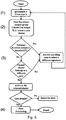
- Figs. 3 and 5 present a flowchart for collecting samples from a user with offline enrollment and online enrollment, respectively. This phase has 5 main parts:
- a new sample is compared to all classes of users in the database, and a distance to each class is computed. If the distance is small enough, the user will be able to log in. if not, the user's entry will be denied. See Figs. 4 and 6 for a description of the identification phase, with offline enrollment and online enrollment respectively.
- an alignment phase of a new sample to each class in the database is performed, similar to the alignment in the enrollment phase.
- a Mahalanobis distance metric is used to determine proximity to each of the classes.
- a threshold for the distance is used. If the distance is bigger than a threshold, the sample is classified as "Not found”. Otherwise, it is classified as belonging to the class to which it is the closest.
- Fig. 1 shows an illustration of signature acquisition, where three main steps are performed:
- the output gesture is shown on the screen for verification.
- Fig. 2 it can be seen an example of the same "X" shape done differently by different individuals, showing the identification opportunities in hand motion.
- Fig. 3 schematically shows a flowchart of the Offline enrollment subsystem, comprising the following steps:
- Fig. 4 schematically shows a flowchart of the Offline enrollment identification subsystem, comprising the following steps:
- Fig. 5 schematically shows a flowchart of the Online enrollment system:
- Fig. 6 schematically shows a flow chart of the Online enrollment identification system: Instead of user classes, now there are sample groups (clusters) belonging to users. When a person wishes to identify his signature, the sample needs to be compared to all clusters in the system.
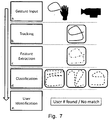
- Fig. 7 schematically shows the architecture of the identification subsystem:
- Fig. 8 schematically shows a training set of a certain user before alignment (left) and after the ASM alignment (right). Color lines represent samples, the bold black line is the mean shape.
- Fig. 9 schematically shows a division into segments using level of curvature: This Fig. shows the angle of curvature in each frame. Points with large angle of curvature (i.e. bigger than a threshold) are selected to be a part of a newsegment. Each segment includes points distributed uniformly, between the point that starts the segment (the first point above a threshold) and the point that ends the threshold (the last point above a threshold).
- the example trajectory curvature corresponds to the one of the samples in Fig. 10 .
- Fig. 10 schematically shows a sample-set of trajectories, where a curvature test was made in order to find segments. Segments that lie around corners have less distance between points than segments on a linear part of the trajectory.
- Fig. 11 schematically shows how segments are constructed on the trajectory
Landscapes
- Engineering & Computer Science (AREA)
- Computer Security & Cryptography (AREA)
- Theoretical Computer Science (AREA)
- Computer Hardware Design (AREA)
- Software Systems (AREA)
- Physics & Mathematics (AREA)
- General Engineering & Computer Science (AREA)
- General Physics & Mathematics (AREA)
- Collating Specific Patterns (AREA)
- Image Analysis (AREA)
Description
- This invention relates to a user identification system for identifying a user through hand motion recognition.
- User identification systems are mainly based on biometrics - the field of statistics in biology. These conventional systems mainly rely on one of two types of information:
- Physiological data using physical measurements such as fingerprints, DNA, face or iris recognition;
- Behavioral data using individual behavioral attributes. Examples are, gait, voice, typing rhythm and eye movement recognition. Behavioral identification is becoming more common since imitation of behavioral aspects of an individual is more challenging than physiological features.
- In terms of identification using hand motion, conventional systems check the difference among people based on the performance of a pre-defined template or trajectory. In some systems, the user has to track a set of markers on the screen. In others, the user is asked to perform a certain shape with his/her hand.
-
EP 2 166 487 -
US 2008/0020733 discloses a mobile electronic device with motion detection authentication. An acceleration module generates an acceleration signal representing user motion of the device. A lock circuit for enabling operation of a function of the device in response to the acceleration signal indicates that the user motion deviates from reference motion data by no more than a predetermined threshold. -
US 2007/0252898 discloses a remote control apparatus using gesture recognition. A controller transitions from a dormant mode to an active mode to perform a programmed responsive action when the image processor detects a progression within the captured photographs between a closed fist state to an open hand state. -
EP 2 605 172 - However, such conventional systems still suffer from a major drawback, since the user is required to perform a dictated movement, which is not natural and less intuitive. Therefore, it is harder to extract biometric parameters that are typical to a specific user. In addition, using such a pre-defined template or trajectory limits the user's possibility to select an intuitive gesture that he/she likes or is easier to remember.
- It is therefore an object of the present invention to provide a method for identifying a user according to a self selected hand motion gesture.
- It is another object of the present invention to provide a method for identifying a user according to a hand gesture that is typical to him/her.
- It is a further object of the present invention to provide a method for identifying a user and allowing intuitive enrollment.
- It is yet a further object of the present invention to present a user enrollment method that is interactive with feedback so as not to decrease the recognition accuracy of the system due to other previously enrolled users.
- A further objective is to present a user enrollment method that detects if the users motion signature is consistent over repeated presentations and to refuse acceptance due to such inconsistency.
- Other objects and advantages of the invention will become apparent as the description proceeds.
- The system of the present invention recognizes gestures by the motion the hand makes in front of a sensor capable of capturing a plurality of images. Such systems can be used to control a television and other electronic devices. The system allows user enrollments and user identification, with the hand motion signature determined by the user. The method of the present invention has been designed to allow new users to enroll with a new signature, presented in front of a camera. The enrollment method is interactive with feedback that so as to not decrease the recognition accuracy of the system due to other previously enrolled users.
- In a first aspect, the present invention is directed to a system for real time user identification based on a user-decided 3D hand motion gesture representing his/her signature, which comprises: a 3D camera for acquiring images of the 3D gestures when performed in front of the camera; a memory for storing the images; a computer for analyzing images representing trajectories of the gesture and for extracting typical features related to the user during a training stage; a screen for displaying a typical trajectory containing the features to the user; a database for storing the typical features after the training stage; and a processing unit for comparing the typical features extracted during the training stage to features extracted online.
- In a second aspect, the present invention is directed to a method for real time user identification, based on a user-decided hand motion signature, comprising: a) a onetime offline or online enrollment session, wherein the user enrolls him/herself in a one-time process of several samples of his/her signature and a template based on these training samples built for future classification; and b) an identification part.
- In an embodiment of the method of the present invention, the enrollment part is made offline and comprises the following steps: (a) collecting samples: the system captures a hand gesture for a constant duration and creates a trajectory out of the palm's location at each frame; (b) creation of segments: the system identifies specific areas in the trajectory using a curvature measure, and constructs segments around each curved area; (c) curve fitting: segments are combined and points are distributed uniformly inside each segment and each sample is built out of a fitted curve defined by a constant number of points; (d) sample verification: each sample is shown to the user for verification, if the collecting samples step or the fitting step were not successful, the user can choose to remove the sample; (e) store sample: the fitted trajectory is saved in a database under user i; and (f) enrollment completion: once the enrollment is finished the database is aligned using ASM and principal points are extracted using PCA.
- In an embodiment of the method of the present invention, the identification part is made according to offline enrollment, and comprises the following steps: (a) record sample: the system captures a hand gesture for a constant duration and creates a trajectory out of the palm's location at each frame; features from the sample are extracted in an identical way to the collecting samples step, curve fitting step and the finishing enrollment step; (b) align sample: the sample is aligned to the mean of each user's class for testing; (c) find similarity distance: mahalanobis distance is measured between the sample's principal points and each user's class;(d) compare: The sample is classified to the user to whom it is the closest, if the mahalanobis distance exceeds a threshold, the sample is classified as "Not Found"; and (e) plot: the user receives a message that his/her sample was classified or not.
- In an embodiment of the method of the present invention, the enrollment part is made online and comprises the following steps: (a) the system collects a sample using the steps of collecting samples, creation of segments, curve fitting and sample verification during the offline enrollment of a new user; samples of each individual user may be represented by a set of multiple clusters; (b) a sample of a new user is compared to cluster(s) of the enrolling user and of other users, it is assumed that a signature can be performed in several different manners and therefore groups of clusters of the same user may be created; (c) the system can notify the enrolling user to select a different signature in the following conditions: in the case the number of clusters created for the enrolling user is too high; this case would occur when the enrolling user performs the same gesture in a multitude of ways; and if the closest cluster to a user's sample is a cluster belonging to a different user.
- In an embodiment of the method of the present invention, in a post processing phase clusters that are closer than a threshold T, are merged into one cluster, in order for the classification to be as accurate as possible.
- In an embodiment of the method of the present invention, the identification part is according to the Online enrollment, and comprises the following steps: (a) record sample: the system captures a hand gesture for a constant duration and creates a trajectory out of the palm's location at each frame; features from the sample are extracted in an identical way to the collecting samples step, curve fitting step and the finishing enrollment step of the enrollment part; (b) the sample is compared against each cluster of samples in the database for maximum similarity; (c) a distance measure selects the closest cluster of samples; (d) the current signature examined is classified to the user that created this cluster; and (e) if the distance is above a threshold, the signature is not likely to belong to any cluster, and therefore is classified as "Not Found".
- In an embodiment of the method of the present invention, the curve fitting comprises the following steps: (a) construction of a trajectory; (b) aligning all samples in terms of rotation, scaling and translation; (c) saving the samples in a 3D matrix: {n} X {#samples} X {#users}; (d)applying a method called "Point Distribution Model" (PDM), using a method called PCA (Principal Components Analysis) for the reduction of the amount of features; and (e)keeping the output values of the PDM step as features for classification.
- In an embodiment of the method of the present invention, the construction of a trajectory, comprises the following steps: (a) trajectory cleaning: remove start and end noise; (b) division into segments; and (c) construction of the new trajectory.
-
-
Fig. 1 schematically illustrates signature acquisition; -
Fig. 2 is an example of the same "X" shape done differently by different individuals, showing the identification opportunities in hand motion; -
Fig. 3 schematically shows a flowchart of an offline enrollment subsystem ; -
Fig. 4 schematically shows a flowchart of the identification subsystem (Offline enrollment); -
Fig. 5 schematically shows a flowchart of an online enrollment system ; -
Fig. 6 schematically shows a flow chart of the identification system with online enrollment; -
Fig. 7 schematically shows the architecture of the identification subsystem; -
Fig. 8 shows a training set of a certain user before alignment and after ASM alignment; -
Fig. 9 scematically shows division into segments using level of curvature; -
Fig. 10 illustrates a sample-set of trajectories, where a curvature test was made in order to find segments; and -
Fig. 11 schematically shows how segments are constructed on the trajectory. - The present invention proposes a system for real time identification users based on a user-decided 3D hand motion gesture representing his/her signature. The system comprises a 3D camera for acquiring images of said 3D gestures when performed in front of said camera; a memory for storing said images;_a computer for analyzing images representing trajectories of said gesture and for extracting typical features related to said user during a training stage; a screen for displaying a typical trajectory containing said features to said user; a database for storing said typical features after said training stage; and a processing unit for comparing the typical features extracted during said training stage to features extracted online. Custom based signatures offer more intuitiveness and ease of use, compared to predefined templates. In this system, the user enrolls in a one-time process of 20 some samples of his/her signature. The system builds a template based on these training samples for future classification. The training phase of the system is interactive and gives the user feedback following each sample. The feedback requires the user to select a new signature if it is too similar to signatures already stored in the system's database, or if there is too much variation in the user's samples. The user's signature is divided into segments and features incorporate information on the trajectory and the velocity of the motion. The system can capture signatures both in 2D and in 3D, when combined with a tracking system with such capabilities.
-
- 1. This proposed system is a module for a television or an electronic device controlled by hand gestures. The system's input is the user's trajectory for each signature, gathered from the system's hand tracking device.
- 2. The system has two main parts: a onetime enrollment session and an identification part used every time the user uses the television or wishes to start identification.
- 3. The system uses a learning algorithm that constructs a population of signatures for each user, since there is a difference in the dynamic motion when a user performs the same signature multiple times.
The system can capture signatures both in 2D and in 3D, when combined with a tracking system with such capabilities. Active Shape Models (ASM) provides a rotation alignment that allows the signature to best fit a certain pattern. The signature may be rotated either in a single plane or as a 3D object in space for achieving a best 3D fit. ASM allows scaling of the signature, which removes variance due to different distances from the camera. The rotation, scaling and translation are done simultaneously.
An enrollment feature allows the user to decide on his/her own signature. The user must repeat the signature multiple times to train the system. In case the system identifies too much variance in the user's movements (i.e., the user does not make his signature in the same form every time), the system advises the user to construct a different signature.
The variance in the user's signatures is measured online by the number of clusters the algorithm creates for the user. An empirical threshold is set on the number of allowed clusters before the system decides the variance is too high. - 4. During the enrollment, when the user repeats his/ her signature, the system checks proximity to signatures already stored in the system, and warns the user if his/her signature is likely to be too similar to another.
- 5. After a successful enrollment of a user's signature, the user can be identified by presenting his/her signature gesture to the system. The system can identify users that try to imitate the signature of a different user.
- The present invention is based on the ability to identify individuals due to differences and variance in making dynamic hand gestures.
Fig. 2 shows an illustration of the difference in performing the same shape by three different individuals. The system can be used in two different ways: using a predefined gesture (such as the X gesture shown inFig. 2 ), or using a user decided signature. An example of a user decided signature is shown inFig. 8 . - The user identification system consists of two main parts: an enrollment subsystem and an identification subsystem. In both parts, capturing hand gesture motion is done using a 3D camera and hand tracking algorithm.
- The enrollment system asks the user for his name/serial number and collects plurality of samples of his signature. There are two types of enrollment systems proposed:
- Offline enrollment, where the user performs a constant number of signatures and the system collects those into a database;
- Online enrollment, where feedback is given after every user sample is taken. In case of unrepeatability, (much variation) in comparison with previous samples, the user is offered to start again with a different signature. In case the system identifies that the current gesture is similar to a different user's signature in the database, the system requests that the user will select a different gesture.
- For each signature sample, the system records the user for 6 seconds, and saves a hand trajectory in a 3D space in the database. This trajectory, in order to be compared to other trajectories in the database, needs to have a predefined number of points. A curve fitting technique (Piecewise cubic Hermite interpolation) is used for constructing a synthetic trajectory.
Figs. 3 and5 present a flowchart for collecting samples from a user with offline enrollment and online enrollment, respectively. This phase has 5 main parts: - 1. Construction of a trajectory consists of the following phases:
- a. Trajectory cleaning: remove start and end noise i.e. when the user waits for the record to start or to end; combine very close points in order for the interpolation to be accurate.
- b. Division into segments: In order for the fit to be accurate, and in order to use information regarding the velocity along the trajectory, the trajectory is divided into segments. Points on the new segments are called landmarks.
- a. Finding the number of segments:
The angle of curvature is calculated for each point using the following equation:
- b. Constructing segments:
- A parameter h is used to determine how many points from each side of the chosen point (a point with high angle of curvature) are used to create a segment. For the k's highest curvature points, 2k + 1 segments are obtained. An example is given in
Fig. 11 . - A constant number of points, n, of the entire trajectory, are distributed between the different segments using the following algorithm:
- a) Find the percentage mi of points of segment i in the initial trajectory, out of the total number of trajectory points.
- b) Calculate Fi the expected number of points on segment i of the fitted trajectory.

- c) Each segment i receives └Fi ┘. Points. The remaining points

- d) In case of too many (according to an empirical set threshold) segments are identified, e.g. in case of many curved sections, the system iteratively attempts to construct the fitted curve with k=k-1 special points (combining the smallest segment with the smaller adjacent segment) until conditions for the curve fitting (at least 2 points on a segment) are met.
- A parameter h is used to determine how many points from each side of the chosen point (a point with high angle of curvature) are used to create a segment. For the k's highest curvature points, 2k + 1 segments are obtained. An example is given in
- c. Construction of the new trajectory
A trajectory is formed containing all segments. Duplicate points between segments are erased.
- a. Finding the number of segments:
- 2. Aligning all samples in terms of rotation, scaling and translation.
The alignment is based on an algorithm called "Active Shape Model" for reducing the variance in distance between every shape to the mean shape. The method is iterative. First, a mean shape is computed. Then, all the shapes in the population are aligned - minimizing the distance between all points to the mean shape. After all shapes are aligned, the mean shape is computed again, until convergence. SeeFig. 8 for a training set before and after the alignment step. - 3. Samples are saved in a 3D matrix: {n} X {#samples} X {#users}.
- 4. A method called "Point Distribution Model" (PDM) is applied. This method uses PCA (Principal Components Analysis) for the reduction of the amount of features. Prior to PDM, the features are the coordinates of every point along the trajectory. After PDM, a reduced representation of the feature space is used for classification. The new features are the following:

- b - New shape features
- X - Coordinates vector (one row for each sample containing x, y and z coordinates for all points on the trajectory)
- P - The eigenvectors matrix of X's covariance.
-
x - The mean shape coordinates (one row containing x, y and z coordinates)
- 5. b values are kept as features for classification. The number of rows in the matrix b is the number of principal components (or eigenvalues) picked at the PDM phase. The matrix will be of size {number of PCs} X {number of samples}
- Once a database of users is established, new user samples can be compared to the existing ones. In the classification phase, a new sample is compared to all classes of users in the database, and a distance to each class is computed. If the distance is small enough, the user will be able to log in. if not, the user's entry will be denied. See
Figs. 4 and6 for a description of the identification phase, with offline enrollment and online enrollment respectively. - When receiving a new sample, the feature extraction described in the enrollment system's architecture is used:
- a. remove unwanted points
- b. divide into segments
- c. create a fitted synthetic curve
- In order to find the distance, an alignment phase of a new sample to each class in the database is performed, similar to the alignment in the enrollment phase. After alignment, a Mahalanobis distance metric is used to determine proximity to each of the classes. In order to prevent fake identities from entering the system, a threshold for the distance is used. If the distance is bigger than a threshold, the sample is classified as "Not found". Otherwise, it is classified as belonging to the class to which it is the closest.
-
Fig. 1 shows an illustration of signature acquisition, where three main steps are performed: - (1) The user performs a gesture in front of a 3D camera.
- (2) The gesture is captured by a sensor/camera and stored in a memory.
- (3) The gesture is analyzed and features are extracted. Camera output is sent to a computer for processing.
- The output gesture is shown on the screen for verification.
- In
Fig. 2 it can be seen an example of the same "X" shape done differently by different individuals, showing the identification opportunities in hand motion. -
Fig. 3 schematically shows a flowchart of the Offline enrollment subsystem, comprising the following steps: - (1) Collecting samples: The system captures a hand gesture for a constant duration and creates a trajectory out of the palm's location at each frame.
- (2) Creation of segments: The system identifies specific areas in the trajectory using the curvature measure, and constructs segments around each curved area.
- (3) Curve fitting: segments are combined and points are distributed uniformly inside each segment. Each sample is built out of a fitted curve defined by a constant number of points.
- (4) Sample verification: Each sample is shown to the user for verification. If the tracking phase (1) or the fitting phase (3) were not successful, the user can choose to remove the sample.
- (5) Store sample: the fitted trajectory is saved in a database under user i.
- (6) Enrollment completion: once the enrollment is finished the database is aligned using ASM and principal points are extracted using PCA.
-
Fig. 4 schematically shows a flowchart of the Offline enrollment identification subsystem, comprising the following steps: - (1) Record sample: The system captures a hand gesture for a constant duration and creates a trajectory out of the palm's location at each frame. (Identical to phase (1) in the enrollment subsystem). Features from the sample are extracted in an identical way to
phases Fig. 3 . - (2) Align sample: The sample is aligned to the mean of each user's class for testing.
- (3) Find similarity distance: Mahalanobis distance is measured between the sample's principal points and each user's class.
- (4) Compare: The sample is classified to the user to whom it is the closest. If the Mahalanobis distance exceeds a threshold, the sample is classified as "Not Found".
- (5) Plot: the user receives a message that his/her sample was classified or not.
-
Fig. 5 schematically shows a flowchart of the Online enrollment system: - (1) The system collects a sample using steps 1-4 on the offline enrollment of a new user. Samples of each individual user may be represented by a set of multiple clusters.
- (2) The sample of the new user is compared to cluster(s) of the enrolling user and of other users. It is assumed that a signature can be performed in several different manners and therefore groups of clusters of the same user may be created.
- (3) The system can notify the enrolling user to select a different signature in the following conditions:
- In the case the number of clusters created for the enrolling user is too high (above a given threshold T1). This case would occur when the enrolling user performs the same gesture in a multitude of ways (the trajectories are very inconsistent, too much variation)
- If the closest cluster to a user's sample is a cluster belonging to a different user (too similar to an already enrolled user).
- (4) In a post processing phase, all training samples are reassigned to the nearest cluster in order for the identification part to be accurate as possible. It is assumed that the attributes of a cluster can be changed when a new sample is added to it, and distances between samples to clusters could vary once a new sample is added. Therefore it is possible that a sample would be reassigned to a new cluster from the cluster holding it before the post-processing phase.
-
Fig. 6 schematically shows a flow chart of the Online enrollment identification system:
Instead of user classes, now there are sample groups (clusters) belonging to users. When a person wishes to identify his signature, the sample needs to be compared to all clusters in the system. - a. Record sample: The system captures a hand gesture for a constant duration and creates a trajectory out of the palm's location at each frame. (Identical to phase (1) in the enrollment subsystem). Features from the sample are extracted in an identical way to
phases Fig. 3 . - b. The sample is compared against each cluster of samples in the database for maximum similarity
- c. A distance measure selects the closest cluster of samples.
- d. The current signature examined is classified to the user that created this cluster.
- e. If the distance is above a threshold, the signature is not likely to belong to any cluster, and therefore is classified as "Not Found".
-
Fig. 7 schematically shows the architecture of the identification subsystem: - (a) Gesture input: hand gesture motion is captured by a sensor
- (b) Tracking: palm location at each frame is extracted. Points on each frame construct a trajectory performed by the user.
- (c) Feature extraction: includes
phases Fig. 2 . - (d) Classification: The system decides which user performed the signature gesture.
- (e) Result: The system displays the chosen user's name or ID if found, or displays "Not Found" in case of uncertainty.
-
Fig. 8 schematically shows a training set of a certain user before alignment (left) and after the ASM alignment (right). Color lines represent samples, the bold black line is the mean shape. -
Fig. 9 schematically shows a division into segments using level of curvature: This Fig. shows the angle of curvature in each frame. Points with large angle of curvature (i.e. bigger than a threshold) are selected to be a part of a newsegment. Each segment includes points distributed uniformly, between the point that starts the segment (the first point above a threshold) and the point that ends the threshold (the last point above a threshold).The example trajectory curvature corresponds to the one of the samples inFig. 10 . -
Fig. 10 schematically shows a sample-set of trajectories, where a curvature test was made in order to find segments. Segments that lie around corners have less distance between points than segments on a linear part of the trajectory. -
Fig. 11 schematically shows how segments are constructed on the trajectory - (a) The given trajectory (example)
- (b) Placing special points (in red). In this example k=3. Special points are the k points with the highest curvature values.
- (c) Splitting into segments: a segment is constructed around each special point, and segments are constructed also at the beginning and end of the trajectory. There are 2k+1 segments. In this example - 7 segments.
- Although embodiments of the invention have been described by way of illustration, it will be understood that the invention may be carried out with many variations, modifications, and adaptations, without exceeding the scope of the claims.
Claims (10)
- A method for user identification, based on a user-decided hand motion gesture representing his/her signature (1 of Fig. 1), comprising an enrollment part including a onetime offline enrollment session whereby the user performs a constant number of signatures which are stored in a database, wherein said offline enrollment session comprises the following steps:a. for each signature:collecting a sample (1 of Fig. 3) by capturing a hand motion gesture representing the signature for a constant duration and creating a trajectory out of the hand's location at each frame;identifying specific areas in the trajectory using a curvature measure, and constructing segments around each curved area (2 of Fig. 3);curve fitting by combining said segments, uniformly distributing points inside each of said segments, and building each of said sample out of a fitted curve defined by a constant number of said points (3 of Fig. 3);showing said sample to the user for verification (4 of Fig. 3);storing said sample in said database (5 of Fig. 3) under the user if it was successfully verified;
andb. completing enrollment (6 of Fig. 3) by aligning the database using Active Shape Models (ASM) and extracting principal points using Principal Components Analysis (PCA). - A method for user identification, based on a user-decided hand motion gesture representing his/her signature (1 of Fig. 1), comprising a onetime online enrollment session whereby feedback is given to the user after each sample is taken, such that the user enrolls him/herself by collecting several training samples of his/her signature which are grouped in a set of multiple clusters, wherein the online enrollment session comprises the following steps:a. for each signature:collecting a sample (1 of Fig. 3) by capturing a hand motion gesture representing the signature for a constant duration and creating a trajectory out of the hand's location at each frame;identifying specific areas in the trajectory using a curvature measure, and constructing segments around each curved area (2 of Fig. 3);curve fitting by combining said segments, uniformly distributing points inside each of said segments, and building each of said sample out of a fitted curve defined by a constant number of said points (3 of Fig. 3);showing said sample to the user for verification (4 of Fig. 3);b. comparing a sample of the enrolling user to clusters of other users (2 of Fig. 5); andc. notifying the enrolling user to select a different signature (3 of Fig. 5) if:• a number of groups of samples created for the enrolling user is higher than a threshold (T1), as a result of performing of the signature in inconsistent ways; and• a closest cluster of the enrolling user is a group of samples belonging to a different user; andd. reassigning the collected samples to the nearest cluster (4 of Fig. 5).
- A method according to claim 1, wherein identifying an enrolled user, based on a user-decided hand motion gesture representing his/her signature (1 of Fig. 1), comprises an identification part whereby a new user sample is compared to samples of all classes of users stored in said database and log in of a user is allowed if a similarity distance of said new sample to one of said classes is no greater than a threshold; wherein said identification part is made following offline enrollment, and comprises the following steps:a. recording the new sample (1 of Fig. 4) whereby a hand gesture is captured for a constant duration, the hand's location at each frame is created, and features from the new sample are extracted in an identical way to said collecting samples step, curve fitting step and the completing enrollment step;b. aligning the new sample (2 of Fig. 4) such that it is aligned to a mean of each user's class for testing;c. finding a similarity distance (3 of Fig. 4) such that a Mahalanobis distance is measured between principal points of the new sample and each user's class;d. classifying the new sample to the user to whom it is the closest (4 of Fig. 4), and classifying the new sample as "Not Found" if the Mahalanobis distance exceeds the threshold; ande. receiving a message (5 of Fig. 4), by the user, whether his/her sample was classified.
- A method according to claim 2, wherein identifying an enrolled user, based on a user-decided hand motion gesture representing his/her signature (1 of Fig. 1), comprises an identification part whereby a new user sample is compared to samples of all classes of users stored in said database and log in of a user is allowed if a similarity distance of said new sample to one of said classes is no greater than a threshold; wherein said identification part is made following online enrollment, and comprises the following steps:a. recording a sample (1 of Fig. 6) whereby a hand gesture is captured for a constant duration and a trajectory is created out of the hand's location at each frame, features from the sample are extracted in an identical way to said collecting samples step, curve fitting step and the completing enrollment step of the offline enrollment session;b. comparing the sample (3 of Fig. 6) against each cluster of samples in the database for maximum similarity;c. by a distance measure, selecting a closest cluster of samples (4 of Fig. 6);d. classifying a current signature being examined to the user that created said closest cluster; ande. classifying the current signature as "Not Found" (5 of Fig. 6) if a similarity distance is above the threshold, indicating that the current signature does not likely belong to any cluster.
- A method according to claim 2, wherein in a post processing phase (4 of Fig. 5), clusters that are closer than the additional threshold (T1) are merged into one cluster, so that the classification will be as accurate as possible.
- A method according to claim 1, wherein the curve fitting step (3 of Fig. 3) comprises the following steps:a. constructing a trajectory;b. aligning all samples in terms of rotation, scaling and translation;c. saving said aligned samples in a 3D matrix: {n} X {#samples} X {#users};d. applying a "Point Distribution Model" (PDM) method, using the PCA method for reducing a number of features; ande. keeping output values of the PDM step as features for classification.
- A method according to claim 6, wherein the construction of a trajectory comprises the following steps:a. trajectory cleaning by removing start and end noise;b. dividing the trajectory into segments; andc. constructing a new trajectory.
- A method according to claim 2, wherein the curve fitting step (3 of Fig. 3) comprises the following steps:a. constructing a trajectory;b. aligning all samples in terms of rotation, scaling and translation;c. saving said aligned samples in a 3D matrix: {n} X {#samples} X {#users};d. applying a "Point Distribution Model" (PDM) method, using the PCA method for reducing a number of features; ande. keeping output values of the PDM step as features for classification.
- A method according to claim 8, wherein the construction of a trajectory comprises the following steps:a. trajectory cleaning by removing start and end noise;b. dividing the trajectory into segments; andc. constructing a new trajectory.
- A system for user identification based on a user-decided 3D hand motion gesture representing his/her signature (1 of Fig. 1), which comprises:a. a 3D camera for acquiring images of said 3D gesture (2 of Fig. 1) when performed in front of said camera;b. a memory for storing said images;c. a computer for analyzing images representing trajectories of said gesture (3 of Fig. 1) and for extracting typical features related to said user during a training stage;d. a screen (4 of Fig. 1) for displaying a typical trajectory containing said features to said user;e. a database for storing said typical features after said training stage; and
a processing unit, operable to implement the steps recited in any of method claims 1-9, using said images and said typical features.
Applications Claiming Priority (1)
| Application Number | Priority Date | Filing Date | Title |
|---|---|---|---|
| IL213515A IL213515A0 (en) | 2011-06-13 | 2011-06-13 | Real-time user identification by hand motion signatures |
Publications (3)
| Publication Number | Publication Date |
|---|---|
| EP2535835A2 EP2535835A2 (en) | 2012-12-19 |
| EP2535835A3 EP2535835A3 (en) | 2014-06-11 |
| EP2535835B1 true EP2535835B1 (en) | 2020-10-14 |
Family
ID=45773851
Family Applications (1)
| Application Number | Title | Priority Date | Filing Date |
|---|---|---|---|
| EP12004429.2A Active EP2535835B1 (en) | 2011-06-13 | 2012-06-12 | Real-time user identification by hand motion signatures |
Country Status (2)
| Country | Link |
|---|---|
| EP (1) | EP2535835B1 (en) |
| IL (1) | IL213515A0 (en) |
Families Citing this family (5)
| Publication number | Priority date | Publication date | Assignee | Title |
|---|---|---|---|---|
| US20130077820A1 (en) * | 2011-09-26 | 2013-03-28 | Microsoft Corporation | Machine learning gesture detection |
| US11954944B2 (en) * | 2021-04-20 | 2024-04-09 | Capital One Services, Llc | Systems for authenticating user permissions and methods of use thereof |
| CN113591822B (en) * | 2021-10-08 | 2022-02-08 | 广州市简筱网络科技有限公司 | Special crowd gesture interaction information consultation and recognition system |
| CN116266218B (en) * | 2021-12-16 | 2025-10-31 | 中移(苏州)软件技术有限公司 | User identification method, device and equipment |
| CN118172451B (en) * | 2024-02-05 | 2024-09-17 | 深圳萌想文化传播有限公司 | Interactive three-dimensional animation generation method |
Family Cites Families (4)
| Publication number | Priority date | Publication date | Assignee | Title |
|---|---|---|---|---|
| US7821541B2 (en) * | 2002-04-05 | 2010-10-26 | Bruno Delean | Remote control apparatus using gesture recognition |
| US20080020733A1 (en) * | 2006-07-21 | 2008-01-24 | Tomas Karl-Axel Wassingbo | Mobile electronic device with motion detection authentication |
| US9251407B2 (en) * | 2008-09-04 | 2016-02-02 | Northrop Grumman Systems Corporation | Security system utilizing gesture recognition |
| EP2605172A3 (en) * | 2011-12-15 | 2015-07-08 | Orange | Multi-person gestural authentication and authorization system and method of operation thereof |
-
2011
- 2011-06-13 IL IL213515A patent/IL213515A0/en unknown
-
2012
- 2012-06-12 EP EP12004429.2A patent/EP2535835B1/en active Active
Non-Patent Citations (1)
| Title |
|---|
| None * |
Also Published As
| Publication number | Publication date |
|---|---|
| EP2535835A3 (en) | 2014-06-11 |
| IL213515A0 (en) | 2011-11-30 |
| EP2535835A2 (en) | 2012-12-19 |
Similar Documents
| Publication | Publication Date | Title |
|---|---|---|
| JP7454105B2 (en) | Facial image quality evaluation method and device, computer equipment and computer program | |
| US10521643B2 (en) | Systems and methods for performing fingerprint based user authentication using imagery captured using mobile devices | |
| CN106557723B (en) | Face identity authentication system with interactive living body detection and method thereof | |
| CN100382093C (en) | Registration method of biometric authentication system, biometric authentication system | |
| CN104123543B (en) | A kind of eye movement recognition methods based on recognition of face | |
| Moustakas et al. | Gait recognition using geometric features and soft biometrics | |
| JP5480532B2 (en) | Image processing apparatus, image processing method, and program for causing computer to execute the method | |
| EP3139306B1 (en) | Biometric authentication device, biometric authentication method and biometric authentication program | |
| EP2535835A2 (en) | Real-time user identification by hand motion signatures | |
| CN111937005A (en) | Biological feature recognition method, device, equipment and storage medium | |
| US12488496B2 (en) | Object position estimation device, object position estimation method, and recording medium | |
| CN108564067A (en) | The Threshold and system of face alignment | |
| CN101965580B (en) | The mankind based on biostatistics's behavior setting identify system and method | |
| CN105224957B (en) | A method and system for image recognition based on a single sample | |
| WO2015131710A1 (en) | Method and device for positioning human eyes | |
| Malik et al. | An efficient retinal vessels biometric recognition system by using multi-scale local binary pattern descriptor | |
| Bhuvana et al. | Image sensor fusion for multimodal biometric recognition in mobile devices | |
| JP2018200592A (en) | Face authentication device, face authentication method, and program | |
| Ducray et al. | Authentication based on a changeable biometric using gesture recognition with the kinect™ | |
| Patel et al. | Advances in fingerprint technology | |
| KR20160127296A (en) | Face image analysis method for sasang constituition diagnosis | |
| JP2006277146A (en) | Collating method and collating device | |
| CN114663931B (en) | Face verification methods, devices, equipment and computer-readable storage media | |
| JP2006120026A (en) | Vein authentication device and vein authentication method | |
| Bakshi et al. | Biometric Technology: A Look and Survey at Face Recogntion |
Legal Events
| Date | Code | Title | Description |
|---|---|---|---|
| PUAI | Public reference made under article 153(3) epc to a published international application that has entered the european phase |
Free format text: ORIGINAL CODE: 0009012 |
|
| AK | Designated contracting states |
Kind code of ref document: A2 Designated state(s): AL AT BE BG CH CY CZ DE DK EE ES FI FR GB GR HR HU IE IS IT LI LT LU LV MC MK MT NL NO PL PT RO RS SE SI SK SM TR |
|
| AX | Request for extension of the european patent |
Extension state: BA ME |
|
| PUAL | Search report despatched |
Free format text: ORIGINAL CODE: 0009013 |
|
| AK | Designated contracting states |
Kind code of ref document: A3 Designated state(s): AL AT BE BG CH CY CZ DE DK EE ES FI FR GB GR HR HU IE IS IT LI LT LU LV MC MK MT NL NO PL PT RO RS SE SI SK SM TR |
|
| AX | Request for extension of the european patent |
Extension state: BA ME |
|
| RIC1 | Information provided on ipc code assigned before grant |
Ipc: G06F 21/30 20130101AFI20140605BHEP |
|
| 17P | Request for examination filed |
Effective date: 20141210 |
|
| RBV | Designated contracting states (corrected) |
Designated state(s): AL AT BE BG CH CY CZ DE DK EE ES FI FR GB GR HR HU IE IS IT LI LT LU LV MC MK MT NL NO PL PT RO RS SE SI SK SM TR |
|
| 17Q | First examination report despatched |
Effective date: 20160127 |
|
| STAA | Information on the status of an ep patent application or granted ep patent |
Free format text: STATUS: EXAMINATION IS IN PROGRESS |
|
| RIC1 | Information provided on ipc code assigned before grant |
Ipc: G06F 21/32 20130101AFI20190918BHEP |
|
| REG | Reference to a national code |
Ref country code: DE Ref legal event code: R079 Ref document number: 602012072761 Country of ref document: DE Free format text: PREVIOUS MAIN CLASS: G06F0021200000 Ipc: G06F0021320000 |
|
| GRAP | Despatch of communication of intention to grant a patent |
Free format text: ORIGINAL CODE: EPIDOSNIGR1 |
|
| RIC1 | Information provided on ipc code assigned before grant |
Ipc: G06F 21/32 20130101AFI20200305BHEP |
|
| STAA | Information on the status of an ep patent application or granted ep patent |
Free format text: STATUS: GRANT OF PATENT IS INTENDED |
|
| INTG | Intention to grant announced |
Effective date: 20200409 |
|
| GRAS | Grant fee paid |
Free format text: ORIGINAL CODE: EPIDOSNIGR3 |
|
| RAP1 | Party data changed (applicant data changed or rights of an application transferred) |
Owner name: DEUTSCHE TELEKOM AG |
|
| GRAA | (expected) grant |
Free format text: ORIGINAL CODE: 0009210 |
|
| STAA | Information on the status of an ep patent application or granted ep patent |
Free format text: STATUS: THE PATENT HAS BEEN GRANTED |
|
| AK | Designated contracting states |
Kind code of ref document: B1 Designated state(s): AL AT BE BG CH CY CZ DE DK EE ES FI FR GB GR HR HU IE IS IT LI LT LU LV MC MK MT NL NO PL PT RO RS SE SI SK SM TR |
|
| REG | Reference to a national code |
Ref country code: GB Ref legal event code: FG4D |
|
| REG | Reference to a national code |
Ref country code: AT Ref legal event code: REF Ref document number: 1324276 Country of ref document: AT Kind code of ref document: T Effective date: 20201015 Ref country code: CH Ref legal event code: EP |
|
| REG | Reference to a national code |
Ref country code: DE Ref legal event code: R096 Ref document number: 602012072761 Country of ref document: DE |
|
| REG | Reference to a national code |
Ref country code: IE Ref legal event code: FG4D |
|
| REG | Reference to a national code |
Ref country code: AT Ref legal event code: MK05 Ref document number: 1324276 Country of ref document: AT Kind code of ref document: T Effective date: 20201014 |
|
| REG | Reference to a national code |
Ref country code: NL Ref legal event code: MP Effective date: 20201014 |
|
| PG25 | Lapsed in a contracting state [announced via postgrant information from national office to epo] |
Ref country code: NL Free format text: LAPSE BECAUSE OF FAILURE TO SUBMIT A TRANSLATION OF THE DESCRIPTION OR TO PAY THE FEE WITHIN THE PRESCRIBED TIME-LIMIT Effective date: 20201014 Ref country code: PT Free format text: LAPSE BECAUSE OF FAILURE TO SUBMIT A TRANSLATION OF THE DESCRIPTION OR TO PAY THE FEE WITHIN THE PRESCRIBED TIME-LIMIT Effective date: 20210215 Ref country code: NO Free format text: LAPSE BECAUSE OF FAILURE TO SUBMIT A TRANSLATION OF THE DESCRIPTION OR TO PAY THE FEE WITHIN THE PRESCRIBED TIME-LIMIT Effective date: 20210114 Ref country code: RS Free format text: LAPSE BECAUSE OF FAILURE TO SUBMIT A TRANSLATION OF THE DESCRIPTION OR TO PAY THE FEE WITHIN THE PRESCRIBED TIME-LIMIT Effective date: 20201014 Ref country code: FI Free format text: LAPSE BECAUSE OF FAILURE TO SUBMIT A TRANSLATION OF THE DESCRIPTION OR TO PAY THE FEE WITHIN THE PRESCRIBED TIME-LIMIT Effective date: 20201014 Ref country code: GR Free format text: LAPSE BECAUSE OF FAILURE TO SUBMIT A TRANSLATION OF THE DESCRIPTION OR TO PAY THE FEE WITHIN THE PRESCRIBED TIME-LIMIT Effective date: 20210115 |
|
| REG | Reference to a national code |
Ref country code: LT Ref legal event code: MG4D |
|
| PG25 | Lapsed in a contracting state [announced via postgrant information from national office to epo] |
Ref country code: SE Free format text: LAPSE BECAUSE OF FAILURE TO SUBMIT A TRANSLATION OF THE DESCRIPTION OR TO PAY THE FEE WITHIN THE PRESCRIBED TIME-LIMIT Effective date: 20201014 Ref country code: PL Free format text: LAPSE BECAUSE OF FAILURE TO SUBMIT A TRANSLATION OF THE DESCRIPTION OR TO PAY THE FEE WITHIN THE PRESCRIBED TIME-LIMIT Effective date: 20201014 Ref country code: LV Free format text: LAPSE BECAUSE OF FAILURE TO SUBMIT A TRANSLATION OF THE DESCRIPTION OR TO PAY THE FEE WITHIN THE PRESCRIBED TIME-LIMIT Effective date: 20201014 Ref country code: IS Free format text: LAPSE BECAUSE OF FAILURE TO SUBMIT A TRANSLATION OF THE DESCRIPTION OR TO PAY THE FEE WITHIN THE PRESCRIBED TIME-LIMIT Effective date: 20210214 Ref country code: ES Free format text: LAPSE BECAUSE OF FAILURE TO SUBMIT A TRANSLATION OF THE DESCRIPTION OR TO PAY THE FEE WITHIN THE PRESCRIBED TIME-LIMIT Effective date: 20201014 Ref country code: AT Free format text: LAPSE BECAUSE OF FAILURE TO SUBMIT A TRANSLATION OF THE DESCRIPTION OR TO PAY THE FEE WITHIN THE PRESCRIBED TIME-LIMIT Effective date: 20201014 Ref country code: BG Free format text: LAPSE BECAUSE OF FAILURE TO SUBMIT A TRANSLATION OF THE DESCRIPTION OR TO PAY THE FEE WITHIN THE PRESCRIBED TIME-LIMIT Effective date: 20210114 |
|
| PG25 | Lapsed in a contracting state [announced via postgrant information from national office to epo] |
Ref country code: HR Free format text: LAPSE BECAUSE OF FAILURE TO SUBMIT A TRANSLATION OF THE DESCRIPTION OR TO PAY THE FEE WITHIN THE PRESCRIBED TIME-LIMIT Effective date: 20201014 |
|
| REG | Reference to a national code |
Ref country code: DE Ref legal event code: R097 Ref document number: 602012072761 Country of ref document: DE |
|
| PG25 | Lapsed in a contracting state [announced via postgrant information from national office to epo] |
Ref country code: CZ Free format text: LAPSE BECAUSE OF FAILURE TO SUBMIT A TRANSLATION OF THE DESCRIPTION OR TO PAY THE FEE WITHIN THE PRESCRIBED TIME-LIMIT Effective date: 20201014 Ref country code: EE Free format text: LAPSE BECAUSE OF FAILURE TO SUBMIT A TRANSLATION OF THE DESCRIPTION OR TO PAY THE FEE WITHIN THE PRESCRIBED TIME-LIMIT Effective date: 20201014 Ref country code: SM Free format text: LAPSE BECAUSE OF FAILURE TO SUBMIT A TRANSLATION OF THE DESCRIPTION OR TO PAY THE FEE WITHIN THE PRESCRIBED TIME-LIMIT Effective date: 20201014 Ref country code: RO Free format text: LAPSE BECAUSE OF FAILURE TO SUBMIT A TRANSLATION OF THE DESCRIPTION OR TO PAY THE FEE WITHIN THE PRESCRIBED TIME-LIMIT Effective date: 20201014 Ref country code: SK Free format text: LAPSE BECAUSE OF FAILURE TO SUBMIT A TRANSLATION OF THE DESCRIPTION OR TO PAY THE FEE WITHIN THE PRESCRIBED TIME-LIMIT Effective date: 20201014 Ref country code: LT Free format text: LAPSE BECAUSE OF FAILURE TO SUBMIT A TRANSLATION OF THE DESCRIPTION OR TO PAY THE FEE WITHIN THE PRESCRIBED TIME-LIMIT Effective date: 20201014 |
|
| PLBE | No opposition filed within time limit |
Free format text: ORIGINAL CODE: 0009261 |
|
| STAA | Information on the status of an ep patent application or granted ep patent |
Free format text: STATUS: NO OPPOSITION FILED WITHIN TIME LIMIT |
|
| PG25 | Lapsed in a contracting state [announced via postgrant information from national office to epo] |
Ref country code: DK Free format text: LAPSE BECAUSE OF FAILURE TO SUBMIT A TRANSLATION OF THE DESCRIPTION OR TO PAY THE FEE WITHIN THE PRESCRIBED TIME-LIMIT Effective date: 20201014 |
|
| 26N | No opposition filed |
Effective date: 20210715 |
|
| PG25 | Lapsed in a contracting state [announced via postgrant information from national office to epo] |
Ref country code: IT Free format text: LAPSE BECAUSE OF FAILURE TO SUBMIT A TRANSLATION OF THE DESCRIPTION OR TO PAY THE FEE WITHIN THE PRESCRIBED TIME-LIMIT Effective date: 20201014 Ref country code: AL Free format text: LAPSE BECAUSE OF FAILURE TO SUBMIT A TRANSLATION OF THE DESCRIPTION OR TO PAY THE FEE WITHIN THE PRESCRIBED TIME-LIMIT Effective date: 20201014 |
|
| PG25 | Lapsed in a contracting state [announced via postgrant information from national office to epo] |
Ref country code: SI Free format text: LAPSE BECAUSE OF FAILURE TO SUBMIT A TRANSLATION OF THE DESCRIPTION OR TO PAY THE FEE WITHIN THE PRESCRIBED TIME-LIMIT Effective date: 20201014 |
|
| PG25 | Lapsed in a contracting state [announced via postgrant information from national office to epo] |
Ref country code: MC Free format text: LAPSE BECAUSE OF FAILURE TO SUBMIT A TRANSLATION OF THE DESCRIPTION OR TO PAY THE FEE WITHIN THE PRESCRIBED TIME-LIMIT Effective date: 20201014 |
|
| REG | Reference to a national code |
Ref country code: CH Ref legal event code: PL |
|
| REG | Reference to a national code |
Ref country code: BE Ref legal event code: MM Effective date: 20210630 |
|
| PG25 | Lapsed in a contracting state [announced via postgrant information from national office to epo] |
Ref country code: LU Free format text: LAPSE BECAUSE OF NON-PAYMENT OF DUE FEES Effective date: 20210612 |
|
| PG25 | Lapsed in a contracting state [announced via postgrant information from national office to epo] |
Ref country code: LI Free format text: LAPSE BECAUSE OF NON-PAYMENT OF DUE FEES Effective date: 20210630 Ref country code: IE Free format text: LAPSE BECAUSE OF NON-PAYMENT OF DUE FEES Effective date: 20210612 Ref country code: CH Free format text: LAPSE BECAUSE OF NON-PAYMENT OF DUE FEES Effective date: 20210630 |
|
| PG25 | Lapsed in a contracting state [announced via postgrant information from national office to epo] |
Ref country code: IS Free format text: LAPSE BECAUSE OF FAILURE TO SUBMIT A TRANSLATION OF THE DESCRIPTION OR TO PAY THE FEE WITHIN THE PRESCRIBED TIME-LIMIT Effective date: 20210214 |
|
| PG25 | Lapsed in a contracting state [announced via postgrant information from national office to epo] |
Ref country code: BE Free format text: LAPSE BECAUSE OF NON-PAYMENT OF DUE FEES Effective date: 20210630 |
|
| PG25 | Lapsed in a contracting state [announced via postgrant information from national office to epo] |
Ref country code: HU Free format text: LAPSE BECAUSE OF FAILURE TO SUBMIT A TRANSLATION OF THE DESCRIPTION OR TO PAY THE FEE WITHIN THE PRESCRIBED TIME-LIMIT; INVALID AB INITIO Effective date: 20120612 Ref country code: CY Free format text: LAPSE BECAUSE OF FAILURE TO SUBMIT A TRANSLATION OF THE DESCRIPTION OR TO PAY THE FEE WITHIN THE PRESCRIBED TIME-LIMIT Effective date: 20201014 |
|
| PG25 | Lapsed in a contracting state [announced via postgrant information from national office to epo] |
Ref country code: MK Free format text: LAPSE BECAUSE OF FAILURE TO SUBMIT A TRANSLATION OF THE DESCRIPTION OR TO PAY THE FEE WITHIN THE PRESCRIBED TIME-LIMIT Effective date: 20201014 |
|
| PG25 | Lapsed in a contracting state [announced via postgrant information from national office to epo] |
Ref country code: MT Free format text: LAPSE BECAUSE OF FAILURE TO SUBMIT A TRANSLATION OF THE DESCRIPTION OR TO PAY THE FEE WITHIN THE PRESCRIBED TIME-LIMIT Effective date: 20201014 |
|
| PGFP | Annual fee paid to national office [announced via postgrant information from national office to epo] |
Ref country code: DE Payment date: 20250618 Year of fee payment: 14 |
|
| PGFP | Annual fee paid to national office [announced via postgrant information from national office to epo] |
Ref country code: GB Payment date: 20250620 Year of fee payment: 14 |
|
| PGFP | Annual fee paid to national office [announced via postgrant information from national office to epo] |
Ref country code: FR Payment date: 20250627 Year of fee payment: 14 |
|
| PG25 | Lapsed in a contracting state [announced via postgrant information from national office to epo] |
Ref country code: TR Free format text: LAPSE BECAUSE OF FAILURE TO SUBMIT A TRANSLATION OF THE DESCRIPTION OR TO PAY THE FEE WITHIN THE PRESCRIBED TIME-LIMIT Effective date: 20201014 |