EP2535694A1 - Engine noise monitoring as engine health management tool - Google Patents
Engine noise monitoring as engine health management tool Download PDFInfo
- Publication number
- EP2535694A1 EP2535694A1 EP12162769A EP12162769A EP2535694A1 EP 2535694 A1 EP2535694 A1 EP 2535694A1 EP 12162769 A EP12162769 A EP 12162769A EP 12162769 A EP12162769 A EP 12162769A EP 2535694 A1 EP2535694 A1 EP 2535694A1
- Authority
- EP
- European Patent Office
- Prior art keywords
- engine
- defects
- noise spectrum
- computer system
- noise
- Prior art date
- Legal status (The legal status is an assumption and is not a legal conclusion. Google has not performed a legal analysis and makes no representation as to the accuracy of the status listed.)
- Withdrawn
Links
Images

Classifications
-
- G—PHYSICS
- G01—MEASURING; TESTING
- G01M—TESTING STATIC OR DYNAMIC BALANCE OF MACHINES OR STRUCTURES; TESTING OF STRUCTURES OR APPARATUS, NOT OTHERWISE PROVIDED FOR
- G01M13/00—Testing of machine parts
- G01M13/02—Gearings; Transmission mechanisms
- G01M13/028—Acoustic or vibration analysis
-
- F—MECHANICAL ENGINEERING; LIGHTING; HEATING; WEAPONS; BLASTING
- F01—MACHINES OR ENGINES IN GENERAL; ENGINE PLANTS IN GENERAL; STEAM ENGINES
- F01D—NON-POSITIVE DISPLACEMENT MACHINES OR ENGINES, e.g. STEAM TURBINES
- F01D17/00—Regulating or controlling by varying flow
- F01D17/02—Arrangement of sensing elements
-
- G—PHYSICS
- G01—MEASURING; TESTING
- G01M—TESTING STATIC OR DYNAMIC BALANCE OF MACHINES OR STRUCTURES; TESTING OF STRUCTURES OR APPARATUS, NOT OTHERWISE PROVIDED FOR
- G01M15/00—Testing of engines
-
- F—MECHANICAL ENGINEERING; LIGHTING; HEATING; WEAPONS; BLASTING
- F05—INDEXING SCHEMES RELATING TO ENGINES OR PUMPS IN VARIOUS SUBCLASSES OF CLASSES F01-F04
- F05D—INDEXING SCHEME FOR ASPECTS RELATING TO NON-POSITIVE-DISPLACEMENT MACHINES OR ENGINES, GAS-TURBINES OR JET-PROPULSION PLANTS
- F05D2260/00—Function
- F05D2260/80—Diagnostics
-
- F—MECHANICAL ENGINEERING; LIGHTING; HEATING; WEAPONS; BLASTING
- F05—INDEXING SCHEMES RELATING TO ENGINES OR PUMPS IN VARIOUS SUBCLASSES OF CLASSES F01-F04
- F05D—INDEXING SCHEME FOR ASPECTS RELATING TO NON-POSITIVE-DISPLACEMENT MACHINES OR ENGINES, GAS-TURBINES OR JET-PROPULSION PLANTS
- F05D2270/00—Control
- F05D2270/70—Type of control algorithm
- F05D2270/707—Type of control algorithm fuzzy logic
Definitions
- the invention relates to a system and method for monitoring the health of engines, and more particularly to monitoring the health of gas turbine engines and auxiliary power units (APUs) using acoustic data.
- APUs auxiliary power units
- Aircraft gas turbine engine and APU diagnostic data is available from a variety of sources including on-board sensors such as accelerometers, which monitor rotating machinery and gears to determine vibration signatures related to particular types of component defects.
- sensors such as accelerometers are intrusive and can be difficult to install or reinstall when components are replaced, cleaned or lubricated.
- accelerometers respond to the combined resonances of all components including gears, shaft(s), bearings, blades, housing, and other moving components. This makes it difficult in some instances to isolate and identify certain types of component defects such as gear tooth defects.
- a system and method are provided for determining the health of an engine.
- the method includes accessing a plurality of standard noise spectra collected from engines with known defects.
- a noise spectrum of the engine being monitored is sensed and compared to the plurality of standard noise spectra from the engines with known defects. From the comparison, a type and a degree of defect is identified based upon the comparison.
- the invention provides a method for determining the health of an engine comprising: sensing a noise spectrum of the engine; comparing the noise spectrum of the engine to both a standard noise spectra of a reference engine known to be operating without defects and a plurality of standard noise spectra from engines with known defects; and identifying an existence, a type, and a degree of defect based upon the comparison.
- the system for monitoring the health of the engine includes an acoustic sensor and a computer system.
- the acoustic sensor is configured to acquire the noise spectrum of the engine.
- the computer system has a database with a plurality of stored standard noise spectra from engines with known defects and is configured to receive the acquired acoustic spectrum of the engine from the acoustic sensor.
- the computer system compares the acoustic spectrum of the engine to the plurality of standard noise spectra from engines with known defects so as to identify a type and a degree of defect based upon the comparison. Additionally, the computer system generates a match alert along with an applicable recommended action on a display if one or more defects are indentified.
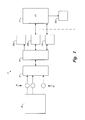
- FIG. 1 is a schematic example of a health monitoring system for a gas turbine engine or APU.
- FIG. 2 is a flow diagram of a processing method that is used by to detect the existence of component damage using a noise spectrum of the gas turbine engine or APU.
- FIG. 1 shows a schematic example of a health monitoring system 10 that is used to identify and/or prevent component damage in gas turbine engines and APUs (referred to synonymously as "engines” herein, since APUs include engines).
- Health monitoring system 10 is illustrated for exemplary purposes, various airframers and/or commercial airline operators may employ different or modified systems in order to identify component damage in order to prevent component failure.
- Heath monitoring system 10 monitors engine E (a gas turbine engine or APU) and includes a microphone 12, additional sensors 14, an aircraft condition monitoring system 16, an aircraft network server system 18, a display 20a, and transfer methods such as an aircraft wireless local area network 20b, and a ground link 20c to communicate with a ground based computer system 21.
- Computer system 21 displays results on a display 21a.
- Microphone 12 is an acoustic sensor that can be mounted on engine E or can be mounted adjacent thereto, for example, in a compartment that houses the APU in a tail of the aircraft.
- microphone 12 has a frequency range of between 25 hertz to 20 kilohertz and comprises a commercially available ceramic microphone utilizing a piezoelectric sensor that is capable of surviving at extreme conditions, in a non-pressurized and non-temperature controlled environment.
- microphone 12 can be custom made to meet the above criteria.
- additional sensors 14 collect data regarding a variety of components and conditions of engine E. Additional sensors 14 collect data on flow temperature and pressure, flow speeds, oil temperatures and pressures, oil debris, eddy currents, electrostatic debris, and vibration levels from gas turbine engine or APU E.
- Aircraft condition monitoring system 16 Data from microphone 12 and additional sensors 14 is transmitted to aircraft condition monitoring system 16, which performs two primary functions.
- the first function of aircraft condition monitoring system 16 resides in a central data acquisition module which indentifies the condition of the engine E and identifies when data collection should occur during certain operating conditions (e.g., no load, main engine start).
- aircraft condition monitoring system 16 includes a data acquisition system which is dedicated to the acquisition and real time collection of aircraft data including data from microphone 12 and additional sensors 14 when specific conditions or triggers are met.
- Aircraft condition monitoring system 16 has the capability of generating a plurality of condition reports including, for example, a noise monitoring report, load report, incident report, and start report.
- Condition reports typically include information such as acquisition time of data, date, flight number, report number, report type, and information regarding the operating condition monitored.
- aircraft condition monitoring system 16 has the capability of processing data utilizing standard techniques such as Fast Fourier Transforms (FFT) and other spectral and waveform analysis.
- FFT Fast Fourier Transforms
- Condition reports may be transferred to and stored on aircraft network server system 18 until the condition reports are transferred for processing and storage off the aircraft.
- the reports are also available to pilots or other personnel in the cockpit via cockpit terminal 20a.
- Means of transfer of data and reports off the aircraft include via the aircraft's communication system such as by aircraft wireless local area network 20b or via ground link 20c.
- a ground based computer system 21 such as a multi-purpose digital computing device to perform analysis on the spectral data recorded from the engine E.
- computer system 21 comprises a multi-purpose digital computing device with standard components such as a processor, memory and display 21a but also includes a database of stored standard noise spectra of similar or identical model engines with known defects and without defects.
- digital computer 21 includes software developed to identify similarities based on pattern recognition between the noise spectrum of the noise monitoring report and standard noise spectrums recorded from engines known to be operating with defects and without defects.
- FIG. 2 shows a flow diagram of a processing method 22 that can be used by computer system 21 to detect the existence of component damage using a noise spectrum of the engine E.
- Processing method 22 begins with an identification step 24 as aircraft condition monitoring system 16 ( FIG. 1 ) identifies an engine operating condition that warrants noise analysis such as a no load condition or a main engine start condition. If aircraft condition monitoring system 16 identifies an engine operating condition that warrants noise analysis, processing method 22 proceeds to a data collection step 26, where aircraft condition monitoring system 16 collects noise data during the applicable operating condition. Collected noise data can either be sent directly to aircraft network server system 18 ( FIG. 1 ) without processing, or processing such as performing a Fast Fourier Transform can be performed as to reduce the overall size of the noise data collected by eliminating some noise spectrum results not applicable to components being monitored.
- the processing method 22 moves to report generation step 28 where a noise monitoring report is generated from the collected data.
- the noise monitoring report is stored on aircraft network server system 18 and is sent off the aircraft through the aircraft's communication systems at step 30 to computer system 21.
- spectrum analysis can be performed during step 32.
- Spectrum analysis can include standard noise processing techniques such as performing a Fast Fourier Transform (FFT) in order to decompose noise spectrum data into values at discrete frequencies.
- FFT Fast Fourier Transform
- the computer system 21 accesses the database and compares the noise spectrum of the noise monitoring report to the standard noise spectrum of a same or similar model reference engine known to be operating without defects at the same or similar operating conditions.
- step 36 if the differences between the noise spectrum of the noise monitoring report and the standard noise spectrum are found to be acceptable after analysis by software developed to identify similarities based on pattern recognition between the noise spectrum of the noise monitoring report and the standard noise spectrum, the processing method 22 will move to step 38.
- the software the computer system 21 applies models and types of pattern recognition analysis, for example, if the difference between the noise spectrum and the standard noise spectrum in a particular frequency range are within a certain statistical range of one another (determined by component reliability information, known failure modes, and maintenance recommendations) the difference would be determined to be acceptable. If no damage is determined to have occurred in step 36, processing method 22 proceeds to step 38, where the noise monitoring report is saved and closed.
- processing method 22 moves to step 40, where the computer system 21 utilizing software applying pattern recognition analysis compares the noise spectrum of the noise monitoring report to a database of stored standard noise spectra of similar or identical model engines with known defects so as to identify what type of defect has occurred to the engine based on a pattern match between the noise spectrum of the engine being monitored and one or more of the engine noise spectra.
- the computer system 21 is able to accomplish this comparison and identification by accessing a database of collected standard noise spectra of similar or identical model engines with known defects.
- the database allows the user of processing method 22 to identify not only the type of defect that has occurred but is capable of identifying the degree of component defect(s) within the engine being monitored.
- the processing method 22 has this capability because the database includes the noise spectra of engines with varying degrees of component damage.
- the type and degree of component defect is identified by a noise spectrum pattern match between the noise spectrum of the engine being monitored and one or more of the engine noise spectra.
- the database of stored noise spectra used by computer system 21 in step 40 is created and developed by measuring the noise spectra of engines on test cells after the engines are returned for repair from the field. Additionally, the database of stored noise spectra used by the computer 21 in step 40 can include the noise spectra of engines that account for changes in air temperature and altitude by either utilizing feedback from temperature and pressure sensors 14 or by utilizing a learning system that records initial noise spectra at various operating conditions (including at various altitudes and air temperatures) of the engine being monitored upon entry into service. In the latter case, the initial noise spectra would be incorporated into the standard noise spectra of the database for comparison and identification of defects and types of defects using known learning algorithms such as neural networks and various other supervised, semi-supervised, and unsupervised machine learning algorithms.
- the engine noise spectra are measured at various operating conditions corresponding to operating conditions which aircraft condition monitoring system 16 ( FIG. 1 ) identifies as an engine operating condition that warrants noise analysis (e.g., the no load condition or the main engine start condition).
- the engines are striped and repaired and the noise spectra measurements are correlated with shop findings and the results entered into the database.
- the various noise spectra for different components both defect free and with varying degrees of defects can be ascertained.
- An non-exhaustive list of components with defects that can be identified using noise spectrum analysis include: compressor blades, combustor, turbine blades, gears, and bearings. Defects such as bent blades, blade tip loss, and bearing failure can be identified using the processing method 22.
- step 44 a notification is issued and displayed on display 21a to the user by computer system 21.
- the notification indicates that the noise spectrum of the engine being monitored was determined to have an unknown anomaly from a standard engine, and therefore, there is a likelihood of component damage to the engine E.
- the notification is saved by computer system 21 so that the engine E that was monitored can be identified for future noise spectrum health monitoring. Alternatively, the notification can serve as the basis for a maintenance inspection or a temporary removal of the engine from service for overhaul so as to identify the source (type and degree of component damage or failure) of the anomalous noise.
- the noise monitoring report is then saved and closed.
- a match alert is issued to the user.
- the match alert displays a visual warning to the user on display 21a along with any applicable recommended action(s).
- the applicable recommended action(s) are based upon component reliability information, known failure modes, and maintenance recommendations from the maintainers' maintenance manual.
- the applicable recommended action(s) for corrective action include minor maintenance activities and preventative actions such as performing a maintenance inspection using a horoscope or major actions such as removing the engine from service for inspection and repair.
- recommended action(s) are based upon a cost/benefit analysis that takes into account a business model of the user.
- the recommended action would be to remove the engine from service for repair.
- processing method 22 moves to step 48, which determines if additional noise spectra in the database are applicable to the noise spectrum of the noise monitoring report. Thus, processing method 22 does not stop after identifying one damaged component but continues to search the database for additional damaged components that may exist. If no additional standard spectra are applicable to the noise spectrum of the noise monitoring report (i.e. no additional damage is ascertained), processing method 22 proceeds to step 50 where the results from the noise monitoring report are saved on computer system 21 and then closed. If additional standard spectra are applicable to the noise spectrum of the noise monitoring report, the processing method steps 40 and 42 are repeated and the appropriate warning of step 44 or the appropriate additional match alert of step 46 are issued until no additional noise spectra in the database are applicable.
- noise spectrum analysis By utilizing the noise spectrum of engine health monitoring system 10 and processing method 22, one can identify and/or prevent component damage in a non-intrusive manner without having to install sensors in the engine. Additionally, noise spectrum analysis according to the present method 22 detects not only the existence and type of component damage but also identifies the degree of damage within the engine based upon the database with standard noise spectra of similar or identical model engines with known degrees of defect(s). Identification of minor damage such as wear before the minor damage becomes catastrophic allows for preventative maintenance to be performed, and thereby, allows an optimized maintenance schedule that can save the user maintenance costs.
Landscapes
- Physics & Mathematics (AREA)
- General Physics & Mathematics (AREA)
- Engineering & Computer Science (AREA)
- Acoustics & Sound (AREA)
- Mechanical Engineering (AREA)
- General Engineering & Computer Science (AREA)
- Testing Of Devices, Machine Parts, Or Other Structures Thereof (AREA)
- Measurement Of Mechanical Vibrations Or Ultrasonic Waves (AREA)
Abstract
Description
- The invention relates to a system and method for monitoring the health of engines, and more particularly to monitoring the health of gas turbine engines and auxiliary power units (APUs) using acoustic data.
- Aircraft gas turbine engine and APU diagnostic data is available from a variety of sources including on-board sensors such as accelerometers, which monitor rotating machinery and gears to determine vibration signatures related to particular types of component defects. However, many sensors such as accelerometers are intrusive and can be difficult to install or reinstall when components are replaced, cleaned or lubricated. Additionally, accelerometers respond to the combined resonances of all components including gears, shaft(s), bearings, blades, housing, and other moving components. This makes it difficult in some instances to isolate and identify certain types of component defects such as gear tooth defects.
- A system and method are provided for determining the health of an engine. The method includes accessing a plurality of standard noise spectra collected from engines with known defects. A noise spectrum of the engine being monitored is sensed and compared to the plurality of standard noise spectra from the engines with known defects. From the comparison, a type and a degree of defect is identified based upon the comparison.
Viewed from a second aspect, the invention provides a method for determining the health of an engine comprising: sensing a noise spectrum of the engine; comparing the noise spectrum of the engine to both a standard noise spectra of a reference engine known to be operating without defects and a plurality of standard noise spectra from engines with known defects; and identifying an existence, a type, and a degree of defect based upon the comparison. - The system for monitoring the health of the engine includes an acoustic sensor and a computer system. The acoustic sensor is configured to acquire the noise spectrum of the engine. The computer system has a database with a plurality of stored standard noise spectra from engines with known defects and is configured to receive the acquired acoustic spectrum of the engine from the acoustic sensor. The computer system compares the acoustic spectrum of the engine to the plurality of standard noise spectra from engines with known defects so as to identify a type and a degree of defect based upon the comparison. Additionally, the computer system generates a match alert along with an applicable recommended action on a display if one or more defects are indentified.
-
FIG. 1 is a schematic example of a health monitoring system for a gas turbine engine or APU. -
FIG. 2 is a flow diagram of a processing method that is used by to detect the existence of component damage using a noise spectrum of the gas turbine engine or APU. -
FIG. 1 shows a schematic example of ahealth monitoring system 10 that is used to identify and/or prevent component damage in gas turbine engines and APUs (referred to synonymously as "engines" herein, since APUs include engines).Health monitoring system 10 is illustrated for exemplary purposes, various airframers and/or commercial airline operators may employ different or modified systems in order to identify component damage in order to prevent component failure. Heathmonitoring system 10 monitors engine E (a gas turbine engine or APU) and includes amicrophone 12,additional sensors 14, an aircraftcondition monitoring system 16, an aircraftnetwork server system 18, adisplay 20a, and transfer methods such as an aircraft wireless local area network 20b, and aground link 20c to communicate with a ground basedcomputer system 21.Computer system 21 displays results on adisplay 21a. -
Health monitoring system 10 recognizes that the change of engine noise spectrum at similar operating conditions is a direct indication of a change of the engine's mechanical functionality. Microphone 12 is an acoustic sensor that can be mounted on engine E or can be mounted adjacent thereto, for example, in a compartment that houses the APU in a tail of the aircraft. In one embodiment, microphone 12 has a frequency range of between 25 hertz to 20 kilohertz and comprises a commercially available ceramic microphone utilizing a piezoelectric sensor that is capable of surviving at extreme conditions, in a non-pressurized and non-temperature controlled environment. In other embodiments,microphone 12 can be custom made to meet the above criteria. - As is known in the art, and disclosed in United States Patent No.
7,769,507 to Volponi et al. ,additional sensors 14 collect data regarding a variety of components and conditions of engine E.Additional sensors 14 collect data on flow temperature and pressure, flow speeds, oil temperatures and pressures, oil debris, eddy currents, electrostatic debris, and vibration levels from gas turbine engine or APU E. - Data from
microphone 12 andadditional sensors 14 is transmitted to aircraftcondition monitoring system 16, which performs two primary functions. The first function of aircraftcondition monitoring system 16 resides in a central data acquisition module which indentifies the condition of the engine E and identifies when data collection should occur during certain operating conditions (e.g., no load, main engine start). Additionally, aircraftcondition monitoring system 16 includes a data acquisition system which is dedicated to the acquisition and real time collection of aircraft data including data frommicrophone 12 andadditional sensors 14 when specific conditions or triggers are met. Aircraftcondition monitoring system 16 has the capability of generating a plurality of condition reports including, for example, a noise monitoring report, load report, incident report, and start report. Condition reports typically include information such as acquisition time of data, date, flight number, report number, report type, and information regarding the operating condition monitored. In some embodiments, aircraftcondition monitoring system 16 has the capability of processing data utilizing standard techniques such as Fast Fourier Transforms (FFT) and other spectral and waveform analysis. - Condition reports may be transferred to and stored on aircraft
network server system 18 until the condition reports are transferred for processing and storage off the aircraft. In one embodiment, the reports are also available to pilots or other personnel in the cockpit viacockpit terminal 20a. Means of transfer of data and reports off the aircraft include via the aircraft's communication system such as by aircraft wireless local area network 20b or viaground link 20c. These means of data and report transfer allow a ground basedcomputer system 21 such as a multi-purpose digital computing device to perform analysis on the spectral data recorded from the engine E. In one embodiment,computer system 21 comprises a multi-purpose digital computing device with standard components such as a processor, memory anddisplay 21a but also includes a database of stored standard noise spectra of similar or identical model engines with known defects and without defects. Additionally,digital computer 21 includes software developed to identify similarities based on pattern recognition between the noise spectrum of the noise monitoring report and standard noise spectrums recorded from engines known to be operating with defects and without defects. -
FIG. 2 shows a flow diagram of aprocessing method 22 that can be used bycomputer system 21 to detect the existence of component damage using a noise spectrum of the engineE. Processing method 22 begins with anidentification step 24 as aircraft condition monitoring system 16 (FIG. 1 ) identifies an engine operating condition that warrants noise analysis such as a no load condition or a main engine start condition. If aircraftcondition monitoring system 16 identifies an engine operating condition that warrants noise analysis,processing method 22 proceeds to a data collection step 26, where aircraftcondition monitoring system 16 collects noise data during the applicable operating condition. Collected noise data can either be sent directly to aircraft network server system 18 (FIG. 1 ) without processing, or processing such as performing a Fast Fourier Transform can be performed as to reduce the overall size of the noise data collected by eliminating some noise spectrum results not applicable to components being monitored. - After the data is collected, the
processing method 22 moves to report generation step 28 where a noise monitoring report is generated from the collected data. The noise monitoring report is stored on aircraftnetwork server system 18 and is sent off the aircraft through the aircraft's communication systems at step 30 tocomputer system 21. Once the noise monitoring report is received on the ground, spectrum analysis can be performed during step 32. Spectrum analysis can include standard noise processing techniques such as performing a Fast Fourier Transform (FFT) in order to decompose noise spectrum data into values at discrete frequencies. Atstep 34, thecomputer system 21 accesses the database and compares the noise spectrum of the noise monitoring report to the standard noise spectrum of a same or similar model reference engine known to be operating without defects at the same or similar operating conditions. Instep 36, if the differences between the noise spectrum of the noise monitoring report and the standard noise spectrum are found to be acceptable after analysis by software developed to identify similarities based on pattern recognition between the noise spectrum of the noise monitoring report and the standard noise spectrum, theprocessing method 22 will move tostep 38. The software thecomputer system 21 applies models and types of pattern recognition analysis, for example, if the difference between the noise spectrum and the standard noise spectrum in a particular frequency range are within a certain statistical range of one another (determined by component reliability information, known failure modes, and maintenance recommendations) the difference would be determined to be acceptable. If no damage is determined to have occurred instep 36,processing method 22 proceeds tostep 38, where the noise monitoring report is saved and closed. - If the differences between the noise spectrum of the noise monitoring report and the standard noise spectrum are found not to be acceptable in
step 36,processing method 22 moves tostep 40, where thecomputer system 21 utilizing software applying pattern recognition analysis compares the noise spectrum of the noise monitoring report to a database of stored standard noise spectra of similar or identical model engines with known defects so as to identify what type of defect has occurred to the engine based on a pattern match between the noise spectrum of the engine being monitored and one or more of the engine noise spectra. Thecomputer system 21 is able to accomplish this comparison and identification by accessing a database of collected standard noise spectra of similar or identical model engines with known defects. Additionally, the database allows the user ofprocessing method 22 to identify not only the type of defect that has occurred but is capable of identifying the degree of component defect(s) within the engine being monitored. Theprocessing method 22 has this capability because the database includes the noise spectra of engines with varying degrees of component damage. Thus, the type and degree of component defect is identified by a noise spectrum pattern match between the noise spectrum of the engine being monitored and one or more of the engine noise spectra. - The database of stored noise spectra used by
computer system 21 instep 40 is created and developed by measuring the noise spectra of engines on test cells after the engines are returned for repair from the field. Additionally, the database of stored noise spectra used by thecomputer 21 instep 40 can include the noise spectra of engines that account for changes in air temperature and altitude by either utilizing feedback from temperature andpressure sensors 14 or by utilizing a learning system that records initial noise spectra at various operating conditions (including at various altitudes and air temperatures) of the engine being monitored upon entry into service. In the latter case, the initial noise spectra would be incorporated into the standard noise spectra of the database for comparison and identification of defects and types of defects using known learning algorithms such as neural networks and various other supervised, semi-supervised, and unsupervised machine learning algorithms. The engine noise spectra are measured at various operating conditions corresponding to operating conditions which aircraft condition monitoring system 16 (FIG. 1 ) identifies as an engine operating condition that warrants noise analysis (e.g., the no load condition or the main engine start condition). After engine noise testing, the engines are striped and repaired and the noise spectra measurements are correlated with shop findings and the results entered into the database. In this manner, the various noise spectra for different components both defect free and with varying degrees of defects can be ascertained. An non-exhaustive list of components with defects that can be identified using noise spectrum analysis include: compressor blades, combustor, turbine blades, gears, and bearings. Defects such as bent blades, blade tip loss, and bearing failure can be identified using theprocessing method 22. - If a pattern match is not found utilizing the database at
step 42, theprocessing method 22 moves to step 44 where a notification is issued and displayed ondisplay 21a to the user bycomputer system 21. The notification indicates that the noise spectrum of the engine being monitored was determined to have an unknown anomaly from a standard engine, and therefore, there is a likelihood of component damage to the engine E. The notification is saved bycomputer system 21 so that the engine E that was monitored can be identified for future noise spectrum health monitoring. Alternatively, the notification can serve as the basis for a maintenance inspection or a temporary removal of the engine from service for overhaul so as to identify the source (type and degree of component damage or failure) of the anomalous noise. At step 44, the noise monitoring report is then saved and closed. - If a pattern match is found utilizing the database at
step 42, theprocessing method 22 proceeds to step 46 where a match alert is issued to the user. In one embodiment, the match alert displays a visual warning to the user ondisplay 21a along with any applicable recommended action(s). The applicable recommended action(s) are based upon component reliability information, known failure modes, and maintenance recommendations from the maintainers' maintenance manual. The applicable recommended action(s) for corrective action include minor maintenance activities and preventative actions such as performing a maintenance inspection using a horoscope or major actions such as removing the engine from service for inspection and repair. Additionally, in one embodiment, recommended action(s) are based upon a cost/benefit analysis that takes into account a business model of the user. For example, if the cost to repair the damaged component for which the match alert was issued would be minimal and there is a high likelihood that the risk and cost of damage to the engine would escalate substantially if the engine was kept in service these factors would outweigh the potential benefit of keeping the engine in service. In such a case, the recommended action would be to remove the engine from service for repair. - After recommended action(s) are issued at step 46, processing
method 22 moves to step 48, which determines if additional noise spectra in the database are applicable to the noise spectrum of the noise monitoring report. Thus, processingmethod 22 does not stop after identifying one damaged component but continues to search the database for additional damaged components that may exist. If no additional standard spectra are applicable to the noise spectrum of the noise monitoring report (i.e. no additional damage is ascertained), processingmethod 22 proceeds to step 50 where the results from the noise monitoring report are saved oncomputer system 21 and then closed. If additional standard spectra are applicable to the noise spectrum of the noise monitoring report, the processing method steps 40 and 42 are repeated and the appropriate warning of step 44 or the appropriate additional match alert of step 46 are issued until no additional noise spectra in the database are applicable. - By utilizing the noise spectrum of engine
health monitoring system 10 andprocessing method 22, one can identify and/or prevent component damage in a non-intrusive manner without having to install sensors in the engine. Additionally, noise spectrum analysis according to thepresent method 22 detects not only the existence and type of component damage but also identifies the degree of damage within the engine based upon the database with standard noise spectra of similar or identical model engines with known degrees of defect(s). Identification of minor damage such as wear before the minor damage becomes catastrophic allows for preventative maintenance to be performed, and thereby, allows an optimized maintenance schedule that can save the user maintenance costs. - In this application, the terms anomaly, damage, defect, failure, and wear are used synonymously to refer to any condition that has a negative impact on performance, operation, or mechanical functionality of the engine. While the invention has been described with reference to an exemplary embodiment(s), it will be understood by those skilled in the art that various changes may be made and equivalents may be substituted for elements thereof without departing from the scope of the invention, which is defined by the appended claims. In addition, many modifications may be made to adapt a particular situation or material to the teachings of the invention without departing from the essential scope thereof. Therefore, it is intended that the invention not be limited to the particular embodiment(s) disclosed, but that the invention will include all embodiments falling within the scope of the appended claims.
Claims (14)
- A method for determining the health of an engine comprising:sensing a noise spectrum of the engine;comparing the noise spectrum of the engine to a plurality of standard noise spectra from
engines with known defects stored in a database; andidentifying a type and a degree of defect based upon the comparison. - The method of claim 1, further comprising:generating a match alert along with applicable recommended action if one or more
defects are identified by a computer system based on a pattern match between the noise spectrum of the engine and one or more of the plurality of standard noise spectra. - The method of claim 2, wherein the computer system generated applicable recommended action is derived from component reliability information, known failure modes, and maintenance recommendations from a maintenance manual of the engine.
- The method of claim 2 or 3, wherein the computer system generated applicable recommended action is based upon a cost/benefit analysis that takes into account a business model of the user.
- The method of claim 1, 2, 3 or 4, wherein the engine and the engines with known defects are identical models and the noise spectrum of the engine and the plurality of standard noise spectra from the engines with known defects are collected at a same or substantially similar operating condition.
- The method of any preceding claim, further comprising:comparing the noise spectrum of the engine to a standard noise spectrum from a reference
engine known to be operating without defects stored in the database to identify that defects are present. - The method of claim 6, further comprising:generating a notification that one or more defects are likely present if the noise spectrum
of the engine and the standard noise spectrum from the reference engine known to be operating without defects are determined not to be an acceptable match based on a pattern recognition by a computer system. - The method of claim 6 or 7, wherein the engine and the reference engine known to be operating without defects are identical model engines and the noise spectrum of the engine and the standard noise spectra of the reference engine known to be operating without defects are collected at a same or substantially similar operating condition.
- A system for monitoring the health of an engine comprising:an acoustic sensor configured to acquire a noise spectrum of the engine; anda computer system including a database having a plurality of stored standard noise
spectra from engines with known defects, the computer system configured to receive the acquired noise spectrum of the engine from the acoustic sensor and compare the noise spectrum of the engine to the plurality of standard noise spectra from engines with known defects so as to identify a type and a degree of defect based upon the comparison, the computer system configured to generate a match alert along with an applicable recommended action on a display if one or more defects are indentified. - The system of claim 9, wherein the acoustic sensor is configured to communicate with an aircraft condition monitoring system which is configured to indentify the condition of the engine E and is configured to identify when data collection from acoustic sensor and a plurality of other sensors should occur based upon desired engine operating conditions, said aircraft condition monitoring system including a data acquisition system which is dedicated to the acquisition and real time collection of aircraft data including data from the acoustic sensor and the plurality of other sensors.
- The system of claim 9 or 10, wherein the database is configured to store a standard noise spectrum from a reference engine known to be operating without defects and the computer system is configured to compare the noise spectrum of the engine to the standard noise spectrum from the reference engine known to be operating without defects to ascertain whether any defects are present.
- The system of claim 11, wherein the computer system is configured to generate a notification that one or more defects are likely present on the display if the noise spectrum of the engine and the standard noise spectrum from the reference engine known to be operating without defects are determined not to be an acceptable match based on a pattern recognition.
- The system of claim 9, 10, 11 or 12, wherein the computer system generated applicable recommended action is derived from component reliability information, known failure modes, and maintenance recommendations from a maintenance manual of the engine.
- The system of any of claim 9 to 13, wherein the computer system generated applicable recommended action is based upon a cost/benefit analysis that takes into account a business model of the user.
Applications Claiming Priority (1)
| Application Number | Priority Date | Filing Date | Title |
|---|---|---|---|
| US13/159,483 US8843348B2 (en) | 2011-06-14 | 2011-06-14 | Engine noise monitoring as engine health management tool |
Publications (1)
| Publication Number | Publication Date |
|---|---|
| EP2535694A1 true EP2535694A1 (en) | 2012-12-19 |
Family
ID=46045736
Family Applications (1)
| Application Number | Title | Priority Date | Filing Date |
|---|---|---|---|
| EP12162769A Withdrawn EP2535694A1 (en) | 2011-06-14 | 2012-03-30 | Engine noise monitoring as engine health management tool |
Country Status (2)
| Country | Link |
|---|---|
| US (1) | US8843348B2 (en) |
| EP (1) | EP2535694A1 (en) |
Cited By (8)
| Publication number | Priority date | Publication date | Assignee | Title |
|---|---|---|---|---|
| WO2014149112A1 (en) * | 2013-03-15 | 2014-09-25 | Rolls-Royce North American Technologies, Inc. | Model based distributed health monitoring for aircraft engines |
| CN105043775A (en) * | 2015-07-24 | 2015-11-11 | 北京航空航天大学 | Aeroengine critical system hazard analysis system and method |
| CN106168541A (en) * | 2015-05-19 | 2016-11-30 | 通用汽车环球科技运作有限责任公司 | Automobile, diagnostic system and the method generating vehicle diagnosis data |
| WO2016050347A3 (en) * | 2014-10-01 | 2017-10-05 | Sartorius Stedim Biotech Gmbh | Audio identification device, audio identification method and audio identification system |
| FR3094088A1 (en) * | 2019-03-19 | 2020-09-25 | Airbus Operations | Method and system for detecting and identifying vibrations in an aircraft. |
| CN112761740A (en) * | 2021-01-05 | 2021-05-07 | 西安交通大学 | Turbine blade fault testing system and intelligent fault diagnosis method thereof |
| EP4270131A1 (en) * | 2022-04-29 | 2023-11-01 | RTX Corporation | Method and apparatus for fault detection in a gas turbine engine and an engine health monitoring system |
| CN119063977A (en) * | 2024-07-31 | 2024-12-03 | 岚图汽车科技有限公司 | A vehicle parts compliance detection method, device, equipment and medium |
Families Citing this family (33)
| Publication number | Priority date | Publication date | Assignee | Title |
|---|---|---|---|---|
| US8843348B2 (en) | 2011-06-14 | 2014-09-23 | Hamilton Sundstrand Corporation | Engine noise monitoring as engine health management tool |
| US20120330499A1 (en) * | 2011-06-23 | 2012-12-27 | United Technologies Corporation | Acoustic diagnostic of fielded turbine engines |
| GB2496386A (en) * | 2011-11-08 | 2013-05-15 | Ge Aviat Systems Ltd | Method for integrating models of a vehicle health management system |
| FR2986070B1 (en) * | 2012-01-24 | 2014-11-28 | Snecma | SYSTEM FOR ACQUIRING A VIBRATORY SIGNAL OF A ROTARY ENGINE |
| US9105066B2 (en) | 2013-03-10 | 2015-08-11 | State Farm Mutual Automobile Insurance Company | Trip-based vehicle insurance |
| FR3005732B1 (en) * | 2013-05-17 | 2016-10-07 | Snecma | METHOD AND SYSTEM FOR VIBRATION ANALYSIS OF AN ENGINE |
| GB2518893B (en) * | 2013-10-07 | 2018-11-21 | Ge Aviat Systems Ltd | Method for predicting an auxiliary power unit fault |
| TWI641934B (en) * | 2014-08-05 | 2018-11-21 | 聯華電子股份有限公司 | Virtual metrology system and method |
| US9459153B2 (en) * | 2014-09-17 | 2016-10-04 | General Electric Company | Automated analytics systems and methods |
| TWI660160B (en) * | 2015-04-27 | 2019-05-21 | Otohear Consultants Inc. | Detecting system and method of movable noise source |
| US10726863B2 (en) * | 2015-04-27 | 2020-07-28 | Otocon Inc. | System and method for locating mobile noise source |
| US9865156B2 (en) * | 2015-09-23 | 2018-01-09 | Schneider Electric Systems Usa, Inc. | System for contextualizing and resolving alerts |
| US9799320B2 (en) * | 2015-09-24 | 2017-10-24 | Fuji Xerox Co., Ltd. | Mobile terminal apparatus and non-transitory computer readable medium |
| US9824513B2 (en) | 2016-04-14 | 2017-11-21 | United Airlines, Inc. | Method of detecting elevator tab failure |
| US10266278B2 (en) | 2016-10-11 | 2019-04-23 | Unison Industries, Llc | Starter issue detection |
| US12105579B2 (en) * | 2017-04-13 | 2024-10-01 | Texas Tech University System | System and method for automated prediction and detection of component and system failures |
| US10546434B2 (en) | 2017-04-18 | 2020-01-28 | International Business Machines Corporation | Analyzing and classifying automobile sounds |
| US10753893B2 (en) * | 2018-01-26 | 2020-08-25 | Hamilton Sunstrand Corporation | Gear set health monitoring system |
| JP6741716B2 (en) | 2018-04-09 | 2020-08-19 | 株式会社Subaru | Aircraft management system |
| DE102018130389A1 (en) * | 2018-11-29 | 2020-06-04 | Rolls-Royce Deutschland Ltd & Co Kg | Device and method for monitoring a transmission |
| EP3915084A4 (en) * | 2019-01-22 | 2023-01-11 | ACV Auctions Inc. | VEHICLE AUDIO CAPTURE AND DIAGNOSTICS |
| US10783902B1 (en) * | 2019-04-18 | 2020-09-22 | Hitachi, Ltd. | Adaptive acoustic sensing method and system |
| KR102923447B1 (en) * | 2019-12-11 | 2026-02-06 | 현대자동차주식회사 | Method For Engine Combustion Diagnosis Based On Mechanical Abnormality Using Engine Noise and Combustion Diagnosis System Thereof |
| EP3866075B1 (en) * | 2020-02-13 | 2024-08-21 | Andreas Stihl AG & Co. KG | Method for automated assistance in the repair of a motor-driven tool and system for automated assistance in repairing a motor-driven tool |
| JP7294222B2 (en) * | 2020-04-16 | 2023-06-20 | トヨタ自動車株式会社 | Abnormal noise evaluation system and abnormal noise evaluation method |
| US20220057295A1 (en) * | 2020-08-18 | 2022-02-24 | Aktiebolaget Skf | Swept pattern probability calculation for speed and defect identification |
| US20220178324A1 (en) * | 2020-12-09 | 2022-06-09 | Transportation Ip Holdings, Llc | Systems and methods for diagnosing equipment |
| GB202104306D0 (en) * | 2021-03-26 | 2021-05-12 | Rolls Royce Plc | Computer-implemented methods for indicating damage to an aircraft |
| CN113374577B (en) * | 2021-06-27 | 2022-07-26 | 华能太原东山燃机热电有限责任公司 | Bus type gas supply pipeline state monitoring system for gas generator set |
| US11783851B2 (en) * | 2021-12-23 | 2023-10-10 | ACV Auctions Inc. | Multi-sensor devices and systems for evaluating vehicle conditions |
| GB2617080A (en) * | 2022-03-28 | 2023-10-04 | Jaguar Land Rover Ltd | Diagnostic system and method |
| US12617549B2 (en) | 2022-08-04 | 2026-05-05 | Rtx Corporation | Aircraft engine anomaly detection based on odor, sound, and/or image |
| US12252995B2 (en) * | 2022-08-22 | 2025-03-18 | Pratt & Whitney Canada Corp. | Acoustical health monitoring of gas turbine engines |
Citations (7)
| Publication number | Priority date | Publication date | Assignee | Title |
|---|---|---|---|---|
| AT389943B (en) * | 1987-03-23 | 1990-02-26 | Avl Verbrennungskraft Messtech | Method of testing the central engine mechanism, and equipment for carrying out the method |
| DE19830685A1 (en) * | 1998-07-04 | 2000-01-05 | Dieter H Gaertner | Monitoring unit for operating noise of railway vehicles or for monitoring railway vehicle routes |
| DE10022684A1 (en) * | 2000-04-28 | 2001-10-31 | Deutsche Telekom Ag | Safety system for railway vehicles and tracks compares acquired acoustic spectrum with normal operating spectrum, detects deviations as defect information, compares with defect spectra |
| US20030028332A1 (en) * | 2001-06-19 | 2003-02-06 | The Aerospace Corporation | Rocket engine gear defect monitoring method |
| US20030196492A1 (en) * | 2002-04-17 | 2003-10-23 | Remboski Donald J. | Fault detection system having audio analysis and method of using the same |
| US20050177352A1 (en) * | 2004-02-05 | 2005-08-11 | Ford Motor Company | Defect identification signal analysis method |
| US7769507B2 (en) | 2004-08-26 | 2010-08-03 | United Technologies Corporation | System for gas turbine health monitoring data fusion |
Family Cites Families (25)
| Publication number | Priority date | Publication date | Assignee | Title |
|---|---|---|---|---|
| US4249238A (en) * | 1978-05-24 | 1981-02-03 | The United States Of America As Represented By The Administrator Of The National Aeronautics And Space Administration | Apparatus for sensor failure detection and correction in a gas turbine engine control system |
| JPS58150859A (en) | 1982-03-03 | 1983-09-07 | Hitachi Ltd | Rotating body crack diagnosis device |
| US4429578A (en) | 1982-03-22 | 1984-02-07 | General Electric Company | Acoustical defect detection system |
| GB8902645D0 (en) | 1989-02-07 | 1989-03-30 | Smiths Industries Plc | Monitoring |
| US6119074A (en) * | 1998-05-20 | 2000-09-12 | Caterpillar Inc. | Method and apparatus of predicting a fault condition |
| FR2803036B1 (en) * | 1999-12-23 | 2002-10-11 | Snecma | DETECTION OF DAMAGE TO PARTS OF AN ENGINE |
| US6643570B2 (en) * | 2000-06-22 | 2003-11-04 | Barry Bangert | Aircraft engine reliability business model |
| IL144010A (en) * | 2001-06-26 | 2006-04-10 | Engines Pdm Ltd | Universal diagnostic method and system for engines |
| GB0116193D0 (en) | 2001-07-03 | 2001-08-22 | Rolls Royce Plc | An apparatus and method for detecting a damaged rotary machine aerofoil |
| US6668655B2 (en) | 2001-09-27 | 2003-12-30 | Siemens Westinghouse Power Corporation | Acoustic monitoring of foreign objects in combustion turbines during operation |
| US6711952B2 (en) | 2001-10-05 | 2004-03-30 | General Electric Company | Method and system for monitoring bearings |
| US7027953B2 (en) * | 2002-12-30 | 2006-04-11 | Rsl Electronics Ltd. | Method and system for diagnostics and prognostics of a mechanical system |
| US6999884B2 (en) | 2003-01-10 | 2006-02-14 | Oxford Biosignals Limited | Bearing anomaly detection and location |
| US7613687B2 (en) * | 2003-05-30 | 2009-11-03 | Truelocal Inc. | Systems and methods for enhancing web-based searching |
| US7321809B2 (en) * | 2003-12-30 | 2008-01-22 | The Boeing Company | Methods and systems for analyzing engine unbalance conditions |
| US7318007B2 (en) | 2003-12-31 | 2008-01-08 | United Technologies Corporation | Real time gear box health management system and method of using the same |
| US7182519B2 (en) | 2004-06-24 | 2007-02-27 | General Electric Company | Methods and apparatus for assembling a bearing assembly |
| GB0518659D0 (en) * | 2005-09-13 | 2005-10-19 | Rolls Royce Plc | Health monitoring |
| US7689368B2 (en) * | 2007-10-26 | 2010-03-30 | Caterpillar Inc. | Systems and methods for early detection of machine component failure |
| US8417432B2 (en) | 2008-04-30 | 2013-04-09 | United Technologies Corporation | Method for calculating confidence on prediction in fault diagnosis systems |
| US8326582B2 (en) | 2008-12-18 | 2012-12-04 | International Electronic Machines Corporation | Acoustic-based rotating component analysis |
| US9650909B2 (en) | 2009-05-07 | 2017-05-16 | General Electric Company | Multi-stage compressor fault detection and protection |
| FR2952177B1 (en) * | 2009-11-04 | 2012-06-01 | Snecma | METHOD FOR DETECTING DAMAGE TO AT LEAST ONE BEARING BEARING OF AN ENGINE |
| US8990770B2 (en) | 2011-05-25 | 2015-03-24 | Honeywell International Inc. | Systems and methods to configure condition based health maintenance systems |
| US8843348B2 (en) | 2011-06-14 | 2014-09-23 | Hamilton Sundstrand Corporation | Engine noise monitoring as engine health management tool |
-
2011
- 2011-06-14 US US13/159,483 patent/US8843348B2/en active Active
-
2012
- 2012-03-30 EP EP12162769A patent/EP2535694A1/en not_active Withdrawn
Patent Citations (7)
| Publication number | Priority date | Publication date | Assignee | Title |
|---|---|---|---|---|
| AT389943B (en) * | 1987-03-23 | 1990-02-26 | Avl Verbrennungskraft Messtech | Method of testing the central engine mechanism, and equipment for carrying out the method |
| DE19830685A1 (en) * | 1998-07-04 | 2000-01-05 | Dieter H Gaertner | Monitoring unit for operating noise of railway vehicles or for monitoring railway vehicle routes |
| DE10022684A1 (en) * | 2000-04-28 | 2001-10-31 | Deutsche Telekom Ag | Safety system for railway vehicles and tracks compares acquired acoustic spectrum with normal operating spectrum, detects deviations as defect information, compares with defect spectra |
| US20030028332A1 (en) * | 2001-06-19 | 2003-02-06 | The Aerospace Corporation | Rocket engine gear defect monitoring method |
| US20030196492A1 (en) * | 2002-04-17 | 2003-10-23 | Remboski Donald J. | Fault detection system having audio analysis and method of using the same |
| US20050177352A1 (en) * | 2004-02-05 | 2005-08-11 | Ford Motor Company | Defect identification signal analysis method |
| US7769507B2 (en) | 2004-08-26 | 2010-08-03 | United Technologies Corporation | System for gas turbine health monitoring data fusion |
Cited By (11)
| Publication number | Priority date | Publication date | Assignee | Title |
|---|---|---|---|---|
| WO2014149112A1 (en) * | 2013-03-15 | 2014-09-25 | Rolls-Royce North American Technologies, Inc. | Model based distributed health monitoring for aircraft engines |
| US9481473B2 (en) | 2013-03-15 | 2016-11-01 | Rolls-Royce North American Technologies, Inc. | Distributed control system with smart actuators and sensors |
| WO2016050347A3 (en) * | 2014-10-01 | 2017-10-05 | Sartorius Stedim Biotech Gmbh | Audio identification device, audio identification method and audio identification system |
| CN106168541A (en) * | 2015-05-19 | 2016-11-30 | 通用汽车环球科技运作有限责任公司 | Automobile, diagnostic system and the method generating vehicle diagnosis data |
| CN106168541B (en) * | 2015-05-19 | 2019-07-16 | 通用汽车环球科技运作有限责任公司 | Automobile, diagnostic system and the method for generating vehicle diagnosis data |
| CN105043775A (en) * | 2015-07-24 | 2015-11-11 | 北京航空航天大学 | Aeroengine critical system hazard analysis system and method |
| CN105043775B (en) * | 2015-07-24 | 2017-12-19 | 北京航空航天大学 | A kind of aero-engine critical system hazard analysis system and method |
| FR3094088A1 (en) * | 2019-03-19 | 2020-09-25 | Airbus Operations | Method and system for detecting and identifying vibrations in an aircraft. |
| CN112761740A (en) * | 2021-01-05 | 2021-05-07 | 西安交通大学 | Turbine blade fault testing system and intelligent fault diagnosis method thereof |
| EP4270131A1 (en) * | 2022-04-29 | 2023-11-01 | RTX Corporation | Method and apparatus for fault detection in a gas turbine engine and an engine health monitoring system |
| CN119063977A (en) * | 2024-07-31 | 2024-12-03 | 岚图汽车科技有限公司 | A vehicle parts compliance detection method, device, equipment and medium |
Also Published As
| Publication number | Publication date |
|---|---|
| US8843348B2 (en) | 2014-09-23 |
| US20120323531A1 (en) | 2012-12-20 |
Similar Documents
| Publication | Publication Date | Title |
|---|---|---|
| US8843348B2 (en) | Engine noise monitoring as engine health management tool | |
| EP3483686B1 (en) | Methods and apparatus for prognostic health monitoring of a turbine engine | |
| US9797328B2 (en) | Equipment health monitoring method and system and engine | |
| JP5562979B2 (en) | Method and system for monitoring vibration phenomena occurring during operation of an aircraft gas turbine engine | |
| US7027953B2 (en) | Method and system for diagnostics and prognostics of a mechanical system | |
| JP4859328B2 (en) | Power plant condition monitoring | |
| Zhang et al. | Machine fault detection by signal denoising—with application to industrial gas turbines | |
| EP2538210A2 (en) | Acoustic diagnostic of fielded turbine engines | |
| US8321118B2 (en) | Operations support systems and methods with power assurance | |
| US8850876B2 (en) | Methods and systems for monitoring engine oil temperature of an operating engine | |
| EP3312604B1 (en) | Oil debris monitoring (odm) with adaptive learning | |
| US20090048730A1 (en) | Method and system for planning repair of an engine | |
| CN105938501A (en) | Methods of Evaluating Parts | |
| JP6714498B2 (en) | Equipment diagnosis device and equipment diagnosis method | |
| Volponi | Gas turbine engine health management: past, present and future trends | |
| US20250271330A1 (en) | Method for monitoring a rotating machine in order to detect a fault in an aircraft bearing | |
| Pecho et al. | Vibration fault detection of fuel pump using recurrence quantification analysis | |
| Skliros | A case study of vibration fault diagnosis applied at Rolls-Royce T-56 turboprop engine | |
| Nithin et al. | A review on gearbox condition monitoring and signal analysis techniques: a review on gearbox condition | |
| Kulagin et al. | Automated identification of critical malfunctions of aircraft engines based on modified wavelet transform and deep neural network clustering | |
| Byington et al. | Recent case studies in bearing fault detection and prognosis | |
| CN114638060A (en) | Fault prediction method, system, electronic device and computer program product | |
| Narayan et al. | Industry 4.0 Based Turbofan Performance Prediction | |
| Delgado et al. | A survey of current rotorcraft propulsion health monitoring technologies | |
| Ahmed et al. | A review of aircraft auxiliary power unit faults, diagnostics and acoustic measurem |
Legal Events
| Date | Code | Title | Description |
|---|---|---|---|
| PUAI | Public reference made under article 153(3) epc to a published international application that has entered the european phase |
Free format text: ORIGINAL CODE: 0009012 |
|
| AK | Designated contracting states |
Kind code of ref document: A1 Designated state(s): AL AT BE BG CH CY CZ DE DK EE ES FI FR GB GR HR HU IE IS IT LI LT LU LV MC MK MT NL NO PL PT RO RS SE SI SK SM TR |
|
| AX | Request for extension of the european patent |
Extension state: BA ME |
|
| 17P | Request for examination filed |
Effective date: 20130619 |
|
| RBV | Designated contracting states (corrected) |
Designated state(s): AL AT BE BG CH CY CZ DE DK EE ES FI FR GB GR HR HU IE IS IT LI LT LU LV MC MK MT NL NO PL PT RO RS SE SI SK SM TR |
|
| 17Q | First examination report despatched |
Effective date: 20171009 |
|
| STAA | Information on the status of an ep patent application or granted ep patent |
Free format text: STATUS: THE APPLICATION HAS BEEN WITHDRAWN |
|
| 18W | Application withdrawn |
Effective date: 20180226 |