EP2534191B1 - Photoaligning material with lateral substitution - Google Patents
Photoaligning material with lateral substitution Download PDFInfo
- Publication number
- EP2534191B1 EP2534191B1 EP11702460.4A EP11702460A EP2534191B1 EP 2534191 B1 EP2534191 B1 EP 2534191B1 EP 11702460 A EP11702460 A EP 11702460A EP 2534191 B1 EP2534191 B1 EP 2534191B1
- Authority
- EP
- European Patent Office
- Prior art keywords
- alkylen
- compound
- substituted
- group
- atoms
- Prior art date
- Legal status (The legal status is an assumption and is not a legal conclusion. Google has not performed a legal analysis and makes no representation as to the accuracy of the status listed.)
- Not-in-force
Links
- 239000000463 material Substances 0.000 title claims description 31
- 238000006467 substitution reaction Methods 0.000 title description 5
- 150000001875 compounds Chemical class 0.000 claims description 161
- 229920000642 polymer Polymers 0.000 claims description 85
- 229920005575 poly(amic acid) Polymers 0.000 claims description 81
- 229910052739 hydrogen Inorganic materials 0.000 claims description 78
- 239000001257 hydrogen Substances 0.000 claims description 78
- -1 polysiloxane Chemical class 0.000 claims description 70
- GTDPSWPPOUPBNX-UHFFFAOYSA-N ac1mqpva Chemical compound CC12C(=O)OC(=O)C1(C)C1(C)C2(C)C(=O)OC1=O GTDPSWPPOUPBNX-UHFFFAOYSA-N 0.000 claims description 68
- 239000000203 mixture Substances 0.000 claims description 68
- 238000002360 preparation method Methods 0.000 claims description 67
- 238000000034 method Methods 0.000 claims description 64
- 229910052731 fluorine Inorganic materials 0.000 claims description 55
- 239000011737 fluorine Substances 0.000 claims description 55
- 150000002825 nitriles Chemical group 0.000 claims description 52
- 125000004429 atom Chemical group 0.000 claims description 48
- 239000004973 liquid crystal related substance Substances 0.000 claims description 43
- 125000003118 aryl group Chemical group 0.000 claims description 42
- PXGOKWXKJXAPGV-UHFFFAOYSA-N Fluorine Chemical compound FF PXGOKWXKJXAPGV-UHFFFAOYSA-N 0.000 claims description 40
- ZAMOUSCENKQFHK-UHFFFAOYSA-N Chlorine atom Chemical group [Cl] ZAMOUSCENKQFHK-UHFFFAOYSA-N 0.000 claims description 37
- 125000004432 carbon atom Chemical group C* 0.000 claims description 37
- 239000000460 chlorine Chemical group 0.000 claims description 37
- 229910052801 chlorine Inorganic materials 0.000 claims description 37
- 125000005647 linker group Chemical group 0.000 claims description 37
- 125000004435 hydrogen atom Chemical group [H]* 0.000 claims description 36
- UFHFLCQGNIYNRP-UHFFFAOYSA-N Hydrogen Chemical compound [H][H] UFHFLCQGNIYNRP-UHFFFAOYSA-N 0.000 claims description 34
- 125000004427 diamine group Chemical group 0.000 claims description 26
- 125000002837 carbocyclic group Chemical group 0.000 claims description 25
- 125000000843 phenylene group Chemical class C1(=C(C=CC=C1)*)* 0.000 claims description 23
- 125000004169 (C1-C6) alkyl group Chemical group 0.000 claims description 20
- 125000002723 alicyclic group Chemical group 0.000 claims description 20
- 125000004122 cyclic group Chemical group 0.000 claims description 20
- 229910052736 halogen Inorganic materials 0.000 claims description 20
- 150000002367 halogens Chemical class 0.000 claims description 20
- 239000004642 Polyimide Substances 0.000 claims description 19
- 229920001721 polyimide Polymers 0.000 claims description 19
- 125000001153 fluoro group Chemical group F* 0.000 claims description 18
- 125000002950 monocyclic group Chemical group 0.000 claims description 18
- JUJWROOIHBZHMG-UHFFFAOYSA-N Pyridine Chemical class C1=CC=NC=C1 JUJWROOIHBZHMG-UHFFFAOYSA-N 0.000 claims description 17
- UHOVQNZJYSORNB-UHFFFAOYSA-N monobenzene Natural products C1=CC=CC=C1 UHOVQNZJYSORNB-UHFFFAOYSA-N 0.000 claims description 16
- 230000003287 optical effect Effects 0.000 claims description 15
- 125000002023 trifluoromethyl group Chemical group FC(F)(F)* 0.000 claims description 15
- 150000002148 esters Chemical class 0.000 claims description 14
- 125000000623 heterocyclic group Chemical group 0.000 claims description 14
- 125000001997 phenyl group Chemical class [H]C1=C([H])C([H])=C(*)C([H])=C1[H] 0.000 claims description 12
- 125000006615 aromatic heterocyclic group Chemical group 0.000 claims description 11
- UFWIBTONFRDIAS-UHFFFAOYSA-N Naphthalene Chemical class C1=CC=CC2=CC=CC=C21 UFWIBTONFRDIAS-UHFFFAOYSA-N 0.000 claims description 10
- 125000001140 1,4-phenylene group Chemical group [H]C1=C([H])C([*:2])=C([H])C([H])=C1[*:1] 0.000 claims description 9
- 229920001577 copolymer Polymers 0.000 claims description 9
- YNPNZTXNASCQKK-UHFFFAOYSA-N phenanthrene Chemical class C1=CC=C2C3=CC=CC=C3C=CC2=C1 YNPNZTXNASCQKK-UHFFFAOYSA-N 0.000 claims description 8
- UMJSCPRVCHMLSP-UHFFFAOYSA-N pyridine Chemical class COC1=CC=CN=C1 UMJSCPRVCHMLSP-UHFFFAOYSA-N 0.000 claims description 8
- 229910052770 Uranium Inorganic materials 0.000 claims description 7
- 125000001028 difluoromethyl group Chemical group [H]C(F)(F)* 0.000 claims description 7
- 125000002529 biphenylenyl group Chemical class C1(=CC=CC=2C3=CC=CC=C3C12)* 0.000 claims description 6
- 125000006340 pentafluoro ethyl group Chemical group FC(F)(F)C(F)(F)* 0.000 claims description 6
- CXWXQJXEFPUFDZ-UHFFFAOYSA-N tetralin Chemical class C1=CC=C2CCCCC2=C1 CXWXQJXEFPUFDZ-UHFFFAOYSA-N 0.000 claims description 6
- JYEUMXHLPRZUAT-UHFFFAOYSA-N 1,2,3-triazine Chemical class C1=CN=NN=C1 JYEUMXHLPRZUAT-UHFFFAOYSA-N 0.000 claims description 4
- SLGBZMMZGDRARJ-UHFFFAOYSA-N Triphenylene Chemical class C1=CC=C2C3=CC=CC=C3C3=CC=CC=C3C2=C1 SLGBZMMZGDRARJ-UHFFFAOYSA-N 0.000 claims description 4
- 239000001913 cellulose Chemical class 0.000 claims description 4
- 229920002678 cellulose Chemical class 0.000 claims description 4
- 125000006342 heptafluoro i-propyl group Chemical group FC(F)(F)C(F)(*)C(F)(F)F 0.000 claims description 4
- 125000006850 spacer group Chemical group 0.000 claims description 4
- 239000004793 Polystyrene Substances 0.000 claims description 3
- CZPWVGJYEJSRLH-UHFFFAOYSA-N Pyrimidine Chemical class C1=CN=CN=C1 CZPWVGJYEJSRLH-UHFFFAOYSA-N 0.000 claims description 3
- 238000009472 formulation Methods 0.000 claims description 3
- 229920002223 polystyrene Polymers 0.000 claims description 3
- 125000005580 triphenylene group Chemical class 0.000 claims description 3
- 229920000089 Cyclic olefin copolymer Polymers 0.000 claims description 2
- 229930182556 Polyacetal Natural products 0.000 claims description 2
- 239000004952 Polyamide Chemical class 0.000 claims description 2
- 229920002396 Polyurea Polymers 0.000 claims description 2
- 150000004984 aromatic diamines Chemical class 0.000 claims description 2
- 229920002647 polyamide Chemical class 0.000 claims description 2
- 229920000728 polyester Chemical class 0.000 claims description 2
- 229920000193 polymethacrylate Polymers 0.000 claims description 2
- 229920006324 polyoxymethylene Polymers 0.000 claims description 2
- 229920001296 polysiloxane Chemical class 0.000 claims description 2
- 229920002635 polyurethane Polymers 0.000 claims description 2
- 239000004814 polyurethane Substances 0.000 claims description 2
- 150000002431 hydrogen Chemical class 0.000 claims 10
- XEKOWRVHYACXOJ-UHFFFAOYSA-N Ethyl acetate Chemical compound CCOC(C)=O XEKOWRVHYACXOJ-UHFFFAOYSA-N 0.000 description 63
- IAZDPXIOMUYVGZ-UHFFFAOYSA-N Dimethylsulphoxide Chemical compound CS(C)=O IAZDPXIOMUYVGZ-UHFFFAOYSA-N 0.000 description 58
- XLYOFNOQVPJJNP-UHFFFAOYSA-N water Substances O XLYOFNOQVPJJNP-UHFFFAOYSA-N 0.000 description 40
- SECXISVLQFMRJM-UHFFFAOYSA-N N-Methylpyrrolidone Chemical compound CN1CCCC1=O SECXISVLQFMRJM-UHFFFAOYSA-N 0.000 description 35
- WYURNTSHIVDZCO-UHFFFAOYSA-N Tetrahydrofuran Chemical compound C1CCOC1 WYURNTSHIVDZCO-UHFFFAOYSA-N 0.000 description 30
- YXFVVABEGXRONW-UHFFFAOYSA-N Toluene Chemical compound CC1=CC=CC=C1 YXFVVABEGXRONW-UHFFFAOYSA-N 0.000 description 27
- YMWUJEATGCHHMB-UHFFFAOYSA-N Dichloromethane Chemical compound ClCCl YMWUJEATGCHHMB-UHFFFAOYSA-N 0.000 description 24
- 238000005160 1H NMR spectroscopy Methods 0.000 description 21
- VLKZOEOYAKHREP-UHFFFAOYSA-N n-Hexane Chemical compound CCCCCC VLKZOEOYAKHREP-UHFFFAOYSA-N 0.000 description 21
- 125000002496 methyl group Chemical group [H]C([H])([H])* 0.000 description 20
- 239000000843 powder Substances 0.000 description 20
- 229940125898 compound 5 Drugs 0.000 description 19
- 150000004985 diamines Chemical class 0.000 description 16
- ZMXDDKWLCZADIW-UHFFFAOYSA-N N,N-Dimethylformamide Chemical compound CN(C)C=O ZMXDDKWLCZADIW-UHFFFAOYSA-N 0.000 description 15
- PMZURENOXWZQFD-UHFFFAOYSA-L Sodium Sulfate Chemical compound [Na+].[Na+].[O-]S([O-])(=O)=O PMZURENOXWZQFD-UHFFFAOYSA-L 0.000 description 15
- 239000002904 solvent Substances 0.000 description 15
- 210000002858 crystal cell Anatomy 0.000 description 14
- 239000010408 film Substances 0.000 description 14
- HEMHJVSKTPXQMS-UHFFFAOYSA-M Sodium hydroxide Chemical compound [OH-].[Na+] HEMHJVSKTPXQMS-UHFFFAOYSA-M 0.000 description 13
- 229940126214 compound 3 Drugs 0.000 description 13
- 239000012074 organic phase Substances 0.000 description 13
- 239000011541 reaction mixture Substances 0.000 description 13
- 229910052938 sodium sulfate Inorganic materials 0.000 description 13
- 235000011152 sodium sulphate Nutrition 0.000 description 13
- BWHMMNNQKKPAPP-UHFFFAOYSA-L potassium carbonate Chemical compound [K+].[K+].[O-]C([O-])=O BWHMMNNQKKPAPP-UHFFFAOYSA-L 0.000 description 10
- QTBSBXVTEAMEQO-UHFFFAOYSA-N Acetic acid Chemical compound CC(O)=O QTBSBXVTEAMEQO-UHFFFAOYSA-N 0.000 description 9
- WFDIJRYMOXRFFG-UHFFFAOYSA-N Acetic anhydride Chemical compound CC(=O)OC(C)=O WFDIJRYMOXRFFG-UHFFFAOYSA-N 0.000 description 9
- OKKJLVBELUTLKV-UHFFFAOYSA-N Methanol Chemical compound OC OKKJLVBELUTLKV-UHFFFAOYSA-N 0.000 description 9
- RWRDLPDLKQPQOW-UHFFFAOYSA-N Pyrrolidine Chemical compound C1CCNC1 RWRDLPDLKQPQOW-UHFFFAOYSA-N 0.000 description 9
- 125000001931 aliphatic group Chemical group 0.000 description 9
- 150000001412 amines Chemical group 0.000 description 9
- 210000004027 cell Anatomy 0.000 description 9
- 238000004519 manufacturing process Methods 0.000 description 9
- 239000000047 product Substances 0.000 description 9
- 239000007787 solid Substances 0.000 description 9
- 239000000758 substrate Substances 0.000 description 9
- VHYFNPMBLIVWCW-UHFFFAOYSA-N 4-Dimethylaminopyridine Chemical compound CN(C)C1=CC=NC=C1 VHYFNPMBLIVWCW-UHFFFAOYSA-N 0.000 description 8
- YLQBMQCUIZJEEH-UHFFFAOYSA-N Furan Chemical compound C=1C=COC=1 YLQBMQCUIZJEEH-UHFFFAOYSA-N 0.000 description 8
- VYPSYNLAJGMNEJ-UHFFFAOYSA-N Silicium dioxide Chemical compound O=[Si]=O VYPSYNLAJGMNEJ-UHFFFAOYSA-N 0.000 description 8
- 125000003277 amino group Chemical group 0.000 description 8
- 238000006243 chemical reaction Methods 0.000 description 8
- 229940125782 compound 2 Drugs 0.000 description 8
- CURBACXRQKTCKZ-UHFFFAOYSA-N cyclobutane-1,2,3,4-tetracarboxylic acid Chemical compound OC(=O)C1C(C(O)=O)C(C(O)=O)C1C(O)=O CURBACXRQKTCKZ-UHFFFAOYSA-N 0.000 description 8
- 239000000741 silica gel Substances 0.000 description 8
- 229910002027 silica gel Inorganic materials 0.000 description 8
- RTZKZFJDLAIYFH-UHFFFAOYSA-N Diethyl ether Chemical group CCOCC RTZKZFJDLAIYFH-UHFFFAOYSA-N 0.000 description 7
- 239000013078 crystal Substances 0.000 description 7
- 125000001570 methylene group Chemical group [H]C([H])([*:1])[*:2] 0.000 description 7
- FPQQSJJWHUJYPU-UHFFFAOYSA-N 3-(dimethylamino)propyliminomethylidene-ethylazanium;chloride Chemical compound Cl.CCN=C=NCCCN(C)C FPQQSJJWHUJYPU-UHFFFAOYSA-N 0.000 description 6
- 0 Cc1cc(Cc(cc2)cc(*)c2N)ccc1N Chemical compound Cc1cc(Cc(cc2)cc(*)c2N)ccc1N 0.000 description 6
- RGSFGYAAUTVSQA-UHFFFAOYSA-N Cyclopentane Chemical compound C1CCCC1 RGSFGYAAUTVSQA-UHFFFAOYSA-N 0.000 description 6
- LYCAIKOWRPUZTN-UHFFFAOYSA-N Ethylene glycol Chemical compound OCCO LYCAIKOWRPUZTN-UHFFFAOYSA-N 0.000 description 6
- VEXZGXHMUGYJMC-UHFFFAOYSA-N Hydrochloric acid Chemical compound Cl VEXZGXHMUGYJMC-UHFFFAOYSA-N 0.000 description 6
- NQRYJNQNLNOLGT-UHFFFAOYSA-N Piperidine Chemical compound C1CCNCC1 NQRYJNQNLNOLGT-UHFFFAOYSA-N 0.000 description 6
- 239000002253 acid Substances 0.000 description 6
- 125000000484 butyl group Chemical group [H]C([*])([H])C([H])([H])C([H])([H])C([H])([H])[H] 0.000 description 6
- 238000002425 crystallisation Methods 0.000 description 6
- 230000008025 crystallization Effects 0.000 description 6
- 239000003480 eluent Substances 0.000 description 6
- 125000001495 ethyl group Chemical group [H]C([H])([H])C([H])([H])* 0.000 description 6
- 125000000956 methoxy group Chemical group [H]C([H])([H])O* 0.000 description 6
- 125000000325 methylidene group Chemical group [H]C([H])=* 0.000 description 6
- SNVLJLYUUXKWOJ-UHFFFAOYSA-N methylidenecarbene Chemical compound C=[C] SNVLJLYUUXKWOJ-UHFFFAOYSA-N 0.000 description 6
- 150000003254 radicals Chemical class 0.000 description 6
- 238000003756 stirring Methods 0.000 description 6
- 239000000654 additive Substances 0.000 description 5
- 239000011248 coating agent Substances 0.000 description 5
- 238000000576 coating method Methods 0.000 description 5
- 229940125904 compound 1 Drugs 0.000 description 5
- 125000002887 hydroxy group Chemical group [H]O* 0.000 description 5
- 125000000449 nitro group Chemical group [O-][N+](*)=O 0.000 description 5
- 125000001147 pentyl group Chemical group C(CCCC)* 0.000 description 5
- 229910000027 potassium carbonate Inorganic materials 0.000 description 5
- 125000001436 propyl group Chemical group [H]C([*])([H])C([H])([H])C([H])([H])[H] 0.000 description 5
- 239000000725 suspension Substances 0.000 description 5
- GHYOCDFICYLMRF-UTIIJYGPSA-N (2S,3R)-N-[(2S)-3-(cyclopenten-1-yl)-1-[(2R)-2-methyloxiran-2-yl]-1-oxopropan-2-yl]-3-hydroxy-3-(4-methoxyphenyl)-2-[[(2S)-2-[(2-morpholin-4-ylacetyl)amino]propanoyl]amino]propanamide Chemical compound C1(=CCCC1)C[C@@H](C(=O)[C@@]1(OC1)C)NC([C@H]([C@@H](C1=CC=C(C=C1)OC)O)NC([C@H](C)NC(CN1CCOCC1)=O)=O)=O GHYOCDFICYLMRF-UTIIJYGPSA-N 0.000 description 4
- LNDGACQEAYKNOI-UHFFFAOYSA-N 1,1,1-trifluoro-4-iodobutane Chemical compound FC(F)(F)CCCI LNDGACQEAYKNOI-UHFFFAOYSA-N 0.000 description 4
- YZWKKMVJZFACSU-UHFFFAOYSA-N 1-bromopentane Chemical compound CCCCCBr YZWKKMVJZFACSU-UHFFFAOYSA-N 0.000 description 4
- AONMTYOVKUOHQP-UHFFFAOYSA-N 2-(2,4-dinitrophenyl)ethanol Chemical compound OCCC1=CC=C([N+]([O-])=O)C=C1[N+]([O-])=O AONMTYOVKUOHQP-UHFFFAOYSA-N 0.000 description 4
- ZWEHNKRNPOVVGH-UHFFFAOYSA-N 2-Butanone Chemical compound CCC(C)=O ZWEHNKRNPOVVGH-UHFFFAOYSA-N 0.000 description 4
- YEJRWHAVMIAJKC-UHFFFAOYSA-N 4-Butyrolactone Chemical compound O=C1CCCO1 YEJRWHAVMIAJKC-UHFFFAOYSA-N 0.000 description 4
- RGHHSNMVTDWUBI-UHFFFAOYSA-N 4-hydroxybenzaldehyde Chemical compound OC1=CC=C(C=O)C=C1 RGHHSNMVTDWUBI-UHFFFAOYSA-N 0.000 description 4
- IFKXHDLFNKMAJN-UHFFFAOYSA-N 4-tert-butyl-6-(2,5-dioxooxolan-3-yl)-2-benzofuran-1,3-dione Chemical compound C=1C=2C(=O)OC(=O)C=2C(C(C)(C)C)=CC=1C1CC(=O)OC1=O IFKXHDLFNKMAJN-UHFFFAOYSA-N 0.000 description 4
- XKRFYHLGVUSROY-UHFFFAOYSA-N Argon Chemical compound [Ar] XKRFYHLGVUSROY-UHFFFAOYSA-N 0.000 description 4
- XDTMQSROBMDMFD-UHFFFAOYSA-N Cyclohexane Chemical compound C1CCCCC1 XDTMQSROBMDMFD-UHFFFAOYSA-N 0.000 description 4
- YVHAIVPPUIZFBA-UHFFFAOYSA-N Cyclopentylacetic acid Chemical compound OC(=O)CC1CCCC1 YVHAIVPPUIZFBA-UHFFFAOYSA-N 0.000 description 4
- 241001269238 Data Species 0.000 description 4
- QAOWNCQODCNURD-UHFFFAOYSA-N Sulfuric acid Chemical compound OS(O)(=O)=O QAOWNCQODCNURD-UHFFFAOYSA-N 0.000 description 4
- 125000000217 alkyl group Chemical group 0.000 description 4
- XRWSZZJLZRKHHD-WVWIJVSJSA-N asunaprevir Chemical compound O=C([C@@H]1C[C@H](CN1C(=O)[C@@H](NC(=O)OC(C)(C)C)C(C)(C)C)OC1=NC=C(C2=CC=C(Cl)C=C21)OC)N[C@]1(C(=O)NS(=O)(=O)C2CC2)C[C@H]1C=C XRWSZZJLZRKHHD-WVWIJVSJSA-N 0.000 description 4
- KGNDCEVUMONOKF-UGPLYTSKSA-N benzyl n-[(2r)-1-[(2s,4r)-2-[[(2s)-6-amino-1-(1,3-benzoxazol-2-yl)-1,1-dihydroxyhexan-2-yl]carbamoyl]-4-[(4-methylphenyl)methoxy]pyrrolidin-1-yl]-1-oxo-4-phenylbutan-2-yl]carbamate Chemical compound C1=CC(C)=CC=C1CO[C@H]1CN(C(=O)[C@@H](CCC=2C=CC=CC=2)NC(=O)OCC=2C=CC=CC=2)[C@H](C(=O)N[C@@H](CCCCN)C(O)(O)C=2OC3=CC=CC=C3N=2)C1 KGNDCEVUMONOKF-UGPLYTSKSA-N 0.000 description 4
- 230000015572 biosynthetic process Effects 0.000 description 4
- MVPPADPHJFYWMZ-UHFFFAOYSA-N chlorobenzene Chemical compound ClC1=CC=CC=C1 MVPPADPHJFYWMZ-UHFFFAOYSA-N 0.000 description 4
- 229940125773 compound 10 Drugs 0.000 description 4
- 229940125797 compound 12 Drugs 0.000 description 4
- 229940125833 compound 23 Drugs 0.000 description 4
- 229940125961 compound 24 Drugs 0.000 description 4
- MGNZXYYWBUKAII-UHFFFAOYSA-N cyclohexa-1,3-diene Chemical compound C1CC=CC=C1 MGNZXYYWBUKAII-UHFFFAOYSA-N 0.000 description 4
- HGCIXCUEYOPUTN-UHFFFAOYSA-N cyclohexene Chemical compound C1CCC=CC1 HGCIXCUEYOPUTN-UHFFFAOYSA-N 0.000 description 4
- LPIQUOYDBNQMRZ-UHFFFAOYSA-N cyclopentene Chemical compound C1CC=CC1 LPIQUOYDBNQMRZ-UHFFFAOYSA-N 0.000 description 4
- 238000001914 filtration Methods 0.000 description 4
- ANSXAPJVJOKRDJ-UHFFFAOYSA-N furo[3,4-f][2]benzofuran-1,3,5,7-tetrone Chemical compound C1=C2C(=O)OC(=O)C2=CC2=C1C(=O)OC2=O ANSXAPJVJOKRDJ-UHFFFAOYSA-N 0.000 description 4
- 125000005842 heteroatom Chemical group 0.000 description 4
- 125000004836 hexamethylene group Chemical group [H]C([H])([*:2])C([H])([H])C([H])([H])C([H])([H])C([H])([H])C([H])([H])[*:1] 0.000 description 4
- 125000004051 hexyl group Chemical group [H]C([H])([H])C([H])([H])C([H])([H])C([H])([H])C([H])([H])C([H])([H])* 0.000 description 4
- ZLVXBBHTMQJRSX-VMGNSXQWSA-N jdtic Chemical compound C1([C@]2(C)CCN(C[C@@H]2C)C[C@H](C(C)C)NC(=O)[C@@H]2NCC3=CC(O)=CC=C3C2)=CC=CC(O)=C1 ZLVXBBHTMQJRSX-VMGNSXQWSA-N 0.000 description 4
- BVWTXUYLKBHMOX-UHFFFAOYSA-N methyl vanillate Chemical compound COC(=O)C1=CC=C(O)C(OC)=C1 BVWTXUYLKBHMOX-UHFFFAOYSA-N 0.000 description 4
- 239000000178 monomer Substances 0.000 description 4
- 229910052760 oxygen Inorganic materials 0.000 description 4
- 235000011181 potassium carbonates Nutrition 0.000 description 4
- 125000002924 primary amino group Chemical group [H]N([H])* 0.000 description 4
- 238000010992 reflux Methods 0.000 description 4
- 238000004611 spectroscopical analysis Methods 0.000 description 4
- 230000003637 steroidlike Effects 0.000 description 4
- 125000001424 substituent group Chemical group 0.000 description 4
- 239000001117 sulphuric acid Substances 0.000 description 4
- 235000011149 sulphuric acid Nutrition 0.000 description 4
- ARCGXLSVLAOJQL-UHFFFAOYSA-N trimellitic acid Chemical compound OC(=O)C1=CC=C(C(O)=O)C(C(O)=O)=C1 ARCGXLSVLAOJQL-UHFFFAOYSA-N 0.000 description 4
- IUSARDYWEPUTPN-OZBXUNDUSA-N (2r)-n-[(2s,3r)-4-[[(4s)-6-(2,2-dimethylpropyl)spiro[3,4-dihydropyrano[2,3-b]pyridine-2,1'-cyclobutane]-4-yl]amino]-3-hydroxy-1-[3-(1,3-thiazol-2-yl)phenyl]butan-2-yl]-2-methoxypropanamide Chemical compound C([C@H](NC(=O)[C@@H](C)OC)[C@H](O)CN[C@@H]1C2=CC(CC(C)(C)C)=CN=C2OC2(CCC2)C1)C(C=1)=CC=CC=1C1=NC=CS1 IUSARDYWEPUTPN-OZBXUNDUSA-N 0.000 description 3
- WWTBZEKOSBFBEM-SPWPXUSOSA-N (2s)-2-[[2-benzyl-3-[hydroxy-[(1r)-2-phenyl-1-(phenylmethoxycarbonylamino)ethyl]phosphoryl]propanoyl]amino]-3-(1h-indol-3-yl)propanoic acid Chemical compound N([C@@H](CC=1C2=CC=CC=C2NC=1)C(=O)O)C(=O)C(CP(O)(=O)[C@H](CC=1C=CC=CC=1)NC(=O)OCC=1C=CC=CC=1)CC1=CC=CC=C1 WWTBZEKOSBFBEM-SPWPXUSOSA-N 0.000 description 3
- QFLWZFQWSBQYPS-AWRAUJHKSA-N (3S)-3-[[(2S)-2-[[(2S)-2-[5-[(3aS,6aR)-2-oxo-1,3,3a,4,6,6a-hexahydrothieno[3,4-d]imidazol-4-yl]pentanoylamino]-3-methylbutanoyl]amino]-3-(4-hydroxyphenyl)propanoyl]amino]-4-[1-bis(4-chlorophenoxy)phosphorylbutylamino]-4-oxobutanoic acid Chemical compound CCCC(NC(=O)[C@H](CC(O)=O)NC(=O)[C@H](Cc1ccc(O)cc1)NC(=O)[C@@H](NC(=O)CCCCC1SC[C@@H]2NC(=O)N[C@H]12)C(C)C)P(=O)(Oc1ccc(Cl)cc1)Oc1ccc(Cl)cc1 QFLWZFQWSBQYPS-AWRAUJHKSA-N 0.000 description 3
- MPDDTAJMJCESGV-CTUHWIOQSA-M (3r,5r)-7-[2-(4-fluorophenyl)-5-[methyl-[(1r)-1-phenylethyl]carbamoyl]-4-propan-2-ylpyrazol-3-yl]-3,5-dihydroxyheptanoate Chemical compound C1([C@@H](C)N(C)C(=O)C2=NN(C(CC[C@@H](O)C[C@@H](O)CC([O-])=O)=C2C(C)C)C=2C=CC(F)=CC=2)=CC=CC=C1 MPDDTAJMJCESGV-CTUHWIOQSA-M 0.000 description 3
- YQOLEILXOBUDMU-KRWDZBQOSA-N (4R)-5-[(6-bromo-3-methyl-2-pyrrolidin-1-ylquinoline-4-carbonyl)amino]-4-(2-chlorophenyl)pentanoic acid Chemical compound CC1=C(C2=C(C=CC(=C2)Br)N=C1N3CCCC3)C(=O)NC[C@H](CCC(=O)O)C4=CC=CC=C4Cl YQOLEILXOBUDMU-KRWDZBQOSA-N 0.000 description 3
- FQMZXMVHHKXGTM-UHFFFAOYSA-N 2-(1-adamantyl)-n-[2-[2-(2-hydroxyethylamino)ethylamino]quinolin-5-yl]acetamide Chemical compound C1C(C2)CC(C3)CC2CC13CC(=O)NC1=CC=CC2=NC(NCCNCCO)=CC=C21 FQMZXMVHHKXGTM-UHFFFAOYSA-N 0.000 description 3
- RHRNYXVSZLSRRP-UHFFFAOYSA-N 3-(carboxymethyl)cyclopentane-1,2,4-tricarboxylic acid Chemical compound OC(=O)CC1C(C(O)=O)CC(C(O)=O)C1C(O)=O RHRNYXVSZLSRRP-UHFFFAOYSA-N 0.000 description 3
- GUHKIZIKHYNQAB-UHFFFAOYSA-N 3a,4,4a,5,8a,8b-hexahydrofuro[4,5]cyclopenta[2,4-d]pyran-1,3,6,8-tetrone Chemical compound C1C(=O)OC(=O)C2C3C(=O)OC(=O)C3CC21 GUHKIZIKHYNQAB-UHFFFAOYSA-N 0.000 description 3
- FBRZXUWXLQSJKY-UHFFFAOYSA-N 4,9-dioxatricyclo[5.3.1.02,6]undecane-3,5,8,10-tetrone Chemical compound C1C2C3C(=O)OC(=O)C3C1C(=O)OC2=O FBRZXUWXLQSJKY-UHFFFAOYSA-N 0.000 description 3
- MCFBUIIRFZBRCU-UHFFFAOYSA-N 4-[1-[5-[6-(trifluoromethyl)-1h-benzimidazol-2-yl]pyridin-2-yl]piperidin-4-yl]oxycyclohexane-1-carboxylic acid Chemical compound C1CC(C(=O)O)CCC1OC1CCN(C=2N=CC(=CC=2)C=2NC3=CC(=CC=C3N=2)C(F)(F)F)CC1 MCFBUIIRFZBRCU-UHFFFAOYSA-N 0.000 description 3
- APXJLYIVOFARRM-UHFFFAOYSA-N 4-[2-(3,4-dicarboxyphenyl)-1,1,1,3,3,3-hexafluoropropan-2-yl]phthalic acid Chemical compound C1=C(C(O)=O)C(C(=O)O)=CC=C1C(C(F)(F)F)(C(F)(F)F)C1=CC=C(C(O)=O)C(C(O)=O)=C1 APXJLYIVOFARRM-UHFFFAOYSA-N 0.000 description 3
- HOOIIRHGHALACD-UHFFFAOYSA-N 5-(2,5-dioxooxolan-3-yl)-3-methylcyclohex-3-ene-1,2-dicarboxylic acid Chemical compound C1C(C(O)=O)C(C(O)=O)C(C)=CC1C1C(=O)OC(=O)C1 HOOIIRHGHALACD-UHFFFAOYSA-N 0.000 description 3
- JYCTWJFSRDBYJX-UHFFFAOYSA-N 5-(2,5-dioxooxolan-3-yl)-3a,4,5,9b-tetrahydrobenzo[e][2]benzofuran-1,3-dione Chemical compound O=C1OC(=O)CC1C1C2=CC=CC=C2C(C(=O)OC2=O)C2C1 JYCTWJFSRDBYJX-UHFFFAOYSA-N 0.000 description 3
- DZQLOPHNOBORQP-UHFFFAOYSA-N 5-(2,5-dioxooxolan-3-yl)-5-methyl-4,9b-dihydro-3ah-benzo[e][2]benzofuran-1,3-dione Chemical compound C1C(C(OC2=O)=O)C2C2=CC=CC=C2C1(C)C1CC(=O)OC1=O DZQLOPHNOBORQP-UHFFFAOYSA-N 0.000 description 3
- DGQOZCNCJKEVOA-UHFFFAOYSA-N 5-(2,5-dioxooxolan-3-yl)-7-methyl-3a,4,5,7a-tetrahydro-2-benzofuran-1,3-dione Chemical compound C1C(C(OC2=O)=O)C2C(C)=CC1C1CC(=O)OC1=O DGQOZCNCJKEVOA-UHFFFAOYSA-N 0.000 description 3
- XFJBGINZIMNZBW-CRAIPNDOSA-N 5-chloro-2-[4-[(1r,2s)-2-[2-(5-methylsulfonylpyridin-2-yl)oxyethyl]cyclopropyl]piperidin-1-yl]pyrimidine Chemical compound N1=CC(S(=O)(=O)C)=CC=C1OCC[C@H]1[C@@H](C2CCN(CC2)C=2N=CC(Cl)=CN=2)C1 XFJBGINZIMNZBW-CRAIPNDOSA-N 0.000 description 3
- NPPLWPRZRYJAFM-UHFFFAOYSA-N 6-hydroxyhexyl 3,5-dinitrobenzoate Chemical compound OCCCCCCOC(=O)C1=CC([N+]([O-])=O)=CC([N+]([O-])=O)=C1 NPPLWPRZRYJAFM-UHFFFAOYSA-N 0.000 description 3
- QVEIRZNRYOJFCL-UHFFFAOYSA-N 6053-46-9 Chemical compound O=C1OC(=O)C2CC1C1C2CC(=O)OC1=O QVEIRZNRYOJFCL-UHFFFAOYSA-N 0.000 description 3
- BQXUPNKLZNSUMC-YUQWMIPFSA-N CCN(CCCCCOCC(=O)N[C@H](C(=O)N1C[C@H](O)C[C@H]1C(=O)N[C@@H](C)c1ccc(cc1)-c1scnc1C)C(C)(C)C)CCOc1ccc(cc1)C(=O)c1c(sc2cc(O)ccc12)-c1ccc(O)cc1 Chemical compound CCN(CCCCCOCC(=O)N[C@H](C(=O)N1C[C@H](O)C[C@H]1C(=O)N[C@@H](C)c1ccc(cc1)-c1scnc1C)C(C)(C)C)CCOc1ccc(cc1)C(=O)c1c(sc2cc(O)ccc12)-c1ccc(O)cc1 BQXUPNKLZNSUMC-YUQWMIPFSA-N 0.000 description 3
- OPFJDXRVMFKJJO-ZHHKINOHSA-N N-{[3-(2-benzamido-4-methyl-1,3-thiazol-5-yl)-pyrazol-5-yl]carbonyl}-G-dR-G-dD-dD-dD-NH2 Chemical compound S1C(C=2NN=C(C=2)C(=O)NCC(=O)N[C@H](CCCN=C(N)N)C(=O)NCC(=O)N[C@H](CC(O)=O)C(=O)N[C@H](CC(O)=O)C(=O)N[C@H](CC(O)=O)C(N)=O)=C(C)N=C1NC(=O)C1=CC=CC=C1 OPFJDXRVMFKJJO-ZHHKINOHSA-N 0.000 description 3
- HCHKCACWOHOZIP-UHFFFAOYSA-N Zinc Chemical compound [Zn] HCHKCACWOHOZIP-UHFFFAOYSA-N 0.000 description 3
- PSLUFJFHTBIXMW-WYEYVKMPSA-N [(3r,4ar,5s,6s,6as,10s,10ar,10bs)-3-ethenyl-10,10b-dihydroxy-3,4a,7,7,10a-pentamethyl-1-oxo-6-(2-pyridin-2-ylethylcarbamoyloxy)-5,6,6a,8,9,10-hexahydro-2h-benzo[f]chromen-5-yl] acetate Chemical compound O([C@@H]1[C@@H]([C@]2(O[C@](C)(CC(=O)[C@]2(O)[C@@]2(C)[C@@H](O)CCC(C)(C)[C@@H]21)C=C)C)OC(=O)C)C(=O)NCCC1=CC=CC=N1 PSLUFJFHTBIXMW-WYEYVKMPSA-N 0.000 description 3
- IQIWXVHSSAYNQR-UHFFFAOYSA-N [2-[2-(hydroxymethyl)-4-nitrophenyl]-5-nitrophenyl]methanol Chemical compound OCC1=CC([N+]([O-])=O)=CC=C1C1=CC=C([N+]([O-])=O)C=C1CO IQIWXVHSSAYNQR-UHFFFAOYSA-N 0.000 description 3
- BKDVBBSUAGJUBA-UHFFFAOYSA-N bicyclo[2.2.2]oct-7-ene-2,3,5,6-tetracarboxylic acid Chemical compound C1=CC2C(C(O)=O)C(C(=O)O)C1C(C(O)=O)C2C(O)=O BKDVBBSUAGJUBA-UHFFFAOYSA-N 0.000 description 3
- 239000011203 carbon fibre reinforced carbon Substances 0.000 description 3
- 238000004587 chromatography analysis Methods 0.000 description 3
- 229940126086 compound 21 Drugs 0.000 description 3
- 229940126208 compound 22 Drugs 0.000 description 3
- 229940125807 compound 37 Drugs 0.000 description 3
- 229940125844 compound 46 Drugs 0.000 description 3
- 238000004132 cross linking Methods 0.000 description 3
- 125000000113 cyclohexyl group Chemical group [H]C1([H])C([H])([H])C([H])([H])C([H])(*)C([H])([H])C1([H])[H] 0.000 description 3
- WOSVXXBNNCUXMT-UHFFFAOYSA-N cyclopentane-1,2,3,4-tetracarboxylic acid Chemical compound OC(=O)C1CC(C(O)=O)C(C(O)=O)C1C(O)=O WOSVXXBNNCUXMT-UHFFFAOYSA-N 0.000 description 3
- 238000006297 dehydration reaction Methods 0.000 description 3
- 238000001035 drying Methods 0.000 description 3
- 229940044631 ferric chloride hexahydrate Drugs 0.000 description 3
- 239000011521 glass Substances 0.000 description 3
- IXCSERBJSXMMFS-UHFFFAOYSA-N hydrogen chloride Substances Cl.Cl IXCSERBJSXMMFS-UHFFFAOYSA-N 0.000 description 3
- 229910000041 hydrogen chloride Inorganic materials 0.000 description 3
- NQXWGWZJXJUMQB-UHFFFAOYSA-K iron trichloride hexahydrate Chemical compound O.O.O.O.O.O.[Cl-].Cl[Fe+]Cl NQXWGWZJXJUMQB-UHFFFAOYSA-K 0.000 description 3
- IOMMMLWIABWRKL-WUTDNEBXSA-N nazartinib Chemical compound C1N(C(=O)/C=C/CN(C)C)CCCC[C@H]1N1C2=C(Cl)C=CC=C2N=C1NC(=O)C1=CC=NC(C)=C1 IOMMMLWIABWRKL-WUTDNEBXSA-N 0.000 description 3
- 229910052757 nitrogen Inorganic materials 0.000 description 3
- 229920002959 polymer blend Polymers 0.000 description 3
- 125000006158 tetracarboxylic acid group Chemical group 0.000 description 3
- ASGMFNBUXDJWJJ-JLCFBVMHSA-N (1R,3R)-3-[[3-bromo-1-[4-(5-methyl-1,3,4-thiadiazol-2-yl)phenyl]pyrazolo[3,4-d]pyrimidin-6-yl]amino]-N,1-dimethylcyclopentane-1-carboxamide Chemical compound BrC1=NN(C2=NC(=NC=C21)N[C@H]1C[C@@](CC1)(C(=O)NC)C)C1=CC=C(C=C1)C=1SC(=NN=1)C ASGMFNBUXDJWJJ-JLCFBVMHSA-N 0.000 description 2
- UAOUIVVJBYDFKD-XKCDOFEDSA-N (1R,9R,10S,11R,12R,15S,18S,21R)-10,11,21-trihydroxy-8,8-dimethyl-14-methylidene-4-(prop-2-enylamino)-20-oxa-5-thia-3-azahexacyclo[9.7.2.112,15.01,9.02,6.012,18]henicosa-2(6),3-dien-13-one Chemical compound C([C@@H]1[C@@H](O)[C@@]23C(C1=C)=O)C[C@H]2[C@]12C(N=C(NCC=C)S4)=C4CC(C)(C)[C@H]1[C@H](O)[C@]3(O)OC2 UAOUIVVJBYDFKD-XKCDOFEDSA-N 0.000 description 2
- ABJSOROVZZKJGI-OCYUSGCXSA-N (1r,2r,4r)-2-(4-bromophenyl)-n-[(4-chlorophenyl)-(2-fluoropyridin-4-yl)methyl]-4-morpholin-4-ylcyclohexane-1-carboxamide Chemical compound C1=NC(F)=CC(C(NC(=O)[C@H]2[C@@H](C[C@@H](CC2)N2CCOCC2)C=2C=CC(Br)=CC=2)C=2C=CC(Cl)=CC=2)=C1 ABJSOROVZZKJGI-OCYUSGCXSA-N 0.000 description 2
- YJLIKUSWRSEPSM-WGQQHEPDSA-N (2r,3r,4s,5r)-2-[6-amino-8-[(4-phenylphenyl)methylamino]purin-9-yl]-5-(hydroxymethyl)oxolane-3,4-diol Chemical compound C=1C=C(C=2C=CC=CC=2)C=CC=1CNC1=NC=2C(N)=NC=NC=2N1[C@@H]1O[C@H](CO)[C@@H](O)[C@H]1O YJLIKUSWRSEPSM-WGQQHEPDSA-N 0.000 description 2
- VIJSPAIQWVPKQZ-BLECARSGSA-N (2s)-2-[[(2s)-2-[[(2s)-2-[[(2s)-2-[[(2s)-2-[[(2s)-2-acetamido-5-(diaminomethylideneamino)pentanoyl]amino]-4-methylpentanoyl]amino]-4,4-dimethylpentanoyl]amino]-4-methylpentanoyl]amino]propanoyl]amino]-5-(diaminomethylideneamino)pentanoic acid Chemical compound NC(=N)NCCC[C@@H](C(O)=O)NC(=O)[C@H](C)NC(=O)[C@H](CC(C)C)NC(=O)[C@H](CC(C)(C)C)NC(=O)[C@H](CC(C)C)NC(=O)[C@H](CCCNC(N)=N)NC(C)=O VIJSPAIQWVPKQZ-BLECARSGSA-N 0.000 description 2
- STBLNCCBQMHSRC-BATDWUPUSA-N (2s)-n-[(3s,4s)-5-acetyl-7-cyano-4-methyl-1-[(2-methylnaphthalen-1-yl)methyl]-2-oxo-3,4-dihydro-1,5-benzodiazepin-3-yl]-2-(methylamino)propanamide Chemical compound O=C1[C@@H](NC(=O)[C@H](C)NC)[C@H](C)N(C(C)=O)C2=CC(C#N)=CC=C2N1CC1=C(C)C=CC2=CC=CC=C12 STBLNCCBQMHSRC-BATDWUPUSA-N 0.000 description 2
- UDQTXCHQKHIQMH-KYGLGHNPSA-N (3ar,5s,6s,7r,7ar)-5-(difluoromethyl)-2-(ethylamino)-5,6,7,7a-tetrahydro-3ah-pyrano[3,2-d][1,3]thiazole-6,7-diol Chemical compound S1C(NCC)=N[C@H]2[C@@H]1O[C@H](C(F)F)[C@@H](O)[C@@H]2O UDQTXCHQKHIQMH-KYGLGHNPSA-N 0.000 description 2
- HUWSZNZAROKDRZ-RRLWZMAJSA-N (3r,4r)-3-azaniumyl-5-[[(2s,3r)-1-[(2s)-2,3-dicarboxypyrrolidin-1-yl]-3-methyl-1-oxopentan-2-yl]amino]-5-oxo-4-sulfanylpentane-1-sulfonate Chemical compound OS(=O)(=O)CC[C@@H](N)[C@@H](S)C(=O)N[C@@H]([C@H](C)CC)C(=O)N1CCC(C(O)=O)[C@H]1C(O)=O HUWSZNZAROKDRZ-RRLWZMAJSA-N 0.000 description 2
- AXKGIPZJYUNAIW-UHFFFAOYSA-N (4-aminophenyl)methanol Chemical compound NC1=CC=C(CO)C=C1 AXKGIPZJYUNAIW-UHFFFAOYSA-N 0.000 description 2
- ZQCPBKBTQGUGKL-UHFFFAOYSA-N 1,1,1,2,2-pentafluoro-5-iodopentane Chemical compound FC(F)(F)C(F)(F)CCCI ZQCPBKBTQGUGKL-UHFFFAOYSA-N 0.000 description 2
- WZCQRUWWHSTZEM-UHFFFAOYSA-N 1,3-phenylenediamine Chemical compound NC1=CC=CC(N)=C1 WZCQRUWWHSTZEM-UHFFFAOYSA-N 0.000 description 2
- RYHBNJHYFVUHQT-UHFFFAOYSA-N 1,4-Dioxane Chemical compound C1COCCO1 RYHBNJHYFVUHQT-UHFFFAOYSA-N 0.000 description 2
- CBCKQZAAMUWICA-UHFFFAOYSA-N 1,4-phenylenediamine Chemical compound NC1=CC=C(N)C=C1 CBCKQZAAMUWICA-UHFFFAOYSA-N 0.000 description 2
- KQZLRWGGWXJPOS-NLFPWZOASA-N 1-[(1R)-1-(2,4-dichlorophenyl)ethyl]-6-[(4S,5R)-4-[(2S)-2-(hydroxymethyl)pyrrolidin-1-yl]-5-methylcyclohexen-1-yl]pyrazolo[3,4-b]pyrazine-3-carbonitrile Chemical compound ClC1=C(C=CC(=C1)Cl)[C@@H](C)N1N=C(C=2C1=NC(=CN=2)C1=CC[C@@H]([C@@H](C1)C)N1[C@@H](CCC1)CO)C#N KQZLRWGGWXJPOS-NLFPWZOASA-N 0.000 description 2
- WZZBNLYBHUDSHF-DHLKQENFSA-N 1-[(3s,4s)-4-[8-(2-chloro-4-pyrimidin-2-yloxyphenyl)-7-fluoro-2-methylimidazo[4,5-c]quinolin-1-yl]-3-fluoropiperidin-1-yl]-2-hydroxyethanone Chemical compound CC1=NC2=CN=C3C=C(F)C(C=4C(=CC(OC=5N=CC=CN=5)=CC=4)Cl)=CC3=C2N1[C@H]1CCN(C(=O)CO)C[C@@H]1F WZZBNLYBHUDSHF-DHLKQENFSA-N 0.000 description 2
- RRQYJINTUHWNHW-UHFFFAOYSA-N 1-ethoxy-2-(2-ethoxyethoxy)ethane Chemical compound CCOCCOCCOCC RRQYJINTUHWNHW-UHFFFAOYSA-N 0.000 description 2
- ZAXXZBQODQDCOW-UHFFFAOYSA-N 1-methoxypropyl acetate Chemical compound CCC(OC)OC(C)=O ZAXXZBQODQDCOW-UHFFFAOYSA-N 0.000 description 2
- LDQMZKBIBRAZEA-UHFFFAOYSA-N 2,4-diaminobenzoic acid Chemical compound NC1=CC=C(C(O)=O)C(N)=C1 LDQMZKBIBRAZEA-UHFFFAOYSA-N 0.000 description 2
- GWTJRFCUTIHVPX-UHFFFAOYSA-N 2,7-diaminofluoren-9-one Chemical compound C1=C(N)C=C2C(=O)C3=CC(N)=CC=C3C2=C1 GWTJRFCUTIHVPX-UHFFFAOYSA-N 0.000 description 2
- GXSWOPUQGQGBRN-UHFFFAOYSA-N 2-(2,4-dinitrophenyl)propane-1,3-diol Chemical compound OCC(CO)C1=CC=C([N+]([O-])=O)C=C1[N+]([O-])=O GXSWOPUQGQGBRN-UHFFFAOYSA-N 0.000 description 2
- JVSWJIKNEAIKJW-UHFFFAOYSA-N 2-Methylheptane Chemical group CCCCCC(C)C JVSWJIKNEAIKJW-UHFFFAOYSA-N 0.000 description 2
- PYRKKGOKRMZEIT-UHFFFAOYSA-N 2-[6-(2-cyclopropylethoxy)-9-(2-hydroxy-2-methylpropyl)-1h-phenanthro[9,10-d]imidazol-2-yl]-5-fluorobenzene-1,3-dicarbonitrile Chemical compound C1=C2C3=CC(CC(C)(O)C)=CC=C3C=3NC(C=4C(=CC(F)=CC=4C#N)C#N)=NC=3C2=CC=C1OCCC1CC1 PYRKKGOKRMZEIT-UHFFFAOYSA-N 0.000 description 2
- FMKGJQHNYMWDFJ-CVEARBPZSA-N 2-[[4-(2,2-difluoropropoxy)pyrimidin-5-yl]methylamino]-4-[[(1R,4S)-4-hydroxy-3,3-dimethylcyclohexyl]amino]pyrimidine-5-carbonitrile Chemical compound FC(COC1=NC=NC=C1CNC1=NC=C(C(=N1)N[C@H]1CC([C@H](CC1)O)(C)C)C#N)(C)F FMKGJQHNYMWDFJ-CVEARBPZSA-N 0.000 description 2
- YBXYCBGDIALKAK-UHFFFAOYSA-N 2-chloroprop-2-enamide Chemical compound NC(=O)C(Cl)=C YBXYCBGDIALKAK-UHFFFAOYSA-N 0.000 description 2
- JVQKEUHPMGMMNP-UHFFFAOYSA-N 2-fluoro-4-(4,4,4-trifluorobutoxy)benzoic acid Chemical compound OC(=O)C1=CC=C(OCCCC(F)(F)F)C=C1F JVQKEUHPMGMMNP-UHFFFAOYSA-N 0.000 description 2
- MTMRLYVDBWWMPT-UHFFFAOYSA-N 2-fluoro-4-(4,4,5,5,5-pentafluoropentoxy)benzoic acid Chemical compound OC(=O)C1=CC=C(OCCCC(F)(F)C(F)(F)F)C=C1F MTMRLYVDBWWMPT-UHFFFAOYSA-N 0.000 description 2
- LFOIDLOIBZFWDO-UHFFFAOYSA-N 2-methoxy-6-[6-methoxy-4-[(3-phenylmethoxyphenyl)methoxy]-1-benzofuran-2-yl]imidazo[2,1-b][1,3,4]thiadiazole Chemical compound N1=C2SC(OC)=NN2C=C1C(OC1=CC(OC)=C2)=CC1=C2OCC(C=1)=CC=CC=1OCC1=CC=CC=C1 LFOIDLOIBZFWDO-UHFFFAOYSA-N 0.000 description 2
- IMOLAGKJZFODRK-UHFFFAOYSA-N 2-phenylprop-2-enamide Chemical compound NC(=O)C(=C)C1=CC=CC=C1 IMOLAGKJZFODRK-UHFFFAOYSA-N 0.000 description 2
- CKOFBUUFHALZGK-UHFFFAOYSA-N 3-[(3-aminophenyl)methyl]aniline Chemical compound NC1=CC=CC(CC=2C=C(N)C=CC=2)=C1 CKOFBUUFHALZGK-UHFFFAOYSA-N 0.000 description 2
- UDQLIWBWHVOIIF-UHFFFAOYSA-N 3-phenylbenzene-1,2-diamine Chemical compound NC1=CC=CC(C=2C=CC=CC=2)=C1N UDQLIWBWHVOIIF-UHFFFAOYSA-N 0.000 description 2
- YBRVSVVVWCFQMG-UHFFFAOYSA-N 4,4'-diaminodiphenylmethane Chemical compound C1=CC(N)=CC=C1CC1=CC=C(N)C=C1 YBRVSVVVWCFQMG-UHFFFAOYSA-N 0.000 description 2
- FFKSVVOWOROQIU-UHFFFAOYSA-N 4-(2,5-dioxooxolan-3-yl)-1,2,3,4-tetrahydronaphthalene-1,2-dicarboxylic acid Chemical compound C12=CC=CC=C2C(C(O)=O)C(C(=O)O)CC1C1CC(=O)OC1=O FFKSVVOWOROQIU-UHFFFAOYSA-N 0.000 description 2
- AVCOFPOLGHKJQB-UHFFFAOYSA-N 4-(3,4-dicarboxyphenyl)sulfonylphthalic acid Chemical compound C1=C(C(O)=O)C(C(=O)O)=CC=C1S(=O)(=O)C1=CC=C(C(O)=O)C(C(O)=O)=C1 AVCOFPOLGHKJQB-UHFFFAOYSA-N 0.000 description 2
- QGJAHBYJESEUHU-UHFFFAOYSA-N 4-[3-(3,4-dicarboxyphenyl)phenyl]phthalic acid Chemical compound C1=C(C(O)=O)C(C(=O)O)=CC=C1C1=CC=CC(C=2C=C(C(C(O)=O)=CC=2)C(O)=O)=C1 QGJAHBYJESEUHU-UHFFFAOYSA-N 0.000 description 2
- MRTAEHMRKDVKMS-UHFFFAOYSA-N 4-[4-[4-(3,4-dicarboxyphenoxy)phenyl]sulfanylphenoxy]phthalic acid Chemical compound C1=C(C(O)=O)C(C(=O)O)=CC=C1OC(C=C1)=CC=C1SC(C=C1)=CC=C1OC1=CC=C(C(O)=O)C(C(O)=O)=C1 MRTAEHMRKDVKMS-UHFFFAOYSA-N 0.000 description 2
- SEIDSVPPBJRHBJ-UHFFFAOYSA-N 4-[4-[4-(3,4-dicarboxyphenyl)phenoxy]phenyl]phthalic acid Chemical compound C1=C(C(O)=O)C(C(=O)O)=CC=C1C(C=C1)=CC=C1OC1=CC=C(C=2C=C(C(C(O)=O)=CC=2)C(O)=O)C=C1 SEIDSVPPBJRHBJ-UHFFFAOYSA-N 0.000 description 2
- UKFOZJZDZKSYHE-UHFFFAOYSA-N 4-[4-[[4-(3,4-dicarboxyphenyl)phenyl]methyl]phenyl]phthalic acid Chemical compound C1=C(C(O)=O)C(C(=O)O)=CC=C1C(C=C1)=CC=C1CC1=CC=C(C=2C=C(C(C(O)=O)=CC=2)C(O)=O)C=C1 UKFOZJZDZKSYHE-UHFFFAOYSA-N 0.000 description 2
- WYFCZWSWFGJODV-MIANJLSGSA-N 4-[[(1s)-2-[(e)-3-[3-chloro-2-fluoro-6-(tetrazol-1-yl)phenyl]prop-2-enoyl]-5-(4-methyl-2-oxopiperazin-1-yl)-3,4-dihydro-1h-isoquinoline-1-carbonyl]amino]benzoic acid Chemical compound O=C1CN(C)CCN1C1=CC=CC2=C1CCN(C(=O)\C=C\C=1C(=CC=C(Cl)C=1F)N1N=NN=C1)[C@@H]2C(=O)NC1=CC=C(C(O)=O)C=C1 WYFCZWSWFGJODV-MIANJLSGSA-N 0.000 description 2
- ALYNCZNDIQEVRV-UHFFFAOYSA-N 4-aminobenzoic acid Chemical compound NC1=CC=C(C(O)=O)C=C1 ALYNCZNDIQEVRV-UHFFFAOYSA-N 0.000 description 2
- WUBBRNOQWQTFEX-UHFFFAOYSA-N 4-aminosalicylic acid Chemical compound NC1=CC=C(C(O)=O)C(O)=C1 WUBBRNOQWQTFEX-UHFFFAOYSA-N 0.000 description 2
- VQVIHDPBMFABCQ-UHFFFAOYSA-N 5-(1,3-dioxo-2-benzofuran-5-carbonyl)-2-benzofuran-1,3-dione Chemical compound C1=C2C(=O)OC(=O)C2=CC(C(C=2C=C3C(=O)OC(=O)C3=CC=2)=O)=C1 VQVIHDPBMFABCQ-UHFFFAOYSA-N 0.000 description 2
- QQGYZOYWNCKGEK-UHFFFAOYSA-N 5-[(1,3-dioxo-2-benzofuran-5-yl)oxy]-2-benzofuran-1,3-dione Chemical compound C1=C2C(=O)OC(=O)C2=CC(OC=2C=C3C(=O)OC(C3=CC=2)=O)=C1 QQGYZOYWNCKGEK-UHFFFAOYSA-N 0.000 description 2
- SNCJAJRILVFXAE-UHFFFAOYSA-N 9h-fluorene-2,7-diamine Chemical compound NC1=CC=C2C3=CC=C(N)C=C3CC2=C1 SNCJAJRILVFXAE-UHFFFAOYSA-N 0.000 description 2
- HRPVXLWXLXDGHG-UHFFFAOYSA-N Acrylamide Chemical compound NC(=O)C=C HRPVXLWXLXDGHG-UHFFFAOYSA-N 0.000 description 2
- NIXOWILDQLNWCW-UHFFFAOYSA-M Acrylate Chemical compound [O-]C(=O)C=C NIXOWILDQLNWCW-UHFFFAOYSA-M 0.000 description 2
- NIXOWILDQLNWCW-UHFFFAOYSA-N Acrylic acid Chemical compound OC(=O)C=C NIXOWILDQLNWCW-UHFFFAOYSA-N 0.000 description 2
- PAYRUJLWNCNPSJ-UHFFFAOYSA-N Aniline Chemical compound NC1=CC=CC=C1 PAYRUJLWNCNPSJ-UHFFFAOYSA-N 0.000 description 2
- WPYMKLBDIGXBTP-UHFFFAOYSA-N Benzoic acid Natural products OC(=O)C1=CC=CC=C1 WPYMKLBDIGXBTP-UHFFFAOYSA-N 0.000 description 2
- ISMDILRWKSYCOD-GNKBHMEESA-N C(C1=CC=CC=C1)[C@@H]1NC(OCCCCCCCCCCCNC([C@@H](NC(C[C@@H]1O)=O)C(C)C)=O)=O Chemical compound C(C1=CC=CC=C1)[C@@H]1NC(OCCCCCCCCCCCNC([C@@H](NC(C[C@@H]1O)=O)C(C)C)=O)=O ISMDILRWKSYCOD-GNKBHMEESA-N 0.000 description 2
- BPGMSRCZXMKXNZ-QPJJXVBHSA-N CC(/C=C/c1ccc(C)cc1)=C Chemical compound CC(/C=C/c1ccc(C)cc1)=C BPGMSRCZXMKXNZ-QPJJXVBHSA-N 0.000 description 2
- HEDRZPFGACZZDS-UHFFFAOYSA-N Chloroform Chemical compound ClC(Cl)Cl HEDRZPFGACZZDS-UHFFFAOYSA-N 0.000 description 2
- 229940126639 Compound 33 Drugs 0.000 description 2
- 229940127007 Compound 39 Drugs 0.000 description 2
- PMPVIKIVABFJJI-UHFFFAOYSA-N Cyclobutane Chemical compound C1CCC1 PMPVIKIVABFJJI-UHFFFAOYSA-N 0.000 description 2
- LVZWSLJZHVFIQJ-UHFFFAOYSA-N Cyclopropane Chemical compound C1CC1 LVZWSLJZHVFIQJ-UHFFFAOYSA-N 0.000 description 2
- PXXNTAGJWPJAGM-VCOUNFBDSA-N Decaline Chemical compound C=1([C@@H]2C3)C=C(OC)C(OC)=CC=1OC(C=C1)=CC=C1CCC(=O)O[C@H]3C[C@H]1N2CCCC1 PXXNTAGJWPJAGM-VCOUNFBDSA-N 0.000 description 2
- QOSSAOTZNIDXMA-UHFFFAOYSA-N Dicylcohexylcarbodiimide Chemical compound C1CCCCC1N=C=NC1CCCCC1 QOSSAOTZNIDXMA-UHFFFAOYSA-N 0.000 description 2
- MYMOFIZGZYHOMD-UHFFFAOYSA-N Dioxygen Chemical compound O=O MYMOFIZGZYHOMD-UHFFFAOYSA-N 0.000 description 2
- OFOBLEOULBTSOW-UHFFFAOYSA-N Malonic acid Chemical compound OC(=O)CC(O)=O OFOBLEOULBTSOW-UHFFFAOYSA-N 0.000 description 2
- CERQOIWHTDAKMF-UHFFFAOYSA-M Methacrylate Chemical compound CC(=C)C([O-])=O CERQOIWHTDAKMF-UHFFFAOYSA-M 0.000 description 2
- FXHOOIRPVKKKFG-UHFFFAOYSA-N N,N-Dimethylacetamide Chemical compound CN(C)C(C)=O FXHOOIRPVKKKFG-UHFFFAOYSA-N 0.000 description 2
- IMNFDUFMRHMDMM-UHFFFAOYSA-N N-Heptane Chemical compound CCCCCCC IMNFDUFMRHMDMM-UHFFFAOYSA-N 0.000 description 2
- 229910003849 O-Si Inorganic materials 0.000 description 2
- 229910003872 O—Si Inorganic materials 0.000 description 2
- ISWSIDIOOBJBQZ-UHFFFAOYSA-N Phenol Chemical compound OC1=CC=CC=C1 ISWSIDIOOBJBQZ-UHFFFAOYSA-N 0.000 description 2
- CDBYLPFSWZWCQE-UHFFFAOYSA-L Sodium Carbonate Chemical compound [Na+].[Na+].[O-]C([O-])=O CDBYLPFSWZWCQE-UHFFFAOYSA-L 0.000 description 2
- PPBRXRYQALVLMV-UHFFFAOYSA-N Styrene Chemical class C=CC1=CC=CC=C1 PPBRXRYQALVLMV-UHFFFAOYSA-N 0.000 description 2
- HEDRZPFGACZZDS-MICDWDOJSA-N Trichloro(2H)methane Chemical compound [2H]C(Cl)(Cl)Cl HEDRZPFGACZZDS-MICDWDOJSA-N 0.000 description 2
- LJOOWESTVASNOG-UFJKPHDISA-N [(1s,3r,4ar,7s,8s,8as)-3-hydroxy-8-[2-[(4r)-4-hydroxy-6-oxooxan-2-yl]ethyl]-7-methyl-1,2,3,4,4a,7,8,8a-octahydronaphthalen-1-yl] (2s)-2-methylbutanoate Chemical compound C([C@H]1[C@@H](C)C=C[C@H]2C[C@@H](O)C[C@@H]([C@H]12)OC(=O)[C@@H](C)CC)CC1C[C@@H](O)CC(=O)O1 LJOOWESTVASNOG-UFJKPHDISA-N 0.000 description 2
- SPXSEZMVRJLHQG-XMMPIXPASA-N [(2R)-1-[[4-[(3-phenylmethoxyphenoxy)methyl]phenyl]methyl]pyrrolidin-2-yl]methanol Chemical compound C(C1=CC=CC=C1)OC=1C=C(OCC2=CC=C(CN3[C@H](CCC3)CO)C=C2)C=CC=1 SPXSEZMVRJLHQG-XMMPIXPASA-N 0.000 description 2
- MGYOKTHAGOANHK-NYYWCZLTSA-N [4-[(e)-3-[2-(2,4-diaminophenyl)ethoxy]-3-oxoprop-1-enyl]phenyl] 2-fluoro-4-(4,4,4-trifluorobutoxy)benzoate Chemical compound NC1=CC(N)=CC=C1CCOC(=O)\C=C\C(C=C1)=CC=C1OC(=O)C1=CC=C(OCCCC(F)(F)F)C=C1F MGYOKTHAGOANHK-NYYWCZLTSA-N 0.000 description 2
- SMNRFWMNPDABKZ-WVALLCKVSA-N [[(2R,3S,4R,5S)-5-(2,6-dioxo-3H-pyridin-3-yl)-3,4-dihydroxyoxolan-2-yl]methoxy-hydroxyphosphoryl] [[[(2R,3S,4S,5R,6R)-4-fluoro-3,5-dihydroxy-6-(hydroxymethyl)oxan-2-yl]oxy-hydroxyphosphoryl]oxy-hydroxyphosphoryl] hydrogen phosphate Chemical compound OC[C@H]1O[C@H](OP(O)(=O)OP(O)(=O)OP(O)(=O)OP(O)(=O)OC[C@H]2O[C@H]([C@H](O)[C@@H]2O)C2C=CC(=O)NC2=O)[C@H](O)[C@@H](F)[C@@H]1O SMNRFWMNPDABKZ-WVALLCKVSA-N 0.000 description 2
- 125000002947 alkylene group Chemical group 0.000 description 2
- IYABWNGZIDDRAK-UHFFFAOYSA-N allene Chemical group C=C=C IYABWNGZIDDRAK-UHFFFAOYSA-N 0.000 description 2
- 150000001408 amides Chemical group 0.000 description 2
- 229910052786 argon Inorganic materials 0.000 description 2
- HFACYLZERDEVSX-UHFFFAOYSA-N benzidine Chemical compound C1=CC(N)=CC=C1C1=CC=C(N)C=C1 HFACYLZERDEVSX-UHFFFAOYSA-N 0.000 description 2
- 125000001797 benzyl group Chemical group [H]C1=C([H])C([H])=C(C([H])=C1[H])C([H])([H])* 0.000 description 2
- WKDNYTOXBCRNPV-UHFFFAOYSA-N bpda Chemical compound C1=C2C(=O)OC(=O)C2=CC(C=2C=C3C(=O)OC(C3=CC=2)=O)=C1 WKDNYTOXBCRNPV-UHFFFAOYSA-N 0.000 description 2
- CREMABGTGYGIQB-UHFFFAOYSA-N carbon carbon Chemical compound C.C CREMABGTGYGIQB-UHFFFAOYSA-N 0.000 description 2
- 125000002915 carbonyl group Chemical group [*:2]C([*:1])=O 0.000 description 2
- 150000001732 carboxylic acid derivatives Chemical class 0.000 description 2
- HVYWMOMLDIMFJA-DPAQBDIFSA-N cholesterol Chemical compound C1C=C2C[C@@H](O)CC[C@]2(C)[C@@H]2[C@@H]1[C@@H]1CC[C@H]([C@H](C)CCCC(C)C)[C@@]1(C)CC2 HVYWMOMLDIMFJA-DPAQBDIFSA-N 0.000 description 2
- 229940114081 cinnamate Drugs 0.000 description 2
- 229940127204 compound 29 Drugs 0.000 description 2
- 229940125877 compound 31 Drugs 0.000 description 2
- 229940125878 compound 36 Drugs 0.000 description 2
- 229940127573 compound 38 Drugs 0.000 description 2
- 229940126540 compound 41 Drugs 0.000 description 2
- 229940125936 compound 42 Drugs 0.000 description 2
- 229940127271 compound 49 Drugs 0.000 description 2
- 229940126545 compound 53 Drugs 0.000 description 2
- 229940127113 compound 57 Drugs 0.000 description 2
- 125000001511 cyclopentyl group Chemical group [H]C1([H])C([H])([H])C([H])([H])C([H])(*)C1([H])[H] 0.000 description 2
- 230000018044 dehydration Effects 0.000 description 2
- 229940019778 diethylene glycol diethyl ether Drugs 0.000 description 2
- 229960001760 dimethyl sulfoxide Drugs 0.000 description 2
- KZTYYGOKRVBIMI-UHFFFAOYSA-N diphenyl sulfone Chemical compound C=1C=CC=CC=1S(=O)(=O)C1=CC=CC=C1 KZTYYGOKRVBIMI-UHFFFAOYSA-N 0.000 description 2
- KPUWHANPEXNPJT-UHFFFAOYSA-N disiloxane Chemical group [SiH3]O[SiH3] KPUWHANPEXNPJT-UHFFFAOYSA-N 0.000 description 2
- KBPUBCVJHFXPOC-UHFFFAOYSA-N ethyl 3,4-dihydroxybenzoate Chemical compound CCOC(=O)C1=CC=C(O)C(O)=C1 KBPUBCVJHFXPOC-UHFFFAOYSA-N 0.000 description 2
- DMEGYFMYUHOHGS-UHFFFAOYSA-N heptamethylene Natural products C1CCCCCC1 DMEGYFMYUHOHGS-UHFFFAOYSA-N 0.000 description 2
- 229920001519 homopolymer Polymers 0.000 description 2
- 230000006698 induction Effects 0.000 description 2
- 230000001678 irradiating effect Effects 0.000 description 2
- ZFSLODLOARCGLH-UHFFFAOYSA-N isocyanuric acid Chemical compound OC1=NC(O)=NC(O)=N1 ZFSLODLOARCGLH-UHFFFAOYSA-N 0.000 description 2
- 239000007788 liquid Substances 0.000 description 2
- RENRQMCACQEWFC-UGKGYDQZSA-N lnp023 Chemical compound C1([C@H]2N(CC=3C=4C=CNC=4C(C)=CC=3OC)CC[C@@H](C2)OCC)=CC=C(C(O)=O)C=C1 RENRQMCACQEWFC-UGKGYDQZSA-N 0.000 description 2
- 229940018564 m-phenylenediamine Drugs 0.000 description 2
- FQPSGWSUVKBHSU-UHFFFAOYSA-N methacrylamide Chemical compound CC(=C)C(N)=O FQPSGWSUVKBHSU-UHFFFAOYSA-N 0.000 description 2
- UCFFGYASXIPWPD-UHFFFAOYSA-N methyl hypochlorite Chemical compound COCl UCFFGYASXIPWPD-UHFFFAOYSA-N 0.000 description 2
- XMSZANIMCDLNKA-UHFFFAOYSA-N methyl hypofluorite Chemical compound COF XMSZANIMCDLNKA-UHFFFAOYSA-N 0.000 description 2
- YCJZWBZJSYLMPB-UHFFFAOYSA-N n-(2-chloropyrimidin-4-yl)-2,5-dimethyl-1-phenylimidazole-4-carboxamide Chemical compound CC=1N(C=2C=CC=CC=2)C(C)=NC=1C(=O)NC1=CC=NC(Cl)=N1 YCJZWBZJSYLMPB-UHFFFAOYSA-N 0.000 description 2
- KQSABULTKYLFEV-UHFFFAOYSA-N naphthalene-1,5-diamine Chemical compound C1=CC=C2C(N)=CC=CC2=C1N KQSABULTKYLFEV-UHFFFAOYSA-N 0.000 description 2
- DOBFTMLCEYUAQC-UHFFFAOYSA-N naphthalene-2,3,6,7-tetracarboxylic acid Chemical compound OC(=O)C1=C(C(O)=O)C=C2C=C(C(O)=O)C(C(=O)O)=CC2=C1 DOBFTMLCEYUAQC-UHFFFAOYSA-N 0.000 description 2
- YTVNOVQHSGMMOV-UHFFFAOYSA-N naphthalenetetracarboxylic dianhydride Chemical compound C1=CC(C(=O)OC2=O)=C3C2=CC=C2C(=O)OC(=O)C1=C32 YTVNOVQHSGMMOV-UHFFFAOYSA-N 0.000 description 2
- 125000004433 nitrogen atom Chemical group N* 0.000 description 2
- PIDFDZJZLOTZTM-KHVQSSSXSA-N ombitasvir Chemical compound COC(=O)N[C@@H](C(C)C)C(=O)N1CCC[C@H]1C(=O)NC1=CC=C([C@H]2N([C@@H](CC2)C=2C=CC(NC(=O)[C@H]3N(CCC3)C(=O)[C@@H](NC(=O)OC)C(C)C)=CC=2)C=2C=CC(=CC=2)C(C)(C)C)C=C1 PIDFDZJZLOTZTM-KHVQSSSXSA-N 0.000 description 2
- 239000001301 oxygen Substances 0.000 description 2
- NFHFRUOZVGFOOS-UHFFFAOYSA-N palladium;triphenylphosphane Chemical compound [Pd].C1=CC=CC=C1P(C=1C=CC=CC=1)C1=CC=CC=C1.C1=CC=CC=C1P(C=1C=CC=CC=1)C1=CC=CC=C1.C1=CC=CC=C1P(C=1C=CC=CC=1)C1=CC=CC=C1.C1=CC=CC=C1P(C=1C=CC=CC=1)C1=CC=CC=C1 NFHFRUOZVGFOOS-UHFFFAOYSA-N 0.000 description 2
- XNGIFLGASWRNHJ-UHFFFAOYSA-N phthalic acid Chemical compound OC(=O)C1=CC=CC=C1C(O)=O XNGIFLGASWRNHJ-UHFFFAOYSA-N 0.000 description 2
- 230000010287 polarization Effects 0.000 description 2
- 238000006068 polycondensation reaction Methods 0.000 description 2
- 238000000746 purification Methods 0.000 description 2
- CYIDZMCFTVVTJO-UHFFFAOYSA-N pyromellitic acid Chemical compound OC(=O)C1=CC(C(O)=O)=C(C(O)=O)C=C1C(O)=O CYIDZMCFTVVTJO-UHFFFAOYSA-N 0.000 description 2
- 230000005855 radiation Effects 0.000 description 2
- 238000002390 rotary evaporation Methods 0.000 description 2
- 229920006395 saturated elastomer Polymers 0.000 description 2
- 238000004528 spin coating Methods 0.000 description 2
- KZNICNPSHKQLFF-UHFFFAOYSA-N succinimide Chemical compound O=C1CCC(=O)N1 KZNICNPSHKQLFF-UHFFFAOYSA-N 0.000 description 2
- 229910052717 sulfur Inorganic materials 0.000 description 2
- HJUGFYREWKUQJT-UHFFFAOYSA-N tetrabromomethane Chemical compound BrC(Br)(Br)Br HJUGFYREWKUQJT-UHFFFAOYSA-N 0.000 description 2
- WBYWAXJHAXSJNI-VOTSOKGWSA-M trans-cinnamate Chemical compound [O-]C(=O)\C=C\C1=CC=CC=C1 WBYWAXJHAXSJNI-VOTSOKGWSA-M 0.000 description 2
- QAEDZJGFFMLHHQ-UHFFFAOYSA-N trifluoroacetic anhydride Chemical compound FC(F)(F)C(=O)OC(=O)C(F)(F)F QAEDZJGFFMLHHQ-UHFFFAOYSA-N 0.000 description 2
- 125000000876 trifluoromethoxy group Chemical group FC(F)(F)O* 0.000 description 2
- GETQZCLCWQTVFV-UHFFFAOYSA-N trimethylamine Chemical compound CN(C)C GETQZCLCWQTVFV-UHFFFAOYSA-N 0.000 description 2
- RIOQSEWOXXDEQQ-UHFFFAOYSA-N triphenylphosphine Chemical compound C1=CC=CC=C1P(C=1C=CC=CC=1)C1=CC=CC=C1 RIOQSEWOXXDEQQ-UHFFFAOYSA-N 0.000 description 2
- PXXNTAGJWPJAGM-UHFFFAOYSA-N vertaline Natural products C1C2C=3C=C(OC)C(OC)=CC=3OC(C=C3)=CC=C3CCC(=O)OC1CC1N2CCCC1 PXXNTAGJWPJAGM-UHFFFAOYSA-N 0.000 description 2
- 125000000391 vinyl group Chemical class [H]C([*])=C([H])[H] 0.000 description 2
- 229920002554 vinyl polymer Chemical class 0.000 description 2
- QYGLNAUVXLNBNS-QWRGUYRKSA-N (1s,2s)-1-(4-aminophenyl)-2-(dimethylamino)propane-1,3-diol Chemical compound CN(C)[C@@H](CO)[C@@H](O)C1=CC=C(N)C=C1 QYGLNAUVXLNBNS-QWRGUYRKSA-N 0.000 description 1
- HOSHJSFGXZIFCZ-IUCAKERBSA-N (1s,2s)-2-amino-1-(4-aminophenyl)propane-1,3-diol Chemical compound OC[C@H](N)[C@@H](O)C1=CC=C(N)C=C1 HOSHJSFGXZIFCZ-IUCAKERBSA-N 0.000 description 1
- FEEVEFUWQDGMKI-UHFFFAOYSA-N (3,4-diaminophenyl)methanol;dihydrochloride Chemical compound Cl.Cl.NC1=CC=C(CO)C=C1N FEEVEFUWQDGMKI-UHFFFAOYSA-N 0.000 description 1
- GPHYIQCSMDYRGJ-UHFFFAOYSA-N (3,5-dinitrophenyl)methanol Chemical compound OCC1=CC([N+]([O-])=O)=CC([N+]([O-])=O)=C1 GPHYIQCSMDYRGJ-UHFFFAOYSA-N 0.000 description 1
- KBCPMQUSOLSAQO-UHFFFAOYSA-N (4-carboxyphenyl)azanium;chloride Chemical compound Cl.NC1=CC=C(C(O)=O)C=C1 KBCPMQUSOLSAQO-UHFFFAOYSA-N 0.000 description 1
- DIDAGQAVMAHYOE-UHFFFAOYSA-N (4-formylphenyl) 2,3-difluoro-4-pentoxybenzoate Chemical compound FC1=C(F)C(OCCCCC)=CC=C1C(=O)OC1=CC=C(C=O)C=C1 DIDAGQAVMAHYOE-UHFFFAOYSA-N 0.000 description 1
- UGLLTZBVASOQEF-UHFFFAOYSA-N (4-formylphenyl) 2-fluoro-4-(4,4,4-trifluorobutoxy)benzoate Chemical compound FC1=CC(OCCCC(F)(F)F)=CC=C1C(=O)OC1=CC=C(C=O)C=C1 UGLLTZBVASOQEF-UHFFFAOYSA-N 0.000 description 1
- YXQXYZGZJUMAIK-UHFFFAOYSA-N (4-formylphenyl) 3-fluoro-4-(4,4,4-trifluorobutoxy)benzoate Chemical compound C1=C(OCCCC(F)(F)F)C(F)=CC(C(=O)OC=2C=CC(C=O)=CC=2)=C1 YXQXYZGZJUMAIK-UHFFFAOYSA-N 0.000 description 1
- ORQHEEWSRYQHAW-UHFFFAOYSA-N (4-formylphenyl) 3-methoxy-4-(4,4,4-trifluorobutoxy)benzoate Chemical compound C1=C(OCCCC(F)(F)F)C(OC)=CC(C(=O)OC=2C=CC(C=O)=CC=2)=C1 ORQHEEWSRYQHAW-UHFFFAOYSA-N 0.000 description 1
- JNPWSDRUTJJYNZ-UHFFFAOYSA-N (4-formylphenyl) 3-methoxy-4-pentoxybenzoate Chemical compound C1=C(OC)C(OCCCCC)=CC=C1C(=O)OC1=CC=C(C=O)C=C1 JNPWSDRUTJJYNZ-UHFFFAOYSA-N 0.000 description 1
- 125000004400 (C1-C12) alkyl group Chemical group 0.000 description 1
- 125000000923 (C1-C30) alkyl group Chemical group 0.000 description 1
- 125000004191 (C1-C6) alkoxy group Chemical group 0.000 description 1
- 125000003161 (C1-C6) alkylene group Chemical group 0.000 description 1
- MGYFDQYNUBIFIW-KPKJPENVSA-N (e)-3-[4-(2,3-difluoro-4-pentoxybenzoyl)oxyphenyl]prop-2-enoic acid Chemical compound FC1=C(F)C(OCCCCC)=CC=C1C(=O)OC1=CC=C(\C=C\C(O)=O)C=C1 MGYFDQYNUBIFIW-KPKJPENVSA-N 0.000 description 1
- ZVNYKQNEBJCFAU-MDWZMJQESA-N (e)-3-[4-(3-methoxy-4-pentoxybenzoyl)oxyphenyl]prop-2-enoic acid Chemical compound C1=C(OC)C(OCCCCC)=CC=C1C(=O)OC1=CC=C(\C=C\C(O)=O)C=C1 ZVNYKQNEBJCFAU-MDWZMJQESA-N 0.000 description 1
- NRZZBUWWFOPZGW-RUDMXATFSA-N (e)-3-[4-[2,3-difluoro-4-(4,4,4-trifluorobutoxy)phenyl]phenyl]prop-2-enoic acid Chemical compound C1=CC(/C=C/C(=O)O)=CC=C1C1=CC=C(OCCCC(F)(F)F)C(F)=C1F NRZZBUWWFOPZGW-RUDMXATFSA-N 0.000 description 1
- QYHDGVDYSSPBIX-RUDMXATFSA-N (e)-3-[4-[2-fluoro-4-(4,4,5,5,5-pentafluoropentoxy)benzoyl]oxyphenyl]prop-2-enoic acid Chemical compound C1=CC(/C=C/C(=O)O)=CC=C1OC(=O)C1=CC=C(OCCCC(F)(F)C(F)(F)F)C=C1F QYHDGVDYSSPBIX-RUDMXATFSA-N 0.000 description 1
- MJXFMQSUCLELDB-BJMVGYQFSA-N (e)-3-[4-[3,4-bis(4,4,5,5,5-pentafluoropentoxy)benzoyl]oxyphenyl]prop-2-enoic acid Chemical compound C1=CC(/C=C/C(=O)O)=CC=C1OC(=O)C1=CC=C(OCCCC(F)(F)C(F)(F)F)C(OCCCC(F)(F)C(F)(F)F)=C1 MJXFMQSUCLELDB-BJMVGYQFSA-N 0.000 description 1
- STDXFUBHMIOLNC-RUDMXATFSA-N (e)-3-[4-[3-fluoro-4-(4,4,4-trifluorobutoxy)benzoyl]oxyphenyl]prop-2-enoic acid Chemical compound C1=CC(/C=C/C(=O)O)=CC=C1OC(=O)C1=CC=C(OCCCC(F)(F)F)C(F)=C1 STDXFUBHMIOLNC-RUDMXATFSA-N 0.000 description 1
- MXZRZARBRFQBAP-BJMVGYQFSA-N (e)-3-[4-[3-methoxy-4-(4,4,4-trifluorobutoxy)benzoyl]oxyphenyl]prop-2-enoic acid Chemical compound C1=C(OCCCC(F)(F)F)C(OC)=CC(C(=O)OC=2C=CC(\C=C\C(O)=O)=CC=2)=C1 MXZRZARBRFQBAP-BJMVGYQFSA-N 0.000 description 1
- QIHIJLIJVIJQEV-RUDMXATFSA-N (e)-3-[4-[[2-fluoro-4-(4,4,4-trifluorobutoxy)phenyl]methoxy]phenyl]prop-2-enoic acid Chemical compound C1=CC(/C=C/C(=O)O)=CC=C1OCC1=CC=C(OCCCC(F)(F)F)C=C1F QIHIJLIJVIJQEV-RUDMXATFSA-N 0.000 description 1
- MRAKLTZPBIBWFH-ARJAWSKDSA-N (z)-2-ethenylbut-2-enedioic acid Chemical compound OC(=O)\C=C(\C=C)C(O)=O MRAKLTZPBIBWFH-ARJAWSKDSA-N 0.000 description 1
- DJXACBRKNOLGBR-UHFFFAOYSA-N 1,2-difluoro-3-(4,4,4-trifluorobutoxy)benzene Chemical compound FC1=CC=CC(OCCCC(F)(F)F)=C1F DJXACBRKNOLGBR-UHFFFAOYSA-N 0.000 description 1
- GEYOCULIXLDCMW-UHFFFAOYSA-N 1,2-phenylenediamine Chemical compound NC1=CC=CC=C1N GEYOCULIXLDCMW-UHFFFAOYSA-N 0.000 description 1
- JDEYBJHOTWGYFE-UHFFFAOYSA-N 1-(4-aminophenyl)ethanol Chemical compound CC(O)C1=CC=C(N)C=C1 JDEYBJHOTWGYFE-UHFFFAOYSA-N 0.000 description 1
- YDTXVOVKGSXZBI-UHFFFAOYSA-N 1-(4-aminophenyl)propan-1-ol Chemical compound CCC(O)C1=CC=C(N)C=C1 YDTXVOVKGSXZBI-UHFFFAOYSA-N 0.000 description 1
- IBEMKCVAYOEVPX-UHFFFAOYSA-N 1-(bromomethyl)-2-fluoro-4-(4,4,4-trifluorobutoxy)benzene Chemical compound FC1=CC(OCCCC(F)(F)F)=CC=C1CBr IBEMKCVAYOEVPX-UHFFFAOYSA-N 0.000 description 1
- LHENQXAPVKABON-UHFFFAOYSA-N 1-methoxypropan-1-ol Chemical compound CCC(O)OC LHENQXAPVKABON-UHFFFAOYSA-N 0.000 description 1
- BUZMJVBOGDBMGI-UHFFFAOYSA-N 1-phenylpropylbenzene Chemical compound C=1C=CC=CC=1C(CC)C1=CC=CC=C1 BUZMJVBOGDBMGI-UHFFFAOYSA-N 0.000 description 1
- ATMYXQSSHPDCQB-UHFFFAOYSA-N 15-propan-2-yl-5,12-dioxapentacyclo[7.5.2.02,8.03,7.010,14]hexadec-15-ene-4,6,11,13-tetrone Chemical compound CC(C)C1=CC2C(C(=O)OC3=O)C3C1C1C3C(=O)OC(=O)C3C21 ATMYXQSSHPDCQB-UHFFFAOYSA-N 0.000 description 1
- XIZIDHMVDRRFBT-UHFFFAOYSA-N 2,3-difluoro-4-hydroxybenzoic acid Chemical compound OC(=O)C1=CC=C(O)C(F)=C1F XIZIDHMVDRRFBT-UHFFFAOYSA-N 0.000 description 1
- PBGXEIWAOITLSZ-UHFFFAOYSA-N 2,3-difluoro-4-pentoxybenzoic acid Chemical compound CCCCCOC1=CC=C(C(O)=O)C(F)=C1F PBGXEIWAOITLSZ-UHFFFAOYSA-N 0.000 description 1
- RPEPGIOVXBBUMJ-UHFFFAOYSA-N 2,3-difluorophenol Chemical compound OC1=CC=CC(F)=C1F RPEPGIOVXBBUMJ-UHFFFAOYSA-N 0.000 description 1
- HVIRLGRKYPEHCB-UHFFFAOYSA-N 2,4-dimethylbicyclo[2.2.2]oct-2-ene-5,6,7,8-tetracarboxylic acid Chemical compound OC(=O)C1C(C(O)=O)C2C(C)=CC1(C)C(C(O)=O)C2C(O)=O HVIRLGRKYPEHCB-UHFFFAOYSA-N 0.000 description 1
- RMBFBMJGBANMMK-UHFFFAOYSA-N 2,4-dinitrotoluene Chemical compound CC1=CC=C([N+]([O-])=O)C=C1[N+]([O-])=O RMBFBMJGBANMMK-UHFFFAOYSA-N 0.000 description 1
- OAYXUHPQHDHDDZ-UHFFFAOYSA-N 2-(2-butoxyethoxy)ethanol Chemical compound CCCCOCCOCCO OAYXUHPQHDHDDZ-UHFFFAOYSA-N 0.000 description 1
- CDYUHLLQUAYYHD-UHFFFAOYSA-N 2-(2-carboxy-4-nitrophenyl)-5-nitrobenzoic acid Chemical compound OC(=O)C1=CC([N+]([O-])=O)=CC=C1C1=CC=C([N+]([O-])=O)C=C1C(O)=O CDYUHLLQUAYYHD-UHFFFAOYSA-N 0.000 description 1
- TZEJXCIGVMTMDY-UHFFFAOYSA-N 2-(4-aminophenyl)-1,1,1,3,3,3-hexafluoropropan-2-ol Chemical compound NC1=CC=C(C(O)(C(F)(F)F)C(F)(F)F)C=C1 TZEJXCIGVMTMDY-UHFFFAOYSA-N 0.000 description 1
- XNWFRZJHXBZDAG-UHFFFAOYSA-N 2-METHOXYETHANOL Chemical compound COCCO XNWFRZJHXBZDAG-UHFFFAOYSA-N 0.000 description 1
- PTTPXKJBFFKCEK-UHFFFAOYSA-N 2-Methyl-4-heptanone Chemical compound CC(C)CC(=O)CC(C)C PTTPXKJBFFKCEK-UHFFFAOYSA-N 0.000 description 1
- PSYGCSGUGPKXRN-UHFFFAOYSA-N 2-[1-(4-aminophenyl)-1,3-dihydroxypropan-2-yl]isoindole-1,3-dione Chemical compound C1=CC(N)=CC=C1C(O)C(CO)N1C(=O)C2=CC=CC=C2C1=O PSYGCSGUGPKXRN-UHFFFAOYSA-N 0.000 description 1
- AOBIOSPNXBMOAT-UHFFFAOYSA-N 2-[2-(oxiran-2-ylmethoxy)ethoxymethyl]oxirane Chemical compound C1OC1COCCOCC1CO1 AOBIOSPNXBMOAT-UHFFFAOYSA-N 0.000 description 1
- MSTZGVRUOMBULC-UHFFFAOYSA-N 2-amino-4-[2-(3-amino-4-hydroxyphenyl)-1,1,1,3,3,3-hexafluoropropan-2-yl]phenol Chemical compound C1=C(O)C(N)=CC(C(C=2C=C(N)C(O)=CC=2)(C(F)(F)F)C(F)(F)F)=C1 MSTZGVRUOMBULC-UHFFFAOYSA-N 0.000 description 1
- IIQLVLWFQUUZII-UHFFFAOYSA-N 2-amino-5-(4-amino-3-carboxyphenyl)benzoic acid Chemical compound C1=C(C(O)=O)C(N)=CC=C1C1=CC=C(N)C(C(O)=O)=C1 IIQLVLWFQUUZII-UHFFFAOYSA-N 0.000 description 1
- POAOYUHQDCAZBD-UHFFFAOYSA-N 2-butoxyethanol Chemical compound CCCCOCCO POAOYUHQDCAZBD-UHFFFAOYSA-N 0.000 description 1
- SZTBMYHIYNGYIA-UHFFFAOYSA-M 2-chloroacrylate Chemical compound [O-]C(=O)C(Cl)=C SZTBMYHIYNGYIA-UHFFFAOYSA-M 0.000 description 1
- OQFWBVYKPCHVEH-UHFFFAOYSA-N 2-fluoro-4-(4,4,4-trifluorobutoxy)benzonitrile Chemical compound FC1=CC(OCCCC(F)(F)F)=CC=C1C#N OQFWBVYKPCHVEH-UHFFFAOYSA-N 0.000 description 1
- SAJRLCWECVWSMW-UHFFFAOYSA-N 2-fluoro-4-(4,4,5,5,5-pentafluoropentoxy)benzonitrile Chemical compound FC1=CC(OCCCC(F)(F)C(F)(F)F)=CC=C1C#N SAJRLCWECVWSMW-UHFFFAOYSA-N 0.000 description 1
- ONPJWQSDZCGSQM-UHFFFAOYSA-N 2-phenylprop-2-enoic acid Chemical compound OC(=O)C(=C)C1=CC=CC=C1 ONPJWQSDZCGSQM-UHFFFAOYSA-N 0.000 description 1
- HUWXDEQWWKGHRV-UHFFFAOYSA-N 3,3'-Dichlorobenzidine Chemical compound C1=C(Cl)C(N)=CC=C1C1=CC=C(N)C(Cl)=C1 HUWXDEQWWKGHRV-UHFFFAOYSA-N 0.000 description 1
- JRBJSXQPQWSCCF-UHFFFAOYSA-N 3,3'-Dimethoxybenzidine Chemical compound C1=C(N)C(OC)=CC(C=2C=C(OC)C(N)=CC=2)=C1 JRBJSXQPQWSCCF-UHFFFAOYSA-N 0.000 description 1
- HSTOKWSFWGCZMH-UHFFFAOYSA-N 3,3'-diaminobenzidine Chemical compound C1=C(N)C(N)=CC=C1C1=CC=C(N)C(N)=C1 HSTOKWSFWGCZMH-UHFFFAOYSA-N 0.000 description 1
- KAHCKZYKICCPII-UHFFFAOYSA-N 3,4-bis(4,4,5,5,5-pentafluoropentoxy)benzoic acid Chemical compound OC(=O)C1=CC=C(OCCCC(F)(F)C(F)(F)F)C(OCCCC(F)(F)C(F)(F)F)=C1 KAHCKZYKICCPII-UHFFFAOYSA-N 0.000 description 1
- HEMGYNNCNNODNX-UHFFFAOYSA-N 3,4-diaminobenzoic acid Chemical compound NC1=CC=C(C(O)=O)C=C1N HEMGYNNCNNODNX-UHFFFAOYSA-N 0.000 description 1
- OMZOSNAFVMFXIY-UHFFFAOYSA-N 3,9-diamino-1,11-dimethyl-5,7-dihydrodibenzo[1,3-a:1',3'-d][7]annulen-6-one Chemical compound C1C(=O)CC2=CC(N)=CC(C)=C2C2=C1C=C(N)C=C2C OMZOSNAFVMFXIY-UHFFFAOYSA-N 0.000 description 1
- OLQWMCSSZKNOLQ-UHFFFAOYSA-N 3-(2,5-dioxooxolan-3-yl)oxolane-2,5-dione Chemical compound O=C1OC(=O)CC1C1C(=O)OC(=O)C1 OLQWMCSSZKNOLQ-UHFFFAOYSA-N 0.000 description 1
- UVUCUHVQYAPMEU-UHFFFAOYSA-N 3-[2-(3-aminophenyl)-1,1,1,3,3,3-hexafluoropropan-2-yl]aniline Chemical compound NC1=CC=CC(C(C=2C=C(N)C=CC=2)(C(F)(F)F)C(F)(F)F)=C1 UVUCUHVQYAPMEU-UHFFFAOYSA-N 0.000 description 1
- XTJRFKRVHWYGIL-OKXCLTPOSA-N 3-[4-[(E)-3-[2-(2,4-diaminophenyl)-3-[(E)-3-[4-[2-fluoro-4-(4,4,4-trifluorobutoxy)benzoyl]oxyphenyl]prop-2-enoyl]oxypropoxy]-3-oxoprop-1-enyl]phenyl]-2-fluoro-4-(4,4,4-trifluorobutoxy)benzoic acid Chemical compound C1=CC(=CC=C1/C=C/C(=O)OCC(COC(=O)/C=C/C2=CC=C(C=C2)OC(=O)C3=C(C=C(C=C3)OCCCC(F)(F)F)F)C4=C(C=C(C=C4)N)N)C5=C(C=CC(=C5F)C(=O)O)OCCCC(F)(F)F XTJRFKRVHWYGIL-OKXCLTPOSA-N 0.000 description 1
- OMCQWROUUILBSU-UHFFFAOYSA-N 3-[[3-amino-5-(trifluoromethyl)phenyl]methyl]-5-(trifluoromethyl)aniline Chemical compound FC(F)(F)C1=CC(N)=CC(CC=2C=C(C=C(N)C=2)C(F)(F)F)=C1 OMCQWROUUILBSU-UHFFFAOYSA-N 0.000 description 1
- ZGSYVRWLNFISJM-UHFFFAOYSA-N 3-fluoro-4-(4,4,4-trifluorobutoxy)benzoic acid Chemical compound OC(=O)C1=CC=C(OCCCC(F)(F)F)C(F)=C1 ZGSYVRWLNFISJM-UHFFFAOYSA-N 0.000 description 1
- IUSDEKNMCOUBEE-UHFFFAOYSA-N 3-fluoro-4-hydroxybenzoic acid Chemical compound OC(=O)C1=CC=C(O)C(F)=C1 IUSDEKNMCOUBEE-UHFFFAOYSA-N 0.000 description 1
- DPSSSDFTLVUJDH-UHFFFAOYSA-N 3-fluoro-4-hydroxybenzonitrile Chemical compound OC1=CC=C(C#N)C=C1F DPSSSDFTLVUJDH-UHFFFAOYSA-N 0.000 description 1
- HVTHYMNEWWNSKM-UHFFFAOYSA-N 3-methoxy-4-pentoxybenzoic acid Chemical compound CCCCCOC1=CC=C(C(O)=O)C=C1OC HVTHYMNEWWNSKM-UHFFFAOYSA-N 0.000 description 1
- RAMLHCQVJWEUAO-UHFFFAOYSA-N 3-phenylpyrrole-2,5-dione;styrene Chemical class C=CC1=CC=CC=C1.O=C1NC(=O)C(C=2C=CC=CC=2)=C1 RAMLHCQVJWEUAO-UHFFFAOYSA-N 0.000 description 1
- MECNWXGGNCJFQJ-UHFFFAOYSA-N 3-piperidin-1-ylpropane-1,2-diol Chemical compound OCC(O)CN1CCCCC1 MECNWXGGNCJFQJ-UHFFFAOYSA-N 0.000 description 1
- ICNFHJVPAJKPHW-UHFFFAOYSA-N 4,4'-Thiodianiline Chemical compound C1=CC(N)=CC=C1SC1=CC=C(N)C=C1 ICNFHJVPAJKPHW-UHFFFAOYSA-N 0.000 description 1
- BUDOGSSTKVVWDR-UHFFFAOYSA-N 4,4-bis(3-amino-4-hydroxyphenyl)pentanoic acid Chemical compound C=1C=C(O)C(N)=CC=1C(CCC(O)=O)(C)C1=CC=C(O)C(N)=C1 BUDOGSSTKVVWDR-UHFFFAOYSA-N 0.000 description 1
- ZXVONLUNISGICL-UHFFFAOYSA-N 4,6-dinitro-o-cresol Chemical group CC1=CC([N+]([O-])=O)=CC([N+]([O-])=O)=C1O ZXVONLUNISGICL-UHFFFAOYSA-N 0.000 description 1
- FWOLORXQTIGHFX-UHFFFAOYSA-N 4-(4-amino-2,3,5,6-tetrafluorophenyl)-2,3,5,6-tetrafluoroaniline Chemical group FC1=C(F)C(N)=C(F)C(F)=C1C1=C(F)C(F)=C(N)C(F)=C1F FWOLORXQTIGHFX-UHFFFAOYSA-N 0.000 description 1
- NRLUQVLHGAVXQB-UHFFFAOYSA-N 4-(4-amino-2-chloro-5-methoxyphenyl)-5-chloro-2-methoxyaniline Chemical compound C1=C(N)C(OC)=CC(C=2C(=CC(N)=C(OC)C=2)Cl)=C1Cl NRLUQVLHGAVXQB-UHFFFAOYSA-N 0.000 description 1
- XKXPBJBODVHDAW-UHFFFAOYSA-N 4-(4-amino-2-chlorophenyl)-3-chloroaniline Chemical compound ClC1=CC(N)=CC=C1C1=CC=C(N)C=C1Cl XKXPBJBODVHDAW-UHFFFAOYSA-N 0.000 description 1
- XSSHPNOMIXIEKR-UHFFFAOYSA-N 4-(4-amino-3,5-dibromophenyl)-2,6-dibromoaniline Chemical compound C1=C(Br)C(N)=C(Br)C=C1C1=CC(Br)=C(N)C(Br)=C1 XSSHPNOMIXIEKR-UHFFFAOYSA-N 0.000 description 1
- HUWXDEQWWKGHRV-KIVSLBCISA-N 4-(4-amino-3-chloro-2-deuteriophenyl)-2-chloro-N,N,3,5,6-pentadeuterioaniline Chemical compound ClC1=C(C(=C(C(=C1N([2H])[2H])[2H])[2H])C=1C(=C(C(N)=CC=1)Cl)[2H])[2H] HUWXDEQWWKGHRV-KIVSLBCISA-N 0.000 description 1
- RZPBZEISZUFQSV-UHFFFAOYSA-N 4-(4-aminonaphthalen-1-yl)naphthalen-1-amine Chemical group C12=CC=CC=C2C(N)=CC=C1C1=CC=C(N)C2=CC=CC=C12 RZPBZEISZUFQSV-UHFFFAOYSA-N 0.000 description 1
- ZDFDINMHFLFYGQ-UHFFFAOYSA-N 4-(4-aminophenyl)-2-methoxyaniline Chemical compound C1=C(N)C(OC)=CC(C=2C=CC(N)=CC=2)=C1 ZDFDINMHFLFYGQ-UHFFFAOYSA-N 0.000 description 1
- KBZRHVNJCPVYDQ-UHFFFAOYSA-N 4-(carboxymethyl)bicyclo[2.2.1]heptane-2,3,6-tricarboxylic acid Chemical compound C1C2C(C(O)=O)CC1(CC(=O)O)C(C(O)=O)C2C(O)=O KBZRHVNJCPVYDQ-UHFFFAOYSA-N 0.000 description 1
- HLBLWEWZXPIGSM-UHFFFAOYSA-N 4-Aminophenyl ether Chemical compound C1=CC(N)=CC=C1OC1=CC=C(N)C=C1 HLBLWEWZXPIGSM-UHFFFAOYSA-N 0.000 description 1
- MEHOHTIRDKSTRX-UHFFFAOYSA-N 4-[2,3-difluoro-4-(4,4,4-trifluorobutoxy)phenyl]benzaldehyde Chemical compound C1=C(OCCCC(F)(F)F)C(F)=C(F)C(C=2C=CC(C=O)=CC=2)=C1 MEHOHTIRDKSTRX-UHFFFAOYSA-N 0.000 description 1
- SIXFLSAWIWHCSA-UHFFFAOYSA-N 4-[4-(3,4-dicarboxyphenyl)phenyl]phthalic acid Chemical compound C1=C(C(O)=O)C(C(=O)O)=CC=C1C1=CC=C(C=2C=C(C(C(O)=O)=CC=2)C(O)=O)C=C1 SIXFLSAWIWHCSA-UHFFFAOYSA-N 0.000 description 1
- YRNWIFYIFSBPAU-UHFFFAOYSA-N 4-[4-(dimethylamino)phenyl]-n,n-dimethylaniline Chemical compound C1=CC(N(C)C)=CC=C1C1=CC=C(N(C)C)C=C1 YRNWIFYIFSBPAU-UHFFFAOYSA-N 0.000 description 1
- HHLMWQDRYZAENA-UHFFFAOYSA-N 4-[4-[2-[4-(4-aminophenoxy)phenyl]-1,1,1,3,3,3-hexafluoropropan-2-yl]phenoxy]aniline Chemical compound C1=CC(N)=CC=C1OC1=CC=C(C(C=2C=CC(OC=3C=CC(N)=CC=3)=CC=2)(C(F)(F)F)C(F)(F)F)C=C1 HHLMWQDRYZAENA-UHFFFAOYSA-N 0.000 description 1
- NVKGJHAQGWCWDI-UHFFFAOYSA-N 4-[4-amino-2-(trifluoromethyl)phenyl]-3-(trifluoromethyl)aniline Chemical compound FC(F)(F)C1=CC(N)=CC=C1C1=CC=C(N)C=C1C(F)(F)F NVKGJHAQGWCWDI-UHFFFAOYSA-N 0.000 description 1
- PJWQLRKRVISYPL-UHFFFAOYSA-N 4-[4-amino-3-(trifluoromethyl)phenyl]-2-(trifluoromethyl)aniline Chemical compound C1=C(C(F)(F)F)C(N)=CC=C1C1=CC=C(N)C(C(F)(F)F)=C1 PJWQLRKRVISYPL-UHFFFAOYSA-N 0.000 description 1
- GGVDMEUCYRDUGV-XKWHZVRBSA-N 4-[[(8R,9S,10S,13S,14S,17R)-10,13-dimethyl-17-[(2R)-6-methylheptan-2-yl]-2,3,4,5,6,7,8,9,11,12,14,15,16,17-tetradecahydro-1H-cyclopenta[a]phenanthren-16-yl]oxy]benzene-1,3-diamine Chemical compound [C@@H]1(C(C[C@H]2[C@@H]3CCC4CCCC[C@]4(C)[C@H]3CC[C@]12C)OC1=C(C=C(C=C1)N)N)[C@H](C)CCCC(C)C GGVDMEUCYRDUGV-XKWHZVRBSA-N 0.000 description 1
- TXALYUHPVXISIV-UHFFFAOYSA-N 4-[[2-fluoro-4-(4,4,4-trifluorobutoxy)phenyl]methoxy]benzaldehyde Chemical compound FC1=CC(OCCCC(F)(F)F)=CC=C1COC1=CC=C(C=O)C=C1 TXALYUHPVXISIV-UHFFFAOYSA-N 0.000 description 1
- FAUAZXVRLVIARB-UHFFFAOYSA-N 4-[[4-[bis(oxiran-2-ylmethyl)amino]phenyl]methyl]-n,n-bis(oxiran-2-ylmethyl)aniline Chemical compound C1OC1CN(C=1C=CC(CC=2C=CC(=CC=2)N(CC2OC2)CC2OC2)=CC=1)CC1CO1 FAUAZXVRLVIARB-UHFFFAOYSA-N 0.000 description 1
- WTNSXWSOTDBWOR-UHFFFAOYSA-N 4-amino-2,3,5,6-tetrafluorobenzoic acid Chemical compound NC1=C(F)C(F)=C(C(O)=O)C(F)=C1F WTNSXWSOTDBWOR-UHFFFAOYSA-N 0.000 description 1
- DVRPKVKKOXSQEH-UHFFFAOYSA-N 4-amino-2,6-dimethylbenzoic acid Chemical compound CC1=CC(N)=CC(C)=C1C(O)=O DVRPKVKKOXSQEH-UHFFFAOYSA-N 0.000 description 1
- MBDUKNCPOPMRJQ-UHFFFAOYSA-N 4-amino-2-chlorobenzoic acid Chemical compound NC1=CC=C(C(O)=O)C(Cl)=C1 MBDUKNCPOPMRJQ-UHFFFAOYSA-N 0.000 description 1
- FSJFOJCPPGAWML-UHFFFAOYSA-N 4-amino-2-hydroxy-3,5-diiodobenzoic acid Chemical compound NC1=C(I)C=C(C(O)=O)C(O)=C1I FSJFOJCPPGAWML-UHFFFAOYSA-N 0.000 description 1
- OLJXRTRRJSMURJ-UHFFFAOYSA-N 4-amino-2-methoxybenzoic acid Chemical compound COC1=CC(N)=CC=C1C(O)=O OLJXRTRRJSMURJ-UHFFFAOYSA-N 0.000 description 1
- SAJYSJVBNGUWJK-UHFFFAOYSA-N 4-amino-2-nitrobenzoic acid Chemical compound NC1=CC=C(C(O)=O)C([N+]([O-])=O)=C1 SAJYSJVBNGUWJK-UHFFFAOYSA-N 0.000 description 1
- VWYQFZKTKAMCLU-UHFFFAOYSA-N 4-amino-3,5-dibromobenzoic acid Chemical compound NC1=C(Br)C=C(C(O)=O)C=C1Br VWYQFZKTKAMCLU-UHFFFAOYSA-N 0.000 description 1
- UHXYYTSWBYTDPD-UHFFFAOYSA-N 4-amino-3,5-dichlorobenzoic acid Chemical compound NC1=C(Cl)C=C(C(O)=O)C=C1Cl UHXYYTSWBYTDPD-UHFFFAOYSA-N 0.000 description 1
- WXTVPMWCUMEVSZ-UHFFFAOYSA-N 4-amino-3,5-diiodobenzoic acid Chemical compound NC1=C(I)C=C(C(O)=O)C=C1I WXTVPMWCUMEVSZ-UHFFFAOYSA-N 0.000 description 1
- RMVUGEPUWQMQPR-UHFFFAOYSA-N 4-amino-3,5-dinitrobenzoic acid Chemical compound NC1=C([N+]([O-])=O)C=C(C(O)=O)C=C1[N+]([O-])=O RMVUGEPUWQMQPR-UHFFFAOYSA-N 0.000 description 1
- ALYNCZNDIQEVRV-PZFLKRBQSA-N 4-amino-3,5-ditritiobenzoic acid Chemical compound [3H]c1cc(cc([3H])c1N)C(O)=O ALYNCZNDIQEVRV-PZFLKRBQSA-N 0.000 description 1
- QDVXQZIEVDLRRT-UHFFFAOYSA-N 4-amino-3-chloro-5-methylbenzoic acid Chemical compound CC1=CC(C(O)=O)=CC(Cl)=C1N QDVXQZIEVDLRRT-UHFFFAOYSA-N 0.000 description 1
- JSKXHTHMCCDEGD-UHFFFAOYSA-N 4-amino-3-fluorobenzoic acid Chemical compound NC1=CC=C(C(O)=O)C=C1F JSKXHTHMCCDEGD-UHFFFAOYSA-N 0.000 description 1
- NFPYJDZQOKCYIE-UHFFFAOYSA-N 4-amino-3-hydroxybenzoic acid Chemical compound NC1=CC=C(C(O)=O)C=C1O NFPYJDZQOKCYIE-UHFFFAOYSA-N 0.000 description 1
- JNFGLYJROFAOQP-UHFFFAOYSA-N 4-amino-3-methoxybenzoic acid Chemical compound COC1=CC(C(O)=O)=CC=C1N JNFGLYJROFAOQP-UHFFFAOYSA-N 0.000 description 1
- NHFKECPTBZZFBC-UHFFFAOYSA-N 4-amino-3-methylbenzoic acid Chemical compound CC1=CC(C(O)=O)=CC=C1N NHFKECPTBZZFBC-UHFFFAOYSA-N 0.000 description 1
- ZZNAYFWAXZJITH-UHFFFAOYSA-N 4-amino-3-nitrobenzoic acid Chemical compound NC1=CC=C(C(O)=O)C=C1[N+]([O-])=O ZZNAYFWAXZJITH-UHFFFAOYSA-N 0.000 description 1
- WHXLHIGUTBQVOF-UHFFFAOYSA-N 4-amino-5-bromo-2-methoxybenzoic acid Chemical compound COC1=CC(N)=C(Br)C=C1C(O)=O WHXLHIGUTBQVOF-UHFFFAOYSA-N 0.000 description 1
- RVEATKYEARPWRE-UHFFFAOYSA-N 4-amino-5-chloro-2-methoxybenzoic acid Chemical compound COC1=CC(N)=C(Cl)C=C1C(O)=O RVEATKYEARPWRE-UHFFFAOYSA-N 0.000 description 1
- RBLLAHRFLNTVPD-UHFFFAOYSA-N 4-aminonaphthalene-1,8-dicarboxylic acid Chemical compound C1=CC=C2C(N)=CC=C(C(O)=O)C2=C1C(O)=O RBLLAHRFLNTVPD-UHFFFAOYSA-N 0.000 description 1
- OXSANYRLJHSQEP-UHFFFAOYSA-N 4-aminophthalic acid Chemical compound NC1=CC=C(C(O)=O)C(C(O)=O)=C1 OXSANYRLJHSQEP-UHFFFAOYSA-N 0.000 description 1
- ZRYZBQLXDKPBDU-UHFFFAOYSA-N 4-bromobenzaldehyde Chemical compound BrC1=CC=C(C=O)C=C1 ZRYZBQLXDKPBDU-UHFFFAOYSA-N 0.000 description 1
- RHJVCIJERZCGKT-UHFFFAOYSA-N 4-octadecoxybenzene-1,3-diamine Chemical compound CCCCCCCCCCCCCCCCCCOC1=CC=C(N)C=C1N RHJVCIJERZCGKT-UHFFFAOYSA-N 0.000 description 1
- XPOYFTQNGYEDRD-UHFFFAOYSA-N 5-(2,5-dioxooxolan-3-yl)-6-methyl-3a,4,5,6,7,7a-hexahydro-2-benzofuran-1,3-dione Chemical compound CC1CC(C(OC2=O)=O)C2CC1C1CC(=O)OC1=O XPOYFTQNGYEDRD-UHFFFAOYSA-N 0.000 description 1
- HJSYPLCSZPEDCQ-UHFFFAOYSA-N 5-[2-(3-amino-4-methylphenyl)-1,1,1,3,3,3-hexafluoropropan-2-yl]-2-methylaniline Chemical compound C1=C(N)C(C)=CC=C1C(C(F)(F)F)(C(F)(F)F)C1=CC=C(C)C(N)=C1 HJSYPLCSZPEDCQ-UHFFFAOYSA-N 0.000 description 1
- XYJODUBPWNZLML-UHFFFAOYSA-N 5-ethyl-6-phenyl-6h-phenanthridine-3,8-diamine Chemical compound C12=CC(N)=CC=C2C2=CC=C(N)C=C2N(CC)C1C1=CC=CC=C1 XYJODUBPWNZLML-UHFFFAOYSA-N 0.000 description 1
- IXERBUBSCDXHNZ-UHFFFAOYSA-N 6-(2,5-dioxooxolan-3-yl)-4-methyl-3a,4,5,6,7,7a-hexahydro-2-benzofuran-1,3-dione Chemical compound C1C(C(OC2=O)=O)C2C(C)CC1C1CC(=O)OC1=O IXERBUBSCDXHNZ-UHFFFAOYSA-N 0.000 description 1
- WDYVUKGVKRZQNM-UHFFFAOYSA-N 6-phosphonohexylphosphonic acid Chemical compound OP(O)(=O)CCCCCCP(O)(O)=O WDYVUKGVKRZQNM-UHFFFAOYSA-N 0.000 description 1
- ZCYVEMRRCGMTRW-UHFFFAOYSA-N 7553-56-2 Chemical group [I] ZCYVEMRRCGMTRW-UHFFFAOYSA-N 0.000 description 1
- SKKKJNPBIGQNEJ-UHFFFAOYSA-N 9h-fluorene-1,9-diamine Chemical compound C1=CC(N)=C2C(N)C3=CC=CC=C3C2=C1 SKKKJNPBIGQNEJ-UHFFFAOYSA-N 0.000 description 1
- 101100132433 Arabidopsis thaliana VIII-1 gene Proteins 0.000 description 1
- 239000005711 Benzoic acid Substances 0.000 description 1
- WKBOTKDWSSQWDR-UHFFFAOYSA-N Bromine atom Chemical group [Br] WKBOTKDWSSQWDR-UHFFFAOYSA-N 0.000 description 1
- ZYEDGEXYGKWJPB-UHFFFAOYSA-N CC(C)(c(cc1)ccc1N)c(cc1)ccc1N Chemical compound CC(C)(c(cc1)ccc1N)c(cc1)ccc1N ZYEDGEXYGKWJPB-UHFFFAOYSA-N 0.000 description 1
- PTCHUJYWHNRJRY-UHFFFAOYSA-N CCCCCCCCc(cc(Cc(cc1)ccc1N)cc1)c1N Chemical compound CCCCCCCCc(cc(Cc(cc1)ccc1N)cc1)c1N PTCHUJYWHNRJRY-UHFFFAOYSA-N 0.000 description 1
- WECDUOXQLAIPQW-UHFFFAOYSA-N Cc(cc(Cc(cc1)cc(C)c1N)cc1)c1N Chemical compound Cc(cc(Cc(cc1)cc(C)c1N)cc1)c1N WECDUOXQLAIPQW-UHFFFAOYSA-N 0.000 description 1
- OMHOXRVODFQGCA-UHFFFAOYSA-N Cc(cc(Cc(cc1C)cc(C)c1N)cc1C)c1N Chemical compound Cc(cc(Cc(cc1C)cc(C)c1N)cc1C)c1N OMHOXRVODFQGCA-UHFFFAOYSA-N 0.000 description 1
- 239000004986 Cholesteric liquid crystals (ChLC) Substances 0.000 description 1
- MQJKPEGWNLWLTK-UHFFFAOYSA-N Dapsone Chemical compound C1=CC(N)=CC=C1S(=O)(=O)C1=CC=C(N)C=C1 MQJKPEGWNLWLTK-UHFFFAOYSA-N 0.000 description 1
- SNRUBQQJIBEYMU-UHFFFAOYSA-N Dodecane Natural products CCCCCCCCCCCC SNRUBQQJIBEYMU-UHFFFAOYSA-N 0.000 description 1
- LFQSCWFLJHTTHZ-UHFFFAOYSA-N Ethanol Chemical compound CCO LFQSCWFLJHTTHZ-UHFFFAOYSA-N 0.000 description 1
- MZRVEZGGRBJDDB-UHFFFAOYSA-N N-Butyllithium Chemical compound [Li]CCCC MZRVEZGGRBJDDB-UHFFFAOYSA-N 0.000 description 1
- ZGDMDBHLKNQPSD-UHFFFAOYSA-N Nc(ccc(-c(cc1)cc(O)c1N)c1)c1O Chemical compound Nc(ccc(-c(cc1)cc(O)c1N)c1)c1O ZGDMDBHLKNQPSD-UHFFFAOYSA-N 0.000 description 1
- YPCNDGPUJSVBIV-UHFFFAOYSA-N Nc1ccc(-c(ccc(N)c2)c2O)c(O)c1 Chemical compound Nc1ccc(-c(ccc(N)c2)c2O)c(O)c1 YPCNDGPUJSVBIV-UHFFFAOYSA-N 0.000 description 1
- BEKFRNOZJSYWKZ-UHFFFAOYSA-N Nc1ccc(C(C(F)(F)F)(C(F)(F)F)c(cc2)ccc2N)cc1 Chemical compound Nc1ccc(C(C(F)(F)F)(C(F)(F)F)c(cc2)ccc2N)cc1 BEKFRNOZJSYWKZ-UHFFFAOYSA-N 0.000 description 1
- FGWQCROGAHMWSU-UHFFFAOYSA-N Nc1ccc(Cc2cc(N)ccc2)cc1 Chemical compound Nc1ccc(Cc2cc(N)ccc2)cc1 FGWQCROGAHMWSU-UHFFFAOYSA-N 0.000 description 1
- 235000019502 Orange oil Nutrition 0.000 description 1
- 229910018830 PO3H Inorganic materials 0.000 description 1
- 229930040373 Paraformaldehyde Natural products 0.000 description 1
- 239000002202 Polyethylene glycol Substances 0.000 description 1
- ZLMJMSJWJFRBEC-UHFFFAOYSA-N Potassium Chemical compound [K] ZLMJMSJWJFRBEC-UHFFFAOYSA-N 0.000 description 1
- 229910006069 SO3H Inorganic materials 0.000 description 1
- 239000004990 Smectic liquid crystal Substances 0.000 description 1
- QYKIQEUNHZKYBP-UHFFFAOYSA-N Vinyl ether Chemical class C=COC=C QYKIQEUNHZKYBP-UHFFFAOYSA-N 0.000 description 1
- LFXMTKYOJUJWKF-UHFFFAOYSA-N [2-fluoro-4-(4,4,4-trifluorobutoxy)phenyl]methanol Chemical compound OCC1=CC=C(OCCCC(F)(F)F)C=C1F LFXMTKYOJUJWKF-UHFFFAOYSA-N 0.000 description 1
- WAZHUAFYPJERNE-NYYWCZLTSA-N [4-[(E)-3-[2-(2,4-dinitrophenyl)ethoxy]-3-oxoprop-1-enyl]phenyl] 3-fluoro-4-(4,4,4-trifluorobutoxy)benzoate Chemical compound [O-][N+](=O)C1=CC([N+](=O)[O-])=CC=C1CCOC(=O)\C=C\C(C=C1)=CC=C1OC(=O)C1=CC=C(OCCCC(F)(F)F)C(F)=C1 WAZHUAFYPJERNE-NYYWCZLTSA-N 0.000 description 1
- POTCARGHWWTLIV-OKXCLTPOSA-N [4-[(e)-3-[2-(2,4-diaminophenyl)-3-[(e)-3-[4-[2-fluoro-4-(4,4,4-trifluorobutoxy)benzoyl]oxyphenyl]prop-2-enoyl]oxypropoxy]-3-oxoprop-1-enyl]phenyl] 2-fluoro-4-(4,4,4-trifluorobutoxy)benzoate Chemical compound NC1=CC(N)=CC=C1C(COC(=O)\C=C\C=1C=CC(OC(=O)C=2C(=CC(OCCCC(F)(F)F)=CC=2)F)=CC=1)COC(=O)\C=C\C(C=C1)=CC=C1OC(=O)C1=CC=C(OCCCC(F)(F)F)C=C1F POTCARGHWWTLIV-OKXCLTPOSA-N 0.000 description 1
- PHRQLDFHNTWHFC-NYYWCZLTSA-N [4-[(e)-3-[2-(2,4-diaminophenyl)ethoxy]-3-oxoprop-1-enyl]phenyl] 3-fluoro-4-(4,4,4-trifluorobutoxy)benzoate Chemical compound NC1=CC(N)=CC=C1CCOC(=O)\C=C\C(C=C1)=CC=C1OC(=O)C1=CC=C(OCCCC(F)(F)F)C(F)=C1 PHRQLDFHNTWHFC-NYYWCZLTSA-N 0.000 description 1
- YSKJWLPGKXAIHK-YIXHJXPBSA-N [4-[(e)-3-[2-(2,4-diaminophenyl)ethoxy]-3-oxoprop-1-enyl]phenyl] 4-(4,4,4-trifluorobutoxy)benzoate Chemical compound NC1=CC(N)=CC=C1CCOC(=O)\C=C\C(C=C1)=CC=C1OC(=O)C1=CC=C(OCCCC(F)(F)F)C=C1 YSKJWLPGKXAIHK-YIXHJXPBSA-N 0.000 description 1
- QEQGLYYYBYPZNJ-OKXCLTPOSA-N [4-[(e)-3-[2-(2,4-dinitrophenyl)-3-[(e)-3-[4-[2-fluoro-4-(4,4,4-trifluorobutoxy)benzoyl]oxyphenyl]prop-2-enoyl]oxypropoxy]-3-oxoprop-1-enyl]phenyl] 2-fluoro-4-(4,4,4-trifluorobutoxy)benzoate Chemical compound [O-][N+](=O)C1=CC([N+](=O)[O-])=CC=C1C(COC(=O)\C=C\C=1C=CC(OC(=O)C=2C(=CC(OCCCC(F)(F)F)=CC=2)F)=CC=1)COC(=O)\C=C\C(C=C1)=CC=C1OC(=O)C1=CC=C(OCCCC(F)(F)F)C=C1F QEQGLYYYBYPZNJ-OKXCLTPOSA-N 0.000 description 1
- VIRYOPZICYOKTI-NYYWCZLTSA-N [4-[(e)-3-[2-(2,4-dinitrophenyl)ethoxy]-3-oxoprop-1-enyl]phenyl] 2-fluoro-4-(4,4,4-trifluorobutoxy)benzoate Chemical compound [O-][N+](=O)C1=CC([N+](=O)[O-])=CC=C1CCOC(=O)\C=C\C(C=C1)=CC=C1OC(=O)C1=CC=C(OCCCC(F)(F)F)C=C1F VIRYOPZICYOKTI-NYYWCZLTSA-N 0.000 description 1
- LMXPAYDCURWJHU-NTEUORMPSA-N [4-[(e)-3-[6-(3,5-diaminobenzoyl)oxyhexoxy]-3-oxoprop-1-enyl]phenyl] 3-methoxy-4-(4,4,4-trifluorobutoxy)benzoate Chemical compound C1=C(OCCCC(F)(F)F)C(OC)=CC(C(=O)OC=2C=CC(\C=C\C(=O)OCCCCCCOC(=O)C=3C=C(N)C=C(N)C=3)=CC=2)=C1 LMXPAYDCURWJHU-NTEUORMPSA-N 0.000 description 1
- QCCVKAOKASGKMF-LFIBNONCSA-N [4-[(e)-3-[6-(3,5-dinitrobenzoyl)oxyhexoxy]-3-oxoprop-1-enyl]phenyl] 2,3-difluoro-4-pentoxybenzoate Chemical compound FC1=C(F)C(OCCCCC)=CC=C1C(=O)OC(C=C1)=CC=C1\C=C\C(=O)OCCCCCCOC(=O)C1=CC([N+]([O-])=O)=CC([N+]([O-])=O)=C1 QCCVKAOKASGKMF-LFIBNONCSA-N 0.000 description 1
- WFWMJIBKKJKFLD-SFQUDFHCSA-N [4-[(e)-3-[6-(3,5-dinitrobenzoyl)oxyhexoxy]-3-oxoprop-1-enyl]phenyl] 3-methoxy-4-pentoxybenzoate Chemical compound C1=C(OC)C(OCCCCC)=CC=C1C(=O)OC(C=C1)=CC=C1\C=C\C(=O)OCCCCCCOC(=O)C1=CC([N+]([O-])=O)=CC([N+]([O-])=O)=C1 WFWMJIBKKJKFLD-SFQUDFHCSA-N 0.000 description 1
- 239000006096 absorbing agent Substances 0.000 description 1
- 150000001298 alcohols Chemical class 0.000 description 1
- 229960000473 altretamine Drugs 0.000 description 1
- 229960004050 aminobenzoic acid Drugs 0.000 description 1
- 229960004909 aminosalicylic acid Drugs 0.000 description 1
- 238000004873 anchoring Methods 0.000 description 1
- 150000008064 anhydrides Chemical class 0.000 description 1
- HOPRXXXSABQWAV-UHFFFAOYSA-N anhydrous collidine Natural products CC1=CC=NC(C)=C1C HOPRXXXSABQWAV-UHFFFAOYSA-N 0.000 description 1
- 239000000010 aprotic solvent Substances 0.000 description 1
- 125000006157 aromatic diamine group Chemical group 0.000 description 1
- 125000002511 behenyl group Chemical group [H]C([*])([H])C([H])([H])C([H])([H])C([H])([H])C([H])([H])C([H])([H])C([H])([H])C([H])([H])C([H])([H])C([H])([H])C([H])([H])C([H])([H])C([H])([H])C([H])([H])C([H])([H])C([H])([H])C([H])([H])C([H])([H])C([H])([H])C([H])([H])C([H])([H])C([H])([H])[H] 0.000 description 1
- 150000001555 benzenes Chemical class 0.000 description 1
- 235000010233 benzoic acid Nutrition 0.000 description 1
- XQBSPQLKNWMPMG-UHFFFAOYSA-N bicyclo[2.2.2]octane-2,3,5,6-tetracarboxylic acid Chemical compound C1CC2C(C(O)=O)C(C(=O)O)C1C(C(O)=O)C2C(O)=O XQBSPQLKNWMPMG-UHFFFAOYSA-N 0.000 description 1
- 239000004305 biphenyl Substances 0.000 description 1
- KYJFTSJZXHMIEL-UHFFFAOYSA-N bis(3-amino-4-chlorophenyl)methanone Chemical compound C1=C(Cl)C(N)=CC(C(=O)C=2C=C(N)C(Cl)=CC=2)=C1 KYJFTSJZXHMIEL-UHFFFAOYSA-N 0.000 description 1
- TUQQUUXMCKXGDI-UHFFFAOYSA-N bis(3-aminophenyl)methanone Chemical compound NC1=CC=CC(C(=O)C=2C=C(N)C=CC=2)=C1 TUQQUUXMCKXGDI-UHFFFAOYSA-N 0.000 description 1
- ZLSMCQSGRWNEGX-UHFFFAOYSA-N bis(4-aminophenyl)methanone Chemical group C1=CC(N)=CC=C1C(=O)C1=CC=C(N)C=C1 ZLSMCQSGRWNEGX-UHFFFAOYSA-N 0.000 description 1
- OSABJXFEGLRNTG-UHFFFAOYSA-N bis[3-amino-4-(dimethylamino)phenyl]methanone Chemical compound C1=C(N)C(N(C)C)=CC=C1C(=O)C1=CC=C(N(C)C)C(N)=C1 OSABJXFEGLRNTG-UHFFFAOYSA-N 0.000 description 1
- UWTDFICHZKXYAC-UHFFFAOYSA-N boron;oxolane Chemical compound [B].C1CCOC1 UWTDFICHZKXYAC-UHFFFAOYSA-N 0.000 description 1
- GDTBXPJZTBHREO-UHFFFAOYSA-N bromine Chemical group BrBr GDTBXPJZTBHREO-UHFFFAOYSA-N 0.000 description 1
- 229910052794 bromium Inorganic materials 0.000 description 1
- CZORBZCFAPGTNL-UHFFFAOYSA-N butane-1,1,4,4-tetracarboxylic acid Chemical compound OC(=O)C(C(O)=O)CCC(C(O)=O)C(O)=O CZORBZCFAPGTNL-UHFFFAOYSA-N 0.000 description 1
- 239000003054 catalyst Substances 0.000 description 1
- 150000001768 cations Chemical class 0.000 description 1
- 239000003795 chemical substances by application Substances 0.000 description 1
- 235000012000 cholesterol Nutrition 0.000 description 1
- 150000001851 cinnamic acid derivatives Chemical class 0.000 description 1
- UTBIMNXEDGNJFE-UHFFFAOYSA-N collidine Natural products CC1=CC=C(C)C(C)=N1 UTBIMNXEDGNJFE-UHFFFAOYSA-N 0.000 description 1
- 238000001816 cooling Methods 0.000 description 1
- 239000003431 cross linking reagent Substances 0.000 description 1
- 239000013058 crude material Substances 0.000 description 1
- XHLQDJFBKOSZLB-UHFFFAOYSA-N cyclooctane-1,2,5,6-tetracarboxylic acid Chemical compound OC(=O)C1CCC(C(O)=O)C(C(O)=O)CCC1C(O)=O XHLQDJFBKOSZLB-UHFFFAOYSA-N 0.000 description 1
- 125000002704 decyl group Chemical group [H]C([H])([H])C([H])([H])C([H])([H])C([H])([H])C([H])([H])C([H])([H])C([H])([H])C([H])([H])C([H])([H])C([H])([H])* 0.000 description 1
- 230000001419 dependent effect Effects 0.000 description 1
- 238000006471 dimerization reaction Methods 0.000 description 1
- 125000003438 dodecyl group Chemical group [H]C([H])([H])C([H])([H])C([H])([H])C([H])([H])C([H])([H])C([H])([H])C([H])([H])C([H])([H])C([H])([H])C([H])([H])C([H])([H])C([H])([H])* 0.000 description 1
- 239000000839 emulsion Substances 0.000 description 1
- 125000001301 ethoxy group Chemical group [H]C([H])([H])C([H])([H])O* 0.000 description 1
- XBBBYKKTGGPDMR-UHFFFAOYSA-N ethyl 2-(4-amino-3-methoxyphenyl)-3,3,3-trifluoro-2-hydroxypropanoate Chemical compound CCOC(=O)C(O)(C(F)(F)F)C1=CC=C(N)C(OC)=C1 XBBBYKKTGGPDMR-UHFFFAOYSA-N 0.000 description 1
- UOQRJDYIYVMTQE-UHFFFAOYSA-N ethyl 2-(4-amino-3-methylphenyl)-3,3,3-trifluoro-2-hydroxypropanoate Chemical compound CCOC(=O)C(O)(C(F)(F)F)C1=CC=C(N)C(C)=C1 UOQRJDYIYVMTQE-UHFFFAOYSA-N 0.000 description 1
- NZXUVJRQYCFDKD-UHFFFAOYSA-N ethyl 2-(4-aminophenyl)-3,3,3-trifluoro-2-hydroxypropanoate Chemical compound CCOC(=O)C(O)(C(F)(F)F)C1=CC=C(N)C=C1 NZXUVJRQYCFDKD-UHFFFAOYSA-N 0.000 description 1
- NSHIYIMHYBAIEY-UHFFFAOYSA-N ethyl hypochlorite Chemical compound CCOCl NSHIYIMHYBAIEY-UHFFFAOYSA-N 0.000 description 1
- 238000001704 evaporation Methods 0.000 description 1
- 230000008020 evaporation Effects 0.000 description 1
- 230000001747 exhibiting effect Effects 0.000 description 1
- 238000003818 flash chromatography Methods 0.000 description 1
- WSFSSNUMVMOOMR-UHFFFAOYSA-N formaldehyde Natural products O=C WSFSSNUMVMOOMR-UHFFFAOYSA-N 0.000 description 1
- 239000000499 gel Substances 0.000 description 1
- 238000007646 gravure printing Methods 0.000 description 1
- 150000004820 halides Chemical class 0.000 description 1
- 125000003187 heptyl group Chemical group [H]C([*])([H])C([H])([H])C([H])([H])C([H])([H])C([H])([H])C([H])([H])C([H])([H])[H] 0.000 description 1
- UUVWYPNAQBNQJQ-UHFFFAOYSA-N hexamethylmelamine Chemical class CN(C)C1=NC(N(C)C)=NC(N(C)C)=N1 UUVWYPNAQBNQJQ-UHFFFAOYSA-N 0.000 description 1
- RHZWSUVWRRXEJF-UHFFFAOYSA-N indium tin Chemical compound [In].[Sn] RHZWSUVWRRXEJF-UHFFFAOYSA-N 0.000 description 1
- AMGQUBHHOARCQH-UHFFFAOYSA-N indium;oxotin Chemical compound [In].[Sn]=O AMGQUBHHOARCQH-UHFFFAOYSA-N 0.000 description 1
- 239000011630 iodine Chemical group 0.000 description 1
- 229910052740 iodine Chemical group 0.000 description 1
- 125000001449 isopropyl group Chemical group [H]C([H])([H])C([H])(*)C([H])([H])[H] 0.000 description 1
- 125000002960 margaryl group Chemical group [H]C([*])([H])C([H])([H])C([H])([H])C([H])([H])C([H])([H])C([H])([H])C([H])([H])C([H])([H])C([H])([H])C([H])([H])C([H])([H])C([H])([H])C([H])([H])C([H])([H])C([H])([H])C([H])([H])C([H])([H])[H] 0.000 description 1
- 238000004949 mass spectrometry Methods 0.000 description 1
- QSHDDOUJBYECFT-UHFFFAOYSA-N mercury Chemical compound [Hg] QSHDDOUJBYECFT-UHFFFAOYSA-N 0.000 description 1
- 238000002156 mixing Methods 0.000 description 1
- 230000004048 modification Effects 0.000 description 1
- 238000012986 modification Methods 0.000 description 1
- 125000001802 myricyl group Chemical group [H]C([*])([H])C([H])([H])C([H])([H])C([H])([H])C([H])([H])C([H])([H])C([H])([H])C([H])([H])C([H])([H])C([H])([H])C([H])([H])C([H])([H])C([H])([H])C([H])([H])C([H])([H])C([H])([H])C([H])([H])C([H])([H])C([H])([H])C([H])([H])C([H])([H])C([H])([H])C([H])([H])C([H])([H])C([H])([H])C([H])([H])C([H])([H])C([H])([H])C([H])([H])C([H])([H])[H] 0.000 description 1
- 125000001421 myristyl group Chemical group [H]C([*])([H])C([H])([H])C([H])([H])C([H])([H])C([H])([H])C([H])([H])C([H])([H])C([H])([H])C([H])([H])C([H])([H])C([H])([H])C([H])([H])C([H])([H])C([H])([H])[H] 0.000 description 1
- CLCWCGOCHZSFQE-UHFFFAOYSA-N n,n-bis(oxiran-2-ylmethyl)cyclohexanamine Chemical compound C1OC1CN(C1CCCCC1)CC1CO1 CLCWCGOCHZSFQE-UHFFFAOYSA-N 0.000 description 1
- 125000001196 nonadecyl group Chemical group [H]C([*])([H])C([H])([H])C([H])([H])C([H])([H])C([H])([H])C([H])([H])C([H])([H])C([H])([H])C([H])([H])C([H])([H])C([H])([H])C([H])([H])C([H])([H])C([H])([H])C([H])([H])C([H])([H])C([H])([H])C([H])([H])C([H])([H])[H] 0.000 description 1
- 125000001400 nonyl group Chemical group [H]C([*])([H])C([H])([H])C([H])([H])C([H])([H])C([H])([H])C([H])([H])C([H])([H])C([H])([H])C([H])([H])[H] 0.000 description 1
- JFNLZVQOOSMTJK-KNVOCYPGSA-N norbornene Chemical compound C1[C@@H]2CC[C@H]1C=C2 JFNLZVQOOSMTJK-KNVOCYPGSA-N 0.000 description 1
- 150000004987 o-phenylenediamines Chemical class 0.000 description 1
- QYIOZTGZGGRHAI-UHFFFAOYSA-N octahydro-4,8-ethenofuro[3',4':3,4]cyclobuta[1,2-f][2]benzofuran-1,3,5,7-tetrone Chemical compound C1=CC2C3C4C(=O)OC(=O)C4C3C1C1C(=O)OC(=O)C21 QYIOZTGZGGRHAI-UHFFFAOYSA-N 0.000 description 1
- 125000002347 octyl group Chemical group [H]C([*])([H])C([H])([H])C([H])([H])C([H])([H])C([H])([H])C([H])([H])C([H])([H])C([H])([H])[H] 0.000 description 1
- 238000007645 offset printing Methods 0.000 description 1
- 239000003921 oil Substances 0.000 description 1
- 235000019198 oils Nutrition 0.000 description 1
- 239000010502 orange oil Substances 0.000 description 1
- 239000003960 organic solvent Substances 0.000 description 1
- AICOOMRHRUFYCM-ZRRPKQBOSA-N oxazine, 1 Chemical compound C([C@@H]1[C@H](C(C[C@]2(C)[C@@H]([C@H](C)N(C)C)[C@H](O)C[C@]21C)=O)CC1=CC2)C[C@H]1[C@@]1(C)[C@H]2N=C(C(C)C)OC1 AICOOMRHRUFYCM-ZRRPKQBOSA-N 0.000 description 1
- UFOIOXZLTXNHQH-UHFFFAOYSA-N oxolane-2,3,4,5-tetracarboxylic acid Chemical compound OC(=O)C1OC(C(O)=O)C(C(O)=O)C1C(O)=O UFOIOXZLTXNHQH-UHFFFAOYSA-N 0.000 description 1
- 125000004430 oxygen atom Chemical group O* 0.000 description 1
- 125000000913 palmityl group Chemical group [H]C([*])([H])C([H])([H])C([H])([H])C([H])([H])C([H])([H])C([H])([H])C([H])([H])C([H])([H])C([H])([H])C([H])([H])C([H])([H])C([H])([H])C([H])([H])C([H])([H])C([H])([H])C([H])([H])[H] 0.000 description 1
- 229920002866 paraformaldehyde Polymers 0.000 description 1
- 125000002958 pentadecyl group Chemical group [H]C([*])([H])C([H])([H])C([H])([H])C([H])([H])C([H])([H])C([H])([H])C([H])([H])C([H])([H])C([H])([H])C([H])([H])C([H])([H])C([H])([H])C([H])([H])C([H])([H])C([H])([H])[H] 0.000 description 1
- 230000002093 peripheral effect Effects 0.000 description 1
- NFBAXHOPROOJAW-UHFFFAOYSA-N phenindione Chemical class O=C1C2=CC=CC=C2C(=O)C1C1=CC=CC=C1 NFBAXHOPROOJAW-UHFFFAOYSA-N 0.000 description 1
- 125000000951 phenoxy group Chemical group [H]C1=C([H])C([H])=C(O*)C([H])=C1[H] 0.000 description 1
- 239000004033 plastic Substances 0.000 description 1
- 229920003023 plastic Polymers 0.000 description 1
- 239000002798 polar solvent Substances 0.000 description 1
- 229920001223 polyethylene glycol Polymers 0.000 description 1
- 229920006254 polymer film Polymers 0.000 description 1
- 238000006116 polymerization reaction Methods 0.000 description 1
- 239000011591 potassium Substances 0.000 description 1
- 229910052700 potassium Inorganic materials 0.000 description 1
- 235000015320 potassium carbonate Nutrition 0.000 description 1
- 239000002244 precipitate Substances 0.000 description 1
- 238000007639 printing Methods 0.000 description 1
- WYVAMUWZEOHJOQ-UHFFFAOYSA-N propionic anhydride Chemical compound CCC(=O)OC(=O)CC WYVAMUWZEOHJOQ-UHFFFAOYSA-N 0.000 description 1
- QQONPFPTGQHPMA-UHFFFAOYSA-N propylene Natural products CC=C QQONPFPTGQHPMA-UHFFFAOYSA-N 0.000 description 1
- 125000004805 propylene group Chemical group [H]C([H])([H])C([H])([*:1])C([H])([H])[*:2] 0.000 description 1
- 239000003586 protic polar solvent Substances 0.000 description 1
- 230000000717 retained effect Effects 0.000 description 1
- 238000006798 ring closing metathesis reaction Methods 0.000 description 1
- 125000006413 ring segment Chemical group 0.000 description 1
- 229910000029 sodium carbonate Inorganic materials 0.000 description 1
- 235000017550 sodium carbonate Nutrition 0.000 description 1
- GFYHSKONPJXCDE-UHFFFAOYSA-N sym-collidine Natural products CC1=CN=C(C)C(C)=C1 GFYHSKONPJXCDE-UHFFFAOYSA-N 0.000 description 1
- 238000003786 synthesis reaction Methods 0.000 description 1
- 150000000000 tetracarboxylic acids Chemical class 0.000 description 1
- 239000010409 thin film Substances 0.000 description 1
- 229910001887 tin oxide Inorganic materials 0.000 description 1
- 125000002469 tricosyl group Chemical group [H]C([*])([H])C([H])([H])C([H])([H])C([H])([H])C([H])([H])C([H])([H])C([H])([H])C([H])([H])C([H])([H])C([H])([H])C([H])([H])C([H])([H])C([H])([H])C([H])([H])C([H])([H])C([H])([H])C([H])([H])C([H])([H])C([H])([H])C([H])([H])C([H])([H])C([H])([H])C([H])([H])[H] 0.000 description 1
- 125000002889 tridecyl group Chemical group [H]C([*])([H])C([H])([H])C([H])([H])C([H])([H])C([H])([H])C([H])([H])C([H])([H])C([H])([H])C([H])([H])C([H])([H])C([H])([H])C([H])([H])C([H])([H])[H] 0.000 description 1
- WRECIMRULFAWHA-UHFFFAOYSA-N trimethyl borate Chemical compound COB(OC)OC WRECIMRULFAWHA-UHFFFAOYSA-N 0.000 description 1
- KRVRUAYUNOQMOV-UHFFFAOYSA-N tris(4-aminophenyl)methanol Chemical compound C1=CC(N)=CC=C1C(O)(C=1C=CC(N)=CC=1)C1=CC=C(N)C=C1 KRVRUAYUNOQMOV-UHFFFAOYSA-N 0.000 description 1
- 125000002948 undecyl group Chemical group [H]C([*])([H])C([H])([H])C([H])([H])C([H])([H])C([H])([H])C([H])([H])C([H])([H])C([H])([H])C([H])([H])C([H])([H])C([H])([H])[H] 0.000 description 1
- 229920001567 vinyl ester resin Chemical class 0.000 description 1
- 238000009736 wetting Methods 0.000 description 1
- 229910052724 xenon Inorganic materials 0.000 description 1
- FHNFHKCVQCLJFQ-UHFFFAOYSA-N xenon atom Chemical compound [Xe] FHNFHKCVQCLJFQ-UHFFFAOYSA-N 0.000 description 1
Classifications
-
- C—CHEMISTRY; METALLURGY
- C08—ORGANIC MACROMOLECULAR COMPOUNDS; THEIR PREPARATION OR CHEMICAL WORKING-UP; COMPOSITIONS BASED THEREON
- C08G—MACROMOLECULAR COMPOUNDS OBTAINED OTHERWISE THAN BY REACTIONS ONLY INVOLVING UNSATURATED CARBON-TO-CARBON BONDS
- C08G73/00—Macromolecular compounds obtained by reactions forming a linkage containing nitrogen with or without oxygen or carbon in the main chain of the macromolecule, not provided for in groups C08G12/00 - C08G71/00
- C08G73/06—Polycondensates having nitrogen-containing heterocyclic rings in the main chain of the macromolecule
- C08G73/10—Polyimides; Polyester-imides; Polyamide-imides; Polyamide acids or similar polyimide precursors
-
- G—PHYSICS
- G02—OPTICS
- G02F—OPTICAL DEVICES OR ARRANGEMENTS FOR THE CONTROL OF LIGHT BY MODIFICATION OF THE OPTICAL PROPERTIES OF THE MEDIA OF THE ELEMENTS INVOLVED THEREIN; NON-LINEAR OPTICS; FREQUENCY-CHANGING OF LIGHT; OPTICAL LOGIC ELEMENTS; OPTICAL ANALOGUE/DIGITAL CONVERTERS
- G02F1/00—Devices or arrangements for the control of the intensity, colour, phase, polarisation or direction of light arriving from an independent light source, e.g. switching, gating or modulating; Non-linear optics
- G02F1/01—Devices or arrangements for the control of the intensity, colour, phase, polarisation or direction of light arriving from an independent light source, e.g. switching, gating or modulating; Non-linear optics for the control of the intensity, phase, polarisation or colour
- G02F1/13—Devices or arrangements for the control of the intensity, colour, phase, polarisation or direction of light arriving from an independent light source, e.g. switching, gating or modulating; Non-linear optics for the control of the intensity, phase, polarisation or colour based on liquid crystals, e.g. single liquid crystal display cells
- G02F1/133—Constructional arrangements; Operation of liquid crystal cells; Circuit arrangements
- G02F1/1333—Constructional arrangements; Manufacturing methods
- G02F1/1337—Surface-induced orientation of the liquid crystal molecules, e.g. by alignment layers
- G02F1/13378—Surface-induced orientation of the liquid crystal molecules, e.g. by alignment layers by treatment of the surface, e.g. embossing, rubbing or light irradiation
- G02F1/133788—Surface-induced orientation of the liquid crystal molecules, e.g. by alignment layers by treatment of the surface, e.g. embossing, rubbing or light irradiation by light irradiation, e.g. linearly polarised light photo-polymerisation
-
- C—CHEMISTRY; METALLURGY
- C08—ORGANIC MACROMOLECULAR COMPOUNDS; THEIR PREPARATION OR CHEMICAL WORKING-UP; COMPOSITIONS BASED THEREON
- C08G—MACROMOLECULAR COMPOUNDS OBTAINED OTHERWISE THAN BY REACTIONS ONLY INVOLVING UNSATURATED CARBON-TO-CARBON BONDS
- C08G73/00—Macromolecular compounds obtained by reactions forming a linkage containing nitrogen with or without oxygen or carbon in the main chain of the macromolecule, not provided for in groups C08G12/00 - C08G71/00
- C08G73/06—Polycondensates having nitrogen-containing heterocyclic rings in the main chain of the macromolecule
- C08G73/10—Polyimides; Polyester-imides; Polyamide-imides; Polyamide acids or similar polyimide precursors
- C08G73/1075—Partially aromatic polyimides
-
- C—CHEMISTRY; METALLURGY
- C08—ORGANIC MACROMOLECULAR COMPOUNDS; THEIR PREPARATION OR CHEMICAL WORKING-UP; COMPOSITIONS BASED THEREON
- C08G—MACROMOLECULAR COMPOUNDS OBTAINED OTHERWISE THAN BY REACTIONS ONLY INVOLVING UNSATURATED CARBON-TO-CARBON BONDS
- C08G73/00—Macromolecular compounds obtained by reactions forming a linkage containing nitrogen with or without oxygen or carbon in the main chain of the macromolecule, not provided for in groups C08G12/00 - C08G71/00
- C08G73/06—Polycondensates having nitrogen-containing heterocyclic rings in the main chain of the macromolecule
- C08G73/10—Polyimides; Polyester-imides; Polyamide-imides; Polyamide acids or similar polyimide precursors
- C08G73/1075—Partially aromatic polyimides
- C08G73/1078—Partially aromatic polyimides wholly aromatic in the diamino moiety
-
- C—CHEMISTRY; METALLURGY
- C08—ORGANIC MACROMOLECULAR COMPOUNDS; THEIR PREPARATION OR CHEMICAL WORKING-UP; COMPOSITIONS BASED THEREON
- C08L—COMPOSITIONS OF MACROMOLECULAR COMPOUNDS
- C08L79/00—Compositions of macromolecular compounds obtained by reactions forming in the main chain of the macromolecule a linkage containing nitrogen with or without oxygen or carbon only, not provided for in groups C08L61/00 - C08L77/00
- C08L79/04—Polycondensates having nitrogen-containing heterocyclic rings in the main chain; Polyhydrazides; Polyamide acids or similar polyimide precursors
- C08L79/08—Polyimides; Polyester-imides; Polyamide-imides; Polyamide acids or similar polyimide precursors
-
- C—CHEMISTRY; METALLURGY
- C09—DYES; PAINTS; POLISHES; NATURAL RESINS; ADHESIVES; COMPOSITIONS NOT OTHERWISE PROVIDED FOR; APPLICATIONS OF MATERIALS NOT OTHERWISE PROVIDED FOR
- C09K—MATERIALS FOR MISCELLANEOUS APPLICATIONS, NOT PROVIDED FOR ELSEWHERE
- C09K19/00—Liquid crystal materials
- C09K19/04—Liquid crystal materials characterised by the chemical structure of the liquid crystal components, e.g. by a specific unit
-
- C—CHEMISTRY; METALLURGY
- C09—DYES; PAINTS; POLISHES; NATURAL RESINS; ADHESIVES; COMPOSITIONS NOT OTHERWISE PROVIDED FOR; APPLICATIONS OF MATERIALS NOT OTHERWISE PROVIDED FOR
- C09K—MATERIALS FOR MISCELLANEOUS APPLICATIONS, NOT PROVIDED FOR ELSEWHERE
- C09K19/00—Liquid crystal materials
- C09K19/52—Liquid crystal materials characterised by components which are not liquid crystals, e.g. additives with special physical aspect: solvents, solid particles
- C09K19/54—Additives having no specific mesophase characterised by their chemical composition
- C09K19/56—Aligning agents
-
- G—PHYSICS
- G02—OPTICS
- G02F—OPTICAL DEVICES OR ARRANGEMENTS FOR THE CONTROL OF LIGHT BY MODIFICATION OF THE OPTICAL PROPERTIES OF THE MEDIA OF THE ELEMENTS INVOLVED THEREIN; NON-LINEAR OPTICS; FREQUENCY-CHANGING OF LIGHT; OPTICAL LOGIC ELEMENTS; OPTICAL ANALOGUE/DIGITAL CONVERTERS
- G02F1/00—Devices or arrangements for the control of the intensity, colour, phase, polarisation or direction of light arriving from an independent light source, e.g. switching, gating or modulating; Non-linear optics
- G02F1/01—Devices or arrangements for the control of the intensity, colour, phase, polarisation or direction of light arriving from an independent light source, e.g. switching, gating or modulating; Non-linear optics for the control of the intensity, phase, polarisation or colour
- G02F1/13—Devices or arrangements for the control of the intensity, colour, phase, polarisation or direction of light arriving from an independent light source, e.g. switching, gating or modulating; Non-linear optics for the control of the intensity, phase, polarisation or colour based on liquid crystals, e.g. single liquid crystal display cells
- G02F1/133—Constructional arrangements; Operation of liquid crystal cells; Circuit arrangements
- G02F1/1333—Constructional arrangements; Manufacturing methods
- G02F1/1337—Surface-induced orientation of the liquid crystal molecules, e.g. by alignment layers
- G02F1/133711—Surface-induced orientation of the liquid crystal molecules, e.g. by alignment layers by organic films, e.g. polymeric films
- G02F1/133723—Polyimide, polyamide-imide
Definitions
- the present invention relates to photoaligning material with lateral substitution, compositions thereof, and its use for optical and electro optical devices, especially liquid crystal devices (LCDs) or security devices.
- LCDs liquid crystal devices
- UV exposure energy and its incidence angle on the coated alignment layer is an important and major processing step.
- This process step is optimized for a particular pretilt angle of liquid crystal and also for rest of the production process durations. Any desired variation of the pretilt angles requires usually a time consuming adjustment of the UV exposure unit. Hence, there is a constant need for a more economic manufacturing process.
- EP 1 975 687 , WO 2009/080147 , EP 1 801 097 , US 2008/293888 , WO 2008/135131 describe photoalignining compounds having a cinnamate based photoreactive group, which is linked to an unsubstituted or substituted further phenyl ring.
- WO 2008/145225 describes photoalignining compounds having a cinnamate based photoreactive group, which is linked to an unsubstituted or substituted further alicyclic ring.
- JP 2115145 , EP 255 236 , EP360 521 and US 4 886 619 describe with fluoro substituted liquid crystals not having any photoreactiv group.
- a novel photoalignment material was found which gives access to the desired pretilt angles without major changes in the production line. Accordingly, in the present invention a compound was found, which is an aromatic diamine, comprising a mono- or multichromophoric lateral-substituted portion represented by formula (I) wherein
- a photoalignment material comprising a polymer having in a side chain at least one lateral-substituted portion represented by formula (I) wherein
- Substituents of the aromatic or alicyclic groups are for example a straight-chain or branched C 1 -C 16 alkyl group, which is unsubstituted or substituted by fluorine, di-(C 1 -C 16 alkyl)amino, C 1 -C 16 alkyloxy, nitro, nitrile and/or chlorine; and wherein one or more C-atom, CH- or CH 2 - group may independently from each other be replaced by a linking group; halogen or nitrile.
- Preferred substituents are C 1 -C 6 alkyl group, especially methyl or ethyl, C 1 -C 6 alkoxy group, especially methoxy or ethoxy, chlorine, fluorine, or nitrile, more preferably methoxy, chlorine, fluorine, or nitrile and most preferably methoxy, chlorine or fluorine. Further, if the aromatic group is substituted, then it is preferably substituted once or twice.
- halogen represents fluorine, chlorine, bromine or iodine and preferably fluorine or chlorine and more preferably fluorine.
- alkyl or alkylen is substituted or unsubstituted and has the same meaning as primary, secondary and tertiary alkyl or respectively alkylen; and wherein one or more C-atom, CH- or CH 2 - group may independently from each other be replaced by a linking group.
- Preferred C 1 -C 30 alkyl is especially C 1 -C 24 alkyl and preferably C 1 -C 16 alkyl, more preferably C 1 -C 12 alkyl, most preferred C 1 -C 6 alkyl such as methyl, ethyl, propyl, isopropyl, butyl, sec.-butyl, tert.-butyl, pentyl, hexyl, heptyl, octyl, nonyl, decyl, undecyl, dodecyl, tridecyl, tetradecyl, pentadecyl, hexadecyl, heptadecyl octydecyl, nonadecyl, eicsyl, uneicosyl, docosyl, tricosyl or triacontyl; more preferred is C 1 -C 6 alkyl such as methyl, ethyl, propyl, but
- Preferred di-(C 1 -C 16 alkyl)amino or C 1 -C 16 alkyloxy has for the alkyl term the same preferences and meanings as given above.
- alkylen is substituted or unsubstituted and has the same meaning as primary, secondary and tertiary alkylen.
- Preferred C 1 -C 24 alkylen is methylen, ethylen, propylen, isopropylen, butylen, sec.-butylen, tert.-butylen, pentylen, hexylen, heptylen, octylen, nonylen, decylen, undecylen, dodecylen, tridecylen, tetradecylen, pentadecylen or hexadecylen; more preferred C 1 -C 16 alkylen; most preferred is C 1 -C 12 alkylen and especially most preferred is C 1 -C 6 alkylen.
- bridging group as used in the context of the present invention is preferably selected from -O-, -CO-,-CH(OH)-, -CH 2 (CO)-, -OCH 2 -, -CH 2 O-, -O-CH 2 -O-, -COO-, -OCO-, -(C 1 -C 16 alkylen)(CO)O-, -(C 1 -C 16 alkylen)O(CO)-, -(CO)O(C 1 -C 16 alkylen)-, -O(CO)(C 1 -C 16 alkylen)-, -O(C 1 -C 16 alkylen)-, -(C 1 -C 16 alkylen)O-, -OCF 2 -, -CF 2 O-, -CON(C 1 -C 16 alkylen)-,-(C 1 -C 16 alkylen)NCO-, -CONH-,
- More preferably bridging group is -COO-, -OCO-, -OCOO-, -OCF 2 -, -CF 2 O-,-CON(CH 3 )-, -(CH 3 )NCO-, -CONH-, -NHCO-, -CO-S-, -S-CO-, -CS-S-, -SOO-, -OSO, especially - COO-, -OCO-, -OCF 2 -, -CF 2 O-,-CON(CH 3 )-, -(CH 3 )NCO-, -CONH-, -NHCO-.
- Most preferred bridging group is -COO-, -OCO-, -OCH 2 -, -CH 2 O- or a single bond, and especially -OCO-, -OCH 2 - or a single bond.
- phenylene as used in the context of the present invention, preferably denotes a 1,2-, 1,3- or 1,4-phenylene group, which is optionally substituted. It is preferred that the phenylene group is either a 1,3- or a 1,4-phenylene group. 1,4-phenylene groups are especially preferred.
- the "alicyclic group" as used in the context of the present invention represents for example ring systems, with 3 to 40 carbon atoms, preferably C 6 -C 40 carbon atoms, as for example cyclopropane, cyclobutane, cyclopentane, cyclopentene, cyclohexane, cyclohexene, cyclohexadiene, decaline, tetrahydrofuran, dioxane, pyrrolidine, piperidine or a steroidal skeleton such as cholesterol, and preferred are cyclohexane or a steroidal skeleton.
- polymer as used in the context of the present invention is not limited and comprises for example copolymer, polymer, homopolymer or oligomer, preferred is a homo- or copolymer.
- polymerising as used in the context of the present invention is not limited and comprises for example copolymerising, polymerising, homopolymerising or oligomerising.
- the photoalignment material used in the present invention comprise a polymer having a side chain as described above and a main chain, which is not particularly limited, and is represented for example by polyamic acid, polyimide, polyamic acid ester, polyester, polyamide, polysiloxane, cellulose derivative, polyacetal, polyurea, polyurethane, polystyrene derivative, poly(styrene-phenyl-maleimide)-derivative and poly(meth)acrylate, cyclo olefin polymer or a mixture thereof.
- a polyamic acid, polyimide, polyamic acid ester, polystyrene derivative and poly(styrenephenylmaleimide)- derivative are preferred; polyamic acid ester, polyamic acid, polyimide and mixtures thereof are more preferred, and polyamic acid , polyimide and mixtures thereof are particularly preferred.
- a photoalignment material comprising a polymer having in a side chain, preferably in a mono- or multichromophoric, especially in a bichromophoric side chain, at least one lateral-substituted portion represented by formula (II) wherein
- a photoalignment material comprising a polymer having in a side chain preferably in a mono- or multichromophoric, especially in a bichromophoric side chain, at least one lateral-substituted portion represented by formula (III) wherein
- the present invention relates to a compound, especially a monomeric compound, comprising at least one lateral-substituted portion represented by formula (I), and preferably represented by (II) and more preferably represented by (III) as described above and with all preferences given above; and a polymerizable group.
- polymerisable group represents an unsubstituted or substituted aliphatic, aromatic or alicyclic polymerizable group, wherein "an unsubstituted or substituted aliphatic” group is C 1 -C 30 alkyl, in which one or more C-atoms, CH- or CH 2 - group may be replaced by a linking group; and wherein "an unsubstituted or substituted aromatic group” or "alicyclic group have the meanings and preferences as given above.
- polymerisable group is not particularly limited and represents preferably amine, diamine, acrylate, methacrylate, 2-chloroacrylate, 2-phenylacrylate, acrylamide, methacrylamide, 2-chloroacrylamide, 2-phenyl-acrylamide, N-(C 1 -C 6 )alkyl substitutefd acrylamide-, N-(C 1 -C 6 )alkyl substituted methacrylamide, N-(C 1 -C 6 )alkyl substituted 2-chloroacrylamide, N-(C 1 -C 6 )alkyl substituted 2-phenylacrylamide, vinyl ether, vinyl ester, styrene, vinyl, carboxylic acid, carboxylic halogenid, carbonyl, siloxane, hydroxy, halogenid, norbornene or a mixture thereof.
- Preferred polymerisable group is amine, diamines, vinyl, acrylate or methacrylate, and more preferred is diamine group and more preferred a unsubstituted or substituted aliphatic, aromatic or alicyclic diamine group, and most preferred an aromatic diamine group comprising a phenyl group.
- D represents unsubstituted or substituted aliphatic, aromatic or alicyclic diamine group having from 1 to 40 carbon atoms, more preferably D is an aromatic polymerizable group; D is preferably selected from formula (VI): H(R 5 )N-(Sp 1 ) k1 -(X 4 ) t1 -(Z 4- C 4 ) a4 -(Z 5- C 5 ) a5 -(X 5 )t 2 -(Sp 2 ) k2 - N(R 4 )H (VI) wherein:
- D is selected from formula (VI), wherein:
- the diamine group D of the present invention is especially more preferably selected from radicals of the following structure: substituted or unsubstituted o-phenylenediamine, p-phenylene-diamine, m-phenylenediamine, biphenyldiamine, aminophenylen-Z 5 -phenylenamino, wherein Z 5 has the same meaning and preferences as given above; naphthylenediamine, benzidine, diaminofluorene, 3,4-diaminobenzoic acid, 3,4-diaminobenzyl alcohol dihydrochloride, 2,4-diaminobenzoic acid, L-(+)-threo-2-amino-1-(4-aminophenyl)-1,3-propanediol, p-aminobenzoic acid, [3,5-3h]-4-amino-2-methoxybenzoic acid, L-(+)-threo-2-(N,N
- D More especially more preferred D is o-phenylenediamine, p-phenylene-diamine, m-phenylenediamine, biphenyldiamine, aminophenylen-Z 5 -phenylenamino, wherein Z 5 has the same meaning and preferences as given above.
- the diamine groups D are commercial available or accessible by known methods.
- the second amino group is accessible for example by substitution reaction.
- D is further especially more preferably selected from the group of the following compounds: and more especially further preferred are wherein
- diamine compounds according to the invention wherein D is a selected from the group of the following compounds: more preferred are
- preferred diamine group D of the present invention relates to diamines of formulae (VII) to (XV): as given below: H 2 N-alkylen-NH 2 (VII), wherein alkylen is preferably C 1 -C 24 alkylen, which is at least once linked to S 1 or S 2 or X in compound of formula (IV) wherein cyclohexylen group is at least once linked to S 1 or S 2 or X in compound of formula (IV) wherein X 4 or/and cyclohexylen is at least once linked to S 1 or S 2 or X in compound of formula (IV) wherein X 5 or/and at phenylene is at least once linked to S 1 or S 2 or X in compound of formula (IV)wherein X 5 is C 1 -C 30 alkyl, wherein X 6 or/and phenylene is at least once linked to S 1 or S 2 or X in compound of formula (IV) wherein X 7 , X 8 or//
- alkylen as used above in D has the meaning of (C 1 -C 24 )alkylene, preferably (C 1 -C 12 )alkylene, which is branched, straight chain, substituted, unsubstituted, uninterrupted or interrupted by a linking group as defined above, and an alicyclic group, such as cyclohexylen or a C 17 -C 40 alicyclic group, within the meaning and preferences as described above; or -Si(R 3 ) 2 - or -O-Si(R 3 ) 2 -, wherein R 3 represents hydrogen, fluorine, chlorine, nitrile, unsubstituted or with fluorine substituted C 1 -C 12 alkyl, in which one or more C-atom, CH- or CH 2 - group may be replaced by a linking group; preferably hydrogen, methyl or fluorine, and more preferably hydrogen;.
- diamine group D (XV), wherein X 12 is a substituted or unsubstituted aliphatic, alicyclic group, preferably wherein R 3 has the same meaning and preferences as given above and a, b and c are independently from each other 1, 2 or 3, and c is an integer from 1 to 20; such as wherein X 13 is methylen, ethylen, propylene or butylen, and R 3 has the same meaning and is preferably methyl, ethyl or propyl.
- the diamine group D (VIII) is on of formula (VIII-1) wherein R 9 and R 10 are independently from each other hydrogen, halogen, hydroxyl, a carbocyclic or heterocyclic non-aromatic group or C 1 -C 30 alkyl, which is branched, straight chain, substituted, unsubstituted, uninterrupted or interrupted as described above and preferably interrupted by a linking group, and more preferably by a carbocyclic or heterocyclic non-aromatic group, such as cyclohexylen or a C 17 -C 40 alicyclic group, and wherein the cyclohexyl group is linked to S 1 or S 2 or X in compound of formula (IV).
- R 9 and R 10 are independently from each other hydrogen, halogen, hydroxyl, a carbocyclic or heterocyclic non-aromatic group or C 1 -C 30 alkyl, which is branched, straight chain, substituted, unsubstituted, uninterrupted or interrupted as described above and
- diamine D(X-1) wherein R 11 , R 12 , R 13 and R 14 are independently from each other hydrogen, halogen, hydroxyl, a carbocyclic or heterocyclic non-aromatic group or C 1 -C 30 alkyl.
- C 1 -C 30 alkyl is methyl, ethyl, propyl, butyl, pentyl or hexyl, 1,1'-cyclohexyl, 4-(C 1 -C 30 alkyl)-cyclohexyl, 3,4"-bis[4'-(C 1 -C 30 alkyl)-1,1'-bi(cyclohexyl)-4-yl], 1,1'-bi(cyclohexyl)-4-yl, 2-pyridine, pyrrolidine-2,5-dione, which is unsubstituted or substituted by CF 3 , OCF 3 , F, benzyl, pentyl, benzoic acid ester, 4-(phenoxycarbonyl), carboxylic acid, -SO 3 H, -PO 3 H, -OR 15 , wherein R 15 is C 1 -C 30 alkyl, preferably -C 12 H 25 ; unsubstituted or substituted benzyl,
- diamine compounds (X) are 1-hexa-decanoxy-2,4-diaminobenzene, 1-octadecanoxy-2,4-diaminobenzene, hexadecanoxy(3,5-diaminonbenzoyl), octadecanoxy(3,5-diaminobenzoyl).
- the diamine group D (XI) is of formula (XI-1)
- R 11 and R 12 are independently from each other have the same meaning as given above, and which are preferably hydrogen, C 1 -C 6 alkyl, hydroxy, or 4-(C 1 -C 30 alkyl)-cyclohexyl or 3,4"-bis[4'-(C 1 -C 30 alkyl)-1,1'-bi(cyclohexyl)-4-yl], and wherein at least one phenyl group or X 6 is linked to S 1 or S 2 or X in compound of formula (IV).
- diamine group D (XI) More preferred are diamine group D (XI) given below:
- X 7 and X 8 , X 9 and X 10 or X 11 are independently from each other a single bond, -O-alkoxy-, such as -O-methylen-, methylen-O-; C 1 -C 12 alkylen such as methylene, ethylen, propylene, butylen, pentylen or hexylen, substituted or unsubstituted 1,1'-cyclohexylene, - SO-, -S-, -SO 2 -, -O-, -N(R 25 )-, -C(CH 3 ) 2 -, -C(CF 3 ) 2 -, 1,1'-cyclohexyl, substituted or unsubstituted 4-(C 1 -C 30 alkyl)-cyclohexyl, substituted or unsubstituted 3,4"-bis[4'-(C 1 -C 30 alkyl)-1,1'-b
- diamine group D of (XII) is: , wherein at least one phenyl group is linked to S 1 or S 2 or X in compound of formula (IV).
- diamine group D of (XIII) are: wherein n is 0 or 1, and wherein X 7 and X 8 , X 9 and X 10 or X 11 have the above given meanings and preferences, and wherein at least one phenyl group or X 9 or X 10 is linked to S 1 or S 2 or X in compound of formula (IV).
- the diamine group D (XIV) is 1,5-diaminonaphthalene, 2,7-diaminofluorene.
- the diamine group D (XV) is a compound as given below: and further, 1-cholesteryl-oxy-2,4-diamino-benzene, 1-cholestanyloxy-2,4-diaminobenzene, cholesteryloxy(3,5-diamino-benzoyl), cholestan-yloxy(3,5-diaminobenzoyl).
- a compound of formulae (XXVc), (XXVd), (XXVe), (XXVf), (XXVg), (XVIIII), (XIX) and/or a photoalignment material comprising a polymer having in a side chain at least one lateral-substituted portion represented by formulae (XXVc), (XXVd), (XXVe), (XXVf), (XXVg), (XVIIII), (XIX) wherein S 1 , S 2 , Z, U, y and z have independently from each other the meanings and preferences as given for compound (IV); and R 1" , R 1'" have independently from each other the meaning of hydrogen, fluorine, nitrile and/or chlorine or U and preferences as given for compound (IVa), with the proviso that at least one R 1" or R 1'" is not hydrogen; S 1 , S 2 , Z, U, y and z have
- polymer having in a side chain at least one lateral-substituted portion represented by formulae (XXII), (XXIV), (XXV), (XXVa) or (XXVb).
- the present invention relates to a method for the preparation of a polymer, which comprises bringing into contact, preferably polymerising, the compounds, especially monomeric compounds of the invention, comprising at least one lateral-substituted portion represented by formula (I), optionally in the presence of a solvent.
- Solvents which are used in the context of the present invention are aprotic or protic polar solvents ⁇ -butyrolactone, dimethylsulfoxide, N,N-dimethylacetamide, chlorobenzene, diethylene glycol diethyl ether, toluene, chloroform, chlorobenzene, diethylene glycol diethyl ether, diisobutylketone, methyl cellosolve, butyl cellosolve, butyl carbitol, tetrahydrofuran, N-methyl-2-pyrrolidone, N,N-dimethylformamide, methylethylketon (MEK), 1-methoxypropylacetat (MPA), alcohols, especially 1-methoxypropanol (MP).
- aprotic or protic polar solvents ⁇ -butyrolactone, dimethylsulfoxide, N,N-dimethylacetamide, chlorobenzene, diethylene glycol diethyl ether
- aprotic polar solvents especially ⁇ -butyrolactone, N,N-dimethylacetamide, N-methyl-2-pyrrolidone, or N,N-dimethylformamide, methylethylketon (MEK), 1-methoxypropylacetat (MPA).
- the polymer especially the polyamic acid, polyamic acid ester and polyimide and mixtures thereof may be prepared in line with known methods, such as those described in Plast. Eng. 36 (1996), (Polyimides, fundamentals and applications), Marcel Dekker, Inc. and in WO WO2007/071091 , on page 64 second paragraph to page 68, line 29.
- the polyamic acid, polyamic acid ester and polyimide and mixtures thereof is prepared by polycondensation and dehydration reaction, which can be conducted in one process steps or in two.
- at least one monomeric compound of the invention comprising at least one lateral-substituted portion represented by formula (I), comprising a polymerisable group, which is diamino is polycondensated with at least one tetracarboxylic dianhydride, whereby in preferably a polyamic acid or polyamic acid ester is formed, and then dehydrated, whereby preferably the corresponding polyimide or mixture of polyamic acid, polyamic acid ester and polyimide is formed.
- the present invention relates to a method, wherein subsequent to the polycondensation, cyclisation with removal of water is carried out thermally under formation of a polyimide. More preferably, the present invention relates to a method, wherein imidisation is carried out prior or after the application of the polymer, copolymer or oligomer to a support, where preferably the irradiation with aligning light took place.
- polyimide has the meaning of partially or completely imidisated polyamic acid or polyamic ester.
- imidisation has in the context of the present invention the meaning of partially or complete imidisation.
- Examples of material that may be used for the dehydration are for example acetic anhydride, trifluoroacetic anhydride or propionic anhydride.
- Examples of material that may be used for the ring-disclosure catalyst may include for example trimethylamine, pyridine or collidine.
- a polyamic acid ester is obtained by reacting for example the above polyamic acid with an organic halide, alcohol or phenol.
- the tetracarboxylic dianhydride used in the present invention is not particularly limited, and represents for examples a compound of formula (XXIII) wherein:
- the tetravalent organic radical T is preferably derived from an aliphatic, alicyclic or aromatic tetracarboxylic acid dianhydride.
- Preferred aliphatic or alicyclic tetracarboxylic acid dianhydrides or mixtures thereof are:1,1,4,4-butanetetracarboxylic acid dianhydride, ethylenemaleic acid dianhydride, 1,2,3,4-cyclobutanetetracarboxylic acid dianhydride,1,2,3,4-cyclopentanetetracarboxylic acid dianhydride, 2,3,5-tricarboxycyclopentylacetic acid dianhydride, exo-2,3,5-tricarboxy cyclopentyl acetic acid dianhydride, mixture containing at least 90% exo-2,3,5-tricarboxy cyclopentyl acetic acid dianhydride, tetrahydro-4,8-methanofuro[3,4-d]oxepine-1,3,5,7-tetrone, 3-(carboxymethyl)-1,2,4-cyclopentanetricarboxylic acid 1,4:2,3-dianhydride, he
- aromatic tetracarboxylic acid dianhydrides are:
- tetracarboxylic acid dianhydrides used to form the tetravalent organic radical T are selected from:
- tetracarboxylic acid dianhydrides used to form the tetravalent organic radical T are selected from:
- compositions preferably a blend or/and a formulation, comprising a photoalignment material or a polymer according to the invention having in a side chain at least one lateral-substituted portion represented by formula (I), or obtained according to the method of the invention or prepared according to the method of the invention and/or at least one compound comprising at least one lateral-substituted portion represented by formula (I).
- Preferred compositions of the invention comprise
- compositions of the invention are formulation comprising solvents within the description and preferences as given below, however not limited to them, especially in addition additives within the description and preferences as given below are comprised.
- compositions of the present invention optionally comprise additives such as cross-linking agents, such as epoxy-, acrylate-, methacrylate- agents such as for example the photoalignment additives as disclosed in US 2009/0290109 ; or additives selected from the following group: 4,4'-methylene-bis-(N,N-diglycidylaniline), trimethylolpropane triglycidyl ether, benzene-1,2,4,5-tetracarboxylic acid 1,2,4,5-N,N'-diglycidyldiimide, polyethylene glycol diglycidyl ether and N,N-diglycidylcyclohexylamine.
- cross-linking agents such as epoxy-, acrylate-, methacrylate- agents
- the composition of the invention comprises 0.5% to 99% by weight of photoalignment material having in a side chain at least one lateral-substituted portion represented by formula (I) and 99.5 to 1% by weight of an organic solvent.
- the composition comprise 0.5 to 40% by weight and more preferably 0.5 to 10% by weight and most preferably 0.5 to 5% by of photoalignment material having in a side chain at least one lateral-substituted portion represented by formula (I).
- the present invention relates to polymers, preferably a copolymers comprising a polymer having in a side chain at least one lateral-substituted portion represented by formula (I), and/or a compound comprising at least one lateral-substituted portion represented by formula (I),
- Preferred copolymers of the invention comprise
- the present invention relates to a photoalignment material, preferably a polymer having in a side chain at least one lateral-substituted portion represented by formula (I), which is obtainable by the methods and the preferred methods as described above.
- the polymers according to the invention may be used in form of polymer layers, preferably the photoalignment layer or especially the orientation layer, alone or in combination with other polymers, oligomers, monomers, photo-active polymers, photo-active oligomers and/or photo-active monomers, depending upon the application to which the polymer or oligomer layer is to be added. Therefore it is understood that by varying the composition of the polymer layer it is possible to control specific and desired properties, such as an induced pre-tilt angle, good surface wetting, a high voltage holding ratio or a specific anchoring energy.
- the wording polymer layer has the meaning of oligomer, homopolymer or copolymer layer.
- the present invention relates to a polymer layer, especially an orientation layer, comprising at least one photoalignment material having in a side chain at least one lateral-substituted portion represented by formula (I) as described in in the invention, or comprising at least one polymer obtained or prepared as described in the invention, or a polymer layer as prepared as described in the invention.
- Polymer layers may readily be prepared from the polymers or oligomers of the present invention and a further embodiment of the invention relates to a polymer layer comprising a polymer according to the present invention, which is preferably prepared by treatment with aligning light.
- the present invention relates to a method for the preparation of a polymer layer, especially an orientation layer, comprising applying photoalignment material, or a polymer obtained or prepared as described in the invention, or a composition of the invention, to a support, and treating it with aligning light.
- the polymer layer is preferably prepared by applying one or more polymers according to the invention to a support and, after imidisation or without imidisation, treating the polymer or composition comprising the polymer by irradiation with aligning light.
- the treatment with aligning light may be conducted in a single step or in several separate steps. In a preferred embodiment of the invention the treatment with aligning light is conducted in a single step.
- aligning light is light of wavelengths, which can initiate photoalignment.
- the wavelengths are in the UV-A, UVB and/or UV/C-range, or in the visible range. It depends on the photoalignment compound, which wavelengths are appropriate.
- the photo-reactive groups are sensitive to visible and/or UV light.
- a further embodiment of the invention concerns the generating of aligning light by laser light.
- the instant direction of the aligning light may be normal to the substrate or at any oblique angle.
- the aligning light is exposed from oblique angles.
- aligning light is at least partially linearly polarized, elliptically polarized, such as for example circularly polarized, or non-polarized; most preferably at least circularly or partially linearly polarized light, or non-polarized light exposed obliquely.
- aligning light denotes substantially polarised light, especially linearly polarised light; or aligning light denotes non-polarised light, which is applied by an oblique irradiation.
- the polymer, copolymer or oligomer is treated with polarised light, especially linearly polarised light, or by oblique radiation with non-polarised light.
- the support is a transparent support such as glass or plastic substrates, optionally coated with indium tin oxide (ITO) is used.
- ITO indium tin oxide
- the direction of orientation and the tilt angle within the polymer layer by controlling the direction of the irradiation of the aligning light. It is understood that by selectively irradiating specific regions of the polymer layer very specific regions of the layer can be aligned. In this way, layers with a defined tilt angle can be provided. The induced orientation and tilt angle are retained in the polymer layer by the process, especially by the process of crosslinking.
- a further embodiment of the present invention concerns a polymer layer, in particular orientation layer, comprising at least one photoalignment material having in a side chain at least one lateral-substituted portion represented by formula (I) as described above or obtained as described above.
- Polymer layer comprising at least one photoalignment material having in a side chain at least one lateral-substituted portion represented by formula (I) as described above.
- the polymer layers of the present invention in form of a polymer gel, a polymer network, a polymer film, etc.
- orientation layers for liquid crystals.
- a further preferred embodiment of the invention relates to an orientation layer comprising one or more polymers or oligomers according to the invention, preferably in a cross-linked form.
- Such orientation layers can be used in the manufacture of unstructured or structured optical-or electro-optical elements, preferably in the production of hybrid layer elements.
- the present invention concerns a method for the preparation of a polymer, wherein one or more polymers, copolymers or oligomers according to the present invention is applied to a support, preferably from a solution of the polymer or oligomer material and subsequent evaporation of the solvent, and wherein, after any imidisation step which may be necessary, the polymer or oligomer or polymer composition treated with aligning light, and preferably isomerized and/or cross-linked by irradiation with aligning light.
- a preferred method of the present invention concerns a method, wherein the direction of orientation and the tilt angle within the polymer layer is varied by controlling the direction of the irradiation with aligning light, and/or wherein by selectively irradiating specific regions of the polymer layer specific regions of the layer are aligned.
- the orientation layers are suitably prepared from a solution of the photoalignment material.
- the polymer solution is applied to a support optionally coated with an electrode [for example a glass plate coated with indium-tin oxide (ITO)] so that homogeneous layers of 0.05 to 50 ⁇ m thickness are produced.
- ITO indium-tin oxide
- the regions to be oriented are irradiated, for example, with a high-pressure mercury vapor lamp, a xenon lamp or a pulsed UV laser, using a polarizer and optionally a mask for creating images of structures.
- the present invention concerns the use of a polymer layer according to the present invention, preferably in cross-linked form, as an orientation layer for liquid crystals.
- the present invention concerns preferably the use of a polymer layer for the induction of vertical alignment of adjacent liquid crystalline layers, in particular for operating a cell in MVA mode.
- the irradiation time is dependent upon the output of the individual lamps and can vary from a few seconds to several hours.
- the photo-reaction can also be carried out, however, by irradiation of the homogeneous layer using filters that, for example, allow only the radiation suitable for the cross-linking reaction to pass through.
- the present invention relates to the use of a photoalignment material as described in the present invention, or a polymer having in a side chain at least one lateral-substituted portion represented by formula (I) or as prepared as described in claims 1, 8, for the preparation of a polymer layer, especially an orientation layer.
- the present invention relates to the use of the polymer layer as described in the present invention, or prepared as described in the present invention, or the photoalignment material as described in the present invention, for the preparation of optical and electro-optical unstructured or structured constructional elements, preferably liquid crystal display cells, security devices, multi-layer and hybrid layer elements.
- polymer layers of the invention may be used in the production of optical or electro-optical devices having at least one orientation layer as well as unstructured and structured optical elements and multi-layer systems.
- the present invention concerns the use of a polymer layer as an orientation layer for liquid crystals. Preferred is the use for the induction of vertical alignment of adjacent liquid crystalline layers.
- a further embodiment of the invention relates to an optical or electro-optical device comprising one or more polymers or oligomers according to the present invention.
- the present invention relates to optical and electro-optical unstructured or structured constructional elements, preferably liquid crystal display cells, security devices, multi-layer and hybrid layer elements, comprising at least one polymer layer as described in the present invention, or prepared as described in the present invention, or comprising at least one the photoalignment material as described in the present invention.
- the electro-optical devices may comprise more than one layer.
- the present invention relates to electro-optical unstructured or structured constructional elements, as described in the present invention, which is a liquid crystal display cell, comprising at least one polymer layer as described in the present invention, or prepared as described in the present invention, or comprising at least one the photoalignment material as described in the present invention.
- the layer, or each of the layers may contain one or more regions of different spatial orientation.
- optical or electro-optical elements has for example the meaning of multilayer systems, or devices for the preparation of a display waveguide, a security or brand protection element, a bar code, an optical grating, a filter, a retarder, a compensation film, a reflectively polarizing film, an absorptive polarizing film, an anisotropically scattering film compensator and retardation film, a twisted retarder film, a cholesteric liquid crystal film, a guest-host liquid crystal film, a monomer corrugated film, a smectic liquid crystal film, a polarizer, a piezoelectric cell, a thin film exhibiting non linear optical properties, a decorative optical element, a brightness enhancement film, a component for wavelength-band-selective compensation, a component for multi-domain compensation, a component of multiview liquid crystal displays, an achromatic retarder, a polarization state correction / adjustment film, a component of optical or electro-optical sensors, a
- cinnamic acid compounds 4A, 4B, 4C are prepared according to the process described in example 4 for compound 4 with the proviso that compound 3 is replaced by compound 3A, respectively compound 3B, respectively compound 3C:
- the dinitro compounds 5A, 5B, 5C are prepared according to the process described in example 5 for compound 5 with the proviso that compound 4 is replaced by compound 4A and 2-(2,4-dinitrophenyl)ethanol is replaced by 6-hydroxyhexyl-3,5-dinitrobenzoate, respectively compound 4B and 2-(2,4-dinitrophenyl)ethanol is replaced by 6-hydroxyhexyl-3,5-dinitrobenzoate, respectively compound 4C:
- Compound 11 is prepared according to the process described in example 6 for compound 6 with the proviso that compound 5 is replaced by compound 5A.
- Compound 12 is prepared according to the process described in example 6 for compound 6 with the proviso that compound 5 is replaced by compound 5B.
- Compound 10 is prepared according to the process described in example 6 for compound 6 with the proviso that compound 5 is replaced by compound 5C.
- a liquid crystal cell is prepared wherein the liquid crystal is aligned by photo reactive Polyamic acid 1.
- a 4% solution of Polyamic acid 1 is prepared by mixing the solid Polyamic acid 1 in the solvent N-methyl-2-pyrrolidone(NMP) and stirred thoroughly till the solid Polyamic acid 1 is dissolved and a second solvent butyl cellulose(BC) is added and the whole composition is stirred thoroughly to obtain final solution.
- the solvent ratio between N-methyl-2-pyrrolidone and butyl cellulose is 1:1.
- the above polymer solution is spin-coated onto the two ITO coated glass substrates at a spin speed of 1200rpm for 30seconds. After spin coating the substrates are subjected to baking procedure consisting of pre-baking for 5 minutes at 130°C and post-baking for 40 minutes at a temperature of 200°C.The resulting layer thickness is around 70nm.
- the substrates with the coated polymer layer on top are exposed to linearly polarized UV light(LPUV) at an incidence angle of 40° relative to the normal of the substrate surface.
- the plane of polarization is within the plane spanned by the substrate normal and the propagation direction of the light.
- the applied exposure dose is 48mJ/cm 2 .
- a cell is assembled with the two substrates, the exposed polymer layers facing to the inside of the cell.
- the substrates are adjusted relative to each other such that the induced alignment directions are parallel to each other(corresponds to the antiparallel rubbed configuration in case of alignment by rubbing procedure).
- the cell is filled using vacuum process with liquid crystal MLC6610(Merck KGA), which has a negative dielectric anisotropy.
- the liquid crystal in the cell shows well defined homeotropic orientation. A tilt angle of 87.86° is measured using the crystal rotation method.
- Another liquid crystal cell is prepared in the same manner as describe in example 15, except that Polyamic acid 2 is used instead of Polyamic acid 1 which has lateral substitution in a different direction and spin speed of 1250rpm for 30seconds is used. Pretilt is measured in the same manner as in example 15, which is 88.40°.
- Another liquid crystal cell is prepared in the same manner as describe in example 15, except that Polyamic acid 3 is used and spin speed of 1600rpm for 30seconds is used. Pretilt is measured in the same manner as in Example 15, which is 88.96°.
- Another liquid crystal cell is prepared in the same manner as describe in example 15, except that Polyamic acid 4 is used and spin speed of 1750rpm for 30seconds is used. Pretilt is measured in the same manner as in example 15, which is 88.34°. This shows that with liquid crystal cell processing conditions after alignment layer coating step remaining the same, the pretilt can be modified by different lateral substitutions on polymer.
- reaction mixture is then partitioned between ethyl acetate and water; the organic phase is washed repeatedly with water, dried over sodium sulfate, filtered and concentrated by rotary evaporation.
- the residue, 4.2 g of 4,4'-Dinitro-1,1'-biphenyl-2,2'-dimethanol as white powder is used without further purification.
- polyamic acid 26 1 H NMR 300MHz DMSO d6: 12.42 (s, 2H), 10.21 (m, 2H), 8.02-7.70 (m, 12H), 7.27-7.02 (m, 10H), 6.55 (m, 2H), 4.96 (s, 4H), 4.15 (s, 4H), 3.43-2.49 (m, 8H), 2.42 (m, 4H), 1.95 (m, 4H).
- Another liquid crystal cell is prepared in the same manner as describe in example 15, except that Polyamic acid 25 is used and spin speed of 1500rpm for 30seconds is used. Pretilt was measured in the same manner as in Example 15, which was 88.05°.
- This compound is prepared according to the process described in example 3 for compound 3 with the proviso that compound 2 is replaced by compound 28.
- This compound is prepared according to the process described in example 4 for compound 4 with the proviso that compound 3 is replaced by compound 29.
- This compound is prepared according to the process described in example 5 for compound 5B with the proviso that compound 4B is replaced by compound 30.
- This compound is prepared according to the process described in example 7 for compound 7 with the proviso that bromopentane is replaced by 5-iodo-1,1,1,2,2-pentafluoropentane and methyl vanillate is replaced by ethyl 3,4-dihydroxybenzoate.
- This compound is prepared according to the process described in example 3 for compound 3 with the proviso that compound 2 is replaced by compound 33.
- This compound is prepared according to the process described in example 4 for compound 4 with the proviso that compound 3 is replaced by compound 34.
- This compound is prepared according to the process described in example 5 for compound 5 with the proviso that compound 4 is replaced by compound 35.
- This compound is prepared according to the process described in example 6 for compound 6 with the proviso that compound 5 is replaced by compound 36.
- This compound is prepared according to the process described in example 1 for compound 1 with the proviso that 4-iodo-1,1,1-trifluorobutane is replaced by 5-iodo-1,1,1,2,2-pentafluoropentane.
- This compound is prepared according to the process described in example 2 for compound 2 with the proviso that compound 1 is replaced by compound 38.
- This compound is prepared according to the process described in example 4 for compound 4 with the proviso that compound 3 is replaced by compound 40.
- This compound is prepared according to the process described in example 5 for compound 5 with the proviso that compound 4 is replaced by compound 41.
- This compound is prepared according to the process described in example 6 for compound 6 with the proviso that compound 5 is replaced by compound 42.
- This compound is prepared according to the process described in example 5 for compound 5 with the proviso that compound 4 is replaced by compound 48.
- This compound is prepared according to the process described in example 6 for compound 6 with the proviso that compound 5 is replaced by compound 49.
- This compound is prepared according to the process described in example 1 for compound 1 with the proviso that 3-fluoro-4-hydroxybenzonitrile is replaced by 2,3-difluorophenol.
- This compound is prepared according to the process described in example 4 for compound 4 with the proviso that compound 3 is replaced by compound 53.
- This compound is prepared according to the process described in example 5 for compound 5 with the proviso that compound 4 is replaced by compound 54.
- This compound is prepared according to the process described in example 6 for compound 6 with the proviso that compound 5 is replaced by compound 55.
- This compound is prepared according to the process described in example 5 for compound 5 with the proviso that compound 2,4-dinitrophenethanol is replaced by 3,5-dinitrobenzylalcohol.
- This compound is prepared according to the process described in example 6 for compound 6 with the proviso that compound 5 is replaced by compound 57.
- Another liquid crystal cell is prepared in the same manner as describe in example 15, except that Polyamic acid 25 is used and spin speed of 1200rpm for 30seconds is used. Pretilt is measured in the same manner as in Example 15, which is 88.15°.
- Another liquid crystal cell is prepared in the same manner as describe in example 15, except that Polyamic acid 26 is used and spin speed of 1400rpm for 30seconds is used. Pretilt is measured in the same manner as in Example 15, which is 88.60°.
- Another liquid crystal cell is prepared in the same manner as describe in example 15, except that Polyamic acid 59 is used and spin speed of 1600rpm for 30seconds is used. Pretilt is measured in the same manner as in Example 15, which is 89.33°.
- Another liquid crystal cell is prepared in the same manner as describe in example 15, except that Polyamic acid 60 is used and spin speed of 1900rpm for 30seconds is used. Pretilt is measured in the same manner as in Example 15, which is 87.44°.
- Another liquid crystal cell is prepared in the same manner as describe in example 15, except that Polyamic acid 61 is used and spin speed of 1800rpm for 30seconds is used. Pretilt is measured in the same manner as in Example 15, which is 88.52°.
- Another liquid crystal cell is prepared in the same manner as describe in example 15, except that Polyamic acid 62 is used and spin speed of 1200rpm for 30seconds is used. Pretilt is measured in the same manner as in Example 15, which is 77.2°.
- Another liquid crystal cell is prepared in the same manner as describe in example 15, except that Polyamic acid 63 is used and spin speed of 1200rpm for 30seconds is used. Pretilt is measured in the same manner as in Example 15, which is 89.61 °.
- Another liquid crystal cell is prepared in the same manner as describe in example 15, except that Polyamic acid 64 is used and spin speed of 1600rpm for 30seconds is used. Pretilt is measured in the same manner as in Example 15, which is 87.84°.
Landscapes
- Chemical & Material Sciences (AREA)
- Physics & Mathematics (AREA)
- Organic Chemistry (AREA)
- Health & Medical Sciences (AREA)
- Chemical Kinetics & Catalysis (AREA)
- Medicinal Chemistry (AREA)
- Polymers & Plastics (AREA)
- Crystallography & Structural Chemistry (AREA)
- Nonlinear Science (AREA)
- Engineering & Computer Science (AREA)
- Materials Engineering (AREA)
- Spectroscopy & Molecular Physics (AREA)
- Mathematical Physics (AREA)
- General Physics & Mathematics (AREA)
- Optics & Photonics (AREA)
- Macromolecular Compounds Obtained By Forming Nitrogen-Containing Linkages In General (AREA)
- Liquid Crystal (AREA)
- Organic Low-Molecular-Weight Compounds And Preparation Thereof (AREA)
- Liquid Crystal Substances (AREA)
- Addition Polymer Or Copolymer, Post-Treatments, Or Chemical Modifications (AREA)
- Other Resins Obtained By Reactions Not Involving Carbon-To-Carbon Unsaturated Bonds (AREA)
Description
- The present invention relates to photoaligning material with lateral substitution, compositions thereof, and its use for optical and electro optical devices, especially liquid crystal devices (LCDs) or security devices.
- In the large scale manufacturing of LCDs, time duration between different processing steps are very tightly controlled. In display manufacturing using photoalignment technique UV exposure energy and its incidence angle on the coated alignment layer is an important and major processing step. This process step is optimized for a particular pretilt angle of liquid crystal and also for rest of the production process durations. Any desired variation of the pretilt angles requires usually a time consuming adjustment of the UV exposure unit. Hence, there is a constant need for a more economic manufacturing process.
-
EP 1 975 687 ,WO 2009/080147 ,EP 1 801 097 ,US 2008/293888 ,WO 2008/135131 describe photoalignining compounds having a cinnamate based photoreactive group, which is linked to an unsubstituted or substituted further phenyl ring.WO 2008/145225 describes photoalignining compounds having a cinnamate based photoreactive group, which is linked to an unsubstituted or substituted further alicyclic ring.JP 2115145 EP 255 236 EP360 521 US 4 886 619 describe with fluoro substituted liquid crystals not having any photoreactiv group. - In the present invention a novel photoalignment material was found which gives access to the desired pretilt angles without major changes in the production line. Accordingly, in the present invention a compound was found, which is an aromatic diamine, comprising a mono- or multichromophoric lateral-substituted portion represented by formula (I)

- A represents an unsubstituted carbocyclic or heterocyclic aromatic selected from a monocyclic ring of five or six atoms, two adjacent monocyclic rings of five or six atoms, a bicyclic ring system of eight, nine or ten atoms, or a tricyclic ring system of thirteen or fourteen atoms; of eight, nine or ten atoms, or a tricyclic ring system of thirteen or fourteen atoms;
- B substituted carbocyclic or heterocyclic aromatic selected from a monocyclic ring of five or six atoms, two adjacent monocyclic rings of five or six atoms, a bicyclic ring system of eight, nine or ten atoms, or a tricyclic ring system of thirteen or fourteen atoms; of eight, nine or ten atoms, or a tricyclic ring system of thirteen or fourteen atoms;
- Z represents -OCO-, -OCH2- or a single bond,
- R1 represents fluorine, chlorine or nitrile,
- R2 and R3 are independently from each other hydrogen, halogen or nitrile; unsubstituted or with halogen substituted C1-C12alkyl, in which one or more C-atom, CH- or CH2- group may be replaced by a linking group; preferably R2 and R3 are H, nitrile or fluorine; and a polymerizable group.
- A photoalignment material, comprising a polymer having in a side chain at least one lateral-substituted portion represented by formula (I)

- A and B independently from each other represent an unsubstituted or substituted carbocyclic or heterocyclic aromatic or alicyclic group selected from a monocyclic ring of five or six atoms, two adjacent monocyclic rings of five or six atoms, a bicyclic ring system of eight, nine or ten atoms, or a tricyclic ring system of thirteen or fourteen atoms;
- Preferably A represents an unsubstituted or substituted carbocyclic or heterocyclic aromatic group selected from a monocyclic ring of five or six atoms, two adjacent monocyclic rings of five or six atoms, a bicyclic ring system of eight, nine or ten atoms, or a tricyclic ring system of thirteen or fourteen atoms; and B represents an unsubstituted or substituted carbocyclic or heterocyclic aromatic or alicyclic group selected from a monocyclic ring of five or six atoms, two adjacent monocyclic rings of five or six atoms, a bicyclic ring system of eight, nine or ten atoms, or a tricyclic ring system of thirteen or fourteen atoms;
- Z represents a bridging group,
- R1 represents fluorine, chlorine or nitrile, and more preferably fluorine,
- R2 and R3 are independently from each other hydrogen, halogen or nitrile; unsubstituted or with halogen substituted C1-C12alkyl, in which one or more C-atom, CH- or CH2- group may be replaced by a linking group; preferably R2 and R3 are hydrogen, nitrile or fluorine, and more preferably R2 and R3 are hydrogen and/or nitrile, and most preferably R2 and R3 are hydrogen.
- Substituents of the aromatic or alicyclic groups are for example a straight-chain or branched C1-C16alkyl group, which is unsubstituted or substituted by fluorine, di-(C1-C16alkyl)amino, C1-C16alkyloxy, nitro, nitrile and/or chlorine; and wherein one or more C-atom, CH- or CH2- group may independently from each other be replaced by a linking group; halogen or nitrile. Preferred substituents are C1-C6alkyl group, especially methyl or ethyl, C1-C6alkoxy group, especially methoxy or ethoxy, chlorine, fluorine, or nitrile, more preferably methoxy, chlorine, fluorine, or nitrile and most preferably methoxy, chlorine or fluorine. Further, if the aromatic group is substituted, then it is preferably substituted once or twice.
- In the context of the present invention halogen represents fluorine, chlorine, bromine or iodine and preferably fluorine or chlorine and more preferably fluorine.
- In the context of the present invention alkyl or alkylen is substituted or unsubstituted and has the same meaning as primary, secondary and tertiary alkyl or respectively alkylen; and wherein one or more C-atom, CH- or CH2- group may independently from each other be replaced by a linking group.
Preferred C1-C30alkyl is especially C1-C24alkyl and preferably C1-C16alkyl, more preferably C1-C12alkyl, most preferred C1-C6alkyl such as methyl, ethyl, propyl, isopropyl, butyl, sec.-butyl, tert.-butyl, pentyl, hexyl, heptyl, octyl, nonyl, decyl, undecyl, dodecyl, tridecyl, tetradecyl, pentadecyl, hexadecyl, heptadecyl octydecyl, nonadecyl, eicsyl, uneicosyl, docosyl, tricosyl or triacontyl; more preferred is C1-C6alkyl such as methyl, ethyl, propyl, butyl, pentyl or hexyl.
Preferred di-(C1-C16alkyl)amino or C1-C16alkyloxy has for the alkyl term the same preferences and meanings as given above.
In the context of the present invention alkylen is substituted or unsubstituted and has the same meaning as primary, secondary and tertiary alkylen.
Preferred C1-C24alkylen is methylen, ethylen, propylen, isopropylen, butylen, sec.-butylen, tert.-butylen, pentylen, hexylen, heptylen, octylen, nonylen, decylen, undecylen, dodecylen, tridecylen, tetradecylen, pentadecylen or hexadecylen; more preferred C1-C16alkylen; most preferred is C1-C12alkylen and especially most preferred is C1-C6alkylen. - The term "bridging group" as used in the context of the present invention is preferably selected from -O-, -CO-,-CH(OH)-, -CH2(CO)-, -OCH2-, -CH2O-, -O-CH2-O-, -COO-, -OCO-, -(C1-C16alkylen)(CO)O-, -(C1-C16alkylen)O(CO)-, -(CO)O(C1-C16alkylen)-, -O(CO)(C1-C16alkylen)-, -O(C1-C16alkylen)-, -(C1-C16alkylen)O-, -OCF2-, -CF2O-, -CON(C1-C16alkylen)-,-(C1-C16alkylen)NCO-, -CONH-, -NHCO-, -HNOCO-, -OCONH-, - NHCONH-, -OCOO- , -CO-S-, -S-CO- ,- CSS, -SOO-,-OSO- , -SOS-, -SO-, -CH2(SO)-, -SO2-, -CH=CH-, -C≡C-,-CH=CH-COO-, -OCO-CH=CH-, -CH=N-, -C(CH3)=N-, -N=N- or a single bond; or a cyclic, straight-chain or branched, substituted or unsubstituted C1-C24alkylen, wherein one or more C-atom, CH- or CH2- group may independently from each other be replaced by a linking group.
Preferably, the bridging group is -O-, -CO-, -COO-, -OCO-, -OCOO-, -OCF2-, -CF2O-, -CON(CH3)-, -(CH3)NCO-, -CONH-, -NHCO-, -CO-S-, -S-CO-, -CS-S--SOO-, -OSO-, -CH2(SO2)-, -CH2-CH2-, -OCH2-, -CH2O-, -CH=CH-, -C≡C-, -CH=CH-COO-, -OCO-CH=CH-, or a single bond.
More preferably bridging group is -COO-, -OCO-, -OCOO-, -OCF2-, -CF2O-,-CON(CH3)-, -(CH3)NCO-, -CONH-, -NHCO-, -CO-S-, -S-CO-, -CS-S-, -SOO-, -OSO, especially - COO-, -OCO-, -OCF2-, -CF2O-,-CON(CH3)-, -(CH3)NCO-, -CONH-, -NHCO-. Most preferred bridging group is -COO-, -OCO-, -OCH2-, -CH2O- or a single bond, and especially -OCO-, -OCH2- or a single bond. - The term "linking group", as used in the context of the present invention is preferably selected from a single bond, -S-, -S(CS)-, -(CS)S-, -CO-S-, -S-CO-, -O-, -CO, -CO-O-, -O-CO-,


- The "carbocyclic or heterocyclic aromatic group" and "aromatic group" as used in the context of the present invention represents five, six, ten or 14 ring atoms, e.g. furan, benzene or phenylene, pyridine, triazine, pyrimidine, biphenylene, naphthalene, phenanthrene, triphenylene, tetraline which are uninterrupted or interrupted by at least a single heteroatom and/or at least a single bridging group; preferred "carbocyclic or heterocyclic aromatic group" and "aromatic group" are benzene, phenylene, naphthalene, biphenylene, phenanthrene, or triphenylen and more preferred are benzene, phenylene and biphenylene, especially phenylene.
- The term "phenylene", as used in the context of the present invention, preferably denotes a 1,2-, 1,3- or 1,4-phenylene group, which is optionally substituted. It is preferred that the phenylene group is either a 1,3- or a 1,4-phenylene group. 1,4-phenylene groups are especially preferred.
- The "alicyclic group" as used in the context of the present invention represents for example ring systems, with 3 to 40 carbon atoms, preferably C6-C40 carbon atoms, as for example cyclopropane, cyclobutane, cyclopentane, cyclopentene, cyclohexane, cyclohexene, cyclohexadiene, decaline, tetrahydrofuran, dioxane, pyrrolidine, piperidine or a steroidal skeleton such as cholesterol, and preferred are cyclohexane or a steroidal skeleton.
- The term "polymer" as used in the context of the present invention is not limited and comprises for example copolymer, polymer, homopolymer or oligomer, preferred is a homo- or copolymer.
The term "polymerising" as used in the context of the present invention is not limited and comprises for example copolymerising, polymerising, homopolymerising or oligomerising. - The photoalignment material used in the present invention comprise a polymer having a side chain as described above and a main chain, which is not particularly limited, and is represented for example by polyamic acid, polyimide, polyamic acid ester, polyester, polyamide, polysiloxane, cellulose derivative, polyacetal, polyurea, polyurethane, polystyrene derivative, poly(styrene-phenyl-maleimide)-derivative and poly(meth)acrylate, cyclo olefin polymer or a mixture thereof. A polyamic acid, polyimide, polyamic acid ester, polystyrene derivative and poly(styrenephenylmaleimide)- derivative are preferred; polyamic acid ester, polyamic acid, polyimide and mixtures thereof are more preferred, and polyamic acid , polyimide and mixtures thereof are particularly preferred.
- Further, preferred is a photoalignment material, comprising a polymer having in a side chain, preferably in a mono- or multichromophoric, especially in a bichromophoric side chain, at least one lateral-substituted portion represented by formula (II)

- B and Z have the meanings and preferences as described above,
- R1 represents fluorine, chlorine or nitrile, and more preferably fluorine,
- U represents hydrogen or a straight-chain or branched, unsubstituted, or at least once, with halogen, nitile, ether, ester, siloxane, amide or amine substituted C1-C16alkyl group, preferably at the terminal position substituted ; especially terminal substituted C1-C12alkyl group, more especially C1-C6alkyl group, wherein one or more C-atom, CH- or CH2- group is independently from each other not replaced or replaced by a linking group within the above given meaning and preferences; especially a C-atom, CH- or CH2- group is replaced by -NH-, -NCH3-, -NH-CO-, -CO-NH-, -NH-CO-O-, -O-CO-NH-,
-NH-CONH-, -NCH3-, NCH3-CO-, -CO-NCH3-, -NCH3-CO-O-, -O-CO-NCH3-, - NCH3-CONCH3-, -O-, -CO, -CO-O-, -O-CO-, -CH=CH-, -C≡C-, -O-CO-O-, or an unsubstituted or substituted cyclohexylen or phenylene; - preferably U is hydrogen or Q1-(C1-C16alkyl), preferably Q1-(C1-C12alkyl) and most preferably Q1-(C1-C6alkyl),which is unsubstituted or substituted by halogen, nitrile, ether, ester, amide or amine; preferably with fluorine or nitrile especially with 1, 2, 3, 4, 5, 6, 7, 8, 9 or 10, more especially with 1, 2, 3, 4, 5, 6 or 7, and most especially by 1, 2, 3 or 5 fluorine atoms; and wherein one or more C-atom, CH- or CH2- group of Q -(C1-C16alkyl) is independently from each other not replaced or replaced by a linking group within the above given meaning and preferences; especially a C-atom, CH- or CH2- group is replaced by -NH-, -NCH3-, -NH-CO-, -CO-NH-, NH-CO-O-, -O-CO-NH-, -NH-CONH-, -NCH3-, NCH3-CO-, -CO-NCH3-, -NCH3-CO-O-, -NCH3-CO-O-, -O-CO-NCH3-, NCH3-CONCH3-, -O-, -CO, -CO-O-, -O-CO-, -CH=CH-, -C≡C-, -O-CO-O-, or unsubstituted or substituted cyclohexylen or phenylene; and wherein
- Q1 represents a single bond or -NH-, -NCH3-, -NH-CO-, -CO-NH-, -NH-CO-O-, -O-CO-NH-, -NH-CONH-, -O-, -CO-, -COO-, -OCO-, -S-, -CS-, -SCS-, -SCO-, -CH=CH-, -C≡C- or -O-CO-O-, preferably Q1 is -O-, -CO-, -COO-, -OCO- or a single bond, more preferably -O- or a single bond;
- preferably the fluorine substituents of Q1-(C1-C6alkyl) are in the terminal position of the alkyl group, at the opposite side of the linkage to ring B, more preferably the substituted (C1-C6alkyl) is
-CF3-CF2H, -CH2F, -CF2CF3, -CF2CHF2, -CF2CH2F, -CFHCF3, -CFHCHF2, -CFHCH2F, -CF2CH3, -CFHCHF2, -(CF2)2CF3, -(CF2)2CHF2, -(CF2)2CH2F, -(CF2)2CH3, -(CF2)3CHF2, -(CF2)3CH2F, -(CF2)3CF3, -CF(CF3)2 or -CF2(CHF)CF3, and most preferably of formula -CF2H, -CF2H, -CH2F, -CF3, -CF2CF3, -CF2CHF2 ; and especially most preferably of formula -CF3, -CH2F, -CF2CF3, especially -CF3; - more preferably U is hydrogen, -CF3 -CF2H, -CH2F, -Q1-(C1-C6alkylen)-CF3, -Q1-(C1-C6 alkylen)-CF2H, -Q1-(C1-C6alkylen)-CH2F, -Q1-(C1-C6alkylen)-CF2CF3, -Q1-(C1-C6alkylen)-CF2CHF2, -Q1-(C1-C6alkylen)-CF2CH2F, -Q1-(C1-C6alkylen)-CFHCF3, -Q1-(C1-C6alkylen)-CFHCHF2, -Q1-(C1-C6alkylen)-CFHCH2F, -Q1-(C1-C6alkylen)-CF2CH3, -Q1-(C1-C6alkylen)-CFHCHF2, -Q1- (C1-C6alkylen)-(CF2)2CF3, -Q1-(C1-C6alkylen)-(CF2)2CHF2, -Q1-(C1-C6alkylen)-(CF2)2CH2F, -Q1-(C1-C6alkylen)-(CF2)2CH3, -Q1-(C1-C6alkylen)-(CF2)3CHF2, -Q1-(C1-C6alkylen)-(CF2)3CH2F, -Q1-(C1-C6alkylen)-(CF2)3CF3, -Q1-(C1-C6alkylen)-CF(CF3)2, -Q1-(C1-C6alkylen)-CF2(CHF)CF3,
- wherein one or more C-atom, CH- or CH2- group is independently from each other not replaced or replaced by a linking group within the above given meaning and preferences; especially a C-atom, CH- or CH2- group is replaced by -NH-, -NCH3-, -NH-CO-, -CO-NH-, -NH-CO-O-, -O-CO-NH-, -NH-CONH-, -NCH3-, NCH3-CO-, -CO-NCH3-, -NCH3-CO-O-, -O-CO-NCH3-, -NCH3-CONCH3-, -O-, -CO, -CO-O-, -O-CO-, -CH=CH-, -C≡C-, -O-CO-O-, or an unsubstituted or substituted cyclohexylen or phenylene;
- wherein -Q1- has the meaning and preferences given above,
- R2 and R3 are independently from each other each independently from each other represents hydrogen, fluorine, chlorine, nitrile, unsubstituted or with fluorine substituted C1-C12alkyl, in which one or more C-atom, CH- or CH2- group may be replaced by a linking group; preferably hydrogen, nitrile or F, and more preferably hydrogen;
- X is a bivalent aromatic group, such as phenylene, especially 1,4-phenylene; or X is -CH2-, -CO-, -CS-, -O(CO)-, -(CO)O-, -NH(CO)-, -(CO)NH-, -OCF2-, ((C1-C6alkyl)- N)CO-, preferably ((CH3)N)CO-, or -S(CS)-, -O(CS), -S(CO)- preferably -O(CO)-.
- More preferred is a photoalignment material, comprising a polymer having in a side chain preferably in a mono- or multichromophoric, especially in a bichromophoric side chain, at least one lateral-substituted portion represented by formula (III)

- X , Z and U have the meanings and preferences as described above,
- R1 representschlorine, fluorine or nitrile and more preferably fluorine;
- R1' and R1" have independently from each other the meaning of hydrogen, fluorine, C1-C6alkoxy, nitrile and/or chlorine or U; preferably hydrogen methoxy, fluorine or chlorine and more preferably hydrogen or fluorine.
- Further, the present invention relates to a compound, especially a monomeric compound, comprising at least one lateral-substituted portion represented by formula (I), and preferably represented by (II) and more preferably represented by (III) as described above and with all preferences given above; and a polymerizable group.
- In the context of the present invention the wording "polymerisable group" represents an unsubstituted or substituted aliphatic, aromatic or alicyclic polymerizable group, wherein "an unsubstituted or substituted aliphatic" group is C1-C30alkyl, in which one or more C-atoms, CH- or CH2- group may be replaced by a linking group; and wherein "an unsubstituted or substituted aromatic group" or "alicyclic group have the meanings and preferences as given above.
- In the context of the present invention the wording "polymerisable group" is not particularly limited and represents preferably amine, diamine, acrylate, methacrylate, 2-chloroacrylate, 2-phenylacrylate, acrylamide, methacrylamide, 2-chloroacrylamide, 2-phenyl-acrylamide, N-(C1-C6)alkyl substitutefd acrylamide-, N-(C1-C6)alkyl substituted methacrylamide, N-(C1-C6)alkyl substituted 2-chloroacrylamide, N-(C1-C6)alkyl substituted 2-phenylacrylamide, vinyl ether, vinyl ester, styrene, vinyl, carboxylic acid, carboxylic halogenid, carbonyl, siloxane, hydroxy, halogenid, norbornene or a mixture thereof. Preferred polymerisable group is amine, diamines, vinyl, acrylate or methacrylate, and more preferred is diamine group and more preferred a unsubstituted or substituted aliphatic, aromatic or alicyclic diamine group, and most preferred an aromatic diamine group comprising a phenyl group.
- Especially most preferred is a compound represented by formula (IV)

- B represents an unsubstituted or substituted benzene, phenylene, pyridine, triazine, pyrimidine, biphenylene, naphthalene, phenanthrene, triphenylene, tetraline, preferably phenylene, or an alicyclic group selected from cyclopropane, cyclobutane, cyclopentane, cyclopentene, cyclohexane, cyclohexene, cyclohexadiene, decaline, tetrahydrofuran, dioxane, pyrrolidine, piperidine and a steroidal skeleton, preferably cyclohexane or a steroidal skeleton; preferably B is benzene, phenylene, biphenylene or naphthalene, and more preferably B is unsubstituted or substituted phenylene;
- R1 represents fluorine, chlorine or nitrile and more preferably fluorine or chlorine,
- R2 and R3 are hydrogen and/or nitrile, preferably hydrogen,
- X is a bivalent aromatic group, such as phenylene, especially 1,4-phenylene; or X is -CH2-, -CO-, -CS-, -O(CO)-, -(CO)O-, -NH(CO)-, -(CO)NH-, -OCF2-, ((C1-C6alkyl)-N)CO-, -(C1-C16alkylen)(CO)O-, -(C1-C16alkylen)O(CO)-, -(CO)O(C1-C16alkylen)-, -O(CO)(C1-C16alkylen)-, -O(C1-C16alkylen)-, -(C1-C16alkylen)O-, ((CH3)N)CO-, or -S(CS)-, -O(CS), -S(CO) preferably 1,4-phenylene, O(CS), -S(CO), -CS-, -CO- or -O(CO)-, and more preferably -CO- or -O(CO)- or 1,4-phenylene;
- Z represents -COO-, -OCO-, -OCF2-, -CF2O-,-(C1-C16alkylen)(CO)O-, -(C1-C16alkylen)O(CO)-, -(CO)O(C1-C16alkylen)-, -O(CO)(C1-C16alkylen)-, -O(C1-C16alkylen)-, -(C1-C16alkylen)O-, -CON(CH3)-, -(CH3)NCO-, -CONH-, -NHCO-, -OCH2-, -CH2O-, or a single bond, preferably -COO-, -OCO-, OCH2-,-OCF2-, -CF2O-,-CH2O-, or a single bond, especially -OCO-, OCH2- or a single bond,
- U is hydrogen, -CF3 -CF2H, -CH2F, -Q1-(C1-C6alkylen)-CF3, -Q1-(C1-C6alkylen)-CF2H, -Q1-(C1-C6alkylen)-CH2F, -Q1-(C1-C6alkylen)-CF2CF3, -Q1-(C1-C6alkylen)-CF2CHF2, -Q1-(C1-C6 alkylen)-CF2CH2F, -Q1-(C1-C6alkylen)-CFHCF3, -Q1-(C1-C6alkylen)-CFHCHF2, -Q1-(C1-C6 alkylen)-CFHCH2F, -Q1-(C1-C6alkylen)-CF2CH3, -Q1-(C1-C6alkylen)-CFHCHF2, -Q1-(C1-C6 alkylen)-(CF2)2CF3, -Q1-(C1-C6alkylen)-(CF2)2CHF2, -Q1-(C1-C6alkylen)-(CF2)2CH2F, -Q1-(C1-C6alkylen)-(CF2)2CH3, -Q1-(C1-C6alkylen)-(CF2)3CHF2, -Q1-(C1-C6alkylen)-(CF2)3CH2F, -Q1-(C1-C6alkylen)-(CF2)3CF3, -Q1-(C1-C6alkylen)-CF(CF3)2, -Q1-(C1-C6alkylen)-CF2(CHF)CF3; wherein one or more C-atom, CH- or CH2- group is independently from each other not replaced or replaced by a linking group within the above given meaning and preferences; especially a C-atom, CH- or CH2- group is replaced by -NH-, -NCH3-, -NH-CO-, -CO-NH-, -NH-CO-O-, -O-CO-NH-, -NH-CONH-, -NCH3-, NCH3-CO-, -CO-NCH3-,-NCH3-CO-O-, -O-CO-NCH3-, -NCH3-CONCH3-, -O-, -CO, -CO-O-, -O-CO-, -CH=CH-, -C≡C-, -O-CO-O- or an unsubstituted or substituted cyclohexylen or phenylene;
wherein - Q1 represents a single bond or -NH-, -NCH3-, -NH-CO-, -CO-NH-, -NH-CO-O-, -O-CO-NH-, -NH-CONH-, -O-, -CO-, -COO-, -OCO-, -S-, -CS-, -SCS-, -SCO-, -CH=CH-, -C≡C- or -O-CO-O-, preferably Q1 is -O-, -CO-, -COO-, -OCO- or a single bond, more preferably -O- or a single bond;
- D represents an unsubstituted or substituted aliphatic, aromatic or alicyclic polymerizable group, preferably a diamine group having from 1 to 40 carbon atoms, more preferably D is an aromatic polymerizable group, most preferably an aromatic polymerizable diamine group;
- y and z are each independently from each other 1, 2, 3 or 4, preferably 1 or 2; more preferably y is 2 and z is 1; or z is 2 and y is 1; and further more preferably y and z are 1;
- w is 1,2,3,4 and preferably 1 or 2, more preferably w is 1;
- further most preferably w is 1 and y is 2 and z is 1; and z is 2 and y is 1; or further most preferably w is 1 and y and z are 1; especially most preferably w is 1 and y is 2 and z is 1; and z is 2 and y is 1;
- S1 and S2 each independently from each other represents a single bond or a spacer unit, which is a cyclic, straight-chain or branched, substituted or unsubstituted C1-C24alkylen, preferably C1-C12alkylen, more preferably C1-C6alkylen, such as methylen, ethylene, straight chain or branched propylene, butylene, pentylene or hexylene, in which one or more, preferably non-adjacent, C-atom, CH- or CH2-group may be replaced by at least one linking group;
- wherein the linking group is preferred a single bond, -O-, -O(CO), -S-, -(CO)O-, -C≡C-, or

- a non-aromatic, aromatic, unsubstituted or substituted carbocyclic or heterocyclic group of formula (V):
-(Z1a')a3'-(Z1-C1)a1-(Z2-C2)a2-(Z1a)a3- (V)
wherein:- C1, C2 each independently represents an alicyclic or aromatic, unsubstituted or substituted carbocyclic or heterocyclic group, preferably C1 and C2 are connected at the opposite positions via Z1 ,Z2, Z1a and/or Z1a' so that groups S1 and/or S2 have a long molecular axis, and
Z1, Z2, Z1a, Z1a' each independently represents a bridging group within the above given meanings and preferences, and - a1, a3', a2, a3 each independently represents an integer from 0 to 3, such that a1 + a3' + a2 + a3 ≤ 6, preferably a3 and or a3' is 1 and a1 + a2 ≤ 4,
- C1, C2 each independently represents an alicyclic or aromatic, unsubstituted or substituted carbocyclic or heterocyclic group, preferably C1 and C2 are connected at the opposite positions via Z1 ,Z2, Z1a and/or Z1a' so that groups S1 and/or S2 have a long molecular axis, and
- wherein the linking group is preferred a single bond, -O-, -O(CO), -S-, -(CO)O-, -C≡C-, or
- most preferred S1 and S2 each independently from each other represent a single bond or a straight-chain or branched, substituted, or unsubstituted C1-C12alkylen, preferably C1-C6alkylen, especially C1-C2alkylen, and further especially C4-C12alkylen; and in which one or more, preferably non-adjacent, C-atom, CH- or CH2- group may be replaced by at least one linking group, wherein the linking group is preferred a single bond, -O-, -O(CO), -S-, -(CO)O-, -C=C-, or

- More especially most preferred is a compound of formula (IVa)

- D represents an unsubstituted or substituted aliphatic, aromatic or alicyclic polymerizable group, preferably a diamine group having from 1 to 40 carbon atoms, more preferably D is an aromatic polymerizable group, most preferably an aromatic polymerizable diamine group;
- w, y and z, and S1 and S2 and U have the above given meanings and preferences;
- R is hydrogen or halogen, C1-C16alkoxy, C1-C16alkyl, nitro or nitrile, preferably methoxy, fluorine, chlorine or nitrile and more preferably fluorine, chlorine or methoxy,
- R1', R1" and R1'" have independently from each other the meaning of hydrogen, fluorine, nitrile and/or chlorine or U; with the proviso that at least one R, R1', R1" or R1'" is not hydrogen; preferably R1', R1" and R1'" are hydrogen and R is fluorine or methoxy;
- further more preferred R1" and R1'" are hydrogen and R is fluorine or chlorine and
- R1' is fluorine or chlorine, or R1' is fluorine and R is hydrogen; or
- further more preferred R1" and R1' are hydrogen and R and R1'" are fluorine;
- Z
- represents a bridging group having the meaning and preferences as given above; especially most preferred is a compound of formula (IVa), wherein if y, z and w are 1 and S1 represents butylene, pentylene or hexylene and S2 has the same meaning and preferences as for the especially most preferred compound of formula (IV).
- In the context of the present invention in a a preferred embodiment,
D represents unsubstituted or substituted aliphatic, aromatic or alicyclic diamine group having from 1 to 40 carbon atoms, more preferably D is an aromatic polymerizable group;
D is preferably selected from formula (VI):
H(R5)N-(Sp1)k1-(X4)t1-(Z4-C4)a4-(Z5-C5)a5-(X5)t2-(Sp2)k2- N(R4)H (VI)
wherein: - R4, R5
- each independently from each other represents a hydrogen atom or C1-C6alkyl;
- Sp1, Sp2
- each independently from each other represents an unsubstituted or substituted straight-chain or branched C1-C24alkylene, in which one or more -CH2-group may independently from each other be replaced by a linking group, and
- k1, k2
- each independently is 0 or 1, preferably 0; and
- X4, X5
- each independently represents -O-, -S-, -NH-, -N(CH3)-, -CH(OH)-, -CO-, -CH2(CO)-, -SO-, -CH2(SO)-, -SO2-, -CH2(SO2)-, -COO-, -OCO-, -OCO-O-, -S-CO-, -CO-S-, -SOO-, -OSO-, -SOS-, -CH2-CH2-, -OCH2-, -CH2O-, -CH=CH-, or -C≡C- or a single bond, preferably a single bond; and
- t1, t2
- each independently is an integer having a value of 0 or 1; and
- C4, C5
- each independently represents a non-aromatic, aromatic, substituted or unsubstituted carbocyclic or heterocyclic group, which may have a side chain T preferably unsubstituted or substituted phenylen, and
- Z4 and
- Z5 represent independently from each other a single bond or substituted or unsubstituted straight-chain or branched C1-C24alkylene group, in which one or more C-atom, CH- or CH2- group may independently from each other be replaced by a non-aromatic, aromatic, unsubstituted or substituted carbocyclic or heterocyclic group; and/or a heteroatom and/or by a -O-, -CO-, -COO-, -OCO-, -OCF2-, -CF2O-, -CON(CH3)-, -(CH3)NCO-, -CONH-,-NHCO-, -CO-S-, -S-CO-, -CS-S-,-SOO-,-OSO-, -CH2(SO2)-,-CH2-CH2-, -OCH2-, -CH2O, -CH=CH-, -C≡C-, -CH=CH-COO-, -OCO-CH=CH-; preferably, Z4 is a single bond and Z5 represents an unsubstituted or substituted straight-chain or branched C1-C14alkylene group, C1-C3alkylene in which one or more, preferably non-adjacent, - C-atom, CH- or CH2- group may be replaced by an oxygen or nitrogen atom and/or one or more carbon-carbon single bond is replaced by a carbon-carbon double or a carbon-carbon triple bond; and
- a4, a5
- are independently from each other 0,1,2 or 3, such that a4 + a5 ≤ 4, preferably a4 and a5 are independently from each other 0 or 1, and more preferably at least one a4 or a5 is 1 and most preferably a4 and a5 is 1; and wherein
- D
- is at least once linked to at least one spacer group S2 and/or S1; and/or linked via at least one Sp1, Sp2, C4, C5 and/or Z4; Z5 and wherein at least one of k1, k2, a4 and a5 is not equal to zero.
- More preferably, D is selected from formula (VI), wherein:
- C4, C5 independently from each other are selected from a compound of group G2, wherein group G2 denotes:


- More preferred G2 denotes

- "-"
- denotes the connecting bonds of C4 and C5 to the adjacent groups of compound of formula (VI) as described above; and
- L
- is hydrogen, -CH3, -COCH3, -OCH3, nitro, nitrile, halogen, -CH2=CH-, -CH2=C(CH3)-, -CH2=CH-(CO)O-, -CH2=CH-O-, -NR5R6 , -CH2=C(CH3)-(CO)O-, -CH2=C(CH3)-O-,wherein:
- R5, R6
- each independently from each other represents a hydrogen atom or C1-C6alkyl;
- T
- represents a substituted or unsubstituted straight-chain or branched C1-C24alkylene group, in which one or more C-atom, CH- or CH2- group may independently from each other be replaced by a non-aromatic, aromatic, unsubstituted or substituted carbocyclic or heterocyclic group, or a heteroatom and/or by a bridging group, preferably T is hydrogen;
- m
- is an integer from 0 to 2; preferably 1 or 0; and more preferably 0;
- u1
- is an integer from 0 to 4, preferably 0 with the proviso that m + u1 is ≤4; and
- u2
- is an integer from 0 to 3, preferably 0; with the proviso that m + u2 is ≤3; and
- u3
- is an integer from 0 to 2, preferably 0; with the proviso that m + u3 is ≤2.
- The diamine group D of the present invention is especially more preferably selected from radicals of the following structure: substituted or unsubstituted o-phenylenediamine, p-phenylene-diamine, m-phenylenediamine, biphenyldiamine, aminophenylen-Z5-phenylenamino, wherein Z5 has the same meaning and preferences as given above; naphthylenediamine, benzidine, diaminofluorene, 3,4-diaminobenzoic acid, 3,4-diaminobenzyl alcohol dihydrochloride, 2,4-diaminobenzoic acid, L-(+)-threo-2-amino-1-(4-aminophenyl)-1,3-propanediol, p-aminobenzoic acid, [3,5-3h]-4-amino-2-methoxybenzoic acid, L-(+)-threo-2-(N,N-dimethylamino)-1 -(4-aminophenyl)-1,3-propanediol, 2,7-diaminofluorene, 4,4'-diaminooctafluorobiphenyl, 3,3'-diaminobenzidine, 2,7-diamino-9-fluorenone, 3,5,3',5'-tetrabromo-biphenyl-4,4'-diamine, 2,2'-dichloro[1,1 '-biphenyl]-4,4'-diamine, 3,9-diamino-1,11 -dimethyl-5,7-dihydro-dibenzo(a,c)cyclohepten-6-one, dibenzo(1,2)dithiine-3,8-diamine, 3,3'-diaminobenzophenone, 3,3'-diaminodiphenylmethane, 4,4-bis-(3-amino-4-hydroxyphenyl)-valeric acid, 2,2-bis(3-amino-4-hydroxyphenyl)hexafluoropropane, 2,2-bis(3-amino-4-methylphenyl)hexafluoropropane, tetrabromo methylenedianiline, 2,7-diamino-9-fluorenone, 2,2-bis(3-aminophenyl)-hexafluoropropane, bis-(3-amino-4-chloro-phenyl)-methanone, bis-(3-amino-4-dimethylamino-phenyl)-methanone, 3-[3-amino-5-(trifluoromethyl)benzyl]-5-(trifluoromethyl)aniline, 1,5-diaminonaphthalene, benzidine-3,3'-dicarboxylic acid, 4,4'-diamino-1,1'-binaphthyl, 4,4'-diaminodiphenyl-3,3'-diglycolic acid, dihydroethidium, o-dianisidine, 2,2'-dichloro-5,5'-dimethoxybenzidine, 3-methoxybenzidine, 3,3'-dichlorobenzidine (diphenyl-d6), 2,2'-bis(trifluoromethyl)benzidine, 3,3'-bis(trifluoromethyl)benzidine, 3,3'-dichloro-benzidine-d6, tetramethylbenzidine, di-(aminophenyl)alkylen, and
the diamine group D is further selected from radicals from amino compounds listed below, which do not carry two amino groups and are taken as derivatives with at least one additional amino group:
aniline, 4-amino-2,3,5,6-tetrafluorobenzoic acid, 4-amino-3,5-diiodobenzoic acid, 4-amino-3-methylbenzoic acid, 4-amino-2-chlorobenzoic acid, 4-aminosalicylic acid, 4-aminobenzoic acid, 4-aminophthalic acid, 1-(4-aminophenyl)ethanol, 4-aminobenzyl alcohol, 4-amino-3-methoxybenzoic acid, 4-aminophenyl ethyl carbinol, 4-amino-3-nitrobenzoic acid, 4-amino-3,5-dinitrobenzoic acid, 4-amino-3,5-dichlorobenzoic acid, 4-amino-3-hydroxybenzoic acid, 4-aminobenzyl alcohol hydrochloride, 4-aminobenzoic acid hydrochloride, pararosaniline base, 4-amino-5-chloro-2-methoxybenzoic acid, 4-(hexafluoro-2-hydroxyisopropyl)aniline, piperazine-p-amino benzoate, 4-amino-3,5-dibromobenzoic acid, isonicotinic acid hydrazide p-aminosalicylate salt, 4-amino-3,5-diiodosalicylic acid, 4-amino-2-methoxybenzoic acid, 2-[2-(4-aminophenyl)-2-hydroxy-1-(hydroxymethyl)ethyl]isoindoline-1 ,3-dione, 4-amino-2-nitrobenzoic acid, ethyl 2-(4-aminophenyl)-3,3,3-trifluoro-2-hydroxypropanoate, ethyl 2-(4-amino-3-methylphenyl)-3,3,3-trifluoro-2-hydroxypropanoate, ethyl 2-(4-amino-3-methoxyphenyl)-3,3,3-trifluoro-2-hydroxypropanoate, 4-aminon-aphthalene-1,8-dicarboxylic acid, 4-amino-3-chloro-5-methylbenzoic acid, 4-amino-2,6-dimethylbenzoic acid, 4-amino-3-fluorobenzoic acid, 4-amino-5-bromo-2-methoxybenzenecarboxylic acid, 3,3'-tolidine-5-sulfonic acid,
or their derivatives, again with the proviso that compounds listed which do not carry two amino groups are taken as derivatives with at least one additional amino group. - More especially more preferred D is o-phenylenediamine, p-phenylene-diamine, m-phenylenediamine, biphenyldiamine, aminophenylen-Z5-phenylenamino, wherein Z5 has the same meaning and preferences as given above.
- The diamine groups D are commercial available or accessible by known methods. The second amino group is accessible for example by substitution reaction.
- D is further especially more preferably selected from the group of the following compounds:


more especially further preferred are

- L, L1, L2 and L3 are independently from each other hydrogen, -CH3, -COCH3, -OCH3, nitro, nitrile, halogen, CH2=CH-, CH2=C(CH3)-, CH2=CH-(CO)O-, CH2=CH-O-, -NR5R6, CH2=C(CH3)-(CO)O- or CH2=C(CH3)-O-, preferably hydrogen,
- T, T1, T2 and T3 are independently from each other a single bond or a substituted or unsubstituted straight-chain or branched C1-C24alkylene group, in which one or more C-atom, CH- or CH2- group may independently from each other be replaced by a non-aromatic, aromatic, unsubstituted or substituted carbocyclic or heterocyclic group, and/or a heteroatom and/or by a linking group;
- "-" is a single bond,
- q is an integer of 1 or 2; and
- q1, q2 and q3 are indepently from each other an integer from 0 to 2; preferably 1 or 2;
- m is an integer of 1 or 2;
- m1, m2 and m3 are indepently from each other an integer from 0 to 2; preferably 1or 2;
- u3, u3' and u3" are indepently from each other an integer from 0 to 2;
- R5, R6 and Z5 are as described above; preferably Z5 is unsubstituted or substituted straight-chain or branched C1-C14alkylene group, C1-C6alkylene, in which one or more, preferably non-adjacent, - C-atom, CH- or CH2- group may be replaced by an oxygen or nitrogen atom; more preferred Z5 is methylen, ethylen, propylen, 2,2-dimethyl-propylen, butylen, pentylen, hexylen, 2(-O-C1-C6alkylen)methylen or 2(-(CO)O-C1-C6alkylen)methylen or the mono- or bi-radicals thereof; with the proviso that
- D is at least once linked to at least one group S1 or S2 via a single bond "-"; or via a side chain T, T1, T2 or T3; or via group Z5;
- with the proviso that
- u3 + q, or u3 + m is ≤ 4;
- u3 + q1 and/or u3' + q2 or/and u3 + m1, or/and u3' + m2, or/and u3" + q3, or/and u3" + m3 is ≤ 4;
- q1 + q2, and m1 + m2; and q1 + q2 + q3, and m1 + m2 + m3 is ≥ 1.
- Most preferred are diamine compounds according to the invention, wherein D is a selected from the group of the following
compounds:


- "-" denotes the linking(s) of D to S1 or S2 and represents a single bond; and
- L is -CH3, -COCH3, -OCH3, nitro, nitrile, halogen, CH2=CH-, CH2=C(CH3)-, CH2=CH-(CO)O-, CH2=CH-O-, -NR5R6, CH2=C(CH3)-(CO)O- or CH2=C(CH3)-O-,
wherein:- R5, R6 each independently from each other represents a hydrogen or
- C1-C6alkyl, preferably hydrogen;u3 is an integer from 0 to 2, preferably 0.
- Additionally, preferred diamine group D of the present invention relates to diamines of formulae (VII) to (XV): as given below:
H2N-alkylen-NH2 (VII),
wherein alkylen is preferably C1-C24alkylen, which is at least once linked to S1 or S2 or X in
compound of formula (IV)
(IV)


wherein X4, X6, X7, X8, X9, X10 and X11 are independently from each other a bridging group or a single bond; or diamines of formulae (XIV) selected from the group of compounds given below:

and (XV)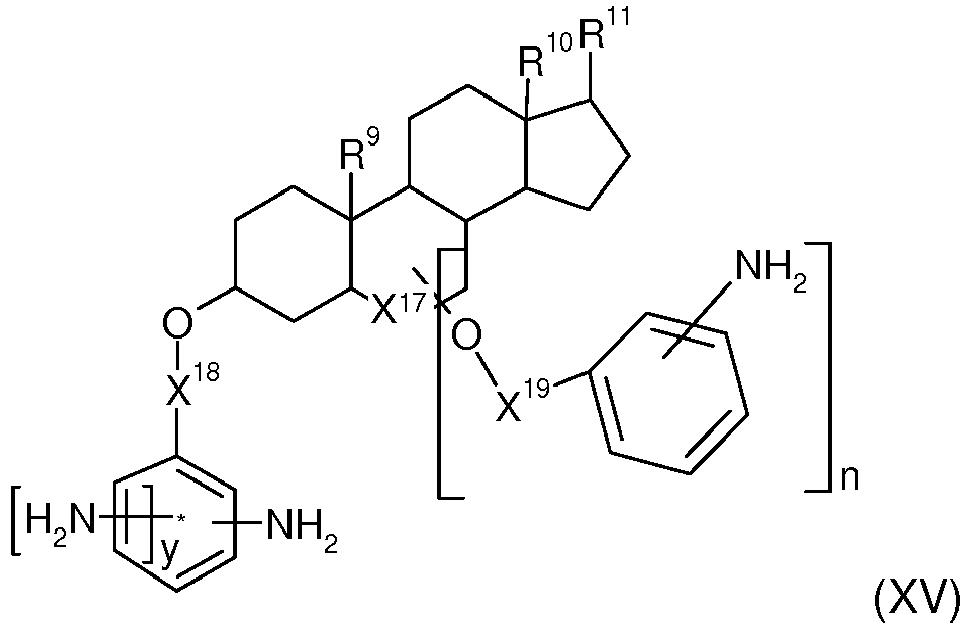
- R9, R10, R11 have independently from each other the above-described meaning, and R9 and R10 are C1-C30alkyl, and preferably methyl and R11 is 2-methylheptane and n is 0, if y is 1 and y is 0 if n is 1, and y1 is a single or a double bond, and X18 is carbonyl or a single bond or NH,
- wherein X17 is CH2, O, NH, and which are linked S1 or S2 or X in compound of formula (IV).
- The term "alkylen" as used above in D has the meaning of (C1-C24)alkylene, preferably (C1-C12)alkylene, which is branched, straight chain, substituted, unsubstituted, uninterrupted or interrupted by a linking group as defined above, and an alicyclic group, such as cyclohexylen or a C17-C40 alicyclic group, within the meaning and preferences as described above; or -Si(R3)2- or -O-Si(R3)2-, wherein R3 represents hydrogen, fluorine, chlorine, nitrile, unsubstituted or with fluorine substituted C1-C12alkyl, in which one or more C-atom, CH- or CH2- group may be replaced by a linking group; preferably hydrogen, methyl or fluorine, and more preferably hydrogen;.
- Further, preferred in the present invention is diamine group D (XV), wherein X12 is a substituted or unsubstituted aliphatic, alicyclic group, preferably


- Further preferred is, the diamine group D (VIII) is on of formula (VIII-1)

wherein the cyclohexyl group is linked to S1 or S2 or X in compound of formula (IV). - In addition preferred is the diamine group D (IX-1)

- X14 is a bridging group or a single bond and preferably -COO-, -CONH-; a single bond, -O-, -S-, methylen, ethylen, propylene, R9 and R10 are independently from each other hydrogen, halogen, hydroxyl, a carbocyclic or heterocyclic non-aromatic group or C1-C30alkyl;
- preferably X14 is a single bond, or, with CF3, OCF3, F, substituted or unsubstituted methylen, ethylen, propylene, butylen or pentylen and R9 and R10 are halogen or substituted or unsubstituted methylen, ethylen, propylene, and wherein at least one cyclohexyl group is linked to S1 or S2 or X in compound of formula (IV).
- Further preferred is the diamine D(X-1)


- wherein R11 has the meaning and preferences as given above,
- X15 and X16 are independently from each other a single bond or C1-C30alkyl, preferably C1-C6 alkyl, -COO- and -CONH-; -COO(C1-C6alkylene)-, -CONH(C1-C6alkylene)-, and wherein at least one phenyl group is linked to S1 or S2 or X in compound of formula (IV).
- Further preferred diamine compounds (X) are 1-hexa-decanoxy-2,4-diaminobenzene, 1-octadecanoxy-2,4-diaminobenzene, hexadecanoxy(3,5-diaminonbenzoyl), octadecanoxy(3,5-diaminobenzoyl).
- Preferably, the diamine group D (XI) is of formula (XI-1)

- wherein X6 has the meaning and preferences as given above, and is preferably for example -O-, -S- or substituted or unsubstituted C1-C6alkylen, -O-(CH2CH2O)n-; -O-(C1-C12alkyl)n-O-, -S-(C1-C12alkyl)n-S-, triazine, 1,3,5-triazinane-2,4,6-trione, 1,1'-cyclohexylene, NR5((C1-C6alkyl)nNR6), -(piperidine)n1-(C-)-C6alkyl)n-(piperidine)n, wherein n is an integer from 1 to 6, and n1 are an integer from 0 to 6,
- wherein R11, R12, R13 and R14 have independently from each other the meaning and preferences as given above, and wherein at least one phenyl group or X6 is linked to S1 or S2 or X in compound of formula (IV).
- Further preferred diamine group D (XI-1) is:


- More preferred are diamine group D (XI) given below:


- wherein n is independently from each other 0 or 1 and R3, R11, R11, X14 and X17 have the same meanings and preferences as given above, and wherein at least one phenyl group or cyclohexyl group or X17 is linked to S1 or S2 or X in compound of formula (IV);
and - further more preferred are diamine group (XI) 4,4'-diaminodiphenyl, 4,4'-diaminodiphenyl-3,3'-dimethoxy, 4,4'-diaminodiphenyl-3,3'-dimethyl, 4,4'-diaminodiphenyl-3,3'-dihydroxy, 4,4'-diamino-diphenylmethane, 4,4'-diaminodiphenylsulfide, 4,4'-diamino-diphenylsulfone, 4,4'-diaminodiphenylcarbonyl, 4,4'-diaminodiphenyl oxomethylene, 4,4'-diaminodiphenyl-bis(trifluoromethyl)-methylene, 4,4'-diaminodiphenyl-bis(trifluoromethyl)methylene-3,3'-dimethoxy or 4,4'-diaminodiphenyl-bis(trifluoromethyl)methylene-3,3'-dihydroxy, 4,4'-diaminodiphenyl ether, 4,4'-(p-pheny-leneiso-propylidene)bisaniline, 2,2-bis[4-(4-aminophenoxy)phenyl]-hexafluoro-propane, 2,2'-bis[4-4-amino-2-trifluoro-methyl-phenoxy-)phenyl)hexafluoropropane,4,4'-diamino-2,2'-bis/trifluoromethyl)-biphenyl, 4,4'-bis[4-amino-2-trifluoromethyl)phenoxy]-octafluorobiphenyl.
- Preferred are diamine groups D (XII) and (XIII), wherein X7 and X8, X9 and X10 or X11 are a single bond or C1-C30alkyl.
- Preferably, X7 and X8, X9 and X10 or X11 are independently from each other a single bond, -O-alkoxy-, such as -O-methylen-, methylen-O-; C1-C12alkylen such as methylene, ethylen, propylene, butylen, pentylen or hexylen, substituted or unsubstituted 1,1'-cyclohexylene, - SO-, -S-, -SO2-, -O-, -N(R25)-, -C(CH3)2-, -C(CF3)2-, 1,1'-cyclohexyl, substituted or unsubstituted 4-(C1-C30 alkyl)-cyclohexyl, substituted or unsubstituted 3,4"-bis[4'-(C1-C30alkyl)-1,1'-bi(cyclohexyl)-4-yl], 1,1'-bi(cyclohexyl)-4-yl, wherein
- R11 and R12 are indepently from each other preferably hydrogen, methyl, ethyl, propyl, butyl, pentyl or hexyl;
- preferably X10 is -SO-, -SO2-, -O-, -N(CH3)-, -C(CH3)2-, -C(CF3)2-, 1,1'-cyclohexyl, 4-(C1-C30 alkyl)-cyclohexyl, 3,4"-bis[4'-(C1-C30 alkyl)-1,1'-bi(cyclohexyl)-4-yl] or 1,1'-bi(cyclohexyl)-4-yl, and wherein X9 and X11 are identical and are methylene, ethylen, propylene, butylen, pentylen, hexylen or-O-;
- wherein n is an integer from 0 to 3, preferably, 0 or 1; and
- if n is 0 than X9 and X11 are identical and are methylene, ethylene, propylene, butylene, pentylene, hexylene, -0-; -S-, -C(CH3)2-, -C(CF3)2-.
- Further preferred diamine group D of (XII) is:


- Further preferred diamine group D of (XIII) are:
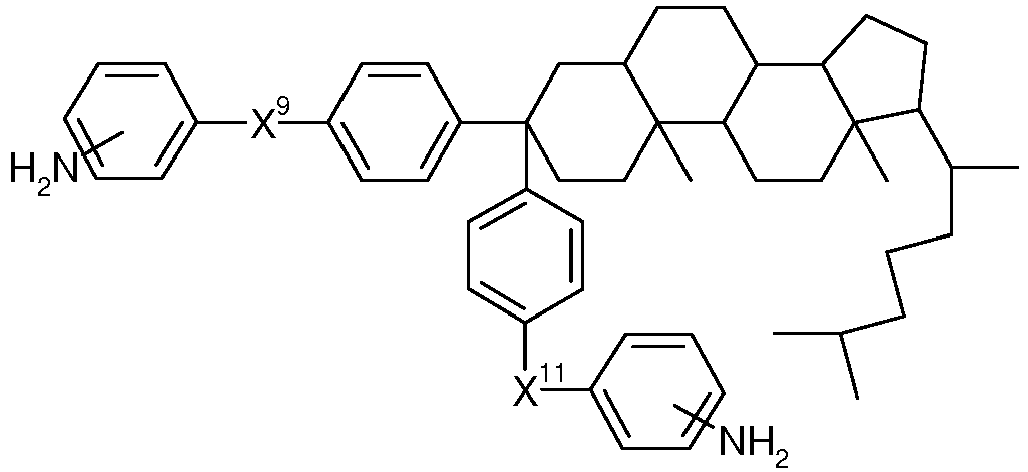


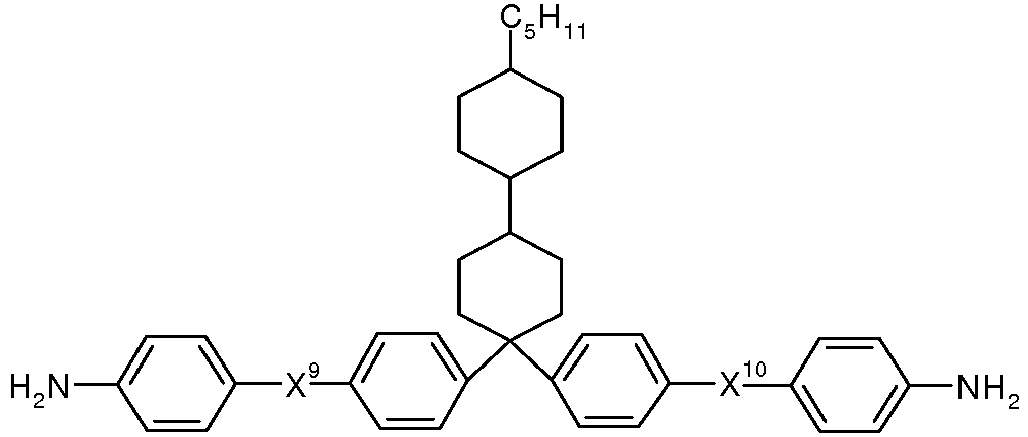

- Preferably the diamine group D (XIV) is 1,5-diaminonaphthalene, 2,7-diaminofluorene.
- Preferably the diamine group D (XV) is a compound as given below:


- Further, incorporated by reference are diamines as described in
EP-A-1,818,354 on page 10, lines 48 to 58 and on page 11, lines 1 to 19. - Preferably much more especially most preferred is a compound of formula (XVI),
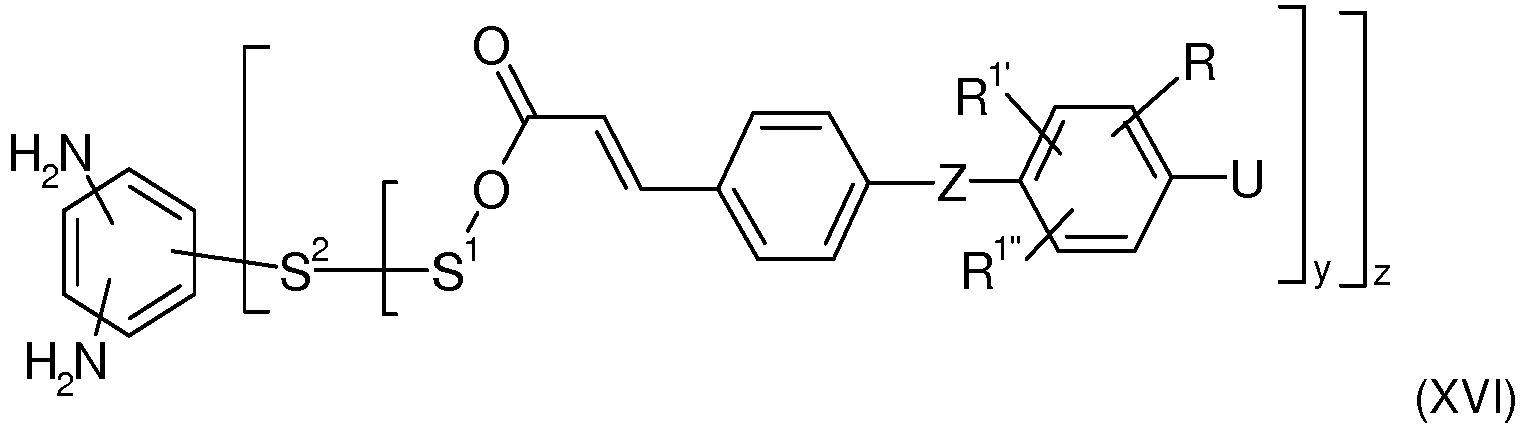
- S1, S2, Z, U, y and z have the above given meanings and preferences as given for compound (IV); and R, R1', R1" have independently from each other the meaning of hydrogen, fluorine, nitrile and/or chlorine, with the proviso that at least one R, R1' or R1" is not hydrogen;
- preferably R, and R1' have the above given meanings and preferences as given for compound (IVa); R1" has the above given meanings and preferences as given for R1" and R1'" in compound (IVa);
- Further, more preferably much more especially most preferred is a compound of formulae (XXVc), (XXVd), (XXVe), (XXVf), (XXVg), (XVIIII), (XIX)
and/or a photoalignment material, comprising a polymer having in a side chain at least one lateral-substituted portion represented by formulae (XXVc), (XXVd), (XXVe), (XXVf), (XXVg), (XVIIII), (XIX)
S1, S2, Z, U, y and z have independently from each other the meanings and preferences as given for compound (IV); and R1", R1'" have independently from each other the meaning of hydrogen, fluorine, nitrile and/or chlorine or U and preferences as given for compound (IVa), with the proviso that at least one R1" or R1'" is not hydrogen;


- S1, S2, y, z, Z and U have the above given meanings as described above for (IV) and preferably as described below for (XVIIa), (XVIIb), (XVIIc), (XVIId), (XVIIf) and
- R1', R1" have independently from each other the meaning of hydrogen, fluorine, nitrile and/or chlorine or U, preferably of hydrogen.
- Further, preferably much more especially most preferred is a compound of formula (XVIII),

- wherein U, S2, S1, Z, y and z have the meanings described above and preferably as described below for (XVIII) or (XIX); and
- R, R1', R1" have independently from each other the meaning of hydrogen, fluorine, nitrile and/or chlorine or U, with the proviso that at least one R1' or R1" is not hydrogen; and wherein X6 is a single bond or straight-chain or branched, substituted or unsubstituted C1-C6alkylen;
- wherein U, S2, S1, Z, y and z have the meanings described above and preferably as described below for (XVIII) or (XIX); and
- R, R1', R1" have independently from each other the meaning of hydrogen, fluorine, nitrile and/or chlorine or U, with the proviso that at least one R, R1', R1" is not hydrogen; and wherein X6 is a single bond or straight-chain or branched, substituted or unsubstituted C1-C6alkylen.
- Especially preferably much more especially most preferred is a compound of formulae (XVIIa)

- S1, S2, R1, R1', R1", Z and U have the above given meanings and preferences; and
- y and z are each independently from each other 1, 2, 3 or 4, preferably 1 or 2; more preferably y is 2 and z is 1; or z is 2 and y is 1; and further more preferably y and z are 1;
or - R1, R1', R1", Z and U have the above given meanings and preferences; and
- S1 and S2 each independently from each other represent a single bond or a straight-chain or branched, substituted, or unsubstituted C1-C12alkylen, preferably C1-C6alkylen, especially C1-C2alkylen, and further especially C4-C12alkylen; and in which one or more, preferably non-adjacent, C-atom, CH- or CH2-, group may be replaced by at least one linking group, wherein the linking group is preferred a single bond, -O-, -O(CO), -S-, -(CO)O-, -C≡C-, or

- S1, S2, R1, R1', R1", Z and U have the above given meanings and preferences; and
- y and z are each independently from each other 1, 2, 3 or 4, preferably 1 or 2; more preferably y is 2 and z is 1; or z is 2 and y is 1; and further more preferably y and z are 1; most preferred S1 and S2 each independently from each other represent a single bond or a straight-chain or branched, substituted, or unsubstituted C1-C12alkylen, preferably C1-C6alkylen, especially C1-C2alkylen, and further especially C4-C12alkylen; and in which one or more, preferably non-adjacent, C-atom, CH- or CH2-, group may be replaced by at least one linking group, wherein the linking group is preferred a single bond, -O-, -O(CO), -S-, -(CO)O-, -C≡C-, or

- R1, R1', R1", Z and U have the above given meanings and preferences; and
- most preferred S2 each independently from each other represent a single bond or a straight-chain or branched, substituted, or unsubstituted C1-C12alkylen, preferably C1-C6alkylen, especially C1-C2alkylen; and in which one or more, preferably non-adjacent, C-atom, CH- or CH2- group may be replaced by at least one linking group, wherein the linking group is preferred a single bond, -O-, -O(CO), -S-, -(CO)O-, -C≡C-, or
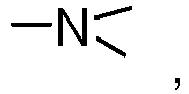
- wherein R1, R1', R1", Z and U have the above given meanings and preferences; and
- S1 and S2 each independently from each other represents a single bond or a spacer unit, which is a cyclic, straight-chain or branched, substituted or unsubstituted C1-C24alkylen, preferably C1-C12alkylen, more preferably C1-C6alkylen, such as methylen, ethylene, straight chain or branched propylene, butylene, pentylene or hexylene, in which one or more, preferably non-adjacent, C-atom, CH- or CH2- group may be replaced by at least one linking group, wherein the linking group is preferred a single bond, -O-, -O(CO), -S-, -(CO)O-, -C≡C-, or

-(Z1a')a3'-(Z1-C1)a1-(Z2-C2)a2-(Z1a)a3- (V)
wherein:- C1, C2 each independently represents an alicyclic or aromatic, unsubstituted or substituted carbocyclic or heterocyclic group, preferably C1 and C2 are connected at the opposite positions via the bridging groups Z1, Z2, Z1a and/or Z1a' so that groups S1 and/or S2 have a long molecular axis, and
Z1, Z2, Z1a, Z1a' each independently represents a bridging group within the above given meanings and preferences, and - a1, a3', a2 , a3 each independently represents an integer from 0 to 3, such that a1 + a3' + a2 + a3 ≤ 6, preferably a3 and or a3' is 1 and a1 + a2 ≤ 4,
- C1, C2 each independently represents an alicyclic or aromatic, unsubstituted or substituted carbocyclic or heterocyclic group, preferably C1 and C2 are connected at the opposite positions via the bridging groups Z1, Z2, Z1a and/or Z1a' so that groups S1 and/or S2 have a long molecular axis, and
- most preferred S1 and S2 each independently from each other represent a single bond or a straight-chain or branched, substituted, or unsubstituted C1-C12alkylen, preferably C1-C6alkylen, especially C1-C2alkylen, and further especially C4-C12alkylen; and in which one or more, preferably non-adjacent, C-atom, CH- or CH2-, group may be replaced by at least one linking group, wherein the linking group is preferred a single bond, -O-, -O(CO), -S-, -(CO)O-, -C≡C-, or

- y and z are each independently from each other 1, 2, 3 or 4, preferably 1 or 2; more preferably y is 2 and z is 1; or z is 2 and y is 1; and further more preferably y and z are 1; X6 is preferably a single bond or straight-chain or branched, substituted or unsubstituted C1-C6alkylen, preferably straight-chain or branched propylene, butylen, pentylene or hexylene which are linked once or twice with the side-chain, especially wherein propylene is linked once in the 2-position or twice in 2,2'-position and butylen is linked once or twice in the 2- and/or 3- position.
- More preferably much more especially most preferred is a compound having at least one lateral-substituted portion represented by formulae (XX), (XXI), (XXII), (XXIII), (XXIV), (XXV), (XXVa) or (XXVb) and/or a photoalignment material, comprising a polymer having in a side chain at least one lateral-substituted portion represented by formulae (XX), (XXI), (XXII), (XXIII), (XXIV), (XXV), (XXVa) or (XXVb)


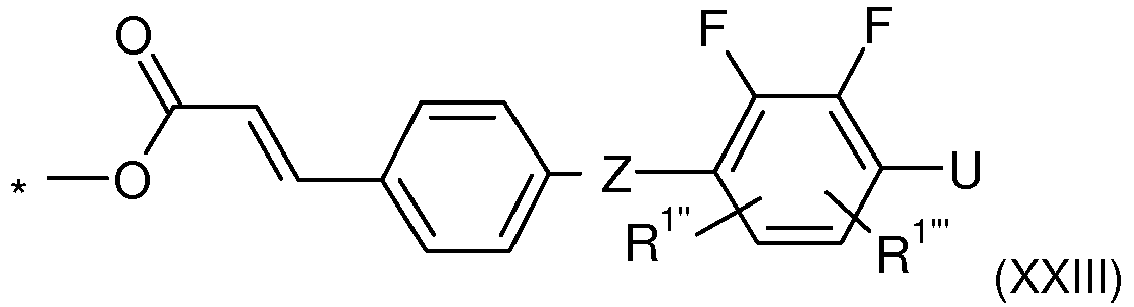


- U, Z, have independently from each other the meanings and preferences as described above, and
- R1', R1" and R1'" have independently from each other the meaning of hydrogen, fluorine, nitrile and/or chlorine, preferably R1', R1" are hydrogen, and P1'" is hydrogen, fluorine, nitrile and/or chlorine,
- U, Z, have independently from each other the meanings and preferences, and Z is preferably -OCO-,
-OCH2- or a single bond. In a further preferred embodiment Z is -OCH2- or a single bond, and - R1" and R1'" have independently from each other the meaning of hydrogen, , fluorine, nitrile and/or chlorine, with the proviso that at least one R1" or R1'" is not hydrogen.
- Also further preferred are polymer having in a side chain at least one lateral-substituted portion represented by formulae (XXII), (XXIV), (XXV), (XXVa) or (XXVb).
- Further, the present invention relates to a method for the preparation of a polymer, which comprises bringing into contact, preferably polymerising, the compounds, especially monomeric compounds of the invention, comprising at least one lateral-substituted portion represented by formula (I), optionally in the presence of a solvent.
- Solvents which are used in the context of the present invention are
aprotic or protic polar solvents γ-butyrolactone, dimethylsulfoxide, N,N-dimethylacetamide, chlorobenzene, diethylene glycol diethyl ether, toluene, chloroform, chlorobenzene, diethylene glycol diethyl ether, diisobutylketone, methyl cellosolve, butyl cellosolve, butyl carbitol, tetrahydrofuran, N-methyl-2-pyrrolidone, N,N-dimethylformamide, methylethylketon (MEK), 1-methoxypropylacetat (MPA), alcohols, especially 1-methoxypropanol (MP). Preferred are aprotic polar solvents, especially γ-butyrolactone, N,N-dimethylacetamide, N-methyl-2-pyrrolidone, or N,N-dimethylformamide, methylethylketon (MEK), 1-methoxypropylacetat (MPA). - The polymer, especially the polyamic acid, polyamic acid ester and polyimide and mixtures thereof may be prepared in line with known methods, such as those described in Plast. Eng. 36 (1996), (Polyimides, fundamentals and applications), Marcel Dekker, Inc. and in WO
WO2007/071091 , on page 64 second paragraph to page 68, line 29.
Preferred is a method, wherein a polyamic acid, polyamic acid ester and polyimide and mixtures thereof is prepared by a reaction comprising bringing into contact at least one tetracarboxylic dianhydride with at least one monomeric compound of the invention comprising at least one lateral-substituted portion represented by formula (I), having as polymerizable group two diamino groups diamino, and - In general, the polyamic acid, polyamic acid ester and polyimide and mixtures thereof is prepared by polycondensation and dehydration reaction, which can be conducted in one process steps or in two.
Usually, at least one monomeric compound of the invention comprising at least one lateral-substituted portion represented by formula (I), comprising a polymerisable group, which is diamino is polycondensated with at least one tetracarboxylic dianhydride, whereby in preferably a polyamic acid or polyamic acid ester is formed, and then dehydrated, whereby preferably the corresponding polyimide or mixture of polyamic acid, polyamic acid ester and polyimide is formed. - More preferably, the present invention relates to a method, wherein subsequent to the polycondensation, cyclisation with removal of water is carried out thermally under formation of a polyimide.
More preferably, the present invention relates to a method, wherein imidisation is carried out prior or after the application of the polymer, copolymer or oligomer to a support, where preferably the irradiation with aligning light took place. - In the context of the present invention the term "polyimide" has the meaning of partially or completely imidisated polyamic acid or polyamic ester. In analogy, the term "imidisation" has in the context of the present invention the meaning of partially or complete imidisation.
- Examples of material that may be used for the dehydration are for example acetic anhydride, trifluoroacetic anhydride or propionic anhydride. Examples of material that may be used for the ring-disclosure catalyst may include for example trimethylamine, pyridine or collidine.
A polyamic acid ester is obtained by reacting for example the above polyamic acid with an organic halide, alcohol or phenol. - The tetracarboxylic dianhydride used in the present invention is not particularly limited, and represents for examples a compound of formula (XXIII)

- T
- represents a tetravalent organic radical.
- The tetravalent organic radical T is preferably derived from an aliphatic, alicyclic or aromatic tetracarboxylic acid dianhydride.
- Preferred aliphatic or alicyclic tetracarboxylic acid dianhydrides or mixtures thereof are:1,1,4,4-butanetetracarboxylic acid dianhydride, ethylenemaleic acid dianhydride, 1,2,3,4-cyclobutanetetracarboxylic acid dianhydride,1,2,3,4-cyclopentanetetracarboxylic acid dianhydride, 2,3,5-tricarboxycyclopentylacetic acid dianhydride, exo-2,3,5-tricarboxy cyclopentyl acetic acid dianhydride, mixture containing at least 90% exo-2,3,5-tricarboxy cyclopentyl acetic acid dianhydride, tetrahydro-4,8-methanofuro[3,4-d]oxepine-1,3,5,7-tetrone, 3-(carboxymethyl)-1,2,4-cyclopentanetricarboxylic acid 1,4:2,3-dianhydride, hexahydrofuro[3',4':4,5]cyclopenta[1,2-c]pyran-1,3,4,6-tetrone, 3,5,6-tricarboxy-norbornylacetic acid dianhydride, 2,3,4,5-tetrahydrofurantetra-carboxylic acid dianhydride,rel-[1S,5R,6R]-3-oxabicyclo[3.2.1]octane-2,4-dione-6-spiro-3'-(tet rahydrofuran2',5'-dione), 4-(2,5-dioxotetrahydrofuran-3-yl)tetrahydronaphthalene--1,2-dicarboxylicacid dianhydride, 5-(2,5-dioxotetrahydrofuran-3-yl)-3-methyl-3-cyclohexene--1,2-dicarboxylic-acid dianhydride, bicyclo[2.2.2]oct-7-ene-2,3,5,6-tetracarboxylic acid dianhydride, bicyclo[2.2.2]octane-2,3,5,6-tetracarboxylic acid dianhydride, 1,8-dimethylbicyclo[2.2.2]oct-7-ene-2,3,5,6-tetracarboxylic acid dianhydride, pyromellitic acid dianhydride,3,3',4,4'-benzophenonetetracarboxylic acid dianhydride, 4,4'-oxydiphthalic acid dianhydride, 3,3',4,4'-diphenylsulfonetetracarboxylic acid dianhydride, 1,4,5,8-naphthalenetetracarboxylic acid dianhydride, 2,3,6,7-naphthalenetetracarboxylic acid dianhydride, 3,3',4,4'-dimethyldiphenylsilanetetracarboxylic acid dianhydride, 3,3',4,4'-tetraphenylsilanetetracarboxylic acid dianhydride,1,2,3,4-furantetracarboxylic acid di anhydride, 4,4'-bis(3,4-dicarboxyphenoxy)diphenyl sulfide dianhydride, 4,4'-bis(3,4-dicarboxyphenoxy)-diphenyl sulfone dianhydride, 4,4'-bis(3,4-dicarboxyphenoxy)-diphenylpropane dianhydride, 3,3',4,4'-biphenyltetracarboxylic acid dianhydride, ethylene glycol bis(trimellitic acid) dianhydride,4,4'-(1,4-phenylene)bis(phthalic acid) dianhydride, 4,4'-(1,3-phenylene)bis(phthalic acid) dianhydride, 4,4'-(hexafluoroisopropylidene)diphthalic acid dianhydride, 4-tert-butyl-6-(2,5-dioxotetrahydro-3-furanyl)-2-benzofuran-1,3-dione, 5-(2,5-dioxotetrahydro-3-furanyl)-3a,4,5,9b-tetrahydronaphtho[1,2-c]furan-1,3-dione, 5-(2,5-dioxotetrahydro-3-furanyl)-5-methyl-3a,4,5,9b-tetrahydronaphtho[1,2-c]furan-1,3-dione, 5-(2,5-dioxotetrahydro-3-furanyl)-6-methylhexahydro-2-benzofuran-1,3-dione, 5-(2,5-dioxotetrahydro-3-furanyl)-7-methyl-3a,4,5,7a-tetrahydro-2-benzofuran-1,3-dione, 6-(2,5-dioxotetrahydro-3-furanyl)-4-methylhexahydro-2-benzofuran-1,3-dione, 9-isopropyloctahydro-4,8-ethenofuro[3',4':3,4]cyclobuta[1,2-f][2]benzofuran-1,3,5,7-tetrone, 1,2,5,6-cyclooctanetetracarboxylic acid dianhydride, octahydro-4,8-ethenofuro[3',4':3,4]cyclobuta[1,2-f][2]benzofuran-1,3,5,7-tetrone, octahydrofuro[3',4':3,4]cyclobuta[1,2-f][2]benzofuran-1,3,5,7-tetrone, tetrahydro-3,3'-bifuran-2,2',5,5'-tetrone, 4,4'-oxydi(1,4-phenylene)bis(phthalic acid) dianhydride, and 4,4'-methylenedi(1,4-phenylene)bis(phthalic acid) dianhydride.
- Preferred examples of aromatic tetracarboxylic acid dianhydrides are:
- pyromellitic acid dianhydride,
- 3,3',4,4'-benzophenonetetracarboxylic acid dianhydride,
- 4,4'-oxydiphthalic acid dianhydride,
- 3,3',4,4'-diphenylsulfonetetracarboxylic acid dianhydride,
- 1,4,5,8-naphthalenetetracarboxylic acid dianhydride,
- 2,3,6,7-naphthalenetetracarboxylic acid dianhydride,
- 3,3',4,4'-dimethyldiphenylsilanetetracarboxylic acid dianhydride,
- 3,3',4,4'-tetraphenylsilanetetracarboxylic acid dianhydride,
- 1,2,3,4-furantetracarboxylic acid dianhydride,
- 4,4'-bis(3,4-dicarboxyphenoxy)diphenyl sulfide dianhydride,
- 4,4'-bis(3,4-dicarboxyphenoxy)diphenyl sulfone dianhydride,
- 4,4'-bis(3,4-dicarboxyphenoxy)diphenylpropane dianhydride,
- 3,3',4,4'-biphenyltetracarboxylic acid dianhydride,
- ethylene glycol bis(trimellitic acid) dianhydride,
- 4,4'-(1,4-phenylene)bis(phthalic acid) dianhydride,
- 4,4'-(1,3-phenylene)bis(phthalic acid) dianhydride,
- 4,4'-(hexafluoroisopropylidene)diphthalic acid dianhydride,
- 4,4'-oxydi(1,4-phenylene)bis(phthalic acid) dianhydride,
- 4,4'-methylenedi(1,4-phenylene)bis(phthalic acid) dianhydride,
- 4-tert-butyl-6-(2,5-dioxotetrahydro-3-furanyl)-2-benzofuran-1,3-dione,
- and the like.
- More preferably the tetracarboxylic acid dianhydrides used to form the tetravalent organic radical T are selected from:
- 1,2,3,4-cyclobutanetetracarboxylic acid dianhydride,
- 1,2,3,4-cyclopentanetetracarboxylic acid dianhydride,
- 2,3,5-tricarboxycyclopentylacetic acid dianhydride,
- tetrahydro-4,8-methanofuro[3,4-d]oxepine-1,3,5,7-tetrone,
- 3-(carboxymethyl)-1,2,4-cyclopentanetricarboxylic acid 1,4:2,3-dianhydride,
- hexahydrofuro[3',4':4,5]cyclopenta[1,2-c]pyran-1,3,4,6-tetrone,
- 5-(2,5-dioxotetrahydrofuran-3-yl)-3-methyl-3-cyclohexene-1,2-dicarboxylic acid dianhydride, pyromellitic acid dianhydride,
- 4-(2,5-dioxotetrahydrofuran-3-yl)tetrahydronaphthalene-1,2-dicarboxylic acid dianhydride,
- 5-(2,5-dioxotetrahydro-3-furanyl)-5-methyl-3a,4,5,9b-tetrahydronaphtho[1,2-c]furan-1,3-dione,
- 5-(2,5-dioxotetrahydro-3-furanyl)-3a,4,5,9b-tetrahydronaphtho[1,2-c]furan-1,3-dione,
- 5-(2,5-dioxotetrahydro-3-furanyl)-7-methyl-3a,4,5,7a-tetrahydro-2-benzofuran-1,3-dione,
- 4-tert-butyl-6-(2,5-dioxotetrahydro-3-furanyl)-2-benzofuran-1,3-dione,
- 4,4'-(hexafluorineoisopropylidene)diphthalic acid dianhydride and
- bicyclo[2.2.2]oct-7-ene-2,3,5,6-tetracarboxylic acid dianhydride.
- More preferably the tetracarboxylic acid dianhydrides used to form the tetravalent organic radical T are selected from:
- 1,2,3,4-cyclobutanetetracarboxylic acid dianhydride,
- 1,2,3,4-cyclopentanetetracarboxylic acid dianhydride,
- 2,3,5-tricarboxycyclopentylacetic acid dianhydride, exo-2,3,5-tricarboxy cyclopentyl
- acetic acid dianhydride, mixture containing at least 90% exo-2,3,5-tricarboxy cyclopentyl
- acetic acid dianhydride; tetrahydro-4,8-methanofuro[3,4-d]oxepine-1,3,5,7-tetrone,
- 3-(carboxymethyl)-1,2,4-cyclopentanetricarboxylic acid 1,4:2,3-dianhydride,
- hexahydrofuro[3',4':4,5]cyclopenta[1,2-c]pyran-1,3,4,6-tetrone,
- 5-(2,5-dioxotetrahydrofuran-3-yl)-3-methyl-3-cyclohexene-1,2-dicarboxylic acid dianhydride,
- pyromellitic acid dianhydride,4-(2,5-dioxotetrahydrofuran-3-yl)tetrahydronaphthalene-1,2-dicarboxylic acid dianhydride,
- 5-(2,5-dioxotetrahydro-3-furanyl)-5-methyl-3a,4,5,9b-tetrahydronaphtho[1,2-c]furan-1,3-dione,
- 5-(2,5-dioxotetrahydro-3-furanyl)-3a,4,5,9b-tetrahydronaphtho[1,2-c]furan-1,3-dione,
- 5-(2,5-dioxotetrahydro-3-furanyl)-7-methyl-3a,4,5,7a-tetrahydro-2-benzofuran-1,3-dione,
- 4-tert-butyl-6-(2,5-dioxotetrahydro-3-furanyl)-2-benzofuran-1,3-dione,
- 4,4'-(hexafluoroisopropylidene)diphthalic acid dianhydride and
- bicyclo[2.2.2]oct-7-ene-2,3,5,6-tetracarboxylic acid dianhydride.
- In addition, the present invention relates to compositions, preferably a blend or/and a formulation, comprising a photoalignment material or a polymer according to the invention having in a side chain at least one lateral-substituted portion represented by formula (I), or obtained according to the method of the invention or prepared according to the method of the invention and/or at least one compound comprising at least one lateral-substituted portion represented by formula (I). Preferred compositions of the invention comprise
- optionally at least two different tetracarboxylic dianhydrides and compound (I) as described above and within the given preferences, wherein the polymerizable groups are amine; or/and
- optionally at least two different compounds (I) as described above and within the given preferences, and wherein preferably the polymerizable group is amine, preferably two amine groups;
- optionally compound (I) as described above and within the given preferences, wherein the polymerizable groups are amine, and at least one further diamine of the present invention which is not linked to a side chain of formula (I). Preferably, instead of the link to the side chain (I) the diamine is saturated at this potential linking position with hydrogen, optionally solvents as described above, or/and
- optionally additives as described below.
- More preferred compositions of the invention are formulation comprising solvents within the description and preferences as given below, however not limited to them, especially in addition additives within the description and preferences as given below are comprised.
- Further, the compositions of the present invention optionally comprise additives such as cross-linking agents, such as epoxy-, acrylate-, methacrylate- agents such as for example the photoalignment additives as disclosed in
US 2009/0290109 ; or additives selected from the following group: 4,4'-methylene-bis-(N,N-diglycidylaniline), trimethylolpropane triglycidyl ether, benzene-1,2,4,5-tetracarboxylic acid 1,2,4,5-N,N'-diglycidyldiimide, polyethylene glycol diglycidyl ether and N,N-diglycidylcyclohexylamine. - Preferably, the composition of the invention comprises 0.5% to 99% by weight of photoalignment material having in a side chain at least one lateral-substituted portion represented by formula (I) and 99.5 to 1% by weight of an organic solvent. Preferably, the composition comprise 0.5 to 40% by weight and more preferably 0.5 to 10% by weight and most preferably 0.5 to 5% by of photoalignment material having in a side chain at least one lateral-substituted portion represented by formula (I).
- In addition, the present invention relates to polymers, preferably a copolymers comprising a polymer having in a side chain at least one lateral-substituted portion represented by formula (I), and/or a compound comprising at least one lateral-substituted portion represented by formula (I), Preferred copolymers of the invention comprise
- at least two different tetracarboxylic dianhydrides and compound (I) as described above and within the given preferences, wherein the polymerizable group is amine; or/and
- at least two different compounds (I) as described above and within the given preferences, and wherein preferably the polymerizable group is amine, preferably two amine groups;
- compound (I) as described above and within the given preferences, wherein the polymerizable group is amine, and at least one further diamine of the present invention which is not linked to a side chain of formula (I). Preferably, instead of the link to the side chain (I) the diamine is saturated at this potential linking position with hydrogen.
- In a further embodiment the present invention relates to a photoalignment material, preferably a polymer having in a side chain at least one lateral-substituted portion represented by formula (I), which is obtainable by the methods and the preferred methods as described above.
- The polymers according to the invention may be used in form of polymer layers, preferably the photoalignment layer or especially the orientation layer, alone or in combination with other polymers, oligomers, monomers, photo-active polymers, photo-active oligomers and/or photo-active monomers, depending upon the application to which the polymer or oligomer layer is to be added. Therefore it is understood that by varying the composition of the polymer layer it is possible to control specific and desired properties, such as an induced pre-tilt angle, good surface wetting, a high voltage holding ratio or a specific anchoring energy.
- In the context of the present invention the wording polymer layer has the meaning of oligomer, homopolymer or copolymer layer.
- Further the present invention relates to a polymer layer, especially an orientation layer, comprising at least one photoalignment material having in a side chain at least one lateral-substituted portion represented by formula (I) as described in in the invention, or comprising at least one polymer obtained or prepared as described in the invention, or a polymer layer as prepared as described in the invention.
- Polymer layers may readily be prepared from the polymers or oligomers of the present invention and a further embodiment of the invention relates to a polymer layer comprising a polymer according to the present invention, which is preferably prepared by treatment with aligning light.
- Preferably, the present invention relates to a method for the preparation of a polymer layer, especially an orientation layer, comprising applying photoalignment material, or a polymer obtained or prepared as described in the invention, or a composition of the invention, to a support, and treating it with aligning light.
- The polymer layer is preferably prepared by applying one or more polymers according to the invention to a support and, after imidisation or without imidisation, treating the polymer or composition comprising the polymer by irradiation with aligning light.
- The treatment with aligning light may be conducted in a single step or in several separate steps. In a preferred embodiment of the invention the treatment with aligning light is conducted in a single step.
- In the context of the present invention, aligning light is light of wavelengths, which can initiate photoalignment. Preferably, the wavelengths are in the UV-A, UVB and/or UV/C-range, or in the visible range. It depends on the photoalignment compound, which wavelengths are appropriate. Preferably, the photo-reactive groups are sensitive to visible and/or UV light. A further embodiment of the invention concerns the generating of aligning light by laser light.
- The instant direction of the aligning light may be normal to the substrate or at any oblique angle.
- For generating tilt angles, preferably the aligning light is exposed from oblique angles.
- More preferably, aligning light is at least partially linearly polarized, elliptically polarized, such as for example circularly polarized, or non-polarized; most preferably at least circularly or partially linearly polarized light, or non-polarized light exposed obliquely. Especially, most preferred aligning light denotes substantially polarised light, especially linearly polarised light; or aligning light denotes non-polarised light, which is applied by an oblique irradiation.
- In a more preferred embodiment of the invention the polymer, copolymer or oligomer is treated with polarised light, especially linearly polarised light, or by oblique radiation with non-polarised light.
- In general, the support is a transparent support such as glass or plastic substrates, optionally coated with indium tin oxide (ITO) is used.
- Further, it is possible to vary the direction of orientation and the tilt angle within the polymer layer by controlling the direction of the irradiation of the aligning light. It is understood that by selectively irradiating specific regions of the polymer layer very specific regions of the layer can be aligned. In this way, layers with a defined tilt angle can be provided. The induced orientation and tilt angle are retained in the polymer layer by the process, especially by the process of crosslinking.
- Further preferred methods of the invention relates to
- a method for the preparation of a polymer layer, which are vertically aligned;
- a method for the preparation of multi-domain vertical alignment of a polymer layer;
- a method for the preparation of a polymer layer with tilted optical axis.
- A further embodiment of the present invention concerns a polymer layer, in particular orientation layer, comprising at least one photoalignment material having in a side chain at least one lateral-substituted portion represented by formula (I) as described above or obtained as described above.
- Polymer layer comprising at least one photoalignment material having in a side chain at least one lateral-substituted portion represented by formula (I) as described above.
It is understood that the polymer layers of the present invention (in form of a polymer gel, a polymer network, a polymer film, etc.) can also be used as orientation layers for liquid crystals. A further preferred embodiment of the invention relates to an orientation layer comprising one or more polymers or oligomers according to the invention, preferably in a cross-linked form. Such orientation layers can be used in the manufacture of unstructured or structured optical-or electro-optical elements, preferably in the production of hybrid layer elements.
In addition, the present invention concerns a method for the preparation of a polymer, wherein one or more polymers, copolymers or oligomers according to the present invention is applied to a support, preferably from a solution of the polymer or oligomer material and subsequent evaporation of the solvent, and wherein, after any imidisation step which may be necessary, the polymer or oligomer or polymer composition treated with aligning light, and preferably isomerized and/or cross-linked by irradiation with aligning light.
A preferred method of the present invention concerns a method, wherein the direction of orientation and the tilt angle within the polymer layer is varied by controlling the direction of the irradiation with aligning light, and/or wherein by selectively irradiating specific regions of the polymer layer specific regions of the layer are aligned.
The orientation layers are suitably prepared from a solution of the photoalignment material. The polymer solution is applied to a support optionally coated with an electrode [for example a glass plate coated with indium-tin oxide (ITO)] so that homogeneous layers of 0.05 to 50 µm thickness are produced. In this process different coating techniques like spin-coating, meniscus-coating, wire-coating, slot-coating, offset-printing, flexo-printing, gravure-printing may be used. Then, or optionally after a prior imidisation step, the regions to be oriented are irradiated, for example, with a high-pressure mercury vapor lamp, a xenon lamp or a pulsed UV laser, using a polarizer and optionally a mask for creating images of structures.
Further, the present invention concerns the use of a polymer layer according to the present invention, preferably in cross-linked form, as an orientation layer for liquid crystals.
Further, the present invention concerns preferably the use of a polymer layer for the induction of vertical alignment of adjacent liquid crystalline layers, in particular for operating a cell in MVA mode.
The irradiation time is dependent upon the output of the individual lamps and can vary from a few seconds to several hours. The photo-reaction (dimerization, polymerisation, cross-linking) can also be carried out, however, by irradiation of the homogeneous layer using filters that, for example, allow only the radiation suitable for the cross-linking reaction to pass through. - In addition, the present invention relates to the use of a photoalignment material as described in the present invention, or a polymer having in a side chain at least one lateral-substituted portion represented by formula (I) or as prepared as described in claims 1, 8, for the preparation of a polymer layer, especially an orientation layer.
- Further the present invention relates to the use of the polymer layer as described in the present invention, or prepared as described in the present invention, or the photoalignment material as described in the present invention, for the preparation of optical and electro-optical unstructured or structured constructional elements, preferably liquid crystal display cells, security devices, multi-layer and hybrid layer elements.
- It is understood that the polymer layers of the invention may be used in the production of optical or electro-optical devices having at least one orientation layer as well as unstructured and structured optical elements and multi-layer systems.
- The present invention concerns the use of a polymer layer as an orientation layer for liquid crystals. Preferred is the use for the induction of vertical alignment of adjacent liquid crystalline layers.
- A further embodiment of the invention relates to an optical or electro-optical device comprising one or more polymers or oligomers according to the present invention. Especially, the present invention relates to optical and electro-optical unstructured or structured constructional elements, preferably liquid crystal display cells, security devices, multi-layer and hybrid layer elements, comprising at least one polymer layer as described in the present invention, or prepared as described in the present invention, or comprising at least one the photoalignment material as described in the present invention.
The electro-optical devices may comprise more than one layer.
Further, the present invention relates to electro-optical unstructured or structured constructional elements, as described in the present invention, which is a liquid crystal display cell, comprising at least one polymer layer as described in the present invention, or prepared as described in the present invention, or comprising at least one the photoalignment material as described in the present invention.
The layer, or each of the layers may contain one or more regions of different spatial orientation. - The present invention the wording optical or electro-optical elements has for example the meaning of multilayer systems, or devices for the preparation of
a display waveguide, a security or brand protection element, a bar code, an optical grating, a filter, a retarder, a compensation film, a reflectively polarizing film, an absorptive polarizing film, an anisotropically scattering film compensator and retardation film, a twisted retarder film, a cholesteric liquid crystal film, a guest-host liquid crystal film, a monomer corrugated film, a smectic liquid crystal film, a polarizer, a piezoelectric cell, a thin film exhibiting non linear optical properties, a decorative optical element, a brightness enhancement film, a component for wavelength-band-selective compensation, a component for multi-domain compensation, a component of multiview liquid crystal displays, an achromatic retarder, a polarization state correction / adjustment film, a component of optical or electro-optical sensors, a component of brightness enhancement film, a component for light-based telecommunication devices, a G/H-polarizer with an anisotropic absorber, a reflective circular polarizer, a reflective linear polarizer, a MC (monomer corrugated film), liquid crystal displays, preferably twisted nematic (TN) liquid crystal displays, (RTN) reverse TN, (VATN), (VECB), hybrid aligned nematic (HAN) liquid crystal displays, electrically controlled birefringence (ECB) liquid crystal displays, supertwisted nematic (STN) liquid crystal displays, optically compensated birefringence (OCB) liquid crystal displays, pi-cell liquid crystal displays, in-plane switching (IPS) liquid crystal displays, fringe field switching (FFS) liquid crystal displays, vertically aligned (VA), preferably (MVA = multidomain vertical alignment), liquid crystal displays ; all above display types are applied in either transmissive or reflective or transflective mode. - The advantages of the present invention could not be foreseen by a skilled person.
It has surprisingly been found that the introduction of a lateral substituted group into a peripheral position of the polymer side groups having specific molecular architecture plays a predominant role in obtaining MVA materials having optimized properties, such as the required high voltage holding ratios, the adjustable pre-tilt angles required for the MVA mode and their stability to light and heat.
Especially , it was found that with the new photoaligning material of this invention the respective desired changes in pretilt angles of liquid crystal is achieved, without disturbing the parameters set for UV exposure energy and incidence angle, Therefore, time consuming modifications of the production line are not needed. - Definitions used in the examples:
Mass spectroscopy EI = EI (electron-impact)
1H NMR = 1H nuclear magnetic resonance spectroscopy
DMSOd6 = dimethylsulfoxid deutererd
300MHz = 300 Megaherz
M+ = MolecularMass of the cation
m = multiplett
d = douplet
dd = double douplet
t = triplett
s = sigulett
q = quintett
br = broad
HCI = hydrogen chloride
NaOH = sodium hydroxid
NMP = N-methyl-2-pyrrolidone
THF = tetrahydrofuran
Pretilt = tilt of liquid crystalDiamine structure Analytical datas 4-{(1E)-3-[2-(2,4-diaminophenyl)ethoxy]-3-oxoprop-1-enyl}phenyl 2-fluoro-4-(4,4,4-trifluorobutoxy)benzoate Masse spectroscopy EI 546.5 M+ Compound 6 4-{(1E)-3-[2-(2,4-diaminophenyl)ethoxy]-3-oxoprop-1-enyl}phenyl 3-fluoro-4-(4,4,4-trifluorobutoxy)benzoate 1H NMR DMSO d6 300MHz 7.98 (m, 2H), 7.94 (d, 2H), 7.84 (d, 1H), 7.72 (m, 3H), 6.67 (d, 1H), 6.61 (dd, 1H), 5.90 (d, 1H), 5.82 (dd, 1H), 4.65 (s, 2H), 4.58 (s, 2H), 4.26 (t, 2H), 4.16 (t, 2H), 2.69 (t, 2H), 2.49 (m, 2H), 2.04 (m, 2H). Compound 10 4-[(1 E)-3-({6-[(3,5-diaminobenzoyl)oxy]hexyl}oxy)-3-oxoprop-1-enyl]phenyl 2,3-difluoro-4-(pentyloxy)benzoate Masse spectroscopy EI 624.7 M+ Compound 12 Polymer structure Analytical datas Polyamic acid 1 1H NMR DMSO d6 300MHz 12.36 (br, 2H), 10.05 (m, 1H), 9.52 (m, 1H), 8.11 (br, 1H), 7.81-6.85 (m, 10H), 6.69 (d, 1H), 4.25 (br, 2H), 4.16 (br, 2H), 3.43-2.49 (m, 10H), 2.45 (m, 2H), 1.96 (m, 2H). Polyamic acid 2 1H NMR DMSO d6 300MHz 12.38 (br, 2H), 10.05 (m, 1H), 9.52 (m, 1H), 7.95-7.18 (m, 11H), 6.64 (d, 1H), 4.24 (br, 4H), 3.43-2.49 (m, 10H), 2.44 (m, 2H), 1.95 (m, 2H). Polyamic acid 4 1H NMR DMSO d6 400MHz 12.48 (s, 2H), 10.33 (s, 2H), 8.31 (m, 1H), 8.05-7.80 (m, 5H), 7.68 (dd, 1H), 7.32 (d, 2H), 7.19 (t, 1H), 6.65 (dd, 1H), 4.27 (br, 2H), 4.17 (t, 4H), 3.88-3.61 (m, 4H), 1.76 (m, 6H), 1.36 (m, 8H), 0.88 (t, 3H). - Preparation of 6-hydroxyhexyl-3,5-dinitrobenzoate and 2-(2,4-dinitrophenyl)ethanol is prepared according to the process described in
WO 2007/071091 A1 pages 79 and 92 which is herewith incorporated by reference. - 464.5g (1.95 mol) of 4-iodo-1,1,1-trifluorobutane, 267.6g (1.95 mol) of 4-nitrile-3-fluorophenol and 539.5g (3.90 mol) of potassium carbonate are dissolved in 3L of NMP. The mixture is heated to 80°C overnight. The solution is cooled to room temperature and the reaction mixture is extracted with ethyl acetate and water. The organic phase is washed repeatedly with water, dried over sodium sulfate, filtrated and concentrated under reduced pressur to give 503g of compound 1.
- 61.8g (250.0 mmol) of compound 1, 150mL of sulphuric acid, 600mL of acetic acid and 400 mL of hydrochloric acid are heated to reflux for 2 days. The mixture is cooled down and poured on 2.5L of water. The solid is filtrated and washed with water. The solid is dried under vacuum to give 53.4g of compound 2.
- 5.0g (18.7 mmol) of compound 2, 2.29g (18.78 mmol) of 4-hydroxybenzaldehyde, 0.23g (1.88 mmol) of 4-dimethylaminopyridine are dissolved in 25mL of dichloromethane. 3.88g (18.78 mmol) of dicyclohexylcarbodiimide (DCC) is added at 0°C. The solution is stirred for 1h at 0°C and allowed to stir at room temperature overnight. After 22 hours at room temperature, the reaction mixture is partitioned between dichloromethane and water. The organic phase is washed repeatedly with water, dried over sodium sulfate, filtrated and concentrated under reduced pressur to give 6.92g of compound 3.
- 6.92g (18.68 mmol) of compound 3 and 3.32g (31.93 mmol) of malonic acid are dissolved in 15mL of pyridine. 0.78mL (9.39 mmol) of pyrrolidine is added to the suspension which is allowed to react at 90°C under argon for 2.5h. The yellow solution is then thrown on ice. The solution is carefully acidified to pH=1-2 with 25% HCI solution and is stirred for 15min. The product is filtrated off and dried at room temperature under vacuum to give 7.75g of compound 4.
- 2.50g (11.8 mmol) of 2-(2,4-dinitrophenyl)ethanol, 4.86g (11.8 mmol) of compound 4, 144 mg (1.2 mmol) of 4-dimethylaminopyridine are dissolved in 30 mL of dichloromethane. 2.48g (13.0 mmol) of N-(3-dimethylaminopropyl)-N'-ethylcarbodiimide hydrochloride (EDC hydrochloride) are added at 0°C. The solution is stirred for 1h at 0°C and allowed to stir at room temperature overnight. After 22 hours at room temperature, the reaction mixture is partitioned between dichloromethane and water. The organic phase is washed repeatedly with water, dried over sodium sulfate, filtrated and concentrated under reduced pressur. Chromatography of the residue on 200g silica gel using toluene: ethyl acetate 95:5 as eluent and crystallization from ethyl acetate: hexane mixture yielded 5.08g (71%) of compound 5 as colorless crystals.
- 5.8g (8.38 mmol) of compound 5 are dissolved in a mixture of 54mL of N,N-dimethylformamide and 6mL water. 13.9g (51.4 mmol) ferric chloride hexahydrate are added. 5.60g (85.7 mmol) zinc powder is added portion wise within 60 minutes. The mixture is allowed to react for 2 hours. The reaction mixture is partitioned between ethyl acetate and water and filtrated. The organic phase is washed repeatedly with water, dried over sodium sulfate, filtrated and concentrated under reduced pressur.Filtration of the residue on 200g silica gel using toluene:ethyl acetate 1:3 as eluent and crystallization from ethyl acetate:hexane mixture yielded 3.30g of compound 6 as colorless crystals.
- 16.57 g (109.7 mmol) of bromopentane, 20g (109.7 mmol) of methylvanillate and 30.30g (219 mmol) of potassium carbonate are dissolved in 200mL of NMP. The mixture is heated to 80°C overnight. 100mL (100 mmol) of a 1N NaOH solution was added to the above mixture. The suspension is heated at reflux temperature for 30 min until the reaction is completed. The reaction mixture is allowed to cool at room temperature and thrown in cold water. The solution is carefully acidified with a 25% HCI solution and is stirred for 15 min. The product is filtrated off, washed with water and dried overnight at room temperature under vacuum to give 23.90g (97%) of compound 7 as a white solid.
- 19.09g (109.7 mmol) of 2,3-difluoro-4-hydroxybenzoic acid is refluxed in 500mL of methanol with 2 drops of sulphuric acid for 22h. The solvent is evaporated under vacuum. To the residue is added 16.57 g (109.7 mmol) of bromopentane, 30.30g (219 mmol) of potassium carbonate and 200mL of NMP. The mixture is heated to 80°C overnight. 100mL (100 mmol) of a 1N NaOH solution was added to the above mixture. The suspension is heated at reflux temperature for 30 min until the reaction is completed. The reaction mixture is allowed to cool at room temperature and thrown in cold water. The solution is carefully acidified with a 25% HCI solution and is stirred for 15 min. The product is filtrated off, washed with water and dried overnight at room temperature under vacuum to give 25.72g (96%) of compound 8 as a white solid.
- 4.37g (28.00 mmol) of 3-fluoro-4-hydroxybenzoic acid is refluxed in 100mL of methanol with 2 drops of sulphuric acid for 22h. The solvent is evaporated under vacuum. To the residue is added 6.66g (28.00 mmol) of 4-iodo-1,1,1-trifluorobutane, 11.84g (85.00 mmol) of potassium carbonate and 50mL of NMP. The mixture is heated to 80°C overnight. 40mL (40 mmol) of a 1N NaOH solution was added to the above mixture. The suspension is heated at reflux temperature for 30 min until the reaction is completed. The reaction mixture is allowed to cool at room temperature and thrown in cold water. The solution was carefully acidified with a 25% HCI solution and is stirred for 15 min. The product is filtrated off, washed with water and dried overnight at room temperature under vacuum to give 5.91g (79%) of compound 9 as a white solid.
- The 4-formylphenyl compounds 3A, 3B, 3C bearing respectively compounds 7, 8, 9 as ester substituents are prepared according to the process described in example 3 for compound 3 with the proviso that compound 2 is replaced by compound 7, respectively compound 8, respectively compound 9:
- 4-formylphenyl 3-methoxy-4-(pentyloxy)benzoate 3A
- 4-formylphenyl 2,3-difluoro-4-(pentyloxy)benzoate 3B
- 4-formylphenyl 3-fluoro-4-(4,4,4-trifluorobutoxy)benzoate 3C
- The cinnamic acid compounds 4A, 4B, 4C are prepared according to the process described in example 4 for compound 4 with the proviso that compound 3 is replaced by compound 3A, respectively compound 3B, respectively compound 3C:
- (2E)-3-(4-{[3-methoxy-4-(pentyloxy)benzoyl]oxy}phenyl)prop-2-enoic acid 4A
- (2E)-3-(4-{[2,3-difluoro-4-(pentyloxy)benzoyl]oxy}phenyl)prop-2-enoic acid 4B
- (2E)-3-(4-{[3-fluoro-4-(4,4,4-trifluorobutoxy)benzoyl]oxy}phenyl)prop-2-enoic acid 4C
- The dinitro compounds 5A, 5B, 5C are prepared according to the process described in example 5 for compound 5 with the proviso that compound 4 is replaced by compound 4A and 2-(2,4-dinitrophenyl)ethanol is replaced by 6-hydroxyhexyl-3,5-dinitrobenzoate, respectively compound 4B and 2-(2,4-dinitrophenyl)ethanol is replaced by 6-hydroxyhexyl-3,5-dinitrobenzoate, respectively compound 4C:
- 4-[(1E)-3-({6-[(3,5-dinitrobenzoyl)oxy]hexyl}oxy)-3-oxoprop-1-enyl]phenyl 3-methoxy-4-(pentyloxy)benzoate 5A
- 4-[(1E)-3-({6-[(3,5-dinitrobenzoyl)oxy]hexyl}oxy)-3-oxoprop-1-enyl]phenyl 2,3-difluoro-4-(pentyloxy)benzoate 5B
- 4-{(1E)-3-[2-(2,4-dinitrophenyl)ethoxy]-3-oxoprop-1-enyl}phenyl 3-fluoro-4-(4,4,4-trifluorobutoxy)benzoate 5C
- Compound 11 is prepared according to the process described in example 6 for compound 6 with the proviso that compound 5 is replaced by compound 5A.
Compound 12 is prepared according to the process described in example 6 for compound 6 with the proviso that compound 5 is replaced by compound 5B.
Compound 10 is prepared according to the process described in example 6 for compound 6 with the proviso that compound 5 is replaced by compound 5C. - 0.820g (3.66 mmol) of 2,3,5-tricarboxycyclopentylacetic-1,2:3,4-dianhydride is added to a solution of 2.000g (3.66 mmol) of compound 6 in 6.56mL of NMP. Stirring is then carried out at 0°C for 2 hours. The mixture is subsequently allowed to react for 21 hours at room temperature. The polymer mixture is diluted with 18mL of THF, precipitated into 800mL of water to yield, after drying at room temperature under vacuum, 2.76g of polyamic acid 1 in the form of a white powder: [h] = 0.21dL/g
- Analogous to Example 10 the following diamines are used for the preparation of polyamic acid with 2,3,5-tricarboxycyclopentylacetic-1,2:3,4-dianhydride.
- yield Polyamic acid 2 as white powder; [η] = 0.22 dL/g
- yield Polyamic acid 7 as white powder; [η] = 0.26 dL/g
- yield Polyamic acid 8 as white powder; [η] = 0.27 dL/g
- Analogous to Example 10 the following diamines are used for the preparation of polyamic Acid with 1,2,3,4-cyclobutantetracarboxylic acid dianhydride.
- yield Polyamic acid 5 as white powder; [η] = 0.28 dL/g
- yield Polyamic acid 6 as white powder; [η] = 0.29 dL/g
- yield Polyamic acid 3 as white powder; [η] = 0.33 dL/g
- yield Polyamic acid 4 as white powder; [η] = 0.40 dL/g
- Analogous to Example 10 the following tetracarboxylic acid dianhydride mixture are used for the preparation of Polyamic acid with compound 6.
A mixture of 1,2,3,4-cyclobutantetracarboxylic acid dianhydride and 2,3,5-tricarboxycyclopentylacetic-1,2:3,4-dianhydride 25:75 (mole ratio) yield Polyamic acid 9 as white powder; [η] = 0.31 dL/g - 0.50 g of Polyamic Acid 3 obtained in above Example 12 are dissolved in 3 ml of 1-methyl-2-pyrrolidon (NMP). Thereto are added 0.28 g (3.57 mmol, 4 equivalent) of pyridine and 364 mg (3.57 mmol, 4 equivalent) acetic acid anhydride, and the dehydration and ring closure is carried out at 80°C for 2 h. The polymer mixture is diluted with 1.5 ml NMP, precipitated into 100 ml diethyl ether and collected by filtration. The polymer is reprecipitated from THF (10 ml) into 200 ml water to yield, after drying at room temperature under vacuum, 0.45 g Polyimide 1; [η] = 0.31 dL/g, Imidization degree ID=100%
- Analogous to the polymerization step of Example 12 the following polyamic acids are used for the preparation of partially imidizated polyimide. The imidization degree is adjusted with the ratio of acetic acid anhydride and pyridine.
Polyamic acid 3 with 1.2 equivalent acetic acid anhydride and pyridine yield Polyimide 2 as white powder; [η] = 0.33 dL/g, ID=35 %. - A liquid crystal cell is prepared wherein the liquid crystal is aligned by photo reactive Polyamic acid 1.
A 4% solution of Polyamic acid 1 is prepared by mixing the solid Polyamic acid 1 in the solvent N-methyl-2-pyrrolidone(NMP) and stirred thoroughly till the solid Polyamic acid 1 is dissolved and a second solvent butyl cellulose(BC) is added and the whole composition is stirred thoroughly to obtain final solution. The solvent ratio between N-methyl-2-pyrrolidone and butyl cellulose is 1:1. The above polymer solution is spin-coated onto the two ITO coated glass substrates at a spin speed of 1200rpm for 30seconds. After spin coating the substrates are subjected to baking procedure consisting of pre-baking for 5 minutes at 130°C and post-baking for 40 minutes at a temperature of 200°C.The resulting layer thickness is around 70nm. - The substrates with the coated polymer layer on top are exposed to linearly polarized UV light(LPUV) at an incidence angle of 40° relative to the normal of the substrate surface. The plane of polarization is within the plane spanned by the substrate normal and the propagation direction of the light. The applied exposure dose is 48mJ/cm2.
After LPUV exposure, a cell is assembled with the two substrates, the exposed polymer layers facing to the inside of the cell. The substrates are adjusted relative to each other such that the induced alignment directions are parallel to each other(corresponds to the antiparallel rubbed configuration in case of alignment by rubbing procedure). The cell is filled using vacuum process with liquid crystal MLC6610(Merck KGA), which has a negative dielectric anisotropy. The liquid crystal in the cell shows well defined homeotropic orientation. A tilt angle of 87.86° is measured using the crystal rotation method. - Another liquid crystal cell is prepared in the same manner as describe in example 15, except that Polyamic acid 2 is used instead of Polyamic acid 1 which has lateral substitution in a different direction and spin speed of 1250rpm for 30seconds is used.
Pretilt is measured in the same manner as in example 15, which is 88.40°. - Another liquid crystal cell is prepared in the same manner as describe in example 15, except that Polyamic acid 3 is used and spin speed of 1600rpm for 30seconds is used.
Pretilt is measured in the same manner as in Example 15, which is 88.96°. - Another liquid crystal cell is prepared in the same manner as describe in example 15, except that Polyamic acid 4 is used and spin speed of 1750rpm for 30seconds is used.
Pretilt is measured in the same manner as in example 15, which is 88.34°. This shows that with liquid crystal cell processing conditions after alignment layer coating step remaining the same, the pretilt can be modified by different lateral substitutions on polymer. - 3.6 g (10.83 mmol) 4,4'-Dinitro-1,1'-biphenyl-2,2'-dicarboxylic acid are dissolved in 25 ml tetrahydrofuran and added drop wise in a the course of 1 hours to 65 ml (65.02 mmol) of a borane-tetrahydrofuran complex 1.0 M solution in tetrahydrofuran. After 19 hours at 25°C , 50 ml water are carefully added. After 1h the solution is acidified to pH=1-2 with 10 ml 1N HCI solution and allowed to stirred for 30 min. The reaction mixture is then partitioned between ethyl acetate and water; the organic phase is washed repeatedly with water, dried over sodium sulfate, filtered and concentrated by rotary evaporation. The residue, 4.2 g of 4,4'-Dinitro-1,1'-biphenyl-2,2'-dimethanol as white powder is used without further purification.
- 20g (106.5mmol) of 2,4-dinitrotoluene is solubilised in 280mL of NMP. To the brown solution is added 7.6g (255.6mmol) of paraformaldehyde. To the suspension is added 597mg (5.32mmol) of potassium tetra butoxyde. The resulting solution is stirred overnight at RT. The mixture was poured on 200mL ice, and neutralized with 2mL of HCI 25%. The reaction mixture is then partitioned between ethyl acetate and water; the organic phase is washed repeatedly with water, dried over sodium sulfate, filtered and concentrated by rotary evaporation. The solution is precipitate at RT by adding 150mL of heptane. The product is filtrated and dried under vacuum at RT. The product is isolate 16.15g as a slightly yellow product.
- 8.48g (27.9 mmol) of 4,4'-Dinitro-1,1'-biphenyl-2,2'-dimethanol, 23.0g (55.7 mmol) of compound 5, 170mg (1.4 mmol) of 4-dimethylaminopyridine are dissolved in 100 mL of dichloromethane. 8.64g (55.7 mmol) of N-(3-dimethylaminopropyl)-N'-ethylcarbodiimide hydrochloride (EDC hydrochloride) are added at 0°C. The solution is stirred for 1h at 0°C and allowed to stir at room temperature overnight. After 22 hours at room temperature, the reaction mixture is partitioned between dichloromethane and water. The organic phase is washed repeatedly with water, dried over sodium sulfate, filtrated and concentrated under reduced pressur. Chromatography of the residue on 200g silica gel using toluene:ethyl acetate 95:5 as eluent and crystallization from ethyl acetate:hexane mixture yielded 21g (71%) of compound 21 as colourless crystals.
- 6.75g (27.9 mmol) of 2-(2,4-dinitrophenyl)-propan-1,3-diol, 23.0g (55.7 mmol) of compound 5, 170mg (1.4 mmol) of 4-dimethylaminopyridine are dissolved in 100 mL of dichloromethane. 8.64g (55.7 mmol) of N-(3-dimethylaminopropyl)-N'-ethylcarbodiimide hydrochloride (EDC hydrochloride) are added at 0°C. The solution is stirred for 1h at 0°C and allowed to stir at room temperature overnight. After 22 hours at room temperature, the reaction mixture is partitioned between dichloromethane and water. The organic phase is washed repeatedly with water, dried over sodium sulfate, filtrated and concentrated under reduced pressur. Chromatography of the residue on 200g silica gel using toluene: ethyl acetate 95:5 as eluent and crystallization from ethyl acetate: hexane mixture yielded 21.3g (74%) of compound 22 as colorless crystals.
- 9.15g (8.38 mmol) of compound 21 are dissolved in a mixture of 54mL of N,N-dimethylformamide and 6mL water. 13.9g (51.4 mmol) ferric chloride hexahydrate are added. 5.60g (85.7 mmol) zinc powder is added portion wise within 60 minutes. The mixture is allowed to react for 2 hours. The reaction mixture is partitioned between ethyl acetate and water and filtrated. The organic phase is washed repeatedly with water, dried over sodium sulfate, filtrated and concentrated under reduced pressur.Filtration of the residue on 200g silica gel using toluene:ethyl acetate 1:3 as eluent and crystallization from ethyl acetate:hexane mixture yielded 6.05g of compound 23 as colourless crystals.
- 8.63g (8.38 mmol) of compound 22 are dissolved in a mixture of 54mL of N,N-dimethylformamide and 6mL water. 13.9g (51.4 mmol) ferric chloride hexahydrate are added. 5.60g (85.7 mmol) zinc powder is added portionwise within 60 minutes. The mixture is allowed to react for 2 hours. The reaction mixture is partitioned between ethyl acetate and water and filtrated. The organic phase is washed repeatedly with water, dried over sodium sulfate, filtrated and concentrated under reduced pressur. Filtration of the residue on 200g silica gel using toluene:ethyl acetate 1:3 as eluent and crystallization from ethyl acetate:hexane mixture yielded 6.50g of compound 24 as colourless crystals.
- 0.277g (1.24 mmol) of 2,3,5-tricarboxycyclopentylacetic-1,2:3,4-dianhydride is added to a solution of 1.20g (1.24 mmol) of compound 24 in 3.51 mL of NMP. Stirring is then carried out at 0°C for 2 hours. The mixture is subsequently allowed to react for 21 hours at room temperature. The polymer mixture is diluted with 25mL of THF, precipitated into 800mL of water to yield, after drying at room temperature under vaccum, 1.1g of polyamic acid 25 in the form of a white powder: [h] = 0.19dUg
- Analogous to Example 25 the following diamine is used for the preparation of polyamic acid with 2,3,5-tricarboxycyclopentylacetic-1,2:3,4-dianhydride.
- yield Polyamic acid 26 as white powder; [η] = 0.48 dL/g
4-((1E)-3-{[4,4'-diamino-2'-({[(2E)-3-(4-{[2-fluoro-4-(4,4,4-trifluorobutoxy)benzoyl]oxy}phenyl)prop-2-enoyl]oxy}methyl)-1,1'-biphenyl-2-yl]methoxy}-3-oxoprop-1-enyl)phenyl 2-fluoro-4-(4,4,4-trifluorobutoxy)benzoate 1H NMR 300MHz DMSO d6: 8.04 (d, 2H), 7.75 (m, 4H), 7.64 (d, 2H), 7.29 (d, 4H), 6.97 (m, 4H), 6.71 (d, 2H), 6.60 (dd, 2H), 6.54 (d, 2H), 6.53 (m, 2H), 5.15 (s, 4H), 4.83 (s, 4H), 4.17 (t, 4H), 2.43 (m, 4H), 1.97 (m, 4H Compound 23 4-[(1E)-3-(2-(2,4-diaminophenyl)-3-{[(2E)-3-(4-{[2-fluoro-4-(4,4,4-trifluorobutoxy)benzoyl]oxy}phenyl)prop-2-enoyl]oxy}propoxy)-3-oxoprop-1-enyl]phenyl4-(4,4,4-trifluorobutoxy)-2-fluorobenzoate 1H NMR 300MHz DMSO d6: 7.96 (t, 2H), 7.72 (d, 4H), 7.66 (d, 2H), 7.24 (d, 4H), 7.01 (dd, 2H), 6.93 (dd, 2H), 6.72 (d, 1H), 6.65 (d, 2H), 5.95 (d, 1H), 5.89 (dd, 1H), 4.81 (s, 2H), 4.69 (s, 2H), 4.37 (br, 4H), 4.17 (t, 4H), 3.44 (q, 1H), 2.44 (m, 4H), 1.99 (m, 4H). Compound 24 polyamic acid 25 1H NMR 300MHz DMSO d6: 12.39 (s, 2H), 10.11 (m, 1H), 9.64 (m, 1H), 7.95 (s, 2H), 7.71 (m, 9H), 7.24 (s, 4H), 6.88 (m, 4H), 6.57 (m, 2H), 4.45 (m, 4H), 4.13 (s, 4H), 3.72 (s, 1H), 3.43-2.49 (m, 8H), 2.42 (m, 4H), 1.95 (m, 4H). polyamic acid 26 1H NMR 300MHz DMSO d6: 12.42 (s, 2H), 10.21 (m, 2H), 8.02-7.70 (m, 12H), 7.27-7.02 (m, 10H), 6.55 (m, 2H), 4.96 (s, 4H), 4.15 (s, 4H), 3.43-2.49 (m, 8H), 2.42 (m, 4H), 1.95 (m, 4H). - Another liquid crystal cell is prepared in the same manner as describe in example 15, except that Polyamic acid 25 is used and spin speed of 1500rpm for 30seconds is used.
Pretilt was measured in the same manner as in Example 15, which was 88.05°. - This compound is prepared according to the process described in example 7 for compound 7 with the proviso that bromopentane is replaced by 4-iodo-1,1,1-trifluorobutane.
- This compound is prepared according to the process described in example 3 for compound 3 with the proviso that compound 2 is replaced by compound 28.
- This compound is prepared according to the process described in example 4 for compound 4 with the proviso that compound 3 is replaced by compound 29.
- This compound is prepared according to the process described in example 5 for compound 5B with the proviso that compound 4B is replaced by compound 30.
- This compound is prepared according to the process described in example 6 for compound 6 with the proviso that compound 5B is replaced by compound 31.
- This compound is prepared according to the process described in example 7 for compound 7 with the proviso that bromopentane is replaced by 5-iodo-1,1,1,2,2-pentafluoropentane and methyl vanillate is replaced by ethyl 3,4-dihydroxybenzoate.
- This compound is prepared according to the process described in example 3 for compound 3 with the proviso that compound 2 is replaced by compound 33.
- This compound is prepared according to the process described in example 4 for compound 4 with the proviso that compound 3 is replaced by compound 34.
- This compound is prepared according to the process described in example 5 for compound 5 with the proviso that compound 4 is replaced by compound 35.
- This compound is prepared according to the process described in example 6 for compound 6 with the proviso that compound 5 is replaced by compound 36.
- This compound is prepared according to the process described in example 1 for compound 1 with the proviso that 4-iodo-1,1,1-trifluorobutane is replaced by 5-iodo-1,1,1,2,2-pentafluoropentane.
- This compound is prepared according to the process described in example 2 for compound 2 with the proviso that compound 1 is replaced by compound 38.
- This compound is prepared according to the process described in example 3 for compound 3 with the proviso that compound 2 is replaced by compound 39.
- This compound is prepared according to the process described in example 4 for compound 4 with the proviso that compound 3 is replaced by compound 40.
- This compound is prepared according to the process described in example 5 for compound 5 with the proviso that compound 4 is replaced by compound 41.
- This compound is prepared according to the process described in example 6 for compound 6 with the proviso that compound 5 is replaced by compound 42.
- 3.0g (11.3 mmol) of 2-fluoro-4-(4,4,4-trifluorobutoxy)benzoic acid is refluxed in 40mL of methanol with 2 drops of sulphuric acid for 22h. The solvent is evaporated under vacuum. The crude material is used without further purification.
- 3.13g (11.2 mmol) of compound 44 in 40mL of THF is cooled to 0°C. To the solution is added 8.8mL of LiAIH4 THF solution. After 3 hours, the solution is quenched by addition of 20 mL HCl 1N. The product is extracted with AcOEt, washed with 200mL of water. The organic phase is dried over sodium sulphate, and the solvent is removed under vaccum to afford 2.32g of compound 45 as orange oil.
- 2.00 g (7.93 mmol) of compound 45 and 3.42g (10.31 mmol) of CBr4 are solved in 20mL of THF. To the solution is added 2.70g (10.31 mmol) of triphenylphosphine. After 1 hour, the mixture is filtrated over a plug of silica gel and eluted with a mixture of AcOEt/hexane 1/1. The excess of solvent is removed under vaccum to afford 2.28g of compound 46 as a colourless oil.
- 0.66 g (2.09 mmol) of compound 46, 0.32g (2.30 mmol) of K2CO3 and 0.25g (2.30 mmol) of 4-hydroxybenzaldehyde are mixed in 10mL of NMP. The mixture is heated to 65°C for 1 hour. The solution is poured on 100mL of HCI 0.1N. The solid is filtrated and dried under vaccum to give compound 47.
- This compound is prepared according to the process described in example 4 for compound 4 with the proviso that compound 3 is replaced by compound 47
- This compound is prepared according to the process described in example 5 for compound 5 with the proviso that compound 4 is replaced by compound 48.
- This compound is prepared according to the process described in example 6 for compound 6 with the proviso that compound 5 is replaced by compound 49.
- This compound is prepared according to the process described in example 1 for compound 1 with the proviso that 3-fluoro-4-hydroxybenzonitrile is replaced by 2,3-difluorophenol.
- 5.0g (20.8 mmol) of compound 51 is solved in 58mL of THF and cooled to -78°C. To this solution is added dropwise 7.71mL (20.8 mmol) of a solution of BuLi in hexane. After 3 hours a mixture of 2.84mL (24.98 mmol) of trimethylborate in 20mL THF is added to the previous solution. After addition the solution is stirred overnight at room temperature. The mixture is quenched by addition of 20ml HCl 1N. The resulting emulsion is treated by addition of 10mL of concentrated HCI. The mixture is stirred for two hours. The organic phase is extracted with ethyl acetate, washed with water, dried over sodium sulphate. The excess of solvent is removed under vaccum to give 5.3g of compound 52 as a brown solid.
- 5.3g (18.66 mmol) of compound 52, 3.4g (18366 mmol) of 4-bromobenzaldehyde and 862mg (0.74mmol) of tetrakis (triphenylphosphine) palladium are mixed in 90mL of toluene. The mixture is degassed and purged with argon. The reaction is heated to 50°C and 90mL of Na2CO3 2M is slowly added. The reaction is heated to 90°C and stirred for 2 days. After cooling to room temperature, the mixture is quenched with 50mL HCI 25%. The organic phase is extracted with ethyl acetate and dried over sodium sulfate. The excess of solvent is removed under vaccum. The product 53 is purified by flash chromatography on silica gel with a mixture of toluene/AcOEt 98/2.
- This compound is prepared according to the process described in example 4 for compound 4 with the proviso that compound 3 is replaced by compound 53.
- This compound is prepared according to the process described in example 5 for compound 5 with the proviso that compound 4 is replaced by compound 54.
- This compound is prepared according to the process described in example 6 for compound 6 with the proviso that compound 5 is replaced by compound 55.
- This compound is prepared according to the process described in example 5 for compound 5 with the proviso that compound 2,4-dinitrophenethanol is replaced by 3,5-dinitrobenzylalcohol.
- This compound is prepared according to the process described in example 6 for compound 6 with the proviso that compound 5 is replaced by compound 57.
- Analogous to Example 10 the following diamines are used for the preparation of polyamic acid with 2,3,5-tricarboxycyclopentylacetic-1,2:3,4-dianhydride.
- yield Polyamic acid 60 as white powder; [η] = 0.24 dUg
- yield Polyamic acid 61 as white powder; [η] = 0.28 dUg
- yield Polyamic acid 62 as white powder; [η] = 0.25 dUg
- yield Polyamic acid 63 as white powder; [η] = 0.21 dUg
- yield Polyamic acid 64 as white powder; [η] = 0.32 dUg
- Analogous to Example 10 the following diamines are used for the preparation of polyamic Acid with 1,2,3,4-cyclobutantetracarboxylic acid dianhydride.
- yield Polyamic acid 59 as white powder; [η] = 0.38 dUg
Diamine structure Analytical datas 2-(2,4-diaminophenyl)ethyl (2E)-3-(4-{[2-fluoro-4-(4,4,4-trifluorobutoxy)benzyl]oxy}phenyl)prop-2-enoate compound 50 1H NMR CDCl3 300MHz 7.67 (d, 1H), 7.50 (d, 2H), 7.38 (t, 1H), 7.01 (d, 2H), 6.85 (d, 1H), 6.69 (m, 2H), 6.35 (d, 1H), 6.10 (dd, 1H), 6.09 (d, 1H), 5.09 (s, 2H), 4.32 (t, 2H), 4.03 (t, 2H), 3.70 (br, 4H), 2.83 (t, 2H), 2.34 (m, 2H), 2.07 (m, 2H). 4-{(1 E)-3-[(3,5-diaminobenzyl)oxy]-3-oxoprop-1-enyl}phenyl2-fluoro-4-(4,4,4-trifluorobutoxy)benzoate compound 58 1H NMR 300MHz DMSO d6: 8.05 (t, 1H), 7.84 (d, 2H), 7.71 (d, 1H), 7.32 (d, 2H), 7.00 (m, 2H), 6.68 (d, 1H), 5.82 (d, 2H), 5.78 (t, 1H), 4.93 (s, 2H), 4.76 (s, 2H), 4.19 (t, 2H), 2.45 (m, 2H), 2.00 (m, 2H) 2-(2,4-diaminophenyl)ethyl (2E)-3-[2',3'-difluoro-4'-(4,4,4-trifluorobutoxy)-1,1'-biphenyl-4-yl]prop-2-enoate Compound 56 1H NMR 300MHz DMSO d6: 7.82 (d, 2H), 7.69 (d, 1H), 7.59 (d, 2H), 7.36 (m, 1H), 7.14 (m, 1H), 6.69 (d, 1H), 6.61 (d, 1H), 5.90 (d, 1H), 5.82 (dd, 1H), 4.65 (s, 2H), 4.58 (s, 2H), 4.22 (m, 4H), 2.69 (t, 2H), 2.45 (m, 2H), 2.00 (m, 2H) 4-{(1 E)-3-[2-(2,4-diaminophenyl)ethoxy]-3-oxoprop-1-enyl}phenyl 2-fluoro-4-[(4,4,5,5,5-pentafluoropentyl)oxy]benzoate Compound 43 1H NMR 300MHz DMSO d6: 8.04 (t, 1H), 7.84 (d, 2H), 7.71 (d, 1H), 7.34 (d, 2H), 7.09 (dd, 1H), 7.01 (dd, 1H), 6.66 (d, 1H), 6.62 (d, 1H), 5.90 (d, 1H), 5.82 (dd, 1H), 4.66 (s, 2H), 4.58 (s, 2H), 4.21 (t, 2H), 4.19 (t, 2H), 2.69 (t, 2H), 2.34 (m, 2H), 2.01 (m, 2H) 4-{(1E)-3-[2-(2,4-diaminophenyl)ethoxy]-3-oxoprop-1-enyl}phenyl 3,4-bis[(4,4,5,5,5-pentafluoropentyl)oxy]benzoate Compound 37 Masse spectroscopy 755.1 (MH+) ESI+ 813.2 (M+AcO-) ESI- 4-[(1E)-3-({6-[(3,5-diaminobenzoyl)oxy]hexyl}oxy)-3-oxoprop-1-enyl]phenyl 3-methoxy-4-(4,4,4-trifluorobutoxy)benzoate Compound 32 Masse spectroscopy 658.4 (M+) ESI+ Polymer structure Analytical datas Polyamic acid 59 1H NMR 400MHz DMSO d6: 12.35 (s, 2H), 10.73 (s, 2H), 8.32 (br, 1H), 7.98 (br, 2H), 7.76 (br, 3H), 7.69 (d, 1H), 7.58 (s, 1H), 7.31 (br, 2H), 7.14 (d, 1H), 6.65 (br, 1H), 4.15 (m, 6H), 3.85 (br, 1H), 3.84 (s, 3H) 3.61 (m, 4H), 2.42 (m, 2H), 1.99 (m, 2H), 1.74 (m, 5H), 1.43 (br, 4H) Polyamic acid 60 1H NMR 400MHz DMSO d6: 12.35 (s, 2H), 10.05 (br, 1H), 9.50 (br, 1H), 7.90-7.00 (br, 11H), 6.59 (br, 1H), 4.25 (br, 2H), 4.14 (br, 4H), 3.63-2.49 (m, 10H), 2.45 (m, 4H), 1.96 (m, 4H). Polyamic acid 61 1H NMR 400MHz DMSO d6: 12.35 (s, 2H), 10.05 (br, 1H), 9.50 (br, 1H), 8.04 (s, 1H), 7.90-7.16 (m, 8H), 7.06 (d, 2H), 6.60 (br, 1H), 4.20 (br, 4H), 3.66-2.49 (m, 10H), 2.45 (m, 2H), 1.96 (m, 2H). Polyamic acid 62 1H NMR 300MHz DMSO d6: 12.36 (br, 2H), 10.05 (m, 1H), 9.52 (m, 1H), 8.11 (br, 1H), 7.81-6.85 (m, 10H), 6.69 (d, 1H), 5.07 (s, 2H), 4.25 (br, 2H), 4.16 (br, 2H), 3.43-2.49 (m, 10H), 2.45 (m, 2H), 1.96 (m, 2H). Polyamic acid 63 1H NMR 300MHz DMSO d6: 12.33 (s, 2H), 10.05 (br, 1H), 9.50 (br, 1H), 7.82-7.7.08 (m, 7H), 6.66 (br, 1H), 4.20 (br, 4H), 3.66-2.49 (m, 10H), 2.45 (m, 2H), 1.96 (m, 2H). Polyamic acid 64 1H NMR 300MHz DMSO d6: 12.40 (br, 2H), 10.08 (m, 2H), 8.11-7.60 (br, 5H), 7.43 (m, 4H), 7.01 (m, 2H), 6.69 (m, 1H), 5.05 (s, 2H), 4.16 (br, 2H), 3.43-2.49 (m, 8H), 2.45 (m, 2H), 1.96 (m, 2H). - Analogous to Example 10 the following mixture of diamine is used for the preparation of polyamic Acid with 1,2,3,4-cyclobutantetracarboxylic acid dianhydride.
A mixture of 1,2,3,4-cyclobutantetracarboxylic acid dianhydride and compound 6 and 4-{(1E)-3-[2-(2,4-diaminophenyl)ethoxy]-3-oxoprop-1-enyl}phenyl 4-(4,4,4-trifluorobutoxy)benzoate 50:50 (mole ratio) yield Polyamic acid 65 as white powder; [η] = 0.64 dUg
1H NMR 300MHz DMSO d6: 12.51 (s, 2H), 10.19 (s, 1H), 9.59 (s, 1H), 8.08-7.61 (m, 6H), 7.43-6.94 (m, 7H), 6.65-6.59 (m, 1H), 4.30 (s, 2H), 4.16 (s, 2H), 3.83-3.58 (m, 4H), 2.95 (s, 2H), 2.39 (m, 2H), 1.96 (m, 2H). - Another liquid crystal cell is prepared in the same manner as describe in example 15, except that Polyamic acid 25 is used and spin speed of 1200rpm for 30seconds is used.
Pretilt is measured in the same manner as in Example 15, which is 88.15°. - Another liquid crystal cell is prepared in the same manner as describe in example 15, except that Polyamic acid 26 is used and spin speed of 1400rpm for 30seconds is used.
Pretilt is measured in the same manner as in Example 15, which is 88.60°. - Another liquid crystal cell is prepared in the same manner as describe in example 15, except that Polyamic acid 59 is used and spin speed of 1600rpm for 30seconds is used.
Pretilt is measured in the same manner as in Example 15, which is 89.33°. - Another liquid crystal cell is prepared in the same manner as describe in example 15, except that Polyamic acid 60 is used and spin speed of 1900rpm for 30seconds is used.
Pretilt is measured in the same manner as in Example 15, which is 87.44°. - Another liquid crystal cell is prepared in the same manner as describe in example 15, except that Polyamic acid 61 is used and spin speed of 1800rpm for 30seconds is used.
Pretilt is measured in the same manner as in Example 15, which is 88.52°. - Another liquid crystal cell is prepared in the same manner as describe in example 15, except that Polyamic acid 62 is used and spin speed of 1200rpm for 30seconds is used.
Pretilt is measured in the same manner as in Example 15, which is 77.2°. - Another liquid crystal cell is prepared in the same manner as describe in example 15, except that Polyamic acid 63 is used and spin speed of 1200rpm for 30seconds is used.
Pretilt is measured in the same manner as in Example 15, which is 89.61 °. - Another liquid crystal cell is prepared in the same manner as describe in example 15, except that Polyamic acid 64 is used and spin speed of 1600rpm for 30seconds is used.
Pretilt is measured in the same manner as in Example 15, which is 87.84°.

especially preferably much more especially most preferred is a compound of formulae (XVIIb) or (XVIIc)


S1, S2, y, z, R1, R1', R1", Z and U have the above given meanings and preferences; and
more especially preferably much more especially most preferred is a compound of formulae (XVIId) and (XVIIe)


further, more especially preferably much more especially most preferred is a compound of (XVIIf)

further, more especially preferably much more especially most preferred is compound of formulae (XVIII) or (XIX)


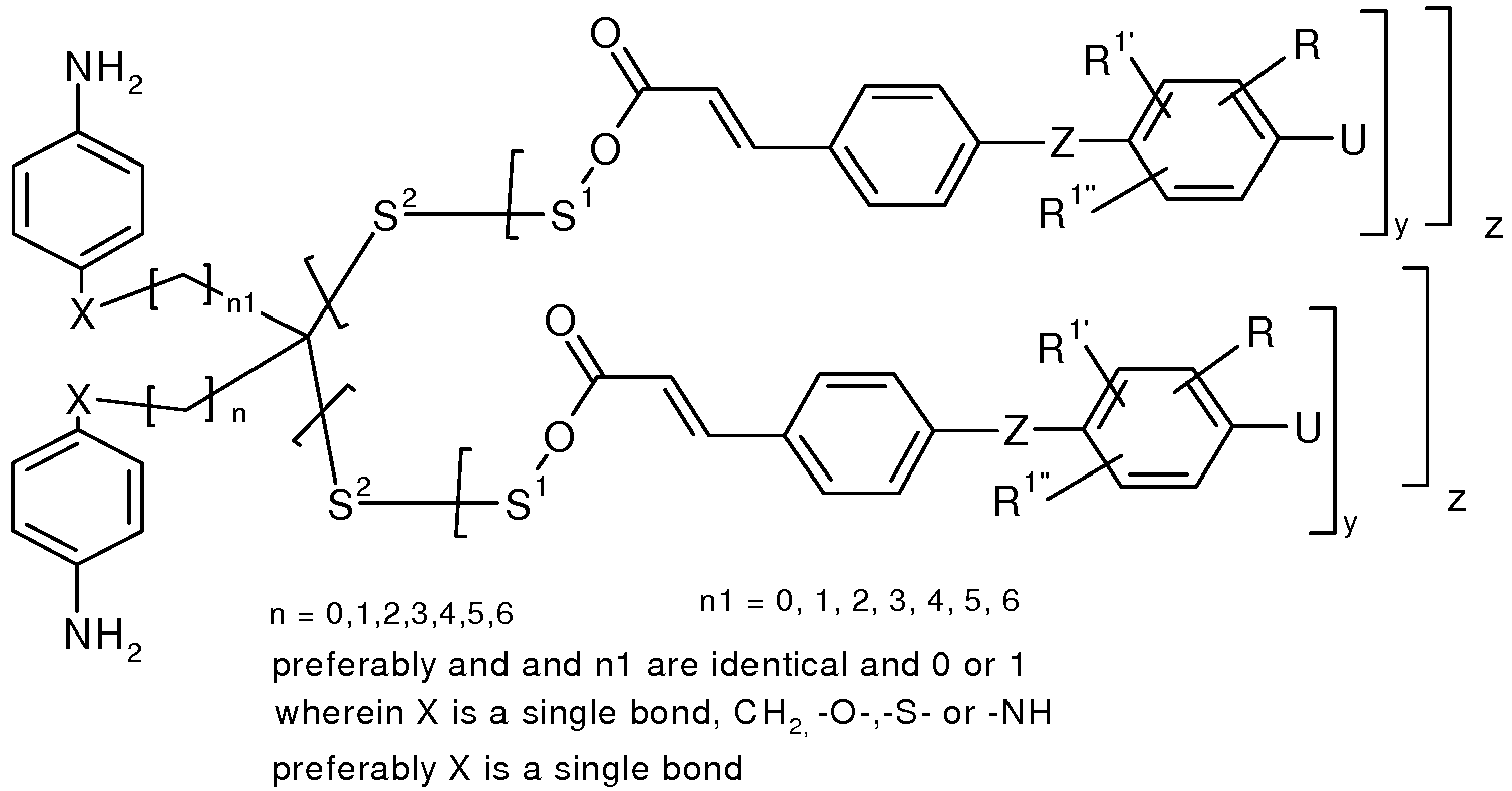


Claims (16)
- A compound, which is an aromatic diamine, comprising a mono- or multichromophoric lateral-substituted portion represented by formula (I)
 A represents an unsubstituted carbocyclic or heterocyclic aromatic selected from a monocyclic ring of five or six atoms, two adjacent monocyclic rings of five or six atoms, a bicyclic ring system of eight, nine or ten atoms, or a tricyclic ring system of thirteen or fourteen atoms; of eight, nine or ten atoms, or a tricyclic ring system of thirteen or fourteen atoms;B substituted carbocyclic or heterocyclic aromatic selected from a monocyclic ring of five or six atoms, two adjacent monocyclic rings of five or six atoms, a bicyclic ring system of eight, nine or ten atoms, or a tricyclic ring system of thirteen or fourteen atoms; of eight, nine or ten atoms, or a tricyclic ring system of thirteen or fourteen atoms;Z represents -OCO-, -OCH2- or a single bond,R1 represents fluorine, chlorine or nitrile,R2 and R3 are independently from each other hydrogen, halogen or nitrile; unsubstituted or with halogen substituted C1-C12alkyl, in which one or more C-atom, CH- or CH2- group may be replaced by a linking group; preferably R2 and R3 are H, nitrile or fluorine; and a polymerizable group.
 - A compound according to claim 1, represented by formula (IV)
 B represents an substituted benzene, phenylene, pyridine, triazine, pyrimidine, biphenylene, naphthalene, phenanthrene, triphenylene, tetraline,R1 represents fluorine, chlorine or nitrile,R2 and R3 are hydrogen and/or nitrile,X is a bivalent aromatic group; or X is -CH2-, -CO-, -CS-, -O(CO)-, -(CO)O-, -NH(CO)-, -(CO)NH-, -OCF2-, ((C1-C6alkyl)-N)CO-, -(C1-C16alkylen)(CO)O-, -(C1-C16alkylen)O(CO)-, -(CO)O(C1-C16alkylen)-, -O(CO)(C1-C16alkylen)-, -O(C1-C16alkylen)-, -(C1-C16alkylen)O-, ((CH3)N)CO-, or -S(CS)-, -O(CS), -S(CO) preferably 1,4-phenylene, O(CS), -S(CO), - CS-,
-CO- or -O(CO)-, and more preferably -CO- or -O(CO)- or 1,4-phenylene;Z represents -OCO-, -OCH2- or a single bond,U is hydrogen, -CF3, -CF2H, -CH2F, -Q1-(C1-C6alkylen)-CF3, -Q1-(C1-C6alkylen)-CF2H, -Q1-(C1-C6alkylen)-CH2F, -Q1-(C1-C6alkylen)-CF2CF3, -Q1-(C1-C6alkylen)-CF2CHF2, -Q1-(C1-C6alkylen)-CF2CH2F, -Q1-(C1-C6alkylen)-CFHCF3, -Q1-(C1-C6alkylen)-CFHCHF2,
-Q1-(C1-C6alkylen)-CFHCH2F, -Q1-(C1-C6alkylen)-CF2CH3, -Q1-(C1-C6alkylen)-CFHCHF2, -Q1-(C1-C6alkylen)-(CF2)2CF3, -Q1-(C1-C6alkylen)-(CF2)2CHF2, -Q1-(C1-C6alkylen)-(CF2)2CH2F, -Q1-(C1-C6alkylen)-(CF2)2CH3, -Q1-(C1-C6alkylen)-(CF2)3CHF2, -Q1-(C1-C6alkylen)-(CF2)3CH2F, -Q1-(C1-C6alkylen)-(CF2)3CF3, -Q1-(C1-C6alkylen)-CF(CF3)2, -Q1-(C1-C6alkylen)-CF2(CHF)CF3;wherein one or more C-atom, CH- or CH2- group is independently from each other not replaced or replaced by a linking group, and
whereinQ1 represents a single bond or -NH-, -NCH3-, -NH-CO-, -CO-NH-, -NH-CO-O-, -O-CO-NH-,
-NH-CONH-, -O-, -CO-, -COO-, -OCO-, -S-, -CS-, -SCS-, -SCO-, -CH=CH-, -C≡C- or -O-CO-O-, preferably Q1 is -O-, -CO-, -COO-, -OCO- or a single bond,D represents an unsubstituted or substituted aromatic polymerizable group, preferably a diamine group having from 1 to 40 carbon atoms,y and z are each independently from each other 1, 2, 3 or 4, preferably 1 or 2; w is 1,2,3,4 and preferably 1 or 2,S1 and S2 each independently from each other represents a single bond or a spacer unit, which is a cyclic, straight-chain or branched, substituted or unsubstituted
C1-C24alkylen, in which one or more, preferably non-adjacent, C-atom, CH- or CH2- group may be replaced by at least one linking group; and/or a non-aromatic, aromatic, unsubstituted or substituted carbocyclic or heterocyclic group of formula (V):
-(z1a')a3'-(Z1-C1)a1-(Z2-C2) a2-(Z1a)a3- (V)
wherein:C1, C2 each independently represents an alicyclic or aromatic, unsubstituted or substituted carbocyclic or heterocyclic group, preferably C1 and C2 are connected at the opposite positions via Z1 ,Z2 , Z1a and/or Z1a' so that groups S1 and/or S2 have a long molecular axis, andZ1, Z2, Z1a , Z1a' each independently represents a bridging group, anda1, a3', a2, a3 each independently represents an integer from 0 to 3, such that a1 + a3' + a2+ a3 ≤ 6, preferably a3 and or a3' is 1 and a1 + a2 ≤ 4. - A compound according to claim 1, represented by formula (XVI)

S1, S2, Z, U, y and z have the above given meanings and preferences as described in claim 2; and R, R1', R1" have independently from each other the meaning of hydrogen, fluorine, nitrile and/or chlorine or U, with the proviso that at least one R, R1' or R1" is not hydrogen; or

- A compound according to claim 1, comprising at least one lateral-substituted portion represented by formulae (XVIIa), (XVIIb), (XVIIc), (XVIIf), (XVIII) or (XIX)
 S1, S2, Z, U, y and z have the above given meanings and preferences as described in claim 2; and R, R1', R1" have independently from each other the meaning of hydrogen, fluorine, nitrile and/or chlorine or U, with the proviso that at least one R, R1' or R1" is not hydrogen; andS1 and S2 each independently from each other represent a single bond or a straight-chain or branched, substituted, or unsubstituted C1-C12alkylen; and in which one or more, preferably non
-adjacent, C-atom, CH- or CH2- group may be replaced by at least one linking group; or a compound of formulae (XVIIb) or (XVIIc)

S1, S2, y, z, R, R1', R1", Z and U have the above given meanings and preferences; or a compound of formula (XVIIf)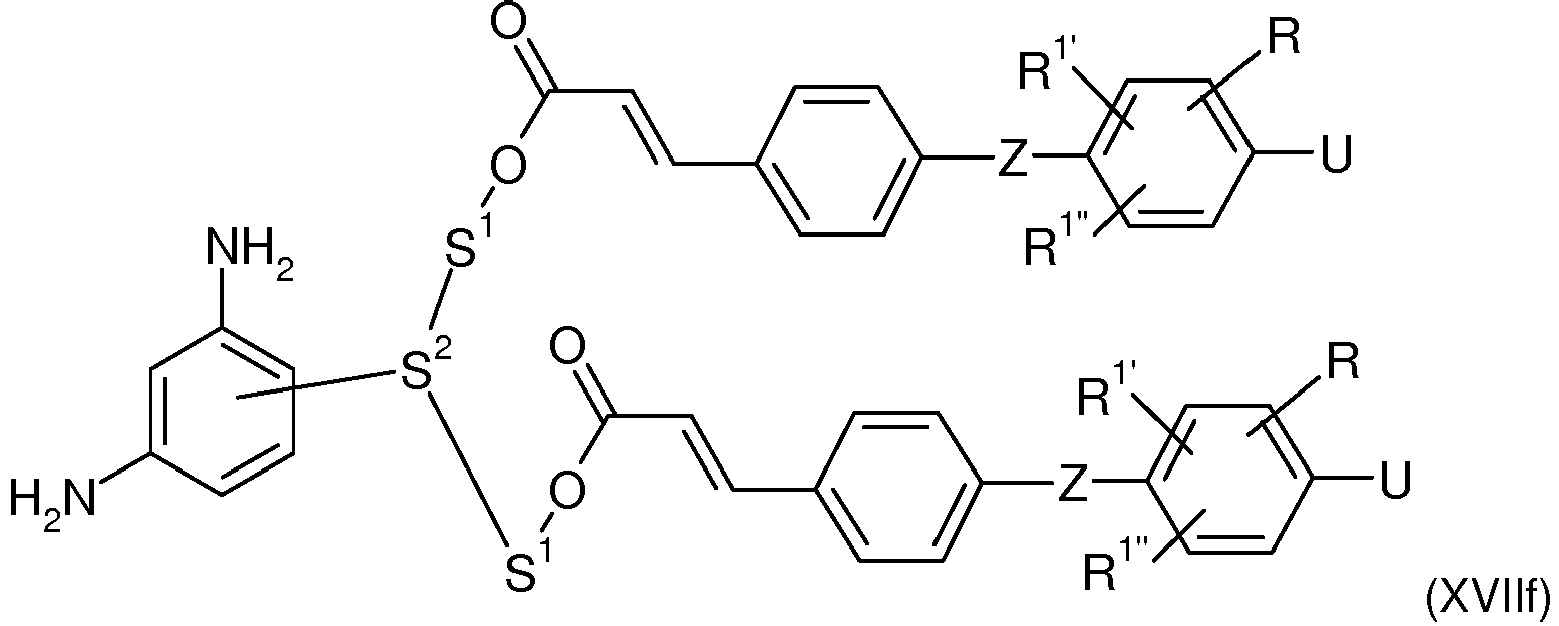
S1, S2, R1, R1', R1", Z and U have the above given meanings and preferences; or
compound of formulae (XVIII) or (XIX)

- A compound according to claim 1 comprising at least one lateral-substituted portion represented by formulae (XX), (XXI), (XXII), (XXIII), (XXIV), (XXV), (XXVa) or (XXVb)


 U, Z, have the meanings as described in claim 2, andR1', R1" and R1"' have independently from each other the meaning of hydrogen, fluorine, nitrile and/or chlorine,
 U, Z, have the meanings as described in claim 2, andR1"' and R1"' have independently from each other the meaning of hydrogen, fluorine, nitrile and/or chlorine, with the proviso that at least one R1" or R1"' is not hydrogen.
 - A compound according to claim 1 comprising at least one lateral-substituted portion represented by formulae (XXVc), (XXVd), (XXVe), (XXVf), (XXVg), (XVIIII), (XIX) comprising a polymer having in a side chain at least one lateral-substituted portion represented by formulae (XXVc), (XXVd), (XXVe), (XXVf), (XXVg), (XVIIII), (XIX)

S1, S2, Z, U, y and z have independently from each other the meanings and preferences as described in claim 2; and R1", R1'" have independently from each other the meaning of hydrogen, fluorine, nitrile and/or chlorine or U, with the proviso that at least one R1" or
R1"' is not hydrogen;


S1, S2, Z, U, y and z have independently from each other the meanings and preferences as described in claim 2; and R1", R1"' have independently from each other the meaning of hydrogen, fluorine, nitrile and/or chlorine or U, preferably of hydrogen; S1, S2, y, z, Z and U have the above given meanings as described in claim 2; andR1', R1" have independently from each other the meaning of hydrogen, fluorine, nitrile and/or chlorine or U, preferably of hydrogen; and
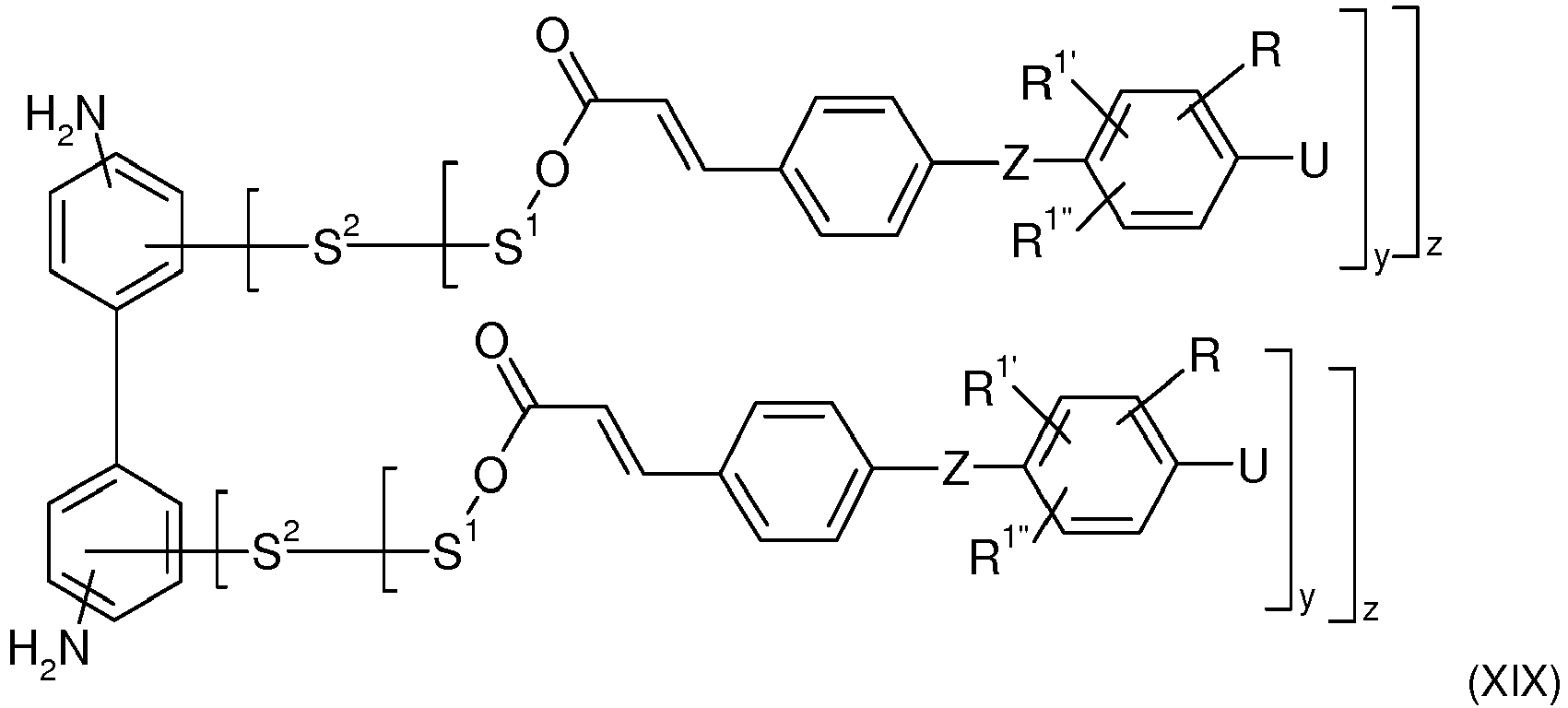 S1, S2, y, z, Z and U have the above given meanings as described in claim 2; andR, R1', R1" have independently from each other the meaning of hydrogen, fluorine, nitrile and/or chlorine or U, with the proviso that at least one R, R1', R1" is not hydrogen; and wherein X6 is a single bond or straight-chain or branched, substituted or unsubstituted C1-C6alkylen.
 - Method for the preparation of a polymer, which is a polyamic acid, polyimide or a mixture thereof, which comprises bringing into contact at least one tetracarboxilic dianhydride with at least one monomeric compound as described in claim 1.
- Homo- and/or copolymer, which is a polyamic acid, polyimide or a mixture thereof, obtainable by the method according to claim 7.
- Composition, especially a blend or/and a formulation, comprising a polymer, which is a polyamic acid, polyimide, polyamic acid ester, polyester, polyamide, polysiloxane, cellulose derivative, polyacetal, polyurea, polyurethane, polystyrene derivative, poly(styrene-phenyl-maleimide)-derivative and poly(meth)acrylate, cyclo olefin polymer or a mixture thereof, having in a side chain at least one lateral-substituted portion represented by compound of formula (I) as described in claim 1.
- A photoalignment material, comprising polymer as described in claim 8, having in a side chain at least one lateral-substituted portion represented by formula (I)
 A represents an unsubstituted carbocyclic or heterocyclic aromatic selected from a monocyclic ring of five or six atoms, two adjacent monocyclic rings of five or six atoms, a bicyclic ring system of eight, nine or ten atoms, or a tricyclic ring system of thirteen or fourteen atoms; of eight, nine or ten atoms, or a tricyclic ring system of thirteen or fourteen atoms;B substituted carbocyclic or heterocyclic aromatic selected from a monocyclic ring of five or six atoms, two adjacent monocyclic rings of five or six atoms, a bicyclic ring system of eight, nine or ten atoms, or a tricyclic ring system of thirteen or fourteen atoms; of eight, nine or ten atoms, or a tricyclic ring system of thirteen or fourteen atoms;Z represents -OCO-, -OCH2- or a single bond,R1 represents fluorine, chlorine or nitrile,R2 and R3 are independently from each other hydrogen, halogen or nitrile; unsubstituted or with halogen substituted C1-C12alkyl, in which one or more C-atom, CH- or CH2- group maybe replaced by a linking group; preferably R2 and R3 are H, nitrile or fluorine.
 - Use of a photoalignment material as described in claim 10, or a polymer having in a side chain at least one lateral-substituted portion represented by compound of formula (I) as described in claim 1.
- Polymer layer, especially an orientation layer, comprising at least one photoalignment material having in a side chain at least one lateral-substituted portion represented by compound of formula (I) as described in claim 1.
- Method for the preparation of a polymer layer, especially an orientation layer, comprising applying photoalignment material as described in claim 10, to a support, and treating it with aligning light.
- Use of the polymer layer according to claim 12, for the preparation of optical and electro-optical unstructured or structured constructional elements, preferably liquid crystal display cells, multi-layer and hybrid layer elements.
- Optical and electro-optical unstructured or structured constructional elements, preferably liquid crystal display cells, multi-layer and hybrid layer elements, comprising at least one polymer layer according to claim 12.
- Electro-optical unstructured or structured constructional elements, according to claim 15, which is a liquid crystal display cell, comprising at least one polymer layer according to claim 12
Priority Applications (1)
| Application Number | Priority Date | Filing Date | Title |
|---|---|---|---|
| EP11702460.4A EP2534191B1 (en) | 2010-02-12 | 2011-02-09 | Photoaligning material with lateral substitution |
Applications Claiming Priority (4)
| Application Number | Priority Date | Filing Date | Title |
|---|---|---|---|
| EP10001443 | 2010-02-12 | ||
| EP10161466 | 2010-04-29 | ||
| EP11702460.4A EP2534191B1 (en) | 2010-02-12 | 2011-02-09 | Photoaligning material with lateral substitution |
| PCT/EP2011/051845 WO2011098461A1 (en) | 2010-02-12 | 2011-02-09 | Photoaligning material with lateral substitution |
Publications (2)
| Publication Number | Publication Date |
|---|---|
| EP2534191A1 EP2534191A1 (en) | 2012-12-19 |
| EP2534191B1 true EP2534191B1 (en) | 2020-04-15 |
Family
ID=43951759
Family Applications (1)
| Application Number | Title | Priority Date | Filing Date |
|---|---|---|---|
| EP11702460.4A Not-in-force EP2534191B1 (en) | 2010-02-12 | 2011-02-09 | Photoaligning material with lateral substitution |
Country Status (8)
| Country | Link |
|---|---|
| US (1) | US20120316317A1 (en) |
| EP (1) | EP2534191B1 (en) |
| JP (2) | JP5852016B2 (en) |
| KR (1) | KR101898431B1 (en) |
| CN (3) | CN102753605A (en) |
| BR (1) | BR112012020244A2 (en) |
| TW (1) | TWI591096B (en) |
| WO (1) | WO2011098461A1 (en) |
Families Citing this family (13)
| Publication number | Priority date | Publication date | Assignee | Title |
|---|---|---|---|---|
| WO2011131649A1 (en) * | 2010-04-23 | 2011-10-27 | Rolic Ag | Photoaligning material |
| KR101998557B1 (en) | 2011-10-03 | 2019-07-10 | 롤리크 아게 | Photoaligning materials |
| WO2013050121A1 (en) * | 2011-10-03 | 2013-04-11 | Rolic Ag | Photoaligning materials |
| WO2014030587A1 (en) * | 2012-08-21 | 2014-02-27 | 日産化学工業株式会社 | Liquid crystal aligning agent, liquid crystal alignment film and liquid crystal display element |
| KR101960827B1 (en) * | 2013-05-03 | 2019-03-22 | 삼성디스플레이 주식회사 | Liquid crystal composition, liquid crystal display and method of manufacturing liquid crystal display |
| EP3036094B1 (en) | 2013-08-19 | 2019-11-20 | ROLIC Technologies AG | Method of production of a photo-alignable object and photo-alignable materials |
| KR102284231B1 (en) * | 2014-02-19 | 2021-08-04 | 롤리크 아게 | Liquid crystal alignment composition, liquid crystal alignment film and liquid crystal display element |
| WO2016114310A1 (en) | 2015-01-13 | 2016-07-21 | 日産化学工業株式会社 | Method for producing diamine precursor compound |
| WO2016156079A1 (en) | 2015-03-31 | 2016-10-06 | Rolic Ag | Photoalignment composition |
| CN105785612B (en) * | 2016-05-13 | 2020-05-29 | 深圳市华星光电技术有限公司 | Production method of PSVA liquid crystal panel |
| US11181674B2 (en) | 2016-07-29 | 2021-11-23 | Rolic Technologies AG | Method for generating alignment on top of a liquid crystal polymer material |
| CN120040306A (en) * | 2019-03-29 | 2025-05-27 | 日产化学株式会社 | Diamines |
| WO2021013780A1 (en) | 2019-07-24 | 2021-01-28 | Rolic Technologies AG | Photo-alignable positive c-plate retarder |
Family Cites Families (18)
| Publication number | Priority date | Publication date | Assignee | Title |
|---|---|---|---|---|
| US4886619A (en) * | 1986-06-30 | 1989-12-12 | Minnesota Mining And Manufacturing Company | Fluorine-containing chiral smectic liquid crystals |
| CA1341010C (en) * | 1986-06-30 | 2000-05-30 | Minnesota Mining And Manufacturing Company | Compounds useful in preparing fluorine-containing chiral smectic liquid crystals |
| US5082587A (en) * | 1988-09-23 | 1992-01-21 | Janulis Eugene P | Achiral fluorine-containing liquid crystals |
| JPH02115145A (en) * | 1988-10-26 | 1990-04-27 | Canon Inc | Liquid crystal compound, liquid crystal composition containing the same, and liquid crystal element |
| DE69806618T2 (en) * | 1997-09-25 | 2003-02-27 | Rolic Ag, Zug | PHOTO NETWORKABLE POLYIMIDES |
| DE60106213T2 (en) * | 2000-01-24 | 2006-03-02 | Rolic Ag | PHOTOACTIVE POLYIMIDES, POLYAMIDIC ACIDS OR ESTERS WITH SIDE-STANDING, PHOTOVER-TERM GROUPS |
| KR100465445B1 (en) * | 2001-07-31 | 2005-01-13 | 삼성전자주식회사 | Photo-induced Alignment Material for Liquid Crystal Alignment Film |
| WO2003102045A1 (en) * | 2002-05-31 | 2003-12-11 | Elsicon, Inc. | Hybrid polymer materials for liquid crystal alignment layers |
| EP1801097A1 (en) * | 2005-12-23 | 2007-06-27 | Rolic AG | Photocrosslinkable materials |
| EP1860094A1 (en) * | 2006-05-23 | 2007-11-28 | Rolic AG | Photocrosslinkable materials |
| EP2305631A1 (en) | 2005-12-23 | 2011-04-06 | Rolic AG | Photocrosslinkable materials |
| KR101330911B1 (en) | 2006-01-30 | 2013-11-18 | 제이에스알 가부시끼가이샤 | Liquid Crystal Aligning Agent, Alignment Film and Liquid Crystal Display Device |
| EP1975687A1 (en) * | 2007-03-29 | 2008-10-01 | Rolic AG | Method of uniform and defect free liquid crystal aligning layers |
| US20110065859A1 (en) * | 2007-05-02 | 2011-03-17 | Rolic Ag | Thermally stable alignment materials |
| WO2008145225A2 (en) * | 2007-05-25 | 2008-12-04 | Rolic Ag | Photocrosslinkable materials comprising alicyclic group |
| EP2222740B1 (en) * | 2007-12-21 | 2017-10-11 | Rolic AG | Functionalized photoreactive compounds |
| KR101484250B1 (en) | 2008-05-21 | 2015-01-19 | 삼성디스플레이 주식회사 | A photo-alignment material, a display substrate having an alignment film formed using the same, and a method of manufacturing the display substrate |
| EP2284148B1 (en) * | 2008-06-09 | 2016-03-02 | JNC Corporation | Pentacyclic liquid crystal compound having cyclohexane ring, liquid crystal composition and liquid crystal display element |
-
2011
- 2011-01-31 TW TW100103544A patent/TWI591096B/en active
- 2011-02-09 CN CN2011800089537A patent/CN102753605A/en active Pending
- 2011-02-09 KR KR1020127023808A patent/KR101898431B1/en active Active
- 2011-02-09 JP JP2012552373A patent/JP5852016B2/en active Active
- 2011-02-09 BR BR112012020244A patent/BR112012020244A2/en not_active Application Discontinuation
- 2011-02-09 CN CN201710276753.9A patent/CN107011924B/en active Active
- 2011-02-09 US US13/578,056 patent/US20120316317A1/en not_active Abandoned
- 2011-02-09 WO PCT/EP2011/051845 patent/WO2011098461A1/en not_active Ceased
- 2011-02-09 EP EP11702460.4A patent/EP2534191B1/en not_active Not-in-force
- 2011-02-09 CN CN201710276755.8A patent/CN106873249B/en active Active
-
2015
- 2015-07-23 JP JP2015145493A patent/JP6046219B2/en active Active
Non-Patent Citations (1)
| Title |
|---|
| None * |
Also Published As
| Publication number | Publication date |
|---|---|
| TW201141911A (en) | 2011-12-01 |
| TWI591096B (en) | 2017-07-11 |
| WO2011098461A1 (en) | 2011-08-18 |
| JP6046219B2 (en) | 2016-12-14 |
| KR101898431B1 (en) | 2018-09-14 |
| CN106873249B (en) | 2018-09-14 |
| BR112012020244A2 (en) | 2016-04-26 |
| JP2015232136A (en) | 2015-12-24 |
| KR20120125541A (en) | 2012-11-15 |
| EP2534191A1 (en) | 2012-12-19 |
| CN106873249A (en) | 2017-06-20 |
| CN107011924A (en) | 2017-08-04 |
| JP5852016B2 (en) | 2016-02-03 |
| CN107011924B (en) | 2021-06-01 |
| US20120316317A1 (en) | 2012-12-13 |
| JP2013519744A (en) | 2013-05-30 |
| CN102753605A (en) | 2012-10-24 |
Similar Documents
| Publication | Publication Date | Title |
|---|---|---|
| US9097938B2 (en) | Photoaligning material | |
| TWI591096B (en) | Photoaligning material with lateral substitution | |
| KR101971309B1 (en) | Photoaligning materials | |
| KR102020755B1 (en) | Photoaligning material | |
| EP2748280B1 (en) | Photoreactive compounds | |
| HK1238279A1 (en) | Photoaligning material with lateral substitution | |
| HK1238279A (en) | Photoaligning material with lateral substitution | |
| HK1239829A (en) | Photoaligning material with lateral substitution | |
| HK1239829A1 (en) | Photoaligning material with lateral substitution | |
| HK1239829B (en) | Photoaligning material with lateral substitution |
Legal Events
| Date | Code | Title | Description |
|---|---|---|---|
| PUAI | Public reference made under article 153(3) epc to a published international application that has entered the european phase |
Free format text: ORIGINAL CODE: 0009012 |
|
| 17P | Request for examination filed |
Effective date: 20120912 |
|
| AK | Designated contracting states |
Kind code of ref document: A1 Designated state(s): AL AT BE BG CH CY CZ DE DK EE ES FI FR GB GR HR HU IE IS IT LI LT LU LV MC MK MT NL NO PL PT RO RS SE SI SK SM TR |
|
| RIN1 | Information on inventor provided before grant (corrected) |
Inventor name: ECKERT, JEAN-FRANCOIS Inventor name: SCHUSTER, ANDREAS Inventor name: PALIKA, SATISH |
|
| DAX | Request for extension of the european patent (deleted) | ||
| 17Q | First examination report despatched |
Effective date: 20140304 |
|
| RAP1 | Party data changed (applicant data changed or rights of an application transferred) |
Owner name: ROLIC AG |
|
| RAP1 | Party data changed (applicant data changed or rights of an application transferred) |
Owner name: ROLIC TECHNOLOGIES AG |
|
| STAA | Information on the status of an ep patent application or granted ep patent |
Free format text: STATUS: EXAMINATION IS IN PROGRESS |
|
| GRAP | Despatch of communication of intention to grant a patent |
Free format text: ORIGINAL CODE: EPIDOSNIGR1 |
|
| STAA | Information on the status of an ep patent application or granted ep patent |
Free format text: STATUS: GRANT OF PATENT IS INTENDED |
|
| INTG | Intention to grant announced |
Effective date: 20200122 |
|
| GRAS | Grant fee paid |
Free format text: ORIGINAL CODE: EPIDOSNIGR3 |
|
| GRAA | (expected) grant |
Free format text: ORIGINAL CODE: 0009210 |
|
| STAA | Information on the status of an ep patent application or granted ep patent |
Free format text: STATUS: THE PATENT HAS BEEN GRANTED |
|
| AK | Designated contracting states |
Kind code of ref document: B1 Designated state(s): AL AT BE BG CH CY CZ DE DK EE ES FI FR GB GR HR HU IE IS IT LI LT LU LV MC MK MT NL NO PL PT RO RS SE SI SK SM TR |
|
| REG | Reference to a national code |
Ref country code: GB Ref legal event code: FG4D Ref country code: CH Ref legal event code: EP |
|
| REG | Reference to a national code |
Ref country code: DE Ref legal event code: R096 Ref document number: 602011066253 Country of ref document: DE |
|
| REG | Reference to a national code |
Ref country code: IE Ref legal event code: FG4D |
|
| REG | Reference to a national code |
Ref country code: AT Ref legal event code: REF Ref document number: 1257216 Country of ref document: AT Kind code of ref document: T Effective date: 20200515 |
|
| REG | Reference to a national code |
Ref country code: NL Ref legal event code: MP Effective date: 20200415 |
|
| REG | Reference to a national code |
Ref country code: LT Ref legal event code: MG4D |
|
| PG25 | Lapsed in a contracting state [announced via postgrant information from national office to epo] |
Ref country code: PT Free format text: LAPSE BECAUSE OF FAILURE TO SUBMIT A TRANSLATION OF THE DESCRIPTION OR TO PAY THE FEE WITHIN THE PRESCRIBED TIME-LIMIT Effective date: 20200817 Ref country code: NL Free format text: LAPSE BECAUSE OF FAILURE TO SUBMIT A TRANSLATION OF THE DESCRIPTION OR TO PAY THE FEE WITHIN THE PRESCRIBED TIME-LIMIT Effective date: 20200415 Ref country code: SE Free format text: LAPSE BECAUSE OF FAILURE TO SUBMIT A TRANSLATION OF THE DESCRIPTION OR TO PAY THE FEE WITHIN THE PRESCRIBED TIME-LIMIT Effective date: 20200415 Ref country code: GR Free format text: LAPSE BECAUSE OF FAILURE TO SUBMIT A TRANSLATION OF THE DESCRIPTION OR TO PAY THE FEE WITHIN THE PRESCRIBED TIME-LIMIT Effective date: 20200716 Ref country code: LT Free format text: LAPSE BECAUSE OF FAILURE TO SUBMIT A TRANSLATION OF THE DESCRIPTION OR TO PAY THE FEE WITHIN THE PRESCRIBED TIME-LIMIT Effective date: 20200415 Ref country code: IS Free format text: LAPSE BECAUSE OF FAILURE TO SUBMIT A TRANSLATION OF THE DESCRIPTION OR TO PAY THE FEE WITHIN THE PRESCRIBED TIME-LIMIT Effective date: 20200815 Ref country code: FI Free format text: LAPSE BECAUSE OF FAILURE TO SUBMIT A TRANSLATION OF THE DESCRIPTION OR TO PAY THE FEE WITHIN THE PRESCRIBED TIME-LIMIT Effective date: 20200415 Ref country code: NO Free format text: LAPSE BECAUSE OF FAILURE TO SUBMIT A TRANSLATION OF THE DESCRIPTION OR TO PAY THE FEE WITHIN THE PRESCRIBED TIME-LIMIT Effective date: 20200715 |
|
| REG | Reference to a national code |
Ref country code: AT Ref legal event code: MK05 Ref document number: 1257216 Country of ref document: AT Kind code of ref document: T Effective date: 20200415 |
|
| PG25 | Lapsed in a contracting state [announced via postgrant information from national office to epo] |
Ref country code: RS Free format text: LAPSE BECAUSE OF FAILURE TO SUBMIT A TRANSLATION OF THE DESCRIPTION OR TO PAY THE FEE WITHIN THE PRESCRIBED TIME-LIMIT Effective date: 20200415 Ref country code: LV Free format text: LAPSE BECAUSE OF FAILURE TO SUBMIT A TRANSLATION OF THE DESCRIPTION OR TO PAY THE FEE WITHIN THE PRESCRIBED TIME-LIMIT Effective date: 20200415 Ref country code: HR Free format text: LAPSE BECAUSE OF FAILURE TO SUBMIT A TRANSLATION OF THE DESCRIPTION OR TO PAY THE FEE WITHIN THE PRESCRIBED TIME-LIMIT Effective date: 20200415 Ref country code: BG Free format text: LAPSE BECAUSE OF FAILURE TO SUBMIT A TRANSLATION OF THE DESCRIPTION OR TO PAY THE FEE WITHIN THE PRESCRIBED TIME-LIMIT Effective date: 20200715 |
|
| PG25 | Lapsed in a contracting state [announced via postgrant information from national office to epo] |
Ref country code: AL Free format text: LAPSE BECAUSE OF FAILURE TO SUBMIT A TRANSLATION OF THE DESCRIPTION OR TO PAY THE FEE WITHIN THE PRESCRIBED TIME-LIMIT Effective date: 20200415 |
|
| REG | Reference to a national code |
Ref country code: DE Ref legal event code: R097 Ref document number: 602011066253 Country of ref document: DE |
|
| PG25 | Lapsed in a contracting state [announced via postgrant information from national office to epo] |
Ref country code: AT Free format text: LAPSE BECAUSE OF FAILURE TO SUBMIT A TRANSLATION OF THE DESCRIPTION OR TO PAY THE FEE WITHIN THE PRESCRIBED TIME-LIMIT Effective date: 20200415 Ref country code: EE Free format text: LAPSE BECAUSE OF FAILURE TO SUBMIT A TRANSLATION OF THE DESCRIPTION OR TO PAY THE FEE WITHIN THE PRESCRIBED TIME-LIMIT Effective date: 20200415 Ref country code: SM Free format text: LAPSE BECAUSE OF FAILURE TO SUBMIT A TRANSLATION OF THE DESCRIPTION OR TO PAY THE FEE WITHIN THE PRESCRIBED TIME-LIMIT Effective date: 20200415 Ref country code: CZ Free format text: LAPSE BECAUSE OF FAILURE TO SUBMIT A TRANSLATION OF THE DESCRIPTION OR TO PAY THE FEE WITHIN THE PRESCRIBED TIME-LIMIT Effective date: 20200415 Ref country code: IT Free format text: LAPSE BECAUSE OF FAILURE TO SUBMIT A TRANSLATION OF THE DESCRIPTION OR TO PAY THE FEE WITHIN THE PRESCRIBED TIME-LIMIT Effective date: 20200415 Ref country code: RO Free format text: LAPSE BECAUSE OF FAILURE TO SUBMIT A TRANSLATION OF THE DESCRIPTION OR TO PAY THE FEE WITHIN THE PRESCRIBED TIME-LIMIT Effective date: 20200415 Ref country code: ES Free format text: LAPSE BECAUSE OF FAILURE TO SUBMIT A TRANSLATION OF THE DESCRIPTION OR TO PAY THE FEE WITHIN THE PRESCRIBED TIME-LIMIT Effective date: 20200415 Ref country code: DK Free format text: LAPSE BECAUSE OF FAILURE TO SUBMIT A TRANSLATION OF THE DESCRIPTION OR TO PAY THE FEE WITHIN THE PRESCRIBED TIME-LIMIT Effective date: 20200415 |
|
| PLBE | No opposition filed within time limit |
Free format text: ORIGINAL CODE: 0009261 |
|
| STAA | Information on the status of an ep patent application or granted ep patent |
Free format text: STATUS: NO OPPOSITION FILED WITHIN TIME LIMIT |
|
| PG25 | Lapsed in a contracting state [announced via postgrant information from national office to epo] |
Ref country code: SK Free format text: LAPSE BECAUSE OF FAILURE TO SUBMIT A TRANSLATION OF THE DESCRIPTION OR TO PAY THE FEE WITHIN THE PRESCRIBED TIME-LIMIT Effective date: 20200415 Ref country code: PL Free format text: LAPSE BECAUSE OF FAILURE TO SUBMIT A TRANSLATION OF THE DESCRIPTION OR TO PAY THE FEE WITHIN THE PRESCRIBED TIME-LIMIT Effective date: 20200415 |
|
| 26N | No opposition filed |
Effective date: 20210118 |
|
| PG25 | Lapsed in a contracting state [announced via postgrant information from national office to epo] |
Ref country code: SI Free format text: LAPSE BECAUSE OF FAILURE TO SUBMIT A TRANSLATION OF THE DESCRIPTION OR TO PAY THE FEE WITHIN THE PRESCRIBED TIME-LIMIT Effective date: 20200415 |
|
| REG | Reference to a national code |
Ref country code: DE Ref legal event code: R119 Ref document number: 602011066253 Country of ref document: DE |
|
| PG25 | Lapsed in a contracting state [announced via postgrant information from national office to epo] |
Ref country code: MC Free format text: LAPSE BECAUSE OF FAILURE TO SUBMIT A TRANSLATION OF THE DESCRIPTION OR TO PAY THE FEE WITHIN THE PRESCRIBED TIME-LIMIT Effective date: 20200415 |
|
| GBPC | Gb: european patent ceased through non-payment of renewal fee |
Effective date: 20210209 |
|
| REG | Reference to a national code |
Ref country code: BE Ref legal event code: MM Effective date: 20210228 |
|
| PG25 | Lapsed in a contracting state [announced via postgrant information from national office to epo] |
Ref country code: LU Free format text: LAPSE BECAUSE OF NON-PAYMENT OF DUE FEES Effective date: 20210209 Ref country code: LI Free format text: LAPSE BECAUSE OF NON-PAYMENT OF DUE FEES Effective date: 20210228 Ref country code: CH Free format text: LAPSE BECAUSE OF NON-PAYMENT OF DUE FEES Effective date: 20210228 |
|
| PG25 | Lapsed in a contracting state [announced via postgrant information from national office to epo] |
Ref country code: FR Free format text: LAPSE BECAUSE OF NON-PAYMENT OF DUE FEES Effective date: 20210228 Ref country code: IE Free format text: LAPSE BECAUSE OF NON-PAYMENT OF DUE FEES Effective date: 20210209 Ref country code: GB Free format text: LAPSE BECAUSE OF NON-PAYMENT OF DUE FEES Effective date: 20210209 Ref country code: DE Free format text: LAPSE BECAUSE OF NON-PAYMENT OF DUE FEES Effective date: 20210901 |
|
| PG25 | Lapsed in a contracting state [announced via postgrant information from national office to epo] |
Ref country code: BE Free format text: LAPSE BECAUSE OF NON-PAYMENT OF DUE FEES Effective date: 20210228 |
|
| PG25 | Lapsed in a contracting state [announced via postgrant information from national office to epo] |
Ref country code: HU Free format text: LAPSE BECAUSE OF FAILURE TO SUBMIT A TRANSLATION OF THE DESCRIPTION OR TO PAY THE FEE WITHIN THE PRESCRIBED TIME-LIMIT; INVALID AB INITIO Effective date: 20110209 Ref country code: CY Free format text: LAPSE BECAUSE OF FAILURE TO SUBMIT A TRANSLATION OF THE DESCRIPTION OR TO PAY THE FEE WITHIN THE PRESCRIBED TIME-LIMIT Effective date: 20200415 |
|
| PG25 | Lapsed in a contracting state [announced via postgrant information from national office to epo] |
Ref country code: MK Free format text: LAPSE BECAUSE OF FAILURE TO SUBMIT A TRANSLATION OF THE DESCRIPTION OR TO PAY THE FEE WITHIN THE PRESCRIBED TIME-LIMIT Effective date: 20200415 |
|
| PG25 | Lapsed in a contracting state [announced via postgrant information from national office to epo] |
Ref country code: TR Free format text: LAPSE BECAUSE OF FAILURE TO SUBMIT A TRANSLATION OF THE DESCRIPTION OR TO PAY THE FEE WITHIN THE PRESCRIBED TIME-LIMIT Effective date: 20200415 |
|
| PG25 | Lapsed in a contracting state [announced via postgrant information from national office to epo] |
Ref country code: MT Free format text: LAPSE BECAUSE OF FAILURE TO SUBMIT A TRANSLATION OF THE DESCRIPTION OR TO PAY THE FEE WITHIN THE PRESCRIBED TIME-LIMIT Effective date: 20200415 |