EP2534138B1 - 1,2,3-triazole-based peptidomimetic integrin inhibitors for the diagnosis and therapy of tumors - Google Patents
1,2,3-triazole-based peptidomimetic integrin inhibitors for the diagnosis and therapy of tumors Download PDFInfo
- Publication number
- EP2534138B1 EP2534138B1 EP11708421.0A EP11708421A EP2534138B1 EP 2534138 B1 EP2534138 B1 EP 2534138B1 EP 11708421 A EP11708421 A EP 11708421A EP 2534138 B1 EP2534138 B1 EP 2534138B1
- Authority
- EP
- European Patent Office
- Prior art keywords
- mmol
- nmr
- group
- compound
- mhz
- Prior art date
- Legal status (The legal status is an assumption and is not a legal conclusion. Google has not performed a legal analysis and makes no representation as to the accuracy of the status listed.)
- Not-in-force
Links
- 0 C*(C*NC(N)=N)c1c[n](CC(N[C@](CC(O)=O)c2ccccc2)=O)nn1 Chemical compound C*(C*NC(N)=N)c1c[n](CC(N[C@](CC(O)=O)c2ccccc2)=O)nn1 0.000 description 7
- DOHYOMCAAAAAMG-UHFFFAOYSA-N CNCc1nc2ccccc2[nH]1 Chemical compound CNCc1nc2ccccc2[nH]1 DOHYOMCAAAAAMG-UHFFFAOYSA-N 0.000 description 2
- IATWIBQGYVLDLL-UHFFFAOYSA-N CC(C)(C)CC(C)(C)NC(NC)=N Chemical compound CC(C)(C)CC(C)(C)NC(NC)=N IATWIBQGYVLDLL-UHFFFAOYSA-N 0.000 description 1
- MUDMMCWKHIZDPP-UHFFFAOYSA-N CC(C)(C)OC(N(CCCC#C)/C(/NCCNC)=N\C(OC(C)(C)C)=O)=O Chemical compound CC(C)(C)OC(N(CCCC#C)/C(/NCCNC)=N\C(OC(C)(C)C)=O)=O MUDMMCWKHIZDPP-UHFFFAOYSA-N 0.000 description 1
- LYVVOWKVLBLIJA-UHFFFAOYSA-N CC(C)(C)OC(N(CCCC#C)/C(/NCCc(cc1)ccc1O)=N\C(OC(C)(C)C)=O)=O Chemical compound CC(C)(C)OC(N(CCCC#C)/C(/NCCc(cc1)ccc1O)=N\C(OC(C)(C)C)=O)=O LYVVOWKVLBLIJA-UHFFFAOYSA-N 0.000 description 1
- HKZYBJJTIHZEGI-QGOAFFKASA-N CC(C)(C)OC(N(CCCC#C)/C(/SC)=N\C(OC(C)(C)C)=O)=O Chemical compound CC(C)(C)OC(N(CCCC#C)/C(/SC)=N\C(OC(C)(C)C)=O)=O HKZYBJJTIHZEGI-QGOAFFKASA-N 0.000 description 1
- CSOJECDGWHHWRS-UHFFFAOYSA-N CC(C)(C)OC(NC(NC(OC(C)(C)C)=O)=S)=O Chemical compound CC(C)(C)OC(NC(NC(OC(C)(C)C)=O)=S)=O CSOJECDGWHHWRS-UHFFFAOYSA-N 0.000 description 1
- NQFLWPVSHRYDSG-MDZDMXLPSA-N CC/C(/C)=C(\N)/N1CCN(C)CC1 Chemical compound CC/C(/C)=C(\N)/N1CCN(C)CC1 NQFLWPVSHRYDSG-MDZDMXLPSA-N 0.000 description 1
- ODVXRPVMHXOMJN-UHFFFAOYSA-N CNC(NCCNC(CCCCC1SSCC1)=O)=N Chemical compound CNC(NCCNC(CCCCC1SSCC1)=O)=N ODVXRPVMHXOMJN-UHFFFAOYSA-N 0.000 description 1
- NAZHYYOZINPLBW-UHFFFAOYSA-N CNC(NCCNCCc(cc1)ccc1O)=N Chemical compound CNC(NCCNCCc(cc1)ccc1O)=N NAZHYYOZINPLBW-UHFFFAOYSA-N 0.000 description 1
- RGILJHISYOACPG-UHFFFAOYSA-N NCCNC(CCCCC1SSCC1)=O Chemical compound NCCNC(CCCCC1SSCC1)=O RGILJHISYOACPG-UHFFFAOYSA-N 0.000 description 1
Images
Classifications
-
- C—CHEMISTRY; METALLURGY
- C07—ORGANIC CHEMISTRY
- C07D—HETEROCYCLIC COMPOUNDS
- C07D403/00—Heterocyclic compounds containing two or more hetero rings, having nitrogen atoms as the only ring hetero atoms, not provided for by group C07D401/00
- C07D403/02—Heterocyclic compounds containing two or more hetero rings, having nitrogen atoms as the only ring hetero atoms, not provided for by group C07D401/00 containing two hetero rings
- C07D403/12—Heterocyclic compounds containing two or more hetero rings, having nitrogen atoms as the only ring hetero atoms, not provided for by group C07D401/00 containing two hetero rings linked by a chain containing hetero atoms as chain links
-
- A—HUMAN NECESSITIES
- A61—MEDICAL OR VETERINARY SCIENCE; HYGIENE
- A61P—SPECIFIC THERAPEUTIC ACTIVITY OF CHEMICAL COMPOUNDS OR MEDICINAL PREPARATIONS
- A61P19/00—Drugs for skeletal disorders
-
- A—HUMAN NECESSITIES
- A61—MEDICAL OR VETERINARY SCIENCE; HYGIENE
- A61P—SPECIFIC THERAPEUTIC ACTIVITY OF CHEMICAL COMPOUNDS OR MEDICINAL PREPARATIONS
- A61P19/00—Drugs for skeletal disorders
- A61P19/08—Drugs for skeletal disorders for bone diseases, e.g. rachitism, Paget's disease
- A61P19/10—Drugs for skeletal disorders for bone diseases, e.g. rachitism, Paget's disease for osteoporosis
-
- A—HUMAN NECESSITIES
- A61—MEDICAL OR VETERINARY SCIENCE; HYGIENE
- A61P—SPECIFIC THERAPEUTIC ACTIVITY OF CHEMICAL COMPOUNDS OR MEDICINAL PREPARATIONS
- A61P29/00—Non-central analgesic, antipyretic or antiinflammatory agents, e.g. antirheumatic agents; Non-steroidal antiinflammatory drugs [NSAID]
-
- A—HUMAN NECESSITIES
- A61—MEDICAL OR VETERINARY SCIENCE; HYGIENE
- A61P—SPECIFIC THERAPEUTIC ACTIVITY OF CHEMICAL COMPOUNDS OR MEDICINAL PREPARATIONS
- A61P35/00—Antineoplastic agents
-
- C—CHEMISTRY; METALLURGY
- C07—ORGANIC CHEMISTRY
- C07D—HETEROCYCLIC COMPOUNDS
- C07D249/00—Heterocyclic compounds containing five-membered rings having three nitrogen atoms as the only ring hetero atoms
- C07D249/02—Heterocyclic compounds containing five-membered rings having three nitrogen atoms as the only ring hetero atoms not condensed with other rings
- C07D249/04—1,2,3-Triazoles; Hydrogenated 1,2,3-triazoles
-
- C—CHEMISTRY; METALLURGY
- C07—ORGANIC CHEMISTRY
- C07D—HETEROCYCLIC COMPOUNDS
- C07D409/00—Heterocyclic compounds containing two or more hetero rings, at least one ring having sulfur atoms as the only ring hetero atoms
- C07D409/02—Heterocyclic compounds containing two or more hetero rings, at least one ring having sulfur atoms as the only ring hetero atoms containing two hetero rings
- C07D409/12—Heterocyclic compounds containing two or more hetero rings, at least one ring having sulfur atoms as the only ring hetero atoms containing two hetero rings linked by a chain containing hetero atoms as chain links
-
- C—CHEMISTRY; METALLURGY
- C07—ORGANIC CHEMISTRY
- C07K—PEPTIDES
- C07K5/00—Peptides containing up to four amino acids in a fully defined sequence; Derivatives thereof
- C07K5/04—Peptides containing up to four amino acids in a fully defined sequence; Derivatives thereof containing only normal peptide links
- C07K5/06—Dipeptides
- C07K5/06008—Dipeptides with the first amino acid being neutral
- C07K5/06017—Dipeptides with the first amino acid being neutral and aliphatic
- C07K5/06026—Dipeptides with the first amino acid being neutral and aliphatic the side chain containing 0 or 1 carbon atom, i.e. Gly or Ala
Definitions
- the present invention refers to the field of chemical compounds possessing the 1,2,3-triazole heterocyclic ring, their preparation and use as a medical device for tumor-related pathologies where angiogenesis is altered, i.e. pathologies having a tumor origin, tumor methastasis, osteoporosis and rheumatoid arthritis.
- Integrins are a class of cellular receptors known to bind extracellular matrix proteins, and therefore mediate cell adhesion events.
- One important recognition site of a ligand for ⁇ v ⁇ 3 and ⁇ v ⁇ 5 integrins is the arginine-glycine-aspartic acid (RGD) tripeptide sequence, which is found in all peptide-based ligands identified for the vitronectin receptor integrins.
- RGD arginine-glycine-aspartic acid
- ⁇ v ⁇ 3 and ⁇ v ⁇ 5 receptors have received increasing attention as therapeutic targets as they are expressed in various cell types and are involved in osteoporosis, arthritis, retinopathy, and tumor-related processes.
- the RGD recognition site can be mimicked by polypeptides that contain the RGD sequence, and ⁇ v ⁇ 3 antagonists, including RGD-containing peptides, have been successfully applied as inhibitors of blood vessel development and tumor growth.
- ⁇ v ⁇ 3 antagonists including RGD-containing peptides
- the cyclic peptide c[RGDfV] has been reported by Kessler and co-workers as a selective ligand for the ⁇ v ⁇ 3 integrin.
- Many different cyclic RGD-containing peptides have been reported, and in particular, the N -methylated derivative c [RGDf(Me)Val] (Cilengitide), which is actually being examined in clinical trials as an angiogenesis inhibitor for the treatment of glioblastoma.
- the unique molecular system containing the triazole ring is a cyclic analogue of c[RGDfV] peptide, wherein the triazole ring is a replacement for the D-Phe-Val dipeptide, which solves only in part the issues concerning the chemical stability and bioavailability ( Kolb, H.; Chen, K.; Walsh, J. C.; Gangadharmath, U.; Kasi, D.; Wang,B.; Duclos, B.; Liang, Q.; Padgett, H. C.; Karimi, F. WO2008/033557 ). No examples of linear non-peptidic integrin antagonists containing the 1,2,3-triazole ring have been reported, so far.
- Aim of the present invention is a compound possessing the above mentioned features, such as the simple preparation from easily-synthesized precursors, even as enantiopure compounds, being of wide scope so as to allow for the generation of derivatives with different properties, and possessing a significant metabolic stability, and a high affinity towards integrins related to an in vivo anti-angiogenic activity.
- the present invention refers to peptidomimetic compounds containing the 1,2,3-triazole nucleus, and possessing high affinity towards ⁇ v ⁇ 3 and ⁇ v ⁇ 5 receptors of the integrins family.
- the present invention refers to compounds of formula (Ia) according to claim 1.
- integrin inhibitors and in particular of integrins that recognize the Arg-Gly-Asp (RGD) peptide sequence, and more specifically of ⁇ v ⁇ 3 and ⁇ v ⁇ 5 integrins.
- RGD Arg-Gly-Asp
- An aspect of the present invention deals with pharmaceutical preparations containing at least one compound of formula (Ia), and at least another pharmaceutically acceptable ingredient, eccipient, or diluent.
- protecting group means any functional group capable to preclude the atom to which it is bound to participate to an unwanted reaction or new bond formation, as usual in chemical synthesis.
- Preferred protecting group are those capable to inhibit the reactivity and new bond formation of oxygen, nitrogen, carboxylic acids, thiols, alcohols, amines and similar ones.
- Such groups are known to the state of the art, and they include, for example for the OH group: benzyl, t-butyl, acetals, esters, trialkylsilylethers; for the COOH group: methyl, t-butyl, benzyl, phenyl, allyl esters; for the NH group: t-Boc, Fmoc, Cbz, Alloc, Bn, Bz, Nosyl.
- amino acid side-chain means the diverse substitution as a side chain linked to an "amino acid".
- amino acid includes all the 20 proteinogenic alpha-amino acids of the L or D series, and having as “side chain”: -H for glycine; - CH3 for alanine; -CH(CH3)2 for valine; -CH2CH(CH3)2 for leucine; - CH(CH3)CH2CH3 for isoleucine; -CH2OH for serine; -CH(OH)CH3 for threonine; - CH2SH for cysteine; -CH2CH2SCH3 for methionine; -CH2-(phenyl) for phenylalanine; -CH2-(phenyl)-OH for tyrosine; -CH2-(indole) for tryptophan; -CH2 COOH for aspartic acid; -CH2C(O)(NH2) for asparagine;
- amino acid includes the non-proteinogenic amino acids, such as ornithine (Orn), norleucine (Nle), norvaline (NVa), ⁇ -alanine, L or D ⁇ -phenylglicine (Phg), diaminopropionic acid, diaminobutyric acid, and all the others well-known to the state of the art of peptide chemistry.
- alkyl means C 1-8 alkyl, C 2-8 alkenyl and C 2-8 alkynyl groups, which represent both linear and cyclic radicals, such as: methyl, ethyl, propyl, isopropyl, butyl, pentyl, hexyl, heptyl, octyl, ethenyl, propenyl, butenyl, isobutenyl, acetylenyl, propargyl, butynyl, etc...
- cycloalkyl represents: cyclopropane, cyclobutane, cyclopentane, cycloheptane, cyclooctane, norbornane, canphane, adamantane.
- aryl means the phenyl, biphenyl and naphtyl groups, all optionally substituted.
- heterocycle specifically represents saturated or unsaturated heterocycles containing one or more nitrogen atoms, and more specifically: pyrrole, pyrazole, pyrrolidine, imidazole, indole, pyridine, pyrimidine, pyrazine, triazole, piperidine, all optionally substituted.
- alogen represents fluorine, chlorine, bromine, iodine.
- Particularly preferred compounds are those of formula (Ia) wherein
- the aforesaid process to achieve the final compounds of formula (Ia), as above described consists of chemical manipulations of J and K functional groups to give Y-V and X-W groups, as above described.
- the possible insertion of the guanidino group or its isostere is taken into account, followed by final deprotection of COOH and guanidino groups or their isosteres.
- the process is general, and allows for the creation of a variable number of derivatives which show diversity either for the functional groups or for their relative position, as a function of the choice of the components for the 1,3-dipolar cycloaddition reaction and the catalyst type.
- the process for preparing compounds of formula (Ia) consists of two or three synthetic steps depending on the type of the -X-W precursor. Specifically, if K is a direct protected derivative of the -X-W group (meaning that K already contain the guanidino group or its isostere), the process involves the 1,3-dipolar cycloaddition reaction, followed by removal of V and W protecting groups (see the synthesis of compounds 33-49 and 52-59 ).
- K is indirect precursors of the -X-W group (meaning that K does not contain the guanidino group or its isostere, but a functional group suitable for subsequent introduction of the guanidino group or its isostere)
- the process consists of 1,3-dipolar cycloaddition reaction, followed by the introduction of the protected or free isostere, according to the definitions given for W, using the methods known in the state of the art.
- Alkyne 6 and azide 14, as reported in Table 1, are obtained starting from ⁇ -( S )-para-F-phenylalanine methyl ester as shown in Scheme 2, which in turn is obtained from the corresponding methyl para -F-cynnamate according to methods known in the state of the art ( Davies, S. G.; Ichihara, O. Tetrahedron: Asymmetry 1991, 2, 183 ).
- alkyne 6 The reaction between bromide 22 and N-methyl-propargylamine in a polar aprotic solvent, preferably DMF, and in the presence of a base, preferably triethylamine, at room temperature until reaction completion, gives alkyne 6.
- a base preferably triethylamine
- Alkynes 1-3 as reported in Table 1 can be prepared by Mitsunobu reaction from the corresponding alkynol and N,N-di-Boc-guanidine in anhydrous aprotic solvent, preferably tetrahydrofuran, under microwave irradiation, preferably at 110 °C, until reaction completion.
- Alkyne 4 as reported in Table 1, can be obtained by SN2 reaction between compound 23 (Scheme 3) and propargyl bromide.
- Alkyne 5 of Table 1 can be easily obtained by treating commercially available Boc-piperazine 23 with a butynol derivative, preferably butynyl mesylate, followed by Boc removal, preferably by treatment with a 1:1 TFA-dichloromethane mixture, and final guanidinylating reaction, preferably by using di-Boc-guanidinyl triflate, according to Scheme 3.
- Alkynes 8 and 9 can be obtained by reacting the common precursor 27, which is achieved by Mitsunobu reaction between commercially-available di-Boc-thiourea 26 and 4-pentynol, as reported ( Delle Monache, G.; Botta, B.; Delle Monache, F.; Espinal, R.; De Bonnevaux, S. C.; De Luca, C.; Botta, M.; Corelli, F.; Carmignani, M. J. Med. Chem. 1993, 36, 2956 ), with tyramine or the lipoic acid derivative 28, prepared as reported ( Nam, J.; Won, N.; Jin, H.; Chung, H.; Kim, S. J. Am. Chem. Soc. 2009, 131, 13639 ), as outlined in Scheme 4.
- Alkyne 10 is obtained by Mitsunobu reaction between di-Boc-benzimidazole and 4-pentynol.
- Azide 11 is prepared as for 14 (Scheme 2) using N-phenylglycine.
- Azides 12 and 13 are obtained as for 14 (Scheme 2) starting from ( S )- or ( R )- ⁇ -phenylalanine methyl or t-butyl esters, respectively.
- Azide 16 can be obtained as for 14 (Scheme 2) starting from the corresponding ⁇ -( S )- para -OTIPS-phenylalanine methyl ester, obtained from the corresponding methyl para -OTIPS-cynnamate, which in turn is obtained as reported by Maier et al. ( Schmauder, A.; Sibley, L. D.; Maier, M. E. Chem. Eur. J.
- Azide 17 is prepared from ethanolamine as showed in Scheme 5. Amine protection of ethanolamine as Boc-derivative 29 is followed by conversion to the corresponding mesylate 30, and final conversion to azide 17 by reaction with NaN3.
- Azides 18 and 19 are prepared as for 14 (Scheme 2) using methyl 3-aminopropionate or ethyl 4-aminobutyrate, respectively. Finally, azide 20 is obtained, as reported in Scheme 5, from ethanolamine by reaction with methyl bromoacetate to give 31, which is treated with tolyl-sulfonyl chloride in the presence of a base to give 32. Compound 20 is finally obtained by conversion of 32 to azide 20 by Mitsunobu reaction with DPPA (diphenylphosphorylazide).
- DPPA diphenylphosphorylazide
- Table 2 shows compounds of formula (Ia) obtained according to the above-described process, comprising the Cu-catalyzed 1,3-dipolar cycloaddition reaction between an azide and an alkyne of Table 1, followed by acid-mediated hydrolysis.
- Table 2 shows compounds of formula (Ia) obtained according to the above-described process, comprising the Cu-catalyzed 1,3-dipolar cycloaddition reaction between an azide and an alkyne of Table 1, followed by acid-mediated hydrolysis.
- Table 2 shows compounds of formula (Ia) obtained according to the above-described process, comprising the Cu-catalyzed 1,3-dipolar cycloaddition reaction between an azide and an alkyne of Table 1, followed by acid-mediated hydrolysis.
- Table 2 shows compounds of formula (Ia) obtained according to the above-described process, comprising the Cu-catalyzed 1,3-dipolar cycloaddition reaction between an azide and an alkyne of Table 1,
- the Huisgen 1,3-dipolar cycloaddition reaction between selected azides and alkynes is carried out in equimolar amounts, in a protic solvent, preferably a 1:1 water - t-butanol mixture, or in an aprotic solvent, preferably tetrahydrofuran, in the presence of copper and ascorbic acid salts, preferably copper(II) acetate and sodium ascorbate, or without sodium ascorbate using preferably catalytic iodo(triethylphosphite)Cu, at room temperature and until reaction completion, for a maximum time of two days, or under microwave irradiation, preferably at 80° C, and until reaction completion.
- a protic solvent preferably a 1:1 water - t-butanol mixture
- an aprotic solvent preferably tetrahydrofuran
- N,N'-di-Boc-1-hex-4-ynyl-2-methyl-isothiourea (27) (Scheme 4).
- N,N'-diBoc-2-Methyl-isothiourea 26 500 mg, 1.72 mmol
- PPh 3 540 mg, 2.05 mmol
- pent-4-yn-1-ol 145 mg, 1.72 mmol
- DIAD 415 ml, 2.06 mmol
- This intermediate (175 mg, 0.5 mmol) is dissolved in anhydrous THF (10 mL) and PPh 3 (330 mg, 0.5 mmol) and 4-pentynol (46 ⁇ L, 0.5 mmol) are added. Then, after cooling to 0 °C, DIAD (100 ⁇ L, 0.5 mmol) is slowly added, and after 15 min at 0 °C, the mixture is heated under microwave irradiation at 110 °C for 1 h. Following flash chromatography purification (5:1 EtOAc - petr. et.), compound 10 is obtained in 64% yield.
- alkyne 1 195 mg, 0.66 mmol
- azide 13b 200 mg, 0.66 mmol
- 1:1 EtOAc-petr. et., Rf 0.25
- protected adduct 388 mg, 64%), precursor of 33 as a yellow oil.
- Solid-phase receptor binding assay [ 125 I]-Echistatin, labelled according to the lactoperoxidase method and with a specific activity of 2000 Ci/mmol, and ⁇ v ⁇ 3 and ⁇ v ⁇ 5 integrins, purified from human placenta, are used for the in vitro assays. Purified ⁇ v ⁇ 3 and ⁇ v ⁇ 5 receptors are respectively diluted to 500 ng/mL and 1000 ng/mL in 20 mM Tris (pH 7.4), 150 mM NaCl, 2 mM CaCl 2 , 1 mM MgCl 2 , 1 mM MnCl 2 .
- the plate is treated twice with the same buffer, and competitive binding experiments are carried out with a fixed concentration of [ 125 I]-Echistatin (0.05 nM and 0.1 nM for ⁇ v ⁇ 3 and ⁇ v ⁇ 5 respectively) and concentrations of the test compounds ranging from 0.01 nM to 100 ⁇ M. All the assays are carried out in triplicate at a final volume of 0.2 mL, each containing the following species: 0.05 mL of [ 125 I]-Echistatina, 0.04 mL of the test compounds, and 0.11 mL of the incubation buffer.
- Non-specific binding is defined as the [ 125 I]-Echistatin bound in the presence of excess (1 ⁇ M) of non-labelled echistatin.
- IC 50 values are determined by fitting the binding inhibition data with a non-linear regression, using the GraphPad Prism 4.0 software package (GraphPad Prism, San Diego, CA). Moreover, where the curves show a Hill slope significantly lower than the unit ( K ⁇ -0.80), the data are futher analyzed according to a two-sites model. The inhibition curves better fitted according to a two-sites model (p ⁇ 0.05) rather than a single-site model are considered to be significant.
- the selected cell line for this study is the A375M, which are in vivo selected melanoma cells starting from A375P cells isolated from a amelanotic human melanoma.
- the expression of the RGD-dependent integrinic pattern, comprising ⁇ v ⁇ 3, ⁇ v ⁇ 5, ⁇ v ⁇ 1 integrins, of A375M cells is determined by the flux cytometry technique (FACScanto, Becton & Dickinson) and by RT-PCR.
Landscapes
- Chemical & Material Sciences (AREA)
- Organic Chemistry (AREA)
- Health & Medical Sciences (AREA)
- General Health & Medical Sciences (AREA)
- Medicinal Chemistry (AREA)
- Life Sciences & Earth Sciences (AREA)
- Veterinary Medicine (AREA)
- Physical Education & Sports Medicine (AREA)
- Nuclear Medicine, Radiotherapy & Molecular Imaging (AREA)
- Animal Behavior & Ethology (AREA)
- General Chemical & Material Sciences (AREA)
- Public Health (AREA)
- Chemical Kinetics & Catalysis (AREA)
- Pharmacology & Pharmacy (AREA)
- Rheumatology (AREA)
- Engineering & Computer Science (AREA)
- Orthopedic Medicine & Surgery (AREA)
- Bioinformatics & Cheminformatics (AREA)
- Biochemistry (AREA)
- Biophysics (AREA)
- Genetics & Genomics (AREA)
- Molecular Biology (AREA)
- Proteomics, Peptides & Aminoacids (AREA)
- Pain & Pain Management (AREA)
- Pharmaceuticals Containing Other Organic And Inorganic Compounds (AREA)
- Medicines That Contain Protein Lipid Enzymes And Other Medicines (AREA)
- Medicines Containing Antibodies Or Antigens For Use As Internal Diagnostic Agents (AREA)
Description
- The present invention refers to the field of chemical compounds possessing the 1,2,3-triazole heterocyclic ring, their preparation and use as a medical device for tumor-related pathologies where angiogenesis is altered, i.e. pathologies having a tumor origin, tumor methastasis, osteoporosis and rheumatoid arthritis.
- Integrins are a class of cellular receptors known to bind extracellular matrix proteins, and therefore mediate cell adhesion events. One important recognition site of a ligand for αvβ3 and αvβ5 integrins is the arginine-glycine-aspartic acid (RGD) tripeptide sequence, which is found in all peptide-based ligands identified for the vitronectin receptor integrins. Among the RGD-dependent integrins, αvβ3 and αvβ5 receptors have received increasing attention as therapeutic targets as they are expressed in various cell types and are involved in osteoporosis, arthritis, retinopathy, and tumor-related processes. The RGD recognition site can be mimicked by polypeptides that contain the RGD sequence, and αvβ3 antagonists, including RGD-containing peptides, have been successfully applied as inhibitors of blood vessel development and tumor growth. During last years, the cyclic peptide c[RGDfV] has been reported by Kessler and co-workers as a selective ligand for the αvβ3 integrin. Many different cyclic RGD-containing peptides have been reported, and in particular, the N-methylated derivative c[RGDf(Me)Val] (Cilengitide), which is actually being examined in clinical trials as an angiogenesis inhibitor for the treatment of glioblastoma. Nevetheless, there is a need for alternative drugs capable of displaying a different activity profile in order to solve potential side effects outlined in present clinical trials (Reynolds, A. R. e collab. Nat. Med. 2009, 15, 392). Moreover, new molecular probes for the diagnosis of pathologies where integrins are involved are strongly requested.
- During last years, several examples of peptidomimetic integrin inhibitors containing heterocyclic nuclei have been reported (Cacciari, B.; Spalluto, G. Curr. Med. Chem. 2005, 12, 51-70), including: benzodiazepinones, piperazines, benzoazepinones, nitroaryls, isoxazolines, indazoles, phenols, and others, with the exception of triazole derivatives.
- Duggan et al (Expert Opinion on Therapeutic Patents 2000, 10(9), 1367-1383) and Coleman et al. (Expert Opinion on Therapeutic Patents 2002, 12(7), 1009-1021 reviewed those issued patents and published patent applications that disclose ligands to the vitronectin receptor vβ3.
- The unique molecular system containing the triazole ring is a cyclic analogue of c[RGDfV] peptide, wherein the triazole ring is a replacement for the D-Phe-Val dipeptide, which solves only in part the issues concerning the chemical stability and bioavailability (
Kolb, H.; Chen, K.; Walsh, J. C.; Gangadharmath, U.; Kasi, D.; Wang,B.; Duclos, B.; Liang, Q.; Padgett, H. C.; Karimi, F. WO2008/033557 ). No examples of linear non-peptidic integrin antagonists containing the 1,2,3-triazole ring have been reported, so far. There has been an increasing interest in the synthesis of molecules containing the triazole nucleus since the development by Sharpless and collab. of a catalytic method using Cu(I) as catalyst with or without sodium ascorbate for the generation of 1,4-disubstituted 1,2,3-triazole compounds from an alkyne and an azide under mild and high regioselective conditions (Sharpless, B. K.; Fokin, V.; Rostovsev, V.; Green, L.; Himo, F. WO03/101972 - There is a need for new high affinity αvβ3 and αvβ5 integrin ligands in the diagnostic and medical field, which do not display a peptide character, are obtained by a straightforward synthetic method, and are capable of showing an antiangiogenic activity as a consequence of their antagonistic activity towards integrins. Thus, it is evident the need for a molecule metabolically more stable than present ligands based on the RGD peptide sequence, and of convenient and easy synthetic procedures starting from commercially available precursors in few synthetic steps.
- Aim of the present invention is a compound possessing the above mentioned features, such as the simple preparation from easily-synthesized precursors, even as enantiopure compounds, being of wide scope so as to allow for the generation of derivatives with different properties, and possessing a significant metabolic stability, and a high affinity towards integrins related to an in vivo anti-angiogenic activity.
- The present invention refers to peptidomimetic compounds containing the 1,2,3-triazole nucleus, and possessing high affinity towards αvβ3 and αvβ5 receptors of the integrins family.
- The present invention refers to compounds of formula (Ia) according to
claim 1. - Surprisingly, they have been found to be potent integrin inhibitors, and in particular of integrins that recognize the Arg-Gly-Asp (RGD) peptide sequence, and more specifically of αvβ3 and αvβ5 integrins. Thus, they can be used in medicine, in particular for the preparation of diagnostic and/or therapeutics for the treatment of pathologies wherein the above-mentioned integrins are involved, particularly connected to angiogenesis, tumor initiation and growth, osteoporosis, and rheumatoid arthritis.
- An aspect of the present invention deals with pharmaceutical preparations containing at least one compound of formula (Ia), and at least another pharmaceutically acceptable ingredient, eccipient, or diluent.
- According to the present invention within compounds of formula (Ia) as above defined:
- The term "protecting group" means any functional group capable to preclude the atom to which it is bound to participate to an unwanted reaction or new bond formation, as usual in chemical synthesis. Preferred protecting group are those capable to inhibit the reactivity and new bond formation of oxygen, nitrogen, carboxylic acids, thiols, alcohols, amines and similar ones. Such groups, their preparation and use, are known to the state of the art, and they include, for example for the OH group: benzyl, t-butyl, acetals, esters, trialkylsilylethers; for the COOH group: methyl, t-butyl, benzyl, phenyl, allyl esters; for the NH group: t-Boc, Fmoc, Cbz, Alloc, Bn, Bz, Nosyl.
- The term "amino acid side-chain" means the diverse substitution as a side chain linked to an "amino acid". The term "amino acid" includes all the 20 proteinogenic alpha-amino acids of the L or D series, and having as "side chain": -H for glycine; - CH3 for alanine; -CH(CH3)2 for valine; -CH2CH(CH3)2 for leucine; - CH(CH3)CH2CH3 for isoleucine; -CH2OH for serine; -CH(OH)CH3 for threonine; - CH2SH for cysteine; -CH2CH2SCH3 for methionine; -CH2-(phenyl) for phenylalanine; -CH2-(phenyl)-OH for tyrosine; -CH2-(indole) for tryptophan; -CH2 COOH for aspartic acid; -CH2C(O)(NH2) for asparagine; -CH2CH2COOH for glutamic acid; -CH2CH2C(O)NH2 for glutamine; -CH2CH2CH2-N(H)C(NH2)NH for arginine; -CH2-(imidazolo) for histidine; -CH2(CH2)3NH2 for lysine, including the same amino acid side chains bearing suitable protecting groups. Moreover, the term "amino acid" includes the non-proteinogenic amino acids, such as ornithine (Orn), norleucine (Nle), norvaline (NVa), β-alanine, L or D α-phenylglicine (Phg), diaminopropionic acid, diaminobutyric acid, and all the others well-known to the state of the art of peptide chemistry.
- In compounds of formula (Ia), as above described, the term "alkyl" means C1-8 alkyl, C2-8 alkenyl and C2-8 alkynyl groups, which represent both linear and cyclic radicals, such as: methyl, ethyl, propyl, isopropyl, butyl, pentyl, hexyl, heptyl, octyl, ethenyl, propenyl, butenyl, isobutenyl, acetylenyl, propargyl, butynyl, etc...
- The term "cycloalkyl" represents: cyclopropane, cyclobutane, cyclopentane, cycloheptane, cyclooctane, norbornane, canphane, adamantane.
- The term "aryl" means the phenyl, biphenyl and naphtyl groups, all optionally substituted.
- The term "heterocycle" specifically represents saturated or unsaturated heterocycles containing one or more nitrogen atoms, and more specifically: pyrrole, pyrazole, pyrrolidine, imidazole, indole, pyridine, pyrimidine, pyrazine, triazole, piperidine, all optionally substituted.
- Optionally substituted rings (aryls, cycloalkyls and heterocycles) are meant to be functionalized with one or more, and preferably with one or two of the types chosen among the groups consisting of: alogens, OH, nitrile, nitro, C1-6 alkyl, OC1-6 alkyl, NH2, NHC1-6 alkyl, C1-6 alkyl-Z, OC1-6 alkyl-Z, con Z = alogen, OH, tosylate, trifluoromethanesulfonate.
- The term "alogen" represents fluorine, chlorine, bromine, iodine.
-
-
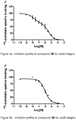
Figure 1 a. Inhibition curve ofcompound 38 for αvβ3. -
Figure 1 b. Inhibition curve ofcompound 38 for αvβ5. -
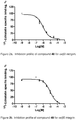
Figure 2a . Inhibition curve ofcompound 48 for αvβ3. -
Figure 2b . Inhibition curve ofcompound 48 for αvβ5. -
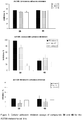
Figure 3 . Cellular adhesion inhibition assays ofcompounds - Preferably, compounds of formula (Ia) are those wherein
W-X- is chosen in the group consisting of W-(CH2)n-, where n=1,2,3;
V-Y- is chosen in the group consisting of V-(CH2)p-CH(R5)-N(R4)-CO-CH2-, V-(CH2)p-CH(R5)-N(R4)-(CH2)m-, where m e p are independently = 0,1,2; R4 = H, Me, Ph, SO2aryl optionally substituted; R5 = H, para-F-Ph, para-OH-Ph;
W is chosen in the group consisting of a guanidino group,
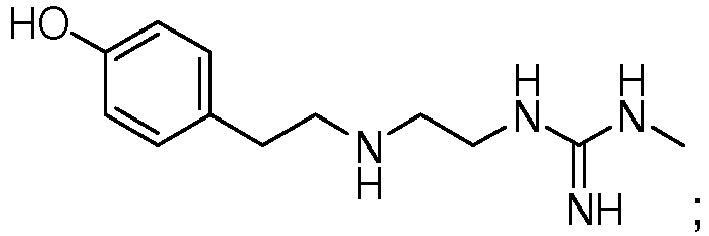
- Particularly preferred compounds are those of formula (Ia)

- n=1,2,3;
- Y-COOH is chosen in the group consisting of;


- W is chosen in the group consisting of a guanidino group,


- Compounds of formula (Ia) as above described can be obtained starting from readily obtainable precursors, also as enantiopure molecules, and specifically from the combination of two molecules bearing an azido group and a C-terminal triple bond, respectively, by means of "click-chemistry", according to
Scheme 1.
- Specifically, compounds of formula (Ia) can be obtained through a process comprising a
Huisgen 1,3-dipolar cycloaddition between azide J-N3 and alkyne K-C=CH, catalyzed by copper with or without ascorbic acid, where J and K are respectively precursors of Y-V and X-W groups. - Subsequent to the cycloaddition, the aforesaid process to achieve the final compounds of formula (Ia), as above described, consists of chemical manipulations of J and K functional groups to give Y-V and X-W groups, as above described. Thus, the possible insertion of the guanidino group or its isostere is taken into account, followed by final deprotection of COOH and guanidino groups or their isosteres. The process is general, and allows for the creation of a variable number of derivatives which show diversity either for the functional groups or for their relative position, as a function of the choice of the components for the 1,3-dipolar cycloaddition reaction and the catalyst type. In particular, by applying the process of
Scheme 1, which involves the catalysis by copper salts, such as Cul, CuSO4, CuSO4 with Cu powder, Cu(OAc)2, or iodo(triethylphosphite)Cu, with or without sodium ascorbate, in water - t-butanol solvent mixture or in tetrahydrofuran, at room temperature or under microwave irradiation, it is possible to achieve 1,2,3-triazole-based molecules of formula (Ia), as above described, starting from alkyne K-C=CH and azide J-N3, where K is a protected precursor of -X-W group, and J is a protected precursor of the -Y-V group. - After the cycloaddition, the process for preparing compounds of formula (Ia) consists of two or three synthetic steps depending on the type of the -X-W precursor. Specifically, if K is a direct protected derivative of the -X-W group (meaning that K already contain the guanidino group or its isostere), the process involves the 1,3-dipolar cycloaddition reaction, followed by removal of V and W protecting groups (see the synthesis of compounds 33-49 and 52-59). If K is indirect precursors of the -X-W group (meaning that K does not contain the guanidino group or its isostere, but a functional group suitable for subsequent introduction of the guanidino group or its isostere), the process consists of 1,3-dipolar cycloaddition reaction, followed by the introduction of the protected or free isostere, according to the definitions given for W, using the methods known in the state of the art. For example, this can be achieved by guanidinylation reaction between a derivative having -K= -X-NH2 and a free or protected guanidino group or its isostere, or by means of a Mitsunobu reaction between a precursor having - K=-X-OH and a guanidino group or its isostere, followed by removal of the protecting groups of V and W.
- The synthesis of compounds of formula (Ia) is significantly less complicated than that of the cyclic peptidomimetics known in the state of the art, and it is possible to achieve even large quantities of final products by means of significantly simple processes. Moreover, the 1,2,3-triazole nucleus is quite stable, as it is not easily hydrolyzed, oxidized or reduced, thus suggesting high in vivo resistance. The preparation of alkynes and azides is achieved according to synthetic methods known in the state of the art.
- In order to provide few examples, selected compounds for the 1,3-dipolar cycloaddition reaction, as above described, are given in Table 1:
Table 1. Representative molecules for the preparations of selected compounds of general formula (Ia). ALKYNE AZIDE 1 
11 
2 
12 
12a: R11=Me 12b: R11=t- Bu 3 
13 
13a: R11=Me 13b: R11=t- Bu 4 
14 
5 
15 
6 
16 
7 
17 
8 
18 
9 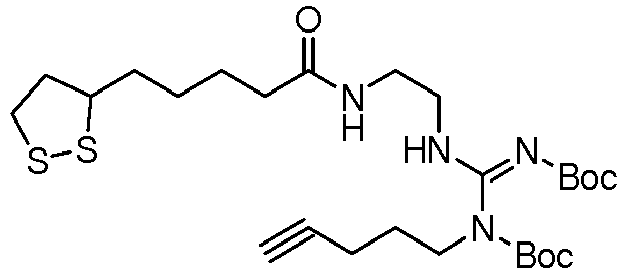
19 
10 
20 
-
Alkyne 6 and azide 14, as reported in Table 1, are obtained starting from β-(S)-para-F-phenylalanine methyl ester as shown in Scheme 2, which in turn is obtained from the corresponding methyl para-F-cynnamate according to methods known in the state of the art (Davies, S. G.; Ichihara, O. Tetrahedron: Asymmetry 1991, 2, 183). The reaction between β-(S)-para-F-phenylalanine methyl ester 21 and bromo-acetyl bromide in anhydrous solvent, preferably anhydrous dichloromethane, in the presence of a base, preferably triethylamine, and preferably at room temperature until reaction completion, gives the corresponding bromide derivative 22. Subsequent treatment with NaN3 in a polar aprotic anhydrous solvent, preferably DMF, at refluxing temperature until reaction completion, results in the achievement of the corresponding azide 14. The reaction between bromide 22 and N-methyl-propargylamine in a polar aprotic solvent, preferably DMF, and in the presence of a base, preferably triethylamine, at room temperature until reaction completion, givesalkyne 6. Similarly,alkyne 7 and azide 15 shown in Table 1 can be obtained starting from the corresponding β-(R)-para-F-phenylalanine methyl ester.
- Alkynes 1-3 as reported in Table 1, can be prepared by Mitsunobu reaction from the corresponding alkynol and N,N-di-Boc-guanidine in anhydrous aprotic solvent, preferably tetrahydrofuran, under microwave irradiation, preferably at 110 °C, until reaction completion.
Alkyne 4 as reported in Table 1, can be obtained by SN2 reaction between compound 23 (Scheme 3) and propargyl bromide.Alkyne 5 of Table 1 can be easily obtained by treating commercially available Boc-piperazine 23 with a butynol derivative, preferably butynyl mesylate, followed by Boc removal, preferably by treatment with a 1:1 TFA-dichloromethane mixture, and final guanidinylating reaction, preferably by using di-Boc-guanidinyl triflate, according toScheme 3.
- Alkynes 8 and 9 can be obtained by reacting the common precursor 27, which is achieved by Mitsunobu reaction between commercially-available di-Boc-thiourea 26 and 4-pentynol, as reported (Delle Monache, G.; Botta, B.; Delle Monache, F.; Espinal, R.; De Bonnevaux, S. C.; De Luca, C.; Botta, M.; Corelli, F.; Carmignani, M. J. Med. Chem. 1993, 36, 2956), with tyramine or the lipoic acid derivative 28, prepared as reported (Nam, J.; Won, N.; Jin, H.; Chung, H.; Kim, S. J. Am. Chem. Soc. 2009, 131, 13639), as outlined in
Scheme 4.
-
Alkyne 10 is obtained by Mitsunobu reaction between di-Boc-benzimidazole and 4-pentynol. -
Azide 11 is prepared as for 14 (Scheme 2) using N-phenylglycine. Azides 12 and 13 are obtained as for 14 (Scheme 2) starting from (S)- or (R)-β-phenylalanine methyl or t-butyl esters, respectively. Azide 16 can be obtained as for 14 (Scheme 2) starting from the corresponding β-(S)-para-OTIPS-phenylalanine methyl ester, obtained from the corresponding methyl para-OTIPS-cynnamate, which in turn is obtained as reported by Maier et al. (Schmauder, A.; Sibley, L. D.; Maier, M. E. Chem. Eur. J. 2010, 16, 4328), according to methods known in the state of the art (Davies, S. G.; Ichihara, O. Tetrahedron: Asymmetry 1991, 2, 183). Azide 17 is prepared from ethanolamine as showed inScheme 5. Amine protection of ethanolamine as Boc-derivative 29 is followed by conversion to the corresponding mesylate 30, and final conversion to azide 17 by reaction with NaN3.
- Azides 18 and 19 are prepared as for 14 (Scheme 2) using methyl 3-aminopropionate or ethyl 4-aminobutyrate, respectively. Finally,
azide 20 is obtained, as reported inScheme 5, from ethanolamine by reaction with methyl bromoacetate to give 31, which is treated with tolyl-sulfonyl chloride in the presence of a base to give 32.Compound 20 is finally obtained by conversion of 32 toazide 20 by Mitsunobu reaction with DPPA (diphenylphosphorylazide). - For example, Table 2 shows compounds of formula (Ia) obtained according to the above-described process, comprising the Cu-catalyzed 1,3-dipolar cycloaddition reaction between an azide and an alkyne of Table 1, followed by acid-mediated hydrolysis.
Table 2. Representative compounds of general formula (Ia). 

33: n=1 36: n=1 34: n=2 37:n=2 35: n=3 38:n=3 

39: n=1 41:n=1 40: n=2 42:n=2 

43:n=1 44:n=2 46 45:n=3 

47: n=2 49: n=3 48: n=3 
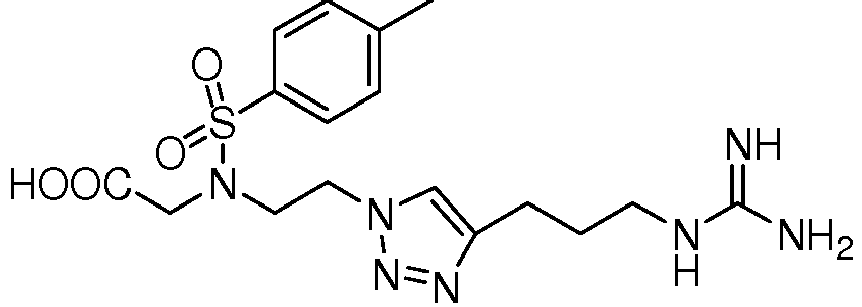
52 53 

54 55 

56 57 

58 59 - The synthetic process of the present invention for the preparation of compounds of formula (Ia) is outlined in
Scheme 6 for the preparation ofcompound 38 starting from azide 12a andalkyne 3 of Table 1.
- The
Huisgen 1,3-dipolar cycloaddition reaction between selected azides and alkynes is carried out in equimolar amounts, in a protic solvent, preferably a 1:1 water - t-butanol mixture, or in an aprotic solvent, preferably tetrahydrofuran, in the presence of copper and ascorbic acid salts, preferably copper(II) acetate and sodium ascorbate, or without sodium ascorbate using preferably catalytic iodo(triethylphosphite)Cu, at room temperature and until reaction completion, for a maximum time of two days, or under microwave irradiation, preferably at 80° C, and until reaction completion. After treatment of the reaction mixture with a basic solution, preferably 5% aqueous NaHCO3, and further chromatographic purification, subsequent hydrolysis is achieved by treating the protected derivative with an acidic aqueous solution, preferably 3M HCl, thus giving the desired product as a hydrochloride salt after solvent evaporation. - In vitro competition studies, which have been carried out using αvβ3 and αvβ5 receptors, purified from human placenta by affinity chromatography, have shown a high binding affinity of 38 for both receptors, having a IC50=16.4 nM for αvβ3 and IC50=1.02 µM for αvβ5 (
Figure 1 ). The introduction of a fluorine on the aromatic ring in para position, in analogy with a potential labelling with fluorine-18 (PET radioisotope), corresponding tocompounds 48 and 49 of formula (Ia), has shown that the presence of the fluorine maintain the affinity towards the receptor, though with lowered potency of about an order of magnitude (compound 48: IC50=215 nM for αvβ3, and IC50=9.90 µM for αvβ5, as shown inFigure 2 ; compound 49: IC50=101 nM for αvβ3). High binding affinity is observed for compound 55 lacking the aromatic ring (IC50=13 nM for αvβ3). Compounds 54 and 57 show inhibition towards αvβ3 with IC50 = 2.1 µM and 200 nM. Moreover, compound 52 displays 77% and 54% inhibition of 125I-Echistatin binding to αvβ3 at 10 µM and 1 µM concentrations, respectively. Finally, compound 59 shows inhibition towards αvβ3 with IC50 = 308 nM. - A series of experiments carried out using the flux cytometry technique and specific monoclonal antibodies, allowed for the setup of particular human melanoma cells characterized by an over-expression of integrin receptors. Such cells have been used to test the capability of selected compounds of formula (Ia) at 10, 1.0 and 0.1 µM concentrations, of inhibiting the binding between these cells and suitable substrates containing the RGD sequence, such as vitronectin, fibronectin, and osteopontin (
Figure 3 ). The results clearly show thatcompound 48 significantly inhibits the binding of melanoma cells to both vitronectin and osteopontin, whereas it displays a minor effect towards the adhesion of the cells to fibronectin. -
Compound 48 significanlty inhibits only the binding of the cells to vitronectin, whereas it shows a minor effect towards the adhesion of the cells to both osteopontin and fibronectin. Taken all together, these data demonstrate that the RGD-like molecules of formula (Ia) are capable to exert important biological effects also to integrin receptors associated to the plasma-membrane of tumor cells, which is a pre-requisite for their use in-vivo. Moreover, these results show that among the two selected peptidomimetics of formula (Ia),compound 38 displays a higher affinity for the αvβ3 integrin receptor, which recognizes the RGD sequence exposed both on vitronectin and osteopontin. - These results suggest a potential use of compounds of formula (Ia), as above-described, as medicaments and/or diagnostics for the treatment and/or diagnosis of pathologies where integrins are involved. Compounds of the present invention can be used as antagonists of integrin receptors, in particular of integrins that recognize the tripeptide Arg-Gly-Asp (RGD) sequence, and more specifically, of αvβ3 and αvβ5 integrins, thus resulting useful, for example, for the treatment of initiating or growing tumors (acting as anti-angiogenic agents), osteoporosis, or rheumatoid arthritis.
- Compounds of formula (Ia) according to the present invention, when containing one or more radioisotopes, can be applied as diagnostics, or starting from compounds of formula (Ia) as above-described, conjugated compounds with suitable molecular probes can be obtained.
- General procedure (A) for the synthesis of alkynes 1-3 of Table 1. To a solution of alkyn-1-ol (1 eq) in anhydrous THF, PPh3 (1 eq) and N,N'-di-Boc-guanidine (1 eq) are added under a nitrogen atmosphere. Successively, DIAD (1 eq) is slowly added at 0 °C, then, the mixture is left reacting in a microwave synthesizer at 110°C for 30 min. The solvent is evaporated and the crude is purified by flash chromatography (1:2 EtOAc-petr. et.), thus giving pure product.
- N,N'-Di-Boc-N"-(prop-2-ynyl)-guanidine (1).
Compound 1 is obtained according to general procedure A in 79% yield. (1:2 EtOAc-petr. et., Rf = 0.80). 1H NMR (CDCl3, 200 MHz) δ 8.46 (br, 1 H), 4.22 (dd, J = 4.8, 2.6 Hz, 2H), 2.26 (t, J = 2.6 Hz, 1 H), 1.49 (s, 18H) ppm. - N,N'-Di-Boc-N"-(but-3-ynyl)-guanidine (2). Compound 2 is obtained according to general procedure A as a white solid in 72% yield. (1:2 EtOAc-petr. et., Rf = 0.80). 1H NMR (CDCl3, 200 MHz) δ 9.20 (br, 1 H), 4.08 (t, J = 7.0 Hz, 2H), 2.52 (td, J = 7.0, 2.6 Hz, 2H), 1.95 (t, J = 2.6 Hz, 1 H), 1.53 (s, 9H), 1.48 (s, 9H) ppm; 13C NMR (CDCl3, 50 MHz) δ 163.3 (s), 159.8 (s), 154.4 (s), 83.8 (s), 81.1 (s), 78.5 (s), 69.7 (d), 42.8 (t), 28.2 (q), 27.9 (q), 18.5 (t) ppm.
- N,N'-Di-Boc-N"-(pent-4-ynyl)-guanidine (3).
Compound 3 is obtained according to general procedure A as a white solid in 68% yield. (1:2 EtOAc-petr. et., Rf = 0.63). 1H NMR (CDCl3, 200 MHz) δ 9.30 (br, 1 H), 4.00 (t, J = 7.2 Hz, 2H), 2.23 (td, J = 7.2, 2.2 Hz, 2H), 1.93 (t, J = 2.2 Hz, 1 H), 1.83 (m, 2H), 1.52 (s, 9H), 1.48 (s, 9H) ppm; 13C NMR (CDCl3, 50 MHz) δ 163.7 (s), 160.5 (s), 154.8 (s), 83.8 (s), 83.7 (s), 78.7 (s), 68.5 (d), 43.9 (t), 28.3 (q), 28.0 (q), 27.5 (t), 16.0 (t) ppm. - [t-butoxycarbonylimino-(4-prop-2-ynyl-piperazin-1-y)-methyl]-carbamic acid t-butyl ester (4). To a solution of N,N'-di-Boc-N"-trifluoromethanesulfonylguanidine (1.72 g, 4.40 mmol) in anhydrous CH2Cl2 (20 mL) Et3N (674 µL, 4.84 mmol) and N-propargyl piperazine (600 mg, 4.84 mmol) are added. The mixture is left reacting at room temperature for 16 h, then the solvent is evaporated. The residue is taken up in EtOAc, and treated with a saturated aqueous NaHCO3 solution and brine. Crude compound is purified by flash chromatography (2:1 EtOAc- petr. et., Rf = 0.37) giving
compound 4 as a yellow oil (1.01 g, 2.77 mmol) in 63% yield. 1H NMR (CDCl3, 200 MHz) δ 9.61 (br, 1 H), 3.44 (m, 4H), 3.16 (d, J = 2.6 Hz, 2H), 2.41 (m, 4H), 2.18 (m, 1 H), 1.27 (s, 9H) ppm. - [t-butoxycarbonylimino-(4-but-3-ynyl-piperazin-1-yl)- methyl]-carbamic acid t-butyl ester (5) (Scheme 3). To a solution of 23 (1.02 g, 5.47 mmol) triethylamine (762 µL, 5.47 mmol) and Nal (23 mg, 0.153 mmol) in DMSO but-3-ynyl mesylate (810 mg, 5.47 mmol) is dropwise added. The mixture is heated at 50 °C overnight, then water is added. The aqueous phase is treated with Et2O, and the organic phase is washed with brine, and dried over sodium sulfate. After solvent evaporation, 4-but-3-ynyl-piperazine-1-carboxylic acid t-butyl ester (24) (1.10 g, 4.62 mmol, 84%) is obtained as a yellow oil. 1H NMR (CDCl3, 200 MHz) δ 3.38 (t, J = 4.8 Hz, 4H), 2.55 (m, 2H), 2.41-2.28 (m, 6H), 1.94 (t, J = 2.6 Hz, 1 H), 1.40 (s, 9H) ppm; 13C NMR (CDCl3, 50 MHz) δ 154.3 (s), 82.3 (s), 79.5 (s), 69.1 (d), 56.9 (t), 52.6 (t), 43.5 (t), 28.4 (q), 16.7 (t) ppm. Compound 24 (1.10 g, 4.62 mmol) is left reacting for 16h in the presence of a 1:1 mixture of CH2Cl2/TFA (2 mL/mmol). After solvent evaporation, the residue is taken up in MeOH, and eluted through a column containing Amberlyst A-21, thus giving pure 1-but-3-ynyl-piperazine (25) (606 mg, 4.39 mmol) in 95% yield. 1H NMR (CDCl3, 200 MHz) δ 6.98 (br, 1 H), 3.06-3.01 (m, 4H), 2.62-2.55 (m, 6H), 2.38-2.29 (m, 2H), 1.96 (t, J = 2.6 Hz, 1 H) ppm; 13C NMR (CDCl3, 50 MHz) δ 82.1 (s), 69.4 (d), 56.6 (t), 50.6 (t), 44.1 (t), 16.8 (t). MS m/z 138 (M+, 7), 99 (100), 70 (48), 56 (98) ppm. To a solution of N,N'-di-Boc-N"-trifluoromethanesulfonylguanidine (1.52 g, 3.88 mmol) in anhydrous CH2Cl2 (18 mL) triethylamine (595µL, 4.27 mmol) and 25 (590 mg, 4.27 mmol) are added. The mixture is left reacting for 16 h at room temperature, and then the solvent is evaporated. The residue is taken up in EtOAc and treated with a saturated aqueous NaHCO3 solution and brine. Crude product is purified by flash chromatography (CH2Cl2-MeOH 12:1, Rf = 0.50), giving pure 5 as a white solid (1.10 g, 2.25 mmol) in 58% yield. 1H NMR (CDCl3, 200 MHz) δ 3.58 (m, 4H), 2.63-2.51 (m, 6H), 2.39-2.33 (m, 2H), 1.96 (t, J = 2.6 Hz, 1 H) ppm; 13C NMR (CDCl3, 50 MHz) δ 154.7 (s), 151.2 (s), 115.9 (s), 85.9 (s), 82.3 (s), 69.2 (d), 56.6 (t), 52.3 (t), 46.7 (t), 28.0 (q), 27.8 (q), 16.8 (t); MS m/z 380 (M+, 0.11), 160 (17), 121 (79), 57 (100) ppm.
- (3S)-(2-Bromo-acetylamino)-3-(4-fluoro-phenyl)-propionic acid methyl ester [(S)-22] (Scheme 2). To a solution of compound (S)-21 (1.0 g, 5.08 mmol), prepared as reported (Davies, S. G.; Ichihara, O. Tetrahedron: Asymmetry 1991, 2, 183), and triethylamine (0.71 mL, 5.08 mmol) in anhydrous CH2Cl2 (5 mL) bromoacetyl bromide (442 µL, 5.08 mmol) is dropwise added at -10°C. After 15 min at -10°C, the mixture is allowed to reach room temperature, and it is left reacting for additional 30 min. Then, water is added and the two phases are separated. The organic phase is washed with 5% HCl and brine, and it is dried over anhydrous Na2SO4. After solvent evaporation, compound (S)-22 is obtained as a yellow oil (1.40 g, 4.42 mmol) in 87% yield. 1H NMR (CDCl3, 200 MHz) δ 7.74 (br, 1 H), 7.30-7.23 (m, 2H), 7.07-6.98 (m, 2H), 5.36 (dt, J = 8.0, 5.6 Hz, 1 H), 3.90 (s, 2H), 3.64 (s, 3H), 2.88 (dd, J1 = 5.6, 3.8 Hz, 2H) ppm; 13C NMR (CDCl3, 50 MHz) δ 171.3 (s), 164.8 (s), 162.1 (d, JCF = 245 Hz), 135.5 (s), 127.8 (d, JCF = 8.2 Hz), 115.6 (d, JCF = 20 Hz), 52.1 (q), 49.6 (d), 39.6 (t), 29.1 (t) ppm.
- (3R)-(2-Bromo-acetylamino)-3-(4-fluoro-phenyl)-propionic acid methyl ester [(R)-22]. Compound (R)-22 is prepared as described for (S)-22 starting from (R)-21 (1.0 g, 5.08 mmol). After solvent evaporation, (R)-22 is obtained as a yellow oil (1.35 g, 4.27 mmol) in 84% yield and with NMR data as for (S)-22.
- (S)-3-(4-Fluoro-phenyl)-3-[2-(methyl-prop-2-ynyl-amino)-acetylamino]-propionic acid methyl ester (6) (Scheme 2). A solution of compound (S)-22 (654 mg, 2.18 mmol) in DMF (2 mL) is added at room temperature to a solution of N-methyl propargylamine (181 µL, 2.18 mmol) and triethylamine (453 µL, 3.27 mmol) in DMF (5 mL). After 1 h, the mixture is brought to 80 °C and left reacting for 16 h. Then, water is added and the organic phase is extracted with diethyl ether. Crude product is purified by flash chromatography (3:2 EtOAc- petr. et., Rf = 0.50) giving pure 6 as a yellow oil (0.990 g, 3.54 mmol) in 80% yield. 1H NMR (CDCl3, 200 MHz) δ 7.81 (d, J = 8.4 Hz, 1 H), 7.26-7.18 (m, 5H), 5.43-5.34 (m, 1 H), 3.55 (s, 3H), 3.28 (d, J = 2.5 Hz, 2H), 3.05 (s, 2H), 2.81 (t, J = 6.0 Hz, 2H), 2.30 (s, 3H), 2.19 (t, J = 1.2 Hz, 1 H) ppm; 13C NMR δ 170.9 (s), 169.2 (s), 140.4 (s), 128.5 (d), 127.4 (d), 126.1 (d), 73.5 (t), 59.3 (t), 51.6 (q), 49.0 (t), 46.2 (t), 42.2 (q), 40.2 (t) ppm.
- (R)-3-(4-Fluoro-phenyl)-3-[2-(methyl-prop-2-ynyl-amino)-acetylamino]-propionic acid methyl ester (7).
Compound 7 is prepared as reported for 6 starting from (R)-22, with same NMR data as for 6. - N,N'-di-Boc-1-hex-4-ynyl-2-methyl-isothiourea (27) (Scheme 4). To a solution of N,N'-diBoc-2-Methyl-isothiourea 26 (500 mg, 1.72 mmol), PPh3 (540 mg, 2.05 mmol) and pent-4-yn-1-ol (145 mg, 1.72 mmol) in anhydrous THF (20 mL) DIAD (415 ml, 2.06 mmol) is dropwise added at -10 °C. Then, the mixture is left reacting in a microwave synthesizer at 50 °C for 30 min. The solvent is evaporated, and the crude is purified by flash chromatography (10:1 EtOAc- petr. et., Rf = 0.33), thus giving pure N,N'-diBoc-1-Hex-4-ynyl-2-methyl-isothiourea 27 in 98% yield. 1H NMR (CDCl3, 200 MHz) δ 3.63 (t, 2H), 2.39 (s, 3H), 2.27-2.20 (m, 2H), 1.97 (t, 2H), 2.35 (t, 2H), 1.90 (t, 2H), 1.52 (s, 9H), 1.48 (s, 9H) ppm.
-
Alkyne 8. A solution of tyramine (200 mg, 0.637 mmol), 27 (600 mg, 1.68 mmol) and triethylamine (510 ml, 5.06 mmol) in anhydrous THF (20 mL) is left reacting in a microwave synthesizer at 100 °C for 1 h, and then the solvent is evaporated. The residue is taken up in EtOAc, and treated with brine. Crude compound is purified by flash chromatography (1:2 EtOAc-petr. et., Rf = 0.42) to give compound 8 (350 mg) in 47% yield. 1H NMR (CDCl3, 200 MHz) δ 7.04 (d, 2H), 6.77 (d, 2H), 3.66 (t, 2H), 3.42 (t, 2H), 3.42 (t, 2H), 2.18-2.04 (m, 2H), 1.95 (t, 2H), 1.62 (t, 2H), 1.49 (s, 9H), 1.46(s, 9H). -
Alkyne 9. 5-[1,2]Dithiolan-3-yl-pentanoic acid (2-amino-ethyl)-amide 28 is obtained as reported (Nam, J.; Won, N.; Jin, H.; Chung, H.; Kim, S. J. Am. Chem. Soc. 2009, 131, 13639) starting from lipoic acid (2.0 g, 9.70 mmol), 1,1-carbonyldiimidazole (200 g, 12.3 mmol), and ethylenediamine (3.5 mL, 48.4 mmol) in 80% yield. 1H NMR (D2O, 200 MHz) δ 3.62 -3.52 (m, 1 H), 3.34-3.26 (m, 2H), 3.22-3.08 (m, 2H), 2.82 (t, 2H), 2.52-2.40 (m, 1 H), 2.20 (t, 1 H), 1.96-1.84 (m, 1 H), 1.72-1.58 (m, 5H), 1.51-1.38 (m, 2H) ppm. A solution of 28 (787 mg, 3.17 mmol), 27 (754 mg, 2.11 mmol) and triethylamine (640 ml, 6.33 mmol) in anhydrous THF (30 mL) is left reacting in a microwave synthesizer at 100 °C for 1 h. Then, the solvent is evaporated. The residue is taken up in EtOAc, and treated with brine. Crude compound is purified by flash chromatography (30:1 CH2Cl2-CH3OH, Rf = 0.37) giving 9 (480 mg) in 41% yield. 1H NMR (CDCl3, 200 MHz) δ 6.42 (br, 1 H), 3.75-3.68 (m, 2H), 3.50-3.35 (m, 4H), 3.30-3.15 (m, 2H), 2.52-2.40 (m, 2H), 2.30-2.10 (m, 5H), 1.97 (t, 1 H), 1.95-1.85 (m, 2H), 1.80-1.70 (m, 2H), 1.72-1.60 (m, 4H), 1.49 (s, 9H,), 1.45 (s, 9H) ppm. - 2-(tert-Butoxycarbonyl-pent-4-ynyl-amino)-methyl-benzoimidazole-1-carboxylic acid tert-butyl ester (10). To a solution of C-(1 H-benzoimidazol-2-yl)-methylamine (200 mg, 1.0 mmol) and triethylamine (139 µL, 1 mmol) in CH2Cl2 (5 mL) (Boc)2O (420 mg, 2 mmol) is added, and the reaction mixture is stirred at r.t. for 1 h. After solvent evaporation, the crude product is purified by flash chromatography (1:1 EtOAc-Et.petr., Rf = 0.5), to give 2-(tert-butoxycarbonylamino-methyl)-benzoimidazole-1-carboxylic acid t-butyl ester as a yellow oil (246 mg, 0.71 mmol) in 71.% yield. 1H NMR (CDCl3, 200 MHz) δ 7.96-7.91 (m, 1 H), 7.72-7.67 (m, 1 H), 7.35-7.26 (m, 2H), 5.85 (br, 1 H), 4.80 (d, 2H), 1.71 (s, 9H), 1.48 (s, 9H) ppm. This intermediate (175 mg, 0.5 mmol) is dissolved in anhydrous THF (10 mL) and PPh3 (330 mg, 0.5 mmol) and 4-pentynol (46 µL, 0.5 mmol) are added. Then, after cooling to 0 °C, DIAD (100 µL, 0.5 mmol) is slowly added, and after 15 min at 0 °C, the mixture is heated under microwave irradiation at 110 °C for 1 h. Following flash chromatography purification (5:1 EtOAc - petr. et.),
compound 10 is obtained in 64% yield. 1H NMR (CDCl3, 200 MHz) δ 7.95-7.90 (m, 1H), 7.71-7.67 (m, 1H), 7.34-7.26 (m, 2H), 5.79 (d, 2H), 2.30-2.20 (m, 2H), 2.03 (s, 1H), 1.95-1.92 (m, 2H), 1.80 (t, 2H), 1.71 (s, 9H), 1.47 (s, 9H) ppm. - [(2-Azido-acetyl)-phenyl-amino]-acetic acid t-butyl ester (11). To a solution of N-phenyl-glycine methyl ester (1.65 g, 7.98 mmol) and triethylamine (1.11 mL, 7.98 mmol) in anhydrous CH2Cl2 (8 mL) bromoacetyl bromide (695 µL, 7.98 mmol) is dropwise added at -10°C. After 15 min at -10°C, the mixture is allowed to reach room temperature, and it is left reacting for additional 30 min. Then, water is added and the two phases are separated. The organic phase is washed with 5% HCl and brine, and it is dried over anhydrous Na2SO4. After solvent evaporation, 2.10 g of the corresponding bromoacetyl-derivative are obtained as a brown oil (85%). 1H NMR (CDCl3, 200 MHz) δ 7.41 (m, 5H), 4.23 (s, 2H), 3.67 (s, 2H), 1.42 (s, 9H) ppm. To a solution of this compound (2.10 g, 6.76 mmol) in DMF, NaN3 (1.32 g, 20.3 mmol) is added at room temperature. After 5 min, the mixture is brought to 80 °C and left reacting for 16 h. Then, water is added and the organic phase is extracted with diethyl ether. Crude product is purified by flash chromatography (1:3 EtOAc-petr. et., Rf = 0.57), thus giving 11 as a white solid (1.06 g, 3.65 mmol) in 54% yield. 1H NMR (CDCl3, 200 MHz) δ 7.41-7.35 (m, 5H), 4.29 (s, 2H), 3.66 (s, 2H), 1.46 (s, 9H) ppm; 13C NMR (CDCl3, 50 MHz) δ 167.4 (s), 167.3 (s), 140.9 (s), 129.9 (d), 128.8 (d), 127.7 (d), 82.1 (s), 52.2 (t), 50.6 (t), 28.1 (q) ppm; MS m/z 290 (M+, 0.2), 262 (0.7), 217 (11), 189 (1.8), 161 (7.3), 106 (30), 77 (18), 57 (100).
- (3S)-(2-Azido-acetylamino)-3-phenyl-propionic acid methyl ester (12a) Compound 12a is prepared as described for 14, starting from (S)-β-phenylalanine methyl ester (1.0 g, 5.59 mmol), prepared as reported (Davies, S. G.; Ichihara, O. Tetrahedron: Asymmetry 1991, 2, 183). After solvent evaporation, the intermediate bromoacetyl-derivative is obtained as a brown oil (1.37 g, 4.97 mmol) in 89% yield.1H NMR (CDCl3, 200 MHz) δ 7.72 (d, J = 8 Hz, 1 H), 7.37-7.24 (m, 5H), 5.38 (dt, J = 8.0, 5.8 Hz, 1 H), 3.87 (s, 2H), 3.62 (s, 3H), 2.90 (t, J = 5.8 Hz, 2H) ppm; 13C NMR (CDCl3, 50 MHz) δ 171.1 (s), 164.9 (s), 139.6 (s), 128.6 (d), 127.6 (d), 126.0 (d), 51.8 (q), 50.1 (d), 39.5 (t), 28.9 (t) ppm. To a solution of this compound (1.37 g, 4.97 mmol) in DMF NaN3 (969 mg, 14.9 mmol) is added at room temperature. After 5 min, the mixture is brought to 80 °C and left reacting for 16 h. Then, water is added and the organic phase is extracted with diethyl ether. Crude product is purified by flash chromatography (1:1 EtOAc-petr. et., Rf = 0.40), giving 12a as a white solid (1.01 g, 4.12 mmol) in 83% yield. [α]23D -25.9 (c 1.8, CHCl3). 1H NMR (CDCl3, 200 MHz) δ 7.35-7.26 (m, 5H), 5.43 (dt, J = 8.0, 5.8 Hz, 1 H), 4.03 (s, 2H), 3.64 (s, 3H), 2.90 (t, J = 5.8 Hz, 2H) ppm; 13C NMR (CDCl3, 50 MHz) δ 171.2 (s), 165.9 (s), 139.7 (s), 128.7 (d), 127.4 (d), 126.1 (d), 52.5 (t), 51.9 (q), 49.5 (d), 39.6 (t) ppm.
- (3S)-(2-Azido-acetylamino)-3-phenyl-propionic acid t-butyl ester (12b). Compound 12b is prepared as reported for 12a starting from (S)-β-phenylalanine t-butyl ester. 1H NMR (CDCl3, 200 MHz) δ 7.47 (d, J = 7.8 Hz, 1 H), 7.32 (m, 5H), 5.39 (dt, J = 8.4, 5.8 Hz, 1 H), 4.02 (s, 2H), 2.80 (pseudo t, J = 6.2 Hz, 2H), 1.34 (s, 9H) ppm. [α]23D -18.9 (c 1.0, CHCl3).
- (3R)-(2-Azido-acetylamino)-3-phenyl-propionic acid methyl ester (13a). Compound 13a is prepared as reported for 12a starting from (R)-β-phenylalanine methyl ester (1.0 g, 5.59 mmol). After solvent evaporation, the intermediate bromoacetyl-derivative is obtained as a brown oil in 85% yield. 1H NMR (CDCl3, 200 MHz) δ 7.72 (d, J = 8.0 Hz, 1 H), 7.37-7.24 (m, 5H), 5.38 (dt, J = 8.0, 5.8 Hz, 1 H), 3.87 (s, 2H), 3.62 (s, 3H), 2.90 (t, J = 5.8 Hz, 2H) ppm; 13C NMR (CDCl3, 50 MHz) δ 171.1 (s), 164.9 (s), 139.6 (s), 128.6 (d), 127.6 (d), 126.0 (d), 51.8 (q), 50.1 (d), 39.5 (t), 28.9 (t) ppm. Compound 13a is obtained from this intermediate compound (1.31 g, 4.75 mmol) as reported for 12a in 80% yield and with same NMR data as reported for 12a. [α]23D +25.0 (c 1.6, CHCl3).
- (3R)-(2-Azido-acetylamino)- 3-phenyl-propionic acid t-butyl ester (13b). Compound 13b is prepared as reported for 12a starting from (R)-β-phenylalanine t-butyl ester, with same NMR data as reported for 13b. [α]23D +18.3 (c 1.0, CHCl3).
- (3S)-(2-Azido-acetylamino)-3-(4-fluoro-phenyl)-propionic acid methyl ester (14) (Scheme 2). To a solution of (S)-22 (1.40 g, 4.42 mmol) in DMF NaN3 (862 mg, 13.3 mmol) is added at room temperature. After 5 min, the mixture is brought to 80 °C and left reacting for 16 h. Then, water is added and the organic phase is extracted with diethyl ether. Crude product is purified by flash chromatography (3:2 EtOAc-petr. et., Rf = 0.50), giving pure 14 as a yellow oil (0.990 g, 3.54 mmol) in 80% yield. 1H NMR (CDCl3, 200 MHz) δ 7.46 (d, J = 8.0 Hz 1 H), 7.29-7.22 (m, 2H), 7.00 (td, JHF = 8.8 Hz, JHH= 1.4 Hz, 2H), 5.36 (dt, J = 8.0, 5.6 Hz, 1 H), 3.97 (s, 2H), 3.62 (s, 3H), 2.88 (pseudo t, J = 5.6 Hz, 2H) ppm; 13C NMR (CDCl3, 50 MHz) δ 170.9 (s), 165.7 (s), 161.9 (d, JCF = 245 Hz), 135.6 (s), 127.8 (d, JCF = 8.2 Hz), 115.5 (d, JCF = 20 Hz), 52.5 (t), 51.9 (q), 48.9 (d), 39.7 (t) ppm. [α]23D -22.0 (c 0.6, CHCl3).
- (3R)-(2-Azido-acetylamino)-3-(4-fluoro-phenyl)-propionic methyl ester (15). Compound 15 is prepared as reported for 14 starting from (R)-22 (1.35 g, 4.27 mmol). Crude product is purified by flash chromatography (3:2 EtOAc-petr. et., Rf = 0.50), giving 15 as a yellow oil (0.932 g, 3.33 mmol) in 78% yield with same NMR data as reported for 14. [α]23D +23.4 (c 0.5, CHCl3).
- (3S)-(2-Azido-acetylamino)-3-(4-hydroxy-phenyl)-propionic acid methyl ester (16). Compound 16 is prepared as described for 14, starting from (R)-β-tyrosine methyl ester (1.12 g, 5.28 mmol), prepared according to literature (Davies, S. G.; Ichihara, O. Tetrahedron: Asymmetry 1991, 2, 183) from 3-(4-triisopropylsilanyloxy-phenyl)-acrylic acid methyl ester (1.0 g, 3.34 mmol), prepared as reported (Schmauder, A.; Sibley, L. D.; Maier, M. E. Chem. Eur. J. 2010, 16, 4328). After solvent evaporation, the intermediate bromoacetyl-derivative is obtained as a brown oil (0.80 g, 1.69 mmol) in 51% yield. 1H NMR (CDCl3,200 MHz) δ 7.61 (d,1 H), 7.20 (d, J = 8.7, 2H), 6.82 (d, J = 8.7, 2H), 5.32 (m,1 H), 3.91 (s, 2H), 3.61 (s, 3H), 2.98-2.78 (m,2H), 1.37-1.15 (m, 3H), 1.07 (d, 18H) ppm. To a solution of this compound (0.80 g, 1.69 mmol) in DMF NaN3 (0.33 mg, 5.07 mmol) is added at room temperature. After 5 min, the mixture is brought to 80 °C, and left reacting for 16 h. Then, water is added and the organic phase is extracted with diethyl ether. Crude product is purified by flash chromatography (1:1 EtOAc-petr. et., Rf = 0.40), giving 16 as a white solid (0.25 g, 0.90 mmol) in 53% yield. 1H NMR (CDCl3, 200 MHz) δ 7.42 (d,1 H), 7.1 0 (d, J = 8.4, 2H), 6.71 (d, J = 8.4, 2H), 6.00 (br, 1 H), 5.33 (m,1 H), 4.02 (s, 2H), 3.64 (s, 3H), 2.98-2.79 (m, 2H) ppm.
- (2-Azido-ethyl)-carbamic acid t-butyl ester (17) (Scheme 5). A solution of ethanolamine (300 µL, 4.9 mmol) in CH3CN (25 mL) is treated with (Boc)2O (1.2 g, 5.5 mmol) and DMAP (120 mg, 0.98 mmol) at room temperature for 3 h. Then, the mixture is treated with 5% KHSO4 and brine, and dried over sodium sulfate. After solvent evaporation, pure Boc-ethanolamine 29 is obtained in 53% yield. 1H NMR (CDCl3, 200 MHz) δ 5.27 (br, 1 H), 3.67 (br, 1 H), 3.53 (t, J = 5.1 Hz, 2H), 3.17-3.09 (m, 2H), 1.35 (s, 9H) ppm. This intermediate compound is dissolved in anhydrous CH2Cl2 and Et3N (1.1 mL, 7.9 mmol) is added under a nitrogen atmosphere. The mixture is cooled to 0 °C, MsCl (614 µL, 7.94 mmol) is dropwise added, and the mixture is left reacting at the same temperature for 20 min. Successively, 1 M NaOH (10 mL) is added and the organic phase is separated. The mixture is treated with a saturated aqueous NaHCO3 solution and with brine, and dried over sodium sulfate. After solvent evaporation, pure Boc-aminoethyl mesylate 30 (509 mg) is obtained in 64% yield. 1H NMR (CDCl3, 200 MHz) δ 5.05 (br, 1 H), 4.33-4.20 (m, 2H), 3.45-3.21 (m, 2H), 3.01 (s, 3H), 1.39 (s, 9H) ppm. The resulting mesylate 30 is dissolved in DMF (5 mL), and NaN3 (413 mg, 6.36 mmol) is added at 0 °C. The mixture is heated at 80 °C for 16 h, then water is added (50 mL). The organic phase is extracted with Et2O (25 mL x 5), and dried over sodium sulfate. After solvent evaporation, the crude product is purified by flash chromatography (1:3 EtOAc-petr. et., Rf = 0.75), giving 17 (224 mg) as an oil in 61% yield. 1H NMR (CDCl3, 200 MHz) δ 4.92 (br, 1 H), 3.40-3.35 (m, 2H), 3.30-3.22 (m, 2H), 1.41 (s, 9H) ppm.
- 3-(2-Azido-acetylamino)-propionic acid methyl ester (18). To a solution of methyl 3-aminopropionate ester hydrochloride (1.12 g, 8.00 mmol) and triethylamine (2.2 mL (16.00 mmol) in anhydrous CH2Cl2 (30 mL) bromoacetyl bromide (690 µL, 8.00 mml) is dropwise added at -10 °C. After 15 min at -10 °C, the mixture is allowed to reach room temperature, and is left reacting for additional 30 min. The organic phase is washed with 4M HCl, saturated Na2CO3 solution, and brine, and it is dried over anhydrous Na2SO4. After solvent evaporation, 1,02 g (4.57 mmol) of the corresponding bromoacetyl-derivative is obtained as a brown oil (57%). 1H NMR (CDCl3, 200 MHz) δ 7.10 (br,1 H), 3.83 (s,H), 3.75 (s, 3H), 3.57 (q, 2H), 2.57 (t, 2H) ppm. 13C NMR (CDCl3,50 MHz) δ 172.7 (s), 165.4 (s), 51.9 (t), 35.5 (t), 33.4 (t), 29.1 (q) ppm. To a solution of this compound (1.02 g, 4.57 mmol) in anhydrous DMF (12 mL) NaN3 (900 mg, 13.71 mmol) is added. The mixture is heated at 80 °C for 16 h. Then, water (50 mL) is added and the organic phase is extracted with diethyl ether. Crude product is purified by flash chromatography (1:1 EtOAc-Et.petr., Rf = 0.4) to give 18 as a white solid (340 mg, 1.82 mmol) in 40% yield. 1H NMR (CDCl3, 200 MHz) δ 6.91 (br, 1 H), 3.94 (s, 3H), 3.68 (s, 3H), 3.53 (q, 2H), 2.55 (t, 2H) ppm. 13C NMR (CDCl3,50 MHz) δ 172.5 (s), 165.5 (s), 52.7 (t), 52.0 (t), 34.9 (t), 33.7 (q) ppm.
- 4-(2-Azido-acetylamino)-butyric acid ethyl ester (19). Compound 19 is prepared as described for 18. Specifically, starting from ethyl 4-aminobutanoate hydrochloride (1.00 g, 7.65 mmol), triethylamine (2.1 mL, 15.30 mmol) in anhydrous CH2Cl2 (26 mL) and bromoacetyl bromide (520 µL, 7.65 mml), the corresponding bromoacetyl-derivative is obtained as a brown oil (59%). 1H NMR (CDCl3, 200 MHz) δ 6.77 (br,1 H), 4.11 (q, 2H), 3.84 (s, 2H), 3.32 (m, 2H), 2.35 (t, 2H), 1.94-1,78 (m, 2H), 1.23 (t, 3H) ppm. 13C NMR (CDCl3,50 MHz) δ 172.9 (s), 165.5 (s), 60.7 (t), 39.8 (t), 31.7 (t), 29.2 (t), 24.48 (t), 14.4 (q) ppm. Starting from a solution of this compound (950 mg, 3.77 mmol) in anhydrous DMF (7 mL) and NaN3 (720 mg, 11.31 mmol), after purification by flash chromatography (1:1 EtOAc-Et.petr., Rf = 0.7), 19 is obtained as a white solid (350 mg, 1.64 mmol) in 44% yield. 1H NMR (CDCl3, 200 MHz) δ 6.60 (br,1 H), 4.13 (q, 2H), 3.96 (s, 2H), 3.33 (m, 2H), 2.35 (t, 2H), 1.93-1.82 (m, 2H), 1.24 (t, 3H). 13C NMR (CDCl3,50 MHz) δ 173.0.99 (s), 166.5 (s), 60.7 (t), 52.8 (t), 39.1 (t), 31.8 (t), 24.5 (t), 14.3 (q).
- [(2-Azido-ethyl)-(toluene-4-sulfonyl)-amino]-acetic acid ethyl ester (20) (Scheme 5). To a solution of (2-hydroxy-ethylamino)-acetic acid ethyl ester 31 (2.8 g, 10 mmol), prepared as reported (Yoon U. C.; Kwon H. C.; Hyung T. G.; Choi K. H.; Oh S. W.; Yang S.; Zhao Z.; Mariano P. S. J. Am. Chem. Soc. 2004, 126, 1110) and triethylamine (3.95 mL, 15 mmol) in anhydrous THF (230 mL) tosyl chloride (3,63 g, 10 mmol) is dropwise added at 0 °C, and the mixture is left reacting for 4 h at 0 °C. Then, water and 1 N HCl are added up to pH=2. The organic phase is extracted with EtOAc. Crude compound is purified by flash chromatography (1:1 EtOAc-petr. et., Rf = 0.45) giving compound 32 (3.50 g) in 56% yield. 1H NMR (CDCl3, 200 MHz) δ 7.73 (d, 2H), 7.31 (d, 2H), 4.18 (q, 2H), 4.04 (s, 2H), 3.73 (t, 2H), 3.34 (t, 2H), 2.43 (s, 21 H), 1.26 (t, 3H) ppm. To a solution of 31 (2.96 g, 9.8mmol), PPh3 (7.71 g, 29.4 mmol) in anhydrous THF (35 mL) a solution of DIAD (5.12 g, 29.9 mmol) and DPPA (8.09 g, 29.9 mmol) in anhydrous THF (10 mL) is dropwise added at -10 °C. The mixture is left reacting at r.t. for 2 h. Then, a solution of 1 N KOH is added, and the organic phase is extracted with EtOAc. Crude compound is purified by flash chromatography (1:3 EtOAc-petr. et., Rf = 0.34), giving compound 20 (0.800 g) in 25% yield. 1H NMR (CDCl3, 200 MHz) δ 7.72 (d, 2H), 7.31 (d, 2H), 4.15 (s, 2H), 4.09 (q, 2H), 3.56 (t, 2H), 3.39 (t, 2H), 2.43 (s, 21 H), 1.21 (t, 3H) ppm.
- General procedure (B) for the Cu-catalyzed cycloaddition: to a solution of alkyne (1 eq.) and azide (1 eq.) in H2O/t-BuOH 1:1 (4 mL/mmol) a 0.9M sodium ascorbate solution (1 eq) and a 0.3M Cu(OAc)2 solution (1 eq.) are added under a nitrogen atmosphere. The reaction mixture is left under stirring at room temperature for two days. The organic phase is extracted with CH2Cl2, treated with 5% NaHCO3 and brine, and dried over sodium sulfate. After solvent evaporation, the crude product is purified by flash chromatography.
- General procedure (C) for the Cu-catalyzed cycloaddition: to a solution of alkyne (1 eq.) and azide (1.2 eq.) in dry THF (6 mL/mmol) and iodo(triethylphosphite)Cu (0.1 eq.) are added under a nitrogen atmosphere. The reaction mixture is left reacting under microwave irradiation at 80 °C for 25 min. After solvent evaporation, the crude product is purified by flash chromatography. Compound 33. Following the general procedure B, alkyne 1 (195 mg, 0.66 mmol) and azide 13b (200 mg, 0.66 mmol) in 1:1 H2O/t-BuOH (2.6 mL) give, after work-up and chromatographic purification (1:1 EtOAc-petr. et., Rf = 0.25), protected adduct (388 mg, 64%), precursor of 33 as a yellow oil. 1H NMR (CDCl3, 200 MHz) δ 11.39 (br, 1 H), 8.71 (br, 1 H), 7.72 (s, 1 H), 7.48 (br, 1 H), 7.19 (m, 5H), 5.32 (m, 1 H), 4.98 (s, 2H), 4.64 (s, 2H), 2.69 (m, 2H), 1.45 (s, 9H), 1.41 (s, 9H), 1.20 (s, 9H) ppm; 13C NMR (CDCl3, 50 MHz) δ 169.8 (s), 164.1 (s), 163.1 (s), 155.8 (s), 152.8 (s), 144.3 (s), 139.7 (s), 128.5 (d), 127.6 (d), 126.1 (d), 123.8 (d), 83.1 (s), 81.4 (s), 79.3 (s), 52.8 (t), 50.2 (d), 41.0 (t), 36.3 (t), 28.2 (q), 27.9 (q), 27.8 (q) ppm. Compound 33 is obtained after treatment with 3M HCl (5 mL) for 16 h at room temperature, followed by solvent evaporation. [α]24D +73.2 (c 0.2, H2O). 1H NMR (D2O, 400 MHz) δ 8.00 (s, 1 H), 7.46-7.37 (m, 5H), 5.35-5.23 (m, 3H), 4.56 (s, 2H), 2.79 (m, 2H) ppm.
- Compound 34. Following the general procedure B, alkyne 2 (200 mg, 0.64 mmol) and azide 13a (168 mg, 0.64 mmol) in 1:1 H2O/t-BuOH (2.6 mL) give, after work-up and chromatographic purification (EtOAc-petr. et. 4:1, Rf = 0.50), protected adduct (177 mg, 48%), precursor of 34, as a yellow oil. 1H NMR (CDCl3, 200 MHz) δ 9.24 (br, 1 H), 7.68 (s, 1 H), 7.30-7.17 (m, 5H), 5.38 (m, 1 H), 5.02 (s, 2H), 4.17 (m, 2H), 3.58 (s, 3H), 3.06 (m, 2H), 2.81 (m, 2H), 1.48 (s, 9H), 1.47 (s, 9H) ppm; 13C NMR (CDCl3, 50 MHz) δ 170.7 (s), 164.3 (s), 163.5 (s), 160.0 (s), 154.5 (s), 145.6 (s), 139.5 (s), 128.6 (d), 127.7 (d), 125.9 (d), 123.3 (d), 84.0 (s), 78.7 (s), 52.9 (t), 51.9 (q), 50.1 (d), 44.2 (t), 39.7 (t), 28.5 (q), 28.0 (q), 25.4 (t) ppm. Compound 34 is obtained after treatment with 3M HCl (5mL) for 16 h at room temperature, followed by solvent evaporation. [α]24D +60.9 (c 0.3, H2O). 1H NMR (D2O, 400 MHz) δ 7.87 (s, 1 H), 7.49-7.40 (m, 5H), 5.34 (m, 1 H), 5.28 (d, J = 5.2 Hz, 2H), 3.53 (t, J = 6.4 Hz, 2H), 3.05-3.00 (m, 4H) ppm.
- Compound 35. Following the general procedure B, alkyne 3 (153 mg, 0.47 mmol) and azide 13a (124 mg, 0.47 mmol) in 1:1 H2O/t-BuOH (2 mL) give, after work-up and chromatographic purification (EtOAc-petr. et. 4:1, Rf = 0.38), protected adduct (153 mg, 55%), precursor of 35. 1H NMR (CDCl3, 200 MHz) δ 9.34 (br, 1 H), 7.28-7.20 (m, 6H), 5.38 (m, 1 H), 5.05 (s, 2H), 3.90 (m, 2H), 3.55 (s, 3H), 2.79 (m, 4H), 1.98 (m, 2H), 1.49 (s, 9H), 1.46 (s, 9H) ppm; 13C NMR (CDCl3, 50 MHz) δ 170.6 (s), 164.5 (s), 163.3 (s), 159.8 (s), 154.6 (s), 147.7 (s), 139.6 (s), 128.5 (d), 127.5 (d), 126.0 (d), 122.8 (d), 83.8 (s), 78.8 (s), 52.7 (t), 51.8 (q), 50.0 (d), 43.9 (t), 39.8 (t), 28.3 (q), 28.0 (q), 27.7 (t), 22.9 (t) ppm. Compound 35 is obtained after treatment with 3M HCl (5 mL) for 16 h at room temperature, followed by solvent evaporation. [α]24D +56.9 (c 0.4, H2O). 1H NMR (D2O, 400 MHz) δ 7.83 (s, 1 H), 7.48-7.39 (m, 5H), 5.33 (pt, J = 7.2 Hz, 1 H), 5.26 (d, J = 3.6 Hz, 2H), 3.21 (t, J = 6.8, 2H), 3.00 (d, J = 7.2 Hz, 2H), 2.82 (t, J = 7.6 Hz, 2H), 1.97 (m, 2H) ppm.
- Compound 36. Following the general procedure B, alkyne 1 (301 mg, 1.01 mmol) and azide 12b (308 mg, 1.01 mmol) in 1:1 H2O/t-BuOH (4 mL) give, after work-up and chromatographic purification (1:1 EtOAc-petr. et., Rf = 0.25), protected adduct (273 mg, 45%), precursor of 36, as a yellow oil with same NMR data as for protected 33. Compound 36 is obtained after treatment with 3M HCl (5 mL) for 16 h at room temperature, followed by solvent evaporation with same NMR data as for 33. [α]24D -66.3 (c 0.2, H2O).
- Compound 37. Following the general procedure B, alkyne 2 (140 mg, 0.45mmol) and azide 12a (118 mg, 0.45 mmol) in 1:1 H2O/t-BuOH (2 mL) give, after work-up and chromatographic purification (4:1 EtOAc-petr. et., Rf = 0.50), protected adduct (203 mg, 55%), precursor of 37, as a yellow oil with same NMR data as for protected precursor of 34. Compound 37 is obtained after treatment with 3M HCl (5 mL) for 16 h at room temperature, followed by solvent evaporation with same NMR data as for 34. [α]24D -63.2 (c 0.3, H2O).
- Compound 38 (Scheme 6). Following the general procedure B, alkyne 3 (200 mg, 0.61 mmol) and azide 12a (160 mg, 0.61 mmol) in 1:1 H2O/t-BuOH (2.5 mL) give, after work-up and chromatographic purification (4:1 EtOAc-petr. et., Rf = 0.38), protected adduct (215 mg, 60%), precursor of 38, as a yellow oil with same NMR data as for protected precursor of 35.
Compound 38 is obtained after treatment with 3M HCl (5 mL) for 16 h at room temperature, followed by solvent evaporation with same NMR data as for 35. [α]21D -63.5 (c 0.6, H2O). - Compound 39. Following the general procedure B, alkyne 4 (222 mg, 0.61 mmol) and azide 13b (186 mg, 0.61 mmol) in 1:1 H2O/t-BuOH (2 mL) give, after work-up and chromatographic purification (10:1 CH2Cl2/MeOH, Rf = 0.47), protected adduct (201 mg, 49%), precursor of 39, as a yellow oil. 1H NMR (CDCl3, 200 MHz) δ 7.63 (s, 1 H), 7.37 (br, 1 H), 7.20 (m, 5H), 5.33 (m, 1 H), 5.01 (s, 2H), 3.65 (s, 2H), 3.51 (m, 4H), 2.68 (m, 2H), 2.51 (m, 4H), 1.46 (s, 18H), 1.28 (s, 9H) ppm; 13C NMR (CDCl3, 50 MHz) δ 169.7 (s), 164.1 (s), 162.8 (s), 154.4 (s), 144.0 (s), 139.7 (s), 137.2 (s), 128.3 (d), 127.5 (d), 126.1 (d), 124.3 (d), 88.7 (s), 81.2 (s), 80.0 (s), 52.6 (t), 52.4 (t), 52.1 (t), 50.2 (d), 46.4 (t), 41.0 (t), 28.2 (q), 27.9 (q), 27.6 (q) ppm. Compound 39 is obtained after treatment with 3M HCl (5 mL) for 16 h at room temperature, followed by solvent evaporation. [α]24D +49.3 (c 0.6, H2O). 1H NMR (D2O, 400 MHz) δ 7.96 (s, 1 H), 7.33-7.27 (m, 5H), 5.23 (s, 2H), 5.17 (t, J = 6.8 Hz, 2H), 3.87 (s, 2H), 3.45 (m, 4H), 3.21 (m, 2H), 2.67 (m, 4H) ppm.
-
Compound 40. Following the general procedure B, alkyne 5 (319 mg, 0.84 mmol) and azide 13a (221 mg, 0.84 mmol) in 1:1 H2O/t-BuOH (3.5 mL) give, after work-up and chromatographic purification (12:1 CH2Cl2-MeOH, Rf = 0.46), protected adduct (297 mg, 55%), precursor of 40, as a yellow oil. 1H NMR (CDCl3, 200 MHz) δ 7.54 (s, 1 H), 7.30-7.20 (m, 5H), 5.38 (m, 1 H), 5.03 (s, 2H), 3.58 (m, 4H), 3.58 (s, 3H), 2.94 (m, 2H), 2.81 (m, 2H), 2.71 (m, 2H), 2.56 (m, 4H), 1.48 (s, 18H) ppm; 13C NMR (CDCl3, 50 MHz) δ 170.8 (s), 164.4 (s), 162.8 (s), 154.6 (s), 146.4 (s), 139.5 (s), 137.2 (s), 128.6 (d), 127.7 (d), 126.0 (d), 122.8 (d), 88.7 (s), 81.2 (s), 57.3 (t), 52.9 (t), 52.5 (t), 52.0 (q), 50.0 (d), 46.8 (t), 39.7 (t), 28.2 (q), 23.3 (t) ppm.Compound 40 is obtained after treatment with 3M HCl (5 mL) for 16 h at room temperature, followed by solvent evaporation. [α]24D +57.4 (c 0.3, H2O). 1H NMR (D2O, 400 MHz) δ 7.95 (s, 1 H), 7.49-7.40 (m, 5H), 5.35-5.31 (m, 3H), 3.82 (m, 4H), 3.67-3.56 (m, 6H), 3.30 (t, J = 7.2 Hz, 2H), 2.99 (d, J = 7.2 Hz, 2H) ppm. - Compound 41. Following the general procedure B, alkyne 4 (117 mg, 0.32 mmol) and azide 12b (98 mg, 0.32 mmol) in 1:1 H2O/t-BuOH (1.5 mL) give, after work-up and chromatographic purification (10:1 CH2Cl2-MeOH, Rf = 0.47), protected adduct (93 mg, 43%), precursor of 41, as a yellow oil with same NMR data as for protected precursor of 39. Compound 41 is obtained after treatment with 3M HCl (5 mL) for 16 h at room temperature, followed by solvent evaporation with same NMR data as for 39. [α]24D -70.8 (c 0.6, H2O).
- Compound 42. Following the general procedure B, alkyne 5 (361 mg, 0.95 mmol) and azide 12a (250 mg, 0.95 mmol) in 1:1 H2O/t-BuOH (4 mL) give, after work-up and chromatographic purification (12:1 CH2Cl2-MeOH, Rf = 0.46), protected adduct (400 mg, 65%), precursor of 42, as a yellow oil with same NMR data as for protected precursor of 40. Compound 42 is obtained after treatment with 3M HCl (5 mL) for 16 h at room temperature, followed by solvent evaporation with same NMR data as for 40. [α]24D -55.2 (c 0.3, H2O).
- Compound 43. Following the general procedure B, alkyne 1 (165 mg, 0.55 mmol) and azide 11 (160 mg, 0.55 mmol) in 1:1 H2O/t-BuOH (2 mL) give, after work-up and chromatographic purification (2:1 EtOAc-petr. et., Rf = 0.56), protected adduct (177 mg, 55%), precursor of 43, as a yellow oil. 1H NMR (CDCl3, 200 MHz) δ 11.41 (br, 1 H), 8.71 (br, 1 H), 7.68 (s, 1 H), 7.40 (m, 5H), 4.92 (s, 2H), 4.66 (d, J = 6.0 Hz, 2H), 4.23 (s, 2H), 1.45 (s, 9H), 1.42 (s, 9H), 1.41 (s, 9H) ppm; 13C NMR (CDCl3, 50 MHz) δ 167.1 (s), 164.9 (s), 163.0 (s), 155.6 (s), 152.5 (s), 143.4 (s), 140.5 (s), 130.0 (d), 129.0 (d), 127.7 (d), 123.7 (d), 82.9 (s), 82.1 (s), 79.0 (s), 52.2 (t), 50.9 (t), 36.2 (t), 28.1 (q), 27.8 (q), 27.7 (q) ppm. MS m/z 353 (4.5), 266 (1.6), 151 (23), 106 (100), 77 (57), 57 (7). Compound 43 is obtained after treatment with 3M HCl (5 mL) for 16 h at room temperature, followed by solvent evaporation. 1H NMR (D2O, 400 MHz) δ 7.88 (s, 1 H), 7.55-7.47 (m, 5H), 5.23 (s, 2H), 4.51 (s, 2H), 4.49 (s, 2H) ppm.
- Compound 44. Following the general procedure B, alkyne 2 (200 mg, 0.64 mmol) and azide 11 (186 mg, 0.64 mmol) in 1:1 H2O/t-BuOH (2.6 mL) give, after work-up and chromatographic purification (4:1 EtOAc-petr. et., Rf = 0.69), protected adduct (228 mg, 59%), precursor of 44, as a white solid. 1H NMR (CDCl3, 200 MHz) δ 7.62 (s, 1 H), 7.44 (m, 5H), 4.91 (s, 2H), 4.27 (s, 2H), 4.18 (m, 2H), 3.02 (m, 2H), 1.48 (s, 9H), 1.46 (s, 9H), 1.44 (s, 9H) ppm; 13C-NMR (CDCl3, 50 MHz) δ 167.1 (s), 165.1 (s), 163.1 (s), 160.0 (s), 154.6 (s), 143.2 (s), 140.7 (s), 130.1 (d), 129.0 (d), 127.8 (d), 123.3 (d), 83.9 (s), 82.2 (s), 78.7 (s), 52.4 (t), 50.9 (t), 44.3 (t), 28.4 (q), 28.1 (q), 28.0 (q), 25.4 (t) ppm. MS m/z 601 (M+, 0.3), 501 (0.9), 401 (3.7), 106 (11), 77 (4), 57 (49), 41 (100). Compound 44 is obtained after treatment with 3M HCl (5 mL) for 16 h at room temperature, followed by solvent evaporation. 1H NMR (D2O, 400 MHz) δ 7.82 (s, 1 H), 7.58-7.50 (m, 5H), 5.24 (s, 2H), 4.51 (s, 2H), 3.51 (m, 2H), 3.00 (m, 2H) ppm.
- Compound 45. Following the general procedure B, alkyne 3 (197 mg, 0.61 mmol) and azide 11 (176 mg, 0.61 mmol) in 1:1 H2O/t-BuOH (2.4 mL) give, after work-up and chromatographic purification (4:1 EtOAc-petr. et., Rf = 0.75), protected adduct (232 mg, 62%), precursor of 45, as a yellow oil. 1H NMR (CDCl3, 200 MHz) δ 9.30 (br, 2H), 7.63 (s, 1 H), 7.48 (m, 5H), 4.92 (s, 2H), 4.27 (s, 2H), 3.95 (m, 2H), 2.74 (m, 2H), 1.95 (m, 2H), 1.48 (s, 9H), 1.47 (s, 9H), 1.43 (s, 9H) ppm; 13C NMR (CDCl3, 50 MHz) δ 167.0 (s), 165.1 (s), 163.4 (s), 160.4 (s), 154.7 (s), 146.3 (s), 140.6 (s), 130.7 (d), 129.0 (d), 127.8 (d), 122.7 (d), 83.7 (s), 82.1 (s), 78.5 (s), 52.3 (t), 51.0 (t), 44.1 (t), 28.3 (q), 28.1 (q), 28.0 (q), 23.0 (t), 21.8 (t) ppm. MS m/z 615 (M+, 0.2), 515 (0.5), 343 (20), 287 (15), 106 (22), 77 (9), 57 (100). Compound 45 is obtained after treatment with 3M HCl (5 mL) for 16 h at room temperature, followed by solvent evaporation. 1H NMR (D2O, 400 MHz) δ 7.78 (s, 1 H), 7.60-7.50 (m, 5H), 5.25 (s, 2H), 4.52 (s, 2H), 3.23 (t, J = 6.8 Hz, 2H), 2.80 (t, J = 7.2 Hz, 2H), 1.97 (m, 2H) ppm.
- Compound 46. Following the general procedure B, alkyne 5 (372 mg, 0.98 mmol) and azide 11 (284 mg, 0.98 mmol) in 1:1 H2O/t-BuOH (4 mL) give, after work-up and chromatographic purification (12:1 CH2Cl2-MeOH, Rf = 0.46), protected adduct (450 mg, 68%), precursor of 46, as an orange solid. 1H NMR (CDCl3, 200 MHz) δ 7.59 (s, 1 H), 7.45 (m, 5H), 4.94 (s, 2H), 4.28 (s, 2H), 3.62 (m, 4H), 2.90 (m, 2H), 2.70 (m, 2H), 2.57 (m, 4H), 1.48 (s, 9H), 1.47 (s, 9H), 1.44 (s, 9H) ppm. Compound 46 is obtained after treatment with 3M HCl (5 mL) for 16 h at room temperature, followed by solvent evaporation. 1H NMR (D2O, 400 MHz) δ 8.01 (s, 1 H), 7.53-7.34 (m, 5H), 5.2 (s, 2H), 4.44 (s, 2H), 4.07 (m, 2H), 3.75 (m, 2H), 3.65 (m, 2H), 3.57 (m, 4H), 3.25 (m, 4H) ppm.
- Compound 47. Following the general procedure B, alkyne 2 (140 mg, 0.45 mmol) and azide 15 (125 mg, 0.45 mmol) in 1:1 H2O/t-BuOH (2.0 mL) give, after work-up and chromatographic purification (4:1 EtOAc-petr. et., Rf = 0.43), protected adduct (159 mg, 60%), precursor of 47, as a yellow oil. 1H NMR (CDCl3, 200 MHz) δ 9.24 (br, 1 H), 7.69 (s, 1 H), 7.29-7.14 (m, 2H), 7.01-6.93 (m, 2H), 5.35 (m, 1 H), 5.01 (s, 2H), 4.18 (m, 2H), 3.57 (s, 3H), 3.05 (m, 2H), 2.80 (m, 2H), 1.49 (s, 9H), 1.47 (s, 9H) ppm; 13C NMR (CDCl3, 50 MHz) δ 170.5 (s), 164.3 (s), 161.6 (d, JCF = 163 Hz), 159.4 (s), 154.4 (s), 145.4 (s), 135.5 (s), 127.8 (dd, JCF = 8.3 Hz, 2C), 123.4 (s), 115.4 (dd, JCF=22 Hz, 2C), 84.0 (s), 78.8 (s), 52.8 (t), 51.9 (q), 49.5 (d), 44.1 (t), 39.8 (t), 28.3 (q), 28.0 (q), 25.3 (t) ppm. Compound 47 is obtained after treatment with 3M HCl (5 mL) for 16 h at room temperature, followed by solvent evaporation. [α]24D +55.2 (c 0.5, H2O). 1H NMR (D2O, 400 MHz) δ 7.86 (s, 1 H), 7.41 (dd, J = 8.8, 5.2 Hz, 2H), 7.16 (t, J = 8.8 Hz, 2H), 5.31 (m, 1 H), 5.26 (d, J = 4.4 Hz, 2H), 3.52 (t, J = 6.8 Hz, 2H), 3.04-2.97 (m, 4H) ppm.
-
Compound 48. Following the general procedure B, alkyne 3 (146 mg, 0.45 mmol) and azide 15 (125 mg, 0.45 mmol) in 1:1 H2O/t-BuOH (2.0 mL) give, after work-up and chromatographic purification (4:1 EtOAc-petr. et., Rf = 0.6), protected adduct (96 mg, 37%), precursor of 48, as a yellow oil. 1H NMR (CDCl3, 200 MHz) δ 9.34 (br, 1 H), 7.86 (br, 1 H), 7.19-7.12 (m, 3H), 6.99-6.90 (m, 2H), 5.33 (m, 1 H), 5.03 (s, 2H), 3.88 (m, 2H), 3.55 (s, 3H), 2.77 (t, 4H), 2.03 (m, 2H), 1.48 (s, 9H), 1.46 (s, 9H) ppm.Compound 48 is obtained after treatment with 3M HCl (2 mL) for 16 h at room temperature, followed by solvent evaporation. [α]24D +59.2 (c 0.3, H2O). 1H NMR (D2O, 400 MHz) δ 7.81 (s, 1 H), 7.42 (dd, J = 8.8, 5.2 Hz, 2H), 7.17 (t, J = 8.8 Hz, 2H), 5.32 (m, 1 H), 5.26 (d, J = 2.8 Hz, 2H), 3.22 (t, J = 6.4 Hz, 2H), 3.00 (m, 2H), 2.82 (t, J = 7.4 Hz, 2H), 1.98 (m, 2H) ppm. - Compound 49. Following the general procedure B, alkyne 3 (117 mg, 0.36 mmol) and azide 14 (100 mg, 0.36 mmol) in 1:1 H2O/t-BuOH (2.0 mL) give, after work-up and chromatographic purification (4:1 EtOAc-petr. et., Rf = 0.6), protected 49 (88 mg, 34%) as a yellow oil with same NMR data as for precursor of 48. Compound 49 is obtained after treatment with 3M HCl (5 mL) for 16 h at room temperature, followed by solvent evaporation with same NMR data as for 48. [α]24D -56.0 (c 0.3, H2O).
- Compound 52. Following the general procedure C, alkyne 2 (100 mg, 0.306 mmol), azide 20 (80 mg, 0.306 mmol) and iodo(triethylphosphite)Cu (11 mg, 0,0306 mmol) in anhydrous THF (2 mL) give, after purification (2:1 EtOAc-petr. et. Rf = 0.35), protected adduct as a yellow oil (140 mg, 86% yield). 1H NMR (CDCl3, 200 MHz) δ 9.45 (br, 1 H), 9.35 (br, 1 H), 7.68 (d, 2H), 7.55 (s,1 H), 7.31 (d, 2H), 4.62 (pt, 2H), 4.38 (pt, 2H), 4.13 (q, 2H), 3.83 (s, 2H), 3.68 (t, 2H), 3.02 (pt, 2H), 2.43 (s, 3H), 1.52 (s, 9H), 1.46 (s, 9H), 1.25 (t, 3H) ppm. Compound 52 is obtained after treatment with 3M HCl (3 mL) for 16 h at 30 °C, followed by solvent evaporation. 1H NMR (D2O, 200 MHz) δ 7.70 (s,1 H), 7.44 (d, 2H), 7.24 (d, 2H), 4.44 (t, 2H), 3.98 (t, 2H), 3.67 (pt, 2H), 3.33 (t, 2H), 2.79 (t, 2H), 2.28 (s, 3H) ppm .
- Compound 53. Following the general procedure C, alkyne 3 (100 mg, 0.306 mmol), azide 20 (830 mg, 0.306 mmol) and iodo(triethylphosphite)Cu (11 mg, 0,0306 mmol) in anhydrous THF (3 mL) give, after purification (2:1 EtOAc-petr. et., Rf = 0.35), protected adduct as a yellow oil (140 mg, 84% yield). 1H NMR (CDCl3, 200 MHz) δ 9.40 (br, 21 H), 7.67 (d, 2H), 7.58 (s,1 H), 7.29 (d, 2H), 4.60 (t, 2H), 4.05 (q, 2H), 3.93 (t, 2H), 3.83 (s, 2H), 3.72 (t, 2H), 2.75 (t, 2H), 2.42 (s, 3H), 1.97 (s, 3H), 1.51 (s, 9H), 1.49 (s, 9H),1.15 (t, 3H) ppm . Compound 53 is obtained after treatment with 3M HCl (5 mL) for 16 h at 30 °C, followed by solvent evaporation. 1H NMR (D2O, 200 MHz) δ 7.67 (s,1 H)7.42 (d, 2H), 7.22 (d, 2H), 4.43 (t, 2H), 4.00 (t, 2H), 3.67 (pt, 2H), 3.04 (t, 2H), 2.57 (t, 2H), 2.28 (s, 3H), 1.76 (t, 2H) ppm. 13C NMR (D2O, 50 MHz) δ 168.4 (s), 163.7 (s), 160.6 (s), 154.9 (s), 143.9 (s), 135.6 (d), 129.7 (d), 127.3 (d), 61.4 (t), 49.8(t), 49.6 (t), 48.9 (t), 44.1 (t), 28.3 (t), 28.0 (q) ppm.
- Compound 54. Following the general procedure C, alkyne 3 (189 mg, 0.68 mmol), azide 16 (200 mg, 0.615 mmol) and iodo(triethylphosphite)Cu (24 mg, 0,068 mml) in anhydrous THF (4 mL) give, after purification (5:1 EtOAc-petr. et., Rf = 0.48), protected adduct as a yellow oil (88% yield). 1H NMR (CDCl3, 200 MHz) δ 9.45 (br, 1 H), 8.02 (br, 1 H),7.35 (br, 1 H), 7.62 (s,1 H), 7,00 (d, 2H), 6.72 (d, 2H), 5.38 -5.22 (m, 1 H), 5.00 (s, 2H), 3.85 (m, 2H), 3.50 (s, 3H), 2.90-2.60 (m, 4H), 1.95 (m, 2H), 1.45 (s, 9H,), 1.39 (s, 9H) ppm. Compound 54 is obtained after treatment with 3M HCl (3 mL) for 16 h at room temperature, followed by solvent evaporation. 1H NMR (D2O, 200 MHz) δ 7.63 (s, 1 H), 7.10 (d, 2H), 6.72 (d, 2H), 5.10-5.05 (m, 1 H), 5.06 (s, 2H), 3.02 (t, 2H), 3.78 (d, 2H), 2.62 (t, 2H), 1.78 (m, 2H) ppm.
- Compound 55. Following the general procedure B, alkine 3 (200 mg, 0.62 mmol) and azide 18 (170 mg, 0.62 mmol) in 1:1 H2O/t-BuOH (5 mL) give, after purification (30:1 CH2Cl2-methanol, Rf = 0.7), protected adduct as a yellow oil. 1H-NMR (CDCl3, 200 MHz) δ 9.34 (sb, 2H), 7.77 (s, 1 H), 6.72 (sb, 1 H), 4,95 (s, 2H), 3.91 (q, 2H), 3.62 (s, 3H), 3.49 (q, 2H), 2.76 (t, 2H), 2.50 (t, 2H), 2.14-1.90 (m, 2H), 1.47 (s, 9H), 1.46 (s, 9H). Compound 55 is obtained after treatment with 3M HCl (5 mL) for 16 h at room temperature, followed by solvent evaporation. 1H NMR (D2O, 200 MHz) δ 7.84 (s, 1 H), 5.10 (s, 2H), 3.36 (t, 2H), 3.08 (t, 2H), 2.75-2.62 (m, 2H), 2.47 (t, 2H), 1.83 (t, 2H) ppm. 13C NMR (D2O, 50 MHz) δ 177.8 (s), 166.9 (s), 156.7 (s), 146.0 (s), 126.1 (d), 52.9 (t), 42.2 (t), 38.9 (t), 31.0 (t), 27.0 (t), 21.0 (t) ppm.
- Compound 56. Following the general procedure B, alkine 3 (200 mg, 0.62 mmol) and azide 19 (132 mg, 0.62 mmol) in 1:1 H2O/t-BuOH (5 mL) give, after purification (1:1 EtOAc-petr. et., Rf = 0.7), protected adduct as a yellow oil. 1H NMR (CDCl3, 200 MHz) δ 9.50 (sb, 1 H), 7.95 (s, 1 H), 5.15 (s, 2H), 4.25 (q, 2H), 4.11-4.08 (m, 2H), 3.45-3.41 (m, 2H), 2.94 (t, 2H), 2.44 (t, 2H), 2.41 (s, 1 H), 2.17-2.15 (m, 2H), 1.96-1.91 (m, 2H), 1.65 (s, 9H), 1.64 (s, 9H), 1.37 (t, 3H,) ppm. Compound 56 is obtained after treatment with 3M HCl (5 mL) for 16 h at room temperature, followed by solvent evaporation. 1H NMR (D2O, 200 MHz) δ 7.92 (s, 1H), 5.14 (s, 2H), 3.15-3.04 (m, 4H), 2.71 (t, 2H), 2.20 (t, 2H), 1.85-1.78 (m, 2H), 1.68-1.61 (m, 2H) ppm. 13C NMR (D2O, 50 MHz) δ 177.8 (s), 166.9 (s), 156.7 (s), 146.0 (s), 126.1 (d), 52.9 (t), 42.2 (t), 38.8 (t), 31.0 (t), 27.0 (t), 23.7 (t), 21.0 (t) ppm.
- Compound 57. Following the general procedure B, alkyne 10 (73 mg, 0.26 mmol) and azide 14 (108 mg, 0.26 mmol) in H2O/t-BuOH 1:1 (35 mL) give, after purification (3:1 EtOAc-petr. et., Rf = 0.55), protected adduct as a yellow oil (75 mg, 42% yield). 1H NMR (CDCl3,200 MHz) δ 7.85 (s, 1 H), 7.72-7.45 (m, 4H), 7.22 (s, 1 H), 7.22-7.15 (m, 2H), 7.00-6.96 (m, 2H), 5.25 (q, 1 H), 5.05 (s, 2H), 3.95-3.85 (m, 2H), 3.56 (s, 3H), 3.83 (t, 4H), 2.04 (s, 2H,), 1.50 (s, 9H), 1.48 (s, 9H), 1.25 (t, 2H) ppm. Compound 57 is obtained after treatment with 3M HCl (3 mL) for 16 h at room temperature, followed by solvent evaporation. 1H NMR (D2O, 200 MHz) δ 7.75-7.65 (m, 1H), 7.65 (s, 1H), 7.58-7.35 (m, 3H), 7.28-7.17 (m, H,), 7.05-6.91 (m, 2H), 5.16-5.08 (m, 1 H), 5.07 (s, 2H), 3.05 (t, 3H), 2.81 (d, 2H), 2.66 (t, 3H), 1.84-1.70 (m, 2H). 13C NMR (D2O, 50 MHz) δ 173.6 (s), 165.9 (s), 161.1 (d, JC-F = 243,50), 155.8 (s), 145.9 (s), 134.9 (d, JC-F = 2,75), 132.30 (s), 131.1 (s), 130.9 (d), 128.2 (d), 127.9 (d), 127.3 (d, JC-F = 31.20), 126.3 (d), 124.0 (d), 114.9 (d), 114.5 (d), 113.4 (d), 51.4 (d), 49.3 (t), 39.4 (t), 38.9 (t), 26.5 (t), 20.6 (t) ppm.
- Compound 58. Following the general procedure C, alkyne 9 (400 mg, 0.718 mmol), azide 12a (209 mg, 0.79 mmol) and iodo(triethylphosphite)Cu (28 mg, 0,079 mmol) in anhydrous THF (4 mL) give, after purification (5:1 CH2Cl2-CH3OH, Rf = 0.35), protected adduct as a yellow oil (120 mg, 20% yield). 1H NMR (CDCl3, 200 MHz) δ 7.52 (s, 1 H), 7.38-7.18 (m, 5H), 5.43-5.37 (m, 1 H), 5.03 (s, 2H),3.75-3.20 (m, 6H), 3.58 (s, 3H), 3.20-3.05 (m, 4H), 2.90-2.63 (m, 2H), 2.45-2.35 (m, 1 H), 2.20-1.80 (m, 4H), 1.85-1.05 (m, 8H), 1.47 (s, 9H,), 1.43 (s, 9H) ppm. Compound 58 is obtained after treatment with 3M HCl (5 mL) for 16 h at 30 °C, followed by solvent evaporation NMR (D2O, 200 MHz) δ 7.67 (s, 1 H), 7.34-7.18 (m, 5H), 5.18-5.12 (m, 1 H), 5.09 (s, 2H), 3.75-3.70 (m, 2H), 3.30-2.95 (m, 4H), 2.90-2.75 (m, 4H), 2.75-2.60 (m, 3H), 2.30-2.00 (m, 4H), 1.95-1.80 (m, 2H), 1.50-1.25 (m, 2H),1.20-1.05 (m, 4H) ppm.
- Compound 59. Following the general procedure C, alkyne 8 (280 mg, 0.69 mmol), azide 12a (182 mg, 0.69 mmol) and iodo(triethylphosphite)Cu (25 mg, 0,069 mmol) in anhydrous THF (4 mL) give, after purification (EtOAc, Rf = 0.53), protected adduct as a yellow oil (364 mg, 82% yield). 1H NMR (CDCl3, 200 MHz) δ 9.50 (d, 1 H), 7.37 [s,1H), 7.31-7.18 (m, 5H), 6.93 (d, 2H), 6.48 (d, 2H), 5.45 -5.38 (m, 1 H), 5.02 (s, 2H), 3.62 (s, 3H), 3.52 (t, 2H), 3.40 (m, 2H), 3.00-2.90 (m, 2H), 2.75 (t, 2H), 2.45 (t, 2H), 1.70-1.50 (m, 2H), 1.45 (s, 9H), 1.39 (s, 9H) ppm. Compound 59 is obtained after treatment with 3M HCl (5 mL) for 16 h at 30 °C, followed by solvent evaporation. 1H NMR (D2O, 200 MHz) δ 7.54 (s,1 H), 7.26-7.18 (m, 5H), 6.93 (d, 2H), 6.60 (d, 2H), 5.18 -5.0 5 (m, 1 H), 5.06 (s, 2H), 3.32 (t, 2H), 2.90 (m, 2H), 2.80 (d, 2H), 2.58 (t, 2H), 2.48 (t, 2H), 1.70-1,60 (m, 2H) ppm.
- Solid-phase receptor binding assay. [125I]-Echistatin, labelled according to the lactoperoxidase method and with a specific activity of 2000 Ci/mmol, and αvβ3 and αvβ5 integrins, purified from human placenta, are used for the in vitro assays. Purified αvβ3 and αvβ5 receptors are respectively diluted to 500 ng/mL and 1000 ng/mL in 20 mM Tris (pH 7.4), 150 mM NaCl, 2 mM CaCl2, 1 mM MgCl2, 1 mM MnCl2. An amount of the diluted receptor solutions (100 µL/well) is added to a 96-well microtiter plate (Optiplate-96 HB, PerkinElmer Life Sciences, Boston, MA) and incubated at 4 °C for 16h. Then, the plate is washed once with an incubation buffer [20 mM Tris (pH 7.4), 150 mM NaCl, 2 mM CaCl2, 1 mM MgCl2, 1 mM MnCl2, 1% BSA] and incubated for additional 2 h at room temperature. The plate is treated twice with the same buffer, and competitive binding experiments are carried out with a fixed concentration of [125I]-Echistatin (0.05 nM and 0.1 nM for αvβ3 and αvβ5 respectively) and concentrations of the test compounds ranging from 0.01 nM to 100 µM. All the assays are carried out in triplicate at a final volume of 0.2 mL, each containing the following species: 0.05 mL of [125I]-Echistatina, 0.04 mL of the test compounds, and 0.11 mL of the incubation buffer. Non-specific binding is defined as the [125I]-Echistatin bound in the presence of excess (1 µM) of non-labelled echistatin. After an incubation period of 3 h at room temperature, the plate is washed three times with the incubation buffer, then the radioactivity is measured in a plate counter Top-Count NXT (PerkinElmer Life Sciences, Boston, MA) using 200 µL/well of scintillating liquid MicroScint-40 (PerkinElmer Life Sciences, Boston, MA). Data analysis. IC50 values are determined by fitting the binding inhibition data with a non-linear regression, using the GraphPad Prism 4.0 software package (GraphPad Prism, San Diego, CA). Moreover, where the curves show a Hill slope significantly lower than the unit (K < -0.80), the data are futher analyzed according to a two-sites model. The inhibition curves better fitted according to a two-sites model (p < 0.05) rather than a single-site model are considered to be significant.
- Melanoma cell line assay. The selected cell line for this study is the A375M, which are in vivo selected melanoma cells starting from A375P cells isolated from a amelanotic human melanoma. The expression of the RGD-dependent integrinic pattern, comprising αvβ3, αvβ5, αvβ1 integrins, of A375M cells is determined by the flux cytometry technique (FACScanto, Becton & Dickinson) and by RT-PCR.
- With aim to evaluate the ability of compounds of formula (I) of binding to integrins exposed to the melanoma cells surface, the inhibition of adhesion of such cells to vitronectin, fibronectin and osteopontin are measured. A spectrophotometric evaluation of the cellular content of the culture plates used in the adhesion tests allows for the precision and the correlation of the results obtained in different experiments.
Claims (8)
- Compounds of formula (Ia)
 V is a COOH group;W is a guanidino group or an isostere chosen in the group consisting of


 V-Y- is chosen in the group consisting of V-(CH2)p-CH(R5)-N(R4)-(CH2)m-, V-(CH2)p-CH(R5)-N(R4)-CO-(CH2)m-, ; m = 1,2,3; p = 0,1,2;; R4 = H, alkyl, aryl optionally substituted, SO2aryl optionally substituted; R5 = amino acid side chain, or is chosen in the group consisting of

 W-X- is chosen in the group consisting of W-(CH2)n-, where n=1,2,3;including all the possible variations of the stereogenic centers, pharmaceutically acceptable salts, and including the possible presence of one or more radioisotopes.
 - Compounds of formula (Ia) according to claim 1
whereinW-X- is chosen in the group consisting of W-(CH2)n-, where n=1,2,3;V-Y- is chosen in the group consisting of V-(CH2)p-CH(R5)-N(R4)-CO-CH2-, V-(CH2)p-CH(R5)-N(R4)-(CH2)m-, where m e p are independently = 0,1,2; R4 = H, Me, Ph, SO2aryl optionally substituted; R5 = H, para-F-Ph, para-OH-Ph;W is chosen in the group consisting of a guanidino group, V is a COOH group.
 - Compounds of formula (Ia) according to claim 2
 n=1,2,3;Y-COOH is chosen in the group consisting of;
 W is chosen in the group consisting of a guanidino group,

- Process for the preparation of compounds of formula (Ia) according to any one of the claims 1-3, said process comprising a Huisgen 1,3-dipolar cycloaddition between an azide J-N3 and an alkyne K-C≡CH, where J and K are respectively precursors of Y-V and X-W groups.
- Compounds of formula (Ia) according to any one of the claims 1-3 for the use as medicaments and/or diagnostics.
- Compounds according to claim 5 for use in the treatment of pathologies are connected to an altered angiogenesis and beginning-progression of tumors, osteoporosis, or rheumatoid arthritis.
- Pharmaceutical compositions comprising at least one compound of formula (Ia) according one of the claims 1-3 and at least another pharmaceutically acceptable ingredient.
- Use of compounds of formula (Ia) according one of the claims 1-4 as intermediates for the preparation of compounds labelled with radioisotopes, or compounds conjugated with other molecular probes for the diagnosis of pathologies connected to an altered angiogenesis and beginning-progression of tumors, osteoporosis, or rheumatoid arthritis.
Applications Claiming Priority (2)
| Application Number | Priority Date | Filing Date | Title |
|---|---|---|---|
| IT000019A ITFI20100019A1 (en) | 2010-02-12 | 2010-02-12 | INTEGRINE PEPTIDOMYMETIC INHIBITORS BASED ON 1,2,3-TRIAZOL FOR DIAGNOSIS AND THERAPY OF TUMORS. |
| PCT/EP2011/052139 WO2011098603A1 (en) | 2010-02-12 | 2011-02-14 | 1,2,3-triazole-based peptidomimetic integrin inhibitors for the diagnosis and therapy of tumors |
Publications (2)
| Publication Number | Publication Date |
|---|---|
| EP2534138A1 EP2534138A1 (en) | 2012-12-19 |
| EP2534138B1 true EP2534138B1 (en) | 2017-01-25 |
Family
ID=42272507
Family Applications (1)
| Application Number | Title | Priority Date | Filing Date |
|---|---|---|---|
| EP11708421.0A Not-in-force EP2534138B1 (en) | 2010-02-12 | 2011-02-14 | 1,2,3-triazole-based peptidomimetic integrin inhibitors for the diagnosis and therapy of tumors |
Country Status (4)
| Country | Link |
|---|---|
| US (1) | US8809338B2 (en) |
| EP (1) | EP2534138B1 (en) |
| IT (1) | ITFI20100019A1 (en) |
| WO (1) | WO2011098603A1 (en) |
Families Citing this family (16)
| Publication number | Priority date | Publication date | Assignee | Title |
|---|---|---|---|---|
| CA2865043A1 (en) | 2012-03-13 | 2013-09-19 | Basf Se | Fungicidal pyrimidine compounds |
| CN103664911B (en) * | 2012-09-11 | 2017-09-15 | 江苏先声药业有限公司 | The method for preparing vilazodone and its intermediate |
| WO2015036059A1 (en) | 2013-09-16 | 2015-03-19 | Basf Se | Fungicidal pyrimidine compounds |
| CA2923101A1 (en) | 2013-09-16 | 2015-03-19 | Basf Se | Fungicidal pyrimidine compounds |
| US20190242908A1 (en) | 2016-09-08 | 2019-08-08 | INSERM (Institut National de la Santé et de la Recherche Médicale) | Methods for diagnosing and treating nephrotic syndrome |
| MA46743A (en) | 2016-11-08 | 2019-09-18 | Bristol Myers Squibb Co | PROPIONIC ACIDS SUBSTITUTED IN POSITION 3 AS INHIBITORS OF INTEGRIN ALPHA V |
| EA201991123A1 (en) | 2016-11-08 | 2019-11-29 | INDAZOLE DERIVATIVES AS ANTEGRIN ANTAGONISTS αV | |
| ES2898835T3 (en) * | 2016-11-08 | 2022-03-09 | Bristol Myers Squibb Co | Azole amides and amines as alphav integrin inhibitors |
| AU2017359030A1 (en) | 2016-11-08 | 2019-06-20 | Bristol-Myers Squibb Company | Pyrrole amides as alpha v integrin inhibitors |
| ES2984394T3 (en) | 2016-11-08 | 2024-10-29 | Bristol Myers Squibb Co | Mono and spirocyclic compounds containing cyclobutane and azetidine as alpha v integrin inhibitors |
| EP3551034A1 (en) | 2016-12-07 | 2019-10-16 | Progenity, Inc. | Gastrointestinal tract detection methods, devices and systems |
| KR20190095936A (en) | 2016-12-14 | 2019-08-16 | 프로제너티, 인크. | Treatment of Gastrointestinal Diseases with Integrin Inhibitors |
| US11292802B2 (en) | 2017-11-07 | 2022-04-05 | Bristol-Myers Squibb Company | Substituted tetrahydropyrrolo[1,2-a]pyrazines as alpha v integrin inhibitors |
| EP3810085A1 (en) | 2018-06-20 | 2021-04-28 | Progenity, Inc. | Treatment of a disease of the gastrointestinal tract with an integrin inhibitor |
| WO2020106757A1 (en) | 2018-11-19 | 2020-05-28 | Progenity, Inc. | Ingestible device for delivery of therapeutic agent to the gastrointestinal tract |
| CN121197633A (en) | 2019-12-13 | 2025-12-26 | 比特比德科有限责任公司 | Ingestible device for delivering therapeutic agents to the gastrointestinal tract |
Family Cites Families (2)
| Publication number | Priority date | Publication date | Assignee | Title |
|---|---|---|---|---|
| WO2003101972A1 (en) | 2002-05-30 | 2003-12-11 | The Scripps Research Institute | Copper-catalysed ligation of azides and acetylenes |
| WO2008033557A2 (en) * | 2006-09-15 | 2008-03-20 | Siemens Medical Solutions Usa, Inc. | Click chemistry-derived cyclic peptidomimetics as integrin markers |
-
2010
- 2010-02-12 IT IT000019A patent/ITFI20100019A1/en unknown
-
2011
- 2011-02-14 EP EP11708421.0A patent/EP2534138B1/en not_active Not-in-force
- 2011-02-14 WO PCT/EP2011/052139 patent/WO2011098603A1/en not_active Ceased
- 2011-02-14 US US13/578,246 patent/US8809338B2/en not_active Expired - Fee Related
Non-Patent Citations (1)
| Title |
|---|
| None * |
Also Published As
| Publication number | Publication date |
|---|---|
| US8809338B2 (en) | 2014-08-19 |
| EP2534138A1 (en) | 2012-12-19 |
| WO2011098603A1 (en) | 2011-08-18 |
| ITFI20100019A1 (en) | 2011-08-13 |
| US20130040964A1 (en) | 2013-02-14 |
Similar Documents
| Publication | Publication Date | Title |
|---|---|---|
| US8809338B2 (en) | 1,2,3-triazole-based peptidomimetic integrin inhibitors for the diagnosis and therapy of tumors | |
| EP3833348B1 (en) | Transglutaminase 2 (tg2) inhibitors | |
| US6668527B2 (en) | Non-peptidyl inhibitors of VLA-4 dependent cell binding useful in treating inflammatory, autoimmune, and respiratory diseases | |
| CA2817784C (en) | Method of treating contrast-induced nephropathy | |
| Webb et al. | Conformationally restricted arginine analogs | |
| AU2005229330A1 (en) | DPP-IV inhibitors | |
| EP3387004B1 (en) | Cyclic peptides targeting alpha4 beta7 integrin | |
| CA2844982A1 (en) | Lysophosphatidic acid receptor antagonists | |
| WO2012161965A1 (en) | Novel imidazole derivatives useful for the treatment of arthritis | |
| US20230406884A1 (en) | Cyclic peptides multimers targeting alpha-4-beta-7 integrin | |
| US6514997B2 (en) | Antipicornaviral compounds and compositions, their pharmaceutical uses, and materials for their synthesis | |
| CN110790817A (en) | Polypeptide compound, preparation, pharmaceutical composition, preparation method and application | |
| CA2681861A1 (en) | Ornithine derivative | |
| CN110143925B (en) | Hydantoin hydroxamic acid histone deacetylase 6 subtype selective inhibitor, and preparation method and application thereof | |
| AU2010328410B2 (en) | Inhibitors of diacylglycerol acyltransferase | |
| RS67658B1 (en) | Process for preparing aficamten | |
| Sureshbabu et al. | New and simple synthesis of acid azides, ureas and carbamates from carboxylic acids: application of peptide coupling agents EDC and HBTU | |
| CZ208795A3 (en) | Antagonists of adhesion receptors | |
| CA2998885A1 (en) | Libraries of heteroaryl-containing macrocyclic compounds and methods of making and using the same | |
| CA2603404A1 (en) | Substituted 1,2-ethylendiamines, medicaments comprising said compound; their use and their method of manufacture | |
| WO2016180740A1 (en) | Process for preparation of nitrogen mustard derivatives | |
| GB2351733A (en) | Non-peptide somatostatin agonists | |
| EP1885693A1 (en) | Peptidomimetics selective for the somatostatin receptor subtypes 1 and/or 4 | |
| Seedorf | Synthesis of an oligopeptide library | |
| HK40067055A (en) | Cyclic peptides multimers targeting alpha 4beta 7 integrin |
Legal Events
| Date | Code | Title | Description |
|---|---|---|---|
| PUAI | Public reference made under article 153(3) epc to a published international application that has entered the european phase |
Free format text: ORIGINAL CODE: 0009012 |
|
| 17P | Request for examination filed |
Effective date: 20120912 |
|
| AK | Designated contracting states |
Kind code of ref document: A1 Designated state(s): AL AT BE BG CH CY CZ DE DK EE ES FI FR GB GR HR HU IE IS IT LI LT LU LV MC MK MT NL NO PL PT RO RS SE SI SK SM TR |
|
| DAX | Request for extension of the european patent (deleted) | ||
| 17Q | First examination report despatched |
Effective date: 20130823 |
|
| GRAP | Despatch of communication of intention to grant a patent |
Free format text: ORIGINAL CODE: EPIDOSNIGR1 |
|
| INTG | Intention to grant announced |
Effective date: 20160817 |
|
| GRAS | Grant fee paid |
Free format text: ORIGINAL CODE: EPIDOSNIGR3 |
|
| GRAA | (expected) grant |
Free format text: ORIGINAL CODE: 0009210 |
|
| AK | Designated contracting states |
Kind code of ref document: B1 Designated state(s): AL AT BE BG CH CY CZ DE DK EE ES FI FR GB GR HR HU IE IS IT LI LT LU LV MC MK MT NL NO PL PT RO RS SE SI SK SM TR |
|
| REG | Reference to a national code |
Ref country code: GB Ref legal event code: FG4D |
|
| REG | Reference to a national code |
Ref country code: CH Ref legal event code: EP |
|
| REG | Reference to a national code |
Ref country code: AT Ref legal event code: REF Ref document number: 864028 Country of ref document: AT Kind code of ref document: T Effective date: 20170215 |
|
| REG | Reference to a national code |
Ref country code: IE Ref legal event code: FG4D |
|
| REG | Reference to a national code |
Ref country code: DE Ref legal event code: R096 Ref document number: 602011034631 Country of ref document: DE |
|
| REG | Reference to a national code |
Ref country code: LT Ref legal event code: MG4D |
|
| PG25 | Lapsed in a contracting state [announced via postgrant information from national office to epo] |
Ref country code: BE Free format text: LAPSE BECAUSE OF NON-PAYMENT OF DUE FEES Effective date: 20170228 |
|
| REG | Reference to a national code |
Ref country code: NL Ref legal event code: MP Effective date: 20170125 |
|
| REG | Reference to a national code |
Ref country code: AT Ref legal event code: MK05 Ref document number: 864028 Country of ref document: AT Kind code of ref document: T Effective date: 20170125 |
|
| PG25 | Lapsed in a contracting state [announced via postgrant information from national office to epo] |
Ref country code: NL Free format text: LAPSE BECAUSE OF FAILURE TO SUBMIT A TRANSLATION OF THE DESCRIPTION OR TO PAY THE FEE WITHIN THE PRESCRIBED TIME-LIMIT Effective date: 20170125 |
|
| PG25 | Lapsed in a contracting state [announced via postgrant information from national office to epo] |
Ref country code: HR Free format text: LAPSE BECAUSE OF FAILURE TO SUBMIT A TRANSLATION OF THE DESCRIPTION OR TO PAY THE FEE WITHIN THE PRESCRIBED TIME-LIMIT Effective date: 20170125 Ref country code: NO Free format text: LAPSE BECAUSE OF FAILURE TO SUBMIT A TRANSLATION OF THE DESCRIPTION OR TO PAY THE FEE WITHIN THE PRESCRIBED TIME-LIMIT Effective date: 20170425 Ref country code: GR Free format text: LAPSE BECAUSE OF FAILURE TO SUBMIT A TRANSLATION OF THE DESCRIPTION OR TO PAY THE FEE WITHIN THE PRESCRIBED TIME-LIMIT Effective date: 20170426 Ref country code: IS Free format text: LAPSE BECAUSE OF FAILURE TO SUBMIT A TRANSLATION OF THE DESCRIPTION OR TO PAY THE FEE WITHIN THE PRESCRIBED TIME-LIMIT Effective date: 20170525 Ref country code: LT Free format text: LAPSE BECAUSE OF FAILURE TO SUBMIT A TRANSLATION OF THE DESCRIPTION OR TO PAY THE FEE WITHIN THE PRESCRIBED TIME-LIMIT Effective date: 20170125 Ref country code: FI Free format text: LAPSE BECAUSE OF FAILURE TO SUBMIT A TRANSLATION OF THE DESCRIPTION OR TO PAY THE FEE WITHIN THE PRESCRIBED TIME-LIMIT Effective date: 20170125 |
|
| PG25 | Lapsed in a contracting state [announced via postgrant information from national office to epo] |
Ref country code: PL Free format text: LAPSE BECAUSE OF FAILURE TO SUBMIT A TRANSLATION OF THE DESCRIPTION OR TO PAY THE FEE WITHIN THE PRESCRIBED TIME-LIMIT Effective date: 20170125 Ref country code: BG Free format text: LAPSE BECAUSE OF FAILURE TO SUBMIT A TRANSLATION OF THE DESCRIPTION OR TO PAY THE FEE WITHIN THE PRESCRIBED TIME-LIMIT Effective date: 20170425 Ref country code: PT Free format text: LAPSE BECAUSE OF FAILURE TO SUBMIT A TRANSLATION OF THE DESCRIPTION OR TO PAY THE FEE WITHIN THE PRESCRIBED TIME-LIMIT Effective date: 20170525 Ref country code: SE Free format text: LAPSE BECAUSE OF FAILURE TO SUBMIT A TRANSLATION OF THE DESCRIPTION OR TO PAY THE FEE WITHIN THE PRESCRIBED TIME-LIMIT Effective date: 20170125 Ref country code: LV Free format text: LAPSE BECAUSE OF FAILURE TO SUBMIT A TRANSLATION OF THE DESCRIPTION OR TO PAY THE FEE WITHIN THE PRESCRIBED TIME-LIMIT Effective date: 20170125 Ref country code: RS Free format text: LAPSE BECAUSE OF FAILURE TO SUBMIT A TRANSLATION OF THE DESCRIPTION OR TO PAY THE FEE WITHIN THE PRESCRIBED TIME-LIMIT Effective date: 20170125 Ref country code: ES Free format text: LAPSE BECAUSE OF FAILURE TO SUBMIT A TRANSLATION OF THE DESCRIPTION OR TO PAY THE FEE WITHIN THE PRESCRIBED TIME-LIMIT Effective date: 20170125 Ref country code: AT Free format text: LAPSE BECAUSE OF FAILURE TO SUBMIT A TRANSLATION OF THE DESCRIPTION OR TO PAY THE FEE WITHIN THE PRESCRIBED TIME-LIMIT Effective date: 20170125 |
|
| REG | Reference to a national code |
Ref country code: DE Ref legal event code: R119 Ref document number: 602011034631 Country of ref document: DE |
|
| REG | Reference to a national code |
Ref country code: CH Ref legal event code: PL |
|
| PG25 | Lapsed in a contracting state [announced via postgrant information from national office to epo] |
Ref country code: EE Free format text: LAPSE BECAUSE OF FAILURE TO SUBMIT A TRANSLATION OF THE DESCRIPTION OR TO PAY THE FEE WITHIN THE PRESCRIBED TIME-LIMIT Effective date: 20170125 Ref country code: LI Free format text: LAPSE BECAUSE OF NON-PAYMENT OF DUE FEES Effective date: 20170228 Ref country code: CH Free format text: LAPSE BECAUSE OF NON-PAYMENT OF DUE FEES Effective date: 20170228 Ref country code: RO Free format text: LAPSE BECAUSE OF FAILURE TO SUBMIT A TRANSLATION OF THE DESCRIPTION OR TO PAY THE FEE WITHIN THE PRESCRIBED TIME-LIMIT Effective date: 20170125 Ref country code: SK Free format text: LAPSE BECAUSE OF FAILURE TO SUBMIT A TRANSLATION OF THE DESCRIPTION OR TO PAY THE FEE WITHIN THE PRESCRIBED TIME-LIMIT Effective date: 20170125 Ref country code: CZ Free format text: LAPSE BECAUSE OF FAILURE TO SUBMIT A TRANSLATION OF THE DESCRIPTION OR TO PAY THE FEE WITHIN THE PRESCRIBED TIME-LIMIT Effective date: 20170125 Ref country code: IT Free format text: LAPSE BECAUSE OF FAILURE TO SUBMIT A TRANSLATION OF THE DESCRIPTION OR TO PAY THE FEE WITHIN THE PRESCRIBED TIME-LIMIT Effective date: 20170125 |
|
| PG25 | Lapsed in a contracting state [announced via postgrant information from national office to epo] |
Ref country code: MC Free format text: LAPSE BECAUSE OF FAILURE TO SUBMIT A TRANSLATION OF THE DESCRIPTION OR TO PAY THE FEE WITHIN THE PRESCRIBED TIME-LIMIT Effective date: 20170125 Ref country code: SM Free format text: LAPSE BECAUSE OF FAILURE TO SUBMIT A TRANSLATION OF THE DESCRIPTION OR TO PAY THE FEE WITHIN THE PRESCRIBED TIME-LIMIT Effective date: 20170125 Ref country code: DK Free format text: LAPSE BECAUSE OF FAILURE TO SUBMIT A TRANSLATION OF THE DESCRIPTION OR TO PAY THE FEE WITHIN THE PRESCRIBED TIME-LIMIT Effective date: 20170125 |
|
| PLBE | No opposition filed within time limit |
Free format text: ORIGINAL CODE: 0009261 |
|
| STAA | Information on the status of an ep patent application or granted ep patent |
Free format text: STATUS: NO OPPOSITION FILED WITHIN TIME LIMIT |
|
| GBPC | Gb: european patent ceased through non-payment of renewal fee |
Effective date: 20170425 |
|
| PG25 | Lapsed in a contracting state [announced via postgrant information from national office to epo] |
Ref country code: LU Free format text: LAPSE BECAUSE OF NON-PAYMENT OF DUE FEES Effective date: 20170214 |
|
| 26N | No opposition filed |
Effective date: 20171026 |
|
| REG | Reference to a national code |
Ref country code: FR Ref legal event code: ST Effective date: 20171220 |
|
| PG25 | Lapsed in a contracting state [announced via postgrant information from national office to epo] |
Ref country code: FR Free format text: LAPSE BECAUSE OF NON-PAYMENT OF DUE FEES Effective date: 20170327 Ref country code: DE Free format text: LAPSE BECAUSE OF NON-PAYMENT OF DUE FEES Effective date: 20170901 |
|
| REG | Reference to a national code |
Ref country code: BE Ref legal event code: MM Effective date: 20170228 |
|
| PG25 | Lapsed in a contracting state [announced via postgrant information from national office to epo] |
Ref country code: GB Free format text: LAPSE BECAUSE OF NON-PAYMENT OF DUE FEES Effective date: 20170425 Ref country code: SI Free format text: LAPSE BECAUSE OF FAILURE TO SUBMIT A TRANSLATION OF THE DESCRIPTION OR TO PAY THE FEE WITHIN THE PRESCRIBED TIME-LIMIT Effective date: 20170125 Ref country code: IE Free format text: LAPSE BECAUSE OF NON-PAYMENT OF DUE FEES Effective date: 20170214 |
|
| PG25 | Lapsed in a contracting state [announced via postgrant information from national office to epo] |
Ref country code: MT Free format text: LAPSE BECAUSE OF NON-PAYMENT OF DUE FEES Effective date: 20170214 |
|
| PG25 | Lapsed in a contracting state [announced via postgrant information from national office to epo] |
Ref country code: HU Free format text: LAPSE BECAUSE OF FAILURE TO SUBMIT A TRANSLATION OF THE DESCRIPTION OR TO PAY THE FEE WITHIN THE PRESCRIBED TIME-LIMIT; INVALID AB INITIO Effective date: 20110214 |
|
| PG25 | Lapsed in a contracting state [announced via postgrant information from national office to epo] |
Ref country code: CY Free format text: LAPSE BECAUSE OF NON-PAYMENT OF DUE FEES Effective date: 20170125 |
|
| PG25 | Lapsed in a contracting state [announced via postgrant information from national office to epo] |
Ref country code: MK Free format text: LAPSE BECAUSE OF FAILURE TO SUBMIT A TRANSLATION OF THE DESCRIPTION OR TO PAY THE FEE WITHIN THE PRESCRIBED TIME-LIMIT Effective date: 20170125 |
|
| PG25 | Lapsed in a contracting state [announced via postgrant information from national office to epo] |
Ref country code: TR Free format text: LAPSE BECAUSE OF FAILURE TO SUBMIT A TRANSLATION OF THE DESCRIPTION OR TO PAY THE FEE WITHIN THE PRESCRIBED TIME-LIMIT Effective date: 20170125 |
|
| PG25 | Lapsed in a contracting state [announced via postgrant information from national office to epo] |
Ref country code: AL Free format text: LAPSE BECAUSE OF FAILURE TO SUBMIT A TRANSLATION OF THE DESCRIPTION OR TO PAY THE FEE WITHIN THE PRESCRIBED TIME-LIMIT Effective date: 20170125 |