EP2533644B1 - Diazeniumdiolate cyclopentyl derivatives - Google Patents
Diazeniumdiolate cyclopentyl derivatives Download PDFInfo
- Publication number
- EP2533644B1 EP2533644B1 EP11742769.0A EP11742769A EP2533644B1 EP 2533644 B1 EP2533644 B1 EP 2533644B1 EP 11742769 A EP11742769 A EP 11742769A EP 2533644 B1 EP2533644 B1 EP 2533644B1
- Authority
- EP
- European Patent Office
- Prior art keywords
- oxy
- butyl
- tert
- amino
- diazan
- Prior art date
- Legal status (The legal status is an assumption and is not a legal conclusion. Google has not performed a legal analysis and makes no representation as to the accuracy of the status listed.)
- Active
Links
- 0 C[*+](O)OC1(*)C(*)C(*)(*)CC1* Chemical compound C[*+](O)OC1(*)C(*)C(*)(*)CC1* 0.000 description 5
Classifications
-
- C—CHEMISTRY; METALLURGY
- C07—ORGANIC CHEMISTRY
- C07C—ACYCLIC OR CARBOCYCLIC COMPOUNDS
- C07C291/00—Compounds containing carbon and nitrogen and having functional groups not covered by groups C07C201/00 - C07C281/00
-
- C—CHEMISTRY; METALLURGY
- C07—ORGANIC CHEMISTRY
- C07C—ACYCLIC OR CARBOCYCLIC COMPOUNDS
- C07C251/00—Compounds containing nitrogen atoms doubly-bound to a carbon skeleton
- C07C251/72—Hydrazones
-
- A—HUMAN NECESSITIES
- A61—MEDICAL OR VETERINARY SCIENCE; HYGIENE
- A61K—PREPARATIONS FOR MEDICAL, DENTAL OR TOILETRY PURPOSES
- A61K31/00—Medicinal preparations containing organic active ingredients
- A61K31/13—Amines
- A61K31/15—Oximes (>C=N—O—); Hydrazines (>N—N<); Hydrazones (>N—N=) ; Imines (C—N=C)
-
- A—HUMAN NECESSITIES
- A61—MEDICAL OR VETERINARY SCIENCE; HYGIENE
- A61P—SPECIFIC THERAPEUTIC ACTIVITY OF CHEMICAL COMPOUNDS OR MEDICINAL PREPARATIONS
- A61P1/00—Drugs for disorders of the alimentary tract or the digestive system
- A61P1/16—Drugs for disorders of the alimentary tract or the digestive system for liver or gallbladder disorders, e.g. hepatoprotective agents, cholagogues, litholytics
-
- A—HUMAN NECESSITIES
- A61—MEDICAL OR VETERINARY SCIENCE; HYGIENE
- A61P—SPECIFIC THERAPEUTIC ACTIVITY OF CHEMICAL COMPOUNDS OR MEDICINAL PREPARATIONS
- A61P13/00—Drugs for disorders of the urinary system
- A61P13/12—Drugs for disorders of the urinary system of the kidneys
-
- A—HUMAN NECESSITIES
- A61—MEDICAL OR VETERINARY SCIENCE; HYGIENE
- A61P—SPECIFIC THERAPEUTIC ACTIVITY OF CHEMICAL COMPOUNDS OR MEDICINAL PREPARATIONS
- A61P19/00—Drugs for skeletal disorders
- A61P19/08—Drugs for skeletal disorders for bone diseases, e.g. rachitism, Paget's disease
- A61P19/10—Drugs for skeletal disorders for bone diseases, e.g. rachitism, Paget's disease for osteoporosis
-
- A—HUMAN NECESSITIES
- A61—MEDICAL OR VETERINARY SCIENCE; HYGIENE
- A61P—SPECIFIC THERAPEUTIC ACTIVITY OF CHEMICAL COMPOUNDS OR MEDICINAL PREPARATIONS
- A61P3/00—Drugs for disorders of the metabolism
- A61P3/08—Drugs for disorders of the metabolism for glucose homeostasis
- A61P3/10—Drugs for disorders of the metabolism for glucose homeostasis for hyperglycaemia, e.g. antidiabetics
-
- A—HUMAN NECESSITIES
- A61—MEDICAL OR VETERINARY SCIENCE; HYGIENE
- A61P—SPECIFIC THERAPEUTIC ACTIVITY OF CHEMICAL COMPOUNDS OR MEDICINAL PREPARATIONS
- A61P39/00—General protective or antinoxious agents
- A61P39/06—Free radical scavengers or antioxidants
-
- A—HUMAN NECESSITIES
- A61—MEDICAL OR VETERINARY SCIENCE; HYGIENE
- A61P—SPECIFIC THERAPEUTIC ACTIVITY OF CHEMICAL COMPOUNDS OR MEDICINAL PREPARATIONS
- A61P43/00—Drugs for specific purposes, not provided for in groups A61P1/00-A61P41/00
-
- A—HUMAN NECESSITIES
- A61—MEDICAL OR VETERINARY SCIENCE; HYGIENE
- A61P—SPECIFIC THERAPEUTIC ACTIVITY OF CHEMICAL COMPOUNDS OR MEDICINAL PREPARATIONS
- A61P9/00—Drugs for disorders of the cardiovascular system
- A61P9/04—Inotropic agents, i.e. stimulants of cardiac contraction; Drugs for heart failure
-
- A—HUMAN NECESSITIES
- A61—MEDICAL OR VETERINARY SCIENCE; HYGIENE
- A61P—SPECIFIC THERAPEUTIC ACTIVITY OF CHEMICAL COMPOUNDS OR MEDICINAL PREPARATIONS
- A61P9/00—Drugs for disorders of the cardiovascular system
- A61P9/12—Antihypertensives
-
- C—CHEMISTRY; METALLURGY
- C07—ORGANIC CHEMISTRY
- C07C—ACYCLIC OR CARBOCYCLIC COMPOUNDS
- C07C291/00—Compounds containing carbon and nitrogen and having functional groups not covered by groups C07C201/00 - C07C281/00
- C07C291/02—Compounds containing carbon and nitrogen and having functional groups not covered by groups C07C201/00 - C07C281/00 containing nitrogen-oxide bonds
- C07C291/08—Azoxy compounds
-
- C—CHEMISTRY; METALLURGY
- C07—ORGANIC CHEMISTRY
- C07D—HETEROCYCLIC COMPOUNDS
- C07D249/00—Heterocyclic compounds containing five-membered rings having three nitrogen atoms as the only ring hetero atoms
- C07D249/02—Heterocyclic compounds containing five-membered rings having three nitrogen atoms as the only ring hetero atoms not condensed with other rings
- C07D249/04—1,2,3-Triazoles; Hydrogenated 1,2,3-triazoles
-
- C—CHEMISTRY; METALLURGY
- C07—ORGANIC CHEMISTRY
- C07C—ACYCLIC OR CARBOCYCLIC COMPOUNDS
- C07C2601/00—Systems containing only non-condensed rings
- C07C2601/06—Systems containing only non-condensed rings with a five-membered ring
- C07C2601/08—Systems containing only non-condensed rings with a five-membered ring the ring being saturated
Definitions
- WO09103875 describes diazeniumdiolate dihydro indole derivatives of a specified formula for treating hypertension and cardiovascular disease.
- WO07144512 describes diazeniumdiolate tetrazole-biphenyl derivatives of a specified formula for treating hypertension and cardiovascular disease.
- US 2005137191 describes nitrate ester compounds, e.g., 1,2-dichloro-4-(2-methyl-butyldisulfanyl)-benzene, useful for preventing or mitigating tissue and/or cellular damage associated with aging, septic shock, ulcers, gastritis, ulcerative colitis and Crohn's disease.
- US 2005065194 describes use of an endothelial gene differentiation receptor modulator such as 1-(2-ethoxyphenyl)-3-(hydroxyphenylamino)-pyrrolidine-2,5-dione, to modulate receptor-mediated biological activity such as cell proliferation stimulated by lysophosphatidic acid leading to ovarian cancer and other forms of cancer, and to treat conditions such as cancer, cardiovascular disease, ischemia, and atherosclerosis.
- WO 9746521 describes aliphatic nitrate esters useful for treating neurological conditions, especially Parkinson's, Alzheimer's and Huntington's disease.
- US 2003147845 describes diazeniumdiolates which are useful for the prevention and treatment of several cardiac disorders such as angina or hypertension.
- US 5366997 describes cardiovascular active compounds possessing antihypertensive properties based on an alcoxy-triazene core.
- the present invention relates to novel diazeniumdiolate cycloalkane derivatives, useful as antihypertensive agents.
- the present invention includes diazeniumdiolate cycloalkane derivatives, including various pharmaceutically acceptable salts and hydrates of these forms, and pharmaceutical formulations for controlled and sustained delivery of these forms to a patient.
- the invention also includes compounds for use in treating hypertension, Pulmonary Arterial Hypertension (PAH), congestive heart failure, conditions resulting from excessive water retention, cardiovascular disease, diabetes, oxidative stress, endothelial dysfunction, cirrhosis, pre-eclampsia, osteoporosis or nephropathy, comprising administering a compounds of the invention to a patient having such a condition, or being at risk to having such condition.
- PAH Pulmonary Arterial Hypertension
- congestive heart failure conditions resulting from excessive water retention
- cardiovascular disease CAD
- diabetes oxidative stress
- endothelial dysfunction cirrhosis
- pre-eclampsia pre-eclampsia
- osteoporosis or nephropathy comprising administering a compounds of the invention to a patient having such a condition, or being at risk to having such condition.
- the invention is a compound of formula I: or a pharmaceutically acceptable salt thereof, wherein
- the compound has the formula 1a:
- R 2 is -C(O)OR 8 , -C 6 H 5 C(O)OR 8 , -(CH 2 )1- 2 OH, -C(O)O(CH 2 ) 0-2 aryl, -C 6 H 5 OR 9 , or -P(O)(OR 9 )(OR 10 ).
- R 2 is -C(O)OH, -C(O)OCH 3 , -C(O)OCH 2 CH3, -C(O)OC 6 H 5 , -C(O)OCH 2 CH 2 N(CH 3 ) 3 , -C 6 H 5 C(O)OCH 2 CH 3 , -C 6 H 5 C(O)OH, -CH 2 OH, -C(O)OCH 2 C 6 H 5 , -C 6 H 5 OCH 3 , or -P(O)(OCH 2 CH 3 ) 2 .
- R 3 is hydrogen or -CH 3 .
- R 3 is hydrogen
- R 4 is hydrogen, -OH, or -C(O)OCH 2 CH 3 .
- R 4 is hydrogen
- R 5 is hydrogen
- R 6 is -CH 3 , -CH(CH 3 ) 2 , -CH 2 CH 3 , -(CH 2 ) 3 CH 3 , -(CH 2 ) 2 CH(CH 3 ) 2 , -(CH 2 ) 2 OH, -(CH 2 ) 2 OCH 3 , -(CH 2 ) 2 OCD 3 , -(CH 2 ) 2 OC(O)OC(CH 3 ) 3 , -NH2 -CH 2 CH 2 CH 3 , -CH 2 CH 2 N + 3 , or
- R 7 is -C(CH 3 ) 3 or -CH 2 C 6 H 5 .
- R 7 is -C(CH 3 ) 3 .
- the compound is (1 R ,3 R )-3-( ⁇ [(1Z)-2- tert -butyl-2-ethyl-1-oxido-1 ⁇ 5 -diazan-1-ylidene]amino ⁇ oxy)cyclopentanecarboxylic acid (Ex. 1) ethyl (1 R ,3 R )-3-( ⁇ [(1Z)-2- tert -butyl-2-ethyl-1-oxido-1 ⁇ 5 -diazan-1 - ylidene]amino ⁇ oxy)cyclopentanecarboxylate (Ex.
- step C) (1 S ,3 S )-3-( ⁇ [(1Z)-2- tert -butyl-2-ethyl-1-oxido-1 ⁇ 5 -diazan-1-ylidene]amino ⁇ oxy)cyclopentanecarboxylic acid (Ex. 2)
- (1 R ,3 R )-3-( ⁇ [ ⁇ 1Z)-2- tert -butyl-2-methyl-1-oxido-1 ⁇ 5 -diazan-1-ylidene]amino ⁇ oxy)cyclopentanecarboxylic acid Example.
- step D N -(2-methoxyethyl)- N -[(Z)- ⁇ [(1 R ,3 R )-3-(4-methoxyphenyl)cyclopentyl]oxy ⁇ - NNO -azoxy]-2-methylpropan-2-amine
- step E (1 R,3R)-3- ( ⁇ [(1Z)-2- tert -butyl-2- ⁇ 2-[( 2 H 3 )methyloxy]ethyl ⁇ -1-oxido-1 ⁇ 5 -diazan-1-ylidene]amino ⁇ oxy)cyclopentanecarbaxylic acid (Ex.
- Compounds of the invention can be used to treat hypertension, treat angina, improve insulin sensitivity, and provide renal protection.
- the compounds can be used alone or in a fixed dose combination with other antihypertensives such as, for example, angiotensin II receptor blockers, diuretics, ACE inhibitors, ⁇ -blockers, and calcium channel blockers.
- salts include non-toxic salts such as those derived from inorganic acids, e.g. hydrochloric, hydrobromoic, sulfuric, sulfamic, phosphoric, nitric and the like, or the quaternary ammonium salts which are formed, e.g., from inorganic or organic acids or bases.
- acid addition salts include acetate, adipate, alginate, aspartate, benzoate, benzenesulfonate, bisulfate, butyrate, citrate, camphorate, camphorsulfonate, carbonate, cyclopentanepropionate, digluconate, dodecylsulfate, ethanesulfonate, fumarate, glucoheptanoate, gluconate, glycerophosphate, hemisulfate, heptanoate, hexanoate, hippurate, hydrochloride, hydrobromide, hydroiodide, 2-hydroxyethanesulfonate, lactate, lactobionate, laurylsulfate, malate, maleate, mesylate, methanesulfonate, 2-naphthalenesulfonate, nicotinate, nitrate, oleate, oxalate, pamoate, pe
- Additional specific anionic salts include ascorbate, gluceptate, glutamate, glucoronate, besylate, caprylate, isetionate, gentisate, malonate, napasylate, edfisylate, pamoate, xinafoate, and napadisylate.
- Base salts include ammonium salts, alkali metal salts such as sodium and potassium salts, alkaline earth metal salts such as calcium and magnesium salts, salts with organic bases such as dicyclohexylamine salts, N-methyl-D-glucamine, and salts with amino acids such as arginine, lysine, and so forth.
- the basic nitrogen-containing groups may be quaternized with such agents as lower alkyl halides, such as methyl, ethyl, propyl, and butyl chloride, bromides and iodides; dialkyl sulfates like dimethyl, diethyl, dibutyl; and diamyl sulfates, long chain halides such as decyl, lauryl, myristyl and stearyl chlorides, bromides and iodides, aralkyl halides like benzyl and phenethyl bromides and others.
- Additional specific cationic salts include tromethamine, benzathine, benethamine, diethylammonium, epolamine, hydrabamine.
- stereoisomer includes both enantiomers and mixtures of enantiomers, such as the specific 50:50 mixture referred to as the racemic mixture.
- the compounds of the present invention may have multiple chiral centers, providing for multiple stereoisomers.
- This invention includes all of the stereoisomers and mixtures thereof. Unless specifically mentioned otherwise, reference to one stereoisomer applies to any of the possible stereoisomers. Whenever the stereoisomeric composition is unspecified, all possible stereoisomers are included.
- the structure marking " ⁇ " indicates the location of a carbon atom that is a chiral center. When bonds to a chiral carbon are depicted as straight lines, it is understood that both (R) and (S) configurations of the chiral carbon, and hence both enantiomers and mixtures thereof, are represented.
- alkyl is intended to include both branched-and straight-chain saturated aliphatic hydrocarbon groups having the specified number of carbon atoms.
- Commonly used abbreviations for alkyl groups are used throughout the specification, e.g. methyl may be represented by conventional abbreviations including "Me” or CH 3 or a symbol that is an extended bond as the terminal group, e.g. ethyl may be represented by “Et” or CH 2 CH 3 , propyl may be represented by “Pr” or CH 2 CH 2 CH 3 , butyl may be represented by "Bu” or CH 2 CH 2 CH 2 CH 3 , etc.
- C 1-4 alkyl (or “C 1 -C 4 alkyl”) for example, means linear or branched chain alkyl groups, including all isomers, having the specified number of carbon atoms.
- C 1-4 alkyl includes n-, iso-, sec- and t-butyl, n- and isopropyl, ethyl and methyl. If no number is specified, 1-4 carbon atoms are intended for linear or branched alkyl groups.
- Alkyl groups may be unsubstituted, or substituted with 1 to 3 substituents on any one or more carbon atoms, with halogen, C 1 -C 20 alkyl, CF 3 , NH 2 , -NH(C 1 -C 6 alkyl), -N(C 1 -C 6 alkyl) 2 , NO 2 , oxo, CN, N 3 , -OH, -O(C 1 -C 6 alkyl), C 3 -C 10 cycloalkyl, C 2 -C 6 alkenyl, C 2 -C 6 alkynyl, (C 1 -C 6 alkyl)S(O) 0-2 -, HS(O) 0-2 -, (C 1 -C 6 alkyl)S(O) 0-2 (C 1 -C 6 alkyl)-, HS(O) 0-2 (C 1 -C 6 alkyl) 0-2 (C 1 -C 6 alkyl
- aryl alone or in combination, relates to a phenyl, naphthyl or indanyl group, preferably a phenyl group.
- the abbreviation "Ph” represents phenyl.
- heteroaryl refers to an unsaturated ring having a specified number of atom members (e.g., 5 or 6-membered), including a specified number of heteroatoms (e.g., 1, 2, 3 or 4 heteroatoms independently selected from N, O or S), e.g., 5-membered rings containing one nitrogen (pyrrole), one oxygen (pyran) or one sulfur (thiophene) atom, 5-membered rings containing one nitrogen and one sulfur (thiazole) atom, 5-membered rings containing one nitrogen and one oxygen (oxazole or isaxazole) atom, 5-membered rings containing two nitrogen (imidazole or pyrazole) atoms, five-membered aromatic rings containing three nitrogen atoms, five-membered aromatic rings containing one oxygen, one nitrogen or one sulfur atom, five-membered aromatic rings containing two heteroatoms independently selected from oxygen, nitrogen and sulfur, 6-membered rings containing one nitrogen (pyridine), or one oxygen (
- ring systems examples include furanyl, thienyl, pyrrolyl, pyridinyl, pyrimidinyl, indolyl, imidazolyl, triazinyl, thiazolyl, isothiazolyl, pyridazinyl, pyrazolyl, oxazolyl, and isoxazolyl.
- heterocyclic refers to a saturated ring having a specified number of atom members and a specified number of heteroatoms, in which the entire ring system (whether mono- or poly-cyclic) is saturated, e.g., a 4- to 8-membered saturated monocyclic ring or a stable 7- to 12-membered bicyclic ring system which consists of carbon atoms and one or more heteroatoms selected from N, O and S, a 5- or 6-membered heterocyclic ring having 1 or 2 heteroatoms which are N, O or S, etc.
- Representative examples include piperidinyl, piperazinyl, azepanyl, pyrrolidinyl, pyrazolidinyl, imidazolidinyl, oxazolidinyl, isoxazolidinyl, morpholinyl, thiomorpholinyl, thiazolidinyl, isothiazolidinyl, and tetrahydrofuryl (or tetrahydrofuranyl).
- Aryl rings may be unsubstituted, or substituted with 1 substituent on any one or more carbon atoms, with halogen, C 1 -C 20 alkyl, CF 3 , NH 2 , -NH(C 1 -C 6 alkyl), -N(C 1 -C 6 alkyl) 2 , NO 2 , oxo, CN, N 3 , -OH, -O(C 1 -C 6 alkyl), C 3 -C 10 cycloalkyl, C 2 -C 6 alkenyl, C 2 -C 6 alkynyl, HS(O) 0-2 -, (C 1 -C 6 alkyl)S(O) 0-2 -, (C 1 -C 6 alkyl)S(O) 0-2 (C 1 -C 6 alkyl)-, HS(O) 0-2 (C 1 -C 6 alkyl)-, (C 1 -C 6 alkyl)S(O)
- Heteroaryl and heterocyclic rings may be unsubstituted, or substituted with 1 substituent on any one or more carbon atoms, with halogen, C 1 -C 20 alkyl, CF 3 , NH 2 , -NH(C 1 -C 6 alkyl), -N(C 1 -C 6 alkyl) 2 , NO 2 , oxo, CN, N 3 , -OH, -O(C 1 -C 6 alkyl), C 3 -C 10 cycloalkyl, C 2 -C 6 alkenyl, C 2 -C 6 alkynyl, (C 1 -C 6 alkyl)S(O) 0-2 -, HS(O) 0-2 -, (C 1 -C 6 alkyl)S(O) 0-2 (C 1 -C 6 alkyl)-, HS(O) 0-2 (C 1 -C 6 alkyl) 0-2 (C 1 -C 6
- the compounds of the invention are useful for treating hypertension, Pulmonary Arterial Hypertension, congestive heart failure, angina, conditions resulting from excessive water retention, cardiovascular diseases, diabetes, oxidative stress, endothelial dysfunction, cirrhosis, pre-eclampsia, osteoporosis, or nephropathy, comprising administering a compounds of the invention to a patient having such a condition, or being at risk to having such condition
- the invention also relates to the use of compounds of the invention for the preparation of a medicament for the treatment and/or prophylaxis of the above-mentioned diseases.
- angiotensin II receptor antagonists e.g., losartan, valsartan, candesartan, irbesartan, olmesartan
- angiotensin converting enzyme inhibitors e.g, alacepril, benazepril, captopril, ceronapril, cilazapril, delapril, enalapril, enalaprilat, fosinopril, imidapril, lisinopril, moveltipril, perindopril, quinapril, ramipril, spirapril, temocapril, or trandolapril), neutral endopeptidase inhibitors (e.g., thiorphan and phosphoramidon), aldosterone antagonists, renin inhibitors (e.g.
- urea derivatives of di- and tripeptides See U.S. Pat. No. 5,116,835 ), amino acids and derivatives ( U.S. Patents 5,095,119 and 5,104,869 ), amino acid chains linked by non-peptidic bonds ( U.S. Patent 5,114,937 ), di- and tripeptide derivatives ( U.S. Patent 5,106,835 ), peptidyl amino diols ( U.S. Patents 5,063,208 and 4,845,079 ) and peptidyl beta-aminoacyl aminodiol carbamates ( U.S. Patent 5,089,471 ); also, a variety of other peptide analogs as disclosed in the following U.S.
- Patent 4,980,283 and fluoro- and chloro-derivatives of statone-containing peptides ( U.S. Patent 5,066,643 ), enalkrein, RO 42-5892, A 65317, CP 80794, ES 1005, ES 8891, SQ 34017, aliskiren ((2S,4S,5S,7S)-N-(2-carbamoyl-2-methylpropyl)-5-amino-4-hydroxy-2,7-diisopropyl-8-[4-methoxy-3-(3-methoxypropoxy)phenyl]-octanamid hemifumarate) SPP600, SPP630 and SPP635), endothelin receptors antagonists, vasodilators, calcium channel blockers (e.g., amlodipine, nifedipine, verastrial, diltiazem, gallopamil, niludipine,
- lipid lowering agents e.g., simvastatin, lovastatin, ezetamibe, atorvastatin, pravastatin
- metabolic altering agents including insulin sensitizing agents and related compounds (e.g., muraglitazar, glipizide, metformin, rosiglitazone) or with other drugs beneficial for the prevention or the treatment of the above-mentioned diseases including nitroprusside and diazoxide.
- Such combination can be achieved by combining two active ingredients in a single dosage formulation containing two independent active ingredients, e.g., an angiotensin II receptor antagonist and a nitrooxy cyclopentane derivative of the invention.
- the dosage regimen utilizing the compound of the invention is selected in accordance with a variety of factors including type, species, age, weight, sex and medical condition of the patient; the severity of the condition to be treated; the route of administration; the renal and hepatic function of the patient; and the particular compound or salt thereof employed.
- An ordinarily skilled physician or veterinarian can readily determine and prescribe the effective amount of the drug required to prevent, counter, or arrest the progress of the condition.
- Oral dosages of the compounds of the invention when used for the indicated effects, will range between about 0.0125 mg per kg of body weight per day (mg/kg/day) to about 7.5 mg/kg/day, preferably 0.0125 mg/kg/day to 3.75 mg/kg/day, and more preferably 0.3125 mg/kg/day to 1.875 mg/kg/day.
- an 80 kg patient would receive between about 1 mg/day and 600 mg/day, preferably 1 mg/day to 300 mg/day, more preferably 25 mg/day to 150 mg/day, and more preferably 5 mg/day to 100 mg/day.
- a suitably prepared medicament for once a day administration would thus contain between 1 mg and 600 mg, preferably between 1 mg and 300 mg, and more preferably between 25 mg and 300 mg, e.g., 25 mg, 50 mg, 100 mg, 150, 200, 250 and 300 mg,.
- the compound of the invention may be administered in divided doses of two, three, or four times daily.
- a suitably prepared medicament would contain between 0.5 mg and 300 mg, preferably between 0.5 mg and 150 mg, more preferably between 12.5 mg and 150 mg, e.g., 12.5 mg, 25 mg, 50 mg, 75 mg, 100 mg, 125 mg and 150 mg.
- the compounds of the invention can be administered in such oral forms as tablets, capsules and granules.
- the compounds of the invention are typically administered as active ingredients in admixture with suitable pharmaceutical binders as described below.
- % w/w expresses the weight percent of the indicated composition constituent compared to the total composition.
- suitable fillers used in these dosage forms include microcrystalline cellulose, silicified microcrystalline cellulose, dicalcium phosphate, lactose, mannitol, and starch, preferably microcrystalline cellulose, dicalcium phosphate, lactose or mixtures thereof.
- Suitable binders include hydroxypropyl cellulose, hydroxypropyl methyl cellulose, starch, gelatin, natural sugars such as glucose or beta-lactose, corn-sweeteners, natural and synthetic gums such as acacia, tragacanth or sodium alginate, carboxymethylcellulose, and polyvinyl pyrrolidone.
- Lubricants used in these dosage forms include sodium oleate, sodium stearate, magnesium stearate, sodium benzoate, sodium acetate, sodium chloride, sodium stearyl fumarate, stearic acid and the like, preferably magnesium stearate.
- Suitable coating compositions include aqueous dispersion or organic solution of insoluble polymers such as ethyl cellulose, cellulose aetate, cellulose acetate butyrate and acrylate copolymers commercially known as Eudragit®.
- Plasticizers include triethyl citrate, dibutyl sebacate, dibutyl phthalate, triacetin and castor oil.
- Antitacking agents include talc, kaolin, colloidal silica or mixtures thereof.
- Scheme 1 describes a convenient method to prepare the sodium diazeniumdiolates of the general structure 1-2 in this invention.
- the secondary amine 1-1 is treated with nitric oxide at an appropriate temperature such as room temperature in the presence of a suitable base such as sodium hydroxide, sodium methoxide, or sodium tert -butoxide in an appropriate solvent such as acetonitrile, methanol, tetrahydrofuran, N,N- dimethylformamide, or water.
- a suitable base such as sodium hydroxide, sodium methoxide, or sodium tert -butoxide
- an appropriate solvent such as acetonitrile, methanol, tetrahydrofuran, N,N- dimethylformamide, or water.
- Examples on the preparation of the sodium diazeniumdiolates can be found from the literature ( Chakrapani, H.; Showalter, B. M.; Citro, M. L.; Keefer, L. K.; Saavedra, J. E
- Scheme 2 delineates a method to prepare O 2 -alkylated diazeniumdiolates of the general structure 2-3 in this invention.
- Cyclopentanols of the general structure 2-1 can be prepared from reduction of the corresponding ketone, hydroboration/oxidatian of the corresponding olefin, and ring opening of the corresponding epoxide.
- the alcohol 2-1 can be activated for displacement at an appropriate temperature such as room temperature with a suitable reagent such as methanesulfonic anhydride, benzenesulfonyl chloride, 4-(trifluoromethyl)phenylsulfonyl chloride in the presence or absence of a base such as N , N- diisopropylethylamine, triethylamine, N -methylmorpholine, pyridine, or lutidine in an appropriate solvent such as dichloromethane, dichloroethane, chloroform, acetonitrile, tetrahydrofuran, dioxane, toluene, N,N -dimethylformamide, or N -methylpyrrolidinone.
- a suitable reagent such as methanesulfonic anhydride, benzenesulfonyl chloride, 4-(trifluoromethyl)phenylsulfonyl chloride in the presence or absence of
- the resultant sulfonate 2-2 can be displaced by the appropriate sodium diazeniumdiolate salt 1-2 at an appropriate temperature such as room temperature in an appropriate solvent such as dichloromethane, dichloroethane, chloroform, acetonitrile, tetrahydrofuran, dioxane, toluene, N,N- dimethylformamide, or N -methylpyrrolidinone.
- an appropriate solvent such as dichloromethane, dichloroethane, chloroform, acetonitrile, tetrahydrofuran, dioxane, toluene, N,N- dimethylformamide, or N -methylpyrrolidinone.
- the stereochemistry at the sulfonate carbon is typically inverted as a result of the displacement.
- Scheme 3 describes a method to prepare O 2 -alkylated diazeniumdiolates of the general structure 3-5 in this invention.
- Organoboranes such as arylboronic acids, lithium trimethylarylborates, or potassium aryltrifluoroborate can be added to cyclopentenone under the catalysis of a rhodium complex, such as bis(norbomadiene)rhodium tetrafluoroborate, acetylacetonatobis(ethylene)rhodium(I), or chloro-(1,5-cyclooctadiene)rhodium(I) dimer, with an appropriate chiral ligand, such as 2,2'-bis(diphenylphosphino)-1,1'-binaphthyl, 2,2'-bis(diphenylphosphino)-6,6'-dimethoxy-1,1'-biphenyl, or 2,5-dibenzylbicyclo[2.2.1]h
- ketone 3-1 can be reduced to the alcohol 3-2 either with conventional hydride donors such as sodium borohydride or lithium aluminium hydride followed by enzymatic resolution, or in one-step with an enzymatic reducing system or stoichiometric or catalytic amount of organometallic reducing agents that can effect the reduction with high enantioselectivity.
- the alcohol 3-2 can be activated for displacement at an appropriate temperature such as room temperature with a suitable reagent such as methanesulfonic anhydride, benzenesulfonyl chloride, 4-(trifluoromethyl)phenylsulfonyl chloride in the presence or absence of a base such as N,N -diisopropylethylamine, triethylamine, N -methylmorpholine, pyridine, or Iutidine in an appropriate solvent such as dichloromethane, dichloroethane, chloroform, acetonitrile, tetrahydrofuran, dioxane, toluene, N,N -dimethylformamide, or N -methylpyrrolidinone.
- a suitable reagent such as methanesulfonic anhydride, benzenesulfonyl chloride, 4-(trifluoromethyl)phenylsulfonyl chloride in the presence or absence of
- the resultant sulfonate 3-3 can be displaced by the appropriate sodium diazeniumdiolate salt 1-2 at an appropriate temperature such as room temperature in an appropriate solvent such as dichloromethane, dichloroethane, chloroform, acetonitrile, tetrahydrofuran, dioxane, toluene, N,N -dimethylformamide, or N -methylpyrrolidinone.
- the stereochemistry at the sulfonate carbon is typically inverted as a result of the displacement.
- the aryl group is oxidized to the carboxylic acid with a catalytic amount of ruthenium salt, such as ruthenium(III) chloride or ruthenium(IV) oxide, and a stoichiometric oxidant such as sodium periodate.
- ruthenium salt such as ruthenium(III) chloride or ruthenium(IV) oxide
- a stoichiometric oxidant such as sodium periodate.
- cis-Diols 4-2 can be prepared from cis-dihydroxylation of olefins 4-1 by stoichiometric osmium tetroxide or catalytic osmium tetroxide with an appropriate stoichiometric oxidant such as 4-methylmorpholine N -oxide, sodium ferricyanate, or tert -butyl hydroperoxide.
- Cyclic sulfates 4-3 can be prepared from these diols 4-2 with thionyl chloride followed by oxidation of the resultant cyclic sulfite with a catalytic ruthenium salt such as ruthenium(III) chloride or ruthenium(IV) oxide with a stoichiometric oxidant such as sodium periodate.
- a catalytic ruthenium salt such as ruthenium(III) chloride or ruthenium(IV) oxide with a stoichiometric oxidant such as sodium periodate.
- cyclic sulfates 4-3 can be opened by the appropriate sodium diazeniumdiolate salt 1-2 at an appropriate temperature such as room temperature in an appropriate solvent such as dichloromethane, dichloroethane, chloroform, acetonitrile, tetrahydrofuran, dioxane, toluene, N,N- dimethylformamide, or N- methylpyrrolidinone to afford 4-4.
- the hydroxyl group present serves as a handle for further functionalization.
- DMAP 4-( N,N- dimethylamino)pyridine
- DMF N,N- dimethylformamide
- NAD nicotinamide adenine dinucleotide
- DMSO dimethyl sulfoxide
- BINAP 2,2'-bis(diphenylphosphino)-1,1'-binaphthyl)
- TFA trifluoroacetic acid
- Ac acetyl
- SFC Supercritical Fluid Chromatography
- rt room temperature
- hr hour
- LC liquid chromatography
- THF tetrahydrofuran
- TBAF tetra-n-butylammonium fluoride
- Step A ethyl cis -3-hydroxycyclopentanecarboxylate
- Step B ethyl cis- 3 - ( ⁇ [4(trifluoromethyl)phenyl]sulfonyl ⁇ oxy)cyclopentanecarboxylate
- the enantiomeric mixture was separated by SFC with chiral IA column, eluting with 10% 2:1:1 heptane:MeOH:EtOH/CO 2 , to give ethyl (1 S ,3 S )-3-( ⁇ [(1 Z )-2- tert -butyl-2-ethyl-1-oxido-1 ⁇ 5 -diazan-1-ylidene]amino ⁇ oxy)cyclopentanecarboxylate as the fast elute compound and ethyl (1 R ,3 R )-3-( ⁇ [(1 Z )-2- tert -butyl-2-ethyl-l-oxido-1 ⁇ 5 -diazan- 1-ylidene]amino ⁇ oxy)cyclopentanecarboxylate as the slow elute compound.
- the absolute stereochemistry of these enantiomers was assigned based on the products prepared according to the asymmetric synthetic procedure described in EXAMPLE 5.
- Step D (1 R ,3 R )-3-( ⁇ [(1 Z )-2- tert -butyl-2-ethyl-1-oxido-1 ⁇ 5 -diazan-1-ylidene]amino ⁇ oxy)cyclopentanecarboxylic acid
- Step A (3 R )-3-(4-methoxyphenyl)cyclopentanone
- Step B (1 S, 3 R )-3-(4-methoxyphenyl)cyclopentanol
- reaction mixture After adding the enzyme containing solution to the reaction flask, the reaction mixture was heated to 30 °C. After overnight age, LC showed > 98% conversion. Heating was discontinued and K 2 CO 3 (285 g) was added to the reaction mixture. The mixture was transferred to a separation funnel and was dilute with acetonitrile (950 mL). The organic layer was separated and filtered through powdered cellulose. The residue was washed with acetonitrile (425 mL), which was used to back extract the aqueous layer.
- Step C (1 S ,3 R )-3-(4-methoxyphenyl)cyclopentyl 4-(trifluoromethyl)benzenesulfonate
- Step D 2- ⁇ tert -butyl[( Z )- ⁇ [(1 R ,3 R )-3-(4-methoxyphenyl)cyclopentyl]oxy ⁇ - NNO- azoxy]amino ⁇ ethanol
- Step E N -(2-methoxyethyl)- N -[( Z )- ⁇ [(1 R, 3 R )-3-(4-methoxyphenyl)cyclopentyl)oxy ⁇ - NNO- azoxy]-2-methylpropan-2-amine
- Step F (1 R ,3 R )-3-( ⁇ [(1 Z)- 2 -tert- butyl-2-(2-methoxyethyl)-1-oxido-1 ⁇ 5 -diazan-1-ylidene]amino ⁇ oxy)cyclopentanecarboxylic acid
- EXAMPLE 6 was prepared using the same procedure analogous to EXAMPLE 5 substituting deuterated methyl iodide for methyl iodide in Step E: 1 H NMR (500 MHz, CDCl 3 ) ⁇ 4.95 (m, 1H), 3.36 (m, 2H), 3.24 (m, 2H), 3.03 (m, 1H), 2.25-1.83 (m, 6H), 1.20 (s, 9H).
- Step A tert -butyl- ⁇ tert -butyl[( Z )- ⁇ [(1 S ,3 R )-3-(4-methoxyphenyl)cyclopentyl]oxy ⁇ - NNO- azoxy]amino ⁇ ethyl carbonate
- Step B (1 S, 3 R )-3-( ⁇ [(1 Z )-2- ⁇ 2-[( tert -butoxycarbonyl)oxy]ethyl ⁇ - - 2 -tert -butyl-1-oxido-1 ⁇ 5 - diazan-1-ylidene]amino ⁇ oxy)cyclopentanecarboxylic acid
- Step A N -(2-azidoethyl)- N -[( Z )- ⁇ [(1S,3 R )-3-(4-methoxyphenyl)cyclopentyl]oxy ⁇ - NNO -azoxy]-2-methylpropan-2-amine
- Step B N-tert -butyl- N -[(Z)- ⁇ (1 S ,3 R )-3-(4-methoxyphenyl)cyclopentyl]oxy ⁇ - NNO- azoxy]ethane-1,2-diamine
- Step C tert -butyl (2- ⁇ tert -butyl[( Z )- ⁇ [(1 S ,3 R )-3-(4-methoxyphenyl)cyclopentyl]oxy ⁇ - NNO- azoxy]amino ⁇ ethyl)carbamate
- Step D (1 S ,3 R )-3-( ⁇ [(1 Z )-2-(2-aminoethyl)-2- tert -butyl-1-oxido-1 ⁇ 5 -diazan-1-ylidene]amino ⁇ oxy)cyclopentanecarboxylic acid
- Step A N -[( Z )- ⁇ [(1 S ,3 R )-3-(4-methoxyphenyl)cyclopentyl]oxy ⁇ - NNO -azoxy]-2-methyl- N - ⁇ 2-[4-(trimethylsilyl)-1 H -1,2,3-triazol-1-yl]ethyl ⁇ propan-2-amine
- Step B N -[( Z )- ⁇ [(1 S ,3 R )-3-(4-methoxyphenyl)cyclopentyl]oxy ⁇ - NNO -azoxy]-2-methyl- N -[2-(1 H -1,2,3-triazol-1yl)ethyl]propan-2-amine
- Step C (1 S ,3 R )-3-[( ⁇ (1 Z ) - 2 -tert- butyl-1-oxido-2-[2-(1 H -1,2,3-triazol-1-yl)ethyl]-1 ⁇ 5 -diazan-1-ylidene ⁇ amino)oxy]cyclopentanecarboxylic acid
- Step A benzyl cyclopent-3-ene-1-carboxylate
- Step B ben trans -3-hydroxycyclopentanecarboxylate
- Step C benzyl trans- 3-( ⁇ [4(trifluoromethyl)phenyl]sulfonyl ⁇ oxy)cyclopentanecarboxylate
- Step D benzyl cis - 3 -( ⁇ [(1 Z )-2- tert -butyl-2-ethyl-1-oxido-1 ⁇ 5 -diazan-1-ylidene]amino ⁇ oxy)cyclopentanecarboxylate
- Step E (1 R ,3 S )-3-( ⁇ [(1 Z )-2- tert -butyl-2-ethyl-1-oxido-1 ⁇ 5 -diazan-1-ylidene]amino ⁇ oxy) cyclopentanecarboxylic acid
- Step A methyl (3a R ,5 s ,6a S )tetrahydro-3a H -cyclopenta[ d ][1,3,2]dioxathiole-5-carboxylate 2,2-dioxide
- Step B methyl (1 RS ,3 RS ,4 RS )-3-( ⁇ [(1 Z )-2- tert -butyl-2-methyl-1-oxido-1 ⁇ 5 -diazan-1-ylidene]amino ⁇ oxy)-4-hydroxycyclopentanecarboxylate
- reaction solution was cooled to room temperature, 4N aqueous hydrochloric acid in methanol (1.0 mL, 4.0 mmol) was added to the solution and heated at 40 °C for 30 minutes.
- the solution was diluted with water and extracted with ethyl acetate (3 ⁇ 50 mL). The organics were washed with brine, dried over magnesium sulfate, and concentrated in vacuo.
- Step C methyl (1 RS ,3 SR ,4 RS ) - 3-( ⁇ [(1 Z )-2- tert -butyl-2-methyl-1-oxido-1 ⁇ 5 -diazan-1-ylidene]amino ⁇ oxy)-4-fluorocyclopentanecarboxylate
- Step D (1 RS ,3 SR ,4 RS )-3-( ⁇ [(1 Z )-2- tert -butyl-2-methyl-1-oxido-1 ⁇ 5 -diazan-1-ylidene]amino ⁇ oxy)-4-fluorocyclopentanecarboxylic acid
- Step A methyl (1 RS ,3 RS ,4 RS )-3-( ⁇ [(1 Z )-2- tert -butyl-2-methyl-1-oxido-1 ⁇ 5 -diazan-1-ylidene]amino ⁇ oxy)-4-methoxycyclopentanecarboxylate
- Step B (1 RS ,3 RS ,4 RS )-3-( ⁇ [(1 Z )-2- tert- butyl-2-methyl-1-oxido-1 ⁇ 5 -diazan-1-ylidene]amino ⁇ oxy)-4-methoxycyclopentanecarboxylic acid
- step D EXAMPLE 1 substituting methyl (1 RS ,3 RS ,4 RS )-3-( ⁇ [(1 Z )-2- tert -butyl-2-methyl-1-axido-1 ⁇ 5 -diazan-1-ylidene]amino ⁇ oxy)-4-methoxycyclopentanecarboxylate for ethyl (1 S ,3 S )-3-( ⁇ [(1 Z )-2- tert -butyl-2-ethyl-1-oxido-1 ⁇ 5 -diazan-1-ylidene]amino ⁇ oxy)cyclopentanecarboxylate.
- Step A methyl (1 RS ,3 RS )-3-( ⁇ [(1 Z )-2- tert -butyl-2-methyl-1-oxido-1 ⁇ 5 -diazan-1-ylidene]amino ⁇ oxy-1-methylcyclopentanecarboxylate
- Methyl iodide (0.40 mL, 6.4 mmol) was added to a tetrahydrofuran solution (20 mL) of lithium diisopropylamide (1.50 mL, 3.00 mmol) and methyl (1 R ,3 S )-3-( ⁇ [(1 Z ) - 2 -tert- butyl-2-methyl-1-oxido-1 ⁇ 5 -diazan-1-ylidene]amino ⁇ oxy)cyclopentanecarboxylate (0.525 g, 1.92 mmol) at -78 °C. The solution was gradually warmed to room temperature over 16 hours.
- Step B (1 RS ,3 RS )-3-( ⁇ [(1 Z ) - 2 -tert -butyl-2-ethyl-1-oxido-1 ⁇ 5 -diazan-1-lidene]amino ⁇ oxy)-1-methylcyclopentanecarboxylic acid
- step D EXAMPLE 1 substituting methyl (1 RS ,3 RS )-3-( ⁇ [(1 Z )-2- tert -butyl-2-methyl-1-oxido-1 ⁇ 5 -diazan-1-ylidene]amino ⁇ oxy)-1-methylcyclopentanecarboxylate for ethyl (1 S ,3 S )-3-( ⁇ [(1 Z )-2- tert -butyl-2-ethyl-1-oxido-1 ⁇ 5 -diazan-1-ylidene]amino ⁇ oxy)cyclopentanecarboxylate.
- Tables 1-5 describe additional examples of compounds within the scope of the invention: Table 1 Ex R a R 2 23 24 25 26 27 28 29 30 31 32 33 34 35 36 37 38 39 40 41 42 43 44 45 46 47 48 49 50 51 52 53 54 55 56 57 Table 2 Ex R a R 1 R 2 58 59 60 61 62 Table 3 Ex R a R 4 63 64 Table 4 Ex R a R 2 R 3 65 66 67 68 69 70 71 Table 5 Ex R a R 2 R 5 72 73
- Compound evaluation consisted of a 3 day paradigm at a 3 mg/kg dose. On the first day, no compounds were administered during a 24 hour period of baseline data collection. Blood pressure and heart rate data were collected continuously for one minute periods at 10 minute intervals. On the days of compound administration half the animals received test article with the other half receiving the vehicle used for compound formulation. All test materials were administered by oral gavage in a volume of 1 mL/kg. Data are expressed either as raw values (mm Hg or beats per minute) or as the change from baseline (average value for about 12 hours in low activity period prior to dosing).
Landscapes
- Chemical & Material Sciences (AREA)
- Organic Chemistry (AREA)
- Health & Medical Sciences (AREA)
- Life Sciences & Earth Sciences (AREA)
- General Health & Medical Sciences (AREA)
- Veterinary Medicine (AREA)
- Medicinal Chemistry (AREA)
- Public Health (AREA)
- Animal Behavior & Ethology (AREA)
- Pharmacology & Pharmacy (AREA)
- Bioinformatics & Cheminformatics (AREA)
- Chemical Kinetics & Catalysis (AREA)
- Nuclear Medicine, Radiotherapy & Molecular Imaging (AREA)
- General Chemical & Material Sciences (AREA)
- Engineering & Computer Science (AREA)
- Diabetes (AREA)
- Cardiology (AREA)
- Physical Education & Sports Medicine (AREA)
- Heart & Thoracic Surgery (AREA)
- Orthopedic Medicine & Surgery (AREA)
- Rheumatology (AREA)
- Urology & Nephrology (AREA)
- Hematology (AREA)
- Obesity (AREA)
- Hospice & Palliative Care (AREA)
- Toxicology (AREA)
- Gastroenterology & Hepatology (AREA)
- Endocrinology (AREA)
- Biochemistry (AREA)
- Emergency Medicine (AREA)
- Epidemiology (AREA)
- Pharmaceuticals Containing Other Organic And Inorganic Compounds (AREA)
- Medicines That Contain Protein Lipid Enzymes And Other Medicines (AREA)
- Organic Low-Molecular-Weight Compounds And Preparation Thereof (AREA)
Description
-
WO09103875 WO07144512 US 2005137191 describes nitrate ester compounds, e.g., 1,2-dichloro-4-(2-methyl-butyldisulfanyl)-benzene, useful for preventing or mitigating tissue and/or cellular damage associated with aging, septic shock, ulcers, gastritis, ulcerative colitis and Crohn's disease.US 2005065194 describes use of an endothelial gene differentiation receptor modulator such as 1-(2-ethoxyphenyl)-3-(hydroxyphenylamino)-pyrrolidine-2,5-dione, to modulate receptor-mediated biological activity such as cell proliferation stimulated by lysophosphatidic acid leading to ovarian cancer and other forms of cancer, and to treat conditions such as cancer, cardiovascular disease, ischemia, and atherosclerosis.WO 9746521 -
US 2003147845 describes diazeniumdiolates which are useful for the prevention and treatment of several cardiac disorders such as angina or hypertension.US 5366997 describes cardiovascular active compounds possessing antihypertensive properties based on an alcoxy-triazene core. - The present invention relates to novel diazeniumdiolate cycloalkane derivatives, useful as antihypertensive agents.
- The present invention includes diazeniumdiolate cycloalkane derivatives, including various pharmaceutically acceptable salts and hydrates of these forms, and pharmaceutical formulations for controlled and sustained delivery of these forms to a patient.
- The invention also includes compounds for use in treating hypertension, Pulmonary Arterial Hypertension (PAH), congestive heart failure, conditions resulting from excessive water retention, cardiovascular disease, diabetes, oxidative stress, endothelial dysfunction, cirrhosis, pre-eclampsia, osteoporosis or nephropathy, comprising administering a compounds of the invention to a patient having such a condition, or being at risk to having such condition.
- The invention is a compound of formula I:

- R1 is hydrogen, -OH, -O-C1-6 alkyl, =O, or halogen;
- R2 is
- hydrogen,
- -C(O)OR8,
- -C6H5C(O)OR8,
- -(CH2)1-2OH,
- -CR9R10OH,
- -C(O)O(CH2)0-2 aryl,
- -C(O)NR9R10,
- -C(O)SO2NR9R10,
- -C6H5OR9,
- -W-C(O)OR8,
- -W=OR9,
- -Y, or
- -P(O)(OR9)(OR10);
- R3 is hydrogen or -C1-6 alkyl;
- R4 is hydrogen, -OH, or -C(O)OR9;
- R5 is hydrogen or deuterium;
- R6 and R7 are independently -C1-6 alkyl, fluoro-substituted -C1-6 alkyl, deutero-substituted -C1-6 alkyl or -(CH2)1-2R11, wherein any carbon atom of the fluoro-substituted -C1-6 alkyl is mono- or di-substituted with fluoro, and any carbon atom of the deutero-substituted -C1-6 alkyl is mono- or di-substituted with fluoro;
- R8, in each instance in which it occurs, is independently hydrogen, -C1-6 alkyl, or -(CH2)2N+(CH3)3;
- R9 and R10, in each instance in which they occur, are independently -C1-6 alkyl;
- R11 is-OH, -O-C1-6alkyl, -OCD3, -OC(O)OC1-6 alkyl, -NH2, -C6H5, -N3, or W;
- W is an unsubstituted 5- or 6-membered heteroaryl ring having 1, 2, or 3 nitrogen atoms, or a substituted 5- or 6-membered heteroaryl ring having 1, 2, or 3 nitrogen atoms that is mono- or di-substituted at any carbon atom with a group selected from R6 and R7;
- Y is a 5- or 6-membered heterocyclic ring having 1, 2, 3 or 4 heteroatoms which are independently N, O or S,
- and stereoisomers thereof, and pharmaceutically acceptable salts thereof, and pharmaceutically acceptable salts of stereoisomers thereof.
- In one embodiment of the invention, the compound has the formula 1a:

- In another embodiment of the invention, R1 is hydrogen, -OH, -OCH3, =O, or F.
- In another embodiment of the invention, R2 is
-C(O)OR8,
-C6H5C(O)OR8,
-(CH2)1-2OH,
-C(O)O(CH2)0-2aryl,
-C6H5OR9, or
-P(O)(OR9)(OR10). - In another embodiment of the invention, R2 is
-C(O)OH,
-C(O)OCH3,
-C(O)OCH2CH3,
-C(O)OC6H5,
-C(O)OCH2CH2N(CH3)3,
-C6H5C(O)OCH2CH3,
-C6H5C(O)OH,
-CH2OH,
-C(O)OCH2C6H5,
-C6H5OCH3, or
-P(O)(OCH2CH3)2. - In another embodiment of the invention, R3 is hydrogen or -CH3.
- In another embodiment of the invention, R3 is hydrogen.
- In another embodiment of the invention, R4 is hydrogen, -OH, or -C(O)OCH2CH3.
- In another embodiment of the invention, R4 is hydrogen.
- In another embodiment of the invention, R5 is hydrogen.
- In another embodiment of the invention, R6 is
-CH3,
-CH(CH3)2,
-CH2CH3,
-(CH2)3CH3,
-(CH2)2CH(CH3)2,
-(CH2)2OH,
-(CH2)2OCH3,
-(CH2)2OCD3,
-(CH2)2OC(O)OC(CH3)3,
-NH2
-CH2CH2CH3,
-CH2CH2N+ 3, or
- In another embodiment of the invention, R7 is -C(CH3)3 or -CH2C6H5.
- In another embodiment of the invention, R7 is -C(CH3)3.
- In another embodiment of the invention, the compound is (1R,3R)-3-({[(1Z)-2-tert-butyl-2-ethyl-1-oxido-1λ5-diazan-1-ylidene]amino}oxy)cyclopentanecarboxylic acid (Ex. 1) ethyl (1R,3R)-3-({[(1Z)-2-tert-butyl-2-ethyl-1-oxido-1λ5-diazan-1 - ylidene]amino}oxy)cyclopentanecarboxylate (Ex. 1, step C) (1S,3S)-3-({[(1Z)-2-tert-butyl-2-ethyl-1-oxido-1λ5-diazan-1-ylidene]amino}oxy)cyclopentanecarboxylic acid (Ex. 2) (1R,3R)-3-({[{1Z)-2-tert-butyl-2-methyl-1-oxido-1λ5-diazan-1-ylidene]amino}oxy)cyclopentanecarboxylic acid (Ex. 3) (1S,3S)-3-({[(1Z)-2-tert-butyl-2-methyl-1-oxido-1λ5-diazan-1-ylidene]amino}oxy)cyclopentanecarboxylic acid (Ex. 4) (1R,3R)-3-({[(1Z)-2-tert-butyl-2-(2-methoxyethyl)-1-oxido-1λ5-diazan-1-ylidene]amino}oxy)cyclopentanecarboxylic acid (Ex.5) 2-{tert-butyl[(Z)-{[(1R,3R)-3-(4-methoxyphenyl)cyclopentyl]oxy}-NNO-azoxy]amino} ethanol (Ex. 5, step D) N-(2-methoxyethyl)-N-[(Z)-{[(1R,3R)-3-(4-methoxyphenyl)cyclopentyl]oxy}-NNO-azoxy]-2-methylpropan-2-amine (Ex. 5, step E) (1R,3R)-3-({[(1Z)-2-tert-butyl-2-{2-[(2H3)methyloxy]ethyl}-1-oxido-1λ5-diazan-1-ylidene]amino}oxy)cyclopentanecarbaxylic acid (Ex. 6) (1R,3R)-3-({[(1Z)-2-tert-butyl-2-propyl-1-oxido-1λ5-diazan-1-ylidene]amino}oxy)cyclopentanecarboxylic acid (Ex. 7) (1R,3R)-3-({[(1Z)-2-tert-butyl-2-butyl-1-oxido-1λ5-diazan-1-ylidene]amino}oxy)cyclopentanecarboxylic acid (Ex. 8) (1R,3R)-3-({[(1Z)-2-tert-butyl-2-(3-methylbutyl)-1-oxido-1λ5-diazan-1-ylidene]amino}oxy)cyclopentanecarboxylic acid (Ex. 9) (1S,3R)-3-({[(1Z)-2-tert-butyl-2-methyl-1-oxido-1λ5-diazan-1-ylidene]amino}oxy) cyclopentanecarboxylic acid (Ex. 10) (1S,3R)-3-({[(1Z)-2-tert-butyl-2-propyl-1-oxido-1λ5-diazan-1-ylidene]amino}oxy) cyclopentanecarboxylic acid Ex. 11) (1S,3R)-3-({[(1Z)-2-tert-butyl-2-butyl-1-oxido-1λ5-diazan-1-ylidene]amino}oxy) cyclopentanecarboxylic acid (Ex. 12) (1S,3R)-3-({[(1Z)-2-tert-butyl-2-(2-methoxyethyl)-1-oxido-1λ5-diazan-1-ylidene]amino]oxy}cyclopentanecarboxylic acid (Ex. 13) (1S,3R)-3-({[(1Z)-2-{2-[(tert-butoxycarbonyl)oxy]ethyl}-2-tert-butyl-1-oxido-1λ5-diazan-1-ylidene]amino}oxy}cyclopentanecarhoxylic acid (Ex. 14) (1S,3R)-3-({(1Z)-2-(2-aminoethyl)-2-tert-butyl-1-oxido-1λ5-diazan-1-ylidene]amino}oxy)cyclopentanecarboxylic acid (Ex. 15) (1S,3R)-3-[({1Z)-2-tert-butyl-1-oxido-2-[2-(1H-1,2,3-triazol-1-yl)ethyl]-1λ5-diazan-1-ylidene}amino}oxy]cyclopentanecarboxylic acid (Ex. 16) (1R,3S)-3-({[(1Z)-2-tert-butyl-2-ethyl-1-oxido-1λ5-diazan-1-ylidene]amino}oxy) cyclopentanecarboxylic acid (Ex. 17) (1S,3R)-3-({[(1Z)-2-tert-butyl-2-ethyl-1-oxido-1λ5-diazan-1-ylidene]amino}oxy) cyclopentanecarboxylic acid (Ex. 18) (1RS,3SR,4RS)-3-({[(1Z)-2-tert-butyl-2-methyl-1-oxido-1λ 5-diazan-1-ylidene]amino}oxy)-4-fluorocyclopentanecarboxylic acid (Ex. 19) (1RS,3RS,4RS)-3-({[(1Z)-2-tert-butyl-2-methyl-1-oxido-1λ5-diazan-1-ylidene]amino}oxy)-4-methoxycyclopentanecarboxylic acid (Ex. 20) (1RS,3RS)-3-({[(1Z)-2-tert-butyl-2-methyl-1-oxido-1λ5-diazan-1-ylidene]amino}oxy)-1-methylcyclopentanecarboxylic acid (Ex. 21) (1RS,3SR)-3-({[(1Z)-2-tert-butyl-2-ethyl-1-oxido-1λ5-diazan-1-ylidene]amino}oxy)-1-methylcyclopentanecarboxylic acid (Ex. 22)
or pharmaceutically acceptable salts, thereof. - Compounds of the invention can be used to treat hypertension, treat angina, improve insulin sensitivity, and provide renal protection. The compounds can be used alone or in a fixed dose combination with other antihypertensives such as, for example, angiotensin II receptor blockers, diuretics, ACE inhibitors, β-blockers, and calcium channel blockers.
- Pharmaceutically acceptable salts include non-toxic salts such as those derived from inorganic acids, e.g. hydrochloric, hydrobromoic, sulfuric, sulfamic, phosphoric, nitric and the like, or the quaternary ammonium salts which are formed, e.g., from inorganic or organic acids or bases. Examples of acid addition salts include acetate, adipate, alginate, aspartate, benzoate, benzenesulfonate, bisulfate, butyrate, citrate, camphorate, camphorsulfonate, carbonate, cyclopentanepropionate, digluconate, dodecylsulfate, ethanesulfonate, fumarate, glucoheptanoate, gluconate, glycerophosphate, hemisulfate, heptanoate, hexanoate, hippurate, hydrochloride, hydrobromide, hydroiodide, 2-hydroxyethanesulfonate, lactate, lactobionate, laurylsulfate, malate, maleate, mesylate, methanesulfonate, 2-naphthalenesulfonate, nicotinate, nitrate, oleate, oxalate, pamoate, pectinate, persulfate, 3-phenylpropionate, picrate, pivalate, propionate, stearate, succinate, sulfate, tartrate, thiocyanate, tosylate, and undecanoate. Additional specific anionic salts include ascorbate, gluceptate, glutamate, glucoronate, besylate, caprylate, isetionate, gentisate, malonate, napasylate, edfisylate, pamoate, xinafoate, and napadisylate.
- Base salts include ammonium salts, alkali metal salts such as sodium and potassium salts, alkaline earth metal salts such as calcium and magnesium salts, salts with organic bases such as dicyclohexylamine salts, N-methyl-D-glucamine, and salts with amino acids such as arginine, lysine, and so forth. Also, the basic nitrogen-containing groups may be quaternized with such agents as lower alkyl halides, such as methyl, ethyl, propyl, and butyl chloride, bromides and iodides; dialkyl sulfates like dimethyl, diethyl, dibutyl; and diamyl sulfates, long chain halides such as decyl, lauryl, myristyl and stearyl chlorides, bromides and iodides, aralkyl halides like benzyl and phenethyl bromides and others. Additional specific cationic salts include tromethamine, benzathine, benethamine, diethylammonium, epolamine, hydrabamine.
- When the compounds of the invention contain one chiral center, the term "stereoisomer" includes both enantiomers and mixtures of enantiomers, such as the specific 50:50 mixture referred to as the racemic mixture. The compounds of the present invention may have multiple chiral centers, providing for multiple stereoisomers. This invention includes all of the stereoisomers and mixtures thereof. Unless specifically mentioned otherwise, reference to one stereoisomer applies to any of the possible stereoisomers. Whenever the stereoisomeric composition is unspecified, all possible stereoisomers are included. Where used, the structure marking "∗" indicates the location of a carbon atom that is a chiral center. When bonds to a chiral carbon are depicted as straight lines, it is understood that both (R) and (S) configurations of the chiral carbon, and hence both enantiomers and mixtures thereof, are represented.
- Some of the compounds described herein may exist as tautomers. The individual tautomers as well as mixtures thereof are encompassed with the described compounds.
- As used herein except where noted, "alkyl" is intended to include both branched-and straight-chain saturated aliphatic hydrocarbon groups having the specified number of carbon atoms. Commonly used abbreviations for alkyl groups are used throughout the specification, e.g. methyl may be represented by conventional abbreviations including "Me" or CH3 or a symbol that is an extended bond as the terminal group, e.g.ethyl may be represented by "Et" or CH2CH3, propyl may be represented by "Pr" or CH2CH2CH3, butyl may be represented by "Bu" or CH2CH2CH2CH3, etc. "C1-4 alkyl" (or "C1-C4 alkyl") for example, means linear or branched chain alkyl groups, including all isomers, having the specified number of carbon atoms. C1-4 alkyl includes n-, iso-, sec- and t-butyl, n- and isopropyl, ethyl and methyl. If no number is specified, 1-4 carbon atoms are intended for linear or branched alkyl groups.

- Alkyl groups may be unsubstituted, or substituted with 1 to 3 substituents on any one or more carbon atoms, with halogen, C1-C20 alkyl, CF3, NH2, -NH(C1-C6 alkyl), -N(C1-C6 alkyl)2, NO2, oxo, CN, N3, -OH, -O(C1-C6 alkyl), C3-C10 cycloalkyl, C2-C6 alkenyl, C2-C6 alkynyl, (C1-C6 alkyl)S(O)0-2-, HS(O)0-2-, (C1-C6 alkyl)S(O)0-2(C1-C6 alkyl)-, HS(O)0-2(C1-C6 alkyl)-, (C0-C6 alkyl)C(O)NH-, H2N-C(NH)-, -O(C1-C6 alkyl)CF3, HC(O)-, (C1-C6 alkyl)C(O)-, HOC(O)-, (C1-C6 alkyl)OC(O)-, HO(C1-C6 alkyl)-, (C1-C6 alkyl)O(C1-C6 alkyl)-, (C1-C6 alkyl)C(O)1-2(C1-C6 alkyl)-, HC(O)1-2(C1-C6 alkyl)-, (C1-C6 alkyl)C(O)1-2-, HOC(O)NH-, (C1-C6 alkyl)OC(O)NH-, aryl, aralkyl, heterocycle, heterocyclylalkyl, halo-aryl, halo-aralkyl, halo-heterocycle, halo-heterocyclylalkyl, cyano-aryl, cyano-aralkyl, cyano-heterocycle and cyano-heterocyclylalkyl, where such substitution results in formation of a stable compound.
- The term "aryl", alone or in combination, relates to a phenyl, naphthyl or indanyl group, preferably a phenyl group. The abbreviation "Ph" represents phenyl.
- The term "heteroaryl" refers to an unsaturated ring having a specified number of atom members (e.g., 5 or 6-membered), including a specified number of heteroatoms (e.g., 1, 2, 3 or 4 heteroatoms independently selected from N, O or S), e.g., 5-membered rings containing one nitrogen (pyrrole), one oxygen (pyran) or one sulfur (thiophene) atom, 5-membered rings containing one nitrogen and one sulfur (thiazole) atom, 5-membered rings containing one nitrogen and one oxygen (oxazole or isaxazole) atom, 5-membered rings containing two nitrogen (imidazole or pyrazole) atoms, five-membered aromatic rings containing three nitrogen atoms, five-membered aromatic rings containing one oxygen, one nitrogen or one sulfur atom, five-membered aromatic rings containing two heteroatoms independently selected from oxygen, nitrogen and sulfur, 6-membered rings containing one nitrogen (pyridine), or one oxygen (furan) atom, 6-membered rings containing two nitrogen (pyrazine, pyrimidine, or pyridazine) atoms, 6-membered rings containing three nitrogen (triazine) atoms, a tetrazolyl ring; a thiazinyl ring; or coumarinyl. Examples of such ring systems are furanyl, thienyl, pyrrolyl, pyridinyl, pyrimidinyl, indolyl, imidazolyl, triazinyl, thiazolyl, isothiazolyl, pyridazinyl, pyrazolyl, oxazolyl, and isoxazolyl.
- The term "heterocyclic" refers to a saturated ring having a specified number of atom members and a specified number of heteroatoms, in which the entire ring system (whether mono- or poly-cyclic) is saturated, e.g., a 4- to 8-membered saturated monocyclic ring or a stable 7- to 12-membered bicyclic ring system which consists of carbon atoms and one or more heteroatoms selected from N, O and S, a 5- or 6-membered heterocyclic ring having 1 or 2 heteroatoms which are N, O or S, etc. Representative examples include piperidinyl, piperazinyl, azepanyl, pyrrolidinyl, pyrazolidinyl, imidazolidinyl, oxazolidinyl, isoxazolidinyl, morpholinyl, thiomorpholinyl, thiazolidinyl, isothiazolidinyl, and tetrahydrofuryl (or tetrahydrofuranyl).
- Aryl rings may be unsubstituted, or substituted with 1 substituent on any one or more carbon atoms, with halogen, C1-C20 alkyl, CF3, NH2, -NH(C1-C6 alkyl), -N(C1-C6 alkyl)2, NO2, oxo, CN, N3, -OH, -O(C1-C6 alkyl), C3-C10 cycloalkyl, C2-C6 alkenyl, C2-C6 alkynyl, HS(O)0-2-, (C1-C6 alkyl)S(O)0-2-, (C1-C6 alkyl)S(O)0-2(C1-C6 alkyl)-, HS(O)0-2(C1-C6 alkyl)-, (C1-C6 alkyl)S(O)0-2, (C1-C6 alkyl)C(O)NH-, HC(O)NH-, H2N-C(NH)-,-O(C1-C6 alkyl)CF3, (C1-C6 alkyl)C(O)-, HC(O)-, (C1-C6 alkyl)OC(O)-, HOC(O)-, (C1-C6 alkyl)O(C1-C6 alkyl)-, HO(C1-C6 alkyl)-, (C1-C6 alkyl)C(O)1-2(C1-C6 alkyl)-, (C1-C6 alkyl)C(O)1-2-, HC(O)1-2(C1-C6 alkyl)-, (C1-C6 alkyl)OC(O)NH-, HOC(O)NH-, aryl, aralkyl, heterocycle, heterocyclylalkyl, halo-aryl, halo-aralkyl, halo-heterocycle, halo-heterocyclylalkyl, cyano-aryl, cyano-aralkyl, cyano-heterocycle and cyano-heterocyclylalkyl, where such substitution results in formation of a stable compound.
- Heteroaryl and heterocyclic rings may be unsubstituted, or substituted with 1 substituent on any one or more carbon atoms, with halogen, C1-C20 alkyl, CF3, NH2, -NH(C1-C6 alkyl), -N(C1-C6 alkyl)2, NO2, oxo, CN, N3, -OH, -O(C1-C6 alkyl), C3-C10 cycloalkyl, C2-C6 alkenyl, C2-C6 alkynyl, (C1-C6 alkyl)S(O)0-2-, HS(O)0-2-, (C1-C6 alkyl)S(O)0-2(C1-C6 alkyl)-, HS(O)0-2(C1-C6 alkyl)-, (C1-C6 alkyl)S(O)0-2-, (C1-C6 alkyl)C(O)NH-, HC(O)NH-, H2N-C(NH)-, -O(C1-C6 alkyl)CF3, HC(O)-, (C1-C6 alkyl)C(O)-, (C1-C6 alkyl)OC(O)-, HOC(O)-, (C1-C6 alkyl)O(C1-C6 alkyl)-, HO(C1-C6 alkyl)-, (C1-C6 alkyl)O-, (C1-C6 alkyl)C(O)1-2(C1-C6 alkyl)-, HC(O)1-2(C1-C6 alkyl)-, (C1-C6 alkyl)C(O)1-2, (C1-C6 alkyl)OC(O)NH-, HOC(O)NH-, aryl, aralkyl, heterocycle, heterocyclylalkyl, halo-aryl, halo-aralkyl, halo-heterocycle, halo-heterocyclylalkyl, cyano-aryl, cyano-aralkyl, cyano-heterocycle or cyano-heterocyclylalkyl, or independently or additionally substituted with 1 substituent on any one or more nitrogen atoms, with C1-C20 alkyl, oxo, C3-C10 cycloalkyl, C2-C6 alkenyl, C2-C6 alkynyl, aryl, -C(O)C1-6 alkyl, -C(O)NHC1-C6 alkyl, -C(O) NH2, - C1-C6 alkylC(O)NH2, - C1-C6 alkylOC(O)NH2, or independently or additionally substituted with 1 substituent on any one or more sulfur atoms, with C1-C20 alkyl, oxo, C3-C10 cycloalkyl, C2-C6 alkenyl, C2-C6 alkynyl, aryl, where such substitution results in formation of a stable compound.
- The compounds of the invention are useful for treating hypertension, Pulmonary Arterial Hypertension, congestive heart failure, angina, conditions resulting from excessive water retention, cardiovascular diseases, diabetes, oxidative stress, endothelial dysfunction, cirrhosis, pre-eclampsia, osteoporosis, or nephropathy, comprising administering a compounds of the invention to a patient having such a condition, or being at risk to having such condition
- The invention also relates to the use of compounds of the invention for the preparation of a medicament for the treatment and/or prophylaxis of the above-mentioned diseases.
- The above-mentioned compounds of the invention are also of use in combination with other pharmacologically active compounds comprising angiotensin II receptor antagonists (e.g., losartan, valsartan, candesartan, irbesartan, olmesartan) angiotensin converting enzyme inhibitors (e.g, alacepril, benazepril, captopril, ceronapril, cilazapril, delapril, enalapril, enalaprilat, fosinopril, imidapril, lisinopril, moveltipril, perindopril, quinapril, ramipril, spirapril, temocapril, or trandolapril), neutral endopeptidase inhibitors (e.g., thiorphan and phosphoramidon), aldosterone antagonists, renin inhibitors (e.g. urea derivatives of di- and tripeptides (See
U.S. Pat. No. 5,116,835 ), amino acids and derivatives (U.S. Patents 5,095,119 and5,104,869 ), amino acid chains linked by non-peptidic bonds (U.S. Patent 5,114,937 ), di- and tripeptide derivatives (U.S. Patent 5,106,835 ), peptidyl amino diols (U.S. Patents 5,063,208 and4,845,079 ) and peptidyl beta-aminoacyl aminodiol carbamates (U.S. Patent 5,089,471 ); also, a variety of other peptide analogs as disclosed in the followingU.S. Patents 5,071,837 ;5,064,965 ;5,063,207 ;5,036,054 ;5,036,053 ;5,034,512 and4,894,437 , and small molecule renin inhibitors (including diol sulfonamides and sulfinyls (U.S. Patent 5,098,924 ), N-morpholino derivatives (U.S. Patent 5,055,466 ), N-heterocyclic alcohols (U.S. Patent 4,885,292 ) and pyrolimidazolones (U.S. Patent 5,075,451 ); also, pepstatin derivatives (U.S. Patent 4,980,283 ) and fluoro- and chloro-derivatives of statone-containing peptides (U.S. Patent 5,066,643 ), enalkrein, RO 42-5892, A 65317, CP 80794, ES 1005, ES 8891, SQ 34017, aliskiren ((2S,4S,5S,7S)-N-(2-carbamoyl-2-methylpropyl)-5-amino-4-hydroxy-2,7-diisopropyl-8-[4-methoxy-3-(3-methoxypropoxy)phenyl]-octanamid hemifumarate) SPP600, SPP630 and SPP635), endothelin receptors antagonists, vasodilators, calcium channel blockers (e.g., amlodipine, nifedipine, veraparmil, diltiazem, gallopamil, niludipine, nimodipins, nicardipine), potassium channel activators (e.g., nicorandil, pinacidil, cromakalim, minoxidil, aprilkalim, loprazolam), diuretics (e.g., hydrochlorothiazide), sympatholitics, beta-adrenergic blocking drugs (e.g., propranolol, atenolol, bisoprolol, carvedilol, metoprolol, or metoprolol tartate), alpha adrenergic blocking drugs (e.g., doxazocin, prazocin or alpha methyldopa) central alpha adrenergic agonists, peripheral vasodilators (e.g. hydralazine), lipid lowering agents (e.g., simvastatin, lovastatin, ezetamibe, atorvastatin, pravastatin), metabolic altering agents including insulin sensitizing agents and related compounds (e.g., muraglitazar, glipizide, metformin, rosiglitazone) or with other drugs beneficial for the prevention or the treatment of the above-mentioned diseases including nitroprusside and diazoxide. Such combination can be achieved by combining two active ingredients in a single dosage formulation containing two independent active ingredients, e.g., an angiotensin II receptor antagonist and a nitrooxy cyclopentane derivative of the invention. - The dosage regimen utilizing the compound of the invention is selected in accordance with a variety of factors including type, species, age, weight, sex and medical condition of the patient; the severity of the condition to be treated; the route of administration; the renal and hepatic function of the patient; and the particular compound or salt thereof employed. An ordinarily skilled physician or veterinarian can readily determine and prescribe the effective amount of the drug required to prevent, counter, or arrest the progress of the condition.
- Oral dosages of the compounds of the invention, when used for the indicated effects, will range between about 0.0125 mg per kg of body weight per day (mg/kg/day) to about 7.5 mg/kg/day, preferably 0.0125 mg/kg/day to 3.75 mg/kg/day, and more preferably 0.3125 mg/kg/day to 1.875 mg/kg/day. For example, an 80 kg patient would receive between about 1 mg/day and 600 mg/day, preferably 1 mg/day to 300 mg/day, more preferably 25 mg/day to 150 mg/day, and more preferably 5 mg/day to 100 mg/day. A suitably prepared medicament for once a day administration would thus contain between 1 mg and 600 mg, preferably between 1 mg and 300 mg, and more preferably between 25 mg and 300 mg, e.g., 25 mg, 50 mg, 100 mg, 150, 200, 250 and 300 mg,. Advantageously, the compound of the invention may be administered in divided doses of two, three, or four times daily. For administration twice a day, a suitably prepared medicament would contain between 0.5 mg and 300 mg, preferably between 0.5 mg and 150 mg, more preferably between 12.5 mg and 150 mg, e.g., 12.5 mg, 25 mg, 50 mg, 75 mg, 100 mg, 125 mg and 150 mg.
- The compounds of the invention can be administered in such oral forms as tablets, capsules and granules. The compounds of the invention are typically administered as active ingredients in admixture with suitable pharmaceutical binders as described below. % w/w expresses the weight percent of the indicated composition constituent compared to the total composition. Suitable fillers used in these dosage forms include microcrystalline cellulose, silicified microcrystalline cellulose, dicalcium phosphate, lactose, mannitol, and starch, preferably microcrystalline cellulose, dicalcium phosphate, lactose or mixtures thereof. Suitable binders include hydroxypropyl cellulose, hydroxypropyl methyl cellulose, starch, gelatin, natural sugars such as glucose or beta-lactose, corn-sweeteners, natural and synthetic gums such as acacia, tragacanth or sodium alginate, carboxymethylcellulose, and polyvinyl pyrrolidone. Lubricants used in these dosage forms include sodium oleate, sodium stearate, magnesium stearate, sodium benzoate, sodium acetate, sodium chloride, sodium stearyl fumarate, stearic acid and the like, preferably magnesium stearate. Suitable coating compositions include aqueous dispersion or organic solution of insoluble polymers such as ethyl cellulose, cellulose aetate, cellulose acetate butyrate and acrylate copolymers commercially known as Eudragit®. Plasticizers include triethyl citrate, dibutyl sebacate, dibutyl phthalate, triacetin and castor oil. Antitacking agents include talc, kaolin, colloidal silica or mixtures thereof.
- Several methods for preparing the compounds of this invention are described in the following Schemes and Examples. Starting materials and intermediates are made from known procedures or as otherwise illustrated.
- Scheme 1 describes a convenient method to prepare the sodium diazeniumdiolates of the general structure 1-2 in this invention. The secondary amine 1-1 is treated with nitric oxide at an appropriate temperature such as room temperature in the presence of a suitable base such as sodium hydroxide, sodium methoxide, or sodium tert-butoxide in an appropriate solvent such as acetonitrile, methanol, tetrahydrofuran, N,N-dimethylformamide, or water. Examples on the preparation of the sodium diazeniumdiolates can be found from the literature (Chakrapani, H.; Showalter, B. M.; Citro, M. L.; Keefer, L. K.; Saavedra, J. E. Org. Lett. 2007, 9, 4551-4554 and
WO Patent 2009/094242 .
- Scheme 2 delineates a method to prepare O2-alkylated diazeniumdiolates of the general structure 2-3 in this invention. Cyclopentanols of the general structure 2-1 can be prepared from reduction of the corresponding ketone, hydroboration/oxidatian of the corresponding olefin, and ring opening of the corresponding epoxide. The alcohol 2-1 can be activated for displacement at an appropriate temperature such as room temperature with a suitable reagent such as methanesulfonic anhydride, benzenesulfonyl chloride, 4-(trifluoromethyl)phenylsulfonyl chloride in the presence or absence of a base such as N,N-diisopropylethylamine, triethylamine, N-methylmorpholine, pyridine, or lutidine in an appropriate solvent such as dichloromethane, dichloroethane, chloroform, acetonitrile, tetrahydrofuran, dioxane, toluene, N,N-dimethylformamide, or N-methylpyrrolidinone. The resultant sulfonate 2-2 can be displaced by the appropriate sodium diazeniumdiolate salt 1-2 at an appropriate temperature such as room temperature in an appropriate solvent such as dichloromethane, dichloroethane, chloroform, acetonitrile, tetrahydrofuran, dioxane, toluene, N,N-dimethylformamide, or N-methylpyrrolidinone. The stereochemistry at the sulfonate carbon is typically inverted as a result of the displacement.
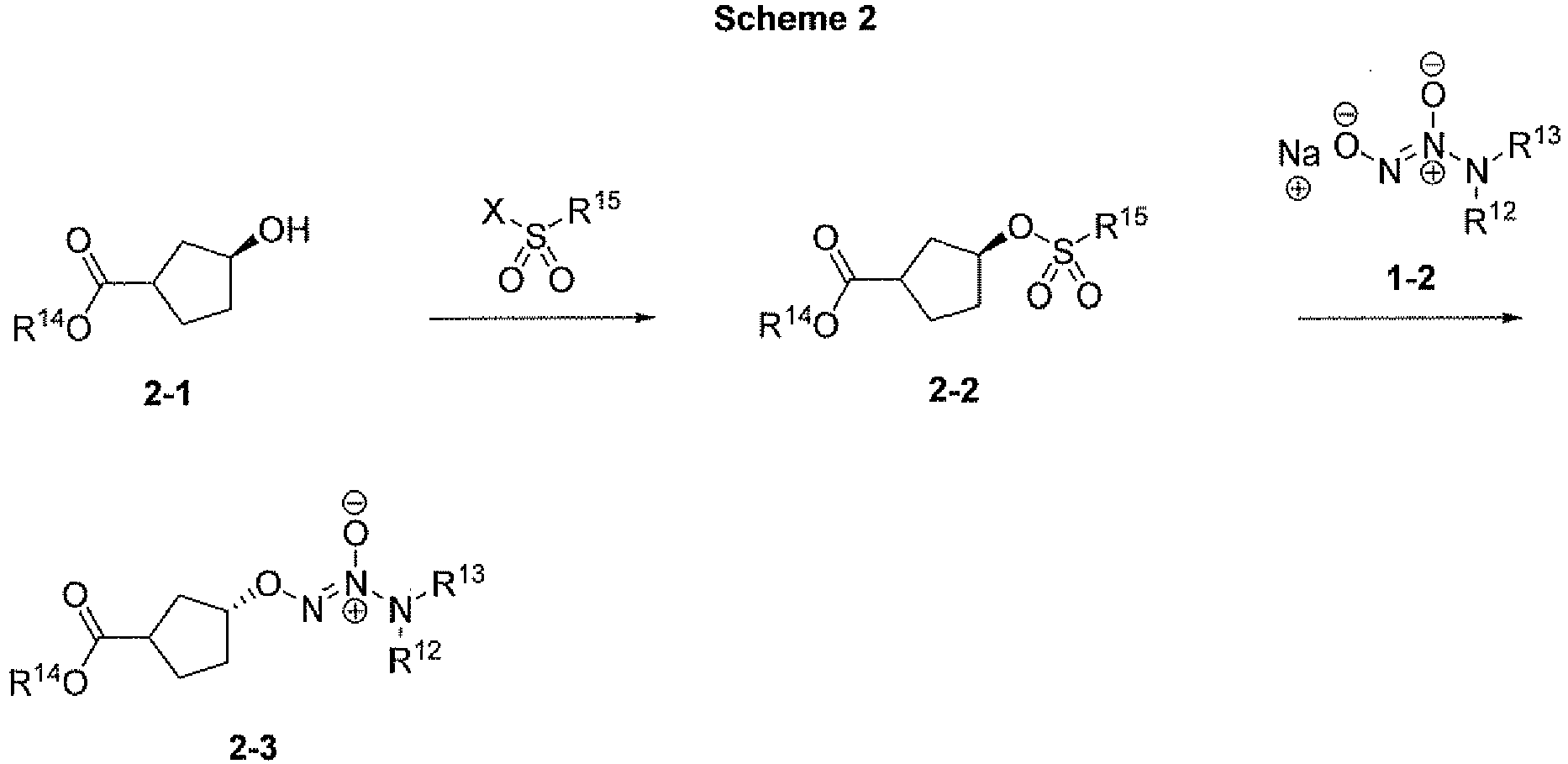
- X = Cl, OSO2R15
- R14=C1-6 alkyl, benzyl
- R15=methyl, CF3, substituted phenyl
- R12 and R13 are as defined in Scheme 1.
- Scheme 3 describes a method to prepare O2-alkylated diazeniumdiolates of the general structure 3-5 in this invention. Organoboranes such as arylboronic acids, lithium trimethylarylborates, or potassium aryltrifluoroborate can be added to cyclopentenone under the catalysis of a rhodium complex, such as bis(norbomadiene)rhodium tetrafluoroborate, acetylacetonatobis(ethylene)rhodium(I), or chloro-(1,5-cyclooctadiene)rhodium(I) dimer, with an appropriate chiral ligand, such as 2,2'-bis(diphenylphosphino)-1,1'-binaphthyl, 2,2'-bis(diphenylphosphino)-6,6'-dimethoxy-1,1'-biphenyl, or 2,5-dibenzylbicyclo[2.2.1]hepta-2,5-diene in an appropriate solvent such as tetrahydrofuran, dioxane, or toluene with high enantioselectivity. A review of some representative asymmetric catalytic systems capable of achieving high enantioselectivity for the transformation can be found in Hayashi, T.; Yamasaki, K. Chem. Rev. 2003, 103, 2829-2844 and Shintani, R.; Hayashi, T. Aldrichimica Acta 2009, 2, 31-38. The ketone 3-1 can be reduced to the alcohol 3-2 either with conventional hydride donors such as sodium borohydride or lithium aluminium hydride followed by enzymatic resolution, or in one-step with an enzymatic reducing system or stoichiometric or catalytic amount of organometallic reducing agents that can effect the reduction with high enantioselectivity. The alcohol 3-2 can be activated for displacement at an appropriate temperature such as room temperature with a suitable reagent such as methanesulfonic anhydride, benzenesulfonyl chloride, 4-(trifluoromethyl)phenylsulfonyl chloride in the presence or absence of a base such as N,N-diisopropylethylamine, triethylamine, N-methylmorpholine, pyridine, or Iutidine in an appropriate solvent such as dichloromethane, dichloroethane, chloroform, acetonitrile, tetrahydrofuran, dioxane, toluene, N,N-dimethylformamide, or N-methylpyrrolidinone. The resultant sulfonate 3-3 can be displaced by the appropriate sodium diazeniumdiolate salt 1-2 at an appropriate temperature such as room temperature in an appropriate solvent such as dichloromethane, dichloroethane, chloroform, acetonitrile, tetrahydrofuran, dioxane, toluene, N,N-dimethylformamide, or N-methylpyrrolidinone. The stereochemistry at the sulfonate carbon is typically inverted as a result of the displacement. Finally, the aryl group is oxidized to the carboxylic acid with a catalytic amount of ruthenium salt, such as ruthenium(III) chloride or ruthenium(IV) oxide, and a stoichiometric oxidant such as sodium periodate.

- X = Cl, OSO2R15
- R15=methyl, CF3, substituted phenyl
- Ar=aryl
- R12 and R13 are as defined in Scheme 1.
- Scheme 4 describes a method to prepare functionalized O2-alkylated diazeniumdiolates of the general structure 4-4 in this invention. cis-Diols 4-2 can be prepared from cis-dihydroxylation of olefins 4-1 by stoichiometric osmium tetroxide or catalytic osmium tetroxide with an appropriate stoichiometric oxidant such as 4-methylmorpholine N-oxide, sodium ferricyanate, or tert-butyl hydroperoxide. Cyclic sulfates 4-3 can be prepared from these diols 4-2 with thionyl chloride followed by oxidation of the resultant cyclic sulfite with a catalytic ruthenium salt such as ruthenium(III) chloride or ruthenium(IV) oxide with a stoichiometric oxidant such as sodium periodate. These cyclic sulfates 4-3 can be opened by the appropriate sodium diazeniumdiolate salt 1-2 at an appropriate temperature such as room temperature in an appropriate solvent such as dichloromethane, dichloroethane, chloroform, acetonitrile, tetrahydrofuran, dioxane, toluene, N,N-dimethylformamide, or N-methylpyrrolidinone to afford 4-4. The hydroxyl group present serves as a handle for further functionalization.

- R12 and R13 are as defined in Scheme 1.
- R14 is as defined in Scheme 2.
- Abbreviations used in the examples below include DMAP (4-(N,N-dimethylamino)pyridine), DMF (N,N-dimethylformamide), NAD (nicotinamide adenine dinucleotide), DMSO (dimethyl sulfoxide), BINAP (2,2'-bis(diphenylphosphino)-1,1'-binaphthyl) TFA (trifluoroacetic acid), Ac (acetyl), SFC (Supercritical Fluid Chromatography), rt (room temperature), hr (hour), LC (liquid chromatography), THF (tetrahydrofuran), and TBAF (tetra-n-butylammonium fluoride).
-

- To a solution of ethyl 3-oxocyclopentanecarboxylate (10.0 g, 64.0 mmol) in 200 ml ethanol at 0 °C was added NaBH4 (2.91 g, 77.0 mmol) in several portions. The mixture was stirred at 0°C for 2 hr and then it was concentrated. The residue was partitioned between ether (300 ml) and water (300 ml). The organic layer was separated, washed with brine, dried over MgSO4, and concentrated. The residue was purified by flash chromatography using 0 to 20% EtOAc/hexane gradient, affording the title compound.
- To a solution of ethyl cis-3-hydroxycyclopentanecarboxylate (9.7 g, 61.3 mmol) in 500 ml CH2Cl2 at 0 °C was added Et3N (9.31 g, 92.0 mmol) and DMAP (0.75 g, 6.13 mmol), followed by 4-(trifluoromethyl)benzenesulfonyl chloride (16.5 g, 67.4 mmol). After stirring at 0 °C for 1 hr and then at rt for 1 hr, the mixture was concentrated and the residue was partitioned between ether (300 ml) and water (300 ml). The organic layer was washed with brine, dried over MgSO4, and concentrated. The residue was purified by flash chromatography on silica gel using 0 to 30% EtOAc/hexane gradient, affording the title compound: 1H NMR (500 MHz, CDCl3) δ 8.07 (d, J = 8.2 Hz, 2H), 7.85 (d, J= 8.2 Hz, 2H), 5.07 (m, 1H), 4.14 (m, 2H), 3.02 (m, 1H), 2.20-1.85 (m, 6H), 1.26 (m, 3H).
- To a solution of ethyl cis-3-({[4(trifluoromethyl)phenyl]sulfonyl}oxy) cyclopentanecarboxylate (8.2 g, 22.4 mmol) in 100 ml DMF was added sodium 1-(N-tert-butylethylamino)diazen-1-ium-1,2-diolate (4.92 g, 26.9 mmol). After stirring at 45°C for 16 hr, the mixture was partitioned between ether (300 ml) and water (300 ml). The organic layer was washed with brine, dried over MgSO4, and concentrated. The residue was purified by flash chromatography on silica gel using 0 to 30% EtOAc/hexane gradient, affording the title compound. 1H NMR (500 MHz, CDCl3) δ 4.02 (m, 1H), 2.99 (m, 2H), 2.91 (m, 1H), 2.12-1.73 (m, 6H), 1.12 (m, 9H), 0.92 (m, 3H). The enantiomeric mixture was separated by SFC with chiral IA column, eluting with 10% 2:1:1 heptane:MeOH:EtOH/CO2, to give ethyl (1S,3S)-3-({[(1Z)-2-tert-butyl-2-ethyl-1-oxido-1λ5-diazan-1-ylidene]amino}oxy)cyclopentanecarboxylate as the fast elute compound and ethyl (1R,3R)-3-({[(1Z)-2-tert-butyl-2-ethyl-l-oxido-1λ5-diazan-1-ylidene]amino}oxy)cyclopentanecarboxylate as the slow elute compound. The absolute stereochemistry of these enantiomers was assigned based on the products prepared according to the asymmetric synthetic procedure described in EXAMPLE 5.
- To a solution of (1R,3R)-3-({[(1Z)-2-tert-butyl-2-ethyl-l-oxido-1λ5-diazan-1-ylidene]amino}oxy)cyclopentanecarboxylate (1.1 g, 3.65 mmol) (the slow eluting compound of Step C) in 10 ml ethanol at rt was added 5N NaOH (2.0 ml, 10.0 mmol). After stirring at rt for 3 hr, the mixture was concentrated. The residue was partitioned between ether (30 ml) and 1N HCl (20 ml). The organic layer was washed with brine, dried over MgSO4, and concentrated to give the title compound: 1H NMR (500 MHz, CDCl3) δ 5.00 (m, 1H), 3.11 (m, 3H), 2.30-1.90 (m, 6H), 1.25 (m, 9H), 1.05 (m, 3H).
-
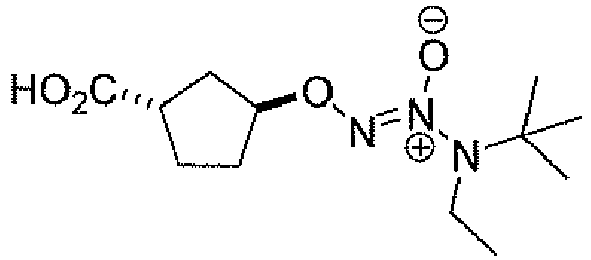
- To a solution of ethyl (1S,3S)-3-({[(1Z)-2-tert-butyl-2-ethyl-1-oxido-1λ5-diazan-1-ylidene]amino}oxy)cyclopentanecarboxylate (0.78 g, 2.59 mmol) (the fast eluting compound, EXAMPLE 1 Step C) in 10 ml ethanol at rt was added 5N NaOH (2.0 ml, 10.0 mmol). After stirring at rt for 3 hr, the mixture was concentrated. The residue was partitioned between ether (30 ml) and 1N HCl (20 ml). The organic layer was washed with brine, dried over MgSO4, and concentrated to give the title compound: 1H NMR (500 MHz, CDCl3) δ 5.00 (m, 1H), 3.11 (m, 3H), 2.30-1.90 (m, 6H), 1.25 (m, 9H), 1.05 (m, 3H).
- The following examples were prepared using procedures analogous to those described for EXAMPLE 1 and 2 substituting sodium 1-(N-tert-butylmethylamino)diazen-1-ium-1,2-diolate for sodium 1-(N-tert-butylethylamino)diazen-1-ium-1,2-diolate in Step C.
EXAMPLE # tR (min) LCMS 3 2.48 323.14[M+23] 4 2.48 323.14[M+23] -

- To a solution of cyclopent-2-en-1-one (1.0 mL, 12.4 mmol), 4-methoxyphenylboronic acid (3.76 g, 24.7 mmol), and (R)-BINAP (0.46 g, 0.74 mmol) in a mixture of 1,4-dioxane (20 mL) and water (2 mL) at rt was added ruthenium (0.19 g, 0.74 mmol). After stirring at 100 °C overnight, the mixture was cooled down to rt and partitioned between ether (100 mL) and sat. NaHCO3 (100 mL). The organic layer was separated, washed with sat. NaHCO3 and brine, dried over MgSO4, and concentrated. The residue was purified by flash chromatography on silica gel using 0 to 30% EtOAc/hexane gradient, affording the title compound: 1H NMR δ 7.20 (d, J= 8.6 Hz, 2H), 6.91 (d, J=8.7 Hz, 2H), 3.83 (s, 3H), 3.40 (m, 1H), 2.66 (m, 1H), 2.46 (m, 2H), 2.33 (m, 2H), 1.97 (m, 1H).
- To a 2 L 3-neck round bottom flask with thermocouple, heating mantle, and overhead stirrer was charged 47.41 g of starting (3R)-3-(4-methoxyphenyl)cyclapentanone was added 475 mL of 0.5M, pH = 6.5 phosphate buffer. To a solution of sodium formate (33.9 g) in 475 mL of 0.5M, pH = 6.5 phosphate buffer in a 1.0 L Erlenmeyer flask was added nicotinamide adenine dinucleotide (NAD) (975 mg), formate hydrogenase 101 (1.95 g, Codexis) and ketoreductase NAD dependent102 (975 mg, Biocatalytics). After adding the enzyme containing solution to the reaction flask, the reaction mixture was heated to 30 °C. After overnight age, LC showed > 98% conversion. Heating was discontinued and K2CO3 (285 g) was added to the reaction mixture. The mixture was transferred to a separation funnel and was dilute with acetonitrile (950 mL). The organic layer was separated and filtered through powdered cellulose. The residue was washed with acetonitrile (425 mL), which was used to back extract the aqueous layer. The initial organic layer and the back extraction were combined and concentrated to give the title compound: 1H NMR δ 7.23 (d, J = 8.7 Hz, 2H), 6.87 (d, J= 8.7 Hz, 2H), 4.46 (m, 1H), 3.82 (s, 3H), 3.03 (m, 1H), 2.49 (m, 1H), 2.07-1.80 (m, 5H), 1.65 (m, 1H).
- To a solution of (1S,3R)-3-(4-methoxyphenyl)cyclopentanol (1.19 g, 6.2 mmol), triethylamine (0.86 mL, 6.2 mmol), and DMAP (0.76 g, 6.2 mmol) in CH2Cl2 (20 mL) at 0 °C was added 4-(trifluoromethyl)benzenesulfonyl chloride (1.5 g, 6.2 mmol). After stirring at rt overnight, the mixture was partitioned between Et2O and sat. NaHCO3. The organic layer was separated, washed with brine, dried over MgSO4, and concentrated. The residue was purified by flash chromatography on silica gel using 0-30% EtOAc in hexanes to give the title compound: 1H NMR (500 MHz, CDCl3) δ 8.08 (d, J= 8.3 Hz, 2H), 7.85 (d, J= 8.2 Hz, 2H), 7.14 (d, J= 8.6 Hz, 2H), 6.85 (d, J= 8.6 Hz, 2H), 5.15 (m, 1H), 3.81 (s, 3H), 3.00 (m, 1H), 2.50 (m, 1H), 2.09-1.80 (m, 5H).
-

- To a solution of (1S,3R)-3-(4-methoxyphenyl)cyclopentyl 4-(trifluoromethyl)benzenesulfonate (10.0 g, 24.97 mmol) in DMSO (100 mL) was added sodium 1-(N-tert-butyl-N-(2-hydroxyethyl)amino)diazen-1-ium-1,2-diolate (7.46 g, 37.5 mmol). After stirring at rt for 16 hr, the mixture was partitioned between Et2O (300 ml) and water (300 ml), washed with brine, dried over MgSO4, filtered and concentrated. The residue was purified by flash chromatography on silica gel using 0 to 30% EtOAc/hexane gradient, affording the title compound: 1H NMR (500 MHz, CDCl3) δ 7.16 (d, J = 8.6 Hz, 2H), 6.86 (d, J= 8.6 Hz, 2H), 5.05 (m, 1H), 3.81 (s, 3H), 3.59 (m, 2H), 3.34 (m, 1H), 3.28 (m, 2H), 2.36 (m, 3H), 2.25 (m, 1H), 2.02 (m, 1H), 1.90 (m, 1H), 2.65 (m, 1H), 1.29 (s, 9H).
-

- To a solution of 2-{tert-butyl[(Z)-{[(1R,3R)-3-(4-methoxyphenyl)cyclopentyl]oxy}-NNO-azoxy]amino}ethanol (1 g, 2.85 mmol) in 10 ml DMF at 0 °C was added NaH (0.13 g, 3.56 mmol), after 10 min, MeI (0.22 mL, 3.56 mmol) was added. The mixture was gradually warmed up to rt and stirred over night. The reaction mixture was partitioned between Et2O (30 ml) and water (30 ml), washed with brine, dried over MgSO4, filtered and concentrated. The residue was purified by flash chromatography on silica gel using 0 to 30% EtOAc/hexane gradient, affording the title compound: 1H NMR (500 MHz, CDCl3) δ 7.13 (d, J= 8.6 Hz, 2H), 6.84 (d, J= 8.6 Hz, 2H), 5.05 (m, 1H), 3.77 (s, 3H), 3.40 (m, 2H), 3.33 (s, 3H), 3.29 (m, 3H), 2.36 (m, 1H), 2.30 (m, 1H), 2.20 (m, 1H), 2.00 (m, 1H), 1.85 (m, 1H), 1.60 (m, 1H), 1.26 (s, 9H).
- To a solution of sodium periodate (4.682 g, 21.89 mmol) in 12 ml water was added acetonitrile, (8 ml), a solution of N-(2-methoxyethyl)-N-[(Z)-{[(1R,3R)-3-(4-methoxyphenyl)cyclopentyl]oxyl-NNO-azoxy]-2-methylpropan-2-amine (400 mg, 1.094 mmol) in CCl4 (8 ml), and followed by ruthenium (III) chloride hydrate (24.67 mg, 0.109 mmol). After stirring at rt for 30 min, the reaction mixture was partitioned between Et2O and 1N HCl. The aqueous layer was separated and extracted with ether. The organic layers were combined, dried over MgSO4, filtered and concentrated. The residue was purified by flash chromatography on silica gel using 0-70% EtOAc in hexane to give the title compound as oil: 1H NMR (500 MHz, CDCl3) δ 4.92 (m, 1H), 3.33 (m, 2H), 3.27 (s, 3H), 3.21 (m, 2H), 3.00 (m, 1H), 2.22-1.83 (m, 6H), 1.17 (s, 9H).
-

- EXAMPLE 6 was prepared using the same procedure analogous to EXAMPLE 5 substituting deuterated methyl iodide for methyl iodide in Step E: 1H NMR (500 MHz, CDCl3) δ 4.95 (m, 1H), 3.36 (m, 2H), 3.24 (m, 2H), 3.03 (m, 1H), 2.25-1.83 (m, 6H), 1.20 (s, 9H).
-

- The following examples were prepared using procedures analogous to those described for EXAMPLE 5 by substituting the appropriate sodium salt for sodium 1-(N-tert-butyl-N-(2-hydroxyethyl)amino)diazen-1-ium-1,2-diolate, DMF for DMSO, and reaction temperature 40-50 °C for rt in Step D.
EXAMPLE # R tR (min) LCMS 7 
3.26 310.16[M+23] 8 
3.16 324.03 [M+23] 9 
3.29 338.15[M+23] -

- The following examples were prepared using procedures analogous to those described for EXAMPLE 5 substituting (S)-BINAP for (R)-BINAP in Step A and appropriate sodium salt for sodium 1-(N-tert-butyl-N-(2-hydroxyethyl)amino)diazen-1-ium-1,2-diolate, DMF for DMSO, and reaction temperature 40-50 °C for rt in Step D.
EXAMPLE # R tR (min) LCMS 10 
1.26 281.79[M+23] 1H NMR (500 MHz, CDCl3): δ 4.91-4.86 (m, 1H), 2.93-2.87 (m, 1H), 2.80 (s, 3H), 2.45-2.25 (m, 2H), 2.26-2.10 (m, 2H), 2.07-1.87 (m, 2H), 1.13 (s, 9H). 11 
1.67 309.82[M+23] 1H NMR (500 MHz, CDCl3): δ 4.93-4.88 (m, 1H), 3.01 (t, J = 7.4 Hz, 2H), 2.91-2.83 (m, 1H), 2.42-2.33 (m, 1H), 2.31-2.24 (m, 1H), 2.20-2.06 (m, 2H), 2.05-1.88 (m, 2H), 1.43-1.39 (m, 2H), 1.25 (s, 9H), 0.95 (t, J = 7.4 Hz, 3H). 12 
1.83 323.83 [M+23] 1H NMR (500 MHz, CDCl3): δ 4.91-4.88 (m, 1H), 3.03 (t, J = 6.5 Hz, 2H), 2.86 (q, J = 8.3 Hz, 1H), 2.42-2.32 (m, 1H), 2.32-2.05 (m, 3H), 2.04-1.88 (m, 2H), 1.37 (m, 4H), 1.24 (s, 9H), 0.92 (t, J= 6.6 Hz, 3H). -
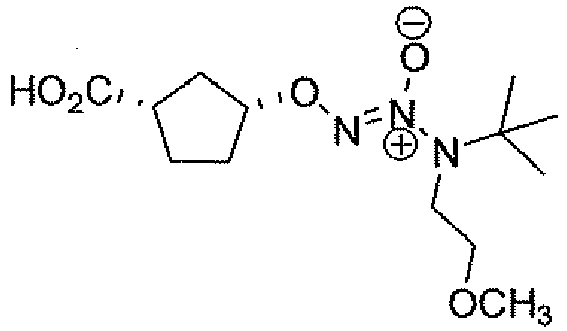
- The title compound was prepared according to the procedures described in EXAMPLE 5 substituting (S)-BINAP for (R)-BINAP in Step A: 1H NMR (500 MHz, CDCl3): δ 8.24 (bs, 1H), 4.96-4.92 (m, 1H), 3.43 (t, J= 5.5 Hz, 2H), 3.37 (s, 3H), 3.30 (t, J= 5.4 Hz, 2H), 2.90 (q, J = 8.1 Hz, 1H), 2.41-2.27 (m, 2H), 2.24-1.82 (m, 4H), 1.26 (s, 9H).
-

- A solution of 2-{tert-butyl[(Z)-{[(1S,3R)-3-(4-methoxyphenyl)cyclopentyl]oxy}-NNO-azoxy]amino}ethanol (0.82 g, 2.33 mmol), prepared according to Example 5 step D substituting (S)-BINAP for (R)-BINAP in step A, di-tert-butyl dicarbonate (0.66 g, 3.03 mmol), DMAP (0.057 g, 0.467 mmol), and triethylamine (0.425g, 4.20mmol) were stirred under nitrogen in CH2Cl2 (5 mL). The reaction mixture was stirred at rt overnight. The reaction mixture was partitioned between ethyl acetate and 10% aqueous citric acid. The organic layer was washed with water and brine. The organic layer was dried over sodium sulfate, filtered and evaporated. The crude was chromatographed on silica gel, eluting with hexane - ethyl acetate (0-100%, 2L), to afford the title compound: 1H NMR (500 MHz, CDCl3): δ 7.24-7.13 (m, 2H), 6.87 (d, J = 8.3 Hz, 2H), 5.08-4.98 (m, 1H), 4.08 (t, J = 5.8 Hz, 2H), 3.82 (s, 3H), 3.48-3.33 (m, 2H), 3.09-2.99 (m, 1H), 2.65-2.55 (m, 1H), 2.19-2.12 (m, 1H), 2.09-1.96 (m, 2H), 1.99-1.81 (m, 2H), 1.48 (s, 9H), 1.27 (s, 9H).
- The title compound was prepared according to the method described in EXAMPLE 5 Step F using tert-butyl 2-{tert-butyl[(Z)-{[(1S,3R)-3-(4-methoxyphenyl)cyclopentyl]oxy}-NNO-azoxy]amino}ethyl carbonate as the starting material: 1H NMR (500 MHz, CDCl3): δ 6.60-6.01 (bs, 1H), 4.93-4.90 (m, 1H), 4.09-4.05 (m, 2H), 3.40 (t, J = 5.9 Hz, 2H), 2.89 (q, J= 8.1 Hz, 1H), 2.37-2.2G (m, 2H), 2.26-2.07 (m, 3H), 2.08-1.86 (m, 1H), 1.46 (s, 9H), 1.13 (s, 9H).
-

- The title compound was prepared according to the method described in EXAMPLE 5 step D using 2-{tert-butyl[(Z)-{[(1S,3R)-3-(4-methoxyphenyl)cyclopentyl]oxy}-NNO-azoxy]amino}ethanol (3.6 g, 10.24 mmol) substituting (S)-BINAP for (R)-BINAP in step A, and reacting it with Zn(N3)2•2Py (4.7 g, 15.3 mmol), triphenylphosphine (5.37 g, 20.49 mmol), in anhydrous toluene diisopropyl azodicarboxylate (4.14 g, 20.49 mmol) in anhydrous toluene. The reaction mixture was stirred until complete consumption of the alcohol. The mixture was filtered over a pad of diatomaceous earth, concentrated in vacuo and purified by column chromatography eluting with hexane/ethyl acetate 0-100%) to give the title compound: 1H NMR (500 MHz, CDCl3): δ 7.20 (d, J= 8.3 Hz, 2H), 6.85 (d, J= 8.3 Hz, 2H), 5.11-5.00 (m, 1H), 3.81 (s, 3H), 3.35-3.25 (m, 4H), 3.11-3.01 (m, 1H), 2.61 (t, J = 7.5 Hz, 1H), 2.20-2.19 (m, 1H), 2.19-2.00 (m, 2H), 1.93-1.83 (m, 2H), 1.29 (s, 9H).
- To a solution of N-(2-azidoethyl)-N-[(Z)-{[(1S,3R)-3-(4-methoxyphenyl)cyclopentyl]oxy}-NNO-azoxy]-2-methylpropan-2-amine (2.1 g, 5.58 mmol) in methanol was added Raney nickel (Sigma-Aldrich, Raney 2800 nickel, slurry in water, active catalyst). The mixture was stirred at rt and the progress of the reaction was monitored by TLC. Upon completion, the reaction mixture was filtered through diatomaceous earth and the solvent was evaporated. The crude material was used without purification.
- To a solution of N-tert-butyl-N-[(Z)-{[(1S,3R)-3-(4-methoxyphenyl)cyclopentyl]oxy}-NNO-azoxy]ethane-1,2-diamine (1.38 g, 3.94 mmol), di-tert-butyl dicarbonate (1.17 g, 5.12 mmol) in methylene chloride was added triethylamine (0.717 g, 7.09 mmol). The mixture was stirred at rt overnight. The reaction mixture was partitioned between ethyl acetate and 10% aqueous citric acid. The organic layer was washed with water and brine. The organic layer was dried over sodium sulfate, filtered and evaporated. The crude was chromatographed on silica gel, eluting with hexane-ethyl acetate (0-100%, 2L), to afford the title compound: 1H NMR (500 MHz, CDCl3): δ 7.29 (s, 1H), 7.19 (d, J= 8.2 Hz, 2H), 6.87 (d, J = 8.1 Hz, 2H), 4.99 (d, J = 9.7 Hz, 1H), 3.81 (s, 3H), 3.23 (m, 2H), 3.14 (m, 2H), 3.11-3.00 (m, 1H), 2.59 (t, J= 14.1, 7.5 Hz, 1H), 2.17-1.83 (m, 5H), 1.46 (s, 9H), 1.26 (s, 9H).
- The title compound was prepared according to the method described in EXAMPLE 5 Step F using tert-butyl (2-{tert-butyl[(Z)-{[(1S,3R)-3-(4-methoxyphenyl)cyclopentyl]oxy}-NNO-azoxy]amino}ethyl)carbamate as the starting material. The isolated compound was treated with TFA (100%) to give the title compound: 1H NMR (500 MHz, CDCl3): δ 9.31 (bs, 2H), 7.60 (bs, 1H), 4.96 (m, 1H), 3.49-3.39 (m, 2H), 3.02-2.96 (m, 3H), 2.49-2.45 (m, 1H), 2.01-1.91 (m, 5H), 1.24 (m, 9H).
-

- A solution of N-(2-azidoethyl)-N-[(Z)-{[(1S,3R)-3-(4-methoxyphenyl)cyclopentyl]oxy}-NNO-azoxy]-2-methylpropan-2-amine (EXAMPLE 15 Step A, 1.00 g, 2.66 mmol) substituting (S)-BINAP for (R)-BINAP in step A and trimethylsilyl acetylene (0.522 g, 5.31 mmol) in anhydrous toluene was heated at 60 °C overnight. The solvent was evaporated and the crude was chromatographed on silica gel eluting with hexane-ethyl acetate (0-100%, 2L), to afford the title compound.
- To a solution of N-[(Z)-{[(1S,3R)-3-(4-methoxyphenyl)cyclopentyl]oxy}-NNO-azoxy]-2-methyl-N-{2-[4-(trimethylsilyl)-1H-1,2,3-triazol-1-yl]ethyl}propan-2-amine (0.960 g, 2.02 mmol) in THF (10 mL) was added TBAF (3.034 mL, 3.034 mmol). The mixture was stirred at rt overnight. The solvent was evaporated and the crude was chromatographed on silica gel eluting with hexane-ethyl acetate (0-100%, 2L), to afford the title compound.
- The title compound was prepared according to the method described in EXAMPLE 5 Step F using N-[(Z)-{[(1S,3R)-3-(4-methoxyphenyl)cyclopentyl]oxy}-NNO-azoxy]-2-methyl-N-[2-(1H-1,2,3-triazol-1-yl)ethyl]propan-2-amine as the starting material: 1H NMR (500 MHz, CDCl3): δ 10.96 (bs, 1H), 7.89 (s, 1H), 7.85 (s, 1H), 4.94 (s, 1H), 4.51-4.43 (m, 2H), 3.56-3.49 (m, 2H), 3.01-2.87 (m, 1H), 2.43-2.20 (m, 2H), 2.23-1.91 (m, 4H), 1.13 (s, 9H).
-

- To a N,N-dimethylformamide solution (450 mL) of 3-cyclopentene-1-carboxylic acid (50.0 g, 446 mmol) was added potassium carbonate (126 g, 913 mmol), followed by slow addition of benzyl bromide (80 mL, 669 mmol). After 3 hours, the reaction mixture was poured into 500 mL water and extracted with diethyl ether (3 x 800 mL). The combined organic extracts were washed with brine, dried (magnesium sulfate), and concentrated in vacuo to afford the title compound in a crude form. It was carried forward to the subsequent reaction without further purification. 1H NMR (500 MHz, CDCl3) δ 7.43-7.29 (m, 5H), 5.68 (s, 2H), 5.16 (s, 2H), 3.24-3.14 (m, 1H), 2.73-2.63 (m, 4H).
- To a tetrahydrofuran solution (25 mL) of benzyl cyclopent-3-ene-1-carboxylate (11.8 g, 43.3 mmol) in a 250-mL round-bottom flask under nitrogen at 0 °C was added 1.0 M borane tetrahydrofuran complex (22.0 mL, 22.0 mmol) over 15 minutes. The flask was removed from the ice bath and stirred for 2 hours. Water (50 mL) was slowly added to the reaction mixture, followed by the slow addition of sodium perborate tetrahydrate (6.66 g, 43.3 mmol) over 15 minutes. The mixture was stirred overnight 16 hr. Brine (50 mL) was added, and the organic layer was removed. The aqueous white suspension was extracted with ethyl acetate (3 x 100 mL), and the combined organic extracts were washed with brine, dried (magnesium sulfate), and concentrated in vacuo. Chromatography over silica gel, eluting with hexanes/ethyl acetate, afforded the title compound as a colorless liquid. 1H NMR (500 MHz, CDCl3) δ 7.38-7.29 (m, 5H), 5.12 (s, 2H), 4.45 (d, J = 4.6 Hz, 1H), 3.16-3.06 (m, 1H), 2.17-1.80 (m, 5H), 1.68-1.61 (m, 1H).
- The title compound was made by following the procedures described in EXAMPLE 1, Step B substituting benzyl trans-3-hydroxycyclopentanecarboxylate for ethyl cis-3-hydroxycyclopentanecarboxylate. 1H NMR (500 MHz, CDCl3) δ 8.03 (d, J = 8.2 Hz, 2H), 7.82 (d, J = 8.2 Hz, 2H), 7.38-7.29 (m, 5H), 5.15-5.08 (m, 3H), 3.07 (qd, J = 8.6, 6.2 Hz, 1H), 2.19-2.06 (m, 3H), 2.02-1.83 (m, 3H).
- The title compound was made by following the procedures described in EXAMPLE 1, Step C substituting benzyl trans-3-({[4(trifluoromethyl)phenyl]sulfonyl}oxy) cyclopentanecarboxylate for ethyl cis-3-({[4(trifluoromethyl)phenyl]sulfonyl}oxy) cyclopentanecarboxylate. 1H NMR (500 MHz, CDCl3) δ 7.40-7.31 (m, 5H), 5.14 (s, 2H), 4.93-4.88 (m, 1H), 3.11 (q, J = 7.0 Hz, 2H), 2.87 (quintet, J = 8.3 Hz, 1H), 2.41 (ddd, J = 14.4, 8.9, 6.6 Hz, 1H), 2.26 (ddd, J = 14.3, 8.5,4.7 Hz, 1H), 2.16-2.05 (m, 2H), 2.01-1.88 (m, 2H), 1.25 (s, 9H), 1.05 (t, J = 7.0 Hz, 3H). Separation of the racemic mixture with Chiralpak AD-H column, eluting with 4-40% isopropanol/carbon dioxide, afforded the (1R,3S)-enantiomer as the faster eluting product and the (1S,3R) as the slower eluting product.
- The title compound was made by following the procedures described in EXAMPLE 1, Step D substituting benzyl (1R,3S)-3-({[(1Z)-2-tert-butyl-2-ethyl-1-oxido-1λ5-diazan-1-ylidene]amino}oxy)cyclopentanecarboxylate for ethyl (1S,3S)-3-({[(1Z)-2-tert-butyl-2-ethyl-1-oxido-1λ5-diazan-1-ylidene]amino}oxy)cyclopentanecarboxylate. 1H NMR (500 MHz, CDCl3) δ 4,93-4.87 (m, 1H), 3.10 (q, J = 7.0 Hz, 2H), 2.86 (quintet, J = 8.3 Hz, 1H), 2.36 (ddd, J = 14.5, 9.1, 6.3 Hz, 1H), 2.27 (ddd, J = 14.4, 7.9, 4.3 Hz, 1H), 2.17-2.06 (m, 2H), 2.03-1.87 (m, 2H), 1.24 (s, 9H), 1.04 (t, J = 7.0 Hz, 3H); LC-MS: m/z 296.2 (M + Na).
-

- The title compound was made by following the procedures described in EXAMPLE 17, Step C substituting benzyl (1S,3R)-3-({[(1Z)-2-tert-butyl-2-ethyl-1-oxido-1λ5-diazan-1-ylidene]amino}oxy)cyclopentanecarboxylate for benzyl (1R,3S)-3-({[(1Z)-2-tert-butyl-2-ethyl-1-oxido-1λ5-diazan-1-ylidene]amino}oxy)cyclopentanecarboxylate in step E.
-

- To a dichloromethane (100 mL) solution of methyl 3,4-dihydroxycyclopentanecarboxylate (14.7 g, 92.0 mmol) was added thionyl chloride (8.05 mL, 110 mmol) slowly. After 2 hours, the reaction mixture was added to a stirring acetonitrile (100 mL)/water (100 mL) solution of sodium periodate (39.7 g, 185 mmol), followed by ruthenium(IV) oxide hydrate (0.296 g, 1.96 mmol). After 3 hours, the reaction mixture was diluted with water (400 mL) and extracted with diethyl ether (3 x 400 mL). The combined organic extracts were washed with brine, dried (magnesium sulfate), and concentracted in vacuo to afford a black solid. The residue was purified by column chromatography, eluting with hexanes/ethyl acetate to give the title compound as the less polar fractions. 1H NMR (500 MHz, CDCl3) δ 5.38 (d, J = 4.7 Hz, 2H), 3.73 (s, 3H), 3.35 (tt, J = 11.2, 6.5 Hz, 1H), 2.49 (dd, J = 15.3, 6.6 Hz, 2H), 2.19-2.11 (m, 2H).
- A mixture of methyl (3aR,5s,6aS)tetrahydro-3aH-cyclopenta[d][1,3,2]dioxathiole-5-carboxylate 2,2-dioxide (0.821 g, 3.69 mmol) and sodium 1-(N-tert-butylmethylamino)diazen-1-ium-1,2-diolate (0.812 g, 4.80 mmol) in tetrahydrofuran (15 mL) was heated at 60 °C for 16 hours. Once the reaction solution was cooled to room temperature, 4N aqueous hydrochloric acid in methanol (1.0 mL, 4.0 mmol) was added to the solution and heated at 40 °C for 30 minutes. The solution was diluted with water and extracted with ethyl acetate (3 × 50 mL). The organics were washed with brine, dried over magnesium sulfate, and concentrated in vacuo. The residue was purified using column chromatography, affording the title compound as a colorless liquid: 1H NMR (500 MHz, CDCl3) δ 4.63-4.59 (m, 1H), 4.45-4.42 (m, 1H), 3.69 (s, 3H), 3.09 (quintet, J= 8.7 Hz, 1H), 2.80 (s, 3H), 2.56-2.49 (m, 1H), 2.32-2.26 (m, 1H), 2.16-2.11 (m, 1H), 2.00-1.93 (m, 1H), 1.23 (s, 9H).
- To a dichloromethane solution (20 mL) of methyl (1RS,3RS,4RS)-3-({[(1Z)-2-tert-butyl-2-methyl-1-oxido-1λ5-diazan-1-ylidene]amino}oxy)-4-hydroxycyclopentane carboxylate (0.882 g, 3.05 mmol) at -78 °C was added bis(2-methoxyethyl)aminosulfur trifluoride (1.5 mL, 3.62 mmol) over 2 minutes. The reaction was stirred at -78 °C for 1 hour and then warmed to -20 °C in a methanol-ice bath. This reaction mixture was then allowed to warm to room temperature over 6 hours and quenched with water. It was extracted with ethyl acetate (3 × 70 mL), and the combined organic extracts were washed with saturated sodium bicarbonate, brine, and dried over magnesium sulfate. The organics were concentrated in vacuo and purified by column chromatography (ethyl acetate/hexanes), affording the title compound as a colorless liquid. 1H NMR (500 MHz, CDCl3) δ 5.06 (dddd, J = 53.6,4.7, 3.6,2.5 Hz, 1H), 4.60 (dtd, J = 19.7, 8.7, 3.6 Hz, 1H), 3.72 (s, 3H), 2.88 (qd, J = 9.6, 6.1 Hz, 1H), 2.82 (s, 3H), 2.49-2.38 (m, 3H), 2.23 (dddd, J = 32.7, 15.4, 10.5, 4.8 Hz, 1H), 1.24 (s, 9H).
- The title compound was made by following the procedures described in EXAMPLE 1, Step D substituting methyl (1RS,3SR,4RS)-3-({[(1Z)-2-tert-butyl-2-methyl-1-oxido-1λ5-diazan-1-ylidene]amino}oxy)-4-fluorocyclopentanecarboxylate for ethyl (1S,3S)-3-({[(1Z)-2-tert-butyl-2-ethyl-1-oxido-1λ5-diazan-1-ylidene]amino}oxy)cyclopentane carboxylate. 1H NMR (500 MHz, CDCl3) δ 5.07 (ddt, J = 53.4, 4.7, 3.1 Hz, 1H), 4.63 (dtd, J = 19.0, 8.4, 3.4 Hz, 1H), 2.93 (qd, J = 9.4, 5.6 Hz, 1H), 2.81 (s, 3H), 2.58-2.38 (m, 3H), 2.37-2.21 (m, 1H), 1.23 (s, 9 H); LC-MS: m/z 299.9 (M + Na).
-

- To a chloroform (10 mL) solution of methyl (1RS,3RS,4RS)-3-({[(1Z)-2-tert-butyl-2-methyl-1-oxidohydrazono]amino}oxy)-4-hydroxycyclopentanecarboxylate (EXAMPLE 19, Step B, 451 mg, 1.56 mmol) was added 1,8-bis(dimethylamino)naphthalene (717 mg, 3.34 mmol), followed by trimethyloxonium tetrafluoroborate (478 mg, 3.23 mmol). After 64 hours, the reaction mixture was concentrated in vacuo, and the residue was purified by column chromatography, eluting with hexanes/ethyl acetate to give the title compound as a yellow liquid. 1H NMR (500 MHz, CDCl3) δ 4.71 (ddd, J = 6.8, 5.2, 2.2 Hz, 1H), 3.94 (dt, J = 6.0, 2.4 Hz, 1H); 3.68 (s, 3H), 3.35 (s, 3H), 3.00 (quintet, J = 8.7 Hz, 1H), 2.81 (s, 3H), 2.47 (dt, J = 14.4, 7.7 Hz, 1H), 2.24-2.10 (m, 2H), 2.04 (ddd, J = 13.9, 7.8,2.4 Hz, 1H), 1.24 (s, 9H).
- The title compound was made by following the procedures described in step D, EXAMPLE 1 substituting methyl (1RS,3RS,4RS)-3-({[(1Z)-2-tert-butyl-2-methyl-1-axido-1λ5-diazan-1-ylidene]amino}oxy)-4-methoxycyclopentanecarboxylate for ethyl (1S,3S)-3-({[(1Z)-2-tert-butyl-2-ethyl-1-oxido-1λ5-diazan-1-ylidene]amino}oxy)cyclopentanecarboxylate. 1H NMR (500 MHz, CDCl3) δ 4.73 (td, J = 5.7, 1.9 Hz, 1H), 3.97-3.93 (m, 1H), 3.36 (s, 3H), 3.04 (quintet, J = 8.7 Hz, 1H), 2.80 (s, 3H), 2.54-2.44 (m, 1H), 2.24-2.13 (m, 2H), 2.10-2.05 (m, 1H), 1.23 (s, 9H); LC-MS : m/z 312.2 (M + Na).
-

- Methyl iodide (0.40 mL, 6.4 mmol) was added to a tetrahydrofuran solution (20 mL) of lithium diisopropylamide (1.50 mL, 3.00 mmol) and methyl (1R,3S)-3-({[(1Z)-2-tert-butyl-2-methyl-1-oxido-1λ5-diazan-1-ylidene]amino}oxy)cyclopentanecarboxylate (0.525 g, 1.92 mmol) at -78 °C. The solution was gradually warmed to room temperature over 16 hours. It was then quenched with 1N hydrochloric acid and extracted with ethyl acetate (3 × 30 mL). The organics were concentrated in vacuo and purified by column chromatography (hexanes/ethyl acetate), affording the (1RS,3RS) diastereomer of the title compound as the less polar fractions and the (1RS,3SR) diastereomer as the more polar fractions. (1RS,3RS) diastereomer: 1H NMR (500 MHz, CDCl3) δ 4.94 (dt, J = 11.0,4.2 Hz, 1H), 3.68 (s, 3H), 2.81 (s, 3H), 2.63 (dd, J = 14.6, 6.8 Hz, 1H), 2.18-2.09 (m, 1H), 2.08-2.01 (m, 2H), 1.82 (dd, J = 14.6, 3.8 Hz, 1H), 1.76 (dt, J = 12.8, 8.6 Hz, 1H), 1.37 (s, 3H), 1.24 (s, 9H). (1RS,3SR) diastereomer: 1H NMR (500 MHz, CDCl3) δ 4.94-4.83 (m, 1H), 3.68 (s, 3H), 2.80 (s, 3H), 2.54 (dd, J = 14.4, 3.9 Hz, 1H), 2.41 (dt, J = 13.1, 8.1 Hz, 1H), 2.18-2.01 (m, 2H), 1.92 (dd, J = 14.4, 6.4 Hz, 1H), 1.53 (ddd, J = 13.1, 8.3, 5.8 Hz, 1H), 1.24 (s, 9H).
- The title compound was made by following the procedures described in step D, EXAMPLE 1 substituting methyl (1RS,3RS)-3-({[(1Z)-2-tert-butyl-2-methyl-1-oxido-1λ5-diazan-1-ylidene]amino}oxy)-1-methylcyclopentanecarboxylate for ethyl (1S,3S)-3-({[(1Z)-2-tert-butyl-2-ethyl-1-oxido-1λ5-diazan-1-ylidene]amino}oxy)cyclopentanecarboxylate. 1H NMR (500 MHz, CDCl3) δ 4.98-4.92 (m, 1H), 2.81 (s, 3H), 2.65 (dd, J = 14.7,6.7 Hz, 1 H), 2.19 (ddd, J = 12.8, 7.1, 5.3 Hz, 1H), 2.11-2.05 (m, 2H), 1.85 (dd, J = 14.6, 3.7 Hz, 1H), 1.80 (dt, J = 12.9, 8.7 Hz, 1H), 1.40 (s, 3H), 1.23 (s, 9H); LC-MS: m/z 274.3 (M + H).
-

- The title compound was made by following the procedures described in EXAMPLE 21 substituting methyl (1RS,3SR)-3-({[(1Z)-2-tert-butyl-2-methyl-1-oxido-1λ5-diazan-1-ylidene]amino}oxy)-1-methylcyclopentanecarboxylate for methyl (1RS,3RS)-3-({[(1Z)-2-tert-butyl-2-methyl-1-oxido-1λ5-diazan-1-ylidene]ammo}oxy)-1-methylcyclopentane carboxylate in step B. 1H NMR (500 MHz, CDCl3) δ 4.94-4.89 (m, 1H), 2.80 (s, 3H), 2.59 (dd, J = 14.6, 3.2 Hz, 1H), 2.45 (dt, J = 13.2, 8.1 Hz, 1H), 2.15-2.05 (m, 2H), 1.90 (dd, J = 14.6, 6.1 Hz, 1H), 1.56 (ddd, J = 13.3, 8.3, 5.9 Hz, 1H), 1.33 (s, 3H), 1.22 (s, 9H); LC-MS: m/z 274.3 (M + H).
- Tables 1-5 describe additional examples of compounds within the scope of the invention:
Table 1 
Ex R a R 2 23 

24 

25 

26 

27 

28 

29 

30 

31 

32 

33 

34 

35 

36 

37 

38 

39 

40 

41 

42 

43 

44 

45 

46 

47 

48 
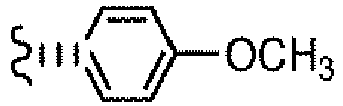
49 

50 

51 

52 

53 

54 
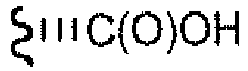
55 

56 

57 

Table 2 
Ex R a R 1 R 2 58 


59 


60 


61 


62 


Table 3 
Ex R a R 4 63 

64 

Table 4 
Ex R a R 2 R 3 65 


66 


67 


68 
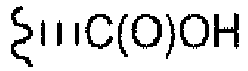

69 

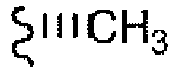
70 


71 


Table 5 
Ex R a R 2 R 5 72 


73 


- Compounds of the invention were evaluated for blood pressure reduction efficacy using the following canine telemetry protocol described below.
- Male beagle dogs (approximately 1-3 years old) with a body weight of between 10 and 16 kg were surgically implanted with DSI radiotelemetry devices (model: TL11M2-D70-PCT). Briefly, under an inhalant anesthesia, isoflurane/oxygen mixture (1-3.5%/ to effect), the body of the telemetry device was positioned and secured intra-abdominally. Subsequently, the arterial catheter of the telemetry device was passed subcutaneously to the inguinal area and introduced into the femoral artery and advanced to the level of the descending aorta. The catheter was secured with 2-0 silk ligatures. The muscle and underlying fascia was closed over the catheter using absorbable suture and the skin was closed using non-absorbable suture. The animals were allowed a minimum recovery period of 2 weeks between surgery and the evaluation of test compounds.
- Compound evaluation consisted of a 3 day paradigm at a 3 mg/kg dose. On the first day, no compounds were administered during a 24 hour period of baseline data collection. Blood pressure and heart rate data were collected continuously for one minute periods at 10 minute intervals. On the days of compound administration half the animals received test article with the other half receiving the vehicle used for compound formulation. All test materials were administered by oral gavage in a volume of 1 mL/kg. Data are expressed either as raw values (mm Hg or beats per minute) or as the change from baseline (average value for about 12 hours in low activity period prior to dosing). Change is SBP (systolic blood pressure) and PP (pulse pressure) over time is shown below:
Example ΔSBP (mm Hg) ΔPP (mm Hg) 1-6 h 6-12 h 12-18 h 1-6 h 6-12 h 12-18 h 1 -12 -9 -7 -7 -7 -5 7 -9 -11 -10 -4 -9 -8 18 -18 -10 -4 -14 -10 -6
Claims (18)
- A compound having the formula I:
 R1 is hydrogen, -OH, -O-C1-6 alkyl, =O, or halogen;R2 ishydrogen,-C(O)OR8,-C6H5C(O)OR8,-(CH2)1-2OH,-CR9R10OH,-C(O)O(CH2)0-2 aryl,-C(O)NR9R10,-C(O)SO2NR9R10,-C6H5OR9,-W-C(O)OR8,-W-OR9,-Y, or-P(O)(OR9)(OR10);R3 is hydrogen or -C1-6 alkyl;R4 is hydrogen, -OH, or -C(O)OR9;R5 is hydrogen or deuterium;R6 and R7 are independently -C1-6 alkyl, fluoro-substituted -C1-6 alkyl, deutero-substituted -C1-6 alkyl or -(CH2)1-2R11, wherein any carbon atom of the fluoro-substituted -C1-6 alkyl is mono- or di-substituted with fluoro, and any carbon atom of the deutero-substituted -C1-6 alkyl is mono- or di-substituted with fluoro;R8, in each instance in which it occurs, hydrogen, -C1-6 alkyl, or -(CH2)2N+(CH3)3;R9 and R10, in each instance in which they occur, are independently -C1-6 alkyl;R11 is -OH, -O-C 1-6 alkyl, -OCD3, -OC(O)OC1-6 alkyl, -NH2, -C6H5, -N3, or W;W is an unsubstituted 5- or 6-membered heteroaryl ring having 1, 2, or 3 nitrogen atoms, or a substituted 5- or 6-membered heteroaryl ring having 1, 2, or 3 nitrogen atoms that is mono- or di-substituted at any carbon atom with R6 or R7;Y is a 5- or 6-membered heterocyclic ring having 1, 2, 3 or 4 heteroatoms which are N, O or S, or stereoisomers thereof, or pharmaceutically acceptable salts thereof, or pharmaceutically acceptable salts of stereoisomers thereof.
 - A compound of Claim 1, wherein R1 is hydrogen, -OH, -OCH3, =O, or F, or a pharmaceutically acceptable salt thereof.
- A compound of Claim 1 or 2, wherein R3 is hydrogen or -CH3, or a pharmaceutically acceptable salt thereof.
- A compound of Claim 3, wherein R3 is hydrogen, or a pharmaceutically acceptable salt thereof.
- A compound of any previous Claim, wherein R4 is hydrogen, -OH, or-C(O)OCH2CH3, or a pharmaceutically acceptable salt thereof.
- A compound of Claim 5, wherein R4 is hydrogen, or a pharmaceutically acceptable salt thereof.
- A compound of any previous Claim, wherein R5 is hydrogen, or a pharmaceutically acceptable salt thereof.
- A compound of Claim 1, wherein the compound has the formula Ia:

- A compound of any previous Claim, wherein R2 is
-C(O)OR8,
-C6H5C(O)OR8,
-(CH2)1-2OH,
-C(O)O(CH2)0-2 aryl,
-C6H5OR9, or
-P(O)(OR9)(OR10),
or a pharmaceutically acceptable salt thereof. - A compound of Claim 9, wherein R2 is
-C(O)OH,
-C(O)OCH3,
-C(O)OCH2CH3,
-C(O)OC6H5,
-C(O)OCH2CH2N(CH3)3,
-C6H5C(O)OCH2CH3,
-C6H5C(O)OH,
-CH2OH,
-C(O)OCH2C6H5,
-C6H5OCH3, or
-P(O)(OCH2CH3)2
or a pharmaceutically acceptable salt thereof. - A compound of any previous Claim, wherein R6 is
-CH3,
-CH(CH3)2,
-CH2CH3,
-(CH2)3CH3,
-(CH2)2CH(CH3)2,
-(CH2)2OH,
-(CH2)2OCH3,
-(CH2)2OCD3,
-(CH2)2OC(O)OC(CH3)3,
-NH2
-CH2CH2CH3,
-CH2CH2N+ 3, or
- A compound of any previous Claim, wherein R7 is -C(CH3)3 or -CH2C6H5, or a pharmaceutically acceptable salt thereof.
- A compound of Claim 12, wherein R7 is -C(CH3)3, or a pharmaceutically acceptable salt thereof.
- A compound of Claim 1, which is (1R,3R)-3-({[(1Z)-2-tert-butyl-2-ethyl-1-oxido-1λ5-diazan-1-ylidene]amino}oxy)cyclopentanecarboxylic acid, ethyl (1R,3R)-3-({[(1Z)-2-tert-butyl-2-ethyl-1-oxido-1λ5-diazan-1-ylidene]amino}oxy)cyclopentanecarboxylate, (1S,3S)-3-({[(1Z)-2-tert-butyl-2-ethyl-1-oxido-1λ5-diazan-1-ylidene]amino}oxy)cyclopentanecarboxylic acid, (1R,3R)-3-({[(1Z)-2-tert-butyl-2-methyl-1-oxido-1λ5-diazan-1-ylidene]amino}oxy)cyclopentanecarboxylic acid, (1S,3S)-3-({[(1Z)-2-tert-butyl-2-methyl-1-oxido-1λ5-diazan-1-ylidene]amino}oxy)cyclopentanecarboxylic acid, (1R,3R)-3-({[(1Z)-2-tert-butyl-2-(2-methoxyethyl)-1-oxido-1λ5-diazan-1-ylidene]amino}oxy)cyclopentanecarboxylic acid, 2-{tert-butyl[(Z)-{[(1R,3R)-3-(4-methoxyphenyl)cyclopentyl]oxy}-NNO-azoxy]amino}ethanol, N-(2-methoxyethyl)-N-[(Z)-{[(1R,3R)-3-(4-methoxyphenyl)cyclopentyl]oxy}-NNO-azoxy]-2-methylpropan-2-amine, (1R,3R)-3-({[(1Z)-2-tert-butyl-2-{2-[(2H3)methyloxy]ethyl}-1-oxido-1λ5-diazan-1-ylidene]amino}oxy)cyclopentanecarboxylic acid, (1R,3R)-3-({[(1Z)-2-tert-butyl-2-propyl-1-oxido-1λ5-diazan-1-ylidene]amino}oxy)cyclopentanecarboxylic acid, (1R,3R)-3-({[(1Z)-2-tert-butyl-2-butyl-1-oxido-1λ5-diazan-1-ylidene]amino}oxy)cyclopentanecarboxylic acid, (1R,3R)-3-({[(1Z)-2-tert-butyl-2-(3-methylbutyl)-1-oxido-1λ5-diazan-1-ylidene]amino}oxy)cyclopentanecarboxylic acid, (1S,3R)-3-({[(1Z)-2-tert-butyl-2-methyl-1-oxido-1λ5-diazan-1-ylidene]amino}oxy) cyclopentanecarboxylic acid, (1S,3R)-3-({[(1Z)-2-tert-butyl-2-propyl-1-oxido-1λ5-diazan-1-ylidene]amino}oxy) cyclopentanecarboxylic acid, (1S,3R)-3-({[(1Z)-2-tert-butyl-2-butyl-1-oxido-1λ5-diazan-1-ylidene]amino}oxy) cyclopentanecarboxylic acid, (1S,3R)-3-({[(1Z)-2-tert-butyl-2-(2-methoxyethyl)-1-oxido-1λ5-diazan-1-ylidene]amino}oxy)cyclopentanecarboxylic acid, (1S,3R)-3-({[(1Z)-2-{2-[(tert-butoxycarbonyl)oxy]ethyl}-2-tert-butyl-1-oxido-1λ5-diazan-1-ylidene]amino}oxy)cyclopentanecarboxylic acid, (1S,3R)-3-({[(1Z)-2-(2-aminoethyl)-2-tert-butyl-1-oxido-1λ5-diazan-1-ylidene]amino}oxy)cyclopentanecarboxylic acid, (1S,3R)-3-[({(1Z)-2-tert-butyl-1-oxido-2-[2-(1H-1,2,3-triazol-1-yl)ethyl]-1λ5-diazan-1-ylidene}amino)oxy]cyclopentanecarboxylic acid, (1R,3S)-3-({[(1Z)-2-tert-butyl-2-ethyl-1-oxido-1λ5-diazan-1-ylidene]amino}oxy) cyclopentanecarboxylic acid, (1S,3R)-3-({[(1Z)-2-tert-butyl-2-ethyl-1-oxido-1λ5-diazan-1-ylidene]amino}oxy) cyclopentanecarboxylic acid, (1RS,3SR,4RS)-3-({[(1Z)-2-tert-butyl-2-methyl-1-oxido-1λ5-diazan-1-ylidene]amino}oxy)-4-fluorocyclopentanecarboxylic acid, (1RS,3RS,4RS)-3-({[(1Z)-2-tert-butyl-2-methyl-1-oxido-1λ5-diazan-1-ylidene]amino}oxy)-4-methoxycyclopentanecarboxylic acid, (1RS,3RS)-3-({[(1Z)-2-tert-butyl-2-methyl-1-oxido-1λ5-diazan-1-ylidene]amino}oxy)-1-methylcyclopentanecarboxylic acid, and (1RS,3SR)-3-({[(1Z)-2-tert-butyl-2-ethyl-1-oxido-1λ5-diazan-1-ylidene]amino}oxy)-1-methylcyclopentanecarboxylic acid, or a pharmaceutically acceptable salt thereof.
- A pharmaceutical composition comprising a compound of any previous Claim, or a pharmaceutically acceptable salt thereof and a pharmaceutically acceptable carrier.
- A pharmaceutical composition comprising a compound of Claim 14, a diuretic, and a pharmaceutically acceptable carrier.
- A compound of any one of Claims 1 to 14, or a pharmaceutically acceptable salt thereof for use in therapy.
- A compound of any one of Claims 1 to 14, or a pharmaceutically acceptable salt thereof for use in treating hypertension.
Applications Claiming Priority (2)
| Application Number | Priority Date | Filing Date | Title |
|---|---|---|---|
| US30392710P | 2010-02-12 | 2010-02-12 | |
| PCT/US2011/024275 WO2011100384A1 (en) | 2010-02-12 | 2011-02-10 | Diazeniumdiolate cyclopentyl derivatives |
Publications (3)
| Publication Number | Publication Date |
|---|---|
| EP2533644A1 EP2533644A1 (en) | 2012-12-19 |
| EP2533644A4 EP2533644A4 (en) | 2013-08-14 |
| EP2533644B1 true EP2533644B1 (en) | 2017-01-18 |
Family
ID=44368111
Family Applications (1)
| Application Number | Title | Priority Date | Filing Date |
|---|---|---|---|
| EP11742769.0A Active EP2533644B1 (en) | 2010-02-12 | 2011-02-10 | Diazeniumdiolate cyclopentyl derivatives |
Country Status (11)
| Country | Link |
|---|---|
| US (1) | US8648058B2 (en) |
| EP (1) | EP2533644B1 (en) |
| JP (1) | JP2013519677A (en) |
| KR (1) | KR20130008523A (en) |
| CN (1) | CN102883610A (en) |
| AU (1) | AU2011215881A1 (en) |
| BR (1) | BR112012019169A2 (en) |
| CA (1) | CA2787035A1 (en) |
| MX (1) | MX2012009340A (en) |
| RU (1) | RU2012138955A (en) |
| WO (1) | WO2011100384A1 (en) |
Families Citing this family (3)
| Publication number | Priority date | Publication date | Assignee | Title |
|---|---|---|---|---|
| AU2011320595A1 (en) * | 2010-10-29 | 2013-06-06 | Merck Sharp & Dohme Corp. | Diazeniumdiolate heterocyclic derivatives |
| WO2012151114A1 (en) | 2011-05-02 | 2012-11-08 | Merck Sharp & Dohme Corp. | Diazeniumdiolate cyclohexyl derivatives |
| US9578505B2 (en) * | 2015-04-21 | 2017-02-21 | International Business Machines Corporation | Authentication of user computers |
Family Cites Families (9)
| Publication number | Priority date | Publication date | Assignee | Title |
|---|---|---|---|---|
| EP0605622B1 (en) * | 1991-09-24 | 1997-11-12 | THE GOVERNMENT OF THE UNITED STATES OF AMERICA as represented by the SECRETARY OF THE DEPARTMENT OF HEALTH AND HUMAN SERVICES | Oxygen substituted derivatives of nucleophile-nitric oxide adducts as nitric oxide donor prodrugs |
| US5807847A (en) | 1996-06-04 | 1998-09-15 | Queen's University At Kingston | Nitrate esters |
| US20050137191A1 (en) | 1996-06-04 | 2005-06-23 | Thatcher Gregory R. | Nitrate esters and their use for mitigating cellular damage |
| CA2266908C (en) | 1996-09-27 | 2010-07-20 | Joseph E. Saavedra | O2-arylated or o2-glycosylated 1-substituted diazen-1-ium-1,2-diolates and o2-substituted 1-[(2-carboxylato)pyrrolidin-1-yl]diazen-1-ium-1,2-diolates |
| US20050065194A1 (en) | 2003-01-16 | 2005-03-24 | Geetha Shankar | Methods of treating conditions associated with an Edg-2 receptor |
| FR2902428B1 (en) | 2006-06-15 | 2008-08-15 | Servier Lab | NOVEL DIAZENIUMDIOLATE DERIVATIVES, PROCESS FOR PREPARING THEM AND PHARMACEUTICAL COMPOSITIONS CONTAINING SAME |
| AR069340A1 (en) * | 2007-11-26 | 2010-01-13 | Merck & Co Inc | ANGIOTENSIN II RECEIVER ANTAGONISTS |
| FR2924713B1 (en) | 2007-12-11 | 2010-01-29 | Servier Lab | NOVEL DIAZENIUMDIOLATE DERIVATIVES, PROCESS FOR PREPARING THEM AND PHARMACEUTICAL COMPOSITIONS CONTAINING SAME |
| CA2711134A1 (en) | 2008-01-24 | 2009-07-30 | Merck Sharp & Dohme Corp. | Angiotensin ii receptor antagonists |
-
2011
- 2011-02-10 MX MX2012009340A patent/MX2012009340A/en not_active Application Discontinuation
- 2011-02-10 KR KR1020127021006A patent/KR20130008523A/en not_active Withdrawn
- 2011-02-10 BR BR112012019169A patent/BR112012019169A2/en not_active IP Right Cessation
- 2011-02-10 AU AU2011215881A patent/AU2011215881A1/en not_active Abandoned
- 2011-02-10 WO PCT/US2011/024275 patent/WO2011100384A1/en not_active Ceased
- 2011-02-10 CN CN2011800085447A patent/CN102883610A/en active Pending
- 2011-02-10 RU RU2012138955/04A patent/RU2012138955A/en not_active Application Discontinuation
- 2011-02-10 JP JP2012552980A patent/JP2013519677A/en not_active Withdrawn
- 2011-02-10 CA CA2787035A patent/CA2787035A1/en not_active Abandoned
- 2011-02-10 EP EP11742769.0A patent/EP2533644B1/en active Active
- 2011-02-10 US US13/577,797 patent/US8648058B2/en not_active Expired - Fee Related
Non-Patent Citations (1)
| Title |
|---|
| None * |
Also Published As
| Publication number | Publication date |
|---|---|
| EP2533644A1 (en) | 2012-12-19 |
| CA2787035A1 (en) | 2011-08-18 |
| JP2013519677A (en) | 2013-05-30 |
| RU2012138955A (en) | 2014-03-20 |
| KR20130008523A (en) | 2013-01-22 |
| US8648058B2 (en) | 2014-02-11 |
| MX2012009340A (en) | 2012-09-07 |
| WO2011100384A1 (en) | 2011-08-18 |
| EP2533644A4 (en) | 2013-08-14 |
| US20130053352A1 (en) | 2013-02-28 |
| CN102883610A (en) | 2013-01-16 |
| BR112012019169A2 (en) | 2018-02-06 |
| AU2011215881A1 (en) | 2012-07-26 |
Similar Documents
| Publication | Publication Date | Title |
|---|---|---|
| EP2244575B1 (en) | Angiotensin ii receptor antagonists | |
| US8648058B2 (en) | Diazeniumdiolate cyclopentyl derivatives | |
| EP2683687B1 (en) | Heterocyclic derivatives containing primary amino groups and diazeniumdiolates | |
| EP2250168B1 (en) | Angiotensin ii receptor antagonists | |
| US9272987B2 (en) | Diazeniumdiolate cyclohexyl derivatives | |
| EP2571351B1 (en) | Diazeniumdiolate cyclohexyl derivatives | |
| EP2369924B1 (en) | Nitrooxy cycloalkane derivatives | |
| US8377911B2 (en) | Diuretics | |
| US8293777B2 (en) | Angiotensin II receptor antagonists | |
| CA2824437A1 (en) | Diazeniumdiolate derivatives | |
| NZ615006B2 (en) | Primary amine diazeniumdiolate heterocyclic derivatives |
Legal Events
| Date | Code | Title | Description |
|---|---|---|---|
| PUAI | Public reference made under article 153(3) epc to a published international application that has entered the european phase |
Free format text: ORIGINAL CODE: 0009012 |
|
| 17P | Request for examination filed |
Effective date: 20120912 |
|
| AK | Designated contracting states |
Kind code of ref document: A1 Designated state(s): AL AT BE BG CH CY CZ DE DK EE ES FI FR GB GR HR HU IE IS IT LI LT LU LV MC MK MT NL NO PL PT RO RS SE SI SK SM TR |
|
| DAX | Request for extension of the european patent (deleted) | ||
| A4 | Supplementary search report drawn up and despatched |
Effective date: 20130716 |
|
| RIC1 | Information provided on ipc code assigned before grant |
Ipc: A01N 51/00 20060101AFI20130710BHEP |
|
| 17Q | First examination report despatched |
Effective date: 20140429 |
|
| REG | Reference to a national code |
Ref country code: DE Ref legal event code: R079 Ref document number: 602011034476 Country of ref document: DE Free format text: PREVIOUS MAIN CLASS: A01N0051000000 Ipc: C07C0291000000 |
|
| RIC1 | Information provided on ipc code assigned before grant |
Ipc: C07D 249/04 20060101ALI20160707BHEP Ipc: C07C 291/08 20060101ALI20160707BHEP Ipc: C07C 291/00 20060101AFI20160707BHEP |
|
| GRAP | Despatch of communication of intention to grant a patent |
Free format text: ORIGINAL CODE: EPIDOSNIGR1 |
|
| INTG | Intention to grant announced |
Effective date: 20160901 |
|
| GRAS | Grant fee paid |
Free format text: ORIGINAL CODE: EPIDOSNIGR3 |
|
| GRAA | (expected) grant |
Free format text: ORIGINAL CODE: 0009210 |
|
| AK | Designated contracting states |
Kind code of ref document: B1 Designated state(s): AL AT BE BG CH CY CZ DE DK EE ES FI FR GB GR HR HU IE IS IT LI LT LU LV MC MK MT NL NO PL PT RO RS SE SI SK SM TR |
|
| REG | Reference to a national code |
Ref country code: GB Ref legal event code: FG4D |
|
| REG | Reference to a national code |
Ref country code: FR Ref legal event code: PLFP Year of fee payment: 7 |
|
| REG | Reference to a national code |
Ref country code: CH Ref legal event code: EP |
|
| REG | Reference to a national code |
Ref country code: AT Ref legal event code: REF Ref document number: 862804 Country of ref document: AT Kind code of ref document: T Effective date: 20170215 |
|
| REG | Reference to a national code |
Ref country code: IE Ref legal event code: FG4D |
|
| REG | Reference to a national code |
Ref country code: DE Ref legal event code: R096 Ref document number: 602011034476 Country of ref document: DE |
|
| REG | Reference to a national code |
Ref country code: NL Ref legal event code: MP Effective date: 20170118 |
|
| REG | Reference to a national code |
Ref country code: LT Ref legal event code: MG4D |
|
| PG25 | Lapsed in a contracting state [announced via postgrant information from national office to epo] |
Ref country code: BE Free format text: LAPSE BECAUSE OF NON-PAYMENT OF DUE FEES Effective date: 20170228 |
|
| REG | Reference to a national code |
Ref country code: AT Ref legal event code: MK05 Ref document number: 862804 Country of ref document: AT Kind code of ref document: T Effective date: 20170118 |
|
| PG25 | Lapsed in a contracting state [announced via postgrant information from national office to epo] |
Ref country code: NL Free format text: LAPSE BECAUSE OF FAILURE TO SUBMIT A TRANSLATION OF THE DESCRIPTION OR TO PAY THE FEE WITHIN THE PRESCRIBED TIME-LIMIT Effective date: 20170118 |
|
| PG25 | Lapsed in a contracting state [announced via postgrant information from national office to epo] |
Ref country code: HR Free format text: LAPSE BECAUSE OF FAILURE TO SUBMIT A TRANSLATION OF THE DESCRIPTION OR TO PAY THE FEE WITHIN THE PRESCRIBED TIME-LIMIT Effective date: 20170118 Ref country code: GR Free format text: LAPSE BECAUSE OF FAILURE TO SUBMIT A TRANSLATION OF THE DESCRIPTION OR TO PAY THE FEE WITHIN THE PRESCRIBED TIME-LIMIT Effective date: 20170419 Ref country code: FI Free format text: LAPSE BECAUSE OF FAILURE TO SUBMIT A TRANSLATION OF THE DESCRIPTION OR TO PAY THE FEE WITHIN THE PRESCRIBED TIME-LIMIT Effective date: 20170118 Ref country code: IS Free format text: LAPSE BECAUSE OF FAILURE TO SUBMIT A TRANSLATION OF THE DESCRIPTION OR TO PAY THE FEE WITHIN THE PRESCRIBED TIME-LIMIT Effective date: 20170518 Ref country code: NO Free format text: LAPSE BECAUSE OF FAILURE TO SUBMIT A TRANSLATION OF THE DESCRIPTION OR TO PAY THE FEE WITHIN THE PRESCRIBED TIME-LIMIT Effective date: 20170418 Ref country code: LT Free format text: LAPSE BECAUSE OF FAILURE TO SUBMIT A TRANSLATION OF THE DESCRIPTION OR TO PAY THE FEE WITHIN THE PRESCRIBED TIME-LIMIT Effective date: 20170118 |
|
| PG25 | Lapsed in a contracting state [announced via postgrant information from national office to epo] |
Ref country code: SE Free format text: LAPSE BECAUSE OF FAILURE TO SUBMIT A TRANSLATION OF THE DESCRIPTION OR TO PAY THE FEE WITHIN THE PRESCRIBED TIME-LIMIT Effective date: 20170118 Ref country code: ES Free format text: LAPSE BECAUSE OF FAILURE TO SUBMIT A TRANSLATION OF THE DESCRIPTION OR TO PAY THE FEE WITHIN THE PRESCRIBED TIME-LIMIT Effective date: 20170118 Ref country code: PL Free format text: LAPSE BECAUSE OF FAILURE TO SUBMIT A TRANSLATION OF THE DESCRIPTION OR TO PAY THE FEE WITHIN THE PRESCRIBED TIME-LIMIT Effective date: 20170118 Ref country code: PT Free format text: LAPSE BECAUSE OF FAILURE TO SUBMIT A TRANSLATION OF THE DESCRIPTION OR TO PAY THE FEE WITHIN THE PRESCRIBED TIME-LIMIT Effective date: 20170518 Ref country code: BG Free format text: LAPSE BECAUSE OF FAILURE TO SUBMIT A TRANSLATION OF THE DESCRIPTION OR TO PAY THE FEE WITHIN THE PRESCRIBED TIME-LIMIT Effective date: 20170418 Ref country code: LV Free format text: LAPSE BECAUSE OF FAILURE TO SUBMIT A TRANSLATION OF THE DESCRIPTION OR TO PAY THE FEE WITHIN THE PRESCRIBED TIME-LIMIT Effective date: 20170118 Ref country code: AT Free format text: LAPSE BECAUSE OF FAILURE TO SUBMIT A TRANSLATION OF THE DESCRIPTION OR TO PAY THE FEE WITHIN THE PRESCRIBED TIME-LIMIT Effective date: 20170118 Ref country code: RS Free format text: LAPSE BECAUSE OF FAILURE TO SUBMIT A TRANSLATION OF THE DESCRIPTION OR TO PAY THE FEE WITHIN THE PRESCRIBED TIME-LIMIT Effective date: 20170118 |
|
| REG | Reference to a national code |
Ref country code: CH Ref legal event code: PL |
|
| REG | Reference to a national code |
Ref country code: DE Ref legal event code: R097 Ref document number: 602011034476 Country of ref document: DE |
|
| PG25 | Lapsed in a contracting state [announced via postgrant information from national office to epo] |
Ref country code: SK Free format text: LAPSE BECAUSE OF FAILURE TO SUBMIT A TRANSLATION OF THE DESCRIPTION OR TO PAY THE FEE WITHIN THE PRESCRIBED TIME-LIMIT Effective date: 20170118 Ref country code: EE Free format text: LAPSE BECAUSE OF FAILURE TO SUBMIT A TRANSLATION OF THE DESCRIPTION OR TO PAY THE FEE WITHIN THE PRESCRIBED TIME-LIMIT Effective date: 20170118 Ref country code: LI Free format text: LAPSE BECAUSE OF NON-PAYMENT OF DUE FEES Effective date: 20170228 Ref country code: CZ Free format text: LAPSE BECAUSE OF FAILURE TO SUBMIT A TRANSLATION OF THE DESCRIPTION OR TO PAY THE FEE WITHIN THE PRESCRIBED TIME-LIMIT Effective date: 20170118 Ref country code: IT Free format text: LAPSE BECAUSE OF FAILURE TO SUBMIT A TRANSLATION OF THE DESCRIPTION OR TO PAY THE FEE WITHIN THE PRESCRIBED TIME-LIMIT Effective date: 20170118 Ref country code: CH Free format text: LAPSE BECAUSE OF NON-PAYMENT OF DUE FEES Effective date: 20170228 Ref country code: RO Free format text: LAPSE BECAUSE OF FAILURE TO SUBMIT A TRANSLATION OF THE DESCRIPTION OR TO PAY THE FEE WITHIN THE PRESCRIBED TIME-LIMIT Effective date: 20170118 |
|
| PLBE | No opposition filed within time limit |
Free format text: ORIGINAL CODE: 0009261 |
|
| STAA | Information on the status of an ep patent application or granted ep patent |
Free format text: STATUS: NO OPPOSITION FILED WITHIN TIME LIMIT |
|
| REG | Reference to a national code |
Ref country code: IE Ref legal event code: MM4A |
|
| PG25 | Lapsed in a contracting state [announced via postgrant information from national office to epo] |
Ref country code: DK Free format text: LAPSE BECAUSE OF FAILURE TO SUBMIT A TRANSLATION OF THE DESCRIPTION OR TO PAY THE FEE WITHIN THE PRESCRIBED TIME-LIMIT Effective date: 20170118 Ref country code: MC Free format text: LAPSE BECAUSE OF FAILURE TO SUBMIT A TRANSLATION OF THE DESCRIPTION OR TO PAY THE FEE WITHIN THE PRESCRIBED TIME-LIMIT Effective date: 20170118 Ref country code: SM Free format text: LAPSE BECAUSE OF FAILURE TO SUBMIT A TRANSLATION OF THE DESCRIPTION OR TO PAY THE FEE WITHIN THE PRESCRIBED TIME-LIMIT Effective date: 20170118 |
|
| 26N | No opposition filed |
Effective date: 20171019 |
|
| PG25 | Lapsed in a contracting state [announced via postgrant information from national office to epo] |
Ref country code: LU Free format text: LAPSE BECAUSE OF NON-PAYMENT OF DUE FEES Effective date: 20170210 |
|
| REG | Reference to a national code |
Ref country code: FR Ref legal event code: PLFP Year of fee payment: 8 |
|
| REG | Reference to a national code |
Ref country code: BE Ref legal event code: MM Effective date: 20170228 |
|
| PG25 | Lapsed in a contracting state [announced via postgrant information from national office to epo] |
Ref country code: IE Free format text: LAPSE BECAUSE OF NON-PAYMENT OF DUE FEES Effective date: 20170210 Ref country code: SI Free format text: LAPSE BECAUSE OF FAILURE TO SUBMIT A TRANSLATION OF THE DESCRIPTION OR TO PAY THE FEE WITHIN THE PRESCRIBED TIME-LIMIT Effective date: 20170118 |
|
| PG25 | Lapsed in a contracting state [announced via postgrant information from national office to epo] |
Ref country code: MT Free format text: LAPSE BECAUSE OF NON-PAYMENT OF DUE FEES Effective date: 20170210 |
|
| PG25 | Lapsed in a contracting state [announced via postgrant information from national office to epo] |
Ref country code: HU Free format text: LAPSE BECAUSE OF FAILURE TO SUBMIT A TRANSLATION OF THE DESCRIPTION OR TO PAY THE FEE WITHIN THE PRESCRIBED TIME-LIMIT; INVALID AB INITIO Effective date: 20110210 |
|
| PG25 | Lapsed in a contracting state [announced via postgrant information from national office to epo] |
Ref country code: CY Free format text: LAPSE BECAUSE OF NON-PAYMENT OF DUE FEES Effective date: 20170118 |
|
| PG25 | Lapsed in a contracting state [announced via postgrant information from national office to epo] |
Ref country code: MK Free format text: LAPSE BECAUSE OF FAILURE TO SUBMIT A TRANSLATION OF THE DESCRIPTION OR TO PAY THE FEE WITHIN THE PRESCRIBED TIME-LIMIT Effective date: 20170118 |
|
| PG25 | Lapsed in a contracting state [announced via postgrant information from national office to epo] |
Ref country code: TR Free format text: LAPSE BECAUSE OF FAILURE TO SUBMIT A TRANSLATION OF THE DESCRIPTION OR TO PAY THE FEE WITHIN THE PRESCRIBED TIME-LIMIT Effective date: 20170118 |
|
| PG25 | Lapsed in a contracting state [announced via postgrant information from national office to epo] |
Ref country code: AL Free format text: LAPSE BECAUSE OF FAILURE TO SUBMIT A TRANSLATION OF THE DESCRIPTION OR TO PAY THE FEE WITHIN THE PRESCRIBED TIME-LIMIT Effective date: 20170118 |
|
| REG | Reference to a national code |
Ref country code: DE Ref legal event code: R081 Ref document number: 602011034476 Country of ref document: DE Owner name: MERCK SHARP & DOHME LLC, RAHWAY, US Free format text: FORMER OWNER: MERCK SHARP & DOHME CORP., RAHWAY, N.J., US |
|
| REG | Reference to a national code |
Ref country code: GB Ref legal event code: 732E Free format text: REGISTERED BETWEEN 20221013 AND 20221019 |
|
| PGFP | Annual fee paid to national office [announced via postgrant information from national office to epo] |
Ref country code: DE Payment date: 20250109 Year of fee payment: 15 |
|
| PGFP | Annual fee paid to national office [announced via postgrant information from national office to epo] |
Ref country code: FR Payment date: 20250110 Year of fee payment: 15 |
|
| PGFP | Annual fee paid to national office [announced via postgrant information from national office to epo] |
Ref country code: GB Payment date: 20250109 Year of fee payment: 15 |