EP2533560A2 - Method of frequency channel assignment using effective spectrum sensing in multiple fa system - Google Patents
Method of frequency channel assignment using effective spectrum sensing in multiple fa system Download PDFInfo
- Publication number
- EP2533560A2 EP2533560A2 EP20120175502 EP12175502A EP2533560A2 EP 2533560 A2 EP2533560 A2 EP 2533560A2 EP 20120175502 EP20120175502 EP 20120175502 EP 12175502 A EP12175502 A EP 12175502A EP 2533560 A2 EP2533560 A2 EP 2533560A2
- Authority
- EP
- European Patent Office
- Prior art keywords
- channel
- frequency
- secondary user
- frequency channel
- channel state
- Prior art date
- Legal status (The legal status is an assumption and is not a legal conclusion. Google has not performed a legal analysis and makes no representation as to the accuracy of the status listed.)
- Withdrawn
Links
- 238000000034 method Methods 0.000 title claims abstract description 53
- 238000001228 spectrum Methods 0.000 title abstract description 35
- 238000004891 communication Methods 0.000 claims description 21
- 230000006854 communication Effects 0.000 claims description 21
- 230000008569 process Effects 0.000 abstract description 20
- 108091006146 Channels Proteins 0.000 description 194
- 238000011144 upstream manufacturing Methods 0.000 description 18
- 230000007704 transition Effects 0.000 description 12
- 238000005516 engineering process Methods 0.000 description 11
- 230000000737 periodic effect Effects 0.000 description 7
- 230000005540 biological transmission Effects 0.000 description 3
- 235000018734 Sambucus australis Nutrition 0.000 description 2
- 244000180577 Sambucus australis Species 0.000 description 2
- 230000015556 catabolic process Effects 0.000 description 2
- 230000008859 change Effects 0.000 description 2
- 238000006731 degradation reaction Methods 0.000 description 2
- 238000010586 diagram Methods 0.000 description 2
- 238000007726 management method Methods 0.000 description 2
- 238000005259 measurement Methods 0.000 description 2
- 230000003578 releasing effect Effects 0.000 description 2
- 230000003595 spectral effect Effects 0.000 description 2
- 241000222120 Candida <Saccharomycetales> Species 0.000 description 1
- 230000009471 action Effects 0.000 description 1
- 230000033228 biological regulation Effects 0.000 description 1
- 230000001149 cognitive effect Effects 0.000 description 1
- 238000010276 construction Methods 0.000 description 1
- 238000007796 conventional method Methods 0.000 description 1
- 238000013500 data storage Methods 0.000 description 1
- 238000011161 development Methods 0.000 description 1
- 230000000694 effects Effects 0.000 description 1
- 230000006870 function Effects 0.000 description 1
- 230000003287 optical effect Effects 0.000 description 1
- 230000004044 response Effects 0.000 description 1
Images


Classifications
-
- H—ELECTRICITY
- H04—ELECTRIC COMMUNICATION TECHNIQUE
- H04W—WIRELESS COMMUNICATION NETWORKS
- H04W16/00—Network planning, e.g. coverage or traffic planning tools; Network deployment, e.g. resource partitioning or cells structures
- H04W16/14—Spectrum sharing arrangements between different networks
-
- H—ELECTRICITY
- H04—ELECTRIC COMMUNICATION TECHNIQUE
- H04B—TRANSMISSION
- H04B1/00—Details of transmission systems, not covered by a single one of groups H04B3/00 - H04B13/00; Details of transmission systems not characterised by the medium used for transmission
- H04B1/69—Spread spectrum techniques
- H04B1/713—Spread spectrum techniques using frequency hopping
- H04B1/715—Interference-related aspects
-
- H—ELECTRICITY
- H04—ELECTRIC COMMUNICATION TECHNIQUE
- H04W—WIRELESS COMMUNICATION NETWORKS
- H04W72/00—Local resource management
- H04W72/04—Wireless resource allocation
- H04W72/044—Wireless resource allocation based on the type of the allocated resource
- H04W72/0453—Resources in frequency domain, e.g. a carrier in FDMA
-
- H—ELECTRICITY
- H04—ELECTRIC COMMUNICATION TECHNIQUE
- H04W—WIRELESS COMMUNICATION NETWORKS
- H04W72/00—Local resource management
- H04W72/50—Allocation or scheduling criteria for wireless resources
- H04W72/56—Allocation or scheduling criteria for wireless resources based on priority criteria
-
- H—ELECTRICITY
- H04—ELECTRIC COMMUNICATION TECHNIQUE
- H04W—WIRELESS COMMUNICATION NETWORKS
- H04W72/00—Local resource management
- H04W72/50—Allocation or scheduling criteria for wireless resources
- H04W72/56—Allocation or scheduling criteria for wireless resources based on priority criteria
- H04W72/563—Allocation or scheduling criteria for wireless resources based on priority criteria of the wireless resources
-
- H—ELECTRICITY
- H04—ELECTRIC COMMUNICATION TECHNIQUE
- H04W—WIRELESS COMMUNICATION NETWORKS
- H04W74/00—Wireless channel access
- H04W74/08—Non-scheduled access, e.g. ALOHA
- H04W74/0808—Non-scheduled access, e.g. ALOHA using carrier sensing, e.g. carrier sense multiple access [CSMA]
-
- H—ELECTRICITY
- H04—ELECTRIC COMMUNICATION TECHNIQUE
- H04W—WIRELESS COMMUNICATION NETWORKS
- H04W16/00—Network planning, e.g. coverage or traffic planning tools; Network deployment, e.g. resource partitioning or cells structures
- H04W16/02—Resource partitioning among network components, e.g. reuse partitioning
- H04W16/10—Dynamic resource partitioning
-
- H—ELECTRICITY
- H04—ELECTRIC COMMUNICATION TECHNIQUE
- H04W—WIRELESS COMMUNICATION NETWORKS
- H04W72/00—Local resource management
- H04W72/20—Control channels or signalling for resource management
- H04W72/23—Control channels or signalling for resource management in the downlink direction of a wireless link, i.e. towards a terminal
-
- H—ELECTRICITY
- H04—ELECTRIC COMMUNICATION TECHNIQUE
- H04W—WIRELESS COMMUNICATION NETWORKS
- H04W72/00—Local resource management
- H04W72/50—Allocation or scheduling criteria for wireless resources
- H04W72/54—Allocation or scheduling criteria for wireless resources based on quality criteria
- H04W72/542—Allocation or scheduling criteria for wireless resources based on quality criteria using measured or perceived quality
Definitions
- the present invention relates to a method of assigning a frequency channel usin g efficient spectrum sensing in a multiple Frequency Assignment (FA) system, and mor e particularly, to a method of assigning a frequency channel using efficient spectrum se nsing in a multiple FA system, whereby a frequency channel is assigned to a secondary user, which requests channel assignment, using set information of channel states with out a primary user experiencing interference noise while the multiple FA system classifies frequency channels that are licensed and allowed to the primary user into an active s et, a candidate set, and an occupied set according to usage states and manages the cl assified frequency channels.
- FA Frequency Assignment
- cognitive radio technology is u sed for a secondary user who desires to provide a new service using unused frequency channels found by temporally and spatially checking frequency channels that are licensed and allowed to a primary user.
- the primary user and the secondary user are comm unication systems operated by different services or operators and are described below.
- the present invention corresponds to technology, which is being standardized by IEEE 802.22, and in more detail, functional requirements are being determined in order to create a standardization draft.
- a wireless Interne t service is provided using time and space unused by the primary user of TV or wireless devices using a TV frequency band or a frequency band currently used for wireless mi crophone communication (e.g., a frequency band from 54 MHz to 698 MHz correspondi ng to TV channel numbers 2 to 51 in the United States, or a frequency band from 41 M Hz to 910 MHz internationally).
- a frequency band from 54 MHz to 698 MHz correspondi ng to TV channel numbers 2 to 51 in the United States, or a frequency band from 41 M Hz to 910 MHz internationally.
- B S Base Station
- CPE Customer Premises Equipment
- the BS of the secondary user and the CPE which is a terminal of the secondary user, must know a current state of the frequency channels.
- the BS and the terminal of the secondary user always monitor a channel usage state by scanning the current TV frequency channels, i.e., the frequency band from 41 MHz to 910 MHz. Therefore, when the primary user desires to use a frequency channel being u sed by the secondary user, the secondary user can quickly hand over the frequency channel to the primary user.
- the present invention is related to a method of sensing and managing frequency channels when 6, 7, or 8 MHz is set as a single frequency channel from the frequency band from 41 MHz to 910 MHz assigned to TV broadcasting in a m ultiple Frequency Assignment (FA) system, i.e., an IEEE 802.22 standard system, and i s similar to Dynamic Frequency Selection (DFS) technology suggested by IEEE 802.16.
- FA Frequency Assignment
- DFS Dynamic Frequency Selection
- the DFS technology suggested by IEEE 802.16 is a technology of scanning for a wireless data communication service in an unlicensed bandwidth to determine whether frequency channels of a primary user are used, assigning a frequency channel unused by the primary user to the wireless data communication service, releasing the frequency channel from the wireless data communication service by using a BS according to a r equest of the primary user, and assigning a new channel to the wireless data communic action service.
- a technology field related to spectrum sensing in a multiple FA system is almost the same as t he field of spectrum sensing technology of IEEE 802.22 and the DFS technology of IEE E 802.16.
- the BS only passively ac quires information regarding the state of frequency channels licensed to a primary user, and thus, communication quality degradation and communication impediment of the pr imary user may occur due to a decrease in the reliability of the spectrum sensing in a pr ocess of assigning or changing a frequency channel to a new secondary user using the passively acquired state information, and data transmission efficiency may decrease du e to an increase of an overhead signal such as a frequency channel state sensing request message.
- a BS of the secondary user must always maintain optimum information on the state of the frequen cy channels licensed to the primary user.
- terminals and the BS of the secondary user must actively determine the state of the frequency channels licensed to the primary user using the spectrum sensing.
- the spectrum sensing instead of a simple periodic sensing method, an efficient method of changing a sensing period in consideration of whether th e primary user uses the frequency channels is required.
- the present invention provides a method of assigning a frequency channels using efficient spectrum sensing in a multiple Frequency Assignment (FA) system, whereby a frequency channel is assigned to a secondary user, which requests channel assignm ent, using set information of channel states without a primary user experiencing interference noise while the multiple FA system classifies frequency channels that are licensed and allowed to the primary user into an active set, a candidate set, a null set, and an occupied set according to usage states and manages the classified frequency channels.
- FA Frequency Assignment
- the present invention provides a method of assigning a frequency chann el using efficient spectrum sensing in a multiple FA system, whereby while the multiple FA system scans the state of multiple frequency channels (e.g., frequency channels of a TV frequency band from 41 MHz to 910 MHz), classifies the frequency channels into f our types of sets (an active set, a candidate set, a null set, and an occupied set), and m anages the classified frequency channels, a frequency channel unused by a primary us er is detected and assigned at high speed to a secondary user requesting new frequency channel assignment, and if the appearance of the primary user is detected, the freque ncy channel is released a short time later.
- multiple frequency channels e.g., frequency channels of a TV frequency band from 41 MHz to 910 MHz
- m anages the classified frequency channels
- a frequency channel unused by a primary us er is detected and assigned at high speed to a secondary user requesting new frequency channel assignment, and if the appearance of the primary user
- a channel assi gnment method applied to a Base Station (BS) of a secondary user to which a frequenc y channel licensed to a primary user is assigned in a multiple FA system the method co mprising: a channel sensing process, wherein the BS classifies multiple frequency channels licensed to the primary user into a plurality of channel state sets according to usag e states, periodically senses channel states by changing a sensing period according to types of the classified channel state sets, and manages the sensed channel states as frequency channel state set information; a channel state set broadcasting process, wherein the BS transmits the frequency channel state set information managed in the chann el sensing process to secondary user terminals using a broadcast message; and a cha nnel assigning process, wherein if the BS receives a channel assignment request mess age from a new secondary user terminal which has received the broadcast message, th e BS assigns an unused frequency channel from among frequency channels
- a channel assignment method applied to a terminal of a secondary user to which a frequency channel licensed to a primary user is assigned in a multiple FA system comprising: a channel state set information receiving process, wherein the secondary user terminal receives frequency channel state set information of multiple frequency channels li censed to the primary user from a BS of the secondary user using a broadcast messag e and manages the received frequency channel state set information; a channel assigni ng process, wherein the secondary user terminal requests the BS for channel assignme nt using the frequency channel state set information and the BS assigns an unused freq uency channel from among frequency channels licensed to the primary user to the seco ndary user terminal; and a channel state set information reporting process, wherein the secondary user terminal periodically senses channel states of the multiple frequency channels licensed to the primary user by changing a sensing period according to types of channel state sets, updates the frequency channel state set information according to th e sensing result, and reports the updated frequency channel
- the method may further comprise an updated information transmitting process, wherein after receiving the frequency channel state set information in the channel state set information receiving process, the secondary user terminal updates the received fre quency channel state set information by scanning states of downstream/upstream frequ ency channels with the BS and transmits the updated frequency channel state set information to the BS.
- technol ogy related to a spectrum sensing process of detecting a usage state of a frequency channel of a primary user, interference noise power, and detecting the appearance of the primary user by performing spectrum sensing of frequency channels of a licensed band width (e.g., a TV frequency band) of an existing system when a new multiple Frequency Assignment (FA) system, such as a Wireless Regional Arena Network (WRAN) system, provides a wireless data communication service using the licensed bandwidth.
- FA Frequency Assignment
- WRAN Wireless Regional Arena Network
- a periodic sensing method of classifying states of a plura lity of frequency channels assigned to the new multiple FA system into four types of set s (an active set, a candidate set, a null set, and an occupied set) and varying a sensing period according to the classified types of sets by using a periodic sensing method of classifying states of a plura lity of frequency channels assigned to the new multiple FA system into four types of set s (an active set, a candidate set, a null set, and an occupied set) and varying a sensing period according to the classified types of sets, the number of signal messages related t o the sensing can be reduced, the spectrum sensing can be performed at high speed, a nd channel assignment and channel change can be optimized using the four types of s et information. That is, a frequency channel can be assigned to a new secondary user without the primary user experiencing interference noise.
- the multiple FA system when a multiple Frequenc y Assignment (FA) system performs a new wireless data communication service in an unlicensed bandwidth or a licensed bandwidth (e.g., a TV frequency band), the multiple FA system classifies states of frequency channels into four types of sets (an active set, a candidate set, a null set, and an occupied set) and manages the classified frequency channels, wherein the multiple FA system efficiently manages the frequency channels b y changing a sensing period according to the types of sets.
- F Frequenc y Assignment
- Table 1 illustrates the definition of channel state sets so as to aid understanding of the present invention.
- First active set A set of used channels for a certain Customer Premises Equipment (CPE)
- Second active set A set of used channels for a certain Base Station (BS) andidate/Backup se
- BS Base Station
- Idate/Backup se A set of clean channels available for a certain CPE or BS Occupied set
- set of occupied channels by incumbent user which a certain CPE fins Disallowed set A set of channels whose access are not allowed by regulation
- Null set A set of channels that are not classified as one of above five sets
- the active set indicates downstream/upstream f requency channels assigned to secondary user terminals.
- the active set includes the first active set and the second active set.
- the candidate set (although the term 'candidate/backup set' is used in Table 1, 'candidate set' will be used hereinafter) indicates do wnstream and upstream frequency channels unused by primary users and not assigned to any secondary user terminal (CPE).
- the occupied set indicates frequency channel s being used by primary users.
- the disallowed set is not often changed, the disallowed set is excluded fro m a channel management scenario.
- the channel state sets i.e., the first active set, the second active set, the candidate set, the occupied set, and the null set
- each BS manages the active set, the candidate set, the occupied set, and the null set
- each secondar y user terminal also manages the active set, the candidate set, the occupied set, and th e null set.
- Each channel state set is updated in every sensing period of each channel set b y the multiple FA system, and the minimum channel set update period is an active set s ensing period.
- the purpose of classifying frequency channels of a multiple FA system, such as a Wireless Regional Area Network (WRAN) system, into a plura lity of types of sets as illustrated in Table 1 and managing the classified frequency channels in a BS is to vary a sensing period according to the states of the frequency channel s and efficiency assign and change a frequency channel to each secondary user termin al.
- WRAN Wireless Regional Area Network
- a sensing period must be differently se t according to the types of sets.
- the frequency channels For the active set, when primary users desire to use fr equency channels assigned to secondary user terminals, the frequency channels must be released at high speed, and thus, the sensing period must be the shortest.
- the sensing period For the candidate set, since usage states and measurement levels of frequency channels belonging to the candidate set must be scanned, the sensing period must be of intermediate l ength.
- the sensing period For the occupied set, since frequency channels belonging to the occupied set a pre being used by primary users, the sensing period must be the longest.
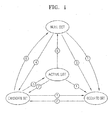
- FIG. 1 is a channel state transition diagram according to 4 channel state sets to which an embodiment of the present invention is applied. Transitions according to the reference numerals illustrated in FIG. 1 will now be described.
- frequency channels belonging t o a null set, an active set, and a candidate set become elements of an occupied set wh en an incumbent service appears. That is, when the incumbent service appears, a sec ondary user system cannot use the frequency channels.
- the transition according to reference numeral 2 when the quality of a frequency channel released from the incumbent service satisfies a specific quality threshold and is better than the quality of any element belonging to the candidate set, the released frequency channel becomes an element of the candidate set.
- the transition according to reference numeral 4 when quality of an element belonging to the null set satisfies the specific quality threshold and is better than quality of a ny element belonging to the candidate set, the element belonging to the null set becom es an element of the candidate set.
- transition according to reference numeral 6 when the quality of an element belonging to the candidate set does not satisfy the specific quality threshold or is worse than the quality of elements which has become elements of the candidate set due to th e transitions according to reference numerals 2, 4, and 7, the element belonging to the candidate set becomes an element of the null set.
- the transition according to reference numeral 7 when the quality of an element of the active set, which has been released due to usage termination, satisfies the specif ic quality threshold and is better than the quality of any element belonging to the candid ate set, the released element becomes an element of the candidate set.
- the transition according to reference numeral 8 when the quality of a frequency channel released from the WRAN service does not satisfy the specific quality threshold or is worse than the quality of all elements belonging to the candidate set, the released frequency channel becomes an element of the null set.
- a quality threshold used to distinguish the candidate set from the null set according to a spectrum sensing result can be represented by an interference noise spectral density, and in reality, the quality threshold is determined as the magnitude of a specific noise spectral density for maintaining link quality of a WRAN uplink/downlink.
- the specific quality threshold is determined from the performance of the WRAN uplink/downlink and a sensing receiver structure, in an embodiment of the prese nt invention, a specific value cannot be suggested as the specific quality threshold.
- FIG. 2 is a flowchart illustrating a method of assigning a frequency channel using efficient spectrum sensing in a Base Station (BS) of a secondary user according to an embodiment of the present invention.
- BS Base Station
- the BS (this means the BS of the secondary user and is simply called 'BS' hereinafter) periodically performs the spectrum sensing after a communication channel with a secondary user terminal is established.
- the BS transmits its frequency c channel state set information using a broadcast message to secondary user terminals wi th which no communication channel is established.
- the BS classifies multiple frequency channels licensed to a primary user into a plurality of channel state sets according to usage states, periodically senses channel states by changing a sensing period according to types of the classified channel state sets, and manages the sensed channel states as frequency channel stat e set information in operation 100.
- the BS transmits the frequency channel state set information to secondary user terminals using a broadcast message in operation 102.
- a new secondary user terminal which has received the broadcast message, transmits a channel assignment request message to the BS for the assignment of a frequency channel.
- the BS transmits a channel assignment message to the new secondary user terminal in operation 106. That is, if the BS receives the channel assignment request message from the new secondary user terminal, the BS can assign at least one downstream and upstream frequency channel to the new secondary user terminals, The BS assigns an unused frequency channel from among frequency channels licensed to the primary user to the new secondary user terminal using the frequ ency channel state set information.
- the new secondary user terminal When the new secondary user terminal transmits the channel assignment request message to the BS, the new secondary user terminal performs ranging, authentication, and registration processes and then transmits the channel assignment request mess age to the BS using an upstream channel used to perform the three processes.
- the B S After assigning the frequency channel to the new secondary user terminal, the B S initializes a downstream/upstream frequency channel state set for the new secondary user terminal to which the frequency channel has been assigned and transmits the frequency channel state set information to the new secondary user terminal in operation 1 08. Thereafter, the BS sets a periodic spectrum sensing mode for the new secondary user terminal to which the frequency channel has been assigned.
- the new secondary user terminal transmi ts downstream/upstream frequency channel state set information scanned and updated by the new secondary user terminal to the BS. That is, in operation 110, the BS recei ves downstream/upstream frequency channel state set information from the new secondary user terminal to which the frequency channel has been assigned, and in operation 112, the BS updates downstream/upstream frequency channel state set information of the new secondary user terminal.
- the BS releases the frequency channel from the secondary user terminal and assigns another frequency channel to the secondary user terminal.
- a quiet period (referring to T q 202 of FIG. 3 ) must be set.
- FIG. 3 is a data structure of downstream/upstream frames of a WRAN system ac cording to an embodiment of the present invention.
- a spectrum se nsing period T s 201 and a quiet period T q 202 of the active set are set.
- the quiet pe riod T q 202 depends on an execution speed of a spectrum sensing algorithm.
- the spectrum sensing period T s 201 must be set to the minimum time for releas ing a frequency channel after detecting whether a primary user uses the frequency channel.
- FIG. 3 shows a basic frame structure of downstream and upstream frequency ch anneals, wherein a single frame 21 includes 4 time slots 22 through 25.
- a time slot0 22 includes bursts including a broadcast message
- a time slot1 23, a time slot2 24, and a time slot3 25 do not include a broadcast message but incl ude a preamble 26 and a data symbol section 27.
- the quiet period T q 202 is randomly included in one of the time slot1 23, the time slot2 24, and the time slot3 25.
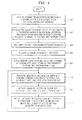
- FIG. 4 is a flowchart illustrating a method of assigning a frequency channel using efficient spectrum sensing in a terminal of a secondary user according to an embodiment of the present invention.
- a spectrum sensing method of the secondary user terminal can be classified into two types.
- the first type is a sensing method used until a communication channel is established after the secondary user terminal is turned on; and the second type is a peri odic spectrum sensing method used after the communication channel is established.
- the secondary user terminal when the secondary u ser terminal selects a downstream frequency channel, the secondary user terminal rece ives downstream/upstream frequency channel state set information of a BS of the seco ndary user using a broadcast message of the selected frequency channel in operation 3 00.
- the secondary user terminal scans channel states of entire downstream/upstream frequency channels in order to scan channel states of frequency channels around the secondary user terminal, updates the frequency channel state set information received i n operation 300 according to the scanning result, and transmits the updated frequency channel state set information to the BS in operation 302.
- the secondary user terminal transmits a channel assignment request message t o the BS using the frequency channel state set information in operation 304 and receive s a channel assignment message from the BS in response in operation 306. At least o ne downstream and upstream frequency channel is assigned to the secondary user ter minal through the channel assignment message.
- the secondary user terminal sets a downstream/upstream frequency channel a mong the at least one downstream and upstream frequency channel assigned by using the channel assignment message and transmits the channel set information to the BS i n operation 308.
- the secondary user terminal After the downstream/upstream frequency channel of the secondary user termin al is set, the secondary user terminal performs periodic spectrum sensing (scanning) ac cording to a spectrum sensing period differently set for the active set, the candidate set, the null set, and the occupied set in operation 310.
- the spectrum sensing (scanning) performed by the secondary user terminal is basically the same as that performed by t he BS.
- the periodic spectrum sensing performed by the secondary user terminal is acco mplished by performing the following procedures.
- the secondary user terminal performs spectrum scanning of the active set, the c andidate set, the null set, and the occupied set according to different sensing periods in operation 310.
- the secondary user terminal updates channel states of the active set, the candidate set, and the occupied set according to the scanning result in operation 3 12.
- the secondary user terminal reports the updated frequency channel state set infor mation to the BS and reports channel numbers and measured levels of the active set a nd a maximum of up to 5 selected candidate sets to the BS in operation 314.
- Operatio ns 310 through 314 are repeatedly performed.
- the BS updates frequency chann el state set information using the reported information.
- the invention can also be embodied as computer readable codes on a computer readable recording medium.
- the computer readable recording medium is any data st orage device that can store data which can be thereafter read by a computer system. Examples of the computer readable recording medium include read-only memory (ROM ), random-access memory (RAM), CD-ROMs, magnetic tapes, floppy disks, optical data storage devices, and carrier waves (such as data transmission through the Internet).
- ROM read-only memory
- RAM random-access memory
- CD-ROMs compact discs
- magnetic tapes magnetic tapes
- floppy disks magnetic tapes
- optical data storage devices optical data storage devices
- carrier waves such as data transmission through the Internet
Landscapes
- Engineering & Computer Science (AREA)
- Computer Networks & Wireless Communication (AREA)
- Signal Processing (AREA)
- Mobile Radio Communication Systems (AREA)
Abstract
Description
- The present invention relates to a method of assigning a frequency channel usin g efficient spectrum sensing in a multiple Frequency Assignment (FA) system, and mor e particularly, to a method of assigning a frequency channel using efficient spectrum se nsing in a multiple FA system, whereby a frequency channel is assigned to a secondary user, which requests channel assignment, using set information of channel states with out a primary user experiencing interference noise while the multiple FA system classifies frequency channels that are licensed and allowed to the primary user into an active s et, a candidate set, and an occupied set according to usage states and manages the cl assified frequency channels.
- Demands of services using wireless communication are rapidly increasing, but frequency bands having good transmission characteristics and which are easy in terms o f component development are already occupied. Thus, cognitive radio technology is u sed for a secondary user who desires to provide a new service using unused frequency channels found by temporally and spatially checking frequency channels that are licensed and allowed to a primary user. The primary user and the secondary user are comm unication systems operated by different services or operators and are described below.
- The present invention corresponds to technology, which is being standardized by IEEE 802.22, and in more detail, functional requirements are being determined in order to create a standardization draft.
- According to the IEEE 802.22 standardization, it is desired that a wireless Interne t service is provided using time and space unused by the primary user of TV or wireless devices using a TV frequency band or a frequency band currently used for wireless mi crophone communication (e.g., a frequency band from 54 MHz to 698 MHz correspondi ng to
TV channel numbers 2 to 51 in the United States, or a frequency band from 41 M Hz to 910 MHz internationally). In order for an IEEE 802.22 system (a Base Station (B S), a Customer Premises Equipment (CPE), and a core network) to use the assigned T V frequency band, the BS of the secondary user and the CPE, which is a terminal of the secondary user, must know a current state of the frequency channels. To do this, the BS and the terminal of the secondary user always monitor a channel usage state by scanning the current TV frequency channels, i.e., the frequency band from 41 MHz to 910 MHz. Therefore, when the primary user desires to use a frequency channel being u sed by the secondary user, the secondary user can quickly hand over the frequency channel to the primary user. - As described above, the present invention is related to a method of sensing and managing frequency channels when 6, 7, or 8 MHz is set as a single frequency channel from the frequency band from 41 MHz to 910 MHz assigned to TV broadcasting in a m ultiple Frequency Assignment (FA) system, i.e., an IEEE 802.22 standard system, and i s similar to Dynamic Frequency Selection (DFS) technology suggested by IEEE 802.16.
- The DFS technology suggested by IEEE 802.16 is a technology of scanning for a wireless data communication service in an unlicensed bandwidth to determine whether frequency channels of a primary user are used, assigning a frequency channel unused by the primary user to the wireless data communication service, releasing the frequency channel from the wireless data communication service by using a BS according to a r equest of the primary user, and assigning a new channel to the wireless data communic action service.
- In this point of view, a technology field related to spectrum sensing in a multiple FA system according to an embodiment of the present invention is almost the same as t he field of spectrum sensing technology of IEEE 802.22 and the DFS technology of IEE E 802.16.
- However, in the conventional DFS technology of IEEE 802.16, in order to provide a wireless Internet service in an unlicensed bandwidth, a method used by a BS for req uesting a terminal for measurement of a state of a selected frequency channel and receiving a measured result is used. In the conventional method, the BS only passively ac quires information regarding the state of frequency channels licensed to a primary user, and thus, communication quality degradation and communication impediment of the pr imary user may occur due to a decrease in the reliability of the spectrum sensing in a pr ocess of assigning or changing a frequency channel to a new secondary user using the passively acquired state information, and data transmission efficiency may decrease du e to an increase of an overhead signal such as a frequency channel state sensing request message.
- Thus, in order to assign frequency channels licensed to a primary user to a new secondary user without affecting communication quality of the primary user, a BS of the secondary user must always maintain optimum information on the state of the frequen cy channels licensed to the primary user.
- In order to do this, terminals and the BS of the secondary user must actively determine the state of the frequency channels licensed to the primary user using the spectrum sensing. In addition, for the spectrum sensing, instead of a simple periodic sensing method, an efficient method of changing a sensing period in consideration of whether th e primary user uses the frequency channels is required.
- The above and other features and advantages of the present invention will beco me more apparent by describing in detail exemplary embodiments thereof with reference to the attached drawings in which:
-
FIG. 1 is a channel state transition diagram according to 4 channel state sets to which an embodiment of the present invention is applied; -
FIG. 2 is a flowchart illustrating a method of assigning a frequency channel using
efficient spectrum sensing in a Base Station (BS) of a secondary user according to an embodiment of the present invention; -
FIG. 3 is a data structure of downstream/upstream frames of a Wireless Regional Area Network (WRAN) according to an embodiment of the present invention; and -
FIG. 4 is a flowchart illustrating a method of assigning a frequency channel using
efficient spectrum sensing in a terminal of a secondary user according to an embodiment of the present invention. - The present invention provides a method of assigning a frequency channels using efficient spectrum sensing in a multiple Frequency Assignment (FA) system, whereby a frequency channel is assigned to a secondary user, which requests channel assignm ent, using set information of channel states without a primary user experiencing interference noise while the multiple FA system classifies frequency channels that are licensed and allowed to the primary user into an active set, a candidate set, a null set, and an occupied set according to usage states and manages the classified frequency channels.
- That is, the present invention provides a method of assigning a frequency chann el using efficient spectrum sensing in a multiple FA system, whereby while the multiple FA system scans the state of multiple frequency channels (e.g., frequency channels of a TV frequency band from 41 MHz to 910 MHz), classifies the frequency channels into f our types of sets (an active set, a candidate set, a null set, and an occupied set), and m anages the classified frequency channels, a frequency channel unused by a primary us er is detected and assigned at high speed to a secondary user requesting new frequency channel assignment, and if the appearance of the primary user is detected, the freque ncy channel is released a short time later.
- According to an aspect of the present invention, there is provided a channel assi gnment method applied to a Base Station (BS) of a secondary user to which a frequenc y channel licensed to a primary user is assigned in a multiple FA system, the method co mprising: a channel sensing process, wherein the BS classifies multiple frequency channels licensed to the primary user into a plurality of channel state sets according to usag e states, periodically senses channel states by changing a sensing period according to types of the classified channel state sets, and manages the sensed channel states as frequency channel state set information; a channel state set broadcasting process, wherein the BS transmits the frequency channel state set information managed in the chann el sensing process to secondary user terminals using a broadcast message; and a cha nnel assigning process, wherein if the BS receives a channel assignment request mess age from a new secondary user terminal which has received the broadcast message, th e BS assigns an unused frequency channel from among frequency channels licensed t o the primary user to the new secondary user terminal using the frequency channel stat e set information. The method may further comprise a channel state set information updating process, wherein the BS updates the frequency channel state set information by periodically receiving 'frequency channel state set information of the secondary user terminal' from the secondary user terminal to which the frequency channel is assigned.
- According to another aspect of the present invention, there is provided a channel assignment method applied to a terminal of a secondary user to which a frequency channel licensed to a primary user is assigned in a multiple FA system, the method comprising: a channel state set information receiving process, wherein the secondary user terminal receives frequency channel state set information of multiple frequency channels li censed to the primary user from a BS of the secondary user using a broadcast messag e and manages the received frequency channel state set information; a channel assigni ng process, wherein the secondary user terminal requests the BS for channel assignme nt using the frequency channel state set information and the BS assigns an unused freq uency channel from among frequency channels licensed to the primary user to the seco ndary user terminal; and a channel state set information reporting process, wherein the secondary user terminal periodically senses channel states of the multiple frequency channels licensed to the primary user by changing a sensing period according to types of channel state sets, updates the frequency channel state set information according to th e sensing result, and reports the updated frequency channel state set information to the BS. The method may further comprise an updated information transmitting process, wherein after receiving the frequency channel state set information in the channel state set information receiving process, the secondary user terminal updates the received fre quency channel state set information by scanning states of downstream/upstream frequ ency channels with the BS and transmits the updated frequency channel state set information to the BS.
- As described above, according to the present invention, there is provided technol ogy related to a spectrum sensing process of detecting a usage state of a frequency channel of a primary user, interference noise power, and detecting the appearance of the primary user by performing spectrum sensing of frequency channels of a licensed band width (e.g., a TV frequency band) of an existing system when a new multiple Frequency Assignment (FA) system, such as a Wireless Regional Arena Network (WRAN) system, provides a wireless data communication service using the licensed bandwidth. The most important part of the technology is that the primary user must not experience com munication quality degradation or communication impediment even though the new multiple FA system provides a wireless Internet service using the same frequency band.
- Thus, unlike the prior art of requesting the scanning of a selected frequency channel, performing of spectrum sensing of the selected frequency channel, and reporting of a measured result, by using a periodic sensing method of classifying states of a plura lity of frequency channels assigned to the new multiple FA system into four types of set s (an active set, a candidate set, a null set, and an occupied set) and varying a sensing period according to the classified types of sets, the number of signal messages related t o the sensing can be reduced, the spectrum sensing can be performed at high speed, a nd channel assignment and channel change can be optimized using the four types of s et information. That is, a frequency channel can be assigned to a new secondary user without the primary user experiencing interference noise.
- The objectives, characteristics, and merits of the present invention will be describ ed in detail by explaining preferred embodiments of the invention with reference to the a ttached drawings, so that those of ordinary skill in the art can easily implement the spirit and scope of the present invention. In the following description, well-known functions or constructions are not described in detail since they would obscure the invention with unnecessary detail. Hereinafter, the present invention will be described more fully wit h reference to the accompanying drawings, in which exemplary embodiments of the inv ention are shown.
- The present invention will now be generally described.
- According to an embodiment of the present invention, when a multiple Frequenc y Assignment (FA) system performs a new wireless data communication service in an unlicensed bandwidth or a licensed bandwidth (e.g., a TV frequency band), the multiple FA system classifies states of frequency channels into four types of sets (an active set, a candidate set, a null set, and an occupied set) and manages the classified frequency channels, wherein the multiple FA system efficiently manages the frequency channels b y changing a sensing period according to the types of sets.
- Table 1 illustrates the definition of channel state sets so as to aid understanding of the present invention.
[Table 1] First active set A set of used channels for a certain Customer Premises Equipment (CPE) Second active set A set of used channels for a certain Base Station (BS) andidate/Backup se A set of clean channels available for a certain CPE or BS Occupied set A set of occupied channels by incumbent user which a certain CPE fins Disallowed set A set of channels whose access are not allowed by regulation Null set A set of channels that are not classified as one of above five sets - Table 1 will now be described. The active set indicates downstream/upstream f requency channels assigned to secondary user terminals. The active set includes the first active set and the second active set. The candidate set (although the term 'candidate/backup set' is used in Table 1, 'candidate set' will be used hereinafter) indicates do wnstream and upstream frequency channels unused by primary users and not assigned to any secondary user terminal (CPE). The occupied set indicates frequency channel s being used by primary users.
- Since the disallowed set is not often changed, the disallowed set is excluded fro m a channel management scenario.
- That is, the channel state sets, i.e., the first active set, the second active set, the candidate set, the occupied set, and the null set, are defined for efficient management and managed by BSs and terminals of a secondary user. In detail, each BS manages the active set, the candidate set, the occupied set, and the null set, and each secondar y user terminal also manages the active set, the candidate set, the occupied set, and th e null set.
- Each channel state set is updated in every sensing period of each channel set b y the multiple FA system, and the minimum channel set update period is an active set s ensing period.
- In the present invention, the purpose of classifying frequency channels of a multiple FA system, such as a Wireless Regional Area Network (WRAN) system, into a plura lity of types of sets as illustrated in Table 1 and managing the classified frequency channels in a BS is to vary a sensing period according to the states of the frequency channel s and efficiency assign and change a frequency channel to each secondary user termin al.
- According to a spectrum sensing method, a sensing period must be differently se t according to the types of sets. For the active set, when primary users desire to use fr equency channels assigned to secondary user terminals, the frequency channels must be released at high speed, and thus, the sensing period must be the shortest. For the candidate set, since usage states and measurement levels of frequency channels belonging to the candidate set must be scanned, the sensing period must be of intermediate l ength. For the occupied set, since frequency channels belonging to the occupied set a pre being used by primary users, the sensing period must be the longest.
-
FIG. 1 is a channel state transition diagram according to 4 channel state sets to which an embodiment of the present invention is applied. Transitions according to the reference numerals illustrated inFIG. 1 will now be described. - The transition according to reference numeral 1: frequency channels belonging t o a null set, an active set, and a candidate set become elements of an occupied set wh en an incumbent service appears. That is, when the incumbent service appears, a sec ondary user system cannot use the frequency channels.
- The transition according to reference numeral 2: when the quality of a frequency channel released from the incumbent service satisfies a specific quality threshold and is better than the quality of any element belonging to the candidate set, the released frequency channel becomes an element of the candidate set.
- The transition according to reference numeral 3: when the quality of the frequenc y channel released from the incumbent service does not satisfy the specific quality threshold or is worse than the quality of all elements belonging to the candidate set, the released frequency channel becomes an element of the null set.
- The transition according to reference numeral 4: when quality of an element belonging to the null set satisfies the specific quality threshold and is better than quality of a ny element belonging to the candidate set, the element belonging to the null set becom es an element of the candidate set.
- The transition according to reference numeral 5: when an element of the candida te set is activated due to a new connection of a WRAN service, the element of the candidate set becomes an element of the active set.
- The transition according to reference numeral 6: when the quality of an element belonging to the candidate set does not satisfy the specific quality threshold or is worse than the quality of elements which has become elements of the candidate set due to th e transitions according to
reference numerals - The transition according to reference numeral 7: when the quality of an element of the active set, which has been released due to usage termination, satisfies the specif ic quality threshold and is better than the quality of any element belonging to the candid ate set, the released element becomes an element of the candidate set.
- The transition according to reference numeral 8: when the quality of a frequency channel released from the WRAN service does not satisfy the specific quality threshold or is worse than the quality of all elements belonging to the candidate set, the released frequency channel becomes an element of the null set.
- In general, a quality threshold used to distinguish the candidate set from the null set according to a spectrum sensing result can be represented by an interference noise spectral density, and in reality, the quality threshold is determined as the magnitude of a specific noise spectral density for maintaining link quality of a WRAN uplink/downlink.
- Thus, since the specific quality threshold is determined from the performance of the WRAN uplink/downlink and a sensing receiver structure, in an embodiment of the prese nt invention, a specific value cannot be suggested as the specific quality threshold.
-
FIG. 2 is a flowchart illustrating a method of assigning a frequency channel using efficient spectrum sensing in a Base Station (BS) of a secondary user according to an embodiment of the present invention. - The BS (this means the BS of the secondary user and is simply called 'BS' hereinafter) periodically performs the spectrum sensing after a communication channel with a secondary user terminal is established. In addition, the BS transmits its frequency c channel state set information using a broadcast message to secondary user terminals wi th which no communication channel is established.
- Referring to
FIG. 2 , the BS classifies multiple frequency channels licensed to a primary user into a plurality of channel state sets according to usage states, periodically senses channel states by changing a sensing period according to types of the classified channel state sets, and manages the sensed channel states as frequency channel stat e set information inoperation 100. - The BS transmits the frequency channel state set information to secondary user terminals using a broadcast message in
operation 102. A new secondary user terminal, which has received the broadcast message, transmits a channel assignment request message to the BS for the assignment of a frequency channel. - If the BS receives the channel assignment request message from the new secondary user terminal in
operation 104, the BS transmits a channel assignment message to the new secondary user terminal inoperation 106. That is, if the BS receives the channel assignment request message from the new secondary user terminal, the BS can assign at least one downstream and upstream frequency channel to the new secondary user terminals, The BS assigns an unused frequency channel from among frequency channels licensed to the primary user to the new secondary user terminal using the frequ ency channel state set information. - When the new secondary user terminal transmits the channel assignment request message to the BS, the new secondary user terminal performs ranging, authentication, and registration processes and then transmits the channel assignment request mess age to the BS using an upstream channel used to perform the three processes.
- After assigning the frequency channel to the new secondary user terminal, the B S initializes a downstream/upstream frequency channel state set for the new secondary user terminal to which the frequency channel has been assigned and transmits the frequency channel state set information to the new secondary user terminal in
operation 1 08. Thereafter, the BS sets a periodic spectrum sensing mode for the new secondary user terminal to which the frequency channel has been assigned. - In the periodic spectrum sensing mode, the new secondary user terminal transmi ts downstream/upstream frequency channel state set information scanned and updated by the new secondary user terminal to the BS. That is, in
operation 110, the BS recei ves downstream/upstream frequency channel state set information from the new secondary user terminal to which the frequency channel has been assigned, and inoperation 112, the BS updates downstream/upstream frequency channel state set information of the new secondary user terminal. - If the appearance of a primary user to the frequency channel assigned to the secondary user terminal is detected by using a process of periodically receiving a report from the secondary user terminal (referred to as
operations 110 and 112) or a sensing process of the BS, the BS releases the frequency channel from the secondary user terminal and assigns another frequency channel to the secondary user terminal. - In order for the BS and the secondary user terminal to scan frequency chancels belonging to the active set, a quiet period (referring to
T q 202 ofFIG. 3 ) must be set. -
FIG. 3 is a data structure of downstream/upstream frames of a WRAN system ac cording to an embodiment of the present invention. Referring toFIG. 3 , a spectrum se nsingperiod T s 201 and aquiet period T q 202 of the active set are set. The quietpe riod T q 202 depends on an execution speed of a spectrum sensing algorithm. - The spectrum
sensing period T s 201 must be set to the minimum time for releas ing a frequency channel after detecting whether a primary user uses the frequency channel. -
FIG. 3 shows a basic frame structure of downstream and upstream frequency ch anneals, wherein asingle frame 21 includes 4time slots 22 through 25. In this time slot structure, atime slot0 22 includes bursts including a broadcast message, and atime slot1 23, atime slot2 24, and atime slot3 25 do not include a broadcast message but incl ude apreamble 26 and adata symbol section 27. In the current embodiment, thequiet period T q 202 is randomly included in one of thetime slot1 23, thetime slot2 24, and thetime slot3 25. -
FIG. 4 is a flowchart illustrating a method of assigning a frequency channel using efficient spectrum sensing in a terminal of a secondary user according to an embodiment of the present invention. - A spectrum sensing method of the secondary user terminal can be classified into two types. The first type is a sensing method used until a communication channel is established after the secondary user terminal is turned on; and the second type is a peri odic spectrum sensing method used after the communication channel is established.
- Referring to
FIG. 4 , in an initial spectrum sensing process, when the secondary u ser terminal selects a downstream frequency channel, the secondary user terminal rece ives downstream/upstream frequency channel state set information of a BS of the seco ndary user using a broadcast message of the selected frequency channel inoperation 3 00. The secondary user terminal scans channel states of entire downstream/upstream frequency channels in order to scan channel states of frequency channels around the secondary user terminal, updates the frequency channel state set information received i noperation 300 according to the scanning result, and transmits the updated frequency channel state set information to the BS inoperation 302. - The secondary user terminal transmits a channel assignment request message t o the BS using the frequency channel state set information in
operation 304 and receive s a channel assignment message from the BS in response inoperation 306. At least o ne downstream and upstream frequency channel is assigned to the secondary user ter minal through the channel assignment message. - The secondary user terminal sets a downstream/upstream frequency channel a mong the at least one downstream and upstream frequency channel assigned by using the channel assignment message and transmits the channel set information to the BS i n
operation 308. - After the downstream/upstream frequency channel of the secondary user termin al is set, the secondary user terminal performs periodic spectrum sensing (scanning) ac cording to a spectrum sensing period differently set for the active set, the candidate set, the null set, and the occupied set in
operation 310. The spectrum sensing (scanning) performed by the secondary user terminal is basically the same as that performed by t he BS. - The periodic spectrum sensing performed by the secondary user terminal is acco mplished by performing the following procedures.
- The secondary user terminal performs spectrum scanning of the active set, the c andidate set, the null set, and the occupied set according to different sensing periods in
operation 310. The secondary user terminal updates channel states of the active set, the candidate set, and the occupied set according to the scanning result inoperation 3 12. The secondary user terminal reports the updated frequency channel state set infor mation to the BS and reports channel numbers and measured levels of the active set a nd a maximum of up to 5 selected candidate sets to the BS inoperation 314. Operatio ns 310 through 314 are repeatedly performed. Thus, the BS updates frequency chann el state set information using the reported information. - The invention can also be embodied as computer readable codes on a computer readable recording medium. The computer readable recording medium is any data st orage device that can store data which can be thereafter read by a computer system. Examples of the computer readable recording medium include read-only memory (ROM ), random-access memory (RAM), CD-ROMs, magnetic tapes, floppy disks, optical data storage devices, and carrier waves (such as data transmission through the Internet). The computer readable recording medium can also be distributed over network coupled computer systems so that the computer readable code is stored and executed in a dist ributed fashion.
- While the present invention has been particularly shown and described with refer ence to exemplary embodiments thereof, it will be understood by those of ordinary skill i n the art that various changes in form and details may be made therein without departin g from the spirit and scope of the present invention as defined by the following claims.
Claims (4)
- A method of transmitting channel information for frequency channel assignment in a Base Station(BS), the method comprising:maintaining information on a plurality of channel sets including an active set currently used for WRAN communication, a candidate set available for WRAN communication, and an occupied set occupied by incumbent;transmitting information on the candidate set to a new customer premise equipment(CPE).
- The method of claim 1, wherein a sensing period of the active set is shorter than a sensing period of the candidate set.
- A method of receiving channel information for frequency channel assignment in a customer premise equipment(CPE), the method comprising:receiving information on a candidate set among a plurality of channel sets including an active set, the candidate set, and an occupied set from a base station,wherein the active set is a set of channels currently used for WRAN communication,
wherein the candidate set is a set of channels available for WRAN communication,
wherein the occupied set is a set of channels occupied by incumbent. - The method of claim 3, wherein a sensing period of the active set is shorter than a sensing period of the candidate set.
Applications Claiming Priority (3)
| Application Number | Priority Date | Filing Date | Title |
|---|---|---|---|
| KR20050097113 | 2005-10-14 | ||
| KR20060098640A KR100785799B1 (en) | 2005-10-14 | 2006-10-10 | Method of Frequency Channel Assignment using Effective Spectrum Sensing in multiple FA system |
| EP06799201.6A EP1935126B1 (en) | 2005-10-14 | 2006-10-13 | Method of frequency channel assignment using effective spectrum sensing in multiple fa system |
Related Parent Applications (1)
| Application Number | Title | Priority Date | Filing Date |
|---|---|---|---|
| EP06799201.6 Division | 2006-10-13 |
Publications (2)
| Publication Number | Publication Date |
|---|---|
| EP2533560A2 true EP2533560A2 (en) | 2012-12-12 |
| EP2533560A3 EP2533560A3 (en) | 2013-02-20 |
Family
ID=38176790
Family Applications (1)
| Application Number | Title | Priority Date | Filing Date |
|---|---|---|---|
| EP20120175502 Withdrawn EP2533560A3 (en) | 2005-10-14 | 2006-10-13 | Method of frequency channel assignment using effective spectrum sensing in multiple fa system |
Country Status (6)
| Country | Link |
|---|---|
| US (2) | US8279767B2 (en) |
| EP (1) | EP2533560A3 (en) |
| JP (2) | JP4777432B2 (en) |
| KR (1) | KR100785799B1 (en) |
| CN (1) | CN101310465B (en) |
| CA (1) | CA2625370C (en) |
Families Citing this family (75)
| Publication number | Priority date | Publication date | Assignee | Title |
|---|---|---|---|---|
| US7146176B2 (en) | 2000-06-13 | 2006-12-05 | Shared Spectrum Company | System and method for reuse of communications spectrum for fixed and mobile applications with efficient method to mitigate interference |
| US7409010B2 (en) * | 2003-06-10 | 2008-08-05 | Shared Spectrum Company | Method and system for transmitting signals with reduced spurious emissions |
| KR100785799B1 (en) * | 2005-10-14 | 2007-12-13 | 한국전자통신연구원 | Method of Frequency Channel Assignment using Effective Spectrum Sensing in multiple FA system |
| US8055204B2 (en) | 2007-08-15 | 2011-11-08 | Shared Spectrum Company | Methods for detecting and classifying signals transmitted over a radio frequency spectrum |
| US8997170B2 (en) * | 2006-12-29 | 2015-03-31 | Shared Spectrum Company | Method and device for policy-based control of radio |
| US8027249B2 (en) | 2006-10-18 | 2011-09-27 | Shared Spectrum Company | Methods for using a detector to monitor and detect channel occupancy |
| US8155649B2 (en) * | 2006-05-12 | 2012-04-10 | Shared Spectrum Company | Method and system for classifying communication signals in a dynamic spectrum access system |
| US9538388B2 (en) * | 2006-05-12 | 2017-01-03 | Shared Spectrum Company | Method and system for dynamic spectrum access |
| US8326313B2 (en) * | 2006-05-12 | 2012-12-04 | Shared Spectrum Company | Method and system for dynamic spectrum access using detection periods |
| US7564816B2 (en) * | 2006-05-12 | 2009-07-21 | Shared Spectrum Company | Method and system for determining spectrum availability within a network |
| US8184653B2 (en) | 2007-08-15 | 2012-05-22 | Shared Spectrum Company | Systems and methods for a cognitive radio having adaptable characteristics |
| AU2008205021B2 (en) * | 2007-01-04 | 2011-07-07 | Qualcomm Incorporated | Method and apparatus for distributed spectrum sensing for wireless communication |
| US7610036B2 (en) * | 2007-01-08 | 2009-10-27 | Mitsubishi Electric Research Laboratories, Inc. | Space-time-frequency sensing of RF spectrum in cognitive radios |
| US8687563B2 (en) * | 2007-01-09 | 2014-04-01 | Stmicroelectronics, Inc. | Simultaneous sensing and data transmission |
| US7742764B2 (en) * | 2007-03-23 | 2010-06-22 | Motorola, Inc. | Method and apparatus for determining appropriate channels for communication |
| US8081972B2 (en) * | 2007-05-25 | 2011-12-20 | Huawei Technologies Co., Ltd. | Method and system for sensing discontiguous channels in a wireless network |
| EP2001176A3 (en) * | 2007-06-08 | 2013-01-23 | Imec | Method for configuring multi-channel communication |
| KR100934572B1 (en) * | 2007-10-31 | 2009-12-30 | 연세대학교 산학협력단 | Cognitive wireless communication device using overlapping signals and method thereof |
| US7949357B2 (en) | 2007-12-11 | 2011-05-24 | Nokia Corporation | Method and apparatus to select collaborating users in spectrum sensing |
| KR100937033B1 (en) * | 2007-12-14 | 2010-01-15 | 한국전자통신연구원 | Method of selecting FA in broadband wireless access system and method for requesting uplink band using same |
| KR100960660B1 (en) * | 2007-12-18 | 2010-06-07 | 한국전자통신연구원 | How to change FA status in broadband wireless access system |
| KR101423337B1 (en) * | 2008-02-22 | 2014-07-25 | 삼성전자주식회사 | A wireless communication system connecting an ad-hoc network and an infrastructure network using an authorized frequency band, and a wireless terminal and a communication method therefor |
| US7885229B2 (en) * | 2008-04-03 | 2011-02-08 | Nokia Corporation | Method, apparatus and computer program for self-adjusting spectrum sensing for cognitive radio |
| US8718559B2 (en) | 2008-04-07 | 2014-05-06 | Nokia Corporation | Method, apparatus and computer program for sensing spectrum in a cognitive radio environment |
| US20090296640A1 (en) * | 2008-05-30 | 2009-12-03 | Motorola, Inc. | Method for optimizing the use of shared communication channels and dedicated communication channels in a communication system |
| CN102057736B (en) * | 2008-06-04 | 2014-04-09 | 艾利森电话股份有限公司 | Method and apparatus relating to spectrum sensing |
| EP2319260A2 (en) * | 2008-08-19 | 2011-05-11 | Shared Spectrum Company | Method and system for dynamic spectrum access using specialty detectors and improved networking |
| JP5648286B2 (en) * | 2009-01-14 | 2015-01-07 | ソニー株式会社 | COMMUNICATION SYSTEM, COMMUNICATION DEVICE, PROGRAM, AND COMMUNICATION CONTROL METHOD |
| JP5338682B2 (en) | 2009-01-20 | 2013-11-13 | ソニー株式会社 | COMMUNICATION DEVICE, PROGRAM, AND COMMUNICATION CONTROL METHOD |
| CN102282880B (en) * | 2009-01-26 | 2016-05-04 | 索尼公司 | Communication control method, communication equipment and program |
| US8290503B2 (en) * | 2009-02-01 | 2012-10-16 | Qualcomm Incorporated | Multichannel dynamic frequency selection |
| US8780982B2 (en) * | 2009-07-02 | 2014-07-15 | Qualcomm Incorporated | Transmitter quieting and different encoding rates for portions of a set of frames |
| US8537772B2 (en) * | 2009-07-02 | 2013-09-17 | Qualcomm Incorporated | Transmitter quieting during spectrum sensing |
| US8902995B2 (en) * | 2009-07-02 | 2014-12-02 | Qualcomm Incorporated | Transmitter quieting and reduced rate encoding |
| US9112618B2 (en) * | 2009-07-02 | 2015-08-18 | Qualcomm Incorporated | Coding latency reductions during transmitter quieting |
| US8958475B2 (en) * | 2009-07-02 | 2015-02-17 | Qualcomm Incorporated | Transmitter quieting and null data encoding |
| KR101212405B1 (en) * | 2009-07-16 | 2012-12-13 | 한국전자통신연구원 | Apparatus and Method for scheduling sensing channel in Wireless Communication System |
| US8725076B2 (en) | 2009-09-24 | 2014-05-13 | Electronics And Telecommunications Research Institute | Method and apparatus for sharing frequency based on classification of frequency set in environment where incumbent system exists |
| KR101404321B1 (en) * | 2009-09-24 | 2014-06-05 | 한국전자통신연구원 | Method and apparatus for sharing frequency based on classification of frequency set in incumbent system existing environment |
| JP5359833B2 (en) * | 2009-12-08 | 2013-12-04 | 日本電気株式会社 | Wireless base station, handover method and program |
| JP5322009B2 (en) * | 2010-01-19 | 2013-10-23 | 独立行政法人情報通信研究機構 | Wireless communication system and airband interference detection method applied to the aviation industry |
| US20110305189A1 (en) * | 2010-06-09 | 2011-12-15 | The Hong Kong University Of Science And Technology | Exploiting buffers in cognitive multi-relay systems for delay-sensitive applications |
| KR101717138B1 (en) * | 2010-07-09 | 2017-03-16 | 타이완 세미콘덕터 매뉴팩쳐링 컴퍼니 리미티드 | TV whitespace device using a structured database |
| US8861452B2 (en) | 2010-08-16 | 2014-10-14 | Qualcomm Incorporated | Method and apparatus for use of licensed spectrum for control channels in cognitive radio communications |
| US9807778B2 (en) | 2010-10-11 | 2017-10-31 | Interdigital Patent Holdings, Inc. | Dynamic spectrum management |
| CN103299590B (en) * | 2010-10-11 | 2017-04-05 | 交互数字专利控股公司 | For the method and apparatus of the bandwidth allocation for cognitive radio networks |
| JP5704704B2 (en) * | 2011-02-28 | 2015-04-22 | 独立行政法人情報通信研究機構 | Cognitive radio communication system |
| JP5240593B2 (en) * | 2011-07-08 | 2013-07-17 | 株式会社安川電機 | Rotating electric machine |
| KR20140129007A (en) * | 2012-02-08 | 2014-11-06 | 엘지전자 주식회사 | Method and apparatus for transceiving signals in wireless communication systems |
| CN103813342A (en) * | 2012-11-06 | 2014-05-21 | 华为技术有限公司 | Dynamic spectrum managing method, apparatus, and system |
| US9179409B2 (en) | 2012-12-03 | 2015-11-03 | Qualcomm Incorporated | Multiple access scheme for narrowband channels |
| KR101514670B1 (en) * | 2013-10-21 | 2015-04-24 | 동국대학교 경주캠퍼스 산학협력단 | The utilization method of wireless broadcasting channels using spectrum sensing in immersive broadcasting of multiple devices |
| US9813914B2 (en) * | 2013-12-06 | 2017-11-07 | Qualcomm Incorporated | System and method for management of spectrum interference rights and secondary use permissions |
| FR3016103B1 (en) * | 2013-12-31 | 2017-03-10 | Thales Sa | RADIO SPECTRUM SHARING METHOD AND SYSTEM |
| CN104144427B (en) * | 2014-07-23 | 2017-11-07 | 华南理工大学 | A kind of wireless cognition network band allocating method |
| CN106576247B (en) * | 2014-09-11 | 2018-08-21 | 华为技术有限公司 | Network device, terminal, and method for determining communication spectrum availability |
| US20160095114A1 (en) | 2014-09-26 | 2016-03-31 | Electronics And Telecommunications Research Institute | Method and apparatus for managing allocation and usage of radio resource, method and apparatus for transmitting data through unlicensed band channel, and method and apparatus for managing access of radio resource |
| JP6378446B2 (en) | 2015-01-20 | 2018-08-22 | ソニー株式会社 | User equipment, cellular network node, and method for providing license-assisted access |
| US10314063B2 (en) | 2015-05-12 | 2019-06-04 | Electronics And Telecommunications Research Institute | Method and apparatus for transmitting adaptive partial subframe in unlicensed frequency band, method and apparatus for identifying a frame structure, and method and apparatus for transmitting signal |
| US10439767B2 (en) | 2015-08-13 | 2019-10-08 | Electronics And Telecommunications Research Institute | Apparatus for transmitting and receiving data through unlicensed band |
| KR102419355B1 (en) | 2016-01-27 | 2022-07-12 | 한국전자통신연구원 | Methods and Procedures for Dynamic Channel Assignment and Change in UAS Control and Non-Payload Communication |
| KR102574506B1 (en) | 2016-01-29 | 2023-09-05 | 한국전자통신연구원 | Method and apparatus for transmitting signal in unlicensed band communication system, method and apparatus for uplink scheduling, and method and apparatus for transmitting information about channel status measurement period |
| US10575312B2 (en) * | 2016-12-01 | 2020-02-25 | Electronics And Telecommunications Research Institute | Method of assigning channel for UAS control and non-payload communication (CNPC) system |
| US10548114B2 (en) | 2017-07-25 | 2020-01-28 | Microsoft Technology Licensing, Llc | Multi-tier spectrum access channel assignment |
| KR102395355B1 (en) | 2017-12-06 | 2022-05-10 | 한국전자통신연구원 | Method for providing ad-hoc broadcasting service based on channel share and apparatus using the same |
| GB2585298A (en) * | 2018-03-29 | 2021-01-06 | British Telecomm | An improved channel selection method for a wireless LAN |
| WO2020078730A1 (en) | 2018-10-16 | 2020-04-23 | British Telecommunications Public Limited Company | Measuring channel performance in wireless local area networks |
| US11284404B2 (en) | 2019-02-07 | 2022-03-22 | Raytheon Company | Apparatus and method for communications in congested radio frequency environments via dynamic usage exchange |
| WO2021014628A1 (en) * | 2019-07-24 | 2021-01-28 | 日本電信電話株式会社 | Band-sharing communication system, line control method, line control device, and line control program |
| WO2021014626A1 (en) * | 2019-07-24 | 2021-01-28 | 日本電信電話株式会社 | Band-sharing communication system, line control method, line control device, and line control program |
| US12160855B2 (en) * | 2019-07-24 | 2024-12-03 | Nippon Telegraph And Telephone Corporation | Band sharing communication system, line control method, line control device, and line control program |
| US11212372B2 (en) * | 2019-12-31 | 2021-12-28 | Ooma, Inc. | Enhanced multi transport for redundancy |
| EP4097934B1 (en) | 2020-01-31 | 2025-12-31 | Hitachi Energy Ltd | CHANNEL ASSIGNMENT IN A WIRELESS COMMUNICATION SYSTEM |
| US11611405B2 (en) | 2020-08-11 | 2023-03-21 | Microsoft Technology Licensing, Llc | Efficient spectrum allocation in a multi-node optical network |
| CN114339690A (en) * | 2020-09-27 | 2022-04-12 | 索尼公司 | Electronic device and method for wireless communication, computer-readable storage medium |
Family Cites Families (20)
| Publication number | Priority date | Publication date | Assignee | Title |
|---|---|---|---|---|
| JPH0314329A (en) * | 1989-06-13 | 1991-01-23 | Matsushita Electric Ind Co Ltd | cordless telephone device |
| US5197093A (en) * | 1990-04-13 | 1993-03-23 | Phonemate, Inc. | Enviromental adaptive mechanism for channel utilization in cordless telephones |
| JP2586316B2 (en) * | 1993-12-22 | 1997-02-26 | 日本電気株式会社 | Sector configuration mobile communication system |
| JP3231575B2 (en) * | 1995-04-18 | 2001-11-26 | 三菱電機株式会社 | Wireless data transmission equipment |
| US5809059A (en) * | 1996-11-21 | 1998-09-15 | Motorola, Inc. | Method and apparatus for spread spectrum channel assignment |
| JPH10285103A (en) * | 1997-04-11 | 1998-10-23 | Nec Commun Syst Ltd | Free wireless channel interference detection method |
| JP3464162B2 (en) * | 1999-02-15 | 2003-11-05 | 日本電信電話株式会社 | Wireless packet transmission system |
| US6466793B1 (en) * | 1999-05-28 | 2002-10-15 | Ericsson Inc. | Automatic frequency allocation (AFA) for wireless office systems sharing the spectrum with public systems |
| US6862273B2 (en) * | 2001-01-10 | 2005-03-01 | Motorola, Inc. | Method and apparatus for providing dispatch scan in a CDMA communication system |
| EP1248477A1 (en) | 2001-04-03 | 2002-10-09 | Telefonaktiebolaget L M Ericsson (Publ) | Method and device for controlling dynamic frequency selection within a wireless communication system |
| US6870815B2 (en) * | 2003-01-30 | 2005-03-22 | Atheros Communications, Inc. | Methods for implementing a dynamic frequency selection (DFS) and a temporary channel selection feature for WLAN devices |
| KR100606129B1 (en) | 2003-04-30 | 2006-07-28 | 삼성전자주식회사 | Channel Quality Measurement and Reporting Method in Broadband Wireless Access Communication Systems |
| US7474895B1 (en) * | 2004-03-04 | 2009-01-06 | Zte (Usa) Inc. | Frequency reuse in wireless communication networks |
| US9161231B2 (en) * | 2004-10-14 | 2015-10-13 | Alcatel Lucent | Method and system for wireless networking using coordinated dynamic spectrum access |
| JP4589711B2 (en) * | 2004-12-14 | 2010-12-01 | 富士通株式会社 | Wireless communication system and wireless communication device |
| US8126482B2 (en) * | 2005-03-04 | 2012-02-28 | Qualcomm Incorporated | Multiple paging channels for efficient region paging |
| US20080219201A1 (en) * | 2005-09-16 | 2008-09-11 | Koninklijke Philips Electronics, N.V. | Method of Clustering Devices in Wireless Communication Network |
| JP2007088940A (en) * | 2005-09-22 | 2007-04-05 | Toshiba Corp | Cognitive communication system and cognitive communication method |
| KR100785799B1 (en) * | 2005-10-14 | 2007-12-13 | 한국전자통신연구원 | Method of Frequency Channel Assignment using Effective Spectrum Sensing in multiple FA system |
| WO2007043827A1 (en) | 2005-10-14 | 2007-04-19 | Electronics And Telecommunications Research Institute | Method of frequency channel assignment using effective spectrum sensing in multiple fa system |
-
2006
- 2006-10-10 KR KR20060098640A patent/KR100785799B1/en not_active Expired - Fee Related
- 2006-10-13 JP JP2008535460A patent/JP4777432B2/en not_active Expired - Fee Related
- 2006-10-13 CN CN2006800426262A patent/CN101310465B/en not_active Expired - Fee Related
- 2006-10-13 CA CA 2625370 patent/CA2625370C/en active Active
- 2006-10-13 US US12/089,948 patent/US8279767B2/en not_active Expired - Fee Related
- 2006-10-13 EP EP20120175502 patent/EP2533560A3/en not_active Withdrawn
-
2011
- 2011-05-25 JP JP2011117295A patent/JP5249383B2/en not_active Expired - Fee Related
-
2012
- 2012-08-13 US US13/584,049 patent/US9332440B2/en not_active Expired - Fee Related
Non-Patent Citations (1)
| Title |
|---|
| None |
Also Published As
| Publication number | Publication date |
|---|---|
| EP2533560A3 (en) | 2013-02-20 |
| KR20070041343A (en) | 2007-04-18 |
| JP5249383B2 (en) | 2013-07-31 |
| US9332440B2 (en) | 2016-05-03 |
| JP2009512326A (en) | 2009-03-19 |
| US20090161610A1 (en) | 2009-06-25 |
| JP4777432B2 (en) | 2011-09-21 |
| US8279767B2 (en) | 2012-10-02 |
| CA2625370C (en) | 2014-09-16 |
| CN101310465A (en) | 2008-11-19 |
| CN101310465B (en) | 2011-10-12 |
| CA2625370A1 (en) | 2007-04-19 |
| JP2011229158A (en) | 2011-11-10 |
| KR100785799B1 (en) | 2007-12-13 |
| US20120307782A1 (en) | 2012-12-06 |
Similar Documents
| Publication | Publication Date | Title |
|---|---|---|
| EP1935126B1 (en) | Method of frequency channel assignment using effective spectrum sensing in multiple fa system | |
| US8279767B2 (en) | Method of frequency channel assignment using effective spectrum sensing in multiple frequency assignment system | |
| US5428819A (en) | Method and apparatus for radio frequency bandwidth sharing among heterogeneous radio communication system | |
| CA2336044C (en) | Channel allocation in a telecommunications system with asymmetric uplink and downlink traffic | |
| US5864759A (en) | Radio telephones and methods of operation | |
| EP0716514B1 (en) | A method and an arrangement for radio communication | |
| US20210218541A1 (en) | Bandwidth signalling | |
| US20100020732A1 (en) | Physical layer superframe, frame, preamble and control header for ieee 802.22 wran communication systems | |
| KR101471563B1 (en) | Method and apparatus for per frame based resource sharing in cognitive radio communication system | |
| JP4663936B2 (en) | Automatic frequency allocation for wireless office equipment sharing spectrum with public systems | |
| JP2009515479A (en) | Apparatus and method for dynamic frequency selection in a wireless network | |
| US6466795B1 (en) | Method for improving resource allocation in a wireless communications system using broadcast resource information | |
| US8526323B2 (en) | Method and apparatus for carrier identity determination in multi-carrier communication systems | |
| KR19980703648A (en) | Stabilized Control Channel Planning Using Non-Combined Dedicated Traffic Channels | |
| US8204072B2 (en) | Method and devices for determining available frequency ranges | |
| CN101356833A (en) | Method and device for determining usable frequency range |
Legal Events
| Date | Code | Title | Description |
|---|---|---|---|
| PUAI | Public reference made under article 153(3) epc to a published international application that has entered the european phase |
Free format text: ORIGINAL CODE: 0009012 |
|
| AC | Divisional application: reference to earlier application |
Ref document number: 1935126 Country of ref document: EP Kind code of ref document: P |
|
| AK | Designated contracting states |
Kind code of ref document: A2 Designated state(s): AT BE BG CH CY CZ DE DK EE ES FI FR GB GR HU IE IS IT LI LT LU LV MC NL PL PT RO SE SI SK TR |
|
| PUAL | Search report despatched |
Free format text: ORIGINAL CODE: 0009013 |
|
| AK | Designated contracting states |
Kind code of ref document: A3 Designated state(s): AT BE BG CH CY CZ DE DK EE ES FI FR GB GR HU IE IS IT LI LT LU LV MC NL PL PT RO SE SI SK TR |
|
| RIC1 | Information provided on ipc code assigned before grant |
Ipc: H04W 16/14 20090101AFI20130116BHEP |
|
| 17P | Request for examination filed |
Effective date: 20130704 |
|
| STAA | Information on the status of an ep patent application or granted ep patent |
Free format text: STATUS: THE APPLICATION HAS BEEN WITHDRAWN |
|
| 18W | Application withdrawn |
Effective date: 20130820 |