EP2533515A2 - Noise reduction controlling apparatus and method - Google Patents
Noise reduction controlling apparatus and method Download PDFInfo
- Publication number
- EP2533515A2 EP2533515A2 EP20120168719 EP12168719A EP2533515A2 EP 2533515 A2 EP2533515 A2 EP 2533515A2 EP 20120168719 EP20120168719 EP 20120168719 EP 12168719 A EP12168719 A EP 12168719A EP 2533515 A2 EP2533515 A2 EP 2533515A2
- Authority
- EP
- European Patent Office
- Prior art keywords
- noise reduction
- image data
- processing amount
- feedback ratio
- output
- Prior art date
- Legal status (The legal status is an assumption and is not a legal conclusion. Google has not performed a legal analysis and makes no representation as to the accuracy of the status listed.)
- Withdrawn
Links
Images




Classifications
-
- H—ELECTRICITY
- H04—ELECTRIC COMMUNICATION TECHNIQUE
- H04N—PICTORIAL COMMUNICATION, e.g. TELEVISION
- H04N19/00—Methods or arrangements for coding, decoding, compressing or decompressing digital video signals
- H04N19/85—Methods or arrangements for coding, decoding, compressing or decompressing digital video signals using pre-processing or post-processing specially adapted for video compression
- H04N19/86—Methods or arrangements for coding, decoding, compressing or decompressing digital video signals using pre-processing or post-processing specially adapted for video compression involving reduction of coding artifacts, e.g. of blockiness
-
- H—ELECTRICITY
- H04—ELECTRIC COMMUNICATION TECHNIQUE
- H04N—PICTORIAL COMMUNICATION, e.g. TELEVISION
- H04N19/00—Methods or arrangements for coding, decoding, compressing or decompressing digital video signals
- H04N19/10—Methods or arrangements for coding, decoding, compressing or decompressing digital video signals using adaptive coding
- H04N19/102—Methods or arrangements for coding, decoding, compressing or decompressing digital video signals using adaptive coding characterised by the element, parameter or selection affected or controlled by the adaptive coding
- H04N19/117—Filters, e.g. for pre-processing or post-processing
-
- H—ELECTRICITY
- H04—ELECTRIC COMMUNICATION TECHNIQUE
- H04N—PICTORIAL COMMUNICATION, e.g. TELEVISION
- H04N19/00—Methods or arrangements for coding, decoding, compressing or decompressing digital video signals
- H04N19/10—Methods or arrangements for coding, decoding, compressing or decompressing digital video signals using adaptive coding
- H04N19/134—Methods or arrangements for coding, decoding, compressing or decompressing digital video signals using adaptive coding characterised by the element, parameter or criterion affecting or controlling the adaptive coding
- H04N19/154—Measured or subjectively estimated visual quality after decoding, e.g. measurement of distortion
-
- H—ELECTRICITY
- H04—ELECTRIC COMMUNICATION TECHNIQUE
- H04N—PICTORIAL COMMUNICATION, e.g. TELEVISION
- H04N19/00—Methods or arrangements for coding, decoding, compressing or decompressing digital video signals
- H04N19/10—Methods or arrangements for coding, decoding, compressing or decompressing digital video signals using adaptive coding
- H04N19/169—Methods or arrangements for coding, decoding, compressing or decompressing digital video signals using adaptive coding characterised by the coding unit, i.e. the structural portion or semantic portion of the video signal being the object or the subject of the adaptive coding
- H04N19/182—Methods or arrangements for coding, decoding, compressing or decompressing digital video signals using adaptive coding characterised by the coding unit, i.e. the structural portion or semantic portion of the video signal being the object or the subject of the adaptive coding the unit being a pixel
-
- H—ELECTRICITY
- H04—ELECTRIC COMMUNICATION TECHNIQUE
- H04N—PICTORIAL COMMUNICATION, e.g. TELEVISION
- H04N19/00—Methods or arrangements for coding, decoding, compressing or decompressing digital video signals
- H04N19/50—Methods or arrangements for coding, decoding, compressing or decompressing digital video signals using predictive coding
- H04N19/503—Methods or arrangements for coding, decoding, compressing or decompressing digital video signals using predictive coding involving temporal prediction
-
- H—ELECTRICITY
- H04—ELECTRIC COMMUNICATION TECHNIQUE
- H04N—PICTORIAL COMMUNICATION, e.g. TELEVISION
- H04N19/00—Methods or arrangements for coding, decoding, compressing or decompressing digital video signals
- H04N19/80—Details of filtering operations specially adapted for video compression, e.g. for pixel interpolation
- H04N19/82—Details of filtering operations specially adapted for video compression, e.g. for pixel interpolation involving filtering within a prediction loop
Definitions
- the present disclosure relates to an image processing apparatus and an image processing method. Specifically, the present disclosure relates to an image processing apparatus and an image processing method performing cyclic noise reduction processing by using previous-frame output image data subjected to data compression/decompression processing.
- Fig. 4 shows an example of an image processing apparatus 200 performing cyclic noise reduction processing.
- the image processing apparatus 200 includes a noise reduction unit 210, an encoder 220, a frame memory 230, and a decoder 240.
- image data temporarily stored in the frame memory 230 is handled as compressed image data, and thus data communication volume between the noise reduction unit 210 side and the frame memory 230 is reduced.
- Output image data output from the noise reduction unit 210 is supplied to the encoder 220.
- the encoder 220 performs invertible data compression processing on the output image data by using a predetermined compression algorithm to thereby obtain compressed image data.
- the compressed image data is temporarily stored in the frame memory 230 constituting delay means.
- Previous-frame compressed image data is read from the frame memory 230 and supplied to the decoder 240.
- the decoder 240 performs data decompression processing on the compressed image data to thereby obtain previous-frame output image data.
- input image data is supplied to the noise reduction unit 210.
- the noise reduction unit 210 calculates a noise reduction processing amount (NR processing amount) as a feedback value based on the input image data and the previous-frame output image data. Further, the noise reduction unit 210 adds the NR processing amount to the input image data to thereby obtain output image data.
- NR processing amount noise reduction processing amount
- the image data compression is performed on a frame basis, which is a spatial-directional compression.
- the noise reduction is time-directional processing.
- the processing dimensions are different from each other. Because of this, a noise reduction feedback ratio (NR feedback ratio) is 100%, and previous-frame output image data may be output continuously.
- NR feedback ratio noise reduction feedback ratio
- FIG. 6 shows an input image data level of a certain pixel, and the input image data level is changed from "8" in the Nth frame to "0" in the (N+1)th frame.
- FIG. 6 shows previous-frame output image data subjected to data compression/decompression processing. Since the previous-frame output image data is subjected to data compression/decompression processing, it is different from the previous-frame output image data, which is merely one-frame-delayed output image data, shown in (b) in Fig. 5 .
- (c) in Fig. 6 shows a frame differential value, which is a value obtained by subtracting the input image data shown in (a) in Fig. 6 from the previous-frame output image data shown in (b) in Fig. 6 .
- the previous-frame output image data shown in (b) in Fig. 6 is subjected to data compression/decompression processing, and thus has a level "8" in the (N+2)th frame and thereafter, as described above.
- the frame differential value is "8" in the (N+1)th frame and thereafter. Therefore, as described above, when the output image data level reaches 4, the noise reduction processing is buried in compression errors. As a result, the output image data may not converge on the input image data permanently.
- the NR feedback ratio is 100%, that is, the output image data is held as it is.
- an output image includes a faint afterimage of the previous frame.
- Fig. 7 shows examples of images of input image data (input images) and images of output image data (output images).
- rectangular inserted image portions IM are image portions having high loss information amounts due to compression.
- the NR feedback ratio is 100%.
- the image portion IM includes a faint afterimage of the previous frame image.
- Patent Document 1 Japanese Patent Application Laid-open H03-266565 (hereinafter, referred to as Patent Document 1) describes that, in a case of a scene change and the like in which a differential between a present image and a previous image is large, in order to shorten a display time of an afterimage of a previous image, a NR feedback ratio is temporarily reduced, and an output image is converged on an input image at high speed.
- a NR feedback ratio may be reduced periodically.
- the noise reduction is ineffective periodically.
- a noise repeatedly goes off, then comes out, then goes off, and then comes out.
- the noise reduction effect is reduced.
- an image processing apparatus including:
- the noise reduction processing amount calculator calculates a noise reduction processing amount based on input image data and previous-frame output image data subjected to data compression/decompression processing.
- the present technology is independent of a noise reduction algorithm. That is, in the present technology, the noise reduction processing amount calculator may calculate the noise reduction processing amount based on the input image data and the previous-frame output image data by using any algorithm.
- the present technology is independent of a data compression algorithm. That is, in the present technology, the kind of algorithm for data compression is not important.
- the present technology may be applied to a case where compression error information for each pixel may be obtained corresponding to previous-frame output image data subjected to data compression/decompression processing.
- the feedback ratio correction unit outputs, based on compression error information, the noise reduction processing amount calculated by the noise reduction processing amount calculator as it is or the corrected noise reduction processing amount. That is, with regard to a pixel having a noise reduction feedback ratio less than 100%, the uncorrected noise reduction processing amount calculated by the noise reduction processing amount calculator is output. Meanwhile, with regard to a pixel having a noise reduction feedback ratio of 100% or more, the noise reduction processing amount is corrected such that the feedback ratio is less than 100% and is output.
- the image processing apparatus may further include a frame differential calculator configured to obtain frame differential data between the previous-frame output image data and the input image data
- the feedback ratio correction unit may be configured to determine whether or not a noise reduction feedback ratio is 100% or more for each pixel, based on a frame differential data calculated by the frame differential calculator, a noise reduction processing amount calculated by the noise reduction processing amount calculator, and the compression error information.
- the adder adds the noise reduction processing amount output from the feedback ratio correction unit to the input image data to thereby obtain output image data.
- the feedback ratio correction unit corrects the noise reduction processing amount calculated by the noise reduction processing amount calculator such that the feedback ratio is less than 100%, and the corrected noise reduction processing amount is used.
- the image processing apparatus may further include a feedback ratio correction selection control unit configured to selectively output, as a noise reduction processing amount, one of a noise reduction processing amount calculated by the noise reduction processing amount calculator and a noise reduction processing amount output from the feedback ratio correction unit.
- the feedback ratio correction selection control unit may be configured to temporally distribute and output noise reduction processing amounts output from the feedback ratio correction unit.
- the adder may be configured to add a noise reduction processing amount output from the feedback ratio correction selection control unit to the input image data to thereby obtain the output image data.
- the feedback ratio correction selection control unit is configured to output noise reduction processing amounts output from the feedback ratio correction unit with a period of predetermined lines and frames.
- the feedback ratio correction selection control unit temporally distributes and outputs the noise reduction processing amounts output from the feedback ratio correction unit.
- the noise reduction processing amount is corrected such that the feedback ratio is less than 100%. Because of the temporary feedback ratio control, a noise reduction effect weakens. However, because the control timings are distributed, viewers hardly feel the effects.
- a NR feedback ratio is 100% and an output image includes an afterimage, in a case of performing cyclic NR (noise reduction) processing by using previous-frame output image data subjected to data compression/decompression processing.
- Fig. 1 shows a configuration example of an image processing apparatus 100 according to an embodiment of the present technology.
- the image processing apparatus 100 performs cyclic NR (noise reduction) processing by using previous-frame output image data subjected to data compression/decompression processing.
- the image processing apparatus 100 includes a noise reduction unit 110, an encoder 120, a frame memory 130, and a decoder 140.
- the encoder 120 performs invertible data compression processing with respect to output image data obtained by the noise reduction unit 110 by using a predetermined compression algorithm to thereby obtain compressed image data.
- the present technology is independent of a data compression algorithm. That is, in the present technology, the kind of algorithm for data compression is not important.
- the frame memory 130 temporarily stores the compressed image data obtained by the encoder 120.
- the frame memory 130 constitutes delay means of one frame.
- the decoder 140 reads previous-frame compressed image data from the frame memory 130, performs data decompression processing with respect to the compressed image data, and obtains previous-frame output image data. Further, the decoder 140 outputs compression error information for each pixel corresponding to the previous-frame output image data. Independent of a data compression algorithm, the decoder 140 obtains a lost information amount because of data compression for each pixel. So when the decoder 140 decodes previous-frame output image data and outputs it, the decoder 140 is capable of outputting compression error information indicating a lost information amount for each pixel.
- the noise reduction unit 110 Based on input image data, previous-frame output image data obtained by the decoder 140, and compression error information output from the decoder 140, the noise reduction unit 110 obtains a noise reduction processing amount (NR processing amount) for each pixel. Further, the noise reduction unit 110 adds the NR processing amount to the input image data to thereby obtain output image data.
- NR processing amount noise reduction processing amount
- the noise reduction unit 110 calculates a NR processing amount for each pixel based on the input image data and the previous-frame output image data.
- the present technology is independent of a noise reduction algorithm. That is, in the present technology, the kind of algorithm for calculation of a noise reduction processing amount based on input image data and previous-frame output image data is not important.
- the noise reduction unit 110 determines whether or not a noise reduction feedback ratio (NR feedback ratio) is 100% or more for each pixel based on the NR processing amount calculated as described above and the compression error information. Further, in a case where the noise reduction unit 110 determines that the NR feedback ratio of a certain pixel is 100% or more, the noise reduction unit 110 corrects the NR processing amount of the pixel such that the NR feedback ratio is less than 100%.
- NR feedback ratio noise reduction feedback ratio
- the noise reduction unit 110 temporally distributes correction timings of the above-mentioned NR processing amount. For example, the noise reduction unit 110 corrects a NR processing amount with a period of predetermined lines and frames. A configuration example of the noise reduction unit 110 will be described later in detail.
- Output image data output from the noise reduction unit 110 is supplied to the encoder 120.
- the encoder 120 performs invertible data compression processing with respect to the output image data by using a predetermined compression algorithm to thereby obtain compressed image data.
- the compressed image data is temporarily stored in the frame memory 130.
- Previous-frame compressed image data is read from the frame memory 130 and supplied to the decoder 140.
- the decoder 140 performs data decompression processing with respect to the compressed image data to thereby obtain previous-frame output image data. Further, the decoder 140 outputs compression error information for each pixel corresponding to previous-frame output image data.
- the previous-frame output image data and compression error information for each pixel corresponding to the previous-frame output image data are supplied to the noise reduction unit 110.
- the noise reduction unit 110 obtains a noise reduction processing amount (NR processing amount) for each pixel based on the input image data, the previous-frame output image data, and the compression error information for each pixel. In this case, it is determined for each pixel whether or not a NR feedback ratio is 100% or more. In a case where it is determined that the NR feedback ratio of a certain pixel is 100% or more, the NR processing amount is corrected. Further, in this case, the noise reduction unit 110 temporally distributes correction timings of the above-mentioned NR processing amount.
- NR processing amount noise reduction processing amount
- Fig. 2 shows a detailed configuration example of the noise reduction unit 110.
- the noise reduction unit 110 includes a noise reduction processing amount calculator 111, a subtractor 112, a feedback ratio correction unit 113, a feedback ratio correction selection control unit 114, and an adder 115.
- the noise reduction processing amount calculator 111 calculates a noise reduction processing amount (NR processing amount) being a feedback value.
- NR processing amount noise reduction processing amount
- the previous-frame output image data is same as the data obtained by the above-mentioned decoder 140 (see Fig. 1 ), and is subjected to data compression/decompression processing.
- the noise reduction processing amount calculator 111 calculates a NR processing amount (feedback value) for each pixel.
- a NR processing amount feedback value
- the present technology is independent of a noise reduction algorithm. That is, the kind of algorithm for calculation of a NR processing amount by the noise reduction processing amount calculator 111 based on input image data and previous-frame output image data is not important.
- the subtractor 112 obtains differential data between the previous-frame output image data and the input image data. That is, the subtractor 112 subtracts the input image data from the previous-frame output image data to thereby calculate differential data.
- the subtractor 112 constitutes a frame differential calculator.
- the feedback ratio correction unit 113 corrects the NR processing amount calculated by the noise reduction processing amount calculator 111 for each pixel based on the frame differential data obtained by the subtractor 112 and compression error information, and outputs the result.
- the compression error information is output from the above-mentioned decoder 140 (see Fig. 1 ) corresponding to the previous-frame output image data.
- the feedback ratio correction unit 113 determines for each pixel whether or not the noise reduction feedback ratio (NR feedback ratio) is 100% or more. Further, in a case where it is determined that a NR feedback ratio of a certain pixel is less than 100%, the feedback ratio correction unit 113 outputs the uncorrected NR processing amount calculated by the noise reduction processing amount calculator 111 as it is. Further, in a case where it is determined that a NR feedback ratio of a certain pixel is 100% or more, the feedback ratio correction unit 113 corrects the NR processing amount calculated by the noise reduction processing amount calculator 111 such that the NR feedback ratio is less than 100%, and outputs the result.
- NR feedback ratio noise reduction feedback ratio
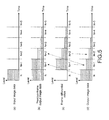
- Fig. 3 conceptually shows a NR processing amount (feedback value) correct processing by the feedback ratio correction unit 113.
- (a) in Fig. 3 shows an example of a correspondence relation between a NR processing amount calculated by the noise reduction processing amount calculator 111, and frame differential data between previous-frame output image data and input image data.
- the NR processing amount is calculated such that a NR feedback ratio is less than 100%.
- FIG. 3 shows, for example, assuming a case where the same compression error occurs in the respective pixels in a frame because of the data compression/decompression processing, a compression error range in the respective pixels arranged in the horizontal direction. Note that, here, for ease of explanation, a case where the same compression error occurs in the respective pixels in a frame will be assumed and described. However, in fact, it is not always true that the same compression error occurs in the respective pixels in a frame.
- the noise reduction processing amount calculator 111 calculates a NR processing amount such that the NR feedback ratio is less than 100%.
- the NR feedback ratio may be 100% or more as shown in the hatched area in (c) in Fig. 3 , according to frame differential data levels.
- the feedback ratio correction unit 113 corrects the NR processing amount calculated by the noise reduction processing amount calculator 111 such that the NR feedback ratio is less than 100%, and outputs the corrected NR processing amount. Note that, in a case where it is determined that a pixel has a NR feedback ratio less than 100% considering compression errors, for example, a pixel having a high frame differential data level, the feedback ratio correction unit 113 does not correct the NR processing amount calculated by the noise reduction processing amount calculator 111, and outputs the NR processing amount as it is.
- the feedback ratio correction selection control unit 114 selectively outputs the noise reduction processing amount calculated by the noise reduction processing amount calculator 111 or the noise reduction processing amount output from the feedback ratio correction unit 113 as a NR processing amount (feedback value).
- the feedback ratio correction selection control unit 114 temporally distributes and outputs the noise reduction processing amounts output from the feedback ratio correction unit 113.
- the feedback ratio correction selection control unit 114 outputs the noise reduction processing amount output from the feedback ratio correction unit 113 with a period of predetermined lines and frames, based on a line count value and a frame count value.
- the feedback ratio correction unit 113 and the feedback ratio correction selection control unit 114 perform corrections at the following timing. Note that numerical values such as "30" and "4" are merely examples.
- the adder 115 adds the final NR processing amount (final feedback value) output from the feedback ratio correction selection control unit 114 to the input image data to thereby obtain output image data.
- the noise reduction processing amount calculator 111 calculates a noise reduction processing amount (NR processing amount) as a feedback value based on the input image data and the previous-frame output image data.
- the NR processing amount is supplied to the feedback ratio correction unit 113.
- the input image data and the previous-frame output image data are supplied to the subtractor 112.
- the subtractor 112 subtracts the input image data from the previous-frame output image data to thereby obtain frame differential data.
- the frame differential data is supplied to the feedback ratio correction unit 113.
- compression error information for each pixel corresponding to the previous-frame output image data is supplied to the feedback ratio correction unit 113.
- the feedback ratio correction unit 113 corrects the NR processing amount calculated by the noise reduction processing amount calculator 111 for each pixel based on the frame differential data and the compression error information, and outputs the corrected NR processing amount. In this case, the feedback ratio correction unit 113 compares the NR processing amount calculated by the noise reduction processing amount calculator 111 to the frame differential data for each pixel, and determines whether or not the NR feedback ratio is 100% or more considering compression errors.
- the feedback ratio correction unit 113 does not correct the NR processing amount calculated by the noise reduction processing amount calculator 111, and outputs the NR processing amount as it is. Further, in a case where it is determined that a pixel has a NR feedback ratio of 100% or more, the feedback ratio correction unit 113 corrects the NR processing amount calculated by the noise reduction processing amount calculator 111 such that the NR feedback ratio is less than 100%, and outputs the corrected NR processing amount.
- the corrected NR processing amount (corrected feedback value) output from the feedback ratio correction unit 113 is supplied to the feedback ratio correction selection control unit 114. Further, the NR processing amount calculated by the noise reduction processing amount calculator 111 is supplied to the feedback ratio correction selection control unit 114. Further, a line count value and a frame count value are supplied to the feedback ratio correction selection control unit 114.
- the feedback ratio correction selection control unit 114 selectively outputs the NR processing amount calculated by the noise reduction processing amount calculator 111 or the NR processing amount output from the feedback ratio correction unit 113 as a NR processing amount.
- the feedback ratio correction selection control unit 114 outputs, for example, the NR processing amount output from the feedback ratio correction unit 113 with a period of predetermined lines and frames.
- the NR processing amounts output from the feedback ratio correction unit 113 are temporally distributed and output.
- the final NR processing amount (final feedback value) output from the feedback ratio correction selection control unit 114 is supplied to the adder 115. Further, the input image data is supplied to the adder 115. The adder 115 adds the final NR processing amount output from the feedback ratio correction selection control unit 114 to the input image data to thereby obtain output image data.
- the noise reduction unit 110 determines whether or not the noise reduction feedback ratio is 100% or more for each pixel based on the compression error information. Further, in a case where it is determined that a pixel has a NR feedback ratio of 100% or more, the feedback ratio correction unit 113 corrects the NR processing amount (feedback value) calculated by the noise reduction processing amount calculator 111 such that the feedback ratio is less than 100%, and the corrected NR processing amount (feedback value) is used. As a result, while maintaining noise reduction effects, it is possible to avoid the state where a NR feedback ratio is 100% and an output image includes an afterimage.
- the feedback ratio correction selection control unit 114 temporally distributes and outputs the NR processing amounts (corrected feedback values) output from the feedback ratio correction unit 113.
- the feedback ratio correction unit 113 corrects the NR processing amount such that the feedback ratio is less than 100%. Because of the temporary feedback ratio control, the noise reduction effect weakens. However, because the control timings are distributed, viewers hardly feel the effects.
- the image processing apparatus 100 shown in Fig. 1 is independent of data compression and noise reduction algorithms. As a result, in a case where a data compression or noise reduction function is updated or replaced, similar effects may be obtained without modifying circuits, programs, and the like.
- the noise reduction unit 110 includes the feedback ratio correction selection control unit 114.
- the feedback ratio correction selection control unit 114 is not indispensable. That is, as the noise reduction unit 110, there is definitely a possibility that the noise reduction unit 110 shown in Fig. 2 excludes the feedback ratio correction selection control unit 114. In this case, the corrected NR processing amount (corrected feedback value) output from the feedback ratio correction unit 113 is directly input to the adder 115.
- the noise reduction processing by the image processing apparatus 100 may be executed by using hardware or software.
- programs in which processing sequences are recorded are installed in a memory of a computer mounted in dedicated hardware and, are executed.
- programs may be installed in a general-purpose computer capable of executing various kinds of processing, and may be executed. In this case, programs cause a computer to function as the respective functional blocks in the image processing apparatus 100.
- present technology may employ the following configurations.
Landscapes
- Engineering & Computer Science (AREA)
- Multimedia (AREA)
- Signal Processing (AREA)
- Picture Signal Circuits (AREA)
- Image Processing (AREA)
Abstract
Description
- The present disclosure relates to an image processing apparatus and an image processing method. Specifically, the present disclosure relates to an image processing apparatus and an image processing method performing cyclic noise reduction processing by using previous-frame output image data subjected to data compression/decompression processing.
- Recently, in image processing LSIs (Large Scale Integration) and the like, complex high-image-quality functions and the like increase memory bandwidths greatly. As a countermeasure, in many cases, communication volumes with external memories are reduced by compressing image data.
-
Fig. 4 shows an example of an image processing apparatus 200 performing cyclic noise reduction processing. The image processing apparatus 200 includes anoise reduction unit 210, an encoder 220, aframe memory 230, and adecoder 240. In the image processing apparatus 200, image data temporarily stored in theframe memory 230 is handled as compressed image data, and thus data communication volume between thenoise reduction unit 210 side and theframe memory 230 is reduced. - Output image data output from the
noise reduction unit 210 is supplied to the encoder 220. The encoder 220 performs invertible data compression processing on the output image data by using a predetermined compression algorithm to thereby obtain compressed image data. The compressed image data is temporarily stored in theframe memory 230 constituting delay means. - Previous-frame compressed image data is read from the
frame memory 230 and supplied to thedecoder 240. Thedecoder 240 performs data decompression processing on the compressed image data to thereby obtain previous-frame output image data. In addition to the previous-frame output image data, input image data is supplied to thenoise reduction unit 210. - The
noise reduction unit 210 calculates a noise reduction processing amount (NR processing amount) as a feedback value based on the input image data and the previous-frame output image data. Further, thenoise reduction unit 210 adds the NR processing amount to the input image data to thereby obtain output image data. - In the configuration of the image processing apparatus 200 shown in
Fig. 4 , the image data compression is performed on a frame basis, which is a spatial-directional compression. Meanwhile, the noise reduction is time-directional processing. The processing dimensions are different from each other. Because of this, a noise reduction feedback ratio (NR feedback ratio) is 100%, and previous-frame output image data may be output continuously. - For example, a noise reduction of adding differential data (frame differential value) between previous-frame output image data (image data of previous frame) and input image data (image data of current frame) to input image data at a feedback ratio of 50% is assumed.
- In the noise reduction, as shown in (a) in
Fig. 5 , it is assumed that an input image data level of a certain pixel is changed from "8" in the Nth frame to "0" in the (N+1)th frame. In this case, as shown in (d) inFig. 5 , output image data converges to the input image data level in the (N+4)th frame. Note that (b) inFig. 5 shows previous-frame output image data, which is one-frame-delayed output image data shown in (d) inFig. 5 . Further, (c) inFig. 5 shows a frame differential value, which is a value obtained by subtracting the input image data shown in (a) inFig. 5 from the previous-frame output image data shown in (b) inFig. 5 . - It is assumed that the following compression function is combined with the noise reduction of the image processing apparatus 200 of
Fig. 4 . In the compression function, 8-bit image data is compressed into 5-bit image data by rounding off the 3rd bit from the LSB (Least Significant Bit) side. In this case, as shown in (d) inFig. 6 , when the output image data level reaches 4, the noise reduction processing is buried in compression errors, and the output image data may not converge on the input image data permanently. This is the 100% NR feedback ratio state. - Note that, similar to (a) in
Fig. 5 , (a) inFig. 6 shows an input image data level of a certain pixel, and the input image data level is changed from "8" in the Nth frame to "0" in the (N+1)th frame. (b) inFig. 6 shows previous-frame output image data subjected to data compression/decompression processing. Since the previous-frame output image data is subjected to data compression/decompression processing, it is different from the previous-frame output image data, which is merely one-frame-delayed output image data, shown in (b) inFig. 5 . - That is, in the above-mentioned compression algorithm, image data is compressed into 5-bit image data by rounding off the 3rd bit from the LSB side. Therefore, the output image data level "4" may not be expressed in compressed image data, and "8" is thus written in the
frame memory 230. As a result, the previous-frame output image data shown in (b) inFig. 6 has a level "8" in the (N+2)th frame and thereafter. - Further, (c) in
Fig. 6 shows a frame differential value, which is a value obtained by subtracting the input image data shown in (a) inFig. 6 from the previous-frame output image data shown in (b) inFig. 6 . The previous-frame output image data shown in (b) inFig. 6 is subjected to data compression/decompression processing, and thus has a level "8" in the (N+2)th frame and thereafter, as described above. As a result, the frame differential value is "8" in the (N+1)th frame and thereafter. Therefore, as described above, when the output image data level reaches 4, the noise reduction processing is buried in compression errors. As a result, the output image data may not converge on the input image data permanently. The NR feedback ratio is 100%, that is, the output image data is held as it is. - Because of the above-mentioned state where the NR feedback ratio is 100%, an output image includes a faint afterimage of the previous frame.
Fig. 7 shows examples of images of input image data (input images) and images of output image data (output images). In the examples, rectangular inserted image portions IM are image portions having high loss information amounts due to compression. In the image portions IM, because of data compression/decompression processing, the NR feedback ratio is 100%. As a result, in the output images, the image portion IM includes a faint afterimage of the previous frame image. - For example, Japanese Patent Application Laid-open
H03-266565 - As described above, in order to avoid the state where the NR feedback ratio is 100% and an output image includes an afterimage, a NR feedback ratio may be reduced periodically. In this case, the noise reduction is ineffective periodically. As a result, a noise repeatedly goes off, then comes out, then goes off, and then comes out. In an image including a noise, the noise reduction effect is reduced.
- It is desirable to preferably avoid the state where a NR feedback ratio is 100% and an output image includes an afterimage, in a case of performing cyclic NR (noise reduction) processing by using previous-frame output image data subjected to data compression/decompression processing.
- According to a concept of the present technology, there is provided an image processing apparatus, including:
- a noise reduction processing amount calculator configured to calculate a noise reduction processing amount based on input image data and previous-frame output image data subjected to data compression/decompression processing;
- a feedback ratio correction unit configured, based on compression error information,
- to output the uncorrected noise reduction processing amount calculated by the noise reduction processing amount calculator with regard to a pixel having a noise reduction feedback ratio less than 100%, and
- to correct the noise reduction processing amount with regard to a pixel having a noise reduction feedback ratio of 100% or more such that the feedback ratio is less than 100%, and to output the corrected noise reduction processing amount; and
- an adder configured to add the noise reduction processing amount output from the feedback ratio correction unit to the input image data to thereby obtain output image data.
- In embodiments of the present technology, the noise reduction processing amount calculator calculates a noise reduction processing amount based on input image data and previous-frame output image data subjected to data compression/decompression processing. The present technology is independent of a noise reduction algorithm. That is, in the present technology, the noise reduction processing amount calculator may calculate the noise reduction processing amount based on the input image data and the previous-frame output image data by using any algorithm.
- Further, the present technology is independent of a data compression algorithm. That is, in the present technology, the kind of algorithm for data compression is not important. The present technology may be applied to a case where compression error information for each pixel may be obtained corresponding to previous-frame output image data subjected to data compression/decompression processing.
- The feedback ratio correction unit outputs, based on compression error information, the noise reduction processing amount calculated by the noise reduction processing amount calculator as it is or the corrected noise reduction processing amount. That is, with regard to a pixel having a noise reduction feedback ratio less than 100%, the uncorrected noise reduction processing amount calculated by the noise reduction processing amount calculator is output. Meanwhile, with regard to a pixel having a noise reduction feedback ratio of 100% or more, the noise reduction processing amount is corrected such that the feedback ratio is less than 100% and is output.
- In one embodiment, for example, the image processing apparatus may further include a frame differential calculator configured to obtain frame differential data between the previous-frame output image data and the input image data, The feedback ratio correction unit may be configured to determine whether or not a noise reduction feedback ratio is 100% or more for each pixel, based on a frame differential data calculated by the frame differential calculator, a noise reduction processing amount calculated by the noise reduction processing amount calculator, and the compression error information. The adder adds the noise reduction processing amount output from the feedback ratio correction unit to the input image data to thereby obtain output image data.
- As described above, according to the present technology, it is determined whether or not a noise reduction feedback ratio is 100% or more for each pixel based on compression error information. Further, with regard to a pixel determined to have a noise reduction feedback ratio of 100% or more, the feedback ratio correction unit corrects the noise reduction processing amount calculated by the noise reduction processing amount calculator such that the feedback ratio is less than 100%, and the corrected noise reduction processing amount is used. As a result, while maintaining noise reduction effects, it is possible to avoid the state where a NR feedback ratio is 100% and an output image includes an afterimage.
- In one embodiment, for example, the image processing apparatus may further include a feedback ratio correction selection control unit configured to selectively output, as a noise reduction processing amount, one of a noise reduction processing amount calculated by the noise reduction processing amount calculator and a noise reduction processing amount output from the feedback ratio correction unit. The feedback ratio correction selection control unit may be configured to temporally distribute and output noise reduction processing amounts output from the feedback ratio correction unit. The adder may be configured to add a noise reduction processing amount output from the feedback ratio correction selection control unit to the input image data to thereby obtain the output image data. For example, the feedback ratio correction selection control unit is configured to output noise reduction processing amounts output from the feedback ratio correction unit with a period of predetermined lines and frames.
- In this case, the feedback ratio correction selection control unit temporally distributes and outputs the noise reduction processing amounts output from the feedback ratio correction unit. As described above, with regard to a pixel determined to have a noise reduction feedback ratio of 100% or more, the noise reduction processing amount is corrected such that the feedback ratio is less than 100%. Because of the temporary feedback ratio control, a noise reduction effect weakens. However, because the control timings are distributed, viewers hardly feel the effects.
- According to the present technology, it is possible to preferably avoid the state where a NR feedback ratio is 100% and an output image includes an afterimage, in a case of performing cyclic NR (noise reduction) processing by using previous-frame output image data subjected to data compression/decompression processing.
- These and other objects, features and advantages of the present disclosure will become more apparent in light of the following detailed description of best mode embodiments thereof, as illustrated in the accompanying drawings.
- Further particular and preferred aspects of the present invention are set out in the accompanying independent and dependent claims. Features of the dependent claims may be combined with features of the independent claims as appropriate, and in combinations other than those explicitly set out in the claims.
- The present invention will be described further, by way of example only, with reference to preferred embodiments thereof as illustrated in the accompanying drawings, in which:
-
Fig. 1 is a block diagram showing a configuration example of an image processing apparatus according to an embodiment of the present technology; -
Fig. 2 is a block diagram showing a detailed configuration example of a noise reduction unit included in the image processing apparatus; -
Fig. 3 is a diagram conceptually showing correction processing of a NR processing amount (feedback value) of a feedback ratio correction unit included in the noise reduction unit; -
Fig. 4 is a block diagram showing an example of an image processing apparatus performing cyclic noise reduction processing; -
Fig. 5 is a diagram showing examples of image data of the respective units of an image processing apparatus performing cyclic noise reduction processing in a case where data compression processing is not combined; -
Fig. 6 is a diagram showing examples of image data of the respective units of an image processing apparatus performing cyclic noise reduction processing in a case where data compression processing is combined; and -
Fig. 7 is a diagram showing examples of images of input image data (input images) and images of output image data (output images). - Hereinafter, an embodiment of the present disclosure will be described with reference to the drawings. Note that the following items are described in this order.
- 1. Embodiment
- 2. Examples
-
Fig. 1 shows a configuration example of animage processing apparatus 100 according to an embodiment of the present technology. Theimage processing apparatus 100 performs cyclic NR (noise reduction) processing by using previous-frame output image data subjected to data compression/decompression processing. Theimage processing apparatus 100 includes anoise reduction unit 110, anencoder 120, aframe memory 130, and a decoder 140. - The
encoder 120 performs invertible data compression processing with respect to output image data obtained by thenoise reduction unit 110 by using a predetermined compression algorithm to thereby obtain compressed image data. The present technology is independent of a data compression algorithm. That is, in the present technology, the kind of algorithm for data compression is not important. Theframe memory 130 temporarily stores the compressed image data obtained by theencoder 120. Theframe memory 130 constitutes delay means of one frame. - The decoder 140 reads previous-frame compressed image data from the
frame memory 130, performs data decompression processing with respect to the compressed image data, and obtains previous-frame output image data. Further, the decoder 140 outputs compression error information for each pixel corresponding to the previous-frame output image data. Independent of a data compression algorithm, the decoder 140 obtains a lost information amount because of data compression for each pixel. So when the decoder 140 decodes previous-frame output image data and outputs it, the decoder 140 is capable of outputting compression error information indicating a lost information amount for each pixel. - Based on input image data, previous-frame output image data obtained by the decoder 140, and compression error information output from the decoder 140, the
noise reduction unit 110 obtains a noise reduction processing amount (NR processing amount) for each pixel. Further, thenoise reduction unit 110 adds the NR processing amount to the input image data to thereby obtain output image data. - Basically, the
noise reduction unit 110 calculates a NR processing amount for each pixel based on the input image data and the previous-frame output image data. The present technology is independent of a noise reduction algorithm. That is, in the present technology, the kind of algorithm for calculation of a noise reduction processing amount based on input image data and previous-frame output image data is not important. - The
noise reduction unit 110 determines whether or not a noise reduction feedback ratio (NR feedback ratio) is 100% or more for each pixel based on the NR processing amount calculated as described above and the compression error information. Further, in a case where thenoise reduction unit 110 determines that the NR feedback ratio of a certain pixel is 100% or more, thenoise reduction unit 110 corrects the NR processing amount of the pixel such that the NR feedback ratio is less than 100%. - Further, the
noise reduction unit 110 temporally distributes correction timings of the above-mentioned NR processing amount. For example, thenoise reduction unit 110 corrects a NR processing amount with a period of predetermined lines and frames. A configuration example of thenoise reduction unit 110 will be described later in detail. - Operations of the
image processing apparatus 100 shown inFig. 1 will be described. Output image data output from thenoise reduction unit 110 is supplied to theencoder 120. Theencoder 120 performs invertible data compression processing with respect to the output image data by using a predetermined compression algorithm to thereby obtain compressed image data. The compressed image data is temporarily stored in theframe memory 130. - Previous-frame compressed image data is read from the
frame memory 130 and supplied to the decoder 140. The decoder 140 performs data decompression processing with respect to the compressed image data to thereby obtain previous-frame output image data. Further, the decoder 140 outputs compression error information for each pixel corresponding to previous-frame output image data. The previous-frame output image data and compression error information for each pixel corresponding to the previous-frame output image data are supplied to thenoise reduction unit 110. - Input image data is further supplied to the
noise reduction unit 110. Thenoise reduction unit 110 obtains a noise reduction processing amount (NR processing amount) for each pixel based on the input image data, the previous-frame output image data, and the compression error information for each pixel. In this case, it is determined for each pixel whether or not a NR feedback ratio is 100% or more. In a case where it is determined that the NR feedback ratio of a certain pixel is 100% or more, the NR processing amount is corrected. Further, in this case, thenoise reduction unit 110 temporally distributes correction timings of the above-mentioned NR processing amount. -
Fig. 2 shows a detailed configuration example of thenoise reduction unit 110. Thenoise reduction unit 110 includes a noise reductionprocessing amount calculator 111, asubtractor 112, a feedbackratio correction unit 113, a feedback ratio correctionselection control unit 114, and anadder 115. - Based on the input image data and the previous-frame output image data, the noise reduction
processing amount calculator 111 calculates a noise reduction processing amount (NR processing amount) being a feedback value. Here, the previous-frame output image data is same as the data obtained by the above-mentioned decoder 140 (seeFig. 1 ), and is subjected to data compression/decompression processing. - Based on the input image data and the previous-frame output image data, the noise reduction
processing amount calculator 111 calculates a NR processing amount (feedback value) for each pixel. As described above, the present technology is independent of a noise reduction algorithm. That is, the kind of algorithm for calculation of a NR processing amount by the noise reductionprocessing amount calculator 111 based on input image data and previous-frame output image data is not important. - The
subtractor 112 obtains differential data between the previous-frame output image data and the input image data. That is, thesubtractor 112 subtracts the input image data from the previous-frame output image data to thereby calculate differential data. Thesubtractor 112 constitutes a frame differential calculator. - The feedback
ratio correction unit 113 corrects the NR processing amount calculated by the noise reductionprocessing amount calculator 111 for each pixel based on the frame differential data obtained by thesubtractor 112 and compression error information, and outputs the result. Here, the compression error information is output from the above-mentioned decoder 140 (seeFig. 1 ) corresponding to the previous-frame output image data. - The feedback
ratio correction unit 113 determines for each pixel whether or not the noise reduction feedback ratio (NR feedback ratio) is 100% or more. Further, in a case where it is determined that a NR feedback ratio of a certain pixel is less than 100%, the feedbackratio correction unit 113 outputs the uncorrected NR processing amount calculated by the noise reductionprocessing amount calculator 111 as it is. Further, in a case where it is determined that a NR feedback ratio of a certain pixel is 100% or more, the feedbackratio correction unit 113 corrects the NR processing amount calculated by the noise reductionprocessing amount calculator 111 such that the NR feedback ratio is less than 100%, and outputs the result. -
Fig. 3 conceptually shows a NR processing amount (feedback value) correct processing by the feedbackratio correction unit 113. (a) inFig. 3 shows an example of a correspondence relation between a NR processing amount calculated by the noise reductionprocessing amount calculator 111, and frame differential data between previous-frame output image data and input image data. In this case, the NR processing amount is calculated such that a NR feedback ratio is less than 100%. - (b) in
Fig. 3 shows, for example, assuming a case where the same compression error occurs in the respective pixels in a frame because of the data compression/decompression processing, a compression error range in the respective pixels arranged in the horizontal direction. Note that, here, for ease of explanation, a case where the same compression error occurs in the respective pixels in a frame will be assumed and described. However, in fact, it is not always true that the same compression error occurs in the respective pixels in a frame. - As described above, as shown in (a) in
Fig. 3 , the noise reductionprocessing amount calculator 111 calculates a NR processing amount such that the NR feedback ratio is less than 100%. However, assuming a compression error shown in (b) inFig. 3 , the NR feedback ratio may be 100% or more as shown in the hatched area in (c) inFig. 3 , according to frame differential data levels. - Therefore, as shown in (d) in
Fig. 3 , in a case where it is determined that a pixel has a NR feedback ratio of 100% or more, the feedbackratio correction unit 113 corrects the NR processing amount calculated by the noise reductionprocessing amount calculator 111 such that the NR feedback ratio is less than 100%, and outputs the corrected NR processing amount. Note that, in a case where it is determined that a pixel has a NR feedback ratio less than 100% considering compression errors, for example, a pixel having a high frame differential data level, the feedbackratio correction unit 113 does not correct the NR processing amount calculated by the noise reductionprocessing amount calculator 111, and outputs the NR processing amount as it is. - With reference to
Fig. 2 again, the feedback ratio correctionselection control unit 114 selectively outputs the noise reduction processing amount calculated by the noise reductionprocessing amount calculator 111 or the noise reduction processing amount output from the feedbackratio correction unit 113 as a NR processing amount (feedback value). In this case, the feedback ratio correctionselection control unit 114 temporally distributes and outputs the noise reduction processing amounts output from the feedbackratio correction unit 113. - In this embodiment, the feedback ratio correction
selection control unit 114 outputs the noise reduction processing amount output from the feedbackratio correction unit 113 with a period of predetermined lines and frames, based on a line count value and a frame count value. As a result, for example, the feedbackratio correction unit 113 and the feedback ratio correctionselection control unit 114 perform corrections at the following timing. Note that numerical values such as "30" and "4" are merely examples. - (1) Frames in multiples of 30: To correct pixels only having feedback ratios of 100% or more on lines in multiples of 4
- (2) Frames in multiples of 30, plus 1: To correct pixels only having feedback ratios of 100% or more on lines in multiples of 4, plus 1
- (3) Frames in multiples of 30, plus 2: To correct pixels only having feedback ratios of 100% or more on lines in multiples of 4, plus 2
- (4) Frames in multiples of 30, plus 3: To correct pixels only having feedback ratios of 100% or more on lines in multiples of 4, plus 3
- The
adder 115 adds the final NR processing amount (final feedback value) output from the feedback ratio correctionselection control unit 114 to the input image data to thereby obtain output image data. - Operations of the
noise reduction unit 110 shown inFig. 2 will be described. Input image data and previous-frame output image data subjected to data compression/decompression processing are supplied to the noise reductionprocessing amount calculator 111. The noise reductionprocessing amount calculator 111 calculates a noise reduction processing amount (NR processing amount) as a feedback value based on the input image data and the previous-frame output image data. The NR processing amount is supplied to the feedbackratio correction unit 113. - Further, the input image data and the previous-frame output image data are supplied to the
subtractor 112. Thesubtractor 112 subtracts the input image data from the previous-frame output image data to thereby obtain frame differential data. The frame differential data is supplied to the feedbackratio correction unit 113. Further, compression error information for each pixel corresponding to the previous-frame output image data is supplied to the feedbackratio correction unit 113. - The feedback
ratio correction unit 113 corrects the NR processing amount calculated by the noise reductionprocessing amount calculator 111 for each pixel based on the frame differential data and the compression error information, and outputs the corrected NR processing amount. In this case, the feedbackratio correction unit 113 compares the NR processing amount calculated by the noise reductionprocessing amount calculator 111 to the frame differential data for each pixel, and determines whether or not the NR feedback ratio is 100% or more considering compression errors. - Further, in a case where it is determined that a pixel has a NR feedback ratio less than 100%, the feedback
ratio correction unit 113 does not correct the NR processing amount calculated by the noise reductionprocessing amount calculator 111, and outputs the NR processing amount as it is. Further, in a case where it is determined that a pixel has a NR feedback ratio of 100% or more, the feedbackratio correction unit 113 corrects the NR processing amount calculated by the noise reductionprocessing amount calculator 111 such that the NR feedback ratio is less than 100%, and outputs the corrected NR processing amount. - The corrected NR processing amount (corrected feedback value) output from the feedback
ratio correction unit 113 is supplied to the feedback ratio correctionselection control unit 114. Further, the NR processing amount calculated by the noise reductionprocessing amount calculator 111 is supplied to the feedback ratio correctionselection control unit 114. Further, a line count value and a frame count value are supplied to the feedback ratio correctionselection control unit 114. - The feedback ratio correction
selection control unit 114 selectively outputs the NR processing amount calculated by the noise reductionprocessing amount calculator 111 or the NR processing amount output from the feedbackratio correction unit 113 as a NR processing amount. In this case, the feedback ratio correctionselection control unit 114 outputs, for example, the NR processing amount output from the feedbackratio correction unit 113 with a period of predetermined lines and frames. As a result, the NR processing amounts output from the feedbackratio correction unit 113 are temporally distributed and output. - The final NR processing amount (final feedback value) output from the feedback ratio correction
selection control unit 114 is supplied to theadder 115. Further, the input image data is supplied to theadder 115. Theadder 115 adds the final NR processing amount output from the feedback ratio correctionselection control unit 114 to the input image data to thereby obtain output image data. - As described above, in the
image processing apparatus 100 shown inFig. 1 , thenoise reduction unit 110 determines whether or not the noise reduction feedback ratio is 100% or more for each pixel based on the compression error information. Further, in a case where it is determined that a pixel has a NR feedback ratio of 100% or more, the feedbackratio correction unit 113 corrects the NR processing amount (feedback value) calculated by the noise reductionprocessing amount calculator 111 such that the feedback ratio is less than 100%, and the corrected NR processing amount (feedback value) is used. As a result, while maintaining noise reduction effects, it is possible to avoid the state where a NR feedback ratio is 100% and an output image includes an afterimage. - Further, in the
image processing apparatus 100 shown inFig. 1 , in thenoise reduction unit 110, the feedback ratio correctionselection control unit 114 temporally distributes and outputs the NR processing amounts (corrected feedback values) output from the feedbackratio correction unit 113. In a case where it is determined that a pixel has a NR feedback ratio of 100% or more, the feedbackratio correction unit 113 corrects the NR processing amount such that the feedback ratio is less than 100%. Because of the temporary feedback ratio control, the noise reduction effect weakens. However, because the control timings are distributed, viewers hardly feel the effects. - Further, the
image processing apparatus 100 shown inFig. 1 is independent of data compression and noise reduction algorithms. As a result, in a case where a data compression or noise reduction function is updated or replaced, similar effects may be obtained without modifying circuits, programs, and the like. - Note that, in the above-mentioned embodiment, the
noise reduction unit 110 includes the feedback ratio correctionselection control unit 114. However, in the present technology, the feedback ratio correctionselection control unit 114 is not indispensable. That is, as thenoise reduction unit 110, there is definitely a possibility that thenoise reduction unit 110 shown inFig. 2 excludes the feedback ratio correctionselection control unit 114. In this case, the corrected NR processing amount (corrected feedback value) output from the feedbackratio correction unit 113 is directly input to theadder 115. - Further, in the above-mentioned embodiment, the noise reduction processing by the
image processing apparatus 100 may be executed by using hardware or software. In a case of executing the processing by using software, programs in which processing sequences are recorded are installed in a memory of a computer mounted in dedicated hardware and, are executed. Alternatively, programs may be installed in a general-purpose computer capable of executing various kinds of processing, and may be executed. In this case, programs cause a computer to function as the respective functional blocks in theimage processing apparatus 100. - Further, the present technology may employ the following configurations.
- (1) An image processing apparatus, comprising:
- a noise reduction processing amount calculator configured to calculate a noise reduction processing amount based on input image data and previous-frame output image data subjected to data compression/decompression processing;
- a feedback ratio correction unit configured, based on compression error information,
- to output the uncorrected noise reduction processing amount calculated by the noise reduction processing amount calculator with regard to a pixel having a noise reduction feedback ratio less than 100%, and
- to correct the noise reduction processing amount with regard to a pixel having a noise reduction feedback ratio of 100% or more such that the feedback ratio is less than 100%, and to output the corrected noise reduction processing amount; and
- an adder configured to add the noise reduction processing amount output from the feedback ratio correction unit to the input image data to thereby obtain output image data.
- (2) The image processing apparatus according to (1), further comprising:
- a frame differential calculator configured to obtain frame differential data between the previous-frame output image data and the input image data, wherein
- the feedback ratio correction unit is configured to determine whether or not a noise reduction feedback ratio is 100% or more for each pixel, based on a frame differential data calculated by the frame differential calculator, a noise reduction processing amount calculated by the noise reduction processing amount calculator, and the compression error information.
- (3) The image processing apparatus according to (1) or (2), further comprising:
- a feedback ratio correction selection control unit configured to selectively output, as a noise reduction processing amount, one of a noise reduction processing amount calculated by the noise reduction processing amount calculator and a noise reduction processing amount output from the feedback ratio correction unit, wherein
- the feedback ratio correction selection control unit is configured to temporally distribute and output noise reduction processing amounts output from the feedback ratio correction unit, and
- the adder is configured to add a noise reduction processing amount output from the feedback ratio correction selection control unit to the input image data to thereby obtain the output image data.
- (4) The image processing apparatus according to (3), wherein
the feedback ratio correction selection control unit is configured to output noise reduction processing amounts output from the feedback ratio correction unit with a period of predetermined lines and frames. - (5) An image processing method, comprising:
- calculating a noise reduction processing amount based on input image data and previous-frame output image data subjected to data compression/decompression processing;
- outputting, based on compression error information, the uncorrected noise reduction processing amount calculated by the noise reduction processing amount calculator with regard to a pixel having a noise reduction feedback ratio less than 100%, and correcting the noise reduction processing amount with regard to a pixel having a noise reduction feedback ratio of 100% or more such that the feedback ratio is less than 100% and outputting the corrected noise reduction processing amount; and
- adding the noise reduction processing amount output from the feedback ratio correction unit to the input image data to thereby obtain output image data.
- (6) An image processing apparatus, comprising:
- a encoder configured
- to perform data compression processing of output image data, and
- to write compressed image data in a memory;
- a decoder configured
- to read previous-frame compressed image data from the memory,
- to perform data decompression processing, and
- to output compression error information for each previous-frame output image data and for each pixel;
- a noise reduction processing amount calculator configured to calculate a noise reduction processing amount based on input image data and previous-frame output image data output from the decoder;
- a feedback ratio correction unit configured, based on the compression error information output from the decoder,
- to output the uncorrected noise reduction processing amount calculated by the noise reduction processing amount calculator with regard to a pixel having a noise reduction feedback ratio less than 100%, and
- to correct the noise reduction processing amount with regard to a pixel having a noise reduction feedback ratio of 100% or more such that the feedback ratio is less than 100%, and to output the corrected noise reduction processing amount; and
- an adder configured to add the noise reduction processing amount output from the feedback ratio correction unit to the input image data to thereby obtain output image data.
- a encoder configured
- The present disclosure contains subject matter related to that disclosed in Japanese Priority Patent Application
JP 2011-126040 - In so far as the embodiments of the invention described above are implemented, at least in part, using software-controlled data processing apparatus, it will be appreciated that a computer program providing such software control and a transmission, storage or other medium by which such a computer program is provided are envisaged as aspects of the present invention.
- Although particular embodiments have been described herein, it will be appreciated that the invention is not limited thereto and that many modifications and additions thereto may be made within the scope of the invention. For example, various combinations of the features of the following dependent claims can be made with the features of the independent claims without departing from the scope of the present invention.
Claims (6)
- An image processing apparatus, comprising:a noise reduction processing amount calculator configured to calculate a noise reduction processing amount based on input image data and previous-frame output image data subjected to data compression/decompression processing;a feedback ratio correction unit configured, based on compression error information,
to output the uncorrected noise reduction processing amount calculated by the noise reduction processing amount calculator with regard to a pixel having a noise reduction feedback ratio less than 100%, and to correct the noise reduction processing amount with regard to a pixel having a noise reduction feedback ratio of 100% or more such that the feedback ratio is less than 100%, and to output the corrected 10 noise reduction processing amount; andan adder configured to add the noise reduction processing amount output from the feedback ratio correction unit to the input image data to thereby obtain output image data. - The image processing apparatus according to claim 1, further comprising:a frame differential calculator configured to obtain frame differential data between the previous-frame output image data and the input image data, whereinthe feedback ratio correction unit is configured to determine whether or not a noise reduction feedback ratio is 100% or more for each pixel, based on a frame differential data calculated by the frame differential calculator, a noise reduction processing amount calculated by the noise reduction processing amount calculator, and the compression error information.
- The image processing apparatus according to claim 1, further comprising:a feedback ratio correction selection control unit configured to selectively output, as a noise reduction processing amount, one of a noise reduction processing amount calculated by the noise reduction processing amount calculator and a noise reduction processing amount output from the feedback ratio correction unit, whereinthe feedback ratio correction selection control unit is configured to temporally distribute and output noise reduction processing amounts output from the feedback ratio correction unit, andthe adder is configured to add a noise reduction processing amount output from the feedback ratio correction selection control unit to the input image data to thereby obtain the output image data.
- The image processing apparatus according to claim 3, wherein
the feedback ratio correction selection control unit is configured to output noise reduction processing amounts output from the feedback ratio correction unit with a period of predetermined lines and frames. - An image processing method, comprising:calculating a noise reduction processing amount based on input image data and previous-frame output image data subjected to data compression/decompression processing;outputting, based on compression error information, the uncorrected noise reduction processing amount calculated by the noise reduction processing amount calculator with regard to a pixel having a noise reduction feedback ratio less than 100%, and correcting the noise reduction processing amount with regard to a pixel having a noise reduction feedback ratio of 100% or more such that the feedback ratio is less than 100% and outputting the corrected noise reduction processing amount; andadding the noise reduction processing amount output from the feedback ratio correction unit to the input image data to thereby obtain output image data.
- An image processing apparatus, comprising:a encoder configuredto perform data compression processing of output image data, andto write compressed image data in a memory;a decoder configuredto read previous-frame compressed image data from the memory,to perform data decompression processing, andto output compression error information for each previous-frame output image data and for each pixel;a noise reduction processing amount calculator configured to calculate a noise reduction processing amount based on input image data and previous-frame output image data output from the decoder;a feedback ratio correction unit configured, based on the compression error information output from the decoder,to output the uncorrected noise reduction processing amount calculated by the noise reduction processing amount calculator with regard to a pixel having a noise reduction feedback ratio less than 100%, andto correct the noise reduction processing amount with regard to a pixel having a noise reduction feedback ratio of 100% or more such that the feedback ratio is less than 100%, and to output the corrected noise reduction processing amount; andan adder configured to add the noise reduction processing amount output from the feedback ratio correction unit to the input image data to thereby obtain output image data.
Applications Claiming Priority (1)
| Application Number | Priority Date | Filing Date | Title |
|---|---|---|---|
| JP2011126040A JP2012253645A (en) | 2011-06-06 | 2011-06-06 | Image processing device and image processing method |
Publications (2)
| Publication Number | Publication Date |
|---|---|
| EP2533515A2 true EP2533515A2 (en) | 2012-12-12 |
| EP2533515A3 EP2533515A3 (en) | 2013-07-31 |
Family
ID=46466092
Family Applications (1)
| Application Number | Title | Priority Date | Filing Date |
|---|---|---|---|
| EP20120168719 Withdrawn EP2533515A3 (en) | 2011-06-06 | 2012-05-21 | Noise reduction controlling apparatus and method |
Country Status (4)
| Country | Link |
|---|---|
| US (1) | US8682088B2 (en) |
| EP (1) | EP2533515A3 (en) |
| JP (1) | JP2012253645A (en) |
| CN (1) | CN102821229A (en) |
Cited By (1)
| Publication number | Priority date | Publication date | Assignee | Title |
|---|---|---|---|---|
| CN104028692A (en) * | 2014-06-11 | 2014-09-10 | 西北工业大学 | Forging method of engine double-alloy wheel disc |
Families Citing this family (5)
| Publication number | Priority date | Publication date | Assignee | Title |
|---|---|---|---|---|
| JP2015032952A (en) | 2013-08-01 | 2015-02-16 | ソニー株式会社 | Display control device, display control method, and recording medium |
| US9842410B2 (en) | 2015-06-18 | 2017-12-12 | Samsung Electronics Co., Ltd. | Image compression and decompression with noise separation |
| CN111771370B (en) | 2018-02-27 | 2022-12-23 | 株式会社索思未来 | Noise canceling device, noise canceling method, and stillness detection method |
| JP7543978B2 (en) * | 2021-05-12 | 2024-09-03 | 横河電機株式会社 | Apparatus, monitoring system, method and program |
| CN113361388B (en) * | 2021-06-03 | 2023-11-24 | 北京百度网讯科技有限公司 | Image data correction method, device, electronic equipment and autonomous vehicle |
Citations (4)
| Publication number | Priority date | Publication date | Assignee | Title |
|---|---|---|---|---|
| JPH03266565A (en) | 1990-03-16 | 1991-11-27 | Olympus Optical Co Ltd | Cyclic noise reducer |
| US6144800A (en) * | 1996-06-17 | 2000-11-07 | Sony Corporation | Noise reduction in correlated digital signals |
| US20070040943A1 (en) * | 2005-08-19 | 2007-02-22 | Kabushiki Kaisha Toshiba | Digital noise reduction apparatus and method and video signal processing apparatus |
| JP2011126040A (en) | 2009-12-15 | 2011-06-30 | Canon Inc | Ink tank and liquid ejection apparatus |
Family Cites Families (7)
| Publication number | Priority date | Publication date | Assignee | Title |
|---|---|---|---|---|
| US5799111A (en) * | 1991-06-14 | 1998-08-25 | D.V.P. Technologies, Ltd. | Apparatus and methods for smoothing images |
| US5787203A (en) * | 1996-01-19 | 1998-07-28 | Microsoft Corporation | Method and system for filtering compressed video images |
| JP3266565B2 (en) | 1998-04-13 | 2002-03-18 | ハウス食品株式会社 | Manufacturing method of pressurized and heated food |
| JP4365555B2 (en) * | 2002-01-22 | 2009-11-18 | 株式会社日立製作所 | Image recording device |
| JP3801179B2 (en) * | 2004-01-30 | 2006-07-26 | 松下電器産業株式会社 | Frame cyclic noise reduction method |
| US7898581B2 (en) * | 2006-05-08 | 2011-03-01 | Panasonic Corporation | Image pickup apparatus with noise reduction unit |
| JP4857916B2 (en) * | 2006-06-06 | 2012-01-18 | ソニー株式会社 | Noise suppression method, noise suppression method program, recording medium recording noise suppression method program, and noise suppression device |
-
2011
- 2011-06-06 JP JP2011126040A patent/JP2012253645A/en not_active Withdrawn
-
2012
- 2012-05-21 EP EP20120168719 patent/EP2533515A3/en not_active Withdrawn
- 2012-05-30 CN CN2012101748152A patent/CN102821229A/en active Pending
- 2012-05-30 US US13/483,430 patent/US8682088B2/en not_active Expired - Fee Related
Patent Citations (4)
| Publication number | Priority date | Publication date | Assignee | Title |
|---|---|---|---|---|
| JPH03266565A (en) | 1990-03-16 | 1991-11-27 | Olympus Optical Co Ltd | Cyclic noise reducer |
| US6144800A (en) * | 1996-06-17 | 2000-11-07 | Sony Corporation | Noise reduction in correlated digital signals |
| US20070040943A1 (en) * | 2005-08-19 | 2007-02-22 | Kabushiki Kaisha Toshiba | Digital noise reduction apparatus and method and video signal processing apparatus |
| JP2011126040A (en) | 2009-12-15 | 2011-06-30 | Canon Inc | Ink tank and liquid ejection apparatus |
Cited By (2)
| Publication number | Priority date | Publication date | Assignee | Title |
|---|---|---|---|---|
| CN104028692A (en) * | 2014-06-11 | 2014-09-10 | 西北工业大学 | Forging method of engine double-alloy wheel disc |
| CN104028692B (en) * | 2014-06-11 | 2016-01-13 | 西北工业大学 | The forging method of engine pairing gold wheel disc |
Also Published As
| Publication number | Publication date |
|---|---|
| JP2012253645A (en) | 2012-12-20 |
| US20120308146A1 (en) | 2012-12-06 |
| CN102821229A (en) | 2012-12-12 |
| US8682088B2 (en) | 2014-03-25 |
| EP2533515A3 (en) | 2013-07-31 |
Similar Documents
| Publication | Publication Date | Title |
|---|---|---|
| EP2533515A2 (en) | Noise reduction controlling apparatus and method | |
| US7199840B2 (en) | Dynamic gray scale range adjustment apparatus and method | |
| JP4959793B2 (en) | Image display device | |
| JP4643727B2 (en) | Image processing apparatus and image processing method | |
| US7738042B2 (en) | Noise reduction device for a video signal and noise reduction method for a video signal | |
| JP4549944B2 (en) | Image processing circuit | |
| US8428377B2 (en) | Device and method of processing image data to be displayed on a display device | |
| JP4503507B2 (en) | Image processing circuit | |
| JP5490236B2 (en) | Image processing apparatus and method, image display apparatus and method | |
| WO2009107331A1 (en) | Frame rate conversion device and frame rate conversion method | |
| US8842930B2 (en) | Image processing device and image processing method | |
| US8116584B2 (en) | Adaptively de-blocking circuit and associated method | |
| EP3941036B1 (en) | METHOD, ELECTRONIC DEVICE AND STORAGE MEDIUM FOR SELECTING A REFERENCE FRAME | |
| JP6180135B2 (en) | Image display apparatus and control method thereof | |
| JP2009081812A (en) | Signal processing apparatus and signal processing method | |
| US8472742B2 (en) | Signal processing device, signal processing method, and program | |
| US10360872B2 (en) | Display device and method of driving the same | |
| JP5095181B2 (en) | Image processing apparatus, liquid crystal display apparatus, and control method of image processing apparatus | |
| WO2011033888A1 (en) | Image display device and image display method | |
| US20090097742A1 (en) | Method for color interpolation | |
| US8625913B2 (en) | Image processing apparatus and image processing method | |
| JP2009200874A (en) | Image edge correction circuit, and image edge correcting method | |
| KR20090097001A (en) | Error correction method and apparatus in visual display system | |
| JP3844486B2 (en) | Image noise reduction circuit | |
| US20130083860A1 (en) | Boolean entropy decoder and boolean entropy decoding method for video display system |
Legal Events
| Date | Code | Title | Description |
|---|---|---|---|
| PUAI | Public reference made under article 153(3) epc to a published international application that has entered the european phase |
Free format text: ORIGINAL CODE: 0009012 |
|
| 17P | Request for examination filed |
Effective date: 20120601 |
|
| AK | Designated contracting states |
Kind code of ref document: A2 Designated state(s): AL AT BE BG CH CY CZ DE DK EE ES FI FR GB GR HR HU IE IS IT LI LT LU LV MC MK MT NL NO PL PT RO RS SE SI SK SM TR |
|
| AX | Request for extension of the european patent |
Extension state: BA ME |
|
| PUAL | Search report despatched |
Free format text: ORIGINAL CODE: 0009013 |
|
| AK | Designated contracting states |
Kind code of ref document: A3 Designated state(s): AL AT BE BG CH CY CZ DE DK EE ES FI FR GB GR HR HU IE IS IT LI LT LU LV MC MK MT NL NO PL PT RO RS SE SI SK SM TR |
|
| AX | Request for extension of the european patent |
Extension state: BA ME |
|
| RIC1 | Information provided on ipc code assigned before grant |
Ipc: H04N 7/26 20060101ALI20130626BHEP Ipc: H04N 5/21 20060101AFI20130626BHEP |
|
| 17Q | First examination report despatched |
Effective date: 20131204 |
|
| STAA | Information on the status of an ep patent application or granted ep patent |
Free format text: STATUS: THE APPLICATION IS DEEMED TO BE WITHDRAWN |
|
| 18D | Application deemed to be withdrawn |
Effective date: 20151201 |