EP2532872A2 - Clamping system and method for thrust reverser attachment - Google Patents
Clamping system and method for thrust reverser attachment Download PDFInfo
- Publication number
- EP2532872A2 EP2532872A2 EP12171077A EP12171077A EP2532872A2 EP 2532872 A2 EP2532872 A2 EP 2532872A2 EP 12171077 A EP12171077 A EP 12171077A EP 12171077 A EP12171077 A EP 12171077A EP 2532872 A2 EP2532872 A2 EP 2532872A2
- Authority
- EP
- European Patent Office
- Prior art keywords
- fan case
- fixed structure
- over
- flanges
- thrust reverser
- Prior art date
- Legal status (The legal status is an assumption and is not a legal conclusion. Google has not performed a legal analysis and makes no representation as to the accuracy of the status listed.)
- Withdrawn
Links
- 238000000034 method Methods 0.000 title claims abstract description 16
- 230000007246 mechanism Effects 0.000 claims abstract description 62
- 230000000295 complement effect Effects 0.000 claims abstract description 12
- 230000008878 coupling Effects 0.000 claims description 9
- 238000010168 coupling process Methods 0.000 claims description 9
- 238000005859 coupling reaction Methods 0.000 claims description 9
- 230000013011 mating Effects 0.000 claims description 3
- 238000010276 construction Methods 0.000 description 3
- 230000003068 static effect Effects 0.000 description 2
- 230000000694 effects Effects 0.000 description 1
- 238000009434 installation Methods 0.000 description 1
- 230000007704 transition Effects 0.000 description 1
Images


Classifications
-
- F—MECHANICAL ENGINEERING; LIGHTING; HEATING; WEAPONS; BLASTING
- F01—MACHINES OR ENGINES IN GENERAL; ENGINE PLANTS IN GENERAL; STEAM ENGINES
- F01D—NON-POSITIVE DISPLACEMENT MACHINES OR ENGINES, e.g. STEAM TURBINES
- F01D25/00—Component parts, details, or accessories, not provided for in, or of interest apart from, other groups
- F01D25/24—Casings; Casing parts, e.g. diaphragms, casing fastenings
- F01D25/243—Flange connections; Bolting arrangements
-
- F—MECHANICAL ENGINEERING; LIGHTING; HEATING; WEAPONS; BLASTING
- F02—COMBUSTION ENGINES; HOT-GAS OR COMBUSTION-PRODUCT ENGINE PLANTS
- F02K—JET-PROPULSION PLANTS
- F02K1/00—Plants characterised by the form or arrangement of the jet pipe or nozzle; Jet pipes or nozzles peculiar thereto
- F02K1/54—Nozzles having means for reversing jet thrust
- F02K1/64—Reversing fan flow
-
- F—MECHANICAL ENGINEERING; LIGHTING; HEATING; WEAPONS; BLASTING
- F02—COMBUSTION ENGINES; HOT-GAS OR COMBUSTION-PRODUCT ENGINE PLANTS
- F02K—JET-PROPULSION PLANTS
- F02K1/00—Plants characterised by the form or arrangement of the jet pipe or nozzle; Jet pipes or nozzles peculiar thereto
- F02K1/54—Nozzles having means for reversing jet thrust
- F02K1/64—Reversing fan flow
- F02K1/70—Reversing fan flow using thrust reverser flaps or doors mounted on the fan housing
- F02K1/72—Reversing fan flow using thrust reverser flaps or doors mounted on the fan housing the aft end of the fan housing being movable to uncover openings in the fan housing for the reversed flow
-
- F—MECHANICAL ENGINEERING; LIGHTING; HEATING; WEAPONS; BLASTING
- F05—INDEXING SCHEMES RELATING TO ENGINES OR PUMPS IN VARIOUS SUBCLASSES OF CLASSES F01-F04
- F05D—INDEXING SCHEME FOR ASPECTS RELATING TO NON-POSITIVE-DISPLACEMENT MACHINES OR ENGINES, GAS-TURBINES OR JET-PROPULSION PLANTS
- F05D2230/00—Manufacture
- F05D2230/60—Assembly methods
-
- F—MECHANICAL ENGINEERING; LIGHTING; HEATING; WEAPONS; BLASTING
- F05—INDEXING SCHEMES RELATING TO ENGINES OR PUMPS IN VARIOUS SUBCLASSES OF CLASSES F01-F04
- F05D—INDEXING SCHEME FOR ASPECTS RELATING TO NON-POSITIVE-DISPLACEMENT MACHINES OR ENGINES, GAS-TURBINES OR JET-PROPULSION PLANTS
- F05D2260/00—Function
- F05D2260/30—Retaining components in desired mutual position
-
- Y—GENERAL TAGGING OF NEW TECHNOLOGICAL DEVELOPMENTS; GENERAL TAGGING OF CROSS-SECTIONAL TECHNOLOGIES SPANNING OVER SEVERAL SECTIONS OF THE IPC; TECHNICAL SUBJECTS COVERED BY FORMER USPC CROSS-REFERENCE ART COLLECTIONS [XRACs] AND DIGESTS
- Y10—TECHNICAL SUBJECTS COVERED BY FORMER USPC
- Y10T—TECHNICAL SUBJECTS COVERED BY FORMER US CLASSIFICATION
- Y10T29/00—Metal working
- Y10T29/49—Method of mechanical manufacture
- Y10T29/49229—Prime mover or fluid pump making
Definitions
- the present invention relates to mechanisms by which nacelle components of a turbofan gas turbine engine can be coupled and decoupled.
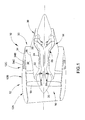
- FIG. 1 schematically represents a high-bypass turbofan engine 10 of a type known in the art.
- the engine 10 is schematically represented as including a nacelle 12 and a core engine (module) 14.
- a fan assembly 16 located in front of the core engine 14 includes a spinner nose 20 projecting forwardly from an array of fan blades 18.
- the core engine 14 is schematically represented as including a high-pressure compressor 22, a combustor 24, a high-pressure turbine 26 and a low-pressure turbine 28.
- a large portion of the air that enters the fan assembly 16 is bypassed to the rear of the engine 10 to generate additional engine thrust.
- the bypassed air passes through an annular-shaped bypass duct 30 between the nacelle 12 and an inner core cowl 36 of the core engine 14, and exits the duct 30 through a fan exit nozzle 32.
- the core cowl 36 defines the radially inward boundary of the bypass duct 30, and provides an aft core cowl transition surface to a primary exhaust nozzle 38 that extends aftward from the core engine 14.
- the nacelle 12 is typically composed of three primary elements that define the external boundaries of the nacelle 12: an inlet assembly 12A, a fan cowl 12B including a fan case that surrounds the fan blades 18, and a thrust reverser assembly 12C located aft of the fan cowl 12B.
- the thrust reverser assembly 12C comprises four primary components: a translating cowl 34A mounted to the nacelle 12, the inner core cowl 36 of the core engine 14, a cascade 34B schematically represented within the nacelle 12, and a blocker door 34C schematically represented as being pivotally deployed from a position radially inward from the cascade 34B.
- the bypassed fan air flows between fan duct flow surfaces defined by the translating cowl 34 and the core cowl 36 before being exhausted through the fan exit nozzle 32.
- the translating cowl 34 translates to expose the cascade 34B and cause the blocker door 34C to deploy and divert bypassed air through the exposed cascade 34B.
- the thrust reverser assembly 12C has been configured to separate from the fan cowl 12B and translate aft to allow access to the core cowl 36 and the core compartment of the core engine 14.
- Such a configuration requires the ability to connect and disconnect a fixed structure of the thrust reverser assembly 12C (which includes the cascade 34B) at a fixed structure (generally, the fan case) surrounded by the fan cowl 12B.
- the present invention provides a method and system suitable facilitating the connection and disconnection of a thrust reverser assembly to a fan case of a nacelle of a gas turbine engine.
- the invention is particularly well suited for use with a thrust reverser assembly comprising a fixed structure configured to be translated to couple and decouple the fixed structure from the fan case.
- the clamping system comprises flanges associated with the fan case, flanges associated with the fixed structure of the thrust reverser assembly and adapted for simultaneous mating with the flanges of the fan case, and a plurality of over-center clamping mechanisms.
- a first of the over-center clamping mechanisms is mounted to the thrust reverser assembly and adapted to clamp a first of the flanges of the thrust reverser assembly with a first of the flanges of the fan case.
- a second of the over-center clamping mechanisms is mounted to the fan case and adapted to clamp a second of the flanges of the thrust reverser assembly with a second of the flanges of the fan case.
- a method of coupling and decoupling a fan case and thrust reverser assembly entails operating a clamping system to simultaneously engage and disengage flanges associated with a fixed structure of the thrust reverser assembly and flanges associated with the fan case.
- the operating step comprises movement of a plurality of over-center clamping mechanisms to clamp together the flanges of the thrust reverser assembly and the fan case.
- a beneficial effect of the invention is the ability of the clamping system to quickly and reliably connect and disconnect a thrust reverser assembly to a fan case of a gas turbine engine using multiple/redundant connections.
- the clamping system also offers the advantages of low weight, compactness, no conflicts with service line routing, ease of operation, and reduced risk for jams or improper seating due to friction.
- FIGS. 2 through 6 represent various views of an assembly 40 through which a fan case and thrust reverser assembly of a gas turbine engine can be quickly coupled and decoupled to allow the thrust reverser assembly to translate aft and away from the fan case, for example, on one or more slider tracks (not shown).
- the assembly 40 represented in FIGS. 2 through 6 can be installed in a high-bypass gas turbine engine 10 of the type represented in FIG. 1 . While the assembly 40 can be adapted for installation at various locations of the engine 10, the assembly 40 is particularly intended to be installed between the fan cowl 12B and thrust reverser assembly 12C, for example, at a location of the nacelle 12 located axially between the high and low pressure compressor sections 22 and 24 of the engine 10.
- the assembly 40 is represented as including two ring-type components, a first of which will be referred to as the fan case 42 and the second will be referred to as a fixed structure 44 of a thrust reverser assembly.
- the fan case 42 is a static structure within the fan cowl 12B that surrounds the fan blades 18 of the engine 10
- the fixed structure 44 may include the cascade 34B and other static parts of the thrust reverser assembly 12C of the engine 10. Accordingly, it should be understood that the ring-type components shown in the figures and identified as the fan case 42 and fixed structure 44 are only portions of, respectively, a fan case and thrust reverser assembly typically found in a high-bypass gas turbine engine of the type represented in FIG. 1 .
- the component identified as the fan case 42 may be a portion of the entire structure that forms a fan case within the nacelle 12 of the engine 10, or a ring that is bolted or otherwise attached to a structure that together form a fan case of the engine 10.
- the component identified as the fixed structure 44 may be a portion of the entire structure that forms the fixed structure (including the cascade 34B) of the thrust reverser assembly 12C of the engine 10, or a ring that is bolted or otherwise attached to a structure that together form the fixed structure of the thrust reverser assembly 12C.
- the components will simply be referred to as the fan case 42 and fixed structure 44.
- the assembly 40 is represented in FIGS. 2 through 6 as comprising a clamping system adapted to couple and decouple the fan case 42 and the fixed structure 44 to allow the thrust reverser assembly 12C to translate aft and away from the fan case 42.
- the clamping system is configured to provide a method for coupling and decoupling the fan case 42 and thrust reverser assembly 12C by simultaneously engaging and disengaging flanges 48 and 50 associated with, respectively, the fan case 42 and the fixed structure 44 of the thrust reverser assembly 12C.
- the clamping system comprises a plurality of over-center clamping mechanisms 52, some of which are mounted to the fan case 42 and others to the fixed structure 44.
- the coupling and decoupling method provided by the clamping system entails the movement of each clamping mechanism 52 to simultaneously clamp portions of the flanges 48 and 50 together, as well as simultaneously release the flanges 48 and 50.
- the flange portions 48A and 50A preferably project in radially outward directions of the engine 10, so that the flange portions 48A and 50A lie in planes that are parallel to each other.
- the flanges 48 associated with the fan case 42 comprise multiple axially-offset flange portions 48A that extend around different circumferential portions of the nacelle 12.
- the flanges 50 associated with the fixed structure 44 comprise multiple axially-offset flange portions 50A that extend around different circumferential portions of the nacelle 12.
- the flange portions 48A of the fan case 42 and the flange portions 50A of the fixed structure 44 are complementarily axially offset and circumferentially located so that each flange portion 48A of the fan case 42 will mate with one of the flange portions 50A of the fixed structure 44.
- Each of the over-center clamping mechanisms 52 of the clamping system is also circumferentially and axially offset from each other, and dedicated to clamp one complementary pair of the flange portions 48A and 50A.
- each over-center clamping mechanism 52 is mounted to either the fixed structure 44 to clamp one of the flange portions 50A of the fixed structure 44 with one of the flange portions 48A of the fan case 42, or to the fan case 42 to clamp one of the flange portions 50A of the fixed structure 44 with one of the flange portions 48A of the fan case 42.
- Each of the over-center clamping mechanisms 52 of the clamping system comprises a clamping segment 54 that extends over a circumferential portion of the nacelle 12, a pivot link 56 at one circumferential end of the clamping segment 54, and an over-center link 58 at an oppositely-disposed circumferential end of the clamping segment 54. Because each clamping mechanism 52 is mounted to either the fan case 42 or the fixed structure 44, each pair of pivot and over-center links 56 and 58 for each mechanism 52 is pivotably mounted to either the fan case 42 or the fixed structure 44. As evident from FIGS. 2 , 3 and 4 , in the circumferential direction of the assembly 40, the mechanisms 52 alternate between being mounted to the fan case 42 or to the fixed structure 44.
- the circumferential ends of the mechanisms 52 overlap each other as a result of their pivot and over-center links 56 and 58 being axially aligned with one of the pivot or over-center links 56 and 58 of an adjacent mechanism 52.
- the over-center link 58 cooperates with the pivot link 56 to induce an over-center toggle operation in the clamping segment 54. Due to the pivoting movement of the pivot and over-center links 56 and 58, the movement of the clamping segment 54 comprises both a radially outward travel and then a radially inward travel combined with a circumferential travel between a position of the mechanism 52 that clamps a pair of flange portions 48A and 50A together and a position of the mechanism 52 that releases the pair of flange portions 48A and 50A. As should be evident from FIGS. 2 through 6 , an operator can readily cause each mechanism 52 to move between these two extremes by grasping a handle 60 that protrudes in a circumferential direction from the segment 54 adjacent the over-center link 58.
- the configurations of the over-center clamping mechanisms 52 are based on the design of a Marman clamp, which is a well-know device for connecting pipe joints.
- the present invention uses a plurality of axially and circumferentially offset mechanisms 52 to achieve a large-diameter connection between the fan case 42 and the fixed structure 44 of the thrust reverser assembly 12C.
- the multiple mechanisms 52 are not only convenient to operate, but also provide a level of redundancy, retaining a secure connection even in the event of a failure of one or more of the mechanisms 52.
- An optimal number of mechanisms 52 will vary depending on the given application, though the use of two to eight mechanisms 52 is believed to be practical for many applications.
- the invention may further comprise means (not shown) for locking the handles 60 to secure the mechanisms 52 in the clamping position, as well as additional tensioning devices similar to latches.
- the assembly 40 can further comprise a cutout 62 through which conduits 64 of any type can be routed through the assembly 40.
- a gas-tight seal (not shown) can be provided to minimize or prevent air flow losses through the assembly 40.
- FIG. 6 further shows a pair of shear pins 66 located on either side of the cutout 62 to reinforce the structural strength of the assembly 40 in the vicinity of the cutout 62.
Landscapes
- Engineering & Computer Science (AREA)
- Mechanical Engineering (AREA)
- General Engineering & Computer Science (AREA)
- Chemical & Material Sciences (AREA)
- Combustion & Propulsion (AREA)
- Structures Of Non-Positive Displacement Pumps (AREA)
Abstract
Description
- The present invention relates to mechanisms by which nacelle components of a turbofan gas turbine engine can be coupled and decoupled.
-
FIG. 1 schematically represents a high-bypass turbofan engine 10 of a type known in the art. Theengine 10 is schematically represented as including anacelle 12 and a core engine (module) 14. Afan assembly 16 located in front of thecore engine 14 includes aspinner nose 20 projecting forwardly from an array offan blades 18. Thecore engine 14 is schematically represented as including a high-pressure compressor 22, acombustor 24, a high-pressure turbine 26 and a low-pressure turbine 28. A large portion of the air that enters thefan assembly 16 is bypassed to the rear of theengine 10 to generate additional engine thrust. The bypassed air passes through an annular-shaped bypass duct 30 between thenacelle 12 and aninner core cowl 36 of thecore engine 14, and exits theduct 30 through afan exit nozzle 32. Thecore cowl 36 defines the radially inward boundary of thebypass duct 30, and provides an aft core cowl transition surface to aprimary exhaust nozzle 38 that extends aftward from thecore engine 14. - The
nacelle 12 is typically composed of three primary elements that define the external boundaries of the nacelle 12: aninlet assembly 12A, afan cowl 12B including a fan case that surrounds thefan blades 18, and athrust reverser assembly 12C located aft of thefan cowl 12B. Thethrust reverser assembly 12C comprises four primary components: a translating cowl 34A mounted to thenacelle 12, theinner core cowl 36 of thecore engine 14, acascade 34B schematically represented within thenacelle 12, and ablocker door 34C schematically represented as being pivotally deployed from a position radially inward from thecascade 34B. The bypassed fan air flows between fan duct flow surfaces defined by thetranslating cowl 34 and thecore cowl 36 before being exhausted through thefan exit nozzle 32. The translatingcowl 34 translates to expose thecascade 34B and cause theblocker door 34C to deploy and divert bypassed air through the exposedcascade 34B. - In recent engine systems, the
thrust reverser assembly 12C has been configured to separate from thefan cowl 12B and translate aft to allow access to thecore cowl 36 and the core compartment of thecore engine 14. Such a configuration requires the ability to connect and disconnect a fixed structure of thethrust reverser assembly 12C (which includes thecascade 34B) at a fixed structure (generally, the fan case) surrounded by thefan cowl 12B. - The present invention provides a method and system suitable facilitating the connection and disconnection of a thrust reverser assembly to a fan case of a nacelle of a gas turbine engine. The invention is particularly well suited for use with a thrust reverser assembly comprising a fixed structure configured to be translated to couple and decouple the fixed structure from the fan case.
- According to a first aspect of the invention, the clamping system comprises flanges associated with the fan case, flanges associated with the fixed structure of the thrust reverser assembly and adapted for simultaneous mating with the flanges of the fan case, and a plurality of over-center clamping mechanisms. A first of the over-center clamping mechanisms is mounted to the thrust reverser assembly and adapted to clamp a first of the flanges of the thrust reverser assembly with a first of the flanges of the fan case. A second of the over-center clamping mechanisms is mounted to the fan case and adapted to clamp a second of the flanges of the thrust reverser assembly with a second of the flanges of the fan case.
- According to a second aspect of the invention, a method of coupling and decoupling a fan case and thrust reverser assembly entails operating a clamping system to simultaneously engage and disengage flanges associated with a fixed structure of the thrust reverser assembly and flanges associated with the fan case. The operating step comprises movement of a plurality of over-center clamping mechanisms to clamp together the flanges of the thrust reverser assembly and the fan case.
- A benefical effect of the invention is the ability of the clamping system to quickly and reliably connect and disconnect a thrust reverser assembly to a fan case of a gas turbine engine using multiple/redundant connections. The clamping system also offers the advantages of low weight, compactness, no conflicts with service line routing, ease of operation, and reduced risk for jams or improper seating due to friction.
- Other aspects and advantages of this invention will be better appreciated from the following detailed description.
-
-
FIG. 1 schematically represents a cross-sectional view of a high-bypass turbofan engine. -
FIGS. 2 and3 are isolated perspective and axial views, respectively, showing an assembly comprising portions of a fan case and a fixed structure of a thrust reverser assembly coupled together with a multi-segment clamping system of the present invention. -
FIG. 4 is an isolated perspective view of the assembly ofFIGS. 2 and3 showing the portions of the fan case and fixed structure decoupled from each other through the operation of the multi-segment clamping system of the present invention. -
FIG. 5 is a detailed side view of a portion of the multi-segment clamping system ofFIG. 4 . -
FIG. 6 is a detailed view of the multi-segment clamping system ofFIG. 4 showing a cutout through which conduits can be routed through the assembly. -
FIGS. 2 through 6 represent various views of anassembly 40 through which a fan case and thrust reverser assembly of a gas turbine engine can be quickly coupled and decoupled to allow the thrust reverser assembly to translate aft and away from the fan case, for example, on one or more slider tracks (not shown). Theassembly 40 represented inFIGS. 2 through 6 can be installed in a high-bypassgas turbine engine 10 of the type represented inFIG. 1 . While theassembly 40 can be adapted for installation at various locations of theengine 10, theassembly 40 is particularly intended to be installed between thefan cowl 12B andthrust reverser assembly 12C, for example, at a location of thenacelle 12 located axially between the high and lowpressure compressor sections engine 10. - The
assembly 40 is represented as including two ring-type components, a first of which will be referred to as thefan case 42 and the second will be referred to as afixed structure 44 of a thrust reverser assembly. As known in the art, thefan case 42 is a static structure within thefan cowl 12B that surrounds thefan blades 18 of theengine 10, and thefixed structure 44 may include thecascade 34B and other static parts of thethrust reverser assembly 12C of theengine 10. Accordingly, it should be understood that the ring-type components shown in the figures and identified as thefan case 42 and fixedstructure 44 are only portions of, respectively, a fan case and thrust reverser assembly typically found in a high-bypass gas turbine engine of the type represented inFIG. 1 . In particular, the component identified as thefan case 42 may be a portion of the entire structure that forms a fan case within thenacelle 12 of theengine 10, or a ring that is bolted or otherwise attached to a structure that together form a fan case of theengine 10. Similarly, the component identified as thefixed structure 44 may be a portion of the entire structure that forms the fixed structure (including thecascade 34B) of thethrust reverser assembly 12C of theengine 10, or a ring that is bolted or otherwise attached to a structure that together form the fixed structure of thethrust reverser assembly 12C. However, for convenience, the components will simply be referred to as thefan case 42 andfixed structure 44. - The
assembly 40 is represented inFIGS. 2 through 6 as comprising a clamping system adapted to couple and decouple thefan case 42 and thefixed structure 44 to allow thethrust reverser assembly 12C to translate aft and away from thefan case 42. The clamping system is configured to provide a method for coupling and decoupling thefan case 42 andthrust reverser assembly 12C by simultaneously engaging and disengagingflanges fan case 42 and thefixed structure 44 of thethrust reverser assembly 12C. In particular, the clamping system comprises a plurality of over-centerclamping mechanisms 52, some of which are mounted to thefan case 42 and others to thefixed structure 44. The coupling and decoupling method provided by the clamping system entails the movement of eachclamping mechanism 52 to simultaneously clamp portions of theflanges flanges - As represented in
FIG. 5 , theflange portions engine 10, so that theflange portions FIGS. 4 and5 , theflanges 48 associated with thefan case 42 comprise multiple axially-offset flange portions 48A that extend around different circumferential portions of thenacelle 12. Similarly, theflanges 50 associated with thefixed structure 44 comprise multiple axially-offset flange portions 50A that extend around different circumferential portions of thenacelle 12. Theflange portions 48A of thefan case 42 and theflange portions 50A of thefixed structure 44 are complementarily axially offset and circumferentially located so that eachflange portion 48A of thefan case 42 will mate with one of theflange portions 50A of thefixed structure 44. Each of the over-centerclamping mechanisms 52 of the clamping system is also circumferentially and axially offset from each other, and dedicated to clamp one complementary pair of theflange portions clamping mechanism 52 is mounted to either thefixed structure 44 to clamp one of theflange portions 50A of thefixed structure 44 with one of theflange portions 48A of thefan case 42, or to thefan case 42 to clamp one of theflange portions 50A of thefixed structure 44 with one of theflange portions 48A of thefan case 42. - Each of the over-center
clamping mechanisms 52 of the clamping system comprises aclamping segment 54 that extends over a circumferential portion of thenacelle 12, apivot link 56 at one circumferential end of theclamping segment 54, and an over-centerlink 58 at an oppositely-disposed circumferential end of theclamping segment 54. Because eachclamping mechanism 52 is mounted to either thefan case 42 or thefixed structure 44, each pair of pivot and over-centerlinks mechanism 52 is pivotably mounted to either thefan case 42 or thefixed structure 44. As evident fromFIGS. 2 ,3 and4 , in the circumferential direction of theassembly 40, themechanisms 52 alternate between being mounted to thefan case 42 or to thefixed structure 44. Furthermore, the circumferential ends of themechanisms 52 overlap each other as a result of their pivot and over-centerlinks links adjacent mechanism 52. The over-centerlink 58 cooperates with thepivot link 56 to induce an over-center toggle operation in theclamping segment 54. Due to the pivoting movement of the pivot and over-centerlinks clamping segment 54 comprises both a radially outward travel and then a radially inward travel combined with a circumferential travel between a position of themechanism 52 that clamps a pair offlange portions mechanism 52 that releases the pair offlange portions FIGS. 2 through 6 , an operator can readily cause eachmechanism 52 to move between these two extremes by grasping ahandle 60 that protrudes in a circumferential direction from thesegment 54 adjacent the over-centerlink 58. - Those skilled in the art will appreciate that the configurations of the over-center
clamping mechanisms 52 are based on the design of a Marman clamp, which is a well-know device for connecting pipe joints. However, the present invention uses a plurality of axially and circumferentiallyoffset mechanisms 52 to achieve a large-diameter connection between thefan case 42 and thefixed structure 44 of thethrust reverser assembly 12C. Themultiple mechanisms 52 are not only convenient to operate, but also provide a level of redundancy, retaining a secure connection even in the event of a failure of one or more of themechanisms 52. An optimal number ofmechanisms 52 will vary depending on the given application, though the use of two to eightmechanisms 52 is believed to be practical for many applications. The invention may further comprise means (not shown) for locking thehandles 60 to secure themechanisms 52 in the clamping position, as well as additional tensioning devices similar to latches. - As shown in
FIGS. 2 through 4 and more readily seen inFIG. 6 , theassembly 40 can further comprise acutout 62 through whichconduits 64 of any type can be routed through theassembly 40. A gas-tight seal (not shown) can be provided to minimize or prevent air flow losses through theassembly 40.FIG. 6 further shows a pair of shear pins 66 located on either side of thecutout 62 to reinforce the structural strength of theassembly 40 in the vicinity of thecutout 62. - While the invention has been described in terms of a specific embodiment, it is apparent that other forms could be adopted by one skilled in the art. For example, the
assembly 40 could differ in appearance and construction from the embodiment shown in the figures, the functions of each component of theassembly 40 could be performed by components of different construction but capable of a similar (though not necessarily equivalent) function, and various materials could be used in the construction of these components. Therefore, the scope of the invention is to be limited only by the following claims. - Various aspects as embodiments of the invention are indicated in the following clauses:
- 1. A gas turbine engine having a nacelle comprising a fan case and a thrust reverser assembly disposed axially aft of the fan case, the thrust reverser assembly comprising a fixed structure configured to be translated to separate from the fan case, the fixed structure of the thrust reverser assembly being capable of coupling and decoupling from the fan case with a clamping system, the clamping system comprising:
- flanges associated with the fan case; and
- flanges associated with the fixed structure of the thrust reverser assembly and adapted for simultaneous mating with the flanges of the fan case when the fan case and the thrust reverser assembly are axially moved into engagement with each other; and
- a plurality of over-center clamping mechanisms, a first of the over-center clamping mechanisms being mounted to the fixed structure of the thrust reverser assembly and adapted to clamp a first of the flanges of the fixed structure with a first of the flanges of the fan case, a second of the over-center clamping mechanisms being mounted to the fan case and adapted to clamp a second of the flanges of the fixed structure with a second of the flanges of the fan case.
- 2. The gas turbine engine according to clause 1, wherein the plurality of over-center clamping mechanisms alternate between being mounted to the fan case or to the fixed structure.
- 3. The gas turbine engine according to clause 1, wherein circumferentially opposite ends of the plurality of over-center clamping mechanisms overlap each other.
- 4. The gas turbine engine according to clause 1, wherein each of the first and second over-center clamping mechanisms comprises:
- a clamping segment extending over a circumferential portion of the nacelle;
- a pivot link at a first circumferential end of the clamping segment; and
- an over-center link at an oppositely-disposed second circumferential end of the clamping segment, the over-center link cooperating with the pivot link to induce an over-center toggle operation in the clamping segment.
- 5. The gas turbine engine according to clause 4, wherein the pivot link of the first over-center clamping mechanism is axially aligned with at least one of the pivot or over-center links of the second over-center clamping mechanism.
- 6. The gas turbine engine according to clause 1, wherein each of the flanges associated with the fan case and the fixed structure extends over a circumferential portion of the nacelle.
- 7. The gas turbine engine according to clause 1, wherein each of the flanges associated with the fan case and the fixed structure projects in a radially outward direction of the gas turbine engine.
- 8. The gas turbine engine according to clause 7, wherein the flanges associated with the fan case and the fixed structure lie in planes that are parallel to each other.
- 9. The gas turbine engine according to clause 1, wherein the first and second flanges of the fan case are circumferentially and axially offset from each other relative to an axis of the gas turbine engine, and the first and second flanges of the fixed structure are circumferentially and axially offset from each other relative to an axis of the gas turbine engine.
- 10. The gas turbine engine according to clause 1, wherein the clamping system further comprises a cutout through which conduits can be routed through the clamping system and between the fan case and the fixed structure.
- 11. A gas turbine engine having a nacelle comprising a fan case and a thrust reverser assembly disposed axially aft of the fan case, the thrust reverser assembly comprising a fixed structure configured to be translated to separate from the fan case, the fixed structure of the thrust reverser assembly being capable of coupling and decoupling from the fan case with a clamping system, the clamping system comprising:
- flanges associated with the fixed structure of the thrust reverser assembly, the flanges comprising at least one first flange portion that extends around a first circumferential portion of the nacelle and at least one second flange portion that extends around a second circumferential portion of the nacelle and is circumferentially and axially offset from the first flange portion;
- flanges associated with the fan case and comprising at least one first flange portion that extends around the first circumferential portion of the nacelle and at least one second flange portion that extends around the circumferential portion of the nacelle and is circumferentially and axially offset from the first flange portion of the fan case, the first and second flange portions of the fan case being adapted to simultaneous mate with the first and second flange portions, respectively, of the fixed structure when the fan case and the thrust reverser assembly are axially moved into engagement with each other; and
- a clamping system comprising a plurality of over-center clamping mechanisms that are circumferentially and axially offset from each other, a first of the over-center clamping mechanisms being mounted to the fixed structure of the thrust reverser assembly and adapted to clamp the first flange portion of the fixed structure with the first flange portion of the fan case, a second of the over-center clamping mechanisms being mounted to the fan case and adapted to clamp the second flange portion of the fixed structure with the second flange portion of the fan case.
- 12. The gas turbine engine according to clause 11, wherein each of the first and second over-center clamping mechanisms comprises:
- a clamping segment extending over one of the first or second circumferential portions of the nacelle;
- a pivot link at a first circumferential end of the clamping segment thereof; and
- an over-center link at an oppositely-disposed second circumferential end of the clamping segment thereof, the over-center link cooperating with the pivot link to induce an over-center toggle operation in the clamping segment.
- 13. The gas turbine engine according to clause 11, wherein:
- the flanges associated with the fixed structure of the thrust reverser assembly comprise a plurality of the first flange portion and a plurality of the second flange portion that are circumferentially and axially offset from the first flange portions of the fixed structure;
- the flanges associated with the fan case comprise a plurality of the first flange portion and a plurality of the second flange portion that are circumferentially and axially offset from the first flange portions of the fan case; and
- the first flange portions of the fan case and the fixed structure define first complementary pairs of flange portions, and the second flange portions of the fan case and the fixed structure define second complementary pairs of flange portions.
- 14. The gas turbine engine according to clause 11, wherein each of the flanges associated with the fan case and the fixed structure projects in a radially outward direction of the gas turbine engine, and the flanges associated with the fan case and the fixed structure lie in planes that are parallel to each other.
- 15. The gas turbine engine according to clause 11, wherein circumferentially opposite ends of the plurality of over-center clamping mechanisms overlap each other.
- 16. A method of coupling and decoupling a fan case and a thrust reverser assembly of a nacelle of a gas turbine engine, the thrust reverser assembly being disposed axially aft of the fan case, the thrust reverser assembly comprising a fixed structure configured to be translated to separate from the fan case, the method comprising:
- operating a clamping system to simultaneously engage at least one flange associated with the fan case and at least one flange associated with the fixed structure of the thrust reverser assembly, the operating step comprising movement of at least one over-center clamping mechanism to simultaneous clamp together the flanges of the fan case and the fixed structure.
- 17. The method according to
clause 16, wherein the clamping system comprises a plurality of the flange associated with the fan case, a plurality of the flange associated with the fixed structure, and a plurality of the over-center clamping mechanism, each of the over-center clamping mechanisms is adapted to simultaneously engage and disengage a complementary pair of the flanges associated with the fan case and the fixed structure, and the operating step comprises movement of each of the over-center clamping mechanisms to clamp together the complementary pairs of the flanges of the fan case and the fixed structure. - 18. The method according to clause 17, wherein the operating step comprises individually moving each of the over-center clamping mechanisms to clamp together individual complementary pairs of the flanges of the fan case and the fixed structure.
- 19. The method according to clause 17, wherein the over-center clamping mechanisms are circumferentially and axially offset from each other relative to an axis of the gas turbine engine.
- 20. The method according to clause 17, further comprising:
- operating each of the over-center clamping mechanisms to disengage the complementary pairs of the flanges of the fan case and the fixed structure; and then
- translating the fixed structure to separate the thrust reverser assembly from the fan case.
Claims (15)
- A gas turbine engine (10) having a nacelle (12) comprising a fan case (42) and a thrust reverser assembly (12C) disposed axially aft of the fan case, the thrust reverser assembly comprising a fixed structure (44) configured to be translated to separate from the fan case, the fixed structure of the thrust reverser assembly being capable of coupling and decoupling from the fan case with a clamping system, the clamping system comprising:flanges (48) associated with the fan case (42) ; andflanges (50) associated with the fixed structure (44) of the thrust reverser assembly (12C) and adapted for simultaneous mating with the flanges of the fan case when the fan case and the thrust reverser assembly are axially moved into engagement with each other; anda plurality of over-center clamping mechanisms (52), a first of the over-center clamping mechanisms being mounted to the fixed structure (44) of the thrust reverser assembly (12C) and adapted to clamp a first of the flanges (50) of the fixed structure (44) with a first of the flanges (48) of the fan case (42), a second of the over-center clamping mechanisms being mounted to the fan case (42) and adapted to clamp a second of the flanges (50) of the fixed structure (44) with a second of the flanges (48) of the fan case (42).
- The gas turbine engine (10) according to claim 1, wherein the plurality of over-center clamping mechanisms (52) alternate between being mounted to the fan case (42) or to the fixed structure (44).
- The gas turbine engine (10) according to claim 1, wherein circumferentially opposite ends of the plurality of over-center clamping mechanisms (52) overlap each other.
- The gas turbine engine according to any preceding claim, wherein each of the first and second over-center clamping mechanisms (52) comprises:a clamping segment (54) extending over a circumferential portion of the nacelle (12);a pivot link (56) at a first circumferential end of the clamping segment; andan over-center link (58) at an oppositely-disposed second circumferential end of the clamping segment (54), the over-center link cooperating with the pivot link to induce an over-center toggle operation in the clamping segment (54).
- The gas turbine engine (10) according to claim 4, wherein the pivot link (56) of the first over-center clamping mechanism (52) is axially aligned with at least one of the pivot or over-center links (56,58) of the second over-center clamping mechanism (52).
- The gas turbine engine (10) according to any preceding claim, wherein each of the flanges (48,50) associated with the fan case (42) and the fixed structure (44) extends over a circumferential portion of the nacelle (12).
- The gas turbine engine (10) according to claim 1, wherein each of the flanges associated with the fan case and the fixed structure projects in a radially outward direction of the gas turbine engine (10).
- The gas turbine engine (10) according to claim 7, wherein the flanges associated with the fan case (42) and the fixed structure (44) lie in planes that are parallel to each other.
- The gas turbine engine (10) according to any preceding claim, wherein the first and second flanges (48) of the fan case (42) are circumferentially and axially offset from each other relative to an axis of the gas turbine engine (10), and the first and second flanges (50) of the fixed structure (44) are circumferentially and axially offset from each other relative to an axis of the gas turbine engine (10).
- The gas turbine engine (10) according to any preceding claim, wherein the clamping system further comprises a cutout (62) through which conduits (64) can be routed through the clamping system and between the fan case (42) and the fixed structure (44).
- A gas turbine engine (10) having a nacelle (12) comprising a fan case (42) and a thrust reverser assembly (12C) disposed axially aft of the fan case (42), the thrust reverser assembly comprising a fixed structure configured to be translated to separate from the fan case, the fixed structure of the thrust reverser assembly being capable of coupling and decoupling from the fan case with a clamping system, the clamping system comprising:flanges (50) associated with the fixed structure (44) of the thrust reverser assembly, the flanges comprising at least one first flange portion that extends around a first circumferential portion of the nacelle (12) and at least one second flange portion that extends around a second circumferential portion of the nacelle (12) and is circumferentially and axially offset from the first flange portion;flanges (48) associated with the fan case (42) and comprising at least one first flange portion that extends around the first circumferential portion of the nacelle (12) and at least one second flange portion that extends around the circumferential portion of the nacelle (12) and is circumferentially and axially offset from the first flange portion of the fan case (42), the first and second flange portions of the fan case being adapted to simultaneous mate with the first and second flange portions, respectively, of the fixed structure (44) when the fan case (42) and the thrust reverser assembly (12C) are axially moved into engagement with each other; anda clamping system comprising a plurality of over-center clamping mechanisms (52) that are circumferentially and axially offset from each other, a first of the over-center clamping mechanisms being mounted to the fixed structure (44) of the thrust reverser assembly (12C) and adapted to clamp the first flange portion of the fixed structure (44) with the first flange portion of the fan case (42), a second of the over-center clamping mechanisms being mounted to the fan case (42) and adapted to clamp the second flange portion of the fixed structure with the second flange portion of the fan case.
- The gas turbine engine (10) according to claim 11, wherein each of the first and second over-center clamping mechanisms (52) comprises:a clamping segment (54) extending over one of the first or second circumferential portions of the nacelle (12);a pivot link (56) at a first circumferential end of the clamping segment thereof; andan over-center link (58) at an oppositely-disposed second circumferential end of the clamping segment thereof, the over-center link cooperating with the pivot link to induce an over-center toggle operation in the clamping segment.
- The gas turbine engine (10) according to either of claim 11 or 12, wherein:the flanges (50) associated with the fixed structure (44) of the thrust reverser assembly (12C) comprise a plurality of the first flange portion and a plurality of the second flange portion that are circumferentially and axially offset from the first flange portions of the fixed structure;the flanges (48) associated with the fan case (42) comprise a plurality of the first flange portion and a plurality of the second flange portion that are circumferentially and axially offset from the first flange portions of the fan case; andthe first flange portions of the fan case (42) and the fixed structure (44) define first complementary pairs of flange portions, and the second flange portions of the fan case and the fixed structure define second complementary pairs of flange portions.
- A method of coupling and decoupling a fan case (42) and a thrust reverser assembly (12C) of a nacelle (12) of a gas turbine engine (10), the thrust reverser assembly (12C) being disposed axially aft of the fan case, the thrust reverser assembly comprising a fixed structure (44) configured to be translated to separate from the fan case, the method comprising:operating a clamping system to simultaneously engage at least one flange (48) associated with the fan case (42) and at least one flange (50) associated with the fixed structure (44) of the thrust reverser assembly (12C), the operating step comprising movement of at least one over-center clamping mechanism (52) to simultaneous clamp together the flanges (48,50) of the fan case (42) and the fixed structure (44).
- The method according to claim 14, wherein the clamping system comprises a plurality of the flange (48) associated with the fan case (42), a plurality of the flange (50) associated with the fixed structure (44), and a plurality of the over-center clamping mechanism (52), each of the over-center clamping mechanisms is adapted to simultaneously engage and disengage a complementary pair of the flanges (48,50) associated with the fan case (42) and the fixed structure (44), and the operating step comprises movement of each of the over-center clamping mechanisms (52) to clamp together the complementary pairs of the flanges (48,50) of the fan case (42) and the fixed structure (44).
Applications Claiming Priority (2)
| Application Number | Priority Date | Filing Date | Title |
|---|---|---|---|
| US201161493671P | 2011-06-06 | 2011-06-06 | |
| US13/325,203 US8479491B2 (en) | 2011-06-06 | 2011-12-14 | Clamping system and method for thrust reverser attachment |
Publications (2)
| Publication Number | Publication Date |
|---|---|
| EP2532872A2 true EP2532872A2 (en) | 2012-12-12 |
| EP2532872A3 EP2532872A3 (en) | 2018-04-25 |
Family
ID=46197167
Family Applications (1)
| Application Number | Title | Priority Date | Filing Date |
|---|---|---|---|
| EP12171077.6A Withdrawn EP2532872A3 (en) | 2011-06-06 | 2012-06-06 | Clamping system and method for thrust reverser attachment |
Country Status (4)
| Country | Link |
|---|---|
| US (1) | US8479491B2 (en) |
| EP (1) | EP2532872A3 (en) |
| JP (1) | JP5997508B2 (en) |
| CA (1) | CA2778592A1 (en) |
Families Citing this family (6)
| Publication number | Priority date | Publication date | Assignee | Title |
|---|---|---|---|---|
| US8727269B2 (en) * | 2011-06-06 | 2014-05-20 | General Electric Company | System and method for mounting an aircraft engine |
| CN105339640B (en) * | 2013-07-02 | 2018-07-17 | Mra系统有限责任公司 | Engine and band clamp |
| US10309343B2 (en) | 2014-11-06 | 2019-06-04 | Rohr, Inc. | Split sleeve hidden door thrust reverser |
| US9784214B2 (en) | 2014-11-06 | 2017-10-10 | Rohr, Inc. | Thrust reverser with hidden linkage blocker doors |
| US10655564B2 (en) | 2016-05-13 | 2020-05-19 | Rohr, Inc. | Thrust reverser system with hidden blocker doors |
| US9976696B2 (en) | 2016-06-21 | 2018-05-22 | Rohr, Inc. | Linear actuator with multi-degree of freedom mounting structure |
Family Cites Families (17)
| Publication number | Priority date | Publication date | Assignee | Title |
|---|---|---|---|---|
| JPS58126195U (en) * | 1982-02-18 | 1983-08-27 | 東京精密測器株式会社 | flange clamp device |
| JPS61294206A (en) * | 1985-06-19 | 1986-12-25 | 株式会社井上ジャパックス研究所 | Method of joining pipe, etc. |
| JPH0734799Y2 (en) * | 1988-08-16 | 1995-08-09 | 日産自動車株式会社 | Flange fastening band separating device |
| GB9407632D0 (en) * | 1994-04-18 | 1994-06-08 | Short Brothers Plc | An aircraft propulsive power unit |
| US5470114A (en) * | 1994-11-14 | 1995-11-28 | General Electric Company | Coupling assembly |
| US5875995A (en) * | 1997-05-20 | 1999-03-02 | Rohr, Inc. | Pivoting door type thrust reverser with deployable members for efflux control and flow separation |
| US6725542B1 (en) | 1999-09-17 | 2004-04-27 | Alan R Maguire | Method of assembling a gas turbine engine and nacelle |
| US7000952B2 (en) * | 2003-05-27 | 2006-02-21 | The Boeing Company | Duct separation restraint apparatus and method |
| US20050264010A1 (en) * | 2004-05-27 | 2005-12-01 | Wagner Wayne M | V-band clamp |
| DE102004050300B4 (en) * | 2004-10-15 | 2009-02-12 | Norma Germany Gmbh | profile clip |
| US7484356B1 (en) * | 2005-07-26 | 2009-02-03 | Aeronautical Concepts Of Exhaust, Llc | Cascade reverser without blocker doors |
| DK2160336T3 (en) * | 2007-06-13 | 2013-07-22 | Joinlock Pty Ltd | CONNECTING MECHANISM AND PROCEDURE |
| US20090102275A1 (en) * | 2007-10-22 | 2009-04-23 | General Electric Company | Wheel mounting assembly |
| FR2925120B1 (en) * | 2007-12-18 | 2010-02-19 | Snecma | INTERMEDIATE CARTER EXTENSION FOR AIRCRAFT TURBOJET ENGINE COMPRISING A SECULATED ANNULAR GROOVE OF RECEPTION OF NACELLE HOODS |
| US8181905B2 (en) | 2008-12-17 | 2012-05-22 | Rohr, Inc. | Aircraft engine nacelle with translating inlet cowl |
| US8398017B2 (en) * | 2009-02-04 | 2013-03-19 | Spirit Aerosystems, Inc. | Continuous composite fan duct and thrust reverser |
| FR2952615B1 (en) * | 2009-11-18 | 2011-12-09 | Aircelle Sa | ASSEMBLY FOR MAINTAINING THE INTERFACE OF A FIXED EXTERNAL STRUCTURE OF A NACELLE AND A TURBOJET CARTER |
-
2011
- 2011-12-14 US US13/325,203 patent/US8479491B2/en active Active
-
2012
- 2012-06-01 CA CA2778592A patent/CA2778592A1/en not_active Abandoned
- 2012-06-04 JP JP2012126721A patent/JP5997508B2/en not_active Expired - Fee Related
- 2012-06-06 EP EP12171077.6A patent/EP2532872A3/en not_active Withdrawn
Non-Patent Citations (1)
| Title |
|---|
| None |
Also Published As
| Publication number | Publication date |
|---|---|
| JP5997508B2 (en) | 2016-09-28 |
| CA2778592A1 (en) | 2012-12-06 |
| US20120304621A1 (en) | 2012-12-06 |
| US8479491B2 (en) | 2013-07-09 |
| EP2532872A3 (en) | 2018-04-25 |
| JP2012251556A (en) | 2012-12-20 |
Similar Documents
| Publication | Publication Date | Title |
|---|---|---|
| US8479491B2 (en) | Clamping system and method for thrust reverser attachment | |
| US8444084B2 (en) | Aeroengine mounting | |
| US8528857B2 (en) | Translatable jet engine thrust reverser configuration providing improved maintenance access | |
| US10655564B2 (en) | Thrust reverser system with hidden blocker doors | |
| EP1852346A1 (en) | Aeroengine mount | |
| US20070007388A1 (en) | Thrust reversers including locking assemblies for inhibiting deflection | |
| US11149686B2 (en) | Thrust reverser assembly | |
| US10570853B2 (en) | Thrust reverser assembly | |
| US10851734B2 (en) | Thrust reverser assembly | |
| US9328735B2 (en) | Split ring valve | |
| CA2837740A1 (en) | System and method for mounting an aircraft engine | |
| US10697396B2 (en) | Fan cowl mounted to thrust reverser | |
| EP3517766A1 (en) | Translating lock for pivot door thrust reverser | |
| CN111868369B (en) | Bypass propulsion unit comprising a thrust reverser with movable cascades | |
| US10759541B2 (en) | Nacelle bifurcation with leading edge structure | |
| CN115803258B (en) | The nacelle includes a removable and structural forward internal structure for propulsion components with a high bypass ratio. | |
| EP4206456B1 (en) | Variable area nozzle and method for operating same | |
| EP2969763B1 (en) | Nacelle mounted latching system | |
| GB2384827A (en) | A Fastening Between The C-Duct and Core of a Ducted Fan Gas Turbine Engine. | |
| CN117642338A (en) | Propulsion assembly including swing-out furcation plate | |
| US10670178B2 (en) | Slip joint assembly | |
| US11933247B2 (en) | Thrust reverser system latch assembly and method of operating same | |
| JP5782463B2 (en) | Articulated slider track | |
| CN117242253A (en) | Aircraft propulsion assembly including an actuator connected to a structural arm such as an exit guide vane | |
| CN117222804A (en) | Movable cascade thrust reverser including multifunctional fixed structure |
Legal Events
| Date | Code | Title | Description |
|---|---|---|---|
| PUAI | Public reference made under article 153(3) epc to a published international application that has entered the european phase |
Free format text: ORIGINAL CODE: 0009012 |
|
| AK | Designated contracting states |
Kind code of ref document: A2 Designated state(s): AL AT BE BG CH CY CZ DE DK EE ES FI FR GB GR HR HU IE IS IT LI LT LU LV MC MK MT NL NO PL PT RO RS SE SI SK SM TR |
|
| AX | Request for extension of the european patent |
Extension state: BA ME |
|
| PUAL | Search report despatched |
Free format text: ORIGINAL CODE: 0009013 |
|
| AK | Designated contracting states |
Kind code of ref document: A3 Designated state(s): AL AT BE BG CH CY CZ DE DK EE ES FI FR GB GR HR HU IE IS IT LI LT LU LV MC MK MT NL NO PL PT RO RS SE SI SK SM TR |
|
| AX | Request for extension of the european patent |
Extension state: BA ME |
|
| RIC1 | Information provided on ipc code assigned before grant |
Ipc: F01D 25/24 20060101ALI20180322BHEP Ipc: F02K 1/64 20060101ALI20180322BHEP Ipc: F02K 1/56 20060101AFI20180322BHEP |
|
| STAA | Information on the status of an ep patent application or granted ep patent |
Free format text: STATUS: THE APPLICATION IS DEEMED TO BE WITHDRAWN |
|
| 18D | Application deemed to be withdrawn |
Effective date: 20181026 |