EP2532254A1 - Method for treatment of lacto-n-biose-containing solution - Google Patents
Method for treatment of lacto-n-biose-containing solution Download PDFInfo
- Publication number
- EP2532254A1 EP2532254A1 EP11739708A EP11739708A EP2532254A1 EP 2532254 A1 EP2532254 A1 EP 2532254A1 EP 11739708 A EP11739708 A EP 11739708A EP 11739708 A EP11739708 A EP 11739708A EP 2532254 A1 EP2532254 A1 EP 2532254A1
- Authority
- EP
- European Patent Office
- Prior art keywords
- lnb
- liquid
- liquid composition
- biose
- composition containing
- Prior art date
- Legal status (The legal status is an assumption and is not a legal conclusion. Google has not performed a legal analysis and makes no representation as to the accuracy of the status listed.)
- Granted
Links
Images
Classifications
-
- A—HUMAN NECESSITIES
- A23—FOODS OR FOODSTUFFS; TREATMENT THEREOF, NOT COVERED BY OTHER CLASSES
- A23L—FOODS, FOODSTUFFS OR NON-ALCOHOLIC BEVERAGES, NOT OTHERWISE PROVIDED FOR; PREPARATION OR TREATMENT THEREOF
- A23L27/00—Spices; Flavouring agents or condiments; Artificial sweetening agents; Table salts; Dietetic salt substitutes; Preparation or treatment thereof
- A23L27/30—Artificial sweetening agents
-
- A—HUMAN NECESSITIES
- A23—FOODS OR FOODSTUFFS; TREATMENT THEREOF, NOT COVERED BY OTHER CLASSES
- A23L—FOODS, FOODSTUFFS OR NON-ALCOHOLIC BEVERAGES, NOT OTHERWISE PROVIDED FOR; PREPARATION OR TREATMENT THEREOF
- A23L5/00—Preparation or treatment of foods or foodstuffs, in general; Food or foodstuffs obtained thereby; Materials therefor
-
- A—HUMAN NECESSITIES
- A23—FOODS OR FOODSTUFFS; TREATMENT THEREOF, NOT COVERED BY OTHER CLASSES
- A23K—FODDER
- A23K20/00—Accessory food factors for animal feeding-stuffs
- A23K20/10—Organic substances
- A23K20/163—Sugars; Polysaccharides
-
- A—HUMAN NECESSITIES
- A23—FOODS OR FOODSTUFFS; TREATMENT THEREOF, NOT COVERED BY OTHER CLASSES
- A23K—FODDER
- A23K30/00—Processes specially adapted for preservation of materials in order to produce animal feeding-stuffs
-
- A—HUMAN NECESSITIES
- A23—FOODS OR FOODSTUFFS; TREATMENT THEREOF, NOT COVERED BY OTHER CLASSES
- A23L—FOODS, FOODSTUFFS OR NON-ALCOHOLIC BEVERAGES, NOT OTHERWISE PROVIDED FOR; PREPARATION OR TREATMENT THEREOF
- A23L29/00—Foods or foodstuffs containing additives; Preparation or treatment thereof
- A23L29/30—Foods or foodstuffs containing additives; Preparation or treatment thereof containing carbohydrate syrups; containing sugars; containing sugar alcohols, e.g. xylitol; containing starch hydrolysates, e.g. dextrin
-
- A—HUMAN NECESSITIES
- A61—MEDICAL OR VETERINARY SCIENCE; HYGIENE
- A61K—PREPARATIONS FOR MEDICAL, DENTAL OR TOILETRY PURPOSES
- A61K9/00—Medicinal preparations characterised by special physical form
- A61K9/0087—Galenical forms not covered by A61K9/02 - A61K9/7023
- A61K9/0095—Drinks; Beverages; Syrups; Compositions for reconstitution thereof, e.g. powders or tablets to be dispersed in a glass of water; Veterinary drenches
-
- A—HUMAN NECESSITIES
- A61—MEDICAL OR VETERINARY SCIENCE; HYGIENE
- A61P—SPECIFIC THERAPEUTIC ACTIVITY OF CHEMICAL COMPOUNDS OR MEDICINAL PREPARATIONS
- A61P1/00—Drugs for disorders of the alimentary tract or the digestive system
- A61P1/10—Laxatives
-
- A—HUMAN NECESSITIES
- A61—MEDICAL OR VETERINARY SCIENCE; HYGIENE
- A61P—SPECIFIC THERAPEUTIC ACTIVITY OF CHEMICAL COMPOUNDS OR MEDICINAL PREPARATIONS
- A61P1/00—Drugs for disorders of the alimentary tract or the digestive system
- A61P1/14—Prodigestives, e.g. acids, enzymes, appetite stimulants, antidyspeptics, tonics, antiflatulents
-
- A—HUMAN NECESSITIES
- A61—MEDICAL OR VETERINARY SCIENCE; HYGIENE
- A61P—SPECIFIC THERAPEUTIC ACTIVITY OF CHEMICAL COMPOUNDS OR MEDICINAL PREPARATIONS
- A61P3/00—Drugs for disorders of the metabolism
-
- A—HUMAN NECESSITIES
- A61—MEDICAL OR VETERINARY SCIENCE; HYGIENE
- A61P—SPECIFIC THERAPEUTIC ACTIVITY OF CHEMICAL COMPOUNDS OR MEDICINAL PREPARATIONS
- A61P37/00—Drugs for immunological or allergic disorders
- A61P37/02—Immunomodulators
-
- A—HUMAN NECESSITIES
- A23—FOODS OR FOODSTUFFS; TREATMENT THEREOF, NOT COVERED BY OTHER CLASSES
- A23L—FOODS, FOODSTUFFS OR NON-ALCOHOLIC BEVERAGES, NOT OTHERWISE PROVIDED FOR; PREPARATION OR TREATMENT THEREOF
- A23L33/00—Modifying nutritive qualities of foods; Dietetic products; Preparation or treatment thereof
- A23L33/10—Modifying nutritive qualities of foods; Dietetic products; Preparation or treatment thereof using additives
- A23L33/125—Modifying nutritive qualities of foods; Dietetic products; Preparation or treatment thereof using additives containing carbohydrate syrups; containing sugars; containing sugar alcohols; containing starch hydrolysates
-
- A—HUMAN NECESSITIES
- A23—FOODS OR FOODSTUFFS; TREATMENT THEREOF, NOT COVERED BY OTHER CLASSES
- A23V—INDEXING SCHEME RELATING TO FOODS, FOODSTUFFS OR NON-ALCOHOLIC BEVERAGES AND LACTIC OR PROPIONIC ACID BACTERIA USED IN FOODSTUFFS OR FOOD PREPARATION
- A23V2002/00—Food compositions, function of food ingredients or processes for food or foodstuffs
-
- Y—GENERAL TAGGING OF NEW TECHNOLOGICAL DEVELOPMENTS; GENERAL TAGGING OF CROSS-SECTIONAL TECHNOLOGIES SPANNING OVER SEVERAL SECTIONS OF THE IPC; TECHNICAL SUBJECTS COVERED BY FORMER USPC CROSS-REFERENCE ART COLLECTIONS [XRACs] AND DIGESTS
- Y02—TECHNOLOGIES OR APPLICATIONS FOR MITIGATION OR ADAPTATION AGAINST CLIMATE CHANGE
- Y02P—CLIMATE CHANGE MITIGATION TECHNOLOGIES IN THE PRODUCTION OR PROCESSING OF GOODS
- Y02P60/00—Technologies relating to agriculture, livestock or agroalimentary industries
- Y02P60/80—Food processing, e.g. use of renewable energies or variable speed drives in handling, conveying or stacking
- Y02P60/87—Re-use of by-products of food processing for fodder production
Definitions
- the present invention relates to a method of treating a liquid composition containing lacto-N-biose, a liquid preparation containing lacto-N-biose that is treated using the treatment method and a dried product thereof, and a method of producing a product containing lacto-N-biose.
- Lacto-N-biose is a disaccharide in which galactose and N-acetylglucosamine are bonded via a ⁇ -1,3-bond (Gal ⁇ 1,3GlcNAc, hereinafter abbreviated as LNB), and is known as one of the disaccharides that constitute the oligosaccharides (milk oligosaccharides) contained in breast milk.
- LNB ⁇ -1,3-bond
- Methods have been proposed as methods of producing LNB (for example, see Patent Documents 1 to 3). It has recently been reported that LNB has functionalities such as a bifidobacterium growth-promoting effect (for example, see Patent Document 4). Further, it is anticipated that LNB will also exhibit various actions that are effective in promoting and maintaining good health, such as a bowel-regulating action and an immunoregulatory action.
- LNB low-density polystyrene
- a heat treatment at a temperature of 65°C or higher is required for the purposes of sterilization or the like, either on the LNB prior to addition, or on the product containing the added LNB.
- this type of heat treatment is performed on a liquid composition containing LNB
- the LNB within the liquid composition may suffer various problems, including decomposition, denaturation, and loss of bioactivity. Accordingly, in the case of a product that includes a heat treatment within the production process, it is expected that a sufficient heat treatment will be unable to be performed during production.
- the present invention has been developed in light of these circumstances, and has an object of providing a treatment method that enables thermal decomposition of LNB to be suppressed when an liquid composition containing LNB is heated at a temperature of 65°C or higher, as well as providing a liquid preparation containing LNB that is treated using the treatment method, a dried product produced from such an liquid preparation containing LNB, and a method of producing a product containing LNB.
- the inventors conducted further research of the thermal decomposition reaction using these decomposed or denatured products as indicators, and discovered that the LNB within a liquid composition containing LNB exhibits low thermal stability and undergoes rapid thermal decomposition under neutral or alkaline conditions, but when the pH is within a range from not more than 5.5 to not less than 2.0, the progress of the thermal decomposition reaction is inhibited, and they were therefore able to complete the present invention.
- the present invention adopts the aspects described below.
- the present invention is able to provide a treatment method that enables thermal decomposition of LNB to be suppressed when a liquid composition containing LNB is heated at a temperature of 65°C or higher, a liquid preparation containing LNB that is treated using the treatment method, a dried product produced from such a liquid preparation containing LNB, and a method of producing a product containing LNB.
- a liquid composition containing LNB having a pH at 25°C of not less than 2.0 and not more than 5.5 is prepared.
- the pH is preferably not less than 2.0 and not more than 5.0, and still more preferably not less than 2.0 and not more than 4.5. If the pH of the liquid composition containing LNB is greater than 5.5 or less than 2.0, then when heat treatment is performed at a temperature of 65°C or higher in the following step, decomposition of the LNB tends to occur more readily, and if the pH exceeds 7.0, then the LNB tends to undergo complete decomposition. It is thought that when the pH is less than 2.0, acid decomposition occurs in addition to thermal decomposition. Provided the pH of the liquid composition containing LNB is within the range from not less than 2.0 to not more than 5.0, decomposition of the LNB is not likely to undergo decomposition when heat treatment is performed at a temperature of 65°C or higher in the following step.
- a "liquid composition containing LNB having a pH at 25°C of not less than 2.0 and not more than 5.5” describes a liquid composition containing LNB for which the pH satisfies the above range at a standard temperature of 25°C.
- the pH range will be adjusted in accordance with the temperature. Preparation of a liquid composition containing LNB having this type of adjusted pH range is also included within the scope of the present invention.
- preparation of a liquid composition containing LNB for which the pH at an arbitrary temperature does not fall within the range from not less than 2.0 to not more than 5.5 is still included within the scope of the present invention provided the pH satisfies the range from not less than 2.0 to not more than 5.5 when the temperature is altered to the standard temperature of 25°C.
- a liquid composition containing LNB having a pH of 1.90 at a temperature of 65°C has a pH of 2.01 when the temperature is adjusted to the standard temperature of 25°C, and therefore preparation of this liquid composition containing LNB followed by heat treatment at a temperature of 65°C or higher in the subsequent step is included within the scope of the present invention.
- liquid composition containing LNB examples include solutions prepared by dissolving LNB in a solvent such as water (hereinafter referred to as “LNB solutions”), liquid compounds obtained by adding LNB or an LNB solution to a liquid product (such as food, pharmaceutical, cosmetics or feed, which is in liquid form) (hereinafter referred to as “LNB-added liquid products”), and liquid products (such as food, pharmaceutical, cosmetics or feed, which is in liquid form) that naturally contain LNB as a component (hereinafter referred to as "liquid products containing natural LNB”).
- LNB solutions solutions prepared by dissolving LNB in a solvent such as water
- LNB-added liquid products liquid products obtained by adding LNB or an LNB solution to a liquid product (such as food, pharmaceutical, cosmetics or feed, which is in liquid form)
- LNB-added liquid products liquid products (such as food, pharmaceutical, cosmetics or feed, which is in liquid form) that naturally contain LNB as a component
- the method used for producing the LNB which may be selected appropriately from conventional methods.
- Examples include a method in which a substrate containing lactose and N-acetylglucosamine is used as a starting material, and this starting material is reacted sequentially with ⁇ -galactosidase sourced from porcine testes and ⁇ - galactosidase produced by Bacillus circulans (see Japanese Laid-Open Patent Application No. Hei 06-253878 ), a method that uses microbes, animal cells or insect cells capable of producing a complex carbohydrate from a sugar nucleotide and a complex carbohydrate precursor (see Japanese Laid-Open Patent Application No.
- the heat treatment of the liquid composition containing LNB having a pH of not less than 2.0 and not more than 5.5 is performed at a temperature of 65°C or higher.
- the upper limit for the heat treatment temperature is typically not more than 140°C.
- a preferred heat treatment temperature may be set appropriately within the above range in accordance with the intended purpose of the heat treatment. For example, when heat sterilization is the main purpose, the heat treatment temperature is preferably within a range from 65 to 140°C, and more preferably from 80 to 140°C.
- the heat treatment temperature is preferably within a range from 70 to 120°C, and more preferably from 80 to 100°C.
- the heating time varies depending on the heat treatment temperature, but is typically within a range from 2 seconds to 60 minutes, and preferably from 2 seconds to 10 minutes.
- the heated liquid preparation containing LNB may, if required, be sealed inside a container to produce a container-packaged liquid product containing LNB.
- the heated liquid preparation containing LNB may also be dried to produce a dried product.
- a liquid preparation containing LNB prepared by heat treatment an LNB solution containing only LNB using the heat treatment of the present invention may be dried to produce LNB powder. Freeze drying is preferred as the method of drying the liquid preparation containing LNB as it ensures excellent stability of the LNB.
- the heated liquid preparation containing LNB obtained in the manner described above or the dried product thereof either contains no LNB decomposed or denatured products, or contains very little of such products.
- a liquid composition containing LNB that contains LNB which is expected to exhibit various types of bioactivity, can be heated for the purpose of heat sterilization or some other processing purpose, with no loss in the bioactivity.
- the treatment method of the present invention can be applied to any process and treatment that includes a heat treatment step at the time of production of various products such as food, pharmaceutical, cosmetics and feed.
- a liquid product such as a food, pharmaceutical, cosmetics or feed, which is in liquid form
- a heated product containing LNB such as a food containing LNB, pharmaceutical containing LNB, cosmetics containing LNB or feed containing LNB
- a liquid preparation containing LNB which is heated in the manner described above or a dried product thereof to any of various products (such as food, pharmaceutical, cosmetics or feed)
- an product containing LNB can be produced.
- the LNB contained within the liquid preparation containing LNB or dried product thereof obtained using the treatment method of the present invention is one of the disaccharides that constitute the naturally occurring oligosaccharides (milk oligosaccharides) in breast milk, addition of the LNB to food, pharmaceutical and cosmetics and the like is safe.
- an LNB powder was prepared using the procedure described below. Reaction was performed in accordance with the description of Example 8 in Japanese Laid-Open Patent Application No. 2008-154495 , yielding a reaction liquid composition with an LNB concentration of 50 mM. Following demineralization, the obtained reaction liquid composition was supplied to a chromatography column filled with Toyopearl HW40F (manufactured by Tosoh Corporation) as a filler, and the disaccharide fraction was isolated and freeze dried, yielding 1 kg of an LNB powder having a purity of 95%.
- Toyopearl HW40F manufactured by Tosoh Corporation
- the purpose of this test was to evaluate the effect of the pH of a liquid composition containing LNB on the stability of the LNB upon heating.
- Samples of the LNB powder prepared in the above Production Example 1 were dissolved at a concentration of 2% (by mass, this also applies to all subsequent concentration values) in a 0.1 M citrate buffer solution (pH: 3.0 to 6.0), a 0.1 M phosphate buffer solution (pH: 6.0 to 8.0) or a 0.1 M glycine buffer solution (pH: 8.5 to 10.5), thus preparing samples (liquid compositions containing LNB) 1 to 16 having pH values at intervals of 0.5 across the entire pH range mentioned above. A 5 mL sample of each of the prepared samples 1 to 16 was dispensed into a test tube and heated at 90°C for 60 minutes.
- Each of the heated samples was cooled to 15°C, and 1 ⁇ L was then spotted onto a silica gel thin layer chromatography (TLC) plate.
- TLC thin layer chromatography
- the plate was developed using an 80% acetonitrile solvent, and was then immersed in a 5% sulfuric acid solution and colorized by heating in an oven.
- decomposed or denatured products N-acetylglucosamine dehydrate and galactose
- the amount of those decomposed or denatured products were evaluated visually to determine whether or not decomposition had occurred, and if so, the extent of that decomposition.
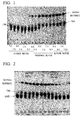
- FIG. 1 is a photograph showing the TLC detection pattern for each of the samples of differing pH following heat treatment at 90°C for 60 minutes.
- Gal represents galactose
- GlcNAc represents N-acetylglucosamine.
- the LNB powder prepared in the above Production Example 1 was dissolved at a concentration of 2% in a 0.1 M phosphate buffer of pH 7.0 to prepare a sample (liquid composition containing LNB).
- test tubes 5 mL samples of the prepared sample were dispensed into test tubes, which were heated at 90°C for 0, 10, 20, 30, 40, 50 or 60 minutes, or heated at 65, 67, 70, 75, 80, 85 or 88°C for 60 minutes.
- Each of the heated samples was cooled to 15°C, and the same method as that described for Test Example 1 was used to determine whether or not decomposition had occurred, and if so, the extent of that decomposition.
- FIG. 2 is a photograph showing the TLC detection pattern for each of the liquid compositions containing LNB at pH 7.0 following heat treatment at different temperatures and for different time periods.
- decomposed or denatured products were detected under all of the different heat treatment conditions, and the amounts of those decomposition products increased as the heating time was lengthened, and as the heating temperature was increased.
- Samples of the LNB powder prepared in the above Production Example 1 were dissolved at a concentration of 2% in a 0.1 M citrate buffer solution (pH: 5.5, 5.0, 4.0, 3.0) to prepare a series of liquid compositions containing LNB. Further, a portion of the LNB solution having a pH of 3.0 was used to prepare solutions having a pH of 2.0 or 1.0 by adding 1 M hydrochloric acid. In a separate preparation, a sample of the LNB powder was dissolved at a concentration of 2% in a 0.1 M phosphate buffer having a pH of 7.0 to prepare a liquid composition containing LNB.
- the "appropriate amount" of the citrate buffer is an amount sufficient to adjust the pH to 5.0.
- the present invention is able to provide a treatment method that enables thermal decomposition of LNB to be suppressed when a liquid composition containing LNB is heated at a temperature of 65°C or higher, a liquid preparation containing LNB that is treated using the treatment method, a dried product produced from such a liquid preparation containing LNB, and a method of producing a product containing LNB, and is therefore useful in the production of food, pharmaceutical, cosmetics and feed and the like.
Landscapes
- Health & Medical Sciences (AREA)
- Life Sciences & Earth Sciences (AREA)
- Chemical & Material Sciences (AREA)
- Engineering & Computer Science (AREA)
- Polymers & Plastics (AREA)
- Food Science & Technology (AREA)
- Public Health (AREA)
- Medicinal Chemistry (AREA)
- Veterinary Medicine (AREA)
- General Health & Medical Sciences (AREA)
- Pharmacology & Pharmacy (AREA)
- Animal Behavior & Ethology (AREA)
- Nutrition Science (AREA)
- Zoology (AREA)
- Animal Husbandry (AREA)
- Nuclear Medicine, Radiotherapy & Molecular Imaging (AREA)
- Organic Chemistry (AREA)
- General Chemical & Material Sciences (AREA)
- Chemical Kinetics & Catalysis (AREA)
- Bioinformatics & Cheminformatics (AREA)
- Epidemiology (AREA)
- Immunology (AREA)
- Molecular Biology (AREA)
- Obesity (AREA)
- Hematology (AREA)
- Diabetes (AREA)
- Proteomics, Peptides & Aminoacids (AREA)
- Cosmetics (AREA)
- Coloring Foods And Improving Nutritive Qualities (AREA)
- Pharmaceuticals Containing Other Organic And Inorganic Compounds (AREA)
- Fodder In General (AREA)
- Saccharide Compounds (AREA)
- Medicinal Preparation (AREA)
Abstract
Description
- The present invention relates to a method of treating a liquid composition containing lacto-N-biose, a liquid preparation containing lacto-N-biose that is treated using the treatment method and a dried product thereof, and a method of producing a product containing lacto-N-biose.
Priority is claimed on Japanese Patent Application No.2010-024436, filed February 5,2010 - Lacto-N-biose is a disaccharide in which galactose and N-acetylglucosamine are bonded via a β-1,3-bond (Galβ1,3GlcNAc, hereinafter abbreviated as LNB), and is known as one of the disaccharides that constitute the oligosaccharides (milk oligosaccharides) contained in breast milk.
Conventionally, methods using microbes or enzymes have been proposed as methods of producing LNB (for example, see Patent Documents 1 to 3).
It has recently been reported that LNB has functionalities such as a bifidobacterium growth-promoting effect (for example, see Patent Document 4). Further, it is anticipated that LNB will also exhibit various actions that are effective in promoting and maintaining good health, such as a bowel-regulating action and an immunoregulatory action. -
- [Patent Document 1]
Japanese Laid-Open Patent Application No.Hei 6-253878 - [Patent Document 2]
Japanese Laid-Open Patent Application No.2003-189891 - [Patent Document 3]
Japanese Laid-Open Patent Application No.2008-154495 - [Patent Document 4]
Japanese Laid-Open Patent Application No.2008-290972 - Accordingly, the addition of LNB to various types of products including food, pharmaceutical, cosmetics and feed can be considered.
When LNB is added to these products, a heat treatment at a temperature of 65°C or higher is required for the purposes of sterilization or the like, either on the LNB prior to addition, or on the product containing the added LNB.
However, according to investigations conducted by the inventors of the present invention, when this type of heat treatment is performed on a liquid composition containing LNB, the LNB within the liquid composition may suffer various problems, including decomposition, denaturation, and loss of bioactivity. Accordingly, in the case of a product that includes a heat treatment within the production process, it is expected that a sufficient heat treatment will be unable to be performed during production.
The present invention has been developed in light of these circumstances, and has an object of providing a treatment method that enables thermal decomposition of LNB to be suppressed when an liquid composition containing LNB is heated at a temperature of 65°C or higher, as well as providing a liquid preparation containing LNB that is treated using the treatment method, a dried product produced from such an liquid preparation containing LNB, and a method of producing a product containing LNB. - As a result of intensive investigation, the inventors of the present invention discovered that when a liquid composition containing LNB is heated at a temperature of 65°C or higher, a dehydrate of N-acetylglucosamine (GlcNAc) and galactose (Gal) are produced as decomposed or denatured products. Based on this finding, the inventors conducted further research of the thermal decomposition reaction using these decomposed or denatured products as indicators, and discovered that the LNB within a liquid composition containing LNB exhibits low thermal stability and undergoes rapid thermal decomposition under neutral or alkaline conditions, but when the pH is within a range from not more than 5.5 to not less than 2.0, the progress of the thermal decomposition reaction is inhibited, and they were therefore able to complete the present invention.
In order to achieve the object described above, the present invention adopts the aspects described below. - <1> A method oftreating a liquid composition containing LNB, the method including: preparing a liquid composition containing LNB having a pH at 25°C of not less than 2.0 and not more than 5.5, and heating the liquid composition at a temperature of 65°C or higher.
- <2> The method according to <1>, wherein the liquid composition containing LNB is a food, pharmaceutical, cosmetics or feed, which is in liquid form.
- <3> A liquid preparation containing LNB that is treated using the method according to <1> or <2>.
- <4> A dried product of a liquid preparation containing LNB that is treated using the method according to <1> or <2>.
- <5> A method of producing a product containing LNB, the method including adding a liquid preparation containing LNB that is treated using the method according to <1> or <2> or a dried product thereof to a food, pharmaceutical, cosmetics, or feed.
- The present invention is able to provide a treatment method that enables thermal decomposition of LNB to be suppressed when a liquid composition containing LNB is heated at a temperature of 65°C or higher, a liquid preparation containing LNB that is treated using the treatment method, a dried product produced from such a liquid preparation containing LNB, and a method of producing a product containing LNB.
-
-
FIG. 1 is a photograph illustrating the results of a test example 1 (showing the TLC detection patterns following heat treatment at 90°C for 60 minutes for liquid compositions containing LNB of different pH). -
FIG. 2 is a photograph illustrating the results of a test example 2 (showing the TLC detection patterns following heat treatment at different temperatures and different time periods for a liquid composition containing LNB having a pH of 7.0). - In the treatment method of the present invention, first, a liquid composition containing LNB having a pH at 25°C of not less than 2.0 and not more than 5.5 is prepared. The pH is preferably not less than 2.0 and not more than 5.0, and still more preferably not less than 2.0 and not more than 4.5. If the pH of the liquid composition containing LNB is greater than 5.5 or less than 2.0, then when heat treatment is performed at a temperature of 65°C or higher in the following step, decomposition of the LNB tends to occur more readily, and if the pH exceeds 7.0, then the LNB tends to undergo complete decomposition. It is thought that when the pH is less than 2.0, acid decomposition occurs in addition to thermal decomposition. Provided the pH of the liquid composition containing LNB is within the range from not less than 2.0 to not more than 5.0, decomposition of the LNB is not likely to undergo decomposition when heat treatment is performed at a temperature of 65°C or higher in the following step.
- In the present invention, a "liquid composition containing LNB having a pH at 25°C of not less than 2.0 and not more than 5.5" describes a liquid composition containing LNB for which the pH satisfies the above range at a standard temperature of 25°C. In other words, when the temperature of the liquid composition containing LNB is altered to a temperature other than 25°C, the pH range will be adjusted in accordance with the temperature. Preparation of a liquid composition containing LNB having this type of adjusted pH range is also included within the scope of the present invention.
In other words, preparation of a liquid composition containing LNB for which the pH at an arbitrary temperature does not fall within the range from not less than 2.0 to not more than 5.5 is still included within the scope of the present invention provided the pH satisfies the range from not less than 2.0 to not more than 5.5 when the temperature is altered to the standard temperature of 25°C.
For example, a liquid composition containing LNB having a pH of 1.90 at a temperature of 65°C has a pH of 2.01 when the temperature is adjusted to the standard temperature of 25°C, and therefore preparation of this liquid composition containing LNB followed by heat treatment at a temperature of 65°C or higher in the subsequent step is included within the scope of the present invention.
Examples of the liquid composition containing LNB include solutions prepared by dissolving LNB in a solvent such as water (hereinafter referred to as "LNB solutions"), liquid compounds obtained by adding LNB or an LNB solution to a liquid product (such as food, pharmaceutical, cosmetics or feed, which is in liquid form) (hereinafter referred to as "LNB-added liquid products"), and liquid products (such as food, pharmaceutical, cosmetics or feed, which is in liquid form) that naturally contain LNB as a component (hereinafter referred to as "liquid products containing natural LNB"). - There are no particular limitations on the method used for preparing the liquid composition containing LNB having a pH of not less than 2.0 and not more than 5.5, and examples include the methods (1) and (2) described below.
- (1) A method in which the pH of a liquid composition containing LNB having a pH exceeding 5.5 (hereinafter referred to as a "high-pH liquid composition containing LNB") is adjusted to a value of not less than 2.0 and not more than 5.5.
- (2) A method of dissolving LNB in a liquid composition having a pH of not less than 2.0 and not more than 5.5.
- There are no particular limitations on the method used for producing the LNB, which may be selected appropriately from conventional methods. Examples include a method in which a substrate containing lactose and N-acetylglucosamine is used as a starting material, and this starting material is reacted sequentially with β-galactosidase sourced from porcine testes and β-galactosidase produced by Bacillus circulans (see Japanese Laid-Open Patent Application No.
Hei 06-253878 2003-189891 2008-154495 2008-154495
Namely, a method in which: - (i) a combination of a carbohydrate raw material and an enzyme that produces α-glucose-1-phosphate by phosphorolysis of the carbohydrate raw material, and
- (ii) a combination of an enzyme that converts α-glucose-1-phosphate to UDP-glucose, an enzyme that converts UDP-galaetose to galactose-1-phosphate, and their cofactors, and/or a combination of an enzyme (UDP-Gly production enzyme) that converts α-glucose-1-phosphate and UDP-galactose to UDP-glucose and α-galactose-1-phosphate respectively and its cofactor
- The heat treatment of the liquid composition containing LNB having a pH of not less than 2.0 and not more than 5.5 is performed at a temperature of 65°C or higher.
In order to ensure sufficient suppression of thermal decomposition of the LNB, the upper limit for the heat treatment temperature is typically not more than 140°C.
A preferred heat treatment temperature may be set appropriately within the above range in accordance with the intended purpose of the heat treatment. For example, when heat sterilization is the main purpose, the heat treatment temperature is preferably within a range from 65 to 140°C, and more preferably from 80 to 140°C.
Further, in cases during food processing or the like where the purpose of the heat treatment is not heat sterilization (for example, heat treatment for a purpose such as protein denaturation), the heat treatment temperature is preferably within a range from 70 to 120°C, and more preferably from 80 to 100°C.
The heating time varies depending on the heat treatment temperature, but is typically within a range from 2 seconds to 60 minutes, and preferably from 2 seconds to 10 minutes.
Following cooling by conventional methods, the heated liquid preparation containing LNB may, if required, be sealed inside a container to produce a container-packaged liquid product containing LNB.
The heated liquid preparation containing LNB may also be dried to produce a dried product. For example, a liquid preparation containing LNB prepared by heat treatment an LNB solution containing only LNB using the heat treatment of the present invention may be dried to produce LNB powder. Freeze drying is preferred as the method of drying the liquid preparation containing LNB as it ensures excellent stability of the LNB.
The heated liquid preparation containing LNB obtained in the manner described above or the dried product thereof either contains no LNB decomposed or denatured products, or contains very little of such products. - According to the treatment method of the present invention, a liquid composition containing LNB that contains LNB, which is expected to exhibit various types of bioactivity, can be heated for the purpose of heat sterilization or some other processing purpose, with no loss in the bioactivity.
As a result, the treatment method of the present invention can be applied to any process and treatment that includes a heat treatment step at the time of production of various products such as food, pharmaceutical, cosmetics and feed.
For example, by using a liquid product (such as a food, pharmaceutical, cosmetics or feed, which is in liquid form) as the liquid composition containing LNB that is subjected to the heat treatment, a heated product containing LNB (such as a food containing LNB, pharmaceutical containing LNB, cosmetics containing LNB or feed containing LNB) can be obtained with no loss in the LNB activity.
Further, by adding a liquid preparation containing LNB which is heated in the manner described above or a dried product thereof to any of various products (such as food, pharmaceutical, cosmetics or feed), an product containing LNB can be produced.
Moreover, because the LNB contained within the liquid preparation containing LNB or dried product thereof obtained using the treatment method of the present invention is one of the disaccharides that constitute the naturally occurring oligosaccharides (milk oligosaccharides) in breast milk, addition of the LNB to food, pharmaceutical and cosmetics and the like is safe. - The present invention is described in more detail below using a series of test examples and examples, but the present invention is in no way limited by the following examples.
In the examples presented below, all pH values refer to the pH value at 25°C, and were measured using a Horiba Navi F-25 (manufactured by Horiba, Ltd.). - According to the LNB production method using an enzymatic method disclosed in Japanese Laid-Open Patent Application No.
2008-154495
Reaction was performed in accordance with the description of Example 8 in Japanese Laid-Open Patent Application No.2008-154495
Following demineralization, the obtained reaction liquid composition was supplied to a chromatography column filled with Toyopearl HW40F (manufactured by Tosoh Corporation) as a filler, and the disaccharide fraction was isolated and freeze dried, yielding 1 kg of an LNB powder having a purity of 95%. - The purpose of this test was to evaluate the effect of the pH of a liquid composition containing LNB on the stability of the LNB upon heating.
- Samples of the LNB powder prepared in the above Production Example 1 were dissolved at a concentration of 2% (by mass, this also applies to all subsequent concentration values) in a 0.1 M citrate buffer solution (pH: 3.0 to 6.0), a 0.1 M phosphate buffer solution (pH: 6.0 to 8.0) or a 0.1 M glycine buffer solution (pH: 8.5 to 10.5), thus preparing samples (liquid compositions containing LNB) 1 to 16 having pH values at intervals of 0.5 across the entire pH range mentioned above.
A 5 mL sample of each of the prepared samples 1 to 16 was dispensed into a test tube and heated at 90°C for 60 minutes.
Each of the heated samples was cooled to 15°C, and 1µL was then spotted onto a silica gel thin layer chromatography (TLC) plate. The plate was developed using an 80% acetonitrile solvent, and was then immersed in a 5% sulfuric acid solution and colorized by heating in an oven. The existence or absence of decomposed or denatured products (N-acetylglucosamine dehydrate and galactose) and the amount of those decomposed or denatured products were evaluated visually to determine whether or not decomposition had occurred, and if so, the extent of that decomposition. - The test results are shown in
FIG. 1. FIG. 1 is a photograph showing the TLC detection pattern for each of the samples of differing pH following heat treatment at 90°C for 60 minutes. InFIG. 1 , Gal represents galactose and GlcNAc represents N-acetylglucosamine.
As is evident fromFIG. 1 , under the heat treatment conditions described above, the LNB was stable and underwent almost no decomposition when the pH was 5.5 or less, and particularly 5.0 or less. In contrast, when the pH was 6.0 or higher, and particularly 7.0 or higher, significant amounts of decomposed or denatured products were observed, indicating that the LNB was unstable. - The purpose of this test was to evaluate the effect of the heating temperature and time on the stability of LNB within a neutral liquid composition containing LNB.
- The LNB powder prepared in the above Production Example 1 was dissolved at a concentration of 2% in a 0.1 M phosphate buffer of pH 7.0 to prepare a sample (liquid composition containing LNB).
- 5 mL samples of the prepared sample were dispensed into test tubes, which were heated at 90°C for 0, 10, 20, 30, 40, 50 or 60 minutes, or heated at 65, 67, 70, 75, 80, 85 or 88°C for 60 minutes.
- Each of the heated samples was cooled to 15°C, and the same method as that described for Test Example 1 was used to determine whether or not decomposition had occurred, and if so, the extent of that decomposition.
- The test results are shown in
FIG. 2. FIG. 2 is a photograph showing the TLC detection pattern for each of the liquid compositions containing LNB at pH 7.0 following heat treatment at different temperatures and for different time periods.
As is evident fromFIG. 2 , decomposed or denatured products were detected under all of the different heat treatment conditions, and the amounts of those decomposition products increased as the heating time was lengthened, and as the heating temperature was increased. These results confirmed that LNB decomposed under any heating conditions at a neutral range, and the extent of that decomposition was directly proportional to the heating time and the temperature. - The purpose of this test was to evaluate the effect of the heating temperature and time on the stability of LNB within liquid compositions containing LNB having a pH of 5.5 or lower.
- Samples of the LNB powder prepared in the above Production Example 1 were dissolved at a concentration of 2% in a 0.1 M citrate buffer solution (pH: 5.5, 5.0, 4.0, 3.0) to prepare a series of liquid compositions containing LNB. Further, a portion of the LNB solution having a pH of 3.0 was used to prepare solutions having a pH of 2.0 or 1.0 by adding 1 M hydrochloric acid.
In a separate preparation, a sample of the LNB powder was dissolved at a concentration of 2% in a 0.1 M phosphate buffer having a pH of 7.0 to prepare a liquid composition containing LNB.
Sets containing the liquid compositions containing LNB at each pH value were each heated at a predetermined temperature (65, 70, 80, 90, 100 or 120°C) for a predetermined period of time (5, 10, 20, 30 or 60 minutes).
Each of the heated liquid compositions containing LNB was cooled, and the same method as that described for Test Example 1 was used to determine whether or not decomposition had occurred, and if so, the extent of that decomposition. Based on the results, the extent of decomposition was evaluated against the criteria listed below. -
- - no decomposition
- ± slight decomposition
- + partial decomposition
- ++ majority decomposition
- +++ almost total decomposition
- The test results are shown in Table 1.
As is evident from Table 1. within the pH range from not less than 2.0 to not more than 5.5. the LNB was stable and underwent almost no decomposition. This effect was particularly superior for pH values of not less than 2.0 and not more than 5.0, and even more superior for pH values of not less than 2.0 and not more than 4.0. In contrast, in the case of the liquid compositions containing LNB having a pH of 7.0 or 1.0. decomposition occurred even after heating for 5 minutes, and the extent of that decomposition was directly proportional to the heating time and the temperature. -
[Table 1] Heating time (minutes) pH Heating temperature 5 10 20 30 60 (°C) 7.0 65 - - - ± + 70 - - ± + + 80 - ± + + ++ 90 ± + ++ ++ +++ 100 + + ++ ++ +++ 120 ++ +++ +++ +++ +++ 5.5 65 - - - - - 70 - - - - - 80 - - - 90 - - - - - 100 - - - ± + 120 - ± + + + 5.0 65 - - - - - 70 - - - - - 80 - - - - - 90 - - - - - 100 - - - - ± 120 - - ± ± ± 4.0 65 - - - - - 70 - - - - - 80 - - - - - 90 - - - - - 100 - - - - - 120 - - - - - 3.0 65 - - - - - 70 - - - - - 80 - - - - - 90 - - - - - 100 - - - - - 120 - - - - 2.0 65 - - - - - 70 - - - - - 80 - - - 90 - - - - - 100 - - - - - 120 - - - - ± 1.0 65 - - - - - 70 - - - - - 80 - - - ± + 90 - ± ± + ++ 100 ± ± + ++ ++ 120 ++ ++ +++ +++ +++ - 100 g of the LNB powder prepared in the above Production Example 1 was dissolved in 9.9 kg of purified water, and 0.1 M hydrochloric acid was added to the solution to adjust the pH to 4.5. The resulting aqueous solution was preheated for 3 minutes at 70°C using a UHT sterilizer (manufactured by Morinaga Engineering Co., Ltd.). subsequently sterilized at 130°C for 2 seconds, and then cooled to 15°C. yielding 10 kg of a liquid preparation containing LNB.
This liquid preparation containing LNB was analyzed using the same TLC method as that described for Test Example 1, and the results confirmed that the LNB had not decomposed. - 100 g of the LNB powder prepared in the above Production Example 1 was added to 9.9 kg of a commercially available orange juice (manufactured by Morinaga Milk Industry Co., Ltd.), and the resulting mixture was heated at 80°C for 15 minutes and then cooled to 15°C. 100 mL aliquots of the juice were used to fill glass bottles, which were then sealed, yielding 100 bottles of orange juice containing LNB.
The pH of the obtained orange juice was 4.51, and analysis of the orange juice using the same TLC method as that described for Test Example 1 confirmed that the LNB had not decomposed. - 100 g of the LNB powder prepared in the above Production Example 1 was dissolved in 9.9 kg of purified water, and 0.1 M citric acid was added to the solution to adjust the pH to 5.0. The resulting aqueous solution was heated at 90°C for 30 minutes, and then cooled to 15°C, yielding 10 kg of a liquid preparation containing LNB.
This liquid preparation containing LNB (heated liquid composition) was analyzed using the same TLC method as that described for Test Example 1, and the results confirmed that the LNB had not decomposed.
Freeze drying the heated liquid preparation yielded 100 g of powder. - 10 g of the powder (heated LNB powder) obtained in Example 3 was added to a formulation of the components listed in the table below, and ion-exchanged water was added to bring the total volume to 300 mL, thus preparing a liquid preparation for oral administration containing lacto-N-biose. In Table 2, the "appropriate amount" of the citrate buffer is an amount sufficient to adjust the pH to 5.0.
-
[Table 2] Dried carrot extract 214 mg Dried epimedium grandiflorum extract 50 mg Ursodesoxycholic acid 25 mg D-sorbitol 50 g Sucrose 25 g Polyoxyethylene hardened castor oil 3 g Propylene glycol 5 mL Sodium benzoate 600 mg Butyl paraoxybenzoate 10 mg Citrate buffer appropriate amount - The present invention is able to provide a treatment method that enables thermal decomposition of LNB to be suppressed when a liquid composition containing LNB is heated at a temperature of 65°C or higher, a liquid preparation containing LNB that is treated using the treatment method, a dried product produced from such a liquid preparation containing LNB, and a method of producing a product containing LNB, and is therefore useful in the production of food, pharmaceutical, cosmetics and feed and the like.
The pH of the high-pH liquid composition containing LNB can be adjusted by adding an acid. The acid may be selected appropriately from those acids conventionally used for pH adjustment, and a single acid or a combination of two or more acids may be selected from among inorganic acids such as hydrochloric acid and phosphoric acid, and organic acids such as citric acid and acetic acid.
Examples of the liquid composition having a pH of not less than 2.0 and not more than 5.5 used in the method (2) include liquids in which the pH of a liquid having a pH exceeding 5.5 (such as water or a buffer solution) has been adjusted using the same method as that described for the method (1), and liquid products having a pH of not less than 2.0 and not more than 5.5 (such as the fruit juice of citrus fruits such as oranges).
Claims (5)
- A method of treating a liquid composition containing lacto-N-biose, the method comprising:preparing a liquid composition containing lacto-N-biose having a pH at 25°C of not less than 2.0 and not more than 5.5. andheating the liquid composition at a temperature of 65°C or higher.
- The method according to claim 1, wherein the liquid composition containing lacto-N-biose is a food, pharmaceutical, cosmetics or feed, which is in liquid form.
- A liquid preparation containing lacto-N-biose, which is treated using the method according to claim 1 or 2.
- A dried product of a liquid preparation containing lacto-N-biose that is treated using the method according to claim 1 or 2.
- A method of producing a product containing lacto-N-biose, the method comprising adding a liquid preparation containing lacto-N-biose that is treated using the method according to claim 1 or 2 or a dried product thereof to a food, pharmaceutical, cosmetics, or feed.
Applications Claiming Priority (2)
| Application Number | Priority Date | Filing Date | Title |
|---|---|---|---|
| JP2010024436 | 2010-02-05 | ||
| PCT/JP2011/051915 WO2011096360A1 (en) | 2010-02-05 | 2011-01-31 | Method for treatment of lacto-n-biose-containing solution |
Publications (3)
| Publication Number | Publication Date |
|---|---|
| EP2532254A1 true EP2532254A1 (en) | 2012-12-12 |
| EP2532254A4 EP2532254A4 (en) | 2014-06-25 |
| EP2532254B1 EP2532254B1 (en) | 2016-01-20 |
Family
ID=44355358
Family Applications (1)
| Application Number | Title | Priority Date | Filing Date |
|---|---|---|---|
| EP11739708.3A Active EP2532254B1 (en) | 2010-02-05 | 2011-01-31 | Method for treatment of lacto-n-biose-containing solution |
Country Status (12)
| Country | Link |
|---|---|
| US (1) | US9060529B2 (en) |
| EP (1) | EP2532254B1 (en) |
| JP (1) | JP5630753B2 (en) |
| KR (1) | KR101340401B1 (en) |
| CN (1) | CN102740714B (en) |
| AU (1) | AU2011211814B2 (en) |
| BR (1) | BR112012019533B1 (en) |
| CA (1) | CA2789001C (en) |
| MX (1) | MX2012009008A (en) |
| NZ (1) | NZ602203A (en) |
| RU (1) | RU2515004C2 (en) |
| WO (1) | WO2011096360A1 (en) |
Family Cites Families (5)
| Publication number | Priority date | Publication date | Assignee | Title |
|---|---|---|---|---|
| JPH06253878A (en) | 1993-03-03 | 1994-09-13 | Yaizu Suisan Kagaku Kogyo Kk | Method for producing lacto-N-biose I and 2-acetamido-2-deoxy-3-O-β-D-galactopyranosyl-D-galactopyranose |
| JP3739352B2 (en) | 1996-09-17 | 2006-01-25 | 協和醗酵工業株式会社 | Methods for producing sugar nucleotides and complex carbohydrates |
| JP4915917B2 (en) * | 2006-12-22 | 2012-04-11 | 独立行政法人農業・食品産業技術総合研究機構 | Method for producing lacto-N-biose I and galacto-N-biose |
| JP2008290972A (en) * | 2007-05-24 | 2008-12-04 | National Agriculture & Food Research Organization | Bifidobacterium selective growth promoter |
| JP5402158B2 (en) | 2008-06-06 | 2014-01-29 | Jsr株式会社 | Color composition for forming red pixel, color filter, and color liquid crystal display element |
-
2011
- 2011-01-31 NZ NZ602203A patent/NZ602203A/en not_active IP Right Cessation
- 2011-01-31 BR BR112012019533A patent/BR112012019533B1/en not_active IP Right Cessation
- 2011-01-31 CA CA2789001A patent/CA2789001C/en not_active Expired - Fee Related
- 2011-01-31 AU AU2011211814A patent/AU2011211814B2/en active Active
- 2011-01-31 WO PCT/JP2011/051915 patent/WO2011096360A1/en not_active Ceased
- 2011-01-31 RU RU2012137510/13A patent/RU2515004C2/en not_active IP Right Cessation
- 2011-01-31 KR KR1020127023117A patent/KR101340401B1/en not_active Expired - Fee Related
- 2011-01-31 US US13/577,167 patent/US9060529B2/en not_active Expired - Fee Related
- 2011-01-31 EP EP11739708.3A patent/EP2532254B1/en active Active
- 2011-01-31 MX MX2012009008A patent/MX2012009008A/en active IP Right Grant
- 2011-01-31 JP JP2011552766A patent/JP5630753B2/en not_active Expired - Fee Related
- 2011-01-31 CN CN201180008302.8A patent/CN102740714B/en active Active
Non-Patent Citations (2)
| Title |
|---|
| MAMORU NISHIMOTO ET AL: "Practical Preparation of Lacto-N-biose I, a Candidate for the Bifidus Factor in Human Milk", BIOSCIENCE, BIOTECHNOLOGY, AND BIOCHEMISTRY, vol. 71, no. 8, 1 January 2007 (2007-01-01), pages 2101-2104, XP055000110, ISSN: 0916-8451, DOI: 10.1271/bbb.70320 * |
| See also references of WO2011096360A1 * |
Also Published As
| Publication number | Publication date |
|---|---|
| WO2011096360A1 (en) | 2011-08-11 |
| JPWO2011096360A1 (en) | 2013-06-10 |
| EP2532254B1 (en) | 2016-01-20 |
| JP5630753B2 (en) | 2014-11-26 |
| NZ602203A (en) | 2013-12-20 |
| KR101340401B1 (en) | 2013-12-31 |
| BR112012019533B1 (en) | 2018-05-08 |
| CA2789001C (en) | 2014-01-21 |
| EP2532254A4 (en) | 2014-06-25 |
| KR20120129939A (en) | 2012-11-28 |
| RU2012137510A (en) | 2014-03-10 |
| RU2515004C2 (en) | 2014-05-10 |
| BR112012019533A2 (en) | 2015-09-01 |
| AU2011211814B2 (en) | 2013-05-02 |
| CN102740714B (en) | 2014-10-29 |
| CA2789001A1 (en) | 2011-08-11 |
| US20120309708A1 (en) | 2012-12-06 |
| AU2011211814A1 (en) | 2012-09-27 |
| BR112012019533A8 (en) | 2017-10-10 |
| CN102740714A (en) | 2012-10-17 |
| US9060529B2 (en) | 2015-06-23 |
| MX2012009008A (en) | 2012-11-23 |
Similar Documents
| Publication | Publication Date | Title |
|---|---|---|
| KR101700826B1 (en) | Branched Dextrin, Process for Production thereof, and Food or Beverage | |
| US12054513B2 (en) | Amorphous mixture comprising a neutral mono- or oligosaccharide and an acidic non-carbohydrate component | |
| EP1291363B1 (en) | Pectin, process for producing the same, acidic protein foods with the use of the same and process for the production thereof | |
| JPH03262460A (en) | Ameliorative substance for enteral flora | |
| KR101628769B1 (en) | Preparation method of sugar mixture composition containing fructooligosaccharides | |
| KR102335056B1 (en) | Saccharide syrup composition | |
| EP2532254B1 (en) | Method for treatment of lacto-n-biose-containing solution | |
| JP5419366B2 (en) | Hesperetin composition with excellent bioabsorbability | |
| KR101774837B1 (en) | Composition for Anthocyanin Pigment Stabilizing and Manufacturing Method for Blueberry Wine Using the Composition Thereof | |
| EP4205555A1 (en) | Beverage composition containing chlorella free of chlorophyll and preparation method therefor | |
| JPWO2018168525A1 (en) | Polyamine-rich yeast and food / beverage composition containing the same | |
| JP7088483B2 (en) | Manufacturing method of water-soluble dietary fiber composition, manufacturing method of food and drink, and novel microorganisms | |
| JPS59192075A (en) | Improvement of bitterness of aloe extract | |
| JP4982518B2 (en) | Method for producing high-concentration sucrose liquid sugar, high-concentration sucrose liquid saccharide, and method for inhibiting crystallization of high-concentration sucrose liquid saccharide | |
| CN102084899B (en) | Flavored milk containing ganoderma extract and preparation method thereof | |
| KR20250089168A (en) | Prebiotic composition containing polysaccharide fraction derived from apple pomace | |
| KR101964115B1 (en) | Method for producing oligosaccharide-rich molasses, oligosaccharide-rich molasses produced by the same and use thereof | |
| JP2003024009A (en) | Functional food material and method for producing the same | |
| JP2006306966A (en) | Composition for stabilizing anthocyanin | |
| JP2008086234A (en) | Syrup for fruit preparation | |
| KR19990076200A (en) | Method for preparing additives for kimchi containing stable vitamin C derivatives | |
| KR20180130947A (en) | Tea content of increased function and taste by Citrus junos content glucose concentration | |
| JPH02234667A (en) | Proliferation promoter for lactobacillus bifidus and production thereof |
Legal Events
| Date | Code | Title | Description |
|---|---|---|---|
| PUAI | Public reference made under article 153(3) epc to a published international application that has entered the european phase |
Free format text: ORIGINAL CODE: 0009012 |
|
| 17P | Request for examination filed |
Effective date: 20120831 |
|
| AK | Designated contracting states |
Kind code of ref document: A1 Designated state(s): AL AT BE BG CH CY CZ DE DK EE ES FI FR GB GR HR HU IE IS IT LI LT LU LV MC MK MT NL NO PL PT RO RS SE SI SK SM TR |
|
| DAX | Request for extension of the european patent (deleted) | ||
| A4 | Supplementary search report drawn up and despatched |
Effective date: 20140522 |
|
| RIC1 | Information provided on ipc code assigned before grant |
Ipc: A23L 3/10 20060101AFI20140516BHEP Ipc: C12P 19/26 20060101ALI20140516BHEP Ipc: A61P 3/00 20060101ALI20140516BHEP Ipc: A23K 1/16 20060101ALI20140516BHEP Ipc: A61P 1/10 20060101ALI20140516BHEP Ipc: A23L 1/30 20060101ALI20140516BHEP Ipc: A61K 31/7016 20060101ALI20140516BHEP Ipc: A61P 37/02 20060101ALI20140516BHEP Ipc: A23K 1/10 20060101ALI20140516BHEP |
|
| GRAP | Despatch of communication of intention to grant a patent |
Free format text: ORIGINAL CODE: EPIDOSNIGR1 |
|
| INTG | Intention to grant announced |
Effective date: 20150508 |
|
| GRAS | Grant fee paid |
Free format text: ORIGINAL CODE: EPIDOSNIGR3 |
|
| GRAP | Despatch of communication of intention to grant a patent |
Free format text: ORIGINAL CODE: EPIDOSNIGR1 |
|
| INTG | Intention to grant announced |
Effective date: 20151102 |
|
| GRAA | (expected) grant |
Free format text: ORIGINAL CODE: 0009210 |
|
| AK | Designated contracting states |
Kind code of ref document: B1 Designated state(s): AL AT BE BG CH CY CZ DE DK EE ES FI FR GB GR HR HU IE IS IT LI LT LU LV MC MK MT NL NO PL PT RO RS SE SI SK SM TR |
|
| REG | Reference to a national code |
Ref country code: GB Ref legal event code: FG4D |
|
| REG | Reference to a national code |
Ref country code: CH Ref legal event code: EP Ref country code: FR Ref legal event code: PLFP Year of fee payment: 6 |
|
| REG | Reference to a national code |
Ref country code: IE Ref legal event code: FG4D |
|
| REG | Reference to a national code |
Ref country code: AT Ref legal event code: REF Ref document number: 771287 Country of ref document: AT Kind code of ref document: T Effective date: 20160215 |
|
| REG | Reference to a national code |
Ref country code: DE Ref legal event code: R096 Ref document number: 602011022827 Country of ref document: DE |
|
| REG | Reference to a national code |
Ref country code: NL Ref legal event code: FP |
|
| REG | Reference to a national code |
Ref country code: CH Ref legal event code: NV Representative=s name: VOSSIUS AND PARTNER, CH |
|
| REG | Reference to a national code |
Ref country code: LT Ref legal event code: MG4D |
|
| PG25 | Lapsed in a contracting state [announced via postgrant information from national office to epo] |
Ref country code: BE Free format text: LAPSE BECAUSE OF NON-PAYMENT OF DUE FEES Effective date: 20160131 |
|
| REG | Reference to a national code |
Ref country code: AT Ref legal event code: MK05 Ref document number: 771287 Country of ref document: AT Kind code of ref document: T Effective date: 20160120 |
|
| REG | Reference to a national code |
Ref country code: CH Ref legal event code: PFA Owner name: MORINAGA MILK INDUSTRY CO., LTD., JP Free format text: FORMER OWNER: MORINAGA MILK INDUSTRY CO., LTD., JP |
|
| PG25 | Lapsed in a contracting state [announced via postgrant information from national office to epo] |
Ref country code: IT Free format text: LAPSE BECAUSE OF FAILURE TO SUBMIT A TRANSLATION OF THE DESCRIPTION OR TO PAY THE FEE WITHIN THE PRESCRIBED TIME-LIMIT Effective date: 20160120 Ref country code: ES Free format text: LAPSE BECAUSE OF FAILURE TO SUBMIT A TRANSLATION OF THE DESCRIPTION OR TO PAY THE FEE WITHIN THE PRESCRIBED TIME-LIMIT Effective date: 20160120 Ref country code: GR Free format text: LAPSE BECAUSE OF FAILURE TO SUBMIT A TRANSLATION OF THE DESCRIPTION OR TO PAY THE FEE WITHIN THE PRESCRIBED TIME-LIMIT Effective date: 20160421 Ref country code: NO Free format text: LAPSE BECAUSE OF FAILURE TO SUBMIT A TRANSLATION OF THE DESCRIPTION OR TO PAY THE FEE WITHIN THE PRESCRIBED TIME-LIMIT Effective date: 20160420 Ref country code: FI Free format text: LAPSE BECAUSE OF FAILURE TO SUBMIT A TRANSLATION OF THE DESCRIPTION OR TO PAY THE FEE WITHIN THE PRESCRIBED TIME-LIMIT Effective date: 20160120 Ref country code: HR Free format text: LAPSE BECAUSE OF FAILURE TO SUBMIT A TRANSLATION OF THE DESCRIPTION OR TO PAY THE FEE WITHIN THE PRESCRIBED TIME-LIMIT Effective date: 20160120 |
|
| PG25 | Lapsed in a contracting state [announced via postgrant information from national office to epo] |
Ref country code: PL Free format text: LAPSE BECAUSE OF FAILURE TO SUBMIT A TRANSLATION OF THE DESCRIPTION OR TO PAY THE FEE WITHIN THE PRESCRIBED TIME-LIMIT Effective date: 20160120 Ref country code: AT Free format text: LAPSE BECAUSE OF FAILURE TO SUBMIT A TRANSLATION OF THE DESCRIPTION OR TO PAY THE FEE WITHIN THE PRESCRIBED TIME-LIMIT Effective date: 20160120 Ref country code: LT Free format text: LAPSE BECAUSE OF FAILURE TO SUBMIT A TRANSLATION OF THE DESCRIPTION OR TO PAY THE FEE WITHIN THE PRESCRIBED TIME-LIMIT Effective date: 20160120 Ref country code: LV Free format text: LAPSE BECAUSE OF FAILURE TO SUBMIT A TRANSLATION OF THE DESCRIPTION OR TO PAY THE FEE WITHIN THE PRESCRIBED TIME-LIMIT Effective date: 20160120 Ref country code: RS Free format text: LAPSE BECAUSE OF FAILURE TO SUBMIT A TRANSLATION OF THE DESCRIPTION OR TO PAY THE FEE WITHIN THE PRESCRIBED TIME-LIMIT Effective date: 20160120 Ref country code: IS Free format text: LAPSE BECAUSE OF FAILURE TO SUBMIT A TRANSLATION OF THE DESCRIPTION OR TO PAY THE FEE WITHIN THE PRESCRIBED TIME-LIMIT Effective date: 20160520 Ref country code: PT Free format text: LAPSE BECAUSE OF FAILURE TO SUBMIT A TRANSLATION OF THE DESCRIPTION OR TO PAY THE FEE WITHIN THE PRESCRIBED TIME-LIMIT Effective date: 20160520 Ref country code: SE Free format text: LAPSE BECAUSE OF FAILURE TO SUBMIT A TRANSLATION OF THE DESCRIPTION OR TO PAY THE FEE WITHIN THE PRESCRIBED TIME-LIMIT Effective date: 20160120 |
|
| REG | Reference to a national code |
Ref country code: DE Ref legal event code: R097 Ref document number: 602011022827 Country of ref document: DE |
|
| PG25 | Lapsed in a contracting state [announced via postgrant information from national office to epo] |
Ref country code: EE Free format text: LAPSE BECAUSE OF FAILURE TO SUBMIT A TRANSLATION OF THE DESCRIPTION OR TO PAY THE FEE WITHIN THE PRESCRIBED TIME-LIMIT Effective date: 20160120 Ref country code: MC Free format text: LAPSE BECAUSE OF FAILURE TO SUBMIT A TRANSLATION OF THE DESCRIPTION OR TO PAY THE FEE WITHIN THE PRESCRIBED TIME-LIMIT Effective date: 20160120 Ref country code: DK Free format text: LAPSE BECAUSE OF FAILURE TO SUBMIT A TRANSLATION OF THE DESCRIPTION OR TO PAY THE FEE WITHIN THE PRESCRIBED TIME-LIMIT Effective date: 20160120 |
|
| PLBE | No opposition filed within time limit |
Free format text: ORIGINAL CODE: 0009261 |
|
| STAA | Information on the status of an ep patent application or granted ep patent |
Free format text: STATUS: NO OPPOSITION FILED WITHIN TIME LIMIT |
|
| PG25 | Lapsed in a contracting state [announced via postgrant information from national office to epo] |
Ref country code: SK Free format text: LAPSE BECAUSE OF FAILURE TO SUBMIT A TRANSLATION OF THE DESCRIPTION OR TO PAY THE FEE WITHIN THE PRESCRIBED TIME-LIMIT Effective date: 20160120 Ref country code: RO Free format text: LAPSE BECAUSE OF FAILURE TO SUBMIT A TRANSLATION OF THE DESCRIPTION OR TO PAY THE FEE WITHIN THE PRESCRIBED TIME-LIMIT Effective date: 20160120 Ref country code: SM Free format text: LAPSE BECAUSE OF FAILURE TO SUBMIT A TRANSLATION OF THE DESCRIPTION OR TO PAY THE FEE WITHIN THE PRESCRIBED TIME-LIMIT Effective date: 20160120 Ref country code: CZ Free format text: LAPSE BECAUSE OF FAILURE TO SUBMIT A TRANSLATION OF THE DESCRIPTION OR TO PAY THE FEE WITHIN THE PRESCRIBED TIME-LIMIT Effective date: 20160120 |
|
| 26N | No opposition filed |
Effective date: 20161021 |
|
| PG25 | Lapsed in a contracting state [announced via postgrant information from national office to epo] |
Ref country code: BE Free format text: LAPSE BECAUSE OF FAILURE TO SUBMIT A TRANSLATION OF THE DESCRIPTION OR TO PAY THE FEE WITHIN THE PRESCRIBED TIME-LIMIT Effective date: 20160120 |
|
| REG | Reference to a national code |
Ref country code: FR Ref legal event code: PLFP Year of fee payment: 7 |
|
| PG25 | Lapsed in a contracting state [announced via postgrant information from national office to epo] |
Ref country code: SI Free format text: LAPSE BECAUSE OF FAILURE TO SUBMIT A TRANSLATION OF THE DESCRIPTION OR TO PAY THE FEE WITHIN THE PRESCRIBED TIME-LIMIT Effective date: 20160120 Ref country code: BG Free format text: LAPSE BECAUSE OF FAILURE TO SUBMIT A TRANSLATION OF THE DESCRIPTION OR TO PAY THE FEE WITHIN THE PRESCRIBED TIME-LIMIT Effective date: 20160420 |
|
| PG25 | Lapsed in a contracting state [announced via postgrant information from national office to epo] |
Ref country code: MT Free format text: LAPSE BECAUSE OF FAILURE TO SUBMIT A TRANSLATION OF THE DESCRIPTION OR TO PAY THE FEE WITHIN THE PRESCRIBED TIME-LIMIT Effective date: 20160120 |
|
| REG | Reference to a national code |
Ref country code: FR Ref legal event code: PLFP Year of fee payment: 8 |
|
| PG25 | Lapsed in a contracting state [announced via postgrant information from national office to epo] |
Ref country code: CY Free format text: LAPSE BECAUSE OF FAILURE TO SUBMIT A TRANSLATION OF THE DESCRIPTION OR TO PAY THE FEE WITHIN THE PRESCRIBED TIME-LIMIT Effective date: 20160120 Ref country code: HU Free format text: LAPSE BECAUSE OF FAILURE TO SUBMIT A TRANSLATION OF THE DESCRIPTION OR TO PAY THE FEE WITHIN THE PRESCRIBED TIME-LIMIT; INVALID AB INITIO Effective date: 20110131 |
|
| PG25 | Lapsed in a contracting state [announced via postgrant information from national office to epo] |
Ref country code: TR Free format text: LAPSE BECAUSE OF FAILURE TO SUBMIT A TRANSLATION OF THE DESCRIPTION OR TO PAY THE FEE WITHIN THE PRESCRIBED TIME-LIMIT Effective date: 20160120 Ref country code: LU Free format text: LAPSE BECAUSE OF NON-PAYMENT OF DUE FEES Effective date: 20160131 Ref country code: MK Free format text: LAPSE BECAUSE OF FAILURE TO SUBMIT A TRANSLATION OF THE DESCRIPTION OR TO PAY THE FEE WITHIN THE PRESCRIBED TIME-LIMIT Effective date: 20160120 |
|
| PG25 | Lapsed in a contracting state [announced via postgrant information from national office to epo] |
Ref country code: AL Free format text: LAPSE BECAUSE OF FAILURE TO SUBMIT A TRANSLATION OF THE DESCRIPTION OR TO PAY THE FEE WITHIN THE PRESCRIBED TIME-LIMIT Effective date: 20160120 |
|
| REG | Reference to a national code |
Ref country code: CH Ref legal event code: PK Free format text: BERICHTIGUNGEN |
|
| RIC2 | Information provided on ipc code assigned after grant |
Ipc: A23K 1/16 20060101ALI20140516BHEP Ipc: A23L 1/30 20060101ALI20140516BHEP Ipc: A61K 31/7016 20060101ALI20140516BHEP Ipc: C12P 19/26 20060101ALI20140516BHEP Ipc: A61P 37/02 20060101ALI20140516BHEP Ipc: A61P 1/10 20060101ALI20140516BHEP Ipc: A23L 3/10 20060101AFI20140516BHEP Ipc: A23K 1/10 20060101ALI20140516BHEP Ipc: A61P 3/00 20060101ALI20140516BHEP |
|
| PGFP | Annual fee paid to national office [announced via postgrant information from national office to epo] |
Ref country code: NL Payment date: 20191212 Year of fee payment: 10 |
|
| PGFP | Annual fee paid to national office [announced via postgrant information from national office to epo] |
Ref country code: IE Payment date: 20200109 Year of fee payment: 10 |
|
| REG | Reference to a national code |
Ref country code: NL Ref legal event code: MM Effective date: 20210201 |
|
| PG25 | Lapsed in a contracting state [announced via postgrant information from national office to epo] |
Ref country code: NL Free format text: LAPSE BECAUSE OF NON-PAYMENT OF DUE FEES Effective date: 20210201 |
|
| PG25 | Lapsed in a contracting state [announced via postgrant information from national office to epo] |
Ref country code: IE Free format text: LAPSE BECAUSE OF NON-PAYMENT OF DUE FEES Effective date: 20210131 |
|
| REG | Reference to a national code |
Ref country code: FR Ref legal event code: PLFP Year of fee payment: 13 |
|
| P01 | Opt-out of the competence of the unified patent court (upc) registered |
Effective date: 20230509 |
|
| REG | Reference to a national code |
Ref country code: DE Ref legal event code: R079 Ref document number: 602011022827 Country of ref document: DE Free format text: PREVIOUS MAIN CLASS: A23L0003100000 Ipc: A23B0002300000 |
|
| PGFP | Annual fee paid to national office [announced via postgrant information from national office to epo] |
Ref country code: GB Payment date: 20241219 Year of fee payment: 15 |
|
| PGFP | Annual fee paid to national office [announced via postgrant information from national office to epo] |
Ref country code: FR Payment date: 20241220 Year of fee payment: 15 |
|
| PGFP | Annual fee paid to national office [announced via postgrant information from national office to epo] |
Ref country code: DE Payment date: 20241218 Year of fee payment: 15 |
|
| PGFP | Annual fee paid to national office [announced via postgrant information from national office to epo] |
Ref country code: CH Payment date: 20250201 Year of fee payment: 15 |