EP2531457B1 - Glass fibre composition and composite material reinforced therewith - Google Patents
Glass fibre composition and composite material reinforced therewith Download PDFInfo
- Publication number
- EP2531457B1 EP2531457B1 EP11701842.4A EP11701842A EP2531457B1 EP 2531457 B1 EP2531457 B1 EP 2531457B1 EP 11701842 A EP11701842 A EP 11701842A EP 2531457 B1 EP2531457 B1 EP 2531457B1
- Authority
- EP
- European Patent Office
- Prior art keywords
- mgo
- cao
- glass
- glass fibre
- sio
- Prior art date
- Legal status (The legal status is an assumption and is not a legal conclusion. Google has not performed a legal analysis and makes no representation as to the accuracy of the status listed.)
- Active
Links
- 239000003365 glass fiber Substances 0.000 title claims description 65
- 239000002131 composite material Substances 0.000 title claims description 23
- CPLXHLVBOLITMK-UHFFFAOYSA-N magnesium oxide Inorganic materials [Mg]=O CPLXHLVBOLITMK-UHFFFAOYSA-N 0.000 claims description 219
- PNEYBMLMFCGWSK-UHFFFAOYSA-N aluminium oxide Inorganic materials [O-2].[O-2].[O-2].[Al+3].[Al+3] PNEYBMLMFCGWSK-UHFFFAOYSA-N 0.000 claims description 92
- 229910052593 corundum Inorganic materials 0.000 claims description 90
- 229910001845 yogo sapphire Inorganic materials 0.000 claims description 90
- ODINCKMPIJJUCX-UHFFFAOYSA-N calcium oxide Inorganic materials [Ca]=O ODINCKMPIJJUCX-UHFFFAOYSA-N 0.000 claims description 73
- VYPSYNLAJGMNEJ-UHFFFAOYSA-N Silicium dioxide Chemical compound O=[Si]=O VYPSYNLAJGMNEJ-UHFFFAOYSA-N 0.000 claims description 70
- 239000000203 mixture Substances 0.000 claims description 54
- 229910052681 coesite Inorganic materials 0.000 claims description 35
- 229910052906 cristobalite Inorganic materials 0.000 claims description 35
- 239000000377 silicon dioxide Substances 0.000 claims description 35
- 229910052682 stishovite Inorganic materials 0.000 claims description 35
- 229910052905 tridymite Inorganic materials 0.000 claims description 35
- 239000011159 matrix material Substances 0.000 claims description 11
- 230000002787 reinforcement Effects 0.000 claims description 11
- 239000011737 fluorine Substances 0.000 claims description 9
- 229910052731 fluorine Inorganic materials 0.000 claims description 9
- 238000004519 manufacturing process Methods 0.000 claims description 6
- JKWMSGQKBLHBQQ-UHFFFAOYSA-N diboron trioxide Chemical compound O=BOB=O JKWMSGQKBLHBQQ-UHFFFAOYSA-N 0.000 claims description 5
- PXGOKWXKJXAPGV-UHFFFAOYSA-N Fluorine Chemical compound FF PXGOKWXKJXAPGV-UHFFFAOYSA-N 0.000 claims 2
- 229910052810 boron oxide Inorganic materials 0.000 claims 1
- 239000000395 magnesium oxide Substances 0.000 description 108
- 239000000292 calcium oxide Substances 0.000 description 66
- 235000012255 calcium oxide Nutrition 0.000 description 66
- 239000011521 glass Substances 0.000 description 45
- 238000009472 formulation Methods 0.000 description 15
- 238000012545 processing Methods 0.000 description 11
- ZOXJGFHDIHLPTG-UHFFFAOYSA-N Boron Chemical compound [B] ZOXJGFHDIHLPTG-UHFFFAOYSA-N 0.000 description 8
- 229910052796 boron Inorganic materials 0.000 description 8
- 229920001169 thermoplastic Polymers 0.000 description 8
- YCKRFDGAMUMZLT-UHFFFAOYSA-N Fluorine atom Chemical compound [F] YCKRFDGAMUMZLT-UHFFFAOYSA-N 0.000 description 7
- 239000000155 melt Substances 0.000 description 7
- 239000000835 fiber Substances 0.000 description 6
- 230000001627 detrimental effect Effects 0.000 description 5
- 238000004031 devitrification Methods 0.000 description 4
- 238000009730 filament winding Methods 0.000 description 4
- 239000004416 thermosoftening plastic Substances 0.000 description 4
- KKCBUQHMOMHUOY-UHFFFAOYSA-N Na2O Inorganic materials [O-2].[Na+].[Na+] KKCBUQHMOMHUOY-UHFFFAOYSA-N 0.000 description 3
- 230000001955 cumulated effect Effects 0.000 description 3
- 238000005470 impregnation Methods 0.000 description 3
- 238000002844 melting Methods 0.000 description 3
- 230000008018 melting Effects 0.000 description 3
- 238000009745 resin transfer moulding Methods 0.000 description 3
- 239000004634 thermosetting polymer Substances 0.000 description 3
- 230000000052 comparative effect Effects 0.000 description 2
- 238000000748 compression moulding Methods 0.000 description 2
- 238000009413 insulation Methods 0.000 description 2
- 238000005304 joining Methods 0.000 description 2
- 239000011347 resin Substances 0.000 description 2
- 229920005989 resin Polymers 0.000 description 2
- 229920001187 thermosetting polymer Polymers 0.000 description 2
- 239000004593 Epoxy Substances 0.000 description 1
- 239000002253 acid Substances 0.000 description 1
- 150000007513 acids Chemical class 0.000 description 1
- 239000000853 adhesive Substances 0.000 description 1
- 230000001070 adhesive effect Effects 0.000 description 1
- 239000011157 advanced composite material Substances 0.000 description 1
- 239000005391 art glass Substances 0.000 description 1
- 229910052788 barium Inorganic materials 0.000 description 1
- 229910052790 beryllium Inorganic materials 0.000 description 1
- 230000015572 biosynthetic process Effects 0.000 description 1
- 238000001816 cooling Methods 0.000 description 1
- 230000007423 decrease Effects 0.000 description 1
- 230000001419 dependent effect Effects 0.000 description 1
- 239000010432 diamond Substances 0.000 description 1
- 230000000694 effects Effects 0.000 description 1
- 239000000806 elastomer Substances 0.000 description 1
- 230000007613 environmental effect Effects 0.000 description 1
- 239000006260 foam Substances 0.000 description 1
- 238000010438 heat treatment Methods 0.000 description 1
- 229910052500 inorganic mineral Inorganic materials 0.000 description 1
- 229910052744 lithium Inorganic materials 0.000 description 1
- 229910052748 manganese Inorganic materials 0.000 description 1
- 239000000463 material Substances 0.000 description 1
- 238000000034 method Methods 0.000 description 1
- 239000011707 mineral Substances 0.000 description 1
- 235000010755 mineral Nutrition 0.000 description 1
- 238000000465 moulding Methods 0.000 description 1
- 229920000728 polyester Polymers 0.000 description 1
- 239000000843 powder Substances 0.000 description 1
- 230000005855 radiation Effects 0.000 description 1
- 238000011160 research Methods 0.000 description 1
- 238000012552 review Methods 0.000 description 1
- 239000007787 solid Substances 0.000 description 1
- 239000002904 solvent Substances 0.000 description 1
- 238000000638 solvent extraction Methods 0.000 description 1
- 229910052712 strontium Inorganic materials 0.000 description 1
- 239000000126 substance Substances 0.000 description 1
- 229920002725 thermoplastic elastomer Polymers 0.000 description 1
- 229910052718 tin Inorganic materials 0.000 description 1
- 229910052719 titanium Inorganic materials 0.000 description 1
- 238000004804 winding Methods 0.000 description 1
- 229910052725 zinc Inorganic materials 0.000 description 1
- 229910052726 zirconium Inorganic materials 0.000 description 1
Images


Classifications
-
- C—CHEMISTRY; METALLURGY
- C03—GLASS; MINERAL OR SLAG WOOL
- C03C—CHEMICAL COMPOSITION OF GLASSES, GLAZES OR VITREOUS ENAMELS; SURFACE TREATMENT OF GLASS; SURFACE TREATMENT OF FIBRES OR FILAMENTS MADE FROM GLASS, MINERALS OR SLAGS; JOINING GLASS TO GLASS OR OTHER MATERIALS
- C03C13/00—Fibre or filament compositions
-
- C—CHEMISTRY; METALLURGY
- C03—GLASS; MINERAL OR SLAG WOOL
- C03C—CHEMICAL COMPOSITION OF GLASSES, GLAZES OR VITREOUS ENAMELS; SURFACE TREATMENT OF GLASS; SURFACE TREATMENT OF FIBRES OR FILAMENTS MADE FROM GLASS, MINERALS OR SLAGS; JOINING GLASS TO GLASS OR OTHER MATERIALS
- C03C13/00—Fibre or filament compositions
- C03C13/06—Mineral fibres, e.g. slag wool, mineral wool, rock wool
-
- C—CHEMISTRY; METALLURGY
- C03—GLASS; MINERAL OR SLAG WOOL
- C03C—CHEMICAL COMPOSITION OF GLASSES, GLAZES OR VITREOUS ENAMELS; SURFACE TREATMENT OF GLASS; SURFACE TREATMENT OF FIBRES OR FILAMENTS MADE FROM GLASS, MINERALS OR SLAGS; JOINING GLASS TO GLASS OR OTHER MATERIALS
- C03C3/00—Glass compositions
- C03C3/04—Glass compositions containing silica
- C03C3/076—Glass compositions containing silica with 40% to 90% silica, by weight
- C03C3/083—Glass compositions containing silica with 40% to 90% silica, by weight containing aluminium oxide or an iron compound
- C03C3/085—Glass compositions containing silica with 40% to 90% silica, by weight containing aluminium oxide or an iron compound containing an oxide of a divalent metal
- C03C3/087—Glass compositions containing silica with 40% to 90% silica, by weight containing aluminium oxide or an iron compound containing an oxide of a divalent metal containing calcium oxide, e.g. common sheet or container glass
-
- C—CHEMISTRY; METALLURGY
- C03—GLASS; MINERAL OR SLAG WOOL
- C03C—CHEMICAL COMPOSITION OF GLASSES, GLAZES OR VITREOUS ENAMELS; SURFACE TREATMENT OF GLASS; SURFACE TREATMENT OF FIBRES OR FILAMENTS MADE FROM GLASS, MINERALS OR SLAGS; JOINING GLASS TO GLASS OR OTHER MATERIALS
- C03C3/00—Glass compositions
- C03C3/04—Glass compositions containing silica
- C03C3/076—Glass compositions containing silica with 40% to 90% silica, by weight
- C03C3/089—Glass compositions containing silica with 40% to 90% silica, by weight containing boron
- C03C3/091—Glass compositions containing silica with 40% to 90% silica, by weight containing boron containing aluminium
Definitions
- the present invention relates to the field of glass fibres, in particular of compositions of glass fibres suitable as reinforcement of high performance fibre reinforced organic or inorganic matrix composite materials. It finally relates to products, such as windmill blades comprising a polymeric shell or skin reinforced with the above glass fibres.
- E-glass is probably the most common type of glass used in continuous fibre reinforced composites.
- E-glass generally comprises 52 to 56 wt% SiO 2 , 12 to 16 wt% Al 2 O 3 , 0 to 5 wt% MgO, 16 to 25 wt% CaO, and 5 to 10 wt% B 2 O 3 , and minor amounts of alkaline oxides like Na 2 O and K 2 O.
- E-glass is usually used as the reference fibre with which the performance of new glass compositions is compared.
- S-glass is a glass generally having higher mechanical strength than E-glasses and comprising about 65 wt% SiO 2 , 25 wt% Al 2 O 3 , and 10 wt% MgO.
- E- and S-glass fibres usually have a low (MgO + Al 2 O 3 ) content, whilst the (MgO + Al 2 O 3 ) content in R-glass fibres is quite high with contents of at least 25 wt%, and wherein amounts greater than 40 wt% are common.
- GB520246 filed in 1938 discloses a quaternary fibre composition comprising either boron or fluorine in rather high amounts, not admissible nowadays. It also discloses a couple of boron and fluorine free compositions which distinguish themselves from the boron and fluorine containing compositions in a substantially lower cumulated amount of MgO and CaO. These fibres are not suitable for reinforcement in composite materials as they are designed for use as insulation sheath for electrical cables.
- a glass fibre composition comprising no boron and showing acceptable viscosity and liquidus temperature.
- the glass fibres disclosed in this document comprise, 54-64 wt% SiO 2 , 9-19 wt% Al 2 O 3 , 9-25 wt% CaO, 0-10 wt% MgO, and various oxides in amounts less than 6 wt%.
- the glass fibres cited in the examples comprise 4.8-14 wt% CaO, and 5.0-11.3 wt% MgO.
- EP1641717 discloses glass fibres with mechanical properties comparable with the ones of R-glass, as disclosed in FR1435073 , and yielding enhanced processing properties, in particular, melting and fiberization conditions.
- the glass fibres proposed in EP1641717 comprise 50-65 wt% SiO 2 , 12-20 wt% Al 2 O 3 , 12-17 wt% CaO, and 6-12 wt% MgO, with a combined amount of (MgO + Al 2 O 3 ) preferably larger than 24 wt%.
- WO2009/138661 teaches that a glass fibre having a high modulus and a liquidus temperature of 1250°C or less can be obtained with a formulation comprising 50-65 wt% SiO 2 , 12-23 wt% Al 2 O 3 , 1-10 wt% CaO, and 6-12 wt% MgO.
- the sum of SiO 2 and Al 2 O 3 should be greater than 79 wt%.
- WO9840321 describes a glass fibre suitable for heat and sound insulation in the building industry comprising 50-60 wt% SiO 2 , 1-6 wt% Al 2 O 3 , 16-22 wt% MgO, and 12-18 wt% CaO. The use of this glass as reinforcement for composite materials is not disclosed.
- CA1045641 and US3892581 disclose glass fibres for composites reinforcement comprising 53-57.3 wt% SiO 2 , 16.3-18.5 wt% Al 2 O 3 , 8.5-12.7 wt% CaO, and 6.6-10.5 wt% MgO.
- WO2006/064164 describes glass fibres for reinforcement of composite materials with broader content ranges than the preceding compositions, comprising 50.0-65.0 wt% SiO 2 , 12.0-20.0 wt% Al 2 O 3 , 12.0-17.0 wt% CaO, and 6.0-12.0 wt% MgO.
- WO2008/142347 discloses low cost glass fibre formulations providing excellent trade-off between mechanical properties and production conditions. They comprise rather low combined amounts of (MgO + Al 2 O 3 ), with 62.0-72.0 wt% SiO 2 , 4.0-11.0 wt% Al 2 O 3 , 8.0-22.0 wt% CaO, and 1.0-7.0 wt% MgO.
- JP58064243 discloses a glass fibre composition yielding enhanced elasticity and heat resistance comprising relatively low amounts of MgO and CaO compared with high amounts of Al 2 O 3 , with amounts of SiO 2 comprised between 45 and 70 wt.%, of Al 2 O 3 comprised between 20 and 35 wt.%, and cumulated amounts of MgO and CaO comprised between 10 and 23 wt.%.
- EP2450321 describes a high strength and high modulus glass fibre comprising 56-64 wt.% of SiO 2 , 13-20 wt.% of Al 2 O 3 , 8-13 wt.% CaO, and 7-12 wt.% MgO, and other oxides.
- WO2011017405 describes an R-glass composition including 59.0 to 64.5 wt.% of SiO 2 , 14.5 to 20.5 wt.% of Al 2 O 3 , 11.0 to 16.0 wt.% of CaO, 5.5 to 11.5 wt.% of MgO, and other oxides.
- the present invention is defined in the appended independent claims. Preferred embodiments are defined in the dependent claims.
- the present invention provides a glass fibre of quaternary composition comprising SiO 2 , Al 2 O 3 , CaO, and MgO as major components, each present in an amount of at least 5 wt%, and comprising less than 3.3 wt.% B 2 O 3 , and less than 2.0 wt.% fluorine, characterized by:
- compositions of the present invention are characterized by higher contents of both (MgO + CaO) and (MgO + Al 2 O 3 ) in combination, when compared with the compositions of the prior art.
- glass fibres according to the present invention are characterized by:
- the content of (MgO + CaO) is preferably at least 24.0 wt%.
- the cumulated content of MgO + Al 2 O 3 is preferably at least 28 wt.%, more preferably between 30 and 40 wt.%.
- the quaternary compositions of the present invention may comprise from 45 to 65 wt% SiO 2 , 7 to less than 20 wt% Al 2 O 3 , 5 to 20 wt% CaO, and 8 to 25 wt% MgO, and preferably the content of (MgO + CaO) is at least 25 wt%. It is advantageous if the content of MgO is comprised between 11 and 23 wt%, and preferably greater than 12 wt%, most preferably at least 13 or at least 15 wt%. Good results are obtained when:
- the combined content of (SiO 2 + Al 2 O 3 ) of the glass fibres of the present invention is less than 79 wt%.
- Boron is preferably present in amounts of less than 3.0 wt.%, more preferably less than 2.0 wt.%, more preferably less than 1.0 wt.%.
- fluorine is preferably present in amounts less than 1.5 wt.%, more preferably less than 1.0 wt.%, more preferably less than 0.5 wt.%.
- the composition comprises substantially no boron nor fluorine (bar traces present in the natural minerals used), to avoid the well known drawbacks associated with these components.
- the glass fibres are characterized by:
- the present invention also concerns a composite material comprising an organic or inorganic matrix reinforced with glass fibres as described supra.
- the glass fibres of the present invention are particularly suitable for applications where high performance composites are needed, in particular in applications such as windmill blades, pressure vessels, components in the automotive, machinery, ballistics, and aerospace applications.
- windmill blades generally consist of a hollow shell or a skin-core structure, wherein the shell or skin are made of a polymeric material (e.g., thermoset resins such as epoxy or polyesters, or thermoplastic polymers such as PET, PP) reinforced by long, preferably continuous fibres.
- the present invention also concerns windmill blades and other products comprising a polymeric matrix reinforced with glass fibres as defined supra.
- the glass fibre compositions of the present invention are defined as quaternary because they comprise at least 5 wt% of the following four components: SiO 2 , Al 2 O 3 , CaO, and MgO.
- Silicia, SiO 2 as network forming oxide of glass, is the principal component of glass and is preferably present in an amount comprised between 45 and 65 wt%, more preferably between 47 and 59 wt%. Increasing the amount of SiO 2 generally increases the viscosity of the melt.
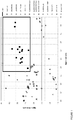
- Alumina, Al 2 O 3 is also a network forming oxide of glass and, according to the present invention, it is present, in combination with MgO, in an amount of not more than 45 wt% as depicted in Figure 1 by the top horizontal thick solid line. It is preferred to have combined amounts of (MgO + Al 2 O 3 ) not more than 40 wt%, even not more than 38.5 wt% as high amounts of (MgO + Al 2 O 3 ) tend to yield high liquidus temperatures, thus hindering spinnability as can be seen in FR1435073 with a liquidus temperature of 1350°C for a combined amount (MgO + Al 2 O 3 ) of 40 to 42 wt%.
- Al 2 O 3 is preferably present in an amount of at least 7 wt% and obligatory less than 20 wt%. Higher amounts of alumina may be detrimental to the viscosity of the melt and increase the risks of devitrification.
- the amount of Al 2 O 3 is at least 13 wt% and, more preferably, the combined content of (SiO 2 + Al 2 O 3 ) is less than 79 wt%.
- This range of Al 2 O 3 can be considered as intermediate when compared with the prior art and, in combination with MgO in the claimed combined amounts, it allows for a high modulus with low processing temperature and viscosity (Tlog3).
- magnesia, MgO, according to the present invention is present, in combination with Al 2 O 3 , in an amount not exceeding 43 wt%, preferably 40 or even 38.5 wt%, as depicted in Figure 1 by the top horizontal thick solid line not according to the invention.
- MgO is present in amounts greater than or equal to 23.5 wt% and not more than 35 wt% (see vertical thick solid lines on the left and right hand sides in Figure 1 , not according to the invention). In lower amounts, the viscosity increases and the modulus decreases when compared with the claimed range.
- the glass compositions of the present invention comprise an amount of MgO greater than 12 wt% and not more than 22 wt%, preferably at most 20 wt%. It is preferably present in an amount greater than 13 wt%; more preferably greater than 15 wt%. Its presence in the claimed amounts contributes to a high tensile modulus, and counteracts the negative effects of Al 2 O 3 on devitrification. It also allows control of viscosity.
- Calcia, CaO is present in an amount of at least 5 wt% as a major component of the claimed formulations and, in combination with MgO, is present in the claimed amounts as discussed in the preceding paragraph. It is preferably present in an amount of not more than 20 wt%. CaO in these amounts permits to control the melt viscosity and devitrification. Too high amounts of CaO are reported as being detrimental to the tensile strength and modulus and to raise the liquidus temperature.
- the gist of the present invention lies in the unique combination of high amounts of (MgO +Al 2 O 3 ) together with high amounts of (MgO + CaO) which, in combination, are higher than the prior art glass fibre compositions, in particular as disclosed in JP580640243 .
- the glass compositions of the present invention and not of the present invention are comprised within the perimeter defined by the thick solid rectangular outline, and define a type of glass fibre compositions yielding excellent mechanical properties, good durability, and cost effective processing conditions.
- the glass fibres of the present invention may contain other oxides to fine tune the properties thereof.
- oxides that may enter into the composition of the present fibres are any oxide of the following elements: Li, Zn, Mn, Ce, V, Ti, Be, Sn, Ba, Zr, Sr, which may be present in an amount less than 5 wt%, typically of 0.05 to 3 wt%, preferably from 0.2 to 1.5, or 0.5 to 1.0 wt%.
- the glass fibres may further contain minor amounts (less than 1wt%) of alkaline oxides like Na 2 O and K 2 O. B 2 O 3 may also be present but its use is associated with well known drawbacks and is not preferred.
- Figure 3 compares the mean value of the specific modulus of the glass fibres according to the present invention with the ones of the prior art, showing the superior mechanical properties of the former, with specific moduli comparable with the ones of R- and S-glass.
- Figure 4A shows how increasing the (MgO + CaO) content increases the bulk stiffness of the glass. The glass stiffness also increases with increasing amounts of (MgO + Al 2 O 3 ) as illustrated in Figure 4B .
- Table 1 Glass formulations 1 and 3-11 according to the present invention and comparative compositions 2 and 12 (cf. black squares in Figure 1) # SiO 2 wt% Al 2 O 3 wt% MgO wt% CaO wt% MgO+CaO wt% MgO+ Al 2 O 3 wt% E bulk GPa E sp MPa kg -1 m 3 1 47,4 19,8 16,7 16,0 32,7 36,5 102,4 36,8 2 49,8 22,8 11,9 15,4 27,3 34,7 99,1 36,4 3 48,7 17,5 18,6 15,1 33,7 36,1 104,0 37,4 4 54,6 17,5 16,1 11,8 27,9 33,6 100,5 37,2 5 55,1 18,0 14,1 12,8 26,9 32,1 97,5 36,2 6 56,5 18,1 17,4 7,9 25,3 35,5 98,9 37,0 7 58,1 14,7 17,1 10,1 27,2 31,8 96,5 36,
- Table 2 lists further formulations which are also plotted in Figure 1 .
- Table 2 Glass formulations 14 and 17-18 according to the present invention and comparative compositions 13 and 15 (cf. black squares in Figure 1) # SiO 2 wt% Al 2 O 3 wt% MgO wt% CaO wt% MgO+CaO wt% MgO+Al 2 O 3 wt% 13 49,8 22,8 15,4 12,0 27,4 38,2 14 55,1 18,0 14,1 12,8 26,9 32,1 15 58,5 18,7 9,8 13,0 22,8 28,5 17 55,1 19,6 12,3 13,0 25,3 31,9 18 57,7 15,2 12,9 14,2 27,1 28,1
- compositions listed in Table 1 and 2 above yield a combination of good elastic modulus with quite acceptable processing temperatures.
- none of the glass fibres disclosed in the prior art comprises the claimed values of 23.5 ⁇ MgO + CaO ⁇ 35.0 wt% for the corresponding values of (MgO + Al 2 O 3 ) comprised between 27 and 43 wt%.
- the R-fibres disclosed in FR1435073 ( ⁇ -stars in Figure 1 ) comprise high amounts of (MgO + Al 2 O 3 ) and, in particular, high amounts of Al 2 O 3 , and low amounts of (MgO + CaO) ranging between 15 and 21 wt% (cf. Examples 1 to 3 of FR1435073 ).
- EP1641717 (white diamond in Figure 1 ), filed about 40 years after FR143073 , proposes glass fibre compositions maintaining the good mechanical properties of the R-glass fibres disclosed in the latter document, with substantially higher amounts of (MgO + CaO) but concomitantly with much lower amounts of (MgO + Al 2 O 3 ) not exceeding 26.9 wt% (cf. Ex.6 of EP1641717 ).
- the teaching of EP164171717 is clearly to not go above this limit as this would go back towards the teaching given in FR143073 , the very teaching that the formulations of EP1641717 intend to enhance.
- the mean specific modulus of the glasses disclosed in EP1641717 is 1.2 MPa kg -1 m 3 lower than the one of the glasses according to the present invention (cf. Figure 3 ).
- the mean value of Tlog3 is about 44°C higher than the one of the glasses according to the present invention (cf. Figure 3 ).
- the glass of WO2009/138661 has a specific modulus comparable with the one of the glass of the present invention, which is higher than the one of the preceding document (cf. Figure 3 ). It has, however, a higher mean value of Tlog3 than the one of the preceding patent application (cf. Figure 2 ).
- GB1391384 discloses glass compositions comprising (MgO + CaO) spanning the whole range of the abscissa as depicted in Figure 1 , from 15 to 35 wt%.
- the amounts of (MgO + Al 2 O 3 ) all range between 10 and 20 wt% with two exceptions out of over 75 examples, with (MgO + Al 2 O 3 ) values of 26.5 and 27.1, respectively (cf. Ex.16 of Table 5 and EX.7 of Table 4 of GB1391384 ), the latter, however, having a low value of (MgO + CaO) of 18.9 wt%.
- the Tlog3 of the glasses disclosed in this document are quite low, with a mean value lower than 1200°C, but there is no mechanical data disclosed therein. There is certainly no teaching in this document to combine high amounts of (MgO + CaO) and (MgO + Al 2 O 3 ) as proposed by the present invention.
- CA1045641 (white squares in Figure 1 ) and US3892581 (white triangles) disclose glass fibres for composites reinforcement comprising 16.3-18.5 wt% Al 2 O 3 , 8.5-12.7 wt% CaO, and 6.6-10.5 wt% MgO, with examples characterized by (MgO + Al 2 O 3 ) amounts of the order of 23-28 wt% and (MgO + CaO) of up to 23.2 wt%, but never with both contents comprised within the claimed ranges: a higher amount of one of (MgO + Al 2 O 3 ) and (MgO + CaO) being systematically compensated by a lower amount of the other.
- the inventor of US3892581 stresses that "the combination of the components at the levels designated impart the necessary properties to the glass fibers formed therefrom", thus clearly indicating that higher amounts and proportions of MgO, CaO, and Al 2 O 3 are not desirable.
- the fibres disclosed in WO2007/055964 and WO2007/055968 contain 20 to 31.3 wt% of (MgO + Al 2 O 3 ) with, however, lower amounts of (MgO + CaO) never higher than 19.54 wt%.
- the glass fibres disclosed in WO2008/142347 have rather low amounts of both (MgO + Al 2 O 3 ) and (MgO + CaO).
- the mean value of Tlog3 of the formulations disclosed in WO2008/142347 is 1321°C, which is about 90°C higher than the mean value measured on the glass formulations according to the present invention (cf. Figure 2 ).
- the specific modulus of the glass disclosed in this document is even lower than the one of E-glass and these fibres are therefore not the most suitable ones for applications where high stiffness and low weight are desired (cf. Figure 3 ).
- WO2006/064164 (grey squares in Figure 1 ) discloses several formulations with combined amounts of (MgO + CaO) ranging from 21 and 23.6 wt% but with lower amounts of (MgO + Al 2 O 3 ) never greater than 24.7 wt%.
- the higher amounts of both (MgO + CaO) and (MgO + Al 2 O 3 ) according to the present invention require higher amounts of MgO, Al 2 O 3 , and CaO than generally used in combination, preferably with Al 2 O 3 amounts of 7 to 25 wt%, CaO amounts of 5 to 20 wt%, and MgO amounts of 8 to 25 wt%, preferably of at least 12 wt%, more preferably at least 13 wt% and even at least 15 wt%.
- the combined content of (MgO + CaO) is at least equal to 23.5 wt%, preferably at least 24 wt%, or even greater than 25 wt%. This has been found to enhance stiffness and lower Tlog3 and liquidus temperatures.
- a content of Al 2 O 3 of at least 13 wt% is preferred, but the combined content of SiO 2 + Al 2 O 3 is preferably less than 79 wt%. It was found that, contrary to what was taught in WO2009/138661 , glasses with a combined amount of SiO 2 + Al 2 O 3 lower than 79 wt% yielded very good properties. Preferably, this amount is at least 65 wt%, more preferably, at least 66 wt%, and most preferably, it is comprised between 66 and 75 wt%.
- the glass fibres of the present invention are particularly suitable for use as reinforcement in composite materials with an organic or inorganic matrix.
- the reinforcement fibres can be present as continuous yarns or short fibres. In view of the high performance of the present fibres, they are preferably used as continuous yarns in so called advanced composite materials. These can be used as unidirectional filaments, like in filament winding, particularly suitable for the production of pressure vessels, or can be woven, braided, or knitted to form a series of 2-D or 3-D reinforcement preforms well known to the persons skilled in the art.
- the composite materials produced with the glass fibres of the present invention may have an inorganic matrix, but composite materials with an organic matrix are particularly preferred.
- the fibres of the present invention may be used with thermoset resins, thermoplastic polymers, or elastomers alike.
- the fibres may be impregnated in the composite forming tool (e.g., RTM, sheet moulding, or filament winding) or pre-impregnated forming a prepreg or a tow-preg.
- the composite forming tool e.g., RTM, sheet moulding, or filament winding
- pre-impregnated forming a prepreg or a tow-preg e.g., a prepreg or a tow-preg.
- direct impregnation of dry fibres is probleamtic because of the generally high viscosity of thermoplastic melts, and a solvent is then required to lower the viscosity.
- tow-pregs wherein the glass fibres are intimately mingled with the thermoplastic matrix present either as a powder or as filaments.
- the glass-thermoplastic towpregs are impregnated and consolidated in a tool under elevated temperature and pressure.
- the thermoplastic matrix must be cooled below its melting temperature prior to extracting the composite part from the tool.
- Composite materials reinforced with the fibres of the present invention can advantageously be used for the manufacturing of a number of advanced engineering parts, such as panels in the automotive and aerospace industries, pressure vessels, and windmill blades.
- Panels or more intricate functional parts in e.g., the automotive and aerospace industries may be produced by any processing technique known in the art, such as resin transfer moulding (RTM), compression moulding, vacuum bagging, autoclave forming, filament winding, etc.
- Pressure vessels can advantageously be produced by filament winding.
- they can be produced by laying the fibres, e.g., as a braided or knitted preform on an inflatable bladder and the whole system is then placed into a closed tool defining a cavity.
- Resin is either injected if the fibres are dry, or in case of prepregs or tow-pregs, the temperature is raised and the bladder inflated to press the fibres and matrix against the inner walls of the tool defining the cavity to drive impregnation of the fibres.
- Windmill blades may be produced by winding roving tapes or roving bundles around a core or mandrel, as disclosed e.g., in US4242160 and US4381960 . They can also be manufactured by joining two half-shells produced e.g., by compression moulding, vacuum bagging, autoclave forming, or stamping prepregs. The joining is generally carried out with an adhesive which is critical and may constitute a weak part of the blade. Depending on the matrix, resin curing may advantageously be carried out by exposure to UV radiation or heat. In case of thermoplastic polymers, the temperature cycle includes heating above and cooling below the melting temperature prior, respectively, after the fibre impregnation stage. Windmill blades may also be produced by RTM, the blades comprising a foam core or the tool being designed with a removable core (cf. e.g., US2003116262 ).
Landscapes
- Chemical & Material Sciences (AREA)
- Life Sciences & Earth Sciences (AREA)
- Engineering & Computer Science (AREA)
- Chemical Kinetics & Catalysis (AREA)
- General Chemical & Material Sciences (AREA)
- Geochemistry & Mineralogy (AREA)
- Materials Engineering (AREA)
- Organic Chemistry (AREA)
- General Life Sciences & Earth Sciences (AREA)
- Glass Compositions (AREA)
Description
- The present invention relates to the field of glass fibres, in particular of compositions of glass fibres suitable as reinforcement of high performance fibre reinforced organic or inorganic matrix composite materials. It finally relates to products, such as windmill blades comprising a polymeric shell or skin reinforced with the above glass fibres.
- Glass fibre compositions suitable as reinforcement for composite materials have been described for a long time. In
1966, FR1435073 - E-glass is probably the most common type of glass used in continuous fibre reinforced composites. E-glass generally comprises 52 to 56 wt% SiO2, 12 to 16 wt% Al2O3, 0 to 5 wt% MgO, 16 to 25 wt% CaO, and 5 to 10 wt% B2O3, and minor amounts of alkaline oxides like Na2O and K2O. E-glass is usually used as the reference fibre with which the performance of new glass compositions is compared. Boron free E-glass compositions have been proposed, e.g., in
US-A-5,789,329 with 59 to 62 wt% SiO2, 12 to 15 wt% Al2O3, 1 to 4 wt% MgO, 20 to 24 wt% CaO, and minor amounts of alkaline oxides like Na2O and K2O. - S-glass is a glass generally having higher mechanical strength than E-glasses and comprising about 65 wt% SiO2, 25 wt% Al2O3, and 10 wt% MgO. As can be seen from the above review, E- and S-glass fibres usually have a low (MgO + Al2O3) content, whilst the (MgO + Al2O3) content in R-glass fibres is quite high with contents of at least 25 wt%, and wherein amounts greater than 40 wt% are common.
- A multitude of quaternary glass fibre compositions comprising SiO2, Al2O3, CaO, and MgO as major components, within and around the three main R-, E-, S-glass types revised supra have been proposed in the literature.
-
GB520246 filed in 1938 - In
GB1391 384 -
WO2007/055964 andWO2007/055968 propose glass compositions yielding fibres with higher mechanical properties and enhanced resistance to temperature and acids than E-glasses with good forming capability. They are characterized by a content of 60.5-70.5 wt% SiO2, 10-24.5 wt% Al2O3, and 6-20 wt% of RO (= MgO + CaO + SrO). The glass fibres cited in the examples comprise 4.8-14 wt% CaO, and 5.0-11.3 wt% MgO. -
EP1641717 discloses glass fibres with mechanical properties comparable with the ones of R-glass, as disclosed inFR1435073 EP1641717 comprise 50-65 wt% SiO2, 12-20 wt% Al2O3, 12-17 wt% CaO, and 6-12 wt% MgO, with a combined amount of (MgO + Al2O3) preferably larger than 24 wt%. -
WO2009/138661 teaches that a glass fibre having a high modulus and a liquidus temperature of 1250°C or less can be obtained with a formulation comprising 50-65 wt% SiO2, 12-23 wt% Al2O3, 1-10 wt% CaO, and 6-12 wt% MgO. The sum of SiO2 and Al2O3 should be greater than 79 wt%. -
WO9840321 -
CA1045641 andUS3892581 disclose glass fibres for composites reinforcement comprising 53-57.3 wt% SiO2, 16.3-18.5 wt% Al2O3, 8.5-12.7 wt% CaO, and 6.6-10.5 wt% MgO. Similarly,WO2006/064164 describes glass fibres for reinforcement of composite materials with broader content ranges than the preceding compositions, comprising 50.0-65.0 wt% SiO2, 12.0-20.0 wt% Al2O3, 12.0-17.0 wt% CaO, and 6.0-12.0 wt% MgO. -
WO2008/142347 discloses low cost glass fibre formulations providing excellent trade-off between mechanical properties and production conditions. They comprise rather low combined amounts of (MgO + Al2O3), with 62.0-72.0 wt% SiO2, 4.0-11.0 wt% Al2O3, 8.0-22.0 wt% CaO, and 1.0-7.0 wt% MgO. -
JP58064243 -
EP2450321 describes a high strength and high modulus glass fibre comprising 56-64 wt.% of SiO2, 13-20 wt.% of Al2O3, 8-13 wt.% CaO, and 7-12 wt.% MgO, and other oxides. -
WO2011017405 describes an R-glass composition including 59.0 to 64.5 wt.% of SiO2, 14.5 to 20.5 wt.% of Al2O3, 11.0 to 16.0 wt.% of CaO, 5.5 to 11.5 wt.% of MgO, and other oxides. - In spite of the extensive research done to date to develop glass fibre compositions with enhanced properties, there still is a need to find glass fibres combining high mechanical, physical and chemical properties with production cost effectiveness.
- The present invention is defined in the appended independent claims. Preferred embodiments are defined in the dependent claims. The present invention provides a glass fibre of quaternary composition comprising SiO2, Al2O3, CaO, and MgO as major components, each present in an amount of at least 5 wt%, and comprising less than 3.3 wt.% B2O3, and less than 2.0 wt.% fluorine, characterized by:
- 23.5 ≤ MgO + CaO ≤ 35.0 wt%, and
- 27.0 ≤ MgO + Al2O3 < 43.0 wt%,
- Al2O3 < 20 wt%,
- all amounts
- 23.5 ≤ MgO + CaO ≤ 35.0 wt%, and being expressed in weight % with respect to the total weight of the composition.
- In the context of the present invention, a "major component" should be understood as a component present in an amount of at least 5 wt% of the total weight of the composition. The compositions of the present invention are characterized by higher contents of both (MgO + CaO) and (MgO + Al2O3) in combination, when compared with the compositions of the prior art.
- In a preferred embodiment, glass fibres according to the present invention are characterized by:
- (MgO + Al2O3) ≥ 28,5 wt%, and/or
- (MgO + Al2O3) ≤ 40.0 wt%, preferably ≤ 38.0 wt%.
- The content of (MgO + CaO) is preferably at least 24.0 wt%. The cumulated content of MgO + Al2O3 is preferably at least 28 wt.%, more preferably between 30 and 40 wt.%.
- The quaternary compositions of the present invention may comprise from 45 to 65 wt% SiO2, 7 to less than 20 wt% Al2O3, 5 to 20 wt% CaO, and 8 to 25 wt% MgO, and preferably the content of (MgO + CaO) is at least 25 wt%. It is advantageous if the content of MgO is comprised between 11 and 23 wt%, and preferably greater than 12 wt%, most preferably at least 13 or at least 15 wt%. Good results are obtained when:
- 7 wt% ≤ Al2O3 < 20 wt%, preferably Al2O3 ≥ 13 wt%, and/or
- 12 wt% < MgO ≤ 22 wt%, preferably, Mg0 ≤ 20 wt%.
- Advantageously, the combined content of (SiO2 + Al2O3) of the glass fibres of the present invention is less than 79 wt%. Boron is preferably present in amounts of less than 3.0 wt.%, more preferably less than 2.0 wt.%, more preferably less than 1.0 wt.%. Similarly, fluorine is preferably present in amounts less than 1.5 wt.%, more preferably less than 1.0 wt.%, more preferably less than 0.5 wt.%. The presence of neither fluorine nor boron is essential in the formulations of the present invention, and in yet a preferred embodiment, the composition comprises substantially no boron nor fluorine (bar traces present in the natural minerals used), to avoid the well known drawbacks associated with these components.
- The glasses according to the present invention are preferably characterized by:
- A SiO2 / (MgO + CaO) ratio comprised between 1.80 and 2.30, preferably between 1.8 and 2.28, more preferably between 1.84 and 2.28 and/or
- MgO / (MgO + CaO) ratio greater than 15%.
- In another embodiment, the glass fibres are characterized by:
- SiO2 / (MgO + CaO) ratio is comprised between 1.30 and 2.0, and/or
- Al2O3 / (MgO + CaO) ratio is comprised between 15 and 120%.
- The present invention also concerns a composite material comprising an organic or inorganic matrix reinforced with glass fibres as described supra. The glass fibres of the present invention are particularly suitable for applications where high performance composites are needed, in particular in applications such as windmill blades, pressure vessels, components in the automotive, machinery, ballistics, and aerospace applications. In particular, windmill blades generally consist of a hollow shell or a skin-core structure, wherein the shell or skin are made of a polymeric material (e.g., thermoset resins such as epoxy or polyesters, or thermoplastic polymers such as PET, PP) reinforced by long, preferably continuous fibres. The present invention also concerns windmill blades and other products comprising a polymeric matrix reinforced with glass fibres as defined supra.
-
- Figure 1:
- shows a plot of the (MgO + CaO) vs (MgO + Al2O3) of glass compositions compared with the glass fibre formulations of the prior art revised supra.
- Figure 2:
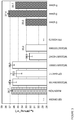
- shows the mean Tlog3 values of glasses compared with values published in the prior art revised supra.
- Figure 3:
- shows the mean specific modulus (Esp) of glasses compared with values published in the prior art revised supra.
- Figure 4:
- shows the bulk modulus (Ebulk), (A) as a function of the (MgO + CaO) content and (B) as a function of the (MgO + Al2O3) content.
- The glass fibre compositions of the present invention are defined as quaternary because they comprise at least 5 wt% of the following four components: SiO2, Al2O3, CaO, and MgO.
- Silicia, SiO2, as network forming oxide of glass, is the principal component of glass and is preferably present in an amount comprised between 45 and 65 wt%, more preferably between 47 and 59 wt%. Increasing the amount of SiO2 generally increases the viscosity of the melt.
- Alumina, Al2O3, is also a network forming oxide of glass and, according to the present invention, it is present, in combination with MgO, in an amount of not more than 45 wt% as depicted in
Figure 1 by the top horizontal thick solid line. It is preferred to have combined amounts of (MgO + Al2O3) not more than 40 wt%, even not more than 38.5 wt% as high amounts of (MgO + Al2O3) tend to yield high liquidus temperatures, thus hindering spinnability as can be seen inFR1435073 - As mentioned supra, magnesia, MgO, according to the present invention is present, in combination with Al2O3, in an amount not exceeding 43 wt%, preferably 40 or even 38.5 wt%, as depicted in
Figure 1 by the top horizontal thick solid line not according to the invention. In combination with CaO, MgO is present in amounts greater than or equal to 23.5 wt% and not more than 35 wt% (see vertical thick solid lines on the left and right hand sides inFigure 1 , not according to the invention). In lower amounts, the viscosity increases and the modulus decreases when compared with the claimed range. Preferably; the glass compositions of the present invention comprise an amount of MgO greater than 12 wt% and not more than 22 wt%, preferably at most 20 wt%. It is preferably present in an amount greater than 13 wt%; more preferably greater than 15 wt%. Its presence in the claimed amounts contributes to a high tensile modulus, and counteracts the negative effects of Al2O3 on devitrification. It also allows control of viscosity. - Calcia, CaO, is present in an amount of at least 5 wt% as a major component of the claimed formulations and, in combination with MgO, is present in the claimed amounts as discussed in the preceding paragraph. It is preferably present in an amount of not more than 20 wt%. CaO in these amounts permits to control the melt viscosity and devitrification. Too high amounts of CaO are reported as being detrimental to the tensile strength and modulus and to raise the liquidus temperature.
- The gist of the present invention lies in the unique combination of high amounts of (MgO +Al2O3) together with high amounts of (MgO + CaO) which, in combination, are higher than the prior art glass fibre compositions, in particular as disclosed in
JP580640243 Figure 1 , the glass compositions of the present invention and not of the present invention are comprised within the perimeter defined by the thick solid rectangular outline, and define a type of glass fibre compositions yielding excellent mechanical properties, good durability, and cost effective processing conditions. - The glass fibres of the present invention may contain other oxides to fine tune the properties thereof. Typical examples of oxides that may enter into the composition of the present fibres are any oxide of the following elements: Li, Zn, Mn, Ce, V, Ti, Be, Sn, Ba, Zr, Sr, which may be present in an amount less than 5 wt%, typically of 0.05 to 3 wt%, preferably from 0.2 to 1.5, or 0.5 to 1.0 wt%. The glass fibres may further contain minor amounts (less than 1wt%) of alkaline oxides like Na2O and K2O. B2O3 may also be present but its use is associated with well known drawbacks and is not preferred.
- Table 1 lists the compositions of a number of glass fibres represented in
Figure 1 with black squares. Table 1 also lists the measured values of the bulk modulus which lie around 100 GPa, and of the specific modulus (Esp = Ebulk / density) which range between 36.4 and 37.4 MPa kg-1 m3.Figure 3 compares the mean value of the specific modulus of the glass fibres according to the present invention with the ones of the prior art, showing the superior mechanical properties of the former, with specific moduli comparable with the ones of R- and S-glass.Figure 4A shows how increasing the (MgO + CaO) content increases the bulk stiffness of the glass. The glass stiffness also increases with increasing amounts of (MgO + Al2O3) as illustrated inFigure 4B .Table 1: Glass formulations 1 and 3-11 according to the present invention and comparative compositions 2 and 12 (cf. black squares in Figure 1)# SiO2 wt% Al2O3 wt% MgO wt% CaO wt% MgO+CaO wt% MgO+ Al2O3 wt% Ebulk GPa Esp MPa kg-1 m3 1 47,4 19,8 16,7 16,0 32,7 36,5 102,4 36,8 2 49,8 22,8 11,9 15,4 27,3 34,7 99,1 36,4 3 48,7 17,5 18,6 15,1 33,7 36,1 104,0 37,4 4 54,6 17,5 16,1 11,8 27,9 33,6 100,5 37,2 5 55,1 18,0 14,1 12,8 26,9 32,1 97,5 36,2 6 56,5 18,1 17,4 7,9 25,3 35,5 98,9 37,0 7 58,1 14,7 17,1 10,1 27,2 31,8 96,5 36,1 8 57,9 17,0 15,8 9,2 25,0 32,8 96,0 36,4 9 58,2 15,2 18,3 8,3 26,6 33,5 98,1 36,7 10 58,9 16,7 15,5 8,8 24,3 32,2 97,0 36,7 11 60,2 15,6 17,5 6,6 24,1 33,1 96,4 36,8 12 61,7 17,1 12,1 9,0 21,1 29,2 93,4 36,2 - Table 2 lists further formulations which are also plotted in
Figure 1 .Table 2: Glass formulations 14 and 17-18 according to the present invention and comparative compositions 13 and 15 (cf. black squares in Figure 1) # SiO2 wt% Al2O3 wt% MgO wt% CaO wt% MgO+CaO wt% MgO+Al2O3 wt% 13 49,8 22,8 15,4 12,0 27,4 38,2 14 55,1 18,0 14,1 12,8 26,9 32,1 15 58,5 18,7 9,8 13,0 22,8 28,5 17 55,1 19,6 12,3 13,0 25,3 31,9 18 57,7 15,2 12,9 14,2 27,1 28,1 - The compositions listed in Table 1 and 2 above yield a combination of good elastic modulus with quite acceptable processing temperatures. As can be seen in
Figure 1 , none of the glass fibres disclosed in the prior art comprises the claimed values of 23.5 ≤ MgO + CaO ≤ 35.0 wt% for the corresponding values of (MgO + Al2O3) comprised between 27 and 43 wt%. For example, the R-fibres disclosed inFR1435073 Figure 1 ) comprise high amounts of (MgO + Al2O3) and, in particular, high amounts of Al2O3, and low amounts of (MgO + CaO) ranging between 15 and 21 wt% (cf. Examples 1 to 3 ofFR1435073 Figure 2 ). Although an Al2O3 amount ranging from 20 to 30 wt% and an MgO amount of 5 to 20 wt% are claimed, the preferred ranges are 24 to 26 wt% Al2O3, and 6 to 16 wt% MgO, as confirmed by the examples all comprising 25 to 26 wt% Al2O3. In our opinion, such high amounts of Al2O3 together with low amounts of (MgO + CaO), even when combined with high amounts of MgO, increase the risk of devitrification and are detrimental to the viscosity of the melt and fiberization conditions which, together with the high processing temperature (Tlog3), impact on the production costs. The fibres of the present invention avoid these drawbacks by using more than 21 wt% of (MgO + CaO), which can be seen to enhance the values of both Tlog3 and of the modulus (cf.Figures 4A and 4B ). -
EP1641717 (white diamond inFigure 1 ), filed about 40 years afterFR143073 EP1641717 ). The teaching ofEP1641717 is clearly to not go above this limit as this would go back towards the teaching given inFR143073 EP1641717 intend to enhance. Note that the mean specific modulus of the glasses disclosed inEP1641717 is 1.2 MPa kg-1 m3 lower than the one of the glasses according to the present invention (cf.Figure 3 ). Similarly, the mean value of Tlog3 is about 44°C higher than the one of the glasses according to the present invention (cf.Figure 3 ). - Later, one of the inventors of the preceding application discloses in
WO2009/138661 (X-crosses inFigure 1 ) an improvement over the fibres disclosed inEP1641717 with glass fibres comprising slightly higher amounts of (MgO + Al2O3) (= 28.3 to 30.8 wt%) but with substantially lower amounts of (MgO + CaO) (= 15.1 to 18.3 wt%). The glass ofWO2009/138661 has a specific modulus comparable with the one of the glass of the present invention, which is higher than the one of the preceding document (cf.Figure 3 ). It has, however, a higher mean value of Tlog3 than the one of the preceding patent application (cf.Figure 2 ). Surprisingly, it has been found that by increasing the amounts of both (MgO + CaO) and (MgO + Al2O3) above the ranges disclosed in the preceding two documents, glass fibres with excellent properties and low processing temperatures (Tlog3) can be produced. -
GB1391384 Figure 1 , from 15 to 35 wt%. The amounts of (MgO + Al2O3) all range between 10 and 20 wt% with two exceptions out of over 75 examples, with (MgO + Al2O3) values of 26.5 and 27.1, respectively (cf. Ex.16 of Table 5 and EX.7 of Table 4 ofGB1391384 -
CA1045641 (white squares inFigure 1 ) andUS3892581 (white triangles) disclose glass fibres for composites reinforcement comprising 16.3-18.5 wt% Al2O3, 8.5-12.7 wt% CaO, and 6.6-10.5 wt% MgO, with examples characterized by (MgO + Al2O3) amounts of the order of 23-28 wt% and (MgO + CaO) of up to 23.2 wt%, but never with both contents comprised within the claimed ranges: a higher amount of one of (MgO + Al2O3) and (MgO + CaO) being systematically compensated by a lower amount of the other. The inventor ofUS3892581 stresses that "the combination of the components at the levels designated impart the necessary properties to the glass fibers formed therefrom", thus clearly indicating that higher amounts and proportions of MgO, CaO, and Al2O3 are not desirable. - The fibres disclosed in
WO2007/055964 andWO2007/055968 (grey circles inFigure 1 ) contain 20 to 31.3 wt% of (MgO + Al2O3) with, however, lower amounts of (MgO + CaO) never higher than 19.54 wt%. As can be seen inFigure 2 , the temperature of the melt corresponding to a viscosity of 103 poise (= Tlog3) of the glass fibre formulations disclosed in these documents is quite high with a mean value of 1395°C, about 160°C higher than the mean value of Tlog3 measured on the formulations according to the present invention (cf.Figure 2 ). These substantially higher processing temperatures are detrimental to the economics of the fibres disclosed inWO2007/055964 andWO2007/055968 compared with the fibres according to the present invention. The specific modulus of these glasses is of the order of the one of E-glass and therefore considerably lower than the one of the glass of the present invention (cf. Figrue 3). - The glass fibres disclosed in
WO2008/142347 (grey triangles inFigure 1 ) have rather low amounts of both (MgO + Al2O3) and (MgO + CaO). The mean value of Tlog3 of the formulations disclosed inWO2008/142347 is 1321°C, which is about 90°C higher than the mean value measured on the glass formulations according to the present invention (cf.Figure 2 ). The specific modulus of the glass disclosed in this document is even lower than the one of E-glass and these fibres are therefore not the most suitable ones for applications where high stiffness and low weight are desired (cf.Figure 3 ). -
WO2006/064164 (grey squares inFigure 1 ) discloses several formulations with combined amounts of (MgO + CaO) ranging from 21 and 23.6 wt% but with lower amounts of (MgO + Al2O3) never greater than 24.7 wt%. - Contrary to the conservative trend observed in the prior art as revealed supra, a totally novel and unexplored area of glass fibre formulations characterized by substantially higher amounts of both (MgO + CaO) and (MgO + Al2O3) than hitherto applied has shown to yield excellent mechanical properties with exceptionally low Tlog3 values (cf.
Figures 2 and3 ). The higher amounts of both (MgO + CaO) and (MgO + Al2O3) according to the present invention require higher amounts of MgO, Al2O3, and CaO than generally used in combination, preferably with Al2O3 amounts of 7 to 25 wt%, CaO amounts of 5 to 20 wt%, and MgO amounts of 8 to 25 wt%, preferably of at least 12 wt%, more preferably at least 13 wt% and even at least 15 wt%. - Accordingto the present invention, the combined content of (MgO + CaO) is at least equal to 23.5 wt%, preferably at least 24 wt%, or even greater than 25 wt%. This has been found to enhance stiffness and lower Tlog3 and liquidus temperatures. A content of Al2O3 of at least 13 wt% is preferred, but the combined content of SiO2 + Al2O3 is preferably less than 79 wt%. It was found that, contrary to what was taught in
WO2009/138661 , glasses with a combined amount of SiO2 + Al2O3 lower than 79 wt% yielded very good properties. Preferably, this amount is at least 65 wt%, more preferably, at least 66 wt%, and most preferably, it is comprised between 66 and 75 wt%. - In view of their high stiffness (cf. Table 1) the glass fibres of the present invention are particularly suitable for use as reinforcement in composite materials with an organic or inorganic matrix. The reinforcement fibres can be present as continuous yarns or short fibres. In view of the high performance of the present fibres, they are preferably used as continuous yarns in so called advanced composite materials. These can be used as unidirectional filaments, like in filament winding, particularly suitable for the production of pressure vessels, or can be woven, braided, or knitted to form a series of 2-D or 3-D reinforcement preforms well known to the persons skilled in the art.
- The composite materials produced with the glass fibres of the present invention may have an inorganic matrix, but composite materials with an organic matrix are particularly preferred. In particular, the fibres of the present invention may be used with thermoset resins, thermoplastic polymers, or elastomers alike. In the case of thermoset resins, the fibres may be impregnated in the composite forming tool (e.g., RTM, sheet moulding, or filament winding) or pre-impregnated forming a prepreg or a tow-preg. For thermoplastic polymers, direct impregnation of dry fibres is probleamtic because of the generally high viscosity of thermoplastic melts, and a solvent is then required to lower the viscosity. But solvent extraction after formation is time and energy consuming and raises serious environmental concerns. It is preferred to produce tow-pregs wherein the glass fibres are intimately mingled with the thermoplastic matrix present either as a powder or as filaments. As is the case with glass-thermoset prepregs, the glass-thermoplastic towpregs are impregnated and consolidated in a tool under elevated temperature and pressure. Unlike the thermoset composites, the thermoplastic matrix must be cooled below its melting temperature prior to extracting the composite part from the tool.
- Composite materials reinforced with the fibres of the present invention can advantageously be used for the manufacturing of a number of advanced engineering parts, such as panels in the automotive and aerospace industries, pressure vessels, and windmill blades.
- Panels or more intricate functional parts in e.g., the automotive and aerospace industries may be produced by any processing technique known in the art, such as resin transfer moulding (RTM), compression moulding, vacuum bagging, autoclave forming, filament winding, etc. Pressure vessels can advantageously be produced by filament winding. Alternatively, they can be produced by laying the fibres, e.g., as a braided or knitted preform on an inflatable bladder and the whole system is then placed into a closed tool defining a cavity. Resin is either injected if the fibres are dry, or in case of prepregs or tow-pregs, the temperature is raised and the bladder inflated to press the fibres and matrix against the inner walls of the tool defining the cavity to drive impregnation of the fibres.
- Windmill blades may be produced by winding roving tapes or roving bundles around a core or mandrel, as disclosed e.g., in
US4242160 andUS4381960 . They can also be manufactured by joining two half-shells produced e.g., by compression moulding, vacuum bagging, autoclave forming, or stamping prepregs. The joining is generally carried out with an adhesive which is critical and may constitute a weak part of the blade. Depending on the matrix, resin curing may advantageously be carried out by exposure to UV radiation or heat. In case of thermoplastic polymers, the temperature cycle includes heating above and cooling below the melting temperature prior, respectively, after the fibre impregnation stage. Windmill blades may also be produced by RTM, the blades comprising a foam core or the tool being designed with a removable core (cf. e.g.,US2003116262 ).
Claims (14)
- Glass fibre of quaternary composition comprising SiO2, Al2O3, CaO, and MgO, each present in an amount of at least 5 wt.%, and comprising less than 3.3 wt.% B2O3, and less than 2.0 wt.% fluorine, characterized in that,• Al2O3 < 20 wt.%,• 23.5 ≤ MgO + CaO ≤ 35.0 wt%, and• 27.0 ≤ MgO + Al2O3 ≤ 43.0 wt.%,
all amounts being expressed in weight % with respect to the total weight of the composition, and wherein a quaternary composition is defined as a composition comprising at least 5 wt% of the following four components: SiO2, Al2O3, CaO, and MgO. - Glass fibre according to claim 1 wherein:• (MgO + Al2O3) ≥ 28,5 wt%, and/or• (MgO + Al2O3) ≤ 40.0 wt%, preferably ≤ 38.0 wt%.
- Glass fibre according to any of the preceding claims comprising 45 to 65 wt% SiO2, 7 to less than 20 wt% Al2O3, 5 to 20 wt% CaO, and 8 to 25 wt% MgO.
- Glass fibre according to the preceding claim 3, comprising a content of (MgO + CaO) greater than 25 wt%.
- Glass fibre according to any of the preceding claims wherein the content of MgO is comprised between 11 and 23 wt%, and is preferably greater than 12 wt%, most preferably at least 13 or at least 15 wt%.
- Glass fibre according to any of the preceding claims wherein:
Glass fibre according to any of the preceding claims wherein,:• Al2O3 ≥ 13 wt%, and/or• 12 wt% < MgO ≤ 22 wt%, preferably, Mg0 ≤ 20 wt%. - Glass fibre according to any of the preceding claims wherein:• SiO2 / (MgO + CaO) ratio is comprised between 1.80 and 2.30, preferably between 1.8 and 2.28, more preferably between 1.84 and 2.28 and/or• MgO / (MgO + CaO) ratio is greater than 15%.
- Glass fibre according to any of claims 1 to 5, wherein:• SiO2 / (MgO + CaO) ratio is comprised between 1.30 and 2.0, and/or• Al2O3 / (MgO + CaO) ratio is comprised between 15 and 120%.
- Glass fibre according to any of the preceding claims comprising substantially no boron oxide and/or substantially no fluorine.
- Composite material comprising an organic or inorganic matrix reinforced with glass fibres according to any of the preceding claims.
- Use of glass fibres according to any of claims 1 to 9 as reinforcement for the manufacturing of windmill blades, pressure vessels, or parts in the fields of automotive, aeronautics, or ballistics.
- Windmill blade comprising a skin or shell made of a composite material reinforced with glass fibres according to any of claims 1 to 9.
- Pressure vessel made of a composite material reinforced with glass fibres according to any of claims 1 to 9.
- Product in the fields of automotive, aeronautics, or ballistics made of a composite material reinforced with glass fibres according to any of claims 1 to 9.
Priority Applications (1)
| Application Number | Priority Date | Filing Date | Title |
|---|---|---|---|
| EP11701842.4A EP2531457B1 (en) | 2010-02-05 | 2011-02-04 | Glass fibre composition and composite material reinforced therewith |
Applications Claiming Priority (3)
| Application Number | Priority Date | Filing Date | Title |
|---|---|---|---|
| EP10152828A EP2354105A1 (en) | 2010-02-05 | 2010-02-05 | Glass fibre composition and composite material reinforced therewith |
| PCT/EP2011/051677 WO2011095601A1 (en) | 2010-02-05 | 2011-02-04 | Glass fibre composition and composite material reinforced therewith |
| EP11701842.4A EP2531457B1 (en) | 2010-02-05 | 2011-02-04 | Glass fibre composition and composite material reinforced therewith |
Publications (2)
| Publication Number | Publication Date |
|---|---|
| EP2531457A1 EP2531457A1 (en) | 2012-12-12 |
| EP2531457B1 true EP2531457B1 (en) | 2020-05-06 |
Family
ID=42227585
Family Applications (2)
| Application Number | Title | Priority Date | Filing Date |
|---|---|---|---|
| EP10152828A Withdrawn EP2354105A1 (en) | 2010-02-05 | 2010-02-05 | Glass fibre composition and composite material reinforced therewith |
| EP11701842.4A Active EP2531457B1 (en) | 2010-02-05 | 2011-02-04 | Glass fibre composition and composite material reinforced therewith |
Family Applications Before (1)
| Application Number | Title | Priority Date | Filing Date |
|---|---|---|---|
| EP10152828A Withdrawn EP2354105A1 (en) | 2010-02-05 | 2010-02-05 | Glass fibre composition and composite material reinforced therewith |
Country Status (7)
| Country | Link |
|---|---|
| US (1) | US9102564B2 (en) |
| EP (2) | EP2354105A1 (en) |
| CN (1) | CN102770383B (en) |
| BR (1) | BR112012018590A2 (en) |
| RU (1) | RU2556680C2 (en) |
| TW (1) | TWI560164B (en) |
| WO (1) | WO2011095601A1 (en) |
Families Citing this family (11)
| Publication number | Priority date | Publication date | Assignee | Title |
|---|---|---|---|---|
| KR101293941B1 (en) | 2010-06-08 | 2013-08-08 | 니토 보세키 가부시기가이샤 | Glass fiber |
| CN103338925B (en) * | 2010-11-29 | 2015-08-05 | Gtm先进产品有限公司 | Improved Fiber Metal Laminates |
| US20140357143A1 (en) * | 2011-12-06 | 2014-12-04 | Nitto Boseki Co., Ltd. | Glass fabric and glass fiber sheet material using same |
| EP2789591B1 (en) * | 2011-12-06 | 2018-09-05 | Nitto Boseki Co., Ltd | Glass fibers having non-circular cross sections, and fiber-reinforced resin compact using same |
| RU2641050C2 (en) * | 2012-04-18 | 2018-01-15 | 3Б Фибрегласс СПРЛ | Glass fibre composition |
| US10077205B2 (en) * | 2014-05-15 | 2018-09-18 | Corning Incorporated | Aluminosilicate glasses |
| CN109928641B (en) | 2017-12-19 | 2022-11-15 | 欧文斯科宁知识产权资产有限公司 | High Performance Glass Fiber Composition |
| CN110606665B (en) | 2019-09-25 | 2020-11-17 | 巨石集团有限公司 | Electronic-grade glass fiber composition, glass fiber thereof and electronic cloth |
| US12053908B2 (en) | 2021-02-01 | 2024-08-06 | Regen Fiber, Llc | Method and system for recycling wind turbine blades |
| CN120569354A (en) | 2023-01-06 | 2025-08-29 | 欧文斯科宁知识产权资产有限公司 | Lithium-free high modulus glass fiber composition |
| CN116282934B (en) * | 2023-02-24 | 2023-08-15 | 泰山玻璃纤维有限公司 | High magnesium high specific modulus glass fiber composition and glass fiber |
Citations (2)
| Publication number | Priority date | Publication date | Assignee | Title |
|---|---|---|---|---|
| WO2011017405A1 (en) * | 2009-08-04 | 2011-02-10 | Ocv Intellectual Capital, Llc | Improved modulus, lithium free glass |
| EP2450321A1 (en) * | 2009-07-02 | 2012-05-09 | Chongqing Polycomp International Corporation | High-intensity and high-modulus glass fiber |
Family Cites Families (24)
| Publication number | Priority date | Publication date | Assignee | Title |
|---|---|---|---|---|
| BE430668A (en) * | 1937-10-16 | |||
| FR1435073A (en) | 1965-03-02 | 1966-04-15 | Verre Textile Soc Du | Glass compositions |
| CA975386A (en) | 1972-04-28 | 1975-09-30 | Owens-Corning Fiberglas Corporation | Fiberizable glass compositions |
| US3892581A (en) | 1973-09-10 | 1975-07-01 | Ppg Industries Inc | Glass fiber compositions |
| CA1045641A (en) | 1975-04-24 | 1979-01-02 | Edward M. Hunia | Glass fiber compositions |
| JPS524519A (en) * | 1975-06-30 | 1977-01-13 | Fuji Fibre Glass Co Ltd | Composite of alkaliiproof glass |
| JPS53102325A (en) * | 1977-02-18 | 1978-09-06 | Obara Optical Glass | Abrasionn and chemicallproof glass |
| US4242160A (en) | 1979-02-02 | 1980-12-30 | United Technologies Corporation | Method of winding a wind turbine blade using a filament reinforced mandrel |
| JPS5864243A (en) * | 1981-10-13 | 1983-04-16 | Asahi Glass Co Ltd | Glass composition with high elasticity and heat resistance |
| US4381960A (en) | 1981-12-28 | 1983-05-03 | United Technologies Corporation | Method of manufacturing a filament wound article |
| HU219310B (en) * | 1994-11-08 | 2001-03-28 | Rockwool Int | Man-made vitreous fibres |
| AU692712B2 (en) | 1995-06-06 | 1998-06-11 | Owens Corning | Boron-free glass fibers |
| US6346494B1 (en) * | 1995-11-08 | 2002-02-12 | Rockwool International A/S | Man-made vitreous fibres |
| FI109294B (en) | 1997-03-10 | 2002-06-28 | Paroc Group Oy Ab | mineral fiber |
| FR2778400A1 (en) * | 1998-05-06 | 1999-11-12 | Saint Gobain Isover | COMPOSITION OF MINERAL WOOL |
| DK176335B1 (en) | 2001-11-13 | 2007-08-20 | Siemens Wind Power As | Process for manufacturing wind turbine blades |
| EP1453769A1 (en) * | 2001-12-12 | 2004-09-08 | Rockwool International A/S | Fibres and their production |
| FR2856055B1 (en) | 2003-06-11 | 2007-06-08 | Saint Gobain Vetrotex | GLASS YARNS FOR REINFORCING ORGANIC AND / OR INORGANIC MATERIALS, COMPOSITES COMPRISING SAME AND COMPOSITION USED THEREFOR |
| FR2879591B1 (en) | 2004-12-16 | 2007-02-09 | Saint Gobain Vetrotex | GLASS YARNS FOR REINFORCING ORGANIC AND / OR INORGANIC MATERIALS |
| US7823417B2 (en) | 2005-11-04 | 2010-11-02 | Ocv Intellectual Capital, Llc | Method of manufacturing high performance glass fibers in a refractory lined melter and fiber formed thereby |
| US7799713B2 (en) * | 2005-11-04 | 2010-09-21 | Ocv Intellectual Capital, Llc | Composition for high performance glass, high performance glass fibers and articles therefrom |
| FR2916438B1 (en) | 2007-05-23 | 2010-08-20 | Saint Gobain Vetrotex | GLASS YARNS FOR REINFORCING ORGANIC AND / OR INORGANIC MATERIALS |
| JP5104454B2 (en) * | 2008-03-25 | 2012-12-19 | 日東紡績株式会社 | Glass fiber fabric for bag filter |
| FR2930543B1 (en) | 2008-04-23 | 2010-11-19 | Saint Gobain Technical Fabrics | GLASS YARNS AND COMPOSITES WITH ORGANIC AND / OR INORGANIC MATRIX CONTAINING THESE YARNS |
-
2010
- 2010-02-05 EP EP10152828A patent/EP2354105A1/en not_active Withdrawn
-
2011
- 2011-02-04 WO PCT/EP2011/051677 patent/WO2011095601A1/en not_active Ceased
- 2011-02-04 EP EP11701842.4A patent/EP2531457B1/en active Active
- 2011-02-04 CN CN201180007933.8A patent/CN102770383B/en not_active Expired - Fee Related
- 2011-02-04 RU RU2012134525/03A patent/RU2556680C2/en not_active IP Right Cessation
- 2011-02-04 US US13/576,300 patent/US9102564B2/en not_active Expired - Fee Related
- 2011-02-04 BR BR112012018590A patent/BR112012018590A2/en not_active Application Discontinuation
- 2011-02-08 TW TW100104152A patent/TWI560164B/en not_active IP Right Cessation
Patent Citations (2)
| Publication number | Priority date | Publication date | Assignee | Title |
|---|---|---|---|---|
| EP2450321A1 (en) * | 2009-07-02 | 2012-05-09 | Chongqing Polycomp International Corporation | High-intensity and high-modulus glass fiber |
| WO2011017405A1 (en) * | 2009-08-04 | 2011-02-10 | Ocv Intellectual Capital, Llc | Improved modulus, lithium free glass |
Also Published As
| Publication number | Publication date |
|---|---|
| RU2012134525A (en) | 2014-03-10 |
| US20130137565A1 (en) | 2013-05-30 |
| EP2354105A1 (en) | 2011-08-10 |
| TW201139318A (en) | 2011-11-16 |
| RU2556680C2 (en) | 2015-07-10 |
| TWI560164B (en) | 2016-12-01 |
| BR112012018590A2 (en) | 2017-10-17 |
| US9102564B2 (en) | 2015-08-11 |
| CN102770383A (en) | 2012-11-07 |
| EP2531457A1 (en) | 2012-12-12 |
| WO2011095601A1 (en) | 2011-08-11 |
| CN102770383B (en) | 2016-03-16 |
Similar Documents
| Publication | Publication Date | Title |
|---|---|---|
| US9102564B2 (en) | Glass fibre composition and composite material reinforced therewith | |
| US9499432B2 (en) | Glass fibre composition and composite material reinforced therewith | |
| EP2354104A1 (en) | Glass fibre composition and composite material reinforced therewith | |
| US20240417316A1 (en) | GIass Compositions, Fiberizable Glass Compositions, and Glass Fibers Made Therefrom | |
| EP1951633B1 (en) | Composition for high performance glass, high performance glass fibers and articles therefrom | |
| KR101573100B1 (en) | Glass strands, and organic and/or inorganic matrix composites containing said strands | |
| EP2354106A1 (en) | Glass fibre composition and composite material reinforced therewith | |
| EP3562792B1 (en) | Low dielectric glass composition, fibers, and article | |
| TWI797427B (en) | Glass compositions, fiberizable glass compositions, and glass fibers made therefrom | |
| KR101993370B1 (en) | Long-fiber-reinforced thermoplastic resin preform and fiber-reinforced resin compact using same | |
| EP2655276B1 (en) | High strength glass composition and fibers | |
| EP4361112A2 (en) | High performance fiberglass composition with improved elastic modulus | |
| TW202317495A (en) | Glass compositions, fiberizable glass compositions, and glass fibers made therefrom | |
| EP2588423B1 (en) | Glass composition for producing high strength and high modulus fibers | |
| EP2630094B1 (en) | Glass composition for producing high strength and high modulus fibers | |
| CN102730976A (en) | Organic or inorganic fiberglass for enhancement, and composition thereof | |
| Li et al. | Glass fibers | |
| EP3439796A1 (en) | Fiberglass containing composites with improved retained glass fiber length, impact strength, and tensile properties | |
| EP4442661A1 (en) | Glass fiber | |
| KR102248715B1 (en) | Method of manufacturing long fiber reinforced thermoplastics | |
| KR102283419B1 (en) | Method of manufacturing long fiber reinforced thermoplastics | |
| TH89871A (en) | Compounds for high-quality glass, high-quality glass fibers, and resulting products. |
Legal Events
| Date | Code | Title | Description |
|---|---|---|---|
| PUAI | Public reference made under article 153(3) epc to a published international application that has entered the european phase |
Free format text: ORIGINAL CODE: 0009012 |
|
| 17P | Request for examination filed |
Effective date: 20120905 |
|
| AK | Designated contracting states |
Kind code of ref document: A1 Designated state(s): AL AT BE BG CH CY CZ DE DK EE ES FI FR GB GR HR HU IE IS IT LI LT LU LV MC MK MT NL NO PL PT RO RS SE SI SK SM TR |
|
| DAX | Request for extension of the european patent (deleted) | ||
| 17Q | First examination report despatched |
Effective date: 20140224 |
|
| STAA | Information on the status of an ep patent application or granted ep patent |
Free format text: STATUS: EXAMINATION IS IN PROGRESS |
|
| GRAP | Despatch of communication of intention to grant a patent |
Free format text: ORIGINAL CODE: EPIDOSNIGR1 |
|
| STAA | Information on the status of an ep patent application or granted ep patent |
Free format text: STATUS: GRANT OF PATENT IS INTENDED |
|
| INTG | Intention to grant announced |
Effective date: 20191217 |
|
| GRAS | Grant fee paid |
Free format text: ORIGINAL CODE: EPIDOSNIGR3 |
|
| GRAA | (expected) grant |
Free format text: ORIGINAL CODE: 0009210 |
|
| STAA | Information on the status of an ep patent application or granted ep patent |
Free format text: STATUS: THE PATENT HAS BEEN GRANTED |
|
| AK | Designated contracting states |
Kind code of ref document: B1 Designated state(s): AL AT BE BG CH CY CZ DE DK EE ES FI FR GB GR HR HU IE IS IT LI LT LU LV MC MK MT NL NO PL PT RO RS SE SI SK SM TR |
|
| REG | Reference to a national code |
Ref country code: GB Ref legal event code: FG4D |
|
| REG | Reference to a national code |
Ref country code: AT Ref legal event code: REF Ref document number: 1266462 Country of ref document: AT Kind code of ref document: T Effective date: 20200515 Ref country code: CH Ref legal event code: EP |
|
| REG | Reference to a national code |
Ref country code: IE Ref legal event code: FG4D |
|
| REG | Reference to a national code |
Ref country code: DE Ref legal event code: R096 Ref document number: 602011066661 Country of ref document: DE |
|
| REG | Reference to a national code |
Ref country code: NL Ref legal event code: FP |
|
| REG | Reference to a national code |
Ref country code: LT Ref legal event code: MG4D |
|
| PG25 | Lapsed in a contracting state [announced via postgrant information from national office to epo] |
Ref country code: NO Free format text: LAPSE BECAUSE OF FAILURE TO SUBMIT A TRANSLATION OF THE DESCRIPTION OR TO PAY THE FEE WITHIN THE PRESCRIBED TIME-LIMIT Effective date: 20200806 Ref country code: GR Free format text: LAPSE BECAUSE OF FAILURE TO SUBMIT A TRANSLATION OF THE DESCRIPTION OR TO PAY THE FEE WITHIN THE PRESCRIBED TIME-LIMIT Effective date: 20200807 Ref country code: LT Free format text: LAPSE BECAUSE OF FAILURE TO SUBMIT A TRANSLATION OF THE DESCRIPTION OR TO PAY THE FEE WITHIN THE PRESCRIBED TIME-LIMIT Effective date: 20200506 Ref country code: SE Free format text: LAPSE BECAUSE OF FAILURE TO SUBMIT A TRANSLATION OF THE DESCRIPTION OR TO PAY THE FEE WITHIN THE PRESCRIBED TIME-LIMIT Effective date: 20200506 Ref country code: FI Free format text: LAPSE BECAUSE OF FAILURE TO SUBMIT A TRANSLATION OF THE DESCRIPTION OR TO PAY THE FEE WITHIN THE PRESCRIBED TIME-LIMIT Effective date: 20200506 Ref country code: IS Free format text: LAPSE BECAUSE OF FAILURE TO SUBMIT A TRANSLATION OF THE DESCRIPTION OR TO PAY THE FEE WITHIN THE PRESCRIBED TIME-LIMIT Effective date: 20200906 Ref country code: PT Free format text: LAPSE BECAUSE OF FAILURE TO SUBMIT A TRANSLATION OF THE DESCRIPTION OR TO PAY THE FEE WITHIN THE PRESCRIBED TIME-LIMIT Effective date: 20200907 |
|
| PG25 | Lapsed in a contracting state [announced via postgrant information from national office to epo] |
Ref country code: LV Free format text: LAPSE BECAUSE OF FAILURE TO SUBMIT A TRANSLATION OF THE DESCRIPTION OR TO PAY THE FEE WITHIN THE PRESCRIBED TIME-LIMIT Effective date: 20200506 Ref country code: HR Free format text: LAPSE BECAUSE OF FAILURE TO SUBMIT A TRANSLATION OF THE DESCRIPTION OR TO PAY THE FEE WITHIN THE PRESCRIBED TIME-LIMIT Effective date: 20200506 Ref country code: RS Free format text: LAPSE BECAUSE OF FAILURE TO SUBMIT A TRANSLATION OF THE DESCRIPTION OR TO PAY THE FEE WITHIN THE PRESCRIBED TIME-LIMIT Effective date: 20200506 Ref country code: BG Free format text: LAPSE BECAUSE OF FAILURE TO SUBMIT A TRANSLATION OF THE DESCRIPTION OR TO PAY THE FEE WITHIN THE PRESCRIBED TIME-LIMIT Effective date: 20200806 |
|
| REG | Reference to a national code |
Ref country code: AT Ref legal event code: MK05 Ref document number: 1266462 Country of ref document: AT Kind code of ref document: T Effective date: 20200506 |
|
| PG25 | Lapsed in a contracting state [announced via postgrant information from national office to epo] |
Ref country code: AL Free format text: LAPSE BECAUSE OF FAILURE TO SUBMIT A TRANSLATION OF THE DESCRIPTION OR TO PAY THE FEE WITHIN THE PRESCRIBED TIME-LIMIT Effective date: 20200506 |
|
| PG25 | Lapsed in a contracting state [announced via postgrant information from national office to epo] |
Ref country code: IT Free format text: LAPSE BECAUSE OF FAILURE TO SUBMIT A TRANSLATION OF THE DESCRIPTION OR TO PAY THE FEE WITHIN THE PRESCRIBED TIME-LIMIT Effective date: 20200506 Ref country code: RO Free format text: LAPSE BECAUSE OF FAILURE TO SUBMIT A TRANSLATION OF THE DESCRIPTION OR TO PAY THE FEE WITHIN THE PRESCRIBED TIME-LIMIT Effective date: 20200506 Ref country code: CZ Free format text: LAPSE BECAUSE OF FAILURE TO SUBMIT A TRANSLATION OF THE DESCRIPTION OR TO PAY THE FEE WITHIN THE PRESCRIBED TIME-LIMIT Effective date: 20200506 Ref country code: ES Free format text: LAPSE BECAUSE OF FAILURE TO SUBMIT A TRANSLATION OF THE DESCRIPTION OR TO PAY THE FEE WITHIN THE PRESCRIBED TIME-LIMIT Effective date: 20200506 Ref country code: SM Free format text: LAPSE BECAUSE OF FAILURE TO SUBMIT A TRANSLATION OF THE DESCRIPTION OR TO PAY THE FEE WITHIN THE PRESCRIBED TIME-LIMIT Effective date: 20200506 Ref country code: EE Free format text: LAPSE BECAUSE OF FAILURE TO SUBMIT A TRANSLATION OF THE DESCRIPTION OR TO PAY THE FEE WITHIN THE PRESCRIBED TIME-LIMIT Effective date: 20200506 Ref country code: DK Free format text: LAPSE BECAUSE OF FAILURE TO SUBMIT A TRANSLATION OF THE DESCRIPTION OR TO PAY THE FEE WITHIN THE PRESCRIBED TIME-LIMIT Effective date: 20200506 Ref country code: AT Free format text: LAPSE BECAUSE OF FAILURE TO SUBMIT A TRANSLATION OF THE DESCRIPTION OR TO PAY THE FEE WITHIN THE PRESCRIBED TIME-LIMIT Effective date: 20200506 |
|
| REG | Reference to a national code |
Ref country code: DE Ref legal event code: R097 Ref document number: 602011066661 Country of ref document: DE |
|
| PG25 | Lapsed in a contracting state [announced via postgrant information from national office to epo] |
Ref country code: PL Free format text: LAPSE BECAUSE OF FAILURE TO SUBMIT A TRANSLATION OF THE DESCRIPTION OR TO PAY THE FEE WITHIN THE PRESCRIBED TIME-LIMIT Effective date: 20200506 Ref country code: SK Free format text: LAPSE BECAUSE OF FAILURE TO SUBMIT A TRANSLATION OF THE DESCRIPTION OR TO PAY THE FEE WITHIN THE PRESCRIBED TIME-LIMIT Effective date: 20200506 |
|
| PLBE | No opposition filed within time limit |
Free format text: ORIGINAL CODE: 0009261 |
|
| STAA | Information on the status of an ep patent application or granted ep patent |
Free format text: STATUS: NO OPPOSITION FILED WITHIN TIME LIMIT |
|
| 26N | No opposition filed |
Effective date: 20210209 |
|
| PG25 | Lapsed in a contracting state [announced via postgrant information from national office to epo] |
Ref country code: SI Free format text: LAPSE BECAUSE OF FAILURE TO SUBMIT A TRANSLATION OF THE DESCRIPTION OR TO PAY THE FEE WITHIN THE PRESCRIBED TIME-LIMIT Effective date: 20200506 |
|
| PG25 | Lapsed in a contracting state [announced via postgrant information from national office to epo] |
Ref country code: MC Free format text: LAPSE BECAUSE OF FAILURE TO SUBMIT A TRANSLATION OF THE DESCRIPTION OR TO PAY THE FEE WITHIN THE PRESCRIBED TIME-LIMIT Effective date: 20200506 |
|
| PG25 | Lapsed in a contracting state [announced via postgrant information from national office to epo] |
Ref country code: LI Free format text: LAPSE BECAUSE OF NON-PAYMENT OF DUE FEES Effective date: 20210228 Ref country code: LU Free format text: LAPSE BECAUSE OF NON-PAYMENT OF DUE FEES Effective date: 20210204 Ref country code: CH Free format text: LAPSE BECAUSE OF NON-PAYMENT OF DUE FEES Effective date: 20210228 |
|
| PG25 | Lapsed in a contracting state [announced via postgrant information from national office to epo] |
Ref country code: IE Free format text: LAPSE BECAUSE OF NON-PAYMENT OF DUE FEES Effective date: 20210204 |
|
| PGFP | Annual fee paid to national office [announced via postgrant information from national office to epo] |
Ref country code: GB Payment date: 20220223 Year of fee payment: 12 Ref country code: DE Payment date: 20220217 Year of fee payment: 12 |
|
| PGFP | Annual fee paid to national office [announced via postgrant information from national office to epo] |
Ref country code: TR Payment date: 20220202 Year of fee payment: 12 Ref country code: NL Payment date: 20220216 Year of fee payment: 12 Ref country code: FR Payment date: 20220216 Year of fee payment: 12 Ref country code: BE Payment date: 20220216 Year of fee payment: 12 |
|
| PG25 | Lapsed in a contracting state [announced via postgrant information from national office to epo] |
Ref country code: HU Free format text: LAPSE BECAUSE OF FAILURE TO SUBMIT A TRANSLATION OF THE DESCRIPTION OR TO PAY THE FEE WITHIN THE PRESCRIBED TIME-LIMIT; INVALID AB INITIO Effective date: 20110204 Ref country code: CY Free format text: LAPSE BECAUSE OF FAILURE TO SUBMIT A TRANSLATION OF THE DESCRIPTION OR TO PAY THE FEE WITHIN THE PRESCRIBED TIME-LIMIT Effective date: 20200506 |
|
| REG | Reference to a national code |
Ref country code: DE Ref legal event code: R119 Ref document number: 602011066661 Country of ref document: DE |
|
| REG | Reference to a national code |
Ref country code: NL Ref legal event code: MM Effective date: 20230301 |
|
| REG | Reference to a national code |
Ref country code: BE Ref legal event code: MM Effective date: 20230228 |
|
| GBPC | Gb: european patent ceased through non-payment of renewal fee |
Effective date: 20230204 |
|
| PG25 | Lapsed in a contracting state [announced via postgrant information from national office to epo] |
Ref country code: NL Free format text: LAPSE BECAUSE OF NON-PAYMENT OF DUE FEES Effective date: 20230301 |
|
| PG25 | Lapsed in a contracting state [announced via postgrant information from national office to epo] |
Ref country code: GB Free format text: LAPSE BECAUSE OF NON-PAYMENT OF DUE FEES Effective date: 20230204 |
|
| PG25 | Lapsed in a contracting state [announced via postgrant information from national office to epo] |
Ref country code: GB Free format text: LAPSE BECAUSE OF NON-PAYMENT OF DUE FEES Effective date: 20230204 Ref country code: FR Free format text: LAPSE BECAUSE OF NON-PAYMENT OF DUE FEES Effective date: 20230228 Ref country code: DE Free format text: LAPSE BECAUSE OF NON-PAYMENT OF DUE FEES Effective date: 20230901 |
|
| PG25 | Lapsed in a contracting state [announced via postgrant information from national office to epo] |
Ref country code: BE Free format text: LAPSE BECAUSE OF NON-PAYMENT OF DUE FEES Effective date: 20230228 |
|
| PG25 | Lapsed in a contracting state [announced via postgrant information from national office to epo] |
Ref country code: MK Free format text: LAPSE BECAUSE OF FAILURE TO SUBMIT A TRANSLATION OF THE DESCRIPTION OR TO PAY THE FEE WITHIN THE PRESCRIBED TIME-LIMIT Effective date: 20200506 |
|
| PG25 | Lapsed in a contracting state [announced via postgrant information from national office to epo] |
Ref country code: MT Free format text: LAPSE BECAUSE OF FAILURE TO SUBMIT A TRANSLATION OF THE DESCRIPTION OR TO PAY THE FEE WITHIN THE PRESCRIBED TIME-LIMIT Effective date: 20200506 |