EP2527980A2 - Load balancing - Google Patents
Load balancing Download PDFInfo
- Publication number
- EP2527980A2 EP2527980A2 EP12005831A EP12005831A EP2527980A2 EP 2527980 A2 EP2527980 A2 EP 2527980A2 EP 12005831 A EP12005831 A EP 12005831A EP 12005831 A EP12005831 A EP 12005831A EP 2527980 A2 EP2527980 A2 EP 2527980A2
- Authority
- EP
- European Patent Office
- Prior art keywords
- cpu
- cpus
- load
- physical
- virtual
- Prior art date
- Legal status (The legal status is an assumption and is not a legal conclusion. Google has not performed a legal analysis and makes no representation as to the accuracy of the status listed.)
- Withdrawn
Links
Images



Classifications
-
- G—PHYSICS
- G06—COMPUTING OR CALCULATING; COUNTING
- G06F—ELECTRIC DIGITAL DATA PROCESSING
- G06F9/00—Arrangements for program control, e.g. control units
- G06F9/06—Arrangements for program control, e.g. control units using stored programs, i.e. using an internal store of processing equipment to receive or retain programs
- G06F9/46—Multiprogramming arrangements
- G06F9/50—Allocation of resources, e.g. of the central processing unit [CPU]
- G06F9/5083—Techniques for rebalancing the load in a distributed system
- G06F9/5088—Techniques for rebalancing the load in a distributed system involving task migration
Definitions
- a virtual machine is a self-contained execution environment that behaves as if it is a separate computer and which can run its own operating system.
- Virtual machines provide Virtual CPUs (VCPUs) to clients or "guests", and each VCPU runs on a dedicated physical CPU.
- VPU Virtual CPUs
- a VCPU is a representation of a physical processor within a Virtual Machine. In conventional systems, the mapping between virtual and physical CPUs is static.
- the guest tasks are spread between the CPUs. This is preferably done such that the available resources are used in the most efficient way and computing time is decreased. This process is generally referred to as "load balancing”.
- the present invention aims to address this and other problems of conventional load balancing.
- the present invention is concerned with better balancing the load of physical CPUs in a computer system comprising physical and virtual CPUs.
- Fig. 1 illustrates schematically the architecture of a system comprising physical CPUs, virtual CPUs, and client (guest) applications, to which the present invention can be applied.
- the present invention is based on the realisation that the overall performance of a system as shown in Fig. 1 can be improved by automatically balancing the load on physical CPUs attributed to the same SMP guest.
- the idea is to balance the physical CPUs load by migrating a virtual CPU (VCPU) from one physical CPU to another.
- VCPU virtual CPU
- the VCPUs to CPUs mapping within a fixed set of CPUs is transparent for SMP guests such that a scheduler which implements the present invention can decide which VCPU is to run on which physical CPU within the fixed CPU set.
- the scheduler creates two VCPUs (x & y) and maps them to the physical CPUs.
- two equivalent mappings are possible:
- the scheduler is able to dynamically choose one of these mappings depending on CPU loads.
- the mapping switch results in a "swapping" of VCPUs, i.e. in two VCPUs migrating from one physical CPU to another. Such an operation is fully transparent for the guest and does not change a fixed physical set of CPUs assigned to the guest.
- VPLOAD n , m VLOAD n , m
- a physical CPU is considered underloaded if its load is below a predetermined threshold: LOAD n ⁇ LOAD under
- Load balancing is only applied to a pair of CPUs in which one CPU is overloaded and other CPU is underloaded: CPU i ⁇ ⁇ CPU j where CPU i ⁇ LOAD over and CPU j ⁇ LOAD under
- the load balancing comprises finding two unbalanced VCPUs of the same SMP guest running on CPU i and CPU j such that: VPLOAD i , k > VPLOAD j , l and swapping these VCPUs across physical CPUs.
- the migration criteria is adjusted by introducing a positive migration threshold: VPLOAD i , k - VPLOAD j , 1 ⁇ MIGR_POS_WTMARK
- the migration criteria takes into account the negative load of the overloaded emigrant: VNLOAD i , k ⁇ MIGR_NEG_WTMARK
- the negative load water mark avoids unnecessary migrations when the CPU overloading is not caused by a simultaneous activity of multiple guests, but rather by a single guest monopolizing the physical CPU.
- a mymips program has been used to demonstrate skewing in the SMP load balancing of a guest operating system.
- the mymips program permanently calculates the program execution speed (MIPS) and prints out the calculation results on console.
- MIPS program execution speed
- mymips provides the following result when running on a SMP Linux guest with a dedicated single physical CPU:
- a basic configuration which can be used to implement the load balancing mechanism in accordance with an embodiment of the invention comprises two SMP Linux guests sharing two physical CPUs.
- guests have been running on a conventional system without load balancing mechanism.
- Two mymips programs running simultaneously on each guest provide the following results:
- the performance hit is due to sporadic mymips migrations from one CPU to another. Such a migration randomly runs mymips on the same processor.
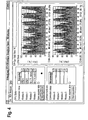
- Figs. 2 illustrates a screen shot showing CPU usage statistics without load balancing in accordance with an embodiment of the invention.
- the screen shot represents the scenario described above.
- the load balancing compensates sporadic migrations of mymips (from one VCPU to another) caused by the Linux SMP scheduler. In other words, the scheduler tries to execute heavy loaded VCPUs on different physical CPUs.
- Figs. 3 illustrates a screen shot showing CPU usage statistics with load balancing in accordance with an embodiment of the invention.
- the screen shot represents the scenario described above.
- the performance hit on the system without load balancing (2) is about 40%, while the performance hit on the system with load balancing (3) is about 20%. Accordingly, the load balancing improves a performance degradation caused by a transparent CPU sharing among multiple SMP guests.
- Figs. 4 and 5 illustrate screen shots showing CPU usage statistics with and without load balancing in accordance with an embodiment of the invention.
- the screen shots represent the scenarios described above.
- a method of load balancing in a data processing system comprising a plurality of physical CPUs and a plurality of virtual CPUs, the method comprising: mapping one or more virtual CPUs to each of said physical CPUs; and dynamically adapting the mapping depending on the load of said physical CPUs.
- the method may comprise running a multiprocessor operation involving at least two physical CPUs; assigning at least two virtual CPUs to said multiprocessor operation, for executing said multiprocessor operation; and mapping the at least two virtual CPUs to said at least two physical CPUs, respectively, wherein the mapping depends on the load of said at least two physical CPUs.
- the method may comprise: swapping the mapping of the two virtual CPUs to the at least two physical CPUs, respectively, in response to a change of load of at least one of the two physical CPUs.
- the method may also comprise determining the load of said two virtual CPUs; determining whether the load of said two physical CPUs is above a first threshold or below a second threshold; and swapping the mapping of the two virtual CPUs to the two physical CPUs, respectively, if the following conditions are met: (i) the load of one of the two physical CPUs is above said first threshold, (ii) the load of the other one of the two physical CPUs is below said second threshold, and (iii) the load of a virtual CPU mapped to the physical CPU whose load is above said first threshold is higher than the load of a virtual CPU mapped to the physical CPU whose load is below said second threshold.
- the method may also comprise swapping the mapping only if the difference of loads of said two virtual CPUs is above a predetermined threshold.
- the method may comprise determining, for a given virtual CPU, a negative load indicative of the load of all other virtual CPUs that are allocated to the same physical CPU as the given virtual CPU; and swapping the mapping only if the negative load is above a predetermined threshold.
- the method may also comprise running an operation of a high scheduling priority on one of said at least two physical CPUs, wherein said multiprocessor operation has a relatively lower scheduling priority.
- the operation of a higher scheduling priority may be executed by a dedicated real-time software.
- the multiprocessor operation may be executed by a generic server software.
- a computer system arranged to perform the above method.
- a computer program product comprising machine-readable code which, when executed by a data processing device, executes the above method.
Landscapes
- Engineering & Computer Science (AREA)
- Software Systems (AREA)
- Theoretical Computer Science (AREA)
- Physics & Mathematics (AREA)
- General Engineering & Computer Science (AREA)
- General Physics & Mathematics (AREA)
- Multi Processors (AREA)
- Stored Programmes (AREA)
Abstract
Description
- A virtual machine is a self-contained execution environment that behaves as if it is a separate computer and which can run its own operating system. Virtual machines provide Virtual CPUs (VCPUs) to clients or "guests", and each VCPU runs on a dedicated physical CPU. A VCPU is a representation of a physical processor within a Virtual Machine. In conventional systems, the mapping between virtual and physical CPUs is static.
- If multiple CPUs are available to a client or "guest", the guest tasks are spread between the CPUs. This is preferably done such that the available resources are used in the most efficient way and computing time is decreased. This process is generally referred to as "load balancing".
- Conventional load balancing algorithms may be insufficient. Let us consider, for example, the sharing of a plurality of physical CPUs between dedicated real-time software and generic server software. Let us assume an UP (uniprocessor) execution environment (e.g. LINUX) running the real-time software on
CPU 0, and an SMP (symmetric multiprocessing) execution environment (LINUX) running a server software on CPUs 0-3. In this example,CPU 0 is shared between the the real-time software and the server software. The dedicated real-time has a higher scheduling priority. In this example, the SMP load balancer does not take into account the real-time activity onCPU 0. This may skew the SMP load balancing. - The present invention aims to address this and other problems of conventional load balancing. In particular, but not exclusively, the present invention is concerned with better balancing the load of physical CPUs in a computer system comprising physical and virtual CPUs.
- The invention is recited by the independent claims. Preferred features are recited by the dependent claims.
-
-
Fig. 1 illustrates schematically the architecture of a system to which the present invention can be applied; and -
Figs. 2 to 5 illustrate screen shots showing CPU usage statistics with and without load balancing in accordance with an embodiment of the invention. -
Fig. 1 illustrates schematically the architecture of a system comprising physical CPUs, virtual CPUs, and client (guest) applications, to which the present invention can be applied. - The present invention is based on the realisation that the overall performance of a system as shown in
Fig. 1 can be improved by automatically balancing the load on physical CPUs attributed to the same SMP guest. In particular, the idea is to balance the physical CPUs load by migrating a virtual CPU (VCPU) from one physical CPU to another. Although this affects a statical VCPU to CPU assignment for a UP guest, the VCPUs to CPUs mapping within a fixed set of CPUs is transparent for SMP guests such that a scheduler which implements the present invention can decide which VCPU is to run on which physical CPU within the fixed CPU set. In other words, if an SMP guest is running on two physical CPUs (a & b), the scheduler creates two VCPUs (x & y) and maps them to the physical CPUs. In this example, two equivalent mappings are possible: - (1) VCPUx → CPUa and VCPUy → CPUb
- (2) VCPUx → CPUb and VCPUy → CPUa
- The scheduler is able to dynamically choose one of these mappings depending on CPU loads. The mapping switch results in a "swapping" of VCPUs, i.e. in two VCPUs migrating from one physical CPU to another. Such an operation is fully transparent for the guest and does not change a fixed physical set of CPUs assigned to the guest.
- By implementing such a load balancing mechanism, it is possible to at least partially resolve the above described SMP load balancing skewing problem by migrating a server VCPU running on CPU0, for example, to another CPU when the real-time activity is high and this VCPU is loaded. In order to improve the overall performance by such a migration, an underloaded CPUn (n > 0, in this example) must be found and VCPU running on CPUn must migrate to CPU0.
- This solution is partial only in that it does not work when the system is heavily loaded, i.e. when all physical CPUs are fully loaded. However, as such a situation is rare in practice, it is acceptable.
- Regularly, at a given time period, the scheduler calculates the load of each physical CPU (LOADn, n=0..N) and all VCPUs running on each physical CPU (VLOADn,m, m=0..M). More particularly, two loads are calculated for each VCPU: a "positive" load and a "negative" load.
- The positive load for a given VCPUn,m is equal to the actual VCPU load:

- The negative load for a given VCPUn,m is equal to a sum of the loads of all other VCPUs running on the same physical CPU:

- A physical CPU is considered overloaded if its load is above a predetermined threshold:

- A physical CPU is considered underloaded if its load is below a predetermined threshold:

- Load balancing is only applied to a pair of CPUs in which one CPU is overloaded and other CPU is underloaded:

where
- The load balancing comprises finding two unbalanced VCPUs of the same SMP guest running on CPUi and CPUj such that:

and swapping these VCPUs across physical CPUs. - Because a VCPU migration, in terms of processing power, is a quite expensive operation, the migration criteria is adjusted by introducing a positive migration threshold:

- In addition, the migration criteria takes into account the negative load of the overloaded emigrant:

- The negative load water mark avoids unnecessary migrations when the CPU overloading is not caused by a simultaneous activity of multiple guests, but rather by a single guest monopolizing the physical CPU.
- A mymips program has been used to demonstrate skewing in the SMP load balancing of a guest operating system. The mymips program permanently calculates the program execution speed (MIPS) and prints out the calculation results on console.
- mymips provides the following result when running on a SMP Linux guest with a dedicated single physical CPU:
- min/max/ave: 258/258/258
- The results above and below were obtained on a DELL D820 Dual Core 1.8 MHz Laptop.
- Two mymips programs provide the following result when running on an SMP Linux with two dedicated CPUs:
- min/max/ave: 257/259/258
- min/max/ave: 258/259/258
- A basic configuration which can be used to implement the load balancing mechanism in accordance with an embodiment of the invention comprises two SMP Linux guests sharing two physical CPUs. In order to obtain an unbalanced load on such a configuration, guests have been running on a conventional system without load balancing mechanism. Two mymips programs running simultaneously on each guest provide the following results:
- min/max/ave: 101/258/190
- min/max/ave: 92/257/190
- This shows about 25% of performance hit comparing to a single SMP Linux which performs a load balancing (at OS level) across multiple CPUs. The performance hit is due to sporadic mymips migrations from one CPU to another. Such a migration randomly runs mymips on the same processor.
- This practical result is fully in line with a theoretical determination. Because of a random nature of migrations, the probability of running both mymips on the same CPU is 0.5. Thus, an expected performance hit is 0.25 because when running two programs on the same CPU, only a half of the CPU power is available.
-
Figs. 2 illustrates a screen shot showing CPU usage statistics without load balancing in accordance with an embodiment of the invention. The screen shot represents the scenario described above. - When running the same load with load balancing enabled, the performance is close to a single SMP Linux.
- min/max/ave: 254/257/256
- min/max/ave: 250/256/255
- The load balancing compensates sporadic migrations of mymips (from one VCPU to another) caused by the Linux SMP scheduler. In other words, the scheduler tries to execute heavy loaded VCPUs on different physical CPUs.
-
Figs. 3 illustrates a screen shot showing CPU usage statistics with load balancing in accordance with an embodiment of the invention. The screen shot represents the scenario described above. - In order to confirm the above theoretical conclusion, a Linux kernel compilation was used as a variable load. Two compilations were running in parallel on two Linux guests in the following three configurations:
- (1) Two Linux guests each running on a dedicated CPU
- (2) Two Linux guests sharing two CPUs without load balancing
- (3) Two Linux guests sharing two CPUs with load balancing
- Each time, the duration of compilation was measured. Results corresponding to different Linux kernel compilations are shown below.
- (1.1) 11m21.046s
- (1.2) 8m34.204s
- (2.1) 16m4.272s
- (2.2) 12m20.575s
- (3.1) 13m51.974s
- (3.2) 10m32.467s
- The performance hit on the system without load balancing (2) is about 40%, while the performance hit on the system with load balancing (3) is about 20%. Accordingly, the load balancing improves a performance degradation caused by a transparent CPU sharing among multiple SMP guests.
-
Figs. 4 and5 illustrate screen shots showing CPU usage statistics with and without load balancing in accordance with an embodiment of the invention. The screen shots represent the scenarios described above. - The above results were obtained using the following load balancing parameters:
- PERIOD = 10 milliseconds
- LOADunder = 80%
- LOADover = 100%
- MIGR_POS_ WTMARK = 5%
- MIGR_NEG_WTMARK = 5%
- It may be possible to achieve even better result on a variable load by modifying these parameters.
- According to an embodiment there is provided a method of load balancing in a data processing system comprising a plurality of physical CPUs and a plurality of virtual CPUs, the method comprising: mapping one or more virtual CPUs to each of said physical CPUs; and dynamically adapting the mapping depending on the load of said physical CPUs.
- The method may comprise running a multiprocessor operation involving at least two physical CPUs; assigning at least two virtual CPUs to said multiprocessor operation, for executing said multiprocessor operation; and mapping the at least two virtual CPUs to said at least two physical CPUs, respectively, wherein the mapping depends on the load of said at least two physical CPUs.
- In addition, the method may comprise: swapping the mapping of the two virtual CPUs to the at least two physical CPUs, respectively, in response to a change of load of at least one of the two physical CPUs.
- The method may also comprise determining the load of said two virtual CPUs; determining whether the load of said two physical CPUs is above a first threshold or below a second threshold; and swapping the mapping of the two virtual CPUs to the two physical CPUs, respectively, if the following conditions are met: (i) the load of one of the two physical CPUs is above said first threshold, (ii) the load of the other one of the two physical CPUs is below said second threshold, and (iii) the load of a virtual CPU mapped to the physical CPU whose load is above said first threshold is higher than the load of a virtual CPU mapped to the physical CPU whose load is below said second threshold.
- The method may also comprise swapping the mapping only if the difference of loads of said two virtual CPUs is above a predetermined threshold.
- In addition, the method may comprise determining, for a given virtual CPU, a negative load indicative of the load of all other virtual CPUs that are allocated to the same physical CPU as the given virtual CPU; and swapping the mapping only if the negative load is above a predetermined threshold.
- The method may also comprise running an operation of a high scheduling priority on one of said at least two physical CPUs, wherein said multiprocessor operation has a relatively lower scheduling priority.
- The operation of a higher scheduling priority may be executed by a dedicated real-time software.
- The multiprocessor operation may be executed by a generic server software.
- In an embodiment, there is provided a computer system arranged to perform the above method.
- In an embodiment, there is provided a computer program product, comprising machine-readable code which, when executed by a data processing device, executes the above method.
- It will be clear from the forgoing that the above-described embodiments are only examples, and that other embodiments are possible and included within the scope of the invention as determined from the claims.
Claims (12)
- A method of load balancing in a data processing system comprising a plurality of physical CPUs and a plurality of virtual CPUs, the method comprising:mapping one or more virtual CPUs to each of said physical CPUs;determining, for a given virtual CPU, a negative load indicative of the load of all other virtual CPUs that are allocated to the same physical CPU as the given virtual CPU; andadapting the mapping of the given virtual CPU depending on the load of said physical CPUs and said negative load.
- The method of claim 1 comprising:determining, for said given virtual CPU, a negative load value indicative of the sum of the loads of all other virtual CPUs that are allocated to the same physical CPU as the given virtual CPU.
- The method of claim 1 or 2, wherein the mapping of a first virtual CPU to a first physical CPU and the mapping of a second virtual CPU to a second physical CPU are swapped if the load of the first physical CPU is larger than a first threshold, the load of the second physical CPU is below a second threshold, the load of the first virtual CPU is larger than the load of the second virtual CPU, and the negative load of the first virtual CPU is above a predetermined threshold.
- The method of claim 3, comprising:swapping the mapping of the first and second virtual CPUs to the first and second physical CPUs, respectively, in response to a change of load of at least one of the first and second physical CPUs.
- The method of claim 3 or 4, comprising:swapping the mapping only if the difference of loads of said first and second virtual CPUs is above a predetermined threshold.
- The method of any preceding claim, wherein the mapping of the given virtual CPU is dynamically mapped.
- The method of any preceding claim, comprising:running a multiprocessor operation involving said first and second physical CPUs; andassigning said first and second virtual CPUs to said multiprocessor operation, for executing said multiprocessor operation.
- The method of any preceding claim, comprising:running an operation of a high scheduling priority on one of said physical CPUs, wherein said multiprocessor operation has a relatively lower scheduling priority.
- The method of claim 8, wherein the operation of a higher scheduling priority is executed by a dedicated real-time software.
- The method of claim 8 or 9, wherein said multiprocessor operation is executed by a generic server software.
- Computer system, arranged to perform the method of any preceding claim.
- Computer program product, comprising machine-readable code which, when executed by a data processing device, executes the method of any of claims 1 to 10.
Applications Claiming Priority (1)
| Application Number | Priority Date | Filing Date | Title |
|---|---|---|---|
| EP07290793.4A EP2006770B1 (en) | 2007-06-19 | 2007-06-19 | Load balancing |
Related Parent Applications (1)
| Application Number | Title | Priority Date | Filing Date |
|---|---|---|---|
| EP07290793.4 Division | 2007-06-19 |
Publications (2)
| Publication Number | Publication Date |
|---|---|
| EP2527980A2 true EP2527980A2 (en) | 2012-11-28 |
| EP2527980A3 EP2527980A3 (en) | 2013-01-09 |
Family
ID=38657663
Family Applications (2)
| Application Number | Title | Priority Date | Filing Date |
|---|---|---|---|
| EP07290793.4A Active EP2006770B1 (en) | 2007-06-19 | 2007-06-19 | Load balancing |
| EP12005831A Withdrawn EP2527980A3 (en) | 2007-06-19 | 2007-06-19 | Load balancing |
Family Applications Before (1)
| Application Number | Title | Priority Date | Filing Date |
|---|---|---|---|
| EP07290793.4A Active EP2006770B1 (en) | 2007-06-19 | 2007-06-19 | Load balancing |
Country Status (3)
| Country | Link |
|---|---|
| US (1) | US8341630B2 (en) |
| EP (2) | EP2006770B1 (en) |
| WO (1) | WO2008155124A2 (en) |
Families Citing this family (15)
| Publication number | Priority date | Publication date | Assignee | Title |
|---|---|---|---|---|
| US9069622B2 (en) | 2010-09-30 | 2015-06-30 | Microsoft Technology Licensing, Llc | Techniques for load balancing GPU enabled virtual machines |
| US8970603B2 (en) | 2010-09-30 | 2015-03-03 | Microsoft Technology Licensing, Llc | Dynamic virtual device failure recovery |
| US20120137295A1 (en) * | 2010-11-30 | 2012-05-31 | Alcatel-Lucent Canada Inc. | Method for displaying cpu utilization in a multi-processing system |
| US8830245B2 (en) * | 2010-12-14 | 2014-09-09 | Amazon Technologies, Inc. | Load balancing between general purpose processors and graphics processors |
| CN102323897B (en) * | 2011-05-12 | 2013-06-12 | 中山爱科数字科技股份有限公司 | Method for internal business processing and load balancing for platform |
| US9110878B2 (en) | 2012-01-18 | 2015-08-18 | International Business Machines Corporation | Use of a warning track interruption facility by a program |
| US8850450B2 (en) | 2012-01-18 | 2014-09-30 | International Business Machines Corporation | Warning track interruption facility |
| US9104508B2 (en) | 2012-01-18 | 2015-08-11 | International Business Machines Corporation | Providing by one program to another program access to a warning track facility |
| US20150081400A1 (en) * | 2013-09-19 | 2015-03-19 | Infosys Limited | Watching ARM |
| US10715587B2 (en) * | 2014-04-11 | 2020-07-14 | Maxeler Technologies Ltd. | System and method for load balancing computer resources |
| US12405841B2 (en) | 2022-10-19 | 2025-09-02 | Dell Products Lp | System and method for load-balancing processing requests across client information handling systems to minimize noise and carbon dioxide emissions in a data center |
| US12346912B2 (en) | 2022-10-26 | 2025-07-01 | Dell Products Lp | System and method for balancing processing load distribution for data centers based on server location to minimize greenhouse gas emissions |
| US11996988B1 (en) | 2023-04-27 | 2024-05-28 | Dell Products Lp | Reinforced computer learning system and method for minimizing power consumed by underutilized data center hardware components |
| US12235752B2 (en) | 2023-05-03 | 2025-02-25 | Dell Products Lp | System and method for developing green data center policies to minimize CO2 generated during execution of test suites on a per software feature testing basis |
| US12197756B2 (en) | 2023-05-11 | 2025-01-14 | Dell Products Lp | System and method for minimizing CO2 emissions due to utilization of allocated data center memory resources for storage of fingerprint hash tables |
Family Cites Families (4)
| Publication number | Priority date | Publication date | Assignee | Title |
|---|---|---|---|---|
| US5889989A (en) * | 1996-09-16 | 1999-03-30 | The Research Foundation Of State University Of New York | Load sharing controller for optimizing monetary cost |
| US6298370B1 (en) * | 1997-04-04 | 2001-10-02 | Texas Instruments Incorporated | Computer operating process allocating tasks between first and second processors at run time based upon current processor load |
| US7028302B2 (en) * | 2002-04-24 | 2006-04-11 | Hewlett-Packard Development Company, L.P. | System and method for automatically tuning a multiprocessor computer system |
| US20050055694A1 (en) * | 2003-09-04 | 2005-03-10 | Hewlett-Packard Development Company, Lp | Dynamic load balancing resource allocation |
-
2007
- 2007-06-19 EP EP07290793.4A patent/EP2006770B1/en active Active
- 2007-06-19 EP EP12005831A patent/EP2527980A3/en not_active Withdrawn
-
2008
- 2008-06-19 US US12/142,379 patent/US8341630B2/en active Active
- 2008-06-19 WO PCT/EP2008/004963 patent/WO2008155124A2/en not_active Ceased
Non-Patent Citations (1)
| Title |
|---|
| None |
Also Published As
| Publication number | Publication date |
|---|---|
| EP2006770B1 (en) | 2014-01-01 |
| EP2527980A3 (en) | 2013-01-09 |
| US20080320489A1 (en) | 2008-12-25 |
| EP2006770A1 (en) | 2008-12-24 |
| US8341630B2 (en) | 2012-12-25 |
| WO2008155124A2 (en) | 2008-12-24 |
| WO2008155124A3 (en) | 2009-03-05 |
Similar Documents
| Publication | Publication Date | Title |
|---|---|---|
| EP2006770B1 (en) | Load balancing | |
| US11681544B2 (en) | Interference-aware scheduling service for virtual GPU enabled systems | |
| US8667496B2 (en) | Methods and systems of managing resources allocated to guest virtual machines | |
| CN112074809B (en) | Workgroup Assignment for Feedback-Guided Splitting on GPUs | |
| US11876731B2 (en) | System and methods for sharing memory subsystem resources among datacenter applications | |
| US20140373010A1 (en) | Intelligent resource management for virtual machines | |
| Kim et al. | Constraint-aware VM placement in heterogeneous computing clusters | |
| JP2010146550A (en) | Multicore processor and method of use, configuring core function based on executing instruction | |
| EP2090983A1 (en) | Determining an architecture for executing code in a multi architecture environment | |
| JP6778130B2 (en) | Virtual computer system and its resource allocation method | |
| EP1766518B1 (en) | Adaptive algorithm for selecting a virtualization algorithm in virtual machine environments | |
| Tsog et al. | Static allocation of parallel tasks to improve schedulability in cpu-gpu heterogeneous real-time systems | |
| KR101330609B1 (en) | Method For Scheduling of Mobile Multi-Core Virtualization System To Guarantee Real Time Process | |
| KR20160131621A (en) | Parallel processing system | |
| Kiselev et al. | The energy efficiency evaluating method determining energy consumption of the parallel program according to its profile | |
| US9753770B2 (en) | Register-type-aware scheduling of virtual central processing units | |
| Wu et al. | Dynamic cpu allocation for docker containerized mixed-criticality real-time systems | |
| US11256540B2 (en) | Server-to-container migration | |
| KR20130048504A (en) | Apparatus and method for scheduling partition based criticality | |
| Sun et al. | A virtual machine based task scheduling approach to improving data locality for virtualized Hadoop | |
| CN113032154B (en) | Scheduling method and device for virtual CPU, electronic equipment and storage medium | |
| Bhowmik et al. | An efficient load balancing approach in a cloud computing platform | |
| CN108804225B (en) | A kind of virtual machine load control method and device | |
| KR100509428B1 (en) | System Efficiency Optimizing Method Using Changing Stack in Real Time Operating System | |
| US20230367633A1 (en) | Gpu and gpu method |
Legal Events
| Date | Code | Title | Description |
|---|---|---|---|
| PUAI | Public reference made under article 153(3) epc to a published international application that has entered the european phase |
Free format text: ORIGINAL CODE: 0009012 |
|
| AC | Divisional application: reference to earlier application |
Ref document number: 2006770 Country of ref document: EP Kind code of ref document: P |
|
| AK | Designated contracting states |
Kind code of ref document: A2 Designated state(s): AT BE BG CH CY CZ DE DK EE ES FI FR GB GR HU IE IS IT LI LT LU LV MC MT NL PL PT RO SE SI SK TR |
|
| PUAL | Search report despatched |
Free format text: ORIGINAL CODE: 0009013 |
|
| RIC1 | Information provided on ipc code assigned before grant |
Ipc: G06F 9/50 20060101AFI20121115BHEP |
|
| AK | Designated contracting states |
Kind code of ref document: A3 Designated state(s): AT BE BG CH CY CZ DE DK EE ES FI FR GB GR HU IE IS IT LI LT LU LV MC MT NL PL PT RO SE SI SK TR |
|
| RIC1 | Information provided on ipc code assigned before grant |
Ipc: G06F 9/50 20060101AFI20121130BHEP |
|
| 17P | Request for examination filed |
Effective date: 20130709 |
|
| RBV | Designated contracting states (corrected) |
Designated state(s): AT BE BG CH CY CZ DE DK EE ES FI FR GB GR HU IE IS IT LI LT LU LV MC MT NL PL PT RO SE SI SK TR |
|
| 17Q | First examination report despatched |
Effective date: 20140425 |
|
| STAA | Information on the status of an ep patent application or granted ep patent |
Free format text: STATUS: THE APPLICATION HAS BEEN WITHDRAWN |
|
| 18W | Application withdrawn |
Effective date: 20140624 |