EP2527418B1 - White-light led red luminescent materials and preparation methods thereof - Google Patents
White-light led red luminescent materials and preparation methods thereof Download PDFInfo
- Publication number
- EP2527418B1 EP2527418B1 EP10856876.7A EP10856876A EP2527418B1 EP 2527418 B1 EP2527418 B1 EP 2527418B1 EP 10856876 A EP10856876 A EP 10856876A EP 2527418 B1 EP2527418 B1 EP 2527418B1
- Authority
- EP
- European Patent Office
- Prior art keywords
- temperature
- atmosphere
- nitrogen
- white
- phosphor
- Prior art date
- Legal status (The legal status is an assumption and is not a legal conclusion. Google has not performed a legal analysis and makes no representation as to the accuracy of the status listed.)
- Active
Links
Images


Classifications
-
- C—CHEMISTRY; METALLURGY
- C09—DYES; PAINTS; POLISHES; NATURAL RESINS; ADHESIVES; COMPOSITIONS NOT OTHERWISE PROVIDED FOR; APPLICATIONS OF MATERIALS NOT OTHERWISE PROVIDED FOR
- C09K—MATERIALS FOR MISCELLANEOUS APPLICATIONS, NOT PROVIDED FOR ELSEWHERE
- C09K11/00—Luminescent materials, e.g. electroluminescent or chemiluminescent
- C09K11/08—Luminescent materials, e.g. electroluminescent or chemiluminescent containing inorganic luminescent materials
- C09K11/77—Luminescent materials, e.g. electroluminescent or chemiluminescent containing inorganic luminescent materials containing rare earth metals
-
- C—CHEMISTRY; METALLURGY
- C09—DYES; PAINTS; POLISHES; NATURAL RESINS; ADHESIVES; COMPOSITIONS NOT OTHERWISE PROVIDED FOR; APPLICATIONS OF MATERIALS NOT OTHERWISE PROVIDED FOR
- C09K—MATERIALS FOR MISCELLANEOUS APPLICATIONS, NOT PROVIDED FOR ELSEWHERE
- C09K11/00—Luminescent materials, e.g. electroluminescent or chemiluminescent
- C09K11/08—Luminescent materials, e.g. electroluminescent or chemiluminescent containing inorganic luminescent materials
- C09K11/77—Luminescent materials, e.g. electroluminescent or chemiluminescent containing inorganic luminescent materials containing rare earth metals
- C09K11/7783—Luminescent materials, e.g. electroluminescent or chemiluminescent containing inorganic luminescent materials containing rare earth metals containing two or more rare earth metals one of which being europium
- C09K11/7784—Chalcogenides
- C09K11/7786—Chalcogenides with alkaline earth metals
-
- C—CHEMISTRY; METALLURGY
- C09—DYES; PAINTS; POLISHES; NATURAL RESINS; ADHESIVES; COMPOSITIONS NOT OTHERWISE PROVIDED FOR; APPLICATIONS OF MATERIALS NOT OTHERWISE PROVIDED FOR
- C09K—MATERIALS FOR MISCELLANEOUS APPLICATIONS, NOT PROVIDED FOR ELSEWHERE
- C09K11/00—Luminescent materials, e.g. electroluminescent or chemiluminescent
- C09K11/08—Luminescent materials, e.g. electroluminescent or chemiluminescent containing inorganic luminescent materials
- C09K11/0883—Arsenides; Nitrides; Phosphides
-
- C—CHEMISTRY; METALLURGY
- C09—DYES; PAINTS; POLISHES; NATURAL RESINS; ADHESIVES; COMPOSITIONS NOT OTHERWISE PROVIDED FOR; APPLICATIONS OF MATERIALS NOT OTHERWISE PROVIDED FOR
- C09K—MATERIALS FOR MISCELLANEOUS APPLICATIONS, NOT PROVIDED FOR ELSEWHERE
- C09K11/00—Luminescent materials, e.g. electroluminescent or chemiluminescent
- C09K11/08—Luminescent materials, e.g. electroluminescent or chemiluminescent containing inorganic luminescent materials
- C09K11/77—Luminescent materials, e.g. electroluminescent or chemiluminescent containing inorganic luminescent materials containing rare earth metals
- C09K11/7783—Luminescent materials, e.g. electroluminescent or chemiluminescent containing inorganic luminescent materials containing rare earth metals containing two or more rare earth metals one of which being europium
- C09K11/7795—Phosphates
- C09K11/7796—Phosphates with alkaline earth metals
-
- H—ELECTRICITY
- H05—ELECTRIC TECHNIQUES NOT OTHERWISE PROVIDED FOR
- H05B—ELECTRIC HEATING; ELECTRIC LIGHT SOURCES NOT OTHERWISE PROVIDED FOR; CIRCUIT ARRANGEMENTS FOR ELECTRIC LIGHT SOURCES, IN GENERAL
- H05B33/00—Electroluminescent light sources
- H05B33/12—Light sources with substantially two-dimensional [2D] radiating surfaces
- H05B33/14—Light sources with substantially two-dimensional [2D] radiating surfaces characterised by the chemical or physical composition or the arrangement of the electroluminescent material, or by the simultaneous addition of the electroluminescent material in or onto the light source
-
- H—ELECTRICITY
- H10—SEMICONDUCTOR DEVICES; ELECTRIC SOLID-STATE DEVICES NOT OTHERWISE PROVIDED FOR
- H10H—INORGANIC LIGHT-EMITTING SEMICONDUCTOR DEVICES HAVING POTENTIAL BARRIERS
- H10H20/00—Individual inorganic light-emitting semiconductor devices having potential barriers, e.g. light-emitting diodes [LED]
- H10H20/80—Constructional details
- H10H20/85—Packages
- H10H20/851—Wavelength conversion means
- H10H20/8511—Wavelength conversion means characterised by their material, e.g. binder
- H10H20/8512—Wavelength conversion materials
-
- Y—GENERAL TAGGING OF NEW TECHNOLOGICAL DEVELOPMENTS; GENERAL TAGGING OF CROSS-SECTIONAL TECHNOLOGIES SPANNING OVER SEVERAL SECTIONS OF THE IPC; TECHNICAL SUBJECTS COVERED BY FORMER USPC CROSS-REFERENCE ART COLLECTIONS [XRACs] AND DIGESTS
- Y02—TECHNOLOGIES OR APPLICATIONS FOR MITIGATION OR ADAPTATION AGAINST CLIMATE CHANGE
- Y02B—CLIMATE CHANGE MITIGATION TECHNOLOGIES RELATED TO BUILDINGS, e.g. HOUSING, HOUSE APPLIANCES OR RELATED END-USER APPLICATIONS
- Y02B20/00—Energy efficient lighting technologies, e.g. halogen lamps or gas discharge lamps
Definitions
- the present invention relates to a red phosphor that can be effectively excited by ultraviolet, violet light or blue light and applied to the white-light LED.
- the red phosphor is always one of significant bottlenecks that restrict the technical development of white-light LED.
- the currently red phosphor has various kinds of problems, for example, CaS:Eu 2+ having large luminous attenuation and poor chemical stability, CaMoO4:Eu 2+ having narrow excitation scope, Y 2 O 3 :Eu 2+ and Y 2 O 2 S:Eu 2+ having low luminous efficiency, and M 2 Si 5 N 8 :Eu 2+ having a poor anti-luminous attenuation performance, none of which can match perfectly with the LED chip.
- the phosphor may be effectively excited between 300-550nm, and the position of emission peak varies with the content of Eu 2+ .
- the manufacturing method uses one-step synthesis method.
- the synthesis temperature is 1200-1700°C; the pressure is about 0.5Mpa.
- the family of this patent comprises: JP2005239985 , EP1568753 , and CN1683470A .
- the US patent US7273568 discloses a phosphor with the formula of MmAaBbOoNn:Zz, where M is a divalent element selected from at least one of Mg, Ca, Sr, Ba and Zn; A is a trivalent element selected from at least one of B, Al and Ga; B is a quadrivalent element selected from Si or Ge; and Z is an activator selected from at least one of rare earth element or transition element.
- the manufacturing method also uses one-step synthesis method.
- the pressure is 0.001MPa ⁇ P ⁇ 0.1Mpa.
- Similar patents include US7476337 , US7476338 , and EP1630219 , etc.
- the US patent US2010096592 discloses a phosphor comprising M-Al-Si-N, where M is Ca, Sr, and Ba, and adds LiF as flux.
- An objective of the present invention is to address the problems of nitride red phosphor in aspects of luminous efficiency and manufacturing method, thereby providing a new efficient LED red phosphor.
- This phosphor has good chemical stability, high luminous efficiency, and good anti-luminous attenuation performance, etc., and thus it may well satisfy the packaging application requirements of the white-light LED.
- Another objective of the present invention is to provide a method of manufacturing the phosphor. This manufacturing method is easy to operate, pollution-free, and low cost.
- the chemical structural formula of the white-light LED red phosphor according to the present invention is: Ca 1-y-m-e-r Y y M m X x-p P p Z z N n : Eu e , R r (1)
- the method of manufacturing the white-light LED red phosphor comprises steps of:
- the Eu dosage is 0.1% - 20% of the synthetic material mol
- the dosage of R is 0.1% - 10% of the synthetic material mol.
- step 2) because some materials are rather sensitive to the air and water, the contents of O 2 and H 2 O in the nitrogen, argon, or nitrogen-argon mixing atmosphere should be controlled between 0.1-50 ppm;
- the protective atmosphere may be pure nitrogen atmosphere, or nitride-hydrogen mixing atmosphere, or pure hydrogen atmosphere, and the atmosphere pressure is normal pressure.
- the roasting temperature of the first segment is 700-1200°C, with the roasting time being 2-6h;
- the roasting temperature of the second segment is 1400-1800°C, with the roasting time being 6-18h;
- the post-processing procedures comprise: grinding, sifting, washing, drying, etc., where sifting is performed after grinding, washing is performed till the conductivity being less than 20 ⁇ s/ cm, and finally drying is performed to obtain a finished product.
- the present invention optimizes and adjusts the crystal field of phosphor by using plural combinations of elements such as alkali metal, P and Y.
- the manufacturing method that adopts segmented roasting and normal-pressure high-temperature sintering may not only adjust the position of emission peak, but also greatly improve the luminous intensity of phosphor, such that its chemical stability, luminous efficiency and anti-luminous attenuation performance can well satisfy the needs of LED.
- the specific advantages are specified below:
- Embodiments 12-21 and the corresponding Comparative Embodiment are specified in Table 5, where their luminous intensities are all higher than the corresponding Comparative Embodiment.
- the method of manufacturing these Embodiments is identical to Comparative Embodiment 4.
- Table 5 Chemical formula Emission peak x y Luminous intensity Embodiment 12 Ca 0.8 Y 0.1 Al 0.9 P 0.03 SiN 3 :0.01Eu,0.02 Dy,0.03Tm,0.04Er 636 0.6443 0.3547 134
- Embodiment 13 Ca 0.76 Y 018 Al 1.09 P 0.09 SiN 3 :0.01Eu, 0.02Dy,0.03Tm 639 0.6451 0.3535 131
- Embodiment 14 Ca 0.75 Sr 0.1 Li 0.08 Y 0.01 Al 0.85 P 0.02 SiN 3 : 0.01Eu,0.05Dy 638 0.6449 0.3538 138
- Embodiment 15 Ca 0.71 Ba 0.1 Na 0.1 Y 0.01 Al 1.1 P 0.07
Landscapes
- Chemical & Material Sciences (AREA)
- Inorganic Chemistry (AREA)
- Engineering & Computer Science (AREA)
- Materials Engineering (AREA)
- Organic Chemistry (AREA)
- Luminescent Compositions (AREA)
Description
- The present invention relates to a red phosphor that can be effectively excited by ultraviolet, violet light or blue light and applied to the white-light LED.
- In recent years, with the gradual improvement of the luminous efficiency of LED and the gradual decrease of cost, semi-conductor lighting gradually becomes the development trend of modem lighting, which is recognized as the fourth generation of lighting source after incandescent lamp, fluorescent lamp, and energy-saving lamp, thus called "green lighting in 21st century."
- To apply the semiconductor lighting to the normal lighting field, it is necessary to obtain the high efficient and high color rendering white-light LED. Now, there are several ways to achieve the white-light LED, and the most important way is to apply a yellow phosphor (YAG) on a blue-light LED chip, thereby realizing white-light emission. However, this way has the drawbacks of high coloring temperature and low color rendering index, and thus it cannot satisfy the demands of semi-conductor lighting. Although the emission spectrum of YAG phosphor is very wide, the emission intensity within the red-light area is rather weak, and the phenomenon of red-light deficiency occurs after being mixed with the blue-light LED chip, which therefore affects the relevant color temperature and color rendering index of the white-light LED. Thus, the YAG itself cannot solve the existing problem. However, the above problem can be solved by adding red phosphor.
- However, the red phosphor is always one of significant bottlenecks that restrict the technical development of white-light LED. The currently red phosphor has various kinds of problems, for example, CaS:Eu2+ having large luminous attenuation and poor chemical stability, CaMoO4:Eu2+ having narrow excitation scope, Y2O3:Eu2+ and Y2O2S:Eu2+ having low luminous efficiency, and M2Si5N8:Eu2+ having a poor anti-luminous attenuation performance, none of which can match perfectly with the LED chip.
- The US patent
US7252788 discloses a nitride phosphor comprising MmAaBbNn:Zz, where M is a divalent element selected from at least one of Be, Mg, Ca, Sr, Ba, Zn, Cd and Hg; A is a trivalent element selected from at least one of B, Al, Ga, In, Tl, Y, Sc, P, As, Sb and Bi; B is a quadrivalent element selected from at least one of C, Si, Ge, Sn, Ti, Hf, Mo, W, Cr, Pb and Zr; and Z is an activator selected from at least one of rare earth element or transition element; (m+z):a:b:n = 1:1:1:3, 0.0001 ≤ z/(m+z) ≤ 0.5. The phosphor may be effectively excited between 300-550nm, and the position of emission peak varies with the content of Eu2+. The manufacturing method uses one-step synthesis method. The synthesis temperature is 1200-1700°C; the pressure is about 0.5Mpa. The family of this patent comprises:JP2005239985 EP1568753 , andCN1683470A . - The US patent
US7273568 discloses a phosphor with the formula of MmAaBbOoNn:Zz, where M is a divalent element selected from at least one of Mg, Ca, Sr, Ba and Zn; A is a trivalent element selected from at least one of B, Al and Ga; B is a quadrivalent element selected from Si or Ge; and Z is an activator selected from at least one of rare earth element or transition element. The manufacturing method also uses one-step synthesis method. The pressure is 0.001MPa ≤ P ≤ 0.1Mpa. Similar patents includeUS7476337 ,US7476338 , andEP1630219 , etc. - The US patent
US2010096592 discloses a phosphor comprising M-Al-Si-N, where M is Ca, Sr, and Ba, and adds LiF as flux. - The manufacture method of all the existing patents uses the high-temperature and high-pressure one-step synthesis method. However, the resulting phosphor has relatively low luminous intensity. Furthermore, this manufacturing method is quite demanding on the devices. Therefore, they have problems such as high cost and complex process.
- An objective of the present invention is to address the problems of nitride red phosphor in aspects of luminous efficiency and manufacturing method, thereby providing a new efficient LED red phosphor. This phosphor has good chemical stability, high luminous efficiency, and good anti-luminous attenuation performance, etc., and thus it may well satisfy the packaging application requirements of the white-light LED.
- Another objective of the present invention is to provide a method of manufacturing the phosphor. This manufacturing method is easy to operate, pollution-free, and low cost.
- The chemical structural formula of the white-light LED red phosphor according to the present invention is:
Ca1-y-m-e-rYyMmXx-pPpZzNn: Eue, Rr (1)
- Wherein, M is at lease one of Sr, Ba, Sc, Li, Na and K;
- X is at least one of B, Al and Ga, wherein Al is must;
- Z is at least one of Si, V and Nb, wherein Si is must;
- R is at least one of Dy, Er, Tm and Lu, wherein Dy is must.
- 0.001≤y≤0.2,0.001≤m≤0.2,0.5≤x,z≤1.5,0.001≤p≤0.1,2≤n≤4 , 0.001≤e≤0.2, 0.001≤r≤0.1
- The method of manufacturing the white-light LED red phosphor comprises steps of:
- 1) weighing the required raw materials from nitrides of Ca, Sr, Ba, Li, Na and K, and nitrides or oxides of Y, Sc, B, Al, Ga, P, Si, V, Nb, Eu, Dy, Er, Tm and Lu according to the chemical formula components in the structural formula (1) and stoichiometric ratio.
- 2) sufficiently mixing these raw materials in argon, nitrogen or nitrogen-argon mixing atmosphere;
- 3) performing segmented roasting to these mixed raw materials in the tubular furnace with the protective atmosphere adopting the normal-pressure high-temperature solid-state method;
- 4) then going through post-processing, thereby making the required red phosphor;
- In the above step 1), the Eu dosage is 0.1% - 20% of the synthetic material mol, and the dosage of R is 0.1% - 10% of the synthetic material mol.
- In the above step 2), because some materials are rather sensitive to the air and water, the contents of O2 and H2O in the nitrogen, argon, or nitrogen-argon mixing atmosphere should be controlled between 0.1-50 ppm;
- In the above step 3), the protective atmosphere may be pure nitrogen atmosphere, or nitride-hydrogen mixing atmosphere, or pure hydrogen atmosphere, and the atmosphere pressure is normal pressure.
- Segmented roasting process is adopted in step 3), the roasting temperature of the first segment is 700-1200°C, with the roasting time being 2-6h; the roasting temperature of the second segment is 1400-1800°C, with the roasting time being 6-18h;
- In the above step 4), the post-processing procedures comprise: grinding, sifting, washing, drying, etc., where sifting is performed after grinding, washing is performed till the conductivity being less than 20 µs/ cm, and finally drying is performed to obtain a finished product.
- The present invention optimizes and adjusts the crystal field of phosphor by using plural combinations of elements such as alkali metal, P and Y. The manufacturing method that adopts segmented roasting and normal-pressure high-temperature sintering may not only adjust the position of emission peak, but also greatly improve the luminous intensity of phosphor, such that its chemical stability, luminous efficiency and anti-luminous attenuation performance can well satisfy the needs of LED. The specific advantages are specified below:
- 1. High luminous efficiency. The present invention uses alkali metal as a charge compensation agent, which may reduce generation of oxygen vacancy deficiency during the sintering process, thereby reducing the probability of non-radiative transition, such that it may not only adjust the position of emission peak of phosphor, but also enhance the luminous intensity; Y that substitutes alkali metal makes the Eu2+ 5d orbital splitting become smaller, which causes decrease of probability of non-radiative transition, thereby enhancing the luminous performance of phosphor; introduction of P generates additional impurity level in the forbidden band, thereby effectively reducing the gap between the conduction band and valence band, so as to significantly improve the luminous intensity of the phosphor; segmented roasting enables the raw materials to be better mixed in the melting state, which also plays a role of oxygen removal; further high-temperature roasting facilitates sufficient reaction to obtain a pure single phase, thereby enhancing the luminous intensity of the phosphor.
- 2. Good anti-luminous attenuation performance. Because the ion radius of elements such Y, Dy is smaller than that of Ca in the host, the adhesion strength between ions is much stronger, which results in a better anti-luminous attenuation performance of phosphor.
- 3. The present invention employs a typical tube furnace with normal-pressure atmosphere protection. During the synthesizing process, it needs no provision of high-pressure gas (0.1 - 10MPa) for protection, thereby lowering the demands on equipments and energy consumption. The process is also simplified, so is the process control. Further, no pollution is generated.
-
-
Fig. 1 The XRD pattern ofEmbodiments -
Fig. 2 The excitation spectrum comparison betweenEmbodiment 1 andComparative Embodiment 1. -
Fig. 3 The emission spectrum comparison betweenEmbodiment 1 andComparative Embodiment 1. -
Fig. 4 The temperature quenching performance comparison betweenEmbodiment 1 andComparative Embodiment 1. -
Fig. 5 The anti-luminous attenuation performance comparison betweenEmbodiment 1 andComparative Embodiment 1. -
Fig. 6 The emission spectrum comparison between Embodiments 2-4 andComparative Embodiment 2. -
Fig. 7 The excitation spectrum comparison between Embodiments 2-4 andComparative Embodiment 2. -
Fig. 8 The temperature quenching performance comparison between Embodiments 2-4 andComparative Embodiment 2. -
Fig. 9 The anti-luminous attenuation performance comparison between Embodiments 2-4 andComparative Embodiment 2. -
Fig. 10 The emission spectrum comparison between Embodiments 5-7 andComparative Embodiment 3. -
Fig. 11 The temperature quenching performance comparison between Embodiments 5-7 andComparative Embodiment 3. -
Fig. 12 The anti-luminous attenuation performance comparison between Embodiments 5-7 andComparative Embodiment 3. -
Fig. 13 The emission spectrum comparison between Embodiments 8-11 andComparative Embodiment 4. -
Fig. 14 The temperature quenching performance comparison between Embodiments 8-11 andComparative Embodiment 4. -
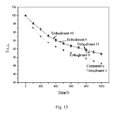
Fig. 15 The anti-luminous attenuation performance comparison between Embodiments 8-11 andComparative Embodiment 4. - Weighing Ca3N2 6.048g, Y2O3 0.304g, Si3N4 6.289g, AlN 5.292g, P2O5 0.382g, Eu2O3 1.183g, Dy2O3 0.502g, sufficiently mixing these raw materials in the protective atmosphere, placing them into the molybdenum crucible, and rapidly migrating them into the tubular furnace, and then increasing temperature gradually to 800°C under the protection of highly pure nitrogen gas, maintaining the temperature for 5h, and then raising the temperature till 1450°C, maintaining the temperature for 10h, sifting after grinding, and washing till the conductivity being 8.85µs/cm, and finally drying under the temperature of 90°C, thereby obtaining the phosphor of Ca0.91Y0.02Al0.96P0.04SiN3:0.05Eu, 0.02Dy. Its luminous intensity is specified in Table 1, which is higher than the
Comparative Embodiment 1. - Weighing Ca3N2 6.544g , Si3N4 6.517g , AlN 5.713g , Eu2O3 1.226g, sufficiently mixing these raw materials in the protective atmosphere, placing them into the molybdenum crucible, and rapidly migrating them into the tubular furnace, and then increasing temperature to 1450°C under the protection of highly pure nitrogen gas, maintaining the temperature for 10h, with an atmosphere pressure being 5MPa, sifting after grinding, and washing till the conductivity being 8.85µs/cm, and finally drying under the temperature of 90°C, thereby obtaining the phosphor of Ca0.95ASiN3:0.05Eu.
Table 1 Chemical formula Emission peak x y Luminous intensity Embodiment 1 Ca0.91Y0.02Al0.96P0.04SiN3:0.05Eu , 0.02Dy 651 0.6644 0.3345 127 Comparative Embodiment 1Ca0.95AlSiN3:0.05 Eu 650 0.6640 0.3451 100 - Weighing Ca3N26.259g, Y2O30.466g, Si3N46.436g, AlN5.247g, BN0.171g, P2O50.195g, Eu2O30.969g, Dy2O30.257g, sufficiently mixing these raw materials in the protective atmosphere, placing them into the molybdenum crucible, and rapidly migrating them into the tubular furnace, and then increasing temperature gradually to 900°C under the protection of nitrogen-hydrogen mixing gas, maintaining the temperature for 4h, and then raising the temperature till 1650°C, maintaining the temperature for 9h, sifting after grinding, and washing till the conductivity being 12.64 µs/cm, and finally drying under the temperature of 100°C, thereby obtaining the phosphor of Ca092Y0.03Al0.93B0.05P0.02SiN3:0.04Eu, 0.01Dy. Its luminous intensity is specified in Table 2, which is higher than the
Comparative Embodiment 2. - Weighing Ca3N2 6.134g, Y2O3 0.457g, Si3N4 6.308g, AlN 5.143g, GaN 0.565g, P2O5 0.192g, Eu2O3 0.949g, Dy2O3 0.252g" sufficiently mixing these raw materials in the protective atmosphere, placing them into the molybdenum crucible, and rapidly migrating them into the tubular furnace, and then increasing temperature gradually to 900°C under the protection of nitrogen-hydrogen mixing gas, maintaining the temperature for 4h, and then raising the temperature till 1650°C, maintaining the temperature for 9h, sifting after grinding, and washing till the conductivity being 12.64 µs/cm, and finally drying under the temperature of 100°C, thereby obtaining the phosphor of Ca0.92Y0.03Al0.93B0.05P0.02SiN:0.04Eu, 0.01Dy. Its luminous intensity is specified in Table 2, which is higher than the
Comparative Embodiment 2. - Weighing Ca3N2 6.149g , Y2O3 0.458g , Si3N4 6.071g , V2O5 0.492g , AlN 5.433g , P2O5 0.192g , Eu2O3 0.952g, Dy2O3 0.252g, sufficiently mixing these raw materials in the protective atmosphere, placing them into the molybdenum crucible, and rapidly migrating them into the tubular furnace, and then increasing temperature gradually to 900°C under the protection of nitrogen-hydrogen mixing gas, maintaining the temperature for 4h, and then raising the temperature till 1650°C, maintaining the temperature for 9h, sifting after grinding, and washing till the conductivity being 12.64 µs/cm, and finally drying under the temperature of 100°C, thereby obtaining the phosphor of Ca0.92Y0.03Al0.98P0.02Si0.96V0.04N3:0.04Eu, 0.01Dy. Its luminous intensity is specified in Table 2, which is higher than the
Comparative Embodiment 2. - Weighing Ca3N2 6.671g, Si3N4 6.575g, AlN 5.764g, Eu2O3 0.989g, sufficiently mixing these raw materials in the protective atmosphere, placing them into the molybdenum crucible, and rapidly migrating them into the tubular furnace, and then increasing temperature gradually to 900°C under the protection of nitrogen-hydrogen mixing gas, maintaining the temperature for 4h, and then raising the temperature till 1650°C, maintaining the temperature for 9h, sifting after grinding, and washing till the conductivity being 12.64 µs/cm, and finally drying under the temperature of 100°C, thereby obtaining the phosphor of Ca0.96AlSiN3:0.04Eu. Its luminous intensity is specified in Table 2, which is lower than each Embodiment.
Table 2 Chemical formula Emission peak x y Luminous intensity Embodiment 2 Ca0.92Y0.03Al0.93B0.05P0.02SiN30.04Eu, 0.01Dy 646 0.6532 0.3456 126 Embodiment 3Ca0.92Y0.03Al0.93Ga0.05P0.02SiN30.04E, 0.01Dy 645 0.6529 0.3459 135 Embodiment 4Ca0.92Y0.03Al0.98P0.02Si0.96V0.04N3:0.04 Eu, 0.01Dy 646 0.6534 0.3452 130 Comparative Embodiment 2Ca0.96AlSiN3:0.04Eu 645 0.6527 0.3462 100 - Weighing Ca3N2 5.419g, Y2O3 0.583g, Si3N4 6.033g, AlN 5.131g, P2O5 0.275g, Eu2O3 1.589g, Dy2O3 0.722g, Tm2O3 0.249g, sufficiently mixing these raw materials in the protective atmosphere, placing them into the molybdenum crucible, and rapidly migrating them into the tubular furnace, and then increasing temperature gradually to 850°C under the protection of highly pure hydrogen gas, maintaining the temperature for 3h, and then raising the temperature till 1700°C, maintaining the temperature for 12h, sifting after grinding, and washing till the conductivity being 9.12 µs/cm, and finally drying under the temperature of 90°C, thereby obtaining the phosphor of Ca0.85Y0.04Al0.97P0.03SiN2.87:0.07Eu,0.03Dy,0.01Tm. Its luminous intensity is specified in Table 3, which is higher than the
Comparative Embodiment 3. - Weighing Ca3N2 5.308g, Y2O3 0.577g, Si3N4 5.979g, AlN 5.084g, P2O5 0.272g, Eu2O3 1.575g, Dy2O3 0.715g, Er2O3 0.489g, sufficiently mixing these raw materials in the protective atmosphere, placing them into the molybdenum crucible, and rapidly migrating them into the tubular furnace, and then increasing temperature gradually to 850°C under the protection of highly pure hydrogen gas, maintaining the temperature for 3h, and then raising the temperature till 1700°C, maintaining the temperature for 12h, sifting after grinding, and washing till the conductivity being 9.12 µs/cm, and finally drying under the temperature of 90°C, thereby obtaining the phosphor of Ca0.84Y0.04Al0.97P0.03SiN2.86:0.07Eu,0.03Dy,0.02Er. Its luminous intensity is specified in Table 3, which is higher than the
Comparative Embodiment 3. - Weighing Ca3N2 5.305g, Y2O3 0.577g, Si3N4 5.975g, AlN 5.081g, P2O5 0.272g, Eu2O3 1.574g, Dy2O3 0.715g, Tm2O3 0.247g, Lu2O3 0.254g, sufficiently mixing these raw materials in the protective atmosphere, placing them into the molybdenum crucible, and rapidly migrating them into the tubular furnace, and then increasing temperature gradually to 850°C under the protection of highly pure hydrogen gas, maintaining the temperature for 3h, and then raising the temperature till 1700°C, maintaining the temperature for 12h, sifting after grinding, and washing till the conductivity being 9.12 µs/cm, and finally drying under the temperature of 90°C, thereby obtaining the phosphor of Ca0.84Y0.04Al0.97P0.03SiN2.86:0.07Eu,0.03Dy,0.01Tm,0.01Lu. Its luminous intensity is specified in Table 3, which is higher than the
Comparative Embodiment 3. - Weighing Ca3N2 6.295g, Si3N4 6.404g, AlN 5.614g , Eu2O3 1.687g, sufficiently mixing these raw materials in the protective atmosphere, placing them into the molybdenum crucible, and rapidly migrating them into the tubular furnace, and then increasing temperature gradually to 850°C under the protection of highly pure hydrogen gas, maintaining the temperature for 3h, and then raising the temperature till 1700°C, maintaining the temperature for 12h, sifting after grinding, and washing till the conductivity being 9.12 µs/cm, and finally drying under the temperature of 90°C, thereby obtaining the phosphor of Ca0.93AlSiN2.95:0.07Eu. Its luminous intensity is specified in Table 3, which is lower than each embodiment.
Table 3 Chemical formula Emission peak x y Luminous intensity Embodiment 5 Ca0.85Y0.04Al0.97P0.03SiN2.87:0.07Eu, 0.03Dy,0.01Tm 656 0.6772 0.3239 133 Embodiment 6Ca0.84Y0.04Al0.97P0.03SiN2.86:0.07Eu, 0.03Dy,0.02Er 655 0.6769 0.3241 128 Embodiment 7Ca0.84Y0.04Al0.97P0.03SiN2.86:0.07Eu, 0.03Dy,0.01Tm,0.01Lu 657 0.6775 0.3236 138 Comparative Embodiment 3Ca0.93AlSiN2.95:0.07Eu 656 0.6770 0.3241 100 - Weighing Ca3N2 5.377g, Y2O3 0.296g, Na3N 0.109g, Si3N4 6.129g, AlN 5.265g, P2O5 0.186g, EuN 2.175g, DyN 0.463g, sufficiently mixing these raw materials in the protective atmosphere, pouring them into the molybdenum crucible, and rapidly migrating them into the tubular furnace, and then increasing temperature gradually to 1200°C under the protection of highly pure nitrogen gas, maintaining the temperature for 3h, and then raising the temperature till 1550°C, maintaining the temperature for 10h, sifting after grinding, and washing till the conductivity being 4.68 µs/cm, and finally drying under the temperature of 110°C, thereby obtaining the phosphor of Ca0.83Na0.03Y0.02Al0.98P0.02SiN3:0.1Eu,0.02Dy. Its luminous intensity is specified in Table 4, which is higher than the
Comparative Embodiment 4. - Weighing Ca3N2 5.394g, Y2O3 0.297g, Na3N 0.046g, Si3N4 6.148g, AlN 5.282g, P2O5 0.187g ,EuN 2.182g ,DyN 0.464g, sufficiently mixing these raw materials in the protective atmosphere, pouring them into the molybdenum crucible, and rapidly migrating them into the tubular furnace, and then increasing temperature gradually to 1200°C under the protection of highly pure nitrogen gas, maintaining the temperature for 3h, and then raising the temperature till 1550°C, maintaining the temperature for 10h, sifting after grinding, and washing till the conductivity being 4.68 µs/cm, and finally drying under the temperature of 110°C, thereby obtaining the phosphor of Ca0.83Li0.03Y0.02Al0.98P0.02SiN3:0.1Eu,0.02Dy. Its luminous intensity is specified in Table 4, which is higher than the
Comparative Embodiment 4. - Weighing Ca3N2 5.066g, Y2O3 0.289g, Sr3N2 0.745g, Si3N4 5.991g, AlN 5.147g, P2O5 0.182g ,EuN 2.127g ,DyN 0.452g, sufficiently mixing these raw materials in the protective atmosphere, pouring them into the molybdenum crucible, and rapidly migrating them into the tubular furnace, and then increasing temperature gradually to 1200°C under the protection of highly pure nitrogen gas, maintaining the temperature for 3h, and then raising the temperature till 1550°C, maintaining the temperature for 10h, sifting after grinding, and washing till the conductivity being 4.68 µs/cm, and finally drying under the temperature of 110°C, thereby obtaining the phosphor of Ca0.88Sr0.06Y0.02Al0.98P0.02SiN3:0.1Eu,0.02Dy. Its luminous intensity is specified in Table 4, which is higher than the
Comparative Embodiment 4. - Weighing Ca3N2 4.979g, Y2O3 0.284g, Ba3N2 1.073g, Si3N4 5.889g, AlN 5.059g, P2O5 0.179g, EuN 2.091g, DyN 0.445g, sufficiently mixing these raw materials in the protective atmosphere, pouring them into the molybdenum crucible, and rapidly migrating them into the tubular furnace, and then increasing temperature gradually to 1200°C under the protection of highly pure nitrogen gas, maintaining the temperature for 3h, and then raising the temperature till 1550°C, maintaining the temperature for 10h, sifting after grinding, and washing till the conductivity being 4.68 µs/cm, and finally drying under the temperature of 110°C, thereby obtaining the phosphor of Ca0.8Ba0.06Y0.02Al0.98P0.02SiN3:0.1Eu,0.02Dy. Its luminous intensity is specified in Table 4, which is higher than the
Comparative Embodiment 4. - Weighing Ca3N2 5.474g, Sr3N2 0.767g, Si3N4 6.166g, AlN 5.405g, EuN 2.189g, sufficiently mixing these raw materials in the protective atmosphere, pouring them into the molybdenum crucible, and rapidly migrating them into the tubular furnace, and then increasing temperature gradually to 1200°C under the protection of highly pure nitrogen gas, maintaining the temperature for 3h, and then raising the temperature till 1550°C, maintaining the temperature for 10h, sifting after grinding, and washing till the conductivity being 4.68 µs/cm, and finally drying under the temperature of 110°C, thereby obtaining the phosphor power of Ca0.84Sr0.06AlSiN3:0.1Eu. Its luminous intensity is specified in Table 4, which is lower than each Embodiment.
Table 4 Chemical formula Emission peak x y Luminous intensity Embodiment 8 Ca0.83Na0.03Y0.02Al0.98P0.02SiN3 :0.1Eu,0.02Dy 665 0.6921 0.3076 125 Embodiment 9Ca0.83Li0.03Y0.02Al0.98P0.02SiN3 :0.1Eu,0.02Dy 666 0.6923 0.3072 120 Embodiment 10Ca0.8Sr0.06Y0.02Al0.98P0.02SiN3 :0.1Eu,0.02Dy 661 0.6906 0.3091 131 Embodiment 11Ca0.8Ba0.06Y0.02Al0.98P0.02SiN3 :0.1Eu,0.02Dy 659 0.6901 0.3095 136 Comparative Embodiment 4Ca0.84Sr0.06AlSiN3:0.1Eu 663 0.6912 0.3084 100 - Embodiments 12-21 and the corresponding Comparative Embodiment are specified in Table 5, where their luminous intensities are all higher than the corresponding Comparative Embodiment. The method of manufacturing these Embodiments is identical to
Comparative Embodiment 4.Table 5 Chemical formula Emission peak x y Luminous intensity Embodiment 12 Ca0.8Y0.1Al0.9P0.03SiN3:0.01Eu,0.02 Dy,0.03Tm,0.04Er 636 0.6443 0.3547 134 Embodiment 13 Ca0.76Y018Al1.09P0.09SiN3:0.01Eu, 0.02Dy,0.03Tm 639 0.6451 0.3535 131 Embodiment 14 Ca0.75Sr0.1Li0.08Y0.01Al0.85P0.02SiN3: 0.01Eu,0.05Dy 638 0.6449 0.3538 138 Embodiment 15 Ca0.71Ba0.1Na0.1Y0.01Al1.1P0.07SiN3: 0.01Eu,0.03Dy,0.04Er 638 0.6447 0.3540 142 Embodiment 16 Ca0.79Y0.1Al1.08B0.1P0.08Si0.9V0.1N3: 0.01Eu,0.1Dy 639 0.6450 0.3537 139 Comparative Embodiment 5Ca0.89Ba0.1AlSiN3:0.01Eu 636 0.6441 0.3549 100 Embodiment 17 Ca0.71Y0.08Al0.97P0.03Si1.1Nb0.1N3: 0.18Eu,0.01Dy,0.02Tm 676 0.7028 0.2970 135 Embodiment 18 Ca0.735Y0.06Sc0.02Al0.91Ga0.06P0.03 Si0.8N3:0.18Eu,0.005Dy 677 0.7030 0.2971 139 Embodiment 19 Ca0.71Li0.03Y0.02Al0.9B0.03Ga0.04P0.03Si N3:0.18Eu,0.06Dy 677 0.7031 0.2969 136 Embodiment 20Ca0.71Sr0.05Y0.01Al0.92P0.08Si0.955N3: 0.18Eu,0.02Dy,0.03Lu 672 0.7011 0.2988 133 Embodiment 21 Ca0.71Sr0.05Na0.01Y0.01Al0.95P0.05Si1.35 N3:0.18Eu,0.04Dy 673 0.7014 0.2986 138 Comparative Embodiment 6Ca0.82AlSiN3:0.18Eu 675 0.7025 0.2973 100
Claims (7)
- A white-light LED red phosphor, characterized by the following chemical structural formula:
Ca1-y-m-e-rYyMmXx-pPpZzNn: Eue, Rr (1)
Wherein, 0.001≤y≤0.2, 0.001≤m≤0.2, 0.5≤x,z≤1.5, 0.001≤p≤0.1, 2≤n≤4, 0.001≤e≤0.2, 0.001≤r≤0.1, M is selected from at least one of Sr, Ba, Sc, Li, Na and K; X is selected from at least one of B, Al and Ga, wherein Al is must; Z is selected from Si, V and Nb, wherein Si is must; R is selected from at least one of Dy, Er, Tm and Lu, wherein Dy is must. - A method of manufacturing a white-light LED red phosphor according to Claim 1, characterized by comprising the following steps:1) Weighing required raw materials from nitrides of Ca, Sr, Ba, Li, Na and K, and nitrides or oxides of Y, Sc, B, Al, Ga, P, Si, V, Nb, Eu, Dy, Er, Tm and Lu according to chemical formula components in the structural formula (1) and stoichiometric ratio.2) Sufficiently mixing these raw materials in argon, nitrogen or nitrogen-argon mixing atmosphere;3) Performing segmented roasting to these mixed materials in the tubular furnace with the protective atmosphere adopting the normal-pressure high-temperature solid-state method;4) then going through post-processing, thereby making a white-light LED red phosphor;
- The method of manufacturing according to claim 2, characterized in that in step 1), the Eu dosage is 0.1% - 20% of the synthetic material mol, and the dosage of R is 0.1% - 10% of the synthetic material mol.
- The method of manufacturing according to claim 2, characterized in that in step 2), the contents of O2 and H2O in the nitrogen, argon, or nitrogen-argon mixing atmosphere are 0.1-50ppm.
- The method of manufacturing according to claim 2, characterized in that in step 3), the protective atmosphere is pure nitrogen atmosphere, nitrogen-hydrogen mixing atmosphere or pure hydrogen atmosphere, and the atmosphere pressure is normal pressure.
- The method of manufacturing according to claim 2, characterized in that in step 3), wherein the temperature of the first segmented roasting is 700-1200°C, with the roasting time being 2-6h; the temperature of the second segmented roasting is 1400-1800°C, with the roasting time being 6-18h.
- The method of manufacturing according to claim 2, characterized in that in step 4), the post-processing procedures comprise: grinding, sifting, washing, drying, etc., where sifting is performed after grinding, washing is performed till a conductivity being less than 20 µs/ cm, and finally drying is performed to obtain a finished product.
Priority Applications (1)
| Application Number | Priority Date | Filing Date | Title |
|---|---|---|---|
| PL10856876T PL2527418T3 (en) | 2010-09-09 | 2010-10-09 | Red luminescent LED materials with white light and the method of their preparation |
Applications Claiming Priority (2)
| Application Number | Priority Date | Filing Date | Title |
|---|---|---|---|
| CN2010102763841A CN101921592B (en) | 2010-09-09 | 2010-09-09 | White light LED red fluorescent powder and manufacturing method thereof |
| PCT/CN2010/077624 WO2012031414A1 (en) | 2010-09-09 | 2010-10-09 | White-light led red luminescent materials and preparation methods thereof |
Publications (3)
| Publication Number | Publication Date |
|---|---|
| EP2527418A1 EP2527418A1 (en) | 2012-11-28 |
| EP2527418A4 EP2527418A4 (en) | 2014-08-06 |
| EP2527418B1 true EP2527418B1 (en) | 2015-08-12 |
Family
ID=43336817
Family Applications (1)
| Application Number | Title | Priority Date | Filing Date |
|---|---|---|---|
| EP10856876.7A Active EP2527418B1 (en) | 2010-09-09 | 2010-10-09 | White-light led red luminescent materials and preparation methods thereof |
Country Status (7)
| Country | Link |
|---|---|
| US (1) | US9011719B2 (en) |
| EP (1) | EP2527418B1 (en) |
| JP (1) | JP5786247B2 (en) |
| KR (1) | KR101420337B1 (en) |
| CN (1) | CN101921592B (en) |
| PL (1) | PL2527418T3 (en) |
| WO (1) | WO2012031414A1 (en) |
Families Citing this family (8)
| Publication number | Priority date | Publication date | Assignee | Title |
|---|---|---|---|---|
| CN102925149B (en) * | 2012-10-25 | 2014-06-11 | 江苏博睿光电有限公司 | Nitride fluorescent powder and preparation method thereof |
| CN103525409A (en) * | 2013-10-09 | 2014-01-22 | 张书生 | A high-luminous-efficiency high-stability nitride luminescent material and a manufacture method thereof |
| CN104673287A (en) * | 2013-12-03 | 2015-06-03 | 辽宁法库陶瓷工程技术研究中心 | Long-wavelength high-brightness nitride red fluorescent powder and preparation method thereof |
| KR102122359B1 (en) | 2013-12-10 | 2020-06-12 | 삼성전자주식회사 | Method for manufacturing light emitting device |
| JP2015189789A (en) * | 2014-03-27 | 2015-11-02 | 三菱化学株式会社 | Phosphor, phosphor-containing composition, light emitting device, image display device and illumination device |
| CN104152144B (en) * | 2014-03-28 | 2017-02-22 | 北京大学包头创新研究院 | Functional compound and preparation method thereof |
| CN105623657B (en) * | 2016-01-29 | 2017-04-26 | 江苏博睿光电有限公司 | Nitrogenous light-emitting particle, nitrogenous light-emitting particle preparation method, nitrogenous light emitter and light emitting device |
| EP3878924A1 (en) * | 2020-03-12 | 2021-09-15 | Lumileds LLC | Nitridophosphate phosphors for solid state lighting and method of production |
Family Cites Families (15)
| Publication number | Priority date | Publication date | Assignee | Title |
|---|---|---|---|---|
| TWI359187B (en) | 2003-11-19 | 2012-03-01 | Panasonic Corp | Method for preparing nitridosilicate-based compoun |
| JP3837588B2 (en) * | 2003-11-26 | 2006-10-25 | 独立行政法人物質・材料研究機構 | Phosphors and light emitting devices using phosphors |
| JP4511849B2 (en) | 2004-02-27 | 2010-07-28 | Dowaエレクトロニクス株式会社 | Phosphor and its manufacturing method, light source, and LED |
| TWI262609B (en) * | 2004-02-27 | 2006-09-21 | Dowa Mining Co | Phosphor and manufacturing method thereof, and light source, LED using said phosphor |
| KR100887489B1 (en) * | 2004-04-27 | 2009-03-10 | 파나소닉 주식회사 | Phosphor composition and method for producing the same, and light-emitting device using the same |
| JP4414821B2 (en) | 2004-06-25 | 2010-02-10 | Dowaエレクトロニクス株式会社 | Phosphor, light source and LED |
| US7476337B2 (en) | 2004-07-28 | 2009-01-13 | Dowa Electronics Materials Co., Ltd. | Phosphor and manufacturing method for the same, and light source |
| JP4933739B2 (en) * | 2004-08-02 | 2012-05-16 | Dowaホールディングス株式会社 | Phosphor and phosphor film for electron beam excitation, and color display device using them |
| US7476338B2 (en) * | 2004-08-27 | 2009-01-13 | Dowa Electronics Materials Co., Ltd. | Phosphor and manufacturing method for the same, and light source |
| JP5046223B2 (en) * | 2005-05-24 | 2012-10-10 | 独立行政法人物質・材料研究機構 | Phosphor and use thereof |
| JP2007091960A (en) * | 2005-09-30 | 2007-04-12 | Nitto Denko Corp | Resin composition for sealing optical semiconductor element and optical semiconductor device obtained using the same |
| DE102007018099A1 (en) | 2007-04-17 | 2008-10-23 | Osram Gesellschaft mit beschränkter Haftung | Red emitting phosphor and light source with such phosphor |
| WO2009011205A1 (en) * | 2007-07-19 | 2009-01-22 | Sharp Kabushiki Kaisha | Light emitting device |
| JP5092667B2 (en) * | 2007-10-05 | 2012-12-05 | 三菱化学株式会社 | Light emitting device |
| CN101805610B (en) * | 2010-04-07 | 2013-08-28 | 江苏博睿光电有限公司 | LED nitride fluorescent powder and preparation method thereof |
-
2010
- 2010-09-09 CN CN2010102763841A patent/CN101921592B/en active Active
- 2010-10-09 WO PCT/CN2010/077624 patent/WO2012031414A1/en not_active Ceased
- 2010-10-09 KR KR1020127020163A patent/KR101420337B1/en active Active
- 2010-10-09 PL PL10856876T patent/PL2527418T3/en unknown
- 2010-10-09 JP JP2013527443A patent/JP5786247B2/en active Active
- 2010-10-09 EP EP10856876.7A patent/EP2527418B1/en active Active
- 2010-10-09 US US13/698,997 patent/US9011719B2/en active Active
Also Published As
| Publication number | Publication date |
|---|---|
| US9011719B2 (en) | 2015-04-21 |
| PL2527418T3 (en) | 2016-01-29 |
| WO2012031414A1 (en) | 2012-03-15 |
| CN101921592A (en) | 2010-12-22 |
| JP2013539496A (en) | 2013-10-24 |
| EP2527418A1 (en) | 2012-11-28 |
| CN101921592B (en) | 2012-12-26 |
| KR101420337B1 (en) | 2014-07-17 |
| EP2527418A4 (en) | 2014-08-06 |
| JP5786247B2 (en) | 2015-09-30 |
| KR20120112691A (en) | 2012-10-11 |
| US20130214204A1 (en) | 2013-08-22 |
Similar Documents
| Publication | Publication Date | Title |
|---|---|---|
| EP2527418A1 (en) | White-light led red luminescent materials and preparation methods thereof | |
| TWI363793B (en) | ||
| WO2008011782A1 (en) | Silicate-containing luminescent material,its making method and the light-emitting device using the same | |
| CN101389733A (en) | Illuminant, light source comprising the illuminant, and method for producing the illuminant | |
| CN108085004B (en) | A kind of blue phosphor for three primary color warm white LED and preparation method thereof | |
| CN101284990B (en) | White luminous emission fluorescent powder of alkali metal phosphosilicate and preparation method thereof | |
| CN101029231A (en) | Bivalent-europium-excited base-metal silicate phosphate fluorescent powder and its production | |
| CN112094645A (en) | Eu doped2+Blue light fluorescent material, preparation method thereof and white light LED light-emitting device | |
| CN114410302A (en) | A near-infrared phosphor and its optical device | |
| CN117736734A (en) | A blue fluorescent material excited by violet light and its preparation method and application | |
| CN114958351A (en) | Ultraviolet excited bluish violet fluorescent powder, preparation method and luminescent device | |
| CN102925149A (en) | Nitride fluorescent powder and preparation method thereof | |
| CN108277001B (en) | A trivalent dysprosium ion-doped single-host white phosphor for WLED device and preparation method thereof | |
| CN115491202B (en) | Dysprosium-europium co-doped tellurium phosphate fluorescent powder for white light LED and microwave solid phase synthesis method thereof | |
| CN115261016B (en) | Blue-violet luminescent material and preparation method thereof, white light LED | |
| CN115558493B (en) | A high-efficiency thermally stable divalent europium ion blue light phosphor and its preparation method and application | |
| CN113999671B (en) | A kind of phosphor for lighting display white light LED and its preparation and application | |
| CN117186884A (en) | Red fluorescent material, preparation method and application thereof | |
| CN116004227A (en) | A kind of ultraviolet-excited blue light-emitting phosphor and its preparation method and application | |
| CN108276998A (en) | Samaric ion doping metatitanic acid gadolinium barium red fluorescence powder and preparation method thereof | |
| KR101190719B1 (en) | Green emitting calcium borate silicate based phosphor | |
| CN100427566C (en) | A kind of alkaline earth metal silicate fluorescent powder and its preparation method and application | |
| CN107916106A (en) | Nitride phosphor and preparation method thereof and the luminescent device for including it | |
| CN120555062B (en) | Blue light fluorescent powder, preparation method thereof and white light LED device | |
| CN116716105B (en) | Luminescent material and preparation method and application thereof |
Legal Events
| Date | Code | Title | Description |
|---|---|---|---|
| PUAI | Public reference made under article 153(3) epc to a published international application that has entered the european phase |
Free format text: ORIGINAL CODE: 0009012 |
|
| 17P | Request for examination filed |
Effective date: 20120710 |
|
| AK | Designated contracting states |
Kind code of ref document: A1 Designated state(s): AL AT BE BG CH CY CZ DE DK EE ES FI FR GB GR HR HU IE IS IT LI LT LU LV MC MK MT NL NO PL PT RO RS SE SI SK SM TR |
|
| DAX | Request for extension of the european patent (deleted) | ||
| A4 | Supplementary search report drawn up and despatched |
Effective date: 20140709 |
|
| RIC1 | Information provided on ipc code assigned before grant |
Ipc: C09K 11/83 20060101ALI20140703BHEP Ipc: C09K 11/81 20060101AFI20140703BHEP |
|
| REG | Reference to a national code |
Ref country code: DE Ref legal event code: R079 Ref document number: 602010026718 Country of ref document: DE Free format text: PREVIOUS MAIN CLASS: C09K0011810000 Ipc: H05B0033140000 |
|
| GRAP | Despatch of communication of intention to grant a patent |
Free format text: ORIGINAL CODE: EPIDOSNIGR1 |
|
| RIC1 | Information provided on ipc code assigned before grant |
Ipc: C09K 11/81 20060101ALI20150226BHEP Ipc: H05B 33/14 20060101AFI20150226BHEP Ipc: C09K 11/83 20060101ALI20150226BHEP |
|
| INTG | Intention to grant announced |
Effective date: 20150318 |
|
| GRAS | Grant fee paid |
Free format text: ORIGINAL CODE: EPIDOSNIGR3 |
|
| GRAA | (expected) grant |
Free format text: ORIGINAL CODE: 0009210 |
|
| AK | Designated contracting states |
Kind code of ref document: B1 Designated state(s): AL AT BE BG CH CY CZ DE DK EE ES FI FR GB GR HR HU IE IS IT LI LT LU LV MC MK MT NL NO PL PT RO RS SE SI SK SM TR |
|
| REG | Reference to a national code |
Ref country code: GB Ref legal event code: FG4D |
|
| REG | Reference to a national code |
Ref country code: CH Ref legal event code: EP |
|
| REG | Reference to a national code |
Ref country code: AT Ref legal event code: REF Ref document number: 743103 Country of ref document: AT Kind code of ref document: T Effective date: 20150815 |
|
| REG | Reference to a national code |
Ref country code: IE Ref legal event code: FG4D |
|
| REG | Reference to a national code |
Ref country code: DE Ref legal event code: R096 Ref document number: 602010026718 Country of ref document: DE |
|
| REG | Reference to a national code |
Ref country code: FR Ref legal event code: PLFP Year of fee payment: 6 |
|
| REG | Reference to a national code |
Ref country code: LT Ref legal event code: MG4D |
|
| REG | Reference to a national code |
Ref country code: AT Ref legal event code: MK05 Ref document number: 743103 Country of ref document: AT Kind code of ref document: T Effective date: 20150812 |
|
| REG | Reference to a national code |
Ref country code: NL Ref legal event code: MP Effective date: 20150812 |
|
| PG25 | Lapsed in a contracting state [announced via postgrant information from national office to epo] |
Ref country code: LV Free format text: LAPSE BECAUSE OF FAILURE TO SUBMIT A TRANSLATION OF THE DESCRIPTION OR TO PAY THE FEE WITHIN THE PRESCRIBED TIME-LIMIT Effective date: 20150812 Ref country code: GR Free format text: LAPSE BECAUSE OF FAILURE TO SUBMIT A TRANSLATION OF THE DESCRIPTION OR TO PAY THE FEE WITHIN THE PRESCRIBED TIME-LIMIT Effective date: 20151113 Ref country code: LT Free format text: LAPSE BECAUSE OF FAILURE TO SUBMIT A TRANSLATION OF THE DESCRIPTION OR TO PAY THE FEE WITHIN THE PRESCRIBED TIME-LIMIT Effective date: 20150812 Ref country code: FI Free format text: LAPSE BECAUSE OF FAILURE TO SUBMIT A TRANSLATION OF THE DESCRIPTION OR TO PAY THE FEE WITHIN THE PRESCRIBED TIME-LIMIT Effective date: 20150812 Ref country code: NO Free format text: LAPSE BECAUSE OF FAILURE TO SUBMIT A TRANSLATION OF THE DESCRIPTION OR TO PAY THE FEE WITHIN THE PRESCRIBED TIME-LIMIT Effective date: 20151112 |
|
| PG25 | Lapsed in a contracting state [announced via postgrant information from national office to epo] |
Ref country code: IS Free format text: LAPSE BECAUSE OF FAILURE TO SUBMIT A TRANSLATION OF THE DESCRIPTION OR TO PAY THE FEE WITHIN THE PRESCRIBED TIME-LIMIT Effective date: 20151212 Ref country code: ES Free format text: LAPSE BECAUSE OF FAILURE TO SUBMIT A TRANSLATION OF THE DESCRIPTION OR TO PAY THE FEE WITHIN THE PRESCRIBED TIME-LIMIT Effective date: 20150812 Ref country code: PT Free format text: LAPSE BECAUSE OF FAILURE TO SUBMIT A TRANSLATION OF THE DESCRIPTION OR TO PAY THE FEE WITHIN THE PRESCRIBED TIME-LIMIT Effective date: 20151214 Ref country code: AT Free format text: LAPSE BECAUSE OF FAILURE TO SUBMIT A TRANSLATION OF THE DESCRIPTION OR TO PAY THE FEE WITHIN THE PRESCRIBED TIME-LIMIT Effective date: 20150812 Ref country code: HR Free format text: LAPSE BECAUSE OF FAILURE TO SUBMIT A TRANSLATION OF THE DESCRIPTION OR TO PAY THE FEE WITHIN THE PRESCRIBED TIME-LIMIT Effective date: 20150812 Ref country code: SE Free format text: LAPSE BECAUSE OF FAILURE TO SUBMIT A TRANSLATION OF THE DESCRIPTION OR TO PAY THE FEE WITHIN THE PRESCRIBED TIME-LIMIT Effective date: 20150812 Ref country code: RS Free format text: LAPSE BECAUSE OF FAILURE TO SUBMIT A TRANSLATION OF THE DESCRIPTION OR TO PAY THE FEE WITHIN THE PRESCRIBED TIME-LIMIT Effective date: 20150812 |
|
| PG25 | Lapsed in a contracting state [announced via postgrant information from national office to epo] |
Ref country code: NL Free format text: LAPSE BECAUSE OF FAILURE TO SUBMIT A TRANSLATION OF THE DESCRIPTION OR TO PAY THE FEE WITHIN THE PRESCRIBED TIME-LIMIT Effective date: 20150812 |
|
| PG25 | Lapsed in a contracting state [announced via postgrant information from national office to epo] |
Ref country code: CZ Free format text: LAPSE BECAUSE OF FAILURE TO SUBMIT A TRANSLATION OF THE DESCRIPTION OR TO PAY THE FEE WITHIN THE PRESCRIBED TIME-LIMIT Effective date: 20150812 Ref country code: DK Free format text: LAPSE BECAUSE OF FAILURE TO SUBMIT A TRANSLATION OF THE DESCRIPTION OR TO PAY THE FEE WITHIN THE PRESCRIBED TIME-LIMIT Effective date: 20150812 Ref country code: SK Free format text: LAPSE BECAUSE OF FAILURE TO SUBMIT A TRANSLATION OF THE DESCRIPTION OR TO PAY THE FEE WITHIN THE PRESCRIBED TIME-LIMIT Effective date: 20150812 Ref country code: IT Free format text: LAPSE BECAUSE OF FAILURE TO SUBMIT A TRANSLATION OF THE DESCRIPTION OR TO PAY THE FEE WITHIN THE PRESCRIBED TIME-LIMIT Effective date: 20150812 Ref country code: EE Free format text: LAPSE BECAUSE OF FAILURE TO SUBMIT A TRANSLATION OF THE DESCRIPTION OR TO PAY THE FEE WITHIN THE PRESCRIBED TIME-LIMIT Effective date: 20150812 |
|
| REG | Reference to a national code |
Ref country code: DE Ref legal event code: R097 Ref document number: 602010026718 Country of ref document: DE |
|
| PG25 | Lapsed in a contracting state [announced via postgrant information from national office to epo] |
Ref country code: LU Free format text: LAPSE BECAUSE OF FAILURE TO SUBMIT A TRANSLATION OF THE DESCRIPTION OR TO PAY THE FEE WITHIN THE PRESCRIBED TIME-LIMIT Effective date: 20151009 Ref country code: RO Free format text: LAPSE BECAUSE OF FAILURE TO SUBMIT A TRANSLATION OF THE DESCRIPTION OR TO PAY THE FEE WITHIN THE PRESCRIBED TIME-LIMIT Effective date: 20150812 |
|
| REG | Reference to a national code |
Ref country code: CH Ref legal event code: PL |
|
| PLBE | No opposition filed within time limit |
Free format text: ORIGINAL CODE: 0009261 |
|
| STAA | Information on the status of an ep patent application or granted ep patent |
Free format text: STATUS: NO OPPOSITION FILED WITHIN TIME LIMIT |
|
| PG25 | Lapsed in a contracting state [announced via postgrant information from national office to epo] |
Ref country code: MC Free format text: LAPSE BECAUSE OF FAILURE TO SUBMIT A TRANSLATION OF THE DESCRIPTION OR TO PAY THE FEE WITHIN THE PRESCRIBED TIME-LIMIT Effective date: 20150812 |
|
| 26N | No opposition filed |
Effective date: 20160513 |
|
| REG | Reference to a national code |
Ref country code: IE Ref legal event code: MM4A |
|
| PG25 | Lapsed in a contracting state [announced via postgrant information from national office to epo] |
Ref country code: CH Free format text: LAPSE BECAUSE OF NON-PAYMENT OF DUE FEES Effective date: 20151031 Ref country code: LI Free format text: LAPSE BECAUSE OF NON-PAYMENT OF DUE FEES Effective date: 20151031 |
|
| PG25 | Lapsed in a contracting state [announced via postgrant information from national office to epo] |
Ref country code: SI Free format text: LAPSE BECAUSE OF FAILURE TO SUBMIT A TRANSLATION OF THE DESCRIPTION OR TO PAY THE FEE WITHIN THE PRESCRIBED TIME-LIMIT Effective date: 20150812 |
|
| REG | Reference to a national code |
Ref country code: FR Ref legal event code: PLFP Year of fee payment: 7 |
|
| PG25 | Lapsed in a contracting state [announced via postgrant information from national office to epo] |
Ref country code: IE Free format text: LAPSE BECAUSE OF NON-PAYMENT OF DUE FEES Effective date: 20151009 |
|
| PG25 | Lapsed in a contracting state [announced via postgrant information from national office to epo] |
Ref country code: BE Free format text: LAPSE BECAUSE OF FAILURE TO SUBMIT A TRANSLATION OF THE DESCRIPTION OR TO PAY THE FEE WITHIN THE PRESCRIBED TIME-LIMIT Effective date: 20150812 |
|
| PG25 | Lapsed in a contracting state [announced via postgrant information from national office to epo] |
Ref country code: SM Free format text: LAPSE BECAUSE OF FAILURE TO SUBMIT A TRANSLATION OF THE DESCRIPTION OR TO PAY THE FEE WITHIN THE PRESCRIBED TIME-LIMIT Effective date: 20150812 Ref country code: BG Free format text: LAPSE BECAUSE OF FAILURE TO SUBMIT A TRANSLATION OF THE DESCRIPTION OR TO PAY THE FEE WITHIN THE PRESCRIBED TIME-LIMIT Effective date: 20150812 Ref country code: HU Free format text: LAPSE BECAUSE OF FAILURE TO SUBMIT A TRANSLATION OF THE DESCRIPTION OR TO PAY THE FEE WITHIN THE PRESCRIBED TIME-LIMIT; INVALID AB INITIO Effective date: 20101009 |
|
| PG25 | Lapsed in a contracting state [announced via postgrant information from national office to epo] |
Ref country code: CY Free format text: LAPSE BECAUSE OF FAILURE TO SUBMIT A TRANSLATION OF THE DESCRIPTION OR TO PAY THE FEE WITHIN THE PRESCRIBED TIME-LIMIT Effective date: 20150812 |
|
| PG25 | Lapsed in a contracting state [announced via postgrant information from national office to epo] |
Ref country code: MT Free format text: LAPSE BECAUSE OF FAILURE TO SUBMIT A TRANSLATION OF THE DESCRIPTION OR TO PAY THE FEE WITHIN THE PRESCRIBED TIME-LIMIT Effective date: 20150812 |
|
| REG | Reference to a national code |
Ref country code: FR Ref legal event code: PLFP Year of fee payment: 8 |
|
| PG25 | Lapsed in a contracting state [announced via postgrant information from national office to epo] |
Ref country code: TR Free format text: LAPSE BECAUSE OF FAILURE TO SUBMIT A TRANSLATION OF THE DESCRIPTION OR TO PAY THE FEE WITHIN THE PRESCRIBED TIME-LIMIT Effective date: 20150812 Ref country code: MK Free format text: LAPSE BECAUSE OF FAILURE TO SUBMIT A TRANSLATION OF THE DESCRIPTION OR TO PAY THE FEE WITHIN THE PRESCRIBED TIME-LIMIT Effective date: 20150812 |
|
| REG | Reference to a national code |
Ref country code: FR Ref legal event code: PLFP Year of fee payment: 9 |
|
| PG25 | Lapsed in a contracting state [announced via postgrant information from national office to epo] |
Ref country code: AL Free format text: LAPSE BECAUSE OF FAILURE TO SUBMIT A TRANSLATION OF THE DESCRIPTION OR TO PAY THE FEE WITHIN THE PRESCRIBED TIME-LIMIT Effective date: 20150812 |
|
| PGFP | Annual fee paid to national office [announced via postgrant information from national office to epo] |
Ref country code: PL Payment date: 20250922 Year of fee payment: 16 |
|
| PGFP | Annual fee paid to national office [announced via postgrant information from national office to epo] |
Ref country code: DE Payment date: 20251015 Year of fee payment: 16 |
|
| PGFP | Annual fee paid to national office [announced via postgrant information from national office to epo] |
Ref country code: GB Payment date: 20251023 Year of fee payment: 16 |
|
| PGFP | Annual fee paid to national office [announced via postgrant information from national office to epo] |
Ref country code: FR Payment date: 20251027 Year of fee payment: 16 |