EP2527384A2 - A compound for making a watermark on a laminated textile material and corresponding composition, material, method and use - Google Patents
A compound for making a watermark on a laminated textile material and corresponding composition, material, method and use Download PDFInfo
- Publication number
- EP2527384A2 EP2527384A2 EP11715712A EP11715712A EP2527384A2 EP 2527384 A2 EP2527384 A2 EP 2527384A2 EP 11715712 A EP11715712 A EP 11715712A EP 11715712 A EP11715712 A EP 11715712A EP 2527384 A2 EP2527384 A2 EP 2527384A2
- Authority
- EP
- European Patent Office
- Prior art keywords
- compound
- textile
- watermark
- formula
- sheet material
- Prior art date
- Legal status (The legal status is an assumption and is not a legal conclusion. Google has not performed a legal analysis and makes no representation as to the accuracy of the status listed.)
- Granted
Links
Classifications
-
- C—CHEMISTRY; METALLURGY
- C08—ORGANIC MACROMOLECULAR COMPOUNDS; THEIR PREPARATION OR CHEMICAL WORKING-UP; COMPOSITIONS BASED THEREON
- C08G—MACROMOLECULAR COMPOUNDS OBTAINED OTHERWISE THAN BY REACTIONS ONLY INVOLVING UNSATURATED CARBON-TO-CARBON BONDS
- C08G18/00—Polymeric products of isocyanates or isothiocyanates
- C08G18/06—Polymeric products of isocyanates or isothiocyanates with compounds having active hydrogen
- C08G18/28—Polymeric products of isocyanates or isothiocyanates with compounds having active hydrogen characterised by the compounds used containing active hydrogen
- C08G18/2805—Compounds having only one group containing active hydrogen
- C08G18/288—Compounds containing at least one heteroatom other than oxygen or nitrogen
- C08G18/289—Compounds containing at least one heteroatom other than oxygen or nitrogen containing silicon
-
- B—PERFORMING OPERATIONS; TRANSPORTING
- B41—PRINTING; LINING MACHINES; TYPEWRITERS; STAMPS
- B41M—PRINTING, DUPLICATING, MARKING, OR COPYING PROCESSES; COLOUR PRINTING
- B41M3/00—Printing processes to produce particular kinds of printed work, e.g. patterns
- B41M3/10—Watermarks
-
- C—CHEMISTRY; METALLURGY
- C08—ORGANIC MACROMOLECULAR COMPOUNDS; THEIR PREPARATION OR CHEMICAL WORKING-UP; COMPOSITIONS BASED THEREON
- C08G—MACROMOLECULAR COMPOUNDS OBTAINED OTHERWISE THAN BY REACTIONS ONLY INVOLVING UNSATURATED CARBON-TO-CARBON BONDS
- C08G18/00—Polymeric products of isocyanates or isothiocyanates
- C08G18/06—Polymeric products of isocyanates or isothiocyanates with compounds having active hydrogen
- C08G18/28—Polymeric products of isocyanates or isothiocyanates with compounds having active hydrogen characterised by the compounds used containing active hydrogen
-
- C—CHEMISTRY; METALLURGY
- C08—ORGANIC MACROMOLECULAR COMPOUNDS; THEIR PREPARATION OR CHEMICAL WORKING-UP; COMPOSITIONS BASED THEREON
- C08G—MACROMOLECULAR COMPOUNDS OBTAINED OTHERWISE THAN BY REACTIONS ONLY INVOLVING UNSATURATED CARBON-TO-CARBON BONDS
- C08G18/00—Polymeric products of isocyanates or isothiocyanates
- C08G18/06—Polymeric products of isocyanates or isothiocyanates with compounds having active hydrogen
- C08G18/28—Polymeric products of isocyanates or isothiocyanates with compounds having active hydrogen characterised by the compounds used containing active hydrogen
- C08G18/2805—Compounds having only one group containing active hydrogen
- C08G18/2815—Monohydroxy compounds
- C08G18/282—Alkanols, cycloalkanols or arylalkanols including terpenealcohols
-
- C—CHEMISTRY; METALLURGY
- C08—ORGANIC MACROMOLECULAR COMPOUNDS; THEIR PREPARATION OR CHEMICAL WORKING-UP; COMPOSITIONS BASED THEREON
- C08G—MACROMOLECULAR COMPOUNDS OBTAINED OTHERWISE THAN BY REACTIONS ONLY INVOLVING UNSATURATED CARBON-TO-CARBON BONDS
- C08G18/00—Polymeric products of isocyanates or isothiocyanates
- C08G18/06—Polymeric products of isocyanates or isothiocyanates with compounds having active hydrogen
- C08G18/28—Polymeric products of isocyanates or isothiocyanates with compounds having active hydrogen characterised by the compounds used containing active hydrogen
- C08G18/2805—Compounds having only one group containing active hydrogen
- C08G18/2815—Monohydroxy compounds
- C08G18/282—Alkanols, cycloalkanols or arylalkanols including terpenealcohols
- C08G18/2825—Alkanols, cycloalkanols or arylalkanols including terpenealcohols having at least 6 carbon atoms
-
- C—CHEMISTRY; METALLURGY
- C08—ORGANIC MACROMOLECULAR COMPOUNDS; THEIR PREPARATION OR CHEMICAL WORKING-UP; COMPOSITIONS BASED THEREON
- C08G—MACROMOLECULAR COMPOUNDS OBTAINED OTHERWISE THAN BY REACTIONS ONLY INVOLVING UNSATURATED CARBON-TO-CARBON BONDS
- C08G18/00—Polymeric products of isocyanates or isothiocyanates
- C08G18/06—Polymeric products of isocyanates or isothiocyanates with compounds having active hydrogen
- C08G18/70—Polymeric products of isocyanates or isothiocyanates with compounds having active hydrogen characterised by the isocyanates or isothiocyanates used
- C08G18/72—Polyisocyanates or polyisothiocyanates
- C08G18/80—Masked polyisocyanates
- C08G18/8061—Masked polyisocyanates masked with compounds having only one group containing active hydrogen
- C08G18/8064—Masked polyisocyanates masked with compounds having only one group containing active hydrogen with monohydroxy compounds
-
- C—CHEMISTRY; METALLURGY
- C08—ORGANIC MACROMOLECULAR COMPOUNDS; THEIR PREPARATION OR CHEMICAL WORKING-UP; COMPOSITIONS BASED THEREON
- C08G—MACROMOLECULAR COMPOUNDS OBTAINED OTHERWISE THAN BY REACTIONS ONLY INVOLVING UNSATURATED CARBON-TO-CARBON BONDS
- C08G18/00—Polymeric products of isocyanates or isothiocyanates
- C08G18/06—Polymeric products of isocyanates or isothiocyanates with compounds having active hydrogen
- C08G18/70—Polymeric products of isocyanates or isothiocyanates with compounds having active hydrogen characterised by the isocyanates or isothiocyanates used
- C08G18/72—Polyisocyanates or polyisothiocyanates
- C08G18/80—Masked polyisocyanates
- C08G18/8061—Masked polyisocyanates masked with compounds having only one group containing active hydrogen
- C08G18/8083—Masked polyisocyanates masked with compounds having only one group containing active hydrogen with compounds containing at least one heteroatom other than oxygen or nitrogen
- C08G18/809—Masked polyisocyanates masked with compounds having only one group containing active hydrogen with compounds containing at least one heteroatom other than oxygen or nitrogen containing silicon
-
- C—CHEMISTRY; METALLURGY
- C08—ORGANIC MACROMOLECULAR COMPOUNDS; THEIR PREPARATION OR CHEMICAL WORKING-UP; COMPOSITIONS BASED THEREON
- C08G—MACROMOLECULAR COMPOUNDS OBTAINED OTHERWISE THAN BY REACTIONS ONLY INVOLVING UNSATURATED CARBON-TO-CARBON BONDS
- C08G18/00—Polymeric products of isocyanates or isothiocyanates
- C08G18/06—Polymeric products of isocyanates or isothiocyanates with compounds having active hydrogen
- C08G18/70—Polymeric products of isocyanates or isothiocyanates with compounds having active hydrogen characterised by the isocyanates or isothiocyanates used
- C08G18/72—Polyisocyanates or polyisothiocyanates
- C08G18/80—Masked polyisocyanates
- C08G18/8061—Masked polyisocyanates masked with compounds having only one group containing active hydrogen
- C08G18/8096—Masked polyisocyanates masked with compounds having only one group containing active hydrogen with two or more compounds having only one group containing active hydrogen
-
- C—CHEMISTRY; METALLURGY
- C08—ORGANIC MACROMOLECULAR COMPOUNDS; THEIR PREPARATION OR CHEMICAL WORKING-UP; COMPOSITIONS BASED THEREON
- C08L—COMPOSITIONS OF MACROMOLECULAR COMPOUNDS
- C08L75/00—Compositions of polyureas or polyurethanes; Compositions of derivatives of such polymers
- C08L75/04—Polyurethanes
-
- C—CHEMISTRY; METALLURGY
- C08—ORGANIC MACROMOLECULAR COMPOUNDS; THEIR PREPARATION OR CHEMICAL WORKING-UP; COMPOSITIONS BASED THEREON
- C08L—COMPOSITIONS OF MACROMOLECULAR COMPOUNDS
- C08L83/00—Compositions of macromolecular compounds obtained by reactions forming in the main chain of the macromolecule a linkage containing silicon with or without sulfur, nitrogen, oxygen or carbon only; Compositions of derivatives of such polymers
- C08L83/04—Polysiloxanes
- C08L83/08—Polysiloxanes containing silicon bound to organic groups containing atoms other than carbon, hydrogen and oxygen
-
- C—CHEMISTRY; METALLURGY
- C09—DYES; PAINTS; POLISHES; NATURAL RESINS; ADHESIVES; COMPOSITIONS NOT OTHERWISE PROVIDED FOR; APPLICATIONS OF MATERIALS NOT OTHERWISE PROVIDED FOR
- C09D—COATING COMPOSITIONS, e.g. PAINTS, VARNISHES OR LACQUERS; FILLING PASTES; CHEMICAL PAINT OR INK REMOVERS; INKS; CORRECTING FLUIDS; WOODSTAINS; PASTES OR SOLIDS FOR COLOURING OR PRINTING; USE OF MATERIALS THEREFOR
- C09D11/00—Inks
- C09D11/02—Printing inks
- C09D11/10—Printing inks based on artificial resins
-
- D—TEXTILES; PAPER
- D06—TREATMENT OF TEXTILES OR THE LIKE; LAUNDERING; FLEXIBLE MATERIALS NOT OTHERWISE PROVIDED FOR
- D06Q—DECORATING TEXTILES
- D06Q1/00—Decorating textiles
- D06Q1/02—Producing patterns by locally destroying or modifying the fibres of a web by chemical actions, e.g. making translucent
-
- Y—GENERAL TAGGING OF NEW TECHNOLOGICAL DEVELOPMENTS; GENERAL TAGGING OF CROSS-SECTIONAL TECHNOLOGIES SPANNING OVER SEVERAL SECTIONS OF THE IPC; TECHNICAL SUBJECTS COVERED BY FORMER USPC CROSS-REFERENCE ART COLLECTIONS [XRACs] AND DIGESTS
- Y10—TECHNICAL SUBJECTS COVERED BY FORMER USPC
- Y10T—TECHNICAL SUBJECTS COVERED BY FORMER US CLASSIFICATION
- Y10T428/00—Stock material or miscellaneous articles
- Y10T428/24—Structurally defined web or sheet [e.g., overall dimension, etc.]
- Y10T428/24802—Discontinuous or differential coating, impregnation or bond [e.g., artwork, printing, retouched photograph, etc.]
-
- Y—GENERAL TAGGING OF NEW TECHNOLOGICAL DEVELOPMENTS; GENERAL TAGGING OF CROSS-SECTIONAL TECHNOLOGIES SPANNING OVER SEVERAL SECTIONS OF THE IPC; TECHNICAL SUBJECTS COVERED BY FORMER USPC CROSS-REFERENCE ART COLLECTIONS [XRACs] AND DIGESTS
- Y10—TECHNICAL SUBJECTS COVERED BY FORMER USPC
- Y10T—TECHNICAL SUBJECTS COVERED BY FORMER US CLASSIFICATION
- Y10T428/00—Stock material or miscellaneous articles
- Y10T428/24—Structurally defined web or sheet [e.g., overall dimension, etc.]
- Y10T428/24802—Discontinuous or differential coating, impregnation or bond [e.g., artwork, printing, retouched photograph, etc.]
- Y10T428/2481—Discontinuous or differential coating, impregnation or bond [e.g., artwork, printing, retouched photograph, etc.] including layer of mechanically interengaged strands, strand-portions or strand-like strips
Definitions
- the invention relates to a compound and a composition and uses thereof for manufacturing a watermark in a textile sheet material.
- the invention also relates to a textile sheet material having a watermark and a method for manufacturing a watermark in a textile sheet material.
- the object of the invention is to overcome these drawbacks. This is achieved by means of a textile sheet material which is formed with a transparent textile material with a determined refractive index of RI value, characterized in that it comprises an area impregnated with a compound the refractive index of which is comprised between RI-0.6 and RI+0.6, preferably between RI-0.3 and RI+0.3, thus producing a watermark.
- a textile sheet material is impregnated with a compound (such that the compound fills in all the hollow spaces and establishes a continuous connection between thread and thread) having a refractive index similar to that of the textile material (i.e., the thread)
- the rays of light are then able to traverse the whole of the material as if it was a single transparent medium, therefore a transparent appearance is achieved for the whole of the material in the impregnated area, where a watermark is generated.
- this can be achieved for any textile material provided that it is transparent, and it can even be a mixture of textile materials provided that their refractive indices are equal or sufficiently similar.
- this concept can be applied to any textile material regardless of how it is manufactured and its threads are distributed.
- a fragment of textile sheet material with a transparent area i.e., with a watermark
- a watermark which can be easily detected by a possible buyer can thus be included in a garment.
- most garments include some labels which include information on its origin, the materials used, the conditions in which the garment must be washed, etc.
- This watermark can preferably be included in a label and may have a specific shape, for example, the shape of the manufacturer's mark.
- the textile material is preferably a material from the group consisting of polyester, polyamide, polyurethane, acrylic fiber, regenerated cellulose fibers, cotton, linen, wool and silk, and it is particularly advantageous that the textile material is polyester.
- the labels of the garments are preferably made from polyester and as discussed above, the watermark is preferably placed in a label of the garment.
- the watermark preferably has a function of indicating and assuring its origin. In this sense, it is not necessary for the watermark to be particularly resistant to garment washing because once the garment is purchased, the watermark has already carried out its function. However, the fact that the watermark is gradually eliminated with successive garment washings may be undesirable for various reasons, among others due to a possible "image loss” as well as giving the buyer a feeling of "bad quality". Therefore, it is advantageous that the watermark is made from a compound that is resistant to repeated garment washing. This washing must be understood as a conventional washing performed in household washing machines.
- the watermark it is also advantageous for the watermark to not turn yellow or darken over time due to the presence of air and light. To that end, materials resistant to light and air must be used in the conditions in which the label or the garment having the watermark is applied and used. The darkening or yellowing of the watermark makes it more visible and also more easily detectable and imitable. In the event that the watermark has its own design color, this could be modified or be affected by the yellowish color or darkening of the watermark's background.
- the use of a compound for impregnating an area of a textile sheet material is also an object of the invention, wherein the textile sheet material is formed with a transparent textile material with a determined refractive index of RI value, and wherein the compound has a refractive index which is comprised between RI-0.6 and RI+0.6, preferably between RI-0.3 and RI+0.3, thus producing a watermark.
- the textile material is preferably a material from the group consisting of polyester, polyamide, polyurethane, acrylic fiber, regenerated cellulose fibers, cotton, linen, wool and silk, particularly polyester.
- a method for manufacturing a watermark in a textile sheet material which is formed with a transparent textile material with a determined refractive index of RI value is also an object of the invention, characterized in that it comprises a printing stage in which an area of said textile sheet material is impregnated with a compound the refractive index of which is comprised between RI-0.6 and RI+0.6, preferably between RI-0.3 and RI+0.3, thus producing a watermark.
- the textile material is preferably a material from the group consisting of polyester, polyamide, polyurethane, acrylic fiber, regenerated cellulose fibers, cotton, linen, wool and silk, particularly polyester.
- the printing stage is preferably performed in hot conditions by applying the compound or the composition containing it at about 40-60°C because the product is thus more fluidized, improving the penetration, particularly in the case of thick and/or pressed fabrics.
- Another object of the invention is a compound of formula wherein
- These compounds also have the advantage of being liquids at room temperature or at temperatures close to room temperature so they can be used in printing, for example in flexography, which allows printing the watermark in the textile sheet material by means of printing techniques, particularly by means of flexography. Likewise, they can be dissolved in low toxicity solvents, which again is advantageous for its use in printing.
- Another advantage of these compounds is that it is possible to adjust their viscosity by properly choosing the radicals.
- the watermark it is advantageous for the watermark to have a specific shape. To that end, it is advisable that the viscosity be high enough for it to avoid migrations (which would make forming shapes more or less complicated) but low enough for it to be able to be applied by means of printing techniques and for it to penetrate well into the textile sheet material, filling in the pores. Consequently, each textile sheet material will require adjusting the values of the radicals (and of the solvents) until reaching the optimal equilibrium.
- the radical of formula IV which is an alpha amino silane having a high capacity for reacting with another alpha amino silane through a hydroxyl radical, forming a silica oxide-type (silicate) (Si-O-Si) bond in the presence of water (the presence of ambient humidity being sufficient to give rise to this reaction).
- This reaction takes place in two steps: the hydrolysis of the silane group (-SiOCH3) with water takes place in the first step, becoming silanol (-SiOH), and in a second step two silanol groups react with one another forming -Si-O-Si- with the loss of a water molecule.
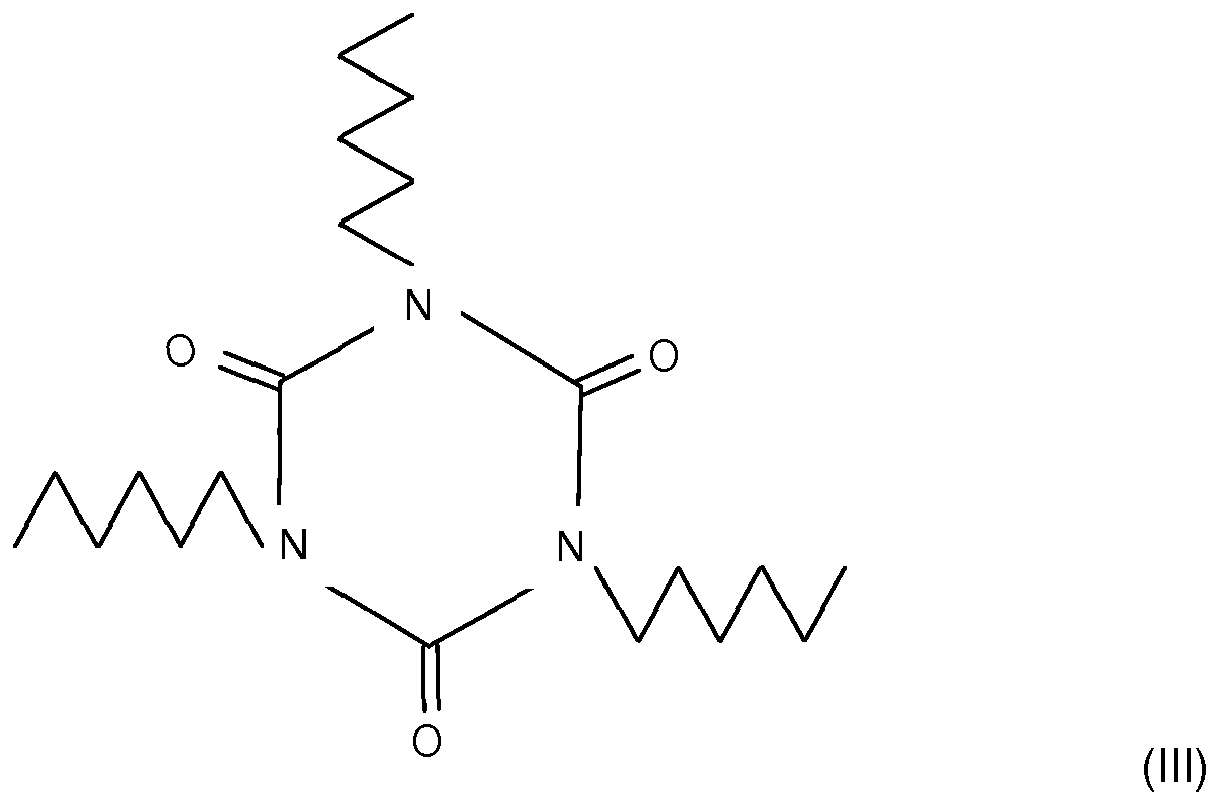
- diisocyanates have the ability to combine with one another, forming dimers or trimers, such as for example in the case of HDI, forming dimers, the central structure of which corresponds to formula (II) (after removing the isocyanate groups to be able to be formally fitted into formula (I)), and trimers, the central structure of which corresponds to formula (III) (after again removing the isocyanate groups to be able to be formally fitted into formula (I), the compound of formula (III) is also referred to as hexamethylene triisocyanurate).
- any of the aforementioned diisocyanates or triisocyanates as well as any dimer or trimer derived therefrom can be used in the present invention.
- HDI uretdione dimers HDI trimethylolpropane trimer, HDI or IPDI isocyanurate trimers, HDI or IPDI biuret trimers, HDI allophanates, etc.
- the isocyanates it is advantageous for the isocyanates to not be directly bound to aromatic rings as they will turn yellow over time and in the presence of light by oxidation.
- the HDI dimer (the central structure of which is formula (II)
- the HDI trimer the central structure of which is formula (III)
- these isocyanates are relatively small and are non-cyclic, and the compounds derived from them are more fluid.
- R 1 is preferably octyl or 2-ethylhexyl.
- R 1 and R 3 are octyl or 2-ethylhexyl.
- R 2 i.e., the alpha amino silane of formula IV, is preferably N-cyclohexylaminomethylmethyldiethoxysilane or N-cyclohexylaminomethyltriethoxysilane.
- the textile sheet material according to the invention is impregnated with a compound such as those described above or with a compound directly derived from the cross-linking thereof.
- a compound according to the invention for impregnating a textile sheet material to produce a watermark is also advantageous, and it also advantageous to use a compound according to the invention in the method for manufacturing a watermark as indicated above.
- a composition for manufacturing a watermark in a textile sheet material is also an object of the invention, characterized in that it comprises a compound of formula (I) according to the invention and a solvent, preferably from the group consisting of toluene, xylene, turpentine, propylene carbonate, ethylene carbonate and mixtures thereof, where the solvent is in a proportion comprised between 5% and 25% by weight with respect to the total weight of the composition.
- this composition is particularly suitable for use thereof for manufacturing watermarks with a viscosity value that allows good fabric penetration but which prevents composition migration in the fabric, and it uses solvents suitable for being handled in printing. Each product requires adjusting the viscosity and the concentration for the application thereof in a determined fabric.
- the concentration of the product is relatively high (>85%) and the working viscosity is between 6000 and 8000 cps at 25 °C.
- the solvent is preferably toluene or propylene carbonate and is in a proportion comprised between 8% and 15% by weight with respect to the total weight of said composition.
- refractive index refractive index
- viscosity viscosity
- penetrability migration
- cross-linking anchoring in the fabric, i.e., resistance to washing
- the composition preferably comprises a dye.
- a dye In fact, watermarks additionally having a determined color or colors can thus be achieved.
- the amount of dye to be added must be low enough so that the transparency is not lost.
- the dye must be a hydrophobic dye so that it can be dissolved in the hydrophobic compound.
- the compound itself and/or the composition advantageously have a viscosity comprised between 5,000 and 10,000 cps, and more advantageously comprised between 6,000 and 8,000 cps.
- Example 1 200.01 g (0.346 moles) of Desmodur® N 3400 and 90.11 g (0.692 moles) of octyl alcohol with an NCO:OH ratio of 3:2 are loaded and are left to react for approximately four hours in an inert nitrogen atmosphere at a temperature of 70°C.
- Desmodur N 3400 is a mixture of hexamethylene diisocyanate trimer and hexamethylene diisocyanate dimer marketed by Bayer MaterialScience AG. The titrated NCO was 5.311% (NCO theoretical : 5.010%). 10% dried toluene (32.27g) is then added for fluidizing the pre-polymer.
- Example 2 197.28 g (0.341 moles) of Desmodur N 3400 and 89.10 g (0.684 moles) of octyl alcohol with an NCO:OH ratio of 3:2 are loaded and are left to react for approximately three hours in an inert nitrogen atmosphere.
- the reaction temperature is 85°C.
- the titrated NCO was 4.973% (NCO theoretical : 4.982%).
- the temperature is then lowered to 25°C and 10% dried toluene (31.43 g) is added for fluidizing the pre-polymer.
- Geniosil 924 is an N-cyclohexylaminomethylmethyldiethoxysilane (CAS No. 27445-54-1) marketed by Wacker Chemie AG.
- Example 3 125.53 g (0.217 moles) of Desmodur N 3400 and 56.59 g (0.434 moles) of octyl alcohol with an NCO:OH ratio of 3:2 are loaded and left to react for approximately three hours in an inert nitrogen atmosphere.
- the reaction temperature is 85°C.
- the titrated NCO was of 4.922% (NCO theoretical : 5.003%).
- the temperature is then lowered to 70°C and 10% dried toluene (20.24 g) is added for fluidizing the pre-polymer.
- Example 4 150.30 g (0.260 moles) of Desmodur N 3400 and 84.54 g (0.649 moles) of octyl alcohol with an NCO:OH ratio of 1.20:1 are loaded and left to react for approximately two and a half hours in an inert nitrogen atmosphere.
- the reaction temperature is 85°C.
- the titrated NCO was 1.757% (NCO theoretical : 2.34%).
- the temperature is then lowered to 25°C and 10% dried toluene (26.09 g) is added for fluidizing the pre-polymer. All the free NCO is finally covered with 24.16 g (0.098 moles) of Geniosil 924 (9.33% silane out of the total solids).
- the yielded end product has a content of 90% solids.
- Example 5 103.18 g (0.178 moles) of Desmodur N 3400 and 58.47 g (0.449 moles) of octyl alcohol with an NCO:OH ratio of 1.20:1 are loaded and left to react for approximately six hours in an inert nitrogen atmosphere.
- the reaction temperature is 85°C.
- the titrated NCO was 2.271% (NCO theoretical : 2.240%).
- the temperature is then lowered to 25°C and 10% dried toluene (18 g) is added for fluidizing the pre-polymer. All the free NCO is finally covered with 24.02 g (0.087 moles) of Geniosil 926 (13% silane out of the total solids).
- Geniosil® XL 926 is an N-cyclohexylaminomethyl triethoxysilane (CAS No 26495-91-0) marketed by Wacker Chemie AG.
- Example 6 108.25 g (0.187 moles) of Desmodur N 3400 and 49.22 g (0.378 moles) of octyl alcohol with an NCO:OH ratio of 1.50:1 are loaded and left to react for approximately three hours in an inert nitrogen atmosphere.
- the reaction temperature is 85°C.
- the titrated NCO was 4.795% (NCO theoretical : 4.904%).
- the temperature is then lowered to 25°C and 10% dried toluene (17.59 g) is added for fluidizing the pre-polymer. All the free NCO is finally covered with 49.62 g (0.180 moles) of Geniosil 926 (24% silane out of the total solids).
- the yielded end product has a content of 90% solids.
- Example 7 102.23 g (0.177 moles) of Desmodur N 3400 and 65.81 g (0.354 moles) of Isofol 12, 2-butyl-1-octanol with an NCO:OH ratio of 1.50:1 are loaded and left to react for approximately three and a half hours in an inert nitrogen atmosphere.
- the reaction temperature is 85°C.
- the titrated NCO was 4.402% (NCO theoretical : 4.417%).
- the temperature is then lowered to 25°C and 10% dried toluene (18.71 g) is added for fluidizing the pre-polymer. All the free NCO is finally covered with 48.51 g (0.176 moles) of Geniosil 926 (22.4% silane out of the total solids).
- the yielded end product has a content of 90% solids.
- Example 8 137.50 g (0.238 moles) of Desmodur N 3400 and 62.34 g (0.479 moles) of octyl alcohol with an NCO:OH ratio of 1.50:1 are loaded and left to react for approximately four and a half hours in an inert nitrogen atmosphere.
- the reaction temperature is 85°C.
- the titrated NCO was 4.832% (NCO theoretical : 4.940%).
- the temperature is then lowered to 25°C and 20% dried toluene (49.175 g) is added for fluidizing the pre-polymer. All the free NCO is finally covered with 63.30 g (0.230 moles) of Geniosil 926 (24.10% silane out of the total solids).
- the yielded end product has a content of 80% solids.
- Example 9 The product of example 8 is repeated but adding 10% propylene carbonate (21.86 g) as solvent.
- Examples 10a and 10b 133.50 g (0.231 moles) of Desmodur N 3400 and 60.21 g (0.462 moles) of octyl alcohol with an NCO:OH ratio of 1.50:1 are loaded and left to react for approximately two and a half hours in an inert nitrogen atmosphere.
- the reaction temperature is 85°C.
- the titrated NCO was 4.815% (NCO theoretical : 4.998%).
- the temperature is then lowered to 25°C and 10% dried toluene (22.10g) is added for fluidizing the pre-polymer. All the free NCO is finally covered with 54.58 g (0.222 moles) of Geniosil 924 (21.98% silane out of the total solids).
- the yielded end product in example 10a has a content of 90% solids and a viscosity of 6100 cps at 25°C.
- Another particularly advantageous form of carrying out the invention is obtained by substituting the toluene with propylene carbonate which corresponds to example 10b, in which case the end product has a viscosity of 7100 cps at 25°C.
- propylene carbonate instead of toluene presents several advantages because it is not inflammable, it does not smell, it is considered less problematic (harmful) than toluene, etc. however, it is less volatile therefore large amounts cannot be used, and it must be ensured that it evaporates during the application process and does not entail a migration of the mark before fixing by cross-linking thereof in the fabric.
- Examples 11a and 11b The products of examples 10a and 10b are repeated and 1.07% yellow dye is added to them.
- Examples 12a and 12b The products of examples 10a and 10b are repeated and 0.89% red dye is added to them.
- Examples 13a and 13b The products of examples 10a and 10b are repeated and 0.83% blue dye is added to them.
- Example 14 The product of example 6 is repeated and 0.83% yellow dye is added to it.
- Example 15 The product of example 6 is repeated and 0.85% red dye is added to it.
- Example 16 The product of example 6 is repeated and 0.81% blue dye is added to it.
- Example 17 The product of example 9 is repeated and 1.04% yellow dye is added to it.
- Example 18 The product of example 9 is repeated and 1.06% red dye is added to it.
- Example 19 The product of example 9 is repeated and 1.07% blue dye is added to it.
- concentration of dye added to each product may vary depending on the color intensity to be obtained in the polyester tape.
- Table 1 Summary of examples Pre-polymer NCO:OH Solvent Silane % silane Dye % dye Ex. 1 Desmodur Octanol 3:2 20% toluene AMEO 21.87% - - Ex. 2 Desmodur Octanol 3:2 20% toluene Geniosil 924 22.52% - - - Ex. 3 Desmodur Octanol 3:2 15% toluene AMEO 11.48% - - Geniosil 924 12.57% Ex. 4 Desmodur Octanol 1.20:1 10% toluene Geniosil 924 9.33% - - - Ex.
- Comparative Example 20 221.90 g (0.387 moles) of Polurene MT100 and 101.02 g (0.774 moles) of octyl alcohol with an NCO:OH ratio of 1.50:1 are loaded and left to react for approximately two and a half hours in an inert nitrogen atmosphere.
- the reaction temperature is 85°C.
- the titrated NCO was 4.999% (NCO theoretical : 5.023%).
- the temperature is then lowered to 25°C and 10% polypropylene carbonate (36.00 g) is added for fluidizing the pre-polymer.
- the remaining NCO is finally reacted with 94.76 g (0.384 moles) of Geniosil 924 (22.69% silane out of the total solids).
- the yielded end product has a content of 90% solids.
- a very viscous product the viscosity of which cannot be easily measured at 25 °C is obtained. Its application is difficult at this concentration.
- Comparative Example 21 188.82 g (0.329 moles) of Polurene MT100, 164.48 g of IPDI (0.739 moles) and 215.41 g (1.645 moles) of octyl alcohol with an NCO:OH ratio of 1.50:1 are loaded. The reaction starts at 50°C, when the temperature stabilizes, it is increased to 70°C and when heat is no longer given off the temperature is increased to 85°C. The titrated NCO was 5.985% (NCO theoretical : 6.017%). The temperature is then lowered to 25oC and 10% polypropylene carbonate (62.25 g) is added for fluidizing the pre-polymer.
- the remaining NCO is finally reacted with 195.84 g (0.823 moles) of Geniosil 924 (25.61% silane out of the total solids).
- Geniosil 924 (25.61% silane out of the total solids).
- the yielded end product has a content of 90% solids.
- the viscosity of this product is 70620 cps at 25oC. Its application is difficult at this concentration.
Landscapes
- Chemical & Material Sciences (AREA)
- Chemical Kinetics & Catalysis (AREA)
- Organic Chemistry (AREA)
- Polymers & Plastics (AREA)
- Health & Medical Sciences (AREA)
- Medicinal Chemistry (AREA)
- Engineering & Computer Science (AREA)
- General Chemical & Material Sciences (AREA)
- Textile Engineering (AREA)
- Wood Science & Technology (AREA)
- Materials Engineering (AREA)
- Life Sciences & Earth Sciences (AREA)
- Treatments For Attaching Organic Compounds To Fibrous Goods (AREA)
- Organic Low-Molecular-Weight Compounds And Preparation Thereof (AREA)
Abstract

X is hexamethylene, trimethylhexamethylene, isophorone, dicyclohexylmethyl, tetramethylxylylene, tetramethylenexylene, xylylene, trimethylhexamethylene, hydrogenated 4,4'-diphenylmethylene, 1,12-dodecylene, 1,5-2-methylpentylene; 1,4-butylene; 1,4-cyclohexylene, or a compound of formula



R2 is a radical of formula
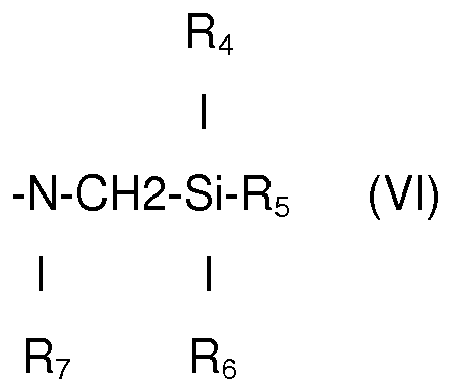
R4 is methoxy or ethoxy
R5 and R6 are H, methoxy, ethoxy, methyl or ethyl
R7 is cyclohexyl, phenyl or aliphatic C3-C6 alkyl
R3 is a linear aliphatic C1-C12 alkyl radical or a branched aliphatic C3-C18 alkyl radical
n is 0 or 1.
Description
- The invention relates to a compound and a composition and uses thereof for manufacturing a watermark in a textile sheet material. The invention also relates to a textile sheet material having a watermark and a method for manufacturing a watermark in a textile sheet material.
- Counterfeiting garments of famous trademarks is a known phenomenon. In some cases, the counterfeits also include a faithful reproduction of the trademark in question which occasionally makes it difficult for the public to distinguish between an original product and a counterfeit product, with subsequent damages both for the user and the owner of the trademark.
- Despite the efforts made to prevent these counterfeits, it is very difficult to prevent them altogether. To that end, it is necessary to be able to include some type of marking or sign in the garments which allows a possible buyer to distinguish an original garment from a counterfeit garment.
- The object of the invention is to overcome these drawbacks. This is achieved by means of a textile sheet material which is formed with a transparent textile material with a determined refractive index of RI value, characterized in that it comprises an area impregnated with a compound the refractive index of which is comprised between RI-0.6 and RI+0.6, preferably between RI-0.3 and RI+0.3, thus producing a watermark.
- In fact, most sheet textile materials are manufactured from textile materials in the form of transparent threads. However, the textile sheet material as a whole is not transparent because its structure comprises a considerable amount of intertwined threads, hollow spaces (containing air), etc., which causes the light, upon traversing the textile sheet material, to encounter a plurality of phase changes, which causes its dispersion and, consequently, the textile sheet material as a whole is not transparent. However, if a textile sheet material is impregnated with a compound (such that the compound fills in all the hollow spaces and establishes a continuous connection between thread and thread) having a refractive index similar to that of the textile material (i.e., the thread), the rays of light are then able to traverse the whole of the material as if it was a single transparent medium, therefore a transparent appearance is achieved for the whole of the material in the impregnated area, where a watermark is generated.
- In principle, this can be achieved for any textile material provided that it is transparent, and it can even be a mixture of textile materials provided that their refractive indices are equal or sufficiently similar. Likewise, in principle this concept can be applied to any textile material regardless of how it is manufactured and its threads are distributed.
- A fragment of textile sheet material with a transparent area (i.e., with a watermark) which can be easily detected by a possible buyer can thus be included in a garment. For example, most garments include some labels which include information on its origin, the materials used, the conditions in which the garment must be washed, etc. This watermark can preferably be included in a label and may have a specific shape, for example, the shape of the manufacturer's mark.
- The textile material is preferably a material from the group consisting of polyester, polyamide, polyurethane, acrylic fiber, regenerated cellulose fibers, cotton, linen, wool and silk, and it is particularly advantageous that the textile material is polyester. In fact, the labels of the garments are preferably made from polyester and as discussed above, the watermark is preferably placed in a label of the garment.
- The watermark preferably has a function of indicating and assuring its origin. In this sense, it is not necessary for the watermark to be particularly resistant to garment washing because once the garment is purchased, the watermark has already carried out its function. However, the fact that the watermark is gradually eliminated with successive garment washings may be undesirable for various reasons, among others due to a possible "image loss" as well as giving the buyer a feeling of "bad quality". Therefore, it is advantageous that the watermark is made from a compound that is resistant to repeated garment washing. This washing must be understood as a conventional washing performed in household washing machines.
- It is also advantageous for the watermark to not turn yellow or darken over time due to the presence of air and light. To that end, materials resistant to light and air must be used in the conditions in which the label or the garment having the watermark is applied and used. The darkening or yellowing of the watermark makes it more visible and also more easily detectable and imitable. In the event that the watermark has its own design color, this could be modified or be affected by the yellowish color or darkening of the watermark's background.
- Consequently, the use of a compound for impregnating an area of a textile sheet material is also an object of the invention, wherein the textile sheet material is formed with a transparent textile material with a determined refractive index of RI value, and wherein the compound has a refractive index which is comprised between RI-0.6 and RI+0.6, preferably between RI-0.3 and RI+0.3, thus producing a watermark. As mentioned above, the textile material is preferably a material from the group consisting of polyester, polyamide, polyurethane, acrylic fiber, regenerated cellulose fibers, cotton, linen, wool and silk, particularly polyester.
- A method for manufacturing a watermark in a textile sheet material which is formed with a transparent textile material with a determined refractive index of RI value is also an object of the invention, characterized in that it comprises a printing stage in which an area of said textile sheet material is impregnated with a compound the refractive index of which is comprised between RI-0.6 and RI+0.6, preferably between RI-0.3 and RI+0.3, thus producing a watermark. The textile material is preferably a material from the group consisting of polyester, polyamide, polyurethane, acrylic fiber, regenerated cellulose fibers, cotton, linen, wool and silk, particularly polyester.
- The printing stage is preferably performed in hot conditions by applying the compound or the composition containing it at about 40-60°C because the product is thus more fluidized, improving the penetration, particularly in the case of thick and/or pressed fabrics.
- Another object of the invention is a compound of formula
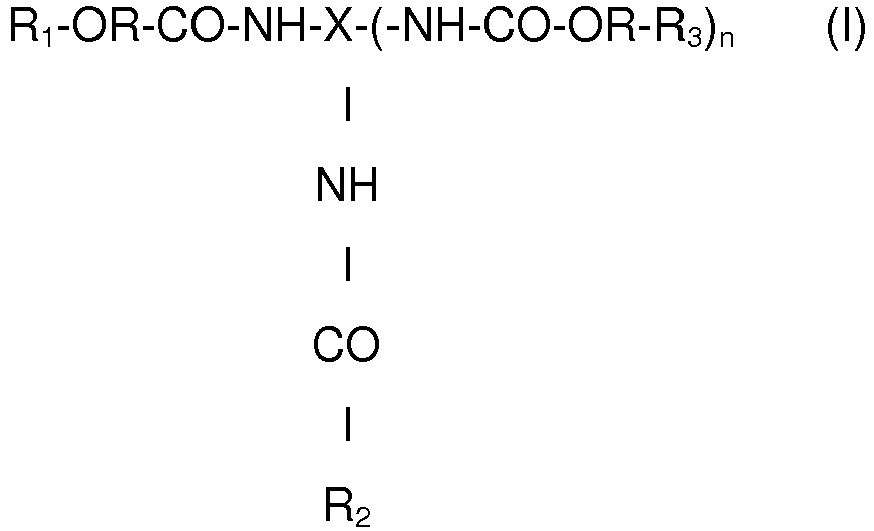
- a) X is hexamethylene, trimethylhexamethylene, isophorone, dicyclohexylmethyl, tetramethylxylylene, tetramethylenexylene, xylylene, trimethylhexamethylene, hydrogenated 4,4'-diphenylmethylene, 1,12-dodecylene, 1.5-2-methylpentylene, 1,4-butylene, 1,4-cyclohexylene, or a compound of formula

or a compound of formula
or a compound of formula

- b) R1 is a linear aliphatic C1-C12 alkyl radical or a branched aliphatic C3-C18 alkyl radical
- c) R2 is a radical of formula
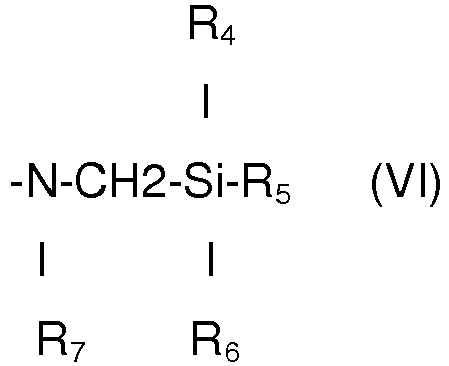
c1) R4 is methoxy or ethoxy,
c2) R5 is H, methoxy, ethoxy, methyl or ethyl,
c3) R6 is H, methoxy, ethoxy, methyl or ethyl,
c4) R7 is cyclohexyl, phenyl or aliphatic C3-C6 alkyl, - d) R3 is a linear aliphatic C1-C12 alkyl radical or a branched aliphatic C3-C18 alkyl radical, and
- e) n is 0 or 1.
- In fact, it has been observed that these compounds allow obtaining a great transparency effect in most the textile materials. It is possible to adjust their refractive index by modifying the radicals, such that for example, the inclusion of radicals with long alkyl chains allows obtaining lower refractive indices, while the inclusion of more functionalized and/or more hydrophilic radicals allows obtaining higher refractive indices.
- These compounds also have the advantage of being liquids at room temperature or at temperatures close to room temperature so they can be used in printing, for example in flexography, which allows printing the watermark in the textile sheet material by means of printing techniques, particularly by means of flexography. Likewise, they can be dissolved in low toxicity solvents, which again is advantageous for its use in printing.
- Another advantage of these compounds is that it is possible to adjust their viscosity by properly choosing the radicals. In fact, as discussed above, it is advantageous for the watermark to have a specific shape. To that end, it is advisable that the viscosity be high enough for it to avoid migrations (which would make forming shapes more or less complicated) but low enough for it to be able to be applied by means of printing techniques and for it to penetrate well into the textile sheet material, filling in the pores. Consequently, each textile sheet material will require adjusting the values of the radicals (and of the solvents) until reaching the optimal equilibrium.
- Preferably, there is a cross-linking stage after the printing stage which anchors (or fixes) the compound in the textile sheet material. In this sense, these compounds have the additional advantage that they spontaneously cross-link with one other (after drying the small amount of solvent that they may have, and in the presence of ambient humidity), bonds being established between the molecules of the compound through the radical R2, such that the watermark is resistant to washing the textile sheet material with water. In fact, the radical of formula IV, which is an alpha amino silane having a high capacity for reacting with another alpha amino silane through a hydroxyl radical, forming a silica oxide-type (silicate) (Si-O-Si) bond in the presence of water (the presence of ambient humidity being sufficient to give rise to this reaction). This reaction takes place in two steps: the hydrolysis of the silane group (-SiOCH3) with water takes place in the first step, becoming silanol (-SiOH), and in a second step two silanol groups react with one another forming -Si-O-Si- with the loss of a water molecule. The particularity that the silica atom has four substitutions, two or three of them of the reactive silane type, causes it to have a high cross-linking capacity and this finally leads to the high stability and insolubility of the cured end product in most adverse conditions (temperature, air oxidation, abrasion, etc.) and solvents in general, including water itself.
- As can be seen, the basic structure of the compound of formula (I) is a compound with a urethane-type bond between R1 and X and, if n=1, also between X and R3, and a urea-type bond from the reaction between an isocyanate group and the amine of the radical of formula (VI) (the alpha amino silane). Therefore, a method for manufacture can be the reaction of a di- or triisocyanate having X as a central structure with R1-OH and R3-OH type alcohols and subsequently the reaction of the corresponding urethane with an alpha amino silane of formula (VI). It must therefore be understood that by means of the expression "X", the intention is to indicate the structure resulting from removing the isocyanate groups from the following compounds: hexamethylene 1,6-diisocyanate (HDI), trimethylhexamethylene diisocyanate, isophorone diisocyanate (IPDI), dicyclohexylmethyl diisocyanate, tetramethylxylene diisocyanate (TMXDI), tetramethylenexylene diisocyanate, xylylene diisocyanate, trimethylhexamethylene diisocyanate, hydrogenated diphenylmethane 4,4'-diisocyanate (HMDI), 1,12-diisocyanatedodecane, 1,5-diisocyanate-2-methylpentane, 1,4-diisocyanatebutane, 1,4-cyclohexylene diisocyanate, 1,3-diazetidine-2,4-dione 1,3-bis(6-isocyanatehexyl), 1,3,5-triazine-2,4,6(1 H,3H,5H)-trione 1,3,5-tris(6-isocyanatehexyl), or imidocarbonic diamide N,N',2-tris(6-isocyanatehexyl) (which is the biuret resulting from HDI reacted with a water molecule, also referred to as N,N',2-tris(6-isocyanatehexyl) imidocarbonic diamide, 1,3,5-tris(6-hydroxyhexyl) triisocyanate biuret, or hexamethylene diisocyanate biuret), for the purpose of formally adjusting them to the formula (I). Some diisocyanates have the ability to combine with one another, forming dimers or trimers, such as for example in the case of HDI, forming dimers, the central structure of which corresponds to formula (II) (after removing the isocyanate groups to be able to be formally fitted into formula (I)), and trimers, the central structure of which corresponds to formula (III) (after again removing the isocyanate groups to be able to be formally fitted into formula (I), the compound of formula (III) is also referred to as hexamethylene triisocyanurate). Generally, any of the aforementioned diisocyanates or triisocyanates as well as any dimer or trimer derived therefrom can be used in the present invention. Some examples thereof may be HDI uretdione dimers, HDI trimethylolpropane trimer, HDI or IPDI isocyanurate trimers, HDI or IPDI biuret trimers, HDI allophanates, etc. In any event, it is advantageous for the isocyanates to not be directly bound to aromatic rings as they will turn yellow over time and in the presence of light by oxidation. In this sense, the HDI dimer (the central structure of which is formula (II)), the HDI trimer (the central structure of which is formula (III)) as well as their mixtures, are particularly advantageous because these isocyanates are relatively small and are non-cyclic, and the compounds derived from them are more fluid.
- It would also be possible to conceive a compound which, starting from a triisocyanate, has a single urethane-type bond and, in exchange, has two bound alpha amino silanes (i.e., substituting -O-R3 with another -R2). However, these compounds are denser and therefore they are less recommendable.
- When choosing the radicals R1 and, where appropriate, R3, it is advisable to choose them such that the resulting compound is liquid and not solid, although they could also be melted and applied in the molten textile sheet material, but they will have a greater tendency to crystallize and this will make them loss transparency.
- A preferred family of compounds is obtained when n is 0 and R4, R5 and R6 are each methoxy or ethoxy. It is especially advantageous that each of them is ethoxy. In fact, there are some compounds with low cross-linking capacity when n=0, therefore it is of interest for the alpha amino silane to have more hydroxyls suitable for cross-linking. R1 is preferably octyl or 2-ethylhexyl.
- Another preferred family of compounds is when n is 1 and R4 and R5 are ethoxy and R6 is methyl. In this case, it is particularly advantageous that R1 and R3 are octyl or 2-ethylhexyl.
R2, i.e., the alpha amino silane of formula IV, is preferably
N-cyclohexylaminomethylmethyldiethoxysilane
or
N-cyclohexylaminomethyltriethoxysilane. - Advantageously, the textile sheet material according to the invention is impregnated with a compound such as those described above or with a compound directly derived from the cross-linking thereof.
- As discussed above, the use of a compound according to the invention for impregnating a textile sheet material to produce a watermark is also advantageous, and it also advantageous to use a compound according to the invention in the method for manufacturing a watermark as indicated above.
- Finally, a composition for manufacturing a watermark in a textile sheet material is also an object of the invention, characterized in that it comprises a compound of formula (I) according to the invention and a solvent, preferably from the group consisting of toluene, xylene, turpentine, propylene carbonate, ethylene carbonate and mixtures thereof, where the solvent is in a proportion comprised between 5% and 25% by weight with respect to the total weight of the composition. In fact, this composition is particularly suitable for use thereof for manufacturing watermarks with a viscosity value that allows good fabric penetration but which prevents composition migration in the fabric, and it uses solvents suitable for being handled in printing. Each product requires adjusting the viscosity and the concentration for the application thereof in a determined fabric. It is necessary so that it can be handled to achieve good penetration, good anchorage in the fabric and ultimately a good transparency for achieving a good watermark. When working with the preferred ideal products (see above) the concentration of the product is relatively high (>85%) and the working viscosity is between 6000 and 8000 cps at 25 °C. However, it may be necessary to properly thicken or dilute the product to achieve its final properties on the fabric depending on the type of fabric, the thread of the fabric, its compacting and porosity, its capacity of being moistened by the solvent used.
- The solvent is preferably toluene or propylene carbonate and is in a proportion comprised between 8% and 15% by weight with respect to the total weight of said composition.
- The composition advantageously comprises a first compound of formula (I) with n=1 and a second compound of formula (I) with n=0. In fact, in this way there is greater versatility for combining the various parameters that come into play: refractive index, viscosity, penetrability, migration, cross-linking (anchoring in the fabric, i.e., resistance to washing), etc.
- The composition preferably comprises a dye. In fact, watermarks additionally having a determined color or colors can thus be achieved. In this case, the amount of dye to be added must be low enough so that the transparency is not lost. In this sense, it is advantageous for the composition to have the dye in a proportion less than or equal to 2.5% by weight, preferably less than or equal to 1.5% by weight with respect to the total weight of the compound of formula (I). The dye must be a hydrophobic dye so that it can be dissolved in the hydrophobic compound.
- The compound itself and/or the composition advantageously have a viscosity comprised between 5,000 and 10,000 cps, and more advantageously comprised between 6,000 and 8,000 cps.
- Example 1: 200.01 g (0.346 moles) of Desmodur® N 3400 and 90.11 g (0.692 moles) of octyl alcohol with an NCO:OH ratio of 3:2 are loaded and are left to react for approximately four hours in an inert nitrogen atmosphere at a temperature of 70°C. Desmodur N 3400 is a mixture of hexamethylene diisocyanate trimer and hexamethylene diisocyanate dimer marketed by Bayer MaterialScience AG. The titrated NCO was 5.311% (NCOtheoretical : 5.010%). 10% dried toluene (32.27g) is then added for fluidizing the pre-polymer. The temperature is finally lowered to 25°C and all the free NCO is covered with 81.19 g of AMEO (0.367 moles) (21.87% silane out of the total solids); the silane is added together with another 10% dried toluene, yielding an end product with a content of 80% solids. An aminopropyltriethoxysilane which is marketed by EVONIK INDUSTRIES AG under the name Dynasylan AMEO, and also by Wacker Chemie AG under the name Geniosil GF 93 has been called "AMEO". Generally, Desmodur N 3400 can be replaced with Polurene MT 100 which is the hexamethylene diisocyanate trimer marketed by SAPICI although it is more viscous.
- Example 2: 197.28 g (0.341 moles) of Desmodur N 3400 and 89.10 g (0.684 moles) of octyl alcohol with an NCO:OH ratio of 3:2 are loaded and are left to react for approximately three hours in an inert nitrogen atmosphere. The reaction temperature is 85°C. The titrated NCO was 4.973% (NCOtheoretical: 4.982%). The temperature is then lowered to 25°C and 10% dried toluene (31.43 g) is added for fluidizing the pre-polymer. All the free NCO is then covered with 83.23 g (0.339 moles) of Geniosil 924 (22.52% silane out of the total solids); the silane is added together with another 10% dried toluene, yielding an end product with a content of 80% solids. Geniosil® XL 924 is an N-cyclohexylaminomethylmethyldiethoxysilane (CAS No. 27445-54-1) marketed by Wacker Chemie AG.
- Example 3: 125.53 g (0.217 moles) of Desmodur N 3400 and 56.59 g (0.434 moles) of octyl alcohol with an NCO:OH ratio of 3:2 are loaded and left to react for approximately three hours in an inert nitrogen atmosphere. The reaction temperature is 85°C. The titrated NCO was of 4.922% (NCOtheoretical: 5.003%). The temperature is then lowered to 70°C and 10% dried toluene (20.24 g) is added for fluidizing the pre-polymer. All the free NCO is finally covered with 26.20 g (0.107 moles) of Geniosil 924 (12.57% silane out of the total solids) and with 23.66 g (0.107 moles) of AMEO (11.48% silane out of the total solids); the silanes are also added with dried toluene, yielding an end product with a content of approximately 85% solids.
- Example 4: 150.30 g (0.260 moles) of Desmodur N 3400 and 84.54 g (0.649 moles) of octyl alcohol with an NCO:OH ratio of 1.20:1 are loaded and left to react for approximately two and a half hours in an inert nitrogen atmosphere. The reaction temperature is 85°C. The titrated NCO was 1.757% (NCOtheoretical: 2.34%). The temperature is then lowered to 25°C and 10% dried toluene (26.09 g) is added for fluidizing the pre-polymer. All the free NCO is finally covered with 24.16 g (0.098 moles) of Geniosil 924 (9.33% silane out of the total solids). The yielded end product has a content of 90% solids.
- Example 5: 103.18 g (0.178 moles) of Desmodur N 3400 and 58.47 g (0.449 moles) of octyl alcohol with an NCO:OH ratio of 1.20:1 are loaded and left to react for approximately six hours in an inert nitrogen atmosphere. The reaction temperature is 85°C. The titrated NCO was 2.271% (NCOtheoretical: 2.240%). The temperature is then lowered to 25°C and 10% dried toluene (18 g) is added for fluidizing the pre-polymer. All the free NCO is finally covered with 24.02 g (0.087 moles) of Geniosil 926 (13% silane out of the total solids). The yielded end product has a content of 90% solids. Geniosil® XL 926 is an N-cyclohexylaminomethyl triethoxysilane (CAS No 26495-91-0) marketed by Wacker Chemie AG.
- Example 6: 108.25 g (0.187 moles) of Desmodur N 3400 and 49.22 g (0.378 moles) of octyl alcohol with an NCO:OH ratio of 1.50:1 are loaded and left to react for approximately three hours in an inert nitrogen atmosphere. The reaction temperature is 85°C. The titrated NCO was 4.795% (NCOtheoretical: 4.904%). The temperature is then lowered to 25°C and 10% dried toluene (17.59 g) is added for fluidizing the pre-polymer. All the free NCO is finally covered with 49.62 g (0.180 moles) of Geniosil 926 (24% silane out of the total solids). The yielded end product has a content of 90% solids.
- Example 7: 102.23 g (0.177 moles) of Desmodur N 3400 and 65.81 g (0.354 moles) of Isofol 12, 2-butyl-1-octanol with an NCO:OH ratio of 1.50:1 are loaded and left to react for approximately three and a half hours in an inert nitrogen atmosphere. The reaction temperature is 85°C. The titrated NCO was 4.402% (NCOtheoretical: 4.417%). The temperature is then lowered to 25°C and 10% dried toluene (18.71 g) is added for fluidizing the pre-polymer. All the free NCO is finally covered with 48.51 g (0.176 moles) of Geniosil 926 (22.4% silane out of the total solids). The yielded end product has a content of 90% solids.
- Example 8: 137.50 g (0.238 moles) of Desmodur N 3400 and 62.34 g (0.479 moles) of octyl alcohol with an NCO:OH ratio of 1.50:1 are loaded and left to react for approximately four and a half hours in an inert nitrogen atmosphere. The reaction temperature is 85°C. The titrated NCO was 4.832% (NCOtheoretical: 4.940%). The temperature is then lowered to 25°C and 20% dried toluene (49.175 g) is added for fluidizing the pre-polymer. All the free NCO is finally covered with 63.30 g (0.230 moles) of Geniosil 926 (24.10% silane out of the total solids). The yielded end product has a content of 80% solids.
- Example 9: The product of example 8 is repeated but adding 10% propylene carbonate (21.86 g) as solvent.
- Examples 10a and 10b: 133.50 g (0.231 moles) of Desmodur N 3400 and 60.21 g (0.462 moles) of octyl alcohol with an NCO:OH ratio of 1.50:1 are loaded and left to react for approximately two and a half hours in an inert nitrogen atmosphere. The reaction temperature is 85°C. The titrated NCO was 4.815% (NCOtheoretical: 4.998%). The temperature is then lowered to 25°C and 10% dried toluene (22.10g) is added for fluidizing the pre-polymer. All the free NCO is finally covered with 54.58 g (0.222 moles) of Geniosil 924 (21.98% silane out of the total solids). The yielded end product in example 10a has a content of 90% solids and a viscosity of 6100 cps at 25°C. This is a particularly advantageous form of carrying out the invention. Another particularly advantageous form of carrying out the invention is obtained by substituting the toluene with propylene carbonate which corresponds to example 10b, in which case the end product has a viscosity of 7100 cps at 25°C. The use of propylene carbonate instead of toluene presents several advantages because it is not inflammable, it does not smell, it is considered less problematic (harmful) than toluene, etc. however, it is less volatile therefore large amounts cannot be used, and it must be ensured that it evaporates during the application process and does not entail a migration of the mark before fixing by cross-linking thereof in the fabric.
- Examples 11a and 11b: The products of examples 10a and 10b are repeated and 1.07% yellow dye is added to them.
- Examples 12a and 12b: The products of examples 10a and 10b are repeated and 0.89% red dye is added to them.
- Examples 13a and 13b: The products of examples 10a and 10b are repeated and 0.83% blue dye is added to them.
- Example 14: The product of example 6 is repeated and 0.83% yellow dye is added to it.
- Example 15: The product of example 6 is repeated and 0.85% red dye is added to it.
- Example 16: The product of example 6 is repeated and 0.81% blue dye is added to it.
- Example 17: The product of example 9 is repeated and 1.04% yellow dye is added to it.
- Example 18: The product of example 9 is repeated and 1.06% red dye is added to it.
- Example 19: The product of example 9 is repeated and 1.07% blue dye is added to it.
- It should be noted that the concentration of dye added to each product may vary depending on the color intensity to be obtained in the polyester tape.
- A table summarizing all the examples mentioned above is shown below (Table 1):
Table 1: Summary of examples Pre-polymer NCO:OH Solvent Silane % silane Dye % dye Ex. 1 Desmodur Octanol 3:2 20% toluene AMEO 21.87% - - Ex. 2 Desmodur Octanol 3:2 20% toluene Geniosil 924 22.52% - - - Ex. 3 Desmodur Octanol 3:2 15% toluene AMEO 11.48% - - Geniosil 924 12.57% Ex. 4 Desmodur Octanol 1.20:1 10% toluene Geniosil 924 9.33% - - - Ex. 5 Desmodur Octanol 1.20:1 10% toluene Geniosil 926 13.00% - - - Ex. 6 Desmodur Octanol 1.50:1 10% toluene Geniosil 926 24.00% - - - Ex. 7 Desmodur Isofol 12 1.50:1 10% toluene Geniosil 926 22.40% - - - Ex. 8 Desmodur Octanol 1.50:1 20% toluene Geniosil 926 24.10% - - Ex. 9 Desmodur Octanol 1.50:1 10% propylene carbonate Geniosil 926 24.10% - - Ex. 10a and 10b Desmodur Octanol 1.50:1 10% toluene or 10% propylene carbonate Geniosil 924 21.98% - - Ex. 11a or 11b Desmodur 1.50:1 10% toluene or 10% propylene carbonate Geniosil 924 21.98% Yellow 1.07% Ex. 12a or 12b Red 0.89% Ex. 13a or 13b Octanol Blue 0.83% Ex. 14 Desmodur 1.50:1 10% toluene Geniosil 926 23.79% Yellow 0.83% Ex. 15 Red 0.85% Ex. 16 Octanol Blue 0.81% Ex. 17 Desmodur 1.50:1 10% propylene carbonate Geniosil 926 24.33% Yellow 1.04% Ex. 18 Red 1.06% Ex. 19 Octanol Blue 1.07% - All the synthesized products are applied in the laboratory with a buffer on pieces of polyester tape. Each product is applied three times on each tape such that there are high product thickness, intermediate product thickness and low product thickness.
- Once the products have been applied on the polyester tapes and left to dry, they are hand-washed three consecutive times with a powdered soap for home use (Norit® marketed by Grupo ACE Marca SL) and cold water. All the tapes are also washed three times in the washing machine at 40°C to ensure the resistance of the products to washing. The results of the applications are shown in Table 2:
Table 2: Laboratory application results. Product penetration into the tape Resistance to washing by hand Resistance to machine washing Ex. 1 Good The product spreads a little Not very resistant to washing Not very resistant to washing Ex. 2 Very good The product does not spread Completely resistant to washing Completely resistant to washing Ex. 3 Very good The product does not spread Quite resistant to washing Quite resistant to washing Ex. 4 Good The product spreads a lot Not very resistant, the product spreads more Not very resistant to washing Quality loss Ex. 5 Good The product spreads a lot Not very resistant, the product spreads more Not very resistant to washing Quality loss Ex. 6 Very good The product does not spread Completely resistant to washing Completely resistant to washing Ex. 7 Very good The product does not spread Not very resistant to washing Quality loss Not very resistant to washing Ex. 8 Very good The product does not spread Completely resistant to washing Completely resistant To washing Ex. 9 Very good The product does not spread Completely resistant to washing Completely resistant to washing Ex. 10a and 10b Very good The product does not spread Completely resistant to washing Completely resistant to washing Ex. 11a and 11b Very good The product does not spread Completely resistant to washing Completely resistant to washing Ex. 12a and 12b Ex. 13a and 13b Ex. 14 Very good Completely Completely Ex. 15 The product does resistant resistant Ex. 16 not spread to washing to washinq Ex. 17 Very good Completely Completely Ex. 18 The product does resistant resistant Ex. 19 not spread to washing to washing - The products in Table 2 showing the best result in terms of application and resistance to washing in a washing machine are reapplied on polyester tape and in label a printing machine. Various tests are conducted applying more or less amount of product.
- The results obtained are good; all the products penetrate the polyester tape very well and the products containing dye have very good color intensity.
- To ascertain if the products are resistant to washing, they are washed several times in the washing machine in hot conditions at 40°C. All the products, including those containing dye, are completely resistant to washing.
- Comparative Example 20: 221.90 g (0.387 moles) of Polurene MT100 and 101.02 g (0.774 moles) of octyl alcohol with an NCO:OH ratio of 1.50:1 are loaded and left to react for approximately two and a half hours in an inert nitrogen atmosphere. The reaction temperature is 85°C. The titrated NCO was 4.999% (NCOtheoretical: 5.023%). The temperature is then lowered to 25°C and 10% polypropylene carbonate (36.00 g) is added for fluidizing the pre-polymer. The remaining NCO is finally reacted with 94.76 g (0.384 moles) of Geniosil 924 (22.69% silane out of the total solids). The yielded end product has a content of 90% solids. A very viscous product the viscosity of which cannot be easily measured at 25 °C is obtained. Its application is difficult at this concentration.
- Comparative Example 21: 188.82 g (0.329 moles) of Polurene MT100, 164.48 g of IPDI (0.739 moles) and 215.41 g (1.645 moles) of octyl alcohol with an NCO:OH ratio of 1.50:1 are loaded. The reaction starts at 50°C, when the temperature stabilizes, it is increased to 70°C and when heat is no longer given off the temperature is increased to 85°C. The titrated NCO was 5.985% (NCOtheoretical: 6.017%). The temperature is then lowered to 25ºC and 10% polypropylene carbonate (62.25 g) is added for fluidizing the pre-polymer. The remaining NCO is finally reacted with 195.84 g (0.823 moles) of Geniosil 924 (25.61% silane out of the total solids). The yielded end product has a content of 90% solids. The viscosity of this product is 70620 cps at 25ºC. Its application is difficult at this concentration.
- These last two examples have very high viscosities which complicates their applications as such. To that end, it is advisable to dilute them with more solvent even though this leads to the watermark being less visible.
Claims (28)
- A compound for manufacturing a watermark in a textile sheet material of formula

X is hexamethylene, trimethylhexamethylene, isophorone, dicyclohexylmethyl, tetramethylxylylene, tetramethylenexylene, xylylene, trimethylhexamethylene, hydrogenated 4,4'-diphenylmethylene, 1,12-dodecylene, 1,5-2-methylpentylene; 1,4-butylene; 1,4-cyclohexylene, or a compound of formula
or a compound of formula
or a compound of formula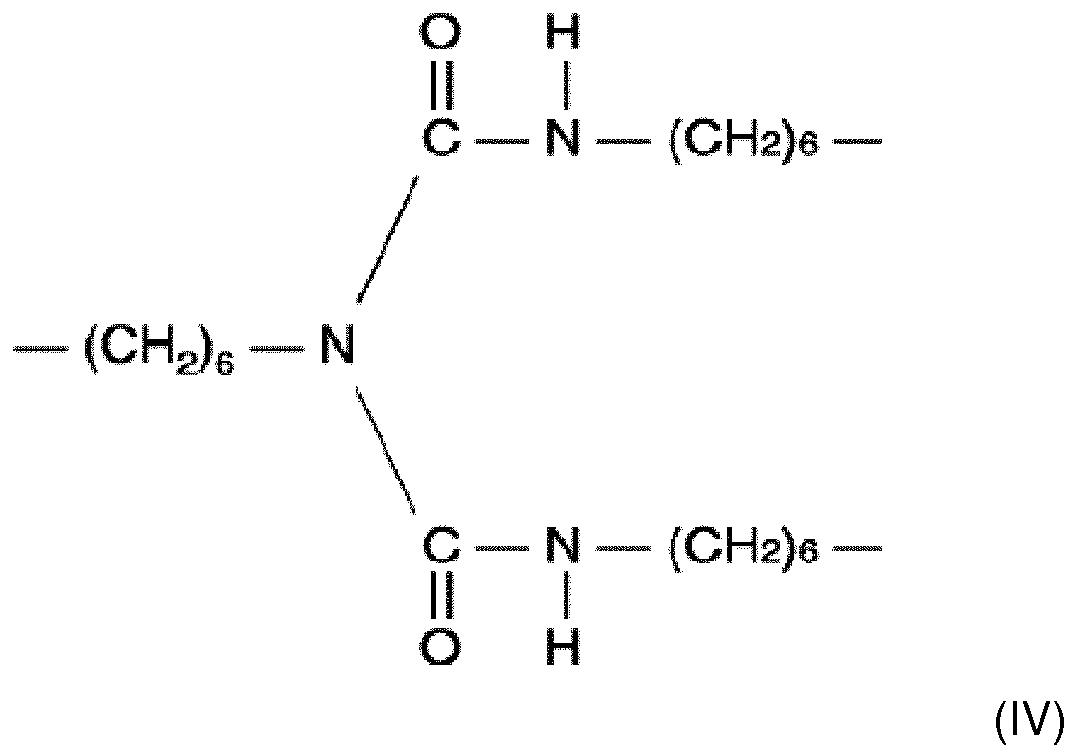
or a compound of formula
R2 is a radical of formula
R4 is methoxy or ethoxy
R5 is H, methoxy, ethoxy, methyl or ethyl
R6 is H, methoxy, ethoxy, methyl or ethyl
R7 is cyclohexyl, phenyl or aliphatic C3-C6 alkyl
R3 is a linear aliphatic C1-C12 alkyl radical or a branched aliphatic C3-C18 alkyl radical
n is 0 or 1. - The compound according to claim 1, characterized in that n is 0 and R4, R5 and R6 are each methoxy or ethoxy, preferably ethoxy.
- The compound according to claim 2, characterized in that R1 is octyl or 2-ethylhexyl.
- The compound according to claim 1, characterized in that n is 1, R4 and R5 are ethoxy and R6 is methyl.
- the compound according to claim 4, characterized in that R1 and R3 are octyl or 2-ethylhexyl.
- The compound according to any of claims 1 to 5, characterized in that R2 is
N-cyclohexylaminomethylmethyldiethoxysilane
or
N-cyclohexylaminomethyltriethoxysilane. - The compound according to any of claims 1 to 6, characterized in that it has a viscosity comprised between 5,000 and 10,000 cps at 25°C.
- A composition for manufacturing a watermark in a textile sheet material, characterized in that it comprises a compound of formula (I) according to any of claims 1 to 7 and a solvent, preferably from the group consisting of toluene, xylene, turpentine, propylene carbonate, ethylene carbonate and mixtures thereof, wherein said solvent is in a proportion comprised between 5% and 25% by weight with respect to the total weight of said composition.
- The composition according to claim 8, characterized in that said solvent is toluene or propylene carbonate and is in a proportion comprised between 8% and 15% by weight with respect to the total weight of said composition.
- The composition according to one of claims 8 or 9, characterized in that it comprises a first compound with formula (I) with n=1 and a second compound with formula (I) with n=0
- The composition according to any of claims 8 to 10, characterized in that it comprises a dye.
- The composition according to claim 11, characterized in that said dye is in a proportion less than or equal to 2.5% by weight, preferably less than or equal to 1.5% by weight with respect to the total weight of the compound of formula (I).
- The composition according to any of claims 8 to 12, characterized in that it has a viscosity comprised between 5,000 and 10,000 cps at 25°C.
- A textile sheet material which is formed with a transparent textile material with a determined refractive index of RI value, characterized in that it comprises an area impregnated with a compound the refractive index of which is comprised between RI-0.6 and RI+0.6, preferably between RI-0.3 and RI+0.3, thus producing a watermark.
- The textile sheet material according to claim 14, characterized in that said compound is a compound according to any of claims 1 to 6 or a compound derived directly from the cross-linking thereof.
- The textile sheet material according to one of claims 14 or 15, characterized in that said textile material is a material from the group consisting of polyester, polyamide, polyurethane, acrylic fiber, regenerated cellulose fibers, cotton, linen, wool and silk.
- The textile sheet material according to claim 16, characterized in that said textile material is polyester.
- A method for manufacturing a watermark in a textile sheet material which is formed with a transparent textile material, with a determined refractive index of RI value, characterized in that it comprises a printing stage in which an area of said textile sheet material is impregnated with a compound the refractive index of which is comprised between RI-0.6 and RI+0.6, preferably between RI-0.3 and RI+0.3, thus producing a watermark.
- The method according to claim 18, characterized in that said compound is a compound according to any of claims 1 to 7.
- The method according to claim 19, characterized in that it comprises, after said printing stage, a cross-linking stage in which bonds are formed between the molecules of said compound through the radical R2, such that said watermark is resistant to washing said textile sheet material with water.
- The method according to any of claims 18 to 20, characterized in that said textile material is a material from the group consisting of polyester, polyamide, polyurethane, acrylic fiber, regenerated cellulose fibers, cotton, linen, wool and silk.
- The method according to claim 21, characterized in that said textile material is polyester.
- The method according to any of claims 18 to 22, characterized in that said compound has a viscosity comprised between 5,000 and 10,000 cps at 25°C.
- Use of a compound for impregnating an area of a textile sheet material, wherein said textile sheet material is formed with a transparent textile material with a determined refractive index of RI value, and wherein said compound has a refractive index which is comprised between RI-0.6 and RI+0.6, preferably between RI-0.3 and RI+0.3, thus producing a watermark.
- The use according to claim 24, characterized in that said compound is a compound according to any of claims 1 to 7.
- The use according to one of claims 24 or 26, characterized in that said textile material is a material from the group consisting of polyester, polyamide, polyurethane, acrylic fiber, regenerated cellulose fibers, cotton, linen, wool and silk.
- The use according to claim 26, characterized in that said textile material is polyester.
- The use according to any of claims 24 to 27, characterized in that said compound has a viscosity comprised between 5,000 and 10,000 cps at 25°C.
Applications Claiming Priority (2)
| Application Number | Priority Date | Filing Date | Title |
|---|---|---|---|
| ES201030052A ES2340756B1 (en) | 2010-01-18 | 2010-01-18 | COMPOSITE FOR THE MANUFACTURE OF A WATER-BASED BRAND IN A TEXTILE LAMINAR MATERIAL AND CORRESPONDING COMPOSITION, MATERIAL, PROCEDURE AND USE. |
| PCT/ES2011/070025 WO2011086224A2 (en) | 2010-01-18 | 2011-01-17 | A compound for making a watermark on a laminated textile material and corresponding composition, material, method and use |
Publications (2)
| Publication Number | Publication Date |
|---|---|
| EP2527384A2 true EP2527384A2 (en) | 2012-11-28 |
| EP2527384B1 EP2527384B1 (en) | 2014-10-08 |
Family
ID=42194737
Family Applications (1)
| Application Number | Title | Priority Date | Filing Date |
|---|---|---|---|
| EP11715712.3A Not-in-force EP2527384B1 (en) | 2010-01-18 | 2011-01-17 | A compound for making a watermark on a laminated textile material and corresponding composition, material, method and use |
Country Status (4)
| Country | Link |
|---|---|
| US (1) | US8815001B2 (en) |
| EP (1) | EP2527384B1 (en) |
| ES (1) | ES2340756B1 (en) |
| WO (1) | WO2011086224A2 (en) |
Families Citing this family (4)
| Publication number | Priority date | Publication date | Assignee | Title |
|---|---|---|---|---|
| ES2386179B1 (en) * | 2012-06-13 | 2013-05-08 | Antonio Oliva Gurgui | COMPOUNDS DERIVED FROM URETANS AND OLIGOURETHANS AND MANUFACTURING PROCEDURES OF BRANDS TO WATER THROUGH OFFSET PRINTING TECHNIQUE AND CORRESPONDING USES |
| ES2655448T3 (en) * | 2013-03-14 | 2018-02-20 | The Government Of The United States Of America, As Represented By The Secretary Of The Navy | Moisture-curable single component coatings based on N-substituted urea polymers with extended chains and terminal alkoxysilanes |
| BR112016027026B1 (en) * | 2014-05-19 | 2022-12-13 | Avery Dennison Retail Information Services, Llc | COMPOSITE IMAGE HEAT TRANSFER WITH SCANABLE BRAND AND METHODS FOR USING AND DEVELOPING THE SAME |
| ES2644165B1 (en) * | 2016-05-25 | 2018-09-11 | Identity Mark S.L. | Compound for the manufacture of a watermark on a textile sheet material and a corresponding composition, textile material, procedures and uses |
Family Cites Families (17)
| Publication number | Priority date | Publication date | Assignee | Title |
|---|---|---|---|---|
| BE637578A (en) * | 1962-09-19 | |||
| US3676478A (en) * | 1968-12-04 | 1972-07-11 | Bayer Ag | Silyl-substituted urea derivatives |
| DE2044838A1 (en) * | 1970-09-10 | 1972-03-16 | Bayer | Crosslinked polyurethane moldings |
| DE2243628A1 (en) * | 1972-09-06 | 1974-03-14 | Bayer Ag | POLYMERS WITH ALCOXYSILYL-SUBSTITUTED BIURET GROUPS AND PROCESS FOR THEIR PRODUCTION |
| US4048207A (en) * | 1975-10-14 | 1977-09-13 | E. I. Du Pont De Nemours And Company | Polymeric materials with silane end groups |
| US4508889A (en) * | 1984-07-19 | 1985-04-02 | Desoto, Inc. | Preparation of isocyanate-terminated polyurethanes containing amino silanes |
| JPH0784574B2 (en) * | 1986-04-22 | 1995-09-13 | ナトコペイント株式会社 | Paint composition |
| DE3905761A1 (en) * | 1989-02-24 | 1990-08-30 | Henkel Kgaa | ALKOXYSILANEGUPPERMANATED POLYURETHANE FOR THE EQUIPMENT OF POLYESTER-BASED TEXTILE FIBER MATERIALS |
| GB2282611B (en) * | 1993-09-27 | 1997-01-29 | Portals Ltd | Improvement in security features for paper |
| DE19727029B4 (en) | 1997-06-25 | 2006-11-09 | Henkel Kgaa | One-component reactive system composition, process for its preparation and its use |
| DE19855999A1 (en) * | 1998-12-04 | 2000-06-15 | Bayer Ag | Lacquer preparation containing alkoxysilane |
| FR2864537B1 (en) * | 2003-12-24 | 2006-02-17 | Rhodia Chimie Sa | SYNTHESIS OF ALCOXYSILAN FUNCTIONAL BIONETS AND ISOCYANATES, FORMULATIONS CONTAINING SAME AND THEIR APPLICATIONS |
| JP4475090B2 (en) * | 2004-10-18 | 2010-06-09 | 横浜ゴム株式会社 | Two-component curable polyurethane resin composition |
| ES2265300B1 (en) * | 2006-07-17 | 2008-02-01 | Antonio Oliva Gurgui | "DERIVATIVES OF POLYURETHANS AND CORRESPONDING USES AND PROCEDURES OF MANUFACTURE OF BRANDS TO WATER". |
| ES2294965B1 (en) * | 2007-05-07 | 2009-04-16 | Antonio Oliva Gurgui | "DERIVATIVES OF URETANS AND OLIGOURETHANS AND CORRESPONDING USES AND PROCEDURES OF MANUFACTURING BRANDS TO WATER THROUGH THE OFFSET PRINTING TECHNIQUE". |
| US8378037B2 (en) * | 2007-12-26 | 2013-02-19 | Momentive Performance Materials Inc. | Moisture-curable silylated polyurea and adhesive, sealant and coating compositions containing same |
| AT508458B1 (en) | 2009-06-30 | 2011-06-15 | Banny Reiter Ulrike | DEVICE AND METHOD FOR CLEANING WASTE WATER LINES FROM UNDERPRESSURE SOFTWARE |
-
2010
- 2010-01-18 ES ES201030052A patent/ES2340756B1/en not_active Expired - Fee Related
-
2011
- 2011-01-17 EP EP11715712.3A patent/EP2527384B1/en not_active Not-in-force
- 2011-01-17 US US13/522,518 patent/US8815001B2/en not_active Expired - Fee Related
- 2011-01-17 WO PCT/ES2011/070025 patent/WO2011086224A2/en not_active Ceased
Non-Patent Citations (1)
| Title |
|---|
| See references of WO2011086224A2 * |
Also Published As
| Publication number | Publication date |
|---|---|
| US20120295079A1 (en) | 2012-11-22 |
| WO2011086224A2 (en) | 2011-07-21 |
| EP2527384B1 (en) | 2014-10-08 |
| ES2340756B1 (en) | 2011-07-21 |
| ES2340756A1 (en) | 2010-06-08 |
| WO2011086224A3 (en) | 2012-06-14 |
| US8815001B2 (en) | 2014-08-26 |
Similar Documents
| Publication | Publication Date | Title |
|---|---|---|
| KR101004339B1 (en) | Moisture Curable Polyurethane Hot Melt Adhesive and Laminated Sheet Using the Same | |
| US7431794B2 (en) | Process for producing leather-like sheet | |
| TWI617567B (en) | Flame retardant, flame retardant aqueous resin composition containing the flame retardant, flame retardant urethane resin composition, and uses thereof | |
| JP3767826B2 (en) | Leather-like sheet manufacturing method | |
| US8815001B2 (en) | Compound for manufacturing watermark in a textile sheet material and the corresponding composition, material, method and use | |
| KR20000062254A (en) | Retroreflective article having launderably durable bead-bond | |
| JP2021500489A (en) | Heat-fixable planar formation | |
| JP5011933B2 (en) | Moisture-cure polyurethane hot-melt adhesive for wet veneer and cosmetic product using the same | |
| KR101369334B1 (en) | Wet type polyurethane resin composition and the manufacturing method | |
| CN101910234A (en) | Skin material-forming composition for fibrous laminate, synthetic leather or artificial leather using same, and method for producing synthetic leather or artificial leather | |
| HU193506B (en) | Method for producing buffed leather imitations of polyurethane base by matrix process | |
| KR101395815B1 (en) | Color changing laminate products by physical stress and manufacturing method thereof | |
| US20100304017A1 (en) | Urethane and oligourethane derivatives and corresponding uses and methods for producing water marks using the offset printing technique | |
| CN108215366A (en) | Solventfree resin and preparation method thereof, reagent preparation box and application | |
| CN113105603A (en) | Air-permeable and moisture-permeable polyurethane resin, preparation method and application thereof | |
| KR101788711B1 (en) | Adhesive composition comprising fluorescent substance and manufacturing method of fabric with three-dimensional pattern | |
| JPH06240581A (en) | Highly moisture-permeable waterproofing material and its production | |
| KR101409798B1 (en) | Coating composition for metallic yarn and method for producing metallic yarn using the same | |
| USRE29623E (en) | Polyurethane-ureas based on cis-trans-1,4-diaminocyclohexane | |
| CN116143985B (en) | Dry-process pressure-change water-based polyurethane resin and preparation method thereof | |
| CN116732816B (en) | A waterproof self-adhesive papermaking additive and its preparation method and application | |
| KR101356050B1 (en) | A solvent type polyurethane composition for seam sealing tape, a method of preparing a polyurethane film by using the same, and seam sealing tape comprising the polyurethane film | |
| JPH04114025A (en) | imitation leather | |
| KR100436682B1 (en) | Preparation of a combined backing for abrasive belt | |
| JPH0770945A (en) | Leather-like sheet with a silver surface that can be dyed with acid dyes |
Legal Events
| Date | Code | Title | Description |
|---|---|---|---|
| PUAI | Public reference made under article 153(3) epc to a published international application that has entered the european phase |
Free format text: ORIGINAL CODE: 0009012 |
|
| 17P | Request for examination filed |
Effective date: 20120716 |
|
| AK | Designated contracting states |
Kind code of ref document: A2 Designated state(s): AL AT BE BG CH CY CZ DE DK EE ES FI FR GB GR HR HU IE IS IT LI LT LU LV MC MK MT NL NO PL PT RO RS SE SI SK SM TR |
|
| DAX | Request for extension of the european patent (deleted) | ||
| 17Q | First examination report despatched |
Effective date: 20130604 |
|
| RIC1 | Information provided on ipc code assigned before grant |
Ipc: D06M 13/425 20060101ALI20140314BHEP Ipc: C08G 18/28 20060101AFI20140314BHEP Ipc: D06M 13/432 20060101ALI20140314BHEP Ipc: C08G 18/80 20060101ALI20140314BHEP Ipc: D06M 15/564 20060101ALI20140314BHEP Ipc: B41M 3/10 20060101ALI20140314BHEP Ipc: D06M 13/513 20060101ALI20140314BHEP |
|
| GRAP | Despatch of communication of intention to grant a patent |
Free format text: ORIGINAL CODE: EPIDOSNIGR1 |
|
| INTG | Intention to grant announced |
Effective date: 20140523 |
|
| GRAS | Grant fee paid |
Free format text: ORIGINAL CODE: EPIDOSNIGR3 |
|
| GRAA | (expected) grant |
Free format text: ORIGINAL CODE: 0009210 |
|
| AK | Designated contracting states |
Kind code of ref document: B1 Designated state(s): AL AT BE BG CH CY CZ DE DK EE ES FI FR GB GR HR HU IE IS IT LI LT LU LV MC MK MT NL NO PL PT RO RS SE SI SK SM TR |
|
| REG | Reference to a national code |
Ref country code: GB Ref legal event code: FG4D |
|
| REG | Reference to a national code |
Ref country code: CH Ref legal event code: EP Ref country code: AT Ref legal event code: REF Ref document number: 690555 Country of ref document: AT Kind code of ref document: T Effective date: 20141015 |
|
| REG | Reference to a national code |
Ref country code: IE Ref legal event code: FG4D |
|
| REG | Reference to a national code |
Ref country code: DE Ref legal event code: R096 Ref document number: 602011010428 Country of ref document: DE Effective date: 20141120 |
|
| REG | Reference to a national code |
Ref country code: NL Ref legal event code: VDEP Effective date: 20141008 |
|
| REG | Reference to a national code |
Ref country code: AT Ref legal event code: MK05 Ref document number: 690555 Country of ref document: AT Kind code of ref document: T Effective date: 20141008 |
|
| REG | Reference to a national code |
Ref country code: LT Ref legal event code: MG4D |
|
| PG25 | Lapsed in a contracting state [announced via postgrant information from national office to epo] |
Ref country code: NL Free format text: LAPSE BECAUSE OF FAILURE TO SUBMIT A TRANSLATION OF THE DESCRIPTION OR TO PAY THE FEE WITHIN THE PRESCRIBED TIME-LIMIT Effective date: 20141008 |
|
| PG25 | Lapsed in a contracting state [announced via postgrant information from national office to epo] |
Ref country code: PT Free format text: LAPSE BECAUSE OF FAILURE TO SUBMIT A TRANSLATION OF THE DESCRIPTION OR TO PAY THE FEE WITHIN THE PRESCRIBED TIME-LIMIT Effective date: 20150209 Ref country code: FI Free format text: LAPSE BECAUSE OF FAILURE TO SUBMIT A TRANSLATION OF THE DESCRIPTION OR TO PAY THE FEE WITHIN THE PRESCRIBED TIME-LIMIT Effective date: 20141008 Ref country code: IS Free format text: LAPSE BECAUSE OF FAILURE TO SUBMIT A TRANSLATION OF THE DESCRIPTION OR TO PAY THE FEE WITHIN THE PRESCRIBED TIME-LIMIT Effective date: 20150208 Ref country code: ES Free format text: LAPSE BECAUSE OF FAILURE TO SUBMIT A TRANSLATION OF THE DESCRIPTION OR TO PAY THE FEE WITHIN THE PRESCRIBED TIME-LIMIT Effective date: 20141008 Ref country code: LT Free format text: LAPSE BECAUSE OF FAILURE TO SUBMIT A TRANSLATION OF THE DESCRIPTION OR TO PAY THE FEE WITHIN THE PRESCRIBED TIME-LIMIT Effective date: 20141008 Ref country code: NO Free format text: LAPSE BECAUSE OF FAILURE TO SUBMIT A TRANSLATION OF THE DESCRIPTION OR TO PAY THE FEE WITHIN THE PRESCRIBED TIME-LIMIT Effective date: 20150108 |
|
| PG25 | Lapsed in a contracting state [announced via postgrant information from national office to epo] |
Ref country code: HR Free format text: LAPSE BECAUSE OF FAILURE TO SUBMIT A TRANSLATION OF THE DESCRIPTION OR TO PAY THE FEE WITHIN THE PRESCRIBED TIME-LIMIT Effective date: 20141008 Ref country code: AT Free format text: LAPSE BECAUSE OF FAILURE TO SUBMIT A TRANSLATION OF THE DESCRIPTION OR TO PAY THE FEE WITHIN THE PRESCRIBED TIME-LIMIT Effective date: 20141008 Ref country code: GR Free format text: LAPSE BECAUSE OF FAILURE TO SUBMIT A TRANSLATION OF THE DESCRIPTION OR TO PAY THE FEE WITHIN THE PRESCRIBED TIME-LIMIT Effective date: 20150109 Ref country code: RS Free format text: LAPSE BECAUSE OF FAILURE TO SUBMIT A TRANSLATION OF THE DESCRIPTION OR TO PAY THE FEE WITHIN THE PRESCRIBED TIME-LIMIT Effective date: 20141008 Ref country code: CY Free format text: LAPSE BECAUSE OF FAILURE TO SUBMIT A TRANSLATION OF THE DESCRIPTION OR TO PAY THE FEE WITHIN THE PRESCRIBED TIME-LIMIT Effective date: 20141008 Ref country code: PL Free format text: LAPSE BECAUSE OF FAILURE TO SUBMIT A TRANSLATION OF THE DESCRIPTION OR TO PAY THE FEE WITHIN THE PRESCRIBED TIME-LIMIT Effective date: 20141008 Ref country code: SE Free format text: LAPSE BECAUSE OF FAILURE TO SUBMIT A TRANSLATION OF THE DESCRIPTION OR TO PAY THE FEE WITHIN THE PRESCRIBED TIME-LIMIT Effective date: 20141008 Ref country code: LV Free format text: LAPSE BECAUSE OF FAILURE TO SUBMIT A TRANSLATION OF THE DESCRIPTION OR TO PAY THE FEE WITHIN THE PRESCRIBED TIME-LIMIT Effective date: 20141008 |
|
| PG25 | Lapsed in a contracting state [announced via postgrant information from national office to epo] |
Ref country code: BE Free format text: LAPSE BECAUSE OF NON-PAYMENT OF DUE FEES Effective date: 20150131 |
|
| REG | Reference to a national code |
Ref country code: DE Ref legal event code: R097 Ref document number: 602011010428 Country of ref document: DE |
|
| PG25 | Lapsed in a contracting state [announced via postgrant information from national office to epo] |
Ref country code: RO Free format text: LAPSE BECAUSE OF FAILURE TO SUBMIT A TRANSLATION OF THE DESCRIPTION OR TO PAY THE FEE WITHIN THE PRESCRIBED TIME-LIMIT Effective date: 20141008 Ref country code: SK Free format text: LAPSE BECAUSE OF FAILURE TO SUBMIT A TRANSLATION OF THE DESCRIPTION OR TO PAY THE FEE WITHIN THE PRESCRIBED TIME-LIMIT Effective date: 20141008 Ref country code: EE Free format text: LAPSE BECAUSE OF FAILURE TO SUBMIT A TRANSLATION OF THE DESCRIPTION OR TO PAY THE FEE WITHIN THE PRESCRIBED TIME-LIMIT Effective date: 20141008 Ref country code: DK Free format text: LAPSE BECAUSE OF FAILURE TO SUBMIT A TRANSLATION OF THE DESCRIPTION OR TO PAY THE FEE WITHIN THE PRESCRIBED TIME-LIMIT Effective date: 20141008 Ref country code: CZ Free format text: LAPSE BECAUSE OF FAILURE TO SUBMIT A TRANSLATION OF THE DESCRIPTION OR TO PAY THE FEE WITHIN THE PRESCRIBED TIME-LIMIT Effective date: 20141008 |
|
| PLBE | No opposition filed within time limit |
Free format text: ORIGINAL CODE: 0009261 |
|
| STAA | Information on the status of an ep patent application or granted ep patent |
Free format text: STATUS: NO OPPOSITION FILED WITHIN TIME LIMIT |
|
| REG | Reference to a national code |
Ref country code: CH Ref legal event code: PL |
|
| PG25 | Lapsed in a contracting state [announced via postgrant information from national office to epo] |
Ref country code: IT Free format text: LAPSE BECAUSE OF FAILURE TO SUBMIT A TRANSLATION OF THE DESCRIPTION OR TO PAY THE FEE WITHIN THE PRESCRIBED TIME-LIMIT Effective date: 20141008 Ref country code: LU Free format text: LAPSE BECAUSE OF FAILURE TO SUBMIT A TRANSLATION OF THE DESCRIPTION OR TO PAY THE FEE WITHIN THE PRESCRIBED TIME-LIMIT Effective date: 20150117 |
|
| 26N | No opposition filed |
Effective date: 20150709 |
|
| PG25 | Lapsed in a contracting state [announced via postgrant information from national office to epo] |
Ref country code: MC Free format text: LAPSE BECAUSE OF FAILURE TO SUBMIT A TRANSLATION OF THE DESCRIPTION OR TO PAY THE FEE WITHIN THE PRESCRIBED TIME-LIMIT Effective date: 20141008 |
|
| PG25 | Lapsed in a contracting state [announced via postgrant information from national office to epo] |
Ref country code: CH Free format text: LAPSE BECAUSE OF NON-PAYMENT OF DUE FEES Effective date: 20150131 Ref country code: LI Free format text: LAPSE BECAUSE OF NON-PAYMENT OF DUE FEES Effective date: 20150131 |
|
| REG | Reference to a national code |
Ref country code: IE Ref legal event code: MM4A |
|
| REG | Reference to a national code |
Ref country code: FR Ref legal event code: PLFP Year of fee payment: 6 |
|
| PG25 | Lapsed in a contracting state [announced via postgrant information from national office to epo] |
Ref country code: IE Free format text: LAPSE BECAUSE OF NON-PAYMENT OF DUE FEES Effective date: 20150117 |
|
| PG25 | Lapsed in a contracting state [announced via postgrant information from national office to epo] |
Ref country code: SI Free format text: LAPSE BECAUSE OF FAILURE TO SUBMIT A TRANSLATION OF THE DESCRIPTION OR TO PAY THE FEE WITHIN THE PRESCRIBED TIME-LIMIT Effective date: 20141008 |
|
| PG25 | Lapsed in a contracting state [announced via postgrant information from national office to epo] |
Ref country code: MT Free format text: LAPSE BECAUSE OF FAILURE TO SUBMIT A TRANSLATION OF THE DESCRIPTION OR TO PAY THE FEE WITHIN THE PRESCRIBED TIME-LIMIT Effective date: 20141008 |
|
| REG | Reference to a national code |
Ref country code: FR Ref legal event code: PLFP Year of fee payment: 7 |
|
| PG25 | Lapsed in a contracting state [announced via postgrant information from national office to epo] |
Ref country code: BG Free format text: LAPSE BECAUSE OF FAILURE TO SUBMIT A TRANSLATION OF THE DESCRIPTION OR TO PAY THE FEE WITHIN THE PRESCRIBED TIME-LIMIT Effective date: 20141008 Ref country code: HU Free format text: LAPSE BECAUSE OF FAILURE TO SUBMIT A TRANSLATION OF THE DESCRIPTION OR TO PAY THE FEE WITHIN THE PRESCRIBED TIME-LIMIT; INVALID AB INITIO Effective date: 20110117 Ref country code: SM Free format text: LAPSE BECAUSE OF FAILURE TO SUBMIT A TRANSLATION OF THE DESCRIPTION OR TO PAY THE FEE WITHIN THE PRESCRIBED TIME-LIMIT Effective date: 20141008 |
|
| PG25 | Lapsed in a contracting state [announced via postgrant information from national office to epo] |
Ref country code: TR Free format text: LAPSE BECAUSE OF FAILURE TO SUBMIT A TRANSLATION OF THE DESCRIPTION OR TO PAY THE FEE WITHIN THE PRESCRIBED TIME-LIMIT Effective date: 20141008 |
|
| REG | Reference to a national code |
Ref country code: FR Ref legal event code: PLFP Year of fee payment: 8 |
|
| PGFP | Annual fee paid to national office [announced via postgrant information from national office to epo] |
Ref country code: GB Payment date: 20180117 Year of fee payment: 8 Ref country code: DE Payment date: 20180117 Year of fee payment: 8 |
|
| PGFP | Annual fee paid to national office [announced via postgrant information from national office to epo] |
Ref country code: FR Payment date: 20180126 Year of fee payment: 8 |
|
| PG25 | Lapsed in a contracting state [announced via postgrant information from national office to epo] |
Ref country code: MK Free format text: LAPSE BECAUSE OF FAILURE TO SUBMIT A TRANSLATION OF THE DESCRIPTION OR TO PAY THE FEE WITHIN THE PRESCRIBED TIME-LIMIT Effective date: 20141008 |
|
| PG25 | Lapsed in a contracting state [announced via postgrant information from national office to epo] |
Ref country code: AL Free format text: LAPSE BECAUSE OF FAILURE TO SUBMIT A TRANSLATION OF THE DESCRIPTION OR TO PAY THE FEE WITHIN THE PRESCRIBED TIME-LIMIT Effective date: 20141008 |
|
| REG | Reference to a national code |
Ref country code: DE Ref legal event code: R119 Ref document number: 602011010428 Country of ref document: DE |
|
| GBPC | Gb: european patent ceased through non-payment of renewal fee |
Effective date: 20190117 |
|
| PG25 | Lapsed in a contracting state [announced via postgrant information from national office to epo] |
Ref country code: FR Free format text: LAPSE BECAUSE OF NON-PAYMENT OF DUE FEES Effective date: 20190131 Ref country code: DE Free format text: LAPSE BECAUSE OF NON-PAYMENT OF DUE FEES Effective date: 20190801 |
|
| PG25 | Lapsed in a contracting state [announced via postgrant information from national office to epo] |
Ref country code: GB Free format text: LAPSE BECAUSE OF NON-PAYMENT OF DUE FEES Effective date: 20190117 |