EP2527378A2 - Ethylene-octene copolymer having a uniform comonomer distribution - Google Patents
Ethylene-octene copolymer having a uniform comonomer distribution Download PDFInfo
- Publication number
- EP2527378A2 EP2527378A2 EP11734895A EP11734895A EP2527378A2 EP 2527378 A2 EP2527378 A2 EP 2527378A2 EP 11734895 A EP11734895 A EP 11734895A EP 11734895 A EP11734895 A EP 11734895A EP 2527378 A2 EP2527378 A2 EP 2527378A2
- Authority
- EP
- European Patent Office
- Prior art keywords
- ethylene
- radical
- octene
- carbon atoms
- octene copolymer
- Prior art date
- Legal status (The legal status is an assumption and is not a legal conclusion. Google has not performed a legal analysis and makes no representation as to the accuracy of the status listed.)
- Granted
Links
Images


Classifications
-
- C—CHEMISTRY; METALLURGY
- C08—ORGANIC MACROMOLECULAR COMPOUNDS; THEIR PREPARATION OR CHEMICAL WORKING-UP; COMPOSITIONS BASED THEREON
- C08F—MACROMOLECULAR COMPOUNDS OBTAINED BY REACTIONS ONLY INVOLVING CARBON-TO-CARBON UNSATURATED BONDS
- C08F210/00—Copolymers of unsaturated aliphatic hydrocarbons having only one carbon-to-carbon double bond
- C08F210/16—Copolymers of ethene with alpha-alkenes, e.g. EP rubbers
-
- C—CHEMISTRY; METALLURGY
- C08—ORGANIC MACROMOLECULAR COMPOUNDS; THEIR PREPARATION OR CHEMICAL WORKING-UP; COMPOSITIONS BASED THEREON
- C08F—MACROMOLECULAR COMPOUNDS OBTAINED BY REACTIONS ONLY INVOLVING CARBON-TO-CARBON UNSATURATED BONDS
- C08F10/00—Homopolymers and copolymers of unsaturated aliphatic hydrocarbons having only one carbon-to-carbon double bond
-
- C—CHEMISTRY; METALLURGY
- C08—ORGANIC MACROMOLECULAR COMPOUNDS; THEIR PREPARATION OR CHEMICAL WORKING-UP; COMPOSITIONS BASED THEREON
- C08F—MACROMOLECULAR COMPOUNDS OBTAINED BY REACTIONS ONLY INVOLVING CARBON-TO-CARBON UNSATURATED BONDS
- C08F4/00—Polymerisation catalysts
- C08F4/42—Metals; Metal hydrides; Metallo-organic compounds; Use thereof as catalyst precursors
- C08F4/44—Metals; Metal hydrides; Metallo-organic compounds; Use thereof as catalyst precursors selected from light metals, zinc, cadmium, mercury, copper, silver, gold, boron, gallium, indium, thallium, rare earths or actinides
- C08F4/60—Metals; Metal hydrides; Metallo-organic compounds; Use thereof as catalyst precursors selected from light metals, zinc, cadmium, mercury, copper, silver, gold, boron, gallium, indium, thallium, rare earths or actinides together with refractory metals, iron group metals, platinum group metals, manganese, rhenium technetium or compounds thereof
- C08F4/62—Refractory metals or compounds thereof
- C08F4/64—Titanium, zirconium, hafnium or compounds thereof
-
- C—CHEMISTRY; METALLURGY
- C08—ORGANIC MACROMOLECULAR COMPOUNDS; THEIR PREPARATION OR CHEMICAL WORKING-UP; COMPOSITIONS BASED THEREON
- C08F—MACROMOLECULAR COMPOUNDS OBTAINED BY REACTIONS ONLY INVOLVING CARBON-TO-CARBON UNSATURATED BONDS
- C08F4/00—Polymerisation catalysts
- C08F4/42—Metals; Metal hydrides; Metallo-organic compounds; Use thereof as catalyst precursors
- C08F4/44—Metals; Metal hydrides; Metallo-organic compounds; Use thereof as catalyst precursors selected from light metals, zinc, cadmium, mercury, copper, silver, gold, boron, gallium, indium, thallium, rare earths or actinides
- C08F4/60—Metals; Metal hydrides; Metallo-organic compounds; Use thereof as catalyst precursors selected from light metals, zinc, cadmium, mercury, copper, silver, gold, boron, gallium, indium, thallium, rare earths or actinides together with refractory metals, iron group metals, platinum group metals, manganese, rhenium technetium or compounds thereof
- C08F4/62—Refractory metals or compounds thereof
- C08F4/64—Titanium, zirconium, hafnium or compounds thereof
- C08F4/659—Component covered by group C08F4/64 containing a transition metal-carbon bond
- C08F4/6592—Component covered by group C08F4/64 containing a transition metal-carbon bond containing at least one cyclopentadienyl ring, condensed or not, e.g. an indenyl or a fluorenyl ring
-
- C—CHEMISTRY; METALLURGY
- C08—ORGANIC MACROMOLECULAR COMPOUNDS; THEIR PREPARATION OR CHEMICAL WORKING-UP; COMPOSITIONS BASED THEREON
- C08F—MACROMOLECULAR COMPOUNDS OBTAINED BY REACTIONS ONLY INVOLVING CARBON-TO-CARBON UNSATURATED BONDS
- C08F4/00—Polymerisation catalysts
- C08F4/42—Metals; Metal hydrides; Metallo-organic compounds; Use thereof as catalyst precursors
- C08F4/44—Metals; Metal hydrides; Metallo-organic compounds; Use thereof as catalyst precursors selected from light metals, zinc, cadmium, mercury, copper, silver, gold, boron, gallium, indium, thallium, rare earths or actinides
- C08F4/60—Metals; Metal hydrides; Metallo-organic compounds; Use thereof as catalyst precursors selected from light metals, zinc, cadmium, mercury, copper, silver, gold, boron, gallium, indium, thallium, rare earths or actinides together with refractory metals, iron group metals, platinum group metals, manganese, rhenium technetium or compounds thereof
- C08F4/62—Refractory metals or compounds thereof
- C08F4/64—Titanium, zirconium, hafnium or compounds thereof
- C08F4/659—Component covered by group C08F4/64 containing a transition metal-carbon bond
- C08F4/65908—Component covered by group C08F4/64 containing a transition metal-carbon bond in combination with an ionising compound other than alumoxane, e.g. (C6F5)4B-X+
-
- C—CHEMISTRY; METALLURGY
- C08—ORGANIC MACROMOLECULAR COMPOUNDS; THEIR PREPARATION OR CHEMICAL WORKING-UP; COMPOSITIONS BASED THEREON
- C08F—MACROMOLECULAR COMPOUNDS OBTAINED BY REACTIONS ONLY INVOLVING CARBON-TO-CARBON UNSATURATED BONDS
- C08F4/00—Polymerisation catalysts
- C08F4/42—Metals; Metal hydrides; Metallo-organic compounds; Use thereof as catalyst precursors
- C08F4/44—Metals; Metal hydrides; Metallo-organic compounds; Use thereof as catalyst precursors selected from light metals, zinc, cadmium, mercury, copper, silver, gold, boron, gallium, indium, thallium, rare earths or actinides
- C08F4/60—Metals; Metal hydrides; Metallo-organic compounds; Use thereof as catalyst precursors selected from light metals, zinc, cadmium, mercury, copper, silver, gold, boron, gallium, indium, thallium, rare earths or actinides together with refractory metals, iron group metals, platinum group metals, manganese, rhenium technetium or compounds thereof
- C08F4/62—Refractory metals or compounds thereof
- C08F4/64—Titanium, zirconium, hafnium or compounds thereof
- C08F4/659—Component covered by group C08F4/64 containing a transition metal-carbon bond
- C08F4/65912—Component covered by group C08F4/64 containing a transition metal-carbon bond in combination with an organoaluminium compound
Definitions
- the present invention relates to an ethylene-octene copolymer having uniform comonomer distribution, and more particularly, to an ethylene-octene copolymer that has a narrow molecular weight distribution, a uniform distribution of a comonomer to be copolymerized with ethylene, and a lower density under the same conditions in a comonomer content.
- the metallocene catalysts have enabled preparations of a wide variety of polyolefin products with a density ranging from 0.860 to 0.950 g/cm 3 .
- Polyethylene synthesized in the presence of a metallocene catalyst is characterized by the fact that the main chain of the polymer has relatively uniform size and structure.
- the physiochemical characteristics of the polyethylene is dependent upon the type, content, molecular weight and molecular weight distribution of the comonomer, and the distribution of the comonomer in the main chain, crystalline structure, and so on. In other words, the physiochemical characteristics are the results of all the factors determining the complicated structure of the polymer compound.
- the degree of crystallinity and the density of polyolefin can be controlled by forming branched chains in the main chain of a copolymer of ethylene and ⁇ -olefin.
- the structure nearly without branched chains is ready to form a crystalline structure and is dense, while the structure with many branched chains is hard to form a crystalline structure and thus exhibits a relatively low density.
- the copolymer with the lower density has the lower melting point.
- the most significant factors that determine the melting point of the polyolefin copolymer are the content of the comonomer ( ⁇ -olefin) and the distribution of the comonomer in the main chain.
- the comonomer distribution in the main chain affects the melting point, the degree of crystallinity, and the physical properties (e.g., modulus of elasticity, tensile strength, optical transmittance, etc.) of the polymer.
- Tm C is the melting point of the copolymer
- Tm H is the melting point of the ethylene homopolymer
- R is the gas constant
- ⁇ Hu is the enthalpy per mole of 100% PE
- p is the possibility that ethylene comes next to the ethylene monomer in the distribution of the copolymer.
- X E is the molar fraction of ethylene in the polymer; and r e and r c represent the reactivity of ethylene and comonomer in the copolymer, respectively, which are used to describe the characteristic of the catalyst system.
- r e r c the product of r e and r c , represents the distribution of monomers in the main chain of the copolymer.
- the monomer reactivity ratios, r e and r c can be understood from 13 C NMR spectra according to the Randall method and calculated as follows using the Kakugo method [ Macromolecules, 1982, 15, 1150 ].
- r e 2 ⁇ EEE + EEC 2 ⁇ ECE + CCE ⁇ X
- r c 2 ⁇ CCC + CCE ⁇ X 2 ⁇ ECE + CCE
- E is ethylene
- C is the comonomer
- X is the molar fraction of ethylene as the monomer and the comonomer added to the reactor.
- the detailed description about this characteristic is specified in the paper [ J Polym Sci Part B: Polym Phys 2004, 42, 3416 3427 ] written by Mirabella.
- the present invention is to provide an ethylene-octene copolymer being prepared in the presence of a catalyst composition and having a density of 0.857 to 0.91 g/cm 3 , the ethylene-octene copolymer having:
- the ethylene-octene copolymer is prepared in the presence of a catalyst composition and has a density of 0.857 to 0.91 g/cm 3 , the ethylene-octene copolymer having: 1) a molecular weight distribution Mw/Mn of at most 3.5; 2) a reactivity ratio r e of ethylene to catalyst multiplied by a reactivity ratio r o of octene to catalyst being in the range of 0.5 to 0.8; and 3) the density and the octene content (a, mol%) satisfying the above Inequation 1.
- a reactivity ratio r e of ethylene to catalyst multiplied by a reactivity ratio r o of octene to catalyst ranges from 0.5 to 0.8.
- EEE is the mole percent (mol%) of ethylene-ethylene-ethylene block in the ethylene-octene copolymer; EEC the mole percent (mol.%) of ethylene-ethylene-octene block in the ethylene-octene copolymer; ECE the mole percent (mol.%) of ethylene-octene-ethylene block in the ethylene-octene copolymer; CCE the mole percent (mol.%) of octene-octene-ethylene block in the ethylene-octene copolymer; and CCC the mole percent (mol.%) of octene-octene-octene block in the ethylene-octene copolymer.
- r e and r o that are the reactivity ratios of monomers to catalyst are means for estimating the fine structure of the copolymer through monomer contents and 13 C NMR interpretation.
- the product of a reactivity ratio r e of ethylene to catalyst and a reactivity ratio r o of octene to catalyst is in the range of 0.5 to 0.8. This implies that the comonomer, octane, has a uniform distribution in the copolymer.
- the density of the ethylene-octene copolymer and the octene content ⁇ (alpha, mol%) in the ethylene-octene copolymer satisfy the Inequation 1.
- the ethylene-octene copolymer of the present invention exhibits a far lower density than the existing ethylene-octene copolymers under the same conditions in a comonomer content.
- the ethylene-octene copolymer of the present invention may minimize the content of the comonomer used in the preparation process and reduce the production cost.
- the density of the ethylene-octene copolymer is 0.857 to 0.91 g/cm 3 , preferably 0.859 to 0.91 g/cm 3 , more preferably 0.861 to 0.91 g/cm 3 .
- the molecular weight distribution Mw/Mn that is the ratio of the weight average molecular weight Mw to the number average molecular weight Mn is 3.5 or less, or 2.0 to 3.5, preferably 3.4 or less, or 2.0 to 3.4, more preferably 3.3 or less, or 2.0 to 3.3.
- the weight average molecular weight Mw of the ethylene-octene copolymer is preferably 30,000 to 300,000, more preferably 30,000 to 250,000, most preferably 30,000 to 200,000.
- the ethylene-octene copolymer may have the weight average molecular weight Mw controlled in different ranges depending on the usage of films.
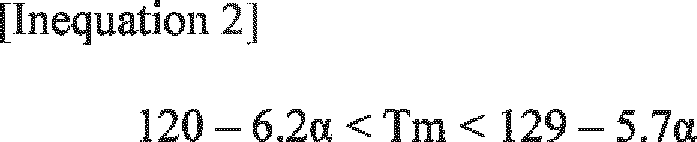
- the melting point Tm degrees Celsius, °C
- the octene content ⁇ alpha, mol%) preferably meet the following Inequation:
- the ethylene-octene copolymer has a melting point Tm in the range of 30 to 120 °C, preferably 40 to 115 °C, more preferably 40 to 110 °C.
- the ethylene-octene copolymer of the present invention is particularly characterized by a considerably lower melting point Tm under the same conditions in a comonomer content.
- the catalyst composition may include a metallocene catalyst.
- the catalyst composition may also include a transition metal compound represented by the following Formula 1:
- R 1 , R 2 , R 3 , and R 4 are the same as or different from one another and are independently hydrogen; an alkyl, aryl or silyl radical, which are comprised of I to 20 carbon atoms; an alkenyl, alkylaryl or arylalkyl radical, which are comprised of 1 to 20 carbon atoms; or a hydrocarbyl-substituted Group 14 metalloid radical.
- R 1 , R 2 , R 3 , and R 4 may be linked to one another to form a ring by an alkylidine radical including an alkyl or aryl radical having 1 to 20 carbon atoms.
- R 5 , R 6 , and R 7 are the same as or different from one another and are independently hydrogen; halogen radical; or alkyl, aryl, alkoxy, aryloxy or amido radical having 1 to 20 carbon atoms.
- at least two of R 5 , R 6 , and R 7 may be linked to each other to form an aliphatic or aromatic ring.
- R 8 is hydrogen; or alkyl, aryl, alkylaryl or arylalkyl radical, which are comprised of I to 20 carbon atoms.
- Cy is a substituted or unsubstituted aliphatic or aromatic ring.
- M is a Group-4 transition metal.
- Q 1 , Q 2 and Q 3 are independently halogen radical; alkyl or aryl amido radical having I to 20 carbon atoms; alkyl, alkenyl, aryl, alkylaryl or arylalkyl radical, which are comprised of 1 to 20 carbon atoms; or alkylidene radical, which are comprised of I to 20 carbon atoms.
- n-BuLi and an excess of CO 2 gas are added to 1,2,3,4-tetrahydroquinoline 1 to prepare a lithium carbamate compound 2 in the following reaction scheme 1 (in step 1).
- t-BuLi and a substituted cyclopentenone compound to prepare a cyclopentadienyl-based compound 3 (in step 2).
- the nitrogen atoms of the compound 3 are substituted with alkyl groups such as methyl through N-alkylation to obtain a ligand having an amine functional group in the form of a ring linked to a phenylene group (in step 3).
- M Ti, Zr, or Hf
- the preparation method may be represented by the following Reaction Scheme 1:
- the catalyst composition may further include at least one co-catalyst selected from the compounds represented by the following Formula 2, 3 or 4:
- R 10 is a halogen radical, a hydrocarbyl radical having 1 to 20 carbon atoms, or a halogen-substituted hydrocarbyl radical having 1 to 20 carbon atoms; and a is an integer of at least 2,
- L is a neutral or cationic Lewis acid
- H is hydrogen
- Z is a Group 13 element
- A is an aryl or alkyl radical, which are comprised of 1 to 20 carbon atoms with at least one hydrogen atom thereof being substituted with a hydrocarbyl, alkoxy or phenoxy radical, which are comprised of 6 to 20 carbon atoms.
- the preparation method for the ethylenel-octene copolymer according to the present invention may use the general method known in the related art excepting that a Group 4 transition metal compound represented by the Formula 1 is used.
- the reactor used in the polymerization process for the ethylene-octene copolymer is a continuous stirred tank reactor (CSTR) or a plug flow reactor (PFR).
- CSTR continuous stirred tank reactor
- PFR plug flow reactor
- the ethylene-octene copolymer of the present invention may have an octene content of 2 to 20 mol%, preferably 3 to 20 mol%, more preferable 3 to 17 mol%.
- the ethylene-octene copolymer of the present invention may be used for fabrication of films.
- the films can exhibit a low-temperature seating performance and a good sealing strength.
- the present invention relates to an ethylene-octene copolymer having a narrow molecular weight distribution and a uniform comonomer distribution.
- the ethylene-octene copolymer of the present invention may exhibit a lower density and a lower melting point than the conventional ethylene-octene copolymers under the same conditions in a comonomer content. Accordingly, the use of the ethylene-octene copolymer of the present invention in the fabrication of films may provide films that have a low-temperature sealing performance and a good sealing strength.
- FIG. 1 shows a specified example of a polymerization process for the ethylene-octene copolymer of the present invention.
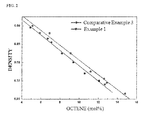
- FIG. 2 is a graph showing the octene content and the density of the ethylene-octene copolymers according to Example 1 and Comparative Example 3.
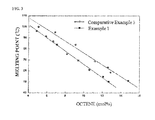
- FIG. 3 is a graph showing the octene content and the melting point of the ethylene-octene copolymers according to Example 1 and Comparative Example 3.
- FIG. 4 is a graph showing the peel strength depending on the heat sealing temperature of films fabricated using the ethylene-octene copolymers of Example 9 and Comparative Example 7.
- 1,2,3,4-tetrahydroquinoline 13.08 g, 98.24 mmol
- diethyl ether 150 mL
- the flask was put in a cold bath at -78 °C filled with dry ice and acetone and stirred for 30 minutes.
- n-BuLi 39.3 mL, 2.5M hexane solution, 98.24 mmol
- the ask was removed of butane gas while warmed to the room temperature.
- the flask was cooled down in a cold bath at -78 C and supplied with CO 2 gas. With CO 2 gas added, the slurry disappeared to leave a clear solution.
- the flask was connected to a bubbler to eliminate the CO 2 gas, warmed to the room temperature and then vacuumed to remove the remaining CO 2 gas and the solvent.
- the flask was transferred into a dry box, supplied with pentane, and subjected to agitation and filtration to yield a white solid compound, which formed a coordinate covalent bond with diethyl ether. The yield of the product was 100 %.
- the lithium carbamate compound (8.47 g, 42.60 mmol) was put into a Schlenk flask. To the flask were added tetrahydrofurane (4.6 g, 63.9 mmol) and diethyl ether (45 mL) in sequence. The flask was put in a cold bath at -20 °C with acetone and a small amount of dry ice and stirred for 30 minutes. Then, tert-BuLi (25.1 mL, 1.7 M, 42.60 mmol) was added to turn the solution red. Maintained at -20 °C, the flask was stirred for 6 hours.
- a CeCl 3 ⁇ 2LiCl solution (129 mL, 0.33 M, 42.60 mmol in tetrahydrofurane) was mixed with tetramethylcyclopentenone (5.89 g, 42.60 mmol). The mixture was then syringed into the flask in the nitrogen atmosphere. The ask was gradually warmed to the room temperature and, after one hour, the chiller was taken away to raise the temperature of the flask to the room temperature. After addition of water (15 mL) and ethylacetate, the solution was filtered to obtain a filtrate.
- the filtrate was transferred to a separatory funnel, mixed with HCl (2N, 80 mL) and stirred for 12 minutes.
- the solution was neutralized with a saturated aqueous solution of sodium hydrogen carbonate (160 mL) to extract the organic phase.
- Anhydrous magnesium sulfate was added to the organic phase to eliminate water, and after a filtration, the filtrate was taken and then removed of the solvent.
- the 1-(N-methyl-1,2,3,4-tetrahydroquinoline-8-yl)-2,3,4,5-tetramethylcyclopentadienyl titanium (IV) trichloride compound treated with triisobutyl aluminum was prepared as a 1.0 X 10 -4 M solution in hexane in a catalyst storage tank.
- the co-catalyst was kept as slurry (2.4 X 10 -4 M) in a toluene or hydrocarbon solvent in a co-catalyst storage tank.
- These two components were individually pumped in/out, and the temperature of the reactor was controlled by adjusting the temperature of oil passing through the jacket of the reactor wall.
- the density of the polymer was controlled by adjusting the ethylene/comonomer weight ratio in the supplied materials.
- the experiment used 1-(N-methyl-1,2,3,4-tetrahydroquinoline-8-yl)-2,3.4,5-tetramethyl-cyclopentadienyl titanium (IV) trichloride as a catalyst composition, dimethylanilinium tetrakis-(pentafluorophenyl) borate as an activator, and triisobutyl aluminum as a scavenger.
- a 1.5L continuous stirred tank reactor preheated at 120 °C was supplied with hexane as a solvent and 1-octene and ethylene as monomers under high pressure of 90 to 100 bar.
- the solution polymerization was carried out under the reactor pressure of 89 bar.
- the representative reaction scheme of the polymerization process is given in FIG. 1 .
- Ethylene 5 mixed with hydrogen 6 was added to a hexane solvent 3 mixed with 1-octene 4.
- the monomers were continuously fed into a reactor 8 as a stream.
- TIBAL 7 used as a scavenger was supplied to the single stream at the front end of the reactor.
- Catalyst 1 and co-catalyst 2 were directly added into the reactor 8 in a continuous manner.
- the melted polymer was transferred to a separator 10 through a discharge stream 9 from the reactor 8 and then separated into unreacted 1-octene, unreacted ethylene, unreacted hydrogen, and diluted mixture stream 11.
- the melted polymer was continuously pelletized 12, and solid pellets 13 were collected.
- Example 2 ethylene and 1-octene were continuously fed into the reactor at 0.63 kg/h and 0.48 kg/h, respectively, while 3.32 kg of hexane as a solvent was continuously supplied at 155 C under a pressure of 89 bar.
- the molar ratio of 1-octene to ethylene was 0.19.
- the catalyst in hexane and the activator in toluene were continuously fed into the reactor at 25 ⁇ mol/hr and 48 to 72 ⁇ mol/hr, respectively. After 7-minute retention time at the reactor, 740.1 g of ethylene/1-octene copolymer was obtained.
- the ethylene/1-octene copolymer had a melt index (MI2) of 4.8 g/10min, a density of 0.870 g/cc, and a comonomer content (NMR) of 64.4 wt.%.
- the molecular weight of the polymer may be controlled by regulating the ethylene conversion rate in the reactor through the catalyst flow rate, and the used amount of hydrogen. Generally, with an increase in the ethylene conversion rate, the polymer has a lower molecular weight (Mw) and a higher melt index (MI). The density of the polymer may be adjusted by controlling the ethylene/octene molar ratio.
- the ethylene and 1-octene copolymer commercially available was purchased from Dow Chemical Company.
- the monomer distribution in the ethylene-octene copolymer was analyzed from 13 C-NMR spectrum with a 600MHz Bruker DRX600 instrument and calculated according to the Randall method [ Journal of Polymer Science: Polymer Physics edition, 1973, 11, 275-287 ].
- the polymer was dissolved in a tetrachloroethane-d2 solvent and the measurement was carried out at 120 °C.
- MI Melt Index
- the melt index (MI) of the polymer was measured according to ASTM D-1238 (Condition E, 190 °C, 2,16 Kg load).
- the melting point Tm of the polymer was determined with a differential scanning calorimeter (DSC) 2920 manufactured by TA Instruments. To measure the melting point of the polymer, the DSC was operated to have the heat flow reach equilibrium at 0 °C, heated to 180 °C at a rate of 20 °C/min, cooled down to -60 °C at 20 °C/min, and then heated to 180 °C at 10 °C/min. The melting point was determined from an endothermic peak during the second rise of the temperature in the DSC curve.
- DSC differential scanning calorimeter
- the sample treated with an antioxidant (1,000 ppm) was processed into a 3mm-thick sheet with a radium of 2 cm with a press mold at 180 °C.
- the sheet was cooled down at 10 °C/min and weighed with a Mettler scale.
- the molecular weight of the polymer was measured with a PL-GPC 220 equipped with three linear mixed bed columns commercially available from Polymer Laboratory. The measurement was performed using 1,2,4-trichlorobenzene as a solvent with a flux of 1.0 mL/min at 160 °C.
- Table 3 shows the measurement results of the copolymers according to Examples 1 to 9 and Comparative Examples 1 to 7 in regard to 1-octene content, melt index, density, melting point, degree of crystallinity, molecular weight, and molecular weight distribution.
- Example 1 Ethylene (mol%) Octene (mol%) Density (g/cm 3 ) MI2 (g/10min) Melting Point (°C) Degree of Crystallinity(%) Mw Mw/Mn
- Example 1 87.3 12.7 0.868 5.76 50 16 73,200 2.77
- Example 2 87.9 12.1 0.870 4.80 54.6 18 75,100 2.60
- Example 3 89.4 10.6 0.874 0.95 60.7 - 101,100 3.22
- Example 4 90.6 9.4 0.880 0.95 69.2 - 95,500 2.57
- Example 5 91.8 8.2 0.885 1.04 75.3 24 94,300 2.59
- Example 6 92.9 7.1 0.891 0.79 83.7 - 93,400 2.62
- Example 7 93.3 6.7 0.893 1.06 86.8 - 88,100 2.65
- Example 8 94.1 5.9 0.896 0.89 91.3 - 89,000 2.68
- Example 9 95.1 4.9 0.899 0.85 96.2 26
- the ethylene and octene contents were measured from 13 C NMR, the melting point from the second rise of temperature in the DSC curve, the degree of crystallinity from Raman spectrum interpretation.
- the copolymers of Example 1 (C8, 12.7 mol%) and Comparative Example 3 (C8, 12.6 mol%) were 0.868 g/cm 3 and 0.871 g/cm 3 in density, 50.0 °C and 62.8 °C in melting point, and 16 % and 20 % in degree of crystallinity, respectively.
- the copolymer of Example 1 of the present invention had a lower density, a lower melting point and a lower degree of crystallinity as compared to the copolymer of Comparative Example 3.
- the ethylene-octene copolymers of Examples 1 to 9 had a comonomer distribution from 0.51 to 0.67, and the ethylene-octene copolymers of Comparative Examples 1 to 7 had a comonomer distribution from 1.09 to 1.35.
- the polymers of Examples 1 to 9 had a uniform comonomer distribution, while those of Comparative Examples 1 to 7 had a random or slightly blocky distribution.
- the unique catalyst structure of the present invention contributed to a uniform comonomer distribution in the copolymer, which was accompanied with a lower density and a lower melting point under the same conditions in a comonomer content.
- the lower melting point goes with a decrease in the plastification temperature, so the polymer when mixed with another resin is susceptible to dispersion under low temperature and low shear stress conditions, causing an increase in the ability of mixing.
- the increased ability of mixing contributes to more enhanced and stable properties of the resin.
- such a resin is endowed with a good thermal adhesiveness at a low temperature and consequently excellent characteristics as a low-temperature heat sealing improver for LDPE, MDPE, HDPE, PP, etc.
- Example 9 The ethylene-octene copolymers according to Example 9 and Comparative Example 7 were used to fabricate films as follows, which films were then evaluated in regard to heat sealing property.
- Films using the ethylene-octene copolymers of Example 9 and Comparative Example 7 were fabricated by the blow molding method.
- the fabrication process employed a three-layer extruder with screw diameters of 30 , 40 and 30 mm.
- the outer and middle layers of the film were made from low-density polyethylene (LDPE) and linear low-density polyethylene (LLDPE), and the inner layer as a heat sealing layer was made from the products with a density or 0.900 g/cm 3 commercially available from LG and Dow.
- the film had a blow up ratio of 2.3 and an entire thickness of 100 ⁇ m, with the inner layer 20 ⁇ m thick.
- the film as fabricated above was measured in regard to heat sealing strength with a J&B Hot Track Tester purchased from Swiss Management Company.
- the heat sealing conditions were given as follows.
- the film was sealed at a defined temperature and, after 30 seconds, pulled up and down to measure the sealing strength. Five samples per each temperature were prepared and the measurement values were averaged.
- FIG. 4 shows the peel strength depending on the heat sealing temperature of the films fabricated from the ethylene-octene copolymers of Example 9 and Comparative Example 7.
- the films using the ethylene-octene copolymer of Example 9 started to be sealed at a lower temperature and showed a greater peel strength.
- the films using the copolymer of Example 9 began to be sealed at 85 °C and exhibited a great peel strength relative to the films using the copolymer of Comparative Example 7. This tendency was also shown at heat sealing temperatures of 90 °C and 95 °C
- the ethylene-octene copolymer of the present invention sufficiently exhibits a sealing effect at a low temperature in fabrication of films and thus can be quite preferably used as a sealing or coating material.
Landscapes
- Chemical & Material Sciences (AREA)
- Health & Medical Sciences (AREA)
- Chemical Kinetics & Catalysis (AREA)
- Medicinal Chemistry (AREA)
- Polymers & Plastics (AREA)
- Organic Chemistry (AREA)
- Engineering & Computer Science (AREA)
- Materials Engineering (AREA)
- Crystallography & Structural Chemistry (AREA)
- Addition Polymer Or Copolymer, Post-Treatments, Or Chemical Modifications (AREA)
- Transition And Organic Metals Composition Catalysts For Addition Polymerization (AREA)
Abstract
Description
- The present invention relates to an ethylene-octene copolymer having uniform comonomer distribution, and more particularly, to an ethylene-octene copolymer that has a narrow molecular weight distribution, a uniform distribution of a comonomer to be copolymerized with ethylene, and a lower density under the same conditions in a comonomer content.
- The metallocene catalysts have enabled preparations of a wide variety of polyolefin products with a density ranging from 0.860 to 0.950 g/cm3. Polyethylene synthesized in the presence of a metallocene catalyst is characterized by the fact that the main chain of the polymer has relatively uniform size and structure. The physiochemical characteristics of the polyethylene is dependent upon the type, content, molecular weight and molecular weight distribution of the comonomer, and the distribution of the comonomer in the main chain, crystalline structure, and so on. In other words, the physiochemical characteristics are the results of all the factors determining the complicated structure of the polymer compound.
- The degree of crystallinity and the density of polyolefin can be controlled by forming branched chains in the main chain of a copolymer of ethylene and α-olefin. The structure nearly without branched chains is ready to form a crystalline structure and is dense, while the structure with many branched chains is hard to form a crystalline structure and thus exhibits a relatively low density. The copolymer with the lower density has the lower melting point.
- The most significant factors that determine the melting point of the polyolefin copolymer are the content of the comonomer (α-olefin) and the distribution of the comonomer in the main chain. The comonomer distribution in the main chain affects the melting point, the degree of crystallinity, and the physical properties (e.g., modulus of elasticity, tensile strength, optical transmittance, etc.) of the polymer.
- How the comonomer of a random copolymer affects the decrease in the melting point is specified as follows [Flory, Trans Faraday Soc. 1955, 51, 848]:

- In the above equation, TmC is the melting point of the copolymer; TmH is the melting point of the ethylene homopolymer; R is the gas constant; ΔHu is the enthalpy per mole of 100% PE; and p is the possibility that ethylene comes next to the ethylene monomer in the distribution of the copolymer.
- According to Allegra [J Polym Sci Part B: Polym Phys. 1992, 30, 809], p is dependent upon the comonomer distribution as follows:

- In the equation, XE is the molar fraction of ethylene in the polymer; and re and rc represent the reactivity of ethylene and comonomer in the copolymer, respectively, which are used to describe the characteristic of the catalyst system. rerc, the product of re and rc, represents the distribution of monomers in the main chain of the copolymer. The monomer reactivity ratios, re and rc, can be understood from 13C NMR spectra according to the Randall method and calculated as follows using the Kakugo method [Macromolecules, 1982, 15, 1150].

- In the equations, E is ethylene; C is the comonomer; and X is the molar fraction of ethylene as the monomer and the comonomer added to the reactor. These values are means for imaginarily understanding the fine structure of the copolymer from the added amount of the monomers to the reactor and the 13C NMR interpretation.
- A blocky comonomer distribution (re * rc > 1) is accompanied by a high melting point; an alternative comonomer distribution (re * rc < 1) a low melting point; and a random comonomer distribution (re * rc = 1) a medium melting point. The detailed description about this characteristic is specified in the paper [J Polym Sci Part B: Polym Phys 2004, 42, 3416 3427] written by Mirabella.
- Accordingly, there is a need for studies on the ethylene-octene copolymer that has a narrow molecular weight distribution, a uniform distribution of a comonomer copolymerized with ethylene, and a lower density under the same conditions in a comonomer content, in order to realize a sufficient sealing effect even at a low temperature with a good sealing strength secured in the fabrication of films.
- It is an object of the present invention to provide a novel ethylene-octene copolymer having a uniform octene distribution to realize a lower density and a lower melting point under the same conditions in a comonomer content, for the preparation of a ultralow-density ethylene-octene copolymer using a metallocene catalyst.
- To achieve the object, the present invention is to provide an ethylene-octene copolymer being prepared in the presence of a catalyst composition and having a density of 0.857 to 0.91 g/cm3, the ethylene-octene copolymer having:
- 1) a molecular weight distribution Mw/Mn of at most 3.5;
- 2) a reactivity ratio re of ethylene to catalyst multiplied by a reactivity ratio ro of octene to catalyst being in the range of 0.5 to 0.8; and
- 3) the density of the ethylene-octene copolymer and an octene content α (alpha, mol%) in the ethylene-octene copolymer being in the range of the following Inequation 1:
-

- Hereinafter, the present invention will be described in detail.
- In accordance with the present invention, the ethylene-octene copolymer is prepared in the presence of a catalyst composition and has a density of 0.857 to 0.91 g/cm3, the ethylene-octene copolymer having: 1) a molecular weight distribution Mw/Mn of at most 3.5; 2) a reactivity ratio re of ethylene to catalyst multiplied by a reactivity ratio ro of octene to catalyst being in the range of 0.5 to 0.8; and 3) the density and the octene content (a, mol%) satisfying the
above Inequation 1. - As for the ethylene-octene copolymer of the present invention, a reactivity ratio re of ethylene to catalyst multiplied by a reactivity ratio ro of octene to catalyst, that is, re multiplied by ro, ranges from 0.5 to 0.8.
- The result of a reactivity ratio re of ethylene to catalyst multiplied by a reactivity ratio ro of octene to catalyst, that is, re * ro represents the distribution of monomers in the main chain of the ethylene-octene copolymer. The monomer reactivity ratios to catalyst, re and ro, can be understood from 13C NMR spectra according to the Randall method and calculated as follows using the Kakugo method [Macromolecules, 1982, 15, 1150].

- In the equations, E is ethylene; C is the comonomer, octene; and X is the molar fraction of monomers, that is, ethylene and octene added to the reactor. EEE is the mole percent (mol%) of ethylene-ethylene-ethylene block in the ethylene-octene copolymer; EEC the mole percent (mol.%) of ethylene-ethylene-octene block in the ethylene-octene copolymer; ECE the mole percent (mol.%) of ethylene-octene-ethylene block in the ethylene-octene copolymer; CCE the mole percent (mol.%) of octene-octene-ethylene block in the ethylene-octene copolymer; and CCC the mole percent (mol.%) of octene-octene-octene block in the ethylene-octene copolymer.
- The values of re and ro that are the reactivity ratios of monomers to catalyst are means for estimating the fine structure of the copolymer through monomer contents and 13C NMR interpretation.
- A blocky comonomer distribution (re * rc > 1) is accompanied by a high melting point; an alternative comonomer distribution (re * rc < 1) a low melting point; and a random comonomer distribution (re * rc = 1) a medium melting point.
- In the ethylene-octene copolymer of the present invention, the product of a reactivity ratio re of ethylene to catalyst and a reactivity ratio ro of octene to catalyst is in the range of 0.5 to 0.8. This implies that the comonomer, octane, has a uniform distribution in the copolymer.
- In the ethylene-octene copolymer of the present invention, the density of the ethylene-octene copolymer and the octene content α (alpha, mol%) in the ethylene-octene copolymer satisfy the
Inequation 1. The ethylene-octene copolymer of the present invention exhibits a far lower density than the existing ethylene-octene copolymers under the same conditions in a comonomer content. Also, the ethylene-octene copolymer of the present invention may minimize the content of the comonomer used in the preparation process and reduce the production cost. For example, the density of the ethylene-octene copolymer is 0.857 to 0.91 g/cm3, preferably 0.859 to 0.91 g/cm3, more preferably 0.861 to 0.91 g/cm3. - In the ethylene-octene copolymer of the present invention, the molecular weight distribution Mw/Mn that is the ratio of the weight average molecular weight Mw to the number average molecular weight Mn is 3.5 or less, or 2.0 to 3.5, preferably 3.4 or less, or 2.0 to 3.4, more preferably 3.3 or less, or 2.0 to 3.3. Here, the weight average molecular weight Mw of the ethylene-octene copolymer is preferably 30,000 to 300,000, more preferably 30,000 to 250,000, most preferably 30,000 to 200,000. The ethylene-octene copolymer may have the weight average molecular weight Mw controlled in different ranges depending on the usage of films.
- In the ethylene-octene copolymer of the present invention, the melting point Tm (degrees Celsius, °C) and the octene content α (alpha, mol%) preferably meet the following Inequation:
-

- For example, the ethylene-octene copolymer has a melting point Tm in the range of 30 to 120 °C, preferably 40 to 115 °C, more preferably 40 to 110 °C. The ethylene-octene copolymer of the present invention is particularly characterized by a considerably lower melting point Tm under the same conditions in a comonomer content.
- In the ethylene-octene copolymer of the present invention, the catalyst composition may include a metallocene catalyst. The catalyst composition may also include a transition metal compound represented by the following Formula 1:
-

- In the
Formula 1, R1, R2, R3, and R4 are the same as or different from one another and are independently hydrogen; an alkyl, aryl or silyl radical, which are comprised of I to 20 carbon atoms; an alkenyl, alkylaryl or arylalkyl radical, which are comprised of 1 to 20 carbon atoms; or a hydrocarbyl-substitutedGroup 14 metalloid radical. Here, R1, R2, R3, and R4 may be linked to one another to form a ring by an alkylidine radical including an alkyl or aryl radical having 1 to 20 carbon atoms. - R5, R6, and R7 are the same as or different from one another and are independently hydrogen; halogen radical; or alkyl, aryl, alkoxy, aryloxy or amido radical having 1 to 20 carbon atoms. Here, at least two of R5, R6, and R7 may be linked to each other to form an aliphatic or aromatic ring.
- R8 is hydrogen; or alkyl, aryl, alkylaryl or arylalkyl radical, which are comprised of I to 20 carbon atoms.
- Cy is a substituted or unsubstituted aliphatic or aromatic ring.
- M is a Group-4 transition metal.
- Q1, Q2 and Q3 are independently halogen radical; alkyl or aryl amido radical having I to 20 carbon atoms; alkyl, alkenyl, aryl, alkylaryl or arylalkyl radical, which are comprised of 1 to 20 carbon atoms; or alkylidene radical, which are comprised of I to 20 carbon atoms.
- To prepare the compound of the
formula 1, one equivalent weight of n-BuLi and an excess of CO2 gas are added to 1,2,3,4-tetrahydroquinoline 1 to prepare alithium carbamate compound 2 in the following reaction scheme 1 (in step 1). To thecompound 2 are added t-BuLi and a substituted cyclopentenone compound to prepare a cyclopentadienyl-based compound 3 (in step 2). The nitrogen atoms of thecompound 3 are substituted with alkyl groups such as methyl through N-alkylation to obtain a ligand having an amine functional group in the form of a ring linked to a phenylene group (in step 3). One equivalent weight of n-BuLi is continuously added to the ligand to obtain alithium compound 4, which is reacted with a MCl4 (M = Ti, Zr, or Hf) compound to prepare a metal compound 5 (in step 4). - The preparation method may be represented by the following Reaction Scheme 1:
-


- In the ethylene-octene copolymer of the present invention, the catalyst composition may further include at least one co-catalyst selected from the compounds represented by the following
Formula -
[Formula 2] [44] -[Al(R9)-O]a-
where R9 is a halogen radical, a hydrocarbyl radical having 1 to 20 carbon atoms, or a halogen-substituted hydrocarbyl radical having 1 to 20 carbon atoms; and a is an integer of at least 2, -
[Formula 3] Al(R10)3
where R10 is a halogen radical, a hydrocarbyl radical having 1 to 20 carbon atoms, or a halogen-substituted hydrocarbyl radical having 1 to 20 carbon atoms; and a is an integer of at least 2, -
[Formula 4] [L-H]+[ZA4]- or [L]+[ZA4]-
where L is a neutral or cationic Lewis acid; H is hydrogen; Z is aGroup 13 element; and A is an aryl or alkyl radical, which are comprised of 1 to 20 carbon atoms with at least one hydrogen atom thereof being substituted with a hydrocarbyl, alkoxy or phenoxy radical, which are comprised of 6 to 20 carbon atoms. - The preparation method for the ethylenel-octene copolymer according to the present invention may use the general method known in the related art excepting that a
Group 4 transition metal compound represented by theFormula 1 is used. - Preferably, the reactor used in the polymerization process for the ethylene-octene copolymer is a continuous stirred tank reactor (CSTR) or a plug flow reactor (PFR).
- The ethylene-octene copolymer of the present invention may have an octene content of 2 to 20 mol%, preferably 3 to 20 mol%, more preferable 3 to 17 mol%.
- The ethylene-octene copolymer of the present invention may be used for fabrication of films.
- Using an ethylene-octene copolymer that realizes a lower density and a lower melting point than the conventional ethylene-octene copolymers under the same conditions in a comonomer content, the films can exhibit a low-temperature seating performance and a good sealing strength.
- The matters of the present invention other than those specified above may be further included or omitted under necessity and not specifically restrict the present invention.
- The present invention relates to an ethylene-octene copolymer having a narrow molecular weight distribution and a uniform comonomer distribution. The ethylene-octene copolymer of the present invention may exhibit a lower density and a lower melting point than the conventional ethylene-octene copolymers under the same conditions in a comonomer content. Accordingly, the use of the ethylene-octene copolymer of the present invention in the fabrication of films may provide films that have a low-temperature sealing performance and a good sealing strength.
-
FIG. 1 shows a specified example of a polymerization process for the ethylene-octene copolymer of the present invention. -
FIG. 2 is a graph showing the octene content and the density of the ethylene-octene copolymers according to Example 1 and Comparative Example 3. -
FIG. 3 is a graph showing the octene content and the melting point of the ethylene-octene copolymers according to Example 1 and Comparative Example 3. -
FIG. 4 is a graph showing the peel strength depending on the heat sealing temperature of films fabricated using the ethylene-octene copolymers of Example 9 and Comparative Example 7. - Hereinafter, the present invention will be described in further detail with reference to the following examples, which are presented as exemplary only and not intended to limit the scope of the present invention.
- Organic reagents and solvents were purchased from Aldrich and Merk chemical companies and purified before use according to the standardized method. In all the synthesis steps, intrusion of air and moisture was protected to enhance the reproducibility of the experiments. To identify the structure of the compounds, a 400MHz nuclear magnetic- resonance (NMR) spectrometer and an X-ray spectrometer were used to acquire the respective spectra and spectrographs.
- 1) Preparation of Lithium Carbamate Compound
- 1,2,3,4-tetrahydroquinoline (13.08 g, 98.24 mmol) and diethyl ether (150 mL) were added into a Schlenk flask. The flask was put in a cold bath at -78 °C filled with dry ice and acetone and stirred for 30 minutes. Then, n-BuLi (39.3 mL, 2.5M hexane solution, 98.24 mmol) was syringed into the flask in the nitrogen atmosphere to form light yellowish slurry. After 2-hour agitation, the ask was removed of butane gas while warmed to the room temperature. The flask was cooled down in a cold bath at -78 C and supplied with CO2 gas. With CO2 gas added, the slurry disappeared to leave a clear solution. The flask was connected to a bubbler to eliminate the CO2 gas, warmed to the room temperature and then vacuumed to remove the remaining CO2 gas and the solvent. The flask was transferred into a dry box, supplied with pentane, and subjected to agitation and filtration to yield a white solid compound, which formed a coordinate covalent bond with diethyl ether. The yield of the product was 100 %.
- 1H NMR(C6D6, C5D5N): δ 8.35(d, J=8.4Hz, 1H, CH), δ 6.93-6.81(m, 2H, CH), δ 6.64(t, J=7.4Hz, 1H, CH), δ 3.87 (br, s, 2H, quin-CH2), δ 3.25 (q, J = 7.2 Hz, 4H, ether), δ 2.34 (br s, 2H, quin-CH2), δ 1.50 (br s, 2H, quin-CH2), δ 1.90 (t, J = 7.2 Hz, 6H, ether) ppm.
- 2) Preparation of 8-(2,3,4,5-tetramethyl-1,3-cyclopentadiethyl)-1,2,3,4.tetrahydroquinoline
- The lithium carbamate compound (8.47 g, 42.60 mmol) was put into a Schlenk flask. To the flask were added tetrahydrofurane (4.6 g, 63.9 mmol) and diethyl ether (45 mL) in sequence. The flask was put in a cold bath at -20 °C with acetone and a small amount of dry ice and stirred for 30 minutes. Then, tert-BuLi (25.1 mL, 1.7 M, 42.60 mmol) was added to turn the solution red. Maintained at -20 °C, the flask was stirred for 6 hours. In a syringe, a CeCl3·2LiCl solution (129 mL, 0.33 M, 42.60 mmol in tetrahydrofurane) was mixed with tetramethylcyclopentenone (5.89 g, 42.60 mmol). The mixture was then syringed into the flask in the nitrogen atmosphere. The ask was gradually warmed to the room temperature and, after one hour, the chiller was taken away to raise the temperature of the flask to the room temperature. After addition of water (15 mL) and ethylacetate, the solution was filtered to obtain a filtrate. The filtrate was transferred to a separatory funnel, mixed with HCl (2N, 80 mL) and stirred for 12 minutes. The solution was neutralized with a saturated aqueous solution of sodium hydrogen carbonate (160 mL) to extract the organic phase. Anhydrous magnesium sulfate was added to the organic phase to eliminate water, and after a filtration, the filtrate was taken and then removed of the solvent. The column chromatography was used to obtain yellowish oil (hexane : toluene = 10:1 (v/v); hexane : ethylacetate =10:1 (v/v); and product yield = 40 %).
- 1H NMR(C6D6): δ 1.00 (br d, 3H, Cp-CH3), 1.63 - 1.73 (m, 2H, quin-CH2), 1.80 (s, 3H, Cp-CH3), 1.81 (s, 3H, Cp-CH3), 1.85 (s, 3H, Cp-CH3), 2.64 (t, J = 6.0 Hz, 2H, quin-CH2), 2.84 - 2.90 (br, 2H, quin-CH2), 3.06 (br s, 1H, Cp-H), 3.76 (br s, 1H, N-H), 6.77 (t, J = 7.2 Hz, 1H, quin-CH), 6.92 (d, J = 2.4 Hz, 1H, quin-CH), 6.94 (d, J = 2.4 Hz, 1H, quin-CH) ppm.
- 3) Preparation of Lithium 1-(N-methyl-1,2,3,4-tetrahydroquinoline-8-yl)-2,3,4,5-tetramethylcyclopentadienyl
- An aqueous solution of 37% formaldehyde (0.88 mL, 11.8 mmol) was added to a solution of 8-(2,3,4,5-tetramethyl-l,3-cyclopentadienyl)-1,2,3,4-tetra-hydroquinoline (2 g, 7.89 mmol) in methanol (42 mL). After 30-minute agitation at the room temperature, the mixture was mixed with dicarborane (0.29 g, 2.37 mmol) and further stirred for one hour. The product compound was filtered through a silica pad using a mixed solvent of hexane and ethyl acetate (10:1 (v/v)). The filtrate was removed of the solvent, and the compound thus obtained was transferred to a flask. After addition of pentane (50 mL), the flask was cooled down to -78 °C. At -78 °C, n-BuLi (3.2 mL, 2.5M hexane solution, 7.89 mmol) was syringed into the flask in the nitrogen atmosphere. Gradually warmed up to the room temperature, the flask was stirred for 3 hours at the room temperature. The reaction solution was filtered in the nitrogen atmosphere, washed with pentane (10 mL) twice and then dried under vacuum to obtain a yellowish lithium salt in the sold state (0.837 g, yield 39 %).
- 1H NMR (pyr-d5): δ 7.31(br s, 1H, CH), δ 7.10-6.90(m, 1H, CH), δ 6.96(s, 1H, CH), 3.09(m, 2H, quinoline-CH2), δ 2.77 (t, J=6Hz, 2H, quinoline-CH2), δ 2.51-2.11 (m, 15H, Cp-CH3, N-CH3), δ1.76 (m, 2H, quinoline-CH2) ppm.
- 4) Preparation of 1-(N-methyl-1,2,3,4-tetahydroquinoline-8-yl)-2,3,4,5-tetramethylcyclopentadienyl titanium (IV) trichloride
- In a dry box, TiCl4-DME (429 mg, 1.53 mmol) and diethyl other (25 mL) were put into a flask and then mixed with MeLi (2.9 mL, 1.6M diethyl ether solution, 4.60 mmol) gradually added while stirred at -30 °C. After a 15-minute agitation, the lithium salt compound (419 mg, 1.53 mmol) thus obtained was added to the flask, which was then warmed to the room temperature and stirred for 3 more hours. After completion of the reaction, the solution was removed of the solvent under vacuum, dissolved in pentane and filtered. The filtrate thus extracted was removed of pentane under vacuum to obtain a titanium complex (431 mg, yield 75%).
- 1H NMR(C6D6): δ 6.83(d, J=7.2Hz, 1H, CH), δ 6.78(d, J=7.6Hz, 1H, CH), δ 6.73(t, J=7.4Hz, 1H, CH), δ 2.80(m, 2H, quin-CH2), δ 2.52(t, J=6.4Hz, 2H, quin-CH2), δ 2.26(s, 3H, N-CH3), δ 1.96(s, 6H, Cp-CH3), δ 1.85(s, 6H, Cp-CH3), δ 1.50(m, 2H, quin-CH2), δ 1.26(s, 9H, Ti-CH3) ppm.
- Examples 1 to 9 : Preparation of Ethylene-Octene Copolymer.
- In the presence of a catalyst composition including 1-(N-methyl-1,2,3,4-tetrahydroquinoline-8-yl)-2,3,4,5-tetramethyl-cyclopentadienyl titanium (IV) trichloride obtained in the Preparation Example 1, a polymerization reaction using ethylene and 1-octene as monomers was carried out in the manner of a continuous solution process as follows.
- The 1-(N-methyl-1,2,3,4-tetrahydroquinoline-8-yl)-2,3,4,5-tetramethylcyclopentadienyl titanium (IV) trichloride compound treated with triisobutyl aluminum was prepared as a 1.0 X 10⁻⁴ M solution in hexane in a catalyst storage tank. The co-catalyst was kept as slurry (2.4 X 10⁻⁴ M) in a toluene or hydrocarbon solvent in a co-catalyst storage tank. These two components were individually pumped in/out, and the temperature of the reactor was controlled by adjusting the temperature of oil passing through the jacket of the reactor wall. The density of the polymer was controlled by adjusting the ethylene/comonomer weight ratio in the supplied materials.
- The experiment used 1-(N-methyl-1,2,3,4-tetrahydroquinoline-8-yl)-2,3.4,5-tetramethyl-cyclopentadienyl titanium (IV) trichloride as a catalyst composition, dimethylanilinium tetrakis-(pentafluorophenyl) borate as an activator, and triisobutyl aluminum as a scavenger.
- <Continuous High-Temperature Solution Process>
- A 1.5L continuous stirred tank reactor preheated at 120 °C was supplied with hexane as a solvent and 1-octene and ethylene as monomers under high pressure of 90 to 100 bar. The solution polymerization was carried out under the reactor pressure of 89 bar. The representative reaction scheme of the polymerization process is given in
FIG. 1 . -
Ethylene 5 mixed with hydrogen 6 was added to ahexane solvent 3 mixed with 1-octene 4. The monomers were continuously fed into areactor 8 as a stream.TIBAL 7 used as a scavenger was supplied to the single stream at the front end of the reactor.Catalyst 1 andco-catalyst 2 were directly added into thereactor 8 in a continuous manner. - After completion of the polymerization reaction, the melted polymer was transferred to a
separator 10 through adischarge stream 9 from thereactor 8 and then separated into unreacted 1-octene, unreacted ethylene, unreacted hydrogen, anddiluted mixture stream 11. The melted polymer was continuously pelletized 12, andsolid pellets 13 were collected. - The polymerization conditions for the copolymers of ethylene and 1-octene according to the Examples 1 to 9 are represented in Table 1.
-
[Table 1] Catalyst (µmol/min) Co-catalyst (µmol/min) AIR3 (µmol/min) Temperat ure (°C) Pressure (bar) Hexane (kg/hr) Ethylene (kg/hr) Octene (kg/hr) Example 1 0.4 1.2 0.05 149 89 3.32 0.63 0.54 Example 2 0.4 1.2 0.05 155 89 3.32 0.63 0.48 Example 3 0.4 1.2 0.05 157 89 3.32 0.63 0.43 Example 4 0.4 1.2 0.05 161 89 3.32 0.63 0.38 Example 5 0.4 1.2 0.05 160 89 3.32 0.66 0.38 Example 6 0.4 1.2 0.05 165 89 3.32 0.70 0.34 Example 7 0.4 0.8 0.05 165 89 3.32 0.70 0.32 Example 8 0.4 0.8 0.05 170 89 3.32 0.73 0.30 Example 9 0.4 0.8 0.05 169 89 3.32 0.74 0.30 - The properties of the copolymers of ethylene and 1-octene according to the Examples 1 to 9 are represented in Table 2.
-
[Table 2] Octane/ Ethylene (molar ratio) Hydrogen (L/hr) Retention Time(min) Yield (g/hr) Activity (kg PE/g Ti) MI2 (g/10min) Density (g/cm3) Example 1 0.21 0.9 7 754.8 1313.4 5.76 0.868 Example 2 0.19 0.9 7 740.1 1287.8 4.8 0.87 Example 3 0.17 0 7 660.6 1149.4 0.95 0.874 Example 4 0.15 0 7 682.1 1186.9 0.95 0.88 Example 5 0.14 0 7 691.0 1202.3 1.04 0.885 Example 6 0.12 0 7 701.0 1219.7 0.79 0.891 Example 7 0.11 0.1 7 626.1 1089.4 1.06 0.893 Example 8 0.10 0.2 7 599.3 1042.8 0.89 0.896 Example 9 0.10 0.2 7 610.0 1061.4 0.85 0.899 - As shown in Table 1, as for Example 2, ethylene and 1-octene were continuously fed into the reactor at 0.63 kg/h and 0.48 kg/h, respectively, while 3.32 kg of hexane as a solvent was continuously supplied at 155 C under a pressure of 89 bar. The molar ratio of 1-octene to ethylene was 0.19. The catalyst in hexane and the activator in toluene were continuously fed into the reactor at 25 µmol/hr and 48 to 72 µmol/hr, respectively. After 7-minute retention time at the reactor, 740.1 g of ethylene/1-octene copolymer was obtained. According to the experimental results, the ethylene/1-octene copolymer had a melt index (MI2) of 4.8 g/10min, a density of 0.870 g/cc, and a comonomer content (NMR) of 64.4 wt.%.
- At a defined reactor temperature and a defined composition, the molecular weight of the polymer may be controlled by regulating the ethylene conversion rate in the reactor through the catalyst flow rate, and the used amount of hydrogen. Generally, with an increase in the ethylene conversion rate, the polymer has a lower molecular weight (Mw) and a higher melt index (MI). The density of the polymer may be adjusted by controlling the ethylene/octene molar ratio.
- Comparative Examples 1 to 7
- The ethylene and 1-octene copolymer commercially available was purchased from Dow Chemical Company.
- The ethylene-octene copolymers of Examples I to 9 and Comparative Examples 1 to 7 were measured in regard to main properties as follows.
- <Measurement of Monomer Distribution>
- The monomer distribution in the ethylene-octene copolymer was analyzed from 13C-NMR spectrum with a 600MHz Bruker DRX600 instrument and calculated according to the Randall method [Journal of Polymer Science: Polymer Physics edition, 1973, 11, 275-287]. The polymer was dissolved in a tetrachloroethane-d2 solvent and the measurement was carried out at 120 °C.
- <Measurement of Melt Index (MI)>
- The melt index (MI) of the polymer was measured according to ASTM D-1238 (Condition E, 190 °C, 2,16 Kg load).
- <Measurement of Melting Point>
- The melting point Tm of the polymer was determined with a differential scanning calorimeter (DSC) 2920 manufactured by TA Instruments. To measure the melting point of the polymer, the DSC was operated to have the heat flow reach equilibrium at 0 °C, heated to 180 °C at a rate of 20 °C/min, cooled down to -60 °C at 20 °C/min, and then heated to 180 °C at 10 °C/min. The melting point was determined from an endothermic peak during the second rise of the temperature in the DSC curve.
- <Measurement of Density>
- The sample treated with an antioxidant (1,000 ppm) was processed into a 3mm-thick sheet with a radium of 2 cm with a press mold at 180 °C. The sheet was cooled down at 10 °C/min and weighed with a Mettler scale.
- <Measurement of Degree of Crystallinity>
- To determine the degree of crystallinity of the polymer, spectrum was acquired using a Dispersive Raman spectrometer commercially available from Thermo Electron Company. The spectrometer used 780nm laser with power of 10 mW and a 100µm pinhole. The Raman spectrum of each sample showed a band (1,418 cm-1) corresponding to the crystallization region of polyolefin and a band (1,310 cm-1) corresponding the anhydrous region, and the degree of crystallinity was determined base on the method disclosed in a document [ Colloid & Polymer Sci., 1982, 260, 182-192].
- <Measurement of Molecular Weight>
- The molecular weight of the polymer was measured with a PL-GPC 220 equipped with three linear mixed bed columns commercially available from Polymer Laboratory. The measurement was performed using 1,2,4-trichlorobenzene as a solvent with a flux of 1.0 mL/min at 160 °C.
- Table 3 shows the measurement results of the copolymers according to Examples 1 to 9 and Comparative Examples 1 to 7 in regard to 1-octene content, melt index, density, melting point, degree of crystallinity, molecular weight, and molecular weight distribution.
-
[Table 3] Ethylene (mol%) Octene (mol%) Density (g/cm3) MI2 (g/10min) Melting Point (°C) Degree of Crystallinity(%) Mw Mw/Mn Example 1 87.3 12.7 0.868 5.76 50 16 73,200 2.77 Example 2 87.9 12.1 0.870 4.80 54.6 18 75,100 2.60 Example 3 89.4 10.6 0.874 0.95 60.7 - 101,100 3.22 Example 4 90.6 9.4 0.880 0.95 69.2 - 95,500 2.57 Example 5 91.8 8.2 0.885 1.04 75.3 24 94,300 2.59 Example 6 92.9 7.1 0.891 0.79 83.7 - 93,400 2.62 Example 7 93.3 6.7 0.893 1.06 86.8 - 88,100 2.65 Example 8 94.1 5.9 0.896 0.89 91.3 - 89,000 2.68 Example 9 95.1 4.9 0.899 0.85 96.2 26 88,800 2.60 Compartive Example 1 85.2 14.8 0.863 0.5 50.9 - 126,200 2.46 Comparative Example 2 87.1 12.9 0.869 0.5 58.6 - 122,200 2.46 Comparative Example 3 87.4 12.6 0.871 5.0 62.8 20 74,200 2.37 Comparative Example 4 88.8 11.2 0.875 3.0 68.7 - 79,600 2.38 Comparative Example 5 90.9 9.1 0.885 1.0 83.7 26 92,200 2.45 Compartive Example 6 93.1 6.9 0.896 1.6 94.9 - 78,800 3.23 Compartive Example 7 94.8 5.2 0.9 1.0 100.0 32 83,900 2.48 - The ethylene and octene contents were measured from 13C NMR, the melting point from the second rise of temperature in the DSC curve, the degree of crystallinity from Raman spectrum interpretation.
- With the similar octene contents, the copolymers of Example 1 (C8, 12.7 mol%) and Comparative Example 3 (C8, 12.6 mol%) were 0.868 g/cm3 and 0.871 g/cm3 in density, 50.0 °C and 62.8 °C in melting point, and 16 % and 20 % in degree of crystallinity, respectively. Namely, in spite of the similar octene contents, the copolymer of Example 1 of the present invention had a lower density, a lower melting point and a lower degree of crystallinity as compared to the copolymer of Comparative Example 3.
- These results are presented in
FIGS. 2 and3 . Flory and Allegra described that the most significant factors that determine the melting point of the polymer are the comonomer content and the comonomer distribution in the copolymer. The Example 1 and the Comparative Example 3 had a different melting point and a different density from each other with the similar comonomer contents (seeFIGS. 2 and3 ). To examine the difference in properties according to the comonomer distribution, re * rc was calculated using the TRIAD SEQUENCE ANALYSIS and the KAKUGO METHOD based on the 13C NMR spectra. The results are presented in Table 4. -
[Table 4] Octene (mol%) Density (g/cm3) [000] [OOE] [EOE] [OEO] [OEE] [EEE] re*rc Example 1 12.7 0.868 0.0 1.8 10.8 1.2 17.1 69.0 0.51 Example 2 12.1 0.870 0.0 1.7 10.4 1.0 17.1 69.6 0.52 Example 3 10.6 0.874 0.0 1.4 9.2 0.9 14.6 73.9 0.58 Example 4 9.4 0.880 0.0 1.0 8.4 0.8 14.1 75.7 0.52 Example 5 8.2 0.885 0.0 0.8 7.4 0.7 13.1 78.0 0.56 Example 6 7.1 0.891 0.0 0.7 6.4 0.7 11.0 81.2 0.67 Example 7 6.7 0.893 0.0 0.6 6.1 0.5 10.3 82.5 0.64 Example 8 5.9 0.896 0.0 0.4 5.5 0.4 9.8 83.9 0.55 Example 9 4.9 0.899 0.0 0.3 4.6 0.3 8.7 86.1 0.60 Compartive Example 1 14.8 0.863 0.2 4.2 10.4 1.8 19.1 64.3 1.09 Compartive Example 2 12.9 0.869 0.2 3.2 9.5 1.5 16.1 69.5 1.13 Compartive Example 3 12.6 0.871 0.2 3.1 9.3 1.3 15.2 70.9 1.17 Compartive Example 4 11.2 0.875 0.0 2.7 8.5 1,1 15 72.7 1.12 Comparative Example 5 9.1 0.885 0.0 2.0 7.1 0.5 11.4 70.9 1.29 Compartive Example 6 6.9 0.896 0.0 1.1 5.8 0.4 8.8 83.9 1.20 Compartive Example 7 5.2 0.9 0.0 0.7 4.5 0.3 7.7 86.8 1.35 - From the value of re * rc calculated by the Kakugo method, the ethylene-octene copolymers of Examples 1 to 9 had a comonomer distribution from 0.51 to 0.67, and the ethylene-octene copolymers of Comparative Examples 1 to 7 had a comonomer distribution from 1.09 to 1.35. In other words, the polymers of Examples 1 to 9 had a uniform comonomer distribution, while those of Comparative Examples 1 to 7 had a random or slightly blocky distribution.
- In particular, it was demonstrated that the unique catalyst structure of the present invention contributed to a uniform comonomer distribution in the copolymer, which was accompanied with a lower density and a lower melting point under the same conditions in a comonomer content. Generally, the lower melting point goes with a decrease in the plastification temperature, so the polymer when mixed with another resin is susceptible to dispersion under low temperature and low shear stress conditions, causing an increase in the ability of mixing. The increased ability of mixing contributes to more enhanced and stable properties of the resin. Moreover, such a resin is endowed with a good thermal adhesiveness at a low temperature and consequently excellent characteristics as a low-temperature heat sealing improver for LDPE, MDPE, HDPE, PP, etc.
- Experiment Example 1
- The ethylene-octene copolymers according to Example 9 and Comparative Example 7 were used to fabricate films as follows, which films were then evaluated in regard to heat sealing property.
- <Fabrication of Film>
- Films using the ethylene-octene copolymers of Example 9 and Comparative Example 7 were fabricated by the blow molding method. The fabrication process employed a three-layer extruder with screw diameters of 30 , 40 and 30 mm. The outer and middle layers of the film were made from low-density polyethylene (LDPE) and linear low-density polyethylene (LLDPE), and the inner layer as a heat sealing layer was made from the products with a density or 0.900 g/cm3 commercially available from LG and Dow. The film had a blow up ratio of 2.3 and an entire thickness of 100 µm, with the inner layer 20 µm thick.
- <Measurement of Heat Sealing Strength>
- The film as fabricated above was measured in regard to heat sealing strength with a J&B Hot Track Tester purchased from Swiss Management Company. The heat sealing conditions were given as follows.
- - Seal time: 1 second
- - Cool time: 30 seconds
- - Seal Pressure: 0.1 N/mm2
- - Seal Area: 25mm X 5mm
- - Seal Temperature: 80 to 150°C (as sealing at every 5 °C)
- - Peel Rate: 100 mm/s
- The film was sealed at a defined temperature and, after 30 seconds, pulled up and down to measure the sealing strength. Five samples per each temperature were prepared and the measurement values were averaged.
-
FIG. 4 shows the peel strength depending on the heat sealing temperature of the films fabricated from the ethylene-octene copolymers of Example 9 and Comparative Example 7. - As can be seen from
FIG. 4 , compared to the films made from the ethylene-octene copolymer of Comparative Example 7, the films using the ethylene-octene copolymer of Example 9 started to be sealed at a lower temperature and showed a greater peel strength. Particularly, the films using the copolymer of Example 9 began to be sealed at 85 °C and exhibited a great peel strength relative to the films using the copolymer of Comparative Example 7. This tendency was also shown at heat sealing temperatures of 90 °C and 95 °C - Therefore, the ethylene-octene copolymer of the present invention sufficiently exhibits a sealing effect at a low temperature in fabrication of films and thus can be quite preferably used as a sealing or coating material.
- Hereinabove, the preferred embodiments of the present invention have been explained in detail, but the scope of the present invention should not be limited thereto, and various modifications and improvements made by a person of ordinary skill in the art with using a basic concept defined by the following claims should also be construed to belong to the scope of the present invention.
Claims (6)
- An ethylene-octene copolymer being prepared in the presence of a catalyst composition and having a density of 0.857 to 0.91 g/cm3, the ethylene-octene copolymer having:1) a molecular weight distribution Mw/Mn of at most 3.5;2) a reactivity ratio re of ethylene to catalyst multiplied by a reactivity ratio ro of octene to catalyst being in the range of 0.5 to 0.8; and3) the density of the ethylene-octene copolymer and an octene content a (alpha, mol%) in the ethylene-octene copolymer being in the range of the following Inequation 1:

- The ethylene-octene copolymer according to Claim 1, wherein the ethylene-octene copolymer has a melting point Tm (degrees Celsius, °C) and the octene content α (alpha, mol%) satisfying the following Inequation:
- The ethylene-octene copolymer according to Claim 1, wherein the catalyst composition comprises a metallocene catalyst.
- The ethylene-octene copolymer according to Claim 1, wherein the catalyst composition comprises a transition metal compound represented by the following Formula 1:


R5, R6, and R7 are the same as or different from one another and are independently hydrogen, a halogen radical; or an alkyl, aryl, alkoxy, aryloxy or amido radical having 1 to 20 carbon atoms; or at least two of R5, R6, and R7 are linked to each other to form an aliphatic or aromatic ring;
R8 is hydrogen, or an alkyl, aryl, alkylaryl or arylalkyl radical having 1 to 20 carbon atoms;
Cy is a substituted or unsubstituted aliphatic or aromatic ring;
M is a Group-4 transition metal; and
Q1, Q2 and Q3 are independently a halogen radical, an alkyl or aryl amido radical having 1 to 20 carbon atoms, an alkyl, alkenyl, aryl, alkylaryl or arylalkyl radical having 1 to 20 carbon atoms, or an alkylidene radical having 1 to 20 carbon atoms. - The ethylene-octene copolymer according to Claim 4, wherein the catalyst composition further comprises at least one co-catalyst selected from the compounds represented by the following Formula 2, 3 or 4:
[Formula 2] -[Al(R9)-O]a-
wherein R9 is a halogen radical, a hydrocarbyl radical having 1 to 20 carbon atoms, or a halogen-substituted hydrocarbyl radical having 1 to 20 carbon atoms; and a is an integer of at least 2,
[Formula 3] Al(R10)3
wherein R10 is a halogen radical, a hydrocarbyl radical having 1 to 20 carbon atoms, or a halogen-substituted hydrocarbyl radical having 1 to 20 carbon atoms; and a is an integer of at least 2,
[Formula 4] [L-H]+[ZA4]- or [L]+[ZA4]-
wherein L is a neutral or cationic Lewis acid; H is hydrogen; Z is a Group 13 element; and A is an aryl or alkyl radical having 1 to 20 carbon atoms with at least one hydrogen atom thereof being substituted with a hydrocarbyl, alkoxy or phenoxy radical having 6 to 20 carbon atoms. - The ethylene-octene copolymer according to Claim 1, wherein the ethylene-octene copolymer has an octene content of 2 to 20 mol%.
Applications Claiming Priority (2)
| Application Number | Priority Date | Filing Date | Title |
|---|---|---|---|
| KR20100005488 | 2010-01-21 | ||
| PCT/KR2011/000445 WO2011090346A2 (en) | 2010-01-21 | 2011-01-21 | Ethylene-octene copolymer having a uniform comonomer distribution |
Publications (3)
| Publication Number | Publication Date |
|---|---|
| EP2527378A2 true EP2527378A2 (en) | 2012-11-28 |
| EP2527378A4 EP2527378A4 (en) | 2013-11-06 |
| EP2527378B1 EP2527378B1 (en) | 2015-03-11 |
Family
ID=44307415
Family Applications (1)
| Application Number | Title | Priority Date | Filing Date |
|---|---|---|---|
| EP11734895.3A Active EP2527378B1 (en) | 2010-01-21 | 2011-01-21 | Use of an ethylene-octene copolymer having a uniform comonomer distribution in the fabrication of films |
Country Status (6)
| Country | Link |
|---|---|
| US (1) | US20130053527A1 (en) |
| EP (1) | EP2527378B1 (en) |
| JP (1) | JP2013517367A (en) |
| KR (2) | KR20110085941A (en) |
| CN (2) | CN102762614A (en) |
| WO (1) | WO2011090346A2 (en) |
Cited By (1)
| Publication number | Priority date | Publication date | Assignee | Title |
|---|---|---|---|---|
| WO2025149457A1 (en) * | 2024-01-11 | 2025-07-17 | Basell Poliolefine Italia S.R.L. | Ethylene copolymer and use thereof in polyolefin compositions |
Families Citing this family (9)
| Publication number | Priority date | Publication date | Assignee | Title |
|---|---|---|---|---|
| JP5800727B2 (en) * | 2012-02-16 | 2015-10-28 | 三井化学株式会社 | Olefin polymerization catalyst and process for producing olefin polymer |
| JP2017031300A (en) * | 2015-07-31 | 2017-02-09 | 国立大学法人 東京大学 | ETHYLENE α-OLEFIN POLAR GROUP-CONTAINING ALLYL MONOMER TERNARY COPOLYMER AND MANUFACTURING METHOD THEREFOR |
| KR102905707B1 (en) * | 2019-11-29 | 2025-12-29 | 롯데케미칼 주식회사 | Ethylene alpha-olefin copolymer |
| JP7638677B2 (en) * | 2020-11-24 | 2025-03-04 | 三井化学株式会社 | Ethylene/1-octene copolymer |
| JP7638678B2 (en) * | 2020-11-24 | 2025-03-04 | 三井化学株式会社 | pellet |
| CN115885417A (en) * | 2021-04-15 | 2023-03-31 | 株式会社 Lg新能源 | Secondary battery |
| CN116457996A (en) * | 2021-04-15 | 2023-07-18 | 株式会社 Lg新能源 | Secondary battery |
| CN116789884B (en) * | 2023-08-28 | 2024-01-09 | 万华化学集团股份有限公司 | High transmittance ethylene/α-olefin copolymer |
| WO2025229047A1 (en) * | 2024-05-02 | 2025-11-06 | Basell Poliolefine Italia S.R.L. | Polyolefin plastomer |
Family Cites Families (10)
| Publication number | Priority date | Publication date | Assignee | Title |
|---|---|---|---|---|
| US5374696A (en) * | 1992-03-26 | 1994-12-20 | The Dow Chemical Company | Addition polymerization process using stabilized reduced metal catalysts |
| US6030917A (en) * | 1996-07-23 | 2000-02-29 | Symyx Technologies, Inc. | Combinatorial synthesis and analysis of organometallic compounds and catalysts |
| US5614315A (en) * | 1995-01-20 | 1997-03-25 | Okura Industrial Co., Ltd. | Heat-shrinkable multi-layer polyolefin films |
| CN100503231C (en) * | 2005-05-14 | 2009-06-24 | 杨毅 | A kind of manufacturing method of POE elastic composite material and its manufacturing equipment |
| US8681849B2 (en) * | 2005-06-29 | 2014-03-25 | Intel Corporation | Precoder construction and equalization |
| KR100820542B1 (en) * | 2006-03-24 | 2008-04-08 | 주식회사 엘지화학 | Transition metal compound, catalyst composition comprising the same and olefin polymerization using the same |
| KR100999592B1 (en) * | 2007-02-15 | 2010-12-08 | 주식회사 엘지화학 | Group 4 transition metal compound having a novel cyclopentadienyl ligand, a preparation method thereof, and a method for preparing an olefin polymer using the same |
| KR101025039B1 (en) * | 2007-05-03 | 2011-03-25 | 주식회사 엘지화학 | Novel Cyclopentadienyl Ligands and Group 4 Transition Metal Compounds Comprising the Same |
| KR100994252B1 (en) * | 2007-05-09 | 2010-11-12 | 주식회사 엘지화학 | Ethylene Alpha-olefin Copolymer |
| WO2008140280A2 (en) * | 2007-05-16 | 2008-11-20 | Lg Chem, Ltd. | Long chain-branched ethylene-alpha olefin copolymer |
-
2011
- 2011-01-21 WO PCT/KR2011/000445 patent/WO2011090346A2/en not_active Ceased
- 2011-01-21 JP JP2012549947A patent/JP2013517367A/en active Pending
- 2011-01-21 CN CN2011800096598A patent/CN102762614A/en active Pending
- 2011-01-21 KR KR1020110006279A patent/KR20110085941A/en not_active Ceased
- 2011-01-21 EP EP11734895.3A patent/EP2527378B1/en active Active
- 2011-01-21 US US13/521,706 patent/US20130053527A1/en not_active Abandoned
- 2011-01-21 CN CN201610556267.8A patent/CN106188366B/en active Active
-
2012
- 2012-08-03 KR KR1020120085344A patent/KR20120090927A/en not_active Ceased
Cited By (1)
| Publication number | Priority date | Publication date | Assignee | Title |
|---|---|---|---|---|
| WO2025149457A1 (en) * | 2024-01-11 | 2025-07-17 | Basell Poliolefine Italia S.R.L. | Ethylene copolymer and use thereof in polyolefin compositions |
Also Published As
| Publication number | Publication date |
|---|---|
| CN106188366B (en) | 2018-12-18 |
| WO2011090346A3 (en) | 2011-12-29 |
| CN102762614A (en) | 2012-10-31 |
| EP2527378A4 (en) | 2013-11-06 |
| JP2013517367A (en) | 2013-05-16 |
| CN106188366A (en) | 2016-12-07 |
| US20130053527A1 (en) | 2013-02-28 |
| KR20120090927A (en) | 2012-08-17 |
| EP2527378B1 (en) | 2015-03-11 |
| WO2011090346A2 (en) | 2011-07-28 |
| KR20110085941A (en) | 2011-07-27 |
Similar Documents
| Publication | Publication Date | Title |
|---|---|---|
| EP2527378B1 (en) | Use of an ethylene-octene copolymer having a uniform comonomer distribution in the fabrication of films | |
| EP3216795B1 (en) | Ligand compound, transition metal compound, and catalyst composition containing same | |
| CN112351987B (en) | Non-coordinating anionic activators containing cations having large alkyl groups | |
| EP3031831B1 (en) | Supported hybrid catalyst and method for preparing olefin-based polymer using same | |
| EP2365990B1 (en) | Ethylene copolymer with improved impact resistance | |
| KR20240057689A (en) | Polyethylene composition and biaxially stretched film comprising the same | |
| US11773196B2 (en) | Ethylene polymer mixture, method of preparing the same, and molded article using the same | |
| EP2837640B1 (en) | Method for producing catalyst for polyolefin polymerization and method for preparing polyolefin | |
| EP3222622B1 (en) | Transition metal compound and catalyst composition containing same | |
| EP4400541A1 (en) | Polyethylene composition and biaxially stretched film comprising same | |
| EP2998308B1 (en) | Binucleate metallocene compound and method for preparing same | |
| EP3898725B1 (en) | Heterocycle-heterocycle-based group iv transition metal catalysts for olefin polymerization | |
| US8598284B2 (en) | Oxygen-bridged bimetallic complex and polymerization process | |
| JP5850510B2 (en) | Ethylene copolymer excellent in hygiene and method for producing the same | |
| US20090005525A1 (en) | Catalyst Composition Comprising Group 4 Transition Metal Complexes and Method for Preparing Polyolefins Using the Same | |
| CN114867758B (en) | Metallocene and method thereof | |
| EP4144773A1 (en) | Polyolefin | |
| EP3702379B1 (en) | Propylene random copolymer | |
| EP3524612B1 (en) | Ligand compound, transition metal compound, and catalyst composition comprising the transition metal compound | |
| WO2025080492A1 (en) | Metallocene catalyst compounds for producing polyolefins | |
| KR20200132744A (en) | Hafnium compound and catalyst composition comprising the same |
Legal Events
| Date | Code | Title | Description |
|---|---|---|---|
| PUAI | Public reference made under article 153(3) epc to a published international application that has entered the european phase |
Free format text: ORIGINAL CODE: 0009012 |
|
| 17P | Request for examination filed |
Effective date: 20120711 |
|
| AK | Designated contracting states |
Kind code of ref document: A2 Designated state(s): AL AT BE BG CH CY CZ DE DK EE ES FI FR GB GR HR HU IE IS IT LI LT LU LV MC MK MT NL NO PL PT RO RS SE SI SK SM TR |
|
| DAX | Request for extension of the european patent (deleted) | ||
| A4 | Supplementary search report drawn up and despatched |
Effective date: 20131009 |
|
| RIC1 | Information provided on ipc code assigned before grant |
Ipc: C08F 210/00 20060101AFI20131002BHEP Ipc: C08F 4/64 20060101ALI20131002BHEP Ipc: C08F 210/02 20060101ALI20131002BHEP |
|
| 17Q | First examination report despatched |
Effective date: 20140522 |
|
| REG | Reference to a national code |
Ref country code: DE Ref legal event code: R079 Ref document number: 602011014625 Country of ref document: DE Free format text: PREVIOUS MAIN CLASS: C08F0210000000 Ipc: C08F0210160000 |
|
| GRAP | Despatch of communication of intention to grant a patent |
Free format text: ORIGINAL CODE: EPIDOSNIGR1 |
|
| RIC1 | Information provided on ipc code assigned before grant |
Ipc: C08J 5/18 20060101ALI20141203BHEP Ipc: C08F 4/64 20060101ALI20141203BHEP Ipc: C08L 23/08 20060101ALI20141203BHEP Ipc: C08F 210/16 20060101AFI20141203BHEP |
|
| INTG | Intention to grant announced |
Effective date: 20141217 |
|
| GRAS | Grant fee paid |
Free format text: ORIGINAL CODE: EPIDOSNIGR3 |
|
| GRAA | (expected) grant |
Free format text: ORIGINAL CODE: 0009210 |
|
| AK | Designated contracting states |
Kind code of ref document: B1 Designated state(s): AL AT BE BG CH CY CZ DE DK EE ES FI FR GB GR HR HU IE IS IT LI LT LU LV MC MK MT NL NO PL PT RO RS SE SI SK SM TR |
|
| REG | Reference to a national code |
Ref country code: GB Ref legal event code: FG4D |
|
| REG | Reference to a national code |
Ref country code: CH Ref legal event code: EP |
|
| REG | Reference to a national code |
Ref country code: IE Ref legal event code: FG4D |
|
| REG | Reference to a national code |
Ref country code: AT Ref legal event code: REF Ref document number: 715312 Country of ref document: AT Kind code of ref document: T Effective date: 20150415 |
|
| REG | Reference to a national code |
Ref country code: DE Ref legal event code: R096 Ref document number: 602011014625 Country of ref document: DE Effective date: 20150423 |
|
| REG | Reference to a national code |
Ref country code: NL Ref legal event code: VDEP Effective date: 20150311 |
|
| REG | Reference to a national code |
Ref country code: NL Ref legal event code: VDEP Effective date: 20150311 |
|
| PG25 | Lapsed in a contracting state [announced via postgrant information from national office to epo] |
Ref country code: NO Free format text: LAPSE BECAUSE OF FAILURE TO SUBMIT A TRANSLATION OF THE DESCRIPTION OR TO PAY THE FEE WITHIN THE PRESCRIBED TIME-LIMIT Effective date: 20150611 Ref country code: SE Free format text: LAPSE BECAUSE OF FAILURE TO SUBMIT A TRANSLATION OF THE DESCRIPTION OR TO PAY THE FEE WITHIN THE PRESCRIBED TIME-LIMIT Effective date: 20150311 Ref country code: FI Free format text: LAPSE BECAUSE OF FAILURE TO SUBMIT A TRANSLATION OF THE DESCRIPTION OR TO PAY THE FEE WITHIN THE PRESCRIBED TIME-LIMIT Effective date: 20150311 Ref country code: LT Free format text: LAPSE BECAUSE OF FAILURE TO SUBMIT A TRANSLATION OF THE DESCRIPTION OR TO PAY THE FEE WITHIN THE PRESCRIBED TIME-LIMIT Effective date: 20150311 Ref country code: HR Free format text: LAPSE BECAUSE OF FAILURE TO SUBMIT A TRANSLATION OF THE DESCRIPTION OR TO PAY THE FEE WITHIN THE PRESCRIBED TIME-LIMIT Effective date: 20150311 Ref country code: ES Free format text: LAPSE BECAUSE OF FAILURE TO SUBMIT A TRANSLATION OF THE DESCRIPTION OR TO PAY THE FEE WITHIN THE PRESCRIBED TIME-LIMIT Effective date: 20150311 |
|
| REG | Reference to a national code |
Ref country code: AT Ref legal event code: MK05 Ref document number: 715312 Country of ref document: AT Kind code of ref document: T Effective date: 20150311 |
|
| REG | Reference to a national code |
Ref country code: LT Ref legal event code: MG4D |
|
| PG25 | Lapsed in a contracting state [announced via postgrant information from national office to epo] |
Ref country code: GR Free format text: LAPSE BECAUSE OF FAILURE TO SUBMIT A TRANSLATION OF THE DESCRIPTION OR TO PAY THE FEE WITHIN THE PRESCRIBED TIME-LIMIT Effective date: 20150612 Ref country code: RS Free format text: LAPSE BECAUSE OF FAILURE TO SUBMIT A TRANSLATION OF THE DESCRIPTION OR TO PAY THE FEE WITHIN THE PRESCRIBED TIME-LIMIT Effective date: 20150311 Ref country code: LV Free format text: LAPSE BECAUSE OF FAILURE TO SUBMIT A TRANSLATION OF THE DESCRIPTION OR TO PAY THE FEE WITHIN THE PRESCRIBED TIME-LIMIT Effective date: 20150311 |
|
| PG25 | Lapsed in a contracting state [announced via postgrant information from national office to epo] |
Ref country code: NL Free format text: LAPSE BECAUSE OF FAILURE TO SUBMIT A TRANSLATION OF THE DESCRIPTION OR TO PAY THE FEE WITHIN THE PRESCRIBED TIME-LIMIT Effective date: 20150311 |
|
| PG25 | Lapsed in a contracting state [announced via postgrant information from national office to epo] |
Ref country code: PT Free format text: LAPSE BECAUSE OF FAILURE TO SUBMIT A TRANSLATION OF THE DESCRIPTION OR TO PAY THE FEE WITHIN THE PRESCRIBED TIME-LIMIT Effective date: 20150713 Ref country code: EE Free format text: LAPSE BECAUSE OF FAILURE TO SUBMIT A TRANSLATION OF THE DESCRIPTION OR TO PAY THE FEE WITHIN THE PRESCRIBED TIME-LIMIT Effective date: 20150311 Ref country code: RO Free format text: LAPSE BECAUSE OF FAILURE TO SUBMIT A TRANSLATION OF THE DESCRIPTION OR TO PAY THE FEE WITHIN THE PRESCRIBED TIME-LIMIT Effective date: 20150311 Ref country code: CZ Free format text: LAPSE BECAUSE OF FAILURE TO SUBMIT A TRANSLATION OF THE DESCRIPTION OR TO PAY THE FEE WITHIN THE PRESCRIBED TIME-LIMIT Effective date: 20150311 Ref country code: SK Free format text: LAPSE BECAUSE OF FAILURE TO SUBMIT A TRANSLATION OF THE DESCRIPTION OR TO PAY THE FEE WITHIN THE PRESCRIBED TIME-LIMIT Effective date: 20150311 |
|
| PG25 | Lapsed in a contracting state [announced via postgrant information from national office to epo] |
Ref country code: AT Free format text: LAPSE BECAUSE OF FAILURE TO SUBMIT A TRANSLATION OF THE DESCRIPTION OR TO PAY THE FEE WITHIN THE PRESCRIBED TIME-LIMIT Effective date: 20150311 Ref country code: IS Free format text: LAPSE BECAUSE OF FAILURE TO SUBMIT A TRANSLATION OF THE DESCRIPTION OR TO PAY THE FEE WITHIN THE PRESCRIBED TIME-LIMIT Effective date: 20150711 Ref country code: PL Free format text: LAPSE BECAUSE OF FAILURE TO SUBMIT A TRANSLATION OF THE DESCRIPTION OR TO PAY THE FEE WITHIN THE PRESCRIBED TIME-LIMIT Effective date: 20150311 |
|
| REG | Reference to a national code |
Ref country code: DE Ref legal event code: R097 Ref document number: 602011014625 Country of ref document: DE |
|
| REG | Reference to a national code |
Ref country code: FR Ref legal event code: PLFP Year of fee payment: 6 |
|
| PLBE | No opposition filed within time limit |
Free format text: ORIGINAL CODE: 0009261 |
|
| STAA | Information on the status of an ep patent application or granted ep patent |
Free format text: STATUS: NO OPPOSITION FILED WITHIN TIME LIMIT |
|
| PG25 | Lapsed in a contracting state [announced via postgrant information from national office to epo] |
Ref country code: DK Free format text: LAPSE BECAUSE OF FAILURE TO SUBMIT A TRANSLATION OF THE DESCRIPTION OR TO PAY THE FEE WITHIN THE PRESCRIBED TIME-LIMIT Effective date: 20150311 |
|
| 26N | No opposition filed |
Effective date: 20151214 |
|
| PG25 | Lapsed in a contracting state [announced via postgrant information from national office to epo] |
Ref country code: SI Free format text: LAPSE BECAUSE OF FAILURE TO SUBMIT A TRANSLATION OF THE DESCRIPTION OR TO PAY THE FEE WITHIN THE PRESCRIBED TIME-LIMIT Effective date: 20150311 |
|
| PG25 | Lapsed in a contracting state [announced via postgrant information from national office to epo] |
Ref country code: BE Free format text: LAPSE BECAUSE OF NON-PAYMENT OF DUE FEES Effective date: 20160131 |
|
| PG25 | Lapsed in a contracting state [announced via postgrant information from national office to epo] |
Ref country code: LU Free format text: LAPSE BECAUSE OF FAILURE TO SUBMIT A TRANSLATION OF THE DESCRIPTION OR TO PAY THE FEE WITHIN THE PRESCRIBED TIME-LIMIT Effective date: 20160121 Ref country code: BE Free format text: LAPSE BECAUSE OF FAILURE TO SUBMIT A TRANSLATION OF THE DESCRIPTION OR TO PAY THE FEE WITHIN THE PRESCRIBED TIME-LIMIT Effective date: 20150311 |
|
| REG | Reference to a national code |
Ref country code: CH Ref legal event code: PL |
|
| PG25 | Lapsed in a contracting state [announced via postgrant information from national office to epo] |
Ref country code: MC Free format text: LAPSE BECAUSE OF FAILURE TO SUBMIT A TRANSLATION OF THE DESCRIPTION OR TO PAY THE FEE WITHIN THE PRESCRIBED TIME-LIMIT Effective date: 20150311 |
|
| PG25 | Lapsed in a contracting state [announced via postgrant information from national office to epo] |
Ref country code: LI Free format text: LAPSE BECAUSE OF NON-PAYMENT OF DUE FEES Effective date: 20160131 Ref country code: CH Free format text: LAPSE BECAUSE OF NON-PAYMENT OF DUE FEES Effective date: 20160131 |
|
| REG | Reference to a national code |
Ref country code: IE Ref legal event code: MM4A |
|
| REG | Reference to a national code |
Ref country code: FR Ref legal event code: PLFP Year of fee payment: 7 |
|
| PG25 | Lapsed in a contracting state [announced via postgrant information from national office to epo] |
Ref country code: IE Free format text: LAPSE BECAUSE OF NON-PAYMENT OF DUE FEES Effective date: 20160121 |
|
| PG25 | Lapsed in a contracting state [announced via postgrant information from national office to epo] |
Ref country code: MT Free format text: LAPSE BECAUSE OF FAILURE TO SUBMIT A TRANSLATION OF THE DESCRIPTION OR TO PAY THE FEE WITHIN THE PRESCRIBED TIME-LIMIT Effective date: 20150311 |
|
| REG | Reference to a national code |
Ref country code: FR Ref legal event code: PLFP Year of fee payment: 8 |
|
| PG25 | Lapsed in a contracting state [announced via postgrant information from national office to epo] |
Ref country code: SM Free format text: LAPSE BECAUSE OF FAILURE TO SUBMIT A TRANSLATION OF THE DESCRIPTION OR TO PAY THE FEE WITHIN THE PRESCRIBED TIME-LIMIT Effective date: 20150311 Ref country code: HU Free format text: LAPSE BECAUSE OF FAILURE TO SUBMIT A TRANSLATION OF THE DESCRIPTION OR TO PAY THE FEE WITHIN THE PRESCRIBED TIME-LIMIT; INVALID AB INITIO Effective date: 20110121 Ref country code: CY Free format text: LAPSE BECAUSE OF FAILURE TO SUBMIT A TRANSLATION OF THE DESCRIPTION OR TO PAY THE FEE WITHIN THE PRESCRIBED TIME-LIMIT Effective date: 20150311 |
|
| PG25 | Lapsed in a contracting state [announced via postgrant information from national office to epo] |
Ref country code: TR Free format text: LAPSE BECAUSE OF FAILURE TO SUBMIT A TRANSLATION OF THE DESCRIPTION OR TO PAY THE FEE WITHIN THE PRESCRIBED TIME-LIMIT Effective date: 20150311 Ref country code: MT Free format text: LAPSE BECAUSE OF FAILURE TO SUBMIT A TRANSLATION OF THE DESCRIPTION OR TO PAY THE FEE WITHIN THE PRESCRIBED TIME-LIMIT Effective date: 20160131 Ref country code: MK Free format text: LAPSE BECAUSE OF FAILURE TO SUBMIT A TRANSLATION OF THE DESCRIPTION OR TO PAY THE FEE WITHIN THE PRESCRIBED TIME-LIMIT Effective date: 20150311 |
|
| PG25 | Lapsed in a contracting state [announced via postgrant information from national office to epo] |
Ref country code: BG Free format text: LAPSE BECAUSE OF FAILURE TO SUBMIT A TRANSLATION OF THE DESCRIPTION OR TO PAY THE FEE WITHIN THE PRESCRIBED TIME-LIMIT Effective date: 20150311 |
|
| PG25 | Lapsed in a contracting state [announced via postgrant information from national office to epo] |
Ref country code: AL Free format text: LAPSE BECAUSE OF FAILURE TO SUBMIT A TRANSLATION OF THE DESCRIPTION OR TO PAY THE FEE WITHIN THE PRESCRIBED TIME-LIMIT Effective date: 20150311 |
|
| PGFP | Annual fee paid to national office [announced via postgrant information from national office to epo] |
Ref country code: GB Payment date: 20251222 Year of fee payment: 16 |
|
| PGFP | Annual fee paid to national office [announced via postgrant information from national office to epo] |
Ref country code: FR Payment date: 20251223 Year of fee payment: 16 |
|
| PGFP | Annual fee paid to national office [announced via postgrant information from national office to epo] |
Ref country code: DE Payment date: 20251222 Year of fee payment: 16 |
|
| PGFP | Annual fee paid to national office [announced via postgrant information from national office to epo] |
Ref country code: IT Payment date: 20251223 Year of fee payment: 16 |