EP2527354A1 - Compositions and methods for inhibiting expression of Eg5 gene - Google Patents
Compositions and methods for inhibiting expression of Eg5 gene Download PDFInfo
- Publication number
- EP2527354A1 EP2527354A1 EP12166396A EP12166396A EP2527354A1 EP 2527354 A1 EP2527354 A1 EP 2527354A1 EP 12166396 A EP12166396 A EP 12166396A EP 12166396 A EP12166396 A EP 12166396A EP 2527354 A1 EP2527354 A1 EP 2527354A1
- Authority
- EP
- European Patent Office
- Prior art keywords
- dsrna
- gene
- sequence
- expression
- cell
- Prior art date
- Legal status (The legal status is an assumption and is not a legal conclusion. Google has not performed a legal analysis and makes no representation as to the accuracy of the status listed.)
- Withdrawn
Links
- 101001008953 Homo sapiens Kinesin-like protein KIF11 Proteins 0.000 title claims abstract description 165
- 230000014509 gene expression Effects 0.000 title claims abstract description 111
- 238000000034 method Methods 0.000 title claims abstract description 69
- 230000002401 inhibitory effect Effects 0.000 title claims abstract description 40
- 239000000203 mixture Substances 0.000 title description 106
- 125000003729 nucleotide group Chemical group 0.000 claims abstract description 119
- 239000002773 nucleotide Substances 0.000 claims abstract description 100
- 102100027629 Kinesin-like protein KIF11 Human genes 0.000 claims abstract description 92
- 230000000295 complement effect Effects 0.000 claims abstract description 49
- 230000000692 anti-sense effect Effects 0.000 claims abstract description 48
- 239000008194 pharmaceutical composition Substances 0.000 claims abstract description 36
- 208000037265 diseases, disorders, signs and symptoms Diseases 0.000 claims abstract description 23
- 229920002477 rna polymer Polymers 0.000 claims abstract description 10
- 108020004999 messenger RNA Proteins 0.000 claims description 48
- 239000013598 vector Substances 0.000 claims description 45
- 108090000623 proteins and genes Proteins 0.000 claims description 43
- 239000003814 drug Substances 0.000 claims description 33
- 206010028980 Neoplasm Diseases 0.000 claims description 31
- 238000011282 treatment Methods 0.000 claims description 27
- 108091081021 Sense strand Proteins 0.000 claims description 24
- HVYWMOMLDIMFJA-DPAQBDIFSA-N cholesterol group Chemical group [C@@H]1(CC[C@H]2[C@@H]3CC=C4C[C@@H](O)CC[C@]4(C)[C@H]3CC[C@]12C)[C@H](C)CCCC(C)C HVYWMOMLDIMFJA-DPAQBDIFSA-N 0.000 claims description 24
- 201000011510 cancer Diseases 0.000 claims description 21
- 230000001404 mediated effect Effects 0.000 claims description 19
- 208000037273 Pathologic Processes Diseases 0.000 claims description 17
- 230000009054 pathological process Effects 0.000 claims description 16
- 238000002360 preparation method Methods 0.000 claims description 16
- 108010073929 Vascular Endothelial Growth Factor A Proteins 0.000 claims description 13
- 241001465754 Metazoa Species 0.000 claims description 12
- 208000035475 disorder Diseases 0.000 claims description 11
- 230000001105 regulatory effect Effects 0.000 claims description 11
- 230000015556 catabolic process Effects 0.000 claims description 8
- 238000006731 degradation reaction Methods 0.000 claims description 8
- 239000002336 ribonucleotide Substances 0.000 claims description 8
- RYYWUUFWQRZTIU-UHFFFAOYSA-K thiophosphate Chemical compound [O-]P([O-])([O-])=S RYYWUUFWQRZTIU-UHFFFAOYSA-K 0.000 claims description 8
- 108091028664 Ribonucleotide Proteins 0.000 claims description 6
- 230000002440 hepatic effect Effects 0.000 claims description 6
- 201000009030 Carcinoma Diseases 0.000 claims description 5
- 230000003463 hyperproliferative effect Effects 0.000 claims description 5
- 125000004573 morpholin-4-yl group Chemical group N1(CCOCC1)* 0.000 claims description 5
- 238000002560 therapeutic procedure Methods 0.000 claims description 5
- 125000002652 ribonucleotide group Chemical group 0.000 claims description 4
- 208000035657 Abasia Diseases 0.000 claims description 3
- 125000001921 locked nucleotide group Chemical group 0.000 claims description 3
- PTMHPRAIXMAOOB-UHFFFAOYSA-L phosphoramidate Chemical compound NP([O-])([O-])=O PTMHPRAIXMAOOB-UHFFFAOYSA-L 0.000 claims description 3
- ONKSSDKXDIVIHK-UHFFFAOYSA-N n,n-didecyldodecanamide Chemical group CCCCCCCCCCCC(=O)N(CCCCCCCCCC)CCCCCCCCCC ONKSSDKXDIVIHK-UHFFFAOYSA-N 0.000 claims description 2
- 108010019530 Vascular Endothelial Growth Factors Proteins 0.000 claims 10
- 102000005789 Vascular Endothelial Growth Factors Human genes 0.000 claims 6
- 239000003937 drug carrier Substances 0.000 abstract description 21
- 201000010099 disease Diseases 0.000 abstract description 12
- 210000004027 cell Anatomy 0.000 description 105
- 108091032973 (ribonucleotides)n+m Proteins 0.000 description 98
- 102000040650 (ribonucleotides)n+m Human genes 0.000 description 66
- 239000002502 liposome Substances 0.000 description 66
- 108020004459 Small interfering RNA Proteins 0.000 description 61
- -1 cytosins Chemical compound 0.000 description 55
- 238000009472 formulation Methods 0.000 description 53
- 239000004094 surface-active agent Substances 0.000 description 46
- 150000001875 compounds Chemical class 0.000 description 43
- 239000000839 emulsion Substances 0.000 description 32
- 150000007523 nucleic acids Chemical class 0.000 description 32
- 239000000243 solution Substances 0.000 description 30
- 102000039446 nucleic acids Human genes 0.000 description 29
- 108020004707 nucleic acids Proteins 0.000 description 29
- XLYOFNOQVPJJNP-UHFFFAOYSA-N water Substances O XLYOFNOQVPJJNP-UHFFFAOYSA-N 0.000 description 29
- 239000003795 chemical substances by application Substances 0.000 description 28
- YMWUJEATGCHHMB-UHFFFAOYSA-N Dichloromethane Chemical compound ClCCl YMWUJEATGCHHMB-UHFFFAOYSA-N 0.000 description 27
- 229940079593 drug Drugs 0.000 description 27
- 108091034117 Oligonucleotide Proteins 0.000 description 24
- 150000002632 lipids Chemical group 0.000 description 24
- 239000002552 dosage form Substances 0.000 description 22
- 239000004530 micro-emulsion Substances 0.000 description 21
- WEVYAHXRMPXWCK-UHFFFAOYSA-N Acetonitrile Chemical compound CC#N WEVYAHXRMPXWCK-UHFFFAOYSA-N 0.000 description 18
- 108020004414 DNA Proteins 0.000 description 18
- LFQSCWFLJHTTHZ-UHFFFAOYSA-N Ethanol Chemical compound CCO LFQSCWFLJHTTHZ-UHFFFAOYSA-N 0.000 description 18
- 238000012228 RNA interference-mediated gene silencing Methods 0.000 description 18
- 230000009368 gene silencing by RNA Effects 0.000 description 18
- 230000035515 penetration Effects 0.000 description 18
- 229920001223 polyethylene glycol Polymers 0.000 description 18
- 239000012071 phase Substances 0.000 description 17
- 238000010521 absorption reaction Methods 0.000 description 16
- 239000002253 acid Substances 0.000 description 16
- 230000000694 effects Effects 0.000 description 16
- 239000003623 enhancer Substances 0.000 description 16
- 230000008685 targeting Effects 0.000 description 16
- XEKOWRVHYACXOJ-UHFFFAOYSA-N Ethyl acetate Chemical compound CCOC(C)=O XEKOWRVHYACXOJ-UHFFFAOYSA-N 0.000 description 15
- OKKJLVBELUTLKV-UHFFFAOYSA-N Methanol Chemical compound OC OKKJLVBELUTLKV-UHFFFAOYSA-N 0.000 description 15
- 235000014113 dietary fatty acids Nutrition 0.000 description 15
- 239000000194 fatty acid Substances 0.000 description 15
- 229930195729 fatty acid Natural products 0.000 description 15
- 239000013603 viral vector Substances 0.000 description 15
- 210000004185 liver Anatomy 0.000 description 14
- 229940068917 polyethylene glycols Drugs 0.000 description 14
- 102000004169 proteins and genes Human genes 0.000 description 14
- ISAKRJDGNUQOIC-UHFFFAOYSA-N Uracil Chemical compound O=C1C=CNC(=O)N1 ISAKRJDGNUQOIC-UHFFFAOYSA-N 0.000 description 12
- 238000003556 assay Methods 0.000 description 12
- 230000008901 benefit Effects 0.000 description 12
- OPTASPLRGRRNAP-UHFFFAOYSA-N cytosine Chemical compound NC=1C=CNC(=O)N=1 OPTASPLRGRRNAP-UHFFFAOYSA-N 0.000 description 12
- 239000003921 oil Substances 0.000 description 12
- 235000018102 proteins Nutrition 0.000 description 12
- 238000012552 review Methods 0.000 description 12
- 210000003491 skin Anatomy 0.000 description 12
- 239000007787 solid Substances 0.000 description 12
- 241000124008 Mammalia Species 0.000 description 11
- LOKCTEFSRHRXRJ-UHFFFAOYSA-I dipotassium trisodium dihydrogen phosphate hydrogen phosphate dichloride Chemical compound P(=O)(O)(O)[O-].[K+].P(=O)(O)([O-])[O-].[Na+].[Na+].[Cl-].[K+].[Cl-].[Na+] LOKCTEFSRHRXRJ-UHFFFAOYSA-I 0.000 description 11
- 150000004665 fatty acids Chemical class 0.000 description 11
- UYTPUPDQBNUYGX-UHFFFAOYSA-N guanine Chemical compound O=C1NC(N)=NC2=C1N=CN2 UYTPUPDQBNUYGX-UHFFFAOYSA-N 0.000 description 11
- 238000001727 in vivo Methods 0.000 description 11
- 239000007788 liquid Substances 0.000 description 11
- 150000003839 salts Chemical class 0.000 description 11
- 238000012216 screening Methods 0.000 description 11
- 125000000217 alkyl group Chemical group 0.000 description 10
- 239000002246 antineoplastic agent Substances 0.000 description 10
- 239000003833 bile salt Substances 0.000 description 10
- 239000002738 chelating agent Substances 0.000 description 10
- 235000012000 cholesterol Nutrition 0.000 description 10
- 230000005764 inhibitory process Effects 0.000 description 10
- 235000000346 sugar Nutrition 0.000 description 10
- 239000000725 suspension Substances 0.000 description 10
- YXFVVABEGXRONW-UHFFFAOYSA-N Toluene Chemical compound CC1=CC=CC=C1 YXFVVABEGXRONW-UHFFFAOYSA-N 0.000 description 9
- KRKNYBCHXYNGOX-UHFFFAOYSA-N citric acid Chemical compound OC(=O)CC(O)(C(O)=O)CC(O)=O KRKNYBCHXYNGOX-UHFFFAOYSA-N 0.000 description 9
- 239000003995 emulsifying agent Substances 0.000 description 9
- 239000000463 material Substances 0.000 description 9
- 230000004048 modification Effects 0.000 description 9
- 238000012986 modification Methods 0.000 description 9
- 235000019198 oils Nutrition 0.000 description 9
- 239000000546 pharmaceutical excipient Substances 0.000 description 9
- 239000000843 powder Substances 0.000 description 9
- 230000009467 reduction Effects 0.000 description 9
- 229940126585 therapeutic drug Drugs 0.000 description 9
- IJGRMHOSHXDMSA-UHFFFAOYSA-N Atomic nitrogen Chemical compound N#N IJGRMHOSHXDMSA-UHFFFAOYSA-N 0.000 description 8
- HEDRZPFGACZZDS-UHFFFAOYSA-N Chloroform Chemical compound ClC(Cl)Cl HEDRZPFGACZZDS-UHFFFAOYSA-N 0.000 description 8
- GHASVSINZRGABV-UHFFFAOYSA-N Fluorouracil Chemical compound FC1=CNC(=O)NC1=O GHASVSINZRGABV-UHFFFAOYSA-N 0.000 description 8
- 102100031181 Glyceraldehyde-3-phosphate dehydrogenase Human genes 0.000 description 8
- JUJWROOIHBZHMG-UHFFFAOYSA-N Pyridine Chemical compound C1=CC=NC=C1 JUJWROOIHBZHMG-UHFFFAOYSA-N 0.000 description 8
- 125000002091 cationic group Chemical group 0.000 description 8
- 238000003776 cleavage reaction Methods 0.000 description 8
- 229940127089 cytotoxic agent Drugs 0.000 description 8
- 150000002148 esters Chemical class 0.000 description 8
- 229960002949 fluorouracil Drugs 0.000 description 8
- 108020004445 glyceraldehyde-3-phosphate dehydrogenase Proteins 0.000 description 8
- HQKMJHAJHXVSDF-UHFFFAOYSA-L magnesium stearate Chemical compound [Mg+2].CCCCCCCCCCCCCCCCCC([O-])=O.CCCCCCCCCCCCCCCCCC([O-])=O HQKMJHAJHXVSDF-UHFFFAOYSA-L 0.000 description 8
- 230000000394 mitotic effect Effects 0.000 description 8
- 102000040430 polynucleotide Human genes 0.000 description 8
- 108091033319 polynucleotide Proteins 0.000 description 8
- 239000002157 polynucleotide Substances 0.000 description 8
- 239000000047 product Substances 0.000 description 8
- 230000007017 scission Effects 0.000 description 8
- 210000001519 tissue Anatomy 0.000 description 8
- LOBCDGHHHHGHFA-LBPRGKRZSA-N (S)-monastrol Chemical compound CCOC(=O)C1=C(C)NC(=S)N[C@H]1C1=CC=CC(O)=C1 LOBCDGHHHHGHFA-LBPRGKRZSA-N 0.000 description 7
- 229930024421 Adenine Natural products 0.000 description 7
- PEDCQBHIVMGVHV-UHFFFAOYSA-N Glycerine Chemical compound OCC(O)CO PEDCQBHIVMGVHV-UHFFFAOYSA-N 0.000 description 7
- DGAQECJNVWCQMB-PUAWFVPOSA-M Ilexoside XXIX Chemical compound C[C@@H]1CC[C@@]2(CC[C@@]3(C(=CC[C@H]4[C@]3(CC[C@@H]5[C@@]4(CC[C@@H](C5(C)C)OS(=O)(=O)[O-])C)C)[C@@H]2[C@]1(C)O)C)C(=O)O[C@H]6[C@@H]([C@H]([C@@H]([C@H](O6)CO)O)O)O.[Na+] DGAQECJNVWCQMB-PUAWFVPOSA-M 0.000 description 7
- 108010029485 Protein Isoforms Proteins 0.000 description 7
- 102000001708 Protein Isoforms Human genes 0.000 description 7
- 241000700159 Rattus Species 0.000 description 7
- 108700019146 Transgenes Proteins 0.000 description 7
- 229960000643 adenine Drugs 0.000 description 7
- 230000015572 biosynthetic process Effects 0.000 description 7
- 239000000872 buffer Substances 0.000 description 7
- 239000003153 chemical reaction reagent Substances 0.000 description 7
- 230000001965 increasing effect Effects 0.000 description 7
- 239000012528 membrane Substances 0.000 description 7
- 239000002777 nucleoside Substances 0.000 description 7
- 239000002245 particle Substances 0.000 description 7
- 230000008569 process Effects 0.000 description 7
- 150000003384 small molecules Chemical class 0.000 description 7
- 229940083542 sodium Drugs 0.000 description 7
- 230000001225 therapeutic effect Effects 0.000 description 7
- 238000001890 transfection Methods 0.000 description 7
- 241000701161 unidentified adenovirus Species 0.000 description 7
- 229940035893 uracil Drugs 0.000 description 7
- 206010009944 Colon cancer Diseases 0.000 description 6
- AOJJSUZBOXZQNB-TZSSRYMLSA-N Doxorubicin Chemical compound O([C@H]1C[C@@](O)(CC=2C(O)=C3C(=O)C=4C=CC=C(C=4C(=O)C3=C(O)C=21)OC)C(=O)CO)[C@H]1C[C@H](N)[C@H](O)[C@H](C)O1 AOJJSUZBOXZQNB-TZSSRYMLSA-N 0.000 description 6
- 102000029749 Microtubule Human genes 0.000 description 6
- 108091022875 Microtubule Proteins 0.000 description 6
- 239000003963 antioxidant agent Substances 0.000 description 6
- 235000006708 antioxidants Nutrition 0.000 description 6
- YZXBAPSDXZZRGB-DOFZRALJSA-N arachidonic acid Chemical compound CCCCC\C=C/C\C=C/C\C=C/C\C=C/CCCC(O)=O YZXBAPSDXZZRGB-DOFZRALJSA-N 0.000 description 6
- 229940093761 bile salts Drugs 0.000 description 6
- 239000011230 binding agent Substances 0.000 description 6
- 239000000969 carrier Substances 0.000 description 6
- 230000001413 cellular effect Effects 0.000 description 6
- 238000006243 chemical reaction Methods 0.000 description 6
- 229940104302 cytosine Drugs 0.000 description 6
- GHVNFZFCNZKVNT-UHFFFAOYSA-N decanoic acid Chemical compound CCCCCCCCCC(O)=O GHVNFZFCNZKVNT-UHFFFAOYSA-N 0.000 description 6
- KXGVEGMKQFWNSR-UHFFFAOYSA-N deoxycholic acid Natural products C1CC2CC(O)CCC2(C)C2C1C1CCC(C(CCC(O)=O)C)C1(C)C(O)C2 KXGVEGMKQFWNSR-UHFFFAOYSA-N 0.000 description 6
- 238000009826 distribution Methods 0.000 description 6
- POULHZVOKOAJMA-UHFFFAOYSA-N dodecanoic acid Chemical compound CCCCCCCCCCCC(O)=O POULHZVOKOAJMA-UHFFFAOYSA-N 0.000 description 6
- 238000002474 experimental method Methods 0.000 description 6
- 230000006870 function Effects 0.000 description 6
- 238000001415 gene therapy Methods 0.000 description 6
- IPCSVZSSVZVIGE-UHFFFAOYSA-N hexadecanoic acid Chemical compound CCCCCCCCCCCCCCCC(O)=O IPCSVZSSVZVIGE-UHFFFAOYSA-N 0.000 description 6
- 238000000338 in vitro Methods 0.000 description 6
- 238000001802 infusion Methods 0.000 description 6
- 210000004688 microtubule Anatomy 0.000 description 6
- 230000011278 mitosis Effects 0.000 description 6
- 230000036456 mitotic arrest Effects 0.000 description 6
- 230000035407 negative regulation of cell proliferation Effects 0.000 description 6
- 239000002736 nonionic surfactant Substances 0.000 description 6
- WWZKQHOCKIZLMA-UHFFFAOYSA-N octanoic acid Chemical compound CCCCCCCC(O)=O WWZKQHOCKIZLMA-UHFFFAOYSA-N 0.000 description 6
- 239000002953 phosphate buffered saline Substances 0.000 description 6
- 150000003904 phospholipids Chemical class 0.000 description 6
- 239000003755 preservative agent Substances 0.000 description 6
- 239000011541 reaction mixture Substances 0.000 description 6
- 238000011160 research Methods 0.000 description 6
- 239000000523 sample Substances 0.000 description 6
- 239000013607 AAV vector Substances 0.000 description 5
- GFFGJBXGBJISGV-UHFFFAOYSA-N Adenine Chemical compound NC1=NC=NC2=C1N=CN2 GFFGJBXGBJISGV-UHFFFAOYSA-N 0.000 description 5
- LYCAIKOWRPUZTN-UHFFFAOYSA-N Ethylene glycol Chemical class OCCO LYCAIKOWRPUZTN-UHFFFAOYSA-N 0.000 description 5
- 108010010803 Gelatin Proteins 0.000 description 5
- VEXZGXHMUGYJMC-UHFFFAOYSA-N Hydrochloric acid Chemical compound Cl VEXZGXHMUGYJMC-UHFFFAOYSA-N 0.000 description 5
- 108091093037 Peptide nucleic acid Proteins 0.000 description 5
- DNIAPMSPPWPWGF-UHFFFAOYSA-N Propylene glycol Chemical class CC(O)CO DNIAPMSPPWPWGF-UHFFFAOYSA-N 0.000 description 5
- PMZURENOXWZQFD-UHFFFAOYSA-L Sodium Sulfate Chemical compound [Na+].[Na+].[O-]S([O-])(=O)=O PMZURENOXWZQFD-UHFFFAOYSA-L 0.000 description 5
- FAPWRFPIFSIZLT-UHFFFAOYSA-M Sodium chloride Chemical compound [Na+].[Cl-] FAPWRFPIFSIZLT-UHFFFAOYSA-M 0.000 description 5
- 229920002472 Starch Polymers 0.000 description 5
- 235000021355 Stearic acid Nutrition 0.000 description 5
- 150000007513 acids Chemical class 0.000 description 5
- 238000003782 apoptosis assay Methods 0.000 description 5
- 239000007864 aqueous solution Substances 0.000 description 5
- 230000004071 biological effect Effects 0.000 description 5
- 230000037396 body weight Effects 0.000 description 5
- 238000004113 cell culture Methods 0.000 description 5
- 230000022131 cell cycle Effects 0.000 description 5
- 229960003724 dimyristoylphosphatidylcholine Drugs 0.000 description 5
- 210000002889 endothelial cell Anatomy 0.000 description 5
- 235000019439 ethyl acetate Nutrition 0.000 description 5
- 229940093499 ethyl acetate Drugs 0.000 description 5
- 229920000159 gelatin Polymers 0.000 description 5
- 235000019322 gelatine Nutrition 0.000 description 5
- 235000011852 gelatine desserts Nutrition 0.000 description 5
- 230000030279 gene silencing Effects 0.000 description 5
- 230000001939 inductive effect Effects 0.000 description 5
- 238000001990 intravenous administration Methods 0.000 description 5
- VLKZOEOYAKHREP-UHFFFAOYSA-N n-Hexane Chemical class CCCCCC VLKZOEOYAKHREP-UHFFFAOYSA-N 0.000 description 5
- 239000002105 nanoparticle Substances 0.000 description 5
- 229910052757 nitrogen Inorganic materials 0.000 description 5
- 125000003835 nucleoside group Chemical group 0.000 description 5
- QIQXTHQIDYTFRH-UHFFFAOYSA-N octadecanoic acid Chemical compound CCCCCCCCCCCCCCCCCC(O)=O QIQXTHQIDYTFRH-UHFFFAOYSA-N 0.000 description 5
- OQCDKBAXFALNLD-UHFFFAOYSA-N octadecanoic acid Natural products CCCCCCCC(C)CCCCCCCCC(O)=O OQCDKBAXFALNLD-UHFFFAOYSA-N 0.000 description 5
- WTJKGGKOPKCXLL-RRHRGVEJSA-N phosphatidylcholine Chemical compound CCCCCCCCCCCCCCCC(=O)OC[C@H](COP([O-])(=O)OCC[N+](C)(C)C)OC(=O)CCCCCCCC=CCCCCCCCC WTJKGGKOPKCXLL-RRHRGVEJSA-N 0.000 description 5
- 229910052698 phosphorus Inorganic materials 0.000 description 5
- 108090000765 processed proteins & peptides Proteins 0.000 description 5
- 230000005522 programmed cell death Effects 0.000 description 5
- 239000011734 sodium Substances 0.000 description 5
- 229910052708 sodium Inorganic materials 0.000 description 5
- 239000003381 stabilizer Substances 0.000 description 5
- 235000019698 starch Nutrition 0.000 description 5
- 239000008117 stearic acid Substances 0.000 description 5
- 238000003756 stirring Methods 0.000 description 5
- 238000003786 synthesis reaction Methods 0.000 description 5
- 238000012360 testing method Methods 0.000 description 5
- 238000013518 transcription Methods 0.000 description 5
- 230000035897 transcription Effects 0.000 description 5
- 239000003981 vehicle Substances 0.000 description 5
- OQQOAWVKVDAJOI-UHFFFAOYSA-N (2-dodecanoyloxy-3-hydroxypropyl) dodecanoate Chemical compound CCCCCCCCCCCC(=O)OCC(CO)OC(=O)CCCCCCCCCCC OQQOAWVKVDAJOI-UHFFFAOYSA-N 0.000 description 4
- BHQCQFFYRZLCQQ-UHFFFAOYSA-N (3alpha,5alpha,7alpha,12alpha)-3,7,12-trihydroxy-cholan-24-oic acid Natural products OC1CC2CC(O)CCC2(C)C2C1C1CCC(C(CCC(O)=O)C)C1(C)C(O)C2 BHQCQFFYRZLCQQ-UHFFFAOYSA-N 0.000 description 4
- RUDATBOHQWOJDD-UHFFFAOYSA-N (3beta,5beta,7alpha)-3,7-Dihydroxycholan-24-oic acid Natural products OC1CC2CC(O)CCC2(C)C2C1C1CCC(C(CCC(O)=O)C)C1(C)CC2 RUDATBOHQWOJDD-UHFFFAOYSA-N 0.000 description 4
- CITHEXJVPOWHKC-UUWRZZSWSA-N 1,2-di-O-myristoyl-sn-glycero-3-phosphocholine Chemical compound CCCCCCCCCCCCCC(=O)OC[C@H](COP([O-])(=O)OCC[N+](C)(C)C)OC(=O)CCCCCCCCCCCCC CITHEXJVPOWHKC-UUWRZZSWSA-N 0.000 description 4
- IZHVBANLECCAGF-UHFFFAOYSA-N 2-hydroxy-3-(octadecanoyloxy)propyl octadecanoate Chemical compound CCCCCCCCCCCCCCCCCC(=O)OCC(O)COC(=O)CCCCCCCCCCCCCCCCC IZHVBANLECCAGF-UHFFFAOYSA-N 0.000 description 4
- VHYFNPMBLIVWCW-UHFFFAOYSA-N 4-Dimethylaminopyridine Chemical compound CN(C)C1=CC=NC=C1 VHYFNPMBLIVWCW-UHFFFAOYSA-N 0.000 description 4
- GUBGYTABKSRVRQ-XLOQQCSPSA-N Alpha-Lactose Chemical compound O[C@@H]1[C@@H](O)[C@@H](O)[C@@H](CO)O[C@H]1O[C@@H]1[C@@H](CO)O[C@H](O)[C@H](O)[C@H]1O GUBGYTABKSRVRQ-XLOQQCSPSA-N 0.000 description 4
- 239000004380 Cholic acid Substances 0.000 description 4
- 241000701022 Cytomegalovirus Species 0.000 description 4
- 102000014150 Interferons Human genes 0.000 description 4
- 108010050904 Interferons Proteins 0.000 description 4
- FBOZXECLQNJBKD-ZDUSSCGKSA-N L-methotrexate Chemical compound C=1N=C2N=C(N)N=C(N)C2=NC=1CN(C)C1=CC=C(C(=O)N[C@@H](CCC(O)=O)C(O)=O)C=C1 FBOZXECLQNJBKD-ZDUSSCGKSA-N 0.000 description 4
- GUBGYTABKSRVRQ-QKKXKWKRSA-N Lactose Natural products OC[C@H]1O[C@@H](O[C@H]2[C@H](O)[C@@H](O)C(O)O[C@@H]2CO)[C@H](O)[C@@H](O)[C@H]1O GUBGYTABKSRVRQ-QKKXKWKRSA-N 0.000 description 4
- 206010027476 Metastases Diseases 0.000 description 4
- 239000012124 Opti-MEM Substances 0.000 description 4
- UIIMBOGNXHQVGW-UHFFFAOYSA-M Sodium bicarbonate Chemical compound [Na+].OC([O-])=O UIIMBOGNXHQVGW-UHFFFAOYSA-M 0.000 description 4
- NKANXQFJJICGDU-QPLCGJKRSA-N Tamoxifen Chemical compound C=1C=CC=CC=1C(/CC)=C(C=1C=CC(OCCN(C)C)=CC=1)/C1=CC=CC=C1 NKANXQFJJICGDU-QPLCGJKRSA-N 0.000 description 4
- 108010053099 Vascular Endothelial Growth Factor Receptor-2 Proteins 0.000 description 4
- QTBSBXVTEAMEQO-UHFFFAOYSA-N acetic acid Substances CC(O)=O QTBSBXVTEAMEQO-UHFFFAOYSA-N 0.000 description 4
- RJURFGZVJUQBHK-UHFFFAOYSA-N actinomycin D Natural products CC1OC(=O)C(C(C)C)N(C)C(=O)CN(C)C(=O)C2CCCN2C(=O)C(C(C)C)NC(=O)C1NC(=O)C1=C(N)C(=O)C(C)=C2OC(C(C)=CC=C3C(=O)NC4C(=O)NC(C(N5CCCC5C(=O)N(C)CC(=O)N(C)C(C(C)C)C(=O)OC4C)=O)C(C)C)=C3N=C21 RJURFGZVJUQBHK-UHFFFAOYSA-N 0.000 description 4
- 150000001408 amides Chemical group 0.000 description 4
- 125000000129 anionic group Chemical group 0.000 description 4
- 239000008346 aqueous phase Substances 0.000 description 4
- 239000002775 capsule Substances 0.000 description 4
- 230000004700 cellular uptake Effects 0.000 description 4
- 235000019416 cholic acid Nutrition 0.000 description 4
- BHQCQFFYRZLCQQ-OELDTZBJSA-N cholic acid Chemical compound C([C@H]1C[C@H]2O)[C@H](O)CC[C@]1(C)[C@@H]1[C@@H]2[C@@H]2CC[C@H]([C@@H](CCC(O)=O)C)[C@@]2(C)[C@@H](O)C1 BHQCQFFYRZLCQQ-OELDTZBJSA-N 0.000 description 4
- 229960002471 cholic acid Drugs 0.000 description 4
- 238000004440 column chromatography Methods 0.000 description 4
- 239000004064 cosurfactant Substances 0.000 description 4
- 239000003085 diluting agent Substances 0.000 description 4
- MWRBNPKJOOWZPW-CLFAGFIQSA-N dioleoyl phosphatidylethanolamine Chemical compound CCCCCCCC\C=C/CCCCCCCC(=O)OCC(COP(O)(=O)OCCN)OC(=O)CCCCCCC\C=C/CCCCCCCC MWRBNPKJOOWZPW-CLFAGFIQSA-N 0.000 description 4
- 231100000673 dose–response relationship Toxicity 0.000 description 4
- 239000000975 dye Substances 0.000 description 4
- RTZKZFJDLAIYFH-UHFFFAOYSA-N ether Substances CCOCC RTZKZFJDLAIYFH-UHFFFAOYSA-N 0.000 description 4
- 239000000499 gel Substances 0.000 description 4
- 239000008273 gelatin Substances 0.000 description 4
- 238000009396 hybridization Methods 0.000 description 4
- 239000003112 inhibitor Substances 0.000 description 4
- 229940079322 interferon Drugs 0.000 description 4
- 239000008101 lactose Substances 0.000 description 4
- 229960001375 lactose Drugs 0.000 description 4
- 239000000314 lubricant Substances 0.000 description 4
- 235000019359 magnesium stearate Nutrition 0.000 description 4
- 238000005259 measurement Methods 0.000 description 4
- 229960000485 methotrexate Drugs 0.000 description 4
- ZQPPMHVWECSIRJ-KTKRTIGZSA-N oleic acid Chemical compound CCCCCCCC\C=C/CCCCCCCC(O)=O ZQPPMHVWECSIRJ-KTKRTIGZSA-N 0.000 description 4
- 239000012044 organic layer Substances 0.000 description 4
- 125000004437 phosphorous atom Chemical group 0.000 description 4
- 239000013612 plasmid Substances 0.000 description 4
- 229920000642 polymer Polymers 0.000 description 4
- 239000011148 porous material Substances 0.000 description 4
- 102000004196 processed proteins & peptides Human genes 0.000 description 4
- UMJSCPRVCHMLSP-UHFFFAOYSA-N pyridine Natural products COC1=CC=CN=C1 UMJSCPRVCHMLSP-UHFFFAOYSA-N 0.000 description 4
- 239000000126 substance Substances 0.000 description 4
- 230000009885 systemic effect Effects 0.000 description 4
- RWQNBRDOKXIBIV-UHFFFAOYSA-N thymine Chemical compound CC1=CNC(=O)NC1=O RWQNBRDOKXIBIV-UHFFFAOYSA-N 0.000 description 4
- 230000000699 topical effect Effects 0.000 description 4
- OYHQOLUKZRVURQ-NTGFUMLPSA-N (9Z,12Z)-9,10,12,13-tetratritiooctadeca-9,12-dienoic acid Chemical compound C(CCCCCCC\C(=C(/C\C(=C(/CCCCC)\[3H])\[3H])\[3H])\[3H])(=O)O OYHQOLUKZRVURQ-NTGFUMLPSA-N 0.000 description 3
- WRIDQFICGBMAFQ-UHFFFAOYSA-N (E)-8-Octadecenoic acid Natural products CCCCCCCCCC=CCCCCCCC(O)=O WRIDQFICGBMAFQ-UHFFFAOYSA-N 0.000 description 3
- LQJBNNIYVWPHFW-UHFFFAOYSA-N 20:1omega9c fatty acid Natural products CCCCCCCCCCC=CCCCCCCCC(O)=O LQJBNNIYVWPHFW-UHFFFAOYSA-N 0.000 description 3
- FJKROLUGYXJWQN-UHFFFAOYSA-N 4-hydroxybenzoic acid Chemical compound OC(=O)C1=CC=C(O)C=C1 FJKROLUGYXJWQN-UHFFFAOYSA-N 0.000 description 3
- STQGQHZAVUOBTE-UHFFFAOYSA-N 7-Cyan-hept-2t-en-4,6-diinsaeure Natural products C1=2C(O)=C3C(=O)C=4C(OC)=CC=CC=4C(=O)C3=C(O)C=2CC(O)(C(C)=O)CC1OC1CC(N)C(O)C(C)O1 STQGQHZAVUOBTE-UHFFFAOYSA-N 0.000 description 3
- QSBYPNXLFMSGKH-UHFFFAOYSA-N 9-Heptadecensaeure Natural products CCCCCCCC=CCCCCCCCC(O)=O QSBYPNXLFMSGKH-UHFFFAOYSA-N 0.000 description 3
- WFDIJRYMOXRFFG-UHFFFAOYSA-N Acetic anhydride Chemical compound CC(=O)OC(C)=O WFDIJRYMOXRFFG-UHFFFAOYSA-N 0.000 description 3
- 239000005632 Capric acid (CAS 334-48-5) Substances 0.000 description 3
- 239000005635 Caprylic acid (CAS 124-07-2) Substances 0.000 description 3
- 108090000565 Capsid Proteins Proteins 0.000 description 3
- 102100023321 Ceruloplasmin Human genes 0.000 description 3
- 229920002261 Corn starch Polymers 0.000 description 3
- CMSMOCZEIVJLDB-UHFFFAOYSA-N Cyclophosphamide Chemical compound ClCCN(CCCl)P1(=O)NCCCO1 CMSMOCZEIVJLDB-UHFFFAOYSA-N 0.000 description 3
- 229920002307 Dextran Polymers 0.000 description 3
- 102100034349 Integrase Human genes 0.000 description 3
- 239000005639 Lauric acid Substances 0.000 description 3
- ZMXDDKWLCZADIW-UHFFFAOYSA-N N,N-Dimethylformamide Chemical compound CN(C)C=O ZMXDDKWLCZADIW-UHFFFAOYSA-N 0.000 description 3
- LRHPLDYGYMQRHN-UHFFFAOYSA-N N-Butanol Chemical compound CCCCO LRHPLDYGYMQRHN-UHFFFAOYSA-N 0.000 description 3
- 108091028043 Nucleic acid sequence Proteins 0.000 description 3
- 239000005642 Oleic acid Substances 0.000 description 3
- ZQPPMHVWECSIRJ-UHFFFAOYSA-N Oleic acid Natural products CCCCCCCCC=CCCCCCCCC(O)=O ZQPPMHVWECSIRJ-UHFFFAOYSA-N 0.000 description 3
- 235000021314 Palmitic acid Nutrition 0.000 description 3
- 229920003171 Poly (ethylene oxide) Polymers 0.000 description 3
- 239000002202 Polyethylene glycol Substances 0.000 description 3
- 108010071390 Serum Albumin Proteins 0.000 description 3
- 102000007562 Serum Albumin Human genes 0.000 description 3
- VMHLLURERBWHNL-UHFFFAOYSA-M Sodium acetate Chemical compound [Na+].CC([O-])=O VMHLLURERBWHNL-UHFFFAOYSA-M 0.000 description 3
- HEMHJVSKTPXQMS-UHFFFAOYSA-M Sodium hydroxide Chemical compound [OH-].[Na+] HEMHJVSKTPXQMS-UHFFFAOYSA-M 0.000 description 3
- RYYWUUFWQRZTIU-UHFFFAOYSA-N Thiophosphoric acid Chemical class OP(O)(S)=O RYYWUUFWQRZTIU-UHFFFAOYSA-N 0.000 description 3
- ZMANZCXQSJIPKH-UHFFFAOYSA-N Triethylamine Chemical compound CCN(CC)CC ZMANZCXQSJIPKH-UHFFFAOYSA-N 0.000 description 3
- 102100033177 Vascular endothelial growth factor receptor 2 Human genes 0.000 description 3
- 230000001594 aberrant effect Effects 0.000 description 3
- 238000002835 absorbance Methods 0.000 description 3
- 239000004480 active ingredient Substances 0.000 description 3
- 239000000654 additive Substances 0.000 description 3
- 150000001298 alcohols Chemical class 0.000 description 3
- 235000010443 alginic acid Nutrition 0.000 description 3
- 229920000615 alginic acid Polymers 0.000 description 3
- 150000008051 alkyl sulfates Chemical class 0.000 description 3
- 150000001413 amino acids Chemical class 0.000 description 3
- 230000033115 angiogenesis Effects 0.000 description 3
- 238000010171 animal model Methods 0.000 description 3
- 230000006907 apoptotic process Effects 0.000 description 3
- 229940114079 arachidonic acid Drugs 0.000 description 3
- 235000021342 arachidonic acid Nutrition 0.000 description 3
- 239000003613 bile acid Substances 0.000 description 3
- 230000027455 binding Effects 0.000 description 3
- 230000033228 biological regulation Effects 0.000 description 3
- 210000004369 blood Anatomy 0.000 description 3
- 239000008280 blood Substances 0.000 description 3
- 210000000234 capsid Anatomy 0.000 description 3
- 239000001768 carboxy methyl cellulose Substances 0.000 description 3
- 210000000170 cell membrane Anatomy 0.000 description 3
- 230000004663 cell proliferation Effects 0.000 description 3
- 230000033077 cellular process Effects 0.000 description 3
- 229940106189 ceramide Drugs 0.000 description 3
- 230000000973 chemotherapeutic effect Effects 0.000 description 3
- RUDATBOHQWOJDD-BSWAIDMHSA-N chenodeoxycholic acid Chemical compound C([C@H]1C[C@H]2O)[C@H](O)CC[C@]1(C)[C@@H]1[C@@H]2[C@@H]2CC[C@H]([C@@H](CCC(O)=O)C)[C@@]2(C)CC1 RUDATBOHQWOJDD-BSWAIDMHSA-N 0.000 description 3
- 229960001091 chenodeoxycholic acid Drugs 0.000 description 3
- 230000004087 circulation Effects 0.000 description 3
- DQLATGHUWYMOKM-UHFFFAOYSA-L cisplatin Chemical compound N[Pt](N)(Cl)Cl DQLATGHUWYMOKM-UHFFFAOYSA-L 0.000 description 3
- 229960004316 cisplatin Drugs 0.000 description 3
- 230000021615 conjugation Effects 0.000 description 3
- 238000013270 controlled release Methods 0.000 description 3
- 239000012043 crude product Substances 0.000 description 3
- 229960004397 cyclophosphamide Drugs 0.000 description 3
- STQGQHZAVUOBTE-VGBVRHCVSA-N daunorubicin Chemical compound O([C@H]1C[C@@](O)(CC=2C(O)=C3C(=O)C=4C=CC=C(C=4C(=O)C3=C(O)C=21)OC)C(C)=O)[C@H]1C[C@H](N)[C@H](O)[C@H](C)O1 STQGQHZAVUOBTE-VGBVRHCVSA-N 0.000 description 3
- KXGVEGMKQFWNSR-LLQZFEROSA-N deoxycholic acid Chemical compound C([C@H]1CC2)[C@H](O)CC[C@]1(C)[C@@H]1[C@@H]2[C@@H]2CC[C@H]([C@@H](CCC(O)=O)C)[C@@]2(C)[C@@H](O)C1 KXGVEGMKQFWNSR-LLQZFEROSA-N 0.000 description 3
- 229960003964 deoxycholic acid Drugs 0.000 description 3
- 230000001419 dependent effect Effects 0.000 description 3
- 229960002086 dextran Drugs 0.000 description 3
- 230000002708 enhancing effect Effects 0.000 description 3
- 239000013604 expression vector Substances 0.000 description 3
- 150000002191 fatty alcohols Chemical class 0.000 description 3
- 239000000796 flavoring agent Substances 0.000 description 3
- 235000013355 food flavoring agent Nutrition 0.000 description 3
- 238000001476 gene delivery Methods 0.000 description 3
- 125000003976 glyceryl group Chemical group [H]C([*])([H])C(O[H])([H])C(O[H])([H])[H] 0.000 description 3
- 239000001963 growth medium Substances 0.000 description 3
- 208000014829 head and neck neoplasm Diseases 0.000 description 3
- 229940088597 hormone Drugs 0.000 description 3
- 239000005556 hormone Substances 0.000 description 3
- 230000002209 hydrophobic effect Effects 0.000 description 3
- 230000001976 improved effect Effects 0.000 description 3
- 239000007924 injection Substances 0.000 description 3
- 238000002347 injection Methods 0.000 description 3
- QXJSBBXBKPUZAA-UHFFFAOYSA-N isooleic acid Natural products CCCCCCCC=CCCCCCCCCC(O)=O QXJSBBXBKPUZAA-UHFFFAOYSA-N 0.000 description 3
- 230000000366 juvenile effect Effects 0.000 description 3
- 239000003446 ligand Substances 0.000 description 3
- 238000007726 management method Methods 0.000 description 3
- 230000007246 mechanism Effects 0.000 description 3
- 230000009401 metastasis Effects 0.000 description 3
- 239000001788 mono and diglycerides of fatty acids Substances 0.000 description 3
- 239000000178 monomer Substances 0.000 description 3
- 210000004877 mucosa Anatomy 0.000 description 3
- WQEPLUUGTLDZJY-UHFFFAOYSA-N n-Pentadecanoic acid Natural products CCCCCCCCCCCCCCC(O)=O WQEPLUUGTLDZJY-UHFFFAOYSA-N 0.000 description 3
- 239000007764 o/w emulsion Substances 0.000 description 3
- 229960002446 octanoic acid Drugs 0.000 description 3
- 230000002018 overexpression Effects 0.000 description 3
- 230000036961 partial effect Effects 0.000 description 3
- 239000000825 pharmaceutical preparation Substances 0.000 description 3
- 239000001267 polyvinylpyrrolidone Substances 0.000 description 3
- 229920000036 polyvinylpyrrolidone Polymers 0.000 description 3
- 235000013855 polyvinylpyrrolidone Nutrition 0.000 description 3
- 230000002265 prevention Effects 0.000 description 3
- BDERNNFJNOPAEC-UHFFFAOYSA-N propan-1-ol Chemical compound CCCO BDERNNFJNOPAEC-UHFFFAOYSA-N 0.000 description 3
- 230000002829 reductive effect Effects 0.000 description 3
- 230000001177 retroviral effect Effects 0.000 description 3
- 239000001632 sodium acetate Substances 0.000 description 3
- 235000017281 sodium acetate Nutrition 0.000 description 3
- 239000011780 sodium chloride Substances 0.000 description 3
- 229910000162 sodium phosphate Inorganic materials 0.000 description 3
- 238000007920 subcutaneous administration Methods 0.000 description 3
- 238000013268 sustained release Methods 0.000 description 3
- 239000012730 sustained-release form Substances 0.000 description 3
- 208000024891 symptom Diseases 0.000 description 3
- 239000003826 tablet Substances 0.000 description 3
- TUNFSRHWOTWDNC-HKGQFRNVSA-N tetradecanoic acid Chemical compound CCCCCCCCCCCCC[14C](O)=O TUNFSRHWOTWDNC-HKGQFRNVSA-N 0.000 description 3
- 239000002562 thickening agent Substances 0.000 description 3
- 238000011200 topical administration Methods 0.000 description 3
- 230000001052 transient effect Effects 0.000 description 3
- 239000007762 w/o emulsion Substances 0.000 description 3
- QGVQZRDQPDLHHV-DPAQBDIFSA-N (3s,8s,9s,10r,13r,14s,17r)-10,13-dimethyl-17-[(2r)-6-methylheptan-2-yl]-2,3,4,7,8,9,11,12,14,15,16,17-dodecahydro-1h-cyclopenta[a]phenanthrene-3-thiol Chemical compound C1C=C2C[C@@H](S)CC[C@]2(C)[C@@H]2[C@@H]1[C@@H]1CC[C@H]([C@H](C)CCCC(C)C)[C@@]1(C)CC2 QGVQZRDQPDLHHV-DPAQBDIFSA-N 0.000 description 2
- IAKHMKGGTNLKSZ-INIZCTEOSA-N (S)-colchicine Chemical compound C1([C@@H](NC(C)=O)CC2)=CC(=O)C(OC)=CC=C1C1=C2C=C(OC)C(OC)=C1OC IAKHMKGGTNLKSZ-INIZCTEOSA-N 0.000 description 2
- SCYULBFZEHDVBN-UHFFFAOYSA-N 1,1-Dichloroethane Chemical compound CC(Cl)Cl SCYULBFZEHDVBN-UHFFFAOYSA-N 0.000 description 2
- JUDOLRSMWHVKGX-UHFFFAOYSA-N 1,1-dioxo-1$l^{6},2-benzodithiol-3-one Chemical compound C1=CC=C2C(=O)SS(=O)(=O)C2=C1 JUDOLRSMWHVKGX-UHFFFAOYSA-N 0.000 description 2
- KILNVBDSWZSGLL-KXQOOQHDSA-N 1,2-dihexadecanoyl-sn-glycero-3-phosphocholine Chemical compound CCCCCCCCCCCCCCCC(=O)OC[C@H](COP([O-])(=O)OCC[N+](C)(C)C)OC(=O)CCCCCCCCCCCCCCC KILNVBDSWZSGLL-KXQOOQHDSA-N 0.000 description 2
- LVNGJLRDBYCPGB-UHFFFAOYSA-N 1,2-distearoylphosphatidylethanolamine Chemical compound CCCCCCCCCCCCCCCCCC(=O)OCC(COP([O-])(=O)OCC[NH3+])OC(=O)CCCCCCCCCCCCCCCCC LVNGJLRDBYCPGB-UHFFFAOYSA-N 0.000 description 2
- BGRWYRAHAFMIBJ-UHFFFAOYSA-N 1,3-di(propan-2-yl)urea Chemical compound CC(C)NC(=O)NC(C)C BGRWYRAHAFMIBJ-UHFFFAOYSA-N 0.000 description 2
- LDVVTQMJQSCDMK-UHFFFAOYSA-N 1,3-dihydroxypropan-2-yl formate Chemical compound OCC(CO)OC=O LDVVTQMJQSCDMK-UHFFFAOYSA-N 0.000 description 2
- BJHCYTJNPVGSBZ-YXSASFKJSA-N 1-[4-[6-amino-5-[(Z)-methoxyiminomethyl]pyrimidin-4-yl]oxy-2-chlorophenyl]-3-ethylurea Chemical compound CCNC(=O)Nc1ccc(Oc2ncnc(N)c2\C=N/OC)cc1Cl BJHCYTJNPVGSBZ-YXSASFKJSA-N 0.000 description 2
- AXTGDCSMTYGJND-UHFFFAOYSA-N 1-dodecylazepan-2-one Chemical compound CCCCCCCCCCCCN1CCCCCC1=O AXTGDCSMTYGJND-UHFFFAOYSA-N 0.000 description 2
- VBICKXHEKHSIBG-UHFFFAOYSA-N 1-monostearoylglycerol Chemical compound CCCCCCCCCCCCCCCCCC(=O)OCC(O)CO VBICKXHEKHSIBG-UHFFFAOYSA-N 0.000 description 2
- RZRNAYUHWVFMIP-KTKRTIGZSA-N 1-oleoylglycerol Chemical compound CCCCCCCC\C=C/CCCCCCCC(=O)OCC(O)CO RZRNAYUHWVFMIP-KTKRTIGZSA-N 0.000 description 2
- VSNHCAURESNICA-NJFSPNSNSA-N 1-oxidanylurea Chemical compound N[14C](=O)NO VSNHCAURESNICA-NJFSPNSNSA-N 0.000 description 2
- IIZPXYDJLKNOIY-JXPKJXOSSA-N 1-palmitoyl-2-arachidonoyl-sn-glycero-3-phosphocholine Chemical compound CCCCCCCCCCCCCCCC(=O)OC[C@H](COP([O-])(=O)OCC[N+](C)(C)C)OC(=O)CCC\C=C/C\C=C/C\C=C/C\C=C/CCCCC IIZPXYDJLKNOIY-JXPKJXOSSA-N 0.000 description 2
- HZAXFHJVJLSVMW-UHFFFAOYSA-N 2-Aminoethan-1-ol Chemical compound NCCO HZAXFHJVJLSVMW-UHFFFAOYSA-N 0.000 description 2
- FZWGECJQACGGTI-UHFFFAOYSA-N 2-amino-7-methyl-1,7-dihydro-6H-purin-6-one Chemical compound NC1=NC(O)=C2N(C)C=NC2=N1 FZWGECJQACGGTI-UHFFFAOYSA-N 0.000 description 2
- OHXPGWPVLFPUSM-KLRNGDHRSA-N 3,7,12-trioxo-5beta-cholanic acid Chemical compound C1CC(=O)C[C@H]2CC(=O)[C@H]3[C@@H]4CC[C@H]([C@@H](CCC(O)=O)C)[C@@]4(C)C(=O)C[C@@H]3[C@]21C OHXPGWPVLFPUSM-KLRNGDHRSA-N 0.000 description 2
- WOKDXPHSIQRTJF-UHFFFAOYSA-N 3-[3-[3-[3-[3-[3-[3-[3-[3-(2,3-dihydroxypropoxy)-2-hydroxypropoxy]-2-hydroxypropoxy]-2-hydroxypropoxy]-2-hydroxypropoxy]-2-hydroxypropoxy]-2-hydroxypropoxy]-2-hydroxypropoxy]-2-hydroxypropoxy]propane-1,2-diol Chemical compound OCC(O)COCC(O)COCC(O)COCC(O)COCC(O)COCC(O)COCC(O)COCC(O)COCC(O)COCC(O)CO WOKDXPHSIQRTJF-UHFFFAOYSA-N 0.000 description 2
- QCQCHGYLTSGIGX-GHXANHINSA-N 4-[[(3ar,5ar,5br,7ar,9s,11ar,11br,13as)-5a,5b,8,8,11a-pentamethyl-3a-[(5-methylpyridine-3-carbonyl)amino]-2-oxo-1-propan-2-yl-4,5,6,7,7a,9,10,11,11b,12,13,13a-dodecahydro-3h-cyclopenta[a]chrysen-9-yl]oxy]-2,2-dimethyl-4-oxobutanoic acid Chemical compound N([C@@]12CC[C@@]3(C)[C@]4(C)CC[C@H]5C(C)(C)[C@@H](OC(=O)CC(C)(C)C(O)=O)CC[C@]5(C)[C@H]4CC[C@@H]3C1=C(C(C2)=O)C(C)C)C(=O)C1=CN=CC(C)=C1 QCQCHGYLTSGIGX-GHXANHINSA-N 0.000 description 2
- 229960000549 4-dimethylaminophenol Drugs 0.000 description 2
- OVONXEQGWXGFJD-UHFFFAOYSA-N 4-sulfanylidene-1h-pyrimidin-2-one Chemical compound SC=1C=CNC(=O)N=1 OVONXEQGWXGFJD-UHFFFAOYSA-N 0.000 description 2
- RYVNIFSIEDRLSJ-UHFFFAOYSA-N 5-(hydroxymethyl)cytosine Chemical compound NC=1NC(=O)N=CC=1CO RYVNIFSIEDRLSJ-UHFFFAOYSA-N 0.000 description 2
- LRSASMSXMSNRBT-UHFFFAOYSA-N 5-methylcytosine Chemical compound CC1=CNC(=O)N=C1N LRSASMSXMSNRBT-UHFFFAOYSA-N 0.000 description 2
- UJBCLAXPPIDQEE-UHFFFAOYSA-N 5-prop-1-ynyl-1h-pyrimidine-2,4-dione Chemical compound CC#CC1=CNC(=O)NC1=O UJBCLAXPPIDQEE-UHFFFAOYSA-N 0.000 description 2
- HCGHYQLFMPXSDU-UHFFFAOYSA-N 7-methyladenine Chemical compound C1=NC(N)=C2N(C)C=NC2=N1 HCGHYQLFMPXSDU-UHFFFAOYSA-N 0.000 description 2
- KDCGOANMDULRCW-UHFFFAOYSA-N 7H-purine Chemical compound N1=CNC2=NC=NC2=C1 KDCGOANMDULRCW-UHFFFAOYSA-N 0.000 description 2
- LRFVTYWOQMYALW-UHFFFAOYSA-N 9H-xanthine Chemical compound O=C1NC(=O)NC2=C1NC=N2 LRFVTYWOQMYALW-UHFFFAOYSA-N 0.000 description 2
- 229920000856 Amylose Polymers 0.000 description 2
- CIWBSHSKHKDKBQ-JLAZNSOCSA-N Ascorbic acid Chemical compound OC[C@H](O)[C@H]1OC(=O)C(O)=C1O CIWBSHSKHKDKBQ-JLAZNSOCSA-N 0.000 description 2
- 208000003174 Brain Neoplasms Diseases 0.000 description 2
- 206010006187 Breast cancer Diseases 0.000 description 2
- 208000026310 Breast neoplasm Diseases 0.000 description 2
- VTYYLEPIZMXCLO-UHFFFAOYSA-L Calcium carbonate Chemical compound [Ca+2].[O-]C([O-])=O VTYYLEPIZMXCLO-UHFFFAOYSA-L 0.000 description 2
- 208000001333 Colorectal Neoplasms Diseases 0.000 description 2
- PMATZTZNYRCHOR-CGLBZJNRSA-N Cyclosporin A Chemical compound CC[C@@H]1NC(=O)[C@H]([C@H](O)[C@H](C)C\C=C\C)N(C)C(=O)[C@H](C(C)C)N(C)C(=O)[C@H](CC(C)C)N(C)C(=O)[C@H](CC(C)C)N(C)C(=O)[C@@H](C)NC(=O)[C@H](C)NC(=O)[C@H](CC(C)C)N(C)C(=O)[C@H](C(C)C)NC(=O)[C@H](CC(C)C)N(C)C(=O)CN(C)C1=O PMATZTZNYRCHOR-CGLBZJNRSA-N 0.000 description 2
- 229930105110 Cyclosporin A Natural products 0.000 description 2
- 108010036949 Cyclosporine Proteins 0.000 description 2
- UHDGCWIWMRVCDJ-CCXZUQQUSA-N Cytarabine Chemical compound O=C1N=C(N)C=CN1[C@H]1[C@@H](O)[C@H](O)[C@@H](CO)O1 UHDGCWIWMRVCDJ-CCXZUQQUSA-N 0.000 description 2
- 108010092160 Dactinomycin Proteins 0.000 description 2
- 102000016911 Deoxyribonucleases Human genes 0.000 description 2
- 108010053770 Deoxyribonucleases Proteins 0.000 description 2
- 241000702421 Dependoparvovirus Species 0.000 description 2
- KCXVZYZYPLLWCC-UHFFFAOYSA-N EDTA Chemical compound OC(=O)CN(CC(O)=O)CCN(CC(O)=O)CC(O)=O KCXVZYZYPLLWCC-UHFFFAOYSA-N 0.000 description 2
- 108010067770 Endopeptidase K Proteins 0.000 description 2
- 208000000461 Esophageal Neoplasms Diseases 0.000 description 2
- 108700024394 Exon Proteins 0.000 description 2
- 108010037362 Extracellular Matrix Proteins Proteins 0.000 description 2
- 102000010834 Extracellular Matrix Proteins Human genes 0.000 description 2
- 206010017993 Gastrointestinal neoplasms Diseases 0.000 description 2
- 208000032612 Glial tumor Diseases 0.000 description 2
- 206010018338 Glioma Diseases 0.000 description 2
- WQZGKKKJIJFFOK-GASJEMHNSA-N Glucose Natural products OC[C@H]1OC(O)[C@H](O)[C@@H](O)[C@@H]1O WQZGKKKJIJFFOK-GASJEMHNSA-N 0.000 description 2
- 229930186217 Glycolipid Natural products 0.000 description 2
- 102000006771 Gonadotropins Human genes 0.000 description 2
- 108010086677 Gonadotropins Proteins 0.000 description 2
- 108010043121 Green Fluorescent Proteins Proteins 0.000 description 2
- 102000004144 Green Fluorescent Proteins Human genes 0.000 description 2
- 241000282412 Homo Species 0.000 description 2
- 229930010555 Inosine Natural products 0.000 description 2
- UGQMRVRMYYASKQ-KQYNXXCUSA-N Inosine Chemical compound O[C@@H]1[C@H](O)[C@@H](CO)O[C@H]1N1C2=NC=NC(O)=C2N=C1 UGQMRVRMYYASKQ-KQYNXXCUSA-N 0.000 description 2
- 101710203526 Integrase Proteins 0.000 description 2
- 241000713666 Lentivirus Species 0.000 description 2
- 235000010643 Leucaena leucocephala Nutrition 0.000 description 2
- 240000007472 Leucaena leucocephala Species 0.000 description 2
- 239000012097 Lipofectamine 2000 Substances 0.000 description 2
- 206010058467 Lung neoplasm malignant Diseases 0.000 description 2
- 206010025323 Lymphomas Diseases 0.000 description 2
- 208000034578 Multiple myelomas Diseases 0.000 description 2
- 241000699666 Mus <mouse, genus> Species 0.000 description 2
- NWIBSHFKIJFRCO-WUDYKRTCSA-N Mytomycin Chemical compound C1N2C(C(C(C)=C(N)C3=O)=O)=C3[C@@H](COC(N)=O)[C@@]2(OC)[C@@H]2[C@H]1N2 NWIBSHFKIJFRCO-WUDYKRTCSA-N 0.000 description 2
- JGFZNNIVVJXRND-UHFFFAOYSA-N N,N-Diisopropylethylamine (DIPEA) Chemical compound CCN(C(C)C)C(C)C JGFZNNIVVJXRND-UHFFFAOYSA-N 0.000 description 2
- 206010029260 Neuroblastoma Diseases 0.000 description 2
- REYJJPSVUYRZGE-UHFFFAOYSA-N Octadecylamine Chemical compound CCCCCCCCCCCCCCCCCCN REYJJPSVUYRZGE-UHFFFAOYSA-N 0.000 description 2
- 206010033128 Ovarian cancer Diseases 0.000 description 2
- 206010061535 Ovarian neoplasm Diseases 0.000 description 2
- 229930012538 Paclitaxel Natural products 0.000 description 2
- 206010061902 Pancreatic neoplasm Diseases 0.000 description 2
- NBIIXXVUZAFLBC-UHFFFAOYSA-N Phosphoric acid Chemical compound OP(O)(O)=O NBIIXXVUZAFLBC-UHFFFAOYSA-N 0.000 description 2
- NQRYJNQNLNOLGT-UHFFFAOYSA-N Piperidine Chemical compound C1CCNCC1 NQRYJNQNLNOLGT-UHFFFAOYSA-N 0.000 description 2
- 206010035226 Plasma cell myeloma Diseases 0.000 description 2
- RJKFOVLPORLFTN-LEKSSAKUSA-N Progesterone Chemical compound C1CC2=CC(=O)CC[C@]2(C)[C@@H]2[C@@H]1[C@@H]1CC[C@H](C(=O)C)[C@@]1(C)CC2 RJKFOVLPORLFTN-LEKSSAKUSA-N 0.000 description 2
- 206010060862 Prostate cancer Diseases 0.000 description 2
- 208000000236 Prostatic Neoplasms Diseases 0.000 description 2
- 201000000582 Retinoblastoma Diseases 0.000 description 2
- MEFKEPWMEQBLKI-AIRLBKTGSA-O S-adenosyl-L-methionine Chemical compound O[C@@H]1[C@H](O)[C@@H](C[S+](CC[C@H]([NH3+])C([O-])=O)C)O[C@H]1N1C2=NC=NC(N)=C2N=C1 MEFKEPWMEQBLKI-AIRLBKTGSA-O 0.000 description 2
- 108091027568 Single-stranded nucleotide Proteins 0.000 description 2
- 208000000453 Skin Neoplasms Diseases 0.000 description 2
- DBMJMQXJHONAFJ-UHFFFAOYSA-M Sodium laurylsulphate Chemical compound [Na+].CCCCCCCCCCCCOS([O-])(=O)=O DBMJMQXJHONAFJ-UHFFFAOYSA-M 0.000 description 2
- 229920002125 Sokalan® Polymers 0.000 description 2
- QAOWNCQODCNURD-UHFFFAOYSA-N Sulfuric acid Chemical compound OS(O)(=O)=O QAOWNCQODCNURD-UHFFFAOYSA-N 0.000 description 2
- WBWWGRHZICKQGZ-UHFFFAOYSA-N Taurocholic acid Natural products OC1CC2CC(O)CCC2(C)C2C1C1CCC(C(CCC(=O)NCCS(O)(=O)=O)C)C1(C)C(O)C2 WBWWGRHZICKQGZ-UHFFFAOYSA-N 0.000 description 2
- MUMGGOZAMZWBJJ-DYKIIFRCSA-N Testostosterone Chemical compound O=C1CC[C@]2(C)[C@H]3CC[C@](C)([C@H](CC4)O)[C@@H]4[C@@H]3CCC2=C1 MUMGGOZAMZWBJJ-DYKIIFRCSA-N 0.000 description 2
- 239000004098 Tetracycline Substances 0.000 description 2
- WYURNTSHIVDZCO-UHFFFAOYSA-N Tetrahydrofuran Chemical compound C1CCOC1 WYURNTSHIVDZCO-UHFFFAOYSA-N 0.000 description 2
- 241000906446 Theraps Species 0.000 description 2
- 206010062129 Tongue neoplasm Diseases 0.000 description 2
- 102000004243 Tubulin Human genes 0.000 description 2
- 108090000704 Tubulin Proteins 0.000 description 2
- 102000009524 Vascular Endothelial Growth Factor A Human genes 0.000 description 2
- 241000711975 Vesicular stomatitis virus Species 0.000 description 2
- 208000008383 Wilms tumor Diseases 0.000 description 2
- JLCPHMBAVCMARE-UHFFFAOYSA-N [3-[[3-[[3-[[3-[[3-[[3-[[3-[[3-[[3-[[3-[[3-[[5-(2-amino-6-oxo-1H-purin-9-yl)-3-[[3-[[3-[[3-[[3-[[3-[[5-(2-amino-6-oxo-1H-purin-9-yl)-3-[[5-(2-amino-6-oxo-1H-purin-9-yl)-3-hydroxyoxolan-2-yl]methoxy-hydroxyphosphoryl]oxyoxolan-2-yl]methoxy-hydroxyphosphoryl]oxy-5-(5-methyl-2,4-dioxopyrimidin-1-yl)oxolan-2-yl]methoxy-hydroxyphosphoryl]oxy-5-(6-aminopurin-9-yl)oxolan-2-yl]methoxy-hydroxyphosphoryl]oxy-5-(6-aminopurin-9-yl)oxolan-2-yl]methoxy-hydroxyphosphoryl]oxy-5-(6-aminopurin-9-yl)oxolan-2-yl]methoxy-hydroxyphosphoryl]oxy-5-(6-aminopurin-9-yl)oxolan-2-yl]methoxy-hydroxyphosphoryl]oxyoxolan-2-yl]methoxy-hydroxyphosphoryl]oxy-5-(5-methyl-2,4-dioxopyrimidin-1-yl)oxolan-2-yl]methoxy-hydroxyphosphoryl]oxy-5-(4-amino-2-oxopyrimidin-1-yl)oxolan-2-yl]methoxy-hydroxyphosphoryl]oxy-5-(5-methyl-2,4-dioxopyrimidin-1-yl)oxolan-2-yl]methoxy-hydroxyphosphoryl]oxy-5-(5-methyl-2,4-dioxopyrimidin-1-yl)oxolan-2-yl]methoxy-hydroxyphosphoryl]oxy-5-(6-aminopurin-9-yl)oxolan-2-yl]methoxy-hydroxyphosphoryl]oxy-5-(6-aminopurin-9-yl)oxolan-2-yl]methoxy-hydroxyphosphoryl]oxy-5-(4-amino-2-oxopyrimidin-1-yl)oxolan-2-yl]methoxy-hydroxyphosphoryl]oxy-5-(4-amino-2-oxopyrimidin-1-yl)oxolan-2-yl]methoxy-hydroxyphosphoryl]oxy-5-(4-amino-2-oxopyrimidin-1-yl)oxolan-2-yl]methoxy-hydroxyphosphoryl]oxy-5-(6-aminopurin-9-yl)oxolan-2-yl]methoxy-hydroxyphosphoryl]oxy-5-(4-amino-2-oxopyrimidin-1-yl)oxolan-2-yl]methyl [5-(6-aminopurin-9-yl)-2-(hydroxymethyl)oxolan-3-yl] hydrogen phosphate Polymers Cc1cn(C2CC(OP(O)(=O)OCC3OC(CC3OP(O)(=O)OCC3OC(CC3O)n3cnc4c3nc(N)[nH]c4=O)n3cnc4c3nc(N)[nH]c4=O)C(COP(O)(=O)OC3CC(OC3COP(O)(=O)OC3CC(OC3COP(O)(=O)OC3CC(OC3COP(O)(=O)OC3CC(OC3COP(O)(=O)OC3CC(OC3COP(O)(=O)OC3CC(OC3COP(O)(=O)OC3CC(OC3COP(O)(=O)OC3CC(OC3COP(O)(=O)OC3CC(OC3COP(O)(=O)OC3CC(OC3COP(O)(=O)OC3CC(OC3COP(O)(=O)OC3CC(OC3COP(O)(=O)OC3CC(OC3COP(O)(=O)OC3CC(OC3COP(O)(=O)OC3CC(OC3COP(O)(=O)OC3CC(OC3COP(O)(=O)OC3CC(OC3CO)n3cnc4c(N)ncnc34)n3ccc(N)nc3=O)n3cnc4c(N)ncnc34)n3ccc(N)nc3=O)n3ccc(N)nc3=O)n3ccc(N)nc3=O)n3cnc4c(N)ncnc34)n3cnc4c(N)ncnc34)n3cc(C)c(=O)[nH]c3=O)n3cc(C)c(=O)[nH]c3=O)n3ccc(N)nc3=O)n3cc(C)c(=O)[nH]c3=O)n3cnc4c3nc(N)[nH]c4=O)n3cnc4c(N)ncnc34)n3cnc4c(N)ncnc34)n3cnc4c(N)ncnc34)n3cnc4c(N)ncnc34)O2)c(=O)[nH]c1=O JLCPHMBAVCMARE-UHFFFAOYSA-N 0.000 description 2
- 230000003187 abdominal effect Effects 0.000 description 2
- 238000009825 accumulation Methods 0.000 description 2
- DPXJVFZANSGRMM-UHFFFAOYSA-N acetic acid;2,3,4,5,6-pentahydroxyhexanal;sodium Chemical compound [Na].CC(O)=O.OCC(O)C(O)C(O)C(O)C=O DPXJVFZANSGRMM-UHFFFAOYSA-N 0.000 description 2
- XVIYCJDWYLJQBG-UHFFFAOYSA-N acetic acid;adamantane Chemical compound CC(O)=O.C1C(C2)CC3CC1CC2C3 XVIYCJDWYLJQBG-UHFFFAOYSA-N 0.000 description 2
- 150000001252 acrylic acid derivatives Chemical class 0.000 description 2
- RJURFGZVJUQBHK-IIXSONLDSA-N actinomycin D Chemical compound C[C@H]1OC(=O)[C@H](C(C)C)N(C)C(=O)CN(C)C(=O)[C@@H]2CCCN2C(=O)[C@@H](C(C)C)NC(=O)[C@H]1NC(=O)C1=C(N)C(=O)C(C)=C2OC(C(C)=CC=C3C(=O)N[C@@H]4C(=O)N[C@@H](C(N5CCC[C@H]5C(=O)N(C)CC(=O)N(C)[C@@H](C(C)C)C(=O)O[C@@H]4C)=O)C(C)C)=C3N=C21 RJURFGZVJUQBHK-IIXSONLDSA-N 0.000 description 2
- 230000009471 action Effects 0.000 description 2
- 125000002252 acyl group Chemical group 0.000 description 2
- 239000000443 aerosol Substances 0.000 description 2
- 239000000783 alginic acid Substances 0.000 description 2
- 229960001126 alginic acid Drugs 0.000 description 2
- 150000004781 alginic acids Chemical class 0.000 description 2
- 125000001931 aliphatic group Chemical group 0.000 description 2
- 125000003342 alkenyl group Chemical group 0.000 description 2
- 125000000304 alkynyl group Chemical group 0.000 description 2
- DTOSIQBPPRVQHS-PDBXOOCHSA-N alpha-linolenic acid Chemical compound CC\C=C/C\C=C/C\C=C/CCCCCCCC(O)=O DTOSIQBPPRVQHS-PDBXOOCHSA-N 0.000 description 2
- 235000020661 alpha-linolenic acid Nutrition 0.000 description 2
- 125000003277 amino group Chemical group 0.000 description 2
- 238000000540 analysis of variance Methods 0.000 description 2
- 230000002491 angiogenic effect Effects 0.000 description 2
- 239000003945 anionic surfactant Substances 0.000 description 2
- 239000003242 anti bacterial agent Substances 0.000 description 2
- 229940121363 anti-inflammatory agent Drugs 0.000 description 2
- 239000002260 anti-inflammatory agent Substances 0.000 description 2
- 230000000118 anti-neoplastic effect Effects 0.000 description 2
- 229940088710 antibiotic agent Drugs 0.000 description 2
- 238000013459 approach Methods 0.000 description 2
- 239000007900 aqueous suspension Substances 0.000 description 2
- 239000012752 auxiliary agent Substances 0.000 description 2
- WQZGKKKJIJFFOK-VFUOTHLCSA-N beta-D-glucose Chemical compound OC[C@H]1O[C@@H](O)[C@H](O)[C@@H](O)[C@@H]1O WQZGKKKJIJFFOK-VFUOTHLCSA-N 0.000 description 2
- 210000000941 bile Anatomy 0.000 description 2
- OSGAYBCDTDRGGQ-UHFFFAOYSA-L calcium sulfate Chemical compound [Ca+2].[O-]S([O-])(=O)=O OSGAYBCDTDRGGQ-UHFFFAOYSA-L 0.000 description 2
- 229910052799 carbon Inorganic materials 0.000 description 2
- 210000002421 cell wall Anatomy 0.000 description 2
- 235000010980 cellulose Nutrition 0.000 description 2
- 229920002678 cellulose Polymers 0.000 description 2
- 229960001265 ciclosporin Drugs 0.000 description 2
- 239000000084 colloidal system Substances 0.000 description 2
- 208000029742 colonic neoplasm Diseases 0.000 description 2
- 239000008139 complexing agent Substances 0.000 description 2
- 239000008120 corn starch Substances 0.000 description 2
- 239000002537 cosmetic Substances 0.000 description 2
- 239000006071 cream Substances 0.000 description 2
- 230000009260 cross reactivity Effects 0.000 description 2
- 125000000753 cycloalkyl group Chemical group 0.000 description 2
- 229960000640 dactinomycin Drugs 0.000 description 2
- 229960000975 daunorubicin Drugs 0.000 description 2
- 230000003247 decreasing effect Effects 0.000 description 2
- 229960002997 dehydrocholic acid Drugs 0.000 description 2
- 238000011161 development Methods 0.000 description 2
- 230000018109 developmental process Effects 0.000 description 2
- 238000003745 diagnosis Methods 0.000 description 2
- 229960005160 dimyristoylphosphatidylglycerol Drugs 0.000 description 2
- 239000006185 dispersion Substances 0.000 description 2
- BPHQZTVXXXJVHI-AJQTZOPKSA-N ditetradecanoyl phosphatidylglycerol Chemical compound CCCCCCCCCCCCCC(=O)OC[C@H](COP(O)(=O)OC[C@@H](O)CO)OC(=O)CCCCCCCCCCCCC BPHQZTVXXXJVHI-AJQTZOPKSA-N 0.000 description 2
- 229960004679 doxorubicin Drugs 0.000 description 2
- 238000012377 drug delivery Methods 0.000 description 2
- 239000013583 drug formulation Substances 0.000 description 2
- 210000001163 endosome Anatomy 0.000 description 2
- 201000004101 esophageal cancer Diseases 0.000 description 2
- GEIQNJBWHDTVAY-UHFFFAOYSA-N ethyl 3-[(2-ethoxy-2-oxoethyl)-[6-(9h-fluoren-9-ylmethoxycarbonylamino)hexanoyl]amino]propanoate Chemical compound C1=CC=C2C(COC(=O)NCCCCCC(=O)N(CC(=O)OCC)CCC(=O)OCC)C3=CC=CC=C3C2=C1 GEIQNJBWHDTVAY-UHFFFAOYSA-N 0.000 description 2
- KZFYSKDXJHZWRX-UHFFFAOYSA-N ethyl 3-[6-aminohexanoyl-(2-ethoxy-2-oxoethyl)amino]propanoate Chemical compound CCOC(=O)CCN(CC(=O)OCC)C(=O)CCCCCN KZFYSKDXJHZWRX-UHFFFAOYSA-N 0.000 description 2
- 229940071106 ethylenediaminetetraacetate Drugs 0.000 description 2
- 238000001704 evaporation Methods 0.000 description 2
- 239000013613 expression plasmid Substances 0.000 description 2
- 210000002744 extracellular matrix Anatomy 0.000 description 2
- 239000003925 fat Substances 0.000 description 2
- 235000019197 fats Nutrition 0.000 description 2
- ODKNJVUHOIMIIZ-RRKCRQDMSA-N floxuridine Chemical compound C1[C@H](O)[C@@H](CO)O[C@H]1N1C(=O)NC(=O)C(F)=C1 ODKNJVUHOIMIIZ-RRKCRQDMSA-N 0.000 description 2
- 229960000961 floxuridine Drugs 0.000 description 2
- 150000002270 gangliosides Chemical class 0.000 description 2
- 125000005456 glyceride group Chemical group 0.000 description 2
- RZRNAYUHWVFMIP-HXUWFJFHSA-N glycerol monolinoleate Natural products CCCCCCCCC=CCCCCCCCC(=O)OC[C@H](O)CO RZRNAYUHWVFMIP-HXUWFJFHSA-N 0.000 description 2
- 229940074045 glyceryl distearate Drugs 0.000 description 2
- 150000002334 glycols Chemical class 0.000 description 2
- 239000002622 gonadotropin Substances 0.000 description 2
- 239000005090 green fluorescent protein Substances 0.000 description 2
- 230000012010 growth Effects 0.000 description 2
- 239000003102 growth factor Substances 0.000 description 2
- 125000001475 halogen functional group Chemical group 0.000 description 2
- 201000005787 hematologic cancer Diseases 0.000 description 2
- 208000024200 hematopoietic and lymphoid system neoplasm Diseases 0.000 description 2
- 125000005842 heteroatom Chemical group 0.000 description 2
- 238000004128 high performance liquid chromatography Methods 0.000 description 2
- 102000055595 human KIF11 Human genes 0.000 description 2
- 229920001477 hydrophilic polymer Polymers 0.000 description 2
- 229920003063 hydroxymethyl cellulose Polymers 0.000 description 2
- 229940031574 hydroxymethyl cellulose Drugs 0.000 description 2
- VKOBVWXKNCXXDE-UHFFFAOYSA-N icosanoic acid Chemical compound CCCCCCCCCCCCCCCCCCCC(O)=O VKOBVWXKNCXXDE-UHFFFAOYSA-N 0.000 description 2
- 238000003318 immunodepletion Methods 0.000 description 2
- CGIGDMFJXJATDK-UHFFFAOYSA-N indomethacin Chemical compound CC1=C(CC(O)=O)C2=CC(OC)=CC=C2N1C(=O)C1=CC=C(Cl)C=C1 CGIGDMFJXJATDK-UHFFFAOYSA-N 0.000 description 2
- 239000003701 inert diluent Substances 0.000 description 2
- 208000015181 infectious disease Diseases 0.000 description 2
- 229960003786 inosine Drugs 0.000 description 2
- NOESYZHRGYRDHS-UHFFFAOYSA-N insulin Chemical compound N1C(=O)C(NC(=O)C(CCC(N)=O)NC(=O)C(CCC(O)=O)NC(=O)C(C(C)C)NC(=O)C(NC(=O)CN)C(C)CC)CSSCC(C(NC(CO)C(=O)NC(CC(C)C)C(=O)NC(CC=2C=CC(O)=CC=2)C(=O)NC(CCC(N)=O)C(=O)NC(CC(C)C)C(=O)NC(CCC(O)=O)C(=O)NC(CC(N)=O)C(=O)NC(CC=2C=CC(O)=CC=2)C(=O)NC(CSSCC(NC(=O)C(C(C)C)NC(=O)C(CC(C)C)NC(=O)C(CC=2C=CC(O)=CC=2)NC(=O)C(CC(C)C)NC(=O)C(C)NC(=O)C(CCC(O)=O)NC(=O)C(C(C)C)NC(=O)C(CC(C)C)NC(=O)C(CC=2NC=NC=2)NC(=O)C(CO)NC(=O)CNC2=O)C(=O)NCC(=O)NC(CCC(O)=O)C(=O)NC(CCCNC(N)=N)C(=O)NCC(=O)NC(CC=3C=CC=CC=3)C(=O)NC(CC=3C=CC=CC=3)C(=O)NC(CC=3C=CC(O)=CC=3)C(=O)NC(C(C)O)C(=O)N3C(CCC3)C(=O)NC(CCCCN)C(=O)NC(C)C(O)=O)C(=O)NC(CC(N)=O)C(O)=O)=O)NC(=O)C(C(C)CC)NC(=O)C(CO)NC(=O)C(C(C)O)NC(=O)C1CSSCC2NC(=O)C(CC(C)C)NC(=O)C(NC(=O)C(CCC(N)=O)NC(=O)C(CC(N)=O)NC(=O)C(NC(=O)C(N)CC=1C=CC=CC=1)C(C)C)CC1=CN=CN1 NOESYZHRGYRDHS-UHFFFAOYSA-N 0.000 description 2
- 238000007918 intramuscular administration Methods 0.000 description 2
- 238000007913 intrathecal administration Methods 0.000 description 2
- 125000001449 isopropyl group Chemical group [H]C([H])([H])C([H])(*)C([H])([H])[H] 0.000 description 2
- 239000010410 layer Substances 0.000 description 2
- 235000010445 lecithin Nutrition 0.000 description 2
- 239000000787 lecithin Substances 0.000 description 2
- 229940067606 lecithin Drugs 0.000 description 2
- XMGQYMWWDOXHJM-UHFFFAOYSA-N limonene Chemical compound CC(=C)C1CCC(C)=CC1 XMGQYMWWDOXHJM-UHFFFAOYSA-N 0.000 description 2
- 125000005647 linker group Chemical group 0.000 description 2
- KQQKGWQCNNTQJW-UHFFFAOYSA-N linolenic acid Natural products CC=CCCC=CCC=CCCCCCCCC(O)=O KQQKGWQCNNTQJW-UHFFFAOYSA-N 0.000 description 2
- 229960004488 linolenic acid Drugs 0.000 description 2
- 201000007270 liver cancer Diseases 0.000 description 2
- 208000014018 liver neoplasm Diseases 0.000 description 2
- 238000011068 loading method Methods 0.000 description 2
- 201000005202 lung cancer Diseases 0.000 description 2
- 208000020816 lung neoplasm Diseases 0.000 description 2
- 239000012139 lysis buffer Substances 0.000 description 2
- 238000012423 maintenance Methods 0.000 description 2
- 208000015486 malignant pancreatic neoplasm Diseases 0.000 description 2
- 201000001441 melanoma Diseases 0.000 description 2
- GLVAUDGFNGKCSF-UHFFFAOYSA-N mercaptopurine Chemical compound S=C1NC=NC2=C1NC=N2 GLVAUDGFNGKCSF-UHFFFAOYSA-N 0.000 description 2
- 125000002496 methyl group Chemical group [H]C([H])([H])* 0.000 description 2
- 125000000325 methylidene group Chemical group [H]C([H])=* 0.000 description 2
- 238000002156 mixing Methods 0.000 description 2
- 210000000865 mononuclear phagocyte system Anatomy 0.000 description 2
- 229940074096 monoolein Drugs 0.000 description 2
- 230000007935 neutral effect Effects 0.000 description 2
- 239000012457 nonaqueous media Substances 0.000 description 2
- 150000003833 nucleoside derivatives Chemical class 0.000 description 2
- 201000008968 osteosarcoma Diseases 0.000 description 2
- 229960001592 paclitaxel Drugs 0.000 description 2
- 125000000913 palmityl group Chemical group [H]C([*])([H])C([H])([H])C([H])([H])C([H])([H])C([H])([H])C([H])([H])C([H])([H])C([H])([H])C([H])([H])C([H])([H])C([H])([H])C([H])([H])C([H])([H])C([H])([H])C([H])([H])C([H])([H])[H] 0.000 description 2
- 210000000496 pancreas Anatomy 0.000 description 2
- 201000002528 pancreatic cancer Diseases 0.000 description 2
- 208000008443 pancreatic carcinoma Diseases 0.000 description 2
- 239000012188 paraffin wax Substances 0.000 description 2
- 238000007911 parenteral administration Methods 0.000 description 2
- 230000001575 pathological effect Effects 0.000 description 2
- ONTNXMBMXUNDBF-UHFFFAOYSA-N pentatriacontane-17,18,19-triol Chemical compound CCCCCCCCCCCCCCCCC(O)C(O)C(O)CCCCCCCCCCCCCCCC ONTNXMBMXUNDBF-UHFFFAOYSA-N 0.000 description 2
- 230000035699 permeability Effects 0.000 description 2
- 230000000144 pharmacologic effect Effects 0.000 description 2
- 229920000771 poly (alkylcyanoacrylate) Polymers 0.000 description 2
- 229920000058 polyacrylate Polymers 0.000 description 2
- 229920000768 polyamine Polymers 0.000 description 2
- 229920000223 polyglycerol Polymers 0.000 description 2
- 229920001184 polypeptide Polymers 0.000 description 2
- 230000002062 proliferating effect Effects 0.000 description 2
- 235000013772 propylene glycol Nutrition 0.000 description 2
- QELSKZZBTMNZEB-UHFFFAOYSA-N propylparaben Chemical compound CCCOC(=O)C1=CC=C(O)C=C1 QELSKZZBTMNZEB-UHFFFAOYSA-N 0.000 description 2
- 238000000746 purification Methods 0.000 description 2
- 150000003242 quaternary ammonium salts Chemical class 0.000 description 2
- 238000001959 radiotherapy Methods 0.000 description 2
- 108020003175 receptors Proteins 0.000 description 2
- 102000005962 receptors Human genes 0.000 description 2
- 238000010992 reflux Methods 0.000 description 2
- 230000002441 reversible effect Effects 0.000 description 2
- 239000012266 salt solution Substances 0.000 description 2
- RMAQACBXLXPBSY-UHFFFAOYSA-N silicic acid Chemical compound O[Si](O)(O)O RMAQACBXLXPBSY-UHFFFAOYSA-N 0.000 description 2
- 235000012239 silicon dioxide Nutrition 0.000 description 2
- 201000000849 skin cancer Diseases 0.000 description 2
- 239000000344 soap Substances 0.000 description 2
- 229910000030 sodium bicarbonate Inorganic materials 0.000 description 2
- 235000017557 sodium bicarbonate Nutrition 0.000 description 2
- 235000019812 sodium carboxymethyl cellulose Nutrition 0.000 description 2
- 229920001027 sodium carboxymethylcellulose Polymers 0.000 description 2
- 235000019333 sodium laurylsulphate Nutrition 0.000 description 2
- 239000001488 sodium phosphate Substances 0.000 description 2
- 159000000000 sodium salts Chemical class 0.000 description 2
- IWQPOPSAISBUAH-VOVMJQHHSA-M sodium;2-[[(2z)-2-[(3r,4s,5s,8s,9s,10s,11r,13r,14s,16s)-16-acetyl-3,11-dihydroxy-4,8,10,14-tetramethyl-2,3,4,5,6,7,9,11,12,13,15,16-dodecahydro-1h-cyclopenta[a]phenanthren-17-ylidene]-6-methylheptanoyl]amino]ethanesulfonate Chemical compound [Na+].C1C[C@@H](O)[C@@H](C)[C@@H]2CC[C@]3(C)[C@@]4(C)C[C@H](C(C)=O)/C(=C(C(=O)NCCS([O-])(=O)=O)/CCCC(C)C)[C@@H]4C[C@@H](O)[C@H]3[C@]21C IWQPOPSAISBUAH-VOVMJQHHSA-M 0.000 description 2
- 238000010532 solid phase synthesis reaction Methods 0.000 description 2
- 238000005063 solubilization Methods 0.000 description 2
- 230000007928 solubilization Effects 0.000 description 2
- 239000002904 solvent Substances 0.000 description 2
- 230000019130 spindle checkpoint Effects 0.000 description 2
- 229940032147 starch Drugs 0.000 description 2
- 239000008107 starch Substances 0.000 description 2
- 238000007619 statistical method Methods 0.000 description 2
- 239000011550 stock solution Substances 0.000 description 2
- UCSJYZPVAKXKNQ-HZYVHMACSA-N streptomycin Chemical compound CN[C@H]1[C@H](O)[C@@H](O)[C@H](CO)O[C@H]1O[C@@H]1[C@](C=O)(O)[C@H](C)O[C@H]1O[C@@H]1[C@@H](NC(N)=N)[C@H](O)[C@@H](NC(N)=N)[C@H](O)[C@H]1O UCSJYZPVAKXKNQ-HZYVHMACSA-N 0.000 description 2
- 239000007929 subcutaneous injection Substances 0.000 description 2
- 238000006467 substitution reaction Methods 0.000 description 2
- KDYFGRWQOYBRFD-UHFFFAOYSA-N succinic acid Chemical compound OC(=O)CCC(O)=O KDYFGRWQOYBRFD-UHFFFAOYSA-N 0.000 description 2
- 239000000829 suppository Substances 0.000 description 2
- 229920001059 synthetic polymer Polymers 0.000 description 2
- 239000000454 talc Substances 0.000 description 2
- 235000012222 talc Nutrition 0.000 description 2
- 229910052623 talc Inorganic materials 0.000 description 2
- 229960001603 tamoxifen Drugs 0.000 description 2
- WBWWGRHZICKQGZ-GIHLXUJPSA-N taurocholic acid Chemical compound C([C@@H]1C[C@H]2O)[C@@H](O)CC[C@]1(C)[C@@H]1[C@@H]2[C@@H]2CC[C@@H]([C@@H](CCC(=O)NCCS(O)(=O)=O)C)[C@@]2(C)[C@H](O)C1 WBWWGRHZICKQGZ-GIHLXUJPSA-N 0.000 description 2
- AWDRATDZQPNJFN-VAYUFCLWSA-N taurodeoxycholic acid Chemical compound C([C@H]1CC2)[C@H](O)CC[C@]1(C)[C@@H]1[C@@H]2[C@@H]2CC[C@H]([C@@H](CCC(=O)NCCS(O)(=O)=O)C)[C@@]2(C)[C@@H](O)C1 AWDRATDZQPNJFN-VAYUFCLWSA-N 0.000 description 2
- RCINICONZNJXQF-MZXODVADSA-N taxol Chemical compound O([C@@H]1[C@@]2(C[C@@H](C(C)=C(C2(C)C)[C@H](C([C@]2(C)[C@@H](O)C[C@H]3OC[C@]3([C@H]21)OC(C)=O)=O)OC(=O)C)OC(=O)[C@H](O)[C@@H](NC(=O)C=1C=CC=CC=1)C=1C=CC=CC=1)O)C(=O)C1=CC=CC=C1 RCINICONZNJXQF-MZXODVADSA-N 0.000 description 2
- 229930101283 tetracycline Natural products 0.000 description 2
- 229960002180 tetracycline Drugs 0.000 description 2
- 235000019364 tetracycline Nutrition 0.000 description 2
- 150000003568 thioethers Chemical class 0.000 description 2
- 229940113082 thymine Drugs 0.000 description 2
- WYWHKKSPHMUBEB-UHFFFAOYSA-N tioguanine Chemical compound N1C(N)=NC(=S)C2=C1N=CN2 WYWHKKSPHMUBEB-UHFFFAOYSA-N 0.000 description 2
- 201000006134 tongue cancer Diseases 0.000 description 2
- 239000012049 topical pharmaceutical composition Substances 0.000 description 2
- 231100000419 toxicity Toxicity 0.000 description 2
- 230000001988 toxicity Effects 0.000 description 2
- RIOQSEWOXXDEQQ-UHFFFAOYSA-N triphenylphosphine Chemical compound C1=CC=CC=C1P(C=1C=CC=CC=1)C1=CC=CC=C1 RIOQSEWOXXDEQQ-UHFFFAOYSA-N 0.000 description 2
- DCXXMTOCNZCJGO-UHFFFAOYSA-N tristearoylglycerol Chemical compound CCCCCCCCCCCCCCCCCC(=O)OCC(OC(=O)CCCCCCCCCCCCCCCCC)COC(=O)CCCCCCCCCCCCCCCCC DCXXMTOCNZCJGO-UHFFFAOYSA-N 0.000 description 2
- 230000004614 tumor growth Effects 0.000 description 2
- ZDPHROOEEOARMN-UHFFFAOYSA-N undecanoic acid Chemical compound CCCCCCCCCCC(O)=O ZDPHROOEEOARMN-UHFFFAOYSA-N 0.000 description 2
- 125000002948 undecyl group Chemical group [H]C([*])([H])C([H])([H])C([H])([H])C([H])([H])C([H])([H])C([H])([H])C([H])([H])C([H])([H])C([H])([H])C([H])([H])C([H])([H])[H] 0.000 description 2
- 241001430294 unidentified retrovirus Species 0.000 description 2
- 239000011782 vitamin Substances 0.000 description 2
- 229930003231 vitamin Natural products 0.000 description 2
- 235000013343 vitamin Nutrition 0.000 description 2
- 229940088594 vitamin Drugs 0.000 description 2
- NFLGAXVYCFJBMK-RKDXNWHRSA-N (+)-isomenthone Natural products CC(C)[C@H]1CC[C@@H](C)CC1=O NFLGAXVYCFJBMK-RKDXNWHRSA-N 0.000 description 1
- YIMATHOGWXZHFX-WCTZXXKLSA-N (2r,3r,4r,5r)-5-(hydroxymethyl)-3-(2-methoxyethoxy)oxolane-2,4-diol Chemical compound COCCO[C@H]1[C@H](O)O[C@H](CO)[C@H]1O YIMATHOGWXZHFX-WCTZXXKLSA-N 0.000 description 1
- JNYAEWCLZODPBN-JGWLITMVSA-N (2r,3r,4s)-2-[(1r)-1,2-dihydroxyethyl]oxolane-3,4-diol Chemical class OC[C@@H](O)[C@H]1OC[C@H](O)[C@H]1O JNYAEWCLZODPBN-JGWLITMVSA-N 0.000 description 1
- COAABSMONFNYQH-TTWCUHKNSA-N (2r,3s,4s,5r,6s)-2-(hydroxymethyl)-6-(oxiran-2-ylmethylsulfanyl)oxane-3,4,5-triol Chemical compound O[C@@H]1[C@@H](O)[C@H](O)[C@@H](CO)O[C@H]1SCC1OC1 COAABSMONFNYQH-TTWCUHKNSA-N 0.000 description 1
- 125000000008 (C1-C10) alkyl group Chemical group 0.000 description 1
- FDKXTQMXEQVLRF-ZHACJKMWSA-N (E)-dacarbazine Chemical compound CN(C)\N=N\c1[nH]cnc1C(N)=O FDKXTQMXEQVLRF-ZHACJKMWSA-N 0.000 description 1
- VDVMOGXIBBDZNI-DLEQIPTRSA-N (Z)-octadec-9-enoic acid propane-1,2,3-triol Chemical compound OCC(O)CO.OCC(O)CO.OCC(O)CO.OCC(O)CO.OCC(O)CO.OCC(O)CO.CCCCCCCC\C=C/CCCCCCCC(O)=O.CCCCCCCC\C=C/CCCCCCCC(O)=O.CCCCCCCC\C=C/CCCCCCCC(O)=O.CCCCCCCC\C=C/CCCCCCCC(O)=O.CCCCCCCC\C=C/CCCCCCCC(O)=O VDVMOGXIBBDZNI-DLEQIPTRSA-N 0.000 description 1
- AVZIYOYFVVSTGQ-RBWRNIRVSA-N (z)-octadec-9-enoic acid;propane-1,2,3-triol Chemical compound OCC(O)CO.OCC(O)CO.OCC(O)CO.OCC(O)CO.OCC(O)CO.OCC(O)CO.OCC(O)CO.OCC(O)CO.OCC(O)CO.OCC(O)CO.CCCCCCCC\C=C/CCCCCCCC(O)=O AVZIYOYFVVSTGQ-RBWRNIRVSA-N 0.000 description 1
- FJXSLZRUXGTLPF-HKIWRJGFSA-N (z)-octadec-9-enoic acid;propane-1,2,3-triol Chemical compound OCC(O)CO.OCC(O)CO.OCC(O)CO.OCC(O)CO.CCCCCCCC\C=C/CCCCCCCC(O)=O FJXSLZRUXGTLPF-HKIWRJGFSA-N 0.000 description 1
- IIZBNUQFTQVTGU-PTTKHPGGSA-N (z)-octadec-9-enoic acid;propane-1,2,3-triol Chemical compound OCC(O)CO.OCC(O)CO.OCC(O)CO.OCC(O)CO.OCC(O)CO.OCC(O)CO.OCC(O)CO.OCC(O)CO.OCC(O)CO.OCC(O)CO.CCCCCCCC\C=C/CCCCCCCC(O)=O.CCCCCCCC\C=C/CCCCCCCC(O)=O.CCCCCCCC\C=C/CCCCCCCC(O)=O.CCCCCCCC\C=C/CCCCCCCC(O)=O.CCCCCCCC\C=C/CCCCCCCC(O)=O.CCCCCCCC\C=C/CCCCCCCC(O)=O.CCCCCCCC\C=C/CCCCCCCC(O)=O.CCCCCCCC\C=C/CCCCCCCC(O)=O.CCCCCCCC\C=C/CCCCCCCC(O)=O.CCCCCCCC\C=C/CCCCCCCC(O)=O IIZBNUQFTQVTGU-PTTKHPGGSA-N 0.000 description 1
- FYADHXFMURLYQI-UHFFFAOYSA-N 1,2,4-triazine Chemical class C1=CN=NC=N1 FYADHXFMURLYQI-UHFFFAOYSA-N 0.000 description 1
- JBWYRBLDOOOJEU-UHFFFAOYSA-N 1-[chloro-(4-methoxyphenyl)-phenylmethyl]-4-methoxybenzene Chemical compound C1=CC(OC)=CC=C1C(Cl)(C=1C=CC(OC)=CC=1)C1=CC=CC=C1 JBWYRBLDOOOJEU-UHFFFAOYSA-N 0.000 description 1
- CBXRMKZFYQISIV-UHFFFAOYSA-N 1-n,1-n,1-n',1-n',2-n,2-n,2-n',2-n'-octamethylethene-1,1,2,2-tetramine Chemical compound CN(C)C(N(C)C)=C(N(C)C)N(C)C CBXRMKZFYQISIV-UHFFFAOYSA-N 0.000 description 1
- RQFCJASXJCIDSX-UHFFFAOYSA-N 14C-Guanosin-5'-monophosphat Natural products C1=2NC(N)=NC(=O)C=2N=CN1C1OC(COP(O)(O)=O)C(O)C1O RQFCJASXJCIDSX-UHFFFAOYSA-N 0.000 description 1
- DBPWSSGDRRHUNT-CEGNMAFCSA-N 17α-hydroxyprogesterone Chemical compound C1CC2=CC(=O)CC[C@]2(C)[C@@H]2[C@@H]1[C@@H]1CC[C@@](C(=O)C)(O)[C@@]1(C)CC2 DBPWSSGDRRHUNT-CEGNMAFCSA-N 0.000 description 1
- UHUHBFMZVCOEOV-UHFFFAOYSA-N 1h-imidazo[4,5-c]pyridin-4-amine Chemical compound NC1=NC=CC2=C1N=CN2 UHUHBFMZVCOEOV-UHFFFAOYSA-N 0.000 description 1
- TVGFEBXIZUYVFR-IOSLPCCCSA-N 2'-O-methyladenosine 5'-monophosphate Chemical compound CO[C@@H]1[C@H](O)[C@@H](COP(O)(O)=O)O[C@H]1N1C2=NC=NC(N)=C2N=C1 TVGFEBXIZUYVFR-IOSLPCCCSA-N 0.000 description 1
- USRXKJOTSNCJMA-ZOQUXTDFSA-N 2'-O-methylcytidine 5'-monophosphate Chemical compound CO[C@@H]1[C@H](O)[C@@H](COP(O)(O)=O)O[C@H]1N1C(=O)N=C(N)C=C1 USRXKJOTSNCJMA-ZOQUXTDFSA-N 0.000 description 1
- YPMKZCOIEXUDSS-KQYNXXCUSA-N 2'-O-methylguanosine 5'-monophosphate Chemical compound CO[C@@H]1[C@H](O)[C@@H](COP(O)(O)=O)O[C@H]1N1C(NC(N)=NC2=O)=C2N=C1 YPMKZCOIEXUDSS-KQYNXXCUSA-N 0.000 description 1
- FHMMECZNEPGJSJ-ZOQUXTDFSA-N 2'-O-methyluridine 5'-monophosphate Chemical compound CO[C@@H]1[C@H](O)[C@@H](COP(O)(O)=O)O[C@H]1N1C(=O)NC(=O)C=C1 FHMMECZNEPGJSJ-ZOQUXTDFSA-N 0.000 description 1
- NCMVOABPESMRCP-SHYZEUOFSA-N 2'-deoxycytosine 5'-monophosphate Chemical compound O=C1N=C(N)C=CN1[C@@H]1O[C@H](COP(O)(O)=O)[C@@H](O)C1 NCMVOABPESMRCP-SHYZEUOFSA-N 0.000 description 1
- LTFMZDNNPPEQNG-KVQBGUIXSA-N 2'-deoxyguanosine 5'-monophosphate Chemical compound C1=2NC(N)=NC(=O)C=2N=CN1[C@H]1C[C@H](O)[C@@H](COP(O)(O)=O)O1 LTFMZDNNPPEQNG-KVQBGUIXSA-N 0.000 description 1
- IHPYMWDTONKSCO-UHFFFAOYSA-N 2,2'-piperazine-1,4-diylbisethanesulfonic acid Chemical compound OS(=O)(=O)CCN1CCN(CCS(O)(=O)=O)CC1 IHPYMWDTONKSCO-UHFFFAOYSA-N 0.000 description 1
- LDGWQMRUWMSZIU-LQDDAWAPSA-M 2,3-bis[(z)-octadec-9-enoxy]propyl-trimethylazanium;chloride Chemical compound [Cl-].CCCCCCCC\C=C/CCCCCCCCOCC(C[N+](C)(C)C)OCCCCCCCC\C=C/CCCCCCCC LDGWQMRUWMSZIU-LQDDAWAPSA-M 0.000 description 1
- RSMRWWHFJMENJH-LQDDAWAPSA-M 2,3-bis[[(z)-octadec-9-enoyl]oxy]propyl-trimethylazanium;methyl sulfate Chemical compound COS([O-])(=O)=O.CCCCCCCC\C=C/CCCCCCCC(=O)OCC(C[N+](C)(C)C)OC(=O)CCCCCCC\C=C/CCCCCCCC RSMRWWHFJMENJH-LQDDAWAPSA-M 0.000 description 1
- QSHACTSJHMKXTE-UHFFFAOYSA-N 2-(2-aminopropyl)-7h-purin-6-amine Chemical compound CC(N)CC1=NC(N)=C2NC=NC2=N1 QSHACTSJHMKXTE-UHFFFAOYSA-N 0.000 description 1
- PIINGYXNCHTJTF-UHFFFAOYSA-N 2-(2-azaniumylethylamino)acetate Chemical group NCCNCC(O)=O PIINGYXNCHTJTF-UHFFFAOYSA-N 0.000 description 1
- FALRKNHUBBKYCC-UHFFFAOYSA-N 2-(chloromethyl)pyridine-3-carbonitrile Chemical compound ClCC1=NC=CC=C1C#N FALRKNHUBBKYCC-UHFFFAOYSA-N 0.000 description 1
- GIUTUZDGHNZVIA-UHFFFAOYSA-N 2-(ethylamino)acetic acid;hydrochloride Chemical compound Cl.CCNCC(O)=O GIUTUZDGHNZVIA-UHFFFAOYSA-N 0.000 description 1
- PBUUPFTVAPUWDE-UGZDLDLSSA-N 2-[[(2S,4S)-2-[bis(2-chloroethyl)amino]-2-oxo-1,3,2lambda5-oxazaphosphinan-4-yl]sulfanyl]ethanesulfonic acid Chemical compound OS(=O)(=O)CCS[C@H]1CCO[P@](=O)(N(CCCl)CCCl)N1 PBUUPFTVAPUWDE-UGZDLDLSSA-N 0.000 description 1
- RFVNOJDQRGSOEL-UHFFFAOYSA-N 2-hydroxyethyl octadecanoate Chemical compound CCCCCCCCCCCCCCCCCC(=O)OCCO RFVNOJDQRGSOEL-UHFFFAOYSA-N 0.000 description 1
- XIFVTSIIYVGRHJ-UHFFFAOYSA-N 2-n,2-n,4-n,4-n,6-n-pentamethyl-1,3,5-triazine-2,4,6-triamine Chemical compound CNC1=NC(N(C)C)=NC(N(C)C)=N1 XIFVTSIIYVGRHJ-UHFFFAOYSA-N 0.000 description 1
- AOJJSUZBOXZQNB-VTZDEGQISA-N 4'-epidoxorubicin Chemical compound O([C@H]1C[C@@](O)(CC=2C(O)=C3C(=O)C=4C=CC=C(C=4C(=O)C3=C(O)C=21)OC)C(=O)CO)[C@H]1C[C@H](N)[C@@H](O)[C@H](C)O1 AOJJSUZBOXZQNB-VTZDEGQISA-N 0.000 description 1
- YJCCSLGGODRWKK-NSCUHMNNSA-N 4-Acetamido-4'-isothiocyanostilbene-2,2'-disulphonic acid Chemical compound OS(=O)(=O)C1=CC(NC(=O)C)=CC=C1\C=C\C1=CC=C(N=C=S)C=C1S(O)(=O)=O YJCCSLGGODRWKK-NSCUHMNNSA-N 0.000 description 1
- HIQIXEFWDLTDED-UHFFFAOYSA-N 4-hydroxy-1-piperidin-4-ylpyrrolidin-2-one Chemical compound O=C1CC(O)CN1C1CCNCC1 HIQIXEFWDLTDED-UHFFFAOYSA-N 0.000 description 1
- 229940090248 4-hydroxybenzoic acid Drugs 0.000 description 1
- NMUSYJAQQFHJEW-UHFFFAOYSA-N 5-Azacytidine Natural products O=C1N=C(N)N=CN1C1C(O)C(O)C(CO)O1 NMUSYJAQQFHJEW-UHFFFAOYSA-N 0.000 description 1
- NMUSYJAQQFHJEW-KVTDHHQDSA-N 5-azacytidine Chemical compound O=C1N=C(N)N=CN1[C@H]1[C@H](O)[C@H](O)[C@@H](CO)O1 NMUSYJAQQFHJEW-KVTDHHQDSA-N 0.000 description 1
- IZZIWIAOVZOBLF-UHFFFAOYSA-N 5-methoxysalicylic acid Chemical compound COC1=CC=C(O)C(C(O)=O)=C1 IZZIWIAOVZOBLF-UHFFFAOYSA-N 0.000 description 1
- ZLAQATDNGLKIEV-UHFFFAOYSA-N 5-methyl-2-sulfanylidene-1h-pyrimidin-4-one Chemical compound CC1=CNC(=S)NC1=O ZLAQATDNGLKIEV-UHFFFAOYSA-N 0.000 description 1
- ROUFCTKIILEETD-UHFFFAOYSA-N 5-nitro-2-[(5-nitropyridin-2-yl)disulfanyl]pyridine Chemical compound N1=CC([N+](=O)[O-])=CC=C1SSC1=CC=C([N+]([O-])=O)C=N1 ROUFCTKIILEETD-UHFFFAOYSA-N 0.000 description 1
- 108091027075 5S-rRNA precursor Proteins 0.000 description 1
- FPCPONSZWYDXRD-UHFFFAOYSA-N 6-(9h-fluoren-9-ylmethoxycarbonylamino)hexanoic acid Chemical compound C1=CC=C2C(COC(=O)NCCCCCC(=O)O)C3=CC=CC=C3C2=C1 FPCPONSZWYDXRD-UHFFFAOYSA-N 0.000 description 1
- KXBCLNRMQPRVTP-UHFFFAOYSA-N 6-amino-1,5-dihydroimidazo[4,5-c]pyridin-4-one Chemical compound O=C1NC(N)=CC2=C1N=CN2 KXBCLNRMQPRVTP-UHFFFAOYSA-N 0.000 description 1
- DCPSTSVLRXOYGS-UHFFFAOYSA-N 6-amino-1h-pyrimidine-2-thione Chemical compound NC1=CC=NC(S)=N1 DCPSTSVLRXOYGS-UHFFFAOYSA-N 0.000 description 1
- QNNARSZPGNJZIX-UHFFFAOYSA-N 6-amino-5-prop-1-ynyl-1h-pyrimidin-2-one Chemical compound CC#CC1=CNC(=O)N=C1N QNNARSZPGNJZIX-UHFFFAOYSA-N 0.000 description 1
- FHVDTGUDJYJELY-UHFFFAOYSA-N 6-{[2-carboxy-4,5-dihydroxy-6-(phosphanyloxy)oxan-3-yl]oxy}-4,5-dihydroxy-3-phosphanyloxane-2-carboxylic acid Chemical compound O1C(C(O)=O)C(P)C(O)C(O)C1OC1C(C(O)=O)OC(OP)C(O)C1O FHVDTGUDJYJELY-UHFFFAOYSA-N 0.000 description 1
- ZCYVEMRRCGMTRW-UHFFFAOYSA-N 7553-56-2 Chemical compound [I] ZCYVEMRRCGMTRW-UHFFFAOYSA-N 0.000 description 1
- 108091034151 7SK RNA Proteins 0.000 description 1
- HRYKDUPGBWLLHO-UHFFFAOYSA-N 8-azaadenine Chemical compound NC1=NC=NC2=NNN=C12 HRYKDUPGBWLLHO-UHFFFAOYSA-N 0.000 description 1
- LPXQRXLUHJKZIE-UHFFFAOYSA-N 8-azaguanine Chemical compound NC1=NC(O)=C2NN=NC2=N1 LPXQRXLUHJKZIE-UHFFFAOYSA-N 0.000 description 1
- 229960005508 8-azaguanine Drugs 0.000 description 1
- OYHQOLUKZRVURQ-HZJYTTRNSA-M 9-cis,12-cis-Octadecadienoate Chemical compound CCCCC\C=C/C\C=C/CCCCCCCC([O-])=O OYHQOLUKZRVURQ-HZJYTTRNSA-M 0.000 description 1
- MSSXOMSJDRHRMC-UHFFFAOYSA-N 9H-purine-2,6-diamine Chemical compound NC1=NC(N)=C2NC=NC2=N1 MSSXOMSJDRHRMC-UHFFFAOYSA-N 0.000 description 1
- 102000007469 Actins Human genes 0.000 description 1
- 108010085238 Actins Proteins 0.000 description 1
- 229920001817 Agar Polymers 0.000 description 1
- 108010088751 Albumins Proteins 0.000 description 1
- 102000009027 Albumins Human genes 0.000 description 1
- 241000710929 Alphavirus Species 0.000 description 1
- 239000005995 Aluminium silicate Substances 0.000 description 1
- 102100022014 Angiopoietin-1 receptor Human genes 0.000 description 1
- 101710131689 Angiopoietin-1 receptor Proteins 0.000 description 1
- 206010003445 Ascites Diseases 0.000 description 1
- 238000009020 BCA Protein Assay Kit Methods 0.000 description 1
- 108010006654 Bleomycin Proteins 0.000 description 1
- 108091003079 Bovine Serum Albumin Proteins 0.000 description 1
- COVZYZSDYWQREU-UHFFFAOYSA-N Busulfan Chemical compound CS(=O)(=O)OCCCCOS(C)(=O)=O COVZYZSDYWQREU-UHFFFAOYSA-N 0.000 description 1
- 239000004255 Butylated hydroxyanisole Substances 0.000 description 1
- 239000004322 Butylated hydroxytoluene Substances 0.000 description 1
- NLZUEZXRPGMBCV-UHFFFAOYSA-N Butylhydroxytoluene Chemical compound CC1=CC(C(C)(C)C)=C(O)C(C(C)(C)C)=C1 NLZUEZXRPGMBCV-UHFFFAOYSA-N 0.000 description 1
- QYOVMAREBTZLBT-KTKRTIGZSA-N CCCCCCCC\C=C/CCCCCCCCOCCOCCOCCOCCOCCOCCOCCOCCOCCOCCO Chemical compound CCCCCCCC\C=C/CCCCCCCCOCCOCCOCCOCCOCCOCCOCCOCCOCCOCCO QYOVMAREBTZLBT-KTKRTIGZSA-N 0.000 description 1
- OKTJSMMVPCPJKN-UHFFFAOYSA-N Carbon Chemical compound [C] OKTJSMMVPCPJKN-UHFFFAOYSA-N 0.000 description 1
- 239000004215 Carbon black (E152) Substances 0.000 description 1
- BVKZGUZCCUSVTD-UHFFFAOYSA-L Carbonate Chemical compound [O-]C([O-])=O BVKZGUZCCUSVTD-UHFFFAOYSA-L 0.000 description 1
- 229920002134 Carboxymethyl cellulose Polymers 0.000 description 1
- 241000700199 Cavia porcellus Species 0.000 description 1
- 229920001661 Chitosan Polymers 0.000 description 1
- 101000904177 Clupea pallasii Gonadoliberin-1 Proteins 0.000 description 1
- 102000008186 Collagen Human genes 0.000 description 1
- 108010035532 Collagen Proteins 0.000 description 1
- 208000035473 Communicable disease Diseases 0.000 description 1
- 108020004394 Complementary RNA Proteins 0.000 description 1
- 108091035707 Consensus sequence Proteins 0.000 description 1
- 241000699800 Cricetinae Species 0.000 description 1
- 102000004127 Cytokines Human genes 0.000 description 1
- 108090000695 Cytokines Proteins 0.000 description 1
- FBPFZTCFMRRESA-FSIIMWSLSA-N D-Glucitol Natural products OC[C@H](O)[C@H](O)[C@@H](O)[C@H](O)CO FBPFZTCFMRRESA-FSIIMWSLSA-N 0.000 description 1
- FBPFZTCFMRRESA-JGWLITMVSA-N D-glucitol Chemical compound OC[C@H](O)[C@@H](O)[C@H](O)[C@H](O)CO FBPFZTCFMRRESA-JGWLITMVSA-N 0.000 description 1
- 102000053602 DNA Human genes 0.000 description 1
- WEAHRLBPCANXCN-UHFFFAOYSA-N Daunomycin Natural products CCC1(O)CC(OC2CC(N)C(O)C(C)O2)c3cc4C(=O)c5c(OC)cccc5C(=O)c4c(O)c3C1 WEAHRLBPCANXCN-UHFFFAOYSA-N 0.000 description 1
- FEWJPZIEWOKRBE-JCYAYHJZSA-N Dextrotartaric acid Chemical compound OC(=O)[C@H](O)[C@@H](O)C(O)=O FEWJPZIEWOKRBE-JCYAYHJZSA-N 0.000 description 1
- 239000003109 Disodium ethylene diamine tetraacetate Substances 0.000 description 1
- 241000255581 Drosophila <fruit fly, genus> Species 0.000 description 1
- ZGTMUACCHSMWAC-UHFFFAOYSA-L EDTA disodium salt (anhydrous) Chemical compound [Na+].[Na+].OC(=O)CN(CC([O-])=O)CCN(CC(O)=O)CC([O-])=O ZGTMUACCHSMWAC-UHFFFAOYSA-L 0.000 description 1
- 238000012286 ELISA Assay Methods 0.000 description 1
- 201000011001 Ebola Hemorrhagic Fever Diseases 0.000 description 1
- UPEZCKBFRMILAV-JNEQICEOSA-N Ecdysone Natural products O=C1[C@H]2[C@@](C)([C@@H]3C([C@@]4(O)[C@@](C)([C@H]([C@H]([C@@H](O)CCC(O)(C)C)C)CC4)CC3)=C1)C[C@H](O)[C@H](O)C2 UPEZCKBFRMILAV-JNEQICEOSA-N 0.000 description 1
- 241000196324 Embryophyta Species 0.000 description 1
- 102100031780 Endonuclease Human genes 0.000 description 1
- 108010042407 Endonucleases Proteins 0.000 description 1
- 241000792859 Enema Species 0.000 description 1
- 101710091045 Envelope protein Proteins 0.000 description 1
- 102000004190 Enzymes Human genes 0.000 description 1
- 108090000790 Enzymes Proteins 0.000 description 1
- HTIJFSOGRVMCQR-UHFFFAOYSA-N Epirubicin Natural products COc1cccc2C(=O)c3c(O)c4CC(O)(CC(OC5CC(N)C(=O)C(C)O5)c4c(O)c3C(=O)c12)C(=O)CO HTIJFSOGRVMCQR-UHFFFAOYSA-N 0.000 description 1
- JIGUQPWFLRLWPJ-UHFFFAOYSA-N Ethyl acrylate Chemical compound CCOC(=O)C=C JIGUQPWFLRLWPJ-UHFFFAOYSA-N 0.000 description 1
- 239000001856 Ethyl cellulose Substances 0.000 description 1
- ZZSNKZQZMQGXPY-UHFFFAOYSA-N Ethyl cellulose Chemical compound CCOCC1OC(OC)C(OCC)C(OCC)C1OC1C(O)C(O)C(OC)C(CO)O1 ZZSNKZQZMQGXPY-UHFFFAOYSA-N 0.000 description 1
- 229940123457 Free radical scavenger Drugs 0.000 description 1
- 244000068988 Glycine max Species 0.000 description 1
- 235000010469 Glycine max Nutrition 0.000 description 1
- 108010035713 Glycodeoxycholic Acid Proteins 0.000 description 1
- WVULKSPCQVQLCU-UHFFFAOYSA-N Glycodeoxycholic acid Natural products C1CC2CC(O)CCC2(C)C2C1C1CCC(C(CCC(=O)NCC(O)=O)C)C1(C)C(O)C2 WVULKSPCQVQLCU-UHFFFAOYSA-N 0.000 description 1
- 239000000579 Gonadotropin-Releasing Hormone Substances 0.000 description 1
- BLCLNMBMMGCOAS-URPVMXJPSA-N Goserelin Chemical compound C([C@@H](C(=O)N[C@H](COC(C)(C)C)C(=O)N[C@@H](CC(C)C)C(=O)N[C@@H](CCCN=C(N)N)C(=O)N1[C@@H](CCC1)C(=O)NNC(N)=O)NC(=O)[C@H](CO)NC(=O)[C@H](CC=1C2=CC=CC=C2NC=1)NC(=O)[C@H](CC=1NC=NC=1)NC(=O)[C@H]1NC(=O)CC1)C1=CC=C(O)C=C1 BLCLNMBMMGCOAS-URPVMXJPSA-N 0.000 description 1
- 108010069236 Goserelin Proteins 0.000 description 1
- 229920002907 Guar gum Polymers 0.000 description 1
- 229920000569 Gum karaya Polymers 0.000 description 1
- 229920002971 Heparan sulfate Polymers 0.000 description 1
- 101001066129 Homo sapiens Glyceraldehyde-3-phosphate dehydrogenase Proteins 0.000 description 1
- 101000808011 Homo sapiens Vascular endothelial growth factor A Proteins 0.000 description 1
- GRRNUXAQVGOGFE-UHFFFAOYSA-N Hygromycin-B Natural products OC1C(NC)CC(N)C(O)C1OC1C2OC3(C(C(O)C(O)C(C(N)CO)O3)O)OC2C(O)C(CO)O1 GRRNUXAQVGOGFE-UHFFFAOYSA-N 0.000 description 1
- XQFRJNBWHJMXHO-RRKCRQDMSA-N IDUR Chemical compound C1[C@H](O)[C@@H](CO)O[C@H]1N1C(=O)NC(=O)C(I)=C1 XQFRJNBWHJMXHO-RRKCRQDMSA-N 0.000 description 1
- XDXDZDZNSLXDNA-TZNDIEGXSA-N Idarubicin Chemical compound C1[C@H](N)[C@H](O)[C@H](C)O[C@H]1O[C@@H]1C2=C(O)C(C(=O)C3=CC=CC=C3C3=O)=C3C(O)=C2C[C@@](O)(C(C)=O)C1 XDXDZDZNSLXDNA-TZNDIEGXSA-N 0.000 description 1
- XDXDZDZNSLXDNA-UHFFFAOYSA-N Idarubicin Natural products C1C(N)C(O)C(C)OC1OC1C2=C(O)C(C(=O)C3=CC=CC=C3C3=O)=C3C(O)=C2CC(O)(C(C)=O)C1 XDXDZDZNSLXDNA-UHFFFAOYSA-N 0.000 description 1
- 206010061598 Immunodeficiency Diseases 0.000 description 1
- 102000004877 Insulin Human genes 0.000 description 1
- 108090001061 Insulin Proteins 0.000 description 1
- 102000010638 Kinesin Human genes 0.000 description 1
- 108010063296 Kinesin Proteins 0.000 description 1
- 239000004166 Lanolin Substances 0.000 description 1
- 229920002884 Laureth 4 Polymers 0.000 description 1
- 108010000817 Leuprolide Proteins 0.000 description 1
- 230000027311 M phase Effects 0.000 description 1
- 241000282560 Macaca mulatta Species 0.000 description 1
- 235000019759 Maize starch Nutrition 0.000 description 1
- 108010052285 Membrane Proteins Proteins 0.000 description 1
- 102000018697 Membrane Proteins Human genes 0.000 description 1
- NFLGAXVYCFJBMK-UHFFFAOYSA-N Menthone Chemical compound CC(C)C1CCC(C)CC1=O NFLGAXVYCFJBMK-UHFFFAOYSA-N 0.000 description 1
- 229920000168 Microcrystalline cellulose Polymers 0.000 description 1
- 241000714177 Murine leukemia virus Species 0.000 description 1
- 101100398236 Mus musculus Kif11 gene Proteins 0.000 description 1
- 241000699670 Mus sp. Species 0.000 description 1
- 101710163270 Nuclease Proteins 0.000 description 1
- WTAYIFXKJBMZLY-XZABIIKCSA-N OCC(O)CO.OCC(O)CO.OCC(O)CO.OCC(O)CO.OCC(O)CO.OCC(O)CO.CCCCCCCC\C=C/CCCCCCCC(O)=O Chemical compound OCC(O)CO.OCC(O)CO.OCC(O)CO.OCC(O)CO.OCC(O)CO.OCC(O)CO.CCCCCCCC\C=C/CCCCCCCC(O)=O WTAYIFXKJBMZLY-XZABIIKCSA-N 0.000 description 1
- GYOZYWVXFNDGLU-UHFFFAOYSA-N Oxime-(3alpha,5beta)-3-Hydroxyandrostan-17-one Natural products O=C1NC(=O)C(C)=CN1C1OC(COP(O)(O)=O)C(O)C1 GYOZYWVXFNDGLU-UHFFFAOYSA-N 0.000 description 1
- 239000007990 PIPES buffer Substances 0.000 description 1
- 229910019142 PO4 Inorganic materials 0.000 description 1
- 241000282577 Pan troglodytes Species 0.000 description 1
- 229930182555 Penicillin Natural products 0.000 description 1
- JGSARLDLIJGVTE-MBNYWOFBSA-N Penicillin G Chemical compound N([C@H]1[C@H]2SC([C@@H](N2C1=O)C(O)=O)(C)C)C(=O)CC1=CC=CC=C1 JGSARLDLIJGVTE-MBNYWOFBSA-N 0.000 description 1
- 241000009328 Perro Species 0.000 description 1
- 239000004264 Petrolatum Substances 0.000 description 1
- ABLZXFCXXLZCGV-UHFFFAOYSA-N Phosphorous acid Chemical class OP(O)=O ABLZXFCXXLZCGV-UHFFFAOYSA-N 0.000 description 1
- OAICVXFJPJFONN-UHFFFAOYSA-N Phosphorus Chemical compound [P] OAICVXFJPJFONN-UHFFFAOYSA-N 0.000 description 1
- 208000002151 Pleural effusion Diseases 0.000 description 1
- 229920001244 Poly(D,L-lactide) Polymers 0.000 description 1
- 229920002730 Poly(butyl cyanoacrylate) Polymers 0.000 description 1
- 229920002724 Poly(ethyl cyanoacrylate) Polymers 0.000 description 1
- 229920002319 Poly(methyl acrylate) Polymers 0.000 description 1
- 229920002723 Poly(methyl cyanoacrylate) Polymers 0.000 description 1
- 229920002556 Polyethylene Glycol 300 Polymers 0.000 description 1
- 229920002565 Polyethylene Glycol 400 Polymers 0.000 description 1
- 108010039918 Polylysine Proteins 0.000 description 1
- 239000004793 Polystyrene Substances 0.000 description 1
- 102000007327 Protamines Human genes 0.000 description 1
- 108010007568 Protamines Proteins 0.000 description 1
- 101710188315 Protein X Proteins 0.000 description 1
- CZPWVGJYEJSRLH-UHFFFAOYSA-N Pyrimidine Chemical compound C1=CN=CN=C1 CZPWVGJYEJSRLH-UHFFFAOYSA-N 0.000 description 1
- KAESVJOAVNADME-UHFFFAOYSA-N Pyrrole Chemical class C=1C=CNC=1 KAESVJOAVNADME-UHFFFAOYSA-N 0.000 description 1
- 239000012083 RIPA buffer Substances 0.000 description 1
- 102000017143 RNA Polymerase I Human genes 0.000 description 1
- 108010013845 RNA Polymerase I Proteins 0.000 description 1
- 102000009572 RNA Polymerase II Human genes 0.000 description 1
- 108010009460 RNA Polymerase II Proteins 0.000 description 1
- 102000014450 RNA Polymerase III Human genes 0.000 description 1
- 108010078067 RNA Polymerase III Proteins 0.000 description 1
- 230000006819 RNA synthesis Effects 0.000 description 1
- 230000004570 RNA-binding Effects 0.000 description 1
- 206010037742 Rabies Diseases 0.000 description 1
- 101150062264 Raf gene Proteins 0.000 description 1
- 101000852966 Rattus norvegicus Interleukin-1 receptor-like 1 Proteins 0.000 description 1
- 208000017442 Retinal disease Diseases 0.000 description 1
- VYPSYNLAJGMNEJ-UHFFFAOYSA-N Silicium dioxide Chemical compound O=[Si]=O VYPSYNLAJGMNEJ-UHFFFAOYSA-N 0.000 description 1
- 239000004141 Sodium laurylsulphate Substances 0.000 description 1
- ABBQHOQBGMUPJH-UHFFFAOYSA-M Sodium salicylate Chemical compound [Na+].OC1=CC=CC=C1C([O-])=O ABBQHOQBGMUPJH-UHFFFAOYSA-M 0.000 description 1
- HVUMOYIDDBPOLL-XWVZOOPGSA-N Sorbitan monostearate Chemical compound CCCCCCCCCCCCCCCCCC(=O)OC[C@@H](O)[C@H]1OC[C@H](O)[C@H]1O HVUMOYIDDBPOLL-XWVZOOPGSA-N 0.000 description 1
- 101000857870 Squalus acanthias Gonadoliberin Proteins 0.000 description 1
- 241000934878 Sterculia Species 0.000 description 1
- 229930182558 Sterol Natural products 0.000 description 1
- QAOWNCQODCNURD-UHFFFAOYSA-L Sulfate Chemical compound [O-]S([O-])(=O)=O QAOWNCQODCNURD-UHFFFAOYSA-L 0.000 description 1
- ULUAUXLGCMPNKK-UHFFFAOYSA-N Sulfobutanedioic acid Chemical class OC(=O)CC(C(O)=O)S(O)(=O)=O ULUAUXLGCMPNKK-UHFFFAOYSA-N 0.000 description 1
- UCKMPCXJQFINFW-UHFFFAOYSA-N Sulphide Chemical compound [S-2] UCKMPCXJQFINFW-UHFFFAOYSA-N 0.000 description 1
- 101710137500 T7 RNA polymerase Proteins 0.000 description 1
- FEWJPZIEWOKRBE-UHFFFAOYSA-N Tartaric acid Natural products [H+].[H+].[O-]C(=O)C(O)C(O)C([O-])=O FEWJPZIEWOKRBE-UHFFFAOYSA-N 0.000 description 1
- 108020004440 Thymidine kinase Proteins 0.000 description 1
- 229920004890 Triton X-100 Polymers 0.000 description 1
- 238000010162 Tukey test Methods 0.000 description 1
- 108091026838 U1 spliceosomal RNA Proteins 0.000 description 1
- 108091026822 U6 spliceosomal RNA Proteins 0.000 description 1
- 229910052770 Uranium Inorganic materials 0.000 description 1
- 102000016549 Vascular Endothelial Growth Factor Receptor-2 Human genes 0.000 description 1
- 108010053100 Vascular Endothelial Growth Factor Receptor-3 Proteins 0.000 description 1
- 102100039037 Vascular endothelial growth factor A Human genes 0.000 description 1
- 102100033179 Vascular endothelial growth factor receptor 3 Human genes 0.000 description 1
- OIRDTQYFTABQOQ-UHTZMRCNSA-N Vidarabine Chemical compound C1=NC=2C(N)=NC=NC=2N1[C@@H]1O[C@H](CO)[C@@H](O)[C@@H]1O OIRDTQYFTABQOQ-UHTZMRCNSA-N 0.000 description 1
- JXLYSJRDGCGARV-WWYNWVTFSA-N Vinblastine Natural products O=C(O[C@H]1[C@](O)(C(=O)OC)[C@@H]2N(C)c3c(cc(c(OC)c3)[C@]3(C(=O)OC)c4[nH]c5c(c4CCN4C[C@](O)(CC)C[C@H](C3)C4)cccc5)[C@@]32[C@H]2[C@@]1(CC)C=CCN2CC3)C JXLYSJRDGCGARV-WWYNWVTFSA-N 0.000 description 1
- 241000700605 Viruses Species 0.000 description 1
- RTGGYPQTXNSBPD-XVFCMESISA-N [(2r,3r,4r,5r)-5-(2,4-dioxopyrimidin-1-yl)-4-fluoro-3-hydroxyoxolan-2-yl]methyl dihydrogen phosphate Chemical compound F[C@@H]1[C@H](O)[C@@H](COP(O)(O)=O)O[C@H]1N1C(=O)NC(=O)C=C1 RTGGYPQTXNSBPD-XVFCMESISA-N 0.000 description 1
- ZTDPJNQLNRZPCT-DXTOWSMRSA-N [(2r,3r,4r,5r)-5-(2-amino-6-oxo-3h-purin-9-yl)-4-fluoro-3-hydroxyoxolan-2-yl]methyl dihydrogen phosphate Chemical compound C1=NC=2C(=O)NC(N)=NC=2N1[C@@H]1O[C@H](COP(O)(O)=O)[C@@H](O)[C@H]1F ZTDPJNQLNRZPCT-DXTOWSMRSA-N 0.000 description 1
- KTAATIGPZHTGOP-XVFCMESISA-N [(2r,3r,4r,5r)-5-(4-amino-2-oxopyrimidin-1-yl)-4-fluoro-3-hydroxyoxolan-2-yl]methyl dihydrogen phosphate Chemical compound O=C1N=C(N)C=CN1[C@H]1[C@H](F)[C@H](O)[C@@H](COP(O)(O)=O)O1 KTAATIGPZHTGOP-XVFCMESISA-N 0.000 description 1
- WMEBOUQKZKATDW-QYYRPYCUSA-N [(2r,3r,4r,5r)-5-(6-aminopurin-9-yl)-4-fluoro-3-hydroxyoxolan-2-yl]methyl dihydrogen phosphate Chemical compound C1=NC=2C(N)=NC=NC=2N1[C@@H]1O[C@H](COP(O)(O)=O)[C@@H](O)[C@H]1F WMEBOUQKZKATDW-QYYRPYCUSA-N 0.000 description 1
- LEBBDRXHHNYZIA-LDUWYPJVSA-N [(2s,3r,4s,5r,6r)-3,4,5-trihydroxy-6-(hydroxymethyl)oxan-2-yl] n-[(z)-1,3-dihydroxyoctadec-4-en-2-yl]carbamate Chemical compound CCCCCCCCCCCCC\C=C/C(O)C(CO)NC(=O)O[C@@H]1O[C@H](CO)[C@H](O)[C@H](O)[C@H]1O LEBBDRXHHNYZIA-LDUWYPJVSA-N 0.000 description 1
- RLXCFCYWFYXTON-JTTSDREOSA-N [(3S,8S,9S,10R,13S,14S,17R)-3-hydroxy-10,13-dimethyl-17-[(2R)-6-methylheptan-2-yl]-2,3,4,7,8,9,11,12,14,15,16,17-dodecahydro-1H-cyclopenta[a]phenanthren-16-yl] N-hexylcarbamate Chemical group C1C=C2C[C@@H](O)CC[C@]2(C)[C@@H]2[C@@H]1[C@@H]1CC(OC(=O)NCCCCCC)[C@H]([C@H](C)CCCC(C)C)[C@@]1(C)CC2 RLXCFCYWFYXTON-JTTSDREOSA-N 0.000 description 1
- HMNZFMSWFCAGGW-XPWSMXQVSA-N [3-[hydroxy(2-hydroxyethoxy)phosphoryl]oxy-2-[(e)-octadec-9-enoyl]oxypropyl] (e)-octadec-9-enoate Chemical compound CCCCCCCC\C=C\CCCCCCCC(=O)OCC(COP(O)(=O)OCCO)OC(=O)CCCCCCC\C=C\CCCCCCCC HMNZFMSWFCAGGW-XPWSMXQVSA-N 0.000 description 1
- YUBGNDHVPXOQEM-UHFFFAOYSA-N [6-[3-[bis(4-methoxyphenyl)-phenylmethoxymethyl]-4-hydroxypyrrolidin-1-yl]-6-oxohexyl]carbamic acid Chemical compound C1=CC(OC)=CC=C1C(C=1C=CC(OC)=CC=1)(C1C(CN(C1)C(=O)CCCCCNC(O)=O)O)OCC1=CC=CC=C1 YUBGNDHVPXOQEM-UHFFFAOYSA-N 0.000 description 1
- YKTSYUJCYHOUJP-UHFFFAOYSA-N [O--].[Al+3].[Al+3].[O-][Si]([O-])([O-])[O-] Chemical compound [O--].[Al+3].[Al+3].[O-][Si]([O-])([O-])[O-] YKTSYUJCYHOUJP-UHFFFAOYSA-N 0.000 description 1
- 206010000210 abortion Diseases 0.000 description 1
- 231100000176 abortion Toxicity 0.000 description 1
- 238000011481 absorbance measurement Methods 0.000 description 1
- 229960000583 acetic acid Drugs 0.000 description 1
- 229960004150 aciclovir Drugs 0.000 description 1
- 230000002378 acidificating effect Effects 0.000 description 1
- 230000003213 activating effect Effects 0.000 description 1
- 230000004913 activation Effects 0.000 description 1
- 239000012190 activator Substances 0.000 description 1
- 239000011149 active material Substances 0.000 description 1
- 239000013543 active substance Substances 0.000 description 1
- 230000003044 adaptive effect Effects 0.000 description 1
- UDMBCSSLTHHNCD-KQYNXXCUSA-N adenosine 5'-monophosphate Chemical compound C1=NC=2C(N)=NC=NC=2N1[C@@H]1O[C@H](COP(O)(O)=O)[C@@H](O)[C@H]1O UDMBCSSLTHHNCD-KQYNXXCUSA-N 0.000 description 1
- 229950006790 adenosine phosphate Drugs 0.000 description 1
- 229940009456 adriamycin Drugs 0.000 description 1
- 239000008272 agar Substances 0.000 description 1
- 229940023476 agar Drugs 0.000 description 1
- 235000010419 agar Nutrition 0.000 description 1
- 206010064930 age-related macular degeneration Diseases 0.000 description 1
- 229940072056 alginate Drugs 0.000 description 1
- 150000001336 alkenes Chemical class 0.000 description 1
- 125000005083 alkoxyalkoxy group Chemical group 0.000 description 1
- 125000002877 alkyl aryl group Chemical group 0.000 description 1
- 150000004996 alkyl benzenes Chemical class 0.000 description 1
- 125000005907 alkyl ester group Chemical group 0.000 description 1
- 125000005600 alkyl phosphonate group Chemical group 0.000 description 1
- 229940100198 alkylating agent Drugs 0.000 description 1
- 239000002168 alkylating agent Substances 0.000 description 1
- UPEZCKBFRMILAV-UHFFFAOYSA-N alpha-Ecdysone Natural products C1C(O)C(O)CC2(C)C(CCC3(C(C(C(O)CCC(C)(C)O)C)CCC33O)C)C3=CC(=O)C21 UPEZCKBFRMILAV-UHFFFAOYSA-N 0.000 description 1
- 230000004075 alteration Effects 0.000 description 1
- 229960000473 altretamine Drugs 0.000 description 1
- 229910000147 aluminium phosphate Inorganic materials 0.000 description 1
- 235000012211 aluminium silicate Nutrition 0.000 description 1
- SNAAJJQQZSMGQD-UHFFFAOYSA-N aluminum magnesium Chemical compound [Mg].[Al] SNAAJJQQZSMGQD-UHFFFAOYSA-N 0.000 description 1
- 150000001412 amines Chemical class 0.000 description 1
- 125000005122 aminoalkylamino group Chemical group 0.000 description 1
- 239000002280 amphoteric surfactant Substances 0.000 description 1
- XCPGHVQEEXUHNC-UHFFFAOYSA-N amsacrine Chemical compound COC1=CC(NS(C)(=O)=O)=CC=C1NC1=C(C=CC=C2)C2=NC2=CC=CC=C12 XCPGHVQEEXUHNC-UHFFFAOYSA-N 0.000 description 1
- 229960001220 amsacrine Drugs 0.000 description 1
- 229940035676 analgesics Drugs 0.000 description 1
- 238000004458 analytical method Methods 0.000 description 1
- 229940031955 anhydrous lanolin Drugs 0.000 description 1
- 238000005571 anion exchange chromatography Methods 0.000 description 1
- 238000000137 annealing Methods 0.000 description 1
- 239000005557 antagonist Substances 0.000 description 1
- 239000000730 antalgic agent Substances 0.000 description 1
- 229940045799 anthracyclines and related substance Drugs 0.000 description 1
- 230000001093 anti-cancer Effects 0.000 description 1
- 229940124599 anti-inflammatory drug Drugs 0.000 description 1
- 230000000340 anti-metabolite Effects 0.000 description 1
- 230000000259 anti-tumor effect Effects 0.000 description 1
- 230000000840 anti-viral effect Effects 0.000 description 1
- 229940037157 anticorticosteroids Drugs 0.000 description 1
- 239000000427 antigen Substances 0.000 description 1
- 108091007433 antigens Proteins 0.000 description 1
- 102000036639 antigens Human genes 0.000 description 1
- 229940100197 antimetabolite Drugs 0.000 description 1
- 239000002256 antimetabolite Substances 0.000 description 1
- 230000003078 antioxidant effect Effects 0.000 description 1
- 239000003443 antiviral agent Substances 0.000 description 1
- 239000006286 aqueous extract Substances 0.000 description 1
- 239000012300 argon atmosphere Substances 0.000 description 1
- 125000003710 aryl alkyl group Chemical group 0.000 description 1
- 125000003118 aryl group Chemical group 0.000 description 1
- 235000010323 ascorbic acid Nutrition 0.000 description 1
- 229960005070 ascorbic acid Drugs 0.000 description 1
- 239000011668 ascorbic acid Substances 0.000 description 1
- 239000003212 astringent agent Substances 0.000 description 1
- 229960000892 attapulgite Drugs 0.000 description 1
- 229960002756 azacitidine Drugs 0.000 description 1
- 230000037429 base substitution Effects 0.000 description 1
- 235000013871 bee wax Nutrition 0.000 description 1
- 239000012166 beeswax Substances 0.000 description 1
- 239000000440 bentonite Substances 0.000 description 1
- 229910000278 bentonite Inorganic materials 0.000 description 1
- SVPXDRXYRYOSEX-UHFFFAOYSA-N bentoquatam Chemical compound O.O=[Si]=O.O=[Al]O[Al]=O SVPXDRXYRYOSEX-UHFFFAOYSA-N 0.000 description 1
- 229960000686 benzalkonium chloride Drugs 0.000 description 1
- CADWTSSKOVRVJC-UHFFFAOYSA-N benzyl(dimethyl)azanium;chloride Chemical compound [Cl-].C[NH+](C)CC1=CC=CC=C1 CADWTSSKOVRVJC-UHFFFAOYSA-N 0.000 description 1
- 230000002051 biphasic effect Effects 0.000 description 1
- 229960001561 bleomycin Drugs 0.000 description 1
- OYVAGSVQBOHSSS-UAPAGMARSA-O bleomycin A2 Chemical compound N([C@H](C(=O)N[C@H](C)[C@@H](O)[C@H](C)C(=O)N[C@@H]([C@H](O)C)C(=O)NCCC=1SC=C(N=1)C=1SC=C(N=1)C(=O)NCCC[S+](C)C)[C@@H](O[C@H]1[C@H]([C@@H](O)[C@H](O)[C@H](CO)O1)O[C@@H]1[C@H]([C@@H](OC(N)=O)[C@H](O)[C@@H](CO)O1)O)C=1N=CNC=1)C(=O)C1=NC([C@H](CC(N)=O)NC[C@H](N)C(N)=O)=NC(N)=C1C OYVAGSVQBOHSSS-UAPAGMARSA-O 0.000 description 1
- 230000017531 blood circulation Effects 0.000 description 1
- KGBXLFKZBHKPEV-UHFFFAOYSA-N boric acid Chemical compound OB(O)O KGBXLFKZBHKPEV-UHFFFAOYSA-N 0.000 description 1
- 239000004327 boric acid Substances 0.000 description 1
- 201000008274 breast adenocarcinoma Diseases 0.000 description 1
- 239000007975 buffered saline Substances 0.000 description 1
- 244000309464 bull Species 0.000 description 1
- 229960002092 busulfan Drugs 0.000 description 1
- 235000019282 butylated hydroxyanisole Nutrition 0.000 description 1
- 229940043253 butylated hydroxyanisole Drugs 0.000 description 1
- CZBZUDVBLSSABA-UHFFFAOYSA-N butylated hydroxyanisole Chemical compound COC1=CC=C(O)C(C(C)(C)C)=C1.COC1=CC=C(O)C=C1C(C)(C)C CZBZUDVBLSSABA-UHFFFAOYSA-N 0.000 description 1
- 235000010354 butylated hydroxytoluene Nutrition 0.000 description 1
- 229940095259 butylated hydroxytoluene Drugs 0.000 description 1
- 229910000019 calcium carbonate Inorganic materials 0.000 description 1
- 229960003563 calcium carbonate Drugs 0.000 description 1
- FUFJGUQYACFECW-UHFFFAOYSA-L calcium hydrogenphosphate Chemical compound [Ca+2].OP([O-])([O-])=O FUFJGUQYACFECW-UHFFFAOYSA-L 0.000 description 1
- 239000001506 calcium phosphate Substances 0.000 description 1
- 229910000389 calcium phosphate Inorganic materials 0.000 description 1
- 229960001714 calcium phosphate Drugs 0.000 description 1
- 235000011010 calcium phosphates Nutrition 0.000 description 1
- 238000004422 calculation algorithm Methods 0.000 description 1
- 230000009702 cancer cell proliferation Effects 0.000 description 1
- LDVVMCZRFWMZSG-UHFFFAOYSA-N captan Chemical compound C1C=CCC2C(=O)N(SC(Cl)(Cl)Cl)C(=O)C21 LDVVMCZRFWMZSG-UHFFFAOYSA-N 0.000 description 1
- 235000013877 carbamide Nutrition 0.000 description 1
- 150000001720 carbohydrates Chemical class 0.000 description 1
- 235000014633 carbohydrates Nutrition 0.000 description 1
- 235000010948 carboxy methyl cellulose Nutrition 0.000 description 1
- 150000007942 carboxylates Chemical class 0.000 description 1
- 239000008112 carboxymethyl-cellulose Substances 0.000 description 1
- 235000010418 carrageenan Nutrition 0.000 description 1
- 239000000679 carrageenan Substances 0.000 description 1
- 229920001525 carrageenan Polymers 0.000 description 1
- 229940113118 carrageenan Drugs 0.000 description 1
- 238000006555 catalytic reaction Methods 0.000 description 1
- 239000003093 cationic surfactant Substances 0.000 description 1
- 239000006143 cell culture medium Substances 0.000 description 1
- 230000025084 cell cycle arrest Effects 0.000 description 1
- 230000006369 cell cycle progression Effects 0.000 description 1
- 230000032823 cell division Effects 0.000 description 1
- 239000013553 cell monolayer Substances 0.000 description 1
- 238000001516 cell proliferation assay Methods 0.000 description 1
- 238000003570 cell viability assay Methods 0.000 description 1
- 239000001913 cellulose Substances 0.000 description 1
- 229920003086 cellulose ether Polymers 0.000 description 1
- 210000003793 centrosome Anatomy 0.000 description 1
- 150000001783 ceramides Chemical class 0.000 description 1
- 238000012512 characterization method Methods 0.000 description 1
- 150000005829 chemical entities Chemical class 0.000 description 1
- 239000003638 chemical reducing agent Substances 0.000 description 1
- 239000002975 chemoattractant Substances 0.000 description 1
- 229940044683 chemotherapy drug Drugs 0.000 description 1
- JCKYGMPEJWAADB-UHFFFAOYSA-N chlorambucil Chemical compound OC(=O)CCCC1=CC=C(N(CCCl)CCCl)C=C1 JCKYGMPEJWAADB-UHFFFAOYSA-N 0.000 description 1
- 229960004630 chlorambucil Drugs 0.000 description 1
- 229960001231 choline Drugs 0.000 description 1
- OEYIOHPDSNJKLS-UHFFFAOYSA-N choline Chemical compound C[N+](C)(C)CCO OEYIOHPDSNJKLS-UHFFFAOYSA-N 0.000 description 1
- 210000000349 chromosome Anatomy 0.000 description 1
- 235000015165 citric acid Nutrition 0.000 description 1
- 239000011248 coating agent Substances 0.000 description 1
- 238000000576 coating method Methods 0.000 description 1
- 229960001338 colchicine Drugs 0.000 description 1
- 229920001436 collagen Polymers 0.000 description 1
- 229940075614 colloidal silicon dioxide Drugs 0.000 description 1
- 239000003086 colorant Substances 0.000 description 1
- 238000004040 coloring Methods 0.000 description 1
- 239000003184 complementary RNA Substances 0.000 description 1
- 230000009918 complex formation Effects 0.000 description 1
- 239000005289 controlled pore glass Substances 0.000 description 1
- 230000001276 controlling effect Effects 0.000 description 1
- 239000012059 conventional drug carrier Substances 0.000 description 1
- 238000007796 conventional method Methods 0.000 description 1
- 238000001816 cooling Methods 0.000 description 1
- 239000003246 corticosteroid Substances 0.000 description 1
- 230000008878 coupling Effects 0.000 description 1
- 238000010168 coupling process Methods 0.000 description 1
- 238000005859 coupling reaction Methods 0.000 description 1
- 238000009295 crossflow filtration Methods 0.000 description 1
- 125000001995 cyclobutyl group Chemical group [H]C1([H])C([H])([H])C([H])(*)C1([H])[H] 0.000 description 1
- 229960000684 cytarabine Drugs 0.000 description 1
- IERHLVCPSMICTF-XVFCMESISA-N cytidine 5'-monophosphate Chemical compound O=C1N=C(N)C=CN1[C@H]1[C@H](O)[C@H](O)[C@@H](COP(O)(O)=O)O1 IERHLVCPSMICTF-XVFCMESISA-N 0.000 description 1
- IERHLVCPSMICTF-UHFFFAOYSA-N cytidine monophosphate Natural products O=C1N=C(N)C=CN1C1C(O)C(O)C(COP(O)(O)=O)O1 IERHLVCPSMICTF-UHFFFAOYSA-N 0.000 description 1
- 230000009089 cytolysis Effects 0.000 description 1
- 210000000805 cytoplasm Anatomy 0.000 description 1
- GYOZYWVXFNDGLU-XLPZGREQSA-N dTMP Chemical compound O=C1NC(=O)C(C)=CN1[C@@H]1O[C@H](COP(O)(O)=O)[C@@H](O)C1 GYOZYWVXFNDGLU-XLPZGREQSA-N 0.000 description 1
- JSRLJPSBLDHEIO-SHYZEUOFSA-N dUMP Chemical compound O1[C@H](COP(O)(O)=O)[C@@H](O)C[C@@H]1N1C(=O)NC(=O)C=C1 JSRLJPSBLDHEIO-SHYZEUOFSA-N 0.000 description 1
- 229960003901 dacarbazine Drugs 0.000 description 1
- 238000007405 data analysis Methods 0.000 description 1
- GHVNFZFCNZKVNT-UHFFFAOYSA-M decanoate Chemical compound CCCCCCCCCC([O-])=O GHVNFZFCNZKVNT-UHFFFAOYSA-M 0.000 description 1
- HABLENUWIZGESP-UHFFFAOYSA-N decanoic acid Chemical compound CCCCCCCCCC(O)=O.CCCCCCCCCC(O)=O HABLENUWIZGESP-UHFFFAOYSA-N 0.000 description 1
- STORWMDPIHOSMF-UHFFFAOYSA-N decanoic acid;octanoic acid;propane-1,2,3-triol Chemical compound OCC(O)CO.CCCCCCCC(O)=O.CCCCCCCCCC(O)=O STORWMDPIHOSMF-UHFFFAOYSA-N 0.000 description 1
- 230000000593 degrading effect Effects 0.000 description 1
- 229940124447 delivery agent Drugs 0.000 description 1
- 208000002925 dental caries Diseases 0.000 description 1
- CFCUWKMKBJTWLW-UHFFFAOYSA-N deoliosyl-3C-alpha-L-digitoxosyl-MTM Natural products CC=1C(O)=C2C(O)=C3C(=O)C(OC4OC(C)C(O)C(OC5OC(C)C(O)C(OC6OC(C)C(O)C(C)(O)C6)C5)C4)C(C(OC)C(=O)C(O)C(C)O)CC3=CC2=CC=1OC(OC(C)C1O)CC1OC1CC(O)C(O)C(C)O1 CFCUWKMKBJTWLW-UHFFFAOYSA-N 0.000 description 1
- 239000005547 deoxyribonucleotide Substances 0.000 description 1
- 230000008021 deposition Effects 0.000 description 1
- 238000010511 deprotection reaction Methods 0.000 description 1
- 210000004207 dermis Anatomy 0.000 description 1
- 238000013461 design Methods 0.000 description 1
- 239000003599 detergent Substances 0.000 description 1
- 230000006866 deterioration Effects 0.000 description 1
- 229960000633 dextran sulfate Drugs 0.000 description 1
- 239000008121 dextrose Substances 0.000 description 1
- GUJOJGAPFQRJSV-UHFFFAOYSA-N dialuminum;dioxosilane;oxygen(2-);hydrate Chemical compound O.[O-2].[O-2].[O-2].[Al+3].[Al+3].O=[Si]=O.O=[Si]=O.O=[Si]=O.O=[Si]=O GUJOJGAPFQRJSV-UHFFFAOYSA-N 0.000 description 1
- 238000000502 dialysis Methods 0.000 description 1
- 235000019700 dicalcium phosphate Nutrition 0.000 description 1
- 229960001193 diclofenac sodium Drugs 0.000 description 1
- 150000005690 diesters Chemical class 0.000 description 1
- RGLYKWWBQGJZGM-ISLYRVAYSA-N diethylstilbestrol Chemical compound C=1C=C(O)C=CC=1C(/CC)=C(\CC)C1=CC=C(O)C=C1 RGLYKWWBQGJZGM-ISLYRVAYSA-N 0.000 description 1
- 238000009792 diffusion process Methods 0.000 description 1
- OGQYPPBGSLZBEG-UHFFFAOYSA-N dimethyl(dioctadecyl)azanium Chemical compound CCCCCCCCCCCCCCCCCC[N+](C)(C)CCCCCCCCCCCCCCCCCC OGQYPPBGSLZBEG-UHFFFAOYSA-N 0.000 description 1
- BPHQZTVXXXJVHI-UHFFFAOYSA-N dimyristoyl phosphatidylglycerol Chemical compound CCCCCCCCCCCCCC(=O)OCC(COP(O)(=O)OCC(O)CO)OC(=O)CCCCCCCCCCCCC BPHQZTVXXXJVHI-UHFFFAOYSA-N 0.000 description 1
- 150000002009 diols Chemical class 0.000 description 1
- 208000037765 diseases and disorders Diseases 0.000 description 1
- 239000007884 disintegrant Substances 0.000 description 1
- 235000019301 disodium ethylene diamine tetraacetate Nutrition 0.000 description 1
- NAGJZTKCGNOGPW-UHFFFAOYSA-N dithiophosphoric acid Chemical class OP(O)(S)=S NAGJZTKCGNOGPW-UHFFFAOYSA-N 0.000 description 1
- POULHZVOKOAJMA-UHFFFAOYSA-M dodecanoate Chemical compound CCCCCCCCCCCC([O-])=O POULHZVOKOAJMA-UHFFFAOYSA-M 0.000 description 1
- 238000003182 dose-response assay Methods 0.000 description 1
- 239000006196 drop Substances 0.000 description 1
- 229940126534 drug product Drugs 0.000 description 1
- 238000002296 dynamic light scattering Methods 0.000 description 1
- UPEZCKBFRMILAV-JMZLNJERSA-N ecdysone Chemical compound C1[C@@H](O)[C@@H](O)C[C@]2(C)[C@@H](CC[C@@]3([C@@H]([C@@H]([C@H](O)CCC(C)(C)O)C)CC[C@]33O)C)C3=CC(=O)[C@@H]21 UPEZCKBFRMILAV-JMZLNJERSA-N 0.000 description 1
- 239000003792 electrolyte Substances 0.000 description 1
- 238000004520 electroporation Methods 0.000 description 1
- 230000001804 emulsifying effect Effects 0.000 description 1
- 150000002081 enamines Chemical class 0.000 description 1
- 230000009762 endothelial cell differentiation Effects 0.000 description 1
- 239000007920 enema Substances 0.000 description 1
- 229940079360 enema for constipation Drugs 0.000 description 1
- 230000007613 environmental effect Effects 0.000 description 1
- 230000007071 enzymatic hydrolysis Effects 0.000 description 1
- 238000006047 enzymatic hydrolysis reaction Methods 0.000 description 1
- 210000002615 epidermis Anatomy 0.000 description 1
- 229960001904 epirubicin Drugs 0.000 description 1
- 210000002919 epithelial cell Anatomy 0.000 description 1
- 230000008556 epithelial cell proliferation Effects 0.000 description 1
- ITSGNOIFAJAQHJ-BMFNZSJVSA-N esorubicin Chemical compound O([C@H]1C[C@@](O)(CC=2C(O)=C3C(=O)C=4C=CC=C(C=4C(=O)C3=C(O)C=21)OC)C(=O)CO)[C@H]1C[C@H](N)C[C@H](C)O1 ITSGNOIFAJAQHJ-BMFNZSJVSA-N 0.000 description 1
- 229950002017 esorubicin Drugs 0.000 description 1
- 239000000262 estrogen Substances 0.000 description 1
- 229940011871 estrogen Drugs 0.000 description 1
- 150000002170 ethers Chemical class 0.000 description 1
- JHFQLFGNGSHVGQ-UHFFFAOYSA-N ethyl 3-[(2-ethoxy-2-oxoethyl)amino]propanoate Chemical compound CCOC(=O)CCNCC(=O)OCC JHFQLFGNGSHVGQ-UHFFFAOYSA-N 0.000 description 1
- 235000019325 ethyl cellulose Nutrition 0.000 description 1
- 229920001249 ethyl cellulose Polymers 0.000 description 1
- VJJPUSNTGOMMGY-MRVIYFEKSA-N etoposide Chemical compound COC1=C(O)C(OC)=CC([C@@H]2C3=CC=4OCOC=4C=C3[C@@H](O[C@H]3[C@@H]([C@@H](O)[C@@H]4O[C@H](C)OC[C@H]4O3)O)[C@@H]3[C@@H]2C(OC3)=O)=C1 VJJPUSNTGOMMGY-MRVIYFEKSA-N 0.000 description 1
- 230000007717 exclusion Effects 0.000 description 1
- 239000000284 extract Substances 0.000 description 1
- 238000001125 extrusion Methods 0.000 description 1
- 150000002194 fatty esters Chemical class 0.000 description 1
- 210000003191 femoral vein Anatomy 0.000 description 1
- 239000012894 fetal calf serum Substances 0.000 description 1
- 239000000945 filler Substances 0.000 description 1
- 239000000706 filtrate Substances 0.000 description 1
- 238000003818 flash chromatography Methods 0.000 description 1
- 239000012530 fluid Substances 0.000 description 1
- 238000001943 fluorescence-activated cell sorting Methods 0.000 description 1
- 235000003599 food sweetener Nutrition 0.000 description 1
- 230000000799 fusogenic effect Effects 0.000 description 1
- 229960002963 ganciclovir Drugs 0.000 description 1
- 210000001035 gastrointestinal tract Anatomy 0.000 description 1
- 238000001502 gel electrophoresis Methods 0.000 description 1
- SDUQYLNIPVEERB-QPPQHZFASA-N gemcitabine Chemical compound O=C1N=C(N)C=CN1[C@H]1C(F)(F)[C@H](O)[C@@H](CO)O1 SDUQYLNIPVEERB-QPPQHZFASA-N 0.000 description 1
- 229960005277 gemcitabine Drugs 0.000 description 1
- 238000003197 gene knockdown Methods 0.000 description 1
- 238000012226 gene silencing method Methods 0.000 description 1
- 239000012362 glacial acetic acid Substances 0.000 description 1
- 239000008103 glucose Substances 0.000 description 1
- 229940074049 glyceryl dilaurate Drugs 0.000 description 1
- 125000005908 glyceryl ester group Chemical group 0.000 description 1
- 229940075507 glyceryl monostearate Drugs 0.000 description 1
- WVULKSPCQVQLCU-BUXLTGKBSA-N glycodeoxycholic acid Chemical compound C([C@H]1CC2)[C@H](O)CC[C@]1(C)[C@@H]1[C@@H]2[C@@H]2CC[C@H]([C@@H](CCC(=O)NCC(O)=O)C)[C@@]2(C)[C@@H](O)C1 WVULKSPCQVQLCU-BUXLTGKBSA-N 0.000 description 1
- 125000003827 glycol group Chemical group 0.000 description 1
- 210000002288 golgi apparatus Anatomy 0.000 description 1
- XLXSAKCOAKORKW-AQJXLSMYSA-N gonadorelin Chemical compound C([C@@H](C(=O)NCC(=O)N[C@@H](CC(C)C)C(=O)N[C@@H](CCCNC(N)=N)C(=O)N1[C@@H](CCC1)C(=O)NCC(N)=O)NC(=O)[C@H](CO)NC(=O)[C@H](CC=1C2=CC=CC=C2NC=1)NC(=O)[C@H](CC=1N=CNC=1)NC(=O)[C@H]1NC(=O)CC1)C1=CC=C(O)C=C1 XLXSAKCOAKORKW-AQJXLSMYSA-N 0.000 description 1
- 229960002913 goserelin Drugs 0.000 description 1
- 239000008187 granular material Substances 0.000 description 1
- 230000009036 growth inhibition Effects 0.000 description 1
- RQFCJASXJCIDSX-UUOKFMHZSA-N guanosine 5'-monophosphate Chemical compound C1=2NC(N)=NC(=O)C=2N=CN1[C@@H]1O[C@H](COP(O)(O)=O)[C@@H](O)[C@H]1O RQFCJASXJCIDSX-UUOKFMHZSA-N 0.000 description 1
- 239000000665 guar gum Substances 0.000 description 1
- 235000010417 guar gum Nutrition 0.000 description 1
- 229960002154 guar gum Drugs 0.000 description 1
- 201000010536 head and neck cancer Diseases 0.000 description 1
- 230000036541 health Effects 0.000 description 1
- 229910001385 heavy metal Inorganic materials 0.000 description 1
- KWLMIXQRALPRBC-UHFFFAOYSA-L hectorite Chemical compound [Li+].[OH-].[OH-].[Na+].[Mg+2].O1[Si]2([O-])O[Si]1([O-])O[Si]([O-])(O1)O[Si]1([O-])O2 KWLMIXQRALPRBC-UHFFFAOYSA-L 0.000 description 1
- 229910000271 hectorite Inorganic materials 0.000 description 1
- 125000000623 heterocyclic group Chemical group 0.000 description 1
- 125000000592 heterocycloalkyl group Chemical group 0.000 description 1
- IPCSVZSSVZVIGE-UHFFFAOYSA-M hexadecanoate Chemical compound CCCCCCCCCCCCCCCC([O-])=O IPCSVZSSVZVIGE-UHFFFAOYSA-M 0.000 description 1
- UUVWYPNAQBNQJQ-UHFFFAOYSA-N hexamethylmelamine Chemical compound CN(C)C1=NC(N(C)C)=NC(N(C)C)=N1 UUVWYPNAQBNQJQ-UHFFFAOYSA-N 0.000 description 1
- QRMZSPFSDQBLIX-UHFFFAOYSA-N homovanillic acid Chemical compound COC1=CC(CC(O)=O)=CC=C1O QRMZSPFSDQBLIX-UHFFFAOYSA-N 0.000 description 1
- 102000047486 human GAPDH Human genes 0.000 description 1
- 102000058223 human VEGFA Human genes 0.000 description 1
- 210000005260 human cell Anatomy 0.000 description 1
- 239000003906 humectant Substances 0.000 description 1
- 229930195733 hydrocarbon Natural products 0.000 description 1
- 150000002430 hydrocarbons Chemical class 0.000 description 1
- 239000000416 hydrocolloid Substances 0.000 description 1
- 239000008172 hydrogenated vegetable oil Substances 0.000 description 1
- 229960002899 hydroxyprogesterone Drugs 0.000 description 1
- 235000010979 hydroxypropyl methyl cellulose Nutrition 0.000 description 1
- 239000001866 hydroxypropyl methyl cellulose Substances 0.000 description 1
- 229920003088 hydroxypropyl methyl cellulose Polymers 0.000 description 1
- UFVKGYZPFZQRLF-UHFFFAOYSA-N hydroxypropyl methyl cellulose Chemical compound OC1C(O)C(OC)OC(CO)C1OC1C(O)C(O)C(OC2C(C(O)C(OC3C(C(O)C(O)C(CO)O3)O)C(CO)O2)O)C(CO)O1 UFVKGYZPFZQRLF-UHFFFAOYSA-N 0.000 description 1
- GRRNUXAQVGOGFE-NZSRVPFOSA-N hygromycin B Chemical compound O[C@@H]1[C@@H](NC)C[C@@H](N)[C@H](O)[C@H]1O[C@H]1[C@H]2O[C@@]3([C@@H]([C@@H](O)[C@@H](O)[C@@H](C(N)CO)O3)O)O[C@H]2[C@@H](O)[C@@H](CO)O1 GRRNUXAQVGOGFE-NZSRVPFOSA-N 0.000 description 1
- 229940097277 hygromycin b Drugs 0.000 description 1
- 229960000908 idarubicin Drugs 0.000 description 1
- HOMGKSMUEGBAAB-UHFFFAOYSA-N ifosfamide Chemical compound ClCCNP1(=O)OCCCN1CCCl HOMGKSMUEGBAAB-UHFFFAOYSA-N 0.000 description 1
- 229960001101 ifosfamide Drugs 0.000 description 1
- 238000000126 in silico method Methods 0.000 description 1
- 238000000099 in vitro assay Methods 0.000 description 1
- 238000010348 incorporation Methods 0.000 description 1
- 229960000905 indomethacin Drugs 0.000 description 1
- 239000000411 inducer Substances 0.000 description 1
- 239000004615 ingredient Substances 0.000 description 1
- 230000000977 initiatory effect Effects 0.000 description 1
- 239000008011 inorganic excipient Substances 0.000 description 1
- 229910003480 inorganic solid Inorganic materials 0.000 description 1
- 229940125396 insulin Drugs 0.000 description 1
- 230000003993 interaction Effects 0.000 description 1
- 239000000138 intercalating agent Substances 0.000 description 1
- 238000001361 intraarterial administration Methods 0.000 description 1
- 230000003834 intracellular effect Effects 0.000 description 1
- 238000007917 intracranial administration Methods 0.000 description 1
- 238000010255 intramuscular injection Methods 0.000 description 1
- 239000007927 intramuscular injection Substances 0.000 description 1
- 238000007912 intraperitoneal administration Methods 0.000 description 1
- 239000007928 intraperitoneal injection Substances 0.000 description 1
- 238000010253 intravenous injection Methods 0.000 description 1
- 238000007914 intraventricular administration Methods 0.000 description 1
- 238000011835 investigation Methods 0.000 description 1
- 229910052740 iodine Inorganic materials 0.000 description 1
- 239000011630 iodine Substances 0.000 description 1
- 239000002563 ionic surfactant Substances 0.000 description 1
- UWKQSNNFCGGAFS-XIFFEERXSA-N irinotecan Chemical compound C1=C2C(CC)=C3CN(C(C4=C([C@@](C(=O)OC4)(O)CC)C=4)=O)C=4C3=NC2=CC=C1OC(=O)N(CC1)CCC1N1CCCCC1 UWKQSNNFCGGAFS-XIFFEERXSA-N 0.000 description 1
- 229960004768 irinotecan Drugs 0.000 description 1
- BPHPUYQFMNQIOC-NXRLNHOXSA-N isopropyl beta-D-thiogalactopyranoside Chemical compound CC(C)S[C@@H]1O[C@H](CO)[C@H](O)[C@H](O)[C@H]1O BPHPUYQFMNQIOC-NXRLNHOXSA-N 0.000 description 1
- 229940074928 isopropyl myristate Drugs 0.000 description 1
- NLYAJNPCOHFWQQ-UHFFFAOYSA-N kaolin Chemical compound O.O.O=[Al]O[Si](=O)O[Si](=O)O[Al]=O NLYAJNPCOHFWQQ-UHFFFAOYSA-N 0.000 description 1
- 235000010494 karaya gum Nutrition 0.000 description 1
- 239000000231 karaya gum Substances 0.000 description 1
- 229940039371 karaya gum Drugs 0.000 description 1
- 210000003734 kidney Anatomy 0.000 description 1
- 229940039717 lanolin Drugs 0.000 description 1
- 235000019388 lanolin Nutrition 0.000 description 1
- 229940070765 laurate Drugs 0.000 description 1
- 229940062711 laureth-9 Drugs 0.000 description 1
- 239000008141 laxative Substances 0.000 description 1
- 229940125722 laxative agent Drugs 0.000 description 1
- 231100000518 lethal Toxicity 0.000 description 1
- 230000001665 lethal effect Effects 0.000 description 1
- GFIJNRVAKGFPGQ-LIJARHBVSA-N leuprolide Chemical compound CCNC(=O)[C@@H]1CCCN1C(=O)[C@H](CCCNC(N)=N)NC(=O)[C@H](CC(C)C)NC(=O)[C@@H](CC(C)C)NC(=O)[C@@H](NC(=O)[C@H](CO)NC(=O)[C@H](CC=1C2=CC=CC=C2NC=1)NC(=O)[C@H](CC=1N=CNC=1)NC(=O)[C@H]1NC(=O)CC1)CC1=CC=C(O)C=C1 GFIJNRVAKGFPGQ-LIJARHBVSA-N 0.000 description 1
- 229960004338 leuprorelin Drugs 0.000 description 1
- 230000000670 limiting effect Effects 0.000 description 1
- 235000001510 limonene Nutrition 0.000 description 1
- 229940087305 limonene Drugs 0.000 description 1
- 229940049918 linoleate Drugs 0.000 description 1
- 238000001638 lipofection Methods 0.000 description 1
- 239000008206 lipophilic material Substances 0.000 description 1
- 239000007791 liquid phase Substances 0.000 description 1
- 239000006193 liquid solution Substances 0.000 description 1
- 208000019423 liver disease Diseases 0.000 description 1
- 239000003589 local anesthetic agent Substances 0.000 description 1
- 229960005015 local anesthetics Drugs 0.000 description 1
- 230000033001 locomotion Effects 0.000 description 1
- 239000006210 lotion Substances 0.000 description 1
- 239000006166 lysate Substances 0.000 description 1
- 210000002540 macrophage Anatomy 0.000 description 1
- 208000002780 macular degeneration Diseases 0.000 description 1
- 229950000547 mafosfamide Drugs 0.000 description 1
- 208000026037 malignant tumor of neck Diseases 0.000 description 1
- 210000004962 mammalian cell Anatomy 0.000 description 1
- 238000004519 manufacturing process Methods 0.000 description 1
- 239000003550 marker Substances 0.000 description 1
- 239000011159 matrix material Substances 0.000 description 1
- 239000002609 medium Substances 0.000 description 1
- SGDBTWWWUNNDEQ-LBPRGKRZSA-N melphalan Chemical compound OC(=O)[C@@H](N)CC1=CC=C(N(CCCl)CCCl)C=C1 SGDBTWWWUNNDEQ-LBPRGKRZSA-N 0.000 description 1
- 229960001924 melphalan Drugs 0.000 description 1
- 229930007503 menthone Natural products 0.000 description 1
- 229960001428 mercaptopurine Drugs 0.000 description 1
- 230000004060 metabolic process Effects 0.000 description 1
- 150000004692 metal hydroxides Chemical class 0.000 description 1
- 229910021645 metal ion Inorganic materials 0.000 description 1
- 150000001455 metallic ions Chemical class 0.000 description 1
- 230000031864 metaphase Effects 0.000 description 1
- MYWUZJCMWCOHBA-VIFPVBQESA-N methamphetamine Chemical compound CN[C@@H](C)CC1=CC=CC=C1 MYWUZJCMWCOHBA-VIFPVBQESA-N 0.000 description 1
- 229940016286 microcrystalline cellulose Drugs 0.000 description 1
- 235000019813 microcrystalline cellulose Nutrition 0.000 description 1
- 239000008108 microcrystalline cellulose Substances 0.000 description 1
- 239000011859 microparticle Substances 0.000 description 1
- 239000002480 mineral oil Substances 0.000 description 1
- 229940042472 mineral oil Drugs 0.000 description 1
- 235000010446 mineral oil Nutrition 0.000 description 1
- 239000008185 minitablet Substances 0.000 description 1
- CFCUWKMKBJTWLW-BKHRDMLASA-N mithramycin Chemical compound O([C@@H]1C[C@@H](O[C@H](C)[C@H]1O)OC=1C=C2C=C3C[C@H]([C@@H](C(=O)C3=C(O)C2=C(O)C=1C)O[C@@H]1O[C@H](C)[C@@H](O)[C@H](O[C@@H]2O[C@H](C)[C@H](O)[C@H](O[C@@H]3O[C@H](C)[C@@H](O)[C@@](C)(O)C3)C2)C1)[C@H](OC)C(=O)[C@@H](O)[C@@H](C)O)[C@H]1C[C@@H](O)[C@H](O)[C@@H](C)O1 CFCUWKMKBJTWLW-BKHRDMLASA-N 0.000 description 1
- 239000003226 mitogen Substances 0.000 description 1
- 229960004857 mitomycin Drugs 0.000 description 1
- KKZJGLLVHKMTCM-UHFFFAOYSA-N mitoxantrone Chemical compound O=C1C2=C(O)C=CC(O)=C2C(=O)C2=C1C(NCCNCCO)=CC=C2NCCNCCO KKZJGLLVHKMTCM-UHFFFAOYSA-N 0.000 description 1
- 229960001156 mitoxantrone Drugs 0.000 description 1
- 201000010225 mixed cell type cancer Diseases 0.000 description 1
- 208000029638 mixed neoplasm Diseases 0.000 description 1
- 239000003068 molecular probe Substances 0.000 description 1
- 229910052901 montmorillonite Inorganic materials 0.000 description 1
- 230000004660 morphological change Effects 0.000 description 1
- 230000004899 motility Effects 0.000 description 1
- 238000010172 mouse model Methods 0.000 description 1
- 230000035772 mutation Effects 0.000 description 1
- 229940105132 myristate Drugs 0.000 description 1
- PSHKMPUSSFXUIA-UHFFFAOYSA-N n,n-dimethylpyridin-2-amine Chemical compound CN(C)C1=CC=CC=N1 PSHKMPUSSFXUIA-UHFFFAOYSA-N 0.000 description 1
- 229940042880 natural phospholipid Drugs 0.000 description 1
- 229930014626 natural product Natural products 0.000 description 1
- 239000006199 nebulizer Substances 0.000 description 1
- 229940021182 non-steroidal anti-inflammatory drug Drugs 0.000 description 1
- 231100000956 nontoxicity Toxicity 0.000 description 1
- 230000009701 normal cell proliferation Effects 0.000 description 1
- 238000007899 nucleic acid hybridization Methods 0.000 description 1
- 230000000050 nutritive effect Effects 0.000 description 1
- 230000009437 off-target effect Effects 0.000 description 1
- 239000002674 ointment Substances 0.000 description 1
- 239000003883 ointment base Substances 0.000 description 1
- 229940049964 oleate Drugs 0.000 description 1
- 229940046166 oligodeoxynucleotide Drugs 0.000 description 1
- 239000003605 opacifier Substances 0.000 description 1
- 239000008012 organic excipient Substances 0.000 description 1
- 239000012074 organic phase Substances 0.000 description 1
- 125000001181 organosilyl group Chemical group [SiH3]* 0.000 description 1
- 230000003204 osmotic effect Effects 0.000 description 1
- 229960003552 other antineoplastic agent in atc Drugs 0.000 description 1
- 239000007800 oxidant agent Substances 0.000 description 1
- 230000003647 oxidation Effects 0.000 description 1
- 238000007254 oxidation reaction Methods 0.000 description 1
- 229910052760 oxygen Inorganic materials 0.000 description 1
- 238000004806 packaging method and process Methods 0.000 description 1
- 238000012856 packing Methods 0.000 description 1
- 229910052625 palygorskite Inorganic materials 0.000 description 1
- 235000010987 pectin Nutrition 0.000 description 1
- 239000001814 pectin Substances 0.000 description 1
- 229920001277 pectin Polymers 0.000 description 1
- 230000000149 penetrating effect Effects 0.000 description 1
- 239000003961 penetration enhancing agent Substances 0.000 description 1
- 229940049954 penicillin Drugs 0.000 description 1
- JLFNLZLINWHATN-UHFFFAOYSA-N pentaethylene glycol Chemical compound OCCOCCOCCOCCOCCO JLFNLZLINWHATN-UHFFFAOYSA-N 0.000 description 1
- 229960002340 pentostatin Drugs 0.000 description 1
- FPVKHBSQESCIEP-JQCXWYLXSA-N pentostatin Chemical compound C1[C@H](O)[C@@H](CO)O[C@H]1N1C(N=CNC[C@H]2O)=C2N=C1 FPVKHBSQESCIEP-JQCXWYLXSA-N 0.000 description 1
- PNJWIWWMYCMZRO-UHFFFAOYSA-N pent‐4‐en‐2‐one Natural products CC(=O)CC=C PNJWIWWMYCMZRO-UHFFFAOYSA-N 0.000 description 1
- 229940066842 petrolatum Drugs 0.000 description 1
- 235000019271 petrolatum Nutrition 0.000 description 1
- 239000008177 pharmaceutical agent Substances 0.000 description 1
- 239000008251 pharmaceutical emulsion Substances 0.000 description 1
- 229940124531 pharmaceutical excipient Drugs 0.000 description 1
- 230000003285 pharmacodynamic effect Effects 0.000 description 1
- 238000010587 phase diagram Methods 0.000 description 1
- 229960002895 phenylbutazone Drugs 0.000 description 1
- VYMDGNCVAMGZFE-UHFFFAOYSA-N phenylbutazonum Chemical compound O=C1C(CCCC)C(=O)N(C=2C=CC=CC=2)N1C1=CC=CC=C1 VYMDGNCVAMGZFE-UHFFFAOYSA-N 0.000 description 1
- 235000021317 phosphate Nutrition 0.000 description 1
- 239000008363 phosphate buffer Substances 0.000 description 1
- 150000003905 phosphatidylinositols Chemical class 0.000 description 1
- 150000004713 phosphodiesters Chemical group 0.000 description 1
- 150000008298 phosphoramidates Chemical class 0.000 description 1
- 150000008300 phosphoramidites Chemical class 0.000 description 1
- 150000003013 phosphoric acid derivatives Chemical class 0.000 description 1
- 239000011574 phosphorus Substances 0.000 description 1
- 239000000049 pigment Substances 0.000 description 1
- 230000036470 plasma concentration Effects 0.000 description 1
- 239000013600 plasmid vector Substances 0.000 description 1
- 229960003171 plicamycin Drugs 0.000 description 1
- ONJQDTZCDSESIW-UHFFFAOYSA-N polidocanol Chemical compound CCCCCCCCCCCCOCCOCCOCCOCCOCCOCCOCCOCCOCCO ONJQDTZCDSESIW-UHFFFAOYSA-N 0.000 description 1
- 229920001515 polyalkylene glycol Polymers 0.000 description 1
- 229920000728 polyester Polymers 0.000 description 1
- 229920002720 polyhexylacrylate Polymers 0.000 description 1
- 229920002704 polyhistidine Polymers 0.000 description 1
- 229920000656 polylysine Polymers 0.000 description 1
- 108010055896 polyornithine Proteins 0.000 description 1
- 229920002714 polyornithine Polymers 0.000 description 1
- 229920001282 polysaccharide Polymers 0.000 description 1
- 239000005017 polysaccharide Substances 0.000 description 1
- 150000004804 polysaccharides Chemical class 0.000 description 1
- 229920002223 polystyrene Polymers 0.000 description 1
- 229920002717 polyvinylpyridine Polymers 0.000 description 1
- 238000010149 post-hoc-test Methods 0.000 description 1
- LPNYRYFBWFDTMA-UHFFFAOYSA-N potassium tert-butoxide Chemical compound [K+].CC(C)(C)[O-] LPNYRYFBWFDTMA-UHFFFAOYSA-N 0.000 description 1
- 230000003389 potentiating effect Effects 0.000 description 1
- XOFYZVNMUHMLCC-ZPOLXVRWSA-N prednisone Chemical compound O=C1C=C[C@]2(C)[C@H]3C(=O)C[C@](C)([C@@](CC4)(O)C(=O)CO)[C@@H]4[C@@H]3CCC2=C1 XOFYZVNMUHMLCC-ZPOLXVRWSA-N 0.000 description 1
- 229960004618 prednisone Drugs 0.000 description 1
- 230000003449 preventive effect Effects 0.000 description 1
- 229960000624 procarbazine Drugs 0.000 description 1
- CPTBDICYNRMXFX-UHFFFAOYSA-N procarbazine Chemical compound CNNCC1=CC=C(C(=O)NC(C)C)C=C1 CPTBDICYNRMXFX-UHFFFAOYSA-N 0.000 description 1
- 238000012545 processing Methods 0.000 description 1
- 239000000186 progesterone Substances 0.000 description 1
- 229960003387 progesterone Drugs 0.000 description 1
- 230000001737 promoting effect Effects 0.000 description 1
- 235000010232 propyl p-hydroxybenzoate Nutrition 0.000 description 1
- 239000004405 propyl p-hydroxybenzoate Substances 0.000 description 1
- 229960003415 propylparaben Drugs 0.000 description 1
- 229940048914 protamine Drugs 0.000 description 1
- 230000002685 pulmonary effect Effects 0.000 description 1
- 150000003212 purines Chemical class 0.000 description 1
- 150000003230 pyrimidines Chemical class 0.000 description 1
- LKUNXBRZDFMZOK-UHFFFAOYSA-N rac-1-monodecanoylglycerol Chemical compound CCCCCCCCCC(=O)OCC(O)CO LKUNXBRZDFMZOK-UHFFFAOYSA-N 0.000 description 1
- GHBFNMLVSPCDGN-UHFFFAOYSA-N rac-1-monooctanoylglycerol Chemical compound CCCCCCCC(=O)OCC(O)CO GHBFNMLVSPCDGN-UHFFFAOYSA-N 0.000 description 1
- 230000005855 radiation Effects 0.000 description 1
- 239000002516 radical scavenger Substances 0.000 description 1
- 238000011084 recovery Methods 0.000 description 1
- 230000008844 regulatory mechanism Effects 0.000 description 1
- 230000010076 replication Effects 0.000 description 1
- 125000006853 reporter group Chemical group 0.000 description 1
- 239000011369 resultant mixture Substances 0.000 description 1
- 230000000717 retained effect Effects 0.000 description 1
- 108020004418 ribosomal RNA Proteins 0.000 description 1
- 150000003873 salicylate salts Chemical class 0.000 description 1
- 229920006395 saturated elastomer Polymers 0.000 description 1
- 239000013049 sediment Substances 0.000 description 1
- 210000002966 serum Anatomy 0.000 description 1
- 238000007493 shaping process Methods 0.000 description 1
- 229920002545 silicone oil Polymers 0.000 description 1
- RYMZZMVNJRMUDD-HGQWONQESA-N simvastatin Chemical compound C([C@H]1[C@@H](C)C=CC2=C[C@H](C)C[C@@H]([C@H]12)OC(=O)C(C)(C)CC)C[C@@H]1C[C@@H](O)CC(=O)O1 RYMZZMVNJRMUDD-HGQWONQESA-N 0.000 description 1
- WXMKPNITSTVMEF-UHFFFAOYSA-M sodium benzoate Chemical compound [Na+].[O-]C(=O)C1=CC=CC=C1 WXMKPNITSTVMEF-UHFFFAOYSA-M 0.000 description 1
- 239000004299 sodium benzoate Substances 0.000 description 1
- 235000010234 sodium benzoate Nutrition 0.000 description 1
- 239000012279 sodium borohydride Substances 0.000 description 1
- 229910000033 sodium borohydride Inorganic materials 0.000 description 1
- CDBYLPFSWZWCQE-UHFFFAOYSA-L sodium carbonate Substances [Na+].[Na+].[O-]C([O-])=O CDBYLPFSWZWCQE-UHFFFAOYSA-L 0.000 description 1
- 229910000029 sodium carbonate Inorganic materials 0.000 description 1
- NRHMKIHPTBHXPF-TUJRSCDTSA-M sodium cholate Chemical compound [Na+].C([C@H]1C[C@H]2O)[C@H](O)CC[C@]1(C)[C@@H]1[C@@H]2[C@@H]2CC[C@H]([C@@H](CCC([O-])=O)C)[C@@]2(C)[C@@H](O)C1 NRHMKIHPTBHXPF-TUJRSCDTSA-M 0.000 description 1
- AJPJDKMHJJGVTQ-UHFFFAOYSA-M sodium dihydrogen phosphate Chemical compound [Na+].OP(O)([O-])=O AJPJDKMHJJGVTQ-UHFFFAOYSA-M 0.000 description 1
- HRZFUMHJMZEROT-UHFFFAOYSA-L sodium disulfite Chemical compound [Na+].[Na+].[O-]S(=O)S([O-])(=O)=O HRZFUMHJMZEROT-UHFFFAOYSA-L 0.000 description 1
- OABYVIYXWMZFFJ-ZUHYDKSRSA-M sodium glycocholate Chemical compound [Na+].C([C@H]1C[C@H]2O)[C@H](O)CC[C@]1(C)[C@@H]1[C@@H]2[C@@H]2CC[C@H]([C@@H](CCC(=O)NCC([O-])=O)C)[C@@]2(C)[C@@H](O)C1 OABYVIYXWMZFFJ-ZUHYDKSRSA-M 0.000 description 1
- VMSNAUAEKXEYGP-YEUHZSMFSA-M sodium glycodeoxycholate Chemical compound [Na+].C([C@H]1CC2)[C@H](O)CC[C@]1(C)[C@@H]1[C@@H]2[C@@H]2CC[C@H]([C@@H](CCC(=O)NCC([O-])=O)C)[C@@]2(C)[C@@H](O)C1 VMSNAUAEKXEYGP-YEUHZSMFSA-M 0.000 description 1
- 229940001584 sodium metabisulfite Drugs 0.000 description 1
- 235000010262 sodium metabisulphite Nutrition 0.000 description 1
- RYYKJJJTJZKILX-UHFFFAOYSA-M sodium octadecanoate Chemical class [Na+].CCCCCCCCCCCCCCCCCC([O-])=O RYYKJJJTJZKILX-UHFFFAOYSA-M 0.000 description 1
- 229960004025 sodium salicylate Drugs 0.000 description 1
- 229920003109 sodium starch glycolate Polymers 0.000 description 1
- 239000008109 sodium starch glycolate Substances 0.000 description 1
- 229940079832 sodium starch glycolate Drugs 0.000 description 1
- 229910052938 sodium sulfate Inorganic materials 0.000 description 1
- 235000011152 sodium sulphate Nutrition 0.000 description 1
- JAJWGJBVLPIOOH-IZYKLYLVSA-M sodium taurocholate Chemical compound [Na+].C([C@H]1C[C@H]2O)[C@H](O)CC[C@]1(C)[C@@H]1[C@@H]2[C@@H]2CC[C@H]([C@@H](CCC(=O)NCCS([O-])(=O)=O)C)[C@@]2(C)[C@@H](O)C1 JAJWGJBVLPIOOH-IZYKLYLVSA-M 0.000 description 1
- 229940045946 sodium taurodeoxycholate Drugs 0.000 description 1
- WDFRNBJHDMUMBL-OICFXQLMSA-M sodium;(4r)-4-[(3r,5s,7r,8r,9s,10s,13r,14s,17r)-3,7-dihydroxy-10,13-dimethyl-2,3,4,5,6,7,8,9,11,12,14,15,16,17-tetradecahydro-1h-cyclopenta[a]phenanthren-17-yl]pentanoate Chemical compound [Na+].C([C@H]1C[C@H]2O)[C@H](O)CC[C@]1(C)[C@@H]1[C@@H]2[C@@H]2CC[C@H]([C@@H](CCC([O-])=O)C)[C@@]2(C)CC1 WDFRNBJHDMUMBL-OICFXQLMSA-M 0.000 description 1
- FKJIJBSJQSMPTI-CAOXKPNISA-M sodium;(4r)-4-[(5s,8r,9s,10s,13r,14s,17r)-10,13-dimethyl-3,7,12-trioxo-1,2,4,5,6,8,9,11,14,15,16,17-dodecahydrocyclopenta[a]phenanthren-17-yl]pentanoate Chemical compound [Na+].C1CC(=O)C[C@H]2CC(=O)[C@H]3[C@@H]4CC[C@H]([C@@H](CCC([O-])=O)C)[C@@]4(C)C(=O)C[C@@H]3[C@]21C FKJIJBSJQSMPTI-CAOXKPNISA-M 0.000 description 1
- JGMJQSFLQWGYMQ-UHFFFAOYSA-M sodium;2,6-dichloro-n-phenylaniline;acetate Chemical compound [Na+].CC([O-])=O.ClC1=CC=CC(Cl)=C1NC1=CC=CC=C1 JGMJQSFLQWGYMQ-UHFFFAOYSA-M 0.000 description 1
- YXHRQQJFKOHLAP-FVCKGWAHSA-M sodium;2-[[(4r)-4-[(3r,5r,8r,9s,10s,12s,13r,14s,17r)-3,12-dihydroxy-10,13-dimethyl-2,3,4,5,6,7,8,9,11,12,14,15,16,17-tetradecahydro-1h-cyclopenta[a]phenanthren-17-yl]pentanoyl]amino]ethanesulfonate Chemical compound [Na+].C([C@H]1CC2)[C@H](O)CC[C@]1(C)[C@@H]1[C@@H]2[C@@H]2CC[C@H]([C@@H](CCC(=O)NCCS([O-])(=O)=O)C)[C@@]2(C)[C@@H](O)C1 YXHRQQJFKOHLAP-FVCKGWAHSA-M 0.000 description 1
- JJICLMJFIKGAAU-UHFFFAOYSA-M sodium;2-amino-9-(1,3-dihydroxypropan-2-yloxymethyl)purin-6-olate Chemical compound [Na+].NC1=NC([O-])=C2N=CN(COC(CO)CO)C2=N1 JJICLMJFIKGAAU-UHFFFAOYSA-M 0.000 description 1
- RMLUKZWYIKEASN-UHFFFAOYSA-M sodium;2-amino-9-(2-hydroxyethoxymethyl)purin-6-olate Chemical compound [Na+].O=C1[N-]C(N)=NC2=C1N=CN2COCCO RMLUKZWYIKEASN-UHFFFAOYSA-M 0.000 description 1
- 239000007909 solid dosage form Substances 0.000 description 1
- 230000003381 solubilizing effect Effects 0.000 description 1
- 235000011076 sorbitan monostearate Nutrition 0.000 description 1
- 239000001587 sorbitan monostearate Substances 0.000 description 1
- 229940035048 sorbitan monostearate Drugs 0.000 description 1
- 239000000600 sorbitol Substances 0.000 description 1
- 241000894007 species Species 0.000 description 1
- 230000009870 specific binding Effects 0.000 description 1
- 230000003595 spectral effect Effects 0.000 description 1
- 238000013223 sprague-dawley female rat Methods 0.000 description 1
- 238000012453 sprague-dawley rat model Methods 0.000 description 1
- 239000007921 spray Substances 0.000 description 1
- 230000000087 stabilizing effect Effects 0.000 description 1
- 238000003153 stable transfection Methods 0.000 description 1
- 238000010561 standard procedure Methods 0.000 description 1
- 150000003431 steroids Chemical class 0.000 description 1
- 150000003432 sterols Chemical class 0.000 description 1
- 235000003702 sterols Nutrition 0.000 description 1
- 229960005322 streptomycin Drugs 0.000 description 1
- 238000010254 subcutaneous injection Methods 0.000 description 1
- 125000001424 substituent group Chemical group 0.000 description 1
- 239000000758 substrate Substances 0.000 description 1
- KDYFGRWQOYBRFD-UHFFFAOYSA-L succinate(2-) Chemical compound [O-]C(=O)CCC([O-])=O KDYFGRWQOYBRFD-UHFFFAOYSA-L 0.000 description 1
- 239000001384 succinic acid Substances 0.000 description 1
- 229940014800 succinic anhydride Drugs 0.000 description 1
- 150000003445 sucroses Chemical class 0.000 description 1
- 150000008163 sugars Chemical class 0.000 description 1
- IIACRCGMVDHOTQ-UHFFFAOYSA-N sulfamic acid Chemical group NS(O)(=O)=O IIACRCGMVDHOTQ-UHFFFAOYSA-N 0.000 description 1
- 150000003456 sulfonamides Chemical group 0.000 description 1
- BDHFUVZGWQCTTF-UHFFFAOYSA-M sulfonate Chemical compound [O-]S(=O)=O BDHFUVZGWQCTTF-UHFFFAOYSA-M 0.000 description 1
- 150000003871 sulfonates Chemical class 0.000 description 1
- 150000003457 sulfones Chemical group 0.000 description 1
- 150000003462 sulfoxides Chemical class 0.000 description 1
- 229910052717 sulfur Inorganic materials 0.000 description 1
- 230000001629 suppression Effects 0.000 description 1
- 238000001356 surgical procedure Methods 0.000 description 1
- 230000004083 survival effect Effects 0.000 description 1
- 239000000375 suspending agent Substances 0.000 description 1
- 239000003765 sweetening agent Substances 0.000 description 1
- 239000006188 syrup Substances 0.000 description 1
- 235000020357 syrup Nutrition 0.000 description 1
- 230000009897 systematic effect Effects 0.000 description 1
- 239000011975 tartaric acid Substances 0.000 description 1
- 235000002906 tartaric acid Nutrition 0.000 description 1
- NRUKOCRGYNPUPR-QBPJDGROSA-N teniposide Chemical compound COC1=C(O)C(OC)=CC([C@@H]2C3=CC=4OCOC=4C=C3[C@@H](O[C@H]3[C@@H]([C@@H](O)[C@@H]4O[C@@H](OC[C@H]4O3)C=3SC=CC=3)O)[C@@H]3[C@@H]2C(OC3)=O)=C1 NRUKOCRGYNPUPR-QBPJDGROSA-N 0.000 description 1
- 229960001278 teniposide Drugs 0.000 description 1
- 150000003505 terpenes Chemical class 0.000 description 1
- 235000007586 terpenes Nutrition 0.000 description 1
- 125000000999 tert-butyl group Chemical group [H]C([H])([H])C(*)(C([H])([H])[H])C([H])([H])[H] 0.000 description 1
- 229960003604 testosterone Drugs 0.000 description 1
- 150000003522 tetracyclines Chemical class 0.000 description 1
- TUNFSRHWOTWDNC-UHFFFAOYSA-N tetradecanoic acid Chemical compound CCCCCCCCCCCCCC(O)=O TUNFSRHWOTWDNC-UHFFFAOYSA-N 0.000 description 1
- JYKSTGLAIMQDRA-UHFFFAOYSA-N tetraglycerol Chemical compound OCC(O)CO.OCC(O)CO.OCC(O)CO.OCC(O)CO JYKSTGLAIMQDRA-UHFFFAOYSA-N 0.000 description 1
- YLQBMQCUIZJEEH-UHFFFAOYSA-N tetrahydrofuran Natural products C=1C=COC=1 YLQBMQCUIZJEEH-UHFFFAOYSA-N 0.000 description 1
- 229940124597 therapeutic agent Drugs 0.000 description 1
- 231100001274 therapeutic index Toxicity 0.000 description 1
- 229960003087 tioguanine Drugs 0.000 description 1
- 229930003799 tocopherol Natural products 0.000 description 1
- 239000011732 tocopherol Substances 0.000 description 1
- 125000002640 tocopherol group Chemical class 0.000 description 1
- 235000019149 tocopherols Nutrition 0.000 description 1
- UCFGDBYHRUNTLO-QHCPKHFHSA-N topotecan Chemical compound C1=C(O)C(CN(C)C)=C2C=C(CN3C4=CC5=C(C3=O)COC(=O)[C@]5(O)CC)C4=NC2=C1 UCFGDBYHRUNTLO-QHCPKHFHSA-N 0.000 description 1
- 229960000303 topotecan Drugs 0.000 description 1
- 231100000331 toxic Toxicity 0.000 description 1
- 230000002588 toxic effect Effects 0.000 description 1
- 230000037317 transdermal delivery Effects 0.000 description 1
- 230000002463 transducing effect Effects 0.000 description 1
- 238000012546 transfer Methods 0.000 description 1
- 230000010474 transient expression Effects 0.000 description 1
- 238000011277 treatment modality Methods 0.000 description 1
- 150000003626 triacylglycerols Chemical class 0.000 description 1
- QORWJWZARLRLPR-UHFFFAOYSA-H tricalcium bis(phosphate) Chemical compound [Ca+2].[Ca+2].[Ca+2].[O-]P([O-])([O-])=O.[O-]P([O-])([O-])=O QORWJWZARLRLPR-UHFFFAOYSA-H 0.000 description 1
- ZMANZCXQSJIPKH-UHFFFAOYSA-O triethylammonium ion Chemical compound CC[NH+](CC)CC ZMANZCXQSJIPKH-UHFFFAOYSA-O 0.000 description 1
- 229960001099 trimetrexate Drugs 0.000 description 1
- NOYPYLRCIDNJJB-UHFFFAOYSA-N trimetrexate Chemical compound COC1=C(OC)C(OC)=CC(NCC=2C(=C3C(N)=NC(N)=NC3=CC=2)C)=C1 NOYPYLRCIDNJJB-UHFFFAOYSA-N 0.000 description 1
- RYFMWSXOAZQYPI-UHFFFAOYSA-K trisodium phosphate Chemical compound [Na+].[Na+].[Na+].[O-]P([O-])([O-])=O RYFMWSXOAZQYPI-UHFFFAOYSA-K 0.000 description 1
- 230000010415 tropism Effects 0.000 description 1
- 241001529453 unidentified herpesvirus Species 0.000 description 1
- DJJCXFVJDGTHFX-XVFCMESISA-N uridine 5'-monophosphate Chemical compound O[C@@H]1[C@H](O)[C@@H](COP(O)(O)=O)O[C@H]1N1C(=O)NC(=O)C=C1 DJJCXFVJDGTHFX-XVFCMESISA-N 0.000 description 1
- RUDATBOHQWOJDD-UZVSRGJWSA-N ursodeoxycholic acid Chemical compound C([C@H]1C[C@@H]2O)[C@H](O)CC[C@]1(C)[C@@H]1[C@@H]2[C@@H]2CC[C@H]([C@@H](CCC(O)=O)C)[C@@]2(C)CC1 RUDATBOHQWOJDD-UZVSRGJWSA-N 0.000 description 1
- 229960001661 ursodiol Drugs 0.000 description 1
- 230000008728 vascular permeability Effects 0.000 description 1
- 210000005166 vasculature Anatomy 0.000 description 1
- 230000004862 vasculogenesis Effects 0.000 description 1
- 235000015112 vegetable and seed oil Nutrition 0.000 description 1
- 239000008158 vegetable oil Substances 0.000 description 1
- 210000003462 vein Anatomy 0.000 description 1
- 229960003636 vidarabine Drugs 0.000 description 1
- 229960003048 vinblastine Drugs 0.000 description 1
- JXLYSJRDGCGARV-XQKSVPLYSA-N vincaleukoblastine Chemical compound C([C@@H](C[C@]1(C(=O)OC)C=2C(=CC3=C([C@]45[C@H]([C@@]([C@H](OC(C)=O)[C@]6(CC)C=CCN([C@H]56)CC4)(O)C(=O)OC)N3C)C=2)OC)C[C@@](C2)(O)CC)N2CCC2=C1NC1=CC=CC=C21 JXLYSJRDGCGARV-XQKSVPLYSA-N 0.000 description 1
- OGWKCGZFUXNPDA-XQKSVPLYSA-N vincristine Chemical compound C([N@]1C[C@@H](C[C@]2(C(=O)OC)C=3C(=CC4=C([C@]56[C@H]([C@@]([C@H](OC(C)=O)[C@]7(CC)C=CCN([C@H]67)CC5)(O)C(=O)OC)N4C=O)C=3)OC)C[C@@](C1)(O)CC)CC1=C2NC2=CC=CC=C12 OGWKCGZFUXNPDA-XQKSVPLYSA-N 0.000 description 1
- 229960004528 vincristine Drugs 0.000 description 1
- OGWKCGZFUXNPDA-UHFFFAOYSA-N vincristine Natural products C1C(CC)(O)CC(CC2(C(=O)OC)C=3C(=CC4=C(C56C(C(C(OC(C)=O)C7(CC)C=CCN(C67)CC5)(O)C(=O)OC)N4C=O)C=3)OC)CN1CCC1=C2NC2=CC=CC=C12 OGWKCGZFUXNPDA-UHFFFAOYSA-N 0.000 description 1
- 230000003612 virological effect Effects 0.000 description 1
- 238000011179 visual inspection Methods 0.000 description 1
- 239000011800 void material Substances 0.000 description 1
- 239000008307 w/o/w-emulsion Substances 0.000 description 1
- 238000005406 washing Methods 0.000 description 1
- 239000001993 wax Substances 0.000 description 1
- 229940124024 weight reducing agent Drugs 0.000 description 1
- 239000000080 wetting agent Substances 0.000 description 1
- 229940075420 xanthine Drugs 0.000 description 1
- UHVMMEOXYDMDKI-JKYCWFKZSA-L zinc;1-(5-cyanopyridin-2-yl)-3-[(1s,2s)-2-(6-fluoro-2-hydroxy-3-propanoylphenyl)cyclopropyl]urea;diacetate Chemical compound [Zn+2].CC([O-])=O.CC([O-])=O.CCC(=O)C1=CC=C(F)C([C@H]2[C@H](C2)NC(=O)NC=2N=CC(=CC=2)C#N)=C1O UHVMMEOXYDMDKI-JKYCWFKZSA-L 0.000 description 1
Classifications
-
- A—HUMAN NECESSITIES
- A61—MEDICAL OR VETERINARY SCIENCE; HYGIENE
- A61P—SPECIFIC THERAPEUTIC ACTIVITY OF CHEMICAL COMPOUNDS OR MEDICINAL PREPARATIONS
- A61P35/00—Antineoplastic agents
-
- C—CHEMISTRY; METALLURGY
- C07—ORGANIC CHEMISTRY
- C07H—SUGARS; DERIVATIVES THEREOF; NUCLEOSIDES; NUCLEOTIDES; NUCLEIC ACIDS
- C07H21/00—Compounds containing two or more mononucleotide units having separate phosphate or polyphosphate groups linked by saccharide radicals of nucleoside groups, e.g. nucleic acids
- C07H21/02—Compounds containing two or more mononucleotide units having separate phosphate or polyphosphate groups linked by saccharide radicals of nucleoside groups, e.g. nucleic acids with ribosyl as saccharide radical
-
- C—CHEMISTRY; METALLURGY
- C12—BIOCHEMISTRY; BEER; SPIRITS; WINE; VINEGAR; MICROBIOLOGY; ENZYMOLOGY; MUTATION OR GENETIC ENGINEERING
- C12N—MICROORGANISMS OR ENZYMES; COMPOSITIONS THEREOF; PROPAGATING, PRESERVING, OR MAINTAINING MICROORGANISMS; MUTATION OR GENETIC ENGINEERING; CULTURE MEDIA
- C12N15/00—Mutation or genetic engineering; DNA or RNA concerning genetic engineering, vectors, e.g. plasmids, or their isolation, preparation or purification; Use of hosts therefor
- C12N15/09—Recombinant DNA-technology
- C12N15/11—DNA or RNA fragments; Modified forms thereof; Non-coding nucleic acids having a biological activity
- C12N15/113—Non-coding nucleic acids modulating the expression of genes, e.g. antisense oligonucleotides; Antisense DNA or RNA; Triplex- forming oligonucleotides; Catalytic nucleic acids, e.g. ribozymes; Nucleic acids used in co-suppression or gene silencing
- C12N15/1138—Non-coding nucleic acids modulating the expression of genes, e.g. antisense oligonucleotides; Antisense DNA or RNA; Triplex- forming oligonucleotides; Catalytic nucleic acids, e.g. ribozymes; Nucleic acids used in co-suppression or gene silencing against receptors or cell surface proteins
-
- A—HUMAN NECESSITIES
- A61—MEDICAL OR VETERINARY SCIENCE; HYGIENE
- A61K—PREPARATIONS FOR MEDICAL, DENTAL OR TOILETRY PURPOSES
- A61K48/00—Medicinal preparations containing genetic material which is inserted into cells of the living body to treat genetic diseases; Gene therapy
-
- A—HUMAN NECESSITIES
- A61—MEDICAL OR VETERINARY SCIENCE; HYGIENE
- A61P—SPECIFIC THERAPEUTIC ACTIVITY OF CHEMICAL COMPOUNDS OR MEDICINAL PREPARATIONS
- A61P43/00—Drugs for specific purposes, not provided for in groups A61P1/00-A61P41/00
-
- C—CHEMISTRY; METALLURGY
- C12—BIOCHEMISTRY; BEER; SPIRITS; WINE; VINEGAR; MICROBIOLOGY; ENZYMOLOGY; MUTATION OR GENETIC ENGINEERING
- C12N—MICROORGANISMS OR ENZYMES; COMPOSITIONS THEREOF; PROPAGATING, PRESERVING, OR MAINTAINING MICROORGANISMS; MUTATION OR GENETIC ENGINEERING; CULTURE MEDIA
- C12N15/00—Mutation or genetic engineering; DNA or RNA concerning genetic engineering, vectors, e.g. plasmids, or their isolation, preparation or purification; Use of hosts therefor
- C12N15/09—Recombinant DNA-technology
- C12N15/11—DNA or RNA fragments; Modified forms thereof; Non-coding nucleic acids having a biological activity
- C12N15/113—Non-coding nucleic acids modulating the expression of genes, e.g. antisense oligonucleotides; Antisense DNA or RNA; Triplex- forming oligonucleotides; Catalytic nucleic acids, e.g. ribozymes; Nucleic acids used in co-suppression or gene silencing
-
- C—CHEMISTRY; METALLURGY
- C12—BIOCHEMISTRY; BEER; SPIRITS; WINE; VINEGAR; MICROBIOLOGY; ENZYMOLOGY; MUTATION OR GENETIC ENGINEERING
- C12N—MICROORGANISMS OR ENZYMES; COMPOSITIONS THEREOF; PROPAGATING, PRESERVING, OR MAINTAINING MICROORGANISMS; MUTATION OR GENETIC ENGINEERING; CULTURE MEDIA
- C12N15/00—Mutation or genetic engineering; DNA or RNA concerning genetic engineering, vectors, e.g. plasmids, or their isolation, preparation or purification; Use of hosts therefor
- C12N15/09—Recombinant DNA-technology
- C12N15/11—DNA or RNA fragments; Modified forms thereof; Non-coding nucleic acids having a biological activity
- C12N15/113—Non-coding nucleic acids modulating the expression of genes, e.g. antisense oligonucleotides; Antisense DNA or RNA; Triplex- forming oligonucleotides; Catalytic nucleic acids, e.g. ribozymes; Nucleic acids used in co-suppression or gene silencing
- C12N15/1137—Non-coding nucleic acids modulating the expression of genes, e.g. antisense oligonucleotides; Antisense DNA or RNA; Triplex- forming oligonucleotides; Catalytic nucleic acids, e.g. ribozymes; Nucleic acids used in co-suppression or gene silencing against enzymes
-
- C—CHEMISTRY; METALLURGY
- C12—BIOCHEMISTRY; BEER; SPIRITS; WINE; VINEGAR; MICROBIOLOGY; ENZYMOLOGY; MUTATION OR GENETIC ENGINEERING
- C12N—MICROORGANISMS OR ENZYMES; COMPOSITIONS THEREOF; PROPAGATING, PRESERVING, OR MAINTAINING MICROORGANISMS; MUTATION OR GENETIC ENGINEERING; CULTURE MEDIA
- C12N2310/00—Structure or type of the nucleic acid
- C12N2310/10—Type of nucleic acid
- C12N2310/11—Antisense
- C12N2310/111—Antisense spanning the whole gene, or a large part of it
-
- C—CHEMISTRY; METALLURGY
- C12—BIOCHEMISTRY; BEER; SPIRITS; WINE; VINEGAR; MICROBIOLOGY; ENZYMOLOGY; MUTATION OR GENETIC ENGINEERING
- C12N—MICROORGANISMS OR ENZYMES; COMPOSITIONS THEREOF; PROPAGATING, PRESERVING, OR MAINTAINING MICROORGANISMS; MUTATION OR GENETIC ENGINEERING; CULTURE MEDIA
- C12N2310/00—Structure or type of the nucleic acid
- C12N2310/10—Type of nucleic acid
- C12N2310/14—Type of nucleic acid interfering nucleic acids [NA]
-
- C—CHEMISTRY; METALLURGY
- C12—BIOCHEMISTRY; BEER; SPIRITS; WINE; VINEGAR; MICROBIOLOGY; ENZYMOLOGY; MUTATION OR GENETIC ENGINEERING
- C12N—MICROORGANISMS OR ENZYMES; COMPOSITIONS THEREOF; PROPAGATING, PRESERVING, OR MAINTAINING MICROORGANISMS; MUTATION OR GENETIC ENGINEERING; CULTURE MEDIA
- C12N2310/00—Structure or type of the nucleic acid
- C12N2310/30—Chemical structure
- C12N2310/31—Chemical structure of the backbone
- C12N2310/314—Phosphoramidates
-
- C—CHEMISTRY; METALLURGY
- C12—BIOCHEMISTRY; BEER; SPIRITS; WINE; VINEGAR; MICROBIOLOGY; ENZYMOLOGY; MUTATION OR GENETIC ENGINEERING
- C12N—MICROORGANISMS OR ENZYMES; COMPOSITIONS THEREOF; PROPAGATING, PRESERVING, OR MAINTAINING MICROORGANISMS; MUTATION OR GENETIC ENGINEERING; CULTURE MEDIA
- C12N2310/00—Structure or type of the nucleic acid
- C12N2310/30—Chemical structure
- C12N2310/31—Chemical structure of the backbone
- C12N2310/315—Phosphorothioates
-
- C—CHEMISTRY; METALLURGY
- C12—BIOCHEMISTRY; BEER; SPIRITS; WINE; VINEGAR; MICROBIOLOGY; ENZYMOLOGY; MUTATION OR GENETIC ENGINEERING
- C12N—MICROORGANISMS OR ENZYMES; COMPOSITIONS THEREOF; PROPAGATING, PRESERVING, OR MAINTAINING MICROORGANISMS; MUTATION OR GENETIC ENGINEERING; CULTURE MEDIA
- C12N2310/00—Structure or type of the nucleic acid
- C12N2310/30—Chemical structure
- C12N2310/32—Chemical structure of the sugar
- C12N2310/321—2'-O-R Modification
-
- C—CHEMISTRY; METALLURGY
- C12—BIOCHEMISTRY; BEER; SPIRITS; WINE; VINEGAR; MICROBIOLOGY; ENZYMOLOGY; MUTATION OR GENETIC ENGINEERING
- C12N—MICROORGANISMS OR ENZYMES; COMPOSITIONS THEREOF; PROPAGATING, PRESERVING, OR MAINTAINING MICROORGANISMS; MUTATION OR GENETIC ENGINEERING; CULTURE MEDIA
- C12N2310/00—Structure or type of the nucleic acid
- C12N2310/30—Chemical structure
- C12N2310/32—Chemical structure of the sugar
- C12N2310/322—2'-R Modification
-
- C—CHEMISTRY; METALLURGY
- C12—BIOCHEMISTRY; BEER; SPIRITS; WINE; VINEGAR; MICROBIOLOGY; ENZYMOLOGY; MUTATION OR GENETIC ENGINEERING
- C12N—MICROORGANISMS OR ENZYMES; COMPOSITIONS THEREOF; PROPAGATING, PRESERVING, OR MAINTAINING MICROORGANISMS; MUTATION OR GENETIC ENGINEERING; CULTURE MEDIA
- C12N2310/00—Structure or type of the nucleic acid
- C12N2310/30—Chemical structure
- C12N2310/32—Chemical structure of the sugar
- C12N2310/323—Chemical structure of the sugar modified ring structure
- C12N2310/3233—Morpholino-type ring
-
- C—CHEMISTRY; METALLURGY
- C12—BIOCHEMISTRY; BEER; SPIRITS; WINE; VINEGAR; MICROBIOLOGY; ENZYMOLOGY; MUTATION OR GENETIC ENGINEERING
- C12N—MICROORGANISMS OR ENZYMES; COMPOSITIONS THEREOF; PROPAGATING, PRESERVING, OR MAINTAINING MICROORGANISMS; MUTATION OR GENETIC ENGINEERING; CULTURE MEDIA
- C12N2310/00—Structure or type of the nucleic acid
- C12N2310/30—Chemical structure
- C12N2310/35—Nature of the modification
- C12N2310/351—Conjugate
- C12N2310/3515—Lipophilic moiety, e.g. cholesterol
-
- C—CHEMISTRY; METALLURGY
- C12—BIOCHEMISTRY; BEER; SPIRITS; WINE; VINEGAR; MICROBIOLOGY; ENZYMOLOGY; MUTATION OR GENETIC ENGINEERING
- C12N—MICROORGANISMS OR ENZYMES; COMPOSITIONS THEREOF; PROPAGATING, PRESERVING, OR MAINTAINING MICROORGANISMS; MUTATION OR GENETIC ENGINEERING; CULTURE MEDIA
- C12N2330/00—Production
- C12N2330/30—Production chemically synthesised
Definitions
- This invention relates to double-strateded ribonucleic acid (dsRNA), and its use in mediating RNA interference to inhibit the expression of the, Eg5 gene and the use of the dsRNA to treat pathological processes mediated by Eg5 expression, such as cancer, alone or in combination with a dsRNA targeting vacular endothelian growth factor (VEGF).
- dsRNA double-strateded ribonucleic acid
- VEGF vacular endothelian growth factor
- the maintenance of cell populations within an organism is governed by the cellular processes of cell division and programmed cell death. Within normal cells, the cellular events associated with the initiation and completion of each process is highly regulated. In proliferative disease such as cancer, one or both of these processes may he perturbed. For example, a cancer cell may have lost its regulation (checkpoint control) of the cell division cycle through either the overexpression of a positive regulator or the loss of a negative regulator, perhaps by mutation.
- a cancer cell may have lost the ability to undergo programmed cell death through the overexpression of a negative regulator.
- a negative regulator e.g., a negative regulator
- One approach to the treatment of human cancers is to target a protein that is essential for cell cycle progression. In order for the cell cycle to proceed from one phase to the next, certain prerequisite events must be completed. There are checkpoints within the cell cycle that enforce the proper order of events and phases.
- One such checkpoint is the spindle checkpoint that occurs during the metaphase stage of mitosis. Small molecules that target proteins with essential functions in mitosis may initiate the spindle checkpoint to arrest cells in mitosis. Of the small molecules that arrest cells in mitosis, those which display anti-tumor activity in the clinic also induce apoptosis, the morphological changes associated with programmed cell death.
- An effective chemotherapeutic for the treatment of cancer may thus be one which induces checkpoint control and programmed cell death.
- Eg5 is one of several kinesin-like motor proteins that are localized to the mitotic spindle and known to be required for formation and/or function of the bipolar mitotic spindle. Recently, there was a report of a small molecule that disturbs bipolarity of the mitotic spindle ( Mayer, T. U. et. al. 1999. Science 286(5441) 971-4 , herein incorporated by reference). More specifically, the small molecule induced the formation of an aberrant mitotic spindle wherein a monoastral array of microtubules emanated from a central pair of centrosomes, with chromosomes attached to the distal ends of the microtubules.
- the small molecule was dabbed "monastrol" after the monoastral array. This monoastral any phenotype had been previously observed in mitotic cells that were immunodepleted of the Eg5 motor protein. This distinctive monoastral array phenotype facilitated identification of monastrol as a potential inhibitor of Eg5. Indeed, monastrol was further shown to inhibit the Eg5 motor-driven motility of microtubules in an in vitro assay. The Eg5 inhibitor monastrol had no apparent effect upon the related kinesin motor or upon the motor(s) responsible for golgi apparatus movement within the cell.
- Cells that display the monoastral may phenotype either through immunodepletion of Eg5 or monastrol inhibition of Eg5 arrest in M-phase of the cell cycle.
- the mitotic arrest induced by either immunodepletion or inhibition of Eg5 is transient ( Kapoor, T. M., 2000, J Cell Biol 150(5) 973-80 ).
- Both the monoastral array phenotype and the cell cycle arrest in mitosis induced by monastrol are reversible. Cells recover to form a normal bipolar mitotic spindle, to complete mitosis and to proceed through the cell cycle and normal cell proliferation.
- VEGF also known as vascular permeability factor, VPF
- VPF vascular permeability factor
- VEGF is a multifunctional cytokine that stimulates angiogenesis, epithelial cell proliferation, and endothelial cell survival.
- VEGF can be produced by a wide variety of tissues, and its overexpression or aberrant expression can result in a variety disorders, including cancers and retinal disorders such as age-related macular degeneration and other angiogenic disorders.
- dsRNA double-stranded DNA molecules
- RNAi RNA interference
- WO 99/32619 discloses the use of a dsRNA of at least 25 nucleotides in length to inhibit the expression of genes in C . elegans .
- dsRNA has also been shown to degrade target RNA in other organisms, including plants (see, e.g., WO 99/53050, Waterhouse et al. , and WO 99/61631, Heifetz et al. ), Drosophila (see, e.g., Yang, D., et al., Curr. Biol.
- the invention provides double-stranded ribonucleic acid (dsRNA), as well as compositions and methods for inhibiting the expression of the Eg5 gene in a cell or mammal using such dsRNA, alone or in combination with a dsRNA targeting VEGF.
- the invention also provides compositions and methods for treating pathological conditions and diseases caused by the expression of the Eg5 gene, such as in cancer.
- the dsRNA of the invention comprises an RNA strand (the antisense strand) having a region which is less than 30 nucleotides in length, generally 19-24 nucleotides in length, and is substantially complementary to at least part of an mRNA transcript of the Eg5 gene.
- the invention provides double-stranded ribonucleic acid (dsRNA) molecules for inhibiting the expression of the Eg5 gene.
- the dsRNA comprises at least two sequences that are complementary to each other.
- the dsRNA comprises a sense strand comprising a first sequence and an antisense strand comprising a second sequence.
- the antisense strand comprises a nucleotide sequence which is substantially complementary to at least part of an mRNA encoding Eg5, and the region of complementarity is less than 30 nucleotides in length, generally 19-24 nucleotides in length.
- the dsRNA upon contacting with a cell expressing the Eg5, inhibits the expression of the Eg5 gene by at least 40%.
- the dsRNA molecules of the invention can be comprised of a first sequence of the dsRNA that is selected from the group consisting of the sense sequences of Tables 1-3 and the second sequence is selected from the group consisting of the antisense sequences of Tables 1-3.
- the dsRNA molecules of the invention can be comprised of naturally occurring nucleotides or can be comprised of at least one modified nucleotide, such as a 2'-O-methyl modified nucleotide, a nucleotide comprising a 5'-phosphorothioate group, and a terminal nucleotide linked to a cholesteryl derivative.
- the modified nucleotide may be chosen from the group of: a 2'-deoxy-2'-fluoro modified nucleotide, a 2'-deoxy-modofied nucleotide, a locked nucleotide, an abasic nucleotide, 2'-amino-modified nucleotide, 2'-alkyl-modified nucleotide, morpholino nucleotide, a phosphoramidate, and a non-natural base comprising nucleotide.
- such modified sequence will be based on a first sequence of said dsRNA selected from the group consisting of the sense sequences of Tables 1-3 and a second sequence selected from the group consisting of the antisense sequences of Tables 1-3.
- the invention provides a cell comprising one of the dsRNAs of the invention.
- the cell is generally a mammalian cell, such as a human cell.
- the invention provides a pharmaceutical composition for inhibiting the expression of the Eg5 gene in an organism, generally a human subject, comprising one or more of the dsRNA of the invention and a pharmaceutically acceptable carrier or delivery vehicle.
- the invention provides a method for inhibiting the expression of the Eg5 gene in a cell, comprising the following steps:
- the invention provides methods for treating, preventing or managing pathological processes mediated by Eg5 expression, e.g. cancer, comprising administering to a patient in need of such treatment, prevention or management a therapeutically or prophylactically effective amount of one or more of the dsRNAs of the invention.
- the invention provides vectors for inhibiting the expression of the Eg5 gene in a cell, comprising a regulatory sequence operably linked to a nucleotide sequence that encodes at least one strand of one of the dsRNA of the invention.
- the invention provides a cell comprising a vector for inhibiting the expression of the Eg5 gene in a cell.
- the vector comprises a regulatory sequence operably linked to a nucleotide sequence that encodes at least one strand of one of the dsRNA of the invention.
- the invention provides the Eg5 dsRNA and the uses thereof as described above in combination with a second dsRNA targeting the VEGF mRNA.
- a combination of a dsRNA targeting Eg5 and a second dsRNA targeting VEGF provides complementary and synergiatic activity for treating hyperproliferative discords, particulary hepatic carcinoma.
- the invention provides double-stranded ribonucleic acid (dsRNA), as well as compositions and methods for inhibiting the expression of the Eg5 gene in a cell or mammal using the dsRNA.
- dsRNA double-stranded ribonucleic acid
- the invention also provides compositions and methods for treating pathological conditions and diseases in a mammal caused by the expression of the Eg5 gene using dsRNA.
- dsRNA directs the sequence-specific degradation of mRNA through a process known as RNA interference (RNAi).
- RNAi RNA interference
- the invention further provides this dsRNA in combination with a second dsRNA that inhibits the expression of the VEGF gene.
- the dsRNAs of the invention comprises an RNA strand (the antisense strand) having a region which is less than 30 nucleotides in length, generally 19-24 nucleotides in length, and is substantially complementary to at least part of an mRNA transcript of the Eg5 gene.
- the use of these dsRNAs enables the targeted degradation of mRNAs of genes that are implicated in replication and or maintenance of cancer cells in mammals. Using cell-based and animal assays the present inventors have demonstrated that very low dosages of these dsRNA can specifically and efficiently mediate RNAi, resulting in significant inhibition of expression of the Eg5 gene.
- the methods and compositions of the invention comprising these dsRNAs are useful for treating pathological processes mediated by Eg5 expression, e.g. cancer, by targeting a gene involved in mitotic division.
- compositions of the invention comprise a dsRNA having an antisense strand comprising a region of complementarity which is less than 30 nucleotides in length, generally 19-24 nucleotides in length, and is substantially complementary to at least part of an RNA transcript of the Eg5 gene, together with a pharmaceutically acceptable carrier.
- such composition can further include a second dsRNA targeting VEGF.
- compositions comprising the dsRNA of the invention together with a pharmaceutically acceptable carrier, methods of using the compositions to inhibit expression of the Eg5 gene, and methods of using the pharmaceutical compositions to treat diseases caused by expression of the Eg5 gene.
- the invention further provides the above pharmaceutical compositions further containing a second dsRNA designed to inhibit the expression of VEGF.
- G,” “C,” “A” and “U” each generally stand for a nucleotide that contains guanine, cytosins, adenine, and uracil as a base, respectively.
- ribonucleotide or “nucleotide” can also refer to a modified nucleotide, as further detailed below, or a surrogate replacement moiety.
- guamine, cytosine, adenine, and uracil may be replaced by other moieties without substantially altering the base pairing properties of an oligonucleotide comprising a nucleotide bearing such replacement moiety.
- nucleotide comprising inosine as its base may base pair with nucleotides containing adenine, cytosine, or uracil.
- nucleotides containing uracil, guanine, or adenine may be replaced in the nucleotide sequences of the invention by a nucleotide containing, for example, inosine. Sequences comprising such replacement moieties are embodiments of the invention.
- Eg5 refers to the human kinesin family member 11, wich is also known as KIF11, Eg5, HKSP, KNSL1 or TRIP5, Eg5 sequence can be found as NCBI GeneID:3832, HGNC ID: HGNC:6388 and RefSeq ID number:NM_004523.
- target sequence refers to a contiguous portion of the nucleotide sequence of an mRNA molecule formed during the transcription of the Eg5 gene, including mRNA that is a product of RNA processing of a primary transcription product.
- VEGF also known as vascular permeability factor
- VEGF is an angiogenic growth factor.
- VEGF is a homodimeric 45 kDa glycoptotein that exists in at least three different isoforms.
- VEGS isoforms are expressed in endothelial cells.
- the VEGF gene contains 8 exons that express a 189-amino acid protein isoform.
- a 165-amino acid isoform lacks the residues encoded by exon 6, whereas a 121-amino acid isoform lacks the residues encoded by exons 6 and 7.
- VEGF145 is an isoform predicted to contain 145 amino acids and to lack exon 7.
- VEGF can act on endothelial cells by binding to an endothelial tyrosine kinase receptor, such as Fit-1 (VECFR-1) or KDR/flk-1 (VEGFR-2), VEGFR-2 is expressed in endothelial cells and is involved in endothelial cell differentiation and vasculogenesis.
- VECFR-1 Fit-1
- VEGFR-2 KDR/flk-1
- VEGFR-2 KDR/flk-1
- VEGFR-2 is expressed in endothelial cells and is involved in endothelial cell differentiation and vasculogenesis.
- a third receptor, VEGFR-3 has been implicated in lymphogenesis.
- VEGF145 induces angiogenesis and like VEGF189 (but unlike VEGF165) VEGF145 binds efficiently to the extracellular matrix by a mechanism that is not dependent on extracellular matrix-associated heparin sulfates.
- VEGF displays activity as an endothelial cell mitogen and chemoattractant in vitro and induces vascular permeability and angiogenesis in vivo.
- VEGF is secreted by a wide variety of cancer cell types and promotes the growth of tumors by inducing the development of tumor-associated vasculature.
- VEGF function has been shown to limit both the growth of primary experimental tumors as well as the incidence of metastases in immunocompromised mice.
- Various dsRNAs directed to VEGF are described in co-pending US Ser. No. 11/078,073 ans 11/340,080 , herein incorporated by reference).
- strand comprising a sequence refers to an oligonucleotide comprising a chain of nucleotides that is described by the sequence referred to using the standard nucleotide nomenclature.
- the term "complementary,” when used to describe a first nucleotide sequence in relation to a second nucleotide sequence, refers to the ability of an oligonucleotide or polynucleotide comprising the first nucleotide sequence to hybridize and form a duplex structure under certain conditions with an oligonucleotide or polynucleotide comprising the second nucleotide sequence, as will be understood by the skilled person.
- Such conditions can, for example, be stringent conditions, where stringent conditions may include: 400 mM NaCl, 40 mM PIPES pH 6.4, 1 mM EDTA, 50°C or70°C for 12-16 hours followed by washing.
- sequences can be referred to as “fully complementary” with respect to each other herein.
- first sequence is referred to as “substantially complementary” with respect to a second sequence herein
- the two sequences can be fully complementary, or they may form one or mare, but generally not more than 4, 3 or 2 mismatched base pairs upon hybridization, while retaining the ability to hybridize under the conditions most relevant to their ultimate application.
- a dsRNA comprising one oligonucleotide 21 nucleotides in length and another oligonucleotide 23 nucleotides in length, wherein the longer oligonucleotide comprises a sequence of 21 nucleotides that is fully complementary to the shorter oligonucleotide, may yet be referred to as "fully complementary" for the purposes of the invention.
- “Complementary” sequences,as used herein, may also include, or be formed entirely from, non-Watson-Criek base pairs and/or base pairs formed from non-natural and modified nucleotides, in as for as the above requirements with respect to their ability to hybridize are fulfilled.
- a polynucleotide which is "substantially complementary to at least part of" a messenger RNA (mRNA) refers to a polynucleotide which is substantially complementary to a contiguous portion of the mRNA of interest (e.g., encoding Eg5).
- mRNA messenger RNA
- a polynucleotide is complementary to at least a part of a Eg5 mRNA if the sequence is substantially complementary to a non-interrupted portion of a mRNA encoding Eg5.
- double-stranded RNA or "dsRNA”, as used herein, refers to a complex of ribonucleic acid molecules, having a duplex structure comprising two anti-parallel and substantially complementary, as defined above, nucleic acid strands,
- the two strands forming the duplex structure may be different portions of one larger RNA molecule, or they may be separate RNA molecules. Where the two stands are part of one larger molecule, and therefore are connected by an uninterrupted chain of nucleotides between the 3'-end of one strand and the 5'end of the respective other strand forming the duplex structure, the connecting RNA chain is referred to as a "hairpin loop".
- RNA strands may have the same or a different number of nucleotides.
- the maximum number of base pairs is the number of nucleotides in the shortest strand of the dsRNA minus any overhangs that are present in the duplex.
- a dsRNA may comprise one or more nucleotide overhangs.
- nucleotide overhang refers to the unpaired nucleotide or nucleotides that protrude from the duplex structure of a dsRNA when a 3'-end of one strand of the dsRNA extends beyond the 5'-end of the other strand, or vice versa.
- Bount or “blunt end” means that there are no unpaired nucleotides at that end of the dsRNA, i.e., no nucleotide overhang.
- a “blunt ended" dsRNA is a dsRNA that is double-stranded over its entire length, i.e., no nucleotide overhang at either end of the molecule.
- antisense strand refers to the strand of a dsRNA which includes a region that is substantially complementary to a target sequence.
- region of complementary refers to the region on the antisense strand that is substantially complementary to a sequence, for example a target sequence, as defined herein. Where the region of complementarity is not fully complementary to the target sequence, the mismatches are most tolerated in the terminal regions and, if present, are generally in a terminal region or regions, e.g. , within 6, 5, 4, 3, or 2 nucleotides of the 5' and/or 3' terminus.
- sense strand refers to the strand of a dsRNA that includes a region that is substantially complementary to a region of the antisense strand.
- dsRNA means facilitating uptake or absorption into the cell, as is understood by those skilled in the art. Absorption or uptake of dsRNA can occur through unaided diffusive or active cellular processes, or by auxiliary agents or devices. The meaning of this term is not limited to cells in vitro; a dsRNA may also be “introduced into a cell", wherein the cell is part of a living organism. In such instance, introduction into the cell will include the delivery to the organism. For example, for in vivo delivery, dsRNA can be injected into a tissue site or administered systemically. In vitro introduction into a cell includes methods known in the art such as electroporation and lipofection.
- the degree of inhibition is usually expressed in terms of mRNA in control cells - mRNA in treated cells mRNA in control cells • 100 %
- the degree of inhibition may be given in terms of a reduction of a parameter that is functionally linked to Eg5 gene transcription, e.g. the amount of protein encoded by the Eg5 gene which is secreted by a cell, or the number of cells displaying a certain phenotype, e.g apoptosis.
- Eg5 gene silencing may be determined in any cell expressing the target, either constitutively or by genomic engineering, and by any appropriate assay.
- the assay provided in the Examples below shall serve as such reference.
- expression of the Eg5 gene is suppressed by at least about 20%, 25%, 35%, or 50% by administration of the double-stranded oligonucleotide of the invention.
- the Eg5 gene is suppressed by at least about 60%, 70%, or 80% by administration of the double-stranded oligonucleotide of the invention.
- the Eg5 gene is suppressed by at least about 85%, 90%, or 95% by administration of the double-stranded oligonucleotide of the invention.
- Tables 1-3 provides values for inhibition of expression using various Eg5 dsRNA molecules at various concentrations.
- the terms “treat”, “treatment” , and the like refer to relief from or alleviation of pathological processes mediated by Eg5 expression.
- the terms “treat”, “treatment”, and the like mean to relieve or alleviate at least one symptom associated with such condition, or to slow or reverse the progression of such condition, such as the slowing and progression of hepatic carcinoma.
- the phrases "therapeutically effective amount” and “prophylactically effective amount” refer to an amount that provides a therapeutic benefit in the treatment, prevention,or management of phathological processes mediated by Eg5 expression or an overt symptom of pathological processes mediated by Eg 5 expression (alone or in combination with VEGF expression).
- the specific amount that is therapeutically effective can be readily determined by ordinary medical practitioner, and may vary depending on factors known in the art, such as, e.g. the type of pathological processes mediated by Eg5 expression, the patient history and age, the stage of pathological processes mediated by Eg5 expression, and the administration of other anti-pathological processes mediated by Eg5 expression agents.
- a “pharmaceutical composition” comprises a pharmacologically effective amount of a dsRNA and a pharmaceutically acceptable carrier.
- pharmaceutically effective amount therapeutically effective amount or simply “effective amount” refers to that amount of an RNA effective to produce the intended pharmacological, therapeutic or preventive result. For example; if a given clinical treatment is considered effective when there is at least a 25% reduction in a measurable parameter associated with a disease or disorder, a therapeutically effective amount of a drug for the treatment of that disease or disorder is the amount necessary to effect at least a 25% reduction in that parameter.
- pharmaceutically acceptable carrier refers to a carrier for administration of a therapeutic agent.
- Such carriers include, but are not limited to, saline, buffered saline, dextrose, water, glycerol, ethanol, and combinations thereof.
- the term specifically excludes cell culture medium.
- pharmaceutically acceptable carriers include, but are not limited to pharmaceutically acceptable excipients such as inert diluents, disintegrating agents, binding agents, lubricating agents, sweetening agents, flavoring agents, coloring agents and preservatives.
- suitable inert diluents include sodium and calcium carbonate, sodium and calcium phosphate, and lactose, while corn starch add alginic acid are suitable disintegrating agents.
- Binding agents may include starch and gelatin, while the lubricating agent, if present, will generally be magnesium stearate, stearic acid or talc. If desired the tablets may be coated with a material such as glyceryl monostearate or glyceryl distearate, to delay absorption in the gastroinstestinal tract.
- a "transformed cell” is a cell into which a vector has been introduced from wich a dsRNA molecule may be expressed.
- Double-stranded ribonucleic acid dsRNA
- the invention provides double-stranded ribonucleic arid (dsRNA) molecules for inhibiting the expression of the Eg5 gene (alone or incombination with a second dsRNA for inhibiting the expression of VEGF) in a cell or mammal, wherein the dsRNA comprises an antisense strand comprising a region of complementarity which is complementary to at least a part of an mRNA formed in the expression of the Eg5 gene, and wherein the region of complementarity is less than 30 nucleotides in length, generally 19-24 nucleotides in length, and wherein said dsRNA, upon contact with a cell expressing said Eg5 gene, inhibits the expression of said Eg5 gene by at least 40%.
- dsRNA double-stranded ribonucleic arid
- the dsRNA comprises two RNA strands that are sufficiently complementary to hybridize to form a duplex structure.
- One strand of the dsRNA (the antisense strand) comprises a region of complementarity that is substantially complementary, and generally fully complementary, to a target sequence, derived from the sequence: of an mRNA formed during the expression of the Eg5 gene
- the other strand (the sense strand) comprises a region which is complementary to the antisense strand, such that the two strands hybridize and form a duplex structure when combined under suitable conditions.
- the duplex structure is between 15 and 30, more generally between 18 and 25, yet more generally between 19 and 24, and most generally between 19 and 21 base pairs in length.
- the region of complementarity to the target sequence is between 15 and 30, more generally between 18 and 25, yet more generally between 19 and 24, and most generally between 19 and 21 nucleotides in length.
- the dsRNA of invention may further comprise one or more single-stranded nucleotide overhang(s).
- the dsRNA can be synthesized by standard methods known in the art as further discussed below, e.g., by use of an automated DNA synthesizer, such as are commercially available from, for example, Biosearch, Applied Biosystems, Inc.
- the Eg5 gene is the human Eg5 gene.
- the antisense strand of the dsRNA comprises the sense sequences of Tables 1-3 and the second sequence is selected from the group consisting of the antisense sequences of Tables 1-3.
- Alternative antisense agents than target elsewhere in the target sequence provided in Tables 1-3 can readily be determined using the target sequence and the flanking Eg5 sequence.
- such agents are exemplified in the Examples and in co-pending US Serial Nos; 11/078,073 and 11/340,080, herein incorporated by reference.
- the dsRNA will comprise at least two nucleotide sequence selected from the groups of sequences provided in Tables 1-3. One of the two sequences is complementary to the other of the two sequences, with one of the sequences being substantially complementary to a sequence of an mRNA generated in the expression of the Eg5 gene.
- the dsRNA will comprises two oligonucleotides, wherein one oligonucleotide is described as the sense strand in Tables 1-3 and the second oligonucleotide is described as the antisense strand in Tables 1-3
- dsRNAs comprising a duplex structure of between 20 and 23, but specifically 21, base pairs have been hailed as particularly effective in inducing RNA interference ( Elbashir et al., EMBO 2001, 20:6877-6888 ). However, others have found that shorter or longer dsRNAs can be effective as well, In the embodiments described above, by virtue of the nature of the oligonucleotide sequences provided in Tables 1-3, the dsRNAs of the invention can comprise at least one strand of a length of minimally 21 nt.
- dsRNAs comprising one of the sequences of Tables 1-3 minus only a few nucleotides on one or both ends may be similarly effective as compared to the dsRNAs described above.
- dsRNAs comprising a partial sequence of at least 15, 16, 17, 18 ,19, 20, or more contiguous nucleotides from one of the sequences of Tables 1-3, and differing in their ability to inhibit the expression of the Eg5 gene in a FACS assay as described herein below by not more than 5, 10, 15, 20, 25, or 30 % inhibition from a dsRNA comprising the full sequence, are contemplated by the invention.
- Further dsRNAs that cleave within the target sequence provided in Tables 1-3 can readily be made using the Eg5 sequence and the target sequence provided.
- RNAi agents provided in Tables 1-3 identify a site in the Eg5 mRNA that is susceptible to RNAi based cleavage.
- the present invention further includes RNAi agents that target within the sequence targeted by one of the agents of the present invention.
- a second RNAi agent is said to target within the sequence of a first RNAi agent if the second RNAi agent cleaves the message anywhere within the mRNA that is complementary to the antisense strand of the first RNAi agent.
- Such a second agent will generally consist of at least 15 contiguous nucleotides from one of the sequences-provided in Tables 1-3 coupled to additional nucleotide sequences taken from the region contiguous to the selected sequence in the Eg5 gene.
- the last 15 nucleotides of SEQ ID NO:1 combined with the next 6 nucleotides from the target Eg5 gene produces a single strand agent of 21 nucleotides that is based on one of the sequences provided in Tables 1-3.
- the dsRNA of the invention can contain one or more mismatches the target sequence. In a preferred embodiment, the dsRNA of the invention contains no more than 3 mismatches. If the antisense strand of the dsRNA contains mismatches to a target sequence, it is preferable that the area of mismatch not be located in the center of the region of complementarity. If the antisense strand of the dsRNA contains mismatches to the target sequence, it is preferable, that the mismatch be restricted to 5 nucleotides from either end, for example 5, 4, 3, 2, or 1 nucleotide from either the 5' or 3' end of the region of complementarity.
- the dsRNA generally does not contain any mismatch within the central 13 nucleotides.
- the methods described within the invention can be used to determine whether a dsRNA containing a mismatch to a target sequence is effective in inhibiting the expression of the Eg5 gene. Consideration of the efficacy of dsRNAs with mismatches in inhibiting expression of the Eg5 gene is important, especially if the particular region of complementarity in the Eg5 gene is known to have polymorphic sequence variation within the population
- At least one end of the dsRNA has a single-stranded nucleotide overhang of 1 to 4, generally 1 or 2 nucleotides dsRNAs having at least one nucleotide overhang have unexpectedly superior inhibitory properties than their blunt-ended counterparts. Moreover, the present inventors have discovered that the presence of only one nucleotide overhang strengthens the interference activity of the dsRNA, without affecting its overall stability, dsRNA having only one overhang has proven particularly stable and effective in vivo, as well as in a variety of cells, cell culture mediums, blood, and serum.
- the single-stranded overhang is located at the 3'-terminal end of the antisense strand or, alternatively at the 3'-terminal end of the sense strand.
- the dsRNA may also have a blunt end, generally located at the 5'-end of the antisense strand.
- Such dsRNAs have improved stability and inhibitory activity, thus allowing administration at low dosages, i.e., less than 5 mg/kg body weight of the recipient per day.
- the antisense strand of the dsRNA has a nucleotide overhang at the 3'-end, and the 5'-end is blunt.
- one or more of the nucleotides in the overhang is replaced with a nucleoside thiophosphate.
- the dsRNA is chemically modified 10 enhance stability.
- the nucleic acids of the invention may be synthesized and/or modified by methods well established in the art, such as those described in " Current protocols in nucleic acid chemistry", Beaucage, S.L. et al. (Edrs.), John Wiley & Sons, Inc., New York, NY, USA , which is hereby incorporated herein by reference.
- Specific examples of preferred dsRNA compounds useful in this invention include dsRNAs containing modified backbones or no natural internucleoside linkages.
- dsRNAs having modified backbones include those that retain a phosphorus atom in the backbone and those that do not have a phosphorus atom in the backbone.
- modified dsRNAs that do not have a phosphorus atom in their internucleoside backbone can also be considered to be oligonucleosides.
- Preferred modified dsRNA backbones include, for example, phosphorothioates, chiral phosphorothioates, phosphorodithioates, phosphotriesters, aminoalkylphosphotriesters, methyl and other alkyl phosphonates including 3'-alkylene phosphonates and chiral phosphonates, phosphinates phosphoramidates including 3'-amino phosphoramidate and aminoalkylphosphoramidates, thionophosphoramidates, thionoalkylphosphonates, thionoalkylphosphotriesters, and boranophosphates having normal 3'-5' linkages, 2'-5' linked analogs of these, and those) having inverted polarity wherein the adjacent pairs of nucleoside units are linked 3'-5' to 5'-3' or 2'-5' to 5'-2'.
- Various salts, mixed salts and free acid forms are also included.
- Preferred modified dsRNA backbones that do not include a phosphorus atom therein have backbones that are formed by short chain alkyl or cycloalkyl internucleoside linkages, mixed heteroatoms and alkyl or cycloalkyl internucleoside linkages, or ore or more short chain heteroatomic or heterocyclic internucleoside linkages.
- morpholino linkages formed in part from the sugar portion of a nucleoside
- siloxane backbones sulfide, sulfoxide and sulfone backbones
- formacetyl and thioformacetyl backbones methylene formacetyl and thioformacetyl backbones
- alkene containing backbones sulfamate backbones
- sulfonate and sulfonamide backbones amide backbones; and others having mixed N, O, S and CH2 component parts.
- both the sugar and the internucleoside linkage, i.e., the backbone of the nucleotide units are replaced with novel groups.
- the base units are maintained for hybridization with an appropriate nucleic acid target compound.
- an dsRNA mimetic that has been shown to have excellent hybridization properties, is referred to as a peptide nucleic acid (PNA).
- PNA peptide nucleic acid
- the sugar backbone of an dsRNA is replaced with an amide containing backbone in particular an aminoethylglycine backbone.
- the nucleobases are retained and are bound directly or indirectly to aza nitrogen atoms of the amide portion of the backbone. Representative U.S.
- PNA compounds include, but are not limited to, U.S. Pat. Nos. 5,539,082 ; 5,714,331 ; and 5,719,262 , each of which is herein incorporated by reference. Further teaching of PNA compounds can be found in Nielsen et al., Science, 1991, 254, 1497-1500 .
- Most preferred embodiments of the invention are dsRNAs with phosphorothioate backbones and oligonucleosides with heteroatom backbones, and in particular -CH.sub.2-NH-CH.sub.2-, -CH.sub.2-N(CH.sub.3)-O-CH.sub.2-[known as a methylene (methylimino) or MMI backbone], -CH.sub.2-O-N(CH.sub.3)-CH.sub.2-, -CH.sub.2-N(CH.sub.3)-N(CH.sub.3-CH.sub.2- and -N(CH.sub.3)-CH.sub.2-CH.sub.2-[wherein the native phosphodiester backbone is represented as -O-P-O-CH.sub.2-] of the above-referenced U.S.
- Modified dsRNAs may also contain one or more substituted sugar moieties.
- Preferred dsRNAs comprise one of the following at the 2' position: OH; F; O-, S-, or N-alkyl; O-, S-, or N-alkenyl O-, S- or N-alkynyl; or O-alkyl-O-alkyl, wherein the alkyl, alkenyl and alkynyl may be substituted or unsubstituted C.sub.1 to C.sub.10 alkyl or C.sub.2 to C.sub.10 alkenyl and alkynyl.
- dsRNAs comprise one of the following at the 2' position: C.sub.1 to C.sub.10 lower alkyl, substituted lower alkyl, alkaryl, aralkyl, O-alkaryl or O-aralkyl, SH, SCH.sub.3, OCN, Cl, Br, CN, CF.sub.3, OCF.sub.3, SOCH.sub.3, SO.sub.2CH.sub.3, ONO.sub.2, NO.sub.2, N.sub.3, NH.sub.2, heterocycloalkyl, heterocycloalkaryl, aminoalkylamino, polyalkyamino, substituted silyl, an RNA cleaving group, a reporter group, an intercalator, a group for improving the pharmacokinetic properties of an dsRNA, or a group for improving the pharmacodynamic properties of an dsRNA, and other substituents having similar properties.
- a preferred modification includes 2'-methoxyethoxy (2'-O-CH.sub.2CH.sub.2OCH.sub.3, also known as 2'-O-(2-methoxyethyl) or 2'-MOE) ( Martin et al. Helv. Chim. Acta. 1995, 78, 486-504 ) i.e., an alkoxy-alkoxy group.
- a further preferred modification includes 2'-dimethylaminooxyethoxy, i.e., a O(CH.sub.2).sub.2ON(CH.sub.3).sub.2 group, also known as 2'-DMAOE, as described in examples hereinbelow, and 2'-dimethylaminoethoxyethoxy (also known in the art as 2'-O-dimethylaminoethoxyethyl or 2'-DMAEOE), i.e., 2'-O-CH.sub.2-O-CH.sub.2-N(CH.sub.2).sub.2, also described in examples hereinbelow.
- 2'-dimethylaminooxyethoxy i.e., a O(CH.sub.2).sub.2ON(CH.sub.3).sub.2 group
- 2'-DMAOE also known as 2'-DMAOE
- 2'-dimethylaminoethoxyethoxy also known in the art as 2'-O-dimethyla
- modifications include 2'-methoxy (2'-OCH.sub.3), 2'-aminopropoxy (2'-OCH.sub.2CH.sub.2CH.sub.2NH..sub.2) and 2'-fluoro (2'-F). Similar modifications may also be made at other positions on the dsRNA, particularly the 3' position of the sugar on the 3' terminal nucleotide or in 2'-5' linked dsRNAs and the 5' position of 5' terminal nucleotide. DsRNAs may also have sugar mimetics such us cyclobutyl moieties in place of the pentofuranosyl sugar. Representative U.S. patents that teach the preparation of such modified sugar structures include, but are not limited to, U.S. Pal.
- DsRNAs may also include nucleobase (often referred to in the art simply as “base”) modifications or substitutions.
- nucleobases include the purine bases adenine (A) and guanine (G), and the pyrimidine bases thymine (T) , cytosine (C) and uracil (U).
- Modified nucleobases include other synthetic and natural nucleobases such as 5-methylcytosine (5-me-C), 5-hydroxymethyl cytosine, xanthine, hypoxantine, 2-aminoadenine, 6-methyl and other alkyl derivatives of adenine and guanine, 2-propyl and other alkyl derivatives of adenine and guanine, 2-thiouracil, 2-thiothymine and 2-thiocytosine, 5-halouracil and cytosine, 5-propynyl uracil and cytosine 6-azo, uracil, cytosine and thymine, 5-uracil (pseudouracil), 4-thiouracil, 8-halo, 8-amino, 8-thiol, 8-thioalkyl, 8-hydroxyl anal other 8-substituted adenines and guanines, 5-halo, particularly 5-bromo, 5-trifluoromethyl and other 5-substit
- nucleobases include those disclosed in U.S. Pat. No. 3,687,808 , those disclosed in The Concise Encyclopedia Of Polymer Science And Engineering, pages 858-859, Kroschwitz, J. L, ed. John Wiley & Sons, 1990 , these disclosed by English et al., Angewandte Chemie, International Edition, 1991, 30, 613 , and those disclosed by Sanghvi, Y S., Chapter 15, DsRNA Research and Applications, pages 289-302, Crooke, S. T. and Leblen, B., Ed., CRC Press, 1993 . Certain of these nucleobases are particularly useful for increasing the binding affinity of the oligomeric compounds of the invention.
- 5-substituted pyrimidines include 5-substituted pyrimidines, 6-azapyrimidines and N-2, N-6 and 0-6 substituted purines, including 2-aminopropyladenine, 5-propynyluracil and 5-propynylcytosine.
- 5-methylcytosine substitutions have been shown to increase nucleic acid duplex stability by 0,6-1.2.degree. C. ( Sanghvi, Y. S., Crooke, S. T. and Lebleu, B., Eds., DsRNA Research and Applications, CRC Press, Boca Raton, 1993, pp. 276-278 ) and are presently preferred base substitutions, even more particularly when combined with 2'-O-methoxyethyl sugar modifications.
- dsRNAs of the invention involves chemically linking to the dsRNA one or more moieties or conjugates which enhance the activity, cellular distribution of cellar uptake of the dsRNA.
- moieties include but are not limited to lipid moieties such as a cholesterol moiety ( Letsinger et al., Proc. Natl. Acid. Sci. USA, 199,86, 6553-6556 ), cholic acid ( Manoharan et al., Biorg. Med. Chem. Let., 1994 4 1053-1 060 ), a thioether, e.g., beryl-S-tritylthiol ( Manoharan et al., Ann. N.Y. Acad.
- Acids Res., 1990,18,3777-3783 a polyamine or a polyethylene glycol chain ( Manoharan et al., Nucleosides & Nucleosides, 1995, 14,969-973 ), or adamantane acetic acid ( Manoharan et al., Tetrahedron Lett., 1995,36,3651-3654 ), a palmityl moiety ( Mishra et al., Biochim. Biophys. Acta, 1995,1264,229-237 ), or an octadecylamine or hexylamino-carbonyloxycholesterol moiety ( Crooke et al., J. Pharmacol. Exp. Ther., 1996, 277, 923-937 ).
- the present invention also includes dsRNA compounds which are chimeric compounds, "Chimeric" dsRNA compounds or “chimeras,” in the context of this invention, are dsRNA compounds, particularly dsRNAs, which contain two or more chemically distinct regions, each made up of at least one monomer unit, i.e., a nucleotide in the case of an dsRNA compound.
- dsRNAs typically contain at least one region wherein the dsRNA is modified so as to confer upon the dsRNA increased resistance to nuclease degradation, increased cellular uptake, and/or increased binding affinity for the target nucleic acid.
- An additional region of the dsRNA may serve as a substrate for enzymes capable of cleaving RNA:DNA or RNA:RNA hybrids.
- RNase H is a cellular endonuclease which cleaves the RNA strand of an RNA:DNAduplex. Activation of RNase H, therefore, results in cleavage of the RNA target, thereby greatly enhancing the efficiency of dsRNA inhibition of gene expression.
- RNA target can be routinely detected by gel electrophoresis and, if necessary associated nucleic acid hybridization techniques known in the art.
- the dsRNA may be modified by a non-ligand group.
- non-ligand molecules have been conjugated to dsRNAs in order to enhance the activity, cellular distribution or cellular uptake of the dsRNA, and procedures for performing such conjugations are available in the scientific literature.
- Such non-ligand moieties have included lipid moieties, such as cholesterol ( Letsinger et al., Proc. Natl. Acad. Sci. USA,19S9. 86:6553 ), cholic acid ( Manoharan et al., Biorg. Med. Chem.
- a thioether e.g., hexyl-S-tritylthiol ( Manoharan et al., Ann. N.Y. Acad. Sci., 1992, 660:306 ; Manoharan et al., Bioorg. Med. Chem. Let., 1993), 3:2765 ), a thiocholesterol ( Oberhauser et al., Nucl.
- Acids Res., 1990, 18:3777 a polyamine or a polyethylene glycerol chain ( Manoharan et al., Nucleosides & Nucleotides, 1995, 14:969 ), or adamantane acetic acid ( Manoharan et al., Tetrahedron Lett., 1995, 36:3651 ), a palmityl moiety ( Mishra et al., Biochim. Biophys. Acta, 1995, 1264:229 ), or an octadecylamine or hexaylamino-carbonyl-oxycholesterol moiety ( Crooke et al., J. Pharmacol. Exp.
- Typical conjugation protocols involve the synthesis of dsRNAs bearing an aminolinker at one or more positions of the sequence. The amino group is then reacted with the molecule being conjugated using appropriate coupling or activating reagents. The conjugation reaction may be performed either with the dsRNA still bound to the solid support or following cleavage of the dsRNA in solution phase, Purification of the dsRNA conjugate by HPLC typically affords the pure conjugate.
- the dsRNA of the invention an also be expressed from recombinant viral vectors intracellularly in vivo.
- the recombinant viral vectors of the invention comprise sequences encoding the dsRNA of the invention and any suitable promoter for expressing the dsRNA sequences. Suitable promoters include, for example, the U6 or H1 RNA pol III promoter sequences and the cytomegalovirus promoter. Selection of other suitable promoters is within the skill in the art.
- the recombinant viral vectors of the invention can also comprise inducible or regulatable promoters for expression of the dsRNA in a particular tissue or in a particular intracellular environment. The use of recombinant viral vectors to deliver dsRNA of the invention to cells in vivo is discussed in more detail below.
- dsRNA of the invention can be expressed from a recombinant viral vector either as two separate, complementary RNA molecules, or as a single RNA molecule with two complementary regions.
- Any viral vector capable of accepting the coding sequences for the dsRNA molecule(s) to be expressed can be used, for example vectors derived from adenovirus (AV); adeno-associated virus (AAV); retroviruses (e.g, lentiviruses (LV), Rhabdoviruses, murine leukemia virus); herpes virus, and the like.
- AV adenovirus
- AAV adeno-associated virus
- retroviruses e.g, lentiviruses (LV), Rhabdoviruses, murine leukemia virus
- herpes virus and the like.
- the tropism of viral vectors can be modified by pseudotyping the vectors with envelope proteins or other surface antigens from other viruses, or by substituting different viral capsid proteins, as appropriate.
- lentiviral vectors of the invention can be pseudotyped with surface proteins from vesicular stomatitis virus (VSV), rabies, Ebola, Mokola, and the like.
- AAV vectors of the invention can be made to target different cells by engineering the vectors to express different capsid protein serotypes.
- an AAV vector expressing a serotype 2 capsid on a serotype 2 genome is called AAV 2/2
- This serotype 2 capsid gene in the AAV 2/2 vector can be replaced by a serotype 5 capsid gene to produce an AAV 2/5 vector.
- AAV vectors which express different capsid protein serotypes are within the skill in the art; see, e.g., Rabinowitz J E et al. (2002), J Virol 76:791-801 , the entire disclosure of which is herein incorporated by reference.
- Preferred viral vectors are those derived from AV and AAV.
- the dsRNA of the invention is expressed as two separate, complementary single-stranded RNA molecules from a recombinant AAV vector comprising, for example, either the U6 or H1 RNA promoters, or the cytomegalovirus (CMV) promoter.
- CMV cytomegalovirus
- a suitable AV vector for expressing the dsRNA of the invention is described in Xin H et al. (2002), Nat. Biotech. 20: 1006-1010 .
- Suitable AAV vectors for expressing the dsRNA of the invention, methods for constructing the recombinant AV vector, and methods for delivering the vectors into target cells are described in Samulski R et al. (1987), J. Virol. 61: 3096-3101 ; Fisher K J et al. (1996), J. Virol, 70: 520-532 ; Samulski R et al. (1989), J. Virol. 63: 3822-3826 ; U.S. Pat. No. 5,252,479 ; U.S. Pat. No. 5,139,941 ; International Patent Application No. WO 94/13788 ; and International Patent Application No. WO 93/24641 , the entire disclosures of which are herein incorporated by reference,
- compositions comprising dsRNA
- the invention provides pharmaceutical compositions comprising a dsRNA, as described herein, and a pharmaceutically acceptable carrier.
- the pharmaceutical composition comprising the dsRNA is useful for treating a disease or disorder associated with the expression or activity of the Eg5. gene, such as pathological processes mediated by Eg5 expression.
- Such pharmaceutical compositions are formulated based on the mode of delivery.
- One example is compositions that are formulated for systematic administration via parental delivery.
- compositions will further comprise a second dsRNA that inhibit VEGF expression
- dsRNA directed to VEGF are described in the Examples and in co-pending US Serial Nos: 11/078,073 and 11/340,080 .
- compositions of the invention are administered in dosages sufficient to inhibit expression of the Eg5 gene (and VEGF expression when a second dsRNA is included).
- a suitable dose of dsRNA will be in the range of 0.01 to 5.0 milligrams per kilogram body weight of the recipient per day, generally in the range of 1 microgram to 1 mg per kilogram body weight per day.
- the pharmaceutical composition may be administered once daily or the dsRNA may be administered as two, three, or more sub-doses at appropriate intervals throughout the day or even using continuous infusion or delivery through a controlled release formulation. In that case, the dsRNA contained in each sub-dose must be correspondingly smaller in order to achieve the total daily dosage.
- the dosage unit can also be compound for delivery over several days, e.g., using a conventional sustained release formulation which provides sustained release of the dsRNA over a several day period.
- Sustained release formulations are well known in the art and are particularly useful for delivery of agents at a particular site, such as could be used with the agents of the present invention.
- the dosage unit contains a corresponding multiple of the daily dose.
- treatment of a subject with a therapeutically effective amount of a composition can include a single treatment or a series of treatments.
- Estimates of effective dosages and in half-lives for the individual dsRNAs encompassed by the invention can be made using conventional methodologies or on the basis of in vivo testing using an appropriate animal model, as described elsewhere herein.
- the present invention also includes pharmaceutical compositions and formulations which include the dsRNA compounds of the invention.
- the pharmaceutical compositions of the present invention may be administered in a number of ways depending upon whether local or systemic treatment is desired and upon the area to be treated. Administration may be topical, pulmonary, e.g., by inhalation or insufflation of powders or aerosols, including by nebulizer; intratracheal, intranasal, epidermal and transdermal), oral or parenteral. Parenteral administration includes intravenous, intraarterial, subcutaneous, intraperitoneal or intramuscular injection or infusion; or intracranial, e.g., intrathecal or intraventicular, administration.
- compositions for topical administration may include transdermal patches, ointments, lotions, creams, gels, drops, suppositories, sprays, liquids and powders.
- Conventional pharmaceutical carriers, aqueous, powder or oily bases, thickeners and the like may be necessary or desirable.
- Coated condoms, gloves and the like may also be useful.
- Preferred topical formulations include those in which the dsRNAs of the invention are in admixture with a topical delivery agent such as lipids, liposomes, fatty acids, fatty acid esters, steroids, chelating agents and surfactants.
- Preferred lipids and liposomes include neutral (e.g.
- dioleoylphosphatidyl DOPE ethanolamine dimyristoylphosphatidyl choline DMPC, distearolyphosphatidyl choline) negative (e.g. dimyristoylphosphatidyl glycerol DMPG) and cationic (e.g. dioleoyltetramethylaminopropyl DOTAP and dioleoylphosphatidyl ethanolamine DOTMA).
- DsRNAs of the invention maybe encapsulated within liposomes or may form complexes thereto, in particular to cationic liposomes. Alternatively, dsRNAs may be complexed to lipids, in particular to cationic lipids.
- Preferred fatty acids and esters include but are not limited arachidonic acid, oleic acid, eicosanoic acid, lauric acid, caprylic acid, capric acid, myristic acid, palmitic acid, stearic acid, linoleic acid, linolemic acid, dicaprate, tricaprate, monoolein, dilaurin, glyceryl 1-monocaprate, 1-dodecylazacloheptan-2-one, an acylcarnitine, an acylcholine, or a C 1-10 alkyl ester (e.g. isopropylmyristate IPM), monoglyceride, diglyceride or pharmaceutically acceptable salt thereof.
- Topical formulations are described in detail in U.S. patent application Ser. No. 09/315,298 filed on May 20, 1999 which is incorporated herein by reference in its entirety.
- compositions and formulations for oral administration include powders or granules, microparticulates, nanoparticulates, suspensions or solutions in water or non-aqueous media, capsules, gel capsules, sachets, tablets of minitablets. Thickeners, flavoring agents, diluents, emulsifiers,dispersing aids or binders may be desirable.
- Preferred oral formulations are those in which dsRNAs of the invention are administered in conjunction with one or more penetration enhancers surfactants and chelators.
- Preferred surfactants include fatty acids and/or esters or salts thereof, bile acids and/or salts thereof.
- Preferred bile acids/salts include chenodeoxycholic acid (CDCA) and ursodeoxychenodeoxycholic acid (UDCA), cholic acid, dehydrocholic acid, deoxycholic acid, glucholic acid, glycholic acid, glycodeoxycholic acid, taurocholic acid, taurodeoxycholic acid, sodium tauro-24,25-dihydro-fusidare and sodium glycodihydrofusidate
- Preferred fatty acids include arachidonic acid, undecanoic acid, oleic acid, lauric acid, caprylic acid, capric acid, myristic acid, palmitic acid, stearic acid, linoleic acid, linolenic acid, dicaprate, tricaprate, monoclein, dilaurin, glyceryl 1-morocaprate, 1-dodecylazacycloheptan-2-one, an acylcarnitine, an acylcholine, or a
- penetration enhancers for example, fatty acids/salts in combination with bile acids/salts.
- a particularly preferred combination is the sodium salt of lauric, acid, capric acid and UDCA.
- Further penetration enhancers include polyoxyethylene-9-lauryl ether, polyoxyethylene-20-cetyl ether. DsRNAs of the invention may be delivered orally, in granular form including sprayed dried particles, or complexed to form micro or nanoparticles.
- DsRNA complexing agents include poly-amino acids; polyimines; polyacrylates; polyalkylacrylates, polyoxethanes, polyalkylcyanoacrylates; cationized gelatins, albumins, starches, acrylates, polyethyleneglycols (PEG) and starches; polyalkylcyanoacrylates; DEAE-derivatized polyimines, pollulans, celluloses and starches.
- Particularly preferred complexing agents include chitosan, N-trimethylchitosan, poly-L-lisine, polyhistidine, polyornithine, polyspermines, protamine, polyvinylpyridine, polythiodiethylaminomethylethylene P(TDAE), polyaminostyrene (e.g.
- compositions and formulations for parenteral, intrathecal, intraventricular or intrahepatic administration may include sterile aqueous solutions which may also contain buffers, diluents and other suitable additives such as, but not limited to, penetration enhancers, carrier compounds and other pharmaceutically acceptable carriers of excipients.
- compositions of the present invention include, but are not limited to, solutions, emulsions, and liposome-containing formulations. These compositions may be generated from a variety of components that include, but are not limited to, preformed liquids, self-emulsifying solids and self-emulsifying semisolids. Particularly perfered are formulations that target the liver when treating hepatic disorders such as hepatic carcinoma.
- the pharmaceutical formulations of the present invention may be prepared according to conventional techniques well known in the pharmaceutical industry. Such techniques include the step of bringing into association the active ingredients with the pharmaceutical carrier(s) or excipient(s). In general, the formulations are prepared by uniformly and intimately bringing into association the active ingredients with liquid carriers or finely divided solid carriers or both, and then, if necessary, shaping the product.
- compositions of the present invention may be formulated into any of many possible dosage forms such ass, but not limited to, tablets, capsules, gel capsules, liquid syrups, soft gels, suppositories, and enemas.
- the compositions of the present invention may also be formulated as suspensions in aqueous, non-aqueous or mixed media.
- Aqueous suspensions may further contain substances which increase the viscosity of the suspension including for example, sodium carboxymethylcellulose, sorbital and/or dextran.
- the suspension may also contain stabilizers.
- compositions of the present invention may be prepared and formulated as emulsions.
- Emulsions are typically heterogenous systems of one liquid dispersed in another in the form of droplets usually exceeding 0.1 .mu.rn in diameter ( Idson, in Pharmaceutical Dosage Forms, Lieberman, Rieger and Banker (Eds.), 1988, Marcel. Dekker, Inc., New York, N.Y., volume 1, p. 199 ; Rosoff, in Pharmaceutical Dosage Forms, Lieberman, Rieger and Banker (Eds.), 1998, Marcel Dekker, Inc., New York, N.Y., Volume 1, p.
- Emulsions are often biphasic systems comprising two immiscible liquid phases intimately mixed and dispersed with each other.
- emulsions may be of either the water-in-oil (w/o) or the oil-in-water (o/w) variety.
- Emulsions may contain additional components in addition to the dispersed phases, and the active drug which may be present as a solution in either the aqueous phase, oily phase or itself as a separate phase.
- compositions such as emulsifiers, stabilisers, dyes, and anti-oxidants may also be present in emulsions as needed.
- Pharmaceutical emulsions may also be multiple emulsions that are comprised of more than two phases such as, for example, in the case of oil-in-water-in-oil (o/w/o) and water-in-oil-in-water (w/o/w) emulsions.
- Such complex formulations often provide certain advantages that simple binary emulsions do not.
- Multiple emulsions in which individual oil droplets of an o/w emulsion enclose small water droplets constitute a w/o/w emulsion.
- a system of oil droplets enclosed in globules of water stabilized in an oily continuous phase provides an o/w/o emulsion.
- Emulsions are characterized by little or no thermodynamic stability. Often, the dispersed or discontinuous phase of the emulsion is well dispersed into the external or continuous phase and maintained in this form through the means of emulsifiers or the viscosity of the formulation. Either of the phases of the emulsion may be a semisolid or a solid, as is the case of emulsion-style ointment bases and creams. Other means of stabilizing emulsions entail the use of emulsifiers that may be incorporated into either phase of the emulsion.
- Emulsifiers may broadly be classified into four categories: synthetic surfactant, naturally occuring emulsifiers, absorption bases, and finely dispersed solids ( Idson, in Pharmaceutical Dosage Forms, Lieberman, Rieger and Banker (Eds.), 1988, Marcel Dekker, Inc., New York, N.Y., volume 1, p. 199 ),
- Synthetic surfactants also known as surface active agents have found wide applicability in the formulation of emulsions and have been reviewed in the literature ( Rieger, in Pharmaceutical Dosage Forms, Lieberman, Rieger and Banker (Eds.). 1988, Marcel Dekker, Inc., New York, N.Y., volume 1, p. 285 ; Idson, in Pharmaceutical Dosage Forms, Lieberman, Rieger and Banker (Eds.) Marcel Dekker, Inc., New York, N.Y., 1988, volume 1, p. 199 ), Surfactants are typically amphiphilic and comprises a hydrophilic and a hydrophobic portion.
- HLB hydrophile/lipophile balance
- surfactants may be classified into different classes based on the nature of the hydrophilic group: nonionic, anionic, cationic and amphoteric ( Rieger, in Pharmaceutical Dosage Forms, Lieberman, Rieger and Banker (Eds.), 1988, Marcel Dekker, Inc., New York, N.Y., volume 1, p. 285 ).
- Naturally occurring emulsifiers used in emulsion formulations include lanolin, beeswax, phosphatides, lecithin and acacia.
- Absorption bases possess hydrophilic properties such that they can soak up water to form w/o emulsions yet retain their semisolid consistencies, such as anhydrous lanolin and hydrophilic petrolatum. Finely divided solids have also been used as good emulsifiers especially in combination with surfactants and in viscous preparations.
- polar inorganic solids such as heavy metal hydroxides, nonswelling clays such as bentonite, attapulgite, hectorite, kaolin, montmorillonite, colloidal aluminum silicate and colloidal magnesium aluminum silicate, pigments and nonpolar solids such as carbon or glycerol tristearate.
- non-emulsifying materials are also included in emulsion formulations and contribute to the properties of emulsions. These include fats, oils, waxes, fatty acids, fatty alcohols, fatty esters, humectants, hydrophilic colloids, preservatives and antioxidants ( Block, in Pharmaceutical Dosage Forms, Lieberman, Rieger and Banker (Eds.), 1988, Marcel Dekker, Inc., New York, N.Y., volume 1, p. 335 ; Idson, in Pharmaceutical Dosage Forms, Lieberman, Rieger and Banker (Eds.), 1988, Marcel Dekker, Inc., New York, N.Y., volume 1, p. 199 ).
- Hydrophilic colloids or hydrocolloids include naturally occurring gums and synthetic polymers such as polysaccharides (for example, acacia, agar, alginic acid, carrageenan, guar gum, karaya gum, and traganth), cellulose derivatives (for example, carboxymethylcellulose and carboxypropylcellulose), and synthetic polymers (for example, carbomers, cellulose ethers, and carboxyvinyl polymers). These disperse or swell in water to form colloidal solutions that stabilize emulsions by forming strong interfacial films around the dispersed-phase droplets and by increasing the viscosity of the external phase.
- polysaccharides for example, acacia, agar, alginic acid, carrageenan, guar gum, karaya gum, and traganth
- cellulose derivatives for example, carboxymethylcellulose and carboxypropylcellulose
- synthetic polymers for example, carbomers, cellulose ethers, and carboxy
- emulsions often contain a number of ingredients such as carbohydrates, proteins, sterols and phosphatides that may readily support the growth of microbes, these formulations often incorporate preservatives.
- preservatives included in emulsion formulations include methlyl paraben, propyl paraben, quaternary ammonium salts, benzalkonium chloride, esters of p-hydroxybenzoic acid, and boric acid.
- Antioxidants are also commonly added to emulsion formulations to prevent deterioration of the formulation.
- Antioxidants used may be free radical scavengers such as tocopherols, alkyl gallates, butylated hydroxyanisole, butylated hydroxytoluene, or reducing agents such as ascorbic acid and sodium metabisulfite, and antioxidant synergists such as citric acid, tartaric acid, and lecithin.
- free radical scavengers such as tocopherols, alkyl gallates, butylated hydroxyanisole, butylated hydroxytoluene, or reducing agents such as ascorbic acid and sodium metabisulfite
- antioxidant synergists such as citric acid, tartaric acid, and lecithin.
- Emulsion formulations for oral delivery have been very widely used because of ease of formulation, as well as efficacy from an absorption and bioavailability standpoint ( Rosoff, in Pharmaceutical Dosage Forms, Lieberman, Rieger and Banker (Eds.), 1988, Marcel Dekker, Inc., New York, N.Y., volume 1, p.
- compositions of dsRNAs and nucleic acids are formulated as microemulsions.
- a microemulsion may be defined as a system of water, oil and amphiphile which is a single optimally isotropic and thermodynamically stable liquid solution ( Rosoff, in Pharmaceutical Dosage Forms. Lieberman, Rieger and Banker (Eds.), 1988, Marcel Dekker, Inc., New York, N.Y., volume 1, p. 245 ).
- microemulsions are systems that are prepared by first dispersing an oil in an aqueous surfactant solution and then adding a sufficient amount of a fourth generally an intermediate chain-length alcohol to form a transparent system.
- microemulsions have also been described as thermodynamically stable, isotropically clear dispersions of two immiscible liquids that are stabilized by interfacial films of surface-active molecules ( Leung and Shah, in: Controlled Release of Drugs: Polymers and Aggregate Systems, Rosoff, M., Ed,, 1989, VCH Publishers, New York, pages 185-215 ).
- Microemulsions commonly are prepared via a combination of three to five components that include oil, water, surfactant, cosurfactant and electrolyte, Whether the microemulsion is of the water-in-oil (w/o) or an oil-in-water (o/w) type is dependent on the properties of the oil and surfactant used and on the structure and geometric packing of the polar heads and hydrocarbon tails of the surfactant molecules ( Schott, in Remington's Pharmaceutical Sciences, Mack Publishing Co., Easton, Pa., 1985, p. 271 ).
- microemulsions offer the advantage of solubilizing water insoluble drugs in a formulation of thermodynamically stable droplets that are formed spontaneously.
- Surfactants used in the preparation of microemulsions include, but are not limited to, ionic surfactants, non-ionic surfactants, Brij 96, polyoxyethylene oleyl ethers, polyglycerol fatty acid esters, tetraglycerol monolaurate (ML310), tetraglycerol monooleate (MO310), hexaglycerol monooleate (PO310), hexaglycerol pentaoleate (PO500), decaglycerol monocaprate (MCA750), decaglycerol monooleate (MO750), decaglycerol sequioleate (SO750), decaglycerol decaoleate (DAO730), alone or in combination with cosurfactants.
- ML310 tetraglycerol monolaurate
- MO310 tetraglycerol monooleate
- PO310 hexaglycerol monooleate
- PO500 hexagly
- the cosurfactant usually a short-chain alcohol such as ethanol, 1-propanol, and 1-butanol, serves to increase the interfacial fluidity by penetrating into the surfactant film and consequently creating a disordered film because of the void space generated among surfactant molecules.
- Microemulsions may, however, be prepared without the use of cosurfactants and alcohol-free self-emulsifying microemulsion systems are known in the art.
- the aqueous phase may typically be, but is not limited to, water, an aqueous solution of the drug, glycerol, PEG300, PEG400, polyglycerols, propylene glycols, and derivatives of ethylene glycol.
- the oil phase may include, but is not limited to, materials such as Captex 300, Captex 355, Capmul MCM, fatty acid esters, medium chain (C8-C12) mono, di, and tri-glycerides, polyoxyethylated glyceryl fatty acid esters, fatty alcohols, polyglycolized glycerides, saturated polyglycolized C8-C10 glycerides, vegetable oils and silicone oil.
- materials such as Captex 300, Captex 355, Capmul MCM, fatty acid esters, medium chain (C8-C12) mono, di, and tri-glycerides, polyoxyethylated glyceryl fatty acid esters, fatty alcohols, polyglycolized glycerides, saturated polyglycolized C8-C10 glycerides, vegetable oils and silicone oil.
- Microemulsions are particularly of interest from the standpoint of drug solubilization and the enhanced absorption of drugs.
- Lipid based microemulsions both o/w w/o have been proposed to enhance the oral bioavailability of drugs, including peptides ( Constantinides et al., Pharmaceutical Research, 1994, 11, 1385. 1390 ; Ritschel, Meth. Find. Exp. Clin. Pharmacol., 1993, 13, 205 ).
- Microemulsions afford advantages of improved drug solubilization, protection of drug from enzymatic hydrolysis, possible enhancement of drug absorption due to surfactant-induced alterations in membrane fluidity and permeability, case of preparation, case of oral administration over solid dosage forms, improved clinical potency, and decreased toxicity ( Constantinides et al., Pharmaceutical Research, 1994, 11, 1385 ; Ho et al., J. Pharm. Sci., 1996, 85, 138-143 ). Often microemulsions may form spontaneously when their components are bought together at ambient temperature. This may be particularly advantageous when formulating thermolabile drugs, peptides or dsRNAs, Microemulsions have also been effective in the transdermal delivery of active components in both cosmetic and pharmaceutical applications.
- microemulsion compositions and formulations of the present invention will facilitate the increased systemic absorption of dsRNAs and nucleic acids from the gastrointestinal tract, as well as improve the local cellular uptake of dsRNAs and nucleic acids.
- Microemulsions of the present invention may also contain additional components and additives such as sorbitan monostearate (Grill 3), Labrasol, and penetration enhancers to improve the properties of the formulation and to enhance the absorption of the dsRNAs and nucleic acids of the present invention.
- Penetration enhancers used in the microemulsions of the present invention may be classified as belonging to one of five broad categories--surfactants, fatty acids, bile salts, chelating agents, and non-chelating non-surfactants ( Lee et al., Critical Reviews in Therapeutic Drug Carrier Systems, 1991, p. 92 ), Each of these classes has been discussed above.
- liposome means a vesicle composed of amphiphilic lipids arranged in a spherical bilayer or bilayers.
- Liposomes are unilamellar or multilamellar vesicles which have a membrane formed from a lipophilic material and an aqueous interior. The aqueous portion contains the composition to be delivered. Cationic liposomes possess the advantage of being able to fuse to the cell wall. Non-cationic liposomes, although not able to fuse as efficiently with the cell wall, are taken up by macrophages in vivo.
- lipid vesicles In order to cross intact mammalian skin, lipid vesicles must pass through a series of fine pores, each with a diameter less than 50 nm, under the influence of a suitable transdermal gradient. Therefore, it is desirable to use a liposome which is highly deformable and able to pass through such fine pores.
- liposomes obtained from natural phospholipids are biocompatible and biodegradable; liposomes can incorporate a wide range of water and lipid soluble drugs; liposomes can protect encapsulated drugs in their internal compartments from metabolism and degradation ( Rosoff, in Pharmaceutical Dosage Forms, Lieberman, Rieger and Banker (Eds.), 1988, Marcel Dekker, Inc., New York, N.Y., volume 1, p.245 ).
- Important considerations in the preparation of liposome formulations are the lipid surface charge, vehicle size and the aqueous volume of the liposomes.
- Liposomes are useful for the transfer and delivery of active ingredients to the site of action. Because the liposomal membrane is structurally similar to biological membranes, when liposomes are applied to a tissue, the liposomes start to merge with the cellular membranes and as the merging of the liposome and cell progresses, the liposomal contents are emptied into the cell where the active agent may act.
- Liposomes present several advantages over other formulations. Such advantages include reduced side-effects related to high systemic absorption of the administered drug, increased accumulation of the administered drug at the desired target, and the ability to administer a wide variety of drugs, both hydrophilic and hydrophobic, into the skin.
- liposomes to deliver agents including high-molecular weight DNA into the skin.
- Compounds including analgesics, antibodies, hormones and high-molecular weight DNAs have been administered to the skin. The majority of applications resulted in the targeting of the upper epidermis
- Liposomes fall into two broad classes. Cationic liposomes are positively charged liposomes which interact with the negatively charged DNA molecules to form a stable complex. The positively charged DNA/liposome complex binds to the negatively charged cell surface and is internalized in an endosome, Due to the acidic pH within the endosome, the liposomes are ruptuted, releasing their contents into the cell cytoplasm ( Wang et al., Biochem. Biophys. Res. Commun., 1987, 147, 980-985 ),
- Liposomes which are pH-sensitive or negatively-charged, entrap DNA rather than complex with it Since both the DNA and the lipid are similarly charged, repulsion rather than complex formation occurs. Nevertheless, some DNA is entrapped within the aqueous interior of these liposomes. pH-sensitive liposomes have been used to deliver DNA encoding the thymidine kinase gene to cell monolayers in culture. Expression of the exogenous gene was detected in the target cells ( Zhou et al., Journal of Controlled Release, 1992, 19, 269-274 ).
- liposomal composition includes phospholipids other than naturally-derived phosphatidylcholine.
- Neutral liposome compositions can be formed from dimyristoyl phosphatidylcholine (DMPC) or dipalmitoyl phosphatidylcholine (DPPC).
- Anionic liposome compositions generally are formed from dimyristoyl phosphatidyl glycerol, while anionic fusogenic liposomes are formed primarily from dioleoyl phosphatidylethanolamine (DOPE).
- Another type of liposomal composition is formed from phosphatidylcholine (PC) such as, for example, soybean PC, and egg PC.
- Anther type is formed from mixtures of phospholipid and/or phospharidylcholine and/or cholesterol.
- Non-ionic liposomal systems have also been examined to determine their utility in the delivery of drugs to the skin, in particular systems comprising non-ionic surfactant and cholesterol.
- Non-ionic liposomal formulations comprising Novasome.
- TM. I (glyceryl dilaurate/cholesterol/po-lyoxyethylene-10-stearyl ether) and Novasome.
- TM. II (glyceryl distearate/cholesterol/polyoxyethylene-10-stearyl ether) were used to deliver cyclosporin-A into the dermis of mouse skin. Results indicated that such non-ionic liposomal systems were effective in facilitating the deposition of cyclosporin-A into different layers of the skin ( Hu et al S.T.P.Pharma. Sci., 1994, 4, 6, 466 ).
- Liposomes also include "sterically stabilized" liposomes, a term which, as used herein, refers to liposomes comprising one or more specialized lipids that, when incorporated into liposomes, result in enhanced circulation lifetimes relative to liposomes lacking such specialized lipids.
- sterically stabilized liposomes are those in which part of the vesicle-forming lipid portion of the liposome (A) comprises one or more glycolipids, such as monosialoganglioside G. sub. MI, or (B) is derivatized with one or more hydrophilic polymers, such as a polyethylene glycol (PEG) moiety.
- PEG polyethylene glycol
- Liposomes comprising (1) sphingomyelin and (2) the ganglioside G.sub.M1 or a galactocerebroside sulfate ester.
- U.S. Pat. No. 5,543,152 discloses liposomes comprising sphingomyelin. Liposomes comprising 1,2-so-dimyristoylphosphat-idylcholine are disclosed in WO 97/13499 (Lim et al ).
- liposomes comprising lipids derivatized with one or more hydrophilic polymers, and methods of preparation thereof, are known in the art.
- Sunamoto et al. (Bull. Chem. Soc. Jpn., 1980, 53,2778 ) described liposomes comprising a nonionic detergent, 2C.sub. 1215G, that contains a PEG moiety.
- Illum et al. (FEBS Lett., 1984, 167,79 ) noted that hydrophilic coating of polystyrene particles with polymeric glycols results in significantly enhanced blood half-lives.
- Synthetic phospholipids modified by the attachment of carboxylic groups of polyalkylene glycols are described by Sears (U.S. Pat. Nos. 4,426.330 and 4,534,899 ).
- Klibanoy et al. FEBS Lett., 1990, 268, 235 ) described experiments demonstrating that liposomes comprising phosphatidylethanolemine (PE) derivatized with PEG or PEG stearate have significant increases in blood circulation half-lives. Blume et al.
- Liposomes comprising a number of other lipid-polymer conjugates are disclosed in WO 91/05545 and U.S. Pat. No. 5,223,212 (both to Martin at al.) and in WO 94/20073 (Zalipsky et al. ) Liposomes comprising PEG-modified ceramide lipids are described in WO 96/10391 (Choi et al ).
- U.S, Pat. No. 5,540,935 (Miyazaki et al. ) and U.S. Pat. No. 5,556,948 (Tagawa et al. ) describe PEG-containing liposomes that can be further derivatized with functional moieties on their surfaces.
- WO 96/40062 to Thierry et al discloses methods for encapsulating high molecular weight nucleic acids in liposomes.
- U.S. Pat. No. 5,264,221 to Tagawa et al discloses protein-bonded liposomes and asserts that the contents of such liposomes may include an dsRNA RNA.
- U.S. Pat, No. 5,665,710 to Rahman et al describes certain methods of encapsulating oligodeoxynucleotides in liposomes.
- WO 97/04787 to Love et al discloses liposomes comprising dsRNA dsRNAs targeted to the raf gene.
- Transfersomes are yet another type of liposomes, and are highly deformable lipid aggregates which are attractive candidates for drug delivery vehicles. Transfersomes may be described as lipid droplets which are so highly deformable that they are easily able to penetrate through pores which are smaller than the droplet. Transfersomes are adaptable to the environment in which they are used, e.g. they are self-optimizing (adaptive to the shape of pores in the skin), self-repairing, frequently reach their targets without fragmenting, and often self-loading. To make transfersomes it is possible to add surface edge-activators, usually surfactants, to a standard liposomal composition. Transfersomes have been used to deliver serum albumin to the skin. The transfersome-mediated delivery of serum albumin has been shown to be as effective as subcutaneous injection of a solution containing serum albumin.
- HLB hydrophile/lipophile balance
- Nonionic surfactants find wide application in pharmaceutical and cosmetic products and are usable over a wide range of pH values. In general their HLB values range from 2 to about 18 depending on their structure.
- Nonionic surfactants include nonionic esters such as ethylene glycol esters, propylene glycol esters, glyceryl esters, polyglyceryl esters, sorbitan esters, sucrose esters, and ethoxylated esters.
- Nonionic alkanolamides and ethers such as fatty alcohol ethoxylates, propoxylated alcohols, and ethoxylated/propoxylated block polymers are also included in this class.
- the polyoxyethylene surfactants are the most popular members of the nonionic surfactant class.
- Anionic surfactants include carboxylates such as soaps, acyl lactylates, acyl amides of amino acids, esters or sulfuric acid such as alkyl sulfates and ethoxylated alkyl sulfates, sulfonates such as alkyl benzene sulfonates, acyl isethionates, acyl taurates and sulfosuccinates, and phosphates.
- the most important members of the anionic surfactant class are the alkyl sulfates and the soaps.
- Cationic surfactants include quaternary aminonium salts and ethoxylated amines. The quaternary ammonium salts are the most used members of this class.
- amphoteric surfactants include acrylic acid derivatives, substituted alkylamides, N-alkylbetaines and phosphatides.
- the present invention employs various penetration enhancers to effect the efficient delivery of nucleic acids, particularly dsRNAs, to the skin of animals.
- nucleic acids particularly dsRNAs
- Most drugs are present in solution in both ionized and nonionized forms. However, usually only lipid soluble or lipophilic drugs readily cross cell membranes. It has been discovered that even non-lipophilic drugs may cross cell membranes if the membrane to be crossed is treated with a penetration enhancer. In addition to aiding the diffusion of non-lipophilic drags across cell membranes, penetration enhancers also enhance the permeability of lipophilic drugs.
- Penetration enhancers may be classified as belonging to one of five broad categories, i.e., surfactants, fatty acids, bile salts, chelating agents, and non-chelating non-surfactants ( Lee et al., Critical Reviews in Therapeutic Drug Carrier Systems, 1991, p92 ). Each of the above mentioned classes of penetration enhancers are described below in greater detail.
- surfactants are chemical entities which, when dissolved in an aqueous sohttMM, reduce the surface tension of the solution or the interfacial tension between the aqueous solution and another liquid, with the result that absorption of dsRNAs through the mucosa is enhanced.
- these penetration enhancers include, for example, sodium lauryl sulfate, polyoxyethylene-9-lauryl ether and polyoxyethylene-20-cetyl ether) ( Lec et al., Critical Reviews in Therapeutic Drag Carrier Systems, 1991, p.92 ); and perfluorochemical emulsions, such as FC-43. Takahashi et al., J. Pharm. Pharmacol., 252 ).
- Fatty acids Various fatty acids and their derivatives which act as penetration enhancers include, for example, oleic acid, Lauric acid, capric acid (n-decanoic acid), myristic acid, palmitic acid, stearic acid, linoleic acid, linolenic acid, dicaprate, tricaprate, monoolein (1-monoolenyl-rac-glycerol), dilaurin, caprylic acid, arachidonic acid, glycerol 1-monocaprate, 1-dodecylazacycloheptan-2-one, acylcamitines, acylcholines, C.sub.1-10 alkyl esters thereof (e.g., methyl, isopropyl and t-butyl), and mono- and di-glycerides thereof (i.e., oleate, laurate, caprate, myristate, palmitate, stearale, linoleate, etc.) ( Lee e
- Bile salts The physiological role of bile includes the facilitation of dispersion and absorption of lipids and fat-soluble vitamins ( Brunton, Chapter 38 in: Goodman & Gilman's The Pharmacological Basis of Therapeutics. 9th Ed., Hardman et al. Eds., MeGraw-Hill, New York, 1996, pp. 934-935 ).
- Various natural bile salt, and their synthetic derivatives act as penetration enhancers.
- the term "bile salts" includes any of the naturally occurring components of bile as well as any of their synthetic derivatives.
- the bile salts of the invention include, for example, cholic acid (or its pharmaceutically acceptable sodium salt, sodium cholate), dehydrocholic acid (sodium dehydrocholate), deoxycholic acid (sodium deoxycholate), glucholic acid (sodium glucholate), glycholic acid (sodium glycocholate), glycodexycholic add (sodium glycodeoxycholate), taurocholic acid (sodium taurocholate), taurodeoxycholic acid (sodium taurodeoxycholate), chenodeoxycholic acid (sodium chenodeoxycholate), ursodeoxycholic acid (UDCA), sodium tauro-24,25-dihydrofusidate (STDHF), sodium glycodihydrofusidate and polyoxyethylene-9-lauryl ether (POE) ( Lee et al., Critical Reviews in Therapeutic Drug Carrier Systems, 1991, page 92 ; Swinyard, Chapter 39 In: Remington's Pharmaceutical Sciences, 18
- Chelating agents can be defined as compounds that remove metallic ions from solution by forming complexes therewith, with the result that absorption of dsRNAs through the mucosa is enhanced. With regards to their use as penetration enhancers in the present invention, chelating agents have the added advantage of also serving as DNase inhibitors, as most characterized DNA nucleases require a divalent metal ion for catalysis and are thus inhibited by chelating agents ( Jarrett, J. Chromatogr., 1993, 618, 315-339 ).
- Chelating agents of the invention include but are not limited to disodium ethylenediaminetetraacetate (EDTA), citric acid, salicylates (e.g., sodium salicylate, 5-methoxysalicylate and homovanilate), N-acyl derivatives of collagen, laureth-9 and N-amino acyl derivatives of beta-diketones (enamines)( Lee et al., Critical Reviews in Therapeutic Drug Carrier Systems, 1991, page 92 ; Muranishi, Critical Reviews in Therapeutic Drug Carrier Systems, 1990, 7,1-33 ; Baur et al., J. Control Rel., 1990, 14, 43-51 ).
- EDTA disodium ethylenediaminetetraacetate
- citric acid e.g., citric acid
- salicylates e.g., sodium salicylate, 5-methoxysalicylate and homovanilate
- N-acyl derivatives of collagen e.g., laureth-9 and N-amino acy
- Non-chelating non-surfactants As used herein, non-chelating non-surfactant penetration enhancing compounds can be defined as compounds that demonstrate insignificant activity as chelating agents or as surfactants but that nonetheless enhance absorption of dsRNAs through the alimentary mucosa ( Muranishi, Critical Reviews in Therapeutic Drug Carrier Systems, 1990, 7, 1-33 ).
- This class of penetration enhancers include, for example, unsaturated cyclic ureas, 1-alkyl- and 1-alkenylazacyclo-alkanone derivatives ( Lee et al., Critical Reviews in Therapeutic Drug Carrier systems, 1991, page 92 ); and non-steroldal anti-inflammatory agents such as diclofenac sodium, indomethacin and phenylbutazone ( Yamashita et al., J. Pharm. Pharmacol., 1987, 39, 621-626 ).
- Agents that enhance uptake of dsRNAs at the cellular level may also be added to the pharmaceutical and other compositions of the present invention.
- cationic lipids such as lipofectin ( Junichi et al. U.S. Pat. No. 5,705,188 ), cationic glycerol derivatives, and polycationic molecules, such as polylysine ( Lollo et al., PCT Application WO 97/30731 ), are also known to enhance the cellular uptake of dsRNAs.
- agents may be utilized to enhance the penetration of the administered nucleic acids, including glycols such as ethylene glycol and propylene glycol, pyrrols such as 2-pyrrol, azones, and terpenes such as limonene and menthone.
- glycols such as ethylene glycol and propylene glycol
- pyrrols such as 2-pyrrol
- azones such as 2-pyrrol
- terpenes such as limonene and menthone.
- compositions of the present invention also incorporate carrier compounds in the formulation.
- carrier compound or “carrier” can refer to a nucleic acid, or analog thereof, which is inert (i.e., does not possess biological activity per se) but is recognized as a nucleic acid by in vivo processes that reduce the bioavailability of a nucleic acid having biological activity by, for example, degrading the biologically active nucleic acid or promoting its removal front circulation.
- a nucleic acid and a carrier compound can result in a substantial reduction of the amount of nucleic acid recovered in the liver, kidney or other extracirculatory reservoirs, presumably due to competition between the carrier compound and the nucleic acid for a common receptor.
- the recovery of a partially phosphorothioate dsRNA in hepatic tissue can be reduced when it is coadministered with polyinosinic acid, dextran sulfate, polycytidic acid or 4-acetamido-4'isothiocyano-stilbene-2,2'-disulfonic acid ( Miyao et al., DsRNA Res. Dev., 1995, 5, 115-121 ; Takakura et al., DsRNA & Nucl. Acid Drug Dev., 1996, 6, 177-183 .
- a "pharmaceutical carrier” or “excipient” is a pharmaceutically acceptable solvent, suspending agent or any other pharmacologically inert vehicle for delivering one or more nucleic acids to an animal.
- the excipient may be liquid or solid and is selected, with the planned manner of administration in mind, so as to provide for the desired bulk, consistency, etc., when combined with a nucleic acid and the other components of a given pharmaceutical composition.
- Typical pharmaceutical carriers include, but are not limited to, binding agents (e.g., pregelatinized maize starch, polyvinylpyrrolidone or hydroxypropyl methylcellulose, etc.); fillers (e.g., lactose and other sugars, microcrystalline cellulose, pectin, gelatin.
- binding agents e.g., pregelatinized maize starch, polyvinylpyrrolidone or hydroxypropyl methylcellulose, etc.
- fillers e.g., lactose and other sugars, microcrystalline cellulose, pectin, gelatin.
- lubricants e.g., magnesium stearate, tale, silica, colloidal silicon dioxide, stearic acid, metallic stearates, hydrogenated vegetable oils, corn starch, polyethylene glycols, sodium benzoate, sodium acetate, etc.
- disintegrants e.g., starch, sodium starch glycolate, etc.
- welting agents e.g., sodium lauryl sulphate, etc.
- compositions of the present i nvetion can also be used to formulate the compositions of the present i nvetion.
- suitable pharmaceutically acceptable carriers include, but are not limited to, water, salt solutions, alcohols, polyethylene glycols, gelatin, lactose, amylose, magnesium stearate, talc, silicic acid, viscous paraffin, hydroxymethylcellulose polyvinylpyrrolidone and the like.
- Formulations for topical administration of acids may include sterile and non-sterile aqueous solutions, non-aqueous solutions in common solvents such as alcohols, or solutions of the nucleic acids in liquid or solid oil bases
- the solutions may also contain buffers, diluents and other suitable additives.
- Pharmaceutically acceptable organic or inorganic excipients suitable for non-parental administration which do not deleteriously read with nucleic acids can be used.
- Suitable pharmaceutically acceptable excipients include, but are not limited to, water, salt solutions, alcohol, polyethylene glycols, gelatin, lactose, amylose, magnesium stearate, tale, silicic acid, viscous paraffin, hydroxymethylcellulose, polyvinylpyrrolidone and the like.
- compositions of the present invention may additionally contain other adjunct components conventionally found in pharmaceutical compositions, at their art-established usage levels.
- the compositions may contain additional, compatible, pharmaceutically-active materials such as, for example, antiprurities, astringents, local anesthetics or anti-inflammatory agents, or may contain additional materials useful in physically formulating various dosage forms of the compositions of the present invention, such as dyes, flavoring agents, preservatives, antioxidants, opacifiers, thickening agents and stabilizers.
- additional materials useful in physically formulating various dosage forms of the compositions of the present invention such as dyes, flavoring agents, preservatives, antioxidants, opacifiers, thickening agents and stabilizers.
- such materials when added, should not unduly interfere with the biological activities of the components of the compositions of the present invention.
- the formulations can be sterilized and, if desired, mixed with auxiliary agents, e.g., lubricants, preservatives, stabilizers, wetting agents, emulsifiers, salts for influencing osmotic pressure, buffers, colorings, flavorings and/or aromatic substances and the like which do not deleteriously interact with the nucleic acid(s) of the formulation.
- auxiliary agents e.g., lubricants, preservatives, stabilizers, wetting agents, emulsifiers, salts for influencing osmotic pressure, buffers, colorings, flavorings and/or aromatic substances and the like which do not deleteriously interact with the nucleic acid(s) of the formulation.
- Aqueous suspensions may contain subcutaneous which increase the viscosity of the suspension including, for example, sodium carboxymethylcellulose, sorbitol and/or dextran.
- the suspension may also contain stabilizers.
- compositions containing (a) one or more antisense compounds and (b) one or more other chemotherapeutic agents which function by a non-antisense mechanism.
- chemotherapeutic agents include but are not limited to daunorubicin, daunomycin, dactinomycin, doxorubicin, epirubicin, idarubicin, esorubicin, bleomycin, mafosfamide, ifosfamide, cytosine arabinoside, bis-chloroethylnitrisurea, busulfan, mitomycin C, actinomycin D, mithramycin, prednisone, hydroxyprogesterone, testosterone, tamoxifen, dacarbazine, procarbazine, hexamethylmelamine, pentamethylmelamine, mitoxantrone, amsacrine, chlorambucil, methylcyclohexylnitrosurea, nitrogen
- chemotherapeutic agents may be used individually (e.g., 5-FU and oligonucleotide), sequentially (e.g., 5-FU and oligonucleotide for a period of time followed by MTX and oligonucleotide), or in combination with one or more other such chemotherapeutic agents (e.g., 5-FU, MTX and oligonucleotide, or 5-FU, radiotherapy and oligonucleotide).
- 5-FU and oligonucleotide e.g., 5-FU and oligonucleotide
- sequentially e.g., 5-FU and oligonucleotide for a period of time followed by MTX and oligonucleotide
- one or more other such chemotherapeutic agents e.g., 5-FU, MTX and oligonucleotide, or 5-FU, radiotherapy and oligonucleotide.
- Anti-inflammatory drugs including but not limited to nonsteroidal anti-inflammatory drugs and corticosteroids, and antiviral drugs, including but not limited to ribivin, vidarabine, acyclovir and ganciclovir, may also be combined in compositions of the invention. See, generally, The Merck Manual of Diagnosis and Therapy, 15th Ed, Berkow et al., eds., 1987, Rahway, N.J., pages 2499-2506 and 46-49 , respectively). Other non-antisense chemotherapeutic agents are also within the scope of this invention. Two or more combined compounds may be used together or sequentially.
- Toxicity and therapeutic efficacy of such compounds can be determined by standard pharmaceutical procedures in cell cultures or experimental animals, e.g., for determining the LD50 (the dose lethal to 50% of the population) and the ED50 (the dose therapeutically effective in 50% of the population).
- the dose ratio between toxic and therapeutic effect is the therapeutic index and it can be expressed as the ratio LD50/ED50.
- Compounds which exhibit high therapeutic indices are preferred.
- the data obtained from cell culture assays and animal studies can be used in formulation a range of dosage for use in humans.
- the dosage of composition of the invention lies generally within a range of circulating concentrations that include the HD50 with little or no toxicity.
- the dosage may vary within this range depending upon the dosage form employed and the route of administration utilized.
- the therapeutically effective dose can be estimated initially from cell culture assays.
- a dose may be formulated in animal models to achieve a circulating plasma concentration range of the compound or, when appropriate, of the polypeptide product of a target sequence (e.g., achieving a decreased concentration of the polypeptide) that includes the IC50 (i.e., the concentration of the test compound which achieves a half-maximal inhibition of symptoms) as determined in cell culture.
- a target sequence e.g., achieving a decreased concentration of the polypeptide
- the IC50 i.e., the concentration of the test compound which achieves a half-maximal inhibition of symptoms
- levels in plasma may be measured, for example, by high performance liquid chromatography.
- the dsRNAs of the invention can be administered in combination with other known agents effective in treatment of pathological processes mediated by Eg5 expression.
- the administration physician can adjust the amount and timing of dsRNA administration on the basis of results observed using standard measures of efficacy known in the art or described herein.
- the invention relates in particular to the use of a dsRNA or a pharmaceutical composition prepared therefrom for the treatment of cancer, e.g., for inhibiting tumor growth and tumor metastasis.
- the dsRNA or a pharmaceutical composition prepared therefrom may be used for the treatment of solid tumors, like breast cancer, lung cancer, head and neck cancer, brain cancer, abdominal cancer, colon cancer, colorectal cancer, esophagus cancer, gastrointestinal cancer, glioma, liver cancer, tongue cancer, neuroblastoma, osteosarcoma, ovarian cancer, pancreatic cancer, prostate cancer, retinoblastoma, Wilm's tumor, multiple myeloma and for the treatment of skin cancer, like melanoma, for the treatment of lymphomas and blood cancer.
- the invention further relates to the use of an dsRNA according to the invention or a pharmaceutical composition prepared therefrom for inhibiting eg5 expression and/or for inhibiting accumulation of ascites fluid and pleural effusion in different types of cancer, e.g., breast cancer, lung cancer, head cancer, neck cancer, brain cancer, abdominal cancer, colon cancer, colorectal cancer, esophagus cancer, gastrointestinal cancer, glioma, liver cancer, tongue cancer, neuroblastoma, osteosarcoma, ovarian cancer, pancreatic cancer, prostate cancer, retinoblastoma, Wilm's tumor, multiple myeloma, skin cancer, melanoma, lymphomas and blood cancer.
- an dsRNA according to the invention or a pharmaceutical composition prepared therefrom can enhance the quality of life,
- the invention furthermore relates to the use of an dsRNA or a pharmaceutical composition thereof, e.g., for treating cancer or for preventing tumor metastasis, in combination with other pharmaceuticals and/or other therapeutic methods, e.g., with known pharmaceuticals and/or known therapeutic methods, such as, for example, those which are currently employed for treating cancer and/or for preventing tumor metastasis.
- a combination with radiation therapy and chemotherapeutic agents such as cisplatin, cyclophosphamide, 5-fluorouracil, adriamycin, daunorubicin or tamoxifen.
- Other embodiments include the use of a second dsRNA used to inhibit the expression of VEGF.
- the invention can also be practiced by including with a specific RNAi agent, in combination with another anti-cancer chemotherapeutic agent, such as any conventional chemotherapeutic agent, or another dsRNA used to inhibit the expression of VEGF.
- a specific binding agent such as any conventional chemotherapeutic agent, or another dsRNA used to inhibit the expression of VEGF.
- the combination of a specific binding agent with such other agents can potentiate the chemotherapeutic protocol.
- Any chemotherapeutic agent can be used, including alkylating agents, antimetabolites, hormones and antagonists, radioisotopes, as well as natural products.
- the compound of the invention can be administered with antibiotics such as doxorubicin and other anthracycline analogs, nitrogen mustards such as cyclophosphamide, pyrimidine analogs such as 5-fluorouracil, cisplatin, hydroxyurea, taxol and its natural and synthetic derivatives, and the like.
- antibiotics such as doxorubicin and other anthracycline analogs
- nitrogen mustards such as cyclophosphamide
- pyrimidine analogs such as 5-fluorouracil, cisplatin
- hydroxyurea taxol and its natural and synthetic derivatives, and the like.
- the compound in the case of mixed tumors, such as adenocarcinoma of the breast, where the tumors include gonadotropin-dependent and gonadotropin-independent cells
- the compound in conjunction with leuprolide or goserelin (synthetic peptide analogs of LH-RH).
- antineoplastic protocols include the use of a tetracycline compound with another treatment modality, e.g., surgery, radiation, etc., also referred to herein as "adjunct antineoplastic modalities. "Thus, the method of the invention can be employed with such conventional regimens with be benefit of reducing side effects and enhancing efficacy.
- the invention provides a method for inhibiting the expression of the Eg5 gene in a mammal.
- the method comprises administering a composition of the invention to the mammal such that expression of the target Eg5 gene is silenced.
- the dsRNAs of the invention specifically target RNAs (primary or processed) of the target Eg5 gene. Compositions and methods for inhibiting the expression of these Eg5 genes using dsRNAs can be performed as described elsewhere herein.
- the Method comprises administering a composition comprising a dsRNA, wherein the dsRNA comprises a nucleotide sequence which is complementary to at least a part of an RNA. transcript of the Eg5 gene of the mammal to be treated.
- the composition may be administered by any means known in the art including but not limited to oral or parenteral rentes, including intravenous, intramuscular, subcutaneous, transdermal, airway (aerosol), nasal, rectal, and topical (including buccal and sublingual) administration.
- the compositions are administered by intravenous infusion or injection.
- siRNA design was carried out to identify siRNAs targeting Eg5 (also known as KIF11, HSKP, KNSL1 and TRIP5). Human mRNA sequences to Eg5, RefSeq ID number:NM_004523, was used.
- siRNA duplexes cross-reactive to human and mouse Eg5 were designed. Twenty-four duplexes were synthesized for screening. (Table 1),
- a second screening set was defined with 266 siRNAs targeting human EG5, as well as its rhesus monkey ortholog (Table 2).
- An expanded screening set was selected with 328 siRNA targeting human EG5, with no necessity to hit any EG5 mRNA of other species (Table 3).
- rhesus EG5 sequences For identification of further rhesus EG5 sequences a mega blast search with the human sequence was conducted at NCBI against rhesus reference genome. The downloaded rhesus sequence and the hit regions in the blast hit were assembled to a rhesus consensus sequence with ⁇ 92% identity to human EG5 over the full-length.
- siRNA The specificity of an siRNA can be expressed via its potential to target other genes, which are referred to as "off-target genes".
- SiRNAs with low off-target potential were defined as preferable and assumed to be more specific.
- the script extracted the following off-target properties for each 19mer input sequence and each off-target gene to calculate the off-target score:
- Off - target score number of seed mismatches * 10 + number of cleavage site mismatches * 1.2 + number of non - seed mismatches * 1
- the most relevant off-target gene for each 19mer sequence was defined as the gene with the lowest off-target score. Accordingly, the lowest off-target score was defined as representative for the off-target potential of a strand.
- an off-target score of 3 or more for the antisense strand and 2 or more for the sense grand was chosen as prerequisite for selection of siRNAs, whereas all sequences containing 4 or more consecutive G's (poly-G sequences) were excluded, 266 human-rhesus cross-reactive sequences passing the specificity criterion, were selected based on this cut-off (see Table 2).
- the cross-reactivity to rhesus was disgarded, re-calculated the predicted specificity based on the newly available human RefSeq database and selected only those 328 non-poly-G siRNAs with off-target score of 2,2 or more for the antisense and sense strand (see Table 3).
- reagent may be obtained from any supplier of reagents for molecular biology at a quality/purity standard for application in molecular biology.
- RNAs Single-stranded RNAs were produced by solid phase synthesis on a scale of 1 ⁇ mole using an Expedite 8909 synthesizer (Applied Biosystems, Appleratechnik GmbH, Darmstadt, Germany) and controlled pore glass (CPG, 500 ⁇ , Proligo Biochemie GmbH, Hamburg, Germany) as solid support.
- RNA and RNA containing 2 '-O-methyl nucleotides were generated by solid phase synthesis employing the corresponding phosphoramidites and 2'- O -methyl phosphoramidites, respectively (Proligo Biochemie GmbH, Hamburg Germany).
- RNA was generated by mixing an equimolar solution of complementary strands in annealing buffer (20 mM sodium phosphate, pH 6,8; 100 mM sodium chloride), heated in a water bath at 85 - 90°C for 3 minutes and coated to room temperature over a period of 3 - 4 hours. The m Wod RNA solution was stored at ⁇ 20 °C until use.
- RNA synthesis For the synthesis of 3'-cholesterol-conjugated siRNAs (herein referred to as - Chol-3'), an appropriately modified solid support was used for RNA synthesis.
- the modified solid support was prepared as follows:
- Fmoc-6-amino-hexanoic acid (9,12g 25.83 mmol) was dissolved in dichloromethane (50 mL) and cooled with ice.
- Diisopropylcarbodiinde (3.25 g, 3.99 mL, 25,83 mmol) was added to the solution at 0°C. It was then followed by the addition of Diethyl-1,4-dicarboxylate (5 g, 24.6 mmol) and dimethylamino pyridine (0,305 g, 2.5 mmol). The solution was brought to room temperature and stirred further for 6 h. Completion of the reaction was ascertained by TLC.
- Potassium t-butoxide (1.1 g, 9-8 mmol) was slurried in 30 mL of dry toluene. The mixture was cooled to 0°C on ice and 5 g (6.6 mmol) of diester AD was added slowly with stirring within 20 mins. The temperature was kept below 5°C during the addition. The stirring was continued for 30 mins at 0°C and 1 mL of glacial acetic acid was added, immediately followed by 4 g of NaH 2 PO 4 .H 2 O in 40 mL of water The resultant mixture was extracted twice with 100 mL of dichloromethane each and the combined organic extracts were washed twice with 10 mL of phosphate buffer each, dried, and evaporated to dryness.
- Diol AF (1.25 gm 1,994 mmol) was dried by evaporating with pyridine (2 x 5 mL) in vacuo, Anhydrous pyridine (10 mL) and 4,4'-dimethoxytritylchloride(0,724 g, 2.13 mmol) were added with stirring. The reaction was carried out at room temperature overnight. The reaction was quenched by the addition of methanol. The reaction mixture was concentrated under vacuum and to the residue dichloromethane (50 mL) was added. The organic layer was washed with 1M aqueous sodium bicarbonate. The organic layer was dried over anhydrous sodium sulfate, filtered and concentrated.
- nucleic acid sequences are represented below using standard nomenclature, and specifically the abbreviations of Table 4.
- Table 4 Abbreviations of nucleotide monomers used in nucleic acid sequence representation. It will be understood that these monomers, when present in an oligonucleotide, are mutually linked by 5'-3'-phosphodiester bonds.
- nucleotide(s) A a 2'-deoxy-adenosine-5-phosphate adenosine-5'-phosphate C, c 2'-deoxy-cytidine-5'-phosphate, cytidine-5'-phosphate G, g 2'-deoxy-guanosine-5'-phosphate, guanosine-5'-phosphate T, t 2'-deoxy-thymidine-5'-phosphate, thymidine-5'-phosphate U, u 2'deoxy-uridine-5'-phosphate, uridine-5'-phosphate N, n any 2'-deoxy-nucleotide/nucleotide (G, A, C, or T, g, a, c or a) Am 2'- O -methyladenosine-5'-phosphate Cm 2'- O -methylcytidine-5'-phosphate Gm 2'- O -methylguanosine-5
- Eg5 specific dsRNA molecules that modulate Eg5 gene expression activity arc expressed from transcription units inserted into DNA or RNA vectors (see, e.g., Couture, A, et al., TIG. (1996). 12.5-10 ; Skillern, A., et al., International PCT Publication No. WO 00/22113 , Conrad, International PCT Publication No. WO 00/22114 , and Conrad, US Pat. No. 6,054,299 ).
- These transgenes can be introduced as a linear construct, a circular plasmid, or a viral vector, which can be incorporated and inherited as a transgene integrated into the host genome.
- the transgene can also be constructed to permit it to be inherited as an extrachromosomal plasmid ( Gassmann, et al., Proc. Natl. Acad. Sci. USA (1995) 92:1292 ).
- a dsRNA can be transcribed by promoters on two separate expression vectors and co-transfected into a target cell.
- each individual strand of the dsRNA can be transcribed by promoters both of which are located on the same expression plasmid.
- a dsRNA is expressed as an inverted repeat joined by a linker polynucleotide sequence such that the dsRNA has a stem and loop structure.
- the recombinant dsRNA expression vectors are generally DNA plasmids or viral vectors.
- dsRNA expressing viral vectors can be constructed based on, but not limited to, adeno-associated virus (for a review, see Muzyczka, et al., Curr. Topics Micro. Immunol. (1992) 158:97-129 )); adenovirus (see, for example, Berkner, et al., BioTechniques (1998) 6:616 ), Rosenfeld et al. (1991, Science 252:431-434 ), and Rosenfeld et al. (1992), Cell 68:143-155 )); or alphavirus as well as others known in the art.
- adeno-associated virus for a review, see Muzyczka, et al., Curr. Topics Micro. Immunol. (1992) 158:97-129
- adenovirus see, for example, Berkner, et al., Bio
- Retroviruses have been used to introduce a variety of genes ink many different cell types, including epithelial cells, in vitro and/or in vivo (see, e.g., Eglitis, et al., Science (1985) 230;1395-1398 ; Danos and Mulligan, Proc. Natl Acad. Sci. USA (1998) 85:6460-6464 ; Wilson et al., 1988, Proc. Natl. Acad. Sci. USA 85:3014-3018 ; Armentano et al., 1990, Proc. Natl. Acad. Sci. USA 87:61416145 ; Huber et al., 1991, Proc. Natl. Acad. Sci.
- Recombinant retroviral vectors capable of transducing and expressing genes inserted into the genome of a cell can be produced by transfecting the recombinant retroviral genome into suitable packaging cell lines such as PA317 and Psi-CRIP ( Comette et al., 1991, Human Gene Therapy 2:5-10 ; Cone et al., 1984, Proc. Natl. Acad. Sci. USA 81:6349 ).
- Recombinant adenoviral vectors can be used to infect a wide variety of cells and tissues in susceptible hosts (e.g., rat, hamster, dog, and chimpanzee) ( Hsu et al., 1992, J. Infectious Disease, 166:769 ), and also have the advantage of not requiring mitotically active cells for infection.
- susceptible hosts e.g., rat, hamster, dog, and chimpanzee
- the promoter driving dsRNA expression in either a DNA plasmid or viral vector of the invention may be a eukaryotic RNA polymerase I (e.g. ribosomal RNA promoter), RNA polymerase II (e.g. CMV early promoter or actin promoter or U1 snRNA promoter) or generally RNA polymerase III promoter (e.g. U6 snRNA or 7SK RNA promoter) or a prokaryotic promoter, for example the T7 promoter, provided the expression plasmid also encodes T7 RNA polymerase required for transcription from a T7 promoter.
- the promoter can also direct transgene expression to the pancreas (see, e.g. the insulin regulatory sequence for pancreas ( Bucchini et al., 1986, Proc. Natl. Acad. Sci. USA 83-2511-2515 )).
- expression of the transgene can be precisely regulated, for example, by using an inducible regulatory sequence and expression systems such as a regulatory sequence that is sensitive to certain physiological regulators, e.g., circulating glucose levels, or hormones ( Jardinerty et al., 1994, PASEB J. 8:20-24 ).
- inducible expression systems suitable for the control of transgene expression in cells or in mammals include regulation by ecdysone, by estrogen, progesterone, tetracycline, chemical inducers of dimension, and isopropyl-beta-D1-thiogalactopyranoside (EPTG).
- ETG isopropyl-beta-D1-thiogalactopyranoside
- recombinant vectors capable of expressing dsRNA molecules are delivered as described below, and persist in target cells.
- viral vectors can be used that provide for transient expression of dsRNA molecules.
- Such vectors can be repeatedly administered as necessary. Once expressed, the dsRNAs bind to target RNA and modulate its function or expression. Delivery of dsRNA expressing vectors can be systemic, such as by intravenous or intramuscular administration, by administration to target cells ex-planted from the patient followed by reintroduction into the patient, or by any other means that allows for introduction into a desired target cell.
- dsRNA expression DNA plasmids are typically transfected into target cells as a complex with cationic lipid carriers (e.g. Oligofectamine) or non-cationic lipid-based carriers (e.g. Transit-TKOTM).
- cationic lipid carriers e.g. Oligofectamine
- Transit-TKOTM non-cationic lipid-based carriers
- Multiple lipid transfections for dsRNA-mediated knockdowns targeting different regions of a single Eg5 gene or multiple Eg5 genes over a period of a week or more are also contemplated by the invention.
- Successful introduction of the vectors of the invention into host cells can be monitored using various known methods. For example, transient tranfection. can to signaled with a reporter, such as a fluorescent marker, such as Green Fluorescent Protein (GFP). Stable transfection of ex vivo cells can be ensured using markers that provide the transfected cell with resistance to specific environmental factors (e.g., antibiotics and drugs), such as hygromycin
- the Eg5 specific dsRNA molecules can also be inserted into vectors and used as gene therapy vectors for human patients.
- Gene therapy vectors can be delivered to a subject by, for example, intravenous injection, local administration (see U.S. Patent 5,328,470 ) or by stereotactic injection (see e.g., Chen et al. (1994) Proc. Natl. Acad. Sci. USA 91:3054-3057 ).
- the pharmaceutical preparation of the gene therapy vector can include the gene therapy vector in an acceptable diluent, or can comprise a slow release matrix in which the gene delivery vehicle is imbedded.
- the pharmaceutical preparation can include one or more cells which produce the gene delivery system.
- the nine siRNA duplexes that showed the greatest growth inhibition in Table 5 were re-tested at a range of siRNA concentrations in HeLa cells.
- the siRNA concentrations tested were 100 nM, 33.3 nM. 11.1 nM, 3.70 nM, 1.23 nM, 0.41 nM, 0.14 nM and 0.046 nM.
- Assays were performed in sextuplicate, and the concentration or each siRNA resulting in fifty percent inhibition of cell proliferation (IC 50 ) was calculated. This dose-response analysis was performed between two and four times for each duplex.
- Mean IC 50 values (nM) are given in Table 6.
- Hela S3 (ATCC-Number: CCL-2.2, LCG Promochem GmbH, Wesel, Germany) cells were seeded at 1.5 x 10 4 cells / well on 96-well plates (Greiner Bio-One GmbH, Frickenhausen, Germany in 75 ⁇ l of growth medium (Ham's F12, 10% fetal calf serum. 100u penicillin / 100 ⁇ g/ml streptomycin, all from Biochrom AG, Berlin, Germany). Transfections were performed in quadruplicates. For each well 0.5 ⁇ l Lipofectamine2000 (Invitrogen GmbH, Düsseldorf, Germany) were mixed with 12 ⁇ l Opti-MEM (Invitrogen) and incubated for 15 min at room temperature.
- Opti-MEM Invitrogen
- siRNA concentration being 50 nM in the 100 ⁇ l transfection volume
- 1 ⁇ l of a 5 ⁇ M siRNA were mixed with 11.5 ⁇ l Opti-MEM per well, combined with the Lipofectamine2000-Opti-MEM mixture and again incubated for 15 minutes at room temperature.
- siRNA-Lipofectamine2000-complexes were applied completely (25 ⁇ l each per well) to the cells and cells were incubated for 24 h at 37°C and 5% CO 2 in a humidified incubator (Heraeus GmbH, Hanan). The single dose screen was done once at 50 nM and at 25 nM, respectively.
- Cells were harvested by applying 50 ⁇ l of lysis mixture (content of the QuantiGene bDNA-kit from Genospectra, Fremont, USA) to each well containing 100 ⁇ l of growth medium and were lysed at 53°C for 30 min. Afterwards, 50 ⁇ l of the lysates were incubated with probesets specific to human Eg5 and human GAPDH and proceeded according to the manufacturer's protocol for QuantiGene.
- lysis mixture content of the QuantiGene bDNA-kit from Genospectra, Fremont, USA
- Effective siRNAs from the screen were further characterized by dose response curves. Transfections of dose response curves were performed at the following concentrations: 100 nM, 16.7 nM, 2.8 nM, 0.46 nM, 77 picoM, 12.8 picoM, 2.1 picoM, 0.35 picoM, 59.5 fM, 9.9 fM and mock (no siRNA) and diluted with Opti-MEM to a final concentration of 12.5 ⁇ l according to the above protocol. Data analysis was performed by using the Microsoft Excel add-in software XL-fit 4.2 (IDBS, Guildford, Surrey, UK) and applying the dose response model number 205 (Tables 1,2 and 3).
- the lead siRNA AD12115 was additionally analyzed by applying the WST-proliferation assay from Roche (as previously described).
- Eg5/KSP expression can be detected in the growing rat liver.
- Target silencing with a formulated Eg5/KSP siRNA was evaluated in juvenile rats.
- Duplex ID Target Sense AD6248 VEGF AccGAAGuGuuGuuGuccTsT SEQ ID NO:1238
- Duplex ID Target Antisense AD6248 VEGF GGAcAAAcAAcACUUCGGUTsT SEQ ID NO:1239
- Dosing of animals Male, juvenile Sprague-Dawley rats (19 days old) were administered single doses of lipidoid ("LNP01") formulated siRNA via tail vein injection. Groups of ten animals received doses of 10 milligrams per kilogram (mg/kg) bodyweight of either AD6248 or an unspecific siRNA. Dose level refers to the amount of siRNA duplex administered in the formulation. A third group received phosphate-buffered saline. Animals were sacrificed two days after siRNA administration. Livers were dissected, flash frozen in liquid Nitrogen and pulverized into powders.
- Eg5/KSP mRNA measurements Levels of Eg5/KSP mRNA were measures in livers from all treatment groups. Samples of each liver powder (approximately ten milligrams) were homogenized in tissue lysis buffer containing proteinase K. Levels of Eg5/KSP and GAPDH mRNA were measured in triplicate for each sample using the Quantigene branched DNA assay (GenoSpectra). Mean values for Eg5/KSP were normalized to mean GAPDH values for each sample. Group means were determined and normalized to the PBS group for each experiment.
- liver Eg5/KSP mRNA A statistically significant reduction in liver Eg5/KSP mRNA was obtained following treatment with formulated AD6248 at a dose of 10 mg/kg.
- a "lipidoid" formulation comprising an equimolar mixture of two siRNAs was administered to rats.
- One siRNA (AD3133) was directed towards VEGF.
- the other (AD12115) was directed towards Eg5/KSP. Since Eg5/KSP expression is nearly undetectable in the adult rat liver, only VEGF levels were measured following siRNA treatment.
- Duplex ID Target Sense AD12115 Eg5/KSP ucGAGAAucuAAAcuAAcuTsT (SEQ ID NO: 1240) AD3133 VEGF GcAcAuAGGAGAGAuGAGCUsU (SEQ ID NO:1242)
- Duplex ID Target Antisense AD12115 Eg5/KSP AGUuAGUUuAGAUUCUCGATsT (SEQ ID NO: 1241) AD3133 VEGF AAGCUcAUCUCUCCuAuGuGCusG (SEQ ID NO: 1243)
- lipidoid lipidoid
- LNP01 lipidoid formulated siRNA by a two-hour infusion into the femoral vein.
- Groups of four animals received doses of 5, 10 and 15 milligrams per kilogram (mg/kg) bodyweight of formulated siRNA.
- Dose level refers to the total amount of siRNA duplex administered in the formulation.
- a fourth group received phosphate-buffered saline. Animals were sacrificed 72 hours after the end of the siRNA infusion. Livers were dissected, flash frozen in liquid Nitrogen and pulverized into powders.
- lipidoid ND98 ⁇ 4HCl (MW 1487) (Formula 1), Cholesterol (Sigma-Aldrich), and PEG-Ceramide C16 (Avanti Polar Lipids) were used to prepare lipid-siRNA nanoparticles.
- Stock solutions of each in ethanol were prepared: ND98, 133 mg/mL; Cholesterol, 25 mg/mL, PEG-Ceramide C16, 100 mg/mL.
- ND98, Cholesterol, and PEG-Ceramide C16 stock solutions were then combined in a 42:48:10 molar ratio.
- Combined lipid solution was mixed rapidly with aqueous siRNA (in sodium acetate pH 5) such that the final ethanol concentration was 35-45% and the final sodium acetate concentration was 100-300 mM.
- Lipid-siRNA nanoparticles formed spontaneously upon mixing.
- the resultant nanoparticle mixture was in some cases extruded through a polycarbone membrane (100 nm cut-off) using a thermobarrel extruder (Lipex Extruder, Northern Lipids, Inc). In other cases, the extrusion step was omitted. Ethanol removal and simultaneous buffer exchange was accomplished by either dialysis or tangential flow filtration. Buffer was exchanged to phosphate buffered saline (PBS) pH 7.2.
- PBS phosphate buffered saline
- Formulations prepared by either the standard or extrusion-free method are characterized in a similar manner.
- Formulations are first characterized by visual inspection. They should be whitish translucent solutions free from aggregates or sediment. Particle size and particle size distribution of lipid-nanoparticles are measured by dynamic light scattering using a Malvern Zetasizer Nano ZS (Malvern, USA). Particles should be 20-300 nm, and ideally, 40-100 nm in size. The particle size distribution should be unimodal.
- the total siRNA concentration in the formulation, as well as the entrapped fraction is estimated using a dye exclusion assay.
- a sample of the formulated siRNA is incubated with the RNA-binding dye Ribogreen (Molecular Probes) in the presence or absence of a formulation disrupting surfactant, 0.5% Triton-X100.
- the total siRNA in the formulation is determined by the signal from the sample containing the surfactant, relative to a standard curve.
- the entrapped fraction is determined by subtracting the "free" siRNA content (as measured by the signal in the absence of surfactant) from the total siRNA content. Percent entrapped siRNA is typically >85%.
- VEGF vascular endothelial growth factor
- VEGF/GAPDH Mean values ( ⁇ standard deviation) for mRNA (VEGF/GAPDH) and protein (rel. VEGF) are shown for each treatment group. Statistical significance (p value) versus the PBS group for each experiment is shown.
- VEGF/GAPDH p value rel VEGF p value PBS 1.0 ⁇ 0.17 1.0 ⁇ 0.17 5 mg/kg 0.74 ⁇ 0.12 ⁇ 0.05 0.23 ⁇ 0.03 ⁇ 0.001 10 mg/kg 0.65 ⁇ 0.12 ⁇ 0.005 0.22 ⁇ 0.03 ⁇ 0.001 15 mg/kg 0.49 ⁇ 0.17 ⁇ 0.001 0.20 ⁇ 0.04 ⁇ 0.001
- the invention furthermore comprises the following items:
Landscapes
- Health & Medical Sciences (AREA)
- Life Sciences & Earth Sciences (AREA)
- Engineering & Computer Science (AREA)
- Genetics & Genomics (AREA)
- Chemical & Material Sciences (AREA)
- Biomedical Technology (AREA)
- Organic Chemistry (AREA)
- Molecular Biology (AREA)
- Biotechnology (AREA)
- Bioinformatics & Cheminformatics (AREA)
- Zoology (AREA)
- Wood Science & Technology (AREA)
- General Engineering & Computer Science (AREA)
- General Health & Medical Sciences (AREA)
- Biochemistry (AREA)
- Biophysics (AREA)
- Physics & Mathematics (AREA)
- Plant Pathology (AREA)
- Microbiology (AREA)
- Pharmacology & Pharmacy (AREA)
- Veterinary Medicine (AREA)
- Public Health (AREA)
- Animal Behavior & Ethology (AREA)
- Medicinal Chemistry (AREA)
- Virology (AREA)
- General Chemical & Material Sciences (AREA)
- Chemical Kinetics & Catalysis (AREA)
- Nuclear Medicine, Radiotherapy & Molecular Imaging (AREA)
- Epidemiology (AREA)
- Pharmaceuticals Containing Other Organic And Inorganic Compounds (AREA)
- Medicines That Contain Protein Lipid Enzymes And Other Medicines (AREA)
- Micro-Organisms Or Cultivation Processes Thereof (AREA)
- Saccharide Compounds (AREA)
Abstract
Description
- This application claims the benefit of
U.S. Provisional Application No. 60/787,762, filed March 31, 2006 U.S. Provisional Application No. 60/870,259, filed December 15, 2006 - This invention relates to double-strateded ribonucleic acid (dsRNA), and its use in mediating RNA interference to inhibit the expression of the, Eg5 gene and the use of the dsRNA to treat pathological processes mediated by Eg5 expression, such as cancer, alone or in combination with a dsRNA targeting vacular endothelian growth factor (VEGF).
- The maintenance of cell populations within an organism is governed by the cellular processes of cell division and programmed cell death. Within normal cells, the cellular events associated with the initiation and completion of each process is highly regulated. In proliferative disease such as cancer, one or both of these processes may he perturbed. For example, a cancer cell may have lost its regulation (checkpoint control) of the cell division cycle through either the overexpression of a positive regulator or the loss of a negative regulator, perhaps by mutation.
- Alternatively, a cancer cell may have lost the ability to undergo programmed cell death through the overexpression of a negative regulator. Hence, there is a need to develop new Chemotherapeutic drugs that will restore the processes of checkpoint control and programmed cell death to cancerous cells.
- One approach to the treatment of human cancers is to target a protein that is essential for cell cycle progression. In order for the cell cycle to proceed from one phase to the next, certain prerequisite events must be completed. There are checkpoints within the cell cycle that enforce the proper order of events and phases. One such checkpoint is the spindle checkpoint that occurs during the metaphase stage of mitosis. Small molecules that target proteins with essential functions in mitosis may initiate the spindle checkpoint to arrest cells in mitosis. Of the small molecules that arrest cells in mitosis, those which display anti-tumor activity in the clinic also induce apoptosis, the morphological changes associated with programmed cell death. An effective chemotherapeutic for the treatment of cancer may thus be one which induces checkpoint control and programmed cell death. Unfortunately, there are few compounds available for controlling these processes within the cell. Most compounds known to cause mitotic arrest and apoptosis act as tubulin binding agents. These compounds alter the dynamic instability of microtubules and indirectly alter the function/structure of the mitotic spindle thereby causing mitotic arrest. Because most of these compounds specifically target the tubulin protein which is a component of all microtubules, they may also affect one or more of the numerous normal cellular processes in which microtubules have a role, Hence, there is also a need for small molecules that more specifically target proteins associated with proliferating cells.
- Eg5 is one of several kinesin-like motor proteins that are localized to the mitotic spindle and known to be required for formation and/or function of the bipolar mitotic spindle, Recently, there was a report of a small molecule that disturbs bipolarity of the mitotic spindle (Mayer, T. U. et. al. 1999. Science 286(5441) 971-4, herein incorporated by reference). More specifically, the small molecule induced the formation of an aberrant mitotic spindle wherein a monoastral array of microtubules emanated from a central pair of centrosomes, with chromosomes attached to the distal ends of the microtubules. The small molecule was dabbed "monastrol" after the monoastral array. This monoastral any phenotype had been previously observed in mitotic cells that were immunodepleted of the Eg5 motor protein. This distinctive monoastral array phenotype facilitated identification of monastrol as a potential inhibitor of Eg5. Indeed, monastrol was further shown to inhibit the Eg5 motor-driven motility of microtubules in an in vitro assay. The Eg5 inhibitor monastrol had no apparent effect upon the related kinesin motor or upon the motor(s) responsible for golgi apparatus movement within the cell. Cells that display the monoastral may phenotype either through immunodepletion of Eg5 or monastrol inhibition of Eg5 arrest in M-phase of the cell cycle. However, the mitotic arrest induced by either immunodepletion or inhibition of Eg5 is transient (Kapoor, T. M., 2000, J Cell Biol 150(5) 973-80). Both the monoastral array phenotype and the cell cycle arrest in mitosis induced by monastrol are reversible. Cells recover to form a normal bipolar mitotic spindle, to complete mitosis and to proceed through the cell cycle and normal cell proliferation. These data suggest that a small molecule inhibitor of Eg5 which induced a transient mitotic arrest may not be effective for the treatment of cancer cell proliferation. Nonetheless, the discovery that monastrol causes mitotic arrest is intriguing and hence there is a need to further study and identify compounds which can be used to modulate the Eg5 motor protein in a manner that would be effective in the treatment of human cancers. There is also a need to explore the use of these compounds in combination with other antineoplastic agents.
- VEGF (also known as vascular permeability factor, VPF) is a multifunctional cytokine that stimulates angiogenesis, epithelial cell proliferation, and endothelial cell survival. VEGF can be produced by a wide variety of tissues, and its overexpression or aberrant expression can result in a variety disorders, including cancers and retinal disorders such as age-related macular degeneration and other angiogenic disorders.
- Recently, double-stranded DNA molecules (dsRNA) have been shown to block gene expression in a highly conserved regulatory mechanism known as RNA interference (RNAi).
WO 99/32619 (Fire WO 99/53050, Waterhouse et al. WO 99/61631, Heifetz et al. 00/44895, Limmer DE 101 00 586.5 , Kreutzer et al.). This natural mechanism has now become the focus for the development of a new class of pharmaceutical agents for treating disorders that are caused by the aberrant or unwanted regulation of a gene. - Despite significant advances in the field of RNAi and advances in the treatment of pathological processes mediated by Eg5 expression, there remains a need for an agent that can selectively and efficiently silence the Eg5 gene using the cell's own RNAi machinery that has both high biological activity and in vivo stability,and that can effectively inhibit expression of a target Eg5 gene for use in treating pathological processes mediated by Eg5 expression.
- The invention provides double-stranded ribonucleic acid (dsRNA), as well as compositions and methods for inhibiting the expression of the Eg5 gene in a cell or mammal using such dsRNA, alone or in combination with a dsRNA targeting VEGF. The invention also provides compositions and methods for treating pathological conditions and diseases caused by the expression of the Eg5 gene, such as in cancer. The dsRNA of the invention comprises an RNA strand (the antisense strand) having a region which is less than 30 nucleotides in length, generally 19-24 nucleotides in length, and is substantially complementary to at least part of an mRNA transcript of the Eg5 gene.
- In one embodiment, the invention provides double-stranded ribonucleic acid (dsRNA) molecules for inhibiting the expression of the Eg5 gene. The dsRNA comprises at least two sequences that are complementary to each other. The dsRNA comprises a sense strand comprising a first sequence and an antisense strand comprising a second sequence. The antisense strand comprises a nucleotide sequence which is substantially complementary to at least part of an mRNA encoding Eg5, and the region of complementarity is less than 30 nucleotides in length, generally 19-24 nucleotides in length. The dsRNA, upon contacting with a cell expressing the Eg5, inhibits the expression of the Eg5 gene by at least 40%.
- For example, the dsRNA molecules of the invention can be comprised of a first sequence of the dsRNA that is selected from the group consisting of the sense sequences of Tables 1-3 and the second sequence is selected from the group consisting of the antisense sequences of Tables 1-3. The dsRNA molecules of the invention can be comprised of naturally occurring nucleotides or can be comprised of at least one modified nucleotide, such as a 2'-O-methyl modified nucleotide, a nucleotide comprising a 5'-phosphorothioate group, and a terminal nucleotide linked to a cholesteryl derivative. Alternatively, the modified nucleotide may be chosen from the group of: a 2'-deoxy-2'-fluoro modified nucleotide, a 2'-deoxy-modofied nucleotide, a locked nucleotide, an abasic nucleotide, 2'-amino-modified nucleotide, 2'-alkyl-modified nucleotide, morpholino nucleotide, a phosphoramidate, and a non-natural base comprising nucleotide. Generally, such modified sequence will be based on a first sequence of said dsRNA selected from the group consisting of the sense sequences of Tables 1-3 and a second sequence selected from the group consisting of the antisense sequences of Tables 1-3.
- In another embodiment, the invention provides a cell comprising one of the dsRNAs of the invention. The cell is generally a mammalian cell, such as a human cell.
- In another embodiment, the invention provides a pharmaceutical composition for inhibiting the expression of the Eg5 gene in an organism, generally a human subject, comprising one or more of the dsRNA of the invention and a pharmaceutically acceptable carrier or delivery vehicle.
- In another embodiment, the invention provides a method for inhibiting the expression of the Eg5 gene in a cell, comprising the following steps:
- (a) introducing into the cell a double-stranded ribonucleic acid (dsRNA), wherein the dsRNA comprises at least two sequences that are complementary to each other. The dsRNA comprises a sense strand comprising a first sequence and an antisense strand comprising a second sequence. The antisense strand comprises a region of complementarity which is substantially complementary to at least a part of a mRNA encoding Eg5, and wherein the region of complementarity is less than 30 nucleotides in length, generally 19-24 nucleotides in length, and wherein the dsRNA, upon contact with a a cell expressing the Eg5, inhibits expression of the Eg5 gene by at least 40%; and
- (b) maintaining the cell produced in step (a) for a time sufficient to obtain degradation of the mRNA transcript of the Eg5 gene, thereby inhibiting expression of the Eg5 gene in the cell.
- In another embodiment, the invention provides methods for treating, preventing or managing pathological processes mediated by Eg5 expression, e.g. cancer, comprising administering to a patient in need of such treatment, prevention or management a therapeutically or prophylactically effective amount of one or more of the dsRNAs of the invention.
- In another embodiment, the invention provides vectors for inhibiting the expression of the Eg5 gene in a cell, comprising a regulatory sequence operably linked to a nucleotide sequence that encodes at least one strand of one of the dsRNA of the invention.
- In another embodiment, the invention provides a cell comprising a vector for inhibiting the expression of the Eg5 gene in a cell. The vector comprises a regulatory sequence operably linked to a nucleotide sequence that encodes at least one strand of one of the dsRNA of the invention.
- In a further embodiment, the invention provides the Eg5 dsRNA and the uses thereof as described above in combination with a second dsRNA targeting the VEGF mRNA. A combination of a dsRNA targeting Eg5 and a second dsRNA targeting VEGF provides complementary and synergiatic activity for treating hyperproliferative discords, particulary hepatic carcinoma.
- No Figures are presented
- The invention provides double-stranded ribonucleic acid (dsRNA), as well as compositions and methods for inhibiting the expression of the Eg5 gene in a cell or mammal using the dsRNA. The invention also provides compositions and methods for treating pathological conditions and diseases in a mammal caused by the expression of the Eg5 gene using dsRNA. dsRNA directs the sequence-specific degradation of mRNA through a process known as RNA interference (RNAi). The invention further provides this dsRNA in combination with a second dsRNA that inhibits the expression of the VEGF gene.
- The dsRNAs of the invention comprises an RNA strand (the antisense strand) having a region which is less than 30 nucleotides in length, generally 19-24 nucleotides in length, and is substantially complementary to at least part of an mRNA transcript of the Eg5 gene. The use of these dsRNAs enables the targeted degradation of mRNAs of genes that are implicated in replication and or maintenance of cancer cells in mammals. Using cell-based and animal assays the present inventors have demonstrated that very low dosages of these dsRNA can specifically and efficiently mediate RNAi, resulting in significant inhibition of expression of the Eg5 gene. Thus, the methods and compositions of the invention comprising these dsRNAs are useful for treating pathological processes mediated by Eg5 expression, e.g. cancer, by targeting a gene involved in mitotic division.
- The following detailed description discloses how to make and use the dsRNA and compositions containing dsRNA to inhibit the expression of the Eg5 gene, as well as compositions and methods for treating diseases and disorders caused by the expression of Eg5, such as cancer, alone or in combination with a second dsRNA targeting the VEGF gene. The pharmaceutical compositions of the invention comprise a dsRNA having an antisense strand comprising a region of complementarity which is less than 30 nucleotides in length, generally 19-24 nucleotides in length, and is substantially complementary to at least part of an RNA transcript of the Eg5 gene, together with a pharmaceutically acceptable carrier. As discussed above, such composition can further include a second dsRNA targeting VEGF.
- Accordingly, certain aspects of the invention provide pharmaceutical compositions comprising the dsRNA of the invention together with a pharmaceutically acceptable carrier, methods of using the compositions to inhibit expression of the Eg5 gene, and methods of using the pharmaceutical compositions to treat diseases caused by expression of the Eg5 gene. The invention further provides the above pharmaceutical compositions further containing a second dsRNA designed to inhibit the expression of VEGF.
- For convenience the meaning of certain terms and phrases used in the specification, examples, and appended claims, are provided below. If there is an apparent discrepancy between the usage of a term in other parts of this specification and its definition provided in this section, the definition in this section shall prevail.
- "G," "C," "A" and "U" each generally stand for a nucleotide that contains guanine, cytosins, adenine, and uracil as a base, respectively. However, it will be understood that the term "ribonucleotide" or "nucleotide" can also refer to a modified nucleotide, as further detailed below, or a surrogate replacement moiety. The skilled person is well aware that guamine, cytosine, adenine, and uracil may be replaced by other moieties without substantially altering the base pairing properties of an oligonucleotide comprising a nucleotide bearing such replacement moiety. For example, without limitation, a nucleotide comprising inosine as its base may base pair with nucleotides containing adenine, cytosine, or uracil. Hence, nucleotides containing uracil, guanine, or adenine may be replaced in the nucleotide sequences of the invention by a nucleotide containing, for example, inosine. Sequences comprising such replacement moieties are embodiments of the invention.
- As used herein, "Eg5" refers to the human kinesin family member 11, wich is also known as KIF11, Eg5, HKSP, KNSL1 or TRIP5, Eg5 sequence can be found as NCBI GeneID:3832, HGNC ID: HGNC:6388 and RefSeq ID number:NM_004523.
- As used herein, "target sequence" refers to a contiguous portion of the nucleotide sequence of an mRNA molecule formed during the transcription of the Eg5 gene, including mRNA that is a product of RNA processing of a primary transcription product.
- As used hereing, VEGF, also known as vascular permeability factor, is an angiogenic growth factor. VEGF is a homodimeric 45 kDa glycoptotein that exists in at least three different isoforms. VEGS isoforms are expressed in endothelial cells. The VEGF gene contains 8 exons that express a 189-amino acid protein isoform. A 165-amino acid isoform lacks the residues encoded by exon 6, whereas a 121-amino acid isoform lacks the residues encoded by exons 6 and 7. VEGF145 is an isoform predicted to contain 145 amino acids and to lack exon 7. VEGF can act on endothelial cells by binding to an endothelial tyrosine kinase receptor, such as Fit-1 (VECFR-1) or KDR/flk-1 (VEGFR-2), VEGFR-2 is expressed in endothelial cells and is involved in endothelial cell differentiation and vasculogenesis. A third receptor, VEGFR-3 has been implicated in lymphogenesis.
- The various isoforms have different biologic activities and clinical implications. For example, VEGF145 induces angiogenesis and like VEGF189 (but unlike VEGF165) VEGF145 binds efficiently to the extracellular matrix by a mechanism that is not dependent on extracellular matrix-associated heparin sulfates. VEGF displays activity as an endothelial cell mitogen and chemoattractant in vitro and induces vascular permeability and angiogenesis in vivo. VEGF is secreted by a wide variety of cancer cell types and promotes the growth of tumors by inducing the development of tumor-associated vasculature. Inhibition of VEGF function has been shown to limit both the growth of primary experimental tumors as well as the incidence of metastases in immunocompromised mice. Various dsRNAs directed to VEGF are described in co-pending
US Ser. No. 11/078,073 11/340,080 - As used herein, the term "strand comprising a sequence" refers to an oligonucleotide comprising a chain of nucleotides that is described by the sequence referred to using the standard nucleotide nomenclature.
- As used herein, and unless otherwise indicated, the term "complementary," when used to describe a first nucleotide sequence in relation to a second nucleotide sequence, refers to the ability of an oligonucleotide or polynucleotide comprising the first nucleotide sequence to hybridize and form a duplex structure under certain conditions with an oligonucleotide or polynucleotide comprising the second nucleotide sequence, as will be understood by the skilled person. Such conditions can, for example, be stringent conditions, where stringent conditions may include: 400 mM NaCl, 40 mM PIPES pH 6.4, 1 mM EDTA, 50°C or70°C for 12-16 hours followed by washing. Other conditions, such as physiologically relevant conditions as may be encountered inside an organism, can apply. The skilled person will be able to determine the set of conditions most appropriate for a test of complementarity of two sequences in accordance with the ultimate application of the hybridized nucleotides.
- This includes base-pairing of the oligonucleotide or polynucleotide comprising the first nucleotide sequence to the oligonucleotide or polynucleotide comprising the second nucleotide sequence over the entire length of the first and second nucleotide sequence. Such sequences can be referred to as "fully complementary" with respect to each other herein. However, where a first sequence is referred to as "substantially complementary" with respect to a second sequence herein, the two sequences can be fully complementary, or they may form one or mare, but generally not more than 4, 3 or 2 mismatched base pairs upon hybridization, while retaining the ability to hybridize under the conditions most relevant to their ultimate application. However, where two oligonucleotides are designed to form, upon hybridization, one or more single stranded overhangs, such overhangs shall not be regarded as mismatches with regard to the determination of complementarity. For example, a dsRNA comprising one oligonucleotide 21 nucleotides in length and another oligonucleotide 23 nucleotides in length, wherein the longer oligonucleotide comprises a sequence of 21 nucleotides that is fully complementary to the shorter oligonucleotide, may yet be referred to as "fully complementary" for the purposes of the invention.
- "Complementary" sequences,as used herein, may also include, or be formed entirely from, non-Watson-Criek base pairs and/or base pairs formed from non-natural and modified nucleotides, in as for as the above requirements with respect to their ability to hybridize are fulfilled.
- The terms "complementary", "fully complementary" and "substantially complementary" herein may be used with respect to the base matching between the sense strand and the anti sense strand of a dsRNA, or between the antisense strand of a dsRNA and a target sequence, as will be understood from the context of their use.
- As used herein, a polynucleotide which is "substantially complementary to at least part of" a messenger RNA (mRNA) refers to a polynucleotide which is substantially complementary to a contiguous portion of the mRNA of interest (e.g., encoding Eg5). For example, a polynucleotide is complementary to at least a part of a Eg5 mRNA if the sequence is substantially complementary to a non-interrupted portion of a mRNA encoding Eg5.
- The term "double-stranded RNA" or "dsRNA", as used herein, refers to a complex of ribonucleic acid molecules, having a duplex structure comprising two anti-parallel and substantially complementary, as defined above, nucleic acid strands, The two strands forming the duplex structure may be different portions of one larger RNA molecule, or they may be separate RNA molecules. Where the two stands are part of one larger molecule, and therefore are connected by an uninterrupted chain of nucleotides between the 3'-end of one strand and the 5'end of the respective other strand forming the duplex structure, the connecting RNA chain is referred to as a "hairpin loop". Where the two strands are connected covalently by means other than an uninterrupted chain of nucleotides between the 3'-end of one strand and the 5'end of the respective other strand forming the duplex structure, the connecting structure is referred to as a "linker". The RNA strands may have the same or a different number of nucleotides. The maximum number of base pairs is the number of nucleotides in the shortest strand of the dsRNA minus any overhangs that are present in the duplex. In addition to the duplex structure, a dsRNA may comprise one or more nucleotide overhangs.
- As used herein, a "nucleotide overhang" refers to the unpaired nucleotide or nucleotides that protrude from the duplex structure of a dsRNA when a 3'-end of one strand of the dsRNA extends beyond the 5'-end of the other strand, or vice versa. "Blunt" or "blunt end" means that there are no unpaired nucleotides at that end of the dsRNA, i.e., no nucleotide overhang. A "blunt ended" dsRNA is a dsRNA that is double-stranded over its entire length, i.e., no nucleotide overhang at either end of the molecule.
- The term "antisense strand" refers to the strand of a dsRNA which includes a region that is substantially complementary to a target sequence. As used herein, the term "region of complementary" refers to the region on the antisense strand that is substantially complementary to a sequence, for example a target sequence, as defined herein. Where the region of complementarity is not fully complementary to the target sequence, the mismatches are most tolerated in the terminal regions and, if present, are generally in a terminal region or regions, e.g., within 6, 5, 4, 3, or 2 nucleotides of the 5' and/or 3' terminus.
- The term "sense strand," as used herein, refers to the strand of a dsRNA that includes a region that is substantially complementary to a region of the antisense strand.
- "Introducing into a cell", when referring to a dsRNA, means facilitating uptake or absorption into the cell, as is understood by those skilled in the art. Absorption or uptake of dsRNA can occur through unaided diffusive or active cellular processes, or by auxiliary agents or devices. The meaning of this term is not limited to cells in vitro; a dsRNA may also be "introduced into a cell", wherein the cell is part of a living organism. In such instance, introduction into the cell will include the delivery to the organism. For example, for in vivo delivery, dsRNA can be injected into a tissue site or administered systemically. In vitro introduction into a cell includes methods known in the art such as electroporation and lipofection.
- The terms "silence" and "inhibit the expression of", in as for as they refer to the Eg5 gene, herein refer to the at least partial suppression of the expression of the Eg5 gene, as manifested by a reduction of the amount of mRNA Transcribed from the Eg5 gene which may be isolated from a first cell or group of cells in which the Eg5 gene is transcribed and which bas or have been treated such that the expression of the Eg5 gene is inhibited, as compared to a second cell or group of cells substantially identical to the first cell or group of cells but which has or have not been so treated (control cells). The degree of inhibition is usually expressed in terms of

- Alternatively, the degree of inhibition may be given in terms of a reduction of a parameter that is functionally linked to Eg5 gene transcription, e.g. the amount of protein encoded by the Eg5 gene which is secreted by a cell, or the number of cells displaying a certain phenotype, e.g apoptosis. In principle, Eg5 gene silencing may be determined in any cell expressing the target, either constitutively or by genomic engineering, and by any appropriate assay. However, when a reference is needed in order to determine whether a given dsRNA inhibits the expression of the Eg5 gene by a certain degree and therefore is encompassed by the instant invention, the assay provided in the Examples below shall serve as such reference.
- For example, in certain instances, expression of the Eg5 gene (or VEGF gene) is suppressed by at least about 20%, 25%, 35%, or 50% by administration of the double-stranded oligonucleotide of the invention. In some embodiment, the Eg5 gene is suppressed by at least about 60%, 70%, or 80% by administration of the double-stranded oligonucleotide of the invention. In some embodiments, the Eg5 gene is suppressed by at least about 85%, 90%, or 95% by administration of the double-stranded oligonucleotide of the invention. Tables 1-3 provides values for inhibition of expression using various Eg5 dsRNA molecules at various concentrations.
- As used herein in the context of Eg5 expression, the terms "treat", "treatment", and the like, refer to relief from or alleviation of pathological processes mediated by Eg5 expression. In the context of the present invention insofar as it relates to any of the other conditions recited herein below (other than pathological processes mediated by Eg5 expression), the terms "treat", "treatment", and the like mean to relieve or alleviate at least one symptom associated with such condition, or to slow or reverse the progression of such condition, such as the slowing and progression of hepatic carcinoma.
- As used herein, the phrases "therapeutically effective amount" and "prophylactically effective amount" refer to an amount that provides a therapeutic benefit in the treatment, prevention,or management of phathological processes mediated by Eg5 expression or an overt symptom of pathological processes mediated by Eg5 expression (alone or in combination with VEGF expression). The specific amount that is therapeutically effective can be readily determined by ordinary medical practitioner, and may vary depending on factors known in the art, such as, e.g. the type of pathological processes mediated by Eg5 expression, the patient history and age, the stage of pathological processes mediated by Eg5 expression, and the administration of other anti-pathological processes mediated by Eg5 expression agents.
- As used herein, a "pharmaceutical composition" comprises a pharmacologically effective amount of a dsRNA and a pharmaceutically acceptable carrier. As used herein, "pharmacologically effective amount," therapeutically effective amount" or simply "effective amount" refers to that amount of an RNA effective to produce the intended pharmacological, therapeutic or preventive result. For example; if a given clinical treatment is considered effective when there is at least a 25% reduction in a measurable parameter associated with a disease or disorder, a therapeutically effective amount of a drug for the treatment of that disease or disorder is the amount necessary to effect at least a 25% reduction in that parameter.
- The term "pharmaceutically acceptable carrier" refers to a carrier for administration of a therapeutic agent. Such carriers include, but are not limited to, saline, buffered saline, dextrose, water, glycerol, ethanol, and combinations thereof. The term specifically excludes cell culture medium. For drugs administered orally, pharmaceutically acceptable carriers include, but are not limited to pharmaceutically acceptable excipients such as inert diluents, disintegrating agents, binding agents, lubricating agents, sweetening agents, flavoring agents, coloring agents and preservatives. Suitable inert diluents include sodium and calcium carbonate, sodium and calcium phosphate, and lactose, while corn starch add alginic acid are suitable disintegrating agents. Binding agents may include starch and gelatin, while the lubricating agent, if present, will generally be magnesium stearate, stearic acid or talc. If desired the tablets may be coated with a material such as glyceryl monostearate or glyceryl distearate, to delay absorption in the gastroinstestinal tract.
- As used herein, a "transformed cell" is a cell into which a vector has been introduced from wich a dsRNA molecule may be expressed.
- In one embodiment, the invention provides double-stranded ribonucleic arid (dsRNA) molecules for inhibiting the expression of the Eg5 gene (alone or incombination with a second dsRNA for inhibiting the expression of VEGF) in a cell or mammal, wherein the dsRNA comprises an antisense strand comprising a region of complementarity which is complementary to at least a part of an mRNA formed in the expression of the Eg5 gene, and wherein the region of complementarity is less than 30 nucleotides in length, generally 19-24 nucleotides in length, and wherein said dsRNA, upon contact with a cell expressing said Eg5 gene, inhibits the expression of said Eg5 gene by at least 40%. The dsRNA comprises two RNA strands that are sufficiently complementary to hybridize to form a duplex structure. One strand of the dsRNA (the antisense strand) comprises a region of complementarity that is substantially complementary, and generally fully complementary, to a target sequence, derived from the sequence: of an mRNA formed during the expression of the Eg5 gene, the other strand (the sense strand) comprises a region which is complementary to the antisense strand, such that the two strands hybridize and form a duplex structure when combined under suitable conditions. Generally, the duplex structure is between 15 and 30, more generally between 18 and 25, yet more generally between 19 and 24, and most generally between 19 and 21 base pairs in length. Similarly, the region of complementarity to the target sequence is between 15 and 30, more generally between 18 and 25, yet more generally between 19 and 24, and most generally between 19 and 21 nucleotides in length. The dsRNA of invention may further comprise one or more single-stranded nucleotide overhang(s). The dsRNA can be synthesized by standard methods known in the art as further discussed below, e.g., by use of an automated DNA synthesizer, such as are commercially available from, for example, Biosearch, Applied Biosystems, Inc. In a preferred embodiment,the Eg5 gene is the human Eg5 gene. In specific embodiments,the antisense strand of the dsRNA comprises the sense sequences of Tables 1-3 and the second sequence is selected from the group consisting of the antisense sequences of Tables 1-3. Alternative antisense agents than target elsewhere in the target sequence provided in Tables 1-3 can readily be determined using the target sequence and the flanking Eg5 sequence. In embodiments using a second dsRNA targeting VEGF, such agents are exemplified in the Examples and in co-pending US Serial Nos; 11/078,073 and 11/340,080, herein incorporated by reference.
- The dsRNA will comprise at least two nucleotide sequence selected from the groups of sequences provided in Tables 1-3. One of the two sequences is complementary to the other of the two sequences, with one of the sequences being substantially complementary to a sequence of an mRNA generated in the expression of the Eg5 gene. As such, the dsRNA will comprises two oligonucleotides, wherein one oligonucleotide is described as the sense strand in Tables 1-3 and the second oligonucleotide is described as the antisense strand in Tables 1-3
- The skilled person is well aware that dsRNAs comprising a duplex structure of between 20 and 23, but specifically 21, base pairs have been hailed as particularly effective in inducing RNA interference (Elbashir et al., EMBO 2001, 20:6877-6888). However, others have found that shorter or longer dsRNAs can be effective as well, In the embodiments described above, by virtue of the nature of the oligonucleotide sequences provided in Tables 1-3, the dsRNAs of the invention can comprise at least one strand of a length of minimally 21 nt. It can be reasonably expected that shorter dsRNAs comprising one of the sequences of Tables 1-3 minus only a few nucleotides on one or both ends may be similarly effective as compared to the dsRNAs described above. Hence, dsRNAs comprising a partial sequence of at least 15, 16, 17, 18 ,19, 20, or more contiguous nucleotides from one of the sequences of Tables 1-3, and differing in their ability to inhibit the expression of the Eg5 gene in a FACS assay as described herein below by not more than 5, 10, 15, 20, 25, or 30 % inhibition from a dsRNA comprising the full sequence, are contemplated by the invention, Further dsRNAs that cleave within the target sequence provided in Tables 1-3 can readily be made using the Eg5 sequence and the target sequence provided.
- In addition, the RNAi agents provided in Tables 1-3 identify a site in the Eg5 mRNA that is susceptible to RNAi based cleavage. As such the present invention further includes RNAi agents that target within the sequence targeted by one of the agents of the present invention. As used herein a second RNAi agent is said to target within the sequence of a first RNAi agent if the second RNAi agent cleaves the message anywhere within the mRNA that is complementary to the antisense strand of the frist RNAi agent. Such a second agent will generally consist of at least 15 contiguous nucleotides from one of the sequences-provided in Tables 1-3 coupled to additional nucleotide sequences taken from the region contiguous to the selected sequence in the Eg5 gene. For example, the last 15 nucleotides of SEQ ID NO:1 combined with the next 6 nucleotides from the target Eg5 gene produces a single strand agent of 21 nucleotides that is based on one of the sequences provided in Tables 1-3.
- The dsRNA of the invention can contain one or more mismatches the target sequence. In a preferred embodiment, the dsRNA of the invention contains no more than 3 mismatches. If the antisense strand of the dsRNA contains mismatches to a target sequence, it is preferable that the area of mismatch not be located in the center of the region of complementarity. If the antisense strand of the dsRNA contains mismatches to the target sequence, it is preferable, that the mismatch be restricted to 5 nucleotides from either end, for example 5, 4, 3, 2, or 1 nucleotide from either the 5' or 3' end of the region of complementarity. For example, for a 23 nucleotide dsRNA strand which is complementary to a region of the Eg5 gene, the dsRNA generally does not contain any mismatch within the central 13 nucleotides. The methods described within the invention can be used to determine whether a dsRNA containing a mismatch to a target sequence is effective in inhibiting the expression of the Eg5 gene. Consideration of the efficacy of dsRNAs with mismatches in inhibiting expression of the Eg5 gene is important, especially if the particular region of complementarity in the Eg5 gene is known to have polymorphic sequence variation within the population
- In one embodiment, at least one end of the dsRNA has a single-stranded nucleotide overhang of 1 to 4, generally 1 or 2 nucleotides dsRNAs having at least one nucleotide overhang have unexpectedly superior inhibitory properties than their blunt-ended counterparts. Moreover, the present inventors have discovered that the presence of only one nucleotide overhang strengthens the interference activity of the dsRNA, without affecting its overall stability, dsRNA having only one overhang has proven particularly stable and effective in vivo, as well as in a variety of cells, cell culture mediums, blood, and serum. Generally, the single-stranded overhang is located at the 3'-terminal end of the antisense strand or, alternatively at the 3'-terminal end of the sense strand. The dsRNA may also have a blunt end, generally located at the 5'-end of the antisense strand. Such dsRNAs have improved stability and inhibitory activity, thus allowing administration at low dosages, i.e., less than 5 mg/kg body weight of the recipient per day. Generally, the antisense strand of the dsRNA has a nucleotide overhang at the 3'-end, and the 5'-end is blunt. In another embodiment, one or more of the nucleotides in the overhang is replaced with a nucleoside thiophosphate.
- In yet another embodiment, the dsRNA is chemically modified 10 enhance stability. The nucleic acids of the invention may be synthesized and/or modified by methods well established in the art, such as those described in "Current protocols in nucleic acid chemistry", Beaucage, S.L. et al. (Edrs.), John Wiley & Sons, Inc., New York, NY, USA, which is hereby incorporated herein by reference. Specific examples of preferred dsRNA compounds useful in this invention include dsRNAs containing modified backbones or no natural internucleoside linkages. As defined in this specification, dsRNAs having modified backbones include those that retain a phosphorus atom in the backbone and those that do not have a phosphorus atom in the backbone. For the purposes of this specification, and as sometimes referenced in the art, modified dsRNAs that do not have a phosphorus atom in their internucleoside backbone can also be considered to be oligonucleosides.
- Preferred modified dsRNA backbones include, for example, phosphorothioates, chiral phosphorothioates, phosphorodithioates, phosphotriesters, aminoalkylphosphotriesters, methyl and other alkyl phosphonates including 3'-alkylene phosphonates and chiral phosphonates, phosphinates phosphoramidates including 3'-amino phosphoramidate and aminoalkylphosphoramidates, thionophosphoramidates, thionoalkylphosphonates, thionoalkylphosphotriesters, and boranophosphates having normal 3'-5' linkages, 2'-5' linked analogs of these, and those) having inverted polarity wherein the adjacent pairs of nucleoside units are linked 3'-5' to 5'-3' or 2'-5' to 5'-2'. Various salts, mixed salts and free acid forms are also included.
- Representative U.S. patents that teach the preparation of the above phosphorus-containing linkages include, but are not limited to,
U.S. Pat. Nos, 3,687,808 ;4,469,863 ;4,476,301 ;5,023,243 ;5,177,195 ;5,188,897 ;5,264,423 ;5,276,019 ;5,278,302 ;5,286,717 ;5,321,131 ;5,399,376 ;5,405,939 ;5,453,496 ;5,455,233 ;5,466,677 ;5,476,925 ;5,519,126 ;5,536,821 ;5,541,316 ;5,550,111 ;5,563,253 ;5,571,799 ;5,587,361 ; and5,625,050 , each of which is herein incorporated by reference - Preferred modified dsRNA backbones that do not include a phosphorus atom therein have backbones that are formed by short chain alkyl or cycloalkyl internucleoside linkages, mixed heteroatoms and alkyl or cycloalkyl internucleoside linkages, or ore or more short chain heteroatomic or heterocyclic internucleoside linkages. These include those having morpholino linkages (formed in part from the sugar portion of a nucleoside); siloxane backbones; sulfide, sulfoxide and sulfone backbones; formacetyl and thioformacetyl backbones; methylene formacetyl and thioformacetyl backbones; alkene containing backbones; sulfamate backbones; methyleneimino and methylenehydrazino backbones; sulfonate and sulfonamide backbones; amide backbones; and others having mixed N, O, S and CH2 component parts.
- Representative U.S. patents that teach the preparation of the above oligonucleosides include, but are not limited to.
U.S. Pat. Nos. 5,034,506 ;5,166,315 ;5,185,444 ;5,214,134 ;5,216,141 ;5,235,033 ;5,64,562 ;5,264,564 ;5,405,938 ;5,454,257 ;5,466,677 ;5,470,965 ;489,677 ;5,541,307 ;5,561,225 ;5,596,086 ;5,602,240 ;5,608,046 ;5,610,289 ;5,618,704 ;5,623,070 ;5,663,312 ;5,633,360 ;5,677,437 ; and,5,677,439 , each of which is herein incorporated by reference. - In other preferred dsRNA mimetics, both the sugar and the internucleoside linkage, i.e., the backbone of the nucleotide units are replaced with novel groups. The base units are maintained for hybridization with an appropriate nucleic acid target compound. One such oligomeric compound, an dsRNA mimetic that has been shown to have excellent hybridization properties, is referred to as a peptide nucleic acid (PNA). In PNA compounds, the sugar backbone of an dsRNA is replaced with an amide containing backbone in particular an aminoethylglycine backbone. The nucleobases are retained and are bound directly or indirectly to aza nitrogen atoms of the amide portion of the backbone. Representative U.S. patents that teach the preparation of PNA compounds include, but are not limited to,
U.S. Pat. Nos. 5,539,082 ;5,714,331 ; and5,719,262 , each of which is herein incorporated by reference. Further teaching of PNA compounds can be found in Nielsen et al., Science, 1991, 254, 1497-1500. - Most preferred embodiments of the invention are dsRNAs with phosphorothioate backbones and oligonucleosides with heteroatom backbones, and in particular -CH.sub.2-NH-CH.sub.2-, -CH.sub.2-N(CH.sub.3)-O-CH.sub.2-[known as a methylene (methylimino) or MMI backbone], -CH.sub.2-O-N(CH.sub.3)-CH.sub.2-, -CH.sub.2-N(CH.sub.3)-N(CH.sub.3-CH.sub.2- and -N(CH.sub.3)-CH.sub.2-CH.sub.2-[wherein the native phosphodiester backbone is represented as -O-P-O-CH.sub.2-] of the above-referenced
U.S. Pat. No. 5,489,677 , and the amide backbones of the above-referencedU.S. Pat. No. 5,602,240 . Also preferred are dsRNAs having morpholino backbone structures of the above-referencedU.S. Pat. No. 5,034,506 . - Modified dsRNAs may also contain one or more substituted sugar moieties. Preferred dsRNAs comprise one of the following at the 2' position: OH; F; O-, S-, or N-alkyl; O-, S-, or N-alkenyl O-, S- or N-alkynyl; or O-alkyl-O-alkyl, wherein the alkyl, alkenyl and alkynyl may be substituted or unsubstituted C.sub.1 to C.sub.10 alkyl or C.sub.2 to C.sub.10 alkenyl and alkynyl. Particularly preferred are O[(CH.sub.2).sub.nO].sub.mCH.sub.3, O(CH.sub.2).sub.nOCH.sub.3, O(CH.sub.2).sub.nNH.sub.2, O(CH.sub.2).sub.nCH.sub.3, O(CH.sub.2).sub.nONH.sub.2, and O(CH.sub.2).sub.nON[(CH.sub.2).sub.nCH.sub,3)].sub.2, where n and m are from 1 to about 10. Other preferred dsRNAs comprise one of the following at the 2' position: C.sub.1 to C.sub.10 lower alkyl, substituted lower alkyl, alkaryl, aralkyl, O-alkaryl or O-aralkyl, SH, SCH.sub.3, OCN, Cl, Br, CN, CF.sub.3, OCF.sub.3, SOCH.sub.3, SO.sub.2CH.sub.3, ONO.sub.2, NO.sub.2, N.sub.3, NH.sub.2, heterocycloalkyl, heterocycloalkaryl, aminoalkylamino, polyalkyamino, substituted silyl, an RNA cleaving group, a reporter group, an intercalator, a group for improving the pharmacokinetic properties of an dsRNA, or a group for improving the pharmacodynamic properties of an dsRNA, and other substituents having similar properties. A preferred modification includes 2'-methoxyethoxy (2'-O-CH.sub.2CH.sub.2OCH.sub.3, also known as 2'-O-(2-methoxyethyl) or 2'-MOE) (Martin et al. Helv. Chim. Acta. 1995, 78, 486-504) i.e., an alkoxy-alkoxy group. A further preferred modification includes 2'-dimethylaminooxyethoxy, i.e., a O(CH.sub.2).sub.2ON(CH.sub.3).sub.2 group, also known as 2'-DMAOE, as described in examples hereinbelow, and 2'-dimethylaminoethoxyethoxy (also known in the art as 2'-O-dimethylaminoethoxyethyl or 2'-DMAEOE), i.e., 2'-O-CH.sub.2-O-CH.sub.2-N(CH.sub.2).sub.2, also described in examples hereinbelow.
- Other preferred modifications include 2'-methoxy (2'-OCH.sub.3), 2'-aminopropoxy (2'-OCH.sub.2CH.sub.2CH.sub.2NH..sub.2) and 2'-fluoro (2'-F). Similar modifications may also be made at other positions on the dsRNA, particularly the 3' position of the sugar on the 3' terminal nucleotide or in 2'-5' linked dsRNAs and the 5' position of 5' terminal nucleotide. DsRNAs may also have sugar mimetics such us cyclobutyl moieties in place of the pentofuranosyl sugar. Representative U.S. patents that teach the preparation of such modified sugar structures include, but are not limited to,
U.S. Pal. Nos. 4,981,957 ;5,118,800 ;5,319,080 ;5,359,044 ;5,393,878 ;5,446,137 ;5,466,786 ;5,514,785 ;5,519,134 ;5,567,811 ;5,576,427 ;5,591,722 ;5,597,909 ;5,610,300 ;5,7,053 ,5,639,873 ;5,646,265 ;5,658,873 ;5,670,633 ; and5,700,920 , certain of which are commonly owned with the instant application, and each of which is herein incorporated by reference in its entirety. - DsRNAs may also include nucleobase (often referred to in the art simply as "base") modifications or substitutions. As used herein, "unmodified" or "natural" nucleobases include the purine bases adenine (A) and guanine (G), and the pyrimidine bases thymine (T), cytosine (C) and uracil (U). Modified nucleobases include other synthetic and natural nucleobases such as 5-methylcytosine (5-me-C), 5-hydroxymethyl cytosine, xanthine, hypoxantine, 2-aminoadenine, 6-methyl and other alkyl derivatives of adenine and guanine, 2-propyl and other alkyl derivatives of adenine and guanine, 2-thiouracil, 2-thiothymine and 2-thiocytosine, 5-halouracil and cytosine, 5-propynyl uracil and cytosine 6-azo, uracil, cytosine and thymine, 5-uracil (pseudouracil), 4-thiouracil, 8-halo, 8-amino, 8-thiol, 8-thioalkyl, 8-hydroxyl anal other 8-substituted adenines and guanines, 5-halo, particularly 5-bromo, 5-trifluoromethyl and other 5-substituted uracils and cytosines, 7-methylguanine and 7-methyladenine, 8-azaguanine and 8-azaadenine, 7-denzaguanine and 7-diazaadenine and 3-deazaguanine and 3-deazaadenine. Further nucleobases include those disclosed in
U.S. Pat. No. 3,687,808 , those disclosed in The Concise Encyclopedia Of Polymer Science And Engineering, pages 858-859, Kroschwitz, J. L, ed. John Wiley & Sons, 1990, these disclosed by English et al., Angewandte Chemie, International Edition, 1991, 30, 613, and those disclosed by Sanghvi, Y S., Chapter 15, DsRNA Research and Applications, pages 289-302, Crooke, S. T. and Leblen, B., Ed., CRC Press, 1993. Certain of these nucleobases are particularly useful for increasing the binding affinity of the oligomeric compounds of the invention. These include 5-substituted pyrimidines, 6-azapyrimidines and N-2, N-6 and 0-6 substituted purines, including 2-aminopropyladenine, 5-propynyluracil and 5-propynylcytosine. 5-methylcytosine substitutions have been shown to increase nucleic acid duplex stability by 0,6-1.2.degree. C. (Sanghvi, Y. S., Crooke, S. T. and Lebleu, B., Eds., DsRNA Research and Applications, CRC Press, Boca Raton, 1993, pp. 276-278) and are presently preferred base substitutions, even more particularly when combined with 2'-O-methoxyethyl sugar modifications. - Representative U.S. patents that teach the preparation of certain of the above noted modified nucleobases as well as other modified nucleobases include, but are not limited to, the above noted
U.S, Pat. No. 3,687,808 , as well asU.S. Pat. Nos. 4,845,205 ;5,130,30 ;5,134,066 ;5,175,273 ;5,367,066 ;5,432,272 ;5,457,187 ;5,459,255 ;5,484,908 ;5,502,177 ;5,325,711 ;5,552,540 ;5,587,469 ;5,594,121 ,5,596,091 ;S,614,617 ; and5,681,941 , each of which is herein incorporated by reference, andU.S. Pat. No. 5,750,692 also herein incorporated by reference. - Another modification of the dsRNAs of the invention involves chemically linking to the dsRNA one or more moieties or conjugates which enhance the activity, cellular distribution of cellar uptake of the dsRNA. Such moieties include but are not limited to lipid moieties such as a cholesterol moiety (Letsinger et al., Proc. Natl. Acid. Sci. USA, 199,86, 6553-6556), cholic acid (Manoharan et al., Biorg. Med. Chem. Let., 1994 4 1053-1 060), a thioether, e.g., beryl-S-tritylthiol (Manoharan et al., Ann. N.Y. Acad. Sci., 1992, 660,306-309; Manoharan et al., Biorg. Med. Chem. Let., 1993, 3, 2765-2770), a thiocholesterol (Oberhauser et al., Nucl. Acids Res., 1992, 20, 533-538), an aliphatic chain, e.g., dodecandiol or undecyl residues (Saison-Behmoaras et al., EMBO J, 1991, 10, 1111-1118; Kabanov et al., PEBS Let., 1990, 259, 327-330; Svinarchuk et al., Biochimie, 1993,75,49-54), a phospholipid, e.g., di-hexadecyl-rac-glycerol or triethyl-ammonium 1,2-di-O-hexadecyl-rac-glycero-3-Hphosphonate (Manoharan et al., Tetrahedron Lett., 1995, 36, 3651-3654; Shea et al., Nucl. Acids Res., 1990,18,3777-3783), a polyamine or a polyethylene glycol chain (Manoharan et al., Nucleosides & Nucleosides, 1995, 14,969-973), or adamantane acetic acid (Manoharan et al., Tetrahedron Lett., 1995,36,3651-3654), a palmityl moiety (Mishra et al., Biochim. Biophys. Acta, 1995,1264,229-237), or an octadecylamine or hexylamino-carbonyloxycholesterol moiety (Crooke et al., J. Pharmacol. Exp. Ther., 1996, 277, 923-937).
- Representative U.S. patents that teach the preparation of such dsRNA conjugates include, but are not limited to,
U.S. Pat. Nos. 4,828,979 ;4,948,882 ;5,218,105 ;5,525,465 ;5,541,133 ;5,545,730 ;5,552,538 ;5,578,717 ,5,590,731 ;5,591,584 ;5,109,124 ;5,118,802 ;3,139,045 ;5,414,077 ;5,486,603 ;5,512,439 ;5,578,718 ;5".608.046 ;4,587,044 ;4,605,735 ;4,667,025 ;4,762,179 ;4,799,737 ;4,824,941 ;4,853,263 ;4,876,335 ;4,904,582 ;4,958,013 ;5,082,830 ;5,112,963 ;5,214,136 ;5,082,830 ;5,112,963 ;5,214,136 ;5,245,022 ;5,254,469 ;5,258,506 ;5,262,336 ;5,272,250 ;5,291,873 ;5,317,098 ;5,371,241 ,5,391,723 ;5,416,203 ,5,451,463 ;5,510,475 ;5,512,667 ;5,514,785 ;5,565,152 ;5,567,810 ;1,574,142 ;5,585,481 ;5,587,371 ;5,595,726 ;5,597,696 ;5,599,923 ;5,599,928 and5,688,941 , each of which is herein incorporated by reference. - It is not necessary for all positions in a given compound to be uniformly modified, and in fact more than one of the aforementioned modifications may be incorporated in a single compound or even at a single nucleoside within an dsRNA. The present invention also includes dsRNA compounds which are chimeric compounds, "Chimeric" dsRNA compounds or "chimeras," in the context of this invention, are dsRNA compounds, particularly dsRNAs, which contain two or more chemically distinct regions, each made up of at least one monomer unit, i.e., a nucleotide in the case of an dsRNA compound. These dsRNAs typically contain at least one region wherein the dsRNA is modified so as to confer upon the dsRNA increased resistance to nuclease degradation, increased cellular uptake, and/or increased binding affinity for the target nucleic acid. An additional region of the dsRNA may serve as a substrate for enzymes capable of cleaving RNA:DNA or RNA:RNA hybrids. By way of example, RNase H is a cellular endonuclease which cleaves the RNA strand of an RNA:DNAduplex. Activation of RNase H, therefore, results in cleavage of the RNA target, thereby greatly enhancing the efficiency of dsRNA inhibition of gene expression. Consequently, comparable results can often be obtained with shorter dsRNAs when chimeric dsRNAs are used, compared to phosphorothioate deoxydsRNAs hybridizing to the same target region. Cleavage of the RNA target can be routinely detected by gel electrophoresis and, if necessary associated nucleic acid hybridization techniques known in the art.
- In certain instances, the dsRNA may be modified by a non-ligand group. A number of non-ligand molecules have been conjugated to dsRNAs in order to enhance the activity, cellular distribution or cellular uptake of the dsRNA, and procedures for performing such conjugations are available in the scientific literature. Such non-ligand moieties have included lipid moieties, such as cholesterol (Letsinger et al., Proc. Natl. Acad. Sci. USA,19S9. 86:6553), cholic acid (Manoharan et al., Biorg. Med. Chem. Lett., 1994,4:1053), a thioether, e.g., hexyl-S-tritylthiol (Manoharan et al., Ann. N.Y. Acad. Sci., 1992, 660:306; Manoharan et al., Bioorg. Med. Chem. Let., 1993), 3:2765), a thiocholesterol (Oberhauser et al., Nucl. Acids Res., 1992, 20:533), an aliphatic chain, e.g., dodecandiol or undecyl residues (Saison-Behmoaras et al., EMBO J., 1991, 10:111; Kabanov et al., FEBS Lett., 1990,259:327; Svinarchuk et al., Biochimie, 1993,75:49), a phospholipid, e.g., di-hexadecyl-rac-glycerol or triethylaminonium 1,2-di-O-hexadecyl-rac-glycero-3-H-phosphonate (Manoharan et al., Tetrahedron Lett., 1995, 36:3651; Shea et al., Nucl. Acids Res., 1990, 18:3777) a polyamine or a polyethylene glycerol chain (Manoharan et al., Nucleosides & Nucleotides, 1995, 14:969), or adamantane acetic acid (Manoharan et al., Tetrahedron Lett., 1995, 36:3651), a palmityl moiety (Mishra et al., Biochim. Biophys. Acta, 1995, 1264:229), or an octadecylamine or hexaylamino-carbonyl-oxycholesterol moiety (Crooke et al., J. Pharmacol. Exp. Ther., 1996,277:923). Representative United States patents that teach the preparation of such dsRNA conjugates have been listed above Typical conjugation protocols involve the synthesis of dsRNAs bearing an aminolinker at one or more positions of the sequence. The amino group is then reacted with the molecule being conjugated using appropriate coupling or activating reagents. The conjugation reaction may be performed either with the dsRNA still bound to the solid support or following cleavage of the dsRNA in solution phase, Purification of the dsRNA conjugate by HPLC typically affords the pure conjugate.
- The dsRNA of the invention an also be expressed from recombinant viral vectors intracellularly in vivo. The recombinant viral vectors of the invention comprise sequences encoding the dsRNA of the invention and any suitable promoter for expressing the dsRNA sequences. Suitable promoters include, for example, the U6 or H1 RNA pol III promoter sequences and the cytomegalovirus promoter. Selection of other suitable promoters is within the skill in the art. The recombinant viral vectors of the invention can also comprise inducible or regulatable promoters for expression of the dsRNA in a particular tissue or in a particular intracellular environment. The use of recombinant viral vectors to deliver dsRNA of the invention to cells in vivo is discussed in more detail below.
- dsRNA of the invention can be expressed from a recombinant viral vector either as two separate, complementary RNA molecules, or as a single RNA molecule with two complementary regions.
- Any viral vector capable of accepting the coding sequences for the dsRNA molecule(s) to be expressed can be used, for example vectors derived from adenovirus (AV); adeno-associated virus (AAV); retroviruses (e.g, lentiviruses (LV), Rhabdoviruses, murine leukemia virus); herpes virus, and the like. The tropism of viral vectors can be modified by pseudotyping the vectors with envelope proteins or other surface antigens from other viruses, or by substituting different viral capsid proteins, as appropriate.
- For example, lentiviral vectors of the invention can be pseudotyped with surface proteins from vesicular stomatitis virus (VSV), rabies, Ebola, Mokola, and the like. AAV vectors of the invention can be made to target different cells by engineering the vectors to express different capsid protein serotypes. For example, an AAV vector expressing a serotype 2 capsid on a serotype 2 genome is called AAV 2/2, This serotype 2 capsid gene in the AAV 2/2 vector can be replaced by a serotype 5 capsid gene to produce an AAV 2/5 vector. Techniques for constructing AAV vectors which express different capsid protein serotypes are within the skill in the art; see, e.g., Rabinowitz J E et al. (2002), J Virol 76:791-801, the entire disclosure of which is herein incorporated by reference.
- Selection of recombinant viral vectors suitable for use in the invention, methods for inserting nucleic acid sequences for expressing the dsRNA into the vector, and methods of delivering the viral vector to the cells of interest are within the skill in the art. See, for example, Dornburg R (1995), Gene Therap. 2: 301-310; Eglitis M A (1988), Biotechniques 6: 608-614; Miller A D (1990), Hum Gene Therap, 1: 5-14; Anderson W F (1998), Nature 392: 25-30; and Robinson D A et al., Nat. Genet. 33: 401-406, the entire disclosure of which are herein incorporated by reference.
- Preferred viral vectors are those derived from AV and AAV. In a particularly preferred embodiment, the dsRNA of the invention is expressed as two separate, complementary single-stranded RNA molecules from a recombinant AAV vector comprising, for example, either the U6 or H1 RNA promoters, or the cytomegalovirus (CMV) promoter.
- A suitable AV vector for expressing the dsRNA of the invention, a method for constructing the recombinant AV vector, and a method for delivering the vector into target cells, are described in Xin H et al. (2002), Nat. Biotech. 20: 1006-1010.
- Suitable AAV vectors for expressing the dsRNA of the invention, methods for constructing the recombinant AV vector, and methods for delivering the vectors into target cells are described in Samulski R et al. (1987), J. Virol. 61: 3096-3101; Fisher K J et al. (1996), J. Virol, 70: 520-532; Samulski R et al. (1989), J. Virol. 63: 3822-3826;
U.S. Pat. No. 5,252,479 ;U.S. Pat. No. 5,139,941 ; International Patent Application No.WO 94/13788 WO 93/24641 - In one embodiment, the invention provides pharmaceutical compositions comprising a dsRNA, as described herein, and a pharmaceutically acceptable carrier. The pharmaceutical composition comprising the dsRNA is useful for treating a disease or disorder associated with the expression or activity of the Eg5. gene, such as pathological processes mediated by Eg5 expression. Such pharmaceutical compositions are formulated based on the mode of delivery. One example is compositions that are formulated for systematic administration via parental delivery.
- In another embodiment, such compositions will further comprise a second dsRNA that inhibit VEGF expression, dsRNA directed to VEGF are described in the Examples and in co-pending
US Serial Nos: 11/078,073 11/340,080 - The pharmaceutical compositions of the invention are administered in dosages sufficient to inhibit expression of the Eg5 gene (and VEGF expression when a second dsRNA is included). In general, a suitable dose of dsRNA will be in the range of 0.01 to 5.0 milligrams per kilogram body weight of the recipient per day, generally in the range of 1 microgram to 1 mg per kilogram body weight per day. The pharmaceutical composition may be administered once daily or the dsRNA may be administered as two, three, or more sub-doses at appropriate intervals throughout the day or even using continuous infusion or delivery through a controlled release formulation. In that case, the dsRNA contained in each sub-dose must be correspondingly smaller in order to achieve the total daily dosage. The dosage unit can also be compound for delivery over several days, e.g., using a conventional sustained release formulation which provides sustained release of the dsRNA over a several day period. Sustained release formulations are well known in the art and are particularly useful for delivery of agents at a particular site, such as could be used with the agents of the present invention. In this embodiment, the dosage unit contains a corresponding multiple of the daily dose.
- The skilled artisan will appreciate that certain factors may influence the dosage and timing required to effectively treat a subject, including but not limited to the severity of the disease or disorder, previous treatments, the general health and/or age of the subject, and other diseases present. Moreover, treatment of a subject with a therapeutically effective amount of a composition can include a single treatment or a series of treatments. Estimates of effective dosages and in half-lives for the individual dsRNAs encompassed by the invention can be made using conventional methodologies or on the basis of in vivo testing using an appropriate animal model, as described elsewhere herein.
- Advances in mouse genetics have generated a number of mouse models for the study of various human diseases, such as pathological processes mediated by Eg5 expression. Such models are used for in vivo testing of dsRNA, as well as for determining a therapeutically effective dose.
- The present invention also includes pharmaceutical compositions and formulations which include the dsRNA compounds of the invention. The pharmaceutical compositions of the present invention may be administered in a number of ways depending upon whether local or systemic treatment is desired and upon the area to be treated. Administration may be topical, pulmonary, e.g., by inhalation or insufflation of powders or aerosols, including by nebulizer; intratracheal, intranasal, epidermal and transdermal), oral or parenteral. Parenteral administration includes intravenous, intraarterial, subcutaneous, intraperitoneal or intramuscular injection or infusion; or intracranial, e.g., intrathecal or intraventicular, administration.
- Pharmaceutical and formulations for topical administration may include transdermal patches, ointments, lotions, creams, gels, drops, suppositories, sprays, liquids and powders. Conventional pharmaceutical carriers, aqueous, powder or oily bases, thickeners and the like may be necessary or desirable. Coated condoms, gloves and the like may also be useful. Preferred topical formulations include those in which the dsRNAs of the invention are in admixture with a topical delivery agent such as lipids, liposomes, fatty acids, fatty acid esters, steroids, chelating agents and surfactants. Preferred lipids and liposomes include neutral (e.g. dioleoylphosphatidyl DOPE ethanolamine, dimyristoylphosphatidyl choline DMPC, distearolyphosphatidyl choline) negative (e.g. dimyristoylphosphatidyl glycerol DMPG) and cationic (e.g. dioleoyltetramethylaminopropyl DOTAP and dioleoylphosphatidyl ethanolamine DOTMA). DsRNAs of the invention maybe encapsulated within liposomes or may form complexes thereto, in particular to cationic liposomes. Alternatively, dsRNAs may be complexed to lipids, in particular to cationic lipids. Preferred fatty acids and esters include but are not limited arachidonic acid, oleic acid, eicosanoic acid, lauric acid, caprylic acid, capric acid, myristic acid, palmitic acid, stearic acid, linoleic acid, linolemic acid, dicaprate, tricaprate, monoolein, dilaurin, glyceryl 1-monocaprate, 1-dodecylazacloheptan-2-one, an acylcarnitine, an acylcholine, or a C1-10 alkyl ester (e.g. isopropylmyristate IPM), monoglyceride, diglyceride or pharmaceutically acceptable salt thereof. Topical formulations are described in detail in
U.S. patent application Ser. No. 09/315,298 filed on May 20, 1999 - Compositions and formulations for oral administration include powders or granules, microparticulates, nanoparticulates, suspensions or solutions in water or non-aqueous media, capsules, gel capsules, sachets, tablets of minitablets. Thickeners, flavoring agents, diluents, emulsifiers,dispersing aids or binders may be desirable. Preferred oral formulations are those in which dsRNAs of the invention are administered in conjunction with one or more penetration enhancers surfactants and chelators. Preferred surfactants include fatty acids and/or esters or salts thereof, bile acids and/or salts thereof. Preferred bile acids/salts include chenodeoxycholic acid (CDCA) and ursodeoxychenodeoxycholic acid (UDCA), cholic acid, dehydrocholic acid, deoxycholic acid, glucholic acid, glycholic acid, glycodeoxycholic acid, taurocholic acid, taurodeoxycholic acid, sodium tauro-24,25-dihydro-fusidare and sodium glycodihydrofusidate, Preferred fatty acids include arachidonic acid, undecanoic acid, oleic acid, lauric acid, caprylic acid, capric acid, myristic acid, palmitic acid, stearic acid, linoleic acid, linolenic acid, dicaprate, tricaprate, monoclein, dilaurin, glyceryl 1-morocaprate, 1-dodecylazacycloheptan-2-one, an acylcarnitine, an acylcholine, or a monoglyceride, a diglyceride or a pharmaceutically acceptable salt thereof (e.g. sodium). Also preferred are combinations of penetration enhancers, for example, fatty acids/salts in combination with bile acids/salts. A particularly preferred combination is the sodium salt of lauric, acid, capric acid and UDCA. Further penetration enhancers include polyoxyethylene-9-lauryl ether, polyoxyethylene-20-cetyl ether. DsRNAs of the invention may be delivered orally, in granular form including sprayed dried particles, or complexed to form micro or nanoparticles. DsRNA complexing agents include poly-amino acids; polyimines; polyacrylates; polyalkylacrylates, polyoxethanes, polyalkylcyanoacrylates; cationized gelatins, albumins, starches, acrylates, polyethyleneglycols (PEG) and starches; polyalkylcyanoacrylates; DEAE-derivatized polyimines, pollulans, celluloses and starches. Particularly preferred complexing agents include chitosan, N-trimethylchitosan, poly-L-lisine, polyhistidine, polyornithine, polyspermines, protamine, polyvinylpyridine, polythiodiethylaminomethylethylene P(TDAE), polyaminostyrene (e.g. p-amino), poly(methylcyanoacrylate), poly(ethylcyanoacrylate), poly(butylcyanoacrylate), poly(isobutylcyanoacrylate), poly(isohexylcyanoacrylate), DEAE-methacrylate, DEAE-hexylacrylate, DEAE-acrylamide, DEAE-albumin and DEAE-dextran, polymethylacrylate, polyhexylacrylate, poly(D,L-lactic acid), poly(DL-lactic-co-glycolic acid (PLGA), alginate, and polyethyleneglycol (PEG). Oral formulations for dsRNAs and their preparation are described in detail in
U.S. application. Ser. No. 08/886,829 (filed Jul. 1, 1997 09/108,673 (filed Jul. 1, 1998 09/256,515 (filed Feb. 23, 1999 09/082,624 (filed May 21, 1998 09/315,298 (filed May 20, 1999 - Compositions and formulations for parenteral, intrathecal, intraventricular or intrahepatic administration may include sterile aqueous solutions which may also contain buffers, diluents and other suitable additives such as, but not limited to, penetration enhancers, carrier compounds and other pharmaceutically acceptable carriers of excipients.
- Pharmaceutical compositions of the present invention include, but are not limited to, solutions, emulsions, and liposome-containing formulations. These compositions may be generated from a variety of components that include, but are not limited to, preformed liquids, self-emulsifying solids and self-emulsifying semisolids. Particularly perfered are formulations that target the liver when treating hepatic disorders such as hepatic carcinoma.
- The pharmaceutical formulations of the present invention, which may conveniently be presented in unit dosage form, may be prepared according to conventional techniques well known in the pharmaceutical industry. Such techniques include the step of bringing into association the active ingredients with the pharmaceutical carrier(s) or excipient(s). In general, the formulations are prepared by uniformly and intimately bringing into association the active ingredients with liquid carriers or finely divided solid carriers or both, and then, if necessary, shaping the product.
- The compositions of the present invention may be formulated into any of many possible dosage forms such ass, but not limited to, tablets, capsules, gel capsules, liquid syrups, soft gels, suppositories, and enemas. The compositions of the present invention may also be formulated as suspensions in aqueous, non-aqueous or mixed media. Aqueous suspensions may further contain substances which increase the viscosity of the suspension including for example, sodium carboxymethylcellulose, sorbital and/or dextran. The suspension may also contain stabilizers.
- The compositions of the present invention may be prepared and formulated as emulsions. Emulsions are typically heterogenous systems of one liquid dispersed in another in the form of droplets usually exceeding 0.1 .mu.rn in diameter (Idson, in Pharmaceutical Dosage Forms, Lieberman, Rieger and Banker (Eds.), 1988, Marcel. Dekker, Inc., New York, N.Y., volume 1, p. 199; Rosoff, in Pharmaceutical Dosage Forms, Lieberman, Rieger and Banker (Eds.), 1998, Marcel Dekker, Inc., New York, N.Y., Volume 1, p. 245, Block in Pharmaceutical Dosage Forms, Lieberman, Rieger and Banker (Eds.), 1988, Marcel Dekker, Inc., New York, N.Y., volume 2, p. 335; Higuchi et al., in Remington's Pharmaceutical Sciences, Mack Publishing Co., Easton, Pa., 1985, p. 301). Emulsions are often biphasic systems comprising two immiscible liquid phases intimately mixed and dispersed with each other. In general, emulsions may be of either the water-in-oil (w/o) or the oil-in-water (o/w) variety. When an aqueous phase is finely divided into and dispersed as minute droplets into a bulk oily phase, the resulting composition is called a water-in-oil (w/o) emulsion. Alternatively, when an oily phase is finely divided into and dispersed as minute droplets into a bulk aqueous phase, the resulting composition is called an oil-in-water (o/w) emulsion. Emulsions may contain additional components in addition to the dispersed phases, and the active drug which may be present as a solution in either the aqueous phase, oily phase or itself as a separate phase. Pharmaceutical excipients such as emulsifiers, stabilisers, dyes, and anti-oxidants may also be present in emulsions as needed. Pharmaceutical emulsions may also be multiple emulsions that are comprised of more than two phases such as, for example, in the case of oil-in-water-in-oil (o/w/o) and water-in-oil-in-water (w/o/w) emulsions. Such complex formulations often provide certain advantages that simple binary emulsions do not. Multiple emulsions in which individual oil droplets of an o/w emulsion enclose small water droplets constitute a w/o/w emulsion. Likewise a system of oil droplets enclosed in globules of water stabilized in an oily continuous phase provides an o/w/o emulsion.
- Emulsions are characterized by little or no thermodynamic stability. Often, the dispersed or discontinuous phase of the emulsion is well dispersed into the external or continuous phase and maintained in this form through the means of emulsifiers or the viscosity of the formulation. Either of the phases of the emulsion may be a semisolid or a solid, as is the case of emulsion-style ointment bases and creams. Other means of stabilizing emulsions entail the use of emulsifiers that may be incorporated into either phase of the emulsion. Emulsifiers may broadly be classified into four categories: synthetic surfactant, naturally occuring emulsifiers, absorption bases, and finely dispersed solids (Idson, in Pharmaceutical Dosage Forms, Lieberman, Rieger and Banker (Eds.), 1988, Marcel Dekker, Inc., New York, N.Y., volume 1, p. 199),
- Synthetic surfactants, also known as surface active agents have found wide applicability in the formulation of emulsions and have been reviewed in the literature (Rieger, in Pharmaceutical Dosage Forms, Lieberman, Rieger and Banker (Eds.). 1988, Marcel Dekker, Inc., New York, N.Y., volume 1, p. 285; Idson, in Pharmaceutical Dosage Forms, Lieberman, Rieger and Banker (Eds.) Marcel Dekker, Inc., New York, N.Y., 1988, volume 1, p. 199), Surfactants are typically amphiphilic and comprises a hydrophilic and a hydrophobic portion. The ratio of the hydrophilic to the hydrophobic nature of the surfactant has been termed the hydrophile/lipophile balance (HLB) and is a valuable tool in categorizing and selecting surfactants in the preparation of formulations. Surfactants may be classified into different classes based on the nature of the hydrophilic group: nonionic, anionic, cationic and amphoteric (Rieger, in Pharmaceutical Dosage Forms, Lieberman, Rieger and Banker (Eds.), 1988, Marcel Dekker, Inc., New York, N.Y., volume 1, p. 285).
- Naturally occurring emulsifiers used in emulsion formulations include lanolin, beeswax, phosphatides, lecithin and acacia. Absorption bases possess hydrophilic properties such that they can soak up water to form w/o emulsions yet retain their semisolid consistencies, such as anhydrous lanolin and hydrophilic petrolatum. Finely divided solids have also been used as good emulsifiers especially in combination with surfactants and in viscous preparations. These include polar inorganic solids, such as heavy metal hydroxides, nonswelling clays such as bentonite, attapulgite, hectorite, kaolin, montmorillonite, colloidal aluminum silicate and colloidal magnesium aluminum silicate, pigments and nonpolar solids such as carbon or glycerol tristearate.
- A large variety of non-emulsifying materials are also included in emulsion formulations and contribute to the properties of emulsions. These include fats, oils, waxes, fatty acids, fatty alcohols, fatty esters, humectants, hydrophilic colloids, preservatives and antioxidants (Block, in Pharmaceutical Dosage Forms, Lieberman, Rieger and Banker (Eds.), 1988, Marcel Dekker, Inc., New York, N.Y., volume 1, p. 335; Idson, in Pharmaceutical Dosage Forms, Lieberman, Rieger and Banker (Eds.), 1988, Marcel Dekker, Inc., New York, N.Y., volume 1, p. 199).
- Hydrophilic colloids or hydrocolloids include naturally occurring gums and synthetic polymers such as polysaccharides (for example, acacia, agar, alginic acid, carrageenan, guar gum, karaya gum, and traganth), cellulose derivatives (for example, carboxymethylcellulose and carboxypropylcellulose), and synthetic polymers (for example, carbomers, cellulose ethers, and carboxyvinyl polymers). These disperse or swell in water to form colloidal solutions that stabilize emulsions by forming strong interfacial films around the dispersed-phase droplets and by increasing the viscosity of the external phase.
- Since emulsions often contain a number of ingredients such as carbohydrates, proteins, sterols and phosphatides that may readily support the growth of microbes, these formulations often incorporate preservatives. Commonly used preservatives included in emulsion formulations include methlyl paraben, propyl paraben, quaternary ammonium salts, benzalkonium chloride, esters of p-hydroxybenzoic acid, and boric acid. Antioxidants are also commonly added to emulsion formulations to prevent deterioration of the formulation. Antioxidants used may be free radical scavengers such as tocopherols, alkyl gallates, butylated hydroxyanisole, butylated hydroxytoluene, or reducing agents such as ascorbic acid and sodium metabisulfite, and antioxidant synergists such as citric acid, tartaric acid, and lecithin.
- The application of emulsion formulations via dermatological, oral and parenteral routes and methods for their manufacture have been reviewed in the literature (Idson, in Pharmaceutical Dosage Forms, Lieberman, Rieger and Banker (Eds.), 1988) Marcel Dekker, Inc., New York, N.Y., volume 1, p. 199). Emulsion formulations for oral delivery have been very widely used because of ease of formulation, as well as efficacy from an absorption and bioavailability standpoint (Rosoff, in Pharmaceutical Dosage Forms, Lieberman, Rieger and Banker (Eds.), 1988, Marcel Dekker, Inc., New York, N.Y., volume 1, p. 245; Idson, in Pharmaceutical Dosage Forms, Lieberman, Rieger and Banker (Eds.), 1998, Marcel Dekker, Inc., New York, N.Y., volume 1, p. 199). Mineral-oil base laxatives, oil-soluble vitamins and high fat nutritive preparations are among the materials that have commonly been administered orally as o/w emulsions.
- In one embodiment of the present the compositions of dsRNAs and nucleic acids are formulated as microemulsions. A microemulsion may be defined as a system of water, oil and amphiphile which is a single optimally isotropic and thermodynamically stable liquid solution (Rosoff, in Pharmaceutical Dosage Forms. Lieberman, Rieger and Banker (Eds.), 1988, Marcel Dekker, Inc., New York, N.Y., volume 1, p. 245). Typically microemulsions are systems that are prepared by first dispersing an oil in an aqueous surfactant solution and then adding a sufficient amount of a fourth generally an intermediate chain-length alcohol to form a transparent system. Therefore, microemulsions have also been described as thermodynamically stable, isotropically clear dispersions of two immiscible liquids that are stabilized by interfacial films of surface-active molecules (Leung and Shah, in: Controlled Release of Drugs: Polymers and Aggregate Systems, Rosoff, M., Ed,, 1989, VCH Publishers, New York, pages 185-215). Microemulsions commonly are prepared via a combination of three to five components that include oil, water, surfactant, cosurfactant and electrolyte, Whether the microemulsion is of the water-in-oil (w/o) or an oil-in-water (o/w) type is dependent on the properties of the oil and surfactant used and on the structure and geometric packing of the polar heads and hydrocarbon tails of the surfactant molecules (Schott, in Remington's Pharmaceutical Sciences, Mack Publishing Co., Easton, Pa., 1985, p. 271).
- The phenomenological approach utilizing phase diagrams has been extensively studied and has yielded a comprehensive knowledge, to one skilled in the art, of how to formulate microemulsions (Rosoff, in Pharmaceutical Dosage Forms, Lieberman, Rieger and Banker (Eds.), 1988, Marcel Dekker, Inc., New York, N.Y., volume 1, p. 245; Block, in Pharmaceutical Dosage Forms, Lieberman, Rieger and Banker (Eds.), 1988, Marcel Dekker, Inc., New York, N.Y., volume 1, p. 335). Compared to conventional emulsions, microemulsions offer the advantage of solubilizing water insoluble drugs in a formulation of thermodynamically stable droplets that are formed spontaneously.
- Surfactants used in the preparation of microemulsions include, but are not limited to, ionic surfactants, non-ionic surfactants, Brij 96, polyoxyethylene oleyl ethers, polyglycerol fatty acid esters, tetraglycerol monolaurate (ML310), tetraglycerol monooleate (MO310), hexaglycerol monooleate (PO310), hexaglycerol pentaoleate (PO500), decaglycerol monocaprate (MCA750), decaglycerol monooleate (MO750), decaglycerol sequioleate (SO750), decaglycerol decaoleate (DAO730), alone or in combination with cosurfactants. The cosurfactant, usually a short-chain alcohol such as ethanol, 1-propanol, and 1-butanol, serves to increase the interfacial fluidity by penetrating into the surfactant film and consequently creating a disordered film because of the void space generated among surfactant molecules. Microemulsions may, however, be prepared without the use of cosurfactants and alcohol-free self-emulsifying microemulsion systems are known in the art. The aqueous phase may typically be, but is not limited to, water, an aqueous solution of the drug, glycerol, PEG300, PEG400, polyglycerols, propylene glycols, and derivatives of ethylene glycol. The oil phase may include, but is not limited to, materials such as Captex 300, Captex 355, Capmul MCM, fatty acid esters, medium chain (C8-C12) mono, di, and tri-glycerides, polyoxyethylated glyceryl fatty acid esters, fatty alcohols, polyglycolized glycerides, saturated polyglycolized C8-C10 glycerides, vegetable oils and silicone oil.
- Microemulsions are particularly of interest from the standpoint of drug solubilization and the enhanced absorption of drugs. Lipid based microemulsions (both o/w w/o) have been proposed to enhance the oral bioavailability of drugs, including peptides (Constantinides et al., Pharmaceutical Research, 1994, 11, 1385. 1390; Ritschel, Meth. Find. Exp. Clin. Pharmacol., 1993, 13, 205). Microemulsions afford advantages of improved drug solubilization, protection of drug from enzymatic hydrolysis, possible enhancement of drug absorption due to surfactant-induced alterations in membrane fluidity and permeability, case of preparation, case of oral administration over solid dosage forms, improved clinical potency, and decreased toxicity (Constantinides et al., Pharmaceutical Research, 1994, 11, 1385; Ho et al., J. Pharm. Sci., 1996, 85, 138-143). Often microemulsions may form spontaneously when their components are bought together at ambient temperature. This may be particularly advantageous when formulating thermolabile drugs, peptides or dsRNAs, Microemulsions have also been effective in the transdermal delivery of active components in both cosmetic and pharmaceutical applications. It is expected that the microemulsion compositions and formulations of the present invention will facilitate the increased systemic absorption of dsRNAs and nucleic acids from the gastrointestinal tract, as well as improve the local cellular uptake of dsRNAs and nucleic acids.
- Microemulsions of the present invention may also contain additional components and additives such as sorbitan monostearate (Grill 3), Labrasol, and penetration enhancers to improve the properties of the formulation and to enhance the absorption of the dsRNAs and nucleic acids of the present invention. Penetration enhancers used in the microemulsions of the present invention may be classified as belonging to one of five broad categories--surfactants, fatty acids, bile salts, chelating agents, and non-chelating non-surfactants (Lee et al., Critical Reviews in Therapeutic Drug Carrier Systems, 1991, p. 92), Each of these classes has been discussed above.
- There are many organized surfactant structures besides microemulsions that have been studied and used for the formulation of drugs. These include monolayers, micells, bilayers and vesicles. Vesicles, such as liposomes, have attracted great interest because of their specificity and the duration of action they offer from the standpoint of drug delivery. As used in the present invention, the term "liposome" means a vesicle composed of amphiphilic lipids arranged in a spherical bilayer or bilayers.
- Liposomes are unilamellar or multilamellar vesicles which have a membrane formed from a lipophilic material and an aqueous interior. The aqueous portion contains the composition to be delivered. Cationic liposomes possess the advantage of being able to fuse to the cell wall. Non-cationic liposomes, although not able to fuse as efficiently with the cell wall, are taken up by macrophages in vivo.
- In order to cross intact mammalian skin, lipid vesicles must pass through a series of fine pores, each with a diameter less than 50 nm, under the influence of a suitable transdermal gradient. Therefore, it is desirable to use a liposome which is highly deformable and able to pass through such fine pores.
- Further advantages of liposomes include; liposomes obtained from natural phospholipids are biocompatible and biodegradable; liposomes can incorporate a wide range of water and lipid soluble drugs; liposomes can protect encapsulated drugs in their internal compartments from metabolism and degradation (Rosoff, in Pharmaceutical Dosage Forms, Lieberman, Rieger and Banker (Eds.), 1988, Marcel Dekker, Inc., New York, N.Y., volume 1, p.245). Important considerations in the preparation of liposome formulations are the lipid surface charge, vehicle size and the aqueous volume of the liposomes.
- Liposomes are useful for the transfer and delivery of active ingredients to the site of action. Because the liposomal membrane is structurally similar to biological membranes, when liposomes are applied to a tissue, the liposomes start to merge with the cellular membranes and as the merging of the liposome and cell progresses, the liposomal contents are emptied into the cell where the active agent may act.
- Liposomal formulations have been the focus of extensive investigation as the mode of delivery for many drugs. There is growing evidence that for topical administration, liposomes present several advantages over other formulations. Such advantages include reduced side-effects related to high systemic absorption of the administered drug, increased accumulation of the administered drug at the desired target, and the ability to administer a wide variety of drugs, both hydrophilic and hydrophobic, into the skin.
- Several reports have detailed the ability of liposomes to deliver agents including high-molecular weight DNA into the skin. Compounds including analgesics, antibodies, hormones and high-molecular weight DNAs have been administered to the skin. The majority of applications resulted in the targeting of the upper epidermis
- Liposomes fall into two broad classes. Cationic liposomes are positively charged liposomes which interact with the negatively charged DNA molecules to form a stable complex. The positively charged DNA/liposome complex binds to the negatively charged cell surface and is internalized in an endosome, Due to the acidic pH within the endosome, the liposomes are ruptuted, releasing their contents into the cell cytoplasm (Wang et al., Biochem. Biophys. Res. Commun., 1987, 147, 980-985),
- Liposomes which are pH-sensitive or negatively-charged, entrap DNA rather than complex with it Since both the DNA and the lipid are similarly charged, repulsion rather than complex formation occurs. Nevertheless, some DNA is entrapped within the aqueous interior of these liposomes. pH-sensitive liposomes have been used to deliver DNA encoding the thymidine kinase gene to cell monolayers in culture. Expression of the exogenous gene was detected in the target cells (Zhou et al., Journal of Controlled Release, 1992, 19, 269-274).
- One major type of liposomal composition includes phospholipids other than naturally-derived phosphatidylcholine. Neutral liposome compositions, for example, can be formed from dimyristoyl phosphatidylcholine (DMPC) or dipalmitoyl phosphatidylcholine (DPPC). Anionic liposome compositions generally are formed from dimyristoyl phosphatidyl glycerol, while anionic fusogenic liposomes are formed primarily from dioleoyl phosphatidylethanolamine (DOPE). Another type of liposomal composition is formed from phosphatidylcholine (PC) such as, for example, soybean PC, and egg PC. Anther type is formed from mixtures of phospholipid and/or phospharidylcholine and/or cholesterol.
- Several studies have assessed the topical delivery of liposomal drug formulations to the skin. Application of liposomes containing interferon to guinea pig skin resulted in a reduction of skin herpes sores while delivery of interferon via other means (e.g. as a solution or as an emulsion) were ineffective (Weiner et al., Journal of Drug Targeting, 1992, 2, 405-410). Further, an additional study tested the efficacy of interferon administered as part of a liposomal formulation to the administration of interferon using an aqueous system, and concluded that the liposomal formulation was superior to aqueous administration (du Plessis et al., Antiviral Research, 1992, 18, 259-265).
- Non-ionic liposomal systems have also been examined to determine their utility in the delivery of drugs to the skin, in particular systems comprising non-ionic surfactant and cholesterol. Non-ionic liposomal formulations comprising Novasome. TM. I (glyceryl dilaurate/cholesterol/po-lyoxyethylene-10-stearyl ether) and Novasome. TM. II (glyceryl distearate/cholesterol/polyoxyethylene-10-stearyl ether) were used to deliver cyclosporin-A into the dermis of mouse skin. Results indicated that such non-ionic liposomal systems were effective in facilitating the deposition of cyclosporin-A into different layers of the skin (Hu et al S.T.P.Pharma. Sci., 1994, 4, 6, 466).
- Liposomes also include "sterically stabilized" liposomes, a term which, as used herein, refers to liposomes comprising one or more specialized lipids that, when incorporated into liposomes, result in enhanced circulation lifetimes relative to liposomes lacking such specialized lipids. Examples of sterically stabilized liposomes are those in which part of the vesicle-forming lipid portion of the liposome (A) comprises one or more glycolipids, such as monosialoganglioside G. sub. MI, or (B) is derivatized with one or more hydrophilic polymers, such as a polyethylene glycol (PEG) moiety. While not wishing to be bound by any particular theory, it is thought in the art that, at least fur sterically stabilized liposomes containing gangliosides, sphingomyelin, or PEG-derivatized lipids, the enhanced circulation half-life of these sterically stabilized liposomes derives from a reduced uptake into cells of the reticuloendothelial system (RES) (Allen et al., FEBS Letters, 1987, 223, 42; WU et al., Caner Research, 1993, 53, 3765).
- Various liposomes comprising one or more glycolipids are known in the art. Papahadjopoulos et al. (Ann. N.Y. Acad. Sci., 1987, 507, 64) reported the ability of monosialoganglioside G.sub.M1, galactocerebroside sulfate and phosphatidylinositol to improve blood helf-lives of liposomes. These findings were expounded upon by Gabizon et al. (Proc. Natl. Acad. Sci. U.S.A., 1988, 85, 6949).
U.S. Pat. No. 4,837,028 andWO 88/04924 U.S. Pat. No. 5,543,152 (Webb et al. ) discloses liposomes comprising sphingomyelin. Liposomes comprising 1,2-so-dimyristoylphosphat-idylcholine are disclosed inWO 97/13499 (Lim et al - Many liposomes comprising lipids derivatized with one or more hydrophilic polymers, and methods of preparation thereof, are known in the art. Sunamoto et al. (Bull. Chem. Soc. Jpn., 1980, 53,2778) described liposomes comprising a nonionic detergent, 2C.sub. 1215G, that contains a PEG moiety. Illum et al. (FEBS Lett., 1984, 167,79) noted that hydrophilic coating of polystyrene particles with polymeric glycols results in significantly enhanced blood half-lives. Synthetic phospholipids modified by the attachment of carboxylic groups of polyalkylene glycols (e.g., PEG) are described by
Sears (U.S. Pat. Nos. 4,426.330 and4,534,899 ). Klibanoy et al. (FEBS Lett., 1990, 268, 235) described experiments demonstrating that liposomes comprising phosphatidylethanolemine (PE) derivatized with PEG or PEG stearate have significant increases in blood circulation half-lives. Blume et al. (Biochimica et Biophysica Acta, 1990, 1029, 91) extended such observations to other PEG-derivatized phospholipids, e.g., DSPE-PEG, formed from the combination of distearoylphosphatidylethanolamine (DSPE) and PEG. Liposomes having covalently bound PEG moieties on their external surface are described in European Patent No.EP 0 445 131 B1 andWO 90/04384 to Fisher Woodle et al. (U.S. Pat. Nos. 5,013,556 and5,356,633 ) andMartin et al. (U.S. Pat. No. 5,213,804 and European Patent No.EP 0 496 813 B1 ). Liposomes comprising a number of other lipid-polymer conjugates are disclosed inWO 91/05545 U.S. Pat. No. 5,223,212 (both to Martin at al.) and inWO 94/20073 (Zalipsky et al. WO 96/10391 (Choi et al U.S, Pat. No. 5,540,935 (Miyazaki et al. ) andU.S. Pat. No. 5,556,948 (Tagawa et al. ) describe PEG-containing liposomes that can be further derivatized with functional moieties on their surfaces. - A limited number of liposomes comprising nucleic acids are known in the art.
WO 96/40062 to Thierry et al U.S. Pat. No. 5,264,221 to Tagawa et al . discloses protein-bonded liposomes and asserts that the contents of such liposomes may include an dsRNA RNA.U.S. Pat, No. 5,665,710 to Rahman et al . describes certain methods of encapsulating oligodeoxynucleotides in liposomes.WO 97/04787 to Love et al - Transfersomes are yet another type of liposomes, and are highly deformable lipid aggregates which are attractive candidates for drug delivery vehicles. Transfersomes may be described as lipid droplets which are so highly deformable that they are easily able to penetrate through pores which are smaller than the droplet. Transfersomes are adaptable to the environment in which they are used, e.g. they are self-optimizing (adaptive to the shape of pores in the skin), self-repairing, frequently reach their targets without fragmenting, and often self-loading. To make transfersomes it is possible to add surface edge-activators, usually surfactants, to a standard liposomal composition. Transfersomes have been used to deliver serum albumin to the skin. The transfersome-mediated delivery of serum albumin has been shown to be as effective as subcutaneous injection of a solution containing serum albumin.
- Surfactants find wide application in formulations such as emulsions (including microemulsions) and liposomes. The most common way of classifying and ranking the properties of the many different types of surfactants, both natural and synthetic, is by the use of the hydrophile/lipophile balance (HLB). The nature of the hydrophilic group (also known as the "head") provides the most useful means for categorizing the different surfactants used in formulations (Rieger, in Pharmaceutical Dosage Forms, Marcel Dekker, Inc., New York, N.Y., 1988, p. 285).
- If the surfactant molecule is not ionized, it is classified as a nonionic surfactant. Nonionic surfactants find wide application in pharmaceutical and cosmetic products and are usable over a wide range of pH values. In general their HLB values range from 2 to about 18 depending on their structure. Nonionic surfactants include nonionic esters such as ethylene glycol esters, propylene glycol esters, glyceryl esters, polyglyceryl esters, sorbitan esters, sucrose esters, and ethoxylated esters. Nonionic alkanolamides and ethers such as fatty alcohol ethoxylates, propoxylated alcohols, and ethoxylated/propoxylated block polymers are also included in this class. The polyoxyethylene surfactants are the most popular members of the nonionic surfactant class.
- If the surfactant molecule carries a negative charge when it is or dispersed in water, the surfactant is classified as anionic. Anionic surfactants include carboxylates such as soaps, acyl lactylates, acyl amides of amino acids, esters or sulfuric acid such as alkyl sulfates and ethoxylated alkyl sulfates, sulfonates such as alkyl benzene sulfonates, acyl isethionates, acyl taurates and sulfosuccinates, and phosphates. The most important members of the anionic surfactant class are the alkyl sulfates and the soaps.
- If the surfactant molecule caries a positive charge when it is dissolved or dispersed in water, the surfactant is classified as cationic. Cationic surfactants include quaternary aminonium salts and ethoxylated amines. The quaternary ammonium salts are the most used members of this class.
- If the surfactant molecule has the ability to carry either a positive or negative charge, the surfactant is classified as amphoteric. Amphoteric surfactants include acrylic acid derivatives, substituted alkylamides, N-alkylbetaines and phosphatides.
- The use of surfactants in drug products, formulations and in emulsions has been reviewed (Rieger, in Pharmaceutical Dosage forms, Marcel Dekker, Inc., New York, N.Y., 1988, p. 285).
- In one embodiment, the present invention employs various penetration enhancers to effect the efficient delivery of nucleic acids, particularly dsRNAs, to the skin of animals. Most drugs are present in solution in both ionized and nonionized forms. However, usually only lipid soluble or lipophilic drugs readily cross cell membranes. It has been discovered that even non-lipophilic drugs may cross cell membranes if the membrane to be crossed is treated with a penetration enhancer. In addition to aiding the diffusion of non-lipophilic drags across cell membranes, penetration enhancers also enhance the permeability of lipophilic drugs.
- Penetration enhancers may be classified as belonging to one of five broad categories, i.e., surfactants, fatty acids, bile salts, chelating agents, and non-chelating non-surfactants (Lee et al., Critical Reviews in Therapeutic Drug Carrier Systems, 1991, p92). Each of the above mentioned classes of penetration enhancers are described below in greater detail.
- Surfactants; In connection with the present invention, surfactants (or "surface-active agents") are chemical entities which, when dissolved in an aqueous sohttMM, reduce the surface tension of the solution or the interfacial tension between the aqueous solution and another liquid, with the result that absorption of dsRNAs through the mucosa is enhanced. In addition to bile salts and fatty acids, these penetration enhancers include, for example, sodium lauryl sulfate, polyoxyethylene-9-lauryl ether and polyoxyethylene-20-cetyl ether) (Lec et al., Critical Reviews in Therapeutic Drag Carrier Systems, 1991, p.92); and perfluorochemical emulsions, such as FC-43. Takahashi et al., J. Pharm. Pharmacol., 252).
- Fatty acids: Various fatty acids and their derivatives which act as penetration enhancers include, for example, oleic acid, Lauric acid, capric acid (n-decanoic acid), myristic acid, palmitic acid, stearic acid, linoleic acid, linolenic acid, dicaprate, tricaprate, monoolein (1-monoolenyl-rac-glycerol), dilaurin, caprylic acid, arachidonic acid, glycerol 1-monocaprate, 1-dodecylazacycloheptan-2-one, acylcamitines, acylcholines, C.sub.1-10 alkyl esters thereof (e.g., methyl, isopropyl and t-butyl), and mono- and di-glycerides thereof (i.e., oleate, laurate, caprate, myristate, palmitate, stearale, linoleate, etc.) (Lee et al., Critical reviews in Therapeutic Drug Carryier Systems, 1991, p.92; Muranishi, Critical Reviews in Therapeutic Drag Carrier Systems, 1990, 7, 1-33; El Hariri et al., J. Pharm. Pharmacol., 1992, 44, 651-654).
- Bile salts: The physiological role of bile includes the facilitation of dispersion and absorption of lipids and fat-soluble vitamins (Brunton, Chapter 38 in: Goodman & Gilman's The Pharmacological Basis of Therapeutics. 9th Ed., Hardman et al. Eds., MeGraw-Hill, New York, 1996, pp. 934-935). Various natural bile salt, and their synthetic derivatives, act as penetration enhancers. Thus the term "bile salts" includes any of the naturally occurring components of bile as well as any of their synthetic derivatives. The bile salts of the invention include, for example, cholic acid (or its pharmaceutically acceptable sodium salt, sodium cholate), dehydrocholic acid (sodium dehydrocholate), deoxycholic acid (sodium deoxycholate), glucholic acid (sodium glucholate), glycholic acid (sodium glycocholate), glycodexycholic add (sodium glycodeoxycholate), taurocholic acid (sodium taurocholate), taurodeoxycholic acid (sodium taurodeoxycholate), chenodeoxycholic acid (sodium chenodeoxycholate), ursodeoxycholic acid (UDCA), sodium tauro-24,25-dihydrofusidate (STDHF), sodium glycodihydrofusidate and polyoxyethylene-9-lauryl ether (POE) (Lee et al., Critical Reviews in Therapeutic Drug Carrier Systems, 1991, page 92; Swinyard, Chapter 39 In: Remington's Pharmaceutical Sciences, 18th Ed., Gennaro, ed., Mack Publishing Co., Easton, Pa., 1990, pages 782-783; Muranishi, Critical Reviews in Therapeutic Drug Carrier Systems, 1990, 7, 1-33; Yamamoto et al., J. Pharm. Exp. Ther., 1992, 263, 25; Yamashita et al., J. Pharm. Sci., 1990, 79, 579-583),
- Chelating Agents: Chelating agents, as used in connection with the present invention, can be defined as compounds that remove metallic ions from solution by forming complexes therewith, with the result that absorption of dsRNAs through the mucosa is enhanced. With regards to their use as penetration enhancers in the present invention, chelating agents have the added advantage of also serving as DNase inhibitors, as most characterized DNA nucleases require a divalent metal ion for catalysis and are thus inhibited by chelating agents (Jarrett, J. Chromatogr., 1993, 618, 315-339). Chelating agents of the invention include but are not limited to disodium ethylenediaminetetraacetate (EDTA), citric acid, salicylates (e.g., sodium salicylate, 5-methoxysalicylate and homovanilate), N-acyl derivatives of collagen, laureth-9 and N-amino acyl derivatives of beta-diketones (enamines)(Lee et al., Critical Reviews in Therapeutic Drug Carrier Systems, 1991, page 92; Muranishi, Critical Reviews in Therapeutic Drug Carrier Systems, 1990, 7,1-33; Baur et al., J. Control Rel., 1990, 14, 43-51).
- Non-chelating non-surfactants: As used herein, non-chelating non-surfactant penetration enhancing compounds can be defined as compounds that demonstrate insignificant activity as chelating agents or as surfactants but that nonetheless enhance absorption of dsRNAs through the alimentary mucosa (Muranishi, Critical Reviews in Therapeutic Drug Carrier Systems, 1990, 7, 1-33). This class of penetration enhancers include, for example, unsaturated cyclic ureas, 1-alkyl- and 1-alkenylazacyclo-alkanone derivatives (Lee et al., Critical Reviews in Therapeutic Drug Carrier systems, 1991, page 92); and non-steroldal anti-inflammatory agents such as diclofenac sodium, indomethacin and phenylbutazone (Yamashita et al., J. Pharm. Pharmacol., 1987, 39, 621-626).
- Agents that enhance uptake of dsRNAs at the cellular level may also be added to the pharmaceutical and other compositions of the present invention. For example, cationic lipids, such as lipofectin (
Junichi et al. U.S. Pat. No. 5,705,188 ), cationic glycerol derivatives, and polycationic molecules, such as polylysine (Lollo et al., PCT Application WO 97/30731 - Other agents may be utilized to enhance the penetration of the administered nucleic acids, including glycols such as ethylene glycol and propylene glycol, pyrrols such as 2-pyrrol, azones, and terpenes such as limonene and menthone.
- Certain compositions of the present invention also incorporate carrier compounds in the formulation. As used herein, "carrier compound" or "carrier" can refer to a nucleic acid, or analog thereof, which is inert (i.e., does not possess biological activity per se) but is recognized as a nucleic acid by in vivo processes that reduce the bioavailability of a nucleic acid having biological activity by, for example, degrading the biologically active nucleic acid or promoting its removal front circulation. The coadministration of a nucleic acid and a carrier compound, typically with an excess of the latter substance, can result in a substantial reduction of the amount of nucleic acid recovered in the liver, kidney or other extracirculatory reservoirs, presumably due to competition between the carrier compound and the nucleic acid for a common receptor. For example, the recovery of a partially phosphorothioate dsRNA in hepatic tissue can be reduced when it is coadministered with polyinosinic acid, dextran sulfate, polycytidic acid or 4-acetamido-4'isothiocyano-stilbene-2,2'-disulfonic acid (Miyao et al., DsRNA Res. Dev., 1995, 5, 115-121; Takakura et al., DsRNA & Nucl. Acid Drug Dev., 1996, 6, 177-183.
- In contrast to a carrier compound, a "pharmaceutical carrier" or "excipient" is a pharmaceutically acceptable solvent, suspending agent or any other pharmacologically inert vehicle for delivering one or more nucleic acids to an animal. The excipient may be liquid or solid and is selected, with the planned manner of administration in mind, so as to provide for the desired bulk, consistency, etc., when combined with a nucleic acid and the other components of a given pharmaceutical composition. Typical pharmaceutical carriers include, but are not limited to, binding agents (e.g., pregelatinized maize starch, polyvinylpyrrolidone or hydroxypropyl methylcellulose, etc.); fillers (e.g., lactose and other sugars, microcrystalline cellulose, pectin, gelatin. calcium sulfate, ethyl cellulose, polyacrylates or calcium hydrogen phosphate, etc.); lubricants (e.g., magnesium stearate, tale, silica, colloidal silicon dioxide, stearic acid, metallic stearates, hydrogenated vegetable oils, corn starch, polyethylene glycols, sodium benzoate, sodium acetate, etc.); disintegrants (e.g., starch, sodium starch glycolate, etc.); and welting agents (e.g., sodium lauryl sulphate, etc).
- Pharmaceutically acceptable organic or morganic excipient suitable for non-parenteral administration which do not deleteriously react with nucleic acids can also be used to formulate the compositions of the present invetion. Suitable pharmaceutically acceptable carriers include, but are not limited to, water, salt solutions, alcohols, polyethylene glycols, gelatin, lactose, amylose, magnesium stearate, talc, silicic acid, viscous paraffin, hydroxymethylcellulose polyvinylpyrrolidone and the like.
- Formulations for topical administration of acids may include sterile and non-sterile aqueous solutions, non-aqueous solutions in common solvents such as alcohols, or solutions of the nucleic acids in liquid or solid oil bases The solutions may also contain buffers, diluents and other suitable additives. Pharmaceutically acceptable organic or inorganic excipients suitable for non-parental administration which do not deleteriously read with nucleic acids can be used.
- Suitable pharmaceutically acceptable excipients include, but are not limited to, water, salt solutions, alcohol, polyethylene glycols, gelatin, lactose, amylose, magnesium stearate, tale, silicic acid, viscous paraffin, hydroxymethylcellulose, polyvinylpyrrolidone and the like.
- The compositions of the present invention may additionally contain other adjunct components conventionally found in pharmaceutical compositions, at their art-established usage levels. Thus, for example, the compositions may contain additional, compatible, pharmaceutically-active materials such as, for example, antiprurities, astringents, local anesthetics or anti-inflammatory agents, or may contain additional materials useful in physically formulating various dosage forms of the compositions of the present invention, such as dyes, flavoring agents, preservatives, antioxidants, opacifiers, thickening agents and stabilizers. However, such materials, when added, should not unduly interfere with the biological activities of the components of the compositions of the present invention. The formulations can be sterilized and, if desired, mixed with auxiliary agents, e.g., lubricants, preservatives, stabilizers, wetting agents, emulsifiers, salts for influencing osmotic pressure, buffers, colorings, flavorings and/or aromatic substances and the like which do not deleteriously interact with the nucleic acid(s) of the formulation.
- Aqueous suspensions may contain subcutaneous which increase the viscosity of the suspension including, for example, sodium carboxymethylcellulose, sorbitol and/or dextran. The suspension may also contain stabilizers.
- Certain embodiments of the invention provide pharmaceutical compositions containing (a) one or more antisense compounds and (b) one or more other chemotherapeutic agents which function by a non-antisense mechanism. Examples of such chemotherapeutic agents include but are not limited to daunorubicin, daunomycin, dactinomycin, doxorubicin, epirubicin, idarubicin, esorubicin, bleomycin, mafosfamide, ifosfamide, cytosine arabinoside, bis-chloroethylnitrisurea, busulfan, mitomycin C, actinomycin D, mithramycin, prednisone, hydroxyprogesterone, testosterone, tamoxifen, dacarbazine, procarbazine, hexamethylmelamine, pentamethylmelamine, mitoxantrone, amsacrine, chlorambucil, methylcyclohexylnitrosurea, nitrogen mustards, melphalan, cyclophosphamide, 6-mercaptopurine, 6-thioguanine, cytarabine, 5-azacytidine, hydroxyurea, deoxycoformycin, 4-hydroxyperoxycyclophosphor- amide, 5-fluorouracil (5-FU), 5-fluorodeoxyuridine (5-FUdR), methotrexate (MTX), colchicine, taxol, vincristine, vinblastine, etoposide (VP-16), trimetrexate, irinotecan, topotecan, gemcitabine, teniposide, cisplatin and diethylstilbestrol (DES). See, generally, The Merck Manual of Diagnosis and Therapy, 15th Ed. 1987, pp. 1206-1228, Berkow et al., eds., Rahway, N.J. When used with the compounds of the invention, such chemotherapeutic agents may be used individually (e.g., 5-FU and oligonucleotide), sequentially (e.g., 5-FU and oligonucleotide for a period of time followed by MTX and oligonucleotide), or in combination with one or more other such chemotherapeutic agents (e.g., 5-FU, MTX and oligonucleotide, or 5-FU, radiotherapy and oligonucleotide). Anti-inflammatory drugs, including but not limited to nonsteroidal anti-inflammatory drugs and corticosteroids, and antiviral drugs, including but not limited to ribivin, vidarabine, acyclovir and ganciclovir, may also be combined in compositions of the invention. See, generally, The Merck Manual of Diagnosis and Therapy, 15th Ed, Berkow et al., eds., 1987, Rahway, N.J., pages 2499-2506 and 46-49, respectively). Other non-antisense chemotherapeutic agents are also within the scope of this invention. Two or more combined compounds may be used together or sequentially.
- Toxicity and therapeutic efficacy of such compounds can be determined by standard pharmaceutical procedures in cell cultures or experimental animals, e.g., for determining the LD50 (the dose lethal to 50% of the population) and the ED50 (the dose therapeutically effective in 50% of the population). The dose ratio between toxic and therapeutic effect is the therapeutic index and it can be expressed as the ratio LD50/ED50. Compounds which exhibit high therapeutic indices are preferred.
- The data obtained from cell culture assays and animal studies can be used in formulation a range of dosage for use in humans. The dosage of composition of the invention lies generally within a range of circulating concentrations that include the HD50 with little or no toxicity. The dosage may vary within this range depending upon the dosage form employed and the route of administration utilized. For any compound used in the method of the invention, the therapeutically effective dose can be estimated initially from cell culture assays. A dose may be formulated in animal models to achieve a circulating plasma concentration range of the compound or, when appropriate, of the polypeptide product of a target sequence (e.g., achieving a decreased concentration of the polypeptide) that includes the IC50 (i.e., the concentration of the test compound which achieves a half-maximal inhibition of symptoms) as determined in cell culture. Such information can be used to more accurately determine useful doses in humans. Levels in plasma may be measured, for example, by high performance liquid chromatography.
- In addition to their administration individually or as a plurality, as discussed above, the dsRNAs of the invention can be administered in combination with other known agents effective in treatment of pathological processes mediated by Eg5 expression. In any event, the administration physician can adjust the amount and timing of dsRNA administration on the basis of results observed using standard measures of efficacy known in the art or described herein.
- The invention relates in particular to the use of a dsRNA or a pharmaceutical composition prepared therefrom for the treatment of cancer, e.g., for inhibiting tumor growth and tumor metastasis. For example, the dsRNA or a pharmaceutical composition prepared therefrom may be used for the treatment of solid tumors, like breast cancer, lung cancer, head and neck cancer, brain cancer, abdominal cancer, colon cancer, colorectal cancer, esophagus cancer, gastrointestinal cancer, glioma, liver cancer, tongue cancer, neuroblastoma, osteosarcoma, ovarian cancer, pancreatic cancer, prostate cancer, retinoblastoma, Wilm's tumor, multiple myeloma and for the treatment of skin cancer, like melanoma, for the treatment of lymphomas and blood cancer. The invention further relates to the use of an dsRNA according to the invention or a pharmaceutical composition prepared therefrom for inhibiting eg5 expression and/or for inhibiting accumulation of ascites fluid and pleural effusion in different types of cancer, e.g., breast cancer, lung cancer, head cancer, neck cancer, brain cancer, abdominal cancer, colon cancer, colorectal cancer, esophagus cancer, gastrointestinal cancer, glioma, liver cancer, tongue cancer, neuroblastoma, osteosarcoma, ovarian cancer, pancreatic cancer, prostate cancer, retinoblastoma, Wilm's tumor, multiple myeloma, skin cancer, melanoma, lymphomas and blood cancer. Owing to the inhibitory effect on eg5 expression, an dsRNA according to the invention or a pharmaceutical composition prepared therefrom can enhance the quality of life,
- The invention furthermore relates to the use of an dsRNA or a pharmaceutical composition thereof, e.g., for treating cancer or for preventing tumor metastasis, in combination with other pharmaceuticals and/or other therapeutic methods, e.g., with known pharmaceuticals and/or known therapeutic methods, such as, for example, those which are currently employed for treating cancer and/or for preventing tumor metastasis. Preference is given to a combination with radiation therapy and chemotherapeutic agents, such as cisplatin, cyclophosphamide, 5-fluorouracil, adriamycin, daunorubicin or tamoxifen. Other embodiments include the use of a second dsRNA used to inhibit the expression of VEGF.
- The invention can also be practiced by including with a specific RNAi agent, in combination with another anti-cancer chemotherapeutic agent, such as any conventional chemotherapeutic agent, or another dsRNA used to inhibit the expression of VEGF. The combination of a specific binding agent with such other agents can potentiate the chemotherapeutic protocol. Numerous chemotherapeutic protocols will present themselves in the mind of the skilled practitioner as being capable of incorporation into the method of the invention. Any chemotherapeutic agent can be used, including alkylating agents, antimetabolites, hormones and antagonists, radioisotopes, as well as natural products. For example, the compound of the invention can be administered with antibiotics such as doxorubicin and other anthracycline analogs, nitrogen mustards such as cyclophosphamide, pyrimidine analogs such as 5-fluorouracil, cisplatin, hydroxyurea, taxol and its natural and synthetic derivatives, and the like. As another example, in the case of mixed tumors, such as adenocarcinoma of the breast, where the tumors include gonadotropin-dependent and gonadotropin-independent cells, the compound can be administered in conjunction with leuprolide or goserelin (synthetic peptide analogs of LH-RH). Other antineoplastic protocols include the use of a tetracycline compound with another treatment modality, e.g., surgery, radiation, etc., also referred to herein as "adjunct antineoplastic modalities. "Thus, the method of the invention can be employed with such conventional regimens with be benefit of reducing side effects and enhancing efficacy.
- In yet another aspect, the invention provides a method for inhibiting the expression of the Eg5 gene in a mammal. The method comprises administering a composition of the invention to the mammal such that expression of the target Eg5 gene is silenced. Because of their high specificity, the dsRNAs of the invention specifically target RNAs (primary or processed) of the target Eg5 gene. Compositions and methods for inhibiting the expression of these Eg5 genes using dsRNAs can be performed as described elsewhere herein.
- In one embodiment, the Method comprises administering a composition comprising a dsRNA, wherein the dsRNA comprises a nucleotide sequence which is complementary to at least a part of an RNA. transcript of the Eg5 gene of the mammal to be treated. When the organism to be treated is a mammal such as human, the composition may be administered by any means known in the art including but not limited to oral or parenteral rentes, including intravenous, intramuscular, subcutaneous, transdermal, airway (aerosol), nasal, rectal, and topical (including buccal and sublingual) administration. In preferred embodiments, the compositions are administered by intravenous infusion or injection.
- Unless otherwise defined, all technical and scientific terms used herein have the same meaning as commonly understood by one of ordinary skill in the art to which this invention belongs. Although methods and materials similar or equivalent to those described herein can be used in the practice or testing of the invention, suitable methods and materials are described below. All publications, patent applications, patents, and other references mentioned herein are incorporated by reference in their entirety. In case of conflict, the present specificatíon, including definitions, will control. In addition, the materials, methods, and examples are illustrative only and not intended to be limiting.
- siRNA design was carried out to identify siRNAs targeting Eg5 (also known as KIF11, HSKP, KNSL1 and TRIP5). Human mRNA sequences to Eg5, RefSeq ID number:NM_004523, was used.
- siRNA duplexes cross-reactive to human and mouse Eg5 were designed. Twenty-four duplexes were synthesized for screening. (Table 1),
- A second screening set was defined with 266 siRNAs targeting human EG5, as well as its rhesus monkey ortholog (Table 2). An expanded screening set was selected with 328 siRNA targeting human EG5, with no necessity to hit any EG5 mRNA of other species (Table 3).
- The sequences for human and a partial rhesus EG5 mRNAs were downloaded from NCBI Nucleotide database and the human sequence was further on used as reference sequence (Human EG5:NM_004523.2, 4908 hp, and Rhesus EG5: XM_001087644.1, 878 bp (only 5' part of human EG5)
- For identification of further rhesus EG5 sequences a mega blast search with the human sequence was conducted at NCBI against rhesus reference genome. The downloaded rhesus sequence and the hit regions in the blast hit were assembled to a rhesus consensus sequence with ∼92% identity to human EG5 over the full-length.
- All possible 19mers were extracted from the human mRNA sequence, resulting in the pool of candidate target sites corresponding to 4890 (sense strand) sequences of human-reactive EG5 siRNAs.
- Human-rhesus cross-reactivity as prerequisite for in silico selection of siRNAs for an initial screening set out of this candidate pool. To determine rhesus-reactive siRNAs, each candidate siRNA target site was searched for presence in the assembled rhesus sequence. Further, the predicted specificity of the siRNA as criterion for selection of out the pool of human-rhesus cross-reactive siRNAs, manifested by targeting human EG5 mRNA sequences, but not other human mRNAs,
- The specificity of an siRNA can be expressed via its potential to target other genes, which are referred to as "off-target genes".
- For predicting the off-target potential of an siRNA, the following assumptions were made:
- 1) off-target potential of a strand can be deduced from the number and distribution of mismatches to an off-target
- 2) the most relevant off-target, that is the gene predicted to have the highest probability to be silenced due to tolerance of mismatches, determines the off-target potential of the strand
- 3) positions 2 to 9 (counting 5' to 3') of a strand (seed region) may contribute more to off-target potential than rest of sequence (that is non-seed and cleavage site region)
- 4) positions 10 and 11 (counting 5' to 3') of a strand (cleavage site region) may contribute more to off-target potential than non-seed region (that is positions 12 to 18, counting 5' to 3')
- 5) positions 1 and 19 of each strand are not relevant for off-target interactions
- 6) off-target potential can be expressed by the off-target score of the most relevant off-target, calculated based on number and position of mismatches of the strand to the most homologous region in the off-target gene considering assumptions 3 to 5
- 7) off-target potential of antisense and sense strand will be relevant, where as potential abortion of sense strand activity by internal modifications introduced is likely
- SiRNAs with low off-target potential were defined as preferable and assumed to be more specific.
- In order to identify human EG5-specific siRNAs, all other human transcripts, which were all considered potential off-targets, were searched for potential target regions for human-rhesus cross-reactive 19mer sense strand sequences as well as complementary antisense strands. For this, the fastA algorithm was used to determine the most homologues hit region in each sequence of the human RefSeq database, which we assume to represent the comprehensive human transcriptome.
- To rank all potential off-targets according to assumptions 3 to 5, and by this identify the most relevant off-target gene and its off-target score, fastA output files were analyzed further by a perl script.
- The script extracted the following off-target properties for each 19mer input sequence and each off-target gene to calculate the off-target score:
- Number of mismatches in non-seed region
- Number of mismatches in seed region
- Number of mismatches in cleavage site region
- The off-target score was calculated by considering assumptions 3 to 5, as follows:

- The most relevant off-target gene for each 19mer sequence was defined as the gene with the lowest off-target score. Accordingly, the lowest off-target score was defined as representative for the off-target potential of a strand.
- For the screening set in Table2, an off-target score of 3 or more for the antisense strand and 2 or more for the sense grand was chosen as prerequisite for selection of siRNAs, whereas all sequences containing 4 or more consecutive G's (poly-G sequences) were excluded, 266 human-rhesus cross-reactive sequences passing the specificity criterion, were selected based on this cut-off (see Table 2).
- For definition of the expanded screening set the cross-reactivity to rhesus was disgarded, re-calculated the predicted specificity based on the newly available human RefSeq database and selected only those 328 non-poly-G siRNAs with off-target score of 2,2 or more for the antisense and sense strand (see Table 3).
- For the Tables: Key: A,G,C,U-ribonucleotides: T-deoxythymidine: u,c-2'-O-methyl nucleotides: s-phosphorothioate linkage
- Where the source of a reagent: is not specifically given herein, such reagent may be obtained from any supplier of reagents for molecular biology at a quality/purity standard for application in molecular biology.
- Single-stranded RNAs were produced by solid phase synthesis on a scale of 1 µmole using an Expedite 8909 synthesizer (Applied Biosystems, Applera Deutschland GmbH, Darmstadt, Germany) and controlled pore glass (CPG, 500Å, Proligo Biochemie GmbH, Hamburg, Germany) as solid support. RNA and RNA containing 2'-O-methyl nucleotides were generated by solid phase synthesis employing the corresponding phosphoramidites and 2'-O-methyl phosphoramidites, respectively (Proligo Biochemie GmbH, Hamburg Germany). These building blocks were incorporated at selected sites within the sequence of the oligoribonucleotide chain using standard nucleoside phosphoramidite chemistry such as described in Current protocols in nucleic acid chemistry, Beaucage, S.L. et al. (Edrs.), John Wiley & Sons, Inc., New York, NY, USA. Phosphorothioate linkages were introduced by replacement of the iodine oxidizer solution with a solution of the Beaucage reagent (Chruachem Ltd, Glasgow,UK) in acetonitrile (1%). Further ancillary reagents were obtained from Mallinckrodt Baker (Griesheim, Germany).
- Deprotection and purification of the crude oligoribonucleotides by anion exchange HPLC were carried out according to established procedures. Yields and concentrations were determined by UV absorption of a solution of the respective RNA at a wavelength of 260 nm using a spectral photometer (DU 640B, Beckman Coulter GmbH, Unterschleißheim, Germany). Double stranded RNA was generated by mixing an equimolar solution of complementary strands in annealing buffer (20 mM sodium phosphate, pH 6,8; 100 mM sodium chloride), heated in a water bath at 85 - 90°C for 3 minutes and coated to room temperature over a period of 3 - 4 hours. The m=Wod RNA solution was stored at ―20 °C until use.
- For the synthesis of 3'-cholesterol-conjugated siRNAs (herein referred to as - Chol-3'), an appropriately modified solid support was used for RNA synthesis. The modified solid support was prepared as follows:
-

- A 4.7 M aqueous solution of sodium hydroxide (50 mL} was added into a stirred, ice-cooled solution of ethyl glycinate hydrochloride (32.19 g, 0.23 mole) in water (50 mL). Then, ethyl acrylate (23.1 g, 0.23 mole) was added and the mixture was stirred at room temperature until completion of the reaction was ascertained by TLC. After 19 h the solution was partitioned with dichloromethane 3 x 100 mL). The organic layer was dried with anhydrous sodium sulfate, filtered and evaporated. The residue was distilled to afford AA (28.8 g, 61%).
-

- Fmoc-6-amino-hexanoic acid (9,12g 25.83 mmol) was dissolved in dichloromethane (50 mL) and cooled with ice. Diisopropylcarbodiinde (3.25 g, 3.99 mL, 25,83 mmol) was added to the solution at 0°C. It was then followed by the addition of Diethyl-1,4-dicarboxylate (5 g, 24.6 mmol) and dimethylamino pyridine (0,305 g, 2.5 mmol). The solution was brought to room temperature and stirred further for 6 h. Completion of the reaction was ascertained by TLC. The reaction mixture was concentrated under vacuum and ethyl acetate was added to precipitate diisopropyl urea. The suspension was filtered. The filtrate was washed with 5% aqueous hydrochloric acid, 5% sodium bicarbonate and water. The combined organic layer was dried over sodium sulfate and concentrated to give the crude product which was purified by column chromatography (50 % EtOAC/Hexanes) to yield 11.87 g (88%) of AB.
-

- 3-{Ethoxycarbonylmethyl-[6-(9H-fluoren-9-ylmethoxycarbonylamino)-hexanoyl]-amino}-propionic Acid ethyl ester AB (11.5 g 21.3 mmol) was dissolved in 20% piperidine in dimethylformamide at 0°C. The solution was continued stirring for 1 h. The reaction mixture was concentrated under vacuum, water was added to the residue, and the product was extracted with ethyl acetate. The crude product was purified by conversion into its hydrochloride salt.
-

- The hydrochloride salt of 3-[(6-Amino-hexanoyl)-ethoxycarbonylmethylamino]-propionic acid ethyl ester AC (4.7 g, 14,8 mmol) was taken up in dichloromethane. The suspension was cooled to 0°C on ice. To the suspension diisopropylethylamine (3.87 g, 5.2 mL, 30 mmol) was added. To the resulting solution cholesteryl choloformate (6.675 g, 14.8 mmol) was added. The reaction mixture, was stirred overnight. The reaction mixture was diluted with dichloromethane and washed with 10% hydrochloric acid, The product was purified by flash chromatography (10.3 g, 92%).
-

- Potassium t-butoxide (1.1 g, 9-8 mmol) was slurried in 30 mL of dry toluene. The mixture was cooled to 0°C on ice and 5 g (6.6 mmol) of diester AD was added slowly with stirring within 20 mins. The temperature was kept below 5°C during the addition. The stirring was continued for 30 mins at 0°C and 1 mL of glacial acetic acid was added, immediately followed by 4 g of NaH2PO4.H2O in 40 mL of water The resultant mixture was extracted twice with 100 mL of dichloromethane each and the combined organic extracts were washed twice with 10 mL of phosphate buffer each, dried, and evaporated to dryness. The residue was dissolved in 60 mL of toluene, cooled to 0°C and extracted with three 50 mL portions of cold pH 9.5 carbonate buffer. The aqueous extracts were adjusted to pH 3 with phosphoric acid, and extracted with five 40 mL portions of chloroform which were combined, dried and evaporated to dryness. The residue was purified by column chromatography using 25% ethylacetate/hexane to afford 1.9 g of b-ketoester (39%),
-

- Methanol (2 mL) was added dropwise over a period of 1 h to a refluxing mixture of b-ketoester AE (1.5 g, 2.2 mmol) and sodium borohydride (0.226 g, 6 mmol) in tetrahydrofuran (10 mL). Stirring was continued at reflux temperature for 1 h. After cooling to room temperature, I N HCl (12.5 mL) was added, the mixture was extracted with ethylacetate(3 x 40 mL). The combined ethylacetate layer was dried over anhydrous sodium sulfate and concentrated under vacuum to yield the product which was purified by column chromatography (10% MeOH/CHCl3) (89%).
-
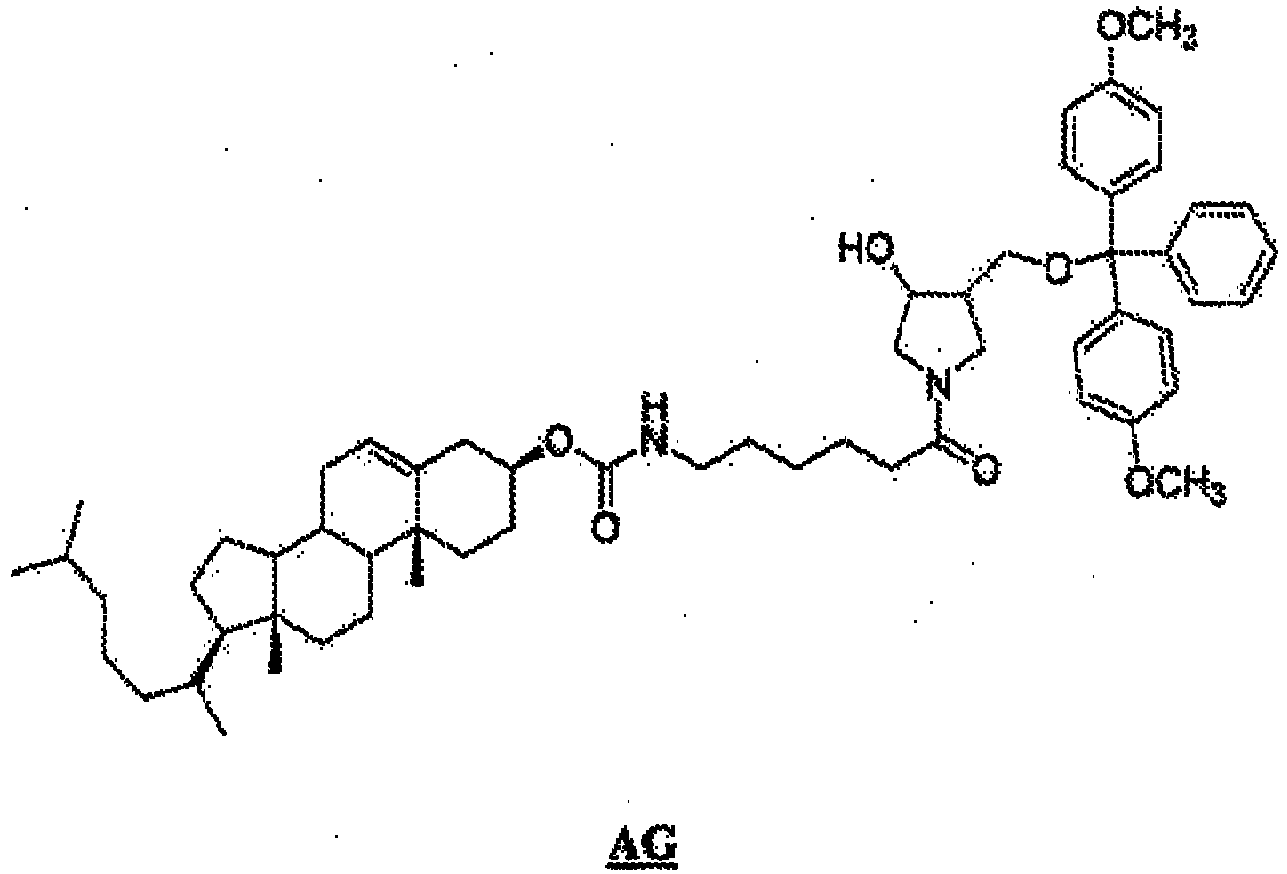
- Diol AF (1.25 gm 1,994 mmol) was dried by evaporating with pyridine (2 x 5 mL) in vacuo, Anhydrous pyridine (10 mL) and 4,4'-dimethoxytritylchloride(0,724 g, 2.13 mmol) were added with stirring. The reaction was carried out at room temperature overnight. The reaction was quenched by the addition of methanol. The reaction mixture was concentrated under vacuum and to the residue dichloromethane (50 mL) was added. The organic layer was washed with 1M aqueous sodium bicarbonate. The organic layer was dried over anhydrous sodium sulfate, filtered and concentrated. The residual pyridine was removed by evaporating with toluene. The crude product was purified by column chromatography (2% MeOH/Chloroform, Rf = 0.5 in 5% MeOH/CHCl3) (1.75 g, 95%).
- Succinic acid mono-(4-[bis-(4-methoxy-phenyl)-phenyl-methoxymethyl]-1-{6-[17-(1,5-dimethyl-hexyl)-10,13-dimethyl 2,3,4,7,8,9,10,11,12,13,14,15,16,17-tetradecahydro-1H cyclopenta[a]phenanthren-3-yloxycarbonylamino]-hexanoyl}-pyrrolidin--3-yl) ester AH

- Compound AG (1.0 g, 1.05 mmol) was mixed with succinic anhydride (0.150 g, 1.5 mmol) and DMAP (0.073 g. 0.6 mmol) and dried in a vacuum at 40°C overnight The mixture was dissolved in anhydrous dichloroethane (3 mL), triethylamine (0.318 g; 0,440 mL, 3.15 mmol) was added and the solution was stirred at room temperature under argon atmosphere for 16 h. It was then diluted with dichloromethane (40 mL) and washed with ice cold aqueous citric acid (5 wt%, 30 mL) and water (2 X 20 mL). The organic phase was dried over anhydrous sodium sulfate and concentrated to dryness. The residue was used as such for the next step.
-

- Succinate AH (0.254 g, 0.242 mmol) was dissolved in a mixture of dichloromethane/acetonitrile (3:2,3 mL). To that solution DMAP (0.0296g, 0.242 mmol) in acetonitrile (1.25 mL), 2,2'-Dithio-bis(5-nitropyridine) (0.075 g, 0.242 mmol) in acetonitrile/dichloroethane (3:1, 1.25 mL) were added successively. To the resulting solution triphenylphosphine (0.064 g, 0.242 mmol) in acetonitrile (0.6 ml) was added. The reaction mixture turned bright orange in color. The solution was agitated briefly using a wrist-action shaker (5 mins), Long chain alkyl amine-CPG (LCAA-CPG) (1.5 g, 61 mM) was added. The suspension was agitated for 2 h. The CPG was filtered through a sintered funnel and washed with acetonitrile, dichloromethane and ether successively. Unreacted amino groups were masked using acetic anhydride/pyridine. The achieved loading of the CPG was measured by taking UV measurement (37 mM/g).
- The synthesis of siRNAs bearing a 5'-12-docecanoic acid bisdecylamide group (herein referred to as "5'-C32-") or a 5'-cholesteryl derivative group (herein referred to as "5'-Chol-"was performed as described in
WO 2004/065601 , except that, for the chlolesteryl derivative, the oxidation step was performed using the Beaucage reagent in order to introduce a phosphorothioate linkage at the 5'-end of the nucleic acid oligomer, - Nucleic acid sequences are represented below using standard nomenclature, and specifically the abbreviations of Table 4.
Table 4: Abbreviations of nucleotide monomers used in nucleic acid sequence representation. It will be understood that these monomers, when present in an oligonucleotide, are mutually linked by 5'-3'-phosphodiester bonds. Abbreviationa Nucleotide(s) A, a 2'-deoxy-adenosine-5-phosphate adenosine-5'-phosphate C, c 2'-deoxy-cytidine-5'-phosphate, cytidine-5'-phosphate G, g 2'-deoxy-guanosine-5'-phosphate, guanosine-5'-phosphate T, t 2'-deoxy-thymidine-5'-phosphate, thymidine-5'-phosphate U, u 2'deoxy-uridine-5'-phosphate, uridine-5'-phosphate N, n any 2'-deoxy-nucleotide/nucleotide (G, A, C, or T, g, a, c or a) Am 2'-O-methyladenosine-5'-phosphate Cm 2'-O-methylcytidine-5'-phosphate Gm 2'-O-methylguanosine-5'-phosphate Tm 2'-O-methyl-thymidine-5'-phosphate Um 2'-O-methyluridine-5'-phosphate Af 2'-fluoro-2'-deoxy-adenosine-5'-phosphate Cf 2'-fluoro-2'-deoxy-cytidine-5'-phosphate Gf 2'-fluoro-2'-deoxy-guanosine-5'-phosphate Tf 2'-fluoro-2'-deoxy-thymidine-5'-phosphate Uf 2'-fluoro-2'-deoxy-uridine-5'-phosphate A, C, G, T, U, a, c, g, t, u underlined: nucleoside-5'-phosphorothioate am, cm, gm, tm, um underlined: 2-O-methyl-nucleoside-.5'-phosphorothioate acapital letters represent 2'-deoxyribonucleotides (DNA), lower case letters represent ribonucleotides (RNA) - In another aspect of the invention, Eg5 specific dsRNA molecules that modulate Eg5 gene expression activity arc expressed from transcription units inserted into DNA or RNA vectors (see, e.g., Couture, A, et al., TIG. (1996). 12.5-10;
Skillern, A., et al., International PCT Publication No. WO 00/22113 Conrad, International PCT Publication No. WO 00/22114 Conrad, US Pat. No. 6,054,299 ). These transgenes can be introduced as a linear construct, a circular plasmid, or a viral vector, which can be incorporated and inherited as a transgene integrated into the host genome. The transgene can also be constructed to permit it to be inherited as an extrachromosomal plasmid (Gassmann, et al., Proc. Natl. Acad. Sci. USA (1995) 92:1292). - The individual strands of a dsRNA can be transcribed by promoters on two separate expression vectors and co-transfected into a target cell. Alternatively each individual strand of the dsRNA can be transcribed by promoters both of which are located on the same expression plasmid. In a preferred embodiment, a dsRNA is expressed as an inverted repeat joined by a linker polynucleotide sequence such that the dsRNA has a stem and loop structure.
- The recombinant dsRNA expression vectors are generally DNA plasmids or viral vectors. dsRNA expressing viral vectors can be constructed based on, but not limited to, adeno-associated virus (for a review, see Muzyczka, et al., Curr. Topics Micro. Immunol. (1992) 158:97-129)); adenovirus (see, for example, Berkner, et al., BioTechniques (1998) 6:616), Rosenfeld et al. (1991, Science 252:431-434), and Rosenfeld et al. (1992), Cell 68:143-155)); or alphavirus as well as others known in the art. Retroviruses have been used to introduce a variety of genes ink many different cell types, including epithelial cells, in vitro and/or in vivo (see, e.g., Eglitis, et al., Science (1985) 230;1395-1398; Danos and Mulligan, Proc. Natl Acad. Sci. USA (1998) 85:6460-6464; Wilson et al., 1988, Proc. Natl. Acad. Sci. USA 85:3014-3018; Armentano et al., 1990, Proc. Natl. Acad. Sci. USA 87:61416145; Huber et al., 1991, Proc. Natl. Acad. Sci. USA 88:8039-8043; Ferry et al., 1991, Proc. Natl. Acad. Sci. USA 88:8377-8381; Chowdhury et al., 1991, Science 254:1802-1805; van Beusechem, et al., 1992, Proc. Nad. Acad. Sci. USA 89:7640-19 ; Kay et al., 1992, Human Gene Therapy 3:641-647; Dai et al., 1992, Proc. Natl.Acad. Sci. USA 89:10892-10895; Hwu et al., 1993. J. Immunol 150:4104-4115;
U.S. Patent No. 4,868,116 ;U.S. Patent No. 4,980,286 ;PCT Application WO 89/07136 PCT Application WO 89/02468 PCT Application WO 89/05345 PCT Application WO 92/07573 - The promoter driving dsRNA expression in either a DNA plasmid or viral vector of the invention may be a eukaryotic RNA polymerase I (e.g. ribosomal RNA promoter), RNA polymerase II (e.g. CMV early promoter or actin promoter or U1 snRNA promoter) or generally RNA polymerase III promoter (e.g. U6 snRNA or 7SK RNA promoter) or a prokaryotic promoter, for example the T7 promoter, provided the expression plasmid also encodes T7 RNA polymerase required for transcription from a T7 promoter. The promoter can also direct transgene expression to the pancreas (see, e.g. the insulin regulatory sequence for pancreas (Bucchini et al., 1986, Proc. Natl. Acad. Sci. USA 83-2511-2515)).
- In addition, expression of the transgene can be precisely regulated, for example, by using an inducible regulatory sequence and expression systems such as a regulatory sequence that is sensitive to certain physiological regulators, e.g., circulating glucose levels, or hormones (Docherty et al., 1994, PASEB J. 8:20-24). Such inducible expression systems, suitable for the control of transgene expression in cells or in mammals include regulation by ecdysone, by estrogen, progesterone, tetracycline, chemical inducers of dimension, and isopropyl-beta-D1-thiogalactopyranoside (EPTG). A person skilled in the art would be able to choose the appropriate regulatory/pomoter sequence based on the intended use of the dsRNA transgene.
- Generally, recombinant vectors capable of expressing dsRNA molecules are delivered as described below, and persist in target cells. Alternatively, viral vectors can be used that provide for transient expression of dsRNA molecules. Such vectors can be repeatedly administered as necessary. Once expressed, the dsRNAs bind to target RNA and modulate its function or expression, Delivery of dsRNA expressing vectors can be systemic, such as by intravenous or intramuscular administration, by administration to target cells ex-planted from the patient followed by reintroduction into the patient, or by any other means that allows for introduction into a desired target cell.
- dsRNA expression DNA plasmids are typically transfected into target cells as a complex with cationic lipid carriers (e.g. Oligofectamine) or non-cationic lipid-based carriers (e.g. Transit-TKO™). Multiple lipid transfections for dsRNA-mediated knockdowns targeting different regions of a single Eg5 gene or multiple Eg5 genes over a period of a week or more are also contemplated by the invention. Successful introduction of the vectors of the invention into host cells can be monitored using various known methods. For example, transient tranfection. can to signaled with a reporter, such as a fluorescent marker, such as Green Fluorescent Protein (GFP). Stable transfection of ex vivo cells can be ensured using markers that provide the transfected cell with resistance to specific environmental factors (e.g., antibiotics and drugs), such as hygromycin B resistance.
- The Eg5 specific dsRNA molecules can also be inserted into vectors and used as gene therapy vectors for human patients. Gene therapy vectors can be delivered to a subject by, for example, intravenous injection, local administration (see
U.S. Patent 5,328,470 ) or by stereotactic injection (see e.g., Chen et al. (1994) Proc. Natl. Acad. Sci. USA 91:3054-3057). The pharmaceutical preparation of the gene therapy vector can include the gene therapy vector in an acceptable diluent, or can comprise a slow release matrix in which the gene delivery vehicle is imbedded. Alternatively, where the complete gene delivery vector can be produced intact from recombinant cells, e.g., retroviral vectors, the pharmaceutical preparation can include one or more cells which produce the gene delivery system. - As silencing of Eg5 has been shown to cause mitotic arrest (Weil, D. et al [2002] Biotechniques 33: 1244-8), a cell viability assay was used for siRNA activity screening. HeLa cells (14000 per well [Screens 1 and 683] or 10000 per well [Screen2])) were seeded in 96-well plates and simultaneously transfected with Lipofectamine 2000 (Invitrogen) at a final siRNA concentration in the well of 30 nM and at final concentrations of 50 nM (1st screen) and 25 nM (2nd screen). A subset of duplexes was tasted at 25 nM in a third screen (Table 5).
- Seventy-two hours post-tranfection, cell proliferation was assayed the addition of WsT-1 reagent (Roche) to the culture medium, and subsequent absorbance measurement at 450 nm. The absorbance valure for control (non-transfected) cells was considered 100 percent, and absorbances for the siRNA transfected wells were compared in the control value. Assays were performed in sextuplicate for each of three screens. A subset of the siRNAs was further tested at a range of siRNA concentrations. Assays were performed in HeLa cells (14000 per well; method same as above, Table 5).
Table 5 Relative absorbance at 450 nm Screen I Screen II Screen III Duplex mean sd Mean sd mean Sd AL-DP-6226 20 10 28 11 43 9 Al-DP-6227 66 27 96 41 108 33 AL-DP-6228 56 28 76 22 78 18 AL-DP-6229 17 3 31 9 48 13 AL-DP-6230 48 8 75 11 73 7 AL-DP-6231 8 1 21 4 41 AL-PP-6232 16 2 37 7 52 14 AL-DP-6233 31 9 37 6 49 12 AL-DP-6234 103 40 141 29 164 45 AL-DP-6235 107 34 140 27 195 75 AL-DP-6236 48 12 54 12 56 12 AL-DP-6237 73 14 108 18 154 37 AL-DP-6238 64 9 103 10 105 24 AL-DP-6239 9 1 20 4 31 11 AL-DP-6240 99 7 139 16 194 43 AL-DP-6241 43 9 54 12 66 19 AL-DP-6242 6 1 15 7 36 8 AL-DP-6243 7 2 19 5 33 13 AL-DP-6244 7 2 19 3 37 13 AL-DP-6245 25 4 45 10 58 9 AL-DP-6146 34 8 65 10 66 13 AL-DP-6247 53 6 78 14 105 20 AL-DP-6248 7 0 22 7 39 12 AL-DP-6249 36 8 48 13 61 7 - The nine siRNA duplexes that showed the greatest growth inhibition in Table 5 were re-tested at a range of siRNA concentrations in HeLa cells. The siRNA concentrations tested were 100 nM, 33.3 nM. 11.1 nM, 3.70 nM, 1.23 nM, 0.41 nM, 0.14 nM and 0.046 nM. Assays were performed in sextuplicate, and the concentration or each siRNA resulting in fifty percent inhibition of cell proliferation (IC50) was calculated. This dose-response analysis was performed between two and four times for each duplex. Mean IC50 values (nM) are given in Table 6.
Table 6 Duplex Mean IC50 AL-DP-6226 15.5 AL-DP-6229 3.4 AL-DP-6231 4.2 AL-DP-6232 17.5 AL-DP-6239 4.4 AL-DP-6242 5.2 AL-DP-6243 2.6 AL-DP-6244 8.3 AL-DP-6248 1.9 - Directly before transfection, Hela S3 (ATCC-Number: CCL-2.2, LCG Promochem GmbH, Wesel, Germany) cells were seeded at 1.5 x 10⁴ cells / well on 96-well plates (Greiner Bio-One GmbH, Frickenhausen, Germany in 75 µl of growth medium (Ham's F12, 10% fetal calf serum. 100u penicillin / 100 µg/ml streptomycin, all from Biochrom AG, Berlin, Germany). Transfections were performed in quadruplicates. For each well 0.5 µl Lipofectamine2000 (Invitrogen GmbH, Karlsruhe, Germany) were mixed with 12 µl Opti-MEM (Invitrogen) and incubated for 15 min at room temperature. For the siRNA concentration being 50 nM in the 100 µl transfection volume, 1 µl of a 5 µM siRNA were mixed with 11.5 µl Opti-MEM per well, combined with the Lipofectamine2000-Opti-MEM mixture and again incubated for 15 minutes at room temperature. siRNA-Lipofectamine2000-complexes were applied completely (25 µl each per well) to the cells and cells were incubated for 24 h at 37°C and 5% CO2 in a humidified incubator (Heraeus GmbH, Hanan). The single dose screen was done once at 50 nM and at 25 nM, respectively.
- Cells were harvested by applying 50 µl of lysis mixture (content of the QuantiGene bDNA-kit from Genospectra, Fremont, USA) to each well containing 100 µl of growth medium and were lysed at 53°C for 30 min. Afterwards, 50 µl of the lysates were incubated with probesets specific to human Eg5 and human GAPDH and proceeded according to the manufacturer's protocol for QuantiGene. In the and chemoluminescence was measured in a Victor2-Light (Perkin Elmer, Wiesbaden, Germany) as RLUs (relative light units) and values obtained with the hEg5 probeset were normalized to the respective GAPDH values for each well Values obtained with siRNAs directed against Eg5 were related to the value obtained with an unspecific siRNA (directed against HCV) which was set to 100% (Tables 1, 2 and 3).
- Effective siRNAs from the screen were further characterized by dose response curves. Transfections of dose response curves were performed at the following concentrations: 100 nM, 16.7 nM, 2.8 nM, 0.46 nM, 77 picoM, 12.8 picoM, 2.1 picoM, 0.35 picoM, 59.5 fM, 9.9 fM and mock (no siRNA) and diluted with Opti-MEM to a final concentration of 12.5 µl according to the above protocol. Data analysis was performed by using the Microsoft Excel add-in software XL-fit 4.2 (IDBS, Guildford, Surrey, UK) and applying the dose response model number 205 (Tables 1,2 and 3).
- The lead siRNA AD12115 was additionally analyzed by applying the WST-proliferation assay from Roche (as previously described).
- A subset of 34 duplexes from Table 2 that showed greatest activity was assayed by transfection in HeLa cells at final concentrations ranging from 100nM to 10fM. Transfections were performed in quadruplicate. Two dose-response assays were performed for each duplex. The concentration giving 20% (IC20), 50% (IC50) and 80% (IC80) reduction ofKSP mRNA was calculated for each duplex. (Table 7),
- Concentrations given in pM
Table 7 IC20s IC50s IC80s Duplex name 1st screen 2nd screen 1st screen 2nd screen 1st screen 2nd screen AD12077 1.19 0.80 6.14 10.16 38.63 76.16 AD12078 25.43 25.43 156.18 156.18 ND ND AD12085 9.08 1.24 40.57 8.52 257.68 81.26 AD12095 1.03 0.97 9.84 4.94 90.31 60.47 AD12113 4.00 5.94 17.18 28.14 490.83 441.30 AD12115 0.60 0.41 3.29 3.39 23.45 23.45 AD12125 31.21 22.02 184.28 166.15 896.85 1008.11 AD12134 2.54 5.51 17.87 22.00 116.36 107.03 AD12149 0.72 0.50 4.51 3.91 30.29 40.89 AD12151 0.53 6.84 4.27 10.72 22.88 43.01 AD12152 155.45 7.56 867.36 66.69 13165.27 ND AD12157 0.30 26.23 14.60 92.08 14309.22 693.31 AD12166 0.20 0.93 3.71 3.86 46.23 20.59 AD12180 28.85 28.85 101.06 101.06 847.21 847.21 AD12185 2.60 0.42 15.55 13.91 109.80 120.63 AD12194 2.08 1.11 5.37 5.09 53.03 30.92 AD12211 5.27 4.52 11.73 18.93 26.74 193.07 AD12257 4.56 5.20 21.68 22.75 124.69 135.82 AD12280 2.37 4.53 6.89 20.23 64.80 104.82 AD12281 8.81 8.65 19.68 42.89 119.01 356.08 AD12282 7.71 45642 20.09 558.00 ND ND AD12285 ND 1.28 57.30 7.31 261.79 42.53 AD12292 40.23 12.00 929.11 109.10 ND ND AD12252 0.02 18.63 6.35 68.24 138.09 404.91 AD12275 25.76 25.04 123.89 133.10 1054.54 776.25 AD12260 4.85 7.80 10.00 32.94 41.67 162.65 AD12267 1.39 1.21 12.00 4.67 283.05 51.12 AD12264 0.92 2.07 8.56 15.12 56.36 196.78 AD12268 2.29 3.67 22.16 25.64 258.27 150.84 AD12279 1.11 28.54 23.19 96.87 327.28 607.27 AD12256 7.20 33.52 46.49 138.04 775.54 1076.76 AD12259 2.16 8.31 8.96 40.12 50.05 219.42 AD12276 19.49 6.14 89.60 59.60 672.57 736.72 AD12321 4.67 4.91 24.88 19.43 139.50 89.49 (ND-not determined) - From birth until approximately 23 days of age, Eg5/KSP expression can be detected in the growing rat liver. Target silencing with a formulated Eg5/KSP siRNA was evaluated in juvenile rats.
-
Duplex ID Target Sense AD6248 VEGF AccGAAGuGuuGuuuGuccTsT (SEQ ID NO:1238) Duplex ID Target Antisense AD6248 VEGF GGAcAAAcAAcACUUCGGUTsT (SEQ ID NO:1239) - Dosing of animals. Male, juvenile Sprague-Dawley rats (19 days old) were administered single doses of lipidoid ("LNP01") formulated siRNA via tail vein injection. Groups of ten animals received doses of 10 milligrams per kilogram (mg/kg) bodyweight of either AD6248 or an unspecific siRNA. Dose level refers to the amount of siRNA duplex administered in the formulation. A third group received phosphate-buffered saline. Animals were sacrificed two days after siRNA administration. Livers were dissected, flash frozen in liquid Nitrogen and pulverized into powders.
- mRNA measurements. Levels of Eg5/KSP mRNA were measures in livers from all treatment groups. Samples of each liver powder (approximately ten milligrams) were homogenized in tissue lysis buffer containing proteinase K. Levels of Eg5/KSP and GAPDH mRNA were measured in triplicate for each sample using the Quantigene branched DNA assay (GenoSpectra). Mean values for Eg5/KSP were normalized to mean GAPDH values for each sample. Group means were determined and normalized to the PBS group for each experiment.
- Mean values (±standard deviation) for Eg5/KSP mRNA are given. Statistical significance (p value) versus the PBS group is shown (ns, not significant [p>0.05]).
-
VEGF/GAPDH p value PBS 1.0±0.47 AD6248 10 mg/kg 0.47±0.12 <0.001 unspec 10 mg/kg 1.0±0.26 ns - A statistically significant reduction in liver Eg5/KSP mRNA was obtained following treatment with formulated AD6248 at a dose of 10 mg/kg.
- A "lipidoid" formulation comprising an equimolar mixture of two siRNAs was administered to rats. One siRNA (AD3133) was directed towards VEGF. The other (AD12115) was directed towards Eg5/KSP. Since Eg5/KSP expression is nearly undetectable in the adult rat liver, only VEGF levels were measured following siRNA treatment.
-
Duplex ID Target Sense AD12115 Eg5/KSP ucGAGAAucuAAAcuAAcuTsT (SEQ ID NO: 1240) AD3133 VEGF GcAcAuAGGAGAGAuGAGCUsU (SEQ ID NO:1242) Duplex ID Target Antisense AD12115 Eg5/KSP AGUuAGUUuAGAUUCUCGATsT (SEQ ID NO: 1241) AD3133 VEGF AAGCUcAUCUCUCCuAuGuGCusG (SEQ ID NO: 1243) - Key: A,G,C,U-ribonucleotides; c,u-2'-O-Me ribonucleotides; s-phorphorothioate.
- Dosing of animals. Adult, female Sprague-Dawley rats were administered lipidoid ("LNP01") formulated siRNA by a two-hour infusion into the femoral vein. Groups of four animals received doses of 5, 10 and 15 milligrams per kilogram (mg/kg) bodyweight of formulated siRNA. Dose level refers to the total amount of siRNA duplex administered in the formulation. A fourth group received phosphate-buffered saline. Animals were sacrificed 72 hours after the end of the siRNA infusion. Livers were dissected, flash frozen in liquid Nitrogen and pulverized into powders.
- The lipidoid ND98·4HCl (MW 1487) (Formula 1), Cholesterol (Sigma-Aldrich), and PEG-Ceramide C16 (Avanti Polar Lipids) were used to prepare lipid-siRNA nanoparticles. Stock solutions of each in ethanol were prepared: ND98, 133 mg/mL; Cholesterol, 25 mg/mL, PEG-Ceramide C16, 100 mg/mL. ND98, Cholesterol, and PEG-Ceramide C16 stock solutions were then combined in a 42:48:10 molar ratio. Combined lipid solution was mixed rapidly with aqueous siRNA (in sodium acetate pH 5) such that the final ethanol concentration was 35-45% and the final sodium acetate concentration was 100-300 mM. Lipid-siRNA nanoparticles formed spontaneously upon mixing. Depending on the desired particle size distribution, the resultant nanoparticle mixture was in some cases extruded through a polycarbone membrane (100 nm cut-off) using a thermobarrel extruder (Lipex Extruder, Northern Lipids, Inc). In other cases, the extrusion step was omitted. Ethanol removal and simultaneous buffer exchange was accomplished by either dialysis or tangential flow filtration. Buffer was exchanged to phosphate buffered saline (PBS) pH 7.2.

- Formulations prepared by either the standard or extrusion-free method are characterized in a similar manner. Formulations are first characterized by visual inspection. They should be whitish translucent solutions free from aggregates or sediment. Particle size and particle size distribution of lipid-nanoparticles are measured by dynamic light scattering using a Malvern Zetasizer Nano ZS (Malvern, USA). Particles should be 20-300 nm, and ideally, 40-100 nm in size. The particle size distribution should be unimodal. The total siRNA concentration in the formulation, as well as the entrapped fraction, is estimated using a dye exclusion assay. A sample of the formulated siRNA is incubated with the RNA-binding dye Ribogreen (Molecular Probes) in the presence or absence of a formulation disrupting surfactant, 0.5% Triton-X100. The total siRNA in the formulation is determined by the signal from the sample containing the surfactant, relative to a standard curve. The entrapped fraction is determined by subtracting the "free" siRNA content (as measured by the signal in the absence of surfactant) from the total siRNA content. Percent entrapped siRNA is typically >85%.
- mRNA measurements. Samples of each liver powder (approximately ten milligrams) were homogenized in tissue lysis buffer containing proteinase K. Levels of VEGF and GAPDH mRNA were measured in triplicate for each sample using the Quantigene branched DNA assay (GenoSpectra). Mean values for VEGF were normalized to mean GAPDH values for each sample. Group means were determined and normalized to the PBS group for each experiment.
- Protein measurements. Samples of each liver powder (approximately 60 milligrams) were homogenized in 1 ml RIPA buffer. Total protein concentrations were determined using the Micro BCA protein assay kit (Pierce). Samples of total protein from each animal was used to determine VEGF protein levels using a VEGF ELISA assay (R&D systems). Group means were determined and normalized to the PBS group for each experiment.
- Mean values (±standard deviation) for mRNA (VEGF/GAPDH) and protein (rel. VEGF) are shown for each treatment group. Statistical significance (p value) versus the PBS group for each experiment is shown.
VEGF/GAPDH p value rel VEGF p value PBS 1.0±0.17 1.0±0.17 5 mg/kg 0.74±0.12 <0.05 0.23±0.03 <0.001 10 mg/kg 0.65±0.12 <0.005 0.22±0.03 <0.001 15 mg/kg 0.49±0.17 <0.001 0.20±0.04 <0.001 - Statistically significant reductions in liver VEGF mRNA and protein were measured at all three siRNA dose levels.


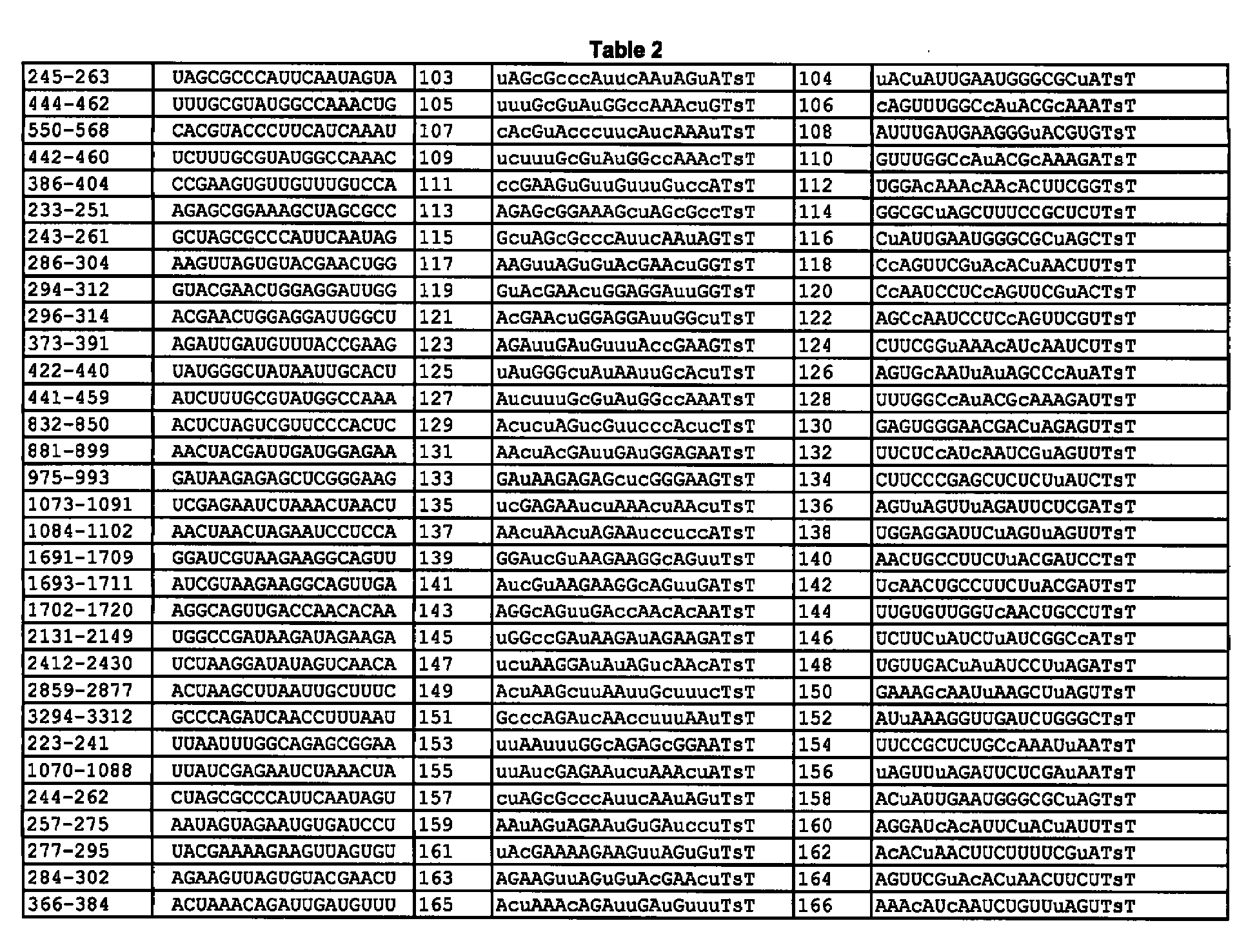


Table 3 sequence (5'-3') seq ID sequence (5'-3') seqID duplex name single dose screen @ 25 nM [% residual mRNA] SDs 2nd screen (among quadruplicates) ccAuuAcuAcAGuAGcAcuTsT 582 AGUGCuACUGuAGuAAUGGTsT 583 AD-14085 19% 1% AucuGGcAAcAuAuuucUTsT 584 AGAAAuAUGGUUGCcAGAUTsT 585 AD-14086 38% 1% GAuAGcuAAAuuAAAccAATsT 586 UUGGUUuAAUUuAGCuAUCTsT 587 AD-14087 75% 10% AGAuAccAuuAcuAcAGuATsT 588 uACUGuAGuAAUGGuAUCUTsT 589 AD-14088 22% 8% GAuuGuucAucAAuuGGcGTsT 590 CGCcAAUUGAUGAAcAAUCTsT 591 AD-14089 70% 12% GcuuucuccucGGcucAcuTsT 592 AGuGAGCCGAGGAGAAAGCTsT 593 AD-14090 79% 11% GGAGGAuuGGcuGAcAAGATsT 594 UCUUGUcAGCcAAUCCUCCTsT 595 AD-14091 29% 3% uAAuGAAGAGuAuAccuGGTsT 596 CcAGGuAuACUCUUcAUuATsT 597 AD-14092 23% 2% uuucAccAAAccAuuuGuATsT 598 uAcAAAUGGUUUGGUGAAATsT 599 AD-14093 60% 2% cuuAuuAAGGAGuAuAcGGTsT 600 CCGuAuACUCCUuAAuAAGTsT 601 AD-14094 11% 3% GAAAucAGAuGGAcGuAAGTsT 602 CUuACGUCcAUCUGAUUUCTsT 603 AD-14095 10% 2% cAGAuGucAGcAuAAGcGATsT 604 UCGCUuAUGCUGAcAUCUGTsT 605 AD-14096 27% 2% AucuAAcccuAGuuGuAucTsT 606 GAuAcAACuAGGGUuAGAUTsT 607 AD-14097 45% 6% AAGAGcuuGuuAAAAucGGTsT 608 CCGAUUUuAAcAAGCUCUUTsT 609 AD-14098 50% 10% uuAAGGAGuAuAcGGAGGATsT 610 UCCUCCGuAnACUCCUuAATsT 611 AD-14099 12% 4% uuGcAAuGuAAAuAcGuAuTsT 612 AuACGuAUUuAcAUUGcAATsT 613 AD-14100 49% 7% ucuAAcccuAGuuGuAuccTsT 614 GGAuAcAACuAGGGUuAGATsT 615 AD-14101 36% 1% cAuGuAucuuuuucucGAuTsT 616 AUCGAGAAAAAGAuAcAUGTsT 617 AD-14102 49% 3% GAuGucAGcAuAAGcGAGTsT 618 cAUCGCUuAGCUGAcAUCTsT 619 AD-14103 74% 5% ucccAAcAGGuAcGAcAccTsT 620 GGUGUCGuACCUGUUGGGATsT 621 AD-14104 27% 3% uGcucAcGAuGAGuuuAGuTsT 622 ACuAAACUcAUCGUGAGcATsT 623 AD-14105 34% 4% AGAGcuuGuuAAAAucGGATsT 624 UCCGAUUUuAAcAAGCUCUTsT 625 AD-14106 9% 2% GcGuAcAAGAAcAucuAuATsT 626 uAuAGAUGUUCUGuACGCTsT 627 AD-14107 5% 1% GAGGuuGuAAGccAAuGuuTsT 628 AAcAUUGGCUuAcAACCUCTsT 629 AD-14108 15% 1% AAcAGGuAcGAcAccAcAGTsT 630 CUGUGGUGUCGuACCOGUUTsT 631 AD-14109 91% 2% AAcccuAGuuGuAucccucTsT 632 GAGGGAuAcAACuAGGGUUTsT 633 AD-14110 66% 5% GcAuAAGcGAuGGAuAAuATsT 634 uAUuAUCcAUCGCUuAUGCTsT 635 AD-14111 33% 3% AAGcGAuGGAuAAuAccuATsT 636 uAGGuAUuAUCcAUCGCUUTsT 637 AD-14112 51% 3% uGAuccuGuAcGAAAAGAATsT 638 UUCUUUUCGuAcAGGAUcATsT 639 AD-14113 22% 3% AAAAcAuuGGccGuucuGGTsT 640 CcAGAACGGCcAAUGUUUUTsT 641 AD-14114 117% 8% cuuGGAGGGcGuAcAAGAATsT 642 UUCUUGuACGCCCUCcAAGTsT 643 AD-14115 50% 8% GGcGuAcAAGAAcAucuAuTsT 644 AuAGAUGUUCUUGuACGCCTsT 645 AD-14116 14% 3% AcucuGAGuAcAuuGGAAuTsT 646 AUUCcAAUGuACUcAGAGUTsT 647 AD-14117 12% 4% uuAuuAAGGAGuAuAcGGATsT 648 UCCGuAuACUCCUuAAuAATsT 649 AD-14118 26% 4% uAAGGAGuAuAcGGAGGAGTsT 650 CUCCUCCGuAuACUCCUuATsT 651 AD-14119 24% 5% AAAucAAuAGucAAcuAAATsT 652 UUuAGUUGACuAUUGAUUUTsT 653 AD-14120 8% 1% AAucAAuAGucAACUAAAGTsT 654 CUUuAGUUGACuAUUGAUUTsT 655 AD-14121 24% 2% uucucAGuAuAcuGuGuAATsT 656 UuAcAcAGuAuACUGAGAATsT 657 AD-14122 10% 1% uGuGAAAcAcucuGAuAAATsT 658 UUuAUcAGAGUGUUUcAcATsT 659 AD-14123 8% 1% AGAuGuGAAucucuGAAcATsT 660 UGUUcAGAGAUUcAcAUCUTsT 661 AD-14124 9% 2% AGCuuGuAAGccAAuGuuGTsT 662 cAAcAUUGGCUuAcAACCUTsT 663 AD-14125 114% 6% uGAGAAucAGAuGGAcGuTsT 664 ACGUCuAUCUGAUUUCUcATsT 665 AD-14126 9% 1% AGAAAucAGAuGGAcGuAATsT 666 UuACGUCcAUCUGAUUCUTsT 667 AD-14127 57% 6% AuAucccAAcAGGuAcGAcTsT 668 GUCGuACCUGUUGGGAuAUTsT 669 AD-14128 104% 6% .cccAAcAGGuAcGAcAccATsT 670 UGG71GUCGuACCUGUUGGGTsT 671 AD-14129 21% 2% AGuAuAcuGAAGAAccucuTsT 672 AGAGGUUCUUcAGuAuACUTsT 673 AD-14130 57% 6% AuAuAuAucAGccGGGcGcTsT 674 GCGCCCCGCUGAuAuAuAUTsT 675 AD-14131 93% 6% AAucuAAcccuAGuuGuAuTsT 676 AuAcAACuAGGGUuAGAUUTsT 677 AD-14132 75% 8% cuAAcccuAGuuGuAucccTsT 678 GGGAuAcACuAGGGUuAGTsT 679 AD-14133 66% 4% cuAGuuGuAucccuccuuuTsT 680 AAAGGAGGGAuAcAACuAGTsT 681 AD-14134 44% 6% AGAcAucuGAcuAAuGGcuTsT 682 AGCcAUuAGUcAGAUGUCUTsT 683 AD-14135 55% 6% GAAGcucAcAAuGAuuuAATsT 684 UuAAAUcAUUGUGAGCUUCTsT 685 AD-14136 29% 3% AcAuGuAucuuuuucucGATsT 686 UCGAGAAAAAGAuAcAUGUTsT 687 AD-14137 40% 3% ucGAuucAAAucuuAAcccTsT 688 GGGUuAAGAUUUGAAUCGATsT 689 AD-14138 39% 5% ucuuAAcccuuAGGAcuvuTsT 690 AGAGUCCuAAGGGUuAAGATsT 691 AD-14139 71% 11% GcucAcGAuGAGuuuAGuGTsT 692 cACuAAACUcAUCGUGAGCTsT 693 AD-14140 43% 15% cAuAAGcGAuGGAuAAuAcTsT 694 GuAUuAUCcAUCGCUuAUGTsT 695 AD-14141 33% 6% AuAAGcGAuGGAuAAuAccTsT 696 GGuAUuAUCcAUCGCUuAUTsT 697 AD-14142 51% 14% ccuAAuAAAcuGcccucAGTsT 698 CUGAGGGcAGUUuAUuAGGTsT 699 AD-14143 42% 1% ucGGAAAGuuGAAcuuGGuTsT 700 ACcAAGUUcAACUUUCCGATsT 701 AD-14144 4% 4% GAAAcAuuGGccGuucuGTsT 702 cAGAACGGCcAAUGUUUUCTsT 703 AD-14145 92% 5% AAGAcuGAucuucuAAGuuTsT 704 AACUuAGAAGAUcAGUCUUTsT 705 AD-14146 13% 2% GAGcuuGuuAAAAucGGAATsT 706 UUCCGAUUUuAAcAAGCUCTsT 707 AD-14147 8% 1% AcAuuGGccGuucuGGAGcTsT 708 GCUCcAGAACGGCcAAUGUTsT 709 AD-14148 80% 7% AAGAAcAucuAuAAuuGcATsT 710 UGcAAUuAuAGAUGUUCUUTsT 711 AD-14149 44% 7% AAAuGuGucuAcucAuGuuTsT 712 AAcAUGAGuAGAcAcAUUUTsT 713 AD-14150 32% 29% uGucuAcucAuGuuucucATsT 714 UGAGAAAcAUGAGuAGAcATsT 715 AD-14151 75% 11% GuAuAcuGuGuAAcAAucuTsT 716 AGAUUGUuAcAcAcAGuAuACTsT 717 AD-14152 8% 5% uAuAcuGuGuAAcAAucuATsT 718 uAGAUUGUuAcAcAGuAuATsT 719 AD-14153 17% 11% cuuAGuAGuGuccAGGAAATsT 720 UUUCCUGGAcACuACuAAGTsT 721 AD-14154 16% 4% ucAGAuGGAcGuAAGGcAGTsT 722 CUGCCUuACGUCcAUCUGATsT 723 AD-14155 11% 1% AGAuAAAuuGAuAGcAcAATsT 724 UUGUGCuAUcAAUUuAUCUTsT 725 AD-14156 10% 1% cAAcAGGuAcGAcAccAcATsT 726 UGUGGUGUCGuACCUGUUGTsT 727 AD-14157 29% 3% uGcAAuGuAAAuAcGuAuuTsT 728 AAuACGuAUUuAcAUUGcATsT 729 AO-14158 51% 3% AGucAGAAuuuuAucuAGATsT 730 UCuAGAuAAAAUUCUGACUTsT 731 AD-14159 53% 5% cuAGAAAucuuuuAAcAccTsT 732 GGUGUuAAAAGAUUUCuAGTsT 733 AD-14160 40% 3% AAuAAAucAAcccuAGuuTsT 734 AACuAGGGUuAGAUUuAUUTsT 735 AD-14161 83% 7% AAuuuucuGcucAcGAuGATsT 736 UcAUCGUGAGcAGAAAAUUTsT 737 AD-14162 44% 6% GcccucAGuAAAuccAuGGTsT 738 CcAUGGAUUuACUGAGGGCTsT 739 AD-14163 57% 3% AcGuuuAAAAcGAGAucuuTsT 740 AAGAUCUCGUUUuAAACGUTsT 741 AD-14164 4% 1% AGGAGAuAGAAcGuuuAAATsT 742 UUuAAACGUUCuAUCUCCUTsT 743 AD-14165 11% 1% GAccGucAuGGcGucGcAGTsT 744 CUGCGACGCcAUGACGGUCTsT 745 AD-14166 90% 5% AccGucAuGGcGucGcAGcTsT 746 GCUGCGACGCcAUGACGGUTsT 747 AD-14167 49% 1% GAAcGuuuAAAAcGAGAucTsT 748 GAUCUCGUUUuAAACGUUCTsT 749 AD-14168 12% 2% uuGAGcuuAAcAuAGGuAATsT 750 UuACCuAUGUuAAGCUcAATsT 751 AD-14169 66% 4% AcuAAAuuGAucucGuAGATsT 752 UCuACGAGAUcAAUUuAGUTsT 753 AD-14170 52% 6% ucGuAGAAuuAucuuAAuATsT 754 uAUuAAGAuAAUUCuACGATsT 755 AD-14171 42% 4% GGAGAuAGAAcGuuuAAAATsT 756 UUUuAAACGUUCuAUCUCCTsT 757 AD-14172 3% 1% AcAAcuuAuuGGAGGuuGuTsT 758 AcAACCUCcAAuAAGUUGUTsT 759 AD-14173 29% 2% uGAGcuuAAcAuAGGuAAATsT 760 UUuACCuAUGUuAAGCUcATsT 761 AD-14174 69% 2% AucucGuAGAAuuAucuuATsT 762 uAAGAuAAUUCuACGAGAUTsT 763 AD-14175 53% 3% cuGcGuGcAGucGGuccucTsT 764 GAGGACCGACUGcACGcAGTsT 765 AD-14176 111% 4% cAcGcAGcGcccGAGAGuATsT 766 uACUCUCGGGCGCUGCGUGTsT 767 AD-14177 87% 6% AGuAccAGGGAGAcuccGGTsT 768 CCGGAGUCUCCCUGGuACUTsT 769 AD-14178 59% 2% AcGGAGGAGAuAGAAcGuuTsT 770 AACGUUCuAUCUCCUCCGUTsT 771 AD-14179 9% 2% AGAAcGuuuAAAAcGAGAuTsT 772 AUCUCGUUUuAAACGUUCUTsT 773 AD-14180 43% 2% AAcGuuuAAAAcGAGAucuTsT 774 AGAUCUcGUUUuAAAcGUUTsT 775 AD-14181 70% 10% AGcuuGAGcuuAAcAuAGGTsT 776 CCuAUGUuAAGCUcAAGCUTsT 777 AD-14182 100% 7% AGcuuAAcAuAGGuAAAuATsT 778 uAUUuACCuAUGUuAAGCUTsT 779 AD-14183 60% 5% uAGAGcuAcAAAAccuAucTsT 780 GAuAGGUUUUGuAGCUCuATsT 781 AD-14184 129% 6% uAGuuGuAucccuccmuuATsT 782 uAAAGGAGGGAuAcAACuATsT 783 AD-14185 62% 4% AccAcccAGAcAucuGAcuTsT 784 AGUcAGAUGUCUGGGUGGUTsT 785 AD-14186 42% 3% AGAAAcuAAAuuGAucuGTsT 786 CGAGAUcAAUUuAGUUUCUTsT 787 AD-14187 123% 12% ucucGuAGAAuuAucuuATsT 788 UuAAGAuAAUUCuACGAGATsT 789 AD-14188 38% 2% cAAcuuAuuGGAGGuuGuATsT 790 uAcAACCUCcAAuAAGUUGTsT 791 AD-14189 13% 1% uuGuAucccuccuuuAAGuTsT 792 ACUuAAAGGAGGGAuAcAATsT 793 AD-14190 59% 3% ucAcAAcuuAuuGGAGGuuTsT 794 AACCUCcAAuAAGUUGUGATsT 795 AD-14191 93% 3% AGAAcuGuAcucuucucAGTsT 796 CUGAGAAGAGuAcAGUUCUTsT 797 AD-14192 45% 5% GAGcuuAAcAuAGGuAAAuTsT 798 AUUuACCuAUGUuAAGCUCTsT 799 AD-14193 57% 3% cAccAAcAucuGuccuuAGTsT 800 CuAAGGAcAGAUGUUGGUGTsT 801 AD-14194 51% 4% AAAGcccAcuuuAGAGuAuTsT 802 AuACUCuAAAGUGGGCUUUTsT 803 AD-14195 77% 5% AAGcccAcuuuAGAGuAuATsT 804 uAuACUCuAAAGUGGGCUUTsT 805 AD-14196 42% 6% GAccuuAuuuGGuAAucuGTsT 806 cAGAUuACcAAAuAAGGUCTsT 807 AD-14197 15% 2% GAuuAAuGuAcucAAGAcuTsT 808 AGUCUUGAGuAcAUuAAUCTsT 809 AD-14198 12% 2% cuuuAAGAGGccuAAcucATsT 810 UGAGUuAGGCCUCUuAAAGTsT 811 AD-14199 18% 2% uuAAAccAAAcccuAuuGATsT 812 UcAAuAGGGUUUGGUUuAATsT 813 AD-14200 72% 9% ucuGuuGGAGAucuAuAAuTsT 814 AUuAuAGAUCUCcAAcAGATsT 815 AD-14201 9% 3% cuGAuGuuucuGAGAGAcuTsT 816 AGUCUCUcAGAAAcAUcAGTsT 817 AD-14202 25% 3% GcAuAcucuAGucGuucccTsT 818 GGGAACGACuAGAGuAUGCTsT 819 AD-14203 21% 1% GuuccuuAucGAGAAucuATsT 820 uAGAUUCUCGAuAAGGAACTsT 821 AD-14204 4% 2% GcAcuuGGAucucucAcAuTsT 822 AUGUGAGAGAUCcAAGUGCTsT 823 AD-14205 5% 1% AAAAAAGGAAcuAGAuGGcTsT 824 GCcAUCuAGUUCCUUUUUTsT 825 AD-14206 79% 6% AGAGcGAuuAccucuGcGTsT 826 CGcAGAGGuAAUCUGCUCUTsT 827 AD-14207 55% 2% AGcAGAuuAccucuGcGAGTsT 828 CUCGcAGAGGuAAUCUGCUTsT 829 AD-14208 100% 4% cccuGAcAGAGuucAcAAATsT 830 UUUGUGAACUCUGUcAGGGTsT 831 AD-14209 34% 3% GuuuAccGAAGuGuuGuuuTsT 832 AAAcAAcACUUCGCuAAACTsT 833 AD-14210 13% 2% uuAcAGuAcAcAAcAAGGATsT 834 UCCUUGUUGUACUGuAATsT 835 AD-14211 9% 1% AcuGGAucGuAAGAAGGcATsT 836 UGCCUUCUuACGAUCcAGUTsT 837 AD-14212 20% 3% GAGcAGAuuAccucuGcGATsT 838 UCGcAGAGGuAAUCUGCUCTsT 839 AD-14213 48% 5% AAAAGAAGuuAGuGuAcGATsT 840 UCGuAcACuAACUUCUUUUTsT 841 AD-14214 28% 18% GAccAuuuAAuuuGGcAGATsT 842 UCUGCcAAAUuAAAUGGUCTsT 843 AD-14215 132% 0% GACAGGAGuGAuAAuuAAATsT 844 UUuAAUuAucACUCCUCUCTsT 845 AD-14216 3% 0% cuGGAGGAuuGGcuGAcAATsT 846 UUGUcAGCcAAUCCUCcAGTsT 847 AD-14217 19% 1% cucuAGucGuucccAcucATsT 848 UGAGUGGGAACGACuAGAGTsT 849 AD-14218 67% 8% GAuAccAuuAcuAcAGuAGTsT 850 CuACUGuAGuAAUGGuAUCTsT 851 AD-14219 76% 4% uucGucuGcGAAGAAATsT 852 UUUCUUCUUCGcAGACGAATsT 853 AD-14220 33% 8% GAAAAGAAGuuAGuGuAcGTsT 854 CGuAcACuAACUUCUUUUCTsT 855 AD-14221 25% 2% uGAuGuuuAccGAAGuGuuTsT 856 AAcACUUCGGuAAAcAUcATsT 857 AD-14222 7% 2% uGuuuGuccAAuucuGGAuTsT 858 AUCcAGAAUUGGAcAAAcATsT 859 AD-14223 19% 2% AuGAAGAGuAuAccuGGGATsT 860 UCCcAGGuAuACUCUUcAUTsT 661 AD-14224 13% 1% GcuAcucuGAuGAAuGcAuTsT 862 AUGcAUUcAUcAGAGuAGCTsT 863 AD-14225 15% 2% GcccuuGuAGAAAGAAcAcTsT 864 GUGUUCUUUCuAcAAGGGCTsT 865 AD-14226 11% 0% ucAuGuuccuuAucAGAATsT 866 UUCUCGAuAAGGAAcAUGATsT 867 AD-14227 5% 1% (GAAuAGGGuuAcAGAGuuGTsT 868 cAACUCUGuAACCCuAUUCTsT 869 AD-14228 34% 3% cAAAcuGGAucGuAAGAAGTsT 870 CUUCUuACGAUCcAGUUUGTsT 871 AD-14229 15% 2% cuuAuuuGGuAAucuGcuGTsT 872 cAGcAGAUuACcAAAuAAGTsT 873 AD-14230 20% 1% AGcAAuGuGGAAAccuAAcTsT 874 GuGcAGAUuACcAAAuAAGTsT 875 AD-14231 18% 1% AcAAuAAAGcAGAcccAuuTsT 876 AAUGGGUCUGCUUuAUUUGUTsT 877 AD-14232 21% 1% AAccAcuuAGuAGuGuccATsT 878 UGGAcACuACuAAGUGGUUTsT 879 AD-14233 106% 12% AGucAAGAGccAucuGuAGTsT 880 CuAcAGAUGGCUCUUGACUTsT 881 AD-14234 35% 3% cucccuAGAcuucccuAuuTsT 882 AAuAGGGAAGUCuAGGGAGTsT 883 AD-14235 48% 4% AuAGcuAAAuuAAAccAAATsT 884 UUUGGUUuAAUUuAGCuAUTsT 885 AD-14235 23% 3% uGGcuGGuAuAAuuccAcGTsT 886 CGUGCAAUuAuACcAGCcATsT 887 AD-14237 79% 9% uuAuuuGGuAAucuGcuGuTsT 888 AcAGcAGAUuACcAAAuAATsT 889 AD-14238 92% 7% AAcuAGAuGGcuuucucAGTsT 890 CUGAGAAAGCcAUCuAGUUTsT 891 AD-14239 20% 2% ucAuGGcGucGcAGccAAATsT 892 UUUGGCUGCGACGCcAUGATsT 893 AD-14240 71% 6% AcuGGAGGAuuGGcuGAcATsT 894 UGUcAGCcAAUCCUCcAGUTsT 895 AD-14241 14% 1% cuAuAAuuGcAcuAucuuuTsT 896 AAAGAuAGUGcAAUuAuAGTsT 897 AD-14242 11% 2% AAAGGucAccuAAuGAAGATsT 898 UCUUcAUuAGGUGACCUUUTsT 899 AD-14243 11% 1% AuGAAuGcAuAcucuAGucTsT 900 GACuAGAGuAUGcAUUcAUTsT 901 AD-14244 15% 2% AAcAuAuuGAAuAAGccuGTsT 902 cAGGCUuAUUcAAuAUGUUTsT 903 AD-14245 57% 7% AAGAAGGcAGuuGAccAAcTsT 904 GUUGGUcAACUGCCUUCUUTsT 905 AD-14246 57% 5% GAuAcuAAAAGAAcAAucATsT 906 UGAUUGUUCUUUuAGuAUCTsT 907 AD-14247 9% 3% AuAcuGAAAAucAAuAGucTsT 908 GACuAUUGAUUUUcAGuAUTsT 909 AD-14248 39% 4% AAAAAGCAAcuAGuGGcuTsT 910 AGCcAUCUAGUUCCUUUUUTsT 911 AD-14249 64% 2% GAAcuAGAuGGcuuucucATsT 912 UGAGAAAGCcAUCuAGUUCTsT 913 AD-14250 18% 2% GAAAccuAAcuGAAGAccuTsT 914 AGGUCUUcAGUuAGGUUUCTsT 915 AD-14251 56% 6% uAcccAucAAcuGGuAATsT 916 UUuACcAGUGUUGAUGGGuATsT 917 AD-14252 48% 6% AuuuuGAuAucuAcccAuuTsT 918 AAUGGGuAGAuAUcAAAAUTsT 919 AD-14253 39% 5% AucccuAuAGuucAcuuuGTsT 920 cAAAGUGAACuAuAGGGAUTsT 921 AD-14254 44% 8% AuGGGcuAuAAuuGcAcuATsT 922 uAGUGcAAUuAuAGCCcAUTsT 923 AD-14255 108% 8% AGAuuAccucuGcGAGcccTsT 924 GGGCUCGcAGAGGuAAUCUTsT 925 AD-14256 108% 6% uAAuuccAcGuAcccucATsT 926 UGAAGGGuACGUGGAAUuATsT 927 AD-14257 23% 2% GucGuucccAcucAGuuuuTsT 928 AAAACuGAGuGGGAACGACTsT 929 AD-14256 21% 3% AAAucAAucccuGuuGAcuTsT 930 AGUcAAcAGGGAUUGAUUUTsT 931 AD-14259 19% 2% ucAUAGAGcAAAGAAcAuATsT 932 uAUGUUCUUUGCUCuAUGATsT 933 AD-14260 10% 1% uuAcuAcAGnAGcAcuuGGTsT 936 CcAAGUCGuACUGuAGuAATsT 935 AD-14261 76% 3% AuGuGGAAAccuAAcuGAATsT 934 CUUcAGUuAGGUUUAcATsT 937 AD-14252 13% 2% uGuGGAAAccuAAcuGAAGTsT 938 CUUcAGUuAGGUUUCcAcATsT 939 AD-14263 14% 2% ucuucuuAAAuCAAAGGGTsT 940 CCCUUUcAUUuAAGGAAGATsT 941 AD-14264 65% 3% uGAAGAAccucuAAGucAATsT 942 UUGACUuAGAGGUUCUUcATsT 943 AD-14265 13% 1% AGAGGucuAAAGuGGAAGATsT 944 UCUUCcACUUuAGACCUCUTsT 945 AD-14266 18% 3% AuAucuAcccAuuuuucuGTsT 946 cAGAAAAAUGGGuAGAuAUTsT 947 AD-14267 50% 9% uAAGccuGAAGuGAAucAGTsT 948 CUGAUUcACUUcAGGCUuATsT 949 AD-14268 13% 3% AGAuGcAGAccAuuuAAuuTsT 950 AAUuAAAUGGUCUGcAUCUTsT 951 AD-14269 19% 4% AGuGuuGuuuGuccAAuucTsT 952 GAAUUGGAcAAAcAACACUTsT 953 AD-14270 11% 2% cuAuAAuGAAGAGcuuuuuTsT 954 AAAAAGCUCUUcAUuAuAGTsT 955 AD-14271 11% 1% AGAGGAGuGAuAuuAAAGTsT 956 CUUuAAUuAUcACUCCUCUTsT 957 AD-14272 7% 1% uuucucuGuuAcAAuAcAuTsT 958 AUGuAUUGuAAcAGAGAAATsT 959 AD-14273 14% 2% AAcAucuAuAAuuGcAAcATsT 960 UGUUGcAAUuAuAGAUGUUTsT 961 AD-14274 73% 4% uGcuAGAAGuAcAuAAGAcTsT 962 GUCUuAUGuACUUCuAGcATsT 963 AD-14275 10% 1% AAuGuAcucAAGAcuGAucTsT 964 GAUcAGUCUUGAGuAcAUUTsT 965 AD-14276 89% 2% GuAcucAAGAcuGAucuucTsT 966 GAAGAUcAGUCUUGAGuACTsT 967 AD-14277 7% 1% cAcucuGAuAAAcucAAuGTsT 968 caAUUGAGUUuAUcAGAGUGTsT 969 AD-14278 12% 1% AAGAGcAGAuuAccucuGcTsT 970 GcAGAGGuAAUCUGCUCUUTsT 971 AD-14279 104% 3% ucuGcGAGcccGAucAAcTsT 972 GUUGAUCUGGGCUCGcAGATsT 973 AD-14280 21% 2% AAcuuGAGccuuGuGuAuATsT 974 uAuAcAcAAGGCUcAAGUUTsT 975 AD-14281 43% 3% GAAuAuAuAucAGccGGTsT 976 CCGGCUGAuAuAuAuAUUCTsT 977 AD-14282 45% 6% uGucAucccuAnAGuucAcTsT 978 GUGAACuAuAGGGAUGAcATsT 979 AD-14283 35% 5% GAucuGGcAAccAuAuuucTsT 980 GAAAuAUGGUUGCcAGAUCTsT 981 AD-14284 58% 3% uGGcAAccAuAuuucuGCATsT 982 UCCAGAAAuAUGGUUGCcATsT 983 AD-14285 48% 3% GAuGuuuAccGAAGuGuuGTsT 984 cAAcACUUCGGuAAAcAUCTsT 985 AD-14286 49% 3% uuccuuAucGACAAucnAATsT 986 UuAGAUUCUCGAuAAGGAATsT 987 AD-14287 6% 1% AGcuuAAuuGcuuucuGGATsT 988 UCcAGAAAGcAAUuAAGCUTsT 989 AD-14288 50% 2% uuGcuAuuAuGGGAGAccATsT 990 UCGUCUCCcAuAAuAGcAATsT 991 AD-14289 48% 1% GucAuGGcGucGcAGccAATsT 992 UUGGCUGCGACGCcAUGACTsT 993 AD-14290 112% 7% uAAuuGcAcuAucuuuGcGTsT 994 CGcAAAGAuAGUGcAAUuATsT 995 AD-14291 77% 2% cuAucuuuGcGuAcGGccATsT 996 UGGCcAuACGcAAAGAuAGTsT 997 AD-14292 80% 6% ucccuAuAGuucAcuuuGuTsT 998 AcAAAGUGAACuAuAGGGATsT 999 AD-14293 58% 2% ucAAccnuuAAuucAcuuGTsT 1000 cAAGUGAAUuAAAGGUUGATsT 1001 AD-14294 77% 2% GGcAAccAuAuuucuGGAATsT 1002 UUCcAGAAAuAUGGUUGCCTsT 1003 AD-14295 62% 2% AuGuAcucAAGAucGAucuTsT 1004 AGAUcCAGUUGAGuAcAUTsT 1005 AD-14296 59% 4% GcAGAccAuuuAAuuuGGcTsT 1006 GCcAAAUuAAAUGGUCUCGCTsT 1007 AD-14297 37% 1% ucuGAGAGAcuAcAGAuGuTsT 1008 AcAUCUGuAGUCUCUcAGATsT 1009 AD-14298 21% 1% uGcucAuAGAGcAAAGAAcTsT 1010 GUUCUUUGCUCuAUGAGcATsT 1011 AD-14299 6% 1% AcAuAAGAccuuuAGGuTsT 1012 ACcAAAuAAGGUCUuAUGUTsT 1013 AD-14300 17% 2% uuuGuGcuGAuucuGAuGGTsT 1014 CcAUcAGAAUCAGcACAATsT 1015 AD-14301 97% 6% ccAucAAcAcuGGuAAGAATsT 1016 UUCUuACcAGUGUUGAUGGTsT 1017 AD-14302 13% 1% AGAcAAuuccGGAuGuGGATsT 1018 UCcAGUCCGGAAUUGUCUTsT 1019 AD-14303 13% 3% GAAcuuGAGccuuGuGuAuTsT 1020 AuAcAcAAGGCUcAAGUUCTsT 1021 AD-14304 38% 2% uAAuuuGGcAGAGcGGAAATsT 1022 UUUCCGCUCUGCcAAAUuATsT 1023 AD-14305 14% 2% uGGAuGAAGuuAuuAuGGGTsT 1024 CCcAuAAuAACUUcAUCcATsT 1025 AD-14306 22% 4% AucuAcAuGAAcuAcAAAGATsT 1026 UCUUGuAGUUcAUGuAGAUTsT 1027 AD-14307 26% 6% GGuAuuuuuGAueuGGcAATsT 1028 UUGCcAGAUcAAAAuACCTsT 1029 AD-14308 62% 8% cuAAuGAAGAGuAuAccuGTsT 1030 cAGGuAuACUCCUUcAUuGTsT 1031 AD-14309 52% 5% uuuGAGAAAcuuAuCAuATsT 1032 uAUcAGuAAGUUUCUcAAATsT 1033 AD-14310 32% 3% cGAuAAGAuAGAAGAucAATsT 1034 UUGAUCUUCuAUCUuAUCGTsT 1035 AD-14311 23% 2% cuGGcAAccAuAuuucuGGTsT 1036 CcAGAAAuAUGGUUGCcAGTsT 1037 AD-14312 49% 6% uAGAuAccAuuAcuAcAGuTsT 1038 ACUGuAGuAAUGGuAUCuATsT 1039 AD-14313 69% 4% GuAuuAAAuuGGGuuucAuTsT 1040 AUGAAACCcAAUUuAAuACTsT 1041 AD-14314 52% 3% AAGAccuuAuuuGGuAAucTsT 1042 GAUuACcAAAuAAGGUCUUTsT 1043 AD-14315 66% 4% GcuGuuGAuAAGAGAGcucTsT 1044 GAGCUCUCUuAUcAAcAGCTsT 1045 AD-14316 19% 5% uAcucAuGuuucucAGAuuTsT 1046 AAUCUGAGAAAcAUGAGuATsT 1047 AD-14317 16% 5% cAGAuGGAcGuAAGGcAGcTsT 1048 GCUGCCUuACGUCcAUCUGTsT 1049 AD-14318 52% 11% uAucccAAcAGGuAcGAcATsT 1050 UGUCGuACCUGUUGGGAuATsT 1051 AD-14319 28% 11% cAuuGcuAuuAuGGGAGAcTsT 1052 GUCUCCcAuAAuAGAAUGTsT 1053 AD-14320 52% 10% cccucAGuAAAuccAuGGuTsT 1054 ACcAUGGAUUuACUGAGGGTsT 1055 AD-14321 53% 6% GGucAuuAcuGcccuuGuATsT 1056 uAGAGGGcAGuAAUGACCTsT 1057 AD-14322 20% 2% AAccAcucAAAAAcAuuuGTsT 1058 cAAAUGUUUUUGAGUGGUUTsT 1059 AD-14323 116% 6% uuuGcAAGuuAAuGAAucuTsT 1060 AGAUUcAUuAACUUGcAAATsT 1061 AD-14324 14% 2% uuAuuuucAGuAGucAGAATsT 1062 UUCUGACuACUGAAAuAATsT 1063 AD-14325 50% 2% uuuucucGAuucAAAucuuTsT 1064 AAGAUUuGAAUCGAGAAAATsT 1065 AD-14326 47% 3% GuAcGAAAAGAAGuuAGuGTsT 1066 cACuAACUUCUUUUCGuACTsT 1067 AD-14327 18% 2% uuuAAAAcGAGAucuuGcuTsT 1068 AGcAAGAUCUCGUUUuAAATsT 1069 AD-14328 19% 1% GAAuuGAuuAAuGuAcucATsT 1070 UGAGuAcAuAAUcAAUUCTsT 1071 AD-14329 94% 10% GAuGCAcGuAAGGcAGcucTsT 1072 GAGCUGCCUuACGUCcAUCTsT 1073 AD-14330 60% 4% cAucuGAcuAAuGGcucuGTsT 1074 cGAGCcAUuAGUcAGAUGTsT 1075 AD-14331 54% 7% GuGAuccuGuAcGAAAAGATsT 1076 UCUUUUCGuAcAGGAUcACTsT 1077 AD-14332 22% 4% AGcucuuAuuAAGGAGuAuTsT 1078 AuACUCCUuAAuAAGAGCUTsT 1079 AD-14333 70% 10% GcucuuAuuAAGGAGuAuATsT 1080 uAuACUCCUuAAuAAGAGCTsT 1081 AD-14334 18% 3% ucuuAuuAuuAAGGAGuAuAcGTsT 1082 CGuAuACUCCUuAAuAAGATsT 1083 AD-14335 38% 6% uAuuAAGGAGuAuAcGGAGTsT 1084 CUCCGuAuACUCCUuAAuATsT 1085 AD-14336 16% 3% cuGcAGcccGuGAGAAAAATsT 1086 UUUUUCUcACGGGCUGcAGTsT 1087 AD-14337 65% 4% ucAAGAcuGAucuucuAAGTsT 1088 CUuAGAAGAUcAGUCUUGATsT 1089 AD-14338 18% 0% cuucuAAGuucAcuGGAAATsT 1090 UUUCcAGUGAACUuAGAAGTsT 1091 AD-14339 20% 4% uGcAAGuuAAuGAAucuuuTsT 1092 AAAGAUUcAUuAACUUGcATsT 1093 AD-14340 24% 1% AAucuAAGGAuAuAGucAATsT 1094 UUGACuAuAUCCUuAGAUUTsT 1095 AD-14341 27% 3% AucucuGAAcAcAAGAAcATsT 1096 UGUUCUUGUGUUcAGAGAUTsT 1097 AD-14342 13% 1% uucuGAAcAGuGGGuAucuTsT 1098 AGAuACCcACUGUUcAGAATsT 1099 AD-14343 19% 1% AGuuAuuuAuAcccAucAATsT 1100 UUGAUGGGuAuAAAuAACUTsT 1101 AD-14344 23% 2% AuGcuAAAcuGuucAGAAATsT 1102 UUUCUGAAcAGUUuAGcAUTsT 1103 AD-14345 21% 4% cuAcAGAGcAcuuGSuuAcTsT 1104 GuAACcAAGUGCCUCUGuAGTsT 1105 AD-14346 18% 2% uAuAuAucAGccGGGcGcGTsT 1106 CGCGCCCGGCUGAuAuAuATsT 1107 AD-14347 67% 2% AuGuAAAuAcGuAuuucuATsT 1108 uAGAAAuACGuAUUuAcAUTsT 1109 AD-14348 39% 3% uuuuucucGAuucAAAucuTsT 1110 AGAUUuGAAUCGAGAAAAATsT 1111 AD-14349 83% 6% AAucuuAAcccuuAGGAcuTsT 1112 AGUCCuAAGGGUuAAGAUUTsT 1113 AD-14350 54% 2% ccuuAGGAcucuGGuAuuuTsT 1114 AAAuACcAGAGUCCuAAGGTsT 1115 AD-14351 57% 8% AAuAAAcuGcccucAGuAATsT 1116 UuACUGAGGGcAGUUuAUUTsT 1117 AD-14352 82% 3% GAuccuGuAcGAAAAGAAGTsT 1118 CUUCUUUUCGuAcAGGAUCTsT 1119 AD-14353 2% 1% AAuGuGAuccuGuAcGAAATsT 1120 UUUCGuAcAGGAUcAcAUUTsT 1121 AD-14354 18% 11% GuGAAAAcAuuGGccGuucTsT 1122 GAACGCCcAAUGUUUUcACTsT 1123 AD-14355 2% 1% cuuGAGGAAAcucuGAGuATsT 1124 uACUcAGAGUUUCCUcAAGTsT 1125 AD-14356 8% 2% cGuuuAAAAcGAGAucuuGTsT 1126 cAAGAUCUCGUUUuAAACGTsT 1127 AD-14357 6% 3% uuAAAAcGAGAucuuGcuGTsT 1128 cAGcAAGAUCUCGUUUuAATsT 1129 AD-14358 98% 17% AAAGAuGuAucuGGucuccTsT 1130 GGAGACcAGAuAcAUCUUUTsT 1131 AD-14350 10% 1% cAGAAAAuGuGucuAcucATsT 1132 UGAGuAGAcAcAUUUUCUGTsT 1331 AD-14360 6% 4% cAGGAAuuGAuuAAuGuAcTsT 1134 GuACAUuAAUcAAUUCCUGTsT 1135 AD-14361 30% 5% ACucAAcuAAAGcAuAuuuTsT 1136 AAAuAUGCUUuAGUUGACUTsT 1137 AD-14362 28% 2% uGuGuAAcAAucuAcAuGATsT 1138 UcAUGuAGAUUCUuAcAcATsT 1139 AD-14363 60% 6% AuAccAuuuGuuccuuGGuTsT 1140 ACcAAGGAAcAAAUGGuAUTsT 1141 AD-14364 12% 9% GcAGAAAucuAAGGAuAuATsT 1142 uAuAUCCUuAGAUUUCUGCTsT 1143 AD-14365 5% 2% uGGcuucucAcAGGAAcucTsT 1144 GAGUUCCUGUGAGAAGCcATsT 1145 AD-14366 28% 5% GAGAuGuGAAucucuGAAcTsT 1146 GUUcAGAGAUUcAcAUCUCTsT 1147 AD-14367 42% 4% uGuAAGccAAuGuuGuGAGTsT 1148 CUcAcAAcAUUGGCUuAcATsT 1149 AD-14368 93% 12% AGccAAuGuuGuGAGGcuuTsT 1150 AAGCCUcAcAAcAUUGGCUTsT 1151 AD-14369 65% 4% uuGuGAGGcuucAAGuucATsT 1152 UGAACUUGAAGCCUcAcAATsT 1153 AD-14370 5% 2% AGGcAGcucAuGAGAAAcATsT 1154 UGUUUCUcAUGAGCUGCCUTsT 1155 AD-14371 54% 5% AuAAAuuGAuAGcAcAAAATsT 1156 UUUUGUCCuAUcAAUUuAUTsT 1157 AD-14372 4% 1% AcAAAAucuAGAAcuuAAuTsT 1158 AUuAAGUUCuAGAUUUUGUTsT 1159 AD-14373 5% 1% GAuAucccAAcAGGuAcGATsT 1160 UCGuACCUGUUGGGAuAUCTsT 1161 AD-14374 92% 6% AAGuuAuuuAuAcccAucATsT 1162 UGAUGGGuAuAAAuAACUUTsT 1163 AD-14375 76% 4% uGuAAAuAcGuAuuucuAGTsT 1164 CuAGAAAuACGuAUUuAcATsT 1165 AD-14376 70% 5% ucuAGuuuucAuAuAAAGuTsT 1166 ACUUuAuAUGAAAACuAGATsT 1167 AD-14377 48% 4% AuAAAGuAGuucuuuuAuATsT 1168 uAuAAAAGAACuACUUuAUTsT 1169 AD-14378 48% 3% ccAuuuGuAGAGcuAcAAATsT 1170 UUUGuAGCUCuAcAAAUGGTsT 1171 AD-14379 44% 5% uAuuuucAGuAGucAGAAuTsT 1172 AUUCUGACuACUGAAAuATsT 1173 AD-14380 35% 16% AAAucuAAcccuAGuuGuATsT 1174 uAcAACuAGGGUuAGAUUUTsT 1175 AD-14381 44% 5% cuuuAGAGuAuAcAuuGcuTsT 1176 AGcAAUGuAuACUCuAAAGTsT 1177 AD-14382 28% 1% AucuGAcuAAuGGcucuGuTsT 1178 AcAGAGCcAUuAGUcAGAUTsT 1179 AD-14383 55% 11% cACAAuGAuuuAAGGAcuGTsT 1180 cAGUCCUuAAAUcAUUGUGTsT 1181 AD-14384 48% 9% ucuuuuucucGAuucAAAuTsT 1182 AUUuGAAUCGAGAAAAAGATsT 1183 AD-14385 36% 2% cuuuuucucGAuucAAAucTsT 1184 GAUUuGAAUCGAGAAAAAGTsT 1185 AD-14386 41% 7% AuuuucuGcucAcGAuGAGTsT 1186 CUcAUCGUGUGcAGAAAAUTsT 1187 AD-14387 38% 3% uuucuGcucAcGAuGAGuuTsT 1188 AACUcAUCGUGAGcAGAAATsT 1189 AD-14388 50% 4% AGAGcuAcAAAAccuAuccTsT 1190 GGAuAGGUUUUGuAGCUCUTsT 1191 AD-14389 98% 6% GAGccAAAGGuAcAccAcuTsT 1192 AGUGGUGuACCUUUGGCUCTsT 1193 AD-14390 43% 8% GccAAAGGuAcAccAcuAcTsT 1194 GuAGUGGUGuACCUUUGGCTsT 1195 AD-14391 48% 4% GAAcuGuAcucuucucAGcTsT 1196 GCUGAGAAGAGuAcAGUUCTsT 1197 AD-14392 44% 3% AGGuAAAuAucAccAAcAuTsT 1198 AUGUUGGUGAuAUUuACCUTsT 1199 AD-14393 37% 2% AGcuAcAAAAccuAuccuuTsT 1200 AAGGAuAGGUUUUGuAGCUTsT 1201 AD-14394 114% 7% uGuGAAAGcAuuuAAuuccTsT 1202 GGAAUuAAAUGCUUUcAcATsT 1203 AD-14395 55% 4% GcccAcuuuAGAGuAuAcATsT 1204 UGuAuACUCuAAAGUGGGCTsT 1205 AD-14396 49% 5% uGuGccAcAcuccAAGAccTsT 1206 GGUCUUGGAGUGUGGcAcATsT 1207 AD-14397 71% 6% AAAcuAAAuuGAucucGuATsT 1208 uACGAGAUcAAUUuAGUUUTsT 1209 AD-14398 81% 7% uGAucucGuAGAAuuAucuTsT 1210 AGAuAAUUCuACGAGAUcATsT 1211 AD-14399 38% 4% GcGuGcAGucGGuccuccATsT 1212 UGGAGGACCGACUGcACGCTsT 1213 AD-14400 106% 8% AAAGuuuAGAGAcAucuGATsT 1214 UcAGAUGUCUCuAAACUUUTsT 1215 AD-14401 47% 3% cAGAAGGAAuAuGuAcAAATsT 1216 UUUGuAcAuAUUCCUUCUGTsT 1217 AD-14402 31% 1% cGcccGAGAGuAccAGGGATsT 1218 UCCCUGGuACUCUCGGGCGTsT 1219 AD-14403 105% 4% cGGAGGAGAuAGAAcGuuuTsT 1220 AAACGUUCuAUCUCCUCCGTsT 1221 AD-14404 3% 1% AGAuAGAAcGuuuAAAAcGTsT 1222 CGUUUuAAACGUUCuAUCUTsT 1223 AD-14405 15% 1% GGAAcAGGAAcuucAcAAcTsT 1224 GUuGuGAAGUUCCuGUUCCTsT 1225 AD-14406 44% 5% GuGAGccAAAGGuAcAccATsT 1226 UGGUGuACCUUUGGCUcACTsT 1227 AD-14407 41% 4% AuccucccuAGAcuucccuTsT 1228 AGGGAAGUCuAGGGAGGAUTsT 1229 AD-14408 104% 3% cAcAcuccAAGAccuGuGcTsT 1230 GcAcAGGUCUUGGAGUGUGTsT 1231 AD-14409 4% AcAGAAGGAAuAuGuAcAATsT 1232 cAAAGUcAGAUGUCUCuAATsT 1233 AD-14410 22% 1% uuAGAGAcAuCAGAcuuuGTsT 1234 UUGuAcAuAUUCCUUCUGUTsT 1235 AD-14411 29% 3% AAuuGAucucGuAGAAuuATsT 1236 uAAUUCuACGAGAUcAAUUTsT 1237 AD-14412 31% 4% - The invention furthermore comprises the following items:
- 1. A double-stranded ribonucleic acid (dsRNA) for inhibiting the expression of a human Eg5 gene in a cell, wherein said dsRNA comprises at least two sequences that are complementary to each other and wherein a sense strand comprises a first sequence and an antisense strand comprises a second sequence comprising a region of complementary which is substantially complementary to at least a part of a mRNA encoding Eg5, and wherein said region of complementarity is less than 30 nucleotides in lenght and wherein said mRNA, upon contact with a cell expressing said Eg5, inhibits expression of said Eg5 gene.
- 2. The dsRNA of item 1, wherein said first sequence is selected from the group consisting of the antisense strand sequences Tables 1-3 and said second sequence is selected from the group consisting of the sense strand sequence of Tables 1-3.
- 3. The dsRNA of item 1, wherein said dsRNA comprises at least one modified nucleotide.
- 4. The dsRNA of item 2, wherein said dsRNA comprises at least one modified nucleotide.
- 5. The dsRNA of item 4, wherein said modified nucleotide is chosen from the group of: a 2'-O-methyl modified nucleotide, a nucleotide comprising a 5'-phosphorothioate group, and a terminal nucleotide linked to a cholesteryl derivative or dodecanoic acid bisdecylamide group.
- 6. The dsRNA of item 4, wherein said modified nucleotide is chosen from the group of: a 2'-deoxy-2'-fluoro modified nucleotide, a 2'-deoxy-modified nucleotide, a locked nucleotide, an abasic nucleotide, 2'-amino-modified nucleotide, 2'-alkyl-modified nucleotide, morpholino nucleotide, a phosphoramidate, and a non-natural base comprising nucleotide.
- 7. The dsRNA of item 4, wherein said first sequence is selected from the group consisting of Tables 1-3 and said second sequence is selected from the group consisting of Tables 1-3.
- 8. A cell comprising the dsRNA of item 1.
- 9. A pharmaceutical composition for inhibiting the expression of the Eg5 gene comprising the dsRNA of item 2.
- 10. The pharmaceutical composition of item 9, wherein said first sequence of said dsRNA is selected from the group consisting of sense strand sequences of Tables 1-3 and said second sequence of said dsRNA is selected from the group consisting of the antisense strand sequences of Tables 1-3.
- 11. The pharmaceutical composition of item 10 further comprising a dsRNA that inhibits the expression of the VEGF gene.
- 12. A method for inhibiting the expression of the Eg5 gene in a cell, the method comprising:
- (a) introducing into the cell the dsRNA of claim 2; and
- (b) maintaining the cell produced in step (a) for a time sufficient to obtain degradation of the mRNA transcript of the Eg5 gene, thereby inhibiting expression of the Eg5 gene in the cell.
- 13. The method of item 12 wherein a second dsRNA that inhibits the expression of VEGF is introduced into said cell.
- 14. A method of treating, preventing or managing pathological process mediated by Eg5 expression comprising administering to a patient in need of such treatment, prevention or management a therapeutically or prophylactically effective amount of the dsRNA of item 2.
- 15. The method of item 14 further comprises administering a second dsRNA that inhibits the expression of VEGF.
- 16. A vector for inhibiting the expression of the Eg5 gene in cell, said vector comprising a regulatory sequence operably linked to a nucleotide sequence the encodes at least one strand of a dsRNA, wherein one of the strands of said dsRNA is substantially complementary to at least a part of a mRNA encoding Eg5 and wherein said dsRNA is less than 30 base pairs in length and wherein said dsRNA, upon contact with a cell expressing said Eg5, inhibits the expression of said Eg5 gene by at least 40%.
- 17. A cell comprising the vector of item 16.
Claims (19)
- A double-stranded ribonucleic acid (dsRNA) for inhibiting the expression of a human Eg5 gene in a cell, wherein said dsRNA comprises at least two sequences that are complementary to each other and wherein a sense strand comprises a first sequence and an antisense strand comprises a second sequence comprising a region of complementarity less than 30 nucleotides in length which is substantially complementary to at least a part of a mRNA encoding Eg5, said part consisting of the sequence UUACCGAAGUGUUGUUUGUCCAA.
- The isolated dsRNA of claim 1, wherein the antisense strand comprises or consists of the sequence GGACAAACAACACUUCGGUTT.
- The isolated dsRNA according claim 1 or 2, wherein the sense strand comprises or consists of the sequence ACCGAAGUGUUGUUUGUCCTT.
- The isolated dsRNA according to any one of claims 1 to 3, wherein the dsRNA comprises at least one modified nucleotide, the modified nucleotide preferably being selected from the group consisting of a 2'-O-methyl modified nucleotide, a nucleotide comprising a 5'-phosphorothioate group, and a terminal nucleotide linked to a cholesteryl derivative or dodecanoic acid bisdecylamide group, a 2'-deoxy-2'-fluoro modified nucleotide, a 2'-deoxy-modified nucleotide, a locked nucleotide, an abasic nucleotide, a 2'-amino-modified nucleotide, a 2'-alkyl-modified nucleotide, a morpholino nucleotide, a phosphoramidate, and a non-natural base comprising nucleotide.
- The isolated dsRNA according to claim 4, wherein at least one modified nucleotide is a 2-0-Me ribonucleotide and at least one modified nucleotide is a phosphorothioate.
- The isolated dsRNA according to any one of claims 1 to 5, wherein each strand is modified to include a 2'-O-methyl ribonucleotide at a position indicated by a lower case letter "c" or "u", and wherein each strand is modified to include a phosphorothioate at a position indicated by a lower case letter "s", wherein:(a) the sense strand comprises or consists of the sequence:AccGAAGuGuuGuuuGuccTsT (SEQ ID NO: 45); and(b) the antisense strand comprises or consists of the sequence:GGAcAAAcAAcACUUCGGUTsT (SEQ ID NO: 46).
- The isolated dsRNA according to any one of claims 1 to 6, wherein the dsRNA is between 15 and 30 base pairs in length or between 19 and 21 base pairs in length.
- The isolated dsRNA according to any one of claims 1 to 7, wherein the dsRNA is capable of inhibiting expression of an Eg5 gene by at least 40% in a cell that normally expresses Eg5.
- A vector for inhibiting the expression of the Eg5 gene in a cell, said vector comprising a regulatory sequence operably linked to a nucleotide sequence that encodes at least one strand of an isolated dsRNA according to any one of claims 1 to 8.
- The vector of claim 9, wherein the vector comprises a regulatory sequence operably linked to a nucleotide sequence that encodes both strands of the isolated dsRNA, optionally further comprising a nucleotide sequence that encodes at least one strand of a dsRNA that is capable of inhibiting the expression of a vascular endothelial growth factor (VEGF) gene.
- A pharmaceutical composition comprising(a) the dsRNA according to any one of claims 1 to 8 or(b) the vector according to claim 9 or 10.
- The pharmaceutical composition of claims 11 (a), further comprising a dsRNA comprising an antisense strand and a sense strand wherein the antisense strand comprises the sequence set forth in SEQ ID NO: 136 and the sense strand comprising the sequence set forth in SEQ ID NO: 135, optionally further comprising a dsRNA that is capable of inhibiting the expression of a vascular endothelial growth factor (VEGF) gene.
- The pharmaceutical composition according to claim 12, wherein said dsRNA that is capable of inhibiting expression of a VEGF gene is selected from the group consisting of:(a) dsRNA comprising a sense strand comprising the sequence GCACAUAGGAGAGAUGAGCUU and an antisense strand comprising the sequence AAGCUCAUCUCUCCUAUGUGCUG; and(b) dsRNA comprising a sense strand consisting of the sequence GCACAUAGGAGAGAUGAGCUU and an antisense strand consisting of the sequence AAGCUCAUCUCUCCUAUGUGCUG,
wherein preferably each strand of the dsRNA that is capable of inhibiting expression of a VEGF gene is modified to include a 2'-O-methyl ribonucleotide at a position indicated by a lower case letter "c" or "u" and to include a phosphorothioate at a position indicated by a lower case letter "s" wherein:(c) the sense strand comprises or consists of the sequence:GcAcAuAGGAGAGAuGAGCUsU; and(d) the antisense strand comprises or consists of the sequence:AAGCUcAUCUCUCCuAuGuGCusG. - A method for inhibiting the expression of the Eg5 gene in a cell, the method comprising:(a) introducing into the cell the isolated dsRNA according to any one of claim 1 to 8 or the vector according to claim 9 or 10; and(b) maintaining the cell produced in step (a) for a time sufficient to obtain degradation of a mRNA transcript of the Eg5 gene, thereby inhibiting expression of the Eg5 gene in the cell,
wherein any method of treating the human or animal body by therapy is excluded. - The method of claim 14, wherein the vector comprises or encodes a dsRNA capable of inhibiting expression of vascular endothelial growth factor (VEGF), and wherein (b) further comprises maintaining the cell for a time sufficient to obtain degradation of a mRNA transcript of the VEGF gene, thereby inhibiting expression of an Eg5 gene and a VEGF gene in the cell.
- A dsRNA according to any one of claims 1 to 8, a vector according to claims 9 or 10, or a pharmaceutical composition according to any one of claims 11 to 13 for use in a method of treating, preventing or managing a pathological process mediated by expression of a gene.
- The dsRNA, vector for use or pharmaceutical composition according to claim 16, wherein the pathological process causes a hyperproliferative disorder in a subject, the hyperproliferative disorder preferably being a cancer, the cancer preferably being hepatic carcinoma.
- Use of the dsRNA according to any one of claims 1 to 8, the vector according to claim 9 or 10 or the pharmaceutical composition according to any one of claims 11 to 13 in the preparation of a medicament for treatment of a hyperproliferative disorder in a subject, the hyperproliferative disorder preferably being a cancer, the cancer preferably being hepatic carcinoma.
- A cell comprising the isolated dsRNA according to any one of claims 1 to 8 or the vector according to claim 9 or 10.
Applications Claiming Priority (3)
| Application Number | Priority Date | Filing Date | Title |
|---|---|---|---|
| US78776206P | 2006-03-31 | 2006-03-31 | |
| US87025906P | 2006-12-15 | 2006-12-15 | |
| EP07759825.8A EP2008274B1 (en) | 2006-03-31 | 2007-03-30 | Compositions and methods for inhibiting expression of eg5 gene |
Related Parent Applications (2)
| Application Number | Title | Priority Date | Filing Date |
|---|---|---|---|
| EP07759825.8 Division | 2007-03-30 | ||
| EP07759825.8A Division-Into EP2008274B1 (en) | 2006-03-31 | 2007-03-30 | Compositions and methods for inhibiting expression of eg5 gene |
Publications (1)
| Publication Number | Publication Date |
|---|---|
| EP2527354A1 true EP2527354A1 (en) | 2012-11-28 |
Family
ID=38564242
Family Applications (2)
| Application Number | Title | Priority Date | Filing Date |
|---|---|---|---|
| EP07759825.8A Not-in-force EP2008274B1 (en) | 2006-03-31 | 2007-03-30 | Compositions and methods for inhibiting expression of eg5 gene |
| EP12166396A Withdrawn EP2527354A1 (en) | 2006-03-31 | 2007-03-30 | Compositions and methods for inhibiting expression of Eg5 gene |
Family Applications Before (1)
| Application Number | Title | Priority Date | Filing Date |
|---|---|---|---|
| EP07759825.8A Not-in-force EP2008274B1 (en) | 2006-03-31 | 2007-03-30 | Compositions and methods for inhibiting expression of eg5 gene |
Country Status (13)
| Country | Link |
|---|---|
| US (5) | US7718629B2 (en) |
| EP (2) | EP2008274B1 (en) |
| JP (4) | JP5704741B2 (en) |
| KR (5) | KR20150038522A (en) |
| CN (1) | CN101448849B (en) |
| AU (2) | AU2007233109B2 (en) |
| CA (2) | CA2647728C (en) |
| EA (1) | EA014886B1 (en) |
| ES (1) | ES2544861T3 (en) |
| IL (2) | IL194419A (en) |
| NZ (2) | NZ587704A (en) |
| SG (1) | SG170780A1 (en) |
| WO (1) | WO2007115168A2 (en) |
Families Citing this family (127)
| Publication number | Priority date | Publication date | Assignee | Title |
|---|---|---|---|---|
| DE19956568A1 (en) | 1999-01-30 | 2000-08-17 | Roland Kreutzer | Method and medicament for inhibiting the expression of a given gene |
| US8546143B2 (en) | 2001-01-09 | 2013-10-01 | Alnylam Pharmaceuticals, Inc. | Compositions and methods for inhibiting expression of a target gene |
| US9228186B2 (en) | 2002-11-14 | 2016-01-05 | Thermo Fisher Scientific Inc. | Methods and compositions for selecting siRNA of improved functionality |
| US10011836B2 (en) | 2002-11-14 | 2018-07-03 | Thermo Fisher Scientific Inc. | Methods and compositions for selecting siRNA of improved functionality |
| US9839649B2 (en) | 2002-11-14 | 2017-12-12 | Thermo Fisher Scientific Inc. | Methods and compositions for selecting siRNA of improved functionality |
| US9879266B2 (en) | 2002-11-14 | 2018-01-30 | Thermo Fisher Scientific Inc. | Methods and compositions for selecting siRNA of improved functionality |
| US7480382B2 (en) * | 2003-09-30 | 2009-01-20 | Microsoft Corporation | Image file container |
| ES2423060T3 (en) | 2004-03-12 | 2013-09-17 | Alnylam Pharmaceuticals, Inc. | IRNA agents that target VEGF |
| NZ572403A (en) | 2004-09-24 | 2010-03-26 | Alnylam Pharmaceuticals Inc | Rnai modulation of apob and uses thereof |
| US7790878B2 (en) * | 2004-10-22 | 2010-09-07 | Alnylam Pharmaceuticals, Inc. | RNAi modulation of RSV, PIV and other respiratory viruses and uses thereof |
| CN101119734B (en) | 2005-01-07 | 2012-05-09 | 阿尔尼拉姆医药品有限公司 | RNAI modulation of RSV and therapeutic uses thereof |
| WO2006081192A2 (en) * | 2005-01-24 | 2006-08-03 | Alnylam Pharmaceuticals, Inc. | Rnai modulation of the nogo-l or nogo-r gene and uses thereof |
| EP1896084A4 (en) * | 2005-06-27 | 2010-10-20 | Alnylam Pharmaceuticals Inc | Rnai modulation of hif-1 and theraputic uses thereof |
| CA2607668A1 (en) * | 2005-07-21 | 2007-02-01 | Alnylam Pharmaceuticals, Inc. | Rnai modulation of the rho-a gene and uses thereof |
| AU2006305886C1 (en) | 2005-10-28 | 2011-03-17 | Alnylam Pharmaceuticals, Inc. | Compositions and methods for inhibiting expression of huntingtin gene |
| WO2007056331A2 (en) | 2005-11-09 | 2007-05-18 | Alnylam Pharmaceuticals, Inc. | Compositions and methods for inhibiting expression of factor v leiden mutant gene |
| JP5713377B2 (en) | 2005-12-28 | 2015-05-07 | ザ スクリプス リサーチ インスティテュート | Natural antisense and non-coding RNA transcripts as drug targets |
| US8229398B2 (en) * | 2006-01-30 | 2012-07-24 | Qualcomm Incorporated | GSM authentication in a CDMA network |
| AU2007230995B2 (en) * | 2006-03-24 | 2011-08-11 | Alnylam Pharmaceuticals, Inc. | dsRNA compositions and methods for treating HPV infection |
| CA2647728C (en) * | 2006-03-31 | 2014-12-09 | Alnylam Pharmaceuticals, Inc. | Compositions and methods for inhibiting expression of eg5 gene |
| WO2007127919A2 (en) | 2006-04-28 | 2007-11-08 | Alnylam Pharmaceuticals, Inc. | Compositions and methods for inhibiting expression of a gene from the jc virus |
| CN101484588B (en) | 2006-05-11 | 2013-11-06 | 阿尔尼拉姆医药品有限公司 | Compositions and methods for inhibiting PCSK9 gene expression |
| CA2653451C (en) * | 2006-05-22 | 2015-12-29 | Alnylam Pharmaceuticals, Inc. | Compositions and methods for inhibiting expression of ikk-b gene |
| US8598333B2 (en) * | 2006-05-26 | 2013-12-03 | Alnylam Pharmaceuticals, Inc. | SiRNA silencing of genes expressed in cancer |
| WO2008036933A2 (en) | 2006-09-21 | 2008-03-27 | Alnylam Pharmaceuticals, Inc. | Compositions and methods for inhibiting expression of the hamp gene |
| AU2007344641B2 (en) | 2007-01-16 | 2014-05-22 | The University Of Queensland | Method of inducing an immune response |
| PE20090064A1 (en) * | 2007-03-26 | 2009-03-02 | Novartis Ag | DOUBLE-CHAIN RIBONUCLEIC ACID TO INHIBIT THE EXPRESSION OF THE HUMAN E6AP GENE AND THE PHARMACEUTICAL COMPOSITION THAT INCLUDES IT |
| JP5350360B2 (en) * | 2007-03-29 | 2013-11-27 | アルナイラム ファーマシューティカルズ, インコーポレイテッド | Compositions and methods for inhibiting the expression of genes from Ebola |
| EP2848688A1 (en) | 2007-12-10 | 2015-03-18 | Alnylam Pharmaceuticals, Inc. | Compositions and methods for inhibiting expression of factor VII gene |
| EP2229459B1 (en) | 2007-12-13 | 2014-08-27 | Alnylam Pharmaceuticals, Inc. | Methods and compositions for prevention or treatment of RSV infection |
| WO2009137128A2 (en) | 2008-02-12 | 2009-11-12 | Alnylam Pharmaceuticals, Inc. | Compositions and methods for inhibiting expression of cd45 gene |
| AU2009221775B2 (en) * | 2008-03-05 | 2015-05-07 | Alnylam Pharmaceuticals, Inc. | Compositions and methods for inhibiting expression of Eg5 and VEGF genes |
| US7875711B2 (en) | 2008-04-17 | 2011-01-25 | Alnylam Pharamaceuticals, Inc. | Compositions and methods for inhibiting expression of XBP-1 gene |
| US20110184046A1 (en) | 2008-07-11 | 2011-07-28 | Dinah Wen-Yee Sah | Compositions And Methods For Inhibiting Expression Of GSK-3 Genes |
| WO2010036962A1 (en) | 2008-09-25 | 2010-04-01 | Alnylam Pharmaceuticals, Inc. | Lipid formulated compositions and methods for inhibiting expression of serum amyloid a gene |
| CA2739464C (en) * | 2008-10-03 | 2020-03-31 | Curna, Inc. | Treatment of apolipoprotein-a1 related diseases by inhibition of natural antisense transcript to apolipoprotein-a1 |
| US8592570B2 (en) | 2008-10-06 | 2013-11-26 | Alnylam Pharmaceuticals, Inc. | Compositions and methods for inhibiting expression of an RNA from West Nile virus |
| AU2009307677C1 (en) | 2008-10-20 | 2022-09-22 | Alnylam Pharmaceuticals, Inc. | Compositions and methods for inhibiting expression of transthyretin |
| KR101829469B1 (en) | 2008-12-04 | 2018-03-30 | 큐알엔에이, 인크. | Treatment of erythropoietin (epo) related diseases by inhibition of natural antisense transcript to epo |
| MX2011005912A (en) | 2008-12-04 | 2011-06-17 | Opko Curna Llc | Treatment of vascular endothelial growth factor (vegf) related diseases by inhibition of natural antisense transcript to vegf. |
| KR101866152B1 (en) | 2008-12-04 | 2018-06-08 | 큐알엔에이, 인크. | Treatment of tumor suppressor gene related diseases by inhibition of natural antisense transcript to the gene |
| CA2746514C (en) * | 2008-12-10 | 2018-11-27 | Alnylam Pharmaceuticals, Inc. | Gnaq targeted dsrna compositions and methods for inhibiting expression |
| WO2010093904A2 (en) | 2009-02-12 | 2010-08-19 | Curna, Inc. | Treatment of brain derived neurotrophic factor (bdnf) related diseases by inhibition of natural antisense transcript to bdnf |
| AU2010223967B2 (en) * | 2009-03-12 | 2015-07-30 | Alnylam Pharmaceuticals, Inc. | Lipid formulated compositions and methods for inhibiting expression of Eg5 and VEGF genes |
| EP2408919B1 (en) | 2009-03-16 | 2017-10-18 | CuRNA, Inc. | Treatment of nuclear factor (erythroid-derived 2)-like 2 (nrf2) related diseases by inhibition of natural antisense transcript to nrf2 |
| EP2408920B1 (en) | 2009-03-17 | 2017-03-08 | CuRNA, Inc. | Treatment of delta-like 1 homolog (dlk1) related diseases by inhibition of natural antisense transcript to dlk1 |
| CN102459596B (en) | 2009-05-06 | 2016-09-07 | 库尔纳公司 | Treatment of Lipid Transport and Metabolism Gene-Associated Diseases by Inhibition of Natural Antisense Transcripts Targeting Lipid Transport and Metabolism Genes |
| WO2010129746A2 (en) | 2009-05-06 | 2010-11-11 | Curna, Inc. | Treatment of tristetraproline (ttp) related diseases by inhibition of natural antisense transcript to ttp |
| WO2010129861A2 (en) | 2009-05-08 | 2010-11-11 | Curna, Inc. | Treatment of dystrophin family related diseases by inhibition of natural antisense transcript to dmd family |
| WO2010135329A2 (en) | 2009-05-18 | 2010-11-25 | Curna, Inc. | Treatment of reprogramming factor related diseases by inhibition of natural antisense transcript to a reprogramming factor |
| WO2011005363A2 (en) * | 2009-05-18 | 2011-01-13 | Ensysce Biosciences, Inc. | Carbon nanotubes complexed with multiple bioactive agents and methods related thereto |
| CN102549158B (en) | 2009-05-22 | 2017-09-26 | 库尔纳公司 | By suppressing to treat the disease that TFE3 is related to IRS albumen 2 (IRS2) for transcription factor E3 (TFE3) natural antisense transcript |
| CA2764683A1 (en) | 2009-05-28 | 2010-12-02 | Joseph Collard | Treatment of antiviral gene related diseases by inhibition of natural antisense transcript to an antiviral gene |
| CA2764158A1 (en) | 2009-06-01 | 2010-12-09 | Halo-Bio Rnai Therapeutics, Inc. | Polynucleotides for multivalent rna interference, compositions and methods of use thereof |
| US9051567B2 (en) | 2009-06-15 | 2015-06-09 | Tekmira Pharmaceuticals Corporation | Methods for increasing efficacy of lipid formulated siRNA |
| AU2010260148A1 (en) | 2009-06-15 | 2012-02-02 | Alnylam Pharmaceuticals, Inc. | Lipid formulated dsRNA targeting the PCSK9 gene |
| CN102612560B (en) | 2009-06-16 | 2017-10-17 | 库尔纳公司 | By suppressing to treat the related diseases of PON1 for the natural antisense transcript of PON1 (PON1) |
| JP5944311B2 (en) | 2009-06-16 | 2016-07-05 | クルナ・インコーポレーテッド | Treatment of collagen gene-related diseases by suppression of natural antisense transcripts against collagen genes |
| US8859515B2 (en) | 2009-06-24 | 2014-10-14 | Curna, Inc. | Treatment of tumor necrosis factor receptor 2 (TNFR2) related diseases by inhibition of natural antisense transcript to TNFR2 |
| CA2765815A1 (en) | 2009-06-26 | 2010-12-29 | Opko Curna, Llc | Treatment of down syndrome gene related diseases by inhibition of natural antisense transcript to a down syndrome gene |
| US20120252869A1 (en) | 2009-07-24 | 2012-10-04 | Opko Curna, Llc | Treatment of sirtuin (sirt) related diseases by inhibition of natural antisense transcript to a sirtuin (sirt) |
| JP6128848B2 (en) | 2009-08-05 | 2017-05-17 | クルナ・インコーポレーテッド | Treatment of insulin gene (INS) -related diseases by suppression of natural antisense transcripts against the insulin gene (INS) |
| WO2011017548A1 (en) * | 2009-08-05 | 2011-02-10 | Alnylam Pharmaceuticals, Inc. | Lipid formulated compositions and methods for inhibiting expression of eg5 and vegf genes |
| CA2770104C (en) | 2009-08-11 | 2019-03-19 | Opko Curna, Llc | Treatment of adiponectin (adipoq) related diseases by inhibition of natural antisense transcript to an adiponectin (adipoq) |
| EP2464336A4 (en) | 2009-08-14 | 2013-11-20 | Alnylam Pharmaceuticals Inc | Lipid formulated compositions and methods for inhibiting expression of a gene from the ebola virus |
| WO2011022606A2 (en) | 2009-08-21 | 2011-02-24 | Curna, Inc. | Treatment of 'c terminus of hsp70-interacting protein' (chip) related diseases by inhibition of natural antisense transcript to chip |
| KR101892760B1 (en) | 2009-08-25 | 2018-08-28 | 큐알엔에이, 인크. | Treatment of 'iq motif containing gtpase activating protein' (iqgap) related diseases by inhibition of natural antisense transcript to iqgap |
| CN102639115A (en) * | 2009-09-15 | 2012-08-15 | 阿尔尼拉姆医药品有限公司 | Lipid formulated compositions and methods for inhibiting expression of EG5 and VEGF genes |
| US9187746B2 (en) | 2009-09-22 | 2015-11-17 | Alnylam Pharmaceuticals, Inc. | Dual targeting siRNA agents |
| KR101802540B1 (en) | 2009-09-25 | 2017-11-28 | 큐알엔에이, 인크. | Treatment of filaggrin (flg) related diseases by modulation of flg expression and activity |
| US9101643B2 (en) | 2009-11-03 | 2015-08-11 | Alnylam Pharmaceuticals, Inc. | Lipid formulated compositions and methods for inhibiting expression of transthyretin (TTR) |
| WO2011084455A2 (en) | 2009-12-16 | 2011-07-14 | Opko Curna, Llc. | Treatment of membrane bound transcription factor peptidase, site 1 (mbtps1) related diseases by inhibition of natural antisense transcript to mbtps1 |
| ES2661387T3 (en) | 2009-12-23 | 2018-03-28 | Curna, Inc. | Treatment of diseases related to hepatocyte growth factor (hgf) by inhibition of the natural antisense transcript to hgf |
| JP6031356B2 (en) | 2009-12-23 | 2016-11-24 | カッパーアールエヌエー,インコーポレイテッド | Treatment of uncoupling protein 2 (UCP2) -related diseases by inhibition of natural antisense transcripts against UCP2. |
| KR101838305B1 (en) | 2009-12-29 | 2018-03-13 | 큐알엔에이, 인크. | Treatment of nuclear respiratory factor 1 (nrf1) related diseases by inhibition of natural antisense transcript to nrf1 |
| US8962585B2 (en) | 2009-12-29 | 2015-02-24 | Curna, Inc. | Treatment of tumor protein 63 (p63) related diseases by inhibition of natural antisense transcript to p63 |
| DK2519632T3 (en) | 2009-12-31 | 2018-07-23 | Curna Inc | TREATMENT OF INSULIN RECEPTOR SUBSTRATE 2- (IRS2) RELATED DISEASES BY INHIBITION OF NATURAL ANTISENSE TRANSCRIPTION TO IRS2 AND TRANSCRIPTION FACTOR E3 (TFE3) |
| EP2521784B1 (en) | 2010-01-04 | 2017-12-06 | CuRNA, Inc. | Treatment of interferon regulatory factor 8 (irf8) related diseases by inhibition of natural antisense transcript to irf8 |
| CN102822342B (en) | 2010-01-06 | 2017-05-10 | 库尔纳公司 | Treatment of Pancreatic Developmental Gene-Related Diseases by Inhibiting Natural Antisense Transcripts of Pancreatic Developmental Genes |
| US9200277B2 (en) | 2010-01-11 | 2015-12-01 | Curna, Inc. | Treatment of sex hormone binding globulin (SHBG) related diseases by inhibition of natural antisense transcript to SHBG |
| CN102782135A (en) | 2010-01-25 | 2012-11-14 | 库尔纳公司 | Treatment of RNase H1 related diseases by inhibition of natural antisense transcript to RNase H1 |
| WO2011103528A2 (en) | 2010-02-22 | 2011-08-25 | Opko Curna Llc | Treatment of pyrroline-5-carboxylate reductase 1 (pycr1) related diseases by inhibition of natural antisense transcript to pycr1 |
| CA2795145C (en) | 2010-04-02 | 2019-01-22 | Curna, Inc. | Treatment of colony-stimulating factor 3 (csf3) related diseases by inhibition of natural antisense transcript to csf3 |
| KR101900962B1 (en) | 2010-04-09 | 2018-09-20 | 큐알엔에이, 인크. | Treatment of fibroblast growth factor 21 (fgf21) related diseases by inhibition of natural antisense transcript to fgf21 |
| WO2011139387A1 (en) | 2010-05-03 | 2011-11-10 | Opko Curna, Llc | Treatment of sirtuin (sirt) related diseases by inhibition of natural antisense transcript to a sirtuin (sirt) |
| TWI531370B (en) | 2010-05-14 | 2016-05-01 | 可娜公司 | Treatment of PAR4-related diseases by inhibiting PAR4 natural anti-strand transcript |
| CA2799207C (en) | 2010-05-26 | 2019-03-26 | Curna, Inc. | Treatment of atonal homolog 1 (atoh1) related diseases by inhibition of natural antisense transcript to atoh1 |
| RU2620978C2 (en) | 2010-05-26 | 2017-05-30 | Курна, Инк. | Treatment of diseases associated with methionine sulfoxide reductase a (msra), by msra natural antisense transcript inhibition |
| WO2012009097A1 (en) | 2010-06-17 | 2012-01-19 | Cytokinetics, Inc. | Methods of treating lung disease |
| KR101914309B1 (en) | 2010-06-23 | 2018-11-02 | 큐알엔에이, 인크. | Treatment of sodium channel voltage-gated, alpha subunit (scna) related diseases by inhibition of natural abtisense transcript to scna |
| NO2593547T3 (en) | 2010-07-14 | 2018-04-14 | ||
| GEP20156313B (en) | 2010-09-22 | 2015-07-10 | Alios Biopharma Inc | Substituted nucleotide analogs |
| JP5830329B2 (en) * | 2010-09-28 | 2015-12-09 | 国立大学法人 岡山大学 | A new marker of kidney damage |
| CA2813901C (en) | 2010-10-06 | 2019-11-12 | Curna, Inc. | Treatment of sialidase 4 (neu4) related diseases by inhibition of natural antisense transcript to neu4 |
| JP6049623B2 (en) | 2010-10-22 | 2016-12-21 | カッパーアールエヌエー,インコーポレイテッド | Treatment of IDUA-related diseases by inhibition of natural antisense transcripts to α-L-iduronidase (IDUA) |
| CN110123830A (en) | 2010-11-09 | 2019-08-16 | 阿尔尼拉姆医药品有限公司 | Composition and method for inhibiting the lipid of the expression of Eg5 and VEGF gene to prepare |
| US10000752B2 (en) | 2010-11-18 | 2018-06-19 | Curna, Inc. | Antagonat compositions and methods of use |
| WO2012071238A2 (en) | 2010-11-23 | 2012-05-31 | Opko Curna Llc | Treatment of nanog related diseases by inhibition of natural antisense transcript to nanog |
| TWI658830B (en) * | 2011-06-08 | 2019-05-11 | 日東電工股份有限公司 | HSP47 expression regulation and enhancement of retinoid liposomes |
| RU2620980C2 (en) | 2011-06-09 | 2017-05-30 | Курна, Инк. | Treatment of diseases associated with frataxin (fxn), by inhibiting natural antisense fxn transcript |
| US9228188B2 (en) | 2011-06-21 | 2016-01-05 | Alnylam Pharmaceuticals, Inc. | Compositions and method for inhibiting hepcidin antimicrobial peptide (HAMP) or HAMP-related gene expression |
| KR20230084331A (en) * | 2011-06-21 | 2023-06-12 | 알닐람 파마슈티칼스 인코포레이티드 | Compositions and methods for inhibition of expression of apolipoprotein c-iii(apoc3) genes |
| EP3388068A1 (en) | 2011-06-21 | 2018-10-17 | Alnylam Pharmaceuticals, Inc. | Composition and methods for inhibition of expression of protein c (proc) genes |
| BR112014001396A2 (en) * | 2011-07-18 | 2017-02-21 | Devgen Nv | insect pest resistant plants |
| US10583128B2 (en) | 2011-09-06 | 2020-03-10 | Curna, Inc. | Treatment of diseases related to alpha subunits of sodium channels, voltage-gated (SCNxA) with small molecules |
| MY167390A (en) | 2011-11-18 | 2018-08-16 | Alnylam Pharmaceuticals Inc | Rnai agents, compositions and methods of use thereof for treating transthyretin (ttr) associated diseases |
| US8980865B2 (en) | 2011-12-22 | 2015-03-17 | Alios Biopharma, Inc. | Substituted nucleotide analogs |
| EP2825648B1 (en) | 2012-03-15 | 2018-09-05 | CuRNA, Inc. | Treatment of brain derived neurotrophic factor (bdnf) related diseases by inhibition of natural antisense transcript to bdnf |
| US8916538B2 (en) | 2012-03-21 | 2014-12-23 | Vertex Pharmaceuticals Incorporated | Solid forms of a thiophosphoramidate nucleotide prodrug |
| EP2827876A4 (en) | 2012-03-22 | 2015-10-28 | Alios Biopharma Inc | Pharmaceutical combinations comprising a thionucleotide analog |
| KR102096014B1 (en) | 2012-12-05 | 2020-04-03 | 알닐람 파마슈티칼스 인코포레이티드 | PCSK9 iRNA COMPOSITIONS AND METHODS OF USE THEREOF |
| TW201515650A (en) | 2013-05-06 | 2015-05-01 | 艾爾妮蘭製藥公司 | Dosages and methods for delivering lipid formulated nucleic acid molecules |
| EP4137138A1 (en) | 2014-08-29 | 2023-02-22 | Alnylam Pharmaceuticals, Inc. | Methods of treating transthyretin (ttr) mediated amyloidosis |
| TWI864340B (en) | 2014-10-10 | 2024-12-01 | 美商艾爾妮蘭製藥公司 | Compositions and methods for inhibition of hao1 (hydroxyacid oxidase 1 (glycolate oxidase)) gene expression |
| CA2968114A1 (en) | 2014-11-17 | 2016-05-26 | Alnylam Pharmaceuticals, Inc. | Apolipoprotein c3 (apoc3) irna compositions and methods of use thereof |
| CN104450706B (en) * | 2014-12-10 | 2017-04-05 | 中山大学 | The method that Litopenaeus vannamei blood lymphocyte generation UPR is induced using RNA perturbation techniques |
| JP6896703B2 (en) | 2015-07-31 | 2021-06-30 | アルナイラム ファーマシューティカルズ, インコーポレイテッドAlnylam Pharmaceuticals, Inc. | Transthyretin (TTR) iRNA composition for treating or preventing TTR-related diseases and how to use it |
| WO2017035278A1 (en) | 2015-08-24 | 2017-03-02 | Halo-Bio Rnai Therapeutics, Inc. | Polynucleotide nanoparticles for the modulation of gene expression and uses thereof |
| MX2018002158A (en) | 2015-08-25 | 2018-07-06 | Alnylam Pharmaceuticals Inc | METHODS AND COMPOSITIONS FOR TREATING A DISORDER ASSOCIATED WITH PROPROTEIN CONVERTASE SUBTILISIN KEXIN GENE (PCSK9). |
| WO2018152524A1 (en) * | 2017-02-20 | 2018-08-23 | Northwestern University | Toxic rnai active seed sequences for killing cancer cells |
| AU2018301829B2 (en) | 2017-07-13 | 2024-08-01 | Alnylam Pharmaceuticals, Inc. | Methods for inhibition of HAO1 (hydroxyacid oxidase 1 (glycolate oxidase) gene expression |
| KR20200089656A (en) | 2017-09-19 | 2020-07-27 | 알닐람 파마슈티칼스 인코포레이티드 | Compositions and methods for treating transthyretin (TTR) mediated amyloidosis |
| KR20190069245A (en) | 2017-12-11 | 2019-06-19 | 대한민국(전북기계공업고등학교장) | Human body sensing sensor table which makes human position by remote infrared ray, and is highly revolution of position information by variable resistance value |
| MX2022009763A (en) * | 2020-02-10 | 2022-09-09 | Alnylam Pharmaceuticals Inc | COMPOSITIONS AND METHODS TO SILENCE THE EXPRESSION OF VASCULAR ENDOTHELIAL GROWTH FACTOR A (VEGF-A). |
| WO2021167841A1 (en) | 2020-02-18 | 2021-08-26 | Alnylam Pharmaceuticals, Inc. | Apolipoprotein c3 (apoc3) irna compositions and methods of use thereof |
| WO2022103999A1 (en) | 2020-11-13 | 2022-05-19 | Alnylam Pharmaceuticals, Inc. | COAGULATION FACTOR V (F5) iRNA COMPOSITIONS AND METHODS OF USE THEREOF |
| TW202328445A (en) | 2021-08-03 | 2023-07-16 | 美商艾拉倫製藥股份有限公司 | Transthyretin (ttr) irna compositions and methods of use thereof |
Citations (2)
| Publication number | Priority date | Publication date | Assignee | Title |
|---|---|---|---|---|
| WO2003070918A2 (en) * | 2002-02-20 | 2003-08-28 | Ribozyme Pharmaceuticals, Incorporated | Rna interference by modified short interfering nucleic acid |
| WO2005014782A2 (en) * | 2003-06-13 | 2005-02-17 | Alnylam Europe Ag., | Double-stranded ribonucleic acid with increased effectiveness in an organism |
Family Cites Families (225)
| Publication number | Priority date | Publication date | Assignee | Title |
|---|---|---|---|---|
| US513030A (en) | 1894-01-16 | Machine for waxing or coating paper | ||
| US564562A (en) | 1896-07-21 | Joseph p | ||
| US3687808A (en) | 1969-08-14 | 1972-08-29 | Univ Leland Stanford Junior | Synthetic polynucleotides |
| US4469863A (en) | 1980-11-12 | 1984-09-04 | Ts O Paul O P | Nonionic nucleic acid alkyl and aryl phosphonates and processes for manufacture and use thereof |
| US4534899A (en) | 1981-07-20 | 1985-08-13 | Lipid Specialties, Inc. | Synthetic phospholipid compounds |
| US4426330A (en) | 1981-07-20 | 1984-01-17 | Lipid Specialties, Inc. | Synthetic phospholipid compounds |
| US5023243A (en) | 1981-10-23 | 1991-06-11 | Molecular Biosystems, Inc. | Oligonucleotide therapeutic agent and method of making same |
| US4476301A (en) | 1982-04-29 | 1984-10-09 | Centre National De La Recherche Scientifique | Oligonucleotides, a process for preparing the same and their application as mediators of the action of interferon |
| JPS5927900A (en) | 1982-08-09 | 1984-02-14 | Wakunaga Seiyaku Kk | Oligonucleotide derivative and its preparation |
| FR2540122B1 (en) | 1983-01-27 | 1985-11-29 | Centre Nat Rech Scient | NOVEL COMPOUNDS COMPRISING A SEQUENCE OF OLIGONUCLEOTIDE LINKED TO AN INTERCALATION AGENT, THEIR SYNTHESIS PROCESS AND THEIR APPLICATION |
| US4605735A (en) | 1983-02-14 | 1986-08-12 | Wakunaga Seiyaku Kabushiki Kaisha | Oligonucleotide derivatives |
| US4948882A (en) | 1983-02-22 | 1990-08-14 | Syngene, Inc. | Single-stranded labelled oligonucleotides, reactive monomers and methods of synthesis |
| US4824941A (en) | 1983-03-10 | 1989-04-25 | Julian Gordon | Specific antibody to the native form of 2'5'-oligonucleotides, the method of preparation and the use as reagents in immunoassays or for binding 2'5'-oligonucleotides in biological systems |
| US4587044A (en) | 1983-09-01 | 1986-05-06 | The Johns Hopkins University | Linkage of proteins to nucleic acids |
| US5118802A (en) | 1983-12-20 | 1992-06-02 | California Institute Of Technology | DNA-reporter conjugates linked via the 2' or 5'-primary amino group of the 5'-terminal nucleoside |
| US5118800A (en) | 1983-12-20 | 1992-06-02 | California Institute Of Technology | Oligonucleotides possessing a primary amino group in the terminal nucleotide |
| US5550111A (en) | 1984-07-11 | 1996-08-27 | Temple University-Of The Commonwealth System Of Higher Education | Dual action 2',5'-oligoadenylate antiviral derivatives and uses thereof |
| FR2567892B1 (en) | 1984-07-19 | 1989-02-17 | Centre Nat Rech Scient | NOVEL OLIGONUCLEOTIDES, THEIR PREPARATION PROCESS AND THEIR APPLICATIONS AS MEDIATORS IN DEVELOPING THE EFFECTS OF INTERFERONS |
| US5258506A (en) | 1984-10-16 | 1993-11-02 | Chiron Corporation | Photolabile reagents for incorporation into oligonucleotide chains |
| US5430136A (en) | 1984-10-16 | 1995-07-04 | Chiron Corporation | Oligonucleotides having selectably cleavable and/or abasic sites |
| US5367066A (en) | 1984-10-16 | 1994-11-22 | Chiron Corporation | Oligonucleotides with selectably cleavable and/or abasic sites |
| US4828979A (en) | 1984-11-08 | 1989-05-09 | Life Technologies, Inc. | Nucleotide analogs for nucleic acid labeling and detection |
| FR2575751B1 (en) | 1985-01-08 | 1987-04-03 | Pasteur Institut | NOVEL ADENOSINE DERIVATIVE NUCLEOSIDES, THEIR PREPARATION AND THEIR BIOLOGICAL APPLICATIONS |
| US5405938A (en) | 1989-12-20 | 1995-04-11 | Anti-Gene Development Group | Sequence-specific binding polymers for duplex nucleic acids |
| US5235033A (en) | 1985-03-15 | 1993-08-10 | Anti-Gene Development Group | Alpha-morpholino ribonucleoside derivatives and polymers thereof |
| US5166315A (en) | 1989-12-20 | 1992-11-24 | Anti-Gene Development Group | Sequence-specific binding polymers for duplex nucleic acids |
| US5034506A (en) | 1985-03-15 | 1991-07-23 | Anti-Gene Development Group | Uncharged morpholino-based polymers having achiral intersubunit linkages |
| US5185444A (en) | 1985-03-15 | 1993-02-09 | Anti-Gene Deveopment Group | Uncharged morpolino-based polymers having phosphorous containing chiral intersubunit linkages |
| US4762779A (en) | 1985-06-13 | 1988-08-09 | Amgen Inc. | Compositions and methods for functionalizing nucleic acids |
| AU6131086A (en) | 1985-07-05 | 1987-01-30 | Whitehead Institute For Biomedical Research | Epithelial cells expressing foreign genetic material |
| US4980286A (en) | 1985-07-05 | 1990-12-25 | Whitehead Institute For Biomedical Research | In vivo introduction and expression of foreign genetic material in epithelial cells |
| US5139941A (en) | 1985-10-31 | 1992-08-18 | University Of Florida Research Foundation, Inc. | AAV transduction vectors |
| US5317098A (en) | 1986-03-17 | 1994-05-31 | Hiroaki Shizuya | Non-radioisotope tagging of fragments |
| JPS638396A (en) | 1986-06-30 | 1988-01-14 | Wakunaga Pharmaceut Co Ltd | Poly-labeled oligonucleotide derivative |
| US4837028A (en) | 1986-12-24 | 1989-06-06 | Liposome Technology, Inc. | Liposomes with enhanced circulation time |
| US4920016A (en) | 1986-12-24 | 1990-04-24 | Linear Technology, Inc. | Liposomes with enhanced circulation time |
| US5264423A (en) | 1987-03-25 | 1993-11-23 | The United States Of America As Represented By The Department Of Health And Human Services | Inhibitors for replication of retroviruses and for the expression of oncogene products |
| US5276019A (en) | 1987-03-25 | 1994-01-04 | The United States Of America As Represented By The Department Of Health And Human Services | Inhibitors for replication of retroviruses and for the expression of oncogene products |
| US4904582A (en) | 1987-06-11 | 1990-02-27 | Synthetic Genetics | Novel amphiphilic nucleic acid conjugates |
| DE3851889T2 (en) | 1987-06-24 | 1995-04-13 | Florey Howard Inst | NUCLEOSIDE DERIVATIVES. |
| DE3852823T2 (en) | 1987-09-11 | 1995-05-24 | Hughes Howard Med Inst | TRANSDUCTION-CHANGED FIBROBLASTS AND THEIR USE. |
| US5585481A (en) | 1987-09-21 | 1996-12-17 | Gen-Probe Incorporated | Linking reagents for nucleotide probes |
| US5188897A (en) | 1987-10-22 | 1993-02-23 | Temple University Of The Commonwealth System Of Higher Education | Encapsulated 2',5'-phosphorothioate oligoadenylates |
| US4924624A (en) | 1987-10-22 | 1990-05-15 | Temple University-Of The Commonwealth System Of Higher Education | 2,',5'-phosphorothioate oligoadenylates and plant antiviral uses thereof |
| US5525465A (en) | 1987-10-28 | 1996-06-11 | Howard Florey Institute Of Experimental Physiology And Medicine | Oligonucleotide-polyamide conjugates and methods of production and applications of the same |
| DE3738460A1 (en) | 1987-11-12 | 1989-05-24 | Max Planck Gesellschaft | MODIFIED OLIGONUCLEOTIDS |
| JP2914692B2 (en) | 1987-12-11 | 1999-07-05 | ホワイトヘツド・インスチチユート・フオー・バイオメデイカル・リサーチ | Endothelial cell genetic modification |
| EP0400047B1 (en) | 1988-02-05 | 1997-04-23 | Whitehead Institute For Biomedical Research | Modified hepatocytes and uses therefor |
| US5082830A (en) | 1988-02-26 | 1992-01-21 | Enzo Biochem, Inc. | End labeled nucleotide probe |
| WO1989009221A1 (en) | 1988-03-25 | 1989-10-05 | University Of Virginia Alumni Patents Foundation | Oligonucleotide n-alkylphosphoramidates |
| US5278302A (en) | 1988-05-26 | 1994-01-11 | University Patents, Inc. | Polynucleotide phosphorodithioates |
| US5109124A (en) | 1988-06-01 | 1992-04-28 | Biogen, Inc. | Nucleic acid probe linked to a label having a terminal cysteine |
| US5216141A (en) | 1988-06-06 | 1993-06-01 | Benner Steven A | Oligonucleotide analogs containing sulfur linkages |
| US5175273A (en) | 1988-07-01 | 1992-12-29 | Genentech, Inc. | Nucleic acid intercalating agents |
| US5262536A (en) | 1988-09-15 | 1993-11-16 | E. I. Du Pont De Nemours And Company | Reagents for the preparation of 5'-tagged oligonucleotides |
| GB8824593D0 (en) | 1988-10-20 | 1988-11-23 | Royal Free Hosp School Med | Liposomes |
| US5512439A (en) | 1988-11-21 | 1996-04-30 | Dynal As | Oligonucleotide-linked magnetic particles and uses thereof |
| US5599923A (en) | 1989-03-06 | 1997-02-04 | Board Of Regents, University Of Tx | Texaphyrin metal complexes having improved functionalization |
| US5457183A (en) | 1989-03-06 | 1995-10-10 | Board Of Regents, The University Of Texas System | Hydroxylated texaphyrins |
| US5328470A (en) | 1989-03-31 | 1994-07-12 | The Regents Of The University Of Michigan | Treatment of diseases by site-specific instillation of cells or site-specific transformation of cells and kits therefor |
| US5391723A (en) | 1989-05-31 | 1995-02-21 | Neorx Corporation | Oligonucleotide conjugates |
| US4958013A (en) | 1989-06-06 | 1990-09-18 | Northwestern University | Cholesteryl modified oligonucleotides |
| US5451463A (en) | 1989-08-28 | 1995-09-19 | Clontech Laboratories, Inc. | Non-nucleoside 1,3-diol reagents for labeling synthetic oligonucleotides |
| US5134066A (en) | 1989-08-29 | 1992-07-28 | Monsanto Company | Improved probes using nucleosides containing 3-dezauracil analogs |
| US5254469A (en) | 1989-09-12 | 1993-10-19 | Eastman Kodak Company | Oligonucleotide-enzyme conjugate that can be used as a probe in hybridization assays and polymerase chain reaction procedures |
| US5591722A (en) | 1989-09-15 | 1997-01-07 | Southern Research Institute | 2'-deoxy-4'-thioribonucleosides and their antiviral activity |
| US5225212A (en) | 1989-10-20 | 1993-07-06 | Liposome Technology, Inc. | Microreservoir liposome composition and method |
| US5013556A (en) | 1989-10-20 | 1991-05-07 | Liposome Technology, Inc. | Liposomes with enhanced circulation time |
| US5356633A (en) | 1989-10-20 | 1994-10-18 | Liposome Technology, Inc. | Method of treatment of inflamed tissues |
| US5399676A (en) | 1989-10-23 | 1995-03-21 | Gilead Sciences | Oligonucleotides with inverted polarity |
| DK0942000T3 (en) | 1989-10-24 | 2004-11-01 | Isis Pharmaceuticals Inc | 2'-modified oligonucleotides |
| US5264564A (en) | 1989-10-24 | 1993-11-23 | Gilead Sciences | Oligonucleotide analogs with novel linkages |
| US5292873A (en) | 1989-11-29 | 1994-03-08 | The Research Foundation Of State University Of New York | Nucleic acids labeled with naphthoquinone probe |
| US5177198A (en) | 1989-11-30 | 1993-01-05 | University Of N.C. At Chapel Hill | Process for preparing oligoribonucleoside and oligodeoxyribonucleoside boranophosphates |
| US5486603A (en) | 1990-01-08 | 1996-01-23 | Gilead Sciences, Inc. | Oligonucleotide having enhanced binding affinity |
| US5681941A (en) | 1990-01-11 | 1997-10-28 | Isis Pharmaceuticals, Inc. | Substituted purines and oligonucleotide cross-linking |
| US5670633A (en) | 1990-01-11 | 1997-09-23 | Isis Pharmaceuticals, Inc. | Sugar modified oligonucleotides that detect and modulate gene expression |
| US5646265A (en) | 1990-01-11 | 1997-07-08 | Isis Pharmceuticals, Inc. | Process for the preparation of 2'-O-alkyl purine phosphoramidites |
| US5587361A (en) | 1991-10-15 | 1996-12-24 | Isis Pharmaceuticals, Inc. | Oligonucleotides having phosphorothioate linkages of high chiral purity |
| US5578718A (en) | 1990-01-11 | 1996-11-26 | Isis Pharmaceuticals, Inc. | Thiol-derivatized nucleosides |
| US5587470A (en) | 1990-01-11 | 1996-12-24 | Isis Pharmaceuticals, Inc. | 3-deazapurines |
| US5459255A (en) | 1990-01-11 | 1995-10-17 | Isis Pharmaceuticals, Inc. | N-2 substituted purines |
| US5214136A (en) | 1990-02-20 | 1993-05-25 | Gilead Sciences, Inc. | Anthraquinone-derivatives oligonucleotides |
| AU7579991A (en) | 1990-02-20 | 1991-09-18 | Gilead Sciences, Inc. | Pseudonucleosides and pseudonucleotides and their polymers |
| US5321131A (en) | 1990-03-08 | 1994-06-14 | Hybridon, Inc. | Site-specific functionalization of oligodeoxynucleotides for non-radioactive labelling |
| US5470967A (en) | 1990-04-10 | 1995-11-28 | The Dupont Merck Pharmaceutical Company | Oligonucleotide analogs with sulfamate linkages |
| US5665710A (en) | 1990-04-30 | 1997-09-09 | Georgetown University | Method of making liposomal oligodeoxynucleotide compositions |
| GB9009980D0 (en) | 1990-05-03 | 1990-06-27 | Amersham Int Plc | Phosphoramidite derivatives,their preparation and the use thereof in the incorporation of reporter groups on synthetic oligonucleotides |
| ATE167523T1 (en) | 1990-05-11 | 1998-07-15 | Microprobe Corp | IMMERSIBLE TEST STRIPS FOR NUCLEIC ACID HYBRIDIZATION ASSAY AND METHOD FOR COVALENT IMMOBILIZATION OF OLIGONUCLEOTIDES |
| US5218105A (en) | 1990-07-27 | 1993-06-08 | Isis Pharmaceuticals | Polyamine conjugated oligonucleotides |
| US5623070A (en) | 1990-07-27 | 1997-04-22 | Isis Pharmaceuticals, Inc. | Heteroatomic oligonucleoside linkages |
| US5688941A (en) | 1990-07-27 | 1997-11-18 | Isis Pharmaceuticals, Inc. | Methods of making conjugated 4' desmethyl nucleoside analog compounds |
| US5608046A (en) | 1990-07-27 | 1997-03-04 | Isis Pharmaceuticals, Inc. | Conjugated 4'-desmethyl nucleoside analog compounds |
| US5677437A (en) | 1990-07-27 | 1997-10-14 | Isis Pharmaceuticals, Inc. | Heteroatomic oligonucleoside linkages |
| US5618704A (en) | 1990-07-27 | 1997-04-08 | Isis Pharmacueticals, Inc. | Backbone-modified oligonucleotide analogs and preparation thereof through radical coupling |
| US5602240A (en) | 1990-07-27 | 1997-02-11 | Ciba Geigy Ag. | Backbone modified oligonucleotide analogs |
| US5541307A (en) | 1990-07-27 | 1996-07-30 | Isis Pharmaceuticals, Inc. | Backbone modified oligonucleotide analogs and solid phase synthesis thereof |
| DE69126530T2 (en) | 1990-07-27 | 1998-02-05 | Isis Pharmaceutical, Inc., Carlsbad, Calif. | NUCLEASE RESISTANT, PYRIMIDINE MODIFIED OLIGONUCLEOTIDES THAT DETECT AND MODULE GENE EXPRESSION |
| US5138045A (en) | 1990-07-27 | 1992-08-11 | Isis Pharmaceuticals | Polyamine conjugated oligonucleotides |
| US5489677A (en) | 1990-07-27 | 1996-02-06 | Isis Pharmaceuticals, Inc. | Oligonucleoside linkages containing adjacent oxygen and nitrogen atoms |
| US5610289A (en) | 1990-07-27 | 1997-03-11 | Isis Pharmaceuticals, Inc. | Backbone modified oligonucleotide analogues |
| JPH06502300A (en) | 1990-08-03 | 1994-03-17 | サノフィ | Compounds and methods for suppressing gene expression |
| US5245022A (en) | 1990-08-03 | 1993-09-14 | Sterling Drug, Inc. | Exonuclease resistant terminally substituted oligonucleotides |
| US5512667A (en) | 1990-08-28 | 1996-04-30 | Reed; Michael W. | Trifunctional intermediates for preparing 3'-tailed oligonucleotides |
| US5214134A (en) | 1990-09-12 | 1993-05-25 | Sterling Winthrop Inc. | Process of linking nucleosides with a siloxane bridge |
| US5561225A (en) | 1990-09-19 | 1996-10-01 | Southern Research Institute | Polynucleotide analogs containing sulfonate and sulfonamide internucleoside linkages |
| EP0549686A4 (en) | 1990-09-20 | 1995-01-18 | Gilead Sciences Inc | Modified internucleoside linkages |
| US5432272A (en) | 1990-10-09 | 1995-07-11 | Benner; Steven A. | Method for incorporating into a DNA or RNA oligonucleotide using nucleotides bearing heterocyclic bases |
| WO1992007065A1 (en) | 1990-10-12 | 1992-04-30 | MAX-PLANCK-Gesellschaft zur Förderung der Wissenschaften e.V. | Modified ribozymes |
| EP0556345B2 (en) | 1990-10-31 | 2005-10-12 | Cell Genesys, Inc. | Retroviral vectors useful for gene therapy |
| EP0556301B1 (en) | 1990-11-08 | 2001-01-10 | Hybridon, Inc. | Incorporation of multiple reporter groups on synthetic oligonucleotides |
| GB9100304D0 (en) | 1991-01-08 | 1991-02-20 | Ici Plc | Compound |
| JP3220180B2 (en) | 1991-05-23 | 2001-10-22 | 三菱化学株式会社 | Drug-containing protein-bound liposomes |
| US5714331A (en) | 1991-05-24 | 1998-02-03 | Buchardt, Deceased; Ole | Peptide nucleic acids having enhanced binding affinity, sequence specificity and solubility |
| US5719262A (en) | 1993-11-22 | 1998-02-17 | Buchardt, Deceased; Ole | Peptide nucleic acids having amino acid side chains |
| US5539082A (en) | 1993-04-26 | 1996-07-23 | Nielsen; Peter E. | Peptide nucleic acids |
| DE4216134A1 (en) | 1991-06-20 | 1992-12-24 | Europ Lab Molekularbiolog | SYNTHETIC CATALYTIC OLIGONUCLEOTIDE STRUCTURES |
| US5371241A (en) | 1991-07-19 | 1994-12-06 | Pharmacia P-L Biochemicals Inc. | Fluorescein labelled phosphoramidites |
| US5571799A (en) | 1991-08-12 | 1996-11-05 | Basco, Ltd. | (2'-5') oligoadenylate analogues useful as inhibitors of host-v5.-graft response |
| ES2103918T3 (en) | 1991-10-17 | 1997-10-01 | Ciba Geigy Ag | BICYCLE NUCLEOSIDES, OLIGONUCLEOTIDES, PROCEDURE FOR THEIR OBTAINING AND INTERMEDIATE PRODUCTS. |
| US5594121A (en) | 1991-11-07 | 1997-01-14 | Gilead Sciences, Inc. | Enhanced triple-helix and double-helix formation with oligomers containing modified purines |
| US5252479A (en) | 1991-11-08 | 1993-10-12 | Research Corporation Technologies, Inc. | Safe vector for gene therapy |
| US5484908A (en) | 1991-11-26 | 1996-01-16 | Gilead Sciences, Inc. | Oligonucleotides containing 5-propynyl pyrimidines |
| US5359044A (en) | 1991-12-13 | 1994-10-25 | Isis Pharmaceuticals | Cyclobutyl oligonucleotide surrogates |
| US5595726A (en) | 1992-01-21 | 1997-01-21 | Pharmacyclics, Inc. | Chromophore probe for detection of nucleic acid |
| US5565552A (en) | 1992-01-21 | 1996-10-15 | Pharmacyclics, Inc. | Method of expanded porphyrin-oligonucleotide conjugate synthesis |
| US5652094A (en) | 1992-01-31 | 1997-07-29 | University Of Montreal | Nucleozymes |
| FR2687679B1 (en) | 1992-02-05 | 1994-10-28 | Centre Nat Rech Scient | OLIGOTHIONUCLEOTIDES. |
| DE4203923A1 (en) | 1992-02-11 | 1993-08-12 | Henkel Kgaa | METHOD FOR PRODUCING POLYCARBOXYLATES ON A POLYSACCHARIDE BASE |
| US5633360A (en) | 1992-04-14 | 1997-05-27 | Gilead Sciences, Inc. | Oligonucleotide analogs capable of passive cell membrane permeation |
| WO1993023569A1 (en) | 1992-05-11 | 1993-11-25 | Ribozyme Pharmaceuticals, Inc. | Method and reagent for inhibiting viral replication |
| US5434257A (en) | 1992-06-01 | 1995-07-18 | Gilead Sciences, Inc. | Binding compentent oligomers containing unsaturated 3',5' and 2',5' linkages |
| US5587308A (en) | 1992-06-02 | 1996-12-24 | The United States Of America As Represented By The Department Of Health & Human Services | Modified adeno-associated virus vector capable of expression from a novel promoter |
| EP0577558A2 (en) | 1992-07-01 | 1994-01-05 | Ciba-Geigy Ag | Carbocyclic nucleosides having bicyclic rings, oligonucleotides therefrom, process for their preparation, their use and intermediates |
| US5272250A (en) | 1992-07-10 | 1993-12-21 | Spielvogel Bernard F | Boronated phosphoramidate compounds |
| EP1251170A3 (en) | 1992-07-17 | 2002-10-30 | Ribozyme Pharmaceuticals, Inc. | Method and reagent for treatment of NF-kappaB dependent animal diseases |
| US5478745A (en) | 1992-12-04 | 1995-12-26 | University Of Pittsburgh | Recombinant viral vector system |
| US5574142A (en) | 1992-12-15 | 1996-11-12 | Microprobe Corporation | Peptide linkers for improved oligonucleotide delivery |
| US5672659A (en) | 1993-01-06 | 1997-09-30 | Kinerton Limited | Ionic molecular conjugates of biodegradable polyesters and bioactive polypeptides |
| EP0681482B1 (en) | 1993-01-22 | 2005-12-07 | University Research Corporation | Localization of therapeutic agents |
| JP3351476B2 (en) | 1993-01-22 | 2002-11-25 | 三菱化学株式会社 | Phospholipid derivatives and liposomes containing the same |
| US5476925A (en) | 1993-02-01 | 1995-12-19 | Northwestern University | Oligodeoxyribonucleotides including 3'-aminonucleoside-phosphoramidate linkages and terminal 3'-amino groups |
| AU6045094A (en) | 1993-02-19 | 1994-09-14 | Nippon Shinyaku Co. Ltd. | Drug composition containing nucleic acid copolymer |
| US5395619A (en) | 1993-03-03 | 1995-03-07 | Liposome Technology, Inc. | Lipid-polymer conjugates and liposomes |
| GB9304618D0 (en) | 1993-03-06 | 1993-04-21 | Ciba Geigy Ag | Chemical compounds |
| WO1994022864A1 (en) | 1993-03-30 | 1994-10-13 | Sterling Winthrop Inc. | Acyclic nucleoside analogs and oligonucleotide sequences containing them |
| CA2159629A1 (en) | 1993-03-31 | 1994-10-13 | Sanofi | Oligonucleotides with amide linkages replacing phosphodiester linkages |
| DE4311944A1 (en) | 1993-04-10 | 1994-10-13 | Degussa | Coated sodium percarbonate particles, process for their preparation and detergent, cleaning and bleaching compositions containing them |
| US5502177A (en) | 1993-09-17 | 1996-03-26 | Gilead Sciences, Inc. | Pyrimidine derivatives for labeled binding partners |
| US5540935A (en) | 1993-12-06 | 1996-07-30 | Nof Corporation | Reactive vesicle and functional substance-fixed vesicle |
| US5457187A (en) | 1993-12-08 | 1995-10-10 | Board Of Regents University Of Nebraska | Oligonucleotides containing 5-fluorouracil |
| US5446137B1 (en) | 1993-12-09 | 1998-10-06 | Behringwerke Ag | Oligonucleotides containing 4'-substituted nucleotides |
| US5519134A (en) | 1994-01-11 | 1996-05-21 | Isis Pharmaceuticals, Inc. | Pyrrolidine-containing monomers and oligomers |
| US5902880A (en) | 1994-08-19 | 1999-05-11 | Ribozyme Pharmaceuticals, Inc. | RNA polymerase III-based expression of therapeutic RNAs |
| US5596091A (en) | 1994-03-18 | 1997-01-21 | The Regents Of The University Of California | Antisense oligonucleotides comprising 5-aminoalkyl pyrimidine nucleotides |
| US5627053A (en) | 1994-03-29 | 1997-05-06 | Ribozyme Pharmaceuticals, Inc. | 2'deoxy-2'-alkylnucleotide containing nucleic acid |
| US5625050A (en) | 1994-03-31 | 1997-04-29 | Amgen Inc. | Modified oligonucleotides and intermediates useful in nucleic acid therapeutics |
| WO2000022114A1 (en) | 1998-10-09 | 2000-04-20 | Ingene, Inc. | PRODUCTION OF ssDNA $i(IN VIVO) |
| US6054299A (en) | 1994-04-29 | 2000-04-25 | Conrad; Charles A. | Stem-loop cloning vector and method |
| US5525711A (en) | 1994-05-18 | 1996-06-11 | The United States Of America As Represented By The Secretary Of The Department Of Health And Human Services | Pteridine nucleotide analogs as fluorescent DNA probes |
| US5543152A (en) | 1994-06-20 | 1996-08-06 | Inex Pharmaceuticals Corporation | Sphingosomes for enhanced drug delivery |
| EP0769552A4 (en) | 1994-06-27 | 1997-06-18 | Toagosei Co Ltd | ANTISENSE NUCLEIC ACID COMPOUND |
| US5597696A (en) | 1994-07-18 | 1997-01-28 | Becton Dickinson And Company | Covalent cyanine dye oligonucleotide conjugates |
| US6146886A (en) | 1994-08-19 | 2000-11-14 | Ribozyme Pharmaceuticals, Inc. | RNA polymerase III-based expression of therapeutic RNAs |
| US5597909A (en) | 1994-08-25 | 1997-01-28 | Chiron Corporation | Polynucleotide reagents containing modified deoxyribose moieties, and associated methods of synthesis and use |
| US5580731A (en) | 1994-08-25 | 1996-12-03 | Chiron Corporation | N-4 modified pyrimidine deoxynucleotides and oligonucleotide probes synthesized therewith |
| US5595760A (en) | 1994-09-02 | 1997-01-21 | Delab | Sustained release of peptides from pharmaceutical compositions |
| US5753613A (en) | 1994-09-30 | 1998-05-19 | Inex Pharmaceuticals Corporation | Compositions for the introduction of polyanionic materials into cells |
| US5885613A (en) | 1994-09-30 | 1999-03-23 | The University Of British Columbia | Bilayer stabilizing components and their use in forming programmable fusogenic liposomes |
| US5820873A (en) | 1994-09-30 | 1998-10-13 | The University Of British Columbia | Polyethylene glycol modified ceramide lipids and liposome uses thereof |
| US5716824A (en) | 1995-04-20 | 1998-02-10 | Ribozyme Pharmaceuticals, Inc. | 2'-O-alkylthioalkyl and 2-C-alkylthioalkyl-containing enzymatic nucleic acids (ribozymes) |
| US5756122A (en) | 1995-06-07 | 1998-05-26 | Georgetown University | Liposomally encapsulated nucleic acids having high entrapment efficiencies, method of manufacturer and use thereof for transfection of targeted cells |
| AU705644B2 (en) | 1995-08-01 | 1999-05-27 | Novartis Ag | Liposomal oligonucleotide compositions |
| US5858397A (en) | 1995-10-11 | 1999-01-12 | University Of British Columbia | Liposomal formulations of mitoxantrone |
| DE69637256T2 (en) | 1996-01-16 | 2008-06-19 | Sirna Therapeutics, Inc., Boulder | Synthesis of methoxynucleosides and enzymatic nucleic acid molecules |
| US5994316A (en) | 1996-02-21 | 1999-11-30 | The Immune Response Corporation | Method of preparing polynucleotide-carrier complexes for delivery to cells |
| US5849902A (en) | 1996-09-26 | 1998-12-15 | Oligos Etc. Inc. | Three component chimeric antisense oligonucleotides |
| US6395713B1 (en) | 1997-07-23 | 2002-05-28 | Ribozyme Pharmaceuticals, Inc. | Compositions for the delivery of negatively charged molecules |
| US6506559B1 (en) | 1997-12-23 | 2003-01-14 | Carnegie Institute Of Washington | Genetic inhibition by double-stranded RNA |
| AU760041B2 (en) | 1998-04-08 | 2003-05-08 | Commonwealth Scientific And Industrial Research Organisation | Methods and means for obtaining modified phenotypes |
| AR020078A1 (en) | 1998-05-26 | 2002-04-10 | Syngenta Participations Ag | METHOD FOR CHANGING THE EXPRESSION OF AN OBJECTIVE GENE IN A PLANT CELL |
| BR9914772A (en) | 1998-10-09 | 2001-12-11 | Ingene Inc | Set of genetic elements, vector, host cell, set for the production of a nucleic acid sequence, method for in vivo or in vitro production of a nucleic acid sequence, cdna transcription, inhibitor nucleic acid molecule, mrna transcription, heteroduplex molecule and pharmaceutical composition |
| DE19956568A1 (en) | 1999-01-30 | 2000-08-17 | Roland Kreutzer | Method and medicament for inhibiting the expression of a given gene |
| JP2002537828A (en) | 1999-03-10 | 2002-11-12 | フォゲン リミティド | Delivery of substances to cells |
| DE19935303A1 (en) * | 1999-07-28 | 2001-02-08 | Aventis Pharma Gmbh | Oligonucleotides to inhibit the expression of human eg5 |
| DE10100586C1 (en) | 2001-01-09 | 2002-04-11 | Ribopharma Ag | Inhibiting gene expression in cells, useful for e.g. treating tumors, by introducing double-stranded complementary oligoRNA having unpaired terminal bases |
| US20070026394A1 (en) | 2000-02-11 | 2007-02-01 | Lawrence Blatt | Modulation of gene expression associated with inflammation proliferation and neurite outgrowth using nucleic acid based technologies |
| KR100872437B1 (en) | 2000-12-01 | 2008-12-05 | 막스-플랑크-게젤샤프트 츄어 푀르더룽 데어 비쎈샤프텐 에.파우. | Small RNA molecules that mediate JR interference |
| US20030170891A1 (en) | 2001-06-06 | 2003-09-11 | Mcswiggen James A. | RNA interference mediated inhibition of epidermal growth factor receptor gene expression using short interfering nucleic acid (siNA) |
| US20040209832A1 (en) | 2001-11-30 | 2004-10-21 | Mcswiggen James | RNA interference mediated inhibition of vascular endothelial growth factor and vascular endothelial growth factor receptor gene expression using short interfering nucleic acid (siNA) |
| WO2003070910A2 (en) | 2002-02-20 | 2003-08-28 | Ribozyme Pharmaceuticals, Incorporated | INHIBITION OF VASCULAR ENDOTHELIAL GROWTH FACTOR (VEGF) AND VEGF RECEPTOR GENE EXPRESSION USING SHORT INTERFERING NUCLEIC ACID (siNA) |
| US7981863B2 (en) | 2001-09-19 | 2011-07-19 | Neuronova Ab | Treatment of Parkinson's disease with PDGF |
| US7199107B2 (en) | 2002-05-23 | 2007-04-03 | Isis Pharmaceuticals, Inc. | Antisense modulation of kinesin-like 1 expression |
| NO315435B1 (en) | 2002-06-21 | 2003-09-01 | Hydralift Asa | Compensation Arrangement |
| CN1156336C (en) | 2002-07-12 | 2004-07-07 | 清华大学 | Preparation method of titanium dioxide film photocatalyst loaded on surface of flexible base material |
| US7148342B2 (en) | 2002-07-24 | 2006-12-12 | The Trustees Of The University Of Pennyslvania | Compositions and methods for sirna inhibition of angiogenesis |
| CA2494621A1 (en) | 2002-07-29 | 2004-02-05 | The Gates Corporation | Belt |
| US7036793B2 (en) | 2002-07-31 | 2006-05-02 | Brass-Craft Manufacturing Company | Stop valve |
| US7923547B2 (en) | 2002-09-05 | 2011-04-12 | Sirna Therapeutics, Inc. | RNA interference mediated inhibition of gene expression using chemically modified short interfering nucleic acid (siNA) |
| US20040115201A1 (en) * | 2002-09-25 | 2004-06-17 | Paz Einat | Mitotic kinesin-like protein-1, MKLP1, and uses thereof |
| JP2004159653A (en) * | 2002-10-24 | 2004-06-10 | Sankyo Co Ltd | Oncogene and use of the same |
| US7887431B2 (en) | 2008-05-16 | 2011-02-15 | Taylor Made Golf Company, Inc. | Golf club |
| JP2006507841A (en) | 2002-11-14 | 2006-03-09 | ダーマコン, インコーポレイテッド | Functional and ultrafunctional siRNA |
| WO2004064737A2 (en) | 2003-01-17 | 2004-08-05 | Alnylam Pharmaceuticals | Therapeutics compositions |
| DE10302421A1 (en) | 2003-01-21 | 2004-07-29 | Ribopharma Ag | New double-stranded interfering RNA, useful for inhibiting hepatitis C virus, has one strand linked to a lipophilic group to improve activity and eliminate the need for transfection auxiliaries |
| EP2343315A3 (en) * | 2003-02-10 | 2011-11-23 | Agensys, Inc. | Nucleic acid and corresponding protein named 158P1D7 useful in the treatment and detection of bladder and other cancers |
| WO2004080406A2 (en) | 2003-03-07 | 2004-09-23 | Alnylam Pharmaceuticals | Therapeutic compositions |
| AU2004227414A1 (en) | 2003-04-03 | 2004-10-21 | Alnylam Pharmaceuticals | iRNA conjugates |
| WO2004094345A2 (en) | 2003-04-17 | 2004-11-04 | Alnylam Pharmaceuticals Inc. | Protected monomers |
| JP4597976B2 (en) | 2003-04-17 | 2010-12-15 | アルナイラム ファーマシューティカルズ インコーポレイテッド | Modified iRNA agent |
| JP2007525183A (en) * | 2003-04-30 | 2007-09-06 | アジェンシス, インコーポレイテッド | Nucleic acids and corresponding proteins called 109P1D4 useful in the treatment and detection of cancer |
| US7919103B2 (en) | 2003-05-09 | 2011-04-05 | Transfert Plus | Compound and method for regulating plasminogen activation and cell migration |
| CA2542232A1 (en) * | 2003-06-09 | 2005-01-20 | Alnylam Pharmaceuticals, Inc. | Method for treating neurodegenerative disease by inhibiting alpha-synuclein |
| WO2005031002A2 (en) | 2003-09-22 | 2005-04-07 | Rosetta Inpharmatics Llc | Synthetic lethal screen using rna interference |
| ES2423060T3 (en) * | 2004-03-12 | 2013-09-17 | Alnylam Pharmaceuticals, Inc. | IRNA agents that target VEGF |
| ATE541928T1 (en) | 2005-03-31 | 2012-02-15 | Calando Pharmaceuticals Inc | RIBONUCLEOTIDE REDUCTASE SUBUNITY 2 INHIBITORS AND USES THEREOF |
| CA2647728C (en) | 2006-03-31 | 2014-12-09 | Alnylam Pharmaceuticals, Inc. | Compositions and methods for inhibiting expression of eg5 gene |
| US8598333B2 (en) * | 2006-05-26 | 2013-12-03 | Alnylam Pharmaceuticals, Inc. | SiRNA silencing of genes expressed in cancer |
| US20080213350A1 (en) | 2007-02-20 | 2008-09-04 | Texas Tech University System | Encapsulation of nucleic acids in liposomes |
| US7858592B2 (en) | 2007-02-26 | 2010-12-28 | The Board Of Regents Of The University Of Texas System | Interfering RNAs against the promoter region of P53 |
| JP5697988B2 (en) | 2007-12-27 | 2015-04-08 | プロチバ バイオセラピューティクス インコーポレイティッド | Method for silencing polo-like kinase expression using interfering RNA |
| AU2009221775B2 (en) | 2008-03-05 | 2015-05-07 | Alnylam Pharmaceuticals, Inc. | Compositions and methods for inhibiting expression of Eg5 and VEGF genes |
| AU2010223967B2 (en) | 2009-03-12 | 2015-07-30 | Alnylam Pharmaceuticals, Inc. | Lipid formulated compositions and methods for inhibiting expression of Eg5 and VEGF genes |
| US9051567B2 (en) | 2009-06-15 | 2015-06-09 | Tekmira Pharmaceuticals Corporation | Methods for increasing efficacy of lipid formulated siRNA |
| US10867398B2 (en) | 2017-11-21 | 2020-12-15 | Reliance Core Consulting LLC | Methods, systems, apparatuses and devices for facilitating motion analysis in an environment |
-
2007
- 2007-03-30 CA CA2647728A patent/CA2647728C/en not_active Expired - Fee Related
- 2007-03-30 EA EA200870401A patent/EA014886B1/en not_active IP Right Cessation
- 2007-03-30 CA CA2873833A patent/CA2873833A1/en not_active Abandoned
- 2007-03-30 EP EP07759825.8A patent/EP2008274B1/en not_active Not-in-force
- 2007-03-30 KR KR20157005346A patent/KR20150038522A/en not_active Ceased
- 2007-03-30 JP JP2009503309A patent/JP5704741B2/en not_active Expired - Fee Related
- 2007-03-30 ES ES07759825.8T patent/ES2544861T3/en active Active
- 2007-03-30 AU AU2007233109A patent/AU2007233109B2/en not_active Ceased
- 2007-03-30 NZ NZ587704A patent/NZ587704A/en not_active IP Right Cessation
- 2007-03-30 KR KR1020127010548A patent/KR101462874B1/en not_active Expired - Fee Related
- 2007-03-30 WO PCT/US2007/065636 patent/WO2007115168A2/en not_active Ceased
- 2007-03-30 CN CN2007800184075A patent/CN101448849B/en active Active
- 2007-03-30 NZ NZ571568A patent/NZ571568A/en not_active IP Right Cessation
- 2007-03-30 KR KR1020177014179A patent/KR20170061189A/en not_active Withdrawn
- 2007-03-30 SG SG201102165-6A patent/SG170780A1/en unknown
- 2007-03-30 KR KR1020147012816A patent/KR101547579B1/en not_active Expired - Fee Related
- 2007-03-30 US US11/694,215 patent/US7718629B2/en not_active Expired - Fee Related
- 2007-03-30 EP EP12166396A patent/EP2527354A1/en not_active Withdrawn
- 2007-03-30 KR KR1020087026420A patent/KR101362681B1/en not_active Expired - Fee Related
-
2008
- 2008-09-28 IL IL194419A patent/IL194419A/en not_active IP Right Cessation
-
2010
- 2010-04-05 US US12/754,110 patent/US20110015250A1/en not_active Abandoned
- 2010-04-21 JP JP2010098329A patent/JP2010166930A/en active Pending
- 2010-10-15 AU AU2010235872A patent/AU2010235872B2/en not_active Ceased
-
2011
- 2011-06-21 US US13/165,568 patent/US20120136145A1/en not_active Abandoned
-
2013
- 2013-03-12 US US13/797,176 patent/US9057069B2/en not_active Expired - Fee Related
- 2013-08-13 JP JP2013168007A patent/JP2013226160A/en not_active Withdrawn
-
2014
- 2014-03-24 IL IL231688A patent/IL231688A0/en unknown
-
2015
- 2015-05-22 US US14/720,685 patent/US20160017337A1/en not_active Abandoned
-
2016
- 2016-09-23 JP JP2016185278A patent/JP2016214266A/en active Pending
Patent Citations (2)
| Publication number | Priority date | Publication date | Assignee | Title |
|---|---|---|---|---|
| WO2003070918A2 (en) * | 2002-02-20 | 2003-08-28 | Ribozyme Pharmaceuticals, Incorporated | Rna interference by modified short interfering nucleic acid |
| WO2005014782A2 (en) * | 2003-06-13 | 2005-02-17 | Alnylam Europe Ag., | Double-stranded ribonucleic acid with increased effectiveness in an organism |
Non-Patent Citations (1)
| Title |
|---|
| HARBORTH J ET AL: "Sequence, chemical, and structural variation of small interfering RNAs and short hairpin RNAs and the effect on mammalian gene silencing", ANTISENSE & NUCLEIC ACID DRUG DEVELOPMENT, MARY ANN LIEBERT, INC., NEW YORK, US, vol. 13, no. 2, 1 April 2003 (2003-04-01), pages 83 - 105, XP002284355, ISSN: 1087-2906 * |
Also Published As
Similar Documents
| Publication | Publication Date | Title |
|---|---|---|
| EP2008274B1 (en) | Compositions and methods for inhibiting expression of eg5 gene | |
| US9963700B2 (en) | GNAQ targeted dsRNA compositions and methods for inhibiting expression | |
| EP2937418B1 (en) | Compositions and methods for inhibiting expression of transthyretin | |
| EP2023937B1 (en) | Rnai modulation of aha and therapeutic uses thereof | |
| EP2069380B1 (en) | Rnai modulation of scap and therapeutic uses thereof | |
| US20120016006A1 (en) | Compositions And Methods For Increasing Cellular Uptake Of RNAi Via SID-1 | |
| HK1178172A (en) | Compositions and methods for inhibiting expression of eg5 gene | |
| HK1126782B (en) | Compositions and methods for inhibiting expression of eg5 gene | |
| HK1258859B (en) | Compositions and methods for inhibiting expression of transthyretin | |
| HK1216652B (en) | Compositions and methods for inhibiting expression of transthyretin |
Legal Events
| Date | Code | Title | Description |
|---|---|---|---|
| PUAI | Public reference made under article 153(3) epc to a published international application that has entered the european phase |
Free format text: ORIGINAL CODE: 0009012 |
|
| 17P | Request for examination filed |
Effective date: 20120601 |
|
| AC | Divisional application: reference to earlier application |
Ref document number: 2008274 Country of ref document: EP Kind code of ref document: P |
|
| AK | Designated contracting states |
Kind code of ref document: A1 Designated state(s): AT BE BG CH CY CZ DE DK EE ES FI FR GB GR HU IE IS IT LI LT LU LV MC MT NL PL PT RO SE SI SK TR |
|
| 17Q | First examination report despatched |
Effective date: 20130702 |
|
| REG | Reference to a national code |
Ref country code: HK Ref legal event code: DE Ref document number: 1178172 Country of ref document: HK |
|
| GRAP | Despatch of communication of intention to grant a patent |
Free format text: ORIGINAL CODE: EPIDOSNIGR1 |
|
| INTG | Intention to grant announced |
Effective date: 20140522 |
|
| GRAP | Despatch of communication of intention to grant a patent |
Free format text: ORIGINAL CODE: EPIDOSNIGR1 |
|
| INTG | Intention to grant announced |
Effective date: 20150210 |
|
| GRAS | Grant fee paid |
Free format text: ORIGINAL CODE: EPIDOSNIGR3 |
|
| STAA | Information on the status of an ep patent application or granted ep patent |
Free format text: STATUS: THE APPLICATION IS DEEMED TO BE WITHDRAWN |
|
| 18D | Application deemed to be withdrawn |
Effective date: 20161001 |
|
| REG | Reference to a national code |
Ref country code: HK Ref legal event code: WD Ref document number: 1178172 Country of ref document: HK |