EP2527002A1 - Method for increasing moisture content of skin surface and improving moisture-retaining function of dermis and beauty device therefor - Google Patents
Method for increasing moisture content of skin surface and improving moisture-retaining function of dermis and beauty device therefor Download PDFInfo
- Publication number
- EP2527002A1 EP2527002A1 EP11732926A EP11732926A EP2527002A1 EP 2527002 A1 EP2527002 A1 EP 2527002A1 EP 11732926 A EP11732926 A EP 11732926A EP 11732926 A EP11732926 A EP 11732926A EP 2527002 A1 EP2527002 A1 EP 2527002A1
- Authority
- EP
- European Patent Office
- Prior art keywords
- ions
- skin
- ion generation
- air
- ion
- Prior art date
- Legal status (The legal status is an assumption and is not a legal conclusion. Google has not performed a legal analysis and makes no representation as to the accuracy of the status listed.)
- Granted
Links
- 210000003491 skin Anatomy 0.000 title claims abstract description 104
- 230000001965 increasing effect Effects 0.000 title claims abstract description 31
- 238000000034 method Methods 0.000 title claims abstract description 25
- 230000003796 beauty Effects 0.000 title claims abstract description 19
- 210000004207 dermis Anatomy 0.000 title claims abstract description 9
- 150000002500 ions Chemical class 0.000 claims abstract description 259
- 238000007664 blowing Methods 0.000 claims abstract description 13
- 230000001678 irradiating effect Effects 0.000 claims abstract description 6
- 238000001514 detection method Methods 0.000 claims description 5
- 238000011144 upstream manufacturing Methods 0.000 claims description 3
- XLYOFNOQVPJJNP-UHFFFAOYSA-N water Substances O XLYOFNOQVPJJNP-UHFFFAOYSA-N 0.000 abstract description 30
- 230000037394 skin elasticity Effects 0.000 abstract description 28
- 239000003595 mist Substances 0.000 abstract description 3
- 230000003028 elevating effect Effects 0.000 abstract 1
- 230000001815 facial effect Effects 0.000 description 28
- 230000008859 change Effects 0.000 description 24
- 230000000694 effects Effects 0.000 description 17
- 238000002474 experimental method Methods 0.000 description 11
- 210000000887 face Anatomy 0.000 description 8
- 230000001105 regulatory effect Effects 0.000 description 8
- 238000007689 inspection Methods 0.000 description 6
- 239000000203 mixture Substances 0.000 description 6
- 230000000052 comparative effect Effects 0.000 description 4
- XLYOFNOQVPJJNP-ZSJDYOACSA-N heavy water Substances [2H]O[2H] XLYOFNOQVPJJNP-ZSJDYOACSA-N 0.000 description 4
- 235000012054 meals Nutrition 0.000 description 4
- 241000894006 Bacteria Species 0.000 description 3
- 238000010586 diagram Methods 0.000 description 3
- 238000001035 drying Methods 0.000 description 3
- LFQSCWFLJHTTHZ-UHFFFAOYSA-N Ethanol Chemical compound CCO LFQSCWFLJHTTHZ-UHFFFAOYSA-N 0.000 description 2
- 239000011248 coating agent Substances 0.000 description 2
- 238000009833 condensation Methods 0.000 description 2
- 230000005494 condensation Effects 0.000 description 2
- 230000001276 controlling effect Effects 0.000 description 2
- 230000002354 daily effect Effects 0.000 description 2
- 230000005684 electric field Effects 0.000 description 2
- 238000010438 heat treatment Methods 0.000 description 2
- 230000006872 improvement Effects 0.000 description 2
- 230000007246 mechanism Effects 0.000 description 2
- 230000002093 peripheral effect Effects 0.000 description 2
- 239000007921 spray Substances 0.000 description 2
- 239000000126 substance Substances 0.000 description 2
- 241000589242 Legionella pneumophila Species 0.000 description 1
- 230000009471 action Effects 0.000 description 1
- 238000006243 chemical reaction Methods 0.000 description 1
- 238000000576 coating method Methods 0.000 description 1
- 230000008602 contraction Effects 0.000 description 1
- 230000003247 decreasing effect Effects 0.000 description 1
- 239000002274 desiccant Substances 0.000 description 1
- 239000003814 drug Substances 0.000 description 1
- 229940079593 drug Drugs 0.000 description 1
- 235000006694 eating habits Nutrition 0.000 description 1
- 230000003203 everyday effect Effects 0.000 description 1
- 238000005189 flocculation Methods 0.000 description 1
- 230000016615 flocculation Effects 0.000 description 1
- 239000006260 foam Substances 0.000 description 1
- 210000003128 head Anatomy 0.000 description 1
- 125000002887 hydroxy group Chemical group [H]O* 0.000 description 1
- 229940115932 legionella pneumophila Drugs 0.000 description 1
- 239000008267 milk Substances 0.000 description 1
- 210000004080 milk Anatomy 0.000 description 1
- 235000013336 milk Nutrition 0.000 description 1
- 230000003020 moisturizing effect Effects 0.000 description 1
- 238000005192 partition Methods 0.000 description 1
- 230000009467 reduction Effects 0.000 description 1
- 230000009291 secondary effect Effects 0.000 description 1
- 238000005507 spraying Methods 0.000 description 1
- 239000008400 supply water Substances 0.000 description 1
- 210000004243 sweat Anatomy 0.000 description 1
- 239000011882 ultra-fine particle Substances 0.000 description 1
- 238000005406 washing Methods 0.000 description 1
Images








Classifications
-
- A—HUMAN NECESSITIES
- A61—MEDICAL OR VETERINARY SCIENCE; HYGIENE
- A61N—ELECTROTHERAPY; MAGNETOTHERAPY; RADIATION THERAPY; ULTRASOUND THERAPY
- A61N1/00—Electrotherapy; Circuits therefor
- A61N1/44—Applying ionised fluids
-
- H—ELECTRICITY
- H01—ELECTRIC ELEMENTS
- H01T—SPARK GAPS; OVERVOLTAGE ARRESTERS USING SPARK GAPS; SPARKING PLUGS; CORONA DEVICES; GENERATING IONS TO BE INTRODUCED INTO NON-ENCLOSED GASES
- H01T23/00—Apparatus for generating ions to be introduced into non-enclosed gases, e.g. into the atmosphere
Definitions
- the present invention relates to a method for increasing a moisture content of a skin and skin elasticity by ions, and a facial care apparatus for increasing the moisture content of a skin and skin elasticity.
- Patent Literature 1 discloses the method which suppresses drying of a skin and increasing the moisture content of the skin by increasing the moisture content of the environment by spraying moisture into the air by a humidifying device.
- Patent Literature 2 discloses the method which condenses the moisture in the air, atomizes the condensed moisture and sprays it, but this method needs to provide the function of making the temperature of the air low for condensation of the moisture and causing dew condensation and flocculation, and needs to use an expensive element such as a Peltier element. Further, there have been the problems that the power consumption increases and the device is upsized at the same time.
- the present invention is invented in view of the above described conventional problems, and provides a beauty apparatus which does not need to generate steam, mist and the like.
- a method for increasing a moisture content in a human skin surface and improving skin elasticity of the present invention irradiates a human skin surface with positive and negative ions which are generated by an electric discharge to increase the moisture content of a skin and improve the skin elasticity.
- the present method brings about the effect of increasing a skin moisture content and improving skin elasticity by the ions generated by an electric discharge and does not perform humidification using water, and therefore, the humidity in a room does not rise. Further, the moisture in the air is not condensed, and therefore, the advantages are provided, that the device cost does not significantly increase, the power consumption is small and the device is not upsized.
- the method for increasing a moisture content in a human skin surface and improving skin elasticity is characterized in that concentrations of the positive and negative ions are each 7000/cm 3 or more.
- concentrations of the positive and negative ions are each 7000/cm 3 or more.
- a beauty apparatus of the present invention includes a blower, and a casing in which the blower is contained, and a blowoff port for blowing air sucked by the blower to outside, and a suction port for sucking the air from outside are formed, and is characterized by further including ion generation means downstream of the blower in the casing, and in that the ion generation means generates positive ions H 3 O + (H 2 O)m (m is 0 or an optional natural number), and negative ions O 2 - (H 2 O)n (n is 0 or an optional natural number).
- the beauty apparatus of the present invention includes a configuration including changing means of a downflow velocity and a downflow direction of air that is placed at a downstream side of the blower and an upstream side of the ion generation means to enhance an air blowing velocity in a vicinity of the ion generation means and to turn a blowing direction of the air from the blowoff port.
- the beauty apparatus of the present invention includes a configuration including control means that controls an air blowing amount of the blower, and an ion generation amount of the ion generation means, in the casing, and wind velocity detection means at the blowoff port, wherein when the wind velocity detection means detects that a blowoff wind velocity at the blowoff port is a predetermined value or more, the control means controls a wind velocity of the blower to be a predetermined value or less, or including an ion detector that detects an ion concentration at the blowoff port in the casing, wherein when the ion detector detects an ion concentration of a predetermined value or less, the control means controls the ion generation means to make a generation amount of ions an ion concentration of the predetermined value or more.
- the beauty apparatus of the present invention irradiates a user with the positive and negative ions which are generated by using the ion generation element by carrying the positive and negative ions by an air flow at a low speed, and increases the concentration of the ions for irradiating the skin surface to a predetermined value or more, whereby the positive and negative ions react to produce water, which can moisten the skin and can improve the elasticity of the skin.
- the blowoff port ion detector is included so that the ion concentration becomes high when the ions which are supplied from the ion generation means are released from the blowoff port, and thereby the blowoff velocity is controlled to be kept at a low level while the ion concentration is elevated.
- the method for increasing the moisture content in a human skin surface and improving the moisture retaining function of a dermis, and the beauty apparatus according to the present invention bring about the effect of increasing the skin moisture content and the effect of improving the skin elasticity by irradiating the skin of a user with the positive and negative ions which are generated by an electric discharge, and because the method and apparatus do not perform humidification using water, the method and apparatus do not require the storage, replenishment and sanitary supervision of water, or do not increase the humidity in the room. Further, the method and the apparatus do not use water, and therefore, the beauty apparatus which can be easily used at any time can be provided. Further, the skin can be prevented from being dried by controlling the wind velocity, and the amount of water generated on the skin surface can be increased by controlling the ion concentration.
- a water storage tank and a heating device for condensing the moisture in the air are not required, and therefore, the advantages are provided, that the entire device can be made compact, the device is easily handled and portable, the device cost does not significantly increase, the power consumption is small, and the device is not upsized.
- FIG. 1 is a schematic view explaining the principle of an ion generation element according to the present invention
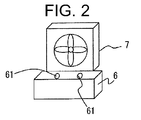
- FIG. 2 is a conceptual view of an ion generation apparatus using the ion generation element.
- An ion generation apparatus 6 houses an ion generation element 60 shown in FIG. 1 inside a case.
- the ion generation element 60 has voltage application needle electrodes 1 and 2 connected to high-voltage generation devices 4 and 5, and ground electrodes 3 disposed adjacently to the aforesaid voltage application needle electrodes.
- the ground electrodes 3 the same number of through-holes 31, which allow the voltage application needle electrodes 1 and 2 to penetrate therethrough, as the number of voltages application needle electrodes are placed.
- the voltage application needle electrodes 1 and 2 have needle-shaped tip ends, and are disposed so that the voltage application needle electrodes 1 and 2 are located in centers of through-holes 31 of the ground electrodes 3 with the voltage application needle electrodes 1 and 2 connected to and supported by the high-voltage generation devices 4 and 5, and the needle-shaped tip ends are each located within the range of the thickness of the through-hole 31.
- the high-voltage generation devices 4 and 5 supply DC pulse voltages to the voltage application needle electrodes 1 and 2 to cause an electric discharge to ionize the air in the vicinity of the ground electrodes 3. Ions generated from the ion generation element 60 of the ion generation apparatus 6 are released from an opening 61 of the case. Subsequently, the released ions are diffused into the atmosphere by a blowing fan 7 which is installed adjacently to the ion generation apparatus 6.
- the principle of ion generation of the ion generation element 60 will be described.
- the voltage application needle electrode 1 positive ion generation electrode
- the voltage application needle electrode 2 negative ion generation electrode
- a DC pulse voltage is supplied to the aforesaid voltage application needle electrode 1, and a positive voltage is applied.
- a DC pulse voltage is supplied to the voltage application needle electrode 2, and a negative voltage is applied.
- the air in the vicinity of the positive ion generation electrode 1 and the ground electrode 3 is positively ionized, and the air in the vicinity of the negative ion generation electrode 2 and the ground electrode 3 is negatively ionized.
- the amount (concentration) of the ions which are generated is regulated according to the voltage/pulse period, which is applied to the voltage application needle electrodes 1 and 2 by the high-voltage generation devices 4 and 5.
- a partition plate was placed in the center of a face which was a test object, and the face was divided into a left face and a right face.
- the positive and negative ions which were generated from the ion generation element were fed (irradiated) to a left cheek of the face by the fan 7, and only the air which did not contain ions was blown (irradiated) to a right cheek.
- the distance between the ion generation element and the face was set at 30 cm.
- the wind velocity at the face was set at 1 m/sec.
- the skin moisture content was measured with WSK-P500U (made by WaveCyber Corp. trade name).
- the voltages applied to the positive and negative ion generation electrodes (high-voltage application needle electrodes 1 and 2) of the ion generation element by the high-voltage generation devices 4 and 5 and the pulse periods were regulated so that the ion concentration on the face became 7,000 /cm 3 .
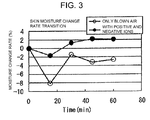
- the result of measuring the change of the moisture content of the surface (skin) in this manner is shown in FIG. 3 .
- the graph shown in FIG. 3 shows the change over time of the moisture contents of the face (skin) to which the air containing positive and negative ions are applied (irradiated), and the face (skin) to which only the air containing no ions is applied (irradiated).
- the result that the face (skin) irradiated with positive and negative ions increased in moisture content of the face (skin) with irradiation time as compared with the face (skin) irradiated with only blown air was obtained.
- the change of the moisture content of the face (skin) was measured.
- the voltages of the high-voltage generation devices 4 and 5 which were applied to the ion generation electrodes (high-voltage application needle electrodes 1 and 2) and the pulse periods were regulated so that the concentration of the ions for irradiation was 25000/cm 3 .
- the result of measuring the change of the moisture content of the face (skin) is shown in FIG. 4 .
- the result that the face (skin) irradiated with the positive and negative ions increased in the moisture content of the face (skin) with the irradiated time as compared with the face (skin) irradiated with only the blown air was obtained.
- the change of the moisture content of the face (skin) was measured by the same method as in example 1.
- the irradiated ions were only negative ions, and the ion concentration was regulated to 7000/cm 3 .
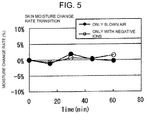
- the result of measuring the change of the moisture content of the face (skin) is shown in FIG. 5 . According to the result, in the case of irradiation of only the negative ions, the effect of increasing the skin moisture content was not obtained as compared with the face (skin) irradiated with only blown air.
- the change of the moisture content of the face (skin) was measured.
- the voltages which the high-voltage generation devices 4 and 5 applied to the ion generation electrodes (high-voltage application needle electrodes 1 and 2) and the pulse periods were regulated so that the concentration of the ions to be irradiated was 3000/cm 3 .
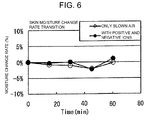
- the result of measuring the change of the moisture content of the face (skin) is shown in FIG. 6 . According to the result, by irradiation with the ion concentration of 3000/cm 3 , the effect of increasing the skin moisture content was not obtained as compared with the face (skin) irradiated with only blown air.
- the reason why the ions are adsorbed by the face (skin) as above is considered to be because the nano-size water molecules which are generated by the positive ions and the negative ions having the compositions of the positive ions H 3 O + (H 2 O)m (m is 0 or an optional natural number) and the negative ions O 2 - (H 2 O)n (n is 0 or an optional natural number) which are supplied from the ion generation element being intensively hit against the skin, and are expressed by the following chemical formulas are effectively adsorbed by the skin.
- H 3 O + + O 2 - ⁇ ⁇ OH + H 2 O 2 (2) H 3 O + + O 2 - ⁇ ⁇ O 2 H + H 2 O (3) 2H 2 O 2 ⁇ 2H 2 O + O 2 More specifically, it is estimated that by applying H + ions and O 2 - ions to the skin surface at the same time, -OH groups adhere to the skin surface, the skin surface is locally hydrophilized, water molecules easily penetrate through the skin, and bring about the effect of increasing the skin moisture.
- the positive and negative ions which are generated by an electric discharge increase the moisture contents in the human skin surfaces. Since the method increases the skin moisture content by positive and negative ions and does not use water, there is no increase of saprophytic bacteria, and since humidification is not performed, the humidity in a room is not elevated. Further, there is no need to condense moisture in the air, and therefore, the advantages that the device cost is not increased significantly, the power consumption is small, and the device is not upsized are provided.
- test plot 1 ion concentration 25,000/cm 3 (25,000 group)
- Test plot 2 no ion (control group)
- the temperature of the test room was regulated by an air-conditioner with 28°C as the target. Further, the humidity was regulated by a desiccant type dehumidifier with 30 to 40% as the target.
- test subjects washed their faces with a cleansing milk and a facial cleansing foam, and after 60 minutes from the face washing, the test subjects were allowed to enter the test room.
- the test subjects were allowed to spend 140 minutes in total that are 20 minutes before operation of the test apparatus, 60 minutes after operation of the test apparatus, and 60 minutes after stoppage thereof, in the state in which the test subjects lay face up on their beds. This was carried out once in the morning and once in the afternoon.
- the test subjects wore the same T-shirts and sweat suits.
- test subjects are instructed not to change their daily lives such as their eating habits and exercises up to then, and their daily lives were grasped by making them record their living situations such as sleeping hours, working hours, contents of meals, alcohol intake amounts, the use situation of medicines, physical conditions and the like in the day books everyday for 3 days before the inspection day.
- the same packed meals were taken by 21 o'clock as the dinner on the day before the inspection day, and intake of alcohol was prohibited.
- the same meals were taken 1 hour before each of the inspections in the morning and the afternoon.
- FIG. 7 The result of measuring the change of the moisture contents of faces (skins) in this manner is shown in FIG. 7 .
- the graph shown in FIG. 7 shows the change over time of the moisture contents of the face irradiated with positive and negative ions (skin: shown by the black squares) and the face which were not irradiated with the positive and negative ions (skin: shown by the black circles).
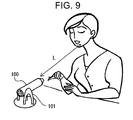
- FIG. 9 is an explanatory view of a use state of a facial care apparatus (hereinafter, a facial care apparatus) 100 as a beauty apparatus.
- the facial care apparatus 100 is installed by being supported by a supporting member 101.
- the facial care apparatus 100 generates positive ions and negative ions, and is used in such a manner as to irradiate the face of a user with the ions which are released.
- the facial care apparatus 100 has a filter 160, a blower 130, a wind directing body 170, an ion generation device 180, a wind velocity detector 190 and the like mounted inside a casing 120. Further, switches (not illustrated) which instruct operation of the devices such as the blower 130, the ion generation device 180 and the wind velocity detector 190, a control unit which controls drive of the blower 130, the wind velocity detector 190, the ion generation device 180 and the like, an operation display device (not illustrated) and the like are arranged inside the casing 120.
- inflow air 110a flows into the casing 120 from an inlet port 140, passes through the wind directing body 170, and includes ions generated from the ion generator 180, and the air containing the ions is released from a release port 150 as released air 110b.
- the blower 130 and the ion generation device 180 are housed in a wind tunnel inside the casing 120 of the facial care apparatus 100, the diameter of the casing 120 cannot be configured to be small. Accordingly, in order to generate ions and transfer/release the ions more efficiently by the air flowing in, the wind directing body 170 as will be described later is inserted into and placed inside the casing 120.
- the wind directing body 170 is installed at a downstream side of the blower 130.
- the wind directing body 170 is formed into a disk shape which is fitted in the casing 120, and a disk-shaped closure plate 171 which closes air which flows down is placed at a center portion.
- blade pieces 175 for turning the air which flows down are placed at a plurality of spots.
- the blade pieces 175 are installed to be inclined to change the flow of the passing air to turn it.
- eight of the blade pieces 175 are disposed at the peripheral edge of the closure plate 171 and around the center axis of the casing 120.
- the air which flows in by the blower 130 hits against the closure plate 170, and the air current which has its way closed spouts to the downstream side from the gap 173 at the peripheral portion and flows down. At this time, the downflow direction of the air current changes along the inclination of the blade pieces 175 and the air current is turned.
- This embodiment has the configuration in which by the eight blade pieces 175, the downflow air turns clockwise on the plan view shown by the direction A as shown in FIG. 11 .
- the ion generator 180 is disposed at the downstream side of the wind directing body 170.
- FIG. 13 is an external view of the ion generation device.
- a voltage application needle electrode 1 which is connected to a high-voltage generation device and a ground electrode 3 are included, openings 183 for releasing the positive ions and negative ions generated from the ion generation element to outside are bored in a lid 181.
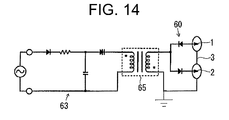
- FIG. 14 is one example of a circuit of the ion generation device. The example shows a mode in which a drive circuit 63 and an ion generation unit 60 of the device are connected via a transformer 65.
- the illustrated ion generation device is exemplified, but as the ion generation device, other ion generation devices also can be used as long as the ion generation devices can generate the aforementioned positive and negative ions.
- the wind velocity detector 190 is mounted in the vicinity of the blowoff port 150 at a downstream side of the ion generation device 180.
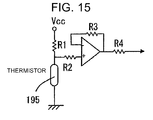
- FIG. 15 shows an example of a circuit of the wind velocity detector.
- the wind velocity detector 190 keeps a thermistor 195 self-heating, and the temperature of the thermistor 195 is reduced when an air current passes the thermistor 195.
- the wind velocity is detected by the temperature reduction.
- the number of ions which can be released from the ion generation device 180 is significantly influenced by the velocity of the wind which passes through the vicinity of the discharge electrodes. More specifically, the velocity of the wind in the vicinity of the electrodes is higher, the number of the ions which are released increases more. Accordingly, the wind velocity needs to be increased as much as possible in the vicinity of the ion generation device 180. Meanwhile, the upper limit of the velocity of the wind which is fed from the blowoff port 150 is approximately 1 m at the utmost to suppress drying of a face (skin).
- the present facial care apparatus has the wind velocity detector 190 installed at the blowoff port 150, detects the wind velocity in the vicinity of the blowoff port 150, and controls the velocity of the wind to be blown off.
- the quantity of the air passing through the passage gap 173 (wind directing body 170) and the quantity of the air which is fed from the blowoff port 150 are basically the same. Therefore, the wind velocity in the vicinity of the ion generation device 180 is increased by narrowing the passage gap 173, and the sectional area of the blowoff port 150 is made larger than the passage gap 173, whereby the velocity of the wind which is fed from the blowoff port 150 can be made low.
- the air is compressed by the blowoff port 150 where the diameter of the casing is made smaller than the other casing diameter.
- the air current blown from the blowoff port temporarily causes contraction in the vicinity of the blowoff port 150, but thereafter, tends to be expanded.
- FIG. 12 schematically shows the behavior of the ions in the vicinity of the blowoff port.
- the air which is enhanced in the downflow velocity with the downflow direction changed by the blade pieces 175 includes the ions (positive and negative ions) generated from the ion generation device 180, and the air containing the positive and negative ions (white circles and black circles) with high density is released from the blowoff port 150 to an ion compressed region 20 as illustrated.
- the port diameter of the blowoff port 150 is formed to be larger than the passage gap 173, whereby the release velocity is reduced.
- the air which is blown from the blowoff port 150 changes (turns) the downflow direction by the blade pieces 175, and therefore, is configured to reach a face in the state with high-density ions without being expanded.
- the inflow air 110a taken in from the inlet port 140 by rotation of the fan 130 installed at the upstream side of the inside of the casing 120 is released as the released air 110b from the blowoff port 150 at the most downstream side.
- the operation switch (not illustrated) of the facial care apparatus 100 When the operation switch (not illustrated) of the facial care apparatus 100 is turned on, the blower 130 and the ion generation device 180 are operated. The external air is sucked into the facial care apparatus 100, the sucked air is fed to the ion generation device 180 via the filter 160 and the wind directing body 170. The air enhanced in wind velocity by the wind directing body 170 passes through the vicinity of the ion generation device 180 to thereby become the air containing many ions, and the air containing the ions is compressed and blown from the blowoff port 150 with the port diameter made smaller than the other diameters of the casing.
- the ions shown by the positive ions (for example, the white circles) and the negative ions (for example, the black circles) generated by the ion generation device 180 are carried by the air current which is turned and flows in to head for the blowoff port 150.
- the air is compressed in the narrow blowoff port 150, and the air which contains the ions with high density is released to the ion compressed region 20 shown by the dashed line. Because the air which includes the ions and flows down is in the turned state by the blade pieces 175, the air keeps the compressed state, and does not expand and is not reduced in the release speed in the ion compressed region 20.
- the ions contained in the air which is supplied from the facial care apparatus 100 have the compositions of the positive ions H 3 O + (H 2 O)m (m is 0 or an optional natural number) and the negative ions O 2 - (H 2 O)n (n is 0 or an optional natural number) as described in embodiment 1. It is conceivable that the positive ions and the negative ions of a high concentration having the compositions intensively hit against a face (skin), whereby nano-size water molecules are generated on the skin surface as expressed by the following chemical formulas described above, and the water molecules are effectively adsorbed by the skin. (1) H 3 O + + O 2 - ⁇ ⁇ OH + H 2 O 2 (2) H 3 O + + O 2 ⁇ ⁇ O 2 H + H 2 O (3) 2H 2 O 2 ⁇ 2H 2 O + O 2
- the facial care apparatus 100 of the present invention is of a method which uses water generated by the chemical reactions as described above, and does not directly spray water. Therefore, the velocity of the air current hitting a skin and the concentration of ions are important. Further, if the air current (air blow) is too fast, the skin is dried due to the air current. Unlike an ordinary hair drier and air-conditioner such as an air cleaner, in the facial care apparatus of the present invention the face of a user in close proximity is the target, and therefore, the air current which is let off is required to be strictly "gentle". A distance L from an assumed target (face of a user) is around 30 cm. The velocity of the wind hitting the face is required to be approximately 1 m at the maximum. Therefore, it is necessary to blow air while detecting the velocity of the air current to be fed.
- the number of ions which can be fed out of the ion generation device 180 is significantly influenced by the velocity of the wind which passes through the vicinity of the discharge electrodes. More specifically, as the wind velocity is higher, the number of ions which are released increases more. Accordingly, the wind velocity needs to be increased in the vicinity of the ion generation device 180. Meanwhile, the upper limit of the velocity of the air which is released from the blowoff port 150 is approximately 1 m at the utmost as described above.
- the wind velocity in the region of the ion generation device 180 is enhanced by contracting the air current by the wind directing body 170, and ions are efficiently transferred.
- the passage gap 173 of the wind directing body 170 is narrowed to increase the wind velocity in the vicinity of the ion generation device 180 to increase generation of ions, and the sectional area of the blowoff port 150 is made larger than the passage gap 173 to reduce the velocity of the wind which is blown from the blowoff port 150, while in order to cause the air current which is blown from the blowoff port 150 and contains positive and negative ions to reach a distant place, the air current is turned with the blade pieces 175 of the wind directing body 170 and the wind velocity of the blowoff port 150 is kept.
- An embodiment includes an ion detector 200 in addition to the configuration of the beauty apparatus described in embodiment 3.
- the ion detector 200 is controlled to detect ions released by the control unit not illustrated if there is ion release of a predetermined value or more.
- the air which is released from the blowoff port 150 has the number of ions contained therein abruptly decreased as the distance becomes farther. Further, the number of ions is influenced by the wind blowing velocity, and therefore, the wind blowing velocity is determined by an experiment.
- the ion generation device and the wind velocity are regulated so that the number of ions is 7,000/cm 3 on a human face surface.
- the number of ions released from the ion generation device is also influenced by the frequency of a high voltage which is applied to the discharge electrodes, besides being significantly influenced by the wind velocity as described above. In general, as the frequency is higher, the number of ions which are released increases more.
- the number of ions which are generated differs according to a discharge type and an electrode shape, and therefore, the conditions are set in the device which is decided to be used in advance.
- a drive circuit of the ion detector as a one example of the mode of carrying out the invention is shown in FIG. 17 . In the circuit, R1 is set as 1 G ⁇ , R2 to R5 are set as 10 k ⁇ , C is set as 1000 pF and Vcc is set as 5 V.
- control of the facial care apparatus 100 will be described according to FIG. 16 .
- control signals are outputted to the blower 130, the ion generator 180, and a display device 125 from a control unit 107.
- the control unit 107 is configured to output control signals to the blower 130 and the ion generation device 180 and control the wind velocity/ion concentration and the like of the air released from the facial care apparatus 100, when the wind velocity detector 190 detects the wind velocity which is a set wind velocity or more or the set wind velocity or less, and when the ion detector 200 detects an ion concentration of a value other than the set value.
- the facial care apparatus of the present invention By installing the facial care apparatus of the present invention at bedding, a skin is not dried during sleep, and a beauty effect can be obtained. Suspended bacteria can be removed by ions, and therefore, the environment with purified air can be supplied.
Landscapes
- Health & Medical Sciences (AREA)
- Engineering & Computer Science (AREA)
- Biomedical Technology (AREA)
- Nuclear Medicine, Radiotherapy & Molecular Imaging (AREA)
- Radiology & Medical Imaging (AREA)
- Life Sciences & Earth Sciences (AREA)
- Animal Behavior & Ethology (AREA)
- General Health & Medical Sciences (AREA)
- Public Health (AREA)
- Veterinary Medicine (AREA)
- Electrotherapy Devices (AREA)
- Devices For Medical Bathing And Washing (AREA)
- Cosmetics (AREA)
Abstract
Description
- The present invention relates to a method for increasing a moisture content of a skin and skin elasticity by ions, and a facial care apparatus for increasing the moisture content of a skin and skin elasticity.
- Conventionally, in order to increase the moisture content of a skin and improve skin elasticity, the method of coating the skin with a coating agent containing a moisturizing component has been generally carried out. Besides,
Patent Literature 1 discloses the method which suppresses drying of a skin and increasing the moisture content of the skin by increasing the moisture content of the environment by spraying moisture into the air by a humidifying device. Further,Patent Literature 2 discloses the method which condenses the moisture in the air, atomizes the condensed moisture and sprays it, but this method needs to provide the function of making the temperature of the air low for condensation of the moisture and causing dew condensation and flocculation, and needs to use an expensive element such as a Peltier element. Further, there have been the problems that the power consumption increases and the device is upsized at the same time. - Further, an electric field is further applied to generated steam to change the steam to charged water droplets called "steam ions", and the water droplets are supplied. (For example, Patent Literature 3)
Further, recently, water droplets of a nano size are made by using an ultrasonic element, an electric field is further applied to the water droplets, and the charged water droplets in the form of ultra-fine particles are made and supplied. (For example, Patent Literature 4)
Explaining the device according toFIG. 18 , water for making steam is supplied to aboiler 10, and is warmed by aheater 9 to generate steam instantly. Subsequently, the steam is subjected to corona discharge with anion steam generator 11 to contain ions, and is injected to a face from anejection port 8.
However, if the water in the tank which is supplied to generate steam, mist and the like becomes insufficient, water has to be added thereto, and much effort is required.
Further, the water in the supply water tank is left for a long time, whereby saprophytic bacteria increase, and the water may be in an unhygienic state. If Legionella pneumophila and the like have grown, a trouble is likely to occur to the users, and as a result, usability is reduced. -
- [Patent Literature 1] Japanese Patent Laid-Open Publication No.
2009-78245 - [Patent Literature 2] Japanese Patent Laid-Open Publication No.
2006-61407 - [Patent Literature 3] Japanese Patent Laid-Open Publication No.
2007-75243 - [Patent Literature 4] Japanese Patent Laid-Open Publication No.
2007-296284 - The present invention is invented in view of the above described conventional problems, and provides a beauty apparatus which does not need to generate steam, mist and the like.
- The outline of the solution to the problem according to the present invention will be described hereinafter.
A method for increasing a moisture content in a human skin surface and improving skin elasticity of the present invention irradiates a human skin surface with positive and negative ions which are generated by an electric discharge to increase the moisture content of a skin and improve the skin elasticity.
The present method brings about the effect of increasing a skin moisture content and improving skin elasticity by the ions generated by an electric discharge and does not perform humidification using water, and therefore, the humidity in a room does not rise. Further, the moisture in the air is not condensed, and therefore, the advantages are provided, that the device cost does not significantly increase, the power consumption is small and the device is not upsized. - Further, the method for increasing a moisture content in a human skin surface and improving skin elasticity is characterized in that concentrations of the positive and negative ions are each 7000/cm3 or more.
As a result of performing a study by changing the concentrations of the positive and negative ions, it has become obvious that the effect of increasing the skin moisture content and the effect of improving skin elasticity can be obtained by generating ions of 7000/cm3 or more.
Further, the method for increasing a moisture content in a human skin surface and improving skin elasticity of the present invention uses H3O+(H2O)m (m = a natural number such as 0, 1, 2, 3 ...) as the positive ions, and O2 - (H2O)n (n = a natural number such as 0, 1, 2, 3 ...) as the negative ions.
The mechanism of the effect of increasing the skin moisture content by both the positive and negative ions is not clear, but it is conceivable that - 1) By simultaneous irradiation with H+ ions and O2 - ions, -OH groups adhere to a skin surface, the skin surface is locally hydrophilized, and water molecules adhere and easily penetrates into the skin.
- 2) Water molecules surrounding the ions are taken into the skin, and the like.
- A beauty apparatus of the present invention includes a blower, and a casing in which the blower is contained, and a blowoff port for blowing air sucked by the blower to outside, and a suction port for sucking the air from outside are formed, and is characterized by further including ion generation means downstream of the blower in the casing, and in that the ion generation means generates positive ions H3O+(H2O)m (m is 0 or an optional natural number), and negative ions O2 -(H2O)n (n is 0 or an optional natural number).
The beauty apparatus of the present invention includes a configuration including changing means of a downflow velocity and a downflow direction of air that is placed at a downstream side of the blower and an upstream side of the ion generation means to enhance an air blowing velocity in a vicinity of the ion generation means and to turn a blowing direction of the air from the blowoff port. - Furthermore, the beauty apparatus of the present invention includes a configuration including control means that controls an air blowing amount of the blower, and an ion generation amount of the ion generation means, in the casing, and wind velocity detection means at the blowoff port, wherein when the wind velocity detection means detects that a blowoff wind velocity at the blowoff port is a predetermined value or more, the control means controls a wind velocity of the blower to be a predetermined value or less, or including an ion detector that detects an ion concentration at the blowoff port in the casing, wherein when the ion detector detects an ion concentration of a predetermined value or less, the control means controls the ion generation means to make a generation amount of ions an ion concentration of the predetermined value or more.
- The beauty apparatus of the present invention irradiates a user with the positive and negative ions which are generated by using the ion generation element by carrying the positive and negative ions by an air flow at a low speed, and increases the concentration of the ions for irradiating the skin surface to a predetermined value or more, whereby the positive and negative ions react to produce water, which can moisten the skin and can improve the elasticity of the skin. Further, the blowoff port ion detector is included so that the ion concentration becomes high when the ions which are supplied from the ion generation means are released from the blowoff port, and thereby the blowoff velocity is controlled to be kept at a low level while the ion concentration is elevated.
- The method for increasing the moisture content in a human skin surface and improving the moisture retaining function of a dermis, and the beauty apparatus according to the present invention bring about the effect of increasing the skin moisture content and the effect of improving the skin elasticity by irradiating the skin of a user with the positive and negative ions which are generated by an electric discharge, and because the method and apparatus do not perform humidification using water, the method and apparatus do not require the storage, replenishment and sanitary supervision of water, or do not increase the humidity in the room. Further, the method and the apparatus do not use water, and therefore, the beauty apparatus which can be easily used at any time can be provided. Further, the skin can be prevented from being dried by controlling the wind velocity, and the amount of water generated on the skin surface can be increased by controlling the ion concentration.
Furthermore, a water storage tank and a heating device for condensing the moisture in the air are not required, and therefore, the advantages are provided, that the entire device can be made compact, the device is easily handled and portable, the device cost does not significantly increase, the power consumption is small, and the device is not upsized. -
- [
FIG. 1] FIG. 1 is a schematic view showing the principle of an ion generation element. - [
FIG. 2] FIG. 2 is a schematic view showing an ion generation apparatus and a blower fan. - [
FIG. 3] FIG. 3 is a graph of change in skin moisture content according toembodiment 1. - [
FIG. 4] FIG. 4 is a graph of change in skin moisture content according toembodiment 2. - [
FIG. 5] FIG. 5 is a graph of change in skin moisture content according to comparative example 1. - [
FIG. 6] FIG. 6 is a graph of change in skin moisture content according to comparative example 2. - [
FIG. 7] FIG. 7 is a graph of change in skin moisture content according toembodiment 2. - [
FIG. 8A] FIG. 8A is a graph of change in skin elasticity R5 according toembodiment 2. - [
FIG. 8B] FIG. 8B is a graph of change in skin elasticity R7 according toembodiment 2. - [
FIG. 9] FIG. 9 is a conceptual view showing a state of use of a facial care apparatus of the present invention. - [
FIG. 10] FIG. 10 is a conceptual view of a structure of the facial care apparatus of the present invention. - [
FIG. 11] FIG. 11 is a conceptual view of a wind directing body of the present invention, (a) is a plan view, (b) is a sectional view taken along the line A-A, and (c) is a sectional view taken along the line B-B. - [
FIG. 12] FIG. 12 is a conceptual view showing the flow of ions of the present invention. - [
FIG. 13] FIG. 13 is an external view of an ion generation device, (a) is a top view, (b) is a plan view and (c) is a right side view. - [
FIG. 14] FIG. 14 is an example of a circuit of the ion generation device. - [
FIG. 15] FIG. 15 is a circuit diagram of a wind velocity detector. - [
FIG. 16] FIG. 16 is a control block diagram of the facial care apparatus. - [
FIG. 17] FIG. 17 is a circuit diagram of an ion detector. - [
FIG. 18] FIG. 18 is a structural view of a conventional facial care apparatus. - A mode for carrying out the present invention will be described in detail with reference to the drawings.
-
FIG. 1 is a schematic view explaining the principle of an ion generation element according to the present invention, andFIG. 2 is a conceptual view of an ion generation apparatus using the ion generation element.
Anion generation apparatus 6 houses anion generation element 60 shown inFIG. 1 inside a case. Theion generation element 60 has voltageapplication needle electrodes voltage generation devices ground electrodes 3 disposed adjacently to the aforesaid voltage application needle electrodes. In theground electrodes 3, the same number of through-holes 31, which allow the voltageapplication needle electrodes application needle electrodes application needle electrodes holes 31 of theground electrodes 3 with the voltageapplication needle electrodes voltage generation devices hole 31. The high-voltage generation devices application needle electrodes ground electrodes 3. Ions generated from theion generation element 60 of theion generation apparatus 6 are released from anopening 61 of the case. Subsequently, the released ions are diffused into the atmosphere by a blowingfan 7 which is installed adjacently to theion generation apparatus 6. - The principle of ion generation of the
ion generation element 60 will be described.
As the ion generation electrodes of theion generation element 60, the voltage application needle electrode 1 (positive ion generation electrode) connected to the high-voltage generation device 4, and the voltage application needle electrode 2 (negative ion generation electrode) connected to the high-voltage generation device 5 are included. A DC pulse voltage is supplied to the aforesaid voltageapplication needle electrode 1, and a positive voltage is applied. A DC pulse voltage is supplied to the voltageapplication needle electrode 2, and a negative voltage is applied. By a corona discharge, the air in the vicinity of the positiveion generation electrode 1 and theground electrode 3 is positively ionized, and the air in the vicinity of the negativeion generation electrode 2 and theground electrode 3 is negatively ionized.
The amount (concentration) of the ions which are generated is regulated according to the voltage/pulse period, which is applied to the voltageapplication needle electrodes voltage generation devices - Next, experiments were conducted on change of the moisture content of a skin by air containing the positive ions and negative ions generated by the
ion generation element 60 and the air which does not contain the positive ions and negative ions. - A partition plate was placed in the center of a face which was a test object, and the face was divided into a left face and a right face. The positive and negative ions which were generated from the ion generation element were fed (irradiated) to a left cheek of the face by the
fan 7, and only the air which did not contain ions was blown (irradiated) to a right cheek. In this case, the distance between the ion generation element and the face was set at 30 cm. Further, the wind velocity at the face was set at 1 m/sec. The skin moisture content was measured with WSK-P500U (made by WaveCyber Corp. trade name).
As a result of analyzing the structures of the ions generated from the present ion generation electrodes with a TOF-mass spectrometer (time-of-flight mass spectrometer), generation of H3O+(H2O)m (m = a natural number such as 0, 1, 2, 3 ...) as positive ions and O2 - (H2O)n (n = a natural number such as 0, 1, 2, 3 ...) as negative ions was able to be confirmed. - The voltages applied to the positive and negative ion generation electrodes (high-voltage
application needle electrodes 1 and 2) of the ion generation element by the high-voltage generation devices
The result of measuring the change of the moisture content of the surface (skin) in this manner is shown inFIG. 3 . The graph shown inFIG. 3 shows the change over time of the moisture contents of the face (skin) to which the air containing positive and negative ions are applied (irradiated), and the face (skin) to which only the air containing no ions is applied (irradiated). According to the graph, the result that the face (skin) irradiated with positive and negative ions increased in moisture content of the face (skin) with irradiation time as compared with the face (skin) irradiated with only blown air was obtained. - With the same method as in
experiment 1, the change of the moisture content of the face (skin) was measured. However, the voltages of the high-voltage generation devices application needle electrodes 1 and 2) and the pulse periods were regulated so that the concentration of the ions for irradiation was 25000/cm3. The result of measuring the change of the moisture content of the face (skin) is shown inFIG. 4 . According to the graph, the result that the face (skin) irradiated with the positive and negative ions increased in the moisture content of the face (skin) with the irradiated time as compared with the face (skin) irradiated with only the blown air was obtained. - The change of the moisture content of the face (skin) was measured by the same method as in example 1. However, the irradiated ions were only negative ions, and the ion concentration was regulated to 7000/cm3. The result of measuring the change of the moisture content of the face (skin) is shown in
FIG. 5 . According to the result, in the case of irradiation of only the negative ions, the effect of increasing the skin moisture content was not obtained as compared with the face (skin) irradiated with only blown air. - With the same method as in
experiment 1, the change of the moisture content of the face (skin) was measured. However, the voltages which the high-voltage generation devices application needle electrodes 1 and 2) and the pulse periods were regulated so that the concentration of the ions to be irradiated was 3000/cm3. The result of measuring the change of the moisture content of the face (skin) is shown inFIG. 6 . According to the result, by irradiation with the ion concentration of 3000/cm3, the effect of increasing the skin moisture content was not obtained as compared with the face (skin) irradiated with only blown air. - From the above described experiments, it has been found out that the moisture contents of the faces (skins) supplied with the positive ions and the negative ions having the compositions of the positive ions H3O+ (m is 0 or an optional natural number) and the negative ions O2 - (H2O)n (n is 0 or an optional natural number) with the ion concentrations set at 7000/cm3 to 25000/cm3 increase over time.
- The reason why the ions are adsorbed by the face (skin) as above is considered to be because the nano-size water molecules which are generated by the positive ions and the negative ions having the compositions of the positive ions H3O+(H2O)m (m is 0 or an optional natural number) and the negative ions O2 -(H2O)n (n is 0 or an optional natural number) which are supplied from the ion generation element being intensively hit against the skin, and are expressed by the following chemical formulas are effectively adsorbed by the skin.
(1) H3O+ + O2 - → ·OH + H2O2
(2) H3O+ + O2 - → ·O2H + H2O
(3) 2H2O2 → 2H2O + O2
More specifically, it is estimated that by applying H+ ions and O2 - ions to the skin surface at the same time, -OH groups adhere to the skin surface, the skin surface is locally hydrophilized, water molecules easily penetrate through the skin, and bring about the effect of increasing the skin moisture. - As shown in the above embodiment, the positive and negative ions which are generated by an electric discharge increase the moisture contents in the human skin surfaces. Since the method increases the skin moisture content by positive and negative ions and does not use water, there is no increase of saprophytic bacteria, and since humidification is not performed, the humidity in a room is not elevated. Further, there is no need to condense moisture in the air, and therefore, the advantages that the device cost is not increased significantly, the power consumption is small, and the device is not upsized are provided.
- Next, the experiment was conducted on change of the moisture content of a skin and skin elasticity by the air containing the positive ions and the negative ions generated by the
ion generation element 60 and the air containing no such ions. - The test was a single
blind test randomization 2 plots cross-over test. Four days that are 3 days for the previous observation term and 1 day as the inspection day were set, and the test was carried out by dividing 16 women with normal and healthy bodies who were apt to feel drying of their skins into groups each with four people. The test plots were as follows.
Test plot 1: ion concentration 25,000/cm3 (25,000 group)
Test plot 2: no ion (control group)
The temperature of the test room was regulated by an air-conditioner with 28°C as the target. Further, the humidity was regulated by a desiccant type dehumidifier with 30 to 40% as the target.
The test subjects washed their faces with a cleansing milk and a facial cleansing foam, and after 60 minutes from the face washing, the test subjects were allowed to enter the test room. The test subjects were allowed to spend 140 minutes in total that are 20 minutes before operation of the test apparatus, 60 minutes after operation of the test apparatus, and 60 minutes after stoppage thereof, in the state in which the test subjects lay face up on their beds. This was carried out once in the morning and once in the afternoon. As for clothing on the inspection day, the test subjects wore the same T-shirts and sweat suits. The test subjects are instructed not to change their daily lives such as their eating habits and exercises up to then, and their daily lives were grasped by making them record their living situations such as sleeping hours, working hours, contents of meals, alcohol intake amounts, the use situation of medicines, physical conditions and the like in the day books everyday for 3 days before the inspection day. In consideration of the influence by meals, the same packed meals were taken by 21 o'clock as the dinner on the day before the inspection day, and intake of alcohol was prohibited. On the inspection day, the same meals were taken 1 hour before each of the inspections in the morning and the afternoon. - 0 minutes, 10 minutes, 20 minutes, 30 minutes, 40 minutes, 50 minutes and 60 minutes after operating the ion generation device, and 10 minutes, 20 minutes, 30 minutes, 40 minutes, 50 minutes and 60 minutes after stopping it, the skin moisture contents at the same spots at 1 cm sideway from the left eyes were measured by using Corrneometer CM825 (Integral Corporation, trade name). The result of measuring the change of the moisture contents of faces (skins) in this manner is shown in
FIG. 7 . The graph shown inFIG. 7 shows the change over time of the moisture contents of the face irradiated with positive and negative ions (skin: shown by the black squares) and the face which were not irradiated with the positive and negative ions (skin: shown by the black circles).
According to the graph, the result was obtained, that the moisture contents of the faces (skins: shown by the black squares) irradiated with the positive and negative ions are continuously higher during irradiation with the positive and negative ions and after stoppage of the irradiation as compared with the faces (skins: shown by the black circles) not irradiated therewith. - 0 minute, 10 minutes, 20 minutes, 30 minutes, 40 minutes, 50 minutes and 60 minutes after operating the ion generation device, and 10 minutes, 20 minutes, 30 minutes, 40 minutes, 50 minutes and 60 minutes after stoppage thereof, the skin elasticity R5 (the restoration width for 0.1 seconds after starting release with respect to the suction width for 0.1 seconds after starting suction) and the skin elasticity R7 (the restoration width for 0.1 seconds after starting release with respect to total suction width for two seconds) at the
same spots 1 cm under the left eyes were measured by using Cutometer MPA580 (Integral Corporation, trade name). The result of measuring the change of the skin elasticity in this manner is shown inFIGS. 8A and8B . The graphs shown inFIGS. 8A and8B show the change over time of the skin elasticity of the face (skin) irradiated with positive and negative ions and the skin elasticity of the face (skin) which were not irradiated therewith.
According to the graphs, the result was obtained, that in the faces (skins: shown by the black squares) of thetest plot 1 irradiated with the positive and negative ions, the skin elasticity was continuously improved during irradiation with the positive and negative ions and after stopping the irradiation as compared with the faces (skin: shown by the black circles) of thetest plot 2 not irradiated therewith. The effect of the skin elasticity appeared slightly later as compared with that the increase in the skin moisture content appeared immediately after the irradiation, and therefore, improvement in the skin elasticity is estimated as the secondary effect by the increase of the skin moisture content. - By the above described experiment, the moisture content of the faces (skins) of the
test plot 1 supplied with ions with the ion concentrations of the positive ions and the negative ions having the compositions of the positive ions H3O+(H2O)m (m is 0 or an optional natural number) and the negative ions O2 -(H2O)n (n is 0 or an optional natural number) set as 25,000/cm3 increases over time, and the skin elasticity (moisture retaining function of dermis) is improved therewith. - Next, a beauty apparatus using the above described ion generation element will be described.
A mode for carrying out the beauty apparatus will be described by using the drawing. In an embodiment shown in the drawing, the case of a facial care apparatus as a beauty apparatus will be described. -
FIG. 9 is an explanatory view of a use state of a facial care apparatus (hereinafter, a facial care apparatus) 100 as a beauty apparatus. Thefacial care apparatus 100 is installed by being supported by a supportingmember 101. Thefacial care apparatus 100 generates positive ions and negative ions, and is used in such a manner as to irradiate the face of a user with the ions which are released. - A structure of the
facial care apparatus 100 will be described.
As shown inFIG. 10 , thefacial care apparatus 100 has afilter 160, ablower 130, awind directing body 170, anion generation device 180, awind velocity detector 190 and the like mounted inside acasing 120. Further, switches (not illustrated) which instruct operation of the devices such as theblower 130, theion generation device 180 and thewind velocity detector 190, a control unit which controls drive of theblower 130, thewind velocity detector 190, theion generation device 180 and the like, an operation display device (not illustrated) and the like are arranged inside thecasing 120. - When the
blower 130 is operated,inflow air 110a flows into thecasing 120 from aninlet port 140, passes through thewind directing body 170, and includes ions generated from theion generator 180, and the air containing the ions is released from arelease port 150 as releasedair 110b.
Because theblower 130 and theion generation device 180 are housed in a wind tunnel inside thecasing 120 of thefacial care apparatus 100, the diameter of thecasing 120 cannot be configured to be small. Accordingly, in order to generate ions and transfer/release the ions more efficiently by the air flowing in, thewind directing body 170 as will be described later is inserted into and placed inside thecasing 120. - A configuration of the
wind directing body 170 will be described according toFIG. 11 .
Thewind directing body 170 is installed at a downstream side of theblower 130. Thewind directing body 170 is formed into a disk shape which is fitted in thecasing 120, and a disk-shapedclosure plate 171 which closes air which flows down is placed at a center portion. In agap 173 between theclosure plate 171 and thecasing 120,blade pieces 175 for turning the air which flows down are placed at a plurality of spots. Theblade pieces 175 are installed to be inclined to change the flow of the passing air to turn it. In the embodiment, eight of theblade pieces 175 are disposed at the peripheral edge of theclosure plate 171 and around the center axis of thecasing 120. The air which flows in by theblower 130 hits against theclosure plate 170, and the air current which has its way closed spouts to the downstream side from thegap 173 at the peripheral portion and flows down. At this time, the downflow direction of the air current changes along the inclination of theblade pieces 175 and the air current is turned. This embodiment has the configuration in which by the eightblade pieces 175, the downflow air turns clockwise on the plan view shown by the direction A as shown inFIG. 11 . - The
ion generator 180 is disposed at the downstream side of thewind directing body 170.
FIG. 13 is an external view of the ion generation device. A voltageapplication needle electrode 1 which is connected to a high-voltage generation device and aground electrode 3 are included,openings 183 for releasing the positive ions and negative ions generated from the ion generation element to outside are bored in alid 181.FIG. 14 is one example of a circuit of the ion generation device. The example shows a mode in which adrive circuit 63 and anion generation unit 60 of the device are connected via atransformer 65. In the embodiment, the illustrated ion generation device is exemplified, but as the ion generation device, other ion generation devices also can be used as long as the ion generation devices can generate the aforementioned positive and negative ions. - The
wind velocity detector 190 is mounted in the vicinity of theblowoff port 150 at a downstream side of theion generation device 180.FIG. 15 shows an example of a circuit of the wind velocity detector. Thewind velocity detector 190 keeps athermistor 195 self-heating, and the temperature of thethermistor 195 is reduced when an air current passes thethermistor 195. The wind velocity is detected by the temperature reduction. For detection of a wind velocity, there are a hot wire type and a thermistor type. Any type of the conventional wind velocity detectors can be used besides the illustrated type, and a similar effect is provided. - The number of ions which can be released from the
ion generation device 180 is significantly influenced by the velocity of the wind which passes through the vicinity of the discharge electrodes. More specifically, the velocity of the wind in the vicinity of the electrodes is higher, the number of the ions which are released increases more. Accordingly, the wind velocity needs to be increased as much as possible in the vicinity of theion generation device 180. Meanwhile, the upper limit of the velocity of the wind which is fed from theblowoff port 150 is approximately 1 m at the utmost to suppress drying of a face (skin). Thus, the present facial care apparatus has thewind velocity detector 190 installed at theblowoff port 150, detects the wind velocity in the vicinity of theblowoff port 150, and controls the velocity of the wind to be blown off. - The quantity of the air passing through the passage gap 173 (wind directing body 170) and the quantity of the air which is fed from the
blowoff port 150 are basically the same. Therefore, the wind velocity in the vicinity of theion generation device 180 is increased by narrowing thepassage gap 173, and the sectional area of theblowoff port 150 is made larger than thepassage gap 173, whereby the velocity of the wind which is fed from theblowoff port 150 can be made low. The air is compressed by theblowoff port 150 where the diameter of the casing is made smaller than the other casing diameter. The air current blown from the blowoff port temporarily causes contraction in the vicinity of theblowoff port 150, but thereafter, tends to be expanded. However, if the blowoff (release) wind velocity is made too low, the air current does not directly reach the object (face). In order to cause the air current to reach a distant place, it is effective not to expand the air current, and therefore, expansion of the air current which is blown off is suppressed by turning the downflow air current by thewind directing body 170. -
FIG. 12 schematically shows the behavior of the ions in the vicinity of the blowoff port.
The air which is enhanced in the downflow velocity with the downflow direction changed by theblade pieces 175 includes the ions (positive and negative ions) generated from theion generation device 180, and the air containing the positive and negative ions (white circles and black circles) with high density is released from theblowoff port 150 to an ion compressedregion 20 as illustrated. At this time, the port diameter of theblowoff port 150 is formed to be larger than thepassage gap 173, whereby the release velocity is reduced. Further, the air which is blown from theblowoff port 150 changes (turns) the downflow direction by theblade pieces 175, and therefore, is configured to reach a face in the state with high-density ions without being expanded. - As above, in the
facial care apparatus 100, theinflow air 110a taken in from theinlet port 140 by rotation of thefan 130 installed at the upstream side of the inside of thecasing 120 is released as the releasedair 110b from theblowoff port 150 at the most downstream side. The air which flows in from theinlet port 140 during this while passes through thefilter 160, has the flow direction changed by thewind directing body 170, includes the ions generated from theion generation device 180 and is released to the external air from theblowoff port 150. - An operation of the facial care apparatus of the above described explanation will be described hereinafter.
When the operation switch (not illustrated) of thefacial care apparatus 100 is turned on, theblower 130 and theion generation device 180 are operated. The external air is sucked into thefacial care apparatus 100, the sucked air is fed to theion generation device 180 via thefilter 160 and thewind directing body 170. The air enhanced in wind velocity by thewind directing body 170 passes through the vicinity of theion generation device 180 to thereby become the air containing many ions, and the air containing the ions is compressed and blown from theblowoff port 150 with the port diameter made smaller than the other diameters of the casing. The ions shown by the positive ions (for example, the white circles) and the negative ions (for example, the black circles) generated by theion generation device 180 are carried by the air current which is turned and flows in to head for theblowoff port 150. The air is compressed in thenarrow blowoff port 150, and the air which contains the ions with high density is released to the ion compressedregion 20 shown by the dashed line. Because the air which includes the ions and flows down is in the turned state by theblade pieces 175, the air keeps the compressed state, and does not expand and is not reduced in the release speed in the ion compressedregion 20. - The ions contained in the air which is supplied from the
facial care apparatus 100 have the compositions of the positive ions H3O+(H2O)m (m is 0 or an optional natural number) and the negative ions O2 -(H2O)n (n is 0 or an optional natural number) as described inembodiment 1. It is conceivable that the positive ions and the negative ions of a high concentration having the compositions intensively hit against a face (skin), whereby nano-size water molecules are generated on the skin surface as expressed by the following chemical formulas described above, and the water molecules are effectively adsorbed by the skin.
(1) H3O+ + O2 - → ·OH + H2O2
(2) H3O+ + O2 → ·O2H + H2O
(3) 2H2O2 → 2H2O + O2
- The
facial care apparatus 100 of the present invention is of a method which uses water generated by the chemical reactions as described above, and does not directly spray water. Therefore, the velocity of the air current hitting a skin and the concentration of ions are important. Further, if the air current (air blow) is too fast, the skin is dried due to the air current.
Unlike an ordinary hair drier and air-conditioner such as an air cleaner, in the facial care apparatus of the present invention the face of a user in close proximity is the target, and therefore, the air current which is let off is required to be strictly "gentle". A distance L from an assumed target (face of a user) is around 30 cm. The velocity of the wind hitting the face is required to be approximately 1 m at the maximum. Therefore, it is necessary to blow air while detecting the velocity of the air current to be fed. - Thus, generation of ions and the wind velocity will be described.
The number of ions which can be fed out of theion generation device 180 is significantly influenced by the velocity of the wind which passes through the vicinity of the discharge electrodes. More specifically, as the wind velocity is higher, the number of ions which are released increases more. Accordingly, the wind velocity needs to be increased in the vicinity of theion generation device 180. Meanwhile, the upper limit of the velocity of the air which is released from theblowoff port 150 is approximately 1 m at the utmost as described above. Because thecasing 120 of thefacial care apparatus 100 cannot be configured to be thin for the reason of housing theblower 130 and the ion generation device, the wind velocity in the region of theion generation device 180 is enhanced by contracting the air current by thewind directing body 170, and ions are efficiently transferred.
As above, in thefacial care apparatus 100, thepassage gap 173 of thewind directing body 170 is narrowed to increase the wind velocity in the vicinity of theion generation device 180 to increase generation of ions, and the sectional area of theblowoff port 150 is made larger than thepassage gap 173 to reduce the velocity of the wind which is blown from theblowoff port 150, while in order to cause the air current which is blown from theblowoff port 150 and contains positive and negative ions to reach a distant place, the air current is turned with theblade pieces 175 of thewind directing body 170 and the wind velocity of theblowoff port 150 is kept. - An embodiment includes an
ion detector 200 in addition to the configuration of the beauty apparatus described inembodiment 3. Theion detector 200 is controlled to detect ions released by the control unit not illustrated if there is ion release of a predetermined value or more.
The air which is released from theblowoff port 150 has the number of ions contained therein abruptly decreased as the distance becomes farther. Further, the number of ions is influenced by the wind blowing velocity, and therefore, the wind blowing velocity is determined by an experiment. In the embodiment, the ion generation device and the wind velocity are regulated so that the number of ions is 7,000/cm3 on a human face surface.
The number of ions released from the ion generation device is also influenced by the frequency of a high voltage which is applied to the discharge electrodes, besides being significantly influenced by the wind velocity as described above. In general, as the frequency is higher, the number of ions which are released increases more. The number of ions which are generated differs according to a discharge type and an electrode shape, and therefore, the conditions are set in the device which is decided to be used in advance. A drive circuit of the ion detector as a one example of the mode of carrying out the invention is shown inFIG. 17 . In the circuit, R1 is set as 1 GΩ, R2 to R5 are set as 10 kΩ, C is set as 1000 pF and Vcc is set as 5 V. - Next, control of the
facial care apparatus 100 will be described according toFIG. 16 .
When theoperation switch 105 is inputted, control signals are outputted to theblower 130, theion generator 180, and adisplay device 125 from a control unit 107. The control unit 107 is configured to output control signals to theblower 130 and theion generation device 180 and control the wind velocity/ion concentration and the like of the air released from thefacial care apparatus 100, when thewind velocity detector 190 detects the wind velocity which is a set wind velocity or more or the set wind velocity or less, and when theion detector 200 detects an ion concentration of a value other than the set value. - By installing the facial care apparatus of the present invention at bedding, a skin is not dried during sleep, and a beauty effect can be obtained. Suspended bacteria can be removed by ions, and therefore, the environment with purified air can be supplied.
-
- 1
- voltage application needle electrode (positive ion generation electrode)
- 2
- voltage application needle electrode (negative ion generation electrode)
- 3
- ground (counter) electrode
- 4
- high-voltage generation device
- 5
- high-voltage generation device
- 6
- ion generation apparatus
- 7
- blowing fan
- 20
- ion compressed region
- 60
- ion generation element
- 100
- facial care apparatus
- 130
- fan
- 140
- suction port
- 150
- blowoff port
- 160
- filter
- 170
- wind directing body
- 180
- ion generation device
- 190
- wind velocity detector
- 200
- ion detector
From the present mechanism, it is important to contain H+ and O2 - as ions, and it is estimated that thereby, OH groups are generated, and the effect of increasing the skin moisture is brought about.
Meanwhile, skin elasticity generally depends on the composition of a deeper portion (dermis) of a skin. Improvement of the skin elasticity is considered to be the result that the moisture of the skin surface increases to thereby increase the content of the moisture kept in the dermis, and the elasticity of the skin is improved. More specifically, the skin elasticity improving effect is estimated as being obtained as the secondary action of the effect of increasing the skin moisture content by ions.
Claims (7)
- A method for increasing a moisture content of a skin surface and improving a moisture retaining function of a dermis, comprising:irradiating a skin surface simultaneously with positive ions and negative ions which are generated by an electric discharge in an atmosphere.
- The method for increasing a moisture content of a skin surface and improving a moisture retaining function of a dermis according to claim 1,
wherein concentrations of the positive and negative ions for irradiating the skin surface by being generated by the electric discharge are 7000/cm3 or more for the respective positive and negative ions. - The method for increasing a moisture content of a skin surface and improving a moisture retaining function of a dermis according to claim 1 or 2,
wherein as for the ions for irradiating the skin, H3O+(H2O)m (m=0 or an optional natural number) as the positive ions, and O2 -(H2O)n (n=0 or an optional natural number) as the negative ions are used. - A beauty apparatus comprising a blower, and a casing in which the blower is contained, and a blowoff port for blowing air sucked by the blower to outside and a suction port for sucking the air from outside are formed, further comprising:ion generation means downstream of the blower in the casing,wherein the ion generation means generates positive ions H3O+(H2O)m (m is 0 or an optional natural number), and negative ions O2 -(H2O)n (n is 0 or an optional natural number).
- The beauty apparatus according to claim 4, further comprising changing means of a downflow velocity and a downflow direction of air placed at a downstream side of the blower and an upstream side of the ion generation means to enhance an air blowing velocity in a vicinity of the ion generation means and to turn a blowing direction of the air from the blowoff port.
- The beauty apparatus according to claim 4, further comprising:control means that controls an air blowing amount of the blower, and an ion generation amount of the ion generation means, in the casing; andwind velocity detection means at the blowoff port,wherein when the wind velocity detection means detects that a blowoff wind velocity at the blowoff port is a predetermined value or more, the control means controls a wind velocity of the blower to be a predetermined value or less.
- The beauty apparatus according to claim 4, further comprising:an ion detector that detects an ion concentration at the blowoff port in the casing,wherein when the ion detector detects an ion concentration of a predetermined value or less, the control means controls the ion generation means to make a generation amount of ions an ion concentration of the predetermined value or more.
Applications Claiming Priority (2)
| Application Number | Priority Date | Filing Date | Title |
|---|---|---|---|
| JP2010007946A JP4790068B2 (en) | 2009-10-09 | 2010-01-18 | Method and beauty device for increasing moisture content on skin surface and improving moisture retention function of dermis |
| PCT/JP2011/050439 WO2011087056A1 (en) | 2010-01-18 | 2011-01-13 | Method for increasing moisture content of skin surface and improving moisture-retaining function of dermis and beauty device therefor |
Publications (3)
| Publication Number | Publication Date |
|---|---|
| EP2527002A1 true EP2527002A1 (en) | 2012-11-28 |
| EP2527002A4 EP2527002A4 (en) | 2014-01-15 |
| EP2527002B1 EP2527002B1 (en) | 2020-03-04 |
Family
ID=44305030
Family Applications (1)
| Application Number | Title | Priority Date | Filing Date |
|---|---|---|---|
| EP11732926.8A Active EP2527002B1 (en) | 2010-01-18 | 2011-01-13 | Method for increasing moisture content of skin surface and improving moisture-retaining function of dermis and beauty device therefor |
Country Status (10)
| Country | Link |
|---|---|
| EP (1) | EP2527002B1 (en) |
| CN (1) | CN102711910B (en) |
| AU (1) | AU2011206094C1 (en) |
| BR (1) | BR112012017384A2 (en) |
| CA (1) | CA2786324C (en) |
| NZ (1) | NZ601032A (en) |
| PH (1) | PH12012501301A1 (en) |
| RU (1) | RU2515485C1 (en) |
| SG (1) | SG182559A1 (en) |
| WO (1) | WO2011087056A1 (en) |
Cited By (1)
| Publication number | Priority date | Publication date | Assignee | Title |
|---|---|---|---|---|
| EP3919120A4 (en) * | 2019-02-02 | 2022-03-23 | Yanbing Liu | METHOD AND APPARATUS FOR MAKING A WAVE OF CHARGED PARTICLES IN THE AIR WITH A REQUIRED FREQUENCY |
Families Citing this family (1)
| Publication number | Priority date | Publication date | Assignee | Title |
|---|---|---|---|---|
| KR101794542B1 (en) * | 2017-06-01 | 2017-11-07 | 주식회사 지씨에스 | Electric Device for Skin and Driving Method Thereof |
Family Cites Families (17)
| Publication number | Priority date | Publication date | Assignee | Title |
|---|---|---|---|---|
| SU578343A1 (en) * | 1976-06-21 | 1977-10-30 | Ордена Трудового Красного Знамени Институт Тепло- И Массообмена Им. А.В.Лыкова Ан Белорусской Сср | Device for moistening sheet materials |
| RU2129448C1 (en) * | 1998-07-29 | 1999-04-27 | Закрытое акционерное общество "Корпорация Синтез" | Method for treating cutaneous diseases |
| US6632407B1 (en) * | 1998-11-05 | 2003-10-14 | Sharper Image Corporation | Personal electro-kinetic air transporter-conditioner |
| JP2002216933A (en) * | 2000-09-26 | 2002-08-02 | Sharp Corp | Ion generator and air conditioner using the same |
| JP4089184B2 (en) * | 2001-08-10 | 2008-05-28 | 松下電工株式会社 | Ion supply device |
| JP2003159305A (en) * | 2001-09-13 | 2003-06-03 | Matsushita Electric Works Ltd | Skin care device |
| JP2003185167A (en) * | 2001-12-25 | 2003-07-03 | Yamatake Corp | Negative ion generator |
| JP3634855B2 (en) * | 2003-05-14 | 2005-03-30 | シャープ株式会社 | Ion generator and air conditioner |
| US7687036B2 (en) * | 2003-09-08 | 2010-03-30 | Sharp Kabushiki Kaisha | Ion diffusing |
| JP2005083651A (en) * | 2003-09-08 | 2005-03-31 | Sharp Corp | Ion diffusion device |
| JP2005224352A (en) * | 2004-02-12 | 2005-08-25 | Shiseido Co Ltd | Method for giving advice on beauty treatment and ion measuring apparatus |
| JP2006061407A (en) | 2004-08-26 | 2006-03-09 | Matsushita Electric Works Ltd | Wash cabinet with electrostatic atomizer |
| EP1800711A4 (en) * | 2004-09-07 | 2008-04-02 | Yugen Kaisha Beauty Clinical | Cosmetic apparatus |
| JP2007075243A (en) | 2005-09-13 | 2007-03-29 | Matsushita Electric Ind Co Ltd | Beauty Equipment |
| RU58914U1 (en) * | 2006-04-25 | 2006-12-10 | Виталий Михайлович Анисимов | VAPOR-AIR PHYSIOTHERAPEUTIC INSTALLATION |
| JP2007296284A (en) | 2006-04-28 | 2007-11-15 | Rasseru:Kk | Facial care equipment |
| JP2009078245A (en) | 2007-09-27 | 2009-04-16 | Panasonic Corp | Mist generator |
-
2011
- 2011-01-13 SG SG2012052528A patent/SG182559A1/en unknown
- 2011-01-13 RU RU2012135499/14A patent/RU2515485C1/en not_active IP Right Cessation
- 2011-01-13 AU AU2011206094A patent/AU2011206094C1/en not_active Ceased
- 2011-01-13 BR BR112012017384A patent/BR112012017384A2/en not_active IP Right Cessation
- 2011-01-13 WO PCT/JP2011/050439 patent/WO2011087056A1/en not_active Ceased
- 2011-01-13 EP EP11732926.8A patent/EP2527002B1/en active Active
- 2011-01-13 CA CA2786324A patent/CA2786324C/en not_active Expired - Fee Related
- 2011-01-13 PH PH1/2012/501301A patent/PH12012501301A1/en unknown
- 2011-01-13 CN CN201180006404.6A patent/CN102711910B/en active Active
- 2011-01-13 NZ NZ601032A patent/NZ601032A/en not_active IP Right Cessation
Cited By (1)
| Publication number | Priority date | Publication date | Assignee | Title |
|---|---|---|---|---|
| EP3919120A4 (en) * | 2019-02-02 | 2022-03-23 | Yanbing Liu | METHOD AND APPARATUS FOR MAKING A WAVE OF CHARGED PARTICLES IN THE AIR WITH A REQUIRED FREQUENCY |
Also Published As
| Publication number | Publication date |
|---|---|
| BR112012017384A2 (en) | 2016-04-19 |
| CN102711910B (en) | 2015-03-25 |
| NZ601032A (en) | 2013-10-25 |
| AU2011206094A1 (en) | 2012-07-19 |
| CA2786324A1 (en) | 2011-07-21 |
| AU2011206094C1 (en) | 2015-03-12 |
| WO2011087056A1 (en) | 2011-07-21 |
| HK1174294A1 (en) | 2013-06-07 |
| RU2515485C1 (en) | 2014-05-10 |
| SG182559A1 (en) | 2012-08-30 |
| EP2527002A4 (en) | 2014-01-15 |
| EP2527002B1 (en) | 2020-03-04 |
| AU2011206094B2 (en) | 2013-12-05 |
| RU2012135499A (en) | 2014-04-10 |
| CN102711910A (en) | 2012-10-03 |
| CA2786324C (en) | 2015-11-24 |
| PH12012501301A1 (en) | 2013-01-21 |
Similar Documents
| Publication | Publication Date | Title |
|---|---|---|
| US20120302817A1 (en) | Method for increasing moisture content of skin surface and improving moisture-retaining function of dermis and beauty apparatus therefor | |
| US10124080B2 (en) | Hand disinfection device having a plasma and aerosol generator | |
| CN103517652B (en) | Method for moisturizing hair and reducing hair damage and device for moisturizing hair and reducing hair damage | |
| CN205641234U (en) | Collect nanometer ion and air purification in air treatment of an organic whole device | |
| CN205641241U (en) | Nanometer ion air purification device | |
| CN105997478B (en) | A kind of beauty instrument for integrating nanometer water ion and air purification | |
| US20250222286A1 (en) | Gas delivery apparatus for nasal application | |
| EP2527002B1 (en) | Method for increasing moisture content of skin surface and improving moisture-retaining function of dermis and beauty device therefor | |
| JP2013094193A (en) | Hair care device | |
| CN104602663B (en) | Moisturizing device, electrical equipment equipped with the same, and moisturizing method | |
| JPH11265780A (en) | Ion generating device | |
| JP2000356372A (en) | Humidifier | |
| AU2024205840A1 (en) | Gas purification apparatus for nasal application | |
| JP2006061407A (en) | Wash cabinet with electrostatic atomizer | |
| HK1174294B (en) | Method for increasing moisture content of skin surface and improving moisture-retaining function of dermis and beauty device therefor | |
| JP5385958B2 (en) | Facial massager | |
| JP2017123990A (en) | Ion wind type liquid evaporation device and air conditioner | |
| EP4681754A1 (en) | Gas delivery apparatus for nasal application | |
| CN111514772A (en) | A mist output device and control method thereof | |
| JP2005137966A (en) | Electrostatic atomizer | |
| JP2006204941A (en) | Sauna and sauna method |
Legal Events
| Date | Code | Title | Description |
|---|---|---|---|
| PUAI | Public reference made under article 153(3) epc to a published international application that has entered the european phase |
Free format text: ORIGINAL CODE: 0009012 |
|
| 17P | Request for examination filed |
Effective date: 20120706 |
|
| AK | Designated contracting states |
Kind code of ref document: A1 Designated state(s): AL AT BE BG CH CY CZ DE DK EE ES FI FR GB GR HR HU IE IS IT LI LT LU LV MC MK MT NL NO PL PT RO RS SE SI SK SM TR |
|
| DAX | Request for extension of the european patent (deleted) | ||
| A4 | Supplementary search report drawn up and despatched |
Effective date: 20131213 |
|
| RIC1 | Information provided on ipc code assigned before grant |
Ipc: A61N 1/44 20060101AFI20131209BHEP Ipc: H01T 23/00 20060101ALI20131209BHEP |
|
| STAA | Information on the status of an ep patent application or granted ep patent |
Free format text: STATUS: EXAMINATION IS IN PROGRESS |
|
| 17Q | First examination report despatched |
Effective date: 20180808 |
|
| GRAP | Despatch of communication of intention to grant a patent |
Free format text: ORIGINAL CODE: EPIDOSNIGR1 |
|
| STAA | Information on the status of an ep patent application or granted ep patent |
Free format text: STATUS: GRANT OF PATENT IS INTENDED |
|
| INTG | Intention to grant announced |
Effective date: 20190710 |
|
| GRAJ | Information related to disapproval of communication of intention to grant by the applicant or resumption of examination proceedings by the epo deleted |
Free format text: ORIGINAL CODE: EPIDOSDIGR1 |
|
| STAA | Information on the status of an ep patent application or granted ep patent |
Free format text: STATUS: EXAMINATION IS IN PROGRESS |
|
| GRAR | Information related to intention to grant a patent recorded |
Free format text: ORIGINAL CODE: EPIDOSNIGR71 |
|
| GRAS | Grant fee paid |
Free format text: ORIGINAL CODE: EPIDOSNIGR3 |
|
| STAA | Information on the status of an ep patent application or granted ep patent |
Free format text: STATUS: GRANT OF PATENT IS INTENDED |
|
| INTC | Intention to grant announced (deleted) | ||
| RAP1 | Party data changed (applicant data changed or rights of an application transferred) |
Owner name: SHARP KABUSHIKI KAISHA |
|
| RIN1 | Information on inventor provided before grant (corrected) |
Inventor name: NISHIKAWA, KAZUO Inventor name: MORIMOTO, KATSUSHI Inventor name: NISHIUCHI, EMI Inventor name: MATSUOKA, NORIHIRO Inventor name: OKANO, HIROAKI Inventor name: SAKIKAWA, NOBUKI |
|
| INTG | Intention to grant announced |
Effective date: 20191205 |
|
| GRAA | (expected) grant |
Free format text: ORIGINAL CODE: 0009210 |
|
| STAA | Information on the status of an ep patent application or granted ep patent |
Free format text: STATUS: THE PATENT HAS BEEN GRANTED |
|
| AK | Designated contracting states |
Kind code of ref document: B1 Designated state(s): AL AT BE BG CH CY CZ DE DK EE ES FI FR GB GR HR HU IE IS IT LI LT LU LV MC MK MT NL NO PL PT RO RS SE SI SK SM TR |
|
| REG | Reference to a national code |
Ref country code: GB Ref legal event code: FG4D |
|
| REG | Reference to a national code |
Ref country code: CH Ref legal event code: EP |
|
| REG | Reference to a national code |
Ref country code: AT Ref legal event code: REF Ref document number: 1239691 Country of ref document: AT Kind code of ref document: T Effective date: 20200315 |
|
| REG | Reference to a national code |
Ref country code: DE Ref legal event code: R096 Ref document number: 602011065362 Country of ref document: DE |
|
| REG | Reference to a national code |
Ref country code: IE Ref legal event code: FG4D |
|
| PG25 | Lapsed in a contracting state [announced via postgrant information from national office to epo] |
Ref country code: NO Free format text: LAPSE BECAUSE OF FAILURE TO SUBMIT A TRANSLATION OF THE DESCRIPTION OR TO PAY THE FEE WITHIN THE PRESCRIBED TIME-LIMIT Effective date: 20200604 Ref country code: FI Free format text: LAPSE BECAUSE OF FAILURE TO SUBMIT A TRANSLATION OF THE DESCRIPTION OR TO PAY THE FEE WITHIN THE PRESCRIBED TIME-LIMIT Effective date: 20200304 Ref country code: RS Free format text: LAPSE BECAUSE OF FAILURE TO SUBMIT A TRANSLATION OF THE DESCRIPTION OR TO PAY THE FEE WITHIN THE PRESCRIBED TIME-LIMIT Effective date: 20200304 |
|
| REG | Reference to a national code |
Ref country code: NL Ref legal event code: MP Effective date: 20200304 |
|
| PG25 | Lapsed in a contracting state [announced via postgrant information from national office to epo] |
Ref country code: SE Free format text: LAPSE BECAUSE OF FAILURE TO SUBMIT A TRANSLATION OF THE DESCRIPTION OR TO PAY THE FEE WITHIN THE PRESCRIBED TIME-LIMIT Effective date: 20200304 Ref country code: LV Free format text: LAPSE BECAUSE OF FAILURE TO SUBMIT A TRANSLATION OF THE DESCRIPTION OR TO PAY THE FEE WITHIN THE PRESCRIBED TIME-LIMIT Effective date: 20200304 Ref country code: GR Free format text: LAPSE BECAUSE OF FAILURE TO SUBMIT A TRANSLATION OF THE DESCRIPTION OR TO PAY THE FEE WITHIN THE PRESCRIBED TIME-LIMIT Effective date: 20200605 Ref country code: HR Free format text: LAPSE BECAUSE OF FAILURE TO SUBMIT A TRANSLATION OF THE DESCRIPTION OR TO PAY THE FEE WITHIN THE PRESCRIBED TIME-LIMIT Effective date: 20200304 Ref country code: BG Free format text: LAPSE BECAUSE OF FAILURE TO SUBMIT A TRANSLATION OF THE DESCRIPTION OR TO PAY THE FEE WITHIN THE PRESCRIBED TIME-LIMIT Effective date: 20200604 |
|
| REG | Reference to a national code |
Ref country code: LT Ref legal event code: MG4D |
|
| PG25 | Lapsed in a contracting state [announced via postgrant information from national office to epo] |
Ref country code: NL Free format text: LAPSE BECAUSE OF FAILURE TO SUBMIT A TRANSLATION OF THE DESCRIPTION OR TO PAY THE FEE WITHIN THE PRESCRIBED TIME-LIMIT Effective date: 20200304 |
|
| PG25 | Lapsed in a contracting state [announced via postgrant information from national office to epo] |
Ref country code: ES Free format text: LAPSE BECAUSE OF FAILURE TO SUBMIT A TRANSLATION OF THE DESCRIPTION OR TO PAY THE FEE WITHIN THE PRESCRIBED TIME-LIMIT Effective date: 20200304 Ref country code: CZ Free format text: LAPSE BECAUSE OF FAILURE TO SUBMIT A TRANSLATION OF THE DESCRIPTION OR TO PAY THE FEE WITHIN THE PRESCRIBED TIME-LIMIT Effective date: 20200304 Ref country code: RO Free format text: LAPSE BECAUSE OF FAILURE TO SUBMIT A TRANSLATION OF THE DESCRIPTION OR TO PAY THE FEE WITHIN THE PRESCRIBED TIME-LIMIT Effective date: 20200304 Ref country code: SK Free format text: LAPSE BECAUSE OF FAILURE TO SUBMIT A TRANSLATION OF THE DESCRIPTION OR TO PAY THE FEE WITHIN THE PRESCRIBED TIME-LIMIT Effective date: 20200304 Ref country code: IS Free format text: LAPSE BECAUSE OF FAILURE TO SUBMIT A TRANSLATION OF THE DESCRIPTION OR TO PAY THE FEE WITHIN THE PRESCRIBED TIME-LIMIT Effective date: 20200704 Ref country code: SM Free format text: LAPSE BECAUSE OF FAILURE TO SUBMIT A TRANSLATION OF THE DESCRIPTION OR TO PAY THE FEE WITHIN THE PRESCRIBED TIME-LIMIT Effective date: 20200304 Ref country code: PT Free format text: LAPSE BECAUSE OF FAILURE TO SUBMIT A TRANSLATION OF THE DESCRIPTION OR TO PAY THE FEE WITHIN THE PRESCRIBED TIME-LIMIT Effective date: 20200729 Ref country code: EE Free format text: LAPSE BECAUSE OF FAILURE TO SUBMIT A TRANSLATION OF THE DESCRIPTION OR TO PAY THE FEE WITHIN THE PRESCRIBED TIME-LIMIT Effective date: 20200304 Ref country code: LT Free format text: LAPSE BECAUSE OF FAILURE TO SUBMIT A TRANSLATION OF THE DESCRIPTION OR TO PAY THE FEE WITHIN THE PRESCRIBED TIME-LIMIT Effective date: 20200304 |
|
| REG | Reference to a national code |
Ref country code: AT Ref legal event code: MK05 Ref document number: 1239691 Country of ref document: AT Kind code of ref document: T Effective date: 20200304 |
|
| REG | Reference to a national code |
Ref country code: DE Ref legal event code: R097 Ref document number: 602011065362 Country of ref document: DE |
|
| PLBE | No opposition filed within time limit |
Free format text: ORIGINAL CODE: 0009261 |
|
| STAA | Information on the status of an ep patent application or granted ep patent |
Free format text: STATUS: NO OPPOSITION FILED WITHIN TIME LIMIT |
|
| PG25 | Lapsed in a contracting state [announced via postgrant information from national office to epo] |
Ref country code: DK Free format text: LAPSE BECAUSE OF FAILURE TO SUBMIT A TRANSLATION OF THE DESCRIPTION OR TO PAY THE FEE WITHIN THE PRESCRIBED TIME-LIMIT Effective date: 20200304 Ref country code: AT Free format text: LAPSE BECAUSE OF FAILURE TO SUBMIT A TRANSLATION OF THE DESCRIPTION OR TO PAY THE FEE WITHIN THE PRESCRIBED TIME-LIMIT Effective date: 20200304 Ref country code: IT Free format text: LAPSE BECAUSE OF FAILURE TO SUBMIT A TRANSLATION OF THE DESCRIPTION OR TO PAY THE FEE WITHIN THE PRESCRIBED TIME-LIMIT Effective date: 20200304 |
|
| 26N | No opposition filed |
Effective date: 20201207 |
|
| PG25 | Lapsed in a contracting state [announced via postgrant information from national office to epo] |
Ref country code: SI Free format text: LAPSE BECAUSE OF FAILURE TO SUBMIT A TRANSLATION OF THE DESCRIPTION OR TO PAY THE FEE WITHIN THE PRESCRIBED TIME-LIMIT Effective date: 20200304 Ref country code: PL Free format text: LAPSE BECAUSE OF FAILURE TO SUBMIT A TRANSLATION OF THE DESCRIPTION OR TO PAY THE FEE WITHIN THE PRESCRIBED TIME-LIMIT Effective date: 20200304 |
|
| REG | Reference to a national code |
Ref country code: DE Ref legal event code: R119 Ref document number: 602011065362 Country of ref document: DE |
|
| PG25 | Lapsed in a contracting state [announced via postgrant information from national office to epo] |
Ref country code: MC Free format text: LAPSE BECAUSE OF FAILURE TO SUBMIT A TRANSLATION OF THE DESCRIPTION OR TO PAY THE FEE WITHIN THE PRESCRIBED TIME-LIMIT Effective date: 20200304 |
|
| REG | Reference to a national code |
Ref country code: CH Ref legal event code: PL |
|
| GBPC | Gb: european patent ceased through non-payment of renewal fee |
Effective date: 20210113 |
|
| PG25 | Lapsed in a contracting state [announced via postgrant information from national office to epo] |
Ref country code: LU Free format text: LAPSE BECAUSE OF NON-PAYMENT OF DUE FEES Effective date: 20210113 |
|
| REG | Reference to a national code |
Ref country code: BE Ref legal event code: MM Effective date: 20210131 |
|
| PG25 | Lapsed in a contracting state [announced via postgrant information from national office to epo] |
Ref country code: FR Free format text: LAPSE BECAUSE OF NON-PAYMENT OF DUE FEES Effective date: 20210131 |
|
| PG25 | Lapsed in a contracting state [announced via postgrant information from national office to epo] |
Ref country code: GB Free format text: LAPSE BECAUSE OF NON-PAYMENT OF DUE FEES Effective date: 20210113 Ref country code: CH Free format text: LAPSE BECAUSE OF NON-PAYMENT OF DUE FEES Effective date: 20210131 Ref country code: DE Free format text: LAPSE BECAUSE OF NON-PAYMENT OF DUE FEES Effective date: 20210803 Ref country code: LI Free format text: LAPSE BECAUSE OF NON-PAYMENT OF DUE FEES Effective date: 20210131 |
|
| PG25 | Lapsed in a contracting state [announced via postgrant information from national office to epo] |
Ref country code: IE Free format text: LAPSE BECAUSE OF NON-PAYMENT OF DUE FEES Effective date: 20210113 |
|
| PG25 | Lapsed in a contracting state [announced via postgrant information from national office to epo] |
Ref country code: BE Free format text: LAPSE BECAUSE OF NON-PAYMENT OF DUE FEES Effective date: 20210131 |
|
| PG25 | Lapsed in a contracting state [announced via postgrant information from national office to epo] |
Ref country code: HU Free format text: LAPSE BECAUSE OF FAILURE TO SUBMIT A TRANSLATION OF THE DESCRIPTION OR TO PAY THE FEE WITHIN THE PRESCRIBED TIME-LIMIT; INVALID AB INITIO Effective date: 20110113 Ref country code: CY Free format text: LAPSE BECAUSE OF FAILURE TO SUBMIT A TRANSLATION OF THE DESCRIPTION OR TO PAY THE FEE WITHIN THE PRESCRIBED TIME-LIMIT Effective date: 20200304 |
|
| PG25 | Lapsed in a contracting state [announced via postgrant information from national office to epo] |
Ref country code: MK Free format text: LAPSE BECAUSE OF FAILURE TO SUBMIT A TRANSLATION OF THE DESCRIPTION OR TO PAY THE FEE WITHIN THE PRESCRIBED TIME-LIMIT Effective date: 20200304 |
|
| PG25 | Lapsed in a contracting state [announced via postgrant information from national office to epo] |
Ref country code: TR Free format text: LAPSE BECAUSE OF FAILURE TO SUBMIT A TRANSLATION OF THE DESCRIPTION OR TO PAY THE FEE WITHIN THE PRESCRIBED TIME-LIMIT Effective date: 20200304 |
|
| PG25 | Lapsed in a contracting state [announced via postgrant information from national office to epo] |
Ref country code: MT Free format text: LAPSE BECAUSE OF FAILURE TO SUBMIT A TRANSLATION OF THE DESCRIPTION OR TO PAY THE FEE WITHIN THE PRESCRIBED TIME-LIMIT Effective date: 20200304 |