EP2526930A1 - Vitamin formulation - Google Patents
Vitamin formulation Download PDFInfo
- Publication number
- EP2526930A1 EP2526930A1 EP12181456A EP12181456A EP2526930A1 EP 2526930 A1 EP2526930 A1 EP 2526930A1 EP 12181456 A EP12181456 A EP 12181456A EP 12181456 A EP12181456 A EP 12181456A EP 2526930 A1 EP2526930 A1 EP 2526930A1
- Authority
- EP
- European Patent Office
- Prior art keywords
- vitamin
- present
- composition
- weight
- water emulsion
- Prior art date
- Legal status (The legal status is an assumption and is not a legal conclusion. Google has not performed a legal analysis and makes no representation as to the accuracy of the status listed.)
- Granted
Links
Images

Classifications
-
- A—HUMAN NECESSITIES
- A61—MEDICAL OR VETERINARY SCIENCE; HYGIENE
- A61K—PREPARATIONS FOR MEDICAL, DENTAL OR TOILETRY PURPOSES
- A61K9/00—Medicinal preparations characterised by special physical form
- A61K9/10—Dispersions; Emulsions
- A61K9/12—Aerosols; Foams
- A61K9/122—Foams; Dry foams
-
- A—HUMAN NECESSITIES
- A61—MEDICAL OR VETERINARY SCIENCE; HYGIENE
- A61K—PREPARATIONS FOR MEDICAL, DENTAL OR TOILETRY PURPOSES
- A61K31/00—Medicinal preparations containing organic active ingredients
- A61K31/185—Acids; Anhydrides, halides or salts thereof, e.g. sulfur acids, imidic, hydrazonic or hydroximic acids
- A61K31/19—Carboxylic acids, e.g. valproic acid
- A61K31/20—Carboxylic acids, e.g. valproic acid having a carboxyl group bound to a chain of seven or more carbon atoms, e.g. stearic, palmitic, arachidic acids
- A61K31/202—Carboxylic acids, e.g. valproic acid having a carboxyl group bound to a chain of seven or more carbon atoms, e.g. stearic, palmitic, arachidic acids having three or more double bonds, e.g. linolenic
-
- A—HUMAN NECESSITIES
- A61—MEDICAL OR VETERINARY SCIENCE; HYGIENE
- A61K—PREPARATIONS FOR MEDICAL, DENTAL OR TOILETRY PURPOSES
- A61K31/00—Medicinal preparations containing organic active ingredients
- A61K31/185—Acids; Anhydrides, halides or salts thereof, e.g. sulfur acids, imidic, hydrazonic or hydroximic acids
- A61K31/19—Carboxylic acids, e.g. valproic acid
- A61K31/20—Carboxylic acids, e.g. valproic acid having a carboxyl group bound to a chain of seven or more carbon atoms, e.g. stearic, palmitic, arachidic acids
- A61K31/203—Retinoic acids ; Salts thereof
-
- A—HUMAN NECESSITIES
- A61—MEDICAL OR VETERINARY SCIENCE; HYGIENE
- A61K—PREPARATIONS FOR MEDICAL, DENTAL OR TOILETRY PURPOSES
- A61K9/00—Medicinal preparations characterised by special physical form
- A61K9/0012—Galenical forms characterised by the site of application
- A61K9/0014—Skin, i.e. galenical aspects of topical compositions
-
- A—HUMAN NECESSITIES
- A61—MEDICAL OR VETERINARY SCIENCE; HYGIENE
- A61K—PREPARATIONS FOR MEDICAL, DENTAL OR TOILETRY PURPOSES
- A61K9/00—Medicinal preparations characterised by special physical form
- A61K9/10—Dispersions; Emulsions
- A61K9/107—Emulsions ; Emulsion preconcentrates; Micelles
-
- A—HUMAN NECESSITIES
- A61—MEDICAL OR VETERINARY SCIENCE; HYGIENE
- A61P—SPECIFIC THERAPEUTIC ACTIVITY OF CHEMICAL COMPOUNDS OR MEDICINAL PREPARATIONS
- A61P17/00—Drugs for dermatological disorders
-
- A—HUMAN NECESSITIES
- A61—MEDICAL OR VETERINARY SCIENCE; HYGIENE
- A61P—SPECIFIC THERAPEUTIC ACTIVITY OF CHEMICAL COMPOUNDS OR MEDICINAL PREPARATIONS
- A61P17/00—Drugs for dermatological disorders
- A61P17/06—Antipsoriatics
-
- A—HUMAN NECESSITIES
- A61—MEDICAL OR VETERINARY SCIENCE; HYGIENE
- A61P—SPECIFIC THERAPEUTIC ACTIVITY OF CHEMICAL COMPOUNDS OR MEDICINAL PREPARATIONS
- A61P17/00—Drugs for dermatological disorders
- A61P17/10—Anti-acne agents
-
- A—HUMAN NECESSITIES
- A61—MEDICAL OR VETERINARY SCIENCE; HYGIENE
- A61P—SPECIFIC THERAPEUTIC ACTIVITY OF CHEMICAL COMPOUNDS OR MEDICINAL PREPARATIONS
- A61P3/00—Drugs for disorders of the metabolism
- A61P3/02—Nutrients, e.g. vitamins, minerals
-
- A—HUMAN NECESSITIES
- A61—MEDICAL OR VETERINARY SCIENCE; HYGIENE
- A61K—PREPARATIONS FOR MEDICAL, DENTAL OR TOILETRY PURPOSES
- A61K47/00—Medicinal preparations characterised by the non-active ingredients used, e.g. carriers or inert additives; Targeting or modifying agents chemically bound to the active ingredient
- A61K47/06—Organic compounds, e.g. natural or synthetic hydrocarbons, polyolefins, mineral oil, petrolatum or ozokerite
- A61K47/22—Heterocyclic compounds, e.g. ascorbic acid, tocopherol or pyrrolidones
Definitions
- the present invention provides a composition for the topical administration of pharmaceutical active ingredients.
- the foam composition can be an aqueous emulsion system, which upon actuation, produces a stabilized, homogeneous, expandable foam which breaks easily with shear.
- a composition of this type is often referred to as an aerosol foam or "mousse".
- the foam composition can be a slow-breaking foam, which collapses only upon more vigorous rubbing.
- topical lotions and creams known or suggested in the prior art for delivering pharmaceutically active ingredients contain large amounts of petrolatum or some other occlusive agent to act as a barrier over the skin. This barrier reduces the evaporation of moisture from the skin which leads to increased moisture in the stratum corneum and in the epidermis and enhances the topical delivery of the pharmaceutical active ingredients.
- a mousse composition could be provided that enhanced the topical delivery of the pharmaceutical active ingredient while preferably still providing a pharmaceutically elegant and consumer acceptable composition.
- the present invention provides a mousse composition having enhanced topical delivery of a pharmaceutical active ingredient while preferably still providing a pharmaceutically elegant and consumer acceptable composition.
- a pharmaceutical aerosol foam composition comprising: an effective amount of a pharmaceutically active ingredient, wherein the pharmaceutically active ingredient is a vitamin or analogue thereof; an occlusive agent; an aqueous solvent; an organic cosolvent; wherein the pharmaceutically active ingredient is insoluble in both water and the occlusive agent; and the occlusive agent being present in an amount sufficient to form an occlusive layer on the skin, in use.
- the pharmaceutical aerosol foam composition further comprises a stabilizer, such as a vitamin E or a derivative thereof.
- a stabilizer such as a vitamin E or a derivative thereof.
- the pharmaceutically active ingredient comprises a vitamin or analogue such as for example, calcipotriene, tretinoin, or acitretin.
- the pharmaceutical aerosol foam composition further comprising an emulsifier.
- the occlusive agent is preferably petrolatum.
- the aerosol foam may have a propellant blend of approximately 55% propane, 30% n-butane, and 15% isobutane.
- the present invention provides a topical oil-in-water emulsion, the emulsion having a water phase and an oil phase, comprising:
- the emulsion is an aerosol emulsion, which is a foam when released from a pressurized container.
- the vitamin or analogue thereof is typically vitamin A, vitamin D, or analogues thereof.
- the vitamin D or analogue thereof is calcipotriene.
- Other vitamin analogues include for example, vitamin A or analogue thereof, such as tretinoin or acitretin.
- the vitamin or analogue thereof is first solubilized in propylene glycol.
- Vitamin E or a derivative thereof is the preferred stabilizer.
- the vitamin or analogue may be a combination of calcipotriene and tretinoin.
- the vitamin or analogue is present in an amount of from approximately 0.0001 % by weight to approximately 10% by weight, based on the total weight of the composition.
- the emulsion comprises water in an amount up to 90% w/w, based on the total weight of the composition.
- the emulsion comprises water in an amount of from about 40 % to about 60 % w/w, based on the total weight of the composition.
- the emulsifier is for example, a non-ionic, cationic or anionic surfactant, a fatty alcohol, a fatty acid or fatty acid salts thereof.
- the emulsifier is a mixture of a C 14 - C 22 alcohol and a polyoxyethylene fatty alcohol ether.
- the C 14 -C 22 alcohol is selected from cetyl alcohol, stearyl alcohol, and a mixture thereof.
- the C 14 -C 22 alcohol is a mixture of cetyl alcohol and stearyl alcohol.
- the emulsifier can be in an amount of from approximately 1 to 15% by weight, based on the total weight of the composition.
- the amount of the C 14 - C 22 alcohol present is from about 0.5% to about 5% w/w, based on the total weight of the composition.
- the occlusive agent of the composition is selected from a mineral oil, grease, petrolatum, a fatty acid, an animal fat, a vegetable fat, a water insoluble polymer or a mixture thereof
- the occlusive agent is present in an amount of about 1% to about 55% by weight based on the total weight of the composition.
- the occlusive agent is present in an amount of approximately 1% to about 10 % by weight, based on the total weight of the composition.
- the occlusive agent is present in an amount of approximately 5% to about 55 % by weight, based on the total weight of the composition.
- the topical oil-in-water emulsion may further comprise a buffering agent, to obtain for example, a pH of the composition from about pH 4.0 to about pH 9.0.
- the topical oil-in-water emulsion can also comprise a viscosity reducer.
- the emulsion further comprises a humectant.
- the emulsion further comprises an aerosol propellant selected from a hydrocarbon, a chlorofluorocarbon, dimethyl ether, hydrofluorocarbons and a mixture thereof.
- the aerosol propellant comprises a mixture of hydrocarbons.
- the emulsion can be a cream, an ointment, a gel, a post-foaming gel, a paste, or a lotion.
- the present invention provides a method for treating a dermatological disorder in a mammal, the method comprising: administering a topical oil-in-water emulsion of any of the compositions as herein described to treat the dermatological disorder.
- the dermatological disorder can be psoriasis.
- the present invention provides a method for stabilizing a vitamin or an analogue thereof in a topical oil-in-water emulsion having a water phase and an oil phase, the method comprising: providing a vitamin or an analogue thereof, wherein the vitamin or analogue thereof is solubilized in the water phase; and providing a stabilizer solubilized in the oil phase, wherein the vitamin or analogue thereof is stabilized in the water phase by the presence of the stabilizer solubilized in the oil phase.
- the vitamin or analogue thereof solubilized in water is preferably first solubilized in propylene glycol.
- the present invention provides a use of a topical oil-in-water emulsion as herein described in the manufacture of a medicament for the treatment of a dermatological disorder.
- the present invention is predicated in-part, on the surprising discovery that a mousse formulation with a relatively low amount of an occlusive agent is still able to reduce transepidermal water loss and hence in theory increase skin permeability to effect greater drug skin penetration while remaining an elegant and consumer acceptable composition.
- the water-insoluble pharmaceutically active ingredient may be any suitable type.
- An analgesic such as capsaicin or piroxicam, antifungal such as clotrimazole or miconazole nitrate, antibacterial such as nitrofurazone or gramcidin, anaesthetic such as benzocaine or lidocaine, antiviral such as aciclovir or penciclovir, antipruritic such as crotamiton or phenol, antihistamine such as chlorpheniramine or triprolidine, xanthine such as caffeine, sex hormone such as oestradiol or testosterone, anti-inflammatory agent or corticosteroid may be used.
- the corticosteroids may be selected from one or more of the group consisting of, betamethasone valerate and clobetasol propionate.
- a preferred pharmaceutical active agent is a vitamin, such as vitamin A, vitamin D (e.g., D 3 ) and analogues thereof.
- compositions of the present invention can further include a corticosteroid such as those set forth in U.S. Patent No. 6,126,920 , which is incorporated herein by reference.
- Suitable corticosteroids include for example, alclometasone dipropionate, fluclorolone acetonide, amcinonide, fluocinolone acetonide, beclamethasone dipropionate, fluocinonide, betamethasone benzoate, fluocortin butyl, betamethasone dipropionate, fluocortolone preparations, betamethasone valerate, fluprednidene acetate, budesonide, flurandrenolone, clobetasol propionate, halcinonide, clobetasone butyrate, hydrocortisone, desonide, hydrocortisone acetate, desoxymethasone, hydrocortisone butyrate, dif
- Vitamins and analogues thereof are preferred active ingredients of the present invention.
- vitamins include vitamins such as vitamin A, B 1 , B 2 , B 3 , B 5 , B 6 , B 7 , B 9 , B 12 , C, D 1 , D 2 , D 3 , D 4 , and K.
- Vitamin D 3 promotes the body's absorption of calcium, which is essential for the normal development and maintenance of healthy teeth and bones. Calcium is also important to nerve cells, including the brain. Vitamin D 3 is essential for calcium and phosphorus homeostasis in the blood. Vitamin D 3 deficiency can lead to osteoporosis in adults or rickets in children. Excessive doses of Vitamin D 3 can result in increased calcium absorption from the intestinal tract, and increased calcium resorption from the bones, leading to elevated levels of calcium in the blood and urine. Elevated blood calcium may cause calcium deposition in soft tissues such as the heart and lungs, which can reduce their ability to function. Kidney stones, vomiting, and muscle weakness may also occur due to the ingestion of too much Vitamin D 3 .
- Vitamin D 3 (cholecalciferol) is a prehormone. It is synthesized when light is absorbed by 7-dehydrocholesterol. In the liver, Vitamin D 3 is converted by the enzyme 25-hydroxylase into 25-hydroxy Vitamin D 3 (calcidiol). The body stores calcidiol in the blood and fat for later use. In the kidney, 25-hydroxy Vitamin D 3 serves as a substrate for 1-alpha-hydroxylase, yielding 1,25-dihydroxy Vitamin D 3 (calcitriol.), the biologically active form of Vitamin D 3 (Sheme 1).
- Vitamin D 3 regulates proliferation and differentiation as well as immune response.
- Many cell types in the skin have Vitamin D 3 receptors, including keratinocytes and lymphocytes.
- Calcipotriene and calcitriol have equivalent affinities for these receptors.
- calcipotriene inhibits proliferation and induces the differentiation of normal and malignant keratinocytes in culture ( Guilhou, J. J. Ann Dermatol Venereol 128:229-37 (2001 ); Binderup, L. et al., Rev Contemp Pharmacother 3:357-65 (1992 )).
- Vitamin D 3 has also been shown to induce normal differentiation in neoplastic epidermis reconstructed from transfected keratinocytes, thus confirming potential anti-neoplasic effects of Vitamin D 3 ( Mils, V. et al., J Investig Dermatol Symp Proc 1:87-93 (1996 )).
- Calcipotriene also known as calcipotriol, (SZ,7E,22E,24S)-24-cyclopropyl-9,10- secochola-5,7,10(19), 22 tetraene-la,3(3,24-triol) is a synthetic analog of Vitamin D 3 . It was first synthesized by Leo Pharma, Denmark, in 1985. Topical calcipotriene has been on the market in Europe since 1992, and in the US since 1993.
- calcipotriene increases the number of Vitamin D 3 receptors in epidermal nuclei ( Reichrath, J. et al., 1 Am Acad Dermatol 36:19-28 (1997 )).
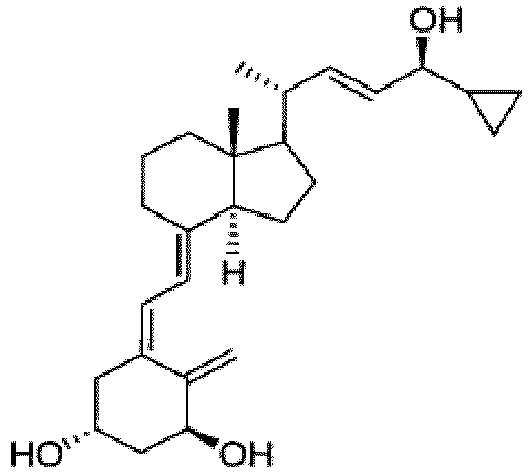
- the chemical structure of calcipotriene is provided below.
- calcitriol has been shown to induce cell differentiation and inhibit cell proliferation, its use as an antipsoriatic agent is limited because of its potent effect on calcium metabolism.
- Calcipotriene has 100-200 times lower calcemic potency, while inducing cell differentiation and inhibiting cell proliferation at concentrations similar to calcitriol. This lead to the development of calcipotriene as a therapeutic alternative in the topical treatment of psoriasis ( Binderup, L. et al., Rev Contemp Pharmacother 3:357-65 (1992 ); Binderup, L. Pharmacol Toxicol 72:240-4 (1993 ); Knutson, J.C. et al., Biochem Pharmacol 53:829-37 (1997 ); Kragballe, K. Pharmacol Toxicol 77:241-6 (1995 )).
- vitamin analogue includes compounds that are derived from a particular vitamin, and thus are similar in structure and have similar chemical and physiological properties.
- Vitamin analogues useful in the present invention include naturally occurring and synthetic analogues.
- Vitamin analogues of the present invention include, but are not limited to, calcidiol, calcitriol, calcipotriene, paricalcitol, 22-oxacalcitriol, dihydrotachysterol, calciferol, and those listed in US Pat. No. 6,787,529 .
- Vitamin A analogues useful in the present invention include, but are not limited to acitretin, retinaldehyde, retinoic acid, dehydroretinol, fenretinide, hydroxyretroretinol, didehydroretinoic acid, carotenes, tretinoin and its isomers.
- acitretin retinaldehyde
- retinoic acid dehydroretinol
- fenretinide hydroxyretroretinol
- didehydroretinoic acid carotenes
- tretinoin and its isomers.
- the pharmaceutically active ingredient may be present in any effective amount.
- the pharmaceutically active ingredient may be present in amounts of less than 0.005%, or approximately 0.005% by weight to approximately 10% by weight, preferably approximately 0.05% to approximately 1% by weight, based on the total weight of the pharmaceutical aerosol foam composition.
- the aerosol foam base can be made using compositions that are well known in the art. For example, admixtures of long chain alcohols and emulsifiers are typical components of the foam base.
- the foam can be a quick-breaking foam, or a foam which collapses more slowly.
- the pharmaceutical aerosol foam composition may further include an effective amount of an aerosol propellant.
- aerosol propellant refers to a gas that assists in propelling the foamable composition out of a pressurized container.
- the aerosol propellant can be any suitable gas or mixture thereof, such as a hydrocarbon, a chlorofluorocarbon, dimethyl ether, hydrofluorocarbons and a mixture thereof.
- Hydrocarbon propellants include, but are not limited to, propane, n-butane and isobutane. Chlorofluorocarbons are alkanes where all the hydrogens have been replaced with chlorine and fluorine atoms.
- chlorofluorocarbons include, but are not limited to, chlorofluoromethanes such as trichlorofluoromethane and dichlorodifluoromethane, and chlorofluoroethanes such as trichlorotrifluoroethane.
- Hydrofluorocarbons are alkanes where some hydrogens have been replaced with fluorine atoms, but some hydrogen atoms remain.
- Exemplary hydrofluorocarbons include, but are not limited to, hydrofluoromethanes such as trifluoromethane, and hydrofluoroethanes such as tetrafluoroethane.
- the aerosol propellant is a hydrocarbon.
- the aerosol propellant may be present in an amount of from approximately 2.5% to 20% by weight, preferably 2.5% to 7.5% by weight, based on the total weight of the pharmaceutical mousse composition.
- the propellant may be introduced into the mousse composition at the time of filling utilizing for example, a standard aerosol dispenser, e.g. a spray can arrangement.
- a standard aerosol dispenser e.g. a spray can arrangement.
- aerosol propellants are useful in the present invention.
- the occlusive agent utilized according to the present invention may be any excipient or combination thereof that provides an occlusive layer or hydration barrier to the skin.
- An occlusive layer or hydration barrier is a layer or barrier sufficient to result in reduction in transepidermal water loss, which results in skin hydration.
- Suitable occlusive agents may be selected from one or more of the group consisting of mineral oils and greases, long chain acids, animal fats and greases, vegetable fats and greases, water insoluble polymers and the like.
- the occlusive agent is petrolatum.
- the occlusive agent is present in an amount sufficient to permit the formation of an occlusive layer or hydration barrier on the skin of the patient. Surprisingly, applicants have discovered it is possible to form such an occlusive layer with a relatively low amount of occlusive agent.
- the amount of occlusive agent in the mousse composition may be up to approximately 55%, preferably approximately 40% or less by weight based on the total weight of the composition. In a preferred embodiment, the amount of occlusive agent in the mousse composition may be up to approximately 50%, more preferably from approximately 20 to 50% by weight.
- the amount of occlusive agent is up to 20% by weight, such as 1% to 20% for example, 1%, 2%, 3%, 4%, 5%, 6%, 7%, 8%, 9%, 10%, 11%, 12%, 13%,14%,15%, 16%,17%,18%, 19%, or 20%.
- the occlusive agent is present in an amount of about 20%, 25%, 30%, 35%, 40%, 45% and 50%.
- the pharmaceutical mousse composition may further include an effective amount of an emulsifier and/or surfactant.
- the emulsifier or surfactant may be selected from one or more of the group consisting of non-ionic, anionic and cationic surfactants, e.g. fatty alcohols, fatty acids and fatty acid salts.
- Surfactants useful in the present invention include, but are not limited to, a non-ionic surfactant, a cationic surfactant, an anionic surfactant, an amphoteric surfactant, an ampholytic surfactant, a fatty alcohol, a fatty acid and fatty acid salts thereof
- a surfactant's hydrophilic/lipophilic balance (HLB) describes the surfactant's affinity toward water or oil (1-20, with 1 being lipophilic and 20 being hydrophilic).
- the HLB of a blend of two surfactants equals the weight fraction of surfactant A times its HLB value plus the weight fraction of surfactant B times its HLB value (weighted average).
- the surface-active agent has a hydrophilic lipophilic balance (HLB) between about 9 and about 14, for example, 9,10,11,12,13, and 14, which is the preferred HLB (a HLB preferred to stabilize an o/w emulsion of a given oil) of most oils and hydrophobic solvents.
- HLB hydrophilic lipophilic balance
- fatty acid include a carboxylic acid having an aliphatic tail, typically from 4 to 30 carbon atoms long. Fatty acids can be saturated, monounsaturated or poly-unsaturated. Examples of fatty acids useful in the present invention, include, but are not limited to, butyric acid (C4), caproic acid (C6), caprylic acid (C8), capric acid (C10), lauric acid (C12), myristic acid (C 14), palmitic acid (C 16), palmitoleic acid (C16), stearic acid (C 18), isostearic acid (C 18), oleic acid (C 18), vaccenic acid (C 18), linoleic acid (C 18), alpha-linoleic acid (C 18), gamma-linolenic acid (C 18), arachidic acid (C20), gadoleic acid (C20), arachidonic acid (C20), eicosapentaenoic
- compositions of the present invention are oil-inwater emulsions.
- a preparation of one liquid distributed in small globules throughout the a second liquid is an emulsion.
- the dispersed liquid is the discontinuous phase, whereas the dispersion medium is the continuous phase.
- the oil phase is the dispersed liquid and the aqueous solution is the continuous phase, typically the emulsion is known as an oil-in-water emulsion.
- non-ionic surfactants include glycerol fatty acid esters such as glycerol monostearate, glycol fatty acid esters such as propylene glycol monostearate, polyhydric alcohol fatty acid esters such as polyethylene glycol (400) monooleate, polyoxyethylene fatty acid esters such as polyoxyethylene (40) stearate, polyoxyethylene fatty alcohol ethers such as polyoxyethylene (20) stearyl ether, polyoxyethylene sorbitan fatty acid esters such as polyoxyethylene sorbitan monostearate, sorbitan esters such as sorbitan monostearate, alkyl glycosides such as cetearyl glucoside, fatty acid ethanolamides and their derivatives such as the diethanolamide of stearic acid, and the like.
- glycerol fatty acid esters such as glycerol monostearate
- glycol fatty acid esters such as propylene glycol monostearate
- fatty alcohol derivative includes a fatty alcohol compound that has been modified by one or several chemical reactions.
- the alcohol can be oxidized to a carbonyl compound such as an aldehyde or carboxylic acid.
- the alcohol can be protected with a suitable protecting group known to one of skill in the art.
- Other derivatives can include esters or ethers formed using a fatty alcohol, such as a polyoxyethylene fatty alcohol ether.
- Polyoxyethylene fatty alcohol ethers useful in the present invention include, but are not limited to, polyoxyl 20 cetostearyl ether and polyoxyl 10 oleyl ether, where the number refers to the average number of polyoxyethylene units in the polymer chain.
- polyoxyethylene fatty alcohol ethers useful in the present invention.
- Suitable anionic surfactants are soaps including alkali soaps, such as sodium, potassium and ammonium salts of aliphatic carboxylic acids, usually fatty acids, such as sodium stearate.
- alkali soaps such as sodium, potassium and ammonium salts of aliphatic carboxylic acids, usually fatty acids, such as sodium stearate.
- Organic amine soaps also included, include organic amine salts of aliphatic carboxylic acids, usually fatty acids, such as triethanolamine stearate.
- Another class of suitable soaps is the metallic soaps, salts of polyvalent metals and aliphatic carboxylic acids, usually fatty acids, such as aluminum stearate.
- Suitable anionic surfactants include sulfated fatty acid alcohols such as sodium lauryl sulfate, sulfated oils such as the sulfuric ester of ricinoleic acid disodium salt, and sulfonated compounds such as alkyl sulfonates including sodium cetane sulfonate, amide sulfonates such as sodium Nmethyl-N-oleyl laurate, sulfonated dibasic acid esters such as sodium dioctyl sulfosuccinate, alkyl aryl sulfonates such as sodium dodecylbenzene sulfonate, alkyl naphthalene sulfonates such a sodium isopropyl naphthalene sulfonate, petroleum sulfonate such as aryl naphthalene with alkyl substitutes.
- suitable cationic surfactants include amine salts such as octa
- Surfactant combinations such as for example, sorbitan monostearate and polysorbate 60 are suitable for use in the present invention.
- the emulsifier component may be present in any suitable stabilizing amount.
- the emulsifier component may be in an amount where the ratio of emulsifier component to the occlusive agent, active pharmaceutical ingredient and cosolvent is about 1:3, 1:4, 1:5, 1:6, 1:7, 1:8, 1:9 and 1:10.
- the emulsifier component may be present in an amount of from approximately 1% to 15 % by weight, preferably approximately 2.0% to 5.0% by weight, based on the total weight of the pharmaceutical mousse composition.
- the aqueous solvent may be present in an amount of from approximately 25% to 95% by weight, preferably approximately 70% to 85% by weight, such as 70%, 71%, 72%, 73%, 74%, 75%, 76%, 77%, 78%, 79%, 80%, 81%, 82%, 83%, 84%, or 85%, based on the total weight of the pharmaceutical mousse composition.
- water is present in an amount from about 40% to about 60%. In still other embodiments, water is present in an amount from about 70% to about 90%.
- the compositions may further include an organic cosolvent.
- the organic solvent may be an ester of a fatty acid for example a C12-C15 alkyl benzoate, a medium to long chain alcohol, an aromatic and/or alkyl pyrollidinone, an aromatic and/or alkyl, and/or cyclic ketone, an aromatic and/or alkyl, and/or cyclic ether, substituted and/or unsubstituted single or multiple ring aromatic, straight chain and/or branched chain and/or cyclic alkane or silicone.
- the organic cosolvent may be present in amounts of approximately 0.25% to 50% by weight, preferably 0.5 to 2% by weight, based on the total weight of the pharmaceutical mousse composition.
- Preferred organic cosolvents include C12-C15 alkyl benzoates (FINSOLV TN) and caprylic/capric triglyceride (CRODAMOL GTCC).
- the term "humectant” includes an agent that absorbs water from the air. Humectants are characterized as having several hydrophilic functional groups. Humectants useful in the foamable composition of the present invention include, but are not limited to, propylene glycol and polyols such as sorbitol, maltitol glycerine, glyceryl triacetate, polydextrose and other polyols such as polymeric polyols including polydextrose. When a humectant is present, it is present in an amount of from about 1 % to about 20% by weight. In some embodiments, the humectant is present in an amount of from about 5% to about 15% by weight.
- humectants, and amounts are useful in the present invention.
- stabilizing includes maintaining a compound in a specific state and preventing or slowing fluctuations from that particular state into another.
- a stabilizer such as a water soluble polymer.
- Other stabilizers are known to one of skill in the art.
- the terms "stabilizer,” or "preservative” include an agent that prevents the oxidation of other compounds.
- preservatives useful in the compositions of the present invention include, but are not limited to, an antioxidant, sodium nitrate, sodium nitrite, sulfites, (sulfur dioxide, sodium bisulfate, potassium hydrogen sulfate, and the like), disodium EDTA, formaldehyde, glutaraldehyde, diatomaceous earth, ethanol, dimethyl dicarbonate, methylchloroisothiazolinone, beta-carotene, selenium, coenzyme Q10 (ubiquinone), lutein, tocotrienols, soy isoflavones, S-adenosylmethionine, glutathione, taurine, N-acetylcysteine, Vitamin E (alpha-tocopherol), Vitamin E derivatives such as tocopherol acetate and tocopherol palmitate,
- complexing agents such as edetate disodium, dihydrate. When a complexing agent is present, it is present in an amount of from about 0.001 % to about 1%.
- a complexing agent is present in an amount of from about 0.001 % to about 1%.
- the pharmaceutical mousse composition according to the present invention may also contain other non-essential ingredients.
- the composition may contain up to 10 weight percent of conventional pharmaceutical adjuvants.
- adjuvants or additives include preservatives, stabilizers, antioxidants, pH adjusting agents, skin penetration enhancers (lie propylene glycol), and viscosity modifying agents.
- the present invention provides a topical oil-in-water emulsion comprising a vitamin or analogue thereof, wherein the vitamin or analogue thereof is solubilized in the water phase (continuous phase) and a stabilizer is solubilized in the oil phase (discontinous phase).
- the emulsion of the present invention further comprises an emulsifier and an occlusive agent.
- the compositions of the present invention can be housed in a pressurized container, such that the composition is a foam when released from the pressurized container.
- the compositions of the present invention can be a lotion, cream, ointment, solution, gel, paste, or applied via a dermal patch.
- the vitamin or analogue of the present invention is selected from the group consisting of vitamin A, B 1 , B 2 , B 3 , B 5 , B 6 , B 7 , B 9 , B 12 , C, D 1 , D 2 , D 3 , D 4 , and K and an analogue thereof.
- Preferred vitamins include vitamins A and D 1 , D 2 , D 3 , and D 4 and their analogues.
- Vitamin A analogues useful in the aerosol compositions of the present invention include, but are not limited to, acitretin, retinol, retinaldehyde, retinoic acid, dehydroretinol, fenretinide, tazarotene, tretinoin and its isomers, and carotenes.
- the vitamins or analogues of the present invention are vitamin D or vitamin D analogues including, but not limited to, calcidiol, calcitriol, calcipotriene and those listed in US Pat. No. 6,787,529 .
- the vitamin D or analogue is calcipotriene.
- the vitamins or analogues can be anhydrous, or a hydrate, such as calcipotriene anhydrate or monohydrate ( US Pat. No. 5,763,426 ). Other hydrates such as dihydrate and trihydrate are also useful. One of skill in the art will appreciate that other vitamins or vitamin analogues are useful in the present invention.
- the vitamin or analogue is present in amounts from approximately 0.0001 % by weight to approximately 10% by weight, based on the total weight of the aerosol composition. In other aerosol compositions, the vitamin or analogue is present in amounts from approximately 0.001 % to approximately 1% by weight. In still other aerosol compositions, the vitamin or analogue is present in amounts from approximately 0.001 % to approximately 0.1% by weight. In yet another aerosol composition, the vitamin or analogue is present in amounts from approximately 0.001 % to approximately 0.01 % by weight.
- aerosol compositions having other amounts of the vitamin or analogue are useful in the present invention.
- vitamins useful in the present invention are oil soluble.
- the vitamins of the present invention can be dissolved in water via first dissolving in a water soluble solvent (e.g., organic solvent) such as propylene glycol.
- a water soluble solvent e.g., organic solvent
- Other solvents having miscibility with both polar and non-polar substances can also be used including for example, diols such as ethylene glycol, butylene glycol and other polyols.
- the mixture of water soluble organic solvent and vitamin is then added to the water where the water soluble polymer maintains the vitamin in a solution state.
- solvents having miscibility with both polar and non-polar substances can also be used including; polyols, for example PEG 200, PEG 300, PEG 400 and PEG 800; and ethers, for example, ethylene glycol monoethyl ether and diethylene glycol monoethyl ether; and esters, for example ethyl acetate and propylene carbonate; and heterocyclic compounds, for example n-methyl pyrrolidone.
- agents e.g., tretinoin
- alcohols are useful, such as ethanol, n-propanol, isopropanol, n-butanol and t-butanol.
- Other water soluble organic solvents useful in the present invention are known to one of skill in the art.
- the medium to long chain alcohols described above for the organic cosolvent include fatty alcohols and fatty alcohol derivatives.
- Fatty alcohols useful as the organic cosolvent include, but are not limited to, capryl alcohol (C8), pelargonic alcohol (C9), capric alcohol (C 10), lauryl alcohol (C12), myristyl alcohol (C 14), cetyl alcohol (C16), palmitoleyl alcohol (C16), stearyl alcohol (C 18), isostearyl alcohol (C 18), elaidyl alcohol (C 18), oleyl alcohol (C 18), linoleyl alcohol (C 18), elaidolinoleyl alcohol (C 18), linolenyl alcohol (C 18), ricinoleyl alcohol (C 18), arachidyl alcohol (C20), behenyl alcohol (C22), erucyl alcohol (C22), lignoceryl alcohol (C24), ceryl alcohol (C26), montanyl alcohol/cluytyl alcohol (C28
- the organic cosolvent of the aerosol composition of the present invention is at least one C 14 - C 22 alcohol. In other embodiments, the organic cosolvent is a C16 alcohol, a C18 alcohol, or a combination. In still other embodiments, the organic cosolvent is a mixture of cetyl alcohol and stearyl alcohol.
- the fatty alcohols of the present invention can be present in an amount from about 0.1 % to about 5% w/w.
- One of skill in the art will appreciate that other amounts of the fatty alcohol are useful in the present invention.
- the surfactant of the aerosol composition of the present invention can be a single surfactant or a mixture of several different surfactants.
- the aerosol composition of the present invention comprises an surfactant comprising a mixture of a C 14 -C 22 alcohol, a sorbitan ester and a polyoxyethylene fatty alcohol ether.
- the surfactant comprises a mixture of a C 14 -C 22 alcohol and a polyoxyethylene fatty alcohol ether.
- the C 14 - C 22 alcohol can be cetyl alcohol, stearyl alcohol, or a mixture thereof In other embodiments, the C 14 -C 22 alcohol can be cetyl alcohol.
- cetyl alcohol stearyl alcohol, or a mixture thereof
- other alcohols are useful in the present invention.
- the surfactant of the aerosol composition of the present invention can be present in any stabilizing amount.
- the surfactant is present in an amount of from approximately 0.1 to 15% by weight, based on the total weight of the composition. In other embodiments, the surfactant is present in an amount of approximately 0.1% to about 10% by weight.
- One of skill in the art will appreciate that other amounts of surfactant are useful in the present invention.
- the non-ionic surfactant of the aerosol composition of the present invention i.e., the sorbitan ester or polyoxyethylene fatty alcohol ether
- the non-ionic surfactant can be present in an amount from about 1% to about 15% w/w.
- the non-ionic surfactant can also be present in an amount from about 3% to about 8% w/w.
- One of skill in the art will appreciate that other amounts of non-ionic surfactant are useful in the present invention.
- the aerosol compositions of the present invention can also comprise additional adjuvants, as noted above, such as preservatives, stabilizers, pH adjusting agents, and skin penetration enhancers.
- the pH adjusting agents of the present invention are compounds or mixtures that can adjust the pH of a solution to make the solution more acidic or more basic.
- the compositions of the present invention include a buffering agent as the pH adjusting agent in order to maintain the pH at a desired point.
- Buffering agents useful in the present invention include organic and inorganic acids and bases such as sodium hydroxide, dibasic sodium phosphate anhydrous, and mixtures thereof.
- the buffering agent is sodium hydroxide.
- the buffering agent is dibasic sodium phosphate anhydrous.
- the buffering agent is a mixture of sodium hydroxide and dibasic sodium phosphate anhydrous.
- the pH of the aerosol composition is from about pH 4.0 to about pH 9.0, such as 4.0, 5.0, 6.0, 7.0, 8.0, 9.0. In other embodiments, the pH is from about pH 7.0 to about pH 9.0.
- pH is from about pH 7.0 to about pH 9.0.
- a buffering agent When a buffering agent is present, it is present in an amount of about 0.001 % to about 1.0% by weight, such as 0.01-0.5%. One of skill in the art will appreciate that other amounts of buffering agent are useful in the present invention.
- Viscosity modifying agents of the present invention include viscosity reducers, or compounds or mixtures that increase the viscosity of a mixture.
- Suitable viscosity reducers include for example, isopropyl myristate.
- Suitable viscosity reducers include other esters, for example, C12-C15 alkyl benzoate, caprylic/capric triglyceride, myristyl lactate, benzyl benzoate and isopropyl palmitate.
- Suitable agents to increase viscosity include gelling agents such as Carbopol 934®, Carbopol 940®, Carbopol 950®, Carbopol 980®, Carbopol 951(" and Carbopol 981®.
- agents to increase viscosity include for example, gums and polysaccharides, for example, gellan gum, guar gum, karaya gum, locust-bean gum, xanthan gum, natural gum, chitosan, hyaluronic acid and salts thereof; and, proteins, for example gelatin.
- a viscosity modifier When a viscosity modifier is present, it is present in an amount of about 0.1% to about 20%, preferably about 0.1% to about 5% by weight.
- a viscosity modifiers and amounts are useful in the present invention.
- Calcipotriene forms an equilibrium with pre-calcipotriene, which reduces the amount of calcipotriene present in a pharmaceutical composition, as well as reducing the efficacy of the composition.
- the addition of stabilizers and preservatives in the water-in-oil emulsions of the present invention assist in preventing the degradation of the active agent.
- the present formulation affords enhanced stability with the addition of a stabilizer such as tocopherol or a tocopherol derivative in one phase (the oil phase), with the active vitamin or analogue thereof (e.g., calcipotriene) in the other phase (water phase).
- a stabilizer such as tocopherol or a tocopherol derivative in one phase (the oil phase)
- the active vitamin or analogue thereof e.g., calcipotriene
- the unexpected advantageous nature of the present invention is due in-part to the added stability afforded by the stabilizer (e.
- tocopherol or a tocopherol derivative even though the stabilizer is added to a completely different phase.
- a stabilizer Prior to the advent of the present invention, it was believed that in order to be effective, a stabilizer must be added to the phase where the active ingredient is dissolved.
- the formulations of the present invention possess enhanced stability despite the addition of a stabilizer to a phase other than that where the active ingredient is dissolved.
- tretinoin is all-trans-retinoic acid, also known as (all-E)-3,7-dimethyl-9-(2,6,6-trimethyl-lcyclohexen-1-yl)-2,4,6,8-nonatetraenoic acid.
- Tretinoin is a member of the retinoid family of compounds, and is a metabolite of naturally occurring Vitamin A. Tretinoin has a molecular weight of 300.44.
- Tretinoin has the following structure:
- tretinoin Although the exact mode of action of tretinoin is unknown, current evidence suggests that topical tretinoin decreases cohesiveness of follicular epithelial cells with decreased microcomedo formation. Additionally, tretinoin stimulates mitotic activity and increased turnover of follicular epithelial cells causing extrusion of the comedones.
- Tretinoin is known to be unstable in the presence of oxidizing agents and sunlight. (see, for example, Martin B, et al., Br J Dermatol. 1998;139 (suppl 52):8-11 .
- a stabilizer such as tocopherol or a derivative thereof is added to the composition.
- acitretin is a vitamin analogue useful in the present invention.
- acitretin is all-trans-9-(4-methoxy-2,3,6-trimethylphenyl)-3,7-dimethyl-2,4,6,8-nonatetraenoic acid (a retinoid).
- Acitretin is a metabolite of etretinate and is related to both retinoic acid and retinol (vitamin A). It is a yellow to greenish-yellow powder with a molecular weight of 326.44.
- the structural formula is:
- Acitretin is a form of vitamin A. The exact way that acitretin works is unknown. Acitretin is used to treat severe psoriasis that has not responded to other treatments. In order to increase stability of acitretin, a stabilizer such as tocopherol or a derivative thereof is added to the formulation.
- the phenolic hydroxyl group of a stabilizer (e.g., tocopherol) is responsible for the antioxidant properties.
- a stabilizer e.g., tocopherol
- the hydrogen of the phenolic hydroxyl group of tocopherol is donated to the free radical entity, creating a tocopherol free radical that is stabilized through resonance.
- the combination of tocopherol provides additional stability for a vitamin or an analogue thereof (e.g., calcipotriene) that other combinations of antioxidants and preservatives do not provide.
- the additional stability afforded by the combination of tocopherol is not fully attributable to the antioxidant properties of the phenolic hydroxyl group, however.
- tocopherol Additional stability for the vitamin or analogue thereof (e.g., calcipotriene) is derived from tocopherol as a whole.
- tocopherol comprises a fused pyran moiety forming a benzopyran, as well as a branched C 13-alkyl chain pendant to the pyran moiety. It is believed that the combination of the phenolic moiety, the benzopyran and the branched C13-alkyl chain impart additional stability to the composition that cannot be obtained through the use of other antioxidants.
- trans-calcipotriene is not an oxidation by-product. That is, trans-calcipotriene is not generated by oxidizing calcipotriene. Therefore, a stabilizer acting solely as an antioxidant would not be expected to decrease or retard the amount of trans-calcipotriene.
- tocopherol is believed to be playing a stabilizing role in addition to its role as an antioxidant, possibly by preventing or reducing the amount of isomerization by-product:
- antioxidants useful to practice the invention include for example, superoxide dismutase, beta-carotene, BHT (butylated hydroxytoluene), BHA (butylated hydroxyanisole) and coenzyme Q10.
- the antioxidant providing added stability can be present in a ratio of active agent to antioxidant of from 10:1 to 1000:1, such as 10:1 to 750:1, 10:1 to 500:1 and 10:1 to 100:1.
- the present invention includes a method for treating a dermatological disorder in a mammal comprising administering a topical emulsion composition of the present invention, wherein the composition is a foam when released from a pressurized container, to treat the dermatological disorder.
- the term "treating"in includes any indicia of success in the treatment or amelioration of an injury, pathology, condition or symptom (e.g., pain), including any objective or subjective parameter such as abatement; remission; diminishing of symptoms or making the symptom, injury, pathology or condition more tolerable to the patient; decreasing the frequency or duration of the symptom or condition; or, in some situations, preventing the onset of the symptom or condition.
- the treatment or amelioration of symptoms can be based on any objective or subjective parameter; including, e.g., the result of a physical examination.
- the methods of the invention selectively treat acne vulgaris and/or psoriasis by diminishing of symptoms of these indications.
- Dermatological disorders that are treatable by the methods of the present invention include, but are not limited to, dermatological conditions linked to disorders of keratinization involving differentiation and proliferation, in particular, acne vulgaris, comedonic or polymorphic acne, nodulocystic acne, acne conglobata, senile acne and secondary acnes such as solar, drug or occupational acne; for other types of keratinization disorders especially ichthyoses, ichthyosiform conditions, Darier's disease, palmoplantar keratoderma, leukoplakia and luecoplakiform conditions or lichen and lichen planus; dermatological disorders having an inflammatory or immunoallergic component, in particular, all forms of psoriases, either cutaneous, mucosal or ungual, and psoriatic rheumatism, and cutaneous atopy such as eczema or respiratory atopy, dry skin, inflammation of the skin, solar erythema, skin allergies or other skin disorders of the
- the present invention provides a method for stabilizing a vitamin or an analogue thereof in a topical emulsion composition, comprising a first step of providing a vitamin or analogue thereof, wherein the vitamin or analogue thereof is solubilized in the water phase.
- the methods of the present invention for stabilizing a vitamin or an analogue thereof in a topical emulsion composition further comprises a second step comprising providing a stabilizer solubilized in the oil phase, wherein the vitamin or analogue thereof is stabilized by the presence of the stabilizer even though, surprisingly the stabilizer is present in a different phase.
- the methods for stabilizing the active vitamin or analogue thereof are thus, contrary to conventional formulation wisdom and completely unexpected.
- Example 1 Preparation of an aerosol composition in a pressurized container
- Calcipotriene Foam is an oil and water emulsion packaged in an aluminum container which is pressurized with a hydrocarbon (propane/butane) propellant.
- Table 1 contains the list of materials, the quality standard and function of each material, the quantitative composition, and the formula for a batch size of 450 kg.
- Table 1 Calcipotriene Foam 0.005% Quantitative Composition Component Function Percent (% w/w) Calcipotriene Active ingredient 0.00552 Cetyl alcohol Emulsifier 1.05 Cyclomethicone Viscosity reducer 5.26 Dibasic Sodium Phosphate Anhydrous Buffering agent 0.30 Edetate Disodium, dehydrate Complexing agent 0.02 Isopropyl Myristate Viscosity reducer 5.26 Light Mineral Oil Occlusive agent, viscosity reducer 5.26 Phenoxyethanol Preservative 0.50 Polyoxyl 20 Cetostearyl Ether Emulsifier 5.26 Propylene Glycol Solvent, humectant 10.53 Purified Water Solvent 57.07448 Sodium Hydroxide Buffering agent 0.01 Sorbitan Monolaurate Emulsifier 4.21 White Petrolatum Oc
- the propane/butane propellant is supplied as a blend of approximately 55% propane, 30% n-butane, and 15% isobutane. Typically the propellant is added at approximately 8 gram /100 grams of the formulation.
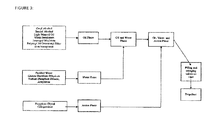
- the manufacture of the drug product takes place in three primary steps: the oil phase, the water phase and active phase. Any steps in which the calcipotriene is exposed to light are performed under red light to minimize potential degradation. Heat exposure is also minimized.
- step 4 of the above procedure propylene glycol is added into the active phase. It is found that by adding the polyol in the active phase, a microemulsion or even sub micron emulsion is formed. In certain instances, it is possible to reproducibly manufacture sub micron particles at low temperature in the range 100-600 rim with the majority of particles being in the 100-200 rim range. The exclusion of propylene glycol from the initial water/oil phase mixing appears to allow the surfactants to pack into a microemulsion structure and with the assistance of temperature manipulation, to fix in place.
- Example 2 Method of treating psoriasis using a vitamin D3 analogue foam composition
- Each test formulation is applied to skin sections at dose of 10 ⁇ 1L/0.64 cm 2 , for 24 hours.
- the receptor fluid is pumped through the receptor chamber at a rate of ⁇ 0.33 mL/h.
- the skin surface is washed by applying 20 ⁇ L of acetonitrile, wiped twice with tissue paper and stripped twice with transparent tape.
- the epidermis and dermis are heat separated by placing the skin on a heat block of 50°C for 1.5 minutes.
- the washes, the tissue papers and tapes, the epidermis and dermis, and the receptor fluid, are all analyzed for drug content using HPLC.
- Example 3 Skin penetration study of calcipotriene cream versus inventive foam composition
- the inventive foam delivered measurable amounts of calcipotriene into the epidermis and dermis. Moreover, there is a correlation between the concentration ofpropylene glycol in the inventive formulation and the cumulative amount of calcipotriene in the skin.
- the low viscosity of the foam material advantageously improves spreading/absorption compared to the commercial cream. Further, the inventive formulation is non-crystalline and thus the active ingredient penetrates faster compared to the cream formulation.
- Table 4 shows a comparison of various physical properties of an inventive embodiment compared to prior art formulations.
- the foam and ointment are similar.
- the foam is far superior in that it is advantageously not greasy and cosmetically elegant.
- the inventive calcipotriene foam to a calcipotriene scalp solution insofar as viscosity and spreadability are concerned the vehicles are similar.
- the inventive foam advantageously does not contain large amounts of alcohol and therefore has reduced stinging on the skin.
- the foam formulations of the present invention are substantially ethanol-free and substantially isopropanol-free formulations (e.g., lower than 5%).
- alpha-tocopherol as a stabilizer yields increased stability and leads to less calcipotriene degradation than other stabilizers.
- the emulsions of the present invention truly possess surprising unexpected advantages in that the calcipotriene and the stabilizer are added to different phases. The emulsion enables increased enhanced stability not possible with prior art formulations.
- Fig. 4A the results of a stability study are shown wherein a calcipotriene foam formulation without tocopherol degrades rapidly. The results are shown for a 12 weeks study at 40°C. However, as shown in Fig. 4B , the addition of alphatocopherol to the formulation enhances stability unexpectedly. The results are shown for a 12 weeks study at 40°C.
Landscapes
- Health & Medical Sciences (AREA)
- Chemical & Material Sciences (AREA)
- Veterinary Medicine (AREA)
- Public Health (AREA)
- General Health & Medical Sciences (AREA)
- Animal Behavior & Ethology (AREA)
- Life Sciences & Earth Sciences (AREA)
- Medicinal Chemistry (AREA)
- Pharmacology & Pharmacy (AREA)
- Epidemiology (AREA)
- Dispersion Chemistry (AREA)
- Dermatology (AREA)
- Organic Chemistry (AREA)
- Nuclear Medicine, Radiotherapy & Molecular Imaging (AREA)
- General Chemical & Material Sciences (AREA)
- Chemical Kinetics & Catalysis (AREA)
- Bioinformatics & Cheminformatics (AREA)
- Engineering & Computer Science (AREA)
- Obesity (AREA)
- Hematology (AREA)
- Diabetes (AREA)
- Nutrition Science (AREA)
- Medicinal Preparation (AREA)
- Acyclic And Carbocyclic Compounds In Medicinal Compositions (AREA)
- Pharmaceuticals Containing Other Organic And Inorganic Compounds (AREA)
Abstract
Description
- The present invention provides a composition for the topical administration of pharmaceutical active ingredients.
- Various aerosol and non-aerosol quick breaking and slow breaking foams for the topical delivery of pharmaceutical active ingredients are known in the prior art. For example, the foam composition can be an aqueous emulsion system, which upon actuation, produces a stabilized, homogeneous, expandable foam which breaks easily with shear. A composition of this type is often referred to as an aerosol foam or "mousse". Alternatively, the foam composition can be a slow-breaking foam, which collapses only upon more vigorous rubbing.
- It is known to use mousse compositions to topically deliver pharmaceutical active ingredients. An example of such a composition is in Australian patent application
80257/87 - Moreover, the majority of topical lotions and creams known or suggested in the prior art for delivering pharmaceutically active ingredients contain large amounts of petrolatum or some other occlusive agent to act as a barrier over the skin. This barrier reduces the evaporation of moisture from the skin which leads to increased moisture in the stratum corneum and in the epidermis and enhances the topical delivery of the pharmaceutical active ingredients.
- However, in practice it would not be desirable to include such large amounts of an occlusive agent in a mousse formulation because when dispensed the mousse formulation would be a less stable foam, and upon application, the occlusive agent would leave a greasy, sticky lather on the skin which would not be considered acceptable to the consumer.
- In United States Patent Nos.
5,002,680 and4,981,677 , there is disclosed mousse compositions that contain an occlusive agent such as petrolatum. These compositions are directed towards cosmetic purposes, and provide no disclosure on their suitability or otherwise to enhance the topical delivery of pharmaceutical active ingredients. Further, in respect of United States Patent No.4,981,677 the formulation includes a starch component. It is accordingly not apparent that an occlusive layer would be formed. - Accordingly, it would be a significant advance in the art if a mousse composition could be provided that enhanced the topical delivery of the pharmaceutical active ingredient while preferably still providing a pharmaceutically elegant and consumer acceptable composition.
- The present invention provides a mousse composition having enhanced topical delivery of a pharmaceutical active ingredient while preferably still providing a pharmaceutically elegant and consumer acceptable composition. As such, in one embodiment, the present invention provides a pharmaceutical aerosol foam composition, comprising: an effective amount of a pharmaceutically active ingredient, wherein the pharmaceutically active ingredient is a vitamin or analogue thereof;
an occlusive agent;
an aqueous solvent;
an organic cosolvent; wherein the pharmaceutically active ingredient is insoluble in both water and the occlusive agent; and the occlusive agent being present in an amount sufficient to form an occlusive layer on the skin, in use. - In certain aspects, the pharmaceutical aerosol foam composition further comprises a stabilizer, such as a vitamin E or a derivative thereof. Preferably, the pharmaceutically active ingredient comprises a vitamin or analogue such as for example, calcipotriene, tretinoin, or acitretin.
- In certain preferred aspects, the pharmaceutical aerosol foam composition further comprising an emulsifier. The occlusive agent is preferably petrolatum. The aerosol foam may have a propellant blend of approximately 55% propane, 30% n-butane, and 15% isobutane.
- In yet another embodiment, the present invention provides a topical oil-in-water emulsion, the emulsion having a water phase and an oil phase, comprising:
- a vitamin or analogue thereof, wherein the vitamin or analogue thereof is solubilized in the water phase and a stabilizer is solubilized in the oil phase;
- an emulsifier;
- an occlusive agent; and an organic co-solvent.
- In a preferred aspect, the emulsion is an aerosol emulsion, which is a foam when released from a pressurized container. The vitamin or analogue thereof is typically vitamin A, vitamin D, or analogues thereof. In a preferred aspect, the vitamin D or analogue thereof is calcipotriene. Other vitamin analogues include for example, vitamin A or analogue thereof, such as tretinoin or acitretin.
- In certain aspects, the vitamin or analogue thereof is first solubilized in propylene glycol. Vitamin E or a derivative thereof is the preferred stabilizer. The vitamin or analogue may be a combination of calcipotriene and tretinoin.
- In yet other aspects, the vitamin or analogue is present in an amount of from approximately 0.0001 % by weight to approximately 10% by weight, based on the total weight of the composition. Moreover, in still other aspects, the emulsion comprises water in an amount up to 90% w/w, based on the total weight of the composition. Preferably, the emulsion comprises water in an amount of from about 40 % to about 60 % w/w, based on the total weight of the composition.
- In still other aspects, the emulsifier is for example, a non-ionic, cationic or anionic surfactant, a fatty alcohol, a fatty acid or fatty acid salts thereof. In one aspect, the emulsifier is a mixture of a C14 -C22 alcohol and a polyoxyethylene fatty alcohol ether. In another aspect, the C14-C22 alcohol is selected from cetyl alcohol, stearyl alcohol, and a mixture thereof. Preferably, the C14-C22 alcohol is a mixture of cetyl alcohol and stearyl alcohol. The emulsifier can be in an amount of from approximately 1 to 15% by weight, based on the total weight of the composition. For example, the amount of the C14 -C22 alcohol present is from about 0.5% to about 5% w/w, based on the total weight of the composition.
- In certain other aspects, the occlusive agent of the composition is selected from a mineral oil, grease, petrolatum, a fatty acid, an animal fat, a vegetable fat, a water insoluble polymer or a mixture thereof In one aspect, the occlusive agent is present in an amount of about 1% to about 55% by weight based on the total weight of the composition. In another aspect, the occlusive agent is present in an amount of approximately 1% to about 10 % by weight, based on the total weight of the composition. In yet another aspect, the occlusive agent is present in an amount of approximately 5% to about 55 % by weight, based on the total weight of the composition. The topical oil-in-water emulsion may further comprise a buffering agent, to obtain for example, a pH of the composition from about pH 4.0 to about pH 9.0. The topical oil-in-water emulsion can also comprise a viscosity reducer.
- In certain other aspects, the emulsion further comprises a humectant. In other embodiments, the emulsion further comprises an aerosol propellant selected from a hydrocarbon, a chlorofluorocarbon, dimethyl ether, hydrofluorocarbons and a mixture thereof. Preferably, the aerosol propellant comprises a mixture of hydrocarbons. The emulsion can be a cream, an ointment, a gel, a post-foaming gel, a paste, or a lotion.
- In yet another embodiment, the present invention provides a method for treating a dermatological disorder in a mammal, the method comprising: administering a topical oil-in-water emulsion of any of the compositions as herein described to treat the dermatological disorder. The dermatological disorder can be psoriasis.
- In yet another embodiment, the present invention provides a method for stabilizing a vitamin or an analogue thereof in a topical oil-in-water emulsion having a water phase and an oil phase, the method comprising: providing a vitamin or an analogue thereof, wherein the vitamin or analogue thereof is solubilized in the water phase; and providing a stabilizer solubilized in the oil phase, wherein the vitamin or analogue thereof is stabilized in the water phase by the presence of the stabilizer solubilized in the oil phase. The vitamin or analogue thereof solubilized in water is preferably first solubilized in propylene glycol.
- In still yet another embodiment, the present invention provides a use of a topical oil-in-water emulsion as herein described in the manufacture of a medicament for the treatment of a dermatological disorder.
- These and other aspects, objects and embodiments will be come more apparent when read with the following figures and detailed description.
-
-
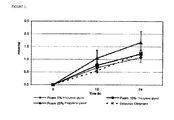
Figure 1 illustrates the cumulative amount of calcipotriene penetration through fresh dennatomed human skin membrane (250 pm) following application of a calcipotriene aerosol foam composition with varying amounts of propylene glycol (0%; 10%; 20% versus ointment). -
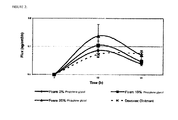
Figure 2 illustrates the flux profile of calcipotriene following application of an aerosol foam composition with varying amounts of propylene glycol (0%; 10%; 20% versus ointment). -
Figure 3 illustrates a manufacturing flow diagram of one embodiment of the present invention. -
Figures 4 AB show stability studies, Panel A shows the loss of calcipotriene without a stabilizer, Panel B shows enhanced stability of the active ingredient with the addition of a stabilizer. - The present invention is predicated in-part, on the surprising discovery that a mousse formulation with a relatively low amount of an occlusive agent is still able to reduce transepidermal water loss and hence in theory increase skin permeability to effect greater drug skin penetration while remaining an elegant and consumer acceptable composition.
- The water-insoluble pharmaceutically active ingredient may be any suitable type. An analgesic such as capsaicin or piroxicam, antifungal such as clotrimazole or miconazole nitrate, antibacterial such as nitrofurazone or gramcidin, anaesthetic such as benzocaine or lidocaine, antiviral such as aciclovir or penciclovir, antipruritic such as crotamiton or phenol, antihistamine such as chlorpheniramine or triprolidine, xanthine such as caffeine, sex hormone such as oestradiol or testosterone, anti-inflammatory agent or corticosteroid may be used. The corticosteroids may be selected from one or more of the group consisting of, betamethasone valerate and clobetasol propionate. A preferred pharmaceutical active agent is a vitamin, such as vitamin A, vitamin D (e.g., D3) and analogues thereof.
- In addition to the corticosteroids discussed above, the compositions of the present invention can further include a corticosteroid such as those set forth in
U.S. Patent No. 6,126,920 , which is incorporated herein by reference. Suitable corticosteroids include for example, alclometasone dipropionate, fluclorolone acetonide, amcinonide, fluocinolone acetonide, beclamethasone dipropionate, fluocinonide, betamethasone benzoate, fluocortin butyl, betamethasone dipropionate, fluocortolone preparations, betamethasone valerate, fluprednidene acetate, budesonide, flurandrenolone, clobetasol propionate, halcinonide, clobetasone butyrate, hydrocortisone, desonide, hydrocortisone acetate, desoxymethasone, hydrocortisone butyrate, diflorasone diacetate, methylprednisolone acetate, diflucortolone valerate, mometasone furoate, flumethasone pivalate, triamcinolone acetonide, and pharmacologically effective mixtures thereof. - Combinations of active ingredients are also within the scope of the present invention.
- Vitamins and analogues thereof are preferred active ingredients of the present invention. As used herein, "vitamins" include vitamins such as vitamin A, B1, B2, B3, B5, B6, B7, B9, B12, C, D1, D2, D3, D4, and K.
- Vitamin D3 promotes the body's absorption of calcium, which is essential for the normal development and maintenance of healthy teeth and bones. Calcium is also important to nerve cells, including the brain. Vitamin D3 is essential for calcium and phosphorus homeostasis in the blood. Vitamin D3 deficiency can lead to osteoporosis in adults or rickets in children. Excessive doses of Vitamin D3 can result in increased calcium absorption from the intestinal tract, and increased calcium resorption from the bones, leading to elevated levels of calcium in the blood and urine. Elevated blood calcium may cause calcium deposition in soft tissues such as the heart and lungs, which can reduce their ability to function. Kidney stones, vomiting, and muscle weakness may also occur due to the ingestion of too much Vitamin D3.
- Unlike any other vitamin, Vitamin D3 (cholecalciferol) is a prehormone. It is synthesized when light is absorbed by 7-dehydrocholesterol. In the liver, Vitamin D3 is converted by the enzyme 25-hydroxylase into 25-hydroxy Vitamin D3 (calcidiol). The body stores calcidiol in the blood and fat for later use. In the kidney, 25-hydroxy Vitamin D3 serves as a substrate for 1-alpha-hydroxylase, yielding 1,25-dihydroxy Vitamin D3 (calcitriol.), the biologically active form of Vitamin D3 (Sheme 1).

- Vitamin D3 regulates proliferation and differentiation as well as immune response. Many cell types in the skin have Vitamin D3 receptors, including keratinocytes and lymphocytes. Calcipotriene and calcitriol have equivalent affinities for these receptors. Like calcitriol, calcipotriene inhibits proliferation and induces the differentiation of normal and malignant keratinocytes in culture (Guilhou, J. J. Ann Dermatol Venereol 128:229-37 (2001); Binderup, L. et al., Rev Contemp Pharmacother 3:357-65 (1992)). Vitamin D3 has also been shown to induce normal differentiation in neoplastic epidermis reconstructed from transfected keratinocytes, thus confirming potential anti-neoplasic effects of Vitamin D3 (Mils, V. et al., J Investig Dermatol Symp Proc 1:87-93 (1996)).
- Calcipotriene (also known as calcipotriol, (SZ,7E,22E,24S)-24-cyclopropyl-9,10- secochola-5,7,10(19), 22 tetraene-la,3(3,24-triol) is a synthetic analog of Vitamin D3. It was first synthesized by Leo Pharma, Denmark, in 1985. Topical calcipotriene has been on the market in Europe since 1992, and in the US since 1993. There are three topical calcipotriene dosage forms on the market in the US: an ointment, for once or twice-daily use to treat plaque psoriasis in adults; a cream, for twice-daily use to treat plaque psoriasis; and a solution, for twice-daily use to treat chronic, moderately severe psoriasis of the scalp. All three products contain calcipotriene at a concentration of 0.005%..
- The effectiveness of topical calcipotriene in the treatment of psoriasis results mainly from inhibition of epidermal proliferation and stimulation of differentiation of epidermal cells. In addition, calcipotriene increases the number of Vitamin D3 receptors in epidermal nuclei (Reichrath, J. et al., 1 Am Acad Dermatol 36:19-28 (1997)). The chemical structure of calcipotriene is provided below.
- Although calcitriol has been shown to induce cell differentiation and inhibit cell proliferation, its use as an antipsoriatic agent is limited because of its potent effect on calcium metabolism. Calcipotriene, on the other hand, has 100-200 times lower calcemic potency, while inducing cell differentiation and inhibiting cell proliferation at concentrations similar to calcitriol. This lead to the development of calcipotriene as a therapeutic alternative in the topical treatment of psoriasis (Binderup, L. et al., Rev Contemp Pharmacother 3:357-65 (1992); Binderup, L. Pharmacol Toxicol 72:240-4 (1993); Knutson, J.C. et al., Biochem Pharmacol 53:829-37 (1997); Kragballe, K. Pharmacol Toxicol 77:241-6 (1995)).
- As used herein, "vitamin analogue" includes compounds that are derived from a particular vitamin, and thus are similar in structure and have similar chemical and physiological properties. Vitamin analogues useful in the present invention include naturally occurring and synthetic analogues. Vitamin analogues of the present invention include, but are not limited to, calcidiol, calcitriol, calcipotriene, paricalcitol, 22-oxacalcitriol, dihydrotachysterol, calciferol, and those listed in
US Pat. No. 6,787,529 . Vitamin A analogues useful in the present invention include, but are not limited to acitretin, retinaldehyde, retinoic acid, dehydroretinol, fenretinide, hydroxyretroretinol, didehydroretinoic acid, carotenes, tretinoin and its isomers. One of skill in the art will appreciate that other vitamin analogues are useful in the present invention. - The pharmaceutically active ingredient may be present in any effective amount. The pharmaceutically active ingredient may be present in amounts of less than 0.005%, or approximately 0.005% by weight to approximately 10% by weight, preferably approximately 0.05% to approximately 1% by weight, based on the total weight of the pharmaceutical aerosol foam composition.
- In certain aspects, the aerosol foam base can be made using compositions that are well known in the art. For example, admixtures of long chain alcohols and emulsifiers are typical components of the foam base. The foam can be a quick-breaking foam, or a foam which collapses more slowly.
- The pharmaceutical aerosol foam composition may further include an effective amount of an aerosol propellant. As used herein, the term "aerosol propellant" refers to a gas that assists in propelling the foamable composition out of a pressurized container. The aerosol propellant can be any suitable gas or mixture thereof, such as a hydrocarbon, a chlorofluorocarbon, dimethyl ether, hydrofluorocarbons and a mixture thereof. Hydrocarbon propellants include, but are not limited to, propane, n-butane and isobutane. Chlorofluorocarbons are alkanes where all the hydrogens have been replaced with chlorine and fluorine atoms. Exemplary chlorofluorocarbons include, but are not limited to, chlorofluoromethanes such as trichlorofluoromethane and dichlorodifluoromethane, and chlorofluoroethanes such as trichlorotrifluoroethane. Hydrofluorocarbons are alkanes where some hydrogens have been replaced with fluorine atoms, but some hydrogen atoms remain. Exemplary hydrofluorocarbons include, but are not limited to, hydrofluoromethanes such as trifluoromethane, and hydrofluoroethanes such as tetrafluoroethane.
- In a preferred embodiment the aerosol propellant is a hydrocarbon. Where the aerosol propellant is a hydrocarbon it may be present in an amount of from approximately 2.5% to 20% by weight, preferably 2.5% to 7.5% by weight, based on the total weight of the pharmaceutical mousse composition. The propellant may be introduced into the mousse composition at the time of filling utilizing for example, a standard aerosol dispenser, e.g. a spray can arrangement. One of skill in the art will appreciate that other aerosol propellants are useful in the present invention.
- The occlusive agent utilized according to the present invention may be any excipient or combination thereof that provides an occlusive layer or hydration barrier to the skin. An occlusive layer or hydration barrier is a layer or barrier sufficient to result in reduction in transepidermal water loss, which results in skin hydration. Suitable occlusive agents may be selected from one or more of the group consisting of mineral oils and greases, long chain acids, animal fats and greases, vegetable fats and greases, water insoluble polymers and the like. In a preferred embodiment the occlusive agent is petrolatum.
- The occlusive agent is present in an amount sufficient to permit the formation of an occlusive layer or hydration barrier on the skin of the patient. Surprisingly, applicants have discovered it is possible to form such an occlusive layer with a relatively low amount of occlusive agent. For example the amount of occlusive agent in the mousse composition may be up to approximately 55%, preferably approximately 40% or less by weight based on the total weight of the composition. In a preferred embodiment, the amount of occlusive agent in the mousse composition may be up to approximately 50%, more preferably from approximately 20 to 50% by weight. In certain other embodiments, the amount of occlusive agent is up to 20% by weight, such as 1% to 20% for example, 1%, 2%, 3%, 4%, 5%, 6%, 7%, 8%, 9%, 10%, 11%, 12%, 13%,14%,15%, 16%,17%,18%, 19%, or 20%. In other embodiments, the occlusive agent is present in an amount of about 20%, 25%, 30%, 35%, 40%, 45% and 50%.
- The pharmaceutical mousse composition may further include an effective amount of an emulsifier and/or surfactant. The emulsifier or surfactant may be selected from one or more of the group consisting of non-ionic, anionic and cationic surfactants, e.g. fatty alcohols, fatty acids and fatty acid salts.
- Surfactants useful in the present invention include, but are not limited to, a non-ionic surfactant, a cationic surfactant, an anionic surfactant, an amphoteric surfactant, an ampholytic surfactant, a fatty alcohol, a fatty acid and fatty acid salts thereof A surfactant's hydrophilic/lipophilic balance (HLB) describes the surfactant's affinity toward water or oil (1-20, with 1 being lipophilic and 20 being hydrophilic). The HLB of a blend of two surfactants equals the weight fraction of surfactant A times its HLB value plus the weight fraction of surfactant B times its HLB value (weighted average). According to one or more embodiments of the present invention, the surface-active agent has a hydrophilic lipophilic balance (HLB) between about 9 and about 14, for example, 9,10,11,12,13, and 14, which is the preferred HLB (a HLB preferred to stabilize an o/w emulsion of a given oil) of most oils and hydrophobic solvents. One of skill in the art will appreciate that other surfactants are useful in the present invention.
- As used herein, the term "fatty acid" include a carboxylic acid having an aliphatic tail, typically from 4 to 30 carbon atoms long. Fatty acids can be saturated, monounsaturated or poly-unsaturated. Examples of fatty acids useful in the present invention, include, but are not limited to, butyric acid (C4), caproic acid (C6), caprylic acid (C8), capric acid (C10), lauric acid (C12), myristic acid (C 14), palmitic acid (C 16), palmitoleic acid (C16), stearic acid (C 18), isostearic acid (C 18), oleic acid (C 18), vaccenic acid (C 18), linoleic acid (C 18), alpha-linoleic acid (C 18), gamma-linolenic acid (C 18), arachidic acid (C20), gadoleic acid (C20), arachidonic acid (C20), eicosapentaenoic acid (C20), behenic acid (C22), erucic acid (C22), docosahexaenoic acid (C22), lignoceric acid (C24) and hexacosanoic acid (C26). One of skill in the art will appreciate that other fatty acids are useful in the present invention.
- In certain preferred aspects, the compositions of the present invention are oil-inwater emulsions. Generally, a preparation of one liquid distributed in small globules throughout the a second liquid is an emulsion. The dispersed liquid is the discontinuous phase, whereas the dispersion medium is the continuous phase. When the oil phase is the dispersed liquid and the aqueous solution is the continuous phase, typically the emulsion is known as an oil-in-water emulsion.
- Examples of suitable non-ionic surfactants include glycerol fatty acid esters such as glycerol monostearate, glycol fatty acid esters such as propylene glycol monostearate, polyhydric alcohol fatty acid esters such as polyethylene glycol (400) monooleate, polyoxyethylene fatty acid esters such as polyoxyethylene (40) stearate, polyoxyethylene fatty alcohol ethers such as polyoxyethylene (20) stearyl ether, polyoxyethylene sorbitan fatty acid esters such as polyoxyethylene sorbitan monostearate, sorbitan esters such as sorbitan monostearate, alkyl glycosides such as cetearyl glucoside, fatty acid ethanolamides and their derivatives such as the diethanolamide of stearic acid, and the like.
- As used herein, the term "fatty alcohol derivative" includes a fatty alcohol compound that has been modified by one or several chemical reactions. For example, the alcohol can be oxidized to a carbonyl compound such as an aldehyde or carboxylic acid. In addition, the alcohol can be protected with a suitable protecting group known to one of skill in the art. Other derivatives can include esters or ethers formed using a fatty alcohol, such as a polyoxyethylene fatty alcohol ether. Polyoxyethylene fatty alcohol ethers useful in the present invention include, but are not limited to,
polyoxyl 20 cetostearyl ether andpolyoxyl 10 oleyl ether, where the number refers to the average number of polyoxyethylene units in the polymer chain. One of skill in the art will appreciate that other fatty alcohol derivatives are useful in the present invention. - Examples of suitable anionic surfactants are soaps including alkali soaps, such as sodium, potassium and ammonium salts of aliphatic carboxylic acids, usually fatty acids, such as sodium stearate. Organic amine soaps, also included, include organic amine salts of aliphatic carboxylic acids, usually fatty acids, such as triethanolamine stearate. Another class of suitable soaps is the metallic soaps, salts of polyvalent metals and aliphatic carboxylic acids, usually fatty acids, such as aluminum stearate. Other classes of suitable anionic surfactants include sulfated fatty acid alcohols such as sodium lauryl sulfate, sulfated oils such as the sulfuric ester of ricinoleic acid disodium salt, and sulfonated compounds such as alkyl sulfonates including sodium cetane sulfonate, amide sulfonates such as sodium Nmethyl-N-oleyl laurate, sulfonated dibasic acid esters such as sodium dioctyl sulfosuccinate, alkyl aryl sulfonates such as sodium dodecylbenzene sulfonate, alkyl naphthalene sulfonates such a sodium isopropyl naphthalene sulfonate, petroleum sulfonate such as aryl naphthalene with alkyl substitutes. Examples of suitable cationic surfactants include amine salts such as octadecyl ammonium chloride, quarternary ammonium compounds such as benzalkonium chloride.
- Surfactant combinations such as for example, sorbitan monostearate and polysorbate 60 are suitable for use in the present invention.
- The emulsifier component may be present in any suitable stabilizing amount. Preferably, the emulsifier component may be in an amount where the ratio of emulsifier component to the occlusive agent, active pharmaceutical ingredient and cosolvent is about 1:3, 1:4, 1:5, 1:6, 1:7, 1:8, 1:9 and 1:10. The emulsifier component may be present in an amount of from approximately 1% to 15 % by weight, preferably approximately 2.0% to 5.0% by weight, based on the total weight of the pharmaceutical mousse composition.
- The aqueous solvent may be present in an amount of from approximately 25% to 95% by weight, preferably approximately 70% to 85% by weight, such as 70%, 71%, 72%, 73%, 74%, 75%, 76%, 77%, 78%, 79%, 80%, 81%, 82%, 83%, 84%, or 85%, based on the total weight of the pharmaceutical mousse composition. In other embodiments, water is present in an amount from about 40% to about 60%. In still other embodiments, water is present in an amount from about 70% to about 90%.
- The compositions may further include an organic cosolvent. The organic solvent may be an ester of a fatty acid for example a C12-C15 alkyl benzoate, a medium to long chain alcohol, an aromatic and/or alkyl pyrollidinone, an aromatic and/or alkyl, and/or cyclic ketone, an aromatic and/or alkyl, and/or cyclic ether, substituted and/or unsubstituted single or multiple ring aromatic, straight chain and/or branched chain and/or cyclic alkane or silicone. The organic cosolvent may be present in amounts of approximately 0.25% to 50% by weight, preferably 0.5 to 2% by weight, based on the total weight of the pharmaceutical mousse composition. Preferred organic cosolvents include C12-C15 alkyl benzoates (FINSOLV TN) and caprylic/capric triglyceride (CRODAMOL GTCC).
- As used herein, the term "humectant" includes an agent that absorbs water from the air. Humectants are characterized as having several hydrophilic functional groups. Humectants useful in the foamable composition of the present invention include, but are not limited to, propylene glycol and polyols such as sorbitol, maltitol glycerine, glyceryl triacetate, polydextrose and other polyols such as polymeric polyols including polydextrose. When a humectant is present, it is present in an amount of from about 1 % to about 20% by weight. In some embodiments, the humectant is present in an amount of from about 5% to about 15% by weight. One of skill in the art will appreciate that other humectants, and amounts, are useful in the present invention.
- As used herein, the term "stabilizing" includes maintaining a compound in a specific state and preventing or slowing fluctuations from that particular state into another. In the present invention, it is preferable to stabilize an oil soluble vitamin or vitamin derivative in water by the use of a stabilizer such as a water soluble polymer. Other stabilizers are known to one of skill in the art.
- As used herein, the terms "stabilizer," or "preservative" include an agent that prevents the oxidation of other compounds. Examples of preservatives useful in the compositions of the present invention include, but are not limited to, an antioxidant, sodium nitrate, sodium nitrite, sulfites, (sulfur dioxide, sodium bisulfate, potassium hydrogen sulfate, and the like), disodium EDTA, formaldehyde, glutaraldehyde, diatomaceous earth, ethanol, dimethyl dicarbonate, methylchloroisothiazolinone, beta-carotene, selenium, coenzyme Q10 (ubiquinone), lutein, tocotrienols, soy isoflavones, S-adenosylmethionine, glutathione, taurine, N-acetylcysteine, Vitamin E (alpha-tocopherol), Vitamin E derivatives such as tocopherol acetate and tocopherol palmitate, Vitamin C and its derivatives, alpha-lipoic acid, 1-carnitine, phenoxyethanol, butylated hydroxytoluene and sodium benzoate. One of skill in the art will appreciate that other preservatives are useful in the present invention. When a preservative is present, it is typically present in an amount of from about 0.1 % to about 5% by weight.
- Other stabilizers useful in the present invention include complexing agents such as edetate disodium, dihydrate. When a complexing agent is present, it is present in an amount of from about 0.001 % to about 1%. One of skill in the art will appreciate that other complexing agents, and amounts, are useful in the present invention.
- The pharmaceutical mousse composition according to the present invention may also contain other non-essential ingredients. The composition may contain up to 10 weight percent of conventional pharmaceutical adjuvants. These adjuvants or additives include preservatives, stabilizers, antioxidants, pH adjusting agents, skin penetration enhancers (lie propylene glycol), and viscosity modifying agents.
- In one embodiment, the present invention provides a topical oil-in-water emulsion comprising a vitamin or analogue thereof, wherein the vitamin or analogue thereof is solubilized in the water phase (continuous phase) and a stabilizer is solubilized in the oil phase (discontinous phase). In certain aspects, the emulsion of the present invention further comprises an emulsifier and an occlusive agent. The compositions of the present invention can be housed in a pressurized container, such that the composition is a foam when released from the pressurized container. Alternatively, the compositions of the present invention can be a lotion, cream, ointment, solution, gel, paste, or applied via a dermal patch.
- In certain preferred aspects, the vitamin or analogue of the present invention is selected from the group consisting of vitamin A, B1, B2, B3, B5, B6, B7, B9, B12, C, D1, D2, D3, D4, and K and an analogue thereof. Preferred vitamins include vitamins A and D1, D2, D3, and D4 and their analogues. Vitamin A analogues useful in the aerosol compositions of the present invention include, but are not limited to, acitretin, retinol, retinaldehyde, retinoic acid, dehydroretinol, fenretinide, tazarotene, tretinoin and its isomers, and carotenes. In some embodiments, the vitamins or analogues of the present invention are vitamin D or vitamin D analogues including, but not limited to, calcidiol, calcitriol, calcipotriene and those listed in
US Pat. No. 6,787,529 . In other embodiments, the vitamin D or analogue is calcipotriene. The vitamins or analogues can be anhydrous, or a hydrate, such as calcipotriene anhydrate or monohydrate (US Pat. No. 5,763,426 ). Other hydrates such as dihydrate and trihydrate are also useful. One of skill in the art will appreciate that other vitamins or vitamin analogues are useful in the present invention. - In some aerosol compositions of the present invention, the vitamin or analogue is present in amounts from approximately 0.0001 % by weight to approximately 10% by weight, based on the total weight of the aerosol composition. In other aerosol compositions, the vitamin or analogue is present in amounts from approximately 0.001 % to approximately 1% by weight. In still other aerosol compositions, the vitamin or analogue is present in amounts from approximately 0.001 % to approximately 0.1% by weight. In yet another aerosol composition, the vitamin or analogue is present in amounts from approximately 0.001 % to approximately 0.01 % by weight. One of skill in the art will appreciate that aerosol compositions having other amounts of the vitamin or analogue are useful in the present invention.
- In certain aspects, vitamins useful in the present invention are oil soluble. The vitamins of the present invention can be dissolved in water via first dissolving in a water soluble solvent (e.g., organic solvent) such as propylene glycol. Other solvents having miscibility with both polar and non-polar substances can also be used including for example, diols such as ethylene glycol, butylene glycol and other polyols. The mixture of water soluble organic solvent and vitamin is then added to the water where the water soluble polymer maintains the vitamin in a solution state. Other solvents having miscibility with both polar and non-polar substances can also be used including; polyols, for example PEG 200, PEG 300, PEG 400 and PEG 800; and ethers, for example, ethylene glycol monoethyl ether and diethylene glycol monoethyl ether; and esters, for example ethyl acetate and propylene carbonate; and heterocyclic compounds, for example n-methyl pyrrolidone. For particular agents (e.g., tretinoin), alcohols are useful, such as ethanol, n-propanol, isopropanol, n-butanol and t-butanol. Other water soluble organic solvents useful in the present invention are known to one of skill in the art.
- The medium to long chain alcohols described above for the organic cosolvent include fatty alcohols and fatty alcohol derivatives. Fatty alcohols useful as the organic cosolvent include, but are not limited to, capryl alcohol (C8), pelargonic alcohol (C9), capric alcohol (C 10), lauryl alcohol (C12), myristyl alcohol (C 14), cetyl alcohol (C16), palmitoleyl alcohol (C16), stearyl alcohol (C 18), isostearyl alcohol (C 18), elaidyl alcohol (C 18), oleyl alcohol (C 18), linoleyl alcohol (C 18), elaidolinoleyl alcohol (C 18), linolenyl alcohol (C 18), ricinoleyl alcohol (C 18), arachidyl alcohol (C20), behenyl alcohol (C22), erucyl alcohol (C22), lignoceryl alcohol (C24), ceryl alcohol (C26), montanyl alcohol/cluytyl alcohol (C28), myricyl alcohol/melissyl alcohol (C30) and geddyl alcohol (C34). In some embodiments, the organic cosolvent of the aerosol composition of the present invention is at least one C14 -C22 alcohol. In other embodiments, the organic cosolvent is a C16 alcohol, a C18 alcohol, or a combination. In still other embodiments, the organic cosolvent is a mixture of cetyl alcohol and stearyl alcohol.
- In certain aspects, the fatty alcohols of the present invention can be present in an amount from about 0.1 % to about 5% w/w. One of skill in the art will appreciate that other amounts of the fatty alcohol are useful in the present invention.
- The surfactant of the aerosol composition of the present invention can be a single surfactant or a mixture of several different surfactants. In one embodiment, the aerosol composition of the present invention comprises an surfactant comprising a mixture of a C14-C22 alcohol, a sorbitan ester and a polyoxyethylene fatty alcohol ether. In another aspect, the surfactant comprises a mixture of a C14-C22 alcohol and a polyoxyethylene fatty alcohol ether. One of skill in the art will appreciate that other surfactants, and mixtures thereof, are useful in the present invention.
- In some embodiments, the C14 -C22 alcohol can be cetyl alcohol, stearyl alcohol, or a mixture thereof In other embodiments, the C14-C22 alcohol can be cetyl alcohol. One of skill in the art will appreciate that other alcohols are useful in the present invention.
- The surfactant of the aerosol composition of the present invention can be present in any stabilizing amount. In one embodiment, the surfactant is present in an amount of from approximately 0.1 to 15% by weight, based on the total weight of the composition. In other embodiments, the surfactant is present in an amount of approximately 0.1% to about 10% by weight. One of skill in the art will appreciate that other amounts of surfactant are useful in the present invention.
- In certain aspects, the non-ionic surfactant of the aerosol composition of the present invention (i.e., the sorbitan ester or polyoxyethylene fatty alcohol ether) can be present in an amount from about 1% to about 15% w/w. The non-ionic surfactant can also be present in an amount from about 3% to about 8% w/w. One of skill in the art will appreciate that other amounts of non-ionic surfactant are useful in the present invention.
- The aerosol compositions of the present invention can also comprise additional adjuvants, as noted above, such as preservatives, stabilizers, pH adjusting agents, and skin penetration enhancers.
- The pH adjusting agents of the present invention are compounds or mixtures that can adjust the pH of a solution to make the solution more acidic or more basic. In some embodiments, the compositions of the present invention include a buffering agent as the pH adjusting agent in order to maintain the pH at a desired point. Buffering agents useful in the present invention include organic and inorganic acids and bases such as sodium hydroxide, dibasic sodium phosphate anhydrous, and mixtures thereof. In some embodiments, the buffering agent is sodium hydroxide. In other embodiments, the buffering agent is dibasic sodium phosphate anhydrous. In a further embodiment, the buffering agent is a mixture of sodium hydroxide and dibasic sodium phosphate anhydrous. One of skill in the art will appreciate that other buffering agents are useful in the present invention.
- In another embodiment, the pH of the aerosol composition is from about pH 4.0 to about pH 9.0, such as 4.0, 5.0, 6.0, 7.0, 8.0, 9.0. In other embodiments, the pH is from about pH 7.0 to about pH 9.0. One of skill in the art will appreciate that other pHs of the aerosol composition are useful in the present invention.
- When a buffering agent is present, it is present in an amount of about 0.001 % to about 1.0% by weight, such as 0.01-0.5%. One of skill in the art will appreciate that other amounts of buffering agent are useful in the present invention.
- Viscosity modifying agents of the present invention include viscosity reducers, or compounds or mixtures that increase the viscosity of a mixture. Suitable viscosity reducers include for example, isopropyl myristate. Suitable viscosity reducers include other esters, for example, C12-C15 alkyl benzoate, caprylic/capric triglyceride, myristyl lactate, benzyl benzoate and isopropyl palmitate. Suitable agents to increase viscosity include gelling agents such as Carbopol 934®, Carbopol 940®, Carbopol 950®, Carbopol 980®, Carbopol 951(" and Carbopol 981®. Other agents to increase viscosity include for example, gums and polysaccharides, for example, gellan gum, guar gum, karaya gum, locust-bean gum, xanthan gum, natural gum, chitosan, hyaluronic acid and salts thereof; and, proteins, for example gelatin. When a viscosity modifier is present, it is present in an amount of about 0.1% to about 20%, preferably about 0.1% to about 5% by weight. One of skill in the art will appreciate that other viscosity modifiers and amounts, are useful in the present invention.
- Calcipotriene forms an equilibrium with pre-calcipotriene, which reduces the amount of calcipotriene present in a pharmaceutical composition, as well as reducing the efficacy of the composition. The addition of stabilizers and preservatives in the water-in-oil emulsions of the present invention assist in preventing the degradation of the active agent. Unexpectedly, the present formulation affords enhanced stability with the addition of a stabilizer such as tocopherol or a tocopherol derivative in one phase (the oil phase), with the active vitamin or analogue thereof (e.g., calcipotriene) in the other phase (water phase). The unexpected advantageous nature of the present invention is due in-part to the added stability afforded by the stabilizer (e. g., tocopherol or a tocopherol derivative) even though the stabilizer is added to a completely different phase. Prior to the advent of the present invention, it was believed that in order to be effective, a stabilizer must be added to the phase where the active ingredient is dissolved. The formulations of the present invention possess enhanced stability despite the addition of a stabilizer to a phase other than that where the active ingredient is dissolved.
- Another vitamin analogue useful in the present invention is tretinoin. Chemically, tretinoin is all-trans-retinoic acid, also known as (all-E)-3,7-dimethyl-9-(2,6,6-trimethyl-lcyclohexen-1-yl)-2,4,6,8-nonatetraenoic acid. Tretinoin is a member of the retinoid family of compounds, and is a metabolite of naturally occurring Vitamin A. Tretinoin has a molecular weight of 300.44.
- Tretinoin has the following structure:

- Although the exact mode of action of tretinoin is unknown, current evidence suggests that topical tretinoin decreases cohesiveness of follicular epithelial cells with decreased microcomedo formation. Additionally, tretinoin stimulates mitotic activity and increased turnover of follicular epithelial cells causing extrusion of the comedones.
- Tretinoin is known to be unstable in the presence of oxidizing agents and sunlight. (see, for example, Martin B, et al., Br J Dermatol. 1998;139 (suppl 52):8-11. In order to increase stability, a stabilizer such as tocopherol or a derivative thereof is added to the composition.
- In yet .a further aspect, acitretin is a vitamin analogue useful in the present invention. Chemically, acitretin is all-trans-9-(4-methoxy-2,3,6-trimethylphenyl)-3,7-dimethyl-2,4,6,8-nonatetraenoic acid (a retinoid). Acitretin is a metabolite of etretinate and is related to both retinoic acid and retinol (vitamin A). It is a yellow to greenish-yellow powder with a molecular weight of 326.44. The structural formula is:

- Acitretin is a form of vitamin A. The exact way that acitretin works is unknown. Acitretin is used to treat severe psoriasis that has not responded to other treatments. In order to increase stability of acitretin, a stabilizer such as tocopherol or a derivative thereof is added to the formulation.
- In certain aspects, the phenolic hydroxyl group of a stabilizer (e.g., tocopherol) is responsible for the antioxidant properties. Upon contact with a free radical, the hydrogen of the phenolic hydroxyl group of tocopherol is donated to the free radical entity, creating a tocopherol free radical that is stabilized through resonance. Without being bound to any particular theory, the combination of tocopherol provides additional stability for a vitamin or an analogue thereof (e.g., calcipotriene) that other combinations of antioxidants and preservatives do not provide. The additional stability afforded by the combination of tocopherol is not fully attributable to the antioxidant properties of the phenolic hydroxyl group, however. Additional stability for the vitamin or analogue thereof (e.g., calcipotriene) is derived from tocopherol as a whole. In addition to the phenolic moiety, tocopherol comprises a fused pyran moiety forming a benzopyran, as well as a branched C 13-alkyl chain pendant to the pyran moiety. It is believed that the combination of the phenolic moiety, the benzopyran and the branched C13-alkyl chain impart additional stability to the composition that cannot be obtained through the use of other antioxidants.
- For example, it was determined that a loss of potency in calicipotriene formulations not having a stabilizer such as tocopherol was due to calcipotriene degradation. A major degradation product in the formulations not having tocopherol was trans-calcipotriene. Trans-calcipotriene is not an oxidation by-product. That is, trans-calcipotriene is not generated by oxidizing calcipotriene. Therefore, a stabilizer acting solely as an antioxidant would not be expected to decrease or retard the amount of trans-calcipotriene. As such, tocopherol is believed to be playing a stabilizing role in addition to its role as an antioxidant, possibly by preventing or reducing the amount of isomerization by-product:
- Other stabilizers useful to practice the invention include for example, superoxide dismutase, beta-carotene, BHT (butylated hydroxytoluene), BHA (butylated hydroxyanisole) and coenzyme Q10. The antioxidant providing added stability can be present in a ratio of active agent to antioxidant of from 10:1 to 1000:1, such as 10:1 to 750:1, 10:1 to 500:1 and 10:1 to 100:1.
- In other embodiments, the present invention includes a method for treating a dermatological disorder in a mammal comprising administering a topical emulsion composition of the present invention, wherein the composition is a foam when released from a pressurized container, to treat the dermatological disorder.
- As used herein, the term "treating"includes any indicia of success in the treatment or amelioration of an injury, pathology, condition or symptom (e.g., pain), including any objective or subjective parameter such as abatement; remission; diminishing of symptoms or making the symptom, injury, pathology or condition more tolerable to the patient; decreasing the frequency or duration of the symptom or condition; or, in some situations, preventing the onset of the symptom or condition. The treatment or amelioration of symptoms can be based on any objective or subjective parameter; including, e.g., the result of a physical examination. For example, the methods of the invention selectively treat acne vulgaris and/or psoriasis by diminishing of symptoms of these indications.
- Dermatological disorders that are treatable by the methods of the present invention include, but are not limited to, dermatological conditions linked to disorders of keratinization involving differentiation and proliferation, in particular, acne vulgaris, comedonic or polymorphic acne, nodulocystic acne, acne conglobata, senile acne and secondary acnes such as solar, drug or occupational acne; for other types of keratinization disorders especially ichthyoses, ichthyosiform conditions, Darier's disease, palmoplantar keratoderma, leukoplakia and luecoplakiform conditions or lichen and lichen planus; dermatological disorders having an inflammatory or immunoallergic component, in particular, all forms of psoriases, either cutaneous, mucosal or ungual, and psoriatic rheumatism, and cutaneous atopy such as eczema or respiratory atopy, dry skin, inflammation of the skin, solar erythema, skin allergies or other skin disorders of the epidermis and dermis. The present invention contemplates the treatment of skin disorders of humans and animals. In some embodiments, the dermatological disorder treated by the methods of the present invention is psoriasis. One of skill in the art will appreciate that other dermatological disorders are useful in the present invention.
- In other embodiments, the present invention provides a method for stabilizing a vitamin or an analogue thereof in a topical emulsion composition, comprising a first step of providing a vitamin or analogue thereof, wherein the vitamin or analogue thereof is solubilized in the water phase. The methods of the present invention for stabilizing a vitamin or an analogue thereof in a topical emulsion composition further comprises a second step comprising providing a stabilizer solubilized in the oil phase, wherein the vitamin or analogue thereof is stabilized by the presence of the stabilizer even though, surprisingly the stabilizer is present in a different phase. The methods for stabilizing the active vitamin or analogue thereof are thus, contrary to conventional formulation wisdom and completely unexpected.
- The present invention will now be more fully described with reference to the accompanying figures and examples. It should be understood that the description following is illustrative only and should not be taken in any way as restrictive on the generality of the foregoing description.
- Calcipotriene Foam is an oil and water emulsion packaged in an aluminum container which is pressurized with a hydrocarbon (propane/butane) propellant.
- Table 1 contains the list of materials, the quality standard and function of each material, the quantitative composition, and the formula for a batch size of 450 kg.
Table 1: Calcipotriene Foam 0.005% Quantitative Composition Component Function Percent (% w/w) Calcipotriene Active ingredient 0.00552 Cetyl alcohol Emulsifier 1.05 Cyclomethicone Viscosity reducer 5.26 Dibasic Sodium Phosphate Anhydrous Buffering agent 0.30 Edetate Disodium, dehydrate Complexing agent 0.02 Isopropyl Myristate Viscosity reducer 5.26 Light Mineral Oil Occlusive agent, viscosity reducer 5.26 Phenoxyethanol Preservative 0.50 Polyoxyl 20 Cetostearyl EtherEmulsifier 5.26 Propylene Glycol Solvent, humectant 10.53 Purified Water Solvent 57.07448 Sodium Hydroxide Buffering agent 0.01 Sorbitan Monolaurate Emulsifier 4.21 White Petrolatum Occlusive agent 5.26 - Table 1 does not include the propellant. The propane/butane propellant is supplied as a blend of approximately 55% propane, 30% n-butane, and 15% isobutane. Typically the propellant is added at approximately 8 gram /100 grams of the formulation.
- The manufacture of the drug product takes place in three primary steps: the oil phase, the water phase and active phase. Any steps in which the calcipotriene is exposed to light are performed under red light to minimize potential degradation. Heat exposure is also minimized.
- 1. The required amounts of white petrolatum, light mineral oil, isopropyl inyristate, sorbitan monolaurate, cetyl alcohol and phenoxyethanol are individually added into the primary compounding vessel at the initiation of the oil phase. While mixing, the oil phase is heated and the required amount of cyclomethicone is added. The ingredients are mixed until the solution is uniform.
- 2. The required amounts of purified water, edetate disodium dihydrate and sodium phosphate dibasic anhydrous are individually added into the water phase vessel at the initiation of the water phase. While mixing, the water phase is heated and the required amount of
polyoxyl 20 cetostearyl ether is added. The ingredients are mixed until completely dissolved. - 3. The required amounts of purified water and sodium hydroxide are individually added into the pH phase vessel at the initiation of the pH phase. The ingredients are mixed until completely dissolved.
- 4. The required amount of propylene glycol is added into the active phase vessel at the initiation of the active phase. While mixing, the required amount of calcipotriene is added. The active phase is heated and mixed until completely dissolved.
- 5. Approximately 70% of the water phase is added to the oil phase in the primary compounding vessel. The mixture is mixed and heated. The remainder (approximately 30%) of the water phase is cooled.
- 6. Contents in the primary compounding vessel are continuously mixed and slowly cooled.
- 7. The remainder of the water phase mixture (approximately 30%) is then added to the primary compounding vessel while being simultaneously cooled.
- 8. The pH phase is added to the mixture in the primary compounding vessel with continuous mixing.
- 9. The active phase is added to the mixture in the primary compounding vessel. The batch formulation mixture is continuously mixed and cooled.
- 10. The appropriate amount of the batch formulation is dispensed into each can.
- 11. The valve is placed onto the can then vacuum crimped.
- 12. The cans are then transported to a flame-proof gassing area where an appropriate amount of propellant (propane/butane) is injected into the can via the valve.
- 13. An actuator is applied and then a cover cap is placed on top of the can.
- In step 4 of the above procedure, propylene glycol is added into the active phase. It is found that by adding the polyol in the active phase, a microemulsion or even sub micron emulsion is formed. In certain instances, it is possible to reproducibly manufacture sub micron particles at low temperature in the range 100-600 rim with the majority of particles being in the 100-200 rim range. The exclusion of propylene glycol from the initial water/oil phase mixing appears to allow the surfactants to pack into a microemulsion structure and with the assistance of temperature manipulation, to fix in place.
- An in vitro skin penetration study is used to compare skin permeation of calcipotriene from foam formulations, containing 0%, 10% or 20% propylene glycol, with that of an ointment formulation. This comparison allows insight into the relevance of the non-clinical and human pharmacokinetic data described in literature, with regards to the Foam formulations.
- Healthy, human abdomen skin obtained within 24 hours of surgery, is dermatomed to a thickness of approximately 0.25 mm, and fitted into flow-through diffusion cells (Permegear Inc., Bethlehem, PA) with a 0.64 cm2 exposure area. The cells are maintained at 37°C ± 0.2°C during the course of the experiment. Each test formulation is applied to skin sections at dose of 10 µ1L/0.64 cm2, for 24 hours. The receptor fluid is pumped through the receptor chamber at a rate of∼0.33 mL/h.
- After 24-hours, the skin surface is washed by applying 20 µL of acetonitrile, wiped twice with tissue paper and stripped twice with transparent tape. The epidermis and dermis are heat separated by placing the skin on a heat block of 50°C for 1.5 minutes. The washes, the tissue papers and tapes, the epidermis and dermis, and the receptor fluid, are all analyzed for drug content using HPLC.
- This in vitro skin penetration model has proven to be a valuable tool to compare efficiency of topical formulations with respect to skin permeation and skin distribution profiles.
- The results indicate that the inventive foam delivered measurable amounts of calcipotriene into the epidermis and dermis. Moreover, there is a correlation between the concentration ofpropylene glycol in the inventive formulation and the cumulative amount of calcipotriene in the skin. The low viscosity of the foam material advantageously improves spreading/absorption compared to the commercial cream. Further, the inventive formulation is non-crystalline and thus the active ingredient penetrates faster compared to the cream formulation.
- Table 4 shows a comparison of various physical properties of an inventive embodiment compared to prior art formulations.
Table 4: Products: (1) Emulsion (w/o) (2) Solution (3) Emulsion (o/w) (4) Emulsion (o/w) • Ointment • Scalp Solution • Cream • Inventive foam • Crystals dispersed in water phase • Monohydrate crystals dispersed in water • Crystals dissolved in w/miscible organic solvent • Crystals dissolved in IPA/water • Water phase dispersed in petrolatum • Active solution added to o/w Submicron Emulsion →Solution • Aqueous crystalline dispersion added to o/w cream Description: →Crystal Dispersion - →Ointment (largely anhydrous) →Crystal dispersion • Solution/colloidal solution →Med-high viscosity →Low viscosity: →High viscosity - Improved →Greasy spreading/absorption Non-crystalline: No need to mill/Active penetrates faster Contains Petrolatum: √ X √ √ Alcohol X √ (50%) X √(≤100A) Actual Stinging? X √ High levels cause stinging X X - As is illustrated in Table 4, in comparing the inventive calcipotriene foam to calcipotriene ointment insofar as their occlusive properties are concerned (which leads to enhanced penetration), the foam and ointment are similar. However, the foam is far superior in that it is advantageously not greasy and cosmetically elegant. Further, in comparing the inventive calcipotriene foam to a calcipotriene scalp solution insofar as viscosity and spreadability are concerned, the vehicles are similar. However, the inventive foam advantageously does not contain large amounts of alcohol and therefore has reduced stinging on the skin.
-
Table 5: Name % w/w C16 alcohol 1.00 C18 alcohol 1.00 Mineral Oil 6.00 Petrolatum 1.00 Isopropyl Myristate 0.50 Polyoxyl 20 Cetostearyl Ether2.50 Vitamin E 0.002 Distilled Water 77.853 Edetate Disodium ihydrate 0.06 Sodium Phosphate Dibasic, Anhydrous 0.08 Propylene Glycol 10.0000 Anhydrous Calcipotriene 0.0050 Total 100.000 Propellant (A70) 7.88 -
- 1. At ambient temperature, the required amounts of C16 alcohol and C18 alcohol light mineral oil, white petrolatum, isopropyl myristate, polyoxyl 20 cetostearyl ether and vitamin E are individually added into the primary compounding tank at the initiation of the oil phase.
- 2. While mixing, the oil phase is heated. The ingredients are mixed until the solution is uniform.
- 3. At ambient temperature, the required amounts of purified water, edetate disodium dihydrate and sodium phosphate dibasic anhydrous are individually added into the water phase stainless steel tank at the initiation of the water phase.
- 4. While mixing, the water phase is heated. The ingredients are mixed until completely dissolved.
- 5. At ambient temperature, the required amount of propylene glycol is added into the active phase stainless steel tank at the initiation of the active phase.
- 6. The active phase stainless steel tank is covered with black plastic. While mixing under yellow light, the propylene glycol is heated. While continuing to mix, the required amount of calcipotriene is added. The active phase is mixed until complete dissolution occurs.
- 7. The water phase is added to the oil phase in the primary compounding tank while mixing.
- 8. The contents in the primary compounding tank are mixed continuously.
- 9. The active phase is added into the mixture in the primary compounding tank. The bulk emulsion mixture is mixed continuously until a uniform mixture is obtained.
- 10. At ambient temperature, the appropriate amount of the bulk emulsion is dispensed into each can.
- In certain instances, the foam formulations of the present invention are substantially ethanol-free and substantially isopropanol-free formulations (e.g., lower than 5%). Unexpectedly, when added to the oil phase, alpha-tocopherol as a stabilizer yields increased stability and leads to less calcipotriene degradation than other stabilizers. The emulsions of the present invention truly possess surprising unexpected advantages in that the calcipotriene and the stabilizer are added to different phases. The emulsion enables increased enhanced stability not possible with prior art formulations.
- With reference to
Fig. 4A , the results of a stability study are shown wherein a calcipotriene foam formulation without tocopherol degrades rapidly. The results are shown for a 12 weeks study at 40°C. However, as shown inFig. 4B , the addition of alphatocopherol to the formulation enhances stability unexpectedly. The results are shown for a 12 weeks study at 40°C.
Claims (15)
- A topical oil-in-water emulsion composition, said topical oil-in-water emulsion composition comprising:a water phase and an oil phase;vitamin A or a vitamin A analogue selected from the group consisting of acitretin, retinol, retinaldehyde, retinoic acid, dehydroretinol, fenretinide, tazarotene, tretinoin and carotenes, wherein the vitamin A or vitamin A analogue is solubilized in said water phase and a stabilizer is solublized in said oil phase;an emulsifier;an occlusive agent;an organic co-solvent;an aerosol propellant; andwherein said emulsion is an aerosol emulsion which is a foam when released from a pressurized container, and the stabilizer prevents oxidation of the vitamin A or vitamin A analogue.
- The topical oil-in-water emulsion of claim 1, wherein said stabilizer is vitamin E.
- The topical oil-in-water emulsion of claim 1 or 2, wherein said vitamin A or vitamin A analogue is present in an amount from 0.0001 % to 10% by weight, based on the total weight of the composition.
- The topical oil-in-water emulsion of any one of claims 1 to 3, wherein said emulsion comprises water in an amount up to 90% by weight, based on the total weight of the composition.
- The topical oil-in-water emulsion of claim 4, wherein said emulsion comprises water in an amount from 70% to 90% by weight, based on the total weight of the composition.
- The topical oil-in-water emulsion of any one of claims 1 to 5, wherein said emulsifier is selected from the group consisting of a non-ionic, cationic or anionic surfactant, a fatty alcohol, a fatty acid and fatty acid salts thereof.
- The topical oil-in-water emulsion of claim 6, wherein said emulsifier is a mixture of a C14-C22 alcohol and a polyoxyethylene fatty alcohol ether.
- The topical oil-in-water emulsion of claim 7, wherein said C14-C22 alcohol is selected from the group consisting of cetyl alcohol, stearyl alcohol, and a mixture thereof.
- The topical oil-in-water emulsion of any one of claims 1 to 8, wherein said emulsifier is present in an amount from 1% to 15% by weight, preferably 2% to 5% by weight, based on the total weight of the composition.
- The topical oil-in-water emulsion of any one of claims 1 to 9, wherein said occlusive agent is selected from the group consisting of a mineral oil, grease, petrolatum, a fatty acid, an animal fat, a vegetable fat, a water insoluble polymer and a mixture thereof.
- The topical oil-in-water emulsion of any one of claims 1 to 10, wherein the occlusive agent is present in an amount from 1% to 55% by weight, preferably 1% to 10% by weight, based on the total weight of the composition.
- The topical oil-in-water emulsion of any one of claims 1 to 11, further comprising a buffering agent, wherein the pH of the composition is from 4 to 9.
- The topical oil-in-water emulsion of any one of claims 1 to 12, wherein said aerosol propellant is selected from the group consisting of a hydrocarbon, a chlorofluorocarbon, dimethyl ether, a hydrofluorocarbon and a mixture thereof, preferably a mixture of hydrocarbons.
- The topical oil-in-water emulsion of any one of claims 1 to 13, wherein the aerosol propellant is present in an amount of 2.5% to 20% by weight, preferably 2.5% to 7.5% by weight, based on the total weight of the composition.
- The topical oil-in-water emulsion of any one of claims 1-14 for use in the treatment of a dermatological disorder, preferably acne vulgaris or psoriasis.
Priority Applications (1)
| Application Number | Priority Date | Filing Date | Title |
|---|---|---|---|
| PL12181456T PL2526930T3 (en) | 2005-06-01 | 2006-05-26 | Vitamin formulation |
Applications Claiming Priority (2)
| Application Number | Priority Date | Filing Date | Title |
|---|---|---|---|
| US68675205P | 2005-06-01 | 2005-06-01 | |
| EP06755917A EP1917072B1 (en) | 2005-06-01 | 2006-05-26 | Vitamin formulation |
Related Parent Applications (1)
| Application Number | Title | Priority Date | Filing Date |
|---|---|---|---|
| EP06755917.9 Division | 2006-05-26 |
Publications (2)
| Publication Number | Publication Date |
|---|---|
| EP2526930A1 true EP2526930A1 (en) | 2012-11-28 |
| EP2526930B1 EP2526930B1 (en) | 2013-12-25 |
Family
ID=37482025
Family Applications (2)
| Application Number | Title | Priority Date | Filing Date |
|---|---|---|---|
| EP06755917A Active EP1917072B1 (en) | 2005-06-01 | 2006-05-26 | Vitamin formulation |
| EP12181456.0A Active EP2526930B1 (en) | 2005-06-01 | 2006-05-26 | Vitamin formulation |
Family Applications Before (1)
| Application Number | Title | Priority Date | Filing Date |
|---|---|---|---|
| EP06755917A Active EP1917072B1 (en) | 2005-06-01 | 2006-05-26 | Vitamin formulation |
Country Status (9)
| Country | Link |
|---|---|
| US (2) | US8298515B2 (en) |
| EP (2) | EP1917072B1 (en) |
| JP (1) | JP5612263B2 (en) |
| AU (1) | AU2006253913B2 (en) |
| CA (1) | CA2611147C (en) |
| ES (2) | ES2407407T3 (en) |
| NZ (1) | NZ563560A (en) |
| PL (2) | PL1917072T3 (en) |
| WO (1) | WO2006129161A2 (en) |
Families Citing this family (49)
| Publication number | Priority date | Publication date | Assignee | Title |
|---|---|---|---|---|
| US8263580B2 (en) | 1998-09-11 | 2012-09-11 | Stiefel Research Australia Pty Ltd | Vitamin formulation |
| US8512718B2 (en) | 2000-07-03 | 2013-08-20 | Foamix Ltd. | Pharmaceutical composition for topical application |
| IL152486A0 (en) | 2002-10-25 | 2003-05-29 | Meir Eini | Alcohol-free cosmetic and pharmaceutical foam carrier |
| ES2532906T5 (en) | 2002-10-25 | 2022-03-23 | Foamix Pharmaceuticals Ltd | Cosmetic and pharmaceutical foam |
| US7704518B2 (en) | 2003-08-04 | 2010-04-27 | Foamix, Ltd. | Foamable vehicle and pharmaceutical compositions thereof |
| US7700076B2 (en) | 2002-10-25 | 2010-04-20 | Foamix, Ltd. | Penetrating pharmaceutical foam |
| US9265725B2 (en) | 2002-10-25 | 2016-02-23 | Foamix Pharmaceuticals Ltd. | Dicarboxylic acid foamable vehicle and pharmaceutical compositions thereof |
| US7820145B2 (en) | 2003-08-04 | 2010-10-26 | Foamix Ltd. | Oleaginous pharmaceutical and cosmetic foam |
| US10117812B2 (en) | 2002-10-25 | 2018-11-06 | Foamix Pharmaceuticals Ltd. | Foamable composition combining a polar solvent and a hydrophobic carrier |
| US9668972B2 (en) | 2002-10-25 | 2017-06-06 | Foamix Pharmaceuticals Ltd. | Nonsteroidal immunomodulating kit and composition and uses thereof |
| US20080138296A1 (en) | 2002-10-25 | 2008-06-12 | Foamix Ltd. | Foam prepared from nanoemulsions and uses |
| US8900554B2 (en) | 2002-10-25 | 2014-12-02 | Foamix Pharmaceuticals Ltd. | Foamable composition and uses thereof |
| US9211259B2 (en) | 2002-11-29 | 2015-12-15 | Foamix Pharmaceuticals Ltd. | Antibiotic kit and composition and uses thereof |
| US7575739B2 (en) | 2003-04-28 | 2009-08-18 | Foamix Ltd. | Foamable iodine composition |
| US8795693B2 (en) | 2003-08-04 | 2014-08-05 | Foamix Ltd. | Compositions with modulating agents |
| EP1917072B1 (en) | 2005-06-01 | 2013-02-27 | Stiefel Research Australia Pty Ltd | Vitamin formulation |
| US20080260655A1 (en) | 2006-11-14 | 2008-10-23 | Dov Tamarkin | Substantially non-aqueous foamable petrolatum based pharmaceutical and cosmetic compositions and their uses |
| US8076280B2 (en) * | 2006-12-20 | 2011-12-13 | Basf Se | Emulsions containing encapsulated fragrances and personal care compositions comprising said emulsions |
| US10265265B2 (en) * | 2007-03-15 | 2019-04-23 | Drug Delivery Solutions Limited | Topical composition |
| EP2008651A1 (en) | 2007-06-26 | 2008-12-31 | Drug Delivery Solutions Limited | A bioerodible patch |
| US8636982B2 (en) | 2007-08-07 | 2014-01-28 | Foamix Ltd. | Wax foamable vehicle and pharmaceutical compositions thereof |
| US9439857B2 (en) | 2007-11-30 | 2016-09-13 | Foamix Pharmaceuticals Ltd. | Foam containing benzoyl peroxide |
| US8518376B2 (en) | 2007-12-07 | 2013-08-27 | Foamix Ltd. | Oil-based foamable carriers and formulations |
| WO2009090495A2 (en) | 2007-12-07 | 2009-07-23 | Foamix Ltd. | Oil and liquid silicone foamable carriers and formulations |
| EP2242476A2 (en) | 2008-01-14 | 2010-10-27 | Foamix Ltd. | Poloxamer foamable pharmaceutical compositions with active agents and/or therapeutic cells and uses |
| KR101725196B1 (en) * | 2009-02-25 | 2017-04-10 | 스티펠 리서치 오스트레일리아 피티와이 리미티드 | Topical foam composition |
| WO2010125470A2 (en) | 2009-04-28 | 2010-11-04 | Foamix Ltd. | Foamable vehicle and pharmaceutical compositions comprising aprotic polar solvents and uses thereof |
| CA2769625C (en) | 2009-07-29 | 2017-04-11 | Foamix Ltd. | Non surfactant hydro-alcoholic foamable compositions, breakable foams and their uses |
| WO2011013008A2 (en) | 2009-07-29 | 2011-02-03 | Foamix Ltd. | Non surface active agent non polymeric agent hydro-alcoholic foamable compositions, breakable foams and their uses |
| EP2482788B1 (en) | 2009-10-02 | 2022-12-14 | Journey Medical Corporation | Topical tetracycline compositions |
| US9849142B2 (en) | 2009-10-02 | 2017-12-26 | Foamix Pharmaceuticals Ltd. | Methods for accelerated return of skin integrity and for the treatment of impetigo |
| BR112012015449B1 (en) * | 2009-12-22 | 2021-09-28 | Leo Pharma A/S | CALCIPOTRIOL MONOHYDRATE SUSPENSION, AND PROCESS TO PREPARE CALCIPOTRIOL MONOHYDRATE NANOCRYSTALS |
| US20110212035A1 (en) * | 2010-02-26 | 2011-09-01 | Collegium Pharmaceutical, Inc. | Emollient foams for treatment of dermatoses |
| KR101619077B1 (en) | 2010-06-11 | 2016-05-10 | 레오 파마 에이/에스 | A pharmaceutical spray composition comprising a vitamin d analogue and a corticosteroid |
| CA2802041A1 (en) | 2010-06-11 | 2011-12-15 | Precision Dermatology, Inc. | High oil-content emollient aerosol foam compositions |
| BR112013023458B1 (en) | 2011-03-14 | 2020-04-07 | Drug Delivery Solutions Ltd | ophthalmic composition, and method for making the ophthalmic composition |
| US8968790B2 (en) | 2011-12-09 | 2015-03-03 | Shaker A. Mousa | Nanoformulation of vitamin D derivatives and/or vitamin D metabolites |
| GB201208238D0 (en) * | 2012-05-10 | 2012-06-20 | Rhodia Operations | Foam control formulations |
| US9561240B2 (en) | 2012-12-26 | 2017-02-07 | Otic Pharma Ltd. | Foamable otic pharmaceutical compositions |
| US11135297B2 (en) | 2013-07-11 | 2021-10-05 | Pola Pharma Inc. | External-use composition producing foamed state upon use |
| WO2015063723A1 (en) | 2013-10-31 | 2015-05-07 | Ranbaxy Laboratories Limited | Topical pharmaceutical composition of acitretin |
| MX375920B (en) * | 2014-02-14 | 2025-03-07 | Mission Pharma Co | Stabilized sprayable emulsion containing active agent particles. |
| CN105980262B (en) | 2014-02-14 | 2020-08-04 | 明申医药公司 | Spray delivery device |
| EP3104842B1 (en) | 2014-02-14 | 2021-10-06 | Mission Pharmacal Company | Sprayable composition containing zinc oxide and a fluoro-olefin propellant |
| JP2016204323A (en) * | 2015-04-27 | 2016-12-08 | フジ日本精糖株式会社 | Osteogenesis promoter |
| CA2978573A1 (en) | 2016-09-08 | 2018-03-08 | Foamix Pharmaceuticals Ltd. | Compositions and methods for treating rosacea and acne |
| EP3542788A1 (en) | 2018-03-19 | 2019-09-25 | MC2 Therapeutics Limited | Topical composition comprising calcipotriol and betamethasone dipropionate |
| GB201815799D0 (en) * | 2018-09-27 | 2018-11-14 | Iiaa Ltd | Skin analysis device |
| CN116426595A (en) * | 2023-04-10 | 2023-07-14 | 北京泛球生物科技有限公司 | A method for preparing 25-hydroxyvitamin D3 by conversion of immobilized hydroxylase |
Citations (8)
| Publication number | Priority date | Publication date | Assignee | Title |
|---|---|---|---|---|
| AU8025787A (en) | 1986-09-12 | 1988-04-07 | Upjohn Company, The | Foams for delivery of minoxidil |
| US4981677A (en) | 1987-09-23 | 1991-01-01 | L'oreal | Petrolatum-containing aerosol foam concentrate |
| US5002680A (en) | 1985-03-01 | 1991-03-26 | The Procter & Gamble Company | Mild skin cleansing aerosol mousse with skin feel and moisturization benefits |
| US5721275A (en) * | 1989-06-07 | 1998-02-24 | Bazzano; Gail S. | Slow release vehicles for minimizing skin irritancy of topical compositions |
| US5763426A (en) | 1993-01-15 | 1998-06-09 | Leo Pharmaceutical Products Ltd. | Crystalline form of a vitamin D analogue |
| US5976555A (en) * | 1994-09-07 | 1999-11-02 | Johnson & Johnson Consumer Products, Inc. | Topical oil-in-water emulsions containing retinoids |
| US6126920A (en) | 1995-03-03 | 2000-10-03 | Medeva Europe Plc | Method of treating a skin disease with a corticosteroid-containing pharmaceutical composition |
| US6787529B2 (en) | 2000-10-27 | 2004-09-07 | Leo Pharmaceutical Products Ltd. A/S | Topical composition |
Family Cites Families (144)
| Publication number | Priority date | Publication date | Assignee | Title |
|---|---|---|---|---|
| US3330730A (en) * | 1962-08-03 | 1967-07-11 | Colgate Palmolive Co | Pressurized emulsion quick breaking foam compositions |
| US3829563A (en) * | 1972-11-30 | 1974-08-13 | Hoffmann La Roche | Emollient cleansing compositions |
| US3896789A (en) * | 1974-06-10 | 1975-07-29 | Riker Laboratories Inc | Retinoic acid dipensing pressure sensitive dermotological tape |
| LU71012A1 (en) * | 1974-09-26 | 1976-08-19 | ||
| US3988438A (en) * | 1975-01-10 | 1976-10-26 | American Cyanamid Company | Hair conditioning shampoo |
| FR2350095A1 (en) * | 1976-05-03 | 1977-12-02 | Oreal | COMPOSITIONS INTENDED FOR COLORING THE SKIN BASED ON PYRIDINE DERIVATIVES |
| US4185100A (en) * | 1976-05-13 | 1980-01-22 | Johnson & Johnson | Topical anti-inflammatory drug therapy |
| US4317817A (en) * | 1979-08-27 | 1982-03-02 | Richardson-Merrell Inc. | Novel steroid 5α-reductase inhibitors |
| US4267173A (en) * | 1979-11-05 | 1981-05-12 | Schering Corporation | Use of 6β-fluoro-7α-halogenocorticoids as topical anti-inflammatories and pharmaceutical formulations useful therefor |
| US4305936A (en) * | 1980-10-09 | 1981-12-15 | Dermik Laboratories | Topical corticosteroid formulations |
| US4631064A (en) * | 1982-06-01 | 1986-12-23 | The Proctor & Gamble Company | Depilatory compositions |
| US4618344A (en) * | 1982-06-01 | 1986-10-21 | The Procter & Gamble Company | Depilatory compositions |
| GB8315787D0 (en) * | 1983-06-08 | 1983-07-13 | Briggs J H | Coolant spray |
| WO1985000519A1 (en) | 1983-07-29 | 1985-02-14 | Duke University | Method of treating androgen-related disorders |
| CA1272953A (en) * | 1984-10-08 | 1990-08-21 | Yuji Makino | Pharmaceutical composition for external use containing active-type vitamin d.sub.3 |
| DE3666587D1 (en) * | 1985-08-02 | 1989-11-30 | Leo Pharm Prod Ltd | Novel vitamin d analogues |
| DE3702029A1 (en) * | 1987-01-24 | 1988-08-04 | Basf Ag | AQUEOUS OR POWDERED, WATER-DISPERSIBLE PREPARATION OF A PHARMACEUTICAL ACTIVE SUBSTANCE IN WATER-SOLUBLE AND METHOD FOR THE PRODUCTION THEREOF |
| GB2202145B (en) * | 1987-03-17 | 1991-01-02 | Fisons Plc | Compositions of nedocromil for dermatological use. |
| US4847068A (en) * | 1987-08-06 | 1989-07-11 | Johnson & Johnson Consumer Products, Inc. | Skin care compositions |
| CA1308664C (en) | 1987-09-23 | 1992-10-13 | Paul Thau | Skin care aerosol foam composition containing vaseline |
| US5143717A (en) | 1987-12-30 | 1992-09-01 | Code Blue Medical Corporation | Burn foam and delivery system |
| US4992478A (en) * | 1988-04-04 | 1991-02-12 | Warner-Lambert Company | Antiinflammatory skin moisturizing composition and method of preparing same |
| GB2229921B (en) * | 1989-04-05 | 1992-12-16 | Chugai Pharmaceutical Co Ltd | Treatment for hyperparathyroidism with use of vitamin d derivatives |
| AU629670B2 (en) | 1989-07-28 | 1992-10-08 | Hisamitsu Pharmaceutical Co., Inc. | Foamed aerosol preparation |
| FI904753A7 (en) * | 1989-10-02 | 1991-04-03 | Bristol Myers Squibb Co | Emulsified tretinoin cream compositions with improved stability |
| GB9004544D0 (en) * | 1990-03-01 | 1990-04-25 | Leo Pharm Prod Ltd | Novel treatment ii |
| US5037655A (en) * | 1990-04-18 | 1991-08-06 | Giovanoni Richard L | Method of stabilizing tretinoin |
| EP0505108B1 (en) | 1991-03-21 | 1995-10-18 | The Procter & Gamble Company | Compositions for regulating skin wrinkles comprising an Arg-Ser-Arg-Lys based peptide |
| US5167950A (en) * | 1991-03-28 | 1992-12-01 | S. C. Johnson & Son | High alcohol content aerosol antimicrobial mousse |
| US5252331A (en) * | 1992-03-05 | 1993-10-12 | Lorenzo Freeman | Less irritating shaving material |
| KR0179393B1 (en) * | 1992-06-19 | 1999-03-20 | 린다 에스. 스티븐슨 | Lipids for epidermal moisturizing and barrier function healing |
| WO1994013257A1 (en) * | 1992-12-16 | 1994-06-23 | Creative Products Resource Associates, Ltd. | Occlusive/semi-occlusive lotion for treatment of a skin disease or disorder |
| DE4328217C2 (en) * | 1993-08-21 | 1996-01-11 | Lohmann Therapie Syst Lts | Therapeutic system for the treatment of psoriasis |
| CZ284261B6 (en) * | 1993-09-01 | 1998-10-14 | Teijin Limited | COSMETIC AND PHARMACEUTICAL PREPARATION BASED ON 1ALPHA,24-(OH)i2-VITAMIN Di3 FOR SKIN CARE AND FOR TREATING SKIN DISEASES |
| FR2709666B1 (en) * | 1993-09-07 | 1995-10-13 | Oreal | Cosmetic or dermatological composition consisting of an oil-in-water emulsion based on oily globules provided with a lamellar liquid crystal coating. |
| BR9507135A (en) * | 1994-03-24 | 1997-09-30 | Ciba Geigy Ag | Composite use of the same process of preparation of the same pharmaceutical composition and cosmetic composition |
| IL109230A (en) | 1994-04-05 | 1998-08-16 | Agis Ind 1983 Ltd | Anti-fungal composition containing bifonazole and fluocinonide |
| GB9503119D0 (en) | 1995-02-17 | 1995-04-05 | Durand Ltd | Medication and apparatus and method of applying medication |
| EP0738510A3 (en) * | 1995-04-20 | 2005-12-21 | L'oreal | Use of a HMG-CoA reductase inhibitor as an anti-ageing agent and as an anti-acne agent. Composition comprising at least one HMG-CoA reductase inhibitor and at least one active substance with scaling properties. |
| GB9510162D0 (en) * | 1995-05-19 | 1995-07-12 | Bouras Elias | Compositions for the treatment of skin conditions |
| FR2739555B1 (en) * | 1995-10-04 | 1998-01-02 | Oreal | PHOTOPROTECTIVE COSMETIC COMPOSITIONS CONTAINING TIO2 NANOPIGMENTS AND AN ACYLAMINOACID |
| JPH11514999A (en) * | 1995-10-10 | 1999-12-21 | ストルーブ,マリリン | Treatment of pruritus with vitamin D and its derivatives |
| FR2740038B1 (en) * | 1995-10-20 | 1998-01-02 | Lafon Labor | COMPOSITION FOR TRANSDERMAL ADMINISTRATION |
| US5902805A (en) * | 1996-04-22 | 1999-05-11 | L'oreal | Method for treatment of acne and/or the effects of ageing using HMG-coenzyme A-reductase inhibitor and compositions for performing the same |
| GB9626794D0 (en) | 1996-12-23 | 1997-02-12 | Unilever Plc | Antiperspirant or deodorant compositions |
| DE19631221C2 (en) * | 1996-08-02 | 1999-07-01 | Beiersdorf Ag | Foam-form sunscreen preparations containing water-soluble sunscreen filter substances and surface-active substances |
| US6008254A (en) * | 1997-05-09 | 1999-12-28 | Kligman; Douglas E. | Method of treating skin disorders with high-strength tretinoin |
| JP4057234B2 (en) * | 1997-08-18 | 2008-03-05 | ノイブルグ スキン ケア ゲゼルシャフト ミット ベシュレンクテル ハフツング ウント コンパニー コマンディトゲゼルシャフト | Foam skin cream, use of foam skin protection cream and method for producing the same |
| EP1019024B1 (en) | 1997-10-02 | 2004-01-07 | OMS Holdings, LLC | Aerosol ointment compositions |
| US6075056A (en) * | 1997-10-03 | 2000-06-13 | Penederm, Inc. | Antifungal/steroid topical compositions |
| RO115938B1 (en) * | 1997-10-14 | 2000-08-30 | Mihailescu C Gheorghe Offenbac | Dermatological ointment |
| AUPO983897A0 (en) | 1997-10-17 | 1997-11-06 | Soltec Research Pty Ltd | Topical antifungal composition |
| US6919076B1 (en) * | 1998-01-20 | 2005-07-19 | Pericor Science, Inc. | Conjugates of agents and transglutaminase substrate linking molecules |
| CA2318661A1 (en) * | 1998-01-20 | 1999-07-22 | Howard Green | Transglutaminase linkage of agents to tissue |
| HU226610B1 (en) * | 1998-03-04 | 2009-04-28 | Teijin Ltd | Activated vitamin d3 emulsion-type lotions |
| US5990100A (en) * | 1998-03-24 | 1999-11-23 | Panda Pharmaceuticals, L.L.C. | Composition and method for treatment of psoriasis |
| US5886038A (en) * | 1998-03-24 | 1999-03-23 | Panda Pharmaceuticals, L.L.C. | Composition and method for treatment of psoriasis |
| ES2207132T3 (en) * | 1998-04-21 | 2004-05-16 | L'oreal | COMPOSITION OF TOPICAL APPLICATION CONTAINING A COPOLYMER OF OLEFINS OF CONTROLLED CRYSTALLIZATION. |
| AUPP310798A0 (en) * | 1998-04-22 | 1998-05-14 | Soltec Research Pty Ltd | Vehicle system for a composition comprising a piperidinopyrimidine derivative |
| US8263580B2 (en) * | 1998-09-11 | 2012-09-11 | Stiefel Research Australia Pty Ltd | Vitamin formulation |
| AUPP583198A0 (en) * | 1998-09-11 | 1998-10-01 | Soltec Research Pty Ltd | Mousse composition |
| ES2388425T5 (en) | 1999-04-23 | 2020-02-12 | Leo Pharma As | Non-aqueous pharmaceutical composition for dermal use to treat psoriasis comprising a vitamin D, a corticosteroid and a solvent component |
| US6524594B1 (en) * | 1999-06-23 | 2003-02-25 | Johnson & Johnson Consumer Companies, Inc. | Foaming oil gel compositions |
| US20050009717A1 (en) * | 1999-07-01 | 2005-01-13 | Lukenbach Elvin R. | Foaming make-up removing cleansing compositions |
| US20020136757A1 (en) * | 2000-01-28 | 2002-09-26 | Samuel Baron | Methods and devices for preventing transmission of sexually transmitted diseases |
| US20020022040A1 (en) * | 2000-07-10 | 2002-02-21 | The Proctor & Gamble Company | Methods of enhancing delivery of oil-soluble skin care actives |
| EP1470220B1 (en) * | 2002-01-10 | 2011-10-05 | Teva Pharmaceutical Industries, Ltd. | Selective enzymatic esterification and solvolysis of epimeric vitamin d analog and separation of the epimers |
| PL208188B1 (en) | 2007-07-12 | 2011-03-31 | Inst Farmaceutyczny | The manner of obtaining calcipotriol |
| AU2003275987A1 (en) * | 2002-06-13 | 2003-12-31 | Teva Pharmaceutical Industries Ltd. | Epimerization of analogs of vitamin d |
| PL355298A1 (en) * | 2002-08-01 | 2004-02-09 | DERMAPHYT Sp.z o.o. | Dermatological preparation for the treatment of skin damage |
| IL152486A0 (en) | 2002-10-25 | 2003-05-29 | Meir Eini | Alcohol-free cosmetic and pharmaceutical foam carrier |
| US20070292461A1 (en) | 2003-08-04 | 2007-12-20 | Foamix Ltd. | Oleaginous pharmaceutical and cosmetic foam |
| US8486376B2 (en) * | 2002-10-25 | 2013-07-16 | Foamix Ltd. | Moisturizing foam containing lanolin |
| US10117812B2 (en) | 2002-10-25 | 2018-11-06 | Foamix Pharmaceuticals Ltd. | Foamable composition combining a polar solvent and a hydrophobic carrier |
| ES2532906T5 (en) * | 2002-10-25 | 2022-03-23 | Foamix Pharmaceuticals Ltd | Cosmetic and pharmaceutical foam |
| US20060233721A1 (en) | 2002-10-25 | 2006-10-19 | Foamix Ltd. | Foam containing unique oil globules |
| US20050205086A1 (en) * | 2002-10-25 | 2005-09-22 | Foamix Ltd. | Retinoid immunomodulating kit and composition and uses thereof |
| US9265725B2 (en) | 2002-10-25 | 2016-02-23 | Foamix Pharmaceuticals Ltd. | Dicarboxylic acid foamable vehicle and pharmaceutical compositions thereof |
| US20050069566A1 (en) * | 2003-08-04 | 2005-03-31 | Foamix Ltd. | Foam carrier containing amphiphilic copolymeric gelling agent |
| US20080317679A1 (en) | 2002-10-25 | 2008-12-25 | Foamix Ltd. | Foamable compositions and kits comprising one or more of a channel agent, a cholinergic agent, a nitric oxide donor, and related agents and their uses |
| US9668972B2 (en) * | 2002-10-25 | 2017-06-06 | Foamix Pharmaceuticals Ltd. | Nonsteroidal immunomodulating kit and composition and uses thereof |
| US7820145B2 (en) * | 2003-08-04 | 2010-10-26 | Foamix Ltd. | Oleaginous pharmaceutical and cosmetic foam |
| US8119150B2 (en) * | 2002-10-25 | 2012-02-21 | Foamix Ltd. | Non-flammable insecticide composition and uses thereof |
| US20080031907A1 (en) | 2002-10-25 | 2008-02-07 | Foamix Ltd. | Cosmetic and pharmaceutical foam |
| US20080138296A1 (en) | 2002-10-25 | 2008-06-12 | Foamix Ltd. | Foam prepared from nanoemulsions and uses |
| US20050271596A1 (en) * | 2002-10-25 | 2005-12-08 | Foamix Ltd. | Vasoactive kit and composition and uses thereof |
| US20050186142A1 (en) * | 2002-10-25 | 2005-08-25 | Foamix Ltd. | Kit and composition of imidazole with enhanced bioavailability |
| US20060193789A1 (en) * | 2002-10-25 | 2006-08-31 | Foamix Ltd. | Film forming foamable composition |
| US20070292359A1 (en) | 2002-10-25 | 2007-12-20 | Foamix Ltd. | Polypropylene glycol foamable vehicle and pharmaceutical compositions thereof |
| US20080206161A1 (en) | 2002-10-25 | 2008-08-28 | Dov Tamarkin | Quiescent foamable compositions, steroids, kits and uses thereof |
| US20070292355A1 (en) | 2002-10-25 | 2007-12-20 | Foamix Ltd. | Anti-infection augmentation foamable compositions and kit and uses thereof |
| US7700076B2 (en) | 2002-10-25 | 2010-04-20 | Foamix, Ltd. | Penetrating pharmaceutical foam |
| US20060018937A1 (en) * | 2002-10-25 | 2006-01-26 | Foamix Ltd. | Steroid kit and foamable composition and uses thereof |
| US8119109B2 (en) | 2002-10-25 | 2012-02-21 | Foamix Ltd. | Foamable compositions, kits and methods for hyperhidrosis |
| EP1458678A1 (en) | 2002-11-18 | 2004-09-22 | Teva Pharmaceutical Industries Limited | A crystallization method for purification of calcipotriene |
| EA014372B1 (en) * | 2003-01-24 | 2010-10-29 | Стифел Рисерч Оустрэйлиа Пти Лтд. | Clindamycin phosphate foam |
| JP2006525959A (en) * | 2003-02-05 | 2006-11-16 | ガルデルマ・リサーチ・アンド・デヴェロップメント・エス・エヌ・セ | Inverse emulsion type composition comprising at least one active agent sensitive to the presence of water and its use in cosmetics and dermatology |
| MXPA05008479A (en) * | 2003-02-12 | 2006-03-10 | Connetics Australia Pty Ltd | Film foaming hydroalcoholic foam. |
| US7186416B2 (en) * | 2003-05-28 | 2007-03-06 | Stiefel Laboratories, Inc. | Foamable pharmaceutical compositions and methods for treating a disorder |
| US20080069779A1 (en) | 2003-08-04 | 2008-03-20 | Foamix Ltd. | Foamable vehicle and vitamin and flavonoid pharmaceutical compositions thereof |
| CA2536482C (en) * | 2003-08-25 | 2012-07-24 | Foamix Ltd. | Penetrating pharmaceutical foam |
| FR2862540B1 (en) * | 2003-11-21 | 2007-03-30 | Galderma Res & Dev | SPRAY COMPOSITION COMPRISING A PHARMACEUTICAL ACTIVE, AT LEAST ONE VOLATILE SILICONE AND A NON-VOLATILE NON-POLAR PHASE |
| ZA200507017B (en) * | 2004-02-04 | 2007-03-28 | Foamix Ltd | Cosmetic and pharmaceutical foam with solid matter |
| MY139521A (en) * | 2004-03-18 | 2009-10-30 | Leo Pharma As | Stereoselective synthesis of vitamin d analogues |
| EP1748784A4 (en) | 2004-05-26 | 2008-02-13 | Cedars Sinai Medical Center | INDUCTION OF THE BONED IMMUNITY BY VITAMIN D3 AND ANALOGUE |
| US8741333B2 (en) | 2004-06-07 | 2014-06-03 | Nuvo Research Inc. | Compositions and methods for treating dermatitis or psoriasis |
| FR2871699A1 (en) * | 2004-06-17 | 2005-12-23 | Galderma Sa | REVERSE EMULSION TYPE COMPOSITION CONTAINING CALCITROL AND CLOBETASOL 17-PROPIONATE, AND USES THEREOF IN COSMETICS AND DERMATOLOGY |
| FR2871696B1 (en) * | 2004-06-17 | 2006-11-10 | Galderma Sa | TOPICAL COMPOSITION FOR THE TREATMENT OF PSORIASIS |
| FR2871695B1 (en) * | 2004-06-17 | 2008-07-04 | Galderma Sa | PHARMACEUTICAL COMPOSITION COMPRISING A SILICONE AGENT AND TWO SOLUBILIZED ACTIVE INGREDIENTS |
| SE0401943D0 (en) | 2004-07-28 | 2004-07-28 | Lipopeptide Ab | New use |
| US7199278B2 (en) | 2004-07-30 | 2007-04-03 | Exxonmobil Chemical Patents Inc. | Conversion of oxygenates to olefins |
| US20060034779A1 (en) * | 2004-08-02 | 2006-02-16 | Agis Industries (1983) Ltd. | Foamable compositions containing vitamin D3 analogues, processes for preparing same and methods of treatment utilizng same |
| US8449867B2 (en) | 2004-08-31 | 2013-05-28 | Stiefel Research Australia Pty Ltd | Microemulsion and sub-micron emulsion process and compositions |
| EP2438910A1 (en) * | 2004-08-31 | 2012-04-11 | Stiefel Research Australia Pty Ltd | Microemulsion & sub-micron emulsion process & compositions |
| TWI318203B (en) | 2004-09-01 | 2009-12-11 | Leo Pharma As | Epimerization of allylic alcohols |
| PL207034B1 (en) | 2004-12-30 | 2010-10-29 | Inst Farmaceutyczny | Method for the manufacture of anhydrous calcipotriol |
| WO2006094064A2 (en) | 2005-02-28 | 2006-09-08 | Avocet Polymer Technologies, Inc. | Method of reducing scars with vitamin d |
| EP1917072B1 (en) | 2005-06-01 | 2013-02-27 | Stiefel Research Australia Pty Ltd | Vitamin formulation |
| US20080153786A1 (en) | 2006-05-22 | 2008-06-26 | Galderma S.A. | Controlled release of drugs into/through the skin |
| FR2887150B1 (en) | 2005-06-17 | 2007-08-03 | Galderma Res & Dev | PHARMACEUTICAL COMPOSITION COMPRISING AN ORGANOPOLYSILOXANE ELASTOMER AND A SOLUBILIZED ACTIVE INGREDIENT |
| FR2889662B1 (en) | 2005-08-11 | 2011-01-14 | Galderma Res & Dev | OIL-IN-WATER EMULSION FOR TOPICAL APPLICATION IN DERMATOLOGY |
| TW200714580A (en) * | 2005-10-14 | 2007-04-16 | Formosa Lab Inc | Process for preparing vitamin D analogs |
| US20080076742A1 (en) | 2005-10-31 | 2008-03-27 | Wisconsin Alumni Research Foundation | Methods and compositions for treating diseases associated with neovascualrization |
| FR2892936A1 (en) | 2005-11-10 | 2007-05-11 | Galderma Res & Dev | PHARMACEUTICAL OR COSMETIC COMPOSITION, AND MIXED SOLUBILIZATION METHOD FOR PREPARING THE COMPOSITION. |
| FR2893847B1 (en) | 2005-11-30 | 2010-10-29 | Galderma Sa | SPRAY COMPOSITION COMPRISING VITAMIN D DERIVATIVE AND OILY PHASE |
| FR2893845B1 (en) | 2005-11-30 | 2010-10-29 | Galderma Sa | SPRAY COMPOSITION COMPRISING CORTICIDE AND OILY PHASE |
| EP1959929A4 (en) | 2005-12-14 | 2012-08-15 | Zars Pharma Inc | Compositions and methods for treating dermatological conditions |
| ES2406735T3 (en) | 2006-03-17 | 2013-06-07 | Leo Pharma A/S | Isomerization of pharmaceutical intermediates |
| BRPI0709674A2 (en) | 2006-03-31 | 2011-12-06 | Stiefel Research Australia Pty Ltd. | sparkling suspension gel |
| WO2008038140A2 (en) | 2006-06-07 | 2008-04-03 | Foamix Ltd. | Foamable vehicle comprising polypropylene glycol alkyl ether and pharmaceutical compositions thereof |
| US9023863B2 (en) | 2006-07-14 | 2015-05-05 | Stiefel Research Australia Pty Ltd | Fatty acid pharmaceutical foam |
| EP1891944A1 (en) | 2006-07-24 | 2008-02-27 | Association pour la recherche à l'IGBMC (ARI) | Use of Vitamin D3 agonist in a mammalian model for atopic diseases and of Vitamin D3 antagonists for the treatment of atopic diseases |
| JP5256041B2 (en) | 2006-10-31 | 2013-08-07 | 株式会社カネカ | Biologically active substance-containing particulate composition and method for producing the same |
| EP2073794A2 (en) | 2006-11-14 | 2009-07-01 | Foamix Ltd. | Stable non-alcoholic foamable pharmaceutical emulsion compositions with an unctuous emollient and their uses |
| US20100056644A1 (en) | 2006-11-29 | 2010-03-04 | Nilendu Sen | Pharmaceutical compositions containing anhydrous calcipotriene |
| ES2272198B1 (en) | 2006-12-28 | 2008-06-01 | Laboratorios Viñas S.A. | PROCEDURE FOR OBTAINING CALCIPOTRIOL HYDRATE. |
| WO2008089093A2 (en) | 2007-01-12 | 2008-07-24 | Quatrx Pharmaceuticals Company | Efficient processes for preparing steroids and vitamin d derivatives with the unnatural configuration at c20 (20 alpha-methyl) from pregnenolone |
| EP1970048A1 (en) | 2007-03-15 | 2008-09-17 | Drug Delivery Solutions Limited | Polyaphron topical composition with vitamin D |
| CN101668739A (en) | 2007-04-24 | 2010-03-10 | 帝斯曼知识产权资产管理有限公司 | Photochemical process for the preparation of a previtamin d |
| CN101663269A (en) | 2007-04-24 | 2010-03-03 | 帝斯曼知识产权资产管理有限公司 | Photochemical process for the manufacture of previtamin D |
| US20080281755A1 (en) | 2007-05-08 | 2008-11-13 | Brown Stephen L | System and method for providing commercial kitchen ventilation |
| WO2009057136A2 (en) | 2007-08-03 | 2009-05-07 | Glenmark Generics Limited | Epimerization by stereoselective synthesis of vitamin d analogues |
| US8636982B2 (en) | 2007-08-07 | 2014-01-28 | Foamix Ltd. | Wax foamable vehicle and pharmaceutical compositions thereof |
| US20090130029A1 (en) | 2007-11-21 | 2009-05-21 | Foamix Ltd. | Glycerol ethers vehicle and pharmaceutical compositions thereof |
-
2006
- 2006-05-26 EP EP06755917A patent/EP1917072B1/en active Active
- 2006-05-26 AU AU2006253913A patent/AU2006253913B2/en not_active Ceased
- 2006-05-26 ES ES06755917T patent/ES2407407T3/en active Active
- 2006-05-26 PL PL06755917T patent/PL1917072T3/en unknown
- 2006-05-26 WO PCT/IB2006/001392 patent/WO2006129161A2/en not_active Ceased
- 2006-05-26 CA CA2611147A patent/CA2611147C/en not_active Expired - Fee Related
- 2006-05-26 JP JP2008514216A patent/JP5612263B2/en not_active Expired - Fee Related
- 2006-05-26 EP EP12181456.0A patent/EP2526930B1/en active Active
- 2006-05-26 PL PL12181456T patent/PL2526930T3/en unknown
- 2006-05-26 NZ NZ563560A patent/NZ563560A/en not_active IP Right Cessation
- 2006-05-26 ES ES12181456.0T patent/ES2447301T3/en active Active
-
2010
- 2010-09-28 US US12/892,572 patent/US8298515B2/en active Active
-
2012
- 2012-09-20 US US13/623,568 patent/US8629128B2/en active Active
Patent Citations (8)
| Publication number | Priority date | Publication date | Assignee | Title |
|---|---|---|---|---|
| US5002680A (en) | 1985-03-01 | 1991-03-26 | The Procter & Gamble Company | Mild skin cleansing aerosol mousse with skin feel and moisturization benefits |
| AU8025787A (en) | 1986-09-12 | 1988-04-07 | Upjohn Company, The | Foams for delivery of minoxidil |
| US4981677A (en) | 1987-09-23 | 1991-01-01 | L'oreal | Petrolatum-containing aerosol foam concentrate |
| US5721275A (en) * | 1989-06-07 | 1998-02-24 | Bazzano; Gail S. | Slow release vehicles for minimizing skin irritancy of topical compositions |
| US5763426A (en) | 1993-01-15 | 1998-06-09 | Leo Pharmaceutical Products Ltd. | Crystalline form of a vitamin D analogue |
| US5976555A (en) * | 1994-09-07 | 1999-11-02 | Johnson & Johnson Consumer Products, Inc. | Topical oil-in-water emulsions containing retinoids |
| US6126920A (en) | 1995-03-03 | 2000-10-03 | Medeva Europe Plc | Method of treating a skin disease with a corticosteroid-containing pharmaceutical composition |
| US6787529B2 (en) | 2000-10-27 | 2004-09-07 | Leo Pharmaceutical Products Ltd. A/S | Topical composition |
Non-Patent Citations (8)
| Title |
|---|
| BINDERUP, L. ET AL., REV CONTEMP PHANNACOTHER, vol. 3, 1992, pages 357 - 65 |
| BINDERUP, L. ET AL., REV CONTEMP PHARMACOTHER, vol. 3, 1992, pages 357 - 65 |
| BINDERUP, L., PHARMACOL TOXICOL, vol. 72, 1993, pages 240 - 4 |
| GUILHOU, J., J. ANN DENNATOL VENEREOL, vol. 128, 2001, pages 229 - 37 |
| KNUTSON, J.C. ET AL., BIOCHEM PHARMACOL, vol. 53, 1997, pages 829 - 37 |
| KRAGBALLE, K., PHARMACOL TOXICOL, vol. 77, 1995, pages 241 - 6 |
| MILS, V. ET AL., JLNVESTIG DENNATOL SYMP PROC, vol. 1, 1996, pages 87 - 93 |
| REICHRATH, J. ET AL., AM ACADDERMATOL, vol. 1, no. 36, 1997, pages 19 - 28 |
Also Published As
| Publication number | Publication date |
|---|---|
| CA2611147A1 (en) | 2006-12-07 |
| US8298515B2 (en) | 2012-10-30 |
| EP1917072B1 (en) | 2013-02-27 |
| ES2447301T3 (en) | 2014-03-11 |
| NZ563560A (en) | 2009-11-27 |
| JP2008542353A (en) | 2008-11-27 |
| EP1917072A2 (en) | 2008-05-07 |
| US8629128B2 (en) | 2014-01-14 |
| JP5612263B2 (en) | 2014-10-22 |
| PL1917072T3 (en) | 2014-01-31 |
| US20110014135A1 (en) | 2011-01-20 |
| AU2006253913B2 (en) | 2010-09-16 |
| EP2526930B1 (en) | 2013-12-25 |
| ES2407407T3 (en) | 2013-06-12 |
| EP1917072A4 (en) | 2010-10-13 |
| CA2611147C (en) | 2013-04-09 |
| PL2526930T3 (en) | 2014-05-30 |
| WO2006129161A2 (en) | 2006-12-07 |
| AU2006253913A1 (en) | 2006-12-07 |
| WO2006129161A3 (en) | 2007-02-08 |
| US20130101525A1 (en) | 2013-04-25 |
Similar Documents
| Publication | Publication Date | Title |
|---|---|---|
| US8629128B2 (en) | Vitamin formulation | |
| US8263580B2 (en) | Vitamin formulation | |
| US10350166B2 (en) | Non surface active agent non polymeric agent hydro-alcoholic foamable compositions, breakable foams and their uses | |
| EP1112062B1 (en) | Mousse composition | |
| TWI434705B (en) | Topical composition | |
| DK2400951T3 (en) | TOPICAL FOAM COMPOSITION | |
| EP2101727B1 (en) | Compositions for use to topically treat acne by administering a 19-nor containing vitamin d analog with or without a retinoid | |
| WO2011013009A2 (en) | Non surfactant hydro-alcoholic foamable compositions, breakable foams and their uses | |
| EP2515866B1 (en) | Pharmaceutical composition comprising solvent mixture and a vitamin d derivative or analogue | |
| AU2009357263B2 (en) | Pharmaceutical composition comprising vitamin D analogue and cosolvent-surfactant mixture | |
| RU2384337C2 (en) | Aerosol composition containing combination of clobetasol propionate and calcitriol, alcoholic phase and oil phase | |
| JP2008502645A (en) | Spray composition comprising a combination of a corticoid and a vitamin D derivative in an oily phase | |
| EP1771180B1 (en) | Composition in the form of a spray comprising a combination of clobetasol propionate and calcitriol, an alcohol phase and an oily phase |
Legal Events
| Date | Code | Title | Description |
|---|---|---|---|
| PUAI | Public reference made under article 153(3) epc to a published international application that has entered the european phase |
Free format text: ORIGINAL CODE: 0009012 |
|
| 17P | Request for examination filed |
Effective date: 20120823 |
|
| AC | Divisional application: reference to earlier application |
Ref document number: 1917072 Country of ref document: EP Kind code of ref document: P |
|
| AK | Designated contracting states |
Kind code of ref document: A1 Designated state(s): AT BE BG CH CY CZ DE DK EE ES FI FR GB GR HU IE IS IT LI LT LU LV MC NL PL PT RO SE SI SK TR |
|
| AX | Request for extension of the european patent |
Extension state: AL BA HR MK YU |
|
| RAP1 | Party data changed (applicant data changed or rights of an application transferred) |
Owner name: GLAXOSMITHKLINE INTELLECTUAL PROPERTY DEVELOPMENT |
|
| GRAP | Despatch of communication of intention to grant a patent |
Free format text: ORIGINAL CODE: EPIDOSNIGR1 |
|
| INTG | Intention to grant announced |
Effective date: 20130718 |
|
| RIC1 | Information provided on ipc code assigned before grant |
Ipc: A61K 9/12 20060101AFI20130709BHEP Ipc: A61K 31/07 20060101ALI20130709BHEP Ipc: A61K 9/107 20060101ALI20130709BHEP Ipc: A61K 31/203 20060101ALI20130709BHEP Ipc: A61P 17/06 20060101ALI20130709BHEP Ipc: A61K 47/22 20060101ALN20130709BHEP |
|
| GRAS | Grant fee paid |
Free format text: ORIGINAL CODE: EPIDOSNIGR3 |
|
| GRAA | (expected) grant |
Free format text: ORIGINAL CODE: 0009210 |
|
| GRAL | Information related to payment of fee for publishing/printing deleted |
Free format text: ORIGINAL CODE: EPIDOSDIGR3 |
|
| GRAS | Grant fee paid |
Free format text: ORIGINAL CODE: EPIDOSNIGR3 |
|
| AC | Divisional application: reference to earlier application |
Ref document number: 1917072 Country of ref document: EP Kind code of ref document: P |
|
| AK | Designated contracting states |
Kind code of ref document: B1 Designated state(s): AT BE BG CH CY CZ DE DK EE ES FI FR GB GR HU IE IS IT LI LT LU LV MC NL PL PT RO SE SI SK TR |
|
| AX | Request for extension of the european patent |
Extension state: AL BA HR MK YU |
|
| REG | Reference to a national code |
Ref country code: GB Ref legal event code: FG4D |
|
| REG | Reference to a national code |
Ref country code: CH Ref legal event code: EP |
|
| REG | Reference to a national code |
Ref country code: AT Ref legal event code: REF Ref document number: 646158 Country of ref document: AT Kind code of ref document: T Effective date: 20140115 |
|
| REG | Reference to a national code |
Ref country code: IE Ref legal event code: FG4D |
|
| REG | Reference to a national code |
Ref country code: CH Ref legal event code: NV Representative=s name: E. BLUM AND CO. AG PATENT- UND MARKENANWAELTE , CH |
|
| REG | Reference to a national code |
Ref country code: DE Ref legal event code: R096 Ref document number: 602006039839 Country of ref document: DE Effective date: 20140220 |
|
| REG | Reference to a national code |
Ref country code: SE Ref legal event code: TRGR |
|
| REG | Reference to a national code |
Ref country code: ES Ref legal event code: FG2A Ref document number: 2447301 Country of ref document: ES Kind code of ref document: T3 Effective date: 20140311 |
|
| REG | Reference to a national code |
Ref country code: NL Ref legal event code: T3 |
|
| PG25 | Lapsed in a contracting state [announced via postgrant information from national office to epo] |
Ref country code: LT Free format text: LAPSE BECAUSE OF FAILURE TO SUBMIT A TRANSLATION OF THE DESCRIPTION OR TO PAY THE FEE WITHIN THE PRESCRIBED TIME-LIMIT Effective date: 20131225 Ref country code: FI Free format text: LAPSE BECAUSE OF FAILURE TO SUBMIT A TRANSLATION OF THE DESCRIPTION OR TO PAY THE FEE WITHIN THE PRESCRIBED TIME-LIMIT Effective date: 20131225 |
|
| REG | Reference to a national code |
Ref country code: AT Ref legal event code: MK05 Ref document number: 646158 Country of ref document: AT Kind code of ref document: T Effective date: 20131225 |
|
| REG | Reference to a national code |
Ref country code: LT Ref legal event code: MG4D |
|
| PG25 | Lapsed in a contracting state [announced via postgrant information from national office to epo] |
Ref country code: LV Free format text: LAPSE BECAUSE OF FAILURE TO SUBMIT A TRANSLATION OF THE DESCRIPTION OR TO PAY THE FEE WITHIN THE PRESCRIBED TIME-LIMIT Effective date: 20131225 |
|
| REG | Reference to a national code |
Ref country code: PL Ref legal event code: T3 |
|
| PG25 | Lapsed in a contracting state [announced via postgrant information from national office to epo] |
Ref country code: EE Free format text: LAPSE BECAUSE OF FAILURE TO SUBMIT A TRANSLATION OF THE DESCRIPTION OR TO PAY THE FEE WITHIN THE PRESCRIBED TIME-LIMIT Effective date: 20131225 Ref country code: IS Free format text: LAPSE BECAUSE OF FAILURE TO SUBMIT A TRANSLATION OF THE DESCRIPTION OR TO PAY THE FEE WITHIN THE PRESCRIBED TIME-LIMIT Effective date: 20140425 |
|
| PG25 | Lapsed in a contracting state [announced via postgrant information from national office to epo] |
Ref country code: RO Free format text: LAPSE BECAUSE OF FAILURE TO SUBMIT A TRANSLATION OF THE DESCRIPTION OR TO PAY THE FEE WITHIN THE PRESCRIBED TIME-LIMIT Effective date: 20131225 Ref country code: CZ Free format text: LAPSE BECAUSE OF FAILURE TO SUBMIT A TRANSLATION OF THE DESCRIPTION OR TO PAY THE FEE WITHIN THE PRESCRIBED TIME-LIMIT Effective date: 20131225 Ref country code: CY Free format text: LAPSE BECAUSE OF FAILURE TO SUBMIT A TRANSLATION OF THE DESCRIPTION OR TO PAY THE FEE WITHIN THE PRESCRIBED TIME-LIMIT Effective date: 20131225 Ref country code: PT Free format text: LAPSE BECAUSE OF FAILURE TO SUBMIT A TRANSLATION OF THE DESCRIPTION OR TO PAY THE FEE WITHIN THE PRESCRIBED TIME-LIMIT Effective date: 20140428 Ref country code: SK Free format text: LAPSE BECAUSE OF FAILURE TO SUBMIT A TRANSLATION OF THE DESCRIPTION OR TO PAY THE FEE WITHIN THE PRESCRIBED TIME-LIMIT Effective date: 20131225 Ref country code: AT Free format text: LAPSE BECAUSE OF FAILURE TO SUBMIT A TRANSLATION OF THE DESCRIPTION OR TO PAY THE FEE WITHIN THE PRESCRIBED TIME-LIMIT Effective date: 20131225 |
|
| REG | Reference to a national code |
Ref country code: DE Ref legal event code: R097 Ref document number: 602006039839 Country of ref document: DE |
|
| PG25 | Lapsed in a contracting state [announced via postgrant information from national office to epo] |
Ref country code: DK Free format text: LAPSE BECAUSE OF FAILURE TO SUBMIT A TRANSLATION OF THE DESCRIPTION OR TO PAY THE FEE WITHIN THE PRESCRIBED TIME-LIMIT Effective date: 20131225 |
|
| PLBE | No opposition filed within time limit |
Free format text: ORIGINAL CODE: 0009261 |
|
| STAA | Information on the status of an ep patent application or granted ep patent |
Free format text: STATUS: NO OPPOSITION FILED WITHIN TIME LIMIT |
|
| 26N | No opposition filed |
Effective date: 20140926 |
|
| PG25 | Lapsed in a contracting state [announced via postgrant information from national office to epo] |
Ref country code: LU Free format text: LAPSE BECAUSE OF FAILURE TO SUBMIT A TRANSLATION OF THE DESCRIPTION OR TO PAY THE FEE WITHIN THE PRESCRIBED TIME-LIMIT Effective date: 20140526 |
|
| REG | Reference to a national code |
Ref country code: DE Ref legal event code: R097 Ref document number: 602006039839 Country of ref document: DE Effective date: 20140926 |
|
| PG25 | Lapsed in a contracting state [announced via postgrant information from national office to epo] |
Ref country code: MC Free format text: LAPSE BECAUSE OF FAILURE TO SUBMIT A TRANSLATION OF THE DESCRIPTION OR TO PAY THE FEE WITHIN THE PRESCRIBED TIME-LIMIT Effective date: 20131225 |
|
| PG25 | Lapsed in a contracting state [announced via postgrant information from national office to epo] |
Ref country code: SI Free format text: LAPSE BECAUSE OF FAILURE TO SUBMIT A TRANSLATION OF THE DESCRIPTION OR TO PAY THE FEE WITHIN THE PRESCRIBED TIME-LIMIT Effective date: 20131225 |
|
| REG | Reference to a national code |
Ref country code: FR Ref legal event code: PLFP Year of fee payment: 11 |
|
| PG25 | Lapsed in a contracting state [announced via postgrant information from national office to epo] |
Ref country code: BG Free format text: LAPSE BECAUSE OF FAILURE TO SUBMIT A TRANSLATION OF THE DESCRIPTION OR TO PAY THE FEE WITHIN THE PRESCRIBED TIME-LIMIT Effective date: 20131225 |
|
| PG25 | Lapsed in a contracting state [announced via postgrant information from national office to epo] |
Ref country code: GR Free format text: LAPSE BECAUSE OF FAILURE TO SUBMIT A TRANSLATION OF THE DESCRIPTION OR TO PAY THE FEE WITHIN THE PRESCRIBED TIME-LIMIT Effective date: 20140326 |
|
| PG25 | Lapsed in a contracting state [announced via postgrant information from national office to epo] |
Ref country code: HU Free format text: LAPSE BECAUSE OF FAILURE TO SUBMIT A TRANSLATION OF THE DESCRIPTION OR TO PAY THE FEE WITHIN THE PRESCRIBED TIME-LIMIT; INVALID AB INITIO Effective date: 20060526 |
|
| REG | Reference to a national code |
Ref country code: FR Ref legal event code: PLFP Year of fee payment: 12 |
|
| REG | Reference to a national code |
Ref country code: FR Ref legal event code: PLFP Year of fee payment: 13 |
|
| PGFP | Annual fee paid to national office [announced via postgrant information from national office to epo] |
Ref country code: DE Payment date: 20180507 Year of fee payment: 13 |
|
| REG | Reference to a national code |
Ref country code: GB Ref legal event code: 732E Free format text: REGISTERED BETWEEN 20190207 AND 20190213 |
|
| REG | Reference to a national code |
Ref country code: DE Ref legal event code: R082 Ref document number: 602006039839 Country of ref document: DE Representative=s name: BOSCH JEHLE PATENTANWALTSGESELLSCHAFT MBH, DE Ref country code: DE Ref legal event code: R081 Ref document number: 602006039839 Country of ref document: DE Owner name: MAYNE PHARMA LLC, GREENVILLE, US Free format text: FORMER OWNER: GLAXOSMITHKLINE INTELLECTUAL PROPERTY DEVELOPMENT LTD., BRENTFORD, MIDDLESEX, GB |
|
| PGFP | Annual fee paid to national office [announced via postgrant information from national office to epo] |
Ref country code: NL Payment date: 20190530 Year of fee payment: 14 |
|
| PGFP | Annual fee paid to national office [announced via postgrant information from national office to epo] |
Ref country code: IT Payment date: 20190528 Year of fee payment: 14 Ref country code: IE Payment date: 20190531 Year of fee payment: 14 Ref country code: PL Payment date: 20190527 Year of fee payment: 14 Ref country code: ES Payment date: 20190620 Year of fee payment: 14 |
|
| PGFP | Annual fee paid to national office [announced via postgrant information from national office to epo] |
Ref country code: BE Payment date: 20190527 Year of fee payment: 14 Ref country code: FR Payment date: 20190530 Year of fee payment: 14 |
|
| PGFP | Annual fee paid to national office [announced via postgrant information from national office to epo] |
Ref country code: CH Payment date: 20190625 Year of fee payment: 14 |
|
| PGFP | Annual fee paid to national office [announced via postgrant information from national office to epo] |
Ref country code: GB Payment date: 20190524 Year of fee payment: 14 |
|
| REG | Reference to a national code |
Ref country code: DE Ref legal event code: R119 Ref document number: 602006039839 Country of ref document: DE |
|
| PG25 | Lapsed in a contracting state [announced via postgrant information from national office to epo] |
Ref country code: DE Free format text: LAPSE BECAUSE OF NON-PAYMENT OF DUE FEES Effective date: 20191203 |
|
| REG | Reference to a national code |
Ref country code: NL Ref legal event code: MM Effective date: 20200601 |
|
| PG25 | Lapsed in a contracting state [announced via postgrant information from national office to epo] |
Ref country code: LI Free format text: LAPSE BECAUSE OF NON-PAYMENT OF DUE FEES Effective date: 20200531 Ref country code: SE Free format text: LAPSE BECAUSE OF NON-PAYMENT OF DUE FEES Effective date: 20200527 Ref country code: CH Free format text: LAPSE BECAUSE OF NON-PAYMENT OF DUE FEES Effective date: 20200531 |
|
| PG25 | Lapsed in a contracting state [announced via postgrant information from national office to epo] |
Ref country code: NL Free format text: LAPSE BECAUSE OF NON-PAYMENT OF DUE FEES Effective date: 20200601 |
|
| REG | Reference to a national code |
Ref country code: BE Ref legal event code: MM Effective date: 20200531 |
|
| GBPC | Gb: european patent ceased through non-payment of renewal fee |
Effective date: 20200526 |
|
| PG25 | Lapsed in a contracting state [announced via postgrant information from national office to epo] |
Ref country code: GB Free format text: LAPSE BECAUSE OF NON-PAYMENT OF DUE FEES Effective date: 20200526 Ref country code: FR Free format text: LAPSE BECAUSE OF NON-PAYMENT OF DUE FEES Effective date: 20200531 Ref country code: IE Free format text: LAPSE BECAUSE OF NON-PAYMENT OF DUE FEES Effective date: 20200526 |
|
| PG25 | Lapsed in a contracting state [announced via postgrant information from national office to epo] |
Ref country code: BE Free format text: LAPSE BECAUSE OF NON-PAYMENT OF DUE FEES Effective date: 20200531 |
|
| REG | Reference to a national code |
Ref country code: ES Ref legal event code: FD2A Effective date: 20211004 |
|
| PG25 | Lapsed in a contracting state [announced via postgrant information from national office to epo] |
Ref country code: IT Free format text: LAPSE BECAUSE OF NON-PAYMENT OF DUE FEES Effective date: 20200526 |
|
| PG25 | Lapsed in a contracting state [announced via postgrant information from national office to epo] |
Ref country code: ES Free format text: LAPSE BECAUSE OF NON-PAYMENT OF DUE FEES Effective date: 20200527 |
|
| PG25 | Lapsed in a contracting state [announced via postgrant information from national office to epo] |
Ref country code: PL Free format text: LAPSE BECAUSE OF NON-PAYMENT OF DUE FEES Effective date: 20200526 |
|
| PGFP | Annual fee paid to national office [announced via postgrant information from national office to epo] |
Ref country code: TR Payment date: 20250429 Year of fee payment: 20 |