EP2526113B1 - Post-synthetic chemical modification of rna at the 2'-position of the ribose ring via "click" chemistry - Google Patents
Post-synthetic chemical modification of rna at the 2'-position of the ribose ring via "click" chemistry Download PDFInfo
- Publication number
- EP2526113B1 EP2526113B1 EP11735064.5A EP11735064A EP2526113B1 EP 2526113 B1 EP2526113 B1 EP 2526113B1 EP 11735064 A EP11735064 A EP 11735064A EP 2526113 B1 EP2526113 B1 EP 2526113B1
- Authority
- EP
- European Patent Office
- Prior art keywords
- rna
- functional group
- ribose rings
- alkyne functional
- provides
- Prior art date
- Legal status (The legal status is an assumption and is not a legal conclusion. Google has not performed a legal analysis and makes no representation as to the accuracy of the status listed.)
- Active
Links
- PUTXEKIWAADUGZ-GPCQJSLASA-N CCC([C@@H](C1OC)OCC=O)O[C@H]1C(F)(F)F Chemical compound CCC([C@@H](C1OC)OCC=O)O[C@H]1C(F)(F)F PUTXEKIWAADUGZ-GPCQJSLASA-N 0.000 description 1
Images




Classifications
-
- C—CHEMISTRY; METALLURGY
- C12—BIOCHEMISTRY; BEER; SPIRITS; WINE; VINEGAR; MICROBIOLOGY; ENZYMOLOGY; MUTATION OR GENETIC ENGINEERING
- C12N—MICROORGANISMS OR ENZYMES; COMPOSITIONS THEREOF; PROPAGATING, PRESERVING, OR MAINTAINING MICROORGANISMS; MUTATION OR GENETIC ENGINEERING; CULTURE MEDIA
- C12N15/00—Mutation or genetic engineering; DNA or RNA concerning genetic engineering, vectors, e.g. plasmids, or their isolation, preparation or purification; Use of hosts therefor
- C12N15/09—Recombinant DNA-technology
- C12N15/11—DNA or RNA fragments; Modified forms thereof; Non-coding nucleic acids having a biological activity
- C12N15/113—Non-coding nucleic acids modulating the expression of genes, e.g. antisense oligonucleotides; Antisense DNA or RNA; Triplex- forming oligonucleotides; Catalytic nucleic acids, e.g. ribozymes; Nucleic acids used in co-suppression or gene silencing
-
- C—CHEMISTRY; METALLURGY
- C07—ORGANIC CHEMISTRY
- C07C—ACYCLIC OR CARBOCYCLIC COMPOUNDS
- C07C217/00—Compounds containing amino and etherified hydroxy groups bound to the same carbon skeleton
- C07C217/02—Compounds containing amino and etherified hydroxy groups bound to the same carbon skeleton having etherified hydroxy groups and amino groups bound to acyclic carbon atoms of the same carbon skeleton
- C07C217/04—Compounds containing amino and etherified hydroxy groups bound to the same carbon skeleton having etherified hydroxy groups and amino groups bound to acyclic carbon atoms of the same carbon skeleton the carbon skeleton being acyclic and saturated
- C07C217/28—Compounds containing amino and etherified hydroxy groups bound to the same carbon skeleton having etherified hydroxy groups and amino groups bound to acyclic carbon atoms of the same carbon skeleton the carbon skeleton being acyclic and saturated having one amino group and at least two singly-bound oxygen atoms, with at least one being part of an etherified hydroxy group, bound to the carbon skeleton, e.g. ethers of polyhydroxy amines
- C07C217/40—Compounds containing amino and etherified hydroxy groups bound to the same carbon skeleton having etherified hydroxy groups and amino groups bound to acyclic carbon atoms of the same carbon skeleton the carbon skeleton being acyclic and saturated having one amino group and at least two singly-bound oxygen atoms, with at least one being part of an etherified hydroxy group, bound to the carbon skeleton, e.g. ethers of polyhydroxy amines having at least two singly-bound oxygen atoms, with at least one being part of an etherified hydroxy group, bound to the same carbon atom of the carbon skeleton, e.g. amino-ketals, ortho esters
-
- C—CHEMISTRY; METALLURGY
- C07—ORGANIC CHEMISTRY
- C07C—ACYCLIC OR CARBOCYCLIC COMPOUNDS
- C07C217/00—Compounds containing amino and etherified hydroxy groups bound to the same carbon skeleton
- C07C217/52—Compounds containing amino and etherified hydroxy groups bound to the same carbon skeleton having etherified hydroxy groups or amino groups bound to carbon atoms of rings other than six-membered aromatic rings of the same carbon skeleton
-
- C—CHEMISTRY; METALLURGY
- C07—ORGANIC CHEMISTRY
- C07D—HETEROCYCLIC COMPOUNDS
- C07D207/00—Heterocyclic compounds containing five-membered rings not condensed with other rings, with one nitrogen atom as the only ring hetero atom
- C07D207/02—Heterocyclic compounds containing five-membered rings not condensed with other rings, with one nitrogen atom as the only ring hetero atom with only hydrogen or carbon atoms directly attached to the ring nitrogen atom
- C07D207/04—Heterocyclic compounds containing five-membered rings not condensed with other rings, with one nitrogen atom as the only ring hetero atom with only hydrogen or carbon atoms directly attached to the ring nitrogen atom having no double bonds between ring members or between ring members and non-ring members
- C07D207/08—Heterocyclic compounds containing five-membered rings not condensed with other rings, with one nitrogen atom as the only ring hetero atom with only hydrogen or carbon atoms directly attached to the ring nitrogen atom having no double bonds between ring members or between ring members and non-ring members with hydrocarbon radicals, substituted by hetero atoms, attached to ring carbon atoms
-
- C—CHEMISTRY; METALLURGY
- C07—ORGANIC CHEMISTRY
- C07D—HETEROCYCLIC COMPOUNDS
- C07D207/00—Heterocyclic compounds containing five-membered rings not condensed with other rings, with one nitrogen atom as the only ring hetero atom
- C07D207/02—Heterocyclic compounds containing five-membered rings not condensed with other rings, with one nitrogen atom as the only ring hetero atom with only hydrogen or carbon atoms directly attached to the ring nitrogen atom
- C07D207/04—Heterocyclic compounds containing five-membered rings not condensed with other rings, with one nitrogen atom as the only ring hetero atom with only hydrogen or carbon atoms directly attached to the ring nitrogen atom having no double bonds between ring members or between ring members and non-ring members
- C07D207/10—Heterocyclic compounds containing five-membered rings not condensed with other rings, with one nitrogen atom as the only ring hetero atom with only hydrogen or carbon atoms directly attached to the ring nitrogen atom having no double bonds between ring members or between ring members and non-ring members with hetero atoms or with carbon atoms having three bonds to hetero atoms with at the most one bond to halogen, e.g. ester or nitrile radicals, directly attached to ring carbon atoms
- C07D207/12—Oxygen or sulfur atoms
-
- C—CHEMISTRY; METALLURGY
- C07—ORGANIC CHEMISTRY
- C07D—HETEROCYCLIC COMPOUNDS
- C07D209/00—Heterocyclic compounds containing five-membered rings, condensed with other rings, with one nitrogen atom as the only ring hetero atom
- C07D209/02—Heterocyclic compounds containing five-membered rings, condensed with other rings, with one nitrogen atom as the only ring hetero atom condensed with one carbocyclic ring
- C07D209/44—Iso-indoles; Hydrogenated iso-indoles
- C07D209/48—Iso-indoles; Hydrogenated iso-indoles with oxygen atoms in positions 1 and 3, e.g. phthalimide
-
- C—CHEMISTRY; METALLURGY
- C07—ORGANIC CHEMISTRY
- C07D—HETEROCYCLIC COMPOUNDS
- C07D211/00—Heterocyclic compounds containing hydrogenated pyridine rings, not condensed with other rings
- C07D211/04—Heterocyclic compounds containing hydrogenated pyridine rings, not condensed with other rings with only hydrogen or carbon atoms directly attached to the ring nitrogen atom
- C07D211/06—Heterocyclic compounds containing hydrogenated pyridine rings, not condensed with other rings with only hydrogen or carbon atoms directly attached to the ring nitrogen atom having no double bonds between ring members or between ring members and non-ring members
- C07D211/08—Heterocyclic compounds containing hydrogenated pyridine rings, not condensed with other rings with only hydrogen or carbon atoms directly attached to the ring nitrogen atom having no double bonds between ring members or between ring members and non-ring members with hydrocarbon or substituted hydrocarbon radicals directly attached to ring carbon atoms
- C07D211/18—Heterocyclic compounds containing hydrogenated pyridine rings, not condensed with other rings with only hydrogen or carbon atoms directly attached to the ring nitrogen atom having no double bonds between ring members or between ring members and non-ring members with hydrocarbon or substituted hydrocarbon radicals directly attached to ring carbon atoms with substituted hydrocarbon radicals attached to ring carbon atoms
- C07D211/20—Heterocyclic compounds containing hydrogenated pyridine rings, not condensed with other rings with only hydrogen or carbon atoms directly attached to the ring nitrogen atom having no double bonds between ring members or between ring members and non-ring members with hydrocarbon or substituted hydrocarbon radicals directly attached to ring carbon atoms with substituted hydrocarbon radicals attached to ring carbon atoms with hydrocarbon radicals, substituted by singly bound oxygen or sulphur atoms
- C07D211/22—Heterocyclic compounds containing hydrogenated pyridine rings, not condensed with other rings with only hydrogen or carbon atoms directly attached to the ring nitrogen atom having no double bonds between ring members or between ring members and non-ring members with hydrocarbon or substituted hydrocarbon radicals directly attached to ring carbon atoms with substituted hydrocarbon radicals attached to ring carbon atoms with hydrocarbon radicals, substituted by singly bound oxygen or sulphur atoms by oxygen atoms
-
- C—CHEMISTRY; METALLURGY
- C07—ORGANIC CHEMISTRY
- C07D—HETEROCYCLIC COMPOUNDS
- C07D211/00—Heterocyclic compounds containing hydrogenated pyridine rings, not condensed with other rings
- C07D211/04—Heterocyclic compounds containing hydrogenated pyridine rings, not condensed with other rings with only hydrogen or carbon atoms directly attached to the ring nitrogen atom
- C07D211/06—Heterocyclic compounds containing hydrogenated pyridine rings, not condensed with other rings with only hydrogen or carbon atoms directly attached to the ring nitrogen atom having no double bonds between ring members or between ring members and non-ring members
- C07D211/36—Heterocyclic compounds containing hydrogenated pyridine rings, not condensed with other rings with only hydrogen or carbon atoms directly attached to the ring nitrogen atom having no double bonds between ring members or between ring members and non-ring members with hetero atoms or with carbon atoms having three bonds to hetero atoms with at the most one bond to halogen, e.g. ester or nitrile radicals, directly attached to ring carbon atoms
- C07D211/40—Oxygen atoms
- C07D211/44—Oxygen atoms attached in position 4
-
- C—CHEMISTRY; METALLURGY
- C07—ORGANIC CHEMISTRY
- C07D—HETEROCYCLIC COMPOUNDS
- C07D211/00—Heterocyclic compounds containing hydrogenated pyridine rings, not condensed with other rings
- C07D211/04—Heterocyclic compounds containing hydrogenated pyridine rings, not condensed with other rings with only hydrogen or carbon atoms directly attached to the ring nitrogen atom
- C07D211/06—Heterocyclic compounds containing hydrogenated pyridine rings, not condensed with other rings with only hydrogen or carbon atoms directly attached to the ring nitrogen atom having no double bonds between ring members or between ring members and non-ring members
- C07D211/36—Heterocyclic compounds containing hydrogenated pyridine rings, not condensed with other rings with only hydrogen or carbon atoms directly attached to the ring nitrogen atom having no double bonds between ring members or between ring members and non-ring members with hetero atoms or with carbon atoms having three bonds to hetero atoms with at the most one bond to halogen, e.g. ester or nitrile radicals, directly attached to ring carbon atoms
- C07D211/40—Oxygen atoms
- C07D211/44—Oxygen atoms attached in position 4
- C07D211/46—Oxygen atoms attached in position 4 having a hydrogen atom as the second substituent in position 4
-
- C—CHEMISTRY; METALLURGY
- C07—ORGANIC CHEMISTRY
- C07D—HETEROCYCLIC COMPOUNDS
- C07D295/00—Heterocyclic compounds containing polymethylene-imine rings with at least five ring members, 3-azabicyclo [3.2.2] nonane, piperazine, morpholine or thiomorpholine rings, having only hydrogen atoms directly attached to the ring carbon atoms
- C07D295/04—Heterocyclic compounds containing polymethylene-imine rings with at least five ring members, 3-azabicyclo [3.2.2] nonane, piperazine, morpholine or thiomorpholine rings, having only hydrogen atoms directly attached to the ring carbon atoms with substituted hydrocarbon radicals attached to ring nitrogen atoms
- C07D295/08—Heterocyclic compounds containing polymethylene-imine rings with at least five ring members, 3-azabicyclo [3.2.2] nonane, piperazine, morpholine or thiomorpholine rings, having only hydrogen atoms directly attached to the ring carbon atoms with substituted hydrocarbon radicals attached to ring nitrogen atoms substituted by singly bound oxygen or sulfur atoms
- C07D295/084—Heterocyclic compounds containing polymethylene-imine rings with at least five ring members, 3-azabicyclo [3.2.2] nonane, piperazine, morpholine or thiomorpholine rings, having only hydrogen atoms directly attached to the ring carbon atoms with substituted hydrocarbon radicals attached to ring nitrogen atoms substituted by singly bound oxygen or sulfur atoms with the ring nitrogen atoms and the oxygen or sulfur atoms attached to the same carbon chain, which is not interrupted by carbocyclic rings
- C07D295/088—Heterocyclic compounds containing polymethylene-imine rings with at least five ring members, 3-azabicyclo [3.2.2] nonane, piperazine, morpholine or thiomorpholine rings, having only hydrogen atoms directly attached to the ring carbon atoms with substituted hydrocarbon radicals attached to ring nitrogen atoms substituted by singly bound oxygen or sulfur atoms with the ring nitrogen atoms and the oxygen or sulfur atoms attached to the same carbon chain, which is not interrupted by carbocyclic rings to an acyclic saturated chain
-
- C—CHEMISTRY; METALLURGY
- C07—ORGANIC CHEMISTRY
- C07H—SUGARS; DERIVATIVES THEREOF; NUCLEOSIDES; NUCLEOTIDES; NUCLEIC ACIDS
- C07H21/00—Compounds containing two or more mononucleotide units having separate phosphate or polyphosphate groups linked by saccharide radicals of nucleoside groups, e.g. nucleic acids
- C07H21/02—Compounds containing two or more mononucleotide units having separate phosphate or polyphosphate groups linked by saccharide radicals of nucleoside groups, e.g. nucleic acids with ribosyl as saccharide radical
-
- C—CHEMISTRY; METALLURGY
- C12—BIOCHEMISTRY; BEER; SPIRITS; WINE; VINEGAR; MICROBIOLOGY; ENZYMOLOGY; MUTATION OR GENETIC ENGINEERING
- C12N—MICROORGANISMS OR ENZYMES; COMPOSITIONS THEREOF; PROPAGATING, PRESERVING, OR MAINTAINING MICROORGANISMS; MUTATION OR GENETIC ENGINEERING; CULTURE MEDIA
- C12N15/00—Mutation or genetic engineering; DNA or RNA concerning genetic engineering, vectors, e.g. plasmids, or their isolation, preparation or purification; Use of hosts therefor
- C12N15/09—Recombinant DNA-technology
- C12N15/11—DNA or RNA fragments; Modified forms thereof; Non-coding nucleic acids having a biological activity
- C12N15/113—Non-coding nucleic acids modulating the expression of genes, e.g. antisense oligonucleotides; Antisense DNA or RNA; Triplex- forming oligonucleotides; Catalytic nucleic acids, e.g. ribozymes; Nucleic acids used in co-suppression or gene silencing
- C12N15/1137—Non-coding nucleic acids modulating the expression of genes, e.g. antisense oligonucleotides; Antisense DNA or RNA; Triplex- forming oligonucleotides; Catalytic nucleic acids, e.g. ribozymes; Nucleic acids used in co-suppression or gene silencing against enzymes
-
- C—CHEMISTRY; METALLURGY
- C07—ORGANIC CHEMISTRY
- C07C—ACYCLIC OR CARBOCYCLIC COMPOUNDS
- C07C2601/00—Systems containing only non-condensed rings
- C07C2601/02—Systems containing only non-condensed rings with a three-membered ring
-
- C—CHEMISTRY; METALLURGY
- C12—BIOCHEMISTRY; BEER; SPIRITS; WINE; VINEGAR; MICROBIOLOGY; ENZYMOLOGY; MUTATION OR GENETIC ENGINEERING
- C12N—MICROORGANISMS OR ENZYMES; COMPOSITIONS THEREOF; PROPAGATING, PRESERVING, OR MAINTAINING MICROORGANISMS; MUTATION OR GENETIC ENGINEERING; CULTURE MEDIA
- C12N2310/00—Structure or type of the nucleic acid
- C12N2310/10—Type of nucleic acid
- C12N2310/14—Type of nucleic acid interfering nucleic acids [NA]
-
- C—CHEMISTRY; METALLURGY
- C12—BIOCHEMISTRY; BEER; SPIRITS; WINE; VINEGAR; MICROBIOLOGY; ENZYMOLOGY; MUTATION OR GENETIC ENGINEERING
- C12N—MICROORGANISMS OR ENZYMES; COMPOSITIONS THEREOF; PROPAGATING, PRESERVING, OR MAINTAINING MICROORGANISMS; MUTATION OR GENETIC ENGINEERING; CULTURE MEDIA
- C12N2310/00—Structure or type of the nucleic acid
- C12N2310/10—Type of nucleic acid
- C12N2310/14—Type of nucleic acid interfering nucleic acids [NA]
- C12N2310/141—MicroRNAs, miRNAs
-
- C—CHEMISTRY; METALLURGY
- C12—BIOCHEMISTRY; BEER; SPIRITS; WINE; VINEGAR; MICROBIOLOGY; ENZYMOLOGY; MUTATION OR GENETIC ENGINEERING
- C12N—MICROORGANISMS OR ENZYMES; COMPOSITIONS THEREOF; PROPAGATING, PRESERVING, OR MAINTAINING MICROORGANISMS; MUTATION OR GENETIC ENGINEERING; CULTURE MEDIA
- C12N2310/00—Structure or type of the nucleic acid
- C12N2310/30—Chemical structure
- C12N2310/32—Chemical structure of the sugar
- C12N2310/321—2'-O-R Modification
-
- C—CHEMISTRY; METALLURGY
- C12—BIOCHEMISTRY; BEER; SPIRITS; WINE; VINEGAR; MICROBIOLOGY; ENZYMOLOGY; MUTATION OR GENETIC ENGINEERING
- C12N—MICROORGANISMS OR ENZYMES; COMPOSITIONS THEREOF; PROPAGATING, PRESERVING, OR MAINTAINING MICROORGANISMS; MUTATION OR GENETIC ENGINEERING; CULTURE MEDIA
- C12N2330/00—Production
- C12N2330/30—Production chemically synthesised
Definitions
- RNA interference is an evolutionarily conserved cellular mechanism of post-transcriptional gene silencing found in fungi, plants and animals that uses small RNA molecules to inhibit gene expression in a sequence-specific manner.
- the RNAi machinery can be harnessed to destruct any mRNA of a known sequence. This allows for suppression (knockdown) of any gene from which it was generated and consequently preventing the synthesis of the target protein.
- Smaller siRNA duplexes introduced exogenously were found to be equally effective triggers of RNAi ( Zamore, P. D., Tuschl, T., Sharp, P. A., Bartel, D. P. Cell 2000, 101, 25-33 ).
- Synthetic RNA duplexes can be used to modulate therapeutically relevant biochemical pathways, including ones which are not accessible through traditional small molecule control.
- RNA modification of RNA leads to improved physical and biological properties such as nuclease stability ( Damha et al Drug Discovery Today 2008, 13(19/20), 842-855 ), reduced immune stimulation ( Sioud TRENDS in Molecular Medicine 2006, 12(4), 167-176 ), enhanced binding ( Koller, E. et al Nucl. Acids Res. 2006, 34, 4467-4476 ), enhanced lipophilic character to improve cellular uptake and delivery to the cytoplasm.
- nuclease stability Damha et al Drug Discovery Today 2008, 13(19/20), 842-855
- reduced immune stimulation Sioud TRENDS in Molecular Medicine 2006, 12(4), 167-176
- enhanced binding Koller, E. et al Nucl. Acids Res. 2006, 34, 4467-4476
- enhanced lipophilic character to improve cellular uptake and delivery to the cytoplasm.
- RNA modifications of RNA have relied heavily on work-intensive, cumbersome, multi-step syntheses of structurally novel nucleoside analogues and their corresponding phosphoramidites prior to RNA assembly.
- a major emphasis has been placed on chemical modification of the 2'-position of nucleosides.
- a rigorous approach to structure-activity-relationship (SAR) studies of chemical modifications will obviously require synthesis and evaluation of all four canonical ribonucleosides [adenosine (A), cytidine (C), uridine (U), guanosine (G)].
- RNA Post-synthetic chemical modifications of RNA have centered for the most part on simple conjugation chemistry. Conjugation has largely been performed on either the 3' or the 5'-end of the RNA via alkylamine and disulfide linkers. These modifications have allowed conjugation of RNA to various compounds such as cholesterol, fatty acids, poly(ethylene)glycols, various delivery vehicles and targeting agents such as poly(amines), peptides, peptidomimetics, and carbohydrates.
- This invention relates to the post-synthetic chemical modification of RNA at the 2'-position on the ribose ring via a copper catalyzed Huisgen cycloaddition ("click" chemistry: Kolb, Sharpless Drug Discovery Today 2003, 8, 1128 ).
- the invention 1) avoids complex, tedious multi-step syntheses of each desired modified ribonucleoside; 2) allows diverse chemical modifications using high-fidelity chemistry that is completely orthogonal to commonly used alkylamino, carboxylate and disulfide linker reactivities; 3) allows introduction of functional groups that are incompatible with modem automated solid-phase synthesis of RNA and subsequent cleavage-deprotection steps; 4) allows introduction of functional groups useful as targeting ligands; and 5) enables high-throughput structure-activity relationship studies on chemically modified RNA in 96-well format.
- This invention relates to the post-synthetic chemical modification of RNA at the 2'-postion on the ribose ring via a copper catalyzed Huisgen cycloaddition ("click" chemistry: Kolb, Sharpless Drug Discovery Today 2003, 8, 1128 ).
- the invention 1) avoids complex, tedious multi-step syntheses of each desired modified ribonucleoside; 2) allows diverse chemical modifications using high-fidelity chemistry that is completely orthogonal to commonly used alkylamino, carboxylate and disulfide linker reactivities; 3) allows introduction of functional groups that are incompatible with modern automated solid-phase synthesis of RNA and subsequent cleavage-deprotection steps; 4) allows introduction of functional groups useful as targeting ligands; and 5) enables high-throughput structure-activity relationship studies on chemically modified RNA in 96-well format.
- RNA can undergo auto-catalytic cleavage via intramolecular cyclization of the 2'-position onto the 3'-phosphodiester. Modification of the 2'-position is critical for RNA stability and therapeutic applicability.
- RNA with alkyne functional group at the 2'-position RNA with alkyne functional group at the 2'-position.
- the current invention relates to chemical modification of RNA at the 2'-position of the ribose ring based on the 1,3-dipolar cycloaddition (Huisgen reaction) between alkynes and azides.
- the 1,3-dipolar cycloaddition (Huisgen reaction) between alkynes and azides is known. ( Torn ⁇ e, Christensen, Meldal J. Org. Chem. 2002, 67, 3057 ; Rostovstev, Green, Fokin, Sharpless Angew. Chem. Int. Ed. 2002, 41, 2596 ).
- the invention provides a process for introducing 2'-modifications into RNA, said process comprises a) obtaining RNA with an alkyne functional group at the 2'-position on at least one ribose ring; b) creating a solution of RNA in a solvent; and c) adding an organic azide and a metal catalyst to the solution to form a reaction and creating a 2'-modified RNA.
- the process is conducted in high-throughput format.
- the step (a) RNA may be purchased or synthesized.
- the step (b) solvent is selected from aqueous buffer solutions (including phosphate buffers), aqueous DMSO, CH 3 CN, DMF, DMAc, NMP and a suitable ionic liquid.
- the step (b) solvent is aqueous DMSO.
- the step (c) metal catalyst is selected from copper and ruthenium.
- the step (c) metal catalyst is copper.
- the step (c) metal catalyst is copper with a suitable ligand to stabilize the Cu(I) oxidation state.
- the step (c) reaction is performed at temperatures between -20-300 °C for 0 to 18 h.
- step (c) reaction is performed at temperatures between 5-120 °C for 0.5 to 18 h.
- the step (c) reaction is performed at temperatures between 20-100 °C for 0.5 to 18 h.
- the step (c) reaction is performed at temperatures between 60-90 °C for 0.5 to 18 h.
- the step (c) reaction is performed at temperatures between 65-80 °C for 0.5 to 18 h.
- the invention provides a process for introducing 2'-modifications into RNA, said process comprises a) obtaining RNA with an alkyne functional group at the 2'-position on at least one ribose ring of an internal nucleotide; b) creating a solution of RNA in a solvent; and c) adding an organic azide and a metal catalyst to the solution to form a reaction and creating a 2'-modified RNA.
- the process is conducted in high-throughput format.
- the step (a) RNA may be purchased or synthesized.
- the step (b) solvent is selected from aqueous buffer solutions (including phosphate buffers), aqueous DMSO, CH 3 CN, DMF, DMAc, NMP and a suitable ionic liquid.
- the step (b) solvent is aqueous DMSO.
- the step (c) metal catalyst is selected from copper and ruthenium.
- the step (c) metal catalyst is copper.
- the step (c) metal catalyst is copper with a suitable ligand to stabilize the Cu(I) oxidation state.
- the step (c) reaction is performed at temperatures between -20-300 °C for 0 to 18 h.
- step (c) reaction is performed at temperatures between 5-120 °C for 0.5 to 18 h.
- the step (c) reaction is performed at temperatures between 20-100 °C for 0.5 to 18 h.
- the step (c) reaction is performed at temperatures between 60-90 °C for 0.5 to 18 h.
- the step (c) reaction is performed at temperatures between 65-80 °C for 0.5 to 18 h.
- the invention provides a process for introducing 2'-modifications into RNA, said process comprises a) obtaining RNA with an alkyne functional group at the 2'-position on at least one ribose ring of an internal nucleotide; b) creating a solution of RNA in a solvent; c) adding an organic azide and a metal catalyst to the solution to form a reaction and creating a 2'-modified RNA; and d) purifying the 2'-modified RNA.
- the step (a) RNA may be purchased or synthesized.
- the step (c) solvent is selected from aqueous buffer solutions (including phosphate buffers), aqueous DMSO, CH 3 CN, DMF, DMAc, NMP and a suitable ionic liquid.
- the step (c) solvent is aqueous DMSO.
- the step (c) metal catalyst is selected from copper and ruthenium.
- the step (c) metal catalyst is copper.
- the step (c) metal catalyst is copper with a suitable ligand to stabilize Cu(I) oxidation state.
- the step (c) reaction is performed at temperatures between -20-300 °C for 0 to 18 h.
- step (c) reaction is performed at temperatures between 5-120 °C for 0.5 to 18 h.
- the step (c) reaction is performed at temperatures between 20-100 °C for 0.5 to 18 h.
- the step (c) reaction is performed at temperatures between 60-90 °C for 0.5 to 18 h.
- the step (c) reaction is performed at temperatures between 65-80 °C for 0.5 to 18 h.
- the step (d) purification is performed in high-throughput format on 96-well C18 cartridges (solid-phase extraction) or strong-anion-exchange-HPLC or reverse-phase HPLC or poly(acrylamide) gel electrophoresis (PAGE) or size-exclusion chromatography.
- the invention provides a process for introducing 2'-modifications into RNA, said process comprises a) obtaining RNA with an alkyne functional group at the 2'-position on at least one ribose ring of an internal nucleotide; b) creating a solution of RNA in a solvent; c) adding an organic azide and a metal catalyst to the solution to form a reaction and creating a 2'-modified RNA; d) cooling the solution and adding a fluoride source; e) heating the solution; f) cooling the solution and adding a diluent; and g) purifying the 2'-modified RNA.
- the step (a) RNA may be purchased or synthesized.
- the step (c) solvent is selected from aqueous buffer solutions (including phosphate buffers), aqueous DMSO, CH 3 CN, DMF, DMAc, NMP and a suitable ionic liquid.
- the step (c) solvent is aqueous DMSO.
- the step (c) metal catalyst is selected from copper and ruthenium.
- the step (c) metal catalyst is copper.
- the step (c) metal catalyst is copper with a suitable ligand to stabilize Cu(I) oxidation state.
- the step (c) reaction is performed at temperatures between -20-300 °C for 0 to 18 h.
- step (c) reaction is performed at temperatures between 5-120 °C for 0.5 to 18 h.
- the step (c) reaction is performed at temperatures between 20-100 °C for 0.5 to 18 h.
- step (c) reaction is performed at temperatures between 60-90 °C for 0.5 to 18h.
- step (c) reaction is performed at temperatures between 65-80°C for 0.5 to 18 h.
- the step (e) fluoride source is Et 3 N ⁇ 3HF, tetrabutylammonium fluoride, potassium fluoride and ammonium fluoride.
- the step (e) fluoride source is ammonium fluoride.
- the step (f) diluent is NaCl.
- the step (g) purification is performed in high-throughput format on 96-well C18 cartridges (solid-phase extraction) or strong-anion-exchange-HPLC or reverse-phase HPLC or poly(acrylamide) gel electrophoresis (PAGE) or size-exclusion chromatography.
- the instant invention also discloses a method for attaching targeting ligands to RNA utilizing the process described herein.
- the instant invention further discloses a method for attaching targeting ligands to internal nucleotides in RNA utilizing the process described herein.
- the invention provides a RNA with an alkyne functional group at the 2'-position on one or more ribose rings.
- the invention provides a RNA with an alkyne functional group at the 2'-position on two or more ribose rings.
- the invention provides a RNA with an alkyne functional group at the 2'-position on three or more ribose rings.
- the invention provides a RNA with an alkyne functional group at the 2'-position on four or more ribose rings.
- the invention provides a RNA with an alkyne functional group at the 2'-position on five or more ribose rings.
- the invention provides a RNA with an alkyne functional group at the 2'-position on six or more ribose rings.
- the invention provides a RNA with an alkyne functional group at the 2'-position on seven or more ribose rings.
- the invention provides a RNA with an alkyne functional group at the 2'-position on eight or more ribose rings.
- the invention provides a RNA with an alkyne functional group at the 2'-position on nine or more ribose rings.
- the invention provides a RNA with an alkyne functional group at the 2'-position on ten or more ribose rings.
- the invention provides a RNA with an alkyne functional group at the 2'-position on one or more ribose rings excluding the external 5' and 3' ribose rings.
- the invention provides a RNA with an alkyne functional group at the 2'-position on two or more ribose rings excluding the external 5' and 3' ribose rings.
- the invention provides a RNA with an alkyne functional group at the 2'-position on three or more ribose rings excluding the external 5' and 3' ribose rings.
- the invention provides a RNA with an alkyne functional group at the 2'-position on four or more ribose rings excluding the external 5' and 3' ribose rings.
- the invention provides a RNA with an alkyne functional group at the 2'-position on five or more ribose rings excluding the external 5' and 3' ribose rings.
- the invention provides a RNA with an alkyne functional group at the 2'-position on six or more ribose rings excluding the external 5' and 3' ribose rings.
- the invention provides a RNA with an alkyne functional group at the 2'-position on seven or more ribose rings excluding the external 5' and 3' ribose rings.
- the invention provides a RNA with an alkyne functional group at the 2'-position on eight or more ribose rings excluding the external 5' and 3' ribose rings.
- the invention provides a RNA with an alkyne functional group at the 2'-position on nine or more ribose rings excluding the external 5' and 3' ribose rings.
- the invention provides a RNA with an alkyne functional group at the 2'-position on ten or more ribose rings excluding the external 5' and 3' ribose rings.
- the invention provides a miRNA with an alkyne functional group at the 2'-position on one or more ribose rings.
- the invention provides a miRNA with an alkyne functional group at the 2'-position on two or more ribose rings.
- the invention provides a miRNA with an alkyne functional group at the 2'-position on three or more ribose rings.
- the invention provides a miRNA with an alkyne functional group at the 2'-position on four or more ribose rings.
- the invention provides a miRNA with an alkyne functional group at the 2'-position on five or more ribose rings.
- the invention provides a miRNA with an alkyne functional group at the 2'-position on six or more ribose rings.
- the invention provides a miRNA with an alkyne functional group at the 2'-position on seven or more ribose rings.
- the invention provides a miRNA with an alkyne functional group at the 2'-position on eight or more ribose rings.
- the invention provides a miRNA with an alkyne functional group at the 2'-position on nine or more ribose rings.
- the invention provides a miRNA with an alkyne functional group at the 2'-position on ten or more ribose rings.
- the invention provides a miRNA with an alkyne functional group at the 2'-position on one or more ribose rings excluding the external 5' and 3' ribose rings.
- the invention provides a miRNA with an alkyne functional group at the 2'-position on two or more ribose rings excluding the external 5' and 3' ribose rings.
- the invention provides a miRNA with an alkyne functional group at the 2'-position on three or more ribose rings excluding the external 5' and 3' ribose rings.
- the invention provides a miRNA with an alkyne functional group at the 2'-position on four or more ribose rings excluding the external 5' and 3' ribose rings.
- the invention provides a miRNA with an alkyne functional group at the 2'-position on five or more ribose rings excluding the external 5' and 3' ribose rings.
- the invention provides a miRNA with an alkyne functional group at the 2'-position on six or more ribose rings excluding the external 5' and 3' ribose rings.
- the invention provides a miRNA with an alkyne functional group at the 2'-position on seven or more ribose rings excluding the external 5' and 3' ribose rings.
- the invention provides a miRNA with an alkyne functional group at the 2'-position on eight or more ribose rings excluding the external 5' and 3' ribose rings.
- the invention provides a miRNA with an alkyne functional group at the 2'-position on nine or more ribose rings excluding the external 5' and 3' ribose rings.
- the invention provides a miRNA with an alkyne functional group at the 2'-position on ten or more ribose rings excluding the external 5' and 3' ribose rings.
- the invention provides a siRNA with an alkyne functional group at the 2'-position on one or more ribose rings.
- the invention provides a siRNA with an alkyne functional group at the 2'-position on two or more ribose rings.
- the invention provides a siRNA with an alkyne functional group at the 2'-position on three or more ribose rings.
- the invention provides a siRNA with an alkyne functional group at the 2'-position on four or more ribose rings.
- the invention provides a siRNA with an alkyne functional group at the 2'-position on five or more ribose rings.
- the invention provides a siRNA with an alkyne functional group at the 2'-position on six or more ribose rings.
- the invention provides a siRNA with an alkyne functional group at the 2'-position on seven or more ribose rings.
- the invention provides a siRNA with an alkyne functional group at the 2'-position on eight or more ribose rings.
- the invention provides a siRNA with an alkyne functional group at the 2'-position on nine or more ribose rings.
- the invention provides a siRNA with an alkyne functional group at the 2'-position on ten or more ribose rings.
- the invention provides a siRNA with an alkyne functional group at the 2'-position on one or more ribose rings excluding the external 5' and 3' ribose rings.
- the invention provides a siRNA with an alkyne functional group at the 2'-position on two or more ribose rings excluding the external 5' and 3' ribose rings.
- the invention provides a siRNA with an alkyne functional group at the 2'-position on three or more ribose rings excluding the external 5' and 3' ribose rings.
- the invention provides a siRNA with an alkyne functional group at the 2'-position on four or more ribose rings excluding the external 5' and 3' ribose rings.
- the invention provides a siRNA with an alkyne functional group at the 2'-position on five or more ribose rings excluding the external 5' and 3' ribose rings.
- the invention provides a siRNA with an alkyne functional group at the 2'-position on six or more ribose rings excluding the external 5' and 3' ribose rings.
- the invention provides a siRNA with an alkyne functional group at the 2'-position on seven or more ribose rings excluding the external 5' and 3' ribose rings.
- the invention provides a siRNA with an alkyne functional group at the 2'-position on eight or more ribose rings excluding the external 5' and 3' ribose rings.
- the invention provides a siRNA with an alkyne functional group at the 2'-position on nine or more ribose rings excluding the external 5' and 3' ribose rings.
- the invention provides a siRNA with an alkyne functional group at the 2'-position on ten or more ribose rings excluding the external 5' and 3' ribose rings.
- the invention provides a siRNA with an alkyne functional group at the 2'-position on one ribose ring.
- the invention provides a siRNA with an alkyne functional group at the 2'-position on two ribose rings.
- the invention provides a siRNA with an alkyne functional group at the 2'-position on three ribose rings.
- the invention provides a siRNA with an alkyne functional group at the 2'-position on four ribose rings.
- the invention provides a siRNA with an alkyne functional group at the 2'-position on five ribose rings.
- the invention provides a siRNA with an alkyne functional group at the 2'-position on six ribose rings.
- the invention provides a siRNA with an alkyne functional group at the 2'-position on seven ribose rings.
- the invention provides a siRNA with an alkyne functional group at the 2'-position on eight ribose rings.
- the invention provides a siRNA with an alkyne functional group at the 2'-position on nine ribose rings.
- the invention provides a siRNA with an alkyne functional group at the 2'-position on ten ribose rings.
- the invention provides a siRNA with an alkyne functional group at the 2'-position on one ribose ring excluding the external 5' and 3' ribose rings.
- the invention provides a siRNA with an alkyne functional group at the 2'-position on two ribose rings excluding the external 5' and 3' ribose rings.
- the invention provides a siRNA with an alkyne functional group at the 2'-position on three ribose rings excluding the external 5' and 3' ribose rings.
- the invention provides a siRNA with an alkyne functional group at the 2'-position on four ribose rings excluding the external 5' and 3' ribose rings.
- the invention provides a siRNA with an alkyne functional group at the 2'-position on five ribose rings excluding the external 5' and 3' ribose rings.
- the invention provides a siRNA with an alkyne functional group at the 2'-position on six ribose rings excluding the external 5' and 3' ribose rings.
- the invention provides a siRNA with an alkyne functional group at the 2'-position on seven ribose rings excluding the external 5' and 3' ribose rings.
- the invention provides a siRNA with an alkyne functional group at the 2'-position on eight ribose rings excluding the external 5' and 3' ribose rings.
- the invention provides a siRNA with an alkyne functional group at the 2'-position on nine ribose rings excluding the external 5' and 3' ribose rings.
- the invention provides a siRNA with an alkyne functional group at the 2'-position on ten ribose rings excluding the external 5' and 3' ribose rings.
- the invention provides the guide strand of the siRNA with an alkyne functional group at the 2'-position on one ribose ring.
- the invention provides the guide strand of the siRNA with an alkyne functional group at the 2'-position on two ribose rings.
- the invention provides the guide strand of the siRNA with an alkyne functional group at the 2'-position on three ribose rings.
- the invention provides the guide strand of the siRNA with an alkyne functional group at the 2'-position on four ribose rings.
- the invention provides the guide strand of the siRNA with an alkyne functional group at the 2'-position on five ribose rings.
- the invention provides the guide strand of the siRNA with an alkyne functional group at the 2'-position on six ribose rings.
- the invention provides the guide strand of the siRNA with an alkyne functional group at the 2'-position on seven ribose rings.
- the invention provides the guide strand of the siRNA with an alkyne functional group at the 2'-position on eight ribose rings.
- the invention provides the guide strand of the siRNA with an alkyne functional group at the 2'-position on nine ribose rings.
- the invention provides the guide strand of the siRNA with an alkyne functional group at the 2'-position on ten ribose rings.
- the invention provides the guide strand of the siRNA with an alkyne functional group at the 2'-position on one ribose ring excluding the external 5' and 3' ribose rings.
- the invention provides the guide strand of the siRNA with an alkyne functional group at the 2'-position on two ribose rings excluding the external 5' and 3' ribose rings.
- the invention provides the guide strand of the siRNA with an alkyne functional group at the 2'-position on three ribose rings excluding the external 5' and 3' ribose rings.
- the invention provides the guide strand of the siRNA with an alkyne functional group at the 2'-position on four ribose rings excluding the external 5' and 3' ribose rings.
- the invention provides the guide strand of the siRNA with an alkyne functional group at the 2'-position on five ribose rings excluding the external 5' and 3' ribose rings.
- the invention provides the guide strand of the siRNA with an alkyne functional group at the 2'-position on six ribose rings excluding the external 5' and 3' ribose rings.
- the invention provides the guide strand of the siRNA with an alkyne functional group at the 2'-position on seven ribose rings excluding the external 5' and 3' ribose rings.
- the invention provides the guide strand of the siRNA with an alkyne functional group at the 2'-position on eight ribose rings excluding the external 5' and 3' ribose rings.
- the invention provides the guide strand of the siRNA with an alkyne functional group at the 2'-position on nine ribose rings excluding the external 5' and 3' ribose rings.
- the invention provides the guide strand of the siRNA with an alkyne functional group at the 2'-position on ten ribose rings excluding the external 5' and 3' ribose rings.
- the invention provides the passenger strand of the siRNA with an alkyne functional group at the 2'-position on one ribose ring.
- the invention provides the passenger strand of the siRNA with an alkyne functional group at the 2'-position on two ribose rings.
- the invention provides the passenger strand of the siRNA with an alkyne functional group at the 2'-position on three ribose rings.
- the invention provides the passenger strand of the siRNA with an alkyne functional group at the 2'-position on four ribose rings.
- the invention provides the passenger strand of the siRNA with an alkyne functional group at the 2'-position on five ribose rings.
- the invention provides the passenger strand of the siRNA with an alkyne functional group at the 2'-position on six ribose rings.
- the invention provides the passenger strand of the siRNA with an alkyne functional group at the 2'-position on seven ribose rings.
- the invention provides the passenger strand of the siRNA with an alkyne functional group at the 2'-position on eight ribose rings.
- the invention provides the passenger strand of the siRNA with an alkyne functional group at the 2'-position on nine ribose rings.
- the invention provides the passenger strand of the siRNA with an alkyne functional group at the 2'-position on ten ribose rings.
- the invention provides the passenger strand of the siRNA with an alkyne functional group at the 2'-position on one ribose ring excluding the external 5' and 3' ribose rings.
- the invention provides the passenger strand of the siRNA with an alkyne functional group at the 2'-position on two ribose rings excluding the external 5' and 3' ribose rings.
- the invention provides the passenger strand of the siRNA with an alkyne functional group at the 2'-position on three ribose rings excluding the external 5' and 3' ribose rings.
- the invention provides the passenger strand of the siRNA with an alkyne functional group at the 2'-position on four ribose rings excluding the external 5' and 3' ribose rings.
- the invention provides the passenger strand of the siRNA with an alkyne functional group at the 2'-position on five ribose rings excluding the external 5' and 3' ribose rings.
- the invention provides the passenger strand of the siRNA with an alkyne functional group at the 2'-position on six ribose rings excluding the external 5' and 3' ribose rings.
- the invention provides the passenger strand of the siRNA with an alkyne functional group at the 2'-position on seven ribose rings excluding the external 5' and 3' ribose rings.
- the invention provides the passenger strand of the siRNA with an alkyne functional group at the 2'-position on eight ribose rings excluding the external 5' and 3' ribose rings.
- the invention provides the passenger strand of the siRNA with an alkyne functional group at the 2'-position on nine ribose rings excluding the external 5' and 3' ribose rings.
- the invention provides the passenger strand of the siRNA with an alkyne functional group at the 2'-position on ten ribose rings excluding the external 5' and 3' ribose rings.
- RNA means a RNA wherein at least one ribose ring is modified at the 2'-position.
- Alkyne functional group means any chemical compound containing an alkyne functional group.
- the preferred “alkyne functional group” is the propargyl moiety shown throughout this disclosure.
- High-throughput format means that several operations are run in parallel fashion such as for example in 96-well plate chemical synthesis, 96-well plate purification, 96-well plate chromatographic analysis and 96-well plate mass spectrometric analysis.
- Internal nucleotide means a nucleotide in an RNA molecule that is not at the 3'-or 5'-end. For example, the internal nucleotides in a 21mer siRNA occur at positions 2-20.
- RNA means a chemically modified or unmodified ribonucleic acid molecule (single stranded or double stranded) comprising at least 3 nucleotides, including but not limited to miRNA and siRNA. In another embodiment, “RNA” means miRNA. In another embodiment, “RNA” means siRNA. Chemical modifications include, for example, modifications to the base, ribose ring (excluding modifications to the 2'-position), and phosphate backbone. The base can be a canonical base (A, G, T and U) or a modified or universal base (including but not limited to inosine and nitroindole).
- Organic azide means any chemical compound containing the azide functional group.
- Metal catalyst means any chemical form of copper and ruthenium, including solid-supported variants.
- metal catalyst include CuBr, CuBT-Me 2 S, CuI, CuSO 4 or CuOAc and a suitable reducing agent such as sodium ascorbate, Cu(CH 3 CN) 4 PF 6 , CpRuCl(PPh 3 ) 2 , and Cp*RuCl(PPh 3 ) 2 .
- Ribose ring means the ribose moiety in a ribonucleotide.
- Targeting ligand means a conjugate delivery moiety capable of delivering an oligonucleotide to a target cell of interest.
- Targeting ligands include, but are not limited to, lipids (cholesterol), sugars (NAG), proteins (transferrin), peptides, poly(ethylene)glycols and antibodies. See Juliano et al., Nucleic Acids Research, 2008, 1-14, doi:10.1093/nar/gkn342 .
- the present invention provides a process for introducing chemical modifications into RNA at the 2'-position on the ribose ring. It is well known in the art that RNA are useful for therapeutic and research purposes.
- RNA The synthesis of RNA is well known in the art.
- a suitable 2- O -propargyl nucleoside phosphoramidite is incorporated into RNA using modern techniques based on the phosphoramidite approach.
- the crude, solid-support bound protected oligonucleotide is then treated with aqueous methylamine to remove nucleobase and phosphate protecting groups.
- the crude product is then lyophilized to remove volatiles.
- the crude product is dissolved in DMSO:H 2 O, treated with a suitable organic azide and a copper catalyst. After aging an appropriate amount of time, the reaction mixture is treated with fluoride to remove the 2'- O - tert -butyldimethylsilyl protecting groups.
- the crude product is then purified to obtain the chemically modified RNA.
- RNA Lyophilized crude RNA ( ⁇ 50 nmol) containing at least one alkyne functional group (shown below) in 96-well format was dissolved in DMSO:water (75:25, 40 ⁇ L). Benzyl azide (1M in DMSO, 40 ⁇ L) was added, followed by a freshly prepared solution of CuBr ⁇ Me 2 S in DMSO (12 mM, 40 ⁇ L). The reaction block was sealed and heated at 65-80 °C overnight. The solution was cooled to room temperature and ammonium fluoride (100 ⁇ L, 5.4M in water) was added. The solution was heated at 65 °C for 1h, cooled to room temperature and diluted with 1M aqueous NaCl (800 ⁇ L). The crude product was purified on a C18 cartridge to afford the desired chemically modified benzyl-triazole-linked RNA as determined by HPLC and LC-MS analyses.
- RNA ( ⁇ 50 nmol) containing at least one alkyne functional group (shown below) was dissolved in DMSO:water (75:25, 40 ⁇ L). Azidomethyl phenyl sulfide (1M in DMSO, 40 ⁇ L) was added, followed by a freshly prepared solution of CuBr ⁇ Me 2 S in DMSO (12 mM, 40 ⁇ L). The reaction block was sealed and heated to 65-80 °C overnight. The solution was cooled to room temperature and ammonium fluoride (100 ⁇ L, 5.4M in water) was added. The solution was heated at 65 °C for 1h, cooled to room temperature and diluted with 1M aqueous NaCl (800 ⁇ L). The crude product was purified on a C18 cartridge to afford the desired chemically modified phenylthiomethyl-triazole- linked RNA as determined by HPLC and LC-MS analyses.
- RNA ( ⁇ 50 nmol) containing at least one alkyne functional group (shown below) was dissolved in DMSO:water (75:25, 40 ⁇ L). Ethyl azidoacetate (1M in DMSO, 40 ⁇ L) was added, followed by a freshly prepared solution of CuBr ⁇ Me 2 S in DMSO (12 mM, 40 ⁇ L). The reaction block was sealed and heated to 65-80 °C overnight. The solution was cooled to room temperature and ammonium fluoride (100 ⁇ L, 5.4M in water) was added. The solution was heated at 65 °C for 1h, cooled to room temperature and diluted with 1M aqueous NaCl (800 ⁇ L). The crude product was purified on a C18 cartridge to afford the desired chemically modified ethyl-carboxymethyl-1,4-triazole-linked RNA as determined by HPLC and LC-MS analyses.
- RNA ( ⁇ 50 nmol) containing at least one alkyne functional group (shown below) was dissolved in DMSO:water (75:25, 40 ⁇ L). Modified N-acetyl galactosamine azide (1M in DMSO, 40 ⁇ L) was added, followed by a freshly prepared solution of CuBr ⁇ Me 2 S in DMSO (12 mM, 40 ⁇ L). The reaction block was sealed and heated to 65-80 °C overnight. The solution was cooled to room temperature and ammonium fluoride (100 ⁇ L, 5.4M in water) was added. The solution was heated at 65 °C for 1h, cooled to room temperature and diluted with 1M aqueous NaCl (800 ⁇ L). The crude product was purified on a C18 cartridge to afford the desired chemically modified N-acetylgalactosamine-1,4-triazole-linked RNA as determined by HPLC and LC-MS analyses.
- RNA ( ⁇ 50 nmol) containing more than one alkyne functional group (shown below) was dissolved in DMSO:water (75:25, 40 ⁇ L). Modified N-acetylgalactosamine azide (1M in DMSO, 40 ⁇ L) was added, followed by a freshly prepared solution of CuBr ⁇ Me 2 S in DMSO (12 mM, 40 ⁇ L). The reaction block was sealed and heated to 65-80 °C overnight. The solution was cooled to room temperature and ammonium fluoride (100 ⁇ L), 5.4M in water) was added. The solution was heated at 65 °C for 1h, cooled to room temperature and diluted with 1M aqueous NaCl (800 ⁇ L). The crude product was purified on a C18 cartridge to afford the desired chemically modified N-acetylgalactosamine-1,4-triazole-linked RNA as determined by HPLC and LC-MS analyses.
- RNA 50 nmol containing at least one alkyne functional group (shown below) was dissolved in DMSO:water (75:25,40 uL). Benzyl azide (1M in DMSO, 40 uL) was added, followed by a freshly prepared solution of CuBr ⁇ Me 2 S in DMSO (12 mM, 40 uL). The reaction block was sealed and heated at 65-80 °C overnight. The solution was cooled to room temperature and ammonium fluoride (100 ⁇ L, 5.4M in water) was added. The solution was heated at 65 °C for 1h, cooled to room temperature and diluted with 1M aqueous NaCl (800 uL). The crude product was purified on a C18 cartridge to afford the desired chemically modified benzyl-1,4-triazole-linked RNA as determined by HPLC and LC-MS analyses.
- RNA 50 nmol containing at least one alkyne functional group (shown below) was dissolved in DMSO:water (75:25, 40 uL). 11-Azido-3,6,9-trioxaundecan-1-amine (1M in DMSO, 40 uL) was added, followed by a freshly prepared solution of CuBr ⁇ Me 2 S in DMSO (12 mM, 40 uL). The reaction block was sealed and heated at 65-80 °C overnight. The solution was cooled to room temperature and ammonium fluoride (100 ⁇ L, 5.4M in water) was added.
- the solution was heated at 65 °C for 1h, cooled to room temperature and diluted with 1M aqueous NaCl (800 uL).
- the crude product was purified on a C18 cartridge to afford the desired chemically modified amino-PEG-1,4-triazole-linked RNA as determined by HPLC and LC-MS analyses.
- RNA oligomers with the first nucleotide, uridine (U), replaced with 2'-O-propargyl-inosine. Then, a second sequence, in which the second nucleoside (U) was replaced with 2'-O-propargyl-inosine was synthesized, keeping all other nucleotides unchanged.
- Hepa1-6 cells were transfected with 10 nM of either the unmodified, modified, or negative control siRNA using a commercial lipid transfection reagent.
- the target mRNA was assessed for degradation using standard Taqman procedures.
- Multiplex luciferase assay for in vitro duration study is modified from the manufacturer's instruction using HeLa-luc cell line. Briefly, the cell viability and the luciferease expression at the same well are determined by CellTiter-FluorTM (Promega, Cat# G6082) and Bright-GloTM (Promega Cat# E2620) sequentially.
- HeLa-luc cell line is a stable firefly luciferase reporter expression cell line.
- Bright-GloTM luciferase assay system contains the stable substrate - luciferin and assay buffer.
- the luminescent reaction of luciferease and luciferin has high quantum yield and can be detected as luminescence intensity, which represents the luciferase expression level.
- Target siRNAs containing luciferase coding region is designed to be transfected into the HeLa-luc cells. Once the taget is effected, the luciferase expression is reduced accordingly, Therefore, the siRNA silencing efficacy can be determined by the relative luminecence intensity of treated cells.
- CellTiter-fluor kit measures the conserved and constitutive protease activity within live cells and therefore serves as a marker of cell viability, using a fluorogenic, cell-permeable peptide substrate (glycyl-phenylalanylaminofluorocoumarin; GF-AFC).
- Luciferase stable expressed HeLa-luc cell cells are plated in 96-well plates at density of 4,500 cells per well in 100 ⁇ L DMEM media without antibiotics 24 hours prior to transfection.
- siRNA transfection is performed using the RNAiMAXTM (Invitrogen). Briefly, 0.05 ⁇ M siRNA are mixed with Opti-MEMmedia and RNAiMAX and incubated at room temperature for 15 min. The mix is then added to the cells. The final siRNA concentration is 1 nM. Cell plates for all time points are transfected at same time with a medium change at 6 hours post-transfection into 100 ⁇ L of fresh completed DMEM (DMEM + 10% FBS + Pen/strep).
- In vitro duration is determined by the luciferase expression post-transfection at four time points: day 1, day 2, day 5 and day 7. Addition medium changes are performed at day 2 and day 5 into 100 ⁇ L of fresh completed DMEM (DMEM + 10% FBS + Penn/strep). Luciferase levels are determined using the Bright-Glo Luminescence Assay (Promega) and measuring the wells on an Envison instrument (Perkin Elmer) according to manufacturer's instructions.
- the cell viability of the same treatment wells is measured using CellTiter-fluor kit (Promega) according to manufacturer's instructions.
- This assay measures the conserved and constitutive protease activity within live cells and therefore servers as a marker of cell viability, using a fluorogenic, cell-permeable peptide substrate (glycyl-phenylalanyl-aminofluorocoumarin; GF-AFC).
- the fluorescence was measured on the Envision using exciton filter at 405 nm and emission filter at 510 nm.
- the luciferase expression was normalized to cell viability. The log of this number was calculated to determine the luciferase protein that was degraded (knockdown). A non-targeting siRNA was subtracted from this value to account for non-specific background.
- RNAs made by the process of the invention are useful in high-throughput structure-activity relationship studies on chemically modified RNA in 96-well format.
- FIGURE 1 the impact on knockdown of the 2'-O-benzyl-triazole inosine chemical modification was systematically evaluated along positions 1 through 19 of the guide strand of an siRNA targeting mRNA SSB(291).
- FIGURE 2 the impact of the 2'-O-phenylthiomethyl-triazole inosine chemical modification was systematically evaluated along positions 1 through 19 of the guide strand of an siRNA targeting mRNA SSB(291).
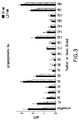
- FIGURE 3 the impact on knockdown of the 2'-O-benzyl-triazole inosine chemical modification was systematically evaluated along positions 1 through 19 of the guide strand of an siRNA targeting mRNA Luc(80).
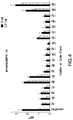
- FIGURE 4 the impact of the 2'-O-phenylthiomethyl-triazole inosine chemical modifications were systematically evaluated along positions 1 through 19 of the guide strand of an siRNA targeting mRNA Luc(80).
- FIGURE 5 the impact on duration of knockdown activity of the 2'-O-benzyl-triazole inosine chemical modification was systematically evaluated along positions 1 through 19 of the guide strand of an siRNA targeting mRNA Luc(80).
- FIGURE 6 the impact on duration of knockdown activity of the 2'-O-phenylthiomethyl inosine chemical modification was systematically evaluated along positions 1 through 19 of the guide strand of an siRNA targeting mRNA Luc(80).
- the liver targeting compound N-acetyl-galactosamine can be introduced as a chemical modification that may help with specific cell targeting, cellular uptake and delivery of RNA.
- poly(ethylene)glycol amines can be introduced to improve solubility properties, cellular uptake, immune stealth, reduce metabolic clearance and delivery of RNA.
- the "click" reaction can be utilized to introduce multiple chemical modifications in one synthetic operation.
- the click reaction was performed to introduce three units of protected N -acetylgalactosamine on RNA. This may lead to improved physical properties towards solubility, cellular uptake, and delivery of siRNA.
Landscapes
- Chemical & Material Sciences (AREA)
- Organic Chemistry (AREA)
- Life Sciences & Earth Sciences (AREA)
- Health & Medical Sciences (AREA)
- Engineering & Computer Science (AREA)
- Genetics & Genomics (AREA)
- Molecular Biology (AREA)
- Biomedical Technology (AREA)
- Biotechnology (AREA)
- Biochemistry (AREA)
- Zoology (AREA)
- Bioinformatics & Cheminformatics (AREA)
- General Engineering & Computer Science (AREA)
- Wood Science & Technology (AREA)
- General Health & Medical Sciences (AREA)
- Plant Pathology (AREA)
- Microbiology (AREA)
- Physics & Mathematics (AREA)
- Biophysics (AREA)
- Virology (AREA)
- Pharmaceuticals Containing Other Organic And Inorganic Compounds (AREA)
- Saccharide Compounds (AREA)
- Organic Low-Molecular-Weight Compounds And Preparation Thereof (AREA)
- Measuring Or Testing Involving Enzymes Or Micro-Organisms (AREA)
Description
- RNA interference (RNAi) is an evolutionarily conserved cellular mechanism of post-transcriptional gene silencing found in fungi, plants and animals that uses small RNA molecules to inhibit gene expression in a sequence-specific manner. The RNAi machinery can be harnessed to destruct any mRNA of a known sequence. This allows for suppression (knockdown) of any gene from which it was generated and consequently preventing the synthesis of the target protein. Smaller siRNA duplexes introduced exogenously were found to be equally effective triggers of RNAi (Zamore, P. D., Tuschl, T., Sharp, P. A., Bartel, D. P. Cell 2000, 101, 25-33). Synthetic RNA duplexes can be used to modulate therapeutically relevant biochemical pathways, including ones which are not accessible through traditional small molecule control.
- Chemical modification of RNA leads to improved physical and biological properties such as nuclease stability (Damha et al Drug Discovery Today 2008, 13(19/20), 842-855), reduced immune stimulation (Sioud TRENDS in Molecular Medicine 2006, 12(4), 167-176), enhanced binding (Koller, E. et al Nucl. Acids Res. 2006, 34, 4467-4476), enhanced lipophilic character to improve cellular uptake and delivery to the cytoplasm.
- Chemical modifications of RNA have relied heavily on work-intensive, cumbersome, multi-step syntheses of structurally novel nucleoside analogues and their corresponding phosphoramidites prior to RNA assembly. In particular, a major emphasis has been placed on chemical modification of the 2'-position of nucleosides. A rigorous approach to structure-activity-relationship (SAR) studies of chemical modifications will obviously require synthesis and evaluation of all four canonical ribonucleosides [adenosine (A), cytidine (C), uridine (U), guanosine (G)]. Furthermore, some chemical modifications bear sensitive functional groups that may be incompatible with state-of-the-art automated synthesis of RNA as well as subsequent downstream cleavage-deprotection steps. These attributes have made chemical modification of RNA prior to synthesis rather low-throughput and limited in scope.
- Post-synthetic chemical modifications of RNA have centered for the most part on simple conjugation chemistry. Conjugation has largely been performed on either the 3' or the 5'-end of the RNA via alkylamine and disulfide linkers. These modifications have allowed conjugation of RNA to various compounds such as cholesterol, fatty acids, poly(ethylene)glycols, various delivery vehicles and targeting agents such as poly(amines), peptides, peptidomimetics, and carbohydrates.
- This invention relates to the post-synthetic chemical modification of RNA at the 2'-position on the ribose ring via a copper catalyzed Huisgen cycloaddition ("click" chemistry: Kolb, Sharpless Drug Discovery Today 2003, 8, 1128). The invention 1) avoids complex, tedious multi-step syntheses of each desired modified ribonucleoside; 2) allows diverse chemical modifications using high-fidelity chemistry that is completely orthogonal to commonly used alkylamino, carboxylate and disulfide linker reactivities; 3) allows introduction of functional groups that are incompatible with modem automated solid-phase synthesis of RNA and subsequent cleavage-deprotection steps; 4) allows introduction of functional groups useful as targeting ligands; and 5) enables high-throughput structure-activity relationship studies on chemically modified RNA in 96-well format.
-
-
FIGURE 1 . Systematic evaluation of the impact on knockdown of the 2'-O-benzyl-triazole inosine chemical modification alongpositions 1 through 19 of the guide strand of a SSB(291) siRNA. -
FIGURE 2 . Systematic evaluation of the impact on knockdown of the 2'-O-phenylthiomethyl-triazole inosine chemical modification alongpositions 1 through 19 of the guide strand of a SSB(291) siRNA. -
FIGURE 3 . Systematic evaluation of the impact on knockdown of the 2'-O-benzyl-triazole inosine chemical modification was systematically evaluated alongpositions 1 through 19 of the guide strand of a Luc(80) siRNA. -
FIGURE 4 . Systematic evaluation of the impact on knockdown of the 2'-O-phenylthiomethyl-triazole inosine chemical modification was systematically evaluated alongpositions 1 through 19 of the guide strand of a Luc(80) siRNA. -
FIGURE 5 . Duration of knockdown activity of the 2'-O-benzyl-triazole inosine chemical modification was systematically evaluated alongpositions 1 through 19 of the guide strand of a Luc(80) siRNA. -
FIGURE 6 . Duration of knockdown activity of the 2'-O-phenylthiomethyl inosine chemical modification was systematically evaluated alongpositions 1 through 19 of the guide strand of a Luc(80) siRNA. -
FIGURE 7 . Introduction of N-acetyl-galactosamine as chemical modification. -
FIGURE 8 . Introduction of poly(ethylene)glycol amine in SSB(291) RNA. -
FIGURE 9 . Multi-click for introduction of multiple N-acetylgalactosamine chemical modifications in one synthetic operation. - This invention relates to the post-synthetic chemical modification of RNA at the 2'-postion on the ribose ring via a copper catalyzed Huisgen cycloaddition ("click" chemistry: Kolb, Sharpless Drug Discovery Today 2003, 8, 1128). The invention 1) avoids complex, tedious multi-step syntheses of each desired modified ribonucleoside; 2) allows diverse chemical modifications using high-fidelity chemistry that is completely orthogonal to commonly used alkylamino, carboxylate and disulfide linker reactivities; 3) allows introduction of functional groups that are incompatible with modern automated solid-phase synthesis of RNA and subsequent cleavage-deprotection steps; 4) allows introduction of functional groups useful as targeting ligands; and 5) enables high-throughput structure-activity relationship studies on chemically modified RNA in 96-well format.
- Methods for the synthesis of nucleotide derivatives wherein molecules of interest are grafted on the oligonucleotide with the help of a "click chemistry" reaction between an azide function on the molecule of interest and an alkyne function on the oligonucleotide are demonstrated in
US 2009/0124571 . This work discloses molecules such as carbohydrates, peptides, lipids, oligonucleotides, biotin, ferrocenyl compounds and fluorescent tags which are grafted onto oligonucleotides utilizing alkyne phosphoester derivatives of the oligonucleotides to make the 1,3-cycloaddition with an azide-substituted molecule of interest. - Methods for forming azido-modified nucleic acid conjugates of reporter molecules, carrier molecules or solid support utilizing "click chemistry" are disclosed in
US 2008/0050731 . - Synthesis of modified RNA and DNA utilizing an alkyne handle on a base and subsequent "click chemistry" is disclosed in
WO 2008/052775 and inCN 101550175 . - Recent reviews regarding "click chemistry" and oligonucleotide synthesis are covered by Gramlich et al. Angew. Chem. Int. Ed. 2008, 47, 8350-8358; Amblard et al. Chem. Rev. 2009, 209, 4207-4220.
- Thus the prior art discloses the use of "click chemistry" to generate modified oligonucleotides wherein the alkyne functional group is on the phosphate backbone or the base in DNA and RNA molecules or the alkyne functional group is on the ribose of DNA molecules. Typically, the modification is for labeling purposes.
- The use of "click chemistry" to generate 2'-modified RNA wherein the alkyne functional group is on the ribose is not known. There are considerable differences in the physico-chemical properties of RNA and DNA. For example, it is well recognized that RNA is much less stable than DNA towards hydrolysis. Furthermore, RNA can undergo auto-catalytic cleavage via intramolecular cyclization of the 2'-position onto the 3'-phosphodiester. Modification of the 2'-position is critical for RNA stability and therapeutic applicability.
-


- The current invention relates to chemical modification of RNA at the 2'-position of the ribose ring based on the 1,3-dipolar cycloaddition (Huisgen reaction) between alkynes and azides. The 1,3-dipolar cycloaddition (Huisgen reaction) between alkynes and azides is known. (Tornøe, Christensen, Meldal J. Org. Chem. 2002, 67, 3057; Rostovstev, Green, Fokin, Sharpless Angew. Chem. Int. Ed. 2002, 41, 2596).
- In an embodiment, the invention provides a process for introducing 2'-modifications into RNA, said process comprises a) obtaining RNA with an alkyne functional group at the 2'-position on at least one ribose ring; b) creating a solution of RNA in a solvent; and c) adding an organic azide and a metal catalyst to the solution to form a reaction and creating a 2'-modified RNA.
- In an embodiment, the process is conducted in high-throughput format.
- In an embodiment, the step (a) RNA may be purchased or synthesized.
- In an embodiment, the step (b) solvent is selected from aqueous buffer solutions (including phosphate buffers), aqueous DMSO, CH3CN, DMF, DMAc, NMP and a suitable ionic liquid.
- In an embodiment, the step (b) solvent is aqueous DMSO.
- In an embodiment, the step (c) metal catalyst is selected from copper and ruthenium.
- In an embodiment, the step (c) metal catalyst is copper.
- In an embodiment, the step (c) metal catalyst is copper with a suitable ligand to stabilize the Cu(I) oxidation state.
- In an embodiment, the step (c) reaction is performed at temperatures between -20-300 °C for 0 to 18 h.
- In an embodiment, the step (c) reaction is performed at temperatures between 5-120 °C for 0.5 to 18 h.
- In an embodiment, the step (c) reaction is performed at temperatures between 20-100 °C for 0.5 to 18 h.
- In an embodiment, the step (c) reaction is performed at temperatures between 60-90 °C for 0.5 to 18 h.
- In an embodiment, the step (c) reaction is performed at temperatures between 65-80 °C for 0.5 to 18 h.
- In another embodiment, the invention provides a process for introducing 2'-modifications into RNA, said process comprises a) obtaining RNA with an alkyne functional group at the 2'-position on at least one ribose ring of an internal nucleotide; b) creating a solution of RNA in a solvent; and c) adding an organic azide and a metal catalyst to the solution to form a reaction and creating a 2'-modified RNA.
- In an embodiment, the process is conducted in high-throughput format.
- In an embodiment, the step (a) RNA may be purchased or synthesized.
- In an embodiment, the step (b) solvent is selected from aqueous buffer solutions (including phosphate buffers), aqueous DMSO, CH3CN, DMF, DMAc, NMP and a suitable ionic liquid.
- In an embodiment, the step (b) solvent is aqueous DMSO.
- In an embodiment, the step (c) metal catalyst is selected from copper and ruthenium.
- In an embodiment, the step (c) metal catalyst is copper.
- In an embodiment, the step (c) metal catalyst is copper with a suitable ligand to stabilize the Cu(I) oxidation state.
- In an embodiment, the step (c) reaction is performed at temperatures between -20-300 °C for 0 to 18 h.
- In an embodiment, the step (c) reaction is performed at temperatures between 5-120 °C for 0.5 to 18 h.
- In an embodiment, the step (c) reaction is performed at temperatures between 20-100 °C for 0.5 to 18 h.
- In an embodiment, the step (c) reaction is performed at temperatures between 60-90 °C for 0.5 to 18 h.
- In an embodiment, the step (c) reaction is performed at temperatures between 65-80 °C for 0.5 to 18 h.
- In another embodiment, the invention provides a process for introducing 2'-modifications into RNA, said process comprises a) obtaining RNA with an alkyne functional group at the 2'-position on at least one ribose ring of an internal nucleotide; b) creating a solution of RNA in a solvent; c) adding an organic azide and a metal catalyst to the solution to form a reaction and creating a 2'-modified RNA; and d) purifying the 2'-modified RNA.
- In an embodiment, the step (a) RNA may be purchased or synthesized.
- In an embodiment, the step (c) solvent is selected from aqueous buffer solutions (including phosphate buffers), aqueous DMSO, CH3CN, DMF, DMAc, NMP and a suitable ionic liquid.
- In an embodiment, the step (c) solvent is aqueous DMSO.
- In an embodiment, the step (c) metal catalyst is selected from copper and ruthenium.
- In an embodiment, the step (c) metal catalyst is copper.
- In an embodiment, the step (c) metal catalyst is copper with a suitable ligand to stabilize Cu(I) oxidation state.
- In an embodiment, the step (c) reaction is performed at temperatures between -20-300 °C for 0 to 18 h.
- In an embodiment, the step (c) reaction is performed at temperatures between 5-120 °C for 0.5 to 18 h.
- In an embodiment, the step (c) reaction is performed at temperatures between 20-100 °C for 0.5 to 18 h.
- In an embodiment, the step (c) reaction is performed at temperatures between 60-90 °C for 0.5 to 18 h.
- In an embodiment, the step (c) reaction is performed at temperatures between 65-80 °C for 0.5 to 18 h.
- In an embodiment, the step (d) purification is performed in high-throughput format on 96-well C18 cartridges (solid-phase extraction) or strong-anion-exchange-HPLC or reverse-phase HPLC or poly(acrylamide) gel electrophoresis (PAGE) or size-exclusion chromatography.
- In another embodiment, the invention provides a process for introducing 2'-modifications into RNA, said process comprises a) obtaining RNA with an alkyne functional group at the 2'-position on at least one ribose ring of an internal nucleotide; b) creating a solution of RNA in a solvent; c) adding an organic azide and a metal catalyst to the solution to form a reaction and creating a 2'-modified RNA; d) cooling the solution and adding a fluoride source; e) heating the solution; f) cooling the solution and adding a diluent; and g) purifying the 2'-modified RNA.
- In an embodiment, the step (a) RNA may be purchased or synthesized.
- In an embodiment, the step (c) solvent is selected from aqueous buffer solutions (including phosphate buffers), aqueous DMSO, CH3CN, DMF, DMAc, NMP and a suitable ionic liquid.
- In an embodiment, the step (c) solvent is aqueous DMSO.
- In an embodiment, the step (c) metal catalyst is selected from copper and ruthenium.
- In an embodiment, the step (c) metal catalyst is copper.
- In an embodiment, the step (c) metal catalyst is copper with a suitable ligand to stabilize Cu(I) oxidation state.
- In an embodiment, the step (c) reaction is performed at temperatures between -20-300 °C for 0 to 18 h.
- In an embodiment, the step (c) reaction is performed at temperatures between 5-120 °C for 0.5 to 18 h.
- In an embodiment, the step (c) reaction is performed at temperatures between 20-100 °C for 0.5 to 18 h.
- In an embodiment, the step (c) reaction is performed at temperatures between 60-90 °C for 0.5 to 18h.
- In an embodiment, the step (c) reaction is performed at temperatures between 65-80°C for 0.5 to 18 h.
- In an embodiment, the step (e) fluoride source is Et3N·3HF, tetrabutylammonium fluoride, potassium fluoride and ammonium fluoride.
- In an embodiment, the step (e) fluoride source is ammonium fluoride.
- In an embodiment, the step (f) diluent is NaCl.
- In an embodiment, the step (g) purification is performed in high-throughput format on 96-well C18 cartridges (solid-phase extraction) or strong-anion-exchange-HPLC or reverse-phase HPLC or poly(acrylamide) gel electrophoresis (PAGE) or size-exclusion chromatography.
- In another embodiment, the instant invention also discloses a method for attaching targeting ligands to RNA utilizing the process described herein.
- In another embodiment, the instant invention further discloses a method for attaching targeting ligands to internal nucleotides in RNA utilizing the process described herein.
- In an embodiment, the invention provides a RNA with an alkyne functional group at the 2'-position on one or more ribose rings.
- In another embodiment, the invention provides a RNA with an alkyne functional group at the 2'-position on two or more ribose rings.
- In another embodiment, the invention provides a RNA with an alkyne functional group at the 2'-position on three or more ribose rings.
- In another embodiment, the invention provides a RNA with an alkyne functional group at the 2'-position on four or more ribose rings.
- In another embodiment, the invention provides a RNA with an alkyne functional group at the 2'-position on five or more ribose rings.
- In another embodiment, the invention provides a RNA with an alkyne functional group at the 2'-position on six or more ribose rings.
- In another embodiment, the invention provides a RNA with an alkyne functional group at the 2'-position on seven or more ribose rings.
- In another embodiment, the invention provides a RNA with an alkyne functional group at the 2'-position on eight or more ribose rings.
- In another embodiment, the invention provides a RNA with an alkyne functional group at the 2'-position on nine or more ribose rings.
- In another embodiment, the invention provides a RNA with an alkyne functional group at the 2'-position on ten or more ribose rings.
- In an embodiment, the invention provides a RNA with an alkyne functional group at the 2'-position on one or more ribose rings excluding the external 5' and 3' ribose rings.
- In another embodiment, the invention provides a RNA with an alkyne functional group at the 2'-position on two or more ribose rings excluding the external 5' and 3' ribose rings.
- In another embodiment, the invention provides a RNA with an alkyne functional group at the 2'-position on three or more ribose rings excluding the external 5' and 3' ribose rings.
- In another embodiment, the invention provides a RNA with an alkyne functional group at the 2'-position on four or more ribose rings excluding the external 5' and 3' ribose rings.
- In another embodiment, the invention provides a RNA with an alkyne functional group at the 2'-position on five or more ribose rings excluding the external 5' and 3' ribose rings.
- In another embodiment, the invention provides a RNA with an alkyne functional group at the 2'-position on six or more ribose rings excluding the external 5' and 3' ribose rings.
- In another embodiment, the invention provides a RNA with an alkyne functional group at the 2'-position on seven or more ribose rings excluding the external 5' and 3' ribose rings.
- In another embodiment, the invention provides a RNA with an alkyne functional group at the 2'-position on eight or more ribose rings excluding the external 5' and 3' ribose rings.
- In another embodiment, the invention provides a RNA with an alkyne functional group at the 2'-position on nine or more ribose rings excluding the external 5' and 3' ribose rings.
- In another embodiment, the invention provides a RNA with an alkyne functional group at the 2'-position on ten or more ribose rings excluding the external 5' and 3' ribose rings.
- In an embodiment, the invention provides a miRNA with an alkyne functional group at the 2'-position on one or more ribose rings.
- In another embodiment, the invention provides a miRNA with an alkyne functional group at the 2'-position on two or more ribose rings.
- In another embodiment, the invention provides a miRNA with an alkyne functional group at the 2'-position on three or more ribose rings.
- In another embodiment, the invention provides a miRNA with an alkyne functional group at the 2'-position on four or more ribose rings.
- In another embodiment, the invention provides a miRNA with an alkyne functional group at the 2'-position on five or more ribose rings.
- In another embodiment, the invention provides a miRNA with an alkyne functional group at the 2'-position on six or more ribose rings.
- In another embodiment, the invention provides a miRNA with an alkyne functional group at the 2'-position on seven or more ribose rings.
- In another embodiment, the invention provides a miRNA with an alkyne functional group at the 2'-position on eight or more ribose rings.
- In another embodiment, the invention provides a miRNA with an alkyne functional group at the 2'-position on nine or more ribose rings.
- In another embodiment, the invention provides a miRNA with an alkyne functional group at the 2'-position on ten or more ribose rings.
- In an embodiment, the invention provides a miRNA with an alkyne functional group at the 2'-position on one or more ribose rings excluding the external 5' and 3' ribose rings.
- In another embodiment, the invention provides a miRNA with an alkyne functional group at the 2'-position on two or more ribose rings excluding the external 5' and 3' ribose rings.
- In another embodiment, the invention provides a miRNA with an alkyne functional group at the 2'-position on three or more ribose rings excluding the external 5' and 3' ribose rings.
- In another embodiment, the invention provides a miRNA with an alkyne functional group at the 2'-position on four or more ribose rings excluding the external 5' and 3' ribose rings.
- In another embodiment, the invention provides a miRNA with an alkyne functional group at the 2'-position on five or more ribose rings excluding the external 5' and 3' ribose rings.
- In another embodiment, the invention provides a miRNA with an alkyne functional group at the 2'-position on six or more ribose rings excluding the external 5' and 3' ribose rings.
- In another embodiment, the invention provides a miRNA with an alkyne functional group at the 2'-position on seven or more ribose rings excluding the external 5' and 3' ribose rings.
- In another embodiment, the invention provides a miRNA with an alkyne functional group at the 2'-position on eight or more ribose rings excluding the external 5' and 3' ribose rings.
- In another embodiment, the invention provides a miRNA with an alkyne functional group at the 2'-position on nine or more ribose rings excluding the external 5' and 3' ribose rings.
- In another embodiment, the invention provides a miRNA with an alkyne functional group at the 2'-position on ten or more ribose rings excluding the external 5' and 3' ribose rings.
- In an embodiment, the invention provides a siRNA with an alkyne functional group at the 2'-position on one or more ribose rings.
- In another embodiment, the invention provides a siRNA with an alkyne functional group at the 2'-position on two or more ribose rings.
- In another embodiment, the invention provides a siRNA with an alkyne functional group at the 2'-position on three or more ribose rings.
- In another embodiment, the invention provides a siRNA with an alkyne functional group at the 2'-position on four or more ribose rings.
- In another embodiment, the invention provides a siRNA with an alkyne functional group at the 2'-position on five or more ribose rings.
- In another embodiment, the invention provides a siRNA with an alkyne functional group at the 2'-position on six or more ribose rings.
- In another embodiment, the invention provides a siRNA with an alkyne functional group at the 2'-position on seven or more ribose rings.
- In another embodiment, the invention provides a siRNA with an alkyne functional group at the 2'-position on eight or more ribose rings.
- In another embodiment, the invention provides a siRNA with an alkyne functional group at the 2'-position on nine or more ribose rings.
- In another embodiment, the invention provides a siRNA with an alkyne functional group at the 2'-position on ten or more ribose rings.
- In an embodiment, the invention provides a siRNA with an alkyne functional group at the 2'-position on one or more ribose rings excluding the external 5' and 3' ribose rings.
- In another embodiment, the invention provides a siRNA with an alkyne functional group at the 2'-position on two or more ribose rings excluding the external 5' and 3' ribose rings.
- In another embodiment, the invention provides a siRNA with an alkyne functional group at the 2'-position on three or more ribose rings excluding the external 5' and 3' ribose rings.
- In another embodiment, the invention provides a siRNA with an alkyne functional group at the 2'-position on four or more ribose rings excluding the external 5' and 3' ribose rings.
- In another embodiment, the invention provides a siRNA with an alkyne functional group at the 2'-position on five or more ribose rings excluding the external 5' and 3' ribose rings.
- In another embodiment, the invention provides a siRNA with an alkyne functional group at the 2'-position on six or more ribose rings excluding the external 5' and 3' ribose rings.
- In another embodiment, the invention provides a siRNA with an alkyne functional group at the 2'-position on seven or more ribose rings excluding the external 5' and 3' ribose rings.
- In another embodiment, the invention provides a siRNA with an alkyne functional group at the 2'-position on eight or more ribose rings excluding the external 5' and 3' ribose rings.
- In another embodiment, the invention provides a siRNA with an alkyne functional group at the 2'-position on nine or more ribose rings excluding the external 5' and 3' ribose rings.
- In another embodiment, the invention provides a siRNA with an alkyne functional group at the 2'-position on ten or more ribose rings excluding the external 5' and 3' ribose rings.
- In an embodiment, the invention provides a siRNA with an alkyne functional group at the 2'-position on one ribose ring.
- In another embodiment, the invention provides a siRNA with an alkyne functional group at the 2'-position on two ribose rings.
- In another embodiment, the invention provides a siRNA with an alkyne functional group at the 2'-position on three ribose rings.
- In another embodiment, the invention provides a siRNA with an alkyne functional group at the 2'-position on four ribose rings.
- In another embodiment, the invention provides a siRNA with an alkyne functional group at the 2'-position on five ribose rings.
- In another embodiment, the invention provides a siRNA with an alkyne functional group at the 2'-position on six ribose rings.
- In another embodiment, the invention provides a siRNA with an alkyne functional group at the 2'-position on seven ribose rings.
- In another embodiment, the invention provides a siRNA with an alkyne functional group at the 2'-position on eight ribose rings.
- In another embodiment, the invention provides a siRNA with an alkyne functional group at the 2'-position on nine ribose rings.
- In another embodiment, the invention provides a siRNA with an alkyne functional group at the 2'-position on ten ribose rings.
- In an embodiment, the invention provides a siRNA with an alkyne functional group at the 2'-position on one ribose ring excluding the external 5' and 3' ribose rings.
- In another embodiment, the invention provides a siRNA with an alkyne functional group at the 2'-position on two ribose rings excluding the external 5' and 3' ribose rings.
- In another embodiment, the invention provides a siRNA with an alkyne functional group at the 2'-position on three ribose rings excluding the external 5' and 3' ribose rings.
- In another embodiment, the invention provides a siRNA with an alkyne functional group at the 2'-position on four ribose rings excluding the external 5' and 3' ribose rings.
- In another embodiment, the invention provides a siRNA with an alkyne functional group at the 2'-position on five ribose rings excluding the external 5' and 3' ribose rings.
- In another embodiment, the invention provides a siRNA with an alkyne functional group at the 2'-position on six ribose rings excluding the external 5' and 3' ribose rings.
- In another embodiment, the invention provides a siRNA with an alkyne functional group at the 2'-position on seven ribose rings excluding the external 5' and 3' ribose rings.
- In another embodiment, the invention provides a siRNA with an alkyne functional group at the 2'-position on eight ribose rings excluding the external 5' and 3' ribose rings.
- In another embodiment, the invention provides a siRNA with an alkyne functional group at the 2'-position on nine ribose rings excluding the external 5' and 3' ribose rings.
- In another embodiment, the invention provides a siRNA with an alkyne functional group at the 2'-position on ten ribose rings excluding the external 5' and 3' ribose rings.
- In an embodiment, the invention provides the guide strand of the siRNA with an alkyne functional group at the 2'-position on one ribose ring.
- In another embodiment, the invention provides the guide strand of the siRNA with an alkyne functional group at the 2'-position on two ribose rings.
- In another embodiment, the invention provides the guide strand of the siRNA with an alkyne functional group at the 2'-position on three ribose rings.
- In another embodiment, the invention provides the guide strand of the siRNA with an alkyne functional group at the 2'-position on four ribose rings.
- In another embodiment, the invention provides the guide strand of the siRNA with an alkyne functional group at the 2'-position on five ribose rings.
- In another embodiment, the invention provides the guide strand of the siRNA with an alkyne functional group at the 2'-position on six ribose rings.
- In another embodiment, the invention provides the guide strand of the siRNA with an alkyne functional group at the 2'-position on seven ribose rings.
- In another embodiment, the invention provides the guide strand of the siRNA with an alkyne functional group at the 2'-position on eight ribose rings.
- In another embodiment, the invention provides the guide strand of the siRNA with an alkyne functional group at the 2'-position on nine ribose rings.
- In another embodiment, the invention provides the guide strand of the siRNA with an alkyne functional group at the 2'-position on ten ribose rings.
- In an embodiment, the invention provides the guide strand of the siRNA with an alkyne functional group at the 2'-position on one ribose ring excluding the external 5' and 3' ribose rings.
- In another embodiment, the invention provides the guide strand of the siRNA with an alkyne functional group at the 2'-position on two ribose rings excluding the external 5' and 3' ribose rings.
- In another embodiment, the invention provides the guide strand of the siRNA with an alkyne functional group at the 2'-position on three ribose rings excluding the external 5' and 3' ribose rings.
- In another embodiment, the invention provides the guide strand of the siRNA with an alkyne functional group at the 2'-position on four ribose rings excluding the external 5' and 3' ribose rings.
- In another embodiment, the invention provides the guide strand of the siRNA with an alkyne functional group at the 2'-position on five ribose rings excluding the external 5' and 3' ribose rings.
- In another embodiment, the invention provides the guide strand of the siRNA with an alkyne functional group at the 2'-position on six ribose rings excluding the external 5' and 3' ribose rings.
- In another embodiment, the invention provides the guide strand of the siRNA with an alkyne functional group at the 2'-position on seven ribose rings excluding the external 5' and 3' ribose rings.
- In another embodiment, the invention provides the guide strand of the siRNA with an alkyne functional group at the 2'-position on eight ribose rings excluding the external 5' and 3' ribose rings.
- In another embodiment, the invention provides the guide strand of the siRNA with an alkyne functional group at the 2'-position on nine ribose rings excluding the external 5' and 3' ribose rings.
- In another embodiment, the invention provides the guide strand of the siRNA with an alkyne functional group at the 2'-position on ten ribose rings excluding the external 5' and 3' ribose rings.
- In an embodiment, the invention provides the passenger strand of the siRNA with an alkyne functional group at the 2'-position on one ribose ring.
- In another embodiment, the invention provides the passenger strand of the siRNA with an alkyne functional group at the 2'-position on two ribose rings.
- In another embodiment, the invention provides the passenger strand of the siRNA with an alkyne functional group at the 2'-position on three ribose rings.
- In another embodiment, the invention provides the passenger strand of the siRNA with an alkyne functional group at the 2'-position on four ribose rings.
- In another embodiment, the invention provides the passenger strand of the siRNA with an alkyne functional group at the 2'-position on five ribose rings.
- In another embodiment, the invention provides the passenger strand of the siRNA with an alkyne functional group at the 2'-position on six ribose rings.
- In another embodiment, the invention provides the passenger strand of the siRNA with an alkyne functional group at the 2'-position on seven ribose rings.
- In another embodiment, the invention provides the passenger strand of the siRNA with an alkyne functional group at the 2'-position on eight ribose rings.
- In another embodiment, the invention provides the passenger strand of the siRNA with an alkyne functional group at the 2'-position on nine ribose rings.
- In another embodiment, the invention provides the passenger strand of the siRNA with an alkyne functional group at the 2'-position on ten ribose rings.
- In an embodiment, the invention provides the passenger strand of the siRNA with an alkyne functional group at the 2'-position on one ribose ring excluding the external 5' and 3' ribose rings.
- In another embodiment, the invention provides the passenger strand of the siRNA with an alkyne functional group at the 2'-position on two ribose rings excluding the external 5' and 3' ribose rings.
- In another embodiment, the invention provides the passenger strand of the siRNA with an alkyne functional group at the 2'-position on three ribose rings excluding the external 5' and 3' ribose rings.
- In another embodiment, the invention provides the passenger strand of the siRNA with an alkyne functional group at the 2'-position on four ribose rings excluding the external 5' and 3' ribose rings.
- In another embodiment, the invention provides the passenger strand of the siRNA with an alkyne functional group at the 2'-position on five ribose rings excluding the external 5' and 3' ribose rings.
- In another embodiment, the invention provides the passenger strand of the siRNA with an alkyne functional group at the 2'-position on six ribose rings excluding the external 5' and 3' ribose rings.
- In another embodiment, the invention provides the passenger strand of the siRNA with an alkyne functional group at the 2'-position on seven ribose rings excluding the external 5' and 3' ribose rings.
- In another embodiment, the invention provides the passenger strand of the siRNA with an alkyne functional group at the 2'-position on eight ribose rings excluding the external 5' and 3' ribose rings.
- In another embodiment, the invention provides the passenger strand of the siRNA with an alkyne functional group at the 2'-position on nine ribose rings excluding the external 5' and 3' ribose rings.
- In another embodiment, the invention provides the passenger strand of the siRNA with an alkyne functional group at the 2'-position on ten ribose rings excluding the external 5' and 3' ribose rings.
- "2'-Modified RNA" means a RNA wherein at least one ribose ring is modified at the 2'-position.
- "Alkyne functional group" means any chemical compound containing an alkyne functional group. The preferred "alkyne functional group" is the propargyl moiety shown throughout this disclosure.
- "High-throughput format" means that several operations are run in parallel fashion such as for example in 96-well plate chemical synthesis, 96-well plate purification, 96-well plate chromatographic analysis and 96-well plate mass spectrometric analysis.
- "Internal nucleotide" means a nucleotide in an RNA molecule that is not at the 3'-or 5'-end. For example, the internal nucleotides in a 21mer siRNA occur at positions 2-20.
- "RNA" means a chemically modified or unmodified ribonucleic acid molecule (single stranded or double stranded) comprising at least 3 nucleotides, including but not limited to miRNA and siRNA. In another embodiment, "RNA" means miRNA. In another embodiment, "RNA" means siRNA. Chemical modifications include, for example, modifications to the base, ribose ring (excluding modifications to the 2'-position), and phosphate backbone. The base can be a canonical base (A, G, T and U) or a modified or universal base (including but not limited to inosine and nitroindole).
- "Organic azide" means any chemical compound containing the azide functional group.
- "Metal catalyst" means any chemical form of copper and ruthenium, including solid-supported variants. Examples of metal catalyst include CuBr, CuBT-Me2S, CuI, CuSO4 or CuOAc and a suitable reducing agent such as sodium ascorbate, Cu(CH3CN)4PF6, CpRuCl(PPh3)2, and Cp*RuCl(PPh3)2.
- "Ribose ring" means the ribose moiety in a ribonucleotide.
- "Targeting ligand" means a conjugate delivery moiety capable of delivering an oligonucleotide to a target cell of interest. Targeting ligands include, but are not limited to, lipids (cholesterol), sugars (NAG), proteins (transferrin), peptides, poly(ethylene)glycols and antibodies. See Juliano et al., Nucleic Acids Research, 2008, 1-14, doi:10.1093/nar/gkn342.
- The present invention provides a process for introducing chemical modifications into RNA at the 2'-position on the ribose ring. It is well known in the art that RNA are useful for therapeutic and research purposes.
- The synthesis of RNA is well known in the art.
- A suitable 2-O-propargyl nucleoside phosphoramidite is incorporated into RNA using modern techniques based on the phosphoramidite approach. The crude, solid-support bound protected oligonucleotide is then treated with aqueous methylamine to remove nucleobase and phosphate protecting groups. The crude product is then lyophilized to remove volatiles. The crude product is dissolved in DMSO:H2O, treated with a suitable organic azide and a copper catalyst. After aging an appropriate amount of time, the reaction mixture is treated with fluoride to remove the 2'-O-tert-butyldimethylsilyl protecting groups. The crude product is then purified to obtain the chemically modified RNA.

- Lyophilized crude RNA (∼50 nmol) containing at least one alkyne functional group (shown below) in 96-well format was dissolved in DMSO:water (75:25, 40 µL). Benzyl azide (1M in DMSO, 40 µL) was added, followed by a freshly prepared solution of CuBr·Me2S in DMSO (12 mM, 40 µL). The reaction block was sealed and heated at 65-80 °C overnight. The solution was cooled to room temperature and ammonium fluoride (100 µL, 5.4M in water) was added. The solution was heated at 65 °C for 1h, cooled to room temperature and diluted with 1M aqueous NaCl (800 µL). The crude product was purified on a C18 cartridge to afford the desired chemically modified benzyl-triazole-linked RNA as determined by HPLC and LC-MS analyses.

- Crude RNA (∼50 nmol) containing at least one alkyne functional group (shown below) was dissolved in DMSO:water (75:25, 40 µL). Azidomethyl phenyl sulfide (1M in DMSO, 40 µL) was added, followed by a freshly prepared solution of CuBr·Me2S in DMSO (12 mM, 40 µL). The reaction block was sealed and heated to 65-80 °C overnight. The solution was cooled to room temperature and ammonium fluoride (100 µL, 5.4M in water) was added. The solution was heated at 65 °C for 1h, cooled to room temperature and diluted with 1M aqueous NaCl (800 µL). The crude product was purified on a C18 cartridge to afford the desired chemically modified phenylthiomethyl-triazole- linked RNA as determined by HPLC and LC-MS analyses.

- Crude RNA (∼50 nmol) containing at least one alkyne functional group (shown below) was dissolved in DMSO:water (75:25, 40 µL). Ethyl azidoacetate (1M in DMSO, 40 µL) was added, followed by a freshly prepared solution of CuBr·Me2S in DMSO (12 mM, 40 µL). The reaction block was sealed and heated to 65-80 °C overnight. The solution was cooled to room temperature and ammonium fluoride (100 µL, 5.4M in water) was added. The solution was heated at 65 °C for 1h, cooled to room temperature and diluted with 1M aqueous NaCl (800 µL). The crude product was purified on a C18 cartridge to afford the desired chemically modified ethyl-carboxymethyl-1,4-triazole-linked RNA as determined by HPLC and LC-MS analyses.

- Crude RNA (∼50 nmol) containing at least one alkyne functional group (shown below) was dissolved in DMSO:water (75:25, 40 µL). Modified N-acetyl galactosamine azide (1M in DMSO, 40 µL) was added, followed by a freshly prepared solution of CuBr·Me2S in DMSO (12 mM, 40 µL). The reaction block was sealed and heated to 65-80 °C overnight. The solution was cooled to room temperature and ammonium fluoride (100 µL, 5.4M in water) was added. The solution was heated at 65 °C for 1h, cooled to room temperature and diluted with 1M aqueous NaCl (800 µL). The crude product was purified on a C18 cartridge to afford the desired chemically modified N-acetylgalactosamine-1,4-triazole-linked RNA as determined by HPLC and LC-MS analyses.

- Crude RNA (∼50 nmol) containing more than one alkyne functional group (shown below) was dissolved in DMSO:water (75:25, 40 µL). Modified N-acetylgalactosamine azide (1M in DMSO, 40 µL) was added, followed by a freshly prepared solution of CuBr·Me2S in DMSO (12 mM, 40 µL). The reaction block was sealed and heated to 65-80 °C overnight. The solution was cooled to room temperature and ammonium fluoride (100 µL), 5.4M in water) was added. The solution was heated at 65 °C for 1h, cooled to room temperature and diluted with 1M aqueous NaCl (800 µL). The crude product was purified on a C18 cartridge to afford the desired chemically modified N-acetylgalactosamine-1,4-triazole-linked RNA as determined by HPLC and LC-MS analyses.

- Crude RNA (50 nmol) containing at least one alkyne functional group (shown below) was dissolved in DMSO:water (75:25,40 uL). Benzyl azide (1M in DMSO, 40 uL) was added, followed by a freshly prepared solution of CuBr·Me2S in DMSO (12 mM, 40 uL). The reaction block was sealed and heated at 65-80 °C overnight. The solution was cooled to room temperature and ammonium fluoride (100 µL, 5.4M in water) was added. The solution was heated at 65 °C for 1h, cooled to room temperature and diluted with 1M aqueous NaCl (800 uL). The crude product was purified on a C18 cartridge to afford the desired chemically modified benzyl-1,4-triazole-linked RNA as determined by HPLC and LC-MS analyses.

- Crude RNA (50 nmol) containing at least one alkyne functional group (shown below) was dissolved in DMSO:water (75:25, 40 uL). 11-Azido-3,6,9-trioxaundecan-1-amine (1M in DMSO, 40 uL) was added, followed by a freshly prepared solution of CuBr·Me2S in DMSO (12 mM, 40 uL). The reaction block was sealed and heated at 65-80 °C overnight. The solution was cooled to room temperature and ammonium fluoride (100 µL, 5.4M in water) was added. The solution was heated at 65 °C for 1h, cooled to room temperature and diluted with 1M aqueous NaCl (800 uL). The crude product was purified on a C18 cartridge to afford the desired chemically modified amino-PEG-1,4-triazole-linked RNA as determined by HPLC and LC-MS analyses.
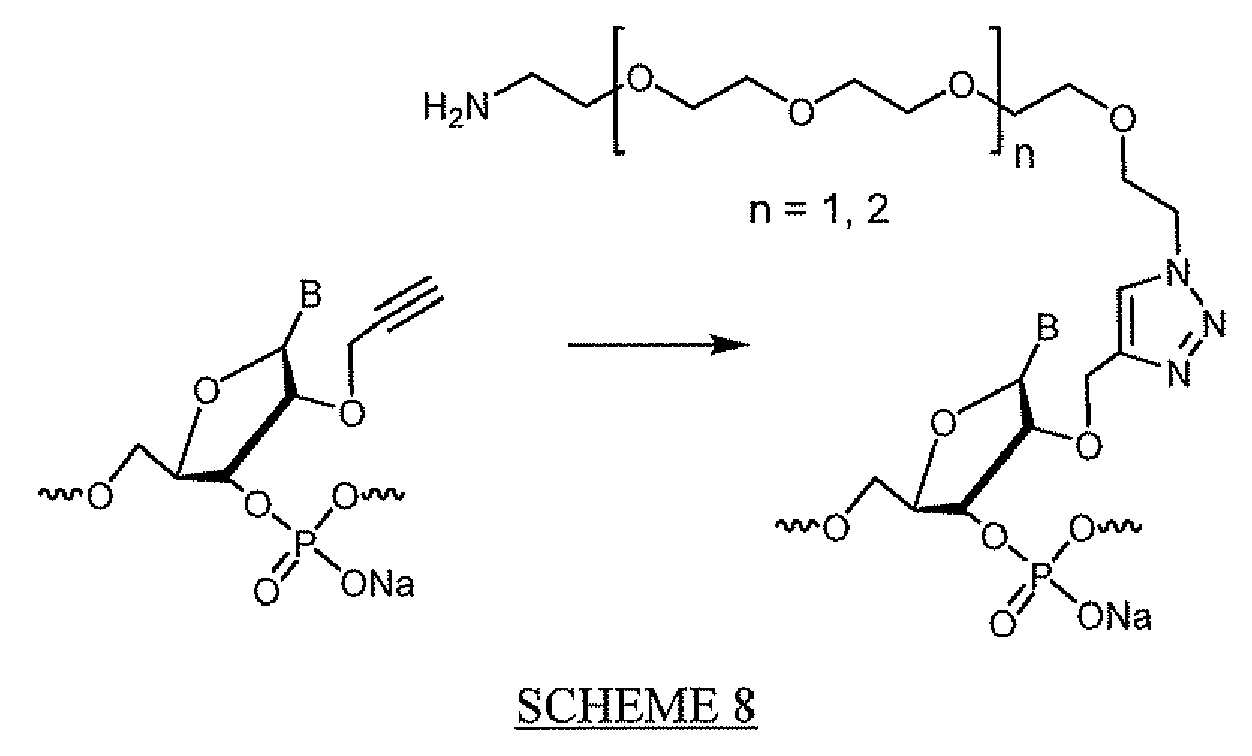
- Purified deprotected free RNA (8.6 mg, sequence = UUA CAU UAA (2'-propargylabasic)GU CUG UUG UdTdT) was dissolved in DMSO:water (75:25, 1 mL). The solution (75 µL was dispensed in wells containing stir bars. A bright blue-green solution (75 µL) of tris(1-(O-ethylcarboxymethyl)-1H-1,2,3-triazol-4-ylmethyl)amine ligand (50 mg) and CuBr (10 mg, 99.999%) in DMSO:water (75:25, 5 mL) was added. Phenylthiomethyl azide (5 µL) was added. The reaction block was sealed and agitated overnight at room temperature. The crude product was purified to afford the desired chemically modified phenylthiomethyl-1,4-triazole-linked RNA as determined by HPLC and LC-MS analyses.

- Purified deprotected free RNA (8.6 mg, sequence = UUA CAU UAA (2'-propargylabasic)GU CUG UUG UdTdT) was dissolved in DMSO:water (75:25, 1 mL). The solution (75 µL) was dispensed in wells containing stir bars. A bright blue-green solution (75 µL) of tris(1-(O-ethylcarboxymethyl)-1H-1,2,3-tuiazol-4-ylmethyl)amine ligand (50 mg) and CuBr (10 mg, 99.999%) in DMSO:water (75:25, 5 mL) was added. Benzyl azide (5 µL) was added. The reaction block was sealed and agitated overnight at room temperature. The crude product was purified to afford the desired chemically modified benzyl-1,4-triazole-linked RNA as determined by HPLC and LC-MS analyses.

- Purified deprotected free RNA (8.6 mg, sequence = UUA CAU UAA (2'-propargylabasic)GU CUG UUG UdTdT) was dissolved in DMSO:water (75:25, 1 mL). The solution (75 µL) was dispensed in wells containing stir bars. A bright blue-green solution (75 µL) of tris(1-(O-ethylcarboxymethyl)-1H-1,2,3-triazol-4-ylmethyl)amine ligand (50 mg) and CuBr (10 mg, 99.999%) in DMSO:water (75:25, 5 mL) was added. Ethyl azidoacetate (15 µL, 25-30%wt in EtOH) was added. The reaction block was sealed and agitated overnight at room temperature. The crude product was purified to afford the desired chemically modified ethyl carboxymethyl-1,4-triazole-linked RNA as determined by HPLC and LC-MS analyses.

-
Gene Position in RNA sequence Guide strand sequence (5'-3') SSB 291 UUACAUUAAAGUCUGUUGU Luc 80 UAUCUCUUCAUAGCCUUAU - Positions 1-19 of both strands were ribonucleotides, and the overhangs at positions 20 and 21 contained 2'-deoxyribonucleotide thymidines. This unmodified siRNA was the template for systematic evaluation of modified siRNAs containing a single modification at every position along the guide strand. In order to examine the effect of the chemical modifications for the SSB sequence, we synthesized the RNA oligomers with the first nucleotide, uridine (U), replaced with 2'-O-propargyl-inosine. Then, a second sequence, in which the second nucleoside (U) was replaced with 2'-O-propargyl-inosine was synthesized, keeping all other nucleotides unchanged. Altogether nineteen sequences were synthesized where the universal base replaced all the natural nucleosides in that sequence. This "modification walkthrough" is depicted in Table 1 for SSB(291). The desired chemical modification was then introduced into the assembled RNA by the methods described in
Schemes 6 and 7.Table 1 Entry Gene Position in mRNA sequence Guide strand sequence (5'-3') unmodified SSB 291 UUACAUUAAAGUCUGUUGU 1 SSB 291 XUACAUUAAAGUCUGUUGU 2 SSB 291 UXAXAUUAAAGUCUGUUGU 3 SSB 291 UUXCXUUAAAGUCUGUUGU 4 SSB 291 UUAXAUUAAAGUCUGUUGU 5 SSB 291 UUACXUUAAAGUCUGUUGU 6 SSB 291 UUACAXUAAAGUCUGUUGU 7 SSB 291 UUACAUXAAAGUCUGUUGU 8 SSB 291 UUACAUUXAAGUCUGUUGU 9 SSB 291 UUACAUUAXAGUCUGUUGU 10 SSB 291 UUACAUUAAXGUCUGUUGU 11 SSB 291 UUACAUUAAAXUCUGUUGU 12 SSB 291 UUACAUUAAAGXCUGUUGU 13 SSB 291 UUACAUUAAAGUXUGUUGU 14 SSB 291 UUACAUUAAAGUCXGUUGU 15 SSB 291 UUACAUUAAAGUCUXUUGU 16 SSB 291 UUACAUUAAAGUCUGXUGU 17 SSB 291 UUACAUUAAAGUCUGUXGU 18 SSB 291 UUACAUUAAAGUCUGUUXU 19 SSB 291 UUACAUUAAAGUCUGUUGX (X represents a universal base such as inosine)
SSB Knockdown - In a 96-well format, Hepa1-6 cells were transfected with 10 nM of either the unmodified, modified, or negative control siRNA using a commercial lipid transfection reagent. The target mRNA was assessed for degradation using standard Taqman procedures.
- Multiplex luciferase assay for in vitro duration study is modified from the manufacturer's instruction using HeLa-luc cell line. Briefly, the cell viability and the luciferease expression at the same well are determined by CellTiter-Fluor™ (Promega, Cat# G6082) and Bright-Glo™ (Promega Cat# E2620) sequentially.
- HeLa-luc cell line is a stable firefly luciferase reporter expression cell line. Bright-Glo™ luciferase assay system contains the stable substrate - luciferin and assay buffer. The luminescent reaction of luciferease and luciferin has high quantum yield and can be detected as luminescence intensity, which represents the luciferase expression level.
- Target siRNAs containing luciferase coding region is designed to be transfected into the HeLa-luc cells. Once the taget is effected, the luciferase expression is reduced accordingly, Therefore, the siRNA silencing efficacy can be determined by the relative luminecence intensity of treated cells.
- To reduce the variation caused by cell viability and cell plating process, the cell viability of the same treatment wells is measured using CellTiter-fluor kit. This assay measures the conserved and constitutive protease activity within live cells and therefore serves as a marker of cell viability, using a fluorogenic, cell-permeable peptide substrate (glycyl-phenylalanylaminofluorocoumarin; GF-AFC).
- Luciferase stable expressed HeLa-luc cell cells are plated in 96-well plates at density of 4,500 cells per well in 100 µL DMEM media without antibiotics 24 hours prior to transfection. siRNA transfection is performed using the RNAiMAX™ (Invitrogen). Briefly, 0.05 µM siRNA are mixed with Opti-MEMmedia and RNAiMAX and incubated at room temperature for 15 min. The mix is then added to the cells. The final siRNA concentration is 1 nM. Cell plates for all time points are transfected at same time with a medium change at 6 hours post-transfection into 100 µL of fresh completed DMEM (DMEM + 10% FBS + Pen/strep).
- In vitro duration is determined by the luciferase expression post-transfection at four time points:
day 1,day 2,day 5 andday 7. Addition medium changes are performed atday 2 andday 5 into 100 µL of fresh completed DMEM (DMEM + 10% FBS + Penn/strep). Luciferase levels are determined using the Bright-Glo Luminescence Assay (Promega) and measuring the wells on an Envison instrument (Perkin Elmer) according to manufacturer's instructions. - To reduce the variation caused by cell viability and cell plating process, the cell viability of the same treatment wells is measured using CellTiter-fluor kit (Promega) according to manufacturer's instructions. This assay measures the conserved and constitutive protease activity within live cells and therefore servers as a marker of cell viability, using a fluorogenic, cell-permeable peptide substrate (glycyl-phenylalanyl-aminofluorocoumarin; GF-AFC). The fluorescence was measured on the Envision using exciton filter at 405 nm and emission filter at 510 nm.
- The luciferase expression was normalized to cell viability. The log of this number was calculated to determine the luciferase protein that was degraded (knockdown). A non-targeting siRNA was subtracted from this value to account for non-specific background.
- The following Examples 1-6 were generated utilizing the Assays above and demonstrate the utility of the RNAs made by the methods described in the Schemes. As demonstrated, the RNAs made by the process of the invention are useful in high-throughput structure-activity relationship studies on chemically modified RNA in 96-well format.
- In
FIGURE 1 , the impact on knockdown of the 2'-O-benzyl-triazole inosine chemical modification was systematically evaluated alongpositions 1 through 19 of the guide strand of an siRNA targeting mRNA SSB(291). - In
FIGURE 2 , the impact of the 2'-O-phenylthiomethyl-triazole inosine chemical modification was systematically evaluated alongpositions 1 through 19 of the guide strand of an siRNA targeting mRNA SSB(291). - In
FIGURE 3 , the impact on knockdown of the 2'-O-benzyl-triazole inosine chemical modification was systematically evaluated alongpositions 1 through 19 of the guide strand of an siRNA targeting mRNA Luc(80). - In
FIGURE 4 , the impact of the 2'-O-phenylthiomethyl-triazole inosine chemical modifications were systematically evaluated alongpositions 1 through 19 of the guide strand of an siRNA targeting mRNA Luc(80). - In
FIGURE 5 , the impact on duration of knockdown activity of the 2'-O-benzyl-triazole inosine chemical modification was systematically evaluated alongpositions 1 through 19 of the guide strand of an siRNA targeting mRNA Luc(80). - In
FIGURE 6 , the impact on duration of knockdown activity of the 2'-O-phenylthiomethyl inosine chemical modification was systematically evaluated alongpositions 1 through 19 of the guide strand of an siRNA targeting mRNA Luc(80). - In
FIGURE 7 , the liver targeting compound N-acetyl-galactosamine (NAG) can be introduced as a chemical modification that may help with specific cell targeting, cellular uptake and delivery of RNA. - In
FIGURE 8 , poly(ethylene)glycol amines can be introduced to improve solubility properties, cellular uptake, immune stealth, reduce metabolic clearance and delivery of RNA. - In
FIGURE 9 , the "click" reaction can be utilized to introduce multiple chemical modifications in one synthetic operation. For example, the click reaction was performed to introduce three units of protected N-acetylgalactosamine on RNA. This may lead to improved physical properties towards solubility, cellular uptake, and delivery of siRNA.
Claims (10)
- A process for introducing 2'-modifications into RNA, said process comprises a) obtaining RNA with an alkyne functional group at the 2'-position on at least one ribose ring; b) creating a solution of RNA in a solvent; and c) adding an organic azide and a metal catalyst to the solution to form a reaction and creating a 2'-modified RNA.
- A process of claim 1 for introducing 2'-modifications into RNA, said process comprises a) obtaining RNA with an alkyne functional group at the 2'-position on at least one ribose ring of an internal nucleotide; b) creating a solution of RNA in a solvent; and c) adding an organic azide and a metal catalyst to the solution to form a reaction and creating a 2'-modified RNA.
- A process of claim 1 for introducing 2'-modifications into RNA, said process comprises a) obtaining RNA with an alkyne functional group at the 2'-position on at least one ribose ring of an internal nucleotide; b) creating a solution of RNA in a solvent; c) adding an organic azide and a metal catalyst to the solution to form a reaction and creating a 2'-modified RNA; and d) purifying the 2'-modified RNA.
- A process of claim 1 for introducing 2'-modifications into RNA, said process comprises a) obtaining RNA with an alkyne functional group at the 2'-position on at least one ribose ring of an internal nucleotide; b) creating a solution of RNA in a solvent; c) adding an organic azide and a metal catalyst to the solution to form a reaction and creating a 2'-modified RNA; d) cooling the solution and adding a fluoride source; e) heating the solution; f) cooling the solution and adding a diluent; and g) purifying the 2'-modified RNA.
- The process of claim 1 or 2, wherein the process is conducted in high-throughput format.
- The process of any previous claim, wherein the solvent of step (b) is selected from the group consisting of an aqueous buffer solution, aqueous DMSO, CH3CN, DMF, DMAc, NMP and a suitable ionic liquid.
- The process of any previous claim, wherein the metal catalyst of step (c) is selected from copper and ruthenium.
- The process of any previous claim, wherein the metal catalyst of step (c) is Cu(I) and a suitable ligand to stabilize the Cu(I) oxidation state.
- The process of any previous claim, wherein step (c) is performed at a temperature of between -20° C to 300° C for 0 to 18 hours.
- The process of any previous claim, wherein step (c) is performed at a temperature of between 20° C to 100° C for 0.5 to 18 hours.
Applications Claiming Priority (3)
| Application Number | Priority Date | Filing Date | Title |
|---|---|---|---|
| US29737710P | 2010-01-22 | 2010-01-22 | |
| US32590810P | 2010-04-20 | 2010-04-20 | |
| PCT/US2011/021629 WO2011090968A1 (en) | 2010-01-22 | 2011-01-19 | Post-synthetic chemical modification of rna at the 2'-position of the ribose ring via "click" chemistry |
Publications (3)
| Publication Number | Publication Date |
|---|---|
| EP2526113A1 EP2526113A1 (en) | 2012-11-28 |
| EP2526113A4 EP2526113A4 (en) | 2013-11-27 |
| EP2526113B1 true EP2526113B1 (en) | 2016-08-10 |
Family
ID=44307168
Family Applications (2)
| Application Number | Title | Priority Date | Filing Date |
|---|---|---|---|
| EP11735061A Withdrawn EP2525781A1 (en) | 2010-01-22 | 2011-01-19 | Novel cationic lipids for oligonucleotide delivery |
| EP11735064.5A Active EP2526113B1 (en) | 2010-01-22 | 2011-01-19 | Post-synthetic chemical modification of rna at the 2'-position of the ribose ring via "click" chemistry |
Family Applications Before (1)
| Application Number | Title | Priority Date | Filing Date |
|---|---|---|---|
| EP11735061A Withdrawn EP2525781A1 (en) | 2010-01-22 | 2011-01-19 | Novel cationic lipids for oligonucleotide delivery |
Country Status (3)
| Country | Link |
|---|---|
| US (4) | US9670487B2 (en) |
| EP (2) | EP2525781A1 (en) |
| WO (1) | WO2011090965A1 (en) |
Families Citing this family (240)
| Publication number | Priority date | Publication date | Assignee | Title |
|---|---|---|---|---|
| EP2525781A1 (en) * | 2010-01-22 | 2012-11-28 | Schering Corporation | Novel cationic lipids for oligonucleotide delivery |
| ES2745373T3 (en) | 2011-10-18 | 2020-03-02 | Dicerna Pharmaceuticals Inc | Cationic amine lipids and their use |
| US9579338B2 (en) | 2011-11-04 | 2017-02-28 | Nitto Denko Corporation | Method of producing lipid nanoparticles for drug delivery |
| ES2721325T3 (en) * | 2011-11-04 | 2019-07-31 | Nitto Denko Corp | Method for sterile production of lipid-nucleic acid particles |
| ES3065854T3 (en) | 2011-12-07 | 2026-05-08 | Alnylam Pharmaceuticals Inc | Biodegradable lipids for the delivery of active agents |
| JP2015501844A (en) | 2011-12-16 | 2015-01-19 | モデルナ セラピューティクス インコーポレイテッドModerna Therapeutics,Inc. | Modified nucleosides, nucleotides and nucleic acid compositions |
| US10501513B2 (en) | 2012-04-02 | 2019-12-10 | Modernatx, Inc. | Modified polynucleotides for the production of oncology-related proteins and peptides |
| US9254311B2 (en) | 2012-04-02 | 2016-02-09 | Moderna Therapeutics, Inc. | Modified polynucleotides for the production of proteins |
| WO2013151663A1 (en) | 2012-04-02 | 2013-10-10 | modeRNA Therapeutics | Modified polynucleotides for the production of membrane proteins |
| US9283287B2 (en) | 2012-04-02 | 2016-03-15 | Moderna Therapeutics, Inc. | Modified polynucleotides for the production of nuclear proteins |
| CN108949772A (en) * | 2012-04-02 | 2018-12-07 | 现代泰克斯公司 | For generating the modification polynucleotides of biological agent relevant to human diseases and protein |
| ES2921623T3 (en) | 2012-11-26 | 2022-08-30 | Modernatx Inc | terminally modified RNA |
| WO2014100069A1 (en) * | 2012-12-20 | 2014-06-26 | Merck Sharp & Dohme Corp. | POST-SYNTHETIC ORTHOGONAL AMIDATION PLUS METAL CATALYZED AZIDE-ALKYNE CYCLOADDITION CLICK CHEMISTRY ON siRNA |
| US10258698B2 (en) | 2013-03-14 | 2019-04-16 | Modernatx, Inc. | Formulation and delivery of modified nucleoside, nucleotide, and nucleic acid compositions |
| US8980864B2 (en) | 2013-03-15 | 2015-03-17 | Moderna Therapeutics, Inc. | Compositions and methods of altering cholesterol levels |
| HUE056760T2 (en) | 2013-07-11 | 2022-03-28 | Modernatx Inc | Compositions comprising synthetic polynucleotides encoding crispr related proteins and synthetic sgrnas and methods of use |
| WO2015034925A1 (en) | 2013-09-03 | 2015-03-12 | Moderna Therapeutics, Inc. | Circular polynucleotides |
| US20160194625A1 (en) | 2013-09-03 | 2016-07-07 | Moderna Therapeutics, Inc. | Chimeric polynucleotides |
| KR20160067219A (en) | 2013-10-03 | 2016-06-13 | 모더나 세라퓨틱스, 인코포레이티드 | Polynucleotides encoding low density lipoprotein receptor |
| CA3236835A1 (en) | 2013-11-22 | 2015-05-28 | Mina Therapeutics Limited | C/ebp alpha short activating rna compositions and methods of use |
| EP3791863B1 (en) | 2014-01-21 | 2025-09-10 | Anjarium Biosciences AG | Process for the production of hybridosomes |
| IL316479A (en) | 2014-06-25 | 2024-12-01 | Acuitas Therapeutics Inc | Novel lipids and lipid nanoparticle formulations for delivery of nucleic acids |
| EP3169693B1 (en) | 2014-07-16 | 2022-03-09 | ModernaTX, Inc. | Chimeric polynucleotides |
| WO2016014846A1 (en) | 2014-07-23 | 2016-01-28 | Moderna Therapeutics, Inc. | Modified polynucleotides for the production of intrabodies |
| US10889812B2 (en) | 2014-10-24 | 2021-01-12 | University Of Maryland, Baltimore | Short non-coding protein regulatory RNAs (sprRNAs) and methods of use |
| HUE067372T2 (en) | 2015-06-29 | 2024-10-28 | Acuitas Therapeutics Inc | Lipids and lipid nanoparticle formulations for delivery of nucleic acids |
| EP3364981A4 (en) | 2015-10-22 | 2019-08-07 | ModernaTX, Inc. | VACCINE AGAINST THE CYTOMEGALOVIRUS HUMAN |
| RS63986B1 (en) | 2015-10-28 | 2023-03-31 | Acuitas Therapeutics Inc | Novel lipids and lipid nanoparticle formulations for delivery of nucleic acids |
| WO2017112943A1 (en) | 2015-12-23 | 2017-06-29 | Modernatx, Inc. | Methods of using ox40 ligand encoding polynucleotides |
| TW201726614A (en) | 2015-12-25 | 2017-08-01 | Kyowa Hakko Kirin Co Ltd | Compound as a cationic lipid |
| WO2017120612A1 (en) | 2016-01-10 | 2017-07-13 | Modernatx, Inc. | Therapeutic mrnas encoding anti ctla-4 antibodies |
| US11421011B2 (en) | 2017-05-18 | 2022-08-23 | Modernatx, Inc. | Polynucleotides encoding tethered interleukin-12 (IL12) polypeptides and uses thereof |
| EP3638292A1 (en) | 2017-06-14 | 2020-04-22 | ModernaTX, Inc. | Polynucleotides encoding coagulation factor viii |
| CA3075205A1 (en) | 2017-09-08 | 2019-03-14 | Mina Therapeutics Limited | Stabilized hnf4a sarna compositions and methods of use |
| EP4219715A3 (en) | 2017-09-08 | 2023-09-06 | MiNA Therapeutics Limited | Stabilized cebpa sarna compositions and methods of use |
| ES3062820T3 (en) | 2017-11-08 | 2026-04-14 | L E A F Holdings Group Llc | Platinum complexes and uses thereof |
| EP3749318A4 (en) | 2018-02-07 | 2022-07-06 | L.E.A.F Holdings Group LLC | RALTITREXED GAMMA-POLYGLUTAMATE AND ASSOCIATED USES |
| WO2019157123A1 (en) | 2018-02-07 | 2019-08-15 | L.E.A.F. Holdings Group Llc | Alpha polyglutamated aminopterin and uses thereof |
| EP3749311A4 (en) | 2018-02-07 | 2022-07-06 | L.E.A.F Holdings Group LLC | GAMMA POLYGLUTAMATED PEMETREXED AND USES THEREOF |
| CN111954529A (en) | 2018-02-07 | 2020-11-17 | L.E.A.F.控股集团公司 | Alpha polyglutamated methotrexate and uses thereof |
| CA3090389A1 (en) | 2018-02-07 | 2019-08-15 | L.E.A.F. Holdings Group Llc | Alpha polyglutamated raltitrexed and uses thereof |
| EP3749316A4 (en) | 2018-02-07 | 2021-10-27 | L.E.A.F Holdings Group LLC | PRALATREXATE ALPHA-POLYGLUTAMATE AND ASSOCIATED USES |
| US11779584B2 (en) | 2018-02-07 | 2023-10-10 | L.E.A.F. Holdings Group Llc | Alpha polyglutamated pemetrexed and uses thereof |
| EP3752156A4 (en) | 2018-02-14 | 2021-10-27 | L.E.A.F Holdings Group LLC | PRALATREXATE GAMMA-POLYGLUTAMATE AND ASSOCIATED USES |
| US11771700B2 (en) | 2018-02-14 | 2023-10-03 | L.E.A.F. Holdings Group Llc | Gamma polyglutamated lometrexol and uses thereof |
| CA3090943A1 (en) | 2018-02-14 | 2019-08-22 | L.E.A.F. Holdings Group Llc | Gamma polyglutamated aminopterin and uses thereof |
| CN111936145A (en) | 2018-02-14 | 2020-11-13 | L.E.A.F.控股集团公司 | Gamma polyglutamated methotrexate and uses thereof |
| EP4242307A3 (en) | 2018-04-12 | 2023-12-27 | MiNA Therapeutics Limited | Sirt1-sarna compositions and methods of use |
| JP7355394B2 (en) | 2018-05-03 | 2023-10-03 | エル.イー.エー.エフ. ホールディングス グループ エルエルシー | Carotenoid compositions and their uses |
| US11904081B2 (en) | 2018-05-11 | 2024-02-20 | Lupagen, Inc. | Systems and methods for closed loop, real-time modifications of patient cells |
| US20210317461A1 (en) | 2018-08-09 | 2021-10-14 | Verseau Therapeutics, Inc. | Oligonucleotide compositions for targeting ccr2 and csf1r and uses thereof |
| US12151029B2 (en) | 2018-09-19 | 2024-11-26 | Modernatx, Inc. | PEG lipids and uses thereof |
| AU2019345067A1 (en) | 2018-09-19 | 2021-04-08 | Modernatx, Inc. | High-purity peg lipids and uses thereof |
| IL281615B2 (en) | 2018-09-21 | 2026-01-01 | Acuitas Therapeutics Inc | Systems and methods for manufacturing lipid nanoparticles and liposomes |
| US12583816B2 (en) | 2018-10-18 | 2026-03-24 | Acuitas Therapeutics, Inc. | Lipids for lipid nanoparticle delivery of active agents |
| CN113453707A (en) | 2018-12-21 | 2021-09-28 | 库瑞瓦格股份公司 | RNA for malaria vaccine |
| JP7523449B2 (en) | 2019-01-11 | 2024-07-26 | アクイタス セラピューティクス インコーポレイテッド | Lipids for lipid nanoparticle delivery of active agents |
| EP4491229A3 (en) | 2019-02-08 | 2025-05-14 | CureVac SE | Coding rna administered into the suprachoroidal space in the treatment of ophtalmic diseases |
| WO2020208361A1 (en) | 2019-04-12 | 2020-10-15 | Mina Therapeutics Limited | Sirt1-sarna compositions and methods of use |
| EP3986452A1 (en) | 2019-06-18 | 2022-04-27 | CureVac AG | Rotavirus mrna vaccine |
| CA3147875A1 (en) | 2019-07-19 | 2021-01-28 | Flagship Pioneering Innovations Vi, Llc | Recombinase compositions and methods of use |
| CN114555127A (en) | 2019-08-06 | 2022-05-27 | L.E.A.F.控股集团公司 | Method for preparing polyglutamated antifolates and use of compositions thereof |
| JP2022544412A (en) | 2019-08-14 | 2022-10-18 | キュアバック アーゲー | RNA combinations and compositions with reduced immunostimulatory properties |
| CN114391040A (en) | 2019-09-23 | 2022-04-22 | 欧米茄治疗公司 | Compositions and methods for modulating apolipoprotein B (APOB) gene expression |
| AU2020352552A1 (en) | 2019-09-23 | 2022-03-17 | Omega Therapeutics, Inc. | Compositions and methods for modulating hepatocyte nuclear factor 4-alpha (HNF4α) gene expression |
| EP3886897A1 (en) | 2020-02-04 | 2021-10-06 | CureVac AG | Coronavirus vaccine |
| WO2021183720A1 (en) | 2020-03-11 | 2021-09-16 | Omega Therapeutics, Inc. | Compositions and methods for modulating forkhead box p3 (foxp3) gene expression |
| AU2021244555A1 (en) | 2020-03-24 | 2022-11-24 | Generation Bio Co. | Non-viral dna vectors and uses thereof for expressing factor ix therapeutics |
| WO2021195218A1 (en) | 2020-03-24 | 2021-09-30 | Generation Bio Co. | Non-viral dna vectors and uses thereof for expressing gaucher therapeutics |
| TW202206097A (en) | 2020-05-20 | 2022-02-16 | 美商旗艦先鋒創新有限責任公司 | Coronavirus antigen compositions and their uses |
| EP4153223A1 (en) | 2020-05-20 | 2023-03-29 | Flagship Pioneering Innovations VI, LLC | Immunogenic compositions and uses thereof |
| CA3182026A1 (en) | 2020-05-29 | 2021-12-02 | Flagship Pioneering Innovations Vi, Llc. | Trem compositions and methods relating thereto |
| CN116322758A (en) | 2020-05-29 | 2023-06-23 | 库尔维科欧洲股份公司 | Nucleic acid-based combination vaccines |
| IL298539A (en) | 2020-05-29 | 2023-01-01 | Flagship Pioneering Innovations Vi Llc | trem compositions and methods related thereto |
| JP7798855B2 (en) | 2020-07-16 | 2026-01-14 | アクイタス セラピューティクス インコーポレイテッド | Cationic lipids for use in lipid nanoparticles - Patent Application 20070122999 |
| WO2022023284A1 (en) | 2020-07-27 | 2022-02-03 | Anjarium Biosciences Ag | Compositions of dna molecules, methods of making therefor, and methods of use thereof |
| EP4172194A1 (en) | 2020-07-31 | 2023-05-03 | CureVac SE | Nucleic acid encoded antibody mixtures |
| JP2023538260A (en) | 2020-08-06 | 2023-09-07 | モダーナティエックス・インコーポレイテッド | Compositions for delivering payload molecules to airway epithelium |
| CA3170743A1 (en) | 2020-08-31 | 2022-03-03 | Susanne RAUCH | Multivalent nucleic acid based coronavirus vaccines |
| EP4208196A1 (en) | 2020-09-03 | 2023-07-12 | Flagship Pioneering Innovations VI, LLC | Immunogenic compositions and uses thereof |
| GB2603454A (en) | 2020-12-09 | 2022-08-10 | Ucl Business Ltd | Novel therapeutics for the treatment of neurodegenerative disorders |
| US20240299309A1 (en) | 2020-12-22 | 2024-09-12 | CureVac SE | Pharmaceutical composition comprising lipid-based carriers encapsulating rna for multidose administration |
| US20240156946A1 (en) | 2020-12-22 | 2024-05-16 | CureVac SE | Rna vaccine against sars-cov-2 variants |
| BR112023012377A2 (en) | 2020-12-23 | 2023-10-24 | Flagship Pioneering Innovations Vi Llc | MODIFIED TRAIN COMPOSITIONS AND USES THEREOF |
| EP4087938A2 (en) | 2021-01-27 | 2022-11-16 | CureVac AG | Method of reducing the immunostimulatory properties of in vitro transcribed rna |
| MX2023011400A (en) | 2021-03-26 | 2023-10-09 | Glaxosmithkline Biologicals Sa | Immunogenic compositions. |
| CA3214137A1 (en) | 2021-03-26 | 2022-09-29 | Mina Therapeutics Limited | Tmem173 sarna compositions and methods of use |
| WO2022207862A2 (en) | 2021-03-31 | 2022-10-06 | Curevac Ag | Syringes containing pharmaceutical compositions comprising rna |
| US20220325287A1 (en) | 2021-03-31 | 2022-10-13 | Flagship Pioneering Innovations V, Inc. | Thanotransmission polypeptides and their use in treating cancer |
| US20240358852A1 (en) | 2021-04-20 | 2024-10-31 | Anjarium Biosciences Ag | Compositions of dna molecules encoding amylo-alpha-1, 6-glucosidase, 4-alpha-glucanotransferase, methods of making thereof, and methods of use thereof |
| WO2022232289A1 (en) | 2021-04-27 | 2022-11-03 | Generation Bio Co. | Non-viral dna vectors expressing therapeutic antibodies and uses thereof |
| EP4329884A1 (en) | 2021-04-27 | 2024-03-06 | Generation Bio Co. | Non-viral dna vectors expressing anti-coronavirus antibodies and uses thereof |
| EP4334446A1 (en) | 2021-05-03 | 2024-03-13 | CureVac SE | Improved nucleic acid sequence for cell type specific expression |
| AU2022290278A1 (en) | 2021-06-11 | 2024-01-04 | LifeEDIT Therapeutics, Inc. | Rna polymerase iii promoters and methods of use |
| WO2023283359A2 (en) | 2021-07-07 | 2023-01-12 | Omega Therapeutics, Inc. | Compositions and methods for modulating secreted frizzled receptor protein 1 (sfrp1) gene expression |
| EP4377457A1 (en) | 2021-07-26 | 2024-06-05 | Flagship Pioneering Innovations VI, LLC | Trem compositions and uses thereof |
| WO2023014974A1 (en) | 2021-08-06 | 2023-02-09 | University Of Iowa Research Foundation | Double stranded mrna vaccines |
| WO2023023055A1 (en) | 2021-08-16 | 2023-02-23 | Renagade Therapeutics Management Inc. | Compositions and methods for optimizing tropism of delivery systems for rna |
| CN117940158A (en) | 2021-09-03 | 2024-04-26 | 库瑞瓦格欧洲公司 | Novel lipid nanoparticles comprising phosphatidylserine for nucleic acid delivery |
| IL309505A (en) | 2021-09-03 | 2024-02-01 | CureVac SE | Lipid nanoparticles for nucleic acid delivery |
| CA3229889A1 (en) | 2021-09-03 | 2023-03-09 | Glaxosmithkline Biologicals Sa | Substitution of nucleotide bases in self-amplifying messenger ribonucleic acids |
| EP4402121A1 (en) | 2021-09-14 | 2024-07-24 | Renagade Therapeutics Management Inc. | Acyclic lipids and methods of use thereof |
| TW202328067A (en) | 2021-09-14 | 2023-07-16 | 美商雷納嘉德醫療管理公司 | Cyclic lipids and methods of use thereof |
| DK4271818T3 (en) | 2021-09-17 | 2024-11-04 | Flagship Pioneering Innovations Vi Llc | COMPOSITIONS AND METHODS FOR THE PRODUCTION OF CIRCULAR POLYRIBONUCLEOTIDES |
| US20240417714A1 (en) | 2021-10-18 | 2024-12-19 | Flagship Pioneering Innovations Vi, Llc | Compositions and methods for purifying polyribonucleotides |
| US20250027108A1 (en) | 2021-10-29 | 2025-01-23 | CureVac SE | Improved circular rna for expressing therapeutic proteins |
| EP4426832A1 (en) | 2021-11-03 | 2024-09-11 | The J. David Gladstone Institutes, A Testamentary Trust Established under The Will of J. David Gladstone | Precise genome editing using retrons |
| CN118541346A (en) | 2021-11-08 | 2024-08-23 | 奥纳治疗公司 | Lipid nanoparticle compositions for delivery of circular polynucleotides |
| CN118829423A (en) | 2021-11-12 | 2024-10-22 | 摩登纳特斯有限公司 | Compositions for delivering payload molecules to airway epithelium |
| CN118900845A (en) | 2021-11-24 | 2024-11-05 | 旗舰创业创新六公司 | Coronavirus immunogen composition and its use |
| CA3238370A1 (en) | 2021-11-24 | 2023-06-01 | Flagship Pioneering Innovations Vi, Llc | Varicella-zoster virus immunogen compositions and their uses |
| IL312965A (en) | 2021-11-24 | 2024-07-01 | Flagship Pioneering Innovations Vi Llc | Immunogenic compositions and uses thereof |
| WO2023099884A1 (en) | 2021-12-01 | 2023-06-08 | Mina Therapeutics Limited | Pax6 sarna compositions and methods of use |
| GB202117758D0 (en) | 2021-12-09 | 2022-01-26 | Ucl Business Ltd | Therapeutics for the treatment of neurodegenerative disorders |
| CA3242402A1 (en) | 2021-12-16 | 2023-06-22 | Acuitas Therapeutics, Inc. | Lipids for use in lipid nanoparticle formulations |
| MX2024007307A (en) | 2021-12-17 | 2024-08-06 | Flagship Pioneering Innovations Vi Llc | Methods for enrichment of circular rna under denaturing conditions. |
| AU2022417517A1 (en) | 2021-12-22 | 2024-06-27 | Flagship Pioneering Innovations Vi, Llc | Compositions and methods for purifying polyribonucleotides |
| MX2024007870A (en) | 2021-12-23 | 2024-08-15 | Flagship Pioneering Innovations Vi Llc | Circular polyribonucleotides encoding antifusogenic polypeptides. |
| CA3243054A1 (en) | 2021-12-23 | 2025-04-08 | Renagade Therapeutics Management Inc. | Constrained lipids and methods of use thereof |
| JP2025504404A (en) | 2022-01-14 | 2025-02-12 | アンジャリウム バイオサイエンシズ エージー | Compositions of DNA molecules encoding factor VIII, methods of making same, and methods of use thereof - Patents.com |
| WO2023141602A2 (en) | 2022-01-21 | 2023-07-27 | Renagade Therapeutics Management Inc. | Engineered retrons and methods of use |
| US20250099614A1 (en) | 2022-01-28 | 2025-03-27 | CureVac SE | Nucleic acid encoded transcription factor inhibitors |
| WO2023154818A1 (en) | 2022-02-09 | 2023-08-17 | Modernatx, Inc. | Mucosal administration methods and formulations |
| WO2023161350A1 (en) | 2022-02-24 | 2023-08-31 | Io Biotech Aps | Nucleotide delivery of cancer therapy |
| WO2023170435A1 (en) | 2022-03-07 | 2023-09-14 | Mina Therapeutics Limited | Il10 sarna compositions and methods of use |
| AU2023235112A1 (en) | 2022-03-14 | 2024-10-17 | Generation Bio Co. | Heterologous prime boost vaccine compositions and methods of use |
| EP4499607A1 (en) | 2022-03-25 | 2025-02-05 | Sail Biomedicines, Inc. | Novel ionizable lipids and lipid nanoparticles and methods of using the same |
| WO2023196931A1 (en) | 2022-04-07 | 2023-10-12 | Renagade Therapeutics Management Inc. | Cyclic lipids and lipid nanoparticles (lnp) for the delivery of nucleic acids or peptides for use in vaccinating against infectious agents |
| WO2023196634A2 (en) | 2022-04-08 | 2023-10-12 | Flagship Pioneering Innovations Vii, Llc | Vaccines and related methods |
| US20250295687A1 (en) | 2022-05-09 | 2025-09-25 | Flagship Pioneering Innovations Vi, Llc | Trem compositions and methods of use for treating proliferative disorders |
| TW202409283A (en) | 2022-05-13 | 2024-03-01 | 美商旗艦先鋒創新有限責任(Vii)公司 | Double stranded dna compositions and related methods |
| CA3248209A1 (en) | 2022-05-25 | 2023-11-30 | CureVac SE | Nucleic acid based vaccine encoding an escherichia coli fimh antigenic polypeptide |
| AU2023283348A1 (en) | 2022-06-07 | 2025-01-09 | Generation Bio Co. | Lipid nanoparticle compositions and uses thereof |
| WO2023242817A2 (en) | 2022-06-18 | 2023-12-21 | Glaxosmithkline Biologicals Sa | Recombinant rna molecules comprising untranslated regions or segments encoding spike protein from the omicron strain of severe acute respiratory coronavirus-2 |
| WO2023250112A1 (en) | 2022-06-22 | 2023-12-28 | Flagship Pioneering Innovations Vi, Llc | Compositions of modified trems and uses thereof |
| CN120344660A (en) | 2022-07-18 | 2025-07-18 | 雷纳嘉德医疗管理公司 | Gene editing components, systems and methods of use |
| AU2023320333A1 (en) | 2022-08-01 | 2025-01-16 | Flagship Pioneering Innovations Vii, Llc | Immunomodulatory proteins and related methods |
| MA71732A (en) | 2022-08-12 | 2025-05-30 | Life Edit Therapeutics, Inc. | RNA-GUIDED NUCLEASES AND ACTIVE FRAGMENTS, RELATED VARIANTS AND METHODS OF USE |
| WO2024035952A1 (en) | 2022-08-12 | 2024-02-15 | Remix Therapeutics Inc. | Methods and compositions for modulating splicing at alternative splice sites |
| US20260055426A1 (en) | 2022-08-19 | 2026-02-26 | Generation Bio Co. | CLEAVABLE CLOSED-ENDED DNA (ceDNA) AND METHODS OF USE THEREOF |
| WO2024044723A1 (en) | 2022-08-25 | 2024-02-29 | Renagade Therapeutics Management Inc. | Engineered retrons and methods of use |
| EP4581012A2 (en) | 2022-08-31 | 2025-07-09 | Sail Biomedicines, Inc. | Novel ionizable lipids and lipid nanoparticles and methods of using the same |
| EP4342460A1 (en) | 2022-09-21 | 2024-03-27 | NovoArc GmbH | Lipid nanoparticle with nucleic acid cargo |
| CA3267272A1 (en) | 2022-09-26 | 2024-04-04 | Glaxosmithkline Biologicals Sa | Influenza virus vaccines |
| WO2024077191A1 (en) | 2022-10-05 | 2024-04-11 | Flagship Pioneering Innovations V, Inc. | Nucleic acid molecules encoding trif and additionalpolypeptides and their use in treating cancer |
| EP4608442A1 (en) | 2022-10-28 | 2025-09-03 | GlaxoSmithKline Biologicals S.A. | Nucleic acid based vaccine |
| EP4612296A1 (en) | 2022-10-31 | 2025-09-10 | Flagship Pioneering Innovations VI, LLC | Compositions and methods for purifying polyribonucleotides |
| WO2024102677A1 (en) | 2022-11-08 | 2024-05-16 | Orna Therapeutics, Inc. | Circular rna compositions |
| WO2024102762A1 (en) | 2022-11-08 | 2024-05-16 | Orna Therapeutics, Inc. | Lipids and lipid nanoparticle compositions for delivering polynucleotides |
| TW202425959A (en) | 2022-11-08 | 2024-07-01 | 美商歐納醫療公司 | Lipids and nanoparticle compositions for delivering polynucleotides |
| TW202434728A (en) | 2022-11-08 | 2024-09-01 | 美商旗艦先鋒創新有限責任公司 | Compositions and methods for producing circular polyribonucleotides |
| JP2025541726A (en) | 2022-12-01 | 2025-12-23 | ジェネレーション バイオ カンパニー | Stealth lipid nanoparticle compositions for cell targeting |
| WO2024119103A1 (en) | 2022-12-01 | 2024-06-06 | Generation Bio Co. | Lipid nanoparticles comprising nucleic acids and lipid-anchored polymers |
| JP2025540076A (en) | 2022-12-01 | 2025-12-11 | ジェネレーション バイオ カンパニー | Lipid nanoparticles comprising nucleic acids, ionizable lipids, sterols, lipid-anchored polymers, and helper lipids, and uses thereof |
| IL320873A (en) | 2022-12-01 | 2025-07-01 | Generation Bio Co | Novel polyglycerol-conjugated lipids and lipid nanoparticle compositions comprising the same |
| EP4630057A1 (en) | 2022-12-08 | 2025-10-15 | Recode Therapeutics, Inc. | Lipid nanoparticle compositions and uses thereof |
| WO2024125597A1 (en) | 2022-12-14 | 2024-06-20 | Providence Therapeutics Holdings Inc. | Compositions and methods for infectious diseases |
| WO2024129988A1 (en) | 2022-12-14 | 2024-06-20 | Flagship Pioneering Innovations Vii, Llc | Compositions and methods for delivery of therapeutic agents to bone |
| WO2024133160A1 (en) | 2022-12-19 | 2024-06-27 | Glaxosmithkline Biologicals Sa | Hepatitis b compositions |
| WO2024134199A1 (en) | 2022-12-22 | 2024-06-27 | Mina Therapeutics Limited | Chemically modified sarna compositions and methods of use |
| WO2024151673A2 (en) | 2023-01-09 | 2024-07-18 | President And Fellows Of Harvard College | Recombinant nucleic acid molecules and their use in wound healing |
| US20240269251A1 (en) | 2023-01-09 | 2024-08-15 | Flagship Pioneering Innovations V, Inc. | Genetic switches and their use in treating cancer |
| TW202438673A (en) | 2023-01-09 | 2024-10-01 | 美商旗艦先鋒創新有限責任(Vii)公司 | Vaccines and related methods |
| WO2024151685A1 (en) | 2023-01-09 | 2024-07-18 | Beth Israel Deaconess Medical Center, Inc. | Recombinant nucleic acid molecules and their use in wound healing |
| EP4658239A1 (en) | 2023-02-03 | 2025-12-10 | GlaxoSmithKline Biologicals S.A. | Rna formulation |
| WO2024167885A1 (en) | 2023-02-06 | 2024-08-15 | Flagship Pioneering Innovations Vii, Llc | Immunomodulatory compositions and related methods |
| EP4665736A2 (en) | 2023-02-13 | 2025-12-24 | Flagship Pioneering Innovations VII, LLC | Cleavable linker-containing ionizable lipids and lipid carriers for therapeutic compositions |
| GB202302092D0 (en) | 2023-02-14 | 2023-03-29 | Glaxosmithkline Biologicals Sa | Analytical method |
| AU2024222598A1 (en) | 2023-02-17 | 2025-07-31 | Flagship Pioneering Innovations Vii, Llc | Dna compositions comprising modified uracil |
| JP2026507514A (en) | 2023-02-17 | 2026-03-04 | フラッグシップ パイオニアリング イノベーションズ セブン,エルエルシー | DNA Compositions Containing Modified Cytosines |
| JP2026509258A (en) | 2023-03-08 | 2026-03-17 | キュアバック エスイー | Novel lipid nanoparticle formulations for nucleic acid delivery |
| WO2024192422A1 (en) | 2023-03-15 | 2024-09-19 | Flagship Pioneering Innovations Vi, Llc | Immunogenic compositions and uses thereof |
| CN121263402A (en) | 2023-03-15 | 2026-01-02 | 雷纳嘉德医疗管理公司 | Lipid nanoparticles comprising coding RNA molecules for gene editing and as vaccines and therapeutics |
| AU2024236558A1 (en) | 2023-03-15 | 2025-10-09 | Renagade Therapeutics Management Inc. | Delivery of gene editing systems and methods of use thereof |
| AU2024235803A1 (en) | 2023-03-15 | 2025-09-25 | Flagship Pioneering Innovations Vi, Llc | Compositions comprising polyribonucleotides and uses thereof |
| WO2024205657A2 (en) | 2023-03-29 | 2024-10-03 | Orna Therapeutics, Inc. | Lipids and lipid nanoparticle compositions for delivering polynucleotides |
| JP2026514004A (en) | 2023-04-12 | 2026-05-01 | フラッグシップ パイオニアリング イノベーションズ シックス,エルエルシー | Modified TREM, compositions, and related methods |
| EP4695391A1 (en) | 2023-04-12 | 2026-02-18 | Flagship Pioneering Innovations VI, LLC | Trems for use in correction of missense mutations |
| WO2024220746A2 (en) | 2023-04-21 | 2024-10-24 | Flagship Pioneering Innovations Vii, Llc | Rnai agents targeting fatty acid synthase and related methods |
| WO2024223728A1 (en) | 2023-04-27 | 2024-10-31 | Glaxosmithkline Biologicals Sa | Influenza virus vaccines |
| EP4701657A1 (en) | 2023-04-27 | 2026-03-04 | GlaxoSmithKline Biologicals S.A. | Influenza virus vaccines |
| AU2024269222A1 (en) | 2023-05-05 | 2025-10-09 | Orna Therapeutics, Inc. | Circular rna compositions and methods |
| WO2024230934A1 (en) | 2023-05-11 | 2024-11-14 | CureVac SE | Therapeutic nucleic acid for the treatment of ophthalmic diseases |
| WO2024243438A2 (en) | 2023-05-23 | 2024-11-28 | Omega Therapeutics, Inc. | Compositions and methods for reducing cxcl9, cxcl10, and cxcl11 gene expression |
| WO2024258829A1 (en) | 2023-06-12 | 2024-12-19 | Flagship Pioneering Innovations Vii, Llc | Sars-cov-2 vaccine compositions and related methods |
| WO2025006684A1 (en) | 2023-06-28 | 2025-01-02 | Flagship Pioneering Innovations Vi, Llc | Circular polyribonucleotides encoding antifusogenic polypeptides |
| WO2025007148A1 (en) | 2023-06-30 | 2025-01-02 | Orna Therapeutics, Inc. | Polymer lipid nanoparticle compositions for delivering circular polynucleotides |
| CN121532514A (en) | 2023-07-07 | 2026-02-13 | 上海环码生物医药有限公司 | Circular RNA vaccines for seasonal influenza and their administration |
| US20250092426A1 (en) | 2023-07-25 | 2025-03-20 | Flagship Pioneering Innovations Vii, Llc | Cas endonucleases and related methods |
| WO2025022367A2 (en) | 2023-07-27 | 2025-01-30 | Life Edit Therapeutics, Inc. | Rna-guided nucleases and active fragments and variants thereof and methods of use |
| WO2025042786A1 (en) | 2023-08-18 | 2025-02-27 | Flagship Pioneering Innovations Vi, Llc | Compositions comprising circular polyribonucleotides and uses thereof |
| WO2025045142A1 (en) | 2023-08-29 | 2025-03-06 | Shanghai Circode Biomed Co., Ltd. | Circular rna encoding vegf polypeptides, formulations, and methods of uses |
| WO2025049690A1 (en) | 2023-08-29 | 2025-03-06 | Orna Therapeutics, Inc. | Circular polyethylene glycol lipids |
| CN121752256A (en) | 2023-09-01 | 2026-03-27 | 诺沃阿克有限责任公司 | Lipid nanoparticles with nucleic acid supports and ionizable lipids |
| WO2025049959A2 (en) | 2023-09-01 | 2025-03-06 | Renagade Therapeutics Management Inc. | Gene editing systems, compositions, and methods for treatment of vexas syndrome |
| EP4520345A1 (en) | 2023-09-06 | 2025-03-12 | Myneo Nv | Product |
| WO2025054236A2 (en) | 2023-09-06 | 2025-03-13 | Flagship Pioneering Innovations Vii, Llc | Sars-cov-2 vaccine compositions and related methods |
| WO2025052180A2 (en) | 2023-09-07 | 2025-03-13 | Axelyf ehf. | Lipids and lipid nanoparticles |
| TW202525266A (en) | 2023-09-18 | 2025-07-01 | 美商旗艦先鋒創新有限責任(Vii)公司 | Ionizable lipidoid compositions and therapeutic uses thereof |
| WO2025072331A1 (en) | 2023-09-26 | 2025-04-03 | Flagship Pioneering Innovations Vii, Llc | Cas nucleases and related methods |
| AU2024357861A1 (en) | 2023-10-12 | 2026-04-23 | Renagade Therapeutics Management Inc. | Nickase-retron template-based precision editing system and methods of use |
| WO2025083619A1 (en) | 2023-10-18 | 2025-04-24 | Life Edit Therapeutics, Inc. | Rna-guided nucleases and acive fragments and variants thereof and methods of use |
| WO2025096807A2 (en) | 2023-10-31 | 2025-05-08 | Flagship Pioneering Innovations Vii, Llc | Novel therapeutic dna forms |
| WO2025101501A1 (en) | 2023-11-07 | 2025-05-15 | Orna Therapeutics, Inc. | Circular rna compositions |
| WO2025106670A1 (en) | 2023-11-14 | 2025-05-22 | Flagship Pioneering Innovations Vii, Llc | Ionizable lipidoid compositions and therapeutic uses thereof |
| TW202523695A (en) | 2023-11-22 | 2025-06-16 | 美商旗艦先鋒創新有限責任(Vii)公司 | Methods and compositions for treating non-alcoholic fatty liver disease |
| WO2025117877A2 (en) | 2023-12-01 | 2025-06-05 | Flagship Pioneering Innovations Vii, Llc | Cas nucleases and related methods |
| US12364773B2 (en) | 2023-12-01 | 2025-07-22 | Recode Therapeutics, Inc. | Lipid nanoparticle compositions and uses thereof |
| US12553042B2 (en) | 2023-12-01 | 2026-02-17 | Recode Therapeutics, Inc. | Method for quantifying an amount of capped messenger RNA |
| WO2025128871A2 (en) | 2023-12-13 | 2025-06-19 | Renagade Therapeutics Management Inc. | Lipid nanoparticles comprising coding rna molecules for use in gene editing and as vaccines and therapeutic agents |
| WO2025126113A1 (en) * | 2023-12-15 | 2025-06-19 | Pfizer Inc. | Lipid compounds and uses thereof |
| WO2025132839A1 (en) | 2023-12-21 | 2025-06-26 | Glaxosmithkline Biologicals Sa | Influenza virus vaccines |
| WO2025137646A1 (en) | 2023-12-22 | 2025-06-26 | Recode Therapeutics, Inc. | Gene editing methods and compositions for treating cystic fibrosis |
| WO2025144938A1 (en) | 2023-12-26 | 2025-07-03 | Emmune, Inc. | Systems for nucleic acid transfer |
| WO2025155753A2 (en) | 2024-01-17 | 2025-07-24 | Renagade Therapeutics Management Inc. | Improved gene editing system, guides, and methods |
| TW202545974A (en) | 2024-01-26 | 2025-12-01 | 美商旗艦先鋒創新有限責任(Vii)公司 | Immunoreceptor inhibitory proteins and related methods |
| WO2025166238A1 (en) | 2024-01-31 | 2025-08-07 | Orna Therapeutics, Inc. | Fast-shedding polyethylene glycol lipids |
| WO2025174765A1 (en) | 2024-02-12 | 2025-08-21 | Renagade Therapeutics Management Inc. | Lipid nanoparticles comprising coding rna molecules for use in gene editing and as vaccines and therapeutic agents |
| TW202546224A (en) | 2024-02-12 | 2025-12-01 | 美商生命編輯治療學公司 | Novel rna-guided nucleases and proteins for polymerase editing |
| WO2025194019A1 (en) | 2024-03-14 | 2025-09-18 | Flagship Pioneering Innovations Vii, Llc | Methods for treating liver fibrosis and non-alcoholic fatty liver disease |
| WO2025194138A1 (en) | 2024-03-14 | 2025-09-18 | Tessera Therapeutics, Inc. | St1cas9 compositions and methods for modulating a genome |
| GB202404607D0 (en) | 2024-03-29 | 2024-05-15 | Glaxosmithkline Biologicals Sa | RNA formulation |
| WO2025217129A1 (en) * | 2024-04-08 | 2025-10-16 | Popvax Private Limited | Novel lipids for delivery of nucleic acid therapeutics |
| WO2025217275A2 (en) | 2024-04-10 | 2025-10-16 | Flagship Pioneering Innovations Vii, Llc | Immune cell targeted compositions and related methods |
| WO2025229572A1 (en) | 2024-05-01 | 2025-11-06 | Glaxosmithkline Biologicals Sa | Epstein-barr virus antigen-encoding messenger ribonucleic acid and antigen protein vaccines |
| WO2025240680A1 (en) | 2024-05-16 | 2025-11-20 | Flagship Pioneering Innovations Vii, Llc | Immunoreceptor inhibitory proteins and related methods |
| WO2025245188A2 (en) | 2024-05-21 | 2025-11-27 | Flagship Pioneering Innovations Vii, Llc | Methods of treating liver steatosis and non-alcoholic fatty liver disease |
| WO2025245111A1 (en) | 2024-05-22 | 2025-11-27 | Flagship Pioneering Innovations Vii, Llc | Immunoreceptor targeting proteins and related methods |
| WO2025259931A1 (en) | 2024-06-14 | 2025-12-18 | Orbital Therapeutics, Inc. | Compositions and methods for rna circularization |
| WO2026006203A2 (en) | 2024-06-24 | 2026-01-02 | Orbital Therapeutics, Inc. | Compositions and methods for making circular rna |
| WO2026003754A1 (en) | 2024-06-25 | 2026-01-02 | Life Edit Therapeutics, Inc. | Novel reverse transcriptases and uses thereof |
| US20260000702A1 (en) | 2024-06-26 | 2026-01-01 | Flagship Pioneering Innovations Vii, Llc | Therapeutic circular dna forms |
| WO2026003582A2 (en) | 2024-06-27 | 2026-01-02 | Axelyf ehf. | Lipids and lipid nanoparticles |
| WO2026027887A2 (en) | 2024-08-02 | 2026-02-05 | Mina Therapeutics Limited | Hbg1/2-sarna compositions and methods of use |
| WO2026055543A1 (en) | 2024-09-06 | 2026-03-12 | Flagship Pioneering Innovations Vii, Llc | Modified dna compositions and related methods |
| WO2026055547A1 (en) | 2024-09-06 | 2026-03-12 | Flagship Pioneering Innovations Vii, Llc | Dna compositions and related methods |
| WO2026064313A1 (en) | 2024-09-17 | 2026-03-26 | Flagship Pioneering Innovations Vii, Llc | Rna compositions and related methods |
| WO2026064512A1 (en) | 2024-09-18 | 2026-03-26 | Generation Bio Co. | Polyglycerol-conjugated lipids and lipid nanoparticle compositions comprising the same |
| WO2026085300A1 (en) | 2024-10-16 | 2026-04-23 | Flagship Pioneering Innovations Vii, Llc | Compositions and methods |
| WO2026085495A1 (en) | 2024-10-18 | 2026-04-23 | Generation Bio Co. | Synthetic partially single-stranded nucleic acid compositions and uses and methods therefor |
Family Cites Families (18)
| Publication number | Priority date | Publication date | Assignee | Title |
|---|---|---|---|---|
| CA1076274A (en) * | 1975-12-12 | 1980-04-22 | Canadian D. A. Stuart Oil Co. Limited | Separation and recovery of lipid material from aqueous media |
| WO2005120152A2 (en) | 2004-06-07 | 2005-12-22 | Protiva Biotherapeutics, Inc. | Cationic lipids and methods of use |
| ATE536418T1 (en) | 2004-06-07 | 2011-12-15 | Protiva Biotherapeutics Inc | LIPID ENCAPSULATED INTERFERENCE RNA |
| US7404969B2 (en) | 2005-02-14 | 2008-07-29 | Sirna Therapeutics, Inc. | Lipid nanoparticle based compositions and methods for the delivery of biologically active molecules |
| WO2007086883A2 (en) | 2005-02-14 | 2007-08-02 | Sirna Therapeutics, Inc. | Cationic lipids and formulated molecular compositions containing them |
| US8114636B2 (en) * | 2006-02-10 | 2012-02-14 | Life Technologies Corporation | Labeling and detection of nucleic acids |
| WO2008030558A2 (en) * | 2006-09-08 | 2008-03-13 | Ambrx, Inc. | Modified human plasma polypeptide or fc scaffolds and their uses |
| WO2008042973A2 (en) * | 2006-10-03 | 2008-04-10 | Alnylam Pharmaceuticals, Inc. | Lipid containing formulations |
| JP2010519203A (en) | 2007-02-16 | 2010-06-03 | メルク・シャープ・エンド・ドーム・コーポレイション | Compositions and methods for enhancing the activity of bioactive molecules |
| JP5749494B2 (en) | 2008-01-02 | 2015-07-15 | テクミラ ファーマシューティカルズ コーポレイション | Improved compositions and methods for delivery of nucleic acids |
| US20090263407A1 (en) | 2008-04-16 | 2009-10-22 | Abbott Laboratories | Cationic Lipids and Uses Thereof |
| EP2342616A2 (en) | 2008-09-23 | 2011-07-13 | Alnylam Pharmaceuticals Inc. | Chemical modifications of monomers and oligonucleotides with cycloaddition |
| JP5777519B2 (en) | 2008-10-09 | 2015-09-09 | テクミラ ファーマシューティカルズ コーポレイション | Improved aminolipid and nucleic acid delivery methods |
| WO2010048536A2 (en) | 2008-10-23 | 2010-04-29 | Alnylam Pharmaceuticals, Inc. | Processes for preparing lipids |
| US20120101148A1 (en) | 2009-01-29 | 2012-04-26 | Alnylam Pharmaceuticals, Inc. | lipid formulation |
| US8569256B2 (en) * | 2009-07-01 | 2013-10-29 | Protiva Biotherapeutics, Inc. | Cationic lipids and methods for the delivery of therapeutic agents |
| EP2525781A1 (en) * | 2010-01-22 | 2012-11-28 | Schering Corporation | Novel cationic lipids for oligonucleotide delivery |
| US20110250641A1 (en) * | 2010-04-08 | 2011-10-13 | Matthew Jacob Powell | Zwitterionic acid-labile surfactants and methods of use |
-
2011
- 2011-01-19 EP EP11735061A patent/EP2525781A1/en not_active Withdrawn
- 2011-01-19 US US13/574,315 patent/US9670487B2/en active Active
- 2011-01-19 WO PCT/US2011/021619 patent/WO2011090965A1/en not_active Ceased
- 2011-01-19 US US13/574,136 patent/US20130116419A1/en not_active Abandoned
- 2011-01-19 EP EP11735064.5A patent/EP2526113B1/en active Active
-
2015
- 2015-01-29 US US14/609,118 patent/US9441228B2/en active Active
-
2016
- 2016-08-11 US US15/234,736 patent/US20160348109A1/en not_active Abandoned
Also Published As
| Publication number | Publication date |
|---|---|
| US20160348109A1 (en) | 2016-12-01 |
| EP2526113A1 (en) | 2012-11-28 |
| US20150211008A1 (en) | 2015-07-30 |
| US20130116419A1 (en) | 2013-05-09 |
| US9441228B2 (en) | 2016-09-13 |
| US9670487B2 (en) | 2017-06-06 |
| EP2525781A1 (en) | 2012-11-28 |
| US20130053572A1 (en) | 2013-02-28 |
| EP2526113A4 (en) | 2013-11-27 |
| WO2011090965A1 (en) | 2011-07-28 |
Similar Documents
| Publication | Publication Date | Title |
|---|---|---|
| US9441228B2 (en) | Post-synthetic chemical modification of RNA at the 2′-position of the ribose ring via “click” chemistry | |
| CA2790483C (en) | Phosphoramidites for synthetic rna in the reverse direction | |
| EP3351632B1 (en) | Structurally-enhanced mirna inhibitor s-tud | |
| AU2018223027A1 (en) | Post-synthetic orthogonal amidation plus metal catalyzed azide-alkyne cycloaddition click chemistry on siRNA | |
| Horie et al. | Facile synthesis and fundamental properties of an N-methylguanidine-bridged nucleic acid (GuNA [NMe]) | |
| WO2011090968A1 (en) | Post-synthetic chemical modification of rna at the 2'-position of the ribose ring via "click" chemistry | |
| Winkler et al. | 2′‐O‐Lysylaminohexyl Oligonucleotides: Modifications for Antisense and siRNA | |
| Ibarra-Soza et al. | 7-Substituted 8-aza-7-deazaadenosines for modification of the siRNA major groove | |
| Zubin et al. | Oligonucleotides containing 2′-O-[2-(2, 3-dihydroxypropyl) amino-2-oxoethyl] uridine as suitable precursors of 2′-aldehyde oligonucleotides for chemoselective ligation | |
| Kajino et al. | (S)-5′-C-Aminopropyl-2′-O-methyl nucleosides enhance antisense activity in cultured cells and binding affinity to complementary single-stranded RNA | |
| HK1257846A1 (en) | Process for preparing phosphate compound bearing isotope | |
| US12012432B2 (en) | Nucleic acid complex, method for forming nucleic acid hybridization, pharmaceutical composition, nucleic acid probe, and complementary-strand nucleic acid complex | |
| Sato et al. | Synthesis and characterization of novel (S)-5′-C-aminopropyl-2′-fluorouridine modified oligonucleotides as therapeutic siRNAs | |
| Taniguchi et al. | Enhancement of TFO triplex formation by conjugation with pyrene via click chemistry | |
| EP2616549A1 (en) | Chemical modification of rna at the 2'-position of the ribose ring via aaa coupling | |
| Matsubara et al. | Synthesis of siRNAs incorporated with cationic peptides R8G7 and R8A7 and the effect of the modifications on siRNA properties | |
| Davis et al. | Introduction of hypermodified nucleotides in RNA | |
| Wu et al. | Synthesis of Site‐Specifically Phosphate‐Caged siRNAs | |
| Abdel | Development of chemically functionalized oligonucleotides for DNA-binding proteins labeling and DNA cross-linking | |
| HK1126224A1 (en) | Polynucleotide containing a phosphate mimetic | |
| HK1195315A (en) | Process for preparing phosphate compound bearing isotope | |
| JPWO2017047594A1 (en) | Nucleoside derivatives and uses thereof | |
| JP2006246787A (en) | Polynucleotide pretreatment method for introduction into cells, polynucleotide cell introduction method, and cell introduction carrier used therefor | |
| HK1184164B (en) | Phosphoramidites for synthetic rna in the reverse direction |
Legal Events
| Date | Code | Title | Description |
|---|---|---|---|
| PUAI | Public reference made under article 153(3) epc to a published international application that has entered the european phase |
Free format text: ORIGINAL CODE: 0009012 |
|
| 17P | Request for examination filed |
Effective date: 20120822 |
|
| AK | Designated contracting states |
Kind code of ref document: A1 Designated state(s): AL AT BE BG CH CY CZ DE DK EE ES FI FR GB GR HR HU IE IS IT LI LT LU LV MC MK MT NL NO PL PT RO RS SE SI SK SM TR |
|
| DAX | Request for extension of the european patent (deleted) | ||
| A4 | Supplementary search report drawn up and despatched |
Effective date: 20131030 |
|
| RIC1 | Information provided on ipc code assigned before grant |
Ipc: C07H 21/02 20060101AFI20131024BHEP |
|
| RAP1 | Party data changed (applicant data changed or rights of an application transferred) |
Owner name: SIRNA THERAPEUTICS, INC. |
|
| GRAP | Despatch of communication of intention to grant a patent |
Free format text: ORIGINAL CODE: EPIDOSNIGR1 |
|
| INTG | Intention to grant announced |
Effective date: 20160219 |
|
| RIN1 | Information on inventor provided before grant (corrected) |
Inventor name: GOSSELIN, FRANCIS Inventor name: ZEWGE, DANIEL |
|
| GRAS | Grant fee paid |
Free format text: ORIGINAL CODE: EPIDOSNIGR3 |
|
| GRAA | (expected) grant |
Free format text: ORIGINAL CODE: 0009210 |
|
| AK | Designated contracting states |
Kind code of ref document: B1 Designated state(s): AL AT BE BG CH CY CZ DE DK EE ES FI FR GB GR HR HU IE IS IT LI LT LU LV MC MK MT NL NO PL PT RO RS SE SI SK SM TR |
|
| REG | Reference to a national code |
Ref country code: GB Ref legal event code: FG4D |
|
| REG | Reference to a national code |
Ref country code: CH Ref legal event code: EP Ref country code: AT Ref legal event code: REF Ref document number: 818930 Country of ref document: AT Kind code of ref document: T Effective date: 20160815 |
|
| REG | Reference to a national code |
Ref country code: IE Ref legal event code: FG4D |
|
| REG | Reference to a national code |
Ref country code: DE Ref legal event code: R096 Ref document number: 602011029028 Country of ref document: DE |
|
| REG | Reference to a national code |
Ref country code: LT Ref legal event code: MG4D |
|
| REG | Reference to a national code |
Ref country code: NL Ref legal event code: MP Effective date: 20160810 |
|
| REG | Reference to a national code |
Ref country code: CH Ref legal event code: NV Representative=s name: BOHEST AG, CH |
|
| REG | Reference to a national code |
Ref country code: AT Ref legal event code: MK05 Ref document number: 818930 Country of ref document: AT Kind code of ref document: T Effective date: 20160810 |
|
| REG | Reference to a national code |
Ref country code: FR Ref legal event code: PLFP Year of fee payment: 7 |
|
| PG25 | Lapsed in a contracting state [announced via postgrant information from national office to epo] |
Ref country code: NO Free format text: LAPSE BECAUSE OF FAILURE TO SUBMIT A TRANSLATION OF THE DESCRIPTION OR TO PAY THE FEE WITHIN THE PRESCRIBED TIME-LIMIT Effective date: 20161110 Ref country code: IT Free format text: LAPSE BECAUSE OF FAILURE TO SUBMIT A TRANSLATION OF THE DESCRIPTION OR TO PAY THE FEE WITHIN THE PRESCRIBED TIME-LIMIT Effective date: 20160810 Ref country code: RS Free format text: LAPSE BECAUSE OF FAILURE TO SUBMIT A TRANSLATION OF THE DESCRIPTION OR TO PAY THE FEE WITHIN THE PRESCRIBED TIME-LIMIT Effective date: 20160810 Ref country code: IS Free format text: LAPSE BECAUSE OF FAILURE TO SUBMIT A TRANSLATION OF THE DESCRIPTION OR TO PAY THE FEE WITHIN THE PRESCRIBED TIME-LIMIT Effective date: 20161210 Ref country code: LT Free format text: LAPSE BECAUSE OF FAILURE TO SUBMIT A TRANSLATION OF THE DESCRIPTION OR TO PAY THE FEE WITHIN THE PRESCRIBED TIME-LIMIT Effective date: 20160810 Ref country code: FI Free format text: LAPSE BECAUSE OF FAILURE TO SUBMIT A TRANSLATION OF THE DESCRIPTION OR TO PAY THE FEE WITHIN THE PRESCRIBED TIME-LIMIT Effective date: 20160810 Ref country code: HR Free format text: LAPSE BECAUSE OF FAILURE TO SUBMIT A TRANSLATION OF THE DESCRIPTION OR TO PAY THE FEE WITHIN THE PRESCRIBED TIME-LIMIT Effective date: 20160810 Ref country code: NL Free format text: LAPSE BECAUSE OF FAILURE TO SUBMIT A TRANSLATION OF THE DESCRIPTION OR TO PAY THE FEE WITHIN THE PRESCRIBED TIME-LIMIT Effective date: 20160810 |
|
| PG25 | Lapsed in a contracting state [announced via postgrant information from national office to epo] |
Ref country code: GR Free format text: LAPSE BECAUSE OF FAILURE TO SUBMIT A TRANSLATION OF THE DESCRIPTION OR TO PAY THE FEE WITHIN THE PRESCRIBED TIME-LIMIT Effective date: 20161111 Ref country code: ES Free format text: LAPSE BECAUSE OF FAILURE TO SUBMIT A TRANSLATION OF THE DESCRIPTION OR TO PAY THE FEE WITHIN THE PRESCRIBED TIME-LIMIT Effective date: 20160810 Ref country code: PT Free format text: LAPSE BECAUSE OF FAILURE TO SUBMIT A TRANSLATION OF THE DESCRIPTION OR TO PAY THE FEE WITHIN THE PRESCRIBED TIME-LIMIT Effective date: 20161212 Ref country code: LV Free format text: LAPSE BECAUSE OF FAILURE TO SUBMIT A TRANSLATION OF THE DESCRIPTION OR TO PAY THE FEE WITHIN THE PRESCRIBED TIME-LIMIT Effective date: 20160810 Ref country code: AT Free format text: LAPSE BECAUSE OF FAILURE TO SUBMIT A TRANSLATION OF THE DESCRIPTION OR TO PAY THE FEE WITHIN THE PRESCRIBED TIME-LIMIT Effective date: 20160810 Ref country code: SE Free format text: LAPSE BECAUSE OF FAILURE TO SUBMIT A TRANSLATION OF THE DESCRIPTION OR TO PAY THE FEE WITHIN THE PRESCRIBED TIME-LIMIT Effective date: 20160810 Ref country code: PL Free format text: LAPSE BECAUSE OF FAILURE TO SUBMIT A TRANSLATION OF THE DESCRIPTION OR TO PAY THE FEE WITHIN THE PRESCRIBED TIME-LIMIT Effective date: 20160810 |
|
| PG25 | Lapsed in a contracting state [announced via postgrant information from national office to epo] |
Ref country code: EE Free format text: LAPSE BECAUSE OF FAILURE TO SUBMIT A TRANSLATION OF THE DESCRIPTION OR TO PAY THE FEE WITHIN THE PRESCRIBED TIME-LIMIT Effective date: 20160810 Ref country code: RO Free format text: LAPSE BECAUSE OF FAILURE TO SUBMIT A TRANSLATION OF THE DESCRIPTION OR TO PAY THE FEE WITHIN THE PRESCRIBED TIME-LIMIT Effective date: 20160810 |
|
| REG | Reference to a national code |
Ref country code: DE Ref legal event code: R097 Ref document number: 602011029028 Country of ref document: DE |
|
| PG25 | Lapsed in a contracting state [announced via postgrant information from national office to epo] |
Ref country code: SM Free format text: LAPSE BECAUSE OF FAILURE TO SUBMIT A TRANSLATION OF THE DESCRIPTION OR TO PAY THE FEE WITHIN THE PRESCRIBED TIME-LIMIT Effective date: 20160810 Ref country code: BG Free format text: LAPSE BECAUSE OF FAILURE TO SUBMIT A TRANSLATION OF THE DESCRIPTION OR TO PAY THE FEE WITHIN THE PRESCRIBED TIME-LIMIT Effective date: 20161110 Ref country code: CZ Free format text: LAPSE BECAUSE OF FAILURE TO SUBMIT A TRANSLATION OF THE DESCRIPTION OR TO PAY THE FEE WITHIN THE PRESCRIBED TIME-LIMIT Effective date: 20160810 Ref country code: BE Free format text: LAPSE BECAUSE OF FAILURE TO SUBMIT A TRANSLATION OF THE DESCRIPTION OR TO PAY THE FEE WITHIN THE PRESCRIBED TIME-LIMIT Effective date: 20160810 Ref country code: DK Free format text: LAPSE BECAUSE OF FAILURE TO SUBMIT A TRANSLATION OF THE DESCRIPTION OR TO PAY THE FEE WITHIN THE PRESCRIBED TIME-LIMIT Effective date: 20160810 Ref country code: SK Free format text: LAPSE BECAUSE OF FAILURE TO SUBMIT A TRANSLATION OF THE DESCRIPTION OR TO PAY THE FEE WITHIN THE PRESCRIBED TIME-LIMIT Effective date: 20160810 |
|
| PLBE | No opposition filed within time limit |
Free format text: ORIGINAL CODE: 0009261 |
|
| STAA | Information on the status of an ep patent application or granted ep patent |
Free format text: STATUS: NO OPPOSITION FILED WITHIN TIME LIMIT |
|
| 26N | No opposition filed |
Effective date: 20170511 |
|
| PG25 | Lapsed in a contracting state [announced via postgrant information from national office to epo] |
Ref country code: SI Free format text: LAPSE BECAUSE OF FAILURE TO SUBMIT A TRANSLATION OF THE DESCRIPTION OR TO PAY THE FEE WITHIN THE PRESCRIBED TIME-LIMIT Effective date: 20160810 |
|
| REG | Reference to a national code |
Ref country code: FR Ref legal event code: PLFP Year of fee payment: 8 |
|
| PG25 | Lapsed in a contracting state [announced via postgrant information from national office to epo] |
Ref country code: HU Free format text: LAPSE BECAUSE OF FAILURE TO SUBMIT A TRANSLATION OF THE DESCRIPTION OR TO PAY THE FEE WITHIN THE PRESCRIBED TIME-LIMIT; INVALID AB INITIO Effective date: 20110119 |
|
| PG25 | Lapsed in a contracting state [announced via postgrant information from national office to epo] |
Ref country code: CY Free format text: LAPSE BECAUSE OF NON-PAYMENT OF DUE FEES Effective date: 20160810 |
|
| PG25 | Lapsed in a contracting state [announced via postgrant information from national office to epo] |
Ref country code: MK Free format text: LAPSE BECAUSE OF FAILURE TO SUBMIT A TRANSLATION OF THE DESCRIPTION OR TO PAY THE FEE WITHIN THE PRESCRIBED TIME-LIMIT Effective date: 20160810 |
|
| PG25 | Lapsed in a contracting state [announced via postgrant information from national office to epo] |
Ref country code: TR Free format text: LAPSE BECAUSE OF FAILURE TO SUBMIT A TRANSLATION OF THE DESCRIPTION OR TO PAY THE FEE WITHIN THE PRESCRIBED TIME-LIMIT Effective date: 20160810 |
|
| P01 | Opt-out of the competence of the unified patent court (upc) registered |
Effective date: 20230526 |
|
| PGFP | Annual fee paid to national office [announced via postgrant information from national office to epo] |
Ref country code: AL Payment date: 20250131 Year of fee payment: 15 |
|
| REG | Reference to a national code |
Ref country code: CH Ref legal event code: U11 Free format text: ST27 STATUS EVENT CODE: U-0-0-U10-U11 (AS PROVIDED BY THE NATIONAL OFFICE) Effective date: 20260201 |
|
| PGFP | Annual fee paid to national office [announced via postgrant information from national office to epo] |
Ref country code: LU Payment date: 20260122 Year of fee payment: 16 |
|
| PGFP | Annual fee paid to national office [announced via postgrant information from national office to epo] |
Ref country code: GB Payment date: 20260126 Year of fee payment: 16 |
|
| PGFP | Annual fee paid to national office [announced via postgrant information from national office to epo] |
Ref country code: MC Payment date: 20260120 Year of fee payment: 16 |
|
| PGFP | Annual fee paid to national office [announced via postgrant information from national office to epo] |
Ref country code: DE Payment date: 20260127 Year of fee payment: 16 Ref country code: IE Payment date: 20260120 Year of fee payment: 16 |
|
| PGFP | Annual fee paid to national office [announced via postgrant information from national office to epo] |
Ref country code: FR Payment date: 20260126 Year of fee payment: 16 |
|
| PGFP | Annual fee paid to national office [announced via postgrant information from national office to epo] |
Ref country code: CH Payment date: 20260201 Year of fee payment: 16 |
|
| PGFP | Annual fee paid to national office [announced via postgrant information from national office to epo] |
Ref country code: MT Payment date: 20260127 Year of fee payment: 16 |