EP2525521A1 - Method and apparatus for channel information feedback and precoding - Google Patents
Method and apparatus for channel information feedback and precoding Download PDFInfo
- Publication number
- EP2525521A1 EP2525521A1 EP10842833A EP10842833A EP2525521A1 EP 2525521 A1 EP2525521 A1 EP 2525521A1 EP 10842833 A EP10842833 A EP 10842833A EP 10842833 A EP10842833 A EP 10842833A EP 2525521 A1 EP2525521 A1 EP 2525521A1
- Authority
- EP
- European Patent Office
- Prior art keywords
- matrix
- base station
- approximately equivalent
- user terminals
- equivalent matrix
- Prior art date
- Legal status (The legal status is an assumption and is not a legal conclusion. Google has not performed a legal analysis and makes no representation as to the accuracy of the status listed.)
- Withdrawn
Links
- 238000000034 method Methods 0.000 title claims description 40
- 239000011159 matrix material Substances 0.000 claims abstract description 274
- 230000005540 biological transmission Effects 0.000 claims abstract description 70
- 238000000354 decomposition reaction Methods 0.000 claims description 23
- 239000013598 vector Substances 0.000 claims description 14
- 230000021615 conjugation Effects 0.000 claims description 4
- 230000017105 transposition Effects 0.000 claims description 4
- 238000010586 diagram Methods 0.000 description 15
- 238000004088 simulation Methods 0.000 description 4
- 239000000969 carrier Substances 0.000 description 2
- 230000007423 decrease Effects 0.000 description 1
- 238000001514 detection method Methods 0.000 description 1
- 238000011156 evaluation Methods 0.000 description 1
- 238000005562 fading Methods 0.000 description 1
- 238000013139 quantization Methods 0.000 description 1
- 238000001228 spectrum Methods 0.000 description 1
Images




Classifications
-
- H—ELECTRICITY
- H04—ELECTRIC COMMUNICATION TECHNIQUE
- H04L—TRANSMISSION OF DIGITAL INFORMATION, e.g. TELEGRAPHIC COMMUNICATION
- H04L1/00—Arrangements for detecting or preventing errors in the information received
- H04L1/0001—Systems modifying transmission characteristics according to link quality, e.g. power backoff
- H04L1/0023—Systems modifying transmission characteristics according to link quality, e.g. power backoff characterised by the signalling
- H04L1/0026—Transmission of channel quality indication
-
- H—ELECTRICITY
- H04—ELECTRIC COMMUNICATION TECHNIQUE
- H04B—TRANSMISSION
- H04B7/00—Radio transmission systems, i.e. using radiation field
- H04B7/02—Diversity systems; Multi-antenna system, i.e. transmission or reception using multiple antennas
- H04B7/04—Diversity systems; Multi-antenna system, i.e. transmission or reception using multiple antennas using two or more spaced independent antennas
- H04B7/0413—MIMO systems
- H04B7/0417—Feedback systems
-
- H—ELECTRICITY
- H04—ELECTRIC COMMUNICATION TECHNIQUE
- H04B—TRANSMISSION
- H04B7/00—Radio transmission systems, i.e. using radiation field
- H04B7/02—Diversity systems; Multi-antenna system, i.e. transmission or reception using multiple antennas
- H04B7/04—Diversity systems; Multi-antenna system, i.e. transmission or reception using multiple antennas using two or more spaced independent antennas
- H04B7/06—Diversity systems; Multi-antenna system, i.e. transmission or reception using multiple antennas using two or more spaced independent antennas at the transmitting station
- H04B7/0613—Diversity systems; Multi-antenna system, i.e. transmission or reception using multiple antennas using two or more spaced independent antennas at the transmitting station using simultaneous transmission
- H04B7/0615—Diversity systems; Multi-antenna system, i.e. transmission or reception using multiple antennas using two or more spaced independent antennas at the transmitting station using simultaneous transmission of weighted versions of same signal
- H04B7/0619—Diversity systems; Multi-antenna system, i.e. transmission or reception using multiple antennas using two or more spaced independent antennas at the transmitting station using simultaneous transmission of weighted versions of same signal using feedback from receiving side
- H04B7/0636—Feedback format
- H04B7/0639—Using selective indices, e.g. of a codebook, e.g. pre-distortion matrix index [PMI] or for beam selection
-
- H—ELECTRICITY
- H04—ELECTRIC COMMUNICATION TECHNIQUE
- H04L—TRANSMISSION OF DIGITAL INFORMATION, e.g. TELEGRAPHIC COMMUNICATION
- H04L1/00—Arrangements for detecting or preventing errors in the information received
- H04L1/0001—Systems modifying transmission characteristics according to link quality, e.g. power backoff
- H04L1/0023—Systems modifying transmission characteristics according to link quality, e.g. power backoff characterised by the signalling
- H04L1/0028—Formatting
-
- H—ELECTRICITY
- H04—ELECTRIC COMMUNICATION TECHNIQUE
- H04L—TRANSMISSION OF DIGITAL INFORMATION, e.g. TELEGRAPHIC COMMUNICATION
- H04L1/00—Arrangements for detecting or preventing errors in the information received
- H04L1/02—Arrangements for detecting or preventing errors in the information received by diversity reception
- H04L1/06—Arrangements for detecting or preventing errors in the information received by diversity reception using space diversity
-
- H—ELECTRICITY
- H04—ELECTRIC COMMUNICATION TECHNIQUE
- H04B—TRANSMISSION
- H04B7/00—Radio transmission systems, i.e. using radiation field
- H04B7/02—Diversity systems; Multi-antenna system, i.e. transmission or reception using multiple antennas
- H04B7/04—Diversity systems; Multi-antenna system, i.e. transmission or reception using multiple antennas using two or more spaced independent antennas
- H04B7/0413—MIMO systems
- H04B7/0417—Feedback systems
- H04B7/0421—Feedback systems utilizing implicit feedback, e.g. steered pilot signals
Definitions
- the invention relates to method and device used for feedback of channel information and precoding
- LTE-Advanced wireless communcication system for FDD MIMO system, in order to obtain higer efficiency of downlink frequency spectrum, the user terminals feeding precoding code words back to the base station for precoding the signals transmitted to the user terminals in the base station.
- the method is called as implicit feedback, that' s, the user terminals determine precoding code words according to the transmission matrixes of downlink channels and feed the code words back to the base station.
- implicit feedback that' s, the user terminals determine precoding code words according to the transmission matrixes of downlink channels and feed the code words back to the base station.
- Intel, Huawei companies etc. have already proposed technical scheme of implicit feedback of carrying out first order correlation self-adaption by using the precoding codebook defined in the present standard.
- “Correlation self-adaption” means modifying the predefined codebook by using the space correlation matrix of downlink channels.
- Order means the number of data streams waiting for being transmitted in the base station. But this kind of technical schemes of implicit feedback is only suitable for the one-order condition. For multi-order condition, the system performance deteriorates rapidly. Thus, for multi-order FDD MIMO wireless communication system, a feasible feedback scheme of correlation self-adaption is urgently needed.
- the invention proposes a technical scheme (called as explicit feedback) used for feeding the information of downlink channels back to the base station in the user terminals of wireless communication system, and a technical scheme for precoding the data transmitted to the user terminals according to the information of downlink channels, fed back by the user terminals, in the base station.
- a technical scheme called as explicit feedback
- the inventive concept of the invention is that the user terminals feed the information of downlink channels back to the base station according to the transmission matrix of the downlink channels from the base station and space correlation matrixes of multiple transmitting antennas in the base station.
- the information of downlink channels is an approximately equivalent matrix of the transmission matrix from the base station to the user terminals.
- a method is proposed that is used for feedback information of downlink channel to the base station, in user terminals of wireless communication network, wherein, the method comprises the following steps: obtaining a transmission matrix of downlink channel from the base station to the user terminals; determining an approximately equivalent matrix of the transmission matrix of downlink channel, according to the transmission matrix of downlink channel, the number of downlink data streams, the space correlation matrixes of multiple transmitting antennas in the base station and a predetermined codebook; and feeding the related information of the approximately equivalent matrix back to the base station.
- the user terminals determine an equivalent matrix of the transmission matrix of downlink channel, according to the transmission matrix of downlink channel and the number of downlink data streams, the equivalent matrix is a two-dimensional m ⁇ N t matrix, wherein, m is the number of downlink data streams, and N t is the number of transmitting antennas in the base station; then determining the approximately equivalent matrix according to the equivalent matrix, the number of downlink data streams, the space correlation matrix and the predetermined codebook, the approximately equivalent matrix is a two-dimensional m ⁇ N t matrix.
- a method for precoding the downlink data transmitted to user terminals, in the base station of wireless communication network, wherein, the method comprises the following steps: receiving from the user terminals the related information of a approximately equivalent matrix of the transmission matrix of downlink channel from the base station to the user terminals; determining the approximately equivalent matrix according to the related information of the approximately equivalent matrix, a predetermined codebook and space correlation matrixes of multiple transmitting antennas in the base station; and precoding the downlink data transmitted to user terminals by using the approximately equivalent matrix.
- the related information of the approximately equivalent matrix comprises the subscript of the code word of the predetermined codebook
- the base station implements singular value decomposition to the approximately equivalent matrix, then precodes the downlink data transmitted to the user terminals by selecting the first m column vectors of right-side singular matrix as the precoding matrix, wherein m is the number of downlink data streams.
- a feedback device for feeding the information of downlink channels back to the base station, in the user terminals of wireless communication network, comprising: an obtaining means, used for obtaining the transmission matrixes of downlink channels from the base station to the user terminals; a first determining means, used for determining an approximately equivalent matrix of the transmission matrix of downlink channel, according to the transmission matrix of downlink channel, the number of downlink data streams, the space correlation matrixes of multiple transmitting antennas in the base station and a predetermined codebook; and an information feedback means, used for feeding the information of the approximately equivalent matrix back to the base station.
- a precoding device for precoding downlink data transmitted to the user terminals, in the base station of wireless communication network, comprising: a receiver, used for receiving from the user terminals the related information of an approximately equivalent matrix of the transmission matrix of downlink channel from the base station to the user terminals; a fourth determining means, used for determining the approximately equivalent matrix according to the related information of the approximately equivalent matrix, the predetermined codebook and the space correlation matrix of multiple transmitting antennas in the base station; and an coding means, used for precoding downlink data transmitted to the user terminals by using the approximately equivalent matrix.
- the wireless communication system using the technical scheme of the invention obtains obvious gains, and the system block error rate decreases significantly.
- the base station since user terminals feed back an approximately equivalent matrix of the transmission matrixes of downlink channels, that's explicit feedback, the base station determines by its own will the precoding scheme according to the approximately equivalent matrix, thus the base station may uses all kinds of precoding schemes flexibly.
- the predetermined codebook uses the codebook defined in present LTE release 8, and keeps good backward compatibility and lower computation complexity, therefore the realization of the system is easier.
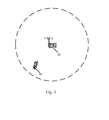
- Fig.1 is the applied scene view of wireless communication network according to a detailed embodiment of the invention, wherein, there are N t transmitting antennas in the base station 21, N t is greater than 1; there are N r transmitting antennas in the user terminal 11, N r is greater than 1;
- the uplink and downlink channels between the user terminal 11 and the base station 21 are asymmetric channels, the base station 21 precodes the data transmitted to the user terminal 11 according to the information of downlink channel fed back by the user terminal 11 and then transmits it to the user terminal 11.
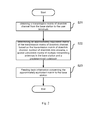
- Fig.2 illustrates the flowchart of the method, used in user terminals of wireless communication network, for feeding information of downlink channel back to the base station according to a detailed embodiment of the invention. The following is the detailed description of the flow in fig.2 in conjunction with the applied scene illustrated in fig.1 .
- the user terminal 11 obtains the transmission matrix H of downlink channel from the base station 21 to the user terminal 11, H is a two-dimensional N r ⁇ Nt matrix.
- the user terminal 11 estimates the channel according to the downlink signals received from the base station 21, to obtain the transmission matrix of downlink channel.
- how to estimate channels is a very mature technique in the field and may refer to ⁇ Digital Communications> wrote by John G. Proakis, and it's unnecessary to go into details.
- the user terminal 11 determines an approximately equivalent matrix of the transmission matrix of downlink channel, according to the transmission matrix of downlink channel from the base station 21 to the user terminal 11, the number m of downlink data streams, the space correlation matrix R of multiple transmitting antennas in the base station 21 and a predetermined codebook.
- the number of downlink data streams means the number of data symbols for which the base station precodes in the period of a transmission symbol, this may be configured by the wireless communication system in advance or dynamically determined by the base station according to the conditions of real-time channel conditions.
- the user terminal 11 may directly obtains from the base station 21 the space correlation matrix R of multiple transmitting antennas in the base station 21.
- the space correlation matrix R of multiple transmitting antennas in the base station 21 is a physical quantity slowly varied with time, thus, the user terminal 11 may update the space correlation matrix R at a longer period, e.g. 100ms.
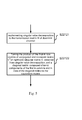
- the step S22 comprises the substeps S221 and S222 illustrated in fig.3 .
- step S221 the user terminal 11 determines an equivalent matrix H ⁇ of the transmission matrix of downlink channel, according to the transmission matrix H of downlink channel and the number m of downlink data streams, H ⁇ is a two-dimensional m ⁇ N t matrix.
- the step S221 comprises the two substeps S22111 and S22112 illustrated in fig.4 .
- the step S221 comprises the two substeps S22121 and S22122 illustrated in fig.5 .
- the user terminal 11 determines the approximately equivalent matrix of the transmission matrix of downlink channel, according to the equivalent matrix H ⁇ of the transmission matrix of downlink channel obtained in step S221, the number m of downlink data streams, the space correlation matrix R of multiple transmitting antennas in the base station 21 and a predetermined codebook.
- R is the space correlation matrix of the multiple transmitting antennas in the base station
- W k T denotes the transposition of matrix W k
- W i is the code word of the predetermined codebook and is a two-dimensional N t ⁇ m matrix
- W i * denotes the conjugation of matrix W i
- abs(H ⁇ RW i * ) denotes module of each component of matrix H ⁇ RW i *
- trace ⁇ abs(H ⁇ RW i * ) ⁇ denotes the trace
- step S203 the user terminal 11 feeds back the related information of the approximately equivalent matrix determined in step S202 to the base station 21.
- the base station 21 knows its space correlation matrix R of multiple transmitting antennas and prestores the above predetermined codebook, the user terminal 11 only needs feeding the subscript k of the code word W k back to the base station 21, that is to say: the related information of the approximately equivalent matrix is the subscript k of the code word W k .
- the predetermined codebook is not limited to the above PMI codebook defined in LTE release 8, and other types of codebooks may be applied in the invention, e.g. the codebook defined in IEEE802.16m standard.
- the specific information comprised by the related information of the approximately equivalent matrix is different correspondingly.
- one principle of feeding back the related information of the approximately equivalent matrix is: making the bit overhead used by feedback minimum.
- Fig.6 is the flowchart of the method, used in the base station of wireless communication network, for precoding downlink data transmitted to user terminals according to a detailed embodiment of the invention. The following is the detailed description of the flow in fig.6 in conjunction with the applied scene illustrated in fig.1 .
- the base station 21 receives from the user terminal 11 the related information of an approximately equivalent matrix of the transmission matrix of downlink channel from the base station 21 to the user terminal 11.
- the related information of the approximately equivalent matrix comprises the subscript of the code word of the predetermined codebook.
- the predetermined codebook uses the feedback codebook defined in LTE release 8, that's the PMI codebook.
- step S62 the base station 21 determines the approximately equivalent matrix according to the related information of the approximately equivalent matrix received in step S61, the predetermined codebook and the space correlation matrix of multiple transmitting antennas in the base station 21.
- the base station 21 determines the approximately equivalent matrix of the transmission matrix of downlink channel from the base station 21 to the user terminal 11 according to the formula (3).
- step S63 the base station 21 precodes the downlink data transmitted to the user terminal 11 by using the approximately equivalent matrix obtained in step S62.
- the step S63 comprises the substeps S631 and S632 of the step S63 illustrated in fig.7 .
- U W is a m ⁇ m unitary matrix
- ⁇ w is a m ⁇ N t diagonal matrix
- V w H is a N t ⁇ N t unitary matrix
- V w is a N t ⁇ N t unitary matrix too.
- the base station 21 may independently determines the precoding scheme, e.g. the base station 21 may precodes the downlink data transmitted to the user terminal 11 based on the approximately equivalent matrix of transmission matrix of downlink channel from the base station 21 to the user terminal 11 and using the MET method etc..
- the detailed information about MET precoding may refer to the technical document R1-070318, "Link-level Results for Multiuser Eigenmod Transmission with Limited Feedback" discussed in LTE-A.
- Fig. 8 is the structural block diagram of the feedback device, used in user terminals of wireless communication network, for feeding the information of downlink channels back to the base station according to a detailed embodiment of the invention.
- the feedback device 80 comprises the obtaining means 81, the first determining means 82, and the information feedback means 83.
- the first determining means 82 comprises the second determining means 821 and the third determining means 822.
- the obtaining means 81 obtains the transmission matrix H of downlink channel from the base station 21 to the user terminal, H is a N r ⁇ N t two-dimentional matrix.
- the user terminal 11 estimates the channel according to the downlink signals received from the base station 21 to obtain the transmission matrix of downlink channel. Concretely, how to estimate channels is a very mature technique in the art and may refer to ⁇ Digital Communications> wrote by John G. Proakis, and it's unnecessary to go into details.
- the first determining means 82 determines an approximately equivalent matrix of the transmission matrix of downlink channel, according to the transmission matrix of downlink channel from the base station 21 to the first determining means 82, the number m of downlink data streams, the space correlation matrix R of multiple transmitting antennas in the base station 21 and a predetermined codebook.
- the number of downlink data streams means the number of data symbols for which the base station precodes in the period of a transmission symbol, and this may be configured by wireless communication system in advance or dynamically determined by the base station according to the real-time channels conditions.
- the obtaining means 81 obtains from the base station 21 the space correlation matrix R of multiple transmitting antennas in the base station 21.
- the space correlation matrix R of multiple transmitting antennas in the base station 21 is a physical quantity slowly varied with time, thus, the obtaining means 81 may update the space correlation matrix R at a longer period, e.g. 100ms.
- the function of the first determining means 82 is implemented by its two sub-means which are the second determining means 821 and the third determining means 822.
- the second determining means 821 determines an equivalent matrix H ⁇ of the transmission matrix of downlink channel, according to the transmission matrix H of downlink channel and the number m of downlink data streams, H ⁇ is a two-dimensional m ⁇ N t matrix.
- the second determining means 821 obtains the first m row vectors of conjugated and transport matrix V H of the right-side singular matrix V, obtained from the singular value decomposition, as the equivalent matrix H ⁇ , as the formula (1) illustrated.
- the second determining means 821 obtains the product of the first m row vectors of conjugated and transport matrix V H of right-side singular matrix V, obtained from singular value decomposition, and a diagonal matrix ⁇ m composed of m ⁇ m components of the first m columns and m rows of the diagonal matrix as the equivalent matrix H ⁇ , as the formula (2) illustrated.
- the third determining means 822 determines the approximately equivalent matrix of the transmission matrix of downlink channel, according to the equivalent matrix H ⁇ of the transmission matrix of downlink channel obtained in the obtaining means 81, the number m of downlink data streams, the space correlation matrix R of multiple transmitting antennas in the base station 21 and a predetermined codebook.
- the predetermined codebook uses the feedback codebook defined in LTE release 8, that' s PMI codebook, and the third determining means 822 determines the approximately equivalent matrix of the transmission matrix of downlink channel according to the above formula (3).
- the feedback device 83 feeds back the related information of the approximately equivalent matrix determined by the first determining means 82 to the base station 21.
- the base station 21 knows its space correlation matrix R of multiple transmitting antennas and prestores the above predetermined codebook, the information feedback device 83 only needs to feed the subscript k of the code word W k back to the base station 21, that is to say: the related information of the approximately equivalent matrix is the subscript k of the code word W k .
- the related information of the approximately equivalent matrix is the subscript k of the code word W k .
- the detailed information comprised by the related information of the approximately equivalent matrix is different correspondingly.
- one principle of feeding back the related information of the approximately equivalent matrix is: making the bit overhead used by feedback minimum.
- Fig.9 is the structural block diagram of the precoding device 90, used in the base station of wireless communication network, for precoding downlink data transmitted to the user terminals according to a detailed embodiment of the invention.
- the precoding device 90 comprised the receiving means 91, the fourth determining means 92 and the coding means 93.
- the receiver 91 receives from the user terminal 11 the related information of an approximately equivalent matrix of the transmission matrix of downlink channel from the base station 21 to the user terminal 11.
- the related information of the approximately equivalent matrix comprises the subscript of the code word of the predetermined codebook.
- the predetermined codebook uses the feedback codebook defined in LTE release 8, that is the PMI codebook.
- the fourth determining means 92 determines the approximately equivalent matrix according to the related information of the approximately equivalent matrix received in the receiver 91, the predetermined codebook and the space correlation matrix of multiple transmitting antennas in the base station 21.
- the base station 21 determines the approximately equivalent matrix of the transmission matrix of downlink channel from the base station 21 to the user terminal 11 according to the formula (3).
- the coding means 93 precodes the downlink data transmitted to the user terminal 11 by using the approximately equivalent matrix determined by the fourth determining means 92.
- H ⁇ is a two-dimensional m ⁇ N t matrix
- U w is a m ⁇ m unitary matrix
- ⁇ w is a m ⁇ N t diagonal matrix
- V w H is a N t ⁇ N t unitary matrix
- V w is a N t ⁇ N t unitary matrix too.
- the coding means 93 may independently determines precoding scheme, e.g. the coding means 93 may precode the downlink data transmitted to the user terminal 11 based on the approximately equivalent matrix of transmission matrix of downlink channel from the encoding means 93 to the user terminal 11 and using MET method etc..
- the detailed information about MET precoding may refer to the technical document R1-070318, "Link-level Results for Multiuser Eigenmod Transmission with Limited Feedback" discussed in LTE-A.
- the predetermined codebook uses the feedback codebook defined in LTE release 8, i.e. the PMI codebook.
- the simulation channel uses the ITU channel model, and the detailed simulation parameters are illustrated as the following.
- Table1 Table of the simulation parameters Parameter name Value Transmission scheme SVD SU-MIMO of first to fourth order Number of base stations and antennas configuration One base station with four antennas which span 0.5 times or four times as wavelength Number of user terminals and antennas configuration One user terminal with two to four antennas which span 0.5 times as wavelength Modulation scheme QPSK Channel encoding 1/2 Turbo encoding Feedback delay of channel status information(CSI) 0 ms Delay of matrix report related with transmitter 0 ms Quantization scheme of matrix related with transmitter Ideal Transmission resource 5 LTE PRBs (Primary Resource Block) in frequency domain Channel evaluation Ideal Data detection MMSE rate 3kmph or 30kmph Channel model of fast fading ITU channel model, UMi( Urban Micro) or UMa (Urban Macro) Large scale channel model No loss model Simulation frames 1000 Block size 584 bits Predetermined codebook 3GPP LTE Rel -8 4 bits codebook for 4Tx
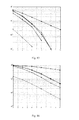
- the fig.10 to fig.19 respectively illustrate the relation diagram of signal to noise ratio and bit error ratio of the above four technical schemes and ideal SVD decomposition scheme under different parameter values, wherein, the horizontal axis means signal to noise ratio (SNR), the unit is dB, and the vertical axis means block error ratio (BLER), the unit is percentage;
- the legend line with circles means the technical scheme of self-adaption codebook and explicit feedback of the invention
- the legend line with triangles means the technical scheme of self-adaption codebook and implicit feedback of the present technique
- the legend line with squares means the technical scheme of fixed codebook and explicit feedback of present technique
- the legend line with rhombuses means the technical scheme of fixed codebook and implicit feedback of present technique
- the legend dotted line with circles means the technical scheme of implementing SVD decomposition based on ideal channel information.
- the table 2 illustrates the signal to noise ratio of each technical scheme when the block error ratio is 0.1.
- Table 2 the signal to noise ratio when the block error ratio is 0.1.
- System parameters self-adaption codebook explicit feedback self-adaption codebook implicit feedback fixed codebook explicit feedback fixed codebook implicit feedback transmitting data -3.2 dB -3.2 dB -2.4 dB -2.4 dB stream is 1, UMi channel model, transmitting antennas span 0.5 times as wavelength transmitting data stream is 1, UMi channel model, transmitting antennas span 4 times as wavelength -3.4 dB -3.4 dB - 3 dB - 3 dB transmitting data streams are 2, UMi channel model, transmitting antennas span 0.5 times as wavelength 5.4 dB 12 dB 6.2 dB 6.2 dB transmitting data streams are 2, UMa channel model, transmitting antennas span 0.5 times as wavelength 5.5 dB 11 dB 6.4 dB 6.4 dB transmitting data streams are 2, UM
- the technical scheme of self-adaption codebook and explicit feedback of the invention has the lowest block error ratio under the same signal to noise ration, or the lowest signal to noise ratio under the same block error ratio.
Landscapes
- Engineering & Computer Science (AREA)
- Computer Networks & Wireless Communication (AREA)
- Signal Processing (AREA)
- Quality & Reliability (AREA)
- Physics & Mathematics (AREA)
- Mathematical Physics (AREA)
- Mobile Radio Communication Systems (AREA)
- Radio Transmission System (AREA)
Abstract
Description
- The invention relates to method and device used for feedback of channel information and precoding
- In LTE-Advanced wireless communcication system, for FDD MIMO system, in order to obtain higer efficiency of downlink frequency spectrum, the user terminals feeding precoding code words back to the base station for precoding the signals transmitted to the user terminals in the base station. The method is called as implicit feedback, that' s, the user terminals determine precoding code words according to the transmission matrixes of downlink channels and feed the code words back to the base station. Now, Intel, Huawei companies etc. have already proposed technical scheme of implicit feedback of carrying out first order correlation self-adaption by using the precoding codebook defined in the present standard. "Correlation self-adaption" means modifying the predefined codebook by using the space correlation matrix of downlink channels. "Order" means the number of data streams waiting for being transmitted in the base station. But this kind of technical schemes of implicit feedback is only suitable for the one-order condition. For multi-order condition, the system performance deteriorates rapidly. Thus, for multi-order FDD MIMO wireless communication system, a feasible feedback scheme of correlation self-adaption is urgently needed.
- The invention proposes a technical scheme (called as explicit feedback) used for feeding the information of downlink channels back to the base station in the user terminals of wireless communication system, and a technical scheme for precoding the data transmitted to the user terminals according to the information of downlink channels, fed back by the user terminals, in the base station.
- The inventive concept of the invention is that the user terminals feed the information of downlink channels back to the base station according to the transmission matrix of the downlink channels from the base station and space correlation matrixes of multiple transmitting antennas in the base station. In the invention, the information of downlink channels is an approximately equivalent matrix of the transmission matrix from the base station to the user terminals.
- According to an embodiment of the invention, a method is proposed that is used for feedback information of downlink channel to the base station, in user terminals of wireless communication network, wherein, the method comprises the following steps: obtaining a transmission matrix of downlink channel from the base station to the user terminals; determining an approximately equivalent matrix of the transmission matrix of downlink channel, according to the transmission matrix of downlink channel, the number of downlink data streams, the space correlation matrixes of multiple transmitting antennas in the base station and a predetermined codebook; and feeding the related information of the approximately equivalent matrix back to the base station.
- In an embodiment, the user terminals determine an equivalent matrix of the transmission matrix of downlink channel, according to the transmission matrix of downlink channel and the number of downlink data streams, the equivalent matrix is a two-dimensional m×Nt matrix, wherein, m is the number of downlink data streams, and Nt is the number of transmitting antennas in the base station; then determining the approximately equivalent matrix according to the equivalent matrix, the number of downlink data streams, the space correlation matrix and the predetermined codebook, the approximately equivalent matrix is a two-dimensional m×Nt matrix.
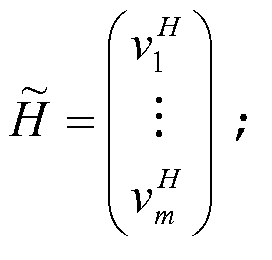
- In an embodiment, the user terminals implement singular value decomposition to the transmission matrix H of downlink channel to obtain H=U∑VH, then obtains the first m row vectors of the conjugated and transport matrix VH of the right-side singular matrix V, obtained from the singular value decomposition, as the equivalent matrix H̃,

- In an embodiment, the user terminals determine the approximately equivalent matrixaccording to the following formulas:


- According to another embodiment of the invention, a method is proposed for precoding the downlink data transmitted to user terminals, in the base station of wireless communication network, wherein, the method comprises the following steps: receiving from the user terminals the related information of a approximately equivalent matrix of the transmission matrix of downlink channel from the base station to the user terminals; determining the approximately equivalent matrix according to the related information of the approximately equivalent matrix, a predetermined codebook and space correlation matrixes of multiple transmitting antennas in the base station; and precoding the downlink data transmitted to user terminals by using the approximately equivalent matrix.
- In an embodiment, the related information of the approximately equivalent matrix comprises the subscript of the code word of the predetermined codebook, the base station determines the approximately equivalent matrix according to

- In an embodiment, the base station implements singular value decomposition to the approximately equivalent matrix, then precodes the downlink data transmitted to the user terminals by selecting the first m column vectors of right-side singular matrix as the precoding matrix, wherein m is the number of downlink data streams.
- According to another embodiment of the invention, a feedback device is proposed for feeding the information of downlink channels back to the base station, in the user terminals of wireless communication network, comprising: an obtaining means, used for obtaining the transmission matrixes of downlink channels from the base station to the user terminals; a first determining means, used for determining an approximately equivalent matrix of the transmission matrix of downlink channel, according to the transmission matrix of downlink channel, the number of downlink data streams, the space correlation matrixes of multiple transmitting antennas in the base station and a predetermined codebook; and an information feedback means, used for feeding the information of the approximately equivalent matrix back to the base station.
- According to another embodiment of the invention, a precoding device is proposed for precoding downlink data transmitted to the user terminals, in the base station of wireless communication network, comprising: a receiver, used for receiving from the user terminals the related information of an approximately equivalent matrix of the transmission matrix of downlink channel from the base station to the user terminals; a fourth determining means, used for determining the approximately equivalent matrix according to the related information of the approximately equivalent matrix, the predetermined codebook and the space correlation matrix of multiple transmitting antennas in the base station; and an coding means, used for precoding downlink data transmitted to the user terminals by using the approximately equivalent matrix. Compared to the present wireless communication system using precoding with fixed codebooks and self-adaption codebooks of implicit feedback, the wireless communication system using the technical scheme of the invention obtains obvious gains, and the system block error rate decreases significantly.
- In the invention, since user terminals feed back an approximately equivalent matrix of the transmission matrixes of downlink channels, that's explicit feedback, the base station determines by its own will the precoding scheme according to the approximately equivalent matrix, thus the base station may uses all kinds of precoding schemes flexibly. Moreover, according to an embodiment of the invention, the predetermined codebook uses the codebook defined in
present LTE release 8, and keeps good backward compatibility and lower computation complexity, therefore the realization of the system is easier. - By reading the detailed description to the unlimited embodiments by referring to the following figures, other features, purposes and merits of the invention will be more obvious.
-
Fig.1 is the applied scene view of wireless communication network according to a detailed embodiment of the invention; -
Fig.2 is the flowchart of the method, used in user terminals of wireless communication network, for feedback information of downlink channel to the base station according to a detailed embodiment of the invention; -
Fig.3 is the sub-steps flowchart of step S22 showed infig.2 according to a detailed embodiment of the invention; -
Fig.4 is the sub-steps flowchart of step S221 showed infig.3 according to a detailed embodiment of the invention; -
Fig.5 is the sub-steps flowchart of step S221 showed infig.3 according to another detailed embodiment of the invention; -
Fig.6 is the flowchart of the method, used in the base station of wireless communication network, for precoding downlink data transmitted to user terminals according to a detailed embodiment of the invention; -
Fig.7 is the sub-steps flowchart of step S63 showed infig.6 according to a detailed embodiment of the invention; -
Fig.8 is the structural block diagram of the feedback device used in user terminals of wireless communication network for feeding the information of downlink channels back to the base station according to a detailed embodiment of the invention; -
Fig.9 is the structural block diagram of the precoding device used in the base station of wireless communication network for precoding downlink data transmitted to the user terminals according to a detailed embodiment of the invention; -
Fig.10 illustrates the block error rate and signal to noise ration diagram of the wireless communication network, which uses the ITU-UMi channel model, and in which the span of transmitting antennas in the station is 0.5 times as wavelength, the travel rate is 3Km/h, user terminals have two transmitting antennas, code rate is 1/2, QPSK modulation is used and the transmitting data stream is 1; -
Fig.11 illustrates the block error rate and signal to noise ration diagram of the wireless communication network, which uses the ITU-UMi channel model, and in which the span of transmitting antennas in the station is 4 times as wavelength, the travel rate is 3Km/h, user terminals have two transmitting antennas, code rate is 1/2, QPSK modulation is used and the transmitting data stream is 1; -
Fig.12 illustrates the block error rate and signal to noise ration diagram of the wireless communication network which uses the ITU-UMi channel model, and in which the span of transmitting antennas in the station is 0.5 times as wavelength, the travel rate is 3Km/h, user terminals have two transmitting antennas, code rate is 1/2, QPSK modulation is used and the transmitting data streams are 2; -
Fig.13 illustrates the block error rate and signal to noise ration diagram of the wireless communication network which uses the ITU-UMa channel model, and in which the span of transmitting antennas in the station is 0.5 times as wavelength, the travel rate is 3Km/h, user terminals have two transmitting antennas, code rate is 1/2, QPSK modulation is used and the transmitting data streams are 2; -
Fig.14 illustrates the block error rate and signal to noise ration diagram of the wireless communication network which uses the ITU-UMi channel model, and in which the span of transmitting antennas in the station is 4 times as wavelength, the travel rate is 3Km/h, user terminals have two transmitting antennas, code rate is 1/2, QPSK modulation is used and the transmitting data streams is 2; -
Fig.15 illustrates the block error rate and signal to noise ration diagram of the wireless communication network which uses the ITU-UMa channel model, and in which the span of transmitting antennas in the station is 4 times as wavelength, the travel rate is 3Km/h, user terminals have two transmitting antennas, code rate is 1/2, QPSK modulation is used and the transmitting data streams is 2; -
Fig.16 illustrates the block error rate and signal to noise ration diagram of the wireless communication network which uses the ITU-UMi channel model, and in which the span of transmitting antennas in the station is 0.5 times as wavelength, the travel rate is 3Km/h, user terminals have three transmitting antennas, code rate is 1/2, QPSK modulation is used and the transmitting data streams is 3; -
Fig.17 illustrates the block error rate and signal to noise ration diagram of the wireless communication network which uses the ITU-UMa channel model, and in which the span of transmitting antennas in the station is 0.5 times as wavelength, the travel rate is 30Km/h, user terminals have three transmitting antennas, code rate is 1/2, QPSK modulation is used and the transmitting data streams is 3; -
Fig.18 illustrates the block error rate and signal to noise ration diagram of the wireless communication network which uses the ITU-UMi channel model, and in which the span of transmitting antennas in the station is 0.5 times as wavelength, the travel rate is 3Km/h, user terminals have four transmitting antennas, code rate is 1/2, QPSK modulation is used and the transmitting data streams is 4; -
Fig.19 illustrates the block error rate and signal to noise ration diagram of the wireless communication network which uses the ITU-UMa channel model, and in which the span of transmitting antennas in the station is 4 times as wavelength, the travel rate is 30Km/h, user terminals have four transmitting antennas, code rate is 1/2, QPSK modulation is used and the transmitting data streams is 4; - The following is the detailed exemplary description of concrete embodiments of the invention by referring to the figures.
-
Fig.1 is the applied scene view of wireless communication network according to a detailed embodiment of the invention, wherein, there are Nt transmitting antennas in thebase station 21, Nt is greater than 1; there are Nr transmitting antennas in theuser terminal 11, Nr is greater than 1; The uplink and downlink channels between theuser terminal 11 and thebase station 21 are asymmetric channels, thebase station 21 precodes the data transmitted to theuser terminal 11 according to the information of downlink channel fed back by theuser terminal 11 and then transmits it to theuser terminal 11. -
Fig.2 illustrates the flowchart of the method, used in user terminals of wireless communication network, for feeding information of downlink channel back to the base station according to a detailed embodiment of the invention. The following is the detailed description of the flow infig.2 in conjunction with the applied scene illustrated infig.1 . - First, in
step 21, theuser terminal 11 obtains the transmission matrix H of downlink channel from thebase station 21 to theuser terminal 11, H is a two-dimensional Nr×Nt matrix. Usually, theuser terminal 11 estimates the channel according to the downlink signals received from thebase station 21, to obtain the transmission matrix of downlink channel. Concretely, how to estimate channels is a very mature technique in the field and may refer to <Digital Communications> wrote by John G. Proakis, and it's unnecessary to go into details. - Next, in step 22, the
user terminal 11 determines an approximately equivalent matrixof the transmission matrix of downlink channel, according to the transmission matrix of downlink channel from thebase station 21 to theuser terminal 11, the number m of downlink data streams, the space correlation matrix R of multiple transmitting antennas in thebase station 21 and a predetermined codebook. - The number of downlink data streams means the number of data symbols for which the base station precodes in the period of a transmission symbol, this may be configured by the wireless communication system in advance or dynamically determined by the base station according to the conditions of real-time channel conditions.
- In an embodiment, the
user terminal 11 determines the space correlation matrix according to the transmission matrix H of downlink channel from thebase station 21 to theuser terminal 11, that's R=E[HH·H], R may be the average value of multiple time points and/or multiple sub-carriers. In another embodiment, theuser terminal 11 may directly obtains from thebase station 21 the space correlation matrix R of multiple transmitting antennas in thebase station 21. The space correlation matrix R of multiple transmitting antennas in thebase station 21 is a physical quantity slowly varied with time, thus, theuser terminal 11 may update the space correlation matrix R at a longer period, e.g. 100ms. - In an embodiment, the step S22 comprises the substeps S221 and S222 illustrated in
fig.3 . - First, in step S221, the
user terminal 11 determines an equivalent matrix H̃ of the transmission matrix of downlink channel, according to the transmission matrix H of downlink channel and the number m of downlink data streams, H̃ is a two-dimensional m×Nt matrix. - According to an embodiment of the invention, the step S221 comprises the two substeps S22111 and S22112 illustrated in
fig.4 . - First, in step S22111, the
user terminal 11 implements singular value decomposition to the transmission matrix H of downlink channel from thebase station 21 to the user terminal 11:H = U∑VH. - Next, in step S22112, the
user terminal 11 obtains the first m row vectors of conjugated and transport matrix VH of the right-side singular matrix V, obtained from the singular value decomposition, as the equivalent matrix H̃, that's
- According to another embodiment of the invention, the step S221 comprises the two substeps S22121 and S22122 illustrated in
fig.5 . - Here, the step S22121 is the same as S22111, the
user terminal 11 implements singular value decomposition to the transmission matrix H of downlink channel from thebase station 21 to the user terminal 11 : H=U∑VH. - Next, in step S22122, the
user terminal 11 obtains the product of the first m row vectors of conjugated and transport matrix VH of right-side singular matrix V, obtained from singular value decomposition, and a diagonal matrix ∑m composed of m×m components of the first m columns and m rows of the diagonal matrix ∑, as the equivalent matrix H̃, that's
- Back to the
fig.3 , in step S222, theuser terminal 11 determines the approximately equivalent matrixof the transmission matrix of downlink channel, according to the equivalent matrix H̃ of the transmission matrix of downlink channel obtained in step S221, the number m of downlink data streams, the space correlation matrix R of multiple transmitting antennas in thebase station 21 and a predetermined codebook. - According to an embodiment of the invention, the predetermined codebook uses the feedback codebook defined in
LTE release 8, that's PMI codebook, and determines the approximately equivalent matrixof the transmission matrix of downlink channel according to the following formula:
Wherein, R is the space correlation matrix of the multiple transmitting antennas in the base station, Wk T denotes the transposition of matrix Wk, wherein, Wk is determined according to the following formula:
Wherein, Wi is the code word of the predetermined codebook and is a two-dimensional Nt×m matrix, Wi * denotes the conjugation of matrix Wi, abs(H̃RWi *) denotes module of each component of matrix H̃RWi *, trace{abs(H̃RWi *)} denotes the trace of matrix abs(H̃RWi * ), ∥RWi * ∥F denotes the Frobenius norm of matrix RWi * , and H̃ is the equivalent matrix obtained in step S221 as illustrated in the formula (1) and formula (2). - The meaning of the formula (4) is that the code word Wk is the one letting

- Back to the
fig.2 , in step S203, theuser terminal 11 feeds back the related information of the approximately equivalent matrixdetermined in step S202 to thebase station 21. - As illustrated by the formula (3), in the above embodiments, the
base station 21 knows its space correlation matrix R of multiple transmitting antennas and prestores the above predetermined codebook, theuser terminal 11 only needs feeding the subscript k of the code word Wk back to thebase station 21, that is to say: the related information of the approximately equivalent matrixis the subscript k of the code word Wk. - It needs to express that the predetermined codebook is not limited to the above PMI codebook defined in
LTE release 8, and other types of codebooks may be applied in the invention, e.g. the codebook defined in IEEE802.16m standard. - The ordinary skilled in this art should understand that, depending on different specific method for determining the approximately equivalent matrix of the transmission matrix of downlink channel from the
base station 21 to theuser terminal 11, the specific information comprised by the related information of the approximately equivalent matrixis different correspondingly. In an embodiment, one principle of feeding back the related information of the approximately equivalent matrixis: making the bit overhead used by feedback minimum. -
Fig.6 is the flowchart of the method, used in the base station of wireless communication network, for precoding downlink data transmitted to user terminals according to a detailed embodiment of the invention. The following is the detailed description of the flow infig.6 in conjunction with the applied scene illustrated infig.1 . - First, in step S61, the
base station 21 receives from theuser terminal 11 the related information of an approximately equivalent matrix of the transmission matrix of downlink channel from thebase station 21 to theuser terminal 11. As the embodiments illustrated in the above formula (3) and formula (4), the related information of the approximately equivalent matrix comprises the subscript of the code word of the predetermined codebook. In an embodiment, the predetermined codebook uses the feedback codebook defined inLTE release 8, that's the PMI codebook. - Next, in step S62, the
base station 21 determines the approximately equivalent matrix according to the related information of the approximately equivalent matrix received in step S61, the predetermined codebook and the space correlation matrix of multiple transmitting antennas in thebase station 21. Corresponding to the embodiments illustrated in the above formula (3) and formula (4), thebase station 21 determines the approximately equivalent matrix of the transmission matrix of downlink channel from thebase station 21 to theuser terminal 11 according to the formula (3). - Finally, in step S63, the
base station 21 precodes the downlink data transmitted to theuser terminal 11 by using the approximately equivalent matrix obtained in step S62. - In an embodiment, the step S63 comprises the substeps S631 and S632 of the step S63 illustrated in
fig.7 . - First, in step S631, the
base station 21 implements singular value decomposition to the approximately equivalent matrix and obtains is a two-dimensional m×Nt matrix, UW is a m×m unitary matrix, ∑w is a m×Nt diagonal matrix,
- Next, in step S632, the
base station 21 precodes the downlink data transmitted to theuser terminal 11 by taking the first m column vectors of the right-side singular matrix Vw, obtained from the singular value decomposition, as the precoding matrix, that is to say: the precoding matrix P of thebase station 21 is:


- It needs to explain that the flow illustrated in
fig.7 is just an embodiment, since what theuser terminal 11 feeds back is an equivalent matrix of transmission matrix of downlink channel from theuser terminal 11 to thebase station 21, instead of the indicator of the precoding code word, thebase station 21 may independently determines the precoding scheme, e.g. thebase station 21 may precodes the downlink data transmitted to theuser terminal 11 based on the approximately equivalent matrix of transmission matrix of downlink channel from thebase station 21 to theuser terminal 11 and using the MET method etc.. The detailed information about MET precoding may refer to the technical document R1-070318, "Link-level Results for Multiuser Eigenmod Transmission with Limited Feedback" discussed in LTE-A. -
Fig. 8 is the structural block diagram of the feedback device, used in user terminals of wireless communication network, for feeding the information of downlink channels back to the base station according to a detailed embodiment of the invention. Infig. 8 , thefeedback device 80 comprises the obtainingmeans 81, the first determiningmeans 82, and the information feedback means 83. In an embodiment, the first determiningmeans 82 comprises the second determining means 821 and the third determiningmeans 822. - The following is the detailed description of working process of the
feedback device 80 in theuser terminal 11 in conjunction with the applied scene illustrated infig.1 . - First, the obtaining
means 81 obtains the transmission matrix H of downlink channel from thebase station 21 to the user terminal, H is a Nr×Nt two-dimentional matrix. Usually, theuser terminal 11 estimates the channel according to the downlink signals received from thebase station 21 to obtain the transmission matrix of downlink channel. Concretely, how to estimate channels is a very mature technique in the art and may refer to <Digital Communications> wrote by John G. Proakis, and it's unnecessary to go into details. - Next, the first determining
means 82 determines an approximately equivalent matrixof the transmission matrix of downlink channel, according to the transmission matrix of downlink channel from thebase station 21 to the first determiningmeans 82, the number m of downlink data streams, the space correlation matrix R of multiple transmitting antennas in thebase station 21 and a predetermined codebook. - The number of downlink data streams means the number of data symbols for which the base station precodes in the period of a transmission symbol, and this may be configured by wireless communication system in advance or dynamically determined by the base station according to the real-time channels conditions.
- In an embodiment, the obtaining
means 81 determines the space correlation matrix according to the transmission matrix H of downlink channel from thebase station 21 to the user terminal, that' s R=E [HH·H], R may be the average value of multiple time points and/or multiple sub-carriers. In another embodiment, the obtainingmeans 81 obtains from thebase station 21 the space correlation matrix R of multiple transmitting antennas in thebase station 21. The space correlation matrix R of multiple transmitting antennas in thebase station 21 is a physical quantity slowly varied with time, thus, the obtainingmeans 81 may update the space correlation matrix R at a longer period, e.g. 100ms. - In an embodiment, the function of the first determining
means 82 is implemented by its two sub-means which are the second determining means 821 and the third determiningmeans 822. - First, the second determining means 821 determines an equivalent matrix H̃ of the transmission matrix of downlink channel, according to the transmission matrix H of downlink channel and the number m of downlink data streams, H̃ is a two-dimensional m×Nt matrix.
- According to an embodiment of the invention, the second determining means 821 implements singular value decomposition to the transmission matrix H of downlink channel from the
base station 21 to the user terminal: H = U∑VH. - Next, the second determining means 821 obtains the first m row vectors of conjugated and transport matrix VH of the right-side singular matrix V, obtained from the singular value decomposition, as the equivalent matrix H̃, as the formula (1) illustrated. According to another embodiment of the invention, the second determining means 821 obtains the product of the first m row vectors of conjugated and transport matrix VH of right-side singular matrix V, obtained from singular value decomposition, and a diagonal matrix ∑ m composed of m×m components of the first m columns and m rows of the diagonal matrix as the equivalent matrix H̃, as the formula (2) illustrated.
- Next, the third determining means 822 determines the approximately equivalent matrixof the transmission matrix of downlink channel, according to the equivalent matrix H̃ of the transmission matrix of downlink channel obtained in the obtaining
means 81, the number m of downlink data streams, the space correlation matrix R of multiple transmitting antennas in thebase station 21 and a predetermined codebook. - According to an embodiment of the invention, the predetermined codebook uses the feedback codebook defined in
LTE release 8, that' s PMI codebook, and the third determining means 822 determines the approximately equivalent matrixof the transmission matrix of downlink channel according to the above formula (3). - Finally, the
feedback device 83 feeds back the related information of the approximately equivalent matrixdetermined by the first determiningmeans 82 to thebase station 21. - As the formula (3) illustrated, in the above embodiments, the
base station 21 knows its space correlation matrix R of multiple transmitting antennas and prestores the above predetermined codebook, theinformation feedback device 83 only needs to feed the subscript k of the code word Wk back to thebase station 21, that is to say: the related information of the approximately equivalent matrixis the subscript k of the code word Wk. The ordinary skilled in this art should understand that, depending on different detailed method of determining the approximately equivalent matrix of the transmission matrix of downlink channel from thebase station 21 to theuser terminal 11, the detailed information comprised by the related information of the approximately equivalent matrixis different correspondingly. In an embodiment, one principle of feeding back the related information of the approximately equivalent matrixis: making the bit overhead used by feedback minimum. -
Fig.9 is the structural block diagram of theprecoding device 90, used in the base station of wireless communication network, for precoding downlink data transmitted to the user terminals according to a detailed embodiment of the invention. Theprecoding device 90 comprised the receiving means 91, the fourth determiningmeans 92 and the coding means 93. - The following is the detailed description of working process of the
precoding device 90 in thebase station 21 in conjunction with the applied scene illustrated infig.1 . - First, the
receiver 91 receives from theuser terminal 11 the related information of an approximately equivalent matrix of the transmission matrix of downlink channel from thebase station 21 to theuser terminal 11. As the embodiments illustrated in the above formula (3) and formula (4), the related information of the approximately equivalent matrix comprises the subscript of the code word of the predetermined codebook. In an embodiment, the predetermined codebook uses the feedback codebook defined inLTE release 8, that is the PMI codebook. - Next, the fourth determining
means 92 determines the approximately equivalent matrix according to the related information of the approximately equivalent matrix received in thereceiver 91, the predetermined codebook and the space correlation matrix of multiple transmitting antennas in thebase station 21. Corresponding to the embodiments illustrated in the above formula (3) and formula (4), thebase station 21 determines the approximately equivalent matrix of the transmission matrix of downlink channel from thebase station 21 to theuser terminal 11 according to the formula (3). - Finally, the coding means 93 precodes the downlink data transmitted to the
user terminal 11 by using the approximately equivalent matrix determined by the fourth determiningmeans 92. - In an embodiment, the detailed working process of the coding means 93 is described as the following.
- First, the coding means 93 implements singular value decomposition to the approximately equivalent matrix and obtains

- Next, the coding means 93 precodes the downlink data transmitted to the
user terminal 11 by taking the first m column vectors of the right-side singular matrix Vw, obtained from the singular value decomposition, as the precoding matrix, that is to say the precoding matrix P of thebase station 21 is:


- It needs to explain that the working process of the coding means 93 described above is just an example, since what the
user terminal 11 feeds back is an equivalent matrix of transmission matrix of downlink channel from thebase station 21 to theuser terminal 11 instead of the indicator of precoding code word, the coding means 93 may independently determines precoding scheme, e.g. the coding means 93 may precode the downlink data transmitted to theuser terminal 11 based on the approximately equivalent matrix of transmission matrix of downlink channel from the encoding means 93 to theuser terminal 11 and using MET method etc.. The detailed information about MET precoding may refer to the technical document R1-070318, "Link-level Results for Multiuser Eigenmod Transmission with Limited Feedback" discussed in LTE-A. - The above is detailed description of the embodiments of each method and means of the invention.
- There is an example concerning the MIMO wireless communication system of single user, which compares and analyzes performance of the technical scheme of self-adaption codebook and explicit feedback of the invention, the technical scheme of self-adaption codebook and implicit feedback of the present technique, the technical scheme of fixed codebook and explicit feedback, the technical scheme of fixed codebook and implicit feedback, and the technical scheme of implementing SVD decomposition based on ideal channel information.
- Without loss of generality, there are four transmitting antennas in the
base station 21, two to four transmitting antennas in theuser terminal 11, and the predetermined codebook uses the feedback codebook defined inLTE release 8, i.e. the PMI codebook. The simulation channel uses the ITU channel model, and the detailed simulation parameters are illustrated as the following.Table1 Table of the simulation parameters Parameter name Value Transmission scheme SVD SU-MIMO of first to fourth order Number of base stations and antennas configuration One base station with four antennas which span 0.5 times or four times as wavelength Number of user terminals and antennas configuration One user terminal with two to four antennas which span 0.5 times as wavelength Modulation scheme QPSK Channel encoding 1/2 Turbo encoding Feedback delay of channel status information(CSI) 0 ms Delay of matrix report related with transmitter 0 ms Quantization scheme of matrix related with transmitter Ideal Transmission resource 5 LTE PRBs (Primary Resource Block) in frequency domain Channel evaluation Ideal Data detection MMSE rate 3kmph or 30kmph Channel model of fast fading ITU channel model, UMi( Urban Micro) or UMa (Urban Macro) Large scale channel model No loss model Simulation frames 1000 Block size 584 bits Predetermined codebook 3GPP LTE Rel -8 4 bits codebook for 4Tx - The
fig.10 to fig.19 respectively illustrate the relation diagram of signal to noise ratio and bit error ratio of the above four technical schemes and ideal SVD decomposition scheme under different parameter values, wherein, the horizontal axis means signal to noise ratio (SNR), the unit is dB, and the vertical axis means block error ratio (BLER), the unit is percentage; The legend line with circles means the technical scheme of self-adaption codebook and explicit feedback of the invention, the legend line with triangles means the technical scheme of self-adaption codebook and implicit feedback of the present technique, the legend line with squares means the technical scheme of fixed codebook and explicit feedback of present technique, the legend line with rhombuses means the technical scheme of fixed codebook and implicit feedback of present technique, and the legend dotted line with circles means the technical scheme of implementing SVD decomposition based on ideal channel information. - The table 2 illustrates the signal to noise ratio of each technical scheme when the block error ratio is 0.1.
Table 2 the signal to noise ratio when the block error ratio is 0.1. System parameters self-adaption codebook explicit feedback self-adaption codebook implicit feedback fixed codebook explicit feedback fixed codebook implicit feedback transmitting data -3.2 dB -3.2 dB -2.4 dB -2.4 dB stream is 1, UMi channel model, transmitting antennas span 0.5 times as wavelength transmitting data stream is 1, UMi channel model, transmitting antennas span 4 times as wavelength -3.4 dB -3.4 dB - 3 dB - 3 dB transmitting data streams are 2, UMi channel model, transmitting antennas span 0.5 times as wavelength 5.4 dB 12 dB 6.2 dB 6.2 dB transmitting data streams are 2, UMa channel model, transmitting antennas span 0.5 times as wavelength 5.5 dB 11 dB 6.4 dB 6.4 dB transmitting data streams are 2, UMi channel model, transmitting antennas span 4 times as wavelength 4 dB 6.8 dB 4.5 dB 4.6 dB transmitting data stream are 2, UMa channel model, transmitting antennas span 4 times as wavelength 4.4 dB 7.8 dB 5.2 dB 5.3 dB transmitting data streams are 3, UMi channel model, transmitting antennas span 0.5 times as wavelength 8.5 dB Greater than 12 dB 10 dB 10 dB transmitting data streams are 3, UMa channel model, transmitting antennas span 0.5 times as wavelength 8.8 dB Greater than 12 dB 10.3 dB 10.3 dB transmitting data streams are 4, UMi channel model, transmitting antennas span 0.5 times as wavelength 13.5 dB Greater than 18 dB 14.2 dB 14 dB transmitting data streams are 4, UMa channel model, transmitting antennas 14 dB Greater than 18 dB 14.5 dB 14.4 dB span 0.5 times as wavelength - Seen from the
fig.10 to fig.19 , compared with the present technical schemes, the technical scheme of self-adaption codebook and explicit feedback of the invention has the lowest block error ratio under the same signal to noise ration, or the lowest signal to noise ratio under the same block error ratio. - It needs to explain that the above embodiments are only demonstrations, not the limitation to the invention. Any technical schemes not deviating from the spirit of the invention should be within the scope of protection of the invention. In addition, any figure signs in the claims shouldn't be taken as limitations to the claims related; The word "include" doesn't exclude the means or steps not listed in other claims or specifications; "One" before means doesn't exclude existence of multiple such means;In the device comprising many means, one or multiple functions of the multiple means may be realized by one hardware or software module; The words "the first", "the second", "the third" etc are only meant names, not any special orders.
Claims (15)
- A method used for feedback information of downlink channel to the base station, in user terminals of wireless communication network, wherein, the method comprises the following steps:A. obtaining a transmission matrix of downlink channel from the base station to the user terminals;B. determining an approximately equivalent matrix of the transmission matrix of downlink channel, according to the transmission matrix of downlink channel, the number of downlink data streams, space correlation matrixes of multiple transmitting antennas in the base station and a predetermined codebook;C. feeding the related information of the approximately equivalent matrix back to the base station.
- The method as claimed in claim 1, wherein, the method comprises the following step before the step B:- obtaining the space correlation matrixes of the multiple transmitting antennas in the base station.
- The method as claimed in claim 1, wherein, the number of downlink data streams is m, there are Nt transmitting antennas in the base station, and the step B comprises the following steps:B1. determining an equivalent matrix of the transmission matrix of downlink channel, according to the transmission matrix of downlink channel and the number of downlink data streams, the equivalent matrix is a two-dimensional m×Nt matrix;B2. determining the approximately equivalent matrix according to the equivalent matrix, the number of downlink data streams, the space correlation matrixes and the predetermined codebook, the approximately equivalent matrix is a two-dimensional m×Nt matrix.
- The method as claimed in claim 3, wherein, the step B1 comprises the following steps:B111. implementing singular value decomposition to the transmission matrix H of downlink channel to obtain H = U∑VH.B112. obtaining the first m row vectors of conjugated and transport matrix VH of the right-side singular matrix V, obtained from the singular value decomposition, as the equivalent matrix H̃,

- The method as claimed in claim 3, wherein, the step B1 comprises the following steps:B121. implementing singular value decomposition to the transmission matrix H of downlink channel to obtain H = U∑VH;B122. obtaining the product of the first m row vectors of conjugated and transport matrix VH of right-side singular matrix V, obtained from singular value decomposition, and a diagonal matrix ∑ m composed of m×m components of the first m columns and m rows of the diagonal matrix ∑, as the equivalent matrix H̃,

- The method as claimed in claim 3, wherein, the step B2 comprises the following steps:- determining the approximately equivalent matrixaccording to the following formulas:


Wherein, R is the space correlation matrixes of the multiple transmitting antennas in the base station, Wk T denotes the transposition of matrix Wk ,
Wherein, the related information of the approximately equivalent matrix comprises the subscript k of the code word Wk, and the feedback step comprises the following step:- feeding the subscript k of the code word Wk back to the base station. - The method as claimed in claim 1, wherein, the predetermined codebook comprises the feedback codebook defined in the LTE release 8.
- A method for precoding the downlink data transmitted to user terminals, in the base station of wireless conmmunication network, wherein, the method comprises the following steps:I. receiving from the user terminals the related information of one approximately equivalent matrix of the transmission matrix of downlink channel from the base station to the user terminals;II. determining the approximately equivalent matrix according to the related information of the approximately equivalent matrix, a predetermined codebook and space correlation matrixes of multiple transmitting antennas in the base station;III. precoding the downlink data transmitted to user terminals by using the approximately equivalent matrix.
- The method as claimed in claim 8, wherein, the related information of the approximately equivalent matrix comprises the subscript k of the code word of the predetermined codebook, and the step II comprises the following step:- determining the approximately equivalent matrix according to the following formula:

- The method as claimed in claim 8, wherein, the step III comprises the following steps:- implementing singular value decomposition to the approximately equivalent matrix;- precoding the downlink data transmitted to the user terminals by selecting the first m column vectors of right-side singular matrix as the precoding matrix.
- The method as claimed in claim 8, wherein, the predetermined codebook comprises the feedback codebook defined in the LTE release 8.
- A feedback device used for feeding the information of downlink channels back to the base station, in the user terminals of wireless communication network, comprising:an obtaining means, used for obtaining the transmission matrixes of downlink channels from the base station to the user terminals;a first determining means, used for determining an approximately equivalent matrix of the transmission matrix of downlink channel, according to the transmission matrix of downlink channel, the number of downlink data streams, space correlation matrixes of multiple transmitting antennas in the base station and predetermined codebook;an information feedback means, used for feeding the information of the approximately equivalent matrix back to the base station.
- The feedback device as claimed in claim 12, wherein, the number of the downlink data is m, there are Nt transmitting antennas in the base station, and the first determining means comprises:a second determining means, used for determining an equivalent matrix of the transmission matrix of downlink channel according to the transmission matrix of downlink channel and the number of downlink data streams, the equivalent matrix is a two-dimensional m×Nt matrix;a third determining means, used for determining the approximately equivalent matrix according to the equivalent matrix, the number of downlink data streams, the space correlation matrix and the predetermined codebook, the approximately equivalent matrix is a two-dimensional m×Nt matrix.
- The feedback device as claimed in claim 13, wherein, the third determining means is used for:- determining the approximately equivalent matrixaccording to the following formulas:


Wherein, R is the space correlation matrixes of the multiple transmitting antennas in the base station, Wk T denotes the transposition of matrix Wk,
Wi is the code word of the predetermined codebook and is a two-dimensional Nt×m matrix, Wi * denotes the conjugation of matrix Wi, abs(H̃RWi *) denotes module of each component of matrix H̃RWi *, trace{abs(H̃RWi *)} denotes the trace of matrix abs(H̃RWi *), ∥RWi * ∥ denotes Frobenius norm of matrix RWi * , and H̃ is the equivalent matrix.
Wherein, the related information of the approximately equivalent matrix comprises the subscript k of the code word Wk, and the information feedback means is used for:- feeding the subscript k of the code word Wk back to the base station. - A precoding device used for precoding downlink data transmitted to the user terminals, in the base station of wireless communication network, comprising:a receiver, used for receiving from the user terminals the related information of an approximately equivalent matrix of the transmission matrix of downlink channel from the base station to the user terminals;a fourth determining means, used for determining the approximately equivalent matrix according to the related information of the approximately equivalent matrix, the predetermined codebook and space correlation matrix of multiple transmitting antennas in the base station;an coding means, used for precoding downlink data transmitted to the user terminals by using the approximately equivalent matrix.
Applications Claiming Priority (1)
| Application Number | Priority Date | Filing Date | Title |
|---|---|---|---|
| PCT/CN2010/070159 WO2011085549A1 (en) | 2010-01-13 | 2010-01-13 | Method and apparatus for channel information feedback and precoding |
Publications (2)
| Publication Number | Publication Date |
|---|---|
| EP2525521A1 true EP2525521A1 (en) | 2012-11-21 |
| EP2525521A4 EP2525521A4 (en) | 2015-07-22 |
Family
ID=44303805
Family Applications (1)
| Application Number | Title | Priority Date | Filing Date |
|---|---|---|---|
| EP10842833.5A Withdrawn EP2525521A4 (en) | 2010-01-13 | 2010-01-13 | Method and apparatus for channel information feedback and precoding |
Country Status (4)
| Country | Link |
|---|---|
| US (1) | US8817634B2 (en) |
| EP (1) | EP2525521A4 (en) |
| CN (1) | CN102474389B (en) |
| WO (1) | WO2011085549A1 (en) |
Families Citing this family (4)
| Publication number | Priority date | Publication date | Assignee | Title |
|---|---|---|---|---|
| KR101420177B1 (en) * | 2010-04-07 | 2014-07-17 | 알까뗄 루슨트 | Method and apparatus for feeding back and constructing correlation matrix in multi-input multi-output systems |
| CN106301507B (en) * | 2015-05-18 | 2019-09-13 | 工业和信息化部电信传输研究所 | A channel state information measurement feedback method |
| CN107579763B (en) * | 2017-09-07 | 2020-07-10 | 西安电子科技大学 | Intercluster interference cancellation method based on spatial fine-intensity high-division beam |
| WO2020042107A1 (en) * | 2018-08-30 | 2020-03-05 | Nokia Shanghai Bell Co., Ltd. | Determination of downlink channel state information in massive mimo systems |
Family Cites Families (10)
| Publication number | Priority date | Publication date | Assignee | Title |
|---|---|---|---|---|
| EP2854302A1 (en) * | 2006-03-17 | 2015-04-01 | Apple Inc. | Closed-loop mimo systems and methods |
| US20080317145A1 (en) * | 2007-06-25 | 2008-12-25 | Bruno Clerckx | Multiple input multiple output communication system and a method of adaptively generating codebook |
| CN101378277B (en) * | 2007-08-29 | 2016-04-06 | 上海贝尔股份有限公司 | Multi-user pre-coding and dispatching method and realize the base station of the method |
| CN101262311B (en) * | 2008-04-18 | 2010-10-13 | 西安电子科技大学 | Preprocessing method of downlink transmitter information data in multi-user MIMO system |
| US8498358B2 (en) * | 2008-04-25 | 2013-07-30 | Samsung Electronics Co., Ltd. | Multiple antenna communication system including adaptive updating and changing of codebooks |
| US20090323849A1 (en) * | 2008-06-30 | 2009-12-31 | Interdigital Patent Holdings, Inc. | Method and apparatus for performing multiple-input multiple-output wireless communications |
| CN101369871A (en) * | 2008-10-16 | 2009-02-18 | 上海交通大学 | Precoding method and device for multi-user MIMO system based on limited feedback |
| US8675627B2 (en) * | 2009-03-23 | 2014-03-18 | Futurewei Technologies, Inc. | Adaptive precoding codebooks for wireless communications |
| WO2010147287A1 (en) * | 2009-06-16 | 2010-12-23 | Lg Electronics Inc. | Low overhead feedback scheme for codebook based closed-loop mimo |
| EP2498413B1 (en) * | 2009-11-04 | 2018-12-26 | Alcatel Lucent | Method and apparatus for processing downlink communication and assistant method and apparatus thereof |
-
2010
- 2010-01-13 WO PCT/CN2010/070159 patent/WO2011085549A1/en not_active Ceased
- 2010-01-13 EP EP10842833.5A patent/EP2525521A4/en not_active Withdrawn
- 2010-01-13 US US13/522,084 patent/US8817634B2/en not_active Expired - Fee Related
- 2010-01-13 CN CN201080034673.9A patent/CN102474389B/en active Active
Also Published As
| Publication number | Publication date |
|---|---|
| EP2525521A4 (en) | 2015-07-22 |
| CN102474389A (en) | 2012-05-23 |
| WO2011085549A1 (en) | 2011-07-21 |
| US20120300702A1 (en) | 2012-11-29 |
| CN102474389B (en) | 2014-11-05 |
| US8817634B2 (en) | 2014-08-26 |
Similar Documents
| Publication | Publication Date | Title |
|---|---|---|
| CN102035615B (en) | MIMO-based downlink data transmission method, device and system | |
| EP2557698B1 (en) | Method and apparatus for information feedback and pre-coding | |
| US9712365B2 (en) | Compressed feedback format for WLAN | |
| KR100979644B1 (en) | Rate Selection for Unique Steering in MIMO Communications Systems | |
| US8290539B2 (en) | Beam selection in open loop MU-MIMO | |
| EP2498531B1 (en) | Channel state information feedback method and user equipment | |
| CN103975537B (en) | Method and device for modulation and coding scheme adaptation in MIMO system | |
| EP2628257B1 (en) | Mimo channel matrix feedback in ofdm systems | |
| EP3633871A1 (en) | Data transmission method, device and system | |
| US20200136700A1 (en) | Channel Prediction for Adaptive Channel State Information (CSI) Feedback Overhead Reduction | |
| EP3163767B1 (en) | Method for reporting precoding matrix index for high-frequency band communication in wireless communication system, and apparatus therefor | |
| CN104380637B (en) | Generate the precoder used in the transmittability between E the nodes B and UE in optimizing DL MU MIMO communication systems | |
| EP3523888A1 (en) | Advanced csi reporting in advanced wireless communication systems | |
| CN100588145C (en) | Transmission method and transmitter | |
| EP4311122B1 (en) | Parameter configuration method and communications apparatus | |
| CN101662322A (en) | System for transmitting and receiving channel state information | |
| Redieteab et al. | PHY+ MAC channel sounding interval analysis for IEEE 802.11 ac MU-MIMO | |
| CN104662942A (en) | Method for improving transmission capacity in a DL MU-MIMO communications system | |
| EP2525521A1 (en) | Method and apparatus for channel information feedback and precoding | |
| CN102088342B (en) | Feedback device and method for MIMO (multiple input multiple output) system | |
| WO2011124024A1 (en) | Method and apparatus for feeding back and constructing correlation matrix in multi-input multi-output system | |
| Liu et al. | A novel approach for blind estimation of a MIMO channel including phase unwrapping ambiguity elimination | |
| KR101501847B1 (en) | Multi User- Multi Input Multi Output system, and Transmitting/receiving apparatus | |
| Sohtsinda et al. | Amplifier-aware content-based precoder design for hierarchical image transmission over a realistic MIMO-OFDM channel | |
| CN114208050A (en) | Adaptive kronecker product MIMO precoding for multi-antenna network entities and wireless communication devices and corresponding methods |
Legal Events
| Date | Code | Title | Description |
|---|---|---|---|
| PUAI | Public reference made under article 153(3) epc to a published international application that has entered the european phase |
Free format text: ORIGINAL CODE: 0009012 |
|
| 17P | Request for examination filed |
Effective date: 20120813 |
|
| AK | Designated contracting states |
Kind code of ref document: A1 Designated state(s): AT BE BG CH CY CZ DE DK EE ES FI FR GB GR HR HU IE IS IT LI LT LU LV MC MK MT NL NO PL PT RO SE SI SK SM TR |
|
| DAX | Request for extension of the european patent (deleted) | ||
| 111Z | Information provided on other rights and legal means of execution |
Free format text: AT BE BG CH CY CZ DE DK EE ES FI FR GB GR HR HU IE IS IT LI LT LU LV MC MK MT NL NO PL PT RO SE SI SK SM TR Effective date: 20130410 |
|
| RAP1 | Party data changed (applicant data changed or rights of an application transferred) |
Owner name: ALCATEL LUCENT |
|
| D11X | Information provided on other rights and legal means of execution (deleted) | ||
| RA4 | Supplementary search report drawn up and despatched (corrected) |
Effective date: 20150622 |
|
| RIC1 | Information provided on ipc code assigned before grant |
Ipc: H04B 7/04 20060101ALI20150616BHEP Ipc: H04L 1/06 20060101AFI20150616BHEP Ipc: H04B 7/06 20060101ALI20150616BHEP |
|
| 17Q | First examination report despatched |
Effective date: 20170706 |
|
| RAP1 | Party data changed (applicant data changed or rights of an application transferred) |
Owner name: ALCATEL LUCENT |
|
| STAA | Information on the status of an ep patent application or granted ep patent |
Free format text: STATUS: THE APPLICATION IS DEEMED TO BE WITHDRAWN |
|
| 18D | Application deemed to be withdrawn |
Effective date: 20181107 |