EP2524908A1 - Process for the preparation of alfa-substituted ketones and their application in synthesis of pharmaceutically active compounds - Google Patents
Process for the preparation of alfa-substituted ketones and their application in synthesis of pharmaceutically active compounds Download PDFInfo
- Publication number
- EP2524908A1 EP2524908A1 EP11166911A EP11166911A EP2524908A1 EP 2524908 A1 EP2524908 A1 EP 2524908A1 EP 11166911 A EP11166911 A EP 11166911A EP 11166911 A EP11166911 A EP 11166911A EP 2524908 A1 EP2524908 A1 EP 2524908A1
- Authority
- EP
- European Patent Office
- Prior art keywords
- formula
- compound
- salt
- process according
- iii
- Prior art date
- Legal status (The legal status is an assumption and is not a legal conclusion. Google has not performed a legal analysis and makes no representation as to the accuracy of the status listed.)
- Ceased
Links
- 150000001875 compounds Chemical class 0.000 title claims abstract description 82
- 238000002360 preparation method Methods 0.000 title claims abstract description 34
- 238000000034 method Methods 0.000 title claims description 83
- 230000008569 process Effects 0.000 title claims description 79
- 150000002576 ketones Chemical class 0.000 title claims description 6
- 238000003786 synthesis reaction Methods 0.000 title abstract description 14
- 230000015572 biosynthetic process Effects 0.000 title abstract description 11
- 150000003839 salts Chemical class 0.000 claims description 50
- 238000006243 chemical reaction Methods 0.000 claims description 46
- JEYWNNAZDLFBFF-UHFFFAOYSA-N Nafoxidine Chemical compound C1CC2=CC(OC)=CC=C2C(C=2C=CC(OCCN3CCCC3)=CC=2)=C1C1=CC=CC=C1 JEYWNNAZDLFBFF-UHFFFAOYSA-N 0.000 claims description 36
- 229950002366 nafoxidine Drugs 0.000 claims description 35
- GXESHMAMLJKROZ-IAPPQJPRSA-N lasofoxifene Chemical compound C1([C@@H]2[C@@H](C3=CC=C(C=C3CC2)O)C=2C=CC(OCCN3CCCC3)=CC=2)=CC=CC=C1 GXESHMAMLJKROZ-IAPPQJPRSA-N 0.000 claims description 28
- 229960002367 lasofoxifene Drugs 0.000 claims description 27
- YXFVVABEGXRONW-UHFFFAOYSA-N Toluene Chemical compound CC1=CC=CC=C1 YXFVVABEGXRONW-UHFFFAOYSA-N 0.000 claims description 24
- -1 aryl halide compound Chemical class 0.000 claims description 22
- 239000003054 catalyst Substances 0.000 claims description 21
- 239000007858 starting material Substances 0.000 claims description 20
- KDLHZDBZIXYQEI-UHFFFAOYSA-N Palladium Chemical group [Pd] KDLHZDBZIXYQEI-UHFFFAOYSA-N 0.000 claims description 17
- 239000003446 ligand Substances 0.000 claims description 17
- XYFCBTPGUUZFHI-UHFFFAOYSA-N Phosphine Chemical compound P XYFCBTPGUUZFHI-UHFFFAOYSA-N 0.000 claims description 16
- 238000006254 arylation reaction Methods 0.000 claims description 13
- WKBOTKDWSSQWDR-UHFFFAOYSA-N Bromine atom Chemical group [Br] WKBOTKDWSSQWDR-UHFFFAOYSA-N 0.000 claims description 11
- 150000004703 alkoxides Chemical class 0.000 claims description 11
- GDTBXPJZTBHREO-UHFFFAOYSA-N bromine Chemical group BrBr GDTBXPJZTBHREO-UHFFFAOYSA-N 0.000 claims description 11
- 229910052794 bromium Inorganic materials 0.000 claims description 11
- 239000000460 chlorine Substances 0.000 claims description 11
- 229910052801 chlorine Inorganic materials 0.000 claims description 11
- RYHBNJHYFVUHQT-UHFFFAOYSA-N 1,4-Dioxane Chemical compound C1COCCO1 RYHBNJHYFVUHQT-UHFFFAOYSA-N 0.000 claims description 10
- 229910052751 metal Inorganic materials 0.000 claims description 9
- 239000002184 metal Substances 0.000 claims description 9
- 239000000546 pharmaceutical excipient Substances 0.000 claims description 9
- 150000003624 transition metals Chemical class 0.000 claims description 9
- 125000001309 chloro group Chemical group Cl* 0.000 claims description 8
- 229910000073 phosphorus hydride Inorganic materials 0.000 claims description 8
- MFRIHAYPQRLWNB-UHFFFAOYSA-N sodium tert-butoxide Chemical compound [Na+].CC(C)(C)[O-] MFRIHAYPQRLWNB-UHFFFAOYSA-N 0.000 claims description 8
- 229910052723 transition metal Inorganic materials 0.000 claims description 8
- PNDPGZBMCMUPRI-UHFFFAOYSA-N iodine Chemical group II PNDPGZBMCMUPRI-UHFFFAOYSA-N 0.000 claims description 7
- CPELXLSAUQHCOX-UHFFFAOYSA-M Bromide Chemical group [Br-] CPELXLSAUQHCOX-UHFFFAOYSA-M 0.000 claims description 6
- 239000004480 active ingredient Substances 0.000 claims description 6
- 229910052763 palladium Inorganic materials 0.000 claims description 6
- 239000008194 pharmaceutical composition Substances 0.000 claims description 6
- 238000009835 boiling Methods 0.000 claims description 5
- 150000003997 cyclic ketones Chemical class 0.000 claims description 5
- 239000011734 sodium Substances 0.000 claims description 5
- 229910052708 sodium Inorganic materials 0.000 claims description 5
- 150000001449 anionic compounds Chemical class 0.000 claims description 3
- 150000001502 aryl halides Chemical class 0.000 claims description 3
- 150000001805 chlorine compounds Chemical group 0.000 claims description 3
- 229910001412 inorganic anion Inorganic materials 0.000 claims description 3
- 239000011591 potassium Substances 0.000 claims description 3
- 229910052700 potassium Inorganic materials 0.000 claims description 3
- MNALUTYMBUBKNX-UHFFFAOYSA-N 6-methoxy-3,4-dihydro-2h-naphthalen-1-one Chemical compound O=C1CCCC2=CC(OC)=CC=C21 MNALUTYMBUBKNX-UHFFFAOYSA-N 0.000 abstract description 15
- XSTDIWNKASNIET-UHFFFAOYSA-N 6-methoxy-2-phenyl-3,4-dihydro-2h-naphthalen-1-one Chemical compound C1CC2=CC(OC)=CC=C2C(=O)C1C1=CC=CC=C1 XSTDIWNKASNIET-UHFFFAOYSA-N 0.000 abstract description 9
- 239000000543 intermediate Substances 0.000 description 19
- IJGRMHOSHXDMSA-UHFFFAOYSA-N Atomic nitrogen Chemical compound N#N IJGRMHOSHXDMSA-UHFFFAOYSA-N 0.000 description 14
- WYURNTSHIVDZCO-UHFFFAOYSA-N Tetrahydrofuran Chemical compound C1CCOC1 WYURNTSHIVDZCO-UHFFFAOYSA-N 0.000 description 13
- HEDRZPFGACZZDS-MICDWDOJSA-N Trichloro(2H)methane Chemical compound [2H]C(Cl)(Cl)Cl HEDRZPFGACZZDS-MICDWDOJSA-N 0.000 description 12
- VYPSYNLAJGMNEJ-UHFFFAOYSA-N Silicium dioxide Chemical compound O=[Si]=O VYPSYNLAJGMNEJ-UHFFFAOYSA-N 0.000 description 8
- 229910052757 nitrogen Inorganic materials 0.000 description 7
- 239000003960 organic solvent Substances 0.000 description 7
- 239000011541 reaction mixture Substances 0.000 description 7
- 229940095743 selective estrogen receptor modulator Drugs 0.000 description 7
- 239000000333 selective estrogen receptor modulator Substances 0.000 description 7
- BZLVMXJERCGZMT-UHFFFAOYSA-N Methyl tert-butyl ether Chemical compound COC(C)(C)C BZLVMXJERCGZMT-UHFFFAOYSA-N 0.000 description 6
- ZMANZCXQSJIPKH-UHFFFAOYSA-N Triethylamine Chemical compound CCN(CC)CC ZMANZCXQSJIPKH-UHFFFAOYSA-N 0.000 description 6
- 239000000203 mixture Substances 0.000 description 6
- 239000000047 product Substances 0.000 description 6
- YMWUJEATGCHHMB-UHFFFAOYSA-N Dichloromethane Chemical compound ClCCl YMWUJEATGCHHMB-UHFFFAOYSA-N 0.000 description 5
- RTZKZFJDLAIYFH-UHFFFAOYSA-N Diethyl ether Chemical compound CCOCC RTZKZFJDLAIYFH-UHFFFAOYSA-N 0.000 description 5
- QARVLSVVCXYDNA-UHFFFAOYSA-N bromobenzene Chemical compound BrC1=CC=CC=C1 QARVLSVVCXYDNA-UHFFFAOYSA-N 0.000 description 5
- KFZMGEQAYNKOFK-UHFFFAOYSA-N Isopropanol Chemical class CC(C)O KFZMGEQAYNKOFK-UHFFFAOYSA-N 0.000 description 4
- CSNNHWWHGAXBCP-UHFFFAOYSA-L Magnesium sulfate Chemical compound [Mg+2].[O-][S+2]([O-])([O-])[O-] CSNNHWWHGAXBCP-UHFFFAOYSA-L 0.000 description 4
- PXHVJJICTQNCMI-UHFFFAOYSA-N Nickel Chemical compound [Ni] PXHVJJICTQNCMI-UHFFFAOYSA-N 0.000 description 4
- JUJWROOIHBZHMG-UHFFFAOYSA-N Pyridine Chemical compound C1=CC=NC=C1 JUJWROOIHBZHMG-UHFFFAOYSA-N 0.000 description 4
- QVGXLLKOCUKJST-UHFFFAOYSA-N atomic oxygen Chemical compound [O] QVGXLLKOCUKJST-UHFFFAOYSA-N 0.000 description 4
- 239000011261 inert gas Substances 0.000 description 4
- 239000001301 oxygen Substances 0.000 description 4
- 229910052760 oxygen Inorganic materials 0.000 description 4
- BASFCYQUMIYNBI-UHFFFAOYSA-N platinum Chemical compound [Pt] BASFCYQUMIYNBI-UHFFFAOYSA-N 0.000 description 4
- RWRDLPDLKQPQOW-UHFFFAOYSA-N tetrahydropyrrole Natural products C1CCNC1 RWRDLPDLKQPQOW-UHFFFAOYSA-N 0.000 description 4
- RIOQSEWOXXDEQQ-UHFFFAOYSA-N triphenylphosphine Chemical compound C1=CC=CC=C1P(C=1C=CC=CC=1)C1=CC=CC=C1 RIOQSEWOXXDEQQ-UHFFFAOYSA-N 0.000 description 4
- HJOOGTROABIIIU-UHFFFAOYSA-N 1-[2-[4-(6-methoxy-2-phenyl-3,4-dihydronaphthalen-1-yl)phenoxy]ethyl]pyrrolidine;hydrochloride Chemical compound Cl.C1CC2=CC(OC)=CC=C2C(C=2C=CC(OCCN3CCCC3)=CC=2)=C1C1=CC=CC=C1 HJOOGTROABIIIU-UHFFFAOYSA-N 0.000 description 3
- 238000001644 13C nuclear magnetic resonance spectroscopy Methods 0.000 description 3
- 238000005160 1H NMR spectroscopy Methods 0.000 description 3
- UHOVQNZJYSORNB-UHFFFAOYSA-N Benzene Chemical compound C1=CC=CC=C1 UHOVQNZJYSORNB-UHFFFAOYSA-N 0.000 description 3
- VEXZGXHMUGYJMC-UHFFFAOYSA-M Chloride anion Chemical compound [Cl-] VEXZGXHMUGYJMC-UHFFFAOYSA-M 0.000 description 3
- ZAMOUSCENKQFHK-UHFFFAOYSA-N Chlorine atom Chemical compound [Cl] ZAMOUSCENKQFHK-UHFFFAOYSA-N 0.000 description 3
- LFQSCWFLJHTTHZ-UHFFFAOYSA-N Ethanol Chemical compound CCO LFQSCWFLJHTTHZ-UHFFFAOYSA-N 0.000 description 3
- OKKJLVBELUTLKV-UHFFFAOYSA-N Methanol Chemical compound OC OKKJLVBELUTLKV-UHFFFAOYSA-N 0.000 description 3
- YDWKSSWZGXRQET-UHFFFAOYSA-N Pyrrolidine, 1-[2-(4-bromophenoxy)ethyl]- Chemical compound C1=CC(Br)=CC=C1OCCN1CCCC1 YDWKSSWZGXRQET-UHFFFAOYSA-N 0.000 description 3
- HEMHJVSKTPXQMS-UHFFFAOYSA-M Sodium hydroxide Chemical compound [OH-].[Na+] HEMHJVSKTPXQMS-UHFFFAOYSA-M 0.000 description 3
- 150000001447 alkali salts Chemical class 0.000 description 3
- 230000003197 catalytic effect Effects 0.000 description 3
- 239000000706 filtrate Substances 0.000 description 3
- 238000002955 isolation Methods 0.000 description 3
- 239000010410 layer Substances 0.000 description 3
- VLKZOEOYAKHREP-UHFFFAOYSA-N n-Hexane Chemical compound CCCCCC VLKZOEOYAKHREP-UHFFFAOYSA-N 0.000 description 3
- 150000003003 phosphines Chemical class 0.000 description 3
- 238000000746 purification Methods 0.000 description 3
- JWUJQDFVADABEY-UHFFFAOYSA-N 2-methyltetrahydrofuran Chemical compound CC1CCCO1 JWUJQDFVADABEY-UHFFFAOYSA-N 0.000 description 2
- QTBSBXVTEAMEQO-UHFFFAOYSA-M Acetate Chemical compound CC([O-])=O QTBSBXVTEAMEQO-UHFFFAOYSA-M 0.000 description 2
- XKRFYHLGVUSROY-UHFFFAOYSA-N Argon Chemical compound [Ar] XKRFYHLGVUSROY-UHFFFAOYSA-N 0.000 description 2
- 0 C*(CN)C1CC=C(*)*CC1 Chemical compound C*(CN)C1CC=C(*)*CC1 0.000 description 2
- VTYYLEPIZMXCLO-UHFFFAOYSA-L Calcium carbonate Chemical compound [Ca+2].[O-]C([O-])=O VTYYLEPIZMXCLO-UHFFFAOYSA-L 0.000 description 2
- 229910004664 Cerium(III) chloride Inorganic materials 0.000 description 2
- HEDRZPFGACZZDS-UHFFFAOYSA-N Chloroform Chemical compound ClC(Cl)Cl HEDRZPFGACZZDS-UHFFFAOYSA-N 0.000 description 2
- RYGMFSIKBFXOCR-UHFFFAOYSA-N Copper Chemical compound [Cu] RYGMFSIKBFXOCR-UHFFFAOYSA-N 0.000 description 2
- KRHYYFGTRYWZRS-UHFFFAOYSA-M Fluoride anion Chemical compound [F-] KRHYYFGTRYWZRS-UHFFFAOYSA-M 0.000 description 2
- VEXZGXHMUGYJMC-UHFFFAOYSA-N Hydrochloric acid Chemical compound Cl VEXZGXHMUGYJMC-UHFFFAOYSA-N 0.000 description 2
- LRHPLDYGYMQRHN-UHFFFAOYSA-N N-Butanol Chemical compound CCCCO LRHPLDYGYMQRHN-UHFFFAOYSA-N 0.000 description 2
- 229910002651 NO3 Inorganic materials 0.000 description 2
- NHNBFGGVMKEFGY-UHFFFAOYSA-N Nitrate Chemical compound [O-][N+]([O-])=O NHNBFGGVMKEFGY-UHFFFAOYSA-N 0.000 description 2
- QAOWNCQODCNURD-UHFFFAOYSA-L Sulfate Chemical compound [O-]S([O-])(=O)=O QAOWNCQODCNURD-UHFFFAOYSA-L 0.000 description 2
- UCKMPCXJQFINFW-UHFFFAOYSA-N Sulphide Chemical compound [S-2] UCKMPCXJQFINFW-UHFFFAOYSA-N 0.000 description 2
- 150000001408 amides Chemical class 0.000 description 2
- 150000001409 amidines Chemical class 0.000 description 2
- 150000001412 amines Chemical class 0.000 description 2
- 150000001450 anions Chemical class 0.000 description 2
- ILAHWRKJUDSMFH-UHFFFAOYSA-N boron tribromide Chemical compound BrB(Br)Br ILAHWRKJUDSMFH-UHFFFAOYSA-N 0.000 description 2
- 150000004649 carbonic acid derivatives Chemical class 0.000 description 2
- VYLVYHXQOHJDJL-UHFFFAOYSA-K cerium trichloride Chemical compound Cl[Ce](Cl)Cl VYLVYHXQOHJDJL-UHFFFAOYSA-K 0.000 description 2
- MVPPADPHJFYWMZ-UHFFFAOYSA-N chlorobenzene Chemical compound ClC1=CC=CC=C1 MVPPADPHJFYWMZ-UHFFFAOYSA-N 0.000 description 2
- 229910052802 copper Inorganic materials 0.000 description 2
- 239000010949 copper Substances 0.000 description 2
- NNBZCPXTIHJBJL-UHFFFAOYSA-N decalin Chemical compound C1CCCC2CCCCC21 NNBZCPXTIHJBJL-UHFFFAOYSA-N 0.000 description 2
- 125000001495 ethyl group Chemical group [H]C([H])([H])C([H])([H])* 0.000 description 2
- 238000011156 evaluation Methods 0.000 description 2
- 150000004678 hydrides Chemical class 0.000 description 2
- XMBWDFGMSWQBCA-UHFFFAOYSA-N hydrogen iodide Chemical compound I XMBWDFGMSWQBCA-UHFFFAOYSA-N 0.000 description 2
- 150000004679 hydroxides Chemical class 0.000 description 2
- 150000002466 imines Chemical class 0.000 description 2
- 239000012535 impurity Substances 0.000 description 2
- 229910052741 iridium Inorganic materials 0.000 description 2
- GKOZUEZYRPOHIO-UHFFFAOYSA-N iridium atom Chemical compound [Ir] GKOZUEZYRPOHIO-UHFFFAOYSA-N 0.000 description 2
- HQKMJHAJHXVSDF-UHFFFAOYSA-L magnesium stearate Chemical compound [Mg+2].CCCCCCCCCCCCCCCCCC([O-])=O.CCCCCCCCCCCCCCCCCC([O-])=O HQKMJHAJHXVSDF-UHFFFAOYSA-L 0.000 description 2
- 229910052943 magnesium sulfate Inorganic materials 0.000 description 2
- 150000004704 methoxides Chemical class 0.000 description 2
- 229910052759 nickel Inorganic materials 0.000 description 2
- 150000007530 organic bases Chemical class 0.000 description 2
- 125000001997 phenyl group Chemical group [H]C1=C([H])C([H])=C(*)C([H])=C1[H] 0.000 description 2
- 229910052697 platinum Inorganic materials 0.000 description 2
- UMJSCPRVCHMLSP-UHFFFAOYSA-N pyridine Natural products COC1=CC=CN=C1 UMJSCPRVCHMLSP-UHFFFAOYSA-N 0.000 description 2
- 229910052761 rare earth metal Inorganic materials 0.000 description 2
- 238000010992 reflux Methods 0.000 description 2
- 229910052703 rhodium Inorganic materials 0.000 description 2
- 239000010948 rhodium Substances 0.000 description 2
- MHOVAHRLVXNVSD-UHFFFAOYSA-N rhodium atom Chemical compound [Rh] MHOVAHRLVXNVSD-UHFFFAOYSA-N 0.000 description 2
- 239000000741 silica gel Substances 0.000 description 2
- 229910002027 silica gel Inorganic materials 0.000 description 2
- 239000000377 silicon dioxide Substances 0.000 description 2
- 239000007787 solid Substances 0.000 description 2
- 239000002904 solvent Substances 0.000 description 2
- 239000011877 solvent mixture Substances 0.000 description 2
- 150000003512 tertiary amines Chemical class 0.000 description 2
- JOXIMZWYDAKGHI-UHFFFAOYSA-N toluene-4-sulfonic acid Chemical compound CC1=CC=C(S(O)(=O)=O)C=C1 JOXIMZWYDAKGHI-UHFFFAOYSA-N 0.000 description 2
- ITMCEJHCFYSIIV-UHFFFAOYSA-M triflate Chemical compound [O-]S(=O)(=O)C(F)(F)F ITMCEJHCFYSIIV-UHFFFAOYSA-M 0.000 description 2
- BWHDROKFUHTORW-UHFFFAOYSA-N tritert-butylphosphane Chemical compound CC(C)(C)P(C(C)(C)C)C(C)(C)C BWHDROKFUHTORW-UHFFFAOYSA-N 0.000 description 2
- NAXVBXDTOCUKNH-UHFFFAOYSA-N 2-bromo-6-methoxy-3,4-dihydro-2h-naphthalen-1-one Chemical compound O=C1C(Br)CCC2=CC(OC)=CC=C21 NAXVBXDTOCUKNH-UHFFFAOYSA-N 0.000 description 1
- SDTMFDGELKWGFT-UHFFFAOYSA-N 2-methylpropan-2-olate Chemical compound CC(C)(C)[O-] SDTMFDGELKWGFT-UHFFFAOYSA-N 0.000 description 1
- ZCEYESDNOAOYLS-UHFFFAOYSA-N 6-methoxy-2,2-diphenyl-3,4-dihydronaphthalen-1-one Chemical compound C1CC2=CC(OC)=CC=C2C(=O)C1(C=1C=CC=CC=1)C1=CC=CC=C1 ZCEYESDNOAOYLS-UHFFFAOYSA-N 0.000 description 1
- ZCYVEMRRCGMTRW-UHFFFAOYSA-N 7553-56-2 Chemical compound [I] ZCYVEMRRCGMTRW-UHFFFAOYSA-N 0.000 description 1
- 206010003694 Atrophy Diseases 0.000 description 1
- 206010006187 Breast cancer Diseases 0.000 description 1
- 208000026310 Breast neoplasm Diseases 0.000 description 1
- DCZCURYFCBFKJT-UHFFFAOYSA-N CC[O](C)c1ccc(C)cc1 Chemical compound CC[O](C)c1ccc(C)cc1 DCZCURYFCBFKJT-UHFFFAOYSA-N 0.000 description 1
- XDTMQSROBMDMFD-UHFFFAOYSA-N Cyclohexane Chemical compound C1CCCCC1 XDTMQSROBMDMFD-UHFFFAOYSA-N 0.000 description 1
- XTHFKEDIFFGKHM-UHFFFAOYSA-N Dimethoxyethane Chemical compound COCCOC XTHFKEDIFFGKHM-UHFFFAOYSA-N 0.000 description 1
- 239000007818 Grignard reagent Substances 0.000 description 1
- CPELXLSAUQHCOX-UHFFFAOYSA-N Hydrogen bromide Chemical compound Br CPELXLSAUQHCOX-UHFFFAOYSA-N 0.000 description 1
- 229920002153 Hydroxypropyl cellulose Polymers 0.000 description 1
- GUBGYTABKSRVRQ-QKKXKWKRSA-N Lactose Natural products OC[C@H]1O[C@@H](O[C@H]2[C@H](O)[C@@H](O)C(O)O[C@@H]2CO)[C@H](O)[C@@H](O)[C@H]1O GUBGYTABKSRVRQ-QKKXKWKRSA-N 0.000 description 1
- 229920000168 Microcrystalline cellulose Chemical class 0.000 description 1
- 208000001132 Osteoporosis Diseases 0.000 description 1
- 239000002202 Polyethylene glycol Substances 0.000 description 1
- 229920002472 Starch Polymers 0.000 description 1
- 230000010933 acylation Effects 0.000 description 1
- 238000005917 acylation reaction Methods 0.000 description 1
- 239000003570 air Substances 0.000 description 1
- 150000001298 alcohols Chemical class 0.000 description 1
- 150000001338 aliphatic hydrocarbons Chemical class 0.000 description 1
- 229910052786 argon Inorganic materials 0.000 description 1
- 150000004945 aromatic hydrocarbons Chemical class 0.000 description 1
- 230000037444 atrophy Effects 0.000 description 1
- 230000008901 benefit Effects 0.000 description 1
- 150000001555 benzenes Chemical class 0.000 description 1
- 239000011230 binding agent Substances 0.000 description 1
- 229910000019 calcium carbonate Inorganic materials 0.000 description 1
- 239000001913 cellulose Chemical class 0.000 description 1
- 229920002678 cellulose Chemical class 0.000 description 1
- 235000010980 cellulose Nutrition 0.000 description 1
- 239000003153 chemical reaction reagent Substances 0.000 description 1
- 239000003795 chemical substances by application Substances 0.000 description 1
- 230000000052 comparative effect Effects 0.000 description 1
- 125000004122 cyclic group Chemical group 0.000 description 1
- 239000003085 diluting agent Substances 0.000 description 1
- 230000000694 effects Effects 0.000 description 1
- 102000015694 estrogen receptors Human genes 0.000 description 1
- 108010038795 estrogen receptors Proteins 0.000 description 1
- 230000001076 estrogenic effect Effects 0.000 description 1
- 150000002170 ethers Chemical class 0.000 description 1
- 239000000796 flavoring agent Substances 0.000 description 1
- 239000011737 fluorine Substances 0.000 description 1
- 229910052731 fluorine Inorganic materials 0.000 description 1
- 125000001153 fluoro group Chemical group F* 0.000 description 1
- 235000013355 food flavoring agent Nutrition 0.000 description 1
- 235000003599 food sweetener Nutrition 0.000 description 1
- 239000003205 fragrance Substances 0.000 description 1
- 150000008282 halocarbons Chemical class 0.000 description 1
- 229910052736 halogen Inorganic materials 0.000 description 1
- 150000002367 halogens Chemical class 0.000 description 1
- 238000004128 high performance liquid chromatography Methods 0.000 description 1
- 238000002657 hormone replacement therapy Methods 0.000 description 1
- 229930195733 hydrocarbon Natural products 0.000 description 1
- 150000002430 hydrocarbons Chemical class 0.000 description 1
- 238000005984 hydrogenation reaction Methods 0.000 description 1
- 239000001863 hydroxypropyl cellulose Substances 0.000 description 1
- 235000010977 hydroxypropyl cellulose Nutrition 0.000 description 1
- 230000006872 improvement Effects 0.000 description 1
- 238000009776 industrial production Methods 0.000 description 1
- 239000011630 iodine Substances 0.000 description 1
- 229910052740 iodine Inorganic materials 0.000 description 1
- 239000008101 lactose Substances 0.000 description 1
- DLEDOFVPSDKWEF-UHFFFAOYSA-N lithium butane Chemical compound [Li+].CCC[CH2-] DLEDOFVPSDKWEF-UHFFFAOYSA-N 0.000 description 1
- 239000000314 lubricant Substances 0.000 description 1
- 235000019359 magnesium stearate Nutrition 0.000 description 1
- 239000000463 material Substances 0.000 description 1
- 150000002739 metals Chemical class 0.000 description 1
- 239000008108 microcrystalline cellulose Chemical class 0.000 description 1
- 235000019813 microcrystalline cellulose Nutrition 0.000 description 1
- 229940016286 microcrystalline cellulose Drugs 0.000 description 1
- MZRVEZGGRBJDDB-UHFFFAOYSA-N n-Butyllithium Substances [Li]CCCC MZRVEZGGRBJDDB-UHFFFAOYSA-N 0.000 description 1
- 229940127244 non-steroidal selective estrogen receptor modulator Drugs 0.000 description 1
- 239000012038 nucleophile Substances 0.000 description 1
- 238000005580 one pot reaction Methods 0.000 description 1
- 239000012044 organic layer Substances 0.000 description 1
- PIBWKRNGBLPSSY-UHFFFAOYSA-L palladium(II) chloride Chemical compound Cl[Pd]Cl PIBWKRNGBLPSSY-UHFFFAOYSA-L 0.000 description 1
- 125000000951 phenoxy group Chemical group [H]C1=C([H])C([H])=C(O*)C([H])=C1[H] 0.000 description 1
- 229920000058 polyacrylate Polymers 0.000 description 1
- 229920001223 polyethylene glycol Polymers 0.000 description 1
- 229920000036 polyvinylpyrrolidone Polymers 0.000 description 1
- 239000001267 polyvinylpyrrolidone Substances 0.000 description 1
- 235000013855 polyvinylpyrrolidone Nutrition 0.000 description 1
- 239000002243 precursor Substances 0.000 description 1
- 239000003755 preservative agent Substances 0.000 description 1
- 238000010926 purge Methods 0.000 description 1
- 150000002910 rare earth metals Chemical class 0.000 description 1
- 229940044601 receptor agonist Drugs 0.000 description 1
- 239000000018 receptor agonist Substances 0.000 description 1
- 229940044551 receptor antagonist Drugs 0.000 description 1
- 239000002464 receptor antagonist Substances 0.000 description 1
- 238000004904 shortening Methods 0.000 description 1
- 239000002002 slurry Substances 0.000 description 1
- 239000008109 sodium starch glycolate Substances 0.000 description 1
- 229940079832 sodium starch glycolate Drugs 0.000 description 1
- 229920003109 sodium starch glycolate Polymers 0.000 description 1
- 239000003381 stabilizer Substances 0.000 description 1
- 229940032147 starch Drugs 0.000 description 1
- 239000008107 starch Substances 0.000 description 1
- 235000019698 starch Nutrition 0.000 description 1
- 238000003756 stirring Methods 0.000 description 1
- 125000001424 substituent group Chemical group 0.000 description 1
- 229910021653 sulphate ion Inorganic materials 0.000 description 1
- 239000003765 sweetening agent Substances 0.000 description 1
- 239000000454 talc Substances 0.000 description 1
- 229910052623 talc Inorganic materials 0.000 description 1
- 235000012222 talc Nutrition 0.000 description 1
- YLQBMQCUIZJEEH-UHFFFAOYSA-N tetrahydrofuran Natural products C=1C=COC=1 YLQBMQCUIZJEEH-UHFFFAOYSA-N 0.000 description 1
- PXXNTAGJWPJAGM-UHFFFAOYSA-N vertaline Natural products C1C2C=3C=C(OC)C(OC)=CC=3OC(C=C3)=CC=C3CCC(=O)OC1CC1N2CCCC1 PXXNTAGJWPJAGM-UHFFFAOYSA-N 0.000 description 1
- 238000005303 weighing Methods 0.000 description 1
Classifications
-
- C—CHEMISTRY; METALLURGY
- C07—ORGANIC CHEMISTRY
- C07D—HETEROCYCLIC COMPOUNDS
- C07D295/00—Heterocyclic compounds containing polymethylene-imine rings with at least five ring members, 3-azabicyclo [3.2.2] nonane, piperazine, morpholine or thiomorpholine rings, having only hydrogen atoms directly attached to the ring carbon atoms
- C07D295/04—Heterocyclic compounds containing polymethylene-imine rings with at least five ring members, 3-azabicyclo [3.2.2] nonane, piperazine, morpholine or thiomorpholine rings, having only hydrogen atoms directly attached to the ring carbon atoms with substituted hydrocarbon radicals attached to ring nitrogen atoms
- C07D295/08—Heterocyclic compounds containing polymethylene-imine rings with at least five ring members, 3-azabicyclo [3.2.2] nonane, piperazine, morpholine or thiomorpholine rings, having only hydrogen atoms directly attached to the ring carbon atoms with substituted hydrocarbon radicals attached to ring nitrogen atoms substituted by singly bound oxygen or sulfur atoms
- C07D295/084—Heterocyclic compounds containing polymethylene-imine rings with at least five ring members, 3-azabicyclo [3.2.2] nonane, piperazine, morpholine or thiomorpholine rings, having only hydrogen atoms directly attached to the ring carbon atoms with substituted hydrocarbon radicals attached to ring nitrogen atoms substituted by singly bound oxygen or sulfur atoms with the ring nitrogen atoms and the oxygen or sulfur atoms attached to the same carbon chain, which is not interrupted by carbocyclic rings
- C07D295/088—Heterocyclic compounds containing polymethylene-imine rings with at least five ring members, 3-azabicyclo [3.2.2] nonane, piperazine, morpholine or thiomorpholine rings, having only hydrogen atoms directly attached to the ring carbon atoms with substituted hydrocarbon radicals attached to ring nitrogen atoms substituted by singly bound oxygen or sulfur atoms with the ring nitrogen atoms and the oxygen or sulfur atoms attached to the same carbon chain, which is not interrupted by carbocyclic rings to an acyclic saturated chain
-
- C—CHEMISTRY; METALLURGY
- C07—ORGANIC CHEMISTRY
- C07C—ACYCLIC OR CARBOCYCLIC COMPOUNDS
- C07C45/00—Preparation of compounds having >C = O groups bound only to carbon or hydrogen atoms; Preparation of chelates of such compounds
- C07C45/61—Preparation of compounds having >C = O groups bound only to carbon or hydrogen atoms; Preparation of chelates of such compounds by reactions not involving the formation of >C = O groups
- C07C45/67—Preparation of compounds having >C = O groups bound only to carbon or hydrogen atoms; Preparation of chelates of such compounds by reactions not involving the formation of >C = O groups by isomerisation; by change of size of the carbon skeleton
- C07C45/68—Preparation of compounds having >C = O groups bound only to carbon or hydrogen atoms; Preparation of chelates of such compounds by reactions not involving the formation of >C = O groups by isomerisation; by change of size of the carbon skeleton by increase in the number of carbon atoms
Definitions
- the present invention relates to the field of preparative organic chemistry, in particular to a new process for ⁇ -arylation of cyclic ketones to provide intermediate compounds for the preparation of nafoxidine, a precursor for lasofoxifene, a non-steroidal selective estrogen receptor modulator (SERM).
- SERM selective estrogen receptor modulator
- SERMs Selective estrogen receptor modulators
- SERMs are a group of compounds that are classified to act on estrogen receptors. In contrast to pure receptor agonists and antagonists, SERMs reveal different effects depending on the tissue they are applied to. SERMs thereby offer the possibility to be selectively used in various tissues to inhibit or stimulate estrogen-like actions. Further, some SERMs may act as good replacements for hormone replacement therapy (HRT).
- HRT hormone replacement therapy
- One selective estrogen receptor modulator is lasofoxifene which was found to be effective for many applications and can be used against osteoporosis, breast cancer and the vaginal atrophy.
- the intermediate compound nafoxidine of the formula 1 and respective salts thereof are key compounds in the synthesis of lasofoxifene of the formula 2 [cis-6-phenyl-5-[4-(2-pyrrolidine-1-ylethoxy ⁇ phenyl]-5,6,7,8-tetrahydronaphthalene-2-ol].
- nafoxidine as hydrochloride adduct is converted by hydrogenation to cis-1- ⁇ 2-[4- ⁇ 6-methoxy-2-phenyl-1,2,3,4-tetrahydronaphthalene-1-yl ⁇ phenaxy]ethyl ⁇ pyrrolidine which is subsequently demethylated with borontribromide to yield lasofoxifene.
- WO 96/21656 there is also disclosed a preparation of the key intermediate nafoxidine hydrochloride which can be prepared in three steps starting from 6-methoxy-1-tetralone.
- Said starting material is converted with 1-[2-(4-bromophenoxy)ethyl]pyrrolidine to the intermediate compound [1- ⁇ 2-[4-(6-methoxy-3,4-dihydronaphthalene-1-yl)phenoxy]ethyl ⁇ pyrrolidine] which is subsequently monobrominated and then further converted to nafoxidine hydrochloride - see Scheme 1.
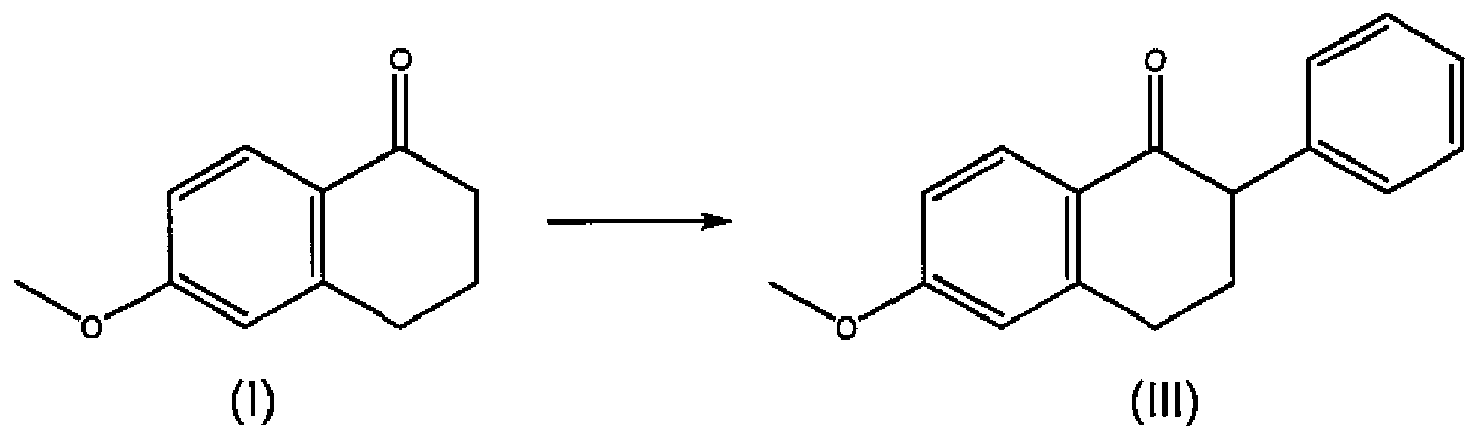
- the object is solved by the present invention owing to the provision of a process for an preparation of the key intermediate compound 6-methoxy-2-phenyl-3,4-dihydronaphthalene-1(2H)-one of the formula (III) by arylation of 6-methoxy-3,4-dihydronaphthalene-1(2H)-one (I) with phenyl halides (II).
- 6-methoxy-1-tetralone is prepared as mixture with 2,2-diphenyl-6-methoxy-1-tetralone and starting material by reaction of 6-methoxy-1-tetralone with an exotic biphenyl-2,2'-ylenebismuth phenyl complex in 18% yield. Since all previously disclosed syntheses exhibit only yields lower than 50% and partly require extensive isolation and purification none of these processes appear useful for an industrial application.
- the present invention surprisingly satisfies a higher to unmet need for an improvement of processes for the preparation of a compound that is suitable for industrial production of nafoxidine and lasofoxifene.
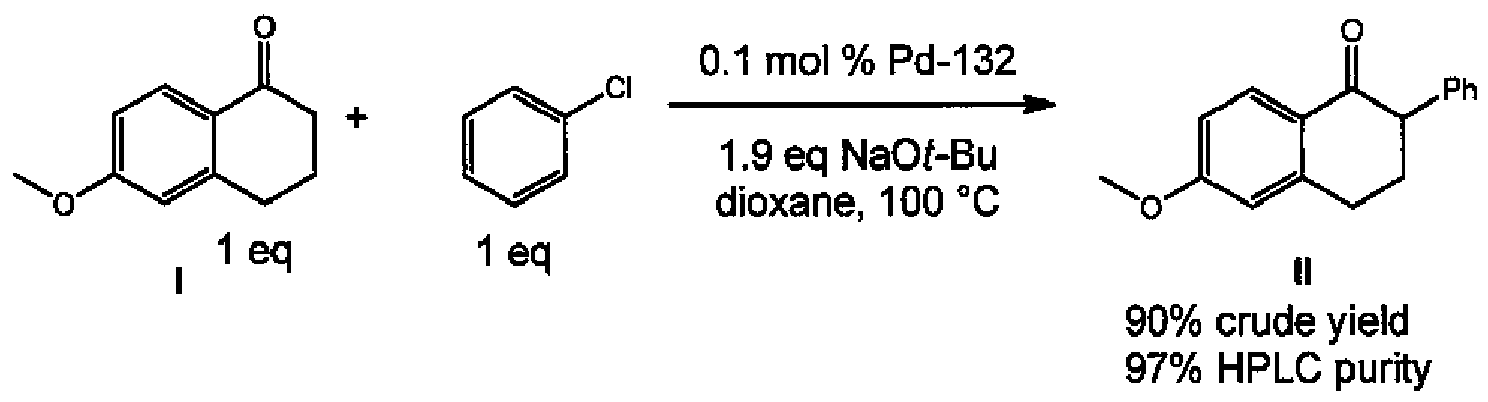
- the compound of the formula (III) can be prepared with very high efficiency by reacting a cyclic ketone of the formula (I) with an aryl halide compound of the formula (II), wherein X is selected from chlorine, bromine and iodine, preferably is chlorine or bromine.
- X is selected from chlorine, bromine and iodine, preferably is chlorine or bromine.
- the compound of the formula (III) can be readily prepared in high, almost quantitative yield.
- the yield of the compound of the formula (III) is preferably at least 75%, more preferably at least 85%, most preferably at least 90% with respect to the starting material of the formula (I).
- the process of the present invention is therefore a simple and short, high yield process for the preparation of the compound of the formula (III) with the compound of the formula (I) as starting material. Also, the process of the present invention is industrially very useful.
- the process for the preparation of the compound of the formula (III) from the compound of the formula (I) is performed in the presence of a metal catalyst.
- the process of the present invention is performed in the presence of a transition metal catalyst, notably of the generic formula M(Y)p(L)q, wherein M is a transition metal, Y is an inorganic anion, L is a coordinating ligand, p is an integer from 0 to 4 and q is an integer from 0 to 4 with the proviso that q and p can not be 0 at the same time.
- Suitable metals/transition metals are palladium, platinum, nickel, iridium, rhodium or copper.
- the anion Y can be selected from the group consisting of fluoride, chloride, bromide, iodide, acetate, nitrate, sulphate, sulphide, tosylate and triflate.
- the ligand L can be selected from a ligand that is suitable to coordinate to a transition metal atom. Thereby, the ligand can be monodentate or polydentate.
- the ligand L is selected from the group consisting of phosphines, amines and imines.
- the ligand L is a polydentate ligand
- the ligand can act as a chelating ligand.
- the ligand can be a chelating phosphine.
- the ligand L is selected from a group of bulky, sterically demanding phosphines, for example triphenyl phosphine, tri- tert .-butyl phosphine and di- tert .-butyl-(4-dimethylamino phenyl)phosphine.
- the catalyst of the generic formula M(Y) p (L) q is in terms of the transition metal M not restricted to a specific coordination and can adopt a chemically reasonable geometry.
- the catalyst of the generic formula M(Y) p (L) q adopts a tetrahedral or square planar geometry, more preferably adopts a square planar geometry.
- the catalyst has the formula (IV) wherein M is palladium, L is di- tert .-butyl-(4-dimethylamino phenyl)phosphine and Y is chloride or bromide.
- the process according to the present invention allows the potentially expensive metal catalyst to be used in a very small ratio in comparison to the starting material of a formula (I).
- the catalyst used is applied in an amount from 0.01 to 2 mol% with respect to the starting material of formula (I).
- the amount of the catalyst used ranges from 0.05 to 1.b mol% with respect to the starting material of the formula (I), in particular from 0.1 mol% to 1 mol%.
- the reaction to prepare the compound of the formula (III) according to the present invention is performed in the presence of a base.
- This base can be selected from the group consisting of inorganic basic salts comprising alkoxides, carbonates, hydrides, hexaalkyldisilazanes and hydroxides.
- Inorganic basic salts bear the benefit of being cheap and practical when used in large scale.
- the process of the present invention is performed in the presence of an alkoxide selected from the group consisting of alkaline, alkaline earth and earth metal alkoxides.
- the base is selected from potassium alkoxides and sodium alkoxides, most preferably sodium alkoxides.
- the alkoxides originate from simple alcohols such as methanol, ethanol, isopropanol, butanol and ted-butanol.
- the preferred alkoxides used for the process of the present invention are methoxides, ethoxides, isopropoxides, butoxides and tert butoxides.
- the base used for the arylation of the present invention is sodium tert -butoxides.
- the base for the arylation of the present invention can also be selected from the group consisting of organic bases selected from amides, amidines, tertiary amines including pyridine and triethylamine.
- the base for the process of the present invention is used in excess with respect to the starting material of the formula (I).
- the excess of the base can vary according to the applied conditions.
- the base is used in 1.5 to 5 fold excess.
- the preparation of the compound of the formula (III) according to the present invention is performed in an organic solvent or mixtures comprising organic solvents.
- Suitable organic solvents are for example ethers, aromatic hydrocarbons, aliphatic hydrocarbons and halogenated hydrocarbons.
- the organic solvent or solvents is (are) preferably selected from the group consisting of diethyl ether, methyl tert -butyl ether, tetrahydrofuran, dioxane, C5-C12 linear hydrocarbons, cyclohexane, decalin, benzene, toluene, dichloromethane, chloroform. More preferably, the preparation of the compound of the formula (III) according to the present invention is performed in toluene or in dioxane.
- the reaction is suitably performed at ambient to elevated temperatures, preferably at elevated temperatures. Accordingly, the reaction temperature can range from ambient temperatures to elevated temperatures, which are below the boiling point of the solvent or the solvent mixture used. Another suitable option of performing the reaction is to apply reflux conditions.
- the preparation of the compound of the formula (III) is performed between 55 and 65 °C in toluene, preferably at 60°C.
- Another preferred embodiment of said reaction is to apply temperatures between 95 °C to the boiling temperature in dioxane, preferably at a 100°C.
- the starting material of the formula (I) and the aryl halide compound of the formula (II) are used in substantially equimolar ratio.
- the term "substantially equimolar ratio” is to be understood that it is the intention to run the reaction of the two starting materials in equimolar ratio. However, imprecise weighing of starting materials, improperly working balances, humidity, moisture in the starting materials, any kind of impurities in the starting materials and related factors can lead to deviations from an "equimolar ratio”. Therefore, the term “substantially equimolar ratio” comprises ratios wherein the amount of one component deviates not more than 10% from the amount of the other component.
- the aryl halide compound of the formula (II) is to be understood as a halogen-substituted benzene derivative. Therefore, the substituent X in the formula (II) is a halogen selected from the group consisting of chlorine, bromine and iodine. Preferably, X is chlorine or bromine.
- the preparation of the compound of the formula (III) is performed in atmosphere substantially being air free and oxygen free as well as substantially consisting of an inert gas (for example nitrogen or argon).
- an inert gas for example nitrogen or argon.
- the compound of the formula (III) can be used as an intermediate for the preparation of pharmaceutically active compounds.
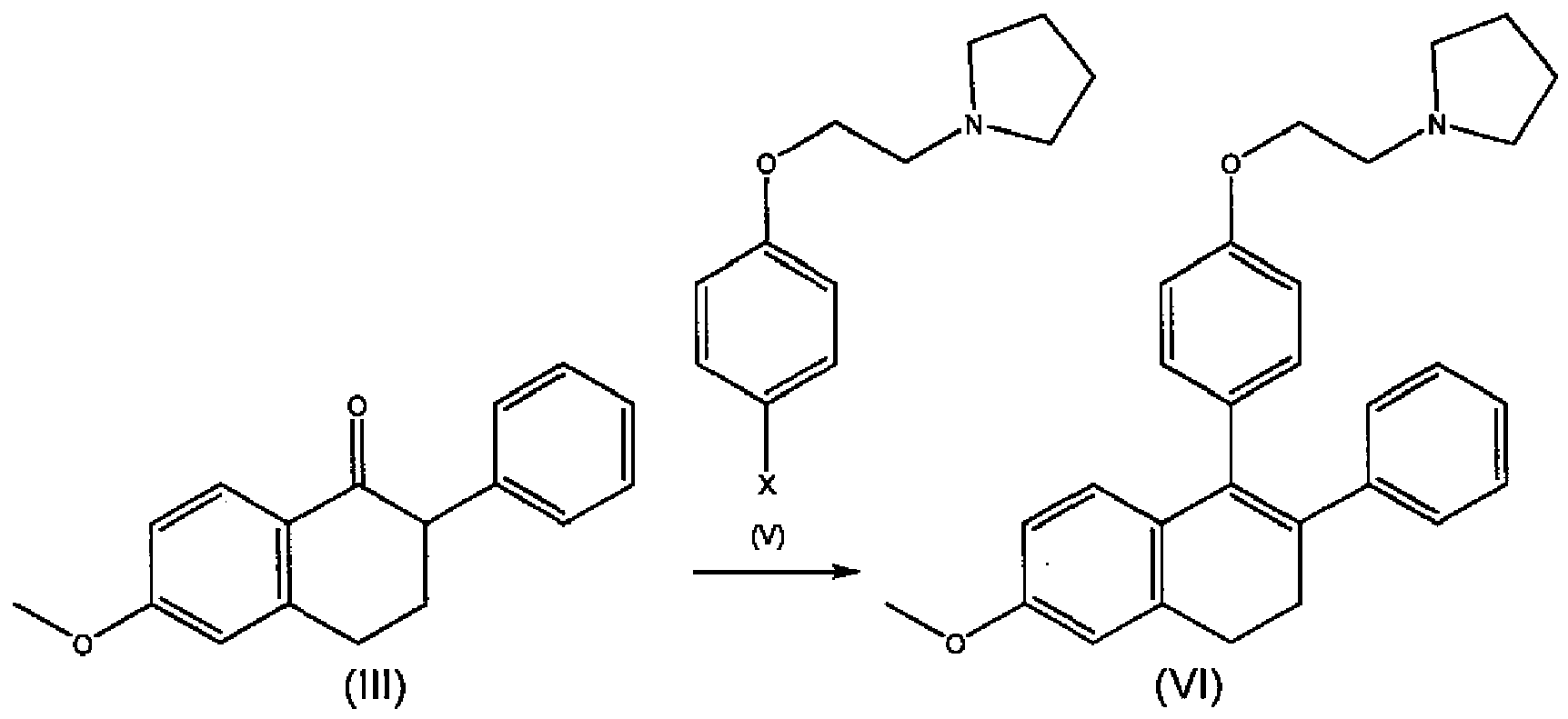
- the compound of the formula (III) can be used in a one-step reaction to prepare nafoxidine of the formula (VI) by conversion with the aryl halide of the formula (V).
- the conversion of the compound of the formula (III) to nafoxidine of the formula (VI) is preferably carried out in the presence of a derivative of the compound of the formula (V), which was previously prepared by reacting the phenyl halide of the formula (V) with a strong base and the presence of a rare earth metal halide.
- nafoxidine of the formula (VI) can thereby be isolated or separated directly from the reaction mixture, and optionally further purified facilitating a one-step synthesis from the starting material of the formula (III).
- Such isolated and optionally purified nafoxidine of the formula (VI) can then optionally be converted to a pharmaceutically acceptable salt. Therefore, a particular aspect of the present invention is the provision of a short and simple two-step synthesis of nafoxidine of the formula (VI) starting from the cyclic ketone of the formula (I) and proceeding via the intermediate of the formula (III).
- nafoxidine of the formula (VI) prepared as desired above can further be converted to a compound of the formula (VII) or a salt thereof.
- a conversion from nafoxidine of the formula (VI) to a compound of the formula (VII) (lasofoxifene) can be performed according to known literature procedures in the art, such as for example disclosed in WO 96/21656 A1 incorporated herein by reference.
- the compound of the formula (III) can therefore be used as an intermediate for the preparation of lasofoxifene or a salt thereof.
- a particularly preferred embodiment of the present invention is the preparation of a compound of the formula (VII) or a salt thereof, comprising:
- a further aspect of the present invention is the provision of a process for the preparation of a pharmaceutical composition either comprising nafoxidine or lasofoxifene or the respective salts thereof as active ingredient.
- first nafoxidine or lasofoxifene or the respective pharmaceutically acceptable salts thereof is provided by the process as described above proceeding via the intermediate of the formula (III).
- nafoxidine or lasofoxifene or the respective pharmaceutically acceptable salts thereof is suitably admixed with at least one suitable pharmaceutically acceptable excipient.
- suitable pharmaceutically acceptable excipients may be selected from the group consisting of binders, diluents, disintegrating agents, stabilizing agents, preservatives, lubricants, fragrances, flavoring agents, sweeteners and other excipients known in the field of the pharmaceutical technology.
- suitable excipients may be selected from the group consisting of lactose, microcrystalline cellulose, cellulose derivatives, such as hydroxypropylcellulose, polyacrylates, calcium carbonate, starch, colloidal silicone dioxide, sodium starch glycolate, talc, magnesium stearate, polyvinylpyrrolidone, polyethylene glycol and other excipients known in the field of the pharmaceutical technology.
- Pd-132 used in the following examples refers to a palladium dichloride catalyst of the formula as follows:
- 6-Methoxy-3,4-dihydronaphthalene-1(2H)-one (1, 2.0 mmol), NaOt-Bu (2.2 mmol) and [Pd] (0.04 mmol) were added to a Schlenk flask. The flask was sealed with a rubber stopper, evacuated and backfilled with nitrogen three times. Bromobenzene (2.0 mmol) followed by dioxane (2.0 mL, entries 1,2,7) or THF (2.0 mL, entries 3, 4, 5, 6), was added via airtight syringe through the rubber stopper, and the reaction mixture was stirred at 80°C (dioxane) or at 60 °C (THF) for 18 hours. The conversion was monitored by HPLC.
- the combined organic layers were dried (MgSO 4 ), filtered and concentrated to provide 6-methoxy-2-phenyl-3,4-dihydronaphthalene-1(2H)-one (II, 4.94 g, 54 %).
- the aqueous layer was basified to pH 12 with 5 M NaOH.
- the aqueous mixture was extracted with CH 2 Cl 2 (2 x 200 mL).
- the organic solution was dried (MgSO 4 ), filtered and concentrated to provide brown oil (7.16 g). Impurities were distilled off by Kugelrohr (100-150 °C, 0.3 mbar) to yield the product (4.33 g; 28 %).
Landscapes
- Chemical & Material Sciences (AREA)
- Organic Chemistry (AREA)
- Chemical Kinetics & Catalysis (AREA)
- Organic Low-Molecular-Weight Compounds And Preparation Thereof (AREA)
Abstract
The present invention relates to a novel one step preparation of 6-methoxy-2-phenyl-tetralone starting from 6-methoxy-tetralone and its use as an intermediate in the synthesis of pharmaceutically active compounds.
Description
- The present invention relates to the field of preparative organic chemistry, in particular to a new process for α-arylation of cyclic ketones to provide intermediate compounds for the preparation of nafoxidine, a precursor for lasofoxifene, a non-steroidal selective estrogen receptor modulator (SERM).
- Selective estrogen receptor modulators (SERMs) are a group of compounds that are classified to act on estrogen receptors. In contrast to pure receptor agonists and antagonists, SERMs reveal different effects depending on the tissue they are applied to. SERMs thereby offer the possibility to be selectively used in various tissues to inhibit or stimulate estrogen-like actions. Further, some SERMs may act as good replacements for hormone replacement therapy (HRT). One selective estrogen receptor modulator is lasofoxifene which was found to be effective for many applications and can be used against osteoporosis, breast cancer and the vaginal atrophy.
- The intermediate compound nafoxidine of the formula 1 and respective salts thereof are key compounds in the synthesis of lasofoxifene of the formula 2 [cis-6-phenyl-5-[4-(2-pyrrolidine-1-ylethoxy}phenyl]-5,6,7,8-tetrahydronaphthalene-2-ol]. In
WO 96121fi56 A1 WO 96/21656 
- This synthetic route for nafoxidine hydrochloride is already a multistep protocol which comprises three reaction steps which all require isolation and purification of the corresponding products. Therefore simplification and shortening of the synthesis of nafoxidine and related pharmaceuticallly active compounds are an object of the present invention, particularly in view of an economically reasonable preparation of lasofoxifene.
- The object is solved by the present invention owing to the provision of a process for an preparation of the key intermediate compound 6-methoxy-2-phenyl-3,4-dihydronaphthalene-1(2H)-one of the formula (III) by arylation of 6-methoxy-3,4-dihydronaphthalene-1(2H)-one (I) with phenyl halides (II).
- Proceeding via said acylation simplifies and shortens the process for the preparation of nafoxidine to a two step process starting from a simple and cheap material 6-methoxy-3,4-dihydronaphthalene-1 (2H)-one of the formula (I). By following the synthetic route of the present invention the preparation of nafoxidine in
WO 96/21656 A1 - It is particularly surprising that upon all theoretically possible synthetic routes to prepare either nafoxidine or lasofoxifene via numerous potential intermediates a useful intermediate could be found that not only shortens and simplifies the preparation of said compounds, but also can be prepared in high yield.
- Aspects, advantageous features and preferred embodiments of the present invention summarized in the following claims, respectively alone or in combination, contribute to solving this and other objects of the invention:
- 1. A process for the preparation of a compound of the formula (III)

reacting a cyclic ketone of the formula (1)

to yield the α-arylated ketone of the formula (III).
It was surprisingly found that the intermediate compound 6-methoxy-2-phenyl-3,4-dihydronaphthalene-1(2H)-one of the formula (III) can not only be readily prepared from 6-methoxy-3,4-dihydronaphthalene-1(2H)-one by catalytic arylation, but also in high, almost quantitative yield. Preferably the yield of compound (III) in the process of item 1 is at least 85%, more preferably the yield is at least 90 % with respect to the starting material 6-methoxy-3,4-dihydronaphthalene-1 (2H)-one. - 2. The process according to item 1, wherein the reaction is performed in the presence of a metal catalyst.
- 3. The process according to item 1 or 2, wherein the reaction is performed in the presence of a catalyst of the generic formula M(Y)p(L)q, wherein M is a transition metal, Y is an inorganic anion, L is a coordinating ligand, p is an integer from 0 to 4 and q is an integer from 0 to 4 with the proviso that q and p cannot be 0 at the same time.
- 4. The process according to item 2 or 3, wherein the metal or transition metal M is selected from the group consisting of palladium, platinum, nickel, iridium, rhodium and copper, preferably palladium.
- 5. The process according to item 3, wherein the anion Y is selected from the group consisting of fluoride, chloride, bromide, iodide, acetate, nitrate, sulfate, sulfide, tosylate and triflate, preferably chloride and bromide.
- 6. The process according to item 3, wherein the ligand L is selected from the group consisting of phosphines, amines, imines.
- 7. The process according to item 3, wherein the ligand L is a chelating phosphine.
- 8. The process according to item 3, wherein the ligand L is selected from the group consisting of triphenyl phosphine, tri-tert.-butyl phosphine and di-tert.-butyl-(4-dimethylamino phenyl)phosphine.
- 9. The process according to item 3, wherein the ligand L is di-tert.-butyl-(4-dimethylamino phenyl)phosphine.
- 10. The process according to any one of the preceding items, wherein the reaction is performed in the presence of a catalyst of the formula (IV)

- 11. The process according to any item 2 to 10, wherein the amount of catalyst used ranges from 0.01 mol%to 2 mol% with respect to the starting material of the formula (I).
- 12. The process according to any item 2 to 11, wherein the amount of catalyst used ranges from 0.05 mol%to 1.5 mol% with respect to the starting material of the formula (I), preferably from 0.1 mol% to 1 mol%.
- 13. The process according to any of the preceding items, wherein the reaction is carried out in the presence of a base.
- 14. The process according to item 13, wherein the base used for the arylation is selected from the group consisting of inorganic basic salts comprising alkoxides, carbonates, hydrides, hexaalkyldisilazanes and hydroxides.
- 15. The process according to item 13 or 14, wherein the base used for the arylation is selected from the group consisting of alkoxides comprising alkaline, alkaline earth and earth metal alkoxides, preferably potassium alkoxides and sodium alkoxides, most preferably sodium alkoxides.
- 16. The process according to any item 13 to 15, wherein the base used for the arylation is selected from the group consisting of alkoxides comprising methoxides, ethoxides, isopropoxides, butoxides and tert-butoxide.
- 17. The process according to any item 13 to 16, wherein the base used for the arylation is sodium tert-butoxide.
- 18. The process according to item 13, wherein the base used for the arylation is selected from the group consisting of organic bases comprising amides, amidines, tertiary amines including pyridine and triethylamine.
- 19. The process according to any one of the proceeding items 13 to 18, wherein the base is used in excess with respect to the starting material of the formula (I), preferably in 1.5 to 5 fold excess.
- 20. The process according to any one of the proceeding items, wherein the reaction is performed in an organic solvent or mixtures comprising organic solvents.
- 21. The process according to item 20, wherein the reaction is performed in dioxane, toluene, tetrahydrofurane, 2-methyl tetrahydrofurane, dimethoxyethane, methyl tert-butyl-ether, preferably in toluene or dioxane.
- 22. The process according to any one of the proceeding items, wherein the reaction is performed at ambient temperatures to elevated temperatures, preferably at elevated temperatures.
- 23. The process according to item 22, wherein the reaction is performed at elevated temperatures above ambient temperatures and below the boiling point of the solvent or solvent mixture used, or is performed under reflux conditions.
- 24. The process according to item 22 or 23, wherein the reaction is performed between 55 and 65°C in toluene, preferably at 60 °C.
- 25. The process according to item 22 or 23, wherein the reaction is performed between 95 °C to the boiling temperature in dioxane, preferably at 100 °C.
- 26. The process according to any one of the preceding items, wherein the starting material of the formula (I) and the aryl halide compound of the formula (II) are used in a substantially equimolar ratio.
- 27. The process according to any one of the preceding items, wherein in the aryl halide compound of the formula (II), X is chlorine or bromine.
- 28. The process according to any one of the preceding items, wherein the product of the formula (III) is separated from the reaction mixture.
- 29. The process according to any one of the preceding items, wherein the reaction is performed under substantially air free conditions or under substantially oxygen free conditions.
- 30. The process according to any one of the preceding items, wherein the reaction is performed in an atmosphere substantially consisting of nitrogen.
- 31. The process according to any one of the preceding items, wherein the compound of the formula (III) is prepared in a yield of at least 75% yield, preferably at least 85% yield, more preferably at least 90% yield.
- 32. The process according to any one of the preceding items further comprising subjecting the arylated product of the formula (III) to further reaction steps to prepare a pharmaceutical active compound.
- 33. The process according to any one preceding items, wherein the compound of the formula (III) is converted by reaction with the aryl halide of the formula (V) or a salt thereof


The suitability of the compound of the formula (III) as an intermediate in the synthesis of a pharmaceutically active compound such as nafoxidine or lasofoxifene is demonstrated by the conversion of (III) with the aryl halide compound of the formula (V). In a preferred embodiment the aforementioned conversion is performed by treating compound (V) with a strong base in the presence of a rare earth halide. The resulting derivative of (V) is then further reacted with compound (III) to yield a compound of the formula (VI). Thereby, a simple and short two step synthesis of nafoxidine starting from 6-methoxy-tetralone is effected according to an aspect of the present invention. - 34. Use of the compound of the formula {III) as intermediate for the preparation of nafoxidine or a salt thereof.

- 35. Use of the compound of the formula (III) as intermediate for the preparation of lasofoxifene or a salt thereof.

- 36. A process for the preparation of a compound of the formula (VII) or a salt thereof, comprising :
- (i) converting a compound of the formula (I) to the arylated compound of the formula (III) or a salt thereof by a process according to any one of item 1 to 33;
- (ii) converting the compound of the formula (III) or a salt thereof by reaction with a compound of the formula (V) to prepare a compound of the formula (VI) or a salt thereof;


- (i) converting a compound of the formula (I) to the arylated compound of the formula (III) or a salt thereof by a process according to any one of item 1 to 33;
- 37. A process for the preparation of a pharmaceutical composition comprising nafoxidine or a salt thereof as active ingredient, comprising the steps of:
- a) preparing nafoxidine or a salt thereof according to the process according to item 33, and
- b) admixing the thus prepared nafoxidine or a salt thereof with at least one pharmaceutically acceptable excipient.
- 38. A process for the preparation of a pharmaceutical composition comprising lasofoxifene or a salt thereof as active ingredient, comprising the steps of:
- a) preparing lasofoxifene or a salt thereof according to the process according to item 36, and
- b) admixing the thus prepared iasofoxifene or a salt thereof with at least one pharmaceutically acceptable excipient.
- The present invention is now described in more detail by referring to further preferred and further advantageous embodiments and examples, which are however presented for illustrative purposes only and shall not be understood as limiting the scope of the present invention.
- In order to find a more efficient and shorter way to prepare nafoxidine or a salt thereof it was surprisingly found that the intermediate compound 6-methoxy-2-phenyl-3,4-dihydronaphthalene-1(2H)-one of the formula (III) can not only be readily prepared from 6-methoxy-3,4-dihydronaphthalene-1(2H)-one by catalytic arylation, but also in high, almost quantitative yield. Said intermediate can subsequently be conveniently converted to nafoxidine or a salt thereof, which in turn may represent a key intermediate and can be used by itself or for the subsequent synthesis of lasofoxifene.
- Syntheses of the compound of formula (III) have been previously disclosed, however using low yield processes and directed to purposes other than preparing nafoxidine or lasofoxifene. In J. Med. Chem. 1988, 31, 107 the compound of formula (III) is prepared by a two step process starting from a 2,4-diphenylbutyroniltrile in 45% yield. In J. Chem. Soc., Perkin Trans. 1, 1997, 1511, 6-methoxy-1-tetralone is first brominated to yield 2-bromo-6-methoxy-1-tetralone which is subsequently converted with a phenyl Grignard reagent to the compound of the formula (III) in 13% yield. In J. Chem. Soc., Perkin Trans. 1, 2000, 3775, 6-methoxy-1-tetralone is prepared as mixture with 2,2-diphenyl-6-methoxy-1-tetralone and starting material by reaction of 6-methoxy-1-tetralone with an exotic biphenyl-2,2'-ylenebismuth phenyl complex in 18% yield. Since all previously disclosed syntheses exhibit only yields lower than 50% and partly require extensive isolation and purification none of these processes appear useful for an industrial application.
- Catalytic arylations of cyclic benzoketones using transition metal complexes are known in the art per se (see e.g. Chem. Rev., 2010, 110, 1147; Angew. Chem. lnt. Ed., 2010, 49, 676; J. Am. Chem. Soc., 2001, 123, 5816; Org. Proc. Res. Dev., 2008, 12, 522; J. Org. Chem., 2006, 71, 685; Org. Lett., 2007, 9, 5489; Org Lett., 2010, 12, 1032), however none of these reactions were performed with respect to the preparation of nafoxidine or lasofoxifene or appropriate intermediates thereof.
- Compared with the conventional low yield syntheses of the compound of the formula (III), the present invention surprisingly satisfies a higher to unmet need for an improvement of processes for the preparation of a compound that is suitable for industrial production of nafoxidine and lasofoxifene.
- According to one aspect of the present invention, the compound of the formula (III) can be prepared with very high efficiency by reacting a cyclic ketone of the formula (I) with an aryl halide compound of the formula (II), wherein X is selected from chlorine, bromine and iodine, preferably is chlorine or bromine. Thereby, the process of the present invention provides the preparation of the compound of the formula (III) from the ketone of the formula (I) in one single reaction step without the use of uncommon phenyl nucleophiles as disclosed in J. Chem. Soc., Perkin Trans. 1, 2000, 3775.
- It was surprisingly found that the compound of the formula (III) can be readily prepared in high, almost quantitative yield. In this regard, the yield of the compound of the formula (III) is preferably at least 75%, more preferably at least 85%, most preferably at least 90% with respect to the starting material of the formula (I). The process of the present invention is therefore a simple and short, high yield process for the preparation of the compound of the formula (III) with the compound of the formula (I) as starting material. Also, the process of the present invention is industrially very useful.
- In a preferred embodiment of the present invention, the process for the preparation of the compound of the formula (III) from the compound of the formula (I) is performed in the presence of a metal catalyst. In a further preferred embodiment, the process of the present invention is performed in the presence of a transition metal catalyst, notably of the generic formula M(Y)p(L)q, wherein M is a transition metal, Y is an inorganic anion, L is a coordinating ligand, p is an integer from 0 to 4 and q is an integer from 0 to 4 with the proviso that q and p can not be 0 at the same time. Suitable metals/transition metals are palladium, platinum, nickel, iridium, rhodium or copper. The anion Y can be selected from the group consisting of fluoride, chloride, bromide, iodide, acetate, nitrate, sulphate, sulphide, tosylate and triflate. The ligand L can be selected from a ligand that is suitable to coordinate to a transition metal atom. Thereby, the ligand can be monodentate or polydentate. Preferably, the ligand L is selected from the group consisting of phosphines, amines and imines. In case the ligand L is a polydentate ligand, the ligand can act as a chelating ligand. For example, the ligand can be a chelating phosphine. In a more preferred embodiment, the ligand L is selected from a group of bulky, sterically demanding phosphines, for example triphenyl phosphine, tri-tert.-butyl phosphine and di-tert.-butyl-(4-dimethylamino phenyl)phosphine.
- Further, the catalyst of the generic formula M(Y)p(L)q is in terms of the transition metal M not restricted to a specific coordination and can adopt a chemically reasonable geometry. In a preferred embodiment, the catalyst of the generic formula M(Y)p(L)q adopts a tetrahedral or square planar geometry, more preferably adopts a square planar geometry.
- In further preferred embodiment of the present invention, the catalyst has the formula (IV)

- In view of an economically reasonable and industrially applicable process, the process according to the present invention allows the potentially expensive metal catalyst to be used in a very small ratio in comparison to the starting material of a formula (I). In a preferred embodiment of the present invention the catalyst used is applied in an amount from 0.01 to 2 mol% with respect to the starting material of formula (I). In a more preferred embodiment, the amount of the catalyst used ranges from 0.05 to 1.b mol% with respect to the starting material of the formula (I), in particular from 0.1 mol% to 1 mol%.
- In a further embodiment of the present invention, the reaction to prepare the compound of the formula (III) according to the present invention is performed in the presence of a base. This base can be selected from the group consisting of inorganic basic salts comprising alkoxides, carbonates, hydrides, hexaalkyldisilazanes and hydroxides. Inorganic basic salts bear the benefit of being cheap and practical when used in large scale.
- In a further preferred embodiment the process of the present invention is performed in the presence of an alkoxide selected from the group consisting of alkaline, alkaline earth and earth metal alkoxides. In a more preferred embodiment, the base is selected from potassium alkoxides and sodium alkoxides, most preferably sodium alkoxides.
- In a further preferred embodiment the alkoxides originate from simple alcohols such as methanol, ethanol, isopropanol, butanol and ted-butanol. Hence, the preferred alkoxides used for the process of the present invention are methoxides, ethoxides, isopropoxides, butoxides and tert butoxides. In a most preferred embodiment, the base used for the arylation of the present invention is sodium tert-butoxides. Further, the base for the arylation of the present invention can also be selected from the group consisting of organic bases selected from amides, amidines, tertiary amines including pyridine and triethylamine.
- Preferably, the base for the process of the present invention is used in excess with respect to the starting material of the formula (I). The excess of the base can vary according to the applied conditions. Preferably, the base is used in 1.5 to 5 fold excess.
- The preparation of the compound of the formula (III) according to the present invention is performed in an organic solvent or mixtures comprising organic solvents.
- Suitable organic solvents are for example ethers, aromatic hydrocarbons, aliphatic hydrocarbons and halogenated hydrocarbons. The organic solvent or solvents is (are) preferably selected from the group consisting of diethyl ether, methyl tert-butyl ether, tetrahydrofuran, dioxane, C5-C12 linear hydrocarbons, cyclohexane, decalin, benzene, toluene, dichloromethane, chloroform. More preferably, the preparation of the compound of the formula (III) according to the present invention is performed in toluene or in dioxane.
- Further, the reaction is suitably performed at ambient to elevated temperatures, preferably at elevated temperatures. Accordingly, the reaction temperature can range from ambient temperatures to elevated temperatures, which are below the boiling point of the solvent or the solvent mixture used. Another suitable option of performing the reaction is to apply reflux conditions. In a preferred embodiment of the present invention the preparation of the compound of the formula (III) is performed between 55 and 65 °C in toluene, preferably at 60°C. Another preferred embodiment of said reaction is to apply temperatures between 95 °C to the boiling temperature in dioxane, preferably at a 100°C.
- In a further preferred embodiment of the present invention the starting material of the formula (I) and the aryl halide compound of the formula (II) are used in substantially equimolar ratio. The term "substantially equimolar ratio" is to be understood that it is the intention to run the reaction of the two starting materials in equimolar ratio. However, imprecise weighing of starting materials, improperly working balances, humidity, moisture in the starting materials, any kind of impurities in the starting materials and related factors can lead to deviations from an "equimolar ratio". Therefore, the term "substantially equimolar ratio" comprises ratios wherein the amount of one component deviates not more than 10% from the amount of the other component.
- The aryl halide compound of the formula (II) is to be understood as a halogen-substituted benzene derivative. Therefore, the substituent X in the formula (II) is a halogen selected from the group consisting of chlorine, bromine and iodine. Preferably, X is chlorine or bromine.
- In a further preferred embodiment of the present invention the preparation of the compound of the formula (III) is performed in atmosphere substantially being air free and oxygen free as well as substantially consisting of an inert gas (for example nitrogen or argon). The terms "substantially air free", "substantially oxygen free" and "substantially consisting of nitrogen", all refer atmospheres in reaction vessels which are intended to consist of an inert gas by exchange of atmospheres by conventionally applied techniques. Common procedures to exchange atmospheres in reaction vessels comprise purging the reaction vessel for a certain period of time with the desired inert gas or apply various cycles of evacuating and refilling the reaction vessel with the desired inert gas. It is commonly accepted that upon application of such techniques reaction vessels can be provided with an atmosphere that does not react with sensitive compounds. However, it is further known, that in such atmospheres residual amounts of nitrogen, oxygen or air can remain, even though it has been diligently taken care to prevent this.
- In a further aspect of the present invention the compound of the formula (III) can be used as an intermediate for the preparation of pharmaceutically active compounds. Beneficially, the compound of the formula (III) can be used in a one-step reaction to prepare nafoxidine of the formula (VI) by conversion with the aryl halide of the formula (V). The conversion of the compound of the formula (III) to nafoxidine of the formula (VI) is preferably carried out in the presence of a derivative of the compound of the formula (V), which was previously prepared by reacting the phenyl halide of the formula (V) with a strong base and the presence of a rare earth metal halide. In this preferred embodiment nafoxidine of the formula (VI) can thereby be isolated or separated directly from the reaction mixture, and optionally further purified facilitating a one-step synthesis from the starting material of the formula (III). Such isolated and optionally purified nafoxidine of the formula (VI) can then optionally be converted to a pharmaceutically acceptable salt. Therefore, a particular aspect of the present invention is the provision of a short and simple two-step synthesis of nafoxidine of the formula (VI) starting from the cyclic ketone of the formula (I) and proceeding via the intermediate of the formula (III).
- In further aspect of the present invention, nafoxidine of the formula (VI) prepared as desired above can further be converted to a compound of the formula (VII) or a salt thereof. Such a conversion from nafoxidine of the formula (VI) to a compound of the formula (VII) (lasofoxifene) can be performed according to known literature procedures in the art, such as for example disclosed in
WO 96/21656 A1 - A particularly preferred embodiment of the present invention is the preparation of a compound of the formula (VII) or a salt thereof, comprising:
- (i) converting a compound of the formula (I) to the arylated compound of the formula (III) or a salt thereof by a process according to the present invention;

- (ii) converting the compound of the formula (III) or a salt thereof by reaction with a compound of the formula (V) according to the present invention to prepare a compound of the formula (VI) or a salt thereof;
- (iii) further converting the compound of the formula (VI) or a salt thereof to lasofoxifene of the formula (VII) or a salt thereof.
- A further aspect of the present invention is the provision of a process for the preparation of a pharmaceutical composition either comprising nafoxidine or lasofoxifene or the respective salts thereof as active ingredient.
- For preparing a pharmaceutical composition comprising nafoxidine or lasofoxifene or the respective pharmaceutically acceptable salts thereof as active ingredient, first nafoxidine or lasofoxifene or the respective pharmaceutically acceptable salts thereof is provided by the process as described above proceeding via the intermediate of the formula (III).
- Then, the thus prepared nafoxidine or lasofoxifene or the respective pharmaceutically acceptable salts thereof is suitably admixed with at least one suitable pharmaceutically acceptable excipient. Pharmaceutically acceptable excipients may be selected from the group consisting of binders, diluents, disintegrating agents, stabilizing agents, preservatives, lubricants, fragrances, flavoring agents, sweeteners and other excipients known in the field of the pharmaceutical technology.
- For example, suitable excipients may be selected from the group consisting of lactose, microcrystalline cellulose, cellulose derivatives, such as hydroxypropylcellulose, polyacrylates, calcium carbonate, starch, colloidal silicone dioxide, sodium starch glycolate, talc, magnesium stearate, polyvinylpyrrolidone, polyethylene glycol and other excipients known in the field of the pharmaceutical technology.
- The terminology "Pd-132" used in the following examples refers to a palladium dichloride catalyst of the formula as follows:

-

Table 1. Evaluation of Pd catalysts Entry Pd catalyst Ketone I Ketone III 1 Pd-113 25.35 44.20 2 Pd-116 22.82 40.87 3 Pd-106 59.81 14.16 4 Pd-100 78.51 4.55 5 Pd-132 4.40 80.40 6 Pd(AmPhos)2 69.93 22.66 7 Pd-118 17.52 76.22 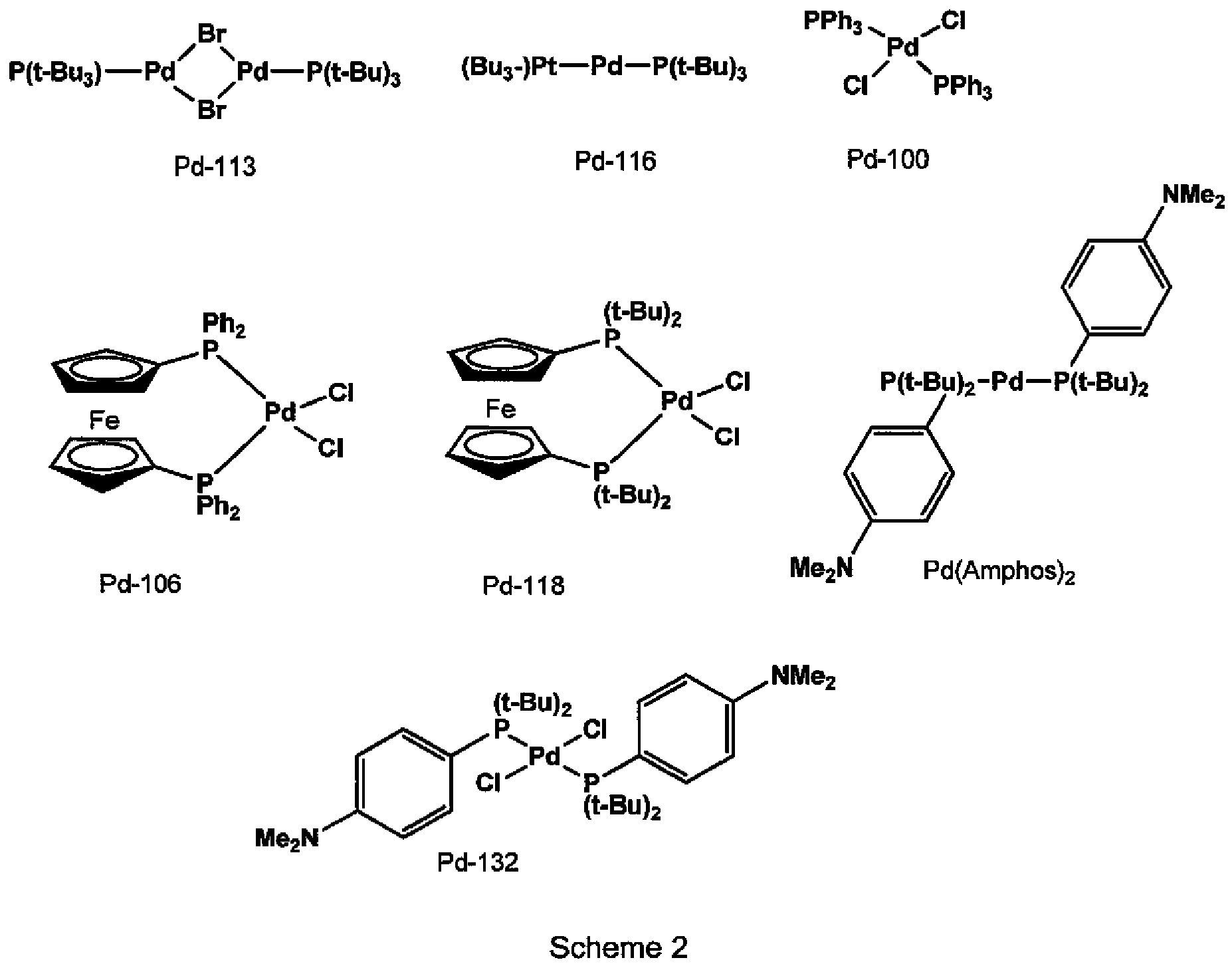
-
- A)

1H NMR (CDCl3) δ = 2.39 - 2.44 (m, 2H), 3.0 - 3.1 (m, 2H), 3.8 (t, 1 H), 3.9 (s, 3H), 6.7 (d, 1 H), 6.9 (dd, 1H), 7.2 (m, 2H), 7.3 (m, 1 H), 7.4 (m, 2H), 8.1 (d, 1 H) ppm.
13C NMR (CDCl3) δ = 28.9, 31.2, 54.0, 55.4, 112.4, 113.2, 126.4, 126.7, 128.35, 128.4, 130.2, 140.0, 146.5, 163.5, 196.9 ppm. - B)
1H NMR (CDCl3) δ = 2.39 - 2.44 (m, 2H), 3.0 - 3.1 (m, 2H), 3.8 (t, 1 H), 3.9 (s, 3H), 6.7 (d, 1 H), 6.9 (dd, 1 H), 7.2 (m, 2H), 7.3 (m, 1 H), 7.4 (m, 2H), 8.1 (d, 1 H) ppm.
13C NMR (CDCl3) δ = 28.9, 31.2, 54.0, 55.4, 112.4, 113.2, 126.4, 126.7, 128.35, 128.4, 130.2, 140.0, 146.5, 163.5, 196.9 ppm. -

1H NMR (CDCl3) δ = 1.8 (m, 4H), 2.6 (m, 4H), 2.8 (m, 2H), 2.9 (m, 4H), 3.8 (s, 3H), 4.1 (t, 2H), 6.6 (dd, 1 H), 6.7 (m, 4H), 7.1 (m, 7H) ppm.
13C NMR (CDCl3) δ = 23.4, 28.9, 30.7, 54.7, 55.1, 55.2, 66.8, 110.7, 113.1, 114.0, 125.5, 127.4, 127.5, 128.2, 130.4, 132.02, 132.04, 134.1, 134.7, 137.6, 143.2, 157.3, 158.3 ppm.

Claims (15)
- A process for the preparation of a compound of the formula (III)

reacting a cyclic ketone of the formula (I)

to yield the α-arylated ketone of the formula (III). - The process according to claim 1, wherein the reaction is performed in the presence of a metal catalyst, preferably of a catalyst of the generic formula M(Y)p(L)q, wherein M is a transition metal, Y is an inorganic anion, L is a coordinating ligand, p is an integer from 0 to 4 and q is an integer from 0 to 4 with the proviso that q and p cannot be 0 at the same time.
- The process according to claim 1 or 2, wherein the reaction is performed in the presence of a catalyst of the formula (IV)

- The process according to claim 2 or 3, wherein the amount of catalyst used ranges from 0.05 to 1.5 mol% with respect to the starting material of the formula (I), preferably from 0.1 mol% to 1 mol%.
- The process according to any of the preceding claims, wherein the reaction is carried out in the presence of a base, preferably selected from the group consisting of alkoxides comprising alkaline, alkaline earth and earth metal alkoxides, more preferably selected from potassium alkoxides and sodium alkoxides.
- The process according to claim 5, wherein the base used for the arylation is sodium tert-butoxide.
- The process according to any of the preceding claims, wherein the reaction is performed between 55 and 65 °C in toluene.
- The process according to preceding claims, wherein the reaction is performed between 95 °C to the boiling temperature in dioxane.
- The process according to any one of the preceding claims, wherein the compound of the formula (III) is prepared in a yield of at least 75% yield, preferably at least 85% yield, more preferably at least 90% yield.
- The process according to any one preceding claims, wherein the compound of the formula (III), is converted by reaction with the aryl halide of the formula (V) or a salt thereof

to yield a compound of the formula (VI) or a salt thereof,
- Use of the compound of the formula (III) as intermediate for the preparation of nafoxidine or a salt thereof.

- Use of the compound of the formula (III) as intermediate for the preparation of lasofoxifene or a salt thereof.

- A process for the preparation of a compound of the formula (VII) or a salt thereof, comprising :(i) converting a compound of the formula (I) to the arylated compound of the formula (III) or a salt thereof by a process according to any one of claim 1 to 10;
 (ii) converting the compound of the formula (III) or a salt thereof by reaction with a compound of the formula (V) to prepare a compound of the formula (VI) or a salt thereof;
 (iii) further converting the compound of the formula (VI) or a salt thereof to lasofoxifene or a salt thereof.
- A process for the preparation of a pharmaceutical composition comprising nafoxidine or a salt thereof as active ingredient, comprising the steps of:a) preparing nafoxidine or a salt thereof according to the process according to claim 10, andb) admixing the prepared nafoxidine or a salt thereof with at least one pharmaceutically acceptable excipient.
- A process for the preparation of a pharmaceutical composition comprising lasofoxifene or a salt thereof as active ingredient, comprising the steps of:a) preparing lasofoxifene or a salt thereof according to the process according to claim 13, andb) admixing the prepared lasofoxifene or a salt thereof with at least one pharmaceutically acceptable excipient.
Priority Applications (2)
| Application Number | Priority Date | Filing Date | Title |
|---|---|---|---|
| EP11166911A EP2524908A1 (en) | 2011-05-20 | 2011-05-20 | Process for the preparation of alfa-substituted ketones and their application in synthesis of pharmaceutically active compounds |
| PCT/EP2012/059236 WO2012159981A2 (en) | 2011-05-20 | 2012-05-18 | PROCESS FOR THE PREPARATION OF α-SUBSTITUTED KETONES AND THEIR APPLICATION IN SYNTHESIS OF PHARMACEUTICALLY ACTIVE COMPOUNDS |
Applications Claiming Priority (1)
| Application Number | Priority Date | Filing Date | Title |
|---|---|---|---|
| EP11166911A EP2524908A1 (en) | 2011-05-20 | 2011-05-20 | Process for the preparation of alfa-substituted ketones and their application in synthesis of pharmaceutically active compounds |
Publications (1)
| Publication Number | Publication Date |
|---|---|
| EP2524908A1 true EP2524908A1 (en) | 2012-11-21 |
Family
ID=46085646
Family Applications (1)
| Application Number | Title | Priority Date | Filing Date |
|---|---|---|---|
| EP11166911A Ceased EP2524908A1 (en) | 2011-05-20 | 2011-05-20 | Process for the preparation of alfa-substituted ketones and their application in synthesis of pharmaceutically active compounds |
Country Status (2)
| Country | Link |
|---|---|
| EP (1) | EP2524908A1 (en) |
| WO (1) | WO2012159981A2 (en) |
Families Citing this family (3)
| Publication number | Priority date | Publication date | Assignee | Title |
|---|---|---|---|---|
| CN103113323B (en) * | 2013-02-05 | 2015-11-11 | 南京华威医药科技开发有限公司 | The preparation method of Lasofoxifene tartrate intermediate |
| CN103232414B (en) * | 2013-04-12 | 2015-06-17 | 南京华威医药科技开发有限公司 | Preparation method of Lasofoxifene tartrate intermediate |
| CN103483293B (en) * | 2013-08-24 | 2015-01-07 | 福建省微生物研究所 | Synthetic method of lasofoxifene precursor nafaxidine |
Citations (2)
| Publication number | Priority date | Publication date | Assignee | Title |
|---|---|---|---|---|
| WO1996021656A1 (en) | 1995-01-09 | 1996-07-18 | Pfizer, Inc. | Estrogen agonists/antagonists |
| WO2004063191A1 (en) * | 2003-01-09 | 2004-07-29 | Orion Corporation | Pyridine derivatives useful for inhibiting sodium/calcium exchange system |
-
2011
- 2011-05-20 EP EP11166911A patent/EP2524908A1/en not_active Ceased
-
2012
- 2012-05-18 WO PCT/EP2012/059236 patent/WO2012159981A2/en not_active Ceased
Patent Citations (2)
| Publication number | Priority date | Publication date | Assignee | Title |
|---|---|---|---|---|
| WO1996021656A1 (en) | 1995-01-09 | 1996-07-18 | Pfizer, Inc. | Estrogen agonists/antagonists |
| WO2004063191A1 (en) * | 2003-01-09 | 2004-07-29 | Orion Corporation | Pyridine derivatives useful for inhibiting sodium/calcium exchange system |
Non-Patent Citations (11)
| Title |
|---|
| ANGEW. CHEM. INT. ED., vol. 49, 2010, pages 676 |
| CHEM. REV., vol. 110, 2010, pages 1147 |
| J. AM. CHEM. SOC., vol. 123, 2001, pages 5816 |
| J. CHEM. SOC., PERKIN TRANS., vol. 1, 1997, pages 1511 |
| J. CHEM. SOC., PERKIN TRANS., vol. 1, 2000, pages 3775 |
| J. MED. CHEM., vol. 31, 1988, pages 107 |
| J. ORG. CHEM., vol. 71, 2006, pages 685 |
| ORG LETT., vol. 12, 2010, pages 1032 |
| ORG. LETT., vol. 9, 2007, pages 5489 |
| ORG. PROC. RES. DEV., vol. 12, 2008, pages 522 |
| WAYNE VACCARO ET AL: "Inhibitors of Acyl CoA:Cholesterol Acyltransterase", J. MED. CHEM., vol. 39, 1996, pages 1704 - 1719, XP002658744 * |
Also Published As
| Publication number | Publication date |
|---|---|
| WO2012159981A3 (en) | 2013-01-24 |
| WO2012159981A2 (en) | 2012-11-29 |
Similar Documents
| Publication | Publication Date | Title |
|---|---|---|
| CN102458659B (en) | Asymmetric hydrogenation catalyst | |
| JP3281920B2 (en) | Method for producing allylfuran compound | |
| EP2221289A1 (en) | Method of producing alcohol | |
| KR20110019440A (en) | Method for Preparation of Apoptosis Promoter AA-263 | |
| EP3135681B1 (en) | Ruthenium complex, method for producing same, and use of same | |
| Brown et al. | Fast base-induced reaction of. alpha.,. alpha.-dichloromethyl ether with organoboranes. New general route from organoboranes to the corresponding carbon structures | |
| JP2023103409A (en) | Method for producing monothiocarbonate compound | |
| US20190106416A1 (en) | Process for the preparation of propionic acid derivatives | |
| CN111320591B (en) | Method for synthesizing chiral gamma-amino alcohol | |
| Gansäuer et al. | Titanocene catalyzed opening of oxetanes | |
| WO2012159981A2 (en) | PROCESS FOR THE PREPARATION OF α-SUBSTITUTED KETONES AND THEIR APPLICATION IN SYNTHESIS OF PHARMACEUTICALLY ACTIVE COMPOUNDS | |
| KR101017881B1 (en) | Phosphine compounds, intermediates, palladium-complexes, and uses thereof | |
| CN106573946A (en) | Complex | |
| JPH0159263B2 (en) | ||
| EP2878596A1 (en) | Synthesis of vortioxetine via (2-(piperazine-1-yl)phenyl)lithium intermediates | |
| RU2290406C1 (en) | Method for preparing 2,3,4,5-tetraalkylmagnesa-cyclopenta-2,4-dienes | |
| Pugia et al. | Synthesis and alkali-metal complexing abilities of crown ether tertiary alcohols | |
| CN114394884A (en) | A kind of preparation method of allyl phenol compound | |
| EP3126344B1 (en) | Method for preparation of fluoro, chloro and fluorochloro alkylated compounds by heterogeneous catalysis | |
| EP1574509A1 (en) | Process for the production of 1-acetoxy-3-(substituted phenyl)propenes | |
| EP2585452B1 (en) | Process for the preparation of propionic acid derivatives | |
| JPH0816078B2 (en) | Process for producing optically active phenylacetic acid derivative | |
| JP4918736B2 (en) | Novel optically active ruthenium complex, process for producing the same, and process for producing optically active compounds using the same | |
| CN116621774A (en) | Synthesis method of allylic aza-aryl methylamine compound | |
| JP4332777B2 (en) | Process for producing trifluoromethoxycyclohexanes |
Legal Events
| Date | Code | Title | Description |
|---|---|---|---|
| PUAI | Public reference made under article 153(3) epc to a published international application that has entered the european phase |
Free format text: ORIGINAL CODE: 0009012 |
|
| AK | Designated contracting states |
Kind code of ref document: A1 Designated state(s): AL AT BE BG CH CY CZ DE DK EE ES FI FR GB GR HR HU IE IS IT LI LT LU LV MC MK MT NL NO PL PT RO RS SE SI SK SM TR |
|
| AX | Request for extension of the european patent |
Extension state: BA ME |
|
| STAA | Information on the status of an ep patent application or granted ep patent |
Free format text: STATUS: THE APPLICATION HAS BEEN REFUSED |
|
| 18R | Application refused |
Effective date: 20121209 |