EP2523453A2 - Information recording apparatus and controlling method thereof - Google Patents
Information recording apparatus and controlling method thereof Download PDFInfo
- Publication number
- EP2523453A2 EP2523453A2 EP12166394A EP12166394A EP2523453A2 EP 2523453 A2 EP2523453 A2 EP 2523453A2 EP 12166394 A EP12166394 A EP 12166394A EP 12166394 A EP12166394 A EP 12166394A EP 2523453 A2 EP2523453 A2 EP 2523453A2
- Authority
- EP
- European Patent Office
- Prior art keywords
- recording
- wireless communication
- communication function
- relay
- media
- Prior art date
- Legal status (The legal status is an assumption and is not a legal conclusion. Google has not performed a legal analysis and makes no representation as to the accuracy of the status listed.)
- Withdrawn
Links
Images


Classifications
-
- G—PHYSICS
- G11—INFORMATION STORAGE
- G11B—INFORMATION STORAGE BASED ON RELATIVE MOVEMENT BETWEEN RECORD CARRIER AND TRANSDUCER
- G11B27/00—Editing; Indexing; Addressing; Timing or synchronising; Monitoring; Measuring tape travel
- G11B27/10—Indexing; Addressing; Timing or synchronising; Measuring tape travel
-
- H—ELECTRICITY
- H04—ELECTRIC COMMUNICATION TECHNIQUE
- H04N—PICTORIAL COMMUNICATION, e.g. TELEVISION
- H04N5/00—Details of television systems
- H04N5/76—Television signal recording
- H04N5/765—Interface circuits between an apparatus for recording and another apparatus
- H04N5/77—Interface circuits between an apparatus for recording and another apparatus between a recording apparatus and a television camera
- H04N5/772—Interface circuits between an apparatus for recording and another apparatus between a recording apparatus and a television camera the recording apparatus and the television camera being placed in the same enclosure
-
- G—PHYSICS
- G11—INFORMATION STORAGE
- G11B—INFORMATION STORAGE BASED ON RELATIVE MOVEMENT BETWEEN RECORD CARRIER AND TRANSDUCER
- G11B20/00—Signal processing not specific to the method of recording or reproducing; Circuits therefor
- G11B20/10—Digital recording or reproducing
- G11B20/10527—Audio or video recording; Data buffering arrangements
-
- G—PHYSICS
- G11—INFORMATION STORAGE
- G11B—INFORMATION STORAGE BASED ON RELATIVE MOVEMENT BETWEEN RECORD CARRIER AND TRANSDUCER
- G11B27/00—Editing; Indexing; Addressing; Timing or synchronising; Monitoring; Measuring tape travel
- G11B27/02—Editing, e.g. varying the order of information signals recorded on, or reproduced from, record carriers
- G11B27/031—Electronic editing of digitised analogue information signals, e.g. audio or video signals
- G11B27/034—Electronic editing of digitised analogue information signals, e.g. audio or video signals on discs
-
- G—PHYSICS
- G11—INFORMATION STORAGE
- G11B—INFORMATION STORAGE BASED ON RELATIVE MOVEMENT BETWEEN RECORD CARRIER AND TRANSDUCER
- G11B27/00—Editing; Indexing; Addressing; Timing or synchronising; Monitoring; Measuring tape travel
- G11B27/10—Indexing; Addressing; Timing or synchronising; Measuring tape travel
- G11B27/11—Indexing; Addressing; Timing or synchronising; Measuring tape travel by using information not detectable on the record carrier
-
- H—ELECTRICITY
- H04—ELECTRIC COMMUNICATION TECHNIQUE
- H04N—PICTORIAL COMMUNICATION, e.g. TELEVISION
- H04N1/00—Scanning, transmission or reproduction of documents or the like, e.g. facsimile transmission; Details thereof
- H04N1/00127—Connection or combination of a still picture apparatus with another apparatus, e.g. for storage, processing or transmission of still picture signals or of information associated with a still picture
- H04N1/00326—Connection or combination of a still picture apparatus with another apparatus, e.g. for storage, processing or transmission of still picture signals or of information associated with a still picture with a data reading, recognizing or recording apparatus, e.g. with a bar-code apparatus
- H04N1/00339—Connection or combination of a still picture apparatus with another apparatus, e.g. for storage, processing or transmission of still picture signals or of information associated with a still picture with a data reading, recognizing or recording apparatus, e.g. with a bar-code apparatus with an electronic or magnetic storage medium I/O device
-
- H—ELECTRICITY
- H04—ELECTRIC COMMUNICATION TECHNIQUE
- H04N—PICTORIAL COMMUNICATION, e.g. TELEVISION
- H04N21/00—Selective content distribution, e.g. interactive television or video on demand [VOD]
- H04N21/40—Client devices specifically adapted for the reception of or interaction with content, e.g. set-top-box [STB]; Operations thereof
- H04N21/41—Structure of client; Structure of client peripherals
- H04N21/418—External card to be used in combination with the client device, e.g. for conditional access
- H04N21/4184—External card to be used in combination with the client device, e.g. for conditional access providing storage capabilities, e.g. memory stick
-
- H—ELECTRICITY
- H04—ELECTRIC COMMUNICATION TECHNIQUE
- H04N—PICTORIAL COMMUNICATION, e.g. TELEVISION
- H04N21/00—Selective content distribution, e.g. interactive television or video on demand [VOD]
- H04N21/40—Client devices specifically adapted for the reception of or interaction with content, e.g. set-top-box [STB]; Operations thereof
- H04N21/41—Structure of client; Structure of client peripherals
- H04N21/422—Input-only peripherals, i.e. input devices connected to specially adapted client devices, e.g. global positioning system [GPS]
- H04N21/4223—Cameras
-
- H—ELECTRICITY
- H04—ELECTRIC COMMUNICATION TECHNIQUE
- H04N—PICTORIAL COMMUNICATION, e.g. TELEVISION
- H04N21/00—Selective content distribution, e.g. interactive television or video on demand [VOD]
- H04N21/40—Client devices specifically adapted for the reception of or interaction with content, e.g. set-top-box [STB]; Operations thereof
- H04N21/43—Processing of content or additional data, e.g. demultiplexing additional data from a digital video stream; Elementary client operations, e.g. monitoring of home network or synchronising decoder's clock; Client middleware
- H04N21/433—Content storage operation, e.g. storage operation in response to a pause request, caching operations
- H04N21/4334—Recording operations
-
- H—ELECTRICITY
- H04—ELECTRIC COMMUNICATION TECHNIQUE
- H04N—PICTORIAL COMMUNICATION, e.g. TELEVISION
- H04N21/00—Selective content distribution, e.g. interactive television or video on demand [VOD]
- H04N21/40—Client devices specifically adapted for the reception of or interaction with content, e.g. set-top-box [STB]; Operations thereof
- H04N21/43—Processing of content or additional data, e.g. demultiplexing additional data from a digital video stream; Elementary client operations, e.g. monitoring of home network or synchronising decoder's clock; Client middleware
- H04N21/436—Interfacing a local distribution network, e.g. communicating with another STB or one or more peripheral devices inside the home
- H04N21/4363—Adapting the video stream to a specific local network, e.g. a Bluetooth® network
- H04N21/43637—Adapting the video stream to a specific local network, e.g. a Bluetooth® network involving a wireless protocol, e.g. Bluetooth®, RF or wireless LAN [IEEE 802.11]
-
- H—ELECTRICITY
- H04—ELECTRIC COMMUNICATION TECHNIQUE
- H04N—PICTORIAL COMMUNICATION, e.g. TELEVISION
- H04N5/00—Details of television systems
- H04N5/76—Television signal recording
-
- H—ELECTRICITY
- H04—ELECTRIC COMMUNICATION TECHNIQUE
- H04N—PICTORIAL COMMUNICATION, e.g. TELEVISION
- H04N5/00—Details of television systems
- H04N5/76—Television signal recording
- H04N5/907—Television signal recording using static stores, e.g. storage tubes or semiconductor memories
-
- H—ELECTRICITY
- H04—ELECTRIC COMMUNICATION TECHNIQUE
- H04N—PICTORIAL COMMUNICATION, e.g. TELEVISION
- H04N5/00—Details of television systems
- H04N5/76—Television signal recording
- H04N5/91—Television signal processing therefor
- H04N5/92—Transformation of the television signal for recording, e.g. modulation, frequency changing; Inverse transformation for playback
-
- G—PHYSICS
- G11—INFORMATION STORAGE
- G11B—INFORMATION STORAGE BASED ON RELATIVE MOVEMENT BETWEEN RECORD CARRIER AND TRANSDUCER
- G11B20/00—Signal processing not specific to the method of recording or reproducing; Circuits therefor
- G11B20/10—Digital recording or reproducing
- G11B20/10527—Audio or video recording; Data buffering arrangements
- G11B2020/10537—Audio or video recording
-
- G—PHYSICS
- G11—INFORMATION STORAGE
- G11B—INFORMATION STORAGE BASED ON RELATIVE MOVEMENT BETWEEN RECORD CARRIER AND TRANSDUCER
- G11B20/00—Signal processing not specific to the method of recording or reproducing; Circuits therefor
- G11B20/10—Digital recording or reproducing
- G11B2020/10935—Digital recording or reproducing wherein a time constraint must be met
- G11B2020/10944—Real-time recording or reproducing, e.g. for ensuring seamless playback of AV data
-
- G—PHYSICS
- G11—INFORMATION STORAGE
- G11B—INFORMATION STORAGE BASED ON RELATIVE MOVEMENT BETWEEN RECORD CARRIER AND TRANSDUCER
- G11B2220/00—Record carriers by type
- G11B2220/40—Combinations of multiple record carriers
- G11B2220/41—Flat as opposed to hierarchical combination, e.g. library of tapes or discs, CD changer, or groups of record carriers that together store one title
-
- H—ELECTRICITY
- H04—ELECTRIC COMMUNICATION TECHNIQUE
- H04N—PICTORIAL COMMUNICATION, e.g. TELEVISION
- H04N2201/00—Indexing scheme relating to scanning, transmission or reproduction of documents or the like, and to details thereof
- H04N2201/0008—Connection or combination of a still picture apparatus with another apparatus
- H04N2201/001—Sharing resources, e.g. processing power or memory, with a connected apparatus or enhancing the capability of the still picture apparatus
-
- H—ELECTRICITY
- H04—ELECTRIC COMMUNICATION TECHNIQUE
- H04N—PICTORIAL COMMUNICATION, e.g. TELEVISION
- H04N2201/00—Indexing scheme relating to scanning, transmission or reproduction of documents or the like, and to details thereof
- H04N2201/0008—Connection or combination of a still picture apparatus with another apparatus
- H04N2201/0034—Details of the connection, e.g. connector, interface
- H04N2201/0037—Topological details of the connection
- H04N2201/0039—Connection via a network
-
- H—ELECTRICITY
- H04—ELECTRIC COMMUNICATION TECHNIQUE
- H04N—PICTORIAL COMMUNICATION, e.g. TELEVISION
- H04N2201/00—Indexing scheme relating to scanning, transmission or reproduction of documents or the like, and to details thereof
- H04N2201/0008—Connection or combination of a still picture apparatus with another apparatus
- H04N2201/0034—Details of the connection, e.g. connector, interface
- H04N2201/0037—Topological details of the connection
- H04N2201/0041—Point to point
-
- H—ELECTRICITY
- H04—ELECTRIC COMMUNICATION TECHNIQUE
- H04N—PICTORIAL COMMUNICATION, e.g. TELEVISION
- H04N2201/00—Indexing scheme relating to scanning, transmission or reproduction of documents or the like, and to details thereof
- H04N2201/0008—Connection or combination of a still picture apparatus with another apparatus
- H04N2201/0034—Details of the connection, e.g. connector, interface
- H04N2201/0048—Type of connection
- H04N2201/0051—Card-type connector, e.g. PCMCIA card interface
-
- H—ELECTRICITY
- H04—ELECTRIC COMMUNICATION TECHNIQUE
- H04N—PICTORIAL COMMUNICATION, e.g. TELEVISION
- H04N2201/00—Indexing scheme relating to scanning, transmission or reproduction of documents or the like, and to details thereof
- H04N2201/0008—Connection or combination of a still picture apparatus with another apparatus
- H04N2201/0034—Details of the connection, e.g. connector, interface
- H04N2201/0048—Type of connection
- H04N2201/0055—By radio
-
- H—ELECTRICITY
- H04—ELECTRIC COMMUNICATION TECHNIQUE
- H04N—PICTORIAL COMMUNICATION, e.g. TELEVISION
- H04N5/00—Details of television systems
- H04N5/76—Television signal recording
- H04N5/765—Interface circuits between an apparatus for recording and another apparatus
Definitions
- the present invention relates to an information recording apparatus that records information such as, for example, images and sound, as well as to a controlling method thereof, and, in particular, relates to an information recording apparatus capable of continuous recording on multiple recording media and a controlling method thereof.
- Information recording apparatuses capable of using multiple recording media, such as, for example, digital cameras, video cameras, and the like, have become well-known in recent years.
- the multiple recording media can be exemplified, for instance, by multiple built-in recording media, built-in recording media along with removable recording media, multiple removable recording media, etc.
- media widely used as removable recording media are semiconductor memory cards, which are known to have various specifications and capacities. Also known are information recording apparatuses having multiple card slots corresponding to semiconductor memory cards of different specifications.
- Relay recording during which a sequence of data, such as video, is continuously recorded across multiple recording media (Japanese Patent Laid-Open No. 2005-136794 and Japanese Patent Laid-Open No. 2007-174693 ), is known as an example of the functionality inherent in information recording apparatuses capable of using multiple recording media.
- wireless memory cards cards having a wireless communication function
- semiconductor memory cards that can be used by information recording apparatuses.
- absolutely no studies have been conducted into the issue of how to perform relay recording when wireless memory cards are included in the multiple installed recording media.
- the present invention was made by taking such prior-art problems into consideration. Namely, the present invention, which is an information recording apparatus capable of relay recording involving continuously recording a sequence of data across multiple recording media, and a controlling method thereof, enables relay recording that accounts for cases in which memory cards provided with a wireless communication function are included among the recording media.
- the present invention in its first aspect provides an information recording apparatus as specified in claims 1 to 3.
- the present invention in its second aspect provides a method for controlling an information recording apparatus as specified in claim 6.
- the present invention in its third aspect provides an information recording apparatus as specified in claims 7 to 11.
- the present invention in its fourth aspect provides a method for controlling an information recording apparatus as specified in claim 14.
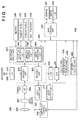
- FIG. 1 is a block diagram illustrating a configuration of a digital video camera serving as an example of the information recording apparatus used in Embodiment 1 of the present invention.
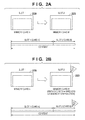
- FIG. 2A and FIG. 2B are schematic diagrams used to describe relay recording.
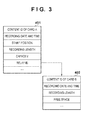
- FIG. 3 is a diagram illustrating an example of management information utilized when relay recording is performed in the digital video camera used in the embodiments of the present invention.
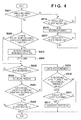
- FIG. 4 is a flowchart used to describe the operation of recording performed in the digital video camera used in Embodiment 1 of the present invention.
- FIGs. 5A and 5B are flowcharts used to describe the operation of recording performed in the digital video camera used in Embodiment 2 of the present invention.
- FIGs. 6A and 6B are schematic diagrams used to describe relay recording.
- FIG. 7 is a flowchart used to describe the operation of setting the recording order used when performing relay recording in the digital video camera employed in Embodiment 3 of the present invention.
- FIG. 8 is a flowchart used to describe recording operation that takes place when relay recording is performed in the digital video camera employed in Embodiment 3 of the present invention.
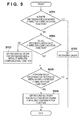
- FIG. 9 is a flowchart used to describe the operation of setting the recording order used when performing relay recording in the digital video camera employed in Embodiment 4 of the present invention.
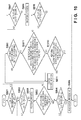
- FIG. 10 is a flowchart used to describe recording operation that takes place when relay recording is performed in the digital video camera used in Embodiment 4 of the present invention.
- video data as an example of a data sequence and a digital video camera as an example of a relay recording-enabled information recording apparatus.
- data sequences in the present invention are not limited to video data and information recording apparatuses are not limited to digital video cameras.
- FIG. 1 is a block diagram illustrating a configuration of a digital video camera 100 serving as an example of the information recording apparatus used in Embodiment 1 of the present invention.
- the lens unit 201 has a stationary lens group, a zoom lens group, a stop, and a corrector lens group.
- the corrector lens group possesses a focusing capability, as well as the capability to correct an imaging position displaced due to the movement of the zoom lens group.
- An image sensor 204 which is, for instance, a CCD (Charge Coupled Device), generates an imaging signal by transforming a subject image formed by the lens unit 201 in an imaging plane into an electrical signal for pixel units.
- An A/D processing unit 205 carries out predetermined processing on the imaging signal and outputs digital image data.
- the lens unit 201, image sensor 204, and A/D processing unit 205 constitute a camera unit 200.
- the camera unit 200 also has an actuator used for driving the zoom lens group of the lens unit 201, the stop, and the like, a sensor for anti-shake compensation (e.g., an angular velocity sensor), and an optical anti-shake compensation mechanism (shift lenses, etc.), all of which are not shown in FIG. 1 .
- a sensor for anti-shake compensation e.g., an angular velocity sensor
- an optical anti-shake compensation mechanism shift lenses, etc.
- a camera unit control unit 218 controls the operation of each element of the camera unit 200 under the control of the main control unit 210.
- information obtained from the camera unit 200 such as, for instance, focus information, hand jitter information, and the like is transmitted to the main control unit 210.
- a microphone unit 209 detects ambient sounds during imaging.
- the microphone unit 209 includes an amplifier and a bandpass-limiting circuit.
- the A/D processing unit 219 receives an analog audio signal outputted by the microphone unit 209 and outputs digital audio data.
- the main control unit 210 is, for instance, a micro-computer that controls the entire digital video camera 100.
- the main control unit 210 has at least a non-volatile memory (ROM) that stores software programs, a volatile memory (RAM) that serves as a work space, an external bus that is used for passing data to and from other hardware and for accessing control registers, and a timer that measures time.
- the bus 203 is a transmission path used for passing data between interconnected blocks under the control of the main control unit 210.
- An encoder unit 202 encodes the digital image data and digital audio data obtained from the A/D processing units 205 and 219 in MPEG (Moving Picture Experts Group) 2 format, etc. under the control of the main control unit 210. Furthermore, the encoder unit 202 multiplexes the data encoded in MPEG2 format in a time series and generates compressed video data. In addition, the encoder unit 202 is provided with a capability of communicating information etc. that is necessary, for example, for the conversion of data locations and frame positions to the main control unit 210.
- MPEG Motion Picture Experts Group
- a recording circuit unit 221 which has an interface to the encoder unit 202, a memory 206, a memory card A 220, a memory card B 223, a built-in memory 224, and a decoder unit 208, controls the passage of data under the control of the main control unit 210.
- the memory 206 is a storage area that can be used for operation by each block. It will be noted that the built-in memory 224 is used starting from Embodiment 3 and is not essential for the digital video camera 100 of Embodiments 1 and 2.
- the function detection unit 301 of the recording circuit unit 221 refers to memory card IDs assigned to each card in order to identify whether any of the memory card A 220 and memory card B 223 (and, if necessary, the built-in memory 224) has a wireless communication function.
- the function detection unit 301 executes determination processing when, for example, the digital video camera 100 is powered on, or when a memory card is inserted or removed. It should be noted that the function detection unit 301 may identify the presence or absence of a wireless communication function in the built-in memory 224. In such a case, the function detection unit 301 may identify the presence or absence of a wireless communication function in the built-in memory 224 without using a memory card ID. For example, the function detection unit 301 can identify the presence or absence of a wireless communication function depending on whether the wireless communication function of the digital video camera 100 has been activated or not.
- a wireless control unit 302 exercises control over the wireless communication functions of the memory cards and, more specifically, exercises power supply control over the wireless transmission units in the memory cards and transmission control over the video data stored on the memory cards.
- a media switching unit 303 switches the recording media that are intended for recording video data. During relay recording, which involves continuously recording a sequence of data across multiple recording media, the media switching unit 303 switches recording media intended for recording based on a set recording order when the amount of recording space remaining on the recording medium undergoing recording drops below a predetermined threshold value.
- the function detection unit 301, wireless control unit 302, and media switching unit 303 may be either separate hardware units, or, alternatively, two or more of them may be implemented as a single hardware unit. In addition, their functions may be carried out by the main control unit 210.
- the digital video camera 100 is provided with a menu for setting the active/inactive status of the wireless communication function of the recording media having a wireless communication function.
- the wireless control unit 302 exercises control such that power is supplied to the wireless communication unit in the memory card.
- the wireless control unit 302 exercises control such that the supply of power to the wireless communication unit in the memory card is stopped. This setting is held in the EEPROM 211.
- the memory card A 220 and memory card B 223 represent an example of recording media that can be used for recording captured video.
- the recording circuit unit 221 has an interface to the memory 206, memory card A 220, memory card B 223, built-in memory 224, and bus 203. In addition, the recording circuit unit 221 performs conversion required for access from the main control unit 210 etc. to the control registers of the memory card A 220 and memory card B 223.
- Video data containing images captured by the camera unit 200 and audio recorded by the microphone unit 209 is recorded on the memory card A 220 and memory card B 223, as well as in the built-in memory 224.
- the memory card A 220, memory card B 223, and built-in memory 224 have interfaces that can be connected to the recording circuit unit 221 and are equipped with circuitry used to read/write data in the semiconductor memories they themselves have.
- the recording circuit unit 221 of the present embodiment has a so-called direct memory access (DMA) feature.
- DMA direct memory access
- the decoder unit 208 sequentially reads out compressed video data and compressed still picture data from the addresses of the memory 206 specified by the main control unit 210.
- the decoder unit 208 converts the compressed video data and compressed still images that have been read to ITU-R BT.656 (CCIR656) digital video signals and digital audio signals and then outputs them. If necessary, the decoder unit 208 performs reduction processing during the playback of the compressed still image data.
- the digital video signals and digital audio signals obtained as a result of conversion by the decoder unit 208 are converted to analog signals by the video output unit 217 and audio output unit 207 for the purpose of output to external equipment.
- the video output unit 217 and audio output unit 207 are connected to a TV receiver and the like.
- An onscreen display (OSD) unit 213 superimposes a menu screen used to specify various settings, as well as titles, time, and other information on the digital video signal outputted by the decoder unit 208 and outputs it to the video output unit 217.
- the OSD unit 213 possesses a capability of capturing the digital video signal input from the decoder unit 208, subjecting it to reduction processing, and superimposing it on any location of the picture corresponding to the digital video signal.
- a switch actuation unit 212 which is a group of input devices, is employed by the user in order to operate the digital video camera 100.
- the input devices are not limited to switches.
- the main control unit 210 determines the contents of the entries made by the user via the switch actuation unit 212 and touch panel 215 and causes operations corresponding to the entries to be executed.
- the writing and reading of data to/from the memory card A 220, memory card B 223, and built-in memory 224 is carried out based on a predefined file system (data file management structure).
- the main control unit 210 has software (drivers) used for this type of data management.
- the firmware and settings etc. of the digital video camera 100 are written to the EEPROM 211, which is a rewritable ROM.
- An EVF (Electronic View Finder) 214 which is a display device, is used to check the imaging range of the digital video camera 100.
- a liquid crystal display (LCD) panel 216 which is a display device that is larger than the EVF 214, is used for displaying menu screens, etc. It should be noted that the LCD panel 216 can be operated as an EVF.
- the LCD panel 216 is provided with a touch panel 215, thereby allowing the user to enter menu actions and various instructions by directly manipulating a GUI displayed on the LCD panel 216 with a finger, etc.
- a screen control unit 222 computes the location of entries via the touch panel 215 and determines the contents of the entries based on a relationship to the image displayed on the LCD panel 216. Furthermore, the screen control unit 222 also exercises display control over virtual buttons (GUI) displayed on the LCD panel 216.
- GUI virtual buttons
- FIG. 2A illustrates a situation, in which the order of the recording media used for relay recording is set to slot 1 (memory card A 220) ⁇ slot 2 (memory card B 223). Recording is initiated by designating the memory card A 220 as the destination of recording and, when its recordable capacity drops below a threshold value (e.g. if the threshold value is 0, when no more recordable capacity is available), the recording medium used for recording is switched from the memory card A 220 to the memory card B 223, and recording is continued.
- a threshold value e.g. if the threshold value is 0, when no more recordable capacity is available
- relay recording may be carried out without any particular problems by changing the destination of recording in the order illustrated in FIG. 2A .
- a problem does arise when, for example, the memory card B 223 has a wireless communication function.
- FIG. 2B illustrates a case, in which relay recording similar to that of FIG. 2A is performed if the memory card B 223 is a memory card provided with a wireless communication function. In this case, no particular problems arise in connection with the relay recording itself.
- the memory card B 223 automatically transfers the recorded data to a preset transfer destination (a user PC, a server on a network, etc.).
- a preset transfer destination a user PC, a server on a network, etc.
- FIG. 3 illustrates an example of management information recorded on the memory cards when relay recording is performed in the digital video camera 100 of the present embodiment first on the memory card A 220 and, after that, on the memory card B 223.
- the content management information 401 is recorded on the memory card A 220 and the content management information 402 is recorded on the memory card B 223.
- Items such as memory card content ID, recording date and time, starting position, recording length, capacity, and the like represent information on the data recorded on each memory card.
- relay IDs represent information that indicates whether or not content corresponding to this content ID is subsequently recorded on the next recording medium. If no relay recording is performed (in other words, if recording ends with the memory card A 220), for example, "0" is recorded in a relay ID. On the other hand, if relay recording is performed, both information that identifies the recording medium on which the subsequent material and information identifies the content ID are recorded in a relay ID.
- Examples of recording medium-identifying information may include specific information, such as a memory card ID, etc.
- the main control unit 210 Whenever a content data file is recorded on a recording medium, the main control unit 210 generates content management information regarding its content and records it on the recording medium, on which the content data file is recorded.
- the main control unit 210 When content is relay-recorded from the memory card A 220 to the memory card B 223, first of all, the main control unit 210 records the memory card ID of the memory card B 223, which is the next recording destination, in the relay ID of the content management information 401 of the memory card A 220. Next, as it starts recording data relating to the same content on the memory card B 223, the main control unit 210 generates content management information 402. The main control unit 210 then adds the content ID of the content management information 402 to the relay ID of the content management information 401 of the memory card A 220. As a result, the memory card ID of the memory card B 223, i.e. the next destination of relay recording, and the content ID recorded on the memory card B 223 are recorded in the relay ID of the content management information 401.
- the order, in which the recording media are used here (recording order) during relay recording is assumed to be preset.
- the recording order may be set via user operations, or alternatively, the main control unit 210 may automatically set the order when setting up the relay recording mode for performing relay recording on media with a large recordable capacity.
- the user may be allowed to set rules for the automatic setup of the recording order.
- the digital video camera 100 is in a recording stand-by state.
- the camera unit 200 continuously performs preview imaging, with the EVF 214 and LCD panel 216 operating as viewfinders.
- the main control unit 210 determines whether the relay recording mode is set up. If relay recording is not set up, in S515, the main control unit 210 determines whether an instruction to start recording has been issued as a result of actuation of the touch panel 215 or the Start Recording key provided in the switch actuation unit 212.
- the main control unit 210 Upon detection of an instruction to start recording, in S516, the main control unit 210 initiates a recording process.
- images captured by the camera unit 200 are recorded on a recording medium through the encoder unit 202 and recording circuit unit 221.
- the recording medium used for recording is a preset recording medium selected from the memory card A 220 and memory card B 223 (for example, the recording medium that has just been used for recording).
- Wireless transmission is authorized if the recording medium intended for recording has a wireless communication function and the wireless communication function of this recording medium is enabled.
- the wireless transmission unit provided in the recording medium not shown, is placed in communication with a preset wireless communication network (or a preset apparatus), it initiates a wireless transfer of the recorded data. It should be noted that no data is transferred if the wireless communication function is not enabled.
- the main control unit 210 determines whether an instruction to stop recording has been issued as a result of actuation of the touch panel 215 or the Stop Recording key provided in the switch actuation unit 212. Upon detection of an instruction to stop recording, the main control unit 210 terminates the recording operation of FIG. 4 .
- processing advances to S502 if in S501 it is determined that the relay recording mode is set up.
- the main control unit 210 identifies any medium having a wireless communication function present among the recording media installed in the digital video camera 100 (in this embodiment, the memory card A 220 and memory card B 223). Specifically, the main control unit 210 acquires the results of a determination made by the function detection unit 301 of the recording circuit unit 221. As described above, the function detection unit 301 can identify the presence or absence of a wireless communication function on a memory card by referring to a memory card ID.
- the main control unit 210 advances processing to S505, and if at least one recording media having a wireless communication function is identified, then it advances processing to S503.
- the main control unit 210 inactivates the wireless transmission unit of each recording medium having a wireless communication function. While the main control unit 210 can inactivate the wireless communication function of the recording medium having a wireless communication function e.g. by turning off the power supply of the wireless transmission unit of this recording medium through the wireless control unit 302, other methods may also be used. For example, a method may be used wherein setup parameters held by the recording medium (flags or values used to set the active/inactive status of the wireless transmission unit) are changed to values inactivating the wireless transmission unit through the wireless control unit 302. It should be noted that this process is performed even if the wireless communication function is enabled in advance via user actuation.
- the main control unit 210 notifies the user of the fact that communication utilizing the wireless communication function of the recording medium will not be performed.
- a notification based on displaying a message on the LCD panel 216 or outputting an audio message from speakers (which may be connected, e.g. to the decoder unit 208) is anticipated.
- a confirmatory entry to verify the inactivation of the wireless communication function may be requested from the user. If a confirmatory entry is obtained, for example, from the switch actuation unit 212, the main control unit 210 advances processing to S505. It should be noted that, upon outputting the notification message, the main control unit 210 may automatically advance processing to S505 after the lapse of a certain period.
- the main control unit 210 determines whether an instruction to start recording has been issued as a result of actuation of the touch panel 215 or the Start Recording key provided in the switch actuation unit 212.
- the main control unit 210 Upon detection of an instruction to start recording, in S506, the main control unit 210 initiates a recording process.
- the initial recording medium destined for recording is the first recording medium in the preset recording order.
- the main control unit 210 At the start of the recording process, the main control unit 210 generates content management information ( FIG. 3 ) and writes it to the recording medium (or to the memory 206) .
- the main control unit 210 determines whether the recordable capacity of the recording medium undergoing recording (which may also be available recording length or free space) is larger than or equal to a predetermined threshold value. If the recordable capacity of the recording medium undergoing recording is larger than or equal to a predetermined threshold value, in S508, the main control unit 210 determines whether an instruction to stop recording has been issued as a result of actuation of the touch panel 215 or the Stop Recording key provided in the switch actuation unit 212. Upon detection of an instruction to stop recording, the main control unit 210 terminates the recording operation of FIG. 4 . It should be noted that if an instruction to stop recording is detected in S508, the main control unit 210 may delete the content management information recorded in S506 because no actual relay recording is performed.
- the main control unit 210 uses the media switching unit 303 to switch the recording medium used for recording to the next recording medium, for which the recording order has been set, and continues recording. It should be noted that in a situation where no media can be used, such as when the next recording medium, for which the recording order has been set, has not been installed, or when the recordable capacity is below a predetermined threshold value, etc., the main control unit 210 terminates the recording operation of FIG. 4 . In the same manner as upon detection of an instruction to stop recording in S508, in this case, the main control unit 210 may also delete the content management information recorded in S506 because no actual relay recording is performed.
- the main control unit 210 determines whether the recordable capacity of the recording medium undergoing recording (which may also be available recording time or free space) is larger than or equal to a predetermined threshold value. If the recordable capacity of the recording medium undergoing recording is larger than or equal to a predetermined threshold value, in S511, the main control unit 210 determines whether an instruction to stop recording has been issued as a result of actuation of the touch panel 215 or the Stop Recording key provided in the switch actuation unit 212. Upon detection of an instruction to stop recording in S511, the main control unit 210 terminates the recording process and advances processing to S512. If it is determined in S510 that the recordable capacity of the recording medium undergoing recording is below a predetermined threshold value, the main control unit 210 terminates the recording process and advances processing to S512.
- the main control unit 210 carries out association processing.
- the association processing consists of updating the content management information 401, 402 described above with reference to FIG. 3 .
- the recording length, capacity, relay IDs, etc. are updated upon termination of recording. If the content management information 401, 402 is written to the memory 206, updated content management information 401 is written to the recording medium.
- the main control unit 210 terminates the recording operation of FIG. 4 .
- the wireless communication function of the recording media having a wireless communication function is inactivated when relay recording is performed on multiple recording media.
- the portion of the same relay-recorded content recorded on the recording medium having a wireless communication function can be prevented from being transferred on its own.
- FIGs. 5A and 5B the same reference numerals are assigned to the same steps as in FIG. 4 .
- the main control unit 210 determines whether the initial recording medium to be used (at the start of the recording order) is a recording medium having a wireless communication function. If the recording medium at the start of the recording order has a wireless communication function, in S602, the main control unit 210 asks (S602) the user whether to carry out data communication utilizing the wireless communication function of this recording medium.
- the main control unit 210 displays an inquiry message such as "Activate wireless communication function of first recording medium used for relay recording?" on the LCD panel 216 along with the GUI buttons "Yes” and “No”. The main control unit 210 then determines (S603) whether a user instruction indicating either "Yes” or “No” is entered via the touch panel 215 or the switch actuation unit 212.
- the main control unit 210 activates the wireless communication function of this recording medium through the wireless control unit 302. It should be noted that this step is not carried out if the wireless communication function is already activated.
- the main control unit 210 advances processing to S503. The main control unit 210 then inactivates the wireless communication function through the wireless control unit 302. It will be noted that this step is not carried out if the wireless communication function is already inactivated.
- this wireless communication function can be activated if there is an explicit user instruction. This is done because it is believed that the user may wish to transmit the recorded content, or a portion of it, if the initial recording medium used for relay recording by the user is provided with a wireless communication function.
- the present embodiment is enabled to receive user instructions and perform flexible relay recording with account taken of user intent. It should be noted that the user is believed unlikely to have an affirmative intent to transmit the recorded content if the initial recording medium used for relay recording does not have a wireless communication function. Accordingly, when the initially recorded recording medium does not have a wireless communication function and the second or subsequent recording media have a wireless communication function, the user is not asked about the use of the wireless communication function.
- the wireless communication function of the initial recording medium used for relay recording is activated.
- the message of S602 is displayed if it is active, and processing is advanced to S505 if it is inactive. This is due to the fact that the user is believed unlikely to have an affirmative intent to transmit the recorded content even if the initial recording medium does have a wireless communication function, but at the same time, this wireless communication function is rendered inactive.
- the present embodiment is characterized by controlling the order of the recording media used during relay recording in accordance with the type of the recording media.
- the digital video camera 100 of the present embodiment is assumed to have the configuration depicted in FIG. 1 .
- the present embodiment uses the built-in memory 224.
- FIG. 6A illustrates a situation, in which the order of the recording media used for relay recording is set to built-in memory 224 ⁇ slot 1 (memory card A 220) ⁇ slot 2 (memory card B 223).
- Recording is initiated by designating the built-in memory 224 as the destination of recording and, when its recordable capacity drops below a threshold value (e.g. if the threshold value is 0, when no more recordable capacity is available), the recording medium used for recording is switched from the built-in memory 224 to the memory card A 220, and recording is continued.
- a threshold value e.g. if the threshold value is 0, when no more recordable capacity is available
- relay recording may be carried out without any particular problems by changing the destination of recording in the order illustrated in FIG. 6A .
- a problem does arise when, for example, the memory card A 220 has a wireless communication function.
- FIG. 6B illustrates a case, in which relay recording similar to that of FIG. 6A is performed if the memory card A 220 is a memory card provided with a wireless communication function. In this case, no particular problems arise in connection with the relay recording itself.
- the memory card B 220 automatically transfers the recorded data to a preset transfer destination (a user PC, a server on a network, etc.).
- a preset transfer destination a user PC, a server on a network, etc.
- the main control unit 210 identifies a recording medium having a wireless communication function among the recording media installed in the digital video camera 100 (in this embodiment, the memory card A 220 and memory card B 223). Specifically, the main control unit 210 acquires the results of a determination made by the function detection unit 301 of the recording circuit unit 221. As described above, the function detection unit 301 can identify the presence or absence of a wireless communication function on a memory card by referring to a memory card ID.
- the main control unit 210 advances processing to S703, and if at least one of the recording media is identified as a recording medium having a wireless communication function, then it advances processing to S702.
- the main control unit 210 sets up relay recording only on recording media without a wireless communication function. For example, the main control unit 210 sets up the order such that relay recording is carried out starting from the media that have a larger recordable capacity among the recording media that do not have a wireless communication function.
- the recording media that have a wireless communication function are not included in the media subject to relay recording.
- the recording media that do not have a wireless communication function may be displayed on the LCD panel 216 and the user may be allowed to set the order of relay recording.
- the main control unit sets the order of relay recording, e.g. in accordance with user settings.
- the main control unit 210 may set the recording order by a predefined method, e.g. by setting the order such that relay recording is performed starting from media with larger recordable capacities, etc.
- the digital video camera 100 of the present embodiment during relay recording will be described with reference to the flowchart of FIG. 8 .
- the digital video camera 100 is in a recording stand-by state.
- the camera unit 200 continuously performs preview imaging, with the EVF 214 and LCD panel 216 operating as viewfinders.
- the main control unit 210 determines whether the relay recording mode has been set. If no relay recording has been set up, in S807, the main control unit 210 determines whether an instruction to start recording has been issued as a result of actuation of the touch panel 215 or the Start Recording key provided in the switch actuation unit 212.
- the main control unit 210 Upon detection of an instruction to start recording, the main control unit 210 initiates a recording process in S808. During the recording process, images captured by the camera unit 200 are recorded on a recording medium via the encoder unit 202 and recording circuit unit 221.
- the recording medium used for recording is a preset recording medium selected from the memory card A 220, memory card B 223, and built-in memory 224 (for example, the recording medium that has just been used for recording).
- the wireless control unit 302 turns on the wireless transmission unit of the recording medium and authorizes a wireless transmission. Once the wireless transmission unit, not shown, is placed in communication with a preset wireless communication network, it initiates a wireless transfer of the recorded data.
- the main control unit 210 determines whether an instruction to stop recording has been issued as a result of actuation of the touch panel 215 or the Stop Recording key provided in the switch actuation unit 212. Upon detection of an instruction to stop recording, the main control unit 210 terminates the recording process.
- the main control unit 210 determines whether an instruction to start recording has been issued as a result of actuation of the touch panel 215 or the Start Recording key provided in the switch actuation unit 212.
- the main control unit 210 Upon detection of an instruction to start recording, the main control unit 210 initiates a recording process in S809.
- the initial recording medium destined for recording is the recording medium of the highest recordable capacity among the recording media that do not have a wireless communication function.
- the main control unit 210 At the start of the recording process, the main control unit 210 generates content management information ( FIG. 3 ) and writes it to the recording medium (or to the memory 206).
- the main control unit 210 determines whether the recordable capacity of the recording medium undergoing recording (which may also be available recording time or free space) is larger than or equal to a predetermined threshold value. If the recordable capacity of the recording medium undergoing recording is larger than or equal to a predetermined threshold value, in S804, the main control unit 210 determines whether an instruction to stop recording has been issued as a result of actuation of the touch panel 215 or the Stop Recording key provided in the switch actuation unit 212. Upon detection of an instruction to stop recording, the main control unit 210 terminates the recording process.
- the main control unit 210 determines if the next recording medium has been set up. If the next recording medium in the recording order has been set up and, at the same time, this recording medium has been installed, the main control unit 210 determines that the next recording medium has been set up and is available for use and advances processing to S811. In S811, the main control unit 210 continues recording by using the media switching unit 303 to switch the recording medium intended for recording to the next recording medium, for which the recording order has been set, and returns processing to S804.
- the main control unit 210 terminates the recording process and advances processing to S806.
- the main control unit 210 carries out association processing.
- the association processing consists of updating the content management information 401, 402 described above with reference to FIG. 3 .
- the recording time, capacity, relay IDs, etc. are updated upon termination of recording. If the content management information 401, 402 is written to the memory 206, updated content management information 401 is written to the recording medium.
- the main control unit 210 identifies any recording medium having a wireless communication function among the recording media installed in the digital video camera 100 (in this embodiment, the memory card A 220 and memory card B 223). If no recording media (memory card A 220, memory card B 223) is identified as a recording medium having a wireless communication function, the main control unit 210 advances processing to S703, and if there is a recording medium having a wireless communication function, it advances processing to S902.
- the main control unit sets the order of relay recording, e.g. in accordance with user settings.
- the main control unit 210 may set the recording order by a predefined method, e.g. by setting the order such that relay recording is performed starting from media with a larger recordable capacity, etc.
- the main control unit 210 determines if all the recording media are identified as a recording medium having a wireless communication function. If there is a recording medium without a wireless communication function, it advances processing to S702, and if all the recording media have a wireless communication function, it advances processing to S905.
- the main control unit 210 sets up relay recording only on the recording media without a wireless communication function. For example, the main control unit 210 sets up the order such that relay recording is carried out starting from the media that have a larger recordable capacity among the recording media that do not have a wireless communication function.
- the recording media that have a wireless communication function are not included in the media subject to relay recording.
- the recording media that do not have a wireless communication function may be displayed on the LCD panel 216 and the user may be allowed to set the order of relay recording.
- the main control unit 210 advances processing to S905.
- the main control unit 210 asks the user whether to perform relay recording on the recording media having a wireless communication function, for example, by displaying an inquiry message and GUI buttons on the LCD panel 216.
- the user can provide instructions as to whether recording media having a wireless communication function should be used for relay recording by operating the touch panel 215 and pressing the GUI buttons. It should be noted that other methods may be used as the method of making inquiries and providing user instructions.
- the main control unit 210 terminates processing if an instruction has been entered to not perform relay recording on recording media having a wireless communication function. In this case, in accordance with the setting of S702, relay recording is performed only on the recording media without a wireless communication function.
- the main control unit 210 sets the recording order of relay recording on recording media having a wireless communication function. If the recording order for the recording media that do not have a wireless communication function has been set in S702, the main control unit 210 sets the order of recording to a point later than that of any of the recording media that do not have a wireless communication function. As a result, relay recording is performed on the recording media having a wireless communication function upon termination of recording on all the recording media (whose recording order has been set) without a wireless communication function. As described above, even if relay recording has been set up for media having a wireless communication function, the recording order used during relay recording is set with a preference for recording media that do not have a wireless communication function.
- FIG. 10 the same steps as in FIG. 8 are assigned the same reference numerals and their description is omitted.
- the main control unit 210 determines whether the next recording medium for use in relay recording has been set up. If the next recording medium, for which the recording order has been set, exists and, at the same time, this recording medium has been installed, the main control unit 210 determines that the next recording medium has been set and advances processing to S811. In S811, the main control unit 210 continues recording by using the media switching unit 303 to switch the recording medium intended for recording to the next recording medium, for which the recording order has been set, and returns processing to S804.
- the invention can be adapted to check with the user if recording should be continued when a switch to the recording media having a wireless communication function takes place.
- the timing of the display of the confirmatory message is set so as allow for the check to be completed before the end of recording on the recording media without a wireless communication function, on which recording is performed immediately prior to switching to the recording media that have a wireless communication function.
- the recording medium switch in S811 may be adapted to be carried out when the recordable capacity of the recording medium undergoing recording reaches a switching threshold value that is smaller than the above-mentioned predetermined threshold value.
- processing intended to check for the existence of the next recording medium in S805 may be executed at an appropriate moment in time when the recordable capacity of the recording medium undergoing recording is larger than or equal to a predetermined threshold value and the recording medium may be switched at the point in time when the recordable capacity of the recording medium undergoing recording reaches the predetermined threshold value.
- the main control unit 210 advances processing to S1011.
- the main control unit 210 checks whether there is no media with a recordable capacity higher than a predetermined threshold value in the recording media having a wireless communication function among the built-in recording media provided in, or recording media installed in, the digital video camera 100. If there is no media whose recordable capacity exceeds the predetermined threshold value among the recording media having a wireless communication function, the main control unit 210 terminates recording and advances processing to S806.
- the main control unit 210 asks the user whether relay recording should be continued using this recording medium. It should be noted that S1013 is executed if no recording media having a wireless communication function was set up as the destination of recording when setting the relay recording order.
- Inquiries are made, for example, by displaying a GUI used for entering instructions and messages such as "Continue recording using recording media equipped with wireless communication function?" or "Only part of the video can be wirelessly transferred. Continue recording?" on the LCD panel 216.
- the main control unit 210 uses the media switching unit 303 to switch the recording medium intended for recording and continues recording.
- the timing of execution of S805, S1011, and S1013 is taken into account in order avoid an interruption of recording due to the time lag between S803 and the switch in S811.
- S1013, during which the apparatus waits for a decision by the user is executed at a point in time when the recordable capacity of the recording medium undergoing recording is sufficiently larger than the predetermined threshold value.
- this can be handled as if an instruction has been entered to not use the recording media having a wireless communication function.
- the main control unit 210 carries out the above-described association processing and terminates the recording process.
- recording media having a wireless communication function can be used for relay recording when there is an explicit user instruction. As a result, a longer video can be recorded, even though there is a chance that a portion of the video may be wirelessly transferred.
- the recording order is set such that recording starts from recording media that do not have a wireless communication function and, therefore, the likelihood of a wireless transfer of a portion of the relay-recorded video can be reduced.
- allowing the user to decide whether recording media having a wireless communication function should be used for relay recording permits the user to recognize in advance that a portion of the relay-recorded video may be wirelessly transferred, thereby enabling the user to prevent an unintended wireless transfer from taking place.
- Embodiments 1 and 2 the inactivation of the wireless communication function of the recording medium was described as a way to prevent data transfer caused by the wireless communication function.
- data transfer can be prevented (namely, data transfer utilizing the wireless communication function can be inactivated) even if the wireless communication function remains in effect and the apparatus is placed in communication with a device serving as the data transfer destination.
- the specific methods used as long as data relay-recorded on the recording medium can be prevented from being transferred based on the wireless communication function of this recording medium.
- the apparatus can be adapted to activate the wireless communication function of the recording medium if there was no actual recording spanning recording media even though recording was started in the relay recording mode. For example, if an instruction to stop recording is detected in S508 in FIG. 4 , which illustrates the recording operation of Embodiment 1, the apparatus can be adapted to automatically re-activate the wireless communication function inactivated in S503. As a result, it becomes possible to avoid inactivating the wireless communication function even when it is not necessary, thereby making it possible to take advantage of recording media having a wireless communication function.
- the apparatus may be adapted to automatically re-activate the wireless communication function upon completion of the recording process.
- the wireless communication function of the recording medium was inactivated prior to the start of recording.
- recording may end before relay recording on recording media having a wireless communication function.
- the wireless communication function of the recording medium on which data will be recorded may be inactivated after determining that a relay to recording media having a wireless communication function will actually take place.
- S503 (optionally, S504) is executed between S507 and S509 of FIG. 5B .
- Embodiments 1 and 2 described cases in which the invention was applied to an apparatus provided with two recording media that could be used as destinations for relay recording, it can be similarly applied to an apparatus capable of relay recording on three or more recording media.
- a configuration may be adopted, in which a built-in storage device (a semiconductor memory or a magnetic recording medium, etc.) can be used for relay recording.
- a premise used when setting the recording order in Embodiment 4 consisted of setting the recording order for all the recording media without a wireless communication function, whose recordable capacity was above a predetermined threshold value. Accordingly, a check was performed in S1011 to determine whether there were any media whose recordable capacity exceeded the predetermined threshold value among the recording media having a wireless communication function, for which a recording order had not been set. However, if during the recording order setup process the recording order was set only for specific (e.g. user-selected) recording media, in S1011, a check is performed to determine whether there is a recording medium whose recordable capacity exceeds the predetermined threshold value regardless of the presence/absence of the wireless communication function.
- the user is asked whether to continue relay recording on a recording medium whose recordable capacity is above the predetermined threshold value and for which no recording order has been set. Then, if there is an instruction from the user to continue relay recording using this recording medium, the apparatus switches to that recording medium and continues relay recording.
- the user may be allowed to select the recording medium used for relay recording.
- the user may be permitted to select the recording order, i.e. whether to set the recording order starting from the recording media that do not have a wireless communication function.
- aspects of the present invention can also be realized by a computer of a system or apparatus (or devices such as a CPU or MPU) that reads out and executes a program recorded on a memory device to perform the functions of the above-described embodiment(s), and by a method, the steps of which are performed by a computer of a system or apparatus by, for example, reading out and executing a program recorded on a memory device to perform the functions of the above-described embodiment(s).
- the program is provided to the computer for example via a network or from a recording medium of various types serving as the memory device (e.g., computer-readable medium).
Landscapes
- Engineering & Computer Science (AREA)
- Multimedia (AREA)
- Signal Processing (AREA)
- Computer Networks & Wireless Communication (AREA)
- Television Signal Processing For Recording (AREA)
- Studio Devices (AREA)
- Signal Processing For Digital Recording And Reproducing (AREA)
- Radio Relay Systems (AREA)
Abstract
Description
- The present invention relates to an information recording apparatus that records information such as, for example, images and sound, as well as to a controlling method thereof, and, in particular, relates to an information recording apparatus capable of continuous recording on multiple recording media and a controlling method thereof.
- Information recording apparatuses capable of using multiple recording media, such as, for example, digital cameras, video cameras, and the like, have become well-known in recent years. The multiple recording media can be exemplified, for instance, by multiple built-in recording media, built-in recording media along with removable recording media, multiple removable recording media, etc.
- Among them, media widely used as removable recording media are semiconductor memory cards, which are known to have various specifications and capacities. Also known are information recording apparatuses having multiple card slots corresponding to semiconductor memory cards of different specifications.
- Relay recording, during which a sequence of data, such as video, is continuously recorded across multiple recording media (Japanese Patent Laid-Open No.
2005-136794 2007-174693 - In recent years, cards having a wireless communication function (wireless memory cards) have become well-known among the semiconductor memory cards that can be used by information recording apparatuses. However, absolutely no studies have been conducted into the issue of how to perform relay recording when wireless memory cards are included in the multiple installed recording media.
- The present invention was made by taking such prior-art problems into consideration. Namely, the present invention, which is an information recording apparatus capable of relay recording involving continuously recording a sequence of data across multiple recording media, and a controlling method thereof, enables relay recording that accounts for cases in which memory cards provided with a wireless communication function are included among the recording media.
- The present invention in its first aspect provides an information recording apparatus as specified in
claims 1 to 3. - The present invention in its second aspect provides a method for controlling an information recording apparatus as specified in claim 6.
- The present invention in its third aspect provides an information recording apparatus as specified in claims 7 to 11.
- The present invention in its fourth aspect provides a method for controlling an information recording apparatus as specified in claim 14.
- Further features of the present invention will become apparent from the following description of embodiments with reference to the attached drawings.
-
FIG. 1 is a block diagram illustrating a configuration of a digital video camera serving as an example of the information recording apparatus used inEmbodiment 1 of the present invention. -
FIG. 2A and FIG. 2B are schematic diagrams used to describe relay recording. -
FIG. 3 is a diagram illustrating an example of management information utilized when relay recording is performed in the digital video camera used in the embodiments of the present invention. -
FIG. 4 is a flowchart used to describe the operation of recording performed in the digital video camera used inEmbodiment 1 of the present invention. -
FIGs. 5A and5B are flowcharts used to describe the operation of recording performed in the digital video camera used inEmbodiment 2 of the present invention. -
FIGs. 6A and 6B are schematic diagrams used to describe relay recording. -
FIG. 7 is a flowchart used to describe the operation of setting the recording order used when performing relay recording in the digital video camera employed in Embodiment 3 of the present invention. -
FIG. 8 is a flowchart used to describe recording operation that takes place when relay recording is performed in the digital video camera employed in Embodiment 3 of the present invention. -
FIG. 9 is a flowchart used to describe the operation of setting the recording order used when performing relay recording in the digital video camera employed in Embodiment 4 of the present invention. -
FIG. 10 is a flowchart used to describe recording operation that takes place when relay recording is performed in the digital video camera used in Embodiment 4 of the present invention. - Embodiments of the present invention will now be described in detail in accordance with the accompanying drawings.
- The embodiments below describe video data as an example of a data sequence and a digital video camera as an example of a relay recording-enabled information recording apparatus. However, data sequences in the present invention are not limited to video data and information recording apparatuses are not limited to digital video cameras.
-
FIG. 1 is a block diagram illustrating a configuration of adigital video camera 100 serving as an example of the information recording apparatus used inEmbodiment 1 of the present invention. Thelens unit 201 has a stationary lens group, a zoom lens group, a stop, and a corrector lens group. The corrector lens group possesses a focusing capability, as well as the capability to correct an imaging position displaced due to the movement of the zoom lens group. Animage sensor 204, which is, for instance, a CCD (Charge Coupled Device), generates an imaging signal by transforming a subject image formed by thelens unit 201 in an imaging plane into an electrical signal for pixel units. An A/D processing unit 205 carries out predetermined processing on the imaging signal and outputs digital image data. It should be noted that thelens unit 201,image sensor 204, and A/D processing unit 205 constitute acamera unit 200. In addition, thecamera unit 200 also has an actuator used for driving the zoom lens group of thelens unit 201, the stop, and the like, a sensor for anti-shake compensation (e.g., an angular velocity sensor), and an optical anti-shake compensation mechanism (shift lenses, etc.), all of which are not shown inFIG. 1 . - A camera
unit control unit 218 controls the operation of each element of thecamera unit 200 under the control of themain control unit 210. In addition, information obtained from thecamera unit 200, such as, for instance, focus information, hand jitter information, and the like is transmitted to themain control unit 210. Amicrophone unit 209 detects ambient sounds during imaging. Themicrophone unit 209 includes an amplifier and a bandpass-limiting circuit. The A/D processing unit 219 receives an analog audio signal outputted by themicrophone unit 209 and outputs digital audio data. - The
main control unit 210 is, for instance, a micro-computer that controls the entiredigital video camera 100. Themain control unit 210 has at least a non-volatile memory (ROM) that stores software programs, a volatile memory (RAM) that serves as a work space, an external bus that is used for passing data to and from other hardware and for accessing control registers, and a timer that measures time. Thebus 203 is a transmission path used for passing data between interconnected blocks under the control of themain control unit 210. - An
encoder unit 202 encodes the digital image data and digital audio data obtained from the A/D processing units main control unit 210. Furthermore, theencoder unit 202 multiplexes the data encoded in MPEG2 format in a time series and generates compressed video data. In addition, theencoder unit 202 is provided with a capability of communicating information etc. that is necessary, for example, for the conversion of data locations and frame positions to themain control unit 210. - A
recording circuit unit 221, which has an interface to theencoder unit 202, amemory 206, amemory card A 220, amemory card B 223, a built-inmemory 224, and adecoder unit 208, controls the passage of data under the control of themain control unit 210. Thememory 206 is a storage area that can be used for operation by each block. It will be noted that the built-inmemory 224 is used starting from Embodiment 3 and is not essential for thedigital video camera 100 ofEmbodiments - The
function detection unit 301 of therecording circuit unit 221 refers to memory card IDs assigned to each card in order to identify whether any of the memory card A 220 and memory card B 223 (and, if necessary, the built-in memory 224) has a wireless communication function. Thefunction detection unit 301 executes determination processing when, for example, thedigital video camera 100 is powered on, or when a memory card is inserted or removed. It should be noted that thefunction detection unit 301 may identify the presence or absence of a wireless communication function in the built-inmemory 224. In such a case, thefunction detection unit 301 may identify the presence or absence of a wireless communication function in the built-inmemory 224 without using a memory card ID. For example, thefunction detection unit 301 can identify the presence or absence of a wireless communication function depending on whether the wireless communication function of thedigital video camera 100 has been activated or not. - A
wireless control unit 302 exercises control over the wireless communication functions of the memory cards and, more specifically, exercises power supply control over the wireless transmission units in the memory cards and transmission control over the video data stored on the memory cards. Amedia switching unit 303 switches the recording media that are intended for recording video data. During relay recording, which involves continuously recording a sequence of data across multiple recording media, themedia switching unit 303 switches recording media intended for recording based on a set recording order when the amount of recording space remaining on the recording medium undergoing recording drops below a predetermined threshold value. It should be noted that thefunction detection unit 301,wireless control unit 302, andmedia switching unit 303 may be either separate hardware units, or, alternatively, two or more of them may be implemented as a single hardware unit. In addition, their functions may be carried out by themain control unit 210. - It will be noted that the
digital video camera 100 is provided with a menu for setting the active/inactive status of the wireless communication function of the recording media having a wireless communication function. Once the wireless communication function is enabled via user menu actions and the like, thewireless control unit 302 exercises control such that power is supplied to the wireless communication unit in the memory card. In addition, once the wireless communication function has been inactivated, thewireless control unit 302 exercises control such that the supply of power to the wireless communication unit in the memory card is stopped. This setting is held in theEEPROM 211. - The
memory card A 220 andmemory card B 223 represent an example of recording media that can be used for recording captured video. Therecording circuit unit 221 has an interface to thememory 206,memory card A 220,memory card B 223, built-inmemory 224, andbus 203. In addition, therecording circuit unit 221 performs conversion required for access from themain control unit 210 etc. to the control registers of thememory card A 220 andmemory card B 223. - Video data containing images captured by the
camera unit 200 and audio recorded by themicrophone unit 209 is recorded on thememory card A 220 andmemory card B 223, as well as in the built-inmemory 224. It should be noted that thememory card A 220,memory card B 223, and built-inmemory 224 have interfaces that can be connected to therecording circuit unit 221 and are equipped with circuitry used to read/write data in the semiconductor memories they themselves have. Therecording circuit unit 221 of the present embodiment has a so-called direct memory access (DMA) feature. Thus, if a data volume and a readout start address in thememory 206, along with write start addresses on thememory card A 220,memory card B 223, and in the built-inmemory 224, are specified in therecording circuit unit 221, an automatic transfer of data takes place. The same applies to reading from recording media to thememory 206. - The
decoder unit 208 sequentially reads out compressed video data and compressed still picture data from the addresses of thememory 206 specified by themain control unit 210. Thedecoder unit 208 converts the compressed video data and compressed still images that have been read to ITU-R BT.656 (CCIR656) digital video signals and digital audio signals and then outputs them. If necessary, thedecoder unit 208 performs reduction processing during the playback of the compressed still image data. - The digital video signals and digital audio signals obtained as a result of conversion by the
decoder unit 208 are converted to analog signals by thevideo output unit 217 andaudio output unit 207 for the purpose of output to external equipment. For example, thevideo output unit 217 andaudio output unit 207 are connected to a TV receiver and the like. - An onscreen display (OSD)
unit 213 superimposes a menu screen used to specify various settings, as well as titles, time, and other information on the digital video signal outputted by thedecoder unit 208 and outputs it to thevideo output unit 217. In addition, theOSD unit 213 possesses a capability of capturing the digital video signal input from thedecoder unit 208, subjecting it to reduction processing, and superimposing it on any location of the picture corresponding to the digital video signal. - A
switch actuation unit 212, which is a group of input devices, is employed by the user in order to operate thedigital video camera 100. The input devices are not limited to switches. Themain control unit 210 determines the contents of the entries made by the user via theswitch actuation unit 212 andtouch panel 215 and causes operations corresponding to the entries to be executed. - The writing and reading of data to/from the
memory card A 220,memory card B 223, and built-inmemory 224 is carried out based on a predefined file system (data file management structure). Themain control unit 210 has software (drivers) used for this type of data management. The firmware and settings etc. of thedigital video camera 100 are written to theEEPROM 211, which is a rewritable ROM. - An EVF (Electronic View Finder) 214, which is a display device, is used to check the imaging range of the
digital video camera 100. A liquid crystal display (LCD)panel 216, which is a display device that is larger than theEVF 214, is used for displaying menu screens, etc. It should be noted that theLCD panel 216 can be operated as an EVF. TheLCD panel 216 is provided with atouch panel 215, thereby allowing the user to enter menu actions and various instructions by directly manipulating a GUI displayed on theLCD panel 216 with a finger, etc. - A
screen control unit 222 computes the location of entries via thetouch panel 215 and determines the contents of the entries based on a relationship to the image displayed on theLCD panel 216. Furthermore, thescreen control unit 222 also exercises display control over virtual buttons (GUI) displayed on theLCD panel 216. - Here, relay recording without using the built-in
memory 224 will be described with reference toFIG. 2A and FIG. 2B. FIG. 2A illustrates a situation, in which the order of the recording media used for relay recording is set to slot 1 (memory card A 220) → slot 2 (memory card B 223). Recording is initiated by designating thememory card A 220 as the destination of recording and, when its recordable capacity drops below a threshold value (e.g. if the threshold value is 0, when no more recordable capacity is available), the recording medium used for recording is switched from thememory card A 220 to thememory card B 223, and recording is continued. - If neither the
memory card A 220 nor thememory card B 223 has a wireless communication function, relay recording may be carried out without any particular problems by changing the destination of recording in the order illustrated inFIG. 2A . However, a problem does arise when, for example, thememory card B 223 has a wireless communication function. This problem will be described with reference toFIG. 2B. FIG. 2B illustrates a case, in which relay recording similar to that ofFIG. 2A is performed if thememory card B 223 is a memory card provided with a wireless communication function. In this case, no particular problems arise in connection with the relay recording itself. However, at least upon completion of recording on thememory card B 223, once thememory card B 223 is placed in communication with a wireless network, thememory card B 223 automatically transfers the recorded data to a preset transfer destination (a user PC, a server on a network, etc.). In other words, in the sequence of relay-recorded content segments, only the segment recorded on thememory card B 223 ends up being wirelessly transferred to the server. No approaches to addressing such problems have been investigated in the past. -
FIG. 3 illustrates an example of management information recorded on the memory cards when relay recording is performed in thedigital video camera 100 of the present embodiment first on thememory card A 220 and, after that, on thememory card B 223. - The
content management information 401 is recorded on thememory card A 220 and thecontent management information 402 is recorded on thememory card B 223. Items such as memory card content ID, recording date and time, starting position, recording length, capacity, and the like represent information on the data recorded on each memory card. In addition, relay IDs represent information that indicates whether or not content corresponding to this content ID is subsequently recorded on the next recording medium. If no relay recording is performed (in other words, if recording ends with the memory card A 220), for example, "0" is recorded in a relay ID. On the other hand, if relay recording is performed, both information that identifies the recording medium on which the subsequent material and information identifies the content ID are recorded in a relay ID. Examples of recording medium-identifying information may include specific information, such as a memory card ID, etc. Whenever a content data file is recorded on a recording medium, themain control unit 210 generates content management information regarding its content and records it on the recording medium, on which the content data file is recorded. - When content is relay-recorded from the
memory card A 220 to thememory card B 223, first of all, themain control unit 210 records the memory card ID of thememory card B 223, which is the next recording destination, in the relay ID of thecontent management information 401 of thememory card A 220. Next, as it starts recording data relating to the same content on thememory card B 223, themain control unit 210 generatescontent management information 402. Themain control unit 210 then adds the content ID of thecontent management information 402 to the relay ID of thecontent management information 401 of thememory card A 220. As a result, the memory card ID of thememory card B 223, i.e. the next destination of relay recording, and the content ID recorded on thememory card B 223 are recorded in the relay ID of thecontent management information 401. - Next, the operation of recording performed in the
digital video camera 100 of the present embodiment will be described with reference to the flowchart ofFIG. 4 . - It should be noted that the order, in which the recording media are used here (recording order) during relay recording is assumed to be preset. In addition, the recording order may be set via user operations, or alternatively, the
main control unit 210 may automatically set the order when setting up the relay recording mode for performing relay recording on media with a large recordable capacity. It should be noted that the user may be allowed to set rules for the automatic setup of the recording order. - In addition, here, the
digital video camera 100 is in a recording stand-by state. In the recording stand-by state, thecamera unit 200 continuously performs preview imaging, with theEVF 214 andLCD panel 216 operating as viewfinders. - In S501, for example, by referring to the
EEPROM 211, themain control unit 210 determines whether the relay recording mode is set up. If relay recording is not set up, in S515, themain control unit 210 determines whether an instruction to start recording has been issued as a result of actuation of thetouch panel 215 or the Start Recording key provided in theswitch actuation unit 212. - Upon detection of an instruction to start recording, in S516, the
main control unit 210 initiates a recording process. During the recording process, images captured by thecamera unit 200 are recorded on a recording medium through theencoder unit 202 andrecording circuit unit 221. Here, the recording medium used for recording is a preset recording medium selected from thememory card A 220 and memory card B 223 (for example, the recording medium that has just been used for recording). - Wireless transmission is authorized if the recording medium intended for recording has a wireless communication function and the wireless communication function of this recording medium is enabled. Once the wireless transmission unit provided in the recording medium, not shown, is placed in communication with a preset wireless communication network (or a preset apparatus), it initiates a wireless transfer of the recorded data. It should be noted that no data is transferred if the wireless communication function is not enabled.
- In S517, the
main control unit 210 determines whether an instruction to stop recording has been issued as a result of actuation of thetouch panel 215 or the Stop Recording key provided in theswitch actuation unit 212. Upon detection of an instruction to stop recording, themain control unit 210 terminates the recording operation ofFIG. 4 . - On the other hand, processing advances to S502 if in S501 it is determined that the relay recording mode is set up. In S502, the
main control unit 210 identifies any medium having a wireless communication function present among the recording media installed in the digital video camera 100 (in this embodiment, thememory card A 220 and memory card B 223). Specifically, themain control unit 210 acquires the results of a determination made by thefunction detection unit 301 of therecording circuit unit 221. As described above, thefunction detection unit 301 can identify the presence or absence of a wireless communication function on a memory card by referring to a memory card ID. - In S502, if none of the recording media (
memory card A 220, memory card B 223) is identified as having a wireless communication function, themain control unit 210 advances processing to S505, and if at least one recording media having a wireless communication function is identified, then it advances processing to S503. - In S503, the
main control unit 210 inactivates the wireless transmission unit of each recording medium having a wireless communication function. While themain control unit 210 can inactivate the wireless communication function of the recording medium having a wireless communication function e.g. by turning off the power supply of the wireless transmission unit of this recording medium through thewireless control unit 302, other methods may also be used. For example, a method may be used wherein setup parameters held by the recording medium (flags or values used to set the active/inactive status of the wireless transmission unit) are changed to values inactivating the wireless transmission unit through thewireless control unit 302. It should be noted that this process is performed even if the wireless communication function is enabled in advance via user actuation. - Subsequently, in S504, the
main control unit 210 notifies the user of the fact that communication utilizing the wireless communication function of the recording medium will not be performed. Although there is no particular limitations concerning the method of notification, a notification based on displaying a message on theLCD panel 216 or outputting an audio message from speakers (which may be connected, e.g. to the decoder unit 208) is anticipated. In addition, a confirmatory entry to verify the inactivation of the wireless communication function may be requested from the user. If a confirmatory entry is obtained, for example, from theswitch actuation unit 212, themain control unit 210 advances processing to S505. It should be noted that, upon outputting the notification message, themain control unit 210 may automatically advance processing to S505 after the lapse of a certain period. - In S505, the
main control unit 210 determines whether an instruction to start recording has been issued as a result of actuation of thetouch panel 215 or the Start Recording key provided in theswitch actuation unit 212. - Upon detection of an instruction to start recording, in S506, the
main control unit 210 initiates a recording process. Here, the initial recording medium destined for recording is the first recording medium in the preset recording order. At the start of the recording process, themain control unit 210 generates content management information (FIG. 3 ) and writes it to the recording medium (or to the memory 206) . - In S507, the
main control unit 210 determines whether the recordable capacity of the recording medium undergoing recording (which may also be available recording length or free space) is larger than or equal to a predetermined threshold value. If the recordable capacity of the recording medium undergoing recording is larger than or equal to a predetermined threshold value, in S508, themain control unit 210 determines whether an instruction to stop recording has been issued as a result of actuation of thetouch panel 215 or the Stop Recording key provided in theswitch actuation unit 212. Upon detection of an instruction to stop recording, themain control unit 210 terminates the recording operation ofFIG. 4 . It should be noted that if an instruction to stop recording is detected in S508, themain control unit 210 may delete the content management information recorded in S506 because no actual relay recording is performed. - If it is determined in S507 that the recordable capacity of the recording medium undergoing recording is below the predetermined threshold value, then, in S509, the
main control unit 210 uses themedia switching unit 303 to switch the recording medium used for recording to the next recording medium, for which the recording order has been set, and continues recording. It should be noted that in a situation where no media can be used, such as when the next recording medium, for which the recording order has been set, has not been installed, or when the recordable capacity is below a predetermined threshold value, etc., themain control unit 210 terminates the recording operation ofFIG. 4 . In the same manner as upon detection of an instruction to stop recording in S508, in this case, themain control unit 210 may also delete the content management information recorded in S506 because no actual relay recording is performed. - In S510, the
main control unit 210 determines whether the recordable capacity of the recording medium undergoing recording (which may also be available recording time or free space) is larger than or equal to a predetermined threshold value. If the recordable capacity of the recording medium undergoing recording is larger than or equal to a predetermined threshold value, in S511, themain control unit 210 determines whether an instruction to stop recording has been issued as a result of actuation of thetouch panel 215 or the Stop Recording key provided in theswitch actuation unit 212. Upon detection of an instruction to stop recording in S511, themain control unit 210 terminates the recording process and advances processing to S512. If it is determined in S510 that the recordable capacity of the recording medium undergoing recording is below a predetermined threshold value, themain control unit 210 terminates the recording process and advances processing to S512. - In S512, the
main control unit 210 carries out association processing. The association processing consists of updating thecontent management information FIG. 3 . The recording length, capacity, relay IDs, etc. are updated upon termination of recording. If thecontent management information memory 206, updatedcontent management information 401 is written to the recording medium. Upon termination of the association processing, themain control unit 210 terminates the recording operation ofFIG. 4 . - As described above, in the present embodiment, the wireless communication function of the recording media having a wireless communication function is inactivated when relay recording is performed on multiple recording media. As a result, the portion of the same relay-recorded content recorded on the recording medium having a wireless communication function can be prevented from being transferred on its own.
- The operation of relay recording in the information recording apparatus of the second embodiment of the present invention will be described next. It should be noted that the information recording apparatus used in the present embodiment may be identical to the one used in
Embodiment 1 with the exception of processing that takes place when the initial recording medium used for relay recording has a wireless communication function. Therefore, recording is assumed to be carried out using thedigital video camera 100 described inEmbodiment 1, and the description will focus on the points of difference from the recording operation ofEmbodiment 1. - The operation of recording carried out in the
digital video camera 100 of the present embodiment will be described with reference to the flowchart ofFIGs. 5A and5B . InFIGs. 5A and5B , the same reference numerals are assigned to the same steps as inFIG. 4 . - In S502, if no recording medium having a wireless communication function is identified, in S601, the
main control unit 210 determines whether the initial recording medium to be used (at the start of the recording order) is a recording medium having a wireless communication function. If the recording medium at the start of the recording order has a wireless communication function, in S602, themain control unit 210 asks (S602) the user whether to carry out data communication utilizing the wireless communication function of this recording medium. - Specifically, the
main control unit 210 displays an inquiry message such as "Activate wireless communication function of first recording medium used for relay recording?" on theLCD panel 216 along with the GUI buttons "Yes" and "No". Themain control unit 210 then determines (S603) whether a user instruction indicating either "Yes" or "No" is entered via thetouch panel 215 or theswitch actuation unit 212. - If a user instruction to activate the wireless communication function of the initial recording medium used for relay recording is entered, in S604, the
main control unit 210 activates the wireless communication function of this recording medium through thewireless control unit 302. It should be noted that this step is not carried out if the wireless communication function is already activated. On the other hand, if in S601 it is determined that the initial recording medium in the recording order does not have a wireless communication function, or if a user instruction to not activate the wireless communication function of the initial recording medium is entered in S603, themain control unit 210 advances processing to S503. Themain control unit 210 then inactivates the wireless communication function through thewireless control unit 302. It will be noted that this step is not carried out if the wireless communication function is already inactivated. - The rest of the processing is similar to the first embodiment and its description is therefore omitted.
- As explained above, in the present embodiment, when the initial recording medium used for relay recording has a wireless communication function, this wireless communication function can be activated if there is an explicit user instruction. This is done because it is believed that the user may wish to transmit the recorded content, or a portion of it, if the initial recording medium used for relay recording by the user is provided with a wireless communication function. The present embodiment is enabled to receive user instructions and perform flexible relay recording with account taken of user intent. It should be noted that the user is believed unlikely to have an affirmative intent to transmit the recorded content if the initial recording medium used for relay recording does not have a wireless communication function. Accordingly, when the initially recorded recording medium does not have a wireless communication function and the second or subsequent recording media have a wireless communication function, the user is not asked about the use of the wireless communication function.
- It should be noted that it can be determined in S601 whether or not the wireless communication function of the initial recording medium used for relay recording is activated. In such a case, the message of S602 is displayed if it is active, and processing is advanced to S505 if it is inactive. This is due to the fact that the user is believed unlikely to have an affirmative intent to transmit the recorded content even if the initial recording medium does have a wireless communication function, but at the same time, this wireless communication function is rendered inactive.
- A third embodiment of the present invention will be described next. The present embodiment is characterized by controlling the order of the recording media used during relay recording in accordance with the type of the recording media. Just like in
Embodiments digital video camera 100 of the present embodiment is assumed to have the configuration depicted inFIG. 1 . However, the present embodiment uses the built-inmemory 224. - First of all, relay recording performed with the help of the built-in
memory 224 will be described with reference toFIG. 6A and FIG. 6B. FIG. 6A illustrates a situation, in which the order of the recording media used for relay recording is set to built-inmemory 224 → slot 1 (memory card A 220) → slot 2 (memory card B 223). Recording is initiated by designating the built-inmemory 224 as the destination of recording and, when its recordable capacity drops below a threshold value (e.g. if the threshold value is 0, when no more recordable capacity is available), the recording medium used for recording is switched from the built-inmemory 224 to thememory card A 220, and recording is continued. When the recordable capacity of thememory card A 220 drops below a threshold value, the recording medium used for recording is switched from thememory card A 220 to thememory card B 223, and recording is continued. - If neither the
memory card A 220 nor thememory card B 223 has a wireless communication function, relay recording may be carried out without any particular problems by changing the destination of recording in the order illustrated inFIG. 6A . However, a problem does arise when, for example, thememory card A 220 has a wireless communication function. This problem will be described with reference toFIG. 6B. FIG. 6B illustrates a case, in which relay recording similar to that ofFIG. 6A is performed if thememory card A 220 is a memory card provided with a wireless communication function. In this case, no particular problems arise in connection with the relay recording itself. However, at least upon completion of recording on thememory card A 220, once thememory card A 220 is placed in communication with a wireless network, thememory card B 220 automatically transfers the recorded data to a preset transfer destination (a user PC, a server on a network, etc.). In other words, in the sequence of relay-recorded content segments, only the segment recorded on thememory card A 220 ends up being wirelessly transferred to the server. No approaches to addressing such problems have been investigated in the past. - The operation of setting the order of recording used during relay recording in the
digital video camera 100 of the present embodiment will be described with reference to the flowchart ofFIG. 7 . This operation is carried out when the relay recording mode has been set or when a memory card is inserted and removed in a situation, wherein the relay recording mode has been set. - In S701, the
main control unit 210 identifies a recording medium having a wireless communication function among the recording media installed in the digital video camera 100 (in this embodiment, thememory card A 220 and memory card B 223). Specifically, themain control unit 210 acquires the results of a determination made by thefunction detection unit 301 of therecording circuit unit 221. As described above, thefunction detection unit 301 can identify the presence or absence of a wireless communication function on a memory card by referring to a memory card ID. - In S701, if no recording media from among the recording media (
memory card A 220,memory card B 223, built-in memory 224) is identified as having a wireless communication function, themain control unit 210 advances processing to S703, and if at least one of the recording media is identified as a recording medium having a wireless communication function, then it advances processing to S702. - In S702, the
main control unit 210 sets up relay recording only on recording media without a wireless communication function. For example, themain control unit 210 sets up the order such that relay recording is carried out starting from the media that have a larger recordable capacity among the recording media that do not have a wireless communication function. The recording media that have a wireless communication function are not included in the media subject to relay recording. Alternatively, the recording media that do not have a wireless communication function may be displayed on theLCD panel 216 and the user may be allowed to set the order of relay recording. - In S703, the main control unit sets the order of relay recording, e.g. in accordance with user settings. Alternatively, if no settings defining an explicit order are obtained from the user, the
main control unit 210 may set the recording order by a predefined method, e.g. by setting the order such that relay recording is performed starting from media with larger recordable capacities, etc. - Next, the operation of the
digital video camera 100 of the present embodiment during relay recording will be described with reference to the flowchart ofFIG. 8 . It should be noted that here thedigital video camera 100 is in a recording stand-by state. In the recording stand-by state, thecamera unit 200 continuously performs preview imaging, with theEVF 214 andLCD panel 216 operating as viewfinders. - In S801, for example, by referring to the
EEPROM 211, themain control unit 210 determines whether the relay recording mode has been set. If no relay recording has been set up, in S807, themain control unit 210 determines whether an instruction to start recording has been issued as a result of actuation of thetouch panel 215 or the Start Recording key provided in theswitch actuation unit 212. - Upon detection of an instruction to start recording, the
main control unit 210 initiates a recording process in S808. During the recording process, images captured by thecamera unit 200 are recorded on a recording medium via theencoder unit 202 andrecording circuit unit 221. Here, the recording medium used for recording is a preset recording medium selected from thememory card A 220,memory card B 223, and built-in memory 224 (for example, the recording medium that has just been used for recording). - If the recording medium intended for recording has a wireless communication function, the
wireless control unit 302 turns on the wireless transmission unit of the recording medium and authorizes a wireless transmission. Once the wireless transmission unit, not shown, is placed in communication with a preset wireless communication network, it initiates a wireless transfer of the recorded data. - In S810, the
main control unit 210 determines whether an instruction to stop recording has been issued as a result of actuation of thetouch panel 215 or the Stop Recording key provided in theswitch actuation unit 212. Upon detection of an instruction to stop recording, themain control unit 210 terminates the recording process. - On the other hand, if it is determined in S801 that the relay recording mode has been set up, in S802, the
main control unit 210 determines whether an instruction to start recording has been issued as a result of actuation of thetouch panel 215 or the Start Recording key provided in theswitch actuation unit 212. - Upon detection of an instruction to start recording, the
main control unit 210 initiates a recording process in S809. Here, as described above, the initial recording medium destined for recording is the recording medium of the highest recordable capacity among the recording media that do not have a wireless communication function. At the start of the recording process, themain control unit 210 generates content management information (FIG. 3 ) and writes it to the recording medium (or to the memory 206). - In S803, the
main control unit 210 determines whether the recordable capacity of the recording medium undergoing recording (which may also be available recording time or free space) is larger than or equal to a predetermined threshold value. If the recordable capacity of the recording medium undergoing recording is larger than or equal to a predetermined threshold value, in S804, themain control unit 210 determines whether an instruction to stop recording has been issued as a result of actuation of thetouch panel 215 or the Stop Recording key provided in theswitch actuation unit 212. Upon detection of an instruction to stop recording, themain control unit 210 terminates the recording process. - If it is determined in S803 that the recordable capacity of the recording medium undergoing recording is below a predetermined threshold value, then in S805 the
main control unit 210 determines if the next recording medium has been set up. If the next recording medium in the recording order has been set up and, at the same time, this recording medium has been installed, themain control unit 210 determines that the next recording medium has been set up and is available for use and advances processing to S811. In S811, themain control unit 210 continues recording by using themedia switching unit 303 to switch the recording medium intended for recording to the next recording medium, for which the recording order has been set, and returns processing to S804. - On the other hand, if it is determined in S805 that the next recording medium in the recording order does not exist or if the next recording medium in the recording order has not been installed, the
main control unit 210 terminates the recording process and advances processing to S806. - In S806, the
main control unit 210 carries out association processing. The association processing consists of updating thecontent management information FIG. 3 . The recording time, capacity, relay IDs, etc. are updated upon termination of recording. If thecontent management information memory 206, updatedcontent management information 401 is written to the recording medium. - As described above, in the present embodiment, only recording media that do not have a wireless communication function are used when relay recording is performed on multiple recording media. As a result, the portion of the same relay-recorded content recorded on the recording medium having a wireless communication function can be prevented from being transferred on its own.
- The operation of relay recording in the information recording apparatus used in the fourth embodiment of the present invention will be described next. It should be noted that since the information recording apparatus according to the present embodiment is similar to that of Embodiment 3 with the exception of the contents of the relay recording operation, the description assumes that recording is carried out using the
digital video camera 100 described in Embodiment 3. - First of all, the operation of setting the order of recording used for relay recording in the
digital video camera 100 of the present embodiment will be described with reference to the flowchart ofFIG. 9 . InFIG. 9 , the same reference numerals are assigned to the same steps as inFIG. 7 . - In S701, the
main control unit 210 identifies any recording medium having a wireless communication function among the recording media installed in the digital video camera 100 (in this embodiment, thememory card A 220 and memory card B 223). If no recording media (memory card A 220, memory card B 223) is identified as a recording medium having a wireless communication function, themain control unit 210 advances processing to S703, and if there is a recording medium having a wireless communication function, it advances processing to S902. - In S703, the main control unit sets the order of relay recording, e.g. in accordance with user settings. Alternatively, if no settings defining an explicit order are obtained from the user, the
main control unit 210 may set the recording order by a predefined method, e.g. by setting the order such that relay recording is performed starting from media with a larger recordable capacity, etc. - In S902, the
main control unit 210 determines if all the recording media are identified as a recording medium having a wireless communication function. If there is a recording medium without a wireless communication function, it advances processing to S702, and if all the recording media have a wireless communication function, it advances processing to S905. - In S702, the
main control unit 210 sets up relay recording only on the recording media without a wireless communication function. For example, themain control unit 210 sets up the order such that relay recording is carried out starting from the media that have a larger recordable capacity among the recording media that do not have a wireless communication function. The recording media that have a wireless communication function are not included in the media subject to relay recording. Alternatively, the recording media that do not have a wireless communication function may be displayed on theLCD panel 216 and the user may be allowed to set the order of relay recording. Once the recording order for the recording media that do not have a wireless communication function is set, themain control unit 210 advances processing to S905. - In S905, the
main control unit 210 asks the user whether to perform relay recording on the recording media having a wireless communication function, for example, by displaying an inquiry message and GUI buttons on theLCD panel 216. The user can provide instructions as to whether recording media having a wireless communication function should be used for relay recording by operating thetouch panel 215 and pressing the GUI buttons. It should be noted that other methods may be used as the method of making inquiries and providing user instructions. - In S905, the
main control unit 210 terminates processing if an instruction has been entered to not perform relay recording on recording media having a wireless communication function. In this case, in accordance with the setting of S702, relay recording is performed only on the recording media without a wireless communication function. - On the one hand, if it is determined in S905 that an instruction has been entered to perform relay recording on recording media having a wireless communication function, in S906, the
main control unit 210 sets the recording order of relay recording on recording media having a wireless communication function. If the recording order for the recording media that do not have a wireless communication function has been set in S702, themain control unit 210 sets the order of recording to a point later than that of any of the recording media that do not have a wireless communication function. As a result, relay recording is performed on the recording media having a wireless communication function upon termination of recording on all the recording media (whose recording order has been set) without a wireless communication function. As described above, even if relay recording has been set up for media having a wireless communication function, the recording order used during relay recording is set with a preference for recording media that do not have a wireless communication function. - Next, the operation of the
digital video camera 100 of the present embodiment during relay recording will be described with reference to the flowchart ofFIG. 10 . InFIG. 10 , the same steps as inFIG. 8 are assigned the same reference numerals and their description is omitted. - In S805, the
main control unit 210 determines whether the next recording medium for use in relay recording has been set up. If the next recording medium, for which the recording order has been set, exists and, at the same time, this recording medium has been installed, themain control unit 210 determines that the next recording medium has been set and advances processing to S811. In S811, themain control unit 210 continues recording by using themedia switching unit 303 to switch the recording medium intended for recording to the next recording medium, for which the recording order has been set, and returns processing to S804. It should be noted that if a recording order has been set up for recording media having a wireless communication function, relay recording on the recording media having a wireless communication function is initiated when the recordable capacity of all the recording media that do not have a wireless communication function and have a recording order set up therefor drops below a predetermined threshold value. - In addition, even if a recording order has been set up for the recording media having a wireless communication function, the invention can be adapted to check with the user if recording should be continued when a switch to the recording media having a wireless communication function takes place. In such a case, the timing of the display of the confirmatory message is set so as allow for the check to be completed before the end of recording on the recording media without a wireless communication function, on which recording is performed immediately prior to switching to the recording media that have a wireless communication function.
- In addition, in order to avoid an interruption of recording due to the time lag between S803 and the switch in S811, the recording medium switch in S811 may be adapted to be carried out when the recordable capacity of the recording medium undergoing recording reaches a switching threshold value that is smaller than the above-mentioned predetermined threshold value. Alternatively, processing intended to check for the existence of the next recording medium in S805 may be executed at an appropriate moment in time when the recordable capacity of the recording medium undergoing recording is larger than or equal to a predetermined threshold value and the recording medium may be switched at the point in time when the recordable capacity of the recording medium undergoing recording reaches the predetermined threshold value.
- On the other hand, if it is determined in S805 that the next recording medium, for which the recording order has been set, does not exist, or if the next recording medium in the recording order has not been installed, the
main control unit 210 advances processing to S1011. - In S1011, the
main control unit 210 checks whether there is no media with a recordable capacity higher than a predetermined threshold value in the recording media having a wireless communication function among the built-in recording media provided in, or recording media installed in, thedigital video camera 100. If there is no media whose recordable capacity exceeds the predetermined threshold value among the recording media having a wireless communication function, themain control unit 210 terminates recording and advances processing to S806. - If there is a medium whose recordable capacity exceeds the predetermined threshold value among the recording media having a wireless communication function, then, in S1013, the
main control unit 210 asks the user whether relay recording should be continued using this recording medium. It should be noted that S1013 is executed if no recording media having a wireless communication function was set up as the destination of recording when setting the relay recording order. - Inquiries are made, for example, by displaying a GUI used for entering instructions and messages such as "Continue recording using recording media equipped with wireless communication function?" or "Only part of the video can be wirelessly transferred. Continue recording?" on the
LCD panel 216. Once an instruction to continue recording on the recording media having a wireless communication function is entered by the user via theswitch actuation unit 212 ortouch panel 215, in S811, themain control unit 210 uses themedia switching unit 303 to switch the recording medium intended for recording and continues recording. - It should be noted that, as explained in Embodiment 3, the timing of execution of S805, S1011, and S1013 is taken into account in order avoid an interruption of recording due to the time lag between S803 and the switch in S811. Specifically, S1013, during which the apparatus waits for a decision by the user, is executed at a point in time when the recordable capacity of the recording medium undergoing recording is sufficiently larger than the predetermined threshold value. In addition, when there is no instruction entered by the user within a specified time period, this can be handled as if an instruction has been entered to not use the recording media having a wireless communication function.
- In S806, the
main control unit 210 carries out the above-described association processing and terminates the recording process. - As explained above, in the present embodiment, recording media having a wireless communication function can be used for relay recording when there is an explicit user instruction. As a result, a longer video can be recorded, even though there is a chance that a portion of the video may be wirelessly transferred. At such time, even if recording media having a wireless communication function are used for relay recording, the recording order is set such that recording starts from recording media that do not have a wireless communication function and, therefore, the likelihood of a wireless transfer of a portion of the relay-recorded video can be reduced. In addition, allowing the user to decide whether recording media having a wireless communication function should be used for relay recording permits the user to recognize in advance that a portion of the relay-recorded video may be wirelessly transferred, thereby enabling the user to prevent an unintended wireless transfer from taking place.
- In
Embodiments - In addition, the apparatus can be adapted to activate the wireless communication function of the recording medium if there was no actual recording spanning recording media even though recording was started in the relay recording mode. For example, if an instruction to stop recording is detected in S508 in
FIG. 4 , which illustrates the recording operation ofEmbodiment 1, the apparatus can be adapted to automatically re-activate the wireless communication function inactivated in S503. As a result, it becomes possible to avoid inactivating the wireless communication function even when it is not necessary, thereby making it possible to take advantage of recording media having a wireless communication function. - Alternatively, if the recording medium initially used for recording in the relay recording mode had a wireless communication function and if recording ended with this recording medium, the apparatus may be adapted to automatically re-activate the wireless communication function upon completion of the recording process.
- In addition, in
Embodiments FIG. 5B . - Furthermore, while
Embodiments - It should be noted that a premise used when setting the recording order in Embodiment 4 consisted of setting the recording order for all the recording media without a wireless communication function, whose recordable capacity was above a predetermined threshold value. Accordingly, a check was performed in S1011 to determine whether there were any media whose recordable capacity exceeded the predetermined threshold value among the recording media having a wireless communication function, for which a recording order had not been set. However, if during the recording order setup process the recording order was set only for specific (e.g. user-selected) recording media, in S1011, a check is performed to determine whether there is a recording medium whose recordable capacity exceeds the predetermined threshold value regardless of the presence/absence of the wireless communication function. Then, in S1013, the user is asked whether to continue relay recording on a recording medium whose recordable capacity is above the predetermined threshold value and for which no recording order has been set. Then, if there is an instruction from the user to continue relay recording using this recording medium, the apparatus switches to that recording medium and continues relay recording.
- If multiple recording media whose recordable capacity exceeds the predetermined threshold value are found in S1011, in S1013, the user may be allowed to select the recording medium used for relay recording. In addition, if media that have a wireless communication function and media that do not are included among the multiple recording media, the user may be permitted to select the recording order, i.e. whether to set the recording order starting from the recording media that do not have a wireless communication function.
- Aspects of the present invention can also be realized by a computer of a system or apparatus (or devices such as a CPU or MPU) that reads out and executes a program recorded on a memory device to perform the functions of the above-described embodiment(s), and by a method, the steps of which are performed by a computer of a system or apparatus by, for example, reading out and executing a program recorded on a memory device to perform the functions of the above-described embodiment(s). For this purpose, the program is provided to the computer for example via a network or from a recording medium of various types serving as the memory device (e.g., computer-readable medium).
- While the present invention has been described with reference to embodiments, it is to be understood that the invention is not limited to the disclosed embodiments. It will of course be understood that this invention has been described above by way of example only, and that modifications of detail can be made within the scope of this invention.
Claims (14)
- An information recording apparatus (100) having a relay recording mode in which a sequence of data is recorded across a plurality of recording media, comprising:identification means (301) for identifying a recording medium having a wireless communication function among recordable recording media (220, 223, 224);wireless control means (302) for controlling the wireless communication function of the recording medium having a wireless communication function; andmain control means (210) for controlling the wireless control means, in the case that the relay recording mode is set, to inactivate data transfer utilizing the wireless communication function for the recording medium having a wireless communication function determined by the identification means.
- The information recording apparatus according to claim 1 wherein in the case that the relay recording mode is set and a recording medium having a wireless communication function identified by the identification means is a recording medium initially used in the relay recording mode, the main control means is configured to not inactivate data transfer utilizing the wireless communication function for that recording medium.
- The information recording apparatus according to claim 1 or claim 2, wherein the main control means (210) is configured to control the wireless control means (302) to activate inactivated data transfer utilizing the wireless communication function in the case that recording in the relay recording mode ends without the sequence of data recorded in the relay recording mode spanning across a plurality of recording media.
- A program which, when run on a device, causes the device to function as each means provided in the information recording apparatus according to any one of claims 1 to 3.
- A computer-readable storage medium storing a program according to claim 4.
- A method for controlling an information recording apparatus (100) having a relay recording mode in which a sequence of data is recorded across a plurality of recording media, and comprising a wireless control unit for controlling any wireless communication function that the recording media are equipped with,
the method comprising the steps of:identifying (S502) a recording medium having a wireless communication function among recordable recording media (220, 223, 224); andcontrolling (S503) the wireless control unit, in the case that the relay recording mode is set, to inactivate data transfer utilizing the wireless communication function for the recording medium having a wireless communication function identified in the identification step. - An information recording apparatus (100) capable of relay recording in which a sequence of data is recorded across a plurality of recording media,
the information recording apparatus comprising:identification means (301) for identifying a recording medium having a wireless communication function among recordable recording media (220, 223, 224);setting means (210) for setting a recording order used in relay recording on the recordable recording media; andrecording means (210, 221, 303) for performing relay recording by switching a destination recording media for recording in accordance with the recording order set by the setting means;wherein the setting means is configured to set the recording order such that a recording medium that does not have a wireless communication function is selected as the destination medium for recording with precedence among the recordable recording media. - The information recording apparatus according to claim 7, wherein the setting means is configured to not set the recording order for a recording medium having a wireless communication function among the recordable recording media.
- The information recording apparatus according to claim 7, wherein the setting means is configured to set the recording order for a recording medium having a wireless communication function among the recordable recording media in the case that there is an instruction from the user.
- The information recording apparatus according to claim 9, wherein the setting means is configured to set the recording order of a recording medium having a wireless communication function among the recordable recording media to a point later than that of any recording medium that does not have a wireless communication function.
- The information recording apparatus according to any one of claims 7 to 10, wherein in case that the relay recording progresses and no recording medium for subsequent recording exists in accordance with the recording order, the recording means is configured to check whether the recordable recording media include a recording medium for which the recording order has not been set, and, if there is a recording medium for which the recording order has not been set, to inquire of the user whether to continue the relay recording using that recording medium, and, if there is an instruction from the user to continue the relay recording using that recording medium, to continue the relay recording by switching the destination of recording to that recording medium.
- A program which, when run on a device, causes the device to function as each means provided in the information recording apparatus according to any one of claims 7 to 10.
- A computer-readable storage medium storing a program according to claim 12.
- A method for controlling an information recording apparatus (100) capable of relay recording, in which a sequence of data is recorded across a plurality of recording media,
the method comprising the steps of:identifying (S701) a recording medium having a wireless communication function among recordable recording media;setting (S702) the recording order used in relay recording on the recordable recording media;performing (S811) the relay recording by switching a destination recording media for recording in accordance with the recording order set in the setting step; andwherein during the setting step, the recording order is set such that a recording medium that does not have a wireless communication function is selected as the destination medium for recording with precedence among the recordable media.
Applications Claiming Priority (2)
| Application Number | Priority Date | Filing Date | Title |
|---|---|---|---|
| JP2011105646A JP2012238973A (en) | 2011-05-10 | 2011-05-10 | Information recording apparatus and control method therefor |
| JP2011163686A JP5731927B2 (en) | 2011-07-26 | 2011-07-26 | Information recording apparatus and control method thereof |
Publications (2)
| Publication Number | Publication Date |
|---|---|
| EP2523453A2 true EP2523453A2 (en) | 2012-11-14 |
| EP2523453A3 EP2523453A3 (en) | 2015-05-06 |
Family
ID=46456304
Family Applications (1)
| Application Number | Title | Priority Date | Filing Date |
|---|---|---|---|
| EP20120166394 Withdrawn EP2523453A3 (en) | 2011-05-10 | 2012-05-02 | Information recording apparatus and controlling method thereof |
Country Status (5)
| Country | Link |
|---|---|
| US (1) | US8983262B2 (en) |
| EP (1) | EP2523453A3 (en) |
| KR (1) | KR101473231B1 (en) |
| CN (1) | CN102780868B (en) |
| RU (1) | RU2507610C2 (en) |
Families Citing this family (7)
| Publication number | Priority date | Publication date | Assignee | Title |
|---|---|---|---|---|
| JP5994373B2 (en) * | 2012-05-08 | 2016-09-21 | 富士通株式会社 | Cooperation program and information processing apparatus |
| CN103458189A (en) * | 2013-09-02 | 2013-12-18 | 小米科技有限责任公司 | Method and device for configuring photographing parameters and terminal device |
| CN104092945A (en) * | 2014-07-24 | 2014-10-08 | 苏州朗昇通信科技有限公司 | Camera shooting control method and device |
| CN105740719A (en) * | 2014-12-12 | 2016-07-06 | 北京壹人壹本信息科技有限公司 | Wireless safe USB (Universal Serial Bus) flash disk and implementation method thereof |
| CN105740735A (en) * | 2014-12-12 | 2016-07-06 | 北京壹人壹本信息科技有限公司 | Wireless safe USB (Universal Serial Bus) flash disk and implementation method thereof |
| CN106255111B (en) * | 2016-08-10 | 2019-08-13 | 战炜 | A kind of peripheral hardware, authorisation device, peripheral equipment management method and system |
| JP2020140385A (en) | 2019-02-27 | 2020-09-03 | キオクシア株式会社 | Storage device and its control method |
Citations (2)
| Publication number | Priority date | Publication date | Assignee | Title |
|---|---|---|---|---|
| JP2005136794A (en) | 2003-10-31 | 2005-05-26 | Canon Inc | Camera data recording method |
| JP2007174693A (en) | 2007-01-30 | 2007-07-05 | Fujifilm Corp | Electronic camera |
Family Cites Families (12)
| Publication number | Priority date | Publication date | Assignee | Title |
|---|---|---|---|---|
| US7505605B2 (en) * | 1996-04-25 | 2009-03-17 | Digimarc Corporation | Portable devices and methods employing digital watermarking |
| MY125795A (en) * | 1998-07-23 | 2006-08-30 | Samsung Electronics Co Ltd | Adaptive writing method for high-density optical recording apparatus and circuit thereof |
| JP2000057037A (en) * | 1998-08-05 | 2000-02-25 | Sony Corp | Recording apparatus and recording method, reproducing apparatus and reproducing method, and recording medium |
| JP3807477B2 (en) * | 1999-10-04 | 2006-08-09 | 富士写真フイルム株式会社 | Information recording apparatus and communication method therefor, electronic camera, and communication system |
| US20030081934A1 (en) * | 2001-10-30 | 2003-05-01 | Kirmuss Charles Bruno | Mobile video recorder control and interface |
| WO2007037117A1 (en) * | 2005-09-29 | 2007-04-05 | Pioneer Corporation | Relay device, relay method, conversion device, conversion method, relay processing program, conversion processing program, and information recording medium |
| JP2007214768A (en) | 2006-02-08 | 2007-08-23 | Sony Corp | Imaging device |
| US8660400B2 (en) * | 2008-06-17 | 2014-02-25 | Panasonic Corporation | Imaging apparatus and method of starting the same |
| JP5298748B2 (en) * | 2008-10-03 | 2013-09-25 | 富士通株式会社 | Wireless relay device, wireless terminal, and program |
| US8593570B2 (en) * | 2008-11-07 | 2013-11-26 | Looxcie, Inc. | Video recording camera headset |
| JP5351593B2 (en) * | 2009-04-15 | 2013-11-27 | キヤノン株式会社 | File management apparatus and control method thereof |
| JP5317872B2 (en) * | 2009-07-15 | 2013-10-16 | キヤノン株式会社 | Imaging apparatus, control method thereof, and program |
-
2012
- 2012-04-27 US US13/458,032 patent/US8983262B2/en not_active Expired - Fee Related
- 2012-05-02 EP EP20120166394 patent/EP2523453A3/en not_active Withdrawn
- 2012-05-03 RU RU2012118375/08A patent/RU2507610C2/en not_active IP Right Cessation
- 2012-05-09 KR KR1020120049016A patent/KR101473231B1/en not_active Expired - Fee Related
- 2012-05-10 CN CN201210144514.5A patent/CN102780868B/en not_active Expired - Fee Related
Patent Citations (2)
| Publication number | Priority date | Publication date | Assignee | Title |
|---|---|---|---|---|
| JP2005136794A (en) | 2003-10-31 | 2005-05-26 | Canon Inc | Camera data recording method |
| JP2007174693A (en) | 2007-01-30 | 2007-07-05 | Fujifilm Corp | Electronic camera |
Non-Patent Citations (1)
| Title |
|---|
| SONY: "Digital HD Video Camera Recorder HXR-NX5U/NX5N Operating Guide", 31 December 2009 (2009-12-31), XP055296372, Retrieved from the Internet <URL:https://pro.sony.com/bbsccms/assets/files/micro/nxcam/manuals/FINAL_HXR-NX5U_Ops_Manual.pdf> [retrieved on 20160818] * |
Also Published As
| Publication number | Publication date |
|---|---|
| US8983262B2 (en) | 2015-03-17 |
| KR20120126025A (en) | 2012-11-20 |
| RU2012118375A (en) | 2013-11-10 |
| CN102780868A (en) | 2012-11-14 |
| KR101473231B1 (en) | 2014-12-16 |
| US20120288252A1 (en) | 2012-11-15 |
| EP2523453A3 (en) | 2015-05-06 |
| RU2507610C2 (en) | 2014-02-20 |
| CN102780868B (en) | 2016-06-22 |
Similar Documents
| Publication | Publication Date | Title |
|---|---|---|
| US8983262B2 (en) | Information recording apparatus and controlling method thereof | |
| US8345143B2 (en) | Image capturing apparatus and image capturing apparatus control method | |
| US9323496B2 (en) | Electronic device capable of transmitting an image | |
| US20060238627A1 (en) | Camera apparatus capable of switching reduced guide image upon playback of magnified image, and image displaying method | |
| JP2004180191A (en) | Recording device and video recording device with camera | |
| US20140178039A1 (en) | Recording apparatus and control method thereof | |
| JP5590876B2 (en) | Information processing apparatus, control method therefor, and imaging apparatus | |
| JP5473349B2 (en) | IMAGING DEVICE, ITS CONTROL METHOD, PROGRAM, AND STORAGE MEDIUM | |
| JP2007067730A (en) | Imaging device | |
| US8228393B2 (en) | Imaging apparatus capable of recording a moving image and a still image | |
| JP5731927B2 (en) | Information recording apparatus and control method thereof | |
| JP2012238973A (en) | Information recording apparatus and control method therefor | |
| US11218638B2 (en) | Imaging control apparatus and method of controlling imaging control apparatus | |
| JP6590560B2 (en) | Imaging control apparatus and control method thereof | |
| US20060222341A1 (en) | Image acquisition apparatus and data recording method | |
| JP2015015553A (en) | Recording device and control method therefor and program and storage medium | |
| US9083939B2 (en) | Moving image playback apparatus, control method therefor, and recording medium | |
| JP2010011419A (en) | Communication device, control method therefor and program | |
| JP4717762B2 (en) | Image reproducing apparatus, control method for image reproducing apparatus, program, and recording medium | |
| KR20250056958A (en) | Imaging device and its control method and program, and system | |
| JP2006333038A (en) | Camera device, recording device, and program | |
| JP5213546B2 (en) | Recording device | |
| JP2014096190A (en) | Recording device and control method of the same, program and storage medium | |
| JP2013030847A (en) | Data recording device and its control method | |
| JP2012156755A (en) | Image distribution device |
Legal Events
| Date | Code | Title | Description |
|---|---|---|---|
| PUAI | Public reference made under article 153(3) epc to a published international application that has entered the european phase |
Free format text: ORIGINAL CODE: 0009012 |
|
| AK | Designated contracting states |
Kind code of ref document: A2 Designated state(s): AL AT BE BG CH CY CZ DE DK EE ES FI FR GB GR HR HU IE IS IT LI LT LU LV MC MK MT NL NO PL PT RO RS SE SI SK SM TR |
|
| AX | Request for extension of the european patent |
Extension state: BA ME |
|
| PUAL | Search report despatched |
Free format text: ORIGINAL CODE: 0009013 |
|
| AK | Designated contracting states |
Kind code of ref document: A3 Designated state(s): AL AT BE BG CH CY CZ DE DK EE ES FI FR GB GR HR HU IE IS IT LI LT LU LV MC MK MT NL NO PL PT RO RS SE SI SK SM TR |
|
| AX | Request for extension of the european patent |
Extension state: BA ME |
|
| RIC1 | Information provided on ipc code assigned before grant |
Ipc: H04N 21/4363 20110101ALI20150330BHEP Ipc: G11B 27/00 20060101ALI20150330BHEP Ipc: H04N 21/433 20110101ALI20150330BHEP Ipc: G11B 20/00 20060101ALI20150330BHEP Ipc: H04N 1/00 20060101ALI20150330BHEP Ipc: H04N 21/418 20110101ALI20150330BHEP Ipc: H04N 21/4223 20110101ALI20150330BHEP Ipc: H04N 5/907 20060101ALI20150330BHEP Ipc: H04N 5/77 20060101AFI20150330BHEP |
|
| 17P | Request for examination filed |
Effective date: 20151106 |
|
| RBV | Designated contracting states (corrected) |
Designated state(s): AL AT BE BG CH CY CZ DE DK EE ES FI FR GB GR HR HU IE IS IT LI LT LU LV MC MK MT NL NO PL PT RO RS SE SI SK SM TR |
|
| 17Q | First examination report despatched |
Effective date: 20160824 |
|
| STAA | Information on the status of an ep patent application or granted ep patent |
Free format text: STATUS: THE APPLICATION HAS BEEN WITHDRAWN |
|
| 18W | Application withdrawn |
Effective date: 20180125 |