EP2521459B1 - Metabolites in animal feed - Google Patents
Metabolites in animal feed Download PDFInfo
- Publication number
- EP2521459B1 EP2521459B1 EP10728913.4A EP10728913A EP2521459B1 EP 2521459 B1 EP2521459 B1 EP 2521459B1 EP 10728913 A EP10728913 A EP 10728913A EP 2521459 B1 EP2521459 B1 EP 2521459B1
- Authority
- EP
- European Patent Office
- Prior art keywords
- fish
- lab
- fish feed
- metabolites
- feed
- Prior art date
- Legal status (The legal status is an assumption and is not a legal conclusion. Google has not performed a legal analysis and makes no representation as to the accuracy of the status listed.)
- Not-in-force
Links
- 239000002207 metabolite Substances 0.000 title claims description 49
- 241001465754 Metazoa Species 0.000 title claims description 42
- 241000251468 Actinopterygii Species 0.000 claims description 44
- 239000000047 product Substances 0.000 claims description 22
- 239000006041 probiotic Substances 0.000 claims description 19
- 235000018291 probiotics Nutrition 0.000 claims description 19
- 230000000529 probiotic effect Effects 0.000 claims description 17
- 240000006024 Lactobacillus plantarum Species 0.000 claims description 12
- 241000607528 Aeromonas hydrophila Species 0.000 claims description 10
- 235000013965 Lactobacillus plantarum Nutrition 0.000 claims description 10
- 230000001580 bacterial effect Effects 0.000 claims description 10
- 229940072205 lactobacillus plantarum Drugs 0.000 claims description 10
- QTBSBXVTEAMEQO-UHFFFAOYSA-N Acetic acid Chemical compound CC(O)=O QTBSBXVTEAMEQO-UHFFFAOYSA-N 0.000 claims description 9
- JVTAAEKCZFNVCJ-UHFFFAOYSA-N lactic acid Chemical compound CC(O)C(O)=O JVTAAEKCZFNVCJ-UHFFFAOYSA-N 0.000 claims description 8
- 230000001965 increasing effect Effects 0.000 claims description 7
- 108010062877 Bacteriocins Proteins 0.000 claims description 6
- 241000588921 Enterobacteriaceae Species 0.000 claims description 5
- 230000004083 survival effect Effects 0.000 claims description 5
- 239000004310 lactic acid Substances 0.000 claims description 4
- 235000014655 lactic acid Nutrition 0.000 claims description 4
- BDAGIHXWWSANSR-UHFFFAOYSA-N methanoic acid Natural products OC=O BDAGIHXWWSANSR-UHFFFAOYSA-N 0.000 claims description 4
- 229930003270 Vitamin B Natural products 0.000 claims description 3
- 235000011054 acetic acid Nutrition 0.000 claims description 3
- 150000007524 organic acids Chemical class 0.000 claims description 3
- 235000005985 organic acids Nutrition 0.000 claims description 3
- 239000013589 supplement Substances 0.000 claims description 3
- 235000019156 vitamin B Nutrition 0.000 claims description 3
- 239000011720 vitamin B Substances 0.000 claims description 3
- OSWFIVFLDKOXQC-UHFFFAOYSA-N 4-(3-methoxyphenyl)aniline Chemical compound COC1=CC=CC(C=2C=CC(N)=CC=2)=C1 OSWFIVFLDKOXQC-UHFFFAOYSA-N 0.000 claims description 2
- 239000000654 additive Substances 0.000 claims description 2
- 230000000996 additive effect Effects 0.000 claims description 2
- 235000019253 formic acid Nutrition 0.000 claims description 2
- 238000009360 aquaculture Methods 0.000 description 15
- 244000144974 aquaculture Species 0.000 description 15
- 239000000203 mixture Substances 0.000 description 10
- 238000000034 method Methods 0.000 description 9
- 241000894006 Bacteria Species 0.000 description 7
- 150000001875 compounds Chemical class 0.000 description 7
- 201000010099 disease Diseases 0.000 description 7
- 208000037265 diseases, disorders, signs and symptoms Diseases 0.000 description 7
- 235000013305 food Nutrition 0.000 description 7
- 230000003115 biocidal effect Effects 0.000 description 6
- 244000052769 pathogen Species 0.000 description 6
- 241000276707 Tilapia Species 0.000 description 5
- 244000052616 bacterial pathogen Species 0.000 description 5
- 238000006243 chemical reaction Methods 0.000 description 5
- 230000000694 effects Effects 0.000 description 5
- 244000000010 microbial pathogen Species 0.000 description 5
- 229920001817 Agar Polymers 0.000 description 4
- 239000008272 agar Substances 0.000 description 4
- 239000003242 anti bacterial agent Substances 0.000 description 4
- 229940088710 antibiotic agent Drugs 0.000 description 4
- 235000005911 diet Nutrition 0.000 description 4
- 230000037213 diet Effects 0.000 description 4
- 238000002474 experimental method Methods 0.000 description 4
- 239000006052 feed supplement Substances 0.000 description 4
- 210000001035 gastrointestinal tract Anatomy 0.000 description 4
- 238000004519 manufacturing process Methods 0.000 description 4
- 239000000463 material Substances 0.000 description 4
- 239000000843 powder Substances 0.000 description 4
- 235000019786 weight gain Nutrition 0.000 description 4
- 238000002965 ELISA Methods 0.000 description 3
- LFQSCWFLJHTTHZ-UHFFFAOYSA-N Ethanol Chemical compound CCO LFQSCWFLJHTTHZ-UHFFFAOYSA-N 0.000 description 3
- MHAJPDPJQMAIIY-UHFFFAOYSA-N Hydrogen peroxide Chemical compound OO MHAJPDPJQMAIIY-UHFFFAOYSA-N 0.000 description 3
- 230000000845 anti-microbial effect Effects 0.000 description 3
- 230000009286 beneficial effect Effects 0.000 description 3
- 230000008901 benefit Effects 0.000 description 3
- 238000011161 development Methods 0.000 description 3
- 230000018109 developmental process Effects 0.000 description 3
- 235000019197 fats Nutrition 0.000 description 3
- 235000021050 feed intake Nutrition 0.000 description 3
- 238000009472 formulation Methods 0.000 description 3
- 230000002401 inhibitory effect Effects 0.000 description 3
- 244000005700 microbiome Species 0.000 description 3
- 230000001717 pathogenic effect Effects 0.000 description 3
- 239000002953 phosphate buffered saline Substances 0.000 description 3
- 210000002966 serum Anatomy 0.000 description 3
- 241000894007 species Species 0.000 description 3
- 238000005406 washing Methods 0.000 description 3
- 230000004584 weight gain Effects 0.000 description 3
- WGTSSIAUHVVZGA-UHFFFAOYSA-N 4-[4-(dimethylamino)phenyl]-N,N-dimethylaniline dihydrochloride Chemical compound Cl.Cl.CN(C1=CC=C(C2=CC=C(N(C)C)C=C2)C=C1)C WGTSSIAUHVVZGA-UHFFFAOYSA-N 0.000 description 2
- 241000193830 Bacillus <bacterium> Species 0.000 description 2
- 241000186610 Lactobacillus sp. Species 0.000 description 2
- CDBYLPFSWZWCQE-UHFFFAOYSA-L Sodium Carbonate Chemical compound [Na+].[Na+].[O-]C([O-])=O CDBYLPFSWZWCQE-UHFFFAOYSA-L 0.000 description 2
- UIIMBOGNXHQVGW-UHFFFAOYSA-M Sodium bicarbonate Chemical compound [Na+].OC([O-])=O UIIMBOGNXHQVGW-UHFFFAOYSA-M 0.000 description 2
- 239000003674 animal food additive Substances 0.000 description 2
- 230000003042 antagnostic effect Effects 0.000 description 2
- 210000004369 blood Anatomy 0.000 description 2
- 239000008280 blood Substances 0.000 description 2
- 230000037396 body weight Effects 0.000 description 2
- 238000005119 centrifugation Methods 0.000 description 2
- 238000007796 conventional method Methods 0.000 description 2
- 239000006047 digesta Substances 0.000 description 2
- XBDQKXXYIPTUBI-UHFFFAOYSA-N dimethylselenoniopropionate Natural products CCC(O)=O XBDQKXXYIPTUBI-UHFFFAOYSA-N 0.000 description 2
- 239000003814 drug Substances 0.000 description 2
- 238000005516 engineering process Methods 0.000 description 2
- 239000006153 eosin methylene blue Substances 0.000 description 2
- 238000009313 farming Methods 0.000 description 2
- 230000036541 health Effects 0.000 description 2
- 230000007407 health benefit Effects 0.000 description 2
- 230000016784 immunoglobulin production Effects 0.000 description 2
- 210000000936 intestine Anatomy 0.000 description 2
- 230000000813 microbial effect Effects 0.000 description 2
- 230000008092 positive effect Effects 0.000 description 2
- 108090000623 proteins and genes Proteins 0.000 description 2
- 102000004169 proteins and genes Human genes 0.000 description 2
- 230000009467 reduction Effects 0.000 description 2
- 230000001105 regulatory effect Effects 0.000 description 2
- 230000004044 response Effects 0.000 description 2
- 239000000243 solution Substances 0.000 description 2
- 239000000126 substance Substances 0.000 description 2
- 238000012360 testing method Methods 0.000 description 2
- 235000013311 vegetables Nutrition 0.000 description 2
- 108020004465 16S ribosomal RNA Proteins 0.000 description 1
- 241000615866 Antho Species 0.000 description 1
- 240000003291 Armoracia rusticana Species 0.000 description 1
- 235000011330 Armoracia rusticana Nutrition 0.000 description 1
- 241000194103 Bacillus pumilus Species 0.000 description 1
- 241000193388 Bacillus thuringiensis Species 0.000 description 1
- 208000035143 Bacterial infection Diseases 0.000 description 1
- 235000019750 Crude protein Nutrition 0.000 description 1
- QSJXEFYPDANLFS-UHFFFAOYSA-N Diacetyl Chemical group CC(=O)C(C)=O QSJXEFYPDANLFS-UHFFFAOYSA-N 0.000 description 1
- 241000196324 Embryophyta Species 0.000 description 1
- 241000192125 Firmicutes Species 0.000 description 1
- 206010022678 Intestinal infections Diseases 0.000 description 1
- WHUUTDBJXJRKMK-VKHMYHEASA-N L-glutamic acid Chemical compound OC(=O)[C@@H](N)CCC(O)=O WHUUTDBJXJRKMK-VKHMYHEASA-N 0.000 description 1
- 241000186660 Lactobacillus Species 0.000 description 1
- 241000194035 Lactococcus lactis Species 0.000 description 1
- 240000003183 Manihot esculenta Species 0.000 description 1
- 235000016735 Manihot esculenta subsp esculenta Nutrition 0.000 description 1
- 206010034133 Pathogen resistance Diseases 0.000 description 1
- BELBBZDIHDAJOR-UHFFFAOYSA-N Phenolsulfonephthalein Chemical compound C1=CC(O)=CC=C1C1(C=2C=CC(O)=CC=2)C2=CC=CC=C2S(=O)(=O)O1 BELBBZDIHDAJOR-UHFFFAOYSA-N 0.000 description 1
- 229920001213 Polysorbate 20 Polymers 0.000 description 1
- FAPWRFPIFSIZLT-UHFFFAOYSA-M Sodium chloride Chemical compound [Na+].[Cl-] FAPWRFPIFSIZLT-UHFFFAOYSA-M 0.000 description 1
- 229920002472 Starch Polymers 0.000 description 1
- 235000014897 Streptococcus lactis Nutrition 0.000 description 1
- QAOWNCQODCNURD-UHFFFAOYSA-N Sulfuric acid Chemical compound OS(O)(=O)=O QAOWNCQODCNURD-UHFFFAOYSA-N 0.000 description 1
- 238000013272 agar well diffusion method Methods 0.000 description 1
- 238000004458 analytical method Methods 0.000 description 1
- 230000000844 anti-bacterial effect Effects 0.000 description 1
- 238000011203 antimicrobial therapy Methods 0.000 description 1
- 238000013459 approach Methods 0.000 description 1
- 238000003556 assay Methods 0.000 description 1
- 229940097012 bacillus thuringiensis Drugs 0.000 description 1
- 235000015173 baked goods and baking mixes Nutrition 0.000 description 1
- 230000000975 bioactive effect Effects 0.000 description 1
- 230000015572 biosynthetic process Effects 0.000 description 1
- 239000000872 buffer Substances 0.000 description 1
- RHDGNLCLDBVESU-UHFFFAOYSA-N but-3-en-4-olide Chemical compound O=C1CC=CO1 RHDGNLCLDBVESU-UHFFFAOYSA-N 0.000 description 1
- 235000013351 cheese Nutrition 0.000 description 1
- 238000012824 chemical production Methods 0.000 description 1
- 239000011248 coating agent Substances 0.000 description 1
- 238000000576 coating method Methods 0.000 description 1
- 230000002860 competitive effect Effects 0.000 description 1
- 238000003053 completely randomized design Methods 0.000 description 1
- 230000001276 controlling effect Effects 0.000 description 1
- 235000019784 crude fat Nutrition 0.000 description 1
- 238000012258 culturing Methods 0.000 description 1
- 230000009089 cytolysis Effects 0.000 description 1
- 235000013365 dairy product Nutrition 0.000 description 1
- 230000034994 death Effects 0.000 description 1
- 230000003247 decreasing effect Effects 0.000 description 1
- 230000002939 deleterious effect Effects 0.000 description 1
- 230000001419 dependent effect Effects 0.000 description 1
- 238000009792 diffusion process Methods 0.000 description 1
- 238000010790 dilution Methods 0.000 description 1
- 239000012895 dilution Substances 0.000 description 1
- LOKCTEFSRHRXRJ-UHFFFAOYSA-I dipotassium trisodium dihydrogen phosphate hydrogen phosphate dichloride Chemical compound P(=O)(O)(O)[O-].[K+].P(=O)(O)([O-])[O-].[Na+].[Na+].[Cl-].[K+].[Cl-].[Na+] LOKCTEFSRHRXRJ-UHFFFAOYSA-I 0.000 description 1
- 229940079593 drug Drugs 0.000 description 1
- -1 e.g. antibiotics Chemical class 0.000 description 1
- 239000000839 emulsion Substances 0.000 description 1
- 230000002708 enhancing effect Effects 0.000 description 1
- 230000007613 environmental effect Effects 0.000 description 1
- 235000019441 ethanol Nutrition 0.000 description 1
- 230000007717 exclusion Effects 0.000 description 1
- 230000001747 exhibiting effect Effects 0.000 description 1
- 229930195712 glutamate Natural products 0.000 description 1
- 230000005934 immune activation Effects 0.000 description 1
- 230000001900 immune effect Effects 0.000 description 1
- 230000028993 immune response Effects 0.000 description 1
- 230000036039 immunity Effects 0.000 description 1
- 230000006872 improvement Effects 0.000 description 1
- 208000015181 infectious disease Diseases 0.000 description 1
- 239000004615 ingredient Substances 0.000 description 1
- 230000005764 inhibitory process Effects 0.000 description 1
- 239000002054 inoculum Substances 0.000 description 1
- 210000003734 kidney Anatomy 0.000 description 1
- 230000000670 limiting effect Effects 0.000 description 1
- 235000013622 meat product Nutrition 0.000 description 1
- 235000013336 milk Nutrition 0.000 description 1
- 239000008267 milk Substances 0.000 description 1
- 210000004080 milk Anatomy 0.000 description 1
- 230000002969 morbid Effects 0.000 description 1
- 235000016709 nutrition Nutrition 0.000 description 1
- 230000003287 optical effect Effects 0.000 description 1
- 230000036961 partial effect Effects 0.000 description 1
- 238000009304 pastoral farming Methods 0.000 description 1
- 229960003531 phenolsulfonphthalein Drugs 0.000 description 1
- 230000001766 physiological effect Effects 0.000 description 1
- 239000000256 polyoxyethylene sorbitan monolaurate Substances 0.000 description 1
- 235000010486 polyoxyethylene sorbitan monolaurate Nutrition 0.000 description 1
- 238000002360 preparation method Methods 0.000 description 1
- 238000004321 preservation Methods 0.000 description 1
- 239000003755 preservative agent Substances 0.000 description 1
- 229930010796 primary metabolite Natural products 0.000 description 1
- 108090000765 processed proteins & peptides Proteins 0.000 description 1
- 230000001737 promoting effect Effects 0.000 description 1
- 235000019260 propionic acid Nutrition 0.000 description 1
- IUVKMZGDUIUOCP-BTNSXGMBSA-N quinbolone Chemical compound O([C@H]1CC[C@H]2[C@H]3[C@@H]([C@]4(C=CC(=O)C=C4CC3)C)CC[C@@]21C)C1=CCCC1 IUVKMZGDUIUOCP-BTNSXGMBSA-N 0.000 description 1
- 238000013207 serial dilution Methods 0.000 description 1
- 235000015170 shellfish Nutrition 0.000 description 1
- 229910000030 sodium bicarbonate Inorganic materials 0.000 description 1
- 229910000029 sodium carbonate Inorganic materials 0.000 description 1
- 239000007921 spray Substances 0.000 description 1
- 235000019698 starch Nutrition 0.000 description 1
- 239000008107 starch Substances 0.000 description 1
- 239000007858 starting material Substances 0.000 description 1
- 239000000758 substrate Substances 0.000 description 1
- 239000006228 supernatant Substances 0.000 description 1
- 230000001225 therapeutic effect Effects 0.000 description 1
- 210000003462 vein Anatomy 0.000 description 1
- 235000014101 wine Nutrition 0.000 description 1
- 235000013618 yogurt Nutrition 0.000 description 1
Images


Classifications
-
- A—HUMAN NECESSITIES
- A61—MEDICAL OR VETERINARY SCIENCE; HYGIENE
- A61K—PREPARATIONS FOR MEDICAL, DENTAL OR TOILETRY PURPOSES
- A61K35/00—Medicinal preparations containing materials or reaction products thereof with undetermined constitution
- A61K35/66—Microorganisms or materials therefrom
- A61K35/74—Bacteria
- A61K35/741—Probiotics
- A61K35/744—Lactic acid bacteria, e.g. enterococci, pediococci, lactococci, streptococci or leuconostocs
- A61K35/747—Lactobacilli, e.g. L. acidophilus or L. brevis
-
- A—HUMAN NECESSITIES
- A23—FOODS OR FOODSTUFFS; TREATMENT THEREOF, NOT COVERED BY OTHER CLASSES
- A23K—FODDER
- A23K10/00—Animal feeding-stuffs
- A23K10/10—Animal feeding-stuffs obtained by microbiological or biochemical processes
- A23K10/16—Addition of microorganisms or extracts thereof, e.g. single-cell proteins, to feeding-stuff compositions
- A23K10/18—Addition of microorganisms or extracts thereof, e.g. single-cell proteins, to feeding-stuff compositions of live microorganisms
-
- A—HUMAN NECESSITIES
- A23—FOODS OR FOODSTUFFS; TREATMENT THEREOF, NOT COVERED BY OTHER CLASSES
- A23K—FODDER
- A23K50/00—Feeding-stuffs specially adapted for particular animals
- A23K50/80—Feeding-stuffs specially adapted for particular animals for aquatic animals, e.g. fish, crustaceans or molluscs
Definitions
- the present invention relates to a fish feed product comprising probiotic bacterial strain, wherein bacterial strain is Lactobacillus plantarum I-UL4 strain and deposited under the accession number 36838 at BIOTEC Culture Collection, for use in reducing faecal A . hydrophila count in fish.
- bacterial strain is Lactobacillus plantarum I-UL4 strain and deposited under the accession number 36838 at BIOTEC Culture Collection, for use in reducing faecal A . hydrophila count in fish.
- Preferred embodiments of the invention are described in dependent claims 2 to 7..
- LAB are used extensively in the food industry in the manufacturing of fermented products including milk products such as e.g. yoghurt and cheese, meat products, bakery products, wine and vegetable products. Lactococcus lactis is one of the most commonly used LAB in dairy starter cultures. LAB are commonly used as inoculants in feedstuffs of plant and animal origin, i.e. for preservation purposes.
- the LAB used consist one or several of the LAB species that normally used in the handling of foodstuffs, for example, streptococci type N, pediococci, leconostoc or lactobacilli. They can be added in the form of pure cultures but it is preferable to use mixed cultures from a fermented material of vegetable or animal origin.
- Probiotic LAB are also known to produce a wide variety of antibacterial substances, as well as inhibitory primary metabolites, such as acetic acid, lactic acid, propionic acid, ethanol, diacetyl, hydrogen peroxide, bacteriocins and antiobiotic-like substances with activity against Gram negative and Gram positive bacteria.
- Bacteriocins are proteinaceous compounds, which have antimicrobial properties that able to inhibit many different bacterial species, especially pathogenic bacteria. This compound has received vast attention because they are produced by beneficial to human health bacteria and also often used as natural food bio-preservatives. It has been shown that administration of bacteriocins influences the bacterial ecology of the gastrointestinal tract and reduces the levels of pathogenic bacteria in different parts of gastrointestinal tract. Although there are tremendous reports for the health benefits of LAB, only limited evidence that LAB metabolites could provide beneficial effects to the host are available. The metabolites of environmental friendly LAB exhibiting antagonistic effects against pathogenic bacteria may be of applied interest as feed supplement by replacing the use of antibiotics.
- antibiotic and probiotics are the common feed supplements used in aquaculture activity.
- Probiotic is defined as any live microbial adjunct that has a beneficial effect on the host by changes in the host-related or ambient microbial community, through an improvement in the use of feed or its nutritional value, or by enhancing the host response to disease or by improving the quality of its environment.
- Growth promoting antibiotic is another common feed additives, mainly due to their positive effects on growth or feed conversion efficiency and the reduction of incidence of certain diseases.
- the extensive use of antibiotic may lead to the development of resistance in a number of pathogenic bacteria species.
- cross-resistance may occurs to therapeutic antibiotic belongs to the same class of drug, particularly those with close relationships with human antimicrobial therapies.
- LAB metabolites in aquaculture could increase the production of aquatic animals to support the ever increasing demands of consumers and give an impact on reducing the usage of antibiotic as feed additives that would result the resistance against pathogenic bacteria.
- metabolites In comparison to live microorganism, metabolites have advantages in storing, transporting and handling.
- WO02/00035 describes a bioactive food complex for controlling bacterial diseases in aquatic animals.
- the food complex is described as an emulsion comprising at least one probiotic bacteria, selected for antimicrobial chemical production, and at least one inhibitory or regulatory compound.
- the at least one inhibitory or regulatory compound is a furanone, which comprises a group of chemical compounds that inhibit surface colonisation of microorganisms in general.
- a generically described probiotic bacteria is Bacillus. No specific preferred Bacillus strains are mentioned and the working examples just refer to probiotic bacteria as such.
- JP2000103740A describes a medicine for fish and shellfishes, which contains metabolites and products as an active principle, such as a peptide obtained by the mixed culture of Bacillus thuringiensis and Bacillus pumilu. Based on specific examples it is concluded that this mixed culture improves immune system activation and prevents infection for cultured fishes.
- the problem to be solved by the present invention is addressed by an aquatic animal (e.g. fish) feed product capable of significantly increasing the resistance of aquacultured animal (e.g. fish) against relevant pathogenic microorganisms.
- the solution is based on that the present inventors identification of a fish feed product enriched with metabolites derived from probiotic LAB as feed supplement for aquaculture animals that is capable of significantly increasing the resistance of aquacultured fish against relevant pathogenic microorganisms.
- US 2002/0176910 A1 discloses animal feed products comprising sorbic acid and live or dead micro-organisms producing bacteriocins.
- VENDRELL D ET AL "Protection of rainbow trout (Oncorhynchus mykiss) from lactococcosis by probiotic bacteria"
- COMPARATIVE IMMUNOLOGY MICROBIOLOGY AND INFECTIOUS DISEASES, PERGAMON PRESS, OXFORD, GB LNKD- DOI:10.1016/J.CIMID.2007.04.002, vol. 31, no. 4 , show that probiotic supplementation reduced fish mortality significantly in rainbow trout.
- the present invention relates to fish feed product comprising probiotic bacterial strain, wherein bacterial strain is Lactobacillus plantarum I-UL4 strain and deposited under the accession number 36838 at BIOTEC Culture Collection, for use in reducing faecal A . hydrophila count in fish.. It is said that the animal feed comprising metabolites produced from the Lactobacillus plantarum I-UL4 strain and the metabolites includes bacteriocins, vitamin B and organic acids, such as formic acid, acetic acid and lactic acid.
- the animal feed comprises metabolites in a concentration of at least 0.1% to 0.5% of dry weight.
- the metabolites are used into the feed as an additive or supplement.
- said fish feed is capable of providing between 20% and 50% increase on animal growth and capable of providing at least 80% increase in relative survival rate. Furthermore, the fish feed is capable of reducing faecal Enterobacteriaceae and A . hydrophila count and increasing faecal LAB count in aquatic animals.
- Also disclosed is a method of performing aquaculture of aquatic animals wherein the aquatic animals are in contact with an aquatic animal feed product comprising a probiotic Lactobacillus plantarum bacteria.
- the aquatic animals are in contact with an amount of aquatic animal feed that corresponds from 5% to about 20% of a total feed intake of the aquatic animals of the aquaculture.
- a method for feeding an aquatic animal present in an aquaculture comprising feeding the aquatic animal with an aquatic animal feed product comprising a probiotic Lactobacillus plantarum bacterium.
- the present disclosure shows an aquatic animal feedstuff produced by the above preceding methods.
- animal feed formulation that includes total protein (between 30% and 40% of the total feed ration), total fat (total fat is between 3% and 5% of the total feed ration), moisture (between 10% and 12% of the total feed ration), and metabolite powder (preferably includes bacteriocins, combine with vitamin B, and organic acids).
- the formulation further includes any of the combination selected from the group of protein, fat and moisture.
- the metabolite powder is between 0.1% and 0.5% of the total feed ration.
- the animal feed having the means to increase a total feed intake between 3% and 10% and the formulation providing the capability to reduce faecal Enterobacteriaceae count and increase faecal lactic acid bacteria count in aquatic animals.
- the present invention relates to the use of metabolites derived from probiotic LAB as feed supplement for aquaculture animals. More particularly, the present invention relates to fish supplement with improve quality, resistance to undesirable bacterial strains and to a process for preparing metabolites mixed into fish feed.
- the solution is based on that the present inventors' identification of a fish feed product enriched with a metabolite derived from probiotic LAB that is capable of significantly enhanced the resistance of aquacultured fish against relevant pathogenic microorganisms. It was demonstrated that the utilization of the metabolites derived from LAB strains isolated from Malaysian foods, Lactobacillus sp., for improving the growth performance, immunity and overall health of aquatic animal; for the control of gastrointestinal tract pathogens including antibiotic resistance gastrointestinal tract pathogens and their associated diseases by both a reduction in the rate of colonization and the severity of the deleterious physiological effects of the colonization of the antibiotic-resistance pathogen.
- the invention relates to a fish feed product according to claim 1.
- the metabolites derived from probiotic LAB are capable of significantly increasing the amount of aquatic animal antibodies against pathogenic microorganisms.
- the enhancement of antibody production renders the aquatic animal more resistant to these pathogenic microorganisms. See working examples herein for further details. It is believed to be the first time that it is demonstrated that a metabolite derived from probiotic LAB gives its positive effect through growth performance, survival rate and negative effect of pathogen in aquaculture animals such as fish.
- a further advantage of a feed product comprising metabolite derived from probiotic LAB is that the growth weight gain and growth length of the aquatic animal is improved. See working examples herein for further details.
- feed or feed composition means any compound, preparation, mixture, or composition suitable for, or intended for intake by an animal.
- aquaculture should be understood according to the art as an aquatic culture of aquatic animals wherein the animals are cultured in a physically defined space such as, e.g., in cages or tanks.
- probiotic is a well-defined term in the art and relates to a microorganism that when it has been in physical contact (e.g., when eaten) with an aquatic animal it confers health benefit to the animal.
- the plates were then washed three times with phosphate buffered saline containing 0.05 % (v/v) Tween-20 (PBS-T).
- PBS-T phosphate buffered saline containing 0.05 % (v/v) Tween-20
- the well was then blocked with 250 ⁇ l well -1 of 1 % (w/v) BSA in PBS for 2 h at 22 °C.
- the diluted serum of tilapia at 1:4 ratio in PBS 100 ⁇ l well -1 ) were added and incubated for 3 h at 22 °C.
- the cause of death was determined by culturing the kidney of morbid fish for A . hydrophila. During the experimental period, the fish was fed as usual ( Figure 2 ). 100% protection and no mortality were recorded for fish immunized with LAB metabolite compared to control groups. The survival rate was statistically significant (P ⁇ 0.05) in T1 in relation to T2. vii) Analysis of the intestine digesta was done on samples consisting of excised intestines from the surviving fish from each treatment groups. The samples were then homogenized with 1 ml of sterile saline solution using a stomacher.
- EMB Eosin Methylene Blue Agar
- GSP Glutamate Starch Phenol Red Agar
- MRS de Man, Rogosa and Sharp agar
- the plates were incubated overnight at 30°C until the colonies were visible ( Figure 3 ).
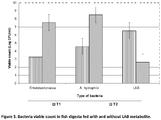
- the viable count for Enterobacteriaceae and A . hydrophila was lower in T1 compared to T2. Meanwhile, the LAB count was the highest in T1 and the lowest count in T2.
- a fish food was produced in a way corresponding to the above Example and a mixture was obtained following composition in percentages by weight of the mixture (Table 3): Table 3: Percentage composition of fish diet Ingredients % Crude protein 30 - 40 Crude fat 3 - 5 Moisture 10-12 Metabolite powder 0.1 - 0.5
Landscapes
- Life Sciences & Earth Sciences (AREA)
- Chemical & Material Sciences (AREA)
- Microbiology (AREA)
- Polymers & Plastics (AREA)
- Health & Medical Sciences (AREA)
- Engineering & Computer Science (AREA)
- Food Science & Technology (AREA)
- Zoology (AREA)
- Animal Husbandry (AREA)
- Molecular Biology (AREA)
- Mycology (AREA)
- Biochemistry (AREA)
- Biomedical Technology (AREA)
- Biotechnology (AREA)
- Insects & Arthropods (AREA)
- Marine Sciences & Fisheries (AREA)
- Physiology (AREA)
- Birds (AREA)
- Medicinal Chemistry (AREA)
- Veterinary Medicine (AREA)
- Public Health (AREA)
- General Health & Medical Sciences (AREA)
- Animal Behavior & Ethology (AREA)
- Epidemiology (AREA)
- Pharmacology & Pharmacy (AREA)
- Fodder In General (AREA)
- Feed For Specific Animals (AREA)
Description
- The present invention relates to a fish feed product comprising probiotic bacterial strain, wherein bacterial strain is Lactobacillus plantarum I-UL4 strain and deposited under the accession number 36838 at BIOTEC Culture Collection, for use in reducing faecal A. hydrophila count in fish. Preferred embodiments of the invention are described in
dependent claims 2 to 7.. - LAB are used extensively in the food industry in the manufacturing of fermented products including milk products such as e.g. yoghurt and cheese, meat products, bakery products, wine and vegetable products. Lactococcus lactis is one of the most commonly used LAB in dairy starter cultures. LAB are commonly used as inoculants in feedstuffs of plant and animal origin, i.e. for preservation purposes.
- The LAB used consist one or several of the LAB species that normally used in the handling of foodstuffs, for example, streptococci type N, pediococci, leconostoc or lactobacilli. They can be added in the form of pure cultures but it is preferable to use mixed cultures from a fermented material of vegetable or animal origin. Probiotic LAB are also known to produce a wide variety of antibacterial substances, as well as inhibitory primary metabolites, such as acetic acid, lactic acid, propionic acid, ethanol, diacetyl, hydrogen peroxide, bacteriocins and antiobiotic-like substances with activity against Gram negative and Gram positive bacteria. Bacteriocins are proteinaceous compounds, which have antimicrobial properties that able to inhibit many different bacterial species, especially pathogenic bacteria. This compound has received vast attention because they are produced by beneficial to human health bacteria and also often used as natural food bio-preservatives. It has been shown that administration of bacteriocins influences the bacterial ecology of the gastrointestinal tract and reduces the levels of pathogenic bacteria in different parts of gastrointestinal tract. Although there are tremendous reports for the health benefits of LAB, only limited evidence that LAB metabolites could provide beneficial effects to the host are available. The metabolites of environmental friendly LAB exhibiting antagonistic effects against pathogenic bacteria may be of applied interest as feed supplement by replacing the use of antibiotics. There is an ever-increasing demand for aquaculture products and a similar increase in the search for alternatives to antibiotics. Aquaculture has become one of the fastest-growing food-producing sectors, and there has been much focus on the possibility of applying conventional methods known from livestock farming for disease control and growth promotion in aquaculture. Disease outbreaks caused by the presence of harmful organisms in the surrounding environment is recognized as one of the most significant constraints on aquaculture production, affecting the economic development of the sector in many countries.
- There has been much focus on the control of the presence of pathogens in the aquaculture environment by applying and testing conventional methods used in the farming of terrestrial animals. The methods include the addition of antimicrobial compounds, such as e.g. antibiotics, to the environment. However, these conventional approaches have had limited success. As expected, the need for disease control has been accounted for by the development of novel disease control methods. One such method comprises the use of "probiotics", which are antagonistic bacterial strains to be used for the control of populations of potential pathogens through e.g. competitive exclusion. This technology has been used in the farming of terrestrial animals, where commercial probiotic products have been launched and available in the market. Oral administration of these products induces increased resistance to enteric infections and enhances the general immune response of the treated animal.
- Moreover, antibiotic and probiotics are the common feed supplements used in aquaculture activity. Probiotic is defined as any live microbial adjunct that has a beneficial effect on the host by changes in the host-related or ambient microbial community, through an improvement in the use of feed or its nutritional value, or by enhancing the host response to disease or by improving the quality of its environment. Growth promoting antibiotic is another common feed additives, mainly due to their positive effects on growth or feed conversion efficiency and the reduction of incidence of certain diseases. However, the extensive use of antibiotic may lead to the development of resistance in a number of pathogenic bacteria species. Likewise, cross-resistance may occurs to therapeutic antibiotic belongs to the same class of drug, particularly those with close relationships with human antimicrobial therapies. Some countries already imposed restrictions or prohibitions on the use of antibiotics as growth promotants and this have drawn attention to possible alternatives.
- The application of LAB metabolites in aquaculture could increase the production of aquatic animals to support the ever increasing demands of consumers and give an impact on reducing the usage of antibiotic as feed additives that would result the resistance against pathogenic bacteria. In comparison to live microorganism, metabolites have advantages in storing, transporting and handling.
- The prior art within aquaculture presently shows that bacterial species have been tested for control of the aquatic environment.
WO02/00035 -
JP2000103740A - SON V M ET AL, "Dietary administration of the probiotic, Lactobacillus plantarum, enhanced the growth, innate immune responses, and disease resistance of the grouper Epinephelus coioides", FISH AND SHELLFISH IMMUNOLOGY, ACADEMIC PRESS, LONDON, GB LNKD- DOI:10.1016/J.FSI.2009.02.018, vol. 26, no. 5, recommend a dietary L. plantarum administration to promote growth and enhance immunity in the grouper Epinephelus coioides.
- LOH T C ET AL, "Effects on growth performance, faecal microflora and plasma cholesterol after supplementation of spray-dried metabolite to postweaning rats", CZECH JOURNAL OF ANIMAL SCIENCE, POTRAVINARSKYCH INFORMACI, PRAGUE, (20090101), vol. 54, no. 1, describe the effects of spray dried LAB metabolites on various parameters in post-weaning rats.
-
US 2002/0176910 A1 discloses animal feed products comprising sorbic acid and live or dead micro-organisms producing bacteriocins. - FOO, H.L.; LOH, T.C.; LAI, P.W.; LIM, Y.Z.; KUFLI, C.N.; RUSUL, G., "Effects of Adding Lactobacillus plantarum I-UL4 Metabolites in Drinking Water of Rats", PAKISTAN JOURNAL OF NUTRITION, (20030901), vol. 2, no. 5, pages 283 - 288, describe the effect of LAB metabolites in drinking water on various parameters in rats.
- VENDRELL D ET AL, "Protection of rainbow trout (Oncorhynchus mykiss) from lactococcosis by probiotic bacteria", COMPARATIVE IMMUNOLOGY, MICROBIOLOGY AND INFECTIOUS DISEASES, PERGAMON PRESS, OXFORD, GB LNKD- DOI:10.1016/J.CIMID.2007.04.002, vol. 31, no. 4, show that probiotic supplementation reduced fish mortality significantly in rainbow trout.
- FOO HL et al. "Effects of feeding Lactobacillus plantarum I-UL4 isolated from Malaysian Tempeh on growth performance, faecal flora and lactic acid bacteria and plasma cholesterol concentrations in postweaning rats" Food science and biotechnology 12(4):403-408 · August 2003, study the effects of oral administration of L. plantarum I-UL4 (LP) in the diet of postweaning rats on growth performance, faecal pH, Enterobacteriaceae and lactic acid bacteria (LAB) counts and plasma cholesterol concentrations.
- José L. Balcázar, Daniel Vendrell, Ignacio de Blas, Imanol Ruiz-Zarzuela, José L. Muzquiz, Olivia Girones, "Characterization of probiotic properties of lactic acid bacteria isolated from intestinal microbiota of fish", Aquaculture, Volume 278, Issues 1-4, 10 June 2008, Pages 188-191, analyse the effects of probiotic bacteria against the adhesion of fish pathogens.
- The present invention relates to fish feed product comprising probiotic bacterial strain, wherein bacterial strain is Lactobacillus plantarum I-UL4 strain and deposited under the accession number 36838 at BIOTEC Culture Collection, for use in reducing faecal A. hydrophila count in fish..
It is said that the animal feed comprising metabolites produced from the Lactobacillus plantarum I-UL4 strain and the metabolites includes bacteriocins, vitamin B and organic acids, such as formic acid, acetic acid and lactic acid. - Preferably, the animal feed comprises metabolites in a concentration of at least 0.1% to 0.5% of dry weight. Indeed the metabolites are used into the feed as an additive or supplement.
- Moreover, said fish feed is capable of providing between 20% and 50% increase on animal growth and capable of providing at least 80% increase in relative survival rate. Furthermore, the fish feed is capable of reducing faecal Enterobacteriaceae and A. hydrophila count and increasing faecal LAB count in aquatic animals.
- Also disclosed is a method of performing aquaculture of aquatic animals wherein the aquatic animals are in contact with an aquatic animal feed product comprising a probiotic Lactobacillus plantarum bacteria. The aquatic animals are in contact with an amount of aquatic animal feed that corresponds from 5% to about 20% of a total feed intake of the aquatic animals of the aquaculture.
- Further disclosed is a method for feeding an aquatic animal present in an aquaculture comprising feeding the aquatic animal with an aquatic animal feed product comprising a probiotic Lactobacillus plantarum bacterium.
- In addition, the present disclosure shows an aquatic animal feedstuff produced by the above preceding methods. Preferably also the disclosure describes animal feed formulation that includes total protein (between 30% and 40% of the total feed ration), total fat (total fat is between 3% and 5% of the total feed ration), moisture (between 10% and 12% of the total feed ration), and metabolite powder (preferably includes bacteriocins, combine with vitamin B, and organic acids). The formulation further includes any of the combination selected from the group of protein, fat and moisture. Indeed, the metabolite powder is between 0.1% and 0.5% of the total feed ration.
- It is described that the animal feed having the means to increase a total feed intake between 3% and 10% and the formulation providing the capability to reduce faecal Enterobacteriaceae count and increase faecal lactic acid bacteria count in aquatic animals.
- The present invention consists of several novel features and a combination of parts hereinafter fully described and illustrated in the accompanying description and drawings, it is understood that various changes in the details may be made without departing from the scope of the invention or sacrificing any of the advantages of the present invention.
- The present invention will be fully understood from the detailed description given herein below and the accompanying drawings which are given by way of illustration only, and thus are not limitative of the present invention, wherein:
-
Figure 1 shows the agar well diffusion assay of LAB metabolite against Aeromonas hydrophila -
Figure 2 shows the effect of LAB metabolite on survival rate of tilapia after being challenged with Aeromonas hydrophila. Notes: T1, LAB metabolite; T2, Control. ± indicates standard error. Values within the same row and experiment sharing a common superscript letter are not significantly different, P > 0.05. -
Figure 3 shows the bacteria viable count in fish digesta fed with and without LAB metabolite. Notes: T1, LAB metabolite; T2, Control. ± indicates standard error.Values within the same row and experiment sharing a common superscript letter are not significantly different, P > 0.05. -
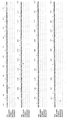
Figure 4 shows alignment of 16S rDNA partial sequences amplified from Lactobacillus plantarum I-UL4 strain and four other strains of Lactobacillus plantarum deposited in GenBank. - The present invention relates to the use of metabolites derived from probiotic LAB as feed supplement for aquaculture animals. More particularly, the present invention relates to fish supplement with improve quality, resistance to undesirable bacterial strains and to a process for preparing metabolites mixed into fish feed.
- The solution is based on that the present inventors' identification of a fish feed product enriched with a metabolite derived from probiotic LAB that is capable of significantly enhanced the resistance of aquacultured fish against relevant pathogenic microorganisms. It was demonstrated that the utilization of the metabolites derived from LAB strains isolated from Malaysian foods, Lactobacillus sp., for improving the growth performance, immunity and overall health of aquatic animal; for the control of gastrointestinal tract pathogens including antibiotic resistance gastrointestinal tract pathogens and their associated diseases by both a reduction in the rate of colonization and the severity of the deleterious physiological effects of the colonization of the antibiotic-resistance pathogen.
- Accordingly, the invention relates to a fish feed product according to
claim 1. Without being limited to theory, it is believed that the metabolites derived from probiotic LAB are capable of significantly increasing the amount of aquatic animal antibodies against pathogenic microorganisms. The enhancement of antibody production renders the aquatic animal more resistant to these pathogenic microorganisms. See working examples herein for further details. It is believed to be the first time that it is demonstrated that a metabolite derived from probiotic LAB gives its positive effect through growth performance, survival rate and negative effect of pathogen in aquaculture animals such as fish. - A further advantage of a feed product comprising metabolite derived from probiotic LAB is that the growth weight gain and growth length of the aquatic animal is improved. See working examples herein for further details.
- Prior to a discussion of the detailed embodiments of the invention, a definition of specific terms related to the main aspects of the invention is provided.
- The term feed or feed composition means any compound, preparation, mixture, or composition suitable for, or intended for intake by an animal.
- The term "aquaculture" should be understood according to the art as an aquatic culture of aquatic animals wherein the animals are cultured in a physically defined space such as, e.g., in cages or tanks.
- The term "probiotic" is a well-defined term in the art and relates to a microorganism that when it has been in physical contact (e.g., when eaten) with an aquatic animal it confers health benefit to the animal.
- Before the present invention is further described, it is to be understood that this invention is not limited to particular embodiments described, as such may, of course, vary. It is also to be understood that the terminology used herein is for the purpose of describing particular embodiments only, and is not intended to be limiting, since the scope of the present invention will be limited only by the appended claims. When a range of values is provided, it is understood that each intervening value, to the tenth of the unit of the lower limit unless the context clearly dictates otherwise, between the upper and lower limit of that range and any other stated or intervening value in that stated range, is encompassed within the invention. The upper and lower limits of these smaller ranges may independently be included in the smaller ranges, and are also encompassed within the invention, subject to any specifically excluded limit in the stated range. When the stated range includes one or both of the limits, ranges excluding either or both of those included limits are also included in the invention.
- Unless defined otherwise, all technical and scientific terms used herein have the same meaning as commonly understood by one of ordinary skill in the art to which this invention belongs. Although any methods and materials similar or equivalent to those described herein can also be used in the practice or testing of the present invention, the preferred methods and materials are now described. All publications mentioned herein are incorporated herein by reference to disclose and describe the methods and/or materials in connection with which the publications are cited. It must be noted that as used herein and in the appended claims, the singular forms "a," "an," and "the" include plural referents unless the context clearly dictates otherwise.
-
- i) Lactobacillus sp., isolated from fermented tapioca (tapai ubi) was used in this study. These bacteria were obtained from our own collection (Department of Bioprocess Technology, Universiti Putra Malaysia). The LAB strain was kept in Man Rogosa Sharpe (MRS) broth at -20°C. The LAB strain was revived twice in MRS broth and incubated anaerobically at 20°C - 40°C before preparing the LAB metabolite. The overnight culture was inoculated into MRS broth and incubated anaerobically for overnight at 20°C - 40°C. The metabolite was collected by separating the bacterial cells with centrifugation at 8000 x g for 10 min. The metabolite was then kept at 4 °C till use. The metabolite was also spray dried.
- ii) In the Agar-Well Diffusion Method (Tagg et al., 1976), 10 - 100µl of the LAB metabolite was pipetted into the pre-punched agar well. The supernatant was allowed to diffuse for an hour. The plate was then overlaid with soft agar inoculated with the indicator organism and incubated at 30°C - 40°C overnight. Inhibition was evident by a clear zone formation around the well (
Figure 1 ) of UL4 metabolite against indicator organism with minimum mean diameter of 1 cm. - iii) The feeding trial was conducted for 4 weeks. Two experimental groups, with LAB metabolite (T1) and without LAB metabolite (T2), each with three replicates that followed a completely randomized design were carried out by using uniform size tanks (25 L capacity). A total of 48 tilapias, with body weight of 17-18 g, were allowed to acclimatize for 2 weeks before the trial.
- iv) The spray-dried LAB metabolite was diluted according to the pre-determined amount that gave the highest bacteriocin activity. Under sterile conditions, the diluted powder was then incorporated into commercial diet. The required amount was gently sprayed on the diet and slowly mixed. Fish fed with only commercial diet was served as control. The fish were fed ad-libitum twice daily. All fishes were weighed every week to assess the growth performance in terms of weight gain, specific growth rate (SGR) and feed conversion ratio (FCR). The feed intake was recorded daily (Table 1). The body weight gain was significantly higher (P<0.05) in T1 compared to control. Similar trend was also found for specific growth rate, where the growth rate for T1 group was statistically significant. T1 also had the lowest FCR, indicating the fish fed with LAB metabolite was able to convert feed into fish tissue efficiently.
- For immunological study, blood was withdrawn from the caudal vein of anaesthetized tilapia every week. The blood was stored overnight at 4 °C and the serum was collected by centrifugation at 1000 x g for 20 min before being stored at - 80 °C. The antibody levels were determined from the immunized fishes by indirect ELISA (Takemura, 1993). The 96-well ELISA plates were coated overnight at 4 °C with LAB metabolite at concentration of pre-determined amount that gave the highest activity in 100 µl well-1 of coating buffer (15 mM Na2CO3, 35 mM NaHCO3, pH 9.6). The plates were then washed three times with phosphate buffered saline containing 0.05 % (v/v) Tween-20 (PBS-T). The well was then blocked with 250 µl well-1 of 1 % (w/v) BSA in PBS for 2 h at 22 °C. After washing three times with PBS-T, the diluted serum of tilapia at 1:4 ratio in PBS (100 µl well-1) were added and incubated for 3 h at 22 °C. After washing three times with PBS-T, the plates were added with 100 µl well-1 horseradish conjugated mouse anti-tilapia IgM (1:54) (Aquatic Diagnostics Ltd) and incubated for 1 h at 22 °C. After washing, the reaction was developed by the addition of tetramethylbenzidine dihydrochloride (TMB)/H2O2 substrate and further incubated for 10 min at 22°C. The reaction was terminated by adding 50 µl well-1 of 2M H2SO4. Optical density was measured at 450 nm by ELISA reader (
Anthos Zenyth 340 Microplate Reader) (Table 2). During 4 weeks of oral feeding with LAB metabolite, there was an increase of antibody levels in the fish serum. The control group showed weak or no responses. Increase in antibody levels was detected atweek 2 after the fish were fed with LAB metabolite orally, and the antibody level reached its maximal level at week 3. However, the antibody level was decreased slightly after week 3, but was much higher compared to controlTable 2: Antibody production in tilapia fed with LAB metabolite. OD450nm Week T1 T2 0.25a ± 0.00 0 0.37a ± 0.01 0.27a ± 0.01 1 0.80a ± 0.06 0.32a ± 0.03 2 1.14a ± 0.01 0.52b ± 0.05 Notes: T1, LAB metabolite; T2; Control. ± indicates standard error. Values within the same row and experiment sharing a common superscript letter are not significantly different, P > 0.05.
vi) After 4 weeks of feeding trial, each group was injected with 0.1 ml of 108 CFU/ml of pathogenic strain of Aeromonas hydrophila. Mortalities were recorded and removed daily over 10 days. The cause of death was determined by culturing the kidney of morbid fish for A. hydrophila. During the experimental period, the fish was fed as usual (Figure 2 ). 100% protection and no mortality were recorded for fish immunized with LAB metabolite compared to control groups. The survival rate was statistically significant (P<0.05) in T1 in relation to T2.
vii) Analysis of the intestine digesta was done on samples consisting of excised intestines from the surviving fish from each treatment groups. The samples were then homogenized with 1 ml of sterile saline solution using a stomacher. 10-fold serial dilution (10-1 to 10-8) was then carried out in triplicate and 100 µl of an appropriate dilution was plated on Eosin Methylene Blue Agar (EMB), Glutamate Starch Phenol Red Agar (GSP) and de Man, Rogosa and Sharp agar (MRS) for Enterobacteriaceae, A. hydrophila and LAB count respectively. The plates were incubated overnight at 30°C until the colonies were visible (Figure 3 ). The viable count for Enterobacteriaceae and A. hydrophila was lower in T1 compared to T2. Meanwhile, the LAB count was the highest in T1 and the lowest count in T2.
viii) A fish food was produced in a way corresponding to the above Example and a mixture was obtained following composition in percentages by weight of the mixture (Table 3):Table 3: Percentage composition of fish diet Ingredients % Crude protein 30 - 40 Crude fat 3 - 5 Moisture 10-12 Metabolite powder 0.1 - 0.5 -
- <110> Universiti Putra Malaysia
- <120> METABOLITES IN ANIMAL FEED
- <130> SK/PCT0017/UPM/09
- <160> 5
- <170> PatentIn version 3.4
- <210> 1
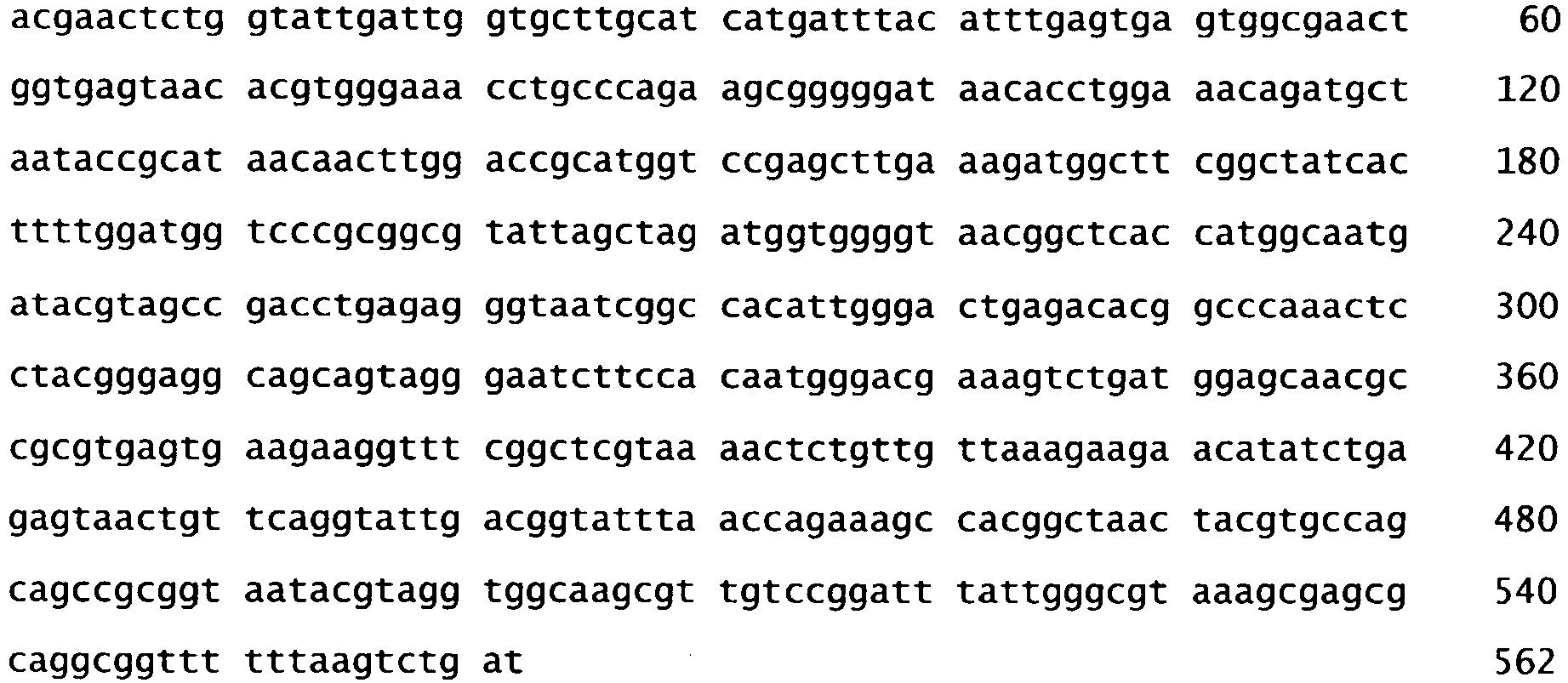
<211> 562
<212> DNA
<213> Lactobacillus plantarum - <220>
<221> misc_feature
<223> Lactobacillus plantarum strain I-UL4 - <400> 1

-
- <110> Universiti Putra Malaysia
- <120> METABOLITES IN ANIMAL FEED
- <130> SK/PCT0017/UPM/09
- <160> 5
- <170> PatentIn version 3.4
- <210> 1
<211> 562
<212> DNA
<213> Lactobacillus plantarum - <220>
<221> misc_feature
<223> Lactobacillus plantarum strain I-UL4 - <400> 1
| Parameters | T1 | T2 |
| Weight gain (g) | 7.7a ± 0.01 | 5.5b ± 0.01 |
| Specific growth rate (% per day) | 1.35a ± 0.01 | 1.01b ± 0.01 |
| FCR (feed conversion ratio) | 1.63a ± 0.05 | 1.89b ± 0.01 |
| Notes: T1, LAB metabolite; T2, Control. ± indicates standard erro).Values within the same row and experiment sharing a common superscript letter are not significantly different, P > 0.05. |
Claims (7)
- A fish feed product comprising probiotic bacterial strain, wherein bacterial strain is Lactobacillus plantarum I-UL4 strain and deposited under the accession number 36838 at BIOTEC Culture Collection, for use in reducing faecal A. hydrophila count in fish.
- The fish feed product as claimed in claim 1, wherein the fish feed comprises metabolites produced from the Lactobacillus plantarum I-UL4 strain.
- The fish feed product as claimed in claim 2, wherein the metabolites include bacteriocins, vitamin B and organic acids, such as formic acid, acetic acid and lactic acid.
- The fish feed product as claimed in claim 1, wherein the fish feed comprises metabolites in a concentration of 0.1% to 0.5% of dry weight.
- The fish feed product as claimed in claim 1, wherein the metabolites is used into the feed as an additive or supplement.
- The fish feed product as claimed in claim 1, wherein the fish feed is capable of providing between 20% and 50% increase on animal growth, and/or is capable of providing at least 80% increase in relative survival rate.
- The fish feed product as claimed in claim 1, wherein the fish feed is capable of reducing faecal enterobacteriaceae and A. hydrophila count and increasing faecal LAB count in fish.
Applications Claiming Priority (2)
| Application Number | Priority Date | Filing Date | Title |
|---|---|---|---|
| MYPI20097013A MY158907A (en) | 2009-08-10 | 2009-08-10 | Metabolites in animal feed |
| PCT/MY2010/000095 WO2011019264A1 (en) | 2009-08-10 | 2010-06-09 | Metabolites in animal feed |
Publications (2)
| Publication Number | Publication Date |
|---|---|
| EP2521459A1 EP2521459A1 (en) | 2012-11-14 |
| EP2521459B1 true EP2521459B1 (en) | 2018-02-07 |
Family
ID=42711723
Family Applications (1)
| Application Number | Title | Priority Date | Filing Date |
|---|---|---|---|
| EP10728913.4A Not-in-force EP2521459B1 (en) | 2009-08-10 | 2010-06-09 | Metabolites in animal feed |
Country Status (7)
| Country | Link |
|---|---|
| US (1) | US20130108600A1 (en) |
| EP (1) | EP2521459B1 (en) |
| AU (1) | AU2010283058B2 (en) |
| DK (1) | DK2521459T3 (en) |
| MY (1) | MY158907A (en) |
| NO (1) | NO2521459T3 (en) |
| WO (1) | WO2011019264A1 (en) |
Cited By (2)
| Publication number | Priority date | Publication date | Assignee | Title |
|---|---|---|---|---|
| NO20210585A1 (en) * | 2021-05-10 | 2022-11-11 | Nord Univ | Fish feed comprising probiotics |
| EP4674949A4 (en) * | 2024-05-23 | 2026-04-08 | Mengniu Dairy Group Co Ltd | Growth-promoting probiotic strain and its use |
Families Citing this family (4)
| Publication number | Priority date | Publication date | Assignee | Title |
|---|---|---|---|---|
| MY162183A (en) * | 2009-12-01 | 2017-05-31 | Univ Putra Malaysia | Probiotic composition for nutraceutical product |
| BR112012021624A2 (en) * | 2010-11-29 | 2017-02-07 | Univ Putra Malaysia | use of bacterial strains of a lactic acid to prevent or treat a tumor, composition for treating or preventing cancer, method for facilitating apoptosis of cancer cells in a mammal, kit for preventing or treating cancer in a mammal, and foodstuffs for antitumor. |
| US11053532B2 (en) | 2017-04-19 | 2021-07-06 | CAP Diagnostics, LLC | Methods for treating polymicrobial infections |
| AU2019343296B2 (en) * | 2018-09-19 | 2025-01-02 | Fermentationexperts A/S | Process for controlling a fermentation process |
Family Cites Families (6)
| Publication number | Priority date | Publication date | Assignee | Title |
|---|---|---|---|---|
| US20040081723A1 (en) * | 1996-12-11 | 2004-04-29 | Tetra Holding (Us), Inc. | Flake feed, especially for aquatic animals |
| JP4052534B2 (en) | 1997-11-27 | 2008-02-27 | コーア株式会社 | Seafood products and feed |
| US6955831B2 (en) * | 2000-05-09 | 2005-10-18 | Her Majesty The Queen In Right Of Canada As Represented By The Minister Of Fisheries And Oceans | Protein and lipid sources for use in aquafeeds and animal feeds and a process for their preparation |
| AU2001268078A1 (en) | 2000-06-23 | 2002-01-08 | Acuabiotec Llc | Bioactive food complex, method for making bioactive food complex product and method for controlling disease |
| DE10110431A1 (en) * | 2001-03-05 | 2002-09-19 | Nutrinova Gmbh | Bacteriocin-containing sorbic acid preparation as a feed additive in livestock rearing |
| US20070082008A1 (en) * | 2003-03-07 | 2007-04-12 | Advanced Bionutrition Corporation | Feed formulation for terrestrial and aquatic animals |
-
2009
- 2009-08-10 MY MYPI20097013A patent/MY158907A/en unknown
-
2010
- 2010-06-09 NO NO10728913A patent/NO2521459T3/no unknown
- 2010-06-09 US US13/580,337 patent/US20130108600A1/en not_active Abandoned
- 2010-06-09 WO PCT/MY2010/000095 patent/WO2011019264A1/en not_active Ceased
- 2010-06-09 EP EP10728913.4A patent/EP2521459B1/en not_active Not-in-force
- 2010-06-09 DK DK10728913.4T patent/DK2521459T3/en active
- 2010-06-09 AU AU2010283058A patent/AU2010283058B2/en not_active Ceased
Non-Patent Citations (2)
| Title |
|---|
| BALCAZAR J L ET AL: "Characterization of probiotic properties of lactic acid bacteria isolated from intestinal microbiota of fish", AQUACULTURE, ELSEVIER, AMSTERDAM, NL, vol. 278, no. 1-4, 10 June 2008 (2008-06-10), pages 188 - 191, XP022669418, ISSN: 0044-8486, [retrieved on 20080318], DOI: 10.1016/J.AQUACULTURE.2008.03.014 * |
| FOO H L ET AL: "Effects of feeding Lactobacillus plantarum I-UL4 isolated from Malaysian tempeh on growth performance, faecal flora and lactic acid bacteria and plasma cholesterol concentrations in postweaning", FOOD SCIENCE AND BIOTECHNOLOGY, THE KOREA SOC. OF FOOD SCIENCE AND TECHNOLOGY, vol. 12, no. 4, 1 January 2003 (2003-01-01), pages 403 - 408, XP009122258, ISSN: 1226-7708 * |
Cited By (3)
| Publication number | Priority date | Publication date | Assignee | Title |
|---|---|---|---|---|
| NO20210585A1 (en) * | 2021-05-10 | 2022-11-11 | Nord Univ | Fish feed comprising probiotics |
| NO348910B1 (en) * | 2021-05-10 | 2025-07-14 | Nord Univ | Fish feed comprising probiotics |
| EP4674949A4 (en) * | 2024-05-23 | 2026-04-08 | Mengniu Dairy Group Co Ltd | Growth-promoting probiotic strain and its use |
Also Published As
| Publication number | Publication date |
|---|---|
| MY158907A (en) | 2016-11-30 |
| AU2010283058A1 (en) | 2013-02-07 |
| EP2521459A1 (en) | 2012-11-14 |
| AU2010283058B2 (en) | 2015-08-27 |
| NO2521459T3 (en) | 2018-07-07 |
| DK2521459T3 (en) | 2018-05-28 |
| WO2011019264A1 (en) | 2011-02-17 |
| US20130108600A1 (en) | 2013-05-02 |
Similar Documents
| Publication | Publication Date | Title |
|---|---|---|
| Meidong et al. | Evaluation of probiotic Bacillus aerius B81e isolated from healthy hybrid catfish on growth, disease resistance and innate immunity of Pla-mong Pangasius bocourti | |
| Chiang et al. | Optimizing production of two potential probiotic Lactobacilli strains isolated from piglet feces as feed additives for weaned piglets | |
| Guerra et al. | Production of four potentially probiotic lactic acid bacteria and their evaluation as feed additives for weaned piglets | |
| Kim et al. | Bacteriophage cocktail and multi-strain probiotics in the feed for weanling pigs: effects on intestine morphology and targeted intestinal coliforms and Clostridium | |
| US20170042949A1 (en) | System and method for production of shelf stable probiotics for animal nutrition enhancement | |
| US11344588B2 (en) | Lactobacillus plantarum CJLP17 having antiviral and immunomodulatory efficacies and composition comprising the same | |
| CN104195075A (en) | A kind of Enterococcus faecium EF08 and its feed additive and feed | |
| US9814242B2 (en) | Bacillus subtilis isolate from corn and extracts that inhibit the growth of undesirable microorganisms in food products | |
| KR101381547B1 (en) | Novel Leuconostoc mesenteroides from kimchi with inhibiting activities on pathogenic microorganism and use thereof | |
| DK2521459T3 (en) | Metabolites in animal feed | |
| CN116590172A (en) | Pediococcus acidilactici GLP06, application and product thereof | |
| CN112533486A (en) | Additive for feed and feed | |
| Zhao et al. | Effect of lactic acid bacteria on Listeria monocytogenes infection and innate immunity in rabbits. | |
| KR101749065B1 (en) | Enterococcus faecium MSS2 capable of fermenting at room temperature and composition for comprising the same | |
| CN116075237B (en) | Combinations of lactobacillus strains and their use in animal health | |
| KR101580616B1 (en) | Bacillus methylotrophicus C14 strain having acid-resistance, bile acid-resistance and antimicrobial activity and uses thereof | |
| CN107949633B (en) | Lactobacillus rhamnosus, animal feed and composition thereof, and production method of inactive cells | |
| CN118240712A (en) | Growth-promoting probiotics and their applications | |
| KR101836365B1 (en) | Kimchi seasoning containing Leuconostoc mesenteroides WiKim32 and kimchi prepared by using the same | |
| KR20160039097A (en) | Pediococcus pentosaceus w i k i m20 and composition comprising the same | |
| WO1992012639A1 (en) | Feed additive and method | |
| WO2012042223A2 (en) | Fermented foodstuff | |
| CN113973997A (en) | Lactobacillus composition and calf starter feed | |
| Ham et al. | Inhibitiory activity of lactic acid bacteria against hazardous microbes | |
| Ngasotter et al. | Characteristics and mechanism of potential probiotics with special reference to lactic acid bacteria from traditional fermented fish products: a review |
Legal Events
| Date | Code | Title | Description |
|---|---|---|---|
| PUAJ | Public notification under rule 129 epc |
Free format text: ORIGINAL CODE: 0009425 |
|
| PUAI | Public reference made under article 153(3) epc to a published international application that has entered the european phase |
Free format text: ORIGINAL CODE: 0009012 |
|
| 17P | Request for examination filed |
Effective date: 20120726 |
|
| AK | Designated contracting states |
Kind code of ref document: A1 Designated state(s): AL AT BE BG CH CY CZ DE DK EE ES FI FR GB GR HR HU IE IS IT LI LT LU LV MC MK MT NL NO PL PT RO SE SI SK SM TR |
|
| 17Q | First examination report despatched |
Effective date: 20130930 |
|
| REG | Reference to a national code |
Ref country code: DE Ref legal event code: R079 Ref document number: 602010048401 Country of ref document: DE Free format text: PREVIOUS MAIN CLASS: A23K0001000000 Ipc: A23K0010180000 |
|
| GRAP | Despatch of communication of intention to grant a patent |
Free format text: ORIGINAL CODE: EPIDOSNIGR1 |
|
| RIC1 | Information provided on ipc code assigned before grant |
Ipc: A23K 50/80 20160101ALI20170705BHEP Ipc: A23K 10/18 20160101AFI20170705BHEP |
|
| INTG | Intention to grant announced |
Effective date: 20170724 |
|
| RIN1 | Information on inventor provided before grant (corrected) |
Inventor name: KARUNAKARAMOORTHY, ANURADHA Inventor name: LOH, TECK CHWEN Inventor name: FOO, HOOI LING Inventor name: SHAMSUDIN, MARIANA NOR Inventor name: HAJI ABDUL RAHIM, RAHA |
|
| GRAS | Grant fee paid |
Free format text: ORIGINAL CODE: EPIDOSNIGR3 |
|
| GRAJ | Information related to disapproval of communication of intention to grant by the applicant or resumption of examination proceedings by the epo deleted |
Free format text: ORIGINAL CODE: EPIDOSDIGR1 |
|
| GRAL | Information related to payment of fee for publishing/printing deleted |
Free format text: ORIGINAL CODE: EPIDOSDIGR3 |
|
| GRAR | Information related to intention to grant a patent recorded |
Free format text: ORIGINAL CODE: EPIDOSNIGR71 |
|
| INTC | Intention to grant announced (deleted) | ||
| INTG | Intention to grant announced |
Effective date: 20171128 |
|
| GRAA | (expected) grant |
Free format text: ORIGINAL CODE: 0009210 |
|
| AK | Designated contracting states |
Kind code of ref document: B1 Designated state(s): AL AT BE BG CH CY CZ DE DK EE ES FI FR GB GR HR HU IE IS IT LI LT LU LV MC MK MT NL NO PL PT RO SE SI SK SM TR |
|
| REG | Reference to a national code |
Ref country code: GB Ref legal event code: FG4D |
|
| REG | Reference to a national code |
Ref country code: AT Ref legal event code: REF Ref document number: 968447 Country of ref document: AT Kind code of ref document: T Effective date: 20180215 Ref country code: CH Ref legal event code: EP |
|
| REG | Reference to a national code |
Ref country code: IE Ref legal event code: FG4D |
|
| REG | Reference to a national code |
Ref country code: DE Ref legal event code: R096 Ref document number: 602010048401 Country of ref document: DE |
|
| REG | Reference to a national code |
Ref country code: NL Ref legal event code: FP |
|
| REG | Reference to a national code |
Ref country code: DK Ref legal event code: T3 Effective date: 20180522 |
|
| REG | Reference to a national code |
Ref country code: NO Ref legal event code: T2 Effective date: 20180207 |
|
| REG | Reference to a national code |
Ref country code: AT Ref legal event code: MK05 Ref document number: 968447 Country of ref document: AT Kind code of ref document: T Effective date: 20180207 |
|
| PG25 | Lapsed in a contracting state [announced via postgrant information from national office to epo] |
Ref country code: ES Free format text: LAPSE BECAUSE OF FAILURE TO SUBMIT A TRANSLATION OF THE DESCRIPTION OR TO PAY THE FEE WITHIN THE PRESCRIBED TIME-LIMIT Effective date: 20180207 Ref country code: LT Free format text: LAPSE BECAUSE OF FAILURE TO SUBMIT A TRANSLATION OF THE DESCRIPTION OR TO PAY THE FEE WITHIN THE PRESCRIBED TIME-LIMIT Effective date: 20180207 Ref country code: HR Free format text: LAPSE BECAUSE OF FAILURE TO SUBMIT A TRANSLATION OF THE DESCRIPTION OR TO PAY THE FEE WITHIN THE PRESCRIBED TIME-LIMIT Effective date: 20180207 Ref country code: FI Free format text: LAPSE BECAUSE OF FAILURE TO SUBMIT A TRANSLATION OF THE DESCRIPTION OR TO PAY THE FEE WITHIN THE PRESCRIBED TIME-LIMIT Effective date: 20180207 Ref country code: CY Free format text: LAPSE BECAUSE OF FAILURE TO SUBMIT A TRANSLATION OF THE DESCRIPTION OR TO PAY THE FEE WITHIN THE PRESCRIBED TIME-LIMIT Effective date: 20180207 |
|
| PG25 | Lapsed in a contracting state [announced via postgrant information from national office to epo] |
Ref country code: LV Free format text: LAPSE BECAUSE OF FAILURE TO SUBMIT A TRANSLATION OF THE DESCRIPTION OR TO PAY THE FEE WITHIN THE PRESCRIBED TIME-LIMIT Effective date: 20180207 Ref country code: SE Free format text: LAPSE BECAUSE OF FAILURE TO SUBMIT A TRANSLATION OF THE DESCRIPTION OR TO PAY THE FEE WITHIN THE PRESCRIBED TIME-LIMIT Effective date: 20180207 Ref country code: PL Free format text: LAPSE BECAUSE OF FAILURE TO SUBMIT A TRANSLATION OF THE DESCRIPTION OR TO PAY THE FEE WITHIN THE PRESCRIBED TIME-LIMIT Effective date: 20180207 Ref country code: BG Free format text: LAPSE BECAUSE OF FAILURE TO SUBMIT A TRANSLATION OF THE DESCRIPTION OR TO PAY THE FEE WITHIN THE PRESCRIBED TIME-LIMIT Effective date: 20180507 Ref country code: GR Free format text: LAPSE BECAUSE OF FAILURE TO SUBMIT A TRANSLATION OF THE DESCRIPTION OR TO PAY THE FEE WITHIN THE PRESCRIBED TIME-LIMIT Effective date: 20180508 Ref country code: AT Free format text: LAPSE BECAUSE OF FAILURE TO SUBMIT A TRANSLATION OF THE DESCRIPTION OR TO PAY THE FEE WITHIN THE PRESCRIBED TIME-LIMIT Effective date: 20180207 |
|
| PG25 | Lapsed in a contracting state [announced via postgrant information from national office to epo] |
Ref country code: IT Free format text: LAPSE BECAUSE OF FAILURE TO SUBMIT A TRANSLATION OF THE DESCRIPTION OR TO PAY THE FEE WITHIN THE PRESCRIBED TIME-LIMIT Effective date: 20180207 Ref country code: AL Free format text: LAPSE BECAUSE OF FAILURE TO SUBMIT A TRANSLATION OF THE DESCRIPTION OR TO PAY THE FEE WITHIN THE PRESCRIBED TIME-LIMIT Effective date: 20180207 Ref country code: EE Free format text: LAPSE BECAUSE OF FAILURE TO SUBMIT A TRANSLATION OF THE DESCRIPTION OR TO PAY THE FEE WITHIN THE PRESCRIBED TIME-LIMIT Effective date: 20180207 Ref country code: RO Free format text: LAPSE BECAUSE OF FAILURE TO SUBMIT A TRANSLATION OF THE DESCRIPTION OR TO PAY THE FEE WITHIN THE PRESCRIBED TIME-LIMIT Effective date: 20180207 |
|
| REG | Reference to a national code |
Ref country code: DE Ref legal event code: R097 Ref document number: 602010048401 Country of ref document: DE |
|
| PG25 | Lapsed in a contracting state [announced via postgrant information from national office to epo] |
Ref country code: SM Free format text: LAPSE BECAUSE OF FAILURE TO SUBMIT A TRANSLATION OF THE DESCRIPTION OR TO PAY THE FEE WITHIN THE PRESCRIBED TIME-LIMIT Effective date: 20180207 Ref country code: CZ Free format text: LAPSE BECAUSE OF FAILURE TO SUBMIT A TRANSLATION OF THE DESCRIPTION OR TO PAY THE FEE WITHIN THE PRESCRIBED TIME-LIMIT Effective date: 20180207 Ref country code: SK Free format text: LAPSE BECAUSE OF FAILURE TO SUBMIT A TRANSLATION OF THE DESCRIPTION OR TO PAY THE FEE WITHIN THE PRESCRIBED TIME-LIMIT Effective date: 20180207 |
|
| PLBE | No opposition filed within time limit |
Free format text: ORIGINAL CODE: 0009261 |
|
| REG | Reference to a national code |
Ref country code: CH Ref legal event code: PK Free format text: BERICHTIGUNGEN |
|
| STAA | Information on the status of an ep patent application or granted ep patent |
Free format text: STATUS: NO OPPOSITION FILED WITHIN TIME LIMIT |
|
| REG | Reference to a national code |
Ref country code: DE Ref legal event code: R119 Ref document number: 602010048401 Country of ref document: DE |
|
| RIC2 | Information provided on ipc code assigned after grant |
Ipc: A23K 50/80 20160101ALI20170705BHEP Ipc: A23K 10/18 20160101AFI20170705BHEP |
|
| 26N | No opposition filed |
Effective date: 20181108 |
|
| REG | Reference to a national code |
Ref country code: DK Ref legal event code: EBP Effective date: 20180630 |
|
| REG | Reference to a national code |
Ref country code: NO Ref legal event code: MMEP |
|
| REG | Reference to a national code |
Ref country code: CH Ref legal event code: PK Free format text: BERICHTIGUNGEN Ref country code: CH Ref legal event code: PL |
|
| REG | Reference to a national code |
Ref country code: NL Ref legal event code: MM Effective date: 20180701 |
|
| RIC2 | Information provided on ipc code assigned after grant |
Ipc: A23K 50/80 20160101ALI20170705BHEP Ipc: A23K 10/18 20160101AFI20170705BHEP |
|
| GBPC | Gb: european patent ceased through non-payment of renewal fee |
Effective date: 20180609 |
|
| PG25 | Lapsed in a contracting state [announced via postgrant information from national office to epo] |
Ref country code: SI Free format text: LAPSE BECAUSE OF FAILURE TO SUBMIT A TRANSLATION OF THE DESCRIPTION OR TO PAY THE FEE WITHIN THE PRESCRIBED TIME-LIMIT Effective date: 20180207 |
|
| REG | Reference to a national code |
Ref country code: BE Ref legal event code: MM Effective date: 20180630 |
|
| REG | Reference to a national code |
Ref country code: IE Ref legal event code: MM4A |
|
| PG25 | Lapsed in a contracting state [announced via postgrant information from national office to epo] |
Ref country code: MC Free format text: LAPSE BECAUSE OF FAILURE TO SUBMIT A TRANSLATION OF THE DESCRIPTION OR TO PAY THE FEE WITHIN THE PRESCRIBED TIME-LIMIT Effective date: 20180207 Ref country code: LU Free format text: LAPSE BECAUSE OF NON-PAYMENT OF DUE FEES Effective date: 20180609 Ref country code: NL Free format text: LAPSE BECAUSE OF NON-PAYMENT OF DUE FEES Effective date: 20180701 |
|
| PG25 | Lapsed in a contracting state [announced via postgrant information from national office to epo] |
Ref country code: CH Free format text: LAPSE BECAUSE OF NON-PAYMENT OF DUE FEES Effective date: 20180630 Ref country code: FR Free format text: LAPSE BECAUSE OF NON-PAYMENT OF DUE FEES Effective date: 20180630 Ref country code: NO Free format text: LAPSE BECAUSE OF NON-PAYMENT OF DUE FEES Effective date: 20180630 Ref country code: IS Free format text: LAPSE BECAUSE OF FAILURE TO SUBMIT A TRANSLATION OF THE DESCRIPTION OR TO PAY THE FEE WITHIN THE PRESCRIBED TIME-LIMIT Effective date: 20190101 Ref country code: LI Free format text: LAPSE BECAUSE OF NON-PAYMENT OF DUE FEES Effective date: 20180630 Ref country code: IE Free format text: LAPSE BECAUSE OF NON-PAYMENT OF DUE FEES Effective date: 20180609 Ref country code: DE Free format text: LAPSE BECAUSE OF NON-PAYMENT OF DUE FEES Effective date: 20190101 Ref country code: GB Free format text: LAPSE BECAUSE OF NON-PAYMENT OF DUE FEES Effective date: 20180609 |
|
| PG25 | Lapsed in a contracting state [announced via postgrant information from national office to epo] |
Ref country code: BE Free format text: LAPSE BECAUSE OF NON-PAYMENT OF DUE FEES Effective date: 20180630 |
|
| PG25 | Lapsed in a contracting state [announced via postgrant information from national office to epo] |
Ref country code: DK Free format text: LAPSE BECAUSE OF NON-PAYMENT OF DUE FEES Effective date: 20180630 |
|
| PG25 | Lapsed in a contracting state [announced via postgrant information from national office to epo] |
Ref country code: MT Free format text: LAPSE BECAUSE OF NON-PAYMENT OF DUE FEES Effective date: 20180609 |
|
| PG25 | Lapsed in a contracting state [announced via postgrant information from national office to epo] |
Ref country code: TR Free format text: LAPSE BECAUSE OF FAILURE TO SUBMIT A TRANSLATION OF THE DESCRIPTION OR TO PAY THE FEE WITHIN THE PRESCRIBED TIME-LIMIT Effective date: 20180207 |
|
| PG25 | Lapsed in a contracting state [announced via postgrant information from national office to epo] |
Ref country code: HU Free format text: LAPSE BECAUSE OF FAILURE TO SUBMIT A TRANSLATION OF THE DESCRIPTION OR TO PAY THE FEE WITHIN THE PRESCRIBED TIME-LIMIT; INVALID AB INITIO Effective date: 20100609 Ref country code: PT Free format text: LAPSE BECAUSE OF FAILURE TO SUBMIT A TRANSLATION OF THE DESCRIPTION OR TO PAY THE FEE WITHIN THE PRESCRIBED TIME-LIMIT Effective date: 20180207 |
|
| PG25 | Lapsed in a contracting state [announced via postgrant information from national office to epo] |
Ref country code: MK Free format text: LAPSE BECAUSE OF NON-PAYMENT OF DUE FEES Effective date: 20180207 |