EP2521213A2 - Apparatus and method for managing a battery pack - Google Patents
Apparatus and method for managing a battery pack Download PDFInfo
- Publication number
- EP2521213A2 EP2521213A2 EP10841136A EP10841136A EP2521213A2 EP 2521213 A2 EP2521213 A2 EP 2521213A2 EP 10841136 A EP10841136 A EP 10841136A EP 10841136 A EP10841136 A EP 10841136A EP 2521213 A2 EP2521213 A2 EP 2521213A2
- Authority
- EP
- European Patent Office
- Prior art keywords
- battery pack
- managing
- temperature
- measured
- time
- Prior art date
- Legal status (The legal status is an assumption and is not a legal conclusion. Google has not performed a legal analysis and makes no representation as to the accuracy of the status listed.)
- Granted
Links
Images


Classifications
-
- B—PERFORMING OPERATIONS; TRANSPORTING
- B60—VEHICLES IN GENERAL
- B60L—PROPULSION OF ELECTRICALLY-PROPELLED VEHICLES; SUPPLYING ELECTRIC POWER FOR AUXILIARY EQUIPMENT OF ELECTRICALLY-PROPELLED VEHICLES; ELECTRODYNAMIC BRAKE SYSTEMS FOR VEHICLES IN GENERAL; MAGNETIC SUSPENSION OR LEVITATION FOR VEHICLES; MONITORING OPERATING VARIABLES OF ELECTRICALLY-PROPELLED VEHICLES; ELECTRIC SAFETY DEVICES FOR ELECTRICALLY-PROPELLED VEHICLES
- B60L53/00—Methods of charging batteries, specially adapted for electric vehicles; Charging stations or on-board charging equipment therefor; Exchange of energy storage elements in electric vehicles
-
- B—PERFORMING OPERATIONS; TRANSPORTING
- B60—VEHICLES IN GENERAL
- B60L—PROPULSION OF ELECTRICALLY-PROPELLED VEHICLES; SUPPLYING ELECTRIC POWER FOR AUXILIARY EQUIPMENT OF ELECTRICALLY-PROPELLED VEHICLES; ELECTRODYNAMIC BRAKE SYSTEMS FOR VEHICLES IN GENERAL; MAGNETIC SUSPENSION OR LEVITATION FOR VEHICLES; MONITORING OPERATING VARIABLES OF ELECTRICALLY-PROPELLED VEHICLES; ELECTRIC SAFETY DEVICES FOR ELECTRICALLY-PROPELLED VEHICLES
- B60L50/00—Electric propulsion with power supplied within the vehicle
- B60L50/50—Electric propulsion with power supplied within the vehicle using propulsion power supplied by batteries or fuel cells
-
- B—PERFORMING OPERATIONS; TRANSPORTING
- B60—VEHICLES IN GENERAL
- B60L—PROPULSION OF ELECTRICALLY-PROPELLED VEHICLES; SUPPLYING ELECTRIC POWER FOR AUXILIARY EQUIPMENT OF ELECTRICALLY-PROPELLED VEHICLES; ELECTRODYNAMIC BRAKE SYSTEMS FOR VEHICLES IN GENERAL; MAGNETIC SUSPENSION OR LEVITATION FOR VEHICLES; MONITORING OPERATING VARIABLES OF ELECTRICALLY-PROPELLED VEHICLES; ELECTRIC SAFETY DEVICES FOR ELECTRICALLY-PROPELLED VEHICLES
- B60L58/00—Methods or circuit arrangements for monitoring or controlling batteries or fuel cells, specially adapted for electric vehicles
- B60L58/10—Methods or circuit arrangements for monitoring or controlling batteries or fuel cells, specially adapted for electric vehicles for monitoring or controlling batteries
- B60L58/12—Methods or circuit arrangements for monitoring or controlling batteries or fuel cells, specially adapted for electric vehicles for monitoring or controlling batteries responding to state of charge [SoC]
-
- H—ELECTRICITY
- H01—ELECTRIC ELEMENTS
- H01M—PROCESSES OR MEANS, e.g. BATTERIES, FOR THE DIRECT CONVERSION OF CHEMICAL ENERGY INTO ELECTRICAL ENERGY
- H01M10/00—Secondary cells; Manufacture thereof
- H01M10/42—Methods or arrangements for servicing or maintenance of secondary cells or secondary half-cells
- H01M10/44—Methods for charging or discharging
- H01M10/443—Methods for charging or discharging in response to temperature
-
- H—ELECTRICITY
- H01—ELECTRIC ELEMENTS
- H01M—PROCESSES OR MEANS, e.g. BATTERIES, FOR THE DIRECT CONVERSION OF CHEMICAL ENERGY INTO ELECTRICAL ENERGY
- H01M10/00—Secondary cells; Manufacture thereof
- H01M10/42—Methods or arrangements for servicing or maintenance of secondary cells or secondary half-cells
- H01M10/48—Accumulators combined with arrangements for measuring, testing or indicating the condition of cells, e.g. the level or density of the electrolyte
-
- H—ELECTRICITY
- H01—ELECTRIC ELEMENTS
- H01M—PROCESSES OR MEANS, e.g. BATTERIES, FOR THE DIRECT CONVERSION OF CHEMICAL ENERGY INTO ELECTRICAL ENERGY
- H01M10/00—Secondary cells; Manufacture thereof
- H01M10/42—Methods or arrangements for servicing or maintenance of secondary cells or secondary half-cells
- H01M10/48—Accumulators combined with arrangements for measuring, testing or indicating the condition of cells, e.g. the level or density of the electrolyte
- H01M10/486—Accumulators combined with arrangements for measuring, testing or indicating the condition of cells, e.g. the level or density of the electrolyte for measuring temperature
-
- H—ELECTRICITY
- H01—ELECTRIC ELEMENTS
- H01M—PROCESSES OR MEANS, e.g. BATTERIES, FOR THE DIRECT CONVERSION OF CHEMICAL ENERGY INTO ELECTRICAL ENERGY
- H01M10/00—Secondary cells; Manufacture thereof
- H01M10/42—Methods or arrangements for servicing or maintenance of secondary cells or secondary half-cells
- H01M10/48—Accumulators combined with arrangements for measuring, testing or indicating the condition of cells, e.g. the level or density of the electrolyte
- H01M10/488—Cells or batteries combined with indicating means for external visualization of the condition, e.g. by change of colour or of light density
-
- H—ELECTRICITY
- H01—ELECTRIC ELEMENTS
- H01M—PROCESSES OR MEANS, e.g. BATTERIES, FOR THE DIRECT CONVERSION OF CHEMICAL ENERGY INTO ELECTRICAL ENERGY
- H01M50/00—Constructional details or processes of manufacture of the non-active parts of electrochemical cells other than fuel cells, e.g. hybrid cells
- H01M50/20—Mountings; Secondary casings or frames; Racks, modules or packs; Suspension devices; Shock absorbers; Transport or carrying devices; Holders
- H01M50/204—Racks, modules or packs for multiple batteries or multiple cells
-
- H—ELECTRICITY
- H01—ELECTRIC ELEMENTS
- H01M—PROCESSES OR MEANS, e.g. BATTERIES, FOR THE DIRECT CONVERSION OF CHEMICAL ENERGY INTO ELECTRICAL ENERGY
- H01M50/00—Constructional details or processes of manufacture of the non-active parts of electrochemical cells other than fuel cells, e.g. hybrid cells
- H01M50/20—Mountings; Secondary casings or frames; Racks, modules or packs; Suspension devices; Shock absorbers; Transport or carrying devices; Holders
- H01M50/249—Mountings; Secondary casings or frames; Racks, modules or packs; Suspension devices; Shock absorbers; Transport or carrying devices; Holders specially adapted for aircraft or vehicles, e.g. cars or trains
-
- H—ELECTRICITY
- H02—GENERATION; CONVERSION OR DISTRIBUTION OF ELECTRIC POWER
- H02J—ELECTRIC POWER NETWORKS; CIRCUIT ARRANGEMENTS OR SYSTEMS FOR SUPPLYING OR DISTRIBUTING ELECTRIC POWER; SYSTEMS FOR STORING ELECTRIC ENERGY
- H02J7/00—Circuit arrangements for charging or discharging batteries or for supplying loads from batteries
- H02J7/80—Circuit arrangements for charging or discharging batteries or for supplying loads from batteries including monitoring or indicating arrangements
- H02J7/82—Control of state of charge [SOC]
-
- H—ELECTRICITY
- H02—GENERATION; CONVERSION OR DISTRIBUTION OF ELECTRIC POWER
- H02J—ELECTRIC POWER NETWORKS; CIRCUIT ARRANGEMENTS OR SYSTEMS FOR SUPPLYING OR DISTRIBUTING ELECTRIC POWER; SYSTEMS FOR STORING ELECTRIC ENERGY
- H02J7/00—Circuit arrangements for charging or discharging batteries or for supplying loads from batteries
- H02J7/80—Circuit arrangements for charging or discharging batteries or for supplying loads from batteries including monitoring or indicating arrangements
- H02J7/84—Control of state of health [SOH]
-
- F—MECHANICAL ENGINEERING; LIGHTING; HEATING; WEAPONS; BLASTING
- F02—COMBUSTION ENGINES; HOT-GAS OR COMBUSTION-PRODUCT ENGINE PLANTS
- F02N—STARTING OF COMBUSTION ENGINES; STARTING AIDS FOR SUCH ENGINES, NOT OTHERWISE PROVIDED FOR
- F02N2200/00—Parameters used for control of starting apparatus
- F02N2200/06—Parameters used for control of starting apparatus said parameters being related to the power supply or driving circuits for the starter
- F02N2200/061—Battery state of charge [SOC]
-
- F—MECHANICAL ENGINEERING; LIGHTING; HEATING; WEAPONS; BLASTING
- F02—COMBUSTION ENGINES; HOT-GAS OR COMBUSTION-PRODUCT ENGINE PLANTS
- F02N—STARTING OF COMBUSTION ENGINES; STARTING AIDS FOR SUCH ENGINES, NOT OTHERWISE PROVIDED FOR
- F02N2200/00—Parameters used for control of starting apparatus
- F02N2200/06—Parameters used for control of starting apparatus said parameters being related to the power supply or driving circuits for the starter
- F02N2200/063—Battery voltage
-
- F—MECHANICAL ENGINEERING; LIGHTING; HEATING; WEAPONS; BLASTING
- F02—COMBUSTION ENGINES; HOT-GAS OR COMBUSTION-PRODUCT ENGINE PLANTS
- F02N—STARTING OF COMBUSTION ENGINES; STARTING AIDS FOR SUCH ENGINES, NOT OTHERWISE PROVIDED FOR
- F02N2200/00—Parameters used for control of starting apparatus
- F02N2200/06—Parameters used for control of starting apparatus said parameters being related to the power supply or driving circuits for the starter
- F02N2200/064—Battery temperature
-
- G—PHYSICS
- G01—MEASURING; TESTING
- G01R—MEASURING ELECTRIC VARIABLES; MEASURING MAGNETIC VARIABLES
- G01R31/00—Arrangements for testing electric properties; Arrangements for locating electric faults; Arrangements for electrical testing characterised by what is being tested not provided for elsewhere
- G01R31/36—Arrangements for testing, measuring or monitoring the electrical condition of accumulators or electric batteries, e.g. capacity or state of charge [SoC]
- G01R31/374—Arrangements for testing, measuring or monitoring the electrical condition of accumulators or electric batteries, e.g. capacity or state of charge [SoC] with means for correcting the measurement for temperature or ageing
-
- G—PHYSICS
- G01—MEASURING; TESTING
- G01R—MEASURING ELECTRIC VARIABLES; MEASURING MAGNETIC VARIABLES
- G01R31/00—Arrangements for testing electric properties; Arrangements for locating electric faults; Arrangements for electrical testing characterised by what is being tested not provided for elsewhere
- G01R31/36—Arrangements for testing, measuring or monitoring the electrical condition of accumulators or electric batteries, e.g. capacity or state of charge [SoC]
- G01R31/382—Arrangements for monitoring battery or accumulator variables, e.g. SoC
- G01R31/3842—Arrangements for monitoring battery or accumulator variables, e.g. SoC combining voltage and current measurements
-
- G—PHYSICS
- G01—MEASURING; TESTING
- G01R—MEASURING ELECTRIC VARIABLES; MEASURING MAGNETIC VARIABLES
- G01R31/00—Arrangements for testing electric properties; Arrangements for locating electric faults; Arrangements for electrical testing characterised by what is being tested not provided for elsewhere
- G01R31/36—Arrangements for testing, measuring or monitoring the electrical condition of accumulators or electric batteries, e.g. capacity or state of charge [SoC]
- G01R31/392—Determining battery ageing or deterioration, e.g. state of health
-
- H—ELECTRICITY
- H01—ELECTRIC ELEMENTS
- H01M—PROCESSES OR MEANS, e.g. BATTERIES, FOR THE DIRECT CONVERSION OF CHEMICAL ENERGY INTO ELECTRICAL ENERGY
- H01M10/00—Secondary cells; Manufacture thereof
- H01M10/42—Methods or arrangements for servicing or maintenance of secondary cells or secondary half-cells
-
- H—ELECTRICITY
- H01—ELECTRIC ELEMENTS
- H01M—PROCESSES OR MEANS, e.g. BATTERIES, FOR THE DIRECT CONVERSION OF CHEMICAL ENERGY INTO ELECTRICAL ENERGY
- H01M10/00—Secondary cells; Manufacture thereof
- H01M10/42—Methods or arrangements for servicing or maintenance of secondary cells or secondary half-cells
- H01M10/44—Methods for charging or discharging
-
- H—ELECTRICITY
- H01—ELECTRIC ELEMENTS
- H01M—PROCESSES OR MEANS, e.g. BATTERIES, FOR THE DIRECT CONVERSION OF CHEMICAL ENERGY INTO ELECTRICAL ENERGY
- H01M10/00—Secondary cells; Manufacture thereof
- H01M10/42—Methods or arrangements for servicing or maintenance of secondary cells or secondary half-cells
- H01M10/425—Structural combination with electronic components, e.g. electronic circuits integrated to the outside of the casing
- H01M2010/4271—Battery management systems including electronic circuits, e.g. control of current or voltage to keep battery in healthy state, cell balancing
-
- H—ELECTRICITY
- H01—ELECTRIC ELEMENTS
- H01M—PROCESSES OR MEANS, e.g. BATTERIES, FOR THE DIRECT CONVERSION OF CHEMICAL ENERGY INTO ELECTRICAL ENERGY
- H01M2200/00—Safety devices for primary or secondary batteries
-
- H—ELECTRICITY
- H01—ELECTRIC ELEMENTS
- H01M—PROCESSES OR MEANS, e.g. BATTERIES, FOR THE DIRECT CONVERSION OF CHEMICAL ENERGY INTO ELECTRICAL ENERGY
- H01M2220/00—Batteries for particular applications
- H01M2220/20—Batteries in motive systems, e.g. vehicle, ship, plane
-
- Y—GENERAL TAGGING OF NEW TECHNOLOGICAL DEVELOPMENTS; GENERAL TAGGING OF CROSS-SECTIONAL TECHNOLOGIES SPANNING OVER SEVERAL SECTIONS OF THE IPC; TECHNICAL SUBJECTS COVERED BY FORMER USPC CROSS-REFERENCE ART COLLECTIONS [XRACs] AND DIGESTS
- Y02—TECHNOLOGIES OR APPLICATIONS FOR MITIGATION OR ADAPTATION AGAINST CLIMATE CHANGE
- Y02E—REDUCTION OF GREENHOUSE GAS [GHG] EMISSIONS, RELATED TO ENERGY GENERATION, TRANSMISSION OR DISTRIBUTION
- Y02E60/00—Enabling technologies; Technologies with a potential or indirect contribution to GHG emissions mitigation
- Y02E60/10—Energy storage using batteries
-
- Y—GENERAL TAGGING OF NEW TECHNOLOGICAL DEVELOPMENTS; GENERAL TAGGING OF CROSS-SECTIONAL TECHNOLOGIES SPANNING OVER SEVERAL SECTIONS OF THE IPC; TECHNICAL SUBJECTS COVERED BY FORMER USPC CROSS-REFERENCE ART COLLECTIONS [XRACs] AND DIGESTS
- Y02—TECHNOLOGIES OR APPLICATIONS FOR MITIGATION OR ADAPTATION AGAINST CLIMATE CHANGE
- Y02T—CLIMATE CHANGE MITIGATION TECHNOLOGIES RELATED TO TRANSPORTATION
- Y02T10/00—Road transport of goods or passengers
- Y02T10/60—Other road transportation technologies with climate change mitigation effect
- Y02T10/70—Energy storage systems for electromobility, e.g. batteries
-
- Y—GENERAL TAGGING OF NEW TECHNOLOGICAL DEVELOPMENTS; GENERAL TAGGING OF CROSS-SECTIONAL TECHNOLOGIES SPANNING OVER SEVERAL SECTIONS OF THE IPC; TECHNICAL SUBJECTS COVERED BY FORMER USPC CROSS-REFERENCE ART COLLECTIONS [XRACs] AND DIGESTS
- Y02—TECHNOLOGIES OR APPLICATIONS FOR MITIGATION OR ADAPTATION AGAINST CLIMATE CHANGE
- Y02T—CLIMATE CHANGE MITIGATION TECHNOLOGIES RELATED TO TRANSPORTATION
- Y02T10/00—Road transport of goods or passengers
- Y02T10/60—Other road transportation technologies with climate change mitigation effect
- Y02T10/7072—Electromobility specific charging systems or methods for batteries, ultracapacitors, supercapacitors or double-layer capacitors
-
- Y—GENERAL TAGGING OF NEW TECHNOLOGICAL DEVELOPMENTS; GENERAL TAGGING OF CROSS-SECTIONAL TECHNOLOGIES SPANNING OVER SEVERAL SECTIONS OF THE IPC; TECHNICAL SUBJECTS COVERED BY FORMER USPC CROSS-REFERENCE ART COLLECTIONS [XRACs] AND DIGESTS
- Y02—TECHNOLOGIES OR APPLICATIONS FOR MITIGATION OR ADAPTATION AGAINST CLIMATE CHANGE
- Y02T—CLIMATE CHANGE MITIGATION TECHNOLOGIES RELATED TO TRANSPORTATION
- Y02T90/00—Enabling technologies or technologies with a potential or indirect contribution to GHG emissions mitigation
- Y02T90/10—Technologies relating to charging of electric vehicles
- Y02T90/14—Plug-in electric vehicles
Definitions
- the present invention relates to method and apparatus for managing a battery pack, and more particularly, to method and apparatus for detecting a situation of ultimately severe temperature or high current, which may give an influence on the life or performance of the battery pack, and providing correct state information about the battery pack for a vehicle.
- lithium secondary batteries are commercially available as secondary batteries.
- lithium secondary batteries are the center of interest because they hardly have memory effects and can be freely charged or discharged when compared with nickel-based secondary batteries.
- lithium secondary batteries also exhibit very low self-discharge and high energy density.
- hybrid vehicles and electric vehicles become the focus of the public attention not only in U.S.A, Europe, Japan, and Korea but also in all countries in the world.
- the most fundamental part is a battery that gives a driving force to a vehicle motor. Since the hybrid or electric vehicle may obtain a driving force by means of charging/discharging of the battery, the hybrid or electric vehicle may eliminate or reduce an exhausted pollutant while ensuring excellent fuel efficiency, and thus the hybrid or electric vehicle is used more and more.
- the vehicle battery used for such a hybrid or electric vehicle may encounter severe circumstances frequently in the consideration that it is mounted to a vehicle, differently from batteries used for general portable electronic products. For example, in a case where a vehicle runs in a polar region or in a very cold winter, the battery should be operated though the temperature is very low. In addition, in a case where a vehicle runs at the equator or in a very hot summer, the battery should be operated though the temperature is very high.
- the present invention is designed to solve the problems of the prior art, and therefore, it is an object of the present invention to provide method and apparatus for managing a battery pack, which may provide state information of the battery pack for a vehicle so that a suitable time for repair or exchange about the battery pack for a vehicle may be informed.
- the present invention provides an apparatus for managing a battery pack for a vehicle, which includes a temperature measurement module for measuring temperature of the battery pack; a current measurement module for measuring a charge/discharge current of the battery pack when the measured temperature is not within a predetermined temperature range; a time measurement module for measuring the time while the measured charge/discharge current is over a predetermined current value; a storage module for accumulating and storing the measured time; and a control module for determining a state of the battery pack according to the accumulated and stored time and providing the state information to a user.
- the present invention provides a battery pack including the above battery pack managing apparatus.
- the present invention provides a vehicle including the above battery pack managing apparatus.
- the present invention provides a method for managing a battery pack, which includes (S1) measuring temperature of the battery pack; (S2) measuring a charge/discharge current of the battery pack when the measured temperature is not within a predetermined temperature range; (S3) measuring the time while the measured charge/discharge current is over a predetermined current value; (S4) accumulating and storing the measured time; and (S5) determining a state of the battery according to the accumulated and stored time and providing the state to a user.
- histories of a battery pack for a vehicle may be clearly checked, and relevant information may be stored.
- the information may be used as data for clearly checking a factor deteriorating the life and performance of the battery pack for a vehicle.
- the data may be referred to when checking a state of the battery pack, such as SOH (State Of Health).
- the state information of the battery pack for a vehicle may be exactly and properly provided to a driver or a vehicle repair man. Since the driver may predict a suitable time for repairing or exchanging the battery pack for a vehicle in advance, it is possible to prevent any unnecessary exchange or repair of the battery pack or any accident or unintended stop of the vehicle, caused by the malfunction of the battery pack. In addition, since the driver may know that the battery is used in an ultimately severe operation condition, the driver may try not to run the vehicle in a condition harmful for the life and performance of the battery pack if possible.
- the battery pack may be exactly diagnosed and repaired when the vehicle is under the maintenance service.
- Fig. 1 is a block diagram schematically showing a functional configuration of an apparatus 100 for managing a battery pack according to one embodiment of the present invention
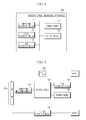
- Fig. 2 shows a connection configuration of the apparatus 100 for managing a battery pack, which is on a charging/discharging path of the battery pack.
- the battery pack managing apparatus 100 includes a temperature measurement module 110, a current measurement module 120, a time measurement module 130, a storage module 140, and a control module 150.
- the temperature measurement module 110 measures temperature of a battery pack.
- the temperature measurement module 110 may be realized with a thermo coupler.
- the present invention is not limited to a specific form of the temperature measurement module 110, and various kinds of temperature measurement modules 110 known in the art may be selected.
- the temperature measurement module 110 includes an interior temperature measurement module and an exterior temperature measurement module, so that both interior and exterior temperatures of the battery pack may be measured.
- the exterior temperature and the interior temperature of the battery pack may be considered together, so that surrounding temperature may be checked in detail as conditions at which the battery pack is operated.
- the current measurement module 120 measures a charge/discharge current of the battery pack, when the measured temperature is not within a predetermined temperature range. In other words, if the temperature of the battery pack, measured by the temperature measurement module 110, is higher or lower than a criterion temperature range, the current measurement module 120 initiates to measure the charge/discharge current of the battery pack. At this time, the temperature range that is used as a basis for determining whether the current measurement module 120 initiates to measure the charge/discharge current of the battery pack may be stored in a storage device, such as the storage module 140, in advance.
- the current measurement module 120 may be realized in various types.
- the current measurement module 120 may measure a current by detecting a voltage applied to a sense resistor installed on a charging/discharging path.
- various kinds of current measurement modules 120 known in the art may be used, and the present invention is not limited to any specific example of the current measurement module 120.
- the current measurement module 120 considers both of the measured interior and exterior temperatures in order to determine whether or not to measure a current. For example, the current measurement module 120 may initiate to measure a current when the interior temperature of the battery pack measured by the temperature measurement module 110 is 60°C or above and the exterior temperature is higher than the interior temperature.
- the time measurement module 130 measures the time during which the charge/discharge current is over the predetermined current value. In other words, in a state that the temperature is very high or very low, the time measurement module 130 measures the time during which a high current flows in the battery pack.
- the time measurement module 130 may measure the time during which the charge/discharge current measured by the current measurement module 120 is 10C or above.
- the unit “C” means a basic current amount of a general battery cell 200
- 10C means 10 times of a basic current amount of a general battery cell 200.
- the condition based on which the time measurement module 130 initiates time measurement in other words a predetermined current value that is a basis for determining high current, may be stored in a storage device, such as the storage module 140, in advance.
- the time measurement module 130 may measures the time during which a high current over a predetermined value flows in the battery pack, in a predetermined time unit, for example 10 ms. In this case, the time during which a high current flows may be measured precisely.
- the predetermined current value and the time measurement unit are just examples, and it is obvious to those of ordinary skill in the art that the present invention is not limited to such numerals.
- the storage module 140 accumulates and stores the time measured by the time measurement module 130. In other words, the storage module 140 accumulates and stores how long the high current flows in the battery pack in an extremely severe temperature condition.
- the storage module 140 may store 11 seconds in total as the measurement time. At this time, the storage module 140 may also store individual measurement times, in addition to the accumulated measurement time.
- the storage module 140 may store data or program required for executing functions of the temperature measurement module 110, the current measurement module 120, the time measurement module 130, and the control module 150.
- the storage module 140 may store the predetermined temperature range that is a condition for determining whether the current measurement module 120 measures a current, and the predetermined current value that is a basis for determining whether the time measurement module 130 measures time.
- the storage module 140 may include a volatile memory such as RAM or a non-volatile memory such as a hard disk.
- the accumulated value of time measured by the time measurement module 130 may be stored in a non-volatile memory.
- a driver or a repair man may easily check histories of the battery pack according to the accumulated value stored in the non-volatile memory and refer to the histories as data for the repairing work.
- the control module 150 determines a state of the battery pack in accordance with the time accumulated and stored in the storage module 140, and provides the determined state information to a user. For example, the control module 150 may provide the state information of the battery pack to the user when the accumulated and stored time during which a high current flows in the battery pack in an extremely severe temperature condition reaches a predetermined time.
- the state information means information provided for informing a user that the battery pack is used in operation conditions by which a bad influence may be given to the performance or life of the battery pack.
- the control module 150 may send to a user a message informing that caution is required when running the vehicle or the battery pack should be examined since the battery pack is used over a predetermined time in a situation harmful for the battery pack.
- the control module 150 may send a message informing that the battery pack should be exchanged.
- the method for providing the state information to a user may be executed in various ways. For example, a warning may be given to a user by turning on a warning lamp with a green or red color or by generating an alarm. In other case, a message may be sent with a text through a display such as an LCD provided at the driver's seat.
- the control module 150 may be connected to a warning lamp, an alarm generator, a display, and so on through an interface.
- control module 150 In order to determine the time at which the control module 150 provides the state information of the battery pack to a user, various methods may be used.
- the control module 150 may endow a warning point per a predetermined accumulated time.
- the control module 150 may endow 1 point as a warning point when the time accumulated and stored in the storage module 140 due to the flow of a high current reaches every 5 seconds. After that, the control module 150 may provide the state information of the battery pack in stages in accordance with the endowed warning points.
- the term 'warning point' used herein is just one example, which means a score endowed according to the time, and various terms may be used instead.
- Fig. 3 shows one example of a table illustrating state information of the battery pack, which is provided to a user by the control module 150 per each warning point endowed in accordance with the accumulated time.
- the control module 150 may give a first warning and determines the situation as a warning level 1. At this time, the control module 150 may give a warning to a user in various ways. For example, the control module 150 may gives a first warning to the user by turning on a green lamp. This first warning may be interpreted in a way that caution is required when using the battery pack, and the meaning of the first warning as above may be informed in advance to a user by means of a vehicle manual or the like. In other case, the meaning may be transferred by means of text or picture through a vehicle display or the like.
- the control module 150 gives a second warning to the user. Even at this time, the control module 150 may give the second warning to the user by turning on a lamp. However, a lamp different from that of the first warning, for example a red lamp may be used so that the user may exactly recognize the second warning.
- the second warning corresponds to the information informing that the situation is more serious than the first warning, for example requiring the battery pack to be examined.
- the meaning of the second warning as above may also be informed in advance to the user by means of a vehicle display, a vehicle manual, or the like.
- the control module 150 may gives a third warning to the user and determines that the situation is in a warning level 2.
- This third warning may be transferred to the user as a meaning informing that the battery is used up or deteriorated and thus should not be used any more.
- this state information is stored in the storage module 140 such as a non-volatile memory so that a vehicle repair man will refer to the information.
- the control module 150 may interrupt a charging/discharging path of the battery if the endowed warning point reaches a predetermined point. For example, if the warning point reaches 10 points and thus it is determined that the situation comes to the warning level 2 in the above embodiment shown in Fig. 3 , the control module 150 may interrupt the charging/discharging path of the battery pack so that the battery pack cannot be used any more. In this case, since the battery pack is used in an ultimately severe condition for a long time, the battery pack may be entirely broken or stop its function to cause a car accident if the battery pack is used more. Thus, the use of the battery pack is limited to prevent any car accident in advance. However, at this time, the fact that the charging/discharging path will be interrupted may be informed to the user in advance so that the user may cope with the interruption of the battery pack.
- the number of interruptions may be accumulated and stored in the storage module 140.
- the number of interruptions may be stored in the storage module 140.
- the history about the fact that the battery pack is used in an ultimately severe condition may be referred to by a driver or a repair man so that the driver or the repair man may easily check the performance or life of the battery pack.
- the number of interruptions may be used for calculating SOH (State Of Health) by means of a predetermined conversion formula. Meanwhile, the number of interruptions is preferably not able to being distorted but stored in a non-volatile memory.
- the warning point may be endowed up to 10 points, and if the warning point becomes 10 points and thus the charging/discharging path of the battery pack is interrupted, the warning point may be initialized to 0 point. It is because the warning points accumulated before the initialization can be sufficiently considered through the number of interruptions to the charging/discharging path of the battery pack. However, it is also possible to continuously endow warning points to 11, 12, or the like, without initializing the warning point.
- control module 150 may interrupt the charging/discharging path by melting and cutting a fuse 300 installed on the charging/discharging path of the battery pack as shown in Fig. 2 , but the present invention is not limited only to the interruption manner.
- the battery pack according to the present invention may include the battery pack managing apparatus as described above.
- a vehicle, particularly an electric vehicle according to the present invention may include the battery pack managing apparatus as described above.
- Fig. 4 is a flowchart schematically illustrating a method for managing a battery pack according to one embodiment of the present invention.
- the temperature measurement module 110 measures temperature of a battery pack and outputs the measured temperature data to the control module 150 (S110).
- the control module 150 controls the current measurement module 120 to measure a charge/discharge current of the battery pack (S120).
- the charge/discharge current may be measured when the measured interior temperature is 60°C or above and the exterior temperature is higher than the interior temperature.
- the control module 150 controls the time measurement module 130 to measure the time during which the high current flows (S130).
- the predetermined current value in other words a criterion value based on which the high current is determined, may be 10C.
- the control module 150 accumulates and stores the time measured in the step S130 (S140), and then determines the state of the battery pack in accordance with the accumulated and stored time and provides the state information (S150).
- a warning point may be endowed per a predetermined accumulated time, and the state information of the battery pack may be provided in stages in accordance with the endowed warning point.
- a further step of interrupting a charging/discharging path of the battery pack when the endowed warning point reaches a predetermined value in the step S150.
- the number of interruptions of the charging/discharging path may be accumulated and stored.
- the state information of the battery pack may be provided to a user by means of a warning lamp, an alarm generator, a display, or the like.
- the term 'module' is used, but it is obvious to those having ordinary skill in the art that the term 'module' just represents a logic unit, which may not be a component that can be physically separated.
Landscapes
- Engineering & Computer Science (AREA)
- Chemical & Material Sciences (AREA)
- Chemical Kinetics & Catalysis (AREA)
- Electrochemistry (AREA)
- General Chemical & Material Sciences (AREA)
- Manufacturing & Machinery (AREA)
- Power Engineering (AREA)
- Mechanical Engineering (AREA)
- Transportation (AREA)
- Physics & Mathematics (AREA)
- General Physics & Mathematics (AREA)
- Life Sciences & Earth Sciences (AREA)
- Sustainable Development (AREA)
- Sustainable Energy (AREA)
- Aviation & Aerospace Engineering (AREA)
- Secondary Cells (AREA)
- Charge And Discharge Circuits For Batteries Or The Like (AREA)
- Electric Propulsion And Braking For Vehicles (AREA)
- Battery Mounting, Suspending (AREA)
Abstract
Description
- The present invention relates to method and apparatus for managing a battery pack, and more particularly, to method and apparatus for detecting a situation of ultimately severe temperature or high current, which may give an influence on the life or performance of the battery pack, and providing correct state information about the battery pack for a vehicle.
- This application claims priority under 35 USC 119(a) to Korean Patent Application No.
10-2009-0134432 - As the demands for portable electronic products such as notebooks, video cameras and cellular phones are rapidly increased in these days, and development of electric vehicles, energy storage batteries, robots, satellites, etc. is under active progress, numerous studies are being made on high-performance secondary batteries capable of being repeatedly charged and discharged.
- Currently, nickel-cadmium batteries, nickel-hydrogen batteries, nickel-zinc batteries, lithium secondary batteries or the like are commercially available as secondary batteries. Among them, lithium secondary batteries are the center of interest because they hardly have memory effects and can be freely charged or discharged when compared with nickel-based secondary batteries. Advantageously, lithium secondary batteries also exhibit very low self-discharge and high energy density.
- In particular, in these days, as carbon energies are gradually exhausted and the interest on environments is increased, hybrid vehicles and electric vehicles become the focus of the public attention not only in U.S.A, Europe, Japan, and Korea but also in all countries in the world. In such hybrid or electric vehicles, the most fundamental part is a battery that gives a driving force to a vehicle motor. Since the hybrid or electric vehicle may obtain a driving force by means of charging/discharging of the battery, the hybrid or electric vehicle may eliminate or reduce an exhausted pollutant while ensuring excellent fuel efficiency, and thus the hybrid or electric vehicle is used more and more.
- However, the vehicle battery used for such a hybrid or electric vehicle may encounter severe circumstances frequently in the consideration that it is mounted to a vehicle, differently from batteries used for general portable electronic products. For example, in a case where a vehicle runs in a polar region or in a very cold winter, the battery should be operated though the temperature is very low. In addition, in a case where a vehicle runs at the equator or in a very hot summer, the battery should be operated though the temperature is very high.
- If a high current flows in the battery so as to transfer a high driving force to a vehicle in an ultimately severe temperature circumstance, the high current may give a bad influence on the life and performance of the battery. In other words, the ultimately severe operation condition of the battery may shorten the life of the battery and weaken the performance in comparison to normal operation conditions. Nevertheless, in the conventional art, though a battery is exposed to severe operation conditions, relevant data is not provided to a driver or a repair man. For this reason, a vehicle driver or the like could not properly check that the life and performance of a battery are deteriorated since the battery is used in ultimately severe operation conditions. Thus, it is not easy to check a suitable time for repair or exchange, which may result in even a breakdown or failure of the battery or a malfunction of the battery. If the battery stops its function, a user may experience inconvenience since the vehicle cannot run. In addition, if the battery stops its function while the vehicle is running, a car accident may occur, which may seriously damage lives and properties. Moreover, since the operation history of the battery pack is not properly checked even when the vehicle or the battery pack is repaired, it is not easy to exactly diagnose the state of the battery pack.
- The present invention is designed to solve the problems of the prior art, and therefore, it is an object of the present invention to provide method and apparatus for managing a battery pack, which may provide state information of the battery pack for a vehicle so that a suitable time for repair or exchange about the battery pack for a vehicle may be informed.
- These and other objects and advantages will be apparent from the embodiments of the present invention. And, the objects and advantages of the invention may be realized by means of instrumentalities and combinations particularly pointed out in the appended claims.
- In order to accomplish the above object, the present invention provides an apparatus for managing a battery pack for a vehicle, which includes a temperature measurement module for measuring temperature of the battery pack; a current measurement module for measuring a charge/discharge current of the battery pack when the measured temperature is not within a predetermined temperature range; a time measurement module for measuring the time while the measured charge/discharge current is over a predetermined current value; a storage module for accumulating and storing the measured time; and a control module for determining a state of the battery pack according to the accumulated and stored time and providing the state information to a user.
- In addition, in order to accomplish the above object, the present invention provides a battery pack including the above battery pack managing apparatus.
- Also, in order to accomplish the above object, the present invention provides a vehicle including the above battery pack managing apparatus.
- In addition, in order to accomplish the above object, the present invention provides a method for managing a battery pack, which includes (S1) measuring temperature of the battery pack; (S2) measuring a charge/discharge current of the battery pack when the measured temperature is not within a predetermined temperature range; (S3) measuring the time while the measured charge/discharge current is over a predetermined current value; (S4) accumulating and storing the measured time; and (S5) determining a state of the battery according to the accumulated and stored time and providing the state to a user.
- According to the present invention, histories of a battery pack for a vehicle, which was used in ultimately severe operation conditions, may be clearly checked, and relevant information may be stored. The information may be used as data for clearly checking a factor deteriorating the life and performance of the battery pack for a vehicle. For example, the data may be referred to when checking a state of the battery pack, such as SOH (State Of Health).
- Thus, the state information of the battery pack for a vehicle may be exactly and properly provided to a driver or a vehicle repair man. Since the driver may predict a suitable time for repairing or exchanging the battery pack for a vehicle in advance, it is possible to prevent any unnecessary exchange or repair of the battery pack or any accident or unintended stop of the vehicle, caused by the malfunction of the battery pack. In addition, since the driver may know that the battery is used in an ultimately severe operation condition, the driver may try not to run the vehicle in a condition harmful for the life and performance of the battery pack if possible.
- In addition, since a vehicle repair man may clearly check the situation informing that the battery pack was operated in a bad condition, the battery pack may be exactly diagnosed and repaired when the vehicle is under the maintenance service.
-
-
Fig. 1 is a block diagram schematically showing a functional configuration of an apparatus for managing a battery pack according to one embodiment of the present invention. -
Fig. 2 shows a connection configuration of the apparatus for managing a battery pack according to one embodiment of the present invention, which is on a charging/discharging path of the battery pack. -
Fig. 3 shows one example of a table illustrating state information of the battery pack, which is provided to a user by a control module per each warning point endowed in accordance with an accumulated time. -
Fig. 4 is a flowchart schematically illustrating a method for managing a battery pack according to one embodiment of the present invention. - Hereinafter, preferred embodiments of the present invention will be described in detail with reference to the accompanying drawings. Prior to the description, it should be understood that the terms used in the specification and the appended claims should not be construed as limited to general and dictionary meanings, but interpreted based on the meanings and concepts corresponding to technical aspects of the present invention on the basis of the principle that the inventor is allowed to define terms appropriately for the best explanation.
- Therefore, the description proposed herein is just a preferable example for the purpose of illustrations only, not intended to limit the scope of the invention, so it should be understood that other equivalents and modifications could be made thereto without departing from the spirit and scope of the invention.
-
Fig. 1 is a block diagram schematically showing a functional configuration of anapparatus 100 for managing a battery pack according to one embodiment of the present invention, andFig. 2 shows a connection configuration of theapparatus 100 for managing a battery pack, which is on a charging/discharging path of the battery pack. - Referring to
Figs. 1 and 2 , the batterypack managing apparatus 100 according to the present invention includes atemperature measurement module 110, acurrent measurement module 120, atime measurement module 130, astorage module 140, and acontrol module 150. - The
temperature measurement module 110 measures temperature of a battery pack. Preferably, thetemperature measurement module 110 may be realized with a thermo coupler. However, the present invention is not limited to a specific form of thetemperature measurement module 110, and various kinds oftemperature measurement modules 110 known in the art may be selected. - Preferably, the
temperature measurement module 110 includes an interior temperature measurement module and an exterior temperature measurement module, so that both interior and exterior temperatures of the battery pack may be measured. In this case, the exterior temperature and the interior temperature of the battery pack may be considered together, so that surrounding temperature may be checked in detail as conditions at which the battery pack is operated. - The
current measurement module 120 measures a charge/discharge current of the battery pack, when the measured temperature is not within a predetermined temperature range. In other words, if the temperature of the battery pack, measured by thetemperature measurement module 110, is higher or lower than a criterion temperature range, thecurrent measurement module 120 initiates to measure the charge/discharge current of the battery pack. At this time, the temperature range that is used as a basis for determining whether thecurrent measurement module 120 initiates to measure the charge/discharge current of the battery pack may be stored in a storage device, such as thestorage module 140, in advance. - The
current measurement module 120 may be realized in various types. For example, thecurrent measurement module 120 may measure a current by detecting a voltage applied to a sense resistor installed on a charging/discharging path. In other cases, various kinds ofcurrent measurement modules 120 known in the art may be used, and the present invention is not limited to any specific example of thecurrent measurement module 120. - Meanwhile, in a case where the
temperature measurement module 110 measures both interior and exterior temperatures, thecurrent measurement module 120 considers both of the measured interior and exterior temperatures in order to determine whether or not to measure a current. For example, thecurrent measurement module 120 may initiate to measure a current when the interior temperature of the battery pack measured by thetemperature measurement module 110 is 60°C or above and the exterior temperature is higher than the interior temperature. - When the charge/discharge current of the battery pack measured by the
current measurement module 120 is over a predetermined current value, thetime measurement module 130 measures the time during which the charge/discharge current is over the predetermined current value. In other words, in a state that the temperature is very high or very low, thetime measurement module 130 measures the time during which a high current flows in the battery pack. - For example, the
time measurement module 130 may measure the time during which the charge/discharge current measured by thecurrent measurement module 120 is 10C or above. Here, the unit "C" means a basic current amount of ageneral battery cell 200, and 10C means 10 times of a basic current amount of ageneral battery cell 200. The condition based on which thetime measurement module 130 initiates time measurement, in other words a predetermined current value that is a basis for determining high current, may be stored in a storage device, such as thestorage module 140, in advance. - The
time measurement module 130 may measures the time during which a high current over a predetermined value flows in the battery pack, in a predetermined time unit, for example 10 ms. In this case, the time during which a high current flows may be measured precisely. - However, the predetermined current value and the time measurement unit, mentioned above, are just examples, and it is obvious to those of ordinary skill in the art that the present invention is not limited to such numerals.
- The
storage module 140 accumulates and stores the time measured by thetime measurement module 130. In other words, thestorage module 140 accumulates and stores how long the high current flows in the battery pack in an extremely severe temperature condition. - For example, in a case where the battery pack has a temperature of 60°C and the charge/discharge current is 10C or above, if a current satisfying this condition is measured initially for 2 seconds, then for 5 seconds, and then for 4 seconds, the
storage module 140 may store 11 seconds in total as the measurement time. At this time, thestorage module 140 may also store individual measurement times, in addition to the accumulated measurement time. - In addition, the
storage module 140 may store data or program required for executing functions of thetemperature measurement module 110, thecurrent measurement module 120, thetime measurement module 130, and thecontrol module 150. For example, thestorage module 140 may store the predetermined temperature range that is a condition for determining whether thecurrent measurement module 120 measures a current, and the predetermined current value that is a basis for determining whether thetime measurement module 130 measures time. - The
storage module 140 may include a volatile memory such as RAM or a non-volatile memory such as a hard disk. In particular, the accumulated value of time measured by thetime measurement module 130 may be stored in a non-volatile memory. In this case, a driver or a repair man may easily check histories of the battery pack according to the accumulated value stored in the non-volatile memory and refer to the histories as data for the repairing work. - The
control module 150 determines a state of the battery pack in accordance with the time accumulated and stored in thestorage module 140, and provides the determined state information to a user. For example, thecontrol module 150 may provide the state information of the battery pack to the user when the accumulated and stored time during which a high current flows in the battery pack in an extremely severe temperature condition reaches a predetermined time. - Here, the state information means information provided for informing a user that the battery pack is used in operation conditions by which a bad influence may be given to the performance or life of the battery pack. For example, the
control module 150 may send to a user a message informing that caution is required when running the vehicle or the battery pack should be examined since the battery pack is used over a predetermined time in a situation harmful for the battery pack. In addition, thecontrol module 150 may send a message informing that the battery pack should be exchanged. - Here, the method for providing the state information to a user may be executed in various ways. For example, a warning may be given to a user by turning on a warning lamp with a green or red color or by generating an alarm. In other case, a message may be sent with a text through a display such as an LCD provided at the driver's seat. For this purpose, the
control module 150 may be connected to a warning lamp, an alarm generator, a display, and so on through an interface. - In order to determine the time at which the
control module 150 provides the state information of the battery pack to a user, various methods may be used. - Preferably, the
control module 150 may endow a warning point per a predetermined accumulated time. For example, thecontrol module 150 may endow 1 point as a warning point when the time accumulated and stored in thestorage module 140 due to the flow of a high current reaches every 5 seconds. After that, thecontrol module 150 may provide the state information of the battery pack in stages in accordance with the endowed warning points. However, the term 'warning point' used herein is just one example, which means a score endowed according to the time, and various terms may be used instead. -
Fig. 3 shows one example of a table illustrating state information of the battery pack, which is provided to a user by thecontrol module 150 per each warning point endowed in accordance with the accumulated time. - Referring to
Fig. 3 , when the endowed warning point reaches 3 points, thecontrol module 150 may give a first warning and determines the situation as awarning level 1. At this time, thecontrol module 150 may give a warning to a user in various ways. For example, thecontrol module 150 may gives a first warning to the user by turning on a green lamp. This first warning may be interpreted in a way that caution is required when using the battery pack, and the meaning of the first warning as above may be informed in advance to a user by means of a vehicle manual or the like. In other case, the meaning may be transferred by means of text or picture through a vehicle display or the like. - Then, if the warning point reaches 5 points, the
control module 150 gives a second warning to the user. Even at this time, thecontrol module 150 may give the second warning to the user by turning on a lamp. However, a lamp different from that of the first warning, for example a red lamp may be used so that the user may exactly recognize the second warning. The second warning corresponds to the information informing that the situation is more serious than the first warning, for example requiring the battery pack to be examined. The meaning of the second warning as above may also be informed in advance to the user by means of a vehicle display, a vehicle manual, or the like. - After that, if the warning point is accumulated to 10 points, the
control module 150 may gives a third warning to the user and determines that the situation is in awarning level 2. This third warning may be transferred to the user as a meaning informing that the battery is used up or deteriorated and thus should not be used any more. Also, if the situation comes to thewarning level 2, this state information is stored in thestorage module 140 such as a non-volatile memory so that a vehicle repair man will refer to the information. - Meanwhile, the point classification and the state information based on each warning points, shown in
Fig. 3 , are just one embodiment, and it is obvious to those having ordinary skill in the art that they may be implemented in various ways. - In a case where the warning points are endowed as in the above embodiment, the
control module 150 may interrupt a charging/discharging path of the battery if the endowed warning point reaches a predetermined point. For example, if the warning point reaches 10 points and thus it is determined that the situation comes to thewarning level 2 in the above embodiment shown inFig. 3 , thecontrol module 150 may interrupt the charging/discharging path of the battery pack so that the battery pack cannot be used any more. In this case, since the battery pack is used in an ultimately severe condition for a long time, the battery pack may be entirely broken or stop its function to cause a car accident if the battery pack is used more. Thus, the use of the battery pack is limited to prevent any car accident in advance. However, at this time, the fact that the charging/discharging path will be interrupted may be informed to the user in advance so that the user may cope with the interruption of the battery pack. - More preferably, in a case where the
control module 150 interrupts the charging/discharging path of the battery pack, the number of interruptions may be accumulated and stored in thestorage module 140. For example, whenever the charging/discharging path of the battery pack is interrupted as the warning point reaches 10 points in the embodiment ofFig. 3 , the number of interruptions may be stored in thestorage module 140. Thus, from the number of interruptions stored in thestorage module 140, the history about the fact that the battery pack is used in an ultimately severe condition may be referred to by a driver or a repair man so that the driver or the repair man may easily check the performance or life of the battery pack. Preferably, the number of interruptions may be used for calculating SOH (State Of Health) by means of a predetermined conversion formula. Meanwhile, the number of interruptions is preferably not able to being distorted but stored in a non-volatile memory. - In addition, in the embodiment of
Fig. 3 , the warning point may be endowed up to 10 points, and if the warning point becomes 10 points and thus the charging/discharging path of the battery pack is interrupted, the warning point may be initialized to 0 point. It is because the warning points accumulated before the initialization can be sufficiently considered through the number of interruptions to the charging/discharging path of the battery pack. However, it is also possible to continuously endow warning points to 11, 12, or the like, without initializing the warning point. - Meanwhile, the
control module 150 may interrupt the charging/discharging path by melting and cutting afuse 300 installed on the charging/discharging path of the battery pack as shown inFig. 2 , but the present invention is not limited only to the interruption manner. - The battery pack according to the present invention may include the battery pack managing apparatus as described above. Also, a vehicle, particularly an electric vehicle according to the present invention may include the battery pack managing apparatus as described above.
-
Fig. 4 is a flowchart schematically illustrating a method for managing a battery pack according to one embodiment of the present invention. - Referring to
Fig. 4 , first, thetemperature measurement module 110 measures temperature of a battery pack and outputs the measured temperature data to the control module 150 (S110). Here, it is desirable to measure both interior and exterior temperatures of the battery pack. Then, if the measured temperature is not within a predetermined temperature range, thecontrol module 150 controls thecurrent measurement module 120 to measure a charge/discharge current of the battery pack (S120). At this time, in a case where the interior and exterior temperatures of the battery pack are measured together as mentioned above, the charge/discharge current may be measured when the measured interior temperature is 60°C or above and the exterior temperature is higher than the interior temperature. - Then, if the measured charge/discharge current is a high current over a predetermined current value, the
control module 150 controls thetime measurement module 130 to measure the time during which the high current flows (S130). At this time, the predetermined current value, in other words a criterion value based on which the high current is determined, may be 10C. After that, thecontrol module 150 accumulates and stores the time measured in the step S130 (S140), and then determines the state of the battery pack in accordance with the accumulated and stored time and provides the state information (S150). Here, in the step S150, a warning point may be endowed per a predetermined accumulated time, and the state information of the battery pack may be provided in stages in accordance with the endowed warning point. More preferably, there may be provided a further step of interrupting a charging/discharging path of the battery pack, when the endowed warning point reaches a predetermined value in the step S150. At this time, the number of interruptions of the charging/discharging path may be accumulated and stored. Meanwhile, in the step S150, the state information of the battery pack may be provided to a user by means of a warning lamp, an alarm generator, a display, or the like. - The present invention has been described in detail. However, it should be understood that the detailed description and specific examples, while indicating preferred embodiments of the invention, are given by way of illustration only, since various changes and modifications within the spirit and scope of the invention will become apparent to those skilled in the art from this detailed description.
- Meanwhile, in this specification, the term 'module' is used, but it is obvious to those having ordinary skill in the art that the term 'module' just represents a logic unit, which may not be a component that can be physically separated.
Claims (16)
- An apparatus for managing a battery pack for a vehicle, comprising:a temperature measurement module for measuring temperature of the battery pack;a current measurement module for measuring a charge/discharge current of the battery pack when the measured temperature is not within a predetermined temperature range;a time measurement module for measuring the time while the measured charge/discharge current is over a predetermined current value;a storage module for accumulating and storing the measured time; anda control module for determining a state of the battery pack according to the accumulated and stored time and providing the state information to a user.
- The apparatus for managing a battery pack according to claim 1,
wherein the temperature measurement module measures both interior and exterior temperatures of the battery pack. - The apparatus for managing a battery pack according to claim 2,
wherein the current measurement module measures a charge/discharge current of the battery pack when the measured interior temperature of the battery pack is over a predetermined criterion temperature and the measured exterior temperature is higher than the measured interior temperature. - The apparatus for managing a battery pack according to claim 1,
wherein the control module endows a warning point per a predetermined accumulated time and provides state information of the battery pack in stages in accordance with the endowed warning point. - The apparatus for managing a battery pack according to claim 4,
wherein the control module interrupts a charging/discharging path of the battery pack when the endowed warning point reaches a predetermined level. - The apparatus for managing a battery pack according to claim 5,
wherein the control module accumulates the number of interruptions when interrupting the charging/discharging path, and stores the number of interruptions in the storage module. - The apparatus for managing a battery pack according to claim 1,
wherein the control module provides state information of the battery pack to a user by means of a warning lamp, an alarm generator, or a display. - A battery pack, which includes the apparatus for managing a battery pack according to the claim 1.
- A vehicle, which includes the apparatus for managing a battery pack according to the claim 1.
- A method for managing a battery pack for a vehicle, comprising:(S1) measuring temperature of the battery pack;(S2) measuring a charge/discharge current of the battery pack when the measured temperature is not within a predetermined temperature range;(S3) measuring the time while the measured charge/discharge current is over a predetermined current value;(S4) accumulating and storing the measured time; and(S5) determining a state of the battery pack according to the accumulated and stored time and providing the state information to a user.
- The method for managing a battery pack according to claim 10,
wherein, in the step S1, both interior and exterior temperatures of the battery pack are measured. - The method for managing a battery pack according to claim 11,
wherein, in the step S2, a charge/discharge current of the battery pack is measured when the measured interior temperature of the battery pack is over a predetermined criterion temperature and the measured exterior temperature is higher than the measured interior temperature. - The method for managing a battery pack according to claim 10,
wherein, in the step S5, a warning point is endowed per a predetermined accumulated time, and state information of the battery pack is provided in stages in accordance with the endowed warning point. - The method for managing a battery pack according to claim 13,
wherein a charging/discharging path of the battery pack is interrupted when the warning point endowed in the step S5 reaches a predetermined level,. - The method for managing a battery pack according to claim 14, further comprising:accumulating the number of interruptions when interrupting the charging/discharging path, and storing the number of interruptions.
- The method for managing a battery pack according to claim 10,
wherein, in the step S5, state information of the battery pack is provided to a user by means of a warning lamp, an alarm generator, or a display.
Applications Claiming Priority (2)
| Application Number | Priority Date | Filing Date | Title |
|---|---|---|---|
| KR1020090134432A KR101232786B1 (en) | 2009-12-30 | 2009-12-30 | Battery pack management apparatus and method |
| PCT/KR2010/008574 WO2011081303A2 (en) | 2009-12-30 | 2010-12-02 | Apparatus and method for managing a battery pack |
Publications (3)
| Publication Number | Publication Date |
|---|---|
| EP2521213A2 true EP2521213A2 (en) | 2012-11-07 |
| EP2521213A4 EP2521213A4 (en) | 2013-11-20 |
| EP2521213B1 EP2521213B1 (en) | 2014-10-08 |
Family
ID=44226939
Family Applications (1)
| Application Number | Title | Priority Date | Filing Date |
|---|---|---|---|
| EP10841136.4A Active EP2521213B1 (en) | 2009-12-30 | 2010-12-02 | Apparatus and method for managing a battery pack |
Country Status (6)
| Country | Link |
|---|---|
| US (2) | US8633826B2 (en) |
| EP (1) | EP2521213B1 (en) |
| JP (1) | JP5475144B2 (en) |
| KR (1) | KR101232786B1 (en) |
| CN (1) | CN102754272B (en) |
| WO (1) | WO2011081303A2 (en) |
Families Citing this family (28)
| Publication number | Priority date | Publication date | Assignee | Title |
|---|---|---|---|---|
| CN102381209B (en) * | 2011-10-13 | 2014-04-02 | 奇瑞汽车股份有限公司 | Fault managing method for low-voltage storage battery of pure electric automobile |
| KR101281066B1 (en) | 2011-10-18 | 2013-07-09 | 송영길 | Hybrid Battery System for Electric Vehicles |
| KR20140070447A (en) * | 2012-11-30 | 2014-06-10 | 주식회사 엘지화학 | Apparatus and method for management battery with battery application environment and using history |
| CN103078150B (en) * | 2012-12-31 | 2015-02-18 | 普天新能源有限责任公司 | Safe prewarning method and device for power batteries |
| JP6413311B2 (en) | 2014-04-11 | 2018-10-31 | 株式会社村田製作所 | Power storage device, control method, control device, power storage system, electric vehicle, and electronic device |
| KR102241683B1 (en) | 2014-07-30 | 2021-04-19 | 삼성전자주식회사 | Method and apparatus for estimating state of battery |
| CN104376680A (en) * | 2014-11-24 | 2015-02-25 | 朱弋平 | Electric bicycle alarm with thermal induction function |
| CN104375095A (en) * | 2014-11-24 | 2015-02-25 | 贵州电网公司六盘水供电局 | Online expert analysis system for storage batteries |
| CN105846479B (en) * | 2015-01-13 | 2019-01-25 | 葛炽昌 | Exchange battery pack applied to electric vehicle and control method thereof |
| KR101553063B1 (en) | 2015-01-20 | 2015-09-15 | 주식회사 제이에스영테크 | Hybrid energy storage module system |
| MY183538A (en) * | 2015-03-12 | 2021-02-25 | Omron Tateisi Electronics Co | Battery, system, battery management method, battery management program, and recording medium |
| KR101693991B1 (en) * | 2015-05-18 | 2017-01-17 | 현대자동차주식회사 | System and method for cutting high voltage of battery for vehicle |
| CN105162208B (en) * | 2015-09-30 | 2019-05-31 | 北京奇虎科技有限公司 | A kind of charging method and device of automobile data recorder |
| JP6789299B2 (en) * | 2016-01-13 | 2020-11-25 | フレックストロニックス エーピー エルエルシー | Method of estimating discharge duration during high rate battery discharge |
| JP6690383B2 (en) * | 2016-04-26 | 2020-04-28 | 株式会社Gsユアサ | Power management system, battery management device, battery device, and vehicle power management method |
| CN106229564B (en) * | 2016-07-13 | 2019-05-07 | 佛山科学技术学院 | A method and system for battery fault diagnosis and repair based on cloud intelligent monitoring |
| US20180131052A1 (en) * | 2016-11-08 | 2018-05-10 | Ford Global Technologies, Llc | Battery thermal management systems for electrified vehicles |
| KR102038610B1 (en) | 2016-12-05 | 2019-10-30 | 주식회사 엘지화학 | Battery management apparatus and method thereof |
| KR102066703B1 (en) * | 2017-01-24 | 2020-01-15 | 주식회사 엘지화학 | Apparatus and method for managing a battery |
| KR102267589B1 (en) * | 2017-12-14 | 2021-06-18 | 주식회사 엘지에너지솔루션 | Apparatus and method for measuring current |
| US12119462B2 (en) * | 2018-01-04 | 2024-10-15 | Lyten, Inc. | Sensing device for detecting analytes in batteries |
| CN108313026B (en) * | 2018-01-05 | 2021-10-15 | 蔚来(安徽)控股有限公司 | Battery replacement method for electric vehicles |
| US10948544B2 (en) | 2018-03-08 | 2021-03-16 | Industrial Technology Research Institute | Battery safety identifying method and method for setting hazard levels of battery internal short circuit and warning system using the same |
| CN109326837B (en) * | 2018-08-20 | 2022-03-04 | 中国电力科学研究院有限公司 | Method and system for monitoring thermal management and fire early warning of lithium battery energy storage system |
| KR102738646B1 (en) | 2019-07-23 | 2024-12-06 | 주식회사 엘지에너지솔루션 | Apparatus For Fire Detection of Vehicle Battery and Method Thereof |
| WO2021085433A1 (en) | 2019-10-29 | 2021-05-06 | 京セラ株式会社 | Power storage battery management device, power storage battery system, and power storage battery management method |
| WO2021261831A1 (en) * | 2020-06-23 | 2021-12-30 | 주식회사 엘지에너지솔루션 | System and method for diagnosing abnormal state of temperature of battery cell by using bms temperature sensor |
| WO2024253292A1 (en) * | 2023-06-08 | 2024-12-12 | 주식회사 엘지에너지솔루션 | Battery pack for preventing overheating misdiagnosis due to environmental temperature and method for preventing misdiagnosis |
Family Cites Families (25)
| Publication number | Priority date | Publication date | Assignee | Title |
|---|---|---|---|---|
| JPH0650340B2 (en) * | 1986-04-14 | 1994-06-29 | 株式会社日立製作所 | Life Diagnostic Device for Automotive Battery |
| JPH01143984A (en) * | 1987-11-30 | 1989-06-06 | Aisin Aw Co Ltd | Device for monitoring battery state |
| JPH0368879A (en) * | 1989-08-08 | 1991-03-25 | Sharp Corp | Electronic machinery |
| JPH07123504A (en) * | 1993-10-19 | 1995-05-12 | Matsushita Electric Works Ltd | Safety unit for electric automobile |
| KR950025448A (en) * | 1994-02-28 | 1995-09-15 | 김무 | Battery remaining capacity measuring device and measuring method |
| WO1997020225A1 (en) * | 1994-05-31 | 1997-06-05 | Omron Corporation | Device and method for estimating remaining life of battery |
| US6023150A (en) * | 1998-07-31 | 2000-02-08 | Motorola, Inc. | Optimized method for determining remaining life cycles in a rechargeable battery |
| US6501249B1 (en) * | 1999-10-13 | 2002-12-31 | Xicor, Inc. | Battery management system |
| JP2003009406A (en) * | 2001-06-22 | 2003-01-10 | Matsushita Electric Ind Co Ltd | Rechargeable battery status calculator |
| JP2003173825A (en) * | 2001-09-28 | 2003-06-20 | Mitsumi Electric Co Ltd | Secondary battery protection device |
| US6983212B2 (en) * | 2001-11-27 | 2006-01-03 | American Power Conversion Corporation | Battery management system and method |
| US7576517B1 (en) * | 2004-11-29 | 2009-08-18 | Data Power Monitoring Corporation | System and method for remote monitoring of battery condition |
| KR100704944B1 (en) * | 2005-01-31 | 2007-04-06 | 주식회사 리버트론 | Battery management system for electric vehicles |
| JP2007082375A (en) * | 2005-09-16 | 2007-03-29 | Toyota Motor Corp | Power supply device for vehicles |
| KR100740097B1 (en) * | 2005-10-20 | 2007-07-16 | 삼성에스디아이 주식회사 | SOC estimation method of battery and battery management system using same |
| US7615969B2 (en) * | 2006-07-27 | 2009-11-10 | Dell Products L.P. | Systems and methods for temperature-dependent battery charging |
| US7960943B2 (en) * | 2006-11-17 | 2011-06-14 | Cobasys, Llc | Modular battery system having battery monitoring and data collection capability |
| JP5179047B2 (en) * | 2006-11-27 | 2013-04-10 | パナソニック株式会社 | Storage device abnormality detection device, storage device abnormality detection method, and abnormality detection program thereof |
| JP5266702B2 (en) * | 2007-09-28 | 2013-08-21 | 三菱自動車工業株式会社 | Electric vehicle power management device |
| KR20090046474A (en) * | 2007-11-06 | 2009-05-11 | (주) 누리기술 | Battery management device and its control method |
| JP2009195036A (en) * | 2008-02-14 | 2009-08-27 | Sanyo Electric Co Ltd | Control method of pack battery |
| JP5338135B2 (en) * | 2008-05-26 | 2013-11-13 | マツダ株式会社 | Battery control method and apparatus for automobile |
| FR2932440B1 (en) * | 2008-06-11 | 2015-11-13 | Valeo Systemes Thermiques | MODULE FOR CONTROLLING A TEMPERATURE OF AN ELECTRIC POWER SOURCE OF A MOTOR VEHICLE |
| JP5815195B2 (en) * | 2008-09-11 | 2015-11-17 | ミツミ電機株式会社 | Battery state detection device and battery pack incorporating the same |
| US8004243B2 (en) * | 2009-04-08 | 2011-08-23 | Tesla Motors, Inc. | Battery capacity estimating method and apparatus |
-
2009
- 2009-12-30 KR KR1020090134432A patent/KR101232786B1/en active Active
-
2010
- 2010-12-02 EP EP10841136.4A patent/EP2521213B1/en active Active
- 2010-12-02 WO PCT/KR2010/008574 patent/WO2011081303A2/en not_active Ceased
- 2010-12-02 CN CN201080064019.2A patent/CN102754272B/en active Active
- 2010-12-02 JP JP2012546989A patent/JP5475144B2/en active Active
-
2011
- 2011-04-18 US US13/088,571 patent/US8633826B2/en active Active
-
2013
- 2013-12-12 US US14/104,461 patent/US9221348B2/en active Active
Also Published As
| Publication number | Publication date |
|---|---|
| JP5475144B2 (en) | 2014-04-16 |
| WO2011081303A3 (en) | 2011-11-17 |
| US20140097799A1 (en) | 2014-04-10 |
| CN102754272B (en) | 2015-01-07 |
| EP2521213A4 (en) | 2013-11-20 |
| KR20110077774A (en) | 2011-07-07 |
| US20110210859A1 (en) | 2011-09-01 |
| US9221348B2 (en) | 2015-12-29 |
| EP2521213B1 (en) | 2014-10-08 |
| JP2013516947A (en) | 2013-05-13 |
| CN102754272A (en) | 2012-10-24 |
| KR101232786B1 (en) | 2013-02-13 |
| WO2011081303A2 (en) | 2011-07-07 |
| US8633826B2 (en) | 2014-01-21 |
Similar Documents
| Publication | Publication Date | Title |
|---|---|---|
| EP2521213B1 (en) | Apparatus and method for managing a battery pack | |
| EP3324196B1 (en) | Apparatus and method for diagnosing failure of switch element | |
| EP2642558A2 (en) | Method and device for managing battery pack | |
| US8698457B2 (en) | Battery pack with protection circuit | |
| JP7382586B2 (en) | power system | |
| CN103683381B (en) | Make the method for batteries automatic discharging after shock through internal battery electronic installation | |
| EP2978065B1 (en) | Battery preheating system and method for preheating battery using same | |
| KR100859688B1 (en) | Battery Management System and Its Driving Method | |
| US20100213901A1 (en) | Secondary battery charge control method and charge control circuit | |
| KR101475917B1 (en) | Apparatus for protecting battery pack and battery pack using the same | |
| WO2011013384A1 (en) | Protection circuit, battery pack, and charging system | |
| CN101504996A (en) | Charging apparatus and charging method | |
| KR20140055065A (en) | Apparatus and method for managing battery pack | |
| US20230163606A1 (en) | Battery management system and method of managing battery using the same | |
| JP2008176967A (en) | In-vehicle battery discharge device | |
| CN112154567B (en) | Battery management device and method | |
| KR20130126128A (en) | Method and apparatus for battery resistance estimation, and battery management system using the same | |
| JP5064455B2 (en) | Protection circuit, battery pack, and charging system | |
| KR101595938B1 (en) | Apparatus for protecting battery pack and battery pack and vehicle including the same | |
| KR20160111234A (en) | Small Rechargeable Battery Matrix Control Apparatus and Method For an Electric Vehicle | |
| KR20160043369A (en) | System and method for judging battery's replacement time | |
| KR20160103294A (en) | Apparatus and method for detecting welding of relay | |
| CN113131028A (en) | Method for detecting over-discharge of lithium ion battery based on mechanical pressure | |
| KR20250110410A (en) | Method and system for verifying battery valtage detection of eco-friendly vehicles | |
| CN121831567A (en) | Apparatus and method for diagnosing battery overcurrent |
Legal Events
| Date | Code | Title | Description |
|---|---|---|---|
| PUAI | Public reference made under article 153(3) epc to a published international application that has entered the european phase |
Free format text: ORIGINAL CODE: 0009012 |
|
| 17P | Request for examination filed |
Effective date: 20120723 |
|
| AK | Designated contracting states |
Kind code of ref document: A2 Designated state(s): AL AT BE BG CH CY CZ DE DK EE ES FI FR GB GR HR HU IE IS IT LI LT LU LV MC MK MT NL NO PL PT RO RS SE SI SK SM TR |
|
| DAX | Request for extension of the european patent (deleted) | ||
| A4 | Supplementary search report drawn up and despatched |
Effective date: 20131022 |
|
| RIC1 | Information provided on ipc code assigned before grant |
Ipc: H01M 10/44 20060101ALI20131016BHEP Ipc: G01R 31/36 20060101ALI20131016BHEP Ipc: H01M 10/48 20060101AFI20131016BHEP Ipc: B60L 11/18 20060101ALI20131016BHEP Ipc: H02J 7/00 20060101ALI20131016BHEP |
|
| GRAP | Despatch of communication of intention to grant a patent |
Free format text: ORIGINAL CODE: EPIDOSNIGR1 |
|
| RIC1 | Information provided on ipc code assigned before grant |
Ipc: B60L 11/18 20060101ALI20140520BHEP Ipc: H01M 10/48 20060101AFI20140520BHEP Ipc: H02J 7/00 20060101ALI20140520BHEP Ipc: G01R 31/36 20060101ALI20140520BHEP Ipc: H01M 10/44 20060101ALI20140520BHEP |
|
| INTG | Intention to grant announced |
Effective date: 20140612 |
|
| GRAS | Grant fee paid |
Free format text: ORIGINAL CODE: EPIDOSNIGR3 |
|
| GRAA | (expected) grant |
Free format text: ORIGINAL CODE: 0009210 |
|
| AK | Designated contracting states |
Kind code of ref document: B1 Designated state(s): AL AT BE BG CH CY CZ DE DK EE ES FI FR GB GR HR HU IE IS IT LI LT LU LV MC MK MT NL NO PL PT RO RS SE SI SK SM TR |
|
| REG | Reference to a national code |
Ref country code: GB Ref legal event code: FG4D |
|
| REG | Reference to a national code |
Ref country code: CH Ref legal event code: EP Ref country code: AT Ref legal event code: REF Ref document number: 691054 Country of ref document: AT Kind code of ref document: T Effective date: 20141015 |
|
| REG | Reference to a national code |
Ref country code: IE Ref legal event code: FG4D |
|
| REG | Reference to a national code |
Ref country code: DE Ref legal event code: R096 Ref document number: 602010019493 Country of ref document: DE Effective date: 20141120 |
|
| REG | Reference to a national code |
Ref country code: NL Ref legal event code: VDEP Effective date: 20141008 |
|
| REG | Reference to a national code |
Ref country code: AT Ref legal event code: MK05 Ref document number: 691054 Country of ref document: AT Kind code of ref document: T Effective date: 20141008 |
|
| REG | Reference to a national code |
Ref country code: LT Ref legal event code: MG4D |
|
| PG25 | Lapsed in a contracting state [announced via postgrant information from national office to epo] |
Ref country code: NL Free format text: LAPSE BECAUSE OF FAILURE TO SUBMIT A TRANSLATION OF THE DESCRIPTION OR TO PAY THE FEE WITHIN THE PRESCRIBED TIME-LIMIT Effective date: 20141008 |
|
| PG25 | Lapsed in a contracting state [announced via postgrant information from national office to epo] |
Ref country code: PT Free format text: LAPSE BECAUSE OF FAILURE TO SUBMIT A TRANSLATION OF THE DESCRIPTION OR TO PAY THE FEE WITHIN THE PRESCRIBED TIME-LIMIT Effective date: 20150209 Ref country code: FI Free format text: LAPSE BECAUSE OF FAILURE TO SUBMIT A TRANSLATION OF THE DESCRIPTION OR TO PAY THE FEE WITHIN THE PRESCRIBED TIME-LIMIT Effective date: 20141008 Ref country code: ES Free format text: LAPSE BECAUSE OF FAILURE TO SUBMIT A TRANSLATION OF THE DESCRIPTION OR TO PAY THE FEE WITHIN THE PRESCRIBED TIME-LIMIT Effective date: 20141008 Ref country code: LT Free format text: LAPSE BECAUSE OF FAILURE TO SUBMIT A TRANSLATION OF THE DESCRIPTION OR TO PAY THE FEE WITHIN THE PRESCRIBED TIME-LIMIT Effective date: 20141008 Ref country code: NO Free format text: LAPSE BECAUSE OF FAILURE TO SUBMIT A TRANSLATION OF THE DESCRIPTION OR TO PAY THE FEE WITHIN THE PRESCRIBED TIME-LIMIT Effective date: 20150108 Ref country code: IS Free format text: LAPSE BECAUSE OF FAILURE TO SUBMIT A TRANSLATION OF THE DESCRIPTION OR TO PAY THE FEE WITHIN THE PRESCRIBED TIME-LIMIT Effective date: 20150208 |
|
| PG25 | Lapsed in a contracting state [announced via postgrant information from national office to epo] |
Ref country code: PL Free format text: LAPSE BECAUSE OF FAILURE TO SUBMIT A TRANSLATION OF THE DESCRIPTION OR TO PAY THE FEE WITHIN THE PRESCRIBED TIME-LIMIT Effective date: 20141008 Ref country code: AT Free format text: LAPSE BECAUSE OF FAILURE TO SUBMIT A TRANSLATION OF THE DESCRIPTION OR TO PAY THE FEE WITHIN THE PRESCRIBED TIME-LIMIT Effective date: 20141008 Ref country code: HR Free format text: LAPSE BECAUSE OF FAILURE TO SUBMIT A TRANSLATION OF THE DESCRIPTION OR TO PAY THE FEE WITHIN THE PRESCRIBED TIME-LIMIT Effective date: 20141008 Ref country code: CY Free format text: LAPSE BECAUSE OF FAILURE TO SUBMIT A TRANSLATION OF THE DESCRIPTION OR TO PAY THE FEE WITHIN THE PRESCRIBED TIME-LIMIT Effective date: 20141008 Ref country code: LV Free format text: LAPSE BECAUSE OF FAILURE TO SUBMIT A TRANSLATION OF THE DESCRIPTION OR TO PAY THE FEE WITHIN THE PRESCRIBED TIME-LIMIT Effective date: 20141008 Ref country code: RS Free format text: LAPSE BECAUSE OF FAILURE TO SUBMIT A TRANSLATION OF THE DESCRIPTION OR TO PAY THE FEE WITHIN THE PRESCRIBED TIME-LIMIT Effective date: 20141008 Ref country code: GR Free format text: LAPSE BECAUSE OF FAILURE TO SUBMIT A TRANSLATION OF THE DESCRIPTION OR TO PAY THE FEE WITHIN THE PRESCRIBED TIME-LIMIT Effective date: 20150109 Ref country code: SE Free format text: LAPSE BECAUSE OF FAILURE TO SUBMIT A TRANSLATION OF THE DESCRIPTION OR TO PAY THE FEE WITHIN THE PRESCRIBED TIME-LIMIT Effective date: 20141008 |
|
| PG25 | Lapsed in a contracting state [announced via postgrant information from national office to epo] |
Ref country code: BE Free format text: LAPSE BECAUSE OF NON-PAYMENT OF DUE FEES Effective date: 20141231 |
|
| REG | Reference to a national code |
Ref country code: DE Ref legal event code: R097 Ref document number: 602010019493 Country of ref document: DE |
|
| PG25 | Lapsed in a contracting state [announced via postgrant information from national office to epo] |
Ref country code: LU Free format text: LAPSE BECAUSE OF FAILURE TO SUBMIT A TRANSLATION OF THE DESCRIPTION OR TO PAY THE FEE WITHIN THE PRESCRIBED TIME-LIMIT Effective date: 20141202 Ref country code: DK Free format text: LAPSE BECAUSE OF FAILURE TO SUBMIT A TRANSLATION OF THE DESCRIPTION OR TO PAY THE FEE WITHIN THE PRESCRIBED TIME-LIMIT Effective date: 20141008 Ref country code: EE Free format text: LAPSE BECAUSE OF FAILURE TO SUBMIT A TRANSLATION OF THE DESCRIPTION OR TO PAY THE FEE WITHIN THE PRESCRIBED TIME-LIMIT Effective date: 20141008 Ref country code: SK Free format text: LAPSE BECAUSE OF FAILURE TO SUBMIT A TRANSLATION OF THE DESCRIPTION OR TO PAY THE FEE WITHIN THE PRESCRIBED TIME-LIMIT Effective date: 20141008 Ref country code: RO Free format text: LAPSE BECAUSE OF FAILURE TO SUBMIT A TRANSLATION OF THE DESCRIPTION OR TO PAY THE FEE WITHIN THE PRESCRIBED TIME-LIMIT Effective date: 20141008 Ref country code: CZ Free format text: LAPSE BECAUSE OF FAILURE TO SUBMIT A TRANSLATION OF THE DESCRIPTION OR TO PAY THE FEE WITHIN THE PRESCRIBED TIME-LIMIT Effective date: 20141008 |
|
| REG | Reference to a national code |
Ref country code: CH Ref legal event code: PL |
|
| PLBE | No opposition filed within time limit |
Free format text: ORIGINAL CODE: 0009261 |
|
| STAA | Information on the status of an ep patent application or granted ep patent |
Free format text: STATUS: NO OPPOSITION FILED WITHIN TIME LIMIT |
|
| PG25 | Lapsed in a contracting state [announced via postgrant information from national office to epo] |
Ref country code: IT Free format text: LAPSE BECAUSE OF FAILURE TO SUBMIT A TRANSLATION OF THE DESCRIPTION OR TO PAY THE FEE WITHIN THE PRESCRIBED TIME-LIMIT Effective date: 20141008 |
|
| 26N | No opposition filed |
Effective date: 20150709 |
|
| REG | Reference to a national code |
Ref country code: IE Ref legal event code: MM4A |
|
| PG25 | Lapsed in a contracting state [announced via postgrant information from national office to epo] |
Ref country code: CH Free format text: LAPSE BECAUSE OF NON-PAYMENT OF DUE FEES Effective date: 20141231 Ref country code: IE Free format text: LAPSE BECAUSE OF NON-PAYMENT OF DUE FEES Effective date: 20141202 Ref country code: LI Free format text: LAPSE BECAUSE OF NON-PAYMENT OF DUE FEES Effective date: 20141231 |
|
| REG | Reference to a national code |
Ref country code: FR Ref legal event code: PLFP Year of fee payment: 6 |
|
| PG25 | Lapsed in a contracting state [announced via postgrant information from national office to epo] |
Ref country code: SI Free format text: LAPSE BECAUSE OF FAILURE TO SUBMIT A TRANSLATION OF THE DESCRIPTION OR TO PAY THE FEE WITHIN THE PRESCRIBED TIME-LIMIT Effective date: 20141008 |
|
| PG25 | Lapsed in a contracting state [announced via postgrant information from national office to epo] |
Ref country code: SM Free format text: LAPSE BECAUSE OF FAILURE TO SUBMIT A TRANSLATION OF THE DESCRIPTION OR TO PAY THE FEE WITHIN THE PRESCRIBED TIME-LIMIT Effective date: 20141008 |
|
| PG25 | Lapsed in a contracting state [announced via postgrant information from national office to epo] |
Ref country code: MC Free format text: LAPSE BECAUSE OF FAILURE TO SUBMIT A TRANSLATION OF THE DESCRIPTION OR TO PAY THE FEE WITHIN THE PRESCRIBED TIME-LIMIT Effective date: 20141008 |
|
| PG25 | Lapsed in a contracting state [announced via postgrant information from national office to epo] |
Ref country code: BG Free format text: LAPSE BECAUSE OF FAILURE TO SUBMIT A TRANSLATION OF THE DESCRIPTION OR TO PAY THE FEE WITHIN THE PRESCRIBED TIME-LIMIT Effective date: 20141008 |
|
| PG25 | Lapsed in a contracting state [announced via postgrant information from national office to epo] |
Ref country code: HU Free format text: LAPSE BECAUSE OF FAILURE TO SUBMIT A TRANSLATION OF THE DESCRIPTION OR TO PAY THE FEE WITHIN THE PRESCRIBED TIME-LIMIT; INVALID AB INITIO Effective date: 20101202 Ref country code: MT Free format text: LAPSE BECAUSE OF FAILURE TO SUBMIT A TRANSLATION OF THE DESCRIPTION OR TO PAY THE FEE WITHIN THE PRESCRIBED TIME-LIMIT Effective date: 20141008 Ref country code: TR Free format text: LAPSE BECAUSE OF FAILURE TO SUBMIT A TRANSLATION OF THE DESCRIPTION OR TO PAY THE FEE WITHIN THE PRESCRIBED TIME-LIMIT Effective date: 20141008 |
|
| REG | Reference to a national code |
Ref country code: FR Ref legal event code: PLFP Year of fee payment: 7 |
|
| REG | Reference to a national code |
Ref country code: FR Ref legal event code: PLFP Year of fee payment: 8 |
|
| PG25 | Lapsed in a contracting state [announced via postgrant information from national office to epo] |
Ref country code: MK Free format text: LAPSE BECAUSE OF FAILURE TO SUBMIT A TRANSLATION OF THE DESCRIPTION OR TO PAY THE FEE WITHIN THE PRESCRIBED TIME-LIMIT Effective date: 20141008 |
|
| PG25 | Lapsed in a contracting state [announced via postgrant information from national office to epo] |
Ref country code: AL Free format text: LAPSE BECAUSE OF FAILURE TO SUBMIT A TRANSLATION OF THE DESCRIPTION OR TO PAY THE FEE WITHIN THE PRESCRIBED TIME-LIMIT Effective date: 20141008 |
|
| REG | Reference to a national code |
Ref country code: DE Ref legal event code: R081 Ref document number: 602010019493 Country of ref document: DE Owner name: LG ENERGY SOLUTION LTD., KR Free format text: FORMER OWNER: LG CHEM, LTD., SEOUL, KR Ref country code: DE Ref legal event code: R081 Ref document number: 602010019493 Country of ref document: DE Owner name: LG ENERGY SOLUTION, LTD., KR Free format text: FORMER OWNER: LG CHEM, LTD., SEOUL, KR |
|
| P01 | Opt-out of the competence of the unified patent court (upc) registered |
Effective date: 20230512 |
|
| REG | Reference to a national code |
Ref country code: GB Ref legal event code: 732E Free format text: REGISTERED BETWEEN 20230824 AND 20230831 |
|
| REG | Reference to a national code |
Ref country code: DE Ref legal event code: R081 Ref document number: 602010019493 Country of ref document: DE Owner name: LG ENERGY SOLUTION, LTD., KR Free format text: FORMER OWNER: LG ENERGY SOLUTION LTD., SEOUL, KR |
|
| PGFP | Annual fee paid to national office [announced via postgrant information from national office to epo] |
Ref country code: DE Payment date: 20251120 Year of fee payment: 16 |
|
| PGFP | Annual fee paid to national office [announced via postgrant information from national office to epo] |
Ref country code: GB Payment date: 20251120 Year of fee payment: 16 |
|
| PGFP | Annual fee paid to national office [announced via postgrant information from national office to epo] |
Ref country code: FR Payment date: 20251125 Year of fee payment: 16 |