EP2520573A1 - Compounds with matrix-metalloproteinase inhibitory activity - Google Patents
Compounds with matrix-metalloproteinase inhibitory activity Download PDFInfo
- Publication number
- EP2520573A1 EP2520573A1 EP12166980A EP12166980A EP2520573A1 EP 2520573 A1 EP2520573 A1 EP 2520573A1 EP 12166980 A EP12166980 A EP 12166980A EP 12166980 A EP12166980 A EP 12166980A EP 2520573 A1 EP2520573 A1 EP 2520573A1
- Authority
- EP
- European Patent Office
- Prior art keywords
- formula
- compound
- mmol
- nmr
- mhz
- Prior art date
- Legal status (The legal status is an assumption and is not a legal conclusion. Google has not performed a legal analysis and makes no representation as to the accuracy of the status listed.)
- Withdrawn
Links
- 150000001875 compounds Chemical class 0.000 title claims abstract description 157
- 102000002274 Matrix Metalloproteinases Human genes 0.000 title abstract description 28
- 108010000684 Matrix Metalloproteinases Proteins 0.000 title abstract description 28
- 230000002401 inhibitory effect Effects 0.000 title abstract description 5
- 229910052731 fluorine Inorganic materials 0.000 claims abstract description 485
- 208000037265 diseases, disorders, signs and symptoms Diseases 0.000 claims abstract description 13
- 201000010099 disease Diseases 0.000 claims abstract description 12
- 239000008194 pharmaceutical composition Substances 0.000 claims abstract description 12
- 230000003211 malignant effect Effects 0.000 claims abstract description 8
- 208000024172 Cardiovascular disease Diseases 0.000 claims abstract description 6
- 239000003814 drug Substances 0.000 claims abstract description 6
- 208000027866 inflammatory disease Diseases 0.000 claims abstract description 6
- 239000000032 diagnostic agent Substances 0.000 claims abstract description 5
- 229940039227 diagnostic agent Drugs 0.000 claims abstract description 5
- 125000002496 methyl group Chemical group [H]C([H])([H])* 0.000 claims description 106
- 238000000034 method Methods 0.000 claims description 62
- 125000000999 tert-butyl group Chemical group [H]C([H])([H])C(*)(C([H])([H])[H])C([H])([H])[H] 0.000 claims description 36
- 150000003254 radicals Chemical class 0.000 claims description 32
- 125000004169 (C1-C6) alkyl group Chemical group 0.000 claims description 28
- 239000000203 mixture Substances 0.000 claims description 27
- 125000001424 substituent group Chemical group 0.000 claims description 20
- 229910052799 carbon Inorganic materials 0.000 claims description 19
- 125000004432 carbon atom Chemical group C* 0.000 claims description 16
- 238000006467 substitution reaction Methods 0.000 claims description 16
- 150000003839 salts Chemical class 0.000 claims description 15
- 239000012038 nucleophile Substances 0.000 claims description 12
- 229910052801 chlorine Inorganic materials 0.000 claims description 11
- 125000005913 (C3-C6) cycloalkyl group Chemical group 0.000 claims description 10
- 125000000882 C2-C6 alkenyl group Chemical group 0.000 claims description 10
- 125000000217 alkyl group Chemical group 0.000 claims description 10
- 125000001153 fluoro group Chemical group F* 0.000 claims description 10
- 125000000592 heterocycloalkyl group Chemical group 0.000 claims description 10
- 125000003710 aryl alkyl group Chemical group 0.000 claims description 9
- 125000004446 heteroarylalkyl group Chemical group 0.000 claims description 9
- 125000004191 (C1-C6) alkoxy group Chemical group 0.000 claims description 8
- 150000002148 esters Chemical class 0.000 claims description 8
- 230000001575 pathological effect Effects 0.000 claims description 8
- 238000004519 manufacturing process Methods 0.000 claims description 7
- 125000006727 (C1-C6) alkenyl group Chemical group 0.000 claims description 6
- 125000002733 (C1-C6) fluoroalkyl group Chemical group 0.000 claims description 6
- 125000003903 2-propenyl group Chemical group [H]C([*])([H])C([H])=C([H])[H] 0.000 claims description 6
- 241001465754 Metazoa Species 0.000 claims description 6
- 125000000304 alkynyl group Chemical group 0.000 claims description 6
- 230000008569 process Effects 0.000 claims description 6
- HBAQYPYDRFILMT-UHFFFAOYSA-N 8-[3-(1-cyclopropylpyrazol-4-yl)-1H-pyrazolo[4,3-d]pyrimidin-5-yl]-3-methyl-3,8-diazabicyclo[3.2.1]octan-2-one Chemical class C1(CC1)N1N=CC(=C1)C1=NNC2=C1N=C(N=C2)N1C2C(N(CC1CC2)C)=O HBAQYPYDRFILMT-UHFFFAOYSA-N 0.000 claims description 5
- 206010019280 Heart failures Diseases 0.000 claims description 5
- 230000002265 prevention Effects 0.000 claims description 5
- 125000001412 tetrahydropyranyl group Chemical group 0.000 claims description 5
- AUFVJZSDSXXFOI-UHFFFAOYSA-N 2.2.2-cryptand Chemical compound C1COCCOCCN2CCOCCOCCN1CCOCCOCC2 AUFVJZSDSXXFOI-UHFFFAOYSA-N 0.000 claims description 4
- 201000001320 Atherosclerosis Diseases 0.000 claims description 4
- 208000006545 Chronic Obstructive Pulmonary Disease Diseases 0.000 claims description 4
- 239000003153 chemical reaction reagent Substances 0.000 claims description 4
- 238000003745 diagnosis Methods 0.000 claims description 4
- 229910052736 halogen Inorganic materials 0.000 claims description 4
- 150000002367 halogens Chemical class 0.000 claims description 4
- 206010007559 Cardiac failure congestive Diseases 0.000 claims description 3
- 239000003937 drug carrier Substances 0.000 claims description 3
- 150000002443 hydroxylamines Chemical class 0.000 claims description 2
- 230000003301 hydrolyzing effect Effects 0.000 claims 1
- 230000015572 biosynthetic process Effects 0.000 abstract description 17
- 238000003786 synthesis reaction Methods 0.000 abstract description 17
- 238000002059 diagnostic imaging Methods 0.000 abstract description 12
- 239000003112 inhibitor Substances 0.000 abstract description 8
- 238000002360 preparation method Methods 0.000 abstract description 8
- 239000012216 imaging agent Substances 0.000 abstract description 6
- 239000000543 intermediate Substances 0.000 abstract description 5
- 229940124597 therapeutic agent Drugs 0.000 abstract description 2
- 230000001225 therapeutic effect Effects 0.000 abstract description 2
- 229910052739 hydrogen Inorganic materials 0.000 description 743
- HEDRZPFGACZZDS-MICDWDOJSA-N Trichloro(2H)methane Chemical compound [2H]C(Cl)(Cl)Cl HEDRZPFGACZZDS-MICDWDOJSA-N 0.000 description 276
- YMWUJEATGCHHMB-UHFFFAOYSA-N Dichloromethane Chemical compound ClCCl YMWUJEATGCHHMB-UHFFFAOYSA-N 0.000 description 90
- XEKOWRVHYACXOJ-UHFFFAOYSA-N Ethyl acetate Chemical compound CCOC(C)=O XEKOWRVHYACXOJ-UHFFFAOYSA-N 0.000 description 75
- 239000000047 product Substances 0.000 description 60
- 238000005481 NMR spectroscopy Methods 0.000 description 58
- 229910001868 water Inorganic materials 0.000 description 58
- 238000005160 1H NMR spectroscopy Methods 0.000 description 57
- ZMXDDKWLCZADIW-UHFFFAOYSA-N N,N-Dimethylformamide Chemical compound CN(C)C=O ZMXDDKWLCZADIW-UHFFFAOYSA-N 0.000 description 51
- IAZDPXIOMUYVGZ-WFGJKAKNSA-N Dimethyl sulfoxide Chemical compound [2H]C([2H])([2H])S(=O)C([2H])([2H])[2H] IAZDPXIOMUYVGZ-WFGJKAKNSA-N 0.000 description 48
- 238000001644 13C nuclear magnetic resonance spectroscopy Methods 0.000 description 44
- DTQVDTLACAAQTR-UHFFFAOYSA-N Trifluoroacetic acid Chemical compound OC(=O)C(F)(F)F DTQVDTLACAAQTR-UHFFFAOYSA-N 0.000 description 40
- 230000003287 optical effect Effects 0.000 description 38
- BWHMMNNQKKPAPP-UHFFFAOYSA-L potassium carbonate Chemical compound [K+].[K+].[O-]C([O-])=O BWHMMNNQKKPAPP-UHFFFAOYSA-L 0.000 description 38
- -1 2-picolyl Chemical group 0.000 description 36
- XLYOFNOQVPJJNP-UHFFFAOYSA-N water Chemical compound O XLYOFNOQVPJJNP-UHFFFAOYSA-N 0.000 description 35
- CSNNHWWHGAXBCP-UHFFFAOYSA-L Magnesium sulfate Chemical compound [Mg+2].[O-][S+2]([O-])([O-])[O-] CSNNHWWHGAXBCP-UHFFFAOYSA-L 0.000 description 34
- 238000004293 19F NMR spectroscopy Methods 0.000 description 33
- 238000004440 column chromatography Methods 0.000 description 33
- WEVYAHXRMPXWCK-FIBGUPNXSA-N acetonitrile-d3 Chemical compound [2H]C([2H])([2H])C#N WEVYAHXRMPXWCK-FIBGUPNXSA-N 0.000 description 30
- 239000007787 solid Substances 0.000 description 30
- 125000005424 tosyloxy group Chemical group S(=O)(=O)(C1=CC=C(C)C=C1)O* 0.000 description 30
- 235000019439 ethyl acetate Nutrition 0.000 description 27
- 238000002474 experimental method Methods 0.000 description 27
- 150000002500 ions Chemical class 0.000 description 26
- 239000000243 solution Substances 0.000 description 26
- HEDRZPFGACZZDS-UHFFFAOYSA-N Chloroform Chemical compound ClC(Cl)Cl HEDRZPFGACZZDS-UHFFFAOYSA-N 0.000 description 22
- SJRJJKPEHAURKC-UHFFFAOYSA-N N-Methylmorpholine Chemical compound CN1CCOCC1 SJRJJKPEHAURKC-UHFFFAOYSA-N 0.000 description 22
- 239000007788 liquid Substances 0.000 description 22
- 102100026802 72 kDa type IV collagenase Human genes 0.000 description 20
- 239000002904 solvent Substances 0.000 description 20
- LMDZBCPBFSXMTL-UHFFFAOYSA-N 1-ethyl-3-(3-dimethylaminopropyl)carbodiimide Chemical compound CCN=C=NCCCN(C)C LMDZBCPBFSXMTL-UHFFFAOYSA-N 0.000 description 19
- 101710151806 72 kDa type IV collagenase Proteins 0.000 description 19
- 229910000027 potassium carbonate Inorganic materials 0.000 description 19
- ASOKPJOREAFHNY-UHFFFAOYSA-N 1-Hydroxybenzotriazole Chemical compound C1=CC=C2N(O)N=NC2=C1 ASOKPJOREAFHNY-UHFFFAOYSA-N 0.000 description 18
- JUJWROOIHBZHMG-UHFFFAOYSA-N Pyridine Chemical compound C1=CC=NC=C1 JUJWROOIHBZHMG-UHFFFAOYSA-N 0.000 description 18
- VYPSYNLAJGMNEJ-UHFFFAOYSA-N Silicium dioxide Chemical compound O=[Si]=O VYPSYNLAJGMNEJ-UHFFFAOYSA-N 0.000 description 18
- 102100030412 Matrix metalloproteinase-9 Human genes 0.000 description 17
- 108010015302 Matrix metalloproteinase-9 Proteins 0.000 description 17
- 229910052943 magnesium sulfate Inorganic materials 0.000 description 17
- 239000011734 sodium Substances 0.000 description 17
- 239000012043 crude product Substances 0.000 description 16
- XSXHWVKGUXMUQE-UHFFFAOYSA-N osmium dioxide Inorganic materials O=[Os]=O XSXHWVKGUXMUQE-UHFFFAOYSA-N 0.000 description 16
- 239000011541 reaction mixture Substances 0.000 description 16
- 239000000741 silica gel Substances 0.000 description 16
- 229910002027 silica gel Inorganic materials 0.000 description 16
- 125000003143 4-hydroxybenzyl group Chemical group [H]C([*])([H])C1=C([H])C([H])=C(O[H])C([H])=C1[H] 0.000 description 15
- 239000003921 oil Substances 0.000 description 15
- 230000000694 effects Effects 0.000 description 14
- 238000000921 elemental analysis Methods 0.000 description 14
- KKVUFSINQFSJNK-UHFFFAOYSA-N o-tert-butylhydroxylamine Chemical compound CC(C)(C)ON KKVUFSINQFSJNK-UHFFFAOYSA-N 0.000 description 14
- 125000002490 anilino group Chemical group [H]N(*)C1=C([H])C([H])=C([H])C([H])=C1[H] 0.000 description 13
- 238000006243 chemical reaction Methods 0.000 description 13
- 239000000460 chlorine Substances 0.000 description 13
- XKRFYHLGVUSROY-UHFFFAOYSA-N Argon Chemical compound [Ar] XKRFYHLGVUSROY-UHFFFAOYSA-N 0.000 description 12
- 125000001997 phenyl group Chemical group [H]C1=C([H])C([H])=C(*)C([H])=C1[H] 0.000 description 12
- 0 CC[C@](*=O)N(Cc1cccnc1)S(c(cc1)ccc1O*)(=O)=O Chemical compound CC[C@](*=O)N(Cc1cccnc1)S(c(cc1)ccc1O*)(=O)=O 0.000 description 11
- XDTMQSROBMDMFD-UHFFFAOYSA-N Cyclohexane Chemical compound C1CCCCC1 XDTMQSROBMDMFD-UHFFFAOYSA-N 0.000 description 11
- 125000003118 aryl group Chemical group 0.000 description 11
- CLFNWXLKMQBOMN-UHFFFAOYSA-N ethyl 4-[4-[(4-fluorophenyl)sulfamoyl]anilino]-4-oxobutanoate Chemical compound C1=CC(NC(=O)CCC(=O)OCC)=CC=C1S(=O)(=O)NC1=CC=C(F)C=C1 CLFNWXLKMQBOMN-UHFFFAOYSA-N 0.000 description 11
- 125000005843 halogen group Chemical group 0.000 description 11
- 235000019341 magnesium sulphate Nutrition 0.000 description 11
- 125000001570 methylene group Chemical group [H]C([H])([*:1])[*:2] 0.000 description 11
- 230000002829 reductive effect Effects 0.000 description 11
- NJWIMFZLESWFIM-UHFFFAOYSA-N 2-(chloromethyl)pyridine Chemical compound ClCC1=CC=CC=N1 NJWIMFZLESWFIM-UHFFFAOYSA-N 0.000 description 10
- DTJVECUKADWGMO-UHFFFAOYSA-N 4-methoxybenzenesulfonyl chloride Chemical compound COC1=CC=C(S(Cl)(=O)=O)C=C1 DTJVECUKADWGMO-UHFFFAOYSA-N 0.000 description 10
- VEXZGXHMUGYJMC-UHFFFAOYSA-N Hydrochloric acid Chemical compound Cl VEXZGXHMUGYJMC-UHFFFAOYSA-N 0.000 description 10
- 229920000297 Rayon Polymers 0.000 description 10
- WMFOQBRAJBCJND-UHFFFAOYSA-M Lithium hydroxide Chemical compound [Li+].[OH-] WMFOQBRAJBCJND-UHFFFAOYSA-M 0.000 description 9
- ZMANZCXQSJIPKH-UHFFFAOYSA-N Triethylamine Chemical compound CCN(CC)CC ZMANZCXQSJIPKH-UHFFFAOYSA-N 0.000 description 9
- 239000012267 brine Substances 0.000 description 9
- KRKNYBCHXYNGOX-UHFFFAOYSA-N citric acid Chemical compound OC(=O)CC(O)(C(O)=O)CC(O)=O KRKNYBCHXYNGOX-UHFFFAOYSA-N 0.000 description 9
- 238000002290 gas chromatography-mass spectrometry Methods 0.000 description 9
- 239000002243 precursor Substances 0.000 description 9
- HPALAKNZSZLMCH-UHFFFAOYSA-M sodium;chloride;hydrate Chemical compound O.[Na+].[Cl-] HPALAKNZSZLMCH-UHFFFAOYSA-M 0.000 description 9
- KBPLFHHGFOOTCA-UHFFFAOYSA-N 1-Octanol Chemical compound CCCCCCCCO KBPLFHHGFOOTCA-UHFFFAOYSA-N 0.000 description 8
- UIIMBOGNXHQVGW-UHFFFAOYSA-M Sodium bicarbonate Chemical compound [Na+].OC([O-])=O UIIMBOGNXHQVGW-UHFFFAOYSA-M 0.000 description 8
- FAPWRFPIFSIZLT-UHFFFAOYSA-M Sodium chloride Chemical compound [Na+].[Cl-] FAPWRFPIFSIZLT-UHFFFAOYSA-M 0.000 description 8
- 239000008346 aqueous phase Substances 0.000 description 8
- 150000001721 carbon Chemical group 0.000 description 8
- 238000011097 chromatography purification Methods 0.000 description 8
- VUWZPRWSIVNGKG-UHFFFAOYSA-N fluoromethane Chemical compound F[CH2] VUWZPRWSIVNGKG-UHFFFAOYSA-N 0.000 description 8
- 238000004128 high performance liquid chromatography Methods 0.000 description 8
- 239000012074 organic phase Substances 0.000 description 8
- 238000002600 positron emission tomography Methods 0.000 description 8
- 239000003755 preservative agent Substances 0.000 description 8
- 238000010626 work up procedure Methods 0.000 description 8
- NEAQRZUHTPSBBM-UHFFFAOYSA-N 2-hydroxy-3,3-dimethyl-7-nitro-4h-isoquinolin-1-one Chemical class C1=C([N+]([O-])=O)C=C2C(=O)N(O)C(C)(C)CC2=C1 NEAQRZUHTPSBBM-UHFFFAOYSA-N 0.000 description 7
- 230000000845 anti-microbial effect Effects 0.000 description 7
- AGEZXYOZHKGVCM-UHFFFAOYSA-N benzyl bromide Chemical group BrCC1=CC=CC=C1 AGEZXYOZHKGVCM-UHFFFAOYSA-N 0.000 description 7
- 125000001072 heteroaryl group Chemical group 0.000 description 7
- 238000000746 purification Methods 0.000 description 7
- RTZKZFJDLAIYFH-UHFFFAOYSA-N Diethyl ether Chemical compound CCOCC RTZKZFJDLAIYFH-UHFFFAOYSA-N 0.000 description 6
- PEDCQBHIVMGVHV-UHFFFAOYSA-N Glycerine Chemical compound OCC(O)CO PEDCQBHIVMGVHV-UHFFFAOYSA-N 0.000 description 6
- 229940124761 MMP inhibitor Drugs 0.000 description 6
- OKKJLVBELUTLKV-UHFFFAOYSA-N Methanol Chemical compound OC OKKJLVBELUTLKV-UHFFFAOYSA-N 0.000 description 6
- HEMHJVSKTPXQMS-UHFFFAOYSA-M Sodium hydroxide Chemical compound [OH-].[Na+] HEMHJVSKTPXQMS-UHFFFAOYSA-M 0.000 description 6
- 229910052786 argon Inorganic materials 0.000 description 6
- 239000003480 eluent Substances 0.000 description 6
- 238000001727 in vivo Methods 0.000 description 6
- BSIZUMJRKYHEBR-QGZVFWFLSA-N n-hydroxy-2(r)-[[(4-methoxyphenyl)sulfonyl](3-picolyl)amino]-3-methylbutanamide hydrochloride Chemical compound C1=CC(OC)=CC=C1S(=O)(=O)N([C@H](C(C)C)C(=O)NO)CC1=CC=CN=C1 BSIZUMJRKYHEBR-QGZVFWFLSA-N 0.000 description 6
- 239000012044 organic layer Substances 0.000 description 6
- 230000002335 preservative effect Effects 0.000 description 6
- 238000003756 stirring Methods 0.000 description 6
- LLYUAJTXGHKRGK-UXMRNZNESA-N (2s)-2-[benzyl-[4-(2-fluoroethoxy)phenyl]sulfonylamino]-4-fluoro-n-(oxan-2-yloxy)pent-4-enamide Chemical compound C1=CC(OCCF)=CC=C1S(=O)(=O)N([C@@H](CC(F)=C)C(=O)NOC1OCCCC1)CC1=CC=CC=C1 LLYUAJTXGHKRGK-UXMRNZNESA-N 0.000 description 5
- PZGIOGPIPGPCBY-UHFFFAOYSA-N 4-(2-fluoroethoxy)benzenesulfonyl chloride Chemical compound FCCOC1=CC=C(S(Cl)(=O)=O)C=C1 PZGIOGPIPGPCBY-UHFFFAOYSA-N 0.000 description 5
- WEVYAHXRMPXWCK-UHFFFAOYSA-N Acetonitrile Chemical compound CC#N WEVYAHXRMPXWCK-UHFFFAOYSA-N 0.000 description 5
- 239000002253 acid Substances 0.000 description 5
- 235000001014 amino acid Nutrition 0.000 description 5
- 239000007864 aqueous solution Substances 0.000 description 5
- 150000001768 cations Chemical class 0.000 description 5
- 125000001309 chloro group Chemical group Cl* 0.000 description 5
- 230000005764 inhibitory process Effects 0.000 description 5
- 229910052760 oxygen Inorganic materials 0.000 description 5
- 238000002953 preparative HPLC Methods 0.000 description 5
- 229920006395 saturated elastomer Polymers 0.000 description 5
- ONGSCROBJLETMJ-LJAQVGFWSA-N tert-butyl (2s)-2-[benzyl-[4-[2-(4-methylphenyl)sulfonyloxyethoxy]phenyl]sulfonylamino]-4-fluoropent-4-enoate Chemical compound C1=CC(C)=CC=C1S(=O)(=O)OCCOC1=CC=C(S(=O)(=O)N(CC=2C=CC=CC=2)[C@@H](CC(F)=C)C(=O)OC(C)(C)C)C=C1 ONGSCROBJLETMJ-LJAQVGFWSA-N 0.000 description 5
- 125000002088 tosyl group Chemical group [H]C1=C([H])C(=C([H])C([H])=C1C([H])([H])[H])S(*)(=O)=O 0.000 description 5
- 239000008215 water for injection Substances 0.000 description 5
- WXTMDXOMEHJXQO-UHFFFAOYSA-N 2,5-dihydroxybenzoic acid Chemical compound OC(=O)C1=CC(O)=CC=C1O WXTMDXOMEHJXQO-UHFFFAOYSA-N 0.000 description 4
- LJXXTUNZPAURGE-UHFFFAOYSA-N 2-(4-chlorosulfonylphenoxy)ethyl 4-methylbenzenesulfonate Chemical compound C1=CC(C)=CC=C1S(=O)(=O)OCCOC1=CC=C(S(Cl)(=O)=O)C=C1 LJXXTUNZPAURGE-UHFFFAOYSA-N 0.000 description 4
- AYKJNUKVVLAVFJ-UHFFFAOYSA-N 2-fluoroethoxybenzene Chemical compound FCCOC1=CC=CC=C1 AYKJNUKVVLAVFJ-UHFFFAOYSA-N 0.000 description 4
- XNRDLSNSMTUXBV-UHFFFAOYSA-N 2-fluoroethyl 4-methylbenzenesulfonate Chemical compound CC1=CC=C(S(=O)(=O)OCCF)C=C1 XNRDLSNSMTUXBV-UHFFFAOYSA-N 0.000 description 4
- ALYNCZNDIQEVRV-UHFFFAOYSA-N 4-aminobenzoic acid Chemical compound NC1=CC=C(C(O)=O)C=C1 ALYNCZNDIQEVRV-UHFFFAOYSA-N 0.000 description 4
- YYROPELSRYBVMQ-UHFFFAOYSA-N 4-toluenesulfonyl chloride Chemical compound CC1=CC=C(S(Cl)(=O)=O)C=C1 YYROPELSRYBVMQ-UHFFFAOYSA-N 0.000 description 4
- FBPFZTCFMRRESA-KVTDHHQDSA-N D-Mannitol Chemical compound OC[C@@H](O)[C@@H](O)[C@H](O)[C@H](O)CO FBPFZTCFMRRESA-KVTDHHQDSA-N 0.000 description 4
- LFQSCWFLJHTTHZ-UHFFFAOYSA-N Ethanol Chemical compound CCO LFQSCWFLJHTTHZ-UHFFFAOYSA-N 0.000 description 4
- 108010037362 Extracellular Matrix Proteins Proteins 0.000 description 4
- 102000010834 Extracellular Matrix Proteins Human genes 0.000 description 4
- YCKRFDGAMUMZLT-UHFFFAOYSA-N Fluorine atom Chemical group [F] YCKRFDGAMUMZLT-UHFFFAOYSA-N 0.000 description 4
- 229930195725 Mannitol Natural products 0.000 description 4
- 206010028980 Neoplasm Diseases 0.000 description 4
- 102100030411 Neutrophil collagenase Human genes 0.000 description 4
- 101710118230 Neutrophil collagenase Proteins 0.000 description 4
- ISWSIDIOOBJBQZ-UHFFFAOYSA-N Phenol Chemical compound OC1=CC=CC=C1 ISWSIDIOOBJBQZ-UHFFFAOYSA-N 0.000 description 4
- 239000004480 active ingredient Substances 0.000 description 4
- 125000003342 alkenyl group Chemical group 0.000 description 4
- QVGXLLKOCUKJST-UHFFFAOYSA-N atomic oxygen Chemical compound [O] QVGXLLKOCUKJST-UHFFFAOYSA-N 0.000 description 4
- 238000006731 degradation reaction Methods 0.000 description 4
- 238000001035 drying Methods 0.000 description 4
- 210000002744 extracellular matrix Anatomy 0.000 description 4
- 239000011737 fluorine Substances 0.000 description 4
- KRHYYFGTRYWZRS-BJUDXGSMSA-M fluorine-18(1-) Chemical compound [18F-] KRHYYFGTRYWZRS-BJUDXGSMSA-M 0.000 description 4
- UHCBBWUQDAVSMS-UHFFFAOYSA-N fluoroethane Chemical compound CCF UHCBBWUQDAVSMS-UHFFFAOYSA-N 0.000 description 4
- 230000007062 hydrolysis Effects 0.000 description 4
- 238000006460 hydrolysis reaction Methods 0.000 description 4
- 238000003384 imaging method Methods 0.000 description 4
- 239000000594 mannitol Substances 0.000 description 4
- 235000010355 mannitol Nutrition 0.000 description 4
- 125000002911 monocyclic heterocycle group Chemical group 0.000 description 4
- 229910052757 nitrogen Inorganic materials 0.000 description 4
- 125000004433 nitrogen atom Chemical group N* 0.000 description 4
- 239000001301 oxygen Substances 0.000 description 4
- 239000003002 pH adjusting agent Substances 0.000 description 4
- 125000002924 primary amino group Chemical group [H]N([H])* 0.000 description 4
- UMJSCPRVCHMLSP-UHFFFAOYSA-N pyridine Natural products COC1=CC=CN=C1 UMJSCPRVCHMLSP-UHFFFAOYSA-N 0.000 description 4
- 229910000030 sodium bicarbonate Inorganic materials 0.000 description 4
- 239000011780 sodium chloride Substances 0.000 description 4
- 229910052717 sulfur Chemical group 0.000 description 4
- KXVYYTRMIVJVEP-QFIPXVFZSA-N tert-butyl (2s)-4-fluoro-2-[[4-[2-(4-methylphenyl)sulfonyloxyethoxy]phenyl]sulfonylamino]pent-4-enoate Chemical compound C1=CC(C)=CC=C1S(=O)(=O)OCCOC1=CC=C(S(=O)(=O)N[C@@H](CC(F)=C)C(=O)OC(C)(C)C)C=C1 KXVYYTRMIVJVEP-QFIPXVFZSA-N 0.000 description 4
- FAOKYLWYCBQYDT-MRXNPFEDSA-N (2r)-2-[(4-methoxyphenyl)sulfonyl-(pyridin-3-ylmethyl)amino]butanoic acid Chemical compound C=1C=C(OC)C=CC=1S(=O)(=O)N([C@H](CC)C(O)=O)CC1=CC=CN=C1 FAOKYLWYCBQYDT-MRXNPFEDSA-N 0.000 description 3
- FFXVPKULVPXOFT-QGZVFWFLSA-N (2r)-2-[(4-methoxyphenyl)sulfonyl-(pyridin-3-ylmethyl)amino]pent-4-enoic acid Chemical compound C1=CC(OC)=CC=C1S(=O)(=O)N([C@H](CC=C)C(O)=O)CC1=CC=CN=C1 FFXVPKULVPXOFT-QGZVFWFLSA-N 0.000 description 3
- LLYUAJTXGHKRGK-MIHMCVIASA-N (2r)-2-[benzyl-[4-(2-fluoroethoxy)phenyl]sulfonylamino]-4-fluoro-n-(oxan-2-yloxy)pent-4-enamide Chemical compound C1=CC(OCCF)=CC=C1S(=O)(=O)N([C@H](CC(F)=C)C(=O)NOC1OCCCC1)CC1=CC=CC=C1 LLYUAJTXGHKRGK-MIHMCVIASA-N 0.000 description 3
- ZZNYWQSQHHAWBQ-MRXNPFEDSA-N (2r)-4-fluoro-2-[(4-methoxyphenyl)sulfonyl-(pyridin-3-ylmethyl)amino]butanoic acid Chemical compound C1=CC(OC)=CC=C1S(=O)(=O)N([C@H](CCF)C(O)=O)CC1=CC=CN=C1 ZZNYWQSQHHAWBQ-MRXNPFEDSA-N 0.000 description 3
- FAOKYLWYCBQYDT-INIZCTEOSA-N (2s)-2-[(4-methoxyphenyl)sulfonyl-(pyridin-3-ylmethyl)amino]butanoic acid Chemical compound C=1C=C(OC)C=CC=1S(=O)(=O)N([C@@H](CC)C(O)=O)CC1=CC=CN=C1 FAOKYLWYCBQYDT-INIZCTEOSA-N 0.000 description 3
- FFXVPKULVPXOFT-KRWDZBQOSA-N (2s)-2-[(4-methoxyphenyl)sulfonyl-(pyridin-3-ylmethyl)amino]pent-4-enoic acid Chemical compound C1=CC(OC)=CC=C1S(=O)(=O)N([C@@H](CC=C)C(O)=O)CC1=CC=CN=C1 FFXVPKULVPXOFT-KRWDZBQOSA-N 0.000 description 3
- LENQPLRXKLJLDP-SANMLTNESA-N (2s)-2-[benzyl-[4-[2-(4-methylphenyl)sulfonyloxyethoxy]phenyl]sulfonylamino]-4-fluoropent-4-enoic acid Chemical compound C1=CC(C)=CC=C1S(=O)(=O)OCCOC1=CC=C(S(=O)(=O)N(CC=2C=CC=CC=2)[C@@H](CC(F)=C)C(O)=O)C=C1 LENQPLRXKLJLDP-SANMLTNESA-N 0.000 description 3
- ZZNYWQSQHHAWBQ-INIZCTEOSA-N (2s)-4-fluoro-2-[(4-methoxyphenyl)sulfonyl-(pyridin-3-ylmethyl)amino]butanoic acid Chemical compound C1=CC(OC)=CC=C1S(=O)(=O)N([C@@H](CCF)C(O)=O)CC1=CC=CN=C1 ZZNYWQSQHHAWBQ-INIZCTEOSA-N 0.000 description 3
- OLYCJZWCGNXHMV-KRWDZBQOSA-N (2s)-4-fluoro-2-[(4-methoxyphenyl)sulfonyl-(pyridin-3-ylmethyl)amino]pent-4-enoic acid Chemical compound C1=CC(OC)=CC=C1S(=O)(=O)N([C@@H](CC(F)=C)C(O)=O)CC1=CC=CN=C1 OLYCJZWCGNXHMV-KRWDZBQOSA-N 0.000 description 3
- VKUYLANQOAKALN-UHFFFAOYSA-N 2-[benzyl-(4-methoxyphenyl)sulfonylamino]-n-hydroxy-4-methylpentanamide Chemical compound C1=CC(OC)=CC=C1S(=O)(=O)N(C(CC(C)C)C(=O)NO)CC1=CC=CC=C1 VKUYLANQOAKALN-UHFFFAOYSA-N 0.000 description 3
- MSIGTXLXMVOOQD-UHFFFAOYSA-N 2-phenoxyethyl 4-methylbenzenesulfonate Chemical compound C1=CC(C)=CC=C1S(=O)(=O)OCCOC1=CC=CC=C1 MSIGTXLXMVOOQD-UHFFFAOYSA-N 0.000 description 3
- WVDDGKGOMKODPV-UHFFFAOYSA-N Benzyl alcohol Chemical compound OCC1=CC=CC=C1 WVDDGKGOMKODPV-UHFFFAOYSA-N 0.000 description 3
- 102100027995 Collagenase 3 Human genes 0.000 description 3
- 108050005238 Collagenase 3 Proteins 0.000 description 3
- DGAQECJNVWCQMB-PUAWFVPOSA-M Ilexoside XXIX Chemical compound C[C@@H]1CC[C@@]2(CC[C@@]3(C(=CC[C@H]4[C@]3(CC[C@@H]5[C@@]4(CC[C@@H](C5(C)C)OS(=O)(=O)[O-])C)C)[C@@H]2[C@]1(C)O)C)C(=O)O[C@H]6[C@@H]([C@H]([C@@H]([C@H](O6)CO)O)O)O.[Na+] DGAQECJNVWCQMB-PUAWFVPOSA-M 0.000 description 3
- 102000000380 Matrix Metalloproteinase 1 Human genes 0.000 description 3
- 108010016113 Matrix Metalloproteinase 1 Proteins 0.000 description 3
- 102100030416 Stromelysin-1 Human genes 0.000 description 3
- 101710108790 Stromelysin-1 Proteins 0.000 description 3
- CZMRCDWAGMRECN-UGDNZRGBSA-N Sucrose Chemical compound O[C@H]1[C@H](O)[C@@H](CO)O[C@@]1(CO)O[C@@H]1[C@H](O)[C@@H](O)[C@H](O)[C@@H](CO)O1 CZMRCDWAGMRECN-UGDNZRGBSA-N 0.000 description 3
- 229930006000 Sucrose Natural products 0.000 description 3
- 150000001413 amino acids Chemical class 0.000 description 3
- 125000004429 atom Chemical group 0.000 description 3
- 125000001246 bromo group Chemical group Br* 0.000 description 3
- 230000015556 catabolic process Effects 0.000 description 3
- 125000001495 ethyl group Chemical group [H]C([H])([H])C([H])([H])* 0.000 description 3
- 238000001704 evaporation Methods 0.000 description 3
- 230000008020 evaporation Effects 0.000 description 3
- 239000000945 filler Substances 0.000 description 3
- 125000005842 heteroatom Chemical group 0.000 description 3
- 239000005457 ice water Substances 0.000 description 3
- 230000002757 inflammatory effect Effects 0.000 description 3
- 238000002347 injection Methods 0.000 description 3
- 239000007924 injection Substances 0.000 description 3
- 239000010410 layer Substances 0.000 description 3
- WPVMHKABVWEZQP-NSHDSACASA-N methyl (2s)-2-[(4-methoxyphenyl)sulfonylamino]butanoate Chemical compound COC(=O)[C@H](CC)NS(=O)(=O)C1=CC=C(OC)C=C1 WPVMHKABVWEZQP-NSHDSACASA-N 0.000 description 3
- 244000005700 microbiome Species 0.000 description 3
- 208000015122 neurodegenerative disease Diseases 0.000 description 3
- 210000000056 organ Anatomy 0.000 description 3
- 229940124553 radioprotectant Drugs 0.000 description 3
- 229910052708 sodium Inorganic materials 0.000 description 3
- 239000005720 sucrose Substances 0.000 description 3
- CIKIRIDCKNPYQV-ZETCQYMHSA-N tert-butyl (2s)-2-amino-4-fluoropent-4-enoate Chemical compound CC(C)(C)OC(=O)[C@@H](N)CC(F)=C CIKIRIDCKNPYQV-ZETCQYMHSA-N 0.000 description 3
- FSQWKSYLSLNRKB-IBGZPJMESA-N (2s)-2-[benzyl-[4-(2-fluoroethoxy)phenyl]sulfonylamino]-4-fluoro-n-hydroxypent-4-enamide Chemical compound C=1C=C(OCCF)C=CC=1S(=O)(=O)N([C@@H](CC(F)=C)C(=O)NO)CC1=CC=CC=C1 FSQWKSYLSLNRKB-IBGZPJMESA-N 0.000 description 2
- RYHBNJHYFVUHQT-UHFFFAOYSA-N 1,4-Dioxane Chemical compound C1COCCO1 RYHBNJHYFVUHQT-UHFFFAOYSA-N 0.000 description 2
- GNDQFRASJCCDQN-FSRLHOSWSA-N 2-[4-[benzyl-[(2s)-4-fluoro-1-(oxan-2-yloxyamino)-1-oxopent-4-en-2-yl]sulfamoyl]phenoxy]ethyl 4-methylbenzenesulfonate Chemical compound C1=CC(C)=CC=C1S(=O)(=O)OCCOC1=CC=C(S(=O)(=O)N(CC=2C=CC=CC=2)[C@@H](CC(F)=C)C(=O)NOC2OCCCC2)C=C1 GNDQFRASJCCDQN-FSRLHOSWSA-N 0.000 description 2
- QPGIOGPBJXSZJT-UHFFFAOYSA-N 2-[benzyl-[4-(2-chloroethoxy)phenyl]sulfonylamino]-4-fluoropent-4-enoic acid Chemical compound C=1C=C(OCCCl)C=CC=1S(=O)(=O)N(C(CC(F)=C)C(=O)O)CC1=CC=CC=C1 QPGIOGPBJXSZJT-UHFFFAOYSA-N 0.000 description 2
- FPQQSJJWHUJYPU-UHFFFAOYSA-N 3-(dimethylamino)propyliminomethylidene-ethylazanium;chloride Chemical compound Cl.CCN=C=NCCCN(C)C FPQQSJJWHUJYPU-UHFFFAOYSA-N 0.000 description 2
- 125000003349 3-pyridyl group Chemical group N1=C([H])C([*])=C([H])C([H])=C1[H] 0.000 description 2
- FMZIIZHFRUAPAY-UHFFFAOYSA-N 4-(2-chloroethoxy)benzenesulfonyl chloride Chemical compound ClCCOC1=CC=C(S(Cl)(=O)=O)C=C1 FMZIIZHFRUAPAY-UHFFFAOYSA-N 0.000 description 2
- CIWBSHSKHKDKBQ-JLAZNSOCSA-N Ascorbic acid Chemical compound OC[C@H](O)[C@H]1OC(=O)C(O)=C1O CIWBSHSKHKDKBQ-JLAZNSOCSA-N 0.000 description 2
- 208000037260 Atherosclerotic Plaque Diseases 0.000 description 2
- BVKZGUZCCUSVTD-UHFFFAOYSA-M Bicarbonate Chemical compound OC([O-])=O BVKZGUZCCUSVTD-UHFFFAOYSA-M 0.000 description 2
- QFOHBWFCKVYLES-UHFFFAOYSA-N Butylparaben Chemical compound CCCCOC(=O)C1=CC=C(O)C=C1 QFOHBWFCKVYLES-UHFFFAOYSA-N 0.000 description 2
- FBPFZTCFMRRESA-FSIIMWSLSA-N D-Glucitol Natural products OC[C@H](O)[C@H](O)[C@@H](O)[C@H](O)CO FBPFZTCFMRRESA-FSIIMWSLSA-N 0.000 description 2
- FBPFZTCFMRRESA-JGWLITMVSA-N D-glucitol Chemical compound OC[C@H](O)[C@@H](O)[C@H](O)[C@H](O)CO FBPFZTCFMRRESA-JGWLITMVSA-N 0.000 description 2
- WQZGKKKJIJFFOK-GASJEMHNSA-N Glucose Natural products OC[C@H]1OC(O)[C@H](O)[C@@H](O)[C@@H]1O WQZGKKKJIJFFOK-GASJEMHNSA-N 0.000 description 2
- FYYHWMGAXLPEAU-UHFFFAOYSA-N Magnesium Chemical compound [Mg] FYYHWMGAXLPEAU-UHFFFAOYSA-N 0.000 description 2
- 241000124008 Mammalia Species 0.000 description 2
- 108010076557 Matrix Metalloproteinase 14 Proteins 0.000 description 2
- 102100030216 Matrix metalloproteinase-14 Human genes 0.000 description 2
- SEQKRHFRPICQDD-UHFFFAOYSA-N N-tris(hydroxymethyl)methylglycine Chemical compound OCC(CO)(CO)[NH2+]CC([O-])=O SEQKRHFRPICQDD-UHFFFAOYSA-N 0.000 description 2
- 208000002193 Pain Diseases 0.000 description 2
- ZLMJMSJWJFRBEC-UHFFFAOYSA-N Potassium Chemical compound [K] ZLMJMSJWJFRBEC-UHFFFAOYSA-N 0.000 description 2
- CDBYLPFSWZWCQE-UHFFFAOYSA-L Sodium Carbonate Chemical compound [Na+].[Na+].[O-]C([O-])=O CDBYLPFSWZWCQE-UHFFFAOYSA-L 0.000 description 2
- 229920002472 Starch Polymers 0.000 description 2
- NINIDFKCEFEMDL-UHFFFAOYSA-N Sulfur Chemical group [S] NINIDFKCEFEMDL-UHFFFAOYSA-N 0.000 description 2
- 239000007983 Tris buffer Substances 0.000 description 2
- 238000005162 X-ray Laue diffraction Methods 0.000 description 2
- 238000009825 accumulation Methods 0.000 description 2
- 150000001370 alpha-amino acid derivatives Chemical class 0.000 description 2
- 235000008206 alpha-amino acids Nutrition 0.000 description 2
- 238000003556 assay Methods 0.000 description 2
- 125000001797 benzyl group Chemical group [H]C1=C([H])C([H])=C(C([H])=C1[H])C([H])([H])* 0.000 description 2
- WQZGKKKJIJFFOK-VFUOTHLCSA-N beta-D-glucose Chemical compound OC[C@H]1O[C@@H](O)[C@H](O)[C@@H](O)[C@@H]1O WQZGKKKJIJFFOK-VFUOTHLCSA-N 0.000 description 2
- 210000004556 brain Anatomy 0.000 description 2
- 229910052794 bromium Inorganic materials 0.000 description 2
- 239000000872 buffer Substances 0.000 description 2
- 201000011510 cancer Diseases 0.000 description 2
- 150000001732 carboxylic acid derivatives Chemical class 0.000 description 2
- 239000002738 chelating agent Substances 0.000 description 2
- 125000004122 cyclic group Chemical group 0.000 description 2
- 229960004132 diethyl ether Drugs 0.000 description 2
- 125000004982 dihaloalkyl group Chemical group 0.000 description 2
- 229940079593 drug Drugs 0.000 description 2
- 239000000284 extract Substances 0.000 description 2
- 238000011010 flushing procedure Methods 0.000 description 2
- 239000007789 gas Substances 0.000 description 2
- 125000001188 haloalkyl group Chemical group 0.000 description 2
- 125000002346 iodo group Chemical group I* 0.000 description 2
- 210000003734 kidney Anatomy 0.000 description 2
- 125000005647 linker group Chemical group 0.000 description 2
- 210000004185 liver Anatomy 0.000 description 2
- 229910052749 magnesium Inorganic materials 0.000 description 2
- 230000014759 maintenance of location Effects 0.000 description 2
- 239000000463 material Substances 0.000 description 2
- NEMUDUGQFCWJHH-QGZVFWFLSA-N methyl (2r)-2-[(4-methoxyphenyl)sulfonyl-(pyridin-3-ylmethyl)amino]butanoate Chemical compound C=1C=C(OC)C=CC=1S(=O)(=O)N([C@H](CC)C(=O)OC)CC1=CC=CN=C1 NEMUDUGQFCWJHH-QGZVFWFLSA-N 0.000 description 2
- WPVMHKABVWEZQP-LLVKDONJSA-N methyl (2r)-2-[(4-methoxyphenyl)sulfonylamino]butanoate Chemical compound COC(=O)[C@@H](CC)NS(=O)(=O)C1=CC=C(OC)C=C1 WPVMHKABVWEZQP-LLVKDONJSA-N 0.000 description 2
- NEMUDUGQFCWJHH-KRWDZBQOSA-N methyl (2s)-2-[(4-methoxyphenyl)sulfonyl-(pyridin-3-ylmethyl)amino]butanoate Chemical compound C=1C=C(OC)C=CC=1S(=O)(=O)N([C@@H](CC)C(=O)OC)CC1=CC=CN=C1 NEMUDUGQFCWJHH-KRWDZBQOSA-N 0.000 description 2
- IJGRMHOSHXDMSA-UHFFFAOYSA-N nitrogen Substances N#N IJGRMHOSHXDMSA-UHFFFAOYSA-N 0.000 description 2
- QJGQUHMNIGDVPM-UHFFFAOYSA-N nitrogen group Chemical group [N] QJGQUHMNIGDVPM-UHFFFAOYSA-N 0.000 description 2
- NLXXVSKHVGDQAT-UHFFFAOYSA-N o-(oxan-2-yl)hydroxylamine Chemical compound NOC1CCCCO1 NLXXVSKHVGDQAT-UHFFFAOYSA-N 0.000 description 2
- 125000004430 oxygen atom Chemical group O* 0.000 description 2
- 230000007170 pathology Effects 0.000 description 2
- 229920001223 polyethylene glycol Polymers 0.000 description 2
- 125000006684 polyhaloalkyl group Polymers 0.000 description 2
- 229910052700 potassium Inorganic materials 0.000 description 2
- 239000011591 potassium Substances 0.000 description 2
- CHKVPAROMQMJNQ-UHFFFAOYSA-M potassium bisulfate Chemical compound [K+].OS([O-])(=O)=O CHKVPAROMQMJNQ-UHFFFAOYSA-M 0.000 description 2
- 229910000343 potassium bisulfate Inorganic materials 0.000 description 2
- 125000004309 pyranyl group Chemical group O1C(C=CC=C1)* 0.000 description 2
- 230000002285 radioactive effect Effects 0.000 description 2
- 239000000700 radioactive tracer Substances 0.000 description 2
- 230000001105 regulatory effect Effects 0.000 description 2
- 235000017557 sodium bicarbonate Nutrition 0.000 description 2
- 239000011877 solvent mixture Substances 0.000 description 2
- 239000000600 sorbitol Substances 0.000 description 2
- 238000004611 spectroscopical analysis Methods 0.000 description 2
- 235000019698 starch Nutrition 0.000 description 2
- 239000007858 starting material Substances 0.000 description 2
- 238000013517 stratification Methods 0.000 description 2
- 235000000346 sugar Nutrition 0.000 description 2
- 150000005846 sugar alcohols Chemical class 0.000 description 2
- 150000008163 sugars Chemical class 0.000 description 2
- 239000011593 sulfur Chemical group 0.000 description 2
- 125000004434 sulfur atom Chemical group 0.000 description 2
- HWBUMWMGMBRSTB-LJQANCHMSA-N tert-butyl (2r)-2-[(4-methoxyphenyl)sulfonyl-(pyridin-3-ylmethyl)amino]butanoate Chemical compound C=1C=C(OC)C=CC=1S(=O)(=O)N([C@H](CC)C(=O)OC(C)(C)C)CC1=CC=CN=C1 HWBUMWMGMBRSTB-LJQANCHMSA-N 0.000 description 2
- VTIUPFHRLBDLCH-HXUWFJFHSA-N tert-butyl (2r)-2-[(4-methoxyphenyl)sulfonyl-(pyridin-3-ylmethyl)amino]pent-4-enoate Chemical compound C1=CC(OC)=CC=C1S(=O)(=O)N([C@H](CC=C)C(=O)OC(C)(C)C)CC1=CC=CN=C1 VTIUPFHRLBDLCH-HXUWFJFHSA-N 0.000 description 2
- CKDVEFWIFYJWQT-CYBMUJFWSA-N tert-butyl (2r)-2-[(4-methoxyphenyl)sulfonylamino]butanoate Chemical compound CC(C)(C)OC(=O)[C@@H](CC)NS(=O)(=O)C1=CC=C(OC)C=C1 CKDVEFWIFYJWQT-CYBMUJFWSA-N 0.000 description 2
- KXINTISXWIOSJL-CQSZACIVSA-N tert-butyl (2r)-2-[(4-methoxyphenyl)sulfonylamino]pent-4-enoate Chemical compound COC1=CC=C(S(=O)(=O)N[C@H](CC=C)C(=O)OC(C)(C)C)C=C1 KXINTISXWIOSJL-CQSZACIVSA-N 0.000 description 2
- CIKIRIDCKNPYQV-SSDOTTSWSA-N tert-butyl (2r)-2-amino-4-fluoropent-4-enoate Chemical compound CC(C)(C)OC(=O)[C@H](N)CC(F)=C CIKIRIDCKNPYQV-SSDOTTSWSA-N 0.000 description 2
- HXHUXUZXMSCAES-LJQANCHMSA-N tert-butyl (2r)-4-fluoro-2-[(4-methoxyphenyl)sulfonyl-(pyridin-3-ylmethyl)amino]butanoate Chemical compound C1=CC(OC)=CC=C1S(=O)(=O)N([C@H](CCF)C(=O)OC(C)(C)C)CC1=CC=CN=C1 HXHUXUZXMSCAES-LJQANCHMSA-N 0.000 description 2
- GUBXSFOKKATTAP-HXUWFJFHSA-N tert-butyl (2r)-4-fluoro-2-[(4-methoxyphenyl)sulfonyl-(pyridin-3-ylmethyl)amino]pent-4-enoate Chemical compound C1=CC(OC)=CC=C1S(=O)(=O)N([C@H](CC(F)=C)C(=O)OC(C)(C)C)CC1=CC=CN=C1 GUBXSFOKKATTAP-HXUWFJFHSA-N 0.000 description 2
- HWBUMWMGMBRSTB-IBGZPJMESA-N tert-butyl (2s)-2-[(4-methoxyphenyl)sulfonyl-(pyridin-3-ylmethyl)amino]butanoate Chemical compound C=1C=C(OC)C=CC=1S(=O)(=O)N([C@@H](CC)C(=O)OC(C)(C)C)CC1=CC=CN=C1 HWBUMWMGMBRSTB-IBGZPJMESA-N 0.000 description 2
- VTIUPFHRLBDLCH-FQEVSTJZSA-N tert-butyl (2s)-2-[(4-methoxyphenyl)sulfonyl-(pyridin-3-ylmethyl)amino]pent-4-enoate Chemical compound C1=CC(OC)=CC=C1S(=O)(=O)N([C@@H](CC=C)C(=O)OC(C)(C)C)CC1=CC=CN=C1 VTIUPFHRLBDLCH-FQEVSTJZSA-N 0.000 description 2
- CKDVEFWIFYJWQT-ZDUSSCGKSA-N tert-butyl (2s)-2-[(4-methoxyphenyl)sulfonylamino]butanoate Chemical compound CC(C)(C)OC(=O)[C@H](CC)NS(=O)(=O)C1=CC=C(OC)C=C1 CKDVEFWIFYJWQT-ZDUSSCGKSA-N 0.000 description 2
- KXINTISXWIOSJL-AWEZNQCLSA-N tert-butyl (2s)-2-[(4-methoxyphenyl)sulfonylamino]pent-4-enoate Chemical compound COC1=CC=C(S(=O)(=O)N[C@@H](CC=C)C(=O)OC(C)(C)C)C=C1 KXINTISXWIOSJL-AWEZNQCLSA-N 0.000 description 2
- HXHUXUZXMSCAES-IBGZPJMESA-N tert-butyl (2s)-4-fluoro-2-[(4-methoxyphenyl)sulfonyl-(pyridin-3-ylmethyl)amino]butanoate Chemical compound C1=CC(OC)=CC=C1S(=O)(=O)N([C@@H](CCF)C(=O)OC(C)(C)C)CC1=CC=CN=C1 HXHUXUZXMSCAES-IBGZPJMESA-N 0.000 description 2
- GUBXSFOKKATTAP-FQEVSTJZSA-N tert-butyl (2s)-4-fluoro-2-[(4-methoxyphenyl)sulfonyl-(pyridin-3-ylmethyl)amino]pent-4-enoate Chemical compound C1=CC(OC)=CC=C1S(=O)(=O)N([C@@H](CC(F)=C)C(=O)OC(C)(C)C)CC1=CC=CN=C1 GUBXSFOKKATTAP-FQEVSTJZSA-N 0.000 description 2
- VGAKCNJQZRYCAO-ZDUSSCGKSA-N tert-butyl (2s)-4-fluoro-2-[(4-methoxyphenyl)sulfonylamino]butanoate Chemical compound COC1=CC=C(S(=O)(=O)N[C@@H](CCF)C(=O)OC(C)(C)C)C=C1 VGAKCNJQZRYCAO-ZDUSSCGKSA-N 0.000 description 2
- QSFNYHDZSNZDCG-UHFFFAOYSA-N tert-butyl 2-[[4-(2-chloroethoxy)phenyl]sulfonylamino]-4-fluoropent-4-enoate Chemical compound CC(C)(C)OC(=O)C(CC(F)=C)NS(=O)(=O)C1=CC=C(OCCCl)C=C1 QSFNYHDZSNZDCG-UHFFFAOYSA-N 0.000 description 2
- RNRXCLYHBUXXHL-UHFFFAOYSA-N tert-butyl 2-[[4-(2-fluoroethoxy)phenyl]sulfonylamino]pent-4-enoate Chemical compound CC(C)(C)OC(=O)C(CC=C)NS(=O)(=O)C1=CC=C(OCCF)C=C1 RNRXCLYHBUXXHL-UHFFFAOYSA-N 0.000 description 2
- UHFXSIXJEPLBHK-UHFFFAOYSA-N tert-butyl 2-[benzyl-[4-(2-chloroethoxy)phenyl]sulfonylamino]-4-fluoropent-4-enoate Chemical compound C=1C=C(OCCCl)C=CC=1S(=O)(=O)N(C(CC(F)=C)C(=O)OC(C)(C)C)CC1=CC=CC=C1 UHFXSIXJEPLBHK-UHFFFAOYSA-N 0.000 description 2
- KUJKCANNXMBIRW-UHFFFAOYSA-N tert-butyl 2-[benzyl-[4-(2-fluoroethoxy)phenyl]sulfonylamino]-4-fluoropent-4-enoate Chemical compound C=1C=C(OCCF)C=CC=1S(=O)(=O)N(C(CC(F)=C)C(=O)OC(C)(C)C)CC1=CC=CC=C1 KUJKCANNXMBIRW-UHFFFAOYSA-N 0.000 description 2
- 210000001519 tissue Anatomy 0.000 description 2
- LENZDBCJOHFCAS-UHFFFAOYSA-N tris Chemical compound OCC(N)(CO)CO LENZDBCJOHFCAS-UHFFFAOYSA-N 0.000 description 2
- 239000003643 water by type Substances 0.000 description 2
- HDTRYLNUVZCQOY-UHFFFAOYSA-N α-D-glucopyranosyl-α-D-glucopyranoside Natural products OC1C(O)C(O)C(CO)OC1OC1C(O)C(O)C(O)C(CO)O1 HDTRYLNUVZCQOY-UHFFFAOYSA-N 0.000 description 1
- XLYOFNOQVPJJNP-NJFSPNSNSA-N ((18)O)water Chemical compound [18OH2] XLYOFNOQVPJJNP-NJFSPNSNSA-N 0.000 description 1
- ZRBGTWIMCQSZGW-QMMMGPOBSA-N (2r)-2-amino-2-ethyl-3,3-dimethylbutanoic acid Chemical compound CC[C@](N)(C(O)=O)C(C)(C)C ZRBGTWIMCQSZGW-QMMMGPOBSA-N 0.000 description 1
- OLYCJZWCGNXHMV-QGZVFWFLSA-N (2r)-4-fluoro-2-[(4-methoxyphenyl)sulfonyl-(pyridin-3-ylmethyl)amino]pent-4-enoic acid Chemical compound C1=CC(OC)=CC=C1S(=O)(=O)N([C@H](CC(F)=C)C(O)=O)CC1=CC=CN=C1 OLYCJZWCGNXHMV-QGZVFWFLSA-N 0.000 description 1
- 125000004890 (C1-C6) alkylamino group Chemical group 0.000 description 1
- 125000000171 (C1-C6) haloalkyl group Chemical group 0.000 description 1
- 125000006643 (C2-C6) haloalkenyl group Chemical group 0.000 description 1
- 125000001950 (p-hydroxyphenyl)glycinamido group Chemical group 0.000 description 1
- 125000004504 1,2,4-oxadiazolyl group Chemical group 0.000 description 1
- 125000004514 1,2,4-thiadiazolyl group Chemical group 0.000 description 1
- 125000004506 1,2,5-oxadiazolyl group Chemical group 0.000 description 1
- 125000004517 1,2,5-thiadiazolyl group Chemical group 0.000 description 1
- 125000001781 1,3,4-oxadiazolyl group Chemical group 0.000 description 1
- 125000004520 1,3,4-thiadiazolyl group Chemical group 0.000 description 1
- AZUYLZMQTIKGSC-UHFFFAOYSA-N 1-[6-[4-(5-chloro-6-methyl-1H-indazol-4-yl)-5-methyl-3-(1-methylindazol-5-yl)pyrazol-1-yl]-2-azaspiro[3.3]heptan-2-yl]prop-2-en-1-one Chemical compound ClC=1C(=C2C=NNC2=CC=1C)C=1C(=NN(C=1C)C1CC2(CN(C2)C(C=C)=O)C1)C=1C=C2C=NN(C2=CC=1)C AZUYLZMQTIKGSC-UHFFFAOYSA-N 0.000 description 1
- AWNXKZVIZARMME-UHFFFAOYSA-N 1-[[5-[2-[(2-chloropyridin-4-yl)amino]pyrimidin-4-yl]-4-(cyclopropylmethyl)pyrimidin-2-yl]amino]-2-methylpropan-2-ol Chemical compound N=1C(NCC(C)(O)C)=NC=C(C=2N=C(NC=3C=C(Cl)N=CC=3)N=CC=2)C=1CC1CC1 AWNXKZVIZARMME-UHFFFAOYSA-N 0.000 description 1
- PJUPKRYGDFTMTM-UHFFFAOYSA-N 1-hydroxybenzotriazole;hydrate Chemical compound O.C1=CC=C2N(O)N=NC2=C1 PJUPKRYGDFTMTM-UHFFFAOYSA-N 0.000 description 1
- IXPNQXFRVYWDDI-UHFFFAOYSA-N 1-methyl-2,4-dioxo-1,3-diazinane-5-carboximidamide Chemical compound CN1CC(C(N)=N)C(=O)NC1=O IXPNQXFRVYWDDI-UHFFFAOYSA-N 0.000 description 1
- OWEGMIWEEQEYGQ-UHFFFAOYSA-N 100676-05-9 Natural products OC1C(O)C(O)C(CO)OC1OCC1C(O)C(O)C(O)C(OC2C(OC(O)C(O)C2O)CO)O1 OWEGMIWEEQEYGQ-UHFFFAOYSA-N 0.000 description 1
- YBYIRNPNPLQARY-UHFFFAOYSA-N 1H-indene Natural products C1=CC=C2CC=CC2=C1 YBYIRNPNPLQARY-UHFFFAOYSA-N 0.000 description 1
- AFSGEEJNSQFJKQ-SANMLTNESA-N 2-[4-[benzyl-[(2s)-4-fluoro-1-(hydroxyamino)-1-oxopent-4-en-2-yl]sulfamoyl]phenoxy]ethyl 4-methylbenzenesulfonate Chemical compound C1=CC(C)=CC=C1S(=O)(=O)OCCOC1=CC=C(S(=O)(=O)N(CC=2C=CC=CC=2)[C@@H](CC(F)=C)C(=O)NO)C=C1 AFSGEEJNSQFJKQ-SANMLTNESA-N 0.000 description 1
- KDSSPPVBRHPKGV-UHFFFAOYSA-N 2-[benzyl-[4-(2-fluoroethoxy)phenyl]sulfonylamino]-4-fluoropent-4-enoic acid Chemical compound C=1C=C(OCCF)C=CC=1S(=O)(=O)N(C(CC(F)=C)C(=O)O)CC1=CC=CC=C1 KDSSPPVBRHPKGV-UHFFFAOYSA-N 0.000 description 1
- GGDYAKVUZMZKRV-UHFFFAOYSA-N 2-fluoroethanol Chemical compound OCCF GGDYAKVUZMZKRV-UHFFFAOYSA-N 0.000 description 1
- 125000002941 2-furyl group Chemical group O1C([*])=C([H])C([H])=C1[H] 0.000 description 1
- QTWJRLJHJPIABL-UHFFFAOYSA-N 2-methylphenol;3-methylphenol;4-methylphenol Chemical compound CC1=CC=C(O)C=C1.CC1=CC=CC(O)=C1.CC1=CC=CC=C1O QTWJRLJHJPIABL-UHFFFAOYSA-N 0.000 description 1
- QCDWFXQBSFUVSP-UHFFFAOYSA-N 2-phenoxyethanol Chemical compound OCCOC1=CC=CC=C1 QCDWFXQBSFUVSP-UHFFFAOYSA-N 0.000 description 1
- 125000004105 2-pyridyl group Chemical group N1=C([*])C([H])=C([H])C([H])=C1[H] 0.000 description 1
- 125000000175 2-thienyl group Chemical group S1C([*])=C([H])C([H])=C1[H] 0.000 description 1
- YMRLLBFOEDMLQH-UHFFFAOYSA-N 3-[benzyl-[4-(2-fluoroethoxy)phenyl]sulfonylamino]-5-fluorohex-5-enoic acid Chemical compound C=1C=C(OCCF)C=CC=1S(=O)(=O)N(C(CC(F)=C)CC(=O)O)CC1=CC=CC=C1 YMRLLBFOEDMLQH-UHFFFAOYSA-N 0.000 description 1
- 125000003682 3-furyl group Chemical group O1C([H])=C([*])C([H])=C1[H] 0.000 description 1
- 125000001541 3-thienyl group Chemical group S1C([H])=C([*])C([H])=C1[H] 0.000 description 1
- 125000000339 4-pyridyl group Chemical group N1=C([H])C([H])=C([*])C([H])=C1[H] 0.000 description 1
- ZCYVEMRRCGMTRW-UHFFFAOYSA-N 7553-56-2 Chemical group [I] ZCYVEMRRCGMTRW-UHFFFAOYSA-N 0.000 description 1
- PZASAAIJIFDWSB-CKPDSHCKSA-N 8-[(1S)-1-[8-(trifluoromethyl)-7-[4-(trifluoromethyl)cyclohexyl]oxynaphthalen-2-yl]ethyl]-8-azabicyclo[3.2.1]octane-3-carboxylic acid Chemical compound FC(F)(F)C=1C2=CC([C@@H](N3C4CCC3CC(C4)C(O)=O)C)=CC=C2C=CC=1OC1CCC(C(F)(F)F)CC1 PZASAAIJIFDWSB-CKPDSHCKSA-N 0.000 description 1
- 229920001817 Agar Polymers 0.000 description 1
- GUBGYTABKSRVRQ-XLOQQCSPSA-N Alpha-Lactose Chemical compound O[C@@H]1[C@@H](O)[C@@H](O)[C@@H](CO)O[C@H]1O[C@@H]1[C@@H](CO)O[C@H](O)[C@H](O)[C@H]1O GUBGYTABKSRVRQ-XLOQQCSPSA-N 0.000 description 1
- 208000024827 Alzheimer disease Diseases 0.000 description 1
- QGZKDVFQNNGYKY-UHFFFAOYSA-O Ammonium Chemical compound [NH4+] QGZKDVFQNNGYKY-UHFFFAOYSA-O 0.000 description 1
- 206010003210 Arteriosclerosis Diseases 0.000 description 1
- 241000894006 Bacteria Species 0.000 description 1
- 208000003174 Brain Neoplasms Diseases 0.000 description 1
- 235000006506 Brasenia schreberi Nutrition 0.000 description 1
- 206010006187 Breast cancer Diseases 0.000 description 1
- 208000026310 Breast neoplasm Diseases 0.000 description 1
- WKBOTKDWSSQWDR-UHFFFAOYSA-N Bromine atom Chemical compound [Br] WKBOTKDWSSQWDR-UHFFFAOYSA-N 0.000 description 1
- IZQDFRXOYANUMS-VWLOTQADSA-N C=C(C[C@@H](C(NO)=O)N(Cc1ccccc1)S(c(cc1)ccc1OCCOS(c(cc1)ccc1I)(=O)=O)(=O)=O)F Chemical compound C=C(C[C@@H](C(NO)=O)N(Cc1ccccc1)S(c(cc1)ccc1OCCOS(c(cc1)ccc1I)(=O)=O)(=O)=O)F IZQDFRXOYANUMS-VWLOTQADSA-N 0.000 description 1
- NOMZYLULJDAXFM-AWEZNQCLSA-N CC(C)(C)O[IH]([C@H](CC(F)=S)NS(c(cc1)ccc1OCCF)(=O)=O)=O Chemical compound CC(C)(C)O[IH]([C@H](CC(F)=S)NS(c(cc1)ccc1OCCF)(=O)=O)=O NOMZYLULJDAXFM-AWEZNQCLSA-N 0.000 description 1
- QAFRHTJZGFOUNO-LLVKDONJSA-N CC[C@@H](NS(c(cc1)ccc1OC)(=O)=O)[IH](OC)=O Chemical compound CC[C@@H](NS(c(cc1)ccc1OC)(=O)=O)[IH](OC)=O QAFRHTJZGFOUNO-LLVKDONJSA-N 0.000 description 1
- OLYCJZWCGNXHMV-UHFFFAOYSA-N COc(cc1)ccc1S(N(Cc1cccnc1)C(CC(F)=C)C(O)=O)(=O)=O Chemical compound COc(cc1)ccc1S(N(Cc1cccnc1)C(CC(F)=C)C(O)=O)(=O)=O OLYCJZWCGNXHMV-UHFFFAOYSA-N 0.000 description 1
- ZJBBKJOUNAIIJA-KRWDZBQOSA-N COc(cc1)ccc1S(N(Cc1cccnc1)[C@@H](CC=C)C(NO)=O)(=O)=O Chemical compound COc(cc1)ccc1S(N(Cc1cccnc1)[C@@H](CC=C)C(NO)=O)(=O)=O ZJBBKJOUNAIIJA-KRWDZBQOSA-N 0.000 description 1
- FWGLYVKGDMYORU-QGZVFWFLSA-N COc(cc1)ccc1S(N(Cc1cccnc1)[C@H](CC(F)=C)C(NO)=O)(=O)=O Chemical compound COc(cc1)ccc1S(N(Cc1cccnc1)[C@H](CC(F)=C)C(NO)=O)(=O)=O FWGLYVKGDMYORU-QGZVFWFLSA-N 0.000 description 1
- ZJBBKJOUNAIIJA-QGZVFWFLSA-N COc(cc1)ccc1S(N(Cc1cccnc1)[C@H](CC=C)C(NO)=O)(=O)=O Chemical compound COc(cc1)ccc1S(N(Cc1cccnc1)[C@H](CC=C)C(NO)=O)(=O)=O ZJBBKJOUNAIIJA-QGZVFWFLSA-N 0.000 description 1
- OYPRJOBELJOOCE-UHFFFAOYSA-N Calcium Chemical compound [Ca] OYPRJOBELJOOCE-UHFFFAOYSA-N 0.000 description 1
- UXVMQQNJUSDDNG-UHFFFAOYSA-L Calcium chloride Chemical compound [Cl-].[Cl-].[Ca+2] UXVMQQNJUSDDNG-UHFFFAOYSA-L 0.000 description 1
- LZZYPRNAOMGNLH-UHFFFAOYSA-M Cetrimonium bromide Chemical compound [Br-].CCCCCCCCCCCCCCCC[N+](C)(C)C LZZYPRNAOMGNLH-UHFFFAOYSA-M 0.000 description 1
- 206010008479 Chest Pain Diseases 0.000 description 1
- ZAMOUSCENKQFHK-UHFFFAOYSA-N Chlorine atom Chemical compound [Cl] ZAMOUSCENKQFHK-UHFFFAOYSA-N 0.000 description 1
- 208000005189 Embolism Diseases 0.000 description 1
- VGGSQFUCUMXWEO-UHFFFAOYSA-N Ethene Chemical compound C=C VGGSQFUCUMXWEO-UHFFFAOYSA-N 0.000 description 1
- 108010010803 Gelatin Proteins 0.000 description 1
- QEFRNWWLZKMPFJ-YGVKFDHGSA-N L-methionine (R)-S-oxide group Chemical group N[C@@H](CCS(=O)C)C(=O)O QEFRNWWLZKMPFJ-YGVKFDHGSA-N 0.000 description 1
- GUBGYTABKSRVRQ-QKKXKWKRSA-N Lactose Natural products OC[C@H]1O[C@@H](O[C@H]2[C@H](O)[C@@H](O)C(O)O[C@@H]2CO)[C@H](O)[C@@H](O)[C@H]1O GUBGYTABKSRVRQ-QKKXKWKRSA-N 0.000 description 1
- GUBGYTABKSRVRQ-PICCSMPSSA-N Maltose Natural products O[C@@H]1[C@@H](O)[C@H](O)[C@@H](CO)O[C@@H]1O[C@@H]1[C@@H](CO)OC(O)[C@H](O)[C@H]1O GUBGYTABKSRVRQ-PICCSMPSSA-N 0.000 description 1
- 102100030417 Matrilysin Human genes 0.000 description 1
- 108090000855 Matrilysin Proteins 0.000 description 1
- 108010016165 Matrix Metalloproteinase 2 Proteins 0.000 description 1
- 102000005741 Metalloproteases Human genes 0.000 description 1
- 108010006035 Metalloproteases Proteins 0.000 description 1
- 206010059282 Metastases to central nervous system Diseases 0.000 description 1
- 239000007832 Na2SO4 Substances 0.000 description 1
- 208000036110 Neuroinflammatory disease Diseases 0.000 description 1
- 238000012879 PET imaging Methods 0.000 description 1
- 229910019142 PO4 Inorganic materials 0.000 description 1
- 208000031481 Pathologic Constriction Diseases 0.000 description 1
- 239000002202 Polyethylene glycol Substances 0.000 description 1
- DNIAPMSPPWPWGF-UHFFFAOYSA-N Propylene glycol Chemical class CC(O)CO DNIAPMSPPWPWGF-UHFFFAOYSA-N 0.000 description 1
- 240000004808 Saccharomyces cerevisiae Species 0.000 description 1
- PMZURENOXWZQFD-UHFFFAOYSA-L Sodium Sulfate Chemical compound [Na+].[Na+].[O-]S([O-])(=O)=O PMZURENOXWZQFD-UHFFFAOYSA-L 0.000 description 1
- 235000021355 Stearic acid Nutrition 0.000 description 1
- 208000006011 Stroke Diseases 0.000 description 1
- UZMAPBJVXOGOFT-UHFFFAOYSA-N Syringetin Natural products COC1=C(O)C(OC)=CC(C2=C(C(=O)C3=C(O)C=C(O)C=C3O2)O)=C1 UZMAPBJVXOGOFT-UHFFFAOYSA-N 0.000 description 1
- HDTRYLNUVZCQOY-WSWWMNSNSA-N Trehalose Natural products O[C@@H]1[C@@H](O)[C@@H](O)[C@@H](CO)O[C@@H]1O[C@@H]1[C@H](O)[C@@H](O)[C@@H](O)[C@@H](CO)O1 HDTRYLNUVZCQOY-WSWWMNSNSA-N 0.000 description 1
- 239000007997 Tricine buffer Substances 0.000 description 1
- 241000209140 Triticum Species 0.000 description 1
- 235000021307 Triticum Nutrition 0.000 description 1
- 240000008042 Zea mays Species 0.000 description 1
- 235000005824 Zea mays ssp. parviglumis Nutrition 0.000 description 1
- 235000002017 Zea mays subsp mays Nutrition 0.000 description 1
- 102000036861 Zinc-dependent endopeptidases Human genes 0.000 description 1
- 108091006982 Zinc-dependent endopeptidases Proteins 0.000 description 1
- DPXJVFZANSGRMM-UHFFFAOYSA-N acetic acid;2,3,4,5,6-pentahydroxyhexanal;sodium Chemical compound [Na].CC(O)=O.OCC(O)C(O)C(O)C(O)C=O DPXJVFZANSGRMM-UHFFFAOYSA-N 0.000 description 1
- 238000005903 acid hydrolysis reaction Methods 0.000 description 1
- 230000004913 activation Effects 0.000 description 1
- 206010000891 acute myocardial infarction Diseases 0.000 description 1
- 239000003463 adsorbent Substances 0.000 description 1
- 239000008272 agar Substances 0.000 description 1
- 235000010419 agar Nutrition 0.000 description 1
- 235000010443 alginic acid Nutrition 0.000 description 1
- 239000000783 alginic acid Substances 0.000 description 1
- 229920000615 alginic acid Polymers 0.000 description 1
- 229960001126 alginic acid Drugs 0.000 description 1
- 150000004781 alginic acids Chemical class 0.000 description 1
- 229910052783 alkali metal Inorganic materials 0.000 description 1
- 150000001340 alkali metals Chemical class 0.000 description 1
- 229910052784 alkaline earth metal Inorganic materials 0.000 description 1
- 150000001342 alkaline earth metals Chemical class 0.000 description 1
- RMRFFCXPLWYOOY-UHFFFAOYSA-N allyl radical Chemical group [CH2]C=C RMRFFCXPLWYOOY-UHFFFAOYSA-N 0.000 description 1
- HDTRYLNUVZCQOY-LIZSDCNHSA-N alpha,alpha-trehalose Chemical compound O[C@@H]1[C@@H](O)[C@H](O)[C@@H](CO)O[C@@H]1O[C@@H]1[C@H](O)[C@@H](O)[C@H](O)[C@@H](CO)O1 HDTRYLNUVZCQOY-LIZSDCNHSA-N 0.000 description 1
- SNAAJJQQZSMGQD-UHFFFAOYSA-N aluminum magnesium Chemical compound [Mg].[Al] SNAAJJQQZSMGQD-UHFFFAOYSA-N 0.000 description 1
- 229960004050 aminobenzoic acid Drugs 0.000 description 1
- 125000004397 aminosulfonyl group Chemical group NS(=O)(=O)* 0.000 description 1
- 206010002026 amyotrophic lateral sclerosis Diseases 0.000 description 1
- 238000002399 angioplasty Methods 0.000 description 1
- 239000003957 anion exchange resin Substances 0.000 description 1
- 125000002178 anthracenyl group Chemical group C1(=CC=CC2=CC3=CC=CC=C3C=C12)* 0.000 description 1
- 230000000844 anti-bacterial effect Effects 0.000 description 1
- 230000006907 apoptotic process Effects 0.000 description 1
- 239000007900 aqueous suspension Substances 0.000 description 1
- 210000001367 artery Anatomy 0.000 description 1
- 206010003246 arthritis Diseases 0.000 description 1
- 229960005070 ascorbic acid Drugs 0.000 description 1
- 235000010323 ascorbic acid Nutrition 0.000 description 1
- 239000011668 ascorbic acid Substances 0.000 description 1
- 230000004323 axial length Effects 0.000 description 1
- 239000002585 base Substances 0.000 description 1
- CSKNSYBAZOQPLR-UHFFFAOYSA-N benzenesulfonyl chloride Chemical compound ClS(=O)(=O)C1=CC=CC=C1 CSKNSYBAZOQPLR-UHFFFAOYSA-N 0.000 description 1
- 125000004618 benzofuryl group Chemical group O1C(=CC2=C1C=CC=C2)* 0.000 description 1
- 125000004196 benzothienyl group Chemical group S1C(=CC2=C1C=CC=C2)* 0.000 description 1
- 235000019445 benzyl alcohol Nutrition 0.000 description 1
- GUBGYTABKSRVRQ-QUYVBRFLSA-N beta-maltose Chemical compound OC[C@H]1O[C@H](O[C@H]2[C@H](O)[C@@H](O)[C@H](O)O[C@@H]2CO)[C@H](O)[C@@H](O)[C@@H]1O GUBGYTABKSRVRQ-QUYVBRFLSA-N 0.000 description 1
- 125000002619 bicyclic group Chemical group 0.000 description 1
- 239000011230 binding agent Substances 0.000 description 1
- 239000008280 blood Substances 0.000 description 1
- 210000004369 blood Anatomy 0.000 description 1
- 210000004204 blood vessel Anatomy 0.000 description 1
- 210000000988 bone and bone Anatomy 0.000 description 1
- GDTBXPJZTBHREO-UHFFFAOYSA-N bromine Substances BrBr GDTBXPJZTBHREO-UHFFFAOYSA-N 0.000 description 1
- 239000004067 bulking agent Substances 0.000 description 1
- 125000004369 butenyl group Chemical group C(=CCC)* 0.000 description 1
- 229940067596 butylparaben Drugs 0.000 description 1
- 239000011575 calcium Substances 0.000 description 1
- 229910052791 calcium Inorganic materials 0.000 description 1
- 239000001110 calcium chloride Substances 0.000 description 1
- 229910001628 calcium chloride Inorganic materials 0.000 description 1
- CJZGTCYPCWQAJB-UHFFFAOYSA-L calcium stearate Chemical compound [Ca+2].CCCCCCCCCCCCCCCCCC([O-])=O.CCCCCCCCCCCCCCCCCC([O-])=O CJZGTCYPCWQAJB-UHFFFAOYSA-L 0.000 description 1
- 239000008116 calcium stearate Substances 0.000 description 1
- 235000013539 calcium stearate Nutrition 0.000 description 1
- 239000002775 capsule Substances 0.000 description 1
- 239000011203 carbon fibre reinforced carbon Substances 0.000 description 1
- 150000004651 carbonic acid esters Chemical class 0.000 description 1
- 239000001768 carboxy methyl cellulose Substances 0.000 description 1
- 210000004027 cell Anatomy 0.000 description 1
- 230000024245 cell differentiation Effects 0.000 description 1
- 230000008619 cell matrix interaction Effects 0.000 description 1
- 229920002678 cellulose Polymers 0.000 description 1
- 239000001913 cellulose Substances 0.000 description 1
- 208000026106 cerebrovascular disease Diseases 0.000 description 1
- 229960002798 cetrimide Drugs 0.000 description 1
- 239000003795 chemical substances by application Substances 0.000 description 1
- 210000000038 chest Anatomy 0.000 description 1
- 125000004775 chlorodifluoromethyl group Chemical group FC(F)(Cl)* 0.000 description 1
- 125000002603 chloroethyl group Chemical group [H]C([*])([H])C([H])([H])Cl 0.000 description 1
- 125000004218 chloromethyl group Chemical group [H]C([H])(Cl)* 0.000 description 1
- 239000004927 clay Substances 0.000 description 1
- 230000000052 comparative effect Effects 0.000 description 1
- 230000001268 conjugating effect Effects 0.000 description 1
- 238000001816 cooling Methods 0.000 description 1
- 235000005822 corn Nutrition 0.000 description 1
- 208000029078 coronary artery disease Diseases 0.000 description 1
- 230000008878 coupling Effects 0.000 description 1
- 238000010168 coupling process Methods 0.000 description 1
- 238000005859 coupling reaction Methods 0.000 description 1
- 229930003836 cresol Natural products 0.000 description 1
- 125000004093 cyano group Chemical group *C#N 0.000 description 1
- 230000003247 decreasing effect Effects 0.000 description 1
- 238000006115 defluorination reaction Methods 0.000 description 1
- 238000011161 development Methods 0.000 description 1
- 230000018109 developmental process Effects 0.000 description 1
- 239000008121 dextrose Substances 0.000 description 1
- 239000012502 diagnostic product Substances 0.000 description 1
- 125000006003 dichloroethyl group Chemical group 0.000 description 1
- 125000004774 dichlorofluoromethyl group Chemical group FC(Cl)(Cl)* 0.000 description 1
- 125000004772 dichloromethyl group Chemical group [H]C(Cl)(Cl)* 0.000 description 1
- 125000006001 difluoroethyl group Chemical group 0.000 description 1
- 125000001028 difluoromethyl group Chemical group [H]C(F)(F)* 0.000 description 1
- 125000000723 dihydrobenzofuranyl group Chemical group O1C(CC2=C1C=CC=C2)* 0.000 description 1
- KCFYHBSOLOXZIF-UHFFFAOYSA-N dihydrochrysin Natural products COC1=C(O)C(OC)=CC(C2OC3=CC(O)=CC(O)=C3C(=O)C2)=C1 KCFYHBSOLOXZIF-UHFFFAOYSA-N 0.000 description 1
- 239000003085 diluting agent Substances 0.000 description 1
- 208000035475 disorder Diseases 0.000 description 1
- 239000000975 dye Substances 0.000 description 1
- 230000002526 effect on cardiovascular system Effects 0.000 description 1
- 230000008030 elimination Effects 0.000 description 1
- 238000003379 elimination reaction Methods 0.000 description 1
- 238000010828 elution Methods 0.000 description 1
- 239000003995 emulsifying agent Substances 0.000 description 1
- VRZVPALEJCLXPR-UHFFFAOYSA-N ethyl 4-methylbenzenesulfonate Chemical compound CCOS(=O)(=O)C1=CC=C(C)C=C1 VRZVPALEJCLXPR-UHFFFAOYSA-N 0.000 description 1
- IIEWJVIFRVWJOD-UHFFFAOYSA-N ethyl cyclohexane Natural products CCC1CCCCC1 IIEWJVIFRVWJOD-UHFFFAOYSA-N 0.000 description 1
- 229960001617 ethyl hydroxybenzoate Drugs 0.000 description 1
- SFNALCNOMXIBKG-UHFFFAOYSA-N ethylene glycol monododecyl ether Chemical compound CCCCCCCCCCCCOCCO SFNALCNOMXIBKG-UHFFFAOYSA-N 0.000 description 1
- 230000005284 excitation Effects 0.000 description 1
- 230000029142 excretion Effects 0.000 description 1
- 238000001914 filtration Methods 0.000 description 1
- 239000012467 final product Substances 0.000 description 1
- 239000012530 fluid Substances 0.000 description 1
- 239000007850 fluorescent dye Substances 0.000 description 1
- 125000003784 fluoroethyl group Chemical group [H]C([H])(F)C([H])([H])* 0.000 description 1
- 125000004785 fluoromethoxy group Chemical group [H]C([H])(F)O* 0.000 description 1
- 125000004216 fluoromethyl group Chemical group [H]C([H])(F)* 0.000 description 1
- 125000005816 fluoropropyl group Chemical group [H]C([H])(F)C([H])([H])C([H])([H])* 0.000 description 1
- 235000003599 food sweetener Nutrition 0.000 description 1
- 238000004108 freeze drying Methods 0.000 description 1
- 230000004927 fusion Effects 0.000 description 1
- 210000000232 gallbladder Anatomy 0.000 description 1
- 239000008273 gelatin Substances 0.000 description 1
- 229920000159 gelatin Polymers 0.000 description 1
- 229940014259 gelatin Drugs 0.000 description 1
- 239000007903 gelatin capsule Substances 0.000 description 1
- 235000019322 gelatine Nutrition 0.000 description 1
- 235000011852 gelatine desserts Nutrition 0.000 description 1
- 229960005219 gentisic acid Drugs 0.000 description 1
- 239000008103 glucose Substances 0.000 description 1
- 150000002334 glycols Chemical class 0.000 description 1
- 125000004438 haloalkoxy group Chemical group 0.000 description 1
- 230000002440 hepatic effect Effects 0.000 description 1
- 125000006343 heptafluoro propyl group Chemical group 0.000 description 1
- 125000000623 heterocyclic group Chemical group 0.000 description 1
- 125000004051 hexyl group Chemical group [H]C([H])([H])C([H])([H])C([H])([H])C([H])([H])C([H])([H])C([H])([H])* 0.000 description 1
- 125000002887 hydroxy group Chemical group [H]O* 0.000 description 1
- NPZTUJOABDZTLV-UHFFFAOYSA-N hydroxybenzotriazole Substances O=C1C=CC=C2NNN=C12 NPZTUJOABDZTLV-UHFFFAOYSA-N 0.000 description 1
- 125000002883 imidazolyl group Chemical group 0.000 description 1
- 125000003392 indanyl group Chemical group C1(CCC2=CC=CC=C12)* 0.000 description 1
- 125000003454 indenyl group Chemical group C1(C=CC2=CC=CC=C12)* 0.000 description 1
- 238000001802 infusion Methods 0.000 description 1
- 239000003978 infusion fluid Substances 0.000 description 1
- 210000000936 intestine Anatomy 0.000 description 1
- 238000001990 intravenous administration Methods 0.000 description 1
- 238000010253 intravenous injection Methods 0.000 description 1
- 229910052740 iodine Inorganic materials 0.000 description 1
- 125000000959 isobutyl group Chemical group [H]C([H])([H])C([H])(C([H])([H])[H])C([H])([H])* 0.000 description 1
- 125000001972 isopentyl group Chemical group [H]C([H])([H])C([H])(C([H])([H])[H])C([H])([H])C([H])([H])* 0.000 description 1
- 125000001449 isopropyl group Chemical group [H]C([H])([H])C([H])(*)C([H])([H])[H] 0.000 description 1
- 125000002183 isoquinolinyl group Chemical group C1(=NC=CC2=CC=CC=C12)* 0.000 description 1
- 125000001786 isothiazolyl group Chemical group 0.000 description 1
- 125000000842 isoxazolyl group Chemical group 0.000 description 1
- 239000008101 lactose Substances 0.000 description 1
- 239000003446 ligand Substances 0.000 description 1
- 239000000314 lubricant Substances 0.000 description 1
- 210000004072 lung Anatomy 0.000 description 1
- 239000011777 magnesium Substances 0.000 description 1
- HQKMJHAJHXVSDF-UHFFFAOYSA-L magnesium stearate Substances [Mg+2].CCCCCCCCCCCCCCCCCC([O-])=O.CCCCCCCCCCCCCCCCCC([O-])=O HQKMJHAJHXVSDF-UHFFFAOYSA-L 0.000 description 1
- 235000019359 magnesium stearate Nutrition 0.000 description 1
- 229940121386 matrix metalloproteinase inhibitor Drugs 0.000 description 1
- 239000003771 matrix metalloproteinase inhibitor Substances 0.000 description 1
- 230000007246 mechanism Effects 0.000 description 1
- 229910052751 metal Inorganic materials 0.000 description 1
- 239000002184 metal Substances 0.000 description 1
- 125000000956 methoxy group Chemical group [H]C([H])([H])O* 0.000 description 1
- AHAQQEGUPULIOZ-PGMHMLKASA-N methyl (2r)-2-aminobutanoate;hydrochloride Chemical compound Cl.CC[C@@H](N)C(=O)OC AHAQQEGUPULIOZ-PGMHMLKASA-N 0.000 description 1
- AHAQQEGUPULIOZ-WCCKRBBISA-N methyl (2s)-2-aminobutanoate;hydrochloride Chemical compound Cl.CC[C@H](N)C(=O)OC AHAQQEGUPULIOZ-WCCKRBBISA-N 0.000 description 1
- 229920000609 methyl cellulose Polymers 0.000 description 1
- 239000001923 methylcellulose Substances 0.000 description 1
- 229960002900 methylcellulose Drugs 0.000 description 1
- 235000010981 methylcellulose Nutrition 0.000 description 1
- 229960002216 methylparaben Drugs 0.000 description 1
- 238000013508 migration Methods 0.000 description 1
- 230000005012 migration Effects 0.000 description 1
- 238000002156 mixing Methods 0.000 description 1
- 125000000896 monocarboxylic acid group Chemical group 0.000 description 1
- 125000002950 monocyclic group Chemical group 0.000 description 1
- 125000006682 monohaloalkyl group Chemical group 0.000 description 1
- 210000003205 muscle Anatomy 0.000 description 1
- 210000004165 myocardium Anatomy 0.000 description 1
- PSHKMPUSSFXUIA-UHFFFAOYSA-N n,n-dimethylpyridin-2-amine Chemical compound CN(C)C1=CC=CC=N1 PSHKMPUSSFXUIA-UHFFFAOYSA-N 0.000 description 1
- 125000004108 n-butyl group Chemical group [H]C([H])([H])C([H])([H])C([H])([H])C([H])([H])* 0.000 description 1
- 125000004123 n-propyl group Chemical group [H]C([H])([H])C([H])([H])C([H])([H])* 0.000 description 1
- 125000001624 naphthyl group Chemical group 0.000 description 1
- 125000000449 nitro group Chemical group [O-][N+](*)=O 0.000 description 1
- 231100000252 nontoxic Toxicity 0.000 description 1
- 230000003000 nontoxic effect Effects 0.000 description 1
- QIQXTHQIDYTFRH-UHFFFAOYSA-N octadecanoic acid Chemical compound CCCCCCCCCCCCCCCCCC(O)=O QIQXTHQIDYTFRH-UHFFFAOYSA-N 0.000 description 1
- OQCDKBAXFALNLD-UHFFFAOYSA-N octadecanoic acid Natural products CCCCCCCC(C)CCCCCCCCC(O)=O OQCDKBAXFALNLD-UHFFFAOYSA-N 0.000 description 1
- 230000003204 osmotic effect Effects 0.000 description 1
- 125000001715 oxadiazolyl group Chemical group 0.000 description 1
- 125000002971 oxazolyl group Chemical group 0.000 description 1
- QELSKZZBTMNZEB-UHFFFAOYSA-N p-hydroxybenzoic acid propyl ester Natural products CCCOC(=O)C1=CC=C(O)C=C1 QELSKZZBTMNZEB-UHFFFAOYSA-N 0.000 description 1
- 238000007911 parenteral administration Methods 0.000 description 1
- 238000005192 partition Methods 0.000 description 1
- 125000006340 pentafluoro ethyl group Chemical group FC(F)(F)C(F)(F)* 0.000 description 1
- 125000001147 pentyl group Chemical group C(CCCC)* 0.000 description 1
- 239000000546 pharmaceutical excipient Substances 0.000 description 1
- 125000000951 phenoxy group Chemical group [H]C1=C([H])C([H])=C(O*)C([H])=C1[H] 0.000 description 1
- 229960005323 phenoxyethanol Drugs 0.000 description 1
- NBIIXXVUZAFLBC-UHFFFAOYSA-K phosphate Chemical compound [O-]P([O-])([O-])=O NBIIXXVUZAFLBC-UHFFFAOYSA-K 0.000 description 1
- 239000010452 phosphate Substances 0.000 description 1
- 229940068917 polyethylene glycols Drugs 0.000 description 1
- 229920005862 polyol Polymers 0.000 description 1
- 150000003077 polyols Chemical class 0.000 description 1
- 239000001267 polyvinylpyrrolidone Substances 0.000 description 1
- 229920000036 polyvinylpyrrolidone Polymers 0.000 description 1
- 235000013855 polyvinylpyrrolidone Nutrition 0.000 description 1
- 230000003389 potentiating effect Effects 0.000 description 1
- 230000035755 proliferation Effects 0.000 description 1
- 125000004368 propenyl group Chemical group C(=CC)* 0.000 description 1
- 125000001436 propyl group Chemical group [H]C([*])([H])C([H])([H])C([H])([H])[H] 0.000 description 1
- 235000013772 propylene glycol Nutrition 0.000 description 1
- 229960003415 propylparaben Drugs 0.000 description 1
- 125000003373 pyrazinyl group Chemical group 0.000 description 1
- 125000003226 pyrazolyl group Chemical group 0.000 description 1
- 125000002098 pyridazinyl group Chemical group 0.000 description 1
- 125000004076 pyridyl group Chemical group 0.000 description 1
- 125000000714 pyrimidinyl group Chemical group 0.000 description 1
- 125000000719 pyrrolidinyl group Chemical group 0.000 description 1
- 125000000168 pyrrolyl group Chemical group 0.000 description 1
- 125000002294 quinazolinyl group Chemical group N1=C(N=CC2=CC=CC=C12)* 0.000 description 1
- 125000002943 quinolinyl group Chemical group N1=C(C=CC2=CC=CC=C12)* 0.000 description 1
- 239000002287 radioligand Substances 0.000 description 1
- 238000003608 radiolysis reaction Methods 0.000 description 1
- 238000011084 recovery Methods 0.000 description 1
- 238000010992 reflux Methods 0.000 description 1
- 238000000611 regression analysis Methods 0.000 description 1
- 238000007634 remodeling Methods 0.000 description 1
- 239000011347 resin Substances 0.000 description 1
- 229920005989 resin Polymers 0.000 description 1
- 208000037803 restenosis Diseases 0.000 description 1
- 238000012552 review Methods 0.000 description 1
- 206010039073 rheumatoid arthritis Diseases 0.000 description 1
- 229940100486 rice starch Drugs 0.000 description 1
- 239000000377 silicon dioxide Substances 0.000 description 1
- 208000017520 skin disease Diseases 0.000 description 1
- 239000000661 sodium alginate Substances 0.000 description 1
- 235000010413 sodium alginate Nutrition 0.000 description 1
- 229940005550 sodium alginate Drugs 0.000 description 1
- 229910000029 sodium carbonate Inorganic materials 0.000 description 1
- 235000019812 sodium carboxymethyl cellulose Nutrition 0.000 description 1
- 229920001027 sodium carboxymethylcellulose Polymers 0.000 description 1
- 229910052938 sodium sulfate Inorganic materials 0.000 description 1
- 239000003381 stabilizer Substances 0.000 description 1
- 239000008117 stearic acid Substances 0.000 description 1
- 230000036262 stenosis Effects 0.000 description 1
- 208000037804 stenosis Diseases 0.000 description 1
- 239000000126 substance Substances 0.000 description 1
- 239000000758 substrate Substances 0.000 description 1
- 229940124530 sulfonamide Drugs 0.000 description 1
- 150000003456 sulfonamides Chemical class 0.000 description 1
- 239000000829 suppository Substances 0.000 description 1
- 238000001356 surgical procedure Methods 0.000 description 1
- 239000003765 sweetening agent Substances 0.000 description 1
- 239000012622 synthetic inhibitor Substances 0.000 description 1
- 235000020357 syrup Nutrition 0.000 description 1
- 239000006188 syrup Substances 0.000 description 1
- 239000003826 tablet Substances 0.000 description 1
- 239000000454 talc Substances 0.000 description 1
- 229910052623 talc Inorganic materials 0.000 description 1
- 125000004213 tert-butoxy group Chemical group [H]C([H])([H])C(O*)(C([H])([H])[H])C([H])([H])[H] 0.000 description 1
- OUMNWHCMKSTYMF-ZCFIWIBFSA-N tert-butyl (2r)-2-amino-4-fluorobutanoate Chemical compound CC(C)(C)OC(=O)[C@H](N)CCF OUMNWHCMKSTYMF-ZCFIWIBFSA-N 0.000 description 1
- FFDXLHHMGNXXAG-SSDOTTSWSA-N tert-butyl (2r)-2-aminopent-4-enoate Chemical compound CC(C)(C)OC(=O)[C@H](N)CC=C FFDXLHHMGNXXAG-SSDOTTSWSA-N 0.000 description 1
- VGAKCNJQZRYCAO-CYBMUJFWSA-N tert-butyl (2r)-4-fluoro-2-[(4-methoxyphenyl)sulfonylamino]butanoate Chemical compound COC1=CC=C(S(=O)(=O)N[C@H](CCF)C(=O)OC(C)(C)C)C=C1 VGAKCNJQZRYCAO-CYBMUJFWSA-N 0.000 description 1
- OUMNWHCMKSTYMF-LURJTMIESA-N tert-butyl (2s)-2-amino-4-fluorobutanoate Chemical compound CC(C)(C)OC(=O)[C@@H](N)CCF OUMNWHCMKSTYMF-LURJTMIESA-N 0.000 description 1
- UZHNWSLHLJLEAZ-LURJTMIESA-N tert-butyl (2s)-2-aminobutanoate Chemical compound CC[C@H](N)C(=O)OC(C)(C)C UZHNWSLHLJLEAZ-LURJTMIESA-N 0.000 description 1
- FFDXLHHMGNXXAG-ZETCQYMHSA-N tert-butyl (2s)-2-aminopent-4-enoate Chemical compound CC(C)(C)OC(=O)[C@@H](N)CC=C FFDXLHHMGNXXAG-ZETCQYMHSA-N 0.000 description 1
- URWZRDMYRCOBBO-AWEZNQCLSA-N tert-butyl (2s)-4-fluoro-2-[(4-methoxyphenyl)sulfonylamino]pent-4-enoate Chemical compound COC1=CC=C(S(=O)(=O)N[C@@H](CC(F)=C)C(=O)OC(C)(C)C)C=C1 URWZRDMYRCOBBO-AWEZNQCLSA-N 0.000 description 1
- UBVFBMQKKNMIOH-QMMMGPOBSA-N tert-butyl (3R)-3-amino-5-fluorohex-5-enoate Chemical compound CC(C)(C)OC(=O)C[C@@H](N)CC(F)=C UBVFBMQKKNMIOH-QMMMGPOBSA-N 0.000 description 1
- UBVFBMQKKNMIOH-MRVPVSSYSA-N tert-butyl (3S)-3-amino-5-fluorohex-5-enoate Chemical compound CC(C)(C)OC(=O)C[C@H](N)CC(F)=C UBVFBMQKKNMIOH-MRVPVSSYSA-N 0.000 description 1
- CIKIRIDCKNPYQV-UHFFFAOYSA-N tert-butyl 2-amino-4-fluoropent-4-enoate Chemical class CC(C)(C)OC(=O)C(N)CC(F)=C CIKIRIDCKNPYQV-UHFFFAOYSA-N 0.000 description 1
- UBVFBMQKKNMIOH-UHFFFAOYSA-N tert-butyl 3-amino-5-fluorohex-5-enoate Chemical compound CC(C)(C)OC(=O)CC(N)CC(F)=C UBVFBMQKKNMIOH-UHFFFAOYSA-N 0.000 description 1
- WYURNTSHIVDZCO-UHFFFAOYSA-N tetrahydrofuran Substances C1CCOC1 WYURNTSHIVDZCO-UHFFFAOYSA-N 0.000 description 1
- 125000003718 tetrahydrofuranyl group Chemical group 0.000 description 1
- 125000001712 tetrahydronaphthyl group Chemical group C1(CCCC2=CC=CC=C12)* 0.000 description 1
- QBVXKDJEZKEASM-UHFFFAOYSA-M tetraoctylammonium bromide Chemical compound [Br-].CCCCCCCC[N+](CCCCCCCC)(CCCCCCCC)CCCCCCCC QBVXKDJEZKEASM-UHFFFAOYSA-M 0.000 description 1
- 150000003536 tetrazoles Chemical class 0.000 description 1
- 229940124788 therapeutic inhibitor Drugs 0.000 description 1
- 125000001113 thiadiazolyl group Chemical group 0.000 description 1
- 125000000335 thiazolyl group Chemical group 0.000 description 1
- RTKIYNMVFMVABJ-UHFFFAOYSA-L thimerosal Chemical compound [Na+].CC[Hg]SC1=CC=CC=C1C([O-])=O RTKIYNMVFMVABJ-UHFFFAOYSA-L 0.000 description 1
- 229960004906 thiomersal Drugs 0.000 description 1
- 125000005505 thiomorpholino group Chemical group 0.000 description 1
- 230000000699 topical effect Effects 0.000 description 1
- 230000001988 toxicity Effects 0.000 description 1
- 231100000419 toxicity Toxicity 0.000 description 1
- 125000003866 trichloromethyl group Chemical group ClC(Cl)(Cl)* 0.000 description 1
- 125000004205 trifluoroethyl group Chemical group [H]C([H])(*)C(F)(F)F 0.000 description 1
- 125000002023 trifluoromethyl group Chemical group FC(F)(F)* 0.000 description 1
- 125000000725 trifluoropropyl group Chemical group [H]C([H])(*)C([H])([H])C(F)(F)F 0.000 description 1
- 125000000391 vinyl group Chemical group [H]C([*])=C([H])[H] 0.000 description 1
- 229920002554 vinyl polymer Polymers 0.000 description 1
- 239000000080 wetting agent Substances 0.000 description 1
- 229940100445 wheat starch Drugs 0.000 description 1
- NWONKYPBYAMBJT-UHFFFAOYSA-L zinc sulfate Chemical compound [Zn+2].[O-]S([O-])(=O)=O NWONKYPBYAMBJT-UHFFFAOYSA-L 0.000 description 1
- 229910000368 zinc sulfate Inorganic materials 0.000 description 1
- 239000011686 zinc sulphate Substances 0.000 description 1
Images


Classifications
-
- C—CHEMISTRY; METALLURGY
- C07—ORGANIC CHEMISTRY
- C07D—HETEROCYCLIC COMPOUNDS
- C07D213/00—Heterocyclic compounds containing six-membered rings, not condensed with other rings, with one nitrogen atom as the only ring hetero atom and three or more double bonds between ring members or between ring members and non-ring members
- C07D213/02—Heterocyclic compounds containing six-membered rings, not condensed with other rings, with one nitrogen atom as the only ring hetero atom and three or more double bonds between ring members or between ring members and non-ring members having three double bonds between ring members or between ring members and non-ring members
- C07D213/04—Heterocyclic compounds containing six-membered rings, not condensed with other rings, with one nitrogen atom as the only ring hetero atom and three or more double bonds between ring members or between ring members and non-ring members having three double bonds between ring members or between ring members and non-ring members having no bond between the ring nitrogen atom and a non-ring member or having only hydrogen or carbon atoms directly attached to the ring nitrogen atom
- C07D213/24—Heterocyclic compounds containing six-membered rings, not condensed with other rings, with one nitrogen atom as the only ring hetero atom and three or more double bonds between ring members or between ring members and non-ring members having three double bonds between ring members or between ring members and non-ring members having no bond between the ring nitrogen atom and a non-ring member or having only hydrogen or carbon atoms directly attached to the ring nitrogen atom with substituted hydrocarbon radicals attached to ring carbon atoms
- C07D213/36—Radicals substituted by singly-bound nitrogen atoms
- C07D213/42—Radicals substituted by singly-bound nitrogen atoms having hetero atoms attached to the substituent nitrogen atom
-
- A—HUMAN NECESSITIES
- A61—MEDICAL OR VETERINARY SCIENCE; HYGIENE
- A61P—SPECIFIC THERAPEUTIC ACTIVITY OF CHEMICAL COMPOUNDS OR MEDICINAL PREPARATIONS
- A61P29/00—Non-central analgesic, antipyretic or antiinflammatory agents, e.g. antirheumatic agents; Non-steroidal antiinflammatory drugs [NSAID]
-
- A—HUMAN NECESSITIES
- A61—MEDICAL OR VETERINARY SCIENCE; HYGIENE
- A61P—SPECIFIC THERAPEUTIC ACTIVITY OF CHEMICAL COMPOUNDS OR MEDICINAL PREPARATIONS
- A61P9/00—Drugs for disorders of the cardiovascular system
-
- C—CHEMISTRY; METALLURGY
- C07—ORGANIC CHEMISTRY
- C07B—GENERAL METHODS OF ORGANIC CHEMISTRY; APPARATUS THEREFOR
- C07B59/00—Introduction of isotopes of elements into organic compounds ; Labelled organic compounds per se
-
- C—CHEMISTRY; METALLURGY
- C07—ORGANIC CHEMISTRY
- C07C—ACYCLIC OR CARBOCYCLIC COMPOUNDS
- C07C311/00—Amides of sulfonic acids, i.e. compounds having singly-bound oxygen atoms of sulfo groups replaced by nitrogen atoms, not being part of nitro or nitroso groups
- C07C311/22—Sulfonamides, the carbon skeleton of the acid part being further substituted by singly-bound oxygen atoms
- C07C311/29—Sulfonamides, the carbon skeleton of the acid part being further substituted by singly-bound oxygen atoms having the sulfur atom of at least one of the sulfonamide groups bound to a carbon atom of a six-membered aromatic ring
-
- C—CHEMISTRY; METALLURGY
- C07—ORGANIC CHEMISTRY
- C07D—HETEROCYCLIC COMPOUNDS
- C07D309/00—Heterocyclic compounds containing six-membered rings having one oxygen atom as the only ring hetero atom, not condensed with other rings
- C07D309/02—Heterocyclic compounds containing six-membered rings having one oxygen atom as the only ring hetero atom, not condensed with other rings having no double bonds between ring members or between ring members and non-ring members
- C07D309/08—Heterocyclic compounds containing six-membered rings having one oxygen atom as the only ring hetero atom, not condensed with other rings having no double bonds between ring members or between ring members and non-ring members with hetero atoms or with carbon atoms having three bonds to hetero atoms with at the most one bond to halogen, e.g. ester or nitrile radicals, directly attached to ring carbon atoms
- C07D309/10—Oxygen atoms
- C07D309/12—Oxygen atoms only hydrogen atoms and one oxygen atom directly attached to ring carbon atoms, e.g. tetrahydropyranyl ethers
Definitions
- the present invention relates to the field of therapeutic and diagnostic agents and more specifically to compounds that are inhibitors of matrix-metalloproteinases (MMPs) and are useful in the treatment of diseases related thereto such as cardiovascular diseases, inflammatory diseases and malignant diseases.
- MMPs matrix-metalloproteinases
- the compounds are useful in the field of in vivo diagnostic imaging and in particular in (Positron Emission Tomography) PET imaging, as well.
- MMPs matrix-metalloproteinases
- ECM extracellular matrix
- MMPs are therefore targets for therapeutic inhibitors in many inflammatory, malignant and degenerative diseases [ Whittaker et al., Chem. Rev. 1999, 99, 2735-2776 ].
- WO 01/60416 discloses compounds, which are proposed to be useful in the diagnosis of cardiovascular pathologies associated with extracellular matrix degradation such as atherosclerosis, heart failure and restenosis.
- the compounds disclosed therein comprise MMP inhibitors linked, via an optional linker, to a chelator capable of conjugating to a diagnostic metal.
- Preferred MMP inhibitors, chelators and linkers are described therein.
- a report by Zheng et al. [Nuc. Med. Biol. 2002, 29, 761-770 ] documented the synthesis of MMP inhibitors labeled with the positron emission tomography (PET) tracers 11 C and 18 F. These compounds described therein are useful in the non-invasive imaging of breast cancer.
- PET positron emission tomography
- Novel compounds having MMP inhibitory activity are disclosed, which have been found to be particularly useful in the prevention, treatment and diagnostic imaging of diseases associated with an unpaired activity of MMP, amongst others MMP-2, MMP-8, MMP-9 and/or MMP-13.
- Another aspect of the present invention relates to pharmaceutical compositions useful in prevention, treatment and diagnostic imaging of diseases associated with an unpaired activity of MMP.
- the compounds of the present invention are useful for the prevention, the treatment and the in vivo diagnostic imaging of a range of disease states (inflammatory, malignant and degenerative diseases) where specific matrix metalloproteinases are known to be involved. These include:
- hydroxamate derivatives such as CGS 27023A
- CGS 27023A hydroxamate derivatives
- hydroxamate derivatives such as CGS 27023A
- the ( S )-enantiomer of compound CGS 27023A is far less potent then the corresponding ( R )-enantiomer in the inhibition of MMP-2 and MMP-9 (see table 1).
- the use of the ( S )-enantiomers or the racemates of the compounds of formula (I) as MMP inhibitors as well as the use of the ( R )-enantiomers as MMP inhibitors is rendered possible by the introduction of the R 3 group.
- a first aspect of the present invention relates to compounds of formula (I) wherein R is selected from the group of optionally substituted arylalkyl and optionally substituted heteroarylalkyl;
- R 1 is C 1 -C 6 alkyl, C 1 -C 6 alkenyl, C 1 -C 7 alkynyl wherein the C 1 -C 6 alkyl, C 1 -C 6 alkenyl, C 1 -C 7 alkynyl are optionally substituted with one or more substituents selected from halogen, OH or OTs, or R 1 is (CH 2 -CH 2 -O-) n - CH 2 -CH 2 -R 5 ;
- R 2 is C 1 -C 6 alkyl, C 1 -C 6 alkoxy or-NH-OR 4 ;
- R 3 is C 1 -C 6 fluoro-alkyl or optionally substituted C 2 -C 6 alkenyl wherein the substituent is one or more F; preferably
- R 4 is H, C 1 -C 6 alkyl, C 3 -C 6 cycloalkyl or C 5 -C 6 heterocycloalkyl;
- R 5 is F, Cl, OH, OTs; and n is 0, 1, 2, 3, 4, 5 or 6, preferably n is 3. and enantiomers and pharmaceutically acceptable salts and ester thereof.
- R is pyrid-3-yl-CH 2 - or phenyl-CH 2 -;
- R 1 is -CH 3 , -CH 2 -CH 2 Cl, -CH 2 -CH 2 F, -CH 2 -CH 2 -OTs or -CH 2 -CH 2 OH;
- R 2 is -NH-OR 4 ;
- R 4 is H, methyl, t-butyl or tetrahydropyranyl.
- the pyrid-3-yl-CH 2 - or the phenyl-CH 2 - may be optionally substituted.
- the substituent(s) when present is/are on the ring.
- the compounds according to formula (I) have the carbon atom bearing radical R 3 with a ( S ) configuration or the compounds according to formula (I) have the carbon atom bearing radical R 3 with a ( R ) configuration.
- the present invention relates to compounds of formula (I) wherein R denotes benzyl, 2-picolyl, and in particular 3-picolyl.
- the present invention relates to compounds of formula (I) wherein R 1 is - CH 3 , -CH 2 -CH 2 F, -CH 2 -CH 2 - 18 F, CH 2 -CH 2 -Cl, -CH 2 -CH 2 -OH or -CH 2 -CH 2 -OTs.
- the present invention relates to compounds of formula (I) wherein R 2 is - NH-OH, -O- tert -butyl, or -OCH 3 .
- the present invention relates to compounds wherein R 4 is selected from H, tert -butyl and methyl.
- the present invention relates to compounds of formula (I) selected from: and the corresponding racemates, ester and pharmaceutically acceptable salts thereof.
- the present invention relates to compounds of formula (I) which are substituted with 18 F.
- the present invention relates to compounds of formula (I) wherein R 1 is C 1 -C 6 alkyl substituted with a 18 F. More preferably, R 1 is CH 2 CH 2 - 18 F.
- the present invention relates to compounds of formula (I) wherein radical R is substituted with a 18 F.
- 18 F is on the aryl or heteroaryl moiety of radical R or on a substituent of the aryl or heteroaryl moiety of radical R.
- R 5 in the compounds of formula (I) may be 18 F.
- the compounds of formula (I) bear one 18 F.
- 18 F may be on a carbon atom of radical R or R 1 or R 3 , preferably as specified above or R 5 can be 18 F.
- the compounds according to formula (I) as described above have the carbon atom bearing radical R 3 with a (S) configuration or a (R) configuration.
- the present invention relates to compounds of formula (I) for use as a medicament.
- the present invention relates to compounds of formula (I) which are labeled with a 18 F atom for use as a diagnostic agent, in particular as an in vivo diagnostic agent and more in particular in Positron Emission Tomography (PET).
- a diagnostic agent in particular as an in vivo diagnostic agent and more in particular in Positron Emission Tomography (PET).
- PET Positron Emission Tomography
- the present invention related to compounds for use in the prevention and/or treatment of pathological conditions associated with unpaired expression of matrix-metalloproteases in human and animal, in particular mammals.
- the present invention relates to compounds of formula (I) labeled with a 18 F for use in the diagnosis of pathological conditions associated with unpaired expression of metalloproteases in human and animal, in particular mammals.
- the compounds are used in the in vivo diagnostic imaging, more in particular in PET.
- the pathological conditions are selected from the group consisting of cardiovascular diseases, inflammatory diseases and malignant diseases. More in particular, the cardiovascular diseases are selected from atherosclerosis and congestive heart failure, the inflammatory disease is a chronic obstructive pulmonary disease, the malignant diseases are cancers.
- the use of the diagnostic imaging compound of the invention permits the identification of active plaque burden, which allows risk stratification of patients with known or suspected coronary artery disease, i. e. patients with pain or a history of pain, or identified as high risk but asymptomatic.
- the diagnostic imaging agents of the invention permit identification of vulnerable plaques in symptomatic patients, which allows identification of high risk of acute myocardial infarction or stroke irrespective of stenosis and permits immediate risk stratification when the patient presents with chest pain.
- angioplasty of vulnerable plaques is high risk, and may lead to embolism of the artery tree post surgery. Thus imaging of this subtype of plaques may help reduce post-surgical complication.
- compositions comprising a compound of formula (I).
- Suitable preparations include for example tablets, capsules, suppositories, solutions, - particularly solutions for injection (s.c, i.v., i.m.) and infusion - syrups, elixirs, solution for inhalation.
- the invention relates to pharmaceutical compositions comprising an effective amount, especially an amount effective in the treatment of one of the above-mentioned disorders, of the active ingredient together with pharmaceutically acceptable carriers that are suitable for topical, enteral, for example oral or rectal, or intravenous or parenteral administration and that may be inorganic or organic, solid or liquid.
- tablets or gelatin capsules that comprise the active ingredient together with diluents, for example lactose, dextrose, sucrose, mannitol, sorbitol, cellulose and/or glycerol, and/or lubricants, for example silica, talc, stearic acid or salts thereof, such as magnesium or calcium stearate, and/or polyethylene glycol.
- diluents for example lactose, dextrose, sucrose, mannitol, sorbitol, cellulose and/or glycerol
- lubricants for example silica, talc, stearic acid or salts thereof, such as magnesium or calcium stearate, and/or polyethylene glycol.
- Tablets may also comprise binders, for example magnesium aluminum silicate, starches, such as corn, wheat or rice starch, gelatin, methylcellulose, sodium carboxymethylcellulose and/or polyvinylpyrrolidone, and, if desired, disintegrators, for example starches, agar, alginic acid or a salt thereof, such as sodium alginate, and/or effervescent mixtures, or adsorbents, dyes, flavorings and sweeteners.
- binders for example magnesium aluminum silicate, starches, such as corn, wheat or rice starch, gelatin, methylcellulose, sodium carboxymethylcellulose and/or polyvinylpyrrolidone
- disintegrators for example starches, agar, alginic acid or a salt thereof, such as sodium alginate, and/or effervescent mixtures, or adsorbents, dyes, flavorings and sweeteners.
- compositions of the present invention in the form of intravenously and parentally administrable compositions or in the form of infusion solutions.
- solutions are preferably isotonic aqueous solutions or suspensions which, for example in the case of lyophilized compositions that comprise the active ingredient alone or together with a carrier, for example mannitol, can be made up prior to use.
- the pharmaceutical compositions may be sterilized and/or may comprise excipients, for example preservatives, stabilizers, wetting agents and/or emulsifiers, solubilizes, salts for regulating the osmotic pressure and/or buffers.
- compositions are prepared in a manner known per se, for example by means of conventional mixing, granulating, confectioning, dissolving or lyophilizing processes, and comprise approximately from 1 % to 95%, especially from approximately 1 % to approximately 20%, active ingredient(s).
- the present invention further provides a pharmaceutical composition which comprises a compound of formula (I) labeled with a 18 F together with a biocompatible carrier, in a form suitable for mammalian, more in particular human administration.
- the present invention relates to a precursor useful in the preparation of the compounds of formula (I) labeled with a 18 F atom.
- the precursor comprises a group suitable for reaction with 18 F to give said compound of formula (I).
- Suitable precursors of the invention for preparation of imaging compounds of formula (I) are compounds of formula (I) which comprise a non-radioactive group (e.g. tosyl group) to permit 18 F exchange, preferably via nucleophile substitution reaction.
- the radiofluorination with 18 F-fluoride occurs via nucleophile substitution reaction of a tosyl group on a precursor compound of the compounds of formula (I) with [ 18 F](Kryptofix222)KF.
- the precursors are compounds of formula (II) wherein R and R 2 are as defined above in formula (I);
- R 1 is an optionally substituted C 1 -C 6 alkyl (preferably a C 2 alkyl), wherein the substituent is a OH, OTs or another leaving group for nucleophile substitution;
- R 3 is an optionally substituted C 1 -C 6 alkyl or an optionally substituted C 2 -C 6 alkenyl wherein the substituent is a OH, OTs or suitable leaving group for nucleophile substitution, with the proviso that at least one of R 1 and R 3 is substituted with a OH, OTs or another leaving group for nucleophile substitution and /or with the proviso that when R 1 is substituted with a OH, OTs or another leaving group for nucleophile substitution then R 3 is C 1 -C 6 fluoro alkyl or C 2 -C 6 alkenyl optionally substituted with F.
- the invention provides a process for preparing compounds of formula (I) having at least one carbon atom substituted with a 18 F.
- the process comprises reacting a compound of formula (II) as defined above with a 18 F containing reagent for substitution of a OH, OTs or another leaving group with 18 F, preferably for substitution of OTs.
- a 18 F containing reagent for substitution of a OH, OTs or another leaving group preferably for substitution of OTs.
- the 18 F containing reagent is [ 18 F](Kryptofix222)KF.
- the present invention relates to compounds of formula (III) that are intermediate compounds in the synthesis of the compounds of the invention: wherein R, R 1 and R 3 are as defined in formula (I) above; and R 6 is OH.
- R 2 is C 1 -C 6 alkoxy
- R 2 is NH-OR 4 and R 4 is H, C 1 -C 6 alkyl, C 3 -C 6 cycloalkyl or C 5 -C 6 heterocycloalkyl.
- a further aspect of the present invention is a process for preparing a compound of formula (I) wherein R, R 1 and R 3 are as defined in formula (I) above; and R 2 is NH-OR 4 ; and R 4 is H, C 1 -C 6 alkyl, C 3 -C 6 cycloalkyl or C 5 -C 6 heterocycloalkyl comprising
- R, R 1 , R 2 , R 3 , and R 6 are as defined above.
- step a' pyridine is used as a solvent.
- the reaction of step a") is conducted in dimethylformamide (DMF) in the presence of potassium carbonate.
- the reaction of step a) is conducted in the presence of dichloromethane, 1-Hydroxy-benzotriazol (HOBT), N-methyl-morpholin (NMM) and 1-(3-Dimethylaminopropyl)-3-ethylcarbodiimide (EDC) hydrochloride.
- HOBT 1-Hydroxy-benzotriazol
- NMM N-methyl-morpholin
- EDC 1-(3-Dimethylaminopropyl)-3-ethylcarbodiimide
- the present invention provides a kit for the preparation of the pharmaceutical composition of the invention.
- the pharmaceutical composition of the invention comprises a diagnostic imaging agent labeled with a 18 F
- said kit comprises a precursor which is a compound of formula (I) comprising a group (e.g. tosyl group) suitable for reaction with a 18 F containing compound (e.g. [ 18 F](Kryptofix222)KF) such that reaction of said precursor with said 18 F containing compound gives said diagnostic imaging agent product of formula (I).
- a precursor is a compound of formula (II).
- kits may optionally further comprise additional components such as a radioprotectant, antimicrobial preservative, pH-adjusting agent or filler.
- C 1 -C 6 alkyl when used either alone or within other terms such as “haloalkyl” and “arylalkyl” or “heteroarylalkyl” embraces linear or branched radicals having C 1 -C 6 carbon atoms. Examples of such radicals include methyl, ethyl, n -propyl, isopropyl, n -butyl, isobutyl, tert -butyl, pentyl, isoamyl, hexyl.
- alkylen embraces bridging divalent alkyl radicals such as methylen and ethylen.
- C 2 -C 6 alkenyl when used alone or in combination, embraces linear or branched radicals having at least one carbon-carbon double bond in a moiety having between two and six carbon atoms.
- alkenyl radicals include, without limitation, vinyl, propenyl, allyl, , butenyl and 4-methylbutenyl.
- alkenyl encompasses radicals having "cis” and “trans” orientations, or alternatively, " E “ and “ Z “ orientations, as appreciated by those of ordinary skill in the art.
- C 1 -C 6 alkoxy when used alone or in combination, embraces linear or branched oxygen-containing radicals each having alkyl portions of one to six carbon atoms.
- examples of such radicals include methoxy, ethoxy, propoxy, butoxy and tert -butoxy.
- Alkoxy radicals may be further substituted with one or more halo atoms, such as fluoro, chloro or bromo, to provide "haloalkoxy" radicals.
- halo atoms such as fluoro, chloro or bromo
- examples of such radicals include fluoromethoxy, chloromethoxy, trifluoromethoxy, trifluoroethoxy, fluoroethoxy, fluoropropoxy and fluorobutoxy.
- halo when used alone or in combination, means halogens such as fluorine, chlorine, bromine or iodine atoms, preferably fluorine.
- haloalkyl when used alone or in combination, embraces radicals wherein any one or more of the alkyl carbon atoms is substituted with halo as defined above. For example, this term includes monohaloalkyl, dihaloalkyl and polyhaloalkyl radicals such as a perhaloalkyl.
- a monohaloalkyl radical for example, may have either an iodo, bromo, chloro or fluoro atom within the radical, preferably a fluoro atom.
- Dihalo and polyhaloalkyl radicals may have two or more of the same halo atoms or a combination of different halo radicals.
- C 1 -C 6 haloalkyl embraces radicals having 1-6 carbon atoms and, for example, haloalkyl radicals having one to three carbon atoms.
- haloalkyl radicals include fluoromethyl, difluoromethyl, trifluoromethyl, chloromethyl, dichloromethyl, trichloromethyl, pentafluoroethyl, heptafluoropropyl, chlorodifluoromethyl, dichlorofluoromethyl, fluoroethyl, difluoroethyl, trifluoroethyl, fluoropropyl, difluoropropyl, trifluoropropyl, chloroethyl, dichloroethyl and dichloropropyl.
- C 2 -C 6 haloalkenyl when used alone or in combination, embraces radicals wherein anyone or more of the alkyl carbon atoms is substituted with halo as defined above, preferably a fluorine atom.
- this term includes monohaloalkenyl, dihaloalkenyl and polyhaloalkenyl radicals.
- a monohaloalkenyl radical for example, may have either an iodo, bromo, chloro or fluoro atom within the radical.
- Dihalo and polyhaloalkenyl radicals may have two or more of the same halo atoms or a combination of different halo radicals.
- Examples of haloalkenyl radicals include fluorovinyl, fluoropropenyl and fluorobutenyl.
- aryl when used alone or in combination, means a carbocyclic aromatic moiety containing one, two or even three rings wherein such rings may be attached together in a fused manner.
- aryl embraces aromatic radicals such as phenyl, naphthyl, indenyl, tetrahydronaphthyl, dihydrobenzofuranyl, anthracenyl, indanyl, benzodioxazinyl.
- the "aryl” group may be subsitituted, such as with 1 to 5 substituents including C 1 -C 6 alkyl, hydroxyl, halo, halo-C 1 -C 6 -alkyl, nitro, cyano, C 1 -C 6 alkoxy and C 1 -C 6 alkylamino.
- heteroaryl means a fully unsaturated (aromatic) ring moiety formed from carbon atoms and having one or more heteroatoms selected from nitrogen, oxygen and sulfur.
- the ring moiety or ring system may contain one ("monocyclic"), two ("bicyclic") or even three (“tricyclic") rings wherein such rings are attached together in a fused manner. Every ring of a “heteroaryl” ring system need not be aromatic, and the ring(s) fused thereto (to the heteroaromatic ring) may be partially or fully saturated and optionally include one or more heteroatoms selected from nitrogen, oxygen and sulfur.
- unsaturated heteroaryl radicals include unsaturated 5- to 6-membered heteromonocyclyl groups containing 1 to 4 nitrogen atoms, including for example, pyrrolyl, imidazolyl, pyrazolyl, 2-pyridyl, 3-pyridyl, 4-pyridyl, pyrimidyl, pyrazinyl, pyridazinyl and tetrazole; unsaturated 7- to 10-membered heterobicyclyl groups containing 1 to 4 nitrogen atoms, including for example, quinolinyl, isoquinolinyl, quinazolinyl, isoquinazolinyl, aza-quinazolinyl; unsaturated 5- to 6-membered heteromonocyclic groups containing an oxygen atom, for example, pyranyl, 2-furyl, 3- furyl, benzofuryl, etc.; unsaturated 5 to 6-membered heteromonocyclic groups containing a sulfur atom, for
- aryl-alkyl is any C 7 -C 20 group consisting of an alkyl and an aryl group as defined above, preferably a benzyl group.
- alkyl moiety of the "arylalkyl” group is a - CH 2 - or a -CH 2 -CH 2 - group.
- aryl moiety of the "arylalkyl” group is a phenyl.
- the "arylalkyl” may be optionally substituted with one or more substituents independently selected from OH, OTs, amino, halo in particular F and Cl, C 1 -C 6 alkyl optionally substituted with OH, OTs, amino, halo in particular F and Cl or the "arylalkyl” may be optionally substituted with -O(CH 2 -CH 2 -O) n CH 2 -CH 2 -R 5 wherein n is 1, 2, 3, 4, 5, 6, preferably 3, and R 5 can be F, 18 F, Cl, OH, OTs; or -(CH 2 -CH 2 -O) n CH 2 -CH 2 -R 5 wherein n is 1, 2, 3, 4, 5, 6, preferably 3, and R 5 can be F, 18 F, Cl, OH, OTs.
- the substituent(s) are on the "aryl" moiety.
- heteroaryl-alkyl is any C 7 -C 20 group consisting of an alkyl and a heteroaryl group as defined above, preferably a picolyl group, more preferably a 3-picolyl group.
- the alkyl moiety of the "heteroaryl-alkyl” group is a -CH 2 - or a -CH 2 -CH 2 - group.
- the heteroaryl moiety of the "heteroaryl-alkyl” group is a pyridyl, more preferably a 3-pyridyl.
- the "heteroaryl-alkyl” may be optionally substituted with one or more substituents independently selected from OH, OTs, amino, halo in particular F and Cl, C 1 -C 6 alkyl optionally substituted with OH, OTs, amino, halo in particular F and Cl; the “heteroaryl-alkyl” may be optionally substitued with -O(CH 2 -CH 2 -O) n CH 2 -CH 2 -R 5 wherein n is 1, 2, 3, 4, 5, 6, preferably 3, and R 5 can be F, 18 F, Cl, OH, OTs; or -(CH 2 -CH 2 -O) n CH 2 -CH 2 -R 5 wherein n is 1, 2, 3, 4, 5, 6, preferably 3, and R 5 can be F, 18 F, Cl, OH, OTs.
- the substituent(s) are on the "aryl" moiety.
- C 5 -C 6 -heterocycloalkyl relates to saturated or unsaturated mono ring comprising 5 or 6 carbon atoms, which carry heteroatoms such as N, O, S instead of one or more carbon atoms.
- heterocyclic group are tetrahydrofuranyl, tetrahydropyranyl, pyrrolidinyl, pyrrolidino, piperidinyl, piperidino, piperazinyl, piperazino, morpholinyl, morpholino, thiomorpholinyl, thiomorpholino, tetrahydrothiofuranyl, and pyranyl
- Leaving group for nucleophile substitution are known to the skilled person in the art. They include e.g., Cl, Br, I etc..
- labeled with a 18 F means that a compounds of the invention comprises a 18 F either as an artificially enriched level of an atom intrinsic to the substructure, or as an additional essential feature that has been chemically attached via a functionality suitable for coupling said 18 F.
- biocompatible carrier a fluid, especially a liquid, in which the imaging agent can be suspended or dissolved, such that the composition is physiologically tolerable, i. e. it can be administered to the mammalian body without toxicity or undue discomfort.
- the biocompatible carrier is suitably an injectable carrier liquid such as sterile, pyrogen-free water for injection; an aqueous solution such as saline (which may advantageously be balanced so that the final product for injection is either isotonic or not hypotonic); an aqueous solution of one or more tonicity-adjusting substances (e. g. salts of plasma cations with biocompatible counter-ions), sugars (e. g. glucose or sucrose), sugar alcohols (e. g. sorbitol or mannitol), glycols (e. g. glycerol), or other non-ionic polyol materials (e. g. polyethyleneglycols, propylene glycols and the like).
- injectable carrier liquid such as
- biocompatible cation is meant a positively charged counter-ion which forms a salt with an ionized, negatively charged group, where said positively charged counter-ion is also non-toxic and hence suitable for administration to the mammalian body, especially the human body.
- suitable biocompatible cations include the alkali metals sodium or potassium; the alkaline earth metals calcium and magnesium; and the ammonium ion.
- Preferred biocompatible cations are sodium and potassium, most preferably sodium.
- radioprotectant is meant a compound which inhibits degradation reactions, such as redox processes, by trapping highly-reactive free radicals, such as oxygen-containing free radicals arising from the radiolysis of water.
- the radioprotectants of the present invention are suitably chosen from: ascorbic acid, para-aminobenzoic acid (i. e. 4-aminobenzoic acid), gentisic acid (i. e. 2,5-dihydroxybenzoic acid) and salts thereof with a biocompatible cation as described above.
- antimicrobial preservative an agent which inhibits the growth of potentially harmful micro-organisms such as bacteria, yeasts or moulds.
- the antimicrobial preservative may also exhibit some bactericidal properties, depending on the dose.
- the main role of the antimicrobial preservative(s) of the present invention is to inhibit the growth of any such micro-organism in the pharmaceutical composition post-reconstitution, i. e. in the radioactive diagnostic product itself.
- the antimicrobial preservative may, however, also optionally be used to inhibit the growth of potentially harmful microorganisms in one or more components of the kit of the present invention prior to reconstitution.
- Suitable antimicrobial preservatives include: the parabens, i. e.
- Preferred antimicrobial preservative(s) are the parabens.
- pH-adjusting agent means a compound or mixture of compounds useful to ensure that the pH of the reconstituted kit is within acceptable limits (approximately pH 4.0 to 10.5) for human or mammalian administration.
- Suitable such pH-adjusting agents include pharmaceutically acceptable buffers, such as tricine, phosphate or TRIS [i. e. tris(hydroxymethyl)aminomethane], and pharmaceutical acceptable bases such as sodium carbonate, sodium bicarbonate or mixtures thereof.
- the pH-adjusting agent may optionally be provided in a separate vial or container, so that the user of the kit can adjust the pH as part of a multi-step procedure.
- filler is meant a pharmaceutically acceptable bulking agent which may facilitate material handling during production and lyophilisation.
- suitable fillers include inorganic salts such as sodium chloride, and water soluble sugars or sugar alcohols such as sucrose, maltose, mannitol or trehalose.
- Figure 7 illustrates the in vivo biodistribution of radioactivity in an adult C57/BI6 mouse after intravenous injection of [ 18 F]HUG 74.
- Time-activity curves illustrate tracer dynamics in selected regions of interests (ROI).
- %ID percentage injected dose.
- ⁇ 589 20 + 21.3
- ⁇ 578 20 + 22.3
- ⁇ 546 20 + 26.2
- ⁇ 436 20 + 54.4
- tert -butyl ( R )-aminobutanoic acid (551 mg, 3.46 mmol) was dissolved in pyridin (15 mL) and treated with p -methoxyphenylsulfonyl chloride (715 mg, 3.46 mmol). The crude product was purified by column chromatography to get a white solid. Yield : 446 mg (39 %). M.p . 81 °C.
- tert -butyl ( S )-aminopent-4-enoate (1200 mg, 7.02 mmol) was dissolved in pyridin (20 mL) and treated with p -methoxyphenylsulfonyl chloride (1454 mg, 7.02 mmol).
- the crude product was purified by column chromatography to get a white solid. Yield: 1150 mg (48 %). M.p. 58-59 °C.
- tert -butyl ( R )-aminopent-4-enoate (2140 mg, 12.48 mmol) was dissolved in pyridin (25 mL) and treated with p -methoxyphenylsulfonyl chloride (2570 mg, 12.48 mmol).
- the crude product was purified by column chromatography to get a white solid. Yield : 2375 mg (56 %). M.p . 59 °C.
- ⁇ 589 20 - 17.1
- ⁇ 578 20 - 18.4
- ⁇ 546 20 - 20.4
- ⁇ 436 20 - 43.8
- Example 4a Tert -butyl ( S )- N -(4-methoxyphenylsulfonyl)- ⁇ -fluoro-a-aminobutanoate
- tert -butyl ( S )-2-amino-4-fluorobutanoate (1600 mg, 9.03 mmol) was dissolved in pyridin (15 mL) and treated with p -methoxyphenylsulfonyl chloride (1860 mg, 9.03 mmol).
- the crude product was purified by column chromatography to get a white solid. Yield: 2200 mg (70 %). M.p. 89-90 °C.
- Example 4b Tert -butyl ( R )- N -(4-methoxyphenylsulfonyl)- ⁇ -fluoro- ⁇ -aminobutanoate
- tert -butyl ( R )-2-amino-4-fluorobutanoate (1480 mg, 8.35 mmol) was dissolved in pyridin (15 mL) and treated with p -methoxyphenylsulfonyl chloride (1730 mg, 8.35 mmol).
- the crude product was purified by column chromatography to get a white solid. Yield : 1190 mg (41 %). M.p . 89 °C.
- Example 5a Tert -butyl ( S )- N -(4-methoxyphenylsulfonyl)- ⁇ -fluoro-a-aminopent-4-enoate
- tert -butyl ( S )-2-amino-4-fluoropent-4-enoate (1360 mg, 7.19 mmol) was dissolved in pyridin (20 mL) and treated with p -methoxyphenylsulfonyl chloride (1490 mg, 7.19 mmol).
- the crude product was purified by column chromatography to get a greenish viscose liquid. Yield : 1.27 g (49 %).
- tert-butyl ( R )-2-amino-4-fluoro-pent-4-enoate 1362 mg, 7.20 mmol was dissolved in pyridin (20 mL) and treated with p -methoxyphenylsulfonyl chloride (1490 mg, 7.20 mmol).
- the crude product was purified by column chromatography to get a greenish viscose liquid. Yield: 1.01 g (39 %).
- ⁇ 589 20 - 0.8
- ⁇ 578 20 - 1.0
- ⁇ 546 20 - 1.2
- ⁇ 436 20 - 3.9
- Example 6a Tert -butyl ( S )- N- (4-methoxyphenylsulfonyl)- N -(3-pyridylmethyl)-amino-butanoate
- Example 7a Methyl ( S )- N -(4-methoxyphenylsulfonyl)-N-(3-pyridylmethyl)amino-butanoate
- Example 8a Tert-butyl (S)-N-(4-methoxyphenylsulfonyl)-N-(3-pyridylmethyl)-2-amino-pent-4-enoate
- Example 8b Tert -butyl ( R )- N -(4-methoxyphenylsulfonyl)-N-(3-pyridylmethyl)-2-aminopent-4-enoate
- Example 10a Tert -butyl ( S )- N -(4-methoxyphenylsulfonyl)- N -(3-pyridylmethyl)-2-amino-4-fluoropent-4-enoate
- Example 10b Tert -butyl ( R )- N -(4-methoxyphenylsulfonyl)- N -(3-pyridylmethyl)-2-amino-4-fluoropent-4-enoate
- R 3 is C 1 -C 6 -fluoro-alkyl or optionally substituted C 2 -C 6 alkenyl wherein the substituent is a F.
- Example 12a ( S )- N -(4-Methoxyphenylsulfonyl)- N -(3-pyridylmethyl)-aminopent-4-enoic acid
- tert -butyl ( S )- N -(4-methoxyphenylsulfonyl)- N -(3-pyridylmethyl)-2-aminopent-4-enoate 400 mg, 0.93 mmol was dissolved in dry dichloromethane (20 mL) and treated with trifluoroacetic acid (20 mL). The product was isolated as colorless, highly viscos oil. Yield : 312 mg (89 %).
- Example 12b ( R )- N -(4-Methoxyphenylsulfonyl)- N -(3-pyridylmethyl)-aminopent-4-enoic acid
- Example 13b ( R )- N -(4-Methoxyphenylsulfonyl)- N -(3-pyridylmethyl)-2-amino-4-fluorobutanoic acid
- Example 14a ( S ) - N -(4-Methoxyphenylsulfonyl)-N-(3-pyridylmethyl)-2-amino-4-fluoropent-4-enoic acid
- tert -butyl ( S )- N -(4-Methoxyphenylsulfonyl)-N-(3-pyridylmethyl)-2-amino-4-fluoropent-4-enoate (272 mg, 0.60 mmol) was dissolved in dry dichloromethane (20 mL) and treated with 20 mL trifluoroacetic acid. The product was isolated as yellowish-white solid. Yield: 200 mg (85 %). M.p . 172 °C.
- Example 14b ( R )- N -(4-Methoxyphenylsulfonyl)- N -(3-pyridylmethyl)-2-amino-4-fluoropent-4-enoic acid
- the aminoacid methylester (1 equivalent) dissolved in a mixture of THF, methanol and water (ratio 3:1:1; 3.3 mL/mmol) is treated with lithium hydroxide (5 equivalents). This solution is stirred at r.t. over night.
- the reaction mixture is extracted with ethyl acetate (2 ⁇ 20 mL). This extract is discharged. Then the aqueous phase is acidified with 0.5 N hydrochloric acid and extracted again with ethyl acetate (4 ⁇ 20 mL).
- the combined organic phases are dried with magnesium sulfate and the solvent is evaporated.
- N,N-disubstituted ⁇ -amino acid (1 equivalent) is suspended in dichloromethane (15 mL/mmol). Then 1-hydroxy-benzotriazole (HOBT, 1 equivalent) is added and stirred for a short time. After addition of N -methylmorpholin (NMM) (5 equiv.) the acid is dissolved. Subsequently, O - tert -butylhydroxylamine (3 equiv.) was added and the solution is stirred for 5 min. 1-(3-Dimethylaminopropyl)-3-ethylcarbodiimide (EDC) hydrochloride (1.3 equiv.) is added and the reaction mixture is stirred overnight.
- HOBT 1-hydroxy-benzotriazole
- NMM N -methylmorpholin
- EDC 1-(3-Dimethylaminopropyl)-3-ethylcarbodiimide
- Example 16a Tert -butyl ( S )- N -(4-methoxyphenylsulfonyl)- N -(3-pyridylmethyl)-2-aminobutan-hydroxamate
- Example 16b Tert -butyl ( R )- N -(4-methoxyphenylsulfonyl)- N -(3-pyridylmethyl)-2-aminobutanhydroxamate
- Example 17a Tert -butyl ( S )- N -(4-methoxyphenylsulfonyl)- N -(3-pyridylmethyl)-2-aminopent-4-enhydroxamate
- Example 17b Tert -butyl ( R )- N -(4-methoxyphenylsulfonyl)- N -(3-pyridylmethyl)-2-aminopent-4-enhydroxamate
- Example 18a Tert -butyl ( S )- N -(4-methoxyphenylsulfonyl)- N -(3-pyridylmethyl)-2-amino-4-fluorobutanhydroxamate
- Example 18b Tert -butyl ( R )- N -(4-methoxyphenylsulfonyl)- N -(3-pyridylmethyl)-2-amino-4-fluorobutanhydroxamate
- Example 19a Tert -butyl ( S )- N -(4-methoxyphenylsulfonyl)- N -(3-pyridylmethyl)-2-amino-4-fluoropent-4-enhydroxamate
- Example 19b Tert -butyl ( R )- N -(4-methoxyphenylsulfonyl)- N -(3-pyridylmethyl)-2-amino-4-fluoropent-4-enhydroxamate
- Example 20b ( R )- N -(4-Methoxyphenylsulfonyl)- N -(3-pyridylmethyl)-2-amino-butanhydroxamic acid
- Example 21b ( R )- N -(4-Methoxyphenylsulfonyl)- N -(3-pyridylmethyl)-2-aminopent-4-enhydroxamic acid.
- Example 22a ( S )- N -(4-Methoxyphenylsulfonyl)- N -(3-pyridylmethyl)-2-amino-4-fluorobutanhydroxamic acid (( S )-155)
- Example 22b ( R )- N -(4-Methoxyphenylsulfonyl)- N -(3-pyridylmethyl)-2-amino-4-fluorobutanhydroxamic acid
- the tert -butyl 4-fluoro-2-aminopent-4-enecarboxylate is dissolved in pyridine and treated with 1 equivalent of p -(2-halogenethoxy)phenylsulfonyl chloride under stirring at 0 °C.
- the reaction mixture is allowed to warm up to r.t. and stirred for 40 h.
- the mixture is diluted with dichloromethane and the organic solution is washed with 0.5 N HCl, water (2 times each) and saturated aqueous sodium chloride. After drying with magnesium sulfate the solvent was removed in vacuum.
- the product is passed through a short pad of silica gel and recrystallized from ethyl acetate/cyclohexane. The products are isolated as white crystalline solids.
- Example 24c p -(2-Fluoroethoxy)phenylsulfonylchloride ( KR 26 )
- Example 24b Compound MAB 240
- ⁇ 589 20 - 4.0
- ⁇ 578 20 - 4.4
- ⁇ 546 20 - 5.3
- ⁇ 436 20 - 13.0
- Example 26b compound MAB 243
- Example 27a compound MAB 250
- ⁇ 589 20 - 24.8
- ⁇ 578 20 - 26.2
- ⁇ 546 20 - 30.0
- ⁇ 436 20 - 54.4
- the aqueous phase is extracted with chloroform (4 ⁇ 30 mL/mmol) and the combined organic phases are dried with magnesium sulfate. After evaporation of the solvent the crude products are obtained as colorless, viscos oils, which in high vacuum solidified. These products were used for the next step without purification.
- Example 29a compound MAB 256
- N,N -disubstituted ⁇ -amino acid (1 equivalent) is suspended in dichloromethane (15 mL/mmol).
- 1-Hydroxy-benzotriazol HOBT, 1 equivalent
- N -methylmorpholin NMM, 5 equivalents
- O- tert -butylhydroxylamine (3 aquivalents) is added and the solution is stirred for 5 min.
- Example 30b compound MAB 255
- Phenoxyethanol (5.00 g, 36.18 mmol), triethylamine (5.0 eq., 18.20 g, 25 mL, 180.00 mmol) and dimethylaminopyridine (250 mg) were dissolved in dichloromethane (60 mL) and cooled to 0°C.
- 4-Methylbenzene-1-sulfonyl chloride (2.5 eq., 17.15 g, 90.00 mmol) in dichloromethane (40 mL) was given dropwise to the solution. After stirring at room temperature overnight the reaction mixture was diluted with water (200 mL) and dichloromethane (100 mL).
- the synthetic broad-spectrum fluorogenic substrate (7-methoxycoumarin-4-yl) acetyl pro-Leu-Gly-Leu- (3-(2,4-dinitrophenyl)-L-2,3-diamino-propionyl)-Ala-Arg-NH 2 (R & D Systems) was used to assay MMP-2 and MMP-9 activity.
- Table 1 IC 50 values obtained for the compounds of formula (I) assayed and comparative compounds CGS-27023A and (S)-CGS-27023A.
- Compounds (S) MMP-2 MMP-9 Compounds (R) MMP-2 MMP-9 494 nM 1) 198 nM 1) 20 nM 8 nM ( S )-CGS-27023A CGS-27023A 32.8 nM ⁇ 16.4 nM 3.0 nM ⁇ 0.7 nM 6.4 nM ⁇ 1.8 nM 12.3 nM ⁇ 1.0 nM ( S )-22a ( R )-22b 7.2 nM ⁇ 0.1 nM 4.9 nM ⁇ 0.4 nM 9.3 nM ⁇ 2.0 nM 8.3 nM ⁇ 0.1 nM ( S )-23a ( R )-23b 6.3 nM ⁇ 1.5 nM 6.4 nM ⁇ 0.4 nM 3.9 nM
- the compounds of the invention show an improved activity with respect to the reference compounds CGS-27023A. This effect is remarkable also in the (S)-enantiomer of the compounds of the invention.
- No-carrier-added aqueous [ 18 F]fluoride was produced on a RDS 111e cyclotron (CTI-Siemens) by irradiation of a 1.2 mL water target using 10 MeV proton beams on 97.0% enriched [ 180 O]water by the 18 O(p,n) 18 F nuclear reaction.
- CTI-Siemens CTI-Siemens
- the batch of aqueous [ 18 F]fluoride was passed through an anion exchange resin (Sep-Pak Light Waters Accell Plus QMA cartridge, preconditioned with 5 mL 1 M K 2 CO 3 and 10 mL water).
- [ 18 F]Fluoride was eluted from the resin with a mixture of 40 ⁇ l 1 M K 2 CO 3 , 200 ⁇ l water for injection, and 800 ⁇ l DNA-grade CH 3 CN containing 18 mg Kryptofix 2.2.2 (K 222). Subsequently, the aqueous [ 18 F]K(K 222)F solution was carefully evaporated to dryness in vacuo.
- a solution of [ 18 F]HUG 74 (25 ⁇ L, 10% EtOH/water) was diluted with water (10 mL). The measured activity was 145 ⁇ Ci in 10 mL.
- Four aliquots of this solution were put into 4 different Eppendorf tubes containing octanol (250 ⁇ L) (1 control vial, 3 parent vials). All samples were vortexed for 5 min and then centrifuged at 3g for 5 min to separate the layers. For the three parent vials, the top layer (octanol, 100 ⁇ L) and the bottom layer (water, 100 ⁇ L) were removed and separately transferred to new Eppendorf vials. The fourth vial (control vial) was left undisturbed.
- the vials were counted (the control vial, the parent vials, the octanol and water vials) in rapid succession.
- the P values were calculated by dividing CPMoct/CPMwater.
- the log P values were calculated by log [CPMoct/CPMwater].
- the total activity of the parent vials plus their respective octanol and water vials gave a relative recovery of 113%.
- the average log P (outlier removed) is 1.16 (with outlier the log P is 1.08).
- PET experiments were carried out using a sub-millimeter high resolution (0.7 mm full width at half maximum) small animal scanner (32 module quadHIDAC, Oxford Positron Systems Ltd., Oxford, UK) with uniform spatial resolution ( ⁇ 1 mm) over a large cylindrical field (165 mm diameter, 280 mm axial length).
- PET list-mode data were acquired for 120 min and co-registered with contrast enhanced CT.
- Three-dimensional volumes of interest (VOIs) were defined over the respective organs in CT data sets, transferred to the co-registered PET data and analyzed quantitatively.
- Regional uptake was calculated as percentage of injected dose by dividing counts per milliliter in the VOI by total counts in the mouse multiplied by 100 (%ID/ml).
- [ 18 F]HUG 74 is cleared fast and efficiently from the body through hepatic and renal elimination with no significant tracer remaining in non-excretion organs 90-120 min p.i.
- Immediately upon injection of [ 18 F]HUG 74 high levels of radioactivity were observed in the liver and the kidneys. While the activity in the kidney decreased (T max : 100 sec, T 1/2 : 3 min p.i.) in parallel to the activity in the blood, the liver first showed a further accumulation of [ 18 F]HUG 74 (T max : 3 min, T 1/2 : 36 min p.i.) before clearance into the gallbladder and finally into the intestine. ( Figure 7 ).
Landscapes
- Organic Chemistry (AREA)
- Chemical & Material Sciences (AREA)
- Health & Medical Sciences (AREA)
- Animal Behavior & Ethology (AREA)
- Veterinary Medicine (AREA)
- Public Health (AREA)
- Chemical Kinetics & Catalysis (AREA)
- General Chemical & Material Sciences (AREA)
- Nuclear Medicine, Radiotherapy & Molecular Imaging (AREA)
- General Health & Medical Sciences (AREA)
- Life Sciences & Earth Sciences (AREA)
- Pharmacology & Pharmacy (AREA)
- Medicinal Chemistry (AREA)
- Bioinformatics & Cheminformatics (AREA)
- Engineering & Computer Science (AREA)
- Cardiology (AREA)
- Heart & Thoracic Surgery (AREA)
- Pain & Pain Management (AREA)
- Rheumatology (AREA)
- Pharmaceuticals Containing Other Organic And Inorganic Compounds (AREA)
Abstract
Description
- The present invention relates to the field of therapeutic and diagnostic agents and more specifically to compounds that are inhibitors of matrix-metalloproteinases (MMPs) and are useful in the treatment of diseases related thereto such as cardiovascular diseases, inflammatory diseases and malignant diseases. The compounds are useful in the field of in vivo diagnostic imaging and in particular in (Positron Emission Tomography) PET imaging, as well.
- The matrix-metalloproteinases (MMPs) are a family of at least 20 zinc-dependent endo-peptidases which mediate degradation, or remodeling of the extracellular matrix (ECM) [Massova et al., FASEB J. 1998, 12, 1075-1095]. Together, the members of the MMP family can degrade e.g. components of the blood vessel wall and play a major role in both physiological and pathological events that involve the degradation of components of the ECM. Since the MMPs can interfere with the cell-matrix interactions that control cell behavior, their activity affects processes as diverse as cellular differentiation, migration, proliferation and apoptosis [Nagase and Woessner, J. Biol. Chem. 1999, 274, 21491-21494]. The negative regulatory controls that finely regulate MMP activity in physiological situations do not always function as they should. Inappropriate expression of MMP activity is thought to constitute part of the pathological mechanism in several disease states. MMPs are therefore targets for therapeutic inhibitors in many inflammatory, malignant and degenerative diseases [Whittaker et al., Chem. Rev. 1999, 99, 2735-2776].
- Consequently, it is believed that synthetic inhibitors of MMPs may be useful in the treatment of many inflammatory, malignant and degenerative diseases. Furthermore, it has been suggested that inhibitors of MMPs may be useful in the diagnosis of these diseases.
WO 01/60416 - Novel compounds having MMP inhibitory activity are disclosed, which have been found to be particularly useful in the prevention, treatment and diagnostic imaging of diseases associated with an unpaired activity of MMP, amongst others MMP-2, MMP-8, MMP-9 and/or MMP-13.
- Another aspect of the present invention relates to pharmaceutical compositions useful in prevention, treatment and diagnostic imaging of diseases associated with an unpaired activity of MMP.
- The compounds of the present invention are useful for the prevention, the treatment and the in vivo diagnostic imaging of a range of disease states (inflammatory, malignant and degenerative diseases) where specific matrix metalloproteinases are known to be involved. These include:
- (a) atherosclerosis, where various MMPs are overexpressed. Elevated levels of MMP-1, 3, 7, 9, 11, 12, 13 and MT1-MMP have been detected in human atherosclerotic plaques [George, Exp. Opin. Invest. and references therein]. Expression of MMP-2 [Li et al. Am. J. Pathol. 1996, 148, 121-128] and MMP-8 [Herman et al., Circulation 2001, 104, 1899-1904] in human atheroma has also been reported;
- (b) CHF [Peterson et al., Matrix metalloproteinase inhibitor development for the treatment of heart failure, Drug Dev. Res. 2002, 55, 29-44] report that MMP-1, MMP-2, MMP-3, MMP-8, MMP-9, MMP-13 and MMP-14 are upregulated in heart failure;
- (c) cancer [Vihinen et al., Int. J. Cancer 2002, 99, 157-186] reviews MMP involvement in cancers, and particularly highlights MMP-2, MMP-3, MMP-7, and MMP-9];
- (d) arthritis [Jacson et al., Inflamm. Res. 2001, 50, 183-186 "Selective matrix metalloproteinase inhibition in rheumatoid arthritis-targeting gelatinase A activation"], MMP-2 is particularly discussed;
- (e) amyotrophic lateral sclerosis [Lim et al., J. Neurochem. 1996, 67, 251-259] where MMP-2 and MMP-9 are involved;
- (f) brain metastases, where MMP-2, MMP-9 and MMP-13 have been reported to be implicated [Spinale, Circul. Res. 2002, 90, 520-530];
- (g) cerebrovascular diseases, where MMP-2 and MMP-9 have been reported to be involved [Lukes et al., Mol. Neurobiol. 1999, 19, 267-284];
- (h) Alzheimer's disease, where MMP-2 and MMP-9 have been identified in diseased tissue [Backstrom et al., J. Neurochem. 1992, 58, 983-992];
- (i) neuroinflammatory diseases, where MMP-2, MMP-3 and MMP-9 are involved [Mun-Bryce et al., Brain. Res. 2002, 933, 42-49];
- (j) COPD (i. e. chronic obstructive pulmonary disease) where MMP-1, MMP-2, MMP-8 and MMP-9 have been reported to be upregulated [Segura-Valdez et al., Chest. 2000, 117, 684-694];
- (k) eye pathology [Kurpakus-Wheater et al., Prog. Histo. Cytochem. 2001, 36, 179-259];
- (l) skin diseases [Herouy, Int. J. Mol. Med. 2001, 7, 3-12].
- It has been surprisingly found that compounds of below general formula (I) wherein the group R3 is an alkenyl optionally substituted with a fluorine or an alkyl substituted with a fluorine act as inhibitors of MMP and in particular of MMP-2 and MMP-9. It has been surprisingly found that the presence of the group R3 as defined below in formula (I) provide these compounds with a very good inhibitory activity. Additionally, it has been surprisingly found that the inhibition is remarkable also in the (S)-enantiomer of the compounds of formula (I). This is particularly surprising because the (R)-enantiomer of the prior art analog compounds (e.g. hydroxamate derivatives such as CGS 27023A) are far more active than the corresponding (S)-enantiomers. For example, it is known that the (S)-enantiomer of compound CGS 27023A is far less potent then the corresponding (R)-enantiomer in the inhibition of MMP-2 and MMP-9 (see table 1). As a consequence, the use of the (S)-enantiomers or the racemates of the compounds of formula (I) as MMP inhibitors as well as the use of the (R)-enantiomers as MMP inhibitors is rendered possible by the introduction of the R3 group.
- A first aspect of the present invention relates to compounds of formula (I)

R is selected from the group of optionally substituted arylalkyl and optionally substituted heteroarylalkyl;
R1 is C1-C6 alkyl, C1-C6 alkenyl, C1-C7 alkynyl wherein the C1-C6 alkyl, C1-C6 alkenyl, C1-C7 alkynyl are optionally substituted with one or more substituents selected from halogen, OH or OTs, or R1 is (CH2-CH2-O-)n- CH2-CH2-R5;
R2 is C1-C6 alkyl, C1-C6 alkoxy or-NH-OR4;
R3 is C1-C6 fluoro-alkyl or optionally substituted C2-C6 alkenyl wherein the substituent is one or more F; preferably F is a fluorine atom on one of the carbons forming the double bond, preferably when R3 is a C2-C6 alkenyl substituted with F then R3 is a CH2-C(F)=CH2. Preferably, the F atom is on the carbon atom which is the second carbon atom of the alkyl or alkenyl chain of R3 counted starting from the first carbon atom of R3 attached to the rest of the molecule (e.g. -CH2-C(F)=CH2);
R4 is H, C1-C6 alkyl, C3-C6 cycloalkyl or C5-C6 heterocycloalkyl;
R5 is F, Cl, OH, OTs; and
n is 0, 1, 2, 3, 4, 5 or 6, preferably n is 3.
and enantiomers and pharmaceutically acceptable salts and ester thereof. - Preferably, in the compounds of formula (I)
R is pyrid-3-yl-CH2- or phenyl-CH2-;
R1 is -CH3, -CH2-CH2Cl, -CH2-CH2F, -CH2-CH2-OTs or -CH2-CH2OH;
R2 is -NH-OR4;
R3 is -CH2-CH2F, -CH2-C(F)=CH2 or CH2-CH=CH2;
R4 is H, methyl, t-butyl or tetrahydropyranyl. - The pyrid-3-yl-CH2- or the phenyl-CH2- may be optionally substituted. Preferably, the substituent(s) when present is/are on the ring.
- The compounds according to formula (I) have the carbon atom bearing radical R3 with a (S) configuration or the compounds according to formula (I) have the carbon atom bearing radical R3 with a (R) configuration.
- In another aspect, the present invention relates to compounds of formula (I) wherein R denotes benzyl, 2-picolyl, and in particular 3-picolyl.
- In another aspect, the present invention relates to compounds of formula (I) wherein R1 is - CH3, -CH2-CH2F, -CH2-CH2-18F, CH2-CH2-Cl, -CH2-CH2-OH or -CH2-CH2-OTs.
- In another aspect, the present invention relates to compounds of formula (I) wherein R2 is - NH-OH, -O-tert-butyl, or -OCH3.
- In another aspect, the present invention relates to compounds of formula (I) wherein R3 is selected from -CH2-CH2F, -CH2-CH2-18F, CH2-C(F)=CH2, -CH2-C(18F)=CH2 and CH2-CH=CH2.
- In another aspect, the present invention relates to compounds wherein R4 is selected from H, tert-butyl and methyl.
- In another aspect the present invention relates to compounds of formula (I) selected from:


- In another aspect, the present invention relates to compounds of formula (I) which are substituted with 18F.
- In another aspect, the present invention relates to compounds of formula (I) wherein R3 is selected from C1-C6(18F) alkyl, C2-C6(18F) alkenyl. More preferably, R3 is CH2CH2-18F or -CH2-C(18F)=CH2.
- In another aspect, the present invention relates to compounds of formula (I) wherein R1 is C1-C6 alkyl substituted with a 18F. More preferably, R1 is CH2CH2-18F.
- In another aspect, the present invention relates to compounds of formula (I) wherein radical R is substituted with a 18F. Preferably, 18F is on the aryl or heteroaryl moiety of radical R or on a substituent of the aryl or heteroaryl moiety of radical R.
- R5 in the compounds of formula (I) may be 18F.
- Preferably, the compounds of formula (I) bear one 18F. In this case, 18F may be on a carbon atom of radical R or R1 or R3, preferably as specified above or R5 can be 18F.
- The compounds according to formula (I) as described above have the carbon atom bearing radical R3 with a (S) configuration or a (R) configuration.
- In another aspect, the present invention relates to compounds of formula (I) for use as a medicament.
- In another aspect, the present invention relates to compounds of formula (I) which are labeled with a 18F atom for use as a diagnostic agent, in particular as an in vivo diagnostic agent and more in particular in Positron Emission Tomography (PET).
- In a further aspect, the present invention related to compounds for use in the prevention and/or treatment of pathological conditions associated with unpaired expression of matrix-metalloproteases in human and animal, in particular mammals.
- In another aspect, the present invention relates to compounds of formula (I) labeled with a 18F for use in the diagnosis of pathological conditions associated with unpaired expression of metalloproteases in human and animal, in particular mammals. In particular, the compounds are used in the in vivo diagnostic imaging, more in particular in PET.
- The pathological conditions are selected from the group consisting of cardiovascular diseases, inflammatory diseases and malignant diseases. More in particular, the cardiovascular diseases are selected from atherosclerosis and congestive heart failure, the inflammatory disease is a chronic obstructive pulmonary disease, the malignant diseases are cancers.
- The use of the diagnostic imaging compound of the invention permits the identification of active plaque burden, which allows risk stratification of patients with known or suspected coronary artery disease, i. e. patients with pain or a history of pain, or identified as high risk but asymptomatic. In addition, the diagnostic imaging agents of the invention permit identification of vulnerable plaques in symptomatic patients, which allows identification of high risk of acute myocardial infarction or stroke irrespective of stenosis and permits immediate risk stratification when the patient presents with chest pain. Furthermore, angioplasty of vulnerable plaques is high risk, and may lead to embolism of the artery tree post surgery. Thus imaging of this subtype of plaques may help reduce post-surgical complication.
- In a further aspect the present invention relates to pharmaceutical compositions comprising a compound of formula (I).
- Suitable preparations include for example tablets, capsules, suppositories, solutions, - particularly solutions for injection (s.c, i.v., i.m.) and infusion - syrups, elixirs, solution for inhalation.
- The invention relates to pharmaceutical compositions comprising an effective amount, especially an amount effective in the treatment of one of the above-mentioned disorders, of the active ingredient together with pharmaceutically acceptable carriers that are suitable for topical, enteral, for example oral or rectal, or intravenous or parenteral administration and that may be inorganic or organic, solid or liquid. They are used for oral administration, especially tablets or gelatin capsules that comprise the active ingredient together with diluents, for example lactose, dextrose, sucrose, mannitol, sorbitol, cellulose and/or glycerol, and/or lubricants, for example silica, talc, stearic acid or salts thereof, such as magnesium or calcium stearate, and/or polyethylene glycol. Tablets may also comprise binders, for example magnesium aluminum silicate, starches, such as corn, wheat or rice starch, gelatin, methylcellulose, sodium carboxymethylcellulose and/or polyvinylpyrrolidone, and, if desired, disintegrators, for example starches, agar, alginic acid or a salt thereof, such as sodium alginate, and/or effervescent mixtures, or adsorbents, dyes, flavorings and sweeteners.
- It is also possible to use the pharmacologically active compounds of the present invention in the form of intravenously and parentally administrable compositions or in the form of infusion solutions. Such solutions are preferably isotonic aqueous solutions or suspensions which, for example in the case of lyophilized compositions that comprise the active ingredient alone or together with a carrier, for example mannitol, can be made up prior to use. The pharmaceutical compositions may be sterilized and/or may comprise excipients, for example preservatives, stabilizers, wetting agents and/or emulsifiers, solubilizes, salts for regulating the osmotic pressure and/or buffers. The present pharmaceutical compositions are prepared in a manner known per se, for example by means of conventional mixing, granulating, confectioning, dissolving or lyophilizing processes, and comprise approximately from 1 % to 95%, especially from approximately 1 % to approximately 20%, active ingredient(s).
- The present invention further provides a pharmaceutical composition which comprises a compound of formula (I) labeled with a 18F together with a biocompatible carrier, in a form suitable for mammalian, more in particular human administration.
- In a further aspect, the present invention relates to a precursor useful in the preparation of the compounds of formula (I) labeled with a 18F atom. The precursor comprises a group suitable for reaction with 18F to give said compound of formula (I). Suitable precursors of the invention for preparation of imaging compounds of formula (I) are compounds of formula (I) which comprise a non-radioactive group (e.g. tosyl group) to permit 18F exchange, preferably via nucleophile substitution reaction. Preferably, the radiofluorination with 18F-fluoride occurs via nucleophile substitution reaction of a tosyl group on a precursor compound of the compounds of formula (I) with [18F](Kryptofix222)KF.
- Preferably the precursors are compounds of formula (II)

- In another aspect, the invention provides a process for preparing compounds of formula (I) having at least one carbon atom substituted with a 18F. The process comprises reacting a compound of formula (II)

R1 is CH2-CH2-OTs and R3 is CH2-CH2-F or CH2-C(F)=CH2; or R1 is CH3 and R3 is CH2-CH2-OTs. Preferably, the 18F containing reagent is [18F](Kryptofix222)KF. - In a further aspect, the present invention relates to compounds of formula (III) that are intermediate compounds in the synthesis of the compounds of the invention:

R, R1 and R3 are as defined in formula (I) above; and
R6 is OH. - Compounds of formula (I) wherein R2 is C1-C6 alkoxy can also be used as intermediate compounds in the synthesis of compounds of formula (I). In particular, they may be used in the synthesis of compounds of formula (I) wherein R2 is NH-OR4 and R4 is H, C1-C6 alkyl, C3-C6 cycloalkyl or C5-C6 heterocycloalkyl.
- Compounds of formula (I) wherein R2 is NH-OR4 and R4 is C1-C6 alkyl, C3-C6 cycloalkyl or C5-C6 heterocycloalkyl can also be used as intermediate compound in the synthesis of compounds of formula (I). In particular, they are used in the synthesis of compounds of formula (I) wherein R2 is NH-OR4 and R4 is H.
- Intermediates according to the invention are for example compounds having the following structures:


- A further aspect of the present invention is a process for preparing a compound of formula (I)

R, R1 and R3 are as defined in formula (I) above; and
R2 is NH-OR4; and
R4 is H, C1-C6 alkyl, C3-C6 cycloalkyl or C5-C6 heterocycloalkyl comprising - a) reacting a compound of formula (III')

R, R1 and R3 are as defined in formula (I)
and R6 is OH or C1-C6 alkoxy
with an hydroxylamine derivative of formula (IV)
R4O-NH2 formula (IV)
wherein R4 is as defined above.
A compound obtained in step a) having R4 selected from C1-C6 alkyl, C3-C6 cycloalkyl or C5-C6 heterocycloalkyl may be optionally hydrolyzed to a compound wherein R4 is H. - The compound of formula (III') is prepared by
- a') reacting a compound of formula (V)


a") reacting the compound of formula (VII) with a compound of formula (VIII)
R-Cl formula (VIII)
to obtain a compound of formula (III')
- in any of the above formula (III'), (V), (VI), and (VII) and (VIII), R, R1, R2, R3, and R6 are as defined above.
- Preferably, in step a') pyridine is used as a solvent. Preferably, the reaction of step a") is conducted in dimethylformamide (DMF) in the presence of potassium carbonate. Preferably, the reaction of step a) is conducted in the presence of dichloromethane, 1-Hydroxy-benzotriazol (HOBT), N-methyl-morpholin (NMM) and 1-(3-Dimethylaminopropyl)-3-ethylcarbodiimide (EDC) hydrochloride.
- In a further aspect, the present invention provides a kit for the preparation of the pharmaceutical composition of the invention. Where the pharmaceutical composition of the invention comprises a diagnostic imaging agent labeled with a 18F, said kit comprises a precursor which is a compound of formula (I) comprising a group (e.g. tosyl group) suitable for reaction with a 18F containing compound (e.g. [18F](Kryptofix222)KF) such that reaction of said precursor with said 18F containing compound gives said diagnostic imaging agent product of formula (I). Preferably said precursor is a compound of formula (II).
- The kits may optionally further comprise additional components such as a radioprotectant, antimicrobial preservative, pH-adjusting agent or filler.
- The term "C1-C6 alkyl", when used either alone or within other terms such as "haloalkyl" and "arylalkyl" or "heteroarylalkyl" embraces linear or branched radicals having C1-C6 carbon atoms. Examples of such radicals include methyl, ethyl, n-propyl, isopropyl, n-butyl, isobutyl, tert-butyl, pentyl, isoamyl, hexyl. The term "alkylen" embraces bridging divalent alkyl radicals such as methylen and ethylen.
- The term "C2-C6 alkenyl", when used alone or in combination, embraces linear or branched radicals having at least one carbon-carbon double bond in a moiety having between two and six carbon atoms. Examples of alkenyl radicals include, without limitation, vinyl, propenyl, allyl, , butenyl and 4-methylbutenyl. The term "alkenyl" encompasses radicals having "cis" and "trans" orientations, or alternatively, "E" and "Z" orientations, as appreciated by those of ordinary skill in the art.
- The term "C1-C6 alkoxy" when used alone or in combination, embraces linear or branched oxygen-containing radicals each having alkyl portions of one to six carbon atoms. Examples of such radicals include methoxy, ethoxy, propoxy, butoxy and tert-butoxy. Alkoxy radicals may be further substituted with one or more halo atoms, such as fluoro, chloro or bromo, to provide "haloalkoxy" radicals. Examples of such radicals include fluoromethoxy, chloromethoxy, trifluoromethoxy, trifluoroethoxy, fluoroethoxy, fluoropropoxy and fluorobutoxy.
- The term "halo", when used alone or in combination, means halogens such as fluorine, chlorine, bromine or iodine atoms, preferably fluorine. The term "haloalkyl", when used alone or in combination, embraces radicals wherein any one or more of the alkyl carbon atoms is substituted with halo as defined above. For example, this term includes monohaloalkyl, dihaloalkyl and polyhaloalkyl radicals such as a perhaloalkyl. A monohaloalkyl radical, for example, may have either an iodo, bromo, chloro or fluoro atom within the radical, preferably a fluoro atom. Dihalo and polyhaloalkyl radicals may have two or more of the same halo atoms or a combination of different halo radicals.
- The term "C1-C6 haloalkyl" embraces radicals having 1-6 carbon atoms and, for example, haloalkyl radicals having one to three carbon atoms. Examples of haloalkyl radicals include fluoromethyl, difluoromethyl, trifluoromethyl, chloromethyl, dichloromethyl, trichloromethyl, pentafluoroethyl, heptafluoropropyl, chlorodifluoromethyl, dichlorofluoromethyl, fluoroethyl, difluoroethyl, trifluoroethyl, fluoropropyl, difluoropropyl, trifluoropropyl, chloroethyl, dichloroethyl and dichloropropyl.
- The term "C2-C6 haloalkenyl", when used alone or in combination, embraces radicals wherein anyone or more of the alkyl carbon atoms is substituted with halo as defined above, preferably a fluorine atom. For example, this term includes monohaloalkenyl, dihaloalkenyl and polyhaloalkenyl radicals. A monohaloalkenyl radical, for example, may have either an iodo, bromo, chloro or fluoro atom within the radical. Dihalo and polyhaloalkenyl radicals may have two or more of the same halo atoms or a combination of different halo radicals. Examples of haloalkenyl radicals include fluorovinyl, fluoropropenyl and fluorobutenyl.
- The term "aryl", when used alone or in combination, means a carbocyclic aromatic moiety containing one, two or even three rings wherein such rings may be attached together in a fused manner. Thus, the term "aryl" embraces aromatic radicals such as phenyl, naphthyl, indenyl, tetrahydronaphthyl, dihydrobenzofuranyl, anthracenyl, indanyl, benzodioxazinyl. The "aryl" group may be subsitituted, such as with 1 to 5 substituents including C1-C6 alkyl, hydroxyl, halo, halo-C1-C6-alkyl, nitro, cyano, C1-C6 alkoxy and C1-C6 alkylamino.
- The term "heteroaryl", as used herein, either alone or in combination, means a fully unsaturated (aromatic) ring moiety formed from carbon atoms and having one or more heteroatoms selected from nitrogen, oxygen and sulfur. The ring moiety or ring system may contain one ("monocyclic"), two ("bicyclic") or even three ("tricyclic") rings wherein such rings are attached together in a fused manner. Every ring of a "heteroaryl" ring system need not be aromatic, and the ring(s) fused thereto (to the heteroaromatic ring) may be partially or fully saturated and optionally include one or more heteroatoms selected from nitrogen, oxygen and sulfur.
- Examples of unsaturated heteroaryl radicals, include unsaturated 5- to 6-membered heteromonocyclyl groups containing 1 to 4 nitrogen atoms, including for example, pyrrolyl, imidazolyl, pyrazolyl, 2-pyridyl, 3-pyridyl, 4-pyridyl, pyrimidyl, pyrazinyl, pyridazinyl and tetrazole; unsaturated 7- to 10-membered heterobicyclyl groups containing 1 to 4 nitrogen atoms, including for example, quinolinyl, isoquinolinyl, quinazolinyl, isoquinazolinyl, aza-quinazolinyl; unsaturated 5- to 6-membered heteromonocyclic groups containing an oxygen atom, for example, pyranyl, 2-furyl, 3- furyl, benzofuryl, etc.; unsaturated 5 to 6-membered heteromonocyclic groups containing a sulfur atom, for example, 2-thienyl, 3-thienyl, benzothienyl, etc.; unsaturated 5- to 6-membered heteromonocyclic groups containing 1 to 2 oxygen atoms and 1 to 3 nitrogen atoms, for example, oxazolyl, isoxazolyl, oxadiazolyl [e.g., 1,2,4-oxadiazolyl, 1,3,4-oxadiazolyl, 1,2,5-oxadiazolyl]; unsaturated 5 to 6-membered heteromonocyclic group containing 1 to 2 sulfur atoms and 1 to 3 nitrogen atoms, for example, thiazolyl, isothiazolyl, thiadiazolyl [e.g. 1,2,4-thiadiazolyl, 1,3,4-thiadiazolyl, 1,2,5-thiadiazolyl].
- The term "aryl-alkyl" is any C7-C20 group consisting of an alkyl and an aryl group as defined above, preferably a benzyl group. Preferably the alkyl moiety of the "arylalkyl" group is a - CH2- or a -CH2-CH2- group. Preferably the aryl moiety of the "arylalkyl" group is a phenyl. The "arylalkyl" may be optionally substituted with one or more substituents independently selected from OH, OTs, amino, halo in particular F and Cl, C1-C6 alkyl optionally substituted with OH, OTs, amino, halo in particular F and Cl or the "arylalkyl" may be optionally substituted with -O(CH2-CH2-O)nCH2-CH2-R5 wherein n is 1, 2, 3, 4, 5, 6, preferably 3, and R5 can be F, 18F, Cl, OH, OTs; or -(CH2-CH2-O)nCH2-CH2-R5 wherein n is 1, 2, 3, 4, 5, 6, preferably 3, and R5 can be F, 18F, Cl, OH, OTs. Preferably the substituent(s) are on the "aryl" moiety.
- The term "heteroaryl-alkyl" is any C7-C20 group consisting of an alkyl and a heteroaryl group as defined above, preferably a picolyl group, more preferably a 3-picolyl group. Preferably, the alkyl moiety of the "heteroaryl-alkyl" group is a -CH2- or a -CH2-CH2- group. Preferably, the heteroaryl moiety of the "heteroaryl-alkyl" group is a pyridyl, more preferably a 3-pyridyl. The "heteroaryl-alkyl" may be optionally substituted with one or more substituents independently selected from OH, OTs, amino, halo in particular F and Cl, C1-C6 alkyl optionally substituted with OH, OTs, amino, halo in particular F and Cl; the "heteroaryl-alkyl" may be optionally substitued with -O(CH2-CH2-O)nCH2-CH2-R5 wherein n is 1, 2, 3, 4, 5, 6, preferably 3, and R5 can be F, 18F, Cl, OH, OTs; or -(CH2-CH2-O)nCH2-CH2-R5 wherein n is 1, 2, 3, 4, 5, 6, preferably 3, and R5 can be F, 18F, Cl, OH, OTs. Preferably the substituent(s) are on the "aryl" moiety.
- The term "C5-C6-heterocycloalkyl" relates to saturated or unsaturated mono ring comprising 5 or 6 carbon atoms, which carry heteroatoms such as N, O, S instead of one or more carbon atoms. Examples of such heterocyclic group are tetrahydrofuranyl, tetrahydropyranyl, pyrrolidinyl, pyrrolidino, piperidinyl, piperidino, piperazinyl, piperazino, morpholinyl, morpholino, thiomorpholinyl, thiomorpholino, tetrahydrothiofuranyl, and pyranyl
- "Leavings group for nucleophile substitution" are known to the skilled person in the art. They include e.g., Cl, Br, I etc..
- The phrase "labeled with a 18F" used herein means that a compounds of the invention comprises a 18F either as an artificially enriched level of an atom intrinsic to the substructure, or as an additional essential feature that has been chemically attached via a functionality suitable for coupling said 18F.
- By the term "biocompatible carrier" is meant a fluid, especially a liquid, in which the imaging agent can be suspended or dissolved, such that the composition is physiologically tolerable, i. e. it can be administered to the mammalian body without toxicity or undue discomfort. The biocompatible carrier is suitably an injectable carrier liquid such as sterile, pyrogen-free water for injection; an aqueous solution such as saline (which may advantageously be balanced so that the final product for injection is either isotonic or not hypotonic); an aqueous solution of one or more tonicity-adjusting substances (e. g. salts of plasma cations with biocompatible counter-ions), sugars (e. g. glucose or sucrose), sugar alcohols (e. g. sorbitol or mannitol), glycols (e. g. glycerol), or other non-ionic polyol materials (e. g. polyethyleneglycols, propylene glycols and the like).
- By the term "biocompatible cation" is meant a positively charged counter-ion which forms a salt with an ionized, negatively charged group, where said positively charged counter-ion is also non-toxic and hence suitable for administration to the mammalian body, especially the human body. Examples of suitable biocompatible cations include the alkali metals sodium or potassium; the alkaline earth metals calcium and magnesium; and the ammonium ion. Preferred biocompatible cations are sodium and potassium, most preferably sodium.
- By the term "radioprotectant" is meant a compound which inhibits degradation reactions, such as redox processes, by trapping highly-reactive free radicals, such as oxygen-containing free radicals arising from the radiolysis of water. The radioprotectants of the present invention are suitably chosen from: ascorbic acid, para-aminobenzoic acid (i. e. 4-aminobenzoic acid), gentisic acid (i. e. 2,5-dihydroxybenzoic acid) and salts thereof with a biocompatible cation as described above.
- By the term "antimicrobial preservative" is meant an agent which inhibits the growth of potentially harmful micro-organisms such as bacteria, yeasts or moulds. The antimicrobial preservative may also exhibit some bactericidal properties, depending on the dose. The main role of the antimicrobial preservative(s) of the present invention is to inhibit the growth of any such micro-organism in the pharmaceutical composition post-reconstitution, i. e. in the radioactive diagnostic product itself. The antimicrobial preservative may, however, also optionally be used to inhibit the growth of potentially harmful microorganisms in one or more components of the kit of the present invention prior to reconstitution. Suitable antimicrobial preservatives include: the parabens, i. e. methyl, ethyl, propyl or butyl paraben or mixtures thereof; benzyl alcohol; phenol; cresol; cetrimide and thiomersal. Preferred antimicrobial preservative(s) are the parabens.
- The term "pH-adjusting agent" means a compound or mixture of compounds useful to ensure that the pH of the reconstituted kit is within acceptable limits (approximately pH 4.0 to 10.5) for human or mammalian administration. Suitable such pH-adjusting agents include pharmaceutically acceptable buffers, such as tricine, phosphate or TRIS [i. e. tris(hydroxymethyl)aminomethane], and pharmaceutical acceptable bases such as sodium carbonate, sodium bicarbonate or mixtures thereof. When the ligand conjugate is employed in acid salt form, the pH-adjusting agent may optionally be provided in a separate vial or container, so that the user of the kit can adjust the pH as part of a multi-step procedure.
- By the term "filler" is meant a pharmaceutically acceptable bulking agent which may facilitate material handling during production and lyophilisation. Suitable fillers include inorganic salts such as sodium chloride, and water soluble sugars or sugar alcohols such as sucrose, maltose, mannitol or trehalose.
-
-
Figure 1 illustrates the synthetic route that was used to prepare precursor compounds bearing a fluorine atom on the moiety corresponding to radical R3 of formula (I) in the synthesis of the compounds of the invention. These syntheses were executed according to the following references:- D. M. Shendage, R. Fröhlich, K. Bergander, G. Haufe, Eur. J. Org. Chem. 2005, 719-727.
- K.-W. Laue, S. Kröger, E. Wegelius, G. Haufe, Eur. J. Org. Chem. 2000, 3737-3743.
- K.-W. Laue, C. Mück-Lichtenfeld, G. Haufe, Tetrahedron 1999, 55, 10413-10424.
- K.-W. Laue, G. Haufe, Synthesis 1998, 1453-1456.
- S. Kröger, G. Haufe, Amino Acids 1997, 12, 363-372.
-
Figure 2a illustrates the synthetic route that was used to prepare compounds 1 a, 1 b, 3a, 3b, 4a, 4b, 5a and 5b, respectively. -
Figure 2b illustrates the synthetic route that was used to prepare compounds 6a, 6b, 8a, 8b, 9a, 9b, 10a and 10b, respectively. -
Figure 2c illustrates the synthetic route that was used to prepare compounds 16a, 16b, 17a, 17b, 18a, 18b, 19a and 19b, respectively. -
Figure 3 illustrates the synthetic route that was used to prepare compounds 20a, 20b, 21 a, 21 b, 22a, 22b, 23a and 23b, respectively. -
Figures 4a -c illustrate the synthetic route that was used to prepare the compounds of formula (I) wherein R1 is F-CH2-CH2, TsO-CH2-CH2, HO-CH2-CH2, Cl-CH2-CH2, respectively. -
Figure 5 illustrates the synthetic route that was used to prepare compounds 30a (MAB 254), 30b (MAB 255), 31 a (MAB 258) and 31 b (MAB 259). -
Figure 6 illustrates the synthetic route that was used to prepare e.g. compounds 33a (X = F), (HUG 78), and 33b (X = F), (HUG 74) or compound wherein X is OTs, OH, Cl. - The syntheses disclosed in
Figures 1 to 6 are useful for the preparation of the enantiomers of the compound of the invention. They are also useful in the preparation of the racemate of the compounds of the invention. In this case, the starting compounds of the respective synthesis are non-chiral molecules or they are in the form of racemate. -
Figure 7 illustrates the in vivo biodistribution of radioactivity in an adult C57/BI6 mouse after intravenous injection of [18F]HUG 74. Time-activity curves illustrate tracer dynamics in selected regions of interests (ROI). %ID: percentage injected dose. -

- According to the general procedure tert-butyl (S)-aminobutanoate (630 mg, 3.96 mmol) in pyridin (15 mL) was treated with p-methoxyphenylsulfonyl chloride (818 mg, 3.96 mmol). The crude product was purified by column chromatography to get a white solid. Yield: 467 mg (36 %). M.p. 82 °C. 1H NMR (300 MHz, CDCl3): δ 0.92 (t, 3 J H,H = 7.4 Hz, 3 H, 4-CH3), 1.27 (s, 9 H, 6-CH3), 1.61 (m, 1 H, 3-CHA), 1.77 (m, 1 H, 3-CHB), 3.72 (ddd, 3 J H,H = 9.1 Hz, 3 J H,H = 6.9 Hz, 3 J H,H = 5.2 Hz, 1 H, 2-CH), 3.85 (s, 3 H, 11-CH3), 5.19 (d, 3 J H,H = 9.1 Hz, 1 H, 12-NH), 6.95 (dm, 3 J H,H = 9.0 Hz, 2 H, 8-CH), 7.78 (dm, 3 J H,H = 9.0 Hz, 2 H, 9-CH). 13 C NMR (75 MHz, CDCl3): δ 9.2 (q, C-4), 26.8 (q, C-3), 27.7 (t, C-6), 55.6 (q, C-11), 57.1 (d, C-2), 82.2 (s, C-5), 114.1 (d, C-8), 129.4 (d, C-9), 131.4 (s, C-7), 162.9 (s, C-10), 170.8 (s, C-1). Exact mass (ESI+): C15H23NO5S + Na+, calcd. 352.1195, found 352.1192, (C15H23NO5S)2 + Na+, calcd. 681.2492, found 681.2483. MS (GC/MS, 70 eV): m/z (%) = 329 (1) [M+], 228 (88) [M+ - C5H9O2], 171 (100) [M+ - C7H7O3S], 155 (5) [C6H5NO2S+], 123 (18), 107 (21) [C7H7O+], 77 (13) [C6H5 +], 57 (15) [C4H9 +]. Optical rotation:

-

- According to the general procedure tert-butyl (R)-aminobutanoic acid (551 mg, 3.46 mmol) was dissolved in pyridin (15 mL) and treated with p-methoxyphenylsulfonyl chloride (715 mg, 3.46 mmol). The crude product was purified by column chromatography to get a white solid. Yield: 446 mg (39 %). M.p. 81 °C. 1H NMR (400 MHz, CDCl3): δ 0.92 (t, 3 J H,H = 7.4 Hz, 3 H, 4-CH3), 1.27 (s, 9 H, 6-CH3), 1.64 (m, 1 H, 3-CHA), 1.76 (ddd, 2 J H,H = 14.7 Hz, 3 J H,H = 7.4 Hz, 3 J H,H = 5.2 Hz, 1 H, 3-CHB), 3.72 (ddd, 3 J H,H = 9.1 Hz, 3 J H,H = 7.0 Hz, 3 J H,H = 5.2 Hz, 1 H, 2-CH), 3.85 (s, 3 H, 11-CH3), 5.18 (d, 3 J H,H = 9.1 Hz, 1 H, 12-NH), 6.95 (dm, 3 J H,H = 9.0 Hz, 2 H, 8-CH), 7.78 (dm, 3 J H,H = 9.0 Hz, 2 H, 9-CH3)- 13 C NMR (100 MHz, CDCl3): δ 9.2 (q, C-4), 26.8 (t, C-3), 27.7 (q, C-6), 55.6 (q, C-11), 57.1 (d, C-2), 82.3 (s, C-5), 114.1 (d, C-8), 129.4 (d, C-9), 131.4 (s, C-7), 162.9 (s, C-10), 170.8 (s, C-1). Exact mass (ESI+): C15H23NO5S + Na+, calcd. 352.1195, found 352.1189; (C15H23NO5S)2 + Na+, calcd. 681.2492, found 681.2483. MS (GC/MS, 70 eV): m/z (%), 29 (3) [M+], 273 (1) [M+ - C4H8], 228 (100) [M+ - C5H9O2], 171 (90) [C7H7O3S+] 155 (4) [C6H5NO2S+], 123 (22), 107 (29) [C7H7O+], 92 (10) [C6H4O+], 77 (15) [C6H5 +], 57 (15) [C4H9 +], 56 (48) [C4H8 +] Optical rotation:

-

- According to the general procedure 558 mg (3.63 mmol) methyl (S)-aminobutanoate hydrochloride was dissolved in pyridin (30 mL) and treated with p-methoxyphenylsulfonyl chloride (751 mg, 3.63 mmol). The crude product was purified by column chromatography to get a white solid. Yield: 450 mg (43 %). M.p. 64 °C. 1H NMR (300 MHz, CDCl3): δ 0.91 (t, 3 J H,H = 7.4 Hz, 3 H, 4-CH3), 1.60 - 1.86 (m, 2 H, 3-CH2), 3.52 (s, 3 H, 5-CH3), 3.86 (s, 3 H, 10-CH3), 3.85 (m 1 H, 2-CH), 5.30 (d, 3J H,H = 9.2 Hz, 1 H, 11-NH), 6.93 - 6.99 (m, 2 H, 7-CH), 7.75 - 7.81 (m, 2 H, 8-CH). 13 C NMR (75 MHz, CDCl3): δ 9.3 (q, C-4), 26.6 (t, C-3), 52.4 (q, C-5), 55.6 (q, C-10), 56.7 (d, C-2), 114.0 (d, C-7), 129.3 (d, C-8), 131.2 (s, C-6), 162.9 (s, C-9), 172.1 (s, C-1). Elemental analysis: C12H17NO5S (M = 287.332 g/mol), calcd. C 50.16, H 5.96, N 4.87, found C 50.16, H 5.91, N 4.91 %. Exact mass (ESI+): C12H17NO5S + H+, calcd. 288.0906, found 288.0891. C12H17NO5S + Na+, calcd. 310.0725, found 310.0718; (C12H17NO5S)2 + Na+, 597.1553, found 597.1546. MS (GC/MS, 70 eV): m/z (%) 287 (5) [M+], 228 (70) [M+ - CO2CH3], 171 (100) [C7H7O3S+], 155 (5) [C7H7O2S+], 123 (23) [C7H7O2 +], 107 (38) [C7H7O+], 92 (9), 77 (12) [C6H5 +], 64 (6) [SO2 +], 59 (3) [CO2CH3 +]. Optical rotation:

-

- According to the general procedure methyl (R)-aminobutanoate hydrochloride (1000 mg, 6.51 mmol) was dissolved in pyridin (30 mL) and treated with p-methoxyphenylsulfonyl chloride (1350 mg, 6.51 mmol). The crude product was purified by column chromatography to get a white solid. Yield: 879 mg (47 %). M.p. 63-64 °C. 1H NMR (300 MHz, CDCl3): δ 0.91 (t, 3 J H,H = 7.4 Hz, 3 H, 4-CH3), 1.60 - 1.84 (m, 2 H, 3-CH2), 3.52 (s, 3 H, 5-CH3), 3.86 (s, 3 H, 10-CH3), 3.85 (m 1 H, 2-CH), 5.24 (d, 3 J H,H = 9.2 Hz, 1 H, 11-NH), 6.92 - 6.99 (m, 2 H, 7-CH), 7.73 - 7.83 (m, 2 H, 8-CH). 13 C NMR (75 MHz, CDCl3): δ 9.3 (q, C-4), 26.6 (t, C-3), 52.4 (q, C-5), 55.6 (q, C-10), 56.7 (d, C-2), 114.1 (d, C-7), 129.3 (d, C-8), 131.2 (s, C-6), 162.9 (s, C-9), 172.1 (s, C-1). Exact mass (ESI+): C12H17NO5S + H+, calcd. 288.0906, found 288.0913; C12H17NO5S + Na+, calcd. 310.0725, found 310.0733; (C12H17NO5S)2 + Na+, calcd. 597.1553, found 597.1550. MS (ESI+, daughter ion experiment): m/z (%) = 288 (9) [M+ + H+], 228 (100)
[M+ - C2H3O2], 171 (32) [C7H7O3S+]. -

- According to the general procedure tert-butyl (S)-aminopent-4-enoate (1200 mg, 7.02 mmol) was dissolved in pyridin (20 mL) and treated with p-methoxyphenylsulfonyl chloride (1454 mg, 7.02 mmol). The crude product was purified by column chromatography to get a white solid. Yield: 1150 mg (48 %). M.p. 58-59 °C. 1H NMR (300 MHz, CDCl3): δ 1.29 (s, 9 H, 7-CH3), 2.40 - 2.48 (m, 2 H, 3-CH2), 3.85 (s, 3 H, 12-CH3), 3.88 (dt, 3 J H,H = 9.0 Hz, 3 J H,H = 5.8 Hz, 1 H, 13-NH), 5.05 - 5.13 (m, 2 H, 5-CH2), 5.20 (d, 3 J H,H = 8.9 Hz, 1 H, 2-CH), 5.66 (ddt, 3 J H,H = 15.9 Hz, 3 J H,H = 11.2 Hz, 3 J H,H = 7.1 Hz, 1 H, 4-CH), 6.95 (dm, 3 J H,H = 9.0 Hz, 2 H, 9-CH), 7.78 (dm, 3 J H,H = 9.0 Hz, 2 H, 10-CH). 13C NMR (75 MHz, CDCl3): δ 27.8 (q, C-7), 37.9 (t, C-3), 55.5 (d, C-2), 55.6 (q, C-12), 82.6 (s, C-6), 114.2 (d, C-9), 119.3 (t, C-5), 129.4 (d, C-10), 131.6 (d, C-4 and C-8), 163.0 (s, C-11), 170.0 (s, C-1).
-

- According to the general procedure tert-butyl (R)-aminopent-4-enoate (2140 mg, 12.48 mmol) was dissolved in pyridin (25 mL) and treated with p-methoxyphenylsulfonyl chloride (2570 mg, 12.48 mmol). The crude product was purified by column chromatography to get a white solid. Yield: 2375 mg (56 %). M.p. 59 °C. 1H NMR (300 MHz, CDCl3): δ 1.27 (s, 9 H, 7-CH3), 2.39 - 2.50 (m, 2 H, 3-CH2), 3.85 (s, 3 H, 12-CH3), 3.88 (dt, 3 J H,H = 8.6 Hz, 3 J H,H = 5.5 Hz, 1 H, 13-NH), 5.04 - 5.13 (m, 2 H, 5-CH2), 5.20 (d, 3 J H,H = 9.0 Hz, 1 H, 2-CH), 5.67 (m, 1 H, 4-CH), 6.95 (dm, 3 J H,H = 9.0 Hz, 2 H, 9-CH), 7.78 (dm, 3 J H,H = 9.0 Hz, 2 H, 10-CH). 13 C NMR (75 MHz, CDCl3): δ 27.7 (q, C-7), 37.9 (t, C-3), 55.4 (d, C-2), 55.6 (q, C-12), 82.5 (s, C-6), 114.1 (d, C-9), 119.4 (t, C-5), 129.4 (d, C-10), 131.4 (s, C-8), 131.5 (d, C-4), 162.9 (s, C-11), 169.9 (s, C-1). Exact mass (ESI+): C16H23NO5S + Na+, calcd. 364.1195, found 364.1187; (C16H23NO5S)2 + Na+, calcd. 705.2492, found 705.2488. MS (GC/MS, 70 eV): m/z (%) 364 (0) [M+], 300 (10) [M+ - C3H5], 285 (4) [M+ - C4H8], 240 (52) [M+ - C5H9O2], 171 (100) [C7H7O3S+], 155 (5) [C6H5NO2S+], 123 (36), 107 (50) [C7H7O+], 92 (13) [C6H4O+], 77 (24) [C6H5 +], 64 (8) [SO2 +], 57 (42) [C4H9 +], 56 (48) [C4H8 +], 41 (40) [C3H5 +]. Optical rotation:

-

- According to the general procedure tert-butyl (S)-2-amino-4-fluorobutanoate (1600 mg, 9.03 mmol) was dissolved in pyridin (15 mL) and treated with p-methoxyphenylsulfonyl chloride (1860 mg, 9.03 mmol). The crude product was purified by column chromatography to get a white solid. Yield: 2200 mg (70 %). M.p. 89-90 °C. 1H NMR (300 MHz, CDCl3): δ 1.28 (s, 9 H, 6-CH3), 1.87 - 2.25 (m, 3 J H,F = 26.2 Hz, 3 J H,H = 5.5 Hz, 2 H, 3-CH2), 3.85 (s, 3 H, 11-CH3), 3.89 (m, 3 J H,H = 8.0 Hz, 1 H, 2-CH), 4.58 (dt, 2 J H,F = 46.8 Hz, 3 J H,H = 5.5 Hz, 2 H, 4-CH2F), 5.34 (d, 3 J H,H = 8.0 Hz, 1 H, 12-NH), 6.96 (dm, 3 J H,H = 8.8 Hz, 2 H, 8-CH), 7.79 (dm, 3 J H,H = 8.8 Hz, 2 H, 9-CH). 13C NMR (75 MHz, CDCl3): δ 27.6 (q, C-6), 34.1 (dt, 2 J C,F = 20.3 Hz, C-3), 52.7 (dd, 3 J C,F = 3.7 Hz, C-2), 55.6 (q, C-11), 79.7 (dt, 1 J C,F = 165.9 Hz, C-4), 82.9 (s, C-5), 114.2 (d, C-8), 129.5 (d, C-9), 130.9 (s, C-7), 163.1 (s, C-10), 170.2 (s, C-1). 19F NMR (282 MHz, CDCl3): δ -221.6 (tt, 2 J H,F = 46.8 Hz, 3 J H,F = 26.0 Hz, 4-CH2F). Elemental analysis: C15H22FNO5S (M = 347.402 g/mol), calcd. C 51.86, H 6.38, N 4.03, found C 51.92, H 6.24, N 3.96 %. Exact mass (ESI+): C15H22FNO5S + Na+, cacld. 370.1100, found 370.1094. (C15H22FNO5S)2 + Na+, calcd. 717.2303, found 717.2298. Optical rotation:

-

- According to the general procedure tert-butyl (R)-2-amino-4-fluorobutanoate (1480 mg, 8.35 mmol) was dissolved in pyridin (15 mL) and treated with p-methoxyphenylsulfonyl chloride (1730 mg, 8.35 mmol). The crude product was purified by column chromatography to get a white solid. Yield: 1190 mg (41 %). M.p. 89 °C. 1H NMR (400 MHz, CDCl3): δ 1.28 (s, 9 H, 6-CH3), 1.90 - 2.23 (m, 2 H, 3-CH2), 3.85 (s, 3 H, 11-CH3), 3.89 (m, 1 H, 12-NH), 4.58 (dt, 2 J H,F = 46.8 Hz, 3 J H,H = 5.5 Hz, 2 H, 4-CH2F), 5.38 (d, 3 J H,H = 8.6, 1 H, 2-CH), 6.87 - 7.07 (m, 2 H, 8-CH), 7.75 - 7.82 (m, 2 H, 9-CH). 13 C NMR (100 MHz, CDCl3): δ 27.6 (q, C-6), 34.1 (dt , 2 J C, F = 20.3 Hz, C-3), 52.7 (dt, 3 J C,F = 3.7 Hz, C-2), 55.6 (q, C-11), 79.7 (dt, 1 J C,F = 165.9 Hz, C-4), 82.9 (s, C-5), 114.2 (s, C-8), 129.4 (d, C-9), 130.9 (s, C-7), 163.0 (s, C-10), 170.2 (s, C-1). 19 F NMR (282 MHz, CDCl3): δ -221.6 (tt, 2 J H,F = 46.8 Hz, 3 J H,F = 26.0 Hz, 4-CH2F). Exact mass (ESI+): C15H22FNO5S + Na+, calcd. 370.1100, found 370.1094. MS (GC/MS, 70 eV): m/z (%) 347 (2) [M+], 246 (82) [M+ - CO2C(CH3)3], 171 (100) [C7H7O3S+], 155 (5) [177 - CH3], 123 (19) [C6H4OS+], 107 (38) [C7H7O+], 92 (18), 77 (27) [C6H5 +], 64 (10) [SO2 +], 57 (52) [C4H9 +], 41 (35). Optical rotation:

-


- According to the general procedure tert-butyl (R)-2-amino-4-fluoro-pent-4-enoate (1362 mg, 7.20 mmol) was dissolved in pyridin (20 mL) and treated with p-methoxyphenylsulfonyl chloride (1490 mg, 7.20 mmol). The crude product was purified by column chromatography to get a greenish viscose liquid. Yield: 1.01 g (39 %). 1 H NMR (400 MHz, CDCl3): δ 1.30 (s, 9 H, 7-CH3), 2.45 - 2.69 (m, 3 J H,F = 20.5 Hz, 2 H, 3-CH2), 3.85 (s, 3 H, 12-CH3), 3.98 (dt, 3 J H,H = 8.9 Hz, 3 J H,H = 5.8 Hz, 1 H, 2-CH), 4.35 (dd, 3 J H,F = 49.3, 2 J H,H = 3.0 Hz, 1 H, 5-CH trans ), 4.64 (dd, 3 J H,F = 17.1 Hz, 2 J H,H = 3.0 Hz, 1 H, 5-CH cis ), 5.33 (d, 3 J H,H = 8.9 Hz, 1 H, 13-NH), 6.96 (dm, 3 J H,H = 9.0 Hz, 2 H, 9-CH), 7.79 (dm, 3 J H,H = 9.0 Hz, 2 H, 10-CH). 13 C NMR (100 MHz, CDCl3): δ 27.6 (q, C-7), 36.5 (dt, 2 J C,F = 27.5 Hz, C-3), 53.2 (d, C-2), 55.6 (q, C-12), 83.1 (s, C-6), 94.1 (dt, 2 J C,F = 18.7 Hz, C-5), 114.2 (d, C-9), 129.4 (d, C-10), 131.2 (s, C-8), 161.0 (ds, 1 J C,F = 257.1 Hz, C-4), 163.0 (s, C-11), 169.2 (s, C-1). 19 F NMR (282 MHz, CDCl3): δ -96.1 (ddt, 3 J H,F = 49.3 Hz, 3 J H,F = 20.1 Hz, 3 J H,F = 17.2 Hz, 4-CF). Elemental analysis: C16H22FNO5S (M = 359.413 g/mol), calcd. C 53.47, H 6.17, N 3.90, found C 53.44, H 6.01, N 3.83 %. MS (GC/MS, 70 eV): m/z (%) 359 (0) [M+], 303 (7) [M+ - C4H8], 300 (5) [M+ - C3H4F], 258 (52) [M+ - CO2C(CH3)3], 244 (21) [258 - CH2], 187 (1) [C7H7O3SNH2 +], 173 (9) [M+ - C7H8O3SNH / C9H14FO2 +], 171 (100) [C7H7O3S+], 155 (8) [C6H5NO2S+] / C9H15O2 +], 123 (21), 107 (28) [C7H7O+], 92 (11), 78 (3) [NO2S+], 77 (19) [C6H5 +], 64 (7) [SO2 +], 59 (4) [C3H4F+], 57 (24) [C4H9 +], 41 (6). Optical rotation:

-

- According to the general procedure tert-butyl (S)-N-(4-methoxyphenyl-sulfonyl)amino butanoate (450 mg, 1.37 mmol) was treated with potassium carbonate (1890 mg, 13.70 mmol) and picolyl chloride (225 mg, 1.37 mmol) in DMF (30 mL). After column chromatography (
column Ø 3 cm × 16 cm) the product was isolated as a white solid. Yield: 505 mg (88 %). M.p. 170 °C. 1 H NMR (400 MHz, CDCl3): δ 0.80 (t, 3 J H,H = 7.4 Hz, 3 H, 4-CH3), 1.31 (s, 9 H, 6-CH3), 1.49 (ddd, 2 J H,H = 14.1 Hz, 3 J H,H = 11.5 Hz, 3 J H,H = 6.1 Hz, 1 H, 3-CHA), 1.77 (m, 1H, 3-CHB), 3.84 (s, 3 H , 11-CH3), 4.31 (dd, 3 J H,H = 8.4 Hz, 3 J H,H = 6.7 Hz, 1 H, 2-CH), 4.50 (d, 2 J H,H = 16.5 Hz, 1 H, 12-CHA), 4.71 (d, 2 J H,H = 16.5 Hz, 1 H, 12-CHB), 6.94 (dm, 3 J H,H = 9.0 Hz, 2 H, 8-CH), 7.24 (dd, 3 J H,H = 7.8 Hz, 3 J H,H = 4.8 Hz, 1 H, 16-CH), 7.72 (dm, 3 J H,H = 8.9 Hz, 2 H, 9-CH), 7.88 (dd, 3 J H,H = 7.9 Hz, 4 J H,H = 1.7 Hz, 1 H, 17-CH), 8.49 (dd, 3 J H,H = 4.8 Hz, 4 J H,H = 1.5 Hz, 1 H, 15-CH), 8.56 (d, 4 J H,H = 1.9 Hz, 1 H, 14-CH). 13C NMR (100 MHz, CDCl3): δ 10.7 (q, C-4), 24.2 (t, C-3), 27.6 (q, C-6), 46.2 (t, C-12), 55.4 (q, C-11), 61.9 (d, C-2), 81.7 (s, C-5), 113.9 (d, C-8), 123.0 (d, C-16), 129.3 (d, C-9), 131.4 (s, C-7), 133.7 (s, C-13), 136.0 (d, C-17), 148.5 (d, C-15), 149.2 (d, C-14), 162.7 (s, C-10), 169.7 (s, C-1).
Optical rotation:
-

- According to the general procedure tert-butyl (R)-N-(4-methoxyphenylsulfonyl)amino butanoate (338 mg, 1.03 mmol), potassium carbonate (1420 mg, 10.30 mmol) and picolyl chloride (169 mg, 1.03 mmol) in DMF (30 mL). After column chromatography (
column Ø 3 cm × 16 cm) the product was isolated as a white solid. Yield: 394 mg (91 %). M.p. 171 °C. 1H NMR (400 MHz, CDCl3): δ 0.81 (t, 3 J H,H = 7.4 Hz, 3 H, 4-CH3), 1.31 (s, 9 H, 6-CH3), 1.50 (m, 2 J H,H = 14.5 Hz, 1 H, 3-CHA), 1.77 (m, 2 J H,H = 14.5 Hz, 3 J H,H = 7.3 Hz, 1 H, 3-CHB), 3.86 (s, 3 H, 11-CH3), 4.32 (dd, 3 J H,H = 8.2 Hz, 3 J H,H = 6.9 Hz, 1 H, 2-CH), 4.51 (d, 3 J H,H = 16.6 Hz, 1 H, 12-CHA), 4.71 (d, 3 J H,H = 16.6 Hz, 1 H, 12-CHB), 6.94 (dm, 3 J H,H = 9.0 Hz, 2 H, 8-CH), 7.27 (dd, 3 J H,H = 7.6 Hz, 3 J H,H = 4.7 Hz, 1 H, 16-CH), 7.72 (dm, 3 J H,H = 9.0 Hz, 2 H, 9-CH), 7.92 (dd, 3 J H,H = 8.2 Hz, 4 J H,H = 1.4 Hz, 1 H, 17-CH), 8.51 (d, 3 J H,H = 4.7 Hz, 1 H, 15-CH), 8.55 (d, 4 J H,H = 1.5 Hz, 1 H, 14-CH). 13C NMR (100 MHz, CDCl3). δ 11.0 (q, C-4), 24.5 (t, C-3), 27.8 (q, C-6), 46.4 (t, C-12), 55.6 (q, C-11), 62.1 (d, C-2), 82.9 (s, C-5), 114.1 (d, C-8), 123.4 (d, C-16), 129.5 (d, C-9), 131.6 (s, C-7), 134.1 (s, C-13), 136.6 (d, C-17), 148.5 (d, C-15), 149.0 (d, C-14), 162.9 (s, C-10), 167.0 (s, C-1). Exact mass (ESI+): C21H28N2O5S + H+, calcd. 421.1797, found 421.1788; C21H28N2O5S + Na+, calcd. 443.1617, found 443.1609; (C21H28N2O5S)2 + H+, calcd. 841.3516, found 841.3514; (C21H28N2O5S)2 + Na+, calcd. 863.3336, found 863.3341. Optical rotation:
-

- According to the general procedure methyl (S)-N-(4-methoxyphenylsulfonyl)-aminobutanoate (386 mg, 1.34 mmol) was treated with potassium carbonate (1850 mg, 12.40 mmol) and picolyl chloride (222 mg, 1.34 mmol) in DMF (15 mL). After column chromatography (
column Ø 2 cm × 12 cm) the product was isolated as colorless highly viscose liquid. Yield: 384 mg (76 %). 1H NMR (300 MHz, CDCl3). δ 0.80 (t, 3 J H,H = 7.4 Hz, 3 H, 4-CH3), 1.54 (ddq, 2 J H,H = 14.2 Hz, 3 J H,H = 7.3 Hz, 3 J H,H = 7.0 Hz, 1 H, 3-CHA), 1.81 (ddq, 2 J H,H = 14.4 Hz, 3 J H,H = 7.3 Hz, 3 J H,H = 7.0 Hz, 1 H, 3-CHB), 3.43 (s, 3 H, 5-CH3), 3.86 (s, 3 H, 10-CH3), 4.43 (dd, 3 J H,H = 8.1 Hz, 3 J H,H = 7.0 Hz, 1 H, 2-CH), 4.48 (d, 2 J H,H = 16.5 Hz, 1 H, 11-CHA), 4.61 (d, 2 J H,H = 16.4 Hz, 1 H, 11-CHB), 6.96 (d, 3 J H,H = 9.0 Hz, 2 H, 7-CH), 7.25 (dd, 3 J H,H = 7.8 Hz, 3 J H,H = 4.9 Hz, 1 H, 15-CH), 7.72 (d, 3 J H,H = 9.0 Hz, 2 H, 8-CH), 7.84 (d, 3 J H,H = 7.9 Hz, 1 H, 16-CH), 8.50 (d, 3 J H,H = 4.5 Hz, 1 H, 14-CH), 8.54 (s, 1 H, 13-CH). 13C NMR (75.48 MHz, CDCl3): δ 10.8 (q, C-4), 23.9 (t, C-3), 46.4 (t, C-11), 51.9 (q, C-5), 55.6 (q, C-10), 61.2 (d, C-2), 114.0 (d, C-7), 123.3 (d, C-15), 129.5 (d, C-8), 131.2 (s, C-6), 133.5 (s, C-12), 136.4 (d, C-16), 148.7 (d, C-14), 149.1 (d, C-13), 163.0 (s, C-9), 171.2 (s, C-1). Exact mass (ESI+): C18H22N2O5S + H+, calcd. 379.1328, found 379.1325; C18H22N2O5S + Na+, calcd. 401.1147, found 401.1142; (C18H22N2O5S)2 + H+, calcd. 757.2577, found 757.2583; (C18H22N2O5S)2 + Na+, calcd. 779.2397, found 779.2397. MS (GC-MS-EI): m/z (%) 378 (0) [M+], 349 (3) [M+ - C2H5], 319 (100) [M+ - CO2CH3], 207 (22) [M+ - C7H7O3S], 171 (24) [C7H7O3S+], 147 (13) [C5H9NO2S+], 123 (16) [C7H7O2]+, 107 (32) [C7H7O+], 92 (65) [C6H6N+], 77 (14) [C6H5 +], 64 (5) [SO2 +], 59 (3) [CO2CH3 +]. Optical rotation:

-

- According to the general procedure methyl (R)-N-(4-methoxyphenylsulfonyl)-aminobutanoate (920 mg, 3.2 mmol), potassium carbonate (4770 mg, 32.0 mmol) and picolyl chloride (539 mg, 3.2 mmol) in DMF (15 mL). After column chromatography (
column Ø 3 cm × 19 cm) the produkt was isolated as a colorless highly viscose liquid. Yield: 1160 mg (96 %). 1H NMR (400 MHz, CDCl3): δ 0.80 (t, 3 J H,H = 7.4 Hz, 3 H, 4-CH3), 1.51 (m, 2 J H,H = 21.5 Hz, 3 J H,H = 7.3 Hz, 1 H, 3-CHA), 1.81 (dddd, 2 J H,H = 21.5 Hz, 3 J H,H = 14.4 Hz, 3 J H,H = 7.3 Hz, 3 J H,H = 7.0 Hz, 1 H, 3-CHB), 3.44 (s, 3 H, 5-CH3), 3.86 (s, 3 H, 10-CH3), 4.44 (dd, 3 J H,H = 8.4 Hz, 3 J H,H = 7.0 Hz, 1 H, 2-CH), 4.48 (d, 2 J H,H = 16.6 Hz, 1 H, 11-CHA), 4.61 (d, 2 J H,H = 16.5 Hz, 1 H, 11-CHB), 6.96 (dm, 3 J H,H = 9.0 Hz, 2 H, 7-CH), 7.25 (ddd, 3 J H,H = 7.9 Hz, 3 J H,H = 4.8 Hz, 4 J H,H = 0.5 Hz, 1 H, 15-CH),7.72 (dm, 3 J H,H = 9.0 Hz, 2 H, 8-CH), 7.85 (dt, 3 J H,H = 7.9 Hz, 4 J H,H = 1.9 Hz, 1 H, 16-CH), 8.50 (dd, 3 J H,H = 4.8 Hz, 4 J H,H = 1.5 Hz, 1 H, 14-CH), 8.53 (d, 4 J H,H = 1.9 Hz, 1 H, 13-CH). 13C NMR (100.62 MHz, CDCl3): δ 10.6 (q, C-4), 23.7 (t, C-3), 46.3 (t, C-11), 51.7 (q, C-5), 55.4 (q, C-10), 61.1 (d, C-2), 113.8 (d, C-7), 123.1 (d, C-15), 129.3 (d, C-8), 131.0 (s, C-6), 133.2 (s, C-12), 136.1 (d, C-16), 148.6 (d, C-14), 149.1 (d, C-13), 162.8 (s, C-9), 170.9 (s, C-1). Exact mass (ESI+): C18H22N2O5S + H+, calcd. 379.1322, found 379.1314; C18H22N2O5S + Na+, calcd. 401.1142, found 401.1135; (C18H22N2O5S)2 + H+, cacld. 757.2572, found 757.2559; (C18H22N2O5S)2 + Na+, calcd 779.2391, found 779.2383. MS (ESI+, daughter ion experiment): m/z (%) 379 (85) [M+ + H+], 319 (100) [M+ - CO2CH3], 264 (8), 200 (30) [C8H10NO3S+], 171 (22) [C7H7O3S+], 123 (3) [C7H7O2 +]. -

- According to the general procedure tert-butyl (S)-N-(4-methoxyphenylsulfonyl)-aminopent-4-enoate (1084 mg, 3.17 mmol), potassium carbonate (4380 mg 31.70 mmol) and picolyl chloride (520 mg, 3.17 mmol) in DMF (25 mL). After column chromatography (
column Ø 4 cm × 16 cm) the product was isolated as a white solid. Yield: 750 mg (55 %). M.p. 176-177 °C. 1H NMR (300 MHz, CDCl3): δ 1.31 (s, 9 H, 7-CH3), 2.27 (ddd, 2 J H,H = 14.7 Hz, 3 J H,H = 8.0 Hz, 3 J H,H = 6.9 Hz, 1 H, 3-CHA), 2.49 (dt, 3 J H,H = 13.8 Hz, 3 J H,H = 6.9 Hz, 1 H, 3-CHB), 3.86 (s, 3 H, 12-CH3), 4.49 (d, 2 J H,H = 16.1 Hz, 1 H, 13-CHA), 4.51 (t, 3 J H,H = 7.5 Hz, 1 H, 2-CH), 4.69 (d, 2 J H,H = 16.6 Hz, 1 H, 13-CHB), 4.89 (dd, 3 J H,H = 17.1 Hz, 2 J H,H = 1.5 Hz, 1 H, 5-CH trans ), 4.99 (dd, 3 J H,H = 10.2 Hz, 2 J H,H = 1.5 Hz, 1 H, 5-CHcis), 5.60 (ddt, 3 J H,H = 17.0 Hz, 3 J H,H = 10.3 Hz, 3 J H,H = 6.7 Hz, 1 H, 4-CH), 6.94 (dm, 3 J H,H = 9.0 Hz, 2 H, 9-CH), 7.25 (dd, 3 J H,H = 7.9 Hz, 3 J H,H = 4.9 Hz, 1 H, 17-CH), 7.73 (dm, 3 J H,H = 9.0 Hz, 2 H, 10-CH), 7.86 (d, 3 J H,H = 7.9 Hz, 1 H, 18-CH), 8.50 (d, 3 J H,H = 4.0 Hz, 1 H, 16-CH), 8.54 (d, 4 J H,H = 1.7 Hz, 1 H, 15-CH). 13C NMR (75 MHz, CDCl3): δ 27.8 (q, C-7), 35.5 (t, C-3), 46.6 (t, C-13), 55.6 (q, C-12), 60.2 (d, C-2), 82.3 (s, C-6), 114.1 (d, C-9), 118.4 (t, C-5), 123.3 (d, C-17), 129.6 (d, C-10), 131.5 (s, C-8), 133.0 (d, C-4), 133.7 (s, C-14), 136.6 (d, C-18), 148.5 (d, C-16), 149.0 (d, C-15), 163.0 (s, C-11), 169.3 (s, C-1). Exact mass (ESI+): C22H28N2O5S + H+, calcd. 433.1797, found 433.1812; C22H28N2O5S + Na+, calcd. 455.1617, found 455.1630, (C22H28N2O5S)2 + H+, calcd. 865.3516, found 865.3532; (C22H28N2O5S)2 + Na+, calcd. 887.3336, found 887.3345. Optical rotation:
-
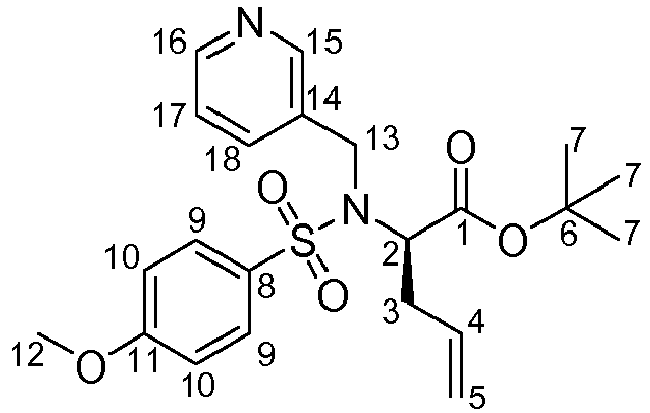
- According to the general procedure tert-butyl (R)-N-(4-methoxyphenylsulfonyl)-aminopent-4-enoate (2375 mg, 6.96 mmol), was treated with potassium carbonate (9600 mg 69.60 mmol) and picolyl chloride (1140 mg 6.96 mmol) in DMF (45 mL). After column chromatography (
column Ø 5 cm × 20 cm) the product was isolated as a white solid. Yield: 2010 mg (67 %). M.p. 177 °C. 1H NMR (300 MHz, CDCl3): δ 1.31 (s, 9 H, 7-CH3), 2.27 (m, 1 H, 3-CHA), 2.49 (m, 1H, 3-CHB), 3.86 (s, 3 H, 12-CH3), 4.49 (d, 2 J H,H = 16.4 Hz, 1 H, 13-CHA), 4.52 (t, 3 J H,H = 7.5 Hz, 1 H, 2-CH), 4.69 (d, 2 J H,H = 16.6 Hz, 1 H, 13-CHB), 4.89 (dq, 3 J H,H = 17.1 Hz, 2 J H,H = 1.4 Hz, 1 H, 5-CH cis ), 4.99 (dd, 3 J H,H = 10.3 Hz, 2 J H,H = 1.4 Hz, 1 H, 5-CH trans ), 5.60 (ddt, 3 J H,H = 17.0 Hz, 3 J H,H = 10.3 Hz, 3 J H,H = 6.7 Hz, 1 H, 4-CH), 6.94 (dm, 3 J H,H = 9.0 Hz, 2 H, 9-CH), 7.26 (ddd, 3 J H,H = 4.8 Hz, 3 J H,H = 3.1 Hz, 4 J H,H = 0.6 Hz, 1 H, 17-CH), 7.73 (dm, 3 J H,H = 9.0 Hz, 2 H, 10-CH), 7.87 (dt, 3 J H,H = 7.9 Hz, 4 J H,H = 1.8 Hz, 1 H, 18-CH), 8.50 (dd, 3 J H,H = 4.8 Hz, 4 J H,H = 1.5 Hz, 1 H, 16-CH), 8.54 (d, 4 J H,H = 1.9 Hz, 1 H, 15-CH). 13C NMR (75 MHz, CDCl3): δ 27.8 (q, C-7), 35.5 (t, C-3), 46.6 (t, C-13), 55.6 (q, C-12), 60.2 (d, C-2), 82.3 (s, C-6), 114.1 (d, C-9), 118.4 (t, C-5), 123.3 (d, C-17), 129.6 (d, C-10), 131.5 (s, C-8), 133.0 (d, C-4), 133.7 (s, C-14), 136.7 (d, C-18), 148.4 (d, C-16), 149.0 (d, C-15), 163.0 (s, C-11), 169.3 (s, C-1). Exact mass (ESI+): C22H28N2O5S + H+, calcd. 433.1797, found 433.1782; C22H28N2O5S + Na+, calcd. 455.1617, found 455.1599; (C22H28N2O5S)2 + H+, calcd. 865.3516, found 865.3505; (C22H28N2O5S)2 + Na+, calcd. 887.3336, found 887.3318. MS (ESI+, daughter ion experiment): m/z (%) 433 (0) [M+ + H+], 377 (12) [433 - C4H8], 279 (4) [C13H15N2O3S+], 171 (15) [C7H7O3S+], 165 (100) [C8H9N2O2 +], 121 (24) [C7H9N2 +], 92 (18) [C6H6N+]. Optical rotation: (c=1.009, CHCl3). -

- According to the general procedure tert-butyl (S)-N-(4-methoxyphenylsulfonyl)-2-amino-4-fluorobutanoate (1415 mg, 4.07 mmol), was reacted with potassium carbonate (5500 mg, 40.00 mmol) and picolyl chloride (673 mg 4.1 mmol) in DMF (20 mL). After column chromatographie (
column Ø 4 cm × 16 cm) the product was isolated as a greenish-white, viscose liquid. Yield: 1512 mg (85 %). 1H NMR (300 MHz, CDCl3): δ 1.35 (s, 9 H, 6-CH3), 1.86 (m, 1 H, 3-CHA), 2.22 (ddt, 2 J H,H = 13.6 Hz, 3 J H,H = 9.7 Hz, 3 J H,H = 6.0 Hz, 1 H, 3-CHB), 3.86 (s, 3 H, 11-CH3), 4.19 - 4.45 (m, 2 H, 4-CH2F), 4.36 (d, 2 J H,H = 16.1 Hz, 1 H, 12-CHA), 4.49 (dd, 3 J H,H = 7.7 Hz, 3 J H,H = 6.6 Hz, 1 H, 2-CH), 4.69 (d, 2 J H,H = 16.2 Hz, 1 H, 12-CHB), 6.96 (dm, 3 J H,H = 8.9 Hz, 2 H, 8-CH), 7.25 (dd, 3 J H,H = 7.9 Hz, 3 J H,H = 4.8 Hz, 1 H, 16-CH), 7.77 (dm, 3 J H,H = 8.9 Hz, 2 H, 9-CH), 7.82 (dm, 3 J H,H = 8.4 Hz, 1 H, 17-CH), 8.51 (s, 1 H, 15-CH), 8.53 (s, 1 H, 14-CH). 13C NMR (75 MHz, CDCl3): δ 27.7 (q, C-6), 31.8 (dt, 2 J C,F = 20.5 Hz, C-3), 47.3 (t, C-12), 55.6 (q, C-11), 57.0 (dd, 3JC,F = 4.3 Hz, C-2), 80.1 (dt, 1JC,F = 166.3 Hz, C-4), 82.5 (s, C-5), 114.1 (d, C-8), 123.4 (d, C-16), 129.6 (d, C-9), 131.3 (s, C-7), 132.9 (s, C-13), 136.3 (d, C-17), 149.1 (d, C-15), 149.4 (d, C-14), 163.0 (s, C-10), 169.0 (s, C-1). 19F NMR (282 MHz, CDCl3): δ -221.4 (ddt, 2 J H,F = 46.9 Hz, 3JH,F = 28.3 Hz, 3JH,F = 22.8 Hz, 4-CH2F). Exact mass (ESI+): C21H27N2O5S + H+, calcd. 439.1703, found 439.1701; C21H27N2O5S + Na+, calcd. 461.1522, found 431.1526; (C21H27N2O5S)2 + H+, calcd. 877.3328, found 877.3320; (C21H27N2O5S)2 + Na+, calcd. 899.3147, found 899.3146. MS (ESI+, daughter ion experiment): m/z (%) 439 (15) [M+ + H+], 383 (100) [439 - C4H8], 171 (5) [C7H7O3S+], 167 (10) [383 - C7H7O3S - CO2H], 92 (3) [C6H6N+]. Optical rotation:
-

- According to the general procedure tert-butyl (S)-N-(4-methoxyphenyl-sulfonyl)-2-amino-4-fluorobutanoate (500 mg, 1.44 mmol) was reacted with potassium carbonate (1990 mg 14.40 mmol) and picolyl chloride (237 mg, 1.44 mmol) in DMF (20 mL). After column chromatography (
column Ø 2 cm × 15 cm) the product was isolated as greenish-white, viscose liquid. Yield: 587 mg (93 %). 1H NMR (400 MHz, CDCl3): δ 1.35 (s, 9 H, 6-CH3), 1.86 (m, 3 J H,F = 28.3 Hz, 2 J H,H = 14.2 Hz, 1 H, 3-CHB), 2.22 (dddt, 3 J H,F = 22.7 Hz, 2 J H,H = 14.2 Hz, 3 J H,H = 7.5 Hz, 3 J H,H = 6.6 Hz, 1 H, 3-CHA), 3.87 (s, 3 H, 11-CH3), 4.37 (d, 2 J H,H = 16.2 Hz, 1 H, 12-CHA), 4.22 - 4.46 (m, 2 J H,F = 47.1 Hz, 2 H, 4-CH2F), 4.48 (dd, 3 J H,H = 7.9 Hz, 3 J H,H = 6.7 Hz, 1 H, 2-CH), 4.69 (d, 2 J H,H = 16.2 Hz, 1 H, 12-CHB), 6.96 (dm, 3 J H,H = 9.0 Hz, 2 H, 8-CH), 7.25 (dd, 3 J H,H = 7.9 Hz, 3 J H,H = 4.8 Hz, 1 H, 16-CH), 7.77 (dm, 3 J H,H = 8.9 Hz, 2 H, 9-CH), 7.82 (dt, 3 J H,H = 7.9 Hz, 4 J H,H = 1.8 Hz, 1 H, 17-CH), 8.50 (d, 4 J H,H = 2.0 Hz, 1 H, 14-CH), 8.52 (dd, 3 J H,H = 4.8 Hz, 4 J H,H = 1.6 Hz, 1 H, 15-CH). 13C NMR (100 MHz, CDCl3): δ 27.8 (q, C-6), 31.9 (dt, 2 J C,F = 20.5 Hz, C-3), 47.3 (t, C-12), 55.6 (q, C-11), 57.1 (dd, 3 J C,F = 4.3 Hz, C-2), 80.2 (dt, 1 J C,F = 166.4 Hz, C-4), 82.6 (s, C-5), 114.2 (d, C-8), 123.4 (d, C-16), 129.7 (d, C-9), 131.4 (s, C-7), 132.9 (s, C-13), 136.3 (d, C-17), 149.2 (d, C-15), 149.5 (d, C-14), 163.1 (s, C-10), 169.1 (s, C-1). 19F NMR (282 MHz, CDCl3): δ 221.4 (tdd , 2 J H,F = 46.9 Hz, 3 J H,F = 28.3 Hz, 3 J H,F = 22.8 Hz, 4-CH2F). Elemental analysis: C21H27FN2O5S (M = 438.513 g/mol); calcd. C: 57.52, H 6.21, N 6.39, found C 57.82, H 6.00, N 6.38 %. Exact mass (ESI+): C21H27FN2O5S + H+, calcd. 439.1703, found 439.1697; C21H27FN2O5S + Na+, calcd. 461.1522, found 461.1513; (C21H27FN2O5S)2 + H+, calcd. 877.3328, found 877.3321; (C21H27FN2O5S)2 + Na+, calcd. 899.3147, found 899.3145. MS (GC/MS, 70 eV): m/z (%) 438 (0) [M+], 362 (1), 277 (3) [M+ - C8H14FO2], 191 (100), 171 (22) [C7H7O3S+], 147 (75), 123 (12) [C6H4OS+], 107 (22) [C7H7O+], 92 (32) [C6H6N+], 77 (10) [C6H5 +]. Optical rotation:
-

- According to the general procedure tert-butyl (S)-N-(4-methoxyphenyl-sulfonyl)-2-amino-4-fluoropent-4-enoate (1500 mg, 4.17 mmol) was reacred with potassium carbonate (5760 mg 41.7 mmol) and picolyl chloride (685 mg, 4.17 mmol) in DMF (20 mL). After column chromatography (
column Ø 4 cm × 16 cm) the product was isolated as yellow, viscose liquid. Yield: 1428 mg (76 %). 1H NMR (300 MHz, CDCl3): δ 1.35 (s, 9 H, 7-CH3), 2.48 (m, 3 J H,F = 19.2 Hz, 1 H, 3-CHA), 2.73 (td, 3 J H,F = 15.0 Hz, 3 J H,H = 6.8 Hz, 1 H, 3-CHB), 3.86 (s, 3 H, 12-CH3), 4.14 (dd, 3 J H,F = 49.7 Hz, 2 J H,H = 3.1 Hz, 1 H, 5-CHtrans), 4.39 (d, 2 J H,H = 16.3 Hz, 1 H, 13-CHA), 4.55 (dd, 3 J H,F = 17.2 Hz, 2 J H,H = 3.0 Hz, 1 H, 5-CHcis), 4.58 (t, 3 J H,H = 7.3 Hz, 1 H, 2-CH), 4.65 (d, 2 J H,H = 16.3 Hz, 1 H, 13-CHB), 6.95 (d, 3 J H,H = 9.0 Hz, 2 H, 9-CH), 7.23 (ddd, 3 J H,H = 7.9 Hz, 3 J H,H = 4.8 Hz, 4 J H,H = 0.7 Hz, 1 H, 17-CH), 7.78 (m, 1 H, 18-CH), 7.78 (d, 3 J H,H = 9.0 Hz, 2 H, 10-CH), 8.51 (dd, 3 J H,H = 4.6 Hz, 4 J H,H = 1.7 Hz, 2 H, 15-CH and 16-CH). 13C NMR (75 MHz, CDCl3): δ 27.8 (s, C-7), 34.0 (d, 2 J C,F = 28.1 Hz, C-3), 47.4 (s, C-13), 55.6 (s, C-12), 57.6 (s, C-2), 82.8 (s, C-6), 93.4 (d, 2 J C,F = 19.1 Hz, C-5), 114.2 (s, C-9), 123.3 (s, C-17), 129.8 (s, C-10), 131.4 (s, C-8), 132.8 (s, C-14), 136.4 (s, C-18), 149.1 (s, C-16), 149.5 (s, C-15), 161.5 (d, 1 J C,F = 256.5 Hz, C-4), 163.1 (s, C-11), 168.4 (s, C-1). 19F NMR (282 MHz, CDCl3): δ -97.6 (dddd, 3 J H,F = 50.0 Hz, 3 J H,F = 19.2 Hz, 3 J H,F = 17.2 Hz, 3JH,F = 15.0 Hz, 4-CF). Exact mass (ESI+): C22H27FN2O5S + H+, cacld. 451.1703, found 451.1701; C22H27FN2O5S + Na+, calcd. 473.1522, found 473.1521; C22H27FN2O5S)2 + H+, calcd. 901.3328, found 901.3320; (C22H27FN2O5S)2 + Na+, calcd. 923.3147, found 923.3144. Optical rotation: -

- According to the general procedure tert-butyl (R)-N-(4-methoxyphenyl-sulfonyl)-2-amino-4-fluoropent-4-enoate(720 mg, 2.00 mmol) was reacted with potassium carbonate (2760 mg, 20.00 mmol) and picolyl chloride (329 mg, 2.00 mmol) in DMF (20 mL). After column chromatography the product was isolated as yellow, viscose oil. Yield: 523 g (58 %). 1H NMR (500 MHz, CDCl3): δ 1.37 (s, 9 H, 7-CH3), 2.48 (ddd, 3 J H,F = 19.2 Hz, 2 J H,H = 15.1 Hz, 3 J H,H = 7.8 Hz, 1 H, 3-CHA), 2.74 (dt, 2 J H,H = 15.2 Hz, 3 J H,H = 6.9 Hz, 1 H, 3-CHB), 3.88 (s, 3 H, 12-CH3), 4.17 (dd, 3 J H,F = 49.7 Hz, 2 J H,H = 3.1 Hz, 1 H, 5-CH trans), 4.42 (d, 2 J H,H = 16.3 Hz, 1 H, 13-CHA), 4.57 (dd, 3 J H,F = 17.2 Hz, 2 J H,H = 3.1 Hz, 1 H, 5-CH cis ), 4.60 (t, 3 J H,H = 7.3 Hz, 1 H, 2-CH), 4.67 (d, 2JH,H = 16.3 Hz, 1 H, 13-CHB), 6.97 (dm, 3JH,H = 9.0 Hz, 2 H, 9-CH), 7.29 (dd, 3JH,H = 7.9 Hz, 3JH,H = 4.9 Hz, 1 H, 17-CH), 7.79 (dm, 3JH,H = 9.0 Hz, 2 H, 10-CH), 7.86 (dd, 3JH,H = 7.8 Hz, 4JH,H = 1.4 Hz, 1 H, 18-CH), 8.52 - 8.54 (m, 4JH,H = 1.5 Hz, 2 H, 15-CH and 16-CH). 13C NMR (100.62 MHz, CDCl3): δ 27.8 (q, C-7), 34.0 (dt, 2 J C,F = 28.1 Hz, C-3), 47.3 (t, C-13), 55.6 q, C-12), 57.6 (d, C-2), 82.9 (s, C-6), 93.4 (dt, 2 J C,F = 19.0 Hz, C-5), 114.2 (d, C-9), 123.4 (d, C-17), 129.8 (d, C-10), 131.4 (s, C-8), 132.9 (s, C-14), 136.6 (d, C-18), 148.9 (d, C-16), 149.3 (d, C-15), 161.5 (ds, 1 J C,F = 256.5 Hz, C-4), 163.1 (s, C-11), 168.5 (s, C-1). 19F NMR (470 MHz, CDCl3): δ -97.6 (dddd, 3 J H,F = 49.7 Hz, 3 J H,F = 19.2 Hz, 3 J H,F = 17.2 Hz, 3 J H,F = 15.0 Hz, 4-CF).

- In a dried YOUNG-tube trifluoroacetic acid (20 mL/mmol) is added under argon to the corresponding amino acid tert-butylester dissolved in dry dichloromethane (20 mL/mmol). After flushing with argon the YOUNG-tube is sealed and the mixture is stirred at r.t. for 3-4 h. Then the reaction mixture was evaporated to dryness. The residue is dissolved in chloroform (100 mL/mmol) and washed with an aqueous solution of citric acid and bicarbonate (pH ≈ 4) (25 mL/mmol). The aqueous phase is extracted with chloroform (4 × 30 mL/mmol) and the combined organic layer is dried with magnesium sulfate. The solvent is evaporated to get the crude product.


-

- According to the general procedure tert-butyl (S)-N-(4-methoxyphenylsulfonyl)-N-(3-pyridylmethyl)-aminobutanoate (243 mg, 0.58 mmol) was dissolved in dry dichloromethane (12 mL) and treated with trifluoroacetic acid (12 mL). The product was isolated as colorless, highly viscos oil. Yield: 194 mg (91 %). 1H NMR (300 MHz, DMSO-d6): δ 0.70 (t, 3 J H,H = 7.3 Hz, 3 H, 4-CH3), 1.45 (ddd, 2 J H,H = 14.2 Hz, 3 J H,H = 8.7 Hz, 3 J H,H = 7.3 Hz, 1 H, 3-CHA), 1.75 (dt, 2 J H,H = 14.0 Hz, 3 J H,H = 6.8 Hz, 1 H, 3-CHB), 3.83 (s, 3 H, 9-CH3), 4.23 (dd, 3 J H,H = 8.9 Hz, 3 J H,H = 6.0 Hz, 1 H, 2-CH), 4.43 (d, 2 J H,H = 16.9 Hz, 1 H, 10-CHA), 4.61 (d, 2 J H,H = 16.9 Hz, 1 H, 10-CHB), 7.07 (dm, 3 J H,H = 9.0 Hz, 2 H, 6-CH), 7.38 (dd, 3 J H,H = 7.8 Hz, 3 J H,H = 4.9 Hz, 1 H, 14-CH), 7.74 (dm, 3 J H,H = 9.0 Hz, 2 H, 7-CH), 7.84 (d, 3JH,H = 7.9 Hz, 1 H, 15-CH), 8.47 (d, 3JH,H = 4.1 Hz, 1 H, 13-CH), 8.57 (s, 1 H, 12-CH). 13C NMR (75 MHz, DMSO-d6): δ 11.0 (q, C-4), 23.2 (t, C-3), 46.4 (t, C-10), 55.7 (q, C-9), 61.5 (d, C-2), 114.3 (d, C-6), 123.4 (d, C-14), 129.5 (d, C-7), 131.0 (s, C-5), 134.3 (s, C-11), 136.3 (d, C-15), 148.0 (d, C-13), 148.9 (d, C-12), 162.6 (s, C-8), 171.7 (s, C-1). Exact mass (ESI+): C17H20N2O5S + H+, calcd. 365.1171, found 365.1169; C17H20N2O5S + Na+, calcd. 387.0991, found 387.0988; (C17H20N2O5S)2 + H+, calcd. 729.2264, found 729.2267; (C17H20N2O5S)2 + Na+, calcd. 751.2084, found 751.2085. MS (ESI+, daughter ion experiment): m/z (%) 365 (90) [M+ + H+], 319 (100) [365 - H+ - CO2H], 280 (65) [C13H16N2O3S+], 228 (15) [319 - C6H6N], 200 (30) [228 - C2H5], 171 (55) [C7H7O3S+].
-

- According to the general procedure tert-butyl (R)-N-(4-methoxyphenylsulfonyl)-N-(3-pyridylmethyl)-aminobutanoate (133 mg, 0.32 mmol) dissolved in dry dichloromethane (8 mL) and treated with trifluoroacetic (8 mL) acid. The product was isolated as colorless, highly viscos oil. Yield: 112 mg (96 %). 1 H NMR (300 MHz, DMSO-d6): δ 0.71 (t, 3 J H,H = 7.3 Hz, 3 H, 4-CH3), 1.59 - 1.87 (m, 2 H, 3-CH2), 3.84 (s, 3 H, 9-CH3), 4.25 (dd, 3 J H,H = 8.8 Hz, 3 J H,H = 6.0 Hz, 1 H, 2-CH), 4.52 (d, 2 J H,H = 17.1 Hz, 1 H, 10-CHA), 4.66 (d, 2 J H,H = 17.1 Hz, 1 H, 10-CHB), 7.08 (dm, 3 J H,H = 8.9 Hz, 2 H, 6-CH), 7.65 (m, 1 H, 14-CH), 7.76 (dm, 3 J H,H = 8.9 Hz, 2 H, 7-CH), 8.10 (d, 3 J H,H = 7.8 Hz, 1 H, 15-CH), 8.45 - 8.95 (m, 2 H, 12-CH & 13-CH), 12.44 (s br, 1 H, 16-OH). 13 C-NMR (75 MHz, DMSO-d6): δ 11.0 (q, C-4), 23.2 (t, C-3), 46.2 (t, C-10), 55.7 (q, C-9), 61.5 (d, C-2), 114.3 (d, C-6), 124.6 (d, C-14), 129.5 (d, C-7), 130.4 (s, C-11), 130.8 (s, C-5), 139.0 (d, C-15), 145.5 (d, C-13), 146.2 (d, C-12), 162.7 (s, C-8), 171.7 (s, C-1). Exact mass (ESI+): C17H20N2O5S + H+, calcd. 365.1171, 365.1166; C17H20N2O5S + Na+, calcd. 387.0991, found 387.0986; (C17H20N2O5S)2 + H+, calcd. 729.2264, found 729.2267; (C17H20N2O5S)2 + Na+, calcd. 751.2084, found 751.2085. MS (ESI+, daughter ion experiment): m/z (%) 365 (100) [M+ + H+], 319 (32) [365 - H+ - CO2H], 280 (20) [C13H16N2O3S+], 228 (5) [319 - C6H6N], 200 (10) [228 - C2H5], 171 (18) [C7HO3S+], 149 (38) [319 - C7H7O3S].
-

- According to the general procedure tert-butyl (S)-N-(4-methoxyphenylsulfonyl)-N-(3-pyridylmethyl)-2-aminopent-4-enoate (400 mg, 0.93 mmol) was dissolved in dry dichloromethane (20 mL) and treated with trifluoroacetic acid (20 mL). The product was isolated as colorless, highly viscos oil. Yield: 312 mg (89 %). 1 H NMR (400 MHz, DMSO-d6): δ 2.16 (ddd, 2 J H,H = 15.0 Hz, 3 J H,H = 8.4 Hz, 3 J H,H = 7.4 Hz, 1 H, 3-CHA), 2.42 (m, 1 H, 3-CHB), 3.76 (s, 3 H, 10-CH3), 4.35 (dd, 3 J H,H = 8.7 Hz, 2 J H,H = 6.2 Hz, 1 H, 2-CH), 4.36 (d, 2 J H,H = 17.3 Hz, 1 H, 11-CHA), 4.51 (d, 2 J H,H = 16.9 Hz, 1 H, 11-CHB), 4.80 (dd, 3 J H,H = 17.2 Hz, 2 J H,H = 1.6 Hz, 1 H, 5-CHtrans), 4.84 (dd, 3 J H,H = 10.3 Hz, 2 J H,H = 1.5 Hz, 1 H, 5-CHcis), 5.49 (ddt, 3 J H,H = 17.0 Hz, 3 J H,H = 10.3 Hz, 3 J H,H = 6.7 Hz, 1 H, 4-CH), 6.99 (dm, 3 J H,H = 9.0 Hz, 2 H, 7-CH), 7.25 (dd, 3 J H,H = 7.8 Hz, 3 J H,H = 4.8 Hz, 1 H, 15-CH), 7.66 (dm, 3 J H,H = 8.9 Hz, 2 H, 8-CH), 7.70 (m, 1 H, 16-CH), 8.36 (d, 3 J H,H = 4.1 Hz, 1 H, 14-CH), 8.46 (s, 1 H, 13-CH). 13 C NMR (100 MHz, DMSO-d6): δ 34.1 (t, C-3), 46.5 (t, C-11), 55.7 (q, C-10), 59.7 (d, C-2), 114.3 (d, C-7), 117.8 (t, C-5), 123.1 (d, C-15), 129.5 (d, C-8), 131.0 (s, C-6), 133.8 (d, C-4), 134.0 (s, C-12), 135.9 (d, C-16), 148.1 (d, C-14), 149.2 (d, C-13), 162.6 (s, C-9), 171.2 (s, C-1). Exact mass (ESI+): C18H20N2O5S + H+, calcd. 377.1171, found 377.1186; C18H20N2O5S + Na+, calcd. 399.0991, found 399.1004; (C18H20N2O5S)2 + H+, calcd. 753.2264, found 753.2259; (C18H20N2O5S)2 + Na+, calcd. 775.2084, found 775.2094. Exact mass (ESI-): C18H20N2O5S-H+, calcd. 375.1015, found 375.1035; (C18H20N2O5S)2 - H+, calcd. 751.2108, found 751.2141. MS (ESI+, daughter ion experiment): m/z (%) 377 (75) [M+ + H+], 331 (75) [377 - H+ - CO2H], 280 (42) [C13H16N2O3S+], 240 (8) [331 - C6H6N], 200 (20) [C8H10NO3S+], 171 (50) [C7H7O3S+], 161 (100) [331 - C7H7O3S], 123 (8) [C7H7O2 1].
-

- According to the general procedure tert-butyl (R)-N-(4-methoxyphenylsulfonyl)-N-(3-pyridylmethyl)-2-aminopent-4-enoate (247 mg, 0.57 mmol) was dissolved in dry dichloromethane (12 mL) and treated with trifluoroacetic acid (12 mL). The product was isolated as white highly viscos oil. Yield: 196 mg (92 %). 1H NMR (400 MHz, DMSO-d6): δ 2.29 (ddd, 2 J H,H = 15.0 Hz, 3 J H,H = 8.6 Hz, 3 J H,H = 7.6 Hz, 1 H, 3-CHA), 2.54 (m, 2 J H,H = 15.0 Hz, 3 J H,H = 6.1 Hz, 1 H, 3-CHB), 3.84 (s, 3 H, 10-CH3), 4.48 (dd, 3 J H,H = 8.9 Hz, 3 J H,H = 6.0 Hz, 1 H, 2-CH), 4.53 (d, 2 J H,H = 17.3 Hz, 1 H, 11-CHA), 4.65 (d, 2 J H,H = 17.2 Hz, 1 H, 11-CHB), 4.89 (dd, 3 J H,H = 17.2 Hz, 2 J H,H = 1.7 Hz, 1 H, 5-CH trans ), 4.93 (dd, 3 J H,H = 10.5 Hz, 2 J H,H = 1.6 Hz, 1 H, 5-CH cis ), 5.58 (ddt, 3 J H,H = 17.1 Hz, 3 J H,H = 10.3 Hz, 3 J H,H = 6.7 Hz, 1 H, 4-CH), 7.09 (d, 3 J H,H = 9.0 Hz, 2 H, 7-CH), 7.58 (dd, 3 J H,H = 7.9 Hz, 3 J H,H = 5.1 Hz, 1 H, 15-CH), 7.75 (d, 3 J H,H = 9.0 Hz, 2 H, 8-CH), 8.07 (d, 3 J H,H = 8.0 Hz, 1 H, 16-CH), 8.59 (d, 3 J H,H = 4.4 Hz, 1 H, 14-CH), 8.67 (s, 1 H, 13-CH), 12.82 (s br, 1 H, 17-OH). 13 C NMR (100 MHz, DMSO-d6): δ 34.0 (t, C-3), 46.3 (t, C-11), 55.7 (q, C-10), 59.7 (d, C-2), 114.3 (d, C-7), 117.8 (t, C-5), 124.3 (d, C-15), 129.6 (d, C-8), 130.7 (s, C-6), 134.0 (d, C-4), 135.7 (s, C-12), 139.1 (d, C-16), 145.6 (d, C-14), 146.4 (d, C-13), 162.7 (s, C-9), 171.2 (s, C-1).
-

- According to the general procedure tert-butyl (S)-N-(4-methoxyphenylsulfonyl)-N-(3-pyridylmethyl)-2-amino-4-fluorobutanoate (562 mg, 1.28 mmol) was dissolved in dry dichloromethane (5 mL) and treated with trifluoroacetic acid (25 mL). The product was isolated as white solid. Yield: 472 mg (96 %). M.p. 156 °C. 1 H NMR (300 MHz, DMSO-d6): δ 1.85 (m, 3 J H,F = 22.3 Hz, 1 H, 3-CHA), 2.19 (m, 3 J H,F = 27.9 Hz, 1 H, 3-CHB), 3.84 (s, 3 H, 9-CH3), 4.32 (dt, 2 J H,F = 47.1 Hz, 3 J H,H = 5.7 Hz, 2 H, 4-CH2), 4.43 (d, 2 J H,H = 17.2 Hz, 1 H, 10-CHA), 4.49 (m, 1 H, 2-CH), 4.62 (d, 2 J H,H = 16.8 Hz, 1 H, 10-CHB), 7.09 (dm, 3 J H,H = 8.9 Hz, 2 H, 6-CH), 7.39 (dd, 3 J H,H = 7.8 Hz, 3 J H,H = 4.8 Hz, 1 H, 14-CH), 7.75 (dm, 3 J H,H = 8.9 Hz, 2 H, 7-CH), 7.82 (m, 1 H, 15-CH), 8.49 (d, 3 J H,H = 3.7 Hz, 1 H, 13-CH), 8.55 (s, 1 H, 12-CH), 13.02 (s br, 1 H, 16-OH). 13 C NMR (75 MHz, DMSO-d6): δ 30.9 (dt, 2 J C,F = 20.2 Hz, C-3), 46.8 (t, C-10), 55.7 (q, C-9), 56.3 (dd, 3 J C,F = 5.0 Hz, C-2), 80.4 (dt, 1 J C,F = 163.1 Hz, C-4), 114.4 (d, C-6), 123.5 (d, C-14), 129.6 (d, C-7), 130.8 (s, C-5), 133.9 (s, C-11), 136.4 (d, C-15), 148.0 (d, C-13), 148.8 (d, C-12), 162.7 (s, C-8), 171.2 (s, C-1). 19F NMR (282 MHz, DMSO-d6): δ - 219.3 (ddt, 2 J H,F = 47.1 Hz, 3 J H,F = 27.8 Hz, 3 J H,F = 22.3 Hz, 4-CH2F). Exact mass (ESI+): C17H19FN2O5S + H+, calcd. 383.1077, found 383.1073; C17H19FN2O5S + Na+, found 405.0896, found 405.0892; (C17H19FN2O5S)2 + H+, calcd. 765.2076, found 765.2071; (C17H19FN2O5S)2 + Na+, calcd. 787.1895, found 787.1887. Exact mass (ESI-): C17H19FN2O5S - H+, calcd. 381.0926, found 381.0930; (C17H19FN2O5S - H+)2 + H+, calcd. 763.1925, found 763.1930; (C17H19FN2O5S - H+)2 + Na+, calcd. 785.1744, found 785.1758.
-

- According to the general procedure tert-butyl (R)-N-(4-methoxyphenylsulfonyl)-N-(3-pyridylmethyl)-2-amino-4-fluorobutanoate (448 mg, 1.02 mmol) was dissolved in dry dichloromethane (25 mL) and treated with trifluoroacetic acid (25 mL). The product was isolated as white solid. Yield: 352 mg (90 %). M.p. 155-156 °C. 1H NMR (400 MHz, DMSO-d6): δ 1.79 (m, 3 J H,F = 22.8 Hz, 1 H, 3-CHA), 2.19 (m, 3 J H,F = 27.6 Hz, 1 H, 3-CHB), 3.84 (s, 3 H, 9-CH3), 4.32 (t, 2 J H,H = 5.7 Hz, 1 H, 4-CHA), 4.37 (t, 2 J H,H = 5.7 Hz, 1 H, 4-CHB), 4.41 (d, 2 J H,H = 17.1 Hz, 1 H, 10-CHA), 4.48 (t, 3 J H,H = 7.2 Hz, 1 H, 2-CH), 4.61 (d, 2 J H,H = 16.7 Hz, 1 H, 10-CHB), 7.09 (dm, 3 J H,H = 8.5 Hz, 2 H, 6-CH), 7.34 (dd, 3 J H,H = 7.6 Hz, 3 J H,H = 4.9 Hz, 1 H, 14-CH), 7.72 - 7.80 (m, 3 H, 7-CH and 15-CH), 8.46 (d, 3 J H,H = 4.7 Hz, 1 H, 13-CH), 8.52 (s, 1 H, 12-CH), 13.11 (s br, 1 H, 16-OH). 13 C NMR (100 MHz, DMSO-d6): δ 31.0 (dt, 2 J C,F = 20.2 Hz, C-3), 46.8 (t, C-10), 55.7 (q, C-9), 56.2 (dd, 3 J C,F = 5.0 Hz, C-2), 80.4 (dt, 1 J C,F = 163.1 Hz, C-4), 114.3 (d, C-6), 123.2 (d, C-14), 129.5 (d, C-7), 130.9 (s, C-5), 133.6 (s, C-11), 135.8 (d, C-15), 148.5 (d, C-13), 149.3 (d, C-12), 162.7 (s, C-8), 171.2 (s, C-1). 19 F NMR (282 MHz, DMSO-d6): δ -221.8 (ddt, 2 J H,F = 47.1 Hz, 2 J H,F = 27.5 Hz, 2 J H,F = 22.5 Hz, 4-CH2F). Exact mass (ESI+): C17H19FN2O5S + H+, calcd. 383.1077, found 383.1079; C17H19FN2O5S + Na+, calcd. 405.0896, found 405.0900; (C17H19FN2O5S)2 + H+, calcd. 765.2076, found 765.2071; (C17H19FN2O5S)2 + Na+, calcd. 787.1895, found 787.1884. MS (ESI+, daughter ion experiment): m/z (%) 383 (75) [M+ + H+], 363 (4) [M+ - HF], 337 (22) [383 - H+ - CO2H], 280 (40) [C13H16N2O3S+], 211 (5) [383 - C7H7O3S], 200 (13) [C8H10NO3S+], 171 (18) [C7H7O3S+], 167 (100) [211 - CO2H], 123 (8) [C7H7O2 +].
-

- According to the general procedure tert-butyl (S)-N-(4-Methoxyphenylsulfonyl)-N-(3-pyridylmethyl)-2-amino-4-fluoropent-4-enoate (272 mg, 0.60 mmol) was dissolved in dry dichloromethane (20 mL) and treated with 20 mL trifluoroacetic acid. The product was isolated as yellowish-white solid. Yield: 200 mg (85 %). M.p. 172 °C. 1H NMR (300 MHz, DMSO-d6): δ 2.59 (m, 1 H, 3-CHA), 2.84 (ddd, 3 J H,F = 15.7 Hz, 2 J H,H = 12.6 Hz, 3 J H,H = 5.5 Hz, 1 H, 3-CHB), 3.91 (s, 3 H, 10-CH3), 4.30 (dd, 3 J H,F = 51.6 Hz, 2 J H,H = 3.1 Hz, 1 H, 5-CH trans ), 4.53 (d, 2 J H,H = 16.9 Hz, 1 H, 11-CHA), 4.62 (dd, 3 J H,F = 17.8 Hz, 2 J H,H = 3.0 Hz, 1 H, 5-CH cis ), 4.66 (d, 2 J H,H = 16.8 Hz, 1 H, 11-CHB), 4.69 (dd, 3 J H,H = 5.7 Hz, 3 J H,H = 3.0 Hz, 1 H, 2-CH), 7.14 (d, 3 J H,H = 9.1 Hz, 2 H, 7-CH), 7.45 (m, 1 H, 15-CH), 7.80 (d, 3 J H,H = 9.0 Hz, 2 H, 8-CH), 7.88 (m, 1 H, 16-CH), 8.55 (s, 1 H, 14-CH), 8.63 (s, 1 H, 13-CH), 12.94 (s, 1 H, 17-OH). 13 C NMR (75 MHz, DMSO-d6): δ 32.6 (dt, 2 J C,F = 28.0 Hz, C-3), 46.7 (t, C-11), 55.7 (q, C-10), 57.0 (d, C-2), 93.2 (dt, 2 J C,F = 18.4 Hz, C-5), 114.3 (d, C-7), 123.4 (d, C-15), 129.4 (d, C-8), 129.6 (s, C-6), 130.7 (s, C-12), 136.6 (d, C-16), 147.7 (d, C-14), 148.7 (d, C-13), 161.7 (ds, 1 J C,F = 255.3 Hz, C-4), 162.7 (s, C-9), 169.9 (s, C-1). 19 F NMR (282 MHz, DMSO-d6): δ -96.2 (m, 3 J H,F = 51.5 Hz, 3 J H,F = 17.8 Hz, 3 J H,F = 15.7 Hz, 4-CF). Exact mass (ESI+): C18H19FN2O5S + H+, calcd. 395.1077, found 395.1088; C18H19FN2O5S + Na+, calcd. 417.0896, found 417.0905; (C18H19FN2O5S)2 + H+, calcd. 789.2076, found 789.2096; (C18H19FN2O5S)2 + Na+, calcd. 811.1895, found 811.1897. Exact mass (ESI-): C18H19FN2O5S - H+, calcd. 393.0920, found 393.0940; (C18H19FN2O5S - H+)2 + H+, calcd. 787.1919, found 787.1955; (C18H19FN2O5S - H+)2 + Na+, calcd. 809.1739, found 809.1766. MS (ESI+, daughter ion experiment): m/z (%) 395 (12) [M+ + H+], 179 (22) [M+ - C2H2F - C7H7O3S], 171 (31) [C7H7O3S+], 165 (100) [M+ - C3H4F - C7H7O3S], 147 (10), 123 (8), 107 (18) [C7H7O+], 92 (20) [C6H7N+]. MS (ESI-, daughter ion experiment): m/z (%) 393 (2) [M- - H+], 277 (27) [393 - C5H5FO2-], 171 (100) [C7H7O3S-], 157 (4) [C6H5O3S-], 115 (18) [C5H4FO2 -].
-

- The aminoacid methylester (1 equivalent) dissolved in a mixture of THF, methanol and water (ratio 3:1:1; 3.3 mL/mmol) is treated with lithium hydroxide (5 equivalents). This solution is stirred at r.t. over night. The reaction mixture is extracted with ethyl acetate (2 × 20 mL). This extract is discharged. Then the aqueous phase is acidified with 0.5 N hydrochloric acid and extracted again with ethyl acetate (4 × 20 mL). The combined organic phases are dried with magnesium sulfate and the solvent is evaporated.
-

- According to the general procedure methyl (S)-N-(4-methoxyphenylsulfonyl)-N-(3-pyridylmethyl)-aminobutanoate (306 mg, 0.81 mmol) was dissolved in the above-mentioned solvent mixture (10 mL) and treated with lithium hydroxide (169 mg, 4.04 mmol). The product was isolated as white, highly viscos liquid. Yield: 174 mg (59 %). The spectroscopic data agree with those given above.
-

- According to the general procedure methyl (R)-N-(4-methoxyphenylsulfonyl)-N-(3-pyridylmethyl)-aminobutanoate (420 mg, 1.11 mmol) was dissolved in the above-mentioned solvent mixture (10 mL) and treated with lithium hydroxide (230 mg, 5.55 mmol). The product was isolated as white, highly viscos liquid. Yield: 251 mg (62 %). The spectroscopic data agree with those given above.
- The N,N-disubstituted α-amino acid (1 equivalent) is suspended in dichloromethane (15 mL/mmol). Then 1-hydroxy-benzotriazole (HOBT, 1 equivalent) is added and stirred for a short time. After addition of N-methylmorpholin (NMM) (5 equiv.) the acid is dissolved. Subsequently, O-tert-butylhydroxylamine (3 equiv.) was added and the solution is stirred for 5 min. 1-(3-Dimethylaminopropyl)-3-ethylcarbodiimide (EDC) hydrochloride (1.3 equiv.) is added and the reaction mixture is stirred overnight. The solution is washed with water (20 mL) and the aqueous phase is extracted with dichloromethane (3 × 20 mL). The combined organic phases are washed with brine (1 × 20 mL) and dried with magnesium sulfate. After evaporation of the solvent the crude product is purified by column chromatography (silica gel, Cy/EtOAc, 1:3). The silica gel was inactivated by flushing with the eluent containing 2 % triethylamine. The product is obtained as highly viscose liquid, which on drying in high vacuum becomes solid.

-

- According to the general procedure (S)-N-(4-methoxyphenylsulfonyl)-N-(3-pyridylmethyl)aminobutanoic acid (185 mg, 0.51 mmol) was reacted with HOBT (71 mg, 0.51 mmol), NMM (259 mg, 2.55 mmol), O-tert-butylhydroxylamine (194 mg, 1.53 mmol) and EDC (134 mg, 0.69 mmol) in dichloromethane (15 mL). After purification by column chromatography (
column Ø 2 cm × 15) the product was isolated as white solid. Yield: 173 mg (78 %). M.p. 66 °C. 1H NMR (300 MHz, DMSO-d6): δ 0.69 (t, 3 J H,H = 7.2 Hz, 3 H, 4-CH3), 1.23 (s, 9 H, 6-CH3), 1.44 (tq, 2 J H,H = 14.8 Hz, 3 J H,H = 7.4 Hz, 1 H, 3-CHA), 1.90 (m, 1 H, 3-CHB), 3.85 (s, 3 H, 11-CH3), 4.11 (m, 1 H, 2-CH), 4.56 (s, 2 H, 12-CH2), 6.91 (d, 3 J H,H = 8.9 Hz, 2 H, 8-CH), 7.20 (dd, 3 J H,H = 7.8 Hz, 3 J H,H = 4.9 Hz, 1 H, 16-CH), 7.61 (d, 3 J H,H = 8.9 Hz, 2 H, 9-CH), 7.71 (d, 3 J H,H = 7.8 Hz, 1 H, 17-CH), 8.48 (d, 3 J H,H = 3.7 Hz, 1 H, 15-CH), 8.54 (d, 4 J H,H = 1.5 Hz, 1 H, 14-CH), 8.59 (s, 1 H, 18-NH). 13 C NMR (75 MHz, DMSO-d6): δ 10.6 (q, C-4), 22.9 (t, C-3), 26.2 (q, C-6), 45.7 (t, C-12), 55.6 (q, C-11), 59.5 (d, C-2), 82.2 (s, C-5), 114.4 (d, C-8), 123.2 (d, C-16), 129.2 (d, C-9), 131.3 (s, C-7), 132.9 (s, C-13), 136.5 (d, C-17), 148.8 (d, C-15), 149.9 (d, C-14), 163.2 (s, C-10), 168.2 (s, C-1). Exact mass (ESI+): C21H29N3O5S + H+, calcd. 436.1906, found 436.1898; C21H29N3O5S + Na+, calcd. 458.1726, found 458.1716; (C21H29N3O5S)2 + H+, calcd. 871.3734, found 871.3717; (C21H29N3O5S)2 + Na+, calcd. 893.3554, found 893.3534. MS (ESI+, daughter ion experiment): m/z (%) = 436 (50) [M+ + H+], 380 (100) [436 - C4H8], 319 (18) [436 - H+ - CONHOC(CH3)3], 264 (6) [436 - H+ - C7H7O3S], 228 (4) [319 - C6H6N], 171 (12) [C7H7O3S+]. Optical rotation:
-

- According to the general procedure (R)-N-(4-methoxyphenylsulfonyl)-N-(3-pyridylmethyl)-aminobutanoic acid (105 mg, 0.29 mmol) was reacted with HOBT (40 mg, 0.29 mmol), NMM (147 mg, 1.45 mmol), O-tert-butylhydroxylamine (110 mg, 0.87 mmol) and EDC (74 mg, 0.38 mmol) in dichloromethane (15 mL). After column chromatography (
column Ø 2 cm × 15) the product was isolated as white solid. Yield: 101 mg (83 %). M.p. 65-66 °C. 1H NMR (300.13 MHz, DMSO-d6): δ 0.69 (t, 3 J H,H = 7.3 Hz, 3 H, 4-CH3), 1.25 (s, 9 H, 6-CH3), 1.44 (m, 1 H, 3-CHA), 1.90 (m, 1 H, 3-CHB), 3.85 (s, 3 H, 11-CH3), 4.09 (m, 1 H, 2-CH), 4.56 (s, 2 H, 12-CH2), 6.91 (dm, 3 J H,H = 8.9 Hz, 2 H, 8-CH), 7.20 (dd, 3 J H,H = 7.8 Hz, 3 J H,H = 4.8 Hz, 1 H, 16-CH), 7.61 (dm, 3 J H,H = 8.9 Hz, 2 H, 9-CH), 7.70 (d, 3 J H,H = 7.8 Hz, 1 H, 17-CH), 8.49 (d, 3 J H,H = 3.7 Hz, 1 H, 15-CH), 8.53 - 8.56 (m, 2 H, 14-CH and 18-NH). 13 C NMR (75.48 MHz, DMSO-d6): δ 10.6 (q, C-4), 22.9 (t, C-3), 26.2 (q, C-6), 45.7 (t, C-12), 55.6 (q, C-11), 59.5 (d, C-2), 82.2 (s, C-5), 114.4 (d, C-8), 123.2 (d, C-16), 129.2 (d, C-9), 131.4 (s, C-7), 132.9 (s, C-13), 136.5 (d, C-17), 148.9 (d, C-15), 150.0 (d, C-14), 163.2 (s, C-10), 168.2 (s, C-1). Exact mass (ESI+): C21H29N3O5S + H+, calcd. 436.1906, found 436.1897; C21H29N3O5S + Na+, calcd. 458.1726, found 458.1715; (C21H29N3O5S)2 + H+, calcd. 871.3734, found 871.3702; (C21H29N3O5S)2 + Na+, calcd. 893.3554, found 893.3521. MS (ESI+, daughter ion experiment): m/z (%) 436 (65) [M+ + H+], 380 (100) [436 - C4H8], 319 (12) [436 - H+ - CONHOC(CH3)3], 264 (15) [436 - H+ - C7H7O3S], 228 (5) [319 - C6H6N]. Optical rotation: -

- According to the general procedure (S)-N-(4-methoxyphenylsulfonyl)-N-(3-pyridylmethyl)-aminopent-4-enoic acid (280 mg, 0.744 mmol) was reacted with HOBT (101 mg, 0.744 mmol), NMM (377 mg, 3.72 mmol), O-tert-butylhydroxylamine (280 mg, 2.23 mmol) and EDC (186 mg, 0.97 mmol) in dichloromethane (15 mL). After column chromatography (
column Ø 2 cm × 15 cm) the product was isolated as white solid. Yield: 306 mg (92 %). M.p. 65-66 °C. 1H NMR (300 MHz, CDCl3): δ 1.21 (s, 9 H, 7-CH3), 2.16 (dt, 2JH,H = 13.8 Hz, 3JH,H = 6.8 Hz, 1 H, 3-CHA), 2.60 (ddd, 2JH,H = 14.0 Hz, 3JH,H = 8.1 Hz, 3JH,H = 7.0 Hz, 1 H, 3-CHB), 3.86 (s, 3 H, 12-CH3), 4.29 (dd, 3 J H,H = 8.3 Hz, 3 J H,H = 6.9 Hz, 1 H, 2-CH), 4.58 (s, 2 H, 13-CH2), 4.94 (d, 2 J H,H = 2.9 Hz, 1 H, 5-CHA), 4.97 (d, 2 J H,H = 3.1 Hz, 1 H, 5-CHB), 5.39 (ddt, 3 J H,H = 14.1 Hz, 3JH,H = 9.6 Hz, 3 J H,H = 6.9 Hz, 1 H, 4-CH), 6.93 (dm, 3 J H,H = 8.9 Hz, 2 H, 9-CH), 7.21 (dd, 3 J H,H = 7.7 Hz, 3 J H,H = 4.9 Hz, 1 H, 17-CH), 7.64 (dm, 3 J H,H = 9.0 Hz, 2 H, 10-CH), 7.72 (d, 3 J H,H = 7.9 Hz, 1 H, 18-CH), 8.49 (d, 3 J H,H = 3.7 Hz, 1 H, 16-CH), 8.56 (d, 4 J H,H = 1.5 Hz, 1 H, 15-CH), 8.70 (s, 1 H, 19-NH). 13C NMR (75 MHz, CDCl3): δ 26.2 (q, C-7), 33.9 (t, C-3), 45.8 (t, C-13), 55.6 (q, C-12), 57.6 (d, C-2), 82.2 (s, C-6), 114.4 (d, C-9), 119.0 (t, C-5), 123.3 (d, C-17), 129.3 (d, C-10), 131.0 (s, C-8), 132.5 (d, C-4), 132.8 (s, C-14), 136.4 (d, C-18), 148.8 (d, C-16), 149.8 (d, C-15), 163.2 (s, C-11), 167.7 (s, C-1). Elemental analysis: C22H29N3O5S (M = 447.18 g/mol), calcd. C 59.04, H 6.53, N 9.39; found C 59.11, H 6.57, N 9.10 %. Exact mass (ESI+): C22H29N3O5S + H+, calcd. 448.1906, found 448.1907; C22H29N3O5S + Na+, calcd. 895.3734, found 895.3730; (C22H29N3O5S)2 + H+, calcd. 470.1726, found 470.1722; (C22H29N3O5S)2 + Na+, calcd. 917.3554, found 917.3552. MS (ESI+, daughter ion experiment): m/z (%) 448 (10) [M+ + H+], 392 (100) [448 - C4H8], 331 (32) [448 - C5H11NO2], 279 (8) [331 - C4H6], 240 (7), 171 (30) [C7H7O3S+], 161 (20) [331 - C7H7O3S], 125 (11), 107 (2) [C7H7O+], 92 (8) [C6H6N+]. Optical rotation: . -

- According to the general procedure (R)-N-(4-methoxyphenylsulfonyl)-N-(3-pyridylmethyl)-aminopent-4-enoic acid (150 mg, 0.40 mmol) was reacted with HOBT (54 mg, 0.40 mmol), NMM (202 mg, 1.99 mmol), O-tert-butylhydroxylamine (151 mg 1.20 mmol) and EDC (100 mg 0.52 mmol) in dichloromethane (15 mL). After column chromatography (
column Ø 2 cm × 15 cm) the product was isolated as white solid. Yield: 130 mg (73 %). M.p. 65-66 °C. 1H NMR (300 MHz, CDCl3): δ 1.21 (s, 9 H, 7-CH3), 2.17 (dt, 2 J H,H = 14.0 Hz, 3 J H,H = 6.9 Hz, 1 H, 3-CHA), 2.60 (ddd, 2 J H,H = 14.8 Hz, 3 J H,H = 8.3 Hz, 3 J H,H = 6.8 Hz, 1 H, 3-CHB), 3.86 (s, 3 H, 12-CH3), 4.31 (t, 3 J H,H = 7.6 Hz, 1 H, 2-CH), 4.60 (s, 2 H, 13-CH2), 4.95 (dd, 3 J H,H = 13.7 Hz, 2 J H,H = 1.9 Hz, 2 H, 5-CH2), 5.40 (td, 3 J H,H = 16.8 Hz, 3 J H,H = 6.9 Hz, 1 H, 4-CH), 6.93 (dm, 3 J H,H = 8.9 Hz, 2 H, 9-CH), 7.23 (dd, 3 J H,H = 7.8 Hz, 3 J H,H = 4.9 Hz, 1 H, 17-CH), 7.65 (dm, 3 J H,H = 8.9 Hz, 2 H, 10-CH), 7.75 (d, 3 J H,H = 7.9 Hz, 1 H, 18-CH), 8.50 (d, 3 J H,H = 3.8 Hz, 1 H, 16-CH), 8.58 (s, 1 H, 15-CH), 8.75 (s, 1 H, 19-NH). 13C NMR (75 MHz, CDCl3): δ 26.2 (q, C-7), 34.0 (t, C-3), 45.7 (t, C-13), 55.6 (q, C-12), 57.6 (d, C-2), 82.2 (s, C-6), 114.4 (d, C-9), 118.9 (t, C-5), 123.3 (d, C-17), 129.3 (d, C-10), 131.0 (s, C-8), 132.5 (d, C-4), 133.1 (s, C-14), 136.8 (d, C-18), 148.5 (d, C-16), 149.5 (d, C-15), 163.2 (s, C-11), 167.7 (s, C-1). Exact mass (ESI+): C22H29N3O5S + H+, calcd. 448.1906, found 448.1900; C22H29N3O5S + Na+, calcd. 470.1726, found 470.1722; (C22H29N3O5S)2 + H+, calcd. 895.3734, found 895.3730; (C22H29N3O5S)2 + Na+, calcd. 917.3554, found 917.3546. MS (ESI+, daughter ion experiment): m/z (%) 448 (50) [M+ + H+], 392 (100) [448 - C4H8], 331 (13) [448 - H+ - CONHOC(CH3)3], 240 (8) [331 - C6H6N], 171 (12) [C7H7O3S+]. Optical rotation:
-

- According to the general procedure (S)-N-(4-methoxyphenylsulfonyl)-N-(3-pyridylmethyl)-2-amino-4-fluorobutanoic acid (395 mg, 1.03 mmol) was reacted with HOBT (140 mg, 1.03 mmol), NMM (522 mg, 5.17 mmol), O-tert-butylhydroxylamine (390 mg, 3.10 mmol) and EDC (257 mg, 1.34 mmol) in dichloromethane (15 mL). After column chromatography (
column Ø 2 cm × 15 cm) the product was isolated as white solid. Yield: 355 mg (75 %). M.p. 59-60 °C. 1H NMR (300 MHz, CDCl3): δ 1.24 (s, 9 H, 6-CH3), 1.72 (m, 3 J H,F = 22.5 Hz, 1 H, 3-CHA), 2.22 (m, 3 J H,F = 31.6 Hz, 1 H 3-CHB), 3.86 (s, 3 H, 11-CH3), 4.25 (m, 2 J H,F = 47.6 Hz, 2 H, 4-CH2F), 4.49 (d, 3 J H,H = 16.2 Hz, 1 H, 12-CHA), 4.55 (m, 1 H, 2-CH), 4.61 (d, 3 J H,H = 16.0 Hz, 1 H, 12-CHB), 6.94 (d, 3 J H,H = 8.8 Hz, 2 H, 8-CH), 7.22 (dd, 3 J H,H = 7.8 Hz, 3 J H,H = 4.8 Hz, 1 H, 16-CH), 7.62 - 7.71 (m, 3 J H,H = 8.9 Hz, 3 H, 9-CH & 17-CH), 8.49 - 8.53 (m, 2 H, 14-CH & 15-CH), 8.81 (m, 1 H, 18-NH). 13 C NMR (75 MHz, CDCl3): δ 26.9 (s, C-6), 30.6 (d, 2 J C,F = 19.5 Hz, C-3), 45.8 (s, C-12), 53.9 (d, 3 J C,F = 3.0 Hz, C-2), 55.6 (s, C-11), 80.0 (d, 1 J C,F = 165.6 Hz, C-4), 82.4 (s, C-5), 114.5 (s, C-8), 123.4 (s, C-16), 129.2 (s, C-9), 130.8 (s, C-7), 132.6 (s, C-13), 136.4 (s, C-17), 149.1 (s, C-15), 149.8 (s, C-14), 163.3 (s, C-10), 167.4 (s, C-1). 19F NMR (282 MHz, CDCl3): δ -222.2 (ddt, 2 J H,F = 47.5 Hz, 3 J H,F = 31.5 Hz, 3 J H,F = 22.6 Hz, 4-CH2F). Exact mass (ESI+): C21H28FN3O5S + H+, calcd. 454.1812, found 454.1804; C21H28FN3O5S + Na+, calcd. 476.1631, found 476.1623; (C21H28FN3O5S)2 + H+, calcd. 907.3546, found 907.3544; (C21H28FN3O5S)2 + Na+, calcd. 929.3365, found 929.3370. MS (GC/MS, 70 eV): m/z (%) 454 (100) [M+ + H+], 398 (97) [M+ - C4H8], 337 (15) [M+ - CONHOC(CH3)3], 317 (4) [337 - HF], 246 (3) [337 - C6H6N], 171 (15) [C7H7O3S+]. Optical rotation:
-

- According to the general procedure (R)-N-(4-methoxyphenylsulfonyl)-N-(3-pyridylmethyl)-2-amino-4-fluorobutanoic acid (325 mg, 0.85 mmol) with HOBT (115 mg, 0.85 mmol), NMM (430 mg, 4.25 mmol), O-tert-butylhydroxylamine (320 mg, 2.55 mmol) and EDC (213 mg, 1.11 mmol) in dichloromethane (15 mL). After column chromatography (
column Ø 2 cm × 10 cm) the product as white solid. Yield: 353 mg (91 %). M.p. 60 °C. 1H NMR (400 MHz, CDCl3): δ 1.24 (s, 9 H, 6-CH3), 1.71 (m, 3 J H,F = 22.7 Hz, 1 H, 3-CHA), 2.22 (m, 3 J H,F = 28.2 Hz, 1 H, 3-CHB), 3.87 (s, 3 H, 11-CH3), 4.17 - 4.37 (m, 2 J H,F = 46.9 Hz, 2 H, 4-CH2F), 4.50 (d, 2 J H,H = 16.0 Hz, 1 H, 12-CHA), 4.55 (dd, 3 J H,H = 8.8 Hz, 3 J H,H = 5.9 Hz, 1 H, 2-CH), 4.61 (d, 2 J H,H = 16.0 Hz, 1 H, 12-CHB), 6.95 (dm, 3 J H,H = 8.9 Hz, 2 H, 8-CH), 7.24 (dd, 3 J H,H = 7.8 Hz, 3 J H,H = 4.8 Hz, 1 H, 16-CH), 7.66 (dm, 3 J H,H = 8.9 Hz, 2 H, 9-CH), 7.71 (d, 3 J H,H = 7.9 Hz, 1 H, 17-CH), 8.51 (d, 3 J H,H = 4.9 Hz, 4 J H,H = 1.2 Hz, 1 H, 15-CH), 8.53 (d, 4 J H,H = 1.7 Hz, 1 H, 14-CH), 8.76 (s, 1 H, 18-NH). 13 C NMR (100 MHz, CDCl3): δ 26.2 (s, C-6), 30.6 (d, 2 J C,F = 19.9 Hz, C-3), 55.6 (s, C-11), 80.0 (d, 1 J C,F = 165.9 Hz, C-4), 45.8 (s, C-12), 53.9 (d, 3 J C,F = 2.5 Hz, C-2), 82.4 (s, C-5), 114.5 (s, C-8), 123.4 (s, C-16), 129.3 (s, C-9), 130.8 (s, C-7), 132.7 (s, C-13), 136.6 (s, C-17), 148.8 (s, C-15), 149.6 (s, C-14), 163.4 (s, C-10), 167.4 (s, C-1). 19 F NMR (282 MHz, CDCl3): δ -221.4 (ddt, 2 J H,F = 46.9 Hz, 3 J H,F = 28.4 Hz, 3 J H,F = 22.8 Hz, 4-CH2F). Elemental analysis: C21H30FN3O5S (M = 455.54 g/mol): calcd. C 55.61, H 6.22, N 9.27 %, found C 55.24, H 6.47, N 9.22 %. Exact mass (ESI+): C21H28FN3O5S + H+, calcd. 454.1812, found 454.1817; C21H28FN3O5S + Na+, calcd. 476.1631, found 476.1635; (C21H28FN3O5S)2 + H+, calcd. 907.3546, found 907.3567; (C21H28FN3O5S)2 + Na+, calcd. 929.3365, found 929.3387. MS (GC/MS, 70 eV): m/z (%)453 (0) [M+], 433 (2) [M+ - HF], 377 (10) [433 - C4H8], 347 (13), 277 (4) [M+ - C8H15FNO2], 262 (47) [277 - CH3], 213 (3) [C9H11NO3S+], 206 (100), 171 (20) [C7H7O 3 S+], 155 (14), 107 (40) [C7H7O+], 92 (34) [C6H6N+], 77 (8) [C6H5 +], 57 (15) [C4H9 +], 56 (3) [C4H8 +]. Optical rotation:
-

- According to the general procedure (S)-N-(4-methoxyphenylsulfonyl)-N-(3-pyridylmethyl)-2-amino-4-fluoropent-4-enoic acid (150 mg, 0.38 mmol) with HOBT (52 mg, 0.38 mmol), NMM (193 mg, 1.90 mmol), O-tert-butylhydroxylamine (144 mg, 1.14 mmol) and EDC (95 mg, 0.50 mmol) in dichloromethane (15 mL). After column chromatography (column:
Ø 2 cm × 10 cm) was isolated as white solid. Yield: 107 mg (61 %). M.p. 60-61 °C. 1 H NMR (300 MHz, CDCl3): δ 1.23 (s, 9 H, 7-CH3), 2.26 (ddd, 3 J H,F = 17.5 Hz, 2 J H,H = 14.7 Hz, 3 J H,H = 6.2 Hz, 1 H, 3-CHA), 2.80 (ddd, 3 J H,F = 19.6 Hz, 2 J H,H = 14.7 Hz, 3 J H,H = 8.2 Hz, 1 H, 3-CHB), 3.86 (s, 3 H, 12-CH3), 4.15 (dd, 3 J H,F = 49.7 Hz, 2 J H,H = 3.1 Hz, 1 H, 5-CH trans ), 4.48 (dd, 3 J H,F = 17.1 Hz, 2 J H,H = 3.1 Hz, 1 H, 5-CH cis ), 4.50 (d, 2 J H,H = 16.2 Hz, 1 H, 13-CHA), 4.59 (m, 1 H, 2-CH), 4.62 (d, 2 J H,H = 16.0 Hz, 1 H, 13-CHB), 6.93 (d, 3 J H,H = 8.9 Hz, 2 H, 9-CH), 7.20 (dd, 3 J H,H = 7.8 Hz, 3 J H,H = 4.8 Hz, 1 H, 17-CH), 7.67 (t, 3 J H,H = 8.9 Hz, 3 H, 10-CH and 18-CH), 8.49 (d, 3 J H,H = 3.8 Hz, 1 H, 16-CH), 8.53 (d, 4 J H,H = 1.7 Hz, 1 H, 15-CH), 8.69 (s, 1 H, 19-NH). 13 C NMR (75.48 MHz, CDCl3): δ 26.2 (q, C-7), 32.8 (dt, 2 J C,F = 27.9 Hz, C-3), 45.9 (t, C-13), 54.9 (d, C-2), 55.7 (q, C-12), 82.5 (s, C-6), 93.9 (dt, 2 J C,F = 18.5 Hz, C-5), 114.4 (d, C-9), 123.3 (d, C-17), 129.5 (d, C-10), 130.9 (s, C-8), 132.5 (s, C-14), 136.4 (d, C-18), 149.1 (d, C-16), 145.0 (d, C-15), 161.1 (ds, 1 J C,F = 256.4 Hz, C-4), 163.4 (s, C-11), 166.9 (s, C-1). 19 F NMR (282 MHz, CDCl3): δ -98.4 (ddd, 3 J H,F = 49.6 Hz, 3 J H,F = 17.9 Hz, 3 J H,F = 17.6 Hz, 4-CF). Exact mass (ESI+): C22H28FN3O5S + H+, calcd. 466.1812, found 466.1819; C22H28FN3O5S + Na+, calcd. 488.1631, found 488.1634; (C22H28FN3O5S)2 + H+, calcd. 931.3546, found 931.3565; (C22H28FN3O5S)2 + Na+, calcd. 953.3384, found 953.3384. MS (ESI+, daughter ion experiment): m/z (%) 466 (18) [M+ + H+], 410 (100) [466 - C4H8], 349 (13) [466 - H+ - CONHOC(CH3)3], 179 (11) [410 - C7H7O3S+ - C3H4F], 171 (30) [C7H7O3S+], 92 (8) [C6H6N+]. Optical rotation:
-

- According to the general procedure (R)-N-(4-methoxyphenylsulfonyl)-N-(3-pyridylmethyl)-2-amino-4-fluoropent-4-enoic acid (150 mg, 0.38 mmol) was reacted with HOBT (52 mg, 0.38 mmol), NMM (193 mg, 1.90 mmol), O-tert-butylhydroxylamine (144 mg, 1.14 mmol) and EDC (95 mg, 0.50 mmol) in dichloromethane (15 mL). After column chromatography (column:
Ø 2 cm × 10 cm) the product was isolated as white solid. Yield: 112 mg (63 %). M.p. 59-60 °C. 1 H NMR (300 MHz, CDCl3): δ 1.24 (s, 9 H, 7-CH3), 2.27 (m, 1 H, 3-CHA), 2.79 (ddd, 3 J H,F = 19.8 Hz, 2 J H,H = 14.7 Hz, 3 J H,H = 8.3 Hz, 1 H, 3-CHB), 3.86 (s, 3 H, 12-CH3), 4.15 (dd, 3 J H,F = 49.8 Hz, 2 J H,H = 3.1 Hz, 1 H, 5-CH trans ), 4.48 (dd, 3 J H,F = 17.0 Hz, 2 J H,H = 3.2 Hz, 1 H, 5-CH cis ), 4.50 (d, 2 J H,H = 16.1 Hz, 1 H, 13-CHA), 4.56 - 4.66 (m, 2 H, 2-CH and 13-CHB), 6.93 (d, 3 J H,H = 9.0 Hz, 2 H, 9-CH), 7.21 (dd, 3 J H,H = 7.8 Hz, 3 J H,H = 4.9 Hz, 1 H, 17-CH), 7.62 - 7.73 (m, 3 H, 10-CH & 18-CH), 8.50 (dd, 3 J H,H = 5.3 Hz, 2 J H,H = 1.3 Hz, 1 H, 16-CH), 8.53 (d, 2 J H,H = 1.3 Hz, 1 H, 15-CH), 8.72 (s, 1 H, 19-NH). 13 C NMR (75 MHz, CDCl3) δ 26.2 (q, C-7), 32.8 (dt, 2 J C,F = 27.7 Hz, C-3), 45.8 (t, C-13), 54.8 (d, C-2), 55.7 (q, C-12), 82.5 (s, C-6), 94.0 (dt, 2 J C,F = 18.2 Hz, C-5), 114.4 (d, C-9), 123.3 (d, C-17), 129.5 (d, C-10), 130.8 (s, C-8), 132.5 (s, C-14), 136.5 (d, C-18), 149.0 (d, C-16), 149.9 (d, C-15), 161.0 (ds, 1 J C,F = 256.9 Hz, C-4), 163.4 (s, C-11), 166.9 (s, C-1). 19 F NMR (282 MHz, CDCl3): δ -98.4 (ddd, 3 J H,F = 49.8 Hz, 3 J H,F = 19.1 Hz, 3 J H,F = 17.4 Hz, 4-CF). Exact mass (ESI+): C22H28FN3O5S + H+, calcd. 466.1812, found 466.1806; C22H28FN3O5S + Na+,calcd. 488.1631, found 488.1626; (C22H28FN305S)2 + H+, calcd. 931.3546, found 931.3519; MS (ESI+, daughter ion experiment): m/z (%) 466 (40) [M+ + H+], 410 (100) [466 - C4H8], 349 (10) [466 - H+ - CONHOC(CH3)3], 171 (5) [C7H7O3S+]. Optical rotation:
- In a dried YOUNG-tube, the corresponding hydroxamate is dissolved in fresh trifluoroacetic acid (50 mL/mmol) under argon. The YOUNG-tube is flashed with argon and closed. The solution is stirred at 40 °C for 12 h. Then the reaction mixture is evaporated to dryness in vacuum. The residue is dissolved in chloroform (100 mL/mmol) and washed with aqueous citric acid (pH ≈ 4) (25 mL/mmol) and bicarbonate. The aqueous phase is extracted with chloroform and the combined organic phases are dried with magnesium sulfate. After evaporation of the solvent the product is isolated as viscos oil.
-

- According to the general procedure tert-butyl (S)-N-(4-methoxyphenyl-sulfonyl)-N-(3-pyridylmethyl)-2-aminobutanhydroxamate (173 mg, 0.40 mmol) was hydrolyzed in trifluoroacetic acid (25 mL). After work up, the product was isolated as a cloudy, highly viscos liquid. After purification with preparative HPLC the product was 96 % pure. Yield: 60 mg (40 %). 1 H NMR (300.13 MHz, CD3CN): δ 0.71 (t, 3 J H,H = 7.4 Hz, 3 H, 4-CH3), 1.40 (m, 1 H, 3-CHA), 1.66 (m, 1 H, 3-CHB), 3.86 (s, 3 H, 9-CH3), 4.18 (dd, 3 J H,H = 8.7 Hz, 3 J H,H = 6.6 Hz, 1 H, 2-CH), 4.74 (d, 2 J H,H = 17.4 Hz, 1 H, 10-CHA), 4.86 (d, 2 J H,H = 17.4 Hz, 1 H, 10-CHB), 7.03 (d, 3 J H,H = 9.0 Hz, 2 H, 6-CH), 7.71 (d, 3 J H,H = 9.1 Hz, 2 H, 7-CH), 7.91 (dd, 3 J H,H = 8.1 Hz, 3 J H,H = 5.8 Hz, 1 H, 14-CH), 8.50 (d, 3 J H,H = 8.1 Hz, 1 H, 15-CH), 8.58 (d, 3 J H,H = 5.7 Hz, 1 H, 13-CH), 8.77 (s, 1 H, 12-CH). 13 C NMR (75.48 MHz, CD3CN): □ 10.7 (q, C-4), 23.8 (t, C-3), 46.0 (t, C-10), 56.7 (q, C-9), 59.7 (d, C-2), 115.6 (d, C-6), 127.7 (d, C-14), 130.5 (d, C-7), 131.6 (s, C-5), 141.0 (d, C-12), 141.1 (s, C-11), 142.1 (d, C-13), 146.4 (d, C-15), 164.6 (s, C-9), 168.3 (s, C-1). Exact mass (ESI+): C17H21N3O5S + H+, calcd. 380.1280, found 380.1263; C17H21N3O5S + Na+, calcd. 402.1100, found 402.1082. MS (ESI+, daughter ion experiment): m/z (%) 380 (100) [M+ + H+], 319 (25) [M+ - CONHOH], 228 (5) [319 - C6H6N], 171 (30) [C7H7O3S+], 92 (10) [C6H6N+].
-

-

- According to the general procedure tert-butyl (S)-N-(4-methoxyphenyl-sulfonyl)-N-(3-pyridylmethyl)-2-aminopent-4-enhydroxamate (300 mg, 0.67 mmol) was hydrolyzed in trifluoroacetic acid (25 mL). After workup, the product was isolated as white, highly viscos liquid. HPLC showed 96 % purity of the product. Yield: 77 mg (30 %). 1 H NMR (400 MHz, CD3CN): δ 2.14 (dt, 2 J H,H = 14.3 Hz, 3 J H,H = 6.8 Hz, 1 H, 3-CHA), 2.45 (dt, 2 J H,H = 14.2 Hz, 3 J H,H = 7.7 Hz, 1 H, 3-CHB), 3.84 (s, 3 H, 10-CH3), 4.31 (t, 3 J H,H = 7.6 Hz, 1 H, 2-CH), 4.61 (d, 2 J H,H = 16.8 Hz, 1 H, 11-CHA), 4.73 (d, 2 J H,H = 16.8 Hz, 1 H, 11-CHB), 4.92 (s, 1 H, 5-CHA), 4.95 (d, 3 J H,H = 5.6 Hz, 1 H, 5-CHB), 5.47 (ddt, 3 J H,H = 17.3 Hz, 3 J H,H = 10.4 Hz, 3 J H,H = 6.9 Hz, 1 H, 4-CH), 7.00 (d, 3 J H,H = 8.8 Hz, 2 H, 7-CH), 7.30 (dd, 3 J H,H = 7.6 Hz, 3 J H,H = 4.9 Hz, 1 H, 15-CH), 7.70 (d, 3 J H,H = 8.9 Hz, 2 H, 8-CH), 7.81 (d, 3 J H,H = 7.8 Hz, 1 H, 16-CH), 8.41 (s, 1 H, 14-CH), 8.53 (s, 1 H, 13-CH). 13 C NMR (100 MHz, CD3CN): δ 35.2 (t, C-3), 46.8 (t, C-11), 56.6 (q, C-10), 58.0 (d, C-2), 115.4 (d, C-7), 119.1 (t, C-5), 124.5 (d, C-15), 130.5 (d, C-8), 132.1 (d, C-4), 133.9 (s, C-12), 135.9 (s, C-6), 137.7 (d, C-16), 148.5 (d, C-14), 149.5 (d, C-13), 164.4 (s, C-9), 167.4 (s, C-1). Exat mass (ESI+): C18H21N3O5S + H+, calcd. 392.1280, found 392.1271; C18H21N305S + Na+,calcd. 414.1100, found 414.1094. MS (ESI+, daughter ion experiment): m/z (%) 392 (10) [M+ + H+], 331 (15) [M+ - CONHOH], 279 (4) [C13H15N2O3S+], 240 (8) [331 - C5H4N], 171 (100) [C7H7O3S+], 161 (30) [C10H13N2 +], 92 (45) [C6H6N+].
-
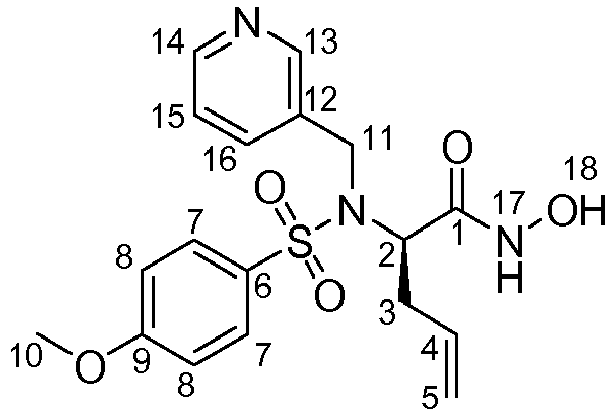
- According to the general procedure tert-butyl (R)-N-(4-methoxyphenyl-sulfonyl)-N-(3-pyridylmethyl)-2-aminopent-4-enhydroxamate (100 mg, 0.22 mmol) was hydrolyzed in trifluoroacetic acid (25 mL). After workup, the product was isolated as white, highly viscos liquid. HPLC showed 97 % purity of the product. Yield: 33 mg (38 %). 1 H NMR (400 MHz, CD3CN): δ 2.15 (dt, 2 J H,H = 14.1 Hz, 3 J H,H = 6.9 Hz, 1 H, 3-CHA), 2.46 (dt, 2 J H,H = 14.1 Hz, 3 J H,H = 7.6 Hz, 1 H, 3-CHB), 3.84 (s, 3 H, 10-CH3), 4.29 (t, 3 J H,H = 7.6 Hz, 1 H, 2-CH), 4.60 (d, 2 J H,H = 16.7 Hz, 1 H, 11-CHA), 4.72 (d, 2 J H,H = 16.7 Hz, 1 H, 11-CHB), 4.93 (s, 1 H, 5-CHA), 4.96 (d, 3 J H,H = 4.5 Hz, 1 H, 5-CHB), 5.48 (ddt, 3 J H,H = 16.8 Hz, 3 J H,H = 9.6 Hz, 3 J H,H = 6.9 Hz, 1 H, 4-CH), 7.00 (d, 3 J H,H = 8.7 Hz, 2 H, 7-CH), 7.29 (dd, 3 J H,H = 7.8 Hz, 3 J H,H = 4.8 Hz, 1 H, 15-CH), 7.70 (d, 3 J H,H = 8.9 Hz, 2 H, 8-CH), 7.79 (m, 1 H, 16-CH), 8.41 (d, 3 J H,H = 4.4 Hz, 1 H, 14-CH), 8.52 (s, 1 H, 13-CH). 13 C NMR (100 MHz, CD3CN): □ 35.2 (t, C-3), 46.8 (t, C-11), 56.6 (q, C-10), 58.0 (d, C-2), 115.4 (d, C-7), 119.1 (t, C-5), 124.5 (d, C-15), 130.5 (d, C-8), 132.1 (d, C-4), 134.0 (s, C-12), 135.8 (s, C-6), 137.5 (d, C-16), 148.6 (d, C-14), 149.7 (d, C-13), 164.4 (s, C-9), 167.3 (s, C-1). Exact mass (ESI+): C18H21N3O5S + H+, calcd. 392.1280, found 392.1275. MS (ESI+, daughter ion experiment): m/z (%) 392 (30) [M+ + H+], 331 (35) [M+ - CONHOH], 279 (8) [C13H15N2O3S+], 240 (20) [331 - C5H4N], 171 (100) [C7H7O3S+], 161 (55) [C10H13N2 +], 124 (27) [C7H8O2 +], 107 (11) [C7H7O+], 92 (42) [C6H6N+].
-

- According to the general procedure tert-butyl (S)-N-(4-methoxyphenyl-sulfonyl)-N-(3-pyridylmethyl)-2-amino-4-fluorobutanhydroxamate (131 mg, 0.29 mmol) was hydrolyzed in trifluoroacetic acid (25 mL). After workup, the product was isolated as white, highly viscos liquid. Purification by preparative HPLC delivered a product of 95 % purity. Yield: 49 mg (42 %). 1 H NMR (600 MHz, CD3CN): δ 1.76 (m, 3 J H,F = 23.7 Hz, 1 H, 3-CHA), 2.14 (ddd, 3 J H,F = 29.1 Hz, 2 J H,H = 11.8 Hz, 3 J H,H = 6.1 Hz, 1 H, 3-CHB), 3.85 (s, 3 H, 9-CH3), 4.20 - 4.42 (m, 2 H, 4-CH2F), 4.48 (dd, 3 J H,H = 8.9 Hz, 3 J H,H = 6.1 Hz, 1 H, 2-CH), 4.76 (d, 2 J H,H = 17.1 Hz, 1 H, 10-CHA), 4.81 (d, 2 J H,H = 17.1 Hz, 1 H, 10-CHB), 7.01 (d, 3 J H,H = 8.9 Hz, 2 H, 6-CH), 7.68 (d, 3 J H,H = 8.9 Hz, 2 H, 7-CH), 7.88 (dd, 3 J H,H = 8.1 Hz, 3 J H,H = 5.7 Hz, 1 H, 14-CH), 8.43 (d, 3 J H,H = 7.7 Hz, 1 H, 15-CH), 8.58 (d, 3 J H,H = 5.3 Hz, 1 H, 12-CH), 8.74 (s, 1 H, 13-CH). 13 C NMR (150 MHz, CD3CN): δ 31.3 (dt, 2 J C,F = 20.0 Hz, C-3), 46.1 (t, C-10), 55.0 (dd, 3 J C,F = 3.6 Hz, C-2), 56.78 (q, C-9), 81.4 (dt, 1 J C,F = 164.2 Hz, C-4), 115.7 (d, C-6), 127.6 (d, C-14), 130.2 (d, C-7), 131.4 (s, C-5), 140.4 (s, C-11), 141.2 (d, C-12), 142.3 (d, C-13), 146.1 (d, C-15), 164.7 (s, C-8), 167.3 (s, C-1). 19 F NMR (564 MHz, CD3CN): δ -221.4 (tdd, 2 J H,F = 47.1 Hz, 3 J H,F = 29.0 Hz, 3 J H,F = 23.7 Hz, 4-CH2F). Exact mass (ESI+): C17H20FN3O5S+ + H+, calcd. 398.1186, found 398.1181. C17H20FN3O5S+ + Na+, calcd. 420.1105, found 420.0999; (C17H20FN3O5S+)2 + H+, calcd. 795.2294, found 795.2300; (C17H20FN3O5S+)2 + Na+, calcd. 817.2113, found 817.2116. MS (ESI+, daughter ion experiment): m/z (%)398 (10) [M+ + H+], 337 (16) [M+ - CONHOH], 171 (100) [C7H7O3S+], 167 (30) [337 - C7H7O3S], 135 (16) [C8H11N2 +], 123 (22) [C7H7O2+], 107 (5) [C7H7O+], 92 (52) [C6H6N+].
-

- According to the general procedure tert-butyl (R)-N-(4-methoxyphenyl-sulfonyl)-N-(3-pyridylmethyl)-2-amino-4-fluorobutanhydroxamate (104 mg, 0.23 mmol) was hydrolyzed in trifluoroacetic acid (25 mL). After workup, the product was isolated as white, highly viscos liquid. Purification by preparative HPLC delivered a product of 95 % purity. Yield: 45 mg (49 %). 1 H NMR (400 MHz, CD3CN): δ 1.67 (m, 1 H, 3-CHA), 2.13 (m, 1 H, 3-CHB), 3.86 (s, 3 H, 9-CH3), 4.17 - 4.46 (m, 2 H, 4-CH2F), 4.49 (dd, 3 J H,H = 8.8 Hz, 3 J H,H = 6.1 Hz, 1 H, 2-CH), 4.75 (d, 2 J H,H = 17.3 Hz, 1 H, 10-CHA), 4.86 (d, 2 J H,H = 17.3 Hz, 1 H, 10-CHB), 7.04 (d, 3 J H,H = 9.0 Hz, 2 H, 6-CH), 7.71 (d, 3 J H,H = 9.0 Hz, 2 H, 7-CH), 7.92 (dd, 3 J H,H = 8.0 Hz, 3 J H,H = 5.9 Hz, 1 H, 14-CH), 8.50 (d, 3 J H,H = 8.2 Hz, 1 H, 15-CH), 8.59 (d, 3 J H,H = 5.6 Hz, 1 H, 13-CH), 8.75 (s, 1 H, 12-CH). 13 C NMR (100 MHz, CD3CN): δ [ppm] 31.5 (dt, 2 J C,F = 20.1 Hz, C-3), 46.2 (t, C-10), 55.0 (dd, 3 J C,F = 3.4 Hz, C-2), 56.7 (q, C-9), 81.3 (dt, 1 J C,F = 164.2 Hz, C-4), 115.7 (d, C-6), 127.9 (d, C-14), 130.6 (d, C-7), 131.3 (s, C-5), 140.8 (s, C-11), 141.2 (s, C-13), 142.1 (s, C-12), 146.7 (s, C-15), 164.8 (s, C-8), 167.3 (s, C-1). 19 F NMR (282 MHz, CD3CN): δ [ppm] -222.2 (tdd, 2 J H,F = 47.2 Hz, 3 J H,F = 31.5 Hz, 3 J H,F = 22.3 Hz, 4-CH2F). Exact mass (ESI+): C17H20N3O5S + H+, calcd. 398.1186, found 398.1171; C17H20N3O5S + Na+, calcd. 420.1005, found 420.0990; (C17H20N3O5S)2 + H+, calcd. 795.2294, found 871.3691; (C17H20N3O5S)2 + Na+, calcd.817.2113, found 893.3507. MS (ESI+, daughter ion experiment): m/z (%) 398 (60) [M+ + H+], 337 (100) [M+ - CONHOH], 317 (7) [337 - HF], 246 (6), 171 (20) [C7H7O3S+].
-

- According to the general procedure tert-butyl (S)-N-(4-methoxyphenyl-sulfonyl)-N-(3-pyridylmethyl)-2-amino-4-fluoropent-4-enhydroxamate (107 mg, 0.23 mmol) was hydrolyzed in trifluoroacetic acid (25 mL). After workup, the product was isolated as white, highly viscos liquid. Purification by preparative HPLC delivered a product of 97 % purity. Yield: 62 mg (66 %).1 H NMR (400 MHz, CD3CN): δ 2.35 (ddd, 3 J H,F = 18.1 Hz, 2 J H,H = 14.9 Hz, 3 J H,H = 6.6 Hz, 1 H, 3-CHA), 2.74 (ddd, 3 J H,F = 18.9 Hz, 2 J H,H = 14.8 Hz, 3 J H,H = 8.4 Hz, 1 H, 3-CHB), 3.85 (s, 3 H, 10-CH3), 4.34 (dd, 3 J H,F = 50.3 Hz, 2 J H,H = 3.3 Hz, 1 H, 5-CH trans ), 4.56 (dd, 3 J H,F = 17.3 Hz, 2 J H,H = 3.3 Hz, 1 H, 5-CH cis ), 4.57 (dd, 3 J H,H = 8.2 Hz, 3 J H,H = 6.5 Hz, 1 H, 2-CH), 4.81 (s, 2 H, 11-CH2), 7.01 (d, 3 J H,H = 9.0 Hz, 2 H, 7-CH), 7.66 (d, 3 J H,H = 9.0 Hz, 2 H, 8-CH), 7.86 (dd, 3 J H,H = 8.0 Hz, 3 J H,H = 5.8 Hz, 1 H, 15-CH), 8.41 (d, 3 J H,H = 8.2 Hz, 1 H, 16-CH), 8.59 (d, 3 J H,H = 5.5 Hz, 1 H, 14-CH), 8.73 (s, 1 H, 13-CH). 13 C NMR (100 MHz, CD3CN): δ 33.2 (dt, 2 J C,F = 28.0 Hz, C-3), 46.1 (t, C-11), 55.5 (d, C-2), 56.7 (q, C-10), 94.5 (dt, 2 J C,F = 18.7 Hz, C-5), 115.7 (d, C-7), 127.5 (d, C-15), 130.5 (d, C-8), 131.5 (s, C-6), 140.1 (s, C-12), 141.4 (d, C-14), 142.6 (d, C-13), 145.7 (d, C-16), 162.5 (ds, 1 J C,F = 255.6 Hz, C-4), 164.7 (s, C-9), 166.8 (s, C-1). 19 F NMR (282 MHz, CD3CN): δ -97.3 (ddd, 3 J H,F = 50.2 Hz, 3 J H,F = 18.2 Hz, 3 J H,F = 17.7 Hz, 4-CF). Exact mass (ESI+): C18H20FN3O5S+ + H+, calcd. 410.1186, found 410.1174; (C18H20FN3O5S+)2 + H+, caldc. 819.2294, found 819.2278; (C18H20FN3O5S+)2 + Na+, calcd. 841.2113, found 841.2096. MS (ESI+, daughter ion experiment): m/z (%) 410 (5) [M+ + H+], 349 (11) [M+ - CONHOH], 179 (23) [349 - C7H7O3S+], 171 (100) [C7H7O3S+], 135 (18) [C8H11N2 +], 123 (20) [C7H7O2 +], 92 (50) [C6H6N+].
-

- According to the general procedure tert-butyl (R)-N-(4-methoxyphenylsulfonyl)-N-(3-pyridylmethyl)-2-amino-4-fluoropent-4-enhydroxamate (112 mg, 0.24 mmol) was hydrolyzed in trifluoroacetic acid (25 mL). After workup, the product was isolated as white, highly viscos liquid. Purification by preparative HPLC delivered a product of 97 % purity. Yield: 57 mg (58 %): 1 H NMR (300 MHz, CD3CN): δ 2.35 (ddd, 3 J H,F = 18.1 Hz, 2 J H,H = 14.9 Hz, 3 J H,H = 6.7 Hz, 1 H, 3-CHA), 2.74 (ddd, 3 J H,F = 18.6 Hz, 2 J H,H = 14.8 Hz, 3 J H,H = 8.3 Hz, 1 H, 3-CHB), 3.86 (s, 3 H, 10-CH3), 4.34 (dd, 3 J H,F = 50.3 Hz, 2 J H,H = 3.2 Hz, 1 H, 5-CH trans ), 4.56 (dd, 3 J H,F = 17.3 Hz, 2 J H,H = 3.2 Hz, 1 H, 5-CH cis ), 4.59 (t, 3 J H,H = 7.5 Hz, 1 H, 2-CH), 4.79 (d, 2 J H,H = 17.5 Hz, 1 H, 11-CHA), 4.86 (d, 2 J H,H = 17.5 Hz, 1 H, 11-CHB), 7.01 (d, 3 J H,H = 9.0 Hz, 2 H, 7-CH), 7.68 (d, 3 J H,H = 9.0 Hz, 2 H, 8-CH), 7.89 (dd, 3 J H,H = 8.0 Hz, 3 J H,H = 5.8 Hz, 1 H, 15-CH), 8.45 (d, 3 J H,H = 8.1 Hz, 1 H, 16-CH), 8.59 (d, 3 J H,H = 5.5 Hz, 1 H, 14-CH), 8.74 (s, 1 H, 13-CH). 13 C NMR (75 MHz, CD3CN): δ 33.2 (dt, 2 J C,F = 27.9 Hz, C-3), 46.1 (t, C-11), 55.4 (d, C-2), 56.7 (q, C-10), 94.5 (dt, 2 J C,F = 18.6 Hz, C-5), 115.7 (d, C-7), 127.6 (d, C-15), 130.6 (d, C-8), 131.3 (s, C-6), 140.4 (s, C-12), 141.2 (d, C-14), 142.2 (d, C-13), 146.1 (d, C-16), 162.4 (ds, 1 J C,F = 255.5 Hz, C-4), 164.7 (s, C-9), 166.8 (s, C-1). 19 F NMR (282 MHz, CD3CN): δ -97.3 (ddd, 3 J H,F = 50.3 Hz, 3 J H,F = 18.2 Hz, 3 J H,F = 17.5 Hz, 4-CF). Exact mass (ESI+): C18H20FN3O5S+ + H+, calcd. 410.1186, found 410.1174; C18H20FN3O5S+ + Na+, calcd. 432.1005, found 432.0991; (C18H20FN3O5S+)2 + H+:, calcd. 819.2294, found 819.2278; (C18H20FN3O5S+)2 + Na+, calcd. 841.2113, found 841.2103. MS (ESI+, daughter ion experiment): m/z (%)410 (6) [M+ + H+], 349 (10) [M+ - CONHOH], 179 (22) [349 - C7H7O3S+], 171 (100) [C7H7O3S+], 135 (18) [C8H11N2 +], 123 (22) [C7H7O2 +], 92 (50) [C6H6N+].
- The tert-butyl 4-fluoro-2-aminopent-4-enecarboxylate is dissolved in pyridine and treated with 1 equivalent of p-(2-halogenethoxy)phenylsulfonyl chloride under stirring at 0 °C. The reaction mixture is allowed to warm up to r.t. and stirred for 40 h. Then the mixture is diluted with dichloromethane and the organic solution is washed with 0.5 N HCl, water (2 times each) and saturated aqueous sodium chloride. After drying with magnesium sulfate the solvent was removed in vacuum. The product is passed through a short pad of silica gel and recrystallized from ethyl acetate/cyclohexane. The products are isolated as white crystalline solids.
-

- To a cooled solution (0 °C) of 2-fluoroethanol (21.1 mL, 22.99 g, 359 mmol) in pyridine (150 mL) 4-methylbenzene-1-sulfonyl chloride (1.1 eq., 75,3 g, 394 mmol) was added and the reaction mixture was stirred at room temperature for 2 d. Subsequently the mixture was diluted with acidified ice-water (600 mL water, 100 mL concentrated HCl) and extracted with chloroform (3 × 100 mL). The combined organic phases were washed with water and brine (100 mL) and the solvent was removed under reduced pressure. Column chromatographic purification (silica gel, cyclohexane/ethyl acetate 2:1) gave a yellow oil. Yield: 29.46 g (38%). 1H NMR (300 MHz, CDCl3) δ 7.81 (d, 3 J H,H= 8.4 Hz, PhH, 2H), 7.36 (d, 3 J H,H= 8.6 Hz, PhH, 2H), 4.57 (dm, 2 J H,F = 47.1 Hz, CH 2F, 2H), 4.26 (dm, 3 J H,F= 27.3 Hz, CH 2CH2F, 2H) 2.45 (s, SO2PhCH 3, 3H). 13C NMR (75 MHz, CDCl3) δ 145.13 (qPhCCH3), 132.51 (OSO2CPh), 129.89 (PhCH), 127.91 (PhCH), 80.50 (d, 1 J C,F = 173.6 Hz, CH2F), 68.45 (d, 2 J C,F = 20.9 Hz, CH2CH2F), 21.61 (SO2PhCH3). 19F NMR (282 MHz, CDCl3) δ -224.68 (tt, 2 J H,F= 47.1 Hz, 3 J H,F = 27.3 Hz, 1 F). MS-ES(+)-EM: m/z = 241.0293 [(M+Na)+] calcd for C9H11FO3SNa+: 241.0305.
-

- To a solution of phenol (10.75 g, 114 mmol) and 2-fluoroethyl 4-methylbenzenesulfonate (
KR 2, 24.93 g, 114 mmol) in water (125 mL) NaOH (52.5 g) Tetraoctylammoniumbromid (1.5 g) was added and the mixture was heated to reflux for 16 h. The reaction mixture was diluted with ethyl acetate (100 ml) and the precipitated solid was removed by filtration. The organic layer was washed with 1 N aqueous NaOH, water and brine, dried over MgSO4 and the solvent was removed under reduced pressure. After column chromatographic purification (silica gel, cyclohexane/ethyl acetate 9:1) the product was obtained as a yellow oil. Yield: 10.04 g (63%). 1H NMR (300 MHz, CDCl3) δ 7.43 - 7.19 (m, PhH, 2H), 7.09 - 6.85 (m, PhH, 3H), 4.77 (dm, 2 J H,F= 47.4 Hz, CH 2F, 2H), 4.23 (dm, 3 J H,F= 27.9 Hz, CH 2CH2F, 2H). 13C NMR (75 MHz, CDCl3) δ 158.30 (qPhCOCH2CH2), 129.47 (PhCH), 121.20 (PhCH), 114.53 (PhCH), 81.91 (d, 1 J C,F = 170.5 Hz, CH2F), 66.93 (d, 2 J C,F = 20.5 Hz, CH2CH2F). 19F NMR (282 MHz, CDCl3) δ -223.89 (tt, 2 J H,F= 47.3 Hz, 3 J H,F = 27.6 Hz, 1 F). MS-ES(+)-EM: m/z = 163.0534 [(M+Na)+] calcd for C8H9FONa+: 163.0530. -

-


-

- Prepared from tert-butyl (S)-2-amino-4-fluoropent-4-enecarboxylate (892 mg, 4.7 mmol) with p-(2-fluoroethoxy)-phenylsulfonylchloride (1130 mg, 4.7 mmol). Yield: 1.18 g (64 %). M.p. 102 °C (EtOAc/Cy). 1H NMR (300 MHz, CDCl3): δ = 7.79 (dm, 3 J H,H = 9.0 Hz, 2H, 8-CH), 6.99 (dm, 3 J H,H = 9.0 Hz, 2H, 7-CH), 5.37 (d, 3 J H,H = 9.0 Hz, 1H, 14-NH), 4.77 (dm, 2 J H,F = 47.5 Hz, 2H, 11-CH2), 4.64 (dd, 3 J H,F = 17.1 Hz, 2 J H,H = 3.1 Hz, 1H, 5-CH cis ), 4.35 (dd, 3 J H,F = 49.3 Hz, 2 J H,H = 3.1 Hz, 1H, 5-CH trans ), 4.26 (dm, 3 J H,F = 27.7 Hz, 2H, 10-CH2), 3.98 (dt, 3 J H,H = 8.8 Hz, 3 J H,H = 5.8 Hz, 1H, 2-CH), 2.65 (d, 3 J H,H = 5.9 Hz, 1H, 3-CHA), 2.59 (dd, 3 J H,H = 5.7 Hz, 3 J H,H = 4.2 Hz, 1H, 3-CHB), 1.30 (s, 9H, 13-CH3). 13C NMR (75 MHz, CDCl3): δ = 169.2 (s, C-1), 161.8 (s, C-9), 160.9 (ds, 1 J C,F = 256.9 Hz, C-4), 131.9 (s, C-6), 129.5 (d, C-8), 114.7 (d, C-7), 94.1 (dt, 2 J C,F = 18.8 Hz, C-5), 83.2 (s, C-12), 81.5 (dt, 1 J C,F = 171.5 Hz, C-11), 67.4 (dt, 2 J C,F = 20.4 Hz, C-10), 53.2 (d, 3 J C,F = 1.0 Hz, C-2), 36.4 (dt, 2 J C,F = 27.6 Hz, C-3), 27.6 (q, C-13). 19F NMR (282 MHz, CDCl3): δ = -96.1 (ddt, 3 J H,F = 49.3 Hz, 3 J H,F = 20.4 Hz, 3 J H,F = 17.2 Hz, 4-CF), -224.3 (tt, 2 J H,F = 47.3 Hz, 3 J H,F = 27.7 Hz, 11-CH2F). Elemental analysis: C17H23F2NO5S (M = 391.43 g/mol). Calcd. C 52.16, H 5.92, N 3.58, found C 52.19, H 6.09, N 3.54 %. Optical rotation:

-


-

- Prepared from tert-butyl (S)-2-amino-4-fluoropent-4-enoate (1000 mg, 5.28 mmol) and p-(2-chlorethoxy)phenylsulfonylchloride (1350 mg 5.28 mmol). Yield: 1.58 g (73 %). 1H NMR (300 MHz, CDCl3): δ = 7.80 (dm, 3 J H,H = 9.0 Hz, 2H, 8-CH), 6.98 (dm, 3 J H,H = 9.0 Hz, 2H, 7-CH), 5.32 (d, 3 J H,H = 8.9 Hz, 1H, 14-NH), 4.64 (dd, 3 J H,F = 17.1 Hz, 2 J H,H = 3.0 Hz, 1H, 5-CH cis ), 4.35 (q, 3 J H,F = 49.4 Hz, 2 J H,H = 3.0 Hz, 2H, 5-CH trans ), 4.27 (t, 3 J H,H = 5.7 Hz, 2H, 10-CH2), 3.98 (dt, 3 J H,H = 9.0 Hz, 3 J H,H = 5.8 Hz, 1 H, 2-CH), 3.84 (t, 3 J H,H = 5.7 Hz, 2H, 11-CH2Cl), 2.65 (dd, 3 J H,H = 5.9 Hz, 1H, 3-CHA), 2.59 (m, 3 J H,H = 5.4 Hz, 1H, 3-CHB), 1.30 (s, 9H, 13-CH3). 13C NMR (75 MHz, CDCl3): δ = 169.2 (s, C-1), 161.6 (s, C-9), 160.9 (ds, 1 J C,F = 257.1 Hz, C-4), 132.0 (s, C-6), 129.5 (d, C-8), 114.7 (d, C-7), 94.2 (dt, 2 J C,F = 18.8 Hz, C-5), 83.2 (s, C-12), 68.2 (t, C-10), 53.2 (dd, 3 J C,F = 0.9 Hz, C-2), 41.5 (t, C-11), 36.5 (dt, 2 J C,F = 27.6 Hz, C-3), 27.6 (q, C-13). 19F NMR (282 MHz, CDCl3): δ = -96.1 (ddt, 3 J H,F = 49.4 Hz, 3 J H,F = 20.5 Hz, 3 J H,F = 17.1 Hz, 1 H). Elemental analysis: C17H23ClFNO5S (M = 407.88 g/mol), calcd. C 50.06, H 5.68, N 3.43, found C 49.90, H 5.53, N 3.38 %. Exact mass (ESI+): C17H23ClFNO5S + Na+, calcd. 430.0867, found 430.0856; (C17H23ClFNO5S)2 + Na+, calcd.837.1837, found 837.1835. Optical rotation:

- The N-substituted tert-butyl 2-amino-4-fluoropent-4-enoate dissolved in dimethylformamide is treated under stirring with 10 equivalents of potassium carbonate. After 20
min 1 equivalent of benzyl bromide is added and the mixture is stirred at r.t. for 40 h. Then water is added and the mixture is extracted with ethyl acetate (4 times). The combined organic extracts are washed with water (4 times), saturated sodium chloride solution and dried with magnesium sulfate. After removal of the solvent the crude product is purified chromatographically an (silica gel, Cy/EtOAc, 4:1). The products are obtained as colorless or yellowish viscos oils.
-

- Prepared from tert-butyl N-[p-(2-fluoroethoxy)phenylsulfonyl]aminopent-4-enoate (783 mg, 2 mmol), benzyl bromide (342 mg, 2 mmol) and potassium carbonate 2.8 g (20 mmol). Yield: 600 mg (63 %). 1H NMR (300 MHz, CDCl3): δ = 7.82 (dm, 3 J H,H = 9.0 Hz, 2H, 8-CH), 7.29 (m, 5H, 14-CH, 15-CH, 16-CH), 6.98 (dm, 3 J H,H = 9.0 Hz, 2H, 7-CH), 4.80 (dm, 2 J H,F = 47.1 Hz, 2H, 11-CH2), 4.66 (d, 2 J H,H = 16.3 Hz, 1 H, 12-CHA), 4.56 (t, 3 J H,H = 7.3 Hz, 1H, 2-CH), 4.53 (dd, 3 J H,F = 17.1 Hz, 2 J H,H = 2.9 Hz, 1H, 5-CHcis), 4.29 (d, 2 J H,H = 15.9 Hz, 2H, 12-CHB),4.27 (dm, 3 J H,F = 27.8 Hz, 2H, 10-CH2), 4.11 (dd, 3 J H,F = 49.8 Hz, 2 J H,H = 3.1 Hz, 1H, 5-CH trans ), 2.70 (dt, 3 J H,F = 15.4 Hz, 3 J H,H = 6.9 Hz, 1H, 3-CHA), 2.46 (ddd, 3 J H,F = 20.0 Hz, 2 J H,H = 15.1 Hz, 3 J H,H = 7.6 Hz, 1H, 3-CHB), 1.36 (s, 9H, 18-CH3). 13C NMR (75 MHz, CDCl3): δ = 168.5 (s, C-1), 161.9 (ds, 1 J C,F = 256.5 Hz, C-4), 161.7 (s, C-9), 136.7 (s, C-13), 132.5 (s, C-6), 129.9 (d, C-8), 128.5 (d, C-14 o. C-15), 128.4 (d, C-14 o. C-15), 127.7 (d, C-16), 114.6 (d, C-7), 93.1 (dt, 2 J C,F = 19.1 Hz, C-5), 82.6 (s, C-17), 81.5 (dt, 1 J C,F = 171.7 Hz, C-11), 67.4 (dt, 2 J C,F = 20.5 Hz, C-10), 57.6 (d, C-2), 50.0 (t, C-12), 34.1 (dt, 2 J C,F = 27.9 Hz, C-3), 27.8 (q, C-18). 19F NMR (282 MHz, CDCl3): δ = -97.7 (m, 3 J H,F = 49.8 Hz, 3 J H,F = 20.0 Hz, 3 J H,F = 17.0 Hz, 4-CF), -224.3 (tt, 2 J H,F = 47.3 Hz, 3 J H,F = 27.6 Hz, 11-CH2F). Exact mass (ESI+): C24H29F2NO5S + Na+, calcd. 504.1632, found 504.1615; (C24H29F2NO5S)2 + Na+, calcd.985.3367, found 985.3348. Optical rotation:

-


-

- Prepared from tert-butyl N-[p-(2-chloroethoxy)phenylsulfonyl]-2-amino-4-fluoropent-4-enoate (816 mg 2.0 mmol), benzyl bromide (342 mg, 2.0 mmol) and potassium carbonate 2.8 g (20.0 mmol). Yield: 580 mg (58 %). 1H NMR (300 MHz, CDCl3): δ = 7.82 (dm, 3 J H,H = 8.9 Hz, 2H, 8-CH), 7.29 (m, 5H, 14-CH, 15-CH, 16-CH), 6.96 (dm, 3 J H,H = 9.0 Hz, 2H, 7-CH), 4.65 (d, 2 J H,H = 15.8 Hz, 1H, 12-CHA), 4.56 (t, 3 J H,H = 7.3 Hz, 1H, 2-CH), 4.53 (dd, 3 J H,F = 17.2 Hz, 2 J H,H = 2.9 Hz, 1H, 5-C cis ), 4.29 (d, 2 J H,H = 15.7 Hz, 1H, 12-CHB), 4.27 (t, 3 J H,H = 5.6 Hz, 1H, 10-CH2), 4.11 (dd, 3 J H,F = 49.9 Hz, 2 J H,H = 3.0 Hz, 1H, 5-CH trans ), 3.84 (t, 3 J H,H = 5.7 Hz, 2H, 11-CH2Cl), 2.70 (td, 2 J H,H = 15.4 Hz, 3 J H,H = 7.0 Hz, 1H, 3-CHA), 2.46 (ddd, 3 J H,F = 20.0 Hz, 2 J H,H = 15.2 Hz, 3 J H,H = 7.6 Hz, 1H, 3-CHB), 1.36 (s, 9H, 18-CH3)- 13C NMR (75 MHz, CDCl3): δ = 168.5 (s, C-1), 161.9 (ds, 1 J C,F = 256.5 Hz, C-4), 161.5 (s, C-9), 136.7 (s, C-13), 132.6 (s, C-6), 129.9 (d, C-8), 128.5 (d, C-14 o. C-15), 128.4 (d, C-14 o. C-15), 127.7 (d, C-16), 114.6 (d, C-7), 93.1 (dt, 2 J C,F = 18.9 Hz, C-5), 82.6 (s, C-17), 68.2 (t, C-10), 57.6 (d, C-2), 49.9 (t, C-12), 41.5 (t, C-11), 34.1 (dt, 2 J C,F = 28.2 Hz, C-3), 27.8 (q, C-18). 19F NMR (282 MHz, CDCl3): δ = -97.7 (ddt, 3 J H,F = 49.9 Hz, 3 J H,F = 19.9 Hz, 3 J H,F = 16.4 Hz, 4-CF). Exact mass (ESI+): C24H29ClFNO5S + Na+, calcd. 520.1337, found 520.1314; (C24H29ClFNO5S)2 + Na+, calcd. 1017.2776 , found 1017.2708. Optical rotation:

-

- Prepared from tert-butyl N-[p-(2-chloroethoxy)phenylsulfonyl]-2-amino-4-fluoropent-4-enoate (1.50 g, 3.68 mmol), benzyl bromide (630 mg, 3.68 mmol) and potassium carbonate (5.0 g, 36.8 mmol). Yield: 1.28 g (70 %). 1H NMR (300 MHz, CDCl3): δ = 7.82 (dm, 3 J H,H = 9.0 Hz, 2H, 8-CH), 7.28 (m, 5H, 14-CH, 15-CH, 16-CH), 6.96 (dm, 3 J H,H = 9.0 Hz, 2H, 7-CH), 4.66 (d, J=15.8, 1H, 12-CHA), 4.56 (m, 1H, 2-CH), 4.53 (dd, J=17.1 Hz, 3.0 Hz, 2H, 5-CHcis), 4.29 (d, J=15.7 Hz, 1 H, 12-CHB), 4.28 (t, J=5.6 Hz, 2H, 10-CH2), 4.11 (dd, J=49.9 Hz, 3.0 Hz, 1H, 5-CH trans ), 3.83 (t, J=5.8 Hz, 2H, 11-CH2Cl), 2.70 (td, J=15.4 Hz, 6.9 Hz, 1H, 3-CHA), 2.46 (ddd, J=20.1 Hz, 15.2 Hz, 7.6 Hz, 1H, 3-CHB), 1.36 (s, 9H, 18-CH3). 13C NMR (75 MHz, CDCl3): δ = 168.6 (s, C-1), 161.9 (ds, 1 J C,F = 256.3 Hz, C-4), 161.5 (s, C-9), 136.7 (s, C-13), 132.7 (s, C-6), 129.9 (d, C-8), 128.5 (d, C-14 o. C-15), 128.4 (d, C-14 o. C-15), 127.8 (d, C-16), 114.6 (d, C-7), 93.1 (dt, 2 J C,F = 19.1 Hz, C-5), 82.6 (s, C-17), 68.2 (t, C-10), 57.6 (d, C-2), 50.0 (t, C-12), 41.5 (t, C-11), 34.1 (dt, 2 J C,F = 27.9 Hz, C-3), 27.8 (q, C-18). 19F NMR (282 MHz, CDCl3): δ = -97.7 (m, 3 J H,F = 49.9 Hz, 3 J H,F = 19.9 Hz, 3 J H,F = 16.7 Hz, 4-CF). Exact mass (ESI+): C24H29ClFNO5S + Na+, calcd. 520.1337, found 520.1326; (C24H29ClFNO5S)2 + Na+, calcd. 1017.2776, found 1017.2748. Optical rotation:

- In a dried YOUNG-tube the amino acid tert-butylester is dissolved in dry dichloromethane (20 mL/mmol) under argon and treated with trifluoroacetic acid (20 mL/mmol). The YOUNG-tube is flushed with argon and sealed. The mixture is stirred at r.t. for 3-4 h. Subsequently the reaction mixture is evaporated to dryness in vacuum. The residue is dissolved in chloroform (100 mL/mmol) and washed with an aqueous solution of citric acid and sodium bicarbonate (25 mL/mmol, pH ≈ 4). The aqueous phase is extracted with chloroform (4 × 30 mL/mmol) and the combined organic phases are dried with magnesium sulfate. After evaporation of the solvent the crude products are obtained as colorless, viscos oils, which in high vacuum solidified. These products were used for the next step without purification.

-
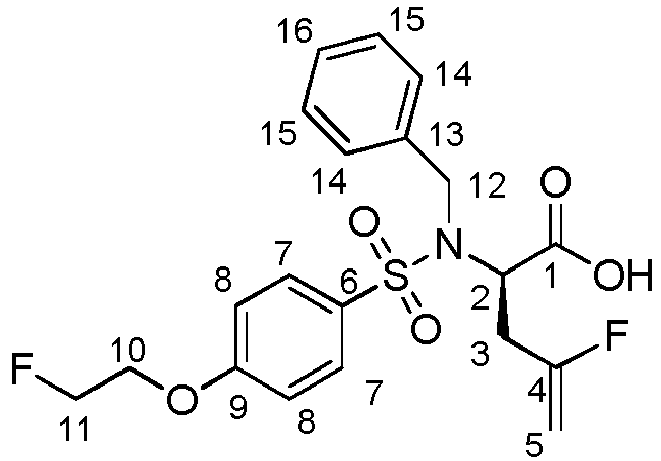
- Prepared from tert-butyl N-benzyl-N-[p-(2-fluoroethoxy)phenylsulfonyl]-2-amino-4-fluoropent-4-enoate (300 mg 0.7 mmol). 1H NMR (300 MHz, CD3CN): δ = 7.78 (dm, 3 J H,H = 9.0 Hz, 2H, 8-CH), 7.30 (m, 5H, 14-CH, 15-CH, 16-CH), 7.04 (dm, 3 J H,H = 9.0 Hz, 2H, 7-CH), 4.76 (dm, 2 J H,F = 47.7 Hz, 2H, 11-CH2), 4.65 (dd, 3 J H,H = 8.5 Hz, 3 J H,H = 6.0 Hz, 1H, 2-CH), 4.57 (d, 2 J H,H = 16.1 Hz, 1H, 12-CHA), 4.52 (dd, 3 J H,F = 17.8 Hz, 2 J H,H = 3.0 Hz, 1H, 5-CH cis ), 4.33 (d, 2 J H,H = 16.1 Hz, 1H, 12-CHB),4.29 (dm, 3 J H,F = 29.5 Hz, 2H, 10-CH2), 4.14 (dd, 3 J H,F = 51.5 Hz, 2 J H,H = 3.5 Hz, 1H, 5-CH trans ), 2.76 (ddd, 3 J H,F = 14.8 Hz, 2 J H,H = 13.7 Hz, 3 J H,H = 6.0 Hz, 1H, 3-CHA), 2.48 (ddd, 3 J H,F = 22.3 Hz, 2 J H,H = 15.4 Hz, 3 J H,H = 8.5 Hz, 1H, 3-CHB). 13C NMR (75 MHz, CD3CN): δ = 171.2 (s, C-1), 163.2 (ds, 1 J C,F = 254.7 Hz, C-4), 163.1 (s, C-9), 138.2 (s, C-13), 133.0 (s, C-6), 131.0 (d, C-8), 129.6 (d, C-14 o. C-15), 129.3 (d, C-14 o. C-15), 128.7 (d, C-16), 115.7 (d, C-7), 93.8 (dt, 2 J C,F = 18.9 Hz, C-5), 83.1 (dt, 1 J C,F = 167.3 Hz, C-11), 68.8 (dt, 2 J C,F = 19.4 Hz, C-10), 57.9 (d, C-2), 50.8 (t, C-12), 34.1 (dt, 2 J C,F = 28.2 Hz, C-3). 19F NMR (282 MHz, CD3CN): δ = -97.7 (dddd, 3 J H,F = 51.0 Hz, 3 J H,F = 22.1 Hz, 3 J H,F = 17.7 Hz, 3 J H,F = 13.4 Hz, 4-CF), -224.0 (tt, 2 J H,F = 47.7 Hz, 3 J H,F = 29.5 Hz, 11-CH2F). Exact mass (ESI+): C20H31F2NO5S + Na+, calcd. 448.1006, found 448.1004, (C20H31F2NO5S)2 + Na+, calcd. 873.2115, found 873.2116. Exact mass (ESI-): C20H31F2NO5S - H+, calcd. 424.1036, found 424.1057, (C20H31F2NO5S)2 - H+, calcd. 849.2144, found 849.2152.
-

- Prepared from tert-butyl N-benzyl-N-[p-(2-fluoroethoxy)phenylsulfonyl]-2-amino-4-fluoropent-4-enoate (400 mg, 0.94 mmol). The product is contaminated with some starting material. 1H NMR (300 MHz, CD3CN): δ = 7.78 (dm, 3 J H,H = 9.1, 2H, 8-CH), 7.29 (m, 5H, 14-CH, 15-CH, 16-CH), 7.04 (dm, 3 J H,H = 9.0, 2H, 7-CH), 4.75 (dm, 2 J H,F = 47.7 Hz, 2H, 11-CH2), 4.65 (dd, 3 J H,H = 8.5, 3 J H,H = 6.0, 1 H, 2-CH), 4.57 (d, 2 J H,H = 16.1, 1H, 12-CHA), 4.52 (dd, 3 J H,F = 17.6, 2 J H,H = 3.0, 1H, 5-CH cis ), 4.32 (d, 2 J H,H = 16.1, 1 H, 12-CHB), 4.30 (dm, 3 J H,F = 29.4 Hz, 2H, 10-CH2), 4.14 (dd, 3 J H,F = 51.8, 2 J H,H = 3.4, 1 H, 5-CH trans ), 2.76 (ddd, 3 J H,F = 14.7, 2 J H,H = 13.7, 3 J H,H = 6.0, 1H, 3-CHA), 2.47 (ddd, 3 J H,F = 22.2, 2 J H,H = 15.4, 3 J H,H = 8.5, 1H, 3-CHB). 13C NMR (75 MHz, CD3CN): δ = 171.2 (s, C-1), 163.2 (ds, 1 J C,F = 254.7 Hz, C-4), 163.1 (s, C-9), 138.2 (s, C-13), 133.0 (s, C-6), 131.0 (d, C-8), 129.6 (d, C-14 o. C-15), 129.3 (d, C-14 o. C-15), 128.7 (d, C-16), 115.7 (d, C-7), 93.8 (dt, 2 J C,F = 18.9 Hz, C-5), 83.1 (dt, 1 J C,F = 167.5 Hz, C-11), 68.8 (dt, 2 J C,F = 19.2 Hz, C-10), 57.9 (d, C-2), 50.8 (t, C-12), 34.2 (dt, 2 J C,F = 28.0 Hz, C-3). 19F NMR (282 MHz, CD3CN): δ = -97.7 (dddd, 3 J H,F = 50.9 Hz, 3 J H,F = 22.1 Hz, 3 J H,F = 17.7 Hz, 3 J H,F = 13.3 Hz, 4-CF), -224.0 (tt, 2 J H,F = 47.7 Hz, 3 J H,F = 29.5 Hz, 11-CH2F). Exact mass (ESI+): C20H31F2NO5S + Na+, calcd. 448.1006, found 448.1009; Exact mass (ESI-): C20H31F2NO5S - H+, calcd. 424.1036, found 424.1057, (C20H31F2NO5S)2 - H+, calcd. 849.2144, found 849.2157.
-

- Prepared from tert-butyl N-benzyl-N-[p-(2-chloroethoxy)phenylsulfonyl]-2-amino-4-fluoropent-4-enoate (300 mg, 0.68 mmol). 1H NMR (300 MHz, CD3CN): δ = 7.78 (d, 3 J H,H = 9.1 Hz, 2H, 8-CH), 7.29 (m, 5H, 14-CH, 15-CH, 16-CH), 7.03 (d, 3 J H,H = 9.1 Hz, 1H, 7-CH), 4.65 (dd, 3 J H,H = 8.5 Hz, 3 J H,H = 6.0 Hz, 1H, 2-CH), 4.57 (d, 2 J H,H = 16.1 Hz, 1H, 12-CHA), 4.52 (dd, 3 J H,F = 17.7 Hz, 2 J H,H = 3.2 Hz, 1H, 5-CH cis ), 4.33 (m, 2H, 10-CH2), 4.32 (d, 2 J H,H = 16.1 Hz, 1H, 12-CHB), 4.14 (dd, 3 J H,F = 50.9 Hz, 2 J H,H = 3.1 Hz, 1H, 5-CH trans ), 3.90 (m, 2H, 11-CH2Cl), 2.76 (ddd, 3 J H,F = 16.1 Hz, 2 J H,H = 14.2 Hz, 3 J H,H = 5.9 Hz, 2H), 2.47 (ddd, 3 J H,F = 22.3 Hz, 2 J H,H = 15.5 Hz, 3 J H,H = 8.6 Hz, 1H). 13C NMR (75 MHz, CD3CN): δ = 171.2 (s, C-1), 163.2 (d, 1 J C,F = 254.5 Hz, C-4), 162.9 (s, C-9), 138.2 (s, C-13), 133.1 (s, C-6), 131.0 (s, C-8), 129.6 (s, C-14 or C-15), 129.3 (s, C-14 or C-15), 128.7 (s, C-16), 115.7 (s, C-7), 93.8 (d, 2 J C,F = 18.9 Hz, C-5), 69.6 (s, C-10), 57.9 (s, C-2), 50.8 (s, C-12), 43.5 (s, C-11), 34.1 (d, 2 J C,F = 28.4 Hz, C-3). 19F NMR (282 MHz, CD3CN): δ = -97.7 (dddd, 3 J H,F = 51.0 Hz, 3 J H,F = 22.2 Hz, 3 J H,F = 17.7 Hz, 3 J H,F = 13.3 Hz, 4-CF).
-

- Prepared from tert-butyl N-benzyl-N-[p-(2-chloroethoxy)phenylsulfonyl]-2-amino-4-fluoropent-4-enoate (430 mg, 0.97 mmol). The crude product was directly used for the next step.
- The N,N-disubstituted α-amino acid (1 equivalent) is suspended in dichloromethane (15 mL/mmol). 1-Hydroxy-benzotriazol (HOBT, 1 equivalent) is added and the mixture is stirred for a short period of time. Then N-methylmorpholin (NMM, 5 equivalents) is added under stirring while the carboxylic acid dissolves. Subsequently, O-tert-butylhydroxylamine (3 aquivalents) is added and the solution is stirred for 5 min. After addition of 1-(3-dimethylaminopropyl)-3-ethylcarbodiimid-hydrochloride (EDC) (1.3 equivalents) the mixture is stirred at r.t. over night. The solution is washed with water (20 mL), and the aqueous phase is extracted with dichloromethane (3 × 20 mL). The combined organic phase is washed with brine (1 × 20 mL) and dried with magnesium sulfate. The solvent is evaporated and the crude product is purified by column chromatography (silica gel, Cy/EtOAc, 1:3). The silica gel has to be inactivated using the eluent mixture with 2 % of triethylamine. The products are obtained as highly viscose liquids, which on drying in high vacuum give amorphous solids.

-

- Prepared from N-benzyl-N-[p-(2-fluoroethoxy)phenylsulfonyl]-2-amino-4-fluoropent-4-ene carboxylic acid (191 mg, 0.45 mmol), HOPT (62 mg, 0.45 mmol), NMM (240 mg, 2.25 mmol), O-tert-butylhydroxylamine (175 mg, 1.35 mmol) and EDC (115 mg, 0.58 mmol). Yield: 147 mg (66 %). 1H NMR (300 MHz, CDCl3): δ = 8.54 (s, 1H, 17-NH), 7.69 (dm, 3 J H,H = 9.0 Hz, 2H, 8-CH), 7.29 (m, 5H, 14-CH, 15-CH, 16-CH), 6.95 (dm, 3 J H,H = 9.0 Hz, 2H, 7-CH), 4.77 (dm, 2 J H,F = 47.3 Hz, 2H, 11-CH2), 4.64 (d, 2 J H,H = 15.7 Hz, 1 H, 12-CHA), 4.54 (t, 3 J H,H = 7.2 Hz, 1H, 2-CH), 4.42 (dd, 3 J H,F = 17.1 Hz, 2 J H,H = 2.7 Hz, 2H, 5-CHcis), 4.42 (d, overlapped with dd at 4.42), 2 J H,H = 15.8 Hz, 1 H, 12-CHB) 4.25 (m, 3 J H,F = 27.8 Hz, 2H, 10-CH2), 4.05 (dd, 3 J H,F = 50.0 Hz, 2 J H,H = 3.0 Hz, 1 H, 5-CH trans ), 2.81 (ddd, 3 J H,F = 18.3 Hz, 2JH,H = 14.9 Hz, 3 J H,H = 7.6 Hz, 1H, 3-CHA), 2.32 (ddd, 3 J H,F = 19.1 Hz, 2 J H,H = 14.9 Hz, 3 J H,H = 7.0 Hz, 1 H, 3-CHB), 1.22 (s, 9H, 19-CH3). 13C NMR (75 MHz, CDCl3): δ = 167.0 (s, C-1), 161.9 (s, C-9), 161.3 (ds, 1 J C,F = 256.0 Hz, C-4), 136.5 (s, C-13), 131.7 (s, C-6), 129.6 (d, C-8), 128.7 (d, C-14 o. C-15), 128.5 (d, C-14 o. C-15), 127.8 (d, C-16), 114.7 (d, C-7), 93.7 (dt, 2 J C,F = 19.1 Hz, C-5), 82.3 (s, C-18), 81.4 (dt, 1 J C,F = 171.5 Hz, C-11), 67.3 (dt, 2 J C,F = 20.4 Hz, C-10), 55.0 (d, C-2), 48.6 (t, C-12), 32.4 (dt, 2 J C,F = 27.4 Hz, C-3), 26.1 (q, C-19). 19F NMR (282 MHz, CDCl3): δ = - 97.92 (m, 3JH,F = 50.1 Hz, 3JH,F = 18.4 Hz, 4-CF), -223.79 (tt, 2 J H,F = 47.3 Hz, 3JH,F = 27.8 Hz, 11-CH2F). Elemental analysis: C24H30F2N2O5S (M = 496.57 g/mol), calcd. C 58.05, H 6.09, N 5.64, found C 57.94, H 6.24, N: 5.57 %. Exact mass (ESI+): C24H30F2N2O5S + H+, calcd. 497.1922, found 497.1908; C24H30F2N2O5S + Na+, calcd. 519.1741, found 519.1733; (C24H30F2N2O5S)2 + Na+, calcd. 1015.3585, found 1015.3566. Optical rotation:

-

- Prepared from N-benzyl-N-[p-(2-fluorethoxy)phenylsulfonyl]-2-amino-4-fluoropent-4-enoic acid (206 mg, 0.483 mmol), HOPT (65 mg, 0.483 mmol), NMM (245 mg, 2.415 mmol), O-tert-butylhydroxylamine (182 mg, 1.450 mmol) and EDC (121 mg, 0.628 mmol). Yield: 200 mg (83 %). 1H NMR (300 MHz, CDCl3): δ = 8.46 (s, 1 H, 17-NH), 7.69 (dm, 3 J H,H = 8.9 Hz, 2H, 8-CH), 7.29 (m, 5H, 14-CH, 15-CH, 16-CH), 6.96 (dm, 3 J H,H = 9.0 Hz, 2H, 7-CH), 4.78 (dm, 2 J H,F = 47.4 Hz, 2H, 11-CH2), 4.64 (d, 2 J H,H = 15.7 Hz, 1H, 12-CHA), 4.54 (t, 3 J H,H = 7.2 Hz, 1H, 2-CH), 4.42 (dd, 3 J H,F = 17.1 Hz, 2 J H,H = 3.0 Hz, 2H, 5-CHcis), 4.40 (d, 2 J H,H = 15.6 Hz, 1H, 12-CHB) 4.27 (m, 3 J H,F = 27.6 Hz, 2H, 10-CH2), 4.05 (dd, 3 J H,F = 50.0 Hz, 2 J H,H = 3.0 Hz, 1H, 5-CH trans ), 2.821 (ddd, 3 J H,F = 18.5 Hz, 2JH,H = 14.9 Hz, 3 J H,H = 7.6 Hz, 1H, 3-CHA), 2.31 (ddd, 3 J H,F = 19.1 Hz, 2 J H,H = 14.9 Hz, 3 J H,H = 6.9 Hz, 1H, 3-CHB), 1.23 (s, 9H, 19-CH3). 13C NMR (75 MHz, CDCl3): δ = 167.0 (s, C-1), 161.9 (s, C-9), 161.3 (ds, 1 J C,F = 255.8 Hz, C-4), 136.5 (s, C-13), 131.9 (s, C-6), 129.6 (d, C-8), 128.8 (d, C-14 o. C-15), 128.6 (d, C-14 o. C-15), 128.0 (d, C-16), 114.8 (d, C-7), 93.7 (dt, 2 J C,F = 19.2 Hz, C-5), 82.4 (s, C-18), 81.4 (dt, 1 J C,F = 171.8 Hz, C-11), 67.4 (dt, 2 J C,F = 20.5 Hz, C-10), 55.1 (d, C-2), 48.7 (t, C-12), 32.4 (dt, 2 J C,F = 27.6 Hz, C-3), 26.2 (q, C-19). 19F NMR (282 MHz, CDCl3): δ = -98.51 (m, 3 J H,F = 50.3 Hz, 3 J H,F = 18.0 Hz, 4-CF), -224.35 (tt, 2 J H,F = 47.3 Hz, 3 J H,F = 27.8 Hz, 11-CH2F). Elemental analysis: C24H30F2N2O5S (M = 496.57 g/mol), calcd. C 58.05, H 6.09, N 5.64, found C 57.78, H 6.24, N 5.56 %. Exact mass (ESI+): C24H30F2N2O5S + H+: calcd. 497.1922, found 497.1917; C24H30F2N2O5S + Na+, calcd. 519.1741, found 519.1733; (C24H30F2N2O5S)2 + Na+, calcd. 1015.3585, found 1015.3564. Optical rotation:

-


-


- To a solution of carboxylic acid (100 mg, 0.235 mmol) in DMF (0.06 mmol/mL, 1 mL) 1-hydroxybenzotriazole hydrate (HOBT, 1.2 eq., 38 mg, 0.282 mmol), 4-methylmorpholine (NMM, 3.0 eq., 78 pL, 249.70 mmol), O-tetrahydro-2H-pyran-2-yl-hydroxylamine (3.1 eq., 85 mg, 0.729 mmol and N-[(dimethylamino)-propyl]-N'-ethylcarbodiimide hydrochloride (EDC, 1.4 eq., 63 mg, 0.329 mmol) were added. After stirring overnight at room temperature the reaction mixture was diluted with water (20 mL) and extracted with ethyl acetate (3 × 5 mL). The combined organic phases were washed successively with water, 5% aqueous KHSO4, saturated aqueous NaHCO3 and brine, and dried over magnesium sulfate. After removing the solvent under reduced pressure column chromatographic purification (silica gel, cyclohexane/ethyl acetate 2:1) yielded the THP-protected hydroxamic acid.
-

- Light brown wax; yield: 92 mg (75%). 1H NMR (300 MHz, CDCl3); δ 9.19 (s, NH, 1H), 9.15 (s, NH, 1 H), 7.77 (d, 3 J H,H = 8.9 Hz, PhH, 2H), 7.72 (d, 3 J H,H = 9.0 Hz, PhH, 2H), 7.39 - 7.21 (m, PhH, 5H), 6.98 (d, 3 J H,H = 9.0 Hz, PhH, 2H), 6.97 (d, 3 J H,H = 9.0 Hz, PhH, 2H), 4.92 - 4.88 (m, NHOCHO), 4.79 (dm, 2 J H,F = 47.4 Hz, CH 2F, 2H), 4.66 (AB, d, 2 J H,H = 16.0 Hz, NCH 2, 1 H), 4.58 - 4.45 (m, NCH, NCH 2, 2H), 4.43 (dd, CFCH 2, H cis , 3 J H,F = 17.1 Hz, 2 J H,F = 3.0 Hz, 1 H), 4.39 (dd, CFCH 2, H cis , 3 J H,F = 17.1 Hz, 2 J H,F = 3.0 Hz, 1 H), 4.27 (dm, 3 J H,F = 27.7 Hz, O-CH 2CH2F, 2H), 4.10 (dd, CFCH 2, H trans, 3 J H,F = 49.9 Hz, 2 J H,F = 3.1 Hz, 1 H), 3.95 - 3.84 (m, NHOCHOCH 2, 1 H), 3.70 - 3.55 (m, NHOCHOCH 2, 1 H), 2.93 - 2.58 (AB, m, NCHCH 2, 1 H), 2.47 - 2.18 (AB, m, NCHCH 2, 1 H), 1.88 - 1.50 (m, THP-CH 2, 6H). 13C NMR (75 MHz, CDCl3): δ 165.8 (CONH), 165.6 (CONH), 162.0 (q, PhCOCH2CH2F), 161.2 (d, 1 J C,F = 256.3 Hz, CFCH2), 161.2 (d, 1 J C,F = 256.0 Hz, CFCH2), 136.6 (qPhCCH2N), 136.4 (qPhCCH2N), 131.5 (qPhCSO2), 129.7 (PhCH), 129.7 (PhCH), 128.7 (PhCH), 128.6 (PhCH), 128.5 (PhCH), 128.4 (PhCH), 127.8 (PhCH), 127.8 (PhCH), 114.7 (PhCH), 114.7 (PhCH), 102.1 (NHOCHO), 101.7 (NHOCHO), 93.7 (d, 2 J C,F = 19.0 Hz, CFCH2), 93.6 (d, 2 J C,F = 18.9 Hz, CFCH2), 81.4 (1 J C,F = 171.6 Hz, OCH2 CH2F), 67.4 (d, 2 J C,F = 20.5 Hz, OCH2CH2F), 62.0 (NHOCHOCH2), 54.7 (NCH), 54.5 (NCH), 48.6 (NCH2), 48.5 (NCH2), 32.3 (d, 2 J C,F = 27.6 Hz, NCHCH2CF), 32.0 (d, 2 J C,F = 26.9 Hz, NCHCH2CF), 27.7 (NHOCHCH2), 27.7 (NHOCHCH2), 24.9 (CH2), 18.2 (NHOCHCH2 CH2). MS-ES-EM: m/z = 547.1683 [(M+Na)+] calcd for C25H30F2N2O6SNa+: 547.1685.
-

- Light brown wax; yield: 101 mg (81%). 1H NMR (300 MHz, CDCl3): δ 9.08 (s, NH, 1H), 7.77 (d, 3 J H,H = 9.0 Hz, PhH, 2H), 7.72 (d, 3 J H,H = 9.0 Hz, PhH, 2H), 7.39 - 7.21 (m, PhH, 5H), 6.98 (d, 3 J H,H = 9.0 Hz, PhH, 2H), 6.97 (d, 3 J H,H = 9.0 Hz, PhH, 2H), 4.92 - 4.88 (m, NHOCHO), 4.80 (dm, 2 J H,F = 47.3 Hz, CH 2F, 2H), 4.66 (AB, m, NCH 2, 1H), 4.58 - 4.45 (m, NCH, NCH 2, 2H), 4.45 - 4.34 (m, CFCH 2, H cis , 1 H), 4.28 (dm, 3 J H,F = 27.7 Hz, O-CH2CH2F, 2H), 4.10 (dd, CFCH 2, H trans, 3 J H,F = 49.9 Hz, 2 J H,F = 3.0 Hz, 1H), 3.95 - 3.84 (m, NHOCHOCH 2, 1H), 3.70 - 3.58 (m, NHOCHOCH 2, 1 H), 2.92 - 2.64 (AB, m, NCHCH 2, 1 H), 2.43 - 2.18 (AB, m, NCHCH 2, 1 H), 1.88 - 1.50 (m, THP-CH 2, 6H). 13C NMR (75 MHz, CDCl3): δ 165.8 (CONH), 165.7 (CONH), 162.0 (qPhCOCH2CH2F), 161.3 (d, 1JC,F = 256.1 Hz, CFCH2), 136.6 (qPhCCH2N), 136.4 (qPhCCH2N), 131.6 (qPhCSO2), 129.8 (PhCH), 129.8 (PhCH), 128.8 (PhCH), 128.7 (PhCH), 128.5 (PhCH), 128.5 (PhCH), 127.9, (PhCH), 127.9 (PhCH), 114.8 (PhCH), 114.8 (PhCH), 102.2 (NHOCHO), 101.8 (NHOCHO), 93.8 (d, 2 J C,F = 18.9 Hz, CFCH2), 81.4 (1 J C,F = 171.9 Hz, OCH2 CH2F), 67.4 (d, 2 J C,F = 20.5 Hz, OCH2CH2F), 62.1 (NHOCHOCH2), 62.1 (NHOCHOCH2), 54.7 (NCH), 54.6 (NCH), 48.7 (NCH2), 48.5 (NCH2), 32.2 (d, 2 J C,F = 27.6 Hz, NCHCH2CF), 27.7 (NHOCHCH2), 24.9 (CH2), 18.2 (NHOCHCH2 CH2). 19F NMR (282 MHz, CDCl3): δ -97.51 and 97.77 (m, CFCH2, 1 F), -223.89 and 223.90 (tt, 2 J H,F = 47.3, 3 J H,F = 27.6 Hz, OCH2CH2F, 1F). MS-ES-EM m/z = 547.1695 [(M+Na)+] calcd for C25H30F2N2O6SNa+: 547.1685.
- To a solution of THP-protected hydroxamic acid in 1,4-dioxane (0.5 mL/0.18 mmol) 4 N hydrochloric acid in 1,4-dioxane (4 eq.) and methanol (0.5 mL/0.18 mmol) were added and the reaction mixture was stirred at room temperature. The reaction progress was monitored by TLC (ethyl acetate). After complete conversion the reaction mixture was diluted with ethyl acetate (20 mL), washed with water (3 × 10 mL) and dried (MgSO4). The solvent was removed under reduced pressure and the product was purified by column chromatography (silica gel, cyclohexane/ethyl acetate 2:1).
-

- The reaction was carried out in a 0.175 mmol scale with (2S)-2-(N-benzyl-4-(2-fluoroethoxy)phenylsulfonamido)-4-fluoro-N-[(tetrahydro-2H-pyran-2-yl)oxy]pent-4-enamide (HUG 72). After column chromatography a light brown wax was obtained. Yield: 33 mg (43%). 1H NMR (400 MHz, CDCl3): δ 9.19 (s, 1 OH or NH), 7.72 (d, 3 J H,H= 8.9 Hz, PhH, 2H), 7.35 - 7.25 (m, PhH, 5H), 6.97 (d, 3 J H,H = 8.9 Hz, PhH, 2H), 4.79 (dm, 2 J H,F = 47.3 Hz, CH 2F, 2H), 4.54 (AB, d, 2 J H,H = 15.6 Hz, NCH 2, 1 H), 4.52 (m, NCH, 1 H), 4.46 (AB, d, 2 J H,H = 15.7 Hz, NCH 2, 1H), 4.38 (dd, CFCH 2, H cis , 3 J H,F = 17.0 Hz, 2 J H,F = 2.9 Hz, 1H), 4.26 (dm, 3 J H,F = 27.6 Hz, CH2FCH 2, 2H), 4.08 (dd, CFCH 2, H trans, 3 J H,F = 49.7 Hz, 2 J H,F = 3.1 Hz, 1H), 2.85 - 2.69 (AB, m, NCHCH 2, 1H), 2.38 (AB, m, NCHCH 2, 1H). 13C NMR (101 MHz, CDCl3): δ 166.4 (CONH), 162.1 (qPhCOCH2CH2F), 161.1 (d, 1 J C,F = 256.3 Hz, CFCH2), 136.1 (qPhCCH2N), 131.3 (qPhCSO2), 129.7 (PhCH), 128.6 (PhCH), 128.6 (PhCH), 128.0 (PhCH), 114.8 (PhCH), 93.8 (d, 2 J C,F = 18.9 Hz, CFCH2), 81.4 (d, 1 J C,F= 171.7 Hz, OCH2 CH2F), 67.4 (d, 2 J C,F = 20.4 Hz, OCH2CH2F), 54.2 (NCH), 48.7 (NCH2), 31.7 (d, 2 J C,F = 27.7 Hz, NCHCH2CF). 19F NMR (282 MHz, CDCl3): δ -97.58 (m, CFCH2, 1 F), -223.84 (tt, 2 J H,F = 47.3, 3 J H,F = 27.6 Hz, OCH2CH2F, 1 F). MS-ES-EM: m/z = 463.1120 [(M+Na)+] calcd for C20H22F2N2O5SNa+: 463.1110. HPLC t R = 9.05 min (100%).
-

- The reaction was carried out in a 0.190 mmol scale with (2R)-2-[N-benzyl-4-(2-fluoroethoxy)phenylsulfonamido]-4-fluoro-N-[(tetrahydro-2H-pyran-2-yl)oxy]pent-4-enamide (HUG 71). After column chromatography a light brown wax was obtained. Yield: 52 mg (62%). 1H NMR (400 MHz, CDCl3): δ 9.25 (s, 1 OH or NH), 7.71 (d, 3JH,H = 8.8 Hz, PhH, 2H), 7.38 - 7.18 (m, PhH, 5H), 6.96 (d, 3JH,H = 8.8 Hz, PhH, 2H), 4.79 (dm, 2JH,F = 47.2 Hz, CH2F, 2H), 4.54 (AB, d, 2JH,H = 15.5 Hz, NCH2, 1 H), 4.52 (m, NCH, 1 H), 4.46 (AB, d, 2JH,H = 15.8 Hz, NCH2, 1 H), 4.38 (dd, CFCH2, Hcis, 3JH,F = 17.0 Hz, 2JH,F = 2.8 Hz, 1 H), 4.26 (dm, 3JH,F = 27.3 Hz, CH2FCH2, 2H), 4.08 (dd, CFCH2, H trans, 3JH,F = 50.2 Hz, 2JH,F = 2.2 Hz, 1 H), 2.86 - 2.63 (AB, m, NCHCH2, 1 H), 2.47 - 2.25 (AB, m, NCHCH2, 1 H). 13C NMR (101 MHz, CDCl3): δ 166.4 (CONH), 162.1 (qPhCOCH2CH2F), 161.1 (d, 1 J C,F = 256.3 Hz, CFCH2), 136.2 (qPhCCH2N), 131.3 (qPhCSO2), 129.7 (PhCH), 128.6 (PhCH), 128.6 (PhCH), 128.0 (PhCH), 114.8 (PhCH), 93.7 (d, 2 J C,F = 19.4 Hz, CFCH2), 81.4 (d, 1 J C,F = 171.6 Hz, OCH2 CH2F), 67.4 (d, 2 J C,F = 20.4 Hz, OCH2CH2F), 54.2 (NCH), 48.7 (NCH2), 31.8 (d, 2 J C,F = 27.8 Hz, NCHCH2CF). 19F NMR (282 MHz, CDCl3): δ -97.54 (ddd, 3 J H,F = 49.9 Hz, 3 J H,F = 36.9 Hz, 3 J H,F = 17.1 Hz, CFCH2, 1 F), -223.83 (tt, 2 J H,F = 47.3, 3 J H,F = 27.6 Hz, OCH2CH2F, 1 F). MS-ES-EM: m/z = 463.11049 [(M+Na)+] calcd for C20H22F2N2O5SNa+: 463.11097. HPLC t R = 9.10 min (99%).
-

-

- Phenoxyethanol (5.00 g, 36.18 mmol), triethylamine (5.0 eq., 18.20 g, 25 mL, 180.00 mmol) and dimethylaminopyridine (250 mg) were dissolved in dichloromethane (60 mL) and cooled to 0°C. 4-Methylbenzene-1-sulfonyl chloride (2.5 eq., 17.15 g, 90.00 mmol) in dichloromethane (40 mL) was given dropwise to the solution. After stirring at room temperature overnight the reaction mixture was diluted with water (200 mL) and dichloromethane (100 mL). The organic layer was washed with brine, dried over MgSO4 and the solvent was removed under reduced pressure. Column chromatographic purification (silica gel, cyclohexane/ethyl acetate 9:1) gave the product as a yellow oil. Yield: 6.60 g (62%). 1H NMR (300 MHz, CDCl3) δ 7.97 - 7.76 (m, PhH, 2H), 7.42 - 7.31 (m, PhH, 2H), 7.30 - 7.21 (m, PhH, 2H), 7.07 - 6.91 (m, PhH, 1 H), 6.83 - 6.74 (m, PhH, 2H), 4.41 - 4.33 (m, OCH 2CH2, 2H), 4.18 - 4.11 (m, OCH2CH 2, 2H) 2.45 (s, SO2PhCH 3, 3H). 13C NMR (75 MHz, CDCl3) δ 157.87 (qPhCOCH2CH2OSO2), 144.88(qPhCCH3), 132.75 (OSO2 CPh), 129.78 (PhCH), 129.40 (PhCH), 121.27 (PhCH), 114.44 (PhCH), 68.13 (OCH2CH2), 65.22 (OCH2 CH2), 21.63 (SO2PhCH3). MS-ES(+)-EM: m/z = 315.0664 [(M+Na)+] calcd for C15H16NO4SNa+: 315.0662.
-

-

-

- To a stirred solution of tert-butyl(2S)-4-fluoro-2-{4-[2-(tosyloxy)ethoxy]phenylsulfonamido}-pent-4-enoate (HUG 109, 1.60 g, 2.94 mmol) in DMF (50 mL) benzyl bromide (1.1 eq., 3.24 mmol, 0.55 g) and K2CO3 (10 eq., 4.05 g, 29.4 mmol) were added and the solution was stirred at room temperature over 2 d. The reaction mixture was diluted with water (200 mL) and extracted with ethyl acetate (3 × 100 mL). The combined organic layer was washed with brine and dried over MgSO4. After removing the solvent under reduced pressure column chromatographic purification (silica gel, cyclohexane/ethyl acetate 2:1) gave the carbonic acid ester as a colorless waxy oil. Yield: 1.38 g (74%). 1H NMR (300 MHz, CDCl3) δ 7.81 (d, 3 J H,H= 8.3 Hz, PhH, 2H), 7.78 (d, 3 J H,H = 9.0 Hz, PhH, 2H), 7.35 (d, 3 J H,H= 8.0 Hz, PhH, 2H), 7.33 - 7.22 (m, PhH, 5H), 6.84 (d, 3 J H,H= 9.0 Hz, PhH, 2H), 4.63 (d, 2 J H,H= 15.8 Hz, NCH 2, 1H), 4.55 (t, 3 J H,H = 7.2 Hz, NCH, 1H), 4.53 (dd, 3 J H,F = 17.2 Hz, 2 J H,H = 3.0 Hz, CFCH 2,H cis , 1H), 4.39 (m, OCH 2CH2, 2H), 4.28 (d, 2 J H,H= 15.8 Hz, NCH 2, 1 H), 4.23 - 4.17 (m, OCH2CH 2, 2H), 4.13 (dd, 3 J H,F= 49.7 Hz, 2 J H,H 3.0 Hz, CFCH 2, H trans , 1H), 2.70 (m, 3 J H,F = 15.3 Hz, 3 J H,H = 6.9 Hz, NCHCH 2, 1H), 2.54- 2.34 (m, NCHCH 2, 1H), 2.45 (s, SO2PhCH 3, 3H), 1.36 (s, C(CH 3)3, 9H). 13C NMR (75 MHz, CDCl3) δ 168.48 (CO), 160.91 (d, 1 J C,F = 256.4 Hz, CFCH2), 161.21 (qPhCOCH2CH2OSO2), 145.16 (qPhCCH3), 136.62 (OSO2 CPh), 132.68 (qPhCCH2N), 132.64 (qPhCSO2), 129.90 (PhCH), 129.81 (PhCH), 128.51 (PhCH), 128.37 (PhCH), 127.95 (PhCH), 127.76 (PhCH), 114.46 (PhCH), 93.13 (d, 2 J C,F = 19.1 Hz, CFCH2), 82.60 (C(CH3)3), 67.57 (OCH2CH2), 65.68 (OCH2 CH2), 57.57 (NCH), 49.99 (NCH2), 34.04 (d, 2 J C,F = 27.9 Hz, NCHCH2CF), 27.78 (C(CH3)3), 21.64 (SO2PhCH3). 19F NMR (282 MHz, CDCl3) δ -95.63 (m, 3 J H,F= 49.3 Hz, 3 J H,F = 20.6 Hz, 3 J H,F = 17.0 Hz, 1F). MS-ES(+)-EM: m/z = 566.1281 [(M+Na)+] calcd for C24H30FNO8S2Na+: 566.1289.
-

-

- To a solutionof (S)-2-(N-benzyl-4-(2-(tosyloxy)ethoxy)phenylsulfonamido)-4-fluoropent-4-enoic acid (HUG 115, 1.10 g, 1.90 mmol) in DMF (9 mL) HOBT (1.2 eq., 0.31 g, 2.29 mmol), NMM (3 eq., 0.58 g, 0.63 mL), O-tetrahydro-2-H-pyran-2-yl-hydroxylamine (3.1 eq., 0.69 g, 5.89 mmol) and EDC (1.4 eq., 0.51 g, 2.66 mmol) were added. After stirring at room temperature overnight the reaction mixture was diluted with water (100 mL) and extracted with ethyl acetate (3 x 50 mL). The combined organic phases were washed successively with water, 5% aqueous KHSO4, saturated aqueous NaHCO3 and brine (100 mL) and dried over magnesium sulfate. After removing the solvent under reduced pressure column chromatographic purification (silica gel, cyclohexane/ethyl acetate, 2:1) yielded the mixture of diastereomeric THP-protected hydroxamic acids as a colorless waxy oil. Yield: 0.78 g (61%). 1H NMR (300 MHz, CDCl3) δ 9.09 (s, NH, 1 H), 9.07 (s, NH, 1 H), 7.82 (d, 3 J H,H= 8.3 Hz, PhH, 4H), 7.72 (d, 3 J H,H = 8.9 Hz, PhH,, 2H), 7.68 (d, 3 J H,H = 9.0 Hz, PhH, 2H), 7.36 (d, 3 J H,H= 8.0 Hz, PhH, 4H), 7.33 - 7.21 (m, PhH, 10H), 6.85 (d, 3 J H,H= 9.0 Hz, PhH, 2H), ), 6.83 (d, 3 J H,H= 9.0 Hz, PhH, 2H), 4.90 (m, NHOCHO, 1 H), 4.68 (m, NHOCHO, 1 H), 4.64 (d, 2 J H,H= 15.9 Hz, NCH 2, 1H), 4.52 - 4.43 (m, NCH, CFCH 2, H cis , 2 J H,H = 2.9 Hz, 1.5H), 4.52 - 4.43 (m, OCH 2CH2, CFCH 2, Hcis, 2 J H,H = 3.0 Hz, 2.5H), 4.46 (d, 2 J H,H= 15.0 Hz, NCH 2, 1H), 4.25 - 4.19 (m, OCH2CH 2, 2H), 4.10 (dd, 3 J H,F= 50.0 Hz, 2 J H,H 3.1 Hz, CFCH 2, H trans , 1 H), 3.98 - 3.83 (m, NHOCHOCH2, 2H), 3.74 - 3.58 (m, NHOCHOCH 2, 2H), 2.93 - 2.61 (m, NCHCH 2, 1 H), 2.46 (s, SO2PhCH 3, 3H), 2.44 - 2.23 (m, NCHCH 2, 1 H), 1.86 - 1.48 (m, THP-CH2, 6H). 13C NMR (75 MHz, CDCl3) δ 165.75 (CONH), 165.67 (CONH), 161.59 (qPhCOCH2CH2OSO2), 161.22 (d, 1 J C,F = 255.7 Hz, CFCH2), 145.19 (qPhCCH3), 136.32 (OSO2 CPh), 132.65 (qPhCCH2N), 131.73 (qPhCSO2), 129.91 (PhCH), 129.76 (PhCH), 128.81 (PhCH), 128.76 (PhCH), 128.57 (PhCH'), 128.52 (PhCH), 127.97 (PhCH), 114.70 (PhCH), 114.67 (PhCH), 101.77 (NHOCHO), 101.76 (NHOCHO), 93.84 (d, 2 J C,F = 18.9 Hz, CFCH2), 67.51 (OCH2CH2), 65.75 (OCH2 CH2), 62.13 (NHOCHOCH2), 54.53 (NCH), 48.72 (NCH2), 48.53 (NCH2), 33.41 (d, 2 J C,F = 28.1 Hz, NCHCH2CF), 27.73 (NHOCHCH2), 24.90 (CH2), 21.66 (SO2PhCH3), 18.21 (NHOCHCH2 CH2). 19F NMR (282 MHz, CDCl3) δ -97.56 (m), -97.82 (m,3 J H,F = 50.1 Hz, 3 J H,F = 37.1 Hz, 3 J H,F = 17.9 Hz, 1 F). MS-ES(+)-EM: m/z = 669.1809 [(M+Na)+] calcd. for C32H37FN2O9S2Na+: 669.1817.
-

- The synthetic broad-spectrum fluorogenic substrate (7-methoxycoumarin-4-yl) acetyl pro-Leu-Gly-Leu- (3-(2,4-dinitrophenyl)-L-2,3-diamino-propionyl)-Ala-Arg-NH2 (R & D Systems) was used to assay MMP-2 and MMP-9 activity.
- The inhibition of MMP-2 and MMP-9 by the MMP inhibitors of table 1 was assayed by incubating either MMP-2 (2 nM) or MMP-9 (2 nM) and the compounds to be assayed at different concentrations (10 pM - 1 mM) for 30 min. at 37° C in 50 mM Tris • HCl (pH = 7.5), 0.2M NaCl, 5 mM CaCl2, 20 µM ZnSO4 and 0.05% Brij35.
- An aliquot of substrate (10 µl of a 50 µM solution) was then added to 90 µM of pre-incubated MMP/compound mixture, and activity was determined at 37° C by following product release with time. The fluorescence changes were monitored using a Fusion Universal Microplate Analyzer (Packard Bioscience) with excitation and emission wavelengths set to 330 and 390 nm, respectively. Reaction rates were measured from the initial 10 min of the reaction profile where product release was linear with time and plotted as a function of inhibitor dose. From the resulting inhibition curves, the IC50 values for each inhibitor were calculated by nonlinear regression analysis, performed using the GRACE 5.1.8 software (Linux).
Table 1: IC50 values obtained for the compounds of formula (I) assayed and comparative compounds CGS-27023A and (S)-CGS-27023A. Compounds (S) MMP-2 MMP-9 Compounds (R) MMP-2 MMP-9 
494 nM1) 198 nM 1)
20 nM 8 nM (S)-CGS-27023A CGS-27023A 
32.8 nM ± 16.4 nM 3.0 nM ± 0.7 nM 
6.4 nM ± 1.8 nM 12.3 nM ± 1.0 nM (S)-22a (R)-22b 
7.2 nM ± 0.1 nM 4.9 nM ± 0.4 nM 
9.3 nM ± 2.0 nM 8.3 nM ± 0.1 nM (S)-23a (R)-23b 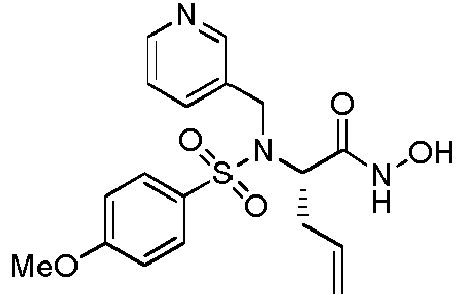
6.3 nM ± 1.5 nM 6.4 nM ± 0.4 nM 
3.9 nM ± 0.3 nM 0.54 nM ± 0.13 nM (S)-21a (R)-21b 
22.2 nM 6.96 nM 
10.4 nM 2.86 nM (S)-33a (HUG 74) (R)-33b (HUG 78) 1) calculated from the K, values - As can be observed from the data reported in Table 1, the compounds of the invention show an improved activity with respect to the reference compounds CGS-27023A. This effect is remarkable also in the (S)-enantiomer of the compounds of the invention.
-

- No-carrier-added aqueous [18F]fluoride was produced on a RDS 111e cyclotron (CTI-Siemens) by irradiation of a 1.2 mL water target using 10 MeV proton beams on 97.0% enriched [180O]water by the 18O(p,n)18F nuclear reaction. To recover the [18O]water, the batch of aqueous [18F]fluoride was passed through an anion exchange resin (Sep-Pak Light Waters Accell Plus QMA cartridge, preconditioned with 5
mL 1 M K2CO3 and 10 mL water). [18F]Fluoride was eluted from the resin with a mixture of 40µl 1 M K2CO3, 200 µl water for injection, and 800 µl DNA-grade CH3CN containing 18 mg Kryptofix 2.2.2 (K 222). Subsequently, the aqueous [18F]K(K 222)F solution was carefully evaporated to dryness in vacuo. - An amount of -5.0 mg (-8.4 µmol) of compound HUG 118 and carefully dried [18F]K(K 222)F residue were heated at 84 °C in 1 mL DNA-grade CH3CN for 20 min. The mixture was cooled to 40 °C, diluted with 10 mL water for injection and passed through a Waters Sep-Pak Light C18 cartridge. The cartridge was washed with additional 10 mL water for injection and eluted with 0.5 mL warm DMF (warmed to 90 °C before elution). The eluate was diluted with 0.5 mL water for injection and purified by HPLC using a gradient radio-HPLC procedure (conditions: Nucleosil 100-10 C18 column (250 x 8 mm2), λ = 254 nm; flow = 4 mL/min; eluents: A: CH3CN/TFA, 1000/1, B: H2O/TFA, 1000/1; time program: eluent B from 70% to 30% in 30 min, halt 5 min, from 30% to 70% in 5 min). The product fraction of compound ( 18F]HUG 74 (retention time tR = 15.5-17.1 min) was evaporated to dryness in vacuo and redissolved with 1 mL H2O/EtOH (9:1) The radiosynthesis provided ( 18F]
HUG 74 with a radiochemical yield of 31% (decay-corrected), a radiochemical purity of 98% in 95 min from end of radionuclide production and a calculated specific radioactivity of 3.4 GBq/µmol at the EOS (analytical HPLC-conditions: Nucleosil 100-5 C18 column (250 x 4 mm2), λ = 254 nm; flow = 1 mL/min; eluents: A: CH3CN/TFA, 1000/1, B: H2O/TFA; time program: eluent A: 40%, 0-22 min, from 40% to 90% in 4 min, from 90% to 40% in 4 min; retention time tR = 16.2 min). - A solution of [ 18F]HUG 74 (25 µL, 10% EtOH/water) was diluted with water (10 mL). The measured activity was 145 µCi in 10 mL. Four aliquots of this solution were put into 4 different Eppendorf tubes containing octanol (250 µL) (1 control vial, 3 parent vials). All samples were vortexed for 5 min and then centrifuged at 3g for 5 min to separate the layers. For the three parent vials, the top layer (octanol, 100 µL) and the bottom layer (water, 100 µL) were removed and separately transferred to new Eppendorf vials. The fourth vial (control vial) was left undisturbed.
All the vials were counted (the control vial, the parent vials, the octanol and water vials) in rapid succession. The P values were calculated by dividing CPMoct/CPMwater. The log P values were calculated by log [CPMoct/CPMwater].
The total activity of the parent vials plus their respective octanol and water vials gave a relative recovery of 113%.
The average log P (outlier removed) is 1.16 (with outlier the log P is 1.08). - Small animal PET scanning. PET experiments were carried out using a sub-millimeter high resolution (0.7 mm full width at half maximum) small animal scanner (32 module quadHIDAC, Oxford Positron Systems Ltd., Oxford, UK) with uniform spatial resolution (< 1 mm) over a large cylindrical field (165 mm diameter, 280 mm axial length).
- PET list-mode data were acquired for 120 min and co-registered with contrast enhanced CT. Three-dimensional volumes of interest (VOIs) were defined over the respective organs in CT data sets, transferred to the co-registered PET data and analyzed quantitatively. Regional uptake was calculated as percentage of injected dose by dividing counts per milliliter in the VOI by total counts in the mouse multiplied by 100 (%ID/ml).
- Overall, [18F]
HUG 74 is cleared fast and efficiently from the body through hepatic and renal elimination with no significant tracer remaining in non-excretion organs 90-120 min p.i. Immediately upon injection of [18F]HUG 74 high levels of radioactivity were observed in the liver and the kidneys. While the activity in the kidney decreased (Tmax: 100 sec, T1/2: 3 min p.i.) in parallel to the activity in the blood, the liver first showed a further accumulation of [18F]HUG 74 (Tmax: 3 min, T1/2: 36 min p.i.) before clearance into the gallbladder and finally into the intestine. (Figure 7 ). - Defluorination of the radioligand in vivo potentially impairing image interpretation (indicated by bone uptake of [18F]fluoride ions) was not observed in the entire dynamic imaging study. Furthermore, accumulation of [18F]
HUG 74 in organs/tissues such as the brain, myocardium, lung and muscles, indicating unspecific binding, was not observed.
Claims (28)
- Compound of formula (I)
 R is an optionally substituted arylalkyl or an optionally substituted heteroarylalkyl;R1 is C1-C6 alkyl, C1-C6 alkenyl, C1-C7 alkynyl wherein the C1-C6 alkyl, C1-C6 alkenyl, C1-C7 alkynyl are optionally substituted with one or more substituents selected from halogen, OH or OTs, or R1 is (CH2-CH2-O-)n-CH2-CH2-R5;R2 is C1-C6 alkyl, C1-C6 alkoxy or -NH-OR4;R3 is C1-C6 fluoro-alkyl or an optionally substituted C2-C6 alkenyl wherein the substituent is a F atom;R4 is H, C1-C6 alkyl, C3-C6 cycloalkyl or C5-C6 heterocycloalkyl;R5 is F, Cl, OH, OTs; andn is 0, 1, 2, 3, 4, 5 or 6;and enantiomers, esters and pharmaceutically acceptable salts thereof.
 - Compound of formula (I)
 R is H or an optionally substituted arylalkyl or an optionally substituted heteroarylalkyl;R1 is C1-C6 alkyl, C1-C6 alkenyl, C1-C7 alkynyl wherein the C1-C6 alkyl, C1-C6 alkenyl, C1-C7 alkynyl are optionally substituted with one or more substituents selected from halogen, OH or OTs, or R1 is (CH2-CH2-O-)n-CH2-CH2-R5;R2 is C1-C6 alkyl, C1-C6 alkoxy or-NH-OR4;R3 is C1-C6 fluoro-alkyl or an optionally substituted C2-C6 alkenyl wherein the substituent is a F atom;R4 is H, C1-C6 alkyl, C3-C6 cycloalkyl or C5-C6 heterocycloalkyl;R5 is F, Cl, OH, OTs; andn is 0, 1, 2, 3, 4, 5 or 6;and enantiomers, esters and pharmaceutically acceptable salts thereof.
 - The compound according to claim 1 wherein:R is pyrid-3-yl-CH2- or phenyl-CH2-;R1 is -CH3, -CH2-CH2Cl, -CH2-CH2F, -CH2-CH2-OTs or -CH2-CH2OH;R2 is -NH-OR4;R3 is -CH2-CH2F, -CH2-C(F)=CH2 or CH2-CH=CH2;R4 is H, methyl, tert-butyl or tetrahydropyranyl; and
enantiomers, esters or pharmaceutically acceptable salts thereof. - The compound according to claim 1 or 2 or 3 wherein the carbon atom bearing radical R3 has a "S" configuration.
- The compound according to claim 1 or 2 or 3 wherein the carbon atom bearing radical R3 has a "R" configuration.
- Compounds selected from the group consisting of:


- A compound of formula (I) as defined in any of claims 1, 2, 3, 4, 5, 6 wherein a carbon atom bears as a substituent a 18F in addition or in place to a substituent already present on said carbon atom.
- The compound according to claim 7 wherein the carbon atom is a carbon atom of radical R3.
- The compound according to claim 8 wherein R3 is selected from C1-C6 (18F) alkyl or C2-C6 (18F)-alkenyl.
- The compound according to claim 9 wherein R3 is selected from CH2-CH2 18F or CH2-C(18F)=CH2.
- The compound according to claim 7 wherein the carbon atom is a carbon atom of radical R1.
- The compound according to claim 11, wherein R1 is -CH2-CH2 18F.
- Compounds of formulae

- A compound according to any of claims 1, 2, 3, 4, 5, 6 for use as a medicament.
- A compound according to any of claims 7, 8, 9, 10, 11, 12, 13 for use as a diagnostic agent.
- A compound according to any of claims 1, 2, 3, 4, 5, 6 for use in the prevention or treatment of pathological conditions associated with an unpaired expression of matrix-metalloprotease in human and animal.
- A compound according to any of claims 7, 8, 9, 10, 11, 12, 13 for use in the diagnosis of pathological conditions associated with an unpaired expression of matrix-metalloprotease in human and animal.
- The compound according to claim 16 or 17 wherein the pathological condition is selected from the group consisting of cardiovascular diseases, inflammatory diseases and malignant diseases.
- The compound according to claim 18 wherein the cardiovascular diseases are selected from atherosclerosis and congestive heart failure and the inflammatory disease is chronic obstructive pulmonary disease.
- A pharmaceutical composition comprising a compound as defined in any of claims 1, 2, 3, 4, 5, 6 and a pharmaceutically acceptable carrier.
- A diagnostic composition comprising a compound as defined in any of claims 7, 8, 9, 10, 11, 12, 13 and a pharmaceutically acceptable carrier.
- Process for preparing a compound as defined in any of claims 7, 8, 9, 10, 11, 12 comprising:a) reacting a compound of formula (II)
 R and R2 are as defined in claim 1 or 2 or 3;R1 is an optionally substituted C1-C6 alkyl wherein the substituent is OH, OTs or a another leaving group for nucleophile substitution;R3 is an optionally substituted C1-C6 -alkyl or an optionally substituted C2-C6 alkenyl wherein the substituent is a OH, a OTs or another leaving group for nucleophilesubstitutionwith a 18F containing reagent for nucleophile substitution of the group OTs or of the group OH or of the leaving group with 18F;
with the proviso that least one of R1 and R3 is substituted with a OH, OTs or another leaving group for nucleophile substitution and/or with the proviso that when R1 is substituted with a OH, OTs or another leaving group for nucleophile substitution then R3 is C1-C6 fluoro alkyl or C2-C6 alkenyl optionally substituted with F. - The process according to claim 22 wherein in formula (II):R1 is CH2-CH2-OTs and R3is CH2-CH2 F, CH2-C(F)=CH2 or CH2-CH=CH2; orR1 is CH3 and R3 is CH2-CH2OTs.
- The process according to claim 22 or 23 wherein the 18F containing reagent is [18F](Kryptofix222)KF.
- Intermediate compound of formula (III)
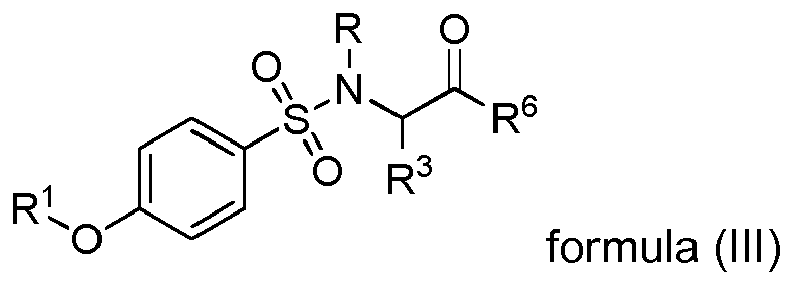
R, R1 and R3 are as defined in claim 1 or 2 or 3; and R6 is OH. - Intermediate compound according to claim 25 selected from:


- Process for preparing a compound of formula (I)

R, R1 and R3 are as defined in claim 1 or 2 or 3;
R2 is NH-OR4; and
R4 is H, C1-C6 alkyl, C3-C6 cycloalkyl or C5-C6 heterocycloalkyl
comprisinga) reacting a compound of formula (III')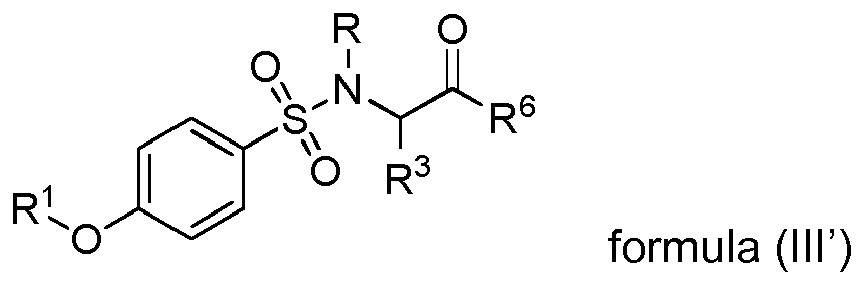
R, R1 and R3 are as defined in claim 1 or 2 or 3
and R6 is OH or C1-C6 alkoxy
with an hydroxylamine derivative of formula (IV)
R4O-NH2 formula (IV)
wherein R4 is H, C1-C6 alkyl, C3-C6 cycloalkyl or C5-C6 heterocycloalkyl; andb) when in the compound obtained in step a) R4 is C1-C6 alkyl, C3-C6 cycloalkyl or C5-C6 heterocycloalkyl
optionally hydrolyzing it. - Process for preparing a compound of formula (I) according to claim 27 wherein
the compound of formula (III') is prepared bya') reacting a compound of formula (V)to obtain a compound of formula (VII)

 a") reacting the compound of formula (VII) with a compound of formula (VIII)to obtain a compound of formula (III')
R-Cl Formula (VIII)

Priority Applications (1)
| Application Number | Priority Date | Filing Date | Title |
|---|---|---|---|
| EP12166980A EP2520573A1 (en) | 2011-05-06 | 2012-05-07 | Compounds with matrix-metalloproteinase inhibitory activity |
Applications Claiming Priority (3)
| Application Number | Priority Date | Filing Date | Title |
|---|---|---|---|
| EP11165157 | 2011-05-06 | ||
| US13/155,558 US20120282180A1 (en) | 2011-05-06 | 2011-06-08 | Compounds with Matrix-Metalloproteinase Inhibitory Activity and Imaging Agents Thereof |
| EP12166980A EP2520573A1 (en) | 2011-05-06 | 2012-05-07 | Compounds with matrix-metalloproteinase inhibitory activity |
Publications (1)
| Publication Number | Publication Date |
|---|---|
| EP2520573A1 true EP2520573A1 (en) | 2012-11-07 |
Family
ID=46017755
Family Applications (1)
| Application Number | Title | Priority Date | Filing Date |
|---|---|---|---|
| EP12166980A Withdrawn EP2520573A1 (en) | 2011-05-06 | 2012-05-07 | Compounds with matrix-metalloproteinase inhibitory activity |
Country Status (1)
| Country | Link |
|---|---|
| EP (1) | EP2520573A1 (en) |
Cited By (1)
| Publication number | Priority date | Publication date | Assignee | Title |
|---|---|---|---|---|
| CN108929246A (en) * | 2018-07-09 | 2018-12-04 | 湖南中医药大学 | A kind of method that solid state process prepares hydroximic acid derivative |
Citations (2)
| Publication number | Priority date | Publication date | Assignee | Title |
|---|---|---|---|---|
| US5455258A (en) * | 1993-01-06 | 1995-10-03 | Ciba-Geigy Corporation | Arylsulfonamido-substituted hydroxamic acids |
| WO2001060416A2 (en) | 2000-02-15 | 2001-08-23 | Bristol-Myers Squibb Pharma Company | Matrix metalloproteinase inhibitors as targeting components in diagnostic agents |
-
2012
- 2012-05-07 EP EP12166980A patent/EP2520573A1/en not_active Withdrawn
Patent Citations (2)
| Publication number | Priority date | Publication date | Assignee | Title |
|---|---|---|---|---|
| US5455258A (en) * | 1993-01-06 | 1995-10-03 | Ciba-Geigy Corporation | Arylsulfonamido-substituted hydroxamic acids |
| WO2001060416A2 (en) | 2000-02-15 | 2001-08-23 | Bristol-Myers Squibb Pharma Company | Matrix metalloproteinase inhibitors as targeting components in diagnostic agents |
Non-Patent Citations (23)
| Title |
|---|
| BACKSTROM ET AL., J. NEUROCHEM., vol. 58, 1992, pages 983 - 992 |
| D. M. SHENDAGE; R. FR6HLICH; K. BERGANDER; G. HAUFE, EUR. J. ORG. CHEM., 2005, pages 719 - 727 |
| GEORGE, EXP. OPIN. INVEST. DRUGS, vol. 9, 2000, pages 993 - 1007 |
| HERMAN ET AL., CIRCULATION, vol. 104, 2001, pages 1899 - 1904 |
| HEROUY, INT. J. MOL. MED., vol. 7, 2001, pages 3 - 12 |
| JACSON ET AL.: "Selective matrix metalloproteinase inhibition in rheumatoid arthritis-targeting gelatinase A activation", INFLAMM. RES., vol. 50, 2001, pages 183 - 186 |
| K.-W. LAUE; C. MÜCK-LICHTENFELD; G. HAUFE, TETRAHEDRON, vol. 55, 1999, pages 10413 - 10424 |
| K.-W. LAUE; G. HAUFE, SYNTHESIS, 1998, pages 1453 - 1456 |
| K.-W. LAUE; S. KROGER; E. WEGELIUS; G. HAUFE, EUR. J. ORG. CHEM., 2000, pages 3737 - 3743 |
| KURPAKUS-WHEATER ET AL., PROG. HISTO. CYTOCHEM., vol. 36, 2001, pages 179 - 259 |
| LI ET AL., AM. J. PATHOL., vol. 148, 1996, pages 121 - 128 |
| LIM ET AL., J. NEUROCHEM., vol. 67, 1996, pages 251 - 259 |
| LUKES ET AL., MOL. NEUROBIOL., vol. 19, 1999, pages 267 - 284 |
| MASSOVA ET AL., FASEB J., vol. 12, 1998, pages 1075 - 1095 |
| MUN-BRYCE ET AL., BRAIN. RES., vol. 933, 2002, pages 42 - 49 |
| NAGASE; WOESSNER, J. BIOL. CHEM., vol. 274, 1999, pages 21491 - 21494 |
| PETERSON ET AL.: "Matrix metalloproteinase inhibitor development for the treatment of heart failure", DRUG DEV. RES., vol. 55, 2002, pages 29 - 44, XP002314260, DOI: doi:10.1002/ddr.10032 |
| S. KROGER; G. HAUFE, AMINO ACIDS, vol. 12, 1997, pages 363 - 372 |
| SEGURA-VALDEZ ET AL., CHEST., vol. 117, 2000, pages 684 - 694 |
| SPINALE, CIRCUL. RES., vol. 90, 2002, pages 520 - 530 |
| VIHINEN ET AL., INT. J. CANCER, vol. 99, 2002, pages 157 - 186 |
| WHITTAKER ET AL., CHEM. REV., vol. 99, 1999, pages 2735 - 2776 |
| ZHENG ET AL., NUC. MED. BIOL., vol. 29, 2002, pages 761 - 770 |
Cited By (1)
| Publication number | Priority date | Publication date | Assignee | Title |
|---|---|---|---|---|
| CN108929246A (en) * | 2018-07-09 | 2018-12-04 | 湖南中医药大学 | A kind of method that solid state process prepares hydroximic acid derivative |
Similar Documents
| Publication | Publication Date | Title |
|---|---|---|
| AU2009278279B2 (en) | DAA-pyridine as peripheral benzodiazepine receptor ligand for diagnostic imaging and pharmaceutical treatment | |
| RU2597425C2 (en) | Compounds for binding to platelet specific glycoprotein iib/iiia and their use for imaging thrombi | |
| JP6153971B2 (en) | Imidazole derivatives substituted with cycloalkyl groups | |
| WO2013010573A1 (en) | Compounds with matrix-metalloproteinase inhibitory activity | |
| KR102923704B1 (en) | Radioligands for imaging LPA1 receptors | |
| WO2015066456A1 (en) | Radioligands for imaging the lpa-1 receptor | |
| JP2004510759A (en) | Aminopyridinyl, aminoguanidinyl, and phenylacetamide substituted with alkoxyguanidinyl as protease inhibitors | |
| JP2006519216A (en) | Diagnostic imaging agent having MMP inhibitory activity | |
| AU2010321278B2 (en) | Method for production of F-18 labeled glutamic acid derivatives | |
| JP2016028103A (en) | Method for production of f-18 labeled amyloid beta ligands | |
| JP2012510958A (en) | Lysine and ornithine derivatives labeled with radioisotopes, methods for their use and production | |
| US20120282180A1 (en) | Compounds with Matrix-Metalloproteinase Inhibitory Activity and Imaging Agents Thereof | |
| JP2024012577A (en) | Tetrahydroisoquinoline derivatives, their production methods and uses | |
| HK1197064B (en) | Compounds for binding to the platelet specific glycoprotein iib/iiia and their use for imaging of thrombi | |
| HK1155745A (en) | Daa-pyridine as peripheral benzodiazepine receptor ligand for diagnostic imaging and pharmaceutical treatment | |
| HK1188569B (en) | Method for production of f-18 labeled amyloid beta ligands |
Legal Events
| Date | Code | Title | Description |
|---|---|---|---|
| PUAI | Public reference made under article 153(3) epc to a published international application that has entered the european phase |
Free format text: ORIGINAL CODE: 0009012 |
|
| AK | Designated contracting states |
Kind code of ref document: A1 Designated state(s): AL AT BE BG CH CY CZ DE DK EE ES FI FR GB GR HR HU IE IS IT LI LT LU LV MC MK MT NL NO PL PT RO RS SE SI SK SM TR |
|
| AX | Request for extension of the european patent |
Extension state: BA ME |
|
| 17P | Request for examination filed |
Effective date: 20130507 |
|
| RIC1 | Information provided on ipc code assigned before grant |
Ipc: A61K 31/4409 20060101ALI20140822BHEP Ipc: C07B 59/00 20060101ALI20140822BHEP Ipc: C07D 309/12 20060101AFI20140822BHEP Ipc: A61P 29/00 20060101ALI20140822BHEP Ipc: C07D 213/42 20060101ALI20140822BHEP Ipc: C07C 311/29 20060101ALI20140822BHEP Ipc: A61K 31/255 20060101ALI20140822BHEP Ipc: A61P 9/00 20060101ALI20140822BHEP |
|
| GRAP | Despatch of communication of intention to grant a patent |
Free format text: ORIGINAL CODE: EPIDOSNIGR1 |
|
| INTG | Intention to grant announced |
Effective date: 20141009 |
|
| STAA | Information on the status of an ep patent application or granted ep patent |
Free format text: STATUS: THE APPLICATION IS DEEMED TO BE WITHDRAWN |
|
| 18D | Application deemed to be withdrawn |
Effective date: 20141202 |