EP2520276A1 - Use of modified galactomannans for protecting dyed hair color from fading - Google Patents
Use of modified galactomannans for protecting dyed hair color from fading Download PDFInfo
- Publication number
- EP2520276A1 EP2520276A1 EP11305523A EP11305523A EP2520276A1 EP 2520276 A1 EP2520276 A1 EP 2520276A1 EP 11305523 A EP11305523 A EP 11305523A EP 11305523 A EP11305523 A EP 11305523A EP 2520276 A1 EP2520276 A1 EP 2520276A1
- Authority
- EP
- European Patent Office
- Prior art keywords
- groups
- cationic
- group
- use according
- galactomannan
- Prior art date
- Legal status (The legal status is an assumption and is not a legal conclusion. Google has not performed a legal analysis and makes no representation as to the accuracy of the status listed.)
- Withdrawn
Links
- 229920000926 Galactomannan Polymers 0.000 title claims abstract description 38
- 238000005562 fading Methods 0.000 title claims abstract description 30
- 230000037308 hair color Effects 0.000 title claims abstract description 17
- OMDQUFIYNPYJFM-XKDAHURESA-N (2r,3r,4s,5r,6s)-2-(hydroxymethyl)-6-[[(2r,3s,4r,5s,6r)-4,5,6-trihydroxy-3-[(2s,3s,4s,5s,6r)-3,4,5-trihydroxy-6-(hydroxymethyl)oxan-2-yl]oxyoxan-2-yl]methoxy]oxane-3,4,5-triol Chemical class O[C@@H]1[C@@H](O)[C@@H](O)[C@@H](CO)O[C@@H]1OC[C@@H]1[C@@H](O[C@H]2[C@H]([C@@H](O)[C@H](O)[C@@H](CO)O2)O)[C@H](O)[C@H](O)[C@H](O)O1 OMDQUFIYNPYJFM-XKDAHURESA-N 0.000 claims abstract description 92
- 210000004209 hair Anatomy 0.000 claims abstract description 56
- 239000000203 mixture Substances 0.000 claims abstract description 56
- 238000000034 method Methods 0.000 claims abstract description 20
- 125000002091 cationic group Chemical group 0.000 claims description 107
- 125000001165 hydrophobic group Chemical group 0.000 claims description 47
- 239000003795 chemical substances by application Substances 0.000 claims description 30
- 239000008186 active pharmaceutical agent Substances 0.000 claims description 24
- 125000004432 carbon atom Chemical group C* 0.000 claims description 13
- 238000006467 substitution reaction Methods 0.000 claims description 13
- 230000002209 hydrophobic effect Effects 0.000 claims description 12
- 125000000217 alkyl group Chemical group 0.000 claims description 6
- 235000014113 dietary fatty acids Nutrition 0.000 claims description 6
- 239000000194 fatty acid Substances 0.000 claims description 6
- 229930195729 fatty acid Natural products 0.000 claims description 6
- 150000004665 fatty acids Chemical class 0.000 claims description 6
- 150000008064 anhydrides Chemical class 0.000 claims description 5
- 150000004820 halides Chemical class 0.000 claims description 5
- 125000001453 quaternary ammonium group Chemical group 0.000 claims description 5
- QGZKDVFQNNGYKY-UHFFFAOYSA-O ammonium group Chemical group [NH4+] QGZKDVFQNNGYKY-UHFFFAOYSA-O 0.000 claims description 4
- 150000002118 epoxides Chemical class 0.000 claims description 4
- 125000002924 primary amino group Chemical group [H]N([H])* 0.000 claims description 4
- 125000000467 secondary amino group Chemical group [H]N([*:1])[*:2] 0.000 claims description 4
- JUJWROOIHBZHMG-UHFFFAOYSA-N Pyridine Chemical group C1=CC=NC=C1 JUJWROOIHBZHMG-UHFFFAOYSA-N 0.000 claims description 3
- ZMANZCXQSJIPKH-UHFFFAOYSA-N Triethylamine Chemical group CCN(CC)CC ZMANZCXQSJIPKH-UHFFFAOYSA-N 0.000 claims description 3
- XXBDWLFCJWSEKW-UHFFFAOYSA-N dimethylbenzylamine Chemical group CN(C)CC1=CC=CC=C1 XXBDWLFCJWSEKW-UHFFFAOYSA-N 0.000 claims description 3
- 150000002194 fatty esters Chemical class 0.000 claims description 3
- 125000002636 imidazolinyl group Chemical group 0.000 claims description 3
- 229910052757 nitrogen Inorganic materials 0.000 claims description 3
- 125000004433 nitrogen atom Chemical group N* 0.000 claims description 3
- RWSOTUBLDIXVET-UHFFFAOYSA-O sulfonium Chemical compound [SH3+] RWSOTUBLDIXVET-UHFFFAOYSA-O 0.000 claims description 3
- 125000001302 tertiary amino group Chemical group 0.000 claims description 3
- 125000005208 trialkylammonium group Chemical group 0.000 claims description 3
- IMFACGCPASFAPR-UHFFFAOYSA-N tributylamine Chemical group CCCCN(CCCC)CCCC IMFACGCPASFAPR-UHFFFAOYSA-N 0.000 claims description 3
- GETQZCLCWQTVFV-UHFFFAOYSA-N trimethylamine Chemical group CN(C)C GETQZCLCWQTVFV-UHFFFAOYSA-N 0.000 claims description 3
- 125000005843 halogen group Chemical group 0.000 claims description 2
- 244000007835 Cyamopsis tetragonoloba Species 0.000 claims 2
- 229920000642 polymer Polymers 0.000 description 51
- 238000009472 formulation Methods 0.000 description 30
- 244000303965 Cyamopsis psoralioides Species 0.000 description 25
- 239000002453 shampoo Substances 0.000 description 24
- -1 hydroxyalkyl guar Chemical class 0.000 description 20
- HEMHJVSKTPXQMS-UHFFFAOYSA-M Sodium hydroxide Chemical compound [OH-].[Na+] HEMHJVSKTPXQMS-UHFFFAOYSA-M 0.000 description 15
- 230000015572 biosynthetic process Effects 0.000 description 15
- 238000003786 synthesis reaction Methods 0.000 description 15
- XLYOFNOQVPJJNP-UHFFFAOYSA-N water Substances O XLYOFNOQVPJJNP-UHFFFAOYSA-N 0.000 description 13
- IAZDPXIOMUYVGZ-UHFFFAOYSA-N Dimethylsulphoxide Chemical compound CS(C)=O IAZDPXIOMUYVGZ-UHFFFAOYSA-N 0.000 description 9
- KFZMGEQAYNKOFK-UHFFFAOYSA-N Isopropanol Chemical compound CC(C)O KFZMGEQAYNKOFK-UHFFFAOYSA-N 0.000 description 9
- CSPHGSFZFWKVDL-UHFFFAOYSA-M (3-chloro-2-hydroxypropyl)-trimethylazanium;chloride Chemical compound [Cl-].C[N+](C)(C)CC(O)CCl CSPHGSFZFWKVDL-UHFFFAOYSA-M 0.000 description 8
- 238000006243 chemical reaction Methods 0.000 description 8
- 125000002887 hydroxy group Chemical group [H]O* 0.000 description 8
- 239000002243 precursor Substances 0.000 description 8
- 239000000047 product Substances 0.000 description 8
- OVSKIKFHRZPJSS-UHFFFAOYSA-N 2,4-D Chemical compound OC(=O)COC1=CC=C(Cl)C=C1Cl OVSKIKFHRZPJSS-UHFFFAOYSA-N 0.000 description 7
- WFDIJRYMOXRFFG-UHFFFAOYSA-N Acetic anhydride Chemical compound CC(=O)OC(C)=O WFDIJRYMOXRFFG-UHFFFAOYSA-N 0.000 description 6
- FAPWRFPIFSIZLT-UHFFFAOYSA-M Sodium chloride Chemical compound [Na+].[Cl-] FAPWRFPIFSIZLT-UHFFFAOYSA-M 0.000 description 6
- 239000003153 chemical reaction reagent Substances 0.000 description 6
- 229940045720 antineoplastic alkylating drug epoxides Drugs 0.000 description 5
- 239000000178 monomer Substances 0.000 description 5
- KBPLFHHGFOOTCA-UHFFFAOYSA-N 1-Octanol Chemical compound CCCCCCCCO KBPLFHHGFOOTCA-UHFFFAOYSA-N 0.000 description 4
- PUAQLLVFLMYYJJ-UHFFFAOYSA-N 2-aminopropiophenone Chemical compound CC(N)C(=O)C1=CC=CC=C1 PUAQLLVFLMYYJJ-UHFFFAOYSA-N 0.000 description 4
- VEXZGXHMUGYJMC-UHFFFAOYSA-M Chloride anion Chemical compound [Cl-] VEXZGXHMUGYJMC-UHFFFAOYSA-M 0.000 description 4
- MHAJPDPJQMAIIY-UHFFFAOYSA-N Hydrogen peroxide Chemical compound OO MHAJPDPJQMAIIY-UHFFFAOYSA-N 0.000 description 4
- FLIACVVOZYBSBS-UHFFFAOYSA-N Methyl palmitate Chemical compound CCCCCCCCCCCCCCCC(=O)OC FLIACVVOZYBSBS-UHFFFAOYSA-N 0.000 description 4
- HPEUJPJOZXNMSJ-UHFFFAOYSA-N Methyl stearate Chemical compound CCCCCCCCCCCCCCCCCC(=O)OC HPEUJPJOZXNMSJ-UHFFFAOYSA-N 0.000 description 4
- GYZLOYUZLJXAJU-UHFFFAOYSA-N diglycidyl ether Chemical class C1OC1COCC1CO1 GYZLOYUZLJXAJU-UHFFFAOYSA-N 0.000 description 4
- 125000000524 functional group Chemical group 0.000 description 4
- 231100000640 hair analysis Toxicity 0.000 description 4
- 239000000118 hair dye Substances 0.000 description 4
- ZSIAUFGUXNUGDI-UHFFFAOYSA-N hexan-1-ol Chemical compound CCCCCCO ZSIAUFGUXNUGDI-UHFFFAOYSA-N 0.000 description 4
- 125000000311 mannosyl group Chemical group C1([C@@H](O)[C@@H](O)[C@H](O)[C@H](O1)CO)* 0.000 description 4
- YRHYCMZPEVDGFQ-UHFFFAOYSA-N methyl decanoate Chemical compound CCCCCCCCCC(=O)OC YRHYCMZPEVDGFQ-UHFFFAOYSA-N 0.000 description 4
- UQDUPQYQJKYHQI-UHFFFAOYSA-N methyl laurate Chemical compound CCCCCCCCCCCC(=O)OC UQDUPQYQJKYHQI-UHFFFAOYSA-N 0.000 description 4
- JGHZJRVDZXSNKQ-UHFFFAOYSA-N methyl octanoate Chemical compound CCCCCCCC(=O)OC JGHZJRVDZXSNKQ-UHFFFAOYSA-N 0.000 description 4
- ZAZKJZBWRNNLDS-UHFFFAOYSA-N methyl tetradecanoate Chemical compound CCCCCCCCCCCCCC(=O)OC ZAZKJZBWRNNLDS-UHFFFAOYSA-N 0.000 description 4
- 238000000569 multi-angle light scattering Methods 0.000 description 4
- GLDOVTGHNKAZLK-UHFFFAOYSA-N octadecan-1-ol Chemical compound CCCCCCCCCCCCCCCCCCO GLDOVTGHNKAZLK-UHFFFAOYSA-N 0.000 description 4
- 238000002360 preparation method Methods 0.000 description 4
- TYWMIZZBOVGFOV-UHFFFAOYSA-N tetracosan-1-ol Chemical compound CCCCCCCCCCCCCCCCCCCCCCCCO TYWMIZZBOVGFOV-UHFFFAOYSA-N 0.000 description 4
- JTTBZVHEXMQSMM-UHFFFAOYSA-M (3-chloro-2-hydroxypropyl)-dodecyl-dimethylazanium;chloride Chemical compound [Cl-].CCCCCCCCCCCC[N+](C)(C)CC(O)CCl JTTBZVHEXMQSMM-UHFFFAOYSA-M 0.000 description 3
- OYINQIKIQCNQOX-UHFFFAOYSA-M 2-hydroxybutyl(trimethyl)azanium;chloride Chemical compound [Cl-].CCC(O)C[N+](C)(C)C OYINQIKIQCNQOX-UHFFFAOYSA-M 0.000 description 3
- 208000034628 Celiac artery compression syndrome Diseases 0.000 description 3
- BBWBEZAMXFGUGK-UHFFFAOYSA-N bis(dodecylsulfanyl)-methylarsane Chemical compound CCCCCCCCCCCCS[As](C)SCCCCCCCCCCCC BBWBEZAMXFGUGK-UHFFFAOYSA-N 0.000 description 3
- KRKNYBCHXYNGOX-UHFFFAOYSA-N citric acid Chemical compound OC(=O)CC(O)(C(O)=O)CC(O)=O KRKNYBCHXYNGOX-UHFFFAOYSA-N 0.000 description 3
- 150000001875 compounds Chemical class 0.000 description 3
- 239000008367 deionised water Substances 0.000 description 3
- 238000001514 detection method Methods 0.000 description 3
- 229930182830 galactose Natural products 0.000 description 3
- 229910017464 nitrogen compound Inorganic materials 0.000 description 3
- 229920001296 polysiloxane Polymers 0.000 description 3
- 239000011780 sodium chloride Substances 0.000 description 3
- 239000002904 solvent Substances 0.000 description 3
- 239000007858 starting material Substances 0.000 description 3
- 229940014800 succinic anhydride Drugs 0.000 description 3
- 239000004094 surface-active agent Substances 0.000 description 3
- QIKIJFUVHGOQOK-UHFFFAOYSA-M (3-chloro-2-hydroxypropyl)-dimethyl-octadecylazanium;chloride Chemical compound [Cl-].CCCCCCCCCCCCCCCCCC[N+](C)(C)CC(O)CCl QIKIJFUVHGOQOK-UHFFFAOYSA-M 0.000 description 2
- DNIAPMSPPWPWGF-GSVOUGTGSA-N (R)-(-)-Propylene glycol Chemical compound C[C@@H](O)CO DNIAPMSPPWPWGF-GSVOUGTGSA-N 0.000 description 2
- DSZTYVZOIUIIGA-UHFFFAOYSA-N 1,2-Epoxyhexadecane Chemical compound CCCCCCCCCCCCCCC1CO1 DSZTYVZOIUIIGA-UHFFFAOYSA-N 0.000 description 2
- MYMSJFSOOQERIO-UHFFFAOYSA-N 1-bromodecane Chemical compound CCCCCCCCCCBr MYMSJFSOOQERIO-UHFFFAOYSA-N 0.000 description 2
- HNTGIJLWHDPAFN-UHFFFAOYSA-N 1-bromohexadecane Chemical compound CCCCCCCCCCCCCCCCBr HNTGIJLWHDPAFN-UHFFFAOYSA-N 0.000 description 2
- CNDHHGUSRIZDSL-UHFFFAOYSA-N 1-chlorooctane Chemical class CCCCCCCCCl CNDHHGUSRIZDSL-UHFFFAOYSA-N 0.000 description 2
- GCDPERPXPREHJF-UHFFFAOYSA-N 1-iodododecane Chemical compound CCCCCCCCCCCCI GCDPERPXPREHJF-UHFFFAOYSA-N 0.000 description 2
- 238000005160 1H NMR spectroscopy Methods 0.000 description 2
- YZUMRMCHAJVDRT-UHFFFAOYSA-N 2-(hexadecoxymethyl)oxirane Chemical compound CCCCCCCCCCCCCCCCOCC1CO1 YZUMRMCHAJVDRT-UHFFFAOYSA-N 0.000 description 2
- MPGABYXKKCLIRW-UHFFFAOYSA-N 2-decyloxirane Chemical compound CCCCCCCCCCC1CO1 MPGABYXKKCLIRW-UHFFFAOYSA-N 0.000 description 2
- JCGRTWRFDLWVDA-UHFFFAOYSA-N 2-docosyloxirane Chemical compound CCCCCCCCCCCCCCCCCCCCCCC1CO1 JCGRTWRFDLWVDA-UHFFFAOYSA-N 0.000 description 2
- OSCJHTSDLYVCQC-UHFFFAOYSA-N 2-ethylhexyl 4-[[4-[4-(tert-butylcarbamoyl)anilino]-6-[4-(2-ethylhexoxycarbonyl)anilino]-1,3,5-triazin-2-yl]amino]benzoate Chemical compound C1=CC(C(=O)OCC(CC)CCCC)=CC=C1NC1=NC(NC=2C=CC(=CC=2)C(=O)NC(C)(C)C)=NC(NC=2C=CC(=CC=2)C(=O)OCC(CC)CCCC)=N1 OSCJHTSDLYVCQC-UHFFFAOYSA-N 0.000 description 2
- NJWSNNWLBMSXQR-UHFFFAOYSA-N 2-hexyloxirane Chemical compound CCCCCCC1CO1 NJWSNNWLBMSXQR-UHFFFAOYSA-N 0.000 description 2
- CPELXLSAUQHCOX-UHFFFAOYSA-M Bromide Chemical compound [Br-] CPELXLSAUQHCOX-UHFFFAOYSA-M 0.000 description 2
- 244000060011 Cocos nucifera Species 0.000 description 2
- 235000013162 Cocos nucifera Nutrition 0.000 description 2
- 239000004593 Epoxy Substances 0.000 description 2
- 239000005640 Methyl decanoate Substances 0.000 description 2
- 239000005641 Methyl octanoate Substances 0.000 description 2
- AMQJEAYHLZJPGS-UHFFFAOYSA-N N-Pentanol Chemical compound CCCCCO AMQJEAYHLZJPGS-UHFFFAOYSA-N 0.000 description 2
- 239000007832 Na2SO4 Substances 0.000 description 2
- 239000002033 PVDF binder Substances 0.000 description 2
- NBIIXXVUZAFLBC-UHFFFAOYSA-N Phosphoric acid Chemical compound OP(O)(O)=O NBIIXXVUZAFLBC-UHFFFAOYSA-N 0.000 description 2
- 239000002202 Polyethylene glycol Substances 0.000 description 2
- PMZURENOXWZQFD-UHFFFAOYSA-L Sodium Sulfate Chemical compound [Na+].[Na+].[O-]S([O-])(=O)=O PMZURENOXWZQFD-UHFFFAOYSA-L 0.000 description 2
- 150000001335 aliphatic alkanes Chemical class 0.000 description 2
- 150000001350 alkyl halides Chemical class 0.000 description 2
- WQZGKKKJIJFFOK-PHYPRBDBSA-N alpha-D-galactose Chemical compound OC[C@H]1O[C@H](O)[C@H](O)[C@@H](O)[C@H]1O WQZGKKKJIJFFOK-PHYPRBDBSA-N 0.000 description 2
- 238000004458 analytical method Methods 0.000 description 2
- 238000000149 argon plasma sintering Methods 0.000 description 2
- 229910021538 borax Inorganic materials 0.000 description 2
- MRUAUOIMASANKQ-UHFFFAOYSA-N cocamidopropyl betaine Chemical compound CCCCCCCCCCCC(=O)NCCC[N+](C)(C)CC([O-])=O MRUAUOIMASANKQ-UHFFFAOYSA-N 0.000 description 2
- 229940073507 cocamidopropyl betaine Drugs 0.000 description 2
- 239000002537 cosmetic Substances 0.000 description 2
- SMVRDGHCVNAOIN-UHFFFAOYSA-L disodium;1-dodecoxydodecane;sulfate Chemical compound [Na+].[Na+].[O-]S([O-])(=O)=O.CCCCCCCCCCCCOCCCCCCCCCCCC SMVRDGHCVNAOIN-UHFFFAOYSA-L 0.000 description 2
- UQGFMSUEHSUPRD-UHFFFAOYSA-N disodium;3,7-dioxido-2,4,6,8,9-pentaoxa-1,3,5,7-tetraborabicyclo[3.3.1]nonane Chemical compound [Na+].[Na+].O1B([O-])OB2OB([O-])OB1O2 UQGFMSUEHSUPRD-UHFFFAOYSA-N 0.000 description 2
- 238000009826 distribution Methods 0.000 description 2
- LQZZUXJYWNFBMV-UHFFFAOYSA-N dodecan-1-ol Chemical compound CCCCCCCCCCCCO LQZZUXJYWNFBMV-UHFFFAOYSA-N 0.000 description 2
- 230000003628 erosive effect Effects 0.000 description 2
- XMBWDFGMSWQBCA-UHFFFAOYSA-N hydrogen iodide Chemical compound I XMBWDFGMSWQBCA-UHFFFAOYSA-N 0.000 description 2
- 125000005647 linker group Chemical group 0.000 description 2
- 238000005259 measurement Methods 0.000 description 2
- GOQYKNQRPGWPLP-UHFFFAOYSA-N n-heptadecyl alcohol Natural products CCCCCCCCCCCCCCCCCO GOQYKNQRPGWPLP-UHFFFAOYSA-N 0.000 description 2
- WWZKQHOCKIZLMA-UHFFFAOYSA-N octanoic acid Chemical compound CCCCCCCC(O)=O WWZKQHOCKIZLMA-UHFFFAOYSA-N 0.000 description 2
- RAFYDKXYXRZODZ-UHFFFAOYSA-N octanoyl octanoate Chemical compound CCCCCCCC(=O)OC(=O)CCCCCCC RAFYDKXYXRZODZ-UHFFFAOYSA-N 0.000 description 2
- 239000003921 oil Substances 0.000 description 2
- 239000007800 oxidant agent Substances 0.000 description 2
- 239000003346 palm kernel oil Substances 0.000 description 2
- 235000019865 palm kernel oil Nutrition 0.000 description 2
- 229920000435 poly(dimethylsiloxane) Polymers 0.000 description 2
- 229920001083 polybutene Polymers 0.000 description 2
- 229920001223 polyethylene glycol Polymers 0.000 description 2
- 229920002981 polyvinylidene fluoride Polymers 0.000 description 2
- 230000005855 radiation Effects 0.000 description 2
- 239000002994 raw material Substances 0.000 description 2
- 150000004671 saturated fatty acids Chemical class 0.000 description 2
- 235000003441 saturated fatty acids Nutrition 0.000 description 2
- 229910052938 sodium sulfate Inorganic materials 0.000 description 2
- 235000010339 sodium tetraborate Nutrition 0.000 description 2
- 239000004328 sodium tetraborate Substances 0.000 description 2
- 238000003756 stirring Methods 0.000 description 2
- 239000000126 substance Substances 0.000 description 2
- 150000003512 tertiary amines Chemical class 0.000 description 2
- VZTGWJFIMGVKSN-UHFFFAOYSA-O trimethyl-[3-(2-methylprop-2-enoylamino)propyl]azanium Chemical compound CC(=C)C(=O)NCCC[N+](C)(C)C VZTGWJFIMGVKSN-UHFFFAOYSA-O 0.000 description 2
- 238000005406 washing Methods 0.000 description 2
- 239000004711 α-olefin Substances 0.000 description 2
- LTVDFSLWFKLJDQ-UHFFFAOYSA-N α-tocopherolquinone Chemical compound CC(C)CCCC(C)CCCC(C)CCCC(C)(O)CCC1=C(C)C(=O)C(C)=C(C)C1=O LTVDFSLWFKLJDQ-UHFFFAOYSA-N 0.000 description 2
- CIRMQSLFEXWVMU-UHFFFAOYSA-M (3-bromo-2-hydroxypropyl)-dimethyl-octadecylazanium;chloride Chemical compound [Cl-].CCCCCCCCCCCCCCCCCC[N+](C)(C)CC(O)CBr CIRMQSLFEXWVMU-UHFFFAOYSA-M 0.000 description 1
- DAQHHJUSZXMCDH-UHFFFAOYSA-M (3-bromo-2-hydroxypropyl)-dodecyl-dimethylazanium;chloride Chemical compound [Cl-].CCCCCCCCCCCC[N+](C)(C)CC(O)CBr DAQHHJUSZXMCDH-UHFFFAOYSA-M 0.000 description 1
- ACKPSZGIQNQZLW-UHFFFAOYSA-N 2-[2-[2-(oxiran-2-ylmethoxy)ethoxy]ethoxy]ethanol Chemical compound OCCOCCOCCOCC1CO1 ACKPSZGIQNQZLW-UHFFFAOYSA-N 0.000 description 1
- QLIBJPGWWSHWBF-UHFFFAOYSA-N 2-aminoethyl methacrylate Chemical compound CC(=C)C(=O)OCCN QLIBJPGWWSHWBF-UHFFFAOYSA-N 0.000 description 1
- QYYMDNHUJFIDDQ-UHFFFAOYSA-N 5-chloro-2-methyl-1,2-thiazol-3-one;2-methyl-1,2-thiazol-3-one Chemical compound CN1SC=CC1=O.CN1SC(Cl)=CC1=O QYYMDNHUJFIDDQ-UHFFFAOYSA-N 0.000 description 1
- FLCAEMBIQVZWIF-UHFFFAOYSA-N 6-(dimethylamino)-2-methylhex-2-enamide Chemical compound CN(C)CCCC=C(C)C(N)=O FLCAEMBIQVZWIF-UHFFFAOYSA-N 0.000 description 1
- 240000006304 Brachychiton acerifolius Species 0.000 description 1
- 239000005635 Caprylic acid (CAS 124-07-2) Substances 0.000 description 1
- OKTJSMMVPCPJKN-UHFFFAOYSA-N Carbon Chemical compound [C] OKTJSMMVPCPJKN-UHFFFAOYSA-N 0.000 description 1
- 240000008886 Ceratonia siliqua Species 0.000 description 1
- 235000013912 Ceratonia siliqua Nutrition 0.000 description 1
- 244000230012 Gleditsia triacanthos Species 0.000 description 1
- 235000013813 Gleditsia triacanthos Nutrition 0.000 description 1
- 229920002907 Guar gum Polymers 0.000 description 1
- DGAQECJNVWCQMB-PUAWFVPOSA-M Ilexoside XXIX Chemical compound C[C@@H]1CC[C@@]2(CC[C@@]3(C(=CC[C@H]4[C@]3(CC[C@@H]5[C@@]4(CC[C@@H](C5(C)C)OS(=O)(=O)[O-])C)C)[C@@H]2[C@]1(C)O)C)C(=O)O[C@H]6[C@@H]([C@H]([C@@H]([C@H](O6)CO)O)O)O.[Na+] DGAQECJNVWCQMB-PUAWFVPOSA-M 0.000 description 1
- 238000006845 Michael addition reaction Methods 0.000 description 1
- 238000005481 NMR spectroscopy Methods 0.000 description 1
- QAOWNCQODCNURD-UHFFFAOYSA-L Sulfate Chemical compound [O-]S([O-])(=O)=O QAOWNCQODCNURD-UHFFFAOYSA-L 0.000 description 1
- UMILHIMHKXVDGH-UHFFFAOYSA-N Triethylene glycol diglycidyl ether Chemical compound C1OC1COCCOCCOCCOCC1CO1 UMILHIMHKXVDGH-UHFFFAOYSA-N 0.000 description 1
- NJSSICCENMLTKO-HRCBOCMUSA-N [(1r,2s,4r,5r)-3-hydroxy-4-(4-methylphenyl)sulfonyloxy-6,8-dioxabicyclo[3.2.1]octan-2-yl] 4-methylbenzenesulfonate Chemical compound C1=CC(C)=CC=C1S(=O)(=O)O[C@H]1C(O)[C@@H](OS(=O)(=O)C=2C=CC(C)=CC=2)[C@@H]2OC[C@H]1O2 NJSSICCENMLTKO-HRCBOCMUSA-N 0.000 description 1
- 150000001299 aldehydes Chemical class 0.000 description 1
- 150000001348 alkyl chlorides Chemical class 0.000 description 1
- 125000002947 alkylene group Chemical group 0.000 description 1
- 125000001797 benzyl group Chemical group [H]C1=C([H])C([H])=C(C([H])=C1[H])C([H])([H])* 0.000 description 1
- BXUULZJBSDRIOL-UHFFFAOYSA-N benzyl(dimethyl)azanium;ethyl 2-methylprop-2-enoate;chloride Chemical compound [Cl-].CCOC(=O)C(C)=C.C[NH+](C)CC1=CC=CC=C1 BXUULZJBSDRIOL-UHFFFAOYSA-N 0.000 description 1
- XFOZBWSTIQRFQW-UHFFFAOYSA-M benzyl-dimethyl-prop-2-enylazanium;chloride Chemical compound [Cl-].C=CC[N+](C)(C)CC1=CC=CC=C1 XFOZBWSTIQRFQW-UHFFFAOYSA-M 0.000 description 1
- 150000005524 benzylchlorides Chemical class 0.000 description 1
- 125000001743 benzylic group Chemical group 0.000 description 1
- 150000001735 carboxylic acids Chemical class 0.000 description 1
- 229920006317 cationic polymer Polymers 0.000 description 1
- 150000001793 charged compounds Chemical class 0.000 description 1
- 238000004040 coloring Methods 0.000 description 1
- 238000001212 derivatisation Methods 0.000 description 1
- 239000003599 detergent Substances 0.000 description 1
- 229940008099 dimethicone Drugs 0.000 description 1
- 239000004205 dimethyl polysiloxane Substances 0.000 description 1
- 235000013870 dimethyl polysiloxane Nutrition 0.000 description 1
- 239000012153 distilled water Substances 0.000 description 1
- 238000001035 drying Methods 0.000 description 1
- 239000000975 dye Substances 0.000 description 1
- 238000004043 dyeing Methods 0.000 description 1
- 230000000694 effects Effects 0.000 description 1
- 230000007613 environmental effect Effects 0.000 description 1
- 125000003700 epoxy group Chemical group 0.000 description 1
- 125000004185 ester group Chemical group 0.000 description 1
- 150000002148 esters Chemical class 0.000 description 1
- SFNALCNOMXIBKG-UHFFFAOYSA-N ethylene glycol monododecyl ether Chemical compound CCCCCCCCCCCCOCCO SFNALCNOMXIBKG-UHFFFAOYSA-N 0.000 description 1
- 229960005237 etoglucid Drugs 0.000 description 1
- 239000012467 final product Substances 0.000 description 1
- 229940083124 ganglion-blocking antiadrenergic secondary and tertiary amines Drugs 0.000 description 1
- 150000004676 glycans Chemical class 0.000 description 1
- 239000000665 guar gum Substances 0.000 description 1
- 229960002154 guar gum Drugs 0.000 description 1
- 235000010417 guar gum Nutrition 0.000 description 1
- 210000004919 hair shaft Anatomy 0.000 description 1
- 230000036571 hydration Effects 0.000 description 1
- 238000006703 hydration reaction Methods 0.000 description 1
- 125000002768 hydroxyalkyl group Chemical group 0.000 description 1
- 230000014759 maintenance of location Effects 0.000 description 1
- 238000000691 measurement method Methods 0.000 description 1
- 238000010907 mechanical stirring Methods 0.000 description 1
- RQAKESSLMFZVMC-UHFFFAOYSA-N n-ethenylacetamide Chemical compound CC(=O)NC=C RQAKESSLMFZVMC-UHFFFAOYSA-N 0.000 description 1
- ZQXSMRAEXCEDJD-UHFFFAOYSA-N n-ethenylformamide Chemical compound C=CNC=O ZQXSMRAEXCEDJD-UHFFFAOYSA-N 0.000 description 1
- 150000002830 nitrogen compounds Chemical class 0.000 description 1
- 229960002446 octanoic acid Drugs 0.000 description 1
- JPMIIZHYYWMHDT-UHFFFAOYSA-N octhilinone Chemical compound CCCCCCCCN1SC=CC1=O JPMIIZHYYWMHDT-UHFFFAOYSA-N 0.000 description 1
- 125000005702 oxyalkylene group Chemical group 0.000 description 1
- 239000001024 permanent hair color Substances 0.000 description 1
- 238000006116 polymerization reaction Methods 0.000 description 1
- 229920001282 polysaccharide Polymers 0.000 description 1
- 239000005017 polysaccharide Substances 0.000 description 1
- 239000003755 preservative agent Substances 0.000 description 1
- 230000002335 preservative effect Effects 0.000 description 1
- 238000002203 pretreatment Methods 0.000 description 1
- 238000005956 quaternization reaction Methods 0.000 description 1
- 238000010526 radical polymerization reaction Methods 0.000 description 1
- 150000003839 salts Chemical class 0.000 description 1
- 210000002966 serum Anatomy 0.000 description 1
- 238000001542 size-exclusion chromatography Methods 0.000 description 1
- 239000011734 sodium Substances 0.000 description 1
- 229910052708 sodium Inorganic materials 0.000 description 1
- 239000007921 spray Substances 0.000 description 1
- 229910021653 sulphate ion Inorganic materials 0.000 description 1
- 239000013589 supplement Substances 0.000 description 1
- JMMAMAWBEJRFQN-UHFFFAOYSA-M trimethyl(oxiran-2-ylmethyl)azanium;bromide Chemical compound [Br-].C[N+](C)(C)CC1CO1 JMMAMAWBEJRFQN-UHFFFAOYSA-M 0.000 description 1
- PUVAFTRIIUSGLK-UHFFFAOYSA-M trimethyl(oxiran-2-ylmethyl)azanium;chloride Chemical compound [Cl-].C[N+](C)(C)CC1CO1 PUVAFTRIIUSGLK-UHFFFAOYSA-M 0.000 description 1
- 229920002554 vinyl polymer Polymers 0.000 description 1
- 238000009736 wetting Methods 0.000 description 1
Classifications
-
- A—HUMAN NECESSITIES
- A61—MEDICAL OR VETERINARY SCIENCE; HYGIENE
- A61K—PREPARATIONS FOR MEDICAL, DENTAL OR TOILETRY PURPOSES
- A61K8/00—Cosmetics or similar toiletry preparations
- A61K8/18—Cosmetics or similar toiletry preparations characterised by the composition
- A61K8/72—Cosmetics or similar toiletry preparations characterised by the composition containing organic macromolecular compounds
- A61K8/73—Polysaccharides
- A61K8/737—Galactomannans, e.g. guar; Derivatives thereof
-
- A—HUMAN NECESSITIES
- A61—MEDICAL OR VETERINARY SCIENCE; HYGIENE
- A61Q—SPECIFIC USE OF COSMETICS OR SIMILAR TOILETRY PREPARATIONS
- A61Q5/00—Preparations for care of the hair
- A61Q5/004—Preparations used to protect coloured hair
-
- A—HUMAN NECESSITIES
- A61—MEDICAL OR VETERINARY SCIENCE; HYGIENE
- A61Q—SPECIFIC USE OF COSMETICS OR SIMILAR TOILETRY PREPARATIONS
- A61Q5/00—Preparations for care of the hair
- A61Q5/02—Preparations for cleaning the hair
-
- C—CHEMISTRY; METALLURGY
- C08—ORGANIC MACROMOLECULAR COMPOUNDS; THEIR PREPARATION OR CHEMICAL WORKING-UP; COMPOSITIONS BASED THEREON
- C08B—POLYSACCHARIDES; DERIVATIVES THEREOF
- C08B37/00—Preparation of polysaccharides not provided for in groups C08B1/00 - C08B35/00; Derivatives thereof
- C08B37/006—Heteroglycans, i.e. polysaccharides having more than one sugar residue in the main chain in either alternating or less regular sequence; Gellans; Succinoglycans; Arabinogalactans; Tragacanth or gum tragacanth or traganth from Astragalus; Gum Karaya from Sterculia urens; Gum Ghatti from Anogeissus latifolia; Derivatives thereof
- C08B37/0087—Glucomannans or galactomannans; Tara or tara gum, i.e. D-mannose and D-galactose units, e.g. from Cesalpinia spinosa; Tamarind gum, i.e. D-galactose, D-glucose and D-xylose units, e.g. from Tamarindus indica; Gum Arabic, i.e. L-arabinose, L-rhamnose, D-galactose and D-glucuronic acid units, e.g. from Acacia Senegal or Acacia Seyal; Derivatives thereof
-
- C—CHEMISTRY; METALLURGY
- C08—ORGANIC MACROMOLECULAR COMPOUNDS; THEIR PREPARATION OR CHEMICAL WORKING-UP; COMPOSITIONS BASED THEREON
- C08B—POLYSACCHARIDES; DERIVATIVES THEREOF
- C08B37/00—Preparation of polysaccharides not provided for in groups C08B1/00 - C08B35/00; Derivatives thereof
- C08B37/006—Heteroglycans, i.e. polysaccharides having more than one sugar residue in the main chain in either alternating or less regular sequence; Gellans; Succinoglycans; Arabinogalactans; Tragacanth or gum tragacanth or traganth from Astragalus; Gum Karaya from Sterculia urens; Gum Ghatti from Anogeissus latifolia; Derivatives thereof
- C08B37/0087—Glucomannans or galactomannans; Tara or tara gum, i.e. D-mannose and D-galactose units, e.g. from Cesalpinia spinosa; Tamarind gum, i.e. D-galactose, D-glucose and D-xylose units, e.g. from Tamarindus indica; Gum Arabic, i.e. L-arabinose, L-rhamnose, D-galactose and D-glucuronic acid units, e.g. from Acacia Senegal or Acacia Seyal; Derivatives thereof
- C08B37/0096—Guar, guar gum, guar flour, guaran, i.e. (beta-1,4) linked D-mannose units in the main chain branched with D-galactose units in (alpha-1,6), e.g. from Cyamopsis Tetragonolobus; Derivatives thereof
-
- C—CHEMISTRY; METALLURGY
- C08—ORGANIC MACROMOLECULAR COMPOUNDS; THEIR PREPARATION OR CHEMICAL WORKING-UP; COMPOSITIONS BASED THEREON
- C08L—COMPOSITIONS OF MACROMOLECULAR COMPOUNDS
- C08L5/00—Compositions of polysaccharides or of their derivatives not provided for in groups C08L1/00 or C08L3/00
-
- A—HUMAN NECESSITIES
- A61—MEDICAL OR VETERINARY SCIENCE; HYGIENE
- A61Q—SPECIFIC USE OF COSMETICS OR SIMILAR TOILETRY PREPARATIONS
- A61Q5/00—Preparations for care of the hair
-
- A—HUMAN NECESSITIES
- A61—MEDICAL OR VETERINARY SCIENCE; HYGIENE
- A61Q—SPECIFIC USE OF COSMETICS OR SIMILAR TOILETRY PREPARATIONS
- A61Q5/00—Preparations for care of the hair
- A61Q5/12—Preparations containing hair conditioners
Definitions
- This invention relates to the use of modified galactomannans in a hair composition for protecting dyed hair color from fading.
- the invention further relates to a method for protecting dyed hair color from fading by treating said hair with a hair composition containing a modified galactomannan.
- the aim of the present invention is to provide a hair composition for protecting dyed hair color from fading.
- the present invention is directed to the use of at least one modified galactomannan, in a hair composition, for protecting dyed hair color from fading, wherein said modified galactomannan:
- the hair composition may contain a mixture of modified galactomannans.
- the galactomannan may contain one or several cationic groups, said cationic groups being identical or different.
- hair compositions include, but are not limited to, hair conditioner, spray, shampoos, styling gel, serums, masks.
- the hair composition is a shampoo.
- the modified galactomannans may be formulated into hair compositions as either leave-on or rinse-off compositions or a combination thereof.
- the expression “leave-on compositions” designates compositions which are not rinsed with water once applied to the hair.
- the expression “rinse-off compositions” designates compositions which are rinsed with water once applied to the hair.
- the expression “dyed hair” means hair which has been colored with a permanent, semi-permanent or temporary artificial color, which can be different from the original color of the hair.
- the expression “dyed hair color fading” means the color erosion of dyed hair.
- Galactomannans are polysaccharides composed principally of galactose and mannose units, wherein the mannose units are linked in a 1-4- ⁇ -glycosidic linkage and the galactose branching takes place by means of a 1-6 ⁇ -linkage to mannose units. Each ring of the galactose or mannose units (or sugar units) bears three free hydroxyl groups that are available for chemical reaction.
- the galactomannans are usually found in the endosperm of leguminous seeds such as guar, locust bean, honey locust, flame tree, and the like.
- the preferred galactomannan starting material used in the present invention is guar gum, also known as guar.
- the average molecular weight of the modified galactomannan suitable for use herein is comprised from about 50,000 g/mol to about 5,000,000 g/mol, preferably from about 200,000 g/mol to about 3,000,000 g/mol, and more preferably from about 500,000 g/mol to about 2,000,000 g/mol.
- the "average molecular weight" of the modified galactomannan means the weight average molecular mass of said galactomannan.
- the average molecular weight of the modified galactomannan may be measured by GPC with Light Scattering Detection A value of 0.140 for dn/dc is used for the molecular weight calculations.
- a Wyatt MALS detector is calibrated using a 22.5 K Da polyethylene glycol standard.
- the modified galactomannan further contains at least one hydrophobic group.
- At least one of said hydrophobic group(s) may be borne by a cationic group of the modified galactomannan or may not be borne by a cationic group of the modified galactomannan.
- the expression "hydrophobic group may be borne by a cationic group” means that a cationic group bears a hydrophobic group, the hydrophobic group being preferably covalently bound to the cationic group.
- the hydrophobic group may be directly bound to the cationic group or may be bound with a linker.
- At least one hydrophobic group (g1) is borne by a cationic group of the modified galactomannan and at least one hydrophobic group (g2) is not borne by a cationic group of the modified galactomannan.
- the modified galactomannan may contain the two types of cationic groups: a cationic group bearing a hydrophobic group and a cationic group which does not bear any hydrophobic group.
- the modified galactomannan may contain at least one type of the following cationic groups: a cationic group which does not bear a hydrophobic group or a cationic group bearing a hydrophobic group.
- the modified galactomannan may contain one or several cationic group(s) bearing a hydrophobic group or the modified galactomannan may contain one or several cationic group(s) which do(es) not bear a hydrophobic group, or the modified galactomannan may contain both at least one cationic group which does not bear a hydrophobic group and at least one hydrophobic group which is borne by the cationic group.
- the modified galactomannan may contain hydrophobic groups which are all borne by a cationic group or which are all not borne by a cationic group.
- the cationic groups may bear at least two hydrophobic groups, wherein the said hydrophobic groups may be identical or different.
- At least one of the (g1) groups may be identical to at least one of the (g2) groups, preferably all of the (g1) and (g2) groups are identical.
- the modified galactomannan may contain at least two identical hydrophobic groups wherein one hydrophobic group is borne by a cationic group and the other one is not borne by a cationic group.
- At least one of the (g1) groups is different from at least one of the (g2) groups, preferably all of the (g1) and (g2) groups are different.
- the modified galactomannan may contain at least two different hydrophobic groups wherein one hydrophobic group is borne by a cationic group and the other hydrophobic group is not borne by a cationic group.
- the modified galactomannan may contain a mixture of (g1) and (g2) groups, wherein the (g1) and (g2) groups may be identical or different.
- the groups (g1) and (g2) are identical when they have the same structure and/or when they have the same chain length.
- cationic groups refers to positively charged groups and to partially charged group.
- partially charged groups designates groups which may become positively charged depending of the pH of the formulation. Such groups may also be named “potentially cationic groups”.
- cationic means at least partially cationic.
- the terms “cationizing agents”, “cationic groups” and “cationic moieties” include ammoniums (which have a positive charge) but also primary, secondary and tertiary amines and their precursors (which can lead to positively charged compounds).
- Preferred modified galactomannans for use in the invention include any galactomannans and galactomannan derivatives, such as hydroxyalkyl guar, that have been modified by chemical means, e.g. quaternization, with one or more derivatizing agents containing reactive groups.
- the modified galactomannans are obtained by reaction between the hydroxyl groups of the galactomannan (and/or the hydroxyl groups of the hydroxyalkyl galactomannan) and the reactive functional groups of the derivatizing agents.
- Methods for the preparation of the modified galactomannan are disclosed in - U.S. Pat. Nos. 4,663,159 ; 5,473,059 ; 5,387,675 ; 3,472,840 ; 4,031,307 ; 4,959,464 and US 2010/0029929 , all of which are incorporated herein by reference.
- the modified galactomannans of the invention result from the reaction of any galactomannans and galactomannan derivatives with a cationizing agent and/or a hydrophobizing agent.
- Cationizing agents of the present invention are defined as compounds which, by reaction with the hydroxyl groups of the galactomannan can lead to a modified galactomannan comprising at least one cationic group according to the invention.
- Cationizing agents of the present invention are defined as compounds which contain at least one cationic moiety or at least one hydrophobic cationic moiety.
- hydrophobic cationic moiety means a cationic moiety which contains a hydrophobic moiety.
- Cationizing agents comprise agents which can lead to cationic modified guars and agents which can lead to cationic hydrophobically modified guars.
- Hydrophobizing agents of the present invention are defined as compounds which, by reaction with the hydroxyl groups of the galactomannan can lead to the modified galactomannan comprising at least one hydrophobic group according to the invention.
- the cationic groups bearing a hydrophobic group of the modified guars may derive from cationizing agent comprising at least one hydrophobic cationic moiety or from the further reaction of the cationic groups of a modified guar with a hydrophobizing agent as defined below.
- the cationic groups which do not bear a hydrophobic moiety of the modified guars are derived from cationizing agents which contain at least one cationic moiety.
- the hydrophobic groups of the modified guars are derived from hydrophobizing agents.
- a group of suitable derivatizing reagents typically contain a reactive functional group, such as an epoxy group, a halide group, an ester group, an anhydride group or an ethylenically unsaturated group, and at least one cationic moiety or a precursor of such cationic moiety.
- the term "derivatizing agent” means an agent containing both reactive groups and at least a cationic moiety and/or a hydrophobic moiety which are grafted to a galactomannan. As used herein, the term “derivatizing agent” also designates a grafting agent.
- the cationic moieties may be linked to the reactive functional group of the derivatizing agent by a bivalent linking group, such as an alkylene or oxyalkylene group.
- Suitable cationic moieties include primary, secondary, or tertiary amino groups or quaternary ammonium, sulfonium, or phosphinium groups.
- the derivatizing agent can comprise a cationic moiety, or a precursor of a cationic moiety, that contains a cationic nitrogen moiety, more typically, a quaternary ammonium moiety.
- Typical quaternary ammonium moieties are trialkylammonium moieties, such as trimethylammonium moieties, triethylammonium moieties, or tributylammonium moieties, aryldialkylammonium moieties, such as benzyldimethylammonium moieties, and ammonium moieties in which the nitrogen atom is a member of a ring structure, such as pyridinium moieties and imidazoline moieties, each in combination with a counterion, typically a chloride, bromide, or iodide counterion.
- examples of cationizing agents, which lead to cationic modified guars are :
- examples of cationizing agents, which lead to cationic hydrophobically modified guars are :
- examples of hydrophobizing agents, which lead to hydrophobically modified guars are :
- the hydrophobizing agents are chosen from :
- the derivatization of guars can be done with agents such as epoxides, halides, aldehydes, ethylenically unsaturated monomers, carboxylic acids, esters or their anhydrides, such as alkenyl succinic anhydride ester, alkenyl succinic acid ester or caprylic acid.
- agents such as epoxides, halides, aldehydes, ethylenically unsaturated monomers, carboxylic acids, esters or their anhydrides, such as alkenyl succinic anhydride ester, alkenyl succinic acid ester or caprylic acid.
- the grafting can be achieved at basic pH (for example by Michael addition of the monomer onto the hydroxyl groups of the galactomannan) or by radical polymerization according to methods known as "grafting from” or "grafting onto” for example.
- the hydrophobic groups may be incorporated into a modified galactomannan possessing tertiary amine moiety (precursor of a cationic moiety) by reaction with an alkyl chloride.
- the hydrophobic groups of the modified galactomannan are chosen from linear or branched alkyl groups containing from 8 to 22 carbon atoms, preferably from 11 to 19 carbon atoms, and more preferably from 12 to 18 carbon atoms.
- the cationic groups may be introduced into a galactomannan by reacting the galactomannan starting material with a derivatizing agent which comprises a reactive functional group and at least one cationic moiety (or a precursor of cationic moiety).
- the cationic groups present in the modified galactomannan are incorporated into the galactomannan starting material by reaction of the hydroxyl groups of said galactomannan with a cationizing agent.
- Preferred cationic groups are chosen from the group consisting of : primary, secondary or tertiary amino groups, quaternary ammonium, sulfonium or phosphinium groups, and mixtures thereof.
- the cationic groups are trialkylammonium groups, such as trimethylammonium groups, triethylammonium groups, tributylammonium groups, aryldialkylammonium groups, such as benzyldimethylammonium groups, and ammonium groups in which the nitrogen atom is a member of a ring structure, such as pyridinium groups and imidazoline groups, each in combination with a counterion, typically a chloride, bromide, or iodide counterion.
- each cationic group contains at least one cationic charge.
- the modified galactomannan has a cationic degree of substitution (DS cationic ) from about about 0.03 to 0.5, preferably from about 0.065 to 0.35, and more preferably from about 0.08 to 0.30.
- DS cationic cationic degree of substitution
- the DS cationic may be measured by means of 1 H-NMR (solvent: D 2 O or DMSO).
- the cationic hydrophobically modified galactomannan have a hydrophobic degree of substitution (DS hydrobobic ) from about 0.0012 to 0.5, preferably from about 0.0015 to 0.2, and more preferably from about 0.0015 to 0.1
- DS hydrobobic hydrophobic degree of substitution
- the (DS hydrobobic ) may be measured by means of 1 H-NMR (solvent : D 2 O or DMSO).
- modified galactomannan in the present invention encompasses the terms modified galactomannan polymer, cationic modified galactomannan and cationic hydrophobically modified galactomannan.
- cationic modified galactomannan designates modified galactomannan comprising at least one cationic group.
- cationic hydrophobically modified galactomannan designates modified galactomannan comprising at least one cationic group and at least one hydrophobic group, wherein the hydrophobic group may be borne or not by the cationic group of the modified galactomannan.
- the preferred galactomannan is a guar.
- the modified galactomannan comprises at least one unit having the general formula (I): wherein n is comprised between 20 to about 50,000, each of R1, R2, R3, R4, R5, R6, R7, R8 and R9 represents H, a cationic group or a hydrophobic group, and at least one of R1, R2, R3, R4, R5, R6, R7, R8 and R9 is a cationic group.
- the modified galactomannan comprises at least one unit having the general formula (I): wherein each of R1, R2, R3, R4, R5, R6, R7, R8 and R9 represents H or a cationic group bearing a hydrophobic group, and at least one of R1, R2, R3, R4, R5, R6, R7, R8 and R9 is a cationic group bearing a hydrophobic group.
- the modified galactomannan comprises at least one unit having the general formula (I): wherein :
- the group R of formula (II) is preferably selected from the group consisting of cocoalkyl, C12 and C18, and X is preferably Cl.
- the present invention also relates to a method for protecting dyed hair color from fading, which comprises treating said dyed hair with a hair composition, comprising a modified galactomannan which:
- This modified galactomannan is as defined above.
- the cationic groups of the modified galactomannan used in the method of the invention also contain hydrophobic groups.
- the hydrophobic groups of the modified galactomannan are chosen from linear or branched alkyl groups containing from 8 to 22 carbon atoms, preferably from 11 to 19 carbon atoms, and more preferably from 12 to 18 carbon atoms.
- the method for protecting dyed hair color from fading consists in contacting the dyed hair with a hair composition, comprising the modified galactomannan, and then, if appropriate, rinsing said hair with water.
- the dyed hair used in the present invention is double-bleached, mono-bleached and/or permed hair.
- the expression "mono-bleached hair” used herein means hair which has been discolored once, with an oxidizing agent.
- the expression “double-bleached hair” used herein refers to hair which has been discolored with an oxidizing agent, twice.
- Hair tresses were supplied by International Hair Importers and Products Inc, Lots: 2-gram Caucasian medium brown tresses, damaged in different ways (bleached once, twice). Before the dyeing process, the tresses were pre-treated with a detergent solution: each tress was put under a controlled water flow (1.6 L/min at 37°C) for 1 minute, then massaged for 1 min with 1 mL of a 10wt% SLES (INCI Sodium laureth sulphate) solution and rinsed for 1 minute.
- a detergent solution 1.6 L/min at 37°C
- SLES INCI Sodium laureth sulphate
- any shampoo was applied only after 48 hours.
- the shampooing process consists in the following: each tress was put under a controlled water flow for 1 minute (1.6 L/min at 37°C), then pressed between two fingers to get rid of the excess water; a dose of shampoo of 0.4 grams was applied on the 2-gram tress (i.e. 20wt% shampoo / hair) and the tress massaged for 45 seconds. Each tress was rinsed under a water flow for 45 seconds, then combed and pressed between two fingers to get rid of the extra water. All tresses were placed in an oven at 40 °C for 2 hours. This step is repeated as many times as required, up to 10 shampoo cycles. Each shampoo considered was tested on 3 to 5 tresses for reproducibility's sake. A batch of 20 colored tresses therefore allowed 4 to 6 different shampoos to be tested.
- N the number of shampoos already performed.
- the final product is analyzed by SEC-MALS (size exclusion chromatography with detection by multi-angle light-scattering detection). The average molar masses are expressed by weight.
- the degree of cationic substitution (DS cationic ) and the degree of hydrophobic substitution (DS hydrophobic ) were analyzed by 1 H NMR (solvent : D 2 O or DMSO) and express the average number of moles of cationic and hydrophobic substitution, respectively, per mole of sugar unit.
- the average molecular weights of the modified galactomannan were measured by GPC with Light Scattering using the following conditions :
- a value of 0.140 for dn/dc was used for the molecular weight measurements.
- the Wyatt MALS detector was calibrated using a 22.5 K Da polyethylene glycol standard. All calculations of the molecular weight distributions were performed using Wyatt's ASTRA software. The samples were prepared as 0.05% solutions in the mobile phase and filtered trough 0.45 ⁇ m PVDF filters before analysis.
- the modified galactomannan polymer 1 was made according to patent EP 0 686 643 .
- the modified galactomannan polymer 2 was made according to patent EP 0 686 643 .
- the modified galactomannan polymer 3 was made according to patent US 5,756, 720 .
- the modified galactomannan polymer 4 was made using the following reagents in the ensuing amounts and using methods known to those skilled in the art, such as those published on US 5,756,720 .
- Guar (Rhodia, Mw 2 x10 6 g/mol) : 100g (0.49 moles) 2-propanol: 181g (3.01 moles)
- De-ionized water: 32g QUAB 342, 39% (Mw 342 g/mol): 43g (0.05 moles) Sodium hydroxide, 25%: 9g (0.06 moles)
- the modified galactomannan polymer 5 was made using the following reagents in the ensuing amounts and using methods known to those skilled in the art, such as those published on US 5,756,720 .
- Guar (Rhodia, Mw 2 x10 6 g/mol) :100g (0.49 moles) 2-propanol: 181g (3.01 moles)
- De-ionized water: 32g QUAB ® 426, 39% (Mw 426 g/mol): 160g (0.15 moles)
- DS cationic 0.27.
- the modified galactomannan polymer 6 was made using the following reagents in the ensuing amounts and using methods known to those skilled in the art, such as those published on EP 0 686 643 .
- the modified galactomannan polymer 7 was made using the following reagents in the ensuing amounts and using methods known to those skilled in the art, such as those published on EP 0 686 643 .
- the modified galactomannan polymer 8 was made using the following reagents in the ensuing amounts and using methods known to those skilled in the art, such as those published on US 5,756,720 .
- Guar (Rhodia, Mw 2 x10 6 g/mol): 150g (0.735 moles) 2-propanol: 196g, (3.25 moles)
- De-ionized water: 75g QUAB ® 360, 38.7% (Mw 360 g/mol): 41 g, (0.044 moles) Sodium hydroxide, 30%: 31 g, (0.2 moles)
- Table 1 indicates the different formulations created with the different polymers.
- Formulations C to J are based on the 8 polymers of examples 1 to 8, respectively. Two formulations serve as references :
- the performances of formulations containing modified galactomannans with different molecular weights and different DS cationic were evaluated on mono-bleached medium brown Caucasian hair.
- the formulations A, C and D are based on the same type of polymer Guar hydroxypropyltrimonium chloride.
- Table 2 indicates the results of color fading from dyed hair samples after 5 shampoos.
- Table 2 ⁇ E(N) after 5 shampoos Formulations Polymers ⁇ E(N) A Standard commercial guar 2.71 ⁇ 0 21 C Polymer 1 2.38 ⁇ 0 19 D Polymer 2 2.03 ⁇ 0 27
- formulations B, C and J were evaluated on mono-bleached medium brown Caucasian hair.
- the formulation J is based on the same type of polymer (guar hydroxypropyltrimonium chloride) with the formulation C (polymer 1), wherein the said polymer is further hydrophobized.
- Table 3 provides the results of color fading from dyed hair samples after 10 shampoos.
- Table 3 ⁇ E(N) after 10 shampoos Formulations Polymers Mw (g/mol) DS cationic DS hydrophobic ⁇ E(N) C Polymer 1 2-3x10 6 0.18-0.28 0 10.12 ⁇ 0.62 B None - - - 11.17 ⁇ 0.19 J Polymer 8 2-3x10 6 0.27 0.010 9.09 ⁇ 0.36
- formulations E, H and I were evaluated on double-bleached medium brown Caucasian hair.
- Table 4 provides the results of color fading from dyed hair samples after 10 shampoos. Table 4 : After 10 shampoos Formulations Polymers Mw (kg/mol) DS cationic ⁇ E(N) E Polymer 3 1000-1500 0.10-0.13 8.40 ⁇ 0.40 H Polymer 6 210 0.19 7.64 ⁇ 0.13 I Polymer 7 410 0.108 9.25 ⁇ 0.17
- the results in Table 4 show that the formulation H (polymer 6) leads to the smallest value of ⁇ E(N) compared to formulations E (polymer 3) and I (polymer 7).
- the formulation H comprises a galactomannan polymer with a smaller molecular weight and a higher DS cationic than the polymer of formulation E.
- the use of a modified galactomannan having a small MW and a high DS cationic leads to the reduction of the hair dye fading of double-bleached hair.
- formulations A, F and G were evaluated on double-bleached medium brown Caucasian hair.
- Table 5 provides the results of color fading from dyed hair samples after 10 shampoos.
- Table 5 After 10 shampoos Formulations Polymers Alkyl chain length DS hydrophobic ⁇ E(N) A Standard commercial guar - 0 9.02 ⁇ 0 12 F Polymer 4 C12 0.027 7.59 ⁇ 0 30 G Polymer 5 C18 0.024 7.76 ⁇ 0 45
Landscapes
- Health & Medical Sciences (AREA)
- Life Sciences & Earth Sciences (AREA)
- Chemical & Material Sciences (AREA)
- General Health & Medical Sciences (AREA)
- Veterinary Medicine (AREA)
- Animal Behavior & Ethology (AREA)
- Public Health (AREA)
- Polymers & Plastics (AREA)
- Chemical Kinetics & Catalysis (AREA)
- Medicinal Chemistry (AREA)
- Organic Chemistry (AREA)
- Materials Engineering (AREA)
- Molecular Biology (AREA)
- Biochemistry (AREA)
- Engineering & Computer Science (AREA)
- Emergency Medicine (AREA)
- Birds (AREA)
- Epidemiology (AREA)
- Cosmetics (AREA)
- Polysaccharides And Polysaccharide Derivatives (AREA)
Abstract
This invention relates to the use of modified galactomannans in a hair composition for protecting dyed hair color from fading and to a method for protecting dyed hair color from fading by treating said hair with a hair composition containing a modified galactomannan.
Description
- This invention relates to the use of modified galactomannans in a hair composition for protecting dyed hair color from fading. The invention further relates to a method for protecting dyed hair color from fading by treating said hair with a hair composition containing a modified galactomannan.
- The coloring of hair has become increasingly popular in recent years. However, fading of artificial hair color has become a common problem and a frequent complaint by consumers. Fading can occur during the shampoo washing treatment as color wash-out, or can be initiated by environmental circumstances, such as by exposure to UV radiation. The washing process is the most significant factor in the removal of hair color, while UV exposure has a significant impact only after 90 hours of intense irradiation (S. Marchloretto, "The Use of Silicones as a Color Lock Aid in Rinse-Off Hair Conditioners", J. of Cosmetic Science, 2003 Annual Scientific Meeting, pp. 130-131). Furthermore, the surfactants present in shampoo formulations provide a wetting function which brings moisture into the hair shaft, thus facilitating the removal of the dye molecules during the water rinsing process.
- Maintaining hair color and minimizing hair color fading is highly desirable in the hair care market. Several anti-fading products exist in the market including anti-fading shampoos and conditioners. Some products contain silicones such as dimethicone and amodimethicone, which are believed to effect color retention (see A. Schlosser, "Silicones Used in Permanent and Serai-Permanent Hair Dyes to Reduce the Fading and Color Change Process of Dyed Hair Occurring by Wash Out or UV Radiation", J. Cosmetic Sci, 55 (Supplement), pp.123- 131,2004).
- However, there is a continuing need for further improvement.
- The aim of the present invention is to provide a hair composition for protecting dyed hair color from fading.
- In one embodiment, the present invention is directed to the use of at least one modified galactomannan, in a hair composition, for protecting dyed hair color from fading, wherein said modified galactomannan:
- i) has a mean average molecular weight (Mw) from about 50,000 g/mol to about 5,000,000 g/mol; and
- ii) contains at least one cationic group, with a cationic degree of substitution (DScationic) from about 0.03 to 0.5.
- According to the present invention, the hair composition may contain a mixture of modified galactomannans.
- According to the invention, the galactomannan may contain one or several cationic groups, said cationic groups being identical or different.
- In the present invention, hair compositions include, but are not limited to, hair conditioner, spray, shampoos, styling gel, serums, masks. Preferably, the hair composition is a shampoo.
- The modified galactomannans may be formulated into hair compositions as either leave-on or rinse-off compositions or a combination thereof.
- As used herein, the expression "leave-on compositions" designates compositions which are not rinsed with water once applied to the hair.
As used herein, the expression "rinse-off compositions" designates compositions which are rinsed with water once applied to the hair.
As used herein, the expression "dyed hair" means hair which has been colored with a permanent, semi-permanent or temporary artificial color, which can be different from the original color of the hair.
As used herein, the expression "dyed hair color fading" means the color erosion of dyed hair. - Galactomannans are polysaccharides composed principally of galactose and mannose units, wherein the mannose units are linked in a 1-4-β-glycosidic linkage and the galactose branching takes place by means of a 1-6 α-linkage to mannose units. Each ring of the galactose or mannose units (or sugar units) bears three free hydroxyl groups that are available for chemical reaction. The galactomannans are usually found in the endosperm of leguminous seeds such as guar, locust bean, honey locust, flame tree, and the like. In one embodiment, the preferred galactomannan starting material used in the present invention is guar gum, also known as guar.
- The average molecular weight of the modified galactomannan suitable for use herein is comprised from about 50,000 g/mol to about 5,000,000 g/mol, preferably from about 200,000 g/mol to about 3,000,000 g/mol, and more preferably from about 500,000 g/mol to about 2,000,000 g/mol. As used herein, the "average molecular weight" of the modified galactomannan means the weight average molecular mass of said galactomannan.
The average molecular weight of the modified galactomannan may be measured by GPC with Light Scattering Detection A value of 0.140 for dn/dc is used for the molecular weight calculations. A Wyatt MALS detector is calibrated using a 22.5 K Da polyethylene glycol standard. All calculations of the molecular weight distributions are performed using Wyatt's ASTRA software. The samples are prepared as 0.05% solutions in the mobile phase (100 mM Na2SO4, 100 mM H3PO4) and filtered trough 0.45 µm PVDF filters before analysis. - According to an embodiment of the invention, the modified galactomannan further contains at least one hydrophobic group.
- According to the invention, at least one of said hydrophobic group(s) may be borne by a cationic group of the modified galactomannan or may not be borne by a cationic group of the modified galactomannan.
As used herein, the expression "hydrophobic group may be borne by a cationic group" means that a cationic group bears a hydrophobic group, the hydrophobic group being preferably covalently bound to the cationic group. The hydrophobic group may be directly bound to the cationic group or may be bound with a linker. - According to the present invention, at least one hydrophobic group (g1) is borne by a cationic group of the modified galactomannan and at least one hydrophobic group (g2) is not borne by a cationic group of the modified galactomannan. The modified galactomannan may contain the two types of cationic groups: a cationic group bearing a hydrophobic group and a cationic group which does not bear any hydrophobic group.
- In one embodiment, the modified galactomannan may contain at least one type of the following cationic groups: a cationic group which does not bear a hydrophobic group or a cationic group bearing a hydrophobic group. The modified galactomannan may contain one or several cationic group(s) bearing a hydrophobic group or the modified galactomannan may contain one or several cationic group(s) which do(es) not bear a hydrophobic group, or the modified galactomannan may contain both at least one cationic group which does not bear a hydrophobic group and at least one hydrophobic group which is borne by the cationic group.
- In one embodiment, the modified galactomannan may contain hydrophobic groups which are all borne by a cationic group or which are all not borne by a cationic group.
- In one embodiment, the cationic groups may bear at least two hydrophobic groups, wherein the said hydrophobic groups may be identical or different.
- In one embodiment, at least one of the (g1) groups may be identical to at least one of the (g2) groups, preferably all of the (g1) and (g2) groups are identical. The modified galactomannan may contain at least two identical hydrophobic groups wherein one hydrophobic group is borne by a cationic group and the other one is not borne by a cationic group.
- In one other embodiment, at least one of the (g1) groups is different from at least one of the (g2) groups, preferably all of the (g1) and (g2) groups are different. The modified galactomannan may contain at least two different hydrophobic groups wherein one hydrophobic group is borne by a cationic group and the other hydrophobic group is not borne by a cationic group.
- In one embodiment, the modified galactomannan may contain a mixture of (g1) and (g2) groups, wherein the (g1) and (g2) groups may be identical or different.
In the present invention, the groups (g1) and (g2) are identical when they have the same structure and/or when they have the same chain length. - As used herein, the term "cationic groups" refers to positively charged groups and to partially charged group.
As used herein, the expression "partially charged groups" designates groups which may become positively charged depending of the pH of the formulation. Such groups may also be named "potentially cationic groups".
As used herein, the term "cationic" means at least partially cationic. Thus, the terms "cationizing agents", "cationic groups" and "cationic moieties" include ammoniums (which have a positive charge) but also primary, secondary and tertiary amines and their precursors (which can lead to positively charged compounds). - Preferred modified galactomannans for use in the invention include any galactomannans and galactomannan derivatives, such as hydroxyalkyl guar, that have been modified by chemical means, e.g. quaternization, with one or more derivatizing agents containing reactive groups. The modified galactomannans are obtained by reaction between the hydroxyl groups of the galactomannan (and/or the hydroxyl groups of the hydroxyalkyl galactomannan) and the reactive functional groups of the derivatizing agents. Methods for the preparation of the modified galactomannan are disclosed in -
U.S. Pat. Nos. 4,663,159 ;5,473,059 ;5,387,675 ;3,472,840 ;4,031,307 ;4,959,464 andUS 2010/0029929 , all of which are incorporated herein by reference. - In one embodiment, the modified galactomannans of the invention result from the reaction of any galactomannans and galactomannan derivatives with a cationizing agent and/or a hydrophobizing agent.
- Cationizing agents of the present invention are defined as compounds which, by reaction with the hydroxyl groups of the galactomannan can lead to a modified galactomannan comprising at least one cationic group according to the invention.
Cationizing agents of the present invention are defined as compounds which contain at least one cationic moiety or at least one hydrophobic cationic moiety.
As used herein, the term "hydrophobic cationic moiety" means a cationic moiety which contains a hydrophobic moiety.
Cationizing agents comprise agents which can lead to cationic modified guars and agents which can lead to cationic hydrophobically modified guars. - Hydrophobizing agents of the present invention are defined as compounds which, by reaction with the hydroxyl groups of the galactomannan can lead to the modified galactomannan comprising at least one hydrophobic group according to the invention.
- According to the invention, the cationic groups bearing a hydrophobic group of the modified guars may derive from cationizing agent comprising at least one hydrophobic cationic moiety or from the further reaction of the cationic groups of a modified guar with a hydrophobizing agent as defined below.
- According to the invention, the cationic groups which do not bear a hydrophobic moiety of the modified guars are derived from cationizing agents which contain at least one cationic moiety.
- According to the invention, the hydrophobic groups of the modified guars are derived from hydrophobizing agents.
- A group of suitable derivatizing reagents typically contain a reactive functional group, such as an epoxy group, a halide group, an ester group, an anhydride group or an ethylenically unsaturated group, and at least one cationic moiety or a precursor of such cationic moiety.
- As used herein, the term "derivatizing agent" means an agent containing both reactive groups and at least a cationic moiety and/or a hydrophobic moiety which are grafted to a galactomannan.
As used herein, the term "derivatizing agent" also designates a grafting agent. - In one embodiment of the invention, the cationic moieties may be linked to the reactive functional group of the derivatizing agent by a bivalent linking group, such as an alkylene or oxyalkylene group. Suitable cationic moieties include primary, secondary, or tertiary amino groups or quaternary ammonium, sulfonium, or phosphinium groups.
- The derivatizing agent can comprise a cationic moiety, or a precursor of a cationic moiety, that contains a cationic nitrogen moiety, more typically, a quaternary ammonium moiety. Typical quaternary ammonium moieties are trialkylammonium moieties, such as trimethylammonium moieties, triethylammonium moieties, or tributylammonium moieties, aryldialkylammonium moieties, such as benzyldimethylammonium moieties, and ammonium moieties in which the nitrogen atom is a member of a ring structure, such as pyridinium moieties and imidazoline moieties, each in combination with a counterion, typically a chloride, bromide, or iodide counterion.
- According to the invention, examples of cationizing agents, which lead to cationic modified guars are :
- cationic epoxides, such as 2,3-epoxypropyltrimethylammonium chloride, 2,3-epoxypropyltrimethylammonium bromide ;
- chlorohydrin-functional cationic nitrogen compounds, such as 3-halogeno-2-hydroxypropyl trimethylammonium chloride, for example 3-chloro-2-hydroxypropyl trimethylammonium chloride,
- cationic ethylenically unsaturated monomers or their precursors, such as trimethylammoniumpropyl methacrylamide chloride salt, trimethylammoniumpropyl methacrylamide methylsulfate salt, diallyl dimethyl ammonium chloride, vinyl benzyl trimethylammonium chloride, dimethylaminopropyl methacrylamide (tertiary amine) precursors of cationic monomers, such as N-vinyl formamide, N-vinylacetamide (whose units can be hydrolyzed after polymerization or grafting into vinyl amine units),
- According to the invention, examples of cationizing agents, which lead to cationic hydrophobically modified guars are :
- chlorohydrin-functional cationic nitrogen compounds, such as 3-halogeno-2-hydroxypropyl alkyldimethylammonium chloride, for example 3-chloro-2-hydroxypropyl-lauryldimethylammonium chloride, 3-bromo-2-hydroxypropyl-lauryldimethylammonium chloride, 3-chloro-2-hydroxypropyl-stearyldimethylammonium chloride, 3-chloro-2-hydroxypropyl-cocoalkyldimethylammonium chloride or 3-bromo-2-hydroxypropyl-stearyldimethylammonium chloride;
- cationic ethylenically unsaturated monomers or their precursors, such as benzyl-dimethylammonium ethyl methacrylate chloride or salts of alkyl-dimethyl ammonium propyl methacrylamide; (meth)acrylamide-functional nitrogen compounds such as terbutyl amino ethyl methacrylate (secondary amine);
- According to one embodiment of the invention, examples of hydrophobizing agents, which lead to hydrophobically modified guars are :
- epoxides, such as glycidyl ethers of aliphatic alcohols wherein the aliphatic alcohol contain about 5 to about 25 carbon atoms, such as glycidyl ethers of amyl alcohol, hexanol, octanol, lauryl alcohol, stearyl alcohol, lignoceryl alcohol; or such as hexadecyl glycidylether;
- 1-2-epoxy alkanes, such as 1,2-epoxyoctane, 1,2-epoxydodecane, 1,2-epoxyhexadecane, 1,2-epoxytetracosane and epoxidized alpha-olefins from Arkema (Vikolox®);
- 1-2-epoxypolybutenes, such as epoxidized polybutenes from Arkema (Vikopol®);
- halides, such as alkyl halides, in particular octyl chlorides, dodecyl iodide, decyl bromide, hexadecyl bromide and the like;
- fatty acids and fatty esters, such as saturated fatty acids comprising between 8 and 12 carbon atoms or such as methyl octanoate, methyl decanoate, methyl dodecanoate, methyl tetradecanoate, methyl hexadecanoate, methyl octadecanoate, or vegetal oils such as copra or palm-kernel oil;
- anhydrides of fatty acids, such as alkenyl succinic anhydride ester, alkenyl succinic acid ester, acetic anhydride, octanoic anhydride;
- benzylic derivatives, such as benzyl chlorides, benzyl esters, benzyl anhydrides, benzyl epoxides.
- Preferably, the hydrophobizing agents are chosen from :
- epoxides, such as glycidyl ethers of aliphatic alcohols wherein the aliphatic alcohol contain about 5 to about 25 carbon atoms, such as glycidyl ethers of amyl alcohol, hexanol, octanol, lauryl alcohol, stearyl alcohol, lignoceryl alcohol; triethylene glycol monoglycidyl ether, triethylene glycol diglycidyl ether; or such as hexadecyl glycidylether;
- 1-2-epoxy alkanes, such as 1,2-epoxyoctane, 1,2-epoxydodecane, 1,2-epoxyhexadecane, 1,2-epoxytetracosane and epoxidized alpha-olefins from Arkema (Vikolox®);
- 1-2-epoxypolybutenes, such as epoxidized polybutenes from Arkema (Vikopol®);
- halides, such as alkyl halides, in particular octyl chlorides, dodecyl iodide, decyl bromide, hexadecyl bromide and the like;
- fatty acids and fatty esters, such as saturated fatty acids comprising between 8 and 12 carbon atoms or such as methyl octanoate, methyl decanoate, methyl dodecanoate, methyl tetradecanoate, methyl hexadecanoate, methyl octadecanoate, or vegetal oils such as copra or palm-kernel oil;
- anhydrides of fatty acids, such as alkenyl succinic anhydride ester, alkenyl succinic acid ester, acetic anhydride, octanoic anhydride;
- More generally speaking, the derivatization of guars can be done with agents such as epoxides, halides, aldehydes, ethylenically unsaturated monomers, carboxylic acids, esters or their anhydrides, such as alkenyl succinic anhydride ester, alkenyl succinic acid ester or caprylic acid.
- In the case of a derivatizing agent containing ethylenically unsaturated function(s), the grafting can be achieved at basic pH (for example by Michael addition of the monomer onto the hydroxyl groups of the galactomannan) or by radical polymerization according to methods known as "grafting from" or "grafting onto" for example.
- In a preferred embodiment, the hydrophobic groups may be incorporated into a modified galactomannan possessing tertiary amine moiety (precursor of a cationic moiety) by reaction with an alkyl chloride.
- Preferably, the hydrophobic groups of the modified galactomannan are chosen from linear or branched alkyl groups containing from 8 to 22 carbon atoms, preferably from 11 to 19 carbon atoms, and more preferably from 12 to 18 carbon atoms.
- According to the invention, the cationic groups may be introduced into a galactomannan by reacting the galactomannan starting material with a derivatizing agent which comprises a reactive functional group and at least one cationic moiety (or a precursor of cationic moiety).
- According to the invention, the cationic groups present in the modified galactomannan are incorporated into the galactomannan starting material by reaction of the hydroxyl groups of said galactomannan with a cationizing agent. Preferred cationic groups are chosen from the group consisting of : primary, secondary or tertiary amino groups, quaternary ammonium, sulfonium or phosphinium groups, and mixtures thereof. In a particular preferred embodiment, the cationic groups are trialkylammonium groups, such as trimethylammonium groups, triethylammonium groups, tributylammonium groups, aryldialkylammonium groups, such as benzyldimethylammonium groups, and ammonium groups in which the nitrogen atom is a member of a ring structure, such as pyridinium groups and imidazoline groups, each in combination with a counterion, typically a chloride, bromide, or iodide counterion. Preferably, each cationic group contains at least one cationic charge.
- According to the present invention, the modified galactomannan has a cationic degree of substitution (DScationic) from about about 0.03 to 0.5, preferably from about 0.065 to 0.35, and more preferably from about 0.08 to 0.30.
As used herein, the expression "cationic degree of substitution" (DScationic) means the average number of moles of cationic groups per mole of sugar unit. The DScationic may be measured by means of 1H-NMR (solvent: D2O or DMSO). - In another preferred embodiment, the cationic hydrophobically modified galactomannan have a hydrophobic degree of substitution (DShydrobobic) from about 0.0012 to 0.5, preferably from about 0.0015 to 0.2, and more preferably from about 0.0015 to 0.1
As used herein, the term "hydrophobic degree of substitution" (DShydrophobic) means the average hydrophobic substitution on the hydroxyl groups of the galactomannan per mole of sugar unit. The (DShydrobobic) may be measured by means of 1H-NMR (solvent : D2O or DMSO). - The term "modified galactomannan" in the present invention encompasses the terms modified galactomannan polymer, cationic modified galactomannan and cationic hydrophobically modified galactomannan.
As used herein, the expression "cationic modified galactomannan" designates modified galactomannan comprising at least one cationic group.
As used herein, the term "cationic hydrophobically modified galactomannan" designates modified galactomannan comprising at least one cationic group and at least one hydrophobic group, wherein the hydrophobic group may be borne or not by the cationic group of the modified galactomannan. - In the present invention, the preferred galactomannan is a guar.
- In one preferred embodiment, the modified galactomannan comprises at least one unit having the general formula (I):

- In a preferred embodiment, the modified galactomannan comprises at least one unit having the general formula (I):

- In one preferred embodiment, the modified galactomannan comprises at least one unit having the general formula (I):

- each of R1, R2, R3, R4, R5, R6, R7, R8 and R9 represents H or a cationic group having the formula (II) :
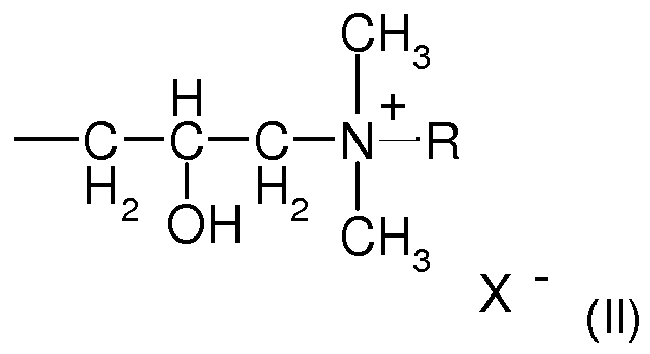
- and at least one of R1, R2, R3, R4, R5, R6, R7, R8 and R9 is a cationic group having the formula (II).
- The group R of formula (II) is preferably selected from the group consisting of cocoalkyl, C12 and C18, and X is preferably Cl.
- Preferably, the cationic groups of formula (II) have one of the following formulae:


- The present invention also relates to a method for protecting dyed hair color from fading, which comprises treating said dyed hair with a hair composition, comprising a modified galactomannan which:
- i) has a mean average molecular weight (Mw) from about 50,000 g/mol to about 5,000,000 g/mol; and
- ii) comprises at least one cationic group, with a cationic degree of substitution (DScationic) from about 0.03 to 0.5.
- This modified galactomannan is as defined above.
- According to a preferred embodiment, the cationic groups of the modified galactomannan used in the method of the invention also contain hydrophobic groups. Preferably, the hydrophobic groups of the modified galactomannan are chosen from linear or branched alkyl groups containing from 8 to 22 carbon atoms, preferably from 11 to 19 carbon atoms, and more preferably from 12 to 18 carbon atoms.
- Preferably, the cationic groups of the modified galactomannan as used in the method of the invention have one of the following formulae :


- According to the invention, the method for protecting dyed hair color from fading, consists in contacting the dyed hair with a hair composition, comprising the modified galactomannan, and then, if appropriate, rinsing said hair with water.
- It has been unexpectedly found, that the use of a modified galactomannan when incorporated into a functional hair composition is effective in protecting dyed hair color from fading. This discovery forms the basis of the current invention.
- In a preferred embodiment, the dyed hair used in the present invention is double-bleached, mono-bleached and/or permed hair.
- The expression "mono-bleached hair" used herein means hair which has been discolored once, with an oxidizing agent.
The expression "double-bleached hair" used herein refers to hair which has been discolored with an oxidizing agent, twice. - The following examples will serve to illustrate the invention, all parts and percentages being by weight, unless otherwise indicated.
- Hair tresses were supplied by International Hair Importers and Products Inc, Lots: 2-gram Caucasian medium brown tresses, damaged in different ways (bleached once, twice). Before the dyeing process, the tresses were pre-treated with a detergent solution: each tress was put under a controlled water flow (1.6 L/min at 37°C) for 1 minute, then massaged for 1 min with 1 mL of a 10wt% SLES (INCI Sodium laureth sulphate) solution and rinsed for 1 minute.
- A commercial coloration kit was rapidly applied on the tresses in the most homogeneous way possible. After 45 min, the coloration was stopped on all tresses at the same time in a large water bath; then, each tress was rinsed for 30 seconds (6.0 L/min at 37°C) and then 60 seconds (1.6 L/min at 37°C).
Finally, the tresses were dried for 2 hours in a 40°C-oven. Initial color coordinates LOaObO were determined 10 times along each colored tress with a Konika-Minolta spectrocolorimeter 2500d. Among the tresses colored, only those closest in terms of color coordinates were kept for the study. - Any shampoo was applied only after 48 hours. The shampooing process consists in the following: each tress was put under a controlled water flow for 1 minute (1.6 L/min at 37°C), then pressed between two fingers to get rid of the excess water; a dose of shampoo of 0.4 grams was applied on the 2-gram tress (i.e. 20wt% shampoo / hair) and the tress massaged for 45 seconds. Each tress was rinsed under a water flow for 45 seconds, then combed and pressed between two fingers to get rid of the extra water. All tresses were placed in an oven at 40 °C for 2 hours. This step is repeated as many times as required, up to 10 shampoo cycles.
Each shampoo considered was tested on 3 to 5 tresses for reproducibility's sake. A batch of 20 colored tresses therefore allowed 4 to 6 different shampoos to be tested. - After the Nth shampoo/drying cycle, color coordinates LNaNbN were determined 10 times along each colored tress with a Konika-Minolta spectrocolorimeter 2500d. Color fading ΔE(N) of each was then computed according to:

- N being the number of shampoos already performed. The associated changes in L and and b coordinates:

were also computed. These different quantities were averaged over the 3 to 5 tresses on which the same shampoo was tested. - The measurement of ΔE(N) highlights the change in color. The larger value of ΔE(N) reflects greater change of color, hence, color fading.
- Meaning of abbreviations or acronyms used in the synthesis examples:
- QUAB® 342: 3-chloro-2-hydroxypropyl-lauryl-dimethylammonium chloride
- QUAB® 360 : 3-chloro-2-hydroxypropyl-cocoalkyl-dimethylammonium chloride
- QUAB® 426: 3-chloro-2-hydroxypropyl-stearyl-dimethylammonium chloride
- QUAT® 188 : 3-chloro-2-hydroxypropyl- trimethylammonium chloride
- SLES : Sodium Lauryl Ether Sulfate
- CAPB : Cocamidopropyl Betaine
-
- QUAB® 360, QUAB® 342, QUAB® 426: Degussa Chemical Company
- Quat®188 : Quab Specialties
- Mirataine :Rhodia
- Rhodapex : Rhodia
- Kathon : Rohm and Haas
- After each synthesis, the final product is analyzed by SEC-MALS (size exclusion chromatography with detection by multi-angle light-scattering detection). The average molar masses are expressed by weight. The degree of cationic substitution (DScationic) and the degree of hydrophobic substitution (DShydrophobic) were analyzed by 1 H NMR (solvent : D2O or DMSO) and express the average number of moles of cationic and hydrophobic substitution, respectively, per mole of sugar unit.
- The average molecular weights of the modified galactomannan were measured by GPC with Light Scattering using the following conditions :
- Column : Shodex OH pak SB-806M HQ, 3 columns
- Mobile phase :100 mM Na2SO4, 100 Mm H3PO4
- Flow rate : 1.0 ml/min
- Detector : Agilent Refractive Index Detector, Wyatt miniDAWN MALS detector
- Inj. volume : 200 µl
- Temperature : ambient
- Run time : 50 minutes
- A value of 0.140 for dn/dc was used for the molecular weight measurements. The Wyatt MALS detector was calibrated using a 22.5 K Da polyethylene glycol standard. All calculations of the molecular weight distributions were performed using Wyatt's ASTRA software. The samples were prepared as 0.05% solutions in the mobile phase and filtered trough 0.45 µm PVDF filters before analysis.
- Modified galactomannans of use in the present invention were made in the following manner :
- The modified galactomannan polymer 1 was made according to patent
EP 0 686 643 . The molecular weight was Mw= 2-3 x10⁶ g/mol and the DScationic= 0.18-0.28. - The modified galactomannan polymer 2 was made according to patent
EP 0 686 643 . The molecular weight was Mw= 300-650 x103 g/mol and the DScationic= 0.09-0.14. - The modified galactomannan polymer 3 was made according to
patent US 5,756, 720 . The molecular weight was Mw= 1-1.5 x10⁶ g/mol and the DScationic= 0.10-0.13. - The modified galactomannan polymer 4 was made using the following reagents in the ensuing amounts and using methods known to those skilled in the art, such as those published on
US 5,756,720 .
Guar (Rhodia, Mw = 2 x10⁶ g/mol) : 100g (0.49 moles)
2-propanol: 181g (3.01 moles)
De-ionized water: 32g
QUAB 342, 39% (Mw = 342 g/mol): 43g (0.05 moles)
Sodium hydroxide, 25%: 9g (0.06 moles)
The molecular weight for the product of the synthesis in Example 4 was Mw=2.0 x10⁶ g/mol and the DShydrophobic=0.027. DScationic= 0.27. - The modified galactomannan polymer 5 was made using the following reagents in the ensuing amounts and using methods known to those skilled in the art, such as those published on
US 5,756,720 .
Guar (Rhodia, Mw = 2 x10⁶ g/mol) :100g (0.49 moles)
2-propanol: 181g (3.01 moles)
De-ionized water: 32g
QUAB® 426, 39% (Mw = 426 g/mol): 160g (0.15 moles)
Sodium hydroxide, 25%: 9g (0.06 moles)
The molecular weight for the product of the synthesis in Example 5 was Mw=2,61 x10⁶ g/mol and the DShydrophobic=0.024. DScationic= 0.27. - The modified galactomannan polymer 6 was made using the following reagents in the ensuing amounts and using methods known to those skilled in the art, such as those published on
EP 0 686 643 .
Guar splits (Rhodia, Mw = 2-3x10⁶ g/mol): 500g
Water: 369g
Sodium hydroxide: 50%, 184g
Hydrogen peroxide: 20%, 35g
Sodium tetraborate: 3%, 98g
Quat® 188, 69% (Mw = 188 g/mol): 389g
The molecular weight measured for the product of the synthesis in Example 6 was Mw=2.1x10⁵ g/mol and the DScationic=0.19. - The modified galactomannan polymer 7 was made using the following reagents in the ensuing amounts and using methods known to those skilled in the art, such as those published on
EP 0 686 643 .
Guar splits (Rhodia, Mw = 2-3x10⁶ g/mol): 500g
Water: 244 g
Sodium hydroxide: 50%, 81 g
Hydrogen peroxide: 20%, 28 g
Sodium tetraborate: 3%, 48 g
Quat® 188, 69% (Mw = 188 g/mol): 174 g
The molecular weight measured for the product of the synthesis in Example 7 was Mw=4.1x10⁵ g/mol and the DScationic=0.108. - The modified galactomannan polymer 8 was made using the following reagents in the ensuing amounts and using methods known to those skilled in the art, such as those published on
US 5,756,720 .
Guar (Rhodia, Mw = 2 x10⁶ g/mol): 150g (0.735 moles)
2-propanol: 196g, (3.25 moles)
De-ionized water: 75g
QUAB® 360, 38.7% (Mw = 360 g/mol): 41 g, (0.044 moles)
Sodium hydroxide, 30%: 31 g, (0.2 moles)
The molecular weight for the product was Mw=2-3 x10⁶ g/mol with DShydrophobic=0.010 and DScationic=0.27. - Several shampoos were prepared the following way in 200-mL vessels equipped with a mechanical stirring:
- under moderate stirring, the dry powdered galactomannan polymer was slowly added in distilled water; once well dispersed, the galactomannan polymer was hydrated by adjusting the pH to 3.5 - 5 with citric acid; the clarity of the solution should improve. Then, the preparation was stirred an additional 15 to 20 minutes with moderate stirring to ensure proper hydration;
- raw material Mirataine BET C30 (cocamidopropyl betaine) was added and the mixture was stirred until fully homogeneous;
- raw material Rhodapex ES 2K (sodium lauryl ether sulfate) was added and the solution was stirred until fully homogeneous;
- NaCl (sodium chloride) was next added and the mixture was stirred until fully homogeneous;
- Kathon CG (preservative) was added;
- the pH was adjusted to 5.5 - 6.
- Table 1 indicates the different formulations created with the different polymers. Formulations C to J are based on the 8 polymers of examples 1 to 8, respectively. Two formulations serve as references :
- - formulation A consists of a commercial benchmark (Elsève® Color Vive) renowned in color protection and available in stores in Europe, based on a guar hydroxypropyltrimonium chloride according to its INCI list, a polymer of the same family as those described in examples 5 to 8.
- - formulation B consists of a surfactant base with 14wt% SLES, 2wt% CAPB and 1.6wt% NaCl.

- The performances of formulations containing modified galactomannans with different molecular weights and different DScationic were evaluated on mono-bleached medium brown Caucasian hair. The formulations A, C and D are based on the same type of polymer Guar hydroxypropyltrimonium chloride.
- Table 2 indicates the results of color fading from dyed hair samples after 5 shampoos.
Table 2 : ΔE(N) after 5 shampoos Formulations Polymers ΔE(N) A Standard commercial guar 2.71± 0 21 C Polymer 1 2.38± 0 19 D Polymer 2 2.03± 0 27 - The results in Table 2 show that formulations C and D are more effective, after 5 shampoos, in reducing hair dye fading than the formulation A comprising the commercial benchmark (Elsève® Color Vive). The formulation D containing modified galactomannan polymer 2 is the most effective in reducing color erosion of mono-bleached hair.
- The performances of formulations B, C and J were evaluated on mono-bleached medium brown Caucasian hair. The formulation J is based on the same type of polymer (guar hydroxypropyltrimonium chloride) with the formulation C (polymer 1), wherein the said polymer is further hydrophobized.
- Table 3 provides the results of color fading from dyed hair samples after 10 shampoos.
Table 3: ΔE(N) after 10 shampoos Formulations Polymers Mw (g/mol) DScationic DShydrophobic ΔE(N) C Polymer 1 2-3x10⁶ 0.18-0.28 0 10.12± 0.62 B None - - - 11.17± 0.19 J Polymer 8 2-3x10⁶ 0.27 0.010 9.09± 0.36 - The results in Table 3 show that the formulation J (polymer 8) leads to the smallest value of 4E(N) compared to formulations C (polymer 1) and B (surfactant base). Advantageously, the introduction of hydrophobic groups in a cationic polymer leads to the reduction of the hair dye fading of mono-bleached hair.
- The performances of formulations E, H and I were evaluated on double-bleached medium brown Caucasian hair.
- Table 4 provides the results of color fading from dyed hair samples after 10 shampoos.
Table 4 : After 10 shampoos Formulations Polymers Mw (kg/mol) DScationic ΔE(N) E Polymer 3 1000-1500 0.10-0.13 8.40± 0.40 H Polymer 6 210 0.19 7.64± 0.13 I Polymer 7 410 0.108 9.25± 0.17 - The results in Table 4 show that the formulation H (polymer 6) leads to the smallest value of ΔE(N) compared to formulations E (polymer 3) and I (polymer 7). The formulation H comprises a galactomannan polymer with a smaller molecular weight and a higher DScationic than the polymer of formulation E. Advantageously, the use of a modified galactomannan having a small MW and a high DScationic leads to the reduction of the hair dye fading of double-bleached hair.
- The performances of formulations A, F and G were evaluated on double-bleached medium brown Caucasian hair.
- Table 5 provides the results of color fading from dyed hair samples after 10 shampoos.
Table 5 : After 10 shampoos Formulations Polymers Alkyl chain length DShydrophobic ΔE(N) A Standard commercial guar - 0 9.02± 0 12 F Polymer 4 C12 0.027 7.59± 0 30 G Polymer 5 C18 0.024 7.76± 0 45 - The results in Table 5 show that the formulations F and G lead significantly to smaller values of ΔE(N) than formulation A (Elsève® Color Vive) which contains a standard commercial guar. Hence, the introduction of hydrophobic groups into cationic galactomannan polymer allows reducing color fading of double-bleached dyed hair. Advantageously, the use of a hydrophobically modified galactomannan polymer leads to the reduction of the hair dye fading of double-bleached hair.

Claims (21)
- Use of at least one modified galactomannan, in a hair composition, for protecting dyed hair color from fading, wherein said modified galactomannan:i) has a mean average molecular weight (Mw) from about 50,000 g/mol to about 5,000,000 g/mol; andii) contains at least one cationic group, with a cationic degree of substitution (DScationic) from about 0.03 to about 0.5.
- Use according to claim 1, wherein the modified galactomannan further contains at least one hydrophobic group.
- Use according to claim 2, wherein (at least one of) said hydrophobic group(s) is(are) borne by a cationic group of the modified galactomannan.
- Use according to claim 2, wherein (at least one of) said hydrophobic group(s) is(are) not borne by a cationic group of the modified galactomannan.
- Use according to claim 4, wherein the hydrophobic groups are derived from hydrophobizing agent chosen from: epoxides, halides, fatty acids, fatty esters, and anhydrides of fatty acids.
- Use according to any one of claims 1 to 5, wherein at least one hydrophobic group (g1) is borne by a cationic group of the modified galactomannan and at least one hydrophobic group (g2) is not borne by a cationic group of the modified galactomannan.
- Use according to claim 6, wherein at least one of the (g1) groups is identical to at least one of the (g2) groups, preferably all of the (g1) and (g2) groups are identical.
- Use according to claim 6, wherein at least one of the (g1) groups is different from least one of the (g2) groups, preferably all of the (g1) and (g2) groups are different.
- Use according to any one of claims 1 to 8, wherein the hydrophobic group of the modified galactomannan is chosen from linear or branched alkyl groups containing from 8 to 22 carbon atoms.
- Use according to any one of claims 1 to 9, wherein the hydrophobically modified guar has a hydrophobic degree of substitution (DShydrobobic) from about 0.0012 to 0.5.
- Use according to any one of claims 1 to 10, wherein the modified galactomannan has a molecular weight from about 200,000 g/mol to about 3,000,000 g/mol.
- Use according to any one of claims 1 to 11, wherein the modified galactomannan has a molecular weight from about 500,000 g/mol to about 2,000,000 g/mol.
- Use according to any one of claims 1 to 12, wherein the cationic groups are chosen from the group consisting of: primary, secondary or tertiary amino groups, quaternary ammonium, sulfonium or phosphinium groups, and mixtures thereof.
- Use according to any one of claims 1 to 13, wherein the cationic groups are chosen from : trialkylammonium groups, such as trimethylammonium groups, triethylammonium groups, or tributylammonium groups, aryldialkylammonium groups, such as benzyldimethylammonium groups, and ammonium groups in which the nitrogen atom is a member of a ring structure, such as pyridinium groups and imidazoline groups.
- Use according to any one of claims 1 to 14, wherein the galactomannan is a guar.
- Use according to any one of claims 1 to 15, wherein the modified galactomannan comprises at least one unit having the general formula (I):

- Use according to claim 16, wherein each of R1, R2, R3, R4, R5, R6, R7, R8 and R9 represents H or a cationic group bearing a hydrophobic group.
- Use according to any one of claims 1 to 17, wherein the modified galactomannan comprises at least one unit having the general formula (I):
 - each of R1, R2, R3, R4, R5, R6, R7, R8 and R9 represents H or a cationic group having the formula (II) :wherein n is from 20 to about 50,000, X represents an halogen atom and R represents a linear or branched alkyl group containing from 8 to 22 carbon atoms ; and at least one of R1, R2, R3, R4, R5, R6, R7 , R8 and R9 is a cationic group having the formula (II).
- Use according to claim 18, wherein the cationic groups of formula (II) have one of the following formulae:


- A method for protecting dyed hair color from fading, which comprises treating said dyed hair with a hair composition comprising at least one modified galactomannan which:i) has a mean average molecular weight (Mw) from about 50,000 g/mol to about 5,000,000 g/mol; andii) comprises at least one cationic group, with a cationic degree of substitution (DScationic) from about 0.03 to about 0.5.
- The method of claim 20, wherein the dyed hair is double-bleached, mono-bleached or permed hair.
Priority Applications (4)
| Application Number | Priority Date | Filing Date | Title |
|---|---|---|---|
| EP11305523A EP2520276A1 (en) | 2011-05-03 | 2011-05-03 | Use of modified galactomannans for protecting dyed hair color from fading |
| EP12710979.1A EP2691070B1 (en) | 2011-03-29 | 2012-03-29 | Use of modified galactomannans for protecting dyed hair color from fading |
| PCT/EP2012/055721 WO2012130997A1 (en) | 2011-03-29 | 2012-03-29 | Use of modified galactomannans for protecting dyed hair color from fading |
| US13/984,987 US20140079659A1 (en) | 2011-03-29 | 2012-03-29 | Use of modified galactomannans for protecting dyed hair color from fading |
Applications Claiming Priority (1)
| Application Number | Priority Date | Filing Date | Title |
|---|---|---|---|
| EP11305523A EP2520276A1 (en) | 2011-05-03 | 2011-05-03 | Use of modified galactomannans for protecting dyed hair color from fading |
Publications (1)
| Publication Number | Publication Date |
|---|---|
| EP2520276A1 true EP2520276A1 (en) | 2012-11-07 |
Family
ID=46929513
Family Applications (2)
| Application Number | Title | Priority Date | Filing Date |
|---|---|---|---|
| EP11305523A Withdrawn EP2520276A1 (en) | 2011-03-29 | 2011-05-03 | Use of modified galactomannans for protecting dyed hair color from fading |
| EP12710979.1A Not-in-force EP2691070B1 (en) | 2011-03-29 | 2012-03-29 | Use of modified galactomannans for protecting dyed hair color from fading |
Family Applications After (1)
| Application Number | Title | Priority Date | Filing Date |
|---|---|---|---|
| EP12710979.1A Not-in-force EP2691070B1 (en) | 2011-03-29 | 2012-03-29 | Use of modified galactomannans for protecting dyed hair color from fading |
Country Status (3)
| Country | Link |
|---|---|
| US (1) | US20140079659A1 (en) |
| EP (2) | EP2520276A1 (en) |
| WO (1) | WO2012130997A1 (en) |
Families Citing this family (3)
| Publication number | Priority date | Publication date | Assignee | Title |
|---|---|---|---|---|
| WO2013011122A1 (en) * | 2011-07-21 | 2013-01-24 | Rhodia Operations | Guar hydroxypropyltrimethylammonium chloride and uses thereof in hair treatment compositions |
| US20190224103A1 (en) * | 2016-10-04 | 2019-07-25 | Rhodia Operations | Hair repair composition |
| EP3522990A1 (en) | 2016-10-04 | 2019-08-14 | Rhodia Operations | Hair repair composition |
Citations (10)
| Publication number | Priority date | Publication date | Assignee | Title |
|---|---|---|---|---|
| US3472840A (en) | 1965-09-14 | 1969-10-14 | Union Carbide Corp | Quaternary nitrogen-containing cellulose ethers |
| US4031307A (en) | 1976-05-03 | 1977-06-21 | Celanese Corporation | Cationic polygalactomannan compositions |
| US4663159A (en) | 1985-02-01 | 1987-05-05 | Union Carbide Corporation | Hydrophobe substituted, water-soluble cationic polysaccharides |
| US4959464A (en) | 1988-11-07 | 1990-09-25 | Hi-Tek Polymers, Inc. | Process for derivatizing polygalactomannan using water soluble aluminum salts in the process |
| US5387675A (en) | 1993-03-10 | 1995-02-07 | Rhone-Poulenc Specialty Chemicals Co. | Modified hydrophobic cationic thickening compositions |
| EP0686643A1 (en) | 1994-06-09 | 1995-12-13 | Rhone-Poulenc Inc. | Guar gum composition and process for making it |
| US5756720A (en) | 1996-10-25 | 1998-05-26 | Rhodia Inc. | Derivatized guar gum composition including nonionic and cationic groups which demonstrate excellent solution clarity properties |
| WO2004091557A2 (en) * | 2003-04-09 | 2004-10-28 | Hercules Incorporated | Cationic, oxidized polysaccharides in conditioning applications |
| US20100029929A1 (en) | 2008-07-30 | 2010-02-04 | Rhodia Inc. | Method of producing cross-linked polysaccharide particles |
| FR2944967A1 (en) * | 2009-04-30 | 2010-11-05 | Oreal | Use of one or more oxidized polysaccharides, preferably anionic or non-ionic, as an agent for protecting the color against washing the artificially dyed keratin fibers such as human keratin fibers, preferably hair |
-
2011
- 2011-05-03 EP EP11305523A patent/EP2520276A1/en not_active Withdrawn
-
2012
- 2012-03-29 US US13/984,987 patent/US20140079659A1/en not_active Abandoned
- 2012-03-29 WO PCT/EP2012/055721 patent/WO2012130997A1/en not_active Ceased
- 2012-03-29 EP EP12710979.1A patent/EP2691070B1/en not_active Not-in-force
Patent Citations (12)
| Publication number | Priority date | Publication date | Assignee | Title |
|---|---|---|---|---|
| US3472840A (en) | 1965-09-14 | 1969-10-14 | Union Carbide Corp | Quaternary nitrogen-containing cellulose ethers |
| US4031307A (en) | 1976-05-03 | 1977-06-21 | Celanese Corporation | Cationic polygalactomannan compositions |
| US4663159A (en) | 1985-02-01 | 1987-05-05 | Union Carbide Corporation | Hydrophobe substituted, water-soluble cationic polysaccharides |
| US4663159B1 (en) | 1985-02-01 | 1992-12-01 | Union Carbide Corp | |
| US4959464A (en) | 1988-11-07 | 1990-09-25 | Hi-Tek Polymers, Inc. | Process for derivatizing polygalactomannan using water soluble aluminum salts in the process |
| US5387675A (en) | 1993-03-10 | 1995-02-07 | Rhone-Poulenc Specialty Chemicals Co. | Modified hydrophobic cationic thickening compositions |
| US5473059A (en) | 1993-03-10 | 1995-12-05 | Rhone-Poulenc Inc. | Modified hydrophobic cationic thickening compositions |
| EP0686643A1 (en) | 1994-06-09 | 1995-12-13 | Rhone-Poulenc Inc. | Guar gum composition and process for making it |
| US5756720A (en) | 1996-10-25 | 1998-05-26 | Rhodia Inc. | Derivatized guar gum composition including nonionic and cationic groups which demonstrate excellent solution clarity properties |
| WO2004091557A2 (en) * | 2003-04-09 | 2004-10-28 | Hercules Incorporated | Cationic, oxidized polysaccharides in conditioning applications |
| US20100029929A1 (en) | 2008-07-30 | 2010-02-04 | Rhodia Inc. | Method of producing cross-linked polysaccharide particles |
| FR2944967A1 (en) * | 2009-04-30 | 2010-11-05 | Oreal | Use of one or more oxidized polysaccharides, preferably anionic or non-ionic, as an agent for protecting the color against washing the artificially dyed keratin fibers such as human keratin fibers, preferably hair |
Non-Patent Citations (2)
| Title |
|---|
| A. SCHLOSSER: "Silicones Used in Permanent and Serai-Permanent Hair Dyes to Reduce the Fading and Color Change Process of Dyed Hair Occurring by Wash Out or UV Radiation", J. COSMETIC SCI, vol. 55, 2004, pages 123 - 131 |
| S. MARCHLORETTO: "The Use of Silicones as a Color Lock Aid in Rinse-Off Hair Conditioners", J. OF COSMETIC SCIENCE, 2003 ANNUAL SCIENTIFIC MEETING, 2003, pages 130 - 131 |
Also Published As
| Publication number | Publication date |
|---|---|
| EP2691070B1 (en) | 2017-12-06 |
| US20140079659A1 (en) | 2014-03-20 |
| EP2691070A1 (en) | 2014-02-05 |
| WO2012130997A1 (en) | 2012-10-04 |
Similar Documents
| Publication | Publication Date | Title |
|---|---|---|
| EP2717844B1 (en) | Cassia derivatives | |
| JP6262131B2 (en) | Guar hydroxypropyltrimethylammonium chloride and its use in hair treatment compositions | |
| US9782609B2 (en) | Dihydroxyalkyl substituted polygalactomannan, and methods for producing and using the same | |
| EP2449079B1 (en) | Cationic synthetic polymers with improved solubility and performance in surfactant-based systems and use in personal care and household applications | |
| EP2513151B1 (en) | Cassia derivatives | |
| US8568701B2 (en) | Cationic synthetic polymers with improved solubility and performance in phosphate surfactant-based systems and use in personal care and household applications | |
| US8790627B2 (en) | Personal care composition additive for application on keratin substrates to provide long lasting benefits | |
| EP2563818B1 (en) | Cassia derivatives | |
| WO2019191747A1 (en) | Hair styling compositions comprising polygalactomanans, and method for using the same | |
| EP2691070B1 (en) | Use of modified galactomannans for protecting dyed hair color from fading | |
| WO2018017570A1 (en) | A hair straightening and styling composition, process for preparing the same and method of use thereof | |
| JP2025121916A (en) | hair repair composition | |
| EP4337163B1 (en) | Hair conditioner formulation comprising cationic dextran polymer | |
| JP2025507701A (en) | Multimodal hair care compositions containing cationic guar blends and methods for making same | |
| WO2025087799A1 (en) | Compositions having cationic galactomannans | |
| WO2025087800A1 (en) | Compositions having cationic galactomannans | |
| WO2025149373A1 (en) | Cationic galactomannans from guar and its process of production |
Legal Events
| Date | Code | Title | Description |
|---|---|---|---|
| PUAI | Public reference made under article 153(3) epc to a published international application that has entered the european phase |
Free format text: ORIGINAL CODE: 0009012 |
|
| AK | Designated contracting states |
Kind code of ref document: A1 Designated state(s): AL AT BE BG CH CY CZ DE DK EE ES FI FR GB GR HR HU IE IS IT LI LT LU LV MC MK MT NL NO PL PT RO RS SE SI SK SM TR |
|
| AX | Request for extension of the european patent |
Extension state: BA ME |
|
| STAA | Information on the status of an ep patent application or granted ep patent |
Free format text: STATUS: THE APPLICATION IS DEEMED TO BE WITHDRAWN |
|
| 18D | Application deemed to be withdrawn |
Effective date: 20130508 |