EP2519501B1 - Substituted pyridines and pyrimidines for the production of cardiomyocyte-like cells - Google Patents
Substituted pyridines and pyrimidines for the production of cardiomyocyte-like cells Download PDFInfo
- Publication number
- EP2519501B1 EP2519501B1 EP20100803206 EP10803206A EP2519501B1 EP 2519501 B1 EP2519501 B1 EP 2519501B1 EP 20100803206 EP20100803206 EP 20100803206 EP 10803206 A EP10803206 A EP 10803206A EP 2519501 B1 EP2519501 B1 EP 2519501B1
- Authority
- EP
- European Patent Office
- Prior art keywords
- ylamino
- pyrimidin
- ethan
- methoxyphenyl
- diamine
- Prior art date
- Legal status (The legal status is an assumption and is not a legal conclusion. Google has not performed a legal analysis and makes no representation as to the accuracy of the status listed.)
- Not-in-force
Links
- 238000004519 manufacturing process Methods 0.000 title claims description 4
- 150000003222 pyridines Chemical class 0.000 title description 2
- 150000003230 pyrimidines Chemical class 0.000 title description 2
- 210000004027 cell Anatomy 0.000 claims description 82
- 150000001875 compounds Chemical class 0.000 claims description 82
- 125000003118 aryl group Chemical group 0.000 claims description 35
- -1 pyrimidine compound Chemical class 0.000 claims description 30
- 238000000034 method Methods 0.000 claims description 28
- 125000000217 alkyl group Chemical group 0.000 claims description 23
- 125000000623 heterocyclic group Chemical group 0.000 claims description 22
- 125000000753 cycloalkyl group Chemical group 0.000 claims description 19
- 150000003839 salts Chemical class 0.000 claims description 18
- 210000004962 mammalian cell Anatomy 0.000 claims description 16
- 229910052757 nitrogen Inorganic materials 0.000 claims description 14
- 230000008569 process Effects 0.000 claims description 13
- 125000001931 aliphatic group Chemical group 0.000 claims description 12
- 125000005842 heteroatom Chemical group 0.000 claims description 10
- 125000004433 nitrogen atom Chemical group N* 0.000 claims description 10
- 229910052739 hydrogen Inorganic materials 0.000 claims description 9
- 229910052736 halogen Inorganic materials 0.000 claims description 8
- 150000002367 halogens Chemical class 0.000 claims description 7
- WNOIZFNPHGCNPP-UHFFFAOYSA-N 2-[[6-(4-anilinoanilino)pyrimidin-4-yl]amino]ethanol Chemical compound C1=NC(NCCO)=CC(NC=2C=CC(NC=3C=CC=CC=3)=CC=2)=N1 WNOIZFNPHGCNPP-UHFFFAOYSA-N 0.000 claims description 6
- BYLKUFZOBSCGFC-UHFFFAOYSA-N 2-[(6-anilinopyrimidin-4-yl)amino]ethanol Chemical compound C1=NC(NCCO)=CC(NC=2C=CC=CC=2)=N1 BYLKUFZOBSCGFC-UHFFFAOYSA-N 0.000 claims description 5
- LZQVJDYRWQBSBD-UHFFFAOYSA-N 2-[[4-(4-methoxyanilino)pyridin-2-yl]amino]ethanol Chemical compound C1=CC(OC)=CC=C1NC1=CC=NC(NCCO)=C1 LZQVJDYRWQBSBD-UHFFFAOYSA-N 0.000 claims description 5
- BMXXCYMMFKLQGI-UHFFFAOYSA-N 2-[[4-(4-phenoxyanilino)pyridin-2-yl]amino]ethanol Chemical compound C1=NC(NCCO)=CC(NC=2C=CC(OC=3C=CC=CC=3)=CC=2)=C1 BMXXCYMMFKLQGI-UHFFFAOYSA-N 0.000 claims description 5
- VGXOZTYIYGTYKA-UHFFFAOYSA-N 2-[[6-(3-bromoanilino)pyrimidin-4-yl]amino]ethanol Chemical compound C1=NC(NCCO)=CC(NC=2C=C(Br)C=CC=2)=N1 VGXOZTYIYGTYKA-UHFFFAOYSA-N 0.000 claims description 5
- BQEGRKMNMHRGSN-UHFFFAOYSA-N 2-[[6-(3-chloroanilino)pyrimidin-4-yl]amino]ethanol Chemical compound C1=NC(NCCO)=CC(NC=2C=C(Cl)C=CC=2)=N1 BQEGRKMNMHRGSN-UHFFFAOYSA-N 0.000 claims description 5
- LSYPXYJLWWTMEM-UHFFFAOYSA-N 2-[[6-(3-methoxyanilino)pyrimidin-4-yl]amino]ethanol Chemical compound COC1=CC=CC(NC=2N=CN=C(NCCO)C=2)=C1 LSYPXYJLWWTMEM-UHFFFAOYSA-N 0.000 claims description 5
- WTKFVLBBTYSRKJ-UHFFFAOYSA-N 2-[[6-(3-nitroanilino)pyrimidin-4-yl]amino]ethanol Chemical compound C1=NC(NCCO)=CC(NC=2C=C(C=CC=2)[N+]([O-])=O)=N1 WTKFVLBBTYSRKJ-UHFFFAOYSA-N 0.000 claims description 5
- DTMRLPCVQFOCPP-UHFFFAOYSA-N 2-[[6-(4-chloroanilino)pyrimidin-4-yl]amino]ethanol Chemical compound C1=NC(NCCO)=CC(NC=2C=CC(Cl)=CC=2)=N1 DTMRLPCVQFOCPP-UHFFFAOYSA-N 0.000 claims description 5
- RXAVFGDRWOFIDL-UHFFFAOYSA-N 2-[[6-(4-methoxyanilino)pyridin-2-yl]amino]ethanol Chemical compound C1=CC(OC)=CC=C1NC1=CC=CC(NCCO)=N1 RXAVFGDRWOFIDL-UHFFFAOYSA-N 0.000 claims description 5
- DLQKCPXDUQDUSU-UHFFFAOYSA-N 2-[[6-(4-morpholin-4-ylanilino)pyrimidin-4-yl]amino]ethanol Chemical compound C1=NC(NCCO)=CC(NC=2C=CC(=CC=2)N2CCOCC2)=N1 DLQKCPXDUQDUSU-UHFFFAOYSA-N 0.000 claims description 5
- YTBSJPMCGJCIOW-UHFFFAOYSA-N 2-[[6-(4-nitroanilino)pyrimidin-4-yl]amino]ethanol Chemical compound C1=NC(NCCO)=CC(NC=2C=CC(=CC=2)[N+]([O-])=O)=N1 YTBSJPMCGJCIOW-UHFFFAOYSA-N 0.000 claims description 5
- DBMIIWXZNAPXBH-UHFFFAOYSA-N 2-[[6-(4-phenoxyanilino)pyridin-2-yl]amino]ethanol Chemical compound OCCNC1=CC=CC(NC=2C=CC(OC=3C=CC=CC=3)=CC=2)=N1 DBMIIWXZNAPXBH-UHFFFAOYSA-N 0.000 claims description 5
- IBDLIAPOVGAEOD-UHFFFAOYSA-N 2-[[6-(4-phenoxyanilino)pyrimidin-4-yl]amino]ethanol Chemical compound C1=NC(NCCO)=CC(NC=2C=CC(OC=3C=CC=CC=3)=CC=2)=N1 IBDLIAPOVGAEOD-UHFFFAOYSA-N 0.000 claims description 5
- OYWWKWUNWPNBHG-UHFFFAOYSA-N 4-n-(1-adamantyl)-6-n-(4-methoxyphenyl)pyrimidine-4,6-diamine Chemical compound C1=CC(OC)=CC=C1NC1=CC(NC23CC4CC(CC(C4)C2)C3)=NC=N1 OYWWKWUNWPNBHG-UHFFFAOYSA-N 0.000 claims description 5
- JUJWROOIHBZHMG-UHFFFAOYSA-N Pyridine Chemical compound C1=CC=NC=C1 JUJWROOIHBZHMG-UHFFFAOYSA-N 0.000 claims description 5
- 238000012258 culturing Methods 0.000 claims description 5
- 239000001257 hydrogen Substances 0.000 claims description 5
- 125000004169 (C1-C6) alkyl group Chemical group 0.000 claims description 4
- JTMDOGOIUMEMAL-UHFFFAOYSA-N 2-[[6-(3-fluoroanilino)pyrimidin-4-yl]amino]ethanol Chemical compound C1=NC(NCCO)=CC(NC=2C=C(F)C=CC=2)=N1 JTMDOGOIUMEMAL-UHFFFAOYSA-N 0.000 claims description 4
- ZXHCLPIQIFGLAG-UHFFFAOYSA-N 2-[[6-(4-methoxy-n-methylanilino)pyrimidin-4-yl]amino]ethanol Chemical compound C1=CC(OC)=CC=C1N(C)C1=CC(NCCO)=NC=N1 ZXHCLPIQIFGLAG-UHFFFAOYSA-N 0.000 claims description 4
- VBAPLMDWKXYGDT-UHFFFAOYSA-N 2-[[6-(4-methoxyanilino)pyrimidin-4-yl]-methylamino]ethanol Chemical compound C1=CC(OC)=CC=C1NC1=CC(N(C)CCO)=NC=N1 VBAPLMDWKXYGDT-UHFFFAOYSA-N 0.000 claims description 4
- PYBQCNLZUDJKGF-UHFFFAOYSA-N 2-[[6-(4-methoxyanilino)pyrimidin-4-yl]amino]acetic acid Chemical compound C1=CC(OC)=CC=C1NC1=CC(NCC(O)=O)=NC=N1 PYBQCNLZUDJKGF-UHFFFAOYSA-N 0.000 claims description 4
- FLSNPLGSQPFPST-UHFFFAOYSA-N 2-[[6-(4-methoxyanilino)pyrimidin-4-yl]amino]ethanol Chemical compound C1=CC(OC)=CC=C1NC1=CC(NCCO)=NC=N1 FLSNPLGSQPFPST-UHFFFAOYSA-N 0.000 claims description 4
- HNSMTMMRJJQVCG-UHFFFAOYSA-N 3-[[6-(3-chloroanilino)pyrimidin-4-yl]amino]propan-1-ol Chemical compound C1=NC(NCCCO)=CC(NC=2C=C(Cl)C=CC=2)=N1 HNSMTMMRJJQVCG-UHFFFAOYSA-N 0.000 claims description 4
- CWKBLLWUJLIOCZ-UHFFFAOYSA-N 3-[[6-(4-methoxyanilino)pyridin-2-yl]amino]propan-1-ol Chemical compound C1=CC(OC)=CC=C1NC1=CC=CC(NCCCO)=N1 CWKBLLWUJLIOCZ-UHFFFAOYSA-N 0.000 claims description 4
- JZRVXMOEALRHKM-UHFFFAOYSA-N 3-[[6-(4-morpholin-4-ylanilino)pyrimidin-4-yl]amino]propan-1-ol Chemical compound C1=NC(NCCCO)=CC(NC=2C=CC(=CC=2)N2CCOCC2)=N1 JZRVXMOEALRHKM-UHFFFAOYSA-N 0.000 claims description 4
- HHMMCGGGTHYWGD-UHFFFAOYSA-N 3-[[6-(4-phenoxyanilino)pyridin-2-yl]amino]propan-1-ol Chemical compound OCCCNC1=CC=CC(NC=2C=CC(OC=3C=CC=CC=3)=CC=2)=N1 HHMMCGGGTHYWGD-UHFFFAOYSA-N 0.000 claims description 4
- PJXHQHVTEZAQMD-UHFFFAOYSA-N 4-n-(3-chlorophenyl)-6-n-(2-methoxyethyl)pyrimidine-4,6-diamine Chemical compound C1=NC(NCCOC)=CC(NC=2C=C(Cl)C=CC=2)=N1 PJXHQHVTEZAQMD-UHFFFAOYSA-N 0.000 claims description 4
- MSSUJBFLFDKCNX-UHFFFAOYSA-N 4-n-(4-methoxyphenyl)-6-n-methylpyrimidine-4,6-diamine Chemical compound C1=NC(NC)=CC(NC=2C=CC(OC)=CC=2)=N1 MSSUJBFLFDKCNX-UHFFFAOYSA-N 0.000 claims description 4
- VINZYPSTAYDGDT-UHFFFAOYSA-N 4-n-butan-2-yl-6-n-(4-methoxyphenyl)pyrimidine-4,6-diamine Chemical compound C1=NC(NC(C)CC)=CC(NC=2C=CC(OC)=CC=2)=N1 VINZYPSTAYDGDT-UHFFFAOYSA-N 0.000 claims description 4
- RZGRHNMLCICODU-UHFFFAOYSA-N 4-n-cyclohexyl-6-n-(3-methoxyphenyl)pyrimidine-4,6-diamine Chemical compound COC1=CC=CC(NC=2N=CN=C(NC3CCCCC3)C=2)=C1 RZGRHNMLCICODU-UHFFFAOYSA-N 0.000 claims description 4
- JQHVELZVCARUNM-UHFFFAOYSA-N 4-n-cyclohexyl-6-n-(3-nitrophenyl)pyrimidine-4,6-diamine Chemical compound [O-][N+](=O)C1=CC=CC(NC=2N=CN=C(NC3CCCCC3)C=2)=C1 JQHVELZVCARUNM-UHFFFAOYSA-N 0.000 claims description 4
- YPIHLCLKUNREAT-UHFFFAOYSA-N 4-n-cyclohexyl-6-n-(4-methoxyphenyl)pyrimidine-4,6-diamine Chemical compound C1=CC(OC)=CC=C1NC1=CC(NC2CCCCC2)=NC=N1 YPIHLCLKUNREAT-UHFFFAOYSA-N 0.000 claims description 4
- LBVDAKMZDGECLU-UHFFFAOYSA-N 4-n-cyclohexyl-6-n-(4-morpholin-4-ylphenyl)pyrimidine-4,6-diamine Chemical compound C1CCCCC1NC1=CC(NC=2C=CC(=CC=2)N2CCOCC2)=NC=N1 LBVDAKMZDGECLU-UHFFFAOYSA-N 0.000 claims description 4
- KZLCHZJMWWZJOA-UHFFFAOYSA-N 4-n-cyclopentyl-6-n-(4-methoxyphenyl)pyrimidine-4,6-diamine Chemical compound C1=CC(OC)=CC=C1NC1=CC(NC2CCCC2)=NC=N1 KZLCHZJMWWZJOA-UHFFFAOYSA-N 0.000 claims description 4
- RIKQRJZPISCVPR-UHFFFAOYSA-N 4-n-tert-butyl-6-n-(4-methoxyphenyl)pyrimidine-4,6-diamine Chemical compound C1=CC(OC)=CC=C1NC1=CC(NC(C)(C)C)=NC=N1 RIKQRJZPISCVPR-UHFFFAOYSA-N 0.000 claims description 4
- KWZNCEPWBSRWHD-UHFFFAOYSA-N 6-n-(2-methoxyethyl)-4-n-(4-methoxyphenyl)pyrimidine-4,6-diamine Chemical compound C1=NC(NCCOC)=CC(NC=2C=CC(OC)=CC=2)=N1 KWZNCEPWBSRWHD-UHFFFAOYSA-N 0.000 claims description 4
- KHLIJZJDQLBRHB-UHFFFAOYSA-N 6-n-(3-chloro-4-methoxyphenyl)-4-n-cyclohexylpyrimidine-4,6-diamine Chemical compound C1=C(Cl)C(OC)=CC=C1NC1=CC(NC2CCCCC2)=NC=N1 KHLIJZJDQLBRHB-UHFFFAOYSA-N 0.000 claims description 4
- IRUGAZSWDKFUJU-UHFFFAOYSA-N 6-n-(3-chlorophenyl)-4-n-cyclohexylpyrimidine-4,6-diamine Chemical compound ClC1=CC=CC(NC=2N=CN=C(NC3CCCCC3)C=2)=C1 IRUGAZSWDKFUJU-UHFFFAOYSA-N 0.000 claims description 4
- QCXJXESNXJYPAC-UHFFFAOYSA-N 6-n-(4-methoxyphenyl)-4-n-propan-2-ylpyrimidine-4,6-diamine Chemical compound C1=CC(OC)=CC=C1NC1=CC(NC(C)C)=NC=N1 QCXJXESNXJYPAC-UHFFFAOYSA-N 0.000 claims description 4
- IALONZLGWMCGIB-UHFFFAOYSA-N 6-n-butyl-4-n-(4-methoxyphenyl)pyrimidine-4,6-diamine Chemical compound C1=NC(NCCCC)=CC(NC=2C=CC(OC)=CC=2)=N1 IALONZLGWMCGIB-UHFFFAOYSA-N 0.000 claims description 4
- 125000003545 alkoxy group Chemical group 0.000 claims description 4
- RDBGARCMTHUURW-UHFFFAOYSA-N ethyl 4-[[6-(2-hydroxyethylamino)pyrimidin-4-yl]amino]benzoate Chemical compound C1=CC(C(=O)OCC)=CC=C1NC1=CC(NCCO)=NC=N1 RDBGARCMTHUURW-UHFFFAOYSA-N 0.000 claims description 4
- 125000004435 hydrogen atom Chemical group [H]* 0.000 claims description 4
- 125000002768 hydroxyalkyl group Chemical group 0.000 claims description 4
- VBNPOOUUBYAOMG-UHFFFAOYSA-N n-(4-methoxyphenyl)-6-morpholin-4-ylpyrimidin-4-amine Chemical compound C1=CC(OC)=CC=C1NC1=CC(N2CCOCC2)=NC=N1 VBNPOOUUBYAOMG-UHFFFAOYSA-N 0.000 claims description 4
- 229910052760 oxygen Inorganic materials 0.000 claims description 4
- 229910052717 sulfur Inorganic materials 0.000 claims description 4
- 125000004209 (C1-C8) alkyl group Chemical group 0.000 claims description 3
- ZCPCURRTVFOFSN-UHFFFAOYSA-N 2-[[6-(3-chloro-4-methoxyanilino)pyrimidin-4-yl]amino]ethanol Chemical compound C1=C(Cl)C(OC)=CC=C1NC1=CC(NCCO)=NC=N1 ZCPCURRTVFOFSN-UHFFFAOYSA-N 0.000 claims description 3
- DFTXDSDDZUKFFG-UHFFFAOYSA-N 2-[[6-(cyclohexylamino)pyrimidin-4-yl]amino]ethanol Chemical compound C1=NC(NCCO)=CC(NC2CCCCC2)=N1 DFTXDSDDZUKFFG-UHFFFAOYSA-N 0.000 claims description 3
- 125000004453 alkoxycarbonyl group Chemical group 0.000 claims description 3
- 125000004104 aryloxy group Chemical group 0.000 claims description 3
- 125000003178 carboxy group Chemical group [H]OC(*)=O 0.000 claims description 2
- 229910052740 iodine Inorganic materials 0.000 claims description 2
- UMJSCPRVCHMLSP-UHFFFAOYSA-N pyridine Natural products COC1=CC=CN=C1 UMJSCPRVCHMLSP-UHFFFAOYSA-N 0.000 claims description 2
- BDERNNFJNOPAEC-UHFFFAOYSA-N propan-1-ol Chemical compound CCCO BDERNNFJNOPAEC-UHFFFAOYSA-N 0.000 claims 2
- OXPVAKLQDMAMOC-UHFFFAOYSA-N 4-propyl-1H-pyrimidine-4,6-diamine Chemical compound C(CC)C1(C=C(N=CN1)N)N OXPVAKLQDMAMOC-UHFFFAOYSA-N 0.000 claims 1
- HEDRZPFGACZZDS-MICDWDOJSA-N Trichloro(2H)methane Chemical compound [2H]C(Cl)(Cl)Cl HEDRZPFGACZZDS-MICDWDOJSA-N 0.000 description 92
- JGFZNNIVVJXRND-UHFFFAOYSA-N N,N-Diisopropylethylamine (DIPEA) Chemical compound CCN(C(C)C)C(C)C JGFZNNIVVJXRND-UHFFFAOYSA-N 0.000 description 88
- 239000000203 mixture Substances 0.000 description 82
- XEKOWRVHYACXOJ-UHFFFAOYSA-N Ethyl acetate Chemical compound CCOC(C)=O XEKOWRVHYACXOJ-UHFFFAOYSA-N 0.000 description 76
- LRHPLDYGYMQRHN-UHFFFAOYSA-N N-Butanol Chemical compound CCCCO LRHPLDYGYMQRHN-UHFFFAOYSA-N 0.000 description 73
- 238000005160 1H NMR spectroscopy Methods 0.000 description 62
- 238000001644 13C nuclear magnetic resonance spectroscopy Methods 0.000 description 59
- 238000006243 chemical reaction Methods 0.000 description 56
- OKKJLVBELUTLKV-MZCSYVLQSA-N Deuterated methanol Chemical compound [2H]OC([2H])([2H])[2H] OKKJLVBELUTLKV-MZCSYVLQSA-N 0.000 description 48
- IAZDPXIOMUYVGZ-WFGJKAKNSA-N Dimethyl sulfoxide Chemical compound [2H]C([2H])([2H])S(=O)C([2H])([2H])[2H] IAZDPXIOMUYVGZ-WFGJKAKNSA-N 0.000 description 45
- 239000007787 solid Substances 0.000 description 42
- HZAXFHJVJLSVMW-UHFFFAOYSA-N 2-Aminoethan-1-ol Chemical compound NCCO HZAXFHJVJLSVMW-UHFFFAOYSA-N 0.000 description 40
- 235000019439 ethyl acetate Nutrition 0.000 description 38
- 238000004809 thin layer chromatography Methods 0.000 description 37
- 238000001704 evaporation Methods 0.000 description 36
- OKKJLVBELUTLKV-UHFFFAOYSA-N Methanol Chemical compound OC OKKJLVBELUTLKV-UHFFFAOYSA-N 0.000 description 33
- 238000004440 column chromatography Methods 0.000 description 26
- XJPZKYIHCLDXST-UHFFFAOYSA-N 4,6-dichloropyrimidine Chemical compound ClC1=CC(Cl)=NC=N1 XJPZKYIHCLDXST-UHFFFAOYSA-N 0.000 description 24
- 238000000746 purification Methods 0.000 description 24
- 230000000694 effects Effects 0.000 description 21
- 239000012043 crude product Substances 0.000 description 20
- 230000001625 cardiomyogenic effect Effects 0.000 description 19
- YXFVVABEGXRONW-UHFFFAOYSA-N Toluene Chemical compound CC1=CC=CC=C1 YXFVVABEGXRONW-UHFFFAOYSA-N 0.000 description 18
- 230000008020 evaporation Effects 0.000 description 17
- 150000003840 hydrochlorides Chemical class 0.000 description 17
- 238000003556 assay Methods 0.000 description 15
- PAFZNILMFXTMIY-UHFFFAOYSA-N cyclohexylamine Chemical compound NC1CCCCC1 PAFZNILMFXTMIY-UHFFFAOYSA-N 0.000 description 15
- XKRFYHLGVUSROY-UHFFFAOYSA-N Argon Chemical compound [Ar] XKRFYHLGVUSROY-UHFFFAOYSA-N 0.000 description 14
- 101800001288 Atrial natriuretic factor Proteins 0.000 description 14
- 101800001890 Atrial natriuretic peptide Proteins 0.000 description 14
- 102400001282 Atrial natriuretic peptide Human genes 0.000 description 14
- KFZMGEQAYNKOFK-UHFFFAOYSA-N Isopropanol Chemical compound CC(C)O KFZMGEQAYNKOFK-UHFFFAOYSA-N 0.000 description 14
- 108060001084 Luciferase Proteins 0.000 description 14
- 239000005089 Luciferase Substances 0.000 description 14
- NSQLIUXCMFBZME-MPVJKSABSA-N carperitide Chemical compound C([C@H]1C(=O)NCC(=O)NCC(=O)N[C@@H](CCCNC(N)=N)C(=O)N[C@@H](CCSC)C(=O)N[C@@H](CC(O)=O)C(=O)N[C@@H](CCCNC(N)=N)C(=O)N[C@H](C(NCC(=O)N[C@@H](C)C(=O)N[C@@H](CCC(N)=O)C(=O)N[C@@H](CO)C(=O)NCC(=O)N[C@@H](CC(C)C)C(=O)NCC(=O)N[C@@H](CSSC[C@@H](C(=O)N1)NC(=O)[C@H](CO)NC(=O)[C@H](CO)NC(=O)[C@H](CCCNC(N)=N)NC(=O)[C@H](CCCNC(N)=N)NC(=O)[C@H](CC(C)C)NC(=O)[C@@H](N)CO)C(=O)N[C@@H](CC(N)=O)C(=O)N[C@@H](CO)C(=O)N[C@@H](CC=1C=CC=CC=1)C(=O)N[C@@H](CCCNC(N)=N)C(=O)N[C@@H](CC=1C=CC(O)=CC=1)C(O)=O)=O)[C@@H](C)CC)C1=CC=CC=C1 NSQLIUXCMFBZME-MPVJKSABSA-N 0.000 description 14
- 239000002904 solvent Substances 0.000 description 14
- 230000000747 cardiac effect Effects 0.000 description 13
- 238000010438 heat treatment Methods 0.000 description 13
- 238000004896 high resolution mass spectrometry Methods 0.000 description 13
- LRIFEKYQZZHNMN-UHFFFAOYSA-N 6-chloro-n-(4-methoxyphenyl)pyrimidin-4-amine Chemical compound C1=CC(OC)=CC=C1NC1=CC(Cl)=NC=N1 LRIFEKYQZZHNMN-UHFFFAOYSA-N 0.000 description 12
- LFQSCWFLJHTTHZ-UHFFFAOYSA-N Ethanol Chemical compound CCO LFQSCWFLJHTTHZ-UHFFFAOYSA-N 0.000 description 12
- 239000002244 precipitate Substances 0.000 description 12
- 150000003384 small molecules Chemical class 0.000 description 11
- 125000004178 (C1-C4) alkyl group Chemical group 0.000 description 10
- 238000002474 experimental method Methods 0.000 description 10
- 238000001914 filtration Methods 0.000 description 10
- 239000012299 nitrogen atmosphere Substances 0.000 description 10
- 210000004683 skeletal myoblast Anatomy 0.000 description 10
- 239000011877 solvent mixture Substances 0.000 description 10
- 239000013078 crystal Substances 0.000 description 9
- MUALRAIOVNYAIW-UHFFFAOYSA-N binap Chemical compound C1=CC=CC=C1P(C=1C(=C2C=CC=CC2=CC=1)C=1C2=CC=CC=C2C=CC=1P(C=1C=CC=CC=1)C=1C=CC=CC=1)C1=CC=CC=C1 MUALRAIOVNYAIW-UHFFFAOYSA-N 0.000 description 8
- 238000009838 combustion analysis Methods 0.000 description 8
- BWHMMNNQKKPAPP-UHFFFAOYSA-L potassium carbonate Chemical compound [K+].[K+].[O-]C([O-])=O BWHMMNNQKKPAPP-UHFFFAOYSA-L 0.000 description 8
- 230000003827 upregulation Effects 0.000 description 8
- 229910052786 argon Inorganic materials 0.000 description 7
- 238000003818 flash chromatography Methods 0.000 description 7
- 125000001997 phenyl group Chemical group [H]C1=C([H])C([H])=C(*)C([H])=C1[H] 0.000 description 7
- 108091006146 Channels Proteins 0.000 description 6
- YMWUJEATGCHHMB-UHFFFAOYSA-N Dichloromethane Chemical compound ClCCl YMWUJEATGCHHMB-UHFFFAOYSA-N 0.000 description 6
- IAZDPXIOMUYVGZ-UHFFFAOYSA-N Dimethylsulphoxide Chemical compound CS(C)=O IAZDPXIOMUYVGZ-UHFFFAOYSA-N 0.000 description 6
- HEMHJVSKTPXQMS-UHFFFAOYSA-M Sodium hydroxide Chemical compound [OH-].[Na+] HEMHJVSKTPXQMS-UHFFFAOYSA-M 0.000 description 6
- 238000002425 crystallisation Methods 0.000 description 6
- 230000008025 crystallization Effects 0.000 description 6
- 230000002779 inactivation Effects 0.000 description 6
- OKKJLVBELUTLKV-VMNATFBRSA-N methanol-d1 Chemical compound [2H]OC OKKJLVBELUTLKV-VMNATFBRSA-N 0.000 description 6
- BHAAPTBBJKJZER-UHFFFAOYSA-N p-anisidine Chemical compound COC1=CC=C(N)C=C1 BHAAPTBBJKJZER-UHFFFAOYSA-N 0.000 description 6
- YJVFFLUZDVXJQI-UHFFFAOYSA-L palladium(ii) acetate Chemical compound [Pd+2].CC([O-])=O.CC([O-])=O YJVFFLUZDVXJQI-UHFFFAOYSA-L 0.000 description 6
- 239000000047 product Substances 0.000 description 6
- 125000000229 (C1-C4)alkoxy group Chemical group 0.000 description 5
- 125000006552 (C3-C8) cycloalkyl group Chemical group 0.000 description 5
- PVGUDZPXPCXJTK-UHFFFAOYSA-N 6-chloro-n-(3-chlorophenyl)pyrimidin-4-amine;hydrochloride Chemical compound Cl.ClC1=CC=CC(NC=2N=CN=C(Cl)C=2)=C1 PVGUDZPXPCXJTK-UHFFFAOYSA-N 0.000 description 5
- GHFCNDHBHANHNT-UHFFFAOYSA-N 6-chloro-n-(4-morpholin-4-ylphenyl)pyrimidin-4-amine Chemical compound C1=NC(Cl)=CC(NC=2C=CC(=CC=2)N2CCOCC2)=N1 GHFCNDHBHANHNT-UHFFFAOYSA-N 0.000 description 5
- 101150114527 Nkx2-5 gene Proteins 0.000 description 5
- WUGQZFFCHPXWKQ-UHFFFAOYSA-N Propanolamine Chemical compound NCCCO WUGQZFFCHPXWKQ-UHFFFAOYSA-N 0.000 description 5
- 101100460507 Xenopus laevis nkx-2.5 gene Proteins 0.000 description 5
- 208000037265 diseases, disorders, signs and symptoms Diseases 0.000 description 5
- 238000003468 luciferase reporter gene assay Methods 0.000 description 5
- 239000003550 marker Substances 0.000 description 5
- 230000008929 regeneration Effects 0.000 description 5
- 238000011069 regeneration method Methods 0.000 description 5
- 210000002027 skeletal muscle Anatomy 0.000 description 5
- CFMYXEVWODSLAX-QOZOJKKESA-N tetrodotoxin Chemical compound O([C@@]([C@H]1O)(O)O[C@H]2[C@@]3(O)CO)[C@H]3[C@@H](O)[C@]11[C@H]2[C@@H](O)N=C(N)N1 CFMYXEVWODSLAX-QOZOJKKESA-N 0.000 description 5
- 229950010357 tetrodotoxin Drugs 0.000 description 5
- CFMYXEVWODSLAX-UHFFFAOYSA-N tetrodotoxin Natural products C12C(O)NC(=N)NC2(C2O)C(O)C3C(CO)(O)C1OC2(O)O3 CFMYXEVWODSLAX-UHFFFAOYSA-N 0.000 description 5
- JKMHFZQWWAIEOD-UHFFFAOYSA-N 2-[4-(2-hydroxyethyl)piperazin-1-yl]ethanesulfonic acid Chemical compound OCC[NH+]1CCN(CCS([O-])(=O)=O)CC1 JKMHFZQWWAIEOD-UHFFFAOYSA-N 0.000 description 4
- SNZGUAKAUCRFMY-UHFFFAOYSA-N 4-n-(6-chloropyrimidin-4-yl)-1-n-phenylbenzene-1,4-diamine Chemical compound C1=NC(Cl)=CC(NC=2C=CC(NC=3C=CC=CC=3)=CC=2)=N1 SNZGUAKAUCRFMY-UHFFFAOYSA-N 0.000 description 4
- RYWSHJPESBKHRA-UHFFFAOYSA-N 6-chloro-n-(3-nitrophenyl)pyrimidin-4-amine;hydrochloride Chemical compound Cl.[O-][N+](=O)C1=CC=CC(NC=2N=CN=C(Cl)C=2)=C1 RYWSHJPESBKHRA-UHFFFAOYSA-N 0.000 description 4
- YVKOXAULEULELT-UHFFFAOYSA-N 6-chloro-n-(4-methoxyphenyl)pyridin-2-amine Chemical compound C1=CC(OC)=CC=C1NC1=CC=CC(Cl)=N1 YVKOXAULEULELT-UHFFFAOYSA-N 0.000 description 4
- KWEJMDRNNBCNRW-UHFFFAOYSA-N 6-chloro-n-(4-phenoxyphenyl)pyridin-2-amine Chemical compound ClC1=CC=CC(NC=2C=CC(OC=3C=CC=CC=3)=CC=2)=N1 KWEJMDRNNBCNRW-UHFFFAOYSA-N 0.000 description 4
- 239000007995 HEPES buffer Substances 0.000 description 4
- TWRXJAOTZQYOKJ-UHFFFAOYSA-L Magnesium chloride Chemical compound [Mg+2].[Cl-].[Cl-] TWRXJAOTZQYOKJ-UHFFFAOYSA-L 0.000 description 4
- 238000003820 Medium-pressure liquid chromatography Methods 0.000 description 4
- FAPWRFPIFSIZLT-UHFFFAOYSA-M Sodium chloride Chemical compound [Na+].[Cl-] FAPWRFPIFSIZLT-UHFFFAOYSA-M 0.000 description 4
- 210000004413 cardiac myocyte Anatomy 0.000 description 4
- 208000035475 disorder Diseases 0.000 description 4
- 230000006870 function Effects 0.000 description 4
- 208000019622 heart disease Diseases 0.000 description 4
- 230000004217 heart function Effects 0.000 description 4
- 239000002609 medium Substances 0.000 description 4
- 125000002496 methyl group Chemical group [H]C([H])([H])* 0.000 description 4
- 125000004573 morpholin-4-yl group Chemical group N1(CCOCC1)* 0.000 description 4
- 229910000027 potassium carbonate Inorganic materials 0.000 description 4
- 125000002924 primary amino group Chemical group [H]N([H])* 0.000 description 4
- WGYKZJWCGVVSQN-UHFFFAOYSA-N propylamine Chemical compound CCCN WGYKZJWCGVVSQN-UHFFFAOYSA-N 0.000 description 4
- 108090000623 proteins and genes Proteins 0.000 description 4
- 239000000243 solution Substances 0.000 description 4
- 238000012360 testing method Methods 0.000 description 4
- 238000005406 washing Methods 0.000 description 4
- ZKRCIZXGNYYOOY-UHFFFAOYSA-N 2-fluoro-n-(4-methoxyphenyl)pyridin-4-amine Chemical compound C1=CC(OC)=CC=C1NC1=CC=NC(F)=C1 ZKRCIZXGNYYOOY-UHFFFAOYSA-N 0.000 description 3
- VWPSYEAVKMDDHE-UHFFFAOYSA-N 2-fluoro-n-(4-phenoxyphenyl)pyridin-4-amine Chemical compound C1=NC(F)=CC(NC=2C=CC(OC=3C=CC=CC=3)=CC=2)=C1 VWPSYEAVKMDDHE-UHFFFAOYSA-N 0.000 description 3
- LUYZRDFYJRSPBD-UHFFFAOYSA-N 3-[[6-(4-methoxyanilino)pyrimidin-4-yl]amino]propan-1-ol Chemical compound C1=CC(OC)=CC=C1NC1=CC(NCCCO)=NC=N1 LUYZRDFYJRSPBD-UHFFFAOYSA-N 0.000 description 3
- WVEUHWHFSNHZHB-UHFFFAOYSA-N 4-n-(4-methoxyphenyl)-6-n-propylpyrimidine-4,6-diamine Chemical compound C1=NC(NCCC)=CC(NC=2C=CC(OC)=CC=2)=N1 WVEUHWHFSNHZHB-UHFFFAOYSA-N 0.000 description 3
- GOCINEIMMMWDEV-UHFFFAOYSA-N 6-chloro-n-(3-methoxyphenyl)pyrimidin-4-amine Chemical compound COC1=CC=CC(NC=2N=CN=C(Cl)C=2)=C1 GOCINEIMMMWDEV-UHFFFAOYSA-N 0.000 description 3
- ADDHBGDKAUORNP-UHFFFAOYSA-N 6-chloro-n-(4-chlorophenyl)pyrimidin-4-amine;hydrochloride Chemical compound Cl.C1=CC(Cl)=CC=C1NC1=CC(Cl)=NC=N1 ADDHBGDKAUORNP-UHFFFAOYSA-N 0.000 description 3
- DEBYUVLSFDASHS-UHFFFAOYSA-N 6-chloro-n-(4-phenoxyphenyl)pyrimidin-4-amine Chemical compound C1=NC(Cl)=CC(NC=2C=CC(OC=3C=CC=CC=3)=CC=2)=N1 DEBYUVLSFDASHS-UHFFFAOYSA-N 0.000 description 3
- HZTFHANVQLDYEA-UHFFFAOYSA-N 6-chloro-n-phenylpyrimidin-4-amine;hydrochloride Chemical compound Cl.C1=NC(Cl)=CC(NC=2C=CC=CC=2)=N1 HZTFHANVQLDYEA-UHFFFAOYSA-N 0.000 description 3
- UXVMQQNJUSDDNG-UHFFFAOYSA-L Calcium chloride Chemical compound [Cl-].[Cl-].[Ca+2] UXVMQQNJUSDDNG-UHFFFAOYSA-L 0.000 description 3
- 101000694017 Homo sapiens Sodium channel protein type 5 subunit alpha Proteins 0.000 description 3
- 206010061216 Infarction Diseases 0.000 description 3
- 239000002253 acid Substances 0.000 description 3
- 230000036982 action potential Effects 0.000 description 3
- 229910052794 bromium Inorganic materials 0.000 description 3
- 239000001110 calcium chloride Substances 0.000 description 3
- 229910001628 calcium chloride Inorganic materials 0.000 description 3
- 125000004432 carbon atom Chemical group C* 0.000 description 3
- 229910052801 chlorine Inorganic materials 0.000 description 3
- 125000000113 cyclohexyl group Chemical group [H]C1([H])C([H])([H])C([H])([H])C([H])(*)C([H])([H])C1([H])[H] 0.000 description 3
- 230000001419 dependent effect Effects 0.000 description 3
- 230000004069 differentiation Effects 0.000 description 3
- 239000000706 filtrate Substances 0.000 description 3
- 230000007574 infarction Effects 0.000 description 3
- 239000007924 injection Substances 0.000 description 3
- 238000002347 injection Methods 0.000 description 3
- 239000000543 intermediate Substances 0.000 description 3
- 210000003098 myoblast Anatomy 0.000 description 3
- 208000010125 myocardial infarction Diseases 0.000 description 3
- LPSXOVAWXMPQAL-UHFFFAOYSA-N n-(1-adamantyl)-6-chloropyrimidin-4-amine Chemical compound C1=NC(Cl)=CC(NC23CC4CC(CC(C4)C2)C3)=N1 LPSXOVAWXMPQAL-UHFFFAOYSA-N 0.000 description 3
- YWCAYWDYSOKSJG-UHFFFAOYSA-N n-tert-butyl-6-chloropyrimidin-4-amine Chemical compound CC(C)(C)NC1=CC(Cl)=NC=N1 YWCAYWDYSOKSJG-UHFFFAOYSA-N 0.000 description 3
- 210000002966 serum Anatomy 0.000 description 3
- 239000011343 solid material Substances 0.000 description 3
- 239000012453 solvate Substances 0.000 description 3
- 238000003756 stirring Methods 0.000 description 3
- 125000001424 substituent group Chemical group 0.000 description 3
- 238000010998 test method Methods 0.000 description 3
- 125000006273 (C1-C3) alkyl group Chemical group 0.000 description 2
- FILKGCRCWDMBKA-UHFFFAOYSA-N 2,6-dichloropyridine Chemical compound ClC1=CC=CC(Cl)=N1 FILKGCRCWDMBKA-UHFFFAOYSA-N 0.000 description 2
- ADPRIAVYIGHFSO-UHFFFAOYSA-N 2-fluoro-4-iodopyridine Chemical compound FC1=CC(I)=CC=N1 ADPRIAVYIGHFSO-UHFFFAOYSA-N 0.000 description 2
- 125000000954 2-hydroxyethyl group Chemical group [H]C([*])([H])C([H])([H])O[H] 0.000 description 2
- ASUDFOJKTJLAIK-UHFFFAOYSA-N 2-methoxyethanamine Chemical compound COCCN ASUDFOJKTJLAIK-UHFFFAOYSA-N 0.000 description 2
- DHYHYLGCQVVLOQ-UHFFFAOYSA-N 3-bromoaniline Chemical compound NC1=CC=CC(Br)=C1 DHYHYLGCQVVLOQ-UHFFFAOYSA-N 0.000 description 2
- XQVCBOLNTSUFGD-UHFFFAOYSA-N 3-chloro-4-methoxyaniline Chemical compound COC1=CC=C(N)C=C1Cl XQVCBOLNTSUFGD-UHFFFAOYSA-N 0.000 description 2
- PNPCRKVUWYDDST-UHFFFAOYSA-N 3-chloroaniline Chemical compound NC1=CC=CC(Cl)=C1 PNPCRKVUWYDDST-UHFFFAOYSA-N 0.000 description 2
- QOXOZONBQWIKDA-UHFFFAOYSA-N 3-hydroxypropyl Chemical group [CH2]CCO QOXOZONBQWIKDA-UHFFFAOYSA-N 0.000 description 2
- 125000004207 3-methoxyphenyl group Chemical group [H]C1=C([H])C(*)=C([H])C(OC([H])([H])[H])=C1[H] 0.000 description 2
- QSNSCYSYFYORTR-UHFFFAOYSA-N 4-chloroaniline Chemical compound NC1=CC=C(Cl)C=C1 QSNSCYSYFYORTR-UHFFFAOYSA-N 0.000 description 2
- 125000004172 4-methoxyphenyl group Chemical group [H]C1=C([H])C(OC([H])([H])[H])=C([H])C([H])=C1* 0.000 description 2
- WOYZXEVUWXQVNV-UHFFFAOYSA-N 4-phenoxyaniline Chemical compound C1=CC(N)=CC=C1OC1=CC=CC=C1 WOYZXEVUWXQVNV-UHFFFAOYSA-N 0.000 description 2
- LUUKLDQURBXFES-UHFFFAOYSA-N 6-chloro-n-(4-nitrophenyl)pyrimidin-4-amine;hydrochloride Chemical compound Cl.C1=CC([N+](=O)[O-])=CC=C1NC1=CC(Cl)=NC=N1 LUUKLDQURBXFES-UHFFFAOYSA-N 0.000 description 2
- PAYRUJLWNCNPSJ-UHFFFAOYSA-N Aniline Chemical compound NC1=CC=CC=C1 PAYRUJLWNCNPSJ-UHFFFAOYSA-N 0.000 description 2
- 108091003079 Bovine Serum Albumin Proteins 0.000 description 2
- 201000009030 Carcinoma Diseases 0.000 description 2
- 208000020446 Cardiac disease Diseases 0.000 description 2
- RTZKZFJDLAIYFH-UHFFFAOYSA-N Diethyl ether Chemical compound CCOCC RTZKZFJDLAIYFH-UHFFFAOYSA-N 0.000 description 2
- 239000006144 Dulbecco’s modified Eagle's medium Substances 0.000 description 2
- 201000009051 Embryonal Carcinoma Diseases 0.000 description 2
- QUSNBJAOOMFDIB-UHFFFAOYSA-N Ethylamine Chemical compound CCN QUSNBJAOOMFDIB-UHFFFAOYSA-N 0.000 description 2
- DHMQDGOQFOQNFH-UHFFFAOYSA-N Glycine Chemical compound NCC(O)=O DHMQDGOQFOQNFH-UHFFFAOYSA-N 0.000 description 2
- 101000867811 Homo sapiens Voltage-dependent L-type calcium channel subunit alpha-1C Proteins 0.000 description 2
- 101000932790 Homo sapiens Voltage-dependent L-type calcium channel subunit alpha-1S Proteins 0.000 description 2
- BAVYZALUXZFZLV-UHFFFAOYSA-N Methylamine Chemical compound NC BAVYZALUXZFZLV-UHFFFAOYSA-N 0.000 description 2
- YNAVUWVOSKDBBP-UHFFFAOYSA-N Morpholine Chemical compound C1COCCN1 YNAVUWVOSKDBBP-UHFFFAOYSA-N 0.000 description 2
- VYPSYNLAJGMNEJ-UHFFFAOYSA-N Silicium dioxide Chemical compound O=[Si]=O VYPSYNLAJGMNEJ-UHFFFAOYSA-N 0.000 description 2
- ZMANZCXQSJIPKH-UHFFFAOYSA-N Triethylamine Chemical compound CCN(CC)CC ZMANZCXQSJIPKH-UHFFFAOYSA-N 0.000 description 2
- 230000004913 activation Effects 0.000 description 2
- 125000003277 amino group Chemical group 0.000 description 2
- 210000003050 axon Anatomy 0.000 description 2
- BLFLLBZGZJTVJG-UHFFFAOYSA-N benzocaine Chemical compound CCOC(=O)C1=CC=C(N)C=C1 BLFLLBZGZJTVJG-UHFFFAOYSA-N 0.000 description 2
- HUCVOHYBFXVBRW-UHFFFAOYSA-M caesium hydroxide Chemical compound [OH-].[Cs+] HUCVOHYBFXVBRW-UHFFFAOYSA-M 0.000 description 2
- 125000004181 carboxyalkyl group Chemical group 0.000 description 2
- 125000002057 carboxymethyl group Chemical group [H]OC(=O)C([H])([H])[*] 0.000 description 2
- 239000002800 charge carrier Substances 0.000 description 2
- 125000001511 cyclopentyl group Chemical group [H]C1([H])C([H])([H])C([H])([H])C([H])(*)C1([H])[H] 0.000 description 2
- 230000002999 depolarising effect Effects 0.000 description 2
- 125000003754 ethoxycarbonyl group Chemical group C(=O)(OCC)* 0.000 description 2
- 125000001495 ethyl group Chemical group [H]C([H])([H])C([H])([H])* 0.000 description 2
- 239000012894 fetal calf serum Substances 0.000 description 2
- 239000001963 growth medium Substances 0.000 description 2
- 125000004356 hydroxy functional group Chemical group O* 0.000 description 2
- 230000001771 impaired effect Effects 0.000 description 2
- 239000007925 intracardiac injection Substances 0.000 description 2
- 125000001449 isopropyl group Chemical group [H]C([H])([H])C([H])(*)C([H])([H])[H] 0.000 description 2
- NCBZRJODKRCREW-UHFFFAOYSA-N m-anisidine Chemical compound COC1=CC=CC(N)=C1 NCBZRJODKRCREW-UHFFFAOYSA-N 0.000 description 2
- 229910001629 magnesium chloride Inorganic materials 0.000 description 2
- 229910052751 metal Inorganic materials 0.000 description 2
- 239000002184 metal Substances 0.000 description 2
- 125000000956 methoxy group Chemical group [H]C([H])([H])O* 0.000 description 2
- 125000004123 n-propyl group Chemical group [H]C([H])([H])C([H])([H])C([H])([H])* 0.000 description 2
- 125000000449 nitro group Chemical group [O-][N+](*)=O 0.000 description 2
- 239000012074 organic phase Substances 0.000 description 2
- 239000012071 phase Substances 0.000 description 2
- 125000000951 phenoxy group Chemical group [H]C1=C([H])C([H])=C(O*)C([H])=C1[H] 0.000 description 2
- 239000013612 plasmid Substances 0.000 description 2
- OYRRZWATULMEPF-UHFFFAOYSA-N pyrimidin-4-amine Chemical compound NC1=CC=NC=N1 OYRRZWATULMEPF-UHFFFAOYSA-N 0.000 description 2
- 239000011541 reaction mixture Substances 0.000 description 2
- 238000003757 reverse transcription PCR Methods 0.000 description 2
- 239000011780 sodium chloride Substances 0.000 description 2
- 239000007858 starting material Substances 0.000 description 2
- 210000000130 stem cell Anatomy 0.000 description 2
- UCSJYZPVAKXKNQ-HZYVHMACSA-N streptomycin Chemical compound CN[C@H]1[C@H](O)[C@@H](O)[C@H](CO)O[C@H]1O[C@@H]1[C@](C=O)(O)[C@H](C)O[C@H]1O[C@@H]1[C@@H](NC(N)=N)[C@H](O)[C@@H](NC(N)=N)[C@H](O)[C@H]1O UCSJYZPVAKXKNQ-HZYVHMACSA-N 0.000 description 2
- 239000000126 substance Substances 0.000 description 2
- YMBCJWGVCUEGHA-UHFFFAOYSA-M tetraethylammonium chloride Chemical compound [Cl-].CC[N+](CC)(CC)CC YMBCJWGVCUEGHA-UHFFFAOYSA-M 0.000 description 2
- 238000002054 transplantation Methods 0.000 description 2
- 125000004191 (C1-C6) alkoxy group Chemical group 0.000 description 1
- PVHUJELLJLJGLN-INIZCTEOSA-N (S)-nitrendipine Chemical compound CCOC(=O)C1=C(C)NC(C)=C(C(=O)OC)[C@@H]1C1=CC=CC([N+]([O-])=O)=C1 PVHUJELLJLJGLN-INIZCTEOSA-N 0.000 description 1
- AWNXKZVIZARMME-UHFFFAOYSA-N 1-[[5-[2-[(2-chloropyridin-4-yl)amino]pyrimidin-4-yl]-4-(cyclopropylmethyl)pyrimidin-2-yl]amino]-2-methylpropan-2-ol Chemical compound N=1C(NCC(C)(O)C)=NC=C(C=2N=C(NC=3C=C(Cl)N=CC=3)N=CC=2)C=1CC1CC1 AWNXKZVIZARMME-UHFFFAOYSA-N 0.000 description 1
- BTTNYQZNBZNDOR-UHFFFAOYSA-N 2,4-dichloropyrimidine Chemical compound ClC1=CC=NC(Cl)=N1 BTTNYQZNBZNDOR-UHFFFAOYSA-N 0.000 description 1
- IHCCLXNEEPMSIO-UHFFFAOYSA-N 2-[4-[2-(2,3-dihydro-1H-inden-2-ylamino)pyrimidin-5-yl]piperidin-1-yl]-1-(2,4,6,7-tetrahydrotriazolo[4,5-c]pyridin-5-yl)ethanone Chemical compound C1C(CC2=CC=CC=C12)NC1=NC=C(C=N1)C1CCN(CC1)CC(=O)N1CC2=C(CC1)NN=N2 IHCCLXNEEPMSIO-UHFFFAOYSA-N 0.000 description 1
- VXZBYIWNGKSFOJ-UHFFFAOYSA-N 2-[4-[5-(2,3-dihydro-1H-inden-2-ylamino)pyrazin-2-yl]pyrazol-1-yl]-1-(2,4,6,7-tetrahydrotriazolo[4,5-c]pyridin-5-yl)ethanone Chemical compound C1C(CC2=CC=CC=C12)NC=1N=CC(=NC=1)C=1C=NN(C=1)CC(=O)N1CC2=C(CC1)NN=N2 VXZBYIWNGKSFOJ-UHFFFAOYSA-N 0.000 description 1
- LKBSMPFEKIBRGC-UHFFFAOYSA-N 2-[[2-(4-methoxyanilino)-4-pyrimidinyl]amino]ethanol Chemical compound C1=CC(OC)=CC=C1NC1=NC=CC(NCCO)=N1 LKBSMPFEKIBRGC-UHFFFAOYSA-N 0.000 description 1
- MIPVFLCPRFEBKN-UHFFFAOYSA-N 2-chloro-n-(4-nitrophenyl)pyrimidin-4-amine;hydrochloride Chemical compound Cl.C1=CC([N+](=O)[O-])=CC=C1NC1=CC=NC(Cl)=N1 MIPVFLCPRFEBKN-UHFFFAOYSA-N 0.000 description 1
- 125000004200 2-methoxyethyl group Chemical group [H]C([H])([H])OC([H])([H])C([H])([H])* 0.000 description 1
- 125000006275 3-bromophenyl group Chemical group [H]C1=C([H])C(Br)=C([H])C(*)=C1[H] 0.000 description 1
- 125000004179 3-chlorophenyl group Chemical group [H]C1=C([H])C(*)=C([H])C(Cl)=C1[H] 0.000 description 1
- 125000004180 3-fluorophenyl group Chemical group [H]C1=C([H])C(*)=C([H])C(F)=C1[H] 0.000 description 1
- XJCVRTZCHMZPBD-UHFFFAOYSA-N 3-nitroaniline Chemical compound NC1=CC=CC([N+]([O-])=O)=C1 XJCVRTZCHMZPBD-UHFFFAOYSA-N 0.000 description 1
- JFXDIXYFXDOZIT-UHFFFAOYSA-N 4-methoxy-n-methylaniline Chemical compound CNC1=CC=C(OC)C=C1 JFXDIXYFXDOZIT-UHFFFAOYSA-N 0.000 description 1
- PHNDZBFLOPIMSM-UHFFFAOYSA-N 4-morpholin-4-ylaniline Chemical compound C1=CC(N)=CC=C1N1CCOCC1 PHNDZBFLOPIMSM-UHFFFAOYSA-N 0.000 description 1
- TYMLOMAKGOJONV-UHFFFAOYSA-N 4-nitroaniline Chemical compound NC1=CC=C([N+]([O-])=O)C=C1 TYMLOMAKGOJONV-UHFFFAOYSA-N 0.000 description 1
- DFGKGUXTPFWHIX-UHFFFAOYSA-N 6-[2-[4-[2-(2,3-dihydro-1H-inden-2-ylamino)pyrimidin-5-yl]piperazin-1-yl]acetyl]-3H-1,3-benzoxazol-2-one Chemical compound C1C(CC2=CC=CC=C12)NC1=NC=C(C=N1)N1CCN(CC1)CC(=O)C1=CC2=C(NC(O2)=O)C=C1 DFGKGUXTPFWHIX-UHFFFAOYSA-N 0.000 description 1
- UHZBUJKOCNFUSD-UHFFFAOYSA-N CC(CC1CC2C3C1)C=C2C3Nc1cc(Cl)ncn1 Chemical compound CC(CC1CC2C3C1)C=C2C3Nc1cc(Cl)ncn1 UHZBUJKOCNFUSD-UHFFFAOYSA-N 0.000 description 1
- NCCMYSDMTUKOIW-UHFFFAOYSA-N CC(CC1CC2C3C1)C=C2C3Nc1cc(Nc(cc2)ccc2OC)ncn1 Chemical compound CC(CC1CC2C3C1)C=C2C3Nc1cc(Nc(cc2)ccc2OC)ncn1 NCCMYSDMTUKOIW-UHFFFAOYSA-N 0.000 description 1
- PBYLCRILPFVHDY-UHFFFAOYSA-O CC(CO)[NH2+]c1ncnc(N(C)c(cc2)ccc2OC)c1 Chemical compound CC(CO)[NH2+]c1ncnc(N(C)c(cc2)ccc2OC)c1 PBYLCRILPFVHDY-UHFFFAOYSA-O 0.000 description 1
- LNJFPSJWZILYMD-UHFFFAOYSA-N CC1C(NC2CCCCC2)=NC=NC1[N-]c(cc1Cl)ccc1OC Chemical compound CC1C(NC2CCCCC2)=NC=NC1[N-]c(cc1Cl)ccc1OC LNJFPSJWZILYMD-UHFFFAOYSA-N 0.000 description 1
- LMYCFIAUZVXUJH-UHFFFAOYSA-N CN(c(cc1)ccc1OC)c1cc(Cl)ncn1 Chemical compound CN(c(cc1)ccc1OC)c1cc(Cl)ncn1 LMYCFIAUZVXUJH-UHFFFAOYSA-N 0.000 description 1
- GNZPKRXDLSQYMW-UHFFFAOYSA-N COc(c(Cl)c1)ccc1N(C[ClH]c(cc(cc1)N)c1OC)c1cc(Cl)ncn1 Chemical compound COc(c(Cl)c1)ccc1N(C[ClH]c(cc(cc1)N)c1OC)c1cc(Cl)ncn1 GNZPKRXDLSQYMW-UHFFFAOYSA-N 0.000 description 1
- GAWIXWVDTYZWAW-UHFFFAOYSA-N C[CH]O Chemical group C[CH]O GAWIXWVDTYZWAW-UHFFFAOYSA-N 0.000 description 1
- UHJGLJYAQURFLE-UHFFFAOYSA-N Cc1cc(NC)ccc1OC Chemical compound Cc1cc(NC)ccc1OC UHJGLJYAQURFLE-UHFFFAOYSA-N 0.000 description 1
- OLIKUFFCLVIJHD-UHFFFAOYSA-N Clc(cc1)ccc1Nc1cc(Cl)ncn1 Chemical compound Clc(cc1)ccc1Nc1cc(Cl)ncn1 OLIKUFFCLVIJHD-UHFFFAOYSA-N 0.000 description 1
- WIVOPLZRWGXNOC-UHFFFAOYSA-N Clc1ncnc(Nc2cc(Br)ccc2)c1 Chemical compound Clc1ncnc(Nc2cc(Br)ccc2)c1 WIVOPLZRWGXNOC-UHFFFAOYSA-N 0.000 description 1
- 108700039691 Genetic Promoter Regions Proteins 0.000 description 1
- WQZGKKKJIJFFOK-GASJEMHNSA-N Glucose Natural products OC[C@H]1OC(O)[C@H](O)[C@@H](O)[C@@H]1O WQZGKKKJIJFFOK-GASJEMHNSA-N 0.000 description 1
- 241000282412 Homo Species 0.000 description 1
- 101000631760 Homo sapiens Sodium channel protein type 1 subunit alpha Proteins 0.000 description 1
- 101000684826 Homo sapiens Sodium channel protein type 2 subunit alpha Proteins 0.000 description 1
- 101000693993 Homo sapiens Sodium channel protein type 4 subunit alpha Proteins 0.000 description 1
- 101000819074 Homo sapiens Transcription factor GATA-4 Proteins 0.000 description 1
- UFHFLCQGNIYNRP-UHFFFAOYSA-N Hydrogen Chemical compound [H][H] UFHFLCQGNIYNRP-UHFFFAOYSA-N 0.000 description 1
- 102000004310 Ion Channels Human genes 0.000 description 1
- 108090000862 Ion Channels Proteins 0.000 description 1
- ZDXPYRJPNDTMRX-VKHMYHEASA-N L-glutamine Chemical compound OC(=O)[C@@H](N)CCC(N)=O ZDXPYRJPNDTMRX-VKHMYHEASA-N 0.000 description 1
- 229930182816 L-glutamine Natural products 0.000 description 1
- 241000699666 Mus <mouse, genus> Species 0.000 description 1
- 241000699670 Mus sp. Species 0.000 description 1
- 102000005604 Myosin Heavy Chains Human genes 0.000 description 1
- 108010084498 Myosin Heavy Chains Proteins 0.000 description 1
- 102000016349 Myosin Light Chains Human genes 0.000 description 1
- OPKOKAMJFNKNAS-UHFFFAOYSA-N N-methylethanolamine Chemical compound CNCCO OPKOKAMJFNKNAS-UHFFFAOYSA-N 0.000 description 1
- 238000005481 NMR spectroscopy Methods 0.000 description 1
- 229930182555 Penicillin Natural products 0.000 description 1
- JGSARLDLIJGVTE-MBNYWOFBSA-N Penicillin G Chemical compound N([C@H]1[C@H]2SC([C@@H](N2C1=O)C(O)=O)(C)C)C(=O)CC1=CC=CC=C1 JGSARLDLIJGVTE-MBNYWOFBSA-N 0.000 description 1
- 102000015731 Peptide Hormones Human genes 0.000 description 1
- 108010038988 Peptide Hormones Proteins 0.000 description 1
- 241000288906 Primates Species 0.000 description 1
- 108010029485 Protein Isoforms Proteins 0.000 description 1
- 102000001708 Protein Isoforms Human genes 0.000 description 1
- CZPWVGJYEJSRLH-UHFFFAOYSA-N Pyrimidine Chemical compound C1=CN=CN=C1 CZPWVGJYEJSRLH-UHFFFAOYSA-N 0.000 description 1
- 101500027366 Rattus norvegicus Atrial natriuretic peptide Proteins 0.000 description 1
- 102100028910 Sodium channel protein type 1 subunit alpha Human genes 0.000 description 1
- 102100023150 Sodium channel protein type 2 subunit alpha Human genes 0.000 description 1
- 102100027198 Sodium channel protein type 5 subunit alpha Human genes 0.000 description 1
- 102100021380 Transcription factor GATA-4 Human genes 0.000 description 1
- 108010051583 Ventricular Myosins Proteins 0.000 description 1
- 102100032574 Voltage-dependent L-type calcium channel subunit alpha-1C Human genes 0.000 description 1
- 102100025485 Voltage-dependent L-type calcium channel subunit alpha-1S Human genes 0.000 description 1
- 125000005073 adamantyl group Chemical group C12(CC3CC(CC(C1)C3)C2)* 0.000 description 1
- 239000003513 alkali Substances 0.000 description 1
- 150000001447 alkali salts Chemical class 0.000 description 1
- 125000002877 alkyl aryl group Chemical group 0.000 description 1
- SHGAZHPCJJPHSC-YCNIQYBTSA-N all-trans-retinoic acid Chemical compound OC(=O)\C=C(/C)\C=C\C=C(/C)\C=C\C1=C(C)CCCC1(C)C SHGAZHPCJJPHSC-YCNIQYBTSA-N 0.000 description 1
- 239000005354 aluminosilicate glass Substances 0.000 description 1
- WOLHOYHSEKDWQH-UHFFFAOYSA-N amantadine hydrochloride Chemical compound [Cl-].C1C(C2)CC3CC2CC1([NH3+])C3 WOLHOYHSEKDWQH-UHFFFAOYSA-N 0.000 description 1
- 238000004458 analytical method Methods 0.000 description 1
- 238000013459 approach Methods 0.000 description 1
- 125000003710 aryl alkyl group Chemical group 0.000 description 1
- 125000004429 atom Chemical group 0.000 description 1
- 229910001626 barium chloride Inorganic materials 0.000 description 1
- WDIHJSXYQDMJHN-UHFFFAOYSA-L barium chloride Chemical compound [Cl-].[Cl-].[Ba+2] WDIHJSXYQDMJHN-UHFFFAOYSA-L 0.000 description 1
- 238000003287 bathing Methods 0.000 description 1
- 230000015572 biosynthetic process Effects 0.000 description 1
- 210000004556 brain Anatomy 0.000 description 1
- HQABUPZFAYXKJW-UHFFFAOYSA-N butan-1-amine Chemical compound CCCCN HQABUPZFAYXKJW-UHFFFAOYSA-N 0.000 description 1
- 244000309466 calf Species 0.000 description 1
- 238000004113 cell culture Methods 0.000 description 1
- 238000001816 cooling Methods 0.000 description 1
- NISGSNTVMOOSJQ-UHFFFAOYSA-N cyclopentanamine Chemical compound NC1CCCC1 NISGSNTVMOOSJQ-UHFFFAOYSA-N 0.000 description 1
- 238000001514 detection method Methods 0.000 description 1
- VRRJYERADSBBPI-JIZZDEOASA-L dicesium;(2s)-2-aminobutanedioate Chemical compound [Cs+].[Cs+].[O-]C(=O)[C@@H](N)CC([O-])=O VRRJYERADSBBPI-JIZZDEOASA-L 0.000 description 1
- 201000010099 disease Diseases 0.000 description 1
- 239000003814 drug Substances 0.000 description 1
- 210000001671 embryonic stem cell Anatomy 0.000 description 1
- OCLXJTCGWSSVOE-UHFFFAOYSA-N ethanol etoh Chemical compound CCO.CCO OCLXJTCGWSSVOE-UHFFFAOYSA-N 0.000 description 1
- DEFVIWRASFVYLL-UHFFFAOYSA-N ethylene glycol bis(2-aminoethyl)tetraacetic acid Chemical compound OC(=O)CN(CC(O)=O)CCOCCOCCN(CC(O)=O)CC(O)=O DEFVIWRASFVYLL-UHFFFAOYSA-N 0.000 description 1
- OJCSPXHYDFONPU-UHFFFAOYSA-N etoac etoac Chemical compound CCOC(C)=O.CCOC(C)=O OJCSPXHYDFONPU-UHFFFAOYSA-N 0.000 description 1
- 229910052731 fluorine Inorganic materials 0.000 description 1
- 239000012634 fragment Substances 0.000 description 1
- 125000000524 functional group Chemical group 0.000 description 1
- 239000008103 glucose Substances 0.000 description 1
- 229960002449 glycine Drugs 0.000 description 1
- 210000005260 human cell Anatomy 0.000 description 1
- 230000006872 improvement Effects 0.000 description 1
- 239000000411 inducer Substances 0.000 description 1
- 230000006698 induction Effects 0.000 description 1
- 230000001939 inductive effect Effects 0.000 description 1
- SYJRVVFAAIUVDH-UHFFFAOYSA-N ipa isopropanol Chemical compound CC(C)O.CC(C)O SYJRVVFAAIUVDH-UHFFFAOYSA-N 0.000 description 1
- 125000000959 isobutyl group Chemical group [H]C([H])([H])C([H])(C([H])([H])[H])C([H])([H])* 0.000 description 1
- 238000002955 isolation Methods 0.000 description 1
- JJWLVOIRVHMVIS-UHFFFAOYSA-N isopropylamine Chemical compound CC(C)N JJWLVOIRVHMVIS-UHFFFAOYSA-N 0.000 description 1
- 239000007788 liquid Substances 0.000 description 1
- 238000002844 melting Methods 0.000 description 1
- 230000008018 melting Effects 0.000 description 1
- 125000002757 morpholinyl group Chemical group 0.000 description 1
- 108700001232 mouse P Proteins 0.000 description 1
- 210000001087 myotubule Anatomy 0.000 description 1
- SYSQUGFVNFXIIT-UHFFFAOYSA-N n-[4-(1,3-benzoxazol-2-yl)phenyl]-4-nitrobenzenesulfonamide Chemical class C1=CC([N+](=O)[O-])=CC=C1S(=O)(=O)NC1=CC=C(C=2OC3=CC=CC=C3N=2)C=C1 SYSQUGFVNFXIIT-UHFFFAOYSA-N 0.000 description 1
- 125000004108 n-butyl group Chemical group [H]C([H])([H])C([H])([H])C([H])([H])C([H])([H])* 0.000 description 1
- WOOWBQQQJXZGIE-UHFFFAOYSA-N n-ethyl-n-propan-2-ylpropan-2-amine Chemical compound CCN(C(C)C)C(C)C.CCN(C(C)C)C(C)C WOOWBQQQJXZGIE-UHFFFAOYSA-N 0.000 description 1
- 230000001537 neural effect Effects 0.000 description 1
- 229960005425 nitrendipine Drugs 0.000 description 1
- 230000003287 optical effect Effects 0.000 description 1
- 239000012044 organic layer Substances 0.000 description 1
- 239000003960 organic solvent Substances 0.000 description 1
- ATGUVEKSASEFFO-UHFFFAOYSA-N p-aminodiphenylamine Chemical compound C1=CC(N)=CC=C1NC1=CC=CC=C1 ATGUVEKSASEFFO-UHFFFAOYSA-N 0.000 description 1
- 125000003854 p-chlorophenyl group Chemical group [H]C1=C([H])C(*)=C([H])C([H])=C1Cl 0.000 description 1
- 125000000636 p-nitrophenyl group Chemical group [H]C1=C([H])C(=C([H])C([H])=C1*)[N+]([O-])=O 0.000 description 1
- 229940049954 penicillin Drugs 0.000 description 1
- 239000000813 peptide hormone Substances 0.000 description 1
- 239000003208 petroleum Substances 0.000 description 1
- 210000001778 pluripotent stem cell Anatomy 0.000 description 1
- 239000013641 positive control Substances 0.000 description 1
- 238000002360 preparation method Methods 0.000 description 1
- 230000036278 prepulse Effects 0.000 description 1
- 230000002035 prolonged effect Effects 0.000 description 1
- 230000000644 propagated effect Effects 0.000 description 1
- 125000001436 propyl group Chemical group [H]C([*])([H])C([H])([H])C([H])([H])[H] 0.000 description 1
- 125000006239 protecting group Chemical group 0.000 description 1
- YAAWASYJIRZXSZ-UHFFFAOYSA-N pyrimidine-2,4-diamine Chemical class NC1=CC=NC(N)=N1 YAAWASYJIRZXSZ-UHFFFAOYSA-N 0.000 description 1
- 230000009467 reduction Effects 0.000 description 1
- 230000036390 resting membrane potential Effects 0.000 description 1
- 229930002330 retinoic acid Natural products 0.000 description 1
- 238000012216 screening Methods 0.000 description 1
- BHRZNVHARXXAHW-UHFFFAOYSA-N sec-butylamine Chemical compound CCC(C)N BHRZNVHARXXAHW-UHFFFAOYSA-N 0.000 description 1
- 239000000377 silicon dioxide Substances 0.000 description 1
- 210000002363 skeletal muscle cell Anatomy 0.000 description 1
- 239000012086 standard solution Substances 0.000 description 1
- 229960005322 streptomycin Drugs 0.000 description 1
- 125000000999 tert-butyl group Chemical group [H]C([H])([H])C(*)(C([H])([H])[H])C([H])([H])[H] 0.000 description 1
- YBRBMKDOPFTVDT-UHFFFAOYSA-N tert-butylamine Chemical compound CC(C)(C)N YBRBMKDOPFTVDT-UHFFFAOYSA-N 0.000 description 1
- 229960001727 tretinoin Drugs 0.000 description 1
- XLYOFNOQVPJJNP-UHFFFAOYSA-N water Substances O XLYOFNOQVPJJNP-UHFFFAOYSA-N 0.000 description 1
Classifications
-
- C—CHEMISTRY; METALLURGY
- C07—ORGANIC CHEMISTRY
- C07D—HETEROCYCLIC COMPOUNDS
- C07D239/00—Heterocyclic compounds containing 1,3-diazine or hydrogenated 1,3-diazine rings
- C07D239/02—Heterocyclic compounds containing 1,3-diazine or hydrogenated 1,3-diazine rings not condensed with other rings
- C07D239/24—Heterocyclic compounds containing 1,3-diazine or hydrogenated 1,3-diazine rings not condensed with other rings having three or more double bonds between ring members or between ring members and non-ring members
- C07D239/28—Heterocyclic compounds containing 1,3-diazine or hydrogenated 1,3-diazine rings not condensed with other rings having three or more double bonds between ring members or between ring members and non-ring members with hetero atoms or with carbon atoms having three bonds to hetero atoms with at the most one bond to halogen, directly attached to ring carbon atoms
- C07D239/46—Two or more oxygen, sulphur or nitrogen atoms
- C07D239/48—Two nitrogen atoms
-
- A—HUMAN NECESSITIES
- A61—MEDICAL OR VETERINARY SCIENCE; HYGIENE
- A61P—SPECIFIC THERAPEUTIC ACTIVITY OF CHEMICAL COMPOUNDS OR MEDICINAL PREPARATIONS
- A61P9/00—Drugs for disorders of the cardiovascular system
-
- C—CHEMISTRY; METALLURGY
- C07—ORGANIC CHEMISTRY
- C07D—HETEROCYCLIC COMPOUNDS
- C07D213/00—Heterocyclic compounds containing six-membered rings, not condensed with other rings, with one nitrogen atom as the only ring hetero atom and three or more double bonds between ring members or between ring members and non-ring members
- C07D213/02—Heterocyclic compounds containing six-membered rings, not condensed with other rings, with one nitrogen atom as the only ring hetero atom and three or more double bonds between ring members or between ring members and non-ring members having three double bonds between ring members or between ring members and non-ring members
- C07D213/04—Heterocyclic compounds containing six-membered rings, not condensed with other rings, with one nitrogen atom as the only ring hetero atom and three or more double bonds between ring members or between ring members and non-ring members having three double bonds between ring members or between ring members and non-ring members having no bond between the ring nitrogen atom and a non-ring member or having only hydrogen or carbon atoms directly attached to the ring nitrogen atom
- C07D213/60—Heterocyclic compounds containing six-membered rings, not condensed with other rings, with one nitrogen atom as the only ring hetero atom and three or more double bonds between ring members or between ring members and non-ring members having three double bonds between ring members or between ring members and non-ring members having no bond between the ring nitrogen atom and a non-ring member or having only hydrogen or carbon atoms directly attached to the ring nitrogen atom with hetero atoms or with carbon atoms having three bonds to hetero atoms with at the most one bond to halogen, e.g. ester or nitrile radicals, directly attached to ring carbon atoms
- C07D213/72—Nitrogen atoms
- C07D213/74—Amino or imino radicals substituted by hydrocarbon or substituted hydrocarbon radicals
-
- C—CHEMISTRY; METALLURGY
- C07—ORGANIC CHEMISTRY
- C07D—HETEROCYCLIC COMPOUNDS
- C07D239/00—Heterocyclic compounds containing 1,3-diazine or hydrogenated 1,3-diazine rings
- C07D239/02—Heterocyclic compounds containing 1,3-diazine or hydrogenated 1,3-diazine rings not condensed with other rings
- C07D239/24—Heterocyclic compounds containing 1,3-diazine or hydrogenated 1,3-diazine rings not condensed with other rings having three or more double bonds between ring members or between ring members and non-ring members
- C07D239/28—Heterocyclic compounds containing 1,3-diazine or hydrogenated 1,3-diazine rings not condensed with other rings having three or more double bonds between ring members or between ring members and non-ring members with hetero atoms or with carbon atoms having three bonds to hetero atoms with at the most one bond to halogen, directly attached to ring carbon atoms
- C07D239/32—One oxygen, sulfur or nitrogen atom
- C07D239/42—One nitrogen atom
-
- C—CHEMISTRY; METALLURGY
- C12—BIOCHEMISTRY; BEER; SPIRITS; WINE; VINEGAR; MICROBIOLOGY; ENZYMOLOGY; MUTATION OR GENETIC ENGINEERING
- C12N—MICROORGANISMS OR ENZYMES; COMPOSITIONS THEREOF; PROPAGATING, PRESERVING, OR MAINTAINING MICROORGANISMS; MUTATION OR GENETIC ENGINEERING; CULTURE MEDIA
- C12N5/00—Undifferentiated human, animal or plant cells, e.g. cell lines; Tissues; Cultivation or maintenance thereof; Culture media therefor
- C12N5/06—Animal cells or tissues; Human cells or tissues
- C12N5/0602—Vertebrate cells
- C12N5/0652—Cells of skeletal and connective tissues; Mesenchyme
- C12N5/0657—Cardiomyocytes; Heart cells
-
- C—CHEMISTRY; METALLURGY
- C12—BIOCHEMISTRY; BEER; SPIRITS; WINE; VINEGAR; MICROBIOLOGY; ENZYMOLOGY; MUTATION OR GENETIC ENGINEERING
- C12N—MICROORGANISMS OR ENZYMES; COMPOSITIONS THEREOF; PROPAGATING, PRESERVING, OR MAINTAINING MICROORGANISMS; MUTATION OR GENETIC ENGINEERING; CULTURE MEDIA
- C12N2500/00—Specific components of cell culture medium
- C12N2500/30—Organic components
- C12N2500/40—Nucleotides, nucleosides or bases
Definitions
- the present invention relates to substituted pyridines and pyrimidines which have been found to be pharmaceutically useful compounds.
- such compounds have a cardiomyogenic effect on omnipotent, pluripotent and lineage committed mammalian cells, which can be used for intra-cardiac transplantation to treat heart diseases.
- cardiac myocytes cardiac myocytes
- cardiomyocyte-like cells from transplanted mammalian cells in the heart of a patient is a very important task; e.g. it may result in a significant improvement of heart function after a myocardial infarction.
- WO 2005/068437 A1 discloses a group of 2,4-diaminopyrimidines and a method of inducing myocardiogenesis by contacting a mammalian cell with such a compound, wherein the cells are selected from embryonic stem cells or embryonic carcinoma cells, i.e. omnipotent or pluripotent cells, preferably from mice, primates, or humans, e.g. P19 mouse embryonic carcinoma cells.
- the best performing compound is called Cardiogenol C, corresponding to the following formula:
- cardiomyocyte-like cells may be obtained not only from omnipotent or pluripotent mammalian cells, but also from lineage committed cells, such as skeletal muscle-committed cells - the skeletal myoblasts - when cultered in the presence of certain compounds of formula I.
- the present invention provides a process for the production of cardiomocyte-like cells from cells selected from omnipotent, pluripotent and lineage committed mammalian cells, such as skeletal muscle-committed cells, e.g. the skeletal myoblasts,which cells preferably are mammalian cells, the process comprising culturing cells in the presence of a pyridine or pyrimidine compound of formula wherein
- X is CH or N, preferably N, R 1 and R 2 together with the nitrogen atom to which they are attached form heterocyclyl, e.g. aliphatic or aromatic, such as aliphatic heterocyclyl having 1 to 4 heteroatoms selected from N, and/or O and/or S, e.g. N and/or O, and having 3 to 8 ring members, e.g. 4 to 7, such as 6, and 1 to 4 heteroatoms, e.g. 2, selected from N and/or O and/or S, e.g.
- heterocyclyl e.g. aliphatic or aromatic, such as aliphatic heterocyclyl having 1 to 4 heteroatoms selected from N, and/or O and/or S, e.g. N and/or O, and having 3 to 8 ring members, e.g. 4 to 7, such as 6, and 1 to 4 heteroatoms, e.g. 2, selected from N and/or O and/or S, e.g.
- N and O selected from N and O, such as morpholino
- R 3 is NR 5 R 6 , R 4 is H, and R 5 and R 6 independently of each other are H, alkyl, aryl, or cycloalkyl
- X is CH or N, preferably N
- R 1 and R 2 independently of each other are H, alkyl, aryl, or cycloalkyl
- R 3 is NR 5 R 6 , R 4 is H, and R 5 and R 6 together with the nitrogen atom to which they are attached form heterocyclyl, e.g. aliphatic or aromatic, such as aliphatic heterocyclyl having 1 to 4 heteroatoms selected from N, and/or O and/or S, e.g. N and/or O.
- said second heterocyclic ring is formed by R 1 and R 2 together with the nitrogen atom to which they are attached, or by R 5 and R 6 together with the nitrogen atom to which they are attached.
- Cell culturing in a process provided by the present invention is carried out outside of the body.
- R 1 is hydrogen, alkyl; such as C 1-4 alkyl, e.g. including C 1-2 alkyl substituted by aryl; cycloalkyl, such as C 3-8 cycloalkyl; or aryl, such as C 6-12 aryl; wherein alkyl, cycloalkyl or aryl are unsubstituted or substituted by 0-2 groups R 1a , wherein R 1a groups independently are selected from halogen, alkyl, e.g. C 1-4 alkyl, alkoxy, e.g.
- R 1a groups are bound to adjacent atoms, the R 1a groups together optionally form a group -O-(CH 2 ) 1-2 -O-, -OC(CH 3 ) 2 CH 2 - or -(CH 2 ) 3-4 - group, or R 1 and R 2 together with the nitrogen atom to which they are attached form a heterocyclic ring, which ring is optionally substituted by alkyl, such as C 1-4 alkyl, cycloalkyl, such as C 3-8 cycloalkyl, hydroxyalkyl, such as hydroxyC 1-4 alkyl, alkylaryl or aryl, such as C 0-2 alkylaryl; and each group R 1b or R 2b is
- R 2 is hydrogen, alkyl, such as C 1-4 alkyl, e.g. including C 1-2 alkyl substituted by aryl; cycloalkyl such as C 3-8 cycloalkyl; or aryl, such as C 6-12 aryl; wherein alkyl, cycloalkyl or aryl optionally are substituted by 0-2 groups R 1a , wherein R 1a is as defined above.
- R 5 and R 6 have the meaning as set out herein for R 1 and R 2 , respectively.
- R 1 is H or (C 1-4 )alkyl, such as methyl.
- R 2 is (C 1-8 )alkyl, e.g(C 1-4 )alkyl, (C 1-8 )hydroxyalkyl, e.g. (C 1-4 )hydroxalkyl, (C 1-6 )alkoxy(C 1-6 )alkyl, e.g. (C 1-4 )alkoxy(C 1-4 )alkyl, such as methoxyethyl, (C 1-6 )carboxyalkyl, e.g. (C 1-4 )carboxyalkyl, such as carboxymethyl, (C 3-12 )cycloalkyl, e.g.
- (C 5-10 )cycloalkyl such as cyclopentyl, cyclohexyl, adamantyl, e.g. adamantan-1-yl.
- unsubstituted (C 6-12 )aryl e.g. phenyl, (C 6-12 )aryl, e.g. phenyl, substituted one or morefold, e.g. one or twofold, by
- R 1 and R 2 together with the nitrogen atom to which they are attached form heterocyclyl.
- the present invention provides a process using a compound of formula I, wherein
- the present invention provides a process using a compound of formula I, wherein
- each single group of substitutents defined may be a preferred group of substitutents, e.g. independently of each other group of substitutents or single substitutent defined.
- each single substitutent defined may be a preferred substituent, e.g. independently of each other group of substitutents or single substitutent defined.
- the present invention povides a process using a compound selected from the group consisting of, 2-(6-(4-Methoxyphenylamino)pyrimidine-4-ylamino)ethan-1-ol, 3-(6-(4-Methoxyphenylamino)pyrimidine-4-ylamino)propan-1-ol, N 4 -Cyclohexyl- N 6 -(4-methoxyphenyl)pyrimidine-4,6-diamine, 2-(6-(4-Morpholinophenylamino) pyrimidin-4-ylamino) ethan-1-ol, N 4 -Cyclohexyl- N 6 -(4-morpholinophenyl)pyrimidine-4,6-diamine, 3-(6-(4-Morpholinophenylamino)pyrimidin-4-ylamino)propan-1-ol, 2-(6-(4-(Phenylamino)phen
- any group (substituent) defined herein may comprise 1 to 18 carbon atoms, for example
- Any group defined herein may be unsubstituted or substituted, e.g. one or morefold, e.g. by substitutents as conventional in organic chemistry, e.g. as set out above.
- a compound used in the process of the present invention includes a compound in any form, e.g. in free form and in the form of cocrystals, such as in the form of a salt, in the form of a solvate and in the form of a salt and a solvate.
- the present invention provides a process using a compound of formula I in the form of a salt.
- Such salts include preferably pharmaceutically acceptable salts, although pharmaceutically unacceptable salts are included, e.g. for preparation / isolation / purification purposes.
- a salt of a compound of formula I includes a metal salt or an acid addition salt.
- Metal salts include for example alkali or earth alkali salts; acid addition salts include salts of a compound of formula I with an acid,
- a compound in free form may be converted into a corresponding compound in the form of a salt; and vice versa.
- a compound in free form or in the form of a salt and in the form of a solvate may be converted into a corresponding compound in free form or in the form of a salt in non-solvated form; and vice versa.
- a compound of formula I optionally may exist in the form of isomers and mixtures thereof; e.g. optical isomers, diastereoisomers, cis/trans conformers.
- a compound of formula I may e.g. contain asymmetric carbon atoms and may thus exist in the form of enatiomers or diastereoisomers and mixtures thereof, e.g. racemates.
- a compound of formula I may be present in the (R)-, (S)- or (R,S)-configuration preferably in the (R)- or (S)-configuration regarding each of the substituents at such asymmetric carbon atoms in a compound of formula I, e.g. in case that a cyloalkyl group is present.
- Isomeric mixtures may be separated as appropriate, e.g. according, e.g. analogously, to a method as conventional, to obtain pure isomers.
- the present invention includes a compound of formula I in any isomeric form and in any isomeric mixture.
- the present invention also includes tautomers of a compound of formula I, where tautomers can exist.
- a process for the production of a compound of formula I comprising the steps of reacting a compound of formula wherein X, R 3 and R 4 are as defined above and L is a leaving group, e.g. halogen, with a compound of formula NHR 1 R 2 wherein R 1 and R 2 are as defined above and isolating a compound of formula I, wherein X, R 1 , R 2 , R 3 and R 4 obtained from the reaction mixture.
- functional groups in an intermediate of formula II or (starting materials), optionally may be in protected form or in the form of a salt, if a salt-forming group is present.
- Protecting groups, optionally present, may be removed at an appropriate stage, e.g. according, e.g. analogously, to a method as conventional.
- a compound of formula I thus obtained may be converted into another compound of formula I, e.g. or a compound of formula I obtained in free form may be converted into a salt of a compound of formula I and vice versa.
- the above reaction is a substituion reaction and may be carried out as appropriate, e.g. analogously to a method as conventional, or e.g. as set out herein.
- Any compound described herein, e.g. a compound of formula I and intermediates of formula II may be prepared as appropriate, e.g. according, e.g. analogously, to a method as conventional, e.g. or as specified herein.
- cardiomyocyte-like cells may be obtained from skeletal myoblasts when cultered in the presence of a compound of formula I, and thus compounds of formula I have been found to generate a cardiomyogenic effect, and thus may be useful as pharmaceuticals.
- C2C12 cells are propagated in growth medium consisting of Dulbecco's modified Eagle's medium (DMEM) containing 4.5 g/l glucose, 4 mM L-glutamine, 50 U/ml penicillin, 50 g/ml streptomycin, and 20% fetal calf serum.
- DMEM Dulbecco's modified Eagle's medium
- the cells are incubated at 37°C and 5% CO 2 , and when about 50-70% confluence is reached, in undifferentiated skeletal muscle cells (myoblasts), differentiation is induced by serum reduction.
- myoblasts are incubated in differentiation medium that is identical to the growth medium, except that it contains 2% horse serum instead of 20% fetal calf serum.
- Small molecules to be tested are always added at the same time as differentiation is induced.
- DMSO which is used as solvent for the small molecules, is added in equal amounts to "control cells". The media are changed three times per week.
- P19 cells are cultured in monolayers in MEM-alpha medium with 7.5% new born calf serum and 2.5% FBS at 37°C in 5% CO 2 . At about 60% cell confluence, the small molecules to be tested are added. DMSO, which is used as solvent for the small molecules, is added in equal amounts to "control cells". The media are changed three times per week.
- Compounds of formula I show activity in these assays, e.g. the compounds obtained according to examples 3, 10, 12, 42 and 43 (1 ⁇ M for 8 days) generate an increase in the luciferase signal in all three reporter assays (see Table 1). This indicates an up-regulation of the expression of the respective cardiac marker genes in C2C12 cells, which are treated with these compounds and suggests strong cardiomyogenic effects. To our knowledge, this is the first report of small molecule- induced cardiomyogenic effects on lineage (skeletal muscle)-committed cells. Besides these highly active compounds, other compounds show activities not in all three assays, but in one or two out of the three assays (see Table 1).
- the table summarises the "cardiomyogenic activities" estimated from the ANF, TOPflash, and Nkx2.5 luciferase reporter assays of the small molecule compounds in C2C12 cells.
- + indicates cardiomyogenic activity and represents an increase in the luciferase signal between 1.3 and 2.0- fold compared to the control (untreated cells).
- ++ indicates strong activity (> 2- fold increase in the luciferase signal).
- - indicates no activity ( ⁇ 1.3- fold increase in the luciferase signal).
- n gives the number of experiments performed.
- the compounds obtained according to examples 1 and 2 (1 ⁇ M for 8 days) moderately increase the tetrodotoxin (TTX)-resistance of the Na currents in C2C12 cells. This indicates an up-regulation of the expression of the cardiac Na channel isoform Nav1.5.
- the compound obtained according to example 1 significantly speeds the activation kinetics of Ca currents in C2C12 cells. This effect is particularly interesting, because compared to skeletal muscle Ca channels, cardiac Ca channels activate much faster.
- treatment with a compound obtained according to example 1 generates more cardiac-like Na and Ca currents in C2C12 cells.
- these data support that a compound obtained according to example 1 induces cardiomyogenic function by up-regulation of cardiac ion channels in C2C12 skeletal myoblasts.
- Retinoic acid (1 ⁇ M for 8 days), a known inducer of cardiogenesis, potently increases the luciferase signal in all three reporter assays, indicating an up-regulation of the expression of cardiac marker genes in retinoic acid- treated P19 cells. This serves as a positive control.
- the compounds obtained according to examples 3 and 42 (1 ⁇ M for 8 days) generate an increase in the luciferase signal in all three reporter assays (see Table 2). This indicates an up-regulation of the expression of the respective cardiac marker genes in P 19 cells, which are treated with these compounds and suggests strong cardiomyogenic effects. Besides these highly active compounds, other compounds show activities not in all three assays, but in one or two out of the three assays (see Table 2).
- + indicates cardiomyogenic activity and represents an increase in the luciferase signal between 1.3 and 2.0- fold compared to the control (untreated cells).
- ++ indicates strong activity (> 2- fold increase in the luciferase signal).
- - indicates no activity ( ⁇ 1.3- fold increase in the luciferase signal).
- n gives the number of experiments performed.
- compounds of formula I generate cardiomyogenic effects in C2C12 skeletal myoblasts and/or P19 embryonal carcinoma cells.
- the compounds obtained according to examples 3 and 42 are preferred compounds; e.g. they are effective in all three luciferase reporter assays and on both cell types tested.
- their cardiomyogenic effect is not restricted to pluripotent stem cells (P19), but also applies to skeletal muscle-committed stem cells (C2C12 myoblasts).
- the compound obtained accordding to example 1 also generates more cardiac-like ionic currents in C2C12 cells, and thus, induces cardiomyogenic function.
- the compound obtained according to example 42 (1 ⁇ M for 6 days) generated an increase in the luciferase signal in the ANF reporter assay.
- these data suggest that this specific, and probably also other small molecule compounds, exert cardiomyogenic effects also on human skeletal myoblasts.
- the compound obtained according to example 42 besides strong activity on mouse P 19 and C2C12 cells (see above), also shows a similar activity in a human cell system.
- Compounds of the present invention show activity in the BIOLOGICAL TEST METHOD described above and are therefore potential candidates to be used for the treatment of cardiac disorders (diseases), which go along with impaired cardiac function.
- compounds of formula I may be used to produce cardiomyocyte-like cells from omnipotent, pluripotent or lineage committed mammalian cells. This may not only be achieved in model stem cells (e.g. P19 cells or C2C12 cells), but also in cells derived from a heart patient prior to cell transplantation e.g. skeletal myoblasts.
- model stem cells e.g. P19 cells or C2C12 cells
- cells derived from a heart patient prior to cell transplantation e.g. skeletal myoblasts.
- Such treatment may e.g. be carried out by intra-cardiac injection of cardiomyocyte-like cells which are produced by treating omnipotent, pluripotent or lineage committed mammalian cells with a compound of the present invention.
- Such treatment may result in the regeneration of damaged heart regions e.g. after myocardial infarction and may improve heart function.
- compounds of formula I may be used to produce cardiomyocyte-like cells from cells originating from a patient, whose cardiomyocyte-like cells in consequence may be used for the treatment of disorders associated with the heart.
- Such treatment may e.g. be carried out by injection of cardiomyocyte-like cells which are produced by treating omnipotent, pluripotent or lineage committed mammalian cells with a compound of the present invention.
- Such treatment may improve damaged regions of the heart and may induce improved regeneration in regions which are damaged e.g. damaged by heart infarction.
- the present invention provides the use of a compound of formula I for the treatment of omnipotent, pluripotent or lineage committed mammalian cells to produce cardiomyocyte-like cells.
- Such treatment may e.g. be carried out by intra-cardiac injection of cardiomyocyte-like cells which are produced by treating omnipotent, pluripotent or lineage committed mammalian cells with a compound of formula I.
- Such treatment may result in the regeneration of damaged heart regions e.g. after myocardial infarction and may improve heart function.
- compounds of formula I may be used to produce cardiomyocyte-like cells from cells originating from a patient, whose cardiomyocyte-like cells in consequence may be used for the treatment of disorders associated with the heart.
- Such treatment may e.g. be carried out by injection of cardiomyocyte-like cells which are produced by treating omnipotent, pluripotent or lineage committed mammalian cells with a compound of formula I.
- Such treatment may improve damaged regions of the heart and may induce improved regeneration in regions which are damaged e.g. damaged by heart infarction.
- compounds of formula I may be used to produce cardiomyocyte-like cells from omnipotent, pluripotent or lineage committed cells, e.g. including mammalian cells, such as P19 cells or C2C12 cells, of a patient, e.g. such which are originating form the own body, which cardiomyocyte-like cells in consequence may be used for the treatment of disorders associated with the heart.
- Such treatment may e.g. be carried out by injection of cardiomyocyte-like cells which are produced by treating omnipotent, pluripotent or lineage committed mammalian cells with a compound of formula I.
- Such treatment may improve damaged regions of the heart and may induce improved regeneration in regions which are damaged e.g. damaged by heart infarction.
- Cardiomyocyte-like cells thus produced may be administered in a therapeutically effective amount, e.g. parenterally, to a subject in need of such treatment.
- cardiac disorders e.g. disorders which are associated with an impaired function of the heart, comprising the steps of
- Treatment with cardiomyocyte-like cells produced according to a method provided by the present invention may be combined with other strategies to treat cardiac diseases.
- N 4 -Cyclohexyl- N 6 -(4-methoxyphenyl)pyrimidine-4,6-diamine was obtained in the form of a colorless solid. Yield: 70% of theory. M.p.: 218-219°C.
- N 4 -(4-Methoxyphenyl)- N 6 -propylpyrimidine-4,6-diamine was obtained in the form of a colorless solid. Yield: 82% of theory. M.p.: 194-196°C.
- N 4 -Ethyl- N 6 -(4-methoxyphenyl)pyrimidine-4,6-diamine was obtained analogously to the method of Example 9, but using 83 mg of ethylamine instead of 66 mg of propylamine and microwave irridation treatment for 45 minutes instead of 60 minutes.
- N 4 -Ethyl- N 6 -(4-methoxyphenyl)pyrimidine-4,6-diamine was obtained in the form of a colorless solid. Yield: 71% of theory. M.p.: 190-193°C.
- N -tert-butyl-6-chloropyrimidin-4-amine 50 mg of N -tert-butyl-6-chloropyrimidin-4-amine, 39 mg of p-anisidine, 104 mg of CsCO 3 , 1.2 mg of Pd(OAc) 2 and 3 mg of BINAP were taken in a screw cap vial under argron in 2 mL of dry toluene and the vial obtained was kept in a heating block at 150°C for 12 hours. The mixture obtained was cool to r.t. and purification was carried out by column chromatography using 30% EtOAc in PE. N 4 -tert-Butyl- N 6 -(4-methoxyphenyl)pyrimidine-4,6-diamine was obtained. Yield: 48% of theory.
- N-adamant-1-yl-6-chloropyrimidin-4-amine 100 mg of N-adamant-1-yl-6-chloropyrimidin-4-amine, 56 mg of p-anisidine, 73 mg of Na-butylate, 2.2 mg of Pd(OAc) 2 and 12 mg of BINAP were taken in a screw cap vial under agron in 4 mL of dry toluene and the vial was kept in a heating block at 150°C for 12 hours. The mixture obtained was cooled to r.t. and purification was carried out by column chromatography using PE:EtOAc 2:1. N 4 -Adamant-1-yl- N 6 -(4-methoxyphenyl)pyrimidine-4,6-diamine was obtained. Yield: 65% of theory.
Landscapes
- Organic Chemistry (AREA)
- Chemical & Material Sciences (AREA)
- Health & Medical Sciences (AREA)
- Engineering & Computer Science (AREA)
- Life Sciences & Earth Sciences (AREA)
- Biomedical Technology (AREA)
- Bioinformatics & Cheminformatics (AREA)
- Zoology (AREA)
- Biotechnology (AREA)
- Genetics & Genomics (AREA)
- Wood Science & Technology (AREA)
- Cardiology (AREA)
- General Health & Medical Sciences (AREA)
- Cell Biology (AREA)
- Rheumatology (AREA)
- Microbiology (AREA)
- Biochemistry (AREA)
- General Engineering & Computer Science (AREA)
- Heart & Thoracic Surgery (AREA)
- Chemical Kinetics & Catalysis (AREA)
- General Chemical & Material Sciences (AREA)
- Medicinal Chemistry (AREA)
- Nuclear Medicine, Radiotherapy & Molecular Imaging (AREA)
- Pharmacology & Pharmacy (AREA)
- Animal Behavior & Ethology (AREA)
- Public Health (AREA)
- Veterinary Medicine (AREA)
- Pharmaceuticals Containing Other Organic And Inorganic Compounds (AREA)
- Micro-Organisms Or Cultivation Processes Thereof (AREA)
- Medicines Containing Material From Animals Or Micro-Organisms (AREA)
Description
- The present invention relates to substituted pyridines and pyrimidines which have been found to be pharmaceutically useful compounds. In particular, such compounds have a cardiomyogenic effect on omnipotent, pluripotent and lineage committed mammalian cells, which can be used for intra-cardiac transplantation to treat heart diseases.
- The formation of cardiac myocytes (cardiomyocytes), or cardiomyocyte-like cells from transplanted mammalian cells in the heart of a patient is a very important task; e.g. it may result in a significant improvement of heart function after a myocardial infarction.
-
WO 2005/068437 A1 discloses a group of 2,4-diaminopyrimidines and a method of inducing myocardiogenesis by contacting a mammalian cell with such a compound, wherein the cells are selected from embryonic stem cells or embryonic carcinoma cells, i.e. omnipotent or pluripotent cells, preferably from mice, primates, or humans, e.g. P19 mouse embryonic carcinoma cells. The best performing compound is called Cardiogenol C, corresponding to the following formula:
- In the present invention, it was now surprisingly found that cardiomyocyte-like cells may be obtained not only from omnipotent or pluripotent mammalian cells, but also from lineage committed cells, such as skeletal muscle-committed cells - the skeletal myoblasts - when cultered in the presence of certain compounds of formula I.
- Thus, in one aspect, the present invention provides a process for the production of cardiomocyte-like cells from cells selected from omnipotent, pluripotent and lineage committed mammalian cells, such as skeletal muscle-committed cells, e.g. the skeletal myoblasts,which cells preferably are mammalian cells, the process comprising culturing cells in the presence of a pyridine or pyrimidine compound of formula

- X is CH or N,
- R1 and R2 independently of each other are H, alkyl, aryl, and cycloalkyl,
- R3 and R4 are selected from H and NR5R6, with the proviso that
if X is N, R3 is NR5R6 and R4 is H; and
if X is CH, one of R3 and R4 is NR5R6 and the other is H; - R5 and R6 independently of each other are H, alkyl, aryl, and cycloalkyl;
- For example,
X is CH or N, preferably N,
R1 and R2 together with the nitrogen atom to which they are attached form heterocyclyl, e.g. aliphatic or aromatic, such as aliphatic heterocyclyl having 1 to 4 heteroatoms selected from N, and/or O and/or S, e.g. N and/or O, and having 3 to 8 ring members, e.g. 4 to 7, such as 6, and 1 to 4 heteroatoms, e.g. 2, selected from N and/or O and/or S, e.g. selected from N and O, such as morpholino,
R3 is NR5R6,
R4 is H, and
R5 and R6 independently of each other are H, alkyl, aryl, or cycloalkyl;
or
X is CH or N, preferably N,
R1 and R2 independently of each other are H, alkyl, aryl, or cycloalkyl;
R3 is NR5R6,
R4 is H, and
R5 and R6 together with the nitrogen atom to which they are attached form heterocyclyl, e.g. aliphatic or aromatic, such as aliphatic heterocyclyl having 1 to 4 heteroatoms selected from N, and/or O and/or S, e.g. N and/or O. - For the case that in a compound of formula I beside the pyrimidin or pyridine ring a second heterocyclic ring is formed, it is preferred that said second heterocyclic ring is formed by
R1 and R2 together with the nitrogen atom to which they are attached, or by
R5 and R6 together with the nitrogen atom to which they are attached. - Cell culturing in a process provided by the present invention is carried out outside of the body.
- In a compound of formula I preferably
R1 is hydrogen, alkyl; such as C1-4 alkyl, e.g. including C1-2 alkyl substituted by aryl; cycloalkyl, such as C3-8 cycloalkyl; or aryl, such as C6-12aryl;
wherein alkyl, cycloalkyl or aryl are unsubstituted or substituted by 0-2 groups R1a, wherein R1a groups independently are selected from halogen, alkyl, e.g. C1-4 alkyl, alkoxy, e.g. C1-4alkoxy, -OH, -N(R1b,R2b), -SO2N(R1b,R2b), -C(O)N(R1b,R2b), heterocyclyl and -O-aryl, or
when R1a groups are bound to adjacent atoms, the R1a groups together optionally form a group -O-(CH2)1-2-O-, -OC(CH3)2CH2- or -(CH2)3-4- group, or
R1 and R2 together with the nitrogen atom to which they are attached form a heterocyclic ring, which ring is optionally substituted by alkyl, such as C1-4 alkyl, cycloalkyl, such as C3-8cycloalkyl, hydroxyalkyl, such as hydroxyC1-4alkyl, alkylaryl or aryl, such as C0-2alkylaryl; and
each group R1b or R2b is independently selected from hydrogen and alkyl, such as C1-4alkyl, or R1b or R2b together with the nitrogen atom to which they are attached form heterocyclyl. - In a compound of formula I preferably
R2 is hydrogen, alkyl, such as C1-4 alkyl, e.g. including C1-2 alkyl substituted by aryl; cycloalkyl such as C3-8 cycloalkyl; or aryl, such as C6-12aryl;
wherein alkyl, cycloalkyl or aryl optionally are substituted by 0-2 groups R1a, wherein R1a is as defined above. - In a compound of formula I preferably
R5 and R6 have the meaning as set out herein for R1 and R2, respectively. - In one preferred aspect, in a compound of formula I R1 is H or (C1-4)alkyl, such as methyl.
- In a further preferred aspect, in a compound of formula I R2 is
(C1-8)alkyl, e.g(C1-4)alkyl,
(C1-8)hydroxyalkyl, e.g. (C1-4)hydroxalkyl,
(C1-6)alkoxy(C1-6)alkyl, e.g. (C1-4)alkoxy(C1-4)alkyl, such as methoxyethyl,
(C1-6)carboxyalkyl, e.g. (C1-4)carboxyalkyl, such as carboxymethyl,
(C3-12)cycloalkyl, e.g. (C5-10)cycloalkyl, such as cyclopentyl, cyclohexyl, adamantyl, e.g. adamantan-1-yl.
unsubstituted (C6-12)aryl, e.g. phenyl,
(C6-12)aryl, e.g. phenyl, substituted one or morefold, e.g. one or twofold, by - (C1-4)alkoxy, such as methoxy,
- nitro,
- halogen, such as F,Cl, Br,
- (C1-4)alkoxycarbonyl, e.g. ethoxycarbonyl,
- unsubstituted amino,
- amino substituted by (C6-12)aryl, e.g. amino substiuted by phenyl,
- (C6-12)aryloxy, e.g. phenoxy),
- heterocyclyl, e.g. aliphatic or aromatic, preferably aliphatic, having 3 to 8 ring members, e.g. 4 to 7, such as 5, and 1 to 4 heteroatoms, e.g. 2, selected from N and/or O and/or S, e.g. selected from N and O, such as morpholino.
- In another preferred aspect, in a compound of formula I R1 and R2 together with the nitrogen atom to which they are attached form heterocyclyl.
- Preferably, the present invention provides a process using a compound of formula I, wherein
- X is N or CH, e.g. and/or
- R1 is
(C1-8)alkyl, such as (C1-6)alkyl, e.g. methyl, ethyl, n-propyl, isopropyl, n-butyl, isobutyl, tert-butyl;
(C1-4)hydroxyalkyl, e.g. 2-hydroxyethyl, 3-hydroxypropyl;
(C1-4)alkoxy-(C1-4)alkyl, such as 2-methoxy-ethyl;
carboxy(C1-6)alkyl, e.g. carboxymethyl;
(C3-12)cycloalkyl, e.g. cyclopentyl, cyclohexyl, admantant-1-yl,
unsubstituted (C6-12)aryl, e.g. phenyl,
(C6-12)aryl, e.g. phenyl, substituted one or morefold, e.g. one or twofold, by- (C1-4)alkoxy, such as methoxy, e.g. 3-methoxyphenyl, 4-methoxyphenyl,
- nitro, e.g. 3-nitro-phenyl, 4-nitro-phenyl,
- halogen, such as F,Cl, Br, e.g. 3-fluoro-phenyl, 3-chloro-phenyl, 3-bromo-phenyl, 4-chloro-phenyl, 3-chloro-4-methoxycarbonyl-phenyl,
- (C1-4)alkoxycarbonyl, such as ethoxycarbonyl, e.g. 4-ethoxycarbonyl-phenyl,
- unsubstituted or substituted, preferably substituted amino, such as amino substituted by (C6-12)aryl, e.g. amino substiuted by phenyl, e.g. 4-(phenylamino)-phenyl;
- (C6-12)aryloxy, such as phenoxy, e.g. 4-(phenoxy)-phenyl,
- heterocyclyl, e.g. aliphatic or aromatic, preferably aliphatic, having 3 to 8 ring members, e.g. 4 to 7, such as 5, and 1 to 4 heteroatoms, e.g. 2, selected from N and/or O and/or S, e.g. selected from N and O, such as morpholino, e.g. morpholin-1-yl-phenyl; e.g. and/or
- R2 is H or (C1-4)alkyl, such as methyl; e.g. and or
- R5 is as defined for R1; e.g. and/or
- R6 is as defined for R2; or
- R1 and R2, or R5 and R6 together with the nitrogen atom to which they are attached form heterocylclyl, e.g. aliphatic or aromatic, preferably aliphatic, having 3 to 8 ring members, e.g. 4 to 7, such as 5, and 1 to 4 heteroatoms, e.g. 2, selected from N and/or O and/or S, e.g. selected from N and O, such as morpholino.
- Preferably, the present invention provides a process using a compound of formula I,
wherein - R1 is C3-8cycloalkyl or C1-3alkyl, optionally substituted by hydroxy,
e.g. C1-3alkyl is unsubstituted or substituted by hydroxy and C3-8cycloalkyl is unsubstituted,
e.g. R1 is methyl, ethyl, propyl, such as n-propyl, isopropyl, hydroxyethyl, such as 2-hydroxyethyl, hydroxypropyl, such as 3-hydroxypropyl, cyclohexyl; and/or - R2 is H; and/or
- R5 is methoxyphenyl, such as 3-methoxyphenyl, 4-methoxyphenyl; morpholinylphenyl, such as 4-morpholin-1-yl-phenyl, phenylaminophenyl, such as 4-phenylamino-phenyl, phenoxyphenyl, such as 4-phenoxy-phenyl; and/or
- R6 is H.
- In a compound of formula I each single group of substitutents defined may be a preferred group of substitutents, e.g. independently of each other group of substitutents or single substitutent defined. In a compound of formula I each single substitutent defined, may be a preferred substituent, e.g. independently of each other group of substitutents or single substitutent defined.
- Most preferably, the present invention povides a process using a compound selected from the group consisting of,
2-(6-(4-Methoxyphenylamino)pyrimidine-4-ylamino)ethan-1-ol,
3-(6-(4-Methoxyphenylamino)pyrimidine-4-ylamino)propan-1-ol,
N 4-Cyclohexyl-N 6-(4-methoxyphenyl)pyrimidine-4,6-diamine,
2-(6-(4-Morpholinophenylamino) pyrimidin-4-ylamino) ethan-1-ol,
N 4-Cyclohexyl-N 6-(4-morpholinophenyl)pyrimidine-4,6-diamine,
3-(6-(4-Morpholinophenylamino)pyrimidin-4-ylamino)propan-1-ol,
2-(6-(4-(Phenylamino)phenylamino)pyrimidin-4-ylamino)ethan-1-ol,
2-(6-(4-Phenoxyphenylamino)pyrimidin-4-ylamino)ethan-1-ol,
N 4-(4-Methoxyphenyl)-N 6-propylpyrimidine-4,6-diamine,
N 4-Ethyl-N 6-(4-methoxyphenyl)pyrimidine-4,6-diamine,
N4-(4-Methoxyphenyl)-N6-methylpyrimidine-4,6-diamine,
N4-(2-Propyl)-N6-(4-methoxyphenyl)pyrimidine-4,6-diamine,
N 4-(2-Methoxyethyl)-N 6(4-methoxyphenyl)pyrimidine-4,6-diamine,
2-(6-(4-Methoxyphenylamino)pyrimidin-4-ylamino)acetic acid,
N-(4-Methoxyphenyl)-6-morpholinopyrimidin-4-amine,
2-((6-(4-Methoxyphenylamino)pyrimidin-4-yl)(methyl)amino)ethan-1-ol,
N 4-Butyl-N 6-(4-methoxyphenyl)pyrimidine-4,6-diamine,
N 4-Cyclopentyl-N 6-(4-methoxyphenyl)pyrimidine-4,6-diamine,
N 4-sec-Butyl-N 6-(4-methoxyphenyl)pyrimidine-4,6-diamine,
N 4-tert-Butyl-N 6-(4-methoxyphenyl)pyritnidine-4,6-diamine,
N 4-Adamant-1-yl-N 6-(4-methoxyphenyl)pyrimidine-4,6-diamine,
2-(6-(3-Methoxyphenylamino)pyrimidin-4-ylamino)ethan-1-ol,
2-(6-(Phenylamino)pyrimidin-4-ylamino)ethan-1-ol,
2-(6-(4-Chlorophenylamino)pyrimidin-4-ylamino)ethan-1-ol,
2-(6-(3-Chlorophenylamino)pyrimidin-4-ylamino)ethan-1-ol,
N 4-(3-Chlorophenyl)-N 6-cyclohexylpyrimidine-4,6-diamine,
N 4-(3-Chlorophenyl)-N 6-(2-methoxyethyl)pyrimidine-4,6-diamine,
2-(6-(3-Nitrophenylamino)pyrimidin-4-ylamino)ethanol,
N 4-Cyclohexyl-N 6-(3-nitrophenyl)pyrimidine-4,6-diamine,
2-(6-(4-Nitrophenylamino)pyrimidin-4-ylamino)ethan-1-ol,
3-(6-(3-Chlorophenylamino)pyrimidin-4-ylamino)propan-1-ol,
2-(6-(3-Fluorophenylamino)pyrimidin-4-ylamino)ethan-1-ol,
2-(6-(3-Bromophenylamino)pyrimidin-4-ylamino)ethan-1-ol,
Ethyl 4-(6-(2-hydroxyethylamino)pyrimidin-4-ylamino)benzoate,
2-(6-(3-Chloro-4-methoxyphenylamino)pyrimidin-4-ylamino)ethanol,
N 4-(3-Chloro-4-methoxyphenyl)-N 6-cyclohexylpyrimidine-4,6-diamine,
N 4-Cyclohexyl-N 6-(3-methoxyphenyl)pyrimidine-4,6-diamine,
2-(6-((4-Methoxyphenyl)(methyl)amino)pyrimidin-4-ylamino)ethan-1-ol,
2-(6-(Cyclohexylamino)pyrimidin-4-ylamino)ethan-1-ol,
2-(4-(4-Methoxyphenylamino)pyridin-2-ylamino)ethan-1-ol,
2-(4-(4-Phenoxyphenylamino)pyridin-2-ylamino)ethan-1-ol,
2-(6-(4-Methoxyphenylamino)pyridin-2-ylamino)ethan-1-ol,
3-(6-(4-Methoxyphenylamino)pyridin-2-ylamino)propan-1-ol,
2-(6-(4-Phenoxyphenylamino)pyridin-2-ylamino)ethan-1-ol, and
3-(6-(4-Phenoxyphenylamino)pyridin-2-ylamino)propan-1-ol.
e.g. a compounds as set out in Examples 1 to 45. - If not specifically otherwise defined herein, any group (substituent) defined herein may comprise 1 to 18 carbon atoms, for example
- alkyl e.g. includes(C1-4)alkyl,
- cycloalkyl e.g. includes (C3-8)cycloalkyl,
- alkoxy e.g. includes (C1-4)alkoxy,
- aryl includes (C6-18)aryl, e.g. phenyl,
- arylalkyl e.g. includes (C6-18)aryl(C1-2)alkyl,
- heterocyclyl and heterocyclic ring e.g. includes
- aliphatic heterocyclyl and aromatic heterocyclyl,
- 4 to 8 membered heterocyclyl,
- heterocyclyl optionally anellated with another ring (system), e.g. anellated with aryl; e.g. or anellated with a heterocyclic ring (system);
- heterocyclyl having 1 to 4 heteroatoms selected from N, O, S;
e.g. including morpholinyl;
- halogen includes F, Cl, Br, I.
- Any group defined herein may be unsubstituted or substituted, e.g. one or morefold, e.g. by substitutents as conventional in organic chemistry, e.g. as set out above.
- A compound used in the process of the present invention includes a compound in any form, e.g. in free form and in the form of cocrystals, such as in the form of a salt, in the form of a solvate and in the form of a salt and a solvate.
- Preferably, the present invention provides a process using a compound of formula I in the form of a salt.
- Such salts include preferably pharmaceutically acceptable salts, although pharmaceutically unacceptable salts are included, e.g. for preparation / isolation / purification purposes.
- A salt of a compound of formula I includes a metal salt or an acid addition salt. Metal salts include for example alkali or earth alkali salts; acid addition salts include salts of a compound of formula I with an acid,
- A compound in free form may be converted into a corresponding compound in the form of a salt; and vice versa. A compound in free form or in the form of a salt and in the form of a solvate may be converted into a corresponding compound in free form or in the form of a salt in non-solvated form; and vice versa.
- A compound of formula I optionally may exist in the form of isomers and mixtures thereof; e.g. optical isomers, diastereoisomers, cis/trans conformers. A compound of formula I may e.g. contain asymmetric carbon atoms and may thus exist in the form of enatiomers or diastereoisomers and mixtures thereof, e.g. racemates. A compound of formula I may be present in the (R)-, (S)- or (R,S)-configuration preferably in the (R)- or (S)-configuration regarding each of the substituents at such asymmetric carbon atoms in a compound of formula I, e.g. in case that a cyloalkyl group is present.
- Isomeric mixtures may be separated as appropriate, e.g. according, e.g. analogously, to a method as conventional, to obtain pure isomers. The present invention includes a compound of formula I in any isomeric form and in any isomeric mixture.
- The present invention also includes tautomers of a compound of formula I, where tautomers can exist.
- Further, a process for the production of a compound of formula I is disclosed, comprising the steps of
reacting a compound of formula
NHR1R2
wherein R1 and R2 are as defined above and isolating a compound of formule I, wherein X, R1, R2, R3 and R4 obtained from the reaction mixture. - In an intermediate of formula II or (starting materials), functional groups, if present, optionally may be in protected form or in the form of a salt, if a salt-forming group is present. Protecting groups, optionally present, may be removed at an appropriate stage, e.g. according, e.g. analogously, to a method as conventional.
- A compound of formula I thus obtained may be converted into another compound of formula I, e.g. or a compound of formula I obtained in free form may be converted into a salt of a compound of formula I and vice versa.
- The above reaction is a substituion reaction and may be carried out as appropriate, e.g. analogously to a method as conventional, or e.g. as set out herein.
- Intermediates (starting materials) of formula II are known or may be prepared according, e.g. analogously, to a method as conventional or as specified herein.
- Any compound described herein, e.g. a compound of formula I and intermediates of formula II may be prepared as appropriate, e.g. according, e.g. analogously, to a method as conventional, e.g. or as specified herein.
- It was found that cardiomyocyte-like cells may be obtained from skeletal myoblasts when cultered in the presence of a compound of formula I, and thus compounds of formula I have been found to generate a cardiomyogenic effect, and thus may be useful as pharmaceuticals.
- That activity of the compounds of the present invention may be shown by the following BIOLOGICAL TEST METHOD:
- C2C12 cells are propagated in growth medium consisting of Dulbecco's modified Eagle's medium (DMEM) containing 4.5 g/l glucose, 4 mM L-glutamine, 50 U/ml penicillin, 50 g/ml streptomycin, and 20% fetal calf serum. The cells are incubated at 37°C and 5% CO2, and when about 50-70% confluence is reached, in undifferentiated skeletal muscle cells (myoblasts), differentiation is induced by serum reduction. For this purpose, myoblasts are incubated in differentiation medium that is identical to the growth medium, except that it contains 2% horse serum instead of 20% fetal calf serum. Small molecules to be tested are always added at the same time as differentiation is induced. DMSO, which is used as solvent for the small molecules, is added in equal amounts to "control cells". The media are changed three times per week.
- P19 cells are cultured in monolayers in MEM-alpha medium with 7.5% new born calf serum and 2.5% FBS at 37°C in 5% CO2. At about 60% cell confluence, the small molecules to be tested are added. DMSO, which is used as solvent for the small molecules, is added in equal amounts to "control cells". The media are changed three times per week.
-
- 1) In order to be able to screen a large number of small molecules for their cardiomyogenic activity in a short time (high throughput screen), we use an ANF promoter reporter assay. In this assay, an up-regulation of the expression of ANF is reported by an increased luciferase activity. ANF (atrial natriuretic factor) is a polypeptide hormone synthesized primarily in cardiomyocytes, and considered a specific cardiomyocyte marker gene. For the assay, a fragment containing the rat ANF promoter region was amplified and then subcloned into the PGL3-BV luciferase reporter plasmid. C2C12 and P19 cells transiently transfected with this plasmid are selected for the screening experiments. In these experiments, cells plated on 48 or 96 well plates are either cultivated in normal medium (control cells) or in media containing various single small molecules (experimental groups) in a concentration of 1 µM for 8 days. Thereafter, the luciferase activity is measured. A significant up-regulation of ANF (indicated by an increased luciferase signal) by a small molecule found using this assay is the first indicator of its cardiomyogenic activity.
- 2) Only if a small molecule significantly up-regulates ANF in the described reporter assay, the expression of ANF and other classical cardiac markers are tested, at different time points (1-12 days of treatment), in RT-PCR experiments. The following markers are used: ANF, GATA4, Nkx2.5, α- myosin heavy chain, myosin light chains 2a and 2v.
- 3) Electrophysiological experiments: To test if small molecules also induce cardiomyogenic function besides the induction of cardiac markers, their effects on the electrophysiological properties of the cells are tested. Therefore, only small molecules with proven cardiomyogenic activity in the above described experiments (1 and 2) are further investigated in whole cell patch clamp studies. Ionic currents in untreated and small molecule- treated cells are compared at various time points (1-12 days of treatment). Na currents are recorded at room temperature (22 ± 1.5°C) with an Axoclamp 200 patch-clamp amplifier. Pipettes are formed from aluminosilicate glass (AF150-100-10; Science Products) with a P-97 horizontal puller (Sutter Instruments) and have resistances between 1 and 2 mega ohms when filled with the recording pipette solution (105 mM CsF, 10 mM NaCl, 10 mM EGTA, and 10 mM HEPES, pH 7.3). Voltage-clamp protocols and data acquisition are performed with pCLAMP 6.0 software (Axon Instruments) via a 12-bit A/D-D/A interface (Digidata 1200; Axon Instruments). A bathing solution consisting of 140 mM NaCl, 2.5 mM KCl, 1 mM CaCl2, 1 mM MgCl2, and 10 mM HEPES, pH 7.4, is used to obtain recordings. If Na currents are induced by small molecule- treatment, their cardiac nature is verified. Therefore, the expression of the cardiac Na channel isoform Nav1.5 in skeletal myocytes is proven by a) the detection of its characteristic properties (e.g. slow kinetics of entry into fast inactivation and slow inactivation resistance compared to adult skeletal muscle Nav1.4 channels or Nav1.1 and Nav1.2 brain channels), b) tetrodotoxin (TTX) experiments (Nav1.5 is TTX-resistant!), and c) RT-PCR analyses. Ca currents are elicited from a holding potential of -80 mV by depolarising voltage steps between -50 and +80 mV in 10 mV increments. A 1-s prepulse to -50 mV preceding the test pulses can be applied to inactivate T-type Ca channels. This generates clean L-type Ca currents, which will be checked by using nitrendipine (10 µM), a selective L-type Ca channel blocker. Steady state inactivation is tested by steps to -10 mV from various holding potentials (HPs). Besides Ca, also Ba is used as charge carrier to distinguish between Ca- and voltage-dependent inactivation. The external solution contains (in mM): 10 CaCl2, 145 Tetraethylammonium chloride (TEA-Cl), 10 HEPES (pH 7.4 with TEA-OH). 10 CaCl2 is substituted by 10 BaCl2 when Ba is desired as charge carrier. The internal solution contains 145 cesium aspartate, 2 MgCl2, 10 HEPES, 0.1 Cs-EGTA, 2 Mg-ATP (pH 7.4 with CsOH). For Ca currents, the main cardiac L-type Ca channel isoform Cav1.2 can be identified by its rapid activation kinetics compared to skeletal muscle Cav1.1 channels. Besides voltage-dependent inactivation, Cav1.2 (but not Cav1.1) shows additional Ca-dependent inactivation. Finally, PCR experiments can ultimately clarify which Ca channel isoforms contribute to the measured Ca currents. Action potential recordings: Action potentials are recorded in the current-clamp configuration using standard solutions and procedures. Briefly, after establishment of the whole cell condition in the voltage-clamp mode and compensation for the pipette capacitance, cells are current clamped to a resting membrane potential of -80 mV. Action potentials are then elicited by 2-ms depolarising pulses at 1 Hz. Cardiac versus skeletal muscle or neuronal action potentials can easily be discriminated by their prolonged duration.
- Compounds of formula I show activity in these assays, e.g. the compounds obtained according to examples 3, 10, 12, 42 and 43 (1 µM for 8 days) generate an increase in the luciferase signal in all three reporter assays (see Table 1). This indicates an up-regulation of the expression of the respective cardiac marker genes in C2C12 cells, which are treated with these compounds and suggests strong cardiomyogenic effects. To our knowledge, this is the first report of small molecule- induced cardiomyogenic effects on lineage (skeletal muscle)-committed cells. Besides these highly active compounds, other compounds show activities not in all three assays, but in one or two out of the three assays (see Table 1).
Table 1 C2C12 cells ANF TOPflash Nkx2.5 substance activity n activity n activity n example 1 ++ 5 - 2 - 2 example 2 - 4 - 2 + 2 example 3 ++ 5 + 2 ++ 2 example 4 - 4 - 2 - 2 example 5 - 3 - 2 - 2 example 6 + 3 - 2 + 2 example 7 - 3 - 2 - 2 example 8 - 3 - 2 + 2 example 9 - 2 + 2 + 2 example 10 + 2 + 2 + 2 example 11 - 3 + 2 + 2 example 12 + 3 + 2 + 2 example 22 + 3 + 1 - 2 example 40 - 3 - 2 - 2 example 42 + 5 + 4 + 4 example 43 + 2 + 2 + 2 example 44 - 2 - 2 + 2 example 45 - 2 + 2 - 1 - Legend: The table summarises the "cardiomyogenic activities" estimated from the ANF, TOPflash, and Nkx2.5 luciferase reporter assays of the small molecule compounds in C2C12 cells. + indicates cardiomyogenic activity and represents an increase in the luciferase signal between 1.3 and 2.0- fold compared to the control (untreated cells). ++ indicates strong activity (> 2- fold increase in the luciferase signal). - indicates no activity (< 1.3- fold increase in the luciferase signal). n gives the number of experiments performed.
- The compounds obtained according to examples 1 and 2 (1 µM for 8 days) moderately increase the tetrodotoxin (TTX)-resistance of the Na currents in C2C12 cells. This indicates an up-regulation of the expression of the cardiac Na channel isoform Nav1.5. Moreover, the compound obtained according to example 1 significantly speeds the activation kinetics of Ca currents in C2C12 cells. This effect is particularly interesting, because compared to skeletal muscle Ca channels, cardiac Ca channels activate much faster. Thus, treatment with a compound obtained according to example 1 generates more cardiac-like Na and Ca currents in C2C12 cells. Importantly, these data support that a compound obtained according to example 1 induces cardiomyogenic function by up-regulation of cardiac ion channels in C2C12 skeletal myoblasts.
- Retinoic acid (1 µM for 8 days), a known inducer of cardiogenesis, potently increases the luciferase signal in all three reporter assays, indicating an up-regulation of the expression of cardiac marker genes in retinoic acid- treated P19 cells. This serves as a positive control. The compounds obtained according to examples 3 and 42 (1 µM for 8 days) generate an increase in the luciferase signal in all three reporter assays (see Table 2). This indicates an up-regulation of the expression of the respective cardiac marker genes in P 19 cells, which are treated with these compounds and suggests strong cardiomyogenic effects. Besides these highly active compounds, other compounds show activities not in all three assays, but in one or two out of the three assays (see Table 2).
Table 2 P19 cells ANF TOPflash Nkx2.5 substance activity n activity n activity N example 1 + 3 - 1 - 3 example 2 + 5 ++ 1 - 3 example 3 ++ 5 ++ 2 ++ 4 example 4 - 3 + 2 - 3 example 5 + 5 - 2 - 3 example 6 + 3 - 2 - 3 example 7 - 4 - 2 - 3 example 8 - 4 + 2 - 3 example 9 - 1 - 2 ++ 3 example 10 + 3 2 - 3 example 11 - 3 ++ 2 - 3 example 12 - 3 - 2 + 2 example 13 + 1 example 14 ++ 1 example 15 ++ 1 example 16 ++ 1 example 17 ++ 1 example 18 ++ 1 example 19 - 2 - 1 example 20 ++ 1 example 21 ++ 1 example 22 - 3 - 2 - 3 example 23 - 2 - 1 example 24 + 2 + 1 example 25 ++ 2 + 1 example 26 ++ 1 ++ 1 example 27 - 1 - 1 example 30 - 1 - 1 example 31 + 1 + 1 example 32 - 1 - 1 example 33 - 1 + 1 example 34 - 1 - 1 example 37 + 1 ++ 1 example 38 ++ 1 example 39 - 1 example 40 - 3 - 2 - 3 example 42 + 5 ++ 4 + 6 example 43 + 2 + 2 - 3 example 44 + 2 - 2 - 3 example 45 - 3 - 2 - 3 Legend: The table summarises the "cardiomyogenic activities" estimated from the ANF, TOPflash, and Nkx2.5 luciferase reporter assays of the small molecule compounds in P19 cells. + indicates cardiomyogenic activity and represents an increase in the luciferase signal between 1.3 and 2.0- fold compared to the control (untreated cells). ++ indicates strong activity (> 2- fold increase in the luciferase signal). - indicates no activity (< 1.3- fold increase in the luciferase signal). n gives the number of experiments performed. - Taken together, compounds of formula I generate cardiomyogenic effects in C2C12 skeletal myoblasts and/or P19 embryonal carcinoma cells. The compounds obtained according to examples 3 and 42 are preferred compounds; e.g. they are effective in all three luciferase reporter assays and on both cell types tested. Thus, remarkably, their cardiomyogenic effect is not restricted to pluripotent stem cells (P19), but also applies to skeletal muscle-committed stem cells (C2C12 myoblasts). Moreover, besides the up-regulation of the cardiac marker ANF in both cell types, the compound obtained accordding to example 1 also generates more cardiac-like ionic currents in C2C12 cells, and thus, induces cardiomyogenic function.
- In two experiments, the compound obtained according to example 42 (1 µM for 6 days) generated an increase in the luciferase signal in the ANF reporter assay. Importantly, these data suggest that this specific, and probably also other small molecule compounds, exert cardiomyogenic effects also on human skeletal myoblasts. Thus, the compound obtained according to example 42, besides strong activity on mouse P 19 and C2C12 cells (see above), also shows a similar activity in a human cell system.
- Compounds of the present invention show activity in the BIOLOGICAL TEST METHOD described above and are therefore potential candidates to be used for the treatment of cardiac disorders (diseases), which go along with impaired cardiac function.
- In particular, compounds of formula I may be used to produce cardiomyocyte-like cells from omnipotent, pluripotent or lineage committed mammalian cells. This may not only be achieved in model stem cells (e.g. P19 cells or C2C12 cells), but also in cells derived from a heart patient prior to cell transplantation e.g. skeletal myoblasts.
- Such treatment may e.g. be carried out by intra-cardiac injection of cardiomyocyte-like cells which are produced by treating omnipotent, pluripotent or lineage committed mammalian cells with a compound of the present invention. Such treatment may result in the regeneration of damaged heart regions e.g. after myocardial infarction and may improve heart function.
- In particular, compounds of formula I may be used to produce cardiomyocyte-like cells from cells originating from a patient, whose cardiomyocyte-like cells in consequence may be used for the treatment of disorders associated with the heart. Such treatment may e.g. be carried out by injection of cardiomyocyte-like cells which are produced by treating omnipotent, pluripotent or lineage committed mammalian cells with a compound of the present invention. Such treatment may improve damaged regions of the heart and may induce improved regeneration in regions which are damaged e.g. damaged by heart infarction.
- In another aspect the present invention provides the use of
a compound of formula I for the treatment of omnipotent, pluripotent or lineage committed mammalian cells to produce cardiomyocyte-like cells. - Such treatment may e.g. be carried out by intra-cardiac injection of cardiomyocyte-like cells which are produced by treating omnipotent, pluripotent or lineage committed mammalian cells with a compound of formula I. Such treatment may result in the regeneration of damaged heart regions e.g. after myocardial infarction and may improve heart function.
- In particular, compounds of formula I may be used to produce cardiomyocyte-like cells from cells originating from a patient, whose cardiomyocyte-like cells in consequence may be used for the treatment of disorders associated with the heart. Such treatment may e.g. be carried out by injection of cardiomyocyte-like cells which are produced by treating omnipotent, pluripotent or lineage committed mammalian cells with a compound of formula I. Such treatment may improve damaged regions of the heart and may induce improved regeneration in regions which are damaged e.g. damaged by heart infarction.
- In particular, compounds of formula I may be used to produce cardiomyocyte-like cells from omnipotent, pluripotent or lineage committed cells, e.g. including mammalian cells, such as P19 cells or C2C12 cells, of a patient, e.g. such which are originating form the own body, which cardiomyocyte-like cells in consequence may be used for the treatment of disorders associated with the heart. Such treatment may e.g. be carried out by injection of cardiomyocyte-like cells which are produced by treating omnipotent, pluripotent or lineage committed mammalian cells with a compound of formula I. Such treatment may improve damaged regions of the heart and may induce improved regeneration in regions which are damaged e.g. damaged by heart infarction.
- Cardiomyocyte-like cells thus produced may be administered in a therapeutically effective amount, e.g. parenterally, to a subject in need of such treatment.
- Further, a method of treating cardiac disorders, e.g. disorders which are associated with an impaired function of the heart, is disclosed, comprising the steps of
- (i) providing omnipotent, pluripotent or lineage committed cells, e.g. skeletal myoblasts, from a subject in need of such treatment,
- (ii) culturing said cells in the presence of a compound of formula I to produce cardiomyocyte-like cells, and
- (iii) administering to the subject in need of such treatment a therapeutically effective amount of cardiomyocyte-like cells as produced in step (ii).
- Treatment with cardiomyocyte-like cells produced according to a method provided by the present invention may be combined with other strategies to treat cardiac diseases.
- In the following Examples all temperatures are indicated in degree Celsius (°C) and are uncorrected.
- The following abbreviations are used:
- BINAP
- 2,2'-bis(diphenylphosphino)-1,1'-binaphthyl
- DIPEA
- diisopropylethylamine
- EtOH
- ethanol
- EtOAc
- ethyl acetate
- HR-MS
- high resolution mass spectroscopy
- i-PrOH
- 2-propanol
- M.p.
- melting point
- MPLC
- medium pressure liquid chromatoraphy
- n-BuOH
- n-butanol
- PE
- petroleum ether
- r.t.
- room temperature
- TLC
- thin layer chromatography
-

- 1.57 g of 4,6-dichloropyrimidine and 1 g of p-methoxyaniline were dissolved in 15 mL of i-PrOH and to the mixture obtained 1.5 mL of 37% HCl were added. The mixture obtained was refluxed for 2.5 hours under a nitrogen atmosphere. A colorless precipitate was formed which was collected by filtration. 6-Chloro-N-(4-methoxyphenyl)pyrimidine-4-amine in the form of a hydrochloride was obtained in the form of colorless crystals.
Yield: 56% of theory.
M.p.: 121-123°C.
1H NMR (DMSO-D6, 200MHz): δ = 3.75 (s, 3H), 3.72 (s, 1H), 6.95 (d, J = 8.6 Hz, 2H), 7.49 (d, J = 8.8 Hz, 2H), 8.38 (s, 1H), 9.89 (s, 1H).
13C NMR (DMSO-D6, 50MHz): δ = 55.3 (q), 104.1 (d), 114.1 (d), 122.6 (d), 131.6 (s), 155.7 (s), 157.1 (s), 158.1 (d); 161.3 (s). -

- 250 mg of 6-chloro-N-(4-methoxyphen-yl)pyrimidine-4-amine in the form of a hydrochloride, 62 mg of ethanolamine and 296 mg of DIPEA were dissolved in 2 mL of n-BuOH and the mixture obtained was charged into a microwave vial and the vial obtained was heated to 200°C for 45 minutes under microwave irradiation. Progress of the reaction was monitored by TLC. Upon termination of the reaction n-BuOH was evaporated. The evaporation residue was subjected to crystallization from an n-BuOH/EtOH solvent mixture.
3-(6-(4-Methoxyphenylamino)pyrimidine-4-ylamino)ethan-1-ol was obtained in the form of a colorless solid.
Yield: 77% of theory. M.p.: 173°C.
1H NMR (DMSO-D6, 200MHz): 8 = 3.21 (q, J = 5.5 Hz, 2H), 3.45 (q, J = 5.7 Hz, 2H), 3.70 (s, 3H), 4.71 (t, J = 5.38 Hz, 1H), 5.66 (s, 1H), 6.74(s, 1H), 6.87 (d, J = 8.99 Hz, 2H), 7.32 (d, J=9.19 Hz, 2H), 8.00 (s, 1 H), 8.63 (s, 1H).
13C NMR (DMSO-D6, 50MHz): δ = 42.9 (t), 55.1 (q), 59.9 (t), 113.9 (s), 121.8 (d), 133.4 (d), 154.3 (s), 157.5 (d), 160.3 (d) 162.7 (s).
Combustion Analysis: Calcd. C 59.99, H 6.20, N 21.52: Found C 59.68, H 6.00, N 21.11; -

Yield: 85% of theory. M.p.: 151-152°C.
1H NMR (DMSO-D6, 200MHz): δ = 1.62 (m, 2H), 3.19 (q, J = 6.1 Hz, 2H), 3.44 (q, J = 5.6 Hz, 2H), 3.71 (s, 3H,), 4.48 (t, J = 5.2 Hz, 1H), 5.62 (s, 1 H), 6.72 (t, J = 5.37 Hz, 1 H), 6.86 (d, J = 8.9 Hz, 2H), 7.35 (d, J = 8.8 Hz, 2H), 8.11 (s, 1H), 8.69 (s, 1H),
13C NMR (DMSO-D6, 200MHz): δ = 32.6 (t), 37.5(t), 55.3 (q), 58.5 (t), 114.1 (4), 122.0 (d), 133.4 (s), 154.5(s), 157.5 (d), 160.5 (s), 162.7 (s).
Combustion Analysis: Calcd. C 61.30, H 6.61, N 19.42: Found C 61.17, H 6.67, N 19.39; -

- 200 mg of 6-chloro-N-(4-methoxyphenyl)pyrimidine-4-amine in the form of a hydrochloride, 80 mg of cyclohexylamine and 109 mg of DIPEA were dissolved in 2 mL of n-BuOH (2 mL) and the mixture obtained was charged into a microwave vial and the vial obtained was heated to 200°C for 90 minutes under microwave irradiation. Progress of the reaction was monitored by TLC. Upon termination of the reaction n-BuOH was evaporated. The evaporation residue was subjected to MPLC (silica, PE:EtOAc = 1:3). N 4-Cyclohexyl-N 6-(4-methoxyphenyl)pyrimidine-4,6-diamine was obtained in the form of a colorless solid.
Yield: 70% of theory. M.p.: 218-219°C.
1H NMR (CDCl3, 200MHz): δ = 1.05-2.01 (m, 11H), 3.42 (s, 1H), 3.85 (s, 3H), 4.69 (d, 1H, J = 6.5 Hz), 5.49 (s, 1H), 6.68 (s, 1H), 6.93 (d, J = 8.9 Hz, 2H), 7.16 (d, J = 8.9 Hz, 2H), 8.13 (s, 1H).
13C NMR (CDCl3, 50MHz): δ = 24.7 (t), 25.7 (t), 33.0 (t), 49.6 (q/d), 55.6 (q/d), 114.8 (d), 125.3(d), 131.7 (s), 156.9 (s), 158.4 (d), 161.8 (S), 162.2(s).
HR-MS: Predicted [MH]+= 299.1866; Measured [MH]+= 299.1878. -

- 100 mg of 4,6-dichloropyrimidine and 92 mg of p-morpholino aniline were dissolved in 5 mL of i-PrOH. The mixture obtained was refluxed at 84°C for 6 hours under a nitrogen atmosphere. A colorless precipitate was formed which was collected by filtration.
6-Chloro-N-(4-morpholinophenyl)pyrimidin-4-amine was obtained in the form of a colorless solid.
Yield: 46% of theory. M.p.: 165-166°C.
1H NMR (CH3OD, 200MHz): δ = 3.59 (t, J = 4.8 Hz, 4H), 3.99 (t, J = 4.8 Hz, 4H), 6.75 (s, 1H), 7.53 (d, J= 9.2 Hz, 2H), 7.81 (d, J = 9.19 Hz, 2H), 8.38 (s, 1H).
13C NMR (CH3OD, 50MHz): δ = 53.5 (t), 63.1 (t), 104.6 (d), 119.8 (d), 120.3 (d), 156.4 (s), 156.9 (s), 160.3(d). -

- 78 mg of 6-chloro-N-(4-morpholinophenyl)pyrimidin-4-amine, 33 mg of ethanolamine and 70 mg of DIPEA were dissolved in 2 mL of n-BuOH and the mixture obtained was charged into a microwave vial and the vial obtained was heated to 200°C for 60 minutes under microwave irradiation. Progress of the reaction was monitored by TLC. Upon termination of the reaction n-BuOH. was evaporated off and the evaporation residue obtained was subjedted to crystallization from n-BuOH-EtOH solvent mixture. 2-(6-(4-Morpholinophenylamino) pyrimidin-4-ylamino) ethan-1-ol was obtained in the form of a colorless solid.
Yield: 77% of theory. M.p.: 204-207°C.
1H NMR (CH3OD, 200MHz): δ = 3.11 (t, J= 4.69 H, 4H), 3.36 (m, 2H), 3.66 (t, J = 5.7 Hz, 2H), 3.84 (t, J = 4.5 Hz, 4H), 5.69 (s, 1H), 6.97 (d, J = 8.8 Hz, 2H), 7.22 (d, J = 8.9 Hz, 2H) 7.89 (s, 1H).
13C NMR (CH3OD, 50MHz): δ = 44.5 (t), 51.0 (t), 61.8 (t), 68.9 (t), 82.9 (d), 117.9 (d), 125.4 (d), 133.3 (s), 137.7 (s), 149.9 (s), 158.4 (d), 164.2 (s).
HR-MS: Predicted [MH]+= 316.1768; Measured [MH]+= 316.1760. -

- 78 mg of 6-chloro-N-(4-morpholinophenyl)pyrimidin-4-amine, 55 mg of cyclohexylamine and 72 mg if DIPEA were dissolved in 2 mL of n-BuOH and the mixture obtained was charged into a microwave vial and and the vial obtained was heated to 200°C for 90 minutes under microwave irradiation. Upon evaporation of n-BuOH a precipitate formed and was subjected to crystallization from n-BuOH-EtOH solvent mixture. N 4-Cyclohexyl-N 6-(4-morpholinophenyl)pyrimidine-4,6-diamine was obtained in the form of a colorless solid. Yield: 44% of theory. M.p.: 239-240°C.
1H NMR (DMSO-D6, 200MHz): δ = 0.98-1.90 (m, 11H), 3.01 (t, J= 4.5 Hz 4H), 3.72 (t, J= 4.2 Hz, 4H), 5.61 (s, 1H), 6.61 (d, J= 8.0 Hz, 1H), 6.87 (d, J= 8.6 Hz, 2H), 7.27 (d, J= 8.8 Hz, 2H), 7.98 (s, 1H), 8.51 (s, 1H).
13C NMR (CH3OD, 50MHz): δ = 24.8 (t), 25.2 (t), 32.8 (t), 48.5 (d), 49.3 (t), 66.5 (t), 82.6 (d), 115.8 (d), 121.9 (d), 132.8 (s), 146.6 (s), 157.6 (d), 160.5 (s), 161.9 (s).
HR-MS: Predicted [MH]+= 354.2288; Measured [MH]+ = 354.2288. -

- 165 mg of 6-chloro-N-(4-morpholinophenyl)pyrimidin-4-amine, 86 mg of propanolamine and 147 mg of DIPEA were dissolved in 2 mL of n-BuOH, The mixture obtained was charged into a microwave vial and the vial obtained was heated to 200°C for 60 minutes under microwave irradiation. n-BuOH was evaporated off and the evaporation residue was subjected to crystallization from n-BuOH-EtOH solvent mixture. 3-(6-(4-Morpholinophenylamino)pyrimidin-4-ylamino)propan-1-ol was obtained in the form of a colorless solid.
Yield: 40% of theory. M.p.: 198-199°C.
1H NMR (DMSO-D6, 200MHz): δ = 1.56-1.71 (m, 2H), 3.01 (t, J= 4.2 Hz, 4H), 3.19 (s, 2H), 3.43 (t, J= 5.3 Hz, 2H), 3.72 (t, J= 4.1 Hz, 4H), 4.47 (t, J= 4.6 Hz, 1H), 5.62 (s, 1H), 6.71 (t, J= 4.5 Hz, 1H), 6.87 (d, J= 8.9 Hz, 2H), 7.29 (d, J= 7.2 Hz, 2H), 7.99 (s, 1H), 8.57 (s, 1H).
13C NMR (CH3OD, 50MHz): δ = 32.2 (q), 37.4 (t), 49.3 (t), 58.3 (t), 66.3 (t), 82.2 (d), 115.9 (d), 121.9 (d), 132.8 (d), 146.4 (s), 157.7 (d), 160.5 (s), 162.7 (s).
HR-MS: Predicted [MH]+= 330.1925; Measured [MH]+= 330.1937. -

- 200 mg of 4,6-dichloropyrimidine and 190 mg of 4-aminodiphenyamine were dissolved in 5 mL of i-PrOH and to the mixture obtained 0.3 mL of 37% HCl were added. The mixture obtained was refluxed at 84°C for 4 hours under a nitrogen atmosphere. A light yellow precipitate was formed which was collected by filtration. N 1-(6-chloropyrimidin-4-yl)-N 4-phenylbenzene-1,4-diamine in the form of a hydrochloride was obtained in the form of a light yellow solid.
Yield: 45% of theory.
1H NMR (DMSO-D6, 200MHz): δ = 3.8 (s, 1H), 6.8 (s, 2H), 7.1 (t, J=8.99Hz, 4H), 7.3 (t, J=7.43Hz, 2H), 7.5 (d, J=7.62Hz, 2H), 7.9 (s, 1H), 8.5(s, 1H), 10.0 (s, 1H).
13C NMR (DMSO-D6, 50MHz): δ = 104.1 (d), 116.1 (d), 117.9 (d), 119.1 (d), 122.4 (d), 129.2 (d), 133.2 (s), 143.9 (s), 150.1 (s), 157.3 (s), 158.9 (d), 161.1(s). -

- 176 mg of N 1-(6-chloropyrimidin-4-yl)-N 4-phenylbenzene-1,4-diamine in the form of a hydrochloride, 72 mg of ethanolamine and 153 mg of DIPEA were dissolved in 2 mL of n-BuOH and the mixture obtained was charged into a microwave vial and the vial obtained was heated to 200°C for 60 minutes under microwave irradiation. Progress of the reaction was monitored by TLC. Upon termination of the reaction n-BuOH was evaporated and the evaporation residue was subjected to MPLC eluting the product with EtOAc. 2-(6-(4-(Phenylamino)phenylamino)pyrimidin-4-ylamino)ethan-1-ol was obtained in the form of a solid.
Yield: 32% of theory. M.p.: 154-155°C.
1H NMR (CD3OD, 200MHz): δ = 3.24-3.27 (m, 4H), 3.61 (t, J= 5.6 Hz, 2H), 5.64 (s, 1H), 6.95-7.07 (m, 4H), 7.08-7.21 (m, 4H), 7.92 (s, 1H).
13C NMR (CD3OD, 50MHz): δ = 43.8 (t), 60.9 (t), 82.3 (d), 117.4 (d), 118.6 (d) 120.4 (d), 124.9 (d), 129.3 (d), 132.1 (s), 141.5 (s), 144.7 (s), 157.8 (d), 162.0 (s), 163.6 (s).
HR-MS: Predicted [MH]+= 322.1662; Measured [MH]+= 322.1674. -

- 200 mg of 4,6-Dichloropyrimidine and 191 mg of 4-aminodiphenylamine were dissolved in 5 mL of i-PrOH and to the mixture obtained 0.3 mL of 37% HCl were added. The mixture obtained was refluxed at 84°C for 4 hours under a nitrogen atmosphere and a brown-red precipitate was formed and was collected by filtration. 6-Chloro-N-(4-phenoxyphenyl)pyrimidin-4-amine on the form of a hydrochloride was obtained in the form of a red-brown solid.
Yield: 50% of theory.
1H NMR (DMSO-D6, 200MHz): δ = 6.9 (s, 2H), 7.0 (m, 5H), 7.4 (t, J=7.7 Hz, 2H), 7.6 (d, J=8.9 Hz, 2H), 8.4 (s, 1H), 10.3(s, 1H), 10.8 (s, 1H).
13 C NMR (DMSO-D6, 50MHz): δ = 104.9(d), 117.9 (d) 119.4 (d) 122.2 (d), 122.8 (d), 130.0 (d), 134.8 (s), 144.8 (s), 151.9 (s), 157.1 (s); 158.3 (d), 161.3 (s). -

- 225 mg of 6-chloro-N-(4-phenoxyphenyl)pyrimidin-4-amine, 82 mg of ethanolamine and 173 mg of DIPEA were dissolved in 2 mL of n-BuOH and the mixture obtained was charged into a microwave vial and the vial obtained was heated to 200°C for 60 minutes under microwave irradiation. Progress of the reaction was monitored by TLC. Upon termination of the reaction n-BuOH was evaporated and the evaporation residue was subjected to MPLC purification (EtOAc:EtOH = 10:1). 2-(6-(4-Phenoxyphenylamino)pyrimidin-4-ylamino)ethan-1-ol was obtained in the form of a colorless solid.
Yield: 60% of theory. M.p.: 154-156°C.
1H NMR (DMSO-D6, 200MHz): δ= 3.19-3.30 (m, 2H), 3.49 (q, J= 5.7 Hz, 2H), 4.73 (t, J= 5.2 Hz, t), 5.77 (s, 1H), 6.73-7.13 (m, 6H), 7.35 (t, J= 8.8 Hz, 2H), 7.53 (d, J=8.7 Hz, 2H), 8.07 (s, 1H), 8.90 (s,1 H).
13C NMR (DMSO-D6, 50MHz): δ= 42.9 (t), 60.7 (t), 83.0 (d), 117.4 (d), 119.9 (d) 121.2 (d), 122.7 (d), 130.03 (d), 131.9 (s), 141.2 (s), 144.2 (s), 157.3 (d), 161.9 (s), 163.8(s).
Combustion Analysis: Calcd. C 67.07, H 5.63, N 17.38: Found C 67.11, H 5.48, N 17.00; -

- 100 mg of 6-chloro-N-(4-methoxyphenyl)pyrimidine-4-amine in the form of a hydrochloride, 66 mg of propylamine and 120 mg of DIPEA were dissolved in 1 mL of n-BuOH and the mixture obtained was charged into a microwave vial and the vial obtained was heated to 200°C for 60 minutes under microwave irradiation. Progress of the reaction was monitored by TLC. Upon termination of the reaction n-BuOH was evaporated off and the evaporation residue was subjected to crystallization from n-BuOH-EtOH solvent mixture. N 4-(4-Methoxyphenyl)-N 6-propylpyrimidine-4,6-diamine was obtained in the form of a colorless solid.
Yield: 82% of theory. M.p.: 194-196°C.
1H NMR CDCl3, 200MHz): δ = 0.95 (t, J= 7.7 Hz, 3H), 1.51-1.67 (m, 2H), 3.09 (q, J= 6.9 Hz, 2H), 3.83 (s, 3H), 4.81 (s, 1H), 5.49 (s, 1H), 6.65 (s, 1H), 6.90 (d, J= 8.2 Hz, 2H), 7.19 (d, J= 8.6 Hz, 2H), 8.13 (s, 1H).
13C NMR (CDCl3, 50MHz): δ = 115. (q), 22.5 (d), 43.3 (d), 55.6 (q), .80.3 (d), 114.8 (d), 125.8 (d), 131.3 (s), 157.0 (s), 158.2 (d), 162.0 (s), 163.2 (s).
Combustion Analysis: Calcd. C 65.09, H 7.02, N 21.69: Found C 65.14, H 6.79, N 21.43; -

- N 4-Ethyl-N 6-(4-methoxyphenyl)pyrimidine-4,6-diamine was obtained analogously to the method of Example 9, but using 83 mg of ethylamine instead of 66 mg of propylamine and microwave irridation treatment for 45 minutes instead of 60 minutes. N 4-Ethyl-N 6-(4-methoxyphenyl)pyrimidine-4,6-diamine was obtained in the form of a colorless solid.
Yield: 71% of theory. M.p.: 190-193°C.
1H NMR CDCl3, 200MHz): δ = 1.20 (t, J= 6.8 Hz, 3H), 3.07-3.3.25 (m, 2H), 3.82 (s, 3H), 4.87 (s, 1H), 5.49 (s, 1H), 6.91 (d, J= 8.6 Hz, 2H), 7.19 (d, J= 8.6 Hz, 2H), 8.12 (s, 1H). 13C
13C NMR (CDCl3, 50MHz): δ = 14.3 (q), 36.3 (t), 55.4 (q), 80.3 (d), 114.6 (d), 125.5 (d), 131.3 (s), 157.0 (s), 158.2 (d), 162.0 (s), 163.0 (s).
Combustion Analysis: Calcd. C 63.91, H 6.60, N 22.93: Found C 63.68, H 6.43, N 22.59; -

- 100 mg of 6-chloro-N-(4-me thoxyphenyl)pyrimidine-4-amine in the form of a hydrochloride, 57 mg of methylamine and 238 mg of DIPEA were dissolved in 1 mL of n-BuOH in a screw cap vial and the mixture obtained was heated to 120°C for 1 hour. Progress of the reaction was monitored by TLC. Upon termination of the reaction n-BuOH. was evaporated off and the evaporation residue was subjected to crystallization from n-BuOH/EtOH solvent mixture. N4-(4-Methoxyphenyl)-N6-methylpyrimidine-4,6-diamine was obtained in the form of a light yellow solid.
Yield: 91% of theory. M.p.: 174-182°C.
1H NMR (DMSO-D6, 200MHz): δ = 2.70 (d, J= 4.7 Hz, 3H), 3.72 (s, 3H), 5.58 (s, 1H), 6.71 (d, J= 4.7 Hz, 1H), 6.87 (d, J= 9.2 Hz, 2H), 7.37 (d, J= 8.8 Hz, 2H), 8.02 (s, 1H), 8.67 (s, 1H).
13C NMR (DMSO-D6, 50MHz): δ = 27.4 (q), 55.1 (q), 81.9 (d), 113.8 (d), 121.8 (d), 133.6 (s), 154.3 (s), 157.5 (d), 160.5 (s), 163.1 (s).
HR-MS: Predicted [MH]+= 231.1240; Measured [MH]+= 231.1242. -

- 100 mg of 6-chloro-N-(4-methoxyphenyl)pyrimidine-4-amine in the form of a hydrochloride, 44 mg of isopropylamine and 95 mg of DIPEA were dissolved in 1 mL of n-BuOH in a screw cap vial and the vial obtained was heated to 120°C for 1 hour. Progress of the reaction was monitored by TLC. Upon termination of the reaction n-BuOH was evaporated off and the evaporation residue obtained was subjected to flash column chromatography (PE: EtOAc 1:1). N4-Isopropyl-N6-(4-methoxyphenyl)pyrimidine-4,6-diamine was obtained in the form of a colorless solid.
Yield: 73% of theory. M.p.: 180-182°C
1H NMR (DMSO-D6, 200MHz): δ = 1.08-1.11 (d, J= 6.5 Hz, 7H), 3.70 (s, 3H), 5.60 (s, 1H), 6.61 (d, J= 7.8 Hz, 1H), 6.85 (d, J= 8.8 Hz, 2H) 7.34 (d, J= 8.9 Hz, 2H), 8.01 (s, 1H), 8.59 (s, 1H).
13C NMR (DMSO-D6, 50MHz): δ = 22.6 (q), 41.3 (d), 55.3 (q), 82.8 (d), 114.1 (d), 122.3 (d), 133.6 (s), 154.5 (s), 157.7 (d), 160:5 (s), 161.9 (s).
HR-MS: Predicted [MH]+= 259.1553; Measured [MH]+= 259.1552. -

- 75 mg of 6-chloro-N-(4-methoxyphenyl)pyrimidine-4-amine in the form of a hydrochloride, 23 mg of 2-methoxyethanamine and 90 mg of DIPEA were dissolved in 1 mL of n-BuOH and charged into a microwave vial and the vial obtained was heated to 200°C for 45 minutes under microwave irradiation. The reaction was monitored by TLC. The crude product was obtained by evaporating n-BuOH. Purification was carried out by column chromatography using EtOAc:EtOH:NEt3 = 10:1:0.5 solvent mixture. N 4-(2-Methoxyethyl)-N 6-(4-methoxyphenyl)pyrimidine-4,6-diamine in the form of a colorless solid was obtained.
Yield: 71% of theory.
1H NMR (CDCl3, 200MHz): δ = 3.34 (s, 3H), 3.38 (t J = 4.9 Hz, 2H), 3.44-3.55 (m, 2H), 3.81 (s, 3 H), 5.15 (s, 1H), 5.53 (s, 1H), 6.89 (d, J = 8.8 Hz, 2H), 7.17 (d, J = 8.8 Hz, 2H), 8.14 (s, 1 H).
13C NMR (CDCl3, 50MHz): 8 = 40.9 (t), 55.5 (q), 58.8 (q), 80.9 (d), 114.6 (d), 125.4 (d), 131.7 (s), 156.9 (s), 158.2 (d), 162.1 (s), 163.1 (s). -

- 45 mg of 6-chloro-N-(4-methoxyphenyl)pyrimidine-4-amine in the form of a hydrochloride, 14 mg of 2-aminoacetic acid and 56 mg of DIPEA were dissolved in 1 mL of n-and charged into a microwave vial and the vial obtained was heated to 200°C for 45 minutes under microwave irradiation. The reaction was monitored by TLC. The crude product was obtained by evaporating n-BuOH. Purification was carried out by column chromatography using EtOAc: NEt3 = 50:1 solvent mixture. 2-(6-(4-Methoxyphenylamino)pyrimidin-4-ylamino)acetic acid in the form of a colorless solid was obtained.
Yield: 60% of theory.
1H NMR (DMSO-D6, 200MHz): δ = 2.68 (s, 2H), 3.71 (s, 3H), 5.59 (s, 1 H), 6.70 (d, J = 4.7 Hz, 1H), 6.86 (d, J = 8.8 Hz, 2H), 7.37 (d, J = 8.9 Hz, 2H), 8.02 (s, 1H), 8.67 (s, 1H).
13C NMR (DMSO-D6, 50MHz): δ = 27.2 (t), 55.1 (q), 81.9 (d), 114.1 (d), 122.3 (d), 133.5 (s), 154.5 (s), 157.1 (d), 160.4 (s), 162.9 (s). -

- 50 mg of 6-chloro-N-(4-methoxyphenyl)pyrimidine-4-amine in the form of a hydrochloride, 17 mg of morpholine and 64 mg of DIPEA were dissolved in 1 mL of n-BuOH and charged into a microwave vial and the vial obtained was heated to 200°C for 30 minutes under microwave irradiation. The reaction was monitored by TLC. The crude product was obtained by evaporating n-BuOH. Purification was carried out by column chromatography using EtOAc. N-(4-Methoxyphenyl)-6-morpholinopyrimidin-4-amine in the form of a colorless solid was obtained.
Yield: 89% of theory.
1H NMR (CDCl3,200MHz): δ = 3.46 (t, J = 4.6 Hz, 4H), 3.73 (t, J = 4.9 Hz, 4H), 3.82 (s, 3H), 5.68 (s, 1H), 6.91 (d, J = 8.9 Hz, 2H), 7.20 (d, J = 8.8 Hz, 2H), 7.48 (bs, 1H), 8.21 (s, 1H). 13C NMR (CDCl3, 50MHz): δ = 44.3 (t), 55.5 (q), 66.5 (t), 81.0 (d), 114.7 (d), 125.6 (d), 131.4 (s), 157.1 (s), 157.9 (d), 162.6 (s), 163.2 (s). -

- 75 mg of 6-chloro-N-(4-methoxyphenyl)pyrimidine-4-amine in the form of a hydrochloride, 23 mg of 2-(methylamino)ethanol and 90 mg of DIPEA were dissolved in 1 mL of n-BuOH and charged into a microwave vial and the vial obtianed was heated to 200°C for 30 minutes under microwave irradiation. The reaction was monitored by TLC. The crude product was obtained by evaporating n-BuOH. Purification was carried out by column chromatography using EtOAc. 2-((6-(4-Methoxyphenylamino)pyrimidin-4-yl)(methyl)amino)ethan-1-ol in the form of a colorless solid was obtained.
Yield: 89% of theory.
1H NMR (CDCl3, 200MHz): δ = 2.90(s, 3H), 3.60-3.70 (m, 2H), 3.71-3.78 (m, 2H), 3.80 (s, 3H), 4.55 (bs, 1H), 5.58 (s, 1H), 6.88 (d, J= 8.8 Hz, 2 h), 7.18 (d, J = 8.9 Hz, 2H), 7.71 (s, 1H), 8.07 (s, 1H).
13C NMR (CDCl3, 50MHz): δ = 37.1 (t), 53.2 (q), 55.5 (t), 62.2 (q), 80.6 (d), 114.7 (d), 125.4 (d), 131.9 (s), 157.0 (s), 157.2 (d), 161.9 (s), 163.1 (s). -

- 75 mg of 6-chloro-N-(4-methoxyphenyl)pyrimidine-4-amine in the form of a hydrochloride, 23 mg of butan-1-amine and 90 mg of DIPEA were dissolved in 1 mL of n-BuOH and charged into a microwave vial and the vial obtained was heated to 200°C for 45 minutes under microwave irradiation. The reaction was monitored by TLC. The crude product was obtained by evaporating n-BuOH. Purification was carried out by column chromatography using EtOAc. N 4-Butyl-N 6-(4-methoxyphenyl)pyrimidine-4,6-diamine in the form of a colorless solid was obtained.
Yield: 81% of theory.
1H NMR (CDCl3, 200MHz): δ = 0.90 (t J = 7.1 Hz, 3H), 1.19-1.43 (m, 2H), 1.43-1.64 (m, 2H), 3.08 (dd, J1 = 12.1 Hz, J2 = 5.8 Hz, 2H), 3.81 (s, 3H), 5.24 9bs, 1H), 5.50 (s, 1H), 6.90 (d, J = 8.8 Hz, 2H), 7.18 (d, J = 8.9 Hz, 2H), 7.71 (s, 1H), 8.08 (s, 1H).
13C NMR (CDCl3, 50MHz): δ = 13.8 (q), 20.1 (t), 31.2 (t), 41.2 (t), 55.5 (q); 80.0 (d), 114.6 (d), 125.4 (d), 131.7 (s), 156.9 (s), 158.0 (d), 162.1 (s), 163.1 (s). -

- 75 mg of 6-chloro-N-(4-methoxyphenyl)pyrimidine-4-amine in the form of a hydrochloride, 26 mg of cyclopentylamine and 90 mg of DIPEA were dissolved in 1 mL of n-BuOH and charged into a microwave vial and the vial obtained was heated to 200°C for 45 minutes under microwave irradiation. The reaction was monitored by TLC. The crude product was obtained by evaporating n-BuOH. Purification was carried out by column chromatography using EtOAc. N 4-Cyclopentyl-N 6-(4-methoxyphenyl)pyrimidine-4,6-diamine in the form of a colorless solid was obtained.
Yield: 83% of theory.
1H NMR (DMSO-D6, 200MHz): δ = 1.25-1.96 (m, 8H), 3.71 (s, 3H), 3.88-4.05 (bs, 1H), 5.62 (s, 1h), 6.74 (d, J = 6.9 Hz, 1H), 6.86 (d, J = 8.9 Hz, 2H), 7.35 (d, J = 8.8 Hz, 2H), 8.00 (s, 1H), 8.61 (s, 1H).
13C NMR (DMSO-D6, 50MHz): 8 = 23.4 (t), 32.3 (t), 51.7 (d), 55.7 (q), 82.6 (d), 113.9 (d), 122.1 (d), 133.6 (s), 154.5 (s), 157.5 (d), 160.4 (s), 162.2 (s). -

- 75 mg of 6-chloro-N-(4-methoxyphenyl)pyrimidine-4-amine in the form of a hydrochloride, 22 mg of butan-2-amine and 90 mg of DIPEA were dissolved in 1 mL of n-BuOH and charged into a microwave vial and the vial obtained was heated to 200°C for 45 minutes under microwave irradiation. The reaction was monitored by TLC. The crude product was obtained by evaporating n-BuOH. Purification was carried out by column chromatography using EtOAc. N 4-sec-Butyl-N 6-(4-methoxyphenyl)pyrimidine-4,6-diamine in the form of a colorless solid was obtained.
Yield: 38% of theory
1H NMR (CDCl3, 200MHz): δ = 0.89 (t, J = 7.4 Hz, 3H), 1.12 (d, J = 6.5 Hz, 3H), 1.48 (m, 2H), 3.34-3.59 (m, 1H), 3.81 (s, 3H), 4.96 (d, J = 7.82 Hz, 1H), 5.49 (s, 1H), 6.89 (d, J = 8.8 Hz, 2H), 7.18 (d, J = 8.2 Hz, 2H), 7.57 (s, 1H), 8.08 (s, 1 H).
13C NMR (CDCl3, 50MHz): δ = 10.3 (q), 20.2 (q), 29.6 (t), 48.1 (q), 55.5 (q), 80.4 (d), 114.6 (d), 125.4 (d), 131.7 (s), 156.9 (s), 158.2 (d), 162.1 (s), 162.6 (s). -

- 251 mg of 4,6-dichloropyrimidine , 123 mg of 2-methylpropan-2-amine and 260 mg of DIPEA were dissolved in 2.5 mL of i-PrOH and charged into a screw cap vial and the vial obtained was kept overnight in a heating block at 90°C. The reaction was monitored by TLC and was completed after 12 hours. The mixture obtained was cooled to r.t., solvent was evaporated and pure N-tert-butyl-6-chloropyrimidin-4-amine was obtained by column chromatography using PE: EtOAc 10:1.
Yield: 90% of theory.
1H NMR (CDCl3, 200MHz): δ = 1.43 (s, 9H), 4.93-5.19 (bs, 1H), 7.26 (s, 1H), 8.31 (s, 1H).
13C NMR (CDCl3, 50MHz): δ = 28.9 (q), 51.8 (s), 103.6 (d), 158.2 (d), 158.9 (s), 162.6 (s). -

- 50 mg of N-tert-butyl-6-chloropyrimidin-4-amine, 39 mg of p-anisidine, 104 mg of CsCO3, 1.2 mg of Pd(OAc)2 and 3 mg of BINAP were taken in a screw cap vial under argron in 2 mL of dry toluene and the vial obtained was kept in a heating block at 150°C for 12 hours. The mixture obtained was cool to r.t. and purification was carried out by column chromatography using 30% EtOAc in PE. N 4-tert-Butyl-N 6-(4-methoxyphenyl)pyrimidine-4,6-diamine was obtained.
Yield: 48% of theory.
1H NMR (CDCl3, 200MHz): δ = 1.32 (s, 9H), 3.81 (s, 3H), 4.84 (s, 1H), 5.62 (s, 1H), 6.89 (d, J = 8.8 Hz, 2H), 7.18 (d, J= 8.8 hz, 2H), 7.34-7.54 (bs, 1H), 7.98-8.19(bs, 1H).
13C NMR (CDCl3, 50MHz): δ = 27.5 (q), 48.8 (s), 53.7 (q), 112.8 (d), 123.5 (d), 129.5 (s), 155.1 (s). -

- 200 mg of 4,6-dichloropyrimidine, 252 mg of 1-aminoadamantane hydrochloride and 452 mg of DIPEA were dissolved in 2 mL of i-PrOH and the mixture obtained was charged into a screw cap vial and the vial was kept overnight in a heating block at 90°C. The reaction was monitored by TLC and was completed after 12 hours. The mixture obtained was cooled to r.t., solvent was evaporated and N-adamant-1-yl-6-chloropyrimidin-4-amine was obtained by column chromatography using PE: EtOAc 10:1.
Yield: 56% yield of theory.
1H NMR (CDCl3, 200MHz): δ = 1.66-1.77 (m, 7H), 1.99-2.08 (m, 6H), 2.09-2.20 9bs, 3H), 4.38-5.03 (bs, 1H), 6.37 (s, 1H), 8.29 (s, 1H).
13C NMR (CDCl3, 50MHz): δ = 29.3 (t), 36.2 (d), 41.6 (d), 103.8 (d), 158.2 (d). -

- 100 mg of N-adamant-1-yl-6-chloropyrimidin-4-amine, 56 mg of p-anisidine, 73 mg of Na-butylate, 2.2 mg of Pd(OAc)2 and 12 mg of BINAP were taken in a screw cap vial under agron in 4 mL of dry toluene and the vial was kept in a heating block at 150°C for 12 hours. The mixture obtained was cooled to r.t. and purification was carried out by column chromatography using PE:EtOAc 2:1.N 4-Adamant-1-yl-N 6-(4-methoxyphenyl)pyrimidine-4,6-diamine was obtained.
Yield: 65% of theory.
1H NMR (CDCl3, 200MHz): δ = 1.54-1.77 (m, 6H), 1.88-1.99 (m, 6H), 2.02-2.14 (bs, 3H), 2.20-2.40 (bs, 1H), 3.82 (s, 3H), 4.73 (s, 1H), 5.69 (, 1H), 6.90 (d, J = 8.8 Hz, 2h), 7.19 (d, J = 8.9 Hz, 2H), 7.40 (s, 1H), 8.09 (s, 1H).
13C NMR (CDCl3, 50MHz): δ = 29.4 (d), 36.3 (t), 42.1 (t), 51.4 (s), 55.5 (q), 83.2 (d), 114.6 (d), 125.2 (d), 131.7 (s), 156.9 (s), 158.0 (d), 161.3 (s), 161.9 (s). -

- 250 mg of 4,6-dichloropyrimidine and 158 mg of m-methoxyaniline were dissolved in 3 mL of i-PrOH. To the mixture obtained 0.25mL of 37% HCl were added. The mixture obtained was refluxed at 84°C for 2.5 hours under a nitrogen atmosphere. A colorless precipitate was formed which was collected by filtration. 6-Chloro-N-(3-methoxyphenyl)pyrimidin-4-amine in the form of a hydrochloride was obtained in the form of a colorless solid.
Yield: 33% of theory.
1H NMR (DMSO-D6, 200MHz): δ = 3.74 (s, 3H), 6.65 (d, J= 7.4 Hz, 1H), 6.85 (s, 1H), 7.12-7.37 (m, 3H), 8.49 (s, 1H), 10.02 (s, 1H).
13C NMR (DMSO-D6, 50MHz): δ = 55.1 (q), 105.1 (d), 106.3 (d), 108.5 (d), 112.5 (d), 129.4 (d), 140.2 (s), 157.7 (s), 158.5 (d), 159.7 (s), 161.3 (s). -

- 100 mg of 6-chloro-N-(3-methoxyphenyl)pyrimidin-4-amine, 27 mg of ethanolamine and 119 mg of DIPEA were dissolved in 2 mL of n-BuOH and the mixture obtained was charged into a microwave vial and the vial obtained was heated to 200°C for 45 minutes under microwave irradiation. Progress of the reaction was monitored by TLC. Upon termination of the reaction n-BuOH was evaporated off and to the evaporation residue obtained 5 mL of water were added. The mixture obtained was extracted with EtOAc, the phases were separated and the organic phase obtained was dried and subjected to evaporation. 2-(6-(3-Methoxyphenylamino)pyrimidin-4-ylamino)ethan-1-ol was obtained in the form of a yellow oil.
Yield: 84% of theory.
1H NMR (DMSO-D6, 200MHz): δ = 3.21 -3.27 (m, 2H), 3.48 (s, 2H), 3.72 (s, 3H), 4.73 (t, J= 5.3 Hz, 1 H), 5.82 (s, 1H), 6.49 (d, J= 8.2 Hz, 1H), 6.87 (s, 1H), 7.01-7.21 (m, 3H), 8.07 (s, 1 H), 8.87 (s, 1H).
13C NMR (DMSO-D6, 50MHz): δ = 42.9 (t), 54.8 (q), 59.7 (t), 81.8 (d), 105.1 (d), 106.5 (d), 111.5 (d), 129.4 (d), 141.9 (s), 157.3 (d), 159.3 (s), 159.7 (s), 162.9 (s).
HR-MS: Predicted [MH]+= 261.1346; Measured [MH]+= 261.1349. -

- 250 mg of 4,6-dichloropyrimidine and 120 mg of aniline were dissolved in 2.5 mL of i-PrOH and 0.25mL of 37% HCl was added. The mixture obtained was refluxed (84°C) for 2.5 hours under nitrogen atmosphere. A colorless precipitate was formed which was collected by filtration. 6-Chloro-N-phenylpyrimidin-4-amine hydrochloride in the form of colorless crystals was obtained.
Yield: 40% of theory. M.p.: 152-155°C.
1H NMR (DMSO-D6, 200MHz): δ = 6.41 (d, J = 2.5 Hz, 1H), 6.56 (t, J = 7.3 Hz, 1H), 6.74 (m, 3H), 7.16 (d, J = 8.0 Hz, 2H), 7.96 (s, 1H), 9.62-9.87 (bs, 1H).
13C NMR (DMSO-D6, 50MHz): δ = 105.3 (d), 120.3 (d), 122.9 (d), 129.0 (d), 130.0 (s), 139.0 (s), 158.1 (d), 161.3 (s). -

- 50 mg of 6-chloro-N-phenylpyrimidin-4-amine hydrochloride, 14 mg of ethanolamine and 69 mg of DIPEA were dissolved in 1 mL of n-BuOH and charged into a microwave vial and the vial obtained was heated to 200°C for 45 minutes under microwave irradiation. The reaction was monitored by TLC. The crude product was obtained by evaporating n-BuOH.
Purification was carried out by column chromatography using EtOAc: MeOH 10:1. 2-(6-(Phenylamino)pyrimidin-4-ylamino)ethan-1-ol in the form of a colorless solid was obtained.
Yield: 97%.of theory.
1H NMR (CD3OD, 200MHz): δ = 3.32-3.41 (m, 2H), 3.68 (t, J = 5.6 Hz, 2H), 5.84 (s, 1H), 6.99-7.14 (m, 1H), 7.24 -7.40 (m, 4H), 8.03 (s, 1H).
13C NMR (CD3OD, 50MHz): δ = 28.8 (t), 61.7 (t), 84.1 (d), 122.8 (d),124.6 (d), 130.1 (d), 140.9 (s), 159.3 (d), 161.9 (s), 164.3 (s). -

- 250 mg of 4,6-dichloropyrimidine and 165 mg of p-chloroaniline were dissolved in 2.5 mL of i-PrOH and 0.25mL of 37% HCl were added. The mixture obtained was refluxed (84°C) for 2.5 hours under nitrogen atmosphere. A colorless precipitate was formed which was collected by filtration. 6-Chloro-N-(4-chlorophenyl)pyrimidin-4-amine hydrochloride in the form of colorless crystals was obtained.
Yield:75% of theory. M.p.: 203-212°C.
1H NMR (DMSO-D6, 200MHz): δ = 6.98 (s, 1H), 7.37 (d, J= 8.61 Hz, 2H), 7.73 (d, J = 8.61 Hz, 2H), 8.48 (s, 1H), 10.51 (s, 1H), 12.19 (s, 1H).
13C NMR (DMSO-D6, 50MHz): δ = 105.5 (d), 121.5 (d), 126.5 (s), 128.6 (d), 138.1 (s), 157.6 (s), 158.2 (d), 160.0 (s). -

- 75 mg of 6-chloro-N-(4-chlorophenyl)pyrimidin-4-amine hydrochloride, 18 mg of ethanolamine and 87 mg of DIPEA were dissolved in n-BuOH (1mL) and the mixture obtained was charged into a microwave vial and the vial obtained was heated to 200°C for 45 minutes under microwave irradiation. The reaction was monitored by TLC. The crude product was obtained by evaporating n-BuOH. Purification was carried out by column chromatography using EtOAc: MeOH 10:1. 2-(6-(4-Chlorophenylamino)pyrimidin-4-ylamino)ethan-1-ol in the form of a colorless solid was obtained.
Yield:67% of theory. M.p: 183°C.
1H NMR (CD3OD, 200MHz): δ = 3.37 (t, J = 5.7 Hz, 2H), 3.65 (t, J= 5.7 Hz, 2H), 5.81 (s, 1H), 7.26 (d, J = 8.9 Hz, 2H), 7.40 (d, J = 8.9 Hz, 2H), 8.05 (s, 1H).
13C NMR (CD3OD, 50MHz): δ = 44.5 (t), 61.8 (q), 84.8 (d), 123.5 (d), 128.7 (s), 129.9 (d), 140.2 (s), 158.6 (d), 161.8 (s), 164.3 (s). -

- 250 mg of 4,6-dichloropyrimidine and 165 mg of m-chloroaniline were dissolved in 2.5 mL of i-PrOH and 0.25mL of 37% HCl were added. The mixture obtained was refluxed (84°C) for 2.5 hours under nitrogen atmosphere. A colorless precipitate was formed which was collected by filtration. 6-Chloro-N-(3-chlorophenyl)pyrimidin-4-amine hydrochloride in the form of colorless crystals was obtained.
Yield: 61% of theory. M.p.: 166°C.
1H NMR (DMSO-D6, 200MHz): δ = 6.99 (s, 1H), 7.08 (d, J = 7.8 Hz, 1H), 7.34 (t, J = 8.1 Hz, 1H), 7.57 (d, J = 8.2 Hz, 1H), 7.97 (s, 1H), 8.53 (s, 1H), 10.54 (s, 1H), 10.82 (s, 1H).
13C NMR (DMSO-D6, 50MHz): δ = 105.8 ( d), 118.3 (d), 119.2 (d), 122.4 (d), 130.0 (s), 140.7 (s), 157.7 (s), 158.3 (d), 160.9 (s). -

- 75 mg of 6-chloro-N-(3-chlorophenyl)pyrimidin-4-amine hydrochloride, 24 mg of ethanolamine and 87 mg of DIPEA were dissolved in 1 mL of n-BuOH and charged into a microwave vial and the vial obtained was heated to 200°C for 45 minutes under microwave irradiation. The reaction was monitored by TLC. The crude product was obtained by evaporating n-BuOH. Purification was carried out by column chromatography using EtOAc: MeOH 10:1. 2-(6-(3-Chlorophenylamino)pyrimidin-4-ylamino)ethan-1-ol in the form of a colorless solid was obtained.
Yield: 68% of theory.
1H NMR (CD3OD, 200MHz): δ = 3.38 (t, J = 5.5 Hz, 2H), 3.69 (t, J = 5.7 Hz, 2H), 5.84 (s, 1H), 6.98 (td, J1 = 7.2 Hz, J2 = 4.9 Hz, 1H), 7.17-7.34 (m, 2H), 7.55-7.61 (m, 1H), 8.09 (s, 1H).
13C NMR (CD3OD, 50MHz): δ = 43.0 (t), 60.2 (q), 83.8 (d), 116.1 (d), 119.8 (d), 121.8 (d), 129.6 (d), 133.9 (s), 141.4 (s), 159.0 (d), 160.1 (s), 162.9 (s). -

- 71 mg of 6-chloro-N-(3-chlorophenyl)pyrimidin-4-amine hydrochloride, 29 mg of cyclohexylamine and 84 mg of DIPEA were dissolved in 1 mL of n-BuOH and charged into a microwave vial and the vial obtained was heated to 200°C for 60 minutes under microwave irradiation. The reaction was monitored by TLC. The crude product was obtained by evaporating n-BuOH. Purification was carried out by column chromatography using PE: EtOAc 1:1. N 4-(3-Chlorophenyl)-N 6-cyclohexylpyrimidine-4,6-diamine in the form of a colorless solid was obtained.
Yield:71% of theory.
1H NMR (CDCl3, 200MHz): δ = 1.10-2.12 (m, 1o H), 3.33-3.60 (bs, 1H), 4.97-5.20 (bs, 1H), 5.77 (s, 1H), 7.03-7.22 (m, 2H), 7.28-7.43 (m, 2H), 7.63-7.86 (bs, 1H), 8.21 (s, 1H).
13C NMR (CDCl3, 50MHz): δ = 24.7 (t), 25.3 (t), 32.5 (t), 48.7 (d), 84.7 (d), 117.1 (d), 118.1 (d), 120.2 (d), 130.1 (d), 132.9 (s), 142.7 (s), 157.6 (d), 159.5 (s), 161.9 (s). -

- 75 mg of 6-chloro-N-(3-chlorophenyl)pyrimidin-4-amine hydrochloride, 30: mg of 2-methoxyethanamine and 88 mg of DIPEA were dissolved in 1 mL of n-BuOH and charged into a microwave vial and the vial obtained was heated to 200°C for 60 minutes under microwave irradiation. The reaction was monitored by TLC. The crude product was obtained by evaporating n-BuOH. Purification was carried out by column chromatography using EtOAc. N 4-(3-Chlorophenyl)-N 6-(2-methoxyethyl)pyrimidine-4,6-diamine in the form of a colorless solid was obtained.
Yield: 70% of theory.
1H NMR (CDCl3, 200MHz): δ = 3.37 (s, 3H), 3.39-3.39 (m, 2H), 3.51-3.59 (m, 2H), 5.37-5.53 (bs, 1H), 5.79 (s, 1H), 7.02-7.18 (m, 2H), 7.21-7.27 (m, 1H), 7.29-7.36 (m, 1H), 7.93 (s, 1H), 8.20 (s, 1 H).
13C NMR (CDCl3, 50MHz): δ = 41.0 (t), 58.8 (q), 70.9 (t), 119.8 (d), 121.7 (d), 123.9 (d), 130.3 (d), 134.9 (s), 140.6 (s), 160.5 (s), 163.3 (s). -

- 250 mg of 4,6-Dichloropyrimidine and 178 mg of m-nitroaniline were dissolved in 2.5 mL of i-PrOH and 0.25 mL of 37% HCl were added. The mixture obtained was refluxed (84°C) for 4 hours under nitrogen atmosphere. A colorless precipitate was formed which was collected by filtration. 6-Chloro-N-(3-nitrophenyl)pyrimidin-4-amine hydrochloride in the form of bright yellow crystals was obtained.
Yield:36% of theory.
1H NMR (DMSO-D6, 200MHz): δ = 7.01 (s, 1H), 7.62 (t, J = 8.1 Hz, 1H), 7.89 (dd, J1= 8.0 Hz, J2 = 1.8 Hz, 1H), 8.04 (d, J = 8.9 Hz, 1H), 8.60 (s, 1H), 8.78 (s, 1H), 10.74 (bs, 2H).
13C NMR (DMSO-D6, 50MHz): δ = 106.2, 113.7, 117.1 125.7,130.1, 140.5, 147.9, 158.0, 150.4, 160.9. -

- 73 mg of 6-chloro-N-(3-nitrophenyl)pyrimidin-4-amine hydrochloride, 23 mg 2-ethanolamine and 81 mg of DIPEA were dissolved in 1 mL of n-BuOH and charged into a microwave vial and the vial obtained was heated to 200°C for 60 minutes under microwave irradiation. The reaction was monitored by TLC. The crude product was obtained by evaporating n-BuOH. Purification was carried out by column chromatography using EtOAc: MeOH = 10:1: 2-(6-(3-Nitrophenylamino)pyrimidin-4-ylamino)ethan-1-ol in the form of a colorless solid was obtained.
Yield:57% of theory.
1H NMR (CD3OD, 200MHz): δ = 3.40 (t, J= 5.7 Hz, 2H), 3.70 (t, J = 5.7 Hz, 2H), 5.87 (s, 1H), 7.48 (t, J = 8.1 Hz, 1H), 7.82 (dd, J1 = 8.2 Hz, J2 = 2.2 Hz, 2H), 8.16 (s, 1H), 8.56 (t, J = 2.1 Hz, 1 H).
13C NMR (CD3OD, 50MHz): δ = 44.5 (d), 61.7 (t), 86.1 (d), 1.15.1 (d), 117.2 (d), 126.4 _, (d), 130.7 (d), 143.3 (s), 150.1 (s), 158.1 (6), 161.6 (s), 164.5 (s). -

- 60 mg of 6-chloro-N-(3-nitrophenyl)pyrimidin-4-amine hydrochloride, 32 mg cyclohexylamine and 69 mg of DIPEA were dissolved in 1 mL of n-BuOH and charged into a microwave vial and the vial obtained heated to 200°C for 60 minutes under microwave irradiation. The reaction was monitored by TLC. The crude product was precipitated from n-BuOH. Purification was carried out by filtering and washing with cold n-BuOH. Pure N 4-cyclohexyl-N 6-(3-nitrophenyl)pyrimidine-4,6-diamine in the form of a colorless solid was obtained.
Yield: 94% of theory.
1H NMR (DMSO-D6, 200MHz): δ = 0.99-1.94 (m, 10H), 3.56 (s, 1H), 5.79 (s, 1H), 6.93 (d, J = 7.6 Hz, 1H), 7.50 (t, J = 8.1 Hz, 1H), 7.72 (dd, J1= 8.0 Hz, J2 = 1.9 Hz, 1H), 7.91 (d, J = 7.4, 1 H), 8.18 (s, 1H), 8.70 (s, 1H), 9.43 (s, 1H).
13C NMR (DMSO-D6, 50MHz): δ = 24.7 (t), 25.3 (t), 32.5 (t), 48.7 (d), 85.2 (d), 112.5 (d), 115.0 (d), 124.6 (d), 129.8 (d), 142.5 (s), 148.0 (s), 157.9 (d), 159.4 (s), 161.9 (s). -

- 250 mg of 4,6-dichloropyrimidine and 178 mg of p-nitroaniline were dissolved in 2.5 mL of i-PrOH and 0.25 mL of 37% HCl were added. The mixture obtained was refluxed (84°C) for 4 hours under a nitrogen atmosphere. A precipitate was formed which was collected by filtratio. 6-Chloro-N-(4-nitrophenyl)pyrimidin-4-amine hydrochloride in the form of bright yellow crystals was obtained.
Yield: 49%.of theory.
1H NMR (DMSO-D6, 200MHz): δ = 6.99 (s, 1H), 7.95 (d, J = 9,19 Hz, 2H), 8.26 (d, J = 1H NMR (DMSO-D6, 200MHz): δ = 6.99 (s, 1H), 7.95 (d, J = 9,19 Hz, 2H), 8.26 (d, J = 9.19 Hz, 2H), 8.66 (s, 1H), 10.55 (s, 1H).
13C NMR (DMSO-D6, 50MHz): δ = 106.9 (d), 119.0 (d), 125.0 (d), 141.5 (s), 145.6 (s), 158.4 (d), 160.6 (s). -

- 74 mg of chloro-N-(4-nitrophenyl)pyrimidin-4-amine hydrochloride, 23 mg of 2-ethanolamine and 84 mg of DIPEA were dissolved in 1 mL of n-BuOH and charged into a microwave vial and the vial obtained was heated to 200°C for 60 minutes under microwave irradiation. The reaction was monitored by TLC. The crude product was obtained by evaporating n-BuOH. Purification was carried out by column chromatography using EtOAc: MeOH = 10:1. Pure 2-(6-(4-nitrophenylamino)pyrimidin-4-ylamino)ethan-1-ol in the form of a colorless solid was obtained.
Yield: 94% of theory.
1H NMR (DMSO-D6, 200MHz): δ = 1.03-1.96 (m, 10 H), 3.49-3.51 (bs, 1H), 5.90 (s, 1H), 7.05 (d, J = 7.4 Hz, 1H), 7.85 (d, J = 9.2 Hz, 2H), 8.13 (s, 1H), 8.19 (d, J = 6.8 Hz, 2H), 9.74 (s, 1H).
13C NMR (DMSO-D6, 50MHz): δ = 24.6 (t), 25.4 (t), 32.6 (t), 49.1 (d), 117.5 (d), 125.3 (d), 139.8 (s), 148.0 (s), 157.5 (d), 158.9 (s), 162.2 (s). -

- 100 mg of 4,6-dichloropyrimidine, 94 mg of m-chloroaniline and 103 mg of DIPEA were dissolved in 1 mL of n-BuOH and the mixture obtained was charged into a microwave vial and the vial obtained was kept overnight in a heating block at 120°C. The reaction was monitored by TLC and was completed within the next day. The mixture obtained was cooled to r.t., 76 mg of propanolamine and 139 mg of DIPEA were added and the mixture obtained was heated under microwave irradiation for an hour at 200°C. The reaction was finished and crude product was obtained by evaporating n-BuOH. Purification was carried out by column chromatography using EtOAc: MeOH 20:1.
3-(6-(3-Chlorophenylamino)pyrimidin-4-ylamino)propan-1-ol in the form of a colorless solid was obtained.
Yield: 75% of theory.
1H NMR (CD3OD, 200MHz): δ = 1.70-1.88 (m, 2H), 3.32-3.40 (m, 2H), 3.65 (t, J= 6.2 Hz, 2H), 5.80 (s, 1H), 6.91-7.04 (m, 1H), 7.15-7.35 (m, 2H), 7.59 (s, 1H), 8.08 (s, 1H).
13C NMR (CD3OD, 50MHz): δ = 33.1 (t), 39.1 (t), 60.4 (t), 84.9 (d), 119.7 (d), 121.3 (d), 123.3 (d), 131.1 (d), 135.5 (s), 143.0 (s), 158.6 (d), 161.7 (s), 164.4 (s). -

- 100 mg of 2,6-dichloropyrimidine, 82 mg of m-fluroaniline and 103 mg of DIPEA in 1 mL of n-BuOH were charged into a microwave vial and the vial obtained was kept in a heating block at 120°C for 4 hours. The reaction was monitored by TLC and was completed in 4 h. The mixture obtained was cooled to r.t., 61 mg ethanolamine and 139 mg of DIPEA were added and the mixture obtained was heated under microwave irradiation for an hour at 200°C. The reaction was finished and crude product was obtained by evaporating n-BuOH. Purification was carried out by column chromatography using EtOAc: MeOH 20:1. 2-(6-(3-Fluorophenylamino)pyrimidin-4-ylamino)ethan-1-ol in the form of a colorless solid was obtained.
Yield:72% of theory.
1H NMR (CD3OD, 200MHz): δ = 3.38 (t, J = 5.6 Hz, 2H), 3.69 (t, J = 5.6 Hz, 2H), 5.86 (s, 1H), 6.62 -6.79 (m, 1H), 7.06-7.18 (m, 1H), 7.19-7.30 (m, 1H), 7.31-7.43 (m, 1H), 8.09 (s, 1H).
13C NMR (CD3OD, 50MHz): δ = 44.6 (t), 61.7 (t), 85.3 (s), 108.39 (dd), 109.8 (dd), 131.1 (dd), 143.4 (dd), 158.6 (d), 161.9 (dd), 165.7 (d). -

- 100 mg of 4,6-dichloropyrimidine, 127 mg of m-bromoaniline and 103 mg of DIPEA were dissolved in 1 mL of n-BuOH and the mixture obtained was charged into a microwave vial and the vioal obtained was kept in a heating block at 120°C for 6 hours. The reaction was monitored by TLC and was completed within 6 hours. The mixture obtained was cooled to r.t., 6.1 mg of ethanolamine and 139 mg of DIPEA were added and the mixture obtained was heated under microwave irradiation for an hour at 200°C. The reaction was finished and crude product was obtained by evaporating n-BuOH. Purification was carried out by column chromatography using EtOAe: MeOH 20:1. 2-(6-(3-Bromophenylamino)pyrimidin-4-ylamino)ethan-1-ol in the form of a colorless solid was obtained.
Yield: 60% of theory.
1H NMR (CD3OD, 200MHz): δ = 3.39 (t, J = 5.6 Hz, 2H), 3.69 (t, J = 5.6 Hz, 2H), 5.85 (s, 1H), 6.62 -6.79 (m, 1H), 7.09-7.26 (m, 1H), 7.31-7.43 (m, 1H), 7.69-7.78 (m, 1H), 8.09 (s, 1H).
13C NMR (CD3OD, 50MHz): δ = 44.6 (t), 61.8 (t), 85.4 (s), 120.2 (d), 123.4 (s), 124.3 (d), 126.4 (d), 131.4 (d), 143.1 (s), 158.6 (d), 161.6 (s), 164.4 (s). -

- 100 mg of 4,6-dichloropyrimidine, 122 mg of ethyl-4-aminobenzoate and 103 mg of DIPEA were dissolved in 1 mL of n-BuOH and the mixture obtained was charged into a microwave vial and the vial obtained was kept in a heating block at 120°C for 6 hours. The reaction was monitored by TLC and was completed within 6 hours. The mixture obtained was cooled to r.t., 61 mg of ethanolamine and 139 mg of DIPEA were added and the mixture obtained was heated under microwave irradiation for an hour at 200°C. The reaction was finished and crude product was obtained by evaporating n-BuOH. Purification was carried out by column chromatography using EtOAc: MeOH 20:1. Ethyl 4-(6-(2-hydroxyethylamino)pyrimidin-4-ylamino)benzoate in the form of a colorless solid was obtained.
Yield: 67% of theory.
1H NMR (CD3OD, 200MHz): δ = 1.38 (t, J = 7.1 Hz, 3H), 3.40 (t, J = 5.7 Hz, 2H), 3.70 (t, J = 5.7 Hz, 2H), 4.33 (q, J = 7.1 Hz, 2H), 5.94 (s, 1H), 7.58 (d, J = 8.8 Hz, 2H), 7.93 (d, J = 8.8 Hz, 2H), 8.13 (s, 1H).
13C NMR (CD3OD, 50MHz): δ = 14.7 (t), 44.6 (d), 61.7 (d), 61.8 (d), 86.5 (d), 115.7 (d), 124.4 (s), 131.6 (d), 146.6 (s), 158.6 (d), 161.3 (d), 164.6 (d), 168.0 (d). -

- 100 mg of 4,6-dichloropyrimidine, 106 mg of 3-chloro-4-methoxyaniline and 103 mg of DIPEA were dissolved in 1 mL n-BuOH and the mixture obtained was charged into a microwave vial and the vial obtained was kept overnight in a heating block at 120°C. The reaction was monitored by TLC and was completed after 12 hours. The mixture obtained was cooled to r.t., 61 mg of ethanolamine and 139 mg of were added and the mixture obtained was heated under microwave irradiation for an hour at 200°C. The reaction was finished and crude product was obtained by evaporating n-BuOH. Purification was carried out by column chromatography using EtOAc: MeOH 20:1. 2-(6-(3-Chloro-4-methoxyphenylamino)pyrimidin-4-ylamino)ethan-1-ol in the form of a colorless solid was obtained.
Yield: 51 % of theory.
1H NMR (CD3OD, 200MHz): δ = 3.34-3.41 (m, 2H), 3.67 (t, J = 5.7 Hz, 2H), 3.86 (s, 3H), 5:71 (s, 1H), 7.02 (d, J = 8.8 Hz, 1H), 7.24 (dd, J1 = 8.2 Hz, J2 = 2.5 Hz, 1H), 7.45 (d, J = 2.5 Hz, 1 H), 8.02 (s, 1H).
13C NMR (CD3OD, 50MHz): δ = 44.5 (t), 56.9 (q), 61.8 (t), 83.9 (d), 113.9 (d), 123.9 (d), 123.0 (d), 123.5 (s), 134.6 (s), 153.0 (s), 158.6 (d), 162.3 (s), 164.4 (s). -

- 100 mg of 4,6-dichloropyrimidine, 106 mg of 3-chloro-4-methoxyaniline and 103 mg of DIPEA were dissolved in 1 mL n-BuOH and the mixture obtained was charged into a microwave vial and kept overnight in a heating block at 120°C. The reaction was monitored by TLC and was completed after 12 hours. The mixture obtained was cooled to r.t., 100 mg of cyclohexylamine and 139 mg of DIPEA were added and mixture obtained was heated under microwave irradiation for an hour at 200°C. The reaction was finished and pure product was precipitated out from n-BuOH. The precipitate obtained was washed with cold n-BuOH. Pure N 4-(3-chloro-4-methoxyphenyl)-N 6-cyclohexylpyrimidine-4,6-diamine in the form of a colorless solid was obtained.
Yield: 70% of theory.
1H NMR (DMSO-D6, 200MHz): δ = 1.02-1.95 (m, 10H), 3.48-3.71 (bs, 1H), 3.81 (s, 3H), 5.66 (s, 1h), 6.74 (d, J = 7.6 Hz, 1H), 7.06 (d, J = 8.9 Hz, 1H), 7.33 (dd, J1= 8.8 Hz, J2 = 2.5 Hz, 1H), 7.73 (d, J = 2.3 Hz,1H), 8.07 (s, 1H), 8.80 (s, 1H).
13C NMR (DMSO-D6, 50MHz): δ = 24.6 (t), 15.3 (t), 32.6 (t), 48.7 (d), 56.2 (q), 83.6 (d), 113.0 (d), 119.4 (d), 120.6 (s), 121.3 (d), 134.7 (s), 149.2 (s), 157.6 (d), 159.9 (s), 161.8 (s). -

- 100 mg of 4,6-dichloropyrimidine, 83 mg of 3-methoxyaniline and 103 mg of DIPEA were dissolved in 1 mL of n-BuOH and the mixture obtained was charged into a microwave vial and the vial obtained was kept in a heating block at 120°C for 6 hours. The reaction was monitored by TLC and was completed after 6 hours. The mixture obtained was cooled to r.t., 100 mg of cyclohexylamine and 139 mg of DIPEA were added and the mixture obtained was heated under microwave irradiation for an hour at 200°C. The reaction was finished and pure product was purified by column chromatography using PE:EtOAc 2:1. Pure N 4-Cyclohexyl-N 6-(3-methoxyphenyl)pyrimidine-4,6-diamine in the form of a colorless solid was obtained.
Yield: 65% of theory.
1H NMR (CDCl3, 200MHz): δ = 1.00-2.07 (m, 10H), 3.26-3.52 (bs, 1H), 3.71 (s, 3H), 5.12-5.38 (bs, 1H), 5.80 (s, 1H), 6.5-6.71 (m, 1H), 6.78-6.90 (m, 2H), 7.16-7.31 (m, 1H), 8.04-8.21 (m, 2H).
13C NMR (CDCl3, 50MHz): δ = 24.7 (t), 25.6 (t), 32.9 (t), 49.8 (q), 55.2 (d), 81.7 (d), 107.6 (d), 107.6 (d), 109.5 (d), 114.3 (d), 130.0 (d), 140.6 (s), 158.3 (d), 160.5 (d), 160.9 (s), 162.3 (s). -
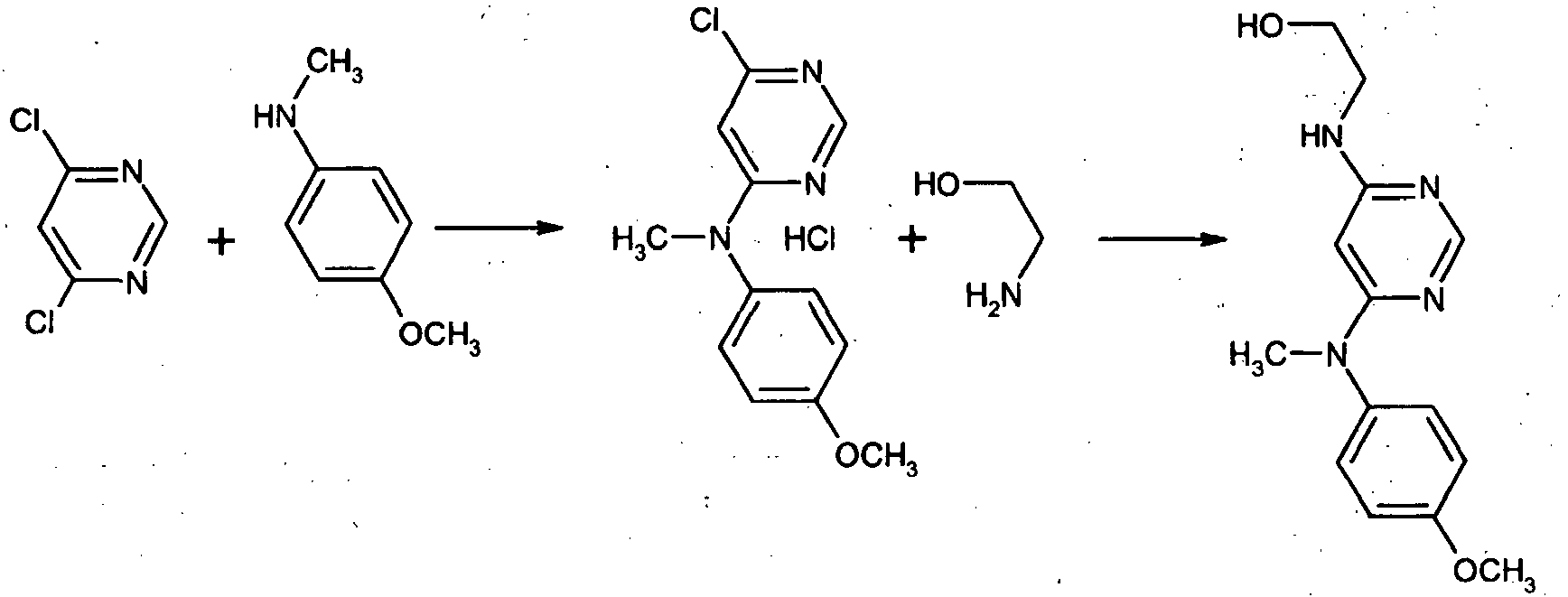
- 100 mg of 4,6-Dichloropyrimidine, 83 mg of 4-methoxy-N-methylaniline and 0.1 mL of c.HCl were dissolved in 1 mL of i-PrOH and charged into a screw cap vial and kept in a heating block at 90°C for overnight. The reaction was monitored by TLC and was completed after 12h. After cooling to r.t., solvent was evaporated and the residue was redissoved in 1 mL of n-BuOH and taken in a microwave vial. 26 mg of Ethanolamine and 106 mg of DIPEA were added and the reaction mixture was heated under microwave irradiation for 45min at 200°C. The reaction was finished and pure product was purified by column chromatography using EtOAc. Pure 2-(6-((4-methoxyphenyl)(methyl)amino)-pyrimidin-4-ylamino)ethan-1-ol in the form of a colorless solid was obtained.
Yield: 41% of theory.
1H NMR (CDCl3, 200MHz): δ = 3.27 (bs, 2H), 3.38 (s, 3H), 3.68 (t, J = 4.0 Hz, 2H), 3.83 (s, 3H), 5.11 (s, 1H), 5.16 (s, 1H), 6.93 (d, J = 8.8 Hz, 2H), 7.12 (d, J = 8.6 Hz, 2H), 8.16 (s, 1H).
13C NMR (CDCl3, 50MHz): δ = 38.2 (t), 44.2 (q), 55.5 (t), 61.9 (q), 82.6 (d), 115.1 (d), 128.4 (d), 137.7 (s), 157.2 (d), 158.2 (s), 162.1 (s), 163.1 (s). -

- 250 mg of 4,6-dichloropyrimidine, 117 mg of cyclohexylamine and 261 mg of DIPEA were dissolved in 1 mL of i-PrOH and the mixture obtained was charged into a screw cap vial and the vial obtained was kept in a heating block at 90°C for 6 hours. The reaction was monitored by TLC and was completed after 6 hours. The mixture obtained was cooled to r.t., solvent was evaporated and the evaporation residue was redissoved in 1 mL of n-BuOH and taken in a microwave vial. To the mixture in the vial 113 mg of ethanolamine and 206 mg of DIPEA were added and the mixture obtained was heated in a reaction block at 180°C for 1 hour. The reaction was finished and pure product was purified by column chromatography using EtOAc:MeOH 10:1. Pure 2-(6-(Cyclohexylamino)pyrimidin-4-ylamino)ethan-1-ol in the form of a colorless solid was obtained..
Yield: 63% of theory.
1H NMR (CD3OD; 200MHz): δ = 1.07-2.04 (m, 11H), 3.37-3.38 (m, 2H), 3.42-3.59 (bs, 1H), 3.68 (t, J = 5.7 Hz, 2H), 5.45 (s, 1H), 7.88 (s, 1H).
13C NMR (CD3OD, 50MHz): δ = 26.1 (t), 26.8 (t), 34.0 (t), 44.6 (t), 50.8 (s), 82.0 (d), 158.2 9d), 162.9 (s), 163.9 (s). -

- 50 mg of 2-fluoro-4-iodopyridine, 33 mg of p-anisidine, 108 mg of K2CO3, 1 mg of Pd(OAc)2 and 6 mg of BINAP were charged into a microwave vial and 2 mL of dry toluene were added and the vial was sealed, evacuated and flushed with Argon. The mixture in the vial was irradiated at 180°C in a CEM Explorer™ microwave unit for 30 minutes with stirring and the mixture obtained was cooled to r.t.. From the mixture obtained solid material was filtered off and washed with 10 mL of CH2Cl2 and solvent from the combined filtrate and washing solvent was evaporated off. The evaporation residue obtained was subjected to flash column chromatography. (2-Fluoro-N-(4-methoxyphenyl)pyridin-4-amine in the form of yellow crystals was obtained.
Yield: 63% of theory. M.p.: 150°C
1H NMR (CDCl3, 200MHz): δ = 3.83 (s, 3H) 6.20 (d, J = 1.7 Hz, 1H) 6.31 (s, 1H) 6.49 - 6.54 (m, 1H) 6.95 (d, J = 8.9 Hz, 2H) 7.14 (d, J = 8.8 Hz, 2H) 7.81 (d, J = 8.8 Hz, 1H).
13C NMR (CDCl3, 50MHz): δ = 55.5 (t) 91.6 (q, JC-F= 42.4 Hz), 107.5 (q, JC-F= 2.8 Hz), 114.9 (d), 125.8 (d), 131.4 (s), 147.4 (q, J= 18.7 Hz), 156.5 (d, JC-F= 11.6Hz), 157.6 (s), 165.5 (d, JC-F= 232.7 Hz).
Combustion Analysis: Calcd: C 66.05% H 5.08% N 12.84%, Found: C 65.76% H 4.84% N 12.62%. -

- 36 mg of (2-fluoro-N-(4-methoxyphenyl)pyridin-4-amine were mixed with 80.6 mg of ethanolamine and the mixture obtained was heated in a screw cap vial under argon to 150°C for 3 days. The mixture obtained was cooled to to r.t. and 5 mL of 2N NaOH were added, the mixture obtained was extracted with EtOAc for three times and from the organic layer obtained solvent was evaporated off. 2-(4-(4-Methoxyphenylamino)pyridin-2-ylamino)ethan-1-ol was obtained in the form of a brown solid.
Yield: 89% of theory. M.p.: 164-165°C.
1H NMR (DMSO-D6, 200MHz): δ = 3.22 (m, 2H), 3.45 (m, 2H), 3.72 (s, 3H), 5.89 (s, 1H), 6.05 (m, 2H), 6.89 (d, J=8.8 Hz, 2H), 7.07 (s, J=8.8 Hz, 2H), 7.59 (s, J=5.7 Hz, 1H), 8.11 (s, 1H).
13C NMR (DMSO-D6, 50MHz): δ = 43.8 (t), 55.2 (q), 60.7 (t), 89.3 (d), 114.4 (d), 122.9 (d), 133.9 (s), 147.4 (d), 151.9 (s), 154.9 (s), 159.9 (s).
HR-MS: Predicted [MH]+= 260.1394; Measured [MH]+= 260.1400. -

- 100 mg of 2-fluoro-4-iodopyridine, 100 mg of 4-phenoxyaniline, 218 mg of K2CO3, 2 mg of Pd(OAc)2 and 6 mg of BINAP were charged into a microwave vial and 2 mL of dry toluene were added. The vial was sealed, evacuated and flushed with Argon. The mixture in the vial was irradiated at 180°C in a CEM Explorer™ microwave unit for 30 minutes with stirring. The mixture obtained was cooled to r.t.. From the mixture obtained solid material was filtered off and washed with 10 mL of CH2Cl2 and solvent from the combined filtrate and washing solvent was evaporated off. The evaporation residue obtained was subjected to flash column chromatography.
2-Fluoro-N-(4-phenoxyphenyl)pyridin-4-amine was obtained in the form of brown crystals.
Yield: 75% of theory. M.p.: 149°C.
1H NMR (CDCl3, 200MHz): δ = 6.51 (d, J = 1.9 Hz, 1H) 6.61 (s, 1H) 6.81 (d, J = 5.8 Hz, 1H) 7.23 (d, J = 2.1 Hz, 2H) 7.37 (m, 3H) 7.48 (s, 1H) 7.57(t, J = 7.9 Hz, 3H) 8.80 (d, J = 5.8 Hz, 1H)
13C NMR (CDCl3, 50MHz): δ = 92.0 (q, JC-F= 39.5 Hz), 107.8 (q, JC-F= 3.2 Hz), 118.9 (d), 119.9 (d), 123.5 (d), 125.0 (d), 129.9 (d), 133.9 (s), 147.9 (q, JC-F = 22.9 Hz), 154.8 (s), 155.8 (d, JC-F = 11.9 Hz) 157.0 (s), 165.6 (d, JC-F=233.0Hz). -

- 53 mg of 2-fluoro-N-(4-phenoxyphenyl)pyridin-4-amine in 80.6 mg of ethanolamine were heated in a screw cap vial under argon at 150°C for 3 days. The mixture obtained was cooled to r.t. and 5 mL of 2N NaOH were added. The mixture obtained was extracted with 15 mL of EtOAc for three times. From the mixture obtained organic solvent was evaporated off. 2-(4-(4-Phenoxyphenylamino)pyridin-2-ylamino)ethan-1-ol was obtained.
Yield: 89% of theory.
1H NMR (CD3OD, 200MHz): δ = 3.33-3.37 (m, 2H), 3.68 (t, J=5.5 Hz, 2H), 6.05 (d, J=1.9 Hz, 1H), 6.20 (dd, J1=6.1 Hz, J2=2.2 Hz, 1H), 6.95 (s, 2H), 6.97-7.02 (m, 2H), 7.08 (t, J=7.3 Hz, 1H), 7.14-7.23 (m, 2H), 7.26-7.39 (m, 2H), 7.61 (d, J=6.1 Hz, 1H).
13C NMR (CD3OD, 50MHz): δ = 45.5 (t), 62.4 (t), 90.9 (d), 102.8 (d), 119.3 (d), 121.1 (d), 124.1 (d), 124.4 (d), 130.8 (d), 137.8 (s), 147.9 (d), 154.2 (s), 154.5 (s), 159.3 (s), 161.5 (s). -

- 100 mg of 2,6-dichloropyridine, 100 mg of p-anisidine, 329 mg of K2CO3, 3 mg of Pd(OAc)2 and 9 mg of BINAP were charged into a microwave vial and 2.5 mL of dry toluene was added. The vial was sealed, evacuated and flushed with Argon. The mixture in the vial was irradiated at 180°C in a CEM Explorer™ microwave unit for 30 minutes with stirring. The mixture obtained was cooled to r.t.. From the mixture obtained solid material was filtered off and washed with 10 mL of CH2Cl2 and solvent from the combined filtrate and washing solvent was evaporated off. The evaporation residue obtained was subjected to flash column chromatography.
6-Chloro-N-(4-methoxyphenyl)pyridin-2-amine was obtained in the form of a yellow solid. Yield: 72% of theory. M.p: 74-76°C.
1H NMR (CDCl3, 200MHz): δ= 3.8 (s, 3H), 6.52 (d, J= 8.2 Hz, 1H,) 6.65 (d, J= 7.6 Hz, 1H), 6.74 (s, 1H), 6.89 (d, J=9.4 Hz, 2H), 7.19 (d, J=7.2 Hz, 2H), 7.34 9t, J= 7.9 Hz, 1H).
13C NMR (CDCl3, 50MHz): δ= 54.6 (q), 103.8 (d), 112.4 (d), 113.8 (d), 123.7 (d), 131.1 (s), 139.1 (d), 148.5 (s), 155.9 (s), 156.4 (s).
Combustion Analysis: Calcd. C 68.81, H 4.42, N 11.95: Found C 68.60, H 4.22, N 8.92; -

- 190 mg of 6-chloro-N-(4-methoxyphenyl)pyridin-2-amine were mixed with 397 mg of ethanolamine and the mixture obtained was heated in a screw cap vial under argon at 150°C for 3 days. The mixture obtained was cooled to r.t. and 5 mL of EtOAc were added, The mixture obtained was extracted with 5 mL of EtOAc for three times, the phases were separated, the organic phase was dried and from the dry mixture obtained solvent was evaporated off. The evaporation residue obtained was subjected to flash column chromatography (EtOAc:PE 3:1). 2-(6-(4-Methoxyphenylamino)pyridin-2-ylamino)ethan-1-ol was obtained in the form of a brown oil.
Yield: 73% of theory.
1H NMR (CDCl3, 200MHz): δ= 3.35 (t, J=4.8 Hz, 2H), 3.80 (s, 3H), 3.84 (t, J=4.6 Hz, 2H), 5.80 (d, J=7.8 Hz, 1H), 5.92 (d, J=9.4 Hz, 2H), 6.89 (d, J=8.9 Hz, 2H), 7.17 (d, J=8.2 Hz, 2H), 7.32 (t, J= 7.6 Hz, 1H).
13C NMR (CDCl3, 50MHz): δ= 54.6 (q), 103.8 (d), 112.4 (d), 113.8 (d), 123.7 (d), 131.1 (s), 139.1 (d), 148.5 (s), 155.9 (s), 156.4 (s).
HR-MS: Predicted [MH]+= 260.1394; Measured [MH]+= 260.1389. -

- 95 mg of 6-chloro-N-(4-methoxyphenyl)pyridin-2-amine were mixed with 244 mg of n-propanolamine and the mixture obtained was treated in a vial analogously to the method as set out in Example 16b. 3-(6-(4-Methoxyphenylamino)pyridin-2-ylamino)propan-1-ol was obtained in the form of a brown oil.
Yield: 64% of theory.
1H NMR (CDCl3, 200MHz): δ = 1.6-1.8 (m, 2H), 3.3 (t, J = 6.3 Hz, 2H), 3.6 (t, J = 5.8 Hz, 2H), 3.7 (s, 3H), 5.7 (d, J = 8.0 Hz, 1H), 5.8 (d, J= 8.4 Hz, 1H), 6.8 (d, J= 9.2 Hz, 2H), 7.1 (d, J= 8.8 Hz, 2H), 7.2 (t, J= 8.2 Hz, 1H).
13C NMR (CDCl3, 50MHz): δ = 22.9 (t), 38.8 (t), 55.5 (q), 59.2 (t), 94.1 (d), 114.6 (d), 125.3 (d), 131.6 (s), 142.3 (d), 153.9 (s), 155.2 (d), 156.9 (s), 178.4(s).
HR-MS: Predicted [MH]+= 274.1550; Measured [MH]+= 274.1555. -

- 100 mg of 2,6-dichloropyridine, 150 mg of 4-phenoxyaniline, 329 mg mg of K2CO3, 3 mg of Pd(OAc)2 and 9 mg of BINAP were charged into a microwave vial and 2.5 mL of dry toluene were added. The mixture obtained was treated in the vial analogously to the method as set out in Example 16a. For flash chromatography a solvent mixture of EtOAc:PE = 1:10 was used. 6-Chloro-N-(4-phenoxyphenyl)pyridin-2-amine was obtained in the form of yellow crystals.
Yield: 77% of theory. M.p.: 69-73°C.
1H NMR (CDCl3, 200MHz): δ = 6.58-6.75 (q, J = 7.2 Hz, 3H), 6.95-7.06 (m, 4H), 7.10 (d, J = 7.4 Hz, 1H), 7.21-7.31 (m, 3H), 7.32-7.36 (m, 1H), 7.37-7.44 (m, 1H). 13C NMR (CDCl3, 50MHz): δ = 105.3 (d), 113.9 (d), 118.5 (d), 120.0 (d), 123.2 (d), 123.6(d), 129.8 (d), 134.8 (s), 140.0 (d), 149.7 (s), 153.5 (s), 156.7 (s), 157.5 (s).
Combustion Analysis: Calcd. C 68.81%, H 4.42%, N 11.95%: Found: C 68.60%, H 4.225%, N 8.92%. -

- A mixture of 130 mg of 6-chloro-N-(4-phenoxyphenyl)pyridin-2-amine in 214 mg of ethanolamine was filled in a screw cap vial and was treated analogously to the method as set out in Example 16b, but using for flash column chromatography a solvent mixture of EtOAc:PE =1:1 instead of EtOAc:PE = 3:1). 2-(6-(4-Phenoxyphenylamino)pyridin-2-ylamino)ethan-1-ol was obtained in the form of a brown oil.
Yield: 73% of theory.
1H NMR (CDCl3, 200MHz): δ = 3.30 (t, J = 4.9 Hz, 2H), 3.8 (t, J= 5.3 Hz, 2H), 5.8 (d, J = 8.4 Hz, 1H), 5.9 (d, J = 8.2 Hz, 1H), 6.8-7.4 (m, 11H).
13C NMR (CDCl3, 50MHz): δ = 45.2, 53.4, 60.4, 94.5, 118.7, 119.8, 123.4, 125.3, 129.8, 133.2, 143.8, 152.2, 153.7, 154.6, 157.2, 177.5. -

- A mixture of 150 mg of 6-chloro-N-(4-phenoxyphenyl)pyridin-2-amine in 304 mg of n-propanolamine in a screw cap vial under argon was treated analogously to the method as set out in Example 16b.. 3-(6-(4-Phenoxyphenylamino)pyridin-2-ylamino)propan-1-ol was obtained in the form of a brown oil.
Yield: 73% of theory.
1H NMR (CDCl3, 200MHz): δ = 1.8-1.9 (m, 2H), 3.4 (t, J= 5.9 Hz, 2H), 3.7 (t, J= 5.3 Hz, 2H), 5.9 (d, J= 8.4 Hz, 1H), 6.0 (d, J= 8.1 Hz, 1H), 6.9-7.4 (m, 11H).
wherein an aliphatic heterocyclic ring may contain 1 to 4 heteroatoms selected from N, O, and S;
wherein the alkyl, aryl or cycloalkyl groups of R1, R2, R5, and R6 are substituted by 0 to 2 groups R1a;
wherein the groups R1a are idependently selected from halogen, alkyl, alkoxy, -OH, -N(R1b,R2b), heterocyclyl, and -O-aryl;
wherein R1b and R2b are independently selected from hydrogen and alkyl.
Claims (5)
- A process for the production of cardiomyocyte-like cells, comprising culturing cells selected from omnipotent, pluripotent and lineage committed mammalian cells in the presence of a pyridine or pyrimidine compound of formula I
 X is CH or N,R1 and R2 are independently selected from H, alkyl, aryl, and cycloalkyl,R3 and R4 are selected from H and NR5R6, with the proviso that
if X is N, R3 is NR5R6 and R4 is H; and
if X is CH, one of R3 and R4 is NR5R6 and the other is H;R5 and R6 are independently selected from H, alkyl, aryl, and cycloalkyl;wherein R1 and R2 and/or R5 and R6 may be connected to form an aromatic or aliphatic heterocyclic ring together with the nitrogen atom to which they are attached, wherein an aliphatic heterocyclic ring may contain 1 to 4 heteroatoms selected from N, O, and S;
wherein the alkyl, aryl or cycloalkyl groups of R1, R2, R5, and R6 are substituted by 0 to 2 groups R1a;
wherein the groups R1a are idependently selected from halogen, alkyl, alkoxy, -OH, -N(R1b,R2b), heterocyclyl, and -O-aryl;
wherein R1b and R2b are independently selected from hydrogen and alkyl. - The process according to claim 1, characterised in that the compound of formula I is used in the form of a salt.
- The process according to claim 1 or 2, characterised in that, in the compound of formula I, at least one of R1, R2, R5, and R6 is selected from
(C1-8)alkyl,
(C1-4)hydroxyalkyl,
(C1-4)alkoxy-(C1-4)alkyl,
carboxy(C1-6)alkyl,
(C3-12)cycloalkyl,
unsubstituted (C6-12)aryl, and
(C6-12)aryl substituted by one or more of the following:- (C1-4)alkoxy,- nitro,- halogen,- (C1-4)alkoxycarbonyl,- amino substituted by (C6-12)aryl,- (C6-12)aryloxy,- heterocyclyl having 3 to 8 ring members and 1 to 4 heteroatoms which are independently selected from N, O, and S;the other being as defined above, - The process according to any one of claims 1 to 3, characterised in that the compound of formula I is selected from:2-(6-(4-Methoxyphenylamino)pyrimidine-4-ylamino)ethan-1-ol,3-(6-(4-Methoxypheny(amino)pyrimidine-4-ylamino)propan-1-ol,N 4-Cyclohexyl-N 6-(4-methoxyphenyl)pyrimidine-4,6-diamine,2-(6-(4-Morpholinophenylamino)pyrimidin-4-ylamino)ethan-1-ol,N 4-Cyclohexyl-N 6-(4-morpholinophenyl)pyrimidine-4,6-diamine,3-(6-(4-Morpholinophenylamino)pyrimidin-4-ylamino)propan-1-ol,2-(6-(4-(Phenylamino)phenylamino)pyrimidin-4-ylamino)ethan-1-ol,2-(6-(4-Phenoxyphenylamino)pyrimidin-4-ylamino)ethan-1-ol,N a-(4-Methoxyphenyl)-N 6-propylpyrimidine-4,6-diamine,N 4-Ethyl-N 6-(4-methoxyphenyl)pyrimidine-4,6-diamine,N4-(4-Methoxyphenyl)-N6-methylpyrimidine-4,6-diamine,N4-(2-Propyl)-N6-(4-methoxyphenyl)pyrimidine-4,6-diamine,N 4-(2-Methoxyethyl)-N 6-(4-methoxyphenyl)pyrimidine-4,6-diamine,2-(6-(4-Methoxyphenylamino)pyrimidin-4-ylamino)acetic acid,N-(4-Methoxyphenyl)-6-morpholinopyrimidine-4-amine,2-((6-(4-Methoxyphenylamino)pyrimidin-4-yl)(methyl)amino)ethan-1-ol,N 4-Butyl-N 6-(4-methoxyphenyl)pyrimidine-4,6-diamine,N 4-Cyclopentyl-N 6-(4-methoxyphenyl)pyrimidine-4,6-diamine,N 4-sec-Butyl-N 6-(4-methoxyphenyl)pyrimidine-4,6-diamine,N 4-tert-Butyl-N 6-(4-methoxyphenyl)pyrimidine-4,6-diamine,N 4-Adamant-1-yl-N 6-(4-methoxyphenyl)pyrimidine-4,6-diamine,2-(6-(3-Methoxyphenylamino)pyrimidin-4-ylamino)ethan-1-ol,2-(6-(Phenylamino)pyrimidin-4-ylamino)ethan-1-ol,2-(6-(4-Chlorophenylamino)pyrimidin-4-ylamino)ethan-1-ol,2-(6-(3-Chlorophenylamino)pyrimidin-4-ylamino)ethan-1-ol,N 4-(3-Chlorophenyl)-N 6-cyclohexylpyrimidine-4,6-diamine,N 4-(3-Chlorophenyl)-N 6-(2-methoxyethyl)pyrimidine-4,6-diamine,2-(6-(3-Nitrophenylamino)pyrimidin-4-ylamino)ethan-1-ol,N 4-Cyclohexyl-N 6-(3-nitrophenyl)pyrimidine-4,6-diamine;2-(6-(4-Nitrophenylamino)pyrimidin-4-ylamino)ethan-1-ol,3-(6-(3-Chlorophenylamino)pyrimidin-4-ylamino)propan-1-ol,2-(6-(3-Fluorophenylamino)pyrimidin-4-ylamino)ethan-1-ol,2-(6-(3-Bromophenylamino)pyrimidin-4-ylamino)ethan-1-ol,Ethyl 4-(6-(2-hydroxyethylamino)pyrimidin-4-ylamino)benzoate,2-(6-(3-Chloro-4-methoxyphenylamino)pyrimidin-4-ylamino)ethanol,N 4-(3-Chloro-4-methoxyphenyl)-N 6-cyclohexylpyrimidine-4,6-diamine,N 4-Cyclohexyl-N 6-(3-methoxyphenyl)pyrimidine-4,6-diamine,2-(6-((4-Methoxyphenyl)(methyl)amino)pyrimidin-4-ylamino)ethan-1-ol,2-(6-(Cyclohexylamino)pyrimidin-4-ylamino)ethan-1-ol,2-(4-(4-Methoxyphenylamino)pyridin-2-ylamino)ethan-1-ol,2-(4-(4-Phenoxyphenylamino)pyridin-2-ylamino)ethan-1-ol,2-(6-(4-Methoxyphenylamino)pyridin-2-ylamino)ethan-1-ol,3-(6-(4-Methoxyphenylamino)pyridin-2-ylamino)propan-1-ol,2-(6-(4-Phenoxyphenylamino)pyridin-2-ylamino)ethan-1-ol, and3-(6-(4-Phenoxyphenylamino)pyridin-2-ylamino)propan-1-ol.
- Use of a compound of formula I as defined in any one of claims 1 to 4 for producing cardiomyocyte-like cells by culturing cells selected from omnipotent, pluripotent and lineage committed mammalian cells in the presence of said compound of formula I.
Applications Claiming Priority (2)
| Application Number | Priority Date | Filing Date | Title |
|---|---|---|---|
| ATA2044/2009A AT509266B1 (en) | 2009-12-28 | 2009-12-28 | SUBSTITUTED PYRIDINES AND PYRIMIDINES |
| PCT/AT2010/000495 WO2011079343A2 (en) | 2009-12-28 | 2010-12-28 | Substituted pyridines and pyrimidines |
Publications (2)
| Publication Number | Publication Date |
|---|---|
| EP2519501A2 EP2519501A2 (en) | 2012-11-07 |
| EP2519501B1 true EP2519501B1 (en) | 2015-04-22 |
Family
ID=43825275
Family Applications (1)
| Application Number | Title | Priority Date | Filing Date |
|---|---|---|---|
| EP20100803206 Not-in-force EP2519501B1 (en) | 2009-12-28 | 2010-12-28 | Substituted pyridines and pyrimidines for the production of cardiomyocyte-like cells |
Country Status (5)
| Country | Link |
|---|---|
| US (1) | US8986994B2 (en) |
| EP (1) | EP2519501B1 (en) |
| AT (1) | AT509266B1 (en) |
| IN (1) | IN2012DN06432A (en) |
| WO (1) | WO2011079343A2 (en) |
Families Citing this family (6)
| Publication number | Priority date | Publication date | Assignee | Title |
|---|---|---|---|---|
| AT511441B1 (en) | 2011-09-21 | 2012-12-15 | Univ Wien Tech | TRIAZINE DERIVATIVES AS DIFFERENTIATOR ACCUMULATORS |
| US10774064B2 (en) | 2016-06-02 | 2020-09-15 | Cadent Therapeutics, Inc. | Potassium channel modulators |
| BR112019014814B1 (en) | 2017-01-23 | 2024-03-12 | Novartis Ag | COMPOUNDS, PHARMACEUTICAL COMPOSITIONS THEREOF AND THEIR USES IN THE TREATMENT OF DISEASES ASSOCIATED WITH DYSFUNCTION OF POTASSIUM ION CHANNELS |
| WO2018195450A1 (en) | 2017-04-21 | 2018-10-25 | Epizyme, Inc. | Combination therapies with ehmt2 inhibitors |
| AU2019366312B2 (en) | 2018-10-22 | 2025-04-24 | Novartis Ag | Crystalline forms of potassium channel modulators |
| KR20250152723A (en) * | 2024-04-16 | 2025-10-24 | 경북대학교 산학협력단 | Novel pyrimidine derivative compounds and use thereof |
Family Cites Families (7)
| Publication number | Priority date | Publication date | Assignee | Title |
|---|---|---|---|---|
| DE10063173A1 (en) * | 2000-12-18 | 2002-06-20 | Merck Patent Gmbh | Urea and urethane derivatives |
| TWI312347B (en) * | 2001-02-08 | 2009-07-21 | Eisai R&D Man Co Ltd | Bicyclic nitrogen-containing condensed ring compounds |
| CA2451128A1 (en) * | 2001-06-26 | 2003-01-09 | Bristol-Myers Squibb Company | N-heterocyclic inhibitors of tnf-alpha expression |
| TWI329105B (en) * | 2002-02-01 | 2010-08-21 | Rigel Pharmaceuticals Inc | 2,4-pyrimidinediamine compounds and their uses |
| EP1727806A1 (en) * | 2004-01-16 | 2006-12-06 | Novartis AG | 2,4-diaminopyrimidines and their use for inducing cardiomyogenesis |
| GB0512324D0 (en) * | 2005-06-16 | 2005-07-27 | Novartis Ag | Organic compounds |
| EP1794135A1 (en) * | 2004-09-27 | 2007-06-13 | Amgen Inc. | Substituted heterocyclic compounds and methods of use |
-
2009
- 2009-12-28 AT ATA2044/2009A patent/AT509266B1/en not_active IP Right Cessation
-
2010
- 2010-12-28 IN IN6432DEN2012 patent/IN2012DN06432A/en unknown
- 2010-12-28 WO PCT/AT2010/000495 patent/WO2011079343A2/en not_active Ceased
- 2010-12-28 US US13/519,690 patent/US8986994B2/en not_active Expired - Fee Related
- 2010-12-28 EP EP20100803206 patent/EP2519501B1/en not_active Not-in-force
Also Published As
| Publication number | Publication date |
|---|---|
| WO2011079343A2 (en) | 2011-07-07 |
| AT509266A1 (en) | 2011-07-15 |
| AT509266B1 (en) | 2014-07-15 |
| US8986994B2 (en) | 2015-03-24 |
| IN2012DN06432A (en) | 2015-10-09 |
| US20120294835A1 (en) | 2012-11-22 |
| EP2519501A2 (en) | 2012-11-07 |
| WO2011079343A3 (en) | 2011-10-13 |
Similar Documents
| Publication | Publication Date | Title |
|---|---|---|
| US8986994B2 (en) | Substituted pyridines and pyrimidines | |
| CA2416442C (en) | Substituted 5-alkynyl pyrimidines having neurotrophic activity | |
| JP6842458B2 (en) | N- (pyridin-2-yl) -4- (thiazole-5-yl) pyrimidine-2-amine derivative as a therapeutic compound | |
| Wang et al. | Rho‐kinase inhibitor Y‐27632 facilitates the proliferation, migration and pluripotency of human periodontal ligament stem cells | |
| EP1530574B1 (en) | Macrocyclic pyrimidines, the production thereof and the use of the same as medicaments | |
| EP2966166B1 (en) | Promoter of differentiation of pluripotent stem cell into myocardium, which comprises egf receptor inhibitor | |
| JP6651218B2 (en) | Induction of myocardial differentiation of pluripotent stem cells using low molecular weight compounds | |
| AU2019335373B2 (en) | PAPD5 inhibitors and methods of use thereof | |
| CN101238129A (en) | Compounds that maintain the pluripotency of embryonic stem cells | |
| KR20140147836A (en) | Inhibitors of human ezh2, and methods of use thereof | |
| JP2016529294A (en) | Azaspiro [4.5] decane derivatives and uses thereof | |
| JP2017511794A (en) | Isoquinoline derivatives and uses thereof | |
| AU2005205167A1 (en) | 2, 4 - diaminopyrimidines and their use for inducing cardiomyogenesis | |
| US20100130476A1 (en) | Compounds that induce pancreatic beta-cell expansion | |
| EP3575392A1 (en) | Medium for inducing differentiation of stem cells into mesodermal cells and method for producing mesodermal cells | |
| CN102356066A (en) | Novel 2,6-substituted-3-nitropyridine derivative, method for preparing same, and pharmaceutical composition including same | |
| EP4371981A1 (en) | Sulfur/phosphorus-containing aryl compound and application thereof | |
| US9155765B2 (en) | Establishment of patient- or person-specific cardiac myocyte cell lines from human induced pluripotent stem cells (iPSCs) | |
| CN116874465B (en) | Pyrimidine compound and application thereof | |
| Radaszkiewicz et al. | The acceleration of cardiomyogenesis in embryonic stem cells in vitro by serum depletion does not increase the number of developed cardiomyocytes | |
| Mike et al. | Small molecule cardiogenol C upregulates cardiac markers and induces cardiac functional properties in lineage-committed progenitor cells | |
| Cashman | Small molecule regulation of stem cells that generate bone, chondrocyte, and cardiac cells | |
| EP3998107A1 (en) | Method for producing insulin-producing cell using dihydroindolizinone derivatives | |
| Koley et al. | Synthesis and screening of 2, 6-diamino-substituted purine derivatives as potential cardiomyogenesis inducing agents. | |
| HK40066575A (en) | Method for producing insulin-producing cell using dihydroindolizinone derivatives |
Legal Events
| Date | Code | Title | Description |
|---|---|---|---|
| PUAI | Public reference made under article 153(3) epc to a published international application that has entered the european phase |
Free format text: ORIGINAL CODE: 0009012 |
|
| 17P | Request for examination filed |
Effective date: 20120730 |
|
| AK | Designated contracting states |
Kind code of ref document: A2 Designated state(s): AL AT BE BG CH CY CZ DE DK EE ES FI FR GB GR HR HU IE IS IT LI LT LU LV MC MK MT NL NO PL PT RO RS SE SI SK SM TR |
|
| DAX | Request for extension of the european patent (deleted) | ||
| 17Q | First examination report despatched |
Effective date: 20130617 |
|
| RAP1 | Party data changed (applicant data changed or rights of an application transferred) |
Owner name: TECHNISCHE UNIVERSITAET WIEN |
|
| GRAJ | Information related to disapproval of communication of intention to grant by the applicant or resumption of examination proceedings by the epo deleted |
Free format text: ORIGINAL CODE: EPIDOSDIGR1 |
|
| GRAP | Despatch of communication of intention to grant a patent |
Free format text: ORIGINAL CODE: EPIDOSNIGR1 |
|
| INTG | Intention to grant announced |
Effective date: 20141217 |
|
| RIN1 | Information on inventor provided before grant (corrected) |
Inventor name: KOENIG, XAVER Inventor name: HILBER, KARLHEINZ Inventor name: SCHNUERCH, MICHAEL Inventor name: KOLEY, MOUMITA Inventor name: MIHOVILOVIC, MARKO |
|
| GRAS | Grant fee paid |
Free format text: ORIGINAL CODE: EPIDOSNIGR3 |
|
| GRAA | (expected) grant |
Free format text: ORIGINAL CODE: 0009210 |
|
| AK | Designated contracting states |
Kind code of ref document: B1 Designated state(s): AL AT BE BG CH CY CZ DE DK EE ES FI FR GB GR HR HU IE IS IT LI LT LU LV MC MK MT NL NO PL PT RO RS SE SI SK SM TR |
|
| REG | Reference to a national code |
Ref country code: GB Ref legal event code: FG4D |
|
| REG | Reference to a national code |
Ref country code: CH Ref legal event code: EP |
|
| REG | Reference to a national code |
Ref country code: AT Ref legal event code: REF Ref document number: 723127 Country of ref document: AT Kind code of ref document: T Effective date: 20150515 |
|
| REG | Reference to a national code |
Ref country code: IE Ref legal event code: FG4D |
|
| REG | Reference to a national code |
Ref country code: DE Ref legal event code: R096 Ref document number: 602010024195 Country of ref document: DE Effective date: 20150603 |
|
| REG | Reference to a national code |
Ref country code: CH Ref legal event code: NV Representative=s name: RENTSCH PARTNER AG, CH Ref country code: NL Ref legal event code: T3 |
|
| REG | Reference to a national code |
Ref country code: AT Ref legal event code: MK05 Ref document number: 723127 Country of ref document: AT Kind code of ref document: T Effective date: 20150422 |
|
| REG | Reference to a national code |
Ref country code: LT Ref legal event code: MG4D |
|
| PG25 | Lapsed in a contracting state [announced via postgrant information from national office to epo] |
Ref country code: NO Free format text: LAPSE BECAUSE OF FAILURE TO SUBMIT A TRANSLATION OF THE DESCRIPTION OR TO PAY THE FEE WITHIN THE PRESCRIBED TIME-LIMIT Effective date: 20150722 Ref country code: HR Free format text: LAPSE BECAUSE OF FAILURE TO SUBMIT A TRANSLATION OF THE DESCRIPTION OR TO PAY THE FEE WITHIN THE PRESCRIBED TIME-LIMIT Effective date: 20150422 Ref country code: LT Free format text: LAPSE BECAUSE OF FAILURE TO SUBMIT A TRANSLATION OF THE DESCRIPTION OR TO PAY THE FEE WITHIN THE PRESCRIBED TIME-LIMIT Effective date: 20150422 Ref country code: PT Free format text: LAPSE BECAUSE OF FAILURE TO SUBMIT A TRANSLATION OF THE DESCRIPTION OR TO PAY THE FEE WITHIN THE PRESCRIBED TIME-LIMIT Effective date: 20150824 Ref country code: ES Free format text: LAPSE BECAUSE OF FAILURE TO SUBMIT A TRANSLATION OF THE DESCRIPTION OR TO PAY THE FEE WITHIN THE PRESCRIBED TIME-LIMIT Effective date: 20150422 Ref country code: FI Free format text: LAPSE BECAUSE OF FAILURE TO SUBMIT A TRANSLATION OF THE DESCRIPTION OR TO PAY THE FEE WITHIN THE PRESCRIBED TIME-LIMIT Effective date: 20150422 |
|
| PG25 | Lapsed in a contracting state [announced via postgrant information from national office to epo] |
Ref country code: AT Free format text: LAPSE BECAUSE OF FAILURE TO SUBMIT A TRANSLATION OF THE DESCRIPTION OR TO PAY THE FEE WITHIN THE PRESCRIBED TIME-LIMIT Effective date: 20150422 Ref country code: RS Free format text: LAPSE BECAUSE OF FAILURE TO SUBMIT A TRANSLATION OF THE DESCRIPTION OR TO PAY THE FEE WITHIN THE PRESCRIBED TIME-LIMIT Effective date: 20150422 Ref country code: IS Free format text: LAPSE BECAUSE OF FAILURE TO SUBMIT A TRANSLATION OF THE DESCRIPTION OR TO PAY THE FEE WITHIN THE PRESCRIBED TIME-LIMIT Effective date: 20150822 Ref country code: GR Free format text: LAPSE BECAUSE OF FAILURE TO SUBMIT A TRANSLATION OF THE DESCRIPTION OR TO PAY THE FEE WITHIN THE PRESCRIBED TIME-LIMIT Effective date: 20150723 Ref country code: LV Free format text: LAPSE BECAUSE OF FAILURE TO SUBMIT A TRANSLATION OF THE DESCRIPTION OR TO PAY THE FEE WITHIN THE PRESCRIBED TIME-LIMIT Effective date: 20150422 |
|
| REG | Reference to a national code |
Ref country code: FR Ref legal event code: PLFP Year of fee payment: 6 |
|
| REG | Reference to a national code |
Ref country code: DE Ref legal event code: R097 Ref document number: 602010024195 Country of ref document: DE |
|
| PG25 | Lapsed in a contracting state [announced via postgrant information from national office to epo] |
Ref country code: DK Free format text: LAPSE BECAUSE OF FAILURE TO SUBMIT A TRANSLATION OF THE DESCRIPTION OR TO PAY THE FEE WITHIN THE PRESCRIBED TIME-LIMIT Effective date: 20150422 Ref country code: EE Free format text: LAPSE BECAUSE OF FAILURE TO SUBMIT A TRANSLATION OF THE DESCRIPTION OR TO PAY THE FEE WITHIN THE PRESCRIBED TIME-LIMIT Effective date: 20150422 |
|
| PLBE | No opposition filed within time limit |
Free format text: ORIGINAL CODE: 0009261 |
|
| STAA | Information on the status of an ep patent application or granted ep patent |
Free format text: STATUS: NO OPPOSITION FILED WITHIN TIME LIMIT |
|
| PG25 | Lapsed in a contracting state [announced via postgrant information from national office to epo] |
Ref country code: PL Free format text: LAPSE BECAUSE OF FAILURE TO SUBMIT A TRANSLATION OF THE DESCRIPTION OR TO PAY THE FEE WITHIN THE PRESCRIBED TIME-LIMIT Effective date: 20150422 Ref country code: CZ Free format text: LAPSE BECAUSE OF FAILURE TO SUBMIT A TRANSLATION OF THE DESCRIPTION OR TO PAY THE FEE WITHIN THE PRESCRIBED TIME-LIMIT Effective date: 20150422 Ref country code: RO Free format text: LAPSE BECAUSE OF NON-PAYMENT OF DUE FEES Effective date: 20150422 Ref country code: SK Free format text: LAPSE BECAUSE OF FAILURE TO SUBMIT A TRANSLATION OF THE DESCRIPTION OR TO PAY THE FEE WITHIN THE PRESCRIBED TIME-LIMIT Effective date: 20150422 |
|
| 26N | No opposition filed |
Effective date: 20160125 |
|
| PG25 | Lapsed in a contracting state [announced via postgrant information from national office to epo] |
Ref country code: IT Free format text: LAPSE BECAUSE OF FAILURE TO SUBMIT A TRANSLATION OF THE DESCRIPTION OR TO PAY THE FEE WITHIN THE PRESCRIBED TIME-LIMIT Effective date: 20150422 |
|
| PG25 | Lapsed in a contracting state [announced via postgrant information from national office to epo] |
Ref country code: SI Free format text: LAPSE BECAUSE OF FAILURE TO SUBMIT A TRANSLATION OF THE DESCRIPTION OR TO PAY THE FEE WITHIN THE PRESCRIBED TIME-LIMIT Effective date: 20150422 Ref country code: BE Free format text: LAPSE BECAUSE OF NON-PAYMENT OF DUE FEES Effective date: 20151231 |
|
| PG25 | Lapsed in a contracting state [announced via postgrant information from national office to epo] |
Ref country code: LU Free format text: LAPSE BECAUSE OF FAILURE TO SUBMIT A TRANSLATION OF THE DESCRIPTION OR TO PAY THE FEE WITHIN THE PRESCRIBED TIME-LIMIT Effective date: 20151228 Ref country code: MC Free format text: LAPSE BECAUSE OF FAILURE TO SUBMIT A TRANSLATION OF THE DESCRIPTION OR TO PAY THE FEE WITHIN THE PRESCRIBED TIME-LIMIT Effective date: 20150422 |
|
| PG25 | Lapsed in a contracting state [announced via postgrant information from national office to epo] |
Ref country code: BE Free format text: LAPSE BECAUSE OF FAILURE TO SUBMIT A TRANSLATION OF THE DESCRIPTION OR TO PAY THE FEE WITHIN THE PRESCRIBED TIME-LIMIT Effective date: 20150422 |
|
| REG | Reference to a national code |
Ref country code: IE Ref legal event code: MM4A |
|
| PG25 | Lapsed in a contracting state [announced via postgrant information from national office to epo] |
Ref country code: IE Free format text: LAPSE BECAUSE OF NON-PAYMENT OF DUE FEES Effective date: 20151228 |
|
| REG | Reference to a national code |
Ref country code: FR Ref legal event code: PLFP Year of fee payment: 7 |
|
| PGFP | Annual fee paid to national office [announced via postgrant information from national office to epo] |
Ref country code: NL Payment date: 20161221 Year of fee payment: 7 Ref country code: GB Payment date: 20161222 Year of fee payment: 7 Ref country code: CH Payment date: 20161222 Year of fee payment: 7 |
|
| PGFP | Annual fee paid to national office [announced via postgrant information from national office to epo] |
Ref country code: FR Payment date: 20161221 Year of fee payment: 7 |
|
| PGFP | Annual fee paid to national office [announced via postgrant information from national office to epo] |
Ref country code: DE Payment date: 20161220 Year of fee payment: 7 |
|
| PG25 | Lapsed in a contracting state [announced via postgrant information from national office to epo] |
Ref country code: BG Free format text: LAPSE BECAUSE OF FAILURE TO SUBMIT A TRANSLATION OF THE DESCRIPTION OR TO PAY THE FEE WITHIN THE PRESCRIBED TIME-LIMIT Effective date: 20150422 Ref country code: SM Free format text: LAPSE BECAUSE OF FAILURE TO SUBMIT A TRANSLATION OF THE DESCRIPTION OR TO PAY THE FEE WITHIN THE PRESCRIBED TIME-LIMIT Effective date: 20150422 Ref country code: HU Free format text: LAPSE BECAUSE OF FAILURE TO SUBMIT A TRANSLATION OF THE DESCRIPTION OR TO PAY THE FEE WITHIN THE PRESCRIBED TIME-LIMIT; INVALID AB INITIO Effective date: 20101228 |
|
| PG25 | Lapsed in a contracting state [announced via postgrant information from national office to epo] |
Ref country code: CY Free format text: LAPSE BECAUSE OF FAILURE TO SUBMIT A TRANSLATION OF THE DESCRIPTION OR TO PAY THE FEE WITHIN THE PRESCRIBED TIME-LIMIT Effective date: 20150422 Ref country code: SE Free format text: LAPSE BECAUSE OF FAILURE TO SUBMIT A TRANSLATION OF THE DESCRIPTION OR TO PAY THE FEE WITHIN THE PRESCRIBED TIME-LIMIT Effective date: 20150422 |
|
| PG25 | Lapsed in a contracting state [announced via postgrant information from national office to epo] |
Ref country code: MT Free format text: LAPSE BECAUSE OF FAILURE TO SUBMIT A TRANSLATION OF THE DESCRIPTION OR TO PAY THE FEE WITHIN THE PRESCRIBED TIME-LIMIT Effective date: 20150422 |
|
| REG | Reference to a national code |
Ref country code: CH Ref legal event code: PCAR Free format text: NEW ADDRESS: BELLERIVESTRASSE 203 POSTFACH, 8034 ZUERICH (CH) |
|
| PG25 | Lapsed in a contracting state [announced via postgrant information from national office to epo] |
Ref country code: TR Free format text: LAPSE BECAUSE OF FAILURE TO SUBMIT A TRANSLATION OF THE DESCRIPTION OR TO PAY THE FEE WITHIN THE PRESCRIBED TIME-LIMIT Effective date: 20150422 Ref country code: MK Free format text: LAPSE BECAUSE OF FAILURE TO SUBMIT A TRANSLATION OF THE DESCRIPTION OR TO PAY THE FEE WITHIN THE PRESCRIBED TIME-LIMIT Effective date: 20150422 |
|
| REG | Reference to a national code |
Ref country code: DE Ref legal event code: R119 Ref document number: 602010024195 Country of ref document: DE |
|
| REG | Reference to a national code |
Ref country code: CH Ref legal event code: PL |
|
| REG | Reference to a national code |
Ref country code: NL Ref legal event code: MM Effective date: 20180101 |
|
| GBPC | Gb: european patent ceased through non-payment of renewal fee |
Effective date: 20171228 |
|
| PG25 | Lapsed in a contracting state [announced via postgrant information from national office to epo] |
Ref country code: NL Free format text: LAPSE BECAUSE OF NON-PAYMENT OF DUE FEES Effective date: 20180101 |
|
| REG | Reference to a national code |
Ref country code: FR Ref legal event code: ST Effective date: 20180831 |
|
| PG25 | Lapsed in a contracting state [announced via postgrant information from national office to epo] |
Ref country code: AL Free format text: LAPSE BECAUSE OF FAILURE TO SUBMIT A TRANSLATION OF THE DESCRIPTION OR TO PAY THE FEE WITHIN THE PRESCRIBED TIME-LIMIT Effective date: 20150422 Ref country code: FR Free format text: LAPSE BECAUSE OF NON-PAYMENT OF DUE FEES Effective date: 20180102 Ref country code: DE Free format text: LAPSE BECAUSE OF NON-PAYMENT OF DUE FEES Effective date: 20180703 |
|
| PG25 | Lapsed in a contracting state [announced via postgrant information from national office to epo] |
Ref country code: LI Free format text: LAPSE BECAUSE OF NON-PAYMENT OF DUE FEES Effective date: 20171231 Ref country code: CH Free format text: LAPSE BECAUSE OF NON-PAYMENT OF DUE FEES Effective date: 20171231 Ref country code: GB Free format text: LAPSE BECAUSE OF NON-PAYMENT OF DUE FEES Effective date: 20171228 |