EP2519109B1 - Method for manufacturing sausage products and sausage production device - Google Patents
Method for manufacturing sausage products and sausage production device Download PDFInfo
- Publication number
- EP2519109B1 EP2519109B1 EP10807563.1A EP10807563A EP2519109B1 EP 2519109 B1 EP2519109 B1 EP 2519109B1 EP 10807563 A EP10807563 A EP 10807563A EP 2519109 B1 EP2519109 B1 EP 2519109B1
- Authority
- EP
- European Patent Office
- Prior art keywords
- casing
- mass material
- casing mass
- layer
- sausage
- Prior art date
- Legal status (The legal status is an assumption and is not a legal conclusion. Google has not performed a legal analysis and makes no representation as to the accuracy of the status listed.)
- Active
Links
Images



Classifications
-
- A—HUMAN NECESSITIES
- A22—BUTCHERING; MEAT TREATMENT; PROCESSING POULTRY OR FISH
- A22C—PROCESSING MEAT, POULTRY, OR FISH
- A22C13/00—Sausage casings
- A22C13/0003—Apparatus for making sausage casings, e.g. simultaneously with stuffing artificial casings
- A22C13/0006—Apparatus for making artificial collagen casings
-
- A—HUMAN NECESSITIES
- A22—BUTCHERING; MEAT TREATMENT; PROCESSING POULTRY OR FISH
- A22C—PROCESSING MEAT, POULTRY, OR FISH
- A22C13/00—Sausage casings
- A22C2013/002—Sausage casings made by extrusion
- A22C2013/0023—Sausage casings made by extrusion coextruded together with the food product
-
- A—HUMAN NECESSITIES
- A22—BUTCHERING; MEAT TREATMENT; PROCESSING POULTRY OR FISH
- A22C—PROCESSING MEAT, POULTRY, OR FISH
- A22C13/00—Sausage casings
- A22C2013/0053—Sausage casings multilayer casings
Definitions
- the invention relates to a method for manufacturing sausage products by means of co-extrusion, wherein the method comprises the steps of: A) providing a food dough; B) providing a viscous casing mass material; and C) producing by means of co-extrusion a sausage strand with the extrusion of a centre of food dough at least partially provided by a layer of the casing mass material.
- the invention also relates to a production device for the manufacture method.
- sausages were produced to preserve and economically use slaughtering products as blood, organs and scraps.
- the centre (also referred to as the sausage core) of the sausage may e.g. comprises different dough types.
- the casing is produced in process.
- a known automated and high volume production method for sausage makes use of a co-extrusion technique.
- Co-extrusion is realised by means of a co-extrusion means for forming a continuous string of a food product which is provided all around with a substantially uniform casing layer that is extruded in connection with the extrusion of the string (alternative wordings for string are core, strand, centre and rope) of food product.
- the extrusion means of the string and the extrusion means of casing layer may be incorporated in a single co-extrusion head but may also be physically separated in subsequent extrusion means, however when physically separated both the extrusion means cooperate so that they are jointly/collectively/in relationship operated.
- co-extrusion Such related and dual extrusion of the string and a casing layer is referred to here as "co-extrusion”.
- the covering layer normally comprises a gel which after co-extrusion has to be subjected to a gelation treatment (e.g. coagulation) to remove a part of the water from the casing material and/or to cross link the casing material so to cause the casing material to solidify and stabilize.
- a gelation treatment e.g. coagulation
- Co-extrusion of sausage is a continuous and efficient production method which however limits the freedom of casing composition and structure to be produced due to e.g. the production demands on ingredients/starting materials, material conditions and processing times.
- Such method is disclosed in, for example, International patent application WO 2007/032678 A1 disclosing a method for manufacturing co-extruded food products, comprising the processing steps of: A) co-extruding an elongate dough strand and a casing enclosing the elongate dough strand to form a non-coagulated food product, B) bringing the casing into contact with a salt solution, and C) dividing the encased elongate food strand into individual products, whereafter the co-extruded food products are subjected to an airflow.
- a general object of the invention is to provide an improved method for manufacturing sausage products by means of co-extrusion as well as a production device that would enhance the design choices of sausage products to be produced with this technique, or with other words that would allow more types of and variations on sausage to be produced with co-extrusion than is to be realised with the prior art automated sausage manufacturing methods.
- the invention also has the objective to provide new types of sausage products.
- a further objective is to improve the efficiency of existing co-extrusion processes and/or to use new casing materials.
- the present invention provides a method for manufacturing sausage products, as defined in claim 1, wherein (the outer surface of) the centre is at least locally provided with plural layers of casing mass material and of which plural layers of casing mass material at least one is at least partially converted to a substantial solid state, e.g. under the influence of the pH applied.
- solid state is to be understood as shape retaining, that is strong enough to endure mechanical handling, as far as that the sausage after some time can be handled without that at least one of the layers of casing mass material is damaged; the structure of the layer of "solid state” casing mass material is such that the viscosity of that material from the moment of, or shortly after, applying increases.
- the mere fact that the outer surface of the centre is at least locally provided with plural layers of casing mass material means that the centre is at least locally covered with plural layers of casing mass material or that at least locally plural layers of casing mass material are applied to the centre.
- the casing mass material is highly viscous during application of the casing material to the centre and is at that state also referred to as casing paste.
- the casing mass material may even be liquid prior to and/or during application to the centre.
- the advantage of a plural layered casing is that this provides extra opportunities in optimising different functional demands in combination with automated sausage production; e.g. demands in relation to casing strength, bite, snap, pre-crimping texture, shelf life, taste, permeability, twisting and/or appearance.
- new functionality can be provided e.g. by applying a first casing layer that will not, or only partly cure (harden) which first layer is covered by a second casing layer that hardens in time, thus providing a sausage that has a hardened casing which hardened casing may easily be removed form the centre due to the not completely hardened underlying casing layer.
- Another advantage of such dual structure is that the centre may dry less after production.
- Plural layers casings may be thinner or thicker than single layered casings. According to the present invention it is thus possible to provide the opportunity to realise a thick layered sausage casing produced with automated sausage extrusion to obtain a higher yield or other product characteristics.
- step B at least two different viscous casing mass materials are provided to produce different layers of casing mass.
- Both material masses can be optimised for the functions they have to provide.
- different casing mass material layers can provide for different functions without the need to combine plural, probably even conflicting, functions in a single casing mass material layer.
- An example of such optimising the functions is to provide both alginate and collagen in subsequent layers.
- the two components were used as a mixture (hybrid) as alginate, different from collagen, provides the opportunity for twisting after passing a salt bath but alginate dissolves in time due to contact with phosphate given off by the centre of food dough and alginate doesn't provide the sausage with the required bite.
- the present invention provides the opportunity to optimise the effects sought for from both the alginate and the collagen casing layers without the need to physically mix the two substances.
- casing mass materials at least one may comprise water and hydrocolloids such as collagen and/or an alginate to provide a well known casing layer while another casing material layer may be of any edible (for example vegetable or milk protein) composition.
- a casing mass material blend comprising muscle tissue and/or fat.
- muscle tissue or fat is used as a casing mass it is particularly preferred if this mass is sandwiched between a first casing layer and a third casing layer.
- which first and third casing layer preferably comprise collagen.
- Most preferably the amount of collagen used in such casing layers is between 0,1 wt% and 6 wt%. This way the ion-exchange from the food dough to the outer (i.e. third casing layer) is considerably reduced.
- different ingredients such as flavours and herbs in the different collagen comprising casing layers.
- a first casing layer comprises animal or vegetable proteins, preferably between 0,1 wt% and 6 wt% and more preferably albumine or chicken egg proteins.
- a second (outer) layer comprises alginate, preferably 0,1 wt% to 6 wt% alginate.
- the first casing layer comprising proteins also comprises a calcium salt that is poorly soluble in water. Due to the relatively slow release of calcium ions from the first casing layer to the second casing layer comprising alginate a longer shelf-life and better baking properties are obtained. It is particularly preferred to use one or more of the following calcium salts: calcium carbonate, calciumcitrate, calcium oxide, calcium phosphate, calcium silicate, calcium sulphate, calcium sulfide, calcium tartate or mixtures thereof.
- ingredients for the casing mass material that may be used and that comprise film forming qualities are e.g. polysaccharides, like alginate, pectin, carrageens and/or chitosan; as well as proteins, like gelatine, collagen, water soluble proteins, egg white protein, soy protein, casein or fractions/peptides of these proteins, wheat gluten, corn zein, whey protein and/or pea protein.
- polysaccharides like alginate, pectin, carrageens and/or chitosan
- proteins like gelatine, collagen, water soluble proteins, egg white protein, soy protein, casein or fractions/peptides of these proteins, wheat gluten, corn zein, whey protein and/or pea protein.
- Specially favourable is a combination of alginate and chitosan.
- MC methylcellulose
- HPMC hydroxypropylmethylcellulose
- CMC carboxymethylcellulose
- plasticisers examples are polyethyleneglycol (PEG), sorbitol and/or glycerine.
- surface active materials like emulsifiers may be added e.g. to improve wetting and/or adhesive properties.
- the different ingredients require different methods for film forming.
- cellulose ethers require casting and evaporation of water while proteins can be denaturated by heat and further crosslinked with enzyme and/or a crosslinking agent.
- Polysaccharides like alginate and carrageenan are able to form gels in the presence of calcium (carrageenan also in the presence of potassium).
- the options for using different casing material compounds increase, now not all functionality that is demanded from a sausage casing has to be provided by a single casing mass material blend. Also two or more different casing material compounds can influence each others functionality.
- Another resulting option is for instance to add a casing mass material layer that visibly changes when heated to a certain degree e.g. to indicate a sausage is heated enough for safe consumption without having to provide any other functions relating strength, bite or permeability or the casing could be designed to change in appearance dependent on temperature or shelf life.
- At least one of the layers of casing mass material is actively transformed to an at least partially solid state.
- Such active transformation may be realised by chemical, enzymatic, electrical, thermal and/or physical treatment of at least one of the casing mass material layers at the moment this is required during or after manufacturing.
- An advantage of active transformation is that this provides the opportunity to shorten the total processing time enabling e.g. a better quality assurance and a limitation of the space and process equipment required.
- the sausage strand is guided through a fixing bath, whereby at least one of the layers of the casing mass material is at least partial converted to a solid state.
- the fixing bath will enable an active and quick increase of the cohesion of especially the (at that moment in processing) outer layer of the casing mass material.
- the sausage strand may be subdivided in individual products.
- the individual products may be cut free of each other but also may still be linked/connected after individualising e.g. by individualising the sausages by twisting. The individualising helps the further processing, logistics and sales of the sausage.
- a structure improver may be added to casing mass material during step B) or C).
- a structure improver may comprise one or more chemical, biochemical, enzyme and/or mechanical (e.g. fibre) additives.
- Using a structure improver may accelerate the hardening of at least one of the casing mass material layers and/or provide extra functionality (e.g. appearance, colour, strength, shape).
- the plural casing material layers also enable the embedding of an additive in between two layers of casing mass material layers.
- At least one of the layers of casing mass material is removed from the sausage strand later in the process.
- Such temporary casing layer may be used to further enhance the opportunities in design and/or composition of the sausages produced.
- the removal of at least one casing mass material layer may be realised from the individualised sausages or earlier in the process before the sausages are individualised.
- the layer may be removed by e.g. peeling, washing, chemical treatment, solubilisation, enzyme treatment, electrical treatment and/or evaporation.
- Another option is that plural casing mass material layers are fused during the manufacture of the sausage or later and that thus the plural layered casing converts to a single casing mass material layer. In certain situations it may be preferred to remove a casing layer, e.g.
- An intermediate layer of casing material (that is a layer between the centre of food dough and an exterior layer of casing mass material) may be chosen such that easy release of (at least part of) the casing is facilitated or, just the opposite, to prevent such easy release of (at least part of) the casing by increasing the adhesion of the casing and the centre of food dough, depending on the requirements of the sausage production process in use.
- the properties of the intermediate layer of casing material may be influenced to obtain the release specifications of (at least part of) the casing as desired.
- At least one of the layers of casing mass material is converted to a substantial solid state. This implies that it is also an option that the state of at least one of the layers of casing mass material is not converted.
- the handling requirements of the casing mass material can be provided by one layer (or more layers) that convert to another state but this also provides the opportunity to preserve the original state of the casing mass material of at least one other layer of casing mass material.
- At least one of the layers of casing mass material is applied discontinuously over the length of the sausage strand.
- Such discontinuous applying of at least one of the layers of casing mass material may also favourably be synchronised with a later subdividing of the sausage strand in individual products.
- the discontinuous applying of at least one of the layers of casing mass material provides plural new opportunities in sausage manufacturing. So is it possible to provide different functionality on different positions of an individualised sausage, e.g. the ends that have to be compressed during the individualising step may be made of a different casing mass composition than the sausage part in between the sausage ends.
- Another option is to provide additional visual information. An example of such visual information is the provision of "portioning indications" (e.g. outlined rims) or artificial "grill marks" to enhance the product identity.
- the extrusion of a centre of food dough and the application of a first layer of casing mass material may take place at the same moment, e.g. within less than 1 second preferably within less than 0,5 second or even more preferred less than 0,2 seconds in between.
- Such combined production of the centre and the first layer of casing mass material shortens the total process time leading to the advantages as already mentioned before in relation to shortening the production time.
- the first one or more layers of casing mass material may also be applied by extrusion like the centre is extruded; this may even be realised in a single dual extrusion head.
- there are also other production techniques that may be used to apply the first (and subsequent) layers of casing mass material such alternative application techniques e.g.
- actively controlled jet systems may be used to apply casing material.
- Such actively controlled jet systems may be combined with electrostatic adhering of the casing material.
- the advantages of actively controlled jet systems is that they enable optimising the expenditure of casing material and that they enable the local diversification of thickness of a casing material layer, even such that patterns in the casing material layer may be introduced. Instead of sequential layer application also plural layers may be applied simultaneously.
- the centre of food dough is provided with a least one layer of casing mass material that is treated for converting viscous casing mass material to a more solid state before a subsequent layer of casing mass material is applied.
- Such treatment may be a thermal treatment (e.g. heating and/or cooling) or drying.
- a sausage product manufactured with a method as disclosed above comprising an extruded centre of food dough that is at least locally covered with plural layers of casing mass material of which plural layers of casing mass material at least one is converted to a substantial solid state.
- the extruded centre of food dough of the sausage product is at least locally provided with a layer of casing mass material comprising muscle fibre and a subsequent layer of casing mass material comprising at least one of the components collagen and alginate.
- a sausage product is provided with an artificial casing that has properties that resemble the properties of a natural casing, e.g. in adhesion to the centre and bite/snap properties.
- the present invention also provides a production device for the manufacture of sausage products with the method as explained, comprising: a food dough supply; at least two supplies for viscous casing mass material; an extrusion head for the extrusion of a sausage strand forming a centre of food dough, first application means for the application of a first layer of casing mass material; and additional application means for the application of at least locally one or more subsequent layers of casing mass material, wherein at least one of the first application means and the additional application means for casing mass material comprises casing mass material extrusion means.
- the extrusion head for the extrusion of a sausage strand and a first extrusion means for a first casing mass material layer may be combined in a single device, for example a co-extrusion head.
- the production device comprises plural casing mass material extrusion means a plurality of (probably all) the casing mass material layers may be applied by extrusion.
- such production device further comprises means for individualising sausage products from a sausage strand and/or the additional application means for casing mass material comprises subsequent extrusion means.
- Figure 1 shows a cross-section through a production device 1 to manufacture a multilayered sausage product 2.
- a food dough is fed (see arrow P 1 ) through a pipe to a co-extrusion head 3 wherein a pump 4 presses the food dough through an extrusion aperture 5 thus generating a centre of food dough 6.
- a casing mass material is fed (see arrow P 2 ) to an extrusion ring 7 to extrude a first casing mass material layer 8 covering the centre of food dough 6.
- the centre of food dough 6 covered with the first casing mass material layer 8 is subsequently guided through a casing material bath 9 that is fed with a second type of casing mass material (see arrow P 3 ) resulting in a second casing mass material layer 10 that is placed on top of the first casing mass material layer 8.
- the final sausage product 2 has thus a centre of food dough 6 that is over all covered with two layers of casing mass material 8, 10.
- FIG. 2 shows a schematic cross-section through an alternative embodiment of a production device 20 to manufacture a multilayered sausage product 21 through triple extrusion.
- the food dough here is fed (see arrow P 1 ) through a pipe to a double co-extrusion head 22 wherein a pump 4 presses the food dough through an extrusion aperture 5 thus generating a centre of food dough 6.
- a casing mass material is fed (see arrow P 2 ) to an extrusion ring 7 to extrude a first casing mass material layer 8 covering the centre of food dough 6.
- the centre of food dough 6 covered with the first casing mass material layer 8 is subsequently passing an second extrusion ring 23 to extrude a second casing mass material layer 24 (fed according to arrow P 4 ) covering the first casing mass material layer 8.
- the final sausage product 21 has thus a centre of food dough 6 that is over all covered with two layers of casing mass material 8, 24, the second casing mass material layer 24 covering the first casing mass material layer 8.
- FIG 3 shows a schematic cross-section through an alternative embodiment of a production device 30 to manufacture a multilayered sausage product 31.
- the food dough is fed (see arrow P 1 ) through a pipe to a extrusion head 32 wherein a pump 4 presses the food dough through an extrusion aperture 5 thus generating a centre of food dough 6.
- a casing mass material is fed (see arrow P 5 ) to a shower head type nozzle 33 applying a first casing mass material layer 34 covering the centre of food dough 6.
- the centre of food dough 6 covered with the first casing mass material layer 34 is subsequently passing an extrusion ring 23 to extrude a second casing mass material layer 24 (fed according arrow P 4 ) covering the first casing mass material layer 34.
- this final sausage product 31 has a centre of food dough 6 that is over all covered with two layers of casing mass material 34, 24, the second casing mass material layer 24 covering the first casing mass material layer 34.
- Figure 4A shows a production device 40 to manufacture a three-layered sausage product 41 using a co-extrusion head 3 as in more detail explained in relation to figure 1 .
- multilayered products may also be produced with a triple-extrusion head or even an extrusion head extruding a core and three or more casing layers (with a quarto-extrusion head or an even higher extrusion layer count head.
- the food dough (P 1 ) and the first type of casing mass material (P 2 ) are fed to the co-extrusion head 3.
- This co-extrusion process results as explained (see description relating figure 1 ) in a semi-manufacture 42 (comprising a centre of food dough 6 covered with the first casing mass material layer 8).
- the semi-manufacture 42 is subsequently guided through a first spraying device 43 spraying a second type of casing mass material on the semi-manufacture 42.
- the food strand is then guided through a second spraying device 44 spraying a third type of casing mass material (e.g. for fixation) to provide a third casing mass material layer.
- the three-layered food strand 41 then passes an induction unit 46 for at least partially solidifying one of the casing mass material layers that enables further handling of the three-layered food strand 41.
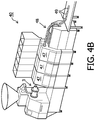
- Figure 4B shows an external view of the production device 40 as elucidated in figure 4A .
- the co-extrusion head 3 connects to three cabinets 47 holding the spraying devices 43, 44 and the induction unit 46.
- a singulation device 48 to individualise sausage products 49 from the three-layered sausage strand 41.
- Figure 5A shows a schematic cross section through a sausage strand 50 manufactured with a method according to the present invention wherein a centre of food dough 51 is covered with two casing mass material layers 52, 53.
- casing mass material layer parts 54 are applied intermittently and locally.
- the casing mass material layer parts 54 may be applied for strengthening the sausage strand 50 locally where the stand is separated later in the process for individualisation of sausage products or for providing markings (e.g. portioning marks for the end user or other customer convenience).
- FIG. 5B shows a schematic cross section through an alternative sausage strand 55 manufactured with a method according to the present invention wherein the centre of food dough 51 (as before corresponding elements with the sausage stand 50 as shown in figure 5A are designated with the same reference numerals) is now first partially covered with casing mass material layer parts 56, and wherein on the food dough 51 in between the casing mass material layer parts 56, as well as over the layer parts 56, subsequent casing mass material layer 57 is applied.
- Figure 5C shows an individualised sausage 60 with a centre of food dough 51 that is covered with a first casing mass material layer 61 except for the two ends 62, 63 where the separation (individualisation) took place.
- These sausage ends 62, 63 are however covered by a partial second casing mass material layer 64 that is made out of a different type of casing material mass than the first casing mass material layer 61, and due to the different nature of the second casing mass material layer 64 food dough parts are able to flow and to cover up the parts of the centre of food dough 51 that come free due to the separation.
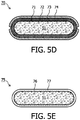
- the cross section through the sausage 70 in figure 5D shows a centre of food dough 51 covered with a first casing mass material layer 71 that has adhesive properties.
- a second casing mass material layer 72 comprises, at least for a substantial part of the layer, a seasoning/spicing while a third casing mass material layer 73 is a protective layer until consumption that may partially melt during preparation for consumption.
- a fourth non-edible casing mass material layer 74 is applied for protection during thermal treatment and is to be removed before consumption. From this sausage 70 is also clear that the casing mass material layers 71, 72, 73, 74 may be of varying thickness. For easy peeling off the non-edible casing mass material layer 74 this layer may be pre-carved and/or provided with punctures.
- Such punctures may also be useful for other casing mass material layers, e.g. to make them permeable to fluids and/or gasses.
- Another option is to use the non-permeability of a specific casing mass material layer to deliberately entrap gasses and/or fluids in a sausage product.
- the cross section through the sausage 75 in figure 5E shows a centre of food dough 51 that is covered with two casing mass material layer 76, 77, which are fused/melted together after application.
- the inherent change of one of more non-edible casing mass material layers over time may also be used for changing the shape (e.g. bending) of a sausage product.
Landscapes
- Life Sciences & Earth Sciences (AREA)
- Engineering & Computer Science (AREA)
- Wood Science & Technology (AREA)
- Zoology (AREA)
- Food Science & Technology (AREA)
- Processing Of Meat And Fish (AREA)
- Meat, Egg Or Seafood Products (AREA)
Description
- The invention relates to a method for manufacturing sausage products by means of co-extrusion, wherein the method comprises the steps of: A) providing a food dough; B) providing a viscous casing mass material; and C) producing by means of co-extrusion a sausage strand with the extrusion of a centre of food dough at least partially provided by a layer of the casing mass material. The invention also relates to a production device for the manufacture method.
- Originally sausages were produced to preserve and economically use slaughtering products as blood, organs and scraps. There are many sausage varieties, a lot of them not only comprising meat but also comprising, or even composed of, other ingredients such as fish products and/or vegetable products. It is also possible to produce a sausage that is not homogenous; the centre (also referred to as the sausage core) of the sausage may e.g. comprises different dough types. As the growth of worldwide sausages consumption is substantial there is demand for automated sausage production where normally as an alternative for natural casings, which are expensive and difficult to acquire, also the casing is produced in process. A known automated and high volume production method for sausage makes use of a co-extrusion technique. Co-extrusion is realised by means of a co-extrusion means for forming a continuous string of a food product which is provided all around with a substantially uniform casing layer that is extruded in connection with the extrusion of the string (alternative wordings for string are core, strand, centre and rope) of food product. The extrusion means of the string and the extrusion means of casing layer may be incorporated in a single co-extrusion head but may also be physically separated in subsequent extrusion means, however when physically separated both the extrusion means cooperate so that they are jointly/collectively/in relationship operated. Such related and dual extrusion of the string and a casing layer is referred to here as "co-extrusion". The covering layer normally comprises a gel which after co-extrusion has to be subjected to a gelation treatment (e.g. coagulation) to remove a part of the water from the casing material and/or to cross link the casing material so to cause the casing material to solidify and stabilize.
- Co-extrusion of sausage is a continuous and efficient production method which however limits the freedom of casing composition and structure to be produced due to e.g. the production demands on ingredients/starting materials, material conditions and processing times. Such method is disclosed in, for example, International patent application
WO 2007/032678 A1 disclosing a method for manufacturing co-extruded food products, comprising the processing steps of: A) co-extruding an elongate dough strand and a casing enclosing the elongate dough strand to form a non-coagulated food product, B) bringing the casing into contact with a salt solution, and C) dividing the encased elongate food strand into individual products, whereafter the co-extruded food products are subjected to an airflow. - A general object of the invention is to provide an improved method for manufacturing sausage products by means of co-extrusion as well as a production device that would enhance the design choices of sausage products to be produced with this technique, or with other words that would allow more types of and variations on sausage to be produced with co-extrusion than is to be realised with the prior art automated sausage manufacturing methods. The invention also has the objective to provide new types of sausage products. A further objective is to improve the efficiency of existing co-extrusion processes and/or to use new casing materials.
- The present invention provides a method for manufacturing sausage products, as defined in claim 1, wherein (the outer surface of) the centre is at least locally provided with plural layers of casing mass material and of which plural layers of casing mass material at least one is at least partially converted to a substantial solid state, e.g. under the influence of the pH applied. In this respect "solid state" is to be understood as shape retaining, that is strong enough to endure mechanical handling, as far as that the sausage after some time can be handled without that at least one of the layers of casing mass material is damaged; the structure of the layer of "solid state" casing mass material is such that the viscosity of that material from the moment of, or shortly after, applying increases. The mere fact that the outer surface of the centre is at least locally provided with plural layers of casing mass material means that the centre is at least locally covered with plural layers of casing mass material or that at least locally plural layers of casing mass material are applied to the centre. The casing mass material is highly viscous during application of the casing material to the centre and is at that state also referred to as casing paste. The casing mass material may even be liquid prior to and/or during application to the centre. The advantage of a plural layered casing is that this provides extra opportunities in optimising different functional demands in combination with automated sausage production; e.g. demands in relation to casing strength, bite, snap, pre-crimping texture, shelf life, taste, permeability, twisting and/or appearance.
- Also new functionality can be provided e.g. by applying a first casing layer that will not, or only partly cure (harden) which first layer is covered by a second casing layer that hardens in time, thus providing a sausage that has a hardened casing which hardened casing may easily be removed form the centre due to the not completely hardened underlying casing layer. Another advantage of such dual structure is that the centre may dry less after production. Plural layers casings may be thinner or thicker than single layered casings. According to the present invention it is thus possible to provide the opportunity to realise a thick layered sausage casing produced with automated sausage extrusion to obtain a higher yield or other product characteristics.
- In the situation that during step B) at least two different viscous casing mass materials are provided to produce different layers of casing mass. Both material masses can be optimised for the functions they have to provide. In other words: different casing mass material layers can provide for different functions without the need to combine plural, probably even conflicting, functions in a single casing mass material layer. An example of such optimising the functions is to provide both alginate and collagen in subsequent layers. Before the present invention the two components were used as a mixture (hybrid) as alginate, different from collagen, provides the opportunity for twisting after passing a salt bath but alginate dissolves in time due to contact with phosphate given off by the centre of food dough and alginate doesn't provide the sausage with the required bite. As a mixture it requires sub-optimising of the functions provided to the sausage by the alginate and the collagen. Now the present invention provides the opportunity to optimise the effects sought for from both the alginate and the collagen casing layers without the need to physically mix the two substances.
- Another possibility of the separating of different casing layer functions is that it can provide an opportunity to reduce the ingredient costs of the casing material. Of the casing mass materials at least one may comprise water and hydrocolloids such as collagen and/or an alginate to provide a well known casing layer while another casing material layer may be of any edible (for example vegetable or milk protein) composition.
- In a specific embodiment it is possible to use a casing mass material blend comprising muscle tissue and/or fat. When muscle tissue or fat is used as a casing mass it is particularly preferred if this mass is sandwiched between a first casing layer and a third casing layer. Which first and third casing layer preferably comprise collagen. Most preferably the amount of collagen used in such casing layers is between 0,1 wt% and 6 wt%. This way the ion-exchange from the food dough to the outer (i.e. third casing layer) is considerably reduced. It is also possible to use different ingredients such as flavours and herbs in the different collagen comprising casing layers.
- In another embodiment of the method according to the invention a first casing layer comprises animal or vegetable proteins, preferably between 0,1 wt% and 6 wt% and more preferably albumine or chicken egg proteins. A second (outer) layer comprises alginate, preferably 0,1 wt% to 6 wt% alginate.
- It is particularly preferred when the first casing layer comprising proteins, also comprises a calcium salt that is poorly soluble in water. Due to the relatively slow release of calcium ions from the first casing layer to the second casing layer comprising alginate a longer shelf-life and better baking properties are obtained. It is particularly preferred to use one or more of the following calcium salts: calcium carbonate, calciumcitrate, calcium oxide, calcium phosphate, calcium silicate, calcium sulphate, calcium sulfide, calcium tartate or mixtures thereof.
- Other ingredients for the casing mass material that may be used and that comprise film forming qualities are e.g. polysaccharides, like alginate, pectin, carrageens and/or chitosan; as well as proteins, like gelatine, collagen, water soluble proteins, egg white protein, soy protein, casein or fractions/peptides of these proteins, wheat gluten, corn zein, whey protein and/or pea protein. Specially favourable is a combination of alginate and chitosan. Yet a further option is the use of water soluble cellulose ethers possessing film forming properties, like methylcellulose (MC), hydroxypropylcellulose (HPC), hydroxypropylmethylcellulose (HPMC), and/or carboxymethylcellulose (CMC). An even further alternative is to add plasticisers to the biofilms; examples are polyethyleneglycol (PEG), sorbitol and/or glycerine. As the list of additives to the casing material is almost infinite also surface active materials like emulsifiers may be added e.g. to improve wetting and/or adhesive properties. The different ingredients require different methods for film forming. E.g. cellulose ethers require casting and evaporation of water while proteins can be denaturated by heat and further crosslinked with enzyme and/or a crosslinking agent. Polysaccharides like alginate and carrageenan (kappa and iota) are able to form gels in the presence of calcium (carrageenan also in the presence of potassium).
- According to the invention, the options for using different casing material compounds increase, now not all functionality that is demanded from a sausage casing has to be provided by a single casing mass material blend. Also two or more different casing material compounds can influence each others functionality.
- Another resulting option is for instance to add a casing mass material layer that visibly changes when heated to a certain degree e.g. to indicate a sausage is heated enough for safe consumption without having to provide any other functions relating strength, bite or permeability or the casing could be designed to change in appearance dependent on temperature or shelf life.
- In a specific implementation of the method for manufacturing sausage products as disclosed in this application at least one of the layers of casing mass material is actively transformed to an at least partially solid state. Such active transformation may be realised by chemical, enzymatic, electrical, thermal and/or physical treatment of at least one of the casing mass material layers at the moment this is required during or after manufacturing. An advantage of active transformation is that this provides the opportunity to shorten the total processing time enabling e.g. a better quality assurance and a limitation of the space and process equipment required. However as an alternative it is also possible to transform a casing mass material layer inactively, that means by just letting time pass.
- In yet another realization of the method according the present invention the sausage strand is guided through a fixing bath, whereby at least one of the layers of the casing mass material is at least partial converted to a solid state. The fixing bath will enable an active and quick increase of the cohesion of especially the (at that moment in processing) outer layer of the casing mass material.
- After the at least partial conversion to a solid state of at least one layer of casing mass material the sausage strand may be subdivided in individual products. The individual products may be cut free of each other but also may still be linked/connected after individualising e.g. by individualising the sausages by twisting. The individualising helps the further processing, logistics and sales of the sausage.
- During the manufacturing method according the present invention also a structure improver may be added to casing mass material during step B) or C). Such a structure improver may comprise one or more chemical, biochemical, enzyme and/or mechanical (e.g. fibre) additives. Using a structure improver may accelerate the hardening of at least one of the casing mass material layers and/or provide extra functionality (e.g. appearance, colour, strength, shape). The plural casing material layers also enable the embedding of an additive in between two layers of casing mass material layers.
- In a further implementation of the claimed method at least one of the layers of casing mass material is removed from the sausage strand later in the process. Such temporary casing layer may be used to further enhance the opportunities in design and/or composition of the sausages produced. The removal of at least one casing mass material layer may be realised from the individualised sausages or earlier in the process before the sausages are individualised. The layer may be removed by e.g. peeling, washing, chemical treatment, solubilisation, enzyme treatment, electrical treatment and/or evaporation. Another option is that plural casing mass material layers are fused during the manufacture of the sausage or later and that thus the plural layered casing converts to a single casing mass material layer. In certain situations it may be preferred to remove a casing layer, e.g. through pealing off this layer. In such situations the plural layers were for example only required during the manufacture, e.g to speed up processing, to enable thicker casings, for protection or other reasons. An intermediate layer of casing material (that is a layer between the centre of food dough and an exterior layer of casing mass material) may be chosen such that easy release of (at least part of) the casing is facilitated or, just the opposite, to prevent such easy release of (at least part of) the casing by increasing the adhesion of the casing and the centre of food dough, depending on the requirements of the sausage production process in use. The properties of the intermediate layer of casing material may be influenced to obtain the release specifications of (at least part of) the casing as desired.
- As already mentioned before at least one of the layers of casing mass material is converted to a substantial solid state. This implies that it is also an option that the state of at least one of the layers of casing mass material is not converted. The handling requirements of the casing mass material can be provided by one layer (or more layers) that convert to another state but this also provides the opportunity to preserve the original state of the casing mass material of at least one other layer of casing mass material.
- It is also possible that at least one of the layers of casing mass material is applied discontinuously over the length of the sausage strand. Such discontinuous applying of at least one of the layers of casing mass material may also favourably be synchronised with a later subdividing of the sausage strand in individual products. The discontinuous applying of at least one of the layers of casing mass material provides plural new opportunities in sausage manufacturing. So is it possible to provide different functionality on different positions of an individualised sausage, e.g. the ends that have to be compressed during the individualising step may be made of a different casing mass composition than the sausage part in between the sausage ends. Another option is to provide additional visual information. An example of such visual information is the provision of "portioning indications" (e.g. outlined rims) or artificial "grill marks" to enhance the product identity.
- The extrusion of a centre of food dough and the application of a first layer of casing mass material may take place at the same moment, e.g. within less than 1 second preferably within less than 0,5 second or even more preferred less than 0,2 seconds in between. Such combined production of the centre and the first layer of casing mass material shortens the total process time leading to the advantages as already mentioned before in relation to shortening the production time. The first one or more layers of casing mass material may also be applied by extrusion like the centre is extruded; this may even be realised in a single dual extrusion head. However there are also other production techniques that may be used to apply the first (and subsequent) layers of casing mass material, such alternative application techniques e.g. are spraying, sprinkling, dipping and bathing. In practise a favourable technique could be to extrude the first layer of casing mass material and to lead the semi-product subsequently through a spraying station or a bath. Also actively controlled jet systems may be used to apply casing material. Such actively controlled jet systems may be combined with electrostatic adhering of the casing material. The advantages of actively controlled jet systems is that they enable optimising the expenditure of casing material and that they enable the local diversification of thickness of a casing material layer, even such that patterns in the casing material layer may be introduced. Instead of sequential layer application also plural layers may be applied simultaneously. To realise a stable product in a preferred manufacturing method the centre of food dough is provided with a least one layer of casing mass material that is treated for converting viscous casing mass material to a more solid state before a subsequent layer of casing mass material is applied. Such treatment may be a thermal treatment (e.g. heating and/or cooling) or drying. Herein is also disclosed but not claimed a sausage product manufactured with a method as disclosed above, comprising an extruded centre of food dough that is at least locally covered with plural layers of casing mass material of which plural layers of casing mass material at least one is converted to a substantial solid state. The advantage of and the opportunities such sausage offer will be further explained later in this text in relation to the attached figures.
- In a preferred embodiment the extruded centre of food dough of the sausage product is at least locally provided with a layer of casing mass material comprising muscle fibre and a subsequent layer of casing mass material comprising at least one of the components collagen and alginate. Such a sausage product is provided with an artificial casing that has properties that resemble the properties of a natural casing, e.g. in adhesion to the centre and bite/snap properties.
- Furthermore the present invention also provides a production device for the manufacture of sausage products with the method as explained, comprising: a food dough supply; at least two supplies for viscous casing mass material; an extrusion head for the extrusion of a sausage strand forming a centre of food dough, first application means for the application of a first layer of casing mass material; and additional application means for the application of at least locally one or more subsequent layers of casing mass material, wherein at least one of the first application means and the additional application means for casing mass material comprises casing mass material extrusion means. The extrusion head for the extrusion of a sausage strand and a first extrusion means for a first casing mass material layer may be combined in a single device, for example a co-extrusion head. In case the production device comprises plural casing mass material extrusion means a plurality of (probably all) the casing mass material layers may be applied by extrusion.
- In a specific embodiment such production device further comprises means for individualising sausage products from a sausage strand and/or the additional application means for casing mass material comprises subsequent extrusion means. For the advantages of such production device reference is made to the advantages as clarified in relation to the related method according the present invention.
- The invention is further elucidated on the basis of the non-limitative exemplary embodiments shown in the following figures. Herein:
-
figure 1 shows a schematic cross-section through a production device to manufacture sausage products with a method according to the invention; -
figure 2 shows a schematic cross-section through an alternative embodiment of a production device to manufacture sausage products with a method according to the invention; -
figure 3 shows a schematic cross-section through an second alternative embodiment of a production device to manufacture sausage products with a method according to the invention; -
figure 4A shows a perspective partly cut away view of a third alternative embodiment of a production device to manufacture sausage products with a method according to the invention; -
figure 4B shows a perspective external view of the third alternative embodiment of the production device to manufacture sausage products partially shown infigure 4A ; and -
figures 5A-5E show various cross sections and perspective views of sausage products manufactured with a method according the present invention. -
Figure 1 shows a cross-section through a production device 1 to manufacture amultilayered sausage product 2. A food dough is fed (see arrow P1) through a pipe to aco-extrusion head 3 wherein apump 4 presses the food dough through anextrusion aperture 5 thus generating a centre offood dough 6. In a subsequent step in the co-extrusion head 3 a casing mass material is fed (see arrow P2) to anextrusion ring 7 to extrude a first casingmass material layer 8 covering the centre offood dough 6. The centre offood dough 6 covered with the first casingmass material layer 8 is subsequently guided through acasing material bath 9 that is fed with a second type of casing mass material (see arrow P3) resulting in a second casingmass material layer 10 that is placed on top of the first casingmass material layer 8. Thefinal sausage product 2 has thus a centre offood dough 6 that is over all covered with two layers of casingmass material -
Figure 2 shows a schematic cross-section through an alternative embodiment of a production device 20 to manufacture amultilayered sausage product 21 through triple extrusion. Corresponding components with the production device 1 as shown infigure 1 are designated with the same reference numerals. The food dough here is fed (see arrow P1) through a pipe to adouble co-extrusion head 22 wherein apump 4 presses the food dough through anextrusion aperture 5 thus generating a centre offood dough 6. As also disclosed infigure 1 in a subsequent step a casing mass material is fed (see arrow P2) to anextrusion ring 7 to extrude a first casingmass material layer 8 covering the centre offood dough 6. The centre offood dough 6 covered with the first casingmass material layer 8 is subsequently passing ansecond extrusion ring 23 to extrude a second casing mass material layer 24 (fed according to arrow P4) covering the first casingmass material layer 8. Again thefinal sausage product 21 has thus a centre offood dough 6 that is over all covered with two layers of casingmass material mass material layer 24 covering the first casingmass material layer 8. -
Figure 3 shows a schematic cross-section through an alternative embodiment of aproduction device 30 to manufacture amultilayered sausage product 31. Again corresponding components with the production devices 1, 20 as shown infigures 1 and2 are designated with the same reference numerals. The food dough is fed (see arrow P1) through a pipe to aextrusion head 32 wherein apump 4 presses the food dough through anextrusion aperture 5 thus generating a centre offood dough 6.
Different for the previously shown production devices 1, 20 in a subsequent step a casing mass material is fed (see arrow P5) to a showerhead type nozzle 33 applying a first casingmass material layer 34 covering the centre offood dough 6. The centre offood dough 6 covered with the first casingmass material layer 34 is subsequently passing anextrusion ring 23 to extrude a second casing mass material layer 24 (fed according arrow P4) covering the first casingmass material layer 34. As shown before also thisfinal sausage product 31 has a centre offood dough 6 that is over all covered with two layers of casingmass material mass material layer 24 covering the first casingmass material layer 34. -
Figure 4A shows aproduction device 40 to manufacture a three-layeredsausage product 41 using aco-extrusion head 3 as in more detail explained in relation tofigure 1 . However multilayered products may also be produced with a triple-extrusion head or even an extrusion head extruding a core and three or more casing layers (with a quarto-extrusion head or an even higher extrusion layer count head. The food dough (P1) and the first type of casing mass material (P2) are fed to theco-extrusion head 3. This co-extrusion process results as explained (see description relatingfigure 1 ) in a semi-manufacture 42 (comprising a centre offood dough 6 covered with the first casing mass material layer 8). The semi-manufacture 42 is subsequently guided through afirst spraying device 43 spraying a second type of casing mass material on the semi-manufacture 42. After leaving thefirst spraying device 43 the food strand is then guided through asecond spraying device 44 spraying a third type of casing mass material (e.g. for fixation) to provide a third casing mass material layer. The three-layeredfood strand 41 then passes aninduction unit 46 for at least partially solidifying one of the casing mass material layers that enables further handling of the three-layeredfood strand 41. -
Figure 4B shows an external view of theproduction device 40 as elucidated infigure 4A . Theco-extrusion head 3 connects to threecabinets 47 holding thespraying devices induction unit 46. In line of production behind thelast cabinet 47 that holds theinduction unit 46 is shown asingulation device 48 to individualisesausage products 49 from the three-layeredsausage strand 41. -
Figure 5A shows a schematic cross section through asausage strand 50 manufactured with a method according to the present invention wherein a centre offood dough 51 is covered with two casing mass material layers 52, 53. Upon an outer casingmass material layer 53 casing massmaterial layer parts 54 are applied intermittently and locally. The casing massmaterial layer parts 54 may be applied for strengthening thesausage strand 50 locally where the stand is separated later in the process for individualisation of sausage products or for providing markings (e.g. portioning marks for the end user or other customer convenience). -
Figure 5B shows a schematic cross section through analternative sausage strand 55 manufactured with a method according to the present invention wherein the centre of food dough 51 (as before corresponding elements with the sausage stand 50 as shown infigure 5A are designated with the same reference numerals) is now first partially covered with casing massmaterial layer parts 56, and wherein on thefood dough 51 in between the casing massmaterial layer parts 56, as well as over thelayer parts 56, subsequent casingmass material layer 57 is applied. -
Figure 5C shows an individualisedsausage 60 with a centre offood dough 51 that is covered with a first casingmass material layer 61 except for the two ends 62, 63 where the separation (individualisation) took place. These sausage ends 62, 63 are however covered by a partial second casingmass material layer 64 that is made out of a different type of casing material mass than the first casingmass material layer 61, and due to the different nature of the second casingmass material layer 64 food dough parts are able to flow and to cover up the parts of the centre offood dough 51 that come free due to the separation. - The cross section through the
sausage 70 infigure 5D shows a centre offood dough 51 covered with a first casingmass material layer 71 that has adhesive properties. A second casingmass material layer 72 comprises, at least for a substantial part of the layer, a seasoning/spicing while a third casingmass material layer 73 is a protective layer until consumption that may partially melt during preparation for consumption. A fourth non-edible casingmass material layer 74 is applied for protection during thermal treatment and is to be removed before consumption. From thissausage 70 is also clear that the casing mass material layers 71, 72, 73, 74 may be of varying thickness. For easy peeling off the non-edible casingmass material layer 74 this layer may be pre-carved and/or provided with punctures. Such punctures may also be useful for other casing mass material layers, e.g. to make them permeable to fluids and/or gasses. Another option is to use the non-permeability of a specific casing mass material layer to deliberately entrap gasses and/or fluids in a sausage product. - The cross section through the
sausage 75 infigure 5E shows a centre offood dough 51 that is covered with two casingmass material layer
Claims (21)
- Method for manufacturing sausage products (49, 60, 70, 75) by means of co-extrusion, wherein the method comprises the steps of:A) providing a food dough;B) providing a viscous casing mass material; andC) producing by means of co-extrusion a sausage strand (2, 21, 31, 41, 50, 55) with the extrusion of a centre of food dough (6, 51) at least partially covered by a layer of casing mass material (8, 10, 24, 34, 52, 53, 54, 56, 57, 61, 64, 71, 72, 73, 74, 76, 77),wherein the centre (6, 51) is at least locally provided with at least two layers of casing mass material (8, 10, 24, 34, 52, 53, 54, 56, 57, 61, 64, 71, 72, 73, 74, 76, 77) and of which at least two layers of casing mass material (8, 10, 24, 34, 52, 53, 54, 56, 57, 61, 64, 71, 72, 73, 74, 76, 77) at least one is at least partially converted to a substantial solid state.
- Method according to claim 1, characterised in that during step B) at least two different viscous casing mass materials are provided to produce different layers of casing mass (8, 10, 24, 34, 52, 53, 54, 56, 57, 61, 64, 71, 72, 73, 74, 76, 77).
- Method according to claim 1 or 2, characterised in that at least one of the casing mass materials comprises water and hydrocolloids such as collagen and/or an alginate.
- Method according to any of the claims 1-3, wherein a first casing layer (8, 34, 52, 56, 61, 71, 76) comprises 0.1 to 6 wt% proteins, preferably animal or vegetable proteins, more preferably albumine or chicken egg proteins, and a second casing layer comprises alginate, preferably 0.1 to 6 wt% alginate.
- Method according to claim 4, wherein the first casing layer (8, 34, 52, 56, 61, 71, 76) also comprises a in water poorly soluble calcium salt, such as calciumcarbonaat, calciumcitraat, calciumoxide, calciumfosfaat, calciumsilicaat, calciumsulfaat, calciumsulfide, calciumtartraat or mixtures thereof.
- Method according to any of the claims 1-4, wherein in first casing layer (8, 34, 52, 56, 61, 71, 76) comprises collagen, a second casing layer (10, 24, 53, 57, 64, 72, 77) comprises edible fat or oil and a third casing layer (54, 73) comprises collagen.
- Method as claimed in any of the foregoing claims, characterized in that at least one of the layers of casing mass material (8, 10, 24, 34, 52, 53, 54, 56, 57, 61, 64, 71, 72, 73, 74, 76, 77) is actively transformed to an at least partially solid state.
- Method as claimed in any of the foregoing claims, characterized in that the sausage strand (2, 21, 31, 41, 50, 55) is guided through a fixing bath, whereby at least one of the layers of the casing mass material (8, 10, 24, 34, 52, 53, 54, 56, 57, 61, 64, 71, 72, 73, 74, 76, 77) is at least partial converted to a solid state.
- Method as claimed in any of the foregoing claims, characterized in that after at least partial conversion to a solid state of at least one layer of casing mass material (8, 10, 24, 34, 52, 53, 54, 56, 57, 61, 64, 71, 72, 73, 74, 76, 77) the sausage strand (2, 21, 31, 41, 50, 55) is subdivided in individual products (49, 60, 70, 75).
- Method as claimed in any of the foregoing claims, characterized in that a structure improver is added to casing mass material during step B) or C).
- Method as claimed in any of the foregoing claims, characterized in that at least one of the layers of casing mass material (8, 10, 24, 34, 52, 53, 54, 56, 57, 61, 64, 71, 72, 73, 74, 76, 77) is removed from the sausage strand (2, 21, 31, 41, 50, 55).
- Method as claimed in any of the foregoing claims, characterized in that the state of at least one of the layers of casing mass material (8, 10, 24, 34, 52, 53, 54, 56, 57, 61, 64, 71, 72, 73, 74, 76, 77) is not converted.
- Method as claimed in any of the foregoing claims, characterized in that at least one of the layers of casing mass material (8, 10, 24, 34, 52, 53, 54, 56, 57, 61, 64, 71, 72, 73, 74, 76, 77) is applied discontinuous over the length of the sausage strand (2, 21, 31, 41, 50, 55).
- Method as claimed in claim 13, characterized in that the discontinuous applying of at least one of the layers of casing mass material (8, 10, 24, 34, 52, 53, 54, 56, 57, 61, 64, 71, 72, 73, 74, 76, 77) is synchronised with a later subdividing of the sausage strand in individual products (49, 60, 70, 75).
- Method as claimed in any of the foregoing claims, characterized in that the extrusion of a centre of food dough (6, 51) and the applying of a first layer of casing mass material (8, 34, 52, 56, 61, 71, 76) takes place at the same moment.
- Method as claimed in any of the foregoing claims, characterized in that a layer of casing mass material (8, 10, 24, 34, 52, 53, 54, 56, 57, 61, 64, 71, 72, 73, 74, 76, 77) is applied by sprinkling, spraying or bathing.
- Method as claimed in any of the foregoing claims, characterized in that the centre of food dough (6, 51) provided with a least one layer of casing mass material (8, 10, 24, 34, 52, 53, 54, 56, 57, 61, 64, 71, 72, 73, 74, 76, 77) is treated for converting viscous casing mass material to a more solid state before a subsequent layer of casing mass material (8, 10, 24, 34, 52, 53, 54, 56, 57, 61, 64, 71, 72, 73, 74, 76, 77) is applied.
- Production device (1, 20, 30 ,40) for the manufacture of sausage products (49, 60, 70, 75) with a method according any of the claim 1-14, comprising:- a food dough supply;- at least two supplies for viscous casing mass material;- an extrusion head (3) for the extrusion of a sausage strand forming a centre of food dough (6, 51),- first application means (7, 33, 43, 47) for the application of a first layer of casing mass material (8, 34, 52, 56, 61, 71, 76); and- additional application means (9, 23, 44, 46, 47) for the application of at least locally one or more subsequent layers of casing mass material (10, 24, 53, 54, 57, 64, 72, 73, 77),wherein at least one of the first application means (7, 33, 43, 47) and the additional application means (9, 23, 44, 46, 47) for casing mass material comprises casing mass material extrusion means (7, 23).
- Production device (1, 20, 30 ,40) as claimed in claim 18, characterised in that the production device (1, 20, 30 ,40) comprises plural casing mass material extrusion means.
- Production device (1, 20, 30 ,40) as claimed in claim 18 or 19, characterised in that the production device (1, 20, 30 ,40) further comprises means for individualising (48) sausage products (49, 60, 70, 75) from a sausage strand (2, 21, 31, 41, 50, 55).
- Production device (1, 20, 30 ,40) as claimed any of the claims 18-20, characterised in that the additional application means (9, 23, 44, 46, 47) for casing mass material comprise subsequent extrusion means (23).
Applications Claiming Priority (2)
| Application Number | Priority Date | Filing Date | Title |
|---|---|---|---|
| NL2004037A NL2004037C2 (en) | 2009-12-30 | 2009-12-30 | Method for manufacturing sausage products, sausage and sausage production device. |
| PCT/NL2010/050898 WO2011087359A1 (en) | 2009-12-30 | 2010-12-30 | Method for manufacturing sausage products, sausage and sausage production device |
Publications (2)
| Publication Number | Publication Date |
|---|---|
| EP2519109A1 EP2519109A1 (en) | 2012-11-07 |
| EP2519109B1 true EP2519109B1 (en) | 2018-02-14 |
Family
ID=42668725
Family Applications (1)
| Application Number | Title | Priority Date | Filing Date |
|---|---|---|---|
| EP10807563.1A Active EP2519109B1 (en) | 2009-12-30 | 2010-12-30 | Method for manufacturing sausage products and sausage production device |
Country Status (7)
| Country | Link |
|---|---|
| US (1) | US11224229B2 (en) |
| EP (1) | EP2519109B1 (en) |
| JP (1) | JP6087627B2 (en) |
| BR (1) | BR112012016364A2 (en) |
| DK (1) | DK2519109T3 (en) |
| NL (1) | NL2004037C2 (en) |
| WO (1) | WO2011087359A1 (en) |
Cited By (1)
| Publication number | Priority date | Publication date | Assignee | Title |
|---|---|---|---|---|
| EP4356740A1 (en) * | 2022-09-29 | 2024-04-24 | VEMAG Maschinenbau GmbH | Coextrusion head, food machine and method for coextrusion of a food mass |
Families Citing this family (15)
| Publication number | Priority date | Publication date | Assignee | Title |
|---|---|---|---|---|
| EP2457444B1 (en) * | 2010-11-29 | 2018-04-25 | Albert Handtmann Maschinenfabrik GmbH & Co. KG | Scalable machine and method for its operation |
| US9380804B2 (en) * | 2012-07-12 | 2016-07-05 | The Hillshire Brands Company | Systems and methods for food product extrusion |
| DE202012009795U1 (en) * | 2012-10-15 | 2014-01-16 | Vemag Maschinenbau Gmbh | Device for producing a strand from a pasty mass |
| ES2554939T3 (en) * | 2012-12-14 | 2015-12-28 | Albert Handtmann Maschinenfabrik Gmbh & Co. Kg | Procedure for the production of a food by coextrusion and use of an adhesive agent as a lubricant during coextrusion |
| EP2781160B1 (en) * | 2013-03-21 | 2016-11-30 | Albert Handtmann Maschinenfabrik GmbH & Co. KG | Device for producing coextruded food products |
| DE202013004093U1 (en) * | 2013-05-03 | 2014-08-05 | Vemag Maschinenbau Gmbh | Device for producing a sausage strand |
| AU2015206906B2 (en) * | 2014-01-17 | 2018-09-27 | Devro (Scotland) Limited | Food product and method of preparation |
| CN105166980A (en) * | 2015-07-14 | 2015-12-23 | 江苏爱福特科技开发有限公司 | Sausage production method |
| US11006642B2 (en) * | 2017-10-17 | 2021-05-18 | Dcw Casing Llc | Apparatus and method for applying liquid to sausage |
| KR102159021B1 (en) * | 2018-07-20 | 2020-09-23 | 고려대학교 산학협력단 | Yuba film comprising pine needle extract as an active ingredient and its meat products casing use |
| GB201815789D0 (en) * | 2018-09-27 | 2018-11-14 | Skipping Rocks Lab Ltd | Machine for encapsulating liquid products |
| JP7280793B2 (en) * | 2019-09-27 | 2023-05-24 | プリマハム株式会社 | Method for producing rod-shaped processed meat products |
| ES2954775T3 (en) * | 2020-02-20 | 2023-11-24 | Handtmann Albert Maschf | Device and procedure for the manufacture of coextruded products with variable thickness of the wrapping material |
| EP3957180A1 (en) * | 2020-08-19 | 2022-02-23 | Hanze Food B.V. | Method for encasing foodstuff |
| CA3134985C (en) | 2020-10-30 | 2024-02-20 | Viskase Companies, Inc. | Edible cellulosic casings and compositions, and methods of formation |
Family Cites Families (16)
| Publication number | Priority date | Publication date | Assignee | Title |
|---|---|---|---|---|
| US3698916A (en) * | 1970-06-17 | 1972-10-17 | Stephen T Moreland | Continuous sausage manufacture |
| DE4306274A1 (en) * | 1992-12-23 | 1994-06-30 | Wolff Walsrode Ag | Multi-layer coextruded, biaxially stretched tubular film with an improved oxygen barrier |
| BR9814058A (en) * | 1997-10-30 | 2000-09-26 | Townsend Engineering Co | Method and device for creating co-extruded sausage strings |
| WO2000002463A1 (en) * | 1998-07-10 | 2000-01-20 | Townsend Engineering Company | Process for producing fresh sausage |
| FR2826238B1 (en) | 2001-06-22 | 2003-10-03 | Sonjal Sas | PROCESS FOR THE PREPARATION OF FOOD PRODUCTS COATED WITH A MATERIAL BASED ON PROTEIN AND HYDROCOLLOID |
| WO2003041504A1 (en) * | 2001-11-14 | 2003-05-22 | Townsend Engineering Company | A gel for creating a coating for extruded sausage comprised of starch and an edible vegetable based material |
| EP1371293B1 (en) * | 2002-06-10 | 2007-04-11 | Albert Handtmann Maschinenfabrik GmbH & Co. KG | Device and method for producing a strand of plastic material and an extrusion head for the device/method |
| FR2842708B1 (en) | 2002-07-26 | 2005-07-29 | Heysham Internat Ltd | ENROBE FOOD PRODUCT, COMPOSITION, PROCESS AND APPARATUS FOR MANUFACTURING THE SAME |
| WO2006051278A1 (en) * | 2004-11-09 | 2006-05-18 | Loders Croklaan B.V. | Method of producing a food product |
| NL1029272C2 (en) * | 2005-06-17 | 2006-12-19 | Stork Townsend Bv | Method for preparing food products, in particular sausage, by coextrusion and food products obtained by this method. |
| JP4734046B2 (en) * | 2005-06-30 | 2011-07-27 | 日清フーズ株式会社 | Breaded fried food and its manufacturing method |
| NL1029931C2 (en) * | 2005-09-12 | 2007-03-13 | Stork Townsend Bv | Method and device for subjecting co-extruded food products to an air stream in two phases. |
| ES2306577B1 (en) * | 2006-05-11 | 2009-09-28 | Viscofan, S.A. | PROCEDURE FOR OBTAINING A TRIP WITH BRANDS AND A CARNIC PRODUCT WITH BRANDS, TRIPE AND MEAT PRODUCTS AS GOT. |
| US20090061052A1 (en) * | 2007-08-08 | 2009-03-05 | Red Arrow Products Co., Llc. | Casings for Foodstuffs |
| GB0811443D0 (en) * | 2008-06-20 | 2008-07-30 | Isp Alginates Uk Ltd | Food product having a casing |
| US8945643B2 (en) * | 2008-08-21 | 2015-02-03 | The Hillshire Brands, Company | System and method for forming a multi-layer extruded food product |
-
2009
- 2009-12-30 NL NL2004037A patent/NL2004037C2/en not_active IP Right Cessation
-
2010
- 2010-12-30 WO PCT/NL2010/050898 patent/WO2011087359A1/en not_active Ceased
- 2010-12-30 EP EP10807563.1A patent/EP2519109B1/en active Active
- 2010-12-30 JP JP2012547045A patent/JP6087627B2/en active Active
- 2010-12-30 BR BR112012016364A patent/BR112012016364A2/en not_active Application Discontinuation
- 2010-12-30 DK DK10807563.1T patent/DK2519109T3/en active
- 2010-12-30 US US13/519,814 patent/US11224229B2/en active Active
Cited By (1)
| Publication number | Priority date | Publication date | Assignee | Title |
|---|---|---|---|---|
| EP4356740A1 (en) * | 2022-09-29 | 2024-04-24 | VEMAG Maschinenbau GmbH | Coextrusion head, food machine and method for coextrusion of a food mass |
Also Published As
| Publication number | Publication date |
|---|---|
| US11224229B2 (en) | 2022-01-18 |
| BR112012016364A2 (en) | 2019-09-24 |
| DK2519109T3 (en) | 2018-05-28 |
| NL2004037C2 (en) | 2011-07-04 |
| US20120321752A1 (en) | 2012-12-20 |
| JP6087627B2 (en) | 2017-03-01 |
| JP2013516171A (en) | 2013-05-13 |
| WO2011087359A1 (en) | 2011-07-21 |
| EP2519109A1 (en) | 2012-11-07 |
Similar Documents
| Publication | Publication Date | Title |
|---|---|---|
| US11224229B2 (en) | Method for manufacturing sausage products, sausage and sausage production | |
| JP6640185B2 (en) | Food casing | |
| CN100413417C (en) | Collagen casing | |
| DK2869705T3 (en) | STABILIZED MEAT PRODUCTS | |
| US20140010920A1 (en) | Meat-like foodstuff and method for producing the same | |
| EP0720816A1 (en) | Method of manufacturing a food product | |
| WO2004010801A8 (en) | Coated food product, composition, method and apparatus for making same | |
| JP3409162B2 (en) | Method for forming co-extruded food products in the form of links | |
| JP2004159656A (en) | Starch/collagen casing for co-extruded food product | |
| WO2006128110A2 (en) | Intermittent flow extrusion process and food product | |
| AU746201B2 (en) | Process for producing fresh sausage | |
| JP5878177B2 (en) | Method for producing artificial casing for filling food and artificial casing obtained from said method | |
| RU2008148816A (en) | CASING CONFIGURING COLOR FORMED MEAT PRODUCTS AND METHOD FOR PRODUCING IT | |
| TW201238494A (en) | Quasi-meat food and manufacturing method thereof | |
| CN1212851A (en) | Steamed buns with oil and water barrier film | |
| US20100034932A1 (en) | Edible food casing based on proteins, and process for production thereof | |
| DE102009013016A1 (en) | Method for the production of a Parisian rolled fillet ham, comprises applying a binding agent on meat pieces at external side and/or on a bacon layer at internal side before covering the meat pieces | |
| AU752972B2 (en) | Method for manufacturing smoke/cooked sausage | |
| WO2006051274A1 (en) | Food product and method for its production | |
| NL2009121C2 (en) | Stabilized meat products. | |
| JPH02195860A (en) | Ham-sausages and production thereof | |
| JPH0655118B2 (en) | Raw sausage manufacturing method | |
| JP2629019B2 (en) | Sausage manufacturing method | |
| JP7146535B2 (en) | Meat product manufacturing method and meat product | |
| NL2005683C2 (en) | METHOD FOR PREPARING FOOD PRODUCTS BY EXTRUSION |
Legal Events
| Date | Code | Title | Description |
|---|---|---|---|
| PUAI | Public reference made under article 153(3) epc to a published international application that has entered the european phase |
Free format text: ORIGINAL CODE: 0009012 |
|
| 17P | Request for examination filed |
Effective date: 20120730 |
|
| AK | Designated contracting states |
Kind code of ref document: A1 Designated state(s): AL AT BE BG CH CY CZ DE DK EE ES FI FR GB GR HR HU IE IS IT LI LT LU LV MC MK MT NL NO PL PT RO RS SE SI SK SM TR |
|
| DAX | Request for extension of the european patent (deleted) | ||
| 17Q | First examination report despatched |
Effective date: 20170301 |
|
| GRAP | Despatch of communication of intention to grant a patent |
Free format text: ORIGINAL CODE: EPIDOSNIGR1 |
|
| INTG | Intention to grant announced |
Effective date: 20170728 |
|
| GRAS | Grant fee paid |
Free format text: ORIGINAL CODE: EPIDOSNIGR3 |
|
| GRAA | (expected) grant |
Free format text: ORIGINAL CODE: 0009210 |
|
| AK | Designated contracting states |
Kind code of ref document: B1 Designated state(s): AL AT BE BG CH CY CZ DE DK EE ES FI FR GB GR HR HU IE IS IT LI LT LU LV MC MK MT NL NO PL PT RO RS SE SI SK SM TR |
|
| REG | Reference to a national code |
Ref country code: GB Ref legal event code: FG4D |
|
| REG | Reference to a national code |
Ref country code: CH Ref legal event code: EP |
|
| REG | Reference to a national code |
Ref country code: IE Ref legal event code: FG4D |
|
| REG | Reference to a national code |
Ref country code: DE Ref legal event code: R096 Ref document number: 602010048523 Country of ref document: DE Ref country code: AT Ref legal event code: REF Ref document number: 969280 Country of ref document: AT Kind code of ref document: T Effective date: 20180315 |
|
| REG | Reference to a national code |
Ref country code: NL Ref legal event code: FP |
|
| REG | Reference to a national code |
Ref country code: DK Ref legal event code: T3 Effective date: 20180522 |
|
| REG | Reference to a national code |
Ref country code: AT Ref legal event code: MK05 Ref document number: 969280 Country of ref document: AT Kind code of ref document: T Effective date: 20180214 |
|
| PG25 | Lapsed in a contracting state [announced via postgrant information from national office to epo] |
Ref country code: FI Free format text: LAPSE BECAUSE OF FAILURE TO SUBMIT A TRANSLATION OF THE DESCRIPTION OR TO PAY THE FEE WITHIN THE PRESCRIBED TIME-LIMIT Effective date: 20180214 Ref country code: HR Free format text: LAPSE BECAUSE OF FAILURE TO SUBMIT A TRANSLATION OF THE DESCRIPTION OR TO PAY THE FEE WITHIN THE PRESCRIBED TIME-LIMIT Effective date: 20180214 Ref country code: CY Free format text: LAPSE BECAUSE OF FAILURE TO SUBMIT A TRANSLATION OF THE DESCRIPTION OR TO PAY THE FEE WITHIN THE PRESCRIBED TIME-LIMIT Effective date: 20180214 Ref country code: NO Free format text: LAPSE BECAUSE OF FAILURE TO SUBMIT A TRANSLATION OF THE DESCRIPTION OR TO PAY THE FEE WITHIN THE PRESCRIBED TIME-LIMIT Effective date: 20180514 Ref country code: ES Free format text: LAPSE BECAUSE OF FAILURE TO SUBMIT A TRANSLATION OF THE DESCRIPTION OR TO PAY THE FEE WITHIN THE PRESCRIBED TIME-LIMIT Effective date: 20180214 Ref country code: LT Free format text: LAPSE BECAUSE OF FAILURE TO SUBMIT A TRANSLATION OF THE DESCRIPTION OR TO PAY THE FEE WITHIN THE PRESCRIBED TIME-LIMIT Effective date: 20180214 |
|
| PG25 | Lapsed in a contracting state [announced via postgrant information from national office to epo] |
Ref country code: BG Free format text: LAPSE BECAUSE OF FAILURE TO SUBMIT A TRANSLATION OF THE DESCRIPTION OR TO PAY THE FEE WITHIN THE PRESCRIBED TIME-LIMIT Effective date: 20180514 Ref country code: RS Free format text: LAPSE BECAUSE OF FAILURE TO SUBMIT A TRANSLATION OF THE DESCRIPTION OR TO PAY THE FEE WITHIN THE PRESCRIBED TIME-LIMIT Effective date: 20180214 Ref country code: AT Free format text: LAPSE BECAUSE OF FAILURE TO SUBMIT A TRANSLATION OF THE DESCRIPTION OR TO PAY THE FEE WITHIN THE PRESCRIBED TIME-LIMIT Effective date: 20180214 Ref country code: SE Free format text: LAPSE BECAUSE OF FAILURE TO SUBMIT A TRANSLATION OF THE DESCRIPTION OR TO PAY THE FEE WITHIN THE PRESCRIBED TIME-LIMIT Effective date: 20180214 Ref country code: GR Free format text: LAPSE BECAUSE OF FAILURE TO SUBMIT A TRANSLATION OF THE DESCRIPTION OR TO PAY THE FEE WITHIN THE PRESCRIBED TIME-LIMIT Effective date: 20180515 Ref country code: LV Free format text: LAPSE BECAUSE OF FAILURE TO SUBMIT A TRANSLATION OF THE DESCRIPTION OR TO PAY THE FEE WITHIN THE PRESCRIBED TIME-LIMIT Effective date: 20180214 |
|
| PG25 | Lapsed in a contracting state [announced via postgrant information from national office to epo] |
Ref country code: RO Free format text: LAPSE BECAUSE OF FAILURE TO SUBMIT A TRANSLATION OF THE DESCRIPTION OR TO PAY THE FEE WITHIN THE PRESCRIBED TIME-LIMIT Effective date: 20180214 Ref country code: IT Free format text: LAPSE BECAUSE OF FAILURE TO SUBMIT A TRANSLATION OF THE DESCRIPTION OR TO PAY THE FEE WITHIN THE PRESCRIBED TIME-LIMIT Effective date: 20180214 Ref country code: EE Free format text: LAPSE BECAUSE OF FAILURE TO SUBMIT A TRANSLATION OF THE DESCRIPTION OR TO PAY THE FEE WITHIN THE PRESCRIBED TIME-LIMIT Effective date: 20180214 Ref country code: PL Free format text: LAPSE BECAUSE OF FAILURE TO SUBMIT A TRANSLATION OF THE DESCRIPTION OR TO PAY THE FEE WITHIN THE PRESCRIBED TIME-LIMIT Effective date: 20180214 Ref country code: AL Free format text: LAPSE BECAUSE OF FAILURE TO SUBMIT A TRANSLATION OF THE DESCRIPTION OR TO PAY THE FEE WITHIN THE PRESCRIBED TIME-LIMIT Effective date: 20180214 |
|
| REG | Reference to a national code |
Ref country code: DE Ref legal event code: R097 Ref document number: 602010048523 Country of ref document: DE |
|
| PG25 | Lapsed in a contracting state [announced via postgrant information from national office to epo] |
Ref country code: SK Free format text: LAPSE BECAUSE OF FAILURE TO SUBMIT A TRANSLATION OF THE DESCRIPTION OR TO PAY THE FEE WITHIN THE PRESCRIBED TIME-LIMIT Effective date: 20180214 Ref country code: CZ Free format text: LAPSE BECAUSE OF FAILURE TO SUBMIT A TRANSLATION OF THE DESCRIPTION OR TO PAY THE FEE WITHIN THE PRESCRIBED TIME-LIMIT Effective date: 20180214 Ref country code: SM Free format text: LAPSE BECAUSE OF FAILURE TO SUBMIT A TRANSLATION OF THE DESCRIPTION OR TO PAY THE FEE WITHIN THE PRESCRIBED TIME-LIMIT Effective date: 20180214 |
|
| PLBE | No opposition filed within time limit |
Free format text: ORIGINAL CODE: 0009261 |
|
| STAA | Information on the status of an ep patent application or granted ep patent |
Free format text: STATUS: NO OPPOSITION FILED WITHIN TIME LIMIT |
|
| 26N | No opposition filed |
Effective date: 20181115 |
|
| PGFP | Annual fee paid to national office [announced via postgrant information from national office to epo] |
Ref country code: DK Payment date: 20181227 Year of fee payment: 9 |
|
| PG25 | Lapsed in a contracting state [announced via postgrant information from national office to epo] |
Ref country code: SI Free format text: LAPSE BECAUSE OF FAILURE TO SUBMIT A TRANSLATION OF THE DESCRIPTION OR TO PAY THE FEE WITHIN THE PRESCRIBED TIME-LIMIT Effective date: 20180214 |
|
| PGFP | Annual fee paid to national office [announced via postgrant information from national office to epo] |
Ref country code: CH Payment date: 20181227 Year of fee payment: 10 |
|
| REG | Reference to a national code |
Ref country code: CH Ref legal event code: PL |
|
| PG25 | Lapsed in a contracting state [announced via postgrant information from national office to epo] |
Ref country code: LU Free format text: LAPSE BECAUSE OF NON-PAYMENT OF DUE FEES Effective date: 20181230 Ref country code: MC Free format text: LAPSE BECAUSE OF FAILURE TO SUBMIT A TRANSLATION OF THE DESCRIPTION OR TO PAY THE FEE WITHIN THE PRESCRIBED TIME-LIMIT Effective date: 20180214 |
|
| REG | Reference to a national code |
Ref country code: IE Ref legal event code: MM4A |
|
| REG | Reference to a national code |
Ref country code: BE Ref legal event code: MM Effective date: 20181231 |
|
| PG25 | Lapsed in a contracting state [announced via postgrant information from national office to epo] |
Ref country code: IE Free format text: LAPSE BECAUSE OF NON-PAYMENT OF DUE FEES Effective date: 20181230 |
|
| PG25 | Lapsed in a contracting state [announced via postgrant information from national office to epo] |
Ref country code: BE Free format text: LAPSE BECAUSE OF NON-PAYMENT OF DUE FEES Effective date: 20181231 |
|
| PG25 | Lapsed in a contracting state [announced via postgrant information from national office to epo] |
Ref country code: CH Free format text: LAPSE BECAUSE OF NON-PAYMENT OF DUE FEES Effective date: 20181231 Ref country code: LI Free format text: LAPSE BECAUSE OF NON-PAYMENT OF DUE FEES Effective date: 20181231 |
|
| PG25 | Lapsed in a contracting state [announced via postgrant information from national office to epo] |
Ref country code: MT Free format text: LAPSE BECAUSE OF NON-PAYMENT OF DUE FEES Effective date: 20181230 |
|
| PG25 | Lapsed in a contracting state [announced via postgrant information from national office to epo] |
Ref country code: TR Free format text: LAPSE BECAUSE OF FAILURE TO SUBMIT A TRANSLATION OF THE DESCRIPTION OR TO PAY THE FEE WITHIN THE PRESCRIBED TIME-LIMIT Effective date: 20180214 |
|
| PGFP | Annual fee paid to national office [announced via postgrant information from national office to epo] |
Ref country code: GB Payment date: 20200102 Year of fee payment: 10 |
|
| PG25 | Lapsed in a contracting state [announced via postgrant information from national office to epo] |
Ref country code: PT Free format text: LAPSE BECAUSE OF FAILURE TO SUBMIT A TRANSLATION OF THE DESCRIPTION OR TO PAY THE FEE WITHIN THE PRESCRIBED TIME-LIMIT Effective date: 20180214 |
|
| PG25 | Lapsed in a contracting state [announced via postgrant information from national office to epo] |
Ref country code: MK Free format text: LAPSE BECAUSE OF NON-PAYMENT OF DUE FEES Effective date: 20180214 Ref country code: HU Free format text: LAPSE BECAUSE OF FAILURE TO SUBMIT A TRANSLATION OF THE DESCRIPTION OR TO PAY THE FEE WITHIN THE PRESCRIBED TIME-LIMIT; INVALID AB INITIO Effective date: 20101230 |
|
| REG | Reference to a national code |
Ref country code: DK Ref legal event code: EBP Effective date: 20191231 |
|
| PG25 | Lapsed in a contracting state [announced via postgrant information from national office to epo] |
Ref country code: IS Free format text: LAPSE BECAUSE OF FAILURE TO SUBMIT A TRANSLATION OF THE DESCRIPTION OR TO PAY THE FEE WITHIN THE PRESCRIBED TIME-LIMIT Effective date: 20180614 |
|
| PG25 | Lapsed in a contracting state [announced via postgrant information from national office to epo] |
Ref country code: FR Free format text: LAPSE BECAUSE OF NON-PAYMENT OF DUE FEES Effective date: 20191231 |
|
| PG25 | Lapsed in a contracting state [announced via postgrant information from national office to epo] |
Ref country code: DK Free format text: LAPSE BECAUSE OF NON-PAYMENT OF DUE FEES Effective date: 20191231 |
|
| GBPC | Gb: european patent ceased through non-payment of renewal fee |
Effective date: 20201230 |
|
| PG25 | Lapsed in a contracting state [announced via postgrant information from national office to epo] |
Ref country code: GB Free format text: LAPSE BECAUSE OF NON-PAYMENT OF DUE FEES Effective date: 20201230 |
|
| P01 | Opt-out of the competence of the unified patent court (upc) registered |
Effective date: 20230514 |
|
| PGFP | Annual fee paid to national office [announced via postgrant information from national office to epo] |
Ref country code: NL Payment date: 20251119 Year of fee payment: 16 |
|
| PGFP | Annual fee paid to national office [announced via postgrant information from national office to epo] |
Ref country code: DE Payment date: 20251126 Year of fee payment: 16 |