EP2516480B1 - A semi-continuous process for the synthesis of a catalyst for use in the manufacture of polyolefins - Google Patents
A semi-continuous process for the synthesis of a catalyst for use in the manufacture of polyolefins Download PDFInfo
- Publication number
- EP2516480B1 EP2516480B1 EP10838831.5A EP10838831A EP2516480B1 EP 2516480 B1 EP2516480 B1 EP 2516480B1 EP 10838831 A EP10838831 A EP 10838831A EP 2516480 B1 EP2516480 B1 EP 2516480B1
- Authority
- EP
- European Patent Office
- Prior art keywords
- reactor
- filtrate
- reactors
- catalyst
- section
- Prior art date
- Legal status (The legal status is an assumption and is not a legal conclusion. Google has not performed a legal analysis and makes no representation as to the accuracy of the status listed.)
- Active
Links
Images


Classifications
-
- C—CHEMISTRY; METALLURGY
- C08—ORGANIC MACROMOLECULAR COMPOUNDS; THEIR PREPARATION OR CHEMICAL WORKING-UP; COMPOSITIONS BASED THEREON
- C08F—MACROMOLECULAR COMPOUNDS OBTAINED BY REACTIONS ONLY INVOLVING CARBON-TO-CARBON UNSATURATED BONDS
- C08F4/00—Polymerisation catalysts
- C08F4/42—Metals; Metal hydrides; Metallo-organic compounds; Use thereof as catalyst precursors
- C08F4/44—Metals; Metal hydrides; Metallo-organic compounds; Use thereof as catalyst precursors selected from light metals, zinc, cadmium, mercury, copper, silver, gold, boron, gallium, indium, thallium, rare earths or actinides
- C08F4/60—Metals; Metal hydrides; Metallo-organic compounds; Use thereof as catalyst precursors selected from light metals, zinc, cadmium, mercury, copper, silver, gold, boron, gallium, indium, thallium, rare earths or actinides together with refractory metals, iron group metals, platinum group metals, manganese, rhenium technetium or compounds thereof
- C08F4/62—Refractory metals or compounds thereof
- C08F4/64—Titanium, zirconium, hafnium or compounds thereof
- C08F4/65—Pretreating the metal or compound covered by group C08F4/64 before the final contacting with the metal or compound covered by group C08F4/44
- C08F4/652—Pretreating with metals or metal-containing compounds
-
- C—CHEMISTRY; METALLURGY
- C08—ORGANIC MACROMOLECULAR COMPOUNDS; THEIR PREPARATION OR CHEMICAL WORKING-UP; COMPOSITIONS BASED THEREON
- C08F—MACROMOLECULAR COMPOUNDS OBTAINED BY REACTIONS ONLY INVOLVING CARBON-TO-CARBON UNSATURATED BONDS
- C08F10/00—Homopolymers and copolymers of unsaturated aliphatic hydrocarbons having only one carbon-to-carbon double bond
- C08F10/04—Monomers containing three or four carbon atoms
- C08F10/06—Propene
-
- B—PERFORMING OPERATIONS; TRANSPORTING
- B01—PHYSICAL OR CHEMICAL PROCESSES OR APPARATUS IN GENERAL
- B01J—CHEMICAL OR PHYSICAL PROCESSES, e.g. CATALYSIS OR COLLOID CHEMISTRY; THEIR RELEVANT APPARATUS
- B01J27/00—Catalysts comprising the elements or compounds of halogens, sulfur, selenium, tellurium, phosphorus or nitrogen; Catalysts comprising carbon compounds
- B01J27/06—Halogens; Compounds thereof
- B01J27/08—Halides
-
- C—CHEMISTRY; METALLURGY
- C01—INORGANIC CHEMISTRY
- C01G—COMPOUNDS CONTAINING METALS NOT COVERED BY SUBCLASSES C01D OR C01F
- C01G23/00—Compounds of titanium
- C01G23/04—Oxides; Hydroxides
- C01G23/047—Titanium dioxide
- C01G23/053—Producing by wet processes, e.g. hydrolysing titanium salts
- C01G23/0536—Producing by wet processes, e.g. hydrolysing titanium salts by hydrolysing chloride-containing salts
-
- C—CHEMISTRY; METALLURGY
- C08—ORGANIC MACROMOLECULAR COMPOUNDS; THEIR PREPARATION OR CHEMICAL WORKING-UP; COMPOSITIONS BASED THEREON
- C08F—MACROMOLECULAR COMPOUNDS OBTAINED BY REACTIONS ONLY INVOLVING CARBON-TO-CARBON UNSATURATED BONDS
- C08F10/00—Homopolymers and copolymers of unsaturated aliphatic hydrocarbons having only one carbon-to-carbon double bond
-
- C—CHEMISTRY; METALLURGY
- C08—ORGANIC MACROMOLECULAR COMPOUNDS; THEIR PREPARATION OR CHEMICAL WORKING-UP; COMPOSITIONS BASED THEREON
- C08F—MACROMOLECULAR COMPOUNDS OBTAINED BY REACTIONS ONLY INVOLVING CARBON-TO-CARBON UNSATURATED BONDS
- C08F4/00—Polymerisation catalysts
- C08F4/42—Metals; Metal hydrides; Metallo-organic compounds; Use thereof as catalyst precursors
- C08F4/44—Metals; Metal hydrides; Metallo-organic compounds; Use thereof as catalyst precursors selected from light metals, zinc, cadmium, mercury, copper, silver, gold, boron, gallium, indium, thallium, rare earths or actinides
- C08F4/60—Metals; Metal hydrides; Metallo-organic compounds; Use thereof as catalyst precursors selected from light metals, zinc, cadmium, mercury, copper, silver, gold, boron, gallium, indium, thallium, rare earths or actinides together with refractory metals, iron group metals, platinum group metals, manganese, rhenium technetium or compounds thereof
- C08F4/62—Refractory metals or compounds thereof
- C08F4/64—Titanium, zirconium, hafnium or compounds thereof
- C08F4/647—Catalysts containing a specific non-metal or metal-free compound
- C08F4/649—Catalysts containing a specific non-metal or metal-free compound organic
-
- C—CHEMISTRY; METALLURGY
- C01—INORGANIC CHEMISTRY
- C01P—INDEXING SCHEME RELATING TO STRUCTURAL AND PHYSICAL ASPECTS OF SOLID INORGANIC COMPOUNDS
- C01P2004/00—Particle morphology
- C01P2004/51—Particles with a specific particle size distribution
-
- C—CHEMISTRY; METALLURGY
- C08—ORGANIC MACROMOLECULAR COMPOUNDS; THEIR PREPARATION OR CHEMICAL WORKING-UP; COMPOSITIONS BASED THEREON
- C08F—MACROMOLECULAR COMPOUNDS OBTAINED BY REACTIONS ONLY INVOLVING CARBON-TO-CARBON UNSATURATED BONDS
- C08F110/00—Homopolymers of unsaturated aliphatic hydrocarbons having only one carbon-to-carbon double bond
- C08F110/04—Monomers containing three or four carbon atoms
- C08F110/06—Propene
-
- C—CHEMISTRY; METALLURGY
- C08—ORGANIC MACROMOLECULAR COMPOUNDS; THEIR PREPARATION OR CHEMICAL WORKING-UP; COMPOSITIONS BASED THEREON
- C08F—MACROMOLECULAR COMPOUNDS OBTAINED BY REACTIONS ONLY INVOLVING CARBON-TO-CARBON UNSATURATED BONDS
- C08F2410/00—Features related to the catalyst preparation, the catalyst use or to the deactivation of the catalyst
- C08F2410/06—Catalyst characterized by its size
-
- Y—GENERAL TAGGING OF NEW TECHNOLOGICAL DEVELOPMENTS; GENERAL TAGGING OF CROSS-SECTIONAL TECHNOLOGIES SPANNING OVER SEVERAL SECTIONS OF THE IPC; TECHNICAL SUBJECTS COVERED BY FORMER USPC CROSS-REFERENCE ART COLLECTIONS [XRACs] AND DIGESTS
- Y10—TECHNICAL SUBJECTS COVERED BY FORMER USPC
- Y10S—TECHNICAL SUBJECTS COVERED BY FORMER USPC CROSS-REFERENCE ART COLLECTIONS [XRACs] AND DIGESTS
- Y10S526/00—Synthetic resins or natural rubbers -- part of the class 520 series
- Y10S526/908—Containing catalyst of specified particle size
Definitions
- the present invention relates to a semi-continuous process for the synthesis of a catalyst for use in the manufacture of polyolefins. More particularly, the present invention relates to a semi-continuous and highly energy efficient process for the synthesis of a catalyst with an option of in-situ catalyst segregation with respect to particle size and control of fines. In particular, the present invention relates to semi-continuous process for the synthesis of a Ziegler Natta catalyst having extremely narrow particle size distribution by employing magnesium alkoxide as precursor with spherical morphology. The present invention also relates to a process for the preparation of polyolefins having low fine content using the novel catalyst with in situ controlled particle size of the present invention. The present invention also provides a system for manufacture of polyolefins using the novel catalyst of the invention.
- Solid supported heterogeneous Ziegler Natta catalyst is obtained by contacting a solid support consisting of magnesium halide or a compound which on reaction gives magnesium halide with titanium compound having at least one titanium halogen bond, in presence/absence of electron donating compound.
- US Patent No. 6,841,633 describes the use of less expensive starting material, hydrated magnesium chloride with in-situ generated internal donor. The use of ester is avoided to minimize the generation of byproducts making the catalyst very efficient.
- US Patent No. 7,265,074 of the present applicants teaches a single step process for olefin catalyst synthesis through microwave technique.
- Morphology retention is an important criterion for olefin polymerization catalyst in terms of polymerization plant operability and throughput.
- WO2009/130707 describes a novel magnesium alkoxide precursor with improved mechanical strength. The claimed precursor retains its shape and size throughout the catalyst and polymerization processes.
- composition of the incoming stream is also changed from pure TiCl 4 to 1:1 ratio of TiCl 4 and toluene or TiCl 4 and ethylbenzene.
- slurry in the reactor is allowed to settle and supernatant liquid is siphoned off.
- the resultant solid is subjected to six batch washings.
- the overall process is batch type and is therefore not commercially advantageous, particularly since the volume of the reactor and total time cycle of batch is not reduced.
- US Patent 2008/0194781 A1 describes a process where the catalyst is prepared in three stages.
- MgCl 2 .EtOH adduct is treated with triethyl aluminium (TEAL) at lower temperature (0°C) in continuous manner, where liquid is continuously charged from top and withdrawn from the bottom through a filter while maintaining constant slurry concentration in the reactor.
- the second stage is treatment of solids with TiCl 4 , and finally the catalyst is washed in a continuous manner as stated above.
- TEAL triethyl aluminium
- an additional step of treatment with TEAL at 0°C is required, making the process very expensive and hazardous.
- the process also does not specify any method of control over catalyst particle size distribution and fines content. Precursors of different particle size are required to produce catalysts of different particle size.
- a process which broadly comprises charging a first reactor with a reaction mixture consisting of a titanium compound having at least one titanium halogen bond and a chloro-solvent, removing excess reactants from said first reactor as a filtrate and feeding said filtrate to at least one further reactor connected to said first reactor in series or in parallel to collect the particles carried over from the first reactor.
- the filtrate from the further reactor can be subjected to distillation to remove impurities while continuously charging the distillate from the distillation vessel to the first reactor, optionally treating the residue from distillation with an alkali to obtain titanium hydroxide calcining said titanium hydroxide to obtain titanium oxide as a byproduct.
- the present invention provides a process for the synthesis of a Ziegler Natta procatalyst for use in the manufacture of polyolefin which comprises heating a reaction mixture consisting of a titanium compound having at least one titanium halogen bond and a chloro-solvent to a first reactor, said first reactor being provided with filtration elements with defined pore size at the bottom of the reactor, with separate provisions for taking out filtered liquid and reaction slurry and a mechanical stirrer for agitation, to obtain said Ziegler Natta procatalyst, removing excess reactants from said first reactor as a filtrate and feeding said filtrate to at least one further reactor connected to said first reactor in series or in parallel to separate and collect the particles carried over from the first reactor.
- the filtrate from the at least one further reactor can be subjected to distillation to remove impurities while continuously charging the distillate from the at least one further reactor to the first reactor and establish a continuous cycle, optionally treating the residue from distillation with an alkali to obtain titanium hydroxide, calcining said titanium hydroxide to obtain titanium oxide as a by product.
- the reaction mixture is heated for a period of from 5 to 90 minutes.
- said titanium compound having at least one titanium halogen bond and said chloro-solvent are charged continuously in a ratio of 1:0.1 to 1:10 (v/v).
- said first reactor has a higher pore size filtration element and the at least one further reactor has a lower pore size filtration element.
- the reaction temperature in said first reactor is at a range of from 65°C to 135°C.
- particles of different particle sizes are segregated in situ.
- the fine catalyst particles are separated in first reactor along with filtrate and collected in the at least one further reactor.
- said titanium compound having at least one titanium-halogen bond comprises TiCl 4 .
- said solvent is selected from one or more of chlorobenzene, hexane, decane or toluene.
- the reactants are charged to reactors at a flow rate in the range of 2 lit/hr.kg to 80 l/hr.kg solid, and a solid concentration of 0.001 kg/l to 1.0 kg/l.
- said Ziegler Natta procatalyst is spheroidal having a mean particle size in the range of 15 to 80 microns and comprising internal donor(s) partly generated in situ.
- said internal donor(s) are selected from the group consisting of one or more of methyl benzoate, ethyl benzoate, n-propyl benzoate, i-propyl benzoate, n-butyl benzoate, i-butyl benzoate, dimethyl phthalate, diethyl phthalate, dipropyl phthalate, di-isopropyl phthalate, di-butyl phthalate and di-isobutyl phthalate, succinates and diethers.
- the first reactor is equipped with a filtration disc of 20 to 50 micron pore diameter and the at least one further reactor is equipped with a filtration disc of 5 to 15 micron pore diameter.
- the first reactor is equipped with a filtration disc of about 40 micron pore diameter and the at least one further reactor is equipped with a filtration disc of about 10 micron pore diameter.
- the present invention also provides a process for manufacture of low fine content polyolefins comprising subjecting olefins to polymerization in the presence of a catalyst system comprising spheroidal Ziegler Natta procatalyst prepared by the process described above and triethyl aluminium cocatalyst optionally along with a selectivity control agent.
- the said selectivity control agents are selected from group consisting of esters of monocarboxylic acids and their substituents, alkoxy alkyl benzoates, alkoxy silanes and dialkoxy silanes.
- said olefin is propylene, and said polymerization is carried out in slurry, gas, or bulk phase.
- the invention provides a single step semi-continuous process for synthesis of olefin polymerization catalyst which is generally made using multi-step process.
- the filtered and distilled solvent can also be reused, in a way establishing a true continuous cycle and residue is treated to give TiO 2 for various applications.
- the invention provides a semi-continuous process for multi-step olefin catalyst synthesis processes, where reactants are charged in a specially designed reaction system having reactors fitted with filtration elements with defined pore size at the bottom of the reactor, with provision for filtered liquid as well as slurry draining and a mechanical stirrer for agitation.
- the up-stream reactor always has higher pore diameter filtration element.
- the down-stream reactor has lower pore diameter filtration element.
- the reactants are heated to reaction temperature in 5 min to 90 min.
- a mixture of titanium compound having at least one titanium halogen bond and chloro-solvent is charged continuously in the ratio of 1:0.1 to 1:10 (v/v) from up-stream reactor to flow through all the reactors connected in series.
- the amount of mix solvent being charged is also simultaneously being taken out from the bottom of the first reactor as filtrate.
- the filtrate obtained is fed to further reactor connected in series to separate the carry-over of the particles from the first reactor.
- the filtrate from the further reactor can be distilled to remove the impurities.
- the resultant distillate is charged continuously to the first reactor.
- the distillation residue is continuously treated with alkali to give titanium hydroxide, which is then calcined at high temperature to give TiO 2 for various applications.
- the reactor temperature during the reaction is 65°C to 135°C.
- the catalyst of desired particle size is segregated in situ for use in different polymerization processes and conditions.
- the invention provides a semi-continuous process for multi-step olefin catalyst synthesis processes, in which flow rate of mix solvent can be in the range of 2 l/hr.kg to 80 lit/hr.kg solid, and a solid concentration of 0.001 l/hr.kg to 1.0 kg/l in both the reactors.
- the invention provides a semi-continuous process for multi-step olefin catalyst synthesis processes, in which washings of the resultant solids obtained after reaction is also done in continuous manner. Wash solvent is charged from the top of the first reactor in continuous manner and filtrate is simultaneously removed from the bottom of the second reactor.
- the rate of feeding/removal of the wash solvent can be in the range of 10 l/hr.kg of catalyst to 150 l/hr.kg of catalyst and the solid concentration of reactor can be kept between 0.001 kg/l to 1.0 kg/l in both the reactors.
- the invention provides a semi-continuous process for multi-step olefin catalyst synthesis processes, where reactor consists of removable filtration elements with variable pore diameter as per requirement.
- the reactors are also fitted with mechanical stirrer for proper mixing.
- the reactors with varied pore diameter filtration elements can be connected in series to in situ segregate the catalyst particles with different shape and size. Constant volume is maintained in all the reactors connected in series. Solvent is fed from the first reactor to pass through all the reactors in series.
- the process can also be used for batch type catalyst synthesis.
- the mix-solvent consists of TiCl 4 and chlorobenzene.
- Spheroidal Ziegler Natta procatalyst having mean particle size in the range of 15 to 80 microns and comprising internal donor(s) partly generated in situ can be prepared according to the present process.
- Internal donor(s) selected from the group consisting of methyl benzoate, ethyl benzoate, n-propyl benzoate, i-propyl benzoate, n-butyl benzoate, i-butyl benzoate, dimethyl phthalate, diethyl phthalate, dipropyl phthalate, di-isopropyl phthalate, di-butyl phthalate and di-isobutyl phthalate, succinates, and diethers can be comprised in the procatalyst.
- the invention provides a method for polymerization of olefin to produce narrow PSD and low fine containing polymer, the method comprising contacting the olefin with a catalyst system comprising spheroidal Ziegler Natta procatalyst prepared as above, triethyl aluminium cocatalyst optionally along with a selectivity control agent.
- the invention provides an economical method for synthesis of spheroidal catalyst particles by recovering and reusing the solvents used for the synthesis and washings.
- four processes namely reaction, filtration, solvent recovery and residue treatment is combined in one single process; minimum solvent usage and minimum volume of reactor system can be ensured.
- the solvents are recovered through distillation of the filtrate obtained from the bottom of the down-stream reactor.
- the distilled solvent obtained is at slightly higher temperature and is charged as it is in the reactor eliminating the preheating step as mentioned in relevant prior art US Patent 6770718 . In this manner a true continuous cycle is established for efficient energy and material usage.
- the Ziegler Natta procatalyst and the polyolefin resin in the following examples have been characterized by various methods.
- Mean particle size and span is obtained by particle size analyzer using laser and optical diffraction method on CILAS 1180 particle size analyzer.
- Bulk density is measured by measuring the tapped volume and weight of certain quantity of powder and by dividing weight of the powder by the tapped volume. Morphology was explored with FEI Inspect Scanning Electron Microscope. Donor content is determined using high pressure liquid chromatography of the catalyst solution in methanol. Polymer bulk density is calculated by measuring tapped volume and weight of fixed polymer resin quantity and then dividing weight by volume. average particle size and fines ( ⁇ 120 microns) content of the polymer is analyzed using sieve shaker.
- the reactor system that is used to synthesize the catalyst of the invention is depicted in its basic embodiment in Figure 1 .
- the system essentially comprises of a feed section provided with an inlet, and an outlet, that is connected to a first reactor R1. This in turn is connected in series to at least one further reactor R2 downstream.
- Reactor R2 in turn is connected to a distillation unit (4).
- Each of the reactors R1 and (R2)n is provided at the bottom portion thereof with a filtration element.
- the distillation section is connected to the feed section through an outlet such that the distillate can be recharged back to the reactors along with fresh reactant while maintaining a desired concentration in the reactant feed.
- the first reactor as mentioned above is provided with a filtration element at the bottom thereof in order to remove excess reactants as a filtrate through filtration. Similarly, this filtrate obtained from the first reactor is fed to at least one further reactor in order to retain the carried over fine particles. The excess reactants from the subsequent reactor are also removed therefrom as a filtrate through a filtration element provided at the bottom thereof. The filtrate is then, if desired, fed to a next subsequent reactor.
- each subsequent reactor may be connected to the preceding further reactor and to a subsequent further reactor such that the filtrate from each preceding further reactor is fed therein and the filtrate therefrom is fed to the next further reactor downstream.
- each further reactor may be independently connected to the first reactor R1 on one end and to the distillation column at another end.
- the filtrate can be fed from the first reactor to any of the further reactors, thereby ensuring that the reaction can start in any reactor.
- the series connection ensures segregation of catalyst in situ dependent on the different PSD's.
- a parallel connection ensures that the reaction can be accelerated to a faster rate if desired.
- the filtration elements of the further reactors are of smaller mesh size as compared to the first reactor.
- the distillation unit is connected to a calcination unit wherein the distillation residue can be calcined to obtain TiO 2 for various applications.
- Example 1 Synthesis of DIBP based catalyst using semi continuous process
- Two reactors R1 and R2 of 1.5 liter capacity each with different pore size filtration disc fitted at the bottom of the reactor are connected in series.
- the first reactor is having 40 micron pore diameter filtration disc, while the second is having 10 micron pore diameter filtration disc.
- Both the reactors are charged with equal volume mixture of 115 ml TiCl 4 and chlorobenzene. Under stirring at 300 rpm, 10gm of spherical magnesium Alkoxide is charged in first reactor.
- the reactor temperature is kept at 30°C.
- 4.5 ml Donor Diisobutyl Phthalate (DIBP) is charged immediately after precursor charging in first reactor and temperature of both the reactors is raised to 110°C in 25 min.
- DIBP Donor Diisobutyl Phthalate
- the final solid obtained is dried under nitrogen at 50°C.
- example 1 The process of example 1 is repeated with 15g of magnesium alkoxide instead of 10g to see the effect of variation of magnesium to titanium ratio and magnesium to ester ratio on composition and morphology of the catalyst. This synthesis is done also to show use of the reaction set up of example 1 for producing more catalyst quantity.
- Example 3* Comparative example for synthesis of DIBP based catalyst using batch process
- the magnesium alkoxide (10 gm) is treated with an equal volume mixture of 230 ml TiCl 4 and chlorobenzene in three step treatment at 110 °C. Internal donor DIBP is added in first step. Benzoyl Chloride is added in the last step. After three-stage treatment, solid procatalyst separated from liquid reactants and given four washes with 200 ml Hexane each and then it is dried at 50 °C under stream of nitrogen.
- Example 6 and 7 Polymerization of propylene using procatalyst of example 1 and example 3*
- Solid procatalysts (0.08 g) of example 1 and example 3 was mixed with triethyl alumunium cocatalyst (1.2 g) and selectivity control agent (0.05 g).
- the catalysts were mixed in such proportions that the alumunium : titanium ratio is maintained at 250:1.
- the mole ratio of selectivity control agent to titanium was kept at 8:1.
- the catalyst was employed to polymerize propylene in slurry phase with hexane as the diluent under a constant propylene pressure of 5 kg for 2hr at 70°C., followed by addition of 50 mmol of hydrogen to terminate the polymerization.
- Example 8 and 9 Polymerization of propylene using procatalyst of example 4 and example 5*
- Solid procatalysts (0.08 g) of example 4 and example 5 was mixed with triethyl aluminium cocatalyst (1.2 g) and selectivity control agent (0.05 g).
- the catalysts were mixed in such proportions that the aluminium: titanium ratio was maintained as 250:1.
- the mole ratio of selectivity control agent to titanium was kept at 50:1.
- the catalyst was employed to polymerize propylene in slurry phase with hexane as the diluent under a constant propylene pressure of 5 kg for 2 hr at 70°C, followed by addition of 50 mmol of hydrogen to terminate the polymerization.
- Table 1 Comparative analysis of DIBP based catalyst synthesized in example 1, example 2 and example 3* Procatal yst of Yield (gm) Batch time (hrs) Ti (wt%) Mg (wt%) Ethoxy (wt%) Donor (wt%) Particle Size Distribution D10 Mean Span Example 1 9.4 3 3.2 16.9 0.50 12.7 22 40 0.88 Example 2 13.9 3 2.7 18.8 0.45 11.1 19 36 0.92 Example 3* 10.1 10 2.8 17.3 0.53 12.2 3 29 1.52 Table 2: Comparative analysis of EB based catalyst synthesized in example 4 and example 5* Procatal yst of Yield (gm) Batch Time (Hrs) Ti (wt%) Mg (wt%) Ethoxy (wt%) Donor (wt%) Particle Size Distribution D10 Mean Span Example 4 9.6 2.5 3.0 17.6 0.48 15.7 26 42 0.78 Example 5* 10.4 10.0 2.5 18.3 0.54 14.9 3 27 1.37 Table 3: Comparative analysis of polymer resins synthesized by using
- Table 1 compares the batch time, yield and characteristics of DIBP based catalyst prepared (as in example 1, 2 and 3 respectively) by using semi-continuous process with varied solvent ratio and catalyst prepared using batch type synthesis process. Consistent composition is obtained even on varying the solvent ratio and batch size in semi continuous process. Particle shape is retained as shown in figure 3 with narrow particle size distribution. The shape of the catalyst particle as in figure 3 can be better retained by carrying out reaction and filtration simultaneously. Catalyst made using batch process has comparatively broad particle size distribution, lower particle size and inferior morphology as indicated in figure 4 .
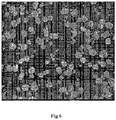
- Table 2 compares the batch time, yield and characteristics of EB based catalyst prepared (as in example 4 and 5* respectively) by using semi-continuous process and using batch type synthesis process. Particle shape is retained well as shown in figure 5 with narrow particle size distribution. Catalyst made using batch process has broad particle size distribution, lower particle size and inferior morphology as indicated in figure 6 .
- Table 3 compares slurry polymerization performance of DIBP based catalyst prepared (as in example 1 and 3* respectively) by using semi-continuous process and batch process respectively.
- Polymer resin from semi continuous process based catalyst has higher particle size and lower fine content as compared to the resin from batch process based catalyst.
- Table 4 compares slurry polymerization performance of EB based catalyst prepared (as in example 4 and 5* respectively) by using semi-continuous process and batch process respectively.
- Polymer resin from semi continuous process based catalyst has higher particle size and lower fine content as compared to the resin from batch process based catalyst.
Landscapes
- Chemical & Material Sciences (AREA)
- Organic Chemistry (AREA)
- Chemical Kinetics & Catalysis (AREA)
- Medicinal Chemistry (AREA)
- Polymers & Plastics (AREA)
- Health & Medical Sciences (AREA)
- Engineering & Computer Science (AREA)
- Materials Engineering (AREA)
- Life Sciences & Earth Sciences (AREA)
- Geology (AREA)
- Inorganic Chemistry (AREA)
- General Life Sciences & Earth Sciences (AREA)
- Environmental & Geological Engineering (AREA)
- Transition And Organic Metals Composition Catalysts For Addition Polymerization (AREA)
- Addition Polymer Or Copolymer, Post-Treatments, Or Chemical Modifications (AREA)
Description
- The present invention relates to a semi-continuous process for the synthesis of a catalyst for use in the manufacture of polyolefins. More particularly, the present invention relates to a semi-continuous and highly energy efficient process for the synthesis of a catalyst with an option of in-situ catalyst segregation with respect to particle size and control of fines. In particular, the present invention relates to semi-continuous process for the synthesis of a Ziegler Natta catalyst having extremely narrow particle size distribution by employing magnesium alkoxide as precursor with spherical morphology. The present invention also relates to a process for the preparation of polyolefins having low fine content using the novel catalyst with in situ controlled particle size of the present invention. The present invention also provides a system for manufacture of polyolefins using the novel catalyst of the invention.
- Solid supported heterogeneous Ziegler Natta catalyst is obtained by contacting a solid support consisting of magnesium halide or a compound which on reaction gives magnesium halide with titanium compound having at least one titanium halogen bond, in presence/absence of electron donating compound.
-
US Patent No. 6,841,633 describes the use of less expensive starting material, hydrated magnesium chloride with in-situ generated internal donor. The use of ester is avoided to minimize the generation of byproducts making the catalyst very efficient.US Patent No. 7,265,074 of the present applicants, teaches a single step process for olefin catalyst synthesis through microwave technique. - Morphology retention is an important criterion for olefin polymerization catalyst in terms of polymerization plant operability and throughput.
WO2009/130707 describes a novel magnesium alkoxide precursor with improved mechanical strength. The claimed precursor retains its shape and size throughout the catalyst and polymerization processes. - The above-mentioned prior art processes suffer from several drawbacks. In all these processes, the process of catalyst synthesis goes through a series of reaction/washing stages. As the number of stages increases, the tendency of particle breakage due to mechanical attrition increases.
US Patent 6,7770,718 B2 -
US Patent 2008/0194781 A1 describes a process where the catalyst is prepared in three stages. In the first stage, MgCl2.EtOH adduct is treated with triethyl aluminium (TEAL) at lower temperature (0°C) in continuous manner, where liquid is continuously charged from top and withdrawn from the bottom through a filter while maintaining constant slurry concentration in the reactor. The second stage is treatment of solids with TiCl4, and finally the catalyst is washed in a continuous manner as stated above. In this patent, an additional step of treatment with TEAL at 0°C is required, making the process very expensive and hazardous. The process also does not specify any method of control over catalyst particle size distribution and fines content. Precursors of different particle size are required to produce catalysts of different particle size. - It is therefore, an important object of the present invention to provide a novel process that is semi-continuous in nature for the synthesis of a catalyst having reduced batch time and reaction volume.
- It is another object of the present invention to provide a Ziegler Natta (Z-N) catalyst having reduced batch time and reaction volume.
- It is another object of the invention to provide a process for the synthesis of a catalyst for use in polyolefin manufacture, in which it is possible to segregate in-situ catalyst particles of different PSD for various applications during the reaction.
- It is another object of the present invention to provide a process for the synthesis of a catalyst for use in polyolefin manufacture in which it is possible to in situ separate the fine particles, thus achieving better control over catalyst particle size.
- It is yet another object of the present invention to provide a process for the synthesis of a catalyst for use in polyolefin manufacture with minimal attrition and in which morphology of the catalyst is retained throughout the process.
- It is another object of the invention to provide a process for the synthesis of a catalyst resulting in narrow particle size distribution and low fine content.
- It is yet another object of the present invention to provide a process for the synthesis of a catalyst which is applicable to all the generations of Z-N catalyst having different internal donors.
- It is yet another object of the present invention to provide a process for the synthesis of a catalyst which is highly energy efficient over the conventional olefin polymerization catalyst preparation processes.
- It is yet another object of the present invention to provide a process for the synthesis of a catalyst which saves 20% to 70% time over the conventional batch processes and which can be operated at any temperature.
- It is yet another object of the present invention to provide a process for the synthesis of a catalyst in which any type of precursor can be used with any type of particle size distribution.
- It is yet another object of the present invention to provide a process for the synthesis of a high activity catalyst in which there is no requirement of additional treatment with TEAL during catalyst synthesis.
- The above and other objects of the present invention are achieved by a process which broadly comprises charging a first reactor with a reaction mixture consisting of a titanium compound having at least one titanium halogen bond and a chloro-solvent, removing excess reactants from said first reactor as a filtrate and feeding said filtrate to at least one further reactor connected to said first reactor in series or in parallel to collect the particles carried over from the first reactor. The filtrate from the further reactor can be subjected to distillation to remove impurities while continuously charging the distillate from the distillation vessel to the first reactor, optionally treating the residue from distillation with an alkali to obtain titanium hydroxide calcining said titanium hydroxide to obtain titanium oxide as a byproduct.
- In a preferred embodiment, the present invention provides a process for the synthesis of a Ziegler Natta procatalyst for use in the manufacture of polyolefin which comprises heating a reaction mixture consisting of a titanium compound having at least one titanium halogen bond and a chloro-solvent to a first reactor, said first reactor being provided with filtration elements with defined pore size at the bottom of the reactor, with separate provisions for taking out filtered liquid and reaction slurry and a mechanical stirrer for agitation, to obtain said Ziegler Natta procatalyst, removing excess reactants from said first reactor as a filtrate and feeding said filtrate to at least one further reactor connected to said first reactor in series or in parallel to separate and collect the particles carried over from the first reactor. The filtrate from the at least one further reactor can be subjected to distillation to remove impurities while continuously charging the distillate from the at least one further reactor to the first reactor and establish a continuous cycle, optionally treating the residue from distillation with an alkali to obtain titanium hydroxide, calcining said titanium hydroxide to obtain titanium oxide as a by product.
- Preferably, the reaction mixture is heated for a period of from 5 to 90 minutes.
- Preferably, said titanium compound having at least one titanium halogen bond and said chloro-solvent are charged continuously in a ratio of 1:0.1 to 1:10 (v/v).
- Preferably, said first reactor has a higher pore size filtration element and the at least one further reactor has a lower pore size filtration element.
- Preferably, the reaction temperature in said first reactor is at a range of from 65°C to 135°C.
- Preferably, particles of different particle sizes are segregated in situ.
- Preferably the fine catalyst particles are separated in first reactor along with filtrate and collected in the at least one further reactor.
- Preferably, said titanium compound having at least one titanium-halogen bond comprises TiCl4.
- Preferably, said solvent is selected from one or more of chlorobenzene, hexane, decane or toluene.
- Preferably, the reactants are charged to reactors at a flow rate in the range of 2 lit/hr.kg to 80 l/hr.kg solid, and a solid concentration of 0.001 kg/l to 1.0 kg/l.
- Preferably, said Ziegler Natta procatalyst is spheroidal having a mean particle size in the range of 15 to 80 microns and comprising internal donor(s) partly generated in situ.
- Preferably, said internal donor(s) are selected from the group consisting of one or more of methyl benzoate, ethyl benzoate, n-propyl benzoate, i-propyl benzoate, n-butyl benzoate, i-butyl benzoate, dimethyl phthalate, diethyl phthalate, dipropyl phthalate, di-isopropyl phthalate, di-butyl phthalate and di-isobutyl phthalate, succinates and diethers.
- Preferably, the first reactor is equipped with a filtration disc of 20 to 50 micron pore diameter and the at least one further reactor is equipped with a filtration disc of 5 to 15 micron pore diameter.
- Preferably, the first reactor is equipped with a filtration disc of about 40 micron pore diameter and the at least one further reactor is equipped with a filtration disc of about 10 micron pore diameter.
- The present invention also provides a process for manufacture of low fine content polyolefins comprising subjecting olefins to polymerization in the presence of a catalyst system comprising spheroidal Ziegler Natta procatalyst prepared by the process described above and triethyl aluminium cocatalyst optionally along with a selectivity control agent.
- The said selectivity control agents are selected from group consisting of esters of monocarboxylic acids and their substituents, alkoxy alkyl benzoates, alkoxy silanes and dialkoxy silanes.
- Preferably, said olefin is propylene, and said polymerization is carried out in slurry, gas, or bulk phase.
-
-
Fig.1 is a schematic representation of the reactor system of the present invention -
Fig 2 is a schematic representation of the reactor system of the invention with two reactors - R1 and R2 with filtration discs of 40µm and 10µm respectively and connected in series for in-situ segregation of catalyst of different PSD with optional distillation unit to continuously recover the used solvent for reuse in the reaction. Distillation residue can also be continuously treated to give TiO2 for various applications -
Fig 3 is an SEM image to illustrate morphology of the DIBP based catalyst obtained by the semi-continuous process of the invention as in example 1 and 2 -
Fig 4 is an SEM image to illustrate morphology of the DIBP based catalyst obtained by the batch process as in example 3. -
Fig 5 is an SEM image to illustrate morphology of the EB based catalyst obtained by the semi-continuous process of the present invention as in example 4. -
Fig 6 is an SEM image to illustrate morphology of the EB based catalyst obtained by the batch process as in example 5. - The invention provides a single step semi-continuous process for synthesis of olefin polymerization catalyst which is generally made using multi-step process. The filtered and distilled solvent can also be reused, in a way establishing a true continuous cycle and residue is treated to give TiO2 for various applications.
- In one embodiment, the invention provides a semi-continuous process for multi-step olefin catalyst synthesis processes, where reactants are charged in a specially designed reaction system having reactors fitted with filtration elements with defined pore size at the bottom of the reactor, with provision for filtered liquid as well as slurry draining and a mechanical stirrer for agitation. The up-stream reactor always has higher pore diameter filtration element. The down-stream reactor has lower pore diameter filtration element. The reactants are heated to reaction temperature in 5 min to 90 min. On reaching the reaction temperature, a mixture of titanium compound having at least one titanium halogen bond and chloro-solvent is charged continuously in the ratio of 1:0.1 to 1:10 (v/v) from up-stream reactor to flow through all the reactors connected in series. The amount of mix solvent being charged is also simultaneously being taken out from the bottom of the first reactor as filtrate. The filtrate obtained is fed to further reactor connected in series to separate the carry-over of the particles from the first reactor. The filtrate from the further reactor can be distilled to remove the impurities. The resultant distillate is charged continuously to the first reactor. The distillation residue is continuously treated with alkali to give titanium hydroxide, which is then calcined at high temperature to give TiO2 for various applications.
- Preferably, the reactor temperature during the reaction is 65°C to 135°C.
- Preferably, the catalyst of desired particle size is segregated in situ for use in different polymerization processes and conditions.
- In another embodiment, the invention provides a semi-continuous process for multi-step olefin catalyst synthesis processes, in which flow rate of mix solvent can be in the range of 2 l/hr.kg to 80 lit/hr.kg solid, and a solid concentration of 0.001 l/hr.kg to 1.0 kg/l in both the reactors.
- In another embodiment, the invention provides a semi-continuous process for multi-step olefin catalyst synthesis processes, in which washings of the resultant solids obtained after reaction is also done in continuous manner. Wash solvent is charged from the top of the first reactor in continuous manner and filtrate is simultaneously removed from the bottom of the second reactor. The rate of feeding/removal of the wash solvent can be in the range of 10 l/hr.kg of catalyst to 150 l/hr.kg of catalyst and the solid concentration of reactor can be kept between 0.001 kg/l to 1.0 kg/l in both the reactors.
- In another embodiment, the invention provides a semi-continuous process for multi-step olefin catalyst synthesis processes, where reactor consists of removable filtration elements with variable pore diameter as per requirement. The reactors are also fitted with mechanical stirrer for proper mixing. The reactors with varied pore diameter filtration elements can be connected in series to in situ segregate the catalyst particles with different shape and size. Constant volume is maintained in all the reactors connected in series. Solvent is fed from the first reactor to pass through all the reactors in series. As the process combines lower reaction time and particle size based segregation, it is highly energy efficient. Moreover the process can also be used for batch type catalyst synthesis.
- Preferably, the mix-solvent consists of TiCl4 and chlorobenzene.
- Spheroidal Ziegler Natta procatalyst having mean particle size in the range of 15 to 80 microns and comprising internal donor(s) partly generated in situ can be prepared according to the present process.
- Internal donor(s) (if any) selected from the group consisting of methyl benzoate, ethyl benzoate, n-propyl benzoate, i-propyl benzoate, n-butyl benzoate, i-butyl benzoate, dimethyl phthalate, diethyl phthalate, dipropyl phthalate, di-isopropyl phthalate, di-butyl phthalate and di-isobutyl phthalate, succinates, and diethers can be comprised in the procatalyst.
- In a further embodiment, the invention provides a method for polymerization of olefin to produce narrow PSD and low fine containing polymer, the method comprising contacting the olefin with a catalyst system comprising spheroidal Ziegler Natta procatalyst prepared as above, triethyl aluminium cocatalyst optionally along with a selectivity control agent.
- The invention provides an economical method for synthesis of spheroidal catalyst particles by recovering and reusing the solvents used for the synthesis and washings. As four processes, namely reaction, filtration, solvent recovery and residue treatment is combined in one single process; minimum solvent usage and minimum volume of reactor system can be ensured. The solvents are recovered through distillation of the filtrate obtained from the bottom of the down-stream reactor. The distilled solvent obtained is at slightly higher temperature and is charged as it is in the reactor eliminating the preheating step as mentioned in relevant prior art
US Patent 6770718 . In this manner a true continuous cycle is established for efficient energy and material usage. - The Ziegler Natta procatalyst and the polyolefin resin in the following examples have been characterized by various methods. Mean particle size and span is obtained by particle size analyzer using laser and optical diffraction method on CILAS 1180 particle size analyzer. Span is calculated by ratio of (D90-D10)/D50 where if Dn = X microns then it signifies that n% of the total particle population is below X microns. Bulk density is measured by measuring the tapped volume and weight of certain quantity of powder and by dividing weight of the powder by the tapped volume. Morphology was explored with FEI Inspect Scanning Electron Microscope. Donor content is determined using high pressure liquid chromatography of the catalyst solution in methanol. Polymer bulk density is calculated by measuring tapped volume and weight of fixed polymer resin quantity and then dividing weight by volume. average particle size and fines (<120 microns) content of the polymer is analyzed using sieve shaker.
- The reactor system that is used to synthesize the catalyst of the invention is depicted in its basic embodiment in
Figure 1 . The system essentially comprises of a feed section provided with an inlet, and an outlet, that is connected to a first reactor R1. This in turn is connected in series to at least one further reactor R2 downstream. Reactor R2 in turn is connected to a distillation unit (4). Each of the reactors R1 and (R2)n is provided at the bottom portion thereof with a filtration element. The distillation section is connected to the feed section through an outlet such that the distillate can be recharged back to the reactors along with fresh reactant while maintaining a desired concentration in the reactant feed. The first reactor as mentioned above is provided with a filtration element at the bottom thereof in order to remove excess reactants as a filtrate through filtration. Similarly, this filtrate obtained from the first reactor is fed to at least one further reactor in order to retain the carried over fine particles. The excess reactants from the subsequent reactor are also removed therefrom as a filtrate through a filtration element provided at the bottom thereof. The filtrate is then, if desired, fed to a next subsequent reactor. - The arrangement of the secondary reactors can be either in series or in parallel. Thus, each subsequent reactor may be connected to the preceding further reactor and to a subsequent further reactor such that the filtrate from each preceding further reactor is fed therein and the filtrate therefrom is fed to the next further reactor downstream. This is depicted in
Figure 2 . However, if desired, each further reactor may be independently connected to the first reactor R1 on one end and to the distillation column at another end. The advantage of either in series connection or in parallel connection for the further reactors is that if the reactors are in parallel, the reaction and filtration can be carried out simultaneously in all reactors. If the reactors are in series, through bypass means that are provided, the filtrate can be fed from the first reactor to any of the further reactors, thereby ensuring that the reaction can start in any reactor. The series connection ensures segregation of catalyst in situ dependent on the different PSD's. A parallel connection ensures that the reaction can be accelerated to a faster rate if desired. The flexibility that is provided through the choice of series or parallel connections of the further reactors provides a wider application and utility. - The filtration elements of the further reactors are of smaller mesh size as compared to the first reactor. The distillation unit is connected to a calcination unit wherein the distillation residue can be calcined to obtain TiO2 for various applications.
- The invention is further illustrated by way of the following illustrative and nonlimiting examples. Variations and modifications are possible of the details given in the examples without departing from the scope and spirit of the invention.
- Two reactors R1 and R2 of 1.5 liter capacity each with different pore size filtration disc fitted at the bottom of the reactor are connected in series. The first reactor is having 40 micron pore diameter filtration disc, while the second is having 10 micron pore diameter filtration disc. Both the reactors are charged with equal volume mixture of 115 ml TiCl4 and chlorobenzene. Under stirring at 300 rpm, 10gm of spherical magnesium Alkoxide is charged in first reactor. The reactor temperature is kept at 30°C. 4.5 ml Donor Diisobutyl Phthalate (DIBP) is charged immediately after precursor charging in first reactor and temperature of both the reactors is raised to 110°C in 25 min. On reaching the titanation temperature, equal volume mixture of 230ml TiCl4 and chlorobenzene is charged in the first reactor at the rate of 20 - 25 l/hr.kg solid, simultaneously withdrawing filtrate along with particles less then 40 micron size from reactor bottom at the same rate. The filtrate of the first reactor is charged in the second reactor, where all the particles are retained resulting in in situ segregation of the catalyst particles. The filtrate from the second reactor bottom is continuously distilled in a separate distillation column to use distillate for feeding to first reactor. 0.8ml Benzoyl chloride is charged in both the reactors 15 min before terminating the reaction. On completion of addition, TiCl4 and chlorobenzene is filtered off. Wash solvent is charged at the rate of 70-80 l/hr.kg solid and removed at the same rate maintaining close to 0.05 kg/l concentration in the reactor.
- The final solid obtained is dried under nitrogen at 50°C.
- The process of example 1 is repeated with 15g of magnesium alkoxide instead of 10g to see the effect of variation of magnesium to titanium ratio and magnesium to ester ratio on composition and morphology of the catalyst. This synthesis is done also to show use of the reaction set up of example 1 for producing more catalyst quantity.
- The magnesium alkoxide (10 gm) is treated with an equal volume mixture of 230 ml TiCl4 and chlorobenzene in three step treatment at 110 °C. Internal donor DIBP is added in first step. Benzoyl Chloride is added in the last step. After three-stage treatment, solid procatalyst separated from liquid reactants and given four washes with 200 ml Hexane each and then it is dried at 50 °C under stream of nitrogen.
- The process of example 1 is repeated only DIBP is replaced with Ethyl benzoate (EB) and reaction temperature is kept 100 °C in place of 110.
- The process of example 3 is repeated only DIBP is replaced with Ethyl benzoate (EB) and reaction temperature is kept 100 °C in place of 110
- Solid procatalysts (0.08 g) of example 1 and example 3 was mixed with triethyl alumunium cocatalyst (1.2 g) and selectivity control agent (0.05 g). The catalysts were mixed in such proportions that the alumunium : titanium ratio is maintained at 250:1. The mole ratio of selectivity control agent to titanium was kept at 8:1. The catalyst was employed to polymerize propylene in slurry phase with hexane as the diluent under a constant propylene pressure of 5 kg for 2hr at 70°C., followed by addition of 50 mmol of hydrogen to terminate the polymerization.
- Solid procatalysts (0.08 g) of example 4 and example 5 was mixed with triethyl aluminium cocatalyst (1.2 g) and selectivity control agent (0.05 g). The catalysts were mixed in such proportions that the aluminium: titanium ratio was maintained as 250:1. The mole ratio of selectivity control agent to titanium was kept at 50:1. The catalyst was employed to polymerize propylene in slurry phase with hexane as the diluent under a constant propylene pressure of 5 kg for 2 hr at 70°C, followed by addition of 50 mmol of hydrogen to terminate the polymerization.
Table 1: Comparative analysis of DIBP based catalyst synthesized in example 1, example 2 and example 3* Procatal yst of Yield (gm) Batch time (hrs) Ti (wt%) Mg (wt%) Ethoxy (wt%) Donor (wt%) Particle Size Distribution D10 Mean Span Example 1 9.4 3 3.2 16.9 0.50 12.7 22 40 0.88 Example 2 13.9 3 2.7 18.8 0.45 11.1 19 36 0.92 Example 3* 10.1 10 2.8 17.3 0.53 12.2 3 29 1.52 Table 2: Comparative analysis of EB based catalyst synthesized in example 4 and example 5* Procatal yst of Yield (gm) Batch Time (Hrs) Ti (wt%) Mg (wt%) Ethoxy (wt%) Donor (wt%) Particle Size Distribution D10 Mean Span Example 4 9.6 2.5 3.0 17.6 0.48 15.7 26 42 0.78 Example 5* 10.4 10.0 2.5 18.3 0.54 14.9 3 27 1.37 Table 3: Comparative analysis of polymer resins synthesized by using the procatalyst of example 1 and example 3* Example Activity (kg PP/g cat) XS (wt%) Avg. Particle Size (Inch) Fines (wt%) Example 6 9.8 2.1 0.022 2.2 Example 7* 9.5 2.3 0.016 9.7 Table 4: Comparative analysis of polymer resins synthesized by using the procatalyst of example 4 and example 5* Example Activity (kg PP/g cat) XS (wt%) Avg. Particle Size(Inch) Fines (wt%) Example 8 4.5 2.6 0.018 3.4 Example 9* 4.4 2.8 0.015 10.2 - Table 1 compares the batch time, yield and characteristics of DIBP based catalyst prepared (as in example 1, 2 and 3 respectively) by using semi-continuous process with varied solvent ratio and catalyst prepared using batch type synthesis process. Consistent composition is obtained even on varying the solvent ratio and batch size in semi continuous process. Particle shape is retained as shown in
figure 3 with narrow particle size distribution. The shape of the catalyst particle as infigure 3 can be better retained by carrying out reaction and filtration simultaneously. Catalyst made using batch process has comparatively broad particle size distribution, lower particle size and inferior morphology as indicated infigure 4 . - Table 2 compares the batch time, yield and characteristics of EB based catalyst prepared (as in example 4 and 5* respectively) by using semi-continuous process and using batch type synthesis process. Particle shape is retained well as shown in
figure 5 with narrow particle size distribution. Catalyst made using batch process has broad particle size distribution, lower particle size and inferior morphology as indicated infigure 6 . - Table 3 compares slurry polymerization performance of DIBP based catalyst prepared (as in example 1 and 3* respectively) by using semi-continuous process and batch process respectively. Polymer resin from semi continuous process based catalyst has higher particle size and lower fine content as compared to the resin from batch process based catalyst.
- Table 4 compares slurry polymerization performance of EB based catalyst prepared (as in example 4 and 5* respectively) by using semi-continuous process and batch process respectively. Polymer resin from semi continuous process based catalyst has higher particle size and lower fine content as compared to the resin from batch process based catalyst.
-
- 1. Reaction and filtration can be carried out in all the reactors simultaneously.
- 2. Feed can go in parallel to all reactors or in series or both. R1, R2, R3, Rn are reactors connected in series or parallel. Parallel feed can accelerate reaction to a faster rate.
- 3. Reaction can be started in any of the reactors.
- 4. Reaction can also take place in batch mode in any reactor if required.
- 5. Provision for by passing any of the reactors.
- 6. Provision for directly feeding recovered solvent to any of the reactor, bypassing feed vessel.
- 7. Highly energy efficient process.
Claims (14)
- A semi-continuous process for the synthesis of a narrow particle size distribution Ziegler Natta procatalyst for use in the manufacture of polyolefins comprising of following steps:(a) mixing a reaction mixture essentially consisting of titanium compound having at least one titanium halogen bond and a chlorinated solvent in feed section;(b) charging a first reactor with said reaction mixture;(c) continuously removing excess reactants from said first reactor as a filtrate through a filtrate section placed at the bottom of said first reactor;(d) feeding said filtrate to at least one further reactor connected to said first reactor to retain the carried over fine particles from said first reactor; continuously removing excess reactants from said at least further reactor as a filtrate through a filtrate section placed at the bottom of said at least one further reactor and, if desired, feeding said filtrate to next said at least one further reactor;(e) repeating step (d) for n number of times in series, wherein reactors are arranged in series or parallel;(f) subjecting the said filtrate from the last of said at least one further reactor to a distillation section to remove impurities and recover the distillate; and continuously charging the distillate from the distillation section to the feed section; wherein a desired equilibrium between fresh and recovered distillate and a desired resultant concentration of reactant feed are maintained; and(g) optionally treating the residue from distillation section with an alkali to obtain titanium hydroxide and calcining said titanium hydroxide to obtain titanium oxide as a by product.
- A process as claimed in claim 1 wherein said reaction mixture is heated to reaction temperature at 65°C to 135°C for a time period of from 5 to 90 minutes prior to charging in said first reactor.
- A process as claimed in claim 1 wherein all reactors are provided with respective filtration elements with defined pore size at the bottom thereof, with separate provisions for filtered liquid as well as slurry draining and a mechanical stirrer for agitation.
- A process as claimed in any of preceding claim wherein said first reactor is equipped with a highest pore size filtration disk of 20 to 50 micron pore diameter, preferably 40 micron pore diameter and said last said at least one further reactor is equipped with a lowest pore size filtration disk of 5 to 15 micron pore diameter, preferably 10 micron pore diameter.
- A process as claimed in claim 1, wherein n is preferably between the range of 1 to 5, preferably 1.
- A process as claimed in claim 1, wherein said feed section is optionally connected to any of the further reactors in parallel to allow charging of the fresh solvent or the recovered distillate or any combination thereof directly from said feed to any of the said further reactor.
- A process as claimed in any of preceding claim wherein said titanium compound having the at least one titanium halogen bond and said chlorinated solvent are charged continuously in a ratio of 1:0.1 to 1:10 (v/v) wherein the titanium compound having at least one titanium halogen bond is TiCl4.
- A process as claimed in any of preceding claim wherein the reactants are charged to said reactors at a flow rate in the range of 2 lit/hr.kg to 80 lit/hr.kg solid, and a solid concentration of 0.001 kg/lit to 1.0 kg/lit.
- A process as claimed in claim 1, wherein the first reactor is charged with the reaction mixture from a feed storage which provides an intermediate storage of the recovered and fresh solvent and the mixture from the feed storage can go to all the reactors in parallel or in series or both bypassing any of the further reactors.
- A system for the semi-continuous synthesis of a narrow particle size distribution Ziegler Natta procatalyst for use in the manufacture of polyolefins, said system consisting essentially of:(a) a feed section provided with an inlet for input of reactants and fresh solvent and optionally a second inlet for input of recovered distillate;(b) a first reactor connected downstream of said feed section to receive a reaction mixture formed in said feed section, said first reactor being provided with a filtration element at the bottom thereof to remove excess reactants therefrom as a filtrate;(c) at least one further reactor provided downstream of said first reactor in series or parallel and connected thereto to receive the filtrate from said first reactor and to retain carried over fine particles from said first reactor, said second reactor being provided with a filtration element at the bottom thereof to remove excess reactants therefrom as a filtrate for feeding into a distillation unit or, if desired to a subsequent further reactor;(d) a distillation unit provided downstream of said at least one further reactor to remove impurities and recover a distillate for charging the feed section, to maintain a desired equilibrium between fresh and recovered solvent and a desired resultant concentration of reactant feed;(e) optionally a calciniation section to calcine residue from the distillation section and obtain titanium hydroxide as a byproduct.
- A system as claimed in claim 10 wherein one or more bypass lines are provided from said first reactor to each respective further reactors in order to bypass the preceding further reactor(s) as desired.
- A system as claimed in claim 10 or 11 wherein each of said further reactors are independently connected to said distillation unit in order to bypass any of the subsequent further reactors as desired during discharge of filtrate to said distillation unit; wherein up to five further reactors are present.
- A process for the manufacture of low fine content polyolefins which comprises:(a) preparing a spheroidal Ziegler Natta procatalyst by a process according to any one of claims 1 to 8;(b) preparing a catalyst system comprising the thus obtained Zeigler Natta procatalyst and a triethyl aluminium cocatalyst; and(c) polymerizing olefins in the presence of the thus obtained catalyst system.
- A process as claimed in claim 13 wherein said olefin is propylene, said polymerization is carried out in slurry, gas or bulk phase; preferably in slurry phase in presence of hexane, heptane, decane or other aliphatic and aromatic solvents as diluents, for the manufacture of low fine content and narrow particle size distribution polyolefins.
Applications Claiming Priority (2)
| Application Number | Priority Date | Filing Date | Title |
|---|---|---|---|
| IN1691MU2009 | 2009-12-22 | ||
| PCT/IN2010/000809 WO2011077447A2 (en) | 2009-12-22 | 2010-12-14 | A semi-continuous process for the synthesis of a catalyst for use in the manufacture of polyolefins |
Publications (3)
| Publication Number | Publication Date |
|---|---|
| EP2516480A2 EP2516480A2 (en) | 2012-10-31 |
| EP2516480A4 EP2516480A4 (en) | 2014-02-26 |
| EP2516480B1 true EP2516480B1 (en) | 2017-03-01 |
Family
ID=44196217
Family Applications (1)
| Application Number | Title | Priority Date | Filing Date |
|---|---|---|---|
| EP10838831.5A Active EP2516480B1 (en) | 2009-12-22 | 2010-12-14 | A semi-continuous process for the synthesis of a catalyst for use in the manufacture of polyolefins |
Country Status (5)
| Country | Link |
|---|---|
| US (1) | US9040444B2 (en) |
| EP (1) | EP2516480B1 (en) |
| KR (1) | KR101589723B1 (en) |
| MY (1) | MY165434A (en) |
| WO (1) | WO2011077447A2 (en) |
Families Citing this family (6)
| Publication number | Priority date | Publication date | Assignee | Title |
|---|---|---|---|---|
| SG11201402718TA (en) | 2012-02-29 | 2014-09-26 | Scg Chemicals Co Ltd | High emissivity coating compositions and manufacturing processes therefore |
| US11014995B2 (en) | 2016-10-06 | 2021-05-25 | W.R. Grace & Co.—Conn. | Procatalyst composition made with a combination of internal electron donors |
| WO2020025757A1 (en) * | 2018-08-02 | 2020-02-06 | Borealis Ag | Process for polymerizing ethylene in a multi-stage polymerization process |
| KR20230029899A (en) * | 2020-06-26 | 2023-03-03 | 릴라이언스 인더스트리즈 리미티드 | ZIEGLER-NATTA catalyst system and polymerization process using the same |
| CN114426306B (en) * | 2020-10-12 | 2024-02-13 | 中国石油化工股份有限公司 | Titanium polyolefin catalyst mother liquor treatment device and method |
| US20250109218A1 (en) | 2023-09-29 | 2025-04-03 | Formosa Plastics Corporation, U.S.A. | Method for preparing catalyst component for polymerization of polyolefin without the use of internal electron donors |
Family Cites Families (8)
| Publication number | Priority date | Publication date | Assignee | Title |
|---|---|---|---|---|
| US6770718B2 (en) * | 2000-12-15 | 2004-08-03 | Basell Poliolefine Italia S.P.A. | Continuous process for the preparation of solid catalyst components for the polymerization of α-olefins |
| US6825146B2 (en) | 2001-05-29 | 2004-11-30 | Union Carbide Chemicals & Plastics Technology Corporation | Olefin polymerization catalyst compositions and method of preparation |
| WO2003066569A1 (en) * | 2002-02-05 | 2003-08-14 | Lg Chem, Ltd. | Continuous method for preparing aromatic carbonate using a heterogeneous catalyst and a reaction apparatus for the same |
| BRPI0413962B1 (en) | 2003-09-23 | 2021-02-02 | Dow Global Technologies Inc | process for the polymerization of gas ethylene |
| EP1862479A1 (en) * | 2006-05-31 | 2007-12-05 | Borealis Technology Oy | Olefin polymerisation catalyst |
| US8344079B2 (en) * | 2007-12-31 | 2013-01-01 | Basf Corporation | Molar ratio modifications to larger polyolefin catalysts |
| EP2257576B1 (en) | 2008-03-18 | 2013-02-20 | Reliance Industries Limited | A process for the synthesis of alpha-olefin polymerization procatalysts |
| US8633124B2 (en) * | 2008-04-25 | 2014-01-21 | Reliance Industries Limited | Spheroidal particles for olefin polymerization catalyst |
-
2010
- 2010-12-14 US US13/514,726 patent/US9040444B2/en active Active
- 2010-12-14 KR KR1020127019056A patent/KR101589723B1/en active Active
- 2010-12-14 MY MYPI2012700364A patent/MY165434A/en unknown
- 2010-12-14 EP EP10838831.5A patent/EP2516480B1/en active Active
- 2010-12-14 WO PCT/IN2010/000809 patent/WO2011077447A2/en not_active Ceased
Non-Patent Citations (1)
| Title |
|---|
| None * |
Also Published As
| Publication number | Publication date |
|---|---|
| WO2011077447A3 (en) | 2011-08-11 |
| KR101589723B1 (en) | 2016-01-28 |
| US9040444B2 (en) | 2015-05-26 |
| EP2516480A4 (en) | 2014-02-26 |
| EP2516480A2 (en) | 2012-10-31 |
| KR20120123053A (en) | 2012-11-07 |
| WO2011077447A2 (en) | 2011-06-30 |
| US20130053521A1 (en) | 2013-02-28 |
| MY165434A (en) | 2018-03-22 |
Similar Documents
| Publication | Publication Date | Title |
|---|---|---|
| EP2121773B1 (en) | Catalyst components for the polymerization of olefins and catalysts therefrom obtained | |
| EP1572760B1 (en) | Method for the preparation of olefin polymerisation catalyst support and an olefin polymerisation catalyst | |
| US9040444B2 (en) | Semi continuous process for the synthesis of a catalyst for use in the manufacture of polyolefins | |
| KR101582497B1 (en) | Spheroidal particles for olefin polymerization catalyst | |
| EP3438083B1 (en) | Alkoxy magnesium, method for producing alkoxy magnesium, solid catalyst component for olefin polymerization use, catalyst for olefin polymerization use, and method for producing olefin polymer | |
| KR102046267B1 (en) | Process for producing catalyst component for olefin polymerization | |
| EP2593488B1 (en) | Attrition resistant catalyst system for manufacture of polyolefins | |
| EP1353962B1 (en) | Continuous process for the preparation of solid catalyst components for the polymerisation of alpha-olefins | |
| KR20110025973A (en) | Catalyst System for Polymerization of Olefin | |
| EP2285838B1 (en) | Catalyst for the polymerization of olefins | |
| US4551439A (en) | Solid catalyst component for olefin polymerization and process for producing same | |
| US20140073750A1 (en) | Controlled morphology high activity polyolefin catalyst system | |
| CN101939342A (en) | Catalyst for olefin polymerization | |
| EP2029277B1 (en) | Catalyst component for the polymerization of olefins | |
| EP1756171B1 (en) | Process for preparing catalyst components for the olefin polymerization | |
| JP2811325B2 (en) | Catalyst component for olefin polymerization | |
| JP2811333B2 (en) | Olefin polymerization catalyst | |
| KR20070028415A (en) | Process for preparing catalyst component for olefin polymerization |
Legal Events
| Date | Code | Title | Description |
|---|---|---|---|
| PUAI | Public reference made under article 153(3) epc to a published international application that has entered the european phase |
Free format text: ORIGINAL CODE: 0009012 |
|
| 17P | Request for examination filed |
Effective date: 20120627 |
|
| AK | Designated contracting states |
Kind code of ref document: A2 Designated state(s): AL AT BE BG CH CY CZ DE DK EE ES FI FR GB GR HR HU IE IS IT LI LT LU LV MC MK MT NL NO PL PT RO RS SE SI SK SM TR |
|
| DAX | Request for extension of the european patent (deleted) | ||
| A4 | Supplementary search report drawn up and despatched |
Effective date: 20140127 |
|
| RIC1 | Information provided on ipc code assigned before grant |
Ipc: C08F 4/649 20060101ALI20140121BHEP Ipc: B01J 27/08 20060101ALI20140121BHEP Ipc: C08F 4/652 20060101AFI20140121BHEP Ipc: C08F 10/00 20060101ALI20140121BHEP |
|
| GRAP | Despatch of communication of intention to grant a patent |
Free format text: ORIGINAL CODE: EPIDOSNIGR1 |
|
| INTG | Intention to grant announced |
Effective date: 20160927 |
|
| STAA | Information on the status of an ep patent application or granted ep patent |
Free format text: STATUS: GRANT OF PATENT IS INTENDED |
|
| GRAS | Grant fee paid |
Free format text: ORIGINAL CODE: EPIDOSNIGR3 |
|
| GRAA | (expected) grant |
Free format text: ORIGINAL CODE: 0009210 |
|
| STAA | Information on the status of an ep patent application or granted ep patent |
Free format text: STATUS: THE PATENT HAS BEEN GRANTED |
|
| AK | Designated contracting states |
Kind code of ref document: B1 Designated state(s): AL AT BE BG CH CY CZ DE DK EE ES FI FR GB GR HR HU IE IS IT LI LT LU LV MC MK MT NL NO PL PT RO RS SE SI SK SM TR |
|
| REG | Reference to a national code |
Ref country code: GB Ref legal event code: FG4D |
|
| REG | Reference to a national code |
Ref country code: AT Ref legal event code: REF Ref document number: 871237 Country of ref document: AT Kind code of ref document: T Effective date: 20170315 Ref country code: CH Ref legal event code: EP |
|
| REG | Reference to a national code |
Ref country code: IE Ref legal event code: FG4D |
|
| REG | Reference to a national code |
Ref country code: DE Ref legal event code: R096 Ref document number: 602010040477 Country of ref document: DE |
|
| REG | Reference to a national code |
Ref country code: NL Ref legal event code: MP Effective date: 20170301 |
|
| REG | Reference to a national code |
Ref country code: LT Ref legal event code: MG4D |
|
| REG | Reference to a national code |
Ref country code: AT Ref legal event code: MK05 Ref document number: 871237 Country of ref document: AT Kind code of ref document: T Effective date: 20170301 |
|
| PG25 | Lapsed in a contracting state [announced via postgrant information from national office to epo] |
Ref country code: GR Free format text: LAPSE BECAUSE OF FAILURE TO SUBMIT A TRANSLATION OF THE DESCRIPTION OR TO PAY THE FEE WITHIN THE PRESCRIBED TIME-LIMIT Effective date: 20170602 Ref country code: LT Free format text: LAPSE BECAUSE OF FAILURE TO SUBMIT A TRANSLATION OF THE DESCRIPTION OR TO PAY THE FEE WITHIN THE PRESCRIBED TIME-LIMIT Effective date: 20170301 Ref country code: HR Free format text: LAPSE BECAUSE OF FAILURE TO SUBMIT A TRANSLATION OF THE DESCRIPTION OR TO PAY THE FEE WITHIN THE PRESCRIBED TIME-LIMIT Effective date: 20170301 Ref country code: FI Free format text: LAPSE BECAUSE OF FAILURE TO SUBMIT A TRANSLATION OF THE DESCRIPTION OR TO PAY THE FEE WITHIN THE PRESCRIBED TIME-LIMIT Effective date: 20170301 Ref country code: NO Free format text: LAPSE BECAUSE OF FAILURE TO SUBMIT A TRANSLATION OF THE DESCRIPTION OR TO PAY THE FEE WITHIN THE PRESCRIBED TIME-LIMIT Effective date: 20170601 |
|
| PG25 | Lapsed in a contracting state [announced via postgrant information from national office to epo] |
Ref country code: ES Free format text: LAPSE BECAUSE OF FAILURE TO SUBMIT A TRANSLATION OF THE DESCRIPTION OR TO PAY THE FEE WITHIN THE PRESCRIBED TIME-LIMIT Effective date: 20170301 Ref country code: AT Free format text: LAPSE BECAUSE OF FAILURE TO SUBMIT A TRANSLATION OF THE DESCRIPTION OR TO PAY THE FEE WITHIN THE PRESCRIBED TIME-LIMIT Effective date: 20170301 Ref country code: SE Free format text: LAPSE BECAUSE OF FAILURE TO SUBMIT A TRANSLATION OF THE DESCRIPTION OR TO PAY THE FEE WITHIN THE PRESCRIBED TIME-LIMIT Effective date: 20170301 Ref country code: RS Free format text: LAPSE BECAUSE OF FAILURE TO SUBMIT A TRANSLATION OF THE DESCRIPTION OR TO PAY THE FEE WITHIN THE PRESCRIBED TIME-LIMIT Effective date: 20170301 Ref country code: BG Free format text: LAPSE BECAUSE OF FAILURE TO SUBMIT A TRANSLATION OF THE DESCRIPTION OR TO PAY THE FEE WITHIN THE PRESCRIBED TIME-LIMIT Effective date: 20170601 Ref country code: LV Free format text: LAPSE BECAUSE OF FAILURE TO SUBMIT A TRANSLATION OF THE DESCRIPTION OR TO PAY THE FEE WITHIN THE PRESCRIBED TIME-LIMIT Effective date: 20170301 |
|
| PG25 | Lapsed in a contracting state [announced via postgrant information from national office to epo] |
Ref country code: NL Free format text: LAPSE BECAUSE OF FAILURE TO SUBMIT A TRANSLATION OF THE DESCRIPTION OR TO PAY THE FEE WITHIN THE PRESCRIBED TIME-LIMIT Effective date: 20170301 |
|
| PG25 | Lapsed in a contracting state [announced via postgrant information from national office to epo] |
Ref country code: SK Free format text: LAPSE BECAUSE OF FAILURE TO SUBMIT A TRANSLATION OF THE DESCRIPTION OR TO PAY THE FEE WITHIN THE PRESCRIBED TIME-LIMIT Effective date: 20170301 Ref country code: EE Free format text: LAPSE BECAUSE OF FAILURE TO SUBMIT A TRANSLATION OF THE DESCRIPTION OR TO PAY THE FEE WITHIN THE PRESCRIBED TIME-LIMIT Effective date: 20170301 Ref country code: CZ Free format text: LAPSE BECAUSE OF FAILURE TO SUBMIT A TRANSLATION OF THE DESCRIPTION OR TO PAY THE FEE WITHIN THE PRESCRIBED TIME-LIMIT Effective date: 20170301 Ref country code: RO Free format text: LAPSE BECAUSE OF FAILURE TO SUBMIT A TRANSLATION OF THE DESCRIPTION OR TO PAY THE FEE WITHIN THE PRESCRIBED TIME-LIMIT Effective date: 20170301 Ref country code: IT Free format text: LAPSE BECAUSE OF FAILURE TO SUBMIT A TRANSLATION OF THE DESCRIPTION OR TO PAY THE FEE WITHIN THE PRESCRIBED TIME-LIMIT Effective date: 20170301 |
|
| PG25 | Lapsed in a contracting state [announced via postgrant information from national office to epo] |
Ref country code: IS Free format text: LAPSE BECAUSE OF FAILURE TO SUBMIT A TRANSLATION OF THE DESCRIPTION OR TO PAY THE FEE WITHIN THE PRESCRIBED TIME-LIMIT Effective date: 20170701 Ref country code: SM Free format text: LAPSE BECAUSE OF FAILURE TO SUBMIT A TRANSLATION OF THE DESCRIPTION OR TO PAY THE FEE WITHIN THE PRESCRIBED TIME-LIMIT Effective date: 20170301 Ref country code: PL Free format text: LAPSE BECAUSE OF FAILURE TO SUBMIT A TRANSLATION OF THE DESCRIPTION OR TO PAY THE FEE WITHIN THE PRESCRIBED TIME-LIMIT Effective date: 20170301 Ref country code: PT Free format text: LAPSE BECAUSE OF FAILURE TO SUBMIT A TRANSLATION OF THE DESCRIPTION OR TO PAY THE FEE WITHIN THE PRESCRIBED TIME-LIMIT Effective date: 20170703 |
|
| REG | Reference to a national code |
Ref country code: DE Ref legal event code: R097 Ref document number: 602010040477 Country of ref document: DE |
|
| PLBE | No opposition filed within time limit |
Free format text: ORIGINAL CODE: 0009261 |
|
| STAA | Information on the status of an ep patent application or granted ep patent |
Free format text: STATUS: NO OPPOSITION FILED WITHIN TIME LIMIT |
|
| PG25 | Lapsed in a contracting state [announced via postgrant information from national office to epo] |
Ref country code: DK Free format text: LAPSE BECAUSE OF FAILURE TO SUBMIT A TRANSLATION OF THE DESCRIPTION OR TO PAY THE FEE WITHIN THE PRESCRIBED TIME-LIMIT Effective date: 20170301 |
|
| 26N | No opposition filed |
Effective date: 20171204 |
|
| PG25 | Lapsed in a contracting state [announced via postgrant information from national office to epo] |
Ref country code: SI Free format text: LAPSE BECAUSE OF FAILURE TO SUBMIT A TRANSLATION OF THE DESCRIPTION OR TO PAY THE FEE WITHIN THE PRESCRIBED TIME-LIMIT Effective date: 20170301 |
|
| REG | Reference to a national code |
Ref country code: CH Ref legal event code: PL |
|
| REG | Reference to a national code |
Ref country code: IE Ref legal event code: MM4A |
|
| PG25 | Lapsed in a contracting state [announced via postgrant information from national office to epo] |
Ref country code: LU Free format text: LAPSE BECAUSE OF NON-PAYMENT OF DUE FEES Effective date: 20171214 Ref country code: MT Free format text: LAPSE BECAUSE OF NON-PAYMENT OF DUE FEES Effective date: 20171214 |
|
| REG | Reference to a national code |
Ref country code: FR Ref legal event code: ST Effective date: 20180831 |
|
| REG | Reference to a national code |
Ref country code: BE Ref legal event code: MM Effective date: 20171231 |
|
| PG25 | Lapsed in a contracting state [announced via postgrant information from national office to epo] |
Ref country code: FR Free format text: LAPSE BECAUSE OF NON-PAYMENT OF DUE FEES Effective date: 20180102 Ref country code: IE Free format text: LAPSE BECAUSE OF NON-PAYMENT OF DUE FEES Effective date: 20171214 |
|
| PG25 | Lapsed in a contracting state [announced via postgrant information from national office to epo] |
Ref country code: LI Free format text: LAPSE BECAUSE OF NON-PAYMENT OF DUE FEES Effective date: 20171231 Ref country code: CH Free format text: LAPSE BECAUSE OF NON-PAYMENT OF DUE FEES Effective date: 20171231 Ref country code: BE Free format text: LAPSE BECAUSE OF NON-PAYMENT OF DUE FEES Effective date: 20171231 |
|
| PG25 | Lapsed in a contracting state [announced via postgrant information from national office to epo] |
Ref country code: HU Free format text: LAPSE BECAUSE OF FAILURE TO SUBMIT A TRANSLATION OF THE DESCRIPTION OR TO PAY THE FEE WITHIN THE PRESCRIBED TIME-LIMIT; INVALID AB INITIO Effective date: 20101214 Ref country code: MC Free format text: LAPSE BECAUSE OF FAILURE TO SUBMIT A TRANSLATION OF THE DESCRIPTION OR TO PAY THE FEE WITHIN THE PRESCRIBED TIME-LIMIT Effective date: 20170301 |
|
| PG25 | Lapsed in a contracting state [announced via postgrant information from national office to epo] |
Ref country code: CY Free format text: LAPSE BECAUSE OF NON-PAYMENT OF DUE FEES Effective date: 20170301 |
|
| PG25 | Lapsed in a contracting state [announced via postgrant information from national office to epo] |
Ref country code: MK Free format text: LAPSE BECAUSE OF FAILURE TO SUBMIT A TRANSLATION OF THE DESCRIPTION OR TO PAY THE FEE WITHIN THE PRESCRIBED TIME-LIMIT Effective date: 20170301 |
|
| PG25 | Lapsed in a contracting state [announced via postgrant information from national office to epo] |
Ref country code: TR Free format text: LAPSE BECAUSE OF FAILURE TO SUBMIT A TRANSLATION OF THE DESCRIPTION OR TO PAY THE FEE WITHIN THE PRESCRIBED TIME-LIMIT Effective date: 20170301 |
|
| PGFP | Annual fee paid to national office [announced via postgrant information from national office to epo] |
Ref country code: GB Payment date: 20191231 Year of fee payment: 10 |
|
| PG25 | Lapsed in a contracting state [announced via postgrant information from national office to epo] |
Ref country code: AL Free format text: LAPSE BECAUSE OF FAILURE TO SUBMIT A TRANSLATION OF THE DESCRIPTION OR TO PAY THE FEE WITHIN THE PRESCRIBED TIME-LIMIT Effective date: 20170301 |
|
| GBPC | Gb: european patent ceased through non-payment of renewal fee |
Effective date: 20201214 |
|
| PG25 | Lapsed in a contracting state [announced via postgrant information from national office to epo] |
Ref country code: GB Free format text: LAPSE BECAUSE OF NON-PAYMENT OF DUE FEES Effective date: 20201214 |
|
| PGFP | Annual fee paid to national office [announced via postgrant information from national office to epo] |
Ref country code: DE Payment date: 20251118 Year of fee payment: 16 |