EP2515201A1 - Portable electronic device and method of controlling the same - Google Patents
Portable electronic device and method of controlling the same Download PDFInfo
- Publication number
- EP2515201A1 EP2515201A1 EP11162833A EP11162833A EP2515201A1 EP 2515201 A1 EP2515201 A1 EP 2515201A1 EP 11162833 A EP11162833 A EP 11162833A EP 11162833 A EP11162833 A EP 11162833A EP 2515201 A1 EP2515201 A1 EP 2515201A1
- Authority
- EP
- European Patent Office
- Prior art keywords
- electronic device
- context
- cover
- gesture
- portable electronic
- Prior art date
- Legal status (The legal status is an assumption and is not a legal conclusion. Google has not performed a legal analysis and makes no representation as to the accuracy of the status listed.)
- Withdrawn
Links
Images



Classifications
-
- G—PHYSICS
- G06—COMPUTING OR CALCULATING; COUNTING
- G06F—ELECTRIC DIGITAL DATA PROCESSING
- G06F3/00—Input arrangements for transferring data to be processed into a form capable of being handled by the computer; Output arrangements for transferring data from processing unit to output unit, e.g. interface arrangements
- G06F3/01—Input arrangements or combined input and output arrangements for interaction between user and computer
- G06F3/017—Gesture based interaction, e.g. based on a set of recognized hand gestures
-
- G—PHYSICS
- G06—COMPUTING OR CALCULATING; COUNTING
- G06F—ELECTRIC DIGITAL DATA PROCESSING
- G06F1/00—Details not covered by groups G06F3/00 - G06F13/00 and G06F21/00
- G06F1/16—Constructional details or arrangements
- G06F1/1613—Constructional details or arrangements for portable computers
- G06F1/1633—Constructional details or arrangements of portable computers not specific to the type of enclosures covered by groups G06F1/1615 - G06F1/1626
- G06F1/1684—Constructional details or arrangements related to integrated I/O peripherals not covered by groups G06F1/1635 - G06F1/1675
- G06F1/1694—Constructional details or arrangements related to integrated I/O peripherals not covered by groups G06F1/1635 - G06F1/1675 the I/O peripheral being a single or a set of motion sensors for pointer control or gesture input obtained by sensing movements of the portable computer
-
- H—ELECTRICITY
- H04—ELECTRIC COMMUNICATION TECHNIQUE
- H04M—TELEPHONIC COMMUNICATION
- H04M1/00—Substation equipment, e.g. for use by subscribers
- H04M1/72—Mobile telephones; Cordless telephones, i.e. devices for establishing wireless links to base stations without route selection
- H04M1/724—User interfaces specially adapted for cordless or mobile telephones
- H04M1/72448—User interfaces specially adapted for cordless or mobile telephones with means for adapting the functionality of the device according to specific conditions
- H04M1/72454—User interfaces specially adapted for cordless or mobile telephones with means for adapting the functionality of the device according to specific conditions according to context-related or environment-related conditions
-
- H—ELECTRICITY
- H04—ELECTRIC COMMUNICATION TECHNIQUE
- H04M—TELEPHONIC COMMUNICATION
- H04M2250/00—Details of telephonic subscriber devices
- H04M2250/12—Details of telephonic subscriber devices including a sensor for measuring a physical value, e.g. temperature or motion
Definitions
- the present disclosure relates to portable electronic and the control of such portable electronic devices.
- Portable electronic devices include, for example, several types of mobile stations such as simple cellular telephones, smart telephones, wireless personal digital assistants (PDAs), and laptop computers with wireless 802.11 or Bluetooth capabilities.
- PIM personal information manager
- a touch-sensitive display also known as a touchscreen display, may be useful on handheld devices, which are small and have limited space for user input and output.
- the information displayed on the touch-sensitive displays may be modified depending on the functions and operations being performed.
- a method including: detecting a three-dimensional motion relative to an electronic device and determining a corresponding three-dimensional gesture; determining a context of the electronic device; and performing a function based on the corresponding three-dimensional gesture and the context.
- an electronic device including: object sensing hardware in communication with a processor for detecting a three-dimensional motion relative to an electronic device; a memory for storing a gesture database for mapping three-dimensional motion to gestures and a function mapping database for mapping gestures to functions based on a context; a processor for determining a corresponding three-dimensional gesture using the gesture database, determining a context of the electronic device using the function mapping database and performing a function associated with the corresponding three-dimensional gesture and the context.
- a cover including: a cover body having an opening for receiving a portable electronic device; and apertures extending through the cover body, the apertures for aligning with object sensing hardware of the portable electronic device when the portable electronic device is received in the cover; wherein three dimensional motion is detectable by the object sensing hardware.
- FIG. 1 is a simplified block diagram of one example of a portable electronic device in accordance with the present disclosure
- FIG. 2 is a flowchart illustrating an example of a method of controlling an electronic device in accordance with the present disclosure
- FIG. 3 is a flowchart illustrating an example of a method of determining a context in accordance with the present disclosure.
- FIGS. 4 and 5 illustrate examples of a portable electronic device receiving a gesture in accordance with the present disclosure.
- the following describes a device and method including detecting a three-dimensional motion relative to an electronic device and determining a corresponding three-dimensional gesture; determining a context of the electronic device; and performing a function based on the corresponding three-dimensional gesture and the context.
- the disclosure generally relates to an electronic device, which is a portable electronic device in the embodiments described herein.
- portable electronic devices include mobile, or handheld, wireless communication devices such as pagers, cellular phones, cellular smart-phones, wireless organizers, personal digital assistants, tablet computers, wirelessly enabled notebook computers, and so forth.
- the portable electronic device may also be a portable electronic device without wireless communication capabilities, such as a handheld electronic game device, digital photograph album, digital camera, or other device.
- FIG. 1 A block diagram of an example of a portable electronic device 100 is shown in FIG. 1 .
- the portable electronic device 100 includes multiple components, such as a processor 102 that controls the overall operation of the portable electronic device 100. Communication functions, including data and voice communications, are performed through a communication subsystem 104. Data received by the portable electronic device 100 is decompressed and decrypted by a decoder 106. The communication subsystem 104 receives messages from and sends messages to a wireless network 150.
- the wireless network 150 may be any type of wireless network, including, but not limited to, data wireless networks, voice wireless networks, and networks that support both voice and data communications.
- a power source 142 such as one or more rechargeable batteries or a port to an external power supply, powers the portable electronic device 100.
- the processor 102 interacts with other components, such as Random Access Memory (RAM) 108, memory 110, a display 112 with a touch-sensitive overlay 114 operably connected to an electronic controller 116 that together comprise a touch-sensitive display 118, an object sensor 154, an auxiliary input/output (I/O) subsystem 124, a data port 126, a speaker 128, a microphone 130, short-range communications 132, and other device subsystems 134.
- the processor 102 may optionally interact with one or more actuators 120 to provide tactile feedback and one or more force sensors 122 to detect a force imparted on the touch-sensitive display 118. Interaction with a graphical user interface is performed through the touch-sensitive overlay 114.
- the processor 102 interacts with the touch-sensitive overlay 114 via the electronic controller 116.
- Information such as text, characters, symbols, images, icons, and other items that may be displayed or rendered on a portable electronic device, is displayed on the touch-sensitive display 118 via the processor 102.
- the processor 102 may interact with an orientation sensor such as an accelerometer 136 that may be utilized to detect direction of gravitational forces or gravity-induced reaction forces.
- the portable electronic device 100 uses a Subscriber Identity Module or a Removable User Identity Module (SIM/RUIM) card 138 for communication with a network, such as the wireless network 150.
- SIM/RUIM Removable User Identity Module
- user identification information may be programmed into memory 110.
- the portable electronic device 100 includes an operating system 146 and software programs or components 148 that are executed by the processor 102 and are typically stored in a persistent, updatable store such as the memory 110. Additional applications or programs may be loaded onto the portable electronic device 100 through the wireless network 150, the auxiliary I/O subsystem 124, the data port 126, the short-range communications subsystem 132, or any other suitable subsystem 134.
- a received signal such as a text message, an e-mail message, or web page download is processed by the communication subsystem 104 and input to the processor 102.
- the processor 102 processes the received signal for output to the display 112 and/or to the auxiliary I/O subsystem 124.
- a subscriber may generate data items, for example e-mail messages, which may be transmitted over the wireless network 150 through the communication subsystem 104.
- the speaker 128 outputs audible information converted from electrical signals
- the microphone 130 converts audible information into electrical signals for processing.
- the touch-sensitive display 118 may be any suitable touch-sensitive display, such as a capacitive, resistive, infrared, surface acoustic wave (SAW) touch-sensitive display, strain gauge, optical imaging, dispersive signal technology, acoustic pulse recognition, and so forth, as known in the art.
- a capacitive touch-sensitive display may include a capacitive touch-sensitive overlay 114.
- the overlay 114 may be an assembly of multiple layers in a stack including, for example, a substrate, a ground shield layer, a barrier layer, one or more capacitive touch sensor layers separated by a substrate or other barrier, and a cover.
- the capacitive touch sensor layers may be any suitable material, such as patterned indium tin oxide (ITO).
- One or more touches may be detected by the touch-sensitive display 118.
- the processor 102 may determine attributes of the touch, including a location of a touch.
- Touch location data may include an area of contact or a single point of contact, such as a point at or near a center of the area of contact.
- the location of a detected touch may include x and y components, e.g., horizontal and vertical components, respectively, with respect to one's view of the touch-sensitive display 118.
- the x location component may be determined by a signal generated from one touch sensor
- the y location component may be determined by a signal generated from another touch sensor.
- a signal is provided to the controller 116 in response to detection of a touch.
- a touch may be detected from any suitable object, such as a finger, thumb, appendage, or other items, for example, a stylus, pen, or other pointer, depending on the nature of the touch-sensitive display 118. Multiple simultaneous touches may be detected.
- the touch-sensitive display 118 is also configured to detect a gesture.
- a gesture such as a swipe, is a type of touch, that begins at an origin point and continues to a finishing point while touch contact is maintained.
- a swipe may be long or short in distance, or duration, or both distance and duration. Two points of the swipe may be utilized to determine a vector that describes a direction of the swipe.
- the direction may be referenced with respect to the touch-sensitive display 118, the orientation of the information displayed on the touch-sensitive display 118, or another reference.
- “horizontal” as utilized herein is substantially left-to-right or right-to-left relative to the orientation of the displayed information
- vertical as utilized herein is substantially upward or downward relative to the orientation of the displayed information.
- the origin point and the finishing point of the swipe may be utilized to determine the magnitude or distance of the swipe.
- the duration of the swipe may be determined from the origin point and finishing point of the swipe in time.
- the processor 102 receives data from the controller 116 to determine the direction, magnitude, and duration of the swipe.
- the gesture may be tracked and a plurality of sub-vectors determined for each gesture.
- the final sub-vector may be utilized to determine a distance and duration of a final portion of the gesture.
- the processor 102 receives data from the controller 116 to determine the speed of the swipe based on the distance and duration of the final portion of the gesture.
- Three-dimensional gestures are performed relative to the portable electronic device 100, such as above the display 118, for example.
- a standard, two-dimensional, gesture on a touch-sensitive display may include motion in the x and y axes.
- Three-dimensional gestures further include a z axis component, which generally extends outwardly from the touch-sensitive display 118. Motion in the z axis may be away from or toward a plane of the touch-sensitive display 118 of the portable electronic device 100.
- Three-dimensional gestures may expand the number, type and variation of gestures that may be used to control the portable electronic device 100.
- the object sensor 154 of the portable electronic device 100 may be used to detect three-dimensional gestures performed by an object, such as a finger, thumb or stylus, for example, when the object is not in contact with the touch-sensitive display 118.
- a three dimensional gesture may include a two-dimensional portion, in which the object is in contact with the touch-sensitive display 118, and a three-dimensional portion in which the object is not in contact with the touch-sensitive display 118.
- a three-dimensional gesture is performed relative to the portable electronic device 100 without contacting the touch-sensitive display 118.
- the three-dimensional gesture begins upon first detection of the presence of an object relative to the portable electronic device 100, and ends when object motion is not detected for a period of time.
- the three-dimensional gesture ends when two or more consecutive detected object positions are substantially similar.
- the object motion ends when the portable electronic device 100 determines that detected object motion corresponds to motion associated with a known gesture, such as stored in a gesture database in a memory of the portable electronic device 100.
- Gestures may have different meanings based on a context of the portable electronic device 100.
- Contexts may include an application in focus and a device state, for example.
- Device states may include, for example, device GPS location, time and date, device environment, such as moving or at rest, in-holster or out of holster, for example, device operating mode and battery status.
- a gesture may be mapped to a scroll page up function when running a web browser application on the portable electronic device 100, while the same gesture may be mapped to answer a call in a hands free mode function when the portable electronic device 100 is in motion in a vehicle. By mapping gestures to different functions based on the context, the functionality of the portable electronic device 100 may be increased.
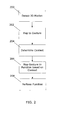
- FIG. 2 is a flowchart illustrating an example of a method of controlling an electronic device.
- the method may be carried out by software executed by, for example, the processor 102. Coding of software for carrying out such a method is within the scope of a person of ordinary skill in the art given the present description.
- the method may contain additional or fewer processes than shown and described, and may be performed in a different order.
- Computer-readable code executable by, for example, the processor 102 of the portable electronic device 100 to perform the method may be stored in a computer-readable medium.
- the method of FIG. 2 includes detecting motion 200 relative to the portable electronic device 100, mapping the motion to a gesture 202, determining a context 204 of the portable electronic device 100, mapping the gesture to a function based on the determined context 206 and performing a function associated with the gesture 208.
- Detecting motion 200 relative to the portable electronic device 100 may be performed using an object sensing method such as ultrasonic, infrared or proximity sensing, as will be understood by a person skilled in the art.
- the object sensing methods employ at least one object sensor 154 that cooperates with the processor 102 to detect an object's motion in substantially real time.
- Mapping the motion to a gesture 202 may be performed by searching a gesture database, which may include a look-up table. Electronic data representations of different motions are stored in the gesture database and associated with gestures. The motion detected 200 is compared to the stored electronic data representations and a corresponding gesture is determined.
- FIG. 3 is a flowchart illustrating an example method of determining a context 204, which may be performed in cooperation with the method of FIG. 2 .
- the method of FIG. 3 includes: receiving 300 context data at processor 102 and mapping 302 the context data to a context.
- the context data may include: data associated with a device state, data identifying an application in focus, accelerometer data, which may be used to determine if a device is in motion, such as being carried by a person walking, travelling in a vehicle or at rest, for example.
- the context data may further include device position data received from a GPS (Global Positioning System) component in communication with the processor 102, device operating mode, such as silent mode, for example, battery status, time and date and device location such as in a holster, case or cover, for example.
- the context data may include device couplings such as a Bluetooth coupling between the device and a vehicle, for example.
- a device coupling may further uniquely identify the vehicle if the device is used to couple to multiple vehicles.
- the context may be determined based on user input or a saved context schedule, for example.
- Mapping the context information to a context may be performed with reference to a context database.
- the context data may be received at the processor 102 in response to: a request from the processor 102, at regular time intervals or in response to a change in context, for example.
- Mapping the gesture to a function based on the determined context 206 may include accessing a function mapping database, which may include a look-up table.
- the function mapping database includes a correlation between gestures, contexts and functions.
- gestures may be mapped to individual keystrokes.
- device context information may also be accessed and utilized in mapping the gesture.
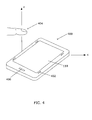
- the example portable electronic device 400 of FIG. 4 includes a microphone 406 arranged to receive acoustic signals generated by a plurality of transducers (not shown) via acoustic ports 402. Motion of an object 404 relative to the portable electronic device 100 may be detected 200 by the microphone 406. As will be understood by a person skilled in the art, the processor 102 receives data from the microphone 406 and determines positions of the object 404 over time based on triangulation of acoustic signals received by the microphone 406. The motion, a letter "S" motion for example, is then mapped to a letter "S" gesture 202.
- a context is determined 204 based on context data that is received 300 by the processor 102.
- the context data is received from a sensor (not shown) of the portable electronic device 100 that is capable of detecting a holster, case or cover.
- the context data is mapped to the context 302 by accessing the context database and, in this example, the context is determined 204 to be "device out of holster".
- the gesture determined at 202 is then mapped to a function based on the "device out of holster" context by accessing the function mapping database.
- the function may be composing a new message in a messaging application, for example, and the device may then performs the function 208.
- the cover 500 includes a cover body 506 having an opening 508, apertures 502 at the locations of the acoustic ports 402 and a microphone aperture 504 at the location of the microphone 406.
- the letter "S" motion that was performed when the device was out of the cover 500 is performed when the device 400 is in the cover 500.
- the motion is detected 200 by the processor 102 based on data received from the microphone 406 and the motion is then mapped to the letter "S" gesture.
- the context is then determined 204 based on context data received from the sensor capable of detecting the presence of a cover.
- the context data is mapped to the context 302 by accessing the context database and the context is determined 204 to be "device in cover".
- the function may be determined to be muting an incoming call alert, for example, and the device may then perform the function 208.
- any cover including a cover body 506 having an opening 508 for receiving a portable electronic device 100 and apertures extending through the cover body 506 for aligning with object sensing hardware of the portable electronic device 100 may be used to facilitate detection of three dimensional motion by the object sensing hardware.
- the example functions described in relation to FIGS. 4 and 5 may be any two different functions performed by the portable electronic device 400 in response to receiving two motion inputs that map to the same gesture.
- the portable electronic device 400 may be received in a vehicle holster, case or cover, which may be mounted on a dashboard of the vehicle.
- the letter "S" gesture may cause the device to perform still a different function because the vehicle context is different from both the in cover and out of cover contexts.
- the function performed may be answering a call in hands-free mode, for example.
- the cover 500 of FIG. 5 includes apertures 502, 504 that are located to accommodate hardware associated with an ultrasonic object sensing method. Apertures may be provided at different locations in order to accommodate object sensing hardware associated with other sensing methods. For example, for a two camera or other electro-magnetic detector object sensing method that uses the electromagnetic spectrum, either at, above or below the optical wavelength band, openings for the corresponding photon / electro-electromagnetic sensors may be provided in the cover in such a manner that the cover does not interfere with the object sensing method when the device is enclosed in the cover. As another example, when using an acoustic object sensing method, which uses the ultrasonic spectrum, opening may be provided for each transmitter, receiver and/or transceiver.
- the processor 102 may receive context data from multiple sources. For example, the device may be operating in silent mode while in the cover. In order to determine which function to perform when more than one context is determined, the processor 102 relies upon a context ranking, which is stored in device memory. When the contexts have been determined, the processor 102 performs the function associated with the highest ranking context. In one embodiment, the context ranking is a setting that may be modified by the user.
- the holster, case or cover includes a clip having a rotating joint to enable wearing of the electronic device by a user in different rotation orientations relative to the ground when clipped to the user's belt, for example.
- an upward vertical gesture detectable by the object sensing hardware may cause a music player to increase in volume, for example. Similar gestures may be interpreted using horizontal motions such as music player fast forward or rewind in response to front-to-back or back-to-front gestures, respectively. Combinations of vertical and horizontal gestures may also be detectable to cause the electronic device to perform a function. While operating in this context, random orientation of the electronic device relative to the ground due to rotation about the rotating joint may be considered when determining the gesture.
- determination of the gesture may include determining the orientation of the device relative to the ground using an accelerometer, for example, when the device is in the holster, case or cover. When not in the holster, case or cover, the orientation of the device relative to the ground may not be considered.
- the context may be an application that is in focus, or currently active.
- a word processing application is in focus, or currently active, when an indicator, or cursor, is displayed and typing on a keyboard results in associated letters being displayed in the application.
- a portable electronic device that includes a phone application, a calendar application and a messaging application
- a single gesture for example a letter "L" motion, may cause the device to perform different functions depending on the application that is in focus, or currently active.
- the phone application is active
- receiving the "L" gesture may cause the application to call a particular number.
- the calendar application is active, the “L” gesture may cause the calendar application to scroll to the last day of the month.
- the messaging application is active, the "L” gesture may cause the application to send an e-mail message.
- gestures may be mapped to different functions based on a state of an application in focus on the portable electronic device 100.
- a circle gesture may cause the portable electronic device to perform an address lookup function when an address field is active and the same circle gesture may cause the portable electronic device 100 to perform a spell check function when a body field is active.
- a command map may be provided to associate gestures with functions based on a state of an application.
- gestures When operating in a context, such as when the device is in a cover, the user may not be looking at his or her hand when performing gestures. Therefore, gestures may be simpler and the number of gestures may be fewer. Using less complex components capable of recognizing and distinguishing between fewer gestures as a result of mapping gestures to a plurality of functions depending on the context may lead to reduced component costs and may also simplify gesture learning for users.
- More complex gestures may still be used when operating the device in a regular operating mode in which the device is generally held in front of a user to facilitate viewing of the display 118 and the user's hand while making gestures.
- touch-sensitive displays 118 electronic devices without displays or having other types of displays may also be used to detect a three-dimensional motion relative to the electronic device and determine a corresponding three-dimensional gesture; determine a context of the electronic device; and perform a function based on the corresponding three-dimensional gesture and the context.
Landscapes
- Engineering & Computer Science (AREA)
- Theoretical Computer Science (AREA)
- Computer Hardware Design (AREA)
- General Engineering & Computer Science (AREA)
- Human Computer Interaction (AREA)
- Physics & Mathematics (AREA)
- General Physics & Mathematics (AREA)
- Telephone Function (AREA)
- User Interface Of Digital Computer (AREA)
Abstract
A method comprises: detecting (200) a three-dimensional motion (404) relative to an electronic device (400) and determining (202) a corresponding three-dimensional gesture; determining (204) a context of the electronic device; and performing (208) a function based on the corresponding three-dimensional gesture and the context.
Description
- The present disclosure relates to portable electronic and the control of such portable electronic devices.
- Electronic devices, including portable electronic devices, have gained widespread use and may provide a variety of functions including, for example, telephonic, electronic messaging and other personal information manager (PIM) application functions. Portable electronic devices include, for example, several types of mobile stations such as simple cellular telephones, smart telephones, wireless personal digital assistants (PDAs), and laptop computers with wireless 802.11 or Bluetooth capabilities.
- Portable electronic devices such as PDAs or smart telephones are generally intended for handheld use and ease of portability. Smaller devices are generally desirable for portability. A touch-sensitive display, also known as a touchscreen display, may be useful on handheld devices, which are small and have limited space for user input and output. The information displayed on the touch-sensitive displays may be modified depending on the functions and operations being performed.
- Improvements in electronic devices are desirable.
- In one aspect there is provided, a method including: detecting a three-dimensional motion relative to an electronic device and determining a corresponding three-dimensional gesture; determining a context of the electronic device; and performing a function based on the corresponding three-dimensional gesture and the context.
- In another aspect there is provided, an electronic device including: object sensing hardware in communication with a processor for detecting a three-dimensional motion relative to an electronic device; a memory for storing a gesture database for mapping three-dimensional motion to gestures and a function mapping database for mapping gestures to functions based on a context; a processor for determining a corresponding three-dimensional gesture using the gesture database, determining a context of the electronic device using the function mapping database and performing a function associated with the corresponding three-dimensional gesture and the context.
- In still another aspect there is provided, a cover including: a cover body having an opening for receiving a portable electronic device; and apertures extending through the cover body, the apertures for aligning with object sensing hardware of the portable electronic device when the portable electronic device is received in the cover; wherein three dimensional motion is detectable by the object sensing hardware.
- Embodiments of the present disclosure will now be described, by way of example only, with reference to the attached figures, wherein:
-
FIG. 1 is a simplified block diagram of one example of a portable electronic device in accordance with the present disclosure; -
FIG. 2 is a flowchart illustrating an example of a method of controlling an electronic device in accordance with the present disclosure; -
FIG. 3 is a flowchart illustrating an example of a method of determining a context in accordance with the present disclosure; and -
FIGS. 4 and5 illustrate examples of a portable electronic device receiving a gesture in accordance with the present disclosure. - The following describes a device and method including detecting a three-dimensional motion relative to an electronic device and determining a corresponding three-dimensional gesture; determining a context of the electronic device; and performing a function based on the corresponding three-dimensional gesture and the context.
- For simplicity and clarity of illustration, reference numerals may be repeated among the figures to indicate corresponding or analogous elements. Numerous details are set forth to provide an understanding of the embodiments described herein. The embodiments may be practiced without these details. In other instances, well-known methods, procedures, and components have not been described in detail to avoid obscuring the embodiments described. The description is not to be considered as limited to the scope of the embodiments described herein.
- The disclosure generally relates to an electronic device, which is a portable electronic device in the embodiments described herein. Examples of portable electronic devices include mobile, or handheld, wireless communication devices such as pagers, cellular phones, cellular smart-phones, wireless organizers, personal digital assistants, tablet computers, wirelessly enabled notebook computers, and so forth. The portable electronic device may also be a portable electronic device without wireless communication capabilities, such as a handheld electronic game device, digital photograph album, digital camera, or other device.
- A block diagram of an example of a portable
electronic device 100 is shown inFIG. 1 . The portableelectronic device 100 includes multiple components, such as aprocessor 102 that controls the overall operation of the portableelectronic device 100. Communication functions, including data and voice communications, are performed through acommunication subsystem 104. Data received by the portableelectronic device 100 is decompressed and decrypted by adecoder 106. Thecommunication subsystem 104 receives messages from and sends messages to awireless network 150. Thewireless network 150 may be any type of wireless network, including, but not limited to, data wireless networks, voice wireless networks, and networks that support both voice and data communications. Apower source 142, such as one or more rechargeable batteries or a port to an external power supply, powers the portableelectronic device 100. - The
processor 102 interacts with other components, such as Random Access Memory (RAM) 108,memory 110, adisplay 112 with a touch-sensitive overlay 114 operably connected to anelectronic controller 116 that together comprise a touch-sensitive display 118, anobject sensor 154, an auxiliary input/output (I/O)subsystem 124, adata port 126, aspeaker 128, amicrophone 130, short-range communications 132, andother device subsystems 134. Theprocessor 102 may optionally interact with one ormore actuators 120 to provide tactile feedback and one ormore force sensors 122 to detect a force imparted on the touch-sensitive display 118. Interaction with a graphical user interface is performed through the touch-sensitive overlay 114. Theprocessor 102 interacts with the touch-sensitive overlay 114 via theelectronic controller 116. Information, such as text, characters, symbols, images, icons, and other items that may be displayed or rendered on a portable electronic device, is displayed on the touch-sensitive display 118 via theprocessor 102. Theprocessor 102 may interact with an orientation sensor such as anaccelerometer 136 that may be utilized to detect direction of gravitational forces or gravity-induced reaction forces. - To identify a subscriber for network access, the portable
electronic device 100 uses a Subscriber Identity Module or a Removable User Identity Module (SIM/RUIM)card 138 for communication with a network, such as thewireless network 150. Alternatively, user identification information may be programmed intomemory 110. - The portable
electronic device 100 includes anoperating system 146 and software programs orcomponents 148 that are executed by theprocessor 102 and are typically stored in a persistent, updatable store such as thememory 110. Additional applications or programs may be loaded onto the portableelectronic device 100 through thewireless network 150, the auxiliary I/O subsystem 124, thedata port 126, the short-range communications subsystem 132, or any othersuitable subsystem 134. - A received signal such as a text message, an e-mail message, or web page download is processed by the
communication subsystem 104 and input to theprocessor 102. Theprocessor 102 processes the received signal for output to thedisplay 112 and/or to the auxiliary I/O subsystem 124. A subscriber may generate data items, for example e-mail messages, which may be transmitted over thewireless network 150 through thecommunication subsystem 104. For voice communications, the overall operation of the portableelectronic device 100 is similar. Thespeaker 128 outputs audible information converted from electrical signals, and themicrophone 130 converts audible information into electrical signals for processing. - The touch-
sensitive display 118 may be any suitable touch-sensitive display, such as a capacitive, resistive, infrared, surface acoustic wave (SAW) touch-sensitive display, strain gauge, optical imaging, dispersive signal technology, acoustic pulse recognition, and so forth, as known in the art. A capacitive touch-sensitive display may include a capacitive touch-sensitive overlay 114. Theoverlay 114 may be an assembly of multiple layers in a stack including, for example, a substrate, a ground shield layer, a barrier layer, one or more capacitive touch sensor layers separated by a substrate or other barrier, and a cover. The capacitive touch sensor layers may be any suitable material, such as patterned indium tin oxide (ITO). - One or more touches, also known as touch contacts or touch events, may be detected by the touch-
sensitive display 118. Theprocessor 102 may determine attributes of the touch, including a location of a touch. Touch location data may include an area of contact or a single point of contact, such as a point at or near a center of the area of contact. The location of a detected touch may include x and y components, e.g., horizontal and vertical components, respectively, with respect to one's view of the touch-sensitive display 118. For example, the x location component may be determined by a signal generated from one touch sensor, and the y location component may be determined by a signal generated from another touch sensor. A signal is provided to thecontroller 116 in response to detection of a touch. A touch may be detected from any suitable object, such as a finger, thumb, appendage, or other items, for example, a stylus, pen, or other pointer, depending on the nature of the touch-sensitive display 118. Multiple simultaneous touches may be detected. - The touch-
sensitive display 118 is also configured to detect a gesture. A gesture, such as a swipe, is a type of touch, that begins at an origin point and continues to a finishing point while touch contact is maintained. A swipe may be long or short in distance, or duration, or both distance and duration. Two points of the swipe may be utilized to determine a vector that describes a direction of the swipe. The direction may be referenced with respect to the touch-sensitive display 118, the orientation of the information displayed on the touch-sensitive display 118, or another reference. For the purposes of providing a reference, "horizontal" as utilized herein is substantially left-to-right or right-to-left relative to the orientation of the displayed information, and "vertical" as utilized herein is substantially upward or downward relative to the orientation of the displayed information. The origin point and the finishing point of the swipe may be utilized to determine the magnitude or distance of the swipe. The duration of the swipe may be determined from the origin point and finishing point of the swipe in time. Theprocessor 102 receives data from thecontroller 116 to determine the direction, magnitude, and duration of the swipe. The gesture may be tracked and a plurality of sub-vectors determined for each gesture. The final sub-vector may be utilized to determine a distance and duration of a final portion of the gesture. Theprocessor 102 receives data from thecontroller 116 to determine the speed of the swipe based on the distance and duration of the final portion of the gesture. - Three-dimensional gestures are performed relative to the portable
electronic device 100, such as above thedisplay 118, for example. A standard, two-dimensional, gesture on a touch-sensitive display may include motion in the x and y axes. Three-dimensional gestures further include a z axis component, which generally extends outwardly from the touch-sensitive display 118. Motion in the z axis may be away from or toward a plane of the touch-sensitive display 118 of the portableelectronic device 100. Three-dimensional gestures may expand the number, type and variation of gestures that may be used to control the portableelectronic device 100. - The
object sensor 154 of the portableelectronic device 100 may be used to detect three-dimensional gestures performed by an object, such as a finger, thumb or stylus, for example, when the object is not in contact with the touch-sensitive display 118. A three dimensional gesture may include a two-dimensional portion, in which the object is in contact with the touch-sensitive display 118, and a three-dimensional portion in which the object is not in contact with the touch-sensitive display 118. - In the example embodiments disclosed herein, a three-dimensional gesture is performed relative to the portable
electronic device 100 without contacting the touch-sensitive display 118. In an example embodiment, the three-dimensional gesture begins upon first detection of the presence of an object relative to the portableelectronic device 100, and ends when object motion is not detected for a period of time. In another example embodiment, in which object positions are detected in order to determine object motion, the three-dimensional gesture ends when two or more consecutive detected object positions are substantially similar. In another example embodiment, the object motion ends when the portableelectronic device 100 determines that detected object motion corresponds to motion associated with a known gesture, such as stored in a gesture database in a memory of the portableelectronic device 100. - Gestures may have different meanings based on a context of the portable
electronic device 100. Contexts may include an application in focus and a device state, for example. Device states may include, for example, device GPS location, time and date, device environment, such as moving or at rest, in-holster or out of holster, for example, device operating mode and battery status. For example, a gesture may be mapped to a scroll page up function when running a web browser application on the portableelectronic device 100, while the same gesture may be mapped to answer a call in a hands free mode function when the portableelectronic device 100 is in motion in a vehicle. By mapping gestures to different functions based on the context, the functionality of the portableelectronic device 100 may be increased. -
FIG. 2 is a flowchart illustrating an example of a method of controlling an electronic device. The method may be carried out by software executed by, for example, theprocessor 102. Coding of software for carrying out such a method is within the scope of a person of ordinary skill in the art given the present description. The method may contain additional or fewer processes than shown and described, and may be performed in a different order. Computer-readable code executable by, for example, theprocessor 102 of the portableelectronic device 100 to perform the method, may be stored in a computer-readable medium. - The method of
FIG. 2 includes detectingmotion 200 relative to the portableelectronic device 100, mapping the motion to agesture 202, determining acontext 204 of the portableelectronic device 100, mapping the gesture to a function based on thedetermined context 206 and performing a function associated with thegesture 208. - Detecting
motion 200 relative to the portableelectronic device 100 may be performed using an object sensing method such as ultrasonic, infrared or proximity sensing, as will be understood by a person skilled in the art. In general, the object sensing methods employ at least oneobject sensor 154 that cooperates with theprocessor 102 to detect an object's motion in substantially real time. - Mapping the motion to a
gesture 202 may be performed by searching a gesture database, which may include a look-up table. Electronic data representations of different motions are stored in the gesture database and associated with gestures. The motion detected 200 is compared to the stored electronic data representations and a corresponding gesture is determined. -
FIG. 3 is a flowchart illustrating an example method of determining acontext 204, which may be performed in cooperation with the method ofFIG. 2 . The method ofFIG. 3 includes: receiving 300 context data atprocessor 102 andmapping 302 the context data to a context. The context data may include: data associated with a device state, data identifying an application in focus, accelerometer data, which may be used to determine if a device is in motion, such as being carried by a person walking, travelling in a vehicle or at rest, for example. The context data may further include device position data received from a GPS (Global Positioning System) component in communication with theprocessor 102, device operating mode, such as silent mode, for example, battery status, time and date and device location such as in a holster, case or cover, for example. In addition, the context data may include device couplings such as a Bluetooth coupling between the device and a vehicle, for example. A device coupling may further uniquely identify the vehicle if the device is used to couple to multiple vehicles. - In other example embodiments, the context may be determined based on user input or a saved context schedule, for example.
- Mapping the context information to a context may be performed with reference to a context database. The context data may be received at the
processor 102 in response to: a request from theprocessor 102, at regular time intervals or in response to a change in context, for example. - Mapping the gesture to a function based on the
determined context 206 may include accessing a function mapping database, which may include a look-up table. The function mapping database includes a correlation between gestures, contexts and functions. In some embodiments, gestures may be mapped to individual keystrokes. In addition, device context information may also be accessed and utilized in mapping the gesture. Once the function has been determined, the portableelectronic device 100 performs 208 the mapped one or more function(s) - Continued reference is made to
FIG. 2 with additional reference toFIGS. 4 and5 to describe one example of a method of controlling a portableelectronic device 100. The example portableelectronic device 400 ofFIG. 4 includes amicrophone 406 arranged to receive acoustic signals generated by a plurality of transducers (not shown) viaacoustic ports 402. Motion of anobject 404 relative to the portableelectronic device 100 may be detected 200 by themicrophone 406. As will be understood by a person skilled in the art, theprocessor 102 receives data from themicrophone 406 and determines positions of theobject 404 over time based on triangulation of acoustic signals received by themicrophone 406. The motion, a letter "S" motion for example, is then mapped to a letter "S"gesture 202. - A context is determined 204 based on context data that is received 300 by the
processor 102. In the example ofFIGS. 4 and5 , the context data is received from a sensor (not shown) of the portableelectronic device 100 that is capable of detecting a holster, case or cover. The context data is mapped to thecontext 302 by accessing the context database and, in this example, the context is determined 204 to be "device out of holster". The gesture determined at 202 is then mapped to a function based on the "device out of holster" context by accessing the function mapping database. The function may be composing a new message in a messaging application, for example, and the device may then performs thefunction 208. - Referring now to
FIG. 5 , the portableelectronic device 100 in this example is received in a holster, case or cover 500. Thecover 500 includes acover body 506 having anopening 508,apertures 502 at the locations of theacoustic ports 402 and amicrophone aperture 504 at the location of themicrophone 406. The letter "S" motion that was performed when the device was out of thecover 500 is performed when thedevice 400 is in thecover 500. The motion is detected 200 by theprocessor 102 based on data received from themicrophone 406 and the motion is then mapped to the letter "S" gesture. The context is then determined 204 based on context data received from the sensor capable of detecting the presence of a cover. The context data is mapped to thecontext 302 by accessing the context database and the context is determined 204 to be "device in cover". The function may be determined to be muting an incoming call alert, for example, and the device may then perform thefunction 208. - It will be appreciated by a person skilled in the art that any cover including a
cover body 506 having anopening 508 for receiving a portableelectronic device 100 and apertures extending through thecover body 506 for aligning with object sensing hardware of the portableelectronic device 100 may be used to facilitate detection of three dimensional motion by the object sensing hardware. - The example functions described in relation to
FIGS. 4 and5 may be any two different functions performed by the portableelectronic device 400 in response to receiving two motion inputs that map to the same gesture. - In another example embodiment, the portable
electronic device 400 may be received in a vehicle holster, case or cover, which may be mounted on a dashboard of the vehicle. In this example embodiment, the letter "S" gesture may cause the device to perform still a different function because the vehicle context is different from both the in cover and out of cover contexts. The function performed may be answering a call in hands-free mode, for example. - The
cover 500 ofFIG. 5 includesapertures - In some embodiments, the
processor 102 may receive context data from multiple sources. For example, the device may be operating in silent mode while in the cover. In order to determine which function to perform when more than one context is determined, theprocessor 102 relies upon a context ranking, which is stored in device memory. When the contexts have been determined, theprocessor 102 performs the function associated with the highest ranking context. In one embodiment, the context ranking is a setting that may be modified by the user. - In another example embodiment, the holster, case or cover includes a clip having a rotating joint to enable wearing of the electronic device by a user in different rotation orientations relative to the ground when clipped to the user's belt, for example. In this embodiment, an upward vertical gesture detectable by the object sensing hardware may cause a music player to increase in volume, for example. Similar gestures may be interpreted using horizontal motions such as music player fast forward or rewind in response to front-to-back or back-to-front gestures, respectively. Combinations of vertical and horizontal gestures may also be detectable to cause the electronic device to perform a function. While operating in this context, random orientation of the electronic device relative to the ground due to rotation about the rotating joint may be considered when determining the gesture. For example, determination of the gesture may include determining the orientation of the device relative to the ground using an accelerometer, for example, when the device is in the holster, case or cover. When not in the holster, case or cover, the orientation of the device relative to the ground may not be considered.
- In other example embodiments, the context may be an application that is in focus, or currently active. For example, a word processing application is in focus, or currently active, when an indicator, or cursor, is displayed and typing on a keyboard results in associated letters being displayed in the application. For a portable electronic device that includes a phone application, a calendar application and a messaging application, a single gesture, for example a letter "L" motion, may cause the device to perform different functions depending on the application that is in focus, or currently active. For example, when the phone application is active, receiving the "L" gesture may cause the application to call a particular number. When the calendar application is active, the "L" gesture may cause the calendar application to scroll to the last day of the month. When the messaging application is active, the "L" gesture may cause the application to send an e-mail message.
- In other example embodiments, gestures may be mapped to different functions based on a state of an application in focus on the portable
electronic device 100. For example, in a messaging application, a circle gesture may cause the portable electronic device to perform an address lookup function when an address field is active and the same circle gesture may cause the portableelectronic device 100 to perform a spell check function when a body field is active. In this embodiment, a command map may be provided to associate gestures with functions based on a state of an application. - When operating in a context, such as when the device is in a cover, the user may not be looking at his or her hand when performing gestures. Therefore, gestures may be simpler and the number of gestures may be fewer. Using less complex components capable of recognizing and distinguishing between fewer gestures as a result of mapping gestures to a plurality of functions depending on the context may lead to reduced component costs and may also simplify gesture learning for users.
- More complex gestures may still be used when operating the device in a regular operating mode in which the device is generally held in front of a user to facilitate viewing of the
display 118 and the user's hand while making gestures. - Although the examples described herein include touch-
sensitive displays 118, electronic devices without displays or having other types of displays may also be used to detect a three-dimensional motion relative to the electronic device and determine a corresponding three-dimensional gesture; determine a context of the electronic device; and perform a function based on the corresponding three-dimensional gesture and the context. - The present disclosure may be embodied in other specific forms without departing from its spirit or essential characteristics. The described embodiments are to be considered in all respects only as illustrative and not restrictive. The scope of the present disclosure is, therefore, indicated by the appended claims rather than by the foregoing description. All changes that come within the meaning and range of equivalency of the claims are to be embraced within their scope.
Claims (18)
- A method comprising:detecting a three-dimensional motion relative to an electronic device (100) and determining a corresponding three-dimensional gesture;determining a context of the electronic device (100); andperforming a function based on the corresponding three-dimensional gesture and the context.
- A method as claimed in claim 1, wherein determining a context comprises receiving context data and mapping the context data to a context.
- A method as claimed in claim 2, wherein the context data is received from a sensor capable of detecting a cover (500).
- A method as claimed in claim 3, wherein the cover (500) comprises apertures (502) aligned with object sensing hardware to facilitate detection of three dimensional motion when the electronic device (100) is received in the cover (500).
- A method as claimed in claim 4, wherein the function performed when the electronic device (100) is received in the cover (500) is different from the function performed when the electronic device (100) is not received in a cover (500).
- A method as claimed in claim 2, wherein the context data is accelerometer data.
- A method as claimed in claim 6, wherein the context determined based on the accelerometer data is one of: walking, travelling in a vehicle and resting.
- A method as claimed in claim 1, wherein determining a three dimensional gesture comprises searching a gesture database.
- A method as claimed in claim 2, wherein the function is determined using a look-up table.
- A computer-readable medium comprising instructions executable on a processor (102) of the electronic device (100) for implementing the method of any of claims 1 to 9.
- An electronic device (100) comprising:object sensing hardware in communication with a processor (102) for detecting a three-dimensional motion relative to an electronic device (100);a memory (110) for storing a gesture database for mapping three-dimensional motion to gestures and a function mapping database for mapping gestures to functions based on a context;a processor (102) for determining a corresponding three-dimensional gesture using the gesture database, determining a context of the electronic device (100) using the function mapping database and performing a function associated with the corresponding three-dimensional gesture and the context.
- An electronic device (100) as claimed in claim 11, comprising a cover-detecting sensor in communication with the processor (100) for determining the context.
- An electronic device as claimed in claim 11, comprising an accelerometer (136) in communication with the processor (102) for determining the context.
- An electronic device (100) as claimed in any of claims 11 to 13, wherein the context determined based on the accelerometer data is one of: walking, travelling in a vehicle and resting.
- An electronic device (100) as claimed in any of claim 11 to 14, wherein the gesture database and the function mapping database comprise look-up tables.
- An electronic device (100) as claimed in claim 12, wherein the function performed when the electronic device (100) is received in the cover (500) is different from the function performed when the electronic device (100) is not received in the cover (500).
- A cover (500) comprising:a cover body (506) having an opening (508) for receiving a portable electronic device (100); andapertures (502) extending through the cover body, the apertures (502, 504) for aligning with object sensing hardware of the portable electronic device (100) when the portable electronic device (100) is received in the cover;wherein three dimensional motion is detectable by the object sensing hardware.
- A cover (500) as claimed in claim 17, wherein the apertures (502, 504) are for aligning with ultrasonic object sensing hardware of the portable electronic device (100).
Priority Applications (1)
| Application Number | Priority Date | Filing Date | Title |
|---|---|---|---|
| EP11162833A EP2515201A1 (en) | 2011-04-18 | 2011-04-18 | Portable electronic device and method of controlling the same |
Applications Claiming Priority (1)
| Application Number | Priority Date | Filing Date | Title |
|---|---|---|---|
| EP11162833A EP2515201A1 (en) | 2011-04-18 | 2011-04-18 | Portable electronic device and method of controlling the same |
Publications (1)
| Publication Number | Publication Date |
|---|---|
| EP2515201A1 true EP2515201A1 (en) | 2012-10-24 |
Family
ID=44170182
Family Applications (1)
| Application Number | Title | Priority Date | Filing Date |
|---|---|---|---|
| EP11162833A Withdrawn EP2515201A1 (en) | 2011-04-18 | 2011-04-18 | Portable electronic device and method of controlling the same |
Country Status (1)
| Country | Link |
|---|---|
| EP (1) | EP2515201A1 (en) |
Cited By (1)
| Publication number | Priority date | Publication date | Assignee | Title |
|---|---|---|---|---|
| US12578801B2 (en) | 2020-07-10 | 2026-03-17 | Telefonaktiebolaget Lm Ericsson (Publ) | Method and device for detecting and responding to user input |
Citations (12)
| Publication number | Priority date | Publication date | Assignee | Title |
|---|---|---|---|---|
| US5542105A (en) * | 1994-10-07 | 1996-07-30 | Motorola, Inc. | Position sense radio carry case apparatus and method of using same |
| US20020021278A1 (en) * | 2000-07-17 | 2002-02-21 | Hinckley Kenneth P. | Method and apparatus using multiple sensors in a device with a display |
| US20020039909A1 (en) * | 2000-08-10 | 2002-04-04 | Koninklijke Philips Electronics N.V. | Device control apparatus and method |
| WO2003010653A1 (en) * | 2001-07-22 | 2003-02-06 | Heggestad Shalit Growth Ab | A computerized portable handheld means |
| EP1349354A1 (en) * | 2002-03-28 | 2003-10-01 | Sony Ericsson Mobile Communications AB | Detachable mobile terminal cover with integrated memory |
| EP1355223A2 (en) * | 2002-04-17 | 2003-10-22 | Microsoft Corporation | Reducing power consumption in a networked battery-operated device using sensors |
| EP1411709A2 (en) * | 2002-10-17 | 2004-04-21 | Research In Motion Limited | System and method of security function activation for a mobile electronic device |
| US20060256090A1 (en) * | 2005-05-12 | 2006-11-16 | Apple Computer, Inc. | Mechanical overlay |
| US20080100572A1 (en) * | 2006-10-31 | 2008-05-01 | Marc Boillot | Touchless User Interface for a Mobile Device |
| US20090009945A1 (en) * | 2001-11-19 | 2009-01-08 | Jamie Lee Johnson | Protective enclosure for touch screen device |
| US20100095206A1 (en) * | 2008-10-13 | 2010-04-15 | Lg Electronics Inc. | Method for providing a user interface using three-dimensional gestures and an apparatus using the same |
| WO2011042748A2 (en) * | 2009-10-07 | 2011-04-14 | Elliptic Laboratories As | User interfaces |
-
2011
- 2011-04-18 EP EP11162833A patent/EP2515201A1/en not_active Withdrawn
Patent Citations (12)
| Publication number | Priority date | Publication date | Assignee | Title |
|---|---|---|---|---|
| US5542105A (en) * | 1994-10-07 | 1996-07-30 | Motorola, Inc. | Position sense radio carry case apparatus and method of using same |
| US20020021278A1 (en) * | 2000-07-17 | 2002-02-21 | Hinckley Kenneth P. | Method and apparatus using multiple sensors in a device with a display |
| US20020039909A1 (en) * | 2000-08-10 | 2002-04-04 | Koninklijke Philips Electronics N.V. | Device control apparatus and method |
| WO2003010653A1 (en) * | 2001-07-22 | 2003-02-06 | Heggestad Shalit Growth Ab | A computerized portable handheld means |
| US20090009945A1 (en) * | 2001-11-19 | 2009-01-08 | Jamie Lee Johnson | Protective enclosure for touch screen device |
| EP1349354A1 (en) * | 2002-03-28 | 2003-10-01 | Sony Ericsson Mobile Communications AB | Detachable mobile terminal cover with integrated memory |
| EP1355223A2 (en) * | 2002-04-17 | 2003-10-22 | Microsoft Corporation | Reducing power consumption in a networked battery-operated device using sensors |
| EP1411709A2 (en) * | 2002-10-17 | 2004-04-21 | Research In Motion Limited | System and method of security function activation for a mobile electronic device |
| US20060256090A1 (en) * | 2005-05-12 | 2006-11-16 | Apple Computer, Inc. | Mechanical overlay |
| US20080100572A1 (en) * | 2006-10-31 | 2008-05-01 | Marc Boillot | Touchless User Interface for a Mobile Device |
| US20100095206A1 (en) * | 2008-10-13 | 2010-04-15 | Lg Electronics Inc. | Method for providing a user interface using three-dimensional gestures and an apparatus using the same |
| WO2011042748A2 (en) * | 2009-10-07 | 2011-04-14 | Elliptic Laboratories As | User interfaces |
Cited By (1)
| Publication number | Priority date | Publication date | Assignee | Title |
|---|---|---|---|---|
| US12578801B2 (en) | 2020-07-10 | 2026-03-17 | Telefonaktiebolaget Lm Ericsson (Publ) | Method and device for detecting and responding to user input |
Similar Documents
| Publication | Publication Date | Title |
|---|---|---|
| US9013435B2 (en) | Portable electronic device including touch-sensitive display and method of controlling same | |
| US8638297B2 (en) | Portable electronic device and method therefor | |
| US20120262381A1 (en) | Portable electronic device and method of controlling same | |
| EP3239804A1 (en) | Control of an electronic device including display and keyboard moveable relative to the display | |
| US8810529B2 (en) | Electronic device and method of controlling same | |
| US20140267043A1 (en) | Electronic device including touch-sensitive keyboard and method of controlling same | |
| US8994670B2 (en) | Electronic device having touch-sensitive display and method of controlling same to identify touches on the touch-sensitive display | |
| US20140145966A1 (en) | Electronic device with touch input display system using head-tracking to reduce visible offset for user input | |
| US9665250B2 (en) | Portable electronic device and method of controlling same | |
| US20130194188A1 (en) | Apparatus and method of facilitating input at a second electronic device | |
| US10503257B2 (en) | Portable electronic device and method of providing haptic feedback | |
| EP2620857A1 (en) | Touch-sensitive display and method of controlling a touch-sensitive display | |
| EP2482168A1 (en) | Portable electronic device and method therefor | |
| US20120038557A1 (en) | Method and Electronic Device With Motion Compensation | |
| EP2515201A1 (en) | Portable electronic device and method of controlling the same | |
| US20130285931A1 (en) | Method and apparatus for determining a selection option | |
| US20130194194A1 (en) | Electronic device and method of controlling a touch-sensitive display | |
| US20120038555A1 (en) | Method and Electronic Device With Motion Compensation | |
| CA2767707C (en) | Electronic device and method of controlling same | |
| EP2487571A1 (en) | Portable electronic device including touch-sensitive display and method of controlling same | |
| EP2549366A1 (en) | Touch-sensitive electronic device and method of controlling same | |
| EP3287885B1 (en) | Control of an electronic device including display and keyboard moveable relative to the display | |
| EP2778857A1 (en) | Electronic device including touch-sensitive keyboard and method of controlling same | |
| EP2624113A1 (en) | Apparatus and method of facilitating input at a second electronic device | |
| KR102248070B1 (en) | apparatus and method for processing space input of flexible device |
Legal Events
| Date | Code | Title | Description |
|---|---|---|---|
| PUAI | Public reference made under article 153(3) epc to a published international application that has entered the european phase |
Free format text: ORIGINAL CODE: 0009012 |
|
| 17P | Request for examination filed |
Effective date: 20110418 |
|
| AK | Designated contracting states |
Kind code of ref document: A1 Designated state(s): AL AT BE BG CH CY CZ DE DK EE ES FI FR GB GR HR HU IE IS IT LI LT LU LV MC MK MT NL NO PL PT RO RS SE SI SK SM TR |
|
| AX | Request for extension of the european patent |
Extension state: BA ME |
|
| STAA | Information on the status of an ep patent application or granted ep patent |
Free format text: STATUS: THE APPLICATION HAS BEEN WITHDRAWN |
|
| RAP1 | Party data changed (applicant data changed or rights of an application transferred) |
Owner name: BLACKBERRY LIMITED |
|
| 18W | Application withdrawn |
Effective date: 20130827 |