EP2513102B1 - Ethynyl derivatives - Google Patents
Ethynyl derivatives Download PDFInfo
- Publication number
- EP2513102B1 EP2513102B1 EP10790960.8A EP10790960A EP2513102B1 EP 2513102 B1 EP2513102 B1 EP 2513102B1 EP 10790960 A EP10790960 A EP 10790960A EP 2513102 B1 EP2513102 B1 EP 2513102B1
- Authority
- EP
- European Patent Office
- Prior art keywords
- pyrimidine
- pyrazolo
- phenylethynyl
- triazolo
- tert
- Prior art date
- Legal status (The legal status is an assumption and is not a legal conclusion. Google has not performed a legal analysis and makes no representation as to the accuracy of the status listed.)
- Not-in-force
Links
- 0 CC#Cc1c[n]2nc(*)nc2nc1 Chemical compound CC#Cc1c[n]2nc(*)nc2nc1 0.000 description 3
- XNJIKZWLSIRDKA-UHFFFAOYSA-N C(CC1)CN1c1n[n](cc(cn2)C#Cc3ccccc3)c2n1 Chemical compound C(CC1)CN1c1n[n](cc(cn2)C#Cc3ccccc3)c2n1 XNJIKZWLSIRDKA-UHFFFAOYSA-N 0.000 description 1
- FWIRPLFZVGWJIY-UHFFFAOYSA-N C(COCC1)C1C1=[NH+][NH+](C=C(C=N2)C#Cc3ccccc3)C2=C1 Chemical compound C(COCC1)C1C1=[NH+][NH+](C=C(C=N2)C#Cc3ccccc3)C2=C1 FWIRPLFZVGWJIY-UHFFFAOYSA-N 0.000 description 1
- HAPVIVGKQPULBA-UHFFFAOYSA-O C(COCC1)N1C1=N[NH+](C=C(C=N2)C#Cc3ccccc3)C2=N1 Chemical compound C(COCC1)N1C1=N[NH+](C=C(C=N2)C#Cc3ccccc3)C2=N1 HAPVIVGKQPULBA-UHFFFAOYSA-O 0.000 description 1
- GUTHYYGNYLKABT-UHFFFAOYSA-O CC(C)(C)c(cc1nc2)[nH+][n]1c(C)c2C#Cc1cc(F)cnc1 Chemical compound CC(C)(C)c(cc1nc2)[nH+][n]1c(C)c2C#Cc1cc(F)cnc1 GUTHYYGNYLKABT-UHFFFAOYSA-O 0.000 description 1
- YDJMZDLMCHKUFA-UHFFFAOYSA-N CC(C)(C)c1n[n](cc(cc2)C#Cc3ccccc3)c2n1 Chemical compound CC(C)(C)c1n[n](cc(cc2)C#Cc3ccccc3)c2n1 YDJMZDLMCHKUFA-UHFFFAOYSA-N 0.000 description 1
- HKIWVLNRGLKILZ-UHFFFAOYSA-N CC(C)(C)c1n[n](cc(cn2)C#Cc3cccc(OC)c3)c2c1 Chemical compound CC(C)(C)c1n[n](cc(cn2)C#Cc3cccc(OC)c3)c2c1 HKIWVLNRGLKILZ-UHFFFAOYSA-N 0.000 description 1
- YHXMACWAPGQGJL-UHFFFAOYSA-N CC(C)(C)c1n[n](cc(cn2)C#Cc3ccccc3)c2c1 Chemical compound CC(C)(C)c1n[n](cc(cn2)C#Cc3ccccc3)c2c1 YHXMACWAPGQGJL-UHFFFAOYSA-N 0.000 description 1
- IVIJQLGFVBZHPR-UHFFFAOYSA-N CC(C)(C)c1n[n](cc(cn2)C#Cc3cnccc3)c2c1 Chemical compound CC(C)(C)c1n[n](cc(cn2)C#Cc3cnccc3)c2c1 IVIJQLGFVBZHPR-UHFFFAOYSA-N 0.000 description 1
- HRZUKPJFMNTIQK-UHFFFAOYSA-N CC(C)(C)c1n[n](cc(cn2)C#[Si+2](C)(C)C)c2n1 Chemical compound CC(C)(C)c1n[n](cc(cn2)C#[Si+2](C)(C)C)c2n1 HRZUKPJFMNTIQK-UHFFFAOYSA-N 0.000 description 1
- GNPYENKJJALUMM-UHFFFAOYSA-O CC(C)c1n[n](cc(c[nH+]2)Br)c2c1 Chemical compound CC(C)c1n[n](cc(c[nH+]2)Br)c2c1 GNPYENKJJALUMM-UHFFFAOYSA-O 0.000 description 1
- AFEVBVRCZOWJJF-UHFFFAOYSA-N c1c(ccc(C#Cc2ccccc2)c2)[n]2nn1 Chemical compound c1c(ccc(C#Cc2ccccc2)c2)[n]2nn1 AFEVBVRCZOWJJF-UHFFFAOYSA-N 0.000 description 1
Classifications
-
- C—CHEMISTRY; METALLURGY
- C07—ORGANIC CHEMISTRY
- C07D—HETEROCYCLIC COMPOUNDS
- C07D487/00—Heterocyclic compounds containing nitrogen atoms as the only ring hetero atoms in the condensed system, not provided for by groups C07D451/00 - C07D477/00
- C07D487/02—Heterocyclic compounds containing nitrogen atoms as the only ring hetero atoms in the condensed system, not provided for by groups C07D451/00 - C07D477/00 in which the condensed system contains two hetero rings
- C07D487/04—Ortho-condensed systems
-
- A—HUMAN NECESSITIES
- A61—MEDICAL OR VETERINARY SCIENCE; HYGIENE
- A61K—PREPARATIONS FOR MEDICAL, DENTAL OR TOILETRY PURPOSES
- A61K31/00—Medicinal preparations containing organic active ingredients
- A61K31/33—Heterocyclic compounds
- A61K31/395—Heterocyclic compounds having nitrogen as a ring hetero atom, e.g. guanethidine or rifamycins
- A61K31/495—Heterocyclic compounds having nitrogen as a ring hetero atom, e.g. guanethidine or rifamycins having six-membered rings with two or more nitrogen atoms as the only ring heteroatoms, e.g. piperazine or tetrazines
- A61K31/505—Pyrimidines; Hydrogenated pyrimidines, e.g. trimethoprim
- A61K31/519—Pyrimidines; Hydrogenated pyrimidines, e.g. trimethoprim ortho- or peri-condensed with heterocyclic rings
-
- A—HUMAN NECESSITIES
- A61—MEDICAL OR VETERINARY SCIENCE; HYGIENE
- A61P—SPECIFIC THERAPEUTIC ACTIVITY OF CHEMICAL COMPOUNDS OR MEDICINAL PREPARATIONS
- A61P25/00—Drugs for disorders of the nervous system
-
- A—HUMAN NECESSITIES
- A61—MEDICAL OR VETERINARY SCIENCE; HYGIENE
- A61P—SPECIFIC THERAPEUTIC ACTIVITY OF CHEMICAL COMPOUNDS OR MEDICINAL PREPARATIONS
- A61P25/00—Drugs for disorders of the nervous system
- A61P25/04—Centrally acting analgesics, e.g. opioids
-
- A—HUMAN NECESSITIES
- A61—MEDICAL OR VETERINARY SCIENCE; HYGIENE
- A61P—SPECIFIC THERAPEUTIC ACTIVITY OF CHEMICAL COMPOUNDS OR MEDICINAL PREPARATIONS
- A61P25/00—Drugs for disorders of the nervous system
- A61P25/14—Drugs for disorders of the nervous system for treating abnormal movements, e.g. chorea, dyskinesia
- A61P25/16—Anti-Parkinson drugs
-
- A—HUMAN NECESSITIES
- A61—MEDICAL OR VETERINARY SCIENCE; HYGIENE
- A61P—SPECIFIC THERAPEUTIC ACTIVITY OF CHEMICAL COMPOUNDS OR MEDICINAL PREPARATIONS
- A61P25/00—Drugs for disorders of the nervous system
- A61P25/18—Antipsychotics, i.e. neuroleptics; Drugs for mania or schizophrenia
-
- A—HUMAN NECESSITIES
- A61—MEDICAL OR VETERINARY SCIENCE; HYGIENE
- A61P—SPECIFIC THERAPEUTIC ACTIVITY OF CHEMICAL COMPOUNDS OR MEDICINAL PREPARATIONS
- A61P25/00—Drugs for disorders of the nervous system
- A61P25/24—Antidepressants
-
- A—HUMAN NECESSITIES
- A61—MEDICAL OR VETERINARY SCIENCE; HYGIENE
- A61P—SPECIFIC THERAPEUTIC ACTIVITY OF CHEMICAL COMPOUNDS OR MEDICINAL PREPARATIONS
- A61P25/00—Drugs for disorders of the nervous system
- A61P25/28—Drugs for disorders of the nervous system for treating neurodegenerative disorders of the central nervous system, e.g. nootropic agents, cognition enhancers, drugs for treating Alzheimer's disease or other forms of dementia
-
- A—HUMAN NECESSITIES
- A61—MEDICAL OR VETERINARY SCIENCE; HYGIENE
- A61P—SPECIFIC THERAPEUTIC ACTIVITY OF CHEMICAL COMPOUNDS OR MEDICINAL PREPARATIONS
- A61P25/00—Drugs for disorders of the nervous system
- A61P25/30—Drugs for disorders of the nervous system for treating abuse or dependence
-
- A—HUMAN NECESSITIES
- A61—MEDICAL OR VETERINARY SCIENCE; HYGIENE
- A61P—SPECIFIC THERAPEUTIC ACTIVITY OF CHEMICAL COMPOUNDS OR MEDICINAL PREPARATIONS
- A61P43/00—Drugs for specific purposes, not provided for in groups A61P1/00-A61P41/00
-
- C—CHEMISTRY; METALLURGY
- C07—ORGANIC CHEMISTRY
- C07D—HETEROCYCLIC COMPOUNDS
- C07D471/00—Heterocyclic compounds containing nitrogen atoms as the only ring hetero atoms in the condensed system, at least one ring being a six-membered ring with one nitrogen atom, not provided for by groups C07D451/00 - C07D463/00
- C07D471/02—Heterocyclic compounds containing nitrogen atoms as the only ring hetero atoms in the condensed system, at least one ring being a six-membered ring with one nitrogen atom, not provided for by groups C07D451/00 - C07D463/00 in which the condensed system contains two hetero rings
- C07D471/04—Ortho-condensed systems
Definitions
- the present invention relates to ethynyl derivatives of formula wherein
- the compounds of general formula I are positive allosteric modulators (PAM) of the metabotropic glutamate receptor subtype 5 (mGluR5).
- the transmission of stimuli takes place by the interaction of a neurotransmitter, which is sent out by a neuron, with a rleuroreceptor.
- Glutamate is the major excitatory neurotransmitter in the brain and plays a unique role in a variety of central nervous system (CNS) functions.
- the glutamate-dependent stimulus receptors are divided into two main groups.
- the first main group namely the ionotropic receptors, forms ligand-controlled ion channels.
- the metabotropic glutamate receptors (mGluR) belong to the second main group and, furthermore, belong to the family of G-protein coupled receptors.
- these eight receptors can be sub-divided into three sub-groups:
- treatable indications in this connection are restricted brain function caused by bypass operations or transplants, poor blood supply to the brain, spinal cord injuries, head injuries, hypoxia caused by pregnancy, cardiac arrest and hypoglycaemia.
- Further treatable indications are ischemia, Huntington's chorea, amyotrophic lateral sclerosis (ALS), dementia caused by AIDS, eye injuries, retinopathy, idiopathic parkinsonism or parkinsonism caused by medicaments as well as conditions which lead to glutaniate-deficiency functions, such as e.g. muscle spasms, convulsions, migraine, urinary incontinence, nicotine addiction, opiate addiction, anxiety, vomiting, dyskinesia and depressions.
- ALS amyotrophic lateral sclerosis
- Disorders mediated full or in part by mGluR5 are for example acute, traumatic and chronic degenerative processes of the nervous system, such as Alzheimer's disease, senile dementia, Parkinson's disease, Huntington's chorea, amyotrophic lateral sclerosis and multiple sclerosis, psychiatric diseases such as schizophrenia and anxiety, depression, pain and drug dependency ( Expert Opin. Ther. Patents (2002), 12(12), 1845-1852 doi:10.1517/13543776.12.12.1845).
- a new avenue for developing selective modulators is to identify compounds which act through allosteric mechanism, modulating the receptor by binding to a site different from the highly conserved orthosteric binding site.
- Positive allosteric modulators of mGluR5 have emerged recently as novel pharmaceutical entities offering this attractive alternative.
- Positive allosteric modulators have been described, for example in WO2008/151184 , WO2006/048771 , WO2006/129199 and WO2005/044797 and in Molecular Pharmacology (1991), 40, 333 - 336 ; The Journal of Pharmacology and Experimental Therapeutics (2005) 313(1), 199-206 ;
- Positive allosteric modulators are compounds that do not directly activate receptors by themselves, but markedly potentiate agonist-stimulated responses, increase potency and maximum of efficacy. The binding of these compounds increases the affinity of a glutamate-site agonist at its extracellular N-terminal binding site. Positive allosteric modulation is thus an attractive mechanism for enhancing appropriate physiological receptor activation. There is a scarcity of selective positive allosteric modulators for the mGluR5 receptor. Conventional mGluR5 receptor modulators typically lack satisfactory aqueous solubility and exhibit poor oral bioavailability. Therefore, there remains a need for compounds that overcome these deficiencies and that effectively provide selective positive allosteric modulators for the mGluR5 receptor.
- Compounds of formula I are distinguished by having valuable therapeutic properties. They can be used in the treatment or prevention of disorders, relating to positive allosteric modulators for the mGluR5 receptor.
- the most preferred indications for compounds which are positive allosteric modulators are schizophrenia and cognition.
- the present invention relates to compounds of formula 1 and to their pharmaceutically acceptable salts, to these compounds as pharmaceutically active substances, to the processes for their production as well as to the use in the treatment or prevention of disorders, relating to positive allosteric modulators for the mGluR5 receptor, such as schizophrenia and cognition and to pharmaceutical compositions containing the compounds of formula I
- lower alkyl denotes a saturated, i.e. aliphatic hydrocarbon group including a straight or branched carbon chain with 1 - 4 carbon atoms.
- alkyl examples are methyl, ethyl, n-propyl, isopropyl and tert-butyl.
- alkoxy denotes a group -O-R' wherein R' is lower alkyl as defined above.
- lower hydroxyalkyl denotes a lower alkyl groups as defined above, wherein at least one hydrogen atom is replaced by hydroxy.
- lower cycloalkyl denotes a saturated carbon ring, containing from 3 to 7 carbon ring atoms, for example cyclopropyl, cyclobutyl, cyclopentyl, cyclohexyl or cycloheptyl.
- heterocycloalkyl denotes a saturated carbon ring, wherein one or more carbon atoms are replaced by oxygen or nitrogen, a preferred heteroatom is O.
- examples for such rings are tetrahydropyran-2, 3 or 4-yl, pyrrolidinyl, imidazolidinyl, pyrazolidinyl, piperidinyl, piperazinyl or morpholinyl.
- 6-membered aromatic substituent containing 0, 1 or 2 nitrogen atoms includes the following aromatic rings: phenyl, 2,3- or 4-pyridinyl or pyrimidinyl.
- pharmaceutically acceptable salt or “pharmaceutically acceptable acid addition salt” embraces salts with inorganic and organic acids, such as hydrochloric acid, nitric acid, sulfuric acid, phosphoric acid, citric acid, formic acid, fumaric acid, maleic acid, acetic acid, succinic acid, tartaric acid, methane-sulfonic acid, p-toluenesulfonic acid and the like.
- An embodiment of the invention are compounds of formula I, wherein X is C-R 1 and Y is C -R 2 and Z is N, wherein
- a further preferred embodiment of the invention are compounds of formula IB, wherein X is C-R 1 , Y is N and Z is CH, wherein
- a further preferred embodiment of the invention are compounds of formula I, wherein X is C-R 1 and Y and Z are N. wherein
- a further preferred embodiment of the invention are compounds of formula I, wherein X is C-R 1 , Y is C-R 2 and Z is CH.
- a further preferred embodiment of the invention are compounds of formula I, wherein X is N, Y is C-R 2 and Z is CH.
- the compounds of formula I can be manufactured by the methods given below, by the methods given in the examples or by analogous methods. Appropriate reaction conditions for the individual reaction steps are known to a person skilled in the art.
- the reaction sequence is not limited to the one displayed in the schemes, however, depending on the starting materials and their respective reactivity the sequence of reaction steps can be freely altered. Starting materials are either commercially available or can be prepared by methods analogous to the methods given below, by methods described in references cited in the description or in the examples, or by methods known in the art.
- a 6-ethynyl-pyrazolo[1,5-a]pyrimidine of formula IA can be obtained by condensation of an appropriately substituted 2-H-pyrazol-3-ylamine 7 and bromomalonaldehyde 8 with paratoluenesulfonic acid monohydrate in a solvent like n-butanol to yield the corresponding 6-bromo-pyrazolo[1,5-a]pyrimidine derivative 9 .
- Sonogashira coupling of the 6-bromopyrazolo[1,5-a]pyrimidine derivative 9 with an appropriately substituted aryl-acetylene 3 yields the desired 6-ethynyl-pyrazolo[1,5-a]pyrimidine of formula IA (scheme 1).
- the intermediate 9 can be reacted in a Sonogashira-coupling with trimethylsilyl acetylene 10 to give the 6-trimethylsilanylethynyl-pyrazolo[1,5-a]pyrimidine derivative 11 .
- Deprotection of the silyl-group with tetrabutylammonium fluoride (1.5mmol on silica gel) in a solvent like dichloromethane yields the corresponding ethynyl derivative 12.
- Sonogashira coupling of 12 with an appropriately substituted aryl-halogenide yields the desired 6-ethynylpyrazolo[1,5-a]pyrimidine of formula IA (scheme 2).
- This reaction sequence can alternatively be applied by coupling the trimethylsilanyl derivative 11 with an appropriately substituted acryl halogenide under Sonogashira coupling conditions with simultaneous addition of tetrabutylammonium fluoride which realizes the silyl deprotection in-situ.
- a 6-ethynyl-[1,2,4]triazolo[1,5-a]pyridine of formula IB can be obtained by Sonogashira coupling of an aryl-acetylene 3 with 2-amino-5-iodopyridine 13 to yield the corresponding 5-ethynyl-pyridin-2-ylamine derivative 14.
- Reaction of 14 with a (1,1-dimethoxy-alkyl)-dimethyl-amine 15 in presence of an acidic catalyst like trifluoroacetic acid and a solvent such as ethanol yields the corresponding amidine 16 , which is treated with hydroxylamine hydrochloride in a solvent such as i-PrOH:THF (5:1 v/v) to give the desired N-hydroxyamidine 17.
- This compound is cyclized with trifluoroacetic anhydride in a solvent such as THF to give the desired 6-ethynyl-[1,2,4]triazolo[1,5-a]pyridine of formula IB (scheme 3).
- a 6-ethynyl-[1,2,4]triazoto[1,5-a]pyrimidine of formula IC can be obtained similarly by reacting 2-amino-5-bromopyrimidine 18 with a (1,1-dimethoxy-alkyl)-dimethyl-amine 15 in presence of an acidic catalyst like trifluoroacetic acid and a solvent such as ethanol to give the corresponding amidine 19 , which is treated with hydroxylamine hydrochloride in a solvent such as i-PrOH:THF (5:1 v/v) to give the N-hydroxyamidine 20.
- This compound is cyclized with trifluoroacetic anhydride in a solvent such as THF to give the desired 6-ethynyl-[1,2,4]triazolo[1,5-a]pyrimidine of formula IC (scheme 4).
- a 6-ethynyl-pyrazolo[1,5-a]pyridine of formula ID can be obtained by decarboxylation of an appropriately substituted 6-methoxy-pyrazolo[1,5-a]pyridine-3-carboxylic acid ester 22 with hydrobromic acid, yielding the corresponding pyrazolo[1,5-a]pyridin-6-ol derivative 23, which is converted to the triflate derivative 25 using trifluoromethanesulfonic anhydride 24 and a base such as triethylamine in a solvent such as dichloromethane. Sonogashira coupling of 25 with an aryl-acetylene of formula 3 yields the desired 6-ethynyl-pyrazolo[1,5-a]pyridine of formula ID (scheme 5).
- a 6-ethynyl-[1,2,3]triazolo[1,5-a]pyridine of formula IE can be obtained by coupling of an appropriately substituted 5-halopyridine aldehyde or ketone 26 with hydrazine in a solvent such as methanol, followed by oxidation with an oxidizing agent such as manganese dioxide yielding the corresponding 6-bromo-[1,2,3]triazolo[1,5-a]pyridine derivative 27. Sonogashira coupling of 27 with an aryl-acetylene 3 yields the desired 6-ethynyl-[1,2,3]triazolo[1,5-a]pyridine of formula IE (scheme 6).
- Sonogashira coupling of 27 with an appropriately substituted aryl-acetylene 3 yields the desired 6-ethynyl-[1,2,4]triazolo[1,5-a]pyridine of formula IB (scheme 7).
- a 6-ethynyl-pyrazolo[1,5-a]pyridine of formula ID can be obtained by formation of 1-amino-3-bromo-pyridinium 2,4-dinitro-phenolate 35 from 3-bromopyridine 33 and O-(2,4-dinitro-phenyl)-hydroxylamine 34 in a solvent like acetonitrile.
- a 6-ethynyl-[1,2,4]triazolo[1,5-a]pyrimidine of formula IC can be obtained by condensation of an appropriately substituted 1H-1,2,4-triazol-5-amine 39 with 2-bromomalonaldehyde 40 in AcOH to give the corresponding 6-bromo-[1,2,4]triazolo[1,5-a]pyrimidine 21. Sonogashira coupling of 21 with an appropriately substituted aryl-acetylene 3 yields the desired 6-ethynyl-[1,2,4]triazolo[1,5-a]pyrimidine of formula IC (scheme 9).
- a 6-ethynyl-[1,2,4]triazolo[1,5-a]pyrimidine of formula IC can also be obtained by condensation of an appropriately substituted 1H-1,2,4-triazol-5-amine 39 with 2-bromomalonaldehyde 40 in AcOH to give the corresponding 6-bromo-[1,2,4]triazolo[1,5-a]pyrimidine 21 .
- Sonogashira coupling of 21 with trimethylsilyl acetylene 10 yields the corresponding 6-trimethylsilanylethynyl-[1,2,4]triazolo[1,5-a]pyrimidine 41 .
- the compound of formula I as described herein as well as its pharmaceutically acceptable salt is used in the treatment or prevention of psychosis, epilepsy, schizophrenia, Alzheimer's disease, cognitive disorders and memory deficits, chronic and acute pain, restricted brain function caused by bypass operations or transplants, poor blood supply to the brain, spinal cord injuries, head injuries, hypoxia caused by pregnancy, cardiac arrest and hypoglycaemia, ischemia, Huntington's chorea, amyotrophic lateral sclerosis (ALS), dementia caused by AIDS, eye injuries, retinopathy, idiopathic parkinsonism or parkinsonism caused by medicaments, muscle spasms, convulsions, migraine, urinary incontinence, gastrointestinal reflux disorder, liver damage or failure whether drug or disease induced, Fragile-X syndrom, Down syndrom, autism, nicotine addiction, opiate addiction, anxiety, vomiting, dyskinesia, eating disorders, in particular bulimia or anorexia nervosa, and depressions, particularly for the treatment and prevention of acute
- the preferred indications are schizophrenia and cognitive disorders.
- Present invention further relates to the use of a compound of formula I as described herein, as well as its pharmaceutically acceptable salt, for the manufacture of a medicament, preferably for the treatment and prevention of the above-mentioned disorders.
- a monoclonal HEK-293 cell line stably transfected with a cDNA encoding for the human mGlu5a receptor was generated; for the work with mGlu5 Positive Allosteric Modulators (PAMs), a cell line with low receptor expression levels and low constitutive receptor activity was selected to allow the differentiation of agonistic versus PAM activity.
- PAMs mGlu5 Positive Allosteric Modulators
- Cells were cultured according to standard protocols (Freshney, 2000) in Dulbecco's Modified Eagle Medium with high glucose supplemented with 1 mM glutamine, 10% (vol/vol) heat-inactivated bovine calf serum, Penicillin/Streptomycin, 50 ⁇ g/ml hygromycin and 15 ⁇ g/ml blasticidin (all cell culture reagents and antibiotics from Invitrogen, Basel, Switzerland).
- the agonist L-glutamate was added to the cells at a concentration corresponding to EC 20 (typically around 80 ⁇ M) with on-line recording of fluorescence; in order to account for day-to-day variations in the responsiveness of cells, the EC 20 of glutamate was determined immediately ahead of each experiment by recording of a full dose-response curve of glutamate.
- the compounds of formula (I) and pharmaceutically acceptable salts thereof can be used as medicaments, e.g. in the form of pharmaceutical preparations.
- the pharmaceutical preparations can be administered orally, e.g. in the form of tablets, coated tablets, dragees, hard and soft gelatine capsules, solutions, emulsions or suspensions.
- the administration can also be effected rectally, e.g. in the form of suppositories, or parenterally, e.g. in the form of injection solutions.
- the compounds of formula (I) and pharmaceutically acceptable salts thereof can be processed with pharmaceutically inert, inorganic or organic carriers for the production of pharmaceutical preparations.
- Lactose, corn starch or derivatives thereof, talc, stearic acid or its salts and the like can be used, for example, as such carriers for tablets, coated tablets, dragees and hard gelatine capsules.
- Suitable carriers for soft gelatine capsules are, for example, vegetable oils, waxes, fats, semi-solid and liquid polyols and the like; depending on the nature of the active substance no carriers are, however, usually required in the case of soft gelatine capsules.
- Suitable carriers for the production of solutions and syrups are, for example, water, polyols, sucrose, invert sugar, glucose and the like.
- Adjuvants such as alcohols, polyols, glycerol, vegetable oils and the like, can be used for aqueous injection solutions of water-soluble salts of compounds of formula (I), but as a rule are not necessary.
- Suitable carriers for suppositories are, for example, natural or hardened oils, waxes, fats, semi-liquid or liquid polyols and the like.
- the pharmaceutical preparations can contain preservatives, solubilizers, stabilizers, wetting agents, emulsifiers, sweeteners, colorants, flavorants, salts for varying the osmotic pressure, buffers, masking agents or antioxidants. They can also contain still other therapeutically valuable substances.
- medicaments containing a compound of formula (I) or pharmaceutically acceptable salts thereof and a therapeutically inert excipient are also an object of the present invention, as is a process for the production of such medicaments which comprises bringing one or more compounds of formula I or pharmaceutically acceptable salts thereof and, if desired, one or more other therapeutically valuable substances into a galenical dosage form together with one or more therapeutically inert carriers.
- the dosage can vary within wide limits and will, of course, be fitted to the individual requirements in each particular case.
- the effective dosage for oral or parenteral administration is between 0.01-20 mg/kg/day, with a dosage of 0.1-10 mg/ kg/day being preferred for all of the indications described.
- Tablets of the following composition are produced in a conventional manner: mg/Tablet Active ingredient 100 Powdered. lactose 95 White corn starch 35 Polyvinylpyrrolidone 8 Na carboxymethylstarch 10 Magnesium stearate 2 Tablet weight 250
- Bis-(triphenylphosphine)-palladium(II)dichloride (27 mg, 0.04 mmol) was dissolved in 1 ml of THF. 6-Bromo-pyrazolo[1,5-a]pyrimidine (150 mg, 0.76 mmol) and phenylacetylene (130 ⁇ l, 1.21 mmol) were added at room temperature. Triethylamine (310 ⁇ l, 2.3 mmol), triphenylphosphine (6 mg, 0.023 mmol) and copper(I) iodide (4 mg, 0.023 mmol) were added and the mixture was stirred for 2 hours at 65°C.
- the reaction mixture was cooled and extracted with saturated NaHCO 3 solution and two times with a small volume of dichloromethane.
- the crude product was purified by flash chromatography by directly loading the dichloromethane layers onto a silica gel column and eluting with heptane:ethyl acetate 100:0 -> 50:50.
- Step 3 2-tert-Butyl-6-(6-chloro-pyridin-3-ylethynyl)-pyrazolo[1,5-a]pyrimidine
- Step 3 6-Phenylethynyl-2-(tetrahydro-pyran-4-yl)-pyrazolo[1,5-a]pyrimidine
- 6-Phenylethynyl-pyrazolo[1,5-a]pyrimidine-2-carboxylic acid methyl ester (example 28, step 2) (60 mg, 0.22 mmol) was dissolved in 5 ml of THF and cooled to 0-5°C. Methylmagnesium chloride solution (150 ⁇ l, 0.45 mmol, 3N in THF) was added dropwise at 0-5°C. The reaction mixture was stirred for 30 minutes at 0-5°C. Water was added and the mixture was extracted two times with ethyl acetate. The organic extracts were dried with sodium sulfate, filtered and evaporated.
- Step 2 Trifluoro-methanesulfonic acid pyrazolo[1,5-a]pyridin-6-yl ester
- N-(5-Iodo-pyridin-2-yl)-2,2-dimethyl-propionamide (example 39, step 1) (5.8 g, 19.1 mmol) was dissolved in 30 ml of toluene and Lawesson's reagent (7.7 g, 19.1 mmol, 1 equiv.) was added at room temperature. The reaction mixture was stirred for 48 hours at 110°C. The crude product was purified by flash chromatography by directly loading the cooled toluene reaction mixture onto a 300 g silica gel column and eluting with heptane:ethyl acetate 100:0 -> 80:20.
- N-(5-Iodo-pyridin-2-yl)-2,2-dimethyl-thiopropionamide (example 39, step 2) (5.1 g, 15.9 mmol) was dissolved in 50 ml of EtOH and Et 3 N (2.9, ml, 20.7 mmol, 1.3 equiv.) and hydroxylamine hydrochloride (1.3 g, 19.1 mmol, 1.2 equiv.) were added at room temperature. The mixture was stirred for 2 hours at room temperature. The suspension was diluted with 100 ml of water and filtered. The crystals were washed with water and dried for 2 hours at 50°C and ⁇ 10 mbar.
- N-Hydroxy-N'-(5-iodo-pyridin-2-yl)-2,2-dimethyl-propionamidine (example 39, step 3) (2.8 g, 8.77 mmol) was suspended in 15 ml of toluene and pyridine (2.8 ml, 35.1 mmol, 4 equiv.). The mixture was cooled to 0-5°C and p-toluenesulfonyl chloride (6.7 g, 35.1 mmol, 4 equiv.) was added. The reaction mixture was stirred for 1 hour at 0-5°C and 4 hours at room temperature. The reaction mixture was extracted with saturated NaHCO 3 solution and two times with a small volume of dichloromethane.
- the crude product was purified by flash chromatography by directly loading the dichloromethane layers onto a 20 g silica gel column and eluting with heptane:ethyl acetate 100:0 -> 0:100.
- acetoxy-2,2-dimethyl-propionic acid (example 40, step 1) (2.2 g, 13.75 mmol)) in CH 2 Cl 2 (25 ml), were added oxalyl chloride (2.62 ml, 27.50mmol) and 2-4 drops of DMF and stirred at 25°C for 3 hours. The solvent was evaporated and the resulting acetic acid 2-chlorocarbonyl-2-methyl-propyl ester (2.4g) was used directly in next step without purification.
- Step 3 Acetic acid 2-(5-iodo-pyridin-2-ylcarbamoyl)-2-methyl-propyl ester
- Step 4 Acetic acid 2-(5-iodo-pyridin-2-ylthiocarbamoyl)-2-methyl-propyl ester
- Step 5 Acetic acid 2-[N-hydroxy-N'-(5-iodo-pyridin-2-yl)-carbamimidoyl]-2-methyt-propyl ester
- Step 6 Acetic acid 2-(6-iodo-[1,2,4]triazolo[1,5-a]pyridin-2-yl)-2-methyl-propyrl ester
- Step 7 2-(6-Iodo-[1.2.4]triazolo[1.5-a]pyridin-2-yn-2-methyl-propan-1-ol
- Step 8 2-Methyl-2-(6-phenylethynyl-[1,2,4]triazolo[1,5-a]pyridin-2-propan-1-ol
- Step 1 6-Bromo-2-tert-butyl-[1,2,4]triazolo[1,5-a]pyrimidine
- Step 1 2-tert-Butyl-6-trimethylsilanylethynyl-[1,2,4]triazolo[1,5-a]pyrimidine
- Step 2 2-tert-Butyl-6-(2,5-difluoro-phenylethynyl)-[1,2,4]triazolo[1,5-a]pyrimidine
- 1,4-Difluoro-2-iodobenzene (176 mg, 0.73 mmol, 2 equiv.), Et 3 N (150 ⁇ l, 1.1 mmol, 3 equiv.), Bis-(triphenylphosphine)-palladium(II)dichloride (13 mg, 0.02 mmol, 0.05 equiv.), triphenylphosphine (3 mg, 0.011 mmol, 0.03 equiv.) and copper(I)iodide (2 mg, 0.011, 0.03 equiv.) were added under nitrogen and the mixture was heated to 80°C.
- TBAF 1M in THF (440 ⁇ l, 0.44 mmol, 1.2 equiv.) was added dropwise in 20 minutes at 80°C.
- the reaction mixture was stirred for 5 minutes at 80°C.
- the reaction mixture was evaporated and extracted with saturated NaHCO 3 solution and two times with a small volume of dichloromethane.
- the crude product was purified by flash chromatography by directly loading the dichloromethane layers onto a 20 g silica gel column and eluting with heptane:ethyl acetate 100:0 -> 50:50.
- Step 1 6-Bromo-2-pyrrolidin-1-yl-[1,2,4]triazolo[1,5-a]pyrimidine
- Step 2 6-Phenylethynyl-2-pyrrolidin-1-yl-[1,2,4]triazolo[1,5-a]pyrimidine
Landscapes
- Health & Medical Sciences (AREA)
- Chemical & Material Sciences (AREA)
- Organic Chemistry (AREA)
- Engineering & Computer Science (AREA)
- Bioinformatics & Cheminformatics (AREA)
- Medicinal Chemistry (AREA)
- Biomedical Technology (AREA)
- Neurology (AREA)
- Neurosurgery (AREA)
- Pharmacology & Pharmacy (AREA)
- Life Sciences & Earth Sciences (AREA)
- Animal Behavior & Ethology (AREA)
- General Health & Medical Sciences (AREA)
- Public Health (AREA)
- Veterinary Medicine (AREA)
- Nuclear Medicine, Radiotherapy & Molecular Imaging (AREA)
- General Chemical & Material Sciences (AREA)
- Chemical Kinetics & Catalysis (AREA)
- Psychiatry (AREA)
- Pain & Pain Management (AREA)
- Psychology (AREA)
- Addiction (AREA)
- Hospice & Palliative Care (AREA)
- Epidemiology (AREA)
- Pharmaceuticals Containing Other Organic And Inorganic Compounds (AREA)
- Nitrogen Condensed Heterocyclic Rings (AREA)
- Pyridine Compounds (AREA)
- Acyclic And Carbocyclic Compounds In Medicinal Compositions (AREA)
- Organic Low-Molecular-Weight Compounds And Preparation Thereof (AREA)
Description
- The present invention relates to ethynyl derivatives of formula

- X
- is N or C-R1;
- Y
- is N or C-R2;
- Z
- is CH or N;
- R4
- is a 6-membered aromatic substituent containing 0,1 or 2 nitrogen atoms, optionally substituted by 1 to 3 groups, selected from halogen, lower alkyl, lower alkoxy or NRR';
- R1
- is hydrogen, lower alkyl, lower alkoxy, hydroxy, lower hydroxyalkyl, lower cycloalkyl or is heterocycloalkyl optionally substituted with hydroxy or alkoxy;
- R2
- is hydrogen, CN, lower alkyl or heterocycloalkyl;
- 6-(3-chlorophenylethynyl)-[1,1,2,4]triazolo[1,5-a]pyridine
- 6-(3-fluorophenylethynyl)-[1,2,4]triazolo[1,5-a]pyridine
- 6-(3-methylphenylethynyl)-[1,2,4]triazolo[1,5-a]pyridine
- 6-(4-chlorophenylethynyl)-[1,2,4]triazolo[1,5-a]pyridine
- 6-(4-fluorophenylethynyl)-[1,2,4]triazolo[1,5-a]pyridine
- 6-(4-methylphenylethynyl)-[1,2,4]triazolo[1,5-a]pyridine
- 6-(3,4-difluorophenylethynyl)-[1,2,4]triazolo[1,5-a]pyridine
- 6-(2-chlorophenylethynyl)-[1,2,4]triazolo[1,5-a]pyridine and
- 6-(6-methylpyridin-2ylethynyl)-[1,2,4]triazolo[1,5-a]pyridine
- It has now surprisingly been found that the compounds of general formula I are positive allosteric modulators (PAM) of the metabotropic glutamate receptor subtype 5 (mGluR5).
- In the central nervous system (CNS) the transmission of stimuli takes place by the interaction of a neurotransmitter, which is sent out by a neuron, with a rleuroreceptor.
- Glutamate is the major excitatory neurotransmitter in the brain and plays a unique role in a variety of central nervous system (CNS) functions. The glutamate-dependent stimulus receptors are divided into two main groups. The first main group, namely the ionotropic receptors, forms ligand-controlled ion channels. The metabotropic glutamate receptors (mGluR) belong to the second main group and, furthermore, belong to the family of G-protein coupled receptors.
- At present, eight different members of these mGluR are known and of these some even have sub-types. According to their sequence homology, signal transduction mechanisms and agonist selectivity, these eight receptors can be sub-divided into three sub-groups:
- mGluR1 and mGluR5 belong to group I, mGluR2 and mGluR3 belong to group II and mGluR4, mGluR6, mGluR7 and mGluR8 belong to group III.
- Ligands of metabotropic glutamate receptors belonging to the first group can be used for the treatment or prevention of acute and/or chronic neurological disorders such as psychosis, epilepsy, schizophrenia, Alzheimer's disease, cognitive disorders and memory deficits, Tuberous sclerosis as well as chronic and acute pain.
- Other treatable indications in this connection are restricted brain function caused by bypass operations or transplants, poor blood supply to the brain, spinal cord injuries, head injuries, hypoxia caused by pregnancy, cardiac arrest and hypoglycaemia. Further treatable indications are ischemia, Huntington's chorea, amyotrophic lateral sclerosis (ALS), dementia caused by AIDS, eye injuries, retinopathy, idiopathic parkinsonism or parkinsonism caused by medicaments as well as conditions which lead to glutaniate-deficiency functions, such as e.g. muscle spasms, convulsions, migraine, urinary incontinence, nicotine addiction, opiate addiction, anxiety, vomiting, dyskinesia and depressions.
- Disorders mediated full or in part by mGluR5 are for example acute, traumatic and chronic degenerative processes of the nervous system, such as Alzheimer's disease, senile dementia, Parkinson's disease, Huntington's chorea, amyotrophic lateral sclerosis and multiple sclerosis, psychiatric diseases such as schizophrenia and anxiety, depression, pain and drug dependency ( Expert Opin. Ther. Patents (2002), 12(12), 1845-1852 doi:10.1517/13543776.12.12.1845).
- A new avenue for developing selective modulators is to identify compounds which act through allosteric mechanism, modulating the receptor by binding to a site different from the highly conserved orthosteric binding site. Positive allosteric modulators of mGluR5 have emerged recently as novel pharmaceutical entities offering this attractive alternative. Positive allosteric modulators have been described, for example in
WO2008/151184 ,WO2006/048771 ,WO2006/129199 andWO2005/044797 and in Molecular Pharmacology (1991), 40, 333 - 336 ; The Journal of Pharmacology and Experimental Therapeutics (2005) 313(1), 199-206 ; - Positive allosteric modulators are compounds that do not directly activate receptors by themselves, but markedly potentiate agonist-stimulated responses, increase potency and maximum of efficacy. The binding of these compounds increases the affinity of a glutamate-site agonist at its extracellular N-terminal binding site. Positive allosteric modulation is thus an attractive mechanism for enhancing appropriate physiological receptor activation. There is a scarcity of selective positive allosteric modulators for the mGluR5 receptor. Conventional mGluR5 receptor modulators typically lack satisfactory aqueous solubility and exhibit poor oral bioavailability. Therefore, there remains a need for compounds that overcome these deficiencies and that effectively provide selective positive allosteric modulators for the mGluR5 receptor.
- Compounds of formula I are distinguished by having valuable therapeutic properties. They can be used in the treatment or prevention of disorders, relating to positive allosteric modulators for the mGluR5 receptor.
- The most preferred indications for compounds which are positive allosteric modulators are schizophrenia and cognition.
- The present invention relates to compounds of formula 1 and to their pharmaceutically acceptable salts, to these compounds as pharmaceutically active substances, to the processes for their production as well as to the use in the treatment or prevention of disorders, relating to positive allosteric modulators for the mGluR5 receptor, such as schizophrenia and cognition and to pharmaceutical compositions containing the compounds of formula I
- The following definitions of the general terms used in the present description apply irrespective of whether the terms in question appear alone or in combination.
- As used herein, the term "lower alkyl" denotes a saturated, i.e. aliphatic hydrocarbon group including a straight or branched carbon chain with 1 - 4 carbon atoms. Examples for "alkyl" are methyl, ethyl, n-propyl, isopropyl and tert-butyl.
- The term "alkoxy" denotes a group -O-R' wherein R' is lower alkyl as defined above.
- The term "ethynyl" denotes the group -C≡C-.
- The term "lower hydroxyalkyl" denotes a lower alkyl groups as defined above, wherein at least one hydrogen atom is replaced by hydroxy.
- The term "lower cycloalkyl" denotes a saturated carbon ring, containing from 3 to 7 carbon ring atoms, for example cyclopropyl, cyclobutyl, cyclopentyl, cyclohexyl or cycloheptyl.
- The term "heterocycloalkyl" denotes a saturated carbon ring, wherein one or more carbon atoms are replaced by oxygen or nitrogen, a preferred heteroatom is O. Examples for such rings are tetrahydropyran-2, 3 or 4-yl, pyrrolidinyl, imidazolidinyl, pyrazolidinyl, piperidinyl, piperazinyl or morpholinyl. The term "6-membered aromatic substituent containing 0, 1 or 2 nitrogen atoms" includes the following aromatic rings: phenyl, 2,3- or 4-pyridinyl or pyrimidinyl.
- The term "pharmaceutically acceptable salt" or "pharmaceutically acceptable acid addition salt" embraces salts with inorganic and organic acids, such as hydrochloric acid, nitric acid, sulfuric acid, phosphoric acid, citric acid, formic acid, fumaric acid, maleic acid, acetic acid, succinic acid, tartaric acid, methane-sulfonic acid, p-toluenesulfonic acid and the like.
- An embodiment of the invention are compounds of formula I, wherein X is C-R1 and Y is C -R2 and Z is N,

- R4
- is a 6-membered aromatic substituent containing 0, 1 or 2 nitrogen atoms, optionally substituted by 1 to 3 groups, selected from halogen, lower alkyl, lower alkoxy or NRR';
- R1
- is hydrogen, lower alkyl, lower alkoxy, hydroxy, lower hydroxyalkyl, lower cycloalkyl or is heterocycloalkyl optionally substituted with hydroxy or alkoxy;
- R2
- is hydrogen, CN, lower alkyl or heterocycloalkyl;
- The following compounds relate to those of formula IA:
- 6-Phenylethynyl-pyrazolo[1,5-a]pyrimidine
- 2-Methyl-6-phenylethynyl-pyrazolo,[1,5-a]pyrimidine
- 6-(2-Fluoro-phenylethynyl)-2-methyl-pyrazolo[1,5-a]pyrimidine
- 6-(3-Fluoro-phenylethynyl)-2-methyl-pyrazolo[[1,5-a]pyrimidine
- 6-(4-Fluoro-phenylethynyl)-2-methyl-pyrazolo[1,5-a]pyrimidine
- 2-Methyl-6-pyridin-4-ylethynyl-pyrazolo[1,5-a]pyrimidine
- 2-Methyl-6-p-tolylethynyl-pyrazolo[1,5-a]pyrimidine
- 6-(4-Chloro-phenylethynyl)-2-methyl-pyrazolo[1,5-a]pyrimidine
- 2-tert-Butyl-6-phenylethynyl-pyrazolo[1,5-a]pyrimidine
- 2-tert-Butyl-6-(2-fluoro-phenylethynyl)-pyrazolo[1,5-a]pyrimidine
- 2-tert-Butyl-6-(3-fluoro-phenylethynyl)-pyrazolo[1,5-a]pyrimidine
- 2-tert-Butyl-6-(4-fluoro-phenylethynyl)-pyrazolo[1,5-a]pyrimidine
- 2-tert-Butyl-6-pyridin-3-ylethynyl-pyrazolo[1,5-a]pyrimidine
- 2-tert-Butyl-6-pyridin-4-ylethyriyi-pyrazolo[1,5-a]pyrimidine
- 2-tert-Butyl-6-(4-methoxy-phenylethynyl)-pyrazolo[1,5-a]pyrimidine
- 2-tert-Butyl-6-m-tolylethynyl-pyrazolo[1,5-a]pyrimidine
- 2-tert-Butyl-6-(3-methoxy-phenylethynyl)-pyrazolo[1,5-a]pyrimidine
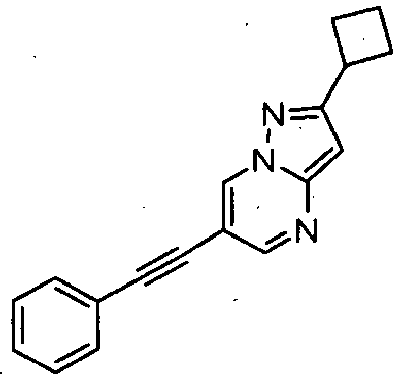
- 2-Cyclobutyl-6-phenylethynyl-pyrazolo[1,5-a]pyrimidine
- 2-tert=Butyl-6-p-tolylethynyl-pyrazolo[1,5-a]pyrimidine
- 2-tert-Butyl-6-(4-chloro-phenylethynyl)-pyrazolo[1,5-a]pyrimidine
- 2-tert-Butyl-6-(6-chloro-pyridin=3-ylethynyl)-pyrazolo[1,5-a]pyrimidine
- 5-(2-tert-Butyl-pyrazolo[1,5-a]pyrimidin-6-ylethynyl)-pyridin-2-ylamine
- 2-tert-Butyl=6-(5-chloro-pyridin-3-ylethynyl)-pyrazolo[1,5-a]pyrimidine
- 2-tert-Butyl-6-pyrimidin-5-ylethynyl-pyrazolo-[1;5-a]pyrimidine
- 2-tert-Butyl-6-(3,4-difluoro-phenylethynyl)-pyrazolo[1,5-a]pyrimidine
- 6-Phenylethynyl-2-(tetrahydro-pyran-4-yl)-pyrazolo[1,5-a]pyrimidine
- 4-(2-tert-Butyl-pyrazolo[1,5-a]pyrimidin-6-ylethynyl)-phenylamine
- 2-(6-Phenyiethynyl-pyrazolo[1,5-a]pyrimidin-2-yl)-propan-2-ol
- 2-tert-Butyl-6-(5-fluoro-pyridin-3-ylethynyl)-pyrazolo[1,5-a]pyrimidine
- 6-Phenylethynyl-pyrazolo[1,5-a]pyrimidine-3-carbonitrile
- 3-(2-tert-Butyl-pyrazolo[1,5-a]pyrimidin-6-ylethynyl)-phenylamine
- 2-(2-tert-Butyl-pyrazolo[1,5-a]pyrimidin-6-ylethynyl)-phenylamine
- 2-tert-Butyl-6-(2,5-difluoro-phenylethynyl)-pyrazolo[1,5-a]pyrimidine or
- 2-Isopropyl-6-phenylethynyl-pyrazolo[1,5-a]pyrimidine.
- A further preferred embodiment of the invention are compounds of formula IB, wherein X is C-R1, Y is N and Z is CH,

- R4
- is a 6-membered aromatic substituent containing 0,1 or 2 nitrogen atoms, optionally substituted by 1 to 3 groups, selected from halogen, lower alkyl, lower alkoxy or NRR';
- R1
- is hydrogen, lower alkyl, lower alkoxy, hydroxy, lower hydroxyalkyl, lower cycloalkyl or is heterocycloalkyl optionally substituted with hydroxy or alkoxy;
- 6-(3-chlorophenylethynyl)-[1,2,4]triazolo[1,5-a]pyridine
- 6-(3-fluorophenylethynyl)-[1,2,4]triazolo[1,5-a]pyridine
- 6-(3-methylphenylefhynyl)-[1;2,4]triazolo[1,5-a]pyridine
- 6-(4-chlorophenylethynyl)-[1,2,4]triazolo[1,5-a]pyridine
- 6-(4-fluorophenylethynyl)-[1,2,4]triazolo[1,5-a]pyridine
- 6-(4-methylphenylethynyl)-[1,2,4]triazolo[1,5-a]pyridine
- 6-(3,4-difluorophenylethynyl)-[1,2,4]triazolo[1,5-a]pyridine
- 6-(2-chlorophenylethynyl)-[1,2,4]triazolo[1,5-a]pyridine and
- 6-(6-methylpyridin-2ylethynyl)-[1,2,4]triazolo[1,5-a]pyridine
- The following compound is encompassed by formula IB:
- 6-Phenylethynyl-[1,2,4]triazolo[1,5-a]pyridine
- 2-tert-Butyl-6-phenylethynyl-[1,2,4]triazolo[1,5-a]pyridine oe
- 2-Methyl-2-(6-phenylethynyl-[1,2,4]triazolo[1,5-a]pyridin-2-yl)-propan-1-ol.
- A further preferred embodiment of the invention are compounds of formula I, wherein X is C-R1 and Y and Z are N.

- R4
- is a 6-membered aromatic substituent containing 0,1 or 2 nitrogen atoms, optionally substituted by 1 to 3 groups, selected from halogen, lower alkyl, lower alkoxy or NOR';
- R1
- is hydrogen, lower alkyl, lower alkoxy, hydroxy, lower hydroxyalkyl, lower cycloalkyl or is heterocycloalkyl optionally substituted with hydroxy or alkoxy;
- The following compound is encompassed by formula IC:
- 6-Phenylethynyl-[1,2,4]triazolo[1,5-a]pyrimidine
- 2-tert-Butyl-6-phenylethynyl-[1,2,4]triAzolo[1,5-a]pyrimidine
- 2-tert-Butyl-6-(2,5-difluoro-phenylethynyl)-[1,2,4]triazolo[1,5-a]pyrimidine
- 2-tert-Butyl-6-(3-fluoro-phenylethynyl)-[1,2,4]triazolo[1,5-a]pyrimidine
- 2-tert-Butyl-6-(3,4-difluoro-phenylethynyl)-[1,2,4]triazolo[1,5-a]pyrimidine
- 2-tert-Butyl-6-(5-chloro-pyridin-3-ylethynyl)-[1,2,4]triazolo[1,5-a]pyrimidine
- 2-Morpholin-4-yl-6-phenylethynyl-[1,2,4]triazolo[1,5-a]pyrimidine
- 2-Morpholin-4-yl-6-m-tolylethynyl-[1,2,4]triazolo[1,5-a]pyrimidine
- 6-(3-Fluoro-phenylethynyl)-2-morpholin-4-yl-[1,2,4]triazolo[1,5-a]pyrimidine
- 6-(3-Chloro-phenylethynyl)-2-morpholin-4-yl-[1,2,4]triazolo[1,5-a]pyrimidine or
- 6-Phenylethynyl-2-pyrrolidin-1-yl-[1,2,4]triazolo[1,5-a]pyrimidine
- A further preferred embodiment of the invention are compounds of formula I, wherein X is C-R1, Y is C-R2 and Z is CH.

- R4
- is a 6-membered aromatic substituent containing 0, 1 or 2 nitrogen atoms, optionally substituted by 1 to 3 groups, selected from halogen, lower alkyl, lower alkoxy or NRR';
- R1
- is hydrogen, lower alkyl, lower alkoxy, hydroxy, lower hydroxyalkyl, lower cycloalkyl or is heterocycloalkyl optionally substituted with hydroxy or alkoxy;
- R2
- is hydrogen, CN, lower alkyl or heterocycloalkyl;
- The following compound is encompassed by formula ID:
- 6-Phenylethynyl-pyrazolo[1,5-a]pyridine or
- 2-tert-Butyl-6-phenylethynyl-pyrazolo[1,5-a]pyridine.
- A further preferred embodiment of the invention are compounds of formula I, wherein X is N, Y is C-R2 and Z is CH.

- R4
- is a 6-membered aromatic substituent containing 0, 1 or 2 nitrogen atoms, optionally substituted by 1 to 3 groups, selected from halogen, lower alkyl, lower alkoxy or NRR';
- R2
- is hydrogen, CN, lower alkyl or heterocycloalkyl;
- The following compound is encompassed by formula IE:
- 6-Phenylethynyl-[1,2,3]triazolo[1,5-a]pyridine.
- The preparation of compounds of formula I of the present invention may be carried out in sequential or convergent synthetic routes. Syntheses of the compounds of the invention are shown in the following schemes 1 to 6. The skills required for carrying out the reaction and purification of the resulting products are known to those skilled in the art. The substituents and indices used in the following description of the processes have the significance given herein before.
- The compounds of formula I can be manufactured by the methods given below, by the methods given in the examples or by analogous methods. Appropriate reaction conditions for the individual reaction steps are known to a person skilled in the art. The reaction sequence is not limited to the one displayed in the schemes, however, depending on the starting materials and their respective reactivity the sequence of reaction steps can be freely altered. Starting materials are either commercially available or can be prepared by methods analogous to the methods given below, by methods described in references cited in the description or in the examples, or by methods known in the art.
- The present compounds of formula I and their pharmaceutically acceptable salts may be prepared by methods, known in the art, for example by the process variants described below, which process comprises
- a) reacting a compound of formula 2


- b) reacting a compound of formula 4
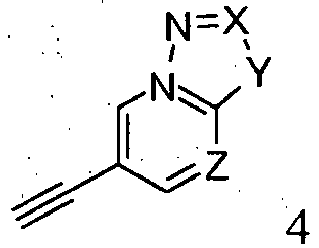
R4-hal 5
To yield a compound of formula I
- c) reacting a compound of formula 6


- The preparation of compounds of formula I is further described in more detail in schemes 1 to 10 and in examples 1 -51.

- A 6-ethynyl-pyrazolo[1,5-a]pyrimidine of formula IA can be obtained by condensation of an appropriately substituted 2-H-pyrazol-3-ylamine 7 and bromomalonaldehyde 8 with paratoluenesulfonic acid monohydrate in a solvent like n-butanol to yield the corresponding 6-bromo-pyrazolo[1,5-a]pyrimidine derivative 9. Sonogashira coupling of the 6-bromopyrazolo[1,5-a]pyrimidine derivative 9 with an appropriately substituted aryl-acetylene 3 yields the desired 6-ethynyl-pyrazolo[1,5-a]pyrimidine of formula IA (scheme 1).

- Alternatively, the intermediate 9 can be reacted in a Sonogashira-coupling with trimethylsilyl acetylene 10 to give the 6-trimethylsilanylethynyl-pyrazolo[1,5-a]pyrimidine derivative 11. Deprotection of the silyl-group with tetrabutylammonium fluoride (1.5mmol on silica gel) in a solvent like dichloromethane yields the corresponding ethynyl derivative 12. Sonogashira coupling of 12 with an appropriately substituted aryl-halogenide yields the desired 6-ethynylpyrazolo[1,5-a]pyrimidine of formula IA (scheme 2). This reaction sequence can alternatively be applied by coupling the trimethylsilanyl derivative 11 with an appropriately substituted acryl halogenide under Sonogashira coupling conditions with simultaneous addition of tetrabutylammonium fluoride which realizes the silyl deprotection in-situ.

- A 6-ethynyl-[1,2,4]triazolo[1,5-a]pyridine of formula IB can be obtained by Sonogashira coupling of an aryl-acetylene 3 with 2-amino-5-iodopyridine 13 to yield the corresponding 5-ethynyl-pyridin-2-ylamine derivative 14. Reaction of 14 with a (1,1-dimethoxy-alkyl)-dimethyl-amine 15 in presence of an acidic catalyst like trifluoroacetic acid and a solvent such as ethanol yields the corresponding amidine 16 , which is treated with hydroxylamine hydrochloride in a solvent such as i-PrOH:THF (5:1 v/v) to give the desired N-hydroxyamidine 17. This compound is cyclized with trifluoroacetic anhydride in a solvent such as THF to give the desired 6-ethynyl-[1,2,4]triazolo[1,5-a]pyridine of formula IB (scheme 3).

- A 6-ethynyl-[1,2,4]triazoto[1,5-a]pyrimidine of formula IC can be obtained similarly by reacting 2-amino-5-bromopyrimidine 18 with a (1,1-dimethoxy-alkyl)-dimethyl-amine 15 in presence of an acidic catalyst like trifluoroacetic acid and a solvent such as ethanol to give the corresponding amidine 19, which is treated with hydroxylamine hydrochloride in a solvent such as i-PrOH:THF (5:1 v/v) to give the N-hydroxyamidine 20. This compound is cyclized with trifluoroacetic anhydride in a solvent such as THF to give the desired 6-ethynyl-[1,2,4]triazolo[1,5-a]pyrimidine of formula IC (scheme 4).

- A 6-ethynyl-pyrazolo[1,5-a]pyridine of formula ID can be obtained by decarboxylation of an appropriately substituted 6-methoxy-pyrazolo[1,5-a]pyridine-3-carboxylic acid ester 22 with hydrobromic acid, yielding the corresponding pyrazolo[1,5-a]pyridin-6-ol derivative 23, which is converted to the triflate derivative 25 using trifluoromethanesulfonic anhydride 24 and a base such as triethylamine in a solvent such as dichloromethane. Sonogashira coupling of 25 with an aryl-acetylene of formula 3 yields the desired 6-ethynyl-pyrazolo[1,5-a]pyridine of formula ID (scheme 5).

- A 6-ethynyl-[1,2,3]triazolo[1,5-a]pyridine of formula IE can be obtained by coupling of an appropriately substituted 5-halopyridine aldehyde or ketone 26 with hydrazine in a solvent such as methanol, followed by oxidation with an oxidizing agent such as manganese dioxide yielding the corresponding 6-bromo-[1,2,3]triazolo[1,5-a]pyridine derivative 27. Sonogashira coupling of 27 with an aryl-acetylene 3 yields the desired 6-ethynyl-[1,2,3]triazolo[1,5-a]pyridine of formula IE (scheme 6).

- A 6=ethynyl-[1,2,4]triazolo[1,5-a]pyridine of formula IB can be obtained by reaction of 2-amino-5-iodopyridine 13 with an appropriately substituted acid chloride 28 in the presence of a base such as Et3N in a solvent like dichloromethane to yield the corresponding N-(5-iodo-pyridih-2-yl)-amide 29. Reaction of 29 with Lawesson's reagent in a solvent like toluene yields the corresponding thioamide 30. Reacting 30 with hydroxylamine hydrochloride and a base such as Et3N in a solvent like EtOH yields the corresponding hydroxyamidine 31 , which is treated with p-TsCl and pyridine in a solvent like toluene to give the desired 6-iodo-[1,2,4]triazolo[1,5-a]pyridine 32. Sonogashira coupling of 27 with an appropriately substituted aryl-acetylene 3 yields the desired 6-ethynyl-[1,2,4]triazolo[1,5-a]pyridine of formula IB (scheme 7).

- A 6-ethynyl-pyrazolo[1,5-a]pyridine of formula ID can be obtained by formation of 1-amino-3-bromo-pyridinium 2,4-dinitro-phenolate 35 from 3-bromopyridine 33 and O-(2,4-dinitro-phenyl)-hydroxylamine 34 in a solvent like acetonitrile. Reacting the pyridinium derivative 35 with an appropriately substituted propynoic acid methyl ester 36 and a base such as K2CO3 in a solvent like DMF yields the corresponding 6-bromo-pyrazolo[1,5-a]pyridine-3-carboxylic acid ester 37, which is decarboxylated with hydrobromic acid, yielding the corresponding 6-bromo-pyrazolo[1,5-a]pyridine derivative 38. Sonogashira coupling of 38 with an appropriately substituted aryl-acetylene 3 yields the desired 6-ethynyl-pyrazolo[1,5-a]pyridine of formula ID (scheme 8).

- A 6-ethynyl-[1,2,4]triazolo[1,5-a]pyrimidine of formula IC can be obtained by condensation of an appropriately substituted 1H-1,2,4-triazol-5-amine 39 with 2-bromomalonaldehyde 40 in AcOH to give the corresponding 6-bromo-[1,2,4]triazolo[1,5-a]pyrimidine 21. Sonogashira coupling of 21 with an appropriately substituted aryl-acetylene 3 yields the desired 6-ethynyl-[1,2,4]triazolo[1,5-a]pyrimidine of formula IC (scheme 9).

- A 6-ethynyl-[1,2,4]triazolo[1,5-a]pyrimidine of formula IC can also be obtained by condensation of an appropriately substituted 1H-1,2,4-triazol-5-amine 39 with 2-bromomalonaldehyde 40 in AcOH to give the corresponding 6-bromo-[1,2,4]triazolo[1,5-a]pyrimidine 21. Sonogashira coupling of 21 with trimethylsilyl acetylene 10 yields the corresponding 6-trimethylsilanylethynyl-[1,2,4]triazolo[1,5-a]pyrimidine 41. Sonogashira coupling with in-situ desilylation of 41 and an appropriately substituted aryl-halogenide 5 yields the desired 6-ethynyl-[1,2,4]triazolo[1,5-a]pyrimidine of formula IC (scheme 10).
- Preferably, the compound of formula I as described herein as well as its pharmaceutically acceptable salt is used in the treatment or prevention of psychosis, epilepsy, schizophrenia, Alzheimer's disease, cognitive disorders and memory deficits, chronic and acute pain, restricted brain function caused by bypass operations or transplants, poor blood supply to the brain, spinal cord injuries, head injuries, hypoxia caused by pregnancy, cardiac arrest and hypoglycaemia, ischemia, Huntington's chorea, amyotrophic lateral sclerosis (ALS), dementia caused by AIDS, eye injuries, retinopathy, idiopathic parkinsonism or parkinsonism caused by medicaments, muscle spasms, convulsions, migraine, urinary incontinence, gastrointestinal reflux disorder, liver damage or failure whether drug or disease induced, Fragile-X syndrom, Down syndrom, autism, nicotine addiction, opiate addiction, anxiety, vomiting, dyskinesia, eating disorders, in particular bulimia or anorexia nervosa, and depressions, particularly for the treatment and prevention of acute and/or chronic neurological disorders, anxiety, the treatment of chronic and acute pain, urinary incontinence and obesity.
- The preferred indications are schizophrenia and cognitive disorders.
- Present invention further relates to the use of a compound of formula I as described herein, as well as its pharmaceutically acceptable salt, for the manufacture of a medicament, preferably for the treatment and prevention of the above-mentioned disorders.
- A monoclonal HEK-293 cell line stably transfected with a cDNA encoding for the human mGlu5a receptor was generated; for the work with mGlu5 Positive Allosteric Modulators (PAMs), a cell line with low receptor expression levels and low constitutive receptor activity was selected to allow the differentiation of agonistic versus PAM activity. Cells were cultured according to standard protocols (Freshney, 2000) in Dulbecco's Modified Eagle Medium with high glucose supplemented with 1 mM glutamine, 10% (vol/vol) heat-inactivated bovine calf serum, Penicillin/Streptomycin, 50 µg/ml hygromycin and 15 µg/ml blasticidin (all cell culture reagents and antibiotics from Invitrogen, Basel, Switzerland).
- About 24 hrs before an experiment, 5x10⁴ cells/well were seeded in poly-D-lysine coated, black/clear-bottomed 96-well plates. The cells were loaded with 2.5 µM Fluo-4AM in loading buffer (1xHBSS, 20 mM HEPES) for 1 hr at 37°C and washed five times with loading buffer. The cells were transferred into a Functional Drug Screening System 7000 (Hamamatsu, Paris, France), and 11 half logarithmic serial dilutions of test compound at 37°C were added and the cells were incubated for 10-30 min. with on-line recording of fluorescence. Following this pre-incubation step, the agonist L-glutamate was added to the cells at a concentration corresponding to EC20 (typically around 80 µM) with on-line recording of fluorescence; in order to account for day-to-day variations in the responsiveness of cells, the EC20 of glutamate was determined immediately ahead of each experiment by recording of a full dose-response curve of glutamate.
- Responses were measured as peak increase in fluorescence minus basal (i.e. fluorescence without addition of L-glutamafe), normalized to the maximal stimulatory effect obtained with saturating concentrations of L-glutamate. Graphs were plotted with the % maximal stimulatory using XLfit, a curve fitting program that iteratively plots the data using Levenburg Marquardt algorithm. The single site competition analysis equation used was y = A + ((B-A)/(1+((x/C)D))), where y is the % maximal stimulatory effect, A is the minimum y, B is the maximum y, C is the EC50, x is the log 10 of the concentration of the competing compound and D is the slope of the curve (the Hill Coefficient). From these curves the EC50 (concentration at which half maximal stimulation was achieved), the Hill coefficient as well as the maximal response in % of the maximal stimulatory effect obtained with saturating concentrations of L-glutamate were calculated.
- Positive signals obtained during the pre-incubation with the PAM test compounds (i.e. before application of an EC20 concentration of L-glutamate) were indicative of an agonistic activity, thy absence of such signals were demonstrating the lack of agonistic activities. A depression of the signal observed after addition of the EC20 concentration of L-glutamate was indicative of an inhibitory activity of the test compound. In the list of examples below are shown the corresponding results for compounds which all have EC50< 500 nM..
Ex. Structure Name EC50 (nM) mGlu5PAM Eff. (%) 1 
6-Phenylethynyl-pyrazolo[1,5-a]pyrimidine 70 116 2 
2-Methyl-6-phenylethynyl-pyrazolo[1,5-a]pyrimidine 49 99 3 
6-(2-Fluoro-phenylethynyl)-2-methyl-pyrazolo[1,5-a]pyrimidine 47 81 4 
6-(3-Fluoro-phenylethynyl)-2-methyl-pyrazolo[1,5-a]pyrimidine 42 77 5 
6-(4-Fluoro-phenylethynyl)-2-methyl-pyrazolo[1,5-a]pyrimidine 78 74 6 
2-Methyl-6-pyridin-4-ylethynyl-pyrazolo[1,5-a]pyrimidine 498 82 7 
2-Methyl-6-p-tolylethynyl-pyrazolo[1,5-a]pyrimidine 132 73 8 
6-(4-Chloro-phenylethynyl)-2-methyl-pyrazolo[1,5-a]pyrimidine 148 69 9 
2-tert-Butyl-6-phenylethynyl-pyrazolo[1,5-a]pyrimidine 5 75 10 
2-tert-Butyl-6-(2-fluoro-phenylethynyl)-pyrazolo[1,5-a]pyrimidine 19 80 11 
2-tert-Butyl-6-(3-fluoro-phenylethynyl)-pyrazolo[1,5-a]pyrimidine 5 86 12 
2-tert-Butyl-6-(4-fluoro-phenylethynyl)-pyrazolo[1,5-a]pyrimidine 7 75 13 
2-tert-Butyl-6-pyridin-3-ylethynyl-pyrazolo[1,5-a]pyrimidine 33 88 14 
2-tert-Butyl-6-pyridin-4-ylethynyl-pyrazolo[1,5-a]pyrimidine 4 37 15 
2-tert-Butyl-6-(4-methoxy-phenylethynyl)-pyrazolo[1,5-a]pyrimidine 68 53 16 
2-tert-Butyl-6-m-tolylethynyl-pyrazolo[1,5-a]pyrimidine 100 50 17 
2-tert-Butyl-6-(3-methoxy-phenylethynyl)-pyrazolo[1,5-a]pyrimidine 104 41 18 
2-Cyclobutyl-6-phenylethynyl-pyrazolo[1,5-a]pyrimidine 182 102 19 
2-tert-Butyl-6-p-tolylethynyl-pyrazolo[1,5-a]pyrimidine 100 68 20 
2-tert-Butyl-6-(4-chloro-phenylethynyl)-pyrazolo[1,5-a]pyrimidine 400 89 21 
2-tert-Butyl-6-(6-chloro-pyridin-3-ylethynyl)-pyrazolo[1,5-a]pyrimidine 183 77 22 
5-(2-tert-Butyl-pyrazolo[1,5-a]pyrimidin-6-ylethynyl)-pyridin-2-ylamine 255 98 23 
2-tert-Butyl-6-(5-chloro-pyridin-3-ylethynyl)-pyrazolo[1,5-a]pymidine 34 59 24 
2-tert-Butyl-6-pyrimidin-5-ylethynyl-pyrazolo[1,5-a]pyrimidine 181 68 25 
2-tert-Butyl-6-(3,4-difluoro-phenylethynyl)-pyrazolo[1,5-a]pyrimidine 45 93 26 
6-Phenylethynyl-2-(tetrahydro-pyran-4-yl)-pyrazolo[1,5-a]pyrimidine 472 124 27 
4-(2-tert-Butyl-pyrazolo[1,5-a]pyrimidin-6-ylethynyl)-phenylamine 41 99 28 
2-(6-Phenylethynyl-pyrazolo[1,5-a]pyrimidin-2-yl)-propan-2-ol 152 59 29 
2-tert-Butyl-6-(5-fluoro-pyridin-3-ylethynyl)-pyrazolo[1,5-a]pyrimidine 161 61 30 
6-Phenylethynyl-pyrazolo[1,5-a]pyrimidine-3-carbonitrile 310 63 31 
6-Phenylethynyl-[1,2,4]triazolo[1,5-a]pyridine 274 123 32 
6-Phenylethynyl-[1,2,4]triazolo[1,5-a]pyrimidine 210 100 33 
6-Phenylethynyl-pyrazolo[1,5=a]pyridine 136 88 34 
6-Phenylethynyl-[1,2,3]triazolo[1,5-a]pyridine 50 77 35 
3-(2-tert-Butyl-pyrazolo[1,5-a]pyrimidin-6-ylethynyl)-phenylamine 37 69 36 
2-(2-tert-Butyl-pyrazolo[1,5-a]pyrimidin-6-ylethynyl)-phenylamine 155 88 37 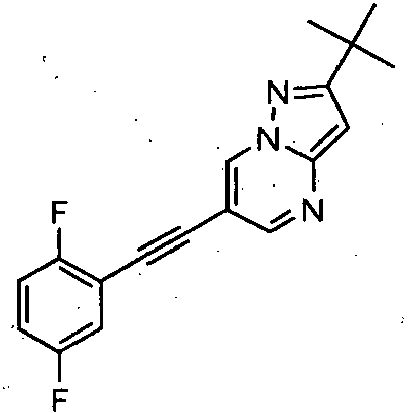
2-tert-Butyl-6-(2,5-difluoro-phenylethyriyl)-pyrazolo[1,5-a]pyrimidine 39 65 38 
2-Isopropyl-6-phenylethynyl-pyrazolo[1,5-a]pyrimidine 18 53 39 
2-tert-Butyl-6-phenylethynyl-[1,2,4]triazolo[1,5-a]pyridine 30 54 40 
2-Methyl-2-(6-phenylethynyl-[1,2,4]triazolo[1,5-a]pyridin-2-yl)-propan-1-ol 66 88 41 
2-tert-Butyl-6-phenylethynyl-pyrazolo[1,5-a]pyridine 32 122 42 
2-tert-Butyl-6-phenylethynyl-[1,2,4]triazolo[1,5-a]pyrimidine 9 73 43 
2-tert-Butyl-6-(2,5-difluoro-phenylethynyl)-[1,2,4]triazolo[1,5-a]pyrimidine 14 37 44 
2-tert-Butyl-6-(3-fluoro-phenylethynyl)-[1,2,4]triazolo[1,5-a]pyrimidine 9 85 45 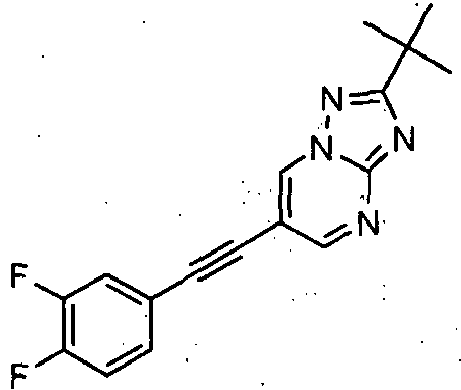
2-tert-Butyl-6-(3,4-difluoro-phenylethynyl)-[1,2,4]triazolo[1,5-a]pyrimidine 28 54 46 
2-tert-Butyl-6-(5-chloro-pyridin-3-ylethynyl)-[1,2,4]triazolo[1,5-a]pyrimidine 47 49 47 
2-Morpholin-4-yl-6-phenylethynyl-[1,2,4]triazolo[1,5-a]pyrimidine 69 119 48 
2-Morpholin-4-yl-6-m-tolylethynyl-[1,2,4]triazolo[1,5-a]pyrimidine 58 84 49 
6-(3-Fluoro-phenylethynyl)-2-morpholin-4-yl-[1,2,4]triazolo[1,5-a]pyrimidine 50 101 50 
6-(3-Chloro-phenylethynyl)-2-morpholin-4-yl-[1,2,4]triazolo[1,5-a]pyrimidine 39 88 51 
6-Phenylethynyl-2-pyrrolidin-1-yl-[1,2,4]triazolo[1,5-a]pyrimidine 56 141 - The compounds of formula (I) and pharmaceutically acceptable salts thereof can be used as medicaments, e.g. in the form of pharmaceutical preparations. The pharmaceutical preparations can be administered orally, e.g. in the form of tablets, coated tablets, dragees, hard and soft gelatine capsules, solutions, emulsions or suspensions. However, the administration can also be effected rectally, e.g. in the form of suppositories, or parenterally, e.g. in the form of injection solutions.
- The compounds of formula (I) and pharmaceutically acceptable salts thereof can be processed with pharmaceutically inert, inorganic or organic carriers for the production of pharmaceutical preparations. Lactose, corn starch or derivatives thereof, talc, stearic acid or its salts and the like can be used, for example, as such carriers for tablets, coated tablets, dragees and hard gelatine capsules. Suitable carriers for soft gelatine capsules are, for example, vegetable oils, waxes, fats, semi-solid and liquid polyols and the like; depending on the nature of the active substance no carriers are, however, usually required in the case of soft gelatine capsules. Suitable carriers for the production of solutions and syrups are, for example, water, polyols, sucrose, invert sugar, glucose and the like. Adjuvants, such as alcohols, polyols, glycerol, vegetable oils and the like, can be used for aqueous injection solutions of water-soluble salts of compounds of formula (I), but as a rule are not necessary. Suitable carriers for suppositories are, for example, natural or hardened oils, waxes, fats, semi-liquid or liquid polyols and the like.
- In addition, the pharmaceutical preparations can contain preservatives, solubilizers, stabilizers, wetting agents, emulsifiers, sweeteners, colorants, flavorants, salts for varying the osmotic pressure, buffers, masking agents or antioxidants. They can also contain still other therapeutically valuable substances.
- As mentioned earlier, medicaments containing a compound of formula (I) or pharmaceutically acceptable salts thereof and a therapeutically inert excipient are also an object of the present invention, as is a process for the production of such medicaments which comprises bringing one or more compounds of formula I or pharmaceutically acceptable salts thereof and, if desired, one or more other therapeutically valuable substances into a galenical dosage form together with one or more therapeutically inert carriers.
- As further mentioned earlier, the use of the compounds of formula (I) for the preparation of medicaments useful in the prevention and/or the treatment of the above recited diseases is also an object of the present invention.
- The dosage can vary within wide limits and will, of course, be fitted to the individual requirements in each particular case. In general, the effective dosage for oral or parenteral administration is between 0.01-20 mg/kg/day, with a dosage of 0.1-10 mg/ kg/day being preferred for all of the indications described. The daily dosage for an adult human being weighing 70 kg accordingly lies between 0.7-1400 mg per day, preferably between 7 and 700 mg per day.
- Tablets of the following composition are produced in a conventional manner:
mg/Tablet Active ingredient 100 Powdered. lactose 95 White corn starch 35 Polyvinylpyrrolidone 8 Na carboxymethylstarch 10 Magnesium stearate 2 Tablet weight 250 -
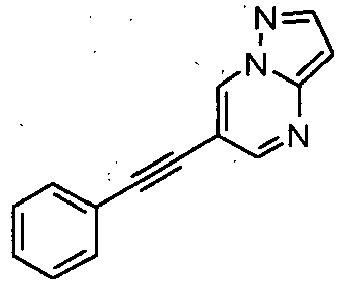
- Bis-(triphenylphosphine)-palladium(II)dichloride (27 mg, 0.04 mmol) was dissolved in 1 ml of THF. 6-Bromo-pyrazolo[1,5-a]pyrimidine (150 mg, 0.76 mmol) and phenylacetylene (130 µl, 1.21 mmol) were added at room temperature. Triethylamine (310 µl, 2.3 mmol), triphenylphosphine (6 mg, 0.023 mmol) and copper(I) iodide (4 mg, 0.023 mmol) were added and the mixture was stirred for 2 hours at 65°C. The reaction mixture was cooled and extracted with saturated NaHCO3 solution and two times with a small volume of dichloromethane. The crude product was purified by flash chromatography by directly loading the dichloromethane layers onto a silica gel column and eluting with heptane:ethyl acetate 100:0 -> 50:50. The desired compound was obtained as a yellow solid (150 mg, 90% yield), MS: m/e = 220.3 (M+H+).
-

- The title compound, white solid, MS: m/e = 234.1 (M+H+), can be prepared in accordance with the general method of example 1 from 6-bromo-2-methylpyrazolo[1,5-a]pyrimidine and phenylacetylene.
-

- The title compound, light yellow solid, MS: m/e = 252.1 (M+H+), can be prepared in accordance with the general method of example 1 from 6-bromo-2-methylpyrazolo[1,5-a]pyrimidine and 1-ethynyl-2-fluoro-benzene.
-

- The title compound, light yellow solid, MS: m/e = 252.2 (M+H+), can be prepared in accordance with the general method of example 1 from 6-bromo-2-methylpyrazolo[1,5-a]pyrimidine and 1-ethynyl-3-fluoro-benzene.
-
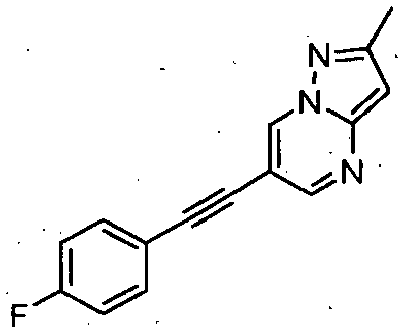
- The title compound, light yellow solid, MS: m/e = 252.1 (M+H+), can be prepared in accordance with the general method of example 1 from 6-bromo-2-methylpyrazolo[1,5-a]pyrimidine and 1-ethynyl-4-fluoro-benzene.
-

- The title compound, light brown solid, MS: m/e = 2-35.1 (M+H+), can be prepared in accordance with the general method of example 1 from 6-bromo-2-methylpyrazolo[1,5-a]pyrimidine and 4-ethynylpyridine.
-

- The title compound, brown solid, MS: m/e = 248.2 (M+H+), can be prepared in accordance with the general method of example 1 from 6-bromo-2-methylpyrazolo[1,5-a]pyrimidine and 4-ethynyltoluene.
-

- The title compound, brown solid, MS: m/e = 268.1 (M+H+), can be prepared in accordance with the general method of example 1 from 6-bromo-2-methylpyrazolo[1,5-a]pyrimidine and 1-chloro-4-ethynylbenzene.
-

-

- 3-tert-Butyl-1H-pyrazol-5-amine (9 g, 64.7 mmol) was dissolved in BuOH (100 ml). 2-Bromomalonaldehyde (9.76 g, 64.7 mmol) and p-TsOH*H2O (615 mg, 3.23 mmol) were added at room temperature. The mixture was stirred for 16 hours at 100 °C. The reaction mixture was evaporated to dryness and the residue was purified by flash chromatography on silica gel (120gr, 0% to 40% EtOAc in heptane) and crystallization with a small volume of diisopropylether. The crystals were washed with diisopropylether and dried for 1 hour at 50°C and <20 mbar. The desired compound was obtained as a light yellow solid (9.5 g, 58 % yield), MS: m/e = 256.1/254.1(M+H+).
- The title compound, light yellow solid, MS: m/e = 276.2 (M+H+), can be prepared in accordance with the general method of example 1 from 6-bromo-2-tert-butyl-pyrazolo[1,5-a]pyrimidine (example 9, step 1) and phenylacetylene.
-

- The title compound, light yellow solid, MS: m/e = 294.2 (M+H+), can be prepared in accordance with the general method of example 1 from 6-bromo-2-tert-butyl-pyrazolo[1,5-a]pyrimidine (example 9, step 1) and 1-ethynyl-2-fluoro-benzene.
-

- The title compound, light yellow solid, MS: m/e = 294.2 (M+H+), can be prepared in accordance with the general method of example 1 from 6-bromo-2-tert-butyl-pyrazolo[1,5-a]pyrimidine (example 9, step 1) and 1-ethynyl-3-fluoro-benzene.
-

- The title compound, light yellow solid, MS: m/e = 294.2 (M+H+), can be prepared in accordance with the general method of example 1 from 6-bromo-2-tert-butyl-pyrazolo[1,5-a]pyrimidine (example 9, step 1) and 1-ethynyl-4-fluoro-benzene.
-

- The title compound, white solid, MS: m/e = 277.2 (M+H+), can be prepared in accordance with the general method of example 1 from 6-bromo-2-tert-butyl-pyrazolo[1,5-a]pyrimidine (example, 9, step 1) and 3-ethynylpyridine.
-

- The title compound, white solid, MS: m/e = 277.1 (M+H+), can be prepared in accordance with the general method of example 1 from 6-bromo-2-tert-butyl-pyrazolo[1,5-a]pyrimidine (example 9, step 1) and 4-ethynylpyridine.
-
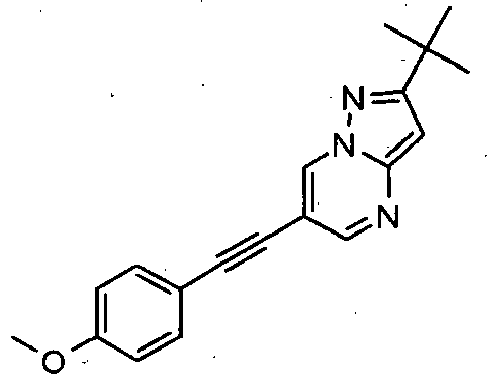
- The title compound, yellow solid, MS: m/e = 306.2 (M+H+), can be prepared in accordance with the general method of example 1 from 6-bromo-2-tert-butyl-pyrazolo[1,5-a]pyrimidine (example 9, step 1) and 1-ethynyl-4-methoxybenzene.
-

- The title compound, yellow solid, MS: m/e = 290.2 (M+H+), can be prepared in accordance with the general method of example 1 from 6-bromo-2-tert-butyl-pyrazolo[1,5-a]pyrimidine (example, 9, step 1) and 1-ethynyl-3-methylbenzene.
-

- The title compound, yellow solid, MS: m/e = 306.2 (M+H+), can be prepared in accordance with the general method of example 1 from 6-bromo-2-tert-butyl-pyrazolo[1,5-a]pyrimidine (example 9, step 1) and 1-ethynyl-3-methoxybenzene.
-
-

- The title compound, yellow solid, MS: m/e = 254.0/252.1 (M+H+), can be prepared in accordance with the general method of example 9, step 1 from 5-cyclobutyl-1H-pyrazol-3-ylamine and 2-bromomalonaldehyde.
- The title compound, light brown solid, MS: m/e = 274.3 (M+H+), can be prepared in accordance with the general method of example 1 from 6-bromo-2-cyclobutyl-pyrazolo[1,5-a]pyrimidine (example 18, step 1) and phenylacetylene.
-

- The title compound, light yellow solid, MS: m/e = 290.2 (M+H+), can be prepared in accordance with the general method of example 1 from 6-bromo-2-tert-butyl-pyrazolo[1,5-a]pyrimidine (example 9, step 1) and 1-ethynyl-4-methylbenzene.
-

- The title compound, light yellow solid, MS: m/e = 310.1 (M+H+), can be prepared in accordance with the general method of example 1 from 6-bromo-2-tert-butyl-pyrazolp[1,5-a]pyrimidine (example 9, step 1) and 1-ethynyl-4-chlorobenzene.
-

-

- The title compound, brown solid, MS: m/e = 272.3 (M+H+), can be prepared in accordance with the general method of example 1 from (6-bromo-2-tert-butyl-pyrazolo[1,5-a]pyrimidine (example 9, step 1) and trimethylsilylacetylene.
-

- 2-tert-Butyl-6-trimethylsilanylethynyl-pyrazolo[1,5-a]pyrimidine (example 21, step 1) (2.4 g, 8.85 mmol) was dissolved in dichloromethane (10 ml) and tetrabutylammoniumfluoride on silica gel (7.1 g, 10.6 mmol, 1.5 mmol/g) was added at room temperature. The mixture was stirred for 2 hours at room temperature and purified by flash chromatography by directly loading the mixture onto a 70g silica gel column and eluting with heptane:ethyl acetate 100:0 -> 40:60. The desired compound was obtained as a light yellow solid (1.45 g, 83% yield), MS: m/e = 200.2 (M+H+).
- The title compound, light yellow solid, MS: m/e = 311.3 (M+H+), can be prepared in accordance with the general method of example 1 from 2-tert-butyl-6-ethynyl-pyrazolo[1,5-a]pyrimidine (example 21, step 2) and 2-chloro-5-iodopyridine.
-
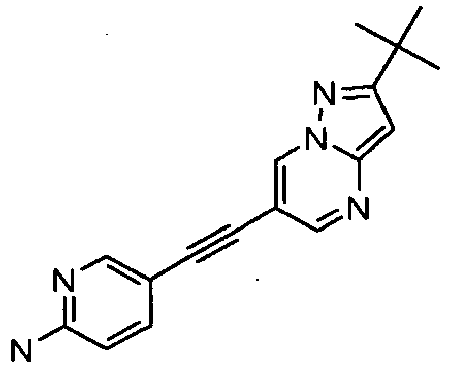
- The title compound, off white solid, MS: m/e = 292.1 (M+H+), can be prepared in accordance with the general method of example 1 from 2-tert-butyl-6-ethynyl-pyrazolo[1,5-a]pyrimidine (example 21, step 2) and 5-iodopyridin-2-amine.
-

- The title compound, light yellow solid, MS: m/e = 311.2 (M+H+), can be prepared in accordance with the general method of example 1 from 2-tert-butyl-6-ethynyl-pyrazolo[1,5-a]pyrimidine (example 21, step 2) and 3-bromo-5-chloropyridine.
-

- The title compound, light yellow solid, MS: m/e = 278.2 (M+H+), can be prepared in accordance with the general method of example 1 from 2-tert-butyl-6-ethynyl-pyrazolo[1,5-a]pyrimidine (example 21, step 2) and 3-bromopyrimidine.
-

- The title compound, light yellow solid, MS: m/e = 312.2 (M+H+), can be prepared in accordance with the general method of example 1 from 2-tert-butyl-6-ethynyl-pyrazolo[1,5-a]pyrimidine (example 21, step 2) and 1,2-difluoro-4-iodobenzene.
-

-

- The title compound can be prepared in accordance with the general method described in the patent application
WO2008001070 (example 114). -

- The title compound, light brown solid, MS: m/e = 284.0 (M+H+), can be prepared in accordance with the general method of example 9, step 1 from 5-(tetrahydro-pyran-4-yl)-2H-pyrazol-3-ylamine (example 26, step 1) and 2-bromomalonaldehyde.
- The title compound, grey solid, MS: m/e = 304.1 (M+H+), can be prepared in accordance with the general method of example 1 from 6-bromo-2-(tetrahydro-pyran-4-yl)-pyrazolo[1,5-a]pyrimidine (example 26, step 2) and phenylacetylene.
-

- The title compound, brown solid, MS: m/e = 291.2 (M+H+), can be prepared in accordance with the general method of example 1 from 6-bromo-2-tert-butyl-pyrazolo[1,5-a]pyrimidine (example, 9, step 1) and 4-ethynylaniline.
-

-

- The title compound, brown solid, MS: m/e = 256.0/254.1 (M+H+), can be prepared in accordance with the general method of example 9, step 1 from methyl 5-amino-1H-pyrazole-3-carboxylate and 2-bromomalonaldehyde.
-
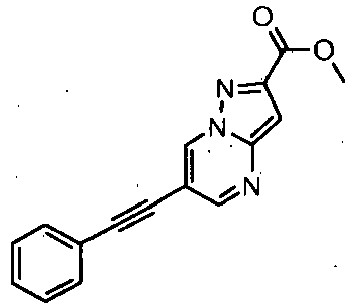
- The title compound, grey solid; MS: m/e = 278.2 (M+H+), can be prepared in accordance with the general method of example 1 from 6-bromo-pyrazolo[1,5-a]pyrimidine-2-carboxylic acid methyl ester (example 28, step 1) and phenylacetylene.
- 6-Phenylethynyl-pyrazolo[1,5-a]pyrimidine-2-carboxylic acid methyl ester (example 28, step 2) (60 mg, 0.22 mmol) was dissolved in 5 ml of THF and cooled to 0-5°C. Methylmagnesium chloride solution (150 µl, 0.45 mmol, 3N in THF) was added dropwise at 0-5°C. The reaction mixture was stirred for 30 minutes at 0-5°C. Water was added and the mixture was extracted two times with ethyl acetate. The organic extracts were dried with sodium sulfate, filtered and evaporated. The crude product was purified by flash chromatography on silica gel (heptane:EtOAc 100:0 -> 70:30) and suspended in Et2O. The desired compound was obtained as a light brown solid (7 mg, 12% yield), MS: m/e = 278.1 (M+H+).
-

- The title compound, light yellow solid, MS: m/e = 295.3 (M+H+), can be prepared in accordance with the general method of example 1 from 2-tert-butyl-6-ethynyl-pyrazolo[1,5-a]pyrimidine (example 21, steep 2) and 3-bromo-5-fluorobenzene.
-

- The title compound, yellow solid, MS: m/e = 245.2 (M+H+), can be prepared in accordance with the general method of example 1 from 6-bromo-pyrazolo(1,5-A)pyrimidine-3-carbonitrile and phenylacetylene.
-

-

- The title compound, light yellow solid, MS: m/e = 195.2 (M+H+), can be prepared in accordance with the general method of example 1 from 2-amino-5-iodopyridine and phenylacetylene.
- The title compound, white solid, MS: m/e = 220.3 (M+H+), can be prepared in accordance with the general method described in the patent application
WO2007059257 (page 109, step A, B and C) starting from 5-phenylethynyl-pyridin-2-ylamine (example 31, step 1). -

-

- The title compound, white solid, MS: m/e = 201.0/199.2 (M+H+), can be prepared in accordance with the general method described in the patent application
WO2007059257 (page 1.09, step A, B and C) starting from 2-amino-5-bromopyrimidine. - The title compound, light brown solid, MS: m/e = 221.2 (M+H+), can be prepared in accordance with the general method of example 1 from 6-bromo-[1,2,4]triazolo[1,5-a]pyrimidine (example, 32, step 1) and phenylacetylene.
-

-

- The title compound, white solid, MS: m/e = 135.1 (M+H+), can be prepared in accordance with the general method described in
EP1972628 . -

- Pyrazolo[1,5-a]pyridin-6-ol (examples 22, step 1) (200 mg, 1.49 mmol) was dissolved in dichloromethane (10 ml) and triethylamine (200 µl, 1.49 mmol) and trifluoromethanesulfonic anhydride (250 µl, 1.49 mmol) were added at 0-5°C. The mixture was stirred for 1 hour at room temperature and extracted then with saturated NaHCO3 solution and two times with dichloromethane. The organic layers were extracted with brine, dried over Na2SO4, filtered and evaporated to dryness. The desired compound was obtained as white solid (400 mg, quantitative), MS: m/e = 267.0 (M+H+).
- The title compound, light yellow solid, MS: m/e = 219.2 (M+H+), can be prepared in accordance with the general method of example 1 from trifluoro-methanesulfonic acid pyrazolo[1,5-a]pyridin-6-yl ester (example 33, step 2) and phenylacetylene.
-

-

- The title compound, light brown solid, MS: m/e = 200.1/198.0 (M+H+), can be prepared in accordance with the general method as described in B. Abarca et al. / Tetrahedron 64 (2008) 3794-3801..
- The title compound, light brown solid, MS: m/e = 220.3 (M+H+), can be prepared in accordance with the general method of example 1 from 6-bromo-[1,2,3]triazolo[1,5-a]pyridine (example 34, step 1) and phenylacetylene.
-

- The title compound, light yellow solid, MS: m/e = 291.2 (M+H+), can be prepared in accordance with the general method of example 1 from 6-bromo-2-tert-butyl-pyrazolo[1,5-a]pyrimidine (example 9, step 1) and 3-ethynylaniline.
-

- The title compound, light yellow solid, MS: m/e = 291.2 (M+H+), can be prepared in accordance with the general method of example 1 from 6-bromo-2-tert-butyl-pyrazolo[1,5-a]pyrimidine (example 9, step 1) and 2-ethynylaniline.
-

- The title compound, a white solid, MS: m/e = 312.2 (M+H+), can be prepared in accordance with the general method of example 1 from 2-tert-butyl-6-ethynyl-pyrazblo[1,5-a]pyrimidine (example 21, step 2) and 1,4-difluoro-2-iodobenzene.
-

-

- The title compound, a light yellow solid, MS: m/e = 240.2/2.42.2 (M+H+), can be prepared in accordance with the general method of example 1, step 1 from 5-isopropyl-2H-pyrazol-3-ylamine.
- The title compound, a brown solid, MS: m/e = 245.2 (M+H+), can be prepared in accordance with the general method of example 1 from 6-bromo-2-isopropyl-pyrazolo[1,5-a]pyrimidine (example 38, step 1) and phenylacetylene.
-

-

- 5-Iodopyridin-2-amine (5 g, 22.7 mmol) was dissolved in 50 ml of dichloromethane and Et3N (6.3 ml, 45.5 mmol, 2 equiv.) was added at room temperature. The mixture was cooled to 0-5°C and pivaloyl chloride (3.4 ml, 27.3 mmol, 1.2 equiv.) was added dropwise. The reaction mixture was stirred for 1 hour at 0-5°C. Saturated NaHCO3-solution was added and the mixture was extracted with dichloromethane. The organic extracts were dried with sodium sulfate, filtered and evaporated to dryness. The desired N-(5-iodopyridin-2-yl)pivalamide (7.34 g, 99.8 % yield) was obtained as a brown oil, MS: m/e = 305.0 (M+H+).
-

- N-(5-Iodo-pyridin-2-yl)-2,2-dimethyl-propionamide (example 39, step 1) (5.8 g, 19.1 mmol) was dissolved in 30 ml of toluene and Lawesson's reagent (7.7 g, 19.1 mmol, 1 equiv.) was added at room temperature. The reaction mixture was stirred for 48 hours at 110°C. The crude product was purified by flash chromatography by directly loading the cooled toluene reaction mixture onto a 300 g silica gel column and eluting with heptane:ethyl acetate 100:0 -> 80:20. The desired N-(5-iodo-pyridin-2-yl)-2,2-dimethyl-thiopropionamide was obtained as a yellow oil (5.1 g, 75% yield), MS: m/e = 321.0 (M+H+).
-

- N-(5-Iodo-pyridin-2-yl)-2,2-dimethyl-thiopropionamide (example 39, step 2) (5.1 g, 15.9 mmol) was dissolved in 50 ml of EtOH and Et3N (2.9, ml, 20.7 mmol, 1.3 equiv.) and hydroxylamine hydrochloride (1.3 g, 19.1 mmol, 1.2 equiv.) were added at room temperature. The mixture was stirred for 2 hours at room temperature. The suspension was diluted with 100 ml of water and filtered. The crystals were washed with water and dried for 2 hours at 50°C and <10 mbar. The desired N-hydroxy-N'-(5-iodo-pyridin-2-yl)-2,2-dimethyl-propionamidine (4.35 g, 86 % yield) was obtained as a white solid, MS: m/e = 319.9 (M+H+).
-

- N-Hydroxy-N'-(5-iodo-pyridin-2-yl)-2,2-dimethyl-propionamidine (example 39, step 3) (2.8 g, 8.77 mmol) was suspended in 15 ml of toluene and pyridine (2.8 ml, 35.1 mmol, 4 equiv.). The mixture was cooled to 0-5°C and p-toluenesulfonyl chloride (6.7 g, 35.1 mmol, 4 equiv.) was added. The reaction mixture was stirred for 1 hour at 0-5°C and 4 hours at room temperature. The reaction mixture was extracted with saturated NaHCO3 solution and two times with a small volume of dichloromethane. The crude product was purified by flash chromatography by directly loading the dichloromethane layers onto a 20 g silica gel column and eluting with heptane:ethyl acetate 100:0 -> 0:100. The desired 2-tert-Uutyl-6-iodo-[1,2,4]triazolo[1,5-a]pyridine (2 g, 76% yield) was obtained as a light yellow oil, MS: m/e = 302.1 (M+H+).
-

- The title compound, a yellow solid, MS: m/e = 276.2 (M+H+), can be prepared in accordance with the general method of example 1 from 2-tert-butyl-6-iodo-[1,2,4]triazolo[1,5-a]pyridine (example 39, step 4) and phenylacetylene.
-

-

- A solution of 3-hydroxy-2,2-dimethyl-propionic acid (1.5 g, 12.69 mmol) in 5 ml of acetyl chloride was heated at 80°C under nitrogen for 2 hours. The excess of acetyl chloride was evaporated under reduced pressure. The resulting residue was dissolved in dichloromethane and washed with water. The organic layer was separated, dried and evaporated to get the desired 3-acetoxy-2,2-dimethyl-propionic acid (1.65 g, 81% yield) as a colorless liquid.
-

- To a solution of acetoxy-2,2-dimethyl-propionic acid (example 40, step 1) (2.2 g, 13.75 mmol)) in CH2Cl2 (25 ml), were added oxalyl chloride (2.62 ml, 27.50mmol) and 2-4 drops of DMF and stirred at 25°C for 3 hours. The solvent was evaporated and the resulting acetic acid 2-chlorocarbonyl-2-methyl-propyl ester (2.4g) was used directly in next step without purification.
-

- The title compound, a white solid, MS: m/e = 363.2 (M+H+), can be prepared in accordance with the general method of example 39, step 1 from 2-amino-5-iodopyridine and acetic acid 2-chlorocarbonyl-2-methyl-propyl ester (examples 40, step 2).
-

- The title compound, MS: m/e = 379.4 (M+H+), can be prepared in accordance with the general method of example 39, step 2 from acetic acid 2-(5-iodo-pyridin-2-ylcarbamoyl)-2-methyl-propyl ester (example 40, step 3).
-

- The title compound, MS: m/e = 378.0 (M+H+), can be prepared in accordance with the general method of example 39, step 3 from acetic acid 2-(5-iodo-pyridin-2-ylthiocarbamoyl)-2-methylpropyl ester (example 40, step 4).
-

- The title compound, a white solid, MS: m/e = 360.0 (M+H+), can be prepared in accordance with the general method of example 39, step 4 from acetic acid 2-[N-hydroxy-N'-(5-iodo-pyridin-2-yl)-carbamimidoyl]-2-methyl-propyl ester (example 40, step 5).
-

- A solution of acetic acid 2-(6-iodo-[1,2,4]triazolo[1,5-a]pyridin-2-yl)-2-methyl-propyl ester (example 40, step 6) (750 mg, 2.09 mmol) and K2CO3 (576 mg, 4.18 mmol), 2 equiv.) in MeOH (8 ml) was stirred at 25°C for 2 hours. The solvent was evaporated and the resulting crude product was purified by column chromatography. The desired 2-(6-iodo-[1,2,4]triazolo[1,5-a]pyridin-2-yl)-2-methyl-propan-1-ol (662 mg, 91% yield) was obtained as a white solid, MS: m/e = 318.0 (M+H+).
-

- The title compound, a brown solid, MS: m/e = 292.0 (M+H+), can be prepared in accordance with the general method of example 1 from 2-(6-iodo-[1,2,4]triazolo[1,5-a]pyridin-2-yl)-2-methyl-propan-1-ol (example 40, step 7) and phenylacetylene.
-

-

- To a solution of 3-bromopyridine (2.3 g, 15.0 mmol) in acetonitrile (4 ml) was added 0-(2,4-dinitro-phenyl)-hydroxylamine (3.0 g, 15.0 mmol, 1 equiv.) and the reaction mixture was stirred at 40°C for 16 hours. Then the solvent was evaporated, the resulting residue was triturated with ether and dried to get the desired 1-amino-3-bromo-pyridinium 2,4-dinitro-phenolate (4.5 g, 85% yield) as a brown solid.
-

- To a solution of 1-amino-3-bromo-pyridinium 2,4-dinitro-phenolate (example 41, step 1) (1.98g, 14.16 mmol)) in DMF (20 ml) were added 4,4-dimethyl-pent-2-ynoic acid methyl ester (CAS 20607-85-6) (5g, 14.16 mmol, 1 equiv.) and K2CO3 (3.9 g, 28.3 mmol, 2 equiv.) and stirred at 25°C while purging air. DMF was completely evaporated, the residue dissolved in ethyl acetate and washed with water (100 ml). The organic extract was dried with sodium sulfate, filtered and evaporated to dryness. The resulting crude product along with the undesired regioisomer 4-bromo-2-tert-butyl-pyrazolo[1,5-a]pyridine-3-carboxylic acid methyl ester was purified by column chromatography. The desired 6-bromo-2-tert-butyl-pyrazolo[1,5-a]pyridine-3-carboxylic acid methyl ester (1.04 g, 24% yield) was obtained as a white solid, MS: m/e = 312.2 (M+H+).
-

- A solution of 6-bromo-2-tert-butyl-pyrazolo[1,5-a]pyridine-3-carboxylic acid methyl ester (example 41, step 2) (1.1g, 3.53 mmol) in H2SO4 (5 ml) and H2O (5 ml) was heated at 80°C for 36 hours. The reaction mixture was neutralized with 2N sodium hydroxide and extracted with ethyl acetate (4x 60 ml). The organic extracts were dried with sodium sulfate, filtered arid evaporated to dryness. The crude product was purified by flash chromatography on silica gel (heptane:EtOAc 95:5 -> 90:10). The desired 6-bromo-2-tert-butyl-pyrazolo[1,5-a]pyridine (370 mg, 38% yield) was obtained as a white solid, MS: m/e = 254.2 (M+H+).
-

- The title compound, a white solid, MS: m/e = 275.4 (M+H+), can be prepared in accordance with the general method of example 1 from 6-bromo-2-tert-butyl-pyrazolo[1,5-a]pyridine (example, 41, step 3) and phenylacetylene.
-

-

- 3-tert-Butyl-1H-1,2,4-triazol-5-amine (CAS 202403-45-0) (35%, 13 g, 32.5 mmol) was dissolved in acetic acid (50 ml) and 2-bromomalonaldehyde (7.35 g, 48.7 mmol, 1.5 equiv.) was added. The reaction mixture was stirred for 3 hours at 60°C. The reaction mixture was evaporated and neutralized with saturated NaHCO3 solution 2N and extracted two times with dichloromethane. The organic extracts were dried with sodium sulfate, filtered and evaporated to dryness. The crude product was purified by flash chromatography on 70 g silica gel (heptane:EtOAc 100:0 → 50:50). The desired 6-bromo-2-tert-butyl-[1,2,4]triazolo[1,5-a]pyrimidine (6.83 g, 83% yield) was obtained as a white solid, MS: m/e = 255.0/257.1 (M+H+).
-

- The title compound, a yellow solid, MS: m/e = 277.1 (M+H+), can be prepared in accordance with the general method of example 1 from 6-bromo-2-tert-butyl-[1,2,4]triazolo[1,5-a]pyrimidine (example 42, step 1) and phenylacetylene.
-

-

- The title compound, a light yellow solid, MS: m/e = 273.3 (M+H+), can be prepared in accordance with the general method of example 1 from 6-bromo-2-tert-butyl-[1,2,4]triazolo[1,5-a]pyrimidine (example 42, step 1) and ethynyl-trimethyl-silane.
-

- 2-tert-Butyl-6-trimethylsilanylethynyl-[1,2,4]triazolo[1,5-a]pyrimidine (example 43, step 1) (100 mg, 0.37 mmol) was dissolved in DMF (1 ml). 1,4-Difluoro-2-iodobenzene (176 mg, 0.73 mmol, 2 equiv.), Et3N (150µl, 1.1 mmol, 3 equiv.), Bis-(triphenylphosphine)-palladium(II)dichloride (13 mg, 0.02 mmol, 0.05 equiv.), triphenylphosphine (3 mg, 0.011 mmol, 0.03 equiv.) and copper(I)iodide (2 mg, 0.011, 0.03 equiv.) were added under nitrogen and the mixture was heated to 80°C. TBAF 1M in THF (440µl, 0.44 mmol, 1.2 equiv.) was added dropwise in 20 minutes at 80°C. The reaction mixture was stirred for 5 minutes at 80°C. The reaction mixture was evaporated and extracted with saturated NaHCO3 solution and two times with a small volume of dichloromethane. The crude product was purified by flash chromatography by directly loading the dichloromethane layers onto a 20 g silica gel column and eluting with heptane:ethyl acetate 100:0 -> 50:50. The desired 2-tert-butyl-6-(2,5-difluoro-phenylethynyl)-[1,2,4]triazolo[1,5-a]pyrimidine (73 mg, 64% yield) was obtained as a light yellow solid, MS: m/e = 313.1 (M+H+).
-

- The title compound, a light yellow solid, MS: m/e = 295.2 (M+H+), can be prepared in accordance with the general method of example 1 from 6-bromo-2-tert-butyl-[1,2,4]triazolo[1,5-a]pyrimidine (example 42, steep 1) and ethynyl-3-fluorobenzene.
-

- The title compound, a light yellow solid, MS: m/e = 313.1 (M+H+), can be prepared in accordance with the general method of example 43, step 2 from 2-tert-butyl-6-trimethylsilanylethynyl-[1,2,4]triazolo[1,5-a]pyrimidine (example 43, step 1) and 3,4-difluoro-4-iodobenzene.
-

- The title compound, a light yellow solid, MS: m/e = 312.2/314.1 (M+H+), can be prepared in accordance with the general method of example 43, step 2 from 2-tert-butyl-6-trimethylsilanylethynyl-[1,2,4]triazolo[1,5-a]pyrimidine (example 43, step 1) and 3-chloro-5-iodopyridine.
-

-

- The title compound, a light yellow solid, MS: m/e = 284.2/286.1 (M+H+), can be prepared in accordance with the general method of example 42, step 1 from 5-morpholin-4-yl-2H-[1,2,4]triazol-3-ylamine (CAS 51420-46-3) and 2-bromomalonaldehyde.
-

- The title compound, a light brown solid, MS: m/e = 306.1 (M+H+), can be prepared in accordance with the general method of example 1 from 6-bromo-2-morpholin-4-yl-[1,2,4]triazolo[1,5-a]pyrimidine (example 47, step 1) and phenylacetylene.
-

- The title compound, a brown solid, MS: m/e = 320.2 (M+H+), can be prepared in accordance with the general method of example 1 from 6-bromo-2-morpholin-4-yl-[1,2,4]triazolo[1,5-a]pyrimidine (example 47, step 1) and ethynyl-3-methylbenzene.
-

- The title compound, a light brown solid, MS: m/e = 324.3 (M+H+), can be prepared in accordance with the general method of example 1 from 6-bromo-2-morpholin-4-yl-[1,2,4]triazolo[1,5-a]pyrimidine (example 47, step 1) and ethynyl-3-fluorobenzene.
-

- The title compound, a light brown solid, MS: m/e = 340.0/342.1 (M+H+), can be prepared in accordance with the general method of example 1 from 6-bromo-2-morpholin-4-yl-[1,2,4]triazolo[1,5-a]pyrimidine (example 47, step 1) and ethynyl-3-chlorobenzene.
-

-

- The title compound, a light red solid, MS: m/e = 268.1/270.1 (M+H+), can be prepared in accordance with the general method of example 42, step 1 from 5-pyrrolidin-1-yl-1H-[1,2,4]triazol-3-ylamine (CAS 154956-89-5) and 2-bromomalonaldehyde.
-

- The title compound, a light brown solid, MS: m/e = 290.2 (M+H+), can be prepared in accordance with the general method of example 1 from 6-bromo-2-pyrrolidin-1-yl-[1,2,4]triazolo[1,5-a]pyrimidine (example 51, step 1) and phenylacetylene.
or to a pharmaceutically acceptable salt or acid addition salt, to a racemic mixture, or to its corresponding enantiomer and/or optical isomer and/or stereoisomer thereof,
with the proviso that the compounds
or a pharmaceutically acceptable acid addition salt, a racemic mixture, or its corresponding enantiomer and/or optical isomer and/or stereoisomer thereof,
with the proviso that the compounds
or a pharmaceutically acceptable acid addition salt, a racemic mixture, or its corresponding enantiomer and/or optical isomer and/or stereoisomer thereof.
or a pharmaceutically acceptable acid addition salt, a racemic mixture, or its corresponding enantiomer and/or optical isomer and/or stereoisomer thereof.
or a pharmaceutically acceptable acid addition salt, a racemic mixture, or its corresponding enantiomer and/or optical isomer and/or stereoisomer thereof.
if desired, converting the compounds obtained into pharmaceutically acceptable acid addition salts.
Claims (15)
- Ethynyl derivatives of formula I
 X is N or C-R1;Y is N or C-R2;Z is CH or N;R4 is a 6-membered aromatic substituent containing 0, 1 or 2 nitrogen atoms, optionally substituted by 1 to 3 groups, selected from halogen, C1-4-alkyl, C1-4-alkoxy orNRR';R1 is hydrogen, C1-4-alkyl, C1-4-alkoxy, hydroxy, C1-4-hydroxyalkyl, C3-7-cycloalkyl or is heterocycloalkyl optionally substituted with hydroxy or C1-4-alkoxy;R2 is hydrogen, CN, C1-4-alkyl or heterocycloalkyl;R and R' are independently from each other hydrogen or C1-4-alkyl;
or a pharmaceutically acceptable salt or acid addition salt, a racemic mixture, or its corresponding enantiomer and/or optical isomer and/or stereoisomer thereof,
with the proviso that the compounds6-(3-chlorophenylethynyl)-[1,2,4]triazolo[1,5-a]pyridine6-(3-fluorophenylethynyl)-[1,2,4]triazolo[1,5-a]pyridine6-(3-methylphenylethynyl)-[1,2,4]triazoto[1,5-a]pyridine6-(4-chlorophenylethynyl)-[1,2,4]triazolo[1,5-a]pyridine6-(4-fluorophenylethynyl)-[1,2,4]triazolo[1,5-a]pyridine6-(4-methylphenylethynyl)-[1,2,4]triazolo[1,5-a]pyridine6-(3,4-difluorophenylethynyl)-[1,2,4]triazolo[1,5-a]pyridine6-(2-chlorophenylethynyl)-[1,2,4]triazolo[1,5-a]pyridine and6-(6-methylpyridin-2ylethynyl)-[1,2,4]triazolo[1,5-a]pyridineare excluded. - Ethynyl derivatives of formula IA according to claim 1 for compounds of formule I, wherein X is C-R1 and Y is C-R2 and Z is N,
 R4 is a 6-membered aromatic substituent containing 0, 1 or 2 nitrogen atoms, optionally substituted by 1 to 3 groups, selected from halogen, C1-4-alkyl, C1-4-alkoxy or NRR';R1 is hydrogen, C1-4-alkyl, C1-4-alkoxy, hydroxy, C1-4-hydroxyalkyl, C3-7-cycloalkyl or is heterocycloalkyl optionally substituted with hydroxy or C1-4-alkoxy;R2 is hydrogen, CN, C1-4-allol or heterocycloalkyl;R and R' are independently from each other hydrogen or C1-4-alkyl;
or a pharmaceutically acceptable acid addition salt, a racemic mixture, or its corresponding enantiomer and/or optical isomer and/or stereoisomer thereof. - Ethynyl derivatives of formula IA according to claim 2, which compounds are6-Phenylethynyl-pyrazolo[1,5-a]pyrimidine2-Methyl-6-phenylethynyl-pyrazolo[1,5-a]pyrimidine6-(2-Fluoro-plienylethynyl)-2-methyl-pyrazolo[1,5-a]pyrimidine6-(3-Fluoro-phenylethynyl)-2-methyl-pyrazolo[1,5-a]pyrimidine6-(4-Fluoro-phenylethynyl)-2-methyl-pyrazolo[1,5-a]pyrimidine2-Methyl-6-pyridin-4-ylethynyl-pyrazolo[1,5-a]pyrimidine2-Methyl-6-p-tolylethynyl-pyrazolo[1,5-a]pyrimidine6-(4-Chloro-phenylethynyl)-2-methyl-pyrazolo[1,5-a]pyrimidine2-tert-Butyl-6-phenylethynyl-pyrazolo[1,5-a]pyrimidine2-tert-Butyl-6-(2-fluoro-phenylethynyl)-pyrazolo[1,5-a]pyrimidine2-tert-Butyl-6-(3-fluoro-phenylethynyl)-pyrazolo[1,5-a]pyrimidine2-tert-Butyl-6-(4-fluoro-phenylethynyl)-pyrazolo[1,5-a]pyrimidine2-tert-Butyl-6-pyridin-3-ylethynyl-pyrazolo[1,5-a]pyrimidine2-tert-Butyl-6-pyridin-4-ylethynyl-pyrazolo[1,5-a]pyrimidine2-tert-Butyl-6-(4-methoxy-phenylethynyl)-pyrazolo[1,5-a]pyrimidine2-tert-Butyl-6-m-tolylethynyl-pyrazolo[,5-a]pyrimidine2-tert-Butyl-6-(3-methoxy-phenylethynyl)-pyrazolo[1,5-a]pyrimidine2-Cyclobutyl-6-phenylethynyl-pyrazolo[1,5-a]pyrimidine2-tert-Butyl-6-p-tolylethynyl-pyrazolo[1,5-a]pyrimidine2-tert-Butyl-6-(4-chloro-phenylethynyl)-pyrazolo[1,5-a]pyrimidine2-tert-Butyl-6-(6-chloro-pyridin-3-ylethynyl)-pyrazolo[1,5-a]pyrimidine5-(2-tert-Butyl-pyrazolo[1,5-a]pyrimidin-6-ylethynyl)-pyridin-2-ylamine2-tert-Butyl-6-(5-chloro-pyridin-3-ylethynyl)-pyrazolo[1,5-a]pyrimidine2-tert-Butyl-6-pyrimidin-5-ylethynyl-pyrazolo[1,5-a]pyrimidine2-tert-Butyl-6-(3,4-difluoro-phenylethynyl)-pyrazolo[1,5-a]pyrimidine6-Phenylethynyl-2-(tetrahydro-pyran-4-yl)-pyrazolo[1,5-a]pyrimidine4-(2-tert-Butyl-pyrazolo[1,5-a]pyrimidin-6-ylethynyl)-phenylamine2-(6-Phenylethynyl-pyrazolo[1,5-a]pyrimidin-2-yl)-propan-2-ol2-tert-Butyl-6-(5-fluoro-pyridin-3-ylethynyl)-pyrazolo[1,5-a]pyrimidine6-Phenylethynyl-pyrazolo[1,5-a]pyrimidine-3-carbonitrile3-(2-tert-Butyl-pyrazolo[1,5-a]pyrimidin-6-ylethynyl)-phenylamine2-(2-tert-Butyl-pyrazolo[1,5-a]pyrimidin-6-ylethynyl)-phenylamine2-tert-Butyl-6-(2,5-difluoro-phenylethynyl)-pyrazolo[1,5-a]pyrimidine or2-Isopropyl-6-phenylethynyl-pyrazolo[1,5-a]pyrimidine.
- Ethynyl derivatives of formula IB according to claim 1 for compounds of formula I, wherein X is C-R1, Y is N and Z is CH,
 R4 is a 6-membered aromatic substituent containing 0, 1 or 2 nitrogen atoms, optionally substituted by 1 to 3 groups, selected from halogen, C1-4-alkyl, C1-4-Alkoxy or NRR';R1 is hydrogen, C1-4-alkyl, C1-4-alkoxy, hydroxy, C1-4-hydroxyalkyl, C3-7-cycloalkyl or is heterocycloalkyl optionally substituted with hydroxy or C1-4-alkoxy;R and R' are independently from each other hydrogen or C1-4-alkyl;
or a pharmaceutically acceptable acid addition salt, a racemic mixture, or its corresponding enantiomer and/or optical isomer and/or stereoisomer thereof,
with the proviso that the compounds6-(3-chlorophenylethynyl)-[1,2,4]triazolo[1,5-a]pyridine6-(3-fluorophenylethynyl)-[1,2,4]triazolo[1,5-a]pyridine6-(3-methylphenylethynyl)-[1,2,4]triazolo[1,5-a]pyridine6-(4-chlorophenylethynyl)-[1,2,4]triazolo[1,5-a]pyridine6-(4-fluorophenylethynyl)-[1,2,4]triazolo[1,5-a]pyridine6-(4-methylphenylethynyl)-[1,2,4]triazolo[1,5-a]pyridine6-(3,4-difluorophenylethynyl)-[1,2,4]triazolo[1,5-a]pyridine6-(2-chlorophenylethynyl)-[1,2,4]triazolo[1,5-a]pyridine and6-(6-methylpyridin-2ylethynyl)-[1,2,4]triazolo[1,5-a]pyridineare excluded. - Ethynyl derivatives of formula IB according to claim 4, which compound is 6-Phenylethynyl-[1,2,4]triazolo[1,5-a]pyridine 2-tert-Butyl-6-phenylethynyl-[1,2,4]triazolo[1,5-a]pyridine or 2-Methyl-2-(6-phenylethynyl-[1,2,4]triazolo[1,5-a]pyridin-2-yl)-propan-1-ol.
- Ethynyl derivatives of formula IC according to claim 1 for compounds of formula I, wherein X is C-R1 and Y and Z are N
 R4 is a 6-membered aromatic substituent containing 0, 1 or 2 nitrogen atoms, optionally substituted by 1 to 3 groups, selected from halogen, C1-4-alkyl, C1-4-alkoxy or NRR';R1 is hydrogen, C1-4-alkyl, C1-4-alkoxy, hydroxy, C1-4-hydroxyalkyl, C3-7-cycloalkyl or is heterocycloalkyl optionally substituted with hydroxy or C1-4-alkoxy;R and R' are independently from each other hydrogen or C1-4-alkyl;
or a pharmaceutically acceptable acid addition salt, a racemic mixture, or its corresponding enantiomer and/or optical isomer and/or stereoisomer thereof. - Ethynyl derivatives of formula IC according to claim 6, which compound is6-Phenylethynyl-[1,2,4]triazolo[1;5-a]pyrimidine2-tert-Butyl-6-phenylethynyl-[1,2,4]triazolo[1,5-a]pyrimidine2-tert-t-Butyl-6-(2,5-difluoro-phenylethynyl)-[1,2,4]triazolo[1,5-a]pyrimidine2-tert-Butyl-6-(3-fluoro-phenylethynyl)-[1,2,4]triazolo[1,5-a]pyrimidine2-tert-Butyl-6-(3,4-difluoro-phenylethynyl)-[1,2,4]triazolo[1,5-a]pyrimidine2-tert-Butyl-6-(5-chloro-pyridin-3-ylethynyl)-[1,2,4]triazolo[1,5-a]pyrimidine2-Morpholin-4-yl-6-phenylethynyl-[1,2,4]triazolo[1,5-a]pyrimidine2-Morpholin-4-yl-6-m-tolylethynyl-(1,2,4]triazolo[1,5-a]pyrimidine6-(3-Fluoro-phenylethynyl)-2-morpholin-4-yl-[1,2,4]triazolo[1,5-a]pyrimidine6-(3-Chloro-phenylethynyl)-2-morpholin-4-yl-[1,2,4]triazolo[1,5-a]pyrimidine or6-Phenylethynyl-2-pyrrolidin-1-yl-[1,2,4]triazolo[1,5-a]pyrimidine.
- Ethynyl derivatives of formula ID according to claim 1 for compounds of formula I, wherein X is C-R1, Y is C-R2 and Z is CM.
 R4 is a 6-membered aromatic substituent containing 0, 1 or 2 nitrogen atoms, optionally substituted by 1 to 3 groups, selected from halogen, C1-4-alkyl, C1-4-alkoxy or NRR';R1 is hydrogen, C1-4-alkyl, C1-4-alkoxy, hydroxy, C1-4-hydroxyalkyl, C3-7-cycloalkyl or is heterocycloalkyl optionally substituted with hydroxy or C1-4-alkoxy;R2 is hydrogen, CN, C1-4-alkyl or heterocycloalkyl;R and R' are independently from each other hydrogen or C1-4-alkyl;
or a pharmaceutically acceptable acid addition salt, a racemic mixture, or its corresponding enantiomer and/or optical isomer and/or stereoisomer thereof. - Ethynyl derivatives of formula ID according to claim 8, which compound is 6-Phenylethynyl-pyrazolo[1,5-a]pyridine or
2-tert-Butyl-6-phenylethynyl-pyrazolo[1,5-a]pyridine. - Ethynyl derivatives of formula IE according to claim 1 for compounds of formula I, wherein X is N, Y is C-R2 and Z is CH.
 R4 is a 6-membered aromatic substituent containing 0, 1 or 2 nitrogen atoms, optionally substituted by 1 to 3 groups, selected from halogen, C1-4-alkyl, C1-4-alkoxy or NRR';R2 is hydrogen, CN,C1-4-alkyl or heterocycloalkyl;R and R' are independently from each other hydrogen or C1-4-alkyl;
or a pharmaceutically acceptable acid addition salt, a racemic mixture, or its corresponding enantiomer and/or optical isomer and/or stereoisomer thereof. - Ethynyl derivatives of formula IE according to claim 10, which compound is 6-Phenylethynyl-[1,2,3]triazolo[1,5-a]pyridine.
- A compound according to any one of claims 1 - 11 for use as therapeutically active substance.
- A pharmaceutical composition comprising at least one of the compounds according to claims 1 to 11 as well as its pharmaceutically acceptable salt and a therapeutically inert carrier.
- The use of a compound according to any one of claims 1 to 11 as well as its pharmaceutically acceptable salt for the manufacture of a medicament for the treatment or prevention of diseases relating to positive allosteric modulators of mGluR5 receptor.
- The use of a compound according to claim 14 for the manufacture of a medicament for the treatment or prevention of schizophrenia or cognitive diseases.
Priority Applications (1)
| Application Number | Priority Date | Filing Date | Title |
|---|---|---|---|
| EP10790960.8A EP2513102B1 (en) | 2009-12-17 | 2010-12-14 | Ethynyl derivatives |
Applications Claiming Priority (3)
| Application Number | Priority Date | Filing Date | Title |
|---|---|---|---|
| EP09179719 | 2009-12-17 | ||
| PCT/EP2010/069593 WO2011073172A1 (en) | 2009-12-17 | 2010-12-14 | Ethynyl derivatives |
| EP10790960.8A EP2513102B1 (en) | 2009-12-17 | 2010-12-14 | Ethynyl derivatives |
Publications (2)
| Publication Number | Publication Date |
|---|---|
| EP2513102A1 EP2513102A1 (en) | 2012-10-24 |
| EP2513102B1 true EP2513102B1 (en) | 2015-08-19 |
Family
ID=43446449
Family Applications (1)
| Application Number | Title | Priority Date | Filing Date |
|---|---|---|---|
| EP10790960.8A Not-in-force EP2513102B1 (en) | 2009-12-17 | 2010-12-14 | Ethynyl derivatives |
Country Status (27)
| Country | Link |
|---|---|
| US (2) | US8586581B2 (en) |
| EP (1) | EP2513102B1 (en) |
| JP (1) | JP5763094B2 (en) |
| KR (1) | KR101407856B1 (en) |
| CN (1) | CN102686589B (en) |
| AR (1) | AR079467A1 (en) |
| AU (1) | AU2010332987B2 (en) |
| BR (1) | BR112012014770A2 (en) |
| CA (1) | CA2780155A1 (en) |
| CL (1) | CL2012001596A1 (en) |
| CO (1) | CO6531478A2 (en) |
| CR (1) | CR20120269A (en) |
| EC (1) | ECSP12011977A (en) |
| ES (1) | ES2551582T3 (en) |
| IL (1) | IL219371A (en) |
| MA (1) | MA33802B1 (en) |
| MX (1) | MX2012006789A (en) |
| MY (1) | MY162998A (en) |
| NZ (1) | NZ599553A (en) |
| PE (1) | PE20121443A1 (en) |
| PH (1) | PH12012500867A1 (en) |
| RU (1) | RU2553461C2 (en) |
| SG (1) | SG181779A1 (en) |
| TW (1) | TWI448465B (en) |
| UA (1) | UA107002C2 (en) |
| WO (1) | WO2011073172A1 (en) |
| ZA (1) | ZA201204429B (en) |
Families Citing this family (11)
| Publication number | Priority date | Publication date | Assignee | Title |
|---|---|---|---|---|
| ES2689956T3 (en) * | 2010-11-05 | 2018-11-16 | Oat Agrio Co., Ltd. | Compound of ethinylphenylamine or salt thereof, procedure to produce the same and fungicide for agricultural and horticultural use |
| KR101554803B1 (en) | 2011-04-26 | 2015-09-21 | 에프. 호프만-라 로슈 아게 | Ethynyl derivatives as positive allosteric modulators of the mglur5 |
| US20130123254A1 (en) | 2011-09-30 | 2013-05-16 | Barbara Biemans | Pharmaceutically acceptable mglur5 positive allosteric modulators and their methods of identification |
| UA110862C2 (en) * | 2011-10-07 | 2016-02-25 | Ф. Хоффманн-Ля Рош Аг | Ethinyl derivatives as allosteric modulators of metabotropic glutamate receptor 5 mglur |
| PE20150708A1 (en) * | 2012-09-27 | 2015-05-15 | Hoffmann La Roche | ARYLETINYL DERIVATIVES |
| EA026941B1 (en) * | 2012-10-18 | 2017-06-30 | Ф. Хоффманн-Ля Рош Аг | ETHYNYL DERIVATIVES AS MODULATORS OF mGluR5 RECEPTOR ACTIVITY |
| MX2015005375A (en) * | 2012-11-07 | 2015-07-21 | Hoffmann La Roche | Triazolo compounds. |
| HRP20200638T1 (en) | 2015-06-03 | 2020-07-10 | F. Hoffmann - La Roche Ag | ETHYNYL DERIVATIVES |
| ES2733468T3 (en) | 2015-07-15 | 2019-11-29 | Hoffmann La Roche | Ethinyl derivatives as modulators of metabotropic glutamate receptors |
| SI3484889T1 (en) | 2016-07-18 | 2020-11-30 | F. Hoffmann-La Roche Ag | Ethynyl derivatives |
| WO2026072192A1 (en) | 2024-09-27 | 2026-04-02 | Alto Neuroscience, Inc. | Effective treatment of depression in patients having poor cognition or impaired learning and/or memory with a mglur5 positive allosteric modulator |
Family Cites Families (18)
| Publication number | Priority date | Publication date | Assignee | Title |
|---|---|---|---|---|
| NZ510743A (en) * | 1998-10-02 | 2003-10-31 | Novartis Ag | mGluR5 antagonists for the treatment of pain and anxiety |
| CO5271680A1 (en) * | 2000-02-21 | 2003-04-30 | Smithkline Beecham Corp | COMPOUNDS |
| GB0027987D0 (en) | 2000-11-16 | 2001-01-03 | Smithkline Beecham Plc | Compounds |
| US6910976B2 (en) | 2001-06-26 | 2005-06-28 | Stx, Llc | Multi-component lacrosse stick head |
| GB0127433D0 (en) * | 2001-11-15 | 2002-01-09 | Smithkline Beecham Corp | Compounds |
| GB0127430D0 (en) * | 2001-11-15 | 2002-01-09 | Smithkline Beecham Corp | Compounds |
| TWI292318B (en) * | 2003-03-10 | 2008-01-11 | Hoffmann La Roche | Imidazol-4-yl-ethynyl-pyridine derivatives |
| GB0325956D0 (en) | 2003-11-06 | 2003-12-10 | Addex Pharmaceuticals Sa | Novel compounds |
| GB0413605D0 (en) | 2004-06-17 | 2004-07-21 | Addex Pharmaceuticals Sa | Novel compounds |
| WO2006048771A1 (en) | 2004-11-04 | 2006-05-11 | Addex Pharmaceuticals Sa | Novel tetrazole derivatives as positive allosteric modulators of metabotropic glutamate receptors |
| GB0510139D0 (en) | 2005-05-18 | 2005-06-22 | Addex Pharmaceuticals Sa | Novel compounds B1 |
| JP2008542323A (en) * | 2005-06-01 | 2008-11-27 | ユセベ ファルマ ソシエテ アノニム | 2-Oxo-1-pyrrolidine derivatives, process for producing the same and use thereof |
| CA2755268C (en) | 2005-11-15 | 2013-12-31 | Array Biopharma, Inc. | Erbb inhibitors |
| MX2008016523A (en) | 2006-06-30 | 2009-01-19 | Astrazeneca Ab | Pyrimidine derivatives useful in the treatment of cancer. |
| EP1972628A1 (en) | 2007-03-21 | 2008-09-24 | Schwarz Pharma Ag | Indolizines and aza-analog derivatives thereof as CNS active compounds |
| CA2685524A1 (en) * | 2007-04-30 | 2008-11-06 | Abbott Laboratories | Inhibitors of diacylglycerol o-acyltransferase type 1 enzyme |
| NZ581817A (en) | 2007-06-03 | 2012-05-25 | Univ Vanderbilt | Benzamide mglur5 positive allosteric modulators and methods of making and using same |
| TW201116532A (en) * | 2009-08-05 | 2011-05-16 | Merz Pharma Gmbh & Co Kgaa | Metabotropic glutamate receptor modulators |
-
2010
- 2010-12-10 US US12/964,785 patent/US8586581B2/en not_active Expired - Fee Related
- 2010-12-14 MY MYPI2012002710A patent/MY162998A/en unknown
- 2010-12-14 RU RU2012128551/04A patent/RU2553461C2/en not_active IP Right Cessation
- 2010-12-14 PH PH1/2012/500867A patent/PH12012500867A1/en unknown
- 2010-12-14 SG SG2012044814A patent/SG181779A1/en unknown
- 2010-12-14 NZ NZ599553A patent/NZ599553A/en not_active IP Right Cessation
- 2010-12-14 TW TW099143811A patent/TWI448465B/en not_active IP Right Cessation
- 2010-12-14 CA CA2780155A patent/CA2780155A1/en not_active Abandoned
- 2010-12-14 PE PE2012000817A patent/PE20121443A1/en not_active Application Discontinuation
- 2010-12-14 AU AU2010332987A patent/AU2010332987B2/en not_active Ceased
- 2010-12-14 WO PCT/EP2010/069593 patent/WO2011073172A1/en not_active Ceased
- 2010-12-14 UA UAA201207427A patent/UA107002C2/en unknown
- 2010-12-14 EP EP10790960.8A patent/EP2513102B1/en not_active Not-in-force
- 2010-12-14 BR BR112012014770A patent/BR112012014770A2/en not_active Application Discontinuation
- 2010-12-14 ES ES10790960.8T patent/ES2551582T3/en active Active
- 2010-12-14 JP JP2012543676A patent/JP5763094B2/en not_active Expired - Fee Related
- 2010-12-14 KR KR1020127018589A patent/KR101407856B1/en not_active Expired - Fee Related
- 2010-12-14 MX MX2012006789A patent/MX2012006789A/en active IP Right Grant
- 2010-12-14 CN CN201080057081.9A patent/CN102686589B/en not_active Expired - Fee Related
- 2010-12-15 AR ARP100104641A patent/AR079467A1/en unknown
-
2012
- 2012-04-23 IL IL219371A patent/IL219371A/en not_active IP Right Cessation
- 2012-04-25 CO CO12068169A patent/CO6531478A2/en active IP Right Grant
- 2012-05-22 CR CR20120269A patent/CR20120269A/en unknown
- 2012-05-24 MA MA34890A patent/MA33802B1/en unknown
- 2012-06-14 CL CL2012001596A patent/CL2012001596A1/en unknown
- 2012-06-15 ZA ZA2012/04429A patent/ZA201204429B/en unknown
- 2012-06-15 EC ECSP12011977 patent/ECSP12011977A/en unknown
-
2013
- 2013-10-16 US US14/055,047 patent/US8933094B2/en not_active Expired - Fee Related
Also Published As
Similar Documents
| Publication | Publication Date | Title |
|---|---|---|
| AU2010332987B2 (en) | Ethynyl derivatives | |
| EP2558457B1 (en) | Arylethynyl derivatives | |
| EP2763977B1 (en) | Ethynyl derivatives as mglur5 allosteric modulators | |
| EP1761541B1 (en) | Pyrrazolo-pyrimidine derivatives | |
| EP2699547B1 (en) | 5-(phenyl/pyridinyl-ethinyl)-2-pyridine/2-pyrimidine-carborxamides as mglur5 modulators | |
| EP2702050B1 (en) | Pyrazolidin-3-one derivatives | |
| EP3049409B1 (en) | Ethynyl derivatives | |
| EP2763969B1 (en) | Ethynyl derivatives as metabotropic glutamate receptor modulators | |
| US9328090B2 (en) | Arylethynyl derivatives | |
| AU2012320509B8 (en) | Ethynyl derivatives as metabotropic glutamate receptor modulators | |
| HK1171225B (en) | Ethynyl derivatives | |
| EP4556478A1 (en) | Tgf-beta inhibitor compound and use thereof | |
| NZ614883B2 (en) | Pyrazolidin-3-one derivatives |
Legal Events
| Date | Code | Title | Description |
|---|---|---|---|
| PUAI | Public reference made under article 153(3) epc to a published international application that has entered the european phase |
Free format text: ORIGINAL CODE: 0009012 |
|
| 17P | Request for examination filed |
Effective date: 20120717 |
|
| AK | Designated contracting states |
Kind code of ref document: A1 Designated state(s): AL AT BE BG CH CY CZ DE DK EE ES FI FR GB GR HR HU IE IS IT LI LT LU LV MC MK MT NL NO PL PT RO RS SE SI SK SM TR |
|
| DAX | Request for extension of the european patent (deleted) | ||
| 17Q | First examination report despatched |
Effective date: 20130604 |
|
| GRAP | Despatch of communication of intention to grant a patent |
Free format text: ORIGINAL CODE: EPIDOSNIGR1 |
|
| INTG | Intention to grant announced |
Effective date: 20150323 |
|
| GRAS | Grant fee paid |
Free format text: ORIGINAL CODE: EPIDOSNIGR3 |
|
| GRAA | (expected) grant |
Free format text: ORIGINAL CODE: 0009210 |
|
| AK | Designated contracting states |
Kind code of ref document: B1 Designated state(s): AL AT BE BG CH CY CZ DE DK EE ES FI FR GB GR HR HU IE IS IT LI LT LU LV MC MK MT NL NO PL PT RO RS SE SI SK SM TR |
|
| REG | Reference to a national code |
Ref country code: GB Ref legal event code: FG4D |
|
| REG | Reference to a national code |
Ref country code: CH Ref legal event code: EP |
|
| REG | Reference to a national code |
Ref country code: IE Ref legal event code: FG4D |
|
| REG | Reference to a national code |
Ref country code: AT Ref legal event code: REF Ref document number: 743731 Country of ref document: AT Kind code of ref document: T Effective date: 20150915 |
|
| REG | Reference to a national code |
Ref country code: DE Ref legal event code: R096 Ref document number: 602010026867 Country of ref document: DE |
|
| REG | Reference to a national code |
Ref country code: ES Ref legal event code: FG2A Ref document number: 2551582 Country of ref document: ES Kind code of ref document: T3 Effective date: 20151120 |
|
| REG | Reference to a national code |
Ref country code: FR Ref legal event code: PLFP Year of fee payment: 6 |
|
| REG | Reference to a national code |
Ref country code: AT Ref legal event code: MK05 Ref document number: 743731 Country of ref document: AT Kind code of ref document: T Effective date: 20150819 |
|
| REG | Reference to a national code |
Ref country code: LT Ref legal event code: MG4D |
|
| REG | Reference to a national code |
Ref country code: NL Ref legal event code: MP Effective date: 20150819 |
|
| PG25 | Lapsed in a contracting state [announced via postgrant information from national office to epo] |
Ref country code: LV Free format text: LAPSE BECAUSE OF FAILURE TO SUBMIT A TRANSLATION OF THE DESCRIPTION OR TO PAY THE FEE WITHIN THE PRESCRIBED TIME-LIMIT Effective date: 20150819 Ref country code: NO Free format text: LAPSE BECAUSE OF FAILURE TO SUBMIT A TRANSLATION OF THE DESCRIPTION OR TO PAY THE FEE WITHIN THE PRESCRIBED TIME-LIMIT Effective date: 20151119 Ref country code: GR Free format text: LAPSE BECAUSE OF FAILURE TO SUBMIT A TRANSLATION OF THE DESCRIPTION OR TO PAY THE FEE WITHIN THE PRESCRIBED TIME-LIMIT Effective date: 20151120 Ref country code: FI Free format text: LAPSE BECAUSE OF FAILURE TO SUBMIT A TRANSLATION OF THE DESCRIPTION OR TO PAY THE FEE WITHIN THE PRESCRIBED TIME-LIMIT Effective date: 20150819 Ref country code: LT Free format text: LAPSE BECAUSE OF FAILURE TO SUBMIT A TRANSLATION OF THE DESCRIPTION OR TO PAY THE FEE WITHIN THE PRESCRIBED TIME-LIMIT Effective date: 20150819 |
|
| PG25 | Lapsed in a contracting state [announced via postgrant information from national office to epo] |
Ref country code: AT Free format text: LAPSE BECAUSE OF FAILURE TO SUBMIT A TRANSLATION OF THE DESCRIPTION OR TO PAY THE FEE WITHIN THE PRESCRIBED TIME-LIMIT Effective date: 20150819 Ref country code: IS Free format text: LAPSE BECAUSE OF FAILURE TO SUBMIT A TRANSLATION OF THE DESCRIPTION OR TO PAY THE FEE WITHIN THE PRESCRIBED TIME-LIMIT Effective date: 20151219 Ref country code: PT Free format text: LAPSE BECAUSE OF FAILURE TO SUBMIT A TRANSLATION OF THE DESCRIPTION OR TO PAY THE FEE WITHIN THE PRESCRIBED TIME-LIMIT Effective date: 20151221 Ref country code: RS Free format text: LAPSE BECAUSE OF FAILURE TO SUBMIT A TRANSLATION OF THE DESCRIPTION OR TO PAY THE FEE WITHIN THE PRESCRIBED TIME-LIMIT Effective date: 20150819 Ref country code: SE Free format text: LAPSE BECAUSE OF FAILURE TO SUBMIT A TRANSLATION OF THE DESCRIPTION OR TO PAY THE FEE WITHIN THE PRESCRIBED TIME-LIMIT Effective date: 20150819 Ref country code: PL Free format text: LAPSE BECAUSE OF FAILURE TO SUBMIT A TRANSLATION OF THE DESCRIPTION OR TO PAY THE FEE WITHIN THE PRESCRIBED TIME-LIMIT Effective date: 20150819 |
|
| PG25 | Lapsed in a contracting state [announced via postgrant information from national office to epo] |
Ref country code: NL Free format text: LAPSE BECAUSE OF FAILURE TO SUBMIT A TRANSLATION OF THE DESCRIPTION OR TO PAY THE FEE WITHIN THE PRESCRIBED TIME-LIMIT Effective date: 20150819 |
|
| PG25 | Lapsed in a contracting state [announced via postgrant information from national office to epo] |
Ref country code: EE Free format text: LAPSE BECAUSE OF FAILURE TO SUBMIT A TRANSLATION OF THE DESCRIPTION OR TO PAY THE FEE WITHIN THE PRESCRIBED TIME-LIMIT Effective date: 20150819 Ref country code: CZ Free format text: LAPSE BECAUSE OF FAILURE TO SUBMIT A TRANSLATION OF THE DESCRIPTION OR TO PAY THE FEE WITHIN THE PRESCRIBED TIME-LIMIT Effective date: 20150819 Ref country code: DK Free format text: LAPSE BECAUSE OF FAILURE TO SUBMIT A TRANSLATION OF THE DESCRIPTION OR TO PAY THE FEE WITHIN THE PRESCRIBED TIME-LIMIT Effective date: 20150819 Ref country code: SK Free format text: LAPSE BECAUSE OF FAILURE TO SUBMIT A TRANSLATION OF THE DESCRIPTION OR TO PAY THE FEE WITHIN THE PRESCRIBED TIME-LIMIT Effective date: 20150819 |
|
| REG | Reference to a national code |
Ref country code: DE Ref legal event code: R097 Ref document number: 602010026867 Country of ref document: DE |
|
| PG25 | Lapsed in a contracting state [announced via postgrant information from national office to epo] |
Ref country code: BE Free format text: LAPSE BECAUSE OF NON-PAYMENT OF DUE FEES Effective date: 20151231 Ref country code: RO Free format text: LAPSE BECAUSE OF FAILURE TO SUBMIT A TRANSLATION OF THE DESCRIPTION OR TO PAY THE FEE WITHIN THE PRESCRIBED TIME-LIMIT Effective date: 20150819 |
|
| PLBE | No opposition filed within time limit |
Free format text: ORIGINAL CODE: 0009261 |
|
| STAA | Information on the status of an ep patent application or granted ep patent |
Free format text: STATUS: NO OPPOSITION FILED WITHIN TIME LIMIT |
|
| 26N | No opposition filed |
Effective date: 20160520 |
|
| PG25 | Lapsed in a contracting state [announced via postgrant information from national office to epo] |
Ref country code: LU Free format text: LAPSE BECAUSE OF FAILURE TO SUBMIT A TRANSLATION OF THE DESCRIPTION OR TO PAY THE FEE WITHIN THE PRESCRIBED TIME-LIMIT Effective date: 20151214 Ref country code: MC Free format text: LAPSE BECAUSE OF FAILURE TO SUBMIT A TRANSLATION OF THE DESCRIPTION OR TO PAY THE FEE WITHIN THE PRESCRIBED TIME-LIMIT Effective date: 20150819 |
|
| PG25 | Lapsed in a contracting state [announced via postgrant information from national office to epo] |
Ref country code: SI Free format text: LAPSE BECAUSE OF FAILURE TO SUBMIT A TRANSLATION OF THE DESCRIPTION OR TO PAY THE FEE WITHIN THE PRESCRIBED TIME-LIMIT Effective date: 20150819 |
|
| REG | Reference to a national code |
Ref country code: IE Ref legal event code: MM4A |
|
| PG25 | Lapsed in a contracting state [announced via postgrant information from national office to epo] |
Ref country code: IE Free format text: LAPSE BECAUSE OF NON-PAYMENT OF DUE FEES Effective date: 20151214 |
|
| REG | Reference to a national code |
Ref country code: FR Ref legal event code: PLFP Year of fee payment: 7 |
|
| PG25 | Lapsed in a contracting state [announced via postgrant information from national office to epo] |
Ref country code: BE Free format text: LAPSE BECAUSE OF FAILURE TO SUBMIT A TRANSLATION OF THE DESCRIPTION OR TO PAY THE FEE WITHIN THE PRESCRIBED TIME-LIMIT Effective date: 20150819 |
|
| PG25 | Lapsed in a contracting state [announced via postgrant information from national office to epo] |
Ref country code: HU Free format text: LAPSE BECAUSE OF FAILURE TO SUBMIT A TRANSLATION OF THE DESCRIPTION OR TO PAY THE FEE WITHIN THE PRESCRIBED TIME-LIMIT; INVALID AB INITIO Effective date: 20101214 Ref country code: BG Free format text: LAPSE BECAUSE OF FAILURE TO SUBMIT A TRANSLATION OF THE DESCRIPTION OR TO PAY THE FEE WITHIN THE PRESCRIBED TIME-LIMIT Effective date: 20150819 Ref country code: SM Free format text: LAPSE BECAUSE OF FAILURE TO SUBMIT A TRANSLATION OF THE DESCRIPTION OR TO PAY THE FEE WITHIN THE PRESCRIBED TIME-LIMIT Effective date: 20150819 |
|
| PG25 | Lapsed in a contracting state [announced via postgrant information from national office to epo] |
Ref country code: CY Free format text: LAPSE BECAUSE OF FAILURE TO SUBMIT A TRANSLATION OF THE DESCRIPTION OR TO PAY THE FEE WITHIN THE PRESCRIBED TIME-LIMIT Effective date: 20150819 |
|
| PG25 | Lapsed in a contracting state [announced via postgrant information from national office to epo] |
Ref country code: HR Free format text: LAPSE BECAUSE OF FAILURE TO SUBMIT A TRANSLATION OF THE DESCRIPTION OR TO PAY THE FEE WITHIN THE PRESCRIBED TIME-LIMIT Effective date: 20150819 |
|
| PG25 | Lapsed in a contracting state [announced via postgrant information from national office to epo] |
Ref country code: MT Free format text: LAPSE BECAUSE OF FAILURE TO SUBMIT A TRANSLATION OF THE DESCRIPTION OR TO PAY THE FEE WITHIN THE PRESCRIBED TIME-LIMIT Effective date: 20150819 |
|
| REG | Reference to a national code |
Ref country code: FR Ref legal event code: PLFP Year of fee payment: 8 |
|
| PGFP | Annual fee paid to national office [announced via postgrant information from national office to epo] |
Ref country code: TR Payment date: 20171206 Year of fee payment: 8 Ref country code: FR Payment date: 20171120 Year of fee payment: 8 |
|
| PGFP | Annual fee paid to national office [announced via postgrant information from national office to epo] |
Ref country code: CH Payment date: 20171025 Year of fee payment: 8 Ref country code: GB Payment date: 20171128 Year of fee payment: 8 Ref country code: IT Payment date: 20171219 Year of fee payment: 8 |
|
| PGFP | Annual fee paid to national office [announced via postgrant information from national office to epo] |
Ref country code: ES Payment date: 20180105 Year of fee payment: 8 Ref country code: DE Payment date: 20171221 Year of fee payment: 8 |
|
| PG25 | Lapsed in a contracting state [announced via postgrant information from national office to epo] |
Ref country code: MK Free format text: LAPSE BECAUSE OF FAILURE TO SUBMIT A TRANSLATION OF THE DESCRIPTION OR TO PAY THE FEE WITHIN THE PRESCRIBED TIME-LIMIT Effective date: 20150819 |
|
| PG25 | Lapsed in a contracting state [announced via postgrant information from national office to epo] |
Ref country code: AL Free format text: LAPSE BECAUSE OF FAILURE TO SUBMIT A TRANSLATION OF THE DESCRIPTION OR TO PAY THE FEE WITHIN THE PRESCRIBED TIME-LIMIT Effective date: 20150819 |
|
| REG | Reference to a national code |
Ref country code: DE Ref legal event code: R119 Ref document number: 602010026867 Country of ref document: DE |
|
| REG | Reference to a national code |
Ref country code: CH Ref legal event code: PL |
|
| GBPC | Gb: european patent ceased through non-payment of renewal fee |
Effective date: 20181214 |
|
| PG25 | Lapsed in a contracting state [announced via postgrant information from national office to epo] |
Ref country code: DE Free format text: LAPSE BECAUSE OF NON-PAYMENT OF DUE FEES Effective date: 20190702 Ref country code: FR Free format text: LAPSE BECAUSE OF NON-PAYMENT OF DUE FEES Effective date: 20181231 Ref country code: IT Free format text: LAPSE BECAUSE OF NON-PAYMENT OF DUE FEES Effective date: 20181214 |
|
| PG25 | Lapsed in a contracting state [announced via postgrant information from national office to epo] |
Ref country code: CH Free format text: LAPSE BECAUSE OF NON-PAYMENT OF DUE FEES Effective date: 20181231 Ref country code: LI Free format text: LAPSE BECAUSE OF NON-PAYMENT OF DUE FEES Effective date: 20181231 Ref country code: GB Free format text: LAPSE BECAUSE OF NON-PAYMENT OF DUE FEES Effective date: 20181214 |
|
| REG | Reference to a national code |
Ref country code: ES Ref legal event code: FD2A Effective date: 20200203 |
|
| PG25 | Lapsed in a contracting state [announced via postgrant information from national office to epo] |
Ref country code: ES Free format text: LAPSE BECAUSE OF NON-PAYMENT OF DUE FEES Effective date: 20181215 |
|
| PG25 | Lapsed in a contracting state [announced via postgrant information from national office to epo] |
Ref country code: TR Free format text: LAPSE BECAUSE OF NON-PAYMENT OF DUE FEES Effective date: 20181214 |