EP2513098B1 - Aminopyrimidines as syk inhibitors - Google Patents
Aminopyrimidines as syk inhibitors Download PDFInfo
- Publication number
- EP2513098B1 EP2513098B1 EP10801736.9A EP10801736A EP2513098B1 EP 2513098 B1 EP2513098 B1 EP 2513098B1 EP 10801736 A EP10801736 A EP 10801736A EP 2513098 B1 EP2513098 B1 EP 2513098B1
- Authority
- EP
- European Patent Office
- Prior art keywords
- thiazol
- amino
- methyl
- pyrimidin
- phenyl
- Prior art date
- Legal status (The legal status is an assumption and is not a legal conclusion. Google has not performed a legal analysis and makes no representation as to the accuracy of the status listed.)
- Active
Links
- 0 *c1cc(Nc2nc(C(F)(F)F)ccn2)cc(-c2cnc(C3(C*C3)F)[s]2)c1 Chemical compound *c1cc(Nc2nc(C(F)(F)F)ccn2)cc(-c2cnc(C3(C*C3)F)[s]2)c1 0.000 description 2
- PLAQGFONWMWPQU-UCSBTNPJSA-N CC(C)(C[C@@](CC1)(c2ncc(-c3cc(C)cc(Nc(nc4)nc(C)c4F)c3)[s]2)O)C1C(O)=O Chemical compound CC(C)(C[C@@](CC1)(c2ncc(-c3cc(C)cc(Nc(nc4)nc(C)c4F)c3)[s]2)O)C1C(O)=O PLAQGFONWMWPQU-UCSBTNPJSA-N 0.000 description 1
- PLAQGFONWMWPQU-MZNJEOGPSA-N CC(C)(C[C@](CC1)(c2ncc(-c3cc(C)cc(Nc(nc4)nc(C)c4F)c3)[s]2)O)[C@H]1C(O)=O Chemical compound CC(C)(C[C@](CC1)(c2ncc(-c3cc(C)cc(Nc(nc4)nc(C)c4F)c3)[s]2)O)[C@H]1C(O)=O PLAQGFONWMWPQU-MZNJEOGPSA-N 0.000 description 1
- SUXWXEJDQZBDNL-UHFFFAOYSA-N CC(CCCN1)CC1=O Chemical compound CC(CCCN1)CC1=O SUXWXEJDQZBDNL-UHFFFAOYSA-N 0.000 description 1
- UIDLCVMPYJJOPH-UHFFFAOYSA-N CC1(C)OB(c2cc(C(F)(F)F)cc(Nc3nc(C(F)(F)F)ccn3)c2)OC1(C)C Chemical compound CC1(C)OB(c2cc(C(F)(F)F)cc(Nc3nc(C(F)(F)F)ccn3)c2)OC1(C)C UIDLCVMPYJJOPH-UHFFFAOYSA-N 0.000 description 1
- YAYJJSJXVDCNEX-UHFFFAOYSA-N Cc1cc(Nc2nccc(C(F)(F)F)n2)cc(-c2cnc(C(CC3)(CCC3(C(O)=O)N)O)[s]2)c1 Chemical compound Cc1cc(Nc2nccc(C(F)(F)F)n2)cc(-c2cnc(C(CC3)(CCC3(C(O)=O)N)O)[s]2)c1 YAYJJSJXVDCNEX-UHFFFAOYSA-N 0.000 description 1
- LKGCRYFKFXSTSU-GSXCWMCISA-N Cc1cc(Nc2nccc(C(F)(F)F)n2)cc(-c2cnc([C@](CC3)(CC[C@@H]3O)O)[s]2)c1 Chemical compound Cc1cc(Nc2nccc(C(F)(F)F)n2)cc(-c2cnc([C@](CC3)(CC[C@@H]3O)O)[s]2)c1 LKGCRYFKFXSTSU-GSXCWMCISA-N 0.000 description 1
- LKGCRYFKFXSTSU-SGNKCFNYSA-N Cc1cc(Nc2nccc(C(F)(F)F)n2)cc(-c2cnc([C@](CC3)(CC[C@H]3O)O)[s]2)c1 Chemical compound Cc1cc(Nc2nccc(C(F)(F)F)n2)cc(-c2cnc([C@](CC3)(CC[C@H]3O)O)[s]2)c1 LKGCRYFKFXSTSU-SGNKCFNYSA-N 0.000 description 1
- OQWFCUGPWYCCSO-UHFFFAOYSA-N OC1(CCC1)c([s]1)ncc1Br Chemical compound OC1(CCC1)c([s]1)ncc1Br OQWFCUGPWYCCSO-UHFFFAOYSA-N 0.000 description 1
Classifications
-
- C—CHEMISTRY; METALLURGY
- C07—ORGANIC CHEMISTRY
- C07D—HETEROCYCLIC COMPOUNDS
- C07D417/00—Heterocyclic compounds containing two or more hetero rings, at least one ring having nitrogen and sulfur atoms as the only ring hetero atoms, not provided for by group C07D415/00
- C07D417/02—Heterocyclic compounds containing two or more hetero rings, at least one ring having nitrogen and sulfur atoms as the only ring hetero atoms, not provided for by group C07D415/00 containing two hetero rings
- C07D417/12—Heterocyclic compounds containing two or more hetero rings, at least one ring having nitrogen and sulfur atoms as the only ring hetero atoms, not provided for by group C07D415/00 containing two hetero rings linked by a chain containing hetero atoms as chain links
-
- A—HUMAN NECESSITIES
- A61—MEDICAL OR VETERINARY SCIENCE; HYGIENE
- A61K—PREPARATIONS FOR MEDICAL, DENTAL OR TOILETRY PURPOSES
- A61K31/00—Medicinal preparations containing organic active ingredients
- A61K31/33—Heterocyclic compounds
- A61K31/395—Heterocyclic compounds having nitrogen as a ring hetero atom, e.g. guanethidine or rifamycins
- A61K31/495—Heterocyclic compounds having nitrogen as a ring hetero atom, e.g. guanethidine or rifamycins having six-membered rings with two or more nitrogen atoms as the only ring heteroatoms, e.g. piperazine or tetrazines
- A61K31/4965—Non-condensed pyrazines
- A61K31/497—Non-condensed pyrazines containing further heterocyclic rings
-
- A—HUMAN NECESSITIES
- A61—MEDICAL OR VETERINARY SCIENCE; HYGIENE
- A61P—SPECIFIC THERAPEUTIC ACTIVITY OF CHEMICAL COMPOUNDS OR MEDICINAL PREPARATIONS
- A61P1/00—Drugs for disorders of the alimentary tract or the digestive system
-
- A—HUMAN NECESSITIES
- A61—MEDICAL OR VETERINARY SCIENCE; HYGIENE
- A61P—SPECIFIC THERAPEUTIC ACTIVITY OF CHEMICAL COMPOUNDS OR MEDICINAL PREPARATIONS
- A61P1/00—Drugs for disorders of the alimentary tract or the digestive system
- A61P1/04—Drugs for disorders of the alimentary tract or the digestive system for ulcers, gastritis or reflux esophagitis, e.g. antacids, inhibitors of acid secretion, mucosal protectants
-
- A—HUMAN NECESSITIES
- A61—MEDICAL OR VETERINARY SCIENCE; HYGIENE
- A61P—SPECIFIC THERAPEUTIC ACTIVITY OF CHEMICAL COMPOUNDS OR MEDICINAL PREPARATIONS
- A61P1/00—Drugs for disorders of the alimentary tract or the digestive system
- A61P1/16—Drugs for disorders of the alimentary tract or the digestive system for liver or gallbladder disorders, e.g. hepatoprotective agents, cholagogues, litholytics
-
- A—HUMAN NECESSITIES
- A61—MEDICAL OR VETERINARY SCIENCE; HYGIENE
- A61P—SPECIFIC THERAPEUTIC ACTIVITY OF CHEMICAL COMPOUNDS OR MEDICINAL PREPARATIONS
- A61P11/00—Drugs for disorders of the respiratory system
-
- A—HUMAN NECESSITIES
- A61—MEDICAL OR VETERINARY SCIENCE; HYGIENE
- A61P—SPECIFIC THERAPEUTIC ACTIVITY OF CHEMICAL COMPOUNDS OR MEDICINAL PREPARATIONS
- A61P11/00—Drugs for disorders of the respiratory system
- A61P11/02—Nasal agents, e.g. decongestants
-
- A—HUMAN NECESSITIES
- A61—MEDICAL OR VETERINARY SCIENCE; HYGIENE
- A61P—SPECIFIC THERAPEUTIC ACTIVITY OF CHEMICAL COMPOUNDS OR MEDICINAL PREPARATIONS
- A61P11/00—Drugs for disorders of the respiratory system
- A61P11/06—Antiasthmatics
-
- A—HUMAN NECESSITIES
- A61—MEDICAL OR VETERINARY SCIENCE; HYGIENE
- A61P—SPECIFIC THERAPEUTIC ACTIVITY OF CHEMICAL COMPOUNDS OR MEDICINAL PREPARATIONS
- A61P11/00—Drugs for disorders of the respiratory system
- A61P11/08—Bronchodilators
-
- A—HUMAN NECESSITIES
- A61—MEDICAL OR VETERINARY SCIENCE; HYGIENE
- A61P—SPECIFIC THERAPEUTIC ACTIVITY OF CHEMICAL COMPOUNDS OR MEDICINAL PREPARATIONS
- A61P17/00—Drugs for dermatological disorders
-
- A—HUMAN NECESSITIES
- A61—MEDICAL OR VETERINARY SCIENCE; HYGIENE
- A61P—SPECIFIC THERAPEUTIC ACTIVITY OF CHEMICAL COMPOUNDS OR MEDICINAL PREPARATIONS
- A61P17/00—Drugs for dermatological disorders
- A61P17/06—Antipsoriatics
-
- A—HUMAN NECESSITIES
- A61—MEDICAL OR VETERINARY SCIENCE; HYGIENE
- A61P—SPECIFIC THERAPEUTIC ACTIVITY OF CHEMICAL COMPOUNDS OR MEDICINAL PREPARATIONS
- A61P19/00—Drugs for skeletal disorders
-
- A—HUMAN NECESSITIES
- A61—MEDICAL OR VETERINARY SCIENCE; HYGIENE
- A61P—SPECIFIC THERAPEUTIC ACTIVITY OF CHEMICAL COMPOUNDS OR MEDICINAL PREPARATIONS
- A61P19/00—Drugs for skeletal disorders
- A61P19/02—Drugs for skeletal disorders for joint disorders, e.g. arthritis, arthrosis
-
- A—HUMAN NECESSITIES
- A61—MEDICAL OR VETERINARY SCIENCE; HYGIENE
- A61P—SPECIFIC THERAPEUTIC ACTIVITY OF CHEMICAL COMPOUNDS OR MEDICINAL PREPARATIONS
- A61P21/00—Drugs for disorders of the muscular or neuromuscular system
- A61P21/04—Drugs for disorders of the muscular or neuromuscular system for myasthenia gravis
-
- A—HUMAN NECESSITIES
- A61—MEDICAL OR VETERINARY SCIENCE; HYGIENE
- A61P—SPECIFIC THERAPEUTIC ACTIVITY OF CHEMICAL COMPOUNDS OR MEDICINAL PREPARATIONS
- A61P25/00—Drugs for disorders of the nervous system
-
- A—HUMAN NECESSITIES
- A61—MEDICAL OR VETERINARY SCIENCE; HYGIENE
- A61P—SPECIFIC THERAPEUTIC ACTIVITY OF CHEMICAL COMPOUNDS OR MEDICINAL PREPARATIONS
- A61P25/00—Drugs for disorders of the nervous system
- A61P25/14—Drugs for disorders of the nervous system for treating abnormal movements, e.g. chorea, dyskinesia
-
- A—HUMAN NECESSITIES
- A61—MEDICAL OR VETERINARY SCIENCE; HYGIENE
- A61P—SPECIFIC THERAPEUTIC ACTIVITY OF CHEMICAL COMPOUNDS OR MEDICINAL PREPARATIONS
- A61P25/00—Drugs for disorders of the nervous system
- A61P25/14—Drugs for disorders of the nervous system for treating abnormal movements, e.g. chorea, dyskinesia
- A61P25/16—Anti-Parkinson drugs
-
- A—HUMAN NECESSITIES
- A61—MEDICAL OR VETERINARY SCIENCE; HYGIENE
- A61P—SPECIFIC THERAPEUTIC ACTIVITY OF CHEMICAL COMPOUNDS OR MEDICINAL PREPARATIONS
- A61P25/00—Drugs for disorders of the nervous system
- A61P25/28—Drugs for disorders of the nervous system for treating neurodegenerative disorders of the central nervous system, e.g. nootropic agents, cognition enhancers, drugs for treating Alzheimer's disease or other forms of dementia
-
- A—HUMAN NECESSITIES
- A61—MEDICAL OR VETERINARY SCIENCE; HYGIENE
- A61P—SPECIFIC THERAPEUTIC ACTIVITY OF CHEMICAL COMPOUNDS OR MEDICINAL PREPARATIONS
- A61P27/00—Drugs for disorders of the senses
- A61P27/02—Ophthalmic agents
-
- A—HUMAN NECESSITIES
- A61—MEDICAL OR VETERINARY SCIENCE; HYGIENE
- A61P—SPECIFIC THERAPEUTIC ACTIVITY OF CHEMICAL COMPOUNDS OR MEDICINAL PREPARATIONS
- A61P29/00—Non-central analgesic, antipyretic or antiinflammatory agents, e.g. antirheumatic agents; Non-steroidal antiinflammatory drugs [NSAID]
-
- A—HUMAN NECESSITIES
- A61—MEDICAL OR VETERINARY SCIENCE; HYGIENE
- A61P—SPECIFIC THERAPEUTIC ACTIVITY OF CHEMICAL COMPOUNDS OR MEDICINAL PREPARATIONS
- A61P3/00—Drugs for disorders of the metabolism
- A61P3/08—Drugs for disorders of the metabolism for glucose homeostasis
- A61P3/10—Drugs for disorders of the metabolism for glucose homeostasis for hyperglycaemia, e.g. antidiabetics
-
- A—HUMAN NECESSITIES
- A61—MEDICAL OR VETERINARY SCIENCE; HYGIENE
- A61P—SPECIFIC THERAPEUTIC ACTIVITY OF CHEMICAL COMPOUNDS OR MEDICINAL PREPARATIONS
- A61P31/00—Antiinfectives, i.e. antibiotics, antiseptics, chemotherapeutics
- A61P31/12—Antivirals
- A61P31/14—Antivirals for RNA viruses
- A61P31/18—Antivirals for RNA viruses for HIV
-
- A—HUMAN NECESSITIES
- A61—MEDICAL OR VETERINARY SCIENCE; HYGIENE
- A61P—SPECIFIC THERAPEUTIC ACTIVITY OF CHEMICAL COMPOUNDS OR MEDICINAL PREPARATIONS
- A61P35/00—Antineoplastic agents
-
- A—HUMAN NECESSITIES
- A61—MEDICAL OR VETERINARY SCIENCE; HYGIENE
- A61P—SPECIFIC THERAPEUTIC ACTIVITY OF CHEMICAL COMPOUNDS OR MEDICINAL PREPARATIONS
- A61P35/00—Antineoplastic agents
- A61P35/02—Antineoplastic agents specific for leukemia
-
- A—HUMAN NECESSITIES
- A61—MEDICAL OR VETERINARY SCIENCE; HYGIENE
- A61P—SPECIFIC THERAPEUTIC ACTIVITY OF CHEMICAL COMPOUNDS OR MEDICINAL PREPARATIONS
- A61P37/00—Drugs for immunological or allergic disorders
-
- A—HUMAN NECESSITIES
- A61—MEDICAL OR VETERINARY SCIENCE; HYGIENE
- A61P—SPECIFIC THERAPEUTIC ACTIVITY OF CHEMICAL COMPOUNDS OR MEDICINAL PREPARATIONS
- A61P37/00—Drugs for immunological or allergic disorders
- A61P37/02—Immunomodulators
-
- A—HUMAN NECESSITIES
- A61—MEDICAL OR VETERINARY SCIENCE; HYGIENE
- A61P—SPECIFIC THERAPEUTIC ACTIVITY OF CHEMICAL COMPOUNDS OR MEDICINAL PREPARATIONS
- A61P37/00—Drugs for immunological or allergic disorders
- A61P37/02—Immunomodulators
- A61P37/06—Immunosuppressants, e.g. drugs for graft rejection
-
- A—HUMAN NECESSITIES
- A61—MEDICAL OR VETERINARY SCIENCE; HYGIENE
- A61P—SPECIFIC THERAPEUTIC ACTIVITY OF CHEMICAL COMPOUNDS OR MEDICINAL PREPARATIONS
- A61P37/00—Drugs for immunological or allergic disorders
- A61P37/08—Antiallergic agents
-
- A—HUMAN NECESSITIES
- A61—MEDICAL OR VETERINARY SCIENCE; HYGIENE
- A61P—SPECIFIC THERAPEUTIC ACTIVITY OF CHEMICAL COMPOUNDS OR MEDICINAL PREPARATIONS
- A61P43/00—Drugs for specific purposes, not provided for in groups A61P1/00-A61P41/00
-
- A—HUMAN NECESSITIES
- A61—MEDICAL OR VETERINARY SCIENCE; HYGIENE
- A61P—SPECIFIC THERAPEUTIC ACTIVITY OF CHEMICAL COMPOUNDS OR MEDICINAL PREPARATIONS
- A61P5/00—Drugs for disorders of the endocrine system
- A61P5/14—Drugs for disorders of the endocrine system of the thyroid hormones, e.g. T3, T4
-
- A—HUMAN NECESSITIES
- A61—MEDICAL OR VETERINARY SCIENCE; HYGIENE
- A61P—SPECIFIC THERAPEUTIC ACTIVITY OF CHEMICAL COMPOUNDS OR MEDICINAL PREPARATIONS
- A61P7/00—Drugs for disorders of the blood or the extracellular fluid
-
- A—HUMAN NECESSITIES
- A61—MEDICAL OR VETERINARY SCIENCE; HYGIENE
- A61P—SPECIFIC THERAPEUTIC ACTIVITY OF CHEMICAL COMPOUNDS OR MEDICINAL PREPARATIONS
- A61P7/00—Drugs for disorders of the blood or the extracellular fluid
- A61P7/02—Antithrombotic agents; Anticoagulants; Platelet aggregation inhibitors
-
- A—HUMAN NECESSITIES
- A61—MEDICAL OR VETERINARY SCIENCE; HYGIENE
- A61P—SPECIFIC THERAPEUTIC ACTIVITY OF CHEMICAL COMPOUNDS OR MEDICINAL PREPARATIONS
- A61P7/00—Drugs for disorders of the blood or the extracellular fluid
- A61P7/06—Antianaemics
-
- A—HUMAN NECESSITIES
- A61—MEDICAL OR VETERINARY SCIENCE; HYGIENE
- A61P—SPECIFIC THERAPEUTIC ACTIVITY OF CHEMICAL COMPOUNDS OR MEDICINAL PREPARATIONS
- A61P9/00—Drugs for disorders of the cardiovascular system
- A61P9/10—Drugs for disorders of the cardiovascular system for treating ischaemic or atherosclerotic diseases, e.g. antianginal drugs, coronary vasodilators, drugs for myocardial infarction, retinopathy, cerebrovascula insufficiency, renal arteriosclerosis
-
- C—CHEMISTRY; METALLURGY
- C07—ORGANIC CHEMISTRY
- C07D—HETEROCYCLIC COMPOUNDS
- C07D417/00—Heterocyclic compounds containing two or more hetero rings, at least one ring having nitrogen and sulfur atoms as the only ring hetero atoms, not provided for by group C07D415/00
- C07D417/14—Heterocyclic compounds containing two or more hetero rings, at least one ring having nitrogen and sulfur atoms as the only ring hetero atoms, not provided for by group C07D415/00 containing three or more hetero rings
-
- C—CHEMISTRY; METALLURGY
- C07—ORGANIC CHEMISTRY
- C07D—HETEROCYCLIC COMPOUNDS
- C07D451/00—Heterocyclic compounds containing 8-azabicyclo [3.2.1] octane, 9-azabicyclo [3.3.1] nonane, or 3-oxa-9-azatricyclo [3.3.1.0<2,4>] nonane ring systems, e.g. tropane or granatane alkaloids, scopolamine; Cyclic acetals thereof
- C07D451/02—Heterocyclic compounds containing 8-azabicyclo [3.2.1] octane, 9-azabicyclo [3.3.1] nonane, or 3-oxa-9-azatricyclo [3.3.1.0<2,4>] nonane ring systems, e.g. tropane or granatane alkaloids, scopolamine; Cyclic acetals thereof containing not further condensed 8-azabicyclo [3.2.1] octane or 3-oxa-9-azatricyclo [3.3.1.0<2,4>] nonane ring systems, e.g. tropane; Cyclic acetals thereof
- C07D451/04—Heterocyclic compounds containing 8-azabicyclo [3.2.1] octane, 9-azabicyclo [3.3.1] nonane, or 3-oxa-9-azatricyclo [3.3.1.0<2,4>] nonane ring systems, e.g. tropane or granatane alkaloids, scopolamine; Cyclic acetals thereof containing not further condensed 8-azabicyclo [3.2.1] octane or 3-oxa-9-azatricyclo [3.3.1.0<2,4>] nonane ring systems, e.g. tropane; Cyclic acetals thereof with hetero atoms directly attached in position 3 of the 8-azabicyclo [3.2.1] octane or in position 7 of the 3-oxa-9-azatricyclo [3.3.1.0<2,4>] nonane ring system
- C07D451/06—Oxygen atoms
-
- C—CHEMISTRY; METALLURGY
- C07—ORGANIC CHEMISTRY
- C07D—HETEROCYCLIC COMPOUNDS
- C07D471/00—Heterocyclic compounds containing nitrogen atoms as the only ring hetero atoms in the condensed system, at least one ring being a six-membered ring with one nitrogen atom, not provided for by groups C07D451/00 - C07D463/00
- C07D471/02—Heterocyclic compounds containing nitrogen atoms as the only ring hetero atoms in the condensed system, at least one ring being a six-membered ring with one nitrogen atom, not provided for by groups C07D451/00 - C07D463/00 in which the condensed system contains two hetero rings
- C07D471/04—Ortho-condensed systems
-
- C—CHEMISTRY; METALLURGY
- C07—ORGANIC CHEMISTRY
- C07D—HETEROCYCLIC COMPOUNDS
- C07D471/00—Heterocyclic compounds containing nitrogen atoms as the only ring hetero atoms in the condensed system, at least one ring being a six-membered ring with one nitrogen atom, not provided for by groups C07D451/00 - C07D463/00
- C07D471/02—Heterocyclic compounds containing nitrogen atoms as the only ring hetero atoms in the condensed system, at least one ring being a six-membered ring with one nitrogen atom, not provided for by groups C07D451/00 - C07D463/00 in which the condensed system contains two hetero rings
- C07D471/08—Bridged systems
-
- C—CHEMISTRY; METALLURGY
- C07—ORGANIC CHEMISTRY
- C07D—HETEROCYCLIC COMPOUNDS
- C07D487/00—Heterocyclic compounds containing nitrogen atoms as the only ring hetero atoms in the condensed system, not provided for by groups C07D451/00 - C07D477/00
- C07D487/02—Heterocyclic compounds containing nitrogen atoms as the only ring hetero atoms in the condensed system, not provided for by groups C07D451/00 - C07D477/00 in which the condensed system contains two hetero rings
- C07D487/04—Ortho-condensed systems
-
- C—CHEMISTRY; METALLURGY
- C07—ORGANIC CHEMISTRY
- C07D—HETEROCYCLIC COMPOUNDS
- C07D491/00—Heterocyclic compounds containing in the condensed ring system both one or more rings having oxygen atoms as the only ring hetero atoms and one or more rings having nitrogen atoms as the only ring hetero atoms, not provided for by groups C07D451/00 - C07D459/00, C07D463/00, C07D477/00 or C07D489/00
- C07D491/02—Heterocyclic compounds containing in the condensed ring system both one or more rings having oxygen atoms as the only ring hetero atoms and one or more rings having nitrogen atoms as the only ring hetero atoms, not provided for by groups C07D451/00 - C07D459/00, C07D463/00, C07D477/00 or C07D489/00 in which the condensed system contains two hetero rings
- C07D491/08—Bridged systems
-
- C—CHEMISTRY; METALLURGY
- C07—ORGANIC CHEMISTRY
- C07D—HETEROCYCLIC COMPOUNDS
- C07D495/00—Heterocyclic compounds containing in the condensed system at least one hetero ring having sulfur atoms as the only ring hetero atoms
- C07D495/02—Heterocyclic compounds containing in the condensed system at least one hetero ring having sulfur atoms as the only ring hetero atoms in which the condensed system contains two hetero rings
- C07D495/04—Ortho-condensed systems
-
- C—CHEMISTRY; METALLURGY
- C07—ORGANIC CHEMISTRY
- C07F—ACYCLIC, CARBOCYCLIC OR HETEROCYCLIC COMPOUNDS CONTAINING ELEMENTS OTHER THAN CARBON, HYDROGEN, HALOGEN, OXYGEN, NITROGEN, SULFUR, SELENIUM OR TELLURIUM
- C07F9/00—Compounds containing elements of Groups 5 or 15 of the Periodic Table
- C07F9/02—Phosphorus compounds
- C07F9/547—Heterocyclic compounds, e.g. containing phosphorus as a ring hetero atom
- C07F9/6558—Heterocyclic compounds, e.g. containing phosphorus as a ring hetero atom containing at least two different or differently substituted hetero rings neither condensed among themselves nor condensed with a common carbocyclic ring or ring system
- C07F9/65583—Heterocyclic compounds, e.g. containing phosphorus as a ring hetero atom containing at least two different or differently substituted hetero rings neither condensed among themselves nor condensed with a common carbocyclic ring or ring system each of the hetero rings containing nitrogen as ring hetero atom
Definitions
- Spleen Tyrosine Kinase is a protein tyrosine kinase which has been described as a key mediator of immunoreceptor signalling in a host of inflammatory cells including mast cells, B-cells, macrophages and neutrophils. These immunoreceptors, including Fc receptors and the B-cell receptor, are important for both allergic diseases and antibody-mediated autoimmune diseases and thus pharmacologically interfering with Syk could conceivably treat these disorders.
- Allergic rhinitis and asthma are diseases associated with hypersensitivity reactions and inflammatory events involving a multitude of cell types including mast cells, eosinophils, T cells and dendritic cells.
- high affinity immunoglobulin receptors for IgE and IgG become cross-linked and activate downstream processes in mast cells and other cell types leading to the release of pro-inflammatory mediators and airway spasmogens.
- IgE receptor cross-linking by allergen leads to release of mediators including histamine from pre-formed granules, as well as the synthesis and release of newly synthesized lipid mediators including prostaglandins and leukotrienes.
- Syk kinase is a non-receptor linked tyrosine kinase which is important in transducing the downstream cellular signals associated with cross-linking Fc.epsilon.R1 and or Fc.epsilon.R1 receptors, and is positioned early in the signalling cascade.
- Fc.epsilon.R1 and Fc.epsilon.R1 receptors cross-linking Fc.epsilon.R1 and or Fc.epsilon.R1 receptors
- the early sequence of Fc.epsilon.R1 signalling following allergen cross-linking of receptor-IgE complexes involves first Lyn (a Src family tyrosine kinase) and then Syk.
- Inhibitors of Syk activity would therefore be expected to inhibit all downstream signalling cascades thereby alleviating the immediate allergic response and adverse events initiated by the release of pro-inflammatory mediators and spasmogens ( Wong et al 2004, Expert Opin. Investig. Drugs (2004) 13 (7) 743-762 ).
- Rheumatoid Arthritis is an auto-immune disease affecting approximately 1% of the population. It is characterised by inflammation of articular joints leading to debilitating destruction of bone and cartilage.
- Recent clinical studies with Rituximab, which causes a reversible B cell depletion, J. C. W. Edwards et al 2004, New Eng. J. Med. 350: 2572-2581 ) have shown that targeting B cell function is an appropriate therapeutic strategy in auto-immune diseases such as RA.
- Clinical benefit correlates with a reduction in auto-reactive antibodies (or Rheumatoid Factor) and these studies suggest that B cell function and indeed auto-antibody production are central to the ongoing pathology in the disease.
- FcR Fc receptor
- the present invention relates to novel compounds, which are inhibitors of Syk kinase activity. These compounds therefore have potential therapeutic benefit in the treatment of disorders associated with inappropriate Syk activity, in particular in the treatment and prevention of disease states mediated by Syk.
- disease states may include inflammatory, allergic and autoimmune diseases, for example, asthma, chronic obstructive pulmonary disease (COPD), adult respiratory distress syndrome (ARDS), ulcerative colitis, Crohns disease, bronchitis, dermatitis, allergic rhinitis, psoriasis, scleroderma, urticaria, rheumatoid arthritis, idiopathic thrombocytopenic purpura (ITP), multiple sclerosis, cancer, HIV and lupus.
- COPD chronic obstructive pulmonary disease
- ARDS adult respiratory distress syndrome
- bronchitis dermatitis
- allergic rhinitis allergic rhinitis
- psoriasis scleroderma
- the present invention provides novel compounds that are potent inhibitors of SYK as well as pharmaceutical compositions containing them.
- SYK inhibitors compounds of the present invention are useful in the treatment and prevention of diseases and disorders mediated by the SYK protein; such diseases and disorders include, but are not limited to, asthma, COPD, rheumatoid arthritis, cancer and idiopathic thrombocytopenic purpura.
- the present invention provides compounds of formula I and pharmaceutically acceptable salts thereof: wherein
- cyclohexyl is substituted with a group selected from CO 2 R a(a) , CONR b(a) R c(a) and NHC(O)C 1-4 alkyl optionally substituted with OH, and said cyclohexyl is optionally further substituted with one or two methyl groups.
- R y(a) is OH.
- Cy is cyclohexyl.
- therof cyclohexyl is substituted with a group selected from selected from CO 2 R a(a) , CONHR b(a) and NHC(O)C 1-4 alkyl optionally substituted with OH, and said cyclohexyl is optionally further substituted with one or two methyl groups.
- Cy is 2-oxoazepanyl.
- R y(a) is CONH 2 .
- Cy is cyclohexyl.
- therof cyclohexyl is substituted with a group selected from selected from CO 2 R a(a) , CONHR b(a) and NHC(O)C 1-4 alkyl optionally substituted with OH, and said cyclohexyl is optionally further substituted with one or two methyl groups.
- R 4 is H. In another embodiment, R 4 is C 1-4 alkyl, preferably methyl. In another embodiment R 4 is C 3-4 cycloalkyl, preferably cyclopropyl.
- R z(b) is CO 2 H, CONH 2 , CONH(CH 2 ) 3 -(2-oxo-1-pyrrolidinyl), or NHC(O)CH 2 OH.
- R y(a) is OH.
- Representative compounds of the present invention are as follows (each compound is intended to include pharmaceutically acceptable salts thereof):
- Preferred compounds include:
- Cycloalkyl refers to a saturated ring containing the specified number of ring carbon atoms, and no heteroatom.
- exemplary “cycloalkyl” groups useful in the present invention include, but are not limited to, cyclopropyl, cyclobutyl, cyclopentyl, cyclohexyl and cycloheptyl.
- Halogen or halo refers to fluorine, chlorine, bromine, or iodine.
- Haloalkyl refers to an alkyl group as defined above in which one and up to all hydrogen atoms are replaced by a halogen; halogen is as defined herein.
- branched or straight chained haloalkyl groups useful in the present invention include, but are not limited to, methyl, ethyl, propyl, isopropyl, isobutyl and n-butyl substituted independently with one or more halos, e.g., fluoro, chloro, bromo and iodo.
- haloalkyl examples include, but are not limited to, fluoromethyl, difluoromethyl, trifluoromethyl, 1-fluoroethyl, 2-fluoroethyl, 2,2-difluoroethyl, 2,2,2-trifluoroethyl, and perfluoro-n-propyl.
- Heterocyclic or “heterocyclyl” refers to a non-aromatic saturated or partially unsaturated monocyclic ring in which one to three ring atoms are independently selected from N, S and O, and the ring being isolated or fused (including ortho-fused, spiro-fused and bridged) to one other ring, wherein the latter is heterocycle (as defined above).
- heterocycle examples include, but are not limited to, aziridine, azetidine, pyrrolidine, piperidine, piperazine, morpholine, thiomorpholine, imidazolidine, oxazolidine, thiazolidine, dihydroazepine, tetrahydroazepine, azepane, diazepane, dihydro-diazepine, tetrahydro-diazepine, oxetane, tetrahydrofuran, dihydropyran, pyran, tetrahydropyran, tetrahydrothiophen, tetrahydrothiopyran, dihydrothiopyran, 1,3-dioxane, 1,4-dioxane, 1,3-dioxolane and 7-azabicyclo[2.2.1]heptane.
- Heteroaryl refers to aromatic monocyclic groups containing 1, 2, 3 or 4 heteroatoms selected from N, O and S.
- heteroaryl groups include, but are not limited to, furan, thiophene, pyrrole, imidazole, pyrazole, triazole, tetrazole, thiazole, isothiazole, oxazole, isoxazole, oxadiazole, thiadiazole, pyridine, pyridazine, pyrazine and pyrimidine.
- composition as in pharmaceutical composition, is intended to encompass a product comprising the active ingredient(s), and the inert ingredient(s) (pharmaceutically acceptable excipients) that make up the carrier, as well as any product which results, directly or indirectly, from combination, complexation or aggregation of any two or more of the ingredients, or from dissociation of one or more of the ingredients, or from other types of reactions or interactions of one or more of the ingredients.
- pharmaceutical compositions of the present invention encompass any composition made by admixing a compound of formula I, and pharmaceutically acceptable excipients.
- the term "optionally” means that the subsequently described event(s) may or may not occur, and includes both event(s), which occur, and events that do not occur.
- substituted with one or more groups refers to substitution with the named substituent or substituents, multiple degrees of substitution, up to replacing all hydrogen atoms with the same or different substituents, being allowed unless the number of substituents is explicitly stated. Where the number of substituents is not explicitly stated, one or more is intended.
- each variable is independently defined each time it occurs within the generic structural formula definitions. For example, when there is more than one R z(a) substituents on the Cy ring, each substituent is independently selected at each occurrence, and each substituent can be the same or different from the other(s). As another example, for the group NR a(a) R a(a) , each occurrence of the two R a(a) groups may be the same or different.
- C 0 - 3 alkyl-CO 2 H means the carboxy group is either directly attached to the rest of the molecule, or there is an intervening C 1-3 alkyl group therebetween.
- Syk inhibitor is used to mean a compound which inhibits the Syk enzyme.
- Syk mediated disease or a "disorder or disease or condition mediated by inappropriate Syk activity” is used to mean any disease state mediated or modulated by Syk kinase mechanisms.
- disease states may include inflammatory, allergic and autoimmune diseases, for example, asthma, chronic obstructive pulmonary disease (COPD), adult respiratory distress syndrome (ARDs), ulcerative colitis, Crohns disease, bronchitis, dermatitis, allergic rhinitis, psorasis, scleroderma, urticaria, rheumatoid arthritis, multiple sclerosis, cancer, HIV and lupus, in particular, asthma, chronic obstructive pulmonary disease (COPD), adult respiratory distress syndrome (ARDs), allergic rhinitis and rheumatoid arthritis.
- COPD chronic obstructive pulmonary disease
- ARDs adult respiratory distress syndrome
- ARDs allergic rhinitis and rheumatoid arthritis
- a compound of the invention means a compound of formula (I) or a salt, solvate or physiologically functional derivative thereof.
- solvate refers to a complex of variable stoichiometry formed by a solute (in this invention, a compound of formula (I), or a salt thereof) and a solvent.
- solvents for the purpose of the invention may not interfere with the biological activity of the solute.
- suitable solvents include, but are not limited to, water, acetone, methanol, ethanol and acetic acid.
- the solvent used is a pharmaceutically acceptable solvent.
- suitable pharmaceutically acceptable solvents include water, ethanol and acetic acid. Most preferably the solvent is water.
- the compounds of formula (I) may have the ability to crystallize in more than one form, a characteristic known as polymorphism, and it is understood that such polymorphic forms (“polymorphs”) are within the scope of formula (I).
- Polymorphism generally can occur as a response to changes in temperature or pressure or both and can also result from variations in the crystallization process. Polymorphs can be distinguished by various physical characteristics known in the art such as x-ray diffraction patterns, solubility and melting point.
- the compounds of Formula (I) may contain asymmetric or chiral centers, and, therefore, exist in different stereoisomeric forms. It is intended that all stereoisomeric forms of the compounds of Formula (I) as well as mixtures thereof, including racemic mixtures, form part of the present invention. Diastereomeric mixtures can be separated into their individual diastereomers on the basis of their physical chemical differences by methods well known to those skilled in the art, such as, for example, by chromatography and/or fractional crystallization.
- Enantiomers can be separated by converting the enantiomeric mixture into a diastereomeric mixture by reaction with an appropriate optically active compound (e.g., chiral auxiliary such as a chiral alcohol or Mosher's acid chloride), separating the diastereomers and converting (e.g., hydrolyzing) the individual diastereomers to the corresponding pure enantiomers.
- an appropriate optically active compound e.g., chiral auxiliary such as a chiral alcohol or Mosher's acid chloride
- converting e.g., hydrolyzing
- some of the compounds of Formula (I) may be atropisomers (e.g., substituted biaryls) and are considered as part of this invention.
- the compounds of Formula (I) may form tautomers. It is understood that all tautomers and mixtures of tautomers of the compounds of the present invention are included within the scope of the compounds of the present invention. Some of the compounds described herein contain olefinic double bonds, and unless specified otherwise, are meant to include both E and Z geometric isomers.
- the compounds of the present invention may be in the form of and/or may be administered as a pharmaceutically acceptable salt.
- a pharmaceutically acceptable salt see Berge et al, J. Pharm. Sci. 1977, 66, 1-19 .
- the salts of the present invention are pharmaceutically acceptable salts. Salts encompassed within the term "pharmaceutically acceptable salts" refer to non-toxic salts of the compounds of this invention. Suitable pharmaceutically acceptable salts can include acid or base additions salts.
- a pharmaceutically acceptable acid addition salt can be formed by reaction of a compound of formula (I) with a suitable inorganic or organic acid (such as hydrobromic, hydrochloric, sulfuric, nitric, phosphoric, succinic, maleic, formic, acetic, propionic, fumaric, citric, tartaric, lactic, benzoic, salicylic, glutamic, aspartic, p-toluenesulfonic, benzenesulfonic, methanesulfonic, ethanesulfonic, naphthalenesulfonic such as 2-naphthalenesulfonic, or hexanoic acid), optionally in a suitable solvent such as an organic solvent, to give the salt which is usually isolated, for example, by crystallisation and filtration.
- a suitable inorganic or organic acid such as hydrobromic, hydrochloric, sulfuric, nitric, phosphoric, succinic, maleic, formic, acetic
- a pharmaceutically acceptable acid addition salt of a compound of formula (I) can comprise or be, for example, a hydrobromide, hydrochloride, sulfate, nitrate, phosphate, succinate, maleate, formarate, acetate, propionate, fumarate, citrate, tartrate, lactate, benzoate, salicylate, glutamate, aspartate, p-toluenesulfonate, benzenesulfonate, methanesulfonate, ethanesulfonate, naphthalenesulfonate (e.g. 2-naphthalenesulfonate) or hexanoate salt.
- a pharmaceutically acceptable base salt can be formed by reaction of a compound of formula (I) with a suitable inorganic or organic base.
- Salts derived from inorganic bases include aluminum, ammonium, calcium, copper, ferric, ferrous, lithium, magnesium, manganic salts, manganous, potassium, sodium, zinc, and the like. Particularly preferred are the ammonium, calcium, magnesium, potassium, and sodium salts.
- Salts derived from pharmaceutically acceptable organic non-toxic bases include salts of primary, secondary, and tertiary amines, substituted amines including naturally occurring substituted amines, cyclic amines, and basic ion exchange resins, such as arginine, betaine, caffeine, choline, N,N'-dibenzylethylenediamine, diethylamine, 2-diethylaminoethanol, 2-dimethylaminoethanol, ethanolamine, ethylenediamine, N-ethyl-morpholine, N-ethylpiperidine, glucamine, glucosamine, histidine, hydrabamine, isopropylamine, lysine, methylglucamine, morpholine, piperazine, piperidine, polyamine resins, procaine, purines, theobromine, triethylamine, trimethylamine, tripropylamine, tromethamine, and the like.
- basic ion exchange resins such as
- salts e.g. oxalates or trifluoroacetates
- oxalates or trifluoroacetates may also be used, for example, in the isolation of compounds of the invention, and are included within the scope of this invention.
- the invention includes within its scope all possible stoichiometric and non-stoichiometric forms of the compounds of formula (I).
- the atoms may exhibit their natural isotopic abundances, or one or more of the atoms may be artificially enriched in a particular isotope having the same atomic number, but an atomic mass or mass number different from the atomic mass or mass number predominantly found in nature.
- the present invention is meant to include all suitable isotopic variations of the compounds of generic Formula I.
- different isotopic forms of hydrogen (H) include protium ( 1 H) and deuterium ( 2 H).
- Protium is the predominant hydrogen isotope found in nature. Enriching for deuterium may afford certain therapeutic advantages, such as increasing in vivo half-life or reducing dosage requirements, or may provide a compound useful as a standard for characterization of biological samples.
- Isotopically-enriched compounds within generic Formula I can be prepared without undue experimentation by conventional techniques well known to those skilled in the art or by processes analogous to those described in the Schemes and Examples herein using appropriate isotopically-enriched reagents and/or intermediates.
- the compounds of formula (I) and salts, solvates and physiologically functional derivatives thereof are believed to be inhibitors of Syk activity, and thus be potentially useful in the treatment of diseases and conditions associated with inappropriate Syk activity.
- Compound of formula I or its pharmaceutically acceptable salts and pharmaceutical compositions can be used to treat or prevent a variety of conditions or diseases mediated by Spleen tyrosine kinase (SYK).
- Such conditions and diseases include, but are not limited to: (1) arthritis, including rheumatoid arthritis, juvenile arthritis, psoriatic arthritis and osteoarthritis; (2) asthma and other obstructive airways diseases, including chronic asthma, late asthma, airway hyper-responsiveness, bronchitis, bronchial asthma, allergic asthma, intrinsic asthma, extrinsic asthma, dust asthma, adult respiratory distress syndrome, recurrent airway obstruction, and chronic obstruction pulmonary disease including emphysema; (3) autoimmune diseases or disorders, including those designated as single organ or single cell-type autoimmune disorders, for example Hashimoto's thyroiditis, autoimmune hemolytic anemia, autoimmune atrophic gastritis of pernicious anemia, autoimmune encephalomyelitis, autoimmune orchitis, Goodpasture
- B-ALL marginal zone B cell lymphoma, chronic lymphocytic leukemia, diffuse large B cell lymphoma, Burkitt lymphoma, mediastinal large B-cell lymphoma), Hodgkin lymphoma, NK and T cell lymphomas; TEL-Syk and ITK-Syk fusion driven tumors) myelomas including multiple myeloma, myeloproliferative disorders kidney cancer, lung cancer, muscle cancer, bone cancer, bladder cancer, brain cancer, melanoma including oral and metastatic melanoma, Kaposi's sarcoma, proliferative diabetic retinopathy, and angiogenic-associated disorders including solid tumors, and pancreatic cancer; (5) diabetes, including Type I diabetes and complications from diabetes; (6) eye diseases, disorders or conditions including autoimmune diseases of the eye, keratoconjunctivitis, vernal conjunctivitis, uveitis including uveitis associated with Behcet's
- the invention thus provides compounds of formula (I) and salts and solvates thereof for use in therapy, and particularly in the treatment of diseases and conditions mediated by inappropriate Syk activity.
- the inappropriate Syk activity referred to herein is any Syk activity that deviates from the normal Syk activity expected in a particular mammalian subject.
- Inappropriate Syk activity may take the form of, for instance, an abnormal increase in activity, or an aberration in the timing and or control of Syk activity.
- Such inappropriate activity may result then, for example, from overexpression or mutation of the protein kinase leading to inappropriate or uncontrolled activation.
- a method of treatment of a mammal suffering from a disorder mediated by Syk activity which comprises administering to said mammal an effective amount of a compound of formula (I) or a pharmaceutically acceptable salt or a solvate thereof.
- the present invention provides for the use of a compound of formula (I), or a pharmaceutically acceptable salt or solvate thereof, in the preparation of a medicament for the treatment of a disorder mediated by Syk activity.
- said disorder mediated by Syk activity is asthma.
- said disorder is rheumatoid arthritis.
- said disorder is cancer.
- said disorder is ocular conjunctivitis.
- Syk is known to play a critical role in immunotyrosine-based activation motif (ITAM) singaling, B cell receptor signaling, T cell receptor singaling and is an essential component of integrin beta (1), beta (2), and beta (3) signaling in neutrophils.
- ITAM immunotyrosine-based activation motif
- compounds of the present invention can be used to regulate Fc receptor, ITAM, B cell receptor and integrin singaling cascades, as well as the cellular responses elicited through these signaling cascades.
- cellular resonses that may be regulated or inhibited include respiratory burst, cellular adhesion, cellular degranulation, cell spreading, cell migration, phagocytosis, calcium ion flux, platelet aggregation and cell maturation.
- the invention further provides a pharmaceutical composition, which comprises a compound of formula (I) and salts and solvates thereof, and one or more pharmaceutically acceptable carriers, diluents, or excipients.
- a pharmaceutical composition which comprises a compound of formula (I) and salts and solvates thereof, and one or more pharmaceutically acceptable carriers, diluents, or excipients.
- the compounds of the formula (I) and salts and solvates thereof, are as described above.
- the carrier(s), diluent(s) or excipient(s) must be acceptable in the sense of being compatible with the other ingredients of the formulation and not deleterious to the recipient thereof.
- a process for the preparation of a pharmaceutical composition including admixing a compound of the formula (I), or salts and solvates thereof, with one or more pharmaceutically acceptable carriers, diluents or excipients.
- compositions of the present invention may be presented in unit dose forms containing a predetermined amount of active ingredient per unit dose.
- a unit may contain, for example, 5 ⁇ g to 1 g, preferably 1 mg to 700 mg, more preferably 5 mg to 100 mg of a compound of the formula (I), depending on the condition being treated, the route of administration and the age, weight and condition of the patient.
- Such unit doses may therefore be administered more than once a day.
- Preferred unit dosage compositions are those containing a daily dose or sub-dose (for administration more than once a day), as herein above recited, or an appropriate fraction thereof, of an active ingredient.
- such pharmaceutical compositions may be prepared by any of the methods well known in the pharmacy art.
- compositions of the present invention may be adapted for administration by any appropriate route, for example by the oral (including buccal or sublingual), rectal, topical, inhaled, nasal, ocular, or parenteral (including intravenous and intramuscular) route.
- Such compositions may be prepared by any method known in the art of pharmacy, for example by bringing into association the active ingredient with the carrier(s) or excipient(s).
- Dosage forms include tablets, troches, dispersions, suspensions, solutions, capsules, creams, ointments, aerosols, and the like.
- the present invention provides a pharmaceutical composition adapted for administration by the oral route, for treating, for example, rheumatoid arthritis.
- the present invention provides a pharmaceutical composition adapted for administration by the nasal route, for treating, for example, allergic rhinitis.
- the present invention provides a pharmaceutical composition adapted for administration by the inhaled route, for treating, for example, asthma, COPD or ARDS.
- the present invention provides a pharmaceutical composition adapted for administration by the ocular route, for treating, diseases of the eye, for example, conjunctivitis.
- the present invention provides a pharmaceutical composition adapted for administration by the parenteral (including intravenous) route, for treating, for example, cancer.
- compositions of the present invention which are adapted for oral administration may be presented as discrete units such as capsules or tablets; powders or granules; solutions or suspensions in aqueous or non-aqueous liquids; edible foams or whips; or oil-in-water liquid emulsions or water-in-oil liquid emulsions.
- the active drug component can be combined with an oral, non-toxic pharmaceutically acceptable inert carrier such as ethanol, glycerol, water and the like.
- an oral, non-toxic pharmaceutically acceptable inert carrier such as ethanol, glycerol, water and the like.
- Powders are prepared by comminuting the compound to a suitable fine size and mixing with a similarly comminuted pharmaceutical carrier such as an edible carbohydrate, as, for example, starch or mannitol. Flavoring, preservative, dispersing and coloring agent can also be present.
- Capsules are made by preparing a powder mixture, as described above, and filling formed gelatin sheaths.
- Glidants and lubricants such as colloidal silica, talc, magnesium stearate, calcium stearate or solid polyethylene glycol can be added to the powder mixture before the filling operation.
- a disintegrating or solubilizing agent such as agar-agar, calcium carbonate or sodium carbonate can also be added to improve the availability of the medicament when the capsule is ingested.
- suitable binders include starch, gelatin, natural sugars such as glucose or beta-lactose, corn sweeteners, natural and synthetic gums such as acacia, tragacanth or sodium alginate, carboxymethylcellulose, polyethylene glycol, waxes and the like.
- Lubricants used in these dosage forms include sodium oleate, sodium stearate, magnesium stearate, sodium benzoate, sodium acetate, sodium chloride and the like.
- Disintegrators include, without limitation, starch, methyl cellulose, agar, bentonite, xanthan gum and the like.
- Tablets are formulated, for example, by preparing a powder mixture, granulating or slugging, adding a lubricant and disintegrant and pressing into tablets.
- a powder mixture is prepared by mixing the compound, suitably comminuted, with a diluent or base as described above, and optionally, with a binder such as carboxymethylcellulose, an aliginate, gelatin, or polyvinyl pyrrolidone, a solution retardant such as paraffin, a resorption accelerator such as a quaternary salt and/or an absorption agent such as bentonite, kaolin or dicalcium phosphate.
- a binder such as carboxymethylcellulose, an aliginate, gelatin, or polyvinyl pyrrolidone
- a solution retardant such as paraffin
- a resorption accelerator such as a quaternary salt
- an absorption agent such as bentonite, kaolin or dicalcium phosphate.
- the powder mixture can be granulated by wetting with a binder such as syrup, starch paste, acadia mucilage or solutions of cellulosic or polymeric materials and forcing through a screen.
- a binder such as syrup, starch paste, acadia mucilage or solutions of cellulosic or polymeric materials and forcing through a screen.
- the powder mixture can be run through the tablet machine and the result is imperfectly formed slugs broken into granules.
- the granules can be lubricated to prevent sticking to the tablet forming dies by means of the addition of stearic acid, a stearate salt, talc or mineral oil.
- the lubricated mixture is then compressed into tablets.
- the compounds of the present invention can also be combined with a free flowing inert carrier and compressed into tablets directly without going through the granulating or slugging steps.
- a clear or opaque protective coating consisting of a sealing coat of shellac, a coating of
- Oral fluids such as solution, syrups and elixirs can be prepared in dosage unit form so that a given quantity contains a predetermined amount of the compound.
- Syrups can be prepared by dissolving the compound in a suitably flavored aqueous solution, while elixirs are prepared through the use of a non-toxic alcoholic vehicle.
- Suspensions can be formulated by dispersing the compound in a non-toxic vehicle.
- Solubilizers and emulsifiers such as ethoxylated isostearyl alcohols and polyoxy ethylene sorbitol ethers, preservatives, flavor additive such as peppermint oil or natural sweeteners or saccharin or other artificial sweeteners, and the like can also be added.
- dosage unit compositions for oral administration can be microencapsulated.
- the formulation can also be prepared to prolong or sustain the release, for example, by coating or embedding particulate material in polymers, wax or the like.
- the compounds of formula (I), and salts and solvates thereof, can also be administered in the form of liposome delivery systems, such as small unilamellar vesicles, large unilamellar vesicles and multilamellar vesicles.
- liposomes can be formed from a variety of phospholipids, such as cholesterol, stearylamine or phosphatidylcholines.
- the compounds of formula (I) and salts and solvates thereof may also be delivered by the use of monoclonal antibodies as individual carriers to which the compound molecules are coupled.
- the compounds may also be coupled with soluble polymers as targetable drug carriers.
- Such polymers can include polyvinylpyrrolidone, pyran copolymer, polyhydroxypropylmethacrylamide-phenol, polyhydroxyethylaspartamidephenol, or polyethyleneoxidepolylysine substituted with palmitoyl residues.
- the compounds may be coupled to a class of biodegradable polymers useful in achieving controlled release of a drug, for example, polylactic acid, polyepsilon caprolactone, polyhydroxy butyric acid, polyorthoesters, polyacetals, polydihydropyrans, polycyanoacrylates and cross-linked or amphipathic block copolymers of hydrogels.
- a class of biodegradable polymers useful in achieving controlled release of a drug, for example, polylactic acid, polyepsilon caprolactone, polyhydroxy butyric acid, polyorthoesters, polyacetals, polydihydropyrans, polycyanoacrylates and cross-linked or amphipathic block copolymers of hydrogels.
- Dosage forms for inhaled administration may conveniently be formulated as aerosols or dry powders.
- the compound or salt of formula (I) is in a particle-size-reduced form, and more preferably the size-reduced form is obtained or obtainable by micronisation.
- the preferable particle size of the size-reduced (e.g. micronised) compound or salt or solvate is defined by a D50 value of about 0.5 to about 10 microns (for example as measured using laser diffraction).
- Aerosol formulations can comprise a solution or fine suspension of the active substance in a pharmaceutically acceptable aqueous or non-aqueous solvent. Aerosol formulations can be presented in single or multidose quantities in sterile form in a sealed container, which can take the form of a cartridge or refill for use with an atomising device or inhaler. Alternatively the sealed container may be a unitary dispensing device such as a single dose nasal inhaler or an aerosol dispenser fitted with a metering valve (metered dose inhaler) which is intended for disposal once the contents of the container have been exhausted.
- a metering valve metered dose inhaler
- the dosage form comprises an aerosol dispenser
- it preferably contains a suitable propellant under pressure such as compressed air, carbon dioxide or an organic propellant such as a hydrofluorocarbon (HFC).
- HFC propellants include 1,1,1,2,3,3,3-heptafluoropropane and 1,1,1,2-tetrafluoroethane.
- the aerosol dosage forms can also take the form of a pump-atomiser.
- the pressurised aerosol may contain a solution or a suspension of the active compound. This may require the incorporation of additional excipients e.g. co-solvents and/or surfactants to improve the dispersion characteristics and homogeneity of suspension formulations. Solution formulations may also require the addition of co-solvents such as ethanol.
- Other excipient modifiers may also be incorporated to improve, for example, the stability and/or taste and/or fine particle mass characteristics (amount and/or profile) of the formulation.
- the pharmaceutical composition is a dry powder inhalable composition.
- a dry powder inhalable composition can comprise a powder base such as lactose, glucose, trehalose, mannitol or starch, the compound of formula (I) or salt or solvate thereof (preferably in particle-size-reduced form, e.g. in micronised form), and optionally a performance modifier such as L-leucine or another amino acid, and/or metals salts of stearic acid such as magnesium or calcium stearate.
- the dry powder inhalable composition comprises a dry powder blend of lactose and the compound of formula (I) or salt thereof.
- the lactose is preferably lactose hydrate e.g. lactose monohydrate and/or is preferably inhalation-grade and/or fine-grade lactose.
- the particle size of the lactose is defined by 90% or more (by weight or by volume) of the lactose particles being less than 1000 microns (micrometres) (e.g. 10-1000 microns e.g. 30-1000 microns) in diameter, and/or 50% or more of the lactose particles being less than 500 microns (e.g. 10-500 microns) in diameter. More preferably, the particle size of the lactose is defined by 90% or more of the lactose particles being less than 300 microns (e.g.
- the particle size of the lactose is defined by 90% or more of the lactose particles being less than 100-200 microns in diameter, and/or 50% or more of the lactose particles being less than 40-70 microns in diameter. It is preferable that about 3 to about 30% (e.g. about 10%) (by weight or by volume) of the particles are less than 50 microns or less than 20 microns in diameter.
- a suitable inhalation-grade lactose is E9334 lactose (10% fines) (Borculo Domo Ingredients, Hanzeplein 25, 8017 J D Zwolle, Netherlands).
- a pharmaceutical composition for inhaled administration can be incorporated into a plurality of sealed dose containers (e.g. containing the dry powder composition) mounted longitudinally in a strip or ribbon inside a suitable inhalation device.
- the container is rupturable or peel-openable on demand and the dose of e.g. the dry powder composition can be administered by inhalation via the device such as the DISKUS® device(GlaxoSmithKline).
- Dosage forms for ocular administration may be formulated as solutions or suspensions with excipients suitable for ophthalmic use.
- Dosage forms for nasal administration may conveniently be formulated as aerosols, solutions, drops, gels or dry powders.
- compositions adapted for administration by inhalation include fine particle dusts or mists, which may be generated by means of various types of metered, dose pressurised aerosols, nebulizers or insufflators.
- the compound of formula (I) or a pharmaceutically acceptable salt or solvate thereof may be formulated as a fluid formulation for delivery from a fluid dispenser.
- a fluid dispenser may have, for example, a dispensing nozzle or dispensing orifice through which a metered dose of the fluid formulation is dispensed upon the application of a user-applied force to a pump mechanism of the fluid dispenser.
- Such fluid dispensers are generally provided with a reservoir of multiple metered doses of the fluid formulation, the doses being dispensable upon sequential pump actuations.
- the dispensing nozzle or orifice may be configured for insertion into the nostrils of the user for spray dispensing of the fluid formulation into the nasal cavity.
- a fluid dispenser of the aforementioned type is described and illustrated in WO-A-2005/044354 .
- the dispenser has a housing which houses a fluid discharge device having a compression pump mounted on a container for containing a fluid formulation.
- the housing has at least one finger-operable side lever which is movable inwardly with respect to the housing to cam the container upwardly in the housing to cause the pump to compress and pump a metered dose of the formulation out of a pump stem through a nasal nozzle of the housing.
- a particularly preferred fluid dispenser is of the general type illustrated in FIGS. 30-40 of WO-A-2005/044354 .
- Injectable Suspension (I.M.) mg/ml Compound of Formula Ia 10 Methylcellulose 5.0 Tween 80 0.5 Benzyl alcohol 9.0 Benzalkonium chloride 1.0 Water for injection to a total volume of 1 ml Tablet mg/tablet Compound of Formula Ia 25 Microcrystalline Cellulose 415 Providone 14.0 Pregelatinized Starch 43.5 Magnesium Stearate 2.5 500 Capsule mg/capsule Compound of Formula Ia 25 Lactose Powder 573.5 Magnesium Stearate 1.5 600 Aerosol Per canister Compound of Formula Ia 24 mg Lecithin, NF Liquid Concentrate 1.2 mg Trichlorofluoromethane, NF 4.025 gm Dichlorodifluoromethane, NF 12.15 gm
- the compound of the present invention when administered in combination with other therapeutic agents normally administered by the inhaled, intravenous, oral or intranasal route, that the resultant pharmaceutical composition may be administered by the same routes.
- compositions may include other agents conventional in the art having regard to the type of formulation in question, for example those suitable for oral administration may include flavouring agents.
- a therapeutically effective amount of a compound of the present invention will depend upon a number of factors including, for example, the age and weight of the animal, the precise condition requiring treatment and its severity, the nature of the formulation, and the route of administration, and will ultimately be at the discretion of the attendant physician or veterinarian
- an effective amount of a compound of formula (I) for the treatment of diseases or conditions associated with inappropriate Syk activity will generally be in the range of 5 ⁇ g to 100 mg/kg body weight of recipient (mammal) per day and more usually in the range of 5 ⁇ g to 10 mg/kg body weight per day.
- This amount may be given in a single dose per day or more usually in a number (such as two, three, four, five or six) of sub-doses per day such that the total daily dose is the same.
- An effective amount of a salt or solvate, thereof, may be determined as a proportion of the effective amount of the compound of formula (I) per se.
- Combination therapies according to the present invention thus comprise the administration of at least one compound of formula (I) or a pharmaceutically acceptable salt or solvate thereof, and the use of at least one other pharmaceutically active agent.
- the compound(s) of formula (I) and the other pharmaceutically active agent(s) may be administered together or separately and, when administered separately this may occur simultaneously or sequentially in any order.
- the amounts of the compound(s) of formula (I) and the other pharmaceutically active agent(s) and the relative timings of administration will be selected in order to achieve the desired combined therapeutic effect.
- a compound of formula I may be combined with one or more other active agents such as: (1) TNF- ⁇ inhibitors such as infliximab (Remicade®), etanercept (Enbrel®), adalimumab (Humira®), certolizumab pegol (Cimzia®), and golimumab (Simponi®); (2) non-selective COX-I/COX-2 inhibitors (such as piroxicam, diclofenac, propionic acids such as naproxen, flubiprofen, fenoprofen, ketoprofen and ibuprofen, fenamates such as mefenamic acid, indomethacin, sulindac, etodolac, azapropazone, pyrazolones such as phen
- the present invention also provides for so-called "triple combination" therapy, comprising a compound of formula (I) or a pharmaceutically acceptable salt thereof together with beta 2 -adrenoreceptor agonist and an anti-inflammatory corticosteroid.
- this combination is for treatment and/or prophylaxis of asthma, COPD or allergic rhinitis.
- the beta 2 -adrenoreceptor agonist and/or the anti-inflammatory corticosteroid can be as described above and/or as described in WO 03/030939 A1 .
- triple combination is a compound of formula (I) or a pharmaceutically acceptable salt thereof in combination with the components of Advair® (salmeterol xinafoate and fluticasone propionate), Symbicort® (budesonide and formoterol fumarate), or Dulera® (mometasone furoate and formoterol). fumarate).salmeterol or a pharmaceutically acceptable salt thereof (e.g. salmeterol xinafoate) and fluticasone propionate.
- a compound of Formula I may be combined with one or more of an anticancer agents.
- an anticancer agents can be found in Cancer Principles and Practice of Oncology by V.T. Devita and S. Hellman (editors), 6th edition (February 15, 2001), Lippincott Williams & Wilkins Publishers .
- a person of ordinary skill in the art would be able to discern which combinations of agents would be useful based on the particular characteristics of the drugs and the cancer involved.
- Such anti-cancer agents include, but are not limited to, the following: (1) estrogen receptor modulator such as diethylstibestral, tamoxifen, raloxifene, idoxifene, LY353381, LY117081, toremifene, fluoxymestero, and SH646; (2) other hormonal agents including aromatase inhibitors (e.g., aminoglutethimide, tetrazole anastrozole, letrozole and exemestane), luteinizing hormone release hormone (LHRH) analogues, ketoconazole, goserelin acetate, leuprolide, megestrol acetate and mifepristone; (3) androgen receptor modulator such as finasteride and other 5 ⁇ -reductase inhibitors, nilutamide, flutamide, bicalutamide, liarozole, and abiraterone acetate; (4) retinoid receptor modulator such as be
- Cytotoxic/cytostatic agents refer to compounds which cause cell death or inhibit cell proliferation primarily by interfering directly with the cell's functioning or inhibit or interfere with cell mytosis, including alkylating agents, tumor necrosis factors, intercalators, hypoxia activatable compounds, microtubule inhibitors/microtubule-stabilizing agents, inhibitors of mitotic kinesins, inhibitors of histone deacetylase, inhibitors of kinases involved in mitotic progression, antimetabolites; biological response modifiers; hormonal/anti-hormonal therapeutic agents, haematopoietic growth factors, monoclonal antibody targeted therapeutic agents, topoisomerase inhibitors, proteasome inhibitors and ubiquitin ligase inhibitors.
- cytotoxic agents include, but are not limited to, sertenef, cachectin, chlorambucil, cyclophosphamide, ifosfamide, mechlorethamine, melphalan, uracil mustard, thiotepa, busulfan, carmustine, lomustine, streptozocin, tasonermin, lonidamine, carboplatin, altretamine, dacarbazine, procarbazine, prednimustine, dibromodulcitol, ranimustine, fotemustine, nedaplatin, oxaliplatin, temozolomide, heptaplatin, estramustine, improsulfan tosilate, trofosfamide, nimustine, dibrospidium chloride, pumitepa, lobaplatin, satraplatin, profiromycin, cisplatin, irofulven, dexifos
- hypoxia activatable compound is tirapazamine.
- proteasome inhibitors include but are not limited to lactacystin and bortezomib.
- microtubule inhibitors/microtubule-stabilising agents include vincristine, vinblastine, vindesine, vinzolidine, vinorelbine, vindesine sulfate, 3',4'-didehydro-4'-deoxy-8'-norvincaleukoblastine, podophyllotoxins (e.g., etoposide (VP-16) and teniposide (VM-26)), paclitaxel, docetaxol, rhizoxin, dolastatin, mivobulin isethionate, auristatin, cemadotin, RPR109881, BMS184476, vinflunine, cryptophycin, anhydrovinblastine, N,N-dimethyl-L-valyl-L-valyl-N-methyl-L-valyl-L-prolyl-L-proline-t-butylamide, TDX258, the epothilones (see for example U.S. Pat
- topoisomerase inhibitors are topotecan, hycaptamine, irinotecan, rubitecan, 6-ethoxypropionyl-3',4'-O-exo-benzylidene-chartreusin, lurtotecan, 7-[2-(N-isopropylamino)ethyl]-(20S)camptothecin, BNP1350, BNPI1100, BN80915, BN80942, etoposide phosphate, teniposide, sobuzoxane, 2'-dimethylamino-2'-deoxy-etoposide, GL331, N-[2-(dimethylamino)ethyl]-9-hydroxy-5,6-dimethyl-6H-pyrido[4,3-b]carbazole-1-carboxamide, asulacrine, 2,3-(methylenedioxy)-5-methyl-7-hydroxy-8-methoxybenzo[c]-phenanth
- inhibitors of mitotic kinesins include, but are not limited to inhibitors of KSP, inhibitors of MKLP1, inhibitors of CENP-E, inhibitors of MCAK, inhibitors of Kifl4, inhibitors of Mphosph1 and inhibitors of Rab6-KIFL.
- histone deacetylase inhibitors include, but are not limited to, vorinostat, trichostatin A, oxamflatin, PXD101, MG98, valproic acid and scriptaid.
- “Inhibitors of kinases involved in mitotic progression” include, but are not limited to, inhibitors of aurora kinase, inhibitors of Polo-like kinases (PLK; in particular inhibitors of PLK-1), inhibitors of bub-1 and inhibitors of bub-R1.
- PLK Polo-like kinases
- An example of an “aurora kinase inhibitor” is VX-680.
- Antiproliferative agents includes antisense RNA and DNA oligonucleotides such as G3139, ODN698, RVASKRAS, GEM231, and INX3001, and antimetabolites such as enocitabine, carmofur, tegafur, pentostatin, doxifluridine, trimetrexate, fludarabine, capecitabine, galocitabine, cytarabine ocfosfate, fosteabine sodium hydrate, raltitrexed, paltitrexid, emitefur, tiazofurin, decitabine, nolatrexed, pemetrexed, nelzarabine, 2'-deoxy-2'-methylidenecytidine, 2'-fluoromethylene-2'-deoxycytidine, N6-[4-deoxy-4-[N2-[2,4-tetradecadienoyl]glycylamino]-L-glycero-
- Non-limiting examples of suitable agents used in cancer therapy include, but are not limited to, abarelix; aldesleukin; alemtuzumab; alitretinoin; allopurinol; altretamine; amifostine; anastrozole; arsenic trioxide; asparaginase; azacitidine; bendamustine; bevacuzimab; bexarotene; bleomycin; bortezomib; busulfan; calusterone; capecitabine; carboplatin; carmustine; cetuximab; chlorambucil; cisplatin; cladribine; clofarabine; cyclophosphamide; cytarabine; dacarbazine; dactinomycin, actinomycin D; dalteparin; darbepoetin alfa; dasatinib; daunorubicin; degarelix; den
- the other therapeutic ingredient(s) may be used in the form of salts, for example as alkali metal or amine salts or as acid addition salts, or prodrugs, or as esters, for example lower alkyl esters, or as solvates, for example hydrates, to optimise the activity and/or stability and/or physical characteristics, such as solubility, of the therapeutic ingredient. It will be clear also that, where appropriate, the therapeutic ingredients may be used in optically pure form.
- compositions comprising a combination as defined above together with a pharmaceutically acceptable diluent or carrier represent a further aspect of the invention.
- These combinations are of particular interest in respiratory diseases and are conveniently adapted for inhaled or intranasal delivery.
- the individual compounds of such combinations may be administered either sequentially or simultaneously in separate or combined pharmaceutical compositions.
- the individual compounds will be administered simultaneously in a combined pharmaceutical composition.
- Appropriate doses of known therapeutic agents will be readily appreciated by those skilled in the art.
- the compounds of this invention may be made by a variety of methods, including standard chemistry. Any previously defined variable will continue to have the previously defined meaning unless otherwise indicated. Illustrative general synthetic methods are set out below and then specific compounds of the invention are prepared in the Examples.
- the present invention includes all possible stereoisomers and includes not only mixtures of stereoisomers (such as racemic compounds) but the individual stereoisomers as well.
- a compound When a compound is desired as a single enantiomer, it may be obtained by stereospecific synthesis or by resolution of the final product or any convenient intermediate. Resolution of the final product, an intermediate, or a starting material may be effected by any suitable method known in the art. See, for example, Stereochemistry of Organic Compounds by E. L. Eliel, S. H. Wilen, and L. N. Mander (Wiley-Interscience, 1994 ).
- a and B are appropriate groups as defined for the substituent on the thiazole in Formula (I), and A, B and the carbon to which they are attached may thus form an optionally substituted carbocyclyl or heterocyclyl group.
- R 2 , R 3 and R 5(i) are hydrogen.
- Compounds of formula (I) may be prepared by Suzuki coupling of boronic esters (1) with a thiazole bromides (2).
- Boronic esters (1) can be obtained by reacting 2-chloropyrimidines (3) and 3-bromoanilines (82) to form the corresponding N- (3-bromophenyl)-pyrimidine-2-amines (83), followed by Miyaura coupling with bis(pinacolato)diboron.
- Compounds of formula (I) can also be obtained by reacting 2-chloropyrimidines (3) and thiazole-substituted anilines (4) in the presence of a Pd catalyst or alternatively an S N Ar reaction.
- Thiazole-substituted anilines (4) may be formed under Suzuki coupling conditions using a bromothiazole and nitrophenyl boronic ester, followed by reduction of the nitro group to an amino group using standard conditions known to reduce nitroaromatic compounds to anilines such as Pd-catalyzed hydrogenation.
- Compounds of formula (I) may also be formed by the Heck reaction between bromo-substituted anilines (83) with substituted thiazoles (84).
- Bromo-substituted anilines (83) can be prepared by S N Ar reaction between 2-chloropyrimidines (3) and substituted bromo-anilines (82).
- Compounds of formula (I) can also be prepared from compounds (5).
- Thiazole (5) is treated with a strong base such as LDA, and then with ketones or aldehydes to afford alcohols (6); with esters followed by NaBH 4 to give secondary alcohols (7); with sulfimines to provide sulfinamides (9), which can be cleaved under acidic conditions provided amines (10).
- Alcohols (7) can be further oxidized, for example with Dess-Martin periodinane, to give the corresponding ketones (8).
- Alcohols (6) can be fluorinated using a fluorinating agent such as DAST or deoxofluor to provide compounds (11a), or treated with triethylsilane/TFA to afford deoxygenated compounds (11).
- Ketones (8) can be converted to trifluoromethyl alcohols (12) by treatment with TMSCF 3 and TBAF. Reductive amination of ketones (8) provides amines (13).
- Amines (10) can be treated (a) with sulfamide to provide compounds (14); (b) with potassium cyanate in the presence of acetic acid to provide ures (15); (c) with acylating agents such as acid chlorides and carboxylic acids with a coupling agent to provide amides (17).
- Ketals (18), prepared from compounds (5) and 1,4-dioxaspiro[4.5]decan-8-one, can be treated with HCl to afford ketones (19).
- ketals (18) or ketones (19) are treated with sodium azide and methanesulfonic acid to provided the rearranged lactam (21).
- Alkylation of compounds (21) followed by deprotection of the intermediate silyl ether yields alcohols (90).
- Compounds (4) can be prepared from 2-amino-1-(3-nitrophenyl)ethanone (23). Amide coupling with an acid provides compounds (24), which are treated with Lawesson's reagent resulting in the formation of nitrophenyls (25). Palladium-mediated reduction of nitroarenes (25) by hydrogen yields anilines (4).
- bromothiazoles can be prepared as shown in Scheme 7, starting from 2-bromothiazole (38). Formation of the thiazole Grignard and addition to various ketones affords alcohols (39). Bromination of (39) with Br 2 gives bromothiazoles (40), which are reacted with methyl 3-mercaptopropionate under Lewis acidic conditions to provide (41). Radical bromination of 5-bromo-2-methylthiazole (42) gives (43), followed by reaction with methyl 3-mercaptopropionate affords compound (44).
- Oxidation of (41) and (44) to their respective sulfones (45) is followed by conversion to either the primary sulfonamide (47) (with hydroxylamine- O -sulfonic acid) or sulfone (46) (with alkyl halides) via the sulfinate following the method of as described in Baskin, J. M.; Wang, Z. Tetrahedron Lett. 2002, 43, 8479 .
- Ring “A” is an optionally ring Cy as defined in Formula (I)
- the bromides (67) are subjected to Sonogashira coupling with TMS-acetylene and subsequent silyl deprotection yields the acetylene compounds (69), which are reduced to yield compounds (70).
- Palladium-mediated coupling of (67) with cyclopropylboronate (prepared according to literature; see: J. A.; Huertas, R.; Leon-Colon, G. Tetrahedron Lett. 2000, 41, 4251-4255 ) provides the cyclopropyl compound (68).
- R is e.g., lower alkyl, cycloalkyl
- esters (94) yields acids (95) and the lactones (96).
- Reaction of acids (95) with hydrazine carboxamide yields the 1,3,4-oxadiazoles (97).
- amide coupling with acids (95) yields amides (98).
- Dehydration of the amides (98) with a sulfamoyl salt affords the nitriles (99).
- Cyclization of the nitriles (99) with ammonium hydroxide yields the 1,2,4-oxadiazoles (100).
- Ketone (120) is reacted with t -butyl sulfonamide in the presence of titanium ethoxide to afford (121).
- MS mass spectra
- the reaction was once again cooled to -78 °C before adding 1,1,1-trifluoroacetone (14.85 mL, 158 mmol) as a solution in 5 mL THF at -78 °C.
- 1,1,1-trifluoroacetone 14.85 mL, 158 mmol
- the reaction was allowed to warm to room temperature slowly, and was diluted with water and DCM. The layers were separated and the organic layer was dried over sodium sulfate and was concentrated in vacuo.
- the resultant residue was purified on silica gel (0-30% ethyl acetate in hexanes) to yield a yellow oil which solidified in hexanes overnight.
- 2,4-Dichloropyrimidine (15 g, 101 mmol), cyclopropylboronic acid (8.65 g, 101 mmol), PdCl 2 (dppf)-CH 2 Cl 2 adduct (8.22 g, 10.07 mmol), and potassium phosphate (53.4 g, 252 mmol) were combined in a 1L round-bottom flask.
- THF (503 mL) was added and the suspension was heated to reflux with stirring overnight. The reaction was then cooled to room temperature, concentrated to ⁇ 100 mL under reduced pressure, extracted with ethyl acetate, washed with saturated aqueous NaHCO 3 , brine, dried over anhydrous sodium sulfate, filtered and concentrated under reduced pressure.
- R2 H 4C-1 CF 3 CH 2 CH 2 H/H +++ 435.1 Free base
- R 2 CH 3 4C-2 CH 3 CH 2 H/CH 2 NH 2 ( cis ) +++ 410.2 TFA Salt 4C-3 CH 3 CH 2 H/CH 2 NH 2 ( trans ) +++ 410.2 TFA Salt 4C-4 CF 3 CH 2 H/CH 2 NH 2 +++, +++ 464.2 Free Base TFA Salt 4C-5 CF 3 CH 2 H/CH 2 CH 2 NH 2 +++ 478.2 TFA Salt 4C-6 CF 3 CH 2 H/CH 2 OH ( trans ) +++ 465.2 Free Base 4C-7 CF 3 CH 2 H/CH 2 OH +++ 465.2 Free Base 4C-8 CF 3 CH 2 H/CH 2 OH ( cis ) +++ 465.2 Free Base 4C-9 CH 3 CH 2 H/CH 2 OH +++ 411.2 Free
- Tetrahydrofuran was placed in a flask and cooled to -78°C. Lithium diisopropylamide (9.91 mL, 17.84 mmol) was added and the mixture was allowed to cool to -78°C. INTERMEDIATE 4 (2.0 g, 5.95 mmol) was dissolved in tetrahydrofuran (60 mL) and added to the reaction mixture in one portion and stirred for 30 minutes. Ethyl 4-oxocyclohexanecarboxylate (1.52 g, 8.92 mmol) was dissolved in tetrahydrofuran (60 mL) and added in one portion. After 1 hour, the reaction was quenched with saturated ammonium chloride and allowed to warm to room temperature.
- trans -4-Hydroxy-4-[5-(3-methyl-5- ⁇ [4-(trifluoromethyl)pyrimidin-2-yl]amino ⁇ phenyl)-1,3-thiazol-2-yl]cyclohexanecarboxylic acid (15 mg, 0.031 mmol) was dissolved in acetonitrile (272 ⁇ L) and water (54 ⁇ L). Sodium hydroxide (31 ⁇ L, 0.031 mmol) was added, and the mixture was heated to 40 °C for 1 h.
- trans -4-Hydroxy-4-[5-(3-methyl-5- ⁇ [4-(trifluoromethyl)pyrimidin-2-yl]amino ⁇ phenyl)-1,3-thiazol-2-yl]cyclohexanecarboxylic acid (15 mg, 0.031 mmol) was dissolved in acetonitrile (272 ⁇ L) and water (54 ⁇ L). Potassium hydroxide (31 ⁇ L, 0.031 mmol) was added, and the mixture was heated to 40 °C for 1 h.
- n 1 or 2, and in the following Tables, unless otherwise specified, n is 1 and R 1 is attached to the 4-position of the pyrimidine ring.
- R5 H 33A-5 4-CF 3 CH 3 H/CO 2 Et +++ 507.2 Free Base 33A-6 4-CF 3 CH 3 H/CO 2 H (cis) +++ 479.1 Free Base 33A-7 4-CF 3 CH 3 H/CO 2 Et (trans) +++ 507.2 Free Base 33A-8 4-CF 3 CH 3 H/CO 2 H (trans) +++ 479.1 Free Base 33A-9 4-CF 3 CH 3 Ph/CO 2 H +++ 555.2 Free Base 33A-10 4-CF 3 CH 3 CH 3 /CO 2 Et (cis) +++ 521.1 Free Base 33A-11 4-CF 3 CH 3 CH 3 /CO 2 Et (trans) ++ 521.1 Free Base 33A-12 4-CF 3 CH 3 CH 3 /CO 2 Et (cis) +++ 521.1 Free Base 33A-11 4-CF 3 CH 3 CH 3 /CO 2 Et (trans) ++ 521.1 Free Base 33A-12
- Step 3 To ethyl 4-[5-(3-methyl-5- ⁇ [4-(trifluoromethyl)pyrimidin-2-yl]amino ⁇ phenyl)-1,3-thiazol-2-yl]cyclohexanecarboxylate (0.60 g, 0.12 mmol) in tetrahydrofuran (0.61 mL) was added potassium hydroxide (1.2 mL, 1 M in methanol) and the reaction was stirred overnight at room temperature. Upon completion, the reaction was diluted with dichloromethane and washed twice with hydrochloric acid (2 M in water).
- Lithium diispropylamide (1.31 M, 10.0 mL, 13.1 mmol) was cooled to -78 °C and N -[3-methyl-5-(1,3-thiazol-5-yl)phenyl]-4-(trifluoromethyl)pyrimidin-2-amine (INTERMEDIATE 4, 2.0 g, 5.95 mmol) in THF (20 mL) was added portionwise. While stirring at -78 °C additional lithium diisopropylamide (1.31 M, 4.55 mL, 5.95 mmol) was added.
- lithium diisopropylamide (1.31 M, 10.0 mL, 13.1 mmol) was cooled to 0 °C and 2,2-dimethyl-4-oxo-cyclohexanecarboxylic acid (2.02 g, 11.9 mmol) in THF (20 mL) was added.
- the resulting solution of the carboxylate anion was transferred via cannula to the previously prepared thiazole anion solution, maintaining an internal reaction temperature below -68 °C.
- the resultant mixture was stirred at -78 °C for 1 h, then methanol (5 mL) was added and the reaction mixture allowed to warm to room temperature.
- Step 1 Methyl (1 S )-2,2-dimethyl-4-oxocyclohexanecarboxylate
- racemic methyl 2,2-dimethyl-4-oxocyclohexane-carboxylate (INTERMEDIATE 24, 22.26 g, 113 mmol) was dissolved in DMSO (6 mL) and the resulting solution was added to the KH 2 PO 4 /K 2 HPO 4 buffered solution described above.
- the pH of the combined mixture was adjusted to 6.9 with 17.6 M aqueous NaOH solution and the reaction mixture stirred for 19 h at pH 6.9.
- the pH was adjusted to 4 using 11.7 M HCl (aq.) solution and the reaction mixture was stirred for 30 minutes, and then MTBE (100 mL), 2-propanol (100 mL) and sodium chloride (40.0 g) were added.
- the phases were separated and the organic layer was filtered through a pad of Solka Floc 200.
- the aqueous layer and the residual aqueous layer from the filtrate were combined and then extracted with MTBE (100 mL).
- the combined organic layers were concentrated in vacuo to 100 mL, and treated twice with sodium bisulfite (7.03 g, 67.6 mmol) and water (100 mL), each time the biphasic mixture was stirred vigorously for 30 min.
- the combined aqueous phase was treated with potassium carbonate (22.0 g, 159.2 mmol) then diluted with MTBE (100 mL) and the layers were separated.
- Step 2 (1 S ,4 R )-4-hydroxy-2,2-dimethyl-4-(1,3-thiazol-2-yl) cyclohexanecarboxylic acid hydrate
- n -Butyllithium (2.5M in hexanes, 20.05g, 71.98 mmol) was added to the mixture subsurface over 4 hours and the mixture was aged for 15 mins.
- Sodium hydroxide (1M aqeous solution, 54.3 mL, 54.3 mmol) was added followed by MTBE (54 mL) and the mixture was warmed to 20 °C.
- Step 3 N -(3-bromo-5-methylphenyl)-4-(trifluoromethyl)pyrimidin-2-amine
- Step 4 (1 S ,4 R )-4-hydroxy-2,2-dimethyl-4-[5-(3-methyl-5- ⁇ [4-(trifluoromethyl)pyrimidin-2-yl]-amino ⁇ phenyl)-1,3-thiazol-2-yl]cyclohexanecarboxylic acid
- the aqueous phase was separated and washed with MTBE (2x).
- the aqueous phase was acidified with 6N HCl to pH ⁇ 1 and extracted with MTBE (1x).
- the organic phase was washed with water (2x) then MBTE was distilled off to concentrate the solution.
- Acetonitrile was added to the residue resulting in crystallization of the title compound, which was isolated by filtration and dried in vacuo.
- INTERMEDIATE 4 200 mg, 0.595 mmol in THF (3.0 mL) was added to LDA (892 ⁇ L, 1.784 mmol) and the reaction aged for 10 min followed by addition of tert- butyl 4-oxo-piperidine-1-carboxylate (474 mg, 2.379 mmol). The reaction was allowed to slowly warm to -20 °C over 4 hrs. To the mixture was added saturated aqueousammonium chloride solution and the product was extracted with ethyl acetate. The organic layer was washed with water and brine. The combined organic layer was dried, filtered and solvent reduced by rotovap.
- chlorosulfonyl isocyanate 14.95 ⁇ L, 0.172 mmol
- DCM 0.6 mL
- 4-[5-(3-methyl-5- ⁇ [4-(trifluoromethyl)-pyrimidin-2-yl]amino ⁇ phenyl)-1,3-thiazol-2-yl]piperidin-4-ol 50 mg, 0.115 mmol
- triethylamine 48.0 ⁇ L, 0.344 mmol
- Example 63 TABLE 63
- Example R 1 R 2 X rhSYK Activity [M+H]+ Obs'd Form(s) 63-3 H CF 3 +++ 485.0.
- Free Base (added to table above) (added to table above)
- Example 64 The following examples were prepared in an analogous manner of that described in Example 64.
- Example 64 Example R 1 R 2 R 3 X rhSYK Activity [M+H]+ Observed Form(s) 64-1 CF 3 H CH 3 O +++ 451.0 Free Base 64-2 cPr H CH 3 CH 2 +++ 421.2 Free Base 64-3 H H CH 3 CH 2 +++ 381.2 Free Base 64-4 OCH 3 H CH 3 CH 2 +++ 411.2 Free Base 64-9 CF 3 H CH 3 -CH 2 C(O)NHCH 2 - +++ 506 Free Base
- Example R 1 R 2 rhSYK Activity [M+H]+ Obs'd Form(s) 68-2 4-CF 3 H +++ 393.0 Free Base
- a sealed tube was charged with a stir bar, INTERMEDIATE 7 (100 mg, 0.33 mmol), 2-chloro-5-methylpyrimidine (43 mg, 0.33 mmol), potassium carbonate (91 mg, 0.66 mmol), Pd 2 dba 3 (30 mg, 0.033 mmol), and X-PHOS (79 mg, 0.17 mmol).
- the tube was evacuated and backfilled with argon three times. Fully degassed t-amyl alcohol (1.1 mL) was added, the tube was sealed, and heated at 90 °C for overnight. Upon completion the mixture was cooled to room temperature, diluted with methanol, and filtered through a celite plug. The filtrate was concentrated under reduced pressure.
- Example 100A n is 1 or 2 substituents as specified in the Table, or (R 1 ) n is H, or (R 1 ) n together with the pyrimidine ring represent 6,7-dihydro-5H-cyclopenta[d]pyrimidine
- Example R 1 X rhSYK Activity [M+H]+ Observed Form(s) 100A-1 4-OCH 3 CH 2 +++ 369.1 Free Base 100A-2 4-CH 3 CH 2 +++ 353.1 Free Base 100A-3 H CH 2 ++ 338.8 Free Base
- Step 1 A 5 mL microwave vial was charged with INTERMEDIATE 7 (30 mg, 0.10 mmol), 2-chloropyrimidine (12.5 mg, 0.11 mmol), cesium carbonate (65 mg, 0.20 mmol), XantPhos (9 mg, 0.015 mmol), palladium (II) acetate (2.5 mg, 0.011 mmol), and dioxane (0.5 mL).
- the vial was flushed with argon, sealed, and allowed to react overnight at 100 °C.
- the reaction mixture was filtered through celite and the filtrate was purified by reverse phase HPLC (acetonitrile/water (0.1% Formic Acid).
- N -(3-aminopropyl)-2-pyrrolidinone (14.1 ⁇ L, 0.12 mmol) was added a solution of cis -4-hydroxy-4-[5-(3-methyl-5- ⁇ [4-(trifluoromethyl)pyrimidin-2-yl]amino ⁇ phenyl)-1,3-thiazol-2-yl]cyclohexanecarboxylic acid (48 mg, 0.1 mmol) in N,N -dimethylformamide (1 mL).
- N,N- diisopropylethylamine 35 ⁇ L, 0.2 mmol was added and the solution was then cooled to 0 °C.
- R 2 CH 3 119-1 CF 3 H/H Bond (anti, enantiomer 1) +++ 464.1 Free Base A 119-2 CF 3 H/H Bond (anti, enantiomer 2) +++ 464.1 Free Base A 119-3 CF 3 H/H Bond (syn, enantiomer 1) +++ 464.1 Free Base A 119-4 CF 3 H/H Bond (syn, enantiomer 2) +++ 464.1 Free Base A 119-5 CH 3 H/H CH(CH 3 ) (isomer 1) +++ 438.2 Free Base A 119-6 CH 3 H/H CH(CH 3 ) (isomer 2) +++ 438.2 Free Base A 119-7 CH 3 H/H C(CH 3 ) 2 ( cis ) +++ 452.2 Free Base A 119-8 iPr H/H CH 2 ( cis ) +
- 1,4- Trans 1,5- trans -4,5-dihydroxy-2,2-dimethyl-4-[5-(3-methyl-5- ⁇ [4-(trifluoromethyl)pyrimidin-2-yl]amino ⁇ phenyl)-1,3-thiazol-2-yl]cyclohexanecarboxylic acid and 1,4- cis, 1,5- cis -4,5-dihydroxy-2,2-dimethyl-4-[5-(3-methyl-5- ⁇ [4-(trifluoromethyl)pyrimidin-2-yl]amino ⁇ phenyl)-1,3-thiazol-2-yl]cyclohexanecarboxylic acid
- the recombinant human GST-SYK (Carna Biosciences #08-176) (5pM final concentration) was incubated with various concentrations of the inhibitor diluted in DMSO (0.1% final concentration) for 10 minutes at room temperature in 15 mM Tris-HCl (pH 7.5), 0.01% tween 20, 2 mM DTT in 384 well plate format.
- IC 50 was determined following 10-dose titration (10 ⁇ M to 0.508 nM) and four parameter logistic curve fitting using the Merck Assay Data Analyzer.
- the rhSYK activity (IC50) is expressed as +++ (100nM or less), ++ (between 100 and 1000nM), + (between 1 and 10 ⁇ M).
- IC50 for representative compounds of the present invention are provided as follows: Compound Name Syk IC50 3-hydroxy-3-[5-(3- ⁇ [4-(trifluoromethyl)pyrimidin-2-yl]amino ⁇ phenyl)-1,3-thiazol-2-yl]pyrrolidine-1-carboxamide 11 nM ⁇ 4-hydroxy-4-[5-(3-methyl-5- ⁇ [4-(trifluoromethyl)pyrimidin-2-yl]amino ⁇ phenyl)-1,3-thiazol-2-yl]azepan-1-yl ⁇ acetic acid 216 nM (1 S ,4 R )-4-hydroxy-2,2-dimethyl-4-(5- ⁇ 3-methyl-5-[(4-methylpyrimidin-2-yl)amino]-phenyl ⁇ -1,3-thiazol-2-yl)cyclohexanecarboxylic acid 1 nM 1-(5- ⁇ 3-[(4-tert-butylpyrimidin-2
Landscapes
- Health & Medical Sciences (AREA)
- Chemical & Material Sciences (AREA)
- Organic Chemistry (AREA)
- Life Sciences & Earth Sciences (AREA)
- General Health & Medical Sciences (AREA)
- Pharmacology & Pharmacy (AREA)
- Veterinary Medicine (AREA)
- Public Health (AREA)
- Animal Behavior & Ethology (AREA)
- Medicinal Chemistry (AREA)
- General Chemical & Material Sciences (AREA)
- Chemical Kinetics & Catalysis (AREA)
- Bioinformatics & Cheminformatics (AREA)
- Engineering & Computer Science (AREA)
- Nuclear Medicine, Radiotherapy & Molecular Imaging (AREA)
- Immunology (AREA)
- Neurology (AREA)
- Diabetes (AREA)
- Neurosurgery (AREA)
- Biomedical Technology (AREA)
- Pulmonology (AREA)
- Hematology (AREA)
- Physical Education & Sports Medicine (AREA)
- Molecular Biology (AREA)
- Endocrinology (AREA)
- Psychology (AREA)
- Orthopedic Medicine & Surgery (AREA)
- Dermatology (AREA)
- Virology (AREA)
- Rheumatology (AREA)
- Oncology (AREA)
- Biochemistry (AREA)
- Psychiatry (AREA)
- Obesity (AREA)
- Pain & Pain Management (AREA)
- Vascular Medicine (AREA)
- Communicable Diseases (AREA)
- Urology & Nephrology (AREA)
- Tropical Medicine & Parasitology (AREA)
- Emergency Medicine (AREA)
Description
- Spleen Tyrosine Kinase (Syk) is a protein tyrosine kinase which has been described as a key mediator of immunoreceptor signalling in a host of inflammatory cells including mast cells, B-cells, macrophages and neutrophils. These immunoreceptors, including Fc receptors and the B-cell receptor, are important for both allergic diseases and antibody-mediated autoimmune diseases and thus pharmacologically interfering with Syk could conceivably treat these disorders.
- Allergic rhinitis and asthma are diseases associated with hypersensitivity reactions and inflammatory events involving a multitude of cell types including mast cells, eosinophils, T cells and dendritic cells. Following exposure to allergen, high affinity immunoglobulin receptors for IgE and IgG become cross-linked and activate downstream processes in mast cells and other cell types leading to the release of pro-inflammatory mediators and airway spasmogens. In the mast cell, for example, IgE receptor cross-linking by allergen leads to release of mediators including histamine from pre-formed granules, as well as the synthesis and release of newly synthesized lipid mediators including prostaglandins and leukotrienes.
- Syk kinase is a non-receptor linked tyrosine kinase which is important in transducing the downstream cellular signals associated with cross-linking Fc.epsilon.R1 and or Fc.epsilon.R1 receptors, and is positioned early in the signalling cascade. In mast cells, for example, the early sequence of Fc.epsilon.R1 signalling following allergen cross-linking of receptor-IgE complexes involves first Lyn (a Src family tyrosine kinase) and then Syk. Inhibitors of Syk activity would therefore be expected to inhibit all downstream signalling cascades thereby alleviating the immediate allergic response and adverse events initiated by the release of pro-inflammatory mediators and spasmogens (Wong et al 2004, Expert Opin. Investig. Drugs (2004) 13 (7) 743-762).
- Recently, it has been shown that the Syk kinase inhibitor R112 (Rigel), dosed intranasally in a phase I/II study for the treatment of allergic rhinitis, gave a statistically significant decrease in PGD2, a key immune mediator that is highly correlated with improvements in allergic rhinorrhea, as well as being safe across a range of indicators, thus providing the first evidence for the clinical safety and efficacy of a topical Syk kinase inhibitor. (Meltzer, Eli O.; Berkowitz, Robert B.; Grossbard, Elliott B, Journal of Allergy and Clinical Immunology (2005), 115(4), 791-796). In a more recent phase II clinical trial for allergic rhinitis (Clinical Trials.gov Identifier NCT0015089), R112 was shown as having a lack of efficacy versus placebo.
- Rheumatoid Arthritis (RA) is an auto-immune disease affecting approximately 1% of the population. It is characterised by inflammation of articular joints leading to debilitating destruction of bone and cartilage. Recent clinical studies with Rituximab, which causes a reversible B cell depletion, (J. C. W. Edwards et al 2004, New Eng. J. Med. 350: 2572-2581) have shown that targeting B cell function is an appropriate therapeutic strategy in auto-immune diseases such as RA. Clinical benefit correlates with a reduction in auto-reactive antibodies (or Rheumatoid Factor) and these studies suggest that B cell function and indeed auto-antibody production are central to the ongoing pathology in the disease.
- Studies using cells from mice deficient in the Spleen Tyrosine Kinase (Syk) have demonstrated a non-redundant role of this kinase in B cell function. The deficiency in Syk is characterised by a block in B cell development (M. Turner et al 1995 Nature 379: 298-302 and Cheng et al 1995, Nature 378: 303-306). These studies, along with studies on mature B cells deficient in Syk (Kurasaki et al 2000, Immunol. Rev. 176:19-29), demonstrate that Syk is required for the differentiation and activation of B cells. Hence, inhibition of Syk in RA patients is likely block B cell function and thereby reduce Rheumatoid Factor production. In addition to the role of Syk in B cell function, and of further relevance to the treatment of RA, is the requirement for Syk activity in Fc receptor (FcR) signalling. FcR activation by immune complexes in RA has been suggested to contribute to the release of multiple pro-inflammatory mediators.
- The present invention relates to novel compounds, which are inhibitors of Syk kinase activity. These compounds therefore have potential therapeutic benefit in the treatment of disorders associated with inappropriate Syk activity, in particular in the treatment and prevention of disease states mediated by Syk. Such disease states may include inflammatory, allergic and autoimmune diseases, for example, asthma, chronic obstructive pulmonary disease (COPD), adult respiratory distress syndrome (ARDS), ulcerative colitis, Crohns disease, bronchitis, dermatitis, allergic rhinitis, psoriasis, scleroderma, urticaria, rheumatoid arthritis, idiopathic thrombocytopenic purpura (ITP), multiple sclerosis, cancer, HIV and lupus.
- The present invention provides novel compounds that are potent inhibitors of SYK as well as pharmaceutical compositions containing them. As SYK inhibitors compounds of the present invention are useful in the treatment and prevention of diseases and disorders mediated by the SYK protein; such diseases and disorders include, but are not limited to, asthma, COPD, rheumatoid arthritis, cancer and idiopathic thrombocytopenic purpura.
- The present invention provides compounds of formula I and pharmaceutically acceptable salts thereof:

- p is 0 to 4;
- q is 0, 1 or 2;
- Cy is selected from C4-7cycloalkyl, oxetanyl, pyrrolidinyl, piperidinyl, and azepanyl;
- R1 is selected from H, C1-4alkyl, C1-4haloalkyl, C3-6cycloalkyl, and OC1-4alkyl;
- R4 is selected from H, C1-4alkyl, and C3-4cycloalkyl;
- Ry(a) is aminomethyl, OH, OCH3, OCH2CH2OH, F, CN, CO2Ra(a), CONRb(a)Rc(a), NRa(a)Ra(a), NHC(O)C1-3alkyl (optionally substituted with OH), NHC(O)NH2, NHSO2NH2, NHSO2C1-3alkyl, or NHSO2C1-3haloalkyl;
- Rz(a) is selected from (A) C1-4 alkyl optionally substituted with one to three groups independently selected from OH, NH2, CN, CO2Ra(a) and CONH2, (B) C1-3fluoroalkyl, (C) halogen, (D) CN, (E) COC1-4alkyl (optionally substituted with one or two groups independently selected from ORa(a), CN, CO2Ra(a), CONRa(a)Ra(a), and NRa(a)Ra(a)), (F) CO-phenyl (optionally substituted with one or two groups independently selected from ethynyl, CO2Ra(a), CN, F and OH), (G) CO-C3-6cycloalkyl (optionally substituted with OH or CO2Ra(a)), (H) C0-3alkyl-CO2Ra(a), (I) -C(O)NRb(a)Rc(a), (J) -ORa(a), (K) -OC(O)Ra(a), (L) -NRb(a)Rc(a), (M) -NHC(O)C1-4alkyl (optionally substituted with one to three OH or a CONRa(a)Ra(a)), (N) -NHSO2C1-3alkyl, (O) -NHSO2NH2, (P) oxo, (Q) 1,3,4-oxadiazole-2(3H)-one, (R) 1,2,4-oxadiazole-5(4H)-one, (S) SO2NH2, (T) SO2C1-3alkyl, (U) SO2C1-3haloalkyl, and (V) SO2Ph;
- Ra(a) is H or C1-4alkyl;
- Rb(a) and Rc(a) are independently selected from (A) H, (B) C3-6cycloalkyl optionally substituted with OH, (C) heteroaryl selected from imidazolyl, pyridyl and indolyl, (D) tetrahydrofuranyl, (E) benzyl, (F) phenyl optionally substituted with one or two groups independently selected from (CH2)0-2OH and F, (G1) C1-4alkyl and (G2) C1-4haloalkyl, wherein (G1) and (G2) are each optionally substituted with one to three groups independently selected from (i) OH, (ii) C3-6cycloalkyl optionally substituted with one or two groups independently selected from C1-4alkyl, CONH2, CO2H and CH2OH, (iii) CONH2, (iv) SO2NH2, (v) SO2C1-4alkyl, (vi) 4- to 7-membered monocyclic heterocyclyl optionally substituted with one or two groups independently selected from oxo, (CH2)0-2OH, and C1-4alkyl, (vii) a 5- or 6-membered heteroaryl optionally substituted with one or two groups independently selected from carboxy, (CH2)0-2OH, and C1-4alkyl, (viii) CN, (ix) OC1-4alkyl, (x) CO2H, (xi) NRa(a)C(O)C1-4alkyl, (xii) phenyl optionally substituted with one or two groups independently selected from (CH2)0-2OH, SO2NH2, CF3, F and Cl, (xiii) 1-pyrrolidinyl optionally substituted with oxo, (xiv) 1-imidazolidinyl optionally substituted with oxo, (xv) 1-piperidinyl optionally substituted with oxo, and (xvi) 4-morpholinyl; or
- Rb(a) and R c(a) together with the nitrogen atom to which they are attached form a 6- or 7-membered heterocycle having 0 to 1 additional heteroatom selected from N, O and S, wherein said heterocycle is optionally substituted with one or two groups independently selected from oxo, CN, (CH2)0-2OH, acetyl, benzyl, SO2C1-4alkyl, CONH2, methoxymethyl, carboxymethyl, CO2Ra(a) and C1-4alkyl.
- In another subset of formula (Ib) are compounds wherein Cy is cyclohexyl. In one aspect the cyclohexyl is substituted with a group selected from CO2Ra(a), CONRb(a)Rc(a) and NHC(O)C1-4alkyl optionally substituted with OH, and said cyclohexyl is optionally further substituted with one or two methyl groups.
- In another subset of formula (Ib) are compounds wherein Cy is piperidinyl. In one aspect the nitrogen atom of piperidinyl is substituted with a group selected from (i) COC1-4alkyl (optionally substituted with ORa(a), CN, CO2Ra(a), CONRa(a)Ra(a), and NRa(a)Ra(a)), (ii) CO-phenyl (optionally substituted with one or two groups independently selected from ethynyl, CO2Ra(a), CN, F and OH), (iii) CO-C3-6cycloalkyl (optionally substituted with OH or CO2Ra(a)), (iv) C0-3alkyl-CO2Ra(a), (v) CONRa(a)Ra(a), (vi) CONH-phenyl (optionally substituted with one or two groups independently selected from C1-4alkyl, CN, and Cl), (vii) CONH-C3-6cycloalkyl, (viii) SO2NH2, (ix) SO2C1-3alkyl, (x) SO2C1-3haloalkyl, and (xi) SO2Ph.
- In another subset of formula (Ib) are compounds wherein Cy is azepanyl. In one aspect azepanyl is substituted with an oxo group at the 2-position of the ring.
- In another subset of formula (Ib) are compounds wherein Ry(a) is OH. In one aspect Cy is cyclohexyl. In one embodiment therof cyclohexyl is substituted with a group selected from selected from CO2Ra(a), CONHRb(a) and NHC(O)C1-4alkyl optionally substituted with OH, and said cyclohexyl is optionally further substituted with one or two methyl groups. In another aspect Cy is 2-oxoazepanyl.
- In another subset of formula (Ib) are compounds wherein Ry(a) is CONH2. In one aspect Cy is cyclohexyl. In one embodiment therof cyclohexyl is substituted with a group selected from selected from CO2Ra(a), CONHRb(a) and NHC(O)C1-4alkyl optionally substituted with OH, and said cyclohexyl is optionally further substituted with one or two methyl groups.
- In one embodiment, R4 is H. In another embodiment, R4 is C1-4alkyl, preferably methyl. In another embodiment R4 is C3-4cycloalkyl, preferably cyclopropyl.
- In another group of formula (I) are compounds having the formula I(d) or a pharmaceutically acceptable salt thereof:

- p' is 0, 1 or 2;
- Ry(a) is selected from OH, OCH3, F, CN and CONH2;
- Rz(b) is selected from (a) C1-4 alkyl optionally substituted with one or more groups independently selected from OH, NH2, CN, CO2Ra(a) and CONH2, (b) CN, (c) -C(O)2Ra(a), (d) -C(O)NHRb(a), (e) -NHC(O)C1-4alkyl (optionally substituted with OH), (f) 1,3,4-oxadiazole-2(3H)-one, and (g) 1,2,4-oxadiazole-5(4H)-one;
- R1 is selected from H, methyl, isopropyl, difluoromethyl, trifluoromethyl, 1-fluoroethyl, cyclopropyl and isopropyloxy;
- R4 is selected from H, methyl and cyclopropyl;
- Ra(a) is H or C1-4 alkyl;
- Rb(a) is H, C1-4 alkyl optionally substituted 2-oxo-1-pyrrolidinyl.
- In one subset of formula (Id) are compounds wherein Ry(a) is OH.
- In another subset of formula (Id) are compounds wherein Rz(b) is CO2H, CONH2, CONH(CH2)3-(2-oxo-1-pyrrolidinyl), or NHC(O)CH2OH.
- In another group of formula (I) are compounds having the formula I(e) or a pharmaceutically acceptable salt thereof:

- Ry(a) is selected from OH, NH2, OCH2CH2OH, and aminomethyl,
- R1 is selected from H, methyl, isopropyl, difluoromethyl, trifluoromethyl, 1-fluoroethyl, cyclopropyl and isopropyloxy; and
- *R4 is selected from H, methyl and cyclopropyl.
- In one subset of formula (Ie) Ry(a) is OH.
- Representative compounds of the present invention are as follows (each compound is intended to include pharmaceutically acceptable salts thereof):
- 1-[5-(3-methyl-5-{[4-(trifluoromethyl)pyrimidin-2-yl]amino}phenyl)-1,3-thiazol-2-yl]cyclobutanol;
- 1-[5-(3-{[4-(trifluoromethyl)pyrimidin-2-yl]amino}phenyl)-1,3-thiazol-2-yl]cycloheptanol;
- 2-methyl-1-[5-(3-{[4-(trifluoromethyl)pyrimidin-2-yl]amino}phenyl)-1,3-thiazol-2-yl]cyclopentanol;
- 1-acetyl-4-[5-(3-{[4-(trifluoromethyl)pyrimidin-2-yl]amino}phenyl)-1,3-thiazol-2-yl]piperidin-4-ol;
- ethyl 4-hydroxy-4-[5-(3-{[4-(trifluoromethyl)pyrimidin-2-yl]amino}phenyl)-1,3-thiazol-2-yl]piperidine-1-carboxylate;
- 1-(1-methylethyl)-4-[5-(3-{[4-(trifluoromethyl)pyrimidin-2-yl]amino}phenyl)-1,3-thiazol-2-yl]piperidin-4-ol;
- 1-(phenylcarbonyl)-4-[5-(3-{[4-(trifluoromethyl)pyrimidin-2-yl]amino}phenyl)-1,3-thiazol-2-yl]piperidin-4-ol;
- 3-[5-(3-{[4-(trifluoromethyl)pyrimidin-2-yl]amino}phenyl)-1,3-thiazol-2-yl]oxetan-3-ol;
- 3-[5-(3-methyl-5-{[4-(trifluoromethyl)pyrimidin-2-yl]amino}phenyl)-1,3-thiazol-2-yl]oxetan-3-ol;
- 4-[5-(3-methyl-5-{[4-(trifluoromethyl)pyrimidin-2-yl]amino}phenyl)-1,3-thiazol-2-yl]tetrahydro-2H-pyran-4-ol;
- 4-hydroxy-4-[5-(3-methyl-5-{[4-(trifluoromethyl)pyrimidin-2-yl]amino}phenyl)-1,3-thiazol-2-yl]-cyclohexanone;
- cis-1-[5-(3-methyl-5-{[4-(trifluoromethyl)pyrimidin-2-yl]amino}phenyl)-1,3-thiazol-2-yl]cyclohexane-1,4-diol;
- trans-1-[5-(3-methyl-5-{[4-(trifluoromethyl)pyrimidin-2-yl]amino}phenyl)-1,3-thiazol-2-yl]cyclohexane-1,4-diol;
- trans-1-methyl-4-[5-(3-methyl-5-{[4-(trifluoromethyl)pyrimidin-2-yl]amino}phenyl)-1,3-thiazol-2-yl]cyclohexane-1,4-diol;
- cis-1-methyl-4-[5-(3-methyl-5-{[4-(trifluoromethyl)pyrimidin-2-yl]amino}phenyl)-1,3-thiazol-2-yl]cyclohexane-1,4-diol;
- 5-hydroxy-5-[5-(3-methyl-5-{[4-(trifluoromethyl)pyrimidin-2-yl]amino}phenyl)-1,3-thiazol-2-yl]azepan-2-one;
- 5-hydroxy-5-(5-{3-[(4-methoxypyrimidin-2-yl)amino]-5-methylphenyl}-1,3-thiazol-2-yl)azepan-2-one;
- 1-[5-(3-{[4-(trifluoromethyl)pyrimidin-2-yl]amino}phenyl)-1,3-thiazol-2-yl]cyclopentanol;
- (cis) tert-butyl4-fluoro-4-[5-(3-methyl-5-{[4-(trifluoromethyl)pyrimidin-2-yl]amino}phenyl)-1,3-thiazol-2-yl]cyclohexanecarboxylate;
- (trans) tert-butyl 4-fluoro-4-[5-(3-methyl-5-{[4-(trifluoromethyl)pyrimidin-2-yl]amino}phenyl)-1,3-thiazol-2-yl]cyclohexanecarboxylate ;
- 4-fluoro-4-[5-(3-methyl-5-{[4-(trifluoromethyl)pyrimidin-2-yl]amino}phenyl)-1,3-thiazol-2-yl]cyclohexanecarboxylic acid;
- trans-4-fluoro-4-[5-(3-methyl-5-{[4-(trifluoromethyl)pyrimidin-2-yl]amino}phenyl)-1,3-thiazol-2-yl]cyclohexanecarboxylic acid;
- N-{3-[2-(1-fluorocyclobutyl)-1,3-thiazol-5-yl]phenyl}-4-(trifluoromethyl)pyrimidin-2-amine;
- ethyl cis-4-fluoro-4-[5-(3-{[4-(trifluoromethyl)pyrimidin-2-yl]amino}phenyl)-1,3-thiazol-2-yl]cyclohexanecarboxylate;
- ethyl trans-4-fluoro-4-[5-(3-{[4-(trifluoromethyl)pyrimidin-2-yl]amino}phenyl)-1,3-thiazol-2-yl]cyclohexanecarboxylate;
- trans-4-fluoro-4-[5-(3-{[4-(trifluoromethyl)pyrimidin-2-yl]amino}phenyl)-1,3-thiazol-2-yl]cyclohexanecarboxylic acid;
- ethyl 4-hydroxy-4-[5-(3-methyl-5-{[4-(trifluoromethyl)pyrimidin-2-yl]amino}phenyl)-1,3-thiazol-2-yl]cyclohexanecarboxylate;
- trans-4-hydroxy-4-[5-(3-methyl-5-{[4-(trifluoromethyl)pyrimidin-2-yl]amino}phenyl)-1,3-thiazol-2-yl]cyclohexanecarboxylic acid;
- cis-4-hydroxy-4-[5-(3-methyl-5-{[4-(trifluoromethyl)pyrimidin-2-yl]amino}phenyl)-1,3-thiazol-2-yl]cyclohexanecarboxylic acid;
- trans-4-hydroxy-4-[5-(3-{[4-(trifluoromethyl)pyrimidin-2-yl]amino}phenyl)-1,3-thiazol-2-yl]cyclohexanecarboxylic acid;
- cis-4-hydroxy-4-[5-(3-{[4-(trifluoromethyl)pyrimidin-2-yl]amino}phenyl)-1,3-thiazol-2-yl]cyclohexanecarboxylic acid;
- ethyl cis-4-hydroxy-4-[5-(3-{[4-(trifluoromethyl)pyrimidin-2-yl]amino}phenyl)-1,3-thiazol-2-yl]cyclohexanecarboxylate;
- ethyl trans-4-hydroxy-4-[5-(3-{[4-(trifluoromethyl)pyrimidin-2-yl]amino}phenyl)-1,3-thiazol-2-yl]cyclohexanecarboxylate;
- ethyl 4-hydroxy-4-[5-(3-methyl-5-{[4-(trifluoromethyl)pyrimidin-2-yl]amino}phenyl)-1,3-thiazol-2-yl]cyclohexanecarboxylate;
- cis-4-hydroxy-4-[5-(3-methyl-5-{[4-(trifluoromethyl)pyrimidin-2-yl]amino}phenyl)-1,3-thiazol-2-yl]cyclohexanecarboxylic acid;
- ethyl trans-4-hydroxy-4-[5-(3-methyl-5-{[4-(trifluoromethyl)pyrimidin-2-yl]amino}phenyl)-1,3-thiazol-2-yl]cyclohexanecarboxylate;
- trans-4-hydroxy-4-[5-(3-methyl-5-{[4-(trifluoromethyl)pyrimidin-2-yl]amino}phenyl)-1,3-thiazol-2-yl]cyclohexanecarboxylic acid;
- cis-4-hydroxy-4-(5-{3-[(4-methoxypyrimidin-2-yl)amino]-5-methylphenyl}-1,3-thiazol-2-yl)cyclohexanecarboxylic acid;
- trans-4-hydroxy-4-(5-{3-[(4-methoxypyrimidin-2-yl)amino]-5-methylphenyl}-1,3-thiazol-2-yl)cyclohexanecarboxylic acid;
- trans-4-hydroxy-4-(5-{3-[(4-methoxypyrimidin-2-yl)amino]-5-methylphenyl}-1,3-thiazol-2-yl)-1-methylcyclohexanecarboxylic acid;
- cis-4-hydroxy-4-(5-{3-[(4-methoxypyrimidin-2-yl)amino]-5-methylphenyl}-1,3-thiazol-2-yl)-1-methylcyclohexanecarboxylic acid;
- cis-4-hydroxy-4-(5-{3-methyl-5-[(4-methylpyrimidin-2-yl)amino]phenyl}-1,3-thiazol-2-yl)cyclohexanecarboxylic acid;
- trans-4-hydroxy-4-(5-{3-methyl-5-[(4-methylpyrimidin-2-yl)amino]phenyl}-1,3-thiazol-2-yl)cyclohexanecarboxylic acid;
- 4-hydroxy-4-[5-(3-methyl-5-{[4-(trifluoromethyl)pyrimidin-2-yl]amino}phenyl)-1,3-thiazol-2-yl]-1-phenylcyclohexanecarboxylic acid;
- trans-4-hydroxy-1-methyl-4-[5-(3-{[4-(trifluoromethyl)pyrimidin-2-yl]amino}phenyl)-1,3-thiazol-2-yl]cyclohexanecarboxylic acid;
- cis-4-hydroxy-1-methyl-4-[5-(3-{[4-(trifluoromethyl)pyrimidin-2-yl]amino}phenyl)-1,3-thiazol-2-yl]cyclohexanecarboxylic acid;
- ethyl cis-4-hydroxy-1-methyl-4-[5-(3-methyl-5-{[4-(trifluoromethyl)pyrimidin-2-yl]amino}phenyl)-1,3-thiazol-2-yl]cyclohexanecarboxylate;
- ethyl trans-4-hydroxy-1-methyl-4-[5-(3-methyl-5-{[4-(trifluoromethyl)pyrimidin-2-yl]amino}phenyl)-1,3-thiazol-2-yl]cyclohexanecarboxylate;
- trans-4-hydroxy-1-methyl-4-[5-(3-methyl-5-{[4-(trifluoromethyl)pyrimidin-2-yl]amino}phenyl)-1,3-thiazol-2-yl]cyclohexanecarboxylic acid;
- cis-4-hydroxy-1-methyl-4-[5-(3-methyl-5-{[4-(trifluoromethyl)pyrimidin-2-yl]amino}phenol)-1,3-thiazol-2-yl]cyclohexanecarboxylic acid;
- methyl 1-(acetylamino)-4-hydroxy-4-[5-(3-methyl-5-{[4-(trifluoromethyl)pyrimidin-2-yl]amino}phenyl)-1,3-thiazol-2-yl]cyclohexanecarboxylate;
- 1-(acetylamino)-4-hydroxy-4-[5-(3-methyl-5-{[4-(trifluoromethyl)pyrimidin-2-yl]amino}phenyl)-1,3-thiazol-2-yl]cyclohexanecarboxylic acid;
- 3-hydroxy-3-[5-(3-methyl-5-{[4-(trifluoromethyl)pyrimidin-2-yl]amino}phenyl)-1,3-thiazol-2-yl]cyclobutanecarboxylic acid;
- 3-hydroxy-3-[5-(3-methyl-5- {[4-(trifluoromethyl)pyrimidin-2-yl]amino}phenyl)-1,3-thiazol-2-yl]cyclopentanecarboxylic acid;
- cis-4-hydroxy-4-[5-(3-methyl-5-{[4-(trifluoromethyl)pyrimidin-2-yl]amino}phenyl)-1,3-thiazol-2-yl]cyclohexanecarbonitrile;
- trans-4-hydroxy-4-[5-(3-methyl-5-{[4-(trifluoromethyl)pyrimidin-2-yl]amino}phenyl)-1,3-thiazol-2-yl]cyclohexanecarbonitrile;
- trans-4-hydroxy-4-[5-(3-methyl-5-{[4-(trifluoromethyl)pyrimidin-2-yl]amino}phenyl)-1,3-thiazol-2-yl]cyclohexanecarboxamide;
- cis-4-hydroxy-4-[5-(3-methyl-5-{[4-(trifluoromethyl)pyrimidin-2-yl]amino}phenyl)-1,3-thiazol-2-yl]cyclohexanecarboxamide;
- ethyl 4-[5-(3-{(tert-butoxycarbonyl)[4-(trifluoromethyl)pyrimidin-2-yl]amino}-5-methylphenyl)-1,3-thiazol-2-yl]-4-hydroxycyclohexanecarboxylate;
- 2-({3-[2-(cis-4-Carboxy-1-methoxycyclohexyl)-1,3-thiazol-5-yl]-5-methylphenyl}amino)-4-(trifluoromethyl)pyrimidin-1-ium trifluoroacetate;
- cis-4-methoxy-4-[5-(3-methyl-5-{[4-(trifluoromethyl)pyrimidin-2-yl]amino}phenyl)-1,3-thiazol-2-yl]cyclohexanecarboxylic acid;
- 2-({3-[2-(trans-4-Carboxy-1-methoxycyclohexyl)-1,3-thiazol-5-yl]-5-methylphenyl}amino)-4-(trifluoromethyl)pyrimidin-1-ium trifluoroacetate;
- trans-4-methoxy-4-[5-(3-methyl-5-{[4-(trifluoromethyl)pyrimidin-2-yl]amino}phenol)-1,3-thiazol-2-yl]cyclohexanecarboxylic acid;
- 4-methoxy-4-[5-(3-methyl-5-{[4-(trifluoromethyl)pyrimidin-2-yl]amino}phenyl)-1,3-thiazol-2-yl]cyclohexanecarboxylic acid;
- 1-amino-4-hydroxy-4-[5-(3-methyl-5-{[4-(trifluoromethyl)pyrimidin-2-yl]amino}phenol)-1,3-thiazol-2-yl]cyclohexanecarboxylic acid;
- (1S,4R)-4-hydroxy-2,2-dimethyl-4-[5-(3-methyl-5-{[4-(trifluoromethyl)pyrimidin-2-yl]amino}-phenyl)-1,3-thiazol-2-yl]cyclohexanecarboxylic acid;
- (1S,4R)-4-hydroxy-2,2-dimethyl-4-{5-[3-(2H3)methyl-5-{[4-(trifluoromethyl)pyrimidin-2-yl]amino}phenyl]-1,3-thiazol-2-yl}cyclohexanecarboxylic acid; ;
- (1R,4S)-4-hydroxy-2,2-dimethyl-4-{5-[3-(2H3)methyl-5-{[4-(trifluoromethyl)pyrimidin-2-yl]amino}phenyl]-1,3-thiazol-2-yl}cyclohexanecarboxylic acid;
- (1S,4R)-4-hydroxy-2,2-dimethyl-4-{5-[3-(2H2)methyl-5-{[4-(trifluoromethyl)pyrimidin-2-yl]-amino}phenyl]-1,3-thiazol-2-yl}-cyclohexane-carboxylic acid;
- (1R,4S)-4-hydroxy-2,2-dimethyl-4-{5-[3-(2H2)methyl-5-{[4-(trifluoromethyl)pyrimidin-2-yl]amino}phenyl]-1,3-thiazol-2-yl}cyclohexane-carboxylic acid;
- tert-butyl4-hydroxy-4-[5-(3-methyl-5-{[4-(trifluoromethyl)pyrimidin-2-yl]amino}phenyl)-1,3-thiazol-2-yl]piperidine-1-carboxylate;
- 4-5-(3-methyl-5-{[4-(trifluoromethyl)pyrimidin-2-yl]amino}phenyl)-1,3-thiazol-2-yl]piperidin-4-ol;
- 4-hydroxy-4-5-(3-methyl-5-{[4-(trifluoromethyl)pyrimidin-2-yl]amino}phenyl)-1,3-thiazol-2-yl]piperidine-1-carboxamide;
- 4-hydroxy-4-[5-(3-methyl-5-{[4-(trifluoromethyl)pyrimidin-2-yl]amino}phenyl)-1,3-thiazol-2-yl]piperidine-1-sulfonamide;
- 4-5-(3-methyl-5-{[4-(trifluoromethyl)pyrimidin-2-yl]amino}phenyl)-1,3-thiazol-2-yl]-1-(phenylsulfonyl)piperidin-4-ol;
- 1-{4-hydroxy-4-[5-(3-methyl-5-{[4-(trifluoromethyl)pyrimidin-2-yl]amino}phenyl)-1,3-thiazol-2-yl]piperidin-1-yl}ethanone;
- 4-hydroxy-N-methyl-4-[5-(3-methyl-5-{[4-(trifluoromethyl)pyrimidin-2-yl]amino}phenyl)-1,3-thiazol-2-yl]piperidine-1-carboxamide;
- 1-(1-methylethyl)sulfonyl]-4-[5-(3-methyl-5-{[4-(trifluoromethyl)pyrimidin-2-yl]amino}phenyl)-1,3-thiazol-2-yl]piperidin-4-ol;
- 4-[5-(3-methyl-5-{[4-(trifluoromethyl)pyrimidin-2-yl]amino}phenyl)-1,3-thiazol-2-yl]-1-[(trifluoromethyl)sulfonyl]piperidin-4-ol;
- 4-[5-(3-methyl-5-{[4-(trifluoromethyl)pyrimidin-2-yl]amino}phenyl)-1,3-thiazol-2-yl]-1-propanoylpiperidin-4-ol;
- 1-(hydroxyacetyl)-4-[5-(3-methyl-5-{[4-(trifluoromethyl)pyrimidin-2-yl]amino}phenol)-1,3-thiazol-2-yl]piperidin-4-ol;
- 3-{4-hydroxy-4-[5-(3-methyl-5-{[4-(trifluoromethyl)pyrimidin-2-yl]amino}phenyl)-1,3-thiazol-2-yl]piperidin-1-yl}-3-oxopropanenitrile;
- 1-(N,N-dimethylglycyl)-4-[5-(3-methyl-5-{[4-(trifluoromethyl)pyrimidin-2-yl]amino}phenol)-1,3-thiazol-2-yl]piperidin-4-ol;
- 1-(cyclopropylcarbonyl)-4-[5-(3-methyl-5-{[4-(trifluoromethyl)pyrimidin-2-yl]amino}phenyl)-1,3-thiazol-2-yl]piperidin-4-ol;
- N-cyclohexyl-4-hydroxy-4-5-(3-methyl-5-{[4-(trifluoromethyl)pyrimidin-2-yl]amino}phenyl)-1,3-thiazol-2-yl]piperidine-1-carboxamide;
- 4-hydroxy-N-(1-methylethyl)-4-[5-(3-methyl-5-{[4-(trifluoromethyl)pyrimidin-2-yl]amino}phenyl)-1,3-thiazol-2-yl]piperidine-1-carboxamide;
- 4-hydroxy-4-5-(3-methyl-5-{[4-(trifluoromethyl)pyrimidin-2-yl]amino}phenyl)-1,3-thiazol-2-yl]-N-propylpiperidine-1-carboxamide;
- 4-hydroxy-N,N-dimethyl-4-5-(3-methyl-5-{[4-(trifluoromethyl)pyrimidin-2-yl]amino}phenyl)-1,3-thiazol-2-yl]piperidine-1-carboxamide;
- 3-hydroxy-3-[5-(3-methyl-5-{[4-(trifluoromethyl)pyrimidin-2-yl]amino}phenyl)-1,3-thiazol-2-yl]pyrrolidine-1-carboxamide;
- 3-hydroxy-3-[5-(3-methyl-5-{[4-(trifluoromethyl)pyrimidin-2-yl]amino}phenyl)-1,3-thiazol-2-yl]pyrrolidine-1-carboxamide;
- tert-butyl 3-hydroxy-3-[5-(3-methyl-5-{[4-(trifluoromethyl)pyrimidin-2-yl]amino}phenyl)-1,3-thiazol-2-yl]pyrrolidine-1-carboxylate;
- 3-5-(3-methyl-5-{[4-(trifluoromethyl)pyrimidin-2-yl]amino}phenyl)-1,3-thiazol-2-yl]pyrrolidin-3-ol;
- 4-hydroxy-4-[5-(3-methyl-5-{[4-(trifluoromethyl)pyrimidin-2-yl]amino}phenyl)-1,3-thiazol-2-yl]piperidine-1-sulfonamide;
- 3-hydroxy-3-[5-(3-methyl-5-{[4-(trifluoromethyl)pyrimidin-2-yl]amino}phenyl)-1,3-thiazol-2-yl]pyrrolidine-1-sulfonamide;
- 3-hydroxy-3-[5-(3-methyl-5-{[4-(trifluoromethyl)pyrimidin-2-yl]amino}phenyl)-1,3-thiazol-2-yl]pyrrolidine-1-carboxamide;
- N-(dimethylcarbamoyl)-4-hydroxy-4-(5-{3-[(4-methoxypyrimidin-2-yl)amino]-5-methylphenyl}-1,3-thiazol-2-yl)piperidine-1-carboxamide;
- 3-hydroxy-3-(5-{3-[(4-methoxypyrimidin-2-yl)amino]-5-methylphenyl}-1,3-thiazol-2-yl)pyrrolidine-1-carboxamide;
- 4-hydroxy-4-(5-{3-[(4-methoxypyrimidin-2-yl)amino]-5-methylphenyl}-1,3-thiazol-2-yl)piperidine-1-carboxamide;
- 3-(5-{3-[(4-methoxypyrimidin-2-yl)amino]-5-methylphenyl}-1,3-thiazol-2-yl)pyrrolidin-3-ol; 4-(5-{3-[(4-methoxypyrimidin-2-yl)amino]-5-methylphenyl}-1,3-thiazol-2-yl)piperidin-4-ol;
- 1-5-(3-methyl-5-{[4-(propan-2-yl)pyrimidin-2-yl]amino}phenyl)-1,3-thiazol-2-yl]cyclobutanol; 1-(5-{3-methyl-5-[(4-methylpyrimidin-2-yl)amino]phenyl}-1,3-thiazol-2-yl)cyclobutanol;
- 1-(5-{3-[(4-ethylpyrimidin-2-yl)amino]-5-methylphenyl}-1,3-thiazol-2-yl)cyclobutanol;
- 1-(5-{3-[(4-cyclopropylpyrimidin-2-yl)amino]-5-methylphenyl}-1,3-thiazol-2-yl)cyclobutanol;
- N-{3-[2-(3-aminooxetan-3-yl)-1,3-thiazol-5-yl]-5-methylphenyl}-4-(trifluoromethyl)pyrimidin-2-amine;
- N-{3-[5-(3-methyl-5-{[4-(trifluoromethyl)pyrimidin-2-yl]amino}phenyl)-1,3-thiazol-2-yl]oxetan-3-yl}methanesulfonamide;
- N-{3-[2-(-aminocyclobutyl)-1,3-thiazol-5-yl]-5-methylphenyl}-4-(trifluoromethyl)pyrimidin-2-amine;
- 1,1,1-trifluoro-N-{3-[5-(3-methyl-5-{[4-(trifluoromethyl)pyrimidin-2-yl]amino}phenyl)-1,3-thiazol-2-yl]oxetan-3-yl}methanesulfonamide;
- 2,2,2-trifluoro-N-{1-[5-(3-methyl-5-{[4-(trifluoromethyl)pyrimidin-2-yl]amino}phenyl)-1,3-thiazol-2-yl]cyclobutyl}ethanesulfonamide;
- 1-fluoro-N-{1-[5-(3-methyl-5-{[4-(trifluoromethyl)pyrimidin-2-yl]amino}phenyl)-1,3-thiazol-2-yl]cyclobutyl}methanesulfonamide;
- 2,2,2-trifluoro-N-{3-[5-(3-methyl-5-{[4-(trifluoromethyl)pyrimidin-2-yl]amino}phenyl)-1,3-thiazol-2-yl]oxetan-3-yl}ethanesulfonamide;
- N-{3-[5-(3-{[4-(trifluoromethyl)pyrimidin-2-yl]amino}phenyl)-1,3-thiazol-2-yl]oxetan-3-yl}methanesulfonamide;
- N-{1-[5-(3-methyl-5-{[4-(trifluoromethyl)pyrimidin-2-yl]amino}phenyl)-1,3-thiazol-2-yl]cyclobutyl}methanesulfonamide;
- N-{3-[2-(-amino-1-methylethyl)-1,3-thiazol-5-yl]-5-methylphenyl}-4-(trifluoromethyl)pyrimidin-2-amine;
- 1,1,1-trifluoro-N-{1-[5-(3-methyl-5-{[4-(trifluoromethyl)pyrimidin-2-yl]amino}phenyl)-1,3-thiazol-2-yl]cyclobutyl}methanesulfonamide;
- N-{3-[2-(-aminocyclobutyl)-1,3-thiazol-5-yl]-5-methylphenyl}-4-cyclopropylpyrimidin-2-amine;
- N-{3-[2-(-aminocyclobutyl)-1,3-thiazol-5-yl]-5-methylphenyl}-4-cyclopropylpyrimidin-2-amine;
- N-{3-[2-(-aminocyclobutyl)-1,3-thiazol-5-yl]-5-methylphenyl}pyrimidin-2-amine;
- N-{3-[2-(-aminocyclobutyl)-1,3-thiazol-5-yl]-5-methylphenyl}-4-methoxypyrimidin-2-amine;
- N-{3-[5-(3-methyl-5-{[4-(trifluoromethyl)pyrimidin-2-yl]amino}phenyl)-1,3-thiazol-2-yl]oxetan-3-yl}sulfuricdiamide;
- N-{1-[5-(3-methyl-5-{[4-(trifluoromethyl)pyrimidin-2-yl]amino}phenyl)-1,3-thiazol-2-yl]cyclobutyl}sulfamide;
- 1-{1-[5-(3-methyl-5-{[4-(trifluoromethyl)pyrimidin-2-yl]amino}phenyl)-1,3-thiazol-2-yl]cyclobutyl}urea;
- 1-{3-[5-(3-methyl-5-{[4-(trifluoromethyl)pyrimidin-2-yl]amino}phenyl)-1,3-thiazol-2-yl]oxetan-3-yl}urea;
- 1-[1-(5-{3-[(4-cyclopropylpyrimidin-2-yl)amino]-5-methylphenyl}-1,3-thiazol-2-yl)cyclobutyl]urea;
- 1-(1-{5-[3-methyl-5-(pyrimidin-2-ylamino)phenyl]-1,3-thiazol-2-yl}cyclobutyl)urea;
- 1-[1-(5-{3-[(4-methoxypyrimidin-2-yl)amino]-5-methylphenyl}-1,3-thiazol-2-yl)cyclobutyl]urea;
- N-{1-[5-(3-methyl-5-{[4-(trifluoromethyl)pyrimidin-2-yl]amino}phenyl)-1,3-thiazol-2-yl]cyclobutyl}acetamide;
- N-{3-[5-(3-methyl-5-{[4-(trifluoromethyl)pyrimidin-2-yl]amino}phenyl)-1,3-thiazol-2-yl]oxetan-3-yl}acetamide;
- 1-[5-(3-{[4-(trifluoromethyl)pyrimidin-2-yl]amino}phenyl)-1,3-thiazol-2-yl]cyclobutanol;
- tert-butyl 1-[5-(3-methyl-5-{[4-(trifluoromethyl)pyrimidin-2-yl]amino}phenyl)-1,3-thiazol-2-yl]cyclopropanecarboxylate;
- 1-[5-(3-methyl-5-{[4-(trifluoromethyl)pyrimidin-2-yl]amino}phenyl)-1,3-thiazol-2-yl]cyclo-propanecarboxylic acid;
- N,N-dimethyl-1-[5-(3-methyl-5-{[4-(trifluoromethyl)pyrimidin-2-yl]amino}phenyl)-1,3-thiazol-2-yl]cyclopropanecarboxamide;
- N-methyl-1-[5-(3-methyl-5-{[4-(trifluoromethyl)pyrimidin-2-yl]amino}phenyl)-1,3-thiazol-2-yl]cyclopropanecarboxamide;
- 1-[5-(3-methyl-5-{[4-(trifluoromethyl)pyrimidin-2-yl]amino}phenyl)-1,3-thiazol-2-yl]cyclopropanecarboxamide;
- 4-{[5-(3-methyl-5-{[4-(trifluoromethyl)pyrimidin-2-yl]amino}phenyl)-1,3-thiazol-2-yl]carbonyl}piperazin-2-one;
- 2-{[2-({3-methyl-5-[2-(1,1,1-trifluoro-2-hydroxypropan-2-yl)-1,3-thiazol-5-yl]phenyl}amino)-pyrimidin-4-yl]oxy}acetamide;
- 1-(5-{3-[(4-methoxypyrimidin-2-yl)amino]-5-methylphenyl}-1,3-thiazol-2-yl)cyclobutanol;
- 1-(5-{3-methyl-5-[(4-methylpyrimidin-2-yl)amino]phenyl}-1,3-thiazol-2-yl)cyclobutanol;
- 1-{5-[3-methyl-5-(pyrimidin-2-ylamino)phenyl]-1,3-thiazol-2-yl}cyclobutanol;
- 1-(5-{3-[(4-cyclobutylpyrimidin-2-yl)amino]-5-methylphenyl}-1,3-thiazol-2-yl)cyclobutanol;
- 1-(5-{3-[(4-cyclopentylpyrimidin-2-yl)amino]-5-methylphenyl}-1,3-thiazol-2-yl)cyclobutanol;
- 1-(5-{3-[(4-cyclohexylpyrimidin-2-yl)amino]-5-methylphenyl}-1,3-thiazol-2-yl)cyclobutanol;
- 1-(5-{3-[(4-ethoxypyrimidin-2-yl)amino]-5-methylphenyl}-1,3-thiazol-2-yl)cyclobutanol;
- 1-(5-{3-[(4-ethoxypyrimidin-2-yl)amino]-5-methylphenyl}-1,3-thiazol-2-yl)cyclobutanol;
- 1-[5-(3-methyl-5-{[4-(1-methylethoxy)pyrimidin-2-yl]amino}phenyl)-1,3-thiazol-2-yl]-cyclobutanol;
- cis-4-(aminomethyl)-1-(5-{3-methyl-5-[(4-methylpyrimidin-2-yl)amino]phenyl}-1,3-thiazol-2-yl)cyclohexanol;
- trans-4-(aminomethyl)-1-(5-{3-methyl-5-[(4-methylpyrimidin-2-yl)amino]phenyl}-1,3-thiazol-2-yl)cyclohexanol;
- 4-(aminomethyl)-1-[5-(3-methyl-5-{[4-(trifluoromethyl)pyrimidin-2-yl]amino}phenyl)-1,3-thiazol-2-yl]cyclohexanol;
- 4-(2-aminoethyl)-1-[5-(3-methyl-5-{[4-(trifluoromethyl)pyrimidin-2-yl]amino}phenyl)-1,3-thiazol-2-yl]cyclohexanol;
- trans-4-(hydroxymethyl)-1-[5-(3-methyl-5-{[4-(trifluoromethyl)pyrimidin-2-yl]aminophenyl)-1,3-thiazol-2-yl]cyclohexanol;
- 4-(hydroxymethyl)-1-[5-(3-methyl-5-{[4-(trifluoromethyl)pyrimidin-2-yl]amino}phenyl)-1,3-thiazol-2-yl]cyclohexanol;
- cis-4-(hydroxymethyl)-1-[5-(3-methyl-5-{[4-(trifluoromethyl)pyrimidin-2-yl]amino}phenyl)-1,3-thiazol-2-yl]cyclohexanol;
- 4-(hydroxymethyl)-1-(5-{3-methyl-5-[(4-methylpyrimidin-2-yl)amino]phenyl}-1,3-thiazol-2-yl)cyclohexanol;
- 1-amino-4-hydroxy-4-(5-{3-methyl-5-[(4-methylpyrimidin-2-yl)amino]phenyl}-1,3-thiazol-2-yl)cyclohexanecarboxylic acid;
- cis-[3-hydroxy-1-methyl-3-(5-{3-methyl-5-[(4-methylpyrimidin-2-yl)amino]phenyl}-1,3-thiazol-2-yl)cyclohexyl]aceticacid;
- trans-[3-hydroxy-1-methyl-3-(5-{3-methyl-5-[(4-methylpyrimidin-2-yl)amino]phenyl}-1,3-thiazol-2-yl)cyclohexyl]acetic acid;
- {cis-4-hydroxy-4-[5-(3-methyl-5-{[4-(trifluoromethyl)pyrimidin-2-yl]amino}phenyl)-1,3-thiazol-2-yl]cyclohexyl}acetic acid;
- {trans-4-hydroxy-4-[5-(3-methyl-5-{[4-(trifluoromethyl)pyrimidin-2-yl]amino}phenyl)-1,3-thiazol-2-yl]cyclehexyl}acetic acid;
- ethyl 3-hydroxy-3-[5-(3-methyl-5-{[4-(trifluoromethyl)pyrimidin-2-yl]amino}phenyl)-1,3-thiazol-2-yl]cyclohexanecarboxylate;
- (1R)-{(3S)-3-hydroxy-1-methyl-3-[5-(3-methyl-5-{[4-(trifluoromethyl)pyrimidin-2-yl]amino}phenyl)-1,3-thiazol-2-yl]cyclohexyl}acetic acid;
- (1R)-{(3R)-3-hydroxy-1-methyl-3-[5-(3-methyl-5-{[4-(trifluoromethyl)pyrimidin-2-yl]amino}phenyl)-1,3-thiazol-2-yl]cyclohexyl}acetic acid;
- ethyl 4-hydroxy-4-(5-{3-methyl-5-[(4-methylpyrimidin-2-yl)amino]phenyl}-1,3-thiazol-2-yl)-2-phenylcyclohexanecarboxylate;
- 3-{4-hydroxy-4-[5-(3-methyl-5-{[4-(trifluoromethyl)pyrimidin-2-yl]amino}phenyl)-1,3-thiazol-2-yl]cyclohexyl}-2,2-dimethylpropanoic acid;
- 4-(dimethylamino)-1-[5-(3-methyl-5-{[4-(trifluoromethyl)pyrimidin-2-yl]amino}phenol)-1,3-thiazol-2-yl]cyclohexanol;
- 5-hydroxy-5-(5-{3-methyl-5-[(4-methylpyrimidin-2-yl)amino]phenyl}-1,3-thiazol-2-yl)azepan-2-one;
- 5-{4-hydroxy-4-[5-(3-methyl-5-{[4-(trifluoromethyl)pyrimidin-2-yl]amino}phenyl)-1,3-thiazol-2-yl]piperidin-1-yl}-5-oxopentanoic acid;
- 1-tert-butyl 2-methyl 4-hydroxy-4-[5-(3-methyl-5-{[4-(trifluoromethyl)pyrimidin-2-yl]amino}phenyl)-1,3-thiazol-2-yl]piperidine-1,2-dicarboxylate;
- tert-butyl 4-hydroxy-4-[5-(3-methyl-5-{[4-(trifluoromethyl)pyrimidin-2-yl]amino}phenyl)-1,3-thiazol-2-yl]-2-(trifluoromethyl)piperidine-1-carboxylate;
- ethyl 4-hydroxy-2,3-dimethyl-4-[5-(3-methyl-5-{[4-(trifluoromethyl)pyrimidin-2-yl]amino}phenyl)-1,3-thiazol-2-yl]cyclohexanecarboxylate;
- (1S,4R)-3,3-dimethyl-1-[5-(3-methyl-5-{[4-(trifluoromethyl)pyrimidin-2-yl]amino}phenol)-1,3-thiazol-2-yl]cyclohexane-1,4-diol;
- (1R,4S)-3,3-dimethyl-1-[5-(3-methyl-5-{[4-(trifluoromethyl)pyrimidin-2-yl]amino}phenol)-1,3-thiazol-2-yl]cyclohexane-1,4-diol;
- 3-hydroxy-2,2-dimethyl-3-[5-(3-methyl-5-{[4-(trifluoromethyl)pyrimidin-2-yl]amino}phenol)-1,3-thiazol-2-yl]cyclohexanone;
- cis-2,2-dimethyl-1-[5-(3-methyl-5-{[4-(trifluoromethyl)pyrimidin-2-yl]amino}phenyl)-1,3-thiazol-2-yl]cyclohexane-1,3-diol;
- trans-2,2-dimethyl-1-[5-(3-methyl-5-{[4-(trifluoromethyl)pyrimidin-2-yl]amino}phenol)-1,3-thiazol-2-yl]cyclohexane-1,3-diol;
- (5S)-5-hydroxy-5-[5-(3-methyl-5-{[4-(1-methylethyl)pyrimidin-2-yl]amino}phenyl)-1,3-thiazol-2-yl]azepan-2-one;
- (5R)-5-hydroxy-5-[5-(3-methyl-5-{[4-(1-methylethyl)pyrimidin-2-yl]amino}phenyl)-1,3-thiazol-2-yl]azepan-2-one;
- tert-butyl cis-4-hydroxy-4-[5-(3-methyl-5-{[4-(1-methylethyl)pyrimidin-2-yl]amino}phenol)-1,3-thiazol-2-yl]cyclohexanecarboxylate;
- tert-butyl cis-4-hydroxy-4-[5-(3-methyl-5-{[4-(1-methylethoxy)pyrimidin-2-yl]amino}phenyl)-1,3-thiazol-2-yl]cyclohexanecarboxylate;
- [cis-4-hydroxy-4-(5-{3-methyl-5-[(4-methylpyrimidin-2-yl)amino]phenyl}-1,3-thiazol-2-yl)cyclohexyl]aceticacid;
- [trans-4-hydroxy-4-(5-{3-methyl-5-[(4-methylpyrimidin-2-yl)amino]phenyl}-1,3-thiazol-2-yl)cyclohexyl]aceticacid;
- {4-hydroxy-4-[5-(3-methyl-5-{[4-(trifluoromethyl)pyrimidin-2-yl]amino}phenyl)-1,3-thiazol-2-yl]cyclehexyl}acetic acid;
- (4-{4-hydroxy-4-[5-(3-methyl-5-{[4-(trifluoromethyl)pyrimidin-2-yl]amino}phenyl)-1,3-thiazol-2-yl]cyclohexyl}phenyl)acetic acid;
- 3-{4-hydroxy-4-[5-(3-methyl-5-{[4-(trifluoromethyl)pyrimidin-2-yl]amino}phenyl)-1,3-thiazol-2-yl]cyclohexyl}propanoic acid;
- cis-3-{4-hydroxy-4-[5-(3-methyl-5-{[4-(trifluoromethyl)pyrimidin-2-yl]amino}phenyl)-1,3-thiazol-2-yl]cyclohexyl}propanoic acid;
- trans-3-{4-hydroxy-4-[5-(3-methyl-5-{[4-(trifluoromethyl)pyrimidin-2-yl]amino}phenyl)-1,3-thiazol-2-yl]cyclohexyl}propanoic acid;
- ethyl 3-{4-hydroxy-4-[5-(3-methyl-5-{[4-(trifluoromethyl)pyrimidin-2-yl]amino}phenyl)-1,3-thiazol-2-yl]cyclohexyl}propanoate;
- (1S,4R)-4-hydroxy-4-(5-{3-[(4-methoxypyrimidin-2-yl)amino]-5-methylphenyl}-1,3-thiazol-2-yl)-2,2-dimethylcyclohexanecarboxylic acid;
- (1R,4S)-4-hydroxy-4-(5-{3-[(4-methoxypyrimidin-2-yl)amino]-5-methylphenyl}-1,3-thiazol-2-yl)-2,2-dimethylcyclohexanecarboxylic acid;
- 4-hydroxy-2,2-dimethyl-4-(5-{3-methyl-5-[(4-methylpyrimidin-2-yl)amino]phenyl}-1,3-thiazol-2-yl)cyclohexanecarboxylic acid;
- methyl (1R,4S)-4-hydroxy-2,2-dimethyl-4-[5-(3-{[4-(trifluoromethyl)pyrimidin-2-yl]-amino}phenyl)-1,3-thiazol-2-yl]cyclohexanecarboxylate;
- (1R,2S,4S)-4-hydroxy-2-methyl-4-[5-(3-methyl-5-{[4-(trifluoromethyl)pyrimidin-2-yl]-amino}phenyl)-1,3-thiazol-2-yl]cyclohexanecarboxylic acid;
- (1S,2R,4R)-4-hydroxy-2-methyl-4-[5-(3-methyl-5-{[4-(trifluoromethyl)pyrimidin-2-yl]-amino}phenyl)-1,3-thiazol-2-yl]cyclohexanecarboxylic acid;
- {(1R,3R)-3-hydroxy-3-[5-(3-methyl-5-{[4-(trifluoromethyl)pyrimidin-2-yl]amino}phenyl)-1,3-thiazol-2-yl]cyclopentyl}acetic acid;
- {(1S,3R)-3-hydroxy-3-[5-(3-methyl-5-{[4-(trifluoromethyl)pyrimidin-2-yl]amino}phenyl)-1,3-thiazol-2-yl]cyclopentyl}acetic acid;
- {(1S,3S)-3-hydroxy-3-[5-(3-methyl-5-{[4-(trifluoromethyl)pyrimidin-2-yl]amino}phenyl)-1,3-thiazol-2-yl]cyclopentyl}acetic acid;
- {(1R,3S)-3-hydroxy-3-[5-(3-methyl-5-{[4-(trifluoromethyl)pyrimidin-2-yl]amino}phenyl)-1,3-thiazol-2-yl]cyclopentyl}acetic acid;
- (1R,2S,4S)-4-hydroxy-2-methyl-4-(5-{3-methyl-5-[(4-methylpyrimidin-2-yl)amino]phenyl}-1,3-thiazol-2-yl)cyclohexanecarboxylic acid;
- (1S,2R,4R)-4-hydroxy-2-methyl-4-(5-{3-methyl-5-[(4-methylpyrimidin-2-yl)amino]phenyl}-1,3-thiazol-2-yl)cyclohexanecarboxylic acid;
- (1S,2S,4R)-4-hydroxy-2-(1-methylethyl)-4-[5-(3-methyl-5-{[4-(trifluoromethyl)pyrimidin-2-yl]-amino}phenyl)-1,3-thiazol-2-yl]cyclohexanecarboxylic acid;
- (1S,2S,4R)-4-hydroxy-2-(1-methylethyl)-4-(5-{3-methyl-5-[(4-methylpyrimidin-2-yl)amino]-phenyl}-1,3-thiazol-2-yl)cyclohexanecarboxylic acid;
- (1S,2S,4R)-4-hydroxy-2-(1-methylethyl)-4-[5-(3-methyl-5-{[4-(trifluoromethyl)pyrimidin-2-yl]-amino}phenyl)-1,3-thiazol-2-yl]cyclohexanecarboxylic acid;
- (1R,2R,4S)-4-hydroxy-2-(1-methylethyl)-4-[5-(3-methyl-5-{[4-(trifluoromethyl)pyrimidin-2-yl]-amino}phenyl)-1,3-thiazol-2-yl]cyclohexanecarboxylic acid;
- (1S,2S,4R)-4-hydroxy-2-(1-methylethyl)-4-(5-{3-methyl-5-[(4-methylpyrimidin-2-yl)amino]-phenyl}-1,3-thiazol-2-yl)cyclohexanecarboxylic acid;
- (1R,2R,4S)-4-hydroxy-2-(1-methylethyl)-4-(5-{3-methyl-5-[(4-methylpyrimidin-2-yl)amino]-phenyl}-1,3-thiazol-2-yl)cyclohexanecarboxylic acid;
- (1R,2R,4S)-4-hydroxy-2-methoxy-4-[5-(3-methyl-5-{[4-(trifluoromethyl)pyrimidin-2-yl]amino}-phenyl)-1,3-thiazol-2-yl]cyclohexanecarboxylic acid;
- (1R,2S,4S)-4-hydroxy-2-methoxy-4-[5-(3-methyl-5-{[4-(trifluoromethyl)pyrimidin-2-yl]amino}-phenyl)-1,3-thiazol-2-yl]cyclohexanecarboxylic acid;
- 4-hydroxy-2,2-dimethyl-4-[5-(3-methyl-5-{[4-(trifluoromethyl)pyrimidin-2-yl]amino}phenol)-1,3-thiazol-2-yl]cyclopentanecarboxylic acid;
- 4-hydroxy-2,2-dimethyl-4-[5-(3-methyl-5-{[4-(trifluoromethyl)pyrimidin-2-yl]amino}phenol)-1,3-thiazol-2-yl]cycloheptanecarboxylic acid;
- (1R,4S)-4-[5-(3-cyclopropyl-5-{[4-(trifluoromethyl)pyrimidin-2-yl]amino}phenyl)-1,3-thiazol-2-yl]-4-hydroxy-2,2-dimethylcyclohexanecarboxylic acid;
- (1S,4R)-4-[5-(3-cyclopropyl-5-{[4-(trifluoromethyl)pyrimidin-2-yl]amino}phenyl)-1,3-thiazol-2-yl]-4-hydroxy-2,2-dimethylcyclohexanecarboxylicacid;
- methyl (1S,4R)-4-hydroxy-2,2-dimethyl-4-(5-{3-methyl-5-[(4-methylpyrimidin-2-yl)amino]-phenyl}-1,3-thiazol-2-yl)cyclohexanecarboxylate;
- 3-hydroxy-3-[5-(3-methyl-5-{[4-(trifluoromethyl)pyrimidin-2-yl]amino}phenyl)-1,3-thiazol-2-yl]cyclohexanecarboxylic acid;
- (1S,4S)-4-hydroxy-2,2-dimethyl-4-[5-(3-methyl-5-{[4-(trifluoromethyl)pyrimidin-2-yl]amino}-phenyl)-1,3-thiazol-2-yl]cyclohexanecarboxylic acid;
- (1S,4R)-4-hydroxy-2,2-dimethyl-4-[5-(3-{[4-(trifluoromethyl)pyrimidin-2-yl]amino}phenol)-1,3-thiazol-2-yl]cyclohexanecarboxylic acid;
- (1R,4S)-4-hydroxy-2,2-dimethyl-4-[5-(3-{[4-(trifluoromethyl)pyrimidin-2-yl]amino}phenyl)-1,3-thiazol-2-yl]cyclohexanecarboxylic acid;
- methyl 4-(5-{3-[(4-cyclopropylpyrimidin-2-yl)amino]-5-methylphenyl}-1,3-thiazol-2-yl)-4-hydroxy-2,2-dimethylcyclohexanecarboxylate;
- 4-(5-{3-[(4-cyclopropylpyrimidin-2-yl)amino]-5-methylphenyl}-1,3-thiazol-2-yl)-4-hydroxy-2,2-dimethylcyclohexanecarboxylic acid;
- (1R,4S)-4-(5-{3-[(4-cyclopropylpyrimidin-2-yl)amino]-5-methylphenyl}-1,3-thiazol-2-yl)-4-hydroxy-2,2-dimethylcyclohexanecarboxylic acid;
- (1R,4S)-4-(5-{3-[(4-cyclopropylpyrimidin-2-yl)amino]-5-methylphenyl}-1,3-thiazol-2-yl)-4-hydroxy-2,2-dimethylcyclohexanecarboxylic acid;
- methyl 4-[5-(3-cyclopropyl-5-{[4-(trifluoromethyl)pyrimidin-2-yl]amino}phenyl)-1,3-thiazol-2-yl]-4-hydroxy-2,2-dimethylcyclohexanecarboxylate;
- 4-[5-(3-cyclopropyl-5-{[4-(trifluoromethyl)pyrimidin-2-yl]amino}phenyl)-1,3-thiazol-2-yl]-4-hydroxy-2,2-dimethylcyclohexanecarboxylic acid;
- 4-hydroxy-2,2,3-trimethyl-4-[5-(3-methyl-5-{[4-(trifluoromethyl)pyrimidin-2-yl]amino}phenyl)-1,3-thiazol-2-yl]cyclohexanecarboxylic acid;
- 4-hydroxy-2,2,3-trimethyl-4-[5-(3-methyl-5-{[4-(trifluoromethyl)pyrimidin-2-yl]amino}phenyl)-1,3-thiazol-2-yl]cyclohexanecarboxylic acid;
- 4-hydroxy-2,3-dimethyl-4-[5-(3-methyl-5-{[4-(trifluoromethyl)pyrimidin-2-yl]amino}phenol)-1,3-thiazol-2-yl]cyclohexanecarboxylic acid;
- 4-hydroxy-2,3-dimethyl-4-[5-(3-methyl-5- {[4-(trifluoromethyl)pyrimidin-2-yl]amino}phenyl)-1,3-thiazol-2-yl]cyclohexanecarboxylic acid;
- 3-ethyl-4-hydroxy-2-methyl-4-[5-(3-methyl-5- {[4-(trifluoromethyl)pyrimidin-2-yl]amino}phenyl)-1,3-thiazol-2-yl]cyclohexanecarboxylic acid;
- (1R,4R)-4-hydroxy-2,2-dimethyl-4-[5-(3-methyl-5-{[4-(trifluoromethyl)pyrimidin-2-yl]amino}phenyl)-1,3-thiazol-2-yl]cyclohexanecarboxylic acid;
- (1R,4R)-4-hydroxy-4-{5-[3-(2H3)methyl-5-{[4-(trifluoromethyl)pyrimidin-2-yl]amino}phenyl]-1,3-thiazol-2-yl}cyclohexanecarboxylic acid;
- tert-butyl (4R)-4-hydroxy-4-[5-(3-methyl-5-{[4-(trifluoromethyl)pyrimidin-2-yl]amino}phenyl)-1,3-thiazol-2-yl]azepane-1-carboxylate;
- tert-butyl (4S)-4-hydroxy-4-[5-(3-methyl-5-{[4-(trifluoromethyl)pyrimidin-2-yl]amino}phenyl)-1,3-thiazol-2-yl]azepane-1-carboxylate;
- 4-[5-(3-methyl-5- {[4-(trifluoromethyl)pyrimidin-2-yl]amino}phenyl)-1,3-thiazol-2-yl]-2-(trifluoromethyl)piperidin-4-ol;
- methyl4-hydroxy-4-[5-(3-methyl-5-{[4-(trifluoromethyl)pyrimidin-2-yl]amino}phenyl)-1,3-thiazol-2-yl]piperidine-2-carboxylate;
- 4-hydroxy-4-[5-(3-methyl-5-{[4-(trifluoromethyl)pyrimidin-2-yl]amino}phenyl)-1,3-thiazol-2-yl]azepane-1-sulfonamide;
- (4R)-4-hydroxy-4-[5-(3-methyl-5-{[4-(trifluoromethyl)pyrimidin-2-yl]amino}phenyl)-1,3-thiazol-2-yl]azepane-1-sulfonamide;
- (4S)-4-hydroxy-4-[5-(3-methyl-5-{[4-(trifluoromethyl)pyrimidin-2-yl]amino}phenyl)-1,3-thiazol-2-yl]azepane-1-sulfonamide;
- (4R)-4-hydroxy-4-[5-(3-methyl-5-{[4-(trifluoromethyl)pyrimidin-2-yl]amino}phenyl)-1,3-thiazol-2-yl]azepane-1-carboxamide;
- (4S)-4-hydroxy-4-[5-(3-methyl-5-{[4-(trifluoromethyl)pyrimidin-2-yl]amino}phenyl)-1,3-thiazol-2-yl]azepane-1-carboxamide;
- 1-(hydroxyacetyl)-4-[5-(3-methyl-5-{[4-(trifluoromethyl)pyrimidin-2-yl]amino}phenol)-1,3-thiazol-2-yl]azepan-4-ol;
- (4R)-1-(hydroxyacetyl)-4-[5-(3-methyl-5-{[4-(trifluoromethyl)pyrimidin-2-yl]amino}phenyl)-1,3-thiazol-2-yl]azepan-4-ol;
- (4S)-1-(hydroxyacetyl)-4-[5-(3-methyl-5-{[4-(trifluoromethyl)pyrimidin-2-yl]amino}phenyl)-1,3-thiazol-2-yl]azepan-4-ol;
- (4R)-4-hydroxy-4-[5-(3-methyl-5-{[4-(trifluoromethyl)pyrimidin-2-yl]amino}phenyl)-1,3-thiazol-2-yl]azepane-1-carboxamide;
- (4S)-4-hydroxy-4-[5-(3-methyl-5-{[4-(trifluoromethyl)pyrimidin-2-yl]amino}phenyl)-1,3-thiazol-2-yl]azepane-1-carboxamide;
- 1-(hydroxyacetyl)-4-[5-(3-methyl-5-{[4-(trifluoromethyl)pyrimidin-2-yl]amino}phenyl)-1,3-thiazol-2-yl]azepan-4-ol;
- (4R)-1-(hydroxyacetyl)-4-[5-(3-methyl-5-{[4-(trifluoromethyl)pyrimidin-2-yl]amino}phenyl)-1,3-thiazol-2-yl]azepan-4-ol;
- (4S)-1-(hydroxyacetyl)-4-[5-(3-methyl-5-{[4-(trifluoromethyl)pyrimidin-2-yl]amino}phenyl)-1,3-thiazol-2-yl]azepan-4-ol;
- N-{cis-4-hydroxy-4-[5-(3-methyl-5-{[4-(trifluoromethyl)pyrimidin-2-yl]amino}phenyl)-1,3-thiazol-2-yl]cyclohexyl}propanediamide;
- N-{cis-4-hydroxy-4-[5-(3-methyl-5-{[4-(trifluoromethyl)pyrimidin-2-yl]amino}phenyl)-1,3-thiazol-2-yl]cyclohexyl}butanediamide;
- 3-hydroxy-2-(hydroxymethyl)-N-{cis-4-hydroxy-4-[5-(3-methyl-5-{[4-(trifluoromethyl)pyrimidin-2-yl]amino}phenyl)-1,3-thiazol-2-yl]cyclohexyl}-2-methylpropanamide;
- N'-{cis-4-hydroxy-4-[5-(3-methyl-5-{[4-(trifluoromethyl)pyrimidin-2-yl]amino}phenyl)-1,3-thiazol-2-yl]cyclohexyl}-N,N-dimethylbutanediamide;
- (4R)-4-hydroxy-4-5-(3-methyl-5-{[4-(trifluoromethyl)pyrimidin-2-yl]amino}phenyl)-1,3-thiazol-2-yl]azepane-1-carboxamide;
- (4S)-4-hydroxy-4-5-(3-methyl-5-{[4-(trifluoromethyl)pyrimidin-2-yl]amino}phenyl)-1,3-thiazol-2-yl]azepane-1-carboxamide;
- 1-(hydroxyacetyl)-4-[5-(3-methyl-5-{[4-(trifluoromethyl)pyrimidin-2-yl]amino}phenyl)-1,3-thiazol-2-yl]azepan-4-ol;
- (4R)-1-(hydroxyacetyl)-4-[5-(3-methyl-5-{[4-(trifluoromethyl)pyrimidin-2-yl]amino}phenyl)-1,3-thiazol-2-yl]azepan-4-ol;
- (4S)-1-(hydroxyacetyl)-4-[5-(3-methyl-5-{[4-(trifluoromethyl)pyrimidin-2-yl]amino}phenyl)-1,3-thiazol-2-yl]azepan-4-ol;
- N-butyl-4-hydroxy-4-[5-(3-methyl-5-{[4-(trifluoromethyl)pyrimidin-2-yl]amino}phenyl)-1,3-thiazol-2-yl]piperidine-1-carboxamide;
- 4-hydroxy-N-methyl-4-[5-(3-methyl-5-{[4-(trifluoromethyl)pyrimidin-2-yl]amino}phenyl)-1,3-thiazol-2-yl]azepane-1-carboxamide;
- (4R)-4-hydroxy-N-methyl-4-[5-(3-methyl-5-{[4-(trifluoromethyl)pyrimidin-2-yl]amino}phenyl)1,3-thiazol-2-yl]azepane-1-carboxamide;
- (4S)-4-hydroxy-N-methyl-4-[5-(3-methyl-5-{[4-(trifluoromethyl)pyrimidin-2-yl]amino}phenyl)1,3-thiazol-2-yl]azepane-1-carboxamide;
- 4-hydroxy-4-[5-(3-methyl-5-{[4-(trifluoromethyl)pyrimidin-2-yl]amino}phenyl)-1,3-thiazol-2-yl]-N-propylazepane-1-carboxamide;
- 4-hydroxy-N-(1-methylethyl)-4-[5-(3-methyl-5-{[4-(trifluoromethyl)pyrimidin-2-yl]amino}phenyl)-1,3-thiazol-2-yl]azepane-1-carboxamide;
- methyl {4-hydroxy-4-[5-(3-methyl-5-{[4-(trifluoromethyl)pyrimidin-2-yl]amino}phenyl)-1,3-thiazol-2-yl]piperidin-1-yl}acetate;
- methyl 3-{4-hydroxy-4-[5-(3-methyl-5-{[4-(trifluoromethyl)pyrimidin-2-yl]amino}phenyl)-1,3-thiazol-2-yl]piperidin-1-yl}propanoate;
- methyl 2-{4-hydroxy-4-[5-(3-methyl-5-{[4-(trifluoromethyl)pyrimidin-2-yl]amino}phenyl)-1,3-thiazol-2-yl]piperidin-1-yl}propanoate;
- methyl 4-{4-hydroxy-4-[5-(3-methyl-5-{[4-(trifluoromethyl)pyrimidin-2-yl]amino}phenyl)-1,3-thiazol-2-yl]piperidin-1-yl}butanoate;
- 1-(2-fluoroethyl)-4-[5-(3-methyl-5-{[4-(trifluoromethyl)pyrimidin-2-yl]amino}phenyl)-1,3-thiazol-2-yl]azepan-4-ol;
- {4-hydroxy-4-[5-(3-methyl-5-{[4-(trifluoromethyl)pyrimidin-2-yl]amino}phenyl)-1,3-thiazol-2-yl]azepan-1-yl}acetic acid;
- 3-{4-hydroxy-4-[5-(3-methyl-5-{[4-(trifluoromethyl)pyrimidin-2-yl]amino}phenyl)-1,3-thiazol-2-yl]azepan-1-yl}propanoic acid;
- (4R)-4-[5-(3-methyl-5-{[4-(trifluoromethyl)pyrimidin-2-yl]amino}phenyl)-1,3-thiazol-2-yl]-1-(2,2,2-trifluoroethyl)azepan-4-ol;
- (4S)-4-[5-(3-methyl-5-{[4-(trifluoromethyl)pyrimidin-2-yl]amino}phenyl)-1,3-thiazol-2-yl]-1-(2,2,2-trifluoroethyl)azepan-4-ol;
- 4-[5-(3-methyl-5-{[4-(trifluoromethyl)pyrimidin-2-yl]amino}phenyl)-1,3-thiazol-2-yl]-1-(2,2,2-trifluoroethyl)azepan-4-ol;
- methyl 3-{4-hydroxy-4-[5-(3-methyl-5-{[4-(trifluoromethyl)pyrimidin-2-yl]amino}phenyl)-1,3-thiazol-2-yl]azepan-1-yl}propanoate;
- tert-butyl {4-hydroxy-4-[5-(3-methyl-5-{[4-(trifluoromethyl)pyrimidin-2-yl]amino}phenyl)-1,3-thiazol-2-yl]azepan-1-yl}acetate;
- 3-(5-{3-methyl-5-[(4-methylpyrimidin-2-yl)amino]phenyl} -1,3-thiazol-2-yl)pyrrolidin-3-ol;
- 3-[5-(3-{[4-(trifluoromethyl)pyrimidin-2-yl]amino}phenyl)-1,3-thiazol-2-yl]pyrrolidin-3-ol;
- 3-hydroxy-3-(5-{3-methyl-5-[(4-methylpyrimidin-2-yl)amino]phenyl}-1,3-thiazol-2-yl)pyrrolidine-1-carboxamide;
- (3S)-3-hydroxy-3-(5-{3-methyl-5-[(4-methylpyrimidin-2-yl)amino]phenyl}-1,3-thiazole-2-yl)pyrrolidine-1-carboxamide;
- (3R)-3-hydroxy-3-(5-{3-methyl-5-[(4-methylpyrimidin-2-yl)amino]phenyl}-1,3-thiazol-2-yl)pyrrolidine-1-carboxamide;
- 3-hydroxy-3-[5-(3-{[4-(trifluoromethyl)pyrimidin-2-yl]amino}phenyl)-1,3-thiazol-2-yl]pyrrolidine-1-carboxamide;
- 1-(2-hydroxyethyl)-3-[5-(3-methyl-5-{[4-(trifluoromethyl)pyrimidin-2-yl]amino}phenyl)-1,3-thiazol-2-yl]pyrrolidin-3-ol;
- 2-{3-hydroxy-3-[5-(3-methyl-5-{[4-(trifluoromethyl)pyrimidin-2-yl]amino}phenyl)-1,3-thiazol-2-yl]pyrrolidin-1-yl}acetamide;
- 1-(hydroxyacetyl)-3-[5-(3-methyl-5-{[4-(trifluoromethyl)pyrimidin-2-yl]amino}phenyl)-1,3-thiazol-2-yl]pyrrolidin-3-ol;
- {3-hydroxy-3-[5-(3-methyl-5-{[4-(trifluoromethyl)pyrimidin-2-yl]amino}phenyl)-1,3-thiazol-2-yl]pyrrolidin-1-yl}acetic acid;
- methyl {3-hydroxy-3-[5-(3-methyl-5-{[4-(trifluoromethyl)pyrimidin-2-yl]amino}phenyl)-1,3-thiazol-2-yl]pyrrolidin-1-yl} acetate;
- 3-{3-hydroxy-3-[5-(3-methyl-5-{[4-(trifluoromethyl)pyrimidin-2-yl]amino}phenyl)-1,3-thiazol-2-yl]pyrrolidin-1-yl}-3-oxopropane-1,2-diol;
- 1-(5-{3-[(4-tert-butylpyrimidin-2-yl)amino]-5-methylphenyl}-1,3-thiazol-2-yl)cyclobutanol;
- 1-{4-[5-(3-methyl-5-{[4-(trifluoromethyl)pyrimidin-2-yl]amino}phenyl)-1,3-thiazol-2-yl]-7-oxoazepan-4-yl}urea;
- 4-[5-(3-methyl-5-{[4-(trifluoromethyl)pyrimidin-2-yl]amino}phenyl)-1,3-thiazol-2-yl]-7-oxoazepane-4-carboxamide;
- methyl (1S,4R)-4-hydroxy-2,2-dimethyl-4-[5-(3-methyl-5-{[4-(1-methylethyl)pyrimidin-2-yl]amino}phenyl)-1,3-thiazol-2-yl]cyclohexanecarboxylate;
- methyl (1S,4R)-4-(5-{3-[(4-tert-butylpyrimidin-2-yl)amino]-5-methylphenyl}-1,3-thiazol-2-yl)-4-hydroxy-2,2-dimethylcyclohexanecarboxylate;
- methyl (1S,4R)-4-hydroxy-2,2-dimethyl-4-[5-(3-methyl-5-{[4-(1-methylethoxy)pyrimidin-2-yl]amino}phenyl)-1,3-thiazol-2-yl]cyclohexanecarboxylate;
- methyl (1S,4R)-4-(5-{3-[(4-cyclobutylpyrimidin-2-yl)amino]-5-methylphenyl}-1,3-thiazol-2-yl)-4-hydroxy-2,2-dimethylcyclohexanecarboxylate;
- cis-4-fluoro-4-(5-{3-[(4-methoxypyrimidin-2-yl)amino]-5-methylphenyl}-1,3-thiazol-2-yl)cyclohexanecarboxylic acid;
- methyl -4-hydroxy-2-methyl-4-(5-{3-methyl-5-[(4-methylpyrimidin-2-yl)amino]phenyl}-1,3-thiazol-2-yl)cyclohexanecarboxylate;
- 4-hydroxy-2,5-dimethyl-4-(5-{3-methyl-5-[(4-methylpyrimidin-2-yl)amino]phenyl}-1,3-thiazol-2-yl)cyclohexanecarboxylic acid;
- ethyl 4-hydroxy-2,5-dimethyl-4-(5-{3-methyl-5-[(4-methylpyrimidin-2-yl)amino]phenyl}-1,3-thiazol-2-yl)cyclohexanecarboxylate;
- methyl (1R,2R,4S)-4-hydroxy-2-methyl-4-(5-{3-methyl-5-[(4-methylpyrimidin-2-yl)amino]phenyl}-1,3-thiazol-2-yl)cyclohexanecarboxylate;
- ethyl (1R,2S,4R,5R)-4-hydroxy-2,5-dimethyl-4-(5-{3-methyl-5-[(4-methylpyrimidin-2-yl)amino]phenyl}-1,3-thiazol-2-yl)cyclohexanecarboxylate;
- ethyl (1R,2S,4R,5R)-4-hydroxy-2,5-dimethyl-4-(5-{3-methyl-5-[(4-methylpyrimidin-2-yl)amino]phenyl}-1,3-thiazol-2-yl)cyclohexanecarboxylate;
- (1R,2S,4R,5S)-4-hydroxy-2,5-dimethyl-4-[5-(3-methyl-5-{[4-(trifluoromethyl)pyrimidin-2-yl]amino}phenyl)-1,3-thiazol-2-yl]cyclohexanecarboxylic acid;
- (1R,2S,4R,5R)-4-hydroxy-2,5-dimethyl-4-[5-(3-methyl-5-{[4-(trifluoromethyl)pyrimidin-2-yl]amino}phenyl)-1,3-thiazol-2-yl]cyclohexanecarboxylic acid;
- (1R,2S,4R,5S)-4-hydroxy-2,5-dimethyl-4-[5-(3-methyl-5-{[4-(trifluoromethyl)pyrimidin-2-yl]amino}phenyl)-1,3-thiazol-2-yl]cyclohexanecarboxylic acid;
- (1R,2S,4R,5S)-4-hydroxy-2,5-dimethyl-4-[5-(3-methyl-5-{[4-(trifluoromethyl)pyrimidin-2-yl]amino}phenyl)-1,3-thiazol-2-yl]cyclohexanecarboxylic acid;
- (1R,2S,4R,5R)-4-hydroxy-2,5-dimethyl-4-[5-(3-methyl-5-{[4-(trifluoromethyl)pyrimidin-2-yl]amino}phenyl)-1,3-thiazol-2-yl]cyclohexanecarboxylic acid;
- (1R,2S,4R,5R)-4-hydroxy-2,5-dimethyl-4-[5-(3-methyl-5-{[4-(trifluoromethyl)pyrimidin-2-yl]amino}phenyl)-1,3-thiazol-2-yl]cyclohexanecarboxylic acid;
- ethyl (1R,2S,4R,5S)-4-hydroxy-2,5-dimethyl-4-[5-(3-methyl-5-{[4-(trifluoromethyl)pyrimidin-2-yl]amino}phenyl)-1,3-thiazol-2-yl]cyclohexanecarboxylate;
- ethyl (1R,2S,4R,5S)-4-hydroxy-2,5-dimethyl-4-[5-(3-methyl-5-{[4-(trifluoromethyl)pyrimidin-2-yl]amino}phenyl)-1,3-thiazol-2-yl]cyclohexanecarboxylate;
- methyl (1R,2R,4R)-4-hydroxy-2-methyl-4-(5-{3-methyl-5-[(4-methylpyrimidin-2-yl)amino]phenyl}-1,3-thiazol-2-yl)cyclohexanecarboxylate;
- ethyl (1R,2S,4R,5S)-4-hydroxy-2,5-dimethyl-4-[5-(3-methyl-5-{[4-(trifluoromethyl)pyrimidin-2-yl]amino}phenyl)-1,3-thiazol-2-yl]cyclohexanecarboxylate;
- ethyl (1R,2S,4R,5R)-4-hydroxy-2,5-dimethyl-4-[5-(3-methyl-5-{[4-(trifluoromethyl)pyrimidin-2-yl]amino}phenyl)-1,3-thiazol-2-yl]cyclohexanecarboxylate;
- (1S,2R,4R,6S)-4-hydroxy-2,6-dimethyl-4-(5-{3-methyl-5-[(4-methylpyrimidin-2-yl)amino]phenyl}-1,3-thiazol-2-yl)cyclohexanecarboxylic acid;
- (1R,2R,4S,6S)-4-hydroxy-2,6-dimethyl-4-(5-{3-methyl-5-[(4-methylpyrimidin-2-yl)amino]phenyl}-1,3-thiazol-2-yl)cyclohexanecarboxylic acid;
- 1-methylethyl (1S,2R,4R,6S)-4-hydroxy-2,6-dimethyl-4-(5-{3-methyl-5-[(4-methylpyrimidin-2-yl)amino]phenyl}-1,3-thiazol-2-yl)cyclohexanecarboxylate;
- 1-methylethyl (1R,2R,4S,6S)-4-hydroxy-2,6-dimethyl-4-(5-{3-methyl-5-[(4-methylpyrimidin-2-yl)amino]phenyl}-1,3-thiazol-2-yl)cyclohexanecarboxylate;
- 1-methylethyl (1R,2R,4R,6S)-4-hydroxy-2,6-dimethyl-4-(5-{3-methyl-5-[(4-methylpyrimidin-2-yl)amino]phenyl}-1,3-thiazol-2-yl)cyclohexanecarboxylate;
- (1S,2R,4R,6S)-4-hydroxy-2,6-dimethyl-4-[5-(3-methyl-5-{[4-(trifluoromethyl)pyrimidin-2-yl]amino}phenyl)-1,3-thiazol-2-yl]cyclohexanecarboxylic acid;
- (1R,2R,4S,6S)-4-hydroxy-2,6-dimethyl-4-[5-(3-methyl-5-{[4-(trifluoromethyl)pyrimidin-2-yl]amino}phenyl)-1,3-thiazol-2-yl]cyclohexanecarboxylic acid;
- 1-methylethyl (1S,2R,4R,6S)-4-hydroxy-2,6-dimethyl-4-[5-(3-methyl-5-{[4-(trifluoromethyl)pyrimidin-2-yl]amino}phenyl)-1,3-thiazol-2-yl]cyclohexanecarboxylate;
- 1-methylethyl 4-hydroxy-2,6-dimethyl-4-[5-(3-methyl-5-{[4-(trifluoromethyl)pyrimidin-2-yl]amino}phenyl)-1,3-thiazol-2-yl]cyclohexanecarboxylate;
- ethyl 4-hydroxy-3,5-dimethyl-4-(5-{3-methyl-5-[(4-methylpyrimidin-2-yl)amino]phenyl}-1,3-thiazol-2-yl)cyclohexanecarboxylate;
- 4-hydroxy-3,5-dimethyl-4-[5-(3-methyl-5-{[4-(trifluoromethyl)pyrimidin-2-yl]amino}phenyl)-1,3-thiazol-2-yl]cyclohexanecarboxylic acid;
- ethyl 4-hydroxy-3,5-dimethyl-4-[5-(3-methyl-5-{[4-(trifluoromethyl)pyrimidin-2-yl]amino}phenyl)-1,3-thiazol-2-yl]cyclohexanecarboxylate;
- 5-(5-{3-[(4-cyclopropylpyrimidin-2-yl)amino]-5-methylphenyl}-1,3-thiazol-2-yl)-5-hydroxyazepan-2-one;
- 5-[5-(3-{[4-(1-fluoroethyl)pyrimidin-2-yl]amino}-5-methylphenyl)-1,3-thiazol-2-yl]-5-hydroxyazepan-2-one;
- 4-(5-{3-[(4-ethylpyrimidin-2-yl)amino]-5-methylphenyl}-1,3-thiazol-2-yl)-4-hydroxy-2-methylcyclohexanecarboxylic acid;
- 5-[5-(3-{[4-(1-fluoroethyl)pyrimidin-2-yl]amino}-5-methylphenyl)-1,3-thiazol-2-yl]-5-hydroxyazepan-2-one;
- 5-[5-(3-{[4-(difluoromethyl)pyrimidin-2-yl]amino}-5-methylphenyl)-1,3-thiazol-2-yl]-5-hydroxyazepan-2-one;
- 5-hydroxy-5-[5-(3-{[4-(trifluoromethyl)pyrimidin-2-yl]amino}phenyl)-1,3-thiazol-2-yl]azepan-2-one;
- 5-(5-{3-[(4-tert-butylpyrimidin-2-yl)amino]-5-methylphenyl}-1,3-thiazol-2-yl)-5-hydroxyazepan-2-one;
- 5-hydroxy-5-[5-(3-methyl-5-{[4-(1-methylethoxy)pyrimidin-2-yl]amino}phenyl)-1,3-thiazol-2-yl]azepan-2-one;
- 4-(5-{3-[(4-cyclopropylpyrimidin-2-yl)amino]-5-methylphenyl}-1,3-thiazol-2-yl)azepan-4-ol;
- 4-[5-(3-methyl-5-{[4-(1-methylethyl)pyrimidin-2-yl]amino}phenyl)-1,3-thiazol-2-yl]azepan-4-ol;
- tert-butyl (4R)-4-(5-{3-[(4-cyclopropylpyrimidin-2-yl)amino]-5-methylphenyl}-1,3-thiazol-2-yl)-4-hydroxyazepane-1-carboxylate;
- tert-butyl (4S)-4-(5-{3-[(4-cyclopropylpyrimidin-2-yl)amino]-5-methylphenyl}-1,3-thiazol-2-yl)-4-hydroxyazepane-1-carboxylate;
- tert-butyl 4-hydroxy-4-[5-(3-methyl-5-{[4-(1-methylethyl)pyrimidin-2-yl]amino}phenyl)-1,3-thiazol-2-yl]azepane-1-carboxylate;
- tert-butyl (4R)-4-hydroxy-4-[5-(3-methyl-5-{[4-(1-methylethyl)pyrimidin-2-yl]amino}phenyl)-1,3-thiazol-2-yl]azepane-1-carboxylate;
- tert-butyl (4S)-4-hydroxy-4-[5-(3-methyl-5-{[4-(1-methylethyl)pyrimidin-2-yl]amino}phenyl)-1,3-thiazol-2-yl]azepane-1-carboxylate;
- 4-hydroxy-4-(5-{3-[(4-methoxypyrimidin-2-yl)amino]-5-methylphenyl}-1,3-thiazol-2-yl)-2-methylcyclohexanecarboxylic acid;
- 4-hydroxy-4-(5-{3-[(4-methoxypyrimidin-2-yl)amino]-5-methylphenyl}-1,3-thiazol-2-yl)-2-methylcyclohexanecarboxylic acid;
- 4-(5-{3-[(4-cyclopropylpyrimidin-2-yl)amino]-5-methylphenyl}-1,3-thiazol-2-yl)-4-hydroxy-2-methylcyclohexanecarboxylic acid;
- 4-hydroxy-2-methyl-4-[5-(3-methyl-5-{[4-(1-methylethyl)pyrimidin-2-yl]amino}phenyl)-1,3-thiazol-2-yl]cyclohexanecarboxylic acid;
- ethyl (1S,2R,4R)-4-(5-{3-[(4-ethylpyrimidin-2-yl)amino]-5-methylphenyl}-1,3-thiazol-2-yl)-4-hydroxy-2-methylcyclohexanecarboxylate;
- ethyl (1R,2S,4S)-4-(5-{3-[(4-ethylpyrimidin-2-yl)amino]-5-methylphenyl}-1,3-thiazol-2-yl)-4-hydroxy-2-methylcyclohexanecarboxylate;
- 4-hydroxy-2-methyl-4-(5-{3-methyl-5-[(4-methylpyrimidin-2-yl)amino]phenyl}-1,3-thiazol-2-yl)cyclohexanecarboxylic acid;
- ethyl -4-hydroxy-2,5-dimethyl-4-[5-(3-methyl-5-{[4-(trifluoromethyl)pyrimidin-2-yl]amino}phenyl)-1,3-thiazol-2-yl]cyclohexanecarboxylate;
- (1S,4R)-4-(5-{3-[(4-ethylpyrimidin-2-yl)amino]-5-methylphenyl}-1,3-thiazol-2-yl)-4-hydroxy-2,2-dimethylcyclohexanecarboxylic acid;
- 4-hydroxy-2-methyl-4-(5-{3-methyl-5-[(4-methylpyrimidin-2-yl)amino]phenyl}-1,3-thiazol-2-yl)cyclohexanecarboxylic acid;
- (1S,4R)-4-(5-{3-[(4-cyclopropylpyrimidin-2-yl)amino]-5-methylphenyl}-1,3-thiazol-2-yl)-4-hydroxy-2,2-dimethylcyclohexanecarboxylic acid;
- (1S,4R)-4-hydroxy-2,2-dimethyl-4-[5-(3-methyl-5-{[4-(1-methylethyl)pyrimidin-2-yl]amino}phenyl)-1,3-thiazol-2-yl]cyclohexanecarboxylic acid;
- methyl (1S,4R)-4-(5-{3-[(4-ethylpyrimidin-2-yl)amino]-5-methylphenyl}-1,3-thiazol-2-yl)-4-hydroxy-2,2-dimethylcyclohexanecarboxylate;
- methyl (1R,4S)-4-hydroxy-4-(5-{3-[(4-methoxypyrimidin-2-yl)amino]-5-methylphenyl}-1,3-thiazol-2-yl)-2,2-dimethylcyclohexanecarboxylate;
- methyl (1S,4R)-4-hydroxy-4-(5-{3-[(4-methoxypyrimidin-2-yl)amino]-5-methylphenyl}-1,3-thiazol-2-yl)-2,2-dimethylcyclohexanecarboxylate;
- methyl (1S,4R)-4-(5-{3-[(4-cyclopropylpyrimidin-2-yl)amino]-5-methylphenyl}-1,3-thiazol-2-yl)-4-hydroxy-2,2-dimethylcyclohexanecarboxylate;
- 4-hydroxy-2-methyl-4-(5-{3-methyl-5-[(4-methylpyrimidin-2-yl)amino]phenyl}-1,3-thiazol-2-yl)cyclohexanecarboxylic acid;
- (1S,4R)-4-hydroxy-2,2-dimethyl-4-[5-(3-methyl-5-{[4-(trifluoromethyl)(6-2H)pyrimidin-2-yl]amino}phenyl)-1,3-thiazol-2-yl]cyclohexanecarboxylic acid;
- methyl (1S,4R)-4-hydroxy-2,2-dimethyl-4-[5-(3-methyl-5-{[4-(trifluoromethyl)(6-2H)pyrimidin-2-yl]amino}phenyl)-1,3-thiazol-2-yl]cyclohexanecarboxylate;
- 4-hydroxy-2,3-dimethyl-4-(5-{3-methyl-5-[(4-methylpyrimidin-2-yl)amino]phenyl}-1,3-thiazol-2-yl)cyclohexanecarboxylic acid;
- ethyl 4-hydroxy-2,3-dimethyl-4-(5-{3-methyl-5-[(4-methylpyrimidin-2-yl)amino]phenyl}-1,3-thiazol-2-yl)cyclohexanecarboxylate;
- 4-hydroxy-2,3-dimethyl-4-[5-(3-methyl-5-{[4-(trifluoromethyl)pyrimidin-2-yl]aminophenyl)-1,3-thiazol-2-yl]cyclohexanecarboxylic acid;
- ethyl 4-hydroxy-2,3-dimethyl-4-[5-(3-methyl-5-{[4-(trifluoromethyl)pyrimidin-2-yl]amino}phenyl)-1,3-thiazol-2-yl]cyclohexanecarboxylate;
- 4-hydroxy-3-methyl-4-(5-{3-methyl-5-[(4-methylpyrimidin-2-yl)amino]phenyl}-1,3-thiazol-2-yl)cyclohexanecarboxylic acid;
- ethyl 4-hydroxy-3-methyl-4-(5-{3-methyl-5-[(4-methylpyrimidin-2-yl)amino]phenyl}-1,3-thiazol-2-yl)cyclohexanecarboxylate;
- 4-hydroxy-3-methyl-4-[5-(3-methyl-5-{[4-(trifluoromethyl)pyrimidin-2-yl]amino}phenyl)-1,3-thiazol-2-yl]cyclohexanecarboxylic acid;
- ethyl 4-hydroxy-3-methyl-4-[5-(3-methyl-5-{[4-(trifluoromethyl)pyrimidin-2-yl]amino}phenyl)-1,3-thiazol-2-yl]cyclohexanecarboxylate;
- 3,4-dihydroxy-4-(5-{3-methyl-5-[(4-methylpyrimidin-2-yl)amino]phenyl}-1,3-thiazol-2-yl)cyclohexanecarboxylic acid;
- 4-hydroxy-3,3-dimethyl-4-(5-{3-methyl-5-[(4-methylpyrimidin-2-yl)amino]phenyl}-1,3-thiazol-2-yl)cyclohexanecarboxylic acid;
- tert-butyl cis-4-[5-(3-{[4-(1-fluoroethyl)pyrimidin-2-yl]amino}-5-methylphenyl)-1,3-thiazol-2-yl]-4-hydroxycyclohexanecarboxylate;
- tert-butyl cis-4-(5-{3-[(4-tert-butylpyrimidin-2-yl)amino]-5-methylphenyl}-1,3-thiazol-2-yl)-4-hydroxycyclohexanecarboxylate;
- (1S,4R) 4-{5-[3-({4-[(1R)-1-fluoroethyl]pyrimidin-2-yl}amino)-5-methylphenyl]-1,3-thiazol-2-yl}-4-hydroxy-2,2-dimethylcyclohexanecarboxylic acid;
- (1S,4R) 4-{5-[3-({4-[(1S)-1-fluoroethyl]pyrimidin-2-yl}amino)-5-methylphenyl]-1,3-thiazol-2-yl}-4-hydroxy-2,2-dimethylcyclohexanecarboxylic acid;
- cis-4-hydroxy-4-[5-(3-methyl-5-{[4-(pentafluoroethyl)pyrimidin-2-yl]amino}phenyl)-1,3-thiazol-2-yl]cyclohexanecarboxylic acid;
- tert-butyl cis-4-hydroxy-4-[5-(3-methyl-5-{[4-(pentafluoroethyl)pyrimidin-2-yl]amino}phenyl)-1,3-thiazol-2-yl]cyclohexanecarboxylate;
- (1R,2S,4S)-4-[5-(3-{[4-(difluoromethyl)pyrimidin-2-yl]amino}-5-methylphenyl)-1,3-thiazol-2-yl]-4-hydroxy-2-methylcyclohexanecarboxylic acid;
- (1S,2R,4R)-4-[5-(3-{[4-(difluoromethyl)pyrimidin-2-yl]amino}-5-methylphenyl)-1,3-thiazol-2-yl]-4-hydroxy-2-methylcyclohexanecarboxylic acid;
- 4-(5-{3-[(4-tert-butylpyrimidin-2-yl)amino]-5-methylphenyl}-1,3-thiazol-2-yl)-4-hydroxy-2-methylcyclohexanecarboxylic acid;
- 4-hydroxy-2-methyl-4-[5-(3-methyl-5-{[4-(1-methylethoxy)pyrimidin-2-yl]amino}phenyl)-1,3-thiazol-2-yl]cyclohexanecarboxylic acid;
- cis-4-hydroxy-4-[5-(3-methyl-5-{[4-(1-methylethyl)pyrimidin-2-yl]amino}phenyl)-1,3-thiazol-2-yl]cyclohexanecarboxylic acid;
- (1S,4R)-4-[5-(3-{[4-(difluoromethyl)pyrimidin-2-yl]amino}-5-methylphenyl)-1,3-thiazol-2-yl]-4-hydroxy-2,2-dimethylcyclohexanecarboxylic acid;
- (1S,4R)-4-(5-{3-[(4-cyclobutylpyrimidin-2-yl)amino]-5-methylphenyl}-1,3-thiazol-2-yl)-4-hydroxy-2,2-dimethylcyclohexanecarboxylic acid;
- 4-(5-{3-[(4-tert-butylpyrimidin-2-yl)amino]-5-methylphenyl}-1,3-thiazol-2-yl)-4-hydroxy-2,2-dimethylcyclohexanecarboxylic acid;
- (1S,4R)-4-hydroxy-2,2-dimethyl-4-[5-(3-methyl-5-{[4-(1-methylethoxy)pyrimidin-2-yl]amino}phenyl)-1,3-thiazol-2-yl]cyclohexanecarboxylic acid;
- (1S,4R)-4-hydroxy-2,2-dimethyl-4-[5-(4-methyl-3-{[4-(trifluoromethyl)pyrimidin-2-yl]amino}phenyl)-1,3-thiazol-2-yl]cyclohexanecarboxylic acid;
- cis-4-(5-{3-[(4-tert-butylpyrimidin-2-yl)amino]-5-methylphenyl}-1,3-thiazol-2-yl)-4-hydroxycyclohexanecarboxylic acid;
- cis-4-hydroxy-4-[5-(3-methyl-5-{[4-(1-methylethoxy)pyrimidin-2-yl]amino}phenyl)-1,3-thiazol-2-yl]cyclohexanecarboxylic acid;
- (1S,3S)-3-hydroxy-3-[5-(3-methyl-5-{[4-(trifluoromethyl)pyrimidin-2-yl]amino}phenyl)-1,3-thiazol-2-yl]cyclopentanecarboxamide;
- (1R,3R)-3-hydroxy-3-[5-(3-methyl-5-{[4-(trifluoromethyl)pyrimidin-2-yl]amino}phenyl)-1,3-thiazol-2-yl]cyclopentanecarboxamide;
- (1R,3S)-3-hydroxy-3-[5-(3-methyl-5-{[4-(trifluoromethyl)pyrimidin-2-yl]amino}phenyl)-1,3-thiazol-2-yl]cyclopentanecarboxamide;
- (1S,3R)-3-hydroxy-3-[5-(3-methyl-5-{[4-(trifluoromethyl)pyrimidin-2-yl]amino}phenyl)-1,3-thiazol-2-yl]cyclopentanecarboxamide;
- 4-hydroxy-2-methyl-4-(5-{3-methyl-5-[(4-methylpyrimidin-2-yl)amino]phenyl}-1,3-thiazol-2-yl)cyclohexanecarboxamide;
- cis-4-hydroxy-2,2-dimethyl-4-(5-{3-methyl-5-[(4-methylpyrimidin-2-yl)amino]phenyl}-1,3-thiazol-2-yl)cyclohexanecarboxamide;
- cis-4-hydroxy-4-[5-(3-methyl-5-{[4-(1-methylethyl)pyrimidin-2-yl]amino}phenyl)-1,3-thiazol-2-yl]cyclohexanecarboxamide;
- cis-4-(5-{3-[(4-tert-butylpyrimidin-2-yl)amino]-5-methylphenyl}-1,3-thiazol-2-yl)-4-hydroxycyclohexanecarboxamide;
- 4-hydroxy-2-methyl-4-[5-(3-methyl-5-{[4-(1-methylethyl)pyrimidin-2-yl]amino}phenyl)-1,3-thiazol-2-yl]cyclohexanecarboxamide;
- cis-4-hydroxy-4-[5-(3-methyl-5-{[4-(1-methylethoxy)pyrimidin-2-yl]amino}phenyl)-1,3-thiazol-2-yl]cyclohexanecarboxamide;
- (1S,4R)-4-hydroxy-4-(5-{3-[(4-methoxypyrimidin-2-yl)amino]-5-methylphenyl}-1,3-thiazol-2-yl)-2,2-dimethylcyclohexanecarboxamide;
- 4-hydroxy-4-[5-(3-{[4-(2-hydroxyethoxy)pyrimidin-2-yl]amino}-5-methylphenyl)-1,3-thiazol-2-yl]cyclohexanecarboxamide;
- cis-4-hydroxy-N-methyl-4-[5-(3-methyl-5-{[4-(trifluoromethyl)pyrimidin-2-yl]amino}phenyl)-1,3-thiazol-2-yl]cyclohexanecarboxamide;
- cis-4-hydroxy-N,N-dimethyl-4-[5-(3-methyl-5-{[4-(trifluoromethyl)pyrimidin-2-yl]amino}phenyl)-1,3-thiazol-2-yl]cyclohexanecarboxamide;
- N-(cyanomethyl)-4-hydroxy-4-[5-(3-methyl-5-{[4-(trifluoromethyl)pyrimidin-2-yl]amino}phenyl)-1,3-thiazol-2-yl]cyclohexanecarboxamide;
- 4-hydroxy-N-(1-methylethyl)-4-[5-(3-methyl-5-{[4-(trifluoromethyl)pyrimidin-2-yl]amino}phenyl)-1,3-thiazol-2-yl]cyclohexanecarboxamide;
- N-ethyl-4-hydroxy-N-methyl-4-[5-(3-methyl-5-{[4-(trifluoromethyl)pyrimidin-2-yl]amino}phenyl)-1,3-thiazol-2-yl]cyclohexanecarboxamide;
- 4-hydroxy-N-(2-hydroxyethyl)-4-[5-(3-methyl-5-{[4-(trifluoromethyl)pyrimidin-2-yl]amino}phenyl)-1,3-thiazol-2-yl]cyclohexanecarboxamide;
- N-(cyclopropylmethyl)-4-hydroxy-4-[5-(3-methyl-5-{[4-(trifluoromethyl)pyrimidin-2-yl]amino}phenyl)-1,3-thiazol-2-yl]cyclohexanecarboxamide;
- 4-hydroxy-N-(2-methoxyethyl)-4-[5-(3-methyl-5-{[4-(trifluoromethyl)pyrimidin-2-yl]amino}phenyl)-1,3-thiazol-2-yl]cyclohexanecarboxamide;
- N-({4-hydroxy-4-[5-(3-methyl-5-{[4-(trifluoromethyl)pynmidin-2-yl]amino}phenyl)-1,3-thiazol-2-yl]cyclohexyl}carbonyl)glycine;
- cis-4-hydroxy-N-1H-imidazol-2-yl-4-[5-(3-methyl-5-{[4-(trifluoromethyl)pyrimidin-2-yl]amino}phenyl)-1,3-thiazol-2-yl]cyclohexanecarboxamide;
- cis-N-(2-cyanoethyl)-4-hydroxy-N-methyl-4-[5-(3-methyl-5-{[4-(trifluoromethyl)pyrimidin-2-yl]amino}phenyl)-1,3-thiazol-2-yl]cyclohexanecarboxamide;
- cis-1-[5-(3-methyl-5-{[4-(trifluoromethyl)pyrimidin-2-yl]amino}phenyl)-1,3-thiazol-2-yl]-4-(morpholin-4-ylcarbonyl)cyclohexanol;
- cis-N-(3-amino-3-oxopropyl)-4-hydroxy-4-[5-(3-methyl-5-{[4-(trifluoromethyl)pyrimidin-2-yl]amino}phenyl)-1,3-thiazol-2-yl]cyclohexanecarboxamide;
- 4-hydroxy-N-(3-methoxypropyl)-4-[5-(3-methyl-5-{[4-(trifluoromethyl)pyrimidin-2-yl]amino}phenyl)-1,3-thiazol-2-yl]cyclohexanecarboxamide;
- N-(2,3-dihydroxypropyl)-4-hydroxy-4-[5-(3-methyl-5-{[4-(trifluoromethyl)pyrimidin-2-yl]amino}phenyl)-1,3-thiazol-2-yl]cyclohexanecarboxamide;
- 4-hydroxy-N-[2-hydroxy-1-(hydroxymethyl)ethyl]-4-[5-(3-methyl-5-{[4-(trifluoromethyl)pyrimidin-2-yl]amino}phenyl)-1,3-thiazol-2-yl]cyclohexanecarboxamide;
- 4-hydroxy-4-[5-(3-methyl-5-{[4-(trifluoromethyl)pyrimidin-2-yl]amino}phenyl)-1,3-thiazol-2-yl]-N-pyridin-4-ylcyclohexanecarboxamide;
- 4-hydroxy-4-[5-(3-methyl-5-{[4-(trifluoromethyl)pyrimidin-2-yl]amino}phenyl)-1,3-thiazol-2-yl]-N-pyridin-2-ylcyclohexanecarboxamide;
- 4-hydroxy-4-[5-(3-methyl-5-{[4-(trifluoromethyl)pyrimidin-2-yl]amino}phenyl)-1,3-thiazol-2-yl]-N-pyridin-3-ylcyclohexanecarboxamide;
- cis-4-hydroxy-N-(1H-imidazol-2-ylmethyl)-4-[5-(3-methyl-5-{[4-(trifluoromethyl)pyrimidin-2-yl]amino}phenyl)-1,3-thiazol-2-yl]cyclohexanecarboxamide;
- cis-4-hydroxy-4-[5-(3-methyl-5-{[4-(trifluoromethyl)pyrimidin-2-yl]amino}phenyl)-1,3-thiazol-2-yl]-N-(1H-pyrazol-5-ylmethyl)cyclohexanecarboxamide;
- cis-N-(2-cyanoethyl)-N-ethyl-4-hydroxy-4-[5-(3-methyl-5-{[4-(trifluoromethyl)pyrimidin-2-yl]amino}phenyl)-1,3-thiazol-2-yl]cyclohexanecarboxamide;
- cis-4-hydroxy-N-(isoxazol-4-ylmethyl)-4-[5-(3-methyl-5-{[4-(trifluoromethyl)pyrimidin-2-yl]amino}phenyl)-1,3-thiazol-2-yl]cyclohexanecarboxamide;
- cis-4-hydroxy-4-[5-(3-methyl-5-{[4-(trifluoromethyl)pyrimidin-2-yl]amino}phenyl)-1,3-thiazol-2-yl]-N-(1,3-oxazol-4-ylmethyl)cyclohexanecarboxamide;
- cis-4-hydroxy-N-(isoxazol-5-ylmethyl)-4-[5-(3-methyl-5-{[4-(trifluoromethyl)pyrimidin-2-yl]amino}phenyl)-1,3-thiazol-2-yl]cyclohexanecarboxamide;
- N-cyclohexyl-4-hydroxy-4-[5-(3-methyl-5-{[4-(trifluoromethyl)pyrimidin-2-yl]amino}phenyl)-1,3-thiazol-2-yl]cyclohexanecarboxamide;
- cis-4-hydroxy-4-[5-(3-methyl-5-{[4-(trifluoromethyl)pyrimidin-2-yl]amino}phenyl)-1,3-thiazol-2-yl]-N-(1,2,4-oxadiazol-3-ylmethyl)cyclohexanecarboxamide;
- 4-[(4-methylpiperazin-1-yl)carbonyl]-1-[5-(3-methyl-5-{[4-(trifluoromethyl)pyrimidin-2-yl]amino}phenyl)-1,3-thiazol-2-yl]cyclohexanol;
- 1-({4-hydroxy-4-[5-(3-methyl-5-{[4-(trifluoromethyl)pyrimidin-2-yl]amino}phenyl)-1,3-thiazol-2-yl]cyclohexyl}carbonyl)piperidin-4-ol;
- cis-4-hydroxy-N-methyl-4-[5-(3-methyl-5-{[4-(trifluoromethyl)pyrimidin-2-yl]amino}phenyl)-1,3-thiazol-2-yl]-N-(tetrahydrofuran-3-yl)cyclohexanecarboxamide;
- cis-N-[2-(acetylamino)ethyl]-4-hydroxy-4-[5-(3-methyl-5-{[4-(trifluoromethyl)pyrimidin-2-yl]amino}phenyl)-1,3-thiazol-2-yl]cyclohexanecarboxamide;
- 4-hydroxy-N,N-bis(2-hydroxyethyl)-4-[5-(3-methyl-5-{[4-(trifluoromethyl)pyrimidin-2-yl]amino}phenyl)-1,3-thiazol-2-yl]cyclohexanecarboxamide;
- N-benzyl-4-hydroxy-4-[5-(3-methyl-5-{[4-(trifluoromethyl)pyrimidin-2-yl]amino}phenyl)-1,3-thiazol-2-yl]cyclohexanecarboxamide;
- 4-hydroxy-4-[5-(3-methyl-5-{[4-(trifluoromethyl)pyrimidin-2-yl]amino}phenyl)-1,3-thiazol-2-yl]-N-(pyridin-3-ylmethyl)cyclohexanecarboxamide;
- 4-hydroxy-4-[5-(3-methyl-5-{[4-(trifluoromethyl)pyrimidin-2-yl]amino}phenyl)-1,3-thiazol-2-yl]-N-(pyridin-4-ylmethyl)cyclohexanecarboxamide;
- 4-hydroxy-4-[5-(3-methyl-5-{[4-(trifluoromethyl)pyrimidin-2-yl]amino}phenyl)-1,3-thiazol-2-yl]-N-(pyridin-2-ylmethyl)cyclohexanecarboxamide;
- 4-hydroxy-N-(4-hydroxyphenyl)-4-[5-(3-methyl-5-{[4-(trifluoromethyl)pyrimidin-2-yl]amino}phenyl)-1,3-thiazol-2-yl]cyclohexanecarboxamide;
- cis-4-hydroxy-N-(2-hydroxyphenyl)-4-[5-(3-methyl-5-{[4-(trifluoromethyl)pyrimidin-2-yl]amino}phenyl)-1,3-thiazol-2-yl]cyclohexanecarboxamide;
- cis-4-hydroxy-4-[5-(3-methyl-5-{[4-(trifluoromethyl)pyrimidin-2-yl]amino}phenyl)-1,3-thiazol-2-yl]-N-(pyrimidin-5-ylmethyl)cyclohexanecarboxamide;
- cis-4-hydroxy-4-[5-(3-methyl-5-{[4-(trifluoromethyl)pyrimidin-2-yl]amino}phenyl)-1,3-thiazol-2-yl]-N-(pyridazin-3-ylmethyl)cyclohexanecarboxamide;
- 1-({cis-4-hydroxy-4-[5-(3-methyl-5-{[4-(trifluoromethyl)pyrimidin-2-yl]amino}phenyl)-1,3-thiazol-2-yl]cyclohexyl}carbonyl)piperidine-4-carbonitrile;
- 1-({cis-4-hydroxy-4-[5-(3-methyl-5-{[4-(trifluoromethyl)pyrimidin-2-yl]amino}phenyl)-1,3-thiazol-2-yl]cyclohexyl}carbonyl)piperidine-3-carbonitrile;
- cis-N-(4-fluorophenyl)-4-hydroxy-4-[5-(3-methyl-5-{[4-(trifluoromethyl)pyrimidin-2-yl]amino}phenyl)-1,3-thiazol-2-yl]cyclohexanecarboxamide;
- 4-hydroxy-4-[5-(3-methyl-5-{[4-(trifluoromethyl)pyrimidin-2-yl]amino}phenyl)-1,3-thiazol-2-yl]-N-(thiophen-2-ylmethyl)cyclohexanecarboxamide;
- 4-hydroxy-4-[5-(3-methyl-5-{[4-(trifluoromethyl)pyrimidin-2-yl]amino}phenyl)-1,3-thiazol-2-yl]-N-(2-pyrrolidin-1-ylethyl)cyclohexanecarboxamide;
- cis-4-hydroxy-N-[(3-hydroxyisoxazol-5-yl)methyl]-4-[5-(3-methyl-5-{[4-(trifluoromethyl)pyrimidin-2-yl]amino}phenyl)-1,3-thiazol-2-yl]cyclohexanecarboxamide;
- cis-4-hydroxy-N-(isothiazol-5-ylmethyl)-4-[5-(3-methyl-5-{[4-(trifluoromethyl)pyrimidin-2-yl]amino}phenyl)-1,3-thiazol-2-yl]cyclohexanecarboxamide;
- cis-4-hydroxy-4-[5-(3-methyl-5-{[4-(trifluoromethyl)pyrimidin-2-yl]amino}phenyl)-1,3-thiazol-2-yl]-N-(1,3,4-thiadiazol-2-ylmethyl)cyclohexanecarboxamide;
- cis-N-{2-[acetyl(methyl)amino]ethyl}-4-hydroxy-4-[5-(3-methyl-5-{[4-(trifluoromethyl)pyrimidin-2-yl]amino}phenyl)-1,3-thiazol-2-yl]cyclohexanecarboxamide;
- N-benzyl-4-hydroxy-N-methyl-4-[5-(3-methyl-5-{[4-(trifluoromethyl)pyrimidin-2-yl]amino}phenyl)-1,3-thiazol-2-yl]cyclohexanecarboxamide;
- 4-hydroxy-4-[5-(3-methyl-5-{[4-(trifluoromethyl)pyrimidin-2-yl]amino}phenyl)-1,3-thiazol-2-yl]-N-(2-phenylethyl)cyclohexanecarboxamide;
- cis-4-hydroxy-N-(3-hydroxybenzyl)-4-[5-(3-methyl-5-{[4-(trifluoromethyl)pyrimidin-2-yl]amino}phenyl)-1,3-thiazol-2-yl]cyclohexanecarboxamide;
- cis-4-hydroxy-N-[4-(hydroxymethyl)phenyl]-4-[5-(3-methyl-5-{[4-(trifluoromethyl)pyrimidin-2-yl]amino}phenyl)-1,3-thiazol-2-yl]cyclohexanecarboxamide;
- cis-4-hydroxy-N-[3-(hydroxymethyl)phenyl]-4-[5-(3-methyl-5-{[4-(trifluoromethyl)pyrimidin-2-yl]amino}phenyl)-1,3-thiazol-2-yl]cyclohexanecarboxamide;
- cis-4-hydroxy-N-(2-hydroxybenzyl)-4-[5-(3-methyl-5-{[4-(trifluoromethyl)pyrimidin-2-yl]amino}phenyl)-1,3-thiazol-2-yl]cyclohexanecarboxamide;
- 4-hydroxy-N-(4-hydroxybenzyl)-4-[5-(3-methyl-5-{[4-(trifluoromethyl)pyrimidin-2-yl]amino}phenyl)-1,3-thiazol-2-yl]cyclohexanecarboxamide;
- cis-N-(2,4-dihydroxyphenyl)-4-hydroxy-4-[5-(3-methyl-5-{[4-(trifluoromethyl)pyrimidin-2-yl]amino}phenyl)-1,3-thiazol-2-yl]cyclohexanecarboxamide;
- cis-N-(4-fluorobenzyl)-4-hydroxy-4-[5-(3-methyl-5-{[4-(trifluoromethyl)pyrimidin-2-yl]amino}phenyl)-1,3-thiazol-2-yl]cyclohexanecarboxamide;
- cis-4-hydroxy-4-[5-(3-methyl-5-{[4-(trifluoromethyl)pyrimidin-2-yl]amino}phenyl)-1,3-thiazol-2-yl]-N-[2-(2-oxopyrrolidin-1-yl)ethyl]cyclohexanecarboxamide;
- cis-4-hydroxy-4-[5-(3-methyl-5-{[4-(trifluoromethyl)pyrimidin-2-yl]amino}phenyl)-1,3-thiazol-2-yl]-N-[2-(2-oxoimidazolidin-1-yl)ethyl]cyclohexanecarboxamide;
- 4-hydroxy-4-[5-(3-methyl-5-{[4-(trifluoromethyl)pyrimidin-2-yl]amino}phenyl)-1,3-thiazol-2-yl]-N-(2-morpholin-4-ylethyl)cyclohexanecarboxamide;
- cis-N-[4-(acetylamino)butyl]-4-hydroxy-4-[5-(3-methyl-5-{[4-(trifluoromethyl)pyrimidin-2-yl]amino}phenyl)-1,3-thiazol-2-yl]cyclohexanecarboxamide;
- cis-4-hydroxy-N-1H-indol-5-yl-4-[5-(3-methyl-5-{[4-(trifluoromethyl)pyrimidin-2-yl]amino}phenyl)-1,3-thiazol-2-yl]cyclohexanecarboxamide;
- 4-hydroxy-4-[5-(3-methyl-5-{[4-(trifluoromethyl)pyrimidin-2-yl]amino}phenyl)-1,3-thiazol-2-yl]-N-(3-phenylpropyl)cyclohexanecarboxamide;
- 4-hydroxy-4-[5-(3-methyl-5-{[4-(trifluoromethyl)pyrimidin-2-yl]amino}phenyl)-1,3-thiazol-2-yl]-N-(2-phenoxyethyl)cyclohexanecarboxamide;
- cis-4-hydroxy-N-[4-(hydroxymethyl)benzyl]-4-[5-(3-methyl-5-{[4-(trifluoromethyl)pyrimidin-2-yl]amino}phenyl)-1,3-thiazol-2-yl]cyclohexanecarboxamide;
- cis-N-(3,4-dihydroxybenzyl)-4-hydroxy-4-[5-(3-methyl-5-{[4-(trifluoromethyl)pyrimidin-2-yl]amino}phenyl)-1,3-thiazol-2-yl]cyclohexanecarboxamide;
- cis-N-(4-chlorobenzyl)-4-hydroxy-4-[5-(3-methyl-5-{[4-(trifluoromethyl)pyrimidin-2-yl]amino}phenyl)-1,3-thiazol-2-yl]cyclohexanecarboxamide;
- 4-hydroxy-4-[5-(3-methyl-5-{[4-(trifluoromethyl)pyrimidin-2-yl]amino}phenyl)-1,3-thiazol-2-yl]-N-[3-(2-oxopyrrolidin-1-yl)propyl]cyclohexanecarboxamide;
- cis-4-hydroxy-4-[5-(3-methyl-5-{[4-(trifluoromethyl)pyrimidin-2-yl]amino}phenyl)-1,3-thiazol-2-yl]-N-[2-(2-oxopiperidin-1-yl)ethyl]cyclohexanecarboxamide;
- cis-N-(4-carbamoylcyclohexyl)-4-hydroxy-4-[5-(3-methyl-5-{[4-(trifluoromethyl)pyrimidin-2-yl]amino}phenyl)-1,3-thiazol-2-yl]cyclohexanecarboxamide;
- methyl4-({cis-4-hydroxy-4-[5-(3-methyl-5-{[4-(trifluoromethyl)pyrimidin-2-yl]amino}phenyl)-1,3-thiazol-2-yl]cyclohexyl}carbonyl)piperazine-1-carboxylate;
- 4-hydroxy-4-[5-(3-methyl-5-{[4-(trifluoromethyl)pyrimidin-2-yl]amino}phenyl)-1,3-thiazol-2-yl]-N-[4-(trifluoromethyl)benzyl]cyclohexanecarboxamide;
- 4-[(4-benzylpiperidin-1-yl)carbonyl]-1-[5-(3-methyl-5-{[4-(trifluoromethyl)pyrimidin-2-yl]amino}phenyl)-1,3-thiazol-2-yl]cyclohexanol;
- cis-4-hydroxy-4-[5-(3-methyl-5-{[4-(trifluoromethyl)pyrimidin-2-yl]amino}phenyl)-1,3-thiazol-2-yl]-N-(4-sulfamoylbenzyl)cyclohexanecarboxamide;
- N-(cyanomethyl)-4-hydroxy-2-methyl-4-(5-{3-methyl-5-[(4-methylpyrimidin-2-yl)amino]phenyl}-1,3-thiazol-2-yl)cyclohexanecarboxamide;
- 4-(5-{3-[(4-tert-butylpyrimidin-2-yl)amino]-5-methylphenyl}-1,3-thiazol-2-yl)-4-hydroxy-2-methylcyclohexanecarboxamide;
- 4-hydroxy-2-methyl-4-[5-(3-methyl-5-{[4-(1-methylethoxy)pyrimidin-2-yl]amino}phenyl)-1,3-thiazol-2-yl]cyclohexanecarboxamide;
- 4-hydroxy-2-methyl-4-[5-(3-methyl-5-{[4-(trifluoromethyl)pyrimidin-2-yl]amino}phenyl)-1,3-thiazol-2-yl]cyclohexanecarboxamide;
- N-(cyanomethyl)-4-hydroxy-2-methyl-4-[5-(3-methyl-5-{[4-(1-methylethyl)pyrimidin-2-yl]amino}phenyl)-1,3-thiazol-2-yl]cyclohexanecarboxamide;
- 4-hydroxy-2-methyl-4-(5-{3-methyl-5-[(4-methylpyrimidin-2-yl)amino]phenyl}-1,3-thiazol-2-yl)-N-(pyridin-3-ylmethyl)cyclohexanecarboxamide;
- 4-hydroxy-2-methyl-4-[5-(3-methyl-5-{[4-(1-methylethyl)pyrimidin-2-yl]amino}phenyl)-1,3-thiazol-2-yl]-N-(pyridin-3-ylmethyl)cyclohexanecarboxamide;
- 4-hydroxy-2-methyl-4-(5-{3-methyl-5-[(4-methylpyrimidin-2-yl)amino]phenyl}-1,3-thiazol-2-yl)-N-[3-(2-oxopyrrolidin-1-yl)propyl]cyclohexanecarboxamide;
- (1S,4R)-4-hydroxy-4-(5-{3-[(4-methoxypyrimidin-2-yl)amino]-5-methylphenyl}-1,3-thiazol-2-yl)-2,2-dimethylcyclohexanecarboxamide;
- (1S,4R)-4-(5-{3-[(4-cyclopropylpyrimidin-2-yl)amino]-5-methylphenyl}-1,3-thiazol-2-yl)-4-hydroxy-2,2-dimethylcyclohexanecarboxamide;
- (1S,4R)-4-hydroxy-2,2-dimethyl-4-[5-(3-methyl-5-{[4-(1-methylethyl)pyrimidin-2-yl]amino}phenyl)-1,3-thiazol-2-yl]cyclohexanecarboxamide;
- (1S,4R)-4-{5-[3-({4-[(1S)-1-fluoroethyl]pyrimidin-2-yl}amino)-5-methylphenyl]-1,3-thiazol-2-yl}-4-hydroxy-2,2-dimethylcyclohexanecarboxamide;
- (1S,4R)-4-{5-[3-({4-[(1R)-1-fluoroethyl]pyrimidin-2-yl}amino)-5-methylphenyl]-1,3-thiazol-2-yl}-4-hydroxy-2,2-dimethylcyclohexanecarboxamide;
- N-(cyanomethyl)-4-hydroxy-2,2-dimethyl-4-(5-{3-methyl-5-[(4-methylpyrimidin-2-yl)amino]phenyl}-1,3-thiazol-2-yl)cyclohexanecarboxamide;
- (1S,4R)-4-(5-{3-[(4-tert-butylpyrimidin-2-yl)amino]-5-methylphenyl}-1,3-thiazol-2-yl)-4-hydroxy-2,2-dimethylcyclohexanecarboxamide;
- (1S,4R)-4-hydroxy-2,2-dimethyl-4-[5-(3-methyl-5-{[4-(1-methylethoxy)pyrimidin-2-yl]amino}phenyl)-1,3-thiazol-2-yl]cyclohexanecarboxamide;
- (1R,4S)-4-hydroxy-2,2-dimethyl-4-[5-(3-methyl-5-{[4-(trifluoromethyl)pyrimidin-2-yl]amino}phenyl)-1,3-thiazol-2-yl]cyclohexanecarboxamide;
- (1S,4R)-4-hydroxy-2,2-dimethyl-4-[5-(3-methyl-5-{[4-(trifluoromethyl)pyrimidin-2-yl]amino}phenyl)-1,3-thiazol-2-yl]cyclohexanecarboxamide;
- (1S,4R)-N-(cyanomethyl)-4-hydroxy-4-(5-{3-[(4-methoxypyrimidin-2-yl)amino]-5-methylphenyl}-1,3-thiazol-2-yl)-2,2-dimethylcyclohexanecarboxamide;
- (1S,4R)-4-hydroxy-4-(5-{3-[(4-methoxypyrimidin-2-yl)amino]-5-methylphenyl}-1,3-thiazol-2-yl)-2,2-dimethyl-N-(pyridin-3-ylmethyl)cyclohexanecarboxamide;
- (1S,4R)-4-hydroxy-2,2-dimethyl-4-(5-{3-methyl-5-[(4-methylpyrimidin-2-yl)amino]phenyl}-1,3-thiazol-2-yl)-N-[3-(2-oxopyrrolidin-1-yl)propyl]cyclohexanecarboxamide;
- (1S,4R)-4-hydroxy-2,2-dimethyl-4-[5-(3-methyl-5-{[4-(trifluoromethyl)pyrimidin-2-yl]amino}phenyl)-1,3-thiazol-2-yl]-N-pyridin-3-ylcyclohexanecarboxamide;
- (1S,4R)-4-hydroxy-4-(5-{3-[(4-methoxypyrimidin-2-yl)amino]-5-methylphenyl}-1,3-thiazole-2-yl)-2,2-dimethyl-N-[3-(2-oxopyrrolidin-1-yl)propyl]cyclohexanecarboxamide;
- (1S,4R)-4-hydroxy-2,2-dimethyl-4-[5-(3-methyl-5-{[4-(trifluoromethyl)pyrimidin-2-yl]amino}phenyl)-1,3-thiazol-2-yl]-N-[3-(2-oxopyrrolidin-1-yl)propyl]cyclohexanecarboxamide;
- 3-hydroxy-3-[4-(3-methyl-5-{[4-(trifluoromethyl)pyrimidin-2-yl]amino}phenyl)-1,3-thiazol-2-yl]cyclobutanecarboxamide;
- trans-4-hydroxy-1-methyl-4-[5-(3-methyl-5-{[4-(trifluoromethyl)pyrimidin-2-yl]amino}phenyl)-1,3-thiazol-2-yl]cyclohexanecarboxamide;
- 4-{4-hydroxy-4-[5-(3-methyl-5-{[4-(trifluoromethyl)pyrimidin-2-yl]amino}phenyl)-1,3-thiazol-2-yl]piperidin-1-yl}butanamide;
- 2-{4-hydroxy-4-[4-(3-methyl-5-{[4-(trifluoromethyl)pyrimidin-2-yl]amino}phenyl)-1,3-thiazol-2-yl]cyclohexyl}acetamide;
- 2-{cis-4-hydroxy-4-[4-(3-methyl-5-{[4-(trifluoromethyl)pyrimidin-2-yl]amino}phenyl)-1,3-thiazol-2-yl]cyclohexyl}acetamide;
- 2-{trans-4-hydroxy-4-[4-(3-methyl-5-{[4-(trifluoromethyl)pyrimidin-2-yl]amino}phenyl)-1,3-thiazol-2-yl]cyclohexyl}acetamide;
- 3-{(4-hydroxy-4-[5-(3-methyl-5-{[4-(trifluoromethyl)pyrimidin-2-yl]amino}phenyl)-1,3-thiazol-2-yl]cyclohexyl}propanamide;
- 3-{(4-hydroxy-4-[5-(3-methyl-5-{[4-(trifluoromethyl)pyrimidin-2-yl]amino}phenyl)-1,3-thiazol-2-yl]cyclohexyl}propanamide;
- ethyl (1R,4S)-4-hydroxy-2,2-dimethyl-4-[5-(3-methyl-5-{[4-(trifluoromethyl)pyrimidin-2-yl]amino}phenyl)-1,3-thiazol-2-yl]cyclohexanecarboxylate;
- methyl (1R,4S)-4-hydroxy-2,2-dimethyl-4-[5-(3-methyl-5-{[4-(trifluoromethyl)pyrimidin-2-yl]-amino}phenyl)-1,3-thiazol-2-yl]cyclohexanecarboxylate;
- 5-(aminomethyl)-5-[5-(3-methyl-5-{[4-(trifluoromethyl)pyrimidin-2-yl]amino}phenyl)-1,3-thiazol-2-yl]azepan-2-one;
- 5-(2-hydroxyethoxy)-5-[5-(3-methyl-5-{[4-(trifluoromethyl)pyrimidin-2-yl]amino}phenyl)-1,3-thiazol-2-yl]azepan-2-one;
- (1S,4R)-4-methoxy-2,2-dimethyl-4-[5-(3-methyl-5-{[4-(trifluoromethyl)pyrimidin-2-yl]amino}phenyl)-1,3-thiazol-2-yl]cyclohexanecarboxylic acid;
- trans-1,4-dihydroxy-4-[5-(3-methyl-5-{[4-(trifluoromethyl)pyrimidin-2-yl]amino}phenyl)-1,3-thiazol-2-yl]cyclohexanecarboxylic acid;
- cis-1,4-dihydroxy-4-[5-(3-methyl-5-{[4-(trifluoromethyl)pyrimidin-2-yl]amino}phenyl)-1,3-thiazol-2-yl]cyclohexanecarboxylic acid;
- 4,5-dihydroxy-2,2-dimethyl-4-[5-(3-methyl-5-{[4-(trifluoromethyl)pyrimidin-2-yl]amino}phenyl)-1,3-thiazol-2-yl]cyclohexanecarboxylic acid;
- cis-4-fluoro-4-[5-(3-methyl-5-{[4-(trifluoromethyl)pyrimidin-2-yl]amino}phenyl)-1,3-thiazol-2-yl]cyclohexanecarboxylic acid;
- trans-4-fluoro-4-[5-(3-methyl-5-{[4-(trifluoromethyl)pyrimidin-2-yl]amino}phenyl)-1,3-thiazol-2-yl]cyclohexanecarboxylic acid;
- (1S,4R)-4-Hydroxy-2,2-dimethyl-4-{5-[3-methyl-5-(4-methyl-pyrimidin-2-ylamino)-phenyl]-1,3-thiazol-2-yl}-cyclohexanecarboxylic acid;
- 4,5-dihydroxy-5-[5-(3-methyl-5-{[4-(trifluoromethyl)pyrimidin-2-yl]amino}phenyl)-1,3-thiazol-2-yl]azepan-2-one;
- 5,6-dihydroxy-5-[5-(3-methyl-5-{[4-(trifluoromethyl)pyrimidin-2-yl]amino}phenyl)-1,3-thiazol-2-yl]azepan-2-one;
- 4,5-dihydroxy-5-[5-(3-methyl-5-{[4-(trifluoromethyl)pyrimidin-2-yl]amino}phenyl)-1,3-thiazol-2-yl]azepan-2-one;
- 5,6-dihydroxy-5-[5-(3-methyl-5-{[4-(trifluoromethyl)pyrimidin-2-yl]amino}phenyl)-1,3-thiazol-2-yl]azepan-2-one;
- 5-amino-5-[5-(3-methyl-5-{[4-(trifluoromethyl)pyrimidin-2-yl]amino}phenyl)-1,3-thiazol-2-yl]azepan-2-one;
- 5-{cis-4-hydroxy-4-[5-(3-methyl-5-{[4-(trifluoromethyl)pyrimidin-2-yl]amino}phenyl)-1,3-thiazol-2-yl]cyclohexyl}-1,3,4-oxadiazol-2(3H)-one;
- 3-{cis-4-hydroxy-4-[5-(3-methyl-5-{[4-(trifluoromethyl)pyrimidin-2-yl]amino}phenyl)-1,3-thiazol-2-yl]cyclohexyl}-1,2,4-oxadiazol-5(4H)-one;
- (1S,4R)-4-hydroxy-2,2-dimethyl-4-[5-(3-methyl-5-{[4-(propan-2-yloxy)pyrimidin-2-yl]amino}phenyl)-1,3-thiazol-2-yl]cyclohexanecarboxamide
- cis-4-hydroxy-4-[5-(3-methyl-5-{[4-(trifluoromethyl)pyrimidin-2-yl]amino}phenyl)-1,3-thiazol-2-yl]-N-[3-(2-oxopyrrolidin-1-yl)propyl]cyclohexanecarboxamide
- (1S,4R)-4-hydroxy-2,2-dimethyl-4-[5-(3-methyl-5-{[4-(propan-2-yloxy)pyrimidin-2-yl]amino}phenyl)-1,3-thiazol-2-yl]cyclohexanecarboxamide
- (1S,4R)-4-(5-{3-cyclopropyl-5-[(4-methylpyrimidin-2-yl)amino]phenyl}-1,3-thiazol-2-yl)-4-hydroxy-2,2-dimethylcyclohexanecarboxylic acid
- (1S,4R)-4-(5-{3-cyclopropyl-5-[(4-methylpyrimidin-2-yl)amino]phenyl}-1,3-thiazol-2-yl)-4-hydroxy-2,2-dimethylcyclohexanecarboxylic acid
- trans-4-(5-{3-[(4-cyclopropylpyrimidin-2-yl)amino]-5-methylphenyl}-1,3-thiazol-2-yl)-4-hydroxycyclohexanecarboxylic acid
- cis-4-(5-{3-[(4-cyclopropylpyrimidin-2-yl)amino]-5-methylphenyl}-1,3-thiazol-2-yl)-4-hydroxycyclohexanecarboxylic acid
- cis-4-[(hydroxyacetyl)amino]-1-[5-(3-methyl-5-{[4-(trifluoromethyl)pyrimidin-2-yl]amino}phenyl)-1,3-thiazol-2-yl]cyclohexanecarboxamide.
- Preferred compounds include:
- (1R,4S)-4-[5-(3-cyclopropyl-5-{[4-(trifluoromethyl)pyrimidin-2-yl]amino}phenyl)-1,3-thiazol-2-yl]-4-hydroxy-2,2-dimethylcyclohexanecarboxylic acid;
- (1S,4R)-4-[5-(3-cyclopropyl-5-{[4-(trifluoromethyl)pyrimidin-2-yl]amino}phenyl)-1,3-thiazol-2-yl]-4-hydroxy-2,2-dimethylcyclohexanecarboxylic acid;
- (1S,4R)-4-hydroxy-2,2-dimethyl-4-{5-[3-methyl-5-(4-methyl-pyrimidin-2-ylamino)-phenyl]-1,3-thiazol-2-yl}-cyclohexanecarboxylic acid;
- (1S,4R)-4-[5-(3-{[4-(difluoromethyl)pyrimidin-2-yl]amino}-5-methylphenyl)-1,3-thiazol-2-yl]-4-hydroxy-2,2-dimethylcyclohexanecarboxylic acid;
- trans-4-hydroxy-4-[5-(3-methyl-5-{[4-(trifluoromethyl)pyrimidin-2-yl]amino}phenyl)-1,3-thiazol-2-yl]cyclohexanecarboxylic acid;
- cis-4-hydroxy-4-[5-(3-methyl-5-{[4-(trifluoromethyl)pyrimidin-2-yl]amino}phenyl)-1,3-thiazol-2-yl]cyclohexanecarboxylic acid;
- 5-hydroxy-5-[5-(3-methyl-5-{[4-(trifluoromethyl)pyrimidin-2-yl]amino}phenyl)-1,3-thiazol-2-yl]azepan-2-one;
- cis-4-[(hydroxyacetyl)amino]-1-[5-(3-methyl-5-{[4-(trifluoromethyl)pyrimidin-2-yl]amino}phenyl)-1,3-thiazol-2-yl]cyclohexanecarboxamide; and
- (1S,4R)-4-hydroxy-2,2-dimethyl-4-[5-(3-methyl-5-{[4-(trifluoromethyl)pyrimidin-2-yl]amino}phenyl)-1,3-thiazol-2-yl]-N-[3-(2-oxopyrrolidin-1-yl)propyl]cyclohexanecarboxamide;
- (1S,4R)-4-hydroxy-2,2-dimethyl-4-[5-(3-methyl-5-{[4-(trifluoromethyl)pyrimidin-2-yl]amino}-phenyl)-1,3-thiazol-2-yl]cyclohexanecarboxylic acid;
- (1R,4S)-4-hydroxy-2,2-dimethyl-4-[5-(3-methyl-5-{[4-(trifluoromethyl)pyrimidin-2-yl]amino}-phenyl)-1,3-thiazol-2-yl]cyclohexanecarboxylic acid;
- (1S,4S)-4-hydroxy-2,2-dimethyl-4-[5-(3-methyl-5-{[4-(trifluoromethyl)pyrimidin-2-yl]amino}-phenyl)-1,3-thiazol-2-yl]cyclohexanecarboxylic acid;
- (1R,4R)-4-hydroxy-2,2-dimethyl-4-[5-(3-methyl-5-{[4-(trifluoromethyl)pyrimidin-2-yl]amino}-phenyl)-1,3-thiazol-2-yl]cyclohexanecarboxylic acid;
- (1R,4S)-4-hydroxy-2,2-dimethyl-4-[5-(3-methyl-5-{[4-(trifluoromethyl)pyrimidin-2-yl]amino}phenyl)-1,3-thiazol-2-yl]cyclohexanecarboxamide;
- (1S,4R)-4-hydroxy-2,2-dimethyl-4-[5-(3-methyl-5-{[4-(trifluoromethyl)pyrimidin-2-yl]amino}phenyl)-1,3-thiazol-2-yl]cyclohexanecarboxamide;
- (1S,4R) 4-{5-[3-({4-[(1R)-1-fluoroethyl]pyrimidin-2-yl}amino)-5-methylphenyl]-1,3-thiazol-2-yl}-4-hydroxy-2,2-dimethylcyclohexanecarboxylic acid;
- (1S,4R) 4-{5-[3-({4-[(1S)-1-fluoroethyl]pynmidin-2-yl}ammo)-5-methylphenyl]-1,3-thiazol-2-yl}-4-hydroxy-2,2-dimethylcyclohexanecarboxylic acid;
- or a pharmaceutically acceptable salt thereof.
- In the application various terms are as defined below:
- "Alkyl" refers to a straight- or branched-chain hydrocarbon radical having the specified number of carbon atoms. Examples of "alkyl" include, but are not limited to, methyl, ethyl, n-propyl, isopropyl, n-butyl, isobutyl and t-butyl.
- "Cycloalkyl" refers to a saturated ring containing the specified number of ring carbon atoms, and no heteroatom. Exemplary "cycloalkyl" groups useful in the present invention include, but are not limited to, cyclopropyl, cyclobutyl, cyclopentyl, cyclohexyl and cycloheptyl.
- "Halogen" or "halo" refers to fluorine, chlorine, bromine, or iodine.
- "Haloalkyl" refers to an alkyl group as defined above in which one and up to all hydrogen atoms are replaced by a halogen; halogen is as defined herein. Examples of such branched or straight chained haloalkyl groups useful in the present invention include, but are not limited to, methyl, ethyl, propyl, isopropyl, isobutyl and n-butyl substituted independently with one or more halos, e.g., fluoro, chloro, bromo and iodo. Examples of "haloalkyl" include, but are not limited to, fluoromethyl, difluoromethyl, trifluoromethyl, 1-fluoroethyl, 2-fluoroethyl, 2,2-difluoroethyl, 2,2,2-trifluoroethyl, and perfluoro-n-propyl.
- "Heterocyclic" or "heterocyclyl" refers to a non-aromatic saturated or partially unsaturated monocyclic ring in which one to three ring atoms are independently selected from N, S and O, and the ring being isolated or fused (including ortho-fused, spiro-fused and bridged) to one other ring, wherein the latter is heterocycle (as defined above). Examples of heterocycle include, but are not limited to, aziridine, azetidine, pyrrolidine, piperidine, piperazine, morpholine, thiomorpholine, imidazolidine, oxazolidine, thiazolidine, dihydroazepine, tetrahydroazepine, azepane, diazepane, dihydro-diazepine, tetrahydro-diazepine, oxetane, tetrahydrofuran, dihydropyran, pyran, tetrahydropyran, tetrahydrothiophen, tetrahydrothiopyran, dihydrothiopyran, 1,3-dioxane, 1,4-dioxane, 1,3-dioxolane and 7-azabicyclo[2.2.1]heptane.
- "Heteroaryl" refers to aromatic monocyclic groups containing 1, 2, 3 or 4 heteroatoms selected from N, O and S. Examples of heteroaryl groups include, but are not limited to, furan, thiophene, pyrrole, imidazole, pyrazole, triazole, tetrazole, thiazole, isothiazole, oxazole, isoxazole, oxadiazole, thiadiazole, pyridine, pyridazine, pyrazine and pyrimidine.
- The term "composition", as in pharmaceutical composition, is intended to encompass a product comprising the active ingredient(s), and the inert ingredient(s) (pharmaceutically acceptable excipients) that make up the carrier, as well as any product which results, directly or indirectly, from combination, complexation or aggregation of any two or more of the ingredients, or from dissociation of one or more of the ingredients, or from other types of reactions or interactions of one or more of the ingredients. Accordingly, the pharmaceutical compositions of the present invention encompass any composition made by admixing a compound of formula I, and pharmaceutically acceptable excipients.
- As used herein, the term "optionally" means that the subsequently described event(s) may or may not occur, and includes both event(s), which occur, and events that do not occur.
- As used herein, the term "substituted with one or more groups" refers to substitution with the named substituent or substituents, multiple degrees of substitution, up to replacing all hydrogen atoms with the same or different substituents, being allowed unless the number of substituents is explicitly stated. Where the number of substituents is not explicitly stated, one or more is intended.
- Each variable is independently defined each time it occurs within the generic structural formula definitions. For example, when there is more than one Rz(a) substituents on the Cy ring, each substituent is independently selected at each occurrence, and each substituent can be the same or different from the other(s). As another example, for the group NRa(a)Ra(a), each occurrence of the two Ra(a) groups may be the same or different.
- As used herein, where the notation "C0" or "(CH2)0" modifies a substituent, it indicates a bond between the substituent and the rest of the molecule. Thus, the term "C0-3alkyl-CO2H" means the carboxy group is either directly attached to the rest of the molecule, or there is an intervening C1-3alkyl group therebetween.
- The term "Syk inhibitor", is used to mean a compound which inhibits the Syk enzyme.
- The term "Syk mediated disease" or a "disorder or disease or condition mediated by inappropriate Syk activity" is used to mean any disease state mediated or modulated by Syk kinase mechanisms. Such disease states may include inflammatory, allergic and autoimmune diseases, for example, asthma, chronic obstructive pulmonary disease (COPD), adult respiratory distress syndrome (ARDs), ulcerative colitis, Crohns disease, bronchitis, dermatitis, allergic rhinitis, psorasis, scleroderma, urticaria, rheumatoid arthritis, multiple sclerosis, cancer, HIV and lupus, in particular, asthma, chronic obstructive pulmonary disease (COPD), adult respiratory distress syndrome (ARDs), allergic rhinitis and rheumatoid arthritis.
- As used herein, "a compound of the invention" means a compound of formula (I) or a salt, solvate or physiologically functional derivative thereof.
- As used herein, the term "solvate" refers to a complex of variable stoichiometry formed by a solute (in this invention, a compound of formula (I), or a salt thereof) and a solvent. Such solvents for the purpose of the invention may not interfere with the biological activity of the solute. Examples of suitable solvents include, but are not limited to, water, acetone, methanol, ethanol and acetic acid. Preferably the solvent used is a pharmaceutically acceptable solvent. Examples of suitable pharmaceutically acceptable solvents include water, ethanol and acetic acid. Most preferably the solvent is water.
- The compounds of formula (I) may have the ability to crystallize in more than one form, a characteristic known as polymorphism, and it is understood that such polymorphic forms ("polymorphs") are within the scope of formula (I). Polymorphism generally can occur as a response to changes in temperature or pressure or both and can also result from variations in the crystallization process. Polymorphs can be distinguished by various physical characteristics known in the art such as x-ray diffraction patterns, solubility and melting point.
- The compounds of Formula (I) may contain asymmetric or chiral centers, and, therefore, exist in different stereoisomeric forms. It is intended that all stereoisomeric forms of the compounds of Formula (I) as well as mixtures thereof, including racemic mixtures, form part of the present invention. Diastereomeric mixtures can be separated into their individual diastereomers on the basis of their physical chemical differences by methods well known to those skilled in the art, such as, for example, by chromatography and/or fractional crystallization. Enantiomers can be separated by converting the enantiomeric mixture into a diastereomeric mixture by reaction with an appropriate optically active compound (e.g., chiral auxiliary such as a chiral alcohol or Mosher's acid chloride), separating the diastereomers and converting (e.g., hydrolyzing) the individual diastereomers to the corresponding pure enantiomers. Also, some of the compounds of Formula (I) may be atropisomers (e.g., substituted biaryls) and are considered as part of this invention.
- It is also noted that the compounds of Formula (I) may form tautomers. It is understood that all tautomers and mixtures of tautomers of the compounds of the present invention are included within the scope of the compounds of the present invention. Some of the compounds described herein contain olefinic double bonds, and unless specified otherwise, are meant to include both E and Z geometric isomers.
- Whilst the embodiments for each variable have generally been listed above separately for each variable, this invention also includes those compounds in which several or each embodiment in formula (I) is selected from each of the embodiments listed above. Therefore, this invention is intended to include all combinations of embodiments for each variable.
- The compounds of the present invention may be in the form of and/or may be administered as a pharmaceutically acceptable salt. For a review on suitable salts see Berge et al, J. Pharm. Sci. 1977, 66, 1-19. Typically, the salts of the present invention are pharmaceutically acceptable salts. Salts encompassed within the term "pharmaceutically acceptable salts" refer to non-toxic salts of the compounds of this invention. Suitable pharmaceutically acceptable salts can include acid or base additions salts.
- A pharmaceutically acceptable acid addition salt can be formed by reaction of a compound of formula (I) with a suitable inorganic or organic acid (such as hydrobromic, hydrochloric, sulfuric, nitric, phosphoric, succinic, maleic, formic, acetic, propionic, fumaric, citric, tartaric, lactic, benzoic, salicylic, glutamic, aspartic, p-toluenesulfonic, benzenesulfonic, methanesulfonic, ethanesulfonic, naphthalenesulfonic such as 2-naphthalenesulfonic, or hexanoic acid), optionally in a suitable solvent such as an organic solvent, to give the salt which is usually isolated, for example, by crystallisation and filtration. A pharmaceutically acceptable acid addition salt of a compound of formula (I) can comprise or be, for example, a hydrobromide, hydrochloride, sulfate, nitrate, phosphate, succinate, maleate, formarate, acetate, propionate, fumarate, citrate, tartrate, lactate, benzoate, salicylate, glutamate, aspartate, p-toluenesulfonate, benzenesulfonate, methanesulfonate, ethanesulfonate, naphthalenesulfonate (e.g. 2-naphthalenesulfonate) or hexanoate salt.
- A pharmaceutically acceptable base salt can be formed by reaction of a compound of formula (I) with a suitable inorganic or organic base. Salts derived from inorganic bases include aluminum, ammonium, calcium, copper, ferric, ferrous, lithium, magnesium, manganic salts, manganous, potassium, sodium, zinc, and the like. Particularly preferred are the ammonium, calcium, magnesium, potassium, and sodium salts. Salts derived from pharmaceutically acceptable organic non-toxic bases include salts of primary, secondary, and tertiary amines, substituted amines including naturally occurring substituted amines, cyclic amines, and basic ion exchange resins, such as arginine, betaine, caffeine, choline, N,N'-dibenzylethylenediamine, diethylamine, 2-diethylaminoethanol, 2-dimethylaminoethanol, ethanolamine, ethylenediamine, N-ethyl-morpholine, N-ethylpiperidine, glucamine, glucosamine, histidine, hydrabamine, isopropylamine, lysine, methylglucamine, morpholine, piperazine, piperidine, polyamine resins, procaine, purines, theobromine, triethylamine, trimethylamine, tripropylamine, tromethamine, and the like.
- Other, non-pharmaceutically acceptable, salts, e.g. oxalates or trifluoroacetates, may also be used, for example, in the isolation of compounds of the invention, and are included within the scope of this invention.
- The invention includes within its scope all possible stoichiometric and non-stoichiometric forms of the compounds of formula (I).
- In the compounds of formula (I), the atoms may exhibit their natural isotopic abundances, or one or more of the atoms may be artificially enriched in a particular isotope having the same atomic number, but an atomic mass or mass number different from the atomic mass or mass number predominantly found in nature. The present invention is meant to include all suitable isotopic variations of the compounds of generic Formula I. For example, different isotopic forms of hydrogen (H) include protium (1H) and deuterium (2H). Protium is the predominant hydrogen isotope found in nature. Enriching for deuterium may afford certain therapeutic advantages, such as increasing in vivo half-life or reducing dosage requirements, or may provide a compound useful as a standard for characterization of biological samples. Isotopically-enriched compounds within generic Formula I can be prepared without undue experimentation by conventional techniques well known to those skilled in the art or by processes analogous to those described in the Schemes and Examples herein using appropriate isotopically-enriched reagents and/or intermediates.
- The compounds of formula (I) and salts, solvates and physiologically functional derivatives thereof are believed to be inhibitors of Syk activity, and thus be potentially useful in the treatment of diseases and conditions associated with inappropriate Syk activity.
- Compound of formula I or its pharmaceutically acceptable salts and pharmaceutical compositions can be used to treat or prevent a variety of conditions or diseases mediated by Spleen tyrosine kinase (SYK). Such conditions and diseases include, but are not limited to: (1) arthritis, including rheumatoid arthritis, juvenile arthritis, psoriatic arthritis and osteoarthritis; (2) asthma and other obstructive airways diseases, including chronic asthma, late asthma, airway hyper-responsiveness, bronchitis, bronchial asthma, allergic asthma, intrinsic asthma, extrinsic asthma, dust asthma, adult respiratory distress syndrome, recurrent airway obstruction, and chronic obstruction pulmonary disease including emphysema; (3) autoimmune diseases or disorders, including those designated as single organ or single cell-type autoimmune disorders, for example Hashimoto's thyroiditis, autoimmune hemolytic anemia, autoimmune atrophic gastritis of pernicious anemia, autoimmune encephalomyelitis, autoimmune orchitis, Goodpasture's disease, autoimmune thrombocytopenia including idiopathic thrombopenic purpura, sympathetic ophthalmia, myasthenia gravis, Graves' disease, primary biliary cirrhosis, chronic aggressive hepatitis, ulcerative colitis and membranous glomerulopathy, those designated as involving systemic autoimmune disorder, for example systemic lupus erythematosis, immune thrombocytopenic purpura, rheumatoid arthritis, Sjogren's syndrome, Reiter's syndrome, polymyositis-dermatomyositis, systemic sclerosis, polyarteritis nodosa, multiple sclerosis and bullous pemphigoid, and additional autoimmune diseases, which can be B-cell (humoral) based or T-cell based, including Cogan's syndrome, ankylosing spondylitis, Wegener's granulomatosis, autoimmune alopecia, Type I or juvenile onset diabetes, and thyroiditis; (4) cancers or tumors, including alimentary/gastrointestinal tract cancer, colon cancer, liver cancer, skin cancer including mast cell tumor and squamous cell carcinoma, breast and mammary cancer, ovarian cancer, prostate cancer, lymphoma and leukemia (including but not limited to acute myelogenous leukemia, chronic myelogenous leukemia, mantle cell lymphoma, NHL B cell lymphomas (e.g. precursor B-ALL, marginal zone B cell lymphoma, chronic lymphocytic leukemia, diffuse large B cell lymphoma, Burkitt lymphoma, mediastinal large B-cell lymphoma), Hodgkin lymphoma, NK and T cell lymphomas; TEL-Syk and ITK-Syk fusion driven tumors) myelomas including multiple myeloma, myeloproliferative disorders kidney cancer, lung cancer, muscle cancer, bone cancer, bladder cancer, brain cancer, melanoma including oral and metastatic melanoma, Kaposi's sarcoma, proliferative diabetic retinopathy, and angiogenic-associated disorders including solid tumors, and pancreatic cancer; (5) diabetes, including Type I diabetes and complications from diabetes; (6) eye diseases, disorders or conditions including autoimmune diseases of the eye, keratoconjunctivitis, vernal conjunctivitis, uveitis including uveitis associated with Behcet's disease and lens-induced uveitis, keratitis, herpetic keratitis, conical keratitis, corneal epithelial dystrophy, keratoleukoma, ocular premphigus, Mooren's ulcer, scleritis, Grave's ophthalmopathy, Vogt-Koyanagi-Harada syndrome, keratoconjunctivitis sicca (dry eye), phlyctenule, iridocyclitis, sarcoidosis, endocrine ophthalmopathy, sympathetic ophthalmitis, allergic conjunctivitis, and ocular neovascularization; (7) intestinal inflammations, allergies or conditions including Crohn's disease and/or ulcerative colitis, inflammatory bowel disease, coeliac diseases, proctitis, eosinophilic gastroenteritis, and mastocytosis; (8) neurodegenerative diseases including motor neuron disease, Alzheimer's disease, Parkinson's disease, amyotrophic lateral sclerosis, Huntington's disease, cerebral ischemia, or neurodegenerative disease caused by traumatic injury, strike, glutamate neurotoxicity or hypoxia; ischemic/ reperfusion injury in stroke, myocardial ischemica, renal ischemia, heart attacks, cardiac hypertrophy, atherosclerosis and arteriosclerosis, organ hypoxia; (9) platelet aggregation and diseases associated with or caused by platelet activation, such as arteriosclerosis, thrombosis, intimal hyperplasia and restenosis following vascular injury; (10) conditions associated with cardiovascular diseases, including restenosis, acute coronary syndrome, myocardial infarction, unstable angina, refractory angina, occlusive coronary thrombus occurring post-thrombolytic therapy or post-coronary angioplasty, a thrombotically mediated cerebrovascular syndrome, embolic stroke, thrombotic stroke, transient ischemic attacks, venous thrombosis, deep venous thrombosis, pulmonary embolus, coagulopathy, disseminated intravascular coagulation, thrombotic thrombocytopenic purpura, thromboangiitis obliterans, thrombotic disease associated with heparin-induced thrombocytopenia, thrombotic complications associated with extracorporeal circulation, thrombotic complications associated with instrumentation such as cardiac or other intravascular catheterization, intra-aortic balloon pump, coronary stent or cardiac valve, conditions requiring the fitting of prosthetic devices, and the like; (11) skin diseases, conditions or disorders including atopic dermatitis, eczema, psoriasis, scleroderma, pruritus and other pruritic conditions; (12) allergic reactions including anaphylaxis, allergic rhinitis, allergic dermatitis, allergic urticaria, angioedema, allergic asthma, or allergic reaction to insect bites, food, drugs, or pollen; (13) transplant rejection, including pancreas islet transplant rejection, bone marrow transplant rejection, graft- versus-host disease, organ and cell transplant rejection such as bone marrow, cartilage, cornea, heart, intervertebral disc, islet, kidney, limb, liver, lung, muscle, myoblast, nerve, pancreas, skin, small intestine, or trachea, and xeno transplantation; (14) low grade scarring including scleroderma, increased fibrosis, keloids, post-surgical scars, pulmonary fibrosis, vascular spasms, migraine, reperfusion injury, and post-myocardial infarction.
- The invention thus provides compounds of formula (I) and salts and solvates thereof for use in therapy, and particularly in the treatment of diseases and conditions mediated by inappropriate Syk activity. The inappropriate Syk activity referred to herein is any Syk activity that deviates from the normal Syk activity expected in a particular mammalian subject. Inappropriate Syk activity may take the form of, for instance, an abnormal increase in activity, or an aberration in the timing and or control of Syk activity. Such inappropriate activity may result then, for example, from overexpression or mutation of the protein kinase leading to inappropriate or uncontrolled activation.
- Also disclosed are methods of regulating, modulating, or inhibiting Syk for the prevention and/or treatment of disorders related to unregulated Syk activity.
- Thus disclosed is a method of treatment of a mammal suffering from a disorder mediated by Syk activity, which comprises administering to said mammal an effective amount of a compound of formula (I) or a pharmaceutically acceptable salt or a solvate thereof.
- In a further embodiment, the present invention provides for the use of a compound of formula (I), or a pharmaceutically acceptable salt or solvate thereof, in the preparation of a medicament for the treatment of a disorder mediated by Syk activity.
- In a further embodiment said disorder mediated by Syk activity is asthma. In a further embodiment said disorder is rheumatoid arthritis. In yet another embodiment, said disorder is cancer. In a further embodiment said disorder is ocular conjunctivitis.
- Also disclosed is a method for treating diseases caused by or associated with Fc receptor signaling cascades, including FceRI and/or FcgRI-mediated degranulation as a therapeutic approach towards the treatment or prevention of diseases characterized by, caused by and/or associated with the release or synthesis of chemical mediators of such Fc receptor signaling cascades or degranulation. In addition, Syk is known to play a critical role in immunotyrosine-based activation motif (ITAM) singaling, B cell receptor signaling, T cell receptor singaling and is an essential component of integrin beta (1), beta (2), and beta (3) signaling in neutrophils. Thus, compounds of the present invention can be used to regulate Fc receptor, ITAM, B cell receptor and integrin singaling cascades, as well as the cellular responses elicited through these signaling cascades. Non-limiting examples of cellular resonses that may be regulated or inhibited include respiratory burst, cellular adhesion, cellular degranulation, cell spreading, cell migration, phagocytosis, calcium ion flux, platelet aggregation and cell maturation.
- While it is possible that, for use in therapy, a compound of formula (I), as well as salts and solvates thereof, may be administered as the raw chemical, it is possible to present the active ingredient as a pharmaceutical composition. Accordingly, the invention further provides a pharmaceutical composition, which comprises a compound of formula (I) and salts and solvates thereof, and one or more pharmaceutically acceptable carriers, diluents, or excipients. The compounds of the formula (I) and salts and solvates thereof, are as described above. The carrier(s), diluent(s) or excipient(s) must be acceptable in the sense of being compatible with the other ingredients of the formulation and not deleterious to the recipient thereof. In accordance with another aspect of the invention there is also provided a process for the preparation of a pharmaceutical composition including admixing a compound of the formula (I), or salts and solvates thereof, with one or more pharmaceutically acceptable carriers, diluents or excipients.
- Pharmaceutical compositions of the present invention may be presented in unit dose forms containing a predetermined amount of active ingredient per unit dose. Such a unit may contain, for example, 5µg to 1 g, preferably 1 mg to 700 mg, more preferably 5 mg to 100 mg of a compound of the formula (I), depending on the condition being treated, the route of administration and the age, weight and condition of the patient. Such unit doses may therefore be administered more than once a day. Preferred unit dosage compositions are those containing a daily dose or sub-dose (for administration more than once a day), as herein above recited, or an appropriate fraction thereof, of an active ingredient. Furthermore, such pharmaceutical compositions may be prepared by any of the methods well known in the pharmacy art.
- Pharmaceutical compositions of the present invention may be adapted for administration by any appropriate route, for example by the oral (including buccal or sublingual), rectal, topical, inhaled, nasal, ocular, or parenteral (including intravenous and intramuscular) route. Such compositions may be prepared by any method known in the art of pharmacy, for example by bringing into association the active ingredient with the carrier(s) or excipient(s). Dosage forms include tablets, troches, dispersions, suspensions, solutions, capsules, creams, ointments, aerosols, and the like.
- In a further embodiment, the present invention provides a pharmaceutical composition adapted for administration by the oral route, for treating, for example, rheumatoid arthritis.
- In a further embodiment, the present invention provides a pharmaceutical composition adapted for administration by the nasal route, for treating, for example, allergic rhinitis.
- In a further embodiment, the present invention provides a pharmaceutical composition adapted for administration by the inhaled route, for treating, for example, asthma, COPD or ARDS.
- In a further embodiment, the present invention provides a pharmaceutical composition adapted for administration by the ocular route, for treating, diseases of the eye, for example, conjunctivitis.
- In a further embodiment, the present invention provides a pharmaceutical composition adapted for administration by the parenteral (including intravenous) route, for treating, for example, cancer.
- Pharmaceutical compositions of the present invention which are adapted for oral administration may be presented as discrete units such as capsules or tablets; powders or granules; solutions or suspensions in aqueous or non-aqueous liquids; edible foams or whips; or oil-in-water liquid emulsions or water-in-oil liquid emulsions.
- For instance, for oral administration in the form of a tablet or capsule, the active drug component can be combined with an oral, non-toxic pharmaceutically acceptable inert carrier such as ethanol, glycerol, water and the like. Powders are prepared by comminuting the compound to a suitable fine size and mixing with a similarly comminuted pharmaceutical carrier such as an edible carbohydrate, as, for example, starch or mannitol. Flavoring, preservative, dispersing and coloring agent can also be present.
- Capsules are made by preparing a powder mixture, as described above, and filling formed gelatin sheaths. Glidants and lubricants such as colloidal silica, talc, magnesium stearate, calcium stearate or solid polyethylene glycol can be added to the powder mixture before the filling operation. A disintegrating or solubilizing agent such as agar-agar, calcium carbonate or sodium carbonate can also be added to improve the availability of the medicament when the capsule is ingested.
- Moreover, when desired or necessary, suitable binders, lubricants, disintegrating agents and coloring agents can also be incorporated into the mixture. Suitable binders include starch, gelatin, natural sugars such as glucose or beta-lactose, corn sweeteners, natural and synthetic gums such as acacia, tragacanth or sodium alginate, carboxymethylcellulose, polyethylene glycol, waxes and the like. Lubricants used in these dosage forms include sodium oleate, sodium stearate, magnesium stearate, sodium benzoate, sodium acetate, sodium chloride and the like. Disintegrators include, without limitation, starch, methyl cellulose, agar, bentonite, xanthan gum and the like. Tablets are formulated, for example, by preparing a powder mixture, granulating or slugging, adding a lubricant and disintegrant and pressing into tablets. A powder mixture is prepared by mixing the compound, suitably comminuted, with a diluent or base as described above, and optionally, with a binder such as carboxymethylcellulose, an aliginate, gelatin, or polyvinyl pyrrolidone, a solution retardant such as paraffin, a resorption accelerator such as a quaternary salt and/or an absorption agent such as bentonite, kaolin or dicalcium phosphate. The powder mixture can be granulated by wetting with a binder such as syrup, starch paste, acadia mucilage or solutions of cellulosic or polymeric materials and forcing through a screen. As an alternative to granulating, the powder mixture can be run through the tablet machine and the result is imperfectly formed slugs broken into granules. The granules can be lubricated to prevent sticking to the tablet forming dies by means of the addition of stearic acid, a stearate salt, talc or mineral oil. The lubricated mixture is then compressed into tablets. The compounds of the present invention can also be combined with a free flowing inert carrier and compressed into tablets directly without going through the granulating or slugging steps. A clear or opaque protective coating consisting of a sealing coat of shellac, a coating of sugar or polymeric material and a polish coating of wax can be provided. Dyestuffs can be added to these coatings to distinguish different unit dosages.
- Oral fluids such as solution, syrups and elixirs can be prepared in dosage unit form so that a given quantity contains a predetermined amount of the compound. Syrups can be prepared by dissolving the compound in a suitably flavored aqueous solution, while elixirs are prepared through the use of a non-toxic alcoholic vehicle. Suspensions can be formulated by dispersing the compound in a non-toxic vehicle. Solubilizers and emulsifiers such as ethoxylated isostearyl alcohols and polyoxy ethylene sorbitol ethers, preservatives, flavor additive such as peppermint oil or natural sweeteners or saccharin or other artificial sweeteners, and the like can also be added.
- Where appropriate, dosage unit compositions for oral administration can be microencapsulated. The formulation can also be prepared to prolong or sustain the release, for example, by coating or embedding particulate material in polymers, wax or the like.
- The compounds of formula (I), and salts and solvates thereof, can also be administered in the form of liposome delivery systems, such as small unilamellar vesicles, large unilamellar vesicles and multilamellar vesicles. Liposomes can be formed from a variety of phospholipids, such as cholesterol, stearylamine or phosphatidylcholines.
- The compounds of formula (I) and salts and solvates thereof may also be delivered by the use of monoclonal antibodies as individual carriers to which the compound molecules are coupled. The compounds may also be coupled with soluble polymers as targetable drug carriers. Such polymers can include polyvinylpyrrolidone, pyran copolymer, polyhydroxypropylmethacrylamide-phenol, polyhydroxyethylaspartamidephenol, or polyethyleneoxidepolylysine substituted with palmitoyl residues. Furthermore, the compounds may be coupled to a class of biodegradable polymers useful in achieving controlled release of a drug, for example, polylactic acid, polyepsilon caprolactone, polyhydroxy butyric acid, polyorthoesters, polyacetals, polydihydropyrans, polycyanoacrylates and cross-linked or amphipathic block copolymers of hydrogels.
- Dosage forms for inhaled administration may conveniently be formulated as aerosols or dry powders.
- For compositions suitable and/or adapted for inhaled administration, it is preferred that the compound or salt of formula (I) is in a particle-size-reduced form, and more preferably the size-reduced form is obtained or obtainable by micronisation. The preferable particle size of the size-reduced (e.g. micronised) compound or salt or solvate is defined by a D50 value of about 0.5 to about 10 microns (for example as measured using laser diffraction).
- Aerosol formulations, e.g. for inhaled administration, can comprise a solution or fine suspension of the active substance in a pharmaceutically acceptable aqueous or non-aqueous solvent. Aerosol formulations can be presented in single or multidose quantities in sterile form in a sealed container, which can take the form of a cartridge or refill for use with an atomising device or inhaler. Alternatively the sealed container may be a unitary dispensing device such as a single dose nasal inhaler or an aerosol dispenser fitted with a metering valve (metered dose inhaler) which is intended for disposal once the contents of the container have been exhausted.
- Where the dosage form comprises an aerosol dispenser, it preferably contains a suitable propellant under pressure such as compressed air, carbon dioxide or an organic propellant such as a hydrofluorocarbon (HFC). Suitable HFC propellants include 1,1,1,2,3,3,3-heptafluoropropane and 1,1,1,2-tetrafluoroethane. The aerosol dosage forms can also take the form of a pump-atomiser. The pressurised aerosol may contain a solution or a suspension of the active compound. This may require the incorporation of additional excipients e.g. co-solvents and/or surfactants to improve the dispersion characteristics and homogeneity of suspension formulations. Solution formulations may also require the addition of co-solvents such as ethanol. Other excipient modifiers may also be incorporated to improve, for example, the stability and/or taste and/or fine particle mass characteristics (amount and/or profile) of the formulation.
- For pharmaceutical compositions suitable and/or adapted for inhaled administration, it is preferred that the pharmaceutical composition is a dry powder inhalable composition. Such a composition can comprise a powder base such as lactose, glucose, trehalose, mannitol or starch, the compound of formula (I) or salt or solvate thereof (preferably in particle-size-reduced form, e.g. in micronised form), and optionally a performance modifier such as L-leucine or another amino acid, and/or metals salts of stearic acid such as magnesium or calcium stearate. Preferably, the dry powder inhalable composition comprises a dry powder blend of lactose and the compound of formula (I) or salt thereof. The lactose is preferably lactose hydrate e.g. lactose monohydrate and/or is preferably inhalation-grade and/or fine-grade lactose. Preferably, the particle size of the lactose is defined by 90% or more (by weight or by volume) of the lactose particles being less than 1000 microns (micrometres) (e.g. 10-1000 microns e.g. 30-1000 microns) in diameter, and/or 50% or more of the lactose particles being less than 500 microns (e.g. 10-500 microns) in diameter. More preferably, the particle size of the lactose is defined by 90% or more of the lactose particles being less than 300 microns (e.g. 10-300 microns e.g. 50-300 microns) in diameter, and/or 50% or more of the lactose particles being less than 100 microns in diameter. Optionally, the particle size of the lactose is defined by 90% or more of the lactose particles being less than 100-200 microns in diameter, and/or 50% or more of the lactose particles being less than 40-70 microns in diameter. It is preferable that about 3 to about 30% (e.g. about 10%) (by weight or by volume) of the particles are less than 50 microns or less than 20 microns in diameter. For example, without limitation, a suitable inhalation-grade lactose is E9334 lactose (10% fines) (Borculo Domo Ingredients, Hanzeplein 25, 8017 J D Zwolle, Netherlands).
- Optionally, in particular for dry powder inhalable compositions, a pharmaceutical composition for inhaled administration can be incorporated into a plurality of sealed dose containers (e.g. containing the dry powder composition) mounted longitudinally in a strip or ribbon inside a suitable inhalation device. The container is rupturable or peel-openable on demand and the dose of e.g. the dry powder composition can be administered by inhalation via the device such as the DISKUS® device(GlaxoSmithKline). Other dry powder inhalers are well known to those of ordinary skill in the art, and many such devices are commercially available, with representative devices including Aerolizer® (Novartis), Airmax™ (IVAX), ClickHaler® (Innovata Biomed), Diskhaler® (GlaxoSmithKline), Accuhaler (GlaxoSmithKline), Easyhaler® (Orion Pharma), Eclipse™ (Aventis), FlowCaps® (Hovione), Handihaler® (Boehringer Ingelheim), Pulvinal® (Chiesi), Rotahaler® (GlaxoSmithKline), SkyeHaler™ or Certihaler™ (SkyePharma), Twisthaler (Schering-Plough), Turbuhaler® (AstraZeneca), Ultrahaler® (Aventis), and the like.
- Dosage forms for ocular administration may be formulated as solutions or suspensions with excipients suitable for ophthalmic use.
- Dosage forms for nasal administration may conveniently be formulated as aerosols, solutions, drops, gels or dry powders.
- Pharmaceutical compositions adapted for administration by inhalation include fine particle dusts or mists, which may be generated by means of various types of metered, dose pressurised aerosols, nebulizers or insufflators.
- For pharmaceutical compositions suitable and/or adapted for intranasal administration, the compound of formula (I) or a pharmaceutically acceptable salt or solvate thereof may be formulated as a fluid formulation for delivery from a fluid dispenser. Such fluid dispensers may have, for example, a dispensing nozzle or dispensing orifice through which a metered dose of the fluid formulation is dispensed upon the application of a user-applied force to a pump mechanism of the fluid dispenser. Such fluid dispensers are generally provided with a reservoir of multiple metered doses of the fluid formulation, the doses being dispensable upon sequential pump actuations. The dispensing nozzle or orifice may be configured for insertion into the nostrils of the user for spray dispensing of the fluid formulation into the nasal cavity. A fluid dispenser of the aforementioned type is described and illustrated in
WO-A-2005/044354 . The dispenser has a housing which houses a fluid discharge device having a compression pump mounted on a container for containing a fluid formulation. The housing has at least one finger-operable side lever which is movable inwardly with respect to the housing to cam the container upwardly in the housing to cause the pump to compress and pump a metered dose of the formulation out of a pump stem through a nasal nozzle of the housing. A particularly preferred fluid dispenser is of the general type illustrated in FIGS. 30-40 ofWO-A-2005/044354 . - The following are examples of representative pharmaceutical dosage forms for the compounds of this invention:
Injectable Suspension (I.M.) mg/ml Compound of Formula Ia 10 Methylcellulose 5.0 Tween 80 0.5 Benzyl alcohol 9.0 Benzalkonium chloride 1.0 Water for injection to a total volume of 1 ml Tablet mg/tablet Compound of Formula Ia 25 Microcrystalline Cellulose 415 Providone 14.0 Pregelatinized Starch 43.5 Magnesium Stearate 2.5 500 Capsule mg/capsule Compound of Formula Ia 25 Lactose Powder 573.5 Magnesium Stearate 1.5 600 Aerosol Per canister Compound of Formula Ia 24 mg Lecithin, NF Liquid Concentrate 1.2 mg Trichlorofluoromethane, NF 4.025 gm Dichlorodifluoromethane, NF 12.15 gm - It will be appreciated that when the compound of the present invention is administered in combination with other therapeutic agents normally administered by the inhaled, intravenous, oral or intranasal route, that the resultant pharmaceutical composition may be administered by the same routes.
- It should be understood that in addition to the ingredients particularly mentioned above, the compositions may include other agents conventional in the art having regard to the type of formulation in question, for example those suitable for oral administration may include flavouring agents.
- A therapeutically effective amount of a compound of the present invention will depend upon a number of factors including, for example, the age and weight of the animal, the precise condition requiring treatment and its severity, the nature of the formulation, and the route of administration, and will ultimately be at the discretion of the attendant physician or veterinarian However, an effective amount of a compound of formula (I) for the treatment of diseases or conditions associated with inappropriate Syk activity, will generally be in the range of 5 µg to 100 mg/kg body weight of recipient (mammal) per day and more usually in the range of 5 µg to 10 mg/kg body weight per day. This amount may be given in a single dose per day or more usually in a number (such as two, three, four, five or six) of sub-doses per day such that the total daily dose is the same. An effective amount of a salt or solvate, thereof, may be determined as a proportion of the effective amount of the compound of formula (I) per se.
- Compounds of the present invention, and their salts and solvates thereof, may be employed alone or in combination with other therapeutic agents for the treatment of diseases and conditions associated with inappropriate Syk activity. Combination therapies according to the present invention thus comprise the administration of at least one compound of formula (I) or a pharmaceutically acceptable salt or solvate thereof, and the use of at least one other pharmaceutically active agent. The compound(s) of formula (I) and the other pharmaceutically active agent(s) may be administered together or separately and, when administered separately this may occur simultaneously or sequentially in any order. The amounts of the compound(s) of formula (I) and the other pharmaceutically active agent(s) and the relative timings of administration will be selected in order to achieve the desired combined therapeutic effect.
- For the treatment of the inflammatory diseases, rheumatoid arthritis, psoriasis, inflammatory bowel disease, COPD, asthma and allergic rhinitis a compound of formula I may be combined with one or more other active agents such as: (1) TNF-α inhibitors such as infliximab (Remicade®), etanercept (Enbrel®), adalimumab (Humira®), certolizumab pegol (Cimzia®), and golimumab (Simponi®); (2) non-selective COX-I/COX-2 inhibitors (such as piroxicam, diclofenac, propionic acids such as naproxen, flubiprofen, fenoprofen, ketoprofen and ibuprofen, fenamates such as mefenamic acid, indomethacin, sulindac, etodolac, azapropazone, pyrazolones such as phenylbutazone, salicylates such as aspirin); (3) COX-2 inhibitors (such as meloxicam, celecoxib, rofecoxib, valdecoxib and etoricoxib); (4) other agents for treatment of rheumatoid arthritis including methotrexate, leflunomide, sulfasalazine, azathioprine, cyclosporin, tacrolimus, penicillamine, bucillamine, actarit, mizoribine, lobenzarit, ciclesonide, hydroxychloroquine, d-penicillamine, aurothiomalate, auranofin or parenteral or oral gold, cyclophosphamide, Lymphostat-B, BAFF/APRIL inhibitors and CTLA-4-Ig or mimetics thereof; (5) leukotriene biosynthesis inhibitor, 5-lipoxygenase (5-LO) inhibitor or 5-lipoxygenase activating protein (FLAP) antagonist such as zileuton; (6) LTD4 receptor antagonist such as zafirlukast, montelukast and pranlukast; (7) PDE4 inhibitor such as roflumilast, cilomilast, AWD-12-281 (Elbion), and PD-168787 (Pfizer); (8) antihistaminic H1 receptor antagonists such as cetirizine, levocetirizine, loratadine, desloratadine, fexofenadine, astemizole, azelastine, levocabastine, olopatidine, methapyrilene and chlorpheniramine; (9) α1- and α2-adrenoceptor agonist vasoconstrictor sympathomimetic agent, such as propylhexedrine, phenylephrine, phenylpropanolamine, pseudoephedrine, naphazoline hydrochloride, oxymetazoline hydrochloride, tetrahydrozoline hydrochloride, xylometazoline hydrochloride, and ethylnorepinephrine hydrochloride; (10) anticholinergic agents such as ipratropium bromide, tiotropium bromide, oxitropium bromide, aclindinium bromide, glycopyrrolate, (R,R)-glycopyrrolate, pirenzepine, and telenzepine; (11) (β-adrenoceptor agonists such as metaproterenol, isoproterenol, isoprenaline, albuterol, formoterol (particularly the fumarate salt), salmeterol (particularly the xinafoate salt), terbutaline, orciprenaline, bitolterol mesylate, fenoterol, and pirbuterol, or methylxanthanines including theophylline and aminophylline, sodium cromoglycate; (12) insulin-like growth factor type I (IGF-1) mimetic; (13) glucocorticosteroids, especially inhaled glucocorticoid with reduced systemic side effects, such as prednisone, prednisolone, flunisolide, triamcinolone acetonide, beclomethasone dipropionate, budesonide, fluticasone propionate, ciclesonide and mometasone furoate; (14) kinase inhibitors such as inhibitors of the Janus Kinases (JAK 1 and/or JAK2 and/or JAK 3 and/or TYK2), p38 MAPK and IKK2; (15) B-cell targeting biologics such as rituximab (Rituxan®); (16) selective costimulation modulators such as abatacept (Orencia); (17) interleukin inhibitors, such as IL-1 inhibitor anakinra (Kineret) and IL-6 inhibitor tocilizumab (Actemra).
- The present invention also provides for so-called "triple combination" therapy, comprising a compound of formula (I) or a pharmaceutically acceptable salt thereof together with beta2-adrenoreceptor agonist and an anti-inflammatory corticosteroid. Preferably this combination is for treatment and/or prophylaxis of asthma, COPD or allergic rhinitis. The beta2-adrenoreceptor agonist and/or the anti-inflammatory corticosteroid can be as described above and/or as described in
WO 03/030939 A1 - For the treatment of treatment cancer a compound of Formula I may be combined with one or more of an anticancer agents. Examples of such agents can be found in Cancer Principles and Practice of Oncology by V.T. Devita and S. Hellman (editors), 6th edition (February 15, 2001), Lippincott Williams & Wilkins Publishers. A person of ordinary skill in the art would be able to discern which combinations of agents would be useful based on the particular characteristics of the drugs and the cancer involved. Such anti-cancer agents include, but are not limited to, the following: (1) estrogen receptor modulator such as diethylstibestral, tamoxifen, raloxifene, idoxifene, LY353381, LY117081, toremifene, fluoxymestero, and SH646; (2) other hormonal agents including aromatase inhibitors (e.g., aminoglutethimide, tetrazole anastrozole, letrozole and exemestane), luteinizing hormone release hormone (LHRH) analogues, ketoconazole, goserelin acetate, leuprolide, megestrol acetate and mifepristone; (3) androgen receptor modulator such as finasteride and other 5α-reductase inhibitors, nilutamide, flutamide, bicalutamide, liarozole, and abiraterone acetate; (4) retinoid receptor modulator such as bexarotene, tretinoin, 13-cis-retinoic acid, 9-cis-retinoic acid, α-difluoromethylornithine, ILX23-7553, trans-N-(4'-hydroxyphenyl) retinamide, and N-4-carboxyphenyl retinamide; (5) antiproliferative agent such asantisense RNA and DNA oligonucleotides such as G3139, ODN698, RVASKRAS, GEM231, and INX3001, and antimetabolites such as enocitabine, carmofur, tegafur, pentostatin, doxifluridine, trimetrexate, fludarabine, capecitabine, galocitabine, cytarabine ocfosfate, fosteabine sodium hydrate, raltitrexed, paltitrexid, emitefur, tiazofurin, decitabine, nolatrexed, pemetrexed, nelzarabine, 2'-deoxy-2'-methylidenecytidine, 2'-fluoromethylene-2'-deoxycytidine, N6-[4-deoxy-4-[N2-[2(E),4(E)-tetradeca-dienoyl]glycylamino]-L-glycero-B-L-manno-heptopyranosyl]adenine, aplidine, ecteinascidin, troxacitabine, aminopterin, 5-flurouracil, floxuridine, methotrexate, leucovarin, hydroxyurea, thioguanine (6-TG), mercaptopurine (6-MP), cytarabine, pentostatin, fludarabine phosphate, cladribine (2-CDA), asparaginase, gemcitabine, alanosine, swainsonine, lometrexol, dexrazoxane, methioninase, and 3-aminopyridine-2-carboxaldehyde thiosemicarbazone; (6) prenyl-protein transferase inhibitor including farnesyl-protein transferase (FPTase), geranylgeranyl-protein transferase type I (GGPTase-I), and geranylgeranyl-protein transferase type-II (GGPTase-II, also called Rab GGPTase); (7) HMG-CoA reductase inhibitor such as lovastatin, simvastatin, pravastatin, atorvastatin, fluvastatin and rosuvastatin; (8) angiogenesis inhibitor such as inhibitors of the tyrosine kinase receptors Flt-1 (VEGFR1) and Flk-1/KDR (VEGFR2), inhibitors of epidermal-derived, fibroblast-derived, or platelet derived growth factors, MMP (matrix metalloprotease) inhibitors, integrin blockers, interferon-α, interleukin-12, erythropoietin (epoietin-α), granulocyte-CSF (filgrastin), granulocyte, macrophage-CSF (sargramostim), pentosan polysulfate, cyclooxygenase inhibitors, steroidal anti-inflammatories, carboxyamidotriazole, combretastatin A-4, squalamine, 6-O-chloroacetyl-carbonyl)-fumagillol, thalidomide, angiostatin, troponin-1, angiotensin II antagonists, heparin, carboxypeptidase U inhibitors, and antibodies to VEGF, endostatin, ukrain, ranpirnase, IM862, acetyldinanaline, 5-amino-1-[[3,5-dichloro-4-(4-chlorobenzoyl)phenyl]methyl]-1H-1,2,3-triazole-4-carboxamide,CM101, squalamine, combretastatin, RPI4610, NX31838, sulfated mannopentaose phosphate, and 3-[(2,4-dimethylpyrrol-5-yl)methylene]-2-indolinone (SU5416); (9) PPAR-γ agonists, PPAR-δ agonists, thiazolidinediones (such as DRF2725, CS-011, troglitazone, rosiglitazone, and pioglitazone), fenofibrate, gemfibrozil, clofibrate, GW2570, SB219994, AR-H039242, JTT-501, MCC-555, GW2331, GW409544, NN2344, KRP297, NP0110, DRF4158, NN622, GI262570, PNU182716, DRF552926, 2-[(5,7-dipropyl-3-trifluoromethyl-1,2-benzisoxazol-6-yl)oxy]-2-methylpropionic acid (disclosed in
USSN 09/782,856 USSN 60/235,708 60/244,697 WO 03/086404 WO 03/086403 WO 03/086394 WO 03/086279 WO 02/083675 WO 02/083139 WO 02/083140 WO 02/083138 - "Cytotoxic/cytostatic agents" refer to compounds which cause cell death or inhibit cell proliferation primarily by interfering directly with the cell's functioning or inhibit or interfere with cell mytosis, including alkylating agents, tumor necrosis factors, intercalators, hypoxia activatable compounds, microtubule inhibitors/microtubule-stabilizing agents, inhibitors of mitotic kinesins, inhibitors of histone deacetylase, inhibitors of kinases involved in mitotic progression, antimetabolites; biological response modifiers; hormonal/anti-hormonal therapeutic agents, haematopoietic growth factors, monoclonal antibody targeted therapeutic agents, topoisomerase inhibitors, proteasome inhibitors and ubiquitin ligase inhibitors.
- Examples of cytotoxic agents include, but are not limited to, sertenef, cachectin, chlorambucil, cyclophosphamide, ifosfamide, mechlorethamine, melphalan, uracil mustard, thiotepa, busulfan, carmustine, lomustine, streptozocin, tasonermin, lonidamine, carboplatin, altretamine, dacarbazine, procarbazine, prednimustine, dibromodulcitol, ranimustine, fotemustine, nedaplatin, oxaliplatin, temozolomide, heptaplatin, estramustine, improsulfan tosilate, trofosfamide, nimustine, dibrospidium chloride, pumitepa, lobaplatin, satraplatin, profiromycin, cisplatin, irofulven, dexifosfamide, cis-aminedichloro(2-methyl-pyridine)platinum, benzylguanine, glufosfamide, GPX100, (trans, trans, trans)-bis-mu-(hexane-1,6-diamine)-mu-[diamine-platinum(II)]bis[diamine(chloro)platinum (II)]tetrachloride, diarizidinylspermine, arsenic trioxide, 1-(1 1-dodecylamino-10-hydroxyundecyl)-3,7-dimethylxanthine, zorubicin, doxorubicin, daunorubicin, idarubicin, anthracenedione, bleomycin, mitomycin C, dactinomycin, plicatomycin, bisantrene, mitoxantrone, pirarubicin, pinafide, valrubicin, amrubicin, antineoplaston, 3'-deamino-3'-morpholino-13-deoxo-10-hydroxycarminomycin, annamycin, galarubicin, elinafide, MEN10755, and 4-demethoxy-3-deamino-3-aziridinyl-4-methylsulphonyl-daunorubicin.
- An example of a hypoxia activatable compound is tirapazamine.
- Examples of proteasome inhibitors include but are not limited to lactacystin and bortezomib.
- Examples of microtubule inhibitors/microtubule-stabilising agents include vincristine, vinblastine, vindesine, vinzolidine, vinorelbine, vindesine sulfate, 3',4'-didehydro-4'-deoxy-8'-norvincaleukoblastine, podophyllotoxins (e.g., etoposide (VP-16) and teniposide (VM-26)), paclitaxel, docetaxol, rhizoxin, dolastatin, mivobulin isethionate, auristatin, cemadotin, RPR109881, BMS184476, vinflunine, cryptophycin, anhydrovinblastine, N,N-dimethyl-L-valyl-L-valyl-N-methyl-L-valyl-L-prolyl-L-proline-t-butylamide, TDX258, the epothilones (see for example
U.S. Pat. Nos. 6,284,781 and6,288,237 ) and BMS188797. - Some examples of topoisomerase inhibitors are topotecan, hycaptamine, irinotecan, rubitecan, 6-ethoxypropionyl-3',4'-O-exo-benzylidene-chartreusin, lurtotecan, 7-[2-(N-isopropylamino)ethyl]-(20S)camptothecin, BNP1350, BNPI1100, BN80915, BN80942, etoposide phosphate, teniposide, sobuzoxane, 2'-dimethylamino-2'-deoxy-etoposide, GL331, N-[2-(dimethylamino)ethyl]-9-hydroxy-5,6-dimethyl-6H-pyrido[4,3-b]carbazole-1-carboxamide, asulacrine, 2,3-(methylenedioxy)-5-methyl-7-hydroxy-8-methoxybenzo[c]-phenanthridinium, 5-(3-aminopropylamino)-7,10-dihydroxy-2-(2-hydroxyethylaminomethyl)-6H-pyrazolo[4,5,1-de]acridin-6-one, N-[1-[2-(diethylamino)ethylamino]-7-methoxy-9-oxo-9H-thioxanthen-4-ylmethyl]formamide, N-(2-(dimethylamino)ethyl)acridine-4-carboxamide, 6-[[2-(dimethylamino)-ethyl]amino]-3-hydroxy-7H-indeno[2,1-c]quinolin-7-one, and dimesna.
- Examples of inhibitors of mitotic kinesins include, but are not limited to inhibitors of KSP, inhibitors of MKLP1, inhibitors of CENP-E, inhibitors of MCAK, inhibitors of Kifl4, inhibitors of Mphosph1 and inhibitors of Rab6-KIFL.
- Examples of "histone deacetylase inhibitors" include, but are not limited to, vorinostat, trichostatin A, oxamflatin, PXD101, MG98, valproic acid and scriptaid.
- "Inhibitors of kinases involved in mitotic progression" include, but are not limited to, inhibitors of aurora kinase, inhibitors of Polo-like kinases (PLK; in particular inhibitors of PLK-1), inhibitors of bub-1 and inhibitors of bub-R1. An example of an "aurora kinase inhibitor" is VX-680.
- "Antiproliferative agents" includes antisense RNA and DNA oligonucleotides such as G3139, ODN698, RVASKRAS, GEM231, and INX3001, and antimetabolites such as enocitabine, carmofur, tegafur, pentostatin, doxifluridine, trimetrexate, fludarabine, capecitabine, galocitabine, cytarabine ocfosfate, fosteabine sodium hydrate, raltitrexed, paltitrexid, emitefur, tiazofurin, decitabine, nolatrexed, pemetrexed, nelzarabine, 2'-deoxy-2'-methylidenecytidine, 2'-fluoromethylene-2'-deoxycytidine, N6-[4-deoxy-4-[N2-[2,4-tetradecadienoyl]glycylamino]-L-glycero-B-L-manno-heptopyranosyl]adenine, aplidine, ecteinascidin, troxacitabine, aminopterin, 5-flurouracil, floxuridine, methotrexate, leucovarin, hydroxyurea, thioguanine (6-TG), mercaptopurine (6-MP), cytarabine, pentostatin, fludarabine phosphate, cladribine (2-CDA), asparaginase, gemcitabine, alanosine, swainsonine, lometrexol, dexrazoxane, methioninase, and 3-aminopyridine-2-carboxaldehyde thiosemicarbazone.
- Non-limiting examples of suitable agents used in cancer therapy that may be combined with compounds of formula I include, but are not limited to, abarelix; aldesleukin; alemtuzumab; alitretinoin; allopurinol; altretamine; amifostine; anastrozole; arsenic trioxide; asparaginase; azacitidine; bendamustine; bevacuzimab; bexarotene; bleomycin; bortezomib; busulfan; calusterone; capecitabine; carboplatin; carmustine; cetuximab; chlorambucil; cisplatin; cladribine; clofarabine; cyclophosphamide; cytarabine; dacarbazine; dactinomycin, actinomycin D; dalteparin; darbepoetin alfa; dasatinib; daunorubicin; degarelix; denileukin diftitox; dexrazoxane; docetaxel; doxorubicin; dromostanolone propionate; eculizumab; Elliott's B Solution; eltrombopag; epirubicin; epoetin alfa; erlotinib; estramustine; etoposide phosphate; etoposide; everolimus; exemestane; filgrastim; floxuridine; fludarabine; fluorouracil; fulvestrant; gefitinib; gemcitabine; gemtuzumab ozogamicin; goserelin acetate; histrelin acetate; hydroxyurea; ibritumomab tiuxetan; idarubicin; ifosfamide; imatinib mesylate; interferon alfa 2a; interferon alfa-2b; irinotecan; ixabepilone; lapatinib; lenalidomide; letrozole; leucovorin; leuprolide acetate; levamisole; lomustine; meclorethamine, nitrogen mustard; megestrol acetate; melphalan, L-PAM; mercaptopurine; mesna; methotrexate; methoxsalen; mitomycin C; mitotane; mitoxantrone; nandrolone phenpropionate; nelarabine; nilotinib; Nofetumomab; ofatumumab; oprelvekin; oxaliplatin; paclitaxel; palifermin; pamidronat; panitumumab; pazopanib; pegademase; pegaspargase; Pegfilgrastim; pemetrexed disodium; pentostatin; pipobroman; plerixafor; plicamycin, mithramycin); porfimer sodium; pralatrexate; procarbazine; quinacrine; Rasburicase; raloxifene hydrochloride; Rituximab; romidepsin; romiplostim; sargramostim; sargramostim; satraplatin; sorafenib; streptozocin; sunitinib maleate; tamoxifen; temozolomide; temsirolimus; teniposide; testolactone; thioguanine; thiotepa; topotecan; toremifene; tositumomab; trastuzumab; tretinoin; uracil mustard; valrubicin; vinblastine; vincristine; vinorelbine; vorinostat; and zoledronate.
- It will be clear to a person skilled in the art that, where appropriate, the other therapeutic ingredient(s) may be used in the form of salts, for example as alkali metal or amine salts or as acid addition salts, or prodrugs, or as esters, for example lower alkyl esters, or as solvates, for example hydrates, to optimise the activity and/or stability and/or physical characteristics, such as solubility, of the therapeutic ingredient. It will be clear also that, where appropriate, the therapeutic ingredients may be used in optically pure form.
- The combinations referred to above may conveniently be presented for use in the form of a pharmaceutical composition and thus pharmaceutical compositions comprising a combination as defined above together with a pharmaceutically acceptable diluent or carrier represent a further aspect of the invention. These combinations are of particular interest in respiratory diseases and are conveniently adapted for inhaled or intranasal delivery.
- The individual compounds of such combinations may be administered either sequentially or simultaneously in separate or combined pharmaceutical compositions. Preferably, the individual compounds will be administered simultaneously in a combined pharmaceutical composition. Appropriate doses of known therapeutic agents will be readily appreciated by those skilled in the art.
- The compounds of this invention may be made by a variety of methods, including standard chemistry. Any previously defined variable will continue to have the previously defined meaning unless otherwise indicated. Illustrative general synthetic methods are set out below and then specific compounds of the invention are prepared in the Examples.
- Compounds of general formula (I) may be prepared by methods known in the art of organic synthesis as set forth in part by the following synthesis schemes. In all of the schemes described below, it is well understood that protecting groups for sensitive or reactive groups are employed where necessary in accordance with general principles of chemistry. Protecting groups are manipulated according to standard methods of organic synthesis (T. W. Green and P. G. M. Wuts (1991) Protecting Groups in Organic Synthesis, John Wiley & Sons). These groups are removed at a convenient stage of the compound synthesis using methods that are readily apparent to those skilled in the art. The selection of protecting groups as well as the reaction conditions and order of reaction steps shall be consistent with the preparation of compounds of Formula (I). Those skilled in the art will recognize if a stereocenter exists in compounds of Formula (I). Accordingly, the present invention includes all possible stereoisomers and includes not only mixtures of stereoisomers (such as racemic compounds) but the individual stereoisomers as well. When a compound is desired as a single enantiomer, it may be obtained by stereospecific synthesis or by resolution of the final product or any convenient intermediate. Resolution of the final product, an intermediate, or a starting material may be effected by any suitable method known in the art. See, for example, Stereochemistry of Organic Compounds by E. L. Eliel, S. H. Wilen, and L. N. Mander (Wiley-Interscience, 1994).
- The following abbreviations are used in the schemes and examples: Ac=Acetyl; AcOH=Acetic acid; Bn=benzyl; Boc (t-Boc)=t-butyloxycarbonyl; BOP=(Benzotriazol-1-yloxy)-tris(dimethylamino)phosphonium hexafluorophosphate; DAST=(Diethylamino)sulfur trifluoride; dba=dibenzylideneacetone; DCE=1,2-dichloroethane; DCM=Dichloromethane; Dibal/Dibal-H=Diisobutylaluminum hydride; DIPEA/DIEA=Diisopropylethylamine; DMAP=N,N-dimethyl-aminopyridine; DME=1,2-dimethoxyethane; DMF=Dimethyl formamide; DMSO= Dimethylsulfoxide; Dppf=1,1'-Bis(diphenylphosphino)ferrocene; EDC=N-(3-Dimethylaminopropyl)-N'-ethylcarbodiimide; EtOAc=Ethyl acetate; HATU=N,N,N',N'-Tetramethyl-O-(7-azabenzotriazol-1-yl)uronium hexafluorophosphate; HMDS= Hexamethyldisilazane; HOBT=1-Hydroxybenzotriazole; IPA=Isopropyl alcohol; LDA=Lithium diisopropylamide; mCPBa=Meta-chloroperoxybenzoic acid; Ms=Methanesulfonyl (mesyl); MTBE=Methyl t-butyl ether; NBS=N-bromosuccinimide; Ph=phenyl; TBAF=t-butylammonium fluoride; TBDMS/TBS=t-butyl dimethylsilyl; TFA=Trifluoroacetic/trifluroacetate; THF=Tetrahydrofuran; TLC=Thin-layer chromatography; TMS=Trimethylsilyl; Ts=Toluenesulfonyl (tolyl); TSA=p-toluenesulfonic acid. Abbreviations for alkyl/cycloalkyl groups: Me = methyl, Et = ethyl, nPr = n-propyl, iPr = isopropyl, nBu = n-butyl, t-Bu = tertiary butyl, cPr = cyclopropyl, cBu = cyclobutyl, cPen = cyclopentyl, cHex = cyclohexyl, cHept = cycloheptyl.
- In the following Schemes, A and B are appropriate groups as defined for the substituent on the thiazole in Formula (I), and A, B and the carbon to which they are attached may thus form an optionally substituted carbocyclyl or heterocyclyl group.
- In the following schemes R5 is

- In the following schemes R2, R3 and R5(i) are hydrogen.


- Compounds of formula (I) may be prepared by Suzuki coupling of boronic esters (1) with a thiazole bromides (2). Boronic esters (1) can be obtained by reacting 2-chloropyrimidines (3) and 3-bromoanilines (82) to form the corresponding N-(3-bromophenyl)-pyrimidine-2-amines (83), followed by Miyaura coupling with bis(pinacolato)diboron. Compounds of formula (I) can also be obtained by reacting 2-chloropyrimidines (3) and thiazole-substituted anilines (4) in the presence of a Pd catalyst or alternatively an SNAr reaction. Thiazole-substituted anilines (4), in turn, may be formed under Suzuki coupling conditions using a bromothiazole and nitrophenyl boronic ester, followed by reduction of the nitro group to an amino group using standard conditions known to reduce nitroaromatic compounds to anilines such as Pd-catalyzed hydrogenation. Compounds of formula (I) may also be formed by the Heck reaction between bromo-substituted anilines (83) with substituted thiazoles (84). Bromo-substituted anilines (83) can be prepared by SNAr reaction between 2-chloropyrimidines (3) and substituted bromo-anilines (82).

- Compounds of formula (I) can also be prepared from compounds (5). Thiazole (5) is treated with a strong base such as LDA, and then with ketones or aldehydes to afford alcohols (6); with esters followed by NaBH4 to give secondary alcohols (7); with sulfimines to provide sulfinamides (9), which can be cleaved under acidic conditions provided amines (10). Alcohols (7) can be further oxidized, for example with Dess-Martin periodinane, to give the corresponding ketones (8).

- Treatment of thiazoles (5) with strong base such as LDA followed by dimethylformamide provides formylated compounds (27), which can be converted to bromides (29) via the primary alcohol (28). Bromides (28) can react with various nucleophilic species to provide compounds of type (30).

- Various functionalized thiazole compounds in the previous Schemes can be further elaborated. Alcohols (6) can be fluorinated using a fluorinating agent such as DAST or deoxofluor to provide compounds (11a), or treated with triethylsilane/TFA to afford deoxygenated compounds (11). Ketones (8) can be converted to trifluoromethyl alcohols (12) by treatment with TMSCF3 and TBAF. Reductive amination of ketones (8) provides amines (13).

- Amines (10) can be treated (a) with sulfamide to provide compounds (14); (b) with potassium cyanate in the presence of acetic acid to provide ures (15); (c) with acylating agents such as acid chlorides and carboxylic acids with a coupling agent to provide amides (17).

- Ketals (18), prepared from compounds (5) and 1,4-dioxaspiro[4.5]decan-8-one, can be treated with HCl to afford ketones (19). Alternatively, ketals (18) or ketones (19) are treated with sodium azide and methanesulfonic acid to provided the rearranged lactam (21). Alkylation of compounds (21) followed by deprotection of the intermediate silyl ether yields alcohols (90).

- Compounds (4) can be prepared from 2-amino-1-(3-nitrophenyl)ethanone (23). Amide coupling with an acid provides compounds (24), which are treated with Lawesson's reagent resulting in the formation of nitrophenyls (25). Palladium-mediated reduction of nitroarenes (25) by hydrogen yields anilines (4).

- Various functionalized bromothiazoles can be prepared as shown in Scheme 7, starting from 2-bromothiazole (38). Formation of the thiazole Grignard and addition to various ketones affords alcohols (39). Bromination of (39) with Br2 gives bromothiazoles (40), which are reacted with methyl 3-mercaptopropionate under Lewis acidic conditions to provide (41). Radical bromination of 5-bromo-2-methylthiazole (42) gives (43), followed by reaction with methyl 3-mercaptopropionate affords compound (44). Oxidation of (41) and (44) to their respective sulfones (45) is followed by conversion to either the primary sulfonamide (47) (with hydroxylamine-O-sulfonic acid) or sulfone (46) (with alkyl halides) via the sulfinate following the method of as described in Baskin, J. M.; Wang, Z. Tetrahedron Lett. 2002, 43, 8479.
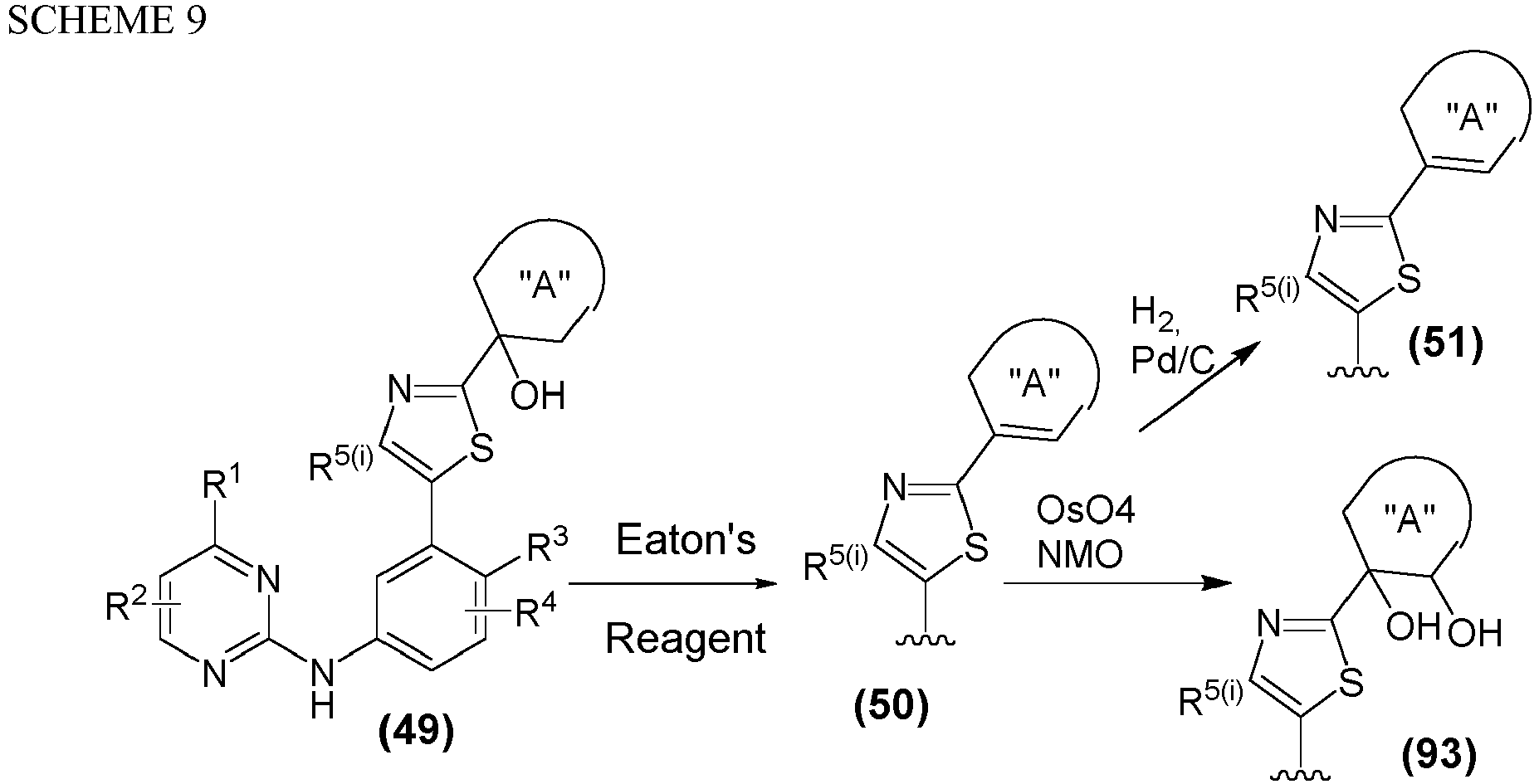
- Dehydration of compounds (49) with Eaton's reagent provides the cycloalkenes (50), which yield the saturated compounds (51) or the diols (93) following hydrogenation or dihydroxylation, respectively.

- The bromides (67) are subjected to Sonogashira coupling with TMS-acetylene and subsequent silyl deprotection yields the acetylene compounds (69), which are reduced to yield compounds (70). Palladium-mediated coupling of (67) with cyclopropylboronate (prepared according to literature; see: J. A.; Huertas, R.; Leon-Colon, G. Tetrahedron Lett. 2000, 41, 4251-4255) provides the cyclopropyl compound (68).

- The preparation of various aniline building blocks are exemplified in Scheme 12. Compounds (58) may be prepared as disclosed in
PCT Int. Appl. WO2008104754 . Compounds (58) are transformed into the boronic ester (59) by a palladium-mediated Miyaura coupling reaction with bis(pinacoloto)diboron. Suzuki coupling reaction of boronic esters (59) and bromides (2), followed by reduction of the nitro group provides anilines (60). Commercially available 1-bromo-3,5-dinitrobenzene (61) is reduced in the presence of iron to yield 5-bromobenzene-1,3-diamine (62); reductive amination with trifluoroacetaldehyde provides compound (63). Commercially available 3-nitrobenzaldehyde (64) is fluorinated with DAST to provide compound (65); bromination of nitroarene (65) and subsequent reduction of the nitro group provides aniline (66).
- Preparation of 2-chloropyrimidine building blocks starting with 2,4-dichloropyrimidines (71) is illustrated in Scheme 11. Pyrimidine functionalization via Suzuki coupling yields substituted 2-chloropyrimidines (73), while a base mediated SNAr reaction with substituted alcohol nucleophile provides ethers (72). Compounds (71) are transformed into compounds (74) via an iron-catalyzed Grignard addition. Compounds (76) are prepared by an iron promoted coupling of Grignard reagents with compounds (71).

- Coupling of compounds (4) with 2-chloro-4-(methylsulfanyl)pyrimidine (78) provided anilines (79), which are oxidized to the sulfones (8) by mCPBA. Displacement of the sulfone moiety with alcohols under basic conditions provided compounds (81).

- Saponfication of esters (94) yields acids (95) and the lactones (96). Reaction of acids (95) with hydrazine carboxamide yields the 1,3,4-oxadiazoles (97). Alternatively, amide coupling with acids (95) yields amides (98). Dehydration of the amides (98) with a sulfamoyl salt affords the nitriles (99). Cyclization of the nitriles (99) with ammonium hydroxide yields the 1,2,4-oxadiazoles (100).

- Alkylation of bromolactams (101) with 1-(bromomethyl)-4-methoxybenzene gives compounds (102). Deprotonation of thiazole (5) with LDA followed by the addition of 3-bromo azepanones (102) gives (103) after deprotection under acidic conditions.

- In Scheme 16 the two R groups and the carbon to which they are attached represent a ketal such as 1,3-dioxolane. 2-Chlorothiazole is reacted with (111) in the presence of NaHMDS followed by bromination provides (112). Suzuki coupling of (1) with (112) yields (113). Hydrolysis of (113) gives (114). The nitrile (113) is reduced with DIBAL to give the amine (115) or reacted with hydrochloric acid to give the cyclohexyl compound (116). The ketal can be converted into the ketone, which may be further elaborated into appropriate functional groups.


- Ketone (120) is reacted with t-butyl sulfonamide in the presence of titanium ethoxide to afford (121). Deprotonation of compound (5) with LDA followed by the addition of (121) and then ring expansion by he action of acid and azide gives (122).
- Compounds of formula I, as well as intermediates for their synthesis, can be prepared according to the procedures described in the Schemes, Preparation of Intermediates, and Examples herein, using appropriate materials and are further exemplified by the following specific intermediates and examples. The compounds exemplified are representative of the invention, and are not to be construed as limiting the scope of the invention in any manner. The examples further illustrate details for the preparation of the compounds of the present invention. Those skilled in the art will readily understand that known variations of protecting groups, of reagents, as well as of the conditions and processes of the following preparative procedures, can be used to prepare intermediates and compounds of the instant invention. It is also understood that whenever a chemical reagent is not commercially available, such a chemical reagent can be readily prepared by those skilled in the art by either following or adapting known methods described in the literature. All temperatures are degrees Celsius unless otherwise noted. Mass spectra (MS) were measured either by electrospray ion-mass spectroscopy (ESI) or by atmospheric pressure chemical ionization mass spectroscopy (APCI).
-

- Step 1: Isopropylmagnesium chloride/lithium chloride complex (1.3 M in THF, 582 mL, 756 mmol) was cooled to 0 °C. Thiazole (53.2 mL, 749 mmol) was added over 15 minutes, resulting in an orange/red solution. Stirred for 20 min at 0 °C, then removed cooling bath and allowed to warm to rt. Stirred an additional 2 h, then recooled to 0 °C. Cyclobutanone (53.3 mL, 713 mmol) was added over 50 min. Removed the cooling bath and allowed to warm to rt and stirred 20 min at that temperature. The reaction mixture was cooled to 0 °C and saturated aqueous ammonium chloride was slowly added. The mixture was diluted with EtOAc, the layers separated and the organic portion washed with water. The aqueous layer was washed with ethyl acetate. The combined organic portions were dried over MgSO4 and concentrated in vacuo. to provide 127.5 g of material containing 1-(1,3-thiazol-2-yl)cyclobutanol, which was used without further purification.
- Step 2: The product of Step 1 (171.9 g, 1.107 mol) was dissolved in DMF (860 mL) and cooled to 0 °C. Added NBS (236 g, 1.327 mol) and stirred 1 h at 0 °C. Removed the cooling bath and allowed to warm to rt. Followed by LC until the starting material was consumed. The solution was poured into cooled water (2 L) containing Na2SO3 (30 g), washing with MTBE (1 L). The mixture was stirred 10 min, then diluted with MTBE (1.5 L) and water (500 mL). Separated the layers and washed the organic portion with water (2 L). The aqueous portions were extracted with MTBE (2 L). The combined organic extracts were dried over MgSO4 and concentrated in vacuo to provide an orange oil. Diluted in hexanes at 50 °C (1 L). Stirred while slowly allowing to cool. Added seed crystals, and crystallization began around 35 °C. Stirred overnight at rt. Cooled to -20 °C and stirred 20 min. Filtered, washing with hexane at -20 °C. Dried under a nitrogen bag to provide 1-(5-bromo-1,3-thiazol-2-yl)cyclobutanol (172.9 g, 739 mmol, 67%). The filtrate and all remaining material in the flask was diluted in CH2Cl2 and concentrated in vacuo. Hexane added, concentrated to -300 mL cooled to rt and seed crystals were added. Began to crystallize. Cooled to -10 °C and filtered, washing with hexane at -10 °C. Second crop of crystals allowed to air dry providing 1-(5-bromo-1,3-thiazol-2-yl)cyclobutanol (38.8 g, 166 mmol, 15%). The mother liquor from the second filtration was concentrated and purified by column chromatography on silica gel (Biotage EtOAc/Hex) then dried under vacuum to provide 1-(5-bromo-1,3-thiazol-2-yl)cyclobutanol (10.6 g, 45 mmol, 4%). Overall, obtained 1-(5-bromo-1,3-thiazol-2-yl)cyclobutanol (222 g, 948 mmol, 86%). 1H NMR (400 MHz, CDCl3): δ 7.58 (s, 1 H); 3.56 (br s, 1 H); 2.69-2.60 (m, 2 H); 2.47-2.36 (m, 2 H); 2.09-1.87 (m, 2 H).
-

- A solution of 3-bromo-5-methylaniline (162.5 g, 873.66 mmol) in 1,4-dioxane (2 L) was prepared, and 2-chloro-4-(trifluoromethyl)pyrimidine (182 g, 994.54 mmol) and methanesulfonic acid (97.5 g, 1.02 mol) were added sequentially. The resulting solution was heated to reflux overnight. The resulting mixture was cooled and concentrated in vacuo. The residue was diluted with 2 L of water, then adjusted to pH 7-8 with aqueous sodium bicarbonate solution, followed by extraction with EtOAc (2x2 L) The organic layers were combined, washed with water (2x 2 L), dried over anhydrous sodium sulfate and concentrated in vacuo. This resulted in N-(3-bromo-5-methylphenyl)-4-(trifluoromethyl)pyrimidin-2-amine (200 g, 602 mmol, 69%) as a light yellow solid. MS(ESI): [M + H]+ 334.0. 1H NMR (400 MHz, CDCl3): δ 8.68 (d, J = 4.9 Hz, 1 H); 7.79 (s, 1 H); 7.30 (s, 2 H); 7.10-7.06 (m, 2 H); 2.36 (s, 3 H).
-

- To a solution of Intermediate 2 (250 g, 753.01 mmol,) in 1,4-dioxane (3 L) was added 4,4,5,5-tetramethyl-2-(4,4,5,5-tetramethyl-1,3,2-dioxaborolan-2-yl)-1,3,2-dioxaborolane (225 g, 885.83 mmol), KOAc (225 g, 2.30 mol) and Pd(dppf)Cl2 (19 g, 25.23 mmol). The resulting solution was heated to reflux overnight. The solid was filtered. The filtrate was decolorized by passing through a silica gel column. The fractions were collected and concentrated in vacuo. This resulted in 110 g pure and 150 g crude product. The crude product was decolorized again with active carbon to provide an additional 125 g of pure product. This resulted in N-[3-methyl-5-(4,4,5,5-tetramethyl-1,3,2-dioxaborolan-2-yl)phenyl]-4-(trifluoromethyl)pyrimidin-2-amine (235 g, 620 mmol, 82%) as a white solid. MS APCI: [M + H]+ m/z 380. 1H NMR (400MHz, CDCl3, ppm): 1.350 (12H, s), 2.386 (3H, s), 6.993-7.006 (1H, d, J = 5.2 Hz), 7.385-7.427 (2H, s,), 7.636 (1H, s), 7.753 (1H, s), 8.608-8.621 (1H, d, J = 5.2Hz).
-

- To a solution of Intermediate 3 (80 g, 211.08 mmol) in 1,4-dioxane (800 mL) was added 5-bromo-1,3-thiazole (28 g, 171.78 mmol), Pd(dppf)Cl2 (8 g, 10.62 mmol) and a solution of sodium carbonate (44.7 g, 421.70 mmol) in water (447 mL). The resulting solution was heated to reflux for 1 hour. Then it was allowed to cool and concentrated in vacuo. The residue was diluted with EtOAc (500 mL) and filtered. The filtrate was washed with brine (2x300 mL) and water (2x300 mL). The organic layer was dried over anhydrous sodium sulfate and concentrated in vacuo. The crude product was recrystallized from EtOAc:DCM in the ratio of 1:5 to get 34 g of product. The mother liquor was applied onto a silica gel column and eluted with dichloromethane/ethyl acetate (2:1). This resulted in N-[3-methyl-5-(1,3-thiazol-5-yl)phenyl]-4-(trifluoromethyl)pyrimidin-2-amine (42 g, 125 mmol, 73%) as a pale yellow solid. MS APCI: [M + H]+ m/z 337. 1H NMR (400MHz, CD3COCD3, ppm): 2.413 (3H, s), 7.250-7.263 (2H, m), 7.636 (1H, s), 8.204-8.213 (2H, m), 8.834-8.846 (1H, d, J = 4.8Hz), 8.970 (1H, s), 9.210 (1H, br). rhSYK activity = +++.
-

- Step 1: To a solution of 2-chloro-4-trifluoromethylpyrimidine (1.224 g, 6.71 mmol) and 3-bromo-5-(trifluoromethyl)aniline (1.4 g, 5.83 mmol) in dioxane (20 ml) was added p-toluenesulfonic acid monohydrate (1.220 g, 6.42 mmol). An immediate white suspension formed. The tube was sealed and the slurry was stirred and heated at 100°C for 24 h. The now clear solution was diluted with ethyl acetate and diethyl ether and washed with saturated NaHCO3 (aq.). The organic fraction was dried over MgSO4 and concentrated in vacuo. Product was further purified by column chromatography on silica gel, eluting with ethyl acetate/hexane with a gradient 0-30% to afford N-[3-bromo-5-(trifluoromethyl)phenyl]-4-(trifluoromethyl)pyrimidin-2-amine (2.252 g, 87%) as a light beige solid. MS APCI: [M + H]+ m/z 386.0. 1H NMR (400 MHz, CDCl3): δ 8.75 (d, J = 4.9 Hz, 1 H); 8.09 (s, 1 H); 7.94 (s, 1 H); 7.52-7.43 (m, 2 H); 7.17 (d, J = 4.9 Hz, 1 H). rhSYK activity = +.
- Step 2: To a solution of the product of Step 1 (790 mg, 2.046 mmol) in degassed DMSO (9.0 mL) were added PdCl2 (dppf), 4,4,4',4',5,5,5',5'-octamethyl-2,2'-bi-1,3,2-dioxaborolane (572 mg, 2.251 mmol) and potassium acetate (602 mg, 6.14 mmol). Nitrogen was bubbled through the mixture for 2 min and then the tube was sealed and heated at 125 °C in the microwave. The reaction mixture was diluted with ethyl acetate and water. The layers were separated, and the aqueous fraction was extracted with ethyl acetate. The combined organic fractions were washed with water, brine and dried over MgSO4. Product was further purified by column chromatography on silica gel, eluting with ethyl acetate/hexane with a gradient 0-50% to afford N-[3-(4,4,5,5-tetramethyl-1,3,2-dioxaborolan-2-yl)-5-(trifluoromethyl)phenyl]-4-(trifluoromethyl)pyrimidin-2-amine (886 mg, 80%) as a solid. 1H NMR (400 MHz, CDCl3): δ 8.70 (d, J = 4.9 Hz, 1 H); 8.41 (s, 1 H); 7.93 (d, J= 2.2 Hz, 1 H); 7.79 (s, 1 H); 7.43 (s, 1 H); 7.10 (d, J = 4.9 Hz, 1 H); 1.38 (s, 12 H).
-

- Step 1: Dioxane (720 mL) in a 1 L three-necked round bottom flask was degassed for 30 min. 3-Bromo-5-methylaniline (60g, 193 mmol), (bispinacolato)diboron (96 g, 377 mmol), potassium acetate (42.7 g, 435 mmol), X-Phos (8.3 g, 17.41 mmol) and Pd2dba3 (3.99 g, 4.35 mmol) were added to the degassed solvent under N2(g). After stirring for 10 min at room temperature, the reaction mixture was heated to an internal temperature of 80 °C. After ca. 4 hours, the heating mantle was removed and replaced with an ice water bath. The reaction mixture was cooled to 30 °C, and was then filtered through a pad of celite (washing with 500 mL of MTBE). This was transferred to a 4 L separatory funnel containing 500 mL pH 8 phosphate buffer, 500 mL brine, and an additional 500 mL of MTBE. The layers were cut and the organic washed with 1 L of a 1:1 mixture of brine and water. The aqueous layers were combined and sequentially back extracted with a second 500 mL portion of MTBE. The combined organics were treated with 100 g of MgSO4 and the resulting mixture stirred for 20 min. This was then filtered and concentrated in vacuo. The resultant residue was purified by chromatography on silica gel (Biotage, 0-25% ethyl acetate in hexanes) to yield 3-methyl-5-(4,4,5,5-tetramethyl-1,3,2-dioxaborolan-2-yl)aniline (66 g, 255 mmol, 88%) as a light orange solid. MS APCI: [M + H]+ m/z 234.2.
- Step 2: To 500 mL three-necked round bottom flask were added 2-methyl THF (720 mL) and an aqueous solution of sodium carbonate (2 M, 367 mL, 734 mmol). The solution was degassed for 30 min. The product of Step 1 (90 g, 367 mmol), Intermediate 1 (86 g, 367 mmol) and PdCl2(dppf) (8.05 g, 11 mmol) were added to the degassed solution under N2(g). The resulting mixture was stirred for 5 min at room temperature and was then heated to 80° C. After ca. 9 hours, the heating mantle was removed and the reaction was cooled to 30 °C. The reaction mixture was filtered through a pad of SolkaFloc employing water (500 mL) and ethyl acetate (500 mL) to complete the transfer. The filtrate was then transferred to a separatory funnel, using an additional 500 mL ethyl acetate and 250 mL brine to complete the transfer. The layers were cut, the organic washed with a mixture of water and brine (500 mL and 250 mL, respectively), and then the aqueous was back extracted with ethyl acetate (400 mL). The organics were combined, dried over MgSO4 (100 g), filtered, and concentrated in vacuo to yield a brown crystalline solid. This material was recrystallized from hot ethyl acetate (250 mL at 60 °C), using hexanes as a counter-solvent (750 mL) to yield 1-[5-(3-amino-5-methylphenyl)-1,3-thiazol-2-yl]cyclobutanol (88 g, 338 mmol, 92%). MS APCI: [M + H]+ m/z 261.2. 1H NMR (500 MHz, DMSO-D6) δ 7.87 (s, 1H), 6.59 (s, 1H), 6.58 (s, 1H), 6.45 (s, 1H), 6.34 (s, 1H), 5.14 (s, 2H), 2.52 - 2.48 (m, 2H), 2.31 (q, J= 9.3, 2H), 2.17 (s, 3H), 1.93 - 1.80 (m, 2H).
-

- To diisopropylamine (18.73 ml, 131 mmol) in THF (263 mL) at -78 °C was added n-butyllithium (2.5 M in hexanes, 54.7 ml, 137 mmol). The reaction was aged for 30 minutes at -40 °C before cooling to -78 °C. Intermediate 12 (10 g, 52.6 mmol) was added as a solution in 5 mL THF at - 78 °C and was then warmed to 0 °C over 2 hours. The reaction was once again cooled to -78 °C before adding 1,1,1-trifluoroacetone (14.85 mL, 158 mmol) as a solution in 5 mL THF at -78 °C. The reaction was allowed to warm to room temperature slowly, and was diluted with water and DCM. The layers were separated and the organic layer was dried over sodium sulfate and was concentrated in vacuo. The resultant residue was purified on silica gel (0-30% ethyl acetate in hexanes) to yield a yellow oil which solidified in hexanes overnight. The yellow to off-white solid was sonicated and filtered to yield 2-[5-(3-amino-5-methylphenyl)-1,3-thiazol-2-yl]-1,1,1-trifluoropropan-2-ol (11.69 g, 38.7 mmol, 73.6%). MS APCI: [M + H]+ m/z 303.0. 1H NMR (500 MHz, EDCl3) δ 7.85 (s, 1H), 6.76 (s, 1H), 6.67 (s, 1H), 6.52 (s, 1H), 4.53 (br s, 2H), 2.29 (s, 3H), 1.83 (s, 3H).
-

- Step 1: Methyl 3-oxobutanoate (232 g, 2.00 mol) and paraformaldehyde (30 g, 999.00 mmol) were combined, and to the mixture was added piperidine (10 g, 117.44 mmol). The resulting solution was stirred for 2 h at 0 °C. The solution was heated to 60 °C for 2 h. Extracted with Et2O (3x), and the organic layers were combined and dried over Na2SO4. Filtered and concentrated in vacuo. This resulted in 370 g (crude) of dimethyl 2-methyl-6-oxocyclohex-1-ene-1,3-dicarboxylate as a brown oil. MS: [M + H]+ m/z 227.
- Step 2: To a solution of sodium methanolate (90 g, 1.67 mol) in methanol (300 mL) was added the product of Step 1 (150 g, 663.04 mmol) in methanol (150 mL) dropwise with stirring over 30 min. The resulting solution was heated to 80 °C for 30 min. and the mixture was concentrated in vacuo. The reaction mixture was then quenched by the addition of H2O/ice (120 mL), then diluted with acetic acid (130 mL). The resulting solution was extracted with Et2O (3x), and the organic layers were combined and dried over Na2SO4, filtered and concentrated in vacuo. The final product was purified by distillation under reduced pressure (5 mm Hg) and the fraction was collected at 110∼120 °C. This resulted in 100 g (88%) of methyl 2-methyl-4-oxocyclohex-2-enecarboxylate as a yellow oil. MS: [M + H]+ m/z 169.
- Step 3: Copper iodide (121.8 g, 639.54 mmol) was added to Et2O (800 mL). Methyllithium (1.6 M in diethyl ether, 800 mL, 1.28 mol) was added dropwise at -40 °C over 3 h. Added a solution of the product of Step 2 (53.8 g, 319.88 mmol) in Et2O (400 mL) at -40 °C over 2 min. The resulting solution was stirred 5 h at -20 °C. Quenched via the addition of saturated aqueous ammonium chloride (2.5 L). Extracted with EtOAc (3 x 2 L). The combined organic extracts were dried over Na2SO4, filtered, and concentrated in vacuo. The residue was purified by eluting through a silica gel column with a 1:20 EtOAc/PE solvent system. This resulted in 45 g (73%) of methyl 2,2-dimethyl-4-oxocyclohexanecarboxylate as a yellow oil. MS: [M + H]+ m/z 185. 1H NMR (600 MHz, CDCl3) δ 3.49 (s, 3H), 2.43 - 2.40 (m, 1H), 2.35 - 2.29 (m, 1H), 2.21 - 2.17 (m, 1H), 2.11 - 2.04 (m, 1H), 2.00 - 1.96 (m, 1H), 1.91 - 1.85 (m, 1H), 0.85 (s, 3H), 0.77 (s, 3H).
-

- Step 1: n-Butyllithium (2.2 mL, 5.5 mmol, 2.5 M solution in hexanes) was added dropwise over 12 minutes to a solution ofthiazole (0.515 g, 6.05 mmol) in tetrahydrofuran (15 mL) at -78 °C. After 30 minutes, the opaque yellow suspension was transferred over 5 minutes via a dry ice-cooled cannula to a solution of INTERMEDIATE 8 (1.013 g, 5.5 mmol) in tetrahydrofuran (15 mL) at -78 °C. The resulting yellow solution was kept at -78 °C for 1 hour, moved to a 0 °C bath for 15 minutes, and then cooled back to -78 °C. Aqueous saturated ammonium chloride solution (10 mL) was added and the mixture was allowed to warm to room temperature. The biphasic mixture was partitioned between ethyl acetate (50 mL) and water (5 mL); the layers were separated and the aqueous layer was extracted with ethyl acetate (15 mL). The combined organic layers were washed with brine, dried over sodium sulfate, filtered, and concentrated. The crude material was purified via silica gel chromatography (Biotage 100g SNAP column, 90:10 to 65:35 hexane:ethyl acetate) to afford racemic cis-methyl 4-hydroxy-2,2-dimethyl-4-(1,3-thiazol-2-yl)cyclohexanecarboxylate as a white solid (1.08 g, 73% yield). MS APCI: [M + H]+ m/z 270.1. Step 2: To a solution of the product of Step 1 (0.35 g, 1.3 mmol) in N,N- dimethylformamide (1.9 mL) was added N-bromosuccinimide (0.254 g, 1.429 mmol). After three hours an additional portion of N-bromosuccinimide (0.046 g, 0.258 mmol) was added. After an additional hour, the reaction mixture was partitioned between ethyl acetate (25 mL), aqueous saturated sodium thiosulfate (10 mL), and water (5 mL). The layers were separated, and the organic layer was washed with water (3 x 5 mL) and brine (10 mL), dried over sodium sulfate, filtered, and concentrated. The crude reaction was purified via silica gel chromatography (Biotage 100g SNAP column, 95:5 to 75:25 hexane:ethyl acetate) to afford racemic cis-methyl 4-(5-bromo-1,3-thiazol-2-yl)-4-hydroxy-2,2-dimethylcyclohexanecarboxylate as a white solid (286.8 mg, 63% yield). MS APCI: [M + H]+ m/z 348.0, 350.0. 1H NMR (500 MHz, CDCl3): δ 7.58 (s, 1 H); 3.69 (s, 3 H); 2.45 (s, 1 H); 2.36 (m, 1 H); 2.21 (m, 1 H); 1.94 (m, 3 H); 1.75 (m, 2 H); 1.19 (s, 3 H); 1.06 (s, 3 H).
- Sodium thiomethoxide (5.18 g, 73.8 mmol) was added slowly portion-wise via powder addition funnel to a stirring solution of 2,4-dichloropyrimidine (10 g, 67.1 mmol) in THF (150 mL) at room temperature. After stirring overnight, the reaction was taken up in ethyl acetate, washed with water, brine, dried over anhydrous sodium sulfate, filtered and concentrated under reduced pressure. The residue was purified by column chromatography on silica gel eluting with ethyl acetate and hexanes to give 2-chloro-4-(methylsulfanyl)pyrimidine (10.127g, 47.3 mmol, 70.4%) as a white solid.
- 2,4-Dichloropyrimidine (15 g, 101 mmol), cyclopropylboronic acid (8.65 g, 101 mmol), PdCl2(dppf)-CH2Cl2 adduct (8.22 g, 10.07 mmol), and potassium phosphate (53.4 g, 252 mmol) were combined in a 1L round-bottom flask. THF (503 mL) was added and the suspension was heated to reflux with stirring overnight. The reaction was then cooled to room temperature, concentrated to∼100 mL under reduced pressure, extracted with ethyl acetate, washed with saturated aqueous NaHCO3, brine, dried over anhydrous sodium sulfate, filtered and concentrated under reduced pressure. The residue was purified by column chromatography on silica gel eluting with ethyl acetate in hexanes to give 2-chloro-4-cyclopropylpyrimidine (10.124g, 58.3 mmol, 57.9%) as an 89:11 mixture of regioisomers.
-

- 3-Methyl-5-(4,4,5,5-tetramethyl-1,3,2-dioxaborolan-2-yl)aniline (20.98 g, 90 mmol), 5-bromothiazole (8.85 mL, 99 mmol), and sodium carbonate (90 mL, 180 mmol) were combined in a flask. 2-Methyl-THF (326 mL) was added and the flask was degassed with N2 for 1.5 h before 1,1'-bis(diphenylphosphino)ferrocene-palladium(II)dichloride dichloromethane complex (3.67 g, 4.50 mmol) was added. The reaction was heated to 100 °C overnight and was then cooled to room temperature. The reaction mixture was filtered though a pad of Celite, washing with ethyl acetate. The layers were separated and the aqueous layer was back-extracted with ethyl acetate, dried over Na2SO4, and concentrated. The residue was purified by chromatography (0-40% ethyl acetate in hexanes). 3-Methyl-5-(1,3-thiazol-5-yl)aniline was isolated as a yellowish brown solid (15.33 g, 81 mmol, 90%). MS ESI: [M + H]+ m/z 191.1. 1H NMR (500 MHz, CDCl3) δ 8.71 (s, 1H), 8.02 (s, 1H), 6.80 (s, 1H), 6.71 (s, 1H), 6.50 (s, 1H), 3.71 (s, 2H), 1.79 (s, 3H).
-

- Step 1: To 3-bromo-4-fluoroaniline (0.76 g, 4.0 mmol) and 2-chloro-4-(trifluoromethyl)pyrimidine (0.73 g, 4.0 mmol) was added dioxane (13.33 mL) and p-TSA (0.761 g, 4.0 mmol). The reaction was sealed and was heated at reflux overnight. The reaction was cooled to room temperature and was diluted with ethyl acetate, washed with saturated aqueous NaHCO3, and the organic was dried over sodium sulfate and filtered before concentration. The crude product was purified by flash chromatography (25:75 ethyl acetate: hexanes) to afford N-(3-bromo-4-fluorophenyl)-4-(trifluoromethyl)pyrimidin-2-amine (1.2 g, 3.57 mmol, 89%) as a pale yellowish solid. 1H NMR (500 MHz, CDCl3): δ 8.68 (d, J = 4.9 Hz, 1 H); 7.99-7.96 (m, 1 H); 7.51 (d, J = 8.4 Hz, 1 H); 7.29 (s, 1 H); 7.14 (t, J = 8.5 Hz, 1 H); 7.10 (d, J = 4.9 Hz, 1 H). rhSYK activity = +
- Step 2: To the product of Step 1 (0.336 g, 1 mmol) was added bis(pinacolato)diboron (0.267 g, 1.05 mmol), potassium acetate (0.294 mmol, 3.0 mmol), PdCl2(dppf)-dichloromethane adduct (0.082 g, 0.1 mmmol) and DMSO (3.33 mL). The reaction vessel was sealed and heated at 100 °C until the reaction was complete (by TLC analysis). The reaction was cooled to room temperature, diluted with ethyl acetate and washed with water (3 times), and dried over sodium sulfate. After filtration and solvent evaporation the crude product was purified by flash chromatography (ethyl acetate in hexanes) to afford N-[4-fluoro-3-(4,4,5,5-tetramethyl-1,3,2-dioxaborolan-2-yl)phenyl]-4-(trifluoromethyl)pyrimidin-2-amine (383 mg, 1.0 mmol, quant. yield).
- Step 3: To a solution of the product of Step 2 (383 mg, 1.0 mmol) in DMF (2 mL) and aqueous sodium carbonate (2 M, 1.5 mL, 3.0 mmol) in a microwave vial was added INTERMEDIATE 1 (234 mg, 1.0 mmol), and PdCl2(dppf)-dichloromethane adduct (82 mg, 0.1 mmol) under dry nitrogen. The vial was sealed and the reaction was heated in a microwave at 85 °C for 2 hours. The reaction was cooled to room temperature, diluted with ethyl acetate, washed with water, then brine and was dried over sodium sulfate. The organic was concentrated after filtration and was purified by flash chromatography (25:75 ethyl acetate : hexanes) to afford 1-[5-(2-fluoro-5-{[4-(trifluoromethyl)pyrimidin-2-yl]amino}phenyl)-1,3-thiazol-2-yl]cyclobutanol as an off-white foamy solid (102 mg, 0.249 mmol, 24.9%). 1H NMR (500 MHz, CDCl3): δ 8.66 (d, J = 4.9 Hz, 1 H); 8.07 (s, 1 H); 8.03 (d, J = 6.1 Hz, 1 H); 7.82 (s, 1 H); 7.50 (dt, J = 8.8, 3.4 Hz, 1 H); 7.16 (t, J= 9.6 Hz, 1 H); 7.07 (d, J = 4.9 Hz, 1 H); 4.07 (s, 1 H); 2.77-2.70 (m, 2 H); 2.59-2.49 (m, 2 H); 2.13-1.98 (m, 2 H). rhSYK activity = ++
- The following example was prepared in an analogous manner of that described in Example 1 using commercially available or known functionalized bromoanilines in step 1. Compounds were isolated as the free base.
TABLE 1 
Example R rhSYK Activity [M+H]+ Obs'd 1-6 -CH3 +++ 407.1 -

- A solution of palladium(II) acetate (2.55 mg, 0.011 mmol) and butyldi-1-adamantyl phosphine (CataCXium A, 8.14 mg, 0.023 mmol) in THF (1.42 mL) was stirred for 10 min while nitrogen was bubbled through gently. INTERMEDIATE 5 (100 mg, 0.189 mmol), INTERMEDIATE 1 (51.0 mg, 0.218 mmol), potassium fluoride (33.0 mg, 0.568 mmol) and water (473 µL) were added. The tube was sealed (screw cap) and heated overnight at 85 °C. The reaction was cooled to room temperature and diluted with ethyl acetate. After decanting the solids and extraction with ethyl acetate, the organic layer was washed with brine and dried over MgSO4. Filtration and subsequent solvent evaporation gave a residue which was purified by chromatography on silica gel (5-50% ethyl acetate in hexanes) to give 75 mg (86%) of 1-{5-[3-(trifluoromethyl)-5-{[4-(trifluoromethyl)pyrimidin-2-yl]amino}phenyl]-1,3-thiazol-2-yl}cyclobutanol as a grey solid. MS ESI [M+H]+ 461.1. 1H NMR (400 MHz, DMSO-d6): δ 10.67 (s, 1 H); 8.93 (d, J= 4.9 Hz, 1 H); 8.33 (s, 1 H); 8.24 (s, 1 H); 8.17 (s, 1 H); 7.68 (s, 1 H); 7.41 (d, J = 4.9 Hz, 1 H); 6.62 (s, 1 H); 2.59-2.48 (m, 2 H); 2.42-2.31 (m, 2 H); 1.98-1.87 (m, 2 H). rhSYK activity = ++
-

- INTERMEDIATE 4 (100 mg, 0.297 mmol) in THF (1.5 mL) was added slowly to LDA (496 µL, 0.892 mmol) pre-cooled to -78 °C over 5 min with stirring. The reaction mixture was left to stir for 30 min and treated with acetone (32.7 µL, 0.446 mmol). After 1 h, the reaction mixture was treated with 5 mL sat NH4Cl and allowed to warm to room temperature. The mixture was extracted with EtOAc, and the organic layer washed with saturated aqueous NaHCO3. The organic layer was dried over anhydrous Na2SO4, filtered, concentrated, and purified by flash chromatography to give 2-[5-(3-methyl-5-{[4-(trifluoromethyl)pyrimidin-2-yl]amino}phenyl)-1,3-thiazol-2-yl]propan-2-ol (95 mg, 0.241 mmol, 81 % yield) as a colorless oil. APCI: [M + H]+ m/z 395.0. 1H NMR (500 MHz, DMSO-d6) δ 10.25 (s, 1H), 8.83 (d, J = 4.9, 1H), 7.95 (s, 1H), 7.92 (s, 1H), 7.45 (s, 1H), 7.28 (d, J= 4.9, 1H), 7.14 (s, 1H), 6.03 (s, 1H), 2.31 (s, 3H), 1.51 (s, 6H). rhSYK activity = +++
- The following compounds were prepared in an analogous manner to that described in Example 4. Entries in this and all subsequent Tables without explicit reported stereochemistry (absolute or relative) are either single isomers of unknown configuration or a mixture of isomers. Indicators of relative stereochemistry (cis or trans) refer to the relative relationship of the corresponding substituents with the highest CIP priority respectively.In the Table below, 2,2-dimethyl-5 - 5-[3-methyl-5- {[4-(trifluoromethyl)pyrimidin-2-yl] amino }phenyl)-1,3-thiazol-2-yl]-1,3-dioxan-5-ol and 2,2-dimethyl-5-(5- {3-methyl-5-[(4-methylpyfimidin-2-yl)amino]phenyl}-1,3-thiazol-2-yl)-1,3-dioxan-5-ol were treated with HCl to afford the corresponding triols, and 3-(1H-imidazol-4-yl)-1-[5-(3-methyl-5- {[4-(trifluoromethyl)pyrimidin-2-yl]amino}phenyl)-1,3-thiazol-2-yl]propan-1-ol was obtained by treating the corresponding 1-tritylimidazole adduct with AcOH.
TABLE 4B 
Ex. R1 R2 R3 rhSYK Activity [M+H] + Obs'd Form(s) 4B-1 CF3 CH3 1-OH-cBu +++ 407.1 Free Base 4B-2 CF3 H 1-OH-2-CH3-cPen +++ 421.3 Free Base 4B-6 CF3 H 1-OH-2-(CH2-CH2CN)-cHex ++ 474.2 Free Base 4B-11 CF3 H 
+++ 395.0 Free Base 4B-12 CF3 CH3 
+++ 409.1 Free Base 4B-57 CF3 CH3 
+++ 535 Free Base TABLE 4C 
Ex. R1* X R3/R4 rhSYK Activity [M+H] + Obs'd Form(s) R2 = H 4C-1 CF3 CH2CH2 H/H +++ 435.1 Free base R2 = CH3 4C-2 CH3 CH2 H/CH2NH2 (cis) +++ 410.2 TFA Salt 4C-3 CH3 CH2 H/CH2NH2 (trans) +++ 410.2 TFA Salt 4C-4 CF3 CH2 H/CH2NH2 +++, +++ 464.2 Free Base TFA Salt 4C-5 CF3 CH2 H/CH2CH2NH2 +++ 478.2 TFA Salt 4C-6 CF3 CH2 H/CH2OH (trans) +++ 465.2 Free Base 4C-7 CF3 CH2 H/CH2OH +++ 465.2 Free Base 4C-8 CF3 CH2 H/CH2OH (cis) +++ 465.2 Free Base 4C-9 CH3 CH2 H/CH2OH +++ 411.2 Free Base 4C-10 CH3 CH2 NH2/CO2H +++ 440.0 TFA Salt 4C-11 CH3 CH2 CH3/CH2CO2H (isomer 1) +++ 453.1 TFA Salt 4C-12 CH3 CH2 CH3/CH2CO2H (isomer 2) +++ 453.1 TFA Salt 4C-14 CF3 CH2 H/CH2CO2H (cis) +++ 493.1 Free Base 4C-15 CF3 CH2 H/CH2CO2H (trans) +++ 493.1 Free Base 4C-17 CH3 CH(iPr) H/CO2CH3 +++ 481.1 Free Base 4C-21 CF3 CH(CO2Et) H/H ++ 507.1, 507.2 Free Base 4C-22 CF3 C(CH3) (CH2CO2H) H/H (1R, 3S) +++ 507.1 TFA Salt 4C-23 CF3 C(CH3) (CH2CO2H) H/H (1R, 3R) +++ 507.1 TFA Salt 4C-25 CF3 CH(iPr) H/CO2CH3 ++ 535.0 Free Base 4C-26 CF3 CH2 H/CH2C(CH3)2CO2H +++ 535.2 TFA Salt 4C-33 CF3 CH2 H/N(CH3)2 +++ 478 Formate Salt * R1 is on the 4-position of the pyrimidine ring, unless otherwise specified. TABLE 4D 
Ex. R1 R2 X R3 rhSYK Activity [M+H] + Obs'd Form(s) 4D-1 CF3 H CH2 C(O)CH3 +++ 464.3 Free Base 4D-4 CF3 H CH2 CO2Et +++ 494.1 Free Base 4D-5 CF3 H CH2 iPr ++ 464.1 Free Base 4D-6 CF3 H CH2 C(O)Ph +++ 526.1 Free Base 4D-7 CH3 CH3 CH2C(O) (lactam formed) H +++ 410.2 Free Base 4D-13 CF3 CH3 CH2 C(O)(CH2)3CO2H +++ 550.1 Formate Salt 4D-14 CF3 CH3 CH(CO2CH3) CO2C(CH3)3 ++ 594.1 Free Base 4D-15 CF3 CH3 CH(CF3) CO2C(CH3)3 ++ 604.1 Free Base -

- Step 1: INTERMEDIATE 4 (500 mg, 1.487 mmol) in THF (7.4 mL) was added slowly to LDA (1.8 M, 2478 µL, 4.46 mmol) pre-cooled to -78 °C over 5 min with stirring. The reaction mixture was left to stir for 30 min then treated with ethyl trifluoroacetate (0.27 mL, 2.2 mmol). After 1 h, the reaction was quenched by adding 5 mL of saturated aqueous NH4Cl solution, and the mixture was warmed to room temperature. The mixture was extracted with ethyl acetate, and washed with saturated NaHCO3 solution. The organic layer was dried over anhydrous Na2SO4, filtered, concentrated, and purified by flash chromatography to give 2,2,2-trifluoro-1-[5-(3-methyl-5- {[4-(trifluoromethyl)pyrimidin-2-yl]amino}phenyl)-1,3-thiazol-2-yl]ethane-1,1-diol (513 mg, 1.139 mmol, 77 % yield) as a colorless oil. APCI: [M + H]+ m/z 451.0.
- Step 2: Sodium borohydride (41.6 mg, 1.099 mmol) was added to the product of Step 1 (450 mg, 0.999 mmol) in MeOH (3.3 mL) at 0 °C. After stirring for 3 h, the reaction was poured into a separatory funnel containing ethyl acetate and saturated aqueous NaHCO3. The layers were separated and the organic layer was washed with water, brine, dried over anhydrous sodium sulfate, and concentrated. The residue was purified by flash chromatography to give 2,2,2-trifluoro-1-[5-(3-methyl-5-{[4-(trifluoromethyl)pyrimidin-2-yl]amino}phenyl)-1,3-thiazol-2-yl]ethanol (394.6 mg, 0.908 mmol, 91 % yield) as a white solid. APCI: [M + H]+ m/z 435.1. 1H NMR (500 MHz, DMSO-d6) δ 10.28 (s, 1H), 8.84 (d, J = 4.9, 1H), 8.12 (s, 1H), 8.02 (s, 1H), 7.86 (d, J = 6.0, 1H), 7.48 (s, 1H), 7.29 (d, J = 4.9, 1H), 7.22 (s, 1H), 5.52 (dd, J = 6.7, 13.1, 1H), 2.32 (s, 3H). rhSYK activity = +++
- The following examples were prepared in an analogous manner of that described in Example 6. Reduction of the ethyl ester was carried out with LiBH4 in THF.
TABLE 6 
Ex. R1 R2 rhSYK Activity [M+H]+ Observed Form(s) 6-10 H 
++ 465.1 Free Base -

- To a stirred solution of 8-[5-(3-methyl-5-{[4-(trifluoromethyl)pyrimidin-2-yl]amino}phenyl)-1,3-thiazol-2-yl]-1,4-dioxaspiro[4.5]decan-8-ol (Example 4B-15, 785 mg, 1.59 mmol) in THF (6 mL) was added HCl (6 M, 5.3 mL, 32 mmol) and the reaction was left to stir for 6 h. The mixture was brought to pH 8 with saturated aqueous sodium bicarbonate, extracted with ethyl acetate (x 3), and the combined organic portion was washed with saturated aqueous sodium bicarbonate. The solution was dried over Na2SO4, filtered, concentrated, and purified by flash chromatography to afford 4-hydroxy-4-[5-(3-methyl-5-{[4-(trifluoromethyl)pyrimidin-2-yl]amino}phenyl)-1,3-thiazol-2-yl]cyclohexanone (625 mg, 1.39 mmol) as a white foam. APCI: [M + H]+ m/z 449.1. 1H NMR (600 MHz, CDCl3) δ 8.64 (d, J = 4.9, 1H), 7.90 (s, 1H), 7.86 (s, 1H), 7.46 (s, 1H), 7.26 (s, 1H), 7.06 (s, 1H), 7.04 (d, J = 4.9, 1H), 2.92 - 2.82 (m, 2H), 2.49 - 2.29 (m, 6H), 2.38 (s, 3H). rhSYK activity = +++
-

- To a stirred solution of 4-hydroxy-4-[5-(3-methyl-5-{[4-(trifluoromethyl)pyrimidin-2-yl]amino}-phenyl)-1,3-thiazol-2-yl]cyclohexanone (500 mg, 1.115 mmol) in MeOH (11 mL) was added sodium borohydride (63.3 mg, 1.672 mmol) at -20 °C and the reaction was aged for 20 min. The mixture was treated with water and extracted with ethyl acetate. The combined organics were dried, filtered, concentrated, and purified by flash chromatography to afford cis-1-[5-(3-methyl-5-{[4-(trifluoromethyl)pyrimidin-2-yl]amino}phenyl)-1,3-thiazol-2-yl]cyclohexane-1,4-diol (250 mg, 0.56 mmol). APCI: [M + H]+ m/z 451.1. 1H NMR (600 MHz, CDCl3) δ 8.63 (d, J = 4.9, 1H), 7.89 - 7.79 (m, 2H), 7.45 (s, 1H), 7.26 (s, 1H), 7.06 (s, 1H), 7.02 (d, J = 4.9, 1H), 3.81 - 3.72 (m, 1H), 2.98 (s, 1H), 2.37 (s, 3H), 2.11 - 1.72 (m, 8H). rhSYK activity=+++ trans-1-5-(3-methyl,-5-{[4-(trifluoromethyl)pyrimidin-2-yl]amino}phenyl)-1,3-thiazol-2-yl]-cyclohexane-1,4-diol (40 mg, 0.09 mmol) APCI: [M + H]+ m/z 451.1. 1H NMR (600 MHz, CDCl3) δ 8.63 (d, J = 4.9, 1H), 7.88 - 7.79 (m, 2H), 7.46 (s, 1H), 7.27 (s, 1H), 7.06 (s, 1H), 7.02 (d, J = 4.9, 1H), 3.67 (t, J = 6.3, 1H), 3.56 (m, 1H), 2.43 - 1.62 (m, 8H), 2.37 (s, 3H). rhSYK activity = +++
- Compounds in the following Table(s) were prepared in an analogous manner of that described in Example 8(1)/8(2):
TABLE 8A 
Example R1 R2 R3/R3a R4/R4a rhSYK Activity [M+H]+ Observed Form(s) 8A-6 CF3 H CH3/CH3 H/OH (1S,4R) +++ 479.1 Free Base 8A-7 CF3 H CH3/CH3 H/OH (1R,4S) +++ 479.1 Free Base TABLE 8B 
Example R rhSYK Activity [M+H]+ Obs'd Form(s) 8B-1 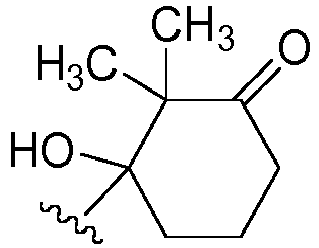
+++ 477.1 Free Base 8B-2 
+++ 479.1 Free Base 8B-3 
+++ 479.1 Free Base -

- To a stirred solution of 4-hydroxy-4-[5-(3-methyl-5-{[4-(trifluoromethyl)pyrimidin-2-yl]amino}-phenyl)-1,3-thiazol-2-yl]cyclohexanone (104 mg, 0.232 mmol) in THF (4 mL) was added MeMgCl (3.0 M, 0.464 mL, 1.39 mmol) at 0 °C. The resultant orange suspension was stirred for1 h at 0 °C, treated with saturated aqueous ammonium chloride, and extracted with ethyl acetate (x 3). The combined organics were dried over Na2SO4 , filtered, and concentrated in vacuo. Purification by flash chromatography gave:
- trans-1-methyl-4-[5-(3-methyl-5-{[4-(trifluoromethyl)pyrimidin-2-yl]amino}phenyl)-1,3-thiazol-2-yl]cyclohexane-1,4-diol (6 mg, 0.013 mmol) as a white solid. APCI: [M + H]+ m/z 465.1. 1H NMR (600 MHz, DMSO-d6) δ 10.22 (s, 1H), 8.81 (d, J = 4.9, 1H), 7.92 (s, 1H), 7.90 (s, 1H), 7.43 (s, 1H), 7.25 (d, J = 4.9, 1H), 7.12 (s, 1H), 5.74 (s, 1H), 4.03 (s, 1H), 2.29 (s, 3H), 2.21 (td, J = 3.9, 13.3, 2H), 1.71 - 1.36 (m, 6H), 1.10 (s, 3H). rhSYK activity = +++)
- cis-1-methyl-4-[5-(3-methyl-5-{[4-(trifluoromethyl)pyrimidin-2-yl]amino}phenyl)-1,3-thiazol-2-yl]cyclohexane-1,4-diol (23 mg, 0.050 mmol) as a colorless oil. APCI: [M + H]+ m/z 465.1. 1H NMR (500 MHz, DMSO-d6) δ 10.25 (s, 1H), 8.83 (d, J = 4.8, 1H), 7.94 (s, 1H), 7.92 (s, 1H), 7.45 (s, 1H), 7.27 (d, J= 4.9, 1H), 7.13 (s, 1H), 2.31 (s, 3H), 1.96 - 1.40 (m, 8H), 1.13 (s, 3H). rhSYK activity = +++.
-
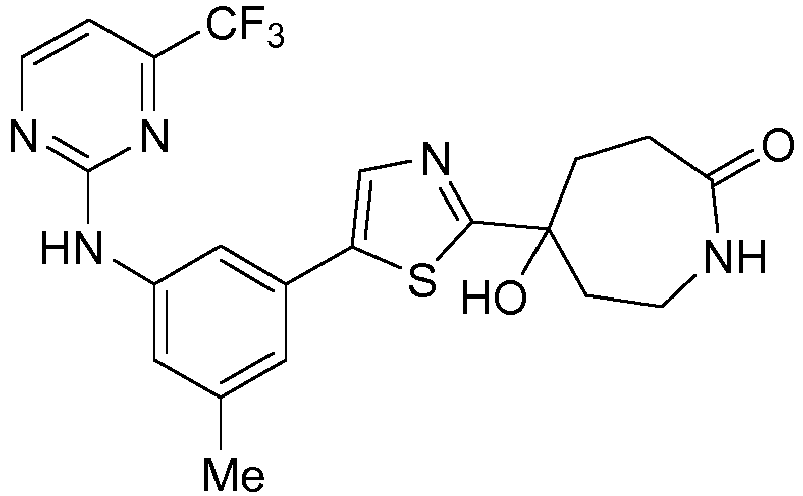
- A mixture of 8-[5-(3-methyl-5-{[4-(trifluoromethyl)pyrimidin-2-yl]amino}phenyl)-1,3-thiazol-2-yl]-1,4-dioxaspiro[4.5]decan-8-ol (60 mg, 0.122 mmol), sodium azide (23.76 mg, 0.365 mmol) and methanesulfonic acid (95 uL, 1.462 mmol) in CHCl3 (1.2 mL) was heated at 65 °C for 1 h and cooled to room temperature. The mixture was treated with water, and extracted with ethyl acetate. The combined organics were dried, filtered, concentrated and purified by flash chromatography to afford 5-hydroxy-5-[5-(3-methyl-5-{[4-(trifluoromethyl)pyrimidin-2-yl]amino}phenyl)-1,3-thiazol-2-yl]azepan-2-one (36 mg, 0.078 mmol). APCI: [M + H]+ m/z 464.2. 1H NMR (600 MHz, CDCl3): δ 8.63 (d, J = 4.9, 1H), 7.89 (s, 1H), 7.83 (s, 1H), 7.62 (s, 1H), 7.26 (s, 1H), 7.05 (s, 1H), 7.03 (d, J = 4.9, 1H), 6.21 (s, 1H), 3.81 (s, 1H), 3.46 (s, 1H), 3.21 - 3.03 (m, 2H), 2.41 (dd, J = 7.5, 14.4, 1H), 2.37 (s, 3H), 2.24 (t, J = 13.3, 1H), 2.18 - 2.04 (m, 3H). rhSYK activity = +++
- The following compounds were prepared as the free base in an analogous manner of that described in Example 10:
TABLE 10 
Formula A Example R1 R2 rhSYK Activity [M+H]+ Observed 10A-1 OCH3 CH3 +++ 426.2 10A-2 CH(CH3)2 (Enantiomer 1) CH3 +++ 438.2 10A-3 CH(CH3)2 (Enantiomer 2) CH3 +++ 438.2 -

- Step 1: To a solution of ethyl 4-oxocyclohexanecarboxylate (5.0 g, 40 .6 mmol) in benzene (20 ml) were added ethylene glycol (2.83 ml, 50.8 mmol) and catalytic sulfuric acid (772 mg, 4.1 mmol) and the mixture was refluxed under a Dean-Stark trap for 18 h. The mixture was cooled to 23°C, diluted with saturated aqueous NaHCO3 (85 ml) and extracted with EtOAc (2x75 ml). The organic layer was dried over Na2SO4, filtered and concentrated and the crude product was purified via flash column chromatography to afford 1,4-dioxaspiro[4.5]decane-8-carbonitrile (6.15 g, 34.9 mmol, 86% yield) as a colorless oil. 1H NMR (500 MHz, CDCl3): δ 3.85-3.3.80 (m, 4H), 2.61-2.53 (m, 1H), 1.90-1.77 (m, 4H), 1.75-1.69 (m, 2H), 1.56-1.48 (m, 2H).
- Step 2: To a solution of 1,4-dioxaspiro[4.5]decane-8-carbonitrile (3 g, 17.9 mmol) in anhydrous toluene (95 ml) at 0°C, was added sodium bis(trimethylsilyl)amide (1M in toluene, 21.5 ml, 21.5 mmol). The resulting orange solution was maintained at 0°C for 1 h, before introducing a solution of 2-chlorotriazole (2.14 g, 17.9 mmol) in anhydrous toluene (10 ml) via cannulation. The residual dark brown solution was allowed to slowly warm to 23°C over 16 h. The reaction was diluted with saturated aqueous NH4Cl (100 ml) and extracted with EtOAc (2x80 ml). The combined organic layers were washed with brine (100 ml), dried over Na2SO4, filtered and concentrated in vacuo. The crude oil was purified via flash column chromatography (SiO2: 100% Hex to 80:20 Hex:EtOAc) to provide 8-(1,3-thiazol-2-yl)-1,4-dioxaspiro[4.5]decane-8-carbonitrile (1.78 g, 6.74 mmol, 37.5% yield) as a fluffy, off-white solid. MS ESI: [M+H]+ m/z 251.1. 1H NMR (500 MHz, CDCl3): δ 7.79 (d, 1H, J = 3.2 Hz), 7.35 (d, 1H, J = 3.5 Hz), 4.01-3.95 (m, 4H), 2.44-2.31 (m, 4H), 2.09-2.03 (m, 2H), 1.89-1.86 (m, 2H).
- Step 3: To a solution of 8-(1,3-thiazol-2-yl)-1,4-dioxaspiro[4.5]decane-8-carbonitrile (1.78 g, 7.11 mmol) in anhydrous DMF (25 ml) was added N-bromosuccinimide (1.52 g, 8.53 mmol). The solution was heated at 50°C for 2 h. The reaction was cooled to 23°C then diluted with saturated aqueous NaS2O3 (175 ml) and extracted with EtOAc (2x130 ml). The combined organic layers were washed with brine (150 ml), dried over Na2SO4, filtered and concentrated. The crude yellow oil was purified via flash column chromatography (SiO2: 100% Hex to 60:40 Hex:EtOAc), to afford 8-(5-bromo-1,3-thiazol-2-yl)-1,4-dioxaspiro[4.5]decane-8-carbonitrile (1.43 g, 4.13 mmol, 58% yield) as an off-white solid. MS ESI: [M+H]+ m/z 331.1. 1H NMR (500 MHz, CDCl3): δ 7.66 (s, 1H), 4.01-3.93 (m, 4H), 2.39-2.26 (m, 4H), 2.07-2.01 (m, 2H), 1.88-1.86 (m, 2H).
- Step 4: N-[3-methyl-5-(4,4,5,5-tetramethyl-1,3,2-dioxaborolan-2-yl)phenyl]-4-(trifluoromethyl)pyrimidin-2-amine (1.60 g, 4.22 mmol), 8-(5-bromo-1,3-thiazol-2-yl)-1,4-dioxaspiro[4.5]decane-8-carbonitrile (1.40 g, 4.22 mmol), cesium carbonate (4.12 g, 12.6 mmol), Pd2(dba)3 (193 mg, 0.21 mmol) and X-Phos (201 mg, 0.42 mmol) were added to a flame-dried flask, deoxygenated, and diluted with anhydrous 1,4-dioxane (15 ml) and water (1.5 ml). The resulting dark mixture was heated to 100°C for 5 h. The reaction mixture was diluted with 1:1 saturated aquoeus NaHCO3: brine (100 ml) and extracted with EtOAc (2x85 ml). The organic layers were dried over Na2SO4, filtered and concentrated. The crude dark maroon oil was purified via flash column chromatography (SiO2: 100% Hex to 60:40 Hex:EtOAc) which afforded 8-[5-(3-methyl-5- {[4-(trifluoromethyl)pyrimidin-2-yl]amino}phenyl)-1,3-thiazol-2-yl]-1,4-dioxaspiro[4.5]decane-8-carbonitrile (1.77 g, 3.35 mmol, 79% yield) as an off-white solid. MS ESI: [M+H]+ m/z 502.1. 1H NMR (500 MHz, CD3OD): δ 11.1 (s, 1H), 9.65 (d, 1H, J = 4.9 Hz), 8.93 (s, 1H), 8.83 (s, 1H), 8.30 (s, 1H), 8.10 (d, 1H, J = 4.9 Hz), 8.02 (s, 1H), 4.73-4.72 (m, 4H), 3.21-3.18 (m, 2H), 3.13 (s, 3H), 3.01-2.97 (m, 2H), 2.69-2.61 (m, 4H). rhSYK activity = +++
- Step 5: To a solution of 8-[5-(3-methyl-5-{[4-(trifluoromethyl)pyrimidin-2-yl]amino}phenyl)-1,3-thiazol-2-yl]-1,4-dioxaspiro[4.5]decane-8-carbonitrile (250 mg, 0.50 mmol) in anhydrous DMSO (4 ml) were added potassium carbonate (172 mg, 1.25 mmol) and hydrogen peroxide (218 µL, 2.49 mmol). The resulting solution was stirred at 70°C for 1.5 h, cooled to room temperature and diluted with water (70 ml) and washed with EtOAc (2x60 ml). The combined organic layers were dried over Na2SO4, filtered and concentrated. The crude oil was triturated with diethyl ether and hexanes, and the resulting tan solid was collected via filtration and air dried to provide 8-[5-(3-methyl-5-{[4-(trifluoromethyl)pyrimidin-2-yl]amino}phenyl)-1,3-thiazol-2-yl]-1,4-dioxaspiro[4.5]decane-8-carboxamide (171 mg, 0.31 mmol, 63% yield) as a tan solid. MS ESI: [M+H]+ m/z 520.1. 1H NMR (500 MHz, CD3OD): δ 11.0 (s, 1H), 9.64 (d, 1H, J = 4.9 Hz), 8.79 (s, 1H), 8.76 (bs, 1H), 8.28 (bs, 1H), 8.12-8.05 (m, 3H), 7.97 (s, 1H), 4.68-4.64 (m, 4H), 3.23-3.15 (m, 2H), 3.12 (s, 3H), 2.95-2.85 (m, 2H), 2.44-2.38 (m, 4H).
- Step 6: To a suspension of 8-[5-(3-methyl-5-{[4-(trifluoromethyl)pyrimidin-2-yl]amino}phenyl)-1,3-thiazol-2-yl]-1,4-dioxaspiro[4.5]decane-8-carboxamide (700 mg, 1.35 mmol) in anhydrous THF (2 ml) and was added concentrated HCl (5.53 ml, 67.4 mmol). The resulting dark yellow solution was stirred at 23°C for 6 h. The mixture was diluted with saturated aqueous NaHCO3 (80 ml) and extracted with EtOAc (2x70 ml). The combined organic layers were dried over Na2SO4, filtered and concentrated. The crude oil was triturated with hexanes and diethyl ether which afforded 1-[5-(3-methyl-5-{[4-(trifluoromethyl)pyrimidin-2-yl]amino}phenyl)-1,3-thiazol-2-yl]-4-oxocyclohexanecarboxamide (683 mg, 1.01 mmol, 74.6%) as an tan solid. MS APCI: [M+H]+ m/z 476.1.
- Step 7: To a solution of 1-[5-(3-methyl-5-{[4-(trifluoromethyl)pyrimidin-2-yl]amino}phenyl)-1,3-thiazol-2-yl]-4-oxocyclohexanecarboxamide (683 mg, 1.44 mmol) in anhydrous MeOH (6 ml) were added ammonium acetate (221 mg, 2.87 mmol) and sodium cyanoborohydride (95 mg, 1.508 mmol). The resulting mixture was stirred at 23°C for 6 d. The reaction was quenched with 0.5M NaOH (100 ml) and extracted with EtOAc (2x75 ml). The combined organic layers were washed with water, dried over Na2SO4, filtered and concentrated to an orange oil, which was purified via reverse-phase HPLC (C18 column, Acetonitrile/ Water gradient with 0.1% TFA present). Purification yielded a mixture of diastereomers, which were separated via separation on a chiral stationary phase (SFC, 35% /65% Methanol/CO2 (no other modifiers) to provide both cis-4-amino-1-[5-(3-methyl-5-{[4-(trifluoromethyl)pyrimidin-2-yl]amino}phenyl)-1,3-thiazol-2-yl]cyclohexanecarboxamide (92 mg, 0.18 mmol, 29% yield) and trans-4-amino-1-[5-(3-methyl-5-{[4-(trifluoromethyl)pyrimidin-2-yl]amino}phenyl)-1,3-thiazol-2-yl]cyclohexanecarboxamide (103 mg, 0.21 mmol, 32% yield) as off-white solids. MS ESI: [M+H]+ m/z 477.1. For molecule A, rhSYK activity = +++; for molecule B, rhSYK activity = +++
- Step 8: To a solution of cis-4-amino-1-[5-(3-methyl-5-{[4-(trifluoromethyl)pyrimidin-2-yl]amino}phenyl)-1,3-thiazol-2-yl]cyclohexanecarboxamide (30 mg, 0.06 mmol) in anhydrous DMF (1.5 ml) were added sequentially glycolic acid (7.18 mg, 0.09 mmol), EDC (18.1 mg, 0.09 mmol), HOBT (14.5 mg, 0.09 mmol), and Et3N (0.03 ml, 0.19 mmol). The mixture was stirred at 23°C for 16 h, then diluted with water (55 ml) and washed with EtOAc (2x40 ml). The combined organic layers were dried over Na2SO4, filtered and concentrated. The crude product was purified via reverse-phase HPLC (Acetonitrile/ Water gradient with 0.1% TFA present) and the fractions containing product were diluted with saturated aqueous NaHCO3 (50 ml) and washed with EtOAc (45 ml). The organic layer was dried over Na2SO4, filtered and concentrated to afford cis-4-[(hydroxyacetyl)amino]-1-[5-(3-methyl-5-{[4-(trifluoromethyl)pyrimidin-2-yl] amino phenyl)-1,3-thiazol-2-yl]cyclohexanecarboxamide (16.5 mg, 0.03 mmol, 47% yield) as an off-white solid. MS ESI: [M+H]+ mlz 535.1. 1H NMR (500 MHz, DMSO) δ 10.26 (s, 1H), 8.83 (d, J = 4.9, 1H), 7.96 (s, 1H), 7.94 (s, 1H), 7.55 (d, J = 8.2, 1H), 7.45 (m, 2H), 7.32 - 7.22 (m, 2H), 7.14 (s, 1H), 5.29 (t, J = 5.9, 1H), 3.75 (d, J = 6.0, 2H), 3.70 - 3.60 (m, 1H), 2.67 - 2.58 (m, 2H), 2.31 (s, 3H), 1.82 - 1.68 (m, 4H), 1.54 - 1.41 (m, 2H). rhSYK activity = +++
-

- To (1S,4R)-4-hydroxy-2,2-dimethyl-4-[5-(3-methyl-5-{[4-(trifluoromethyl)pyrimidin-2-yl]amino}phenyl)-1,3-thiazol-2-yl]cyclohexanecarboxylic acid (102 mg, 0.20 mmol), N-(3-aminopropyl)-2-pyrrolidinone (85 µL, 0.60 mmol), EDC (58 mg, 0.30 mmol), and HOBt (46 mg, 0.30 mmol) was added N,N-dimethylformamide (2 mL) and triethylamine (140 µL, 1.01 mmol). The mixture was stirred at room temperature for 16 h, quenched with 1:1 water:brine, and extracted with EtOAc. The organic layer was washed with 1:1 water:brine (3x). The organic layer was dried over magnesium sulfate, filtered and purified by reverse phase HPLC (C-18, eluting with a 45:55 to 80:20 gradient of acetonitrile:water + 0.1% TFA). The combined fractions were diluted with ethyl acetate and dichloromethane and washed with saturated aqueous sodium bicarbonate solution. The organic layer was separated, dried over magnesium sulfate, filtered and concentrated to afford the title compound (97 mg, 0.15 mmol, 76% yield) as a white solid. MS ESI: [M + H]+ mlz 631.2. 1H NMR (500 MHz, DMSO-d6) δ10.25 (s, 1H), 8.83 (d, J = 4.9, 1H), 7.93 (s, 1H), 7.92 (s, 1H), 7.68 (t, J = 5.6, 1H), 7.46 (s, 1H), 7.28 (d, J = 4.9, 1 H), 7.14 (s, 1H), 5.86 (s, 1H), 3.29 (s, 1H), 3.24 - 3.12 (m, 2H), 3.12 - 3.03 (m, 1H), 2.99 - 2.88 (m, 1H), 2.31 (s, 3H), 2.19 (m, 2H), 2.02 (m, 2H), 1.86 (m, 5H), 1.66 - 1.50 (m, 3H), 1.40 (m, 1H), 1.11 (s, 3H), 0.92 (s, 3H).
-

- Step 1: To solution of tert-butyl 4-hydroxy-4-[5-(3-methyl-5-{[4-(trifluoromethyl)pyrimidin-2-yl]amino}phenyl)-1,3-thiazol-2-yl]cyclohexanecarboxylate (400 mg, 0.748 mmol) in dichloromethane (3.74 mL) and ethanol (2.2 µL, 0.037 mmol) was added Deoxofluor (690 µL, 3.74 mmol). The reaction was complete after stirring for one hour at room temperature. The reaction was diluted with ethyl acetate, washed with water, dried over magnesium sulfate, filtered and concentrated. Column chromatography was used for purification to provide the two isomers of tert-butyl 4-fluoro-4-[5-(3-methyl-5-{[4-(trifluoromethyl)pyrimidin-2-yl]amino}phenyl)-1,3-thiazol-2-yl]cyclohexanecarboxylate. Cis-isomer (141 mg, 0.210 mmol, 28.1%). MS ESI: [M+H]+ m/z 537.2. 1H NMR (500 MHz, DMSO-d6) δ 10.28 (s, 1H), 8.83 (d, J = 5.2, 1H), 8.07 (d, J= 2.9, 1H), 8.03 (s, J = 8.3, 1H), 7.47 (s, 1H), 7.29 (d, J = 5.1, 1H), 7.20 (s, 1H), 2.32 (s, 5H), 2.20 - 1.93 (m, 3H), 1.93 - 1.78 (m, 2H), 1.76 - 1.57 (m, 2H), 1.40 (s, 9H). Trans-isomer (175 mg, 0.326 mmol, 43.6%). MS ESI: [M+H]+ m/z 537.2. 1H NMR (500 MHz, DMSO-d6) δ 10.29 (s, 1H), 8.83 (d, J = 5.3, 1H), 8.10 (s, 1H), 8.03 (s, 1H), 7.47 (s, 1H), 7.29 (d, J = 5.2, 1H), 7.20 (s, 1H), 2.53 (s, 3H), 2.32 (s, 4H), 2.08 - 1.93 (m, 2H), 1.93 - 1.82 (m, 2H), 1.84 - 1.61 (m, 1H), 1.39 (s, 9H).
- Step 2: To a solution of cis- tert-butyl 4-fluoro-4-[5-(3-methyl-5-{[4-(trifluoromethyl)pyrimidin-2-yl]amino}phenyl)-1,3-thiazol-2-yl]cyclohexanecarboxylate (67 mg, 0.125 mmol) in dichloromethane (2.50 mL) was added 2,6-lutidine (145 µL, 1.249 mmol) and tertbutyldimethylsilyl trifluoromethanesulfonate (860 µL, 3.75 mmol). The reaction was complete after 1 hour at room temperature. The reaction was diluted with ethyl acetate, washed with water, dried over magnesium sulfate, filtered and concentrated. Column chromatography was used for purification to yield a mixture of the fluoro carboxylic acid and the des-fluoro carboxylic acid. SFC was then used for further purification (Berger Multigram II SFC, column: Chiral Technology OJ 2.1 X 25cm, 5 uM, mobile phase: 40% to 60% methanol in CO2(1), flow rate: 70 mL/min, 7.5 min run time) to yield cis-4-fluoro-4-[5-(3-methyl-5-{[4-(trifluoromethyl)pyrimidin-2-yl]amino}phenyl)-1,3-thiazol-2-yl]cyclohexanecarboxylic acid (17 mg, 0.035 mmol, 28.3%). MS ESI: [M+H]+ m/z 481.1. 1H NMR (600 MHz, DMSO-d6) δ 10.26 (s, 1H), 8.82 (d, J = 4.9, 1H), 8.06 (d, J = 2.8, 1 H), 8.00 (s, 1H), 7.45 (s, 1H), 7.27 (d, J = 4.9, 1H), 7.18 (s, 1H), 2.40 (t, J = 12.1, 1H), 2.30 (s, 3H), 2.16 (t, J = 11.8, 2H), 2.05 (dtd, J = 4.4, 14.0, 40.0, 2H), 1.91 (d, J = 13.3, 2H), 1.68 (tt, J = 6.5, 12.9, 2H). rhSYK activity = +++
- The following examples were prepared in an analogous manner of that described in Example 26.
TABLE 26 
Example R X rhSYK Activity [M+H]+ Observed Form(s) 26-1 CH3 (trans)-CH2-CH(CO2H)-CH2- +++ 481.1 Free Base 26-3 H -CH2- ++ 395.0 Free Base 26-4 H (cis)-CH2CH(CO2Et)-CH2- ++ 495.1 Free Base 26-5 H (trans)-CH2CH(CO2Et)-CH2- + 495.1 Free Base 25-6 H (trans)-CH2CH(CO2H)- CH2- +++ 467.0 Free Base -

- Tetrahydrofuran was placed in a flask and cooled to -78°C. Lithium diisopropylamide (9.91 mL, 17.84 mmol) was added and the mixture was allowed to cool to -78°C. INTERMEDIATE 4 (2.0 g, 5.95 mmol) was dissolved in tetrahydrofuran (60 mL) and added to the reaction mixture in one portion and stirred for 30 minutes. Ethyl 4-oxocyclohexanecarboxylate (1.52 g, 8.92 mmol) was dissolved in tetrahydrofuran (60 mL) and added in one portion. After 1 hour, the reaction was quenched with saturated ammonium chloride and allowed to warm to room temperature. The solution was diluted with ethyl acetate. The organic layer was separated, dried over magnesium sulfate, filtered and concentrated. Silica gel chromatography was used for purification to yield a 1:1 mixture of diastereomers of ethyl 4-hydroxy-4-[5-(3-methyl-5-{[4-(trifluoromethyl)-pyrimidin-2-yl]amino}phenyl)-1,3-thiazol-2-yl]cyclohexanecarboxylate (1.96 g, 65.1%). MS ESI: [M+H]+ m/z 507.2. 1H NMR (500 MHz, DMSO-d6) δ 10.25 (s, 1H), 8.83 (d, J = 5.2, 1H), 8.02 - 7.85 (m, 2H), 7.46 (s, 1H), 7.27 (d, J = 5.0, 1H), 7.14 (s, 1H), 5.97 (m, 1H), 4.12 - 4.01 (m, 2H), 2.62 - 2.54 (m, 1H), 2.31 (s, 3H), 2.12 - 1.99 (m, 1H), 1.93 - 1.58 (m, 7H), 1.24 - 1.05 (m, 3H). rhSYK activity = +++
-
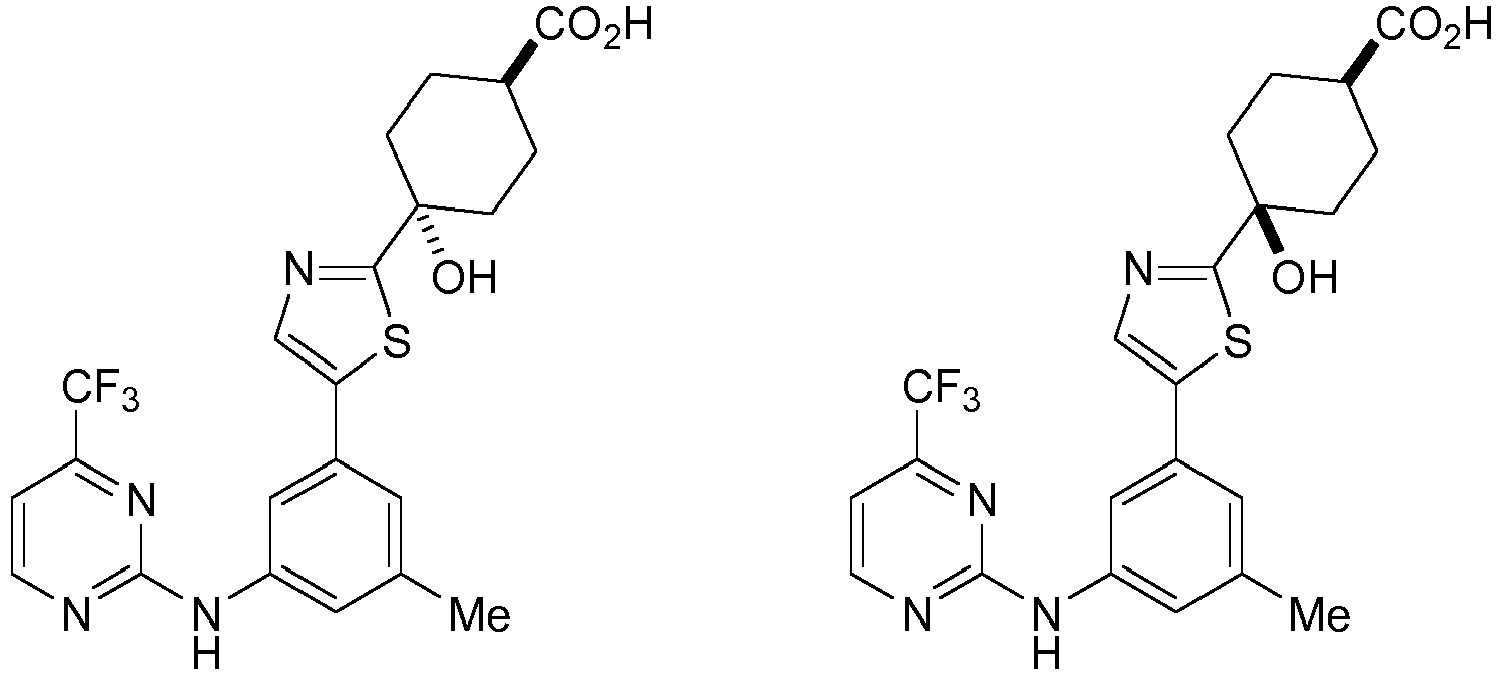
- Part A: Ethyl 4-hydroxy-4-[5-(3-methyl-5-{[4-(trifluoromethyl)pyrimidin-2-yl]amino}phenyl)-1,3-thiazol-2-yl]cyclohexanecarboxylate (3.72 g, 7.3 mmol) was suspended in methanol (42 mL) and sodium hydroxide (1M in water, 15 mL) was added. The solution was split between 3 20-mL microwave tubes. The reaction was irradiated at 100°C in the microwave for 15 minutes. Upon completion, the solution was acidified with HCl (1M in water, 18 mL). The solution was extracted with ethyl acetate and a small amount of 9:1 CHCl3:isopropanol. The organic layer was separated, dried over magnesium sulfate, filtered and concentrated.
- Part B: Supercritical fluid separation was used for purification with an OJ-H 2.1 X 25 cm, 5 µM column. The mobile phase used was a 3:7 methanol/CO2 with a flow rate of 70 mL/min with a 7 minute run time, to yield:
- Isomer 1: trans-4-hydroxy-4-[5-(3-methyl-5-[4-(trifluoromethyl)pyrimidin-2-yl]amino}phenyl)-1,3-thiazol-2-yl]cyclohexanecarboxylic acid (1.11 g, 32% yield). MS ESI: [M+H]+ m/z 479.1. 1H NMR (600 MHz, DMSO-d6) δ 10.23 (s, 1H), 8.81 (d, J = 4.9, 1H), 8.00 - 7.75 (m, 2H), 7.44 (s, 1H), 7.25 (d, J = 4.9, 1H), 7.12 (s, 1H), 5.92 (s, 1H), 2.62 (s, 1H), 2.29 (s, 3H), 2.11 - 1.95 (m, 2H), 1.92 - 1.75 (m, 4H), 1.71 - 1.54 (m, 2H). rhSYK activity = +++
- Isomer 2: cis-4-hydroxy-4-[5-(3-methyl-5-{[4-(trifluoromethyl)pyrimidin-2-yl]amino}phenyl)-1,3-thiazol-2-yl]cyclohexanecarboxylic acid (1.13 g, 32%). MS ESI: [M+H]+ m/z 479.1. 1H NMR (500 MHz, DMSO-d6) δ 12.1 (s, 1H), 10.25 (s, 1H), 8.83 (d, J = 5.2, 1H), 8.04 - 7.83 (m, 2H), 7.46 (s, 1H), 7.27 (d, J = 5.0, 1H), 7.15 (s, 1H), 5.95 (s, 1H), 2.31 (s, 3H), 2.13 - 1.99 (m, 1H), 1.91 - 1.73 (m, 2H), 1.71 - 1.53 (m, 6H). rhSYK activity = +++
- cis-4-Hydroxy-4-[5-(3-methyl-5-{[4-(trifluoromethyl)pyrimidin-2-yl]amino}phenyl)-1,3-thiazol-2-yl]cyclohexanecarboxylic acid (15 mg, 0.031 mmol) was dissolved in acetonitrile (272 %µ) and water (54 µL). Sodium hydroxide (31 µL, 0.031 mmol) was added, and the mixture was heated to 40 °C for 1 h. The reaction was allowed to cool to room temperature, before freezing and lyophilization to dryness to afford sodium cis-4-hydroxy-4-[5-(3-methyl-5-{[4-(trifluoromethyl)-i pyrimidin-2-yl]amino}phenyl)-1,3-thiazol-2-yl]cyclohexanecarboxylate. MS ESI: [M + H]+ m/z 479.1. 1H NMR (500 MHz, DMSO-d6) δ 10.25 (s, 1H), 8.83 (s, 1H), 8.06 - 7.73 (m, 2H), 7.46 (s, 1H), 7.27 (s, 1H), 7.13 (s, 1H), 5.89 - 5.60 (m, 1H), 2.31 (s, 3H), 1.91 - 1.54 (m, 9H). rhSYK activity = +++
- cis-4-Hydroxy-4-[5-(3-methyl-5-{[4-(trifluoromethyl)pyrimidin-2-yl]amino}phenyl)-1,3-thiazol-2-yl]cyclohexanecarboxylic acid (15 mg, 0.031 mmol) was dissolved in acetonitrile (272 µL) and water (54 µL). Potassium hydroxide (31 µL, 0.031 mmol) was added, and the mixture was heated to 40 °C for 1 h. The reaction was allowed to cool to room temperature, before freezing and lyophilization to dryness to afford potassium cis-4-hydroxy-4-[5-(3-methyl-5-{[4-(trifluoromethyl)pyrimidin-2-yl]amino}phenyl)-1,3-thiazol-2-yl]cyclohexanecarboxylate. MS ESI: [M + H]+ m/z 479.1. 1H NMR (500 MHz, DMSO-d6) δ 10.25 (s, 1H), 8.83 (d, J = 4.9, 1H), 7.99 - 7.83 (m, 2H), 7.46 (s, 1H), 7.27 (d, J = 4.9, 1H), 7.13 (s, 1H), 5.88 - 5.63 (m, 1H), 2.31 (s, 3H), 1.88 - 1.59 (m, 9H). rhSYK activity = +++
- trans-4-Hydroxy-4-[5-(3-methyl-5-{[4-(trifluoromethyl)pyrimidin-2-yl]amino}phenyl)-1,3-thiazol-2-yl]cyclohexanecarboxylic acid (15 mg, 0.031 mmol) was dissolved in acetonitrile (272 µL) and water (54 µL). Sodium hydroxide (31 µL, 0.031 mmol) was added, and the mixture was heated to 40 °C for 1 h. The reaction was allowed to cool to room temperature, before freezing and lyophilization to dryness to afford sodium trans-4-hydroxy-4-[5-(3-methyl-5-{[4-(trifluoromethyl)pyrimidin-2-yl]amino}phenyl)-1,3-thiazol-2-yl]cyclohexanecarboxylate. MS ESI: [M + H]+ m/z 479.1. 1H NMR (500 MHz, DMSO-d6) δ 10.25 (s, 1H), 8.83 (d, J = 4.9, 1H), 8.04 - 7.76 (m, 2H), 7.46 (s, 1H), 7.27 (d, J = 4.9, 1H), 7.14 (s, 1H), 5.68 (s, 1H), 2.31 (s, 3H), 2.21 - 1.96 (m, 3H), 1.90 - 1.63 (m, 4H), 1.62 - 1.42 (m, 2H). rhSYK activity = +++
- trans-4-Hydroxy-4-[5-(3-methyl-5-{[4-(trifluoromethyl)pyrimidin-2-yl]amino}phenyl)-1,3-thiazol-2-yl]cyclohexanecarboxylic acid (15 mg, 0.031 mmol) was dissolved in acetonitrile (272 µL) and water (54 µL). Potassium hydroxide (31 µL, 0.031 mmol) was added, and the mixture was heated to 40 °C for 1 h. The reaction was allowed to cool to room temperature, before freezing and lyophilization to dryness to afford potassium trans-4-hydroxy-4-[5-(3-methyl-5-{[4-(trifluoromethyl)pyrimidin-2-yl]amino}phenyl)-1,3-thiazol-2-yl]cyclohexanecarboxylate. MS ESI: [M + H]+ m/z 479.1. 1H NMR (500 MHz, DMSO-d6) δ 10.25 (s, 1H), 8.83 (d, J = 4.9, 1H), 8.02 - 7.78 (m, 2H), 7.46 (s, 1H), 7.27 (d, J = 4.9, 1H), 7.14 (s, 1H), 5.69 (s, 1H), 2.31 (s, 3H), 2.19-2.07 (m, 2H), 1.99 - 1.85 (m, 1H), 1.81 - 1.60 (m, 4H), 1.57 - 1.42 (m, 2H). rhSYK activity = +++
- Compounds in the following Tables 33A to 33D were prepared in an analogous manner as that described in Examples 32-33.
-

TABLE 33A Ex. R1 R2 R3/R4 rhSYK Activity [M+H] + Obs'd Form(s) Formula A; R5 = H 33A-5 4-CF3 CH3 H/CO2Et +++ 507.2 Free Base 33A-6 4-CF3 CH3 H/CO2H (cis) +++ 479.1 Free Base 33A-7 4-CF3 CH3 H/CO2Et (trans) +++ 507.2 Free Base 33A-8 4-CF3 CH3 H/CO2H (trans) +++ 479.1 Free Base 33A-9 4-CF3 CH3 Ph/CO2H +++ 555.2 Free Base 33A-10 4-CF3 CH3 CH3/CO2Et (cis) +++ 521.1 Free Base 33A-11 4-CF3 CH3 CH3/CO2Et (trans) ++ 521.1 Free Base 33A-12 4-CF3 CH3 CH3/CO2H (trans) +++ 493.1 Free Base 33A-13 4-CF3 CH3 CH3/CO2H (cis) +++ 493.1 Free Base 33A-14 4-CF3 CH3 CO2Me/NHC(O)CH3 +++ 550.1 Free Base 33A-15 4-CF3 CH3 CO2H/NHC(O)CH3 +++ 536.1 TFA Salt 33A-16 4-CF3 CH3 H/CH2CO2H (trans) +++ 493 Formate Salt 33A-18 4-CF3 CH3 H/CH2CH2CO2H +++ 507.2 Free Base 33A-19 4-CF3 CH3 H/CH2CH2CO2H (cis) +++ 507.2 Free Base 33A-20 4-CF3 CH3 H/CH2CH2CO2H (trans) +++ 507.2 Free Base 33A-21 4-CF3 CH3 H/CH2CH2CO2CH2C H3 +++ 535.2 Free Base 33A-22 4-CF3 CI H/CO2H (trans) +++ 499.1 Free Base 33A-23 4-CF3 H H/CO2H (trans) +++ 465.0 Free Base 33A-24 4-CF3 H H/CO2H (cis) +++ 465.0 Free Base 33A-25 4-CF3 H H/CO2Et (cis) +++ 493.1 Free Base 33A-26 4-CF3 H H/CO2Et (trans) ++ 493.1 Free Base 33A-27 4-CF3 H CH3/CO2H (trans) +++ 479.1 Free Base 33A-28 4-CF3 H CH3/CO2H (cis) +++ 479.1 Free Base 33A-29 4-iPr CH3 H/CO2C(CH3)3 (cis) ++ 509.2 Free Base 33A-30 4-CH3 CH3 H/CO2H (cis) +++ 425.1 Free Base 33A-31 4-CH3 CH3 H/CO2H (trans) +++ 425.1 Free Base 33A-32 4-CH3 CH3 H/CH2CO2H (cis) +++ 439.1 Free Base 33A-33 4-CH3 CH3 H/CH2CO2H (trans) +++ 439.0 Free Base 33A-34 4-O-iPr CH3 H/CO2C(CH3)3 (cis) ++ 525.2 Free Base 33A-35 4-OCH3 CH3 H/CO2H (cis) +++ 441.1 Free Base 33A-36 4-OCH3 CH3 H/CO2H (trans) +++ 441.1 Free Base 33A-37 4-OCH3 CH3 CH3/CO2H (cis) +++ 455.1 Free Base 33A-38 4-OCH3 CH3 CH3/CO2H (trans) +++ 455.1 Free Base Formula B; R5 = H 33A-54 CF3 CH3 H/CO2H (trans) +++ 507 Free Base 33A-59 CF3 c-Pr H/CO2H (enantiomer 1) +++ 533.2 Free Base 33A-60 CF3 c-Pr H/CO2H (enantiomer 2) +++, +++ 533.2 Free Base, TFA Salt 33A-61 CF3 c-Pr H/CO2CH3 +++ 547.2 Free Base 33A-62 CF3 c-Pr H/CO2H +++ 533.2 TFA Salt 33A-65 CF3 H H/CO2CH3 ++ 507.1 Free Base 33A-66 CF3 H H/CO2H (cis, enantiomer 1) +++ 493 Free Base 33A-67 CF3 H H/CO2H (cis, enantiomer 2) +++ 493 Free Base 33A-68 CH3 CH3 H/CO2H (cis) +++ 452.1 Free Base 33A-69 CH3 CH3 H/CO2CH3 (cis) +++ 467.2 Free Base 33A-70 c-Pr CH3 H/CO2CH3 +++ 493.2 Free Base 33A-71 c-Pr CH3 H/CO2H +++ 479.2 Free Base 33A-72 OCH3 CH3 H/CO2H (isomer 1) +++ 469.1 Free Base 33A-73 OCH3 CH3 H/CO2H (isomer 2) +++ 469.1 Free Base Formula B; R5 = CH3 33A-75 CF3 CH3 H/CO2H +++ 521 Free Base 33A-76 CF3 CH3 H/CO2H (isomer 1) +++ 521 Free Base 33A-77 CF3 CH3 H/CO2H (isomer 2) +++ 521 Free Base 33A-78 CF3 CH3 H/CO2H (isomer 3) +++ 521 Free Base TABLE 33B 
Ex. X Y R3/R4 rhSYK Activity [M+H]+ Obs'd Form(s) R1 = CF3, R5 = H 33B-1 Bond Bond H/CO2H +++ 451.0 Ammonium salt 33B-3 C(CH3)2 Bond H/CO2H +++ 493 Free Base 33B-4 C(CH3)2 Bond H/CO2H (isomer 2) +++ 493 Free Base 33B-5 C(CH3)2 Bond H/CO2H (isomer 4) +++ 493 Free Base 33B-6 C(CH3)2 Bond H/CO2H (isomer 1) +++ 493 Free Base 33B-7 C(CH3)2 Bond H/CO2H (isomer 3) +++ 493 Free Base 33B-8 C(CH3)2 CH2CH2 H/CO2H +++ 521 Free Base 33B-9 C(CH3)2 CH2CH2 H/CO2H (isomer 1) +++ 521 Free Base 33B-10 C(CH3)2 CH2CH2 H/CO2H (isomer 2) +++ 521 Free Base 33B-11 C(CH3)2 CH2CH2 H/CO2H (isomer 3) +++ 521 Free Base 33B-12 C(CH3)2 CH2CH2 H/CO2H (isomer 4) +++ 521 Free Base 33B-13 CH(OCH3) CH2 H/CO2H +++ 509 Free Base 33B-14 CH(OCH3) CH2 H/CO2H (cis,cis) +++ 509 Free Base 33B-18 CH(CH3) CH2 H/CO2H (isomer 1) +++ 493.1 Free Base 33B-19 CH(CH3) CH2 H/CO2H (isomer 2) +++ 493.2 TFA Salt 33B-20 CH(CH3) CH2 H/CO2H (isomer 3) +++, +++ 493.1 Free Base, TFA Salt 33B-21 CH(CO2H) CH2 H/H +++ 479.1 Free Base 33B-24 CH(iPr) CH2 H/CO2H +++ 521 Free Base 33B-22 CH(iPr) CH2 H/CO2H (enantiomer 1) +++ 521 Free Base 33B-23 CH(iPr) CH2 H/CO2H (enantiomer 2) +++ 521 Free Base 33B-24 CH2 bond H/CO2H +++ 465.0 Ammonium salt 33B-25 CH2 bond H/CH2CO2H (trans, enantiomer 1)) +++ 479 Free Base 33B-26 CH2 bond H/CH2CO2H (cis, enantiomer 1) +++ 479 Free Base 33B-27 CH2 bond H/CH2 CO2H (trans, enantiomer 2) +++ 479 Free Base 33B-28 CH2 bond H/CH2CO2H (cis, enantiomer 2) +++ 479 Free Base R1 = CH3, R5 = H 33B-32 CH(CH3) CH2 H/CO2H (isomer 1) +++ 439.2 Free Base 33B-33 CH(CH3) CH2 H/CO2H (isomer 2) +++ 439.2 Free Base 33B-34 CH(iPr) CH2 H/CO2H +++ 467 Free Base 33B-35 CH(iPr) CH2 H/CO2H (isomer 1) +++ 467 Free Base 33B-36 CH(iPr) CH2 H/CO2H (isomer 2) +++ 467 Free Base 33B-37 CH(Ph) CH2 H/CO2H +++ 501 Free Base R1 = CF3, R5 = CH3 33B-38 CH(CH3) CH2 H/CO2H (isomer 1) +++ 507 TFA Salt 33B-39 CH(CH3) CH2 H/CO2H (isomer 2) +++ 507 Free Base R1 = CF3, R5 = CH2CH3 33B-40 CH(CH3) CH2 H/CO2H +++ 521 TFA Salt 33B-41 CH(CH3) CH2 H/CO2H (isomer 1) +++ 521 TFA Salt 33B-42 CH(CH3) CH2 H/CO2H (isomer 2) +++ 521 TFA Salt -

- To a flask containing ethyl 4-hydroxy-4-[5-(3-methyl-5-{[4-(trifluoromethyl)pyrimidin-2-yl]amino}phenyl)-1,3-thiazol-2-yl]cyclohexanecarboxylate (Example 32, 0.18 g, 0.345 mmol) was added Eaton's Reagent (1.3 mL) and the mixture was heated at 60 °C for 2 hours. The reaction was cooled and added dropwise to saturated sodium bicarbonate. After stirring for 2 minutes, the aqueous solution was extracted three times with ethyl acetate. The combined organics were dried under reduced pressure and purified by silica gel chromatography to yield ethyl 4-[5-(3-methyl-5-{[4-(trifluoromethyl)pyrimidin-2-yl] amino }phenyl)-1,3-thiazol-2-yl]-cyclohex-3-ene-1-carboxylate (0.14 g, 82% yield). MS ESI: [M+H]+ m/z 489.1. 1H NMR (500 MHz, CDCl3) δ 8.65 (d, J = 5.2, 1H), 7.96 - 7.79 (m, 2H), 7.46 (s, 1H), 7.26 (s, 1H), 7.14 - 6.95 (m, 2H), 6.65 (s, 1H), 4.28 - 3.96 (m, 2H), 2.90 - 2.75 (m, 1H), 2.75 - 2.60 (m, 1H), 2.62 - 2.47 (m, 3H), 2.39 (s, 3H), 2.26 - 2.10 (m, 1H), 1.95 - 1.70 (m, 1H), 1.39 - 1.17 (m, 3H). rhSYK activity = ++
-

- To ethyl 4-[5-(3-methyl-5-{[4-(trifluoromethyl)pyrimidin-2-yl]amino}phenyl)-1,3-thiazol-2-yl]-cyclohex-3-ene-1-carboxylate (0.15 g, 0.31 mmol) was added ethanol (2 mL) and argon was bubbled through the solution for 5 minutes. The flask was then purged/filled with argon three times. 10% Palladium on carbon (0.33 mg) was added to the flask and the flask was purged /filled with argon three times. A hydrogen balloon was added to the top of the flask and the reaction was purged/filled with argon three times. The reaction was stirred for 72 hours. Upon completion, the reaction was filtered carefully through celite and the celite pad was washed with methanol (70 mL). The filtrate was concentrated under reduced pressure and the solid was purified by silica gel chromatography to yield ethyl 4-[5-(3-methyl-5-{[4-(trifluoromethyl)-pyrimidin-2-yl]amino}phenyl)-1,3-thiazol-2-yl]cyclohexanecarboxylate (0.73 g, 49% yield). MS ESI: [M+H]+ m/z 491.1. 1H NMR (500 MHz, CDCl3) δ 8.63 (d, J = 5.3, 1H), 7.96-7.73 (m, 2H), 7.64 (s, 1H), 7.25 (s, 1H), 7.13 - 6.92 (m, 2H), 4.24 - 3.99 (m, 2H), 3.23 - 3.02 (m, 1H), 2.73 - 2.57 (m, 1H), 2.49 (s, 3H) 2.32-2.21 (m, 1H), 2.23 - 2.07 (m, 2H), 2.02 - 1.81 (m, 3H), 1.79 - 1.64 (m, 1H), 1.64 - 1.52 (m, 1H), 1.39 - 1.08 (m, 3H). rhSYK activity = ++
-

- Step 3: To ethyl 4-[5-(3-methyl-5-{[4-(trifluoromethyl)pyrimidin-2-yl]amino}phenyl)-1,3-thiazol-2-yl]cyclohexanecarboxylate (0.60 g, 0.12 mmol) in tetrahydrofuran (0.61 mL) was added potassium hydroxide (1.2 mL, 1 M in methanol) and the reaction was stirred overnight at room temperature. Upon completion, the reaction was diluted with dichloromethane and washed twice with hydrochloric acid (2 M in water). The organic layer was dried under reduced pressure to give 2-({3-[2-(4-carboxycyclohexyl)-1,3-thiazol-5-yl]-5-methylphenyl}amino)-4-(trifluoromethyl)pyrimidin-1-ium chloride (0.060 g, 85% yield). MS ESI: [M+H]+ m/z 463.1. 1H NMR (500 MHz, DMSO-d6) δ 10.25 (s, 1H), 8.83 (d, J = 5.2, 1H), 8.06 - 7.81 (m, 2H), 7.44 (s, 1H), 7.27 (d, J = 5.8, 1H), 7.14 (s, 1H), 2.30 (s, 3H), 2.14 - 2.04 (m, 1H), 2.03 - 1.83 (m, 4H), 1.82-1.61 (m, 3H), 1.55 - 1.33 (m, 2H). rhSYK activity = +++
- The following examples were prepared in an analogous manner of that described in Examples 34-36.
TABLE 36A 
Example R1 X R2/R2' or R2+R2' --- rhSYK Activity [M+H] + Obs'd Form(s) R3 = R3' = H 36A-2 CH3 CHCO2Et H/H single ++ 491.1 Free Base 36A-4 H CHCO2H (trans) H/H single +++ 449.1 Free Base 36A-5 H CHCO2Me (trans) H/H single ++ 463.1 Free Base 36A-8 CH3 CH2 =O single +++ 433.1 Free Base 36A-10 CH3 CH2CH2 =O single +++ 447.1 Free Base TABLE 36B 
Example R rhSYK Activity [M+H]+ Obs'd Form(s) 36B-1 
+++ 434.1 Free Base 36B-3 
+++ 448.1 Free Base 36B-4 
+++ 448.1 Free Base -

- To a flask was added tetrahydrofuran (3.0 mL) and the flask was cooled to -78 °C. Lithium diisopropylamide (1.0 mL, 1.78 mmol) was added and the mixture was cooled to -78 °C. INTERMEDIATE 4 (0.20 g, 0.60 mmol) was dissolved in tetrahydrofuran (3.0 mL) and added to the reaction mixture in one portion and stirred for 30 minutes. 4-oxocyclohexanecarbonitrile (0.073 g, 0.60 mmol) was dissolved in THF (3.0 mL) and then added over a period of five minutes and the solution was then allowed to warm to room temperature. The reaction was diluted with ethyl acetate, washed with saturated ammonium chloride, dried over magnesium sulfate, filtered and concentrated. Column chromatography was used to yield: cis-4-hydroxy-4-[5-(3-methyl-5-{[4-(trifluoromethyl)pyrimidin-2-yl]amino}phenyl)-1,3-thiazol-2-yl]cyclohexanecarbonitrile (0.72 g, 26%) Analysis for cis isomer: MS ESI: [M+H]+ m/z 460.1. 1H NMR (600 MHz, DMSO-d6) δ 10.23 (s, 1H), 8.81 (d, J = 4.9, 1H), 7.93 (m, 2H), 7.44 (s, 1H), 7.26 (d, J = 4.9, 1H), 7.13 (s, 1H), 6.11 (s, 1H), 2.82 (s, 1H), 2.29 (s, 3H), 1.99 - 1.72 (m, 8H). rhSYK activity = +++
trans-4-hydroxy-4-[5-(3-methyl-5-{[4-(trifluoromethyl)pyrimidin-2-yl]amino}phenyl)-1,3-thiazol-2-yl]cyclohexanecarbonitrile (0.78 g, 29%). MS ESI: [M+H]+ m/z 460.1. 1H NMR (600 MHz, DMSO-d6) δ 10.23 (s, 1H), 8.81 (d, J = 4.9, 1H), 8.00 - 7.89 (m, 2H), 7.45 (s, 1H), 7.25 (d, J = 4.9, 1H), 7.14 (s, 1H), 6.11 (s, 1H), 3.13 (s, 1H), 2.30 (s, 3H), 2.07 (m, 2H), 2.00 - 1.89 (m, 2H), 1.77 (m, 4H). rhSYK activity = +++ -

- To trans-4-hydroxy-4-[5-(3-methyl-5-{[4-(trifluoromethyl)pyrimidin-2-yl]amino}phenyl)-1,3-thiazol-2-yl]cyclohexanecarbonitrile (0.78 g, 0.17 mmol) was added DMSO (1.4 mL). Potassium carbonate (0.13 mg, 0.92 mmol) and 30% hydrogen peroxide (0.17 mL, 1.70 mmol) were added and the reaction was heated at 70°C. Upon completion, the solution was cooled and filtered. The filtrate was purified by reverse phase HPLC (10-100% acetonitrile gradient with water over 12 minutes with a 0.05% trifluoroacetic acid buffer) to yield trans-4-hydroxy-4-[5-(3-methyl-5-{[4-(trifluoromethyl)pyrimidin-2-yl]amino}phenyl)-1,3-thiazol-2-yl]cyclohexanecarboxamide (0.040 g, 49%). MS ESI: [M+H]+ m/z 478.1. 1H NMR (500 MHz, CD3OD) δ 8.72 (d, J = 5.3, 1H), 8.03 (s, 1H), 7.90 (s, 1H), 7.45 (s, 1H), 7.22 - 6.90 (m, 2H), 2.57 - 2.40 (m, 3H), 2.38 (s, 3H), 2.00 - 1.69 (m, 6H). rhSYK activity = +++
In an analogous manner of that described above, cis-4-hydroxy-4-[5-(3-methyl-5-{[4-(trifluoromethyl)pyrimidin-2-yl]amino}phenyl)-1,3-thiazol-2-yl]cyclohexanecarboxamide was prepared as the free base. [M+H]+ Observed: 478.1. rhSYK Activity: +++ -

- Step 1: cis-4-Hydroxy-4-[5-(3-methyl-5-{[4-(trifluoromethyl)pyrimidin-2-yl]amino}phenyl)-1,3-thiazol-2-yl]cyclohexanecarboxylic acid (500 mg, 1.05 mmol), ammonium chloride (112 mg, 2.09 mmol), O-(7-azabenzotriazol-1-yl)-N,N,N',N'-tetramethyluronium hexafluorophosphate (795 mg, 2.09 mmol), and diisopropylethylamine (730 µl, 4.18 mmol) were taken-up in dimethylformamide (4.2 mL) under argon. The vessel was sealed and stirred at 65 °C for 4 hours. Upon cooling, the reaction mixture was diluted with water, and the resulting precipitate was collected via filtration. The solids were washed with water and diethyl ether and dried in vacuo overnight to afford cis-4-hydroxy-4-[5-(3-methyl-5-{[4-(trifluoromethyl)pyrimidin-2-yl]amino}phenyl)-1,3-thiazol-2-yl]cyclohexanecarboxamide (437.6 mg, 0.916 mmol, 88% yield) as a white solid. MS ESI: [M + H]+ mlz 478.1.
- Step 2: In a dry vessel, the product from Step 1 (350 mg, 0.733 mmol) was taken-up in dichloromethane (4.9 mL) and tetrahydrofuran (2.4 mL) under argon. (Methoxycarbonyl-sulfamoyl)triethylammonium hydroxide, inner salt (218 mg, 0.916 mmol) was added, and the resulting mixture was sealed and stirred at room temperature for 18 hours. Another portion of (methoxycarbonylsulfamoyl)triethylammonium hydroxide, inner salt (218 mg, 0.916 mmol) was then added, and the resulting mixture was sealed and stirred at room temperature for 18 hours. The reaction mixture was quenched with water and directly concentrated. Reverse-phase HPLC purification (water-acetonitrile, trifluoroacetic acid modifier) afforded cis-4-hydroxy-4-[5-(3-methyl-5-{[4-(trifluoromethyl)pyrimidin-2-yl]amino}phenyl)-1,3-thiazol-2-yl]cyclohexane-carbonitrile (28.6 mg, 0.062 mmol, 8.5% yield) as a white solid. MS ESI: [M + H]+ m/z 460.1.
- Step 3: The product from Step 2 (25 mg, 0.054 mmol), hydroxylamine hydrochloride (18.90 mg, 0.272 mmol), and potassium carbonate (41.4 mg, 0.299 mmol) were taken-up in ethanol (0.5 mL) under argon. The vessel was sealed and stirred at 80 °C for 18 hours. The reaction mixture was directly concentrated, and the solids were taken-up in tetrahydrofuran (0.5 mL). Triethylamine (22.8 µl, 0.163 mmol) was added, and the mixture was cooled to 0 °C. Carbonyldiimidazole (13.2 mg, 0.082 mmol) was added, and the resulting mixture was allowed to warm to room temperature over 18 hours. The reaction was quenched with trifluoroacetic acid and diluted with 1 ml DMSO. The resulting mixture was filtered and directly subjected to reverse-phase HPLC (water-acetonitrile, trifluoroacetic acid modifier). This purification afforded the title compound (14.7 mg, 0.028 mmol, 52% yield) as a white solid. MS ESI: [M + H]+ m/z 519.1. 1H NMR (500 MHz, dmso) δ 12.23 (s, 1H), 10.26 (s, 1H), 8.83 (d, J = 4.8, 1H), 7.94 (d, J = 10.8, 2H), 7.46 (s, 1H), 7.28 (d, J = 4.9, 1H), 7.15 (s, 1H), 6.06 (s, 1H), 2.68 (m, 1H), 2.31 (s, 3H), 2.03 - 1.79 (m, 8H). rhSYK activity = +++
-

- Step 1: To a solution of ethyl 4-[5-(3-{(tert-butoxycarbonyl)[4-(trifluoromethyl)pyrimidin-2-yl]amino}-5-methylphenyl)-1,3-thiazol-2-yl]-4-hydroxycyclohexanecarboxylate (0.148 g, 0.24 mmol) and DMF (1.2 mL) was added iodomethane (0.042 g, 0.29 mmol). The solution was cooled to 0°C and then 60% sodium hydride in mineral oil (0.011 g, 0.27 mmol) was added and the reaction was allowed to warm up overnight. The next morning, iodomethane (1.14 g, 8.03 mmol) was added and the mixture was cooled to 0 °C. Sodium hydride in mineral oil (60%, 0.011 g, 0.27 mmol) was added and the reaction was allowed to warm to room temperature. The reaction was complete after warming. The solution was cooled to 0°C and carefully quenched with methanol and then water. The mixture was extracted with dichloromethane. The organic layer was washed three times with water, dried over magnesium sulfate, filtered and concentrated. Purification by silica gel chromatography was used to yield ethyl 4-[5-(3-{(tert-butoxycarbonyl)[4-(trifluoromethyl)pyrimidin-2-yl]amino}-5-methylphenyl)-1,3-thiazol-2-yl]-4-methoxycyclohexanecarboxylate. MS ESI: [M+H]+ m/z 621.2.
- Step 2: To the product of Step 1 (0.15 g, 0.243 mmol) in dichlormethane (2 mL) was added trifluoroacetic acid (1.48 g, 12.98 mmol) and the reaction was stirred until complete. The reaction was diluted with water and the mixture extracted three times with dichloromethane. The combined organic layers were dried over magnesium sulfate, filtered and concentrated to give ethyl 4-methoxy-4-[5-(3-methyl-5-{[4-(trifluoromethyl)pyrimidin-2-yl]amino}phenyl)-1,3-thiazol-2-yl]cyclohexanecarboxylate. MS ESI: [M+H]+ m/z 521.2.
- Step 3: To the product of Step 2 (0.13, 0.24 mmol) in methanol (1 mL) was added potassium hydroxide (1M in water, 0.24 mL, 0.24 mmol) and the reaction was stirred at room temperature overnight. The reaction was quenched with hydrochloric acid (2N in water) and the solution was extracted 3 times with dichloromethane. The combined organic layer was concentrated and the residue was subject to purification by supercritical fluid chromatography with an OJ-H 2.1 X 25 cm, 5 µM column. The mobile phase was a 2:8 methanol/CO2 with a flow rate of 70 mL/min with a 12 minute run time to yield:
- 2-({3-[2-(cis-4-Carboxy-1-methoxycyclohexyl)-1,3-thiazol-5-yl]-5-methylphenyl}amino)-4-(trifluoromethyl)pyrimidin-1-ium trifluoroacetate (0.03 g, 19% yield). MS ESI: [M+H]+ m/z 493.1. 1H NMR (500 MHz, CDCl3) δ 8.64 (s, 1H), 7.93 (m, 2H), 7.28 (s, 1H), 7.12 (s, 1H), 7.07 (d, J = 4.9, 1H), 3.27, (s, 3H), 2.41 (s, 3H), 2.29 (m, 1H), 1.96 (m, 8H). rhSYK activity = +++.
- 2-({3-[2-(trans-4-Carboxy-1-methoxycyclohexyl)-1,3-thiazol-5-yl]-5-methylphenyl}amino)-4-(trifluoromethyl)pyrimidin-1-ium trifluoroacetate (0.02 g, 15% yield). MS ESI: [M+H]+ m/z 493.1. 1H NMR (600 MHz, CDCl3) δ 8.58 (s, 1H), 7.92 (s, 1H), 7.83 (s, 1H), 7.41 (s, 1H), 7.08 (s, 1H), 7.04 (d, J = 5.0, 1H), 3.16 (s, 3H), 2.64 (s, 1H), 2.37 (s, 3H), 2.05 - 1.89 (m, 8H). rhSYK activity = +++.
-

- Step 1: 1-{[(9H-Fluoren-9-yloxy)carbonyl]amino}-4-hydroxy-4-[5-(3-methyl-5-{[4-(trifluoromethyl)pyrimidin-2-yl]amino}phenyl)-1,3-thiazol-2-yl]cyclohexanecarboxylic acid (0.079 g, 0.11 mmol) was dissolved in DMF (1.0 mL). Piperidine (0.086 g, 1.01 mmol) was added. After 15 minutes, the reaction mixture was directly purified by reverse phase HPLC to yield 1-amino-4-hydroxy-4-[5-(3-methyl-5-{[4-(trifluoromethyl)pyrimidin-2-yl]amino}phenyl)-1,3-thiazol-2-yl]cyclohexanecarboxylic acid (0.005 g, 0.01 mmol) as its TFA salt. MS ESI: [M+H]+ m/z 494.1. 1H NMR (600 MHz, CD3OD) δ 8.70 (d, J = 4.9, 1H), 8.04 (s, 1H), 7.94 - 7.80 (m, 2H), 7.69 (d, J = 7.6, 1H), 7.52 - 7.42 (m, 1H), 7.42 - 7.34 (m, 1H), 7.18 - 7.00 (m, 2H), 2.60 - 2.42 (m, 2H), 2.36 (s, 3H), 2.28 - 2.07 (m, 4H), 2.05 - 1.89 (m, 2H).
rhSYK activity = +++. The starting material was prepared generally following the procedures described in Examples 32 and 33 using commercially available 1-{[{9H-fluoren-9-ylmethoxy)carbonyl]amino} -4-oxocyclohexanecarboxylic acid. -
- (1S,4R)-4-hydroxy-2,2-dimethyl-4-[5-(3-methyl-5-{[4-(trifluoromethyl)pyrimidin-2-yl]amino}-phenyl)-1,3-thiazol-2-yl]cyclohexanecarboxylic acid
- (1R,4S)-4-hydroxy-2,2-dimethyl-4-[5-(3-methyl-5-{[4-(trifluoromethyl)pyrimidin-2-yl]amino}-phenyl)-1,3-thiazol-2-yl]cyclohexanecarboxylic acid
- (1S,4S)-4-hydroxy-2,2-dimethyl-4-[5-(3-methyl-5-{[4-(trifluoromethyl)pyrimidin-2-yl]amino}-phenyl)-1,3-thiazol-2-yl]cyclohexanecarboxylic acid
- (1R,4R)-4-hydroxy-2,2-dimethyl-4-[5-(3-methyl-5-{[4-(trifluoromethyl)pyrimidin-2-yl]amino}-phenyl)-1,3-thiazol-2-yl]cyclohexanecarboxylic acid


- Lithium diispropylamide (1.31 M, 10.0 mL, 13.1 mmol) was cooled to -78 °C and N-[3-methyl-5-(1,3-thiazol-5-yl)phenyl]-4-(trifluoromethyl)pyrimidin-2-amine (INTERMEDIATE 4, 2.0 g, 5.95 mmol) in THF (20 mL) was added portionwise. While stirring at -78 °C additional lithium diisopropylamide (1.31 M, 4.55 mL, 5.95 mmol) was added. In a separate flask, lithium diisopropylamide (1.31 M, 10.0 mL, 13.1 mmol) was cooled to 0 °C and 2,2-dimethyl-4-oxo-cyclohexanecarboxylic acid (2.02 g, 11.9 mmol) in THF (20 mL) was added. The resulting solution of the carboxylate anion was transferred via cannula to the previously prepared thiazole anion solution, maintaining an internal reaction temperature below -68 °C. The resultant mixture was stirred at -78 °C for 1 h, then methanol (5 mL) was added and the reaction mixture allowed to warm to room temperature. The reaction mixture was poured into water (200 mL) and extracted with MTBE (2x). The layers were separated and the aqueous portion was acidified to pH=3 with 2 N aqueous HCl then extracted with ethyl acetate (2x). The combined organic portions were dried over anhydrous Na2SO4, filtered and concentrated in vacuo to provide a yellow foam. The foam was then purified and the enantiomers separated via supercritical fluid chromatography (30% MeOH:CO2) to give (1S,4R)-4-hydroxy-2,2-dimethyl-4-[5-(3-methyl-5-{[4-(trifluoromethyl)pyrimidin-2-yl]amino}phenyl)-1,3-thiazol-2-yl]cyclohexanecarboxylic acid (Example 42(1), 12.9 g, 25.5 mmol, 21%) as a yellow solid. MS ESI: [M + H]+ m/z 507.1. 1H NMR (500 MHz, DMSO-d6) δ 12.13 - 11.86 (br s, 1H), 10.24 (s, 1H), 8.82 (m, 1H), 7.94 (s, 1H), 7.92 (s, 1H), 7.46 (s, 1H), 7.27 (m, 1H), 7.14 (s, 1H), 5.89 (s, 1H), 2.31 (s, 3H), 2.16 (d, J = 12.7, 1H), 2.02 (m, 1H), 1.86 (m, 3H), 1.64 (d, J= 13.8, 1H), 1.57 (d, J = 13.1, 1H), 1.11 (s, 3H), 0.99 (s, 3H). rhSYK activity = +++.
(1R,4S)-4-hydroxy-2,2-dimethyl-4-[5-(3-methyl-5-{[4-(trifluoromethyl)pyrimidin-2-yl]amino}-phenyl)-1,3-thiazol-2-yl]cyclohexanecarboxylic acid, (1S,4S)-4-hydroxy-2,2-dimethyl-4-[5-(3-methyl-5-{[4-(trifluoromethyl)pyrimidin-2-yl]amino}phenyl)-1,3-thiazol-2-yl]cyclohexanecarboxylic acid and (1R,4R)-4-hydroxy-2,2-dimethyl-4-[5-(3-methyl-5-{[4-(trifluoromethyl)pyrimidin-2-yl]amino}phenyl)-1,3-thiazol-2-yl]cyclohexanecarboxylic acid (Examples 42(2), 42(3), 42(4)) were prepared in an analogous manner of that described above for the (1S,4R) isomer. MS ESI: [M + H]+ m/z 507. rhSYK Activity: +++ -

- NADPH-dependent ketoreductase KRED-119 (668 mg, 3% w/w, available from Codexis, Inc., Redwood City, CA), NADP (668 mg, 3% w/w), glucose dehydrogenase CDX-901 (668 mg, 3% w/w, available from Codexis, Inc., Redwood City, CA) and D-(+)-glucose (11.16 g, 61.9 mmol) were dissolved in KH2PO4/K2HPO4 buffer solution (0.1 M aqueous, pH=6.8, 445 mL) at ambient temperature. In a separate flask, racemic methyl 2,2-dimethyl-4-oxocyclohexane-carboxylate (INTERMEDIATE 24, 22.26 g, 113 mmol) was dissolved in DMSO (6 mL) and the resulting solution was added to the KH2PO4/K2HPO4 buffered solution described above. The pH of the combined mixture was adjusted to 6.9 with 17.6 M aqueous NaOH solution and the reaction mixture stirred for 19 h at pH 6.9. The pH was adjusted to 4 using 11.7 M HCl (aq.) solution and the reaction mixture was stirred for 30 minutes, and then MTBE (100 mL), 2-propanol (100 mL) and sodium chloride (40.0 g) were added. The phases were separated and the organic layer was filtered through a pad of Solka Floc 200. The aqueous layer and the residual aqueous layer from the filtrate were combined and then extracted with MTBE (100 mL). The combined organic layers were concentrated in vacuo to 100 mL, and treated twice with sodium bisulfite (7.03 g, 67.6 mmol) and water (100 mL), each time the biphasic mixture was stirred vigorously for 30 min. The combined aqueous phase was treated with potassium carbonate (22.0 g, 159.2 mmol) then diluted with MTBE (100 mL) and the layers were separated. The combined organic layers were concentrated in vacuo to afford (1S)-2,2-dimethyl-4-oxocyclohexanecarboxylate (9.66 g, 96.2% ee) as an oil. MS ESI: M+· m/z 184. 1H NMR (400 MHz, CDCl3) δ 3.73 (s, 3H), 2.62 (t, J = 6.6, 1H), 2.57 (m, 1H), 2.44 (dd, J = 13.7,1.8, 1H), 2.29 (m, 1H), 2.19 (d, J= 13.7, 1H), 2.11 (m, 2H), 1.07 (s, 3H), 1.00 (s, 3H).
-

- To a solution of methyl (1S)-2,2-dimethyl-4-oxocyclohexanecarboxylate (10g, 54.28 mmol)) in THF (16.3g) was added additional THF (184 mL) followed by thiazole (6.93g, 81.42 mmol). The resulting solution was then cooled to -78 °C. Boron trifluoride diethyletherate (9.24g, 65.14 mmol) was added over 24 minutes and the resulting mixture aged at -78 °C for 5 minutes. n-Butyllithium (2.5M in hexanes, 20.05g, 71.98 mmol) was added to the mixture subsurface over 4 hours and the mixture was aged for 15 mins. Sodium hydroxide (1M aqeous solution, 54.3 mL, 54.3 mmol) was added followed by MTBE (54 mL) and the mixture was warmed to 20 °C. The aqueous layer was separated and the organic layer was washed with a half saturated aqeous solution of sodium chloride (54 mL) resulting in a light yellow solution of methyl (1S,4R)-4-hydroxy-2,2-dimethyl-4-(1,3-thiazol-2-yl) cyclohexanecarboxylate, which was then concentrated under partial vacuum to a low volume. Methanol (124 mL) was added and the solution concentrated to an oil under partial vacuum. The solution was then diluted with methanol (124 mL) and heated to 40 °C. A solution of 1M sodium hydroxide (92 mL, 92.0 mmol) was added over 5 minutes and the resulting mixture heated to 50 °C then aged for 16 hours before being cooled to 20 °C. The solution was washed three times with dichloromethane (124 mL, 62 mL, 62 mL) and the aqueous methanol solution of the product was crystallised by addition of 6M aqueous HCl (15.3 mL, 92 mmol) over 30 mins. The slurry was aged for 2 hours then the mixture was concentrated under partial vacuum to a total volume of 124 mL. The solid was collected by filtration and washed with water-methanol (1:1 v:v, 62 mL) then water (62 mL) to give the title compound (11.44g, 41.86 mmol, 99.9% ee) as a pale yellow solid. MS ESI : [M+H]+256.1 1HNMR (400MHz, DMSO-d6): 11.89-12.09 (br s, 1H), 7.67 (d, J = 3.5 Hz, 1H), 7.53 (d, J = 3.5 Hz, 1H), 5.79 (s, 1H), 3.36 (br s, 2H), 2.13-2.20 (m, 2H), 1.95-2.09 (m, 1H), 1.76-1.91 (m, 3H), 1.53-1.65 (m, 2H), 1.11 (s, 3H), 0.99 (s, 3H).
-

- To a solution of 3-bromo-5-methylaniline (45.77 g, 246 mmol) in toluene (500 ml) were sequentially added 2-chloro-4-(trifluoromethyl)pyrimidine (53.9 g, 295 mmol) and methanesulfonic acid (28.4 g, 295 mmol). The resulting solution was heated to 105 °C overnight. The resulting mixture was cooled, diluted with water (500 mL) and adjusted to pH 14 via addition of a concentrated aqueous sodium hydroxide solution (26.6g of a solution containing 320 mmol of sodium hydroxide). The resulting solution was extracted with MTBE (500 mL), the layers separated, and the organic layer subsequently washed with water (300 ml) then 50% saturated brine solution (200 mL). The organic layer was concentrated in vacuo to 200ml resulting in product crystallization. To the slurry was added heptane (660 mL) over 40 minutes followed by a 2 hr aging at 20 °C. The solid was isolated via filtration, washed with heptane (200 mL) and dried in a vacuum oven at 40 °C overnight to provide the title compound (69.5 g, 209 mmol) as a light yellow solid. MS ESI: [M + H]+ m/z 334.0. 1H NMR (400 MHz, CDCl3): δ 8.68 (d, J= 4.9 Hz, 1 H); 7.79 (s, 1 H); 7.30 (s, 2 H); 7.10-7.06 (m, 2 H); 2.36 (s, 3 H).
- A mixture of the product of Step 2 (8.5g, 31.2 mmol), the product of Step 3 (11 g, 33.4 mmol), palladium(II) acetate (0.15 g, 0.68 mmol), pivalic acid (3.5g, 35.3 mmol), potassium carbonate (15.1 g, 109 mmol) and diadamantyl n-butyl phosphine (0.74 g, 2.1 mmol) was purged with nitrogen. Dimethyl acetamide (60 ml) was added and the suspension was purged with nitrogen. The mixture was stirred at 120 °C for 20 hours, cooled and poured into water (90 ml) and MTBE (40 ml). The aqueous phase was separated and washed with MTBE (2x). The aqueous phase was acidified with 6N HCl to pH <1 and extracted with MTBE (1x). The organic phase was washed with water (2x) then MBTE was distilled off to concentrate the solution. Acetonitrile was added to the residue resulting in crystallization of the title compound, which was isolated by filtration and dried in vacuo. The crude product was recrystallised from MeCN : THF (3:1) to give (1S,4R)-4-hydroxy-2,2-dimethyl-4-[5-(3-methyl-5-{[4-(trifluoromethyl)pyrimidin-2-yl]amino}phenyl)-1,3-thiazol-2-yl]cyclohexanecarboxylic acid (11.9 g, 23.4 mmol) as a yellow solid.
MS ESI: [M + H]+ m/z 507.1. 1H NMR (400 MHz, DMSO-d6) δ 12.03 - 11.95 (br s, 1H), 10.24 (s, 1H), 8.84 (d, J= 4.7, 1H), 7.94 (s, 1H), 7.92 (s, 1H), 7.46 (s, 1H), 7.27 (d, J = 4.8, 1H), 7.13 (s, 1H), 5.89 (s, 1H), 2.32 (s, 3H), 2.16 (d, J = 12.7, 1H), 2.10 - 1.95 (m, 1H), 1.86 (m, 3H), 1.65 (d, J= 13.8, 1H), 1.59 (d, J= 13.1, 1H), 1.13 (s, 3H), 1.01 (s, 3H). rhSYK Activity: +++ - (1S,4R)-4-Hydroxy-2,2-dimethyl-4-[5-(3-methyl-5-{[4-(trifluoromethyl)pyrimidin-2-yl]amino}-phenyl)-1,3-thiazol-2-yl]cyclohexanecarboxylic acid (9.8 mg, 0.019 mmol) was dissolved in acetonitrile (20 µL) and water (20 µL). Sodium hydroxide (19 µL, 0.019 mmol) was added, and the mixture was heated to 35 °C for 10 min. The mixture was allowed to cool to rt, diluted with water, froze to a solid, and lyophilized to dryness to afford sodium (1S,4R)-4-hydroxy-2,2-dimethyl-4-[5-(3-methyl-5-{[4-(trifluoromethyl)pyrimidin-2-yl]amino}phenyl)-1,3-thiazol-2-yl]-cyclohexanecarboxylate.
- (1S,4R)-4-Hydroxy-2,2-dimethyl-4-[5-(3-methyl-5-{[4-(trifluoromethyl)pyrimidin-2-yl]amino}-phenyl)-1,3-thiazol-2-yl]cyclohexanecarboxylic acid (7.15 g, 14.12 mmol) was dissolved in tetrahydrofuran (35 ml). Sodium hydroxide (10 M, 1.383 ml, 13.83 mmol) was added, and the mixture was aged for 15 minutes. Ethyl acetate (50 ml) was slowly added over 45 minutes and the mixture was aged for 1 hr at 20 °C. A further aliquot of ethyl acetate (25 ml) was added and 55 ml of solvent was removed in vacuo. The slurry was filtered and washed with ethyl acetate (35 ml). The solid was dried in vacuo at 70 °C to afford the title compound (7.02 g, 13.28 mmol).
MS ESI: [M + H]+ m/z 507.1. 1H NMR (400 MHz, DMSO-d6) δ 10.24 (s, 1H), 8.83 (d, J = 4.9, 1H), 7.91 (s, 1H), 7.89 (s, 1H), 7.48 (s, 1H), 7.27 (d, J = 4.9, 1H), 7.12 (s, 1H), 5.82 (br s, 1H), 2.31 (s, 3H), 1.96 - 1.85 (m, 1H), 1.84 - 1.68 (m, 4H), 1.60 - 1.45 (m, 2H), 1.12 (s, 3H), 1.01 (s, 3H). rhSYK activity = +++ - (1S,4R)-4-hydroxy-2,2-dimethyl-4-[5-(3-methyl-5-{[4-(trifluoromethyl)pyrimidin-2-yl]amino}phenyl)-1,3-thiazol-2-yl]cyclohexanecarboxylic acid (9.8 mg, 0.019 mmol) was dissolved in acetonitrile (20 µL) and water (20 µL). Potassium hydroxide (19 µL, 0.019 mmol) was added, and the mixture was heated to 35 °C for 10 min. The mixture was allowed to cool to room temperature, diluted with water, froze to a solid, and lyophilized to dryness to afford potassium (1S,4R)-4-hydroxy-2,2-dimethyl-4-[5-(3-methyl-5-{[4-(trifluoromethyl)pyrimidin-2-yl]amino}phenyl)-1,3-thiazol-2-yl]cyclohexanecarboxylate. MS ESI: [M + H]+ m/z 507.1. 1H NMR (500 MHz, DMSO-d6) δ 10.24 (s, 1H), 8.83 (d, J = 4.9, 1H), 7.91 (s, 1H), 7.88 (s, 1H), 7.46 (s, 1H), 7.27 (d, J = 4.9, 1H), 7.12 (s, 1H), 5.97 (s, 2H), 2.31 (s, 3H), 1.92 - 1.82 (m, 2H), 1.81 - 1.65 (m, J= 13.8, 5H), 1.54 - 1.48 (m, 1H), 1.47 - 1.39 (m, 1H), 1.05 (s, 3H), 0.95 (s, 3H). rhSYK activity = +++
-

- Step 1: A solution of methyl 3-bromo-5-nitrobenzoate (5 g, 19.23 mmol) in THF (48 mL) was cooled to 0 °C and purged with Argon. Lithium aluminum deuteride in THF (1 M, 11.54 mL, 11.54 mmol) was added dropwise, by addition funnel, over 20 minutes. The reaction mixture was stirred for 10 minutes. Sodium sulfate decahydrate was slowly added until the mixture stopped bubbling. The solids were filtered off and the solution was concentrated to afford crude (3-bromo-5-nitrophenyl)(2H2)methanol (3.7 g, 15.81 mmol, 82%) as a light brown solid. 1H NMR (500 MHz, DMSO-d6) δ 8.23 (s, 1H), 8.16 (s, 1H), 7.94 (s, 1H), 5.56 (s, 1H).
- Step 2: A solution of (3-bromo-5-nitrophenyl)(2H2)methanol (3.7 g, 15.81 mmol) and Et3N (3.31 mL, 23.71 mmol) in DCM (79 mL) was cooled to 0 °C and purged with Argon. Methansulfonyl chloride (1.478 mL, 18.97 mmol) was added drop wise and the mixture was stirred for 10 minutes. The mixture was diluted with ethyl acetate, washed with saturated NaHCO3, followed by brine, dried (Na2SO4), filtered and concentrated. The residue was purified by column chromatography on silica (10-100% ethyl acetate in hexanes) and concentrated to afford (3-bromo-5-nitrophenyl)(2H2)methyl methanesulfonate (3.5 g, 11.21 mmol, 70.9%) as a light brown solid.
- Step 3: A solution of (3-bromo-5-nitrophenyl)(2H2)methyl methanesulfonate (2 g, 6.41 mmol) in THF (16 mL) was cooled to 0 °C and purged with Argon. 1M Lithium aluminum deuteride in THF (3.20 mL, 3.20 mmol) was added drop wise by an addition funnel over 15 minutes. The reaction mixture was stirred for 10 minutes and then ground sodium sulfate decahydrate was added until the mixture stopped bubbling. The solids were filtered and the solution was concentrated. The residue was purified by column chromatography on silica (0-50% ethyl acetate in hexanes) to afford 1-bromo-3-(2H3)methyl-5-nitrobenzene (400 mg, 1.826 mmol, 28.5%). 1H NMR (500 MHz, CDCl3) δ 8.19 (s, 1H), 7.98 (s, 1H), 7.66 (s, 1H).
- Step 4: To a solution of 1-bromo-3-(2H3)methyl-5-nitrobenzene (390 mg, 1.780 mmol) in anhydrous EtOH (11.10 mL), tin(I) chloride dihydrate (1707 mg, 7.57 mmol) was added. The mixture was stirred at 70 °C under Argon for 30 minutes. The solution was cooled to room temperature and the pH was adjusted to 7-8 by addition of saturated aqueous sodium carbonate before being extracted with ethyl acetate. The combined organic phases were washed with brine, dried (Na2SO4), filtered and concentrated to afford crude 3-bromo-5-(2H3)methylaniline (321 mg, 1.698 mmol, 95%). MS ESI: [M + H]+ m/z 191.0.
- Step 5: A solution of 2-chloro-4-(trifluoromethyl)pyrimidine (204 µL, 1.687 mmol), 3-bromo-5-(2H3)methylaniline (319 mg, 1.687 mmol) and AcOH (101 µL, 1.687 mmol) were dissolved in dioxane (4.5 mL). The reaction mixture was heated to 120 °C under Argon overnight. The mixture was cooled, diluted with ethyl acetate, washed with saturated sodium bicarbonate, followed by brine, dried (Na2SO4), filtered and concentrated. The residue was purified by column chromatography on silica (0-30% ethyl acetate in hexanes) to afford N-[3-bromo-5-(2H3)methylphenyl]-4-(trifluoromethyl)pyrimidin-2-amine (320 mg, 0.955 mmol, 56.6%) as a pale yellow solid. MS ESI: [M + H]+ m/z 335.0.
- Step 6: A vial was charged with N-[3-bromo-5-(2H3)methylphenyl]-4-(trifluoromethyl)pyrimidin-2-amine (0.3 g, 0.895 mmol), bis(pinacolato)diboron (0.250 g, 0.985 mmol), 1,1'-bis(diphenylphosphino)ferrocene-palladium(II)dichloride dichloromethane complex (0.022 g, 0.027 mmol), potassium acetate (0.264 g, 2.69 mmol) and DMSO (1.8 mL). The resulting reaction mixture was heated to 120 °C under Argon for 2 hours. The mixture was cooled, diluted with ethyl acetate, washed with saturated sodium bicarbonate, followed by brine, dried (Na2SO4), filtered and concentrated to afford crude N-[3-(2H3)methyl-5-(4,4,5,5-tetramethyl-1,3,2-dioxaborolan-2-yl)phenyl]-4-(trifluoromethyl)pyrimidin-2-amine (284 mg, 0.706 mmol, 79%) as a light brown solid. MS ESI: [M + H]+ m/z 383.1.
- Step 7: A vial was charged with N-[3-(2H3)methyl-5-(4,4,5,5-tetramethyl-1,3,2-dioxaborolan-2-yl)phenyl]-4-(trifluoromethyl)pyrimidin-2-amine (50 mg, 0.131 mmol), racemic INTERMEDIATE 25 (7 mg, 0.131 mmol), Pd2(dba)3 (5.99 mg, 6.54 µmol), X-phos (6.24 mg, 0.013 mmol) and cesium carbonate (85 mg, 0.262 mmol). Dioxane (500 µL) and water (50 µL) were added. The resulting reaction mixture was heated to 90 °C under Argon for 4.5 hours. The mixture was cooled, diluted with ethyl acetate, washed with saturated NaHCO3, followed by brine, dried (Na2SO4), filtered and concentrated. The residue was purified by column chromatography on silica (10-80% ethyl acetate in hexanes) to afford methyl (4R)-4-hydroxy-2,2-dimethyl-4-{5-[3-(2H3)methyl-5-{[4-(trifluoromethyl)pyrimidin-2-yl]amino}phenyl]-1,3-thiazol-2-yl}cyclohexanecarboxylate (35 mg, 0.067 mmol, 51.1%). MS ESI: [M + H]+ m/z 524.2.
- Step 8: A microwave vial was charged with racemic cis-methyl-4-hydroxy-2,2-dimethyl-4-{5-[3-(2H3)methyl-5-{[4-(trifluoromethyl)pyrimidin-2-yl]amino}phenyl]-1,3-thiazol-2-yl}cyclohexanecarboxylate (35 mg, 0.067 mmol), MeOH (400 µL) and NaOH (134 µL, 0.134 mmol). The resulting suspension was irradiated in a microwave at 100 °C for 78 minutes. The pH was adjusted to 3-4 with 1M HCl, diluted with water and 10% IPA/CHCl3. The aqueous layer was extracted with 10% IPA/CHCl3. The combined organic phases were washed with water, dried (Na2SO4), filtered and concentrated to afford racemic cis-4-hydroxy-2,2-dimethyl-4-{5-[3-(2H3)methyl-5-{[4-(trifluoromethyl)-pyrimidin-2-yl]amino}phenyl]-1,3-thiazol-2-yl}cyclohexanecarboxylic acid (29 mg). The racemic mixture was purified via supercritical fluid chromatography (30% MeOH:CO2) to give (1S,4R)-4-hydroxy-2,2-dimethyl-4-5-[3-(2H3)methyl-5-{[4-(trifluoromethyl)pyrimidin-2-yl]amino}phenyl]-1,3-thiazol-2-yl}cyclohexanecarboxylic acid (8.9 mg, 0.017 mmol, 29.%, rhSYK activity = +++) and (1R,4S)-4-hydroxy-2,2-dimethyl-4-{5-[3-(2H3)methyl-5-{[4-(trifluoromethyl)pyrimidin-2-yl]amino}phenyl]-1,3-thiazol-2-yl}cyclohexanecarboxylic acid (9.8 mg, 0.019 mmol, 32.7% yield). MS ESI: [M + H]+ m/z 510.1. 1H NMR (500 MHz, DMSO-d6) δ 10.25 (s, 1H), 8.83 (d, J= 4.8, 1H), 7.93 (m, 2H), 7.45 (s, 1H), 7.28 (d, J= 4.8, 1H), 7.14 (s, 1H), 5.89 (s, 1H), 2.16 (d, J = 12.7, 1H), 2.02 (m, 1H), 1.86 (m, 3H), 1.72-1.53 (m, 2H), 1.11 (s, 3H), 0.99 (s, 3H). rhSYK activity = +++
- Compounds in the following Table(s) were prepared in a manner analogous of that described in Example 43:
Example Structure rhSYK Activity [M+H]+ Obs'd Form(s) 43-1 
+++ 482.1 Free Base -

- The title compounds were prepared as the free base in an analogous manner of that described in Example 43 using LiAlH4 in step 3. For both compounds [M+H]+ Observed: 509.1 and rhSYK Activity: +++
-

- At -78 °C, INTERMEDIATE 4 (200 mg, 0.595 mmol) in THF (3.0 mL)was added to LDA (892 µL, 1.784 mmol) and the reaction aged for 10 min followed by addition of tert-butyl 4-oxo-piperidine-1-carboxylate (474 mg, 2.379 mmol). The reaction was allowed to slowly warm to -20 °C over 4 hrs. To the mixture was added saturated aqueousammonium chloride solution and the product was extracted with ethyl acetate. The organic layer was washed with water and brine. The combined organic layer was dried, filtered and solvent reduced by rotovap. The residue was purified by column chromatography on silica gel (0-50% ethyl acetate in DCM) to give 260 mg (0.485 mmol, 82%) tert-butyl4-hydroxy-4-[5-(3-methyl-5-{[4-(trifluoromethyl)pyrimidin-2-yl]amino}phenyl)-1,3-thiazol-2-yl]piperidine-1-carboxylate as off-white solid. MS ESI: [M + H]+ m/z 536.2. 1H NMR (600 MHz, CDCl3): δ 8.60 (d, J= 4.8 Hz, 1H); 7.81 (appr s, 2H); 7.74 (br s, 1H); 7.28 (s, 1H); 7.02 (s, 1H); 7.00 (d, J= 4.8 Hz, 1H); 4.0 (br s, 2H); 3.28 (br s, 2H); 2.34 (s, 3H); 2.09 (m, 2H); 1.88 (m, 2H); 1.41 (s, 9H). rhSYK = ++
- Compounds in the following Table(s) were prepared as the free base in an analogous manner of that described in Example 45:
TABLE 45 
Ex. Structure rhSYK Activity [M+H]+ Obs'd 45-1 Enantiomer 1 ++ 550.2 45-2 Enantiomer 2 ++ 550.2 -

- To tert-butyl4-hydroxy-4-[5-(3-methyl-5-{[4-(trifluoromethyl)pyrimidin-2-yl]amino}phenyl)-1,3-thiazol-2-yl]piperidine-1-carboxylate (50 mg, 0.093 mmol) in DCM (1 mL) was added 144 uL TFA (20 eq) and the reaction stirred at rt for 4h. To the mixture was added saturated aqueous NaHCO3 and extracted with ethyl acetate. The organic layer was washed with water and brine. The combined organic layer was dried, filtered. The solvent was reduced in vacuo to give 40 mg (0.092 mmol, 98%) of 4-[5-(3-methyl-5-{[4-(trifluoromethyl)pyrimidin-2-yl]amino}phenyl)-1,3-thiazol-2-yl]piperidin-4-ol. MS ESI: [M + H]+ m/z 436.2. 1H NMR (600 MHz, DMSO-d6): δ 8.81 (d, J = 4.7 Hz, 1H); 7.93 (m, 2H), 7.44 (s, 1H); 7.25 (d, J = 4.9 Hz, 1H); 7.13 (s, 1H); 5.97 (br s, 1H), 2.78-2.98 (m, 4H); 2.29 (s, 3H); 1.93-1.98 (m, 2H), 1.63-1.65 (m, 2H). rhSYK activity = +++
- Compounds in the following Table(s) were prepared in a manner analogous of that described in Examples 45/46:
TABLE 46 
Ex. R rhSYK Activity [M+H]+ Obs'd Form(s) 46-1 CF3 +++ 504.1 Free Base 46-2 CO2CH3 +++ 494.1 Free Base -

- To 15 mg (0.034 mmol) of 4-[5-(3-methyl-5-{[4-(trifluoromethyl)pyrimidin-2-yl]amino}phenyl)-1,3- thiazol-2-yl]piperidin-4-ol in THF/Water (3:1, 1 mL) was added 4.2 mg (0.052 mmol, 1.5 eq) of potassium cyanate and 2N hydrochloric acid (22 µL, 1.3eq). The mixture was heated at 50 °C for 6h and then another 1.5 eq of potassium cyanate and 1.5 eq HCl added and the mixture stirred at 50°C overnight. The reaction was diluted with saturated aqueous NaHCO3 and was partitioned with ethyl acetate. The organic layer was washed with water and dried, filtered and solvent removed under reduced pressure. The residue was purified by column chromatography on silica gel (0-100% ethyl acetate in hexanes) to give 12 mg (0.025mmol, 73%) of 4-hydroxy-4-[5-(3-methyl-5-{[4-(trifluoromethyl)pyrimidin-2-yl]amino}phenyl)-1,3-thiazol-2-yl]piperidine-1-carboxamide as off-white solid. MS ESI: [M + H]+ m/z 479.2. 1H NMR (600 MHz, CD3OD): δ 8.68 (d, J= 4.8 Hz, 1H); 7.99 (s, 1H); 7.87 (s, 1H); 7.40 (s, 1H); 7.10 (m, 2H); 3.91 (m, 2H); 3.28 (m, 2H); 2.34 (s, 3H); 2.16 (m, 2H); 1.83 (m, 2H). rhSYK activity = +++
-

- At 0 °C, chlorosulfonyl isocyanate (14.95 µL, 0.172 mmol) in DCM (0.6 mL) was added to tert-butanol (16.47 µL, 0.172 mmol), after stirred for 30 min, 4-[5-(3-methyl-5-{[4-(trifluoromethyl)-pyrimidin-2-yl]amino}phenyl)-1,3-thiazol-2-yl]piperidin-4-ol (50 mg, 0.115 mmol) and triethylamine (48.0 µL, 0.344 mmol) were added and the reaction aged for 20 min and ice bath removed. After stirred for 2h, the crude reaction mixture was directly subject to column chromatography on silica gel (0-100% ethyl acetate in hexanes) to afforded 58 mg (0.094 mmol, 82%) tert-butyl ({4-hydroxy-4-[5-(3-methyl-5-{[4-(trifluoromethyl)pyrimidin-2-yl]amino}-phenyl)-1,3-thiazol-2-yl]piperidin-1-yl}sulfonyl)carbamate. MS ESI: [M + H]+ m/z 615.1. 1H NMR (600 MHz, CDCl3): δ 8.64 (d, J = 4.8 Hz, 1H); 7.87 (s, 1H); 7.84 (s, 1H); 7.31 (s, 1H); 7.03 (s, 1H); 7.01 (d, J = 4.8 Hz, 1H); 3.81 (d, J = 12 Hz, 2H); 3.47 (m, 2H); 2.36 (s, 3H); 2.25 (m, 2H); 2.00 (d, J = 12 Hz, 2H); 1.50 (s, 9H). rh SYK activity = +++
-

- To a solution of tert-butyl({4-hydroxy-4-[5-(3-methyl-5-{[4-(trifluoromethyl)pyrimidin-2-yl]amino}phenyl)-1,3-thiazol-2-yl]piperidin-1-yl}sulfonyl)carbamate (45 mg, 0.073 mmol) in DCM (0.7 mL) was added TFA (0.120 mL, 1.5 mmol) and the reaction was stirred at room temperature for 80 min, then more TFA (0.120 mL, 1.5 mmol) was added. After 90 min most volatiles were removed by N2 flow and vacuum. The residue was diluted with saturated aqueous NaHCO3 and ethyl acetate. The combined organic layers were dried and evaporated to give 4-hydroxy-4-[5-(3-methyl-5-{[4-(trifluoromethyl)pyrimidin-2-yl]amino}phenyl)-1,3-thiazol-2-yl]piperidine-1-sulfonamide (31 mg, 0.06 mmol, 82% yield). MS ESI: [M + H]+ m/z 515.2. 1H NMR (600 MHz, CDCl3): δ 8.59 (d, J= 4.8 Hz, 1H); 7.87 (s, 1H); 7.81 (s, 1H); 7.25 (s, 1H); 7.02 (s, 1H); 7.00 (d, J = 4.8 Hz, 1H); 3.59 (d, J = 12 Hz, 2H); 3.14 (m, 2H); 2.34 (s, 3H); 2.26 (m, 2H); 1.94 (d, J = 12 Hz, 2H). rhSYK activity = +++
-

- 4-[5-(3-Methyl-5-{[4-(trifluoromethyl)pyrimidin-2-yl]ammo}phenyl)-1,3-thiazol-2-yl]piperidin-4-ol (Example 46, 50 mg, 0.115 mmol) was dissolved in CH2Cl2 (1 mL). N,N-diisopropylethylamine (50 µL, 0.287 mmol) and benzenesulfonyl chloride (29 µL, 0.230 mmol) were added sequentially. The solution was stirred overnight at room temperature, then concentrated in vacuo on a Genevac. The resultant residue was dissolved in DMSO and purified via HPLC (48-82% CH3CN:H2O) to provide 4-[5-(3-methyl-5-{[4-(trifluoromethyl)pyrimidin-2-yl]amino}phenyl)-1,3-thiazol-2-yl]-1-(phenylsulfonyl)piperidin-4-ol. MS ESI: [M + H]+ m/z 576.1. 1H NMR (600 MHz, DMSO-d6) δ 10.21 (s, 1H), 8.80 (d, J= 5.2 Hz, 1H), 7.93 (d, J= 9.2 Hz, 2H), 7.75 (dd, J = 8.7, 10.3 Hz, 2H), 7.73 (s, 1H), 7.65 (t, J = 8.1 Hz, 1H), 7.43 (s, 1H), 7.25 (d, J = 5.1 Hz, 1H), 7.12 (s, 1H), 6.10 (s, 1H), 3.54 (d, J = 12.3 Hz, 1H), 2.58 (t, J = 12.3 Hz, 2H), 2.54 - 2.37 (m, 1H), 2.28 (s, 3H), 2.08 (t, J = 16.1 Hz, 2H), 1.80 (d, J= 14.6 Hz, 2H). rhSYK activity = ++
-

- To a mixture of acetic acid (9 µL, 0.15 mmol) and Si-carbonyl diimidazole (266 mg, 0.287 mmol) was added a solution of 4-[5-(3-methyl-5-{[4-(trifluoromethyl)pyrimidin-2-yl]amino}phenyl)-1,3-thiazol-2-yl]piperidin-4-ol (Example 46, 50 mg, 0.115 mmol) and hydroxybenzotriazole (26 mg, 0.17 mmol) dissolved in N,N-dimethylformamide, and the resultant suspension was shaken in a Bohdan block overnight at room temperature. The reaction mixture was filtered and concentrated in vacuo, and the resultant residue was dissolved in DMSO and purified via HPLC (30-64% CH3CN:H2O) to provide 1-{4-hydroxy-4-[5-(3-methyl-5-{[4-(trifluoromethyl)pyrimidin-2-yl]amino}phenyl)-1,3-thiazol-2-yl]piperidin-1-yl}ethanone. MS ESI: [M + H]+ m/z 478.1. 1H NMR (600 MHz, DMSO-d6) δ 10.23 (s, 1H), 8.81 (d, J= 5.2 Hz, 1H), 7.95 (s, 2H), 7.44 (s, 1H), 7.26 (d, J = 5.1Hz, 1H), 7.14 (s, 1H), 6.30 (s, 1H), 4.25 - 3.99 (m, 1H), 3.73 (m, 1H), 3.41 - 3.34 (m, 1H), 3.07 - 2.97 (m, 1H), 2.47 (s, 3H), 2.32 (s, 3H), 2.25 - 2.14 (m, 1H), 1.93 (m, 2H), 1.75 (m, 1H). rhSYK activity = +++
-

- 4-[5-(3-Methyl-5-{[4-(trifluoromethyl)pyrimidin-2-yl]amino}phenyl)-1,3-thiazol-2-yl]piperidin-4-ol (Example 46, 50 mg, 0.115 mmol) was dissolved in CH2Cl2 (1 mL). N,N-diisopropylethylamine (30 µL, 0.172 mmol) and methyl isocyanate (7 µL, 0.130 mmol) were added sequentially. The solution was stirred overnight at rt, then concentrated in vacuo on a Genevac. The resultant residue was dissolved in DMSO and purified via HPLC (30-64% CH3CN:H2O) to provide 4-hydroxy-N-methyl-4-[5-(3-methyl-5-{[4-(trifluoromethyl)pyrimidin-2-yl]amino}phenyl)-1,3-thiazol-2-yl]piperidine-1-carboxamide (36 mg, 0.073 mmol). MS ESI: [M + H]+ m/z 493.1. 1H NMR (600 MHz, DMSO-d6) δ 10.22 (s, 1H), 8.81 (d, J = 5.2 Hz, 1H), 7.93 (s, 2H), 7.44 (s, 1H), 7.25 (d, J = 5.1 Hz, 1H), 7.13 (s, 1H), 6.43 (d, J = 4.8 Hz, 1H), 6.15 (s, 1H), 3.83-3.74 (m, 2H) (d, J = 14.0 Hz, 2H), 3.07 (t, J= 14.5 Hz, 2H), 2.53 (s, 3H), 2.29 (s, 3H), 1.98 - 1.82 (m, 2H), 1.65 (d, J= 13.9 Hz, 2H). rhSYK activity = +++
-

- A solution of 3-[5-(3-methyl-5-[4-(trifluoromethyl)pyrimidin-2-yl]amino}phenyl)-1,3-thiazol-2-yl]azetidin-3-ol (50 mg, 0.123 mmol), 2-bromo-2-methyl propionic acid (20.5 mg, 0.123 mmol), and triethylamine (0.043 mL, 0.307 mmol) in tetrahydrofuran (1 mL) was heated in a microwave for 100 min for 5 min. An additional amount of 2-bromo-2-methyl propionic acid (8 mg, 0.048 mmol), triethylamine (0.060 mL, 0.428 mmol), and tetrahydrofuran (1 mL) were added and the reaction was heated in a microwave oven for an additional 10 min. The reaction was concentrated and then purified by reverse phase HPLC (15% to 50% acetonitrile in water). The fractions containing the desired products were lyophilized to afford:
- 2-{3-Hydroxy-3-[5-(3-methyl-5-{[4-(trifluoromethyl)pyrimidin-2-yl]amino}phenyl)-1,3-thiazol-2-yl]azetidin-1-yl}-2-methylpropanoic acid (Example 53(1), 32.5 mg). MS ESI: [M + H]+ m/z 494.1. 1H NMR (500 MHz, d6-DMSO): δ 10.30 (s, 1 H); 8.85 (d, J= 4.9 Hz, 1 H); 8.19 (s, 1 H); 8.04 (s, 1 H); 7.73 (s, 1 H); 7.47 (s, 1 H); 7.29 (d, J = 4.9 Hz, 1 H); 7.22 (s, 1 H); 4.82-4.50 (m, 2 H); 4.33-4.11 (m, 2 H); 2.33 (s, 3 H); 1.53 (s, 6 H). rhSYK activity = +++ 2-[(2-{3-Hydroxy-3-[5-(3-methyl-5-{[4-(trifluoromethyl)pyrimidin-2-yl]amino}phenyl)-1,3-thiazol-2-yl]azetidin-1-yl}-2-methylpropanoyl)oxy]-2-methylpropanoic acid (Example 53(2), 8 mg). MS ESI: [M + H]+ m/z 580.2. 1H NMR (500 MHz, d6-DMSO): δ 10.29 (s, 1 H); 8.83 (d, J= 4.6 Hz, 1 H); 8.18 (s, 1 H); 8.03 (s, 1 H); 7.81 (s, 1 H); 7.46 (s, 1 H); 7.29 (d, J= 5.1 Hz, 1 H); 7.21 (s, 1 H); 4.83 (br s, 1 H); 4.72-4.41 (m, 2 H); 4.34-4.12 (m, 1H); 2.32 (s, 3 H); 1.52 (br s, 12 H). rhSYK activity = +++
-

- At 0 °C, chlorosulfonyl isocyanate (16.38 µL, 0.189 mmol) in dichloromethane was added methanol (7.63 µL, 0.189 mmol). After stirring for 30min, to the mixture was added 4-(5-{3-[(4-methoxypyrimidin-2-yl)amino]-5-methylphenyl}-1,3-thiazol-2-yl)piperidin-4-ol (50 mg, 0.126 mmol) and triethylamine (52.6 µL, 0.377 mmol). The reaction was aged for 20 min and ice bath removed, and stirred for 3 h. LCMS indicates product formation. The material was directly subject to column chromatography on silica gel (0-100% 10:1 ethyl acetate: methanol in hexanes) to afford:
- Methyl {[4-hydroxy-4-(5-{3-[(4-methoxypyrimidin-2-yl)amino]-5-methylphenyl}-1,3-thiazol-2-yl)piperidin-1-yl]sulfonyl}carbamate (7 mg, 0.013 mmol, 10 %). MS ESI: [M + H]+ m/z 535.1. 1H NMR (600 MHz, CD3OD): δ 8.09 (d, J = 6.0 Hz, 1H); 7.91 (s, 1H); 7.88 (s, 1H); 7.38 (s, 1H); 7.08 (s, 1H); 6.23 (d, J = 6.0 Hz, 1H); 3.98 (s, 3H); 3.73 (m, 3H); 3.34 (m, 2H); 3.19 (m, 2H); 2.35 (s, 3H); 2.25 (m, 2H); 1.90 (m, 2H). rhSYk activity = +++
- 4-Chloro-4-(5-{3-[(4-methoxypyrimidin-2-yl)amino]-5-methylphenyl}-1,3-thiazol-2-yl)piperidine-1-sulfonamide (18 mg, 0.036 mmol, 28%). MS ESI: [M + H]+ m/z 495.2. 1H NMR (500 MHz, CD3OD): δ 8.09 (d, J = 6.0 Hz, 1H); 7.89 (s, 2H); 7.38 (s, 1H); 7.09 (s, 1H); 6.24 (d, J = 6.0 Hz, 1H); 4.37 (m, 1H); 3.99 (s, 3H); 3.97 (m, 1H); 3.68 (m, 1H); 3.36 (m, 1H); 2.35 (s, 3H); 2.19 (m, 2H); 1.94 (m, 2H). rhSYK activity = +++
- The following examples were prepared in an analogous manner of that described in Examples 47-54 for N,N-disubstituted urea (Example 47), disubstituted sulfamoyl t-butyl carbamate (Example 48), N,N,N'-trisubstituted sulfuric diamide (Example 49), N,N-disubstituted sulfonamide or sulfamic acid (Example 50), amide (Example 51), N,N,N'-trisubstituted urea (Example 52), N-alkylated azetidine, pyrrolidine, piperidine or azepane (Example 53), and N,N,N'-trisubstituted sulfamoyl carbamate (Example 54).
TABLE 54A 
EX. R1 R2 rhSYK Activity [M+H]+ Observed Form(s) N= 1 54A-1 CF3 -SO2-IPR +++ 542.1 Formate Salt 54A-2 CF3 -SO2-CF3 +++ 568.1 Formate Salt 54A-4 CF3 -C(O)ET +++ 492.1 Formate Salt 54A-5 CF3 -C(O)CH2OH +++ 494.1 Formate Salt 54A-6 CF3 -C(O)CH2CN +++ 503.1 Formate Salt 54A-7 CF3 -C(O)CH2N(CH3)2 +++ 521.2 Formate Salt 54A-11 CF3 -C(O)-C-PR +++ 504.1 Formate Salt 54A-12 CF3 -C(O)NHC-HEX +++ 561.2 Formate Salt 54A-13 CF3 -C(O)NH-IPR +++ 521.2 Formate Salt 54A-14 CF3 -C(O)NH-NPR +++ 521.2 Formate Salt 54A-15 CF3 -C(O)N(CH3)2 +++ 507.1 Free Base 54A-16 CF3 -SO2NH2 +++ 515.2 Free Base 54A-19 OCH3 -C(O)NH2 +++ 441.2 Free Base 54A-20 OCH3 H +++ 398.2 Free Base 54A-21 CF3 -C(O)CH(OH)CH3 (R) +++ 508.2 Formate Salt 54A-22 CF3 -C(O)CH2CH2OH +++ 508.2 Free Base 54A-23 CF3 -C(O)CH2CH2CN +++ 517.2 Formate Salt 54A-24 CF3 -CH2CF3 +++ 518.1 Free Base 54A-25 CF3 -C(O)CH2C(O)NH2 +++ 521.2 Formate Salt 54A-26 CF3 -C(O)CH2C(O)2H +++ 522.1 Free Base 54A-27 CF3 -C(O)CH2CH(OH)CH3 +++ 522.2 Free Base 54A-33 CF3 -C(O)-(3-OH-CBU) +++ 534.2 Formate Salt 54A-34 CF3 -C(O)-PH +++ 540.2 Formate Salt 54A-43 CF3 -C(O)CH2-CO2ET +++ 550.2 Free Base 54A-44 CF3 -C(O)C(CH2OH)2CH3 +++ 552.2 Formate Salt 54A-54 CF3 -C(O)-(1-CO2CH3)-CPR +++ 562.2 Free Base 54A-55 CF3 -C(O)-(4-C≡CH)PH +++ 564.2 Formate Salt 54A-56 CF3 -C(O)-(4-CN)PH +++ 565.2 Formate Salt 54A-57 CF3 -C(O)-(3-F, 4-OH)PH +++ 574.2 Formate Salt 54A-59 CF3 -C(O)-(4-CO2CH3)PH +++ 604.2 Formate Salt 54A-61 CF3 (CH2)3CH3 +++ 535.2 Free Base 54A-70 CF3 CH2CO2CH3 +++ 508.2 Free Base 54A-71 CF3 CH2CH2CO2CH3 +++ 522.2 Free Base 54A-72 CF3 CH(CH3)CO2CH3 +++ 522.2 Free Base 54A-73 CF3 (CH2)3CO2CH3 +++ 536.2 Free Base N=2 54A-74 CF3 CH3 +++ 507.2 Free Base 54A-75 CF3 CH3 (Enantiomer 1) +++ 507.2 Free Base 54A-76 CF3 CH3 (Enantiomer 2) +++ 507.2 Free Base 54A-78 CF3 CH2CH2CH3 +++ 535.2 Free Base 54A-79 CF3 CH(CH3)2 +++ 535.2 Free Base 54A-80 CF3 CH2CO2ET +++ 579.2 Free Base 54A-81 CF3 (CH2)3CO2ET +++ 607.2 TFA Salt 54A-82 CF3 CH2CH2F +++ 496.2 TFA Salt 54A-83 CF3 CH2CO2H ++ 508.2 TFA SALT 54A-84 CF3 CH2CH2CO2H +++ 522.2 Free Base 54A-85 CF3 CH2CF3 (Enantiomer 1) +++ 532.2 Free Base 54A-86 CF3 CH2CF3 (Enantiomer 2) +++ 532.2 Free Base 54A-87 CF3 CH2CF3 +++ 532.2 TFA Salt 54A-88 CF3 CH2CH2CO2CH3 +++ 536.2 Formate Salt 54A-89 CF3 CH2CO2C(CH3)3 +++ 564.2 Free Base TABLE 54B 
EX. R1 R2 rhSYK Activity [M+H]+ Observed Form(S) X = CH2 54B-2 CF3 -C(O)NH2 (Enantiomer 1) +++ 465.1 Free Base 54B-3 CF3 -C(O)NH2 (Enantiomer 2) +++ 465.1 Free Base 54B-4 CF3 -C(O)O-TBU ++ 522.2 Free Base 54B-5 CF3 H +++ 422.2 Free Base 54B-6 CF3 -SO2NH2 +++ 501.1 Free Base 54B-7 CF3 -C(O)NH2 +++ 465.1 Free Base 54B-10 OCH3 -C(O)NH2 +++ 427.2 Free Base 54B-11 OCH3 H +++ 384.2 Free Base 54B-12 CH3 H +++ 368.2 Free Base 54B-13 CH3 -C(O)NH2 (racemic) +++ 411.2 Free Base 54B-14 CH3 -C(O)NH2 (enantiomer 1) +++ 411.2 Free Base 54B-15 CH3 -C(O)NH2 (enantiomer 2) +++ 411.2 Free Base 54B-19 CF3 CH2CH2OH +++ 466.1 TFA Salt 54B-20 CF3 CH2C(O)NH2 +++ 479.1 TFA Salt 54B-21 CF3 -C(O)CH2OH +++ 480.1 TFA Salt 54B-22 CF3 -CH2CO2H +++ 480.2 TFA Salt 54B-24 CF3 -CH2CO2CH3 +++ 494.2 Free Base 54B-26 CF3 -C(O)CH2C(O)NH2 +++ 507.2 TFA Salt 54B-28 CF3 -C(O)CH(OH)CH2OH +++ 510.2 TFA Salt 54B-30 CF3 -C(O)-(1-OH)-C-BU +++ 520.2 TFA Salt X = CHCO2H 54B-36) OR CHCO2CH3 (54B-37) 54B-36 CF3 CONH2 +++ 509.2 TFA Salt 54B-37 CF3 CONH2 +++ 523.2 Free Base TABLE 54C 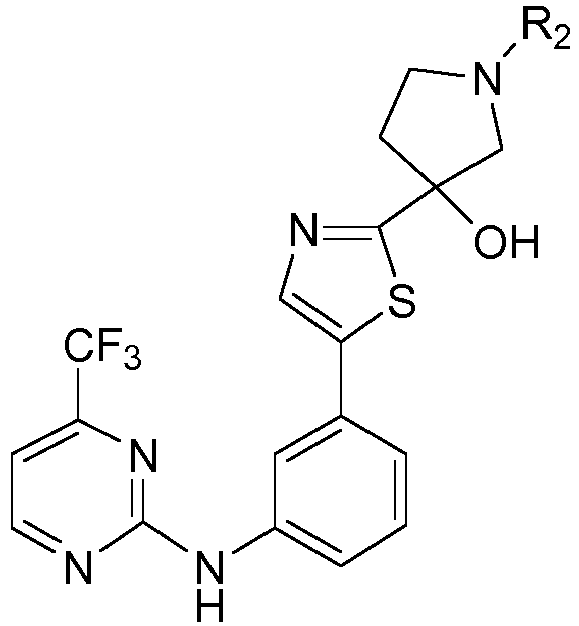
EX. R2 rhSYK Activity [M+H]+ Observed Form(s) 54C-1 H +++ 408.2 Free Base 54C-2 -C(O)NH2 +++ 451.1 Free Base TABLE 54D 
EX. R1 R2 rhSYK Activity [M+H]+ Obs'd Form(s) 54D-1 IPR H +++ 424.2 Free Base 54D-2 CF3 -C(O)CH3 +++ 492.2 Free Base 54D-3 IPR -(S)-C(O)CH(OH)CH3 +++ 496.2 Free Base 54D-4 IPR -C(O)CH(OH)CH3 +++ 496.2 Free Base 54D-5 CF3 -C(O)ET +++ 506.2 Free Base 54D-6 IPR -C(O)CH2C(O)NH2 +++ 509.2 Free Base 54D-7 IPR -C(O)CH2CO2H +++ 510.2 Free Base 54D-8 IPR -C(O)CH(OH)CH2OH +++ 512.2 Free Base 54D-9 CF3 -C(O)CH2CN +++ 517.2 Free Base 54D-10 CF3 -C(O)-CPR +++ 518.2 Free Base 54D-12 CF3 -C(O)CH2OCH3 +++ 522.2 Free Base 54D-13 CF3 -C(O)CH2CH2OH +++ 522.2 Formate Salt 54D-14 CF3 -C(O)CH(OH)CH3 +++ 522.2 Formate Salt 54D-15 IPR -C(O)CH2CH2C(O)NH2 +++ 523.2 Free Base 54D-16 CF3 -C(O)CH2CH2CN +++ 531.2 Free Base 54D-20 CF3 -C(O)CH2C(O)NH2 (enantiomer 1) +++ 535.2 Free Base 54D-21 CF3 -C(O)CH2C(O)NH2 (enantiomer 2) +++ 535.2 Free Base 54D-22 CF3 -C(O)CH2C(O)NH2 +++ 535.2 Free Base 54D-23 CF3 -C(O)CH2CH(OH)CH3 +++ 536.2 Formate Salt 54D-24 CF3 -C(O)CH2CO2H +++ 536.2 Formate Salt 54D-25 CF3 -C(O)CH2CO2H (Enantiomer 1) +++ 536.2 Free Base 54D-26 CF3 -C(O)CH2CO2H (Enantiomer 2) +++ 536.2 Free Base 54D-27 CF3 -C(O)CH(OH)CH2OH +++ 538.2 Formate Salt 54D-28 CF3 -C(O)CH(OH)CH2OH (isomer 1) +++ 538.2 Formate Salt 54D-29 CF3 -C(O)CH(OH)CH2OH (isomer 2) +++ 538.2 Formate Salt 54D-30 IPR -C(O)CH2CO2ET +++ 538.2 Free Base 54D-31 IPR -C(O)C(CH2OH)2CH3 +++ 540.3 TFA Salt 54D-41 CF3 -C(O)CH2CH2C(O)NH2 (enantiomer 1) +++ 549.2 TFA Salt 54D-42 CF3 -C(O)CH2CH2C(O)NH2 (enantiomer 2) +++ 549.2 TFA Salt 54D-43 CF3 -C(O)CH2CH2CO2H +++ 550.2 TFA Salt 54D-44 CF3 -C(O)CH2C(CH3)2OH +++ 550.2 Formate Salt 54D-45 CF3 -C(O)-PH +++ 554.2 Free Base 54D-70 CF3 -C(O)-(1-CO2H-CPR) +++ 562.2 Formate Salt 54D-71 CF3 -C(O)-(2-CO2H-CPR) +++ 562.2 Formate Salt 54D-72 CF3 -C(O)CH2CH2CO2CH3 +++ 564.2 Free Base 54D-73 CF3 -C(O)CH2CO2CH2CH3 +++ 564.2 Formate Salt 54D-74 CF3 -C(O)CH2CO2CH2CH3 (enantiomer 1) +++ 564.2 Free Base 54D-75 CF3 -C(O)CH2CO2CH2CH3 (enantiomer 2) +++ 564.2 Free Base 54D-77 CF3 -C(O)CH(OH)C(CH3)2OH +++ 566.2 Formate Salt 54D-78 CF3 -C(O)C(CH2OH)2CH3 +++ 566.2 Free Base 54D-79 CF3 -C(O)C(CH2OH)2CH3 (enantiomer 1) +++ 566.2 TFA Salt 54D-80 CF3 -C(O)C(CH2OH)2CH3 (enantiomer 2) +++ 566.2 TFA Salt 54D-84 CF3 -C(O)-(4-OH)PH +++ 570.2 Free Base 54D-95 CF3 -C(O)-(1-CO2CH3)-CPR +++ 576.2 Formate Salt 54D-98 CF3 -C(O)CH2CH2C(O)N(CH3)2 +++ 577.2 Free Base 54D-99 CF3 -C(O)-(4-C≡CH)PH +++ 578.2 Free Base 54D-103 CF3 -C(O)-(3-F, 4-OH)PH +++ 588.2 Free Base 54D-104 CF3 -C(O)-(2-F, 5-OH)PH +++ 588.2 Free Base 54D-111 CF3 -C(O)-(4-CO2CH3)-CHEX +++ 618.2 Free Base 54D-113 IPR -C(O)CH2C(O)NH2 +++ 509.2 TFA Salt 54D-115 CF3 SO2NH2 +++ 529.1 TFA Salt 54D-116 CF3 SO2NH2 (Enantiomer 1) +++ 529.1 Free Base 54D-117 CF3 SO2NH2 (Enantiomer 2) +++ 529.1 Free Base 54D-119 CF3 C(O)NH2 (Enantiomer 1) +++ 493.1 Free Base 54D-120 CF3 C(O)NH2 (Enantiomer 2) +++ 493.1 Free Base 54D-121 CF3 C(O)CH2OH +++ 508.2 Free Base 54D-122 CF3 C(O)CH2OH (Enantiomer 1) +++ 508.1 Free Base 54D-123 CF3 C(O)CH2OH (Enantiomer 2) +++ 508.1 Free Base TABLE 54E 
Ex. R rhSYK Activity [M+H]+ Observed Form(s) 54E-1 CH(OH)CH3 (2R; cis) +++ 522.2 Formate Salt 54E-2 CH(OH)CH3 (2S; cis) +++ 522.2 Formate Salt 54E-3 CH2C(O)NH2 (cis) +++ 535.2 Formate Salt 54E-8 CH2CH2C(O)NH2 (cis) +++ 549.2 Formate Salt 54E-20 C(CH2OH)2CH3 (cis) +++ 566.2 Formate Salt 54E-31 CH2CH2CON(CH3)2 (cis) +++ 577.2 Formate Salt 54E-34 C(CH2OH)3 +++ 580.2 Formate Salt -

- Step 1: cis-4-Hydroxy-4-[5-(3-methyl-5-{[4-(trifluoromethyl)pyrimidin-2-yl]amino}phenyl)-1,3-thiazol-2-yl]cyclohexanecarboxylic acid (150 mg, 0.313 mmol), hydrazinecarboxamide hydrochloride (52.4 mg, 0.470 mmol), O-(7-azabenzotriazol-1-yl)-N,N,N',N'-tetramethyluronium hexafluorophosphate (149 mg, 0.392 mmol), and diisopropylethylamine (164 µl, 0.940 mmol) were taken-up in dimethylformamide (1.3 mL) under argon. The vessel was sealed and stirred at 125 °C for 18 hours. The reaction mixture was cooled to room temperature, filtered, and directly subjected to reverse-phase HPLC (water-acetonitrile, trifluoroacetic acid modifier). This purification afforded 5-{cis-4-hydroxy-4-[5-(3-methyl-5-{[4-(trifluoromethyl)pyrimidin-2-yl]amino}phenyl)-1,3-thiazol-2-yl]cyclohexyl}-1,3,4-oxadiazol-2(3H)-one as a white solid (39.1 mg, 0.075 mmol, 24% yield). MS ESI: [M + H]+ m/z 519.1. 1H NMR (500 MHz, dmso) δ 12.10 (s, 1H), 10.25 (s, 1H), 8.82 (d, J= 4.8, 1H), 8.02 - 7.88 (m, 2H), 7.45 (s, 1H), 7.27 (d, J= 4.9, 1H), 7.15 (s, 1H), 6.06 (s, J= 27.1, 1H), 2.67 (s, 1H), 2.31 (s, 3H), 2.09 - 1.75 (m, 8H). rhSYK activity = +++
-

- Step 1: Acetic acid (0.192 mL, 3.35 mmol) was added to commercially available 2-chloro-4-(propan-2-yl)pyrimidine (0.5 g, 3.19 mmol) and 3-bromo-5-methylaniline (0.900 g, 3.19 mmol) suspended in dioxane (6.39 mL). Reaction was heated to 120 °C (bath temp) overnight. Then, the reaction was cooled to room temperature and purified by column chromatography on silica gel eluting with ethyl acetate and hexanes to give N-(3-bromo-5-methylphenyl)-4-(propan-2-yl)-pyrimidin-2-amine (959.8 mg, 3.13 mmol, 98%) as a white solid.
- Step 2: A 40 mL vial was charged with the product of Step 1 (500 mg, 1.633 mmol), bis(pinacolato)diboron (456 mg, 1.796 mmol), 1,1'-bis(diphenylphosphino)ferrocene-palladium(II)dichloride dichloromethane complex (40.0 mg, 0.049 mmol) and potassium acetate (481 mg, 4.90 mmol). The solid mixture was dissolved with DMSO (6.5mL) and heated to 120 °C. After stirring for 2 h, the mixture was extracted with ethyl acetate, washed with saturated aqueous NaHCO3, brine, dried over anhydrous sodium sulfate, filtered and concentrated under reduced pressure. The residue was purified by column chromatography on silica gel eluting with ethyl acetate in hexanes to give N-[3-methyl-5-(4,4,5,5-tetramethyl-1,3,2-dioxaborolan-2-yl)phenyl]-4-(propan-2-yl)pyrimidin-2-amine (249 mg, 0.705 mmol, 43.2 % yield) as a white solid.
- Step 3: A 2 dram vial was charged with the product of Step 2 (100 mg, 0.283 mmol) 1-(5-bromo-1,3-thiazol-2-yl)cyclobutanol (INTERMEDIATE 1, 72.9 mg, 0.311 mmol), butyldi-1-adamantylphosphine (14.21 mg, 0.040 mmol), palladium(II) acetate (4.45 mg, 0.020 mmol), potassium fluoride (49.3 mg, 0.849 mmol), THF (1166 µL) then water (348 µL). The vial was sealed and then heated to 80 °C overnight. Then, the reaction was cooled to room temperature. The reaction mixture was purified by column chromatography on silica gel eluting with ethyl acetate in hexanes. The fractions were combined, conentrated and redissolved in acetonitrile/ water + HCl (1M, 200 uL) and lyophylized to give 1-[5-(3-methyl-5-{[4-(propan-2-yl)pyrimidin-2-yl]amino}phenyl)-1,3-thiazol-2-yl]cyclobutanol HCl salt (16.8 mg, 0.040 mmol, 14.23 % yield) as a white solid. MS ESI: [M + H]+ m/z 381.1. 1H NMR (500 MHz, CDCl3): δ 9.66 (s, 1 H); 8.38 (d, J= 5.5 Hz, 1 H); 8.02 (s, 1 H); 7.97 (s, 1 H); 7.50 (s, 1 H); 7.07 (m, 1 H); 6.79 (m, 1 H); 2.90 (m, 1H); 2.53 (m, 2H); 2.33 (m, 2H); 2.30 (s, 3H); 1.88 (m, 2H); 1.25 (d, J= 7 Hz, 6H). rhSYK activity = +++
- The following examples were prepared in an analogous manner of that described in Example 56.
TABLE 56 
Example R rhSYK Activity [M+H]+ Observed Form(s) 56-1 CH3 +++ 353.1 HCl salt 56-2 Et +++ 367.1 HCl salt 56-3 cPr +++ 379.1 HCl salt 56-5 t-Bu +++ 395.2 Free Base -

- Step 1: To a solution of oxetan-3-one (600 mg, 8.33 mmol) and 2-methylpropane-2-sulfinamide (1.01 g, 8.33 mmol) in tetrahydrofuran (14 mL), titanium ethoxide (3.45 mL, 16.65 mmol) was added. The mixture was stirred at 50 °C overnight. The reaction mixture was poured over brine. The suspension was filtered through celite and washed with ethyl acetate. The solution was partitioned between ethyl acetate and brine. The organics were dried (Na2SO4), filtered and concentrated. The residue was purified by column chromatography on silica (0-70% ethyl acetate in hexanes) to afford 2-methyl-N-(oxetan-3-ylidene)propane-2-sulfinamide (692 g, 3.20 mmol, 38 % yield) as a clear oil. MS ESI: [M + H]+ m/z 176.1.
- Step 2: A solution of lithium diisopropylamine (1.8 M, 4.96 mL, 8.92 mmol) in THF (8 mL) was placed under an Argon atmosphere and was cooled to -78 °C. A solution of N-[3-methyl-5-(1,3-thiazol-5-yl)phenyl]-4-(trifluoromethyl)pyrimidin-2-amine (Intermediate 4, 1200 mg, 3.57 mmol) in THF (8 mL) was cooled to -78 °C and added drop wise to the LDA solution. The reaction mixture was stirred 30 minutes at -78 °C. The product of Step 1 (625 mg, 3.57 mmol) in THF (8 mL) was added drop wise and the reaction was allowed to warm to room temperature overnight. The mixture was quenched with brine, diluted with ethyl acetate. The organics were washed with saturated NaHCO3, followed by brine, dried (Na2SO4), filtered and concentrated. The residue was purified by column chromatography on silica (20-100% ethyl acetate in hexanes) to afford 2-methyl-N-{3-[5-(3-methyl-5-{[4-(trifluoromethyl)pyrimidin-2-yl]amino}phenyl)-1,3-thiazol-2-yl]oxetan-3-yl}propane-2-sulfinamide (1.10 g, 2.140 mmol, 60.0 % yield). MS ESI: [M + H]+ m/z 512.1.
- Step 3: To a solution the product of Step 2 (1.01 g, 1.964 mmol) in methanol (9.8 mL), 4M HCl in Dioxane (1.97 mL, 7.86 mmol) was added. The mixture was stirred at room temperature for 15 minutes. The mixture was diluted with ethyl acetate, washed with saturated NaHCO3, followed by brine, dried (Na2SO4), filtered and concentrated. The residue was purified by column chromatography on silica (40-100% ethyl acetate in hexanes) to afford N-{3-[2-(3-aminooxetan-3-yl)-1,3-thiazol-5-yl]-5-methylphenyl}-4-(trifluoromethyl)pyrimidin-2-amine (386.6 mg, 0.954 mmol, 53.5 % yield) as a pale yellow solid. MS ESI: [M + H]+ m/z 408.0. 1H NMR (500 MHz, DMSO-d6) δ 10.26 (s, 1H), 8.83 (d, J= 4.8, 1H), 8.07 (s, 1H), 7.97 (s, 1H), 7.47 (s, 1H), 7.28 (d, J= 4.9, 1H), 7.17 (s, 1H), 4.87 (d, J= 5.6, 2H), 4.58 (d, J= 5.7, 2H), 2.32 (s, 3H).
-

- To a solution of N-3-[2-(3-aminooxetan-3-yl)-1,3-thiazol-5-yl]-5-methylphenyl}-4-(trifluoromethyl)pyrimidin-2-amine (200 mg, 0.491 mmol) and Et3N (82 µL, 0.589 mmol) in dichloromethane (3.9 mL), methanesulfonyl chloride (57 µL, 0.736 mmol) was added. The reaction mixture was stirred at room temperature for 95 minutes. The mixture was then diluted with ethyl acetate, washed with saturated NaHCO3, followed by brine, dried (Na2SO4), filtered and concentrated. The residue was purified by column chromatography on silica (10-100% ethyl acetate in hexanes) and lyophilized to afford N-{3-[5-(3-methyl-5-{[4-(trifluoromethyl)pyrimidin-2-yl]amino}phenyl)-1,3-thiazol-2-yl]oxetan-3-yl}methanesulfonamide (113 mg, 0.233 mmol, 47.4 % yield) as a white powder. MS ESI: [M + H]+ m/z 486.0. 1H NMR (500 MHz, DMSO-d6) δ 10.28 (s, 1H), 8.83 (m, 2H), 8.11 (s, 1H), 7.99 (s, 1H), 7.50 (s, 1H), 7.29 (m, 1H), 7.21 (s, 1H), 4.91 (dd, J= 6.6, 16.1, 4H), 2.98 (s, 3H), 2.33 (s, 3H). rhSYK activity = +++
-

- Step 5: A solution of 2-methyl-N-{3-[5-(3-methyl-5-{[4-(trifluoromethyl)pyrimidin-2-yl]amino}phenyl)-1,3-thiazol-2-yl]oxetan-3-yl}propane-2-sulfinamide (Example 59, Step 2, 75 mg, 0.147 mmol) in dichloromethane (1.5 mL) was cooled to 0°C. m-CPBA (37.8 mg, 0.219 mmol) was added and the resulting mixture was warmed to room temperature. The reaction mixture was diluted with dichloromethane, washed with 2M NaOH (2x), saturated NaHCO3 (1x), brine (1x), dried (Na2SO4), filtered and concentrated. The residue was purified by column chromatography on silica (10-100% ethyl acetate in hexanes) and lyophilized to afford 2-methyl-N-{3-[5-(3-methyl-5-{[4-(trifluoromethyl)pyrimidin-2-yl]amino}phenyl)-1,3-thiazol-2-yl]oxetan-3-yl}propane-2-sulfonamide (45.6 mg, 0.086 mmol, 59.0 % yield) as a light yellow solid. MS ESI: [M + H]+ m/z 510.1. 1H NMR (500 MHz, dmso) δ 10.29 (s, 1H), 8.83 (d, J= 4.9, 1H), 8.29 (s, 1H), 8.09 (s, 1H), 7.95 (s, 1H), 7.53 (s, 1H), 7.28 (d, J= 4.9, 1H), 7.18 (s, 1H), 4.90 (dd, J= 6.6, 33.0, 4H), 2.33 (s, 3H), 1.35 (s, 9H). rhSYK activity = +++
- The following examples were prepared in an analogous manner of that described in Examples 59-61.
TABLE 61B 
Example R1 X R4 rhSYK Activity [M+H]+ Observed Form(s) (R2)n = 4-CF3 61B-1 CH3 CH2 H +++ 406.1 Free Base 61B-2 CH3 CH2 SO2CH2CF3 +++ 552.0 Free Base 61B-3 CH3 CH2 SO2CH2F +++ 502.0 Free Base 61B-4 CH3 CH2 SO2CH3 +++ 484.0 Free Base 61B-5 CH3 CH2 SO2CF3 +++ 538.0 Free Base 61B-6 CH3 O SO2CF3 +++ 540.0 Free Base 61B-7 CH3 O SO2CH2CF3 +++ 554.0 Free Base 61B-8 CH3 O SOCHF2 +++ 506.0 Free Base 61B-9 H O SO2CH3 +++ 472.0 Free Base -

- Step 1: A 20 mL microwave vial was charged with 3-methyl-5-(1,3-thiazol-5-yl)aniline (500 mg, 2.63 mmol), cesium carbonate (2.99 g, 9.20 mmol), 2-chloro-4-cyclopropylpyrimidine (INTERMEDIATE 29, 406 mg, 2.63 mmol), and dioxane (10.4 mL). The system was purged and flushed with argon (3x) before adding XantPhos (228 mg, 0.394 mmol) and palladium(II) acetate (59 mg, 0.263 mmol). The system was then purged and flushed with argon (3x) before sealing and heating to 100 °C for 2 h. Upon completion the mixture was cooled to room temperature, diluted with ethyl acetate, filtered through celite washing with ethyl acetate, and concentrated under reduced pressure. Purification by column chromatography on silica gel (0-60% ethyl acetate in hexanes) provided 603 mg (1.96 mmol, 74%) of 4-cyclopropyl-N-[3-methyl-5-(1,3-thiazol-5-yl)phenyl]pyrimidin-2-amine as a yellow solid. MS ESI: [M + H]+ m/z 309.2. Step 2: To a solution of the product of Step 1 (250 mg, 0.81 mmol) in tetrahydrofuran (5.0 mL) at -78 °C was added LDA (1.62 mL, 2.0 M, 3.24 mmol). The mixture was stirred for 15 min at -78 °C. N-cyclobutylidene-2-methylpropane-2-sulfinamide (169 mg, 0.97 mmol) in tetrahydrofuran (3 mL) was added dropwise at -78 °C and the reaction was allowed to warm to room temperature and stirred over 2 h. The mixture was quenched with aqueous ammonium chloride and the mixture was extracted with ethyl acetate (3 x 200 mL). The combined organic fractions were washed with brine, dried over sodium sulfate, filtered and the solvent was evaporated under reduced pressure. The residue was purified by column chromatography on silica gel (0-100% ethyl acetate in hexanes) provided 182 mg (0.38 mmol, 47%) of N-[1-(5-{3-[(4-cyclopropylpyrimidin-2-yl)amino]-5-methylphenyl}-1,3-thiazol-2-yl)cyclobutyl]-2-methylpropane-2-sulfinamide. MS ESI: [M + H]+ m/z 482.2.
- Step 3: To a solution of the product of Step 2 (182 mg, 0.38 mmol) in dioxane (3.8 mL) was added hydrochloric acid 4.0 M in dioxane (0.95 mL, 3.78 mmol) and the mixture was stirred for at room temperature for 2 h. The mixture was concentrated under reduced pressure to provide 170 mg (0.41 mmol, 109%) of N-{3-[2-(1-aminocyclobutyl)-1,3-thiazol-5-yl]-5-methylphenyl}-4-cyclopropylpyrimidin-2-amine hydrochloride. MS ESI: [M + H]+ m/z 378.2. 1H NMR (600 MHz, d6-DMSO) δ 9.54 (s, 1H), 8.95 (s, 2H), 8.25 (d, J= 4.8, 1H), 8.16 (s, 1H), 8.10 (s, 1H), 7.40 (s, 1H), 7.11 (s, 1H), 6.83 (d, J = 4.8, 1H), 2.66 (m, 2H), 2.57 (m, 2H), 2.28 (s, 3H), 2.14 (m, 1H), 2.03 (m, 2H), 1.10-1.04 (m, 4H). rhSYK activity = +++
- The following examples were prepared in an analogous manner of that described in Example 62.
TABLE 62 
Example R rhSYK Activity [M+H]+ Observed Form(s) 62-1 H +++ 338.2 Chloride Salt 62-2 -OCH3 +++ 368.1 Chloride Salt -

- To a solution of N-{3-[2-(3-aminooxetan-3-yl)-1,3-thiazol-5-yl]-5-methylphenyl}-4-(trifluoromethyl)pyrimidin-2-amine (Example 59, 25 mg, 0.061 mmol) in dioxane (600 uL), sulfamide (70 mg, 0.725 mmol) was added. The reaction mixture was stirred at 100 °C. The resulting mixture was stirred at 100 °C for 4 days. The mixture was diluted with ethyl acetate, washed with saturated aqueous NaHCO3, followed by brine, dried (Na2SO4), filtered and concentrated. The residue was purified by column chromatography on silica (10-100% ethyl acetate in hexanes) and lyophilized to afford N-{3-[5-(3-methyl-5-{[4-(trifluoromethyl)pyrimidin-2-yl]amino}phenyl)-1,3-thiazol-2-yl]oxetan-3-yl}sulfuric diamide (16.3 mg, 0.034 mmol, 54.6 % yield) as a pale yellow solid. MS ESI: [M + H]+ m/z 487.0. 1H NMR (500 MHz, DMSO-d6) δ 10.27 (s, 2H), 8.85 (m, 1H), 8.30 (s, 1H), 8.04 (s, 1H), 7.95 (s, 1H), 7.51 (s, 1H), 7.28 (m, 1H), 7.17 (s, 1H), 6.98 (s, 2H), 5.02 (m, 2H), 4.84 (m, 2H), 2.32 (s, 3H). rhSYK activity = +++
- Compounds in the following Table(s) were prepared in an analogous manner of that described in Example 63:
TABLE 63 
Example R1 R2 X rhSYK Activity [M+H]+ Obs'd Form(s) 63-3 H CF3 
+++ 485.0. Free Base -

- To a solution of N-{3-[2-(1-aminocyclobutyl)-1,3-thiazol-5-yl]-5-methylphenyl}-4-(trifluoromethyl)pyrimidin-2-amine (Example 61B-1, 50 mg, 0.123 mmol) and acetic acid (7 µL, 0.123 mmol) in THF/water (1.6:1, 2.1 mL), potassium cyanate (10 mg, 0.123 mmol) was added. The reaction mixture was stirred overnight at room temperature and then concentrated. The residue was purified by column chromatography on silica (50-100% ethyl acetate in hexanes, 0-20% methanol in dichloromethane) and lyophilized to afford 1-{1-[5-(3-methyl-5-{[4-(trifluoromethyl)pyrimidin-2-yl]amino}phenyl)-1,3-thiazol-2-yl]cyclobutyl}urea (31.3 mg, 0.068 mmol, 54.9%) as a white powder. MS ESI: [M + H]+ m/z 449.1. 1H NMR (500 MHz, DMSO-d6 δ 10.23 (s, 1H), 8.82 (d, J = 4.9, 1H), 7.93 (s, 1H), 7.90 (s, 1H), 7.47 (s, 1H), 7.27 (d, J = 4.9, 1H), 7.15 - 7.00 (m, 2H), 5.58 (s, 2H), 2.63 - 2.51 (m, 2H), 2.32 (m, 5H), 1.96 (m, 2H). rhSYK activity = +++
- The following examples were prepared in an analogous manner of that described in Example 64.
TABLE 64 
Example R1 R2 R3 X rhSYK Activity [M+H]+ Observed Form(s) 64-1 CF3 H CH3 O +++ 451.0 Free Base 64-2 cPr H CH3 CH2 +++ 421.2 Free Base 64-3 H H CH3 CH2 +++ 381.2 Free Base 64-4 OCH3 H CH3 CH2 +++ 411.2 Free Base 64-9 CF3 H CH3 -CH2C(O)NHCH2- +++ 506 Free Base -

- To a solution of N-{3-[2-(1-aminocyclobutyl)-1,3-thiazol-5-yl]-5-methylphenyl}-4-(trifluoromethyl)pyrimidin-2-amine (Example 61B-1, 75 mg, 0.185 mmol) and Et3N (25.8 µL, 0.185 mmol) in THF (1000 µL), acetyl chloride (13.15 µL, 0.185 mmol) was added. The mixture was stirred at room temperature for 70 minutes. Additional acetyl chloride (6 µL) was added to drive the reaction to completion. The mixture was stirred for 10 additional minutes, then diluted with ethyl acetate, washed with saturated NaHCO3, followed by brine, dried (Na2SO4), filtered and concentrated to afford N-{1-[5-(3-methyl-5-[4-(trifluoromethyl)pyrimidin-2-yl]amino}phenyl)-1,3-thiazol-2-yl]cyclobutyl}acetamide (80.8 mg, 0.171 mmol, 92%). MS ESI: [M + H]+ m/z 480.0. 1H NMR (500 MHz, DMSO-d6) δ 10.25 (s, 1H), 8.93 (s, 1H), 8.83 (d, J= 4.9 Hz, 1H), 8.00 (s, 1H), 7.94 (s, 1H), 7.42 (s, 1H), 7.28 (d, J= 4.9 Hz, 1H), 7.14 (s, 1H), 3.32-2.60 (m, 2H), 2.43-2.41 (m, 2H), 2.31 (s, 3H), 1.99-1.95 (m, 2H), 1.88 (s, 3H). rhSYK activity = +++
- Compounds in the following Table(s) were prepared in an analogous manner of that described in Example 66:
Example Structure hSYK Activity [M+H]+ Obs'd Form(s) 66-1 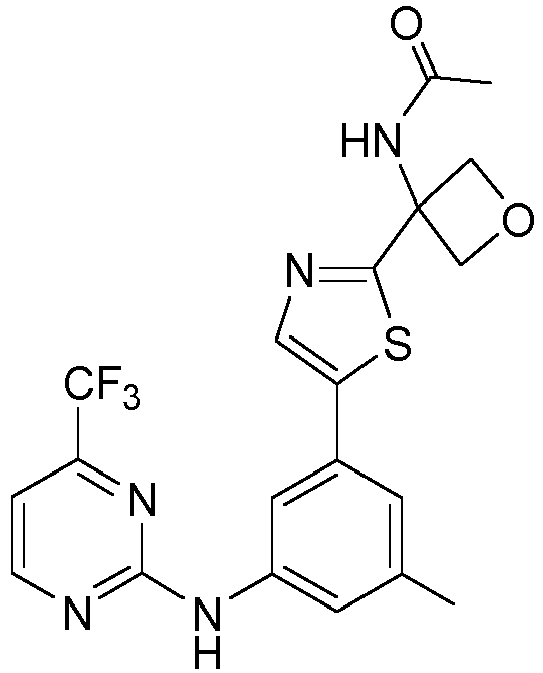
+++ 450.0 -

- To 2-chloropyrimidine-4-carboxylic acid (175 mg, 1.104 mmol) in dioxane (2.201 mL) was added 2-[5-(3-amino-5-methylphenyl)-1,3-thiazol-2-yl]-1,1,1-trifluoropropan-2-ol (INTERMEDIATE 7, (334 mg, 1.104 mmol) and acetic acid (69.5 µL, 1.214 mmol). The reaction was heated to 100 °C overnight and was complete by LCMS analysis. The reaction was cooled to room temperature and the solvent was removed under reduced pressure. Remaining acetic acid was azeotroped with toluene (2x5mL) to yield 2-({3-methyl-5-[2-(1,1,1-trifluoro-2-hydroxypropan-2-yl)-1,3-thiazol-5-yl]phenyl}amino)pyrimidine-4-carboxylic acid as a tan powder. MS ESI: [M + H]+ m/z 425.1. 1H NMR (500 MHz, dmso) δ 13.79 - 13.63 (m, 1H), 10.05 (s, 1H), 8.73 (d, J= 5.0, 1H), 8.22-8.14 (m, 1H), 8.10 (s, 1H), 7.65 (s, 1H), 7.5 6 (s, 1H), 7.32 (d, J = 5.0, 1H), 7.12 (s, 1H), 2.31 (s, 3H), 1.76 (s, 3H). rhSYK activity = +
- Compounds in the following Table(s) were prepared in a manner analogous of that described in Example 68:

Example R1 R2 rhSYK Activity [M+H]+ Obs'd Form(s) 68-2 4-CF3 H +++ 393.0 Free Base -

- A sealed tube was charged with a stir bar, INTERMEDIATE 7 (100 mg, 0.33 mmol), 2-chloro-5-methylpyrimidine (43 mg, 0.33 mmol), potassium carbonate (91 mg, 0.66 mmol), Pd2dba3 (30 mg, 0.033 mmol), and X-PHOS (79 mg, 0.17 mmol). The tube was evacuated and backfilled with argon three times. Fully degassed t-amyl alcohol (1.1 mL) was added, the tube was sealed, and heated at 90 °C for overnight. Upon completion the mixture was cooled to room temperature, diluted with methanol, and filtered through a celite plug. The filtrate was concentrated under reduced pressure. Purification by Chromatography on silica gel (0-50% ethyl acetate/hexanes) afforded 1,1,1-trifluoro-2-(5-{3-methyl-5-[(5-methylpyrimidin-2-yl)amino]phenyl}-1,3-thiazol-2-yl)propan-2-ol (90 mg, 0.23 mmol, 69%) as an off-white solid. MS ESI: [M + H]+ m/z 395.1. 1H NMR (500 MHz, DMSO-d6): δ 9.53 (s, 1 H), 8.37 (s, 2 H), 8.07 (s, 1 H), 7.90 (s, 1 H), 7.66 (s, 1 H), 7.55 (s, 1 H), 7.08 (s, 1 H), 2.30 (s, 3 H), 2.14 (s, 3 H), 1.76 (s, 3 H). rhSYK activity = +++
- The following examples were prepared in an analogous manner of that described in Example 100.
TABLE 100A 
n is 1 or 2 substituents as specified in the Table, or (R1)n is H, or (R1)n together with the pyrimidine ring represent 6,7-dihydro-5H-cyclopenta[d]pyrimidine Example R1 X rhSYK Activity [M+H]+ Observed Form(s) 100A-1 4-OCH3 CH2 +++ 369.1 Free Base 100A-2 4-CH3 CH2 +++ 353.1 Free Base 100A-3 H CH2 ++ 338.8 Free Base -

- Step 1: A 5 mL microwave vial was charged with INTERMEDIATE 7 (30 mg, 0.10 mmol), 2-chloropyrimidine (12.5 mg, 0.11 mmol), cesium carbonate (65 mg, 0.20 mmol), XantPhos (9 mg, 0.015 mmol), palladium (II) acetate (2.5 mg, 0.011 mmol), and dioxane (0.5 mL). The vial was flushed with argon, sealed, and allowed to react overnight at 100 °C. The reaction mixture was filtered through celite and the filtrate was purified by reverse phase HPLC (acetonitrile/water (0.1% Formic Acid). The desired fractions were frozen and lyopholized to afford 1,1,1-trifluoro-2-{5-[3-methyl-5-(pyrimidin-2-ylamino)phenyl]-1,3-thiazol-2-yl}propan-2-ol, formate salt (14 mg, 0.037 mmol, 37%) as an off-white solid. MS ESI: [M + H]+ m/z 381.0. 1H NMR (500 MHz, DMSO-d6) δ 9.67 (s, 1H), 8.50 (d, J = 4.8, 2H), 8.07 (s, 1H), 7.90 (s, 1H), 7.67 (s, 1H), 7.58 (s, 1H), 7.11 (s, 1H), 6.85 (t, 1H), 2.31 (s, 3H), 1.76 (s, 3H). rhSYKactivity=++
- Compounds in the following Table(s) were prepared in an analogous manner of that described in Example 101:
TABLE 101 
Ex. R1 R2 R3 R4/R4a rhSYK Activity [M+H]+ Observed Form(s) 101-1 H t-Bu Et H/CH3 +++ 509.2 Free Base 101-2 H iPr CH3 CH3/CH3 (1S,4R) +++ 495.2 Free Base 101-3 H t-Bu CH3 CH3/CH3 (1S,4R) +++ 509.2 Free Base 101-4 H O-iPr CH3 CH3/CH3 (1S,4R) +++ 511.2 Free Base 101-6 H cBu CH3 CH3/CH3 (1S,4R) +++ 507.2 Free Base -

- Step1: 2,4-Dichloropyrimidine (250 mg, 1.68 mmol) and ferric acetylacetonate (30 mg, 0.08 mmol) were taken up in tetrahydrofuran (3.4 mL) and the reaction was cooled to -78 °C. Cyclobutylmagnesium chloride (0.5 M, 3.4 mL, 1.68 mmol) was added dropwise and the mixture was stirred at -78 °C for 30 min. The mixture was quenched with aqueous saturated ammonium chloride and extracted with ethyl acetate. The combined organic fractions were washed with aqueous sodium hydrogen carbonate, dried over magnesium sulfate, filtered, and the solvent was evaporated under reduced pressure. The residue was purified by column chromatography on silica gel (0-5% ethyl acetate in hexanes) to provide 121 mg (0.72 mmol, 43%) of 2-chloro-4-cyclobutylpyrimidine as a colorless oil. MS ESI: [M + H]+ m/z 169.1.
- Step 2: 2-Chloro-4-cyclobutylpyrimidine (65 mg, 0.39 mmol), INTERMEDIATE 6 (100 mg, 0.39 mmol), and acetic acid (22 µL, 0.39 mmol) were combined in dioxane (1.9 mL) and the mixture was stirred at 120 °C for 3 h. The mixture was cooled to room temperature and directly purified by Combiflash chromatography on silica gel, eluting with ethyl acetate/isohexane to provide 66 mg (0.17mmol, 44%) of 1-(5-{3-[(4-cyclobutylpyrimidin-2-yl)amino]-5-methylphenyl}-1,3-thiazol-2-yl)cyclobutanol. MS ESI: [M + H]+ m/z 393.2. 1H NMR (600 MHz, DMSO-d6) δ 9.56 (s, 1H), 8.33 (d, J= 4.8, 1H), 8.12 (s, 1H), 7.95 (s, 1H), 7.48 (s, 1H), 7.05 (s, 1H), 6.68 (d, J= 5.4, 1H), 6.46 (s, 1H), 3.53 - 3.50 (m, 1H), 2.52-2.46 (m, 2H), 2.33-2.22 (m, 9 H), 1.99 (m, 1H), 1.87-1.83 (m, 3H). rhSYK activity = +++
- Compounds in the following Table(s) were prepared in a manner analogous of that described in Example 107:

Example n hSYK Activity [M+H]+ Obs'd Form(s) 107-1 2 +++ 407.2 Free Base 107-2 3 +++ 421.2 Free Base -

- Step 1: To a mixture of 2-chloro-4-(methylsulfanyl)pyrimidine (INTERMEDIATE 10, 500 mg, 3.11 mmol) and INTERMEDIATE 6 (810 mg, 3.11 mmol) in dioxane (15 mL) was added palladium(II) acetate (70 mg, 0.311 mmol), XantPhos (270 mg, 0.467 mmol) and cesium carbonate (2 g, 6.23 mmol). The mixture was degassed for 10 min and then heated at 85 °C for 16 h. After cooling to ambient temperature, the reaction mixture was filtered over celite and was washed with DCM/MeOH. After solvent removal, the residue was purified by column chromatography on silica gel (10 to 100% 10:1 ethyl acetate: methanol in hexanes) to afford 1-[5-(3-methyl-5-{[4-(methylsulfanyl)pyrimidin-2-yl]amino}phenyl)-1,3-thiazol-2-yl]cyclobutanol (1.1 g, 2.86 mmol, 92%). MS ESI: [M + H]+ m/z 385.1.
- Step 2: To a solution of the product from Step 1 (400 mg, 1.040 mmol) in dichloromethane (5 mL) was added mCPBA (527 mg, 2.289 mmol) and the mixture was aged for 1.5 h. Additional mCPBA (400 mg, 1.73 mmol) was added and the reaction was stirred for an additional 2 hr. The solvent was reduced by rotavap and the residue was purified by column chromatography on silica gel (0-100% ethyl acetate in hexanes) to afford 1-[5-(3-methyl-5-{[4-(methylsulfonyl)pyrimidin-2-yl]amino}phenyl)-1,3-thiazol-2-yl]cyclobutanol (210 mg, 0.5 mmol, 49%). MS ESI: [M + H]+ m/z 417.0. 1H NMR (600 MHz, DMSO-d6): δ 8.85 (d, J= 4.8 Hz, 1H); 7.99 (s, 1H); 7.89 (s, 1H); 7.44 (s, 1H); 7.31 (d, J = 4.8 Hz, 1H); 7.13 (s, 1H); 6.49 (s, 1H); 3.31 (s, 3H); 2.49 (m, 2H); 2.31 (m, 5H); 1.85 (m, 2H). Note: By using 1.2 eq of mCPBA, the corresponding sulfoxide can be obtained as major product with similar procedure as above.
- Step 3: To a suspension of sodium hydride (60% in mineral oil) (8.6 mg, 0.22 mmolin THF (1 mL) was added ethyl alcohol (21 µL, 0.36 mmol) and the mixture was stirred at ambient temperature for 40 min followed by addition of the product from Step 2 (30 mg, 0.072 mmol). The reaction mixture stirred for 1 h. To the mixture was added saturated aqueous NH4Cl and the product was extracted with ethyl acetate. The organic layer was dried, filtered and the solvent removed in vacuo. The residue was purified by column chromatography on silica gel (0-100% ethyl acetate in dichloromethane) to afford 1-(5-{3-[(4-ethoxypyrimidin-2-yl)amino]-5-methylphenyl}-1,3-thiazol-2-yl)cyclobutanol (12 mg, 0.03 mmol, 44%) as pale yellow oil. MS ESI: [M + H]+ m/z 383.2. 1H NMR (600 MHz, CD3OD): δ 8.11 (d, J = 5.4 Hz, 1H); 7.85 (s, 1H); 7.81 (s, 1H); 7.32 (s, 1H); 7.28 (s, 1H); 7.02 (s, 1H); 6.17 (d, J= 5.4 Hz, 1H); 4.44 (q, J = 7.2 Hz, 2H); 2.67 (m, 2H); 2.47 (m, 2H); 2.35 (s, 3H); 2.04-1.95 (m, 2H); 1.41 (t, J= 7.2 Hz, 3H).
- The following examples were prepared in an analogous manner of that described in Example 108.
TABLE 108A 
Ex. X R1 R2 rhSYK Activity [M+H]+ Observed Form(s) 108A-36 O H CH3 +++ 383.2 Free Base 108A-37 O Me CH3 +++ 397.2 Free Base -

- Step 1: To a flask containing tert-butyl trans-4-[5-(3-amino-5-methylphenyl)-1,3-thiazol-2-yl]-4-hydroxycyclohexanecarboxylate (125 mgs, 0.32 mmol) was added a solution of 2-chloro-4-cyclopropylpyrimidine (INTERMEDIATE 11, 57 mgs, 0.37 mmol) in dioxane (1.0 mL). Acetic acid (19 µL, 0.33 mL) was added and the reaction was heated at 100°C overnight. The reaction was then cooled to room temperature, diluted with ethyl acetate (10 mL), washed with water (10 mL), dried over magnesium sulfate, filtered and concentrated. The residue was purified by flash chromatography to give tert-butyl trans-4-(5-{3-[(4-cyclopropylpyrimidin-2-yl)amino]-5-methylphenyl}-1,3-thiazol-2-yl)-4-hydroxycyclohexanecarboxylate (36 mgs, 0.071 mmol, 22% yield). ESI: [M + H]+ m/z 507.2.
- Step 2: To a flask containing the product of Step 1 (36 mgs, 0.071 mmol) was added methanol (0.80 mL) and aqueous sodium hydroxide (1M, 0.14 mL, 0.14 mmol). The reaction was heated at 100°C overnight. The reaction was cooled, acidified with HCl (1M, 0.2 mL, 0.20 mmol) and diluted with water (5 mL) and ethyl acetate (5 mL). The organic layer was separated, dried over magnesium sulfate, filtered and concentrated. During the reaction, the starting material isomerized. The mixture of syn and anti isomers was diluted in DMSO and purified by HPLC to yield:
- cis-4-(5-{3-[(4-cyclopropylpyrimidin-2-yl)amino]-5-methylphenyl}-1,3-thiazol-2-yl)-4-hydroxy-cyclohexanecarboxylic acid (example 110(1)). MS ESI: [M + H]+ m/z 451.1. 1H NMR (500 MHz, DMSO-d6) δ 9.46 (s, 1H), 8.48 (s, 1H), 8.26 (d, J= 5.0 Hz, 1H), 7.94 (s, 1H), 7.92 (s, 1H), 7.45 (s, 1H), 7.02 (s, 1H), 6.81 (d, J= 5.0 Hz, 1H), 5.90 (s, 1H), 2.28 (s, 3H), 2.20 (m 1H), 2.01 (m, 1H), 1.88-1.85 (m 2H), 1.82-1.74 (m, 6H), 1.08-1.05 (m, 4H). rhSYK activity = +++ trans-4-(5-{3-[(4-cyclopropylpyrimidin-2-yl)amino]-5-methylphenyl}-1,3-thiazol-2-yl)-4-hydroxycyclohexanecarboxylic acid (example 110(2). ESI: [M + H]+ m/z 451.1. 1H NMR (500 MHz, DMSO-d6) δ 9.46 (s, 1H), 8.47 (s, 1H), 8.26 (d, J= 5.0 Hz, 1H), 7.95 (s, 1H), 7.91 (s, 1H), 7.44 (s, 1H), 7.03 (s, 1H), 6.81 (d, J = 5.0 Hz, 1H), 5.90 (s, 1H), 2.42 (m, 1H), 2.28 (s, 3H), 2.09-2.06 (m, 2H), 2.02-2.00 (m, 1H), 1.84-1.82 (m, 4H), 1.66-1.63 (m, 2H), 1.08-1.05 (m, 4H). rhSYK activity = +++
-

- Step 1: (1S,4R)-Methyl 4-(5-bromothiazol-2-yl)-4-hydroxy-2,2-dimethylcyclohexanecarboxylate (110 mg, 0.316 mmol) was placed in a 25-mL flask under nitrogen and THF (3 ml) was added. LiAlH4 (1M in THF, 0.6 mL, 0.600 mmol) was added in 1 portion and the reaction mixture turned into a white gel-like suspension. After 2 hours methanol was added and the solvents were evaporated. The residue was purified by reverse phase HPLC (10-50% acetonitrile gradient with water + 0.1% TFA)to afford (1S,4R)-4-(hydroxymethyl)-3,3-dimethyl-1-(thiazol-2-yl)cyclohexanol TFA salt (40 mg, 0.113 mmol, 35.6 % yield) as a colorless oil.
- Step 2: A 4-mL screw-cap pressure vial was charged with with N-(3-bromo-5-methylphenyl)-4-(trifluoromethyl)pyrimidin-2-amine (INTERMEDIATE 2, 74.8 mg, 0.225 mmol), stir bar, pivalic acid (2.61 µl, 0.023 mmol), potassium carbonate (46.7 mg, 0.338 mmol), (1S,4R)-4-(hydroxymethyl)-3,3-dimethyl-1-(thiazol-2-yl)cyclohexanol TFA salt (40 mg, 0.113 mmol), and Pd(PPh3)4 (13.01 mg, 0.011 mmol). The vial was closed, evacuated and back-filed with nitrogen 3 times. DMA (0.5 ml) (dry, over molecular sieves, Fluka) was added and the reaction mixture heated to 120 °C for 16 hours. LCMS showed product formation and some remaining starting materials. Filtered and concentrated in vacuo. The residue was purified by reverse phase HPLC(10-60% acetonitrile gradient with water + 0.1% TFA)to afford (1S,4R)-4-(hydroxymethyl)-3,3-dimethyl-1-(5-(3-methyl-5-(4-(trifluoromethyl)pyrimidin-2-ylamino)-phenyl)thiazol-2-yl)cyclohexanol (14 mg, 0.023 mmol, 20.51 % yield over 2 steps) as a yellow solid.
MS ESI: [M + H]+ m/z 492.2. 1H NMR (500 MHz, DMSO-d6): δ 10.24 (s, 1H), 8.83 (d, J= 4.9 Hz, 1H), 7.94 (s, 1H), 7.92 (m, 1H), 7.46 (s, 1H), 7.28 (d, J= 4.9 Hz, 1H), 7.14 (s, 1H), 3.66 (dd, J= 10.2, 3.5 Hz, 1H), 3.08 (app t, J= 10.2 Hz, 1H), 2.31 (s, 3H), 1.98-1.44 (m, 7H), 0.96 (s, 3H), 0.93 (s, 3H). rhSYK activity = +++ -

- Step 1: A reaction mixture containing N-[3-cyclopropyl-5-(4,4,5,5-tetramethyl-1,3,2-dioxaborolan-2-yl)phenyl]-4-methylpyrimidin-2-amine (60 mg, 0.171 mmol), methyl (1S, 4R)-4-(5-bromo-1,3-thiazol-2-yl)-4-hydroxy-2,2-dimethylcyclohexanecarboxylate (62.5 mg, 0.179 mmol), PdCl2(dppf)-CH2Cl2 adduct (27.9 mg, 0.034 mmol), 1,4-dioxane (1.2 mL), water (0.1 mL), and aqueous sodium bicarbonate solution (2 M, 0.171 mL, 0.342 mmol) was irradiated in the microwave for 15 minutes at 160 °C. The reaction mixture was partitioned between ethyl acetate (30 mL) and saturated aqueous sodium bicarbonate solution (15 mL). The layers were separated and the organic layer was washed with brine, dried over sodium sulfate, filtered, and concentrated. The crude product was purified by silica gel flash column chromatography (25-50% ethyl acetate/hexanes) to afford methyl (1S, 4R)-4-(5-{3-cyclopropyl-5-[(4-methylpyrimidin-2-yl)amino]phenyl}-1,3-thiazol-2-yl)-4-hydroxy-2,2-dimethylcyclohexanecarboxylate (41.3 mg, 0.084 mmol, 49% yield) as an off-white solid.
- Step 2: To a solution of the product from Step 1 (41.3 mg, 0.084 mmol) in tetrahydrofuran (0.4 mL) and methanol (0.8 mL) was added sodium hydroxide (1 M in water, 0.153 mL, 0.153 mmol). The reaction mixture was heated to 120 °C for 10 minutes in a microwave oven. An additional charge of sodium hydroxide was added (1 M in water, 0.300 mL, 0.300 mmol) and the vessel was heated again for 10 minutes at 120 °C. Upon cooling aqueous hydrogen chloride (2M in water, 0.235 mL, 0.470 mmol) was added and the resulting mixture was diluted with 10% v/v isopropanol/chloroform (20 mL), brine (10 mL), and water (1 mL). The layers were separated and the aqueous layer was re-extracted with 10% v/v isopropanol/chloroform (10 mL). The organic layers were combined, dried over sodium sulfate, filtered, and concentrated. Lyophilization of the residue from methanol/water provided (1S, 4R)-4-(5-{3-cyclopropyl-5-[(4-methylpyrimidin-2-yl)amino]phenyl}-1,3-thiazol-2-yl)-4-hydroxy-2,2-dimethylcyclohexanecarboxylic acid (34.3 mg, 0.072 mmol, 84% yield) as an off-white solid. MS ESI: [M + H]+ m/z 461.1.
- Compounds in the following Table(s) were prepared in a manner analogous of that described in Example 113:
TABLE 113A 
n is 1 or 2 substituents as specified in the Table Example R1 R2 R3a/R3b R5 rhSYK Activity [M+H]+ Obs'd Form(s) R4a/R4b = H/H 113A-3 4-CF3 Cl H/H (cis) H +++ 499.1 Free Base 113A-4 4-CH3 CH3 H/CH3 (isomer 1) H +++ 439 Free Base 113A-5 4-CH3 CH3 H/CH3 (isomer 2) H +++ 439 Free Base 113A-6 4-CH3 CH3 H/CH3 (isomer 3) H +++ 439 Free Base 113A-7 4-CH3 CH3 H/CH3 (isomer 4) H +++ 439 Free Base 113A-8 4-CH3 CH3 H/CH3 (isomer 1) CH3 +++ 453 Free Base 113A-9 4-CH3 CH3 H/CH3 (isomer 2) CH3 ++ 453 Free Base 113A-10 4-CH3 CH3 H/CH3 (isomer 3) CH3 +++ 453 Free Base 113A-11 4-CH3 CH3 H/CH3 (isomer 4) CH3 +++ 453 Free Base 113A-12 4-CH3 CH3 H/CH3 (isomer 5) CH3 ++ 453 Free Base 113A-13 4-CH3 CH3 H/CH3 (isomer 6) CH3 ++ 453 Free Base 113A-14 4-Et CH3 H/CH3 (isomer 1) H +++ 453.1 Free Base 113A-15 4-Et CH3 H/CH3 (isomer 2) H +++ 453.1 Free Base 113A-16 4-OCH3 CH3 H/CH3 (1S,2R,4R) H +++ 455 Formate Salt 113A-17 4-OCH3 CH3 H/CH3 (1R,2S,4S) H +++ 455 Formate Salt 113A-20 4-cPr CH3 H/CH3 (1R,2S,4S) H +++ 465 Formate Salt 113A-21 4-cPr CH3 H/CH3 (1S,2R,4R) H +++ 465.1 Formate Salt 113A-22 4-cPr CH3 H/CH3 H +++ 465.2 TFA Salt 113A-23 4-CH3 cPr H/CH3 (isomer 1) H +++ 465.1 Free Base 113A-24 4-CH3 cPr H/CH3 (isomer 2) H +++ 465.1 Free Base 113A-25 4-iPr CH3 H/CH3 (1S,2R,4R) H +++ 467.2 Free Base 113A-26 4-iPr CH3 H/CH3 (1R,2S,4S) H +++ 467.2 Free Base 113A-31 4-Et CH3 H/CH3 (isomer 1) Et +++ 481.1 Free Base 113A-32 4-Et CH3 H/CH3 (isomer 2) Et +++ 481.1 Free Base 113A-35 4-O-iPr CH3 H/CH3 (1R,2S,4S) H +++ 483 Formate Salt 113A-45 4-CF3 CH3 H/CH3 Et ++ 535 Free Base 113A-49 4-Et CH3 CH3/CH3 (1S, 4R) H +++ 467.1 Free Base 113A-51 4-cPr CH3 CH3/CH3 (cis) H +++ 479 Free Base 113A-52 4-iPr CH3 CH3/CH3 (cis) H +++ 481 Free Base 113A-53 4-Et CH3 CH3/CH3 (1S, 4R) CH3 +++ 481.1 Free Base 113A-54 4-OCH3 CH3 CH3/CH3 (1S, 4R) CH3 +++ 483.1 Free Base 113A-55 4-OCH3 CH3 CH3/CH3 (1R, 4S) CH3 +++ 483.2 Free Base 113A-56 4-cPr CH3 CH3/CH3 (cis) CH3 +++ 493 Free Base 113A-64 4-CF3* CH3 CH3/CH3 (1S,4R) H +++ 508.0 Free Base 113A-65 4-CF3* CH3 CH3/CH3 (1S,4R) CH3 +++ 522.1 Free Base R4a /R4b = H/CH3 113A-66 4-CH3 CH3 H/CH3 (isomer 1) H +++ 453 Free Base 113A-67 4-CH3 CH3 H/CH3 (isomer 2) H +++ 453 Free Base 113A-68 4-CH3 CH3 H/CH3 (isomer 3) H +++ 453 Free Base 113A-69 4-CH3 CH3 H/CH3 (isomer 4) H +++ 453 Free Base 113A-70 4-CH3 CH3 H/CH3 (isomer 1) Et +++ 481 Free Base 113A-71 4-CH3 CH3 H/CH3 (isomer 2) Et +++ 481 Free Base 113A-72 4-CH3 CH3 H/CH3 (isomer 3) Et +++ 481 Free Base 113A-73 4-CH3 CH3 H/CH3 (isomer 4) Et +++ 481 Free Base 113A-74 4-CH3 CH3 H/CH3 (isomer 1) H +++ 507 Free Base 113A-75 4-CH3 CH3 H/CH3 (isomer 2) H +++ 507 Free Base 113A-76 4-CH3 CH3 H/CH3 (isomer 3) H +++ 507 Free Base 113A-77 4-CF3 CH3 H/CH3 (isomer 1) Et +++ 535 Free Base 113A-78 4-CF3 CH3 H/CH3 (isomer 2) Et +++ 535 Free Base 113A-79 4-CF3 CH3 H/CH3 (isomer 3) Et +++ 535 Free Base 113A-80 4-CH3 CH3 H/H H +++ 439 Free Base 113A-81 4-CH3 CH3 H/H (isomer 1) H +++ 439 Free Base 113A-82 4-CH3 CH3 H/H (isomer 2) H +++ 439 Free Base 113A-83 4-CH3 CH3 H/H (isomer 3) H +++ 439 TFA Salt 113A-84 4-CH3 CH3 H/H (isomer 4) H +++ 439 TFA Salt 113A-85 4-CH3 CH3 H/H (isomer 5) H +++ 439 TFA Salt 113A-86 4-CH3 CH3 H/H (isomer 6) H +++ 439 TFA Salt 113A-87 4-CH3 CH3 H/H Et +++ 467 Free Base 113A-88 4-CF3 CH3 H/H H +++ 493 Free Base 113A-89 4-CF3 CH3 H/H Et +++ 521 Free Base R4a/R4b = H/OH 113A-90 4-CH3 CH3 H/H (isomer 1) H +++ 441 Free Base 113A-91 4-CH3 CH3 H/H (isomer 2) H +++ 441 Free Base R4a/R4b = CH3/CH3 113A-92 4-CH3 CH3 H/H H +++ 453 Free Base * deuterated at pyrimidine 6-position TABLE 113B 
Example R1 R2a/R2b R3 rhSYK Activity [M+H]+ Obs'd Form(s) 113B-1 CH3 2,5-di(CH3) H +++ 453 Free Base 113B-2 CH3 2,5-di(CH3) (isomer 1) H +++ 453 Free Base 113B-3 CH3 2,5-di(CH3) (isomer 2) H +++ 453 Free Base 113B-4 CH3 2,5-di(CH3) (isomer 3) H +++ 453 Free Base 113B-5 CH3 2,5-di(CH3) (isomer 4) H +++ 453 Free Base 113B-6 CH3 2,5-di(CH3) (isomer 5) H +++ 453 Free Base 113B-7 CH3 2,5-di(CH3) Et +++ 481 Free Base 113B-8 CH3 2,5-di(CH3) (isomer 1) Et +++ 481 Free Base 113B-9 CH3 2,5-di(CH3) (isomer 2) Et +++ 481 Free Base 113B-10 CH3 2,5-di(CH3) (isomer 3) Et +++ 481 Free Base 113B-11 CH3 2,5-di(CH3) (isomer 4) Et ++ 481 Free Base 113B-12 CF3 2,5-di(CH3) H +++ 507 Free Base 113B-13 CF3 2,5-di(CH3) (isomer 1) H +++ 507 Free Base 113B-14 CF3 2,5-di(CH3) (isomer 2) H +++ 507 Free Base 113B-15 CF3 2,5-di(CH3) (isomer 3) H +++ 507 Free Base 113B-16 CF3 2,5-di(CH3) (isomer 4) H +++ 507 Free Base 113B-17 CF3 2,5-di(CH3) Et +++ 535 Free Base 113B-18 CF3 2,5-di(CH3) (isomer 1) Et +++ 535 Free Base 113B-19 CF3 2,5-di(CH3) (isomer 2) Et +++ 535 Free Base 113B-20 CF3 2,5-di(CH3) (isomer 3) Et ++ 535 Free Base 113B-21 CH3 2,6-di(CH3) H +++ 453 Free Base 113B-22 CH3 2,6-di(CH3) (trans,trans,trans) H +++ 453 Free Base 113B-23 CH3 2,6-di(CH3) iPr ++ 495 Free Base 113B-24 CF3 2,6-di(CH3) H +++ 507 Free Base 113B-25 CF3 2,6-di(CH3) (trans,trans,trans) H +++ 507 Free Base 113B-26 CF3 2,6-di(CH3) (isomer 1) iPr + 549 Free Base 113B-27 CF3 2,6-di(CH3) (isomer 2) iPr ++ 549 Free Base 113B-28 CH3 3,5-di(CH3) H +++ 453 Free Base 113B-29 CH3 3,5-di(CH3) Et +++ 481 Free Base 113B-30 CF3 3,5-di(CH3) H +++ 507 Free Base 113B-31 CF3 3,5-di(CH3) Et +++ 535 Free Base TABLE 113C 
n is 1 or 2 substituents as specified in the Table. Ex. R1 R2 R3 X rhSYK Activity [M+H]+ Obs'd Form(s) 113C-2 4-cPr CH3 H C(O) +++ 436.2 TFA Salt 113C-3 4-CH(F)-CH3 CH3 H (enantiomer 1) C(O) +++ 442.1 Free Base 113C-4 4-CH(F)-CH3 CH3 H (enantiomer 2) C(O) +++ 442.2 Free Base 113C-7 4-CHF2 CH3 H C(O) +++ 446.1 Free Base 113C-8 4-CF3 H H C(O) +++ 450.1 TFA Salt 113C-9 4-tBu CH3 H C(O) +++ 452.2 Free Base 113C-10 4-O-iPr CH3 H C(O) +++ 454.2 Free Base 113C-13 4-cPr CH3 H CH2 +++ 422.2 Free Base 113C-14 4-iPr CH3 H CH2 +++ 424.2 Free Base 113C-17 4-cPr CH3 BOC (enantiomer 1) CH2 +++ 522.3 Free Base 113C-18 4-cPr CH3 BOC (enantiomer 2) CH2 ++ 522.3 Free Base 113C-19 4-iPr CH3 BOC CH2 +++ 524.3 Free Base 113C-20 4-iPr CH3 BOC (enantiomer 1) CH2 ++ 524.3 Free Base 113C-21 4-iPr CH3 BOC (enantiomer 2) CH2 + 524.3 Free Base Ex. Structure rhSYK Activity [M+H]+ Obs'd Form(s) 113D-13 
+++ 443.1 Free Base -

- Step 1: Racemic 2-chloro-5-fluoro-4-methylpyrimidine (50.0 mg, 0.341 mmol), methyl-4-[5-(3-amino-5-methylphenyl)-1,3-thiazol-2-yl]-4-hydroxy-2,2-dimethylcyclohexanecarboxylate (128 mg, 0.341 mmol), Pd(OAc)2 (15.3 mg, 0.0680 mmol), Xantphos (59.2 mg, 0.102 mmol), and Cs2CO3 (222 mg, 0.682 mmol) were combined in a flask and degassed with argon. To this solid mixture was added dioxane (2.0 mL), and the resulting mixture was degassed with argon for 5 min. The reaction mixture was heated to 110 °C for 1.5 h. The reaction was cooled to ambient temperature, then diluted with saturated aqueous NaCl and EtOAc. The layers were separated, and the aqueous layer was extracted with EtOAc. The combined organic layers were dried over sodium sulfate, filtered and concentrated in vacuo. The resulting crude product was purified by column chromatography on silica (10-30% EtOAc/hexanes gradient) to afford racemic methyl-4-(5-{3-[(5-fluoro-4-methylpyrimidin-2-yl)amino]-5-methylphenyl}-1,3-thiazol-2-yl)-4-hydroxy-2,2-dimethylcyclohexanecarboxylate (143 mg, 0.295 mmol, 86% yield). MS ESI: [M + H]+ m/z 485.
- Step 2: To a solution of racemic methyl (1S,4R)-4-(5-{3-[(5-fluoro-4-methylpyrimidin-2-yl)amino]-5-methylphenyl}-1,3-thiazol-2-yl)-4-hydroxy-2,2-dimethylcyclohexanecarboxylate (70 mg, 0.14 mmol) in Methanol (1 mL) was added sodium hydroxide (1M, 0.87 ml, 0.87 mmol). The resulting suspension was heated to 110 °C for 10 min under microwave irradiation. The reaction was cooled to ambient temperature, and the pH was adjusted to a range of 3-4 (pH paper) using HCl (1 N in water). The resulting mixture was extracted with 10% IPA:CHCl3 (3x). The combined organic layers were dried over Na2SO4 and concentrated in vacuo to provide racemic 4-(5-{3-[(5-fluoro-4-methylpyrimidin-2-yl)amino]-5-methylphenyl}-1,3-thiazol-2-yl)-4-hydroxy-2,2-dimethylcyclohexanecarboxylic acid (58 mg, 0.12 mmol, 58% yield). The racemate was subjected to purification by chiral supercritical fluid chromatography (35% / 65% Methanol/CO2, with a flow rate of 70 mL/min and a 4 minute run time).
- Enantiomer 1 (26 mg, 0.055 mmol, 38% yield). MS ESI: [M+H]+ m/z 471. 1H NMR (500 MHz, DMSO) δ 12.00 (br s, 1H), 9.68 (s, 1H), 8.42 (s, 1H), 7.91 (s, 1H), 7.89 (s, 1H), 7.47 (s, 1H), 7.05 (m, 1H), 5.89 (br s, 1H), 2.41 (s, 3H), 2.29 (s, 3H), 2.16 (br d, J= 12.5, 1H), 2.02 (m, 1H), 1.84 (br m, 3H), 1.64 (br d, J = 14.0, 1H), 1.58 (br d, J = 13.5, 1H), 1.11 (s, 3H), 1.01 (s, 3H).
- Enantiomer 2 (27 mg, 0.057 mmol, 40% yield). MS ESI: [M+H]+ m/z 471. 1H NMR (500 MHz, DMSO) δ 12.00 (br s, 1H), 9.68 (s, 1H), 8.42 (s, 1H), 7.91 (s, 1H), 7.89 (s, 1H), 7.47 (s, 1H), 7.05 (m, 1H), 5.89 (br s, 1H), 2.41 (s, 3H), 2.29 (s, 3H), 2.16 (br d, J= 12.5, 1H), 2.02 (m, 1H), 1.84 (br m, 3H), 1.64 (br d, J= 14.0, 1H), 1.58 (br d, J= 13.5, 1H), 1.11 (s, 3H), 1.01 (s, 3H).
- Compounds in the following Table(s) were prepared in a manner analogous of that described in Example 116:
TABLE 116A 
n is 1 or 2 substituents as specified in the Table. Ex. R 1 R 2 X rhSYK Activity [M+H]+ Obs'd Form(s) 116A-3 4-iPr CO2H (cis) CH2 +++, +++ 453.2 Free Base, TFA Salt 116A-6 4-tBu CO2H (cis) CH2 +++ 467.2 TFA Salt 116A-7 4-O-iPr CO2H (cis) CH2 +++ 469.2 TFA Salt 116A-10 4-CH(F)CH3 CO2C(CH3)3 CH2 +++ 513.2 Free Base 116A-12 4-tBu CO2C(CH3)3 (cis) CH2 ++ 523.2 Free Base 116A-13 4-CF2CF3 CO2H (cis) CH2 +++ 529.1 TFA Salt 116A-16 4-CF2CF3 CO2C(CH3)3 (cis) CH2 + 585.2 TFA Salt 116A-18 4-CHF2 CO2H (isomer 1) CH(CH3) +++ 475.2 Free Base 116A-19 4-CHF2 CO2H (isomer 2) CH(CH3) +++ 475.2 Free Base 116A-20 4-tBu CO2H CH(CH3) +++ 481.2 Free Base 116A-21 4-O-iPr CO2H CH(CH3) +++, +++ 483.2 Free Base, Formate Salt 116A-30 4-CHF2 CO2H (1S, 4R) C(CH3)2 +++ 489.2 Free Base 116A-31 4-cBu CO2H (1S, 4R) C(CH3)2 +++ 493.2 TFA Salt 116A-32 4-tBu CO2H (cis) C(CH3)2 +++ 495.2 Free Base 116A-33 4-O-iPr CO2H (1S,4R) C(CH3)2 +++ 497.2 Free Base 116A-37 4-CF3 CO2H (1S,4R) C(CH3)2 +++ 507.1 TFA Salt 116A-39 (R) 4-CH(F)CH3 CO2H (1S,4R) C(CH3)2 +++ 485.2 Free Base 116A-40 (S) 4-CH(F)CH3 CO2H (1S,4R) C(CH3)2 +++ 485.2 Free Base -

- To a stirred solution of cis-4-hydroxy-1-methyl-4-[5-(3-methyl-5-{[4-(trifluoromethyl)pyrimidin-2-yl]amino}phenyl)-1,3-thiazol-2-yl]cyclohexanecarboxylic acid (442 mg, 0.90 mmol) in DMF (9.0 mL) was added ammonium chloride (144 mg, 2.69 mmol), EDC (344 mg, 1.80 mmol), HOBt (243 mg, 1.80 mmol) and diisopropylethyl amine (0.94 mL, 5.38 mmol). The solution was allowed to stir at room temperature for 16h. The reaction was diluted with water and extracted with EtOAc (3x). The combined organic layers were washed with aqueous saturated sodium bicarbonate, brine, then dried (magnesium sulfate), filtered and concentrated. The residue was purified by column chromatography to give the title compound as a white solid. ESI: [M + H]+ m/z 492.2. 1H NMR (500 MHz, CD3OD) δ 8.71 (d, J= 4.9, 1H), 8.03 (s, 1H), 7.91 (s, 1H), 7.44 (s, 1H), 7.13 (s, 2H), 2.37 (s, 3H), 2.22 (d, J= 13.0, 2H), 2.15 (d, J= 12.2, 2H), 1.84 (d, J= 14.1, 2H), 1.63 (d, J= 13.4, 2H), 1.30 (s, 3H).
- Compounds in the following Table(s) were prepared in a manner analogous of that described in Example 117:
TABLE 117 
Ex. R 1 R 3 rhSYK Activity [M+H] + Obs'd Form(s) R2=H 117-1 CF3 
+++ 450.1 Free Base 117-3 CF3 
+++ 492.2 Free Base 117-4 CF3 4-CONH2-cHex (cis) +++ 462.1 Free Base 117-5 CF3 4-CONH2-cHex (trans) +++ 462.1 Free Base 117-7 CF3 
+++ 521.1 Free Base 117-8 CF3 
+++ 492.2 Free Base 117-9 CF3 
+++ 492.2 Free Base 117-10 CF3 
+++ 492.2 Free Base 117-11 CF3 
+++ 506.2 Free Base 117-12 CF3 
+++ 506.2 Free Base 117-13 iPr 
+++ 509.2 Free Base R2 = Br -

- To N-(3-aminopropyl)-2-pyrrolidinone (14.1 µL, 0.12 mmol) was added a solution of cis-4-hydroxy-4-[5-(3-methyl-5-{[4-(trifluoromethyl)pyrimidin-2-yl]amino}phenyl)-1,3-thiazol-2-yl]cyclohexanecarboxylic acid (48 mg, 0.1 mmol) in N,N-dimethylformamide (1 mL). N,N-diisopropylethylamine (35 µL, 0.2 mmol) was added and the solution was then cooled to 0 °C. 1-propanephosphonic acid cyclic anhydride (70 µL, 0.12 mmol) was added and the mixture was warmed to room temperature and stirred for 16 h, filtered, then purified by mass triggered reverse phase (C-18) HPLC to give the title product (21.5 mg, 0.036 mmol, 36% yield) as a pale yellow solid. MS ESI: [M + H]+ m/z 603.2. 1H NMR (600 MHz, DMSO) δ 10.22 (s, 1H), 8.80 (d, J= 4.9, 1H), 7.91 (s, 2H), 7.73 (s, 1H), 7.43 (s, 1H), 7.25 (d, J= 4.9, 1H), 7.12 (s, 1H), 3.29 (t, J= 7.0, 1H), 3.13 (t, J= 7.2, 2H), 2.98 (d, J= 6.0, 2H), 2.29 (s, 3H), 2.17 (t, J= 8.1, 3H), 1.91 - 1.75 (m, 9H), 1.60 - 1.50 (m, 5H).
-

- To a solution of (1S,4R)-4-hydroxy-2,2-dimethyl-4-[5-(3-methyl-5-{[4-(propan-2-yloxy)pyrimidin-2-yl]amino}phenyl)-1,3-thiazol-2-yl]cyclohexanecarboxylic acid (30 mg, 0.060 mmol) in DMF (3.0 mL) was added ammonium chloride (19 mg, 0.36 mmol), HATU (35 mg, 0.09 mmol) and Hunig's base (0.13 mL, 0.72 mmol) and the reaction was stirred at rt for 16 hrs. The reaction was then partitioned between 10 mL each of EtOAc and water and the layers were separated. The aqueous phase was extracted once with 10 mL of EtOAc, and the combined organic phases were washed with 10 mL of saturated aqueous sodium chloride, dried over anhydrous MgSO4, filtered, and concentrated under reduced pressure. Purification by reverse phase HPLC (10-100% MeCN gradient in H2O, 0.1 % TFA) afforded (1S,4R)-4-hydroxy-2,2-dimethyl-4-[5-(3-methyl-5-{[4-(propan-2-yloxy)pyrimidin-2-yl]amino}phenyl)-1,3-thiazol-2-yl]cyclohexanecarboxamide trifluoroacetate (12 mg, 33%) as a colorless foam. MS ESI: [M + H]+ m/z 496.2. 1H NMR (500 MHz, DMSO-d6) δ 9.67 (s, 1H), 8.18 (d, J= 5.6 Hz, 1H), 7.92 (s, 1H), 7.86 (s, 1H), 7.45 (s, 1H), 7.14 (s, 1H), 7.11 (s, 1H), 6.71 (s, 1H), 6.24 (d, J= 5.9 Hz, 1H), 5.40 (septet, J= 6.1 Hz, 1H), 2.30 (s, 3H), 2.04-1.60 (m, 6H), 1.34 (d, J= 6.1 Hz, 6H), 1.34 (s, 3H), 1.11 (s, 3H) rhSTK activity = +++
- Compounds in the following Table(s) were prepared in a manner analogous of those described in Examples 117 (Method A), 118 (Method B) and 119 (Method C). The particular method used is indicated in the Table(s):
TABLE 119 
Ex. R1 R3/R4 or R3+R4 X rhSYK Activity [M+H]+ Obs'd Form(s) * R2 = CH3 119-1 CF3 H/H Bond (anti, enantiomer 1) +++ 464.1 Free Base A 119-2 CF3 H/H Bond (anti, enantiomer 2) +++ 464.1 Free Base A 119-3 CF3 H/H Bond (syn, enantiomer 1) +++ 464.1 Free Base A 119-4 CF3 H/H Bond (syn, enantiomer 2) +++ 464.1 Free Base A 119-5 CH3 H/H CH(CH3) (isomer 1) +++ 438.2 Free Base A 119-6 CH3 H/H CH(CH3) (isomer 2) +++ 438.2 Free Base A 119-7 CH3 H/H C(CH3)2 (cis) +++ 452.2 Free Base A 119-8 iPr H/H CH2 (cis) +++ 452.2 Free Base C 119-9 tBu H/H CH2 (cis) +++ 466.2 Free Base C 119-10 iPr H/H CH(CH3) (isomer 1) +++ 466.2 Free Base A 119-11 iPr H/H CH(CH3) (isomer 2) +++ 466.2 Free Base A 119-12 O-iPr H/H CH(CH3) (cis) +++ 468.2 Free Base C 119-13 OCH3 H/H C(CH3)2 (1S,4R) +++ 468.2 Free Base A 119-14 OCH2-CH2OH H/H CH2 +++ 470.2 Free Base A 119-15 CF3 H/CH3 CH2 (cis) +++ 492.1 Free Base A 119-17 CF3 CH3/CH3 CH2 (cis) +++ 506.2 Free Base A 119-18 CF3 H/CH2CN CH2 (cis) +++ 517 Formate Salt B 119-20 CF3 H/iPr CH2 (cis) +++ 520 Formate Salt B 119-21 CF3 CH3/Et CH2 (cis) +++ 520 Formate Salt B 119-22 CF3 H/CH2CH2OH CH2 (cis) +++ 522 Formate Salt B 119-23 CF3 H/CH2-cPr CH2 (cis) +++ 532 Formate Salt B 119-25 CF3 H/CH2CH2OCH3 CH2 (cis) +++ 536 Formate Salt B 119-26 CF3 H/CH2CO2H CH2 (cis) +++ 536 Formate Salt B 119-27 CF3 H/2-imidazolyl CH2 (cis) +++ 544 Formate Salt A 119-28 CF3 CH3/CH2CH2CN CH2 (cis) +++ 545 Formate Salt B 119-29 CF3 -CH2CH2OCH2-CH2- CH2 (cis) +++ 548.2 Free Base A 119-30 CF3 H/CH2CH2CONH2 CH2 (cis) +++ 549 Formate Salt B 119-31 CF3 H/(CH2)3OCH3 CH2 (cis) +++ 550 Formate Salt B 119-32 CF3 H/CH2CH(OH)-CH2OH CH2 (cis) +++ 552 Formate Salt B 119-33 CF3 H/CH(CH2OH)2 CH2 (cis) +++ 552 Formate Salt B 119-34 CF3 H/4-pyridyl CH2 (cis) +++ 555 Formate Salt B 119-35 CF3 H/2-pyridyl CH2 (cis) +++ 555 Formate Salt B 119-36 CF3 H/3-pyridyl CH2 (cis) +++ 555 Formate Salt B 119-37 CF3 -CH2CH2CH(CN)-CH2- CH2 (cis) +++ 557 Formate Salt B 119-38 CF3 H/CH2-2-imidazolyl CH2 (cis) +++ 558 Formate Salt A 119-39 CF3 H/CH2-3-pyrazolyl CH2 (cis) +++ 558.2 Free Base A 119-40 CF3 Et/CH2CH2CN CH2 (cis) +++ 559 Formate Salt B 119-41 CF3 H/CH2-4-isoxazolyl CH2 (cis) +++ 559 Formate Salt A 119-42 CF3 H/CH2-4-oxazolyl CH2 (cis) +++ 559 Formate Salt A 119-43 CF3 H/CH2-5-isoxazolyl CH2 (cis) +++ 559 Formate Salt A 119-44 CF3 H/cHex CH2 (cis) +++ 560 Formate Salt B 119-45 CF3 H/CH2-1,2,4-oxadiazol-3-yl CH2 (cis) +++ 560 Formate Salt A 119-46 CF3 -CH2CH2N(CH3)-CH2CH2- CH2 (cis) +++ 561 Formate Salt B 119-47 CF3 -CH2CH2CH(OH)-CH2CH2- CH2 (cis) +++ 562 Formate Salt B 119-48 CF3 CH3/3-tetrahydrofuranyl CH2 (cis) +++ 562 Formate Salt B 119-49 CF3 H/CH2CH2NHCO CH3 CH2 (cis) +++ 563 Formate Salt B 119-50 CF3 CH2CH2OH/CH2-CH2OH CH2 (cis) +++ 566 Formate Salt B 119-51 CF3 H/benzyl CH2 (cis) +++ 568 Formate Salt B 119-52 CF3 H/CH2-3-pyridyl CH2 (cis) +++ 569 Formate Salt B 119-53 CF3 H/CH2-4-pyridyl CH2 (cis) +++ 569 Formate Salt B 119-54 CF3 H/CH2-2-pyridyl CH2 (cis) +++ 569 Formate Salt B 119-55 CF3 H/4-OH-Ph CH2 (cis) +++ 570 Formate Salt B 119-56 CF3 H/2-OH-Ph CH2 (cis) +++ 570 Formate Salt B 119-57 CF3 H/CH2-5-pyrimidinyl CH2 (cis) +++ 570 Formate Salt A 119-58 CF3 H/CH2-3-pyridazinyl CH2 (cis) +++ 570 Formate Salt A 119-59 CF3 -CH2CH2CH(CN)-CH2CH2- CH2 (cis) +++ 571 Formate Salt B 119-60 CF3 -CH2CH(CN)CH2-CH2CH2- CH2 (cis) +++ 571 Formate Salt B 119-62 CF3 H/4-F-Ph CH2 (cis) +++ 572 Formate Salt B 119-63 CF3 H/CH2-2-thienyl CH2 (cis) +++ 574 Formate Salt B 119-64 CF3 H/CH2CH2-1-pyrrolidinyl CH2 (cis) +++ 575 Formate Salt B 119-65 CF3 H/CH2-(3-OH-5-isoxazolyl) CH2 (cis) +++ 575 Formate Salt A 119-66 CF3 H/CH2-(5-isothiazolyl) CH2 (cis) +++ 575 Formate Salt A 119-67 CF3 H/CH2-(1,3,4-thiadiazol-2-yl) CH2 (cis) +++ 576 Formate Salt A 119-68 CF3 H/CH2CH2N(CH3) COCH3 CH2 (cis) +++ 577 Formate Salt B 119-69 CF3 CH3/benzyl CH2 (cis) +++ 582 Formate Salt B 119-70 CF3 H/CH2CH2Ph CH2 (cis) +++ 582 Formate Salt B 119-71 CF3 H/CH2-(3-OH)-Ph CH2 (cis) +++ 584 Formate Salt B 119-72 CF3 H/(4-CH2OH)-Ph CH2 (cis) +++ 584 Formate Salt B 119-73 CF3 H/(3-CH2OH)-Ph CH2 (cis) +++ 584 Formate Salt B 119-74 CF3 H/CH2-(2-OH)-Ph CH2 (cis) +++ 584 Formate Salt B 119-75 CF3 H/CH2-(4-OH)-Ph CH2 (cis) +++ 584 Formate Salt B 119-76 CF3 H/(2,4-diOH)-Ph CH2 (cis) +++ 586 Formate Salt B 119-77 CF3 H/CH2-(4-F)-Ph CH2 (cis) +++ 586 Formate Salt B 119-78 CF3 H/CH2CH2-(2-oxo-1-pyrrolidinyl) CH2 (cis) +++ 589 Formate Salt B 119-79 CF3 H/CH2CH2-(2-oxo-1-imidazolidinyl) CH2 (cis) +++ 590 Formate Salt B 119-80 CF3 H/CH2CH2-(4-morpholinyl) CH2 (cis) +++ 591 Formate Salt B 119-81 CF3 H/(CH2)4NHCO-CH3 CH2 (cis) +++ 591 Formate Salt B 119-82 CF3 H/5-indolyl CH2 (cis) +++ 593.1 Free Base A 119-83 CF3 H/(CH2)3Ph CH2 (cis) +++ 596 Formate Salt B 119-85 CF3 H/CH2-(4-CH2OH)-Ph CH2 (cis) +++ 598 Formate Salt B 119-86 CF3 H/CH2-(3,4-diOH)-Ph CH2 (cis) +++ 600 Formate Salt B 119-87 CF3 H/CH2-(4-Cl)-Ph CH2 (cis) +++ 602 Formate Salt B 119-88 CF3 H/(CH2)3-(2-oxo-1-pyrrolidinyl) CH2 (cis) +++ 603 Formate Salt B 119-89 CF3 H/CH2CH2-(2-oxo-1-piperidinyl) CH2 (cis) +++ 603 Formate Salt B 119-90 CF3 H/4-CONH2-cHex CH2 +++ 603.2 Free Base A 119-91 CF3 H/4-CO2H-cHex CH2 +++ 604 Formate Salt B 119-92 CF3 -CH2CH2N-(CO2CH3)CH2CH2- CH2 +++ 605 Formate Salt B 119-100 CF3 H/CH2-(4-CF3)Ph CH2 (cis) +++ 636 Formate Salt B 119-102 CF3 -CH2CH2CH(Bn)-CH2CH2- CH2 (cis) ++ 636 Formate Salt B 119-104 CF3 H/CH2-(4-SO2NH2)Ph CH2 (cis) +++ 647 Formate Salt A 119-108 CH3 H/CH2CN CH(CH3) (cis) +++ 477.2 Free Base A 119-109 tBu H/H CH(CH3) +++ 480.2 TFA Salt C 119-110 O-iPr H/H CH(CH3) +++ 482.2 TFA Salt C 119-111 CF3 H/H CH(CH3) (isomer 1) +++, +++ 492.1 Free Base, Free Base A 119-112 CF3 H/H CH(CH3) (isomer 2) +++ 492.1 Free Base A 119-113 iPr H/CH2CN CH(CH3) +++ 505.2 Free Base A 119-114 CH3 H/CH2-3-pyridyl CH(CH3) +++ 529.2 Free Base A 119-115 iPr H/CH2-3-pyridyl CH(CH3) +++ 557.3 Free Base A 119-116 CH3 H/(CH2)3-(2-oxo-1-pyrrolidinyl) CH(CH3) +++ 563.3 Free Base A 119-117 OCH3 H/H C(CH3)2 (1S,4R) +++ 468.2 Free Base A 119-118 cPr H/H C(CH3)2 (1S,4R) +++ 478.2 Free Base A 119-119 iPr H/H C(CH3)2 (1S,4S) +++ 480.2 TFA Salt C 119-122 (S)-CH(F)-CH3 H/H C(CH3)2 (1S,4R) +++ 484.2 TFA Salt A 119-123 (R)-CH(F)-CH3 H/H C(CH3)2 (1S,4R) +++ 484.2 TFA Salt A 119-124 CH3 H/CH2CN C(CH3)2 (cis) +++ 491.2 Formate Salt A 119-125 tBu H/H C(CH3)2 (1S,4R) +++ 494.2 TFA Salt C 119-126 O-iPr H/H C(CH3)2 (1S,4R) +++ 496.2 TFA Salt C 119-131 CF3 H/H C(CH3)2 (1R,4S) +++ 506.2 Free Base A 119-132 CF3 H/H C(CH3)2 (1S,4R) +++ 506.2 Free Base A 119-133 OCH3 H/CH2CN C(CH3)2 (1S,4R) +++ 507.2 Free Base A 119-134 OCH3 H/CH2-3-pyridyl C(CH3)2 (1S,4R) +++ 559.2 Free Base A 119-135 CH3 H/(CH2)3-(2-oxo-1-pyrrolidinyl) C(CH3)2 (1S,4R) +++, +++ 577.3 Free Base, Formate Salt A 119-136 CF3 H/3-pyridyl C(CH3)2 (1S,4R) +++ 583.2 Free Base B 119-137 OCH3 H/(CH2)3-(2-oxo-1-pyrrolidinyl) C(CH3)2 (1S,4R) +++ 593.3 Free Base A * synthetic method A, B, or C -

- (1R,4S)-4-hydroxy-2,2-dimethyl-4-[5-(3-methyl-5-{[4-(trifluoromethyl)pyrimidin-2-yl]amino}phenyl)-1,3-thiazol-2-yl]cyclohexanecarboxylic acid (100 mg, 0.197 mmol) was dissolved in ethanol (3 ml) and concentrated sulfuric acid (10.52 µl, 0.197 mmol) added. The reaction mixture was stirred for 16 hours. The reaction mixture was extracted with ethyl acetate (3x) and washed with saturated aqueous sodium bicarbonate. Solvent evaporation gave the title compound (88 mg, 0.165 mmol, 83 % yield). ESI: [M + H]+ m/z 535.2. 1H NMR (500 MHz, DMSO-d6) δ 10.25 (s, 1H), 8.82 (d, J= 4.9, 1H), 7.93 (d, J= 9.6, 2H), 7.46 (s, 1H), 7.27 (d, J = 4.9, 1H), 7.14 (s, 1H), 4.07 (dt, J= 10.8, 17.9, 2H), 2.31 (s, 3H), 2.05 (s, 3H), 1.96 - 1.78 (m, 3H), 1.65 (m, 2H), 1.18 (m, 3H), 1.09 (s, 3H), 0.97 (s, 3H). rhSYK activity = +++
-

- (1R,4S)-4-hydroxy-2,2-dimethyl-4-[5-(3-methyl-5-{[4-(trifluoromethyl)pyrimidin-2-yl]amino}phenyl)-1,3-thiazol-2-yl]cyclohexanecarboxylic acid (100 mg, 0.197 mmol) was dissolved in methanol (3 ml) and concentrated sulfuric acid (10.52 µl, 0.197 mmol) added. The reaction mixture was stirred for 16 hours. The reaction mixture was diluted with water, extracted with ethyl acetate (3x) and washed with saturated aqueous sodium bicarbonate. Solvent evaporation gave the title compound (85 mg, 0.163 mmol, 83 % yield). MS ESI: [M + H]+ m/z 521.1. 1H NMR (500 MHz, DMSO-d6) 1H NMR δ 10.25 (s, 1H), 8.83 (d, J= 4.9, 1H), 7.93 (s, 2H), 7.46 (s, 1H), 7.28 (d, J= 4.9, 1H), 7.14 (s, 1H), 5.92 (s, 1H), 3.59 (s, 3H), 2.31 (s, 4H), 1.84 (s, 3H), 1.65 (m, 3H), 1.08 (s, 3H), 0.96 (s, 3H). rhSYK activity = +++
-

- Step 1: Diisobutylaluminum hydride (1M in Hexanes, 0.239 ml, 0.239 mmol, 1.2 equiv) was addedto a solution of 8-[5-(3-methyl-5-{[4-(trifluoromethyl)pyrimidin-2-yl]amino}phenyl)-1,3-thiazol-2-yl]-1,4-dioxaspiro[4.5]decane-8-carbonitrile (100 mg, 0.20 mmol) at -10 °C and the resulting cloudy mixture was stirred at -10°C for 1 h. A second addition of DIBAL (1M in Hexanes, 0.239 ml, 0.239 mmol, 1.2 equiv) was made at -10°C and the reaction was allowed to slowly warm to 23°C and then stir for 4 days. The reaction was quenched with 1:1:3 mixture of water:aqueous 6N NaOHand the particulate matter was removed via filtration. The remaining filtrate was partitioned between EtOAc (2x55 ml) and water (65 ml). The combined organic layers were dried over Na2SO4, filtered and concentrated to afford N-(3-{2-[8-(aminomethyl)-1,4-dioxaspiro[4.5]dec-8-yl]-1,3-thiazol-5-yl}-5-methylphenyl)-4-(trifluoromethyl)pyrimidin-2-amine (39 mg, 39%), as an off-white solid. MS ESI: [M + H]+ m/z 506.1. 1H NMR (500 MHz, CDCl3) δ 8.66 (d, J= 4.6 Hz, 1H), 7.93 (s, 1H), 7.45 (bs, 1H), 7.28 (s, 1H), 7.08-7.04 (m, 2H), 4.06-3.95 (m, 6H), 2.51-2.35 (m, 7H), 1.95-1.71 (m, 4H).
- Step 2: Sodium azide (20.45 mg, 0.315 mmol, 3.0 equiv) was added to a stirring solution of the product of Step1 (53 mg, 0.11 mmol) in chloroform (5 ml). Methanesulfonic Acid (0.082 ml, 1.258 mmol, 12 equiv) was added and the reaction was capped and stirred at 65°C for 1 h. The yellow mixture was partitioned between EtOAc (2x85 ml) and saturated aqueous NaHCO3 (90 ml), and the combined organic layers were dried over MgSO4 and concentrated. The residual colorless oil was purified via reverse-phase HPLC (Acetonitrile/ Water gradient with 0.1% TFA present). The desired fractions were partitioned between EtOAc (2x55 ml) and saturated aqueous NaHCO3 (65 ml). The combined organic layers were dried over Na2SO4 and concentrated, providing the desired title compound (1.3 mg, 2.5%) as a colorless solid-oil. MS ESI: [M + H]+ m/z 477.21. 1H NMR (500 MHz, CD3OD) δ 8.72 (d, 1H, J= 4.6 Hz), 8.19 (bs, 1H), 7.98 (s, 1H), 7.44 (s, 1H), 7.16 (s, 1H), 7.13 (d, 1H, J = 4.6 Hz), 3.45 (s, 2H), 2.95 (m, 2H), 2.05 (s, 3H), 1.90-1.57 (m, 6H). rhSYK activity = +++
-

- Step1: A flame dried microwave vessel was charged with a solution of sodium hydride (4.26 mg, 0.106 mmol, 2.0 equiv) in anhydrous DMF (1 ml). tert-butyl {3-[2-(4-hydroxy-7-oxoazepan-4-yl)-1,3-thiazol-5-yl]-5-methylphenyl}[4-(trifluoromethyl)pyrimidin-2-yl]carbamate (30 mg, 0.05 mmol) and (2-bromoethoxy)-tert-butyldimethylsilane (19.1 mg, 0.08 mmol, 1.5 equiv) were added, causing an exotherm and color change from tan to dark orange. This mixture was heated at 125 °C for 30 min. The resulting mixture of products was purified via reverse-phase HPLC (acetonitrile/ water gradient with 0.05% TFA present), to afford tert-butyl (3-{2-[4-(2-hydroxyethoxy)-7-oxoazepan-4-yl]-1,3-thiazol-5-yl}-5-methylphenyl)[4-(trifluoromethyl)pyrimidin-2-yl]carbamate (14 mg, 33%), as an orange oil. MS ESI: [M + H]+ m/z 722.2
- Step 2: A bi-phasic mixture of the product from Step 1 (15 mg, 0.02 mmol) in acetonitrile and water with 0.05% TFA (reverse-phase HPLC solvent system) was heated at 125 °C for 10 minutes. The reaction was concentrated in vacuo, and the residual oil was partitioned between EtOAc (2x40 ml) and saturated aqueous NaHCO3 (55 ml). The combined organic layers were dried over MgSO4, filtered and concentrated to afford the desired title product (8.1 mg, 77%) as a yellow oil. MS ESI: [M + H]+ m/z 508.2 1H NMR (500 MHz, DMSO) δ 10.3 (m, 1H), 8.82 (m, 1H), 8.04 (m, 1H), 7.98 (s, 1H), 7.54 (m, 1H), 7.45 (s, 1H), 7.17 (s, 1H), 4.68 (m, 1H), 3.98 (m, 2H), 3.55 (m, 2H), 3.00-2.79 (m, 2H), 2.38 (s, 3H), 2.37-1.82 (m, 3H), 1.37-1.01 (m, 3H). rhSYK activity = +++
-

- Step 1: To a solution of cyclohexanecarbonitrile (0.913 g, 8.36 mmol) in toluene (25 ml) at 0 °C was added sodium bis(trimethylsilyl)amide (1M solution in THF, 10.0 ml, 10.0 mmol) and the resulting mixture was stirred for 1 hr at 0 °C. 2-Chlorothiazole (1 g, 8.36 mmol) was then added dropwise as a solution in toluene (0.5 mL) over a period of 5 minutes and the resulting mixture was allowed to warm up from 0 °C to room temperature over 16 hrs. The reaction mixture was quenched with saturated aqueous NH4Cl (20 mL), and extracted with EtOAc (2x50 mL). The combined organic layers were washed with brine (60 mL, dried (Na2SO4), filtered and concentrated under reduced pressure. The residue was purified by column chromatography on silica (gradient elution 2% to 12% EtOAc in Hexanes) to afford 1-(1,3-thiazol-2-yl)cyclohexanecarbonitrile (686 mg, 3.57 mmol, 42.7 % yield) as a pale yellow oil which solidified upon standing. MS ESI: [M + H]+ m/z 193.
- Step 2: N-Bromosuccinimide (0.33 g, 1.87 mmol) was added to a solution of the product from Step 1 (300 mg, 1.56 mmol) in DMF (5 ml) and the resulting reaction mixture was stirred at room temperature for 2 hrs. 2 aliquots of N-bromosuccinimide (0.33 g, 1.87 mmol) were added over a period of 23 hrs before addition of saturated aqueous Na2S2O3 (10 mL). The mixture was then extracted with EtOAc (2x 20 mL) and the combined organic layers were washed with brine (50 mL), dried (Na2SO4), filtered and concentrated under reduced pressure. The residue was purified by column chromatography on silica (gradient elution 7% to 60% EtOAc in Hexanes) to afford 1-(5-bromo-1,3-thiazol-2-yl)cyclohexanecarbonitrile (96 mg, 0.35 mmol, 22.7 % yield) as a pale yellow oil. MS ESI: [M + H]+ m/z 272.
- Step 3: N-[3-methyl-5-(4,4,5,5-tetramethyl-1,3,2-dioxaborolan-2-yl)phenyl]-4-(trifluoromethyl)pyrimidin-2-amine (INTERMEDIATE 3, 134 mg, 0.35 mmol), the compound from Step 2 (96 mg, 0.35 mmol), cesium carbonate (346 mg, 1.06 mmol), X-Phos (16.9 mg, 0.035 mmol) and Pd2(dba)3 (16.2 mg, 0.018 mmol) were placed in a flask and evacuated / purged with N2 for three times. Dioxane (1.5 mL) and water (0.15 mL) were degassed by undersurface N2 bubbling and added to the reaction vessel. The resulting reaction mixture was stirred at 100 °C for 5 hrs and then diluted with EtOAc (5 mL), washed with brine (5 mL), dried (Na2SO4), filtered and concentrated under reduced pressure. The residue was purified by column chromatography on silica (gradient elution 7% to 60% EtOAc in Hexanes) to give the title compound (128 mg, 0.289 mmol, 82 % yield) as an off white foam. MS ESI: [M + H]+ m/z 444.1. 1H NMR (500 MHz, CD3-OD) δ 8.72 (d, J = 5.0, 1H), 8.06 (bs, 1H), 8.00 (s, 1H), 7.48 (bs, 1H), 7.16 (bs, 1H), 7.14 (d, J= 4.9, 1H), 2.41-2.37 (m, 5H), 2.06-2.00 (m, 2H), 1.94-1.89 (m, 2H), 1.85-1.73 (m, 3H), 1.40 (m, 1H). rhSYK activity = ++.
-
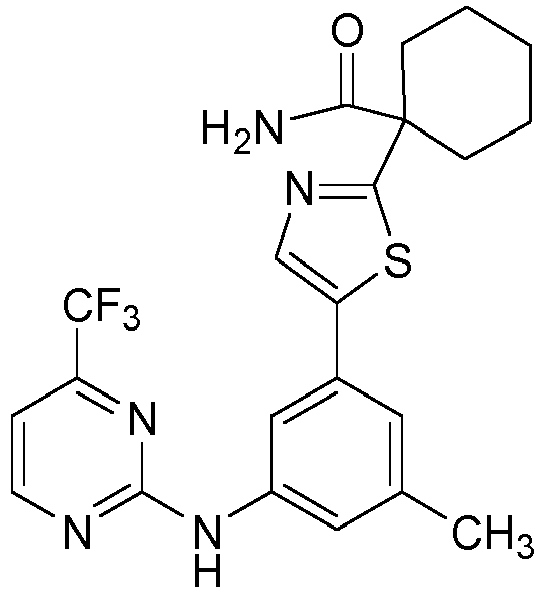
- A mixture of 1-[5-(3-methyl-5-{[4-(trifluoromethyl)pyrimidin-2-yl]amino}phenyl)-1,3- thiazol-2-yl]cyclohexanecarbonitrile (45 mg, 0.10 mmol) and NaOH (1M in MeOH, 0.5 ml, 0.50 mmol) was heated at 100 °C in the microwave for 16 hrs. The mixture was brought to pH = 3 by addition of HCl (1.0 N in H2O) and then partitioned between EtOAc (5 mL) and brine (5 mL). The organic layer was separated, dried (Na2SO4), filtered and the volatiles were removed under reduced pressure. The residue was purified by HPLC (gradient elution 40% to 100% CH3CN in H2O / 0.1% TFA, 20 mins, 20 ml/min) to give the title compound (4.0 mg, 8.67 µmol, 8.5 % yield) as a white solid.
MS ESI: [M + H]+ m/z 462.1. 1H NMR (500 MHz, DMSO-d6) δ 10.25 (s, 1H), 8.83 (d, J = 5.3, 1H), 7.97 (s, 2H), 7.46 (bs, 1H), 7.28 (d, J = 5.2, 1H), 7.20 (bs, 1H), 7.15 (bs, 2H), 2.31-2.24 (m, 5H), 2.00-1.94 (m, 2H), 1.51-1.41 (m, 5H), 1.33 (m, 1H). rhSYK activity = +++. -

- Step 1: A mixture of methyl cis-4-(5-bromo-1,3-thiazol-2-yl)-4-hydroxycyclohexanecarboxylate (416 mg, 1.195 mmol) and iodomethane (112 µl, 1.792 mmol) in DMF (5500 µl) was cooled to 0 °C and aged while stirring for 10 min. Sodium hydride (47.8 mg, 1.195 mmol) was then added and the reaction aged at 0 °C for 5 min before warming to rt. The reaction was aged at rt for 2 h. The reaction was cooled to 0 °C and quenched with methanol. The mixture was warmed back to room temperature, mixed with water, and extracted with CH2Cl2 (3X). The combined organic layers were dried under reduced pressure and purified by silica gel column chromatography (0-100% EtOAc:Hexanes) afforded methyl cis-4-(5-bromo-1,3-thiazol-2-yl)-4-methoxycyclohexanecarboxylate (306 mg, 71%) as a colorless oil. ESI: [M + H - MeOH]+ m/z 330, 332.
- Step 2: N-[3-methyl-5-(4,4,5,5-tetramethyl-1,3,2-dioxaborolan-2-yl)phenyl]-4-(trifluoromethyl)pyrimidin-2-amine (INTERMEDIATE 3, 320 mg, 0.845 mmol), the product of Step 1 (306 mg, 0.845 mmol), and sodium carbonate (845 µL, 1.689 mmol) in 2-Methyl THF (5631 µl) were degassed by sparging with Ar for 5 minutes. PdCl2(dppf)-CH2Cl2Adduct (34.5 mg, 0.042 mmol) was added and the temperature increased to 85 °C. The reaction was aged for 5 hours. The cooled reaction was mixed with water and extracted with CH2Cl2 (3X). The organic layers were dried under reduced pressure. The crude product was purified by silica gel column chromatography (0-100% EtOAc:Hexanes) afforded methyl (1S,4R)-4-methoxy-2,2-dimethyl-4-5-(3-methyl-5-{[4-(trifluoromethyl)pyrimidin-2-yl]amino}phenyl)-1,3-thiazol-2-yl]cyclohexanecarboxylate (156 mg, 29%) as a colorless oil. MS ESI: [M + H]+ m/z 535.
- Step 3: Potassium hydroxide in methanol (3.0 mL, 3.0 mmol) was added to the product of Step 2 (150 mg, 0.23 mmol) and the reaction mixture heated to 65 °C for 110 h. The reaction mixture was cooled and then quenched with HCl (2N in H2O). The mixture was filtered and washed with -20 mL of water to obtain an off-white solid. The solid was dried under reduced pressure at 40 °C in a vacuum oven for 1.5 h to provide the title compound (95 mg, 79%) as a yellow solid. ESI: [M + H]+ m/z 521. 1H NMR (500 MHz, DMSO-d6) δ 12.15 - 11.94 (m, 1H), 10.26 (s, 1H), 8.83 (d, J= 4.9, 1H), 8.00 (s, 1H), 7.96 (s, 1H), 7.45 (s, 1H), 7.28 (d, J = 4.9, 1H), 7.16 (s, 1H), 3.07 (s, 3H), 2.31 (s, 3H), 2.22 - 2.09 (m, 2H), 1.99 - 1.80 (m, 3H), 1.72 (d, J = 14.5, 1H), 1.62 (s, 1H), 1.07 (s, 3H), 1.01 (s, 3H). rhSYK activity = +++
-

- To a suspension of 4-Hydroxy-4-[5-(3-methyl-5-{[4-(trifluoromethyl)pyrimidin-2-yl]amino}phenyl)-1,3-thiazol-2-yl]cyclohexanone (77 mg, 0.17 mmol) and zinc iodide (10 mg, 0.033 mmol) in CH2Cl2 (1 mL), was added trimethylsilyl cyanide (115 µL, 0.858 mL).The resultant suspension was stirred for 14 h at rt. Additional zinc iodide (10 mg, 0.033 mmol) and trimethylsilyl cyanide (115 µL, 0.858 mL) were added, and the resultant suspension was stirred for 5 d at room temperature. HCl (1 mL, 12 N) was then added and stirring continued for 14 h at room temperature. The reaction was quenched with saturated aqueous sodium bicarbonate, extracted wtih EtOAc (3x), dried over Na2SO4 and concentrated in vacuo. The cis- and trans-isomers were separated via HPLC (20-75% CH3CN:H2O with a 0.1% TFA modifier). The fractions containing the desired product were diluted with ethyl acetate, washed with aqueous saturated sodium hydrogen carbonate, dried over MgSO4, filtered and concentrated to afford provide trans-1,4-dihydroxy-4-[5-(3-methyl-5-{[4-(trifluoromethyl)pyrimidin-2-yl] amino}-phenyl)-1,3-thiazol-2-yl]cyclohexanecarboxylic acid (6 mg, 7%) as a white solid and cis-1,4-dihydroxy-4-[5-(3-methyl-5-{[4-(trifluoromethyl)pyrimidin-2-yl]amino}phenyl)-1,3-thiazol-2-yl]cyclohexanecarboxylic acid (5 mg, 6%) as a white solid. Characterization data for the trans isomer: MS ESI: [M + H]+ m/z 495. 1H NMR (500 MHz, DMSO-d6) δ 10.25 (s, 1H), 8.83 (d, J = 4.8, 1H), 7.93 (d, J = 14.9, 2H), 7.46 (s, 1H), 7.27 (d, J = 4.9, 1H), 7.14 (s, 1H), 2.31 (s, 3H), 2.07 - 1.91 (m, 4H), 1.85 (s, 2H), 1.72 (d, J= 9.9, 2H). rhSYK activity = +++. Characterization data for the cis isomer: MS ESI: [M + H]+ m/z 495. 1H NMR (500 MHz, DMSO-d6) δ 10.25 (s, 1H), 8.83 (d, J = 4.8, 1 H), 7.94 (s, 2H), 7.46 (s, 1H), 7.27 (d, J = 4.9, 1 H), 7.15 (s, 1H), 2.31 (s, 3H), 2.20 (d, J = 13.0, 2H), 2.09 (d, J = 10.4, 2H), 1.57 (m, 4H). rhSYK activity = +++
-

- Step 1: Methyl cis-4-hydroxy-2,2-dimethyl-4-[5-(3-methyl-5-{[4-(trifluoromethyl)pyrimidin-2-yl]amino}phenyl)-1,3-thiazol-2-yl]cyclohexanecarboxylate (570 mg, 1.095 mmol) was suspended in Eaton's Reagent (4.14 mL, 21.9 mmol) and heated to 60 °C for 1.5 h. The reaction mixutre was allowed to cool to rt, and the reaction quenched via the slow addition of aqueous sodium bicarbonate. The reaction mixture was extracted with EtOAc (3x), dried over Na2SO4 and concentrated in vacuo. Purification via silica gel column chromatography (10%-35% EtOAc:hexanes) and separation of the diastereomers via HPLC gave 6,6-dimethyl-4-[5-(3-methyl-5- {[4-(trifluoromethyl)pyrimidin-2-yl]amino}phenyl)-1,3-thiazol-2-yl]cyclohex-3-ene-1-carboxylic acid (127 mg, 23%) as a colorless foam. ESI: [M + H]+ m/z 503.
- Step 2: The product of Step 1 (41 mg, 0.082 mmol) was dissolved in acetone (800 µL) and water (100 µL). Osmium tetroxide (4% in water, 199 µL, 0.033 mmol) and 4-methylmorpholine N-oxide (38.2 mg, 0.326 mmol) were added, and the suspension was stirred 1 h at rt. The reaction was quenched with 5% aqueous Na2S2O5 and stirred for 15 min at rt, extracted with EtOAc (3x),dried over Na2SO4 and concentrated in vacuo. Purification via silica gel column chromatography (20%-75% EtOAc:Hexanes) gave methyl 1,4-trans, 1,5-trans-4,5-dihydroxy-2,2-dimethyl-4-[5-(3-methyl-5-{[4-(trifluoromethyl)pyrimidin-2-yl]amino}phenyl)-1,3-thiazol-2-yl]cyclohexanecarboxylate and methyl 1,4-cis, 1,5-cis-4,5-dihydroxy-2,2-dimethyl-4-[5-(3-methyl-5-{[4-(trifluoromethyl)pyrimidin-2-yl]amino}phenyl)-1,3-thiazol-2-yl]cyclohexanecarboxylate (28 mg, 64%) as a colorless oil as an apparent ∼4:1 mixture of diastereomers. ESI: [M + H]+ m/z 537.
- Step 3: 4,5-Dihydroxy-2,2-dimethyl-4-[5-(3-methyl-5-{[4-(trifluoromethyl)pyrimidin-2-yl]amino}phenyl)-1,3-thiazol-2-yl]cyclohexanecarboxylate (43 mg, 0.080 mmol) was dissolved in methanol (500 µL). Sodium hydroxide (1.0 M in water, 481 µL, 0.481 mmol) was added, and the suspension was heated in a microwave to 100 °C for 20 min. The mixture was acidified to a pH of 3-4 with HCl (1 M in water) and diluted with water and 10% IPA:CHCl3. The layers were separated and the aqueous layer was re-extracted with 10% IPA:CHCl3(2x). The combined organic layers were washed with water, dried over Na2SO4, filtered and concentrated in vacuo. Purification via reversed phase HPLC (40-90% CH3CN:H2O) afforded 1,4-trans, 1,5-trans-4,5-dihydroxy-2,2-dimethyl-4-[5-(3-methyl-5-{[4-(trifluoromethyl)pyrimidin-2-yl]amino}phenyl)-1,3-thiazol-2-yl]cyclohexanecarboxylic acid (13 mg, 31%) as a white solid and 1,4-cis, 1,5-cis-4,5-dihydroxy-2,2-dimethyl-4-[5-(3-methyl-5-{[4-(trifluoromethyl)pyrimidin-2-yl]amino}phenyl)-1,3-thiazol-2-yl]cyclohexanecarboxylic acid (17 mg, 41%) as a white solid. Characterization data for the 1,4-cis, 1,5-cis compound: MS ESI: [M + H]+ m/z 523. 1H NMR (500 MHz, CD3OD) δ 8.71 (d, J = 4.9, 1H), 8.01 (s, 1H), 7.97 (s, 2H), 7.45 (s, 1H), 7.13 (d, J = 4.8, 2H), 4.06 (dd, J = 4.5, 11.9, 1H), 2.50 (dd, J = 3.0, 13.1, 1H), 2.37 (s, 3H), 2.24 (q, J = 13.0, 1H), 2.01 (d, J = 14.7, 1H), 1.84 (d, J= 14.7, 2H), 1.22 (s, 3H), 1.10 (s, 3H). rhSYK activity = +++. Characterization data for the 1,4-trans, 1,5-trans compound: MS ESI: [M + H]+ m/z 523. 1H NMR (500 MHz, CD3OD) δ 8.71 (d, J = 4.9, 1H), 8.01 (s, 1H), 7.96 (s, 2H), 7.46 (s, 1H), 7.13 (d, J = 5.0, 2H), 4.61 (dd, J = 4.5, 10.9, 1H), 2.58 - 2.44 (m, 2H), 2.38 (s, 3H), 2.28 - 2.16 (m, 1H), 1.96 (d, J = 13.7, 1H), 1.75 (d, J = 14.0, 1H), 1.30 (s, 3H), 0.98 (s, 3H). rhSYK activity = +++
-

- Step 1: To a flask containing tert-butyl 4-hydroxy-4-[5-(3-methyl-5-{[4-(trifluoromethyl)-pyrimidin-2-yl]amino}phenyl)-1,3-thiazol-2-yl]cyclohexanecarboxylate (400 mg, 0.75 mmol) was added dichloromethane (3.7 mL) and ethanol (2.2 mL). Deoxo-fluor (0.69 mL, 3.74 mmol) was added and the reaction was stirred for one hour. The reaction was then diluted with ethyl acetate, washed with water, dried over magnesium sulfate, filtered and concentrated. Flash chromatography was used for purification to yield tert-butyl trans-4-fluoro-4-[5-(3-methyl-5-{[4-(trifluoromethyl)pyrimidin-2-yl]amino}phenyl)-1,3-thiazol-2-yl]cyclohexanecarboxylate (175 mg, 0.33 mmol, 44% yield) and tert-butyl cis-4-fluoro-4-[5-(3-methyl-5-{[4-(trifluoromethyl)pyrimidin-2-yl]amino}phenyl)-1,3-thiazol-2-yl]cyclohexanecarboxylate (140 mg, 0.21 mmol, 28% yield). ESI of trans isomer: [M + H]+ mlz 537. ESI of cis isomer: [M + H]+ mlz 537.
- Step 2 with cis isomer: To a solution of tert-butyl cis-4-fluoro-4-[5-(3-methyl-5-{[4-(trifluoromethyl)pyrimidin-2-yl]amino}phenyl)-1,3-thiazol-2-yl]cyclohexanecarboxylate (67 mg, 0.13 mmol) in dichloromethane (2.5 mL) was added 2,6-lutidine (0.15 mL, 1.25 mmol) and TBSOTf (0.86 mL, 3.75 mmol). The reaction was stirred for one hour. The mixture was diluted with ethyl acetate, washed with water, dried over magnesium sulfate, filtered and concentrated. Supercritical fluid chromatography (40%/60% methanol/CO2) was used for purification to yield cis-4-fluoro-4-[5-(3-methyl-5-{[4-(trifluoromethyl)pyrimidin-2-yl]amino}phenyl)-1,3-thiazol-2-yl]cyclohexanecarboxylic acid (17 mg, 0.035 mmol, 28% yield). MS ESI: [M + H]+ m/z 461. 1H NMR (600 MHz, DMSO-d6) δ 12.20 (s, 1H), 10.26 (s, 1H), 8.81 (d, J = 4.8, 1H), 8.05 (d, J = 2.7, 1 H), 8.00 (s, 1H), 7.45 (s, 1H), 7.26 (d, J = 4.9, 1 H), 7.18 (s, 1H), 2.40 (t, J = 12.1, 1 H), 2.16 (s, 3H), 2.12 - 1.97 (m, 4H), 1.94-1.87 (m, 2H), 1.67 (dt, J = 9.5, 12.9, 2H). rhSYK activity = +++
- Step 2 with trans isomer: To a solution of tert-butyl trans-4-fluoro-4-[5-(3-methyl-5-{[4-(trifluoromethyl)pyrimidin-2-yl]amino}phenyl)-1,3-thiazol-2-yl]cyclohexanecarboxylate (175 mg, 0.33 mmol) in dichloromethane (6.5 mL) and 2,6-lutidine (0.38 mL, 3.26 mmol) was added TBSOTf (2.25 mL, 9.78 mmol). The reaction was stirred for one hour. The mixture was diluted with ethyl acetate, washed with water, dried over magnesium sulfate, filtered and concentrated. Column chromatography on silica and then reverse phase HPLC was used for purification to yield trans-4-fluoro-4-[5-(3-methyl-5-{[4-(trifluoromethyl)pyrimidin-2-yl]amino}phenyl)-1,3-thiazol-2-yl]cyclohexanecarboxylic acid (70 mg, 0.15 mmol, 45% yield. MS ESI: [M + H]+ m/z 461. 1H NMR (600 MHz, DMSO-d6) δ 10.25 (s, 1H), 8.81 (d, J = 4.8, 1H), 8.05 (s, 1H), 8.00 (s, 1H), 7.45 (s, 1H), 7.26 (d, J= 4.7, 1H), 7.17 (s, 1H), 2.38 (s, 1H), 2.29 (s, 5H), 2.03 - 1.87 (m, 2H), 1.88 - 1.71 (m, 4H). rhSYK activity = +++
-
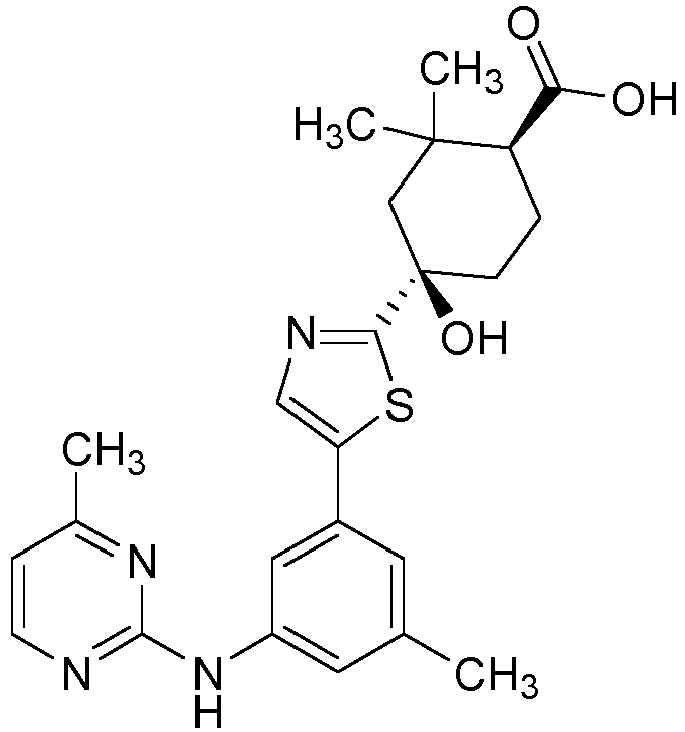
- Step 1: To a mixture of (4-methyl-pyrimidin-2-yl)-[3-methyl-5-(4,4,5,5-tetramethyl-[1,3,2]dioxaborolan-2-yl)-phenyl]-amine (20.0 g, 56.9 mmol), (1S,4R)-4-(5-Bromo-thiazol-2-yl)-4-hydroxy-2,2-dimethyl-cyclohexanecarboxylic acid methyl ester (19.8 g, 56.9 mmol), and PdCl2(dppf)2 (2.33 g, 2.85 mmol) in degassed 2-methyltetrahydrofuran (237 mL), was added sodium carbonate (2 M in H2O, 56.9 mL, 114 mmol). The reaction flask was purged with nitrogen and then heated to 70 °C for 5 hours. The mixture was cooled to room temperature, diluted with ethyl acetate (100 mL) and filtered over celite. The solution was washed with water, dried over MgSO4, filtered and concentrated in vacuo. Purification by chromatography on silica gel (Isco CombiFlash 100:0 to 40:60, hexanes:ethyl acetate), then by Chromatography on silica gel (2:98, methanol:dichloromethane) provided 17.5 g (37.4 mmol 66 %) of (1S,4R)-4-hydroxy-2,2-dimethyl-4- {5-[3-methyl-5-(4-methyl-pyrimidin-2-ylamino)-phenyl]-1,3-thiazol-2-yl}-cyclohexanecarboxylic acid methyl ester as a light tan foam.
- Step 2: To a solution of the product of Step 1 (16.5 g, 35.3 mmol) in methanol (115 mL) was added sodium hydroxide (1M, 123 mL, 123 mmol) and the mixture was heated to 70 °C for 2.5 hours. The reaction was cooled to 30 °C and hydrochloric acid (1 N, 123 mL, 123 mmol) was added. The reaction was aged for 1.5 hours and filtered to provide 15.3 g (33.7 mmol, 96%) of the title compound as a white solid. MS ESI: [M + H]+ m/z 453.0. 1H NMR (600 MHz, DMSO-d6) δ 11.98 (s, 1H), 9.55 (s, 1H), 8.32 (d, J = 5.0, 1H), 7.94 (s, 1H), 7.88 (s, 1H), 7.49 (s, 1H), 7.02 (s, 1H), 6.72 (d, J = 5.0, 1H), 5.86 (s, 1H), 2.34 (s, 3H), 2.27 (s, 3H), 2.14 (dd, J = 12.7, 3.1, 1H), 2.00 (ddd, J = 18.6, 13.2, 6.0, 1H), 1.88 - 1.77 (m, 3H), 1.62 (d, J = 14.1, 1H), 1.55 (dq, J = 13.5, 3.3, 1H), 1.09 (s, 3H), 0.97 (s, 3H). rhSYK activity = +++
-

- Step 1: A suspension of methyl (1S,4R)-4-hydroxy-2,2-dimethyl-4-[5-(3-methyl-5-{[4-(trifluoromethyl)pyrimidin-2-yl]amino}phenyl)-1,3-thiazol-2-yl]cyclohexanecarboxylic acid (200 mg, 0.38 mmol) in phosphorous pentoxide (2.2 g, 15.4 mmol) was heated at 65 °C for 3 hours. The resulting mixture was cooled to room temperature, slowly poured into saturated aqueous sodium bicarbonate, and extracted with ethyl acetate (2x). The combined organic layers were dried over magnesium sulfate, filtered, and concentrated under reduced pressure. Purification via silica gel chromatography (ethyl acetate/hexanes) afforded methyl 2,2-dimethyl-4-[5-(3-methyl-5-{[4-(trifluoromethyl)pyrimidin-2-yl]amino}phenyl)-1,3-thiazol-2-yl]cyclohex-3-ene-1-carboxylate (141 mg, 0.28 mmol, 73 % yield) as a colorless oil. MS ESI: [M + H]+ m/z 503.1.
- Step 2: 10% Palladium on carbon (30 mg, 0.028 mmol) was taken up in methanol (1 mL) under argon. A solution of the product from Step 1 (141 mg, 0.281 mmol) in methanol (3 mL) was then added. A hydrogen balloon was attached and the flask was evacuated and backfilled with hydrogen. The mixture was allowed to stir over the weekend. The reaction was filtered through celite and concentrated under reduced pressure. The resulting residue was taken up in methanol (3 mL) and added to a flask containing 10% Palladium on carbon (30 mg, 0.028 mmol) in 1 mL methanol. A hydrogen balloon was attached and the flask was evacuated and backfilled with hydrogen and stirred for 24 hours. The reaction was filtered through celite and concentrated under reduced pressure. The resulting residue was taken up in methanol (3 mL) and added to a flask containing 10% Palladium on carbon (30 mg, 0.028 mmol) in 1 mL methanol. A hydrogen balloon was attached and the flask was evacuated and backfilled with hydrogen and stirred for one week. The mixture was then filtered through a plug of celite and the celite was washed methanol. The filtrate was concentrated under reduced pressure to afford methyl 2,2-dimethyl-4-[5-(3-methyl-5-{[4-(trifluoromethyl)pyrimidin-2-yl]amino}phenyl)-1,3-thiazol-2-yl]cyclohexanecarboxylate (87 mg, 0.17 mmol, 62 % yield) as a light yellow oily solid. MS ESI: [M + H]+ mlz 505.1.
- Step 3: The product from Step 2 (87 mg, 0.17 mmol) was dissolved in methanol (2.9 ml) and 1 M aqueous sodium hydroxide (0.8 ml, 0.8 mmol) was added. The reaction was heated overnight at 100 °C. The reaction was then cooled, acidified with hydrochloric acid (2 M in H2O, 0.4 mL) and then concentrated under reduced pressure to afford crude 2,2-dimethyl-4-[5-(3-methyl-5-{[4-(trifluoromethyl)pyrimidin-2-yl]amino}phenyl)-1,3-thiazol-2-yl]cyclohexanecarboxylic acid that was used in the next step without further purification.
- Step 4: The product from Step 3 was taken up in N,N-dimethylformamide (2.9 ml) and EDC (66.1 mg, 0.35 mmol), HOBT (52.8 mg, 0.35 mmol), ammonium chloride (55.3 mg, 1.04 mmol), and N-ethyl-N-(propan-2-yl)propan-2-amine (301 µl, 1.724 mmol) were added. The mixture was stirred at room temperature overnight. The mixture was then diluted with 1 mL of DMSO and directly purified by reverse phase HPLC (acetonitrile/water + 0.1% TFA modifier). The desired fractions were combined, diluted with ethyl acetate and washed once with saturated aqueous sodium bicarbonate. The organic layer was dried over magnesium sulfate, filtered, and concentrated under reduced pressure. The resulting residue was subject to purification by chiral supercritical fluid chromatography (4/6 2-Propanol/CO2 with a flow rate of 60 mL/min and a 19 minute run time) to afford the four stereoisomers of 2,2-dimethyl-4-[5-(3-methyl-5-{[4-(trifluoromethyl)pyrimidin-2-yl]amino}phenyl)-1,3-thiazol-2-yl]cyclohexanecarboxamide.
- Isomer 1 (11 mg, 0.022 mmol, 13% yield). MS ESI: [M+H]+ m/z 490.2. 1H NMR (500 MHz, DMSO-d6) δ 10.24 (s, 1H), 8.83 (d, J = 5.0 Hz, 1H), 7.95 (s, 1H), 7.92 (s, 1H), 7.45 (s, 1H), 7.27 (d, J = 5.0 Hz, 1H), 7.23 (s, 1H), 7.14 (s, 1H), 6.61 (s, 1H), 3.16 (m, 1H), 2.31 (s, 3H), 2.24 (m, 1H), 2.10 (m, 2H), 1.87 (m, 1H), 1.80 (m, 1H), 1.68 (m, 1H), 1.48 (m, 1H), 1.03 (s, 3H), 0.94 (s, 3H). rhSYK activity = +++
- Isomer 2 (1.4 mg, 2.9 µmol, 2% yield). MS ESI: [M+H]+ m/z 490.1. 1H NMR (500 MHz, DMSO-d6) δ 10.24 (s, 1H), 8.83 (m, 1H), 7.95 (s, 1H), 7.92 (s, 1H), 7.45 (s, 1H), 7.27 (m, 1H), 7.23 (s, 1H), 7.14 (s, 1H), 6.61 (s, 1H), 3.15 (m, 1H), 2.30 (s, 3H), 2.24 (m, 1H), 2.10 (m, 2H), 1.87 (m, 1H), 1.81 (m, 1H), 1.68 (m, 1H), 1.49 (m, 1H), 1.03 (s, 3H), 0.94 (s, 3H). rhSYK activity = ++
- Isomer 3 (22 mg, 0.045 mmol, 27% yield). MS ESI: [M+H]+ m/z 490.1. 1H NMR (500 MHz, DMSO-d6) δ 10.25 (s, 1H), 8.83 (d, J = 5.0 Hz, 1H), 7.97 (s, 1H), 7.93 (s, 1H), 7.44 (s, 1H), 7.28 (d, J = 5.0 Hz, 1H), 7.17 (s, 1H), 7.14 (s, 1H), 6.72 (s, 1H), 3.18 (m, 1H), 2.30 (s, 3H), 2.11 (m, 1H), 2.01 (m, 1H), 1.79 (m, 2H), 1.56 (m, 1H), 1.39 (m, 2H), 1.01 (s, 3H), 1.00 (s, 3H). rhSYK activity = +++
- Isomer 4 (7.2 mg, 0.015 mmol, 9% yield). MS ESI: [M+H]+ m/z 490.1. 1H NMR (500 MHz, DMSO-d6) δ 10.25 (s, 1H), 8.83 (d, J = 5.0 Hz, 1H), 7.96 (s, 1H), 7.94 (s, 1H), 7.44 (s, 1H), 7.28 (d, J = 5.0 Hz, 1H), 7.17 (s, 1H), 7.14 (s, 1H), 6.72 (s, 1H), 3.18 (m, 1H), 2.31 (s, 3H), 2.11 (m, 1H), 2.02 (m, 1H), 1.78 (m, 2H), 1.56 (m, 1H), 1.40 (m, 2H), 1.01 (s, 3H), 1.00 (s, 3H). rhSYK activity = +++
-

- Step 1: 5-Hydroxy-5-[5-(3-methyl-5-{[4-(trifluoromethyl)pyrimidin-2-yl]amino}phenyl)-1,3-thiazol-2-yl]azepan-2-one (Example 10, 300 mg, 0.65 mmol) was suspended neat in phosphorus pentoxide (1.2 mL, 12.9 mmol) and stirred at 65 °C for 2 h., then cooled to room temperature, and carefully poured into saturated aqueous sodium bicarbonate. After the exotherm ceased, the mixture was extracted with ethyl acetate (2x). The combined organic layers were dried over sodium sulfate, filtered, and concentrated. The residue was purified by reverse phase HPLC (45:55 to 85:15 acetonitrile:water with a 0.1% trifluoroacetic acid modifier) to afford 5-[5-(3-methyl-5-{[[4-(trifluoromethyl)pyrimidin-2-yl]amino}phenyl)-1,3-thiazol-2-yl]-1,3,6,7-tetrahydro-2H-azepin-2-one and 5-[5-(3-methyl-5-{[4-(trifluoromethyl)pyrimidin-2-yl]amino}phenyl)-1,3-thiazol-2-yl]-1,3,4,7-tetrahydro-2H-azepin-2-one (70:30 mixture, 119 mg, 0.26 mmol, 41% yield) as a yellow solid. MS ESI: [M + H]+ m/z 446.1.
- Step 2: The 70:30 mixture of products from Step 1 (100 mg, 0.22 mmol) was dissolved in acetone (1 mL) and water (125 µL). Osmium tetroxide (4% in H2O, 548 µL, 0.09 mmol) and 4-methylmorpholine N-oxide (105 mg, 0.90 mmol) were added and the suspension was stirred for 1 h at room temperature. The reaction was quenched with 5% aqueous sodium thiosulfate and stirred for 15 minutes. The mixture was washed with ethyl acetate (3x), and the combined organic layers were dried over sodium sulfate, filtered, and concentrated to give a mixture of 4,5-dihydroxy-5-[5-(3-methyl-5-{[4-(trifluoromethyl)pyrimidin-2-yl]amino}phenyl)-1,3-thiazol-2-yl]azepan-2-one and 5,6-dihydroxy-5-[5-(3-methyl-5-{[4-(trifluoromethyl)pyrimidin-2-yl]amino}phenyl)-1,3-thiazol-2-yl]azepan-2-one (70:30, 40 mg, 0.084 mmol 37% yield) as a brownish-yellow solid. MS ESI: [M + H]+ m/z 480.1.1H NMR (600 MHz, DMSO-d6) δ 10.13 (s, 1H), 8.80 (d, J = 4.9, 1H), 7.93 (s, 1H), 7.90 (s, 1H), 7.53 - 7.36 (m, 2H), 7.23 (d, J = 4.9, 1H), 7.11 (s, 1H), 5.92 (s, 1H), 5.86 (s, 1H), 5.12 - 5.01 (m, 1H), 4.04 - 3.99 (m, 1H), 3.58 - 3.36 (m, 1H), 3.19 - 3.09 (m, 1H), 2.96 - 2.75 (m, 1H), 2.30 (s, 3H), 2.04 - 1.82 (m, 2H) rhSYK activity = +++
-

- Step 1: The 70:30 mixture of 4,5-dihydroxy-5-[5-(3-methyl-5-{[4-(trifluoromethyl)pyrimidin-2-yl]amino}phenyl)-1,3-thiazol-2-yl]azepan-2-one and 5,6-dihydroxy-5-[5-(3-methyl-5-{[4-(trifluoromethyl)pyrimidin-2-yl]amino}phenyl)-1,3-thiazol-2-yl]azepan-2-one (30 mg; Examples 160(a) and 160(b)) was subjected to purification by chiral supercritical fluid chromatography (4/6 2-propanol/ CO2 with a flow rate of 50 mL/min and a 19 minute run time) to afford the stereoisomers of 4,5-dihydroxy-5-[5-(3-methyl-5-{[4-(trifluoromethyl)pyrimidin-2-yl]amino}phenyl)-1,3-thiazol-2-yl]azepan-2-one and 5,6-dihydroxy-5-[5-(3-methyl-5-{[4-(trifluoromethyl)pyrimidin-2-yl]amino}phenyl)-1,3-thiazol-2-yl]azepan-2-one.
- Enantiomer 1 [cis] 5,6-dihydroxy-5-[5-(3-methyl-5-{[4-(trifluoromethyl)pyrimidin-2-yl]amino}phenyl)-1,3-thiazol-2-yl]azepan-2-one (3.2 mg, 6.25 µmol, 10% yield). MS ESI: [M+H]+ mlz 480. 1H NMR (500 MHz, DMSO-d6) δ 10.25 (s, 1H), 8.83 (d, J = 4.9, 1H), 7.96 (s, 1H), 7.93 (s, 1H), 7.53 (s, 1H), 7.47 (s, 1H), 7.27 (d, J = 4.9, 1H), 7.13 (s, 1H), 6.01 (s, 1H), 5.17 (d, J = 5.9, 1H), 3.81 - 3.73 (m, 1H), 3.54 (m, 1H), 2.82 (m, 2H), 2.31 (s, 3H), 2.04 - 1.93 (m, 2H), 1.93 - 1.86 (m, 1H). rhSYK activity = +++
- Enantiomer 2 [cis] 4,5-dihydroxy-5-[5-(3-methyl-5-{[4-(trifluoromethyl)pyrimidin-2-yl]amino}phenyl)-1,3-thiazol-2-yl]azepan-2-one (9.0 mg, 0.019 mmol, 30% yield). MS ESI: [M+H]+ m/z 480. 1H NMR (500 MHz, DMSO-d6) δ 10.25 (s, 1H), 8.83 (d, J = 4.9, 1H), 7.96 (s, 1H), 7.93 (s, 1H), 7.61 (s, 1H), 7.47 (s, 1H), 7.27 (d, J = 4.9, 1 H), 7.13 (s, 1H), 6.06 (s, 1H), 5.18 (d, J = 5.7, 1 H), 4.04-4.00 (m, 1H), 3.47-3.40 (m, 1H), 3.15 (d, J = 5.3, 1 H), 2.90 (s, 1H), 2.31 (s, 3H), 2.18 (s, 1H), 1.97 - 1.82 (m, 2H). rhSYK activity = +++
- Enantiomer 3 [cis] 5,6-dihydroxy-5-[5-(3-methyl-5-{[4-(trifluoromethyl)pyrimidin-2-yl]amino}phenyl)-1,3-thiazol-2-yl]azepan-2-one (3.3 mg, 6.88 µmol, 11% yield). MS ESI: [M+H]+ m/z 480. 1H NMR (500 MHz, DMSO-d6) δ 10.26 (s, 1H), 8.83 (d, J = 4.9, 1H), 7.96 (s, 1H), 7.93 (s, 1H), 7.53 (s, 1H), 7.47 (s, 1H), 7.28 (d, J = 4.9, 1H), 7.14 (s, 1H), 6.01 (s, 1H), 5.17 (d, J = 5.9, 1H), 3.82 - 3.71 (m, 1H), 3.53 (m, 1H), 2.91 - 2.75 (m, 2H), 2.31 (s, 3H), 2.04 - 1.93 (m, 2H), 1.93-1.86 (m, 1H). rhSYK activity = +++
- Enantiomer 4 [cis] 4,5-dihydroxy-5-[5-(3-methyl-5-{[4-(trifluoromethyl)pyrimidin-2-yl]amino}phenyl)-1,3-thiazol-2-yl]azepan-2-one (5.1 mg, 0.011 mmol, 17% yield). MS ESI: [M+H]+ m/z 480. 1H NMR (500 MHz, DMSO-d6) δ 10.25 (s, 1H), 8.83 (d, J = 4.9, 1H), 7.96 (s, 1H), 7.93 (s, 1H), 7.60 (s, 1H), 7.46 (s, 1H), 7.27 (d, J = 4.9, 1 H), 7.13 (s, 1H), 6.06 (s, 1H), 5.18 (d, J = 5.7, 1H), 4.05-4.00 (m, 1H), 3.44 (s, 1H), 3.15 (d, J = 5.2, 1H), 2.90 (s, 1H), 2.31 (s, 3H), 2.18 (s, 1H), 1.97 - 1.84 (m, 2H). rhSYK activity = +++
-

- Step 1: To a stirred solution of (S)-(-)-2-methyl-2-propanesulfinamide (854 mg, 7 mmol) and 1,4-dioxaspiro[4,5]decan-8-one (1 g, 6.40 mmol) in tetrahydrofuran (13 mL) was added titanium(IV) ethoxide (5.11 mL, 16 mmol). The mixture was stirred for 4 h at room temperature, poured over stirring saturated aqueous sodium bicarbonate (10 mL) and acetonitrile (10 mL), and stirred for 20 minutes. Magnesium sulfate was added and the mixture was stirred for 20 minutes, filtered over celite and concentrated. The residue was purified by column chromatography on silica gel (10:90 to 70:30 ethyl acetate:hexanes gradient) to afford N-(1,4-dioxaspiro[4.5]dec-8-ylidene)-2-methylpropane-2-sulfinamide (466 mg, 1.8 mmol, 28% yield) as a white solid. MS ESI: [M+H]+ m/z 260.
- Step 2: To diisopropyl amine (318 µL, 2.23 mmol) in tetrahydrofuran (3.7 mL) at 0 °C was added N-butyllithium (2.5 M in hexanes, 892 µL, 2.23 mmol). The mixture was stirred for 15 minutes, then cooled to -78 °C. INTERMEDIATE 4 (250 mg, 0.74 mmol) dissolved in tetrahydrofuran (1 mL) was added dropwise over 5 minutes. The mixture was stirred for 30 minutes at -78 °C, then the product of Step 1 (212 mg, 0.82 mmol) dissolved in tetrahydrofuran (1 mL) was added dropwise. The reaction mixture was stirred for 2 h, and then quenched with saturated aqueous ammonium chloride, extracted with ethyl acetate (3x), and the combined organic fractions were dried over sodium sulfate, filtered, and concentrated. Purification by column chromatography on silica gel (0:100 to 80:20 ethyl acetate:hexanes gradient, then 0:100 to 15:85 methanol:dichloromethane gradient) afforded 2-methyl-N-{8-[5-(3-methyl-5-{[4-(trifluoromethyl)pyrimidin-2-yl]amino}phenyl)-1,3-thiazol-2-yl]-1,4-dioxaspiro[4.5]dec-8-yl}propane-2-sulfinamide (318 mg, 0.40 mmol, 75% yield) as a brown solid. MS ESI: [M + H]+ m/z 596.
- Step 3: To the product of Step 2 (100 mg, 0.13 mmol) was added chloroform (630 µL), sodium azide (24.5 mg, 0.38 mmol), and methanesulfonic acid (98 µL, 1.51 mmol). The mixture was heated to 65 °C for 1.5 h., cooled to room temperature, diluted with water, and extracted with ethyl acetate (2x). The combined organic layers were dried over sodium sulfate, filtered, and concentrated. The residue was purified by reverse phase HPLC (35:65 to 70:30 acetonitrile:water with a 0.1 % trifluoroacetic acid modifier). The fractions containing the desired product were diluted with ethyl acetate and free based with saturated aqueous sodium bicarbonate. The separated organic layer was dried over magnesium sulfate, filtered and concentrated to afford the title compound (38 mg, 0.083 mmol, 66 % yield) as an orange oil. MS ESI: [M+H]+ mlz 463. 1H NMR (500 MHz, DMSO-d6) δ 10.26 (s, 1H), 8.83 (s, 1H), 8.75 (s, 1H), 8.02 (s, 1H), 7.93 (s, 1H), 7.49 (s, 1H), 7.28 (d, J = 4.7, 1H), 7.16 (s, 1H), 2.39 - 2.08 (m, 9H), 1.30 - 0.99 (m, 4H). rhSYK activity = +++
- Homogeneous Time-Resolved Fluorescence (HTRF) assay for the recombinant human SYK enzyme: A recombinant GST-hSYK fusion protein was used to measure potency of compounds to inhibit human SYK activity. The recombinant human GST-SYK (Carna Biosciences #08-176) (5pM final concentration) was incubated with various concentrations of the inhibitor diluted in DMSO (0.1% final concentration) for 10 minutes at room temperature in 15 mM Tris-HCl (pH 7.5), 0.01% tween 20, 2 mM DTT in 384 well plate format. To initiate the reaction the biotinylated substrate peptide (250 nM final concentration) that contains the phosphorylation site for SYK was added with magnesium (5 mM final concentration) and ATP (25 µM final concentration). Final volume of the reaction was 10 µL. Phosphorylation of the peptide was allowed to proceed for 45' at room temperature. To quench the reaction and detect the phosphorylated product, 2 nM of a Europium-anti-phosphotyrosine antibody (Perkin Elmer #AD0161) and 70 nM SA-APC (Perkin-Elmer #CR130-100) were added together in 15 mM Tris pH 7.5, 40 mM EDTA, 0.01% tween 20. Final volume of the quenching solution was 10 µL. The resulting HTRF signal was measured after 30 minutes on a EnVision (Perkin-Elmer) reader using a time-resolved fluorescence protocol. IC50 was determined following 10-dose titration (10 µM to 0.508 nM) and four parameter logistic curve fitting using the Merck Assay Data Analyzer. The rhSYK activity (IC50) is expressed as +++ (100nM or less), ++ (between 100 and 1000nM), + (between 1 and 10µM). IC50 for representative compounds of the present invention are provided as follows:
Compound Name Syk IC50 3-hydroxy-3-[5-(3-{[4-(trifluoromethyl)pyrimidin-2-yl]amino}phenyl)-1,3-thiazol-2-yl]pyrrolidine-1-carboxamide 11 nM {4-hydroxy-4-[5-(3-methyl-5-{[4-(trifluoromethyl)pyrimidin-2-yl]amino}phenyl)-1,3-thiazol-2-yl]azepan-1-yl}acetic acid 216 nM (1S,4R)-4-hydroxy-2,2-dimethyl-4-(5-{3-methyl-5-[(4-methylpyrimidin-2-yl)amino]-phenyl}-1,3-thiazol-2-yl)cyclohexanecarboxylic acid 1 nM 1-(5- {3-[(4-tert-butylpyrimidin-2-yl)amino]-5-methylphenyl}-1,3-thiazol-2-yl)-cyclobutanol 25 nM (1S,4R)-N-(cyanomethyl)-4-hydroxy-2,2-dimethyl-4-(5-{3-methyl-5-[(4-methylpyrimidin-2-yl)amino]phenyl}-1,3-thiazol-2-yl)cyclohexanecarboxamide 2 nM Cis-tert-butyl cis-4-hydroxy-4-[5-(3-methyl-5-{[4-(pentafluoroethyl)pyrimidin-2-yl] amino}phenyl)-1,3-thiazol-2-yl]cyclohexanecarboxylate 2427 nM (1S,4R)-4-hydroxy-2,2-dimethyl-4-[5-(3-methyl-5-{[4-(trifluoromethyl)pyrimidin-2-yl]amino}phenyl)-1,3-thiazol-2-yl]cyclohexanecarboxylic acid < 0.5 nM trans-4-hydroxy-1-methyl-4-[5-(3-{[4-(trifluoromethyl)pyrimidin-2-yl]amino}-phenyl)-1,3-thiazol-2-yl]cyclohexanecarboxylic acid 4 nM cis-4-hydroxy-1-methyl-4-[5-(3-{[4-(trifluoromethyl)pyrimidin-2-yl]amino}phenyl)-1,3-thiazol-2-yl]cyclohexanecarboxylic acid 2 nM cis-4-[(hydroxyacetyl)amino]-1-[5-(3-methyl-5-{[4-(trifluoromethyl)pyrimidin-2-yl]amino}phenyl)-1,3-thiazol-2-yl] cyclohexanecarboxamide 2 nM (1S,4R)-4-hydroxy-2,2-dimethyl-4-[5-(3-methyl-5-{[4-(trifluoromethyl)pyrimidin-2-yl]amino}phenyl)-1,3-thiazol-2-yl]-N-[3-(2-oxopyrrolidin-1-yl)propyl]cyclohexanecarboxamide 1 nM (1S,2R,4R)-4-hydroxy-2-methyl-4-[5-(3-methyl-5-{[4-(trifluoromethyl)pyrimidin-2-yl]amino}phenyl)-1,3-thiazol-2-yl]cyclohexanecarboxylic acid and enantiomer 1 nM, < 0.5 nM (1S,4R)-4-methoxy-2,2-dimethyl-4-[5-(3-methyl-5-{[4-(trifluoromethyl)pyrimidin-2-yl]amino}phenyl)-1,3-thiazol-2-yl]cyclohexanecarboxylic acid 2 nM (1R,4S)-4-hydroxy-2,2-dimethyl-4-[5-(3-methyl-5-{[4-(trifluoromethyl)pyrimidin-2-yl]amino}phenyl)-1,3-thiazol-2-yl]cyclohexanecarboxylic acid 2 nM N-{3-[2-(1-aminocyclobutyl)-1,3-thiazol-5-yl]-5-methylphenyl}-4-cyclopropyl-pyrimidin-2-amine hydrochloride 3 nM Ethyl (1R,4S)-4-hydroxy-2,2-dimethyl-4-[5-(3-methyl-5-{[4-(trifluoromethyl)-pyrimidin-2-yl]amino}phenyl)-1,3-thiazol-2-yl]cyclohexanecarboxylate 49 nM 5-(aminomethyl)-5-[5-(3-methyl-5-{[4-(trifluoromethyl)pyrimidin-2-yl]amino}-phenyl)-1,3-thiazol-2-yl]azepan-2-one 50 nM (1S,4R)-4-{5-[3-({4-[(1S)-1-fluoroethyl]pyrimidin-2-yl}amino)-5-methylphenyl]-1,3-thiazol-2-yl}-4-hydroxy-2,2-dimethylcyclohexanecarboxylic acid < 0.5 nM (1S,4R)-4-{5-[3-({4-[(1R)-1-fluoroethyl]pyrimidin-2-yl}amino)-5-methylphenyl]-1,3-thiazol-2-yl}-4-hydroxy-2,2-dimethylcyclohexanecarboxylic acid < 0.5 nM
Claims (25)
- A compound of formula (I) or a pharmaceutically acceptable salt thereof:
 p is 0 to 4;q is 0, 1 or 2;Cy is selected from C4-7cycloalkyl, oxetanyl, pyrrolidinyl, piperidinyl, and azepanyl;R1 is selected from H, C1-4alkyl, C1-4haloalkyl, C3-6cycloalkyl, and OC1-4alkyl;R4 is selected from H, C1-4alkyl, and C3-4cycloalkyl;Ry(a) is aminomethyl, OH, OCH3, OCH2CH2OH, F, CN, CO2Ra(a), CONRb(a)Rc(a), NRa(a)Ra(a), NHC(O)C1-3alkyl (optionally substituted with OH), NHC(O)NH2, NHSO2NH2, NHSO2C1-3alkyl, or NHSO2C1-3haloalkyl;Rz(a) is selected from (A) C1-4 alkyl optionally substituted with one to three groups independently selected from OH, NH2, CN, CO2Ra(a) and CONH2, (B) C1-3fluoroalkyl, (C) halogen, (D) CN, (E) COC1-4alkyl (optionally substituted with one or two groups independently selected from ORa(a), CN, CO2Ra(a), CONRa(a)Ra(a), and NRa(a)Ra(a)), (F) CO-phenyl (optionally substituted with one or two groups independently selected from ethynyl, CO2Ra(a), CN, F and OH), (G) CO-C3-6cycloalkyl (optionally substituted with OH or CO2Ra(a)), (H) C0-3alkyl-CO2Ra(a), (I) -C(O)NRb(a)Rc(a), (J) -ORa(a), (K) -OC(O)Ra(a), (L) -NRb(a)Rc(a), (M) -NHC(O)C1-4alkyl (optionally substituted with one to three OH or a CONRa(a)Ra(a)), (N) -NHSO2C1-3alkyl, (O) -NHSO2NH2, (P) oxo, (Q) 1,3,4-oxadiazole-2(3H)-one, (R) 1,2,4-oxadiazole-5(4H)-one, (S) SO2NH2, (T) SO2C1-3alkyl, (U) SO2C1-3haloalkyl, and (V) SO2Ph;Ra(a) is H or C1-4alkyl;Rb(a) and Rc(a) are independently selected from (A) H, (B) C3-6cycloalkyl optionally substituted with OH, (C) heteroaryl selected from imidazolyl, pyridyl and indolyl, (D) tetrahydrofuranyl, (E) benzyl, (F) phenyl optionally substituted with one or two groups independently selected from (CH2)0-2OH and F, (G1) C1-4alkyl and (G2) C1-4haloalkyl, wherein (G1) and (G2) are each optionally substituted with one to three groups independently selected from (i) OH, (ii) C3-6cycloalkyl optionally substituted with one or two groups independently selected from C1-4alkyl, CONH2, CO2H and CH2OH, (iii) CONH2, (iv) SO2NH2, (v) SO2C1-4alkyl, (vi) 4- to 7-membered monocyclic heterocyclyl optionally substituted with one or two groups independently selected from oxo, (CH2)0-2OH, and C1-4alkyl, (vii) a 5- or 6-membered heteroaryl optionally substituted with one or two groups independently selected from carboxy, (CH2)0-2OH, and C1-4alkyl, (viii) CN, (ix) OC1-4alkyl, (x) CO2H, (xi) NRa(a)C(O)C1-4alkyl, (xii) phenyl optionally substituted with one or two groups independently selected from (CH2)0-2OH, SO2NH2, CF3, F and Cl, (xiii) 1-pyrrolidinyl optionally substituted with oxo, (xiv) 1-imidazolidinyl optionally substituted with oxo, (xv) 1-piperidinyl optionally substituted with oxo, and (xvi) 4-morpholinyl; orRb(a) and Rc(a) together with the nitrogen atom to which they are attached form a 6- or 7-membered heterocycle having 0 to 1 additional heteroatom selected from N, O and S, wherein said heterocycle is optionally substituted with one or two groups independently selected from oxo, CN, (CH2)0-2OH, acetyl, benzyl, SO2C1-4alkyl, CONH2, methoxymethyl, carboxymethyl, CO2Ra(a) and C1-4alkyl.
 - A compound of Claim 1 wherein Cy is cyclohexyl.
- A compound of Claim 1 wherein Cy is cyclohexyl, q is 1, p is 0, 1 or 2, and Rz(a) is selected from CO2Ra(a), CONRb(a)Rc(a) and NHC(O)C1-4alkyl optionally substituted with OH.
- A compound of Claim 1, 2 or 3 wherein Ry(a) is OH.
- A compound of Claim 1, 2 or 3 wherein Ry(a) is CONH2.
- A compound of Claim 1 wherein Cy is azepanyl, p is 0, q is 1, and Rz(a) is oxo.
- A compound of Claim 1 wherein Ry(a) is OH.
- A compound of Claim 1 having the formula (Id) or a pharmaceutically acceptable salt thereof:
 p' is 0, 1 or 2;Ry(a) is selected from OH, OCH3, F, CN and CONH2;Rz(b) is selected from (a) C1-4 alkyl optionally substituted with one or more groups independently selected from OH, NH2, CN, CO2Ra(a) and CONH2, (b) CN, (c) -C(O)2Ra(a), (d) -C(O)NHRb(a), (e) -NHC(O)C1-4alkyl (optionally substituted with OH), (f) 1,3,4-oxadiazole-2(3H)-one, and (g) 1,2,4-oxadiazole-5(4H)-one;R1 is selected from H, methyl, isopropyl, difluoromethyl, trifluoromethyl, 1-fluoroethyl, cyclopropyl and isopropyloxy;R4 is selected from H, methyl and cyclopropyl;Ra(a) is H or C1-4alkyl;Rb(a) is H, C1-4alkyl optionally substituted 2-oxo-1-pyrrolidinyl.
 - A compound of claim 8 wherein Ry(a) is OH.
- A compound of claim 8 or 9 wherein Rz(b) is CO2H, CONH2, CONH(CH2)3-(2-oxo-1-pyrrolidinyl) or NHC(O)CH2OH.
- A compound of Claim 1 selected from:(1R,4S)-4-[5-(3-cyclopropyl-5-{[4-(trifluoromethyl)pyrimidin-2-yl]amino}phenyl)-1,3-thiazol-2-yl]-4-hydroxy-2,2-dimethylcyclohexanecarboxylic acid;(1S ,4R)-4-[5-(3 -cyclopropyl-5-{[4-(trifluoromethyl)pyrimidin-2-yl]amino}phenyl)-1,3-thiazol-2-yl]-4-hydroxy-2,2-dimethylcyclohexanecarboxylic acid;(1S,4R)-4-hydroxy-2,2-dimethyl-4-{5-[3-methyl-5-(4-methyl-pyrimidin-2-ylamino)-phenyl]-1,3-thiazol-2-yl}-cyclohexanecarboxylic acid;(1S,4R)-4-[5-(3-{[4-(difluoromethyl)pyrimidin-2-yl]amino}-5-methylphenyl)-1,3-thiazol-2-yl]-4-hydroxy-2,2-dimethylcyclohexanecarboxylic acid;trans-4-hydroxy-4-[5-(3-methyl-5-{[4-(trifluoromethyl)pyrimidin-2-yl]amino}phenyl)-1,3-thiazol-2-yl]cyclohexanecarboxylic acid;cis-4-hydroxy-4-[5-(3-methyl-5-{[4-(trifluoromethyl)pyrimidin-2-yl]amino}phenyl)-1,3-thiazol-2-yl]cyclohexanecarboxylic acid;5-hydroxy-5-[5-(3-methyl-5-{[4-(trifluoromethyl)pyrimidin-2-yl]amino}phenyl)-1,3-thiazol-2-yl]azepan-2-one;cis-4-[(hydroxyacetyl)amino]-1-[5-(3-methyl-5-{[4-(trifluoromethyl)pyrimidin-2-yl]amino}phenyl)-1,3-thiazol-2-yl]cyclohexanecarboxamide; and(1S,4R)-4-hydroxy-2,2-dimethyl-4-[5-(3-methyl-5-{[4-(trifluoromethyl)pyrimidin-2-yl]amino}phenyl)-1,3-thiazol-2-yl]-N-[3-(2-oxopyrrolidin-1-yl)propyl]cyclohexanecarboxamide;(1S,4R)-4-hydroxy-2,2-dimethyl-4-[5-(3-methyl-5-{[4-(trifluoromethyl)pyrimidin-2-yl]amino}-phenyl)-1,3-thiazol-2-yl]cyclohexanecarboxylic acid;(1R,4S)-4-hydroxy-2,2-dimethyl-4-[5-(3-methyl-5-{[4-(trifluoromethyl)pyrimidin-2-yl]amino}-phenyl)-1,3-thiazol-2-yl]cyclohexanecarboxylic acid;(1S,4S)-4-hydroxy-2,2-dimethyl-4-[5-(3-methyl-5-{[4-(trifluoromethyl)pyrimidin-2-yl]amino}-phenyl)-1,3-thiazol-2-yl]cyclohexanecarboxylic acid;(1R,4R)-4-hydroxy-2,2-dimethyl-4-[5-(3-methyl-5-{[4-(trifluoromethyl)pyrimidin-2-yl]amino}-phenyl)-1,3-thiazol-2-yl]cyclohexanecarboxylic acid;(1R,4S)-4-hydroxy-2,2-dimethyl-4-[5-(3-methyl-5-{[4-(trifluoromethyl)pyrimidin-2-yl]amino}phenyl)-1,3-thiazol-2-yl]cyclohexanecarboxamide;(1S,4R)-4-hydroxy-2,2-dimethyl-4-[5-(3-methyl-5-{[4-(trifluoromethyl)pyrimidin-2-yl]amino}phenyl)-1,3-thiazol-2-yl]cyclohexanecarboxamide;(1S,4R) 4-{5-[3-({4-[(1R)-1-fluoroethyl]pyrimidin-2-yl}amino)-5-methylphenyl]-1,3-thiazol-2-yl}-4-hydroxy-2,2-dimethylcyclohexanecarboxylic acid;(1S,4R) 4-{5-[3-({4-[(1S)-1-fluoroethyl]pyrimidin-2-yl}amino)-5-methylphenyl]-1,3-thiazol-2-yl}-4-hydroxy-2,2-dimethylcyclohexanecarboxylic acid;or a pharmaceutically acceptable salt thereof.
- A compound of Claim 1 which is 5-hydroxy-5-[5-(3-methyl-5-{[4-(trifluoromethyl)pyrimidin-2-yl]amino}phenyl)-1,3-thiazol-2-yl]azepan-2-one, or a pharmaceutically acceptable salt thereof.
- A compound of Claim 1 which is (1S,4R)-4-hydroxy-2,2-dimethyl-4-[5-(3-methyl-5-{[4-(trifluoromethyl)pyrimidin-2-yl]amino}phenyl)-1,3-thiazol-2-yl]-N-[3-(2-oxopyrrolidin-1-yl)propyl]cyclohexanecarboxamide, or a pharmaceutically acceptable salt thereof.
- A compound of Claim 1 which is cis-4-[(hydroxyacetyl)amino]-1-[5-(3-methyl-5-{[4-(trifluoromethyl)pyrimidin-2-yl]amino}phenyl)-1,3-thiazol-2-yl]cyclohexane-carboxamide, or a pharmaceutically acceptable salt thereof.
- A compound of Claim 1 which is (1S,4R)-4-hydroxy-2,2-dimethyl-4-[5-(3-methyl-5-{[4-(trifluoromethyl)pyrimidin-2-yl]amino}phenyl)-1,3-thiazol-2-yl]cyclohexane-carboxylic acid, or a pharmaceutically acceptable salt thereof.
- The compound of Claim 15 in the form of the free acid.
- A compound of Claim 1 which is (1S,4R)-4-{5-[3-({4-[(1S)-1-fluoroethyl]pyrimidin-2-yl}amino)-5-methylphenyl]-1,3-thiazol-2-yl}-4-hydroxy-2,2-dimethylcyclohexanecarboxylic acid, or a pharmaceutically acceptable salt thereof.
- A compound of Claim 1 which is (1S,4R)-4-{5-[3-({4-[(1R)-1-fluoroethyl]pyrimidin-2-yl}amino)-5-methylphenyl]-1,3-thiazol-2-yl}-4-hydroxy-2,2-dimethylcyclohexanecarboxylic acid, or a pharmaceutically acceptable salt thereof.
- A compound of Claim 1 which is (1S,4R)-4-hydroxy-2,2-dimethyl-4-{5-[3-methyl-5-(4-methyl-pyrimidin-2-ylamino)-phenyl]-1,3-thiazol-2-yl}-cyclohexanecarboxylic acid, or a pharmaceutically acceptable salt thereof.
- A pharmaceutical composition comprising a therapeutically effective amount of a compound of any preceding Claim or a pharmaceutically acceptable salt thereof and a pharmaceutically acceptable carrier.
- A compound of Claim 1 which is a 4-hydroxy-2,5-dimethyl-4-[5-(3-methyl-5-{[4-(trifluoromethyl)pyrimidin-2-yl]amino}phenyl)-1,3-thiazol-2-yl]cyclohexanecarboxylic acid, or a pharmaceutically acceptable salt thereof.
- A compound of any one of Claims 1 to 19 or a pharmaceutically acceptable salt thereof for use in a method of treatment of the human body by therapy.
- A compound for use of Claim 21 wherein the therapy is rheumatoid arthritis, cancer, systemic lupus erythematosus or asthma.
- Use of a compound of any one of claims 1 to 19 or a pharmaceutically acceptable salt thereof for the manufacture of a medicament for treating rheumatoid arthritis, cancer, systemic lupus erythematosus or asthma.
- A combination of a compound of any one of Claims 1 to 19 or a pharmaceutically acceptable salt thereof and at least one other pharmaceutically active agent.
Applications Claiming Priority (2)
| Application Number | Priority Date | Filing Date | Title |
|---|---|---|---|
| US28726709P | 2009-12-17 | 2009-12-17 | |
| PCT/US2010/060454 WO2011075515A1 (en) | 2009-12-17 | 2010-12-15 | Aminopyrimidines as syk inhibitors |
Publications (2)
| Publication Number | Publication Date |
|---|---|
| EP2513098A1 EP2513098A1 (en) | 2012-10-24 |
| EP2513098B1 true EP2513098B1 (en) | 2016-11-09 |
Family
ID=43502894
Family Applications (1)
| Application Number | Title | Priority Date | Filing Date |
|---|---|---|---|
| EP10801736.9A Active EP2513098B1 (en) | 2009-12-17 | 2010-12-15 | Aminopyrimidines as syk inhibitors |
Country Status (28)
| Country | Link |
|---|---|
| US (3) | US8759366B2 (en) |
| EP (1) | EP2513098B1 (en) |
| JP (2) | JP5242857B2 (en) |
| KR (1) | KR101445012B1 (en) |
| CN (1) | CN102858767B (en) |
| AR (1) | AR080672A1 (en) |
| AU (1) | AU2010331927B2 (en) |
| BR (1) | BR112012014703B1 (en) |
| CA (1) | CA2782889C (en) |
| CL (1) | CL2012001627A1 (en) |
| CO (1) | CO6551728A2 (en) |
| CR (1) | CR20120331A (en) |
| DO (1) | DOP2012000166A (en) |
| EA (1) | EA022790B1 (en) |
| EC (1) | ECSP12011982A (en) |
| ES (1) | ES2609040T3 (en) |
| GE (1) | GEP20146125B (en) |
| GT (1) | GT201200202A (en) |
| MA (1) | MA33926B1 (en) |
| MX (1) | MX2012007154A (en) |
| NI (1) | NI201200108A (en) |
| NZ (1) | NZ600673A (en) |
| PE (1) | PE20121480A1 (en) |
| PH (1) | PH12012501225A1 (en) |
| SG (1) | SG181803A1 (en) |
| TN (1) | TN2012000288A1 (en) |
| TW (1) | TW201132637A (en) |
| WO (2) | WO2011075517A1 (en) |
Families Citing this family (92)
| Publication number | Priority date | Publication date | Assignee | Title |
|---|---|---|---|---|
| WO2011075517A1 (en) | 2009-12-17 | 2011-06-23 | Merck Sharp & Dohme Corp. | Aminopyrimidines as syk inhibitors |
| EP2512246B1 (en) | 2009-12-17 | 2015-09-30 | Merck Sharp & Dohme Corp. | Aminopyrimidines as syk inhibitors |
| DK2516434T3 (en) | 2009-12-23 | 2015-08-31 | Takeda Pharmaceutical | FUSED HETEROAROMATIC PYRROLIDINONS AS SICK INHIBITORS |
| TWI523852B (en) | 2010-01-12 | 2016-03-01 | Ab科學公司 | Substituted azole derivatives, compositions comprising the same and uses thereof |
| WO2012088266A2 (en) | 2010-12-22 | 2012-06-28 | Incyte Corporation | Substituted imidazopyridazines and benzimidazoles as inhibitors of fgfr3 |
| RU2612217C2 (en) * | 2011-05-04 | 2017-03-03 | Мерк Шарп И Доум Корп. | Aminopyridine-containing spleen tyrosine kinase (syk) inhibitors |
| AU2012253885A1 (en) * | 2011-05-10 | 2013-10-31 | Merck Sharp & Dohme Corp. | Aminopyrimidines as Syk inhibitors |
| US9145391B2 (en) | 2011-05-10 | 2015-09-29 | Merck Sharp & Dohme Corp. | Bipyridylaminopyridines as Syk inhibitors |
| CA2834062A1 (en) | 2011-05-10 | 2012-11-15 | Merck Sharp & Dohme Corp. | Pyridyl aminopyridines as syk inhibitors |
| JP2014159375A (en) * | 2011-06-15 | 2014-09-04 | Takeda Chem Ind Ltd | Azepane compound |
| WO2012177714A1 (en) | 2011-06-22 | 2012-12-27 | Takeda Pharmaceutical Company Limited | Substituted 6-aza-isoindolin-1-one derivatives |
| ES2638144T3 (en) * | 2011-12-21 | 2017-10-18 | Bayer Intellectual Property Gmbh | Substituted benzylpyrazoles |
| US8906889B2 (en) | 2012-02-15 | 2014-12-09 | Bristol-Myers Squibb Company | C-3 cycloalkenyl triterpenoids with HIV maturation inhibitory activity |
| US9096579B2 (en) | 2012-04-20 | 2015-08-04 | Boehringer Ingelheim International Gmbh | Amino-indolyl-substituted imidazolyl-pyrimidines and their use as medicaments |
| US8889854B2 (en) | 2012-05-07 | 2014-11-18 | Bristol-Myers Squibb Company | C-17 bicyclic amines of triterpenoids with HIV maturation inhibitory activity |
| LT3495367T (en) | 2012-06-13 | 2021-02-25 | Incyte Holdings Corporation | MODIFIED TRICYCLIC COMPOUNDS AS FGFR INHIBITORS |
| WO2013192128A1 (en) | 2012-06-20 | 2013-12-27 | Merck Sharp & Dohme Corp. | Imidazolyl analogs as syk inhibitors |
| EP2863914B1 (en) | 2012-06-20 | 2018-10-03 | Merck Sharp & Dohme Corp. | Pyrazolyl derivatives as syk inhibitors |
| US9416111B2 (en) | 2012-06-22 | 2016-08-16 | Merck Sharp & Dohme Corp. | Substituted diazine and triazine spleen tyrosine kinease (Syk) inhibitors |
| EP2863916B1 (en) * | 2012-06-22 | 2018-07-18 | Merck Sharp & Dohme Corp. | Substituted pyridine spleen tyrosine kinase (syk) inhibitors |
| WO2014026125A1 (en) | 2012-08-10 | 2014-02-13 | Incyte Corporation | Pyrazine derivatives as fgfr inhibitors |
| US9353066B2 (en) | 2012-08-20 | 2016-05-31 | Merck Sharp & Dohme Corp. | Substituted phenyl-Spleen Tyrosine Kinase (Syk) inhibitors |
| US9586931B2 (en) | 2012-09-28 | 2017-03-07 | Merck Sharp & Dohme Corp. | Triazolyl derivatives as Syk inhibitors |
| KR102229478B1 (en) | 2012-11-01 | 2021-03-18 | 인피니티 파마슈티칼스, 인코포레이티드 | Treatment of cancers using pi3 kinase isoform modulators |
| WO2014074422A1 (en) * | 2012-11-07 | 2014-05-15 | Merck Sharp & Dohme Corp. | Amino-pyridine-containing spleen tyrosine kinase (syk) inhibitors |
| WO2014074421A1 (en) * | 2012-11-07 | 2014-05-15 | Merck Sharp & Dohme Corp. | Prodrug bipyridylaminopyridines as syk inhibitors |
| US9624210B2 (en) | 2012-12-12 | 2017-04-18 | Merck Sharp & Dohme Corp. | Amino-pyrimidine-containing spleen tyrosine kinase (Syk) inhibitors |
| US9266892B2 (en) | 2012-12-19 | 2016-02-23 | Incyte Holdings Corporation | Fused pyrazoles as FGFR inhibitors |
| US9598405B2 (en) | 2012-12-21 | 2017-03-21 | Merck Sharp & Dohme Corp. | Thiazole-substituted aminopyridines as spleen tyrosine kinase inhibitors |
| US20160024051A1 (en) | 2013-03-15 | 2016-01-28 | Infinity Pharmaceuticals, Inc. | Salts and solid forms of isoquinolinones and composition comprising and methods of using the same |
| LT2986610T (en) | 2013-04-19 | 2018-04-10 | Incyte Holdings Corporation | Bicyclic heterocycles as fgfr inhibitors |
| WO2014176210A1 (en) * | 2013-04-26 | 2014-10-30 | Merck Sharp & Dohme Corp. | Thiazole-substituted aminoheteroaryls as spleen tyrosine kinase inhibitors |
| EP2988749B1 (en) * | 2013-04-26 | 2019-08-14 | Merck Sharp & Dohme Corp. | Thiazole-substituted aminopyrimidines as spleen tyrosine kinase inhibitors |
| ES2834638T3 (en) | 2013-05-30 | 2021-06-18 | Infinity Pharmaceuticals Inc | Cancer treatment using PI3 kinase isoform modulators |
| PE20160685A1 (en) | 2013-10-04 | 2016-07-23 | Infinity Pharmaceuticals Inc | HETEROCYCLIC COMPOUNDS AND USES OF THEM |
| US9751888B2 (en) | 2013-10-04 | 2017-09-05 | Infinity Pharmaceuticals, Inc. | Heterocyclic compounds and uses thereof |
| WO2015061204A1 (en) | 2013-10-21 | 2015-04-30 | Infinity Pharmaceuticals, Inc. | Heterocyclic compounds and uses thereof |
| EP3083560B1 (en) * | 2013-12-20 | 2021-10-27 | Merck Sharp & Dohme Corp. | Thiazole-substituted aminoheteroaryls as spleen tyrosine kinase inhibitors |
| WO2015095445A1 (en) | 2013-12-20 | 2015-06-25 | Merck Sharp & Dohme Corp. | Thiazole-substituted aminoheteroaryls as spleen tyrosine kinase inhibitors |
| US9783531B2 (en) | 2013-12-20 | 2017-10-10 | Merck Sharp & Dohme Corp. | Thiazole-substituted aminoheteroaryls as spleen tyrosine kinase inhibitors |
| WO2015138273A1 (en) | 2014-03-13 | 2015-09-17 | Merck Sharp & Dohme Corp. | 2-pyrazine carboxamides as spleen tyrosine kinase inhibitors |
| SG10201808053XA (en) | 2014-03-19 | 2018-10-30 | Infinity Pharmaceuticals Inc | Heterocyclic compounds for use in the treatment of pi3k-gamma mediated disorders |
| WO2015143712A1 (en) | 2014-03-28 | 2015-10-01 | Merck Sharp & Dohme Corp. | 4'-substituted nucleoside reverse transcriptase inhibitors |
| US20150320754A1 (en) | 2014-04-16 | 2015-11-12 | Infinity Pharmaceuticals, Inc. | Combination therapies |
| US9708348B2 (en) | 2014-10-03 | 2017-07-18 | Infinity Pharmaceuticals, Inc. | Trisubstituted bicyclic heterocyclic compounds with kinase activities and uses thereof |
| US10851105B2 (en) | 2014-10-22 | 2020-12-01 | Incyte Corporation | Bicyclic heterocycles as FGFR4 inhibitors |
| MA41551A (en) | 2015-02-20 | 2017-12-26 | Incyte Corp | BICYCLIC HETEROCYCLES USED AS FGFR4 INHIBITORS |
| WO2016134294A1 (en) | 2015-02-20 | 2016-08-25 | Incyte Corporation | Bicyclic heterocycles as fgfr4 inhibitors |
| SG11201706287PA (en) | 2015-02-20 | 2017-09-28 | Incyte Corp | Bicyclic heterocycles as fgfr inhibitors |
| JP6938383B2 (en) | 2015-04-02 | 2021-09-22 | インターベット インターナショナル ベー. フェー. | Antibodies to canine interleukin-4 receptor alpha |
| CN107922352B (en) * | 2015-06-08 | 2021-08-06 | 埃斯泰隆制药公司 | Methods of preparing protein deacetylase inhibitors |
| US10160761B2 (en) | 2015-09-14 | 2018-12-25 | Infinity Pharmaceuticals, Inc. | Solid forms of isoquinolinones, and process of making, composition comprising, and methods of using the same |
| US10919914B2 (en) | 2016-06-08 | 2021-02-16 | Infinity Pharmaceuticals, Inc. | Heterocyclic compounds and uses thereof |
| MX391135B (en) | 2016-06-24 | 2025-03-21 | Infinity Pharmaceuticals Inc | COMBINATION THERAPIES. |
| AR111960A1 (en) | 2017-05-26 | 2019-09-04 | Incyte Corp | CRYSTALLINE FORMS OF A FGFR INHIBITOR AND PROCESSES FOR ITS PREPARATION |
| CN107235873B (en) * | 2017-07-04 | 2018-11-06 | 中节能万润股份有限公司 | A kind of preparation method of mesna |
| CN107573263B (en) * | 2017-08-14 | 2020-04-07 | 大连理工大学 | Synthetic method of omega-substituted biuret compound |
| WO2019051465A1 (en) * | 2017-09-11 | 2019-03-14 | Cyteir Therapeutics, Inc. | Rad51 inhibitors |
| CA3079292A1 (en) | 2017-10-19 | 2019-04-25 | Bayer Animal Health Gmbh | Use of fused heteroaromatic pyrrolidones for treatment and prevention of diseases in animals |
| US11040975B2 (en) | 2017-12-08 | 2021-06-22 | Merck Sharp & Dohme Corp. | Carbocyclic nucleoside reverse transcriptase inhibitors |
| MX2020011718A (en) | 2018-05-04 | 2021-02-15 | Incyte Corp | SOLID FORMS OF A FIBROBLAST GROWTH FACTOR RECEPTOR (FGFR) INHIBITOR AND PROCESSES FOR PREPARING THEM. |
| ES3061844T3 (en) | 2018-05-04 | 2026-04-07 | Incyte Corp | Salts of an fgfr inhibitor |
| KR102328682B1 (en) | 2018-08-27 | 2021-11-18 | 주식회사 대웅제약 | Novel heterocyclicamine derivatives and pharmaceutical composition comprising the same |
| US11628162B2 (en) | 2019-03-08 | 2023-04-18 | Incyte Corporation | Methods of treating cancer with an FGFR inhibitor |
| EP3942045A1 (en) | 2019-03-21 | 2022-01-26 | Onxeo | A dbait molecule in combination with kinase inhibitor for the treatment of cancer |
| PH12021552205A1 (en) | 2019-03-25 | 2022-06-13 | Cyteir Therapeutics Inc | Combinations of rad51 and parp inhibitors |
| EP3966206B1 (en) | 2019-05-10 | 2023-08-09 | Deciphera Pharmaceuticals, LLC | Heteroarylaminopyrimidine amide autophagy inhibitors and methods of use thereof |
| EP3966207B1 (en) | 2019-05-10 | 2023-11-01 | Deciphera Pharmaceuticals, LLC | Phenylaminopyrimidine amide autophagy inhibitors and methods of use thereof |
| JP7626722B2 (en) | 2019-06-17 | 2025-02-04 | デシフェラ・ファーマシューティカルズ,エルエルシー | AMINOPYRIMIDINE AMIDE AUTOPHAGY INHIBITORS AND METHODS OF USE THEREOF - Patent application |
| US11591329B2 (en) | 2019-07-09 | 2023-02-28 | Incyte Corporation | Bicyclic heterocycles as FGFR inhibitors |
| US12122767B2 (en) | 2019-10-01 | 2024-10-22 | Incyte Corporation | Bicyclic heterocycles as FGFR inhibitors |
| TWI891666B (en) | 2019-10-14 | 2025-08-01 | 美商英塞特公司 | Bicyclic heterocycles as fgfr inhibitors |
| US11566028B2 (en) | 2019-10-16 | 2023-01-31 | Incyte Corporation | Bicyclic heterocycles as FGFR inhibitors |
| EP4054579A1 (en) | 2019-11-08 | 2022-09-14 | Institut National de la Santé et de la Recherche Médicale (INSERM) | Methods for the treatment of cancers that have acquired resistance to kinase inhibitors |
| MX2022006475A (en) | 2019-11-29 | 2022-09-07 | Lupin Ltd | SUBSTITUTED TRICYCLIC COMPOUNDS. |
| WO2021113462A1 (en) | 2019-12-04 | 2021-06-10 | Incyte Corporation | Derivatives of an fgfr inhibitor |
| CA3163875A1 (en) | 2019-12-04 | 2021-06-10 | Incyte Corporation | Tricyclic heterocycles as fgfr inhibitors |
| CN114829396A (en) | 2019-12-20 | 2022-07-29 | 英特维特国际股份有限公司 | Bispecific caninized antibodies and bispecific binding partners for the treatment of atopic dermatitis |
| US12012409B2 (en) | 2020-01-15 | 2024-06-18 | Incyte Corporation | Bicyclic heterocycles as FGFR inhibitors |
| WO2021148581A1 (en) | 2020-01-22 | 2021-07-29 | Onxeo | Novel dbait molecule and its use |
| CN115003798B (en) * | 2020-06-17 | 2025-08-01 | 兰迪·莱曼·阿伦 | Methods and kits for detecting analytes |
| US12605387B2 (en) | 2020-07-24 | 2026-04-21 | Secura Bio, Inc. | Treatment of cancers using PI3 kinase isoform modulators |
| US20240002518A1 (en) | 2020-10-15 | 2024-01-04 | Intervet Inc. | Caninized rat antibodies to canine interleukin-31 receptor alpha |
| KR20230154789A (en) * | 2020-11-06 | 2023-11-09 | 액티노젠 메디컬 리미티드 | Process for producing heterocyclic methanone compounds and their aza-bicyclo intermediates |
| EP4313955A1 (en) | 2021-03-23 | 2024-02-07 | Halia Therapeutics, Inc. | Pyrimidine derivatives useful as lrrk2 kinase inhibitors |
| TW202304459A (en) | 2021-04-12 | 2023-02-01 | 美商英塞特公司 | Combination therapy comprising an fgfr inhibitor and a nectin-4 targeting agent |
| EP4352060A1 (en) | 2021-06-09 | 2024-04-17 | Incyte Corporation | Tricyclic heterocycles as fgfr inhibitors |
| JP2024522189A (en) | 2021-06-09 | 2024-06-11 | インサイト・コーポレイション | Tricyclic Heterocycles as FGFR Inhibitors |
| US20240368249A1 (en) | 2021-08-20 | 2024-11-07 | Intervet Inc. | Fusion proteins for treating atopic dermatitis |
| CN114105958B (en) * | 2021-12-03 | 2022-11-22 | 郑州大学第一附属医院 | Hydroximic acid-containing 2-phenylamino pyrimidine derivatives and application thereof |
| JP2024546759A (en) | 2021-12-16 | 2024-12-26 | インターベット インターナショナル ベー. フェー. | Caninized antibody against canine interleukin-31 receptor alpha II |
| WO2024107746A1 (en) * | 2022-11-15 | 2024-05-23 | Larkspur Biosciences | Inhibitors and degraders of pip4k protein |
Family Cites Families (38)
| Publication number | Priority date | Publication date | Assignee | Title |
|---|---|---|---|---|
| ATE218556T1 (en) | 1995-11-17 | 2002-06-15 | Biotechnolog Forschung Gmbh | EPOTHILONE DERIVATIVES AND THEIR PRODUCTION |
| US6242469B1 (en) | 1996-12-03 | 2001-06-05 | Sloan-Kettering Institute For Cancer Research | Synthesis of epothilones, intermediates thereto, analogues and uses thereof |
| GB9918035D0 (en) * | 1999-07-30 | 1999-09-29 | Novartis Ag | Organic compounds |
| WO2002083139A1 (en) | 2001-04-10 | 2002-10-24 | Merck & Co., Inc. | Inhibitors of akt activity |
| AU2002251266A1 (en) | 2001-04-10 | 2002-10-28 | Merck Sharp And Dohme Limited | Inhibitors of akt activity |
| ATE400274T1 (en) | 2001-04-10 | 2008-07-15 | Merck & Co Inc | ACT ACTIVITY INHIBITORS |
| WO2002083140A1 (en) | 2001-04-10 | 2002-10-24 | Merck & Co., Inc. | Inhibitors of akt activity |
| CA2446756C (en) | 2001-06-01 | 2011-03-08 | Vertex Pharmaceuticals Incorporated | Thiazole compounds useful as inhibitors of protein kinase |
| WO2002102313A2 (en) | 2001-06-19 | 2002-12-27 | Bristol-Myers Squibb Company | Pyrimidine inhibitors of phosphodiesterase (pde) 7 |
| GB0123951D0 (en) | 2001-10-05 | 2001-11-28 | Glaxo Group Ltd | Therapies for treating respiratory diseases |
| TWI329105B (en) | 2002-02-01 | 2010-08-21 | Rigel Pharmaceuticals Inc | 2,4-pyrimidinediamine compounds and their uses |
| US7273869B2 (en) | 2002-04-08 | 2007-09-25 | Merck & Co., Inc. | Inhibitors of Akt activity |
| WO2003086403A1 (en) | 2002-04-08 | 2003-10-23 | Merck & Co., Inc. | Inhibitors of akt activity |
| WO2003086394A1 (en) | 2002-04-08 | 2003-10-23 | Merck & Co., Inc. | Inhibitors of akt activity |
| WO2003086279A2 (en) | 2002-04-08 | 2003-10-23 | Merck & Co., Inc. | Inhibitors of akt activity |
| EP1554269A1 (en) | 2002-07-09 | 2005-07-20 | Vertex Pharmaceuticals Incorporated | Imidazoles, oxazoles and thiazoles with protein kinase inhibiting activities |
| EP1605946B1 (en) | 2003-03-25 | 2008-05-28 | Vertex Pharmaceuticals Incorporated | Thiazoles useful as inhibitors of protein kinases |
| WO2004087698A2 (en) | 2003-03-25 | 2004-10-14 | Vertex Pharmaceuticals Incorporated | Thiazoles useful as inhibitors of protein kinases |
| CN1901958B (en) | 2003-11-03 | 2011-03-09 | 葛兰素集团有限公司 | Fluid distribution device |
| US7345043B2 (en) | 2004-04-01 | 2008-03-18 | Miikana Therapeutics | Inhibitors of histone deacetylase |
| JP4801096B2 (en) | 2005-01-19 | 2011-10-26 | ライジェル ファーマシューティカルズ, インコーポレイテッド | Prodrugs of 2,4-pyrimidinediamine compounds and their use |
| ZA200707227B (en) * | 2005-02-28 | 2009-08-26 | Japan Tobacco Inc | Novel aminopyridine compound with syk inhibitory activity |
| EP1854793A4 (en) | 2005-02-28 | 2011-01-26 | Japan Tobacco Inc | NOVEL AMINOPYRIDINE COMPOUND WITH Syk INHIBITORY ACTIVITY |
| WO2006129100A1 (en) | 2005-06-03 | 2006-12-07 | Glaxo Group Limited | Novel compounds |
| GB0520838D0 (en) * | 2005-10-13 | 2005-11-23 | Glaxo Group Ltd | Novel compounds |
| US7589214B2 (en) | 2006-04-11 | 2009-09-15 | Vertex Pharmaceuticals Incorporated | Thiazoles, imidazoles, and pyrazoles useful as inhibitors of protein kinases |
| WO2008024634A1 (en) * | 2006-08-25 | 2008-02-28 | Smithkline Beecham Corporation | Pyrimdine compounds useful as kinase inhibitors |
| WO2008073687A2 (en) | 2006-12-08 | 2008-06-19 | Irm Llc | Compounds and compositions as protein kinase inhibitors |
| TW200840581A (en) | 2007-02-28 | 2008-10-16 | Astrazeneca Ab | Novel pyrimidine derivatives |
| WO2008137605A1 (en) | 2007-05-04 | 2008-11-13 | Irm Llc | Pyrimidine derivatives and compositions as c-kit and pdgfr kinase inhibitors |
| CN101903357A (en) | 2007-07-17 | 2010-12-01 | 里格尔药品股份有限公司 | Cyclic amine-substituted pyrimidinediamines as PKC inhibitors |
| ES2535166T3 (en) | 2007-09-04 | 2015-05-06 | The Scripps Research Institute | Substituted pyrimidinyl amines as protein kinase inhibitors |
| HUE030912T2 (en) | 2008-02-15 | 2017-06-28 | Rigel Pharmaceuticals Inc | Pyrimidine-2-amine compounds and their use as inhibitors of jak kinases |
| US20100056524A1 (en) | 2008-04-02 | 2010-03-04 | Mciver Edward Giles | Compound |
| JP5705720B2 (en) * | 2008-04-16 | 2015-04-22 | ポートラ ファーマシューティカルズ, インコーポレイテッド | 2,6-Diamino-pyrimidin-5-yl-carboxamide as SYK or JAK kinase inhibitor |
| WO2011075517A1 (en) | 2009-12-17 | 2011-06-23 | Merck Sharp & Dohme Corp. | Aminopyrimidines as syk inhibitors |
| TWI523852B (en) * | 2010-01-12 | 2016-03-01 | Ab科學公司 | Substituted azole derivatives, compositions comprising the same and uses thereof |
| DE102010000842A1 (en) * | 2010-01-13 | 2011-07-14 | Robert Bosch GmbH, 70469 | Battery, battery system and method for connecting a plurality of batteries |
-
2010
- 2010-12-15 WO PCT/US2010/060463 patent/WO2011075517A1/en not_active Ceased
- 2010-12-15 CA CA2782889A patent/CA2782889C/en active Active
- 2010-12-15 MA MA35069A patent/MA33926B1/en unknown
- 2010-12-15 AU AU2010331927A patent/AU2010331927B2/en not_active Ceased
- 2010-12-15 NZ NZ600673A patent/NZ600673A/en not_active IP Right Cessation
- 2010-12-15 EP EP10801736.9A patent/EP2513098B1/en active Active
- 2010-12-15 WO PCT/US2010/060454 patent/WO2011075515A1/en not_active Ceased
- 2010-12-15 ES ES10801736.9T patent/ES2609040T3/en active Active
- 2010-12-15 US US13/516,455 patent/US8759366B2/en active Active
- 2010-12-15 PE PE2012000838A patent/PE20121480A1/en not_active Application Discontinuation
- 2010-12-15 US US12/968,608 patent/US8551984B2/en not_active Expired - Fee Related
- 2010-12-15 KR KR1020127018540A patent/KR101445012B1/en not_active Expired - Fee Related
- 2010-12-15 MX MX2012007154A patent/MX2012007154A/en active IP Right Grant
- 2010-12-15 PH PH1/2012/501225A patent/PH12012501225A1/en unknown
- 2010-12-15 EA EA201290515A patent/EA022790B1/en not_active IP Right Cessation
- 2010-12-15 SG SG2012045118A patent/SG181803A1/en unknown
- 2010-12-15 JP JP2012544746A patent/JP5242857B2/en not_active Expired - Fee Related
- 2010-12-15 CN CN201080064916.3A patent/CN102858767B/en not_active Expired - Fee Related
- 2010-12-15 GE GEAP201012792A patent/GEP20146125B/en unknown
- 2010-12-15 BR BR112012014703-0A patent/BR112012014703B1/en not_active IP Right Cessation
- 2010-12-17 TW TW099144560A patent/TW201132637A/en unknown
- 2010-12-17 AR ARP100104724A patent/AR080672A1/en not_active Application Discontinuation
-
2012
- 2012-06-05 TN TNP2012000288A patent/TN2012000288A1/en unknown
- 2012-06-15 GT GT201200202A patent/GT201200202A/en unknown
- 2012-06-15 NI NI201200108A patent/NI201200108A/en unknown
- 2012-06-15 CO CO12101568A patent/CO6551728A2/en active IP Right Grant
- 2012-06-15 CL CL2012001627A patent/CL2012001627A1/en unknown
- 2012-06-15 DO DO2012000166A patent/DOP2012000166A/en unknown
- 2012-06-18 CR CR20120331A patent/CR20120331A/en unknown
- 2012-06-19 EC ECSP12011982 patent/ECSP12011982A/en unknown
-
2013
- 2013-04-02 JP JP2013076543A patent/JP5829644B2/en not_active Expired - Fee Related
-
2014
- 2014-04-17 US US14/255,480 patent/US20140243290A1/en not_active Abandoned
Also Published As
Similar Documents
| Publication | Publication Date | Title |
|---|---|---|
| US8551984B2 (en) | Aminopyrimidines as SYK inhibitors | |
| EP2900665B1 (en) | Triazolyl derivatives as syk inhibitors | |
| EP2707357B1 (en) | Pyridyl aminopyridines as syk inhibitors | |
| US9145391B2 (en) | Bipyridylaminopyridines as Syk inhibitors | |
| US9290490B2 (en) | Aminopyrimidines as Syk inhibitors | |
| US9487504B2 (en) | Imidazolyl analogs as syk inhibitors | |
| US9416111B2 (en) | Substituted diazine and triazine spleen tyrosine kinease (Syk) inhibitors | |
| US9242984B2 (en) | Pyrazolyl derivatives as Syk inhibitors | |
| EP2934525B1 (en) | Thiazole-substituted aminopyridines as spleen tyrosine kinase inhibitors | |
| US9745295B2 (en) | Thiazole-substituted aminoheteroaryls as spleen tyrosine kinase inhibitors | |
| EP2988749B1 (en) | Thiazole-substituted aminopyrimidines as spleen tyrosine kinase inhibitors | |
| US20150299125A1 (en) | Prodrug bipyridylaminopyridines as syk inhibitors | |
| EP3082807B1 (en) | Thiazole-substituted aminoheteroaryls as spleen tyrosine kinase inhibitors |
Legal Events
| Date | Code | Title | Description |
|---|---|---|---|
| PUAI | Public reference made under article 153(3) epc to a published international application that has entered the european phase |
Free format text: ORIGINAL CODE: 0009012 |
|
| 17P | Request for examination filed |
Effective date: 20120717 |
|
| AK | Designated contracting states |
Kind code of ref document: A1 Designated state(s): AL AT BE BG CH CY CZ DE DK EE ES FI FR GB GR HR HU IE IS IT LI LT LU LV MC MK MT NL NO PL PT RO RS SE SI SK SM TR |
|
| AX | Request for extension of the european patent |
Extension state: BA ME |
|
| REG | Reference to a national code |
Ref country code: HK Ref legal event code: DE Ref document number: 1170481 Country of ref document: HK |
|
| 17Q | First examination report despatched |
Effective date: 20140121 |
|
| GRAP | Despatch of communication of intention to grant a patent |
Free format text: ORIGINAL CODE: EPIDOSNIGR1 |
|
| INTG | Intention to grant announced |
Effective date: 20160610 |
|
| GRAS | Grant fee paid |
Free format text: ORIGINAL CODE: EPIDOSNIGR3 |
|
| GRAA | (expected) grant |
Free format text: ORIGINAL CODE: 0009210 |
|
| AK | Designated contracting states |
Kind code of ref document: B1 Designated state(s): AL AT BE BG CH CY CZ DE DK EE ES FI FR GB GR HR HU IE IS IT LI LT LU LV MC MK MT NL NO PL PT RO RS SE SI SK SM TR |
|
| AX | Request for extension of the european patent |
Extension state: BA ME |
|
| REG | Reference to a national code |
Ref country code: GB Ref legal event code: FG4D |
|
| REG | Reference to a national code |
Ref country code: AT Ref legal event code: REF Ref document number: 843797 Country of ref document: AT Kind code of ref document: T Effective date: 20161115 Ref country code: CH Ref legal event code: EP |
|
| REG | Reference to a national code |
Ref country code: FR Ref legal event code: PLFP Year of fee payment: 7 |
|
| REG | Reference to a national code |
Ref country code: IE Ref legal event code: FG4D |
|
| REG | Reference to a national code |
Ref country code: DE Ref legal event code: R096 Ref document number: 602010037896 Country of ref document: DE |
|
| REG | Reference to a national code |
Ref country code: NL Ref legal event code: FP |
|
| PG25 | Lapsed in a contracting state [announced via postgrant information from national office to epo] |
Ref country code: LV Free format text: LAPSE BECAUSE OF FAILURE TO SUBMIT A TRANSLATION OF THE DESCRIPTION OR TO PAY THE FEE WITHIN THE PRESCRIBED TIME-LIMIT Effective date: 20161109 |
|
| REG | Reference to a national code |
Ref country code: LT Ref legal event code: MG4D |
|
| REG | Reference to a national code |
Ref country code: AT Ref legal event code: MK05 Ref document number: 843797 Country of ref document: AT Kind code of ref document: T Effective date: 20161109 |
|
| REG | Reference to a national code |
Ref country code: ES Ref legal event code: FG2A Ref document number: 2609040 Country of ref document: ES Kind code of ref document: T3 Effective date: 20170418 |
|
| PG25 | Lapsed in a contracting state [announced via postgrant information from national office to epo] |
Ref country code: LT Free format text: LAPSE BECAUSE OF FAILURE TO SUBMIT A TRANSLATION OF THE DESCRIPTION OR TO PAY THE FEE WITHIN THE PRESCRIBED TIME-LIMIT Effective date: 20161109 Ref country code: SE Free format text: LAPSE BECAUSE OF FAILURE TO SUBMIT A TRANSLATION OF THE DESCRIPTION OR TO PAY THE FEE WITHIN THE PRESCRIBED TIME-LIMIT Effective date: 20161109 Ref country code: NO Free format text: LAPSE BECAUSE OF FAILURE TO SUBMIT A TRANSLATION OF THE DESCRIPTION OR TO PAY THE FEE WITHIN THE PRESCRIBED TIME-LIMIT Effective date: 20170209 Ref country code: GR Free format text: LAPSE BECAUSE OF FAILURE TO SUBMIT A TRANSLATION OF THE DESCRIPTION OR TO PAY THE FEE WITHIN THE PRESCRIBED TIME-LIMIT Effective date: 20170210 |
|
| PG25 | Lapsed in a contracting state [announced via postgrant information from national office to epo] |
Ref country code: FI Free format text: LAPSE BECAUSE OF FAILURE TO SUBMIT A TRANSLATION OF THE DESCRIPTION OR TO PAY THE FEE WITHIN THE PRESCRIBED TIME-LIMIT Effective date: 20161109 Ref country code: PT Free format text: LAPSE BECAUSE OF FAILURE TO SUBMIT A TRANSLATION OF THE DESCRIPTION OR TO PAY THE FEE WITHIN THE PRESCRIBED TIME-LIMIT Effective date: 20170309 Ref country code: PL Free format text: LAPSE BECAUSE OF FAILURE TO SUBMIT A TRANSLATION OF THE DESCRIPTION OR TO PAY THE FEE WITHIN THE PRESCRIBED TIME-LIMIT Effective date: 20161109 Ref country code: HR Free format text: LAPSE BECAUSE OF FAILURE TO SUBMIT A TRANSLATION OF THE DESCRIPTION OR TO PAY THE FEE WITHIN THE PRESCRIBED TIME-LIMIT Effective date: 20161109 Ref country code: RS Free format text: LAPSE BECAUSE OF FAILURE TO SUBMIT A TRANSLATION OF THE DESCRIPTION OR TO PAY THE FEE WITHIN THE PRESCRIBED TIME-LIMIT Effective date: 20161109 Ref country code: BE Free format text: LAPSE BECAUSE OF NON-PAYMENT OF DUE FEES Effective date: 20161231 Ref country code: AT Free format text: LAPSE BECAUSE OF FAILURE TO SUBMIT A TRANSLATION OF THE DESCRIPTION OR TO PAY THE FEE WITHIN THE PRESCRIBED TIME-LIMIT Effective date: 20161109 Ref country code: IS Free format text: LAPSE BECAUSE OF FAILURE TO SUBMIT A TRANSLATION OF THE DESCRIPTION OR TO PAY THE FEE WITHIN THE PRESCRIBED TIME-LIMIT Effective date: 20170309 |
|
| PG25 | Lapsed in a contracting state [announced via postgrant information from national office to epo] |
Ref country code: CZ Free format text: LAPSE BECAUSE OF FAILURE TO SUBMIT A TRANSLATION OF THE DESCRIPTION OR TO PAY THE FEE WITHIN THE PRESCRIBED TIME-LIMIT Effective date: 20161109 Ref country code: DK Free format text: LAPSE BECAUSE OF FAILURE TO SUBMIT A TRANSLATION OF THE DESCRIPTION OR TO PAY THE FEE WITHIN THE PRESCRIBED TIME-LIMIT Effective date: 20161109 Ref country code: SK Free format text: LAPSE BECAUSE OF FAILURE TO SUBMIT A TRANSLATION OF THE DESCRIPTION OR TO PAY THE FEE WITHIN THE PRESCRIBED TIME-LIMIT Effective date: 20161109 Ref country code: EE Free format text: LAPSE BECAUSE OF FAILURE TO SUBMIT A TRANSLATION OF THE DESCRIPTION OR TO PAY THE FEE WITHIN THE PRESCRIBED TIME-LIMIT Effective date: 20161109 Ref country code: RO Free format text: LAPSE BECAUSE OF FAILURE TO SUBMIT A TRANSLATION OF THE DESCRIPTION OR TO PAY THE FEE WITHIN THE PRESCRIBED TIME-LIMIT Effective date: 20161109 |
|
| REG | Reference to a national code |
Ref country code: CH Ref legal event code: PL |
|
| REG | Reference to a national code |
Ref country code: DE Ref legal event code: R097 Ref document number: 602010037896 Country of ref document: DE |
|
| PG25 | Lapsed in a contracting state [announced via postgrant information from national office to epo] |
Ref country code: BG Free format text: LAPSE BECAUSE OF FAILURE TO SUBMIT A TRANSLATION OF THE DESCRIPTION OR TO PAY THE FEE WITHIN THE PRESCRIBED TIME-LIMIT Effective date: 20170209 Ref country code: BE Free format text: LAPSE BECAUSE OF FAILURE TO SUBMIT A TRANSLATION OF THE DESCRIPTION OR TO PAY THE FEE WITHIN THE PRESCRIBED TIME-LIMIT Effective date: 20161109 Ref country code: SM Free format text: LAPSE BECAUSE OF FAILURE TO SUBMIT A TRANSLATION OF THE DESCRIPTION OR TO PAY THE FEE WITHIN THE PRESCRIBED TIME-LIMIT Effective date: 20161109 |
|
| PLBE | No opposition filed within time limit |
Free format text: ORIGINAL CODE: 0009261 |
|
| STAA | Information on the status of an ep patent application or granted ep patent |
Free format text: STATUS: NO OPPOSITION FILED WITHIN TIME LIMIT |
|
| PG25 | Lapsed in a contracting state [announced via postgrant information from national office to epo] |
Ref country code: MC Free format text: LAPSE BECAUSE OF FAILURE TO SUBMIT A TRANSLATION OF THE DESCRIPTION OR TO PAY THE FEE WITHIN THE PRESCRIBED TIME-LIMIT Effective date: 20161109 |
|
| REG | Reference to a national code |
Ref country code: IE Ref legal event code: MM4A |
|
| 26N | No opposition filed |
Effective date: 20170810 |
|
| PG25 | Lapsed in a contracting state [announced via postgrant information from national office to epo] |
Ref country code: LI Free format text: LAPSE BECAUSE OF NON-PAYMENT OF DUE FEES Effective date: 20161231 Ref country code: LU Free format text: LAPSE BECAUSE OF NON-PAYMENT OF DUE FEES Effective date: 20161215 Ref country code: CH Free format text: LAPSE BECAUSE OF NON-PAYMENT OF DUE FEES Effective date: 20161231 |
|
| REG | Reference to a national code |
Ref country code: FR Ref legal event code: PLFP Year of fee payment: 8 |
|
| PG25 | Lapsed in a contracting state [announced via postgrant information from national office to epo] |
Ref country code: SI Free format text: LAPSE BECAUSE OF FAILURE TO SUBMIT A TRANSLATION OF THE DESCRIPTION OR TO PAY THE FEE WITHIN THE PRESCRIBED TIME-LIMIT Effective date: 20161109 Ref country code: IE Free format text: LAPSE BECAUSE OF NON-PAYMENT OF DUE FEES Effective date: 20161215 |
|
| PG25 | Lapsed in a contracting state [announced via postgrant information from national office to epo] |
Ref country code: CY Free format text: LAPSE BECAUSE OF FAILURE TO SUBMIT A TRANSLATION OF THE DESCRIPTION OR TO PAY THE FEE WITHIN THE PRESCRIBED TIME-LIMIT Effective date: 20161109 Ref country code: HU Free format text: LAPSE BECAUSE OF FAILURE TO SUBMIT A TRANSLATION OF THE DESCRIPTION OR TO PAY THE FEE WITHIN THE PRESCRIBED TIME-LIMIT; INVALID AB INITIO Effective date: 20101215 |
|
| PG25 | Lapsed in a contracting state [announced via postgrant information from national office to epo] |
Ref country code: TR Free format text: LAPSE BECAUSE OF FAILURE TO SUBMIT A TRANSLATION OF THE DESCRIPTION OR TO PAY THE FEE WITHIN THE PRESCRIBED TIME-LIMIT Effective date: 20161109 Ref country code: MK Free format text: LAPSE BECAUSE OF FAILURE TO SUBMIT A TRANSLATION OF THE DESCRIPTION OR TO PAY THE FEE WITHIN THE PRESCRIBED TIME-LIMIT Effective date: 20161109 |
|
| PG25 | Lapsed in a contracting state [announced via postgrant information from national office to epo] |
Ref country code: MT Free format text: LAPSE BECAUSE OF NON-PAYMENT OF DUE FEES Effective date: 20161215 |
|
| PG25 | Lapsed in a contracting state [announced via postgrant information from national office to epo] |
Ref country code: AL Free format text: LAPSE BECAUSE OF FAILURE TO SUBMIT A TRANSLATION OF THE DESCRIPTION OR TO PAY THE FEE WITHIN THE PRESCRIBED TIME-LIMIT Effective date: 20161109 |
|
| REG | Reference to a national code |
Ref country code: DE Ref legal event code: R081 Ref document number: 602010037896 Country of ref document: DE Owner name: MERCK SHARP & DOHME LLC, RAHWAY, US Free format text: FORMER OWNERS: MERCK CANADA INC., KIRKLAND, QUEBEC, CA; MERCK SHARP & DOHME CORP., RAHWAY, N.J., US Ref country code: DE Ref legal event code: R081 Ref document number: 602010037896 Country of ref document: DE Owner name: MERCK CANADA INC., KIRKLAND, CA Free format text: FORMER OWNERS: MERCK CANADA INC., KIRKLAND, QUEBEC, CA; MERCK SHARP & DOHME CORP., RAHWAY, N.J., US |
|
| REG | Reference to a national code |
Ref country code: NL Ref legal event code: PD Owner name: MERCK SHARP & DOHME LLC; US Free format text: DETAILS ASSIGNMENT: CHANGE OF OWNER(S), MERGE; FORMER OWNER NAME: MERCK SHARP & DOHME CORP. Effective date: 20220922 |
|
| REG | Reference to a national code |
Ref country code: GB Ref legal event code: 732E Free format text: REGISTERED BETWEEN 20221013 AND 20221019 |
|
| PGFP | Annual fee paid to national office [announced via postgrant information from national office to epo] |
Ref country code: NL Payment date: 20221114 Year of fee payment: 13 |
|
| REG | Reference to a national code |
Ref country code: ES Ref legal event code: PC2A Owner name: MERCK SHARP & DOHME LLC Effective date: 20230309 |
|
| PGFP | Annual fee paid to national office [announced via postgrant information from national office to epo] |
Ref country code: ES Payment date: 20230109 Year of fee payment: 13 |
|
| PGFP | Annual fee paid to national office [announced via postgrant information from national office to epo] |
Ref country code: IT Payment date: 20221221 Year of fee payment: 13 |
|
| REG | Reference to a national code |
Ref country code: NL Ref legal event code: MM Effective date: 20240101 |
|
| PG25 | Lapsed in a contracting state [announced via postgrant information from national office to epo] |
Ref country code: NL Free format text: LAPSE BECAUSE OF NON-PAYMENT OF DUE FEES Effective date: 20240101 |
|
| PG25 | Lapsed in a contracting state [announced via postgrant information from national office to epo] |
Ref country code: NL Free format text: LAPSE BECAUSE OF NON-PAYMENT OF DUE FEES Effective date: 20240101 |
|
| PGFP | Annual fee paid to national office [announced via postgrant information from national office to epo] |
Ref country code: DE Payment date: 20241111 Year of fee payment: 15 |
|
| PGFP | Annual fee paid to national office [announced via postgrant information from national office to epo] |
Ref country code: GB Payment date: 20241114 Year of fee payment: 15 |
|
| PGFP | Annual fee paid to national office [announced via postgrant information from national office to epo] |
Ref country code: FR Payment date: 20241111 Year of fee payment: 15 |
|
| REG | Reference to a national code |
Ref country code: ES Ref legal event code: FD2A Effective date: 20250131 |
|
| PG25 | Lapsed in a contracting state [announced via postgrant information from national office to epo] |
Ref country code: ES Free format text: LAPSE BECAUSE OF NON-PAYMENT OF DUE FEES Effective date: 20231216 |
|
| PG25 | Lapsed in a contracting state [announced via postgrant information from national office to epo] |
Ref country code: IT Free format text: LAPSE BECAUSE OF NON-PAYMENT OF DUE FEES Effective date: 20231215 |