EP2512469B1 - 3-(indolyl)-or 3-(azaindolyl)- 4-arylmaleimide derivatives for use in the treatment of colon and gastric adenocarzinoma - Google Patents
3-(indolyl)-or 3-(azaindolyl)- 4-arylmaleimide derivatives for use in the treatment of colon and gastric adenocarzinoma Download PDFInfo
- Publication number
- EP2512469B1 EP2512469B1 EP10790427.8A EP10790427A EP2512469B1 EP 2512469 B1 EP2512469 B1 EP 2512469B1 EP 10790427 A EP10790427 A EP 10790427A EP 2512469 B1 EP2512469 B1 EP 2512469B1
- Authority
- EP
- European Patent Office
- Prior art keywords
- alkyl
- indole
- compounds
- mmol
- formula
- Prior art date
- Legal status (The legal status is an assumption and is not a legal conclusion. Google has not performed a legal analysis and makes no representation as to the accuracy of the status listed.)
- Active
Links
- 238000011282 treatment Methods 0.000 title claims description 40
- 230000002496 gastric effect Effects 0.000 title description 18
- 210000001072 colon Anatomy 0.000 title description 5
- 150000001875 compounds Chemical class 0.000 claims description 130
- 206010028980 Neoplasm Diseases 0.000 claims description 46
- 201000011510 cancer Diseases 0.000 claims description 39
- 150000003839 salts Chemical class 0.000 claims description 36
- 229910052757 nitrogen Inorganic materials 0.000 claims description 30
- 125000004169 (C1-C6) alkyl group Chemical group 0.000 claims description 29
- 230000006907 apoptotic process Effects 0.000 claims description 25
- 125000004191 (C1-C6) alkoxy group Chemical group 0.000 claims description 24
- 125000000623 heterocyclic group Chemical group 0.000 claims description 23
- 229960004768 irinotecan Drugs 0.000 claims description 22
- 239000012453 solvate Substances 0.000 claims description 22
- 239000002246 antineoplastic agent Substances 0.000 claims description 21
- 229910052760 oxygen Inorganic materials 0.000 claims description 20
- 201000006585 gastric adenocarcinoma Diseases 0.000 claims description 19
- 125000005842 heteroatom Chemical group 0.000 claims description 17
- 206010052360 Colorectal adenocarcinoma Diseases 0.000 claims description 16
- 229910052717 sulfur Inorganic materials 0.000 claims description 16
- 125000002924 primary amino group Chemical group [H]N([H])* 0.000 claims description 15
- 125000006413 ring segment Chemical group 0.000 claims description 15
- 239000003795 chemical substances by application Substances 0.000 claims description 13
- UCFGDBYHRUNTLO-QHCPKHFHSA-N topotecan Chemical compound C1=C(O)C(CN(C)C)=C2C=C(CN3C4=CC5=C(C3=O)COC(=O)[C@]5(O)CC)C4=NC2=C1 UCFGDBYHRUNTLO-QHCPKHFHSA-N 0.000 claims description 13
- 125000004890 (C1-C6) alkylamino group Chemical group 0.000 claims description 12
- 229940127089 cytotoxic agent Drugs 0.000 claims description 12
- 229960000303 topotecan Drugs 0.000 claims description 12
- 125000001997 phenyl group Chemical group [H]C1=C([H])C([H])=C(*)C([H])=C1[H] 0.000 claims description 11
- -1 R8 is H Chemical group 0.000 claims description 10
- 229910052736 halogen Inorganic materials 0.000 claims description 9
- 150000002367 halogens Chemical class 0.000 claims description 8
- 125000002887 hydroxy group Chemical group [H]O* 0.000 claims description 8
- 125000004433 nitrogen atom Chemical group N* 0.000 claims description 8
- QJGQUHMNIGDVPM-UHFFFAOYSA-N nitrogen group Chemical group [N] QJGQUHMNIGDVPM-UHFFFAOYSA-N 0.000 claims description 8
- 229940123780 DNA topoisomerase I inhibitor Drugs 0.000 claims description 7
- 239000000365 Topoisomerase I Inhibitor Substances 0.000 claims description 7
- 229940034982 antineoplastic agent Drugs 0.000 claims description 6
- 125000001072 heteroaryl group Chemical group 0.000 claims description 6
- 125000000051 benzyloxy group Chemical group [H]C1=C([H])C([H])=C(C([H])=C1[H])C([H])([H])O* 0.000 claims description 5
- 125000001041 indolyl group Chemical group 0.000 claims description 5
- XSXHWVKGUXMUQE-UHFFFAOYSA-N osmium dioxide Inorganic materials O=[Os]=O XSXHWVKGUXMUQE-UHFFFAOYSA-N 0.000 claims description 5
- 125000000951 phenoxy group Chemical group [H]C1=C([H])C([H])=C(O*)C([H])=C1[H] 0.000 claims description 5
- 230000001737 promoting effect Effects 0.000 claims description 5
- MDFFNEOEWAXZRQ-UHFFFAOYSA-N aminyl Chemical compound [NH2] MDFFNEOEWAXZRQ-UHFFFAOYSA-N 0.000 claims description 4
- LNHWXBUNXOXMRL-VWLOTQADSA-N belotecan Chemical compound C1=CC=C2C(CCNC(C)C)=C(CN3C4=CC5=C(C3=O)COC(=O)[C@]5(O)CC)C4=NC2=C1 LNHWXBUNXOXMRL-VWLOTQADSA-N 0.000 claims description 3
- 229950011276 belotecan Drugs 0.000 claims description 3
- 229910052799 carbon Inorganic materials 0.000 claims description 3
- 125000004432 carbon atom Chemical group C* 0.000 claims description 3
- ZVYVPGLRVWUPMP-FYSMJZIKSA-N exatecan Chemical compound C1C[C@H](N)C2=C(CN3C4=CC5=C(C3=O)COC(=O)[C@]5(O)CC)C4=NC3=CC(F)=C(C)C1=C32 ZVYVPGLRVWUPMP-FYSMJZIKSA-N 0.000 claims description 3
- 229950009429 exatecan Drugs 0.000 claims description 3
- 239000000367 immunologic factor Substances 0.000 claims description 3
- 230000001939 inductive effect Effects 0.000 claims description 3
- 230000036457 multidrug resistance Effects 0.000 claims description 3
- 125000001424 substituent group Chemical group 0.000 claims description 3
- XUSKJHCMMWAAHV-SANMLTNESA-N 220913-32-6 Chemical compound C1=C(O)C=C2C([Si](C)(C)C(C)(C)C)=C(CN3C4=CC5=C(C3=O)COC(=O)[C@]5(O)CC)C4=NC2=C1 XUSKJHCMMWAAHV-SANMLTNESA-N 0.000 claims description 2
- DZNNFZGDBUXWMV-ZUWDIFAMSA-N 581079-18-7 Chemical compound C1=CC=C2C=C(CN3C4=CC5=C(C3=O)COC(=O)[C@]5(OC(=O)[C@H](C)NC(=O)COCCOCC(=O)N[C@@H](C)C(=O)O[C@@]3(CC)C5=C(C(N6CC7=CC8=CC=CC=C8N=C7C6=C5)=O)COC3=O)CC)C4=NC2=C1 DZNNFZGDBUXWMV-ZUWDIFAMSA-N 0.000 claims description 2
- 125000005334 azaindolyl group Chemical group N1N=C(C2=CC=CC=C12)* 0.000 claims description 2
- POADTFBBIXOWFJ-VWLOTQADSA-N cositecan Chemical compound C1=CC=C2C(CC[Si](C)(C)C)=C(CN3C4=CC5=C(C3=O)COC(=O)[C@]5(O)CC)C4=NC2=C1 POADTFBBIXOWFJ-VWLOTQADSA-N 0.000 claims description 2
- LFQCJSBXBZRMTN-OAQYLSRUSA-N diflomotecan Chemical compound CC[C@@]1(O)CC(=O)OCC(C2=O)=C1C=C1N2CC2=CC3=CC(F)=C(F)C=C3N=C21 LFQCJSBXBZRMTN-OAQYLSRUSA-N 0.000 claims description 2
- 229950009073 gimatecan Drugs 0.000 claims description 2
- UIVFUQKYVFCEKJ-OPTOVBNMSA-N gimatecan Chemical compound C1=CC=C2C(\C=N\OC(C)(C)C)=C(CN3C4=CC5=C(C3=O)COC(=O)[C@]5(O)CC)C4=NC2=C1 UIVFUQKYVFCEKJ-OPTOVBNMSA-N 0.000 claims description 2
- 229950002654 lurtotecan Drugs 0.000 claims description 2
- RVFGKBWWUQOIOU-NDEPHWFRSA-N lurtotecan Chemical compound O=C([C@]1(O)CC)OCC(C(N2CC3=4)=O)=C1C=C2C3=NC1=CC=2OCCOC=2C=C1C=4CN1CCN(C)CC1 RVFGKBWWUQOIOU-NDEPHWFRSA-N 0.000 claims description 2
- VHXNKPBCCMUMSW-FQEVSTJZSA-N rubitecan Chemical compound C1=CC([N+]([O-])=O)=C2C=C(CN3C4=CC5=C(C3=O)COC(=O)[C@]5(O)CC)C4=NC2=C1 VHXNKPBCCMUMSW-FQEVSTJZSA-N 0.000 claims description 2
- 229950009213 rubitecan Drugs 0.000 claims description 2
- UWKQSNNFCGGAFS-XIFFEERXSA-N irinotecan Chemical compound C1=C2C(CC)=C3CN(C(C4=C([C@@](C(=O)OC4)(O)CC)C=4)=O)C=4C3=NC2=CC=C1OC(=O)N(CC1)CCC1N1CCCCC1 UWKQSNNFCGGAFS-XIFFEERXSA-N 0.000 claims 2
- 208000009956 adenocarcinoma Diseases 0.000 claims 1
- 125000005843 halogen group Chemical group 0.000 claims 1
- HEDRZPFGACZZDS-MICDWDOJSA-N Trichloro(2H)methane Chemical compound [2H]C(Cl)(Cl)Cl HEDRZPFGACZZDS-MICDWDOJSA-N 0.000 description 68
- 210000004027 cell Anatomy 0.000 description 68
- XEKOWRVHYACXOJ-UHFFFAOYSA-N Ethyl acetate Chemical compound CCOC(C)=O XEKOWRVHYACXOJ-UHFFFAOYSA-N 0.000 description 61
- 238000000034 method Methods 0.000 description 59
- 238000005160 1H NMR spectroscopy Methods 0.000 description 40
- YMWUJEATGCHHMB-UHFFFAOYSA-N Dichloromethane Chemical compound ClCCl YMWUJEATGCHHMB-UHFFFAOYSA-N 0.000 description 35
- 238000004440 column chromatography Methods 0.000 description 31
- OKKJLVBELUTLKV-UHFFFAOYSA-N Methanol Chemical compound OC OKKJLVBELUTLKV-UHFFFAOYSA-N 0.000 description 30
- LFQSCWFLJHTTHZ-UHFFFAOYSA-N Ethanol Chemical compound CCO LFQSCWFLJHTTHZ-UHFFFAOYSA-N 0.000 description 25
- 239000013078 crystal Substances 0.000 description 25
- RTZKZFJDLAIYFH-UHFFFAOYSA-N Diethyl ether Chemical compound CCOCC RTZKZFJDLAIYFH-UHFFFAOYSA-N 0.000 description 24
- IAZDPXIOMUYVGZ-UHFFFAOYSA-N Dimethylsulphoxide Chemical compound CS(C)=O IAZDPXIOMUYVGZ-UHFFFAOYSA-N 0.000 description 24
- 238000000746 purification Methods 0.000 description 23
- 238000002451 electron ionisation mass spectrometry Methods 0.000 description 22
- 239000000203 mixture Substances 0.000 description 22
- GURKHSYORGJETM-WAQYZQTGSA-N irinotecan hydrochloride (anhydrous) Chemical compound Cl.C1=C2C(CC)=C3CN(C(C4=C([C@@](C(=O)OC4)(O)CC)C=4)=O)C=4C3=NC2=CC=C1OC(=O)N(CC1)CCC1N1CCCCC1 GURKHSYORGJETM-WAQYZQTGSA-N 0.000 description 21
- 229940093499 ethyl acetate Drugs 0.000 description 20
- 235000019439 ethyl acetate Nutrition 0.000 description 20
- 239000000243 solution Substances 0.000 description 20
- 238000006243 chemical reaction Methods 0.000 description 19
- 125000000956 methoxy group Chemical group [H]C([H])([H])O* 0.000 description 19
- 238000012360 testing method Methods 0.000 description 19
- WTPMFFQBDYIARF-UHFFFAOYSA-N ethyl 2-(1h-indol-3-yl)-2-oxoacetate Chemical compound C1=CC=C2C(C(=O)C(=O)OCC)=CNC2=C1 WTPMFFQBDYIARF-UHFFFAOYSA-N 0.000 description 18
- 230000000694 effects Effects 0.000 description 17
- 206010009944 Colon cancer Diseases 0.000 description 15
- 229940126062 Compound A Drugs 0.000 description 15
- NLDMNSXOCDLTTB-UHFFFAOYSA-N Heterophylliin A Natural products O1C2COC(=O)C3=CC(O)=C(O)C(O)=C3C3=C(O)C(O)=C(O)C=C3C(=O)OC2C(OC(=O)C=2C=C(O)C(O)=C(O)C=2)C(O)C1OC(=O)C1=CC(O)=C(O)C(O)=C1 NLDMNSXOCDLTTB-UHFFFAOYSA-N 0.000 description 15
- 239000000047 product Substances 0.000 description 15
- 239000003814 drug Substances 0.000 description 14
- 125000000999 tert-butyl group Chemical group [H]C([H])([H])C(*)(C([H])([H])[H])C([H])([H])[H] 0.000 description 14
- 208000005718 Stomach Neoplasms Diseases 0.000 description 13
- 229940079593 drug Drugs 0.000 description 13
- 125000001495 ethyl group Chemical group [H]C([H])([H])C([H])([H])* 0.000 description 13
- 206010017758 gastric cancer Diseases 0.000 description 13
- 201000011549 stomach cancer Diseases 0.000 description 13
- KJMYEQUQHKISSS-UHFFFAOYSA-N 2-(3,4,5-trimethoxyphenyl)acetamide Chemical compound COC1=CC(CC(N)=O)=CC(OC)=C1OC KJMYEQUQHKISSS-UHFFFAOYSA-N 0.000 description 12
- 208000001333 Colorectal Neoplasms Diseases 0.000 description 12
- 125000001436 propyl group Chemical group [H]C([*])([H])C([H])([H])C([H])([H])[H] 0.000 description 12
- ZMXDDKWLCZADIW-UHFFFAOYSA-N N,N-Dimethylformamide Chemical compound CN(C)C=O ZMXDDKWLCZADIW-UHFFFAOYSA-N 0.000 description 11
- 239000007787 solid Substances 0.000 description 11
- 238000002560 therapeutic procedure Methods 0.000 description 11
- IJGRMHOSHXDMSA-UHFFFAOYSA-N Atomic nitrogen Chemical compound N#N IJGRMHOSHXDMSA-UHFFFAOYSA-N 0.000 description 10
- 125000002496 methyl group Chemical group [H]C([H])([H])* 0.000 description 10
- 239000007832 Na2SO4 Substances 0.000 description 9
- PMZURENOXWZQFD-UHFFFAOYSA-L Sodium Sulfate Chemical compound [Na+].[Na+].[O-]S([O-])(=O)=O PMZURENOXWZQFD-UHFFFAOYSA-L 0.000 description 9
- 229910052938 sodium sulfate Inorganic materials 0.000 description 9
- XLYOFNOQVPJJNP-UHFFFAOYSA-N water Substances O XLYOFNOQVPJJNP-UHFFFAOYSA-N 0.000 description 9
- VEXZGXHMUGYJMC-UHFFFAOYSA-N Hydrochloric acid Chemical compound Cl VEXZGXHMUGYJMC-UHFFFAOYSA-N 0.000 description 8
- FJDQFPXHSGXQBY-UHFFFAOYSA-L caesium carbonate Chemical compound [Cs+].[Cs+].[O-]C([O-])=O FJDQFPXHSGXQBY-UHFFFAOYSA-L 0.000 description 8
- 238000013270 controlled release Methods 0.000 description 8
- 239000002552 dosage form Substances 0.000 description 8
- 230000005764 inhibitory process Effects 0.000 description 8
- BWHMMNNQKKPAPP-UHFFFAOYSA-L potassium carbonate Chemical compound [K+].[K+].[O-]C([O-])=O BWHMMNNQKKPAPP-UHFFFAOYSA-L 0.000 description 8
- 239000000725 suspension Substances 0.000 description 8
- 210000001519 tissue Anatomy 0.000 description 8
- 102000019058 Glycogen Synthase Kinase 3 beta Human genes 0.000 description 7
- 108010051975 Glycogen Synthase Kinase 3 beta Proteins 0.000 description 7
- 102100020718 Receptor-type tyrosine-protein kinase FLT3 Human genes 0.000 description 7
- 101710151245 Receptor-type tyrosine-protein kinase FLT3 Proteins 0.000 description 7
- 108010053099 Vascular Endothelial Growth Factor Receptor-2 Proteins 0.000 description 7
- 102100033177 Vascular endothelial growth factor receptor 2 Human genes 0.000 description 7
- 125000004005 formimidoyl group Chemical group [H]\N=C(/[H])* 0.000 description 7
- 239000007788 liquid Substances 0.000 description 7
- 239000003921 oil Substances 0.000 description 7
- 235000019198 oils Nutrition 0.000 description 7
- 239000008194 pharmaceutical composition Substances 0.000 description 7
- FSPQCTGGIANIJZ-UHFFFAOYSA-N 2-[[(3,4-dimethoxyphenyl)-oxomethyl]amino]-4,5,6,7-tetrahydro-1-benzothiophene-3-carboxamide Chemical compound C1=C(OC)C(OC)=CC=C1C(=O)NC1=C(C(N)=O)C(CCCC2)=C2S1 FSPQCTGGIANIJZ-UHFFFAOYSA-N 0.000 description 6
- 239000002147 L01XE04 - Sunitinib Substances 0.000 description 6
- 230000015572 biosynthetic process Effects 0.000 description 6
- 238000011161 development Methods 0.000 description 6
- 230000018109 developmental process Effects 0.000 description 6
- HPNMFZURTQLUMO-UHFFFAOYSA-N diethylamine Chemical compound CCNCC HPNMFZURTQLUMO-UHFFFAOYSA-N 0.000 description 6
- 238000000338 in vitro Methods 0.000 description 6
- 230000002401 inhibitory effect Effects 0.000 description 6
- 239000000463 material Substances 0.000 description 6
- 239000012074 organic phase Substances 0.000 description 6
- 229960001796 sunitinib Drugs 0.000 description 6
- WINHZLLDWRZWRT-ATVHPVEESA-N sunitinib Chemical compound CCN(CC)CCNC(=O)C1=C(C)NC(\C=C/2C3=CC(F)=CC=C3NC\2=O)=C1C WINHZLLDWRZWRT-ATVHPVEESA-N 0.000 description 6
- DYHSDKLCOJIUFX-UHFFFAOYSA-N tert-butoxycarbonyl anhydride Chemical compound CC(C)(C)OC(=O)OC(=O)OC(C)(C)C DYHSDKLCOJIUFX-UHFFFAOYSA-N 0.000 description 6
- WYWHKKSPHMUBEB-UHFFFAOYSA-N tioguanine Chemical compound N1C(N)=NC(=S)C2=C1N=CN2 WYWHKKSPHMUBEB-UHFFFAOYSA-N 0.000 description 6
- BJHCYTJNPVGSBZ-YXSASFKJSA-N 1-[4-[6-amino-5-[(Z)-methoxyiminomethyl]pyrimidin-4-yl]oxy-2-chlorophenyl]-3-ethylurea Chemical compound CCNC(=O)Nc1ccc(Oc2ncnc(N)c2\C=N/OC)cc1Cl BJHCYTJNPVGSBZ-YXSASFKJSA-N 0.000 description 5
- GHASVSINZRGABV-UHFFFAOYSA-N Fluorouracil Chemical compound FC1=CNC(=O)NC1=O GHASVSINZRGABV-UHFFFAOYSA-N 0.000 description 5
- 239000002118 L01XE12 - Vandetanib Substances 0.000 description 5
- 102000001253 Protein Kinase Human genes 0.000 description 5
- WYURNTSHIVDZCO-UHFFFAOYSA-N Tetrahydrofuran Chemical compound C1CCOC1 WYURNTSHIVDZCO-UHFFFAOYSA-N 0.000 description 5
- 239000004480 active ingredient Substances 0.000 description 5
- 230000033115 angiogenesis Effects 0.000 description 5
- 238000003556 assay Methods 0.000 description 5
- 201000010897 colon adenocarcinoma Diseases 0.000 description 5
- 208000029742 colonic neoplasm Diseases 0.000 description 5
- 229960004132 diethyl ether Drugs 0.000 description 5
- 238000000434 field desorption mass spectrometry Methods 0.000 description 5
- 229960002949 fluorouracil Drugs 0.000 description 5
- 238000009472 formulation Methods 0.000 description 5
- 230000012010 growth Effects 0.000 description 5
- 230000006882 induction of apoptosis Effects 0.000 description 5
- 239000003112 inhibitor Substances 0.000 description 5
- 210000004088 microvessel Anatomy 0.000 description 5
- PSHKMPUSSFXUIA-UHFFFAOYSA-N n,n-dimethylpyridin-2-amine Chemical compound CN(C)C1=CC=CC=N1 PSHKMPUSSFXUIA-UHFFFAOYSA-N 0.000 description 5
- 230000017074 necrotic cell death Effects 0.000 description 5
- 230000000861 pro-apoptotic effect Effects 0.000 description 5
- 108060006633 protein kinase Proteins 0.000 description 5
- 230000001225 therapeutic effect Effects 0.000 description 5
- 229960000241 vandetanib Drugs 0.000 description 5
- UHTHHESEBZOYNR-UHFFFAOYSA-N vandetanib Chemical compound COC1=CC(C(/N=CN2)=N/C=3C(=CC(Br)=CC=3)F)=C2C=C1OCC1CCN(C)CC1 UHTHHESEBZOYNR-UHFFFAOYSA-N 0.000 description 5
- MVXVYAKCVDQRLW-UHFFFAOYSA-N 1h-pyrrolo[2,3-b]pyridine Chemical compound C1=CN=C2NC=CC2=C1 MVXVYAKCVDQRLW-UHFFFAOYSA-N 0.000 description 4
- XWIYUCRMWCHYJR-UHFFFAOYSA-N 1h-pyrrolo[3,2-b]pyridine Chemical compound C1=CC=C2NC=CC2=N1 XWIYUCRMWCHYJR-UHFFFAOYSA-N 0.000 description 4
- QGZKDVFQNNGYKY-UHFFFAOYSA-N Ammonia Chemical compound N QGZKDVFQNNGYKY-UHFFFAOYSA-N 0.000 description 4
- HEDRZPFGACZZDS-UHFFFAOYSA-N Chloroform Chemical compound ClC(Cl)Cl HEDRZPFGACZZDS-UHFFFAOYSA-N 0.000 description 4
- SIKJAQJRHWYJAI-UHFFFAOYSA-N Indole Chemical compound C1=CC=C2NC=CC2=C1 SIKJAQJRHWYJAI-UHFFFAOYSA-N 0.000 description 4
- 108091000080 Phosphotransferase Proteins 0.000 description 4
- JUJWROOIHBZHMG-UHFFFAOYSA-N Pyridine Chemical compound C1=CC=NC=C1 JUJWROOIHBZHMG-UHFFFAOYSA-N 0.000 description 4
- UIIMBOGNXHQVGW-UHFFFAOYSA-M Sodium bicarbonate Chemical compound [Na+].OC([O-])=O UIIMBOGNXHQVGW-UHFFFAOYSA-M 0.000 description 4
- 239000000654 additive Substances 0.000 description 4
- VSCWAEJMTAWNJL-UHFFFAOYSA-K aluminium trichloride Chemical compound Cl[Al](Cl)Cl VSCWAEJMTAWNJL-UHFFFAOYSA-K 0.000 description 4
- 238000004458 analytical method Methods 0.000 description 4
- 230000001772 anti-angiogenic effect Effects 0.000 description 4
- 238000003782 apoptosis assay Methods 0.000 description 4
- AOJDZKCUAATBGE-UHFFFAOYSA-N bromomethane Chemical compound Br[CH2] AOJDZKCUAATBGE-UHFFFAOYSA-N 0.000 description 4
- 229910000024 caesium carbonate Inorganic materials 0.000 description 4
- 238000002648 combination therapy Methods 0.000 description 4
- 230000003111 delayed effect Effects 0.000 description 4
- 230000001976 improved effect Effects 0.000 description 4
- 230000001965 increasing effect Effects 0.000 description 4
- HQKMJHAJHXVSDF-UHFFFAOYSA-L magnesium stearate Chemical compound [Mg+2].CCCCCCCCCCCCCCCCCC([O-])=O.CCCCCCCCCCCCCCCCCC([O-])=O HQKMJHAJHXVSDF-UHFFFAOYSA-L 0.000 description 4
- BDAGIHXWWSANSR-UHFFFAOYSA-N methanoic acid Natural products OC=O BDAGIHXWWSANSR-UHFFFAOYSA-N 0.000 description 4
- 239000012044 organic layer Substances 0.000 description 4
- 239000000546 pharmaceutical excipient Substances 0.000 description 4
- 239000000825 pharmaceutical preparation Substances 0.000 description 4
- 102000020233 phosphotransferase Human genes 0.000 description 4
- 229910000027 potassium carbonate Inorganic materials 0.000 description 4
- 238000002360 preparation method Methods 0.000 description 4
- 230000002829 reductive effect Effects 0.000 description 4
- 239000007858 starting material Substances 0.000 description 4
- 239000000126 substance Substances 0.000 description 4
- 238000004809 thin layer chromatography Methods 0.000 description 4
- 230000035899 viability Effects 0.000 description 4
- RQSUTXCBSMADJU-FNORWQNLSA-N (e)-n,n-dimethyl-2-(3-nitropyridin-2-yl)ethenamine Chemical compound CN(C)\C=C\C1=NC=CC=C1[N+]([O-])=O RQSUTXCBSMADJU-FNORWQNLSA-N 0.000 description 3
- CCFGTKQIRWHYTB-UHFFFAOYSA-N 2-methyl-3-nitropyridine Chemical compound CC1=NC=CC=C1[N+]([O-])=O CCFGTKQIRWHYTB-UHFFFAOYSA-N 0.000 description 3
- GUGQQGROXHPINL-UHFFFAOYSA-N 2-oxobutanoyl chloride Chemical compound CCC(=O)C(Cl)=O GUGQQGROXHPINL-UHFFFAOYSA-N 0.000 description 3
- QTBSBXVTEAMEQO-UHFFFAOYSA-N Acetic acid Chemical compound CC(O)=O QTBSBXVTEAMEQO-UHFFFAOYSA-N 0.000 description 3
- CSCPPACGZOOCGX-UHFFFAOYSA-N Acetone Chemical compound CC(C)=O CSCPPACGZOOCGX-UHFFFAOYSA-N 0.000 description 3
- WSFSSNUMVMOOMR-UHFFFAOYSA-N Formaldehyde Chemical compound O=C WSFSSNUMVMOOMR-UHFFFAOYSA-N 0.000 description 3
- 208000034826 Genetic Predisposition to Disease Diseases 0.000 description 3
- VYPSYNLAJGMNEJ-UHFFFAOYSA-N Silicium dioxide Chemical compound O=[Si]=O VYPSYNLAJGMNEJ-UHFFFAOYSA-N 0.000 description 3
- 102000005789 Vascular Endothelial Growth Factors Human genes 0.000 description 3
- 108010019530 Vascular Endothelial Growth Factors Proteins 0.000 description 3
- 230000000996 additive effect Effects 0.000 description 3
- 125000000217 alkyl group Chemical group 0.000 description 3
- 229940045988 antineoplastic drug protein kinase inhibitors Drugs 0.000 description 3
- 229960000397 bevacizumab Drugs 0.000 description 3
- 230000030833 cell death Effects 0.000 description 3
- 229960005395 cetuximab Drugs 0.000 description 3
- KRKNYBCHXYNGOX-UHFFFAOYSA-N citric acid Chemical compound OC(=O)CC(O)(C(O)=O)CC(O)=O KRKNYBCHXYNGOX-UHFFFAOYSA-N 0.000 description 3
- 238000011284 combination treatment Methods 0.000 description 3
- 238000007796 conventional method Methods 0.000 description 3
- 230000006378 damage Effects 0.000 description 3
- ZGJBYLKQNZJCFD-UHFFFAOYSA-N dimethyl 2-(3-nitropyridin-2-yl)propanedioate Chemical compound COC(=O)C(C(=O)OC)C1=NC=CC=C1[N+]([O-])=O ZGJBYLKQNZJCFD-UHFFFAOYSA-N 0.000 description 3
- 125000002147 dimethylamino group Chemical group [H]C([H])([H])N(*)C([H])([H])[H] 0.000 description 3
- 239000000839 emulsion Substances 0.000 description 3
- 210000002889 endothelial cell Anatomy 0.000 description 3
- 150000002148 esters Chemical class 0.000 description 3
- JLGFKONPMDVGBH-UHFFFAOYSA-N ethyl 2-(5-fluoro-1h-indol-3-yl)-2-oxoacetate Chemical compound C1=C(F)C=C2C(C(=O)C(=O)OCC)=CNC2=C1 JLGFKONPMDVGBH-UHFFFAOYSA-N 0.000 description 3
- YPFHAJVMTFNRGR-UHFFFAOYSA-N ethyl 2-oxo-2-(1h-pyrrolo[3,2-b]pyridin-3-yl)acetate Chemical compound C1=CN=C2C(C(=O)C(=O)OCC)=CNC2=C1 YPFHAJVMTFNRGR-UHFFFAOYSA-N 0.000 description 3
- 229910052731 fluorine Inorganic materials 0.000 description 3
- RAXXELZNTBOGNW-UHFFFAOYSA-N imidazole Natural products C1=CNC=N1 RAXXELZNTBOGNW-UHFFFAOYSA-N 0.000 description 3
- 239000007943 implant Substances 0.000 description 3
- 238000001727 in vivo Methods 0.000 description 3
- 238000002347 injection Methods 0.000 description 3
- 239000007924 injection Substances 0.000 description 3
- 238000001819 mass spectrum Methods 0.000 description 3
- 239000011159 matrix material Substances 0.000 description 3
- 239000002808 molecular sieve Substances 0.000 description 3
- 210000004877 mucosa Anatomy 0.000 description 3
- 239000012299 nitrogen atmosphere Substances 0.000 description 3
- 238000011275 oncology therapy Methods 0.000 description 3
- 230000003389 potentiating effect Effects 0.000 description 3
- 239000002244 precipitate Substances 0.000 description 3
- 230000002265 prevention Effects 0.000 description 3
- XJMOSONTPMZWPB-UHFFFAOYSA-M propidium iodide Chemical compound [I-].[I-].C12=CC(N)=CC=C2C2=CC=C(N)C=C2[N+](CCC[N+](C)(CC)CC)=C1C1=CC=CC=C1 XJMOSONTPMZWPB-UHFFFAOYSA-M 0.000 description 3
- 239000003909 protein kinase inhibitor Substances 0.000 description 3
- 229960004641 rituximab Drugs 0.000 description 3
- URGAHOPLAPQHLN-UHFFFAOYSA-N sodium aluminosilicate Chemical compound [Na+].[Al+3].[O-][Si]([O-])=O.[O-][Si]([O-])=O URGAHOPLAPQHLN-UHFFFAOYSA-N 0.000 description 3
- 239000002904 solvent Substances 0.000 description 3
- 238000001356 surgical procedure Methods 0.000 description 3
- 230000002459 sustained effect Effects 0.000 description 3
- 238000013268 sustained release Methods 0.000 description 3
- IYFVAMGAENVNCI-UHFFFAOYSA-N tert-butyl 3-(2-ethoxy-2-oxoacetyl)pyrrolo[3,2-b]pyridine-1-carboxylate Chemical compound C1=CN=C2C(C(=O)C(=O)OCC)=CN(C(=O)OC(C)(C)C)C2=C1 IYFVAMGAENVNCI-UHFFFAOYSA-N 0.000 description 3
- 229960003087 tioguanine Drugs 0.000 description 3
- BAXOFTOLAUCFNW-UHFFFAOYSA-N 1H-indazole Chemical compound C1=CC=C2C=NNC2=C1 BAXOFTOLAUCFNW-UHFFFAOYSA-N 0.000 description 2
- XLKDJOPOOHHZAN-UHFFFAOYSA-N 1h-pyrrolo[2,3-c]pyridine Chemical compound C1=NC=C2NC=CC2=C1 XLKDJOPOOHHZAN-UHFFFAOYSA-N 0.000 description 2
- SRSKXJVMVSSSHB-UHFFFAOYSA-N 1h-pyrrolo[3,2-c]pyridine Chemical compound N1=CC=C2NC=CC2=C1 SRSKXJVMVSSSHB-UHFFFAOYSA-N 0.000 description 2
- RKMGAJGJIURJSJ-UHFFFAOYSA-N 2,2,6,6-tetramethylpiperidine Chemical compound CC1(C)CCCC(C)(C)N1 RKMGAJGJIURJSJ-UHFFFAOYSA-N 0.000 description 2
- UUOLETYDNTVQDY-UHFFFAOYSA-N 2-chloro-3-nitropyridine Chemical compound [O-][N+](=O)C1=CC=CN=C1Cl UUOLETYDNTVQDY-UHFFFAOYSA-N 0.000 description 2
- HAZVONJAIHMOQD-UHFFFAOYSA-N 3-(1h-pyrrolo[3,2-b]pyridin-3-yl)-4-(3,4,5-trimethoxyphenyl)pyrrole-2,5-dione Chemical compound COC1=C(OC)C(OC)=CC(C=2C(NC(=O)C=2C=2C3=NC=CC=C3NC=2)=O)=C1 HAZVONJAIHMOQD-UHFFFAOYSA-N 0.000 description 2
- AZKSAVLVSZKNRD-UHFFFAOYSA-M 3-(4,5-dimethylthiazol-2-yl)-2,5-diphenyltetrazolium bromide Chemical compound [Br-].S1C(C)=C(C)N=C1[N+]1=NC(C=2C=CC=CC=2)=NN1C1=CC=CC=C1 AZKSAVLVSZKNRD-UHFFFAOYSA-M 0.000 description 2
- VPDIXJCBBUZNPO-UHFFFAOYSA-N 3-bromopyridine-4-carbonitrile Chemical compound BrC1=CN=CC=C1C#N VPDIXJCBBUZNPO-UHFFFAOYSA-N 0.000 description 2
- AOJJSUZBOXZQNB-VTZDEGQISA-N 4'-epidoxorubicin Chemical compound O([C@H]1C[C@@](O)(CC=2C(O)=C3C(=O)C=4C=CC=C(C=4C(=O)C3=C(O)C=21)OC)C(=O)CO)[C@H]1C[C@H](N)[C@@H](O)[C@H](C)O1 AOJJSUZBOXZQNB-VTZDEGQISA-N 0.000 description 2
- OSWFIVFLDKOXQC-UHFFFAOYSA-N 4-(3-methoxyphenyl)aniline Chemical compound COC1=CC=CC(C=2C=CC(N)=CC=2)=C1 OSWFIVFLDKOXQC-UHFFFAOYSA-N 0.000 description 2
- VVIAGPKUTFNRDU-UHFFFAOYSA-N 6S-folinic acid Natural products C1NC=2NC(N)=NC(=O)C=2N(C=O)C1CNC1=CC=C(C(=O)NC(CCC(O)=O)C(O)=O)C=C1 VVIAGPKUTFNRDU-UHFFFAOYSA-N 0.000 description 2
- CIWBSHSKHKDKBQ-JLAZNSOCSA-N Ascorbic acid Chemical compound OC[C@H](O)[C@H]1OC(=O)C(O)=C1O CIWBSHSKHKDKBQ-JLAZNSOCSA-N 0.000 description 2
- MLDQJTXFUGDVEO-UHFFFAOYSA-N BAY-43-9006 Chemical compound C1=NC(C(=O)NC)=CC(OC=2C=CC(NC(=O)NC=3C=C(C(Cl)=CC=3)C(F)(F)F)=CC=2)=C1 MLDQJTXFUGDVEO-UHFFFAOYSA-N 0.000 description 2
- GAGWJHPBXLXJQN-UORFTKCHSA-N Capecitabine Chemical compound C1=C(F)C(NC(=O)OCCCCC)=NC(=O)N1[C@H]1[C@H](O)[C@H](O)[C@@H](C)O1 GAGWJHPBXLXJQN-UORFTKCHSA-N 0.000 description 2
- GAGWJHPBXLXJQN-UHFFFAOYSA-N Capecitabine Natural products C1=C(F)C(NC(=O)OCCCCC)=NC(=O)N1C1C(O)C(O)C(C)O1 GAGWJHPBXLXJQN-UHFFFAOYSA-N 0.000 description 2
- RGHNJXZEOKUKBD-SQOUGZDYSA-N D-gluconic acid Chemical compound OC[C@@H](O)[C@@H](O)[C@H](O)[C@@H](O)C(O)=O RGHNJXZEOKUKBD-SQOUGZDYSA-N 0.000 description 2
- AOJJSUZBOXZQNB-TZSSRYMLSA-N Doxorubicin Chemical compound O([C@H]1C[C@@](O)(CC=2C(O)=C3C(=O)C=4C=CC=C(C=4C(=O)C3=C(O)C=21)OC)C(=O)CO)[C@H]1C[C@H](N)[C@H](O)[C@H](C)O1 AOJJSUZBOXZQNB-TZSSRYMLSA-N 0.000 description 2
- 206010059866 Drug resistance Diseases 0.000 description 2
- VZCYOOQTPOCHFL-OWOJBTEDSA-N Fumaric acid Chemical compound OC(=O)\C=C\C(O)=O VZCYOOQTPOCHFL-OWOJBTEDSA-N 0.000 description 2
- 102100039619 Granulocyte colony-stimulating factor Human genes 0.000 description 2
- 102100039620 Granulocyte-macrophage colony-stimulating factor Human genes 0.000 description 2
- 102000015696 Interleukins Human genes 0.000 description 2
- 108010063738 Interleukins Proteins 0.000 description 2
- FBOZXECLQNJBKD-ZDUSSCGKSA-N L-methotrexate Chemical compound C=1N=C2N=C(N)N=C(N)C2=NC=1CN(C)C1=CC=C(C(=O)N[C@@H](CCC(O)=O)C(O)=O)C=C1 FBOZXECLQNJBKD-ZDUSSCGKSA-N 0.000 description 2
- 239000005517 L01XE01 - Imatinib Substances 0.000 description 2
- 239000005411 L01XE02 - Gefitinib Substances 0.000 description 2
- 239000005551 L01XE03 - Erlotinib Substances 0.000 description 2
- 239000005511 L01XE05 - Sorafenib Substances 0.000 description 2
- 231100000002 MTT assay Toxicity 0.000 description 2
- 238000000134 MTT assay Methods 0.000 description 2
- PEEHTFAAVSWFBL-UHFFFAOYSA-N Maleimide Chemical class O=C1NC(=O)C=C1 PEEHTFAAVSWFBL-UHFFFAOYSA-N 0.000 description 2
- 241000124008 Mammalia Species 0.000 description 2
- 206010027476 Metastases Diseases 0.000 description 2
- AFVFQIVMOAPDHO-UHFFFAOYSA-N Methanesulfonic acid Chemical compound CS(O)(=O)=O AFVFQIVMOAPDHO-UHFFFAOYSA-N 0.000 description 2
- YNAVUWVOSKDBBP-UHFFFAOYSA-N Morpholine Chemical compound C1COCCN1 YNAVUWVOSKDBBP-UHFFFAOYSA-N 0.000 description 2
- ZDZOTLJHXYCWBA-VCVYQWHSSA-N N-debenzoyl-N-(tert-butoxycarbonyl)-10-deacetyltaxol Chemical compound O([C@H]1[C@H]2[C@@](C([C@H](O)C3=C(C)[C@@H](OC(=O)[C@H](O)[C@@H](NC(=O)OC(C)(C)C)C=4C=CC=CC=4)C[C@]1(O)C3(C)C)=O)(C)[C@@H](O)C[C@H]1OC[C@]12OC(=O)C)C(=O)C1=CC=CC=C1 ZDZOTLJHXYCWBA-VCVYQWHSSA-N 0.000 description 2
- FZERHIULMFGESH-UHFFFAOYSA-N N-phenylacetamide Chemical class CC(=O)NC1=CC=CC=C1 FZERHIULMFGESH-UHFFFAOYSA-N 0.000 description 2
- NBIIXXVUZAFLBC-UHFFFAOYSA-N Phosphoric acid Chemical compound OP(O)(O)=O NBIIXXVUZAFLBC-UHFFFAOYSA-N 0.000 description 2
- 239000012980 RPMI-1640 medium Substances 0.000 description 2
- 229940127361 Receptor Tyrosine Kinase Inhibitors Drugs 0.000 description 2
- QAOWNCQODCNURD-UHFFFAOYSA-N Sulfuric acid Chemical compound OS(O)(=O)=O QAOWNCQODCNURD-UHFFFAOYSA-N 0.000 description 2
- 235000011054 acetic acid Nutrition 0.000 description 2
- 239000002253 acid Substances 0.000 description 2
- RJURFGZVJUQBHK-UHFFFAOYSA-N actinomycin D Natural products CC1OC(=O)C(C(C)C)N(C)C(=O)CN(C)C(=O)C2CCCN2C(=O)C(C(C)C)NC(=O)C1NC(=O)C1=C(N)C(=O)C(C)=C2OC(C(C)=CC=C3C(=O)NC4C(=O)NC(C(N5CCCC5C(=O)N(C)CC(=O)N(C)C(C(C)C)C(=O)OC4C)=O)C(C)C)=C3N=C21 RJURFGZVJUQBHK-UHFFFAOYSA-N 0.000 description 2
- 230000002411 adverse Effects 0.000 description 2
- 125000003545 alkoxy group Chemical group 0.000 description 2
- 239000004037 angiogenesis inhibitor Substances 0.000 description 2
- 239000002585 base Substances 0.000 description 2
- 230000008901 benefit Effects 0.000 description 2
- 230000027455 binding Effects 0.000 description 2
- 210000004204 blood vessel Anatomy 0.000 description 2
- 239000000872 buffer Substances 0.000 description 2
- 230000005907 cancer growth Effects 0.000 description 2
- 229960004117 capecitabine Drugs 0.000 description 2
- 239000002775 capsule Substances 0.000 description 2
- 230000003197 catalytic effect Effects 0.000 description 2
- 230000022131 cell cycle Effects 0.000 description 2
- 230000032823 cell division Effects 0.000 description 2
- 230000010261 cell growth Effects 0.000 description 2
- 239000006285 cell suspension Substances 0.000 description 2
- 238000002512 chemotherapy Methods 0.000 description 2
- 210000003837 chick embryo Anatomy 0.000 description 2
- 229910052801 chlorine Inorganic materials 0.000 description 2
- 125000001309 chloro group Chemical group Cl* 0.000 description 2
- 229960004316 cisplatin Drugs 0.000 description 2
- DQLATGHUWYMOKM-UHFFFAOYSA-L cisplatin Chemical compound N[Pt](N)(Cl)Cl DQLATGHUWYMOKM-UHFFFAOYSA-L 0.000 description 2
- 238000011443 conventional therapy Methods 0.000 description 2
- 238000001816 cooling Methods 0.000 description 2
- 230000003247 decreasing effect Effects 0.000 description 2
- 230000001419 dependent effect Effects 0.000 description 2
- IJKVHSBPTUYDLN-UHFFFAOYSA-N dihydroxy(oxo)silane Chemical compound O[Si](O)=O IJKVHSBPTUYDLN-UHFFFAOYSA-N 0.000 description 2
- 208000037265 diseases, disorders, signs and symptoms Diseases 0.000 description 2
- 229960003668 docetaxel Drugs 0.000 description 2
- 210000002919 epithelial cell Anatomy 0.000 description 2
- 229960001433 erlotinib Drugs 0.000 description 2
- AAKJLRGGTJKAMG-UHFFFAOYSA-N erlotinib Chemical compound C=12C=C(OCCOC)C(OCCOC)=CC2=NC=NC=1NC1=CC=CC(C#C)=C1 AAKJLRGGTJKAMG-UHFFFAOYSA-N 0.000 description 2
- BKWOZVFXYCKOHY-UHFFFAOYSA-N ethyl 2-[1-[2-(dimethylamino)ethyl]indol-3-yl]-2-oxoacetate Chemical compound C1=CC=C2C(C(=O)C(=O)OCC)=CN(CCN(C)C)C2=C1 BKWOZVFXYCKOHY-UHFFFAOYSA-N 0.000 description 2
- 238000011156 evaluation Methods 0.000 description 2
- 238000002474 experimental method Methods 0.000 description 2
- VVIAGPKUTFNRDU-ABLWVSNPSA-N folinic acid Chemical compound C1NC=2NC(N)=NC(=O)C=2N(C=O)C1CNC1=CC=C(C(=O)N[C@@H](CCC(O)=O)C(O)=O)C=C1 VVIAGPKUTFNRDU-ABLWVSNPSA-N 0.000 description 2
- 235000008191 folinic acid Nutrition 0.000 description 2
- 239000011672 folinic acid Substances 0.000 description 2
- 235000019253 formic acid Nutrition 0.000 description 2
- 229960002584 gefitinib Drugs 0.000 description 2
- XGALLCVXEZPNRQ-UHFFFAOYSA-N gefitinib Chemical compound C=12C=C(OCCCN3CCOCC3)C(OC)=CC2=NC=NC=1NC1=CC=C(F)C(Cl)=C1 XGALLCVXEZPNRQ-UHFFFAOYSA-N 0.000 description 2
- 230000014509 gene expression Effects 0.000 description 2
- 230000000762 glandular Effects 0.000 description 2
- 238000013537 high throughput screening Methods 0.000 description 2
- KTUFNOKKBVMGRW-UHFFFAOYSA-N imatinib Chemical compound C1CN(C)CCN1CC1=CC=C(C(=O)NC=2C=C(NC=3N=C(C=CN=3)C=3C=NC=CC=3)C(C)=CC=2)C=C1 KTUFNOKKBVMGRW-UHFFFAOYSA-N 0.000 description 2
- 229960002411 imatinib Drugs 0.000 description 2
- 238000005462 in vivo assay Methods 0.000 description 2
- 238000011534 incubation Methods 0.000 description 2
- PZOUSPYUWWUPPK-UHFFFAOYSA-N indole Natural products CC1=CC=CC2=C1C=CN2 PZOUSPYUWWUPPK-UHFFFAOYSA-N 0.000 description 2
- RKJUIXBNRJVNHR-UHFFFAOYSA-N indolenine Natural products C1=CC=C2CC=NC2=C1 RKJUIXBNRJVNHR-UHFFFAOYSA-N 0.000 description 2
- 239000012442 inert solvent Substances 0.000 description 2
- 238000001802 infusion Methods 0.000 description 2
- 229940047122 interleukins Drugs 0.000 description 2
- JVTAAEKCZFNVCJ-UHFFFAOYSA-N lactic acid Chemical compound CC(O)C(O)=O JVTAAEKCZFNVCJ-UHFFFAOYSA-N 0.000 description 2
- 229960001691 leucovorin Drugs 0.000 description 2
- 235000019359 magnesium stearate Nutrition 0.000 description 2
- 230000007246 mechanism Effects 0.000 description 2
- 230000009401 metastasis Effects 0.000 description 2
- 229960000485 methotrexate Drugs 0.000 description 2
- 125000002757 morpholinyl group Chemical group 0.000 description 2
- 229910000069 nitrogen hydride Inorganic materials 0.000 description 2
- 229960001972 panitumumab Drugs 0.000 description 2
- 230000036961 partial effect Effects 0.000 description 2
- 230000007170 pathology Effects 0.000 description 2
- 229940124531 pharmaceutical excipient Drugs 0.000 description 2
- 230000035790 physiological processes and functions Effects 0.000 description 2
- 125000004193 piperazinyl group Chemical group 0.000 description 2
- 125000003386 piperidinyl group Chemical group 0.000 description 2
- 230000008569 process Effects 0.000 description 2
- 230000035755 proliferation Effects 0.000 description 2
- 102000004169 proteins and genes Human genes 0.000 description 2
- 108090000623 proteins and genes Proteins 0.000 description 2
- UMJSCPRVCHMLSP-UHFFFAOYSA-N pyridine Natural products COC1=CC=CN=C1 UMJSCPRVCHMLSP-UHFFFAOYSA-N 0.000 description 2
- 238000001959 radiotherapy Methods 0.000 description 2
- 230000009467 reduction Effects 0.000 description 2
- 229920006395 saturated elastomer Polymers 0.000 description 2
- 238000012216 screening Methods 0.000 description 2
- 230000035945 sensitivity Effects 0.000 description 2
- 229910000030 sodium bicarbonate Inorganic materials 0.000 description 2
- 229960003787 sorafenib Drugs 0.000 description 2
- 239000011550 stock solution Substances 0.000 description 2
- 239000012730 sustained-release form Substances 0.000 description 2
- 230000002195 synergetic effect Effects 0.000 description 2
- 238000003786 synthesis reaction Methods 0.000 description 2
- 238000007910 systemic administration Methods 0.000 description 2
- 230000009885 systemic effect Effects 0.000 description 2
- 239000003826 tablet Substances 0.000 description 2
- GMLXUCPMAHYIKG-UHFFFAOYSA-N tert-butyl 5-bromo-3-(2-ethoxy-2-oxoacetyl)indole-1-carboxylate Chemical compound C1=C(Br)C=C2C(C(=O)C(=O)OCC)=CN(C(=O)OC(C)(C)C)C2=C1 GMLXUCPMAHYIKG-UHFFFAOYSA-N 0.000 description 2
- FPGGTKZVZWFYPV-UHFFFAOYSA-M tetrabutylammonium fluoride Chemical compound [F-].CCCC[N+](CCCC)(CCCC)CCCC FPGGTKZVZWFYPV-UHFFFAOYSA-M 0.000 description 2
- VZCYOOQTPOCHFL-UHFFFAOYSA-N trans-butenedioic acid Natural products OC(=O)C=CC(O)=O VZCYOOQTPOCHFL-UHFFFAOYSA-N 0.000 description 2
- 229960000575 trastuzumab Drugs 0.000 description 2
- 210000004881 tumor cell Anatomy 0.000 description 2
- 210000003606 umbilical vein Anatomy 0.000 description 2
- 230000002792 vascular Effects 0.000 description 2
- HUVFBBHRFWAJAA-ZWKOTPCHSA-N (2r,3s)-1-(9-bromophenanthrene-3-carbonyl)piperazine-2,3-dicarboxylic acid Chemical compound OC(=O)[C@H]1[C@@H](C(=O)O)NCCN1C(=O)C1=CC=C(C=C(Br)C=2C3=CC=CC=2)C3=C1 HUVFBBHRFWAJAA-ZWKOTPCHSA-N 0.000 description 1
- FPVKHBSQESCIEP-UHFFFAOYSA-N (8S)-3-(2-deoxy-beta-D-erythro-pentofuranosyl)-3,6,7,8-tetrahydroimidazo[4,5-d][1,3]diazepin-8-ol Natural products C1C(O)C(CO)OC1N1C(NC=NCC2O)=C2N=C1 FPVKHBSQESCIEP-UHFFFAOYSA-N 0.000 description 1
- FDKXTQMXEQVLRF-ZHACJKMWSA-N (E)-dacarbazine Chemical compound CN(C)\N=N\c1[nH]cnc1C(N)=O FDKXTQMXEQVLRF-ZHACJKMWSA-N 0.000 description 1
- IAKHMKGGTNLKSZ-INIZCTEOSA-N (S)-colchicine Chemical class C1([C@@H](NC(C)=O)CC2)=CC(=O)C(OC)=CC=C1C1=C2C=C(OC)C(OC)=C1OC IAKHMKGGTNLKSZ-INIZCTEOSA-N 0.000 description 1
- 0 *C=CC=C(C1=CN)N(*)C(*)=C1C(C(N(*)C1=O)=O)=C1c1cc(*)c(*)c(*)c1 Chemical compound *C=CC=C(C1=CN)N(*)C(*)=C1C(C(N(*)C1=O)=O)=C1c1cc(*)c(*)c(*)c1 0.000 description 1
- RYHBNJHYFVUHQT-UHFFFAOYSA-N 1,4-Dioxane Chemical compound C1COCCO1 RYHBNJHYFVUHQT-UHFFFAOYSA-N 0.000 description 1
- WNRWEBKEQARBKV-UHFFFAOYSA-N 1-(2-chloroethyl)piperidine Chemical compound ClCCN1CCCCC1 WNRWEBKEQARBKV-UHFFFAOYSA-N 0.000 description 1
- AUERUDPETOKUPT-UHFFFAOYSA-N 1-(3-chloropropyl)-4-methylpiperazine Chemical compound CN1CCN(CCCCl)CC1 AUERUDPETOKUPT-UHFFFAOYSA-N 0.000 description 1
- RRZYWKLLIIIINP-UHFFFAOYSA-N 1-(3-chloropropyl)-4-methylpiperazine;hydron;dichloride Chemical compound Cl.Cl.CN1CCN(CCCCl)CC1 RRZYWKLLIIIINP-UHFFFAOYSA-N 0.000 description 1
- PVOAHINGSUIXLS-UHFFFAOYSA-N 1-Methylpiperazine Chemical compound CN1CCNCC1 PVOAHINGSUIXLS-UHFFFAOYSA-N 0.000 description 1
- VSNHCAURESNICA-NJFSPNSNSA-N 1-oxidanylurea Chemical compound N[14C](=O)NO VSNHCAURESNICA-NJFSPNSNSA-N 0.000 description 1
- LBLYYCQCTBFVLH-UHFFFAOYSA-N 2-Methylbenzenesulfonic acid Chemical compound CC1=CC=CC=C1S(O)(=O)=O LBLYYCQCTBFVLH-UHFFFAOYSA-N 0.000 description 1
- NGNBDVOYPDDBFK-UHFFFAOYSA-N 2-[2,4-di(pentan-2-yl)phenoxy]acetyl chloride Chemical compound CCCC(C)C1=CC=C(OCC(Cl)=O)C(C(C)CCC)=C1 NGNBDVOYPDDBFK-UHFFFAOYSA-N 0.000 description 1
- ICSNLGPSRYBMBD-UHFFFAOYSA-N 2-aminopyridine Chemical compound NC1=CC=CC=N1 ICSNLGPSRYBMBD-UHFFFAOYSA-N 0.000 description 1
- WJAXXWSZNSFVNG-UHFFFAOYSA-N 2-bromoethanamine;hydron;bromide Chemical compound [Br-].[NH3+]CCBr WJAXXWSZNSFVNG-UHFFFAOYSA-N 0.000 description 1
- LDLCZOVUSADOIV-UHFFFAOYSA-N 2-bromoethanol Chemical compound OCCBr LDLCZOVUSADOIV-UHFFFAOYSA-N 0.000 description 1
- 125000006016 2-bromoethoxy group Chemical group 0.000 description 1
- WQMAANNAZKNUDL-UHFFFAOYSA-N 2-dimethylaminoethyl chloride Chemical compound CN(C)CCCl WQMAANNAZKNUDL-UHFFFAOYSA-N 0.000 description 1
- NDMPLJNOPCLANR-UHFFFAOYSA-N 3,4-dihydroxy-15-(4-hydroxy-18-methoxycarbonyl-5,18-seco-ibogamin-18-yl)-16-methoxy-1-methyl-6,7-didehydro-aspidospermidine-3-carboxylic acid methyl ester Natural products C1C(CC)(O)CC(CC2(C(=O)OC)C=3C(=CC4=C(C56C(C(C(O)C7(CC)C=CCN(C67)CC5)(O)C(=O)OC)N4C)C=3)OC)CN1CCC1=C2NC2=CC=CC=C12 NDMPLJNOPCLANR-UHFFFAOYSA-N 0.000 description 1
- AXRCEOKUDYDWLF-UHFFFAOYSA-N 3-(1-methyl-3-indolyl)-4-[1-[1-(2-pyridinylmethyl)-4-piperidinyl]-3-indolyl]pyrrole-2,5-dione Chemical compound C12=CC=CC=C2N(C)C=C1C(C(NC1=O)=O)=C1C(C1=CC=CC=C11)=CN1C(CC1)CCN1CC1=CC=CC=N1 AXRCEOKUDYDWLF-UHFFFAOYSA-N 0.000 description 1
- QGMROEZDWJTIDW-UHFFFAOYSA-N 3-bromopropoxy-tert-butyl-dimethylsilane Chemical compound CC(C)(C)[Si](C)(C)OCCCBr QGMROEZDWJTIDW-UHFFFAOYSA-N 0.000 description 1
- NYYRRBOMNHUCLB-UHFFFAOYSA-N 3-chloro-n,n-dimethylpropan-1-amine Chemical compound CN(C)CCCCl NYYRRBOMNHUCLB-UHFFFAOYSA-N 0.000 description 1
- NUKYPUAOHBNCPY-UHFFFAOYSA-N 4-aminopyridine Chemical compound NC1=CC=NC=C1 NUKYPUAOHBNCPY-UHFFFAOYSA-N 0.000 description 1
- JOTRPRKONYTVBV-UHFFFAOYSA-N 4-chloro-3-nitropyridine Chemical compound [O-][N+](=O)C1=CN=CC=C1Cl JOTRPRKONYTVBV-UHFFFAOYSA-N 0.000 description 1
- VXWVFZFZYXOBTA-UHFFFAOYSA-N 5-bromo-1h-indole Chemical compound BrC1=CC=C2NC=CC2=C1 VXWVFZFZYXOBTA-UHFFFAOYSA-N 0.000 description 1
- ODFFPRGJZRXNHZ-UHFFFAOYSA-N 5-fluoroindole Chemical compound FC1=CC=C2NC=CC2=C1 ODFFPRGJZRXNHZ-UHFFFAOYSA-N 0.000 description 1
- STQGQHZAVUOBTE-UHFFFAOYSA-N 7-Cyan-hept-2t-en-4,6-diinsaeure Natural products C1=2C(O)=C3C(=O)C=4C(OC)=CC=CC=4C(=O)C3=C(O)C=2CC(O)(C(C)=O)CC1OC1CC(N)C(O)C(C)O1 STQGQHZAVUOBTE-UHFFFAOYSA-N 0.000 description 1
- KDCGOANMDULRCW-UHFFFAOYSA-N 7H-purine Chemical compound N1=CNC2=NC=NC2=C1 KDCGOANMDULRCW-UHFFFAOYSA-N 0.000 description 1
- 102100033350 ATP-dependent translocase ABCB1 Human genes 0.000 description 1
- 206010001488 Aggression Diseases 0.000 description 1
- 102000015790 Asparaginase Human genes 0.000 description 1
- 108010024976 Asparaginase Proteins 0.000 description 1
- 208000000412 Avitaminosis Diseases 0.000 description 1
- 108010006654 Bleomycin Proteins 0.000 description 1
- COVZYZSDYWQREU-UHFFFAOYSA-N Busulfan Chemical compound CS(=O)(=O)OCCCCOS(C)(=O)=O COVZYZSDYWQREU-UHFFFAOYSA-N 0.000 description 1
- XVMMETFHPUBBSL-UHFFFAOYSA-N CC1(C=CC=CC11)N(CCN(C)C)C=C1C(C(NC1=O)=O)=C1c(cc1OC)cc(OC)c1OC Chemical compound CC1(C=CC=CC11)N(CCN(C)C)C=C1C(C(NC1=O)=O)=C1c(cc1OC)cc(OC)c1OC XVMMETFHPUBBSL-UHFFFAOYSA-N 0.000 description 1
- CCTPDBLGXLIWLF-UHFFFAOYSA-N COc1cc(C(C(N2)=O)=C(c3c[n](CCN)c4c3cccc4)C2=O)cc(OC)c1OC Chemical compound COc1cc(C(C(N2)=O)=C(c3c[n](CCN)c4c3cccc4)C2=O)cc(OC)c1OC CCTPDBLGXLIWLF-UHFFFAOYSA-N 0.000 description 1
- KLWPJMFMVPTNCC-UHFFFAOYSA-N Camptothecin Natural products CCC1(O)C(=O)OCC2=C1C=C3C4Nc5ccccc5C=C4CN3C2=O KLWPJMFMVPTNCC-UHFFFAOYSA-N 0.000 description 1
- KXDHJXZQYSOELW-UHFFFAOYSA-M Carbamate Chemical compound NC([O-])=O KXDHJXZQYSOELW-UHFFFAOYSA-M 0.000 description 1
- DLGOEMSEDOSKAD-UHFFFAOYSA-N Carmustine Chemical compound ClCCNC(=O)N(N=O)CCCl DLGOEMSEDOSKAD-UHFFFAOYSA-N 0.000 description 1
- PTOAARAWEBMLNO-KVQBGUIXSA-N Cladribine Chemical compound C1=NC=2C(N)=NC(Cl)=NC=2N1[C@H]1C[C@H](O)[C@@H](CO)O1 PTOAARAWEBMLNO-KVQBGUIXSA-N 0.000 description 1
- 206010009900 Colitis ulcerative Diseases 0.000 description 1
- 108010071942 Colony-Stimulating Factors Proteins 0.000 description 1
- 102000007644 Colony-Stimulating Factors Human genes 0.000 description 1
- 229920002261 Corn starch Polymers 0.000 description 1
- 208000011231 Crohn disease Diseases 0.000 description 1
- CMSMOCZEIVJLDB-UHFFFAOYSA-N Cyclophosphamide Chemical compound ClCCN(CCCl)P1(=O)NCCCO1 CMSMOCZEIVJLDB-UHFFFAOYSA-N 0.000 description 1
- UHDGCWIWMRVCDJ-CCXZUQQUSA-N Cytarabine Chemical compound O=C1N=C(N)C=CN1[C@H]1[C@@H](O)[C@H](O)[C@@H](CO)O1 UHDGCWIWMRVCDJ-CCXZUQQUSA-N 0.000 description 1
- 102000004127 Cytokines Human genes 0.000 description 1
- 108090000695 Cytokines Proteins 0.000 description 1
- RGHNJXZEOKUKBD-UHFFFAOYSA-N D-gluconic acid Natural products OCC(O)C(O)C(O)C(O)C(O)=O RGHNJXZEOKUKBD-UHFFFAOYSA-N 0.000 description 1
- 230000004568 DNA-binding Effects 0.000 description 1
- 108010092160 Dactinomycin Proteins 0.000 description 1
- ZBNZXTGUTAYRHI-UHFFFAOYSA-N Dasatinib Chemical compound C=1C(N2CCN(CCO)CC2)=NC(C)=NC=1NC(S1)=NC=C1C(=O)NC1=C(C)C=CC=C1Cl ZBNZXTGUTAYRHI-UHFFFAOYSA-N 0.000 description 1
- FEWJPZIEWOKRBE-JCYAYHJZSA-N Dextrotartaric acid Chemical compound OC(=O)[C@H](O)[C@@H](O)C(O)=O FEWJPZIEWOKRBE-JCYAYHJZSA-N 0.000 description 1
- HTIJFSOGRVMCQR-UHFFFAOYSA-N Epirubicin Natural products COc1cccc2C(=O)c3c(O)c4CC(O)(CC(OC5CC(N)C(=O)C(C)O5)c4c(O)c3C(=O)c12)C(=O)CO HTIJFSOGRVMCQR-UHFFFAOYSA-N 0.000 description 1
- HKVAMNSJSFKALM-GKUWKFKPSA-N Everolimus Chemical compound C1C[C@@H](OCCO)[C@H](OC)C[C@@H]1C[C@@H](C)[C@H]1OC(=O)[C@@H]2CCCCN2C(=O)C(=O)[C@](O)(O2)[C@H](C)CC[C@H]2C[C@H](OC)/C(C)=C/C=C/C=C/[C@@H](C)C[C@@H](C)C(=O)[C@H](OC)[C@H](O)/C(C)=C/[C@@H](C)C(=O)C1 HKVAMNSJSFKALM-GKUWKFKPSA-N 0.000 description 1
- 102000003974 Fibroblast growth factor 2 Human genes 0.000 description 1
- 108090000379 Fibroblast growth factor 2 Proteins 0.000 description 1
- 108010029961 Filgrastim Proteins 0.000 description 1
- 238000005033 Fourier transform infrared spectroscopy Methods 0.000 description 1
- 238000005863 Friedel-Crafts acylation reaction Methods 0.000 description 1
- 201000003741 Gastrointestinal carcinoma Diseases 0.000 description 1
- 239000001828 Gelatine Substances 0.000 description 1
- 108010017080 Granulocyte Colony-Stimulating Factor Proteins 0.000 description 1
- 108010017213 Granulocyte-Macrophage Colony-Stimulating Factor Proteins 0.000 description 1
- 108010009202 Growth Factor Receptors Proteins 0.000 description 1
- 102000009465 Growth Factor Receptors Human genes 0.000 description 1
- 241000590002 Helicobacter pylori Species 0.000 description 1
- MFESCIUQSIBMSM-UHFFFAOYSA-N I-BCP Chemical compound ClCCCBr MFESCIUQSIBMSM-UHFFFAOYSA-N 0.000 description 1
- XDXDZDZNSLXDNA-TZNDIEGXSA-N Idarubicin Chemical compound C1[C@H](N)[C@H](O)[C@H](C)O[C@H]1O[C@@H]1C2=C(O)C(C(=O)C3=CC=CC=C3C3=O)=C3C(O)=C2C[C@@](O)(C(C)=O)C1 XDXDZDZNSLXDNA-TZNDIEGXSA-N 0.000 description 1
- XDXDZDZNSLXDNA-UHFFFAOYSA-N Idarubicin Natural products C1C(N)C(O)C(C)OC1OC1C2=C(O)C(C(=O)C3=CC=CC=C3C3=O)=C3C(O)=C2CC(O)(C(C)=O)C1 XDXDZDZNSLXDNA-UHFFFAOYSA-N 0.000 description 1
- 208000026350 Inborn Genetic disease Diseases 0.000 description 1
- 206010061218 Inflammation Diseases 0.000 description 1
- 102000006992 Interferon-alpha Human genes 0.000 description 1
- 108010047761 Interferon-alpha Proteins 0.000 description 1
- 102000014150 Interferons Human genes 0.000 description 1
- 108010050904 Interferons Proteins 0.000 description 1
- 102000000588 Interleukin-2 Human genes 0.000 description 1
- 108010002350 Interleukin-2 Proteins 0.000 description 1
- 102000000646 Interleukin-3 Human genes 0.000 description 1
- 108010002386 Interleukin-3 Proteins 0.000 description 1
- 239000002067 L01XE06 - Dasatinib Substances 0.000 description 1
- 239000002136 L01XE07 - Lapatinib Substances 0.000 description 1
- 239000005536 L01XE08 - Nilotinib Substances 0.000 description 1
- 239000003798 L01XE11 - Pazopanib Substances 0.000 description 1
- 239000002145 L01XE14 - Bosutinib Substances 0.000 description 1
- GUBGYTABKSRVRQ-QKKXKWKRSA-N Lactose Natural products OC[C@H]1O[C@@H](O[C@H]2[C@H](O)[C@@H](O)C(O)O[C@@H]2CO)[C@H](O)[C@@H](O)[C@H]1O GUBGYTABKSRVRQ-QKKXKWKRSA-N 0.000 description 1
- XNRVGTHNYCNCFF-UHFFFAOYSA-N Lapatinib ditosylate monohydrate Chemical compound O.CC1=CC=C(S(O)(=O)=O)C=C1.CC1=CC=C(S(O)(=O)=O)C=C1.O1C(CNCCS(=O)(=O)C)=CC=C1C1=CC=C(N=CN=C2NC=3C=C(Cl)C(OCC=4C=C(F)C=CC=4)=CC=3)C2=C1 XNRVGTHNYCNCFF-UHFFFAOYSA-N 0.000 description 1
- GQYIWUVLTXOXAJ-UHFFFAOYSA-N Lomustine Chemical compound ClCCN(N=O)C(=O)NC1CCCCC1 GQYIWUVLTXOXAJ-UHFFFAOYSA-N 0.000 description 1
- 108010047230 Member 1 Subfamily B ATP Binding Cassette Transporter Proteins 0.000 description 1
- 241001465754 Metazoa Species 0.000 description 1
- 229930192392 Mitomycin Natural products 0.000 description 1
- NWIBSHFKIJFRCO-WUDYKRTCSA-N Mytomycin Chemical compound C1N2C(C(C(C)=C(N)C3=O)=O)=C3[C@@H](COC(N)=O)[C@@]2(OC)[C@@H]2[C@H]1N2 NWIBSHFKIJFRCO-WUDYKRTCSA-N 0.000 description 1
- 238000005481 NMR spectroscopy Methods 0.000 description 1
- 235000019502 Orange oil Nutrition 0.000 description 1
- 101100248186 Oryza sativa subsp. japonica RFT1 gene Proteins 0.000 description 1
- 102000016979 Other receptors Human genes 0.000 description 1
- 229930012538 Paclitaxel Natural products 0.000 description 1
- KDLHZDBZIXYQEI-UHFFFAOYSA-N Palladium on carbon Substances [Pd] KDLHZDBZIXYQEI-UHFFFAOYSA-N 0.000 description 1
- OFOBLEOULBTSOW-UHFFFAOYSA-N Propanedioic acid Natural products OC(=O)CC(O)=O OFOBLEOULBTSOW-UHFFFAOYSA-N 0.000 description 1
- 108090000412 Protein-Tyrosine Kinases Proteins 0.000 description 1
- 102000004022 Protein-Tyrosine Kinases Human genes 0.000 description 1
- CZPWVGJYEJSRLH-UHFFFAOYSA-N Pyrimidine Chemical class C1=CN=CN=C1 CZPWVGJYEJSRLH-UHFFFAOYSA-N 0.000 description 1
- 208000007660 Residual Neoplasm Diseases 0.000 description 1
- YJDYDFNKCBANTM-QCWCSKBGSA-N SDZ PSC 833 Chemical group C\C=C\C[C@@H](C)C(=O)[C@@H]1N(C)C(=O)[C@H](C(C)C)N(C)C(=O)[C@H](CC(C)C)N(C)C(=O)[C@H](CC(C)C)N(C)C(=O)[C@@H](C)NC(=O)[C@H](C)NC(=O)[C@H](CC(C)C)N(C)C(=O)[C@H](C(C)C)NC(=O)[C@H](CC(C)C)N(C)C(=O)CN(C)C(=O)[C@H](C(C)C)NC1=O YJDYDFNKCBANTM-QCWCSKBGSA-N 0.000 description 1
- CDBYLPFSWZWCQE-UHFFFAOYSA-L Sodium Carbonate Chemical class [Na+].[Na+].[O-]C([O-])=O CDBYLPFSWZWCQE-UHFFFAOYSA-L 0.000 description 1
- FAPWRFPIFSIZLT-UHFFFAOYSA-M Sodium chloride Chemical class [Na+].[Cl-] FAPWRFPIFSIZLT-UHFFFAOYSA-M 0.000 description 1
- 229920002472 Starch Polymers 0.000 description 1
- FEWJPZIEWOKRBE-UHFFFAOYSA-N Tartaric acid Natural products [H+].[H+].[O-]C(=O)C(O)C(O)C([O-])=O FEWJPZIEWOKRBE-UHFFFAOYSA-N 0.000 description 1
- 229940123237 Taxane Drugs 0.000 description 1
- CBPNZQVSJQDFBE-FUXHJELOSA-N Temsirolimus Chemical compound C1C[C@@H](OC(=O)C(C)(CO)CO)[C@H](OC)C[C@@H]1C[C@@H](C)[C@H]1OC(=O)[C@@H]2CCCCN2C(=O)C(=O)[C@](O)(O2)[C@H](C)CC[C@H]2C[C@H](OC)/C(C)=C/C=C/C=C/[C@@H](C)C[C@@H](C)C(=O)[C@H](OC)[C@H](O)/C(C)=C/[C@@H](C)C(=O)C1 CBPNZQVSJQDFBE-FUXHJELOSA-N 0.000 description 1
- 102000036693 Thrombopoietin Human genes 0.000 description 1
- 108010041111 Thrombopoietin Proteins 0.000 description 1
- 102000002938 Thrombospondin Human genes 0.000 description 1
- 108060008245 Thrombospondin Proteins 0.000 description 1
- 229920004890 Triton X-100 Polymers 0.000 description 1
- 239000013504 Triton X-100 Substances 0.000 description 1
- 208000025865 Ulcer Diseases 0.000 description 1
- 201000006704 Ulcerative Colitis Diseases 0.000 description 1
- JXLYSJRDGCGARV-WWYNWVTFSA-N Vinblastine Natural products O=C(O[C@H]1[C@](O)(C(=O)OC)[C@@H]2N(C)c3c(cc(c(OC)c3)[C@]3(C(=O)OC)c4[nH]c5c(c4CCN4C[C@](O)(CC)C[C@H](C3)C4)cccc5)[C@@]32[C@H]2[C@@]1(CC)C=CCN2CC3)C JXLYSJRDGCGARV-WWYNWVTFSA-N 0.000 description 1
- 229940122803 Vinca alkaloid Drugs 0.000 description 1
- 206010047627 Vitamin deficiencies Diseases 0.000 description 1
- 230000001594 aberrant effect Effects 0.000 description 1
- 238000002835 absorbance Methods 0.000 description 1
- 230000009102 absorption Effects 0.000 description 1
- 238000010521 absorption reaction Methods 0.000 description 1
- 238000009825 accumulation Methods 0.000 description 1
- 150000001243 acetic acids Chemical class 0.000 description 1
- RJURFGZVJUQBHK-IIXSONLDSA-N actinomycin D Chemical compound C[C@H]1OC(=O)[C@H](C(C)C)N(C)C(=O)CN(C)C(=O)[C@@H]2CCCN2C(=O)[C@@H](C(C)C)NC(=O)[C@H]1NC(=O)C1=C(N)C(=O)C(C)=C2OC(C(C)=CC=C3C(=O)N[C@@H]4C(=O)N[C@@H](C(N5CCC[C@H]5C(=O)N(C)CC(=O)N(C)[C@@H](C(C)C)C(=O)O[C@@H]4C)=O)C(C)C)=C3N=C21 RJURFGZVJUQBHK-IIXSONLDSA-N 0.000 description 1
- 239000013543 active substance Substances 0.000 description 1
- 230000010933 acylation Effects 0.000 description 1
- 238000005917 acylation reaction Methods 0.000 description 1
- 239000002671 adjuvant Substances 0.000 description 1
- 229960002833 aflibercept Drugs 0.000 description 1
- 108010081667 aflibercept Proteins 0.000 description 1
- 230000016571 aggressive behavior Effects 0.000 description 1
- 208000012761 aggressive behavior Diseases 0.000 description 1
- 125000001931 aliphatic group Chemical group 0.000 description 1
- 125000003282 alkyl amino group Chemical group 0.000 description 1
- 229940100198 alkylating agent Drugs 0.000 description 1
- 239000002168 alkylating agent Substances 0.000 description 1
- SHGAZHPCJJPHSC-YCNIQYBTSA-N all-trans-retinoic acid Chemical compound OC(=O)\C=C(/C)\C=C\C=C(/C)\C=C\C1=C(C)CCCC1(C)C SHGAZHPCJJPHSC-YCNIQYBTSA-N 0.000 description 1
- 229910000147 aluminium phosphate Inorganic materials 0.000 description 1
- 125000004103 aminoalkyl group Chemical group 0.000 description 1
- 229910021529 ammonia Inorganic materials 0.000 description 1
- 230000003698 anagen phase Effects 0.000 description 1
- 239000002870 angiogenesis inducing agent Substances 0.000 description 1
- 229940121369 angiogenesis inhibitor Drugs 0.000 description 1
- 239000003242 anti bacterial agent Substances 0.000 description 1
- 230000002927 anti-mitotic effect Effects 0.000 description 1
- 230000001028 anti-proliverative effect Effects 0.000 description 1
- 229940088710 antibiotic agent Drugs 0.000 description 1
- 239000004599 antimicrobial Substances 0.000 description 1
- 229940045695 antineooplastic colchicine derivative Drugs 0.000 description 1
- 229940041181 antineoplastic drug Drugs 0.000 description 1
- 239000003963 antioxidant agent Substances 0.000 description 1
- 235000006708 antioxidants Nutrition 0.000 description 1
- 230000001640 apoptogenic effect Effects 0.000 description 1
- 239000008346 aqueous phase Substances 0.000 description 1
- 239000007864 aqueous solution Substances 0.000 description 1
- 125000003118 aryl group Chemical group 0.000 description 1
- 235000010323 ascorbic acid Nutrition 0.000 description 1
- 239000011668 ascorbic acid Substances 0.000 description 1
- 229960005070 ascorbic acid Drugs 0.000 description 1
- 229960003272 asparaginase Drugs 0.000 description 1
- DCXYFEDJOCDNAF-UHFFFAOYSA-M asparaginate Chemical compound [O-]C(=O)C(N)CC(N)=O DCXYFEDJOCDNAF-UHFFFAOYSA-M 0.000 description 1
- QVGXLLKOCUKJST-UHFFFAOYSA-N atomic oxygen Chemical compound [O] QVGXLLKOCUKJST-UHFFFAOYSA-N 0.000 description 1
- 229960003005 axitinib Drugs 0.000 description 1
- RITAVMQDGBJQJZ-FMIVXFBMSA-N axitinib Chemical compound CNC(=O)C1=CC=CC=C1SC1=CC=C(C(\C=C\C=2N=CC=CC=2)=NN2)C2=C1 RITAVMQDGBJQJZ-FMIVXFBMSA-N 0.000 description 1
- VSRXQHXAPYXROS-UHFFFAOYSA-N azanide;cyclobutane-1,1-dicarboxylic acid;platinum(2+) Chemical compound [NH2-].[NH2-].[Pt+2].OC(=O)C1(C(O)=O)CCC1 VSRXQHXAPYXROS-UHFFFAOYSA-N 0.000 description 1
- SRSXLGNVWSONIS-UHFFFAOYSA-N benzenesulfonic acid Chemical compound OS(=O)(=O)C1=CC=CC=C1 SRSXLGNVWSONIS-UHFFFAOYSA-N 0.000 description 1
- 229940092714 benzenesulfonic acid Drugs 0.000 description 1
- 229920013641 bioerodible polymer Polymers 0.000 description 1
- 230000004071 biological effect Effects 0.000 description 1
- 229960001561 bleomycin Drugs 0.000 description 1
- OYVAGSVQBOHSSS-UAPAGMARSA-O bleomycin A2 Chemical compound N([C@H](C(=O)N[C@H](C)[C@@H](O)[C@H](C)C(=O)N[C@@H]([C@H](O)C)C(=O)NCCC=1SC=C(N=1)C=1SC=C(N=1)C(=O)NCCC[S+](C)C)[C@@H](O[C@H]1[C@H]([C@@H](O)[C@H](O)[C@H](CO)O1)O[C@@H]1[C@H]([C@@H](OC(N)=O)[C@H](O)[C@@H](CO)O1)O)C=1N=CNC=1)C(=O)C1=NC([C@H](CC(N)=O)NC[C@H](N)C(N)=O)=NC(N)=C1C OYVAGSVQBOHSSS-UAPAGMARSA-O 0.000 description 1
- GXJABQQUPOEUTA-RDJZCZTQSA-N bortezomib Chemical compound C([C@@H](C(=O)N[C@@H](CC(C)C)B(O)O)NC(=O)C=1N=CC=NC=1)C1=CC=CC=C1 GXJABQQUPOEUTA-RDJZCZTQSA-N 0.000 description 1
- 229960001467 bortezomib Drugs 0.000 description 1
- 229960003736 bosutinib Drugs 0.000 description 1
- UBPYILGKFZZVDX-UHFFFAOYSA-N bosutinib Chemical compound C1=C(Cl)C(OC)=CC(NC=2C3=CC(OC)=C(OCCCN4CCN(C)CC4)C=C3N=CC=2C#N)=C1Cl UBPYILGKFZZVDX-UHFFFAOYSA-N 0.000 description 1
- 229910052794 bromium Inorganic materials 0.000 description 1
- 229960002092 busulfan Drugs 0.000 description 1
- 229940127093 camptothecin Drugs 0.000 description 1
- VSJKWCGYPAHWDS-FQEVSTJZSA-N camptothecin Chemical compound C1=CC=C2C=C(CN3C4=CC5=C(C3=O)COC(=O)[C@]5(O)CC)C4=NC2=C1 VSJKWCGYPAHWDS-FQEVSTJZSA-N 0.000 description 1
- 210000001043 capillary endothelial cell Anatomy 0.000 description 1
- 239000007894 caplet Substances 0.000 description 1
- 229960004562 carboplatin Drugs 0.000 description 1
- 150000001735 carboxylic acids Chemical class 0.000 description 1
- 239000003183 carcinogenic agent Substances 0.000 description 1
- 229960005243 carmustine Drugs 0.000 description 1
- 239000012876 carrier material Substances 0.000 description 1
- 239000003054 catalyst Substances 0.000 description 1
- 238000009903 catalytic hydrogenation reaction Methods 0.000 description 1
- 230000001364 causal effect Effects 0.000 description 1
- 210000000170 cell membrane Anatomy 0.000 description 1
- 230000009087 cell motility Effects 0.000 description 1
- 230000003822 cell turnover Effects 0.000 description 1
- 230000003833 cell viability Effects 0.000 description 1
- 230000001413 cellular effect Effects 0.000 description 1
- 230000019522 cellular metabolic process Effects 0.000 description 1
- 230000004640 cellular pathway Effects 0.000 description 1
- 230000008859 change Effects 0.000 description 1
- 239000002962 chemical mutagen Substances 0.000 description 1
- 239000003153 chemical reaction reagent Substances 0.000 description 1
- 229960004630 chlorambucil Drugs 0.000 description 1
- JCKYGMPEJWAADB-UHFFFAOYSA-N chlorambucil Chemical compound OC(=O)CCCC1=CC=C(N(CCCl)CCCl)C=C1 JCKYGMPEJWAADB-UHFFFAOYSA-N 0.000 description 1
- 235000019504 cigarettes Nutrition 0.000 description 1
- 235000015165 citric acid Nutrition 0.000 description 1
- 229960002436 cladribine Drugs 0.000 description 1
- WDDPHFBMKLOVOX-AYQXTPAHSA-N clofarabine Chemical compound C1=NC=2C(N)=NC(Cl)=NC=2N1[C@@H]1O[C@H](CO)[C@@H](O)[C@@H]1F WDDPHFBMKLOVOX-AYQXTPAHSA-N 0.000 description 1
- 229960000928 clofarabine Drugs 0.000 description 1
- 238000011260 co-administration Methods 0.000 description 1
- 238000000576 coating method Methods 0.000 description 1
- 229940047120 colony stimulating factors Drugs 0.000 description 1
- 238000004040 coloring Methods 0.000 description 1
- 239000012230 colorless oil Substances 0.000 description 1
- 230000002301 combined effect Effects 0.000 description 1
- 238000002485 combustion reaction Methods 0.000 description 1
- 230000009850 completed effect Effects 0.000 description 1
- 229950007276 conatumumab Drugs 0.000 description 1
- 230000001276 controlling effect Effects 0.000 description 1
- 239000008120 corn starch Substances 0.000 description 1
- 230000008878 coupling Effects 0.000 description 1
- 238000010168 coupling process Methods 0.000 description 1
- 238000005859 coupling reaction Methods 0.000 description 1
- 229960004397 cyclophosphamide Drugs 0.000 description 1
- 229960000684 cytarabine Drugs 0.000 description 1
- 239000002254 cytotoxic agent Substances 0.000 description 1
- 231100000599 cytotoxic agent Toxicity 0.000 description 1
- 238000011393 cytotoxic chemotherapy Methods 0.000 description 1
- 229960003901 dacarbazine Drugs 0.000 description 1
- 229960000640 dactinomycin Drugs 0.000 description 1
- 229960002448 dasatinib Drugs 0.000 description 1
- 229960000975 daunorubicin Drugs 0.000 description 1
- STQGQHZAVUOBTE-VGBVRHCVSA-N daunorubicin Chemical compound O([C@H]1C[C@@](O)(CC=2C(O)=C3C(=O)C=4C=CC=C(C=4C(=O)C3=C(O)C=21)OC)C(C)=O)[C@H]1C[C@H](N)[C@H](O)[C@H](C)O1 STQGQHZAVUOBTE-VGBVRHCVSA-N 0.000 description 1
- 230000009849 deactivation Effects 0.000 description 1
- 230000034994 death Effects 0.000 description 1
- 238000000354 decomposition reaction Methods 0.000 description 1
- 230000003831 deregulation Effects 0.000 description 1
- 235000005911 diet Nutrition 0.000 description 1
- 230000000378 dietary effect Effects 0.000 description 1
- 208000018554 digestive system carcinoma Diseases 0.000 description 1
- BEPAFCGSDWSTEL-UHFFFAOYSA-N dimethyl malonate Chemical compound COC(=O)CC(=O)OC BEPAFCGSDWSTEL-UHFFFAOYSA-N 0.000 description 1
- UBHZUDXTHNMNLD-UHFFFAOYSA-N dimethylsilane Chemical compound C[SiH2]C UBHZUDXTHNMNLD-UHFFFAOYSA-N 0.000 description 1
- 201000010099 disease Diseases 0.000 description 1
- 208000035475 disorder Diseases 0.000 description 1
- 238000004821 distillation Methods 0.000 description 1
- VSJKWCGYPAHWDS-UHFFFAOYSA-N dl-camptothecin Natural products C1=CC=C2C=C(CN3C4=CC5=C(C3=O)COC(=O)C5(O)CC)C4=NC2=C1 VSJKWCGYPAHWDS-UHFFFAOYSA-N 0.000 description 1
- 231100000276 dose-dependent cytotoxicity Toxicity 0.000 description 1
- 231100000673 dose–response relationship Toxicity 0.000 description 1
- 230000003828 downregulation Effects 0.000 description 1
- 229960004679 doxorubicin Drugs 0.000 description 1
- 238000007876 drug discovery Methods 0.000 description 1
- 238000000921 elemental analysis Methods 0.000 description 1
- 239000003995 emulsifying agent Substances 0.000 description 1
- 230000001804 emulsifying effect Effects 0.000 description 1
- 230000003511 endothelial effect Effects 0.000 description 1
- 238000005516 engineering process Methods 0.000 description 1
- 229950002189 enzastaurin Drugs 0.000 description 1
- 230000002255 enzymatic effect Effects 0.000 description 1
- 229960001904 epirubicin Drugs 0.000 description 1
- 239000003797 essential amino acid Substances 0.000 description 1
- 235000020776 essential amino acid Nutrition 0.000 description 1
- 235000020774 essential nutrients Nutrition 0.000 description 1
- BUQBKBPIDKCCOZ-UHFFFAOYSA-N ethyl 2-(5-bromo-1h-indol-3-yl)-2-oxoacetate Chemical compound C1=C(Br)C=C2C(C(=O)C(=O)OCC)=CNC2=C1 BUQBKBPIDKCCOZ-UHFFFAOYSA-N 0.000 description 1
- RNIHFKZNAFTZHT-UHFFFAOYSA-N ethyl 2-[1-(2-morpholin-4-ylethyl)indol-3-yl]-2-oxoacetate Chemical compound C12=CC=CC=C2C(C(=O)C(=O)OCC)=CN1CCN1CCOCC1 RNIHFKZNAFTZHT-UHFFFAOYSA-N 0.000 description 1
- NDFXSWOLGRQYTG-UHFFFAOYSA-N ethyl 2-[1-[2-[(2-methylpropan-2-yl)oxycarbonylamino]ethyl]indol-3-yl]-2-oxoacetate Chemical compound C1=CC=C2C(C(=O)C(=O)OCC)=CN(CCNC(=O)OC(C)(C)C)C2=C1 NDFXSWOLGRQYTG-UHFFFAOYSA-N 0.000 description 1
- LUMQALLNYUEUMC-UHFFFAOYSA-N ethyl 2-[1-[3-(4-methylpiperazin-1-yl)propyl]indol-3-yl]-2-oxoacetate Chemical compound C12=CC=CC=C2C(C(=O)C(=O)OCC)=CN1CCCN1CCN(C)CC1 LUMQALLNYUEUMC-UHFFFAOYSA-N 0.000 description 1
- OWZFULPEVHKEKS-UHFFFAOYSA-N ethyl 2-chloro-2-oxoacetate Chemical compound CCOC(=O)C(Cl)=O OWZFULPEVHKEKS-UHFFFAOYSA-N 0.000 description 1
- YZTWZYWQONJYLZ-UHFFFAOYSA-N ethyl 2-oxo-2-[1-(2-piperidin-1-ylethyl)indol-3-yl]acetate Chemical compound C12=CC=CC=C2C(C(=O)C(=O)OCC)=CN1CCN1CCCCC1 YZTWZYWQONJYLZ-UHFFFAOYSA-N 0.000 description 1
- 229960005420 etoposide Drugs 0.000 description 1
- VJJPUSNTGOMMGY-MRVIYFEKSA-N etoposide Chemical compound COC1=C(O)C(OC)=CC([C@@H]2C3=CC=4OCOC=4C=C3[C@@H](O[C@H]3[C@@H]([C@@H](O)[C@@H]4O[C@H](C)OC[C@H]4O3)O)[C@@H]3[C@@H]2C(OC3)=O)=C1 VJJPUSNTGOMMGY-MRVIYFEKSA-N 0.000 description 1
- 238000001704 evaporation Methods 0.000 description 1
- 229960005167 everolimus Drugs 0.000 description 1
- 230000029142 excretion Effects 0.000 description 1
- 238000013265 extended release Methods 0.000 description 1
- 229960004979 fampridine Drugs 0.000 description 1
- 230000002349 favourable effect Effects 0.000 description 1
- 239000000835 fiber Substances 0.000 description 1
- 229960004177 filgrastim Drugs 0.000 description 1
- 239000000706 filtrate Substances 0.000 description 1
- 238000001914 filtration Methods 0.000 description 1
- 229960000390 fludarabine Drugs 0.000 description 1
- GIUYCYHIANZCFB-FJFJXFQQSA-N fludarabine phosphate Chemical compound C1=NC=2C(N)=NC(F)=NC=2N1[C@@H]1O[C@H](COP(O)(O)=O)[C@@H](O)[C@@H]1O GIUYCYHIANZCFB-FJFJXFQQSA-N 0.000 description 1
- 238000001943 fluorescence-activated cell sorting Methods 0.000 description 1
- 230000037406 food intake Effects 0.000 description 1
- 239000012634 fragment Substances 0.000 description 1
- 239000003205 fragrance Substances 0.000 description 1
- 239000001530 fumaric acid Substances 0.000 description 1
- 235000011087 fumaric acid Nutrition 0.000 description 1
- 125000002541 furyl group Chemical group 0.000 description 1
- 239000000499 gel Substances 0.000 description 1
- 229920000159 gelatin Polymers 0.000 description 1
- 235000019322 gelatine Nutrition 0.000 description 1
- 229960005277 gemcitabine Drugs 0.000 description 1
- SDUQYLNIPVEERB-QPPQHZFASA-N gemcitabine Chemical compound O=C1N=C(N)C=CN1[C@H]1C(F)(F)[C@H](O)[C@@H](CO)O1 SDUQYLNIPVEERB-QPPQHZFASA-N 0.000 description 1
- 208000016361 genetic disease Diseases 0.000 description 1
- 239000000174 gluconic acid Substances 0.000 description 1
- 235000012208 gluconic acid Nutrition 0.000 description 1
- 239000001963 growth medium Substances 0.000 description 1
- 229940093915 gynecological organic acid Drugs 0.000 description 1
- XLYOFNOQVPJJNP-ZSJDYOACSA-N heavy water Substances [2H]O[2H] XLYOFNOQVPJJNP-ZSJDYOACSA-N 0.000 description 1
- 229940037467 helicobacter pylori Drugs 0.000 description 1
- ZFGMDIBRIDKWMY-PASTXAENSA-N heparin Chemical compound CC(O)=N[C@@H]1[C@@H](O)[C@H](O)[C@@H](COS(O)(=O)=O)O[C@@H]1O[C@@H]1[C@@H](C(O)=O)O[C@@H](O[C@H]2[C@@H]([C@@H](OS(O)(=O)=O)[C@@H](O[C@@H]3[C@@H](OC(O)[C@H](OS(O)(=O)=O)[C@H]3O)C(O)=O)O[C@@H]2O)CS(O)(=O)=O)[C@H](O)[C@H]1O ZFGMDIBRIDKWMY-PASTXAENSA-N 0.000 description 1
- 229920000669 heparin Polymers 0.000 description 1
- 229960001008 heparin sodium Drugs 0.000 description 1
- 230000013632 homeostatic process Effects 0.000 description 1
- 150000004677 hydrates Chemical class 0.000 description 1
- 125000002768 hydroxyalkyl group Chemical group 0.000 description 1
- 229960000908 idarubicin Drugs 0.000 description 1
- 229960001101 ifosfamide Drugs 0.000 description 1
- HOMGKSMUEGBAAB-UHFFFAOYSA-N ifosfamide Chemical compound ClCCNP1(=O)OCCCN1CCCl HOMGKSMUEGBAAB-UHFFFAOYSA-N 0.000 description 1
- 125000002632 imidazolidinyl group Chemical group 0.000 description 1
- 125000002636 imidazolinyl group Chemical group 0.000 description 1
- 125000002883 imidazolyl group Chemical group 0.000 description 1
- 230000001900 immune effect Effects 0.000 description 1
- 150000002475 indoles Chemical class 0.000 description 1
- 208000015181 infectious disease Diseases 0.000 description 1
- 230000004054 inflammatory process Effects 0.000 description 1
- 238000002329 infrared spectrum Methods 0.000 description 1
- 230000000977 initiatory effect Effects 0.000 description 1
- 230000000266 injurious effect Effects 0.000 description 1
- 239000000138 intercalating agent Substances 0.000 description 1
- 229940047124 interferons Drugs 0.000 description 1
- 229940076264 interleukin-3 Drugs 0.000 description 1
- 238000001361 intraarterial administration Methods 0.000 description 1
- 238000007918 intramuscular administration Methods 0.000 description 1
- 238000001990 intravenous administration Methods 0.000 description 1
- 229910052740 iodine Inorganic materials 0.000 description 1
- INQOMBQAUSQDDS-UHFFFAOYSA-N iodomethane Chemical compound IC INQOMBQAUSQDDS-UHFFFAOYSA-N 0.000 description 1
- 230000005865 ionizing radiation Effects 0.000 description 1
- 229960000779 irinotecan hydrochloride Drugs 0.000 description 1
- 125000000959 isobutyl group Chemical group [H]C([H])([H])C([H])(C([H])([H])[H])C([H])([H])* 0.000 description 1
- 125000001449 isopropyl group Chemical group [H]C([H])([H])C([H])(*)C([H])([H])[H] 0.000 description 1
- 238000000021 kinase assay Methods 0.000 description 1
- 239000004310 lactic acid Substances 0.000 description 1
- 235000014655 lactic acid Nutrition 0.000 description 1
- 239000008101 lactose Substances 0.000 description 1
- 229960004891 lapatinib Drugs 0.000 description 1
- 230000003902 lesion Effects 0.000 description 1
- 208000032839 leukemia Diseases 0.000 description 1
- 229950002884 lexatumumab Drugs 0.000 description 1
- UBJFKNSINUCEAL-UHFFFAOYSA-N lithium;2-methylpropane Chemical compound [Li+].C[C-](C)C UBJFKNSINUCEAL-UHFFFAOYSA-N 0.000 description 1
- 229960002247 lomustine Drugs 0.000 description 1
- RMGJCSHZTFKPNO-UHFFFAOYSA-M magnesium;ethene;bromide Chemical compound [Mg+2].[Br-].[CH-]=C RMGJCSHZTFKPNO-UHFFFAOYSA-M 0.000 description 1
- VZCYOOQTPOCHFL-UPHRSURJSA-N maleic acid Chemical compound OC(=O)\C=C/C(O)=O VZCYOOQTPOCHFL-UPHRSURJSA-N 0.000 description 1
- 239000011976 maleic acid Substances 0.000 description 1
- 230000036210 malignancy Effects 0.000 description 1
- 230000003211 malignant effect Effects 0.000 description 1
- IWYDHOAUDWTVEP-UHFFFAOYSA-N mandelic acid Chemical compound OC(=O)C(O)C1=CC=CC=C1 IWYDHOAUDWTVEP-UHFFFAOYSA-N 0.000 description 1
- 229960002510 mandelic acid Drugs 0.000 description 1
- 238000004519 manufacturing process Methods 0.000 description 1
- 229950001869 mapatumumab Drugs 0.000 description 1
- HAWPXGHAZFHHAD-UHFFFAOYSA-N mechlorethamine Chemical compound ClCCN(C)CCCl HAWPXGHAZFHHAD-UHFFFAOYSA-N 0.000 description 1
- 229960004961 mechlorethamine Drugs 0.000 description 1
- 230000001404 mediated effect Effects 0.000 description 1
- 239000002609 medium Substances 0.000 description 1
- SGDBTWWWUNNDEQ-LBPRGKRZSA-N melphalan Chemical compound OC(=O)[C@@H](N)CC1=CC=C(N(CCCl)CCCl)C=C1 SGDBTWWWUNNDEQ-LBPRGKRZSA-N 0.000 description 1
- 229960001924 melphalan Drugs 0.000 description 1
- 238000002844 melting Methods 0.000 description 1
- 230000008018 melting Effects 0.000 description 1
- 102000006240 membrane receptors Human genes 0.000 description 1
- 108020004084 membrane receptors Proteins 0.000 description 1
- 229960001428 mercaptopurine Drugs 0.000 description 1
- GLVAUDGFNGKCSF-UHFFFAOYSA-N mercaptopurine Chemical compound S=C1NC=NC2=C1NC=N2 GLVAUDGFNGKCSF-UHFFFAOYSA-N 0.000 description 1
- 230000002503 metabolic effect Effects 0.000 description 1
- 230000037353 metabolic pathway Effects 0.000 description 1
- 230000004060 metabolic process Effects 0.000 description 1
- 230000001394 metastastic effect Effects 0.000 description 1
- 206010061289 metastatic neoplasm Diseases 0.000 description 1
- 229940098779 methanesulfonic acid Drugs 0.000 description 1
- 229950010895 midostaurin Drugs 0.000 description 1
- BMGQWWVMWDBQGC-IIFHNQTCSA-N midostaurin Chemical compound CN([C@H]1[C@H]([C@]2(C)O[C@@H](N3C4=CC=CC=C4C4=C5C(=O)NCC5=C5C6=CC=CC=C6N2C5=C43)C1)OC)C(=O)C1=CC=CC=C1 BMGQWWVMWDBQGC-IIFHNQTCSA-N 0.000 description 1
- 239000002480 mineral oil Substances 0.000 description 1
- 235000010446 mineral oil Nutrition 0.000 description 1
- 150000007522 mineralic acids Chemical class 0.000 description 1
- 230000002297 mitogenic effect Effects 0.000 description 1
- 229960004857 mitomycin Drugs 0.000 description 1
- 229960001156 mitoxantrone Drugs 0.000 description 1
- KKZJGLLVHKMTCM-UHFFFAOYSA-N mitoxantrone Chemical compound O=C1C2=C(O)C=CC(O)=C2C(=O)C2=C1C(NCCNCCO)=CC=C2NCCNCCO KKZJGLLVHKMTCM-UHFFFAOYSA-N 0.000 description 1
- 230000035772 mutation Effects 0.000 description 1
- 125000004108 n-butyl group Chemical group [H]C([H])([H])C([H])([H])C([H])([H])C([H])([H])* 0.000 description 1
- 125000001280 n-hexyl group Chemical group C(CCCCC)* 0.000 description 1
- 125000000740 n-pentyl group Chemical group [H]C([H])([H])C([H])([H])C([H])([H])C([H])([H])C([H])([H])* 0.000 description 1
- 125000004123 n-propyl group Chemical group [H]C([H])([H])C([H])([H])C([H])([H])* 0.000 description 1
- 230000014399 negative regulation of angiogenesis Effects 0.000 description 1
- 229950008835 neratinib Drugs 0.000 description 1
- ZNHPZUKZSNBOSQ-BQYQJAHWSA-N neratinib Chemical compound C=12C=C(NC\C=C\CN(C)C)C(OCC)=CC2=NC=C(C#N)C=1NC(C=C1Cl)=CC=C1OCC1=CC=CC=N1 ZNHPZUKZSNBOSQ-BQYQJAHWSA-N 0.000 description 1
- 238000006386 neutralization reaction Methods 0.000 description 1
- HHZIURLSWUIHRB-UHFFFAOYSA-N nilotinib Chemical compound C1=NC(C)=CN1C1=CC(NC(=O)C=2C=C(NC=3N=C(C=CN=3)C=3C=NC=CC=3)C(C)=CC=2)=CC(C(F)(F)F)=C1 HHZIURLSWUIHRB-UHFFFAOYSA-N 0.000 description 1
- 229960001346 nilotinib Drugs 0.000 description 1
- 150000002823 nitrates Chemical class 0.000 description 1
- 125000006574 non-aromatic ring group Chemical group 0.000 description 1
- 238000011457 non-pharmacological treatment Methods 0.000 description 1
- 230000001473 noxious effect Effects 0.000 description 1
- 238000005580 one pot reaction Methods 0.000 description 1
- 239000010502 orange oil Substances 0.000 description 1
- 210000000056 organ Anatomy 0.000 description 1
- 150000007524 organic acids Chemical class 0.000 description 1
- 235000005985 organic acids Nutrition 0.000 description 1
- 230000003204 osmotic effect Effects 0.000 description 1
- 230000002018 overexpression Effects 0.000 description 1
- 229960001756 oxaliplatin Drugs 0.000 description 1
- DWAFYCQODLXJNR-BNTLRKBRSA-L oxaliplatin Chemical compound O1C(=O)C(=O)O[Pt]11N[C@@H]2CCCC[C@H]2N1 DWAFYCQODLXJNR-BNTLRKBRSA-L 0.000 description 1
- 125000002971 oxazolyl group Chemical group 0.000 description 1
- 239000001301 oxygen Substances 0.000 description 1
- 229960001592 paclitaxel Drugs 0.000 description 1
- 239000002245 particle Substances 0.000 description 1
- 229960000639 pazopanib Drugs 0.000 description 1
- CUIHSIWYWATEQL-UHFFFAOYSA-N pazopanib Chemical compound C1=CC2=C(C)N(C)N=C2C=C1N(C)C(N=1)=CC=NC=1NC1=CC=C(C)C(S(N)(=O)=O)=C1 CUIHSIWYWATEQL-UHFFFAOYSA-N 0.000 description 1
- 239000008188 pellet Substances 0.000 description 1
- 229960002340 pentostatin Drugs 0.000 description 1
- FPVKHBSQESCIEP-JQCXWYLXSA-N pentostatin Chemical compound C1[C@H](O)[C@@H](CO)O[C@H]1N1C(N=CNC[C@H]2O)=C2N=C1 FPVKHBSQESCIEP-JQCXWYLXSA-N 0.000 description 1
- 230000035699 permeability Effects 0.000 description 1
- 239000008024 pharmaceutical diluent Substances 0.000 description 1
- 229910052698 phosphorus Inorganic materials 0.000 description 1
- 230000036470 plasma concentration Effects 0.000 description 1
- 229920001515 polyalkylene glycol Polymers 0.000 description 1
- 229920000642 polymer Polymers 0.000 description 1
- LPNYRYFBWFDTMA-UHFFFAOYSA-N potassium tert-butoxide Chemical compound [K+].CC(C)(C)[O-] LPNYRYFBWFDTMA-UHFFFAOYSA-N 0.000 description 1
- OXCMYAYHXIHQOA-UHFFFAOYSA-N potassium;[2-butyl-5-chloro-3-[[4-[2-(1,2,4-triaza-3-azanidacyclopenta-1,4-dien-5-yl)phenyl]phenyl]methyl]imidazol-4-yl]methanol Chemical compound [K+].CCCCC1=NC(Cl)=C(CO)N1CC1=CC=C(C=2C(=CC=CC=2)C2=N[N-]N=N2)C=C1 OXCMYAYHXIHQOA-UHFFFAOYSA-N 0.000 description 1
- 239000000843 powder Substances 0.000 description 1
- 239000002243 precursor Substances 0.000 description 1
- 239000003755 preservative agent Substances 0.000 description 1
- 230000001023 pro-angiogenic effect Effects 0.000 description 1
- CPTBDICYNRMXFX-UHFFFAOYSA-N procarbazine Chemical compound CNNCC1=CC=C(C(=O)NC(C)C)C=C1 CPTBDICYNRMXFX-UHFFFAOYSA-N 0.000 description 1
- 229960000624 procarbazine Drugs 0.000 description 1
- 230000005522 programmed cell death Effects 0.000 description 1
- 230000000750 progressive effect Effects 0.000 description 1
- 230000000770 proinflammatory effect Effects 0.000 description 1
- 230000000069 prophylactic effect Effects 0.000 description 1
- 238000011321 prophylaxis Methods 0.000 description 1
- 239000003528 protein farnesyltransferase inhibitor Substances 0.000 description 1
- 125000003226 pyrazolyl group Chemical group 0.000 description 1
- 125000004076 pyridyl group Chemical group 0.000 description 1
- 125000000714 pyrimidinyl group Chemical group 0.000 description 1
- 125000000719 pyrrolidinyl group Chemical group 0.000 description 1
- 230000005855 radiation Effects 0.000 description 1
- 238000011470 radical surgery Methods 0.000 description 1
- 150000003254 radicals Chemical class 0.000 description 1
- 230000002285 radioactive effect Effects 0.000 description 1
- 239000011541 reaction mixture Substances 0.000 description 1
- 108700015048 receptor decoy activity proteins Proteins 0.000 description 1
- 235000020989 red meat Nutrition 0.000 description 1
- 208000016691 refractory malignant neoplasm Diseases 0.000 description 1
- 230000001105 regulatory effect Effects 0.000 description 1
- BOLDJAUMGUJJKM-LSDHHAIUSA-N renifolin D Natural products CC(=C)[C@@H]1Cc2c(O)c(O)ccc2[C@H]1CC(=O)c3ccc(O)cc3O BOLDJAUMGUJJKM-LSDHHAIUSA-N 0.000 description 1
- 238000002271 resection Methods 0.000 description 1
- 229930002330 retinoic acid Natural products 0.000 description 1
- 230000002441 reversible effect Effects 0.000 description 1
- 238000012552 review Methods 0.000 description 1
- 108010038379 sargramostim Proteins 0.000 description 1
- 229960002530 sargramostim Drugs 0.000 description 1
- 125000002914 sec-butyl group Chemical group [H]C([H])([H])C([H])([H])C([H])(*)C([H])([H])[H] 0.000 description 1
- 230000009291 secondary effect Effects 0.000 description 1
- 208000011581 secondary neoplasm Diseases 0.000 description 1
- 239000000741 silica gel Substances 0.000 description 1
- 229910002027 silica gel Inorganic materials 0.000 description 1
- 238000009097 single-agent therapy Methods 0.000 description 1
- 150000003384 small molecules Chemical class 0.000 description 1
- 239000001509 sodium citrate Substances 0.000 description 1
- NLJMYIDDQXHKNR-UHFFFAOYSA-K sodium citrate Chemical compound O.O.[Na+].[Na+].[Na+].[O-]C(=O)CC(O)(CC([O-])=O)C([O-])=O NLJMYIDDQXHKNR-UHFFFAOYSA-K 0.000 description 1
- 230000007928 solubilization Effects 0.000 description 1
- 238000005063 solubilization Methods 0.000 description 1
- 239000003381 stabilizer Substances 0.000 description 1
- 238000011301 standard therapy Methods 0.000 description 1
- 239000008107 starch Substances 0.000 description 1
- 235000019698 starch Nutrition 0.000 description 1
- 230000000638 stimulation Effects 0.000 description 1
- 238000003756 stirring Methods 0.000 description 1
- 238000003860 storage Methods 0.000 description 1
- 238000007920 subcutaneous administration Methods 0.000 description 1
- 150000003460 sulfonic acids Chemical class 0.000 description 1
- 239000013589 supplement Substances 0.000 description 1
- 239000000375 suspending agent Substances 0.000 description 1
- 239000011885 synergistic combination Substances 0.000 description 1
- 239000000454 talc Substances 0.000 description 1
- 229910052623 talc Inorganic materials 0.000 description 1
- 235000012222 talc Nutrition 0.000 description 1
- 230000008685 targeting Effects 0.000 description 1
- 239000011975 tartaric acid Substances 0.000 description 1
- 235000002906 tartaric acid Nutrition 0.000 description 1
- RCINICONZNJXQF-MZXODVADSA-N taxol Chemical compound O([C@@H]1[C@@]2(C[C@@H](C(C)=C(C2(C)C)[C@H](C([C@]2(C)[C@@H](O)C[C@H]3OC[C@]3([C@H]21)OC(C)=O)=O)OC(=O)C)OC(=O)[C@H](O)[C@@H](NC(=O)C=1C=CC=CC=1)C=1C=CC=CC=1)O)C(=O)C1=CC=CC=C1 RCINICONZNJXQF-MZXODVADSA-N 0.000 description 1
- 229960000235 temsirolimus Drugs 0.000 description 1
- QFJCIRLUMZQUOT-UHFFFAOYSA-N temsirolimus Natural products C1CC(O)C(OC)CC1CC(C)C1OC(=O)C2CCCCN2C(=O)C(=O)C(O)(O2)C(C)CCC2CC(OC)C(C)=CC=CC=CC(C)CC(C)C(=O)C(OC)C(O)C(C)=CC(C)C(=O)C1 QFJCIRLUMZQUOT-UHFFFAOYSA-N 0.000 description 1
- NRUKOCRGYNPUPR-QBPJDGROSA-N teniposide Chemical compound COC1=C(O)C(OC)=CC([C@@H]2C3=CC=4OCOC=4C=C3[C@@H](O[C@H]3[C@@H]([C@@H](O)[C@@H]4O[C@@H](OC[C@H]4O3)C=3SC=CC=3)O)[C@@H]3[C@@H]2C(OC3)=O)=C1 NRUKOCRGYNPUPR-QBPJDGROSA-N 0.000 description 1
- 229960001278 teniposide Drugs 0.000 description 1
- DRZYCRFOGWMEES-UHFFFAOYSA-N tert-butyl n-pyridin-4-ylcarbamate Chemical compound CC(C)(C)OC(=O)NC1=CC=NC=C1 DRZYCRFOGWMEES-UHFFFAOYSA-N 0.000 description 1
- BCNZYOJHNLTNEZ-UHFFFAOYSA-N tert-butyldimethylsilyl chloride Chemical compound CC(C)(C)[Si](C)(C)Cl BCNZYOJHNLTNEZ-UHFFFAOYSA-N 0.000 description 1
- 125000003718 tetrahydrofuranyl group Chemical group 0.000 description 1
- CZDYPVPMEAXLPK-UHFFFAOYSA-N tetramethylsilane Chemical compound C[Si](C)(C)C CZDYPVPMEAXLPK-UHFFFAOYSA-N 0.000 description 1
- 231100001274 therapeutic index Toxicity 0.000 description 1
- 125000000335 thiazolyl group Chemical group 0.000 description 1
- 125000001544 thienyl group Chemical group 0.000 description 1
- PLHJCIYEEKOWNM-HHHXNRCGSA-N tipifarnib Chemical compound CN1C=NC=C1[C@](N)(C=1C=C2C(C=3C=C(Cl)C=CC=3)=CC(=O)N(C)C2=CC=1)C1=CC=C(Cl)C=C1 PLHJCIYEEKOWNM-HHHXNRCGSA-N 0.000 description 1
- 229950009158 tipifarnib Drugs 0.000 description 1
- 229960002190 topotecan hydrochloride Drugs 0.000 description 1
- 239000003053 toxin Substances 0.000 description 1
- 231100000765 toxin Toxicity 0.000 description 1
- 108700012359 toxins Proteins 0.000 description 1
- 230000037317 transdermal delivery Effects 0.000 description 1
- 238000011269 treatment regimen Methods 0.000 description 1
- 229960001727 tretinoin Drugs 0.000 description 1
- 230000036269 ulceration Effects 0.000 description 1
- 229950010938 valspodar Drugs 0.000 description 1
- 108010082372 valspodar Proteins 0.000 description 1
- 230000006492 vascular dysfunction Effects 0.000 description 1
- 229950000578 vatalanib Drugs 0.000 description 1
- YCOYDOIWSSHVCK-UHFFFAOYSA-N vatalanib Chemical compound C1=CC(Cl)=CC=C1NC(C1=CC=CC=C11)=NN=C1CC1=CC=NC=C1 YCOYDOIWSSHVCK-UHFFFAOYSA-N 0.000 description 1
- 235000015112 vegetable and seed oil Nutrition 0.000 description 1
- 239000008158 vegetable oil Substances 0.000 description 1
- 230000007998 vessel formation Effects 0.000 description 1
- 229960003048 vinblastine Drugs 0.000 description 1
- JXLYSJRDGCGARV-XQKSVPLYSA-N vincaleukoblastine Chemical compound C([C@@H](C[C@]1(C(=O)OC)C=2C(=CC3=C([C@]45[C@H]([C@@]([C@H](OC(C)=O)[C@]6(CC)C=CCN([C@H]56)CC4)(O)C(=O)OC)N3C)C=2)OC)C[C@@](C2)(O)CC)N2CCC2=C1NC1=CC=CC=C21 JXLYSJRDGCGARV-XQKSVPLYSA-N 0.000 description 1
- 229960004528 vincristine Drugs 0.000 description 1
- OGWKCGZFUXNPDA-XQKSVPLYSA-N vincristine Chemical compound C([N@]1C[C@@H](C[C@]2(C(=O)OC)C=3C(=CC4=C([C@]56[C@H]([C@@]([C@H](OC(C)=O)[C@]7(CC)C=CCN([C@H]67)CC5)(O)C(=O)OC)N4C=O)C=3)OC)C[C@@](C1)(O)CC)CC1=C2NC2=CC=CC=C12 OGWKCGZFUXNPDA-XQKSVPLYSA-N 0.000 description 1
- OGWKCGZFUXNPDA-UHFFFAOYSA-N vincristine Natural products C1C(CC)(O)CC(CC2(C(=O)OC)C=3C(=CC4=C(C56C(C(C(OC(C)=O)C7(CC)C=CCN(C67)CC5)(O)C(=O)OC)N4C=O)C=3)OC)CN1CCC1=C2NC2=CC=CC=C12 OGWKCGZFUXNPDA-UHFFFAOYSA-N 0.000 description 1
- 229960004355 vindesine Drugs 0.000 description 1
- UGGWPQSBPIFKDZ-KOTLKJBCSA-N vindesine Chemical compound C([C@@H](C[C@]1(C(=O)OC)C=2C(=CC3=C([C@]45[C@H]([C@@]([C@H](O)[C@]6(CC)C=CCN([C@H]56)CC4)(O)C(N)=O)N3C)C=2)OC)C[C@@](C2)(O)CC)N2CCC2=C1N=C1[C]2C=CC=C1 UGGWPQSBPIFKDZ-KOTLKJBCSA-N 0.000 description 1
- 229960002066 vinorelbine Drugs 0.000 description 1
- GBABOYUKABKIAF-GHYRFKGUSA-N vinorelbine Chemical compound C1N(CC=2C3=CC=CC=C3NC=22)CC(CC)=C[C@H]1C[C@]2(C(=O)OC)C1=CC([C@]23[C@H]([C@]([C@H](OC(C)=O)[C@]4(CC)C=CCN([C@H]34)CC2)(O)C(=O)OC)N2C)=C2C=C1OC GBABOYUKABKIAF-GHYRFKGUSA-N 0.000 description 1
- 239000002699 waste material Substances 0.000 description 1
- 238000009736 wetting Methods 0.000 description 1
- 239000000080 wetting agent Substances 0.000 description 1
- 239000012224 working solution Substances 0.000 description 1
- 229910009112 xH2O Inorganic materials 0.000 description 1
Classifications
-
- A—HUMAN NECESSITIES
- A61—MEDICAL OR VETERINARY SCIENCE; HYGIENE
- A61K—PREPARATIONS FOR MEDICAL, DENTAL OR TOILETRY PURPOSES
- A61K31/00—Medicinal preparations containing organic active ingredients
- A61K31/33—Heterocyclic compounds
- A61K31/395—Heterocyclic compounds having nitrogen as a ring hetero atom, e.g. guanethidine or rifamycins
- A61K31/40—Heterocyclic compounds having nitrogen as a ring hetero atom, e.g. guanethidine or rifamycins having five-membered rings with one nitrogen as the only ring hetero atom, e.g. sulpiride, succinimide, tolmetin, buflomedil
- A61K31/403—Heterocyclic compounds having nitrogen as a ring hetero atom, e.g. guanethidine or rifamycins having five-membered rings with one nitrogen as the only ring hetero atom, e.g. sulpiride, succinimide, tolmetin, buflomedil condensed with carbocyclic rings, e.g. carbazole
- A61K31/404—Indoles, e.g. pindolol
-
- A—HUMAN NECESSITIES
- A61—MEDICAL OR VETERINARY SCIENCE; HYGIENE
- A61K—PREPARATIONS FOR MEDICAL, DENTAL OR TOILETRY PURPOSES
- A61K31/00—Medicinal preparations containing organic active ingredients
- A61K31/33—Heterocyclic compounds
- A61K31/395—Heterocyclic compounds having nitrogen as a ring hetero atom, e.g. guanethidine or rifamycins
- A61K31/435—Heterocyclic compounds having nitrogen as a ring hetero atom, e.g. guanethidine or rifamycins having six-membered rings with one nitrogen as the only ring hetero atom
- A61K31/4353—Heterocyclic compounds having nitrogen as a ring hetero atom, e.g. guanethidine or rifamycins having six-membered rings with one nitrogen as the only ring hetero atom ortho- or peri-condensed with heterocyclic ring systems
- A61K31/437—Heterocyclic compounds having nitrogen as a ring hetero atom, e.g. guanethidine or rifamycins having six-membered rings with one nitrogen as the only ring hetero atom ortho- or peri-condensed with heterocyclic ring systems the heterocyclic ring system containing a five-membered ring having nitrogen as a ring hetero atom, e.g. indolizine, beta-carboline
-
- A—HUMAN NECESSITIES
- A61—MEDICAL OR VETERINARY SCIENCE; HYGIENE
- A61P—SPECIFIC THERAPEUTIC ACTIVITY OF CHEMICAL COMPOUNDS OR MEDICINAL PREPARATIONS
- A61P1/00—Drugs for disorders of the alimentary tract or the digestive system
-
- A—HUMAN NECESSITIES
- A61—MEDICAL OR VETERINARY SCIENCE; HYGIENE
- A61P—SPECIFIC THERAPEUTIC ACTIVITY OF CHEMICAL COMPOUNDS OR MEDICINAL PREPARATIONS
- A61P35/00—Antineoplastic agents
Definitions
- the present invention relates to 3-(indolyl)- or 3-(azaindolyl)-4-arylmaleimide derivatives for use in the treatment of colorectal or gastric adenocarcinoma.
- Standard therapy of colorectal cancer basically consists of primary surgical resection and adjuvant cytotoxic chemotherapy involving agents such as 5-fluorouracil (5-FU), leucovorin, capecitabine, irinotecan, bevacizumab, cetuximab and oxiplatin.
- Radical surgery represents the standard form of curative gastric cancer therapy and is in general accompanied by treatment with chemotherapeutics such as 5-FU, leucovorin, epirubicin, docetaxel, cisplatin and sometimes also concurrent radiation therapy.
- Protein kinases are an interesting class of target molecules for such improved therapeutic attempts. These proteins are known to regulate the majority of cellular pathways including such relevant for control cell growth, movement and death - all processes relevant for cancer growth and progression. In fact, the tyrosine kinases act primarily as growth factor receptors. Deregulation of protein kinases is a frequent cause of diseases, in particular cancer. Some protein kinase inhibitors including monoclonal antibodies such as trastuzumab, cetuximab, panitumumab, rituximab and bevacizumab as well as small molecules such as imatinib, gefitinib, erlotinib, sorafenib and sunitinib are therefore useful for treating cancer.
- monoclonal antibodies such as trastuzumab, cetuximab, panitumumab, rituximab and bevacizumab
- small molecules such as imatinib, gefitinib, er
- a physiological process often focused on in development of anti-cancer agents is apoptosis, a controlled form of cell death eliminating damaged, aberrant, infected, old or superfluous cells.
- mucosa tissue such as gastrointestinal mucosa is characterized by a rapid epithelial cell turnover in which homeostasis is maintained predominantly by apoptosis.
- the capability of cells to undergo apoptosis is usually reduced, i.e. cancer cells are not or less susceptible to apoptotic signals.
- pro-apoptotic agents may therefore be useful for prevention and/or therapy of cancer, including colorectal or gastric adenocarcinoma.
- cancer when treating cancer it is desirable to avoid violent destruction of cancer cells which will lead to "unclean" necrotic cell death including the release of cell contents and fragments into the extracellular environment, thus promoting inflammation and other undesirable side effects. It is therefore preferable to induce the less noxious programmed cell death (apoptosis).
- This physiological process leads to an orderly self-destruction without the release of toxins or pro-inflammatory substances into the surrounding tissue.
- the application of pro-apoptotic agents is therefore an attractive means to achieve a less injurious removal of cancer cells or to increase their sensitivity to conventional treatments, which would allow to reduce both dosage (and thus systemic side effects) and secondary effects caused by necrotic cell death.
- angiogenesis a process involving the formation of new blood vessels from pre-existing capillary endothelial cells.
- angiogenesis a process involving the formation of new blood vessels from pre-existing capillary endothelial cells.
- angiogenesis When reaching a certain size, generally about 3 mm 3 , further growth of a cluster of cancer cells becomes completely dependent on angiogenesis which is required for supplying the cells with oxygen and other essential nutrients and probably also for removing their metabolic waste.
- Cells breaking away from an established tumor may enter the blood vessel and be carried to a distant site to start a secondary tumor there (metastasis).
- Tumor cells may enhance angiogenesis by overexpression of pro-angiogenic factors, e.g .
- VEGF vascular endothelial growth factor
- FGF2 FGF2
- PDGF vascular endothelial growth factor
- interleukins interleukins
- inhibitory factors e.g . thrombospondin.
- this is especially pronounced with tumors having a high microvessel density as well as a particular aggressive behavior and high tendency to metastasize. Therefore, inhibitors of angiogenesis are researched as antitumor agents.
- Moguntinones a class of small molecule compounds developed at the Johannes Gutenberg University Mainz comprise 3-(indolyl)- or 3-(azaindolyl)-4-arylmaleimide derivatives with tumor and vascular targeting properties.
- EP 1 845 094 discloses the use of pyrrole-2,5-diones for the treatment of colorectal and gastric cancer.
- the only identified compound is SB216763 WO 2006/061212 describes 3-(indolyl)- or 3-(azaindolyl)-4-arylmaleimide derivatives which are angiogenesis inhibitors and proposes their use for controlling angiogenesis and/or vascular dysfunction.
- the present invention relates to a compound of formula (I): wherein
- the present invention is concerned with compounds of formula (I), physiologically acceptable salts or solvates thereof for use in treatment of colorectal or gastric adenocarcinoma.
- the present invention relates to the use of a compound of formula (I), a physiologically acceptable salt or solvate thereof as defined herein, in the manufacture of a medicament for treating colorectal or gastric adenocarcinoma.
- the present invention relates to one or more compound(s) of formula (I) or a physiologically acceptable salt or solvate thereof as defined herein for use in the treatment of colorectal or gastric adenocarcinoma comprising the administration of a further chemotherapeutic agent.
- adenocarinoma refers to a cancer which forms a tumor (i.e. a malignant tumor) originating in the epithelial cells of glandular tissue, e.g . gastric and colorectal mucosa, or in which the tumor cells form a recognizable glandular structure.
- a malignant tumor is a new growth of tissue in which cell multiplication is uncontrolled and progressive for this reason necrosis and ulceration are characteristic. Additionally, malignant tumors tend to invade surrounding tissue and are metastatic, initiating the growth of similar tumors in distant organs.
- Gastric adenocarcinoma accounts for 95% of gastric cancer and like most malignancies has a multifactorial etiology. Nitrate derivatives, vitamin deficiencies, the consumption of alcohol and cigarettes, genetic predisposition and infection with Helicobacter pylori are discussed risk factors for gastric cancer development. Colorectal adenocarcinomas account for the large majority of colorectal cancers and show an increasing frequency in the Western world. Dietary factors, such as low fibre high fat and red meat, genetic predisposition and genetic diseases, e.g . ulcerative colitis or Crohn's disease, are suggested to increase the risk of developing colorectal cancer. Colon carcinomas mostly appear as a slowly growing, polypoid or annular mass of tissue; flat ulcerated lesions are rarely seen.
- treatment means an intervention performed to prevent the development or to alter the pathology of a disorder and comprising the administration of one or more pharmaceutically active agents.
- treatment refers to a therapeutic treatment as well as to a prophylactic or preventative treatment.
- a therapeutic treatment is performed with the aim of partial or total inhibition of cancer growth and partial or total destruction of the cancer cells, i.e. the cells constituting or resulting from the cancer.
- a preventative treatment aims to prevent the onset of clinically evident cancer altogether as well as to prevent the onset of a clinically evident stage in subjects at risk. It also encompasses the prevention of premalignant cells to malignant cells and includes a prophylactic treatment of subjects at risk of developing cancer.
- the term "subject" for purposes of treatment includes any mammalian, preferably human, subject who has or may have any form of gastric or colorectal adenocarcinoma or who is at risk for developing said cancer.
- the term "being at risk” refers to having a risk that is higher, preferably significantly higher, of developing gastric or colorectal adenocarcinoma than the majority of its reference group defined by basic medical factors such as age, gender, weight, etc., well-known to the skilled person.
- the subject may be at risk due to exposure to carcinogenic agents, e.g . ionizing radiation or chemical mutagens, genetic predisposition to develop said cancer, and the like.
- the subject to be treated will not benefit from conventional therapy, e.g. surgery, irradiation or chemotherapy, in the absence of the administration of compounds of formula (I), physiologically acceptable salts or solvates thereof.
- conventional therapy e.g. surgery, irradiation or chemotherapy
- the term "benefit” herein being used to denote the attainment of any or all of the objects of treatment as defined above.
- the invention relates to the treatment of refractory gastric or colorectal adenocarcinoma.
- refractory refers to a cancer treated with currently available therapies such as surgery, chemotherapy and/or radiation therapy, wherein the therapy is not clinically adequate to treat the subject who, e.g ., does not or only insufficiently respond to the treatment and thus needs additional effective therapy.
- cancer is also called resistant cancer, in particular referring to resistance of cancer cells to conventional chemotherapeutics, preferably the multidrug resistant (MDR) phenotype.
- MDR multidrug resistant
- Such resistance shows as a reduced efficiency of a chemotherapeutic agent, i.e. the dosage required to kill or arrest the cell division of the tissue which the cancer is derived from does affect resistant cells to a significantly less extent.
- MDR refers to a resistance to multiple different drugs achieved by mechanisms comprising increased drug efflux by proteins capable of clearing various types of chemotherapeutics, enzymatic drug deactivation, decreased cell permeability to a drug, altered drug binding sites and/or alternate metabolic pathways by which cancer cells may compensate for the effect of a drug.
- the term “refractory” can also describe subjects who respond to therapy yet suffer from side effects, relapse, develop resistance, etc. In various embodiments, "refractory” means that at least some significant portion of the cancer cells is not killed or their cell division not arrested (also referred to as minimal residual disease, MRD).
- a gastric or colorectal adenocarcinoma is "refractory” can be made either in vivo or in vitro by any method known in the art for assaying the effectiveness of treatment on cancer cells, using the art-accepted meanings of "refractory" in such a context.
- the invention relates to a treatment of gastric or colorectal cancer comprising the administration of one or more compounds of formula (I), physiologically acceptable salts or solvates thereof as well as further stimulation of cell death by a conventional method or a combination of conventional methods (combination therapy).
- the conventional methods are preferably selected from the group consisting of surgery, irradiation, e.g. external irradiation or administration of radioactive compounds, and treatment with one or more chemotherapeutic agent(s) other than the compounds of the present invention including antineoplastic agents, multidrug resistance reversing agents, and biological response modifiers, and combinations thereof, examples being given below.
- the invention encompasses treatment regimens or protocols that provide better therapeutic profiles than current single agent therapies or current combination therapy regimens.
- combination therapies that have additive potency or an additive therapeutic effect as well as synergistic combinations where the therapeutic ratio is greater than additive.
- the combination therapies encompassed by the invention provide an improved overall therapy relative to administration of either a compound of formula (I), a physiologically acceptable salt or solvate thereof or any conventional therapy alone. Preferably, such combinations also reduce or avoid unwanted or adverse effects.
- doses of existing or experimental cancer therapies can be reduced or administered less frequently which increases patient compliance, improves therapy and reduces unwanted or adverse effects.
- Suitable antineoplastic agents may be selected from the group comprising compounds affecting integrity and synthesis of DNA, e.g . topoisomerase I inhibitors; alkylating agents: intercalating agents or DNA-binding antibiotics; antimitotic compounds such as taxanes: vinca alkaloids or colchicine derivatives; compounds for targeted cancer therapy such as protein kinase inhibitors, antibodies binding to cell membrane receptors and soluble decoy receptors; compounds affecting the cell metabolism, e.g . farnesyltransferase inhibitors, purin or pyrimidin analogues.
- antineoplastic agents examples include aflibercept, asparaginase, bleomycin, busulfan, carmustine, chlorambucil, cladribine, cyclophosphamide, cytarabine, dacarbazine, daunorubicin, doxorubicin, etoposide, fludarabine, gemcitabine, hydroxyurea, idarubicin, ifosfamide, irinotecan, lomustine, mechlorethamine, melphalan, mercaptopurine, methotrexate, mitomycin, mitoxantrone, pentostatin, procarbazine, 6-thioguanine, topotecan, vinblastine, vincristine, retinoic acid, oxaliplatin, cis-platin, carboplatin, 5-FU (5-fluorouracil), teniposide, amasacrine, docetaxel, paclitaxel, vin
- antineoplastic agents which are protein kinase inhibitors include imatinib, erlotinib, sorafenib, sunitinib, dasatinib, nilotinib, lapatinib, gefitinib, temsirolimus, everolimus, rapamycine, bosutinib, pzopanib, axitinib, neratinib, vatalanib, pazopanib, midostaurin and enzastaurin.
- antineoplastic agents which are antibodies comprise trastuzumab, cetuximab, panitumumab, rituximab, bevacizumab, mapatumumab, conatumumab, lexatumumab and the like.
- PSC 833 a potent inhibitor of the efflux of antitumor drugs mediated by P-glycoprotein.
- Suitable biological response modifiers may be selected from the group consisting of monoclonal antibodies and cytokines, such as interferons, interleukins and colony-stimulating factors, e.g ., rituxan, CMA-676, interferon-alpha recombinant, interleukin-2, interleukin-3, erythropoetin, epoetin, G-CSF, GM-CSF, filgrastim, sargramostim and thrombopoietin.
- cytokines such as interferons, interleukins and colony-stimulating factors, e.g ., rituxan, CMA-676, interferon-alpha recombinant, interleukin-2, interleukin-3, erythropoetin, epoetin, G-CSF, GM-CSF, filgrastim, sargramostim and thrombopoiet
- the further chemotherapeutic agent is a topoisomerase I inhibitor and especially camptothecin or a derivative thereof such as described by Pommier, Y. (2006), Nature Reviews Cancer 6: 789-802 .
- topomerase I inhibitors comprise compounds such as irinotecan (in particular irinotecan hydrochloride), topotecan (in particular topotecan hydrochloride), rubitecan, exatecan (in particular exatecan mesylate), lurtotecan, gimatecan, prothecan, karenitecin, belotecan (in particular belotecan hydrochloride), silatecan or diflomotecan and the salts thereof.
- the compound of formula (I), a physiologically acceptable salt or derivative thereof shows a pro-apoptotic effect, i.e. promotes readiness of apoptosis or induces apoptosis of cancer cells of, e.g., gastric or colorectal adenocarcinoma in vitro or in vivo.
- the invention relates to a use of compounds of formula (I) for treatment of gastric or colorectal adenocarcinoma which involves said pro-apoptotic effects.
- induce apoptosis is used herein to denote any significant increase in the rate of apoptosis in cells treated with compounds of formula (I), physiologically acceptable salts or derivatives thereof, compared to cells kept under otherwise identical conditions but not treated with said compounds, physiologically acceptable salts or derivatives thereof.
- promote is used herein to denote any significant increase in the rate of apoptosis in cells treated with compounds of formula (I), physiologically acceptable salts or derivatives thereof and one or more further agent(s) compared to cells kept under otherwise identical conditions including the further agent(s) but not the compounds of formula (I), physiologically acceptable salts or derivatives thereof.
- stimulation is used herein to denote any inducing or promoting effect.
- the use is for the restoration of the natural ability to undergo apoptosis in cells which have partly or altogether lost this ability, more preferably for restoration of the natural ability to undergo apoptosis in cancer cells which have fully lost this ability, most preferably in cancer cells showing a propensity to necrotic cell death, e.g . a propensity to necrotic cell death in reaction to immunological, physiological, chemical, physical or radiation-induced stress or damage.
- Suitable compounds can be identified among the compounds of formula (I), physiologically acceptable salts or derivatives thereof, using well-known in vitro screening procedures such as high-throughput screening (HTS) procedures comprising testing the cellular readiness for apoptosis by each of a number of candidate compounds of formula (I), physiologically acceptable salts or derivatives thereof and identifying those which have the desired activity.
- HTS high-throughput screening
- the suitability for promoting readiness of apoptosis or induces apoptosis of cancer cells, in particular of gastric or colorectal cancer may be investigated in vivo using animals model known to the skilled artisan.
- treating gastric or colorectal cancer in a subject in need of such treatment comprises administering to said subject a therapeutically effective amount of one or more compound(s) of formula (I), a physiologically acceptable salt or solvate thereof.
- therapeutically effective is intended to describe the amount of an agent required to achieve the objects of treatment as defined above in the course of the treatment.
- the compounds of formula (I), physiologically acceptable salts or solvates thereof can be incorporated into standard pharmaceutical dosage forms when they are to be used as active ingredients in the uses of the present invention.
- This also includes any other chemotherapeutic agent applied in combination as described above.
- compounds of formula (I) or physiologically acceptable salts or solvates thereof and further chemotherapeutics may be formulated together in one pharmaceutical preparation.
- the present invention further contemplates separate formulations of said active ingredients which may be administered simultaneously, whereby even different dosage forms and routes may be applied. Besides such co-administration, the use of the present invention also contemplates dosing schedules, whereby the desired plasma level of the drugs involved is maintained in the treated subject even though the individual drugs combined for this treatment are not being administered simultaneously.
- the compounds and combinations of the invention can be administered in systemic or local, oral or parenteral applications.
- suitable pharmaceutical excipients, diluents and adjuvants known to the skilled artisan, are incorporated in the pharmaceutical preparation(s) comprising ,e.g., organic and inorganic inert carrier materials such as water, gelatine, lactose, starch, magnesium stearate, talc, vegetable oils, gums, polyalkylene glycols, etc.
- These pharmaceutical preparations can be employed in a solid form, e.g. as tablets, capsules, or in liquid form, e.g , as solutions, suspensions or emulsions.
- compositions for improving compressibility or agents to create a delayed, sustained or controlled release of the active ingredient include preservatives, antioxidants, antimicrobial agents and other stabilizers; wetting, emulsifying and suspending agents, and anti-caking compounds; fragrance and coloring additives; compositions for improving compressibility or agents to create a delayed, sustained or controlled release of the active ingredient; and various salts to change the osmotic pressure of the pharmaceutical preparation or to act as buffers. All these formulations including controlled-release forms to achieve relatively uniform dosing in particular for different drugs with varying half-lives are well within the skill of the artisan to devise and create.
- the therapeutically effective amount of a compound of formula (I), a physiologically acceptable salt or solvate thereof, or a combination as defined above may be administered systemically to said subject, wherein said systemic administration comprises: (1) injection or infusion into suitable body tissues or cavities of a pharmaceutical composition containing said compound in suitable liquid form such as aqueous solutions, emulsions or suspensions for intraarterial, intra- or transdermal (including subcutaneous), and most commonly for intramuscular or intravenous delivery thereof; or for serving as a depot for delivery thereof; (2) instillation into suitable body tissues or cavities of a pharmaceutical composition containing said compound in suitable solid form, e.g ., comprising a matrix of bio-compatible and bio-erodible materials in which particles of a solid compound of formula (I), a physiologically acceptable salt or solvate thereof, are dispersed, or in which, possibly, globules or isolated cells of a liquid compound of formula (I), a physiologically acceptable salt or solvate thereof, are entrapped, for serving as
- Said therapeutically effective amount of a compound of formula (I), a physiologically acceptable salt or solvate thereof as defined may also be administered locally to said subject, wherein said local administration comprises: (1) injection or infusion into a local site of a pharmaceutical composition containing said compound of formula (I), physiologically acceptable salt or solvate thereof in suitable liquid form for delivery thereof, including components which provide delayed-release, controlled-release, and/or sustained-release of said compound into said local site; or for serving as a depot for delivery thereof wherein said composition provides storage of said compound and thereafter delayed-, sustained-, and/or controlled-release thereof; or (2) instillation of a pharmaceutical composition containing said compound in suitable solid form for serving as a solid implant for delivery thereof, said composition optionally providing delayed-, sustained-, and/or controlled-release of said compound to said local site.
- a dosage form described herein may be formulated so as to provide controlled-, sustained-, and/or delayed release of the active ingredient from said dosage form.
- Preferred peroral dosage forms for systemic administration are solids, e.g. palatable oral compositions such as tablets, capsules, caplets, etc., and liquids, e.g. solutions, suspensions, emulsions, etc.
- Injections may also be made of pharmaceutical compositions containing the compound of formula (I), a physiologically acceptable salt or solvate thereof, where the pharmaceutical composition is in delayed-release, controlled-release, or sustained-release form.
- formulations of recognized composition may be solids, semi-solids, gels or other liquid/solid combinations in which an erodible matrix or series of coatings is used to provide a continuous release of the compound of formula (I), the physiologically acceptable salt or solvate thereof at a predetermined rate or at variable rates if desired.
- the terms "extended-release” and “long-acting” as well as others are used to describe these formulations. All of these employ various combinations of bioerodible polymers, e.g., various cellulosic polymers, and natural materials, e.g., corn starch and magnesium stearate, to obtain slow and/or uniform dispensing of the compound of formula (I), a physiologically acceptable salt or solvate thereof contained within the matrix.
- the therapeutically effective amount of the compound of formula (I) is administered to a mammal to be treated in an amount expressed as milligrams per m 2 of body surface of said mammal, per day: "mg/m 2 /day".
- the expression “per day” as used herein should not be interpreted as necessarily requiring that any particular dosage form be administered on a daily basis to the subject being treated.
- the expression “per day” is merely an indication of the smallest convenient but arbitrary segment of time which is being used as part of the overall unit for measuring the dose of effective compound being administered.
- the daily dosage may be split into a number of sub-doses for subsequent administration in regular intervals, or, when using sustained or controlled release, several daily dosages may be joined into a single depot dosage.
- the dose i.e. the therapeutically effective amount of a compound of formula (I)
- a combination of a compound of formula (I) with a further chemotherapeutic agent such as an anticancer agent
- administration may be simultaneously, for example given as co-formulation or separately, or sequentially.
- the dose of a compound of formula (I) will usually be as given above whereas the dose of the further chemotherapeutic agent will range from about 0.2 mg/m 2 /day to about 2000 mg/m 2 /day, preferably from about 0.5 mg/m 2 /day to about 1500 mg/m 2 /day, more preferably from about 1.0 mg/m 2 /day to about 1000 mg/m 2 /day.
- a package suitable for use in commerce for treating gastric or colorectal cancer in a subject in need of such treatment comprising a suitable outer carton and an inner container removably housed therein; enclosed in said container a suitable dosage form of a compound of formula (I), a physiologically acceptable salt or solvate thereof as described hereinabove; and associated with said carton or container printed instructional and informational material, which may be attached to said carton or to said container enclosed in said carton, or displayed as an integral part of said carton or container, said instructional and informational material stating in words which convey to a reader thereof that said active ingredient, when administered to a subject in a condition of gastric or colorectal cancer will ameliorate, diminish, actively treat, reverse or prevent the condition.
- said package comprising carton and container as above-described will conform to all regulatory requirements relating to the sale and use of drugs for the treatment of subjects, including especially said instructional and informational material.
- in vitro testing e.g. for determining the sensitivity of an individual gastric or colorectal growth to a treatment with a compound of formula (I), a physiologically acceptable salt or solvate thereof or composition containing the same, as defined above.
- a compound of formula (I) a physiologically acceptable salt or solvate thereof or composition containing the same
- an appropriate sample obtained from the subject may be subjected to various concentrations of the compounds and/or compositions of the invention and the effect analyzed in one or more suitable assays.
- Apoptosis, inhibition of proliferation, reduction of viability, etc. can be measured in vitro by any of a number of methods well-known to a person skilled in the art.
- the data thus obtained may serve as a basis for rationally determining a favorable dosage and route of application for treatment of said individual gastric or colorectal adenocarcinoma.
- alkyl denotes chemical radicals which include linear or branched alkyl groups having 1 to 6 and preferably 1 to 4 carbon atoms.
- alkyl groups are methyl, ethyl, n-propyl, i-propyl, n-butyl, sec-butyl, iso-butyl, t-butyl, n-pentyl or n-hexyl.
- alkoxy groups are methoxy, ethoxy, n-propoxy, isopropoxy, n-butoxy.
- Halogen means F, Cl, Br and I, preferably F and Cl.
- Heteroaryl means a 5- or 6-membered aromatic ring having 1 or 2 heteroatoms which are independently selected from O, N. and S.
- heteroaryl examples include thienyl, furyl, imidazolyl, pyrazolyl, thiazolyl, oxazolyl, pyridyl or pyrimidyl.
- Heterocyclyl means a 5- or 6-membered saturated or unsaturated, non-aromatic ring having 1 or 2 heteroatoms which are independently selected from O, N, and S.
- heterocyclyl examples include pyrrolidinyl, tetrahydrofuranyl, imidazolinyl, imidazolidinyl, piperidinyl, morpholinyl, piperazinyl.
- heterocyclyl is piperidinyl, morpholinyl and piperazinyl. If heterocyclyl is substituted, the substituent may be at a carbon atom or at the additional nitrogen heteroatom.
- substituted heterocyclyl examples are 4-methylpiperazinyl or 2,2,6,6-tetramethylpiperidine.
- Physiologically acceptable salts of the compounds of formula (I) include acid addition salts with inorganic acids, such as hydrochloric acid, sulfuric acid, or phosphoric acid, or with organic acids, in particular carboxylic acids, such as acetic acid, tartaric acid, lactic acid, citric acid, maleic acid, amygdalic acid, ascorbic acid, fumaric acid, gluconic acid or sulfonic acids, such as methane sulfonic acid, benzene sulfonic acid and toluene sulfonic acid.
- Physiologically acceptable solvates are in particular hydrates.
- the present invention relates to the use of compounds of formula (I) wherein R 3 is selected from:
- the present invention relates to the use of compounds of formula (I) wherein R 2 is a phenyl group which is substituted with 3 C 1 -C 6 -alkoxy groups and R 3 is selected from:
- R 2 is a group having the formula wherein R 4 , R 5 and R 6 are C 1 -C 6 -alkoxy.
- R 1 is H.
- the present invention relates to the use of compounds of formula (la) wherein R 1 is as defined in claim 1, R 4 , R 5 and R 6 are C 1 -C 6 -alkoxy groups and R 7 , R 8 and R 9 are as defined in claims 2 or 3.
- the present invention relates to the use compounds of formula (I) wherein R 1 , R 7 and R 8 are H and R 9 is halogen.
- the present invention relates to the use of compounds of formula (lb) wherein R 1 is as defined in claim 1, R 4 , R 5 and R 6 are C 1 -C 6 -alkoxy groups and R 7 , R 8 and R 9 are as defined in claims 2 or 3.
- the present invention relates to the use of compounds of formula (Ic) wherein R 1 is as defined in claim 1, R 4 , R 5 and R 6 are C 1 -C 6 -alkoxy groups and R 7 , R 8 and R 9 are as defined in claims 2 or 3.
- the present invention relates to the use of compounds of formula (Id) wherein R1 is as defined in claim 1, R 4 , R 5 and R 6 are C 1 -C 6 -alkoxy groups and R 7 , R 8 and R 9 are as defined in claims 2 or 3.
- the present invention relates to the use compounds of formula (le) wherein R 1 is as defined in claim 1, R 4 , R 5 and R 6 are C 1 -C 6 -alkoxy groups and R 7 , R 8 and R 9 are as defined in claims 2 or 3.
- R 7 , R 8 and R 9 are H.
- R 1 , R 7 and R 9 are H.
- R 10 is selected from:
- R 10 is selected from
- R 10 is selected from
- R 10 is selected from
- R 10 is
- R 10 is selected from
- R 10 is selected from
- R 10 is selected from
- R 10 is selected from
- R 10 is selected from
- Particular compounds of formula (I) include the compounds of Table 1: Table 1 Compound Name Compound Structure herein also referred to as: 3-(1H-indol-3-yl)-4-(3,4,5-trimethoxyphenyl)-maleinimid A 3-(7-Azaindol-3-yl)-4-(3,4,5-trimethoxyphenyl)-maleinimid B 3-(6-Azaindol-3-yl)-4-(3,4,5-trimethoxyphenyl)-maleinimid c 3-(5-Azaindol-3-yl)-4-(3,4,5-trimethoxyphenyl)-maleinimid D 3-(4-Azaindol-3-yl)-4-(3,4,5-trimethoxyphenyl)-maleinimid E 3-(1-[2-Ammonioethyl]-1H-indol-3-yl)-4-(3,4,5-trimethoxyphenyl)-maleinimid-chlori
- a further embodiment of the invention is a combination of the compounds of formula I with a further chemotherapeutic agent as defined above.
- the compounds of the present invention can be prepared according to known methods, for example according to the methods, which are disclosed in WO 02/38561 , EP 328 026 , WO 03/095452 , WO 03/103663 and WO 2006/061212 .
- WO 02/38561 WO 02/38561
- EP 328 026 WO 03/095452
- WO 03/103663 WO 2006/061212
- WO 02/38561 WO 02/38561
- WO 03/095452 WO 03/103663
- WO 2006/061212 WO 2006/061212
- An indole glyoxyl ester is reacted with a phenyl acetamide derivative in a one-pot reaction in an inert solvent in the presence of a strong base.
- a strong base Preferably an ether is used as an inert solvent, such as tetrahydrofurane or dioxane.
- potassium t-butoxide can for example be used.
- the water formed during the reaction is removed, for example by using a molecular sieve.
- the phenyl acetamides used as starting material are readily available from the corresponding acetic acids which are converted to the acid chloride and hydrolyzed with ammonia.
- the corresponding azaindole glyoxyl esters can be prepared according to the method reported in J. Org. Chem. 2002, 67, 6226-6227 or by Friedel-Crafts acylation in the presence of aluminum chloride, cf. Organic Letters (2000) vol. 2, no. 10, 1485-1487 .
- the 4- and 6-azaindole starting compounds can be prepared by reacting 2-chloro-3-nitropyridine or 3-nitro-4-chloropyridine with vinyl magnesium bromide to give the 7-chloro-substituted 4- or 6-azaindole.
- the chloro substituent is then removed by catalytic hydrogenation. Said reactions are carried out as described in J. Org. Chem. 67, 2345-2347 (2002 ) and J. Heterocycl. Chem. 29, 359-363 (1992 ).
- the 4-aza-indole starting compound can also be synthesized according to the procedures disclosed in Org.Biomol. Chem. 3, 20, 3701-3706 (2005 ).
- the 5- and 7-azaindole starting compounds can be prepared by reacting 2- or 4-aminopyridine with di-tert-butyldicarbonate to 2- or 4- t-butoxycarbonylaminopyridine which is then reacted with methyl iodide and dimethylformamide in the presence of t-butyl lithium. The obtained product is then treated with a strong acid to give 5- or 7-azaindole. Said reactions are described in Synthesis 7, 877-882 (1996 ).
- Aluminium chloride (3.1 g, 23 mmol) and 4-azaindole (0.38 g, 4.6 mmol) were stirred in 100 ml dry dichloromethane at room temperature under nitrogen atmosphere. After 30 min ethoxalylchloride (2.5 ml, 3.0 g, 23 mmol) was added dropwise. The reaction mixture was stirred over night and then carefully hydrolyzed with ethanol/ice. After addition of dichloromethane the organic layer was separated, washed with NaHCO 3 solution, dried over Na 2 SO 4 , filtered and concentrated.
- Ethyl-2-[1-( tert .-butoxycarbonyl)-5-bromo-1H-indol-3-yl]-2-oxoacetate was prepared using the same procedure as in Example 10. The following amounts were used: Ethyl 2-(5-bromo-1 H-indol-3-yl)-2-oxoacetate (3.5 mmol; 1.05 g); di- tert .-butyldicarbonat (4 mmol; 0.8 g); DMAP; dichloromethan (30 ml).
- the 3-(indolyl)- and 3-(azaindolyl)-4-phenylmaleimide derivatives of the present invention were investigated for their effect on the viability of vascular endothelial, colon cancer and stomach cancer cell lines, for their antiangiogenic activity as well as for their inhibitory effect on different protein kinases.
- test compounds on the activity of the protein kinases GSK-3 ⁇ , VEGFR-2 and FLT-3 was evaluated based on half maximal inhibitory concentration (IC 50 ) values determined by Millipore UK Ltd; Gemini Crescent; Dundee Technology Park; Dundee DD2 1 SW; UK (IC 50 Profiler). Detailed protocols can be found at: www.millipore.com/drugdiscovery/dd3/assayprotocols.
- the inhibition of angiogenesis (new blood vessel formation) was measured as described in WO2006/061212 .
- test compounds The antiproliferative activity of test compounds was determined by the 3-(4,5-dimethylthiazol-2-yl)-2,5-diphenyltetrazolium bromide (MTT) assay as described previously ( Mosmann, T. et al. (1983) J. Immunol. Methods 65, 55-63 ). Cells in the exponential growth phase were transferred to 96-well flat-bottom plates. 10,000 viable cells contained in 200 ⁇ l cell suspension were plated into each well and incubated over night. Cells were then exposed to various concentrations of test compounds (100 ⁇ l/well) for 3 days at 37°C with 5% CO 2 .
- MTT 3-(4,5-dimethylthiazol-2-yl)-2,5-diphenyltetrazolium bromide
- Cancer cells were transferred to 12-well flat-bottomed plates. 1.5x 10 5 viable cells contained in 1 ml cell suspension were plated into each well and incubated over night before exposure with various concentrations of drugs. Subsequently, cells were incubated in 1 ml medium containing various concentrations of test compounds at 37°C with 5% CO 2 . After incubation the cells were washed with PBS, trypsinized, pelleted and mixed with PI buffer (containing 0.1% sodium citrate, 0.1% triton X-100, 50 mg/ml propidium iodide (PI)) and incubated for 1 hour at 4°C. Cell cycle sub-G1 fraction analysis was performed as described previously ( Nicoletti, I. et al. (1991) J.
- Test compounds compounds of formula (I)
- cytotoxic agents cytotoxic agents
- HCT-116, HT-29, Caco-2, SW480 and the stomach cancer cell line MKN-45 were obtained from DSMZ, Germany.
- HCT-116, HT-29 and SW480 cells were cultured in RPMI1640 supplemented with 10% FCS.
- Human Umbilical Vein Endothelial Cells (HUVEC) known for mitogenic specifity for VEGF were obtained from the Department of Pathology, University Hospital of Mainz, Germany.
- the cells were cultured in M199 supplemented with 20% FCS, 1% Pen/Strep, 0.34% GlutaMAX-I, 25 ⁇ g/ml Endothelial Cell Growth Supplement (BD Biosciences), 25 ⁇ g/ml Heparin sodium (179 USP units/mg; Sigma, Germany) and were maintained at 37°C and 5% CO 2 .
- Example 1 Compounds of formula (I) have different selectivity profiles for protein kinases VEGFR-2, FLT-3 and GSK-3 ⁇
- Table 2 Determination of IC 50 in kinase assays of VEGFR-2, FLT-3 and GSK-3 ⁇ IC 50 [nM] Compound VEGFR-2 FLT-3 GSK-3 ⁇ A 90 166 1100 B 37 132 >10000 C 48 1902 ⁇ 10 D 23 6268 50 E 373 1516 215 F 1885 227 195 G 1500 >1000 129 H 153 554 3 I 920 556 2 J 1300 >1000 3582 K >10000 1529 >1000 L 1209 1242 >1000 M 9200 >10000 657 N 2827 >10000 3238 O 182 n.d. n.d.
- Example 2 Compounds of formula (I) show inhibition of microvessel formation.
- Example 3 Compounds of formula (I) induce apoptosis in HUVEC cells.
- Example 4 Compounds of formula (I) reduce the viability of human colon adenocarcinoma cells in vitro.
- test compounds against HT-29 human colon adenocarcinoma cells were measured by MTT assay. All test compounds showed significant dose-dependent cytotoxicity to HT-29 cells when applied in concentrations in the low micromolar range ( Table 5 ).
- Test compounds and the topoisomerase I inhibitors irinotecan and topotecan were analyzed for their individual and combined effect in apoptosis assay. Significant synergistic effects of test compound A and low dosed irinotecan were shown for Caco-2, SW480, HT-29 and HCT-116 (Table 6). The combination of compound A and topotecan synergistically inhibited apoptosis of Caco-2, MKN-45, SW480 and HT-29 (Table 7).
- Table 6 Enhancement of apoptosis in human colon and gastric adenocarcinoma cell lines by combining compound A and irinotecan Sub-G1 Fraction [%] Caco-2 MKN-45 SW480 HT-29 HCT-116 untreated control 5.70 ⁇ 0.2 7.31 ⁇ 0.29 4.59 ⁇ 0.03 4.70 ⁇ 1.0 2.55 ⁇ 1.0 7.9 ⁇ M compound A 6.00 ⁇ 2.3 20.16 ⁇ 1.6 9.96 ⁇ 2.3 5.90 ⁇ 0.6 3.70 ⁇ 2.8 1.18 ⁇ M irinotecan 18.80 ⁇ 0.8 28.97 ⁇ 1.15 9.61 ⁇ 0.91 17.40 ⁇ 0.98 9.86 ⁇ 2.4 7.9 ⁇ M comp.
- Example 6 Induction of apoptosis in HT-29 cells by compound A compared to vandetanib and sunitinib
- Irinotecan combination treatment was analyzed in apoptosis assay using human HT-29 cells.
- the agents tested in combination with irinotecan included compound A and two comparable receptor tyrosine kinase inhibitors, vandetanib und sinitinib, which are in clinical development for treatment of colorectal cancer.
- vandetanib und sinitinib two comparable receptor tyrosine kinase inhibitors
Landscapes
- Health & Medical Sciences (AREA)
- Life Sciences & Earth Sciences (AREA)
- General Health & Medical Sciences (AREA)
- Medicinal Chemistry (AREA)
- Veterinary Medicine (AREA)
- Public Health (AREA)
- Pharmacology & Pharmacy (AREA)
- Chemical & Material Sciences (AREA)
- Animal Behavior & Ethology (AREA)
- Epidemiology (AREA)
- Organic Chemistry (AREA)
- Chemical Kinetics & Catalysis (AREA)
- Nuclear Medicine, Radiotherapy & Molecular Imaging (AREA)
- General Chemical & Material Sciences (AREA)
- Engineering & Computer Science (AREA)
- Bioinformatics & Cheminformatics (AREA)
- Pharmaceuticals Containing Other Organic And Inorganic Compounds (AREA)
- Medicines That Contain Protein Lipid Enzymes And Other Medicines (AREA)
Description
- The present invention relates to 3-(indolyl)- or 3-(azaindolyl)-4-arylmaleimide derivatives for use in the treatment of colorectal or gastric adenocarcinoma.
- Cancer is currently one of the most frequent causes of death in industrialized countries, and gastrointestinal carcinomas are among the most common types of cancer. There is, however, still no causal therapy available. Standard therapy of colorectal cancer basically consists of primary surgical resection and adjuvant cytotoxic chemotherapy involving agents such as 5-fluorouracil (5-FU), leucovorin, capecitabine, irinotecan, bevacizumab, cetuximab and oxiplatin. Radical surgery represents the standard form of curative gastric cancer therapy and is in general accompanied by treatment with chemotherapeutics such as 5-FU, leucovorin, epirubicin, docetaxel, cisplatin and sometimes also concurrent radiation therapy. As these methods can severely impair a patient's quality of life there is strong interest in advances in therapy: In particular attention is focused on achieving a high target cell selectivity of cancer treatment and on overcoming escape mechanisms such as the development of drug resistances which often occur by the accumulation of mutations in rapidly dividing cancer cells.
- Protein kinases are an interesting class of target molecules for such improved therapeutic attempts. These proteins are known to regulate the majority of cellular pathways including such relevant for control cell growth, movement and death - all processes relevant for cancer growth and progression. In fact, the tyrosine kinases act primarily as growth factor receptors. Deregulation of protein kinases is a frequent cause of diseases, in particular cancer. Some protein kinase inhibitors including monoclonal antibodies such as trastuzumab, cetuximab, panitumumab, rituximab and bevacizumab as well as small molecules such as imatinib, gefitinib, erlotinib, sorafenib and sunitinib are therefore useful for treating cancer.
- A physiological process often focused on in development of anti-cancer agents is apoptosis, a controlled form of cell death eliminating damaged, aberrant, infected, old or superfluous cells. In particular mucosa tissue such as gastrointestinal mucosa is characterized by a rapid epithelial cell turnover in which homeostasis is maintained predominantly by apoptosis. In the course of cancer development the capability of cells to undergo apoptosis is usually reduced, i.e. cancer cells are not or less susceptible to apoptotic signals. Agents that are able to promote readiness of apoptosis or induce apoptosis in cancer cells (pro-apoptotic agents) may therefore be useful for prevention and/or therapy of cancer, including colorectal or gastric adenocarcinoma. In fact, when treating cancer it is desirable to avoid violent destruction of cancer cells which will lead to "unclean" necrotic cell death including the release of cell contents and fragments into the extracellular environment, thus promoting inflammation and other undesirable side effects. It is therefore preferable to induce the less noxious programmed cell death (apoptosis). This physiological process leads to an orderly self-destruction without the release of toxins or pro-inflammatory substances into the surrounding tissue. The application of pro-apoptotic agents is therefore an attractive means to achieve a less injurious removal of cancer cells or to increase their sensitivity to conventional treatments, which would allow to reduce both dosage (and thus systemic side effects) and secondary effects caused by necrotic cell death.
- One essential prerequisite for growth and metastasis of cancers which form tumors is angiogenesis, a process involving the formation of new blood vessels from pre-existing capillary endothelial cells. When reaching a certain size, generally about 3 mm3, further growth of a cluster of cancer cells becomes completely dependent on angiogenesis which is required for supplying the cells with oxygen and other essential nutrients and probably also for removing their metabolic waste. Cells breaking away from an established tumor may enter the blood vessel and be carried to a distant site to start a secondary tumor there (metastasis). Tumor cells may enhance angiogenesis by overexpression of pro-angiogenic factors, e.g. VEGF, FGF2, PDGF and interleukins, but also by down-regulation of inhibitory factors, e.g. thrombospondin. In general, this is especially pronounced with tumors having a high microvessel density as well as a particular aggressive behavior and high tendency to metastasize. Therefore, inhibitors of angiogenesis are researched as antitumor agents.
- Moguntinones, a class of small molecule compounds developed at the Johannes Gutenberg University Mainz comprise 3-(indolyl)- or 3-(azaindolyl)-4-arylmaleimide derivatives with tumor and vascular targeting properties.
-
EP 1 845 094 discloses the use of pyrrole-2,5-diones for the treatment of colorectal and gastric cancer. The only identified compound is SB216763WO 2006/061212 describes 3-(indolyl)- or 3-(azaindolyl)-4-arylmaleimide derivatives which are angiogenesis inhibitors and proposes their use for controlling angiogenesis and/or vascular dysfunction. - The use of certain 3-(indolyl)- or 3-(azaindolyl)-4-arylmaleimide derivatives showing an inhibitory effect on the protein kinase FTL3 for treatment and prevention of leukemia is described in
WO 2009/071620 . - It was an object of the present invention to provide a new use of 3-(indolyl)- or 3-(azaindolyl)-4-arylmaleimide derivatives.
- Surprisingly, it has been found that certain 3-(indolyl)- or 3-(azaindolyl)-4-arylmaleimide derivatives selectively inhibit certain protein kinases and are not only effective angiogenetic inhibitors but also directly affect colon and stomach cancer cells by promoting or inducing apoptosis and/or decreasing the cell viability, and are thus useful for treatment of gastric and colorectal adenocarinomas.
- The present invention relates to a compound of formula (I):

- R1 is H, C1-C6-alkyl, phenyl-C1-C4-alkyl or phenyl;
- R2 is a phenyl group which is substituted with 3 C1-C6-alkoxy groups, in the meta and para positions and
- R3 is indolyl or azaindolyl which may carry one, two or three substituents independently selected from C1-C6-alkyl, C1-C6-alkoxy, phenyl, OH, halogen, NH2, C1-C6-alkylamino, di-C1-C6-alkylamino, C1-C6-alkyl-R10, heteroaryl with 5 or 6 ring atoms containing 1 or 2 heteroatoms which are independently selected from O, N, and S, or heterocyclyl with 5 or 6 ring atoms containing 1 or 2 heteroatoms which are independently selected from O, N, and S,
wherein R10 is selected from:- a) amino,
- b) C1-C6-alkylamino,
- c) di-C1-C6-alkylamino,
- d) hydroxy,
- e) C1-C6-alkoxy,
- f) saturated heterocyclyl with 5 or 6 ring atoms containing a nitrogen heteroatom and optionally 1 or 2 additional heteroatoms which are independently selected from O, N and S, wherein the heterocyclyl is attached to the C1-C6-alkyl group via the nitrogen atom and may carry one, two, three or four C1-C6-alkyl substituents ;
- g) phenoxy,
- h) benzyloxy,
- i) R11CONR12-,
- j) NR12R12CO-,
- k) C1-C6-alkyl-NHCONH-,
- l) C1-C6-alkyl-NHCOO-,
- m) C1-C6-alkyl-OCONH-,
- n) R12-OSO2O-,
- o) R11SO2O-,
- p) R12-OSO2-,
- q) R11SO2-,
- r) (R12O)2P(O)O-,
- s) (R12O)2P(O)-, and
- t) (R12O)R11P(O)O-,
- R11 is C1-C6-alkyl and R12 is C1-C6-alkyl;
- Thus, the present invention is concerned with compounds of formula (I), physiologically acceptable salts or solvates thereof for use in treatment of colorectal or gastric adenocarcinoma. In particular, the present invention relates to the use of a compound of formula (I), a physiologically acceptable salt or solvate thereof as defined herein, in the manufacture of a medicament for treating colorectal or gastric adenocarcinoma.
- Further, the present invention relates to one or more compound(s) of formula (I) or a physiologically acceptable salt or solvate thereof as defined herein for use in the treatment of colorectal or gastric adenocarcinoma comprising the administration of a further chemotherapeutic agent.
- The term "adenocarinoma" refers to a cancer which forms a tumor (i.e. a malignant tumor) originating in the epithelial cells of glandular tissue, e.g. gastric and colorectal mucosa, or in which the tumor cells form a recognizable glandular structure. A malignant tumor is a new growth of tissue in which cell multiplication is uncontrolled and progressive for this reason necrosis and ulceration are characteristic. Additionally, malignant tumors tend to invade surrounding tissue and are metastatic, initiating the growth of similar tumors in distant organs.
- Gastric adenocarcinoma accounts for 95% of gastric cancer and like most malignancies has a multifactorial etiology. Nitrate derivatives, vitamin deficiencies, the consumption of alcohol and cigarettes, genetic predisposition and infection with Helicobacter pylori are discussed risk factors for gastric cancer development. Colorectal adenocarcinomas account for the large majority of colorectal cancers and show an increasing frequency in the Western world. Dietary factors, such as low fibre high fat and red meat, genetic predisposition and genetic diseases, e.g. ulcerative colitis or Crohn's disease, are suggested to increase the risk of developing colorectal cancer. Colon carcinomas mostly appear as a slowly growing, polypoid or annular mass of tissue; flat ulcerated lesions are rarely seen.
- The term "treatment" as used herein means an intervention performed to prevent the development or to alter the pathology of a disorder and comprising the administration of one or more pharmaceutically active agents. Thus "treatment" refers to a therapeutic treatment as well as to a prophylactic or preventative treatment. A therapeutic treatment is performed with the aim of partial or total inhibition of cancer growth and partial or total destruction of the cancer cells, i.e. the cells constituting or resulting from the cancer. A preventative treatment aims to prevent the onset of clinically evident cancer altogether as well as to prevent the onset of a clinically evident stage in subjects at risk. It also encompasses the prevention of premalignant cells to malignant cells and includes a prophylactic treatment of subjects at risk of developing cancer.
- As used herein, the term "subject" for purposes of treatment includes any mammalian, preferably human, subject who has or may have any form of gastric or colorectal adenocarcinoma or who is at risk for developing said cancer.
- As used herein, the term "being at risk" refers to having a risk that is higher, preferably significantly higher, of developing gastric or colorectal adenocarcinoma than the majority of its reference group defined by basic medical factors such as age, gender, weight, etc., well-known to the skilled person. The subject may be at risk due to exposure to carcinogenic agents, e.g. ionizing radiation or chemical mutagens, genetic predisposition to develop said cancer, and the like.
- According to a particular embodiment, the subject to be treated will not benefit from conventional therapy, e.g. surgery, irradiation or chemotherapy, in the absence of the administration of compounds of formula (I), physiologically acceptable salts or solvates thereof. The term "benefit" herein being used to denote the attainment of any or all of the objects of treatment as defined above.
- In a particular embodiment, the invention relates to the treatment of refractory gastric or colorectal adenocarcinoma.
- The term "refractory" as used herein refers to a cancer treated with currently available therapies such as surgery, chemotherapy and/or radiation therapy, wherein the therapy is not clinically adequate to treat the subject who, e.g., does not or only insufficiently respond to the treatment and thus needs additional effective therapy. Such cancer is also called resistant cancer, in particular referring to resistance of cancer cells to conventional chemotherapeutics, preferably the multidrug resistant (MDR) phenotype. Such resistance shows as a reduced efficiency of a chemotherapeutic agent, i.e. the dosage required to kill or arrest the cell division of the tissue which the cancer is derived from does affect resistant cells to a significantly less extent. The term "MDR" refers to a resistance to multiple different drugs achieved by mechanisms comprising increased drug efflux by proteins capable of clearing various types of chemotherapeutics, enzymatic drug deactivation, decreased cell permeability to a drug, altered drug binding sites and/or alternate metabolic pathways by which cancer cells may compensate for the effect of a drug. The term "refractory" can also describe subjects who respond to therapy yet suffer from side effects, relapse, develop resistance, etc. In various embodiments, "refractory" means that at least some significant portion of the cancer cells is not killed or their cell division not arrested (also referred to as minimal residual disease, MRD). The determination of whether a gastric or colorectal adenocarcinoma is "refractory" can be made either in vivo or in vitro by any method known in the art for assaying the effectiveness of treatment on cancer cells, using the art-accepted meanings of "refractory" in such a context.
- In a particular embodiment, the invention relates to a treatment of gastric or colorectal cancer comprising the administration of one or more compounds of formula (I), physiologically acceptable salts or solvates thereof as well as further stimulation of cell death by a conventional method or a combination of conventional methods (combination therapy).
- The conventional methods are preferably selected from the group consisting of surgery, irradiation, e.g. external irradiation or administration of radioactive compounds, and treatment with one or more chemotherapeutic agent(s) other than the compounds of the present invention including antineoplastic agents, multidrug resistance reversing agents, and biological response modifiers, and combinations thereof, examples being given below. Thus, the invention encompasses treatment regimens or protocols that provide better therapeutic profiles than current single agent therapies or current combination therapy regimens. Encompassed by the invention are combination therapies that have additive potency or an additive therapeutic effect as well as synergistic combinations where the therapeutic ratio is greater than additive.
- The combination therapies encompassed by the invention provide an improved overall therapy relative to administration of either a compound of formula (I), a physiologically acceptable salt or solvate thereof or any conventional therapy alone. Preferably, such combinations also reduce or avoid unwanted or adverse effects. Thus, in certain embodiments, doses of existing or experimental cancer therapies can be reduced or administered less frequently which increases patient compliance, improves therapy and reduces unwanted or adverse effects.
- Suitable antineoplastic agents may be selected from the group comprising compounds affecting integrity and synthesis of DNA, e.g. topoisomerase I inhibitors; alkylating agents: intercalating agents or DNA-binding antibiotics; antimitotic compounds such as taxanes: vinca alkaloids or colchicine derivatives; compounds for targeted cancer therapy such as protein kinase inhibitors, antibodies binding to cell membrane receptors and soluble decoy receptors; compounds affecting the cell metabolism, e.g. farnesyltransferase inhibitors, purin or pyrimidin analogues.
- Examples for antineoplastic agents are aflibercept, asparaginase, bleomycin, busulfan, carmustine, chlorambucil, cladribine, cyclophosphamide, cytarabine, dacarbazine, daunorubicin, doxorubicin, etoposide, fludarabine, gemcitabine, hydroxyurea, idarubicin, ifosfamide, irinotecan, lomustine, mechlorethamine, melphalan, mercaptopurine, methotrexate, mitomycin, mitoxantrone, pentostatin, procarbazine, 6-thioguanine, topotecan, vinblastine, vincristine, retinoic acid, oxaliplatin, cis-platin, carboplatin, 5-FU (5-fluorouracil), teniposide, amasacrine, docetaxel, paclitaxel, vinorelbine, bortezomib, clofarabine, capecitabine, actinomycin D, epirubicine, vindesine, methotrexate, tioguanine (6-thioguanine) tipifarnib.
- Examples for antineoplastic agents which are protein kinase inhibitors include imatinib, erlotinib, sorafenib, sunitinib, dasatinib, nilotinib, lapatinib, gefitinib, temsirolimus, everolimus, rapamycine, bosutinib, pzopanib, axitinib, neratinib, vatalanib, pazopanib, midostaurin and enzastaurin.
- Examples for antineoplastic agents which are antibodies comprise trastuzumab, cetuximab, panitumumab, rituximab, bevacizumab, mapatumumab, conatumumab, lexatumumab and the like.
- An example for a multidrug resistance reversing agent is PSC 833, a potent inhibitor of the efflux of antitumor drugs mediated by P-glycoprotein.
- Suitable biological response modifiers may be selected from the group consisting of monoclonal antibodies and cytokines, such as interferons, interleukins and colony-stimulating factors, e.g., rituxan, CMA-676, interferon-alpha recombinant, interleukin-2, interleukin-3, erythropoetin, epoetin, G-CSF, GM-CSF, filgrastim, sargramostim and thrombopoietin.
- According to a particular embodiment, the further chemotherapeutic agent is a topoisomerase I inhibitor and especially camptothecin or a derivative thereof such as described by Pommier, Y. (2006), Nature Reviews Cancer 6: 789-802. Examples for topomerase I inhibitors comprise compounds such as irinotecan (in particular irinotecan hydrochloride), topotecan (in particular topotecan hydrochloride), rubitecan, exatecan (in particular exatecan mesylate), lurtotecan, gimatecan, prothecan, karenitecin, belotecan (in particular belotecan hydrochloride), silatecan or diflomotecan and the salts thereof.
- In a further embodiment, the compound of formula (I), a physiologically acceptable salt or derivative thereof shows a pro-apoptotic effect, i.e. promotes readiness of apoptosis or induces apoptosis of cancer cells of, e.g., gastric or colorectal adenocarcinoma in vitro or in vivo. Thus, the invention relates to a use of compounds of formula (I) for treatment of gastric or colorectal adenocarcinoma which involves said pro-apoptotic effects.
The term "induce apoptosis" is used herein to denote any significant increase in the rate of apoptosis in cells treated with compounds of formula (I), physiologically acceptable salts or derivatives thereof, compared to cells kept under otherwise identical conditions but not treated with said compounds, physiologically acceptable salts or derivatives thereof. The term "promote" is used herein to denote any significant increase in the rate of apoptosis in cells treated with compounds of formula (I), physiologically acceptable salts or derivatives thereof and one or more further agent(s) compared to cells kept under otherwise identical conditions including the further agent(s) but not the compounds of formula (I), physiologically acceptable salts or derivatives thereof. The term "stimulate" is used herein to denote any inducing or promoting effect.
It is particularly preferred if the use is for the restoration of the natural ability to undergo apoptosis in cells which have partly or altogether lost this ability, more preferably for restoration of the natural ability to undergo apoptosis in cancer cells which have fully lost this ability, most preferably in cancer cells showing a propensity to necrotic cell death, e.g. a propensity to necrotic cell death in reaction to immunological, physiological, chemical, physical or radiation-induced stress or damage.
Suitable compounds can be identified among the compounds of formula (I), physiologically acceptable salts or derivatives thereof, using well-known in vitro screening procedures such as high-throughput screening (HTS) procedures comprising testing the cellular readiness for apoptosis by each of a number of candidate compounds of formula (I), physiologically acceptable salts or derivatives thereof and identifying those which have the desired activity. At a higher level of screening, the suitability for promoting readiness of apoptosis or induces apoptosis of cancer cells, in particular of gastric or colorectal cancer, may be investigated in vivo using animals model known to the skilled artisan. - In accordance with the present invention, treating gastric or colorectal cancer in a subject in need of such treatment comprises administering to said subject a therapeutically effective amount of one or more compound(s) of formula (I), a physiologically acceptable salt or solvate thereof.
The phrase "therapeutically effective" is intended to describe the amount of an agent required to achieve the objects of treatment as defined above in the course of the treatment. - The compounds of formula (I), physiologically acceptable salts or solvates thereof can be incorporated into standard pharmaceutical dosage forms when they are to be used as active ingredients in the uses of the present invention. This also includes any other chemotherapeutic agent applied in combination as described above. For the use according to the present invention, compounds of formula (I) or physiologically acceptable salts or solvates thereof and further chemotherapeutics may be formulated together in one pharmaceutical preparation. The present invention further contemplates separate formulations of said active ingredients which may be administered simultaneously, whereby even different dosage forms and routes may be applied. Besides such co-administration, the use of the present invention also contemplates dosing schedules, whereby the desired plasma level of the drugs involved is maintained in the treated subject even though the individual drugs combined for this treatment are not being administered simultaneously. The compounds and combinations of the invention can be administered in systemic or local, oral or parenteral applications. For this purpose, suitable pharmaceutical excipients, diluents and adjuvants, known to the skilled artisan, are incorporated in the pharmaceutical preparation(s) comprising ,e.g., organic and inorganic inert carrier materials such as water, gelatine, lactose, starch, magnesium stearate, talc, vegetable oils, gums, polyalkylene glycols, etc. These pharmaceutical preparations can be employed in a solid form, e.g. as tablets, capsules, or in liquid form, e.g, as solutions, suspensions or emulsions. Pharmaceutical excipients and adjuvants which may be added include preservatives, antioxidants, antimicrobial agents and other stabilizers; wetting, emulsifying and suspending agents, and anti-caking compounds; fragrance and coloring additives; compositions for improving compressibility or agents to create a delayed, sustained or controlled release of the active ingredient; and various salts to change the osmotic pressure of the pharmaceutical preparation or to act as buffers. All these formulations including controlled-release forms to achieve relatively uniform dosing in particular for different drugs with varying half-lives are well within the skill of the artisan to devise and create.
- The therapeutically effective amount of a compound of formula (I), a physiologically acceptable salt or solvate thereof, or a combination as defined above may be administered systemically to said subject, wherein said systemic administration comprises: (1) injection or infusion into suitable body tissues or cavities of a pharmaceutical composition containing said compound in suitable liquid form such as aqueous solutions, emulsions or suspensions for intraarterial, intra- or transdermal (including subcutaneous), and most commonly for intramuscular or intravenous delivery thereof; or for serving as a depot for delivery thereof; (2) instillation into suitable body tissues or cavities of a pharmaceutical composition containing said compound in suitable solid form, e.g., comprising a matrix of bio-compatible and bio-erodible materials in which particles of a solid compound of formula (I), a physiologically acceptable salt or solvate thereof, are dispersed, or in which, possibly, globules or isolated cells of a liquid compound of formula (I), a physiologically acceptable salt or solvate thereof, are entrapped, for serving as a solid implant composition for delayed-, sustained-, and/or controlled-release delivery thereof; or (3) ingestion or administration of a pharmaceutical composition containing said compound in suitable solid or liquid form for transdermal delivery thereof, for instance a transdermal patch or a subepidermal (subcuticular) implant, for peroral delivery thereof.
Said therapeutically effective amount of a compound of formula (I), a physiologically acceptable salt or solvate thereof as defined may also be administered locally to said subject, wherein said local administration comprises: (1) injection or infusion into a local site of a pharmaceutical composition containing said compound of formula (I), physiologically acceptable salt or solvate thereof in suitable liquid form for delivery thereof, including components which provide delayed-release, controlled-release, and/or sustained-release of said compound into said local site; or for serving as a depot for delivery thereof wherein said composition provides storage of said compound and thereafter delayed-, sustained-, and/or controlled-release thereof; or (2) instillation of a pharmaceutical composition containing said compound in suitable solid form for serving as a solid implant for delivery thereof, said composition optionally providing delayed-, sustained-, and/or controlled-release of said compound to said local site.
A dosage form described herein may be formulated so as to provide controlled-, sustained-, and/or delayed release of the active ingredient from said dosage form.
Preferred peroral dosage forms for systemic administration are solids, e.g. palatable oral compositions such as tablets, capsules, caplets, etc., and liquids, e.g. solutions, suspensions, emulsions, etc.
Injections may also be made of pharmaceutical compositions containing the compound of formula (I), a physiologically acceptable salt or solvate thereof, where the pharmaceutical composition is in delayed-release, controlled-release, or sustained-release form. These formulations of recognized composition may be solids, semi-solids, gels or other liquid/solid combinations in which an erodible matrix or series of coatings is used to provide a continuous release of the compound of formula (I), the physiologically acceptable salt or solvate thereof at a predetermined rate or at variable rates if desired. The terms "extended-release" and "long-acting" as well as others are used to describe these formulations. All of these employ various combinations of bioerodible polymers, e.g., various cellulosic polymers, and natural materials, e.g., corn starch and magnesium stearate, to obtain slow and/or uniform dispensing of the compound of formula (I), a physiologically acceptable salt or solvate thereof contained within the matrix. - The therapeutically effective amount of the compound of formula (I) is administered to a mammal to be treated in an amount expressed as milligrams per m2 of body surface of said mammal, per day: "mg/m2/day". The expression "per day" as used herein should not be interpreted as necessarily requiring that any particular dosage form be administered on a daily basis to the subject being treated. The expression "per day" is merely an indication of the smallest convenient but arbitrary segment of time which is being used as part of the overall unit for measuring the dose of effective compound being administered. Depending on the route of application and other details, the daily dosage may be split into a number of sub-doses for subsequent administration in regular intervals, or, when using sustained or controlled release, several daily dosages may be joined into a single depot dosage. The dose, i.e. the therapeutically effective amount of a compound of formula (I), will usually range from about 0.2 mg/m2/day to about 2000 mg/m2/day, preferably from about 0.5 mg/m2/day to about 1500 mg/m2/day, more preferably from about 1.0 mg/m2/day to about 1000 mg/m2/day. In case of a combination of a compound of formula (I) with a further chemotherapeutic agent such as an anticancer agent, administration may be simultaneously, for example given as co-formulation or separately, or sequentially. The dose of a compound of formula (I) will usually be as given above whereas the dose of the further chemotherapeutic agent will range from about 0.2 mg/m2/day to about 2000 mg/m2/day, preferably from about 0.5 mg/m2/day to about 1500 mg/m2/day, more preferably from about 1.0 mg/m2/day to about 1000 mg/m2/day. For determination of dosage, particularities of absorption, metabolism and excretion characteristic for the respective tumor type, or found in an individual subject, will have to be taken into account.
It is necessary for the skilled artisan, not only to determine the preferred route of administration and the corresponding dosage form and amount, but said artisan must also determine the dosing regimen, i.e., the frequency of dosing. In general terms it is most likely that the choice will be between once-a-day (s.i.d.) dosing and twice-a-day (b.i.d.) dosing, and that the former will provide more rapid and profound therapy, while the latter will provide less profound but more sustained therapy.
The skilled artisan will appreciate that treatment according to the present invention may also be combined with any suitable non-pharmacological treatment. - It is also contemplated that in accordance with the present invention there will also be provided a package suitable for use in commerce for treating gastric or colorectal cancer in a subject in need of such treatment, comprising a suitable outer carton and an inner container removably housed therein; enclosed in said container a suitable dosage form of a compound of formula (I), a physiologically acceptable salt or solvate thereof as described hereinabove; and associated with said carton or container printed instructional and informational material, which may be attached to said carton or to said container enclosed in said carton, or displayed as an integral part of said carton or container, said instructional and informational material stating in words which convey to a reader thereof that said active ingredient, when administered to a subject in a condition of gastric or colorectal cancer will ameliorate, diminish, actively treat, reverse or prevent the condition. In a preferred embodiment said package comprising carton and container as above-described will conform to all regulatory requirements relating to the sale and use of drugs for the treatment of subjects, including especially said instructional and informational material.
- For diagnostic purposes, it may also be found expedient to perform in vitro testing, e.g. for determining the sensitivity of an individual gastric or colorectal growth to a treatment with a compound of formula (I), a physiologically acceptable salt or solvate thereof or composition containing the same, as defined above. For example, an appropriate sample obtained from the subject may be subjected to various concentrations of the compounds and/or compositions of the invention and the effect analyzed in one or more suitable assays. Apoptosis, inhibition of proliferation, reduction of viability, etc. can be measured in vitro by any of a number of methods well-known to a person skilled in the art. The data thus obtained may serve as a basis for rationally determining a favorable dosage and route of application for treatment of said individual gastric or colorectal adenocarcinoma.
- The term "alkyl", "alkoxy", "alkylamino" etc. denotes chemical radicals which include linear or branched alkyl groups having 1 to 6 and preferably 1 to 4 carbon atoms. Examples for alkyl groups are methyl, ethyl, n-propyl, i-propyl, n-butyl, sec-butyl, iso-butyl, t-butyl, n-pentyl or n-hexyl. Examples for alkoxy groups are methoxy, ethoxy, n-propoxy, isopropoxy, n-butoxy. Halogen means F, Cl, Br and I, preferably F and Cl.
Heteroaryl means a 5- or 6-membered aromatic ring having 1 or 2 heteroatoms which are independently selected from O, N. and S. Examples for heteroaryl are thienyl, furyl, imidazolyl, pyrazolyl, thiazolyl, oxazolyl, pyridyl or pyrimidyl.
Heterocyclyl means a 5- or 6-membered saturated or unsaturated, non-aromatic ring having 1 or 2 heteroatoms which are independently selected from O, N, and S. Examples for heterocyclyl are pyrrolidinyl, tetrahydrofuranyl, imidazolinyl, imidazolidinyl, piperidinyl, morpholinyl, piperazinyl. In a particular embodiment heterocyclyl is piperidinyl, morpholinyl and piperazinyl. If heterocyclyl is substituted, the substituent may be at a carbon atom or at the additional nitrogen heteroatom. Examples for substituted heterocyclyl are 4-methylpiperazinyl or 2,2,6,6-tetramethylpiperidine. - Physiologically acceptable salts of the compounds of formula (I) include acid addition salts with inorganic acids, such as hydrochloric acid, sulfuric acid, or phosphoric acid, or with organic acids, in particular carboxylic acids, such as acetic acid, tartaric acid, lactic acid, citric acid, maleic acid, amygdalic acid, ascorbic acid, fumaric acid, gluconic acid or sulfonic acids, such as methane sulfonic acid, benzene sulfonic acid and toluene sulfonic acid. Physiologically acceptable solvates are in particular hydrates.
- According to a one embodiment, the present invention relates to the use of compounds of formula (I) wherein R3 is selected from:
- a)

- b)

- c)

- d)

- e)

- wherein R7 is H, C1-C6-alkyl or phenyl,
- R8 is H, C1-C6-alkyl or phenyl and
- R9 is H, C1-C6-alkyl, C1-C6-alkoxy, OH, halogen, NH2, C1-C6-alkylamino, di-C1-C6-alkylamino, heteroaryl with 5 or 6 ring atoms containing 1 or 2 heteroatoms which are independently selected from O, N, and S, or heterocyclyl with 5 or 6 ring atoms containing 1 or 2 heteroatoms which are independently selected from O, N, and S.
- According to a further embodiment, the present invention relates to the use of compounds of formula (I) wherein R2 is a phenyl group which is substituted with 3 C1-C6-alkoxy groups and R3 is selected from:
- a)

- b)

- c)

- d)
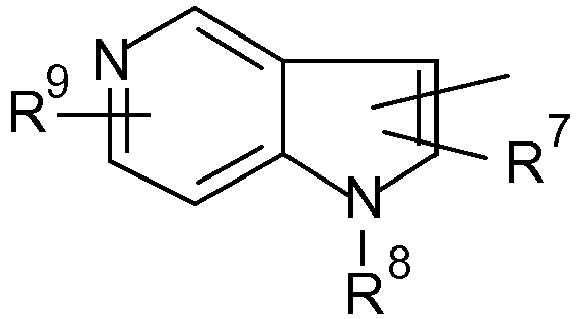
- e)

- wherein R7 is H or C1-C6-alkyl,
- R8 is H or C1-C6-alkyl-R10, wherein R10 is selected from:
- a) amino,
- b) C1-C6-alkylamino,
- c) di-C1-C6-alkylamino,
- d) hydroxy,
- e) C1-C6-alkoxy,
- f) saturated heterocyclyl with 5 or 6 ring atoms containing a nitrogen heteroatom and optionally 1 or 2 additional heteroatoms which are independently selected from O, N and S, wherein the heterocyclyl is attached to the C 1-C6-alkyl group via the nitrogen atom and may carry one, two, three or four C1-C6-alkyl substituents;
- g) phenoxy,
- h) benzyloxy,
- i) R11CONR12-,
- j) NR12R12CO-,
- k) C1-C6-alkyl-NHCONH-,
- l) C1-C6-alkyl-NHCOO-,
- m) C1-C6-alkyl-OCONH-,
- n) R12-OSO2O-,
- o) R11SO2O-,
- p) R12-OSO2-,
- q) R11SO2-,
- r) (R12O)2P(O)O-,
- s) (R12O)2P(O)-, and
- t) (R12O)R11P(O)O-;
- R9 is H, C1-C6-alkyl, C1-C6-alkoxy, OH, or halogen,
- R11 is C1-C6-alkyl; and R12 is C1-C6-alkyl.
- According to the present invention R2 is a group having the formula

- According to a further particular embodiment, R1 is H.
- According to one embodiment, the present invention relates to the use of compounds of formula (la)

- According to a further particular embodiment, the present invention relates to the use compounds of formula (I) wherein R1, R7 and R8 are H and R9 is halogen.
- According to a further embodiment, the present invention relates to the use of compounds of formula (lb)

- According to a further embodiment, the present invention relates to the use of compounds of formula (Ic)

- According to a further embodiment, the present invention relates to the use of compounds of formula (Id)
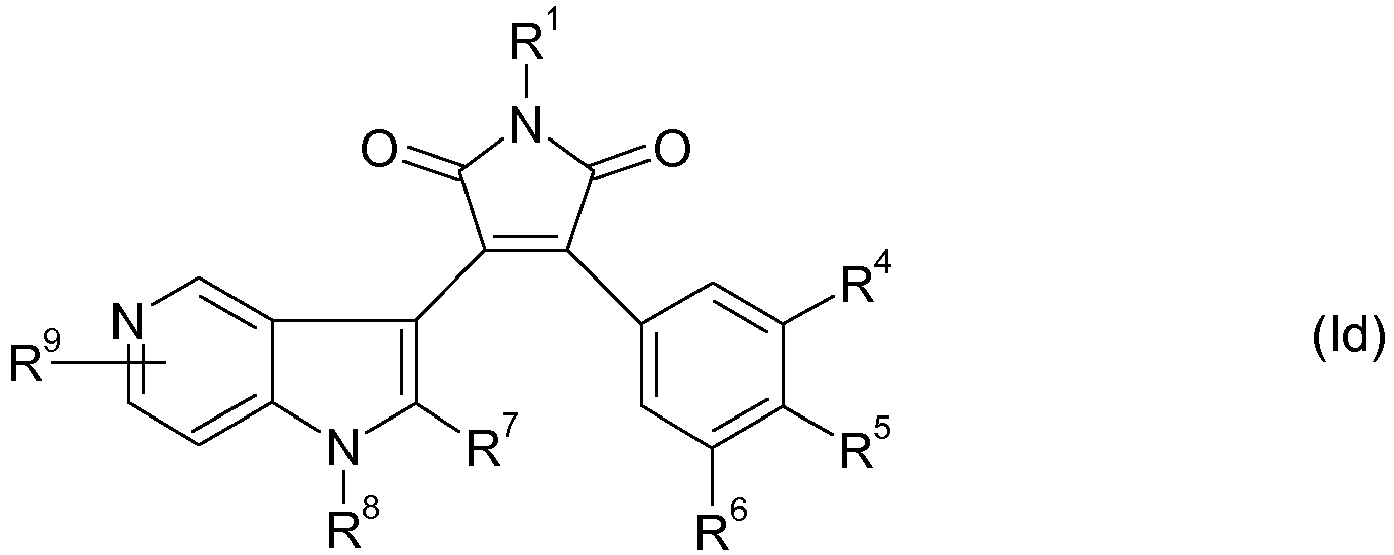
- According to a further embodiment, the present invention relates to the use compounds of formula (le)

- According to a further particular embodiment, R7, R8 and R9 are H.
- According to a further particular embodiment, R1, R7 and R9 are H.
- According to a further particular embodiment, R10 is selected from:
- a) amino,
- b) C1-C6-alkylamino,
- c) di-C1-C6-alkylamino,
- d) hydroxy,
- e) C1-C6-alkoxy,
- f) saturated heterocyclyl with 5 or 6 ring atoms containing a nitrogen heteroatom and optionally 1 or 2 additional heteroatoms which are independently selected from O, N and S, wherein the heterocyclyl is attached to the C1-C6-alkyl group via the nitrogen atom and may carry one, two, three or four C1-C6-alkyl substituents.
- According to a further embodiment, R10 is selected from
- a) amino,
- b) C1-C6-alkylamino,
- c) di-C1-C6-alkylamino,
- d) hydroxy, and
- e) C1-C6-alkoxy.
- According to a further embodiment, R10 is selected from
- a) amino,
- b) C1-C6-alkylamino, and
- c) di-C1-C6-alkylamino.
- According to a further embodiment, R10 is selected from
- d) hydroxy, and
- e) C1-C6-alkoxy.
- According to a further embodiment, R10 is
- f) saturated heterocyclyl with 5 or 6 ring atoms containing a nitrogen heteroatom and optionally 1 or 2 additional heteroatoms which are independently selected from O, N and S, wherein the heterocyclyl is attached to the C1-C6-alkyl group via the nitrogen atom and may carry one, two, three or four C1-C6-alkyl substituents.
- According to a further embodiment, R10 is selected from
- g) phenoxy,and
- h) benzyloxy.
- According to a further embodiment, R10 is selected from
- i) R11CONR12-, and
- j) NR12R12CO-.
- According to a further embodiment, R10 is selected from
- k) C1-C6-alkyl-NHCONH-,
- I) C1-C6-alkyl-NHCOO-, and
- m) C1-C6-alkyl-OCONH-.
- According to a further embodiment, R10 is selected from
- n) R12-OSO2O-,
- o) R11SO2O-,
- p) R12-OSO2-, and
- q) R11SO2-.
- According to a further embodiment, R10 is selected from
- r) (R12O)2P(O)O-,
- s) (R12O)2P(O)-, and
- t) (R12O)R11P(O)O-.
- Particular compounds of formula (I) include the compounds of Table 1:
Table 1 Compound Name Compound Structure herein also referred to as: 3-(1H-indol-3-yl)-4-(3,4,5-trimethoxyphenyl)-maleinimid 
A 3-(7-Azaindol-3-yl)-4-(3,4,5-trimethoxyphenyl)-maleinimid 
B 3-(6-Azaindol-3-yl)-4-(3,4,5-trimethoxyphenyl)-maleinimid 
c 3-(5-Azaindol-3-yl)-4-(3,4,5-trimethoxyphenyl)-maleinimid 
D 3-(4-Azaindol-3-yl)-4-(3,4,5-trimethoxyphenyl)-maleinimid 
E 3-(1-[2-Ammonioethyl]-1H-indol-3-yl)-4-(3,4,5-trimethoxyphenyl)-maleinimid-chlorid 
F 3-(1-[3-Ammoniopropyl]-1H-indol-3-yl)-4-(3,4,5-trimethoxyphenyl)-maleinimid-chlorid 
G 3-(1-[2-Hydroxyethyl]-1H-indol-3-yl)-4-(3,4,5-trimethoxyphenyl)-maleinimid 
H 3-(1-[3-Hydroxypropyl]-1H-indol-3-yl)-4-(3,4,5-trimethoxyphenyl)-maleinimid 
I 3-{1-[2-(Dimethylamino)ethyl]-1H-indol-3-yl}-4-(3,4,5-trimethoxyphenyl)-maleinimid 
J 3-{1-[3-(Dimethylamino)propyl]-1H-indol-3-yl}-4-(3,4,5-trimethoxyphenyl)-maleinimid 
K 3-{1-[2-(Piperidin-1-yl)ethyl]-1H-indol-3-yl}-4-(3,4,5-trimethoxyphenyl)-maleinimid 
L 3-{1-(2-Morpholinoethyl)-1H-indol-3-yl}-4-(3,4,5-trimethoxyphenyl)-maleinimid 
M 3-{1-[3-(4-Methylhexahydro-1-pyrazindiimyl)propyl]-1H-indol-3-yl}-4-(3,4,5-trimethoxyphenyl)-maleinimiddichlorid 
N 3-(5-Fluor-1H-indol-3-yl)-4-(3,4,5-trimethoxyphenyl)-maleinimid 
O 3-(5-Brom-1H-indol-3-yl)-4-(3,4,5-trimethoxyphenyl)-maleinimid 
P - A further embodiment of the invention is a combination of the compounds of formula I with a further chemotherapeutic agent as defined above.
- The compounds of the present invention can be prepared according to known methods, for example according to the methods, which are disclosed in
WO 02/38561 EP 328 026 WO 03/095452 WO 03/103663 WO 2006/061212 . For the purposes of the present invention a modified procedure reported in Tetrahedron Letters (1999) 40: 1109-1112 has been proven to be particularly efficient. This procedure can be illustrated by the following reaction sequence:
- An indole glyoxyl ester is reacted with a phenyl acetamide derivative in a one-pot reaction in an inert solvent in the presence of a strong base. Preferably an ether is used as an inert solvent, such as tetrahydrofurane or dioxane. As a base potassium t-butoxide can for example be used. The water formed during the reaction is removed, for example by using a molecular sieve. The phenyl acetamides used as starting material are readily available from the corresponding acetic acids which are converted to the acid chloride and hydrolyzed with ammonia. The indole glyoxyl esters (R = methyl, ethyl) were synthesized by Friedel-Crafts-type acylation of the corresponding indole derivative with methyl or ethyl oxalyl chloride, cf. Tetrahedron 1999, 55 (43), 12577-12594. The corresponding azaindole glyoxyl esters can be prepared according to the method reported in J. Org. Chem. 2002, 67, 6226-6227 or by Friedel-Crafts acylation in the presence of aluminum chloride, cf. Organic Letters (2000) vol. 2, no. 10, 1485-1487. The 4- and 6-azaindole starting compounds can be prepared by reacting 2-chloro-3-nitropyridine or 3-nitro-4-chloropyridine with vinyl magnesium bromide to give the 7-chloro-substituted 4- or 6-azaindole. The chloro substituent is then removed by catalytic hydrogenation. Said reactions are carried out as described in J. Org. Chem. 67, 2345-2347 (2002) and J. Heterocycl. Chem. 29, 359-363 (1992). The 4-aza-indole starting compound can also be synthesized according to the procedures disclosed in Org.Biomol. Chem. 3, 20, 3701-3706 (2005).
- The 5- and 7-azaindole starting compounds can be prepared by reacting 2- or 4-aminopyridine with di-tert-butyldicarbonate to 2- or 4- t-butoxycarbonylaminopyridine which is then reacted with methyl iodide and dimethylformamide in the presence of t-butyl lithium. The obtained product is then treated with a strong acid to give 5- or 7-azaindole. Said reactions are described in Synthesis 7, 877-882 (1996).
- In order to further demonstrate the uses, methods and compositions of the present invention, there is presented in the paragraphs which follow specific descriptive examples of typical procedures which may be employed in carrying out said methods. However, said examples are intended to be illustrative only and should not be taken as in any way a limitation of the present invention, for which purpose the present claims are appended hereto.
- The compounds herein referred to as A, B, C, and D and their preparation are disclosed in
WO2006/061212 . Compounds E to P are prepared according to the following examples: - Infrared spectra were recorded on a Thermo Nicolet Avatar 330 FT-IR spectrometer. 1H (300 MHz, digital resolution 0.3768 Hz) and 13C (75 MHz, digital resolution 1.1299 Hz) NMR were recorded on a Bruker AC 300: the data are reported as follows: chemical shift in ppm from Me4Si as external standard, multiplicity and coupling constant (Hz). EI-Mass spectra were recorded on a Varian MAT 44S (80 eV) and FD-Mass spectra on a Finnigan MAT 7 (5 kV). For clarity only the highest measured signal is given for FD-Mass spectra. Elemental analyses were performed on a Haereus CHN rapid, Carlo Erba Strumentazione 1106. Combustion analyses agreed with the calculated data within ±0.4 unless otherwise stated. Melting points/decomposition temperatures were determined on a Büchi apparatus according to Dr. Tottloi and are uncorrected. Where appropriate, column chromatography was performed for crude precursors with Merck silica gel 60 (0.063-0.200 mm). Column chromatography for test compounds was performed using a MPLC-System B-680 (Büchi) with Merck silica gel (0.015-0.040 mm). The progress of the reactions was monitored by thin layer chromatography (TLC) performed with Merck silica gel 60 F-254 plates. Where necessary, reactions were carried out in a nitrogen atmosphere using 4 Å molecular sieves. All reagents and solvents were obtained from commercial sources and used as received.
-

-

- A modified procedure of Cash et al. (Org. Biomol. Chem. 2005, 3, 3701-3706) was used. 2-Chloro-3-nitropyridine (2 g, 12.5 mmol) was added to a stirred suspension of NaH (0.5 g, 12.5 mmol; mixture of 60% NaH mineral oil) in 20 ml dry DMF under nitrogen. Dimethyl-malonate (1.43 ml, 1.65 g, 12.5 mmol) was cautiously added dropwise. After the reaction was stirred for 5 h at room temperature, the solution was diluted with water. After adding diethylether the mixture was washed with saturated NaCl solution for four times to remove the DMF. The organic phase was dried over Na2SO4, filtered, concentrated and purified by column chromatography (petrolether:ethylacetate 2:1). Dimethyl-2-(3-nitropyridin-2-yl)malonate was obtained as a pale brown oil (1.4 g, 5.5 mmol = 44%). 1H NMR (300 MHz, CDCl3) 8.83 (pdd; 3J = 1.3 Hz; 3J = 4.7 Hz; 1H; H-6); 8.49 (pdd; 3J = 1.3 Hz; 3J = 8.3 Hz; 1H; H-4); 7.54 (pdd; 3J = 4.7Hz; 3J = 8.3Hz; 1H; H-5); 5.56 (s; 1H; CH); 3.83 (s; 6H; OCH3).
-

- A modified procedure of Cash et al. (Org. Biomol. Chem. 2005, 3. 3701-3706) was used. Dimethyl-2-(3-nitropyridin-2-yl)malonate (1.4 g, 5.5 mmol) was dissolved in 70 ml 6 M HCl and refluxed for 8 h. After neutralization with saturated Na2CO3 solution the solution was extracted three times with dichloromethane. The combined organic layers were dried over Na2SO4, filtered, concentrated and purified by bulb tube distillation (0.35 mbar; 70-80°C). 2-Methyl-3-nitropyridine (0.7 g, 5.1 mmol, 92 %) was obtained as a pale yellow oil. 1H NMR (300 MHz, CDCl3) 8.72 (pdd; 3J = 1.2 Hz; 3J = 4.7 Hz; 1H; H-6); 8.27 (pdd; 3J = 1.2 Hz; 3J = 8.2 Hz; 1H; H-4); 7.35 (pdd; 3J = 4.7 Hz; 3J = 8.2 Hz; 1H; H-5); 2.86 (s; 3H; CH3).
-

- A modified procedure of Cash et al. (Org. Biomol. Chem. 2005, 3. 3701-3706) was used. 2-Methyl-3-nitropyridine (0.7 g, 5.1 mmol) was dissolved in 15 ml dry DMF and stirred under nitrogen. Dimethylformamiddimethylacetal (DMF-DMA) (1.35ml, 1.22g, 10.2 mmol) was added dropwise. The reaction was heated to 90°C for 4 h. After approximately 15 min a deep redish color appeared. After evaporating the solvent (E)-N,N-Dimethyl-2-(3-nitropyridin-2-yl)ethenamine is obtained as a red oil (0.16 g, 0.8 mmol, 73%) which can be used without further purification. 1H NMR (300 MHz, CDCl3) 8.40 (pdd; 3J = 1.7 Hz; 3J = 4.4 Hz; 1H; H-6); 8.16 (pdd; 3J = 1.7 Hz; 3J = 8.3 Hz; 1H; H-4) ; 8.04 (d; 3JAX = 12.5 Hz; 1H; H-8) ; 6.76 (pdd; 3J = 4.4 Hz; 3J = 8.3 Hz; 1H; H-5); 6.15 (d; 3JAX = 12.5 Hz; 1H; H-7); 3.01 (s; 6H; CH3).
-

- A modified procedure of Cash et al. (Org. Biomol. Chem. 2005, 3. 3701-3706) was used. 0.2 g of 10% Pd/C was flashed with nitrogen before 10 ml of a mixture of 8.8 % formic acid in methanol was added cautiously. The crude (E)-N,N-Dimethyl-2-(3-nitropyridin-2-yl)ethenamine obtained as a red oil (0.69 g, 3.6 mmol) was also dissolved in 10 ml of a mixture of 8.8 % formic acid in methanol before it was added to the reaction. The reaction was stirred for 4 h until the red color completely disappeared. The Pd catalyst was removed by filtration through Celite®, the filtrate was concentrated. After sitting over night, the product, 4-azaindole, crystallized (0.21g, 1.8 mmol, 71%). 1H NMR (300 MHz, CDCl3) 9.00 (bs; 1H; NH); 8.48 (pdd; 4J = 1 Hz; 3J = 4.6 Hz; 1H; H-5); 7.70 (pdd; 4J = 1Hz; 3J = 8.2 Hz; 1H; H-7); 7.48 (pt; 3J = 2.9 Hz; 1H; H-2); 7.12 (pdd; 3J = 4.6 Hz; 3J = 8.2 Hz; 1H; H-6); 6.76 (m; 1H; H-3).
-

- Aluminium chloride (3.1 g, 23 mmol) and 4-azaindole (0.38 g, 4.6 mmol) were stirred in 100 ml dry dichloromethane at room temperature under nitrogen atmosphere. After 30 min ethoxalylchloride (2.5 ml, 3.0 g, 23 mmol) was added dropwise. The reaction mixture was stirred over night and then carefully hydrolyzed with ethanol/ice. After addition of dichloromethane the organic layer was separated, washed with NaHCO3 solution, dried over Na2SO4, filtered and concentrated. After sitting over night ethyl-2-(4-azaindol-3-yl)-2-oxoacetate (0.5 g, 2.3 mmol, 50 %) crystallized as a pale yellow powder.1H NMR (300 MHz, CDCl3) 12.21 (bs; 1H; NH); 8.58 (s; 1H; H-2); 8.49 (pdd; 3J = 4.6 Hz; 4J = 1.3 Hz; 1H; H-5); 7.93 (pdd; 3J = 8.2 Hz; 4J = 1.3 Hz; 1H; H-7); 7.27 (pdd; 3J = 8.2 Hz; 3J = 4.6 Hz; 1H; H-6); 4.37 (q; 3J = 7.1 Hz; 2H; CH2); 1.31 (t; 3J = 7.1 Hz; 3H; CH3).
-

- Di-tert.-butyldicarbonate (0.48 g, 2.2 mmol) and a catalytic amount of DMAP were added to a stirred solution of ethyl-2-(4-azaindol-3-yl)-2-oxoacetate (0.48 g, 2.2 mmol) in 10 ml dichloromethane. After 2 h the solvent was evaporated and the residue was purified by column chromatography to yield ethyl-2-[1-(tert.-butoxycarbonyl)4-azaindol-3-yl]-2-oxoacetate (0.6 g, 1.9 mmol, 86 %) as pale yellow crystals. 1H NMR (300 MHz, CDCl3) 8.86 (s; 1H; H-2); 8.72 (pdd; 4J = 1.4 Hz; 3J = 4.7 Hz; 1H; H-5); 8.42 (pdd; 4J = 1.4 Hz; 3J = 8.4 Hz; 1H; H-7); 7.32 (pdd; 3J = 4.7 Hz; 3J = 8.4 Hz; 1H; H-6); 4.45 (q; J = 7.1 Hz; 2H; CH2); 1.70 (s; 9H; C(CH3)3); 1.43 (t; 3J = 7.1 Hz; 3H; CH3).
- A stirred solution of 3,4,5-trimethoxyphenylacetamide (0.38 g, 1.7 mmol) and ethyl-2-[1-(tert.-butoxycarbonyl)-4-azaindol-3-yl]-2-oxoacetate (0.54 g, 1.7 mmol) in dry THF (tetrahydrofurane) containing 15 g molecular sieve (4Å) was cooled to 0°C under nitrogen. At this temperature 1.0 M tert.-BuOK (3.7 ml, 3.62 mmol) was added via septum and the mixture was allowed to warm to room temperature. After stirring over night, the reaction was again cooled to 0°C and quenched with saturated NH4Cl-solution. The residue was filtered, extracted with ethylacetate and the combined organic layers were dried over Na2SO4, concentrated and purified by column chromatography (ethylacetate:ethanol 9:1). 3-(4-azaindolyl)-4-(3,4,5-trimethoxyphenyl)-maleinimide was obtained as yellow crystals (0.17 g, 0.45 mmol, 26%). Mp = 274-275°C. IR ν̃ [cm-1] = 3338; 2946; 1716. EI-MS m/z (rel. int.) = 380.75 (1.37%; M+•); 379.79 (25.54%); 378.79 (71.14%); 1H NMR(300 MHz, DMSO)11.98 (bs; 1H; azaindole-NH); 11.14 (bs; 1H; imide-NH); 8.12 (pdd; 4J = 1.0 Hz; 3J = 4.6 Hz; 1H; H-5); 8.04 (pd; 3J = 2.7 Hz; 1H: H-2); 7.83 (pdd; 4J = 1.0 Hz; 3J = 8.2 Hz; 1H; H-7); 7.09 (pdd; 3J = 4.6 Hz; 3J = 8.2 Hz; 1H; H-6); 6.87 (s; 2H; Ar-H); 3.62 (s; 3H; OCH3); 3.32 (s; 6H; OCH3)
- A modified procedure of Faul et al., J. of Organic Chemistry 1998, 63, 6, 1961-1973 and Zhang et Al., Bioorg. Med. Chem. Lett., 2004, 14, 12, 3245-3250 was used. A stirred suspension of indole-3-ethylglyoxylate (1 equiv.), CsCO3 or K2CO3 (1.3 equiv.) and the corresponding aliphatic bromo- or chloro-substituent in dry DMF was heated to 75-80 °C under nitrogen for 8 hours. The reaction was cooled to RT, diluted with ethyl acetate (40 ml) and filtered over Celite®. The mixture was washed with water (4 x 40 ml). The organic phase was dried over Na2SO4, filtered, concentrated and purified by column chromatography.
- The procedure of
Peifer et al., WO 2006/061212 and J. Med. Chem. 2006, 49, 4, 1271-1281, was used to prepare 3-phenyl-4-indolyl-maleinimides. -

- A modified procedure of Wescott et al., J. Org. Chem. 2003, 68, 26, 10058-10066, was used to prepare tert.-butyl 2-bromoethylcarbamate. A solution of NaHCO3 (24.4 mmol; 2.0 g) in 80 ml water and a solution of di-tert.-butyldicarbonate (24.4 mmol; 5.33 g) in 50 ml were added to a stirred suspension of 2-bromoethylammonium-bromide (24.4 mmol; 5.0 g) in 100 ml chloroform. The reaction was refluxed for 5 hours. After cooling to RT (room temperature) the organic phase was separated and aqueous phase was extracted with chloroform. The combined organic layers were dried over Na2SO4, filtered, concentrated and purified by column chromatography. Tert.-butyl 2-bromoethylcarbamate (6.86 mmol, 28.2%) was obtained as a colorless oil.1H NMR (300 MHz, CDCl3) 4.98 (bs; 1H; NH); 3.52 (dd; J = 5.3 Hz; J = 11.0 Hz; 2H; CH2N); 3.44 (t; J = 5.3 Hz; 2H; CH2Br); 1.43 (s; 9H; C(CH3)3).
- The general procedure 1 was then followed using the above product (6.68 mmol, 1.54 g), ethyl-2-(1H-indol-3-yl)-2-oxoacetate (6.68 mmol, 1.45 g) and CS2CO3 (9.82 mmol, 3.20 g). The purification was achieved by column chromatography (petrol-ether:ethylacetate:diethylamine 5:4:1) to yield ethyl-2-(1-{2-[(tert.-butoxycarbonyl)-amino]ethyl}-1H-indol-3-yl)-2-oxoacetate (4.54 mmol, 68%) as white crystals. Mp = 114-115°C. IR v [cm-1] = 3357; 2977; 1727; 1686; 1638; 1518. EI-MS (m/z) = 360 (7.59%; M+•). 1H NMR (300 MHz, CDCl3) 8.44 (m; 1H; indole-H); 8.34 (s; 1H; indole-H); 7.42 (m; 1H; indole-H); 7.35 (m; 1H; indole-H); 4.63 (bs; 1H; NH); 4.37 (m; 4H; OCH 2CH3; indole-CH2); 3.54 (q; 3J = 6.2 Hz; 2H; CH2-N); 1.43 (t; 3H; 3J = 7.1 Hz; OCH2CH3); 1.43 (s; 9H; C(CH3)3).
- The general procedure 2 was then followed using ethyl-2-([(tert.-butoxycarbonyl)amino]ethyl}-1H-indol-3-yl)-2-oxoacetate (2 mmol, 0.77 g), 3,4,5-trimethoxyphenylacetamide (1.8 mmol, 0.41 g) and 1 M tert.-BuOK (6 mmol, 6 ml). The purification was achieved by column chromatography (petrolether:ethylacetate 4:6) to yield 3-(1-{2-[(tert.-butoxycarbonyl)amino]ethyl}-1H-indol-3-yl)-4-(3,4,5-trimethoxyphenyl)-maleinimide (0.8 mmol, 43%) as orange crystals. Mp 97-98°C. IR ν̃ [cm-1] = 3300; 2987; 1698. EI-MS m/z (rel. int.) = 521 (91.98%; M+•). 1H NMR(300MHz, CDCl3) 7.92 (s; 1H; indole-H); 7.36 (m; 1H; indole-H); 7.35 (bs; 1H; imide-NH); 7.17 (t; 3J = 7.2 Hz; 1H; indole-H); 6.86 (t; 3J = 7.2 Hz; 1H; indole-H); 6.78 (s; 2H; 2xAr-H); 6.46 (d; 3J = 8.1 Hz; 1H; indole-H); 4.63 (bs, 1H; NH); 4.36 (t; 3J = 5.78 Hz; 2H; indole-CH2); 3.86 (s; 3H; OCH3); 3.55 (m; 2H; CH2N); 3.49 (s; 6H; 2xOCH3); 1.44 (s; 9H; C(CH3)3).
- A stirred solution of 3-(1-{2-[(tert.-butoxycarbonyl)amino]ethyl}-1H-indol-3-yl)-4-(3,4,5-trimethoxyphenyl)-maleinimide (0.8 mmol, 0.4 g) in 50 ml ethanol and 2.3 M ethanolic HCl (3.42 mmol, 1.5 ml) was heated to 80°C for 3 hours. The precipitate was filtered and washed with ethanol to give the title compound (0.66 mmol, 86%) as red crystals. Mp 277.1 °C. IR ν̃ [cm-1] = 3151; 2977; 1698. FD-MS m/z (rel. int.) = 423.5 (1.2%; M+•). 1H NMR (300 MHz, CDCl3) 11.12 (bs; 1H; imide-NH); 8.14 (bs; 3H; NH3); 8.10 (s; 1H; indole-H); 7.63 (d; 3J = 8.2 Hz; 1H; indole-H); 7.18 (t; 3J = 7.3 Hz; 1H; indole-H); 6.82 (t; 3J = 7.3 Hz; 1H; indole-H); 6.73 (s; 2H; 2xAr-H); 6.38 (d; 3J = 8.2 Hz; 1H; indole-H); 4.55 (t; 3J = 6.6 Hz; 2H; indole-CH2); 3.66 (s; 3H; OCH3); 3.38 (s; 6H; 2xOCH3); 3.25 (m; 2H; CH2N). Anal. calcd for C23H24CIN3O5: C, 60.33; H, 5.28; N, 9.18.Found: C, 60.36; H, 5.29; N, 9.09.
-

- Tert.-butyl-(3-bromopropyl)carbamate (7.14 mmol, 78%) was synthesized using the same procedure as for example 1. 1H NMR (300 MHz, CDCl3) 4.73 (bs, 1H; NH); 3.41 (t; 3J = 6.5 Hz; 2H; CH2Br); 3.24 (m; 2H; CH2N); 2.02 (quint; 3J = 6.5 Hz; 2H; CH2 CH 2CH2); 1.41 (s; 9H; C(CH3)3).
- The general procedure 1 was then followed using the above product (7.14 mmol, 1.7 g), ethyl-2-(1H-indol-3-yl)-2-oxoacetate (4.6 mmol, 1.0 g) and Cs2CO3 (9.21 mmol, 3.0 g). The purification was achieved by column chromatography (petrol-ether:ethylacetate 1:1) to yield ethyl-2-(1-{3-[(tert.-butoxycarbonyl)amino]propyl}-1H-indol-3-yl)-2-oxoacetate (5.3 mmol, 74%) as pale yellow crystals. Mp 89-90°C. IR ν̃ [cm-1] = 3392; 2977; 2936; 1727; 1698; 1619; 1515. EI-MS m/z (rel. int.) = 374 (8.9%; M+•). 1H NMR (300 MHz, CDCl3) 8.45 (m; 2H; indole-H); 7.35 (m; 3H; indole-H); 4.63 (bs; 1H; NH); 4.41 (q; 3J = 7.1 Hz; 2H; OCH 2CH3); 4.24 (t; 3J = 7.1 Hz; 2H; indole-CH2); 3.18 (q; 3J = 6.1 Hz; 2H; CH2N); 2.09 (m; 2H; CH2 CH 2CH2); 1.44 (s; 9H; C(CH3)3); 1.43 (t; 3J = 7.1 Hz; 3H; OCH2 CH 3).
- The general procedure 2 was then followed using ethyl-2-(1-{3-[(tert.-butoxycarbonyl)amino]propyl}-1H-indol-3-yl)-2-oxoacetate (6.8 mmol, 2.5 g), 3,4,5-trimethoxyphenylacetamide (6.8 mmol, 1.5 g) and 1 M tert.-BuOK (14.4 mmol, 14.4 ml). The purification was achieved by column chromatography (petrolether:ethylacetate 1:1) to yield 3-(1-{3-[(tert.-butoxycarbonyl)amino]propyl}-1H-indol-3-yl)-4-(3,4,5-trimethoxyphenyl)-maleinimide (2.5 mmol, 36.8%) as orange crystals. Mp 178-179°C. IR ν̃ [cm-1] = 3408; 1714; 1689; 1613; 1515. FD-MS m/z (rel. int.) = 535.5 (100%). 1H NMR (300 MHz, CDCl3) 7.95 (s; 1H; indole-H); 7.60 (bs; 1H; imide-NH); 7.32 (d; 3J = 8.2 Hz; 1H; indole-H); 7.16 (t; 3J = 7.2 Hz; 1H; indole-H); 6.85 (t; 3J = 7.2 Hz; 1H; indole-H); 6.79 (s; 2H; 2xAr-H); 6.47 (d; 3J = 8.2 Hz; 1H; indole-H); 4.65 (bs; 1H; NH); 4.26 (t; 3J = 7.10 Hz; 2H; indole-CH2); 3.85 (s; 3H; OCH3); 3.49 (s; 6H; 2xOCH3); 3.16 (m; 2H; CH2N); 2.11 (m; 2H; CH2 CH 2CH2); 1.44 (s; 9H; C(CH3)3).
- A stirred solution of 3-(1-{3-[(tert.-butoxycarbonyl)amino]propyl}-1H-indol-3-yl)-4-(3,4,5-trimethoxyphenyl)-maleinimide (2.5 mmol, 1.32 g) in 150 ml ethanol and 2.3 M ethanolic HCl (11.25 mmol, 4.9 ml) was heated to 80°C for 3 hours. The precipitate was filtered and washed with ethanol to give the title compound (2.2 mmol, 88%) as orange crystals. Mp 274-275°C. IRν̃ [cm-1] = 3145; 2958; 1761; 1708; 1597; 1499. EI-MS m/z (rel. int.) = 438 (5.6%; M+•).1H NMR (300 MHz, CDCl3) 11.11 (s; 1H; imide-NH); 8.07 (s; 1H; indole-H); 7.96 (bs; 3H; NH3); 7.62 (d; 3J = 8.1 Hz; 1H; indole-H); 7.16 (t; 3J = 7.7 Hz; 1H; indole-H); 6.80 (t; 3J = 7.7 Hz; 1H; indole-H); 6.72 (s; 2H; 2xAr-H); 6.36 (d; 3J = 8.1 Hz; 1H; indole-H); 4.42 (t; 3J = 6.7 Hz; 2H; indole-CH2); 3.65 (s; 3H; OCH3); 3.36 (s; 6H; 2xOCH3); 2.75 (dd; 2H; 3J = 6.7 Hz; 3J = 12.3 Hz; CH2N); 2.07 (m; 2H; CH2 CH 2CH2). Anal. calcd for C24H26ClN3O5: C, 61.08; H, 5.55; N, 8.90.Found: C, 60.96; H, 5.35; N, 8.88.
-

- A modified procedure of Galka et al., J. Lab. Comp. Rad. 2005, 48, 11, 797-809, was used. A mixture of 2-bromoethanol (6.6 mmol; 0.83 g = 0.47 ml), tert.-butyldimethylsilylchloride (6.6 mmol, 1.0 g) and imidazole (7.3 mmol; 0.5 g) was stirred at RT for 3 hours under nitrogen atmosphere. The reaction was quenched with water, extracted with diethylether. The organic phases were dried over Na2SO4, filtered and concentrated. The purification was achieved by column chromatography (petrolether) to yield 2-bromoethoxy)(tert.-butyl)dimethylsilane (6.4 mmol, 96%). 1H NMR (300 MHz, CDCl3) 3.91 (t; 3J = 6.5 Hz; 2H; OCH2); 3.41 (t; 3J = 6.5 Hz; 2H; CH2Br); 0.93 (s; 9H; C(CH3)3); 0.11 (s; 6H; 2xCH3).
- The general procedure 1 was then followed using the above product (6.4 mmol, 1.53 g), ethyl-2-(1H-indol-3-yl)-2-oxoacetate (5.99 mmol, 1.3 g) and Cs2CO3 (8.1 mmol, 2.63 g). The purification was achieved by column chromatography (petrol-ether:ethylacetate 7:3) to yield ethyl-2-(1-{2-[{1-(tert.-butyl)-1,1-dimethylsilyl}oxy]-ethyl}-1H-indol-3-yl)-2-oxoacetate (4.37 mmol, 73%) as pale yellow oil. IR ν̃ [cm-1] = 2958; 2923; 2857; 1736; 1635; 1514; 1461. EI-MS m/z (rel. int.) = 375 (6.0%; M+•). 1H NMR (300 MHz, CDCl3) 8.45 (m; 1H; indole-H); 8.42 (s; 1H; indole-H); 7.37 (m; 3H; indole-H); 4.41 (q; 3J = 7.1 Hz; 2H; OCH 2CH3); 4.29 (t; 3J = 5.1 Hz; 2H; indole-CH 2CH2O); 3.95 (t; 3J = 5.1 Hz; 2H indole-CH2 CH 2O); 1.43 (t; 3J = 7.1 Hz; 3H; OCH2 CH 3); 0.80 (s; 9H; C(CH3)3); -0.17 (s; 6H; 2xCH3).
- The general procedure 2 was then followed using ethyl-2-(1-{2-[{2-(tert.-butyl)-1,1-dimethylsilyl}oxy]ethyl}-1H-indol-3-yl)-2-oxoacetate (1.8 mmol, 0.69 g), 3,4,5-trimethoxyphenylacetamide (1.6 mmol, 0.36 g) and 1 M tert.-BuOK (6 mmol, 6 ml). The purification was achieved by column chromatography (petrolether:ethylacetate 7:3) to yield 3-(1-{2-[{1-(tert.-butyl)-1,1-dimethylsilyl}oxy]ethyl}-1H-indol-3-yl)-4-(3,4,5-trimethoxyphenyl)-maleinimide (0.7 mmol, 39%) as an orange oil. IR ν̃ [cm-1] = 3186; 2980; 2930; 2879; 1692. EI-MS m/z (rel. int.) = 536 (68%; M+•). 1H NMR (300 MHz, CDCl3) 8.06 (s; 1H; indole-H); 7.34 (d; 3J = 8.1 Hz; 2H; indole-H); 7.29 (bs, 1 H; imide-NH) 7.15 (t; 3J = 7.5 Hz; 1H; indole-H); 6.84 (t; 3J = 7.5 Hz; 1H; indole-H); 6.77 (s; 2H; Ar-H); 6.42 (d; 3J = 8.1 Hz; 1H; indole-H); 4.31 (t; 3J = 5.2 Hz; 2H; indole- CH 2CH2O); 3.98 (t; 3J = 5.2 Hz; 2H indole-CH2 CH 2O); 3.86 (s; 3H; OCH3); 3.50 (s; 6H; 2x OCH3); 0.82 (s; 9H; C(CH3)3); -0.13 (s; 6H; Si(CH3)2).
- A modified procedure of Csuk et al., Z. Naturforsch., 2003, 58b, 97-105, was used. Tetrabutylammoniumfluoride (0.79 mmol, 0.25 g) was added to a stirred solution of the above product (0.7 mmol, 0.26 g) in 10 ml THF (tetrahydrofurane). After the reaction was completed (TLC-control) (TLC = thin layer chromatography) it was concentrated. The purification was achieved by column chromatography (petrol-ether:ethylacetate:methanol 2:7:1) to yield 3-(1-[2-hydroxyethyl]-1H-indol-3-yl)-4-(3,4,5-trimethoxyphenyl)-maleinimide (0.4 mmol, 58%) as dark red crystals. Mp = 195-196°C. IR ν̃ [cm-1] = 3221; 1746; 1705. El- MS m/z (rel. int.) = 422 (100%; M+•) 1H NMR (300 MHz, CDCl3) 8.02 (s; 1H; indole-H); 7.37 (d; 3J = 7.9 Hz; 1H; indole-H); 7.32 (s; 1H; imide-NH); 7.17 (t; 3J = 7.7 Hz; 1H; indole-H); 6.87 (t; 3J = 7.7 Hz; 1H; indole-H); 6.79 (s; 2H; Ar-H); 6.50 (d; 3J = 7.9 Hz; 1H; indole-H); 4.37 (t; 3J = 5.2 Hz; 2H; indole-CH2); 4.06 (q; 3J = 5.0 Hz; 2H; CH2O); 3.86 (s; 3H; OCH3); 3.50 (s; 6H; 2xOCH3). Anal. calcd for C23H22N2O6: C, 65.39; H, 5.25; N, 6.63. Found: C, 65.35; H, 5.33 N, 6.70.
-

- (3-Bromopropoxy)-tert.-butyldimethylsilane (36.4 mmol, 93%) was synthesized using the same procedure as for example 3. 1H NMR (300 MHz, CDCl3) 3.73 (t; 3J = 5.7 Hz; 2H; CH2O); 3.51 (t; 3J = 6.4 Hz; 2H; CH2Br); 2.02 (q; 3J = 5.7 Hz; 3J = 6.4 Hz; 2H; CH2 CH 2CH2); 0.89 (s; 9H; C(CH3)3); 0.06 (s; 6H; 2xCH3).
The general procedure 1 was then followed using the above product (7.9 mmol, 2 g), ethyl-2-(1H-indol-3-yl)-2-oxoacetate (7.4 mmol, 1.61 g) and CS2CO3 (10 mmol, 3.25 g). The purification was achieved by column chromatography (petrol-ether:ethylacetate 9:1) to yield ethyl-2-(1-{3-[{1-(tert.-butyl)-1,1-dimethylsilyl}oxy]-propyl}-1H-indol-3-yl)-2-oxoacetate (6.7 mmol, 91%) as pale yellow crystals. Mp = 51-52°C. IRν̃ [cm-1] = 3142; 2958; 2924; 2867; 1727; 1638. EI-MS m/z (rel. int.) = 389 (5.2%; M+•). 1H NMR (300 MHz, CDCl3) 8.46 (m; 1H; indole-H); 8.37 (s; 1H; indole-H); 7.43 (m; 1H; indole-H); 7.34 (m; 2H; indole-H); 4.41 (q; 3J = 7.1 Hz; 2H; OCH 2CH3); 4.33 (t; 3J = 6.8 Hz; 2H; indole-CH2); 3.58 (t; 3J = 5.5 Hz; 2H; CH2O); 2.06 (m; 2H; indole-CH2 CH 2CH2O); 1.43 (t; J = 7.1 Hz; 3H OCH2 CH 3); 0.94 (s; 9H); 0.07 (s; 6H). - The general procedure 2 was then followed using ethyl-2-(1-{3-[{1-(tert.-butyl)-1,1-dimethylsilyl}oxy]propyl}-1H-indol-3-yl)-2-oxoacetate (6.7 mmol, 2.64 g), 3,4,5-trimethoxyphenylacetamide (6.04 mmol, 1.36 g) and 1 M tert.-BuOK (18 mmol, 18 ml). The purification was achieved by column chromatography (petrol-ether:ethylacetate 7:3) to yield 3-(1-{3-[{1-(tert.-butyl)-1,1-dimethylsilyl}oxy]propyl}-1H-indol-3-yl)-4-(3,4,5-trimethoxyphenyl)-maleinimide (3 mmol, 45%) as yellow crystals. Mp = 99-100°C. IR ν̃ [cm-1] = 3202; 3066; 2955; 2923; 2854; 1771; 1701. EI-MS m/z (rel. int.) = 551 (86.49%; M+•) 1H NMR (300 MHz, CDCl3) 8.30 (bs; 1H; imide-NH); 7.98 (s; 1H; indole-H); 7.38 (d; 3J = 8.1 Hz; 1H; indole-H); 7.15 (t; 3J = 7.6 Hz; 1H; indole-H); 6.85 (t; 3J = 7.6 Hz; 1H; indole-H); 6.80 (s; 2H; Ar-H); 6.47 (d; 3J = 8.1 Hz; 1H; indole-H); 4.34 (t; 3J = 6.8 Hz; 2H; indole-CH 2CH2CH2O); 3.86 (s; 3H; OCH3); 3.60 (t; 3J = 5.5 Hz; 2H indole-CH2CH2 CH 2O); 3.49 (s; 6H; 2xOCH3); 2.08 (m; 2H; indole-CH2 CH 2CH2O); 0.94 (s; 9H; SiC(CH3)3); 0.07 (s; 6H; Si(CH3)2).
- 3-(1-[3-Hydroxypropyl]-1H-indol-3-yl)-4-(3,4,5-trimethoxyphenyl)-maleinimide (2.25 mmol, 75%) was synthesized using the same procedure as for example 3. Mp = 160°C. IRν̃ [cm-1] = 3367; 2980; 2882; 1708. EI-MS m/z (rel. int.) = 437 (100%; M+•). 1H NMR (300 MHz, CDCl3) 7.97 (s; 1H; indole-NH); 7.38 (m; 2H; indole-H+imide-NH); 7.17 (t; 3J = 7.6 Hz; 1H; indole-H); 6.86 (t; 3J = 7.6 Hz; 1H; indole-H); 6.79 (s; 2H; Ar-H); 6.49 (d; 3J = 8.1 Hz; 1H; indole-H); 4.39 (t; 3J = 6.79 Hz; 2H; indole-CH 2CH2CH2O); 3.86 (s; 3H; OCH3); 3.65 (t; 3J = 5.67 Hz; 2H; indole-CH2CH2 CH 2O); 3.50 (s; 6H; 2xOCH3); 2.13 (m, 2H; indole-CH2 CH 2CH2O). Anal. calcd for C24H24N2O6: C, 66.04; H, 5.54; N, 6.42. Found: C, 65.93; H, 5.63 N, 6.34.
-

- The general procedure 1 was then followed using 1-chloro-2-dimethylaminoethane (6 mmol, 0.65 g), ethyl-2-(1H-indol-3-yl)-2-oxoacetate (6 mmol, 1.3 g) and Cs2CO3 (6.6 mmol, 2.15 g).. The purification was achieved by column chromatography (petrolether:ethylacetate:diethylamine 6:3:1) to yield ethyl-2-{1-[2-(dimethylamino)-ethyl]-1H-indol-3-yl}-2-oxoacetate (3.7 mmol, 62%) as pale yellow crystals. Mp = 71-72°C. IRν̃ [cm-1] = 3139; 3044; 2977; 2946; 2797; 2772; 1727; 1641. EI-MS m/z (rel. int.) = 288 (19.15%; M+•). 1H NMR (300 MHz, CDCl3) 8.45 (m; 2H; indole-H); 7.37 (m; 3H; indole-H); 4.41 (q; 3J = 7.1 Hz; 2H; OCH 2CH3); 4.26 (t; 3J = 6.9 Hz; 2H; indole-CH 2CH2N); 2.76 (t; 3J = 6.9 Hz; 2H; indole-CH2 CH 2N); 2.31 (s; 6H); 1.44 (t; 3H; 3J = 7.1 Hz; OCH2 CH 3).
- The general procedure 2 was then followed using the above product (3.7 mmol, 1.07 g), 3,4,5-trimethoxyphenylacetamide (3.7 mmol, 0.83 g) and 1 M tert.-BuOK (10 mmol, 10 ml). The purification was achieved by column chromatography (dichloromethane:methanol 9:1) to yield 3-{1-[2-(dimethylamino)ethyl]-1H-indol-3-yl}-4-(3,4,5-trimethoxyphenyl)-maleinimide (1.34 mmol, 36%) as yellow crystals. Mp = 184-185°C. IRν̃ [cm-1] = 2980; 2920; 1701. El-MS m/z (rel. int.) = 449 (100%; M+•). 1H NMR (300 MHz, CDCl3) 8.04 (s; 1H; indole-H); 7.97 (bs; 1H; NH); 7.34 (d; 3J = 8.2 Hz; 1H; indole-H); 7.16 (t; 3J = 7.6 Hz; 1H; indole-H); 6.85 (t; 3J = 7.6 Hz; 1H; indole-H); 6.75 (s; 2H; Ar-H); 6.45 (d; 3J = 8.2 Hz; 1H; indole-H); 4.32 (t; 3J = 6.8 Hz; 2H indole-CH 2CH2N); 3.84 (s; 3H; OCH3); 3.47 (s; 6H; 2xOCH3); 2.80 (t; 3J = 6.8 Hz; 2H, indole-CH2 CH 2N); 2.32 (s; 6H; N(CH3)2). Anal. calcd for C25H27N3O5: C, 66.8; H, 6.05; N, 9.35. Found: C, 66.91; H, 6.05 N, 9.29.
-

- The general procedure 1 was then followed using 1-chloro-3-dimethylaminopropane (7 mmol, 0.75 g), ethyl-2-(1H-indol-3-yl)-2-oxoacetate (6 mmol, 1.3 g) and Cs2CO3 (6.6 mmol, 2.15 g). The purification was achieved by column chromatography (petrolether:ethylacetate:diethylamine 6:3:1) to yield ethyl-2-{1-[2-(dimethylamino)ethyl]-1H-indol-3-yl}-2-oxoacetate (3.8 mmol, 63%) as an pale yellow oil. IRν̃ [cm-1] = 3023; 2962; 2917; 1732; 1630. EI-MS m/z (rel. int.) = 302 (8.21%; M+•). 1H NMR (300 MHz, CDCl3) 8.43 (m; 1H; indole-H); 8.39 (s; 1H; indole-H); 7.33 (m; 3H; indole-H); 4.40 (q; 3J = 7.1 Hz; 2H; OCH 2CH3); 4.27 (t; 3J = 6.8 Hz; 2H; indole-CH 2CH2CH2N); 2.22 (s; 6H; N(CH3)2); 2.20 (m; 2H; indole-CH2CH2 CH 2N); 2.00 (quint; 3J = 6.7 Hz; 2H; indole-CH2 CH 2CH2N); 1.42 (t; 3J = 7.1 Hz; 3H OCH2 CH 3).
- The general procedure 2 was then followed using the above product (3.8 mmol, 1.15 g), 3,4,5-trimethoxyphenylacetamide (3.8 mmol, 0.83 g) and 1 M tert.-BuOK (10 mmol, 10 ml). The purification was achieved by column chromatography (dichloromethane:methanol 8:2) to yield 3-{1-[3-(dimethylamino)propyl]-1H-indol-3-yl}-4-(3,4,5-trimethoxyphenyl)-maleinimide (0.73 mmol, 19%) as orange crystals. Mp = 187-188°C. IR ν̃ [cm-1] = 2939; 1705; 1613; 1578. EI-MS m/z (rel. int.) = 463 (36.77%; M+•). 1H NMR (300 MHz, CDCl3) 8.01 (s; 1H; indole-H); 7.78 (bs; 1H; imide-NH); 7.37 (d; 3J = 8.1 Hz; 1H; indole-H); 7.16 (t; 3J = 7.6 Hz; 1H; indole-H); 6.85 (t; 3J = 7.6 Hz; 1H; indole-H); 6.79 (s; 2H; Ar-H); 6.46 (d; 3J = 8.1 Hz; 1H; indole-H); 4.31 (t; 3J = 6.8 Hz; 2H; indole-CH 2CH2CH2N); 3.85 (s; 3H; OCH3); 3.49 (s; 6H; 2xOCH3); 2.28 (m; 8H; indole-CH2CH2 CH 2N+N(CH3)2); 2.06 (m; 2H; indole-CH2 CH 2CH2N). Anal. calcd for C26H29N3O5(x2/3H2O) C, 65.67; H, 6.43; N, 8.84. Found: C, 65.46; H, 6.13 N, 8.62.
-

- The general procedure 1 was then followed using 1-(2-chloroethyl)piperidine (10 mmol, 1.5 g), ethyl-2-(1H-indol-3-yl)-2-oxoacetate (7 mmol, 1.5 g) and K2CO3 (10.9 mmol, 1.5 g). The purification was achieved by column chromatography (petrol-ether:ethylacetate:diethylamine 8:1:1) to yield ethyl-2-{1-[2-(piperidin-1-yl)ethyl]-1H-indol-3-yl} 2-oxoacetate (4.6 mmol, 66%) as an pale yellow oil. IRν̃ [cm-1] = 2936; 2857; 1730; 1638. EI-MS m/z (rel. int.) = 328 (18.99%; M+•). 1H NMR (300 MHz, CDCl3) 8.43 (m; 2H; indole-H); 7.35 (m; 3H; indole-H); 4.40 (q; 3J = 7.1 Hz; 2H; OCH 2CH3); 4.25 (t; 3J = 6.8 Hz; 2H; indole-CH 2CH2N); 2.72 (t; 3J = 6.8 Hz; 2H; indole-CH2 CH 2N); 2.43 (m; 4H; piperidin-CH2(C-2+6)); 1.57 (m; 4H; piperidin-CH2(C-3+5)); 1.43 (m; 5H; piperidin-CH2(C-4)+OCH2 CH 3).
- The general procedure 2 was then followed using the above product (4.6 mmol, 1.51 g), 3,4,5-trimethoxyphenylacetamide (4.6 mmol, 1.04 g) and 1 M tert.-BuOK (14 mmol, 14 ml). The purification was achieved by column chromatography (dichloromethane:methanol 9:1) to yield 3-{1-[2-(piperidin-1-yl)ethyl]-1H-indol-3-yl}-4-(3,4,5-trimethoxyphenyl)-maleinimide (1.6 mmol, 35%) as yellow crystals. Mp = 179-180°C. IRν̃ [cm-1] = 3132; 2939; 2829; 1704; 1629. EI-MS m/z (rel. int.) = 491 (31.97%; M+•). 1H NMR (300 MHz, CDCl3) 8.18 (bs; 1H; imide-NH); 8.12 (s; 1H; indole-H); 7.35 (d; 3J = 8.1 Hz; 1H; indole-H); 7.16 (t; 3J = 7.6 Hz; 1H; indole-H); 6.85 (t; 3J = 7.6 Hz; 1H; indole-H); 6.77 (s; 2H; Ar-H); 6.44 (d; 3J = 8.1 Hz; 1H; indole-H); 4.34 (t; 3J = 7.0 Hz; 2H; indole-CH 2CH2N); 3.85 (s; 3H; OCH3); 3.48 (s; 6H; 2xOCH3); 2.80 (t; 3J = 7.0 Hz; 2H; indole-CH2 CH 2N); 2.49 (m; 4H; piperidin-CH2(C-2+6)); 1.62 (m; 4H; piperidin-CH2(C-3+5)); 1.46 (m; 2H; piperidin-CH2(C4)). Anal. calcd for C28H31N3O5 (xH2O) C, 66.26; H, 6.55; N, 8.28. Found: C, 66.50; H, 6.57 N, 7.83.
-

- he general procedure 1 was then followed using 1-(2-chloroethyl)morpholine (10 mmol, 1.5 g), ethyl-2-(1H-indol-3-yl)-2-oxoacetate (7 mmol, 1.5 g) and K2CO3 (10.9 mmol, 1.5 g). The purification was achieved by column chromatography (petrolether:ethylacetate:diethylamine 5:5:1) to yield ethyl-2-[1-(2-morpholinoethyl)-1H-indol-3-yl]-2-oxoacetate (3.8 mmol, 55%) as pale yellow crystals. Mp 99-100°C. IRν̃ [cm-1] = 3164; 2955; 2822; 1717; 1625. EI-MS m/z (rel. int.) = 330 (19.60%; M+•). 1H NMR (300 MHz, CDCl3) 8.45 (m; 2H; indole-H); 7.37 (m; 3H; indole-H); 4.41 (q; 3J = 7.1 Hz; 2H; OCH 2CH3); 4.27 (t; 3J = 6.5 Hz; 2H; indole-CH 2CH2N); 3.71 (m; 4H; morpholin-CH2(C3+5)); 2.79 (t; 2H; 3J = 6.5 Hz; indole-CH2 CH 2N); 2.49 (m; 4H; morpholin-CH2(C2+6)); 1.44 (t; J = 7.1 Hz; 3H; OCH2 CH 3).
- The general procedure 2 was then followed using the above product (3.8 mmol, 1.25 g), 3,4,5-trimethoxyphenylacetamide (3.8 mmol, 0.85 g) and 1 M tert.-BuOK (12 mmol, 12 ml). The purification was achieved by column chromatography (dichloromethane:methanol 9:1) to yield 3-{1-(2-morpholinoethyl)-1H-indol-3-yl}-4-(3,4,5-trimethoxyphenyl)-maleinimide (1 mmol, 27%) as orange crystals. Mp = 238-239°C. IRν̃ [cm-1] = 3145; 2955; 1857; 1698; 1616. EI-MS m/z (rel. int.) = 492 (44.94%; M+•). 1H NMR (300 MHz, DMSO) 11.04 (bs; 1H; imide-NH); 8.07 (s; 1H; indole-H); 7.56 (d; 3J = 8.1 Hz; 1H; indole-H); 7.13 (t; 3J = 7.6 Hz; 1H; indole-H); 6.78 (t; 3J = 7.6 Hz; 1H; indole-H); 6.72 (s; 2H; Ar-H); 6.36 (d; 3J = 8.1 Hz; 1H; indole-H); 4.40 (t; 3J = 6.0 Hz; 2H; indole-CH 2CH2N); 3.66 (s; 3H; OCH3); 3.52 (m; 4H; morpholin-CH2(C3+5)); 3.37 (s; 6H; 2xOCH3); 2.68 (t; 3J = 6.0 Hz; 2H; indole-CH2 CH 2N); 2.40 (m; 4H; morpholin-CH2(C2+6)). Anal. calcd for C27H29N3O6 (x1/2H2O) C, 64.79; H, 6.04; N, 8.39. Found: C, 64.63; H, 6.03 N, 8.23.
-

- A modified procedure of Mahesh et al., Pharmazie, 2005, 60, 6, 411-414, was used. After cooling a stirred solution of N-methylpiperazine (50 mmol, 5.55 ml) in 100 ml acetone to 0°C, 10 ml of an aqueous 25% NaOH-solution and 1-bromo-3-chloropropane (50 mmol, 7.87 g = 4.92 ml) were added cautiously. The reaction was stirred at RT for 24 hours. After concentrating the mixture under reduced pressure, the residue was diluted with water and extracted with dichloromethane. The collected organic phases were dried over Na2SO4, filtered and concentrated. The residue was diluted with ethanol and after adding 2.3 M ethanolic HCl 1-(3-chloropropyl)-4-methylpiperazin-dihydrochloride crystallized as white crystals (12.5 mmol, 25%). Mp = 257°C. 1H NMR (300 MHz, DMSO) 3.74 (t; 2H; 3J = 6.4 Hz; NCH2CH2 CH 2Cl); 3.37 (m; 12H; NCH 2CH2CH2Cl+4xpiperazin-CH2+2xNH); 2.81 (s; 3H; CH3); 2.19 (d; 2H; 3J = 6.8 Hz; NCH2 CH 2CH2Cl).
- The general procedure 1 was then followed using 1-(3-chloropropyl)-4-methylpiperazine (12.5 mmol, 2.2 g), ethyl-2-(1H-indol-3-yl)-2-oxoacetate (10 mmol, 2.17 g) and K2CO3 (10.8 mmol, 1.5 g). The purification was achieved by column chromatography (petrolether:ethylacetate:diethylamine 5:5:1) to yield ethyl-2-{1-[3-(4-methylpiperazin-1-yl)propyl]-1H-indol-3-yl}-2-oxoacetate (5.3 mmol, 42%). IR [cm-1] = 2936; 2790; 1727; 1638. FD-MS m/z (rel. int.) = 359.9 (2.05%; M+•). 1H NMR (300 MHz, CDCl3) 8.40 (m; 2H; indole-H); 7.36 (m; 3H; indole-H); 4.38 (q; 3J = 7.1 Hz; 2H; OCH 2CH3); 4.25 (t; 3J = 6.5 Hz; 2H; indole-CH 2CH2CH2N); 2.44 (m; 8H; 4xpiperazin-CH2); 2.30 (s; 3H; CH3); 2.26 (t; 3J = 6.5 Hz; 2H; indole-CH2CH2 CH 2N); 2.00 (m; 2H;
- The general procedure 2 was then followed using the above product (5.3 mmol, 1.9 g), 3,4,5-trimethoxyphenylacetamide (5.3 mmol, 1.2 g) and 1 M tert.-BuOK (15 mmol, 15 ml). The purification was achieved by column chromatography (dichloromethane:methanol 8:2). The product was diluted with ethanol and after adding 2.3 M ethanolic HCl 3-{1-[3-(4-methylhexahydro-1-pyrazindiiumyl)propyl]-1H-indol-3-yl}-4-(3,4,5-trimethoxyphenyl)-maleinimide dichloride crystallized as orange crystals (0.93 mmol, 29%). Mp = 225-226°C. IRν̃ [cm-1] = 3088; 2996; 2958; 1695. EI-MS m/z (rel. int.) = 520 (27.12%; M+•). 1H NMR (300 MHz, DMSO) 11.11 (bs; 1H; imide-NH); 8.09 (s; 1H; indole-H); 7.64 (d; 3J = 8.1 Hz; 1H; indole-H); 7.15 (t; 3J = 7.6 Hz; 1H; indole-H); 6.80 (t; 3J = 7.6 Hz; 1H; indole-H); 6.73 (s; 2H; Ar-H); 6.35 (d; 3J = 8.1 Hz; 1H; indole-H); 4.43 (m; 2H; indole-CH 2CH2CH2N); 3.70 (m; 12H; 4xpiperazin-CH2+2xNH+indole-CH2CH2 CH 2N); 3.65 (s; 3H; OCH3); 3.37 (s; 6H; 2xOCH3); 2.80 (s; 3H; CH3); 2.24 (m; 2H; indole-CH2 CH 2CH2N). Anal. calcd for C29H36Cl2N4O5 (x2HClxH2O) C, 57.14; H, 6.28; N, 9.19. Found: C, 57.10; H, 6.30 N, 8.68.
-

- A modified procedure of Catarzi et al., Arch. Pharm. (Weinheim) 1997, 330, 12, 383-386, was used to prepare ethyl 2-(5-fluoro-1H-indol-3-yl)-2-oxoacetate. A stirred solution of 5-fluoroindole (7.4 mmol, 1.0 g) and pyridine (0.8 ml) in 30 ml diethylether was cooled to 0°C. Ethyloxalylchloride (8.9 mmol; 1.21 g = 1.5 ml) was added cautiously over a period of 20 min. The reaction was stirred for 1 h at a temperature of 0°C and afterwards 4 h at room temperatur. The precipitate was filtered, washed with cold diethylether and water to give ethyl 2-(5-fluor-1H-indol-3-yl)-2-oxoacetate (8 mmol; 64.8%) as pale yellow crystals. The collected organic phase was dried over Na2SO4, filtered, concentrated and purified by column chromatography (petrolether:ethylacetate 1:1). IRν̃ [cm-1] = 3158; 2978; 1724; 1614. EI-MS m/z (rel. Int.) = 235 (9.64%; M+•). 1H NMR (300 MHz, CDCl3) 9.22 (bs, 1H; NH); 8.53 (d; J = 3.3 Hz; 1H; indole-H); 8.11 (dd; J = 2.5 Hz; J = 9.0 Hz; 1H; indole-H); 7.41 (dd; J = 4.3 Hz; J = 9.0 Hz; 1H; indole-H); 7.06 (dt; J = 2.5 Hz; J = 9.0 Hz; 1H; indole-H); 4.41 (q; 3J = 7.1 Hz; 2H; OCH 2CH3); 1.43 (t; 3J = 7.1 Hz; 3H; OCH2 CH 3).
A modified procedure of Basel et al., J. Org. Chem., 2000, 65, 20, 6368-6380, was used to prepare ethyl-2-[1-(tert:-butoxycarbonyl)-5-fluoro-1H-indol-3-yl]-2-oxoacetate. To a stirred suspension of the above ethyl 2-(5-fluoro-1H-indol-3-yl)-2-oxoacetate (4.8 mmol; 1.1 g) and di-tert.-butyldicarbonat (4.8 mmol; 1.05 g) in 30 ml dichloromethan a catalytic amounts of DMAP (dimethylaminopyridine) was added. The suspension becomes a clear solution of adding DMAP. The reaction was stirred over night, concentrated and purified by column chromatography (dichloromethane) to obtain ethyl-2-[1-(tert:-butoxycarbonyl)-5-fluoro-1H-indol-3-yl]-2-oxoacetate as white crystals (4.6 mmol; 95.8%). Mp = 137-138°C. IR ν̃ [cm-1] = 2974; 1753; 1736; 1663. EI-MS m/z (rel. Int.) = 335 (10.61%; M+•). 1H NMR (300 MHz, CDCl3) 8.83 (s; 1H; indole-H); 8.12 (dd; J = 4.7 Hz; J = 9.2 Hz; 1H; indole-H); 8.08 (dd; J = 2.7 Hz; J = 9.2 Hz; 1H; indole-H); 7.14 (dt; J = 2.7 Hz; J = 9.2 Hz; 1H; indole-H); 4.44 (q; 3J = 7.2 Hz; 2H; OCH 2CH3); 1.70 (s; 9H; C(CH3)3); 1.45 (t; 3J = 7.2 Hz; 3H; OCH2 CH 3). - The general procedure 2 was then followed using the above product (4.5 mmol, 1.5 g), 3,4,5-trimethoxyphenylacetamide (4.5 mmol, 1.0 g) and 1 M tert.-BuOK (13.5 mmol, 13.5 ml). The purification was achieved by column chromatography (petrolether:ethylacetate:methanol 4.75:4.75:0.5) to yield 3-(5-fluoro-1H-indol-3-yl)-4-(3,4,5-trimethoxyphenyl)-maleinimide (1.7 mmol; 39%) as yellow crystals. Mp = 232-233°C. IR ν̃ [cm-1] = 3289; 1716; 1577. FD-MS m/z (rel. Int.) = 398.1 (1.71%; M+•). 1H NMR (300 MHz, DMSO) 11.99 (bs; 1H; indole-NH); 11.07 (bs; 1H; imide-NH); 8.06 (d; 3J = 2.6 Hz; 1H; indole-H); 7.44 (dd; J = 4.7 Hz; J = 8.8 Hz; 1H; indole-H); 6.94 (dt; J = 2.3 Hz; J = 9.1 Hz; 1H; indole-H); 6.7 (s; 2H; Ar-H); 5.91 (dd; J = 2.1 Hz; J = 10.7 Hz; 1H, indole-H); 3.67 (s; 3H; OCH3); 3.43 (s; 6H; 2xOCH3). Anal. Calcd for C21H17FN2O5 C, 63.63; H, 4.32; N, 7.07. Found: C, 63.44; H, 4.45 N, 6.86.
-

- Ethyl 2-(5-brom-1H-indol-3-yl)-2-oxoacetate was prepared using the same procedure as in Example 10. The following amounts were used: 5-bromoindole (6.6 mmol; 1.29 g); ethyloxalylchloride (7.5 mmol; 1.02 g = 0.83 ml); pyridine (0.7 ml); diethylether (30 ml). Ethyl 2-(5-bromo-1H-indol-3-yl)-2-oxoacetate (3.5 mmol; 53%) was obtained as pale yellow crystals. Mp = 182-183°C. IRν̃ [cm-1] = 3224; 1720; 1618. EI-MS m/z (rel. Int.) = 297 (100%; M+•). 1H NMR (300 MHz, CDCl3+DMSO) 11.79 (bs; 1H; NH); 8.09 (d; J = 1.1 Hz; 1H; indole-H); 8.01 (d; J = 3.3 Hz; 1H; indole-H); 7.01 (m; 2H; indole-H); 4.04 (q; 3J = 7.1 Hz; 2H; OCH 2CH3); 1.07 (t; 3J = 7.1 Hz; 3H; OCH2 CH 3).
- Ethyl-2-[1-(tert.-butoxycarbonyl)-5-bromo-1H-indol-3-yl]-2-oxoacetate was prepared using the same procedure as in Example 10. The following amounts were used: Ethyl 2-(5-bromo-1 H-indol-3-yl)-2-oxoacetate (3.5 mmol; 1.05 g); di-tert.-butyldicarbonat (4 mmol; 0.8 g); DMAP; dichloromethan (30 ml). Ethyl-2-[1-(tert.-butoxycarbonyl)-5-bromo-1H-indol-3-yl]-2-oxoacetate was obtained as white crystals (2.6 mmol; 74.3%). Mp = 159-160°C. IRν̃ [cm-1] = 2962; 1751; 1732; 1663 EI-MS m/z (rel. Int.) = 397 (12.17%; M+•). 1H NMR (300 MHz, CDCl3) 8.78 (s; 1H; indole-H); 8.56 (d; 5J = 2.0 Hz; 1H; indole-H); 8.05 (d, 3J = 8.9 Hz, 1H; indole-H); 7.52 (dd; 5J = 2.0 Hz; 3J = 8.9 Hz; 1H; indole-H); 4.44 (q; 3J = 7.1 Hz; 2H; OCH 2CH3); 1.70 (s; 9H; C(CH3)3); 1.45 (t; 3J = 7.1 Hz; 3H; OCH2 CH 3).
- The general procedure 2 was then followed using the above product (2.6 mmol, 1.02 g), 3,4,5-trimethoxyphenylacetamide (2.7 mmol, 0.6 g) and 1 M tert.-BuOK (8 mmol, 8 ml). The purification was achieved by column chromatography (petrolether:ethylacetat:methanol 4.5:4.5:1) to yield 3-(5-bromo-1H-indol-3-yl)-4-(3,4,5-trimethoxyphenyl)-maleinimide (0.68 mmol; 26%) as orange crystals. Mp = 259-262°C. IR ν̃ [cm-1] = 3342; 1708; 1614. FD-MS m/z (rel. Int.) = 458.1 (38.24%; M+•). 1H NMR (300 MHz, DMSO) 12.07 (bs; 1H; indole-NH); 11.08 (bs; 1H; imide-NH); 8.05 (d; 3J = 2.7 Hz; 1H; indole-H); 7.40 (d; 3J = 8.6 Hz; 1H; indole-H); 7.20 (dd; 5J = 1.6 Hz; 3J = 8.6 Hz; 1H; indole-H); 6.68 (s; 2H; Ar-H); 6.38 (s; 1H; indole-H); 3.71 (s; 3H; OCH3); 3.43 (s; 6H; 2xOCH3).Anal. Calcd for C21H17BrN2O5 C, 55.16; H, 3.75; N, 6.13. Found: C, 55.06; H, 3.87 N, 6.01.
- The 3-(indolyl)- and 3-(azaindolyl)-4-phenylmaleimide derivatives of the present invention (see Table 1) were investigated for their effect on the viability of vascular endothelial, colon cancer and stomach cancer cell lines, for their antiangiogenic activity as well as for their inhibitory effect on different protein kinases.
- The effect of test compounds on the activity of the protein kinases GSK-3β, VEGFR-2 and FLT-3 was evaluated based on half maximal inhibitory concentration (IC50) values determined by Millipore UK Ltd; Gemini Crescent; Dundee Technology Park; Dundee DD2 1 SW; UK (IC50Profiler). Detailed protocols can be found at: www.millipore.com/drugdiscovery/dd3/assayprotocols.
- The inhibition of angiogenesis (new blood vessel formation) was measured as described in
WO2006/061212 . - The antiproliferative activity of test compounds was determined by the 3-(4,5-dimethylthiazol-2-yl)-2,5-diphenyltetrazolium bromide (MTT) assay as described previously (Mosmann, T. et al. (1983) J. Immunol. Methods 65, 55-63). Cells in the exponential growth phase were transferred to 96-well flat-bottom plates. 10,000 viable cells contained in 200 µl cell suspension were plated into each well and incubated over night. Cells were then exposed to various concentrations of test compounds (100 µl/well) for 3 days at 37°C with 5% CO2. Subsequently, 10 µl/well MTT stock solution (5 mg/ml; Biomol, Germany) was added and the cells were incubated at 37°C with 5% CO2 for 4 hours. 100 µl solubilization solution (10% SDS in 0.01 M HCl) was added and the cells were incubated at 37°C with 5% CO2 over night. Plates were read on an ELISA-Reader ELX 800 (BIO-TEK Software KC 4) at 562 nm absorbance. Each experiment was done in triplicate.
- Cancer cells were transferred to 12-well flat-bottomed plates. 1.5x 10⁵ viable cells contained in 1 ml cell suspension were plated into each well and incubated over night before exposure with various concentrations of drugs. Subsequently, cells were incubated in 1 ml medium containing various concentrations of test compounds at 37°C with 5% CO2. After incubation the cells were washed with PBS, trypsinized, pelleted and mixed with PI buffer (containing 0.1% sodium citrate, 0.1% triton X-100, 50 mg/ml propidium iodide (PI)) and incubated for 1 hour at 4°C. Cell cycle sub-G1 fraction analysis was performed as described previously (Nicoletti, I. et al. (1991) J. Immunol. Methods 139, 271-279) using a flow cytometer (BD FACS Calibur TM, BD Biosciences, Heidelberg, Germany). Each experiment was done in triplicate.
The same analysis was performed with HUVEC cells. 1.5x 10⁴ cells were plated into each well and treated with test compounds for 4 days. - Working solutions of 26 mM test compound in DMSO were prepared and stored in aliquots at -20°C. Irinotecan and topotecan were obtained from the Pharmacy of the University Hospital of Mainz, dissolved in water. Stock solutions of 29.6 mM irinotecan and 4.75 mM topotecan, respectively, were prepared and stored in aliquots at 4°C. The drugs were diluted in culture medium immediately before use to obtain the desired concentrations.
- The human colon cancer cell lines HCT-116, HT-29, Caco-2, SW480 and the stomach cancer cell line MKN-45 were obtained from DSMZ, Germany. HCT-116, HT-29 and SW480 cells were cultured in RPMI1640 supplemented with 10% FCS. MKN-45 in RPMI1640 supplemented with 20% FCS and Caco-2 cells in 80% MEM (with Earle's salts) supplemented with 20% FCS and non-essential amino acids. All cells were maintained at 37°C and 5% CO2.
Human Umbilical Vein Endothelial Cells (HUVEC) known for mitogenic specifity for VEGF were obtained from the Department of Pathology, University Hospital of Mainz, Germany. The cells were cultured in M199 supplemented with 20% FCS, 1% Pen/Strep, 0.34% GlutaMAX-I, 25 µg/ml Endothelial Cell Growth Supplement (BD Biosciences), 25 µg/ml Heparin sodium (179 USP units/mg; Sigma, Germany) and were maintained at 37°C and 5% CO2. - The inhibitory effect of test compounds on protein kinases VEGFR-2, FLT-3 and GSK-3β was investigated using respective kinase inhibition assays and the half maximal inhibitory concentration (IC50) values were determined from the assay results (see Table 2). The individual test compounds showed considerable differences in kinase selectivity. Compounds with azaindole or 1-H indole group, i.e. compounds A, B, C and D, significantly inhibited VEGFR-2 with IC50 values in the low nanomolar range. Most potent inhibitors of GSK-3β with IC50 values in the low nanomolar range were compounds with N1 hydroxyalkyl or aminoalkyl substituted indole group (compounds F, G, H, and I) as well as compounds with 5- or 6-azoindole group (compounds C and D). FLT-3 was most significantly inhibited by compounds A, B and F. In summary collectives of test compounds with selective kinase profiles were identified, which may allow application specific for a certain tumor or condition while showing less side-effects caused by activity against other kinases.
Table 2: Determination of IC50 in kinase assays of VEGFR-2, FLT-3 and GSK-3β IC50 [nM] Compound VEGFR-2 FLT-3 GSK-3β A 90 166 1100 B 37 132 >10000 C 48 1902 <10 D 23 6268 50 E 373 1516 215 F 1885 227 195 G 1500 >1000 129 H 153 554 3 I 920 556 2 J 1300 >1000 3582 K >10000 1529 >1000 L 1209 1242 >1000 M 9200 >10000 657 N 2827 >10000 3238 O 182 n.d. n.d. - The antiangiogenic activity of compounds of the present invention was analyzed using a quantitative chick embryo in vivo assay. After 24 hours incubation, the tested compounds showed up to 82% inhibition of the microvessel formation (
Table 3), thus demonstrating significant antiangiogenic activity.Table 3: Inhibition of microvessel formation Compound Drug concentration / pellet Inhibition of microvessel area A 26 nM 82% B 26 nM 61% C 26 nM 32% D 26 nM 69% O 26 nM 63% P 26 nM 35% - Compounds of the present invention were investigated for their effect on the VEGF-dependent proliferation of human umbilical vein endothelial cells (HUVECs) in concentrations in the nanomolar up to low micromolar range. As illustrated in Table 4 a high, dose-dependent pro-apoptotic activity, i.e. significantly increased fraction of sub-G1 cells, was observed in samples incubated with test compounds for 4 days.
Table 4: Induction of apoptosis in HUVEC Compound Conc. Sub-G1 Fraction [%] A B C D O P 0.79 µM 25.±0.9 26.7±1.9 48.0±2.3 25.7±1.2 16.0±1.2 24.0±1.9 2.6 µM 87.7±2.3 49.2±2.2 66.3±1.0 70.2±2.7 73.3±3.2 31.6±2.0 7.9 µM 88.9±4.0 69.5±3.4 n.d. 79.9±3.8 90.6±5.4 54.4±3.2 Sub-G1 fraction of untreated cells: 15.4±1.5% - The efficacy of test compounds against HT-29 human colon adenocarcinoma cells was measured by MTT assay. All test compounds showed significant dose-dependent cytotoxicity to HT-29 cells when applied in concentrations in the low micromolar range ( Table 5).


- Test compounds and the topoisomerase I inhibitors irinotecan and topotecan were analyzed for their individual and combined effect in apoptosis assay.
Significant synergistic effects of test compound A and low dosed irinotecan were shown for Caco-2, SW480, HT-29 and HCT-116 (Table 6). The combination of compound A and topotecan synergistically inhibited apoptosis of Caco-2, MKN-45, SW480 and HT-29 (Table 7). Further test compounds were tested in combination with irinotecan on HT-29 cells ( Table 8): All compounds with N1-substituted indole group (compounds F-N) as well as compounds with halogenated indole group (compounds O and P) showed an activity at least comparable with compound A. Some compounds (H, I and L) were even more potent than compound A in combination with irinotecan.
These results demonstrate that the use of compounds of formula (I) in combination with topoisomerase I inhibitors such as irinotecan and topotecan as described in the present application can provide greatly improved effects on gastric and colorectal cancer cells. Thus, increasing the potency of the topoisomerase I inhibitors associated with dose reduction leading to a better tolerance may be achieved and drug resistances of cancer cells may be overcome.Table 6: Enhancement of apoptosis in human colon and gastric adenocarcinoma cell lines by combining compound A and irinotecan Sub-G1 Fraction [%] Caco-2 MKN-45 SW480 HT-29 HCT-116 untreated control 5.70±0.2 7.31±0.29 4.59±0.03 4.70±1.0 2.55±1.0 7.9 µM compound A 6.00±2.3 20.16±1.6 9.96±2.3 5.90±0.6 3.70±2.8 1.18 µM irinotecan 18.80±0.8 28.97±1.15 9.61±0.91 17.40±0.98 9.86±2.4 7.9 µM comp. A plus 1.18 µM irinotecan 43.70±2.2 51.44±0.2 32.21±0.40 57.40±1.6 27.90±3.4 Table 7: Enhancement of apoptosis in human colon and gastric adenocarcinoma cell lines by combining compound A and topotecan Sub-G1 Fraction [%] Caco-2 MKN-45 SW480 HT-29 Drug-free control 6.0±2.3 7.3±0.3 4.6±0.04 5.1±1.0 7.9 µM compound A 5.9±0.6 20.2±1.6 10±2.3 5.9±0.6 20nM topotecan 31.5±0.08 26.15±0.49 13.34±0.3 7.9±0.8 7.9 µM compound A plus 20 nM topotecan 52.07±2.84 61.1±1.2 38.81±0.88 65.6±1.8 

- Irinotecan combination treatment was analyzed in apoptosis assay using human HT-29 cells. The agents tested in combination with irinotecan included compound A and two comparable receptor tyrosine kinase inhibitors, vandetanib und sinitinib, which are in clinical development for treatment of colorectal cancer.
As illustrated in Table 9, compound A showed a greater induction of apoptosis upon 7 days combination treatment with irinotecan compared with the same treatment regime of vandetanib or sunitinib. This result demonstrates the improved effect of the combination of irinotecan and a compound of formula (I), such as compound A, on colorectal cancer cells in comparison to other receptor tyrosine kinase inhibitors.Table 9: Comparison of compound A activity with vandetanib and sunitinib in combination treatment with irinotecan Sub-G1 Fraction [%] Compound 7.9 µM compound A 10 µM vandetanib 5 µM sunitinib Single-agent treatment with compound 8.9±0.8 11.1±1.9 11.8±1.0 Combination of compound plus 1.18 µM Irinotecan 49.8 ± 1.30 35.2 ± 0.4 24.5 ± 1.2 Induction of apoptosis under irinotecan single application 17.4±0.6% Induction of apoptosis by drug-free control 2.9 ± 0.6 %
Claims (13)
- A 3-(indolyl)- or 3-(azaindolyl)-4-phenylmaleimide derivative of formula (I)
 R1 is H, C1-C6-alkyl, phenyl-C1-C4-alkyl or phenyl,R2 is a group having the formula
 wherein R4, R5 and R6 are C1-C6-alkoxy, andR3 is indolyl or azaindolyl which may carry one, two or three substituents independently selected from C1-C6-alkyl, C1-C6-alkoxy, phenyl, OH, halogen, NH2, C1-C6-alkylamino, di-C1-C6-alkylamino, C1-C6-alkyl-R10, heteroaryl with 5 or 6 ring atoms containing 1 or 2 heteroatoms which are independently selected from O, N, and S, or heterocyclyl with 5 or 6 ring atoms containing 1 or 2 heteroatoms which are independently selected from O, N, and S,wherein R10 is selected from:a) amino,b) C1-C6-alkylamino,c) di-C1-C6-alkylamino,d) hydroxy,e) C1-C6-alkoxy,f) saturated heterocyclyl with 5 or 6 ring atoms containing a nitrogen heteroatom and optionally 1 or 2 additional heteroatoms which are independently selected from O, N and S, wherein the heterocyclyl is attached to the C1-C6-alkyl group via the nitrogen atom and may carry one, two, three or four C1-C6-alkyl substituents;g) phenoxy,h) benzyloxy,i) R11CONR12-,j) NR12R12CO-,k) C1-C6-alkyl-NHCONH-,l) C1-C6-alkyl-NHCOO-,m) C1-C6-alkyl-OCONH-,n) R12-OSO2O-,o) R11SO2O-,p) R12-OSO2-,q) R11SO2-,r) (R12O)2P(O)O-,s) (R12O)2P(O)-, andt) (R12O)R11P(O)O-,R11 is C1-C6-alkyl andR12 is H or C1-C6-alkyl;a physiologically acceptable salt thereof, or a solvate of the compound of formula (I) or of the salt thereof for use in the treatment of colorectal or gastric adenocarcinoma.
 - The compounds for use according to claim 1, wherein R3 is selected from:a)
 b)
b) c)
c) d)
d) e)
e) wherein R7 is H, C1-C6-alkyl or phenyl,R8 is H, C1-C6-alkyl or phenyl andR9 is H, C1-C6-alkyl, C1-C6-alkoxy, OH, halogen, NH2, C1-C6-alkylamino, di-C1-C6-alkylamino, heteroaryl with 5 or 6 ring atoms containing 1 or 2 heteroatoms which are independently selected from O, N, and S, or heterocyclyl with 5 or 6 ring atoms containing 1 or 2 heteroatoms which are independently selected from O, N, and S.
 - The compounds for use according to claim 1, wherein R2 is a phenyl group which is substituted with 3 C1-C6-alkoxy groups and
R3 is selected from:a) b)
b) c)
c) d)
d) e)
e) wherein R7 is H or C1-C6-alkyl,R8 is H or C1-C6-alkyl-R10, wherein R10 is selected from:a) amino,b) C1-C6-alkylamino,c) di-C1-C6-alkylamino,d) hydroxy,e) C1-C6-alkoxy,f) saturated heterocyclyl with 5 or 6 ring atoms containing a nitrogen heteroatom and optionally 1 or 2 additional heteroatoms which are independently selected from O, N and S, wherein the heterocyclyl is attached to the C1-C6-alkyl group via the nitrogen atom and may carry one, two, three or four C1-C6-alkyl substituents;g) phenoxy,h) benzyloxy,i) R11CONR12-,j) NR12R12CO-,k) C1-C6-alkyl-NHCONH-,l) C1-C6-alkyl-NHCOO-,m) C1-C6-alkyl-OCONH-,n) R12-OSO2O-,o) R11SO2O-,p) R12-OSO2-,q) R11SO2-,r) (R12O)2P(O)O-,s) (R12O)2P(O)-, andt) (R12O)R11P(O)O-;R9 is H, C1-C6-alkyl, C1-C6-alkoxy, OH, or halogen;R11 is C1-C6-alkyl; and R12 is C1-C6-alkyl.
 - The compounds for use according to any one of the preceding claims, wherein R1 is H.
- The compounds for use according to any one of the preceding claims(1) having formula (Ia)
 (2) having formula (Ib)
 (3) having formula (Ic)
 (4) having formula (Id)
 (5) having formula (Ie)
- The compounds for use according to any one of the preceding claims, wherein R7, R8 and R9 are H.
- The compounds for use according to any one of the preceding claims, wherein R1 R7 and R9 are H.
- The compounds for use according to any one of the preceding claims,
wherein R10 is selected from:a) amino,b) C1-C6-alkylamino,c) di-C1-C6-alkylamino,d) hydroxy,e) C1-C6-alkoxy,f) saturated heterocyclyl with 5 or 6 ring atoms containing a nitrogen heteroatom and optionally 1 or 2 additional heteroatoms which are independently selected from O, N and S, wherein the heterocyclyl is attached to the C1-C6-alkyl group via the nitrogen atom and may carry one, two, three or four C1-C6-alkyl substituent at a carbon atom or a nitrogen atom. - The compounds for use according to claim 1, wherein the 3-(indolyl)- or 3-(azaindolyl)-4-phenylmaleimide derivative is:


- The compounds for use according to any one of the preceding claims, wherein the treatment further comprises the administration of a further chemotherapeutic agent; in particular a chemotherapeutic agent selected from antineoplastic agents, multidrug resistance reversing agents and biological response modifiers, and combinations thereof.
- The compounds for use according to claim 10, wherein the further chemotherapeutic agent is a topoisomerase I inhibitor and in particular a topoisomerase I inhibitor selected from irinotecan, topotecan, rubitecan, exatecan, lurtotecan, gimatecan, prothecan, karenitecin, belotecan, silatecan and diflomotecan and the salts thereof; in particular irinotecan or topotecan.
- The compounds for use according to any one of the preceding claims, wherein the treatment involves promoting readiness of apoptosis or inducing apoptosis of cancer cells.
- The compounds for use according to any one of the preceding claims, wherein the colorectal or gastric adenocarcinoma is a refractory adenocarcinoma.
Priority Applications (1)
| Application Number | Priority Date | Filing Date | Title |
|---|---|---|---|
| EP10790427.8A EP2512469B1 (en) | 2009-12-18 | 2010-12-10 | 3-(indolyl)-or 3-(azaindolyl)- 4-arylmaleimide derivatives for use in the treatment of colon and gastric adenocarzinoma |
Applications Claiming Priority (3)
| Application Number | Priority Date | Filing Date | Title |
|---|---|---|---|
| EP09179984A EP2338486A1 (en) | 2009-12-18 | 2009-12-18 | 3-(indolyl)- or 3-(azaindolyl)-4-arylmaleimide derivatives for use in the treatment of colon and gastric adenocarcinoma |
| EP10790427.8A EP2512469B1 (en) | 2009-12-18 | 2010-12-10 | 3-(indolyl)-or 3-(azaindolyl)- 4-arylmaleimide derivatives for use in the treatment of colon and gastric adenocarzinoma |
| PCT/EP2010/069349 WO2011073091A1 (en) | 2009-12-18 | 2010-12-10 | 3-(indolyl)-or 3-(azaindolyl)- 4-arylmaleimide derivatives for use in the treatment of colon and gastric adenocarzinoma |
Publications (2)
| Publication Number | Publication Date |
|---|---|
| EP2512469A1 EP2512469A1 (en) | 2012-10-24 |
| EP2512469B1 true EP2512469B1 (en) | 2016-03-02 |
Family
ID=42101579
Family Applications (2)
| Application Number | Title | Priority Date | Filing Date |
|---|---|---|---|
| EP09179984A Withdrawn EP2338486A1 (en) | 2009-12-18 | 2009-12-18 | 3-(indolyl)- or 3-(azaindolyl)-4-arylmaleimide derivatives for use in the treatment of colon and gastric adenocarcinoma |
| EP10790427.8A Active EP2512469B1 (en) | 2009-12-18 | 2010-12-10 | 3-(indolyl)-or 3-(azaindolyl)- 4-arylmaleimide derivatives for use in the treatment of colon and gastric adenocarzinoma |
Family Applications Before (1)
| Application Number | Title | Priority Date | Filing Date |
|---|---|---|---|
| EP09179984A Withdrawn EP2338486A1 (en) | 2009-12-18 | 2009-12-18 | 3-(indolyl)- or 3-(azaindolyl)-4-arylmaleimide derivatives for use in the treatment of colon and gastric adenocarcinoma |
Country Status (6)
| Country | Link |
|---|---|
| US (1) | US9364459B2 (en) |
| EP (2) | EP2338486A1 (en) |
| JP (1) | JP5922584B2 (en) |
| AU (1) | AU2010333082B2 (en) |
| CA (1) | CA2782555C (en) |
| WO (1) | WO2011073091A1 (en) |
Families Citing this family (10)
| Publication number | Priority date | Publication date | Assignee | Title |
|---|---|---|---|---|
| EP2343291A1 (en) * | 2009-12-18 | 2011-07-13 | Johannes Gutenberg-Universität Mainz | 3-(Indolyl)- or 3-(Azaindolyl)-4-arylmaleimide compounds and their use in tumor treatment |
| EP2474541A1 (en) | 2010-12-23 | 2012-07-11 | Johannes- Gutenberg-Universität Mainz | Conjugated 3-(indolyl)- and 3-(azaindolyl)-4-arylmaleimide compounds and their use in tumor treatment |
| CA2858350A1 (en) | 2011-01-14 | 2013-07-19 | The Regents Of The University Of California | Therapeutic antibodies against ror-1 protein and methods for use of same |
| MD20140130A2 (en) | 2012-06-29 | 2015-04-30 | Pfizer Inc. | Novel 4-(substituted-amino)-7H-pyrrolo[2,3-d]pyrimidines as LRRK2 inhibitors |
| US9993463B2 (en) | 2012-12-10 | 2018-06-12 | Centogene Ag | Use of maleimide derivatives for preventing and treating cancer |
| WO2015092592A1 (en) | 2013-12-17 | 2015-06-25 | Pfizer Inc. | Novel 3,4-disubstituted-1h-pyrrolo[2,3-b]pyridines and 4,5-disubstituted-7h-pyrrolo[2,3-c]pyridazines as lrrk2 inhibitors |
| CN108137586B (en) | 2015-09-14 | 2021-04-13 | 辉瑞大药厂 | Novel imidazo[4,5-c]quinoline and imidazo[4,5-c][1,5]naphthyridine derivatives as LRRK2 inhibitors |
| EP3187495A1 (en) | 2015-12-30 | 2017-07-05 | Johannes Gutenberg-Universität Mainz | 3-(5-fluoroindolyl)-4-arylmaleimide compounds and their use in tumor treatment |
| WO2018132636A1 (en) * | 2017-01-12 | 2018-07-19 | The Research Foundation For The State University Of New York | [18f]maleimide-based glycogen synthase kinase-3beta ligands for positron emission tomography imaging and radiosynthesis method |
| US20250162980A1 (en) * | 2022-02-25 | 2025-05-22 | Journey Colab Corp. | Methods for preparing mescaline |
Family Cites Families (15)
| Publication number | Priority date | Publication date | Assignee | Title |
|---|---|---|---|---|
| SK75289A3 (en) | 1988-02-10 | 1998-05-06 | Hoffmann La Roche | Substituted pyrroles, their use for producing a drug, and the drug on their base |
| US20020103141A1 (en) * | 1998-12-23 | 2002-08-01 | Mckearn John P. | Antiangiogenic combination therapy for the treatment of cancer |
| SG159378A1 (en) | 2000-11-07 | 2010-03-30 | Novartis Ag | Indolylmaleimide derivatives as protein kinase c inhibitors |
| CA2485527A1 (en) * | 2002-05-08 | 2003-11-20 | Janssen Pharmaceutica N.V. | Substituted pyrroline kinase inhibitors |
| JP2005531607A (en) * | 2002-06-05 | 2005-10-20 | ジヤンセン・フアーマシユーチカ・ナームローゼ・フエンノートシヤツプ | Substituted pyrroline as a kinase inhibitor |
| WO2004094422A1 (en) | 2003-03-27 | 2004-11-04 | Janssen Pharmaceutica N.V. | Substituted pyrroline kinase inhibitors |
| WO2006006939A1 (en) * | 2004-07-09 | 2006-01-19 | Agency For Science, Technology And Research | MODULATION OF GSK-3β AND METHOD OF TREATING PROLIFERATIVE DISORDERS |
| JP2006073202A (en) * | 2004-08-31 | 2006-03-16 | Nichia Chem Ind Ltd | Light emitting device |
| CA2589127C (en) | 2004-12-08 | 2013-02-05 | Johannes Gutenberg-Universitat Mainz | 3-(indolyl)-4-arylmaleimide derivatives and their use as angiogenesis inhibitors |
| WO2006073202A1 (en) | 2005-01-04 | 2006-07-13 | National University Corporation Kanazawa University | METHOD OF TUMOR SUPPRESSION AND EVALUATION OF ANTICANCER AGENT BASED ON GSK3β INHIBITORY EFFECT |
| DE102007032977A1 (en) * | 2007-07-16 | 2009-01-22 | Universität Tübingen | New cyclic amides, process for their preparation and their use |
| US8841319B2 (en) | 2007-12-05 | 2014-09-23 | Johannes Gutenberg-Universitat Mainz | Use of 3-(indolyl)- or 3-(azaindolyl)-4-arylmaleimide derivatives in leukemia management |
| KR20100102637A (en) * | 2007-12-07 | 2010-09-24 | 바이파 사이언스 인코포레이티드 | Treatment of cancer with combinations of topoisomerase inhibitors and parp inhibitors |
| EP2343291A1 (en) * | 2009-12-18 | 2011-07-13 | Johannes Gutenberg-Universität Mainz | 3-(Indolyl)- or 3-(Azaindolyl)-4-arylmaleimide compounds and their use in tumor treatment |
| EP2474541A1 (en) | 2010-12-23 | 2012-07-11 | Johannes- Gutenberg-Universität Mainz | Conjugated 3-(indolyl)- and 3-(azaindolyl)-4-arylmaleimide compounds and their use in tumor treatment |
-
2009
- 2009-12-18 EP EP09179984A patent/EP2338486A1/en not_active Withdrawn
-
2010
- 2010-12-10 US US13/516,992 patent/US9364459B2/en not_active Expired - Fee Related
- 2010-12-10 CA CA2782555A patent/CA2782555C/en active Active
- 2010-12-10 EP EP10790427.8A patent/EP2512469B1/en active Active
- 2010-12-10 JP JP2012543625A patent/JP5922584B2/en not_active Expired - Fee Related
- 2010-12-10 WO PCT/EP2010/069349 patent/WO2011073091A1/en not_active Ceased
- 2010-12-10 AU AU2010333082A patent/AU2010333082B2/en not_active Ceased
Also Published As
| Publication number | Publication date |
|---|---|
| AU2010333082B2 (en) | 2016-02-25 |
| EP2512469A1 (en) | 2012-10-24 |
| AU2010333082A1 (en) | 2012-06-21 |
| JP2013514294A (en) | 2013-04-25 |
| CA2782555A1 (en) | 2011-06-23 |
| CA2782555C (en) | 2017-10-24 |
| US20130029986A1 (en) | 2013-01-31 |
| WO2011073091A1 (en) | 2011-06-23 |
| JP5922584B2 (en) | 2016-05-24 |
| US9364459B2 (en) | 2016-06-14 |
| EP2338486A1 (en) | 2011-06-29 |
Similar Documents
| Publication | Publication Date | Title |
|---|---|---|
| US9364459B2 (en) | 3-(indolyl)- or 3-(azaindolyl)- 4-arylmaleimide derivatives for use in the treatment of colon and gastric adenocarcinoma | |
| US11826363B2 (en) | Therapeutic agent for solid cancers, which comprises Axl inhibitor as active ingredient | |
| JP5106098B2 (en) | New combination of sulfonamide compounds with anticancer agents | |
| TWI746449B (en) | Methods for treating cancer using apilimod | |
| CN106659716A (en) | Apitimod compositions and methods of use thereof | |
| CN111053768A (en) | Pharmaceutical combination for the treatment of melanoma | |
| CN107249638A (en) | Apimod for the treatment of kidney cancer | |
| EP2513089B1 (en) | 3-(indolyl)- or 3-(azaindolyl)-4-arylmaleimide compounds and their use in tumor treatment | |
| JP2012523376A (en) | Method of using SNS-595 for the treatment of cancer subjects with reduced BRCA2 activity | |
| EP2655359B1 (en) | Conjugated 3-(indolyl)- and 3-(azaindolyl)-4-arylmaleimide compounds and their use in tumor treatment | |
| JP6373252B2 (en) | Methods of treating cancer using aurora kinase inhibitors | |
| JPWO2006090928A1 (en) | Novel combination of sulfonamide compounds with angiogenesis inhibitors | |
| US11045449B2 (en) | 3-(5-fluoroindolyl)-4-arylmaleimide compounds and their use in tumor treatment | |
| HK40026870A (en) | A pharmaceutical combination for the treatment of melanoma | |
| HK40092030A (en) | Histone deacetylase inhibitors for immunomodulation in tumor microenvironment |
Legal Events
| Date | Code | Title | Description |
|---|---|---|---|
| PUAI | Public reference made under article 153(3) epc to a published international application that has entered the european phase |
Free format text: ORIGINAL CODE: 0009012 |
|
| 17P | Request for examination filed |
Effective date: 20120615 |
|
| AK | Designated contracting states |
Kind code of ref document: A1 Designated state(s): AL AT BE BG CH CY CZ DE DK EE ES FI FR GB GR HR HU IE IS IT LI LT LU LV MC MK MT NL NO PL PT RO RS SE SI SK SM TR |
|
| DAX | Request for extension of the european patent (deleted) | ||
| GRAP | Despatch of communication of intention to grant a patent |
Free format text: ORIGINAL CODE: EPIDOSNIGR1 |
|
| INTG | Intention to grant announced |
Effective date: 20150519 |
|
| GRAS | Grant fee paid |
Free format text: ORIGINAL CODE: EPIDOSNIGR3 |
|
| GRAA | (expected) grant |
Free format text: ORIGINAL CODE: 0009210 |
|
| AK | Designated contracting states |
Kind code of ref document: B1 Designated state(s): AL AT BE BG CH CY CZ DE DK EE ES FI FR GB GR HR HU IE IS IT LI LT LU LV MC MK MT NL NO PL PT RO RS SE SI SK SM TR |
|
| REG | Reference to a national code |
Ref country code: GB Ref legal event code: FG4D |
|
| REG | Reference to a national code |
Ref country code: AT Ref legal event code: REF Ref document number: 777506 Country of ref document: AT Kind code of ref document: T Effective date: 20160315 Ref country code: CH Ref legal event code: EP |
|
| REG | Reference to a national code |
Ref country code: IE Ref legal event code: FG4D |
|
| REG | Reference to a national code |
Ref country code: DE Ref legal event code: R096 Ref document number: 602010030936 Country of ref document: DE |
|
| REG | Reference to a national code |
Ref country code: CH Ref legal event code: NV Representative=s name: BOVARD AG, CH |
|
| REG | Reference to a national code |
Ref country code: NL Ref legal event code: MP Effective date: 20160302 |
|
| REG | Reference to a national code |
Ref country code: LT Ref legal event code: MG4D |
|
| PG25 | Lapsed in a contracting state [announced via postgrant information from national office to epo] |
Ref country code: HR Free format text: LAPSE BECAUSE OF FAILURE TO SUBMIT A TRANSLATION OF THE DESCRIPTION OR TO PAY THE FEE WITHIN THE PRESCRIBED TIME-LIMIT Effective date: 20160302 Ref country code: ES Free format text: LAPSE BECAUSE OF FAILURE TO SUBMIT A TRANSLATION OF THE DESCRIPTION OR TO PAY THE FEE WITHIN THE PRESCRIBED TIME-LIMIT Effective date: 20160302 Ref country code: FI Free format text: LAPSE BECAUSE OF FAILURE TO SUBMIT A TRANSLATION OF THE DESCRIPTION OR TO PAY THE FEE WITHIN THE PRESCRIBED TIME-LIMIT Effective date: 20160302 Ref country code: GR Free format text: LAPSE BECAUSE OF FAILURE TO SUBMIT A TRANSLATION OF THE DESCRIPTION OR TO PAY THE FEE WITHIN THE PRESCRIBED TIME-LIMIT Effective date: 20160603 Ref country code: NO Free format text: LAPSE BECAUSE OF FAILURE TO SUBMIT A TRANSLATION OF THE DESCRIPTION OR TO PAY THE FEE WITHIN THE PRESCRIBED TIME-LIMIT Effective date: 20160602 |
|
| PG25 | Lapsed in a contracting state [announced via postgrant information from national office to epo] |
Ref country code: LT Free format text: LAPSE BECAUSE OF FAILURE TO SUBMIT A TRANSLATION OF THE DESCRIPTION OR TO PAY THE FEE WITHIN THE PRESCRIBED TIME-LIMIT Effective date: 20160302 Ref country code: LV Free format text: LAPSE BECAUSE OF FAILURE TO SUBMIT A TRANSLATION OF THE DESCRIPTION OR TO PAY THE FEE WITHIN THE PRESCRIBED TIME-LIMIT Effective date: 20160302 Ref country code: RS Free format text: LAPSE BECAUSE OF FAILURE TO SUBMIT A TRANSLATION OF THE DESCRIPTION OR TO PAY THE FEE WITHIN THE PRESCRIBED TIME-LIMIT Effective date: 20160302 Ref country code: SE Free format text: LAPSE BECAUSE OF FAILURE TO SUBMIT A TRANSLATION OF THE DESCRIPTION OR TO PAY THE FEE WITHIN THE PRESCRIBED TIME-LIMIT Effective date: 20160302 Ref country code: NL Free format text: LAPSE BECAUSE OF FAILURE TO SUBMIT A TRANSLATION OF THE DESCRIPTION OR TO PAY THE FEE WITHIN THE PRESCRIBED TIME-LIMIT Effective date: 20160302 Ref country code: PL Free format text: LAPSE BECAUSE OF FAILURE TO SUBMIT A TRANSLATION OF THE DESCRIPTION OR TO PAY THE FEE WITHIN THE PRESCRIBED TIME-LIMIT Effective date: 20160302 |
|
| PG25 | Lapsed in a contracting state [announced via postgrant information from national office to epo] |
Ref country code: EE Free format text: LAPSE BECAUSE OF FAILURE TO SUBMIT A TRANSLATION OF THE DESCRIPTION OR TO PAY THE FEE WITHIN THE PRESCRIBED TIME-LIMIT Effective date: 20160302 Ref country code: IS Free format text: LAPSE BECAUSE OF FAILURE TO SUBMIT A TRANSLATION OF THE DESCRIPTION OR TO PAY THE FEE WITHIN THE PRESCRIBED TIME-LIMIT Effective date: 20160702 |
|
| REG | Reference to a national code |
Ref country code: FR Ref legal event code: PLFP Year of fee payment: 7 |
|
| PG25 | Lapsed in a contracting state [announced via postgrant information from national office to epo] |
Ref country code: PT Free format text: LAPSE BECAUSE OF FAILURE TO SUBMIT A TRANSLATION OF THE DESCRIPTION OR TO PAY THE FEE WITHIN THE PRESCRIBED TIME-LIMIT Effective date: 20160704 Ref country code: RO Free format text: LAPSE BECAUSE OF FAILURE TO SUBMIT A TRANSLATION OF THE DESCRIPTION OR TO PAY THE FEE WITHIN THE PRESCRIBED TIME-LIMIT Effective date: 20160302 Ref country code: CZ Free format text: LAPSE BECAUSE OF FAILURE TO SUBMIT A TRANSLATION OF THE DESCRIPTION OR TO PAY THE FEE WITHIN THE PRESCRIBED TIME-LIMIT Effective date: 20160302 Ref country code: SM Free format text: LAPSE BECAUSE OF FAILURE TO SUBMIT A TRANSLATION OF THE DESCRIPTION OR TO PAY THE FEE WITHIN THE PRESCRIBED TIME-LIMIT Effective date: 20160302 Ref country code: SK Free format text: LAPSE BECAUSE OF FAILURE TO SUBMIT A TRANSLATION OF THE DESCRIPTION OR TO PAY THE FEE WITHIN THE PRESCRIBED TIME-LIMIT Effective date: 20160302 |
|
| REG | Reference to a national code |
Ref country code: DE Ref legal event code: R097 Ref document number: 602010030936 Country of ref document: DE |
|
| PG25 | Lapsed in a contracting state [announced via postgrant information from national office to epo] |
Ref country code: BE Free format text: LAPSE BECAUSE OF FAILURE TO SUBMIT A TRANSLATION OF THE DESCRIPTION OR TO PAY THE FEE WITHIN THE PRESCRIBED TIME-LIMIT Effective date: 20160302 Ref country code: IT Free format text: LAPSE BECAUSE OF FAILURE TO SUBMIT A TRANSLATION OF THE DESCRIPTION OR TO PAY THE FEE WITHIN THE PRESCRIBED TIME-LIMIT Effective date: 20160302 |
|
| PLBE | No opposition filed within time limit |
Free format text: ORIGINAL CODE: 0009261 |
|
| STAA | Information on the status of an ep patent application or granted ep patent |
Free format text: STATUS: NO OPPOSITION FILED WITHIN TIME LIMIT |
|
| PG25 | Lapsed in a contracting state [announced via postgrant information from national office to epo] |
Ref country code: DK Free format text: LAPSE BECAUSE OF FAILURE TO SUBMIT A TRANSLATION OF THE DESCRIPTION OR TO PAY THE FEE WITHIN THE PRESCRIBED TIME-LIMIT Effective date: 20160302 |
|
| 26N | No opposition filed |
Effective date: 20161205 |
|
| PG25 | Lapsed in a contracting state [announced via postgrant information from national office to epo] |
Ref country code: SI Free format text: LAPSE BECAUSE OF FAILURE TO SUBMIT A TRANSLATION OF THE DESCRIPTION OR TO PAY THE FEE WITHIN THE PRESCRIBED TIME-LIMIT Effective date: 20160302 Ref country code: BG Free format text: LAPSE BECAUSE OF FAILURE TO SUBMIT A TRANSLATION OF THE DESCRIPTION OR TO PAY THE FEE WITHIN THE PRESCRIBED TIME-LIMIT Effective date: 20160602 |
|
| PG25 | Lapsed in a contracting state [announced via postgrant information from national office to epo] |
Ref country code: MC Free format text: LAPSE BECAUSE OF FAILURE TO SUBMIT A TRANSLATION OF THE DESCRIPTION OR TO PAY THE FEE WITHIN THE PRESCRIBED TIME-LIMIT Effective date: 20160302 |
|
| PG25 | Lapsed in a contracting state [announced via postgrant information from national office to epo] |
Ref country code: LU Free format text: LAPSE BECAUSE OF NON-PAYMENT OF DUE FEES Effective date: 20161210 |
|
| REG | Reference to a national code |
Ref country code: FR Ref legal event code: PLFP Year of fee payment: 8 |
|
| PG25 | Lapsed in a contracting state [announced via postgrant information from national office to epo] |
Ref country code: IE Free format text: LAPSE BECAUSE OF NON-PAYMENT OF DUE FEES Effective date: 20161210 |
|
| PG25 | Lapsed in a contracting state [announced via postgrant information from national office to epo] |
Ref country code: CY Free format text: LAPSE BECAUSE OF FAILURE TO SUBMIT A TRANSLATION OF THE DESCRIPTION OR TO PAY THE FEE WITHIN THE PRESCRIBED TIME-LIMIT Effective date: 20160302 Ref country code: HU Free format text: LAPSE BECAUSE OF FAILURE TO SUBMIT A TRANSLATION OF THE DESCRIPTION OR TO PAY THE FEE WITHIN THE PRESCRIBED TIME-LIMIT; INVALID AB INITIO Effective date: 20101210 |
|
| PG25 | Lapsed in a contracting state [announced via postgrant information from national office to epo] |
Ref country code: MK Free format text: LAPSE BECAUSE OF FAILURE TO SUBMIT A TRANSLATION OF THE DESCRIPTION OR TO PAY THE FEE WITHIN THE PRESCRIBED TIME-LIMIT Effective date: 20160302 Ref country code: TR Free format text: LAPSE BECAUSE OF FAILURE TO SUBMIT A TRANSLATION OF THE DESCRIPTION OR TO PAY THE FEE WITHIN THE PRESCRIBED TIME-LIMIT Effective date: 20160302 |
|
| PG25 | Lapsed in a contracting state [announced via postgrant information from national office to epo] |
Ref country code: MT Free format text: LAPSE BECAUSE OF NON-PAYMENT OF DUE FEES Effective date: 20161210 |
|
| PG25 | Lapsed in a contracting state [announced via postgrant information from national office to epo] |
Ref country code: AL Free format text: LAPSE BECAUSE OF FAILURE TO SUBMIT A TRANSLATION OF THE DESCRIPTION OR TO PAY THE FEE WITHIN THE PRESCRIBED TIME-LIMIT Effective date: 20160302 |
|
| REG | Reference to a national code |
Ref country code: AT Ref legal event code: UEP Ref document number: 777506 Country of ref document: AT Kind code of ref document: T Effective date: 20160302 |
|
| PGFP | Annual fee paid to national office [announced via postgrant information from national office to epo] |
Ref country code: GB Payment date: 20221222 Year of fee payment: 13 Ref country code: FR Payment date: 20221219 Year of fee payment: 13 Ref country code: AT Payment date: 20221216 Year of fee payment: 13 |
|
| PGFP | Annual fee paid to national office [announced via postgrant information from national office to epo] |
Ref country code: CH Payment date: 20230103 Year of fee payment: 13 |
|
| PGFP | Annual fee paid to national office [announced via postgrant information from national office to epo] |
Ref country code: DE Payment date: 20221229 Year of fee payment: 13 |
|
| REG | Reference to a national code |
Ref country code: DE Ref legal event code: R119 Ref document number: 602010030936 Country of ref document: DE |
|
| REG | Reference to a national code |
Ref country code: CH Ref legal event code: PL |
|
| REG | Reference to a national code |
Ref country code: AT Ref legal event code: MM01 Ref document number: 777506 Country of ref document: AT Kind code of ref document: T Effective date: 20231210 |
|
| GBPC | Gb: european patent ceased through non-payment of renewal fee |
Effective date: 20231210 |
|
| PG25 | Lapsed in a contracting state [announced via postgrant information from national office to epo] |
Ref country code: DE Free format text: LAPSE BECAUSE OF NON-PAYMENT OF DUE FEES Effective date: 20240702 |
|
| PG25 | Lapsed in a contracting state [announced via postgrant information from national office to epo] |
Ref country code: GB Free format text: LAPSE BECAUSE OF NON-PAYMENT OF DUE FEES Effective date: 20231210 |
|
| PG25 | Lapsed in a contracting state [announced via postgrant information from national office to epo] |
Ref country code: FR Free format text: LAPSE BECAUSE OF NON-PAYMENT OF DUE FEES Effective date: 20231231 |
|
| PG25 | Lapsed in a contracting state [announced via postgrant information from national office to epo] |
Ref country code: CH Free format text: LAPSE BECAUSE OF NON-PAYMENT OF DUE FEES Effective date: 20231231 |
|
| PG25 | Lapsed in a contracting state [announced via postgrant information from national office to epo] |
Ref country code: AT Free format text: LAPSE BECAUSE OF NON-PAYMENT OF DUE FEES Effective date: 20231210 |
|
| PG25 | Lapsed in a contracting state [announced via postgrant information from national office to epo] |
Ref country code: GB Free format text: LAPSE BECAUSE OF NON-PAYMENT OF DUE FEES Effective date: 20231210 Ref country code: FR Free format text: LAPSE BECAUSE OF NON-PAYMENT OF DUE FEES Effective date: 20231231 Ref country code: DE Free format text: LAPSE BECAUSE OF NON-PAYMENT OF DUE FEES Effective date: 20240702 Ref country code: CH Free format text: LAPSE BECAUSE OF NON-PAYMENT OF DUE FEES Effective date: 20231231 Ref country code: AT Free format text: LAPSE BECAUSE OF NON-PAYMENT OF DUE FEES Effective date: 20231210 |