EP2509933B1 - Kinetic resolution - Google Patents
Kinetic resolution Download PDFInfo
- Publication number
- EP2509933B1 EP2509933B1 EP10787133.7A EP10787133A EP2509933B1 EP 2509933 B1 EP2509933 B1 EP 2509933B1 EP 10787133 A EP10787133 A EP 10787133A EP 2509933 B1 EP2509933 B1 EP 2509933B1
- Authority
- EP
- European Patent Office
- Prior art keywords
- thiol
- alkyl
- combinations
- halogen
- cyano
- Prior art date
- Legal status (The legal status is an assumption and is not a legal conclusion. Google has not performed a legal analysis and makes no representation as to the accuracy of the status listed.)
- Not-in-force
Links
- 150000003573 thiols Chemical class 0.000 claims description 159
- 238000000034 method Methods 0.000 claims description 100
- 150000007970 thio esters Chemical group 0.000 claims description 77
- 239000000203 mixture Substances 0.000 claims description 62
- 229910052736 halogen Inorganic materials 0.000 claims description 49
- 150000002367 halogens Chemical class 0.000 claims description 49
- 150000008064 anhydrides Chemical class 0.000 claims description 48
- 125000004093 cyano group Chemical group *C#N 0.000 claims description 45
- 150000002148 esters Chemical class 0.000 claims description 38
- 150000001408 amides Chemical class 0.000 claims description 36
- 239000003054 catalyst Substances 0.000 claims description 36
- JCXJVPUVTGWSNB-UHFFFAOYSA-N Nitrogen dioxide Chemical compound O=[N]=O JCXJVPUVTGWSNB-UHFFFAOYSA-N 0.000 claims description 31
- 150000002576 ketones Chemical class 0.000 claims description 31
- 150000003457 sulfones Chemical class 0.000 claims description 31
- 150000003462 sulfoxides Chemical class 0.000 claims description 31
- 125000002023 trifluoromethyl group Chemical group FC(F)(F)* 0.000 claims description 31
- 230000001588 bifunctional effect Effects 0.000 claims description 30
- 125000003118 aryl group Chemical group 0.000 claims description 26
- XSQUKJJJFZCRTK-UHFFFAOYSA-N Urea Chemical compound NC(N)=O XSQUKJJJFZCRTK-UHFFFAOYSA-N 0.000 claims description 25
- 125000001072 heteroaryl group Chemical group 0.000 claims description 25
- 125000006527 (C1-C5) alkyl group Chemical group 0.000 claims description 24
- 125000000753 cycloalkyl group Chemical group 0.000 claims description 23
- 125000006732 (C1-C15) alkyl group Chemical group 0.000 claims description 20
- UMGDCJDMYOKAJW-UHFFFAOYSA-N thiourea Chemical compound NC(N)=S UMGDCJDMYOKAJW-UHFFFAOYSA-N 0.000 claims description 18
- 238000007098 aminolysis reaction Methods 0.000 claims description 17
- OKTJSMMVPCPJKN-UHFFFAOYSA-N Carbon Chemical group [C] OKTJSMMVPCPJKN-UHFFFAOYSA-N 0.000 claims description 15
- 238000011068 loading method Methods 0.000 claims description 15
- 125000003837 (C1-C20) alkyl group Chemical group 0.000 claims description 14
- 229910052739 hydrogen Inorganic materials 0.000 claims description 14
- 230000010933 acylation Effects 0.000 claims description 12
- 238000005917 acylation reaction Methods 0.000 claims description 12
- 125000003709 fluoroalkyl group Chemical group 0.000 claims description 12
- 230000008569 process Effects 0.000 claims description 11
- 235000021513 Cinchona Nutrition 0.000 claims description 8
- 241000157855 Cinchona Species 0.000 claims description 8
- 150000003797 alkaloid derivatives Chemical class 0.000 claims description 8
- 239000004202 carbamide Substances 0.000 claims description 8
- 229910052717 sulfur Inorganic materials 0.000 claims description 8
- 229930013930 alkaloid Natural products 0.000 claims description 7
- 125000004432 carbon atom Chemical group C* 0.000 claims description 7
- 238000002360 preparation method Methods 0.000 claims description 7
- 150000001412 amines Chemical class 0.000 claims description 6
- XLSGYCWYKZCYCK-UHFFFAOYSA-N 4-(2-methylpropyl)oxane-2,6-dione Chemical compound CC(C)CC1CC(=O)OC(=O)C1 XLSGYCWYKZCYCK-UHFFFAOYSA-N 0.000 claims description 5
- 125000000623 heterocyclic group Chemical group 0.000 claims description 5
- 150000007517 lewis acids Chemical group 0.000 claims description 5
- 150000007527 lewis bases Chemical group 0.000 claims description 5
- 125000000565 sulfonamide group Chemical group 0.000 claims description 5
- AYXYPKUFHZROOJ-UHFFFAOYSA-N 3-(azaniumylmethyl)-5-methylhexanoate Chemical compound CC(C)CC(CN)CC(O)=O AYXYPKUFHZROOJ-UHFFFAOYSA-N 0.000 claims description 4
- 238000007167 Hofmann rearrangement reaction Methods 0.000 claims description 3
- 229910052760 oxygen Inorganic materials 0.000 claims description 3
- VLKZOEOYAKHREP-UHFFFAOYSA-N n-Hexane Chemical compound CCCCCC VLKZOEOYAKHREP-UHFFFAOYSA-N 0.000 description 103
- HEDRZPFGACZZDS-MICDWDOJSA-N Trichloro(2H)methane Chemical compound [2H]C(Cl)(Cl)Cl HEDRZPFGACZZDS-MICDWDOJSA-N 0.000 description 78
- 238000006243 chemical reaction Methods 0.000 description 76
- YMWUJEATGCHHMB-UHFFFAOYSA-N Dichloromethane Chemical compound ClCCl YMWUJEATGCHHMB-UHFFFAOYSA-N 0.000 description 69
- BZLVMXJERCGZMT-UHFFFAOYSA-N Methyl tert-butyl ether Chemical compound COC(C)(C)C BZLVMXJERCGZMT-UHFFFAOYSA-N 0.000 description 63
- 239000000047 product Substances 0.000 description 49
- 238000004296 chiral HPLC Methods 0.000 description 40
- 238000005160 1H NMR spectroscopy Methods 0.000 description 30
- 230000000875 corresponding effect Effects 0.000 description 28
- 238000001644 13C nuclear magnetic resonance spectroscopy Methods 0.000 description 27
- WYURNTSHIVDZCO-UHFFFAOYSA-N Tetrahydrofuran Chemical compound C1CCOC1 WYURNTSHIVDZCO-UHFFFAOYSA-N 0.000 description 26
- HEDRZPFGACZZDS-UHFFFAOYSA-N Chloroform Chemical compound ClC(Cl)Cl HEDRZPFGACZZDS-UHFFFAOYSA-N 0.000 description 22
- ZMANZCXQSJIPKH-UHFFFAOYSA-N Triethylamine Chemical compound CCN(CC)CC ZMANZCXQSJIPKH-UHFFFAOYSA-N 0.000 description 21
- 238000004458 analytical method Methods 0.000 description 17
- 238000001212 derivatisation Methods 0.000 description 17
- XKRFYHLGVUSROY-UHFFFAOYSA-N Argon Chemical compound [Ar] XKRFYHLGVUSROY-UHFFFAOYSA-N 0.000 description 16
- 239000002904 solvent Substances 0.000 description 15
- IAZDPXIOMUYVGZ-WFGJKAKNSA-N Dimethyl sulfoxide Chemical compound [2H]C([2H])([2H])S(=O)C([2H])([2H])[2H] IAZDPXIOMUYVGZ-WFGJKAKNSA-N 0.000 description 14
- CSNNHWWHGAXBCP-UHFFFAOYSA-L Magnesium sulfate Chemical compound [Mg+2].[O-][S+2]([O-])([O-])[O-] CSNNHWWHGAXBCP-UHFFFAOYSA-L 0.000 description 14
- 238000003818 flash chromatography Methods 0.000 description 14
- FDDDEECHVMSUSB-UHFFFAOYSA-N sulfanilamide Chemical compound NC1=CC=C(S(N)(=O)=O)C=C1 FDDDEECHVMSUSB-UHFFFAOYSA-N 0.000 description 14
- 239000000243 solution Substances 0.000 description 13
- MGICRVTUCPFQQZ-UHFFFAOYSA-N 4-methyloxane-2,6-dione Chemical compound CC1CC(=O)OC(=O)C1 MGICRVTUCPFQQZ-UHFFFAOYSA-N 0.000 description 12
- 238000006845 Michael addition reaction Methods 0.000 description 12
- 238000000825 ultraviolet detection Methods 0.000 description 12
- RTZKZFJDLAIYFH-UHFFFAOYSA-N Diethyl ether Chemical compound CCOCC RTZKZFJDLAIYFH-UHFFFAOYSA-N 0.000 description 11
- 230000014759 maintenance of location Effects 0.000 description 11
- 239000000758 substrate Substances 0.000 description 11
- 238000003786 synthesis reaction Methods 0.000 description 11
- 150000001298 alcohols Chemical class 0.000 description 10
- 230000015572 biosynthetic process Effects 0.000 description 10
- -1 cyclic anhydrides Chemical class 0.000 description 10
- 238000002955 isolation Methods 0.000 description 10
- 125000000956 methoxy group Chemical group [H]C([H])([H])O* 0.000 description 10
- QGZKDVFQNNGYKY-UHFFFAOYSA-N Ammonia Chemical compound N QGZKDVFQNNGYKY-UHFFFAOYSA-N 0.000 description 9
- 102000004190 Enzymes Human genes 0.000 description 9
- 108090000790 Enzymes Proteins 0.000 description 9
- LFQSCWFLJHTTHZ-UHFFFAOYSA-N Ethanol Chemical compound CCO LFQSCWFLJHTTHZ-UHFFFAOYSA-N 0.000 description 9
- XEKOWRVHYACXOJ-UHFFFAOYSA-N Ethyl acetate Chemical compound CCOC(C)=O XEKOWRVHYACXOJ-UHFFFAOYSA-N 0.000 description 9
- 125000002015 acyclic group Chemical group 0.000 description 9
- 125000004122 cyclic group Chemical group 0.000 description 9
- 239000010410 layer Substances 0.000 description 9
- 125000000217 alkyl group Chemical group 0.000 description 8
- 229910052786 argon Inorganic materials 0.000 description 8
- 238000002474 experimental method Methods 0.000 description 8
- 229940124530 sulfonamide Drugs 0.000 description 8
- 230000003197 catalytic effect Effects 0.000 description 7
- 150000001875 compounds Chemical class 0.000 description 7
- 229910052943 magnesium sulfate Inorganic materials 0.000 description 7
- AYXYPKUFHZROOJ-SSDOTTSWSA-N pregabalin Chemical compound CC(C)C[C@@H](CN)CC(O)=O AYXYPKUFHZROOJ-SSDOTTSWSA-N 0.000 description 7
- CPELXLSAUQHCOX-UHFFFAOYSA-M Bromide Chemical compound [Br-] CPELXLSAUQHCOX-UHFFFAOYSA-M 0.000 description 6
- IAZDPXIOMUYVGZ-UHFFFAOYSA-N Dimethylsulphoxide Chemical compound CS(C)=O IAZDPXIOMUYVGZ-UHFFFAOYSA-N 0.000 description 6
- 229940052303 ethers for general anesthesia Drugs 0.000 description 6
- 150000002596 lactones Chemical class 0.000 description 6
- 230000001404 mediated effect Effects 0.000 description 6
- 239000012039 electrophile Substances 0.000 description 5
- 239000012038 nucleophile Substances 0.000 description 5
- 239000012044 organic layer Substances 0.000 description 5
- 238000003756 stirring Methods 0.000 description 5
- 0 *C(CC(O1)=O)CC1=O Chemical compound *C(CC(O1)=O)CC1=O 0.000 description 4
- CSCPPACGZOOCGX-UHFFFAOYSA-N Acetone Chemical compound CC(C)=O CSCPPACGZOOCGX-UHFFFAOYSA-N 0.000 description 4
- NLHHRLWOUZZQLW-UHFFFAOYSA-N Acrylonitrile Chemical compound C=CC#N NLHHRLWOUZZQLW-UHFFFAOYSA-N 0.000 description 4
- VYPSYNLAJGMNEJ-UHFFFAOYSA-N Silicium dioxide Chemical compound O=[Si]=O VYPSYNLAJGMNEJ-UHFFFAOYSA-N 0.000 description 4
- 239000007864 aqueous solution Substances 0.000 description 4
- 239000012300 argon atmosphere Substances 0.000 description 4
- 229910052799 carbon Inorganic materials 0.000 description 4
- 235000019439 ethyl acetate Nutrition 0.000 description 4
- 239000001257 hydrogen Substances 0.000 description 4
- 235000019341 magnesium sulphate Nutrition 0.000 description 4
- 230000003287 optical effect Effects 0.000 description 4
- 229960001233 pregabalin Drugs 0.000 description 4
- 239000011541 reaction mixture Substances 0.000 description 4
- 239000000741 silica gel Substances 0.000 description 4
- 229910002027 silica gel Inorganic materials 0.000 description 4
- 150000003456 sulfonamides Chemical class 0.000 description 4
- 230000009466 transformation Effects 0.000 description 4
- XLYOFNOQVPJJNP-UHFFFAOYSA-N water Chemical compound O XLYOFNOQVPJJNP-UHFFFAOYSA-N 0.000 description 4
- IQUPABOKLQSFBK-UHFFFAOYSA-N 2-nitrophenol Chemical compound OC1=CC=CC=C1[N+]([O-])=O IQUPABOKLQSFBK-UHFFFAOYSA-N 0.000 description 3
- HBAQYPYDRFILMT-UHFFFAOYSA-N 8-[3-(1-cyclopropylpyrazol-4-yl)-1H-pyrazolo[4,3-d]pyrimidin-5-yl]-3-methyl-3,8-diazabicyclo[3.2.1]octan-2-one Chemical class C1(CC1)N1N=CC(=C1)C1=NNC2=C1N=C(N=C2)N1C2C(N(CC1CC2)C)=O HBAQYPYDRFILMT-UHFFFAOYSA-N 0.000 description 3
- AFVFQIVMOAPDHO-UHFFFAOYSA-N Methanesulfonic acid Chemical compound CS(O)(=O)=O AFVFQIVMOAPDHO-UHFFFAOYSA-N 0.000 description 3
- YXFVVABEGXRONW-UHFFFAOYSA-N Toluene Chemical compound CC1=CC=CC=C1 YXFVVABEGXRONW-UHFFFAOYSA-N 0.000 description 3
- 229910021529 ammonia Inorganic materials 0.000 description 3
- 238000004364 calculation method Methods 0.000 description 3
- 238000004587 chromatography analysis Methods 0.000 description 3
- 238000003776 cleavage reaction Methods 0.000 description 3
- 238000010511 deprotection reaction Methods 0.000 description 3
- 229960004132 diethyl ether Drugs 0.000 description 3
- 230000002255 enzymatic effect Effects 0.000 description 3
- 238000011156 evaluation Methods 0.000 description 3
- 239000000706 filtrate Substances 0.000 description 3
- 230000007062 hydrolysis Effects 0.000 description 3
- 238000006460 hydrolysis reaction Methods 0.000 description 3
- 125000001209 o-nitrophenyl group Chemical group [H]C1=C([H])C(*)=C(C([H])=C1[H])[N+]([O-])=O 0.000 description 3
- 239000012074 organic phase Substances 0.000 description 3
- 239000003960 organic solvent Substances 0.000 description 3
- 238000006362 organocatalysis Methods 0.000 description 3
- 230000003647 oxidation Effects 0.000 description 3
- 238000007254 oxidation reaction Methods 0.000 description 3
- 239000002243 precursor Substances 0.000 description 3
- 238000000746 purification Methods 0.000 description 3
- 238000010992 reflux Methods 0.000 description 3
- 230000007017 scission Effects 0.000 description 3
- 238000004611 spectroscopical analysis Methods 0.000 description 3
- 238000006467 substitution reaction Methods 0.000 description 3
- JNMLIYFMOVEXEV-UHFFFAOYSA-N 1-tert-butyl-4-methylsulfanylbenzene Chemical compound CSC1=CC=C(C(C)(C)C)C=C1 JNMLIYFMOVEXEV-UHFFFAOYSA-N 0.000 description 2
- JYWKEVKEKOTYEX-UHFFFAOYSA-N 2,6-dibromo-4-chloroiminocyclohexa-2,5-dien-1-one Chemical compound ClN=C1C=C(Br)C(=O)C(Br)=C1 JYWKEVKEKOTYEX-UHFFFAOYSA-N 0.000 description 2
- HCWYVIGTQCJCST-UHFFFAOYSA-N 2-methyl-1-phenylpropane-1-thiol Chemical compound CC(C)C(S)C1=CC=CC=C1 HCWYVIGTQCJCST-UHFFFAOYSA-N 0.000 description 2
- YGYGASJNJTYNOL-CQSZACIVSA-N 3-[(4r)-2,2-dimethyl-1,1-dioxothian-4-yl]-5-(4-fluorophenyl)-1h-indole-7-carboxamide Chemical compound C1CS(=O)(=O)C(C)(C)C[C@@H]1C1=CNC2=C(C(N)=O)C=C(C=3C=CC(F)=CC=3)C=C12 YGYGASJNJTYNOL-CQSZACIVSA-N 0.000 description 2
- JKQSHOTXMSLVGA-UHFFFAOYSA-N 3-methyl-5-(2-methyl-1-phenylpropyl)sulfanyl-5-oxopentanoic acid Chemical compound OC(=O)CC(C)CC(=O)SC(C(C)C)C1=CC=CC=C1 JKQSHOTXMSLVGA-UHFFFAOYSA-N 0.000 description 2
- YQLVIOYSGHEJDA-UHFFFAOYSA-N 3-methyloxane-2,6-dione Chemical compound CC1CCC(=O)OC1=O YQLVIOYSGHEJDA-UHFFFAOYSA-N 0.000 description 2
- VHYFNPMBLIVWCW-UHFFFAOYSA-N 4-Dimethylaminopyridine Chemical compound CN(C)C1=CC=NC=C1 VHYFNPMBLIVWCW-UHFFFAOYSA-N 0.000 description 2
- 102000007698 Alcohol dehydrogenase Human genes 0.000 description 2
- 108010021809 Alcohol dehydrogenase Proteins 0.000 description 2
- ZAFNJMIOTHYJRJ-UHFFFAOYSA-N Diisopropyl ether Chemical compound CC(C)OC(C)C ZAFNJMIOTHYJRJ-UHFFFAOYSA-N 0.000 description 2
- 229910010084 LiAlH4 Inorganic materials 0.000 description 2
- WMFOQBRAJBCJND-UHFFFAOYSA-M Lithium hydroxide Chemical compound [Li+].[OH-] WMFOQBRAJBCJND-UHFFFAOYSA-M 0.000 description 2
- UIIMBOGNXHQVGW-UHFFFAOYSA-M Sodium bicarbonate Chemical compound [Na+].OC([O-])=O UIIMBOGNXHQVGW-UHFFFAOYSA-M 0.000 description 2
- 125000003545 alkoxy group Chemical group 0.000 description 2
- 239000001961 anticonvulsive agent Substances 0.000 description 2
- 238000006555 catalytic reaction Methods 0.000 description 2
- 239000003795 chemical substances by application Substances 0.000 description 2
- 150000002009 diols Chemical class 0.000 description 2
- 230000002708 enhancing effect Effects 0.000 description 2
- 150000002170 ethers Chemical class 0.000 description 2
- 238000001914 filtration Methods 0.000 description 2
- VANNPISTIUFMLH-UHFFFAOYSA-N glutaric anhydride Chemical compound O=C1CCCC(=O)O1 VANNPISTIUFMLH-UHFFFAOYSA-N 0.000 description 2
- 125000005842 heteroatom Chemical group 0.000 description 2
- 238000004128 high performance liquid chromatography Methods 0.000 description 2
- 229930195733 hydrocarbon Natural products 0.000 description 2
- XLYOFNOQVPJJNP-UHFFFAOYSA-M hydroxide Chemical compound [OH-] XLYOFNOQVPJJNP-UHFFFAOYSA-M 0.000 description 2
- 239000012280 lithium aluminium hydride Substances 0.000 description 2
- 210000004185 liver Anatomy 0.000 description 2
- 229940009697 lyrica Drugs 0.000 description 2
- 239000000463 material Substances 0.000 description 2
- 150000002825 nitriles Chemical class 0.000 description 2
- 229910000069 nitrogen hydride Inorganic materials 0.000 description 2
- 229910052755 nonmetal Inorganic materials 0.000 description 2
- 238000000655 nuclear magnetic resonance spectrum Methods 0.000 description 2
- 239000002244 precipitate Substances 0.000 description 2
- AYXYPKUFHZROOJ-ZETCQYMHSA-N pregabalin Chemical compound CC(C)C[C@H](CN)CC(O)=O AYXYPKUFHZROOJ-ZETCQYMHSA-N 0.000 description 2
- KOUKXHPPRFNWPP-UHFFFAOYSA-N pyrazine-2,5-dicarboxylic acid;hydrate Chemical compound O.OC(=O)C1=CN=C(C(O)=O)C=N1 KOUKXHPPRFNWPP-UHFFFAOYSA-N 0.000 description 2
- 150000003839 salts Chemical class 0.000 description 2
- 239000007787 solid Substances 0.000 description 2
- 239000000126 substance Substances 0.000 description 2
- 239000000725 suspension Substances 0.000 description 2
- 230000002195 synergetic effect Effects 0.000 description 2
- 125000005309 thioalkoxy group Chemical group 0.000 description 2
- 238000007079 thiolysis reaction Methods 0.000 description 2
- RIOQSEWOXXDEQQ-UHFFFAOYSA-N triphenylphosphine Chemical compound C1=CC=CC=C1P(C=1C=CC=CC=1)C1=CC=CC=C1 RIOQSEWOXXDEQQ-UHFFFAOYSA-N 0.000 description 2
- NVGZJMUNKNRGHP-UHFFFAOYSA-N (1-bromo-2,2-dimethylpropyl)benzene Chemical compound CC(C)(C)C(Br)C1=CC=CC=C1 NVGZJMUNKNRGHP-UHFFFAOYSA-N 0.000 description 1
- GMDYDZMQHRTHJA-SNVBAGLBSA-N (1r)-2-methyl-1-phenylpropan-1-ol Chemical compound CC(C)[C@@H](O)C1=CC=CC=C1 GMDYDZMQHRTHJA-SNVBAGLBSA-N 0.000 description 1
- HCWYVIGTQCJCST-JTQLQIEISA-N (1s)-2-methyl-1-phenylpropane-1-thiol Chemical compound CC(C)[C@H](S)C1=CC=CC=C1 HCWYVIGTQCJCST-JTQLQIEISA-N 0.000 description 1
- DIWVBIXQCNRCFE-MRVPVSSYSA-N (2r)-2-methoxy-2-phenylacetic acid Chemical compound CO[C@@H](C(O)=O)C1=CC=CC=C1 DIWVBIXQCNRCFE-MRVPVSSYSA-N 0.000 description 1
- WCBFRZNPWLNWSO-UHFFFAOYSA-N 1-(2,4,6-trimethylphenyl)ethanethiol Chemical compound CC(S)C1=C(C)C=C(C)C=C1C WCBFRZNPWLNWSO-UHFFFAOYSA-N 0.000 description 1
- GIQYCMVTPJBEMK-UHFFFAOYSA-N 1-(2-methylphenyl)ethanethiol Chemical compound CC(S)C1=CC=CC=C1C GIQYCMVTPJBEMK-UHFFFAOYSA-N 0.000 description 1
- PXILIQKXAPCUPZ-UHFFFAOYSA-N 1-(4-chlorophenyl)ethanethiol Chemical compound CC(S)C1=CC=C(Cl)C=C1 PXILIQKXAPCUPZ-UHFFFAOYSA-N 0.000 description 1
- NUVMJGQXYVAFJQ-UHFFFAOYSA-N 1-(4-methoxyphenyl)ethanethiol Chemical compound COC1=CC=C(C(C)S)C=C1 NUVMJGQXYVAFJQ-UHFFFAOYSA-N 0.000 description 1
- QZZBJCFNHPYNKO-UHFFFAOYSA-N 1-Phenylethane-1-thiol Chemical compound CC(S)C1=CC=CC=C1 QZZBJCFNHPYNKO-UHFFFAOYSA-N 0.000 description 1
- FVHFSUPRXVJYQM-UHFFFAOYSA-N 1-naphthalen-1-ylethanethiol Chemical compound C1=CC=C2C(C(S)C)=CC=CC2=C1 FVHFSUPRXVJYQM-UHFFFAOYSA-N 0.000 description 1
- YTAMZLMXADCCGQ-UHFFFAOYSA-N 1-naphthalen-2-ylethanethiol Chemical compound C1=CC=CC2=CC(C(S)C)=CC=C21 YTAMZLMXADCCGQ-UHFFFAOYSA-N 0.000 description 1
- WKTSFRBEJWLNKI-UHFFFAOYSA-N 1-phenylpropane-1-thiol Chemical compound CCC(S)C1=CC=CC=C1 WKTSFRBEJWLNKI-UHFFFAOYSA-N 0.000 description 1
- AZJXVWFSXFKQSF-UHFFFAOYSA-N 2,2-dimethyl-1-phenylpropane-1-thiol Chemical compound CC(C)(C)C(S)C1=CC=CC=C1 AZJXVWFSXFKQSF-UHFFFAOYSA-N 0.000 description 1
- JAPYIBBSTJFDAK-UHFFFAOYSA-N 2,4,6-tri(propan-2-yl)benzenesulfonyl chloride Chemical compound CC(C)C1=CC(C(C)C)=C(S(Cl)(=O)=O)C(C(C)C)=C1 JAPYIBBSTJFDAK-UHFFFAOYSA-N 0.000 description 1
- NPDKTSLVWGFPQG-UHFFFAOYSA-N 3-(2-amino-2-oxoethyl)-5-methylhexanoic acid Chemical compound CC(C)CC(CC(N)=O)CC(O)=O NPDKTSLVWGFPQG-UHFFFAOYSA-N 0.000 description 1
- CSDQQAQKBAQLLE-UHFFFAOYSA-N 4-(4-chlorophenyl)-4,5,6,7-tetrahydrothieno[3,2-c]pyridine Chemical compound C1=CC(Cl)=CC=C1C1C(C=CS2)=C2CCN1 CSDQQAQKBAQLLE-UHFFFAOYSA-N 0.000 description 1
- 229960000549 4-dimethylaminophenol Drugs 0.000 description 1
- VHUUQVKOLVNVRT-UHFFFAOYSA-N Ammonium hydroxide Chemical compound [NH4+].[OH-] VHUUQVKOLVNVRT-UHFFFAOYSA-N 0.000 description 1
- KHBQMWCZKVMBLN-UHFFFAOYSA-N Benzenesulfonamide Chemical compound NS(=O)(=O)C1=CC=CC=C1 KHBQMWCZKVMBLN-UHFFFAOYSA-N 0.000 description 1
- HCWYVIGTQCJCST-SNVBAGLBSA-N CC(C)[C@H](c1ccccc1)S Chemical compound CC(C)[C@H](c1ccccc1)S HCWYVIGTQCJCST-SNVBAGLBSA-N 0.000 description 1
- UGFAIRIUMAVXCW-UHFFFAOYSA-N Carbon monoxide Chemical compound [O+]#[C-] UGFAIRIUMAVXCW-UHFFFAOYSA-N 0.000 description 1
- WQZGKKKJIJFFOK-GASJEMHNSA-N Glucose Natural products OC[C@H]1OC(O)[C@H](O)[C@@H](O)[C@@H]1O WQZGKKKJIJFFOK-GASJEMHNSA-N 0.000 description 1
- 102000004157 Hydrolases Human genes 0.000 description 1
- 108090000604 Hydrolases Proteins 0.000 description 1
- 239000012359 Methanesulfonyl chloride Substances 0.000 description 1
- 238000005481 NMR spectroscopy Methods 0.000 description 1
- 240000004808 Saccharomyces cerevisiae Species 0.000 description 1
- 235000014680 Saccharomyces cerevisiae Nutrition 0.000 description 1
- 239000005864 Sulphur Substances 0.000 description 1
- 230000002378 acidificating effect Effects 0.000 description 1
- 230000004913 activation Effects 0.000 description 1
- 238000011914 asymmetric synthesis Methods 0.000 description 1
- 125000004429 atom Chemical group 0.000 description 1
- 125000001797 benzyl group Chemical group [H]C1=C([H])C([H])=C(C([H])=C1[H])C([H])([H])* 0.000 description 1
- UENWRTRMUIOCKN-UHFFFAOYSA-N benzyl thiol Chemical class SCC1=CC=CC=C1 UENWRTRMUIOCKN-UHFFFAOYSA-N 0.000 description 1
- 239000012455 biphasic mixture Substances 0.000 description 1
- 229910002091 carbon monoxide Inorganic materials 0.000 description 1
- 125000002915 carbonyl group Chemical group [*:2]C([*:1])=O 0.000 description 1
- 238000012512 characterization method Methods 0.000 description 1
- 239000003638 chemical reducing agent Substances 0.000 description 1
- 239000012069 chiral reagent Substances 0.000 description 1
- 238000004440 column chromatography Methods 0.000 description 1
- 230000002596 correlated effect Effects 0.000 description 1
- 230000008878 coupling Effects 0.000 description 1
- 238000010168 coupling process Methods 0.000 description 1
- 238000005859 coupling reaction Methods 0.000 description 1
- 239000012043 crude product Substances 0.000 description 1
- 230000002950 deficient Effects 0.000 description 1
- 230000003292 diminished effect Effects 0.000 description 1
- AASUFOVSZUIILF-UHFFFAOYSA-N diphenylmethanone;sodium Chemical compound [Na].C=1C=CC=CC=1C(=O)C1=CC=CC=C1 AASUFOVSZUIILF-UHFFFAOYSA-N 0.000 description 1
- 238000006073 displacement reaction Methods 0.000 description 1
- 238000004821 distillation Methods 0.000 description 1
- 229940079593 drug Drugs 0.000 description 1
- 239000003814 drug Substances 0.000 description 1
- 238000005516 engineering process Methods 0.000 description 1
- 238000001704 evaporation Methods 0.000 description 1
- 230000008020 evaporation Effects 0.000 description 1
- 239000000284 extract Substances 0.000 description 1
- 239000008103 glucose Substances 0.000 description 1
- 150000004677 hydrates Chemical class 0.000 description 1
- 125000002887 hydroxy group Chemical group [H]O* 0.000 description 1
- MHCFAGZWMAWTNR-UHFFFAOYSA-M lithium perchlorate Chemical compound [Li+].[O-]Cl(=O)(=O)=O MHCFAGZWMAWTNR-UHFFFAOYSA-M 0.000 description 1
- 229910001486 lithium perchlorate Inorganic materials 0.000 description 1
- 230000008018 melting Effects 0.000 description 1
- 238000002844 melting Methods 0.000 description 1
- 238000003328 mesylation reaction Methods 0.000 description 1
- QARBMVPHQWIHKH-UHFFFAOYSA-N methanesulfonyl chloride Chemical compound CS(Cl)(=O)=O QARBMVPHQWIHKH-UHFFFAOYSA-N 0.000 description 1
- 230000004048 modification Effects 0.000 description 1
- 238000012986 modification Methods 0.000 description 1
- 239000002808 molecular sieve Substances 0.000 description 1
- COCAUCFPFHUGAA-MGNBDDOMSA-N n-[3-[(1s,7s)-5-amino-4-thia-6-azabicyclo[5.1.0]oct-5-en-7-yl]-4-fluorophenyl]-5-chloropyridine-2-carboxamide Chemical compound C=1C=C(F)C([C@@]23N=C(SCC[C@@H]2C3)N)=CC=1NC(=O)C1=CC=C(Cl)C=N1 COCAUCFPFHUGAA-MGNBDDOMSA-N 0.000 description 1
- UPJXTMQJRKJGFJ-UHFFFAOYSA-N o-(1-phenylethyl) ethanethioate Chemical compound CC(=S)OC(C)C1=CC=CC=C1 UPJXTMQJRKJGFJ-UHFFFAOYSA-N 0.000 description 1
- SSGFMDHGXKKISC-UHFFFAOYSA-N o-(2-methyl-1-phenylpropyl) ethanethioate Chemical compound CC(=S)OC(C(C)C)C1=CC=CC=C1 SSGFMDHGXKKISC-UHFFFAOYSA-N 0.000 description 1
- KOBQOQKMHRJLMH-UHFFFAOYSA-N o-[1-(2,4,6-trimethylphenyl)ethyl] ethanethioate Chemical compound CC(=S)OC(C)C1=C(C)C=C(C)C=C1C KOBQOQKMHRJLMH-UHFFFAOYSA-N 0.000 description 1
- 125000002347 octyl group Chemical group [H]C([*])([H])C([H])([H])C([H])([H])C([H])([H])C([H])([H])C([H])([H])C([H])([H])C([H])([H])[H] 0.000 description 1
- 238000005580 one pot reaction Methods 0.000 description 1
- 150000002898 organic sulfur compounds Chemical class 0.000 description 1
- 239000002245 particle Substances 0.000 description 1
- 230000037361 pathway Effects 0.000 description 1
- 238000000711 polarimetry Methods 0.000 description 1
- XAEFZNCEHLXOMS-UHFFFAOYSA-M potassium benzoate Chemical compound [K+].[O-]C(=O)C1=CC=CC=C1 XAEFZNCEHLXOMS-UHFFFAOYSA-M 0.000 description 1
- 239000012286 potassium permanganate Substances 0.000 description 1
- 150000003140 primary amides Chemical class 0.000 description 1
- VVWRJUBEIPHGQF-UHFFFAOYSA-N propan-2-yl n-propan-2-yloxycarbonyliminocarbamate Chemical compound CC(C)OC(=O)N=NC(=O)OC(C)C VVWRJUBEIPHGQF-UHFFFAOYSA-N 0.000 description 1
- 230000001681 protective effect Effects 0.000 description 1
- 238000000425 proton nuclear magnetic resonance spectrum Methods 0.000 description 1
- 230000006340 racemization Effects 0.000 description 1
- 239000000376 reactant Substances 0.000 description 1
- 230000035484 reaction time Effects 0.000 description 1
- 230000009467 reduction Effects 0.000 description 1
- 238000012827 research and development Methods 0.000 description 1
- PPJARXPXFPHWTD-UHFFFAOYSA-N s-(1-naphthalen-1-ylethyl) ethanethioate Chemical compound C1=CC=C2C(C(SC(C)=O)C)=CC=CC2=C1 PPJARXPXFPHWTD-UHFFFAOYSA-N 0.000 description 1
- HNLARMNWCHCABL-UHFFFAOYSA-N s-(1-naphthalen-2-ylethyl) ethanethioate Chemical compound C1=CC=CC2=CC(C(SC(C)=O)C)=CC=C21 HNLARMNWCHCABL-UHFFFAOYSA-N 0.000 description 1
- CGTUHFOJCOOCSD-UHFFFAOYSA-N s-(1-phenylpropyl) ethanethioate Chemical compound CC(=O)SC(CC)C1=CC=CC=C1 CGTUHFOJCOOCSD-UHFFFAOYSA-N 0.000 description 1
- NSOCWBFUACVMNN-UHFFFAOYSA-N s-(2,2-dimethyl-1-phenylpropyl) ethanethioate Chemical compound CC(=O)SC(C(C)(C)C)C1=CC=CC=C1 NSOCWBFUACVMNN-UHFFFAOYSA-N 0.000 description 1
- AQRMYEYHBYDSTE-UHFFFAOYSA-N s-[1-(2-methylphenyl)ethyl] ethanethioate Chemical compound CC(=O)SC(C)C1=CC=CC=C1C AQRMYEYHBYDSTE-UHFFFAOYSA-N 0.000 description 1
- KJZUVXZWCBDWLD-UHFFFAOYSA-N s-[1-(4-chlorophenyl)ethyl] ethanethioate Chemical compound CC(=O)SC(C)C1=CC=C(Cl)C=C1 KJZUVXZWCBDWLD-UHFFFAOYSA-N 0.000 description 1
- GZMGBKSDHTZKBZ-UHFFFAOYSA-N s-[1-(4-methoxyphenyl)ethyl] ethanethioate Chemical compound COC1=CC=C(C(C)SC(C)=O)C=C1 GZMGBKSDHTZKBZ-UHFFFAOYSA-N 0.000 description 1
- 229920006395 saturated elastomer Polymers 0.000 description 1
- 238000000926 separation method Methods 0.000 description 1
- 239000002002 slurry Substances 0.000 description 1
- 150000003384 small molecules Chemical class 0.000 description 1
- URGAHOPLAPQHLN-UHFFFAOYSA-N sodium aluminosilicate Chemical compound [Na+].[Al+3].[O-][Si]([O-])=O.[O-][Si]([O-])=O URGAHOPLAPQHLN-UHFFFAOYSA-N 0.000 description 1
- 229910000030 sodium bicarbonate Inorganic materials 0.000 description 1
- 239000012279 sodium borohydride Substances 0.000 description 1
- 229910000033 sodium borohydride Inorganic materials 0.000 description 1
- 239000012453 solvate Substances 0.000 description 1
- 238000001228 spectrum Methods 0.000 description 1
- 238000010186 staining Methods 0.000 description 1
- 125000001424 substituent group Chemical group 0.000 description 1
- 125000000446 sulfanediyl group Chemical group *S* 0.000 description 1
- SSGGNFYQMRDXFH-UHFFFAOYSA-N sulfanylurea Chemical compound NC(=O)NS SSGGNFYQMRDXFH-UHFFFAOYSA-N 0.000 description 1
- YLQBMQCUIZJEEH-UHFFFAOYSA-N tetrahydrofuran Natural products C=1C=COC=1 YLQBMQCUIZJEEH-UHFFFAOYSA-N 0.000 description 1
- 238000005809 transesterification reaction Methods 0.000 description 1
- 238000009281 ultraviolet germicidal irradiation Methods 0.000 description 1
- 239000003039 volatile agent Substances 0.000 description 1
- 238000010792 warming Methods 0.000 description 1
Images

Classifications
-
- C—CHEMISTRY; METALLURGY
- C07—ORGANIC CHEMISTRY
- C07C—ACYCLIC OR CARBOCYCLIC COMPOUNDS
- C07C327/00—Thiocarboxylic acids
- C07C327/20—Esters of monothiocarboxylic acids
- C07C327/22—Esters of monothiocarboxylic acids having carbon atoms of esterified thiocarboxyl groups bound to hydrogen atoms or to acyclic carbon atoms
-
- C—CHEMISTRY; METALLURGY
- C07—ORGANIC CHEMISTRY
- C07B—GENERAL METHODS OF ORGANIC CHEMISTRY; APPARATUS THEREFOR
- C07B57/00—Separation of optically-active compounds
-
- C—CHEMISTRY; METALLURGY
- C07—ORGANIC CHEMISTRY
- C07C—ACYCLIC OR CARBOCYCLIC COMPOUNDS
- C07C227/00—Preparation of compounds containing amino and carboxyl groups bound to the same carbon skeleton
- C07C227/30—Preparation of optical isomers
- C07C227/32—Preparation of optical isomers by stereospecific synthesis
-
- C—CHEMISTRY; METALLURGY
- C07—ORGANIC CHEMISTRY
- C07C—ACYCLIC OR CARBOCYCLIC COMPOUNDS
- C07C231/00—Preparation of carboxylic acid amides
- C07C231/16—Preparation of optical isomers
- C07C231/18—Preparation of optical isomers by stereospecific synthesis
-
- C—CHEMISTRY; METALLURGY
- C07—ORGANIC CHEMISTRY
- C07C—ACYCLIC OR CARBOCYCLIC COMPOUNDS
- C07C233/00—Carboxylic acid amides
- C07C233/01—Carboxylic acid amides having carbon atoms of carboxamide groups bound to hydrogen atoms or to acyclic carbon atoms
- C07C233/02—Carboxylic acid amides having carbon atoms of carboxamide groups bound to hydrogen atoms or to acyclic carbon atoms having nitrogen atoms of carboxamide groups bound to hydrogen atoms or to carbon atoms of unsubstituted hydrocarbon radicals
- C07C233/04—Carboxylic acid amides having carbon atoms of carboxamide groups bound to hydrogen atoms or to acyclic carbon atoms having nitrogen atoms of carboxamide groups bound to hydrogen atoms or to carbon atoms of unsubstituted hydrocarbon radicals with carbon atoms of carboxamide groups bound to acyclic carbon atoms of an acyclic saturated carbon skeleton
- C07C233/05—Carboxylic acid amides having carbon atoms of carboxamide groups bound to hydrogen atoms or to acyclic carbon atoms having nitrogen atoms of carboxamide groups bound to hydrogen atoms or to carbon atoms of unsubstituted hydrocarbon radicals with carbon atoms of carboxamide groups bound to acyclic carbon atoms of an acyclic saturated carbon skeleton having the nitrogen atoms of the carboxamide groups bound to hydrogen atoms or to acyclic carbon atoms
-
- C—CHEMISTRY; METALLURGY
- C07—ORGANIC CHEMISTRY
- C07C—ACYCLIC OR CARBOCYCLIC COMPOUNDS
- C07C319/00—Preparation of thiols, sulfides, hydropolysulfides or polysulfides
- C07C319/02—Preparation of thiols, sulfides, hydropolysulfides or polysulfides of thiols
-
- C—CHEMISTRY; METALLURGY
- C07—ORGANIC CHEMISTRY
- C07C—ACYCLIC OR CARBOCYCLIC COMPOUNDS
- C07C319/00—Preparation of thiols, sulfides, hydropolysulfides or polysulfides
- C07C319/02—Preparation of thiols, sulfides, hydropolysulfides or polysulfides of thiols
- C07C319/12—Preparation of thiols, sulfides, hydropolysulfides or polysulfides of thiols by reactions not involving the formation of mercapto groups
-
- C—CHEMISTRY; METALLURGY
- C07—ORGANIC CHEMISTRY
- C07C—ACYCLIC OR CARBOCYCLIC COMPOUNDS
- C07C319/00—Preparation of thiols, sulfides, hydropolysulfides or polysulfides
- C07C319/26—Separation; Purification; Stabilisation; Use of additives
- C07C319/28—Separation; Purification
-
- C—CHEMISTRY; METALLURGY
- C07—ORGANIC CHEMISTRY
- C07C—ACYCLIC OR CARBOCYCLIC COMPOUNDS
- C07C321/00—Thiols, sulfides, hydropolysulfides or polysulfides
- C07C321/12—Sulfides, hydropolysulfides, or polysulfides having thio groups bound to acyclic carbon atoms
- C07C321/18—Sulfides, hydropolysulfides, or polysulfides having thio groups bound to acyclic carbon atoms of an acyclic unsaturated carbon skeleton
-
- C—CHEMISTRY; METALLURGY
- C07—ORGANIC CHEMISTRY
- C07C—ACYCLIC OR CARBOCYCLIC COMPOUNDS
- C07C327/00—Thiocarboxylic acids
- C07C327/20—Esters of monothiocarboxylic acids
- C07C327/28—Esters of monothiocarboxylic acids having sulfur atoms of esterified thiocarboxyl groups bound to carbon atoms of hydrocarbon radicals substituted by singly-bound oxygen atoms
-
- C—CHEMISTRY; METALLURGY
- C07—ORGANIC CHEMISTRY
- C07C—ACYCLIC OR CARBOCYCLIC COMPOUNDS
- C07C51/00—Preparation of carboxylic acids or their salts, halides or anhydrides
- C07C51/083—Preparation of carboxylic acids or their salts, halides or anhydrides from carboxylic acid anhydrides
-
- C—CHEMISTRY; METALLURGY
- C07—ORGANIC CHEMISTRY
- C07D—HETEROCYCLIC COMPOUNDS
- C07D453/00—Heterocyclic compounds containing quinuclidine or iso-quinuclidine ring systems, e.g. quinine alkaloids
- C07D453/02—Heterocyclic compounds containing quinuclidine or iso-quinuclidine ring systems, e.g. quinine alkaloids containing not further condensed quinuclidine ring systems
- C07D453/04—Heterocyclic compounds containing quinuclidine or iso-quinuclidine ring systems, e.g. quinine alkaloids containing not further condensed quinuclidine ring systems having a quinolyl-4, a substituted quinolyl-4 or a alkylenedioxy-quinolyl-4 radical linked through only one carbon atom, attached in position 2, e.g. quinine
-
- C—CHEMISTRY; METALLURGY
- C07—ORGANIC CHEMISTRY
- C07B—GENERAL METHODS OF ORGANIC CHEMISTRY; APPARATUS THEREFOR
- C07B2200/00—Indexing scheme relating to specific properties of organic compounds
- C07B2200/07—Optical isomers
Definitions
- the present invention relates to a method for resolving stereoisomeric mixtures of thiols.
- the present invention relates to purely organocatalytic mediated resolution of enantiomeric mixtures of thiols without the need for enzymes. Also disclosed are some novel catalysts.
- KR Kinetic resolution
- KR represents one of the most convenient methods for the rapid isolation of enantiopure alcohols by resolving the corresponding racemic materials via enantioselective acylation as shown in Scheme 2.
- organocatalysts are small molecule, non-metal containing catalysts that are soluble in organic solvents.
- Baker's yeast has been used to resolve a chiral thiol in the presence of glucose, however the resolved material was isolated in trace amounts only and with low enantioselectivity (40% ee). Reports disclosing lipase-catalysed transesterification of thioesters derived from racemic thiols are also acknowledged. Under optimal conditions the thiol products were obtained with high enantioselectivity (up to 95% ee). However, the latter is a multi-step methodology for the KR of thiols, only three thioester substrates were resolved, the methodology required long reaction times (up to 200 h) and high mass loadings of the enzyme catalyst.
- Peschiulli et al J. Org. Chem. 2008, 73, 6409-6412 ) describe the use of bifunctional urea-based cinchona alkaloid derivatives to promote highly efficient dynamic kinetic resolution reactions of azalactones using an alcohol nucleophile.
- the desymmetrisation of a meso-anhydride via thiolysis is described.
- Honjo et al (Anew. Chem. Int. Ed. 2005, 44, 5838 ) describe an enantioselective catalytic thiolysis of prochiral cyclic anhydrides utilizing a bifunctional organocatalyst.
- Chavan et al. (Organic Process Research and Development, 2009, 13(4), 812-814 ) describes an efficient process of racemization of 3-(carbamoylmethyl)-5-methylhexanoic acid, an intermediate compound used in the synthesis of pregabalin.
- the present invention provides for a method for resolving stereoisomeric mixtures of thiols as set out in the claims.
- the present invention provides for purely organocatalytic mediated resolution of enantiomeric mixtures of thiols without the need for enzymes.
- such a method would not suffer from incompatibilities with organic solvents, high/low temperatures, high/low pH, etc. as discussed above.
- the present invention provides for a method of resolving a mixture of stereoisomers of a thiol comprising the step of preferentially acylating one thiol stereoisomer in the presence of a bifunctional organocatalyst as set out in the claims.
- a mixture of stereoisomers of a thiol may comprise either enantiomeric mixtures or diastereomeric mixtures of the thiol.
- the mixture of stereoisomers of a thiol may be a diastereomeric mixture of the thiol. There is no upper limit on the number of diastereomers in the mixture, for example there could be between four and ten diastereomers within the mixture.
- the mixture of stereoisomers of a thiol may be an enantiomeric mixture of the thiol, i.e. a mixture consisting of two enantiomers.
- mixture does not limit to a two component mix or a specific ratio of two or more components. In particular it does not limit to a 50:50 mixture. Mixture ratios from 1:99 to 99:1 are covered by the term mixture. The term mixture also covers multi component mixtures, such as a mixture of 3 or more diastereomers in any given ratio.
- bifunctional organocatalyst refers to a chiral, small organic molecule (i.e., non-metal based) having a Lewis acid moiety and a Lewis base moiety within the molecule, which is used in sub-stoichiometric loading relative to at least one of the reactants.
- the chiral, small organic molecule may comprise between 5 and 60 carbon atoms.
- the bifunctional organocatalyst may be used in substoichiometric loading relative to the stereoisomeric mixture of the thiol.
- the bifunctional organocatalyst or chiral small organic molecule is substantially enantiopure. This is important for efficient resolution (or separation) of the mixture of stereoisomers.
- the bifunctional organocatalyst may function by enhancing the nucleophilicity of a first reaction component and enhancing the electrophilicity of a second reaction component.
- the bifunctional organocatalyst may enhance the electrophilicity of an acylating agent (such as an organic anhydride) and enhance the nucleophilicity of one enantiomer of an enantiomeric mixture of a thiol, thereby facilitating reaction of both components in a chiral environment.
- the thiols may be selected from the group consisting of primary thiols and secondary thiols.
- the thiol may be a thiol selected from the group consisting of C 1 -C 100 alkyl, C 3 -C 100 cycloalkyl, C 5 -C 100 aryl, C 5 -C 100 heteroaryl and combinations thereof.
- the thiol may be a secondary thiol.
- the secondary thiol may be selected from the group consisting of C 1 -C 100 alkyl, C 3 -C 100 cycloalkyl, C 5 -C 100 aryl, C 5 -C 100 heteroaryl and combinations thereof.
- the secondary thiol may be selected from the group consisting of C 1 -C 20 alkyl, C 5 -C 20 aryl and combinations thereof.
- the thiol may be optionally substituted one or more times with at least one of a halogen, C 1 -C 5 alkoxy, C 1 -C 5 thioalkoxy, and cyano.
- C x -C y alkyl embraces C x -C y unbranched alkyl, C x -C y branched alkyl and combinations thereof.
- the term (cyclo)alkyl does not preclude the presence of one or more C-C unsaturated bonds in the carbon (ring)/chain.
- aryl and heteroaryl encompass fused aromatic and fused heteroaromatic rings respectively.
- the method of the present invention may be carried out in a solvent selected from the group consisting of C 5 -C 12 hydrocarbons, C 6 -C 12 aromatic hydrocarbons, C 3 -C 12 ketones (cyclic and acyclic), C 2 -C 12 ethers (cyclic and acyclic), C 2 to C 12 esters (cyclic and acyclic), C 2 -C 5 nitriles and combinations thereof.
- the solvent is ethereal.
- C 2 -C 12 ethers (cyclic and acyclic).
- Suitable ethers may be selected from the group consisting of diethylether, THF, 2-methyl THF, di iso propylether, methyl tert butylether (MTBE) and combinations thereof.
- the solvent is methyl tert butylether (MTBE).
- the catalyst loading with respect to the thiol may be 0.1 - 50 mol%, for example 0.1 - 25 mol%, such as 0.1 - 10 mol%. Desirably, the catalyst loading with respect to the thiol is 5 - 10 mol%. Advantageously, this represents a highly economic and efficient catalyst loading.
- the bifunctional organocatalyst may comprise a cinchona alkaloid.
- a catalyst comprising a cinchona alkaloid refers to any catalyst comprising one of the following structural elements: wherein
- the moiety comprising a hydrogen bond donor may comprise between 1 and 30 carbon atoms.
- the cinchona alkaloid may be substituted with a urea, thiourea or sulfonamide functional group.
- R 1 may comprise a urea, thiourea or sulfonamide functional group.
- R 1 may comprise a C 1 -C 20 urea, C 1 -C 20 thiourea or a C 1 -C 20 sulfonamide.
- the bifunctional organocatalyst may be selected from the group consisting of:
- the bifunctional organocatalyst may be selected from the group consisting of:
- B may be C 5 -C 15 aryl, or C 5 -C 15 heteroaryl optionally substituted one or more times with at least one of a halogen, C 1 -C 5 alkyl, or combinations thereof.
- the bifunctional organocatalyst may be selected from the group comprising: wherein
- B may be C 5 -C 15 aryl, or C 5 -C 15 heteroaryl optionally substituted one or more times with at least one of a halogen, C 1 -C 5 alkyl, or combinations thereof.
- the step of acylating the thiol comprises reacting the thiol with an organic anhydride.
- the organic anhydride may be a cyclic anhydride.
- the organic anhydride (cyclic or acyclic) may be a C 4 -C 50 organic anhydride.
- the organic anhydride may be selected from the group consisting of:
- the organic anhydride may be of the general formula: and may be a prochiral anhydride, wherein R 3 and R 4 are the same or different and are selected from the group consisting of H, C 1 -C 20 alkyl, C 3 -C 20 cycloalkyl, C 5 -C 20 aryl, C 5 -C 20 heteroaryl and combinations thereof, optionally substituted with at least one of a halogen, cyano, or C 1 -C 5 fluoroalkyl, such that at least one of R 3 and R 4 is H; and n is 1.
- acylation of the thiol with the prochiral anhydride in the presence of the bifunctional organocatalyst as provided in the claims may proceed with desymmetrisation of the prochiral anhydride to afford a thioester.
- the thioester may be at least one of enantiomerically or diastereomerically enriched.
- the organic anhydride may be of the general formula: and may be a meso anhydride, wherein R 5 and R 6 are the same and are selected from the group consisting of H, C 1 -C 20 alkyl, C 3 -C 20 cycloalkyl, C 5 -C 20 aryl, C 5 -C 20 heteroaryl and combinations thereof, optionally substituted with at least one of a halogen, cyano, or C 1 -C 5 fluoroalkyl.
- acylation of the thiol with the meso anhydride in the presence of the bifunctional organocatalyst as set out in the claims may proceed with desymmetrisation of the meso anhydride to afford a thioester.
- the thioester may be at least one of enantiomerically or diastereomerically enriched.
- the present invention provides for use of the method of the present invention in the preparation of an enantioenriched thiol as set out in the claims.
- the enantioenriched thiol may be a pharmaceutical.
- the method of the present invention may be used in the preparation of enantioenriched 3-(aminomethyl)-5-methylhexanoic acid.
- the (R)-enantiomer of 3-(aminomethyl)-5-methylhexanoic acid is the blockbuster anticonvulsive drug Pregabalin marketed as 'Lyrica'®.
- the present invention provides for a process for the preparation of enantioenriched 3-(aminomethyl)-5-methylhexanoic acid as set out in the claims comprising the steps of:
- the step of converting the thioester functional group into an amine may comprise:
- Aminolysis of the thioester functional group may comprise treating the thioester with ammonia or an amine.
- aminolysis of the thioester functional group comprises treating the thioester with ammonia to yield a primary amide.
- the Hofmann rearrangement is an eminent synthetic transformation which converts an amide to an amine with the loss of carbon monoxide. All protocols for effecting this transformation are embraced by the present invention.
- the invention further provides for a compound having the general structure: wherein
- the compound of the present invention may be used as an acylation catalyst in the resolution of a mixture of stereoisomers of a thiol. That is a molecule that catalyses preferential acylation of one thiol stereoisomer over another thiol stereoisomer. Desirably, the mixture of stereoisomers of a thiol is an enantiomeric mixture of the thiol.
- the present invention provides for a method of desymmetrising at least one of a prochiral anhydride or a meso anhydride comprising the steps of:
- the prochiral anhydride may be a C 6 -C 40 anhydride.
- the meso anhydride may be a C 6 -C 40 anhydride.
- the prochiral anhydride may be of the general formula: wherein R 3 and R 4 are the same or different and are selected from the group consisting of H, C 1 -C 20 alkyl, C 3 -C 20 cycloalkyl, C 5 -C 20 aryl, C 5 -C 20 heteroaryl and combinations thereof, optionally substituted with at least one of a halogen, cyano, or C 1 -C 5 fluoroalkyl, such that at least one of R 3 and R 4 is H; and n is 1.
- the meso anhydride may be of the general formula: wherein R 5 and R 6 are the same and are selected from the group consisting of H, C 1 -C 20 alkyl, C 3 -C 20 cycloalkyl, C 5 -C 20 aryl, C 5 -C 20 heteroaryl and combinations thereof, optionally substituted with at least one of a halogen, cyano, or C 1 -C 5 fluoroalkyl.
- the thiols may be selected from the group consisting of primary thiols and secondary thiols.
- the thiol may be a thiol selected from the group consisting of C 1 -C 100 alkyl including C 3 -C 100 cycloalkyl, C 5 -C 100 aryl including C 5 -C 100 heteroaryl and combinations thereof.
- the thiol may be a secondary thiol.
- the secondary thiol may be selected from the group consisting of C 1 -C 100 alkyl including C 3 -C 100 cycloalkyl, C 5 -C 100 aryl including C 5 -C 100 heteroaryl and combinations thereof.
- the secondary thiol may be selected from the group consisting of C 1 -C 20 alkyl, C 5 -C 20 aryl and combinations thereof.
- the thiol may be optionally substituted one or more times with at least one of a halogen, C 1 -C 5 alkoxy, C 1 -C 5 thioalkoxy, and cyano.
- the bifunctional organocatalyst may comprise a cinchona alkaloid.
- the catalyst may comprise one of the following structural elements:
- the moiety comprising a hydrogen bond donor may comprise between 1 and 30 carbon atoms.
- the cinchona alkaloid may be substituted with a urea, thiourea or sulfonamide functional group.
- R 1 may comprise a urea, thiourea or sulfonamide functional group.
- R 1 may comprise a C 1 -C 20 urea, C 1 -C 20 thiourea or a C 1 -C 20 sulfonamide.
- the bifunctional organocatalyst may be selected from the group consisting of:
- the bifunctional organocatalyst may be selected from the group consisting of: wherein
- B may be C 5 -C 15 aryl, or C 5 -C 15 heteroaryl optionally substituted one or more times with at least one of a halogen, C 1 -C 5 alkyl, or combinations thereof.
- the bifunctional organocatalyst may be selected from the group comprising: wherein
- B may be C 5 -C 15 aryl, or C 5 -C 15 heteroaryl optionally substituted one or more times with at least one of a halogen, C 1 -C 5 alkyl, or combinations thereof.
- the method of the present invention may be carried out in a solvent selected from the group consisting of C 5 -C 12 hydrocarbons, C 6 -C 12 aromatic hydrocarbons, C 3 -C 12 ketones (cyclic and acyclic), C 2 -C 12 ethers (cyclic and acyclic), C 2 to C 12 esters (cyclic and acyclic), C 2 -C 5 nitriles and combinations thereof.
- the solvent is ethereal.
- C 2 -C 12 ethers (cyclic and acyclic).
- Suitable ethers may be selected from the group consisting of diethylether, THF, 2-methyl THF, di iso propylether, methyl tert butylether (MTBE) and combinations thereof.
- the solvent is methyl tert butylether (MTBE).
- the catalyst loading with respect to the thiol may be 0.1 - 50 mol%, for example 0.1 - 25 mol%, such as 0.1 - 10 mol%. Desirably, the catalyst loading with respect to the thiol is 5 - 10 mol%. This represents a highly economic and efficient catalyst loading.
- the compounds resolved by the present invention may be found or isolated in the form of esters, salts, hydrates or solvates - all of which are embraced by the present invention.
- Diastereomeric ratio (6-9a + ent -6-9a):(6-9b + ent -6-9b ).
- e Determined by CSP-HPLC, see supporting information.
- Desymmetrisation efficiency the enantiomeric excess of the desymmetrised product if the combined thioester products were substituted by an achiral (non-hydroxide) nucleophile, calculated as 100 x [(6-9a + 6-9b) - ( ent -6-9a + ent -6-9b)] / [(6-9a + 6-9b) + ( ent -6-9a + ent -6-9b)].
- g S enantioselectivity (k fast/kslow ,).
- h Value in parenthesis refers to the ee of the thiol obtained after deprotection via cleavage of the combined thioester products.
- Hemiamide (S)-30 is a precursor which can be converted in a single step to the (R)-antipode of the anticonvulsive agent Pregabalin and thus this sequence - in addition to serving as a highly efficient KR of 28 - constitutes a rapid and convenient formal synthesis of the 'blockbuster' drug (marketed as 'Lyrica'®).
- Table 2 Evaluation of substrate scope entry substrate X time (h) conv. (%) a ee thiol (%) b S c abs. config.
- novel sulfonamide catalyst 18 which promotes the highly enantioselective (S > 10) direct acylative KR of a sec-thiols for the first time, allowing their isolation in >90% ee at ca. 50% conversion.
- the selectivity (k fast /k slow ) of these processes is in the range of 50 - 275, thus using the artificial catalyst 18 it is possible to achieve levels of enantiodiscrimination more usually associated with acylative KR by biological catalysts, using a substrate class not hitherto demonstrated to be generally amenable to enzyme-mediated direct acylative KR.
- the thiol-KR is accompanied by a synergistic, simultaneous desymmetrisation of an achiral anhydride electrophile - which occurs with excellent levels of enantioselectivity on a par with those associated with the best anhydride desymmetrisation methodologies in the literature.
- This catalytic desymmetrisation of an electrophile while it kinetically resolves a nucleophile is, to the best of our knowledge, a hitherto unreported phenomenon which possesses excellent potential as a tool to considerably improve upon both the synthetic utility and atom economy of acylative KR processes.
- TLC analysis was performed on precoated 60F 254 slides, and visualised by UV irradiation and KMnO 4 staining. Optical rotation measurements are quoted in units of 10 -1 deg cm 2 g -1 .
- Toluene and methylene chloride were distilled over calcium hydride and stored under argon.
- Tetrahydrofuran and diethyl ether were distilled over sodium-benzophenone ketyl radical and stored under argon.
- Commercially available anhydrous t -butyl methyl ether was used. All reactions were carried out under a protective argon atmosphere.
- DEAD Diisopropyl azodicarboxylate
- Triethylamine (TEA) (1.25 mL, 9.00 mmol) was added via syringe to a solution of the appropriate alcohol (7.50 mmol) in dry CH 2 Cl 2 (30 mL) under an argon atmosphere.
- the mixture was cooled to 0 °C and methanesulfonyl chloride (640 ⁇ L, 8.25 mmol) was added dropwise.
- the reaction was stirred continuously while it warmed to room temperature. After 12 h, the mixture was poured into an aqueous solution of HCl (1 N, 30 mL), the resulting mixture was then transferred to a separating funnel and the organic and aqueous layers were separated.
- the enantiomeric excess of each unreacted thiol was determined by CSP-HPLC after conversion to the corresponding Michael adduct with acrylonitrile.
- the appropriate thioester (as obtained after flash-chromatography of the reaction crude) was dissolved in CH 2 Cl 2 (3.0 mL). Acrylonitrile (10.0 eq.) and ammonia (35% aqueous solution, 3.0 mL) were added and the biphasic mixture was vigorously stirred at room temperature for 3 h. The reaction was then diluted with CH 2 Cl 2 (10.0 mL) and H 2 O (10.0 mL) and transferred to a separating funnel. The organic and aqueous layers were separated and the organic layer was dried over MgSO 4 , filtered and evaporated under reducer pressure. The desired Michael addition product was obtained in quantitative yield after purification by flash-chromatography.
- Enantioselectivity data in Table 2 were obtained by recovering the unreacted thiol and separating it from the thioester products, which were then aminolysed to the other thiol antipode and analysed separately by CSP-HPLC.
- enantioselectivity data were available from analysis of the thioester diastereomers, which were readily separable by CSP-HPLC after conversion to the corresponding o-nitrophenylester derivatives via the procedure outlined below.
- reaction vial containing a stirring bar was charged with the thioester (as obtained after flash-chromatography of the reaction crude), o-nitrophenol (2.0 eq.), DMAP (0.1 eq.), DCC (1.2 eq.) and CH 2 Cl 2 (0.05 M).
- the reaction vial was flushed with argon, fitted with a septum and stirred at room temperature for 12 h. The mixture was then filtered and the resulting clear solution was then purified by flash-chromatography.
- the enantiomeric excess of the hemiamide was determined by CSP-HPLC after conversion to the corresponding o-nitrophenyl ester.
- the mixture was the immediately loaded onto a column and the 'slow reacting' thiol enantiomer separated from the mixture by flash-chromatography (71.0 mg, 0.39 mmol, 98.7% ee as determined by CSP-HPLC after derivatisation as per general procedure B).
- the hemithioester product (29) was suspended in aq. NH 3 (3 mL) and stirred at room temperature for 4 h.
- the reaction was then diluted with CH 2 Cl 2 (10.0 mL) and H 2 O (5.0 mL) and transferred to a separating funnel.
- the organic and aqueous layers were separated and the aqueous layer was extracted with CH 2 Cl 2 (2 x 10.0 mL).
Landscapes
- Chemical & Material Sciences (AREA)
- Organic Chemistry (AREA)
- Chemical Kinetics & Catalysis (AREA)
- Engineering & Computer Science (AREA)
- Oil, Petroleum & Natural Gas (AREA)
- Organic Low-Molecular-Weight Compounds And Preparation Thereof (AREA)
Description
- The present invention relates to a method for resolving stereoisomeric mixtures of thiols. In particular, the present invention relates to purely organocatalytic mediated resolution of enantiomeric mixtures of thiols without the need for enzymes. Also disclosed are some novel catalysts.
- Kinetic resolution (KR) is an established methodology for the preparation of enantioenriched compounds (see Scheme 1). In a chiral environment, for example in the presence of a chiral reagent B*, the enantiomers of a racemic mixture (A and A') exhibit different reaction kinetics making it possible to modify one enantiomer (e.g. to provide A-B*) of the racemic mixture preferentially over the other. Thus, by preferentially modifying one of the enantiomers it is easy to separate it from the other enantiomer.

- KR represents one of the most convenient methods for the rapid isolation of enantiopure alcohols by resolving the corresponding racemic materials via enantioselective acylation as shown in Scheme 2.

- Initially, KR of racemic alcohols was carried out using biological catalysts such as enzymes. However, enzyme mediated catalysis can be troublesome on account of the low tolerance of enzymes to changes in pH and temperature. Furthermore, the incompatibility of enzymes with organic solvents vastly reduces the range of alcohol substrates that are suitable for acylation via enzyme mediated catalysis. Accordingly, in recent years several efficient and selective artificial organocatalysts for these processes have become available. As used herein organocatalysts are small molecule, non-metal containing catalysts that are soluble in organic solvents.
- While the KR of alcohols is now a mature and useful technology, no analogous direct methods exist for the highly selective, direct catalytic KR of racemic thiols (i.e., R-SH) - despite the importance of thiols and organosulfur compounds in organic chemistry, and chemical biology.
- Baker's yeast has been used to resolve a chiral thiol in the presence of glucose, however the resolved material was isolated in trace amounts only and with low enantioselectivity (40% ee). Reports disclosing lipase-catalysed transesterification of thioesters derived from racemic thiols are also acknowledged. Under optimal conditions the thiol products were obtained with high enantioselectivity (up to 95% ee). However, the latter is a multi-step methodology for the KR of thiols, only three thioester substrates were resolved, the methodology required long reaction times (up to 200 h) and high mass loadings of the enzyme catalyst.
- International Patent Publication No.
WO2009/050216 discloses a methodology for the dynamic kinetic resolution of thiols comprising utilising a hydrolase enzyme in the presence of an epimerisation catalyst. Notwithstanding these reports, enzymatic mediated resolution of thiols intrinsically suffers from the same problems as enzymatic resolution of alcohols discussed above. - While enantioenriched thiols can be synthesised from the corresponding alcohols, this simply makes one reliant on (and limited by) the availability of the desired alcohol substrate in enantiopure form. In addition, care must be exercised where a substrate (or its derivatives) is capable of racemisation.
- Peschiulli et al (J. Org. Chem. 2008, 73, 6409-6412) describe the use of bifunctional urea-based cinchona alkaloid derivatives to promote highly efficient dynamic kinetic resolution reactions of azalactones using an alcohol nucleophile. In addition, the desymmetrisation of a meso-anhydride via thiolysis is described.
- Honjo et al (Anew. Chem. Int. Ed. 2005, 44, 5838) describe an enantioselective catalytic thiolysis of prochiral cyclic anhydrides utilizing a bifunctional organocatalyst.
- Chavan et al. (Organic Process Research and Development, 2009, 13(4), 812-814) describes an efficient process of racemization of 3-(carbamoylmethyl)-5-methylhexanoic acid, an intermediate compound used in the synthesis of pregabalin.
- For example, in attempting to prepare enantiopure thiols from the corresponding alcohols the present inventors found that subjecting commercially available (R)-1-phenyl-2-methyl-propanol (>99% ee) to a sequence involving mesylation, substitution with thioacetate ion
- (dry DMSO solvent, rt) and deprotection with LiAlH4 afforded (S)-1-phenyl-2-methyl-propanethiol in a substantially diminished enantiomeric excess of 84.5%, despite considerable care taken to try to avoid conditions favouring a competing SN1 substitution pathway (see Scheme 3).

- The paucity of methodologies available for the catalytic asymmetric synthesis of enantioenriched thiols, and for the KR of thiols in particular, is attributable to the fact that, relative to alcohols, thiol substrates are inter alia 'softer' nucleophiles, exhibit greater atomic distance between the reacting heteroatom and the stereocentre and possess a lower heteroatom pKa.
- Accordingly, it would be desirable to provide an organocatalytic enantioselective acylation protocol for the kinetic resolution of thiols, which mitigates the problems disclosed supra.
- The present invention provides for a method for resolving stereoisomeric mixtures of thiols as set out in the claims. In particular, the present invention provides for purely organocatalytic mediated resolution of enantiomeric mixtures of thiols without the need for enzymes. Advantageously, such a method would not suffer from incompatibilities with organic solvents, high/low temperatures, high/low pH, etc. as discussed above.
- Accordingly, in a first aspect the present invention provides for a method of resolving a mixture of stereoisomers of a thiol comprising the step of preferentially acylating one thiol stereoisomer in the presence of a bifunctional organocatalyst as set out in the claims.
- A mixture of stereoisomers of a thiol may comprise either enantiomeric mixtures or diastereomeric mixtures of the thiol. The mixture of stereoisomers of a thiol may be a diastereomeric mixture of the thiol. There is no upper limit on the number of diastereomers in the mixture, for example there could be between four and ten diastereomers within the mixture. The mixture of stereoisomers of a thiol may be an enantiomeric mixture of the thiol, i.e. a mixture consisting of two enantiomers.
- As used herein the term mixture does not limit to a two component mix or a specific ratio of two or more components. In particular it does not limit to a 50:50 mixture. Mixture ratios from 1:99 to 99:1 are covered by the term mixture. The term mixture also covers multi component mixtures, such as a mixture of 3 or more diastereomers in any given ratio.
- Within this specification, the term bifunctional organocatalyst refers to a chiral, small organic molecule (i.e., non-metal based) having a Lewis acid moiety and a Lewis base moiety within the molecule, which is used in sub-stoichiometric loading relative to at least one of the reactants. The chiral, small organic molecule may comprise between 5 and 60 carbon atoms. The bifunctional organocatalyst may be used in substoichiometric loading relative to the stereoisomeric mixture of the thiol.
- Suitably, the bifunctional organocatalyst or chiral small organic molecule is substantially enantiopure. This is important for efficient resolution (or separation) of the mixture of stereoisomers. The bifunctional organocatalyst may function by enhancing the nucleophilicity of a first reaction component and enhancing the electrophilicity of a second reaction component. For example, the bifunctional organocatalyst may enhance the electrophilicity of an acylating agent (such as an organic anhydride) and enhance the nucleophilicity of one enantiomer of an enantiomeric mixture of a thiol, thereby facilitating reaction of both components in a chiral environment.

- The thiols may be selected from the group consisting of primary thiols and secondary thiols. The thiol may be a thiol selected from the group consisting of C1-C100 alkyl, C3-C100 cycloalkyl, C5-C100 aryl, C5-C100 heteroaryl and combinations thereof. The thiol may be a secondary thiol. The secondary thiol may be selected from the group consisting of C1-C100 alkyl, C3-C100 cycloalkyl, C5-C100 aryl, C5-C100 heteroaryl and combinations thereof. The secondary thiol may be selected from the group consisting of C1-C20 alkyl, C5-C20 aryl and combinations thereof. The thiol may be optionally substituted one or more times with at least one of a halogen, C1-C5 alkoxy, C1-C5 thioalkoxy, and cyano.
- As used herein, the term "Cx-Cy alkyl" embraces Cx-Cy unbranched alkyl, Cx-Cy branched alkyl and combinations thereof. The term (cyclo)alkyl does not preclude the presence of one or more C-C unsaturated bonds in the carbon (ring)/chain. The terms aryl and heteroaryl encompass fused aromatic and fused heteroaromatic rings respectively.
- The method of the present invention may be carried out in a solvent selected from the group consisting of C5-C12 hydrocarbons, C6-C12 aromatic hydrocarbons, C3-C12 ketones (cyclic and acyclic), C2-C12 ethers (cyclic and acyclic), C2 to C12 esters (cyclic and acyclic), C2-C5 nitriles and combinations thereof. Desirably, the solvent is ethereal. For example, C2-C12 ethers (cyclic and acyclic). Suitable ethers may be selected from the group consisting of diethylether, THF, 2-methyl THF, diisopropylether, methyltertbutylether (MTBE) and combinations thereof. In a preferred embodiment, the solvent is methyltertbutylether (MTBE).
- The catalyst loading with respect to the thiol may be 0.1 - 50 mol%, for example 0.1 - 25 mol%, such as 0.1 - 10 mol%. Desirably, the catalyst loading with respect to the thiol is 5 - 10 mol%. Advantageously, this represents a highly economic and efficient catalyst loading.
- The bifunctional organocatalyst may comprise a cinchona alkaloid. As used herein a catalyst comprising a cinchona alkaloid refers to any catalyst comprising one of the following structural elements:

- Z can be a C1 to C5 carbon chain optionally comprising at least one C-C unsaturated bond, and optionally substituted one or more times with at least one of a halogen, cyano, CF3, NO2, C1-C5 ketone, C1-C5 ester, C1-C10 amide, C1-C5 sulfone, C1-C5 sulfoxide and combinations thereof;
- M can be H, OH, or OMe; and
- R1 is a moiety comprising a hydrogen bond donor.
- The moiety comprising a hydrogen bond donor may comprise between 1 and 30 carbon atoms. The cinchona alkaloid may be substituted with a urea, thiourea or sulfonamide functional group. For example, R1 may comprise a urea, thiourea or sulfonamide functional group. For example, R1 may comprise a C1-C20 urea, C1-C20 thiourea or a C1-C20 sulfonamide.
- The bifunctional organocatalyst may be selected from the group consisting of:

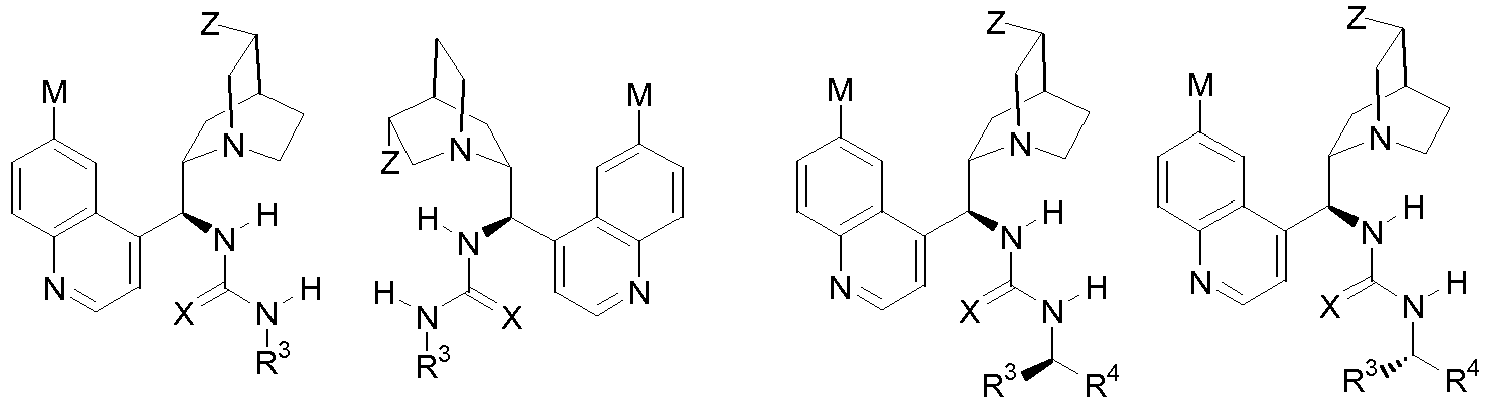


- wherein X can be O or S;
- Z can be a C1 to C5 carbon chain optionally comprising at least one C-C unsaturated bond, and optionally substituted one or more times with at least one of a halogen, cyano, CF3, NO2, C1-C5 ketone, C1-C5 ester, C1-C10 amide, C1-C5 sulfone, C1-C5 sulfoxide and combinations thereof;
- M can be H, OH, or OMe;
- B can be C1-C15 alkyl, C3-C15 cycloalkyl, C5-C15 aryl, C5-C15 heteroaryl or combinations thereof, optionally substituted one or more times with at least one of a halogen, cyano, CF3, NO2, C1-C5 ketone, C1-C5 ester, C1-C10 amide, C1-C5 sulfone, C1-C5 sulfoxide, C1-C5 alkyl and combinations thereof;
- R1 and R2 can be the same or different and may comprise C1-C15 alkyl, or R1 and R2 may together define a C3-C15 cycloalkyl ring (i.e., R1 and R2 may together with N define a C3-C15 heterocyclic ring), wherein each may be optionally substituted one or more times with at least one of a halogen, cyano, CF3, NO2, C1-C5 ketone, C1-C5 ester, C1-C10 amide, C1-C5 sulfone, C1-C5 sulfoxide, C1-C5 alkyl and combinations thereof;
- R3 and R4 can be the same or different and may comprise C1-C15 alkyl, or R3 and R4 may together define a C3-C15 cycloalkyl ring, a C5-C15 aryl ring, or a C5-C15 heteroaryl ring wherein each may be optionally substituted one or more times with at least one of a halogen, cyano, CF3, NO2, C1-C5 ketone, C1-C5 ester, C1-C10 amide, C1-C5 sulfone, C1-C5 sulfoxide, C1-C5 alkyl and combinations thereof; and
- R5 and R6 can be the same or different and may comprise C1-C15 alkyl, or R5 and R6 may together define a C3-C15 cycloalkyl ring, a C5-C15 aryl ring, or a C5-C15 heteroaryl ring wherein each may be optionally substituted one or more times with at least one of a halogen, cyano, CF3, NO2, C1-C5 ketone, C1-C5 ester, C1-C10 amide, C1-C5 sulfone, C1-C5 sulfoxide, C1-C5 alkyl and combinations thereof.
- As used herein "Bn" is short hand for "benzyl".
- The bifunctional organocatalyst may be selected from the group consisting of:
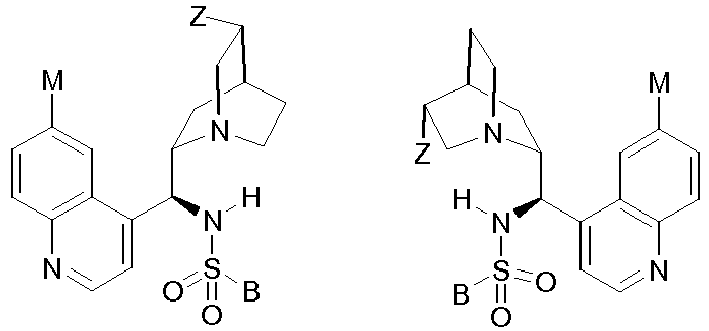
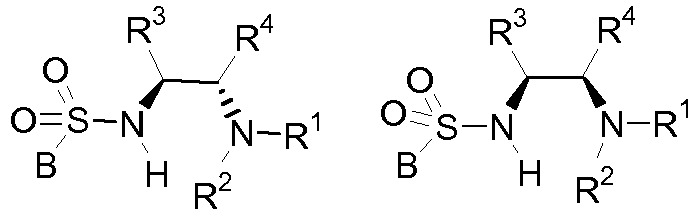
- wherein Z can be a C1 to C5 carbon chain optionally comprising at least one C-C unsaturated bond, and optionally substituted one or more times with at least one of a halogen, cyano, CF3, NO2, C1-C5 ketone, C1-C5 ester, C1-C10 amide, C1-C5 sulfone, C1-C5 sulfoxide and combinations thereof;
- M can be H, OH, or OMe;
- B can be C1-C15 alkyl, C3-C15 cycloalkyl, C5-C15 aryl, C5-C15 heteroaryl or combinations thereof, optionally substituted one or more times with at least one of a halogen, cyano, CF3, NO2, C1-C5 ketone, C1-C5 ester, C1-C10 amide, C1-C5 sulfone, C1-C5 sulfoxide, C1-C5 alkyl and combinations thereof;
- R1 and R2 can be the same or different and may comprise C1-C15 alkyl, or R1 and R2 may together define a C3-C15 cycloalkyl ring (i.e., R1 and R2 may together with N define a C3-C15 heterocyclic ring), wherein each may be optionally substituted one or more times with at least one of a halogen, cyano, CF3, NO2, C1-C5 ketone, Cl-C5 ester, C1-C10 amide, C1-C5 sulfone, C1-C5 sulfoxide, C1-C5 alkyl and combinations thereof; and
- R3 and R4 can be the same or different and may comprise C1-C15 alkyl, or R3 and R4 may together define a C3-C15 cycloalkyl ring, a C5-C15 aryl ring, or a C5-C15 heteroaryl ring wherein each may be optionally substituted one or more times with at least one of a halogen, cyano, CF3, NO2, C1-C5 ketone, C1-C5 ester, C1-C10 amide, C1-C5 sulfone, C1-C5 sulfoxide, C1-C5 alkyl and combinations thereof.
- B may be C5-C15 aryl, or C5-C15 heteroaryl optionally substituted one or more times with at least one of a halogen, C1-C5 alkyl, or combinations thereof.
- The bifunctional organocatalyst may be selected from the group comprising:
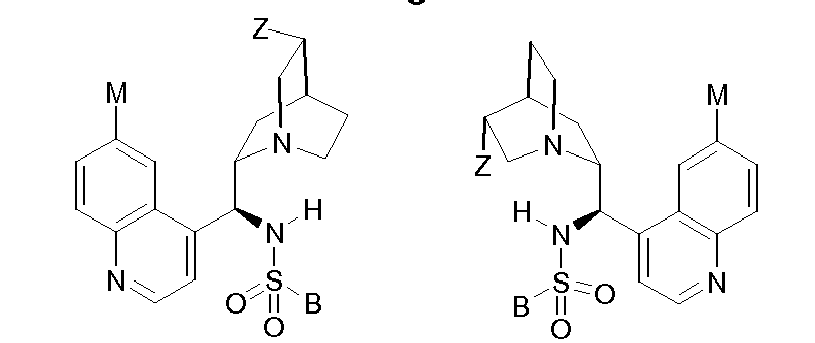
- Z can be a C1 to C5 carbon chain optionally comprising at least one C-C unsaturated bond, and optionally substituted one or more times with at least one of a halogen, cyano, CF3, NO2, C1-C5 ketone, C1-C5 ester, C1-C10 amide, C1-C5 sulfone, C1-C5 sulfoxide and combinations thereof;
- M can be H, OH, or OMe; and
- B can be C1-C15 alkyl, C3-C15 cycloalkyl, C5-C15 aryl, C5-C15 heteroaryl or combinations thereof, optionally substituted one or more times with at least one of a halogen, cyano, CF3, NO2, C1-C5 ketone, C1-C5 ester, C1-C10 amide, C1-C5 sulfone, C1-C5 sulfoxide, C1-C5 alkyl and combinations thereof.
- B may be C5-C15 aryl, or C5-C15 heteroaryl optionally substituted one or more times with at least one of a halogen, C1-C5 alkyl, or combinations thereof.
- According to the method of the present invention the step of acylating the thiol comprises reacting the thiol with an organic anhydride. The organic anhydride may be a cyclic anhydride. The organic anhydride (cyclic or acyclic) may be a C4-C50 organic anhydride.
- The organic anhydride may be selected from the group consisting of:

- wherein R1 and R2 are the same or different and are selected from the group consisting of C1-C20 alkyl, C3-C20 cycloalkyl, C5-C20 aryl, C5-C20 heteroaryl and combinations thereof, optionally substituted with at least one of a halogen, cyano, or C1-C5 fluoroalkyl;
- R3 and R4 are the same or different and are selected from the group consisting of H, C1-C20 alkyl, C3-C20 cycloalkyl, C5-C20 aryl, C5-C20 heteroaryl and combinations thereof, optionally substituted with at least one of a halogen, cyano, or C1-C5 fluoroalkyl, such that at least one of R3 and R4 is H;
- R5 and R6 are the same or different and are selected from the group consisting of H, C1-C20 alkyl, C3-C20 cycloalkyl, C5-C20 aryl, C5-C20 heteroaryl and combinations thereof, optionally substituted with at least one of a halogen, cyano, or C1-C5 fluoroalkyl; and
- n is 0-5.
- The organic anhydride may be of the general formula:

- According to the method of the present invention acylation of the thiol with the prochiral anhydride in the presence of the bifunctional organocatalyst as provided in the claims may proceed with desymmetrisation of the prochiral anhydride to afford a thioester. The thioester may be at least one of enantiomerically or diastereomerically enriched.
- The organic anhydride may be of the general formula:

- According to the method of the present invention acylation of the thiol with the meso anhydride in the presence of the bifunctional organocatalyst as set out in the claims may proceed with desymmetrisation of the meso anhydride to afford a thioester. The thioester may be at least one of enantiomerically or diastereomerically enriched.
- In a further aspect, the present invention provides for use of the method of the present invention in the preparation of an enantioenriched thiol as set out in the claims. The enantioenriched thiol may be a pharmaceutical. For example, the method of the present invention may be used in the preparation of enantioenriched 3-(aminomethyl)-5-methylhexanoic acid. The (R)-enantiomer of 3-(aminomethyl)-5-methylhexanoic acid is the blockbuster anticonvulsive drug Pregabalin marketed as 'Lyrica'®.
- In yet a further aspect the present invention provides for a process for the preparation of enantioenriched 3-(aminomethyl)-5-methylhexanoic acid as set out in the claims comprising the steps of:
- preferentially acylating one thiol enantiomer of an enantiomeric mixture of the thiol with 3-isobutylglutaric anhydride in the presence of a bifunctional organocatalyst according to the method of the present invention; and
- converting the thioester functional group (formed in the previous step) into an amine.
- The step of converting the thioester functional group into an amine may comprise:
- i) aminolysis of the thioester functional group to yield an amide; and
- ii) subjecting the amide product of step i) to a Hofmann rearrangement.
- Aminolysis of the thioester functional group may comprise treating the thioester with ammonia or an amine. Preferably, aminolysis of the thioester functional group comprises treating the thioester with ammonia to yield a primary amide. The Hofmann rearrangement is an eminent synthetic transformation which converts an amide to an amine with the loss of carbon monoxide. All protocols for effecting this transformation are embraced by the present invention.
- The invention further provides for a compound having the general structure:

- Z can be a C1 to C5 carbon chain optionally comprising at least one C-C unsaturated bond, and optionally substituted one or more times with at least one of a halogen, cyano, CF3, NO2, C1-C5 ketone, C1-C5 ester, C1-C10 amide, C1-C5 sulfone, C1-C5 sulfoxide and combinations thereof; and
- M can be H, OH, or OMe.
- The compound of the present invention may be used as an acylation catalyst in the resolution of a mixture of stereoisomers of a thiol. That is a molecule that catalyses preferential acylation of one thiol stereoisomer over another thiol stereoisomer. Desirably, the mixture of stereoisomers of a thiol is an enantiomeric mixture of the thiol.
- In a further aspect the present invention provides for a method of desymmetrising at least one of a prochiral anhydride or a meso anhydride comprising the steps of:
- (i) adding the prochiral anhydride or meso anhydride to a mixture of enantiomeric thiols; and
- (ii) adding a bifunctional organocatalyst to the mixture of the prochiral anhydride and the enantiomeric thiols; wherein the bifunctional organocatalyst is a chiral organic molecule comprising between 5 and 60 carbon atoms, having a Lewis acid moiety and a Lewis base moiety, within the molecule, which is used in a substoichiometric loading relative to the mixture thiols.
- The prochiral anhydride may be a C6-C40 anhydride. The meso anhydride may be a C6-C40 anhydride. The prochiral anhydride may be of the general formula:

n is 1. - The meso anhydride may be of the general formula:

- The thiols may be selected from the group consisting of primary thiols and secondary thiols. The thiol may be a thiol selected from the group consisting of C1-C100 alkyl including C3-C100 cycloalkyl, C5-C100 aryl including C5-C100 heteroaryl and combinations thereof. The thiol may be a secondary thiol. The secondary thiol may be selected from the group consisting of C1-C100 alkyl including C3-C100 cycloalkyl, C5-C100 aryl including C5-C100 heteroaryl and combinations thereof. The secondary thiol may be selected from the group consisting of C1-C20 alkyl, C5-C20 aryl and combinations thereof. The thiol may be optionally substituted one or more times with at least one of a halogen, C1-C5 alkoxy, C1-C5 thioalkoxy, and cyano.
- The bifunctional organocatalyst may comprise a cinchona alkaloid. For example, the catalyst may comprise one of the following structural elements:

- Z can be a C1 to C5 carbon chain optionally comprising at least one C-C unsaturated bond, and optionally substituted one or more times with at least one of a halogen, cyano, CF3, NO2, C1-C5 ketone, C1-C5 ester, C1-C10 amide, C1-C5 sulfone, C1-C5 sulfoxide and combinations thereof;
- M can be H, OH, or OMe; and
- R1 is a moiety comprising a hydrogen bond donor.
- The moiety comprising a hydrogen bond donor may comprise between 1 and 30 carbon atoms. The cinchona alkaloid may be substituted with a urea, thiourea or sulfonamide functional group. For example, R1 may comprise a urea, thiourea or sulfonamide functional group. For example, R1 may comprise a C1-C20 urea, C1-C20 thiourea or a C1-C20 sulfonamide.
- The bifunctional organocatalyst may be selected from the group consisting of:


- wherein X can be O or S;
- Z can be a C1 to C5 carbon chain optionally comprising at least one C-C unsaturated bond, and optionally substituted one or more times with at least one of a halogen, cyano, CF3, NO2, C1-C5 ketone, C1-C5 ester, C1-C10 amide, C1-C5 sulfone, C1-C5 sulfoxide and combinations thereof;
- M can be H, OH, or OMe;
- B can be C1-C15 alkyl, C3-C15 cycloalkyl, C5-C15 aryl, C5-C15 heteroaryl or combinations thereof, optionally substituted one or more times with at least one of a halogen, cyano, CF3, NO2, C1-C5 ketone, C1-C5 ester, C1-C10 amide, C1-C5 sulfone, C1-C5 sulfoxide, C1-C5 alkyl and combinations thereof;
- R1 and R2 can be the same or different and may comprise C1-C15 alkyl, or R1 and R2 may together define a C3-C15 cycloalkyl ring (i.e., R1 and R2 may together with N define a C3-C15 heterocyclic ring), wherein each may be optionally substituted one or more times with at least one of a halogen, cyano, CF3, NO2, C1-C5 ketone, C1-C5 ester, C1-C10 amide, C1-C5 sulfone, C1-C5 sulfoxide, C1-C5 alkyl and combinations thereof;
- R3 and R4 can be the same or different and may comprise C1-C15 alkyl, or R3 and R4 may together define a C3-C15 cycloalkyl ring, a C5-C15 aryl ring, or a C5-C15 heteroaryl ring wherein each may be optionally substituted one or more times with at least one of a halogen, cyano, CF3, NO2, C1-C5 ketone, C1-C5 ester, C1-C10 amide, C1-C5 sulfone, C1-C5 sulfoxide, C1-C5 alkyl and combinations thereof; and
- R5 and R6 can be the same or different and may comprise C1-C15 alkyl, or R5 and R6 may together define a C3-C15 cycloalkyl ring, a C5-C15 aryl ring, or a C5-C15 heteroaryl ring wherein each may be optionally substituted one or more times with at least one of a halogen, cyano, CF3, NO2, C1-C5 ketone, C1-C5 ester, C1-C10 amide, C1-C5 sulfone, C1-C5 sulfoxide, C1-C5 alkyl and combinations thereof.
- The bifunctional organocatalyst may be selected from the group consisting of:


- Z can be a C1 to C5 carbon chain optionally comprising at least one C-C unsaturated bond, and optionally substituted one or more times with at least one of a halogen, cyano, CF3, NO2, C1-C5 ketone, C1-C5 ester, C1-C10 amide, C1-C5 sulfone, C1-C5 sulfoxide and combinations thereof;
- M can be H, OH, or OMe;
- B can be C1-C15 alkyl, C3-C15 cycloalkyl, C5-C15 aryl, C5-C15 heteroaryl or combinations thereof, optionally substituted one or more times with at least one of a halogen, cyano, CF3, NO2, C1-C5 ketone, C1-C5 ester, C1-C10 amide, C1-C5 sulfone, C1-C5 sulfoxide, C1-C5 alkyl and combinations thereof;
- R1 and R2 can be the same or different and may comprise C1-C15 alkyl, or R1 and R2 may together define a C3-C15 cycloalkyl ring (i.e., R1 and R2 may together with N define a C3-C15 heterocyclic ring), wherein each may be optionally substituted one or more times with at least one of a halogen, cyano, CF3, NO2, C1-C5 ketone, C1-C5 ester, C1-C10 amide, C1-C5 sulfone, C1-C5 sulfoxide, C1-C5 alkyl and combinations thereof; and
- R3 and R4 can be the same or different and may comprise C1-C15 alkyl, or R3 and R4 may together define a C3-C15 cycloalkyl ring, a C5-C15 aryl ring, or a C5-C15 heteroaryl ring wherein each may be optionally substituted one or more times with at least one of a halogen, cyano, CF3, NO2, C1-C5 ketone, C1-C5 ester, C1-C10 amide, C1-C5 sulfone, C1-C5 sulfoxide, C1-C5 alkyl and combinations thereof.
- B may be C5-C15 aryl, or C5-C15 heteroaryl optionally substituted one or more times with at least one of a halogen, C1-C5 alkyl, or combinations thereof.
- The bifunctional organocatalyst may be selected from the group comprising:

- Z can be a C1 to C5 carbon chain optionally comprising at least one C-C unsaturated bond, and optionally substituted one or more times with at least one of a halogen, cyano, CF3, NO2, C1-C5 ketone, C1-C5 ester, C1-C10 amide, C1-C5 sulfone, C1-C5 sulfoxide and combinations thereof;
- M can be H, OH, or OMe; and
- B can be C1-C15 alkyl, C3-C15 cycloalkyl, C5-C15 aryl, C5-C15 heteroaryl or combinations thereof, optionally substituted one or more times with at least one of a halogen, cyano, CF3, NO2, C1-C5 ketone, C1-C5 ester, C1-C10 amide, C1-C5 sulfone, C1-C5 sulfoxide, C1-C5 alkyl and combinations thereof.
- B may be C5-C15 aryl, or C5-C15 heteroaryl optionally substituted one or more times with at least one of a halogen, C1-C5 alkyl, or combinations thereof.
- The method of the present invention may be carried out in a solvent selected from the group consisting of C5-C12 hydrocarbons, C6-C12 aromatic hydrocarbons, C3-C12 ketones (cyclic and acyclic), C2-C12 ethers (cyclic and acyclic), C2 to C12 esters (cyclic and acyclic), C2-C5 nitriles and combinations thereof. Desirably, the solvent is ethereal. For example, C2-C12 ethers (cyclic and acyclic). Suitable ethers may be selected from the group consisting of diethylether, THF, 2-methyl THF, diisopropylether, methyltertbutylether (MTBE) and combinations thereof. In a preferred embodiment, the solvent is methyltertbutylether (MTBE).
- The catalyst loading with respect to the thiol may be 0.1 - 50 mol%, for example 0.1 - 25 mol%, such as 0.1 - 10 mol%. Desirably, the catalyst loading with respect to the thiol is 5 - 10 mol%. This represents a highly economic and efficient catalyst loading.
- The compounds resolved by the present invention may be found or isolated in the form of esters, salts, hydrates or solvates - all of which are embraced by the present invention.
- Where suitable, it will be appreciated that all optional and/or preferred features of one embodiment of the invention may be combined with optional and/or preferred features of another/other embodiment(s) of the invention.
- Additional features and advantages of the present invention are described in, and will be apparent from, the detailed description of the invention and from the drawings in which:
-
Figure 1 illustrates Kinetic Resolution of a thiol with simultaneous enantioselective synthesis of a (R)-Pregabalin precursor. - It should be readily apparent to one of ordinary skill in the art that the examples disclosed herein below represent generalised examples only, and that other arrangements and methods capable of reproducing the invention are possible and are embraced by the present invention.
- Preliminary experiments related to the acylative KR of the racemic sec-thiol 1 with glutaric anhydride (2a) in the presence of bifunctional (thio)urea-derived organocatalysts 10-12 and sulphonamide 13 (Table 1). Initial results were far from encouraging - acylation proceeded smoothly at low catalyst loading (5 mol%), but resulted in products of low enantiomeric excess (entries 1-4). Of the four catalysts tested sulphonamide 13 proved superior to the (thio)urea-derivatives and could promote the KR with a very modest selectivity (kfast/kslow) of 1.5 (13% ee at 50% conv., entry 4). Further experimentation identified methyl tert-butylether (MTBE) as the optimal solvent overall, although the KR of 1 was slower but more selective in THF (entries 4-7).
- These results represented the first examples of direct catalytic asymmetric KR of a thiol. Subsequently, KR reactions using 3-substituted achiral anhydride electrophiles 3a-5 were tried. This complicated matters considerably, as now control over the formation of 4 possible thioester diastereomers is required. In addition, it allowed for the possibility of a conceptually novel type of catalytic process where both kinetic resolution and anhydride desymmetrisation occur simultaneously. Gratifyingly, this proved to be the case - use of anhydrides 3a-5 resulted in more enantioselective acylations (entries 8-11), with methyl glutaric anhydride (3a) proving optimal. Using this electrophile the resolved thiol could be isolated in 33% ee at 50% conversion (using either 1 or 5 mol% of catalyst 13), corresponding to S = 2.7.
- Product esters 7a and 7b were both formed with excellent enantioselectivity (>90% ee) and with encouraging diastereocontrol (67:33 dr, entry 8). With respect to the anhydride, the desymmetrisation aspect of the reaction was highly selective - the parameter ee desymm (Table 1) represents the percentage excess of products derived from attack of the thiol 1 at one prochiral anhydride carbonyl moiety over the other (i.e. the enantiomeric excess of the desymmetrised product if the combined thioester diastereomers were substituted by an achiral (non-hydroxide) nucleophile without racemisation). It is also noteworthy that in the presence of triethylamine as an achiral catalyst the diastereoselectivity is reversed, with 19 as the major diastereomer.
- Next the steric and electronic characteristics of the catalyst were systematically varied through the synthesis and evaluation of sulfonamides 14-17. While the electron deficient pentafluorophenyl-substituted catalyst fared a little better than 13, less acidic analogues 15-17 respectively possessed enhanced selectivity profiles (entries 12-15). Given the superiority of the hindered promoter 16, it was decided to accentuate the steric bulk of the sulfonamide further via the synthesis of the
novel catalyst 18, which proved almost as active as 13 yet promoted the acylation with a synthetically useful KR selectivity of 8.5 (entry 16). Further optimisation of the reaction conditions (entries 17-19) resulted in the KR of thiol 1 with outstanding selectivity (S = 25.5) - allowing the isolation of resolved (R)-1 in 90% ee at 54% conversion, along with ester 7a (formed as the major diastereomer, 89:11 dr) in 98% ee, with an excellent attendant eedesymm of 96% (entry 19).Table 1: Kinetic resolution of thiol 1 with simultaneous desymmetrisation of achiral-anhydrides 3-5 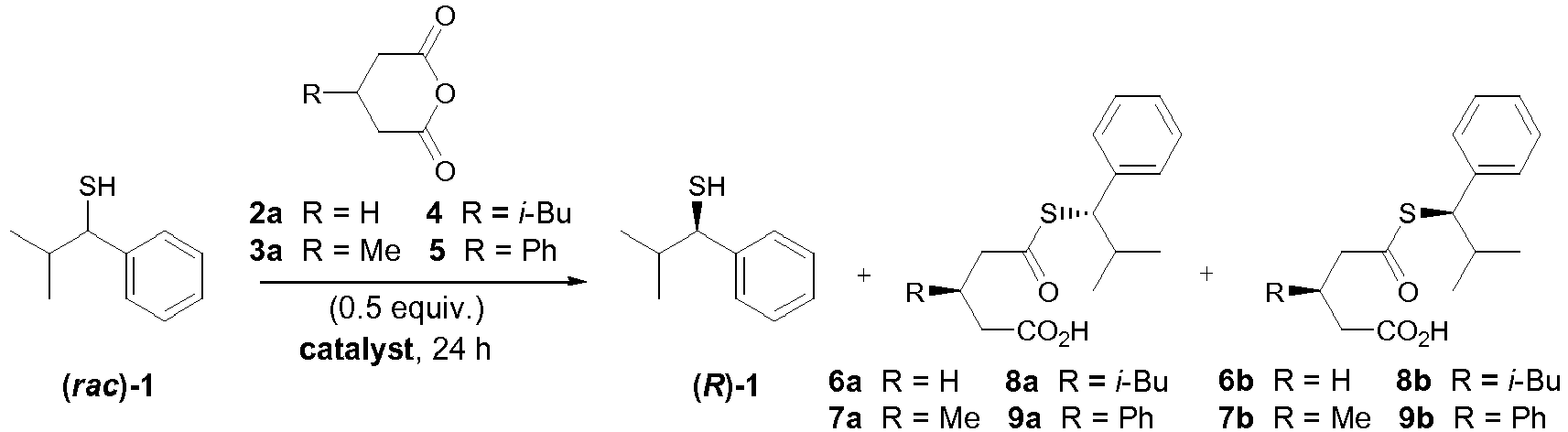

entry anhydride (equiv.) catalyst (mol%) solvent T (°C) conv. (%)c drd eeesterA (%)e eeesterB (%)e eedesym (%)e,f eethiol (%)e Sg 1 2a (0.5) 10 (5) MTBE rt 49 - 6.5 - - 7 1.2 2 2a (0.5) 11 (5) MTBE rt 50 - 9 - - 9 1.3 3 2a (0.5) 12 (5) MTBE rt 50 - 6 - - 6 1.2 4 2a (0.5) 13 (5) MTBE rt 50 - 13 - - 13 1.5 5 2a (0.5) 13 (5) Et2O rt 50 - 14 - - 14 1.5 6 2a (0.5) 13 (5) THF rt 39 - 27 - - 17 2.1 7 2a (0.5) 13 (5) CH2Cl2 rt 16 - n.d. - - - - 8 3a (0.5) 13 (5) MTBE rt 50 66.5:33.5 95 91 92 33 2.7 9 3a (0.5) 13 (5) MTBE rt 49 67:33 97 88 94 33 2.7 10 4 (0.5) 13 (5) MTBE rt 50 n.d. n.d. n.d. n.d. 21 1.8 11 5 (0.5) 13 (5) MTBE rt 50 60:40 n.d. n.d. n.d. 26 2.3 12 3a (0.5) 14 (5) MTBE rt 49 70:30 97 87 94 41 3.9 13 3a (0.5) 15 (5) MTBE rt 47 73:27 97 93 96 41 4.0 14 3a (0.5) 16 (5) MTBE rt 44 79:21 97 90 96 45 5.6 15 3a (0.5) 17 (5) MTBE rt 48 75:25 95 84 92 44 4.3 16 3a (0.5) 18 (5) MTBE rt 48 89:11 95 68 90 60 8.5 17a 3a (0.5) 18 (5) MTBE 0 43 89:11 98 78 96 58 13.6 18a 3a (0.75) 18 (5) MTBE 0 62 79:21 95 90 94 93 11.6 19b 3a (0.75) 18 (5) MTBE -30 54 89:11 98 84 96 90 25.5 20b 2b (0.75) 18 (5) MTBE -30 33 - n.d. - - 42 (85)h 17.9 21b 3b (0.75) 18 (5) MTBE -30 4 - n.d. - - n.d. n.d. 22b 2a (0.75) 18 (5) MTBE -30 50 - n.d. - - 68 (68)h 10.7 a 48h. b 72h. Conversion was determined using CSP-HPLC, where conversion = 100 × ee thiol/(ee thiol + ee thioester); the value of ee thioester was calculated using all four thioester stereoisomers. dDiastereomeric ratio = (6-9a + ent-6-9a):(6-9b + ent-6-9b).e Determined by CSP-HPLC, see supporting information. fDesymmetrisation efficiency: the enantiomeric excess of the desymmetrised product if the combined thioester products were substituted by an achiral (non-hydroxide) nucleophile, calculated as 100 x [(6-9a + 6-9b) - ( ent-6-9a + ent-6-9b)] / [(6-9a + 6-9b) + (ent-6-9a + ent-6-9b)]. gS = enantioselectivity (kfast/kslow,). hValue in parenthesis refers to the ee of the thiol obtained after deprotection via cleavage of the combined thioester products. - Thus, under
optimum conditions 18 is capable of mediating the highly efficient and selective KR of a substrate class previously outside the orbit of direct enantioselective catalytic acylation, with the simultaneous desymmetrisation of a synthetically useful class of inexpensive achiral anhydride acylating agent - also with excellent enantioselectivity. To demonstrate that the desymmetrisation and kinetic resolution processes are synergistic, we next carried out the process under optimum conditions using the non-prochiral anhydrides 2a, 2b and 3b (entries 20-22). Kinetic resolution was either too slow or proceeded with lower enantioselectivity using these electrophiles. - Attention now turned to the question of substrate scope (Table 2). It was found that variation of the steric bulk of both the aromatic and aliphatic substituent is well tolerated by the catalyst - for example, α-Me, -Et, - i Pr and - t Bu derivatives of benzyl mercaptan (i.e. 1 and 20-22, entries 1-4) could be resolved with excellent selectivity (up to S > 50), resulting in the isolation of the unreacted thiol with >90% ee at ca. 50% conversion. A strong correlation between increasing aliphatic substituent bulk and selectivity was observed; however it is noteworthy that even the challenging substrate 20 (where the steric discrepancy between the two carbon-based substituents is smallest) could be resolved with synthetically useful selectivity. Variation of the characteristics of the aromatic substituent produced interesting results - substitution in the para-position either slightly reduces or has no impact on enantioselectivity (23-25, entries 5-7), while steric bulk at the ortho-position dramatically improved the KR; in optimum cases this resulted in levels of enantiodiscrimination (S >> 100) more usually associated with the enzymatic KR of alcohols (26-28, entries 8-12).
- To demonstrate the potential utility of this methodology, the KR of thiol 28 (0.80 mmol) was carried out with
catalyst 18 in the presence ofachiral anhydride 4, which furnished (R)-28 (0.39 mmol, 99% ee) and the ring-opened product 29 (0.40 mmol) with excellent efficiency at 51% conversion as shown inFigure 1 . Thioester 29 (as a mixture of diastereomers) was then treated with aqueous ammonia, resulting in its cleavage to afford the other thiol enantiomer (S)-28 (96% ee, 0.35 mmol) and the aminolysed product (S)-30 (97% ee, 0.38 mmol), again with high efficiency. Hemiamide (S)-30 is a precursor which can be converted in a single step to the (R)-antipode of the anticonvulsive agent Pregabalin and thus this sequence - in addition to serving as a highly efficient KR of 28 - constitutes a rapid and convenient formal synthesis of the 'blockbuster' drug (marketed as 'Lyrica'®).Table 2: Evaluation of substrate scope 
entry substrate X time (h) conv. (%)a ee thiol (%)b Sc abs. config.d 1 
0.75 68 63 97 14.5 (R) 2 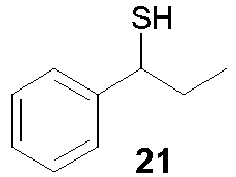
0.75 74 56 91 19.0 (R) 3e 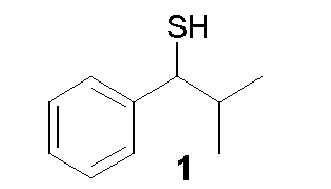
0.75 68 54 90 25.5 (R) 4f 
0.75 96 52 94 51.5 (R) 5 
0.75 72 65 95 10.7 (R) 6 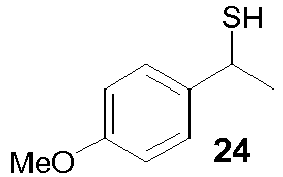
0.90 120 56 87 15.0 (R) 7 
0.75 74 58 82 9.7 (R) 8g 0.75 72 45 59 11.8 (R) 9h 
0.75 96 51 90 36.6 (R) 10 
0.75 48 50 95 (94)j 126.0 (R) 11i 
0.75 48 50 98 (96)j 265.0 (R) 12k 0.75 48 43 75 (98)j 275.0 (R) a Refers to conversion, determined using CSP-HPLC, where conversion = 100 × ee thiol/(ee thiol + ee thioester). bDetermined by CSP-HPLC, see supporting information. c S = enantioselectivity (ktast/kslow, see ref. 1). d Refers to the absolute configuration of the recovered thiol product (see supporting information). e Data from Table 1. f A repeat of this experiment (conv. 52%, S = 50.4) resulted in the isolation of the unreacted (R)-thiol in 47% yield and 95% ee after chromatography. After aminolysis of the combined thioester products the (S)-thiol was obtained in 43% isolated yield and 86% ee. g Reaction at -40°C. h A repeat of this experiment in which the combined thioester diastereomers were aminolysed resulted in the isolation of the corresponding hemiamide in 93% ee. l A repeat of this experiment (conv. 51%, S = 249.0) resulted in the isolation of the unreacted (R)-thiol in 48% yield and 99.6 % ee after chromatography. After aminolysis of the combined thioester products the (S)-thiol was obtained in 44% isolated yield and 95% ee. jValue in parenthesis refers to the ee of the thiol obtained after deprotection via cleavage of the combined thioester products. k Reaction at -45 °C. - Disclosed herein is
novel sulfonamide catalyst 18, which promotes the highly enantioselective (S > 10) direct acylative KR of a sec-thiols for the first time, allowing their isolation in >90% ee at ca. 50% conversion. Under optimum conditions at low catalyst loadings the selectivity (kfast/kslow) of these processes is in the range of 50 - 275, thus using theartificial catalyst 18 it is possible to achieve levels of enantiodiscrimination more usually associated with acylative KR by biological catalysts, using a substrate class not hitherto demonstrated to be generally amenable to enzyme-mediated direct acylative KR. In addition, the thiol-KR is accompanied by a synergistic, simultaneous desymmetrisation of an achiral anhydride electrophile - which occurs with excellent levels of enantioselectivity on a par with those associated with the best anhydride desymmetrisation methodologies in the literature. This catalytic desymmetrisation of an electrophile while it kinetically resolves a nucleophile is, to the best of our knowledge, a hitherto unreported phenomenon which possesses excellent potential as a tool to considerably improve upon both the synthetic utility and atom economy of acylative KR processes. - Proton Nuclear Magnetic Resonance spectra were recorded on a 400 MHz spectrometer in CDCl3(to prevent oxidation of the thiols, CDCl3 was purified by distillation and stored under argon over molecular sieves) or DMSO-d6 and referenced relative to residual CHCl3 (δ = 7.26 ppm) or DMSO (δ = 2.54 ppm). Chemical shifts are reported in ppm and coupling constants in Hertz. Carbon NMR spectra were recorded on the same instrument (100 MHz) with total proton decoupling. All melting points are uncorrected. Flash chromatography was carried out using silica gel, particle size 0.04-0.063 mm. TLC analysis was performed on precoated 60F254 slides, and visualised by UV irradiation and KMnO4 staining. Optical rotation measurements are quoted in units of 10-1 deg cm2g-1. Toluene and methylene chloride were distilled over calcium hydride and stored under argon. Tetrahydrofuran and diethyl ether were distilled over sodium-benzophenone ketyl radical and stored under argon. Commercially available anhydrous t-butyl methyl ether was used. All reactions were carried out under a protective argon atmosphere. Analytical CSP-HPLC was performed on a Daicel CHIRALPAK AS, AD, or Chiralcel OD-H (4.6 mm x 25 cm) columns. The absolute configuration of each enantioenriched thiol was determined after derivatisation with (R)-2-methoxy-2-phenylacetic acid and analysis of the corresponding thioester by 1H NMR spectroscopy as recently reported in the literature. In the cases of thiols 20 and 25, the absolute configuration (and fidelity of the literature 1H NMR spectroscopic method) could be also confirmed by comparison of the optical rotation with the literature data.
- All secondary thiols were obtained from the corresponding thioester by reaction with LiAlH4 in anhydrous THF. Thioesters 20, 21, 23, 24 and 27 were made from the corresponding alcohols via a modification of the Mitsunobu protocol.
Thioesters 1, 22, 25, 26 and 28 were obtained from the corresponding alcohols via a two step procedure involving initial activation of the hydroxyl function by conversion to the corresponding mesylate (1, 25, 26 and 28) or bromide (22) followed by displacement with the potassium salt of thioacetic acid in acetone or DMF. -

- Diisopropyl azodicarboxylate (DEAD) (2.95 mL, 15.0 mmol) was added dropwise and via syringe to an ice-cooled solution of triphenylphosphine (3.93 g, 15.0 mmol) in dry THF (30 mL) under argon. After 1 h, a solution of the appropriate alcohol (7.50 mmol) and thioacetic acid (1.07 mL, 15.0 mmol) in THF (10 mL) was slowly injected and the mixture was stirred continuously while warming to room temperature. After 12 h, the solvent was evaporated in vacuo and the resulting yellow slurry was suspended in n-hexane (40 mL) and stirred for 2 h. After removal of the precipitate that had formed by filtration, the filtrate was concentrated in vacuo and the desired product obtained as colourless oil after purification by flash chromatography on silica gel.
- Following the general procedure outlined above, the product was isolated in 75% yield as a colourless oil.
TLC (Hexane:AcOEt, 96:4 v/v): Rf = 0.40. 1H NMR (400 MHz, CDCl3): δ 7.40-7.23 (m, 5H), 4.77 (q, J = 7.0 Hz, 1 H), 2.33 (s, 3H), 1.68 (d, J = 7.0 Hz, 3H). 13C NMR(100 MHz, CDCl3): δ 194.6 (q), 142.1 (q), 128.1, 126.9, 126.7, 42.5, 30.0, 21.7. - Following the general procedure outlined above, the product was isolated in 58% yield as a colourless oil.
TLC (Hexane:CH2Cl2, 7:3 v/v): Rf = 0.30. 1H NMR (400 MHz, CDCl3): δ 7.28 (d, J = 8.5 Hz, 2H), 6.87 (d, J = 8.5 Hz, 2H), 4.74 (q, J = 7.0 Hz, 1 H), 3.82 (s, 3H), 2.32 (s, 3H), 1.67 (d, J = 7.0 Hz, 3H). 13C NMR (100 MHz, CDCl3): δ 195.3 (q), 158.7 (q), 134.6 (q), 128.3, 113.9, 55.3, 42.5, 30.5, 22.3. HRMS (m/z): [M+H]+ calcd. for C11H15O2S 211.0793; found, 211.0797. - Following the general procedure outlined above, the product was isolated in 90% yield as a colourless oil.
TLC (Hexane:CH2Cl2, 7:3 vlv): Rf = 0.37. 1H NMR (400 MHz, CDCl3): δ 7.30 (m, 4H), 4.73 (q, J = 7.3 Hz, 1H), 2.32 (s, 3H), 1.65 (d, J = 7.3 Hz, 3H). 13C NMR (100 MHz, CDCl3): δ 194.4 (q), 140.9 (q), 132.5 (q), 128.2, 128.1, 41.8, 30.0, 21.5. HRMS (m/z): [M+H]+ calcd. for C10H12OSCl 215.0297; found, 215.0301. - Following the general procedure outlined above, the product was isolated in 76% yield as a colourless oil.
TLC (Hexane:CH2Cl2, 7:3 vlv): Rf = 0.34. 1H NMR (400 MHz, CDCl3): δ 7.34 (d, J = 7.0 Hz, 1H), 7.25-7.15 (m, 3H), 4.95 (q, J = 7.0 Hz, 1H), 2.41 (s, 3H), 2.34 (s, 3H), 1.68 (d, J = 7.0 Hz, 3H). 13C NMR(100 MHz, CDCl3): δ 195.0 (q), 139.4 (q), 135.1 (q), 130.1, 126.8, 126.2, 125.8, 38.9, 29.9, 21.6, 18.8. HRMS (m/z): [M+Na]+ calcd. for C11H14ONaS 217.0663; found, 217.0668. - Following the general procedure outlined above, the product was isolated in 73% yield as a colourless oil.
TLC (Hexane:CH2Cl2, 1:1 vlv): Rf = 0.51. 1H NMR (400 MHz, CDCls): δ 7.38-7.23 (m, 5H), 4.51 (t, J = 7.5 Hz, 1 H), 2.32 (s, 3H), 2.04-1.92 (m, 2H), 0.93 (t, J = 7.0 Hz, 3H). 13C NMR (100 MHz, CDCl3): δ 194.5 (q), 141.3 (q), 128.1, 127.2, 126.8, 49.2, 30.1, 28.9, 11.7. HRMS (m/z): [M+Na]+ calcd. for C11H14ONaS 217.0663; found, 217.0665. -

- Triethylamine (TEA) (1.25 mL, 9.00 mmol) was added via syringe to a solution of the appropriate alcohol (7.50 mmol) in dry CH2Cl2 (30 mL) under an argon atmosphere. The mixture was cooled to 0 °C and methanesulfonyl chloride (640 µL, 8.25 mmol) was added dropwise. The reaction was stirred continuously while it warmed to room temperature. After 12 h, the mixture was poured into an aqueous solution of HCl (1 N, 30 mL), the resulting mixture was then transferred to a separating funnel and the organic and aqueous layers were separated. The aqueous layer was extracted with CH2Cl2 (2 x 30 mL) and the combined organic layers were washed with HCl (1 N) (30 mL) and a saturated aqueous solution of NaHCO3 (30 mL). The organic phase was then dried over magnesium sulphate, filtered and evaporated to afford the desired intermediate as a colourless oil. This was immediately dissolved in dry acetone (10 mL) and potassium thioacetate (1.71 g, 15.0 mmol) was added. The reaction was then heated to reflux until none of the mesylate intermediate could be detected by 1H-NMR spectroscopic analysis (12-28 h). The mixture was then filtered, the filtrate evaporated and the crude purified by flash-chromatography.
- Following the general procedure outlined above, the product was isolated in 74% yield as a colourless oil.
TLC (Hexane:CH2Cl2, 7:3 vlv): Rf = 0.42. NMR (400 MHz, CDCl3): δ 7.22-7.35 (m, 5H), 4.44 (d, J = 8.0 Hz, 1 H), 2.32 (s, 3H), 2.08-2.22 (m, 1 H), 1.06 (d, J = 6.5 Hz, 3H), 0.89 (d, J = 6.5 Hz, 3H). 13C NMR(100 MHz, CDCl3): δ 194.2 (q), 141.2 (q), 127.8, 127.7, 126.5, 54.8, 33.1, 30.2, 20.3, 20.1. HRMS (m/z): [M+Na]+ calcd. for C12H16ONaS 231.0820; found, 231.0819. - Following the general procedure, the product was isolated in 69% yield as a colourless oil.
TLC (Hexane:CH2Cl2, 7:3 vlv): Rf = 0.34. 1H NMR (400 MHz, CDCl3): δ 8.09 (d, J = 8.5 Hz, 1 H), 7.89 (d, J = 8.0 Hz, 1H), 7.81 (d, J = 8.5 Hz, 1H), 7.61-7.43 (m, 4H), 5.56 (q, J = 7.0 Hz, 1H), 2.37 (s, 3H), 1.87 (d, J = 7.0 Hz, 3H). 13C NMR(100 MHz, CDCl3): δ 195.1 (q), 136.8 (q), 133.5 (q), 130.1 (q), 128.5, 127.8, 125.9, 125.4, 124.8, 124.1, 122.7, 38.2, 29.9, 21.8. HRMS (m/z): [M+Na]+ calcd. for C14H14ONaS 253.0663; found, 253.0659. - Following the general procedure outlined above, the product was isolated in 62% yield as a colourless oil.
TLC (Hexane:CH2Cl2, 7:3 vlv): Rf = 0.31. 1H NMR (400 MHz, CDCl3): δ 7.88-7.80 (m, 4H), 7.54-7.44 (m, 3H), 4.95 (q, J = 7.0 Hz, 1H), 2.34 (s, 3H), 1.78 (d, J = 7.0 Hz, 3H). 13C NMR (100 MHz, CDCl3): δ 194.6(q), 139.4 (q), 132.8 (q), 132.2 (q), 128.0, 127.4, 127.1, 125.8, 125.5, 125.2, 125.1, 42.6, 30.0, 21.6. HRMS (m/z): [M+H]+ calcd. for C14H15ONS 231.0844; found, 231.0848. - Following the general procedure outlined above, the product was isolated in 62% yield as a colourless oil.
TLC (Hexane:CH2Cl2, 7:3 vlv): Rf = 0.40. 1H NMR (400 MHz, CDCls): δ 6.85 (s, 2H), 5.35 (q, J = 7.5 Hz, 1 H), 2.44 (s, 6H), 2.33 (s, 3H), 2.26 (s, 3H), 1.67 (d, J = 7.5 Hz, 3H). 13C NMR (100 MHz, CDCls): 195.0 (q), 136.3 (q), 136.1 (q), 135.4 (q), 135.2 (q), 130.3, 128.7, 37.4, 29.9, 21.0, 20.7, 20.5, 20.3 Note: this compound exhibits NMR spectra consistent with restricted rotation which is fast on the 1H NMR spectroscopic time scale but slow on the 13C NMR spectroscopic time scale. HRMS (m/z): [M+Na]+ calcd. for C13H18ONaS 245.0976; found, 245.0974. - (1-Bromo-2,2-dimethyl-propyl)-benzene (1.00 g, 4.40 mmol) was dissolved in dry DMF (5 mL) under an argon atmosphere. Potassium thioacetate (2.51 g, 22.0 mmol) was added and the reaction was heated to 50 °C for 7 days. The solution was then concentrated and the product purified by column chromatography to obtain the desired thioester (970 mg, 99%).
TLC (Hexane:CH2Cl2, 7:3 vlv): Rf = 0.40. 1H NMR (400 MHz, CDCls): δ 7.33-7.22 (m, 5H), 4.52 (s, 1H), 2.32 (s, 3H), 1.00 (s, 9H). 13C NMR(100 MHz, CDCl3): 5 193.9 (q), 140.4 (q), 129.0, 127.2, 126.4, 58.7, 34.9 (q), 30.2, 27.6. HRMS (m/z): [M+Na]+ calcd. for C13H18ONaS 245.0976; found, 245.0972. -

- A 100 mL three neck round-bottomed flask, flame dried and equipped with a reflux condenser, was charged with dry THF (15 mL) and LiAIH4 (114 mg, 3.0 mmol). The suspension was cooled to 0 °C and a solution of the appropriate thioester (3.0 mmol) in dry THF (5 mL) was added in a dropwise manner. After 1 h refluxing, the reaction mixture was cooled to 0 °C and carefully quenched with aqueous HCl (1 M) (10 mL). The organic layer was separated and the aqueous solution extracted with Et2O (2 x 15 mL). The combined organic layers were then dried over magnesium sulphate, filtered and evaporated and the desired product obtained in excellent yield after purification by flash-chromatography on silica gel.
-

- To a suspension of 9-epi-QA·3HCl (1.0 g, 2.31 mmol) in dry CH2Cl2 (20 mL), triethylamine (1.5 mL, 10.4 mmol) was then added via syringe and the resulting clear solution was cooled to 0° C. A solution of 2,4,6-Triisopropyl-phenyl sulphonyl chloride (700 mg, 2.31 mmol) in CH2Cl2 (5 mL) was then slowly injected and the mixture was allowed to warm to room temperature and stirred for 15 h. After evaporation of the solvent, the crude residue was purified by flash chromatography affording the desired sulphonamide catalyst 18 (1.10 g, 81%). M.p. 115-118 °C; TLC (Hexane:EtOAc, 1:1 vlv): Rf = 0.48. [α]20 589 = -43.0 (c = 0.50, CHCl3). 1H NMR (400 MHz, DMSO-d6 only the major rotamer quoted): δ 8.52 (d, 1 H, J = 4.4 Hz), 7.92 (d, 1 H, J = 9.7 Hz), 7.47-7.41 (m, 2H), 7.40 (d, 1H, J = 4.4 Hz), 6.99 (s, 2H), 5.73-5.70 (m, 1H), 5.16 (d, 1H, J = 10.4 Hz), 4.96 (d, 1H, J = 17.3 Hz), 4.89 (d, 1H, J = 10.6 Hz), 3.96 (s, 3H, OCH3), 3.83-3.94 (m, 3H), 3.07-3.09 (m, 1H), 2.81-2.93 (m, 3H), 2.63-2.68 (m, 1H), 2.46-2.48 (m, 1H), 2.21 (bs, 1H), 1.42-1.58 (m, 3H), 1.13-1.16 (m, 12H), 0.87 (d, 6H, J = 6.5 Hz), 0.71-0.78 (m, 1H). 13C NMR(100 MHz, DMSO-d6): δ 157.7, 152.1, 149.2, 147.8, 144.8, 144.1, 142.2, 134.6, 131.9, 127.9, 123.3, 121.2, 120.8, 114.7, 102.2, 60.7, 56.0, 55.3, 52.3, 40.3, 39.3, 33.7, 29.6, 27.8, 27.4, 25.4, 25.2, 24.6, 23.8. IR (neat): 3658, 2981, 2889, 1473, 1462, 1382, 1252, 1150, 1072, 954 cm-1. HRMS (m/z): [M+H]+calcd. for C35H48N3O3S 590.3416; found, 590.3410.
- A 20 mL reaction vial containing a stirring bar was charged with 3-methylglutaric anhydride (3a) (28.8 mg, 0.225 mmol) and 18 (17.7 mg, 0.030 mmol). The reaction vial was flushed with argon and fitted with a septum. MTBE (degassed) was then injected (1.5 mL, 0.2M) and the solution cooled to -30° C. The relevant thiol (0.30 mmol) was added via syringe and the resulting solution was stirred for the time indicated in Table 2. Conversion to the product was then monitored by 1H-NMR spectroscopic analysis and the mixture was purified by flash-chromatography in order to separate the unreacted thiol from the thioester product.
- The enantiomeric excess of each unreacted thiol was determined by CSP-HPLC after conversion to the corresponding Michael adduct with acrylonitrile. The enantiomeric excess of each 'fast reacting' thiol was determined by CSP-HPLC after aminolysis of the thioester product and derivatisation of the thiol to the corresponding Michael adduct with acrylonitrile. Conversion was determined using CSP-HPLC, where conversion = 100 x ee thiol/(ee thiol + ee thioester) and the Selectivity Factor (S) was calculated according to the method developed by Kagan (Kagan, H. B. & Fiaud, J. C. Kinetic resolution. Top. Stereochem. 18, 249-330 (1988)).
-

- The appropriate 'slow reacting' thiol (as obtained after flash-chromatography of the crude reaction mixture) was dissolved in CH2Cl2 (1.0 mL) under an argon atmosphere. Triethylamine (5.0 eq.) and acrylonitrile (10.0 eq.) were added and the mixture was stirred at room temperature for 3 h. After removal of the volatiles under reduced pressure, the crude product was then purified by flash-chromatography to afford the desired Michael adduct in quantitative yield.
-

- The appropriate thioester (as obtained after flash-chromatography of the reaction crude) was dissolved in CH2Cl2 (3.0 mL). Acrylonitrile (10.0 eq.) and ammonia (35% aqueous solution, 3.0 mL) were added and the biphasic mixture was vigorously stirred at room temperature for 3 h. The reaction was then diluted with CH2Cl2(10.0 mL) and H2O (10.0 mL) and transferred to a separating funnel. The organic and aqueous layers were separated and the organic layer was dried over MgSO4, filtered and evaporated under reducer pressure. The desired Michael addition product was obtained in quantitative yield after purification by flash-chromatography.
- Enantioselectivity data in Table 2 were obtained by recovering the unreacted thiol and separating it from the thioester products, which were then aminolysed to the other thiol antipode and analysed separately by CSP-HPLC. In Table 1 however, enantioselectivity data were available from analysis of the thioester diastereomers, which were readily separable by CSP-HPLC after conversion to the corresponding o-nitrophenylester derivatives via the procedure outlined below.
- A 5 mL reaction vial containing a stirring bar was charged with the thioester (as obtained after flash-chromatography of the reaction crude), o-nitrophenol (2.0 eq.), DMAP (0.1 eq.), DCC (1.2 eq.) and CH2Cl2 (0.05 M). The reaction vial was flushed with argon, fitted with a septum and stirred at room temperature for 12 h. The mixture was then filtered and the resulting clear solution was then purified by flash-chromatography.
- Where indicated the absolute configuration of the thiols was established by following the literature procedure of Porto, S., Seco, J. M., Ortiz, A., Quiñoá, E. & Riguera, R. Chiral thiols: the assignment of their absolute configuration by 1H NMR. Org. Lett. 9, 5015-5018 (2007).
- TLC (n-Hexane:EtOAc, 97:3, vlv): Rf = 0.38. 1H NMR (400 MHz, CDCls): δ 7.31-7.20 (m, 5H), 4.43 (d, J = 8.0 Hz, 1 H), 2.66-2.36 (m, 4H), 2.26-2.20 (m, 1 H), 2.18-2.06 (m, 1 H), 1.02 (d, J = 7.0 Hz, 3H), 0.98 (d, J = 6.5 Hz, 3H), 0.86 (d, J = 6.5 Hz, 3H). 13C NMR(100 MHz, CDCls): δ 197.0, 176.6, 141.5, 128.3, 128.2, 127.0, 55.2, 50.0, 40.0, 33.6, 27.9, 20.7, 20.5, 19.5; IR (neat): 2965, 2931, 1704, 1685, 1450, 1007, 911, 727, 697 cm-1. HRMS (m/z): [M+Na]+calcd. for C16H22O3NaS 317.1187; found, 317.1198. Note: Major diastereomer is 7a
- After 68 h, the enantioenriched unreacted thiol was recovered in 90.4% ee as determined by CSP-HPLC after conversion to the corresponding Michael addition adduct following the general procedure B.
CSP-HPLC analysis. Chiralpak OD-H (4.6 mm x 25 cm), hexane/IPA: 95/5, 1.0 mL min-1, RT, UV detection at 220 nm, retention times: 12.3 min (minor enantiomer) and 14.0 min (major enantiomer).
Conversion = 53.5%; S Factor = 25.5.
TLC (Hexane:CH2Cl2, 9:1 vlv): Rf = 0.52. [α]20 D = +99.0 (c = 0.54, CHCl3). 1H NMR (400 MHz, CDCl3): δ 7.36-7.20 (m, 5H), 3.78 (dd, J = 8.5 and 5.0 Hz, 1 H), 2.20-2.05 (m, 1 H), 1.83 (d, J = 5.0 Hz, 1 H), 1.12 (d, J = 6.5 Hz, 3H), 0.85 (d, J = 6.5 Hz, 3H). 13C NMR (100 MHz, CDCls): δ 143.8 (q), 127.9, 127.0, 126.5, 51.5, 35.4, 20.4, 20.3. HRMS (m/z): [M]+calcd. for C10H14S 166.0816; found, 166.0810. - The absolute configuration of 1 was established following the literature procedure.
- After 68 h, the enantioenriched unreacted (R)-thiol was recovered in 97.1% ee as determined by CSP-HPLC after conversion to the corresponding Michael addition adduct following general procedure B.
CSP-HPLC analysis. Chiralpak OD-H (4.6 mm x 25 cm), hexane/lPA: 95/5, 1.0 mL min-1, RT, UV detection at 220 nm, retention times: 14.6 min (minor enantiomer) and 16.1 min (major enantiomer).
TLC (Hexane:CH2Cl2, 9:1 vlv): Rf = 0.49. [α]20 D = +62.0 (c = 0.38, EtOH); Lit. [α]25 D = -88.7 (c = 0.63, EtOH; 99% ee, (S)-enantiomer)3. 1H NMR (400 MHz, CDCl3): δ 7.42-7.23 (m, 5H), 4.26 (app quintet, J = 6.5 Hz, 1 H), 2.02 (d, J = 5.0 Hz, 1 H), 1.70 (d, J = 7.0 Hz, 3H). 13C NMR (100 MHz, CDCl3): δ 145.4 (q), 128.2, 126.7, 125.9, 38.3, 25.6. HRMS (m/z): [M+H]+ calcd. for C8H11S 139.058; found, 139.0585. - After aminolysis of the thioester product and derivatisation as per general procedure C, the reacted enantioenriched thiol was recovered in 57.4 % ee. Conversion = 62.8%; S Factor = 14.5.
- The absolute configuration of 20 was established following the procedure reported in the literature and (with agreement) by comparing the optical rotation with the literature data.
- After 74 h, the enantioenriched unreacted (R)-thiol was recovered in 91.2% ee as determined by CSP-HPLC after conversion to the corresponding Michael addition adduct following the general procedure B.
CSP-HPLC analysis. Chiralpak OD-H (4.6 mm x 25 cm), hexane/lPA: 95/5, 1.0 mL min-1, RT, UV detection at 220 nm, retention times: 11.4 min (minor enantiomer) and 13.2 min (major enantiomer).
TLC (Hexane:CH2Cl2, 9:1 vlv): Rf = 0.45. [α]20 D = +70.2 (c = 0.45, CHCl3). 1H NMR (400 MHz, CDCl3): δ 7.38-7.22 (m, 5H), 3.92 (dt, J = 7.5 and 5.0 Hz, 1 H), 2.07-1.90 (m, 3H), 0.96 (t, J = 7.5 Hz, 3H). 13C NMR (100 MHz, CDCl3): δ 144.1 (q), 128.1, 126.7, 126.5, 45.5, 32.4, 12.1. HRMS (m/z): [M]+ calcd. for C9H12S 152.0660; found, 152.0653. - After aminolysis of the thioester product and derivatisation as per general procedure C, the reacted enantioenriched thiol was recovered in 72.0% ee. Conversion = 55.9%; S Factor = 19.0.
- After 96 h, the enantioenriched unreacted (R)-thiol was recovered in 93.8% ee as determined by CSP-HPLC after conversion to the corresponding Michael addition adduct following the general procedure B.
CSP-HPLC analysis. Chiralpak OD-H (4.6 mm x 25 cm), hexane/lPA: 95/5, 1.0 mL min-1, RT, UV detection at 220 nm, retention times: 9.5 min (major enantiomer) and 11.7 min (minor enantiomer).
TLC (Hexane 100%): Rf = 0.36. [α]20 D = +105.4 (c = 0.51, CHCls).1H NMR (400 MHz, CDCl3): δ 7.38-7.20 (m, 5H). 3.99 (d, J = 5.0 Hz, 1 H), 1.77 (d, J = 5.0 Hz, 1 H), 1.03 (s, 9H). 13C NMR (100 MHz, CDCl3): δ 142.3 (q), 128.4, 127.2, 126.5, 55.4 (q), 35.1, 27.2. HRMS (m/z): [M]+calcd. for C11H16S 180.0973; found, 180.0975. - After hydrolysis of the thioester product and derivatisation as per general procedure C, the reacted enantioenriched thiol was recovered in 87.2% ee. Conversion = 51.8%; S Factor = 51.5. The absolute configuration of 22 was established following the procedure reported in the literature. A repeat of this experiment (conv. 52%, S = 50.4) resulted in the isolation of the unreacted (R)-thiol in 47% yield and 94.8 % ee. After aminolysis of the combined thioester products the (S)-thiol was obtained in 43% isolated yield and 86.26 % ee.
- After 72 h, the enantioenriched unreacted (R)-thiol was recovered in 95.3% ee as determined by CSP-HPLC after conversion to the corresponding Michael addition adduct following the general procedure B.
CSP-HPLC analysis. Chiralpak AS (4.6 mm x 25 cm), hexane/lPA: 96/4, 1.0 mL min-1, RT, UV detection at 220 nm, retention times: 17.1 min (major enantiomer) and 18.7 min (minor enantiomer).
TLC (Hexane:CH2Cl2, 9:1 vlv): Rf = 0.52. [α]20 D = +73.7 (c = 0.36, CHCl3).1H NMR (400 MHz, CDCl3): δ 7.32 (br s, 4H), 4.23 (dq, J = 7.0 and 5.0 Hz, 1 H), 2.01 (d, J = 5.0 Hz), 1.67 (d, J = 7.0 Hz, 3H); 13C NMR (100 MHz, CDCl3): δ 143.9 (q), 132.3 (q), 128.4, 127.3, 37.6, 25.5. HRMS (m/z): [M+H]+calcd. for C8H10SCl 173.0192; found, 173.0191. - After aminolysis of the thioester product and derivatisation as per general procedure C, the reacted enantioenriched thiol was recovered in 51.0% ee. Conversion = 65.1%; S Factor = 10.7. The absolute configuration of 23 was established following the procedure reported in the literature.
- After 5 d, the enantioenriched unreacted (R)-thiol was recovered in 87.1% ee as determined by CSP-HPLC after conversion to the corresponding Michael addition adduct following the general procedure B.
CSP-HPLC analysis. Chiralpak OD-H (4.6 mm x 25 cm), hexane/lPA: 98/2, 1.0 mL min-1, RT, UV detection at 220 nm, retention times: 22.3 min (minor enantiomer) and 24.1 min (major enantiomer).
TLC (Hexane:CH2Cl2, 8:2, vlv): Rf = 0.35. [α]20 D = +47.3 (c = 0.30, CHCl3).1H NMR (400 MHz, CDCl3): δ 7.32 (d, J = 8.5 Hz, 2H), 6.88 (d, J = 8.5 Hz, 2H), 4.25 (dq, J = 7.0 and 5.0 Hz, 1 H), 3.82 (s, 3H), 2.00 (d, J = 5.0 Hz), 1.67 (d, J = 7.0 Hz, 3H). 13C NMR (100 MHz, CDCl3): δ 158.6 (q), 137.9 (q), 127.4, 113.9, 55.3, 38.2, 26.3. HRMS (m/z): [M+H]+calcd. for C9H13OS 169.0687; found, 169.0683. - After aminolysis of the thioester product and derivatisation as per general procedure C, the reacted enantioenriched thiol was recovered in 68.8% ee. Conversion = 55.8%; S Factor = 15.0. The absolute configuration of 24 was established following the procedure reported in the literature.
- After 74 h, the enantioenriched unreacted thiol was recovered in 82.0% ee as determined by CSP-HPLC after conversion to the corresponding Michael addition adduct following the general procedure B.
CSP-HPLC analysis. Chiralpak OD-H (4.6 mm x 25 cm), hexane/lPA: 95/5, 1.0 mL min-1, RT, UV detection at 220 nm, retention times: 18.2 min (minor enantiomer) and 23.7 min (major enantiomer).
TLC (Hexane:CH2Cl2, 9:1 vlv): Rf = 0.47. [a]20 D = +53.7 (c = 0.38, CH2Cl2); Lit [a]20 D = + 65.9 (c = 0.58, CH2Cl2; 99% ee, (R)-enantiomer). 1H NMR (400 MHz, CDCl3): δ 7.89-7.82 (m, 3H), 7.91-7.78 (m, 1 H), 7.58 (dd, J = 8.5 and 1.8 Hz, 1 H), 7.54-7.47 (m, 2H), 4.44 (dq, J = 7.0 and 5.0 Hz, 1H), 2.08 (d, J = 5.0 Hz, 1H), 1.80 (d, J = 7.0 Hz, 3H). 13C NMR (100 MHz, CDCl3): δ 143.2 (q), 133.3 (q), 132.6 (q), 128.5, 127.8, 127.7, 126.2, 125.9, 125.0, 124.4, 39.0, 25.9. HRMS (m/z): [M+H]+calcd. for C12H13S 189.0738; found, 189.0736. - After aminolysis of the thioester product and derivatisation as per general procedure C, the reacted enantioenriched thiol was recovered in 59.5% ee. Conversion = 57.9%; S Factor = 9.7. The absolute configuration of 25 was established following the procedure reported in the literature and (with agreement) by comparing the optical rotation with the literature data.
- After 96 h, the enantioenriched unreacted (R)-thiol was recovered in 89.8% ee as determined by CSP-HPLC after conversion to the corresponding Michael addition adduct following the general procedure B.
CSP-HPLC analysis. Chiralpak OD-H (4.6 mm x 25 cm), hexane/lPA: 95/5, 1.0 mL min-1, RT, UV detection at 220 nm, retention times: 22.4 min (minor enantiomer) and 28.1 min (major enantiomer).
TLC (Hexane:CH2Cl2, 9:1 vlv): Rf = 0.39. [α]20 D = -188.0 (c = 0.40, CHCls).1H NMR (400 MHz, CDCl3): δ 8.19 (d, J = 8.5 Hz, 1 H), 7.90 (d, J = 8.0 Hz, 1 H), 7.79 (d, J = 8.0 Hz, 1 H), 7.69 (d, J = 7.0 Hz, 1H), 7.60 (t, J = 7.0 Hz, 1H), 7.56-7.46 (m, 2H), 5.12-5.02 (m, 1H), 2.16 (d, J = 5.0 Hz, 1H), 1.90 (d, J = 7.0 Hz, 3H). 13C NMR (100 MHz, CDCl3): δ 140.6 (q), 133.5 (q), 129.9 (q), 128.6, 127.3, 125.8, 125.2, 125.1, 122.5, 122.2, 33.2, 24.7. HRMS (m/z): [M+H]+ calcd. for C12H13S 189.0738; found, 189.0736. - After aminolysis of the thioester product and derivatisation as per general procedure C, the reacted enantioenriched thiol was recovered in 84.7% ee. Conversion = 51.5; S Factor = 36.6. The absolute configuration of 26 was established following the procedure reported in the literature.
- In a repeat of this experiment the combined hemithioester products (70.0 mg, 0.22 mmol) were dissolved in CH2Cl2 (2 mL) and treated with aq. NH3 (2 mL). After stirring at room temperature for 4 h, the reaction was then diluted with CH2Cl2 (10.0 mL) and H2O (5.0 mL) and transferred to a separating funnel. The organic and aqueous layers were separated and the aqueous layer was washed with CH2Cl2 (2 x 10.0 mL). The aqueous layer was then acidified by addition of HCl (2 N) until pH = 2.8 and evaporated under reduced pressure. After dissolving the mixture of product and salts in the minimum amount of H2O, the product was extracted with EtOAc (7x10 mL). The combined organic phases were then dried over magnesium sulphate and the solvent was removed under reduced pressure to afford the desired hemiamide as a white solid in 82 % yield. (26.0 mg, 0.18 mmol). 93.0% ee as determined by CSP-HPLC after transformation to the corresponding o-nitrophenoxy ester, as per the procedure reported below.
1H NMR (400 MHz, DMSO-d6): δ 7.29 (s, 1 H), 6.77 (s, 1 H), 2.31-2.15 (m, 2H), 2.11-1.88 (m, 3H), 0.88 (d, J = 6.3 Hz, 3H). 13C NMR(100 MHz, DMSO-d6): δ 173.7 (q), 173.2 (q), 41.8, 40.6, 27.2, 19.4. HRMS (m/z): [M+Na]+calcd. for C6H11NO3Na 168.0637; found, 168.0643. - The enantiomeric excess of the hemiamide was determined by CSP-HPLC after conversion to the corresponding o-nitrophenyl ester.

- A 5 mL reaction vial containing a stirring bar was charged with the hemiamide (20 mg, 0.137 mmol) and DCC (42.6 mg, 0.206 mmol). 2-nitrophenol (27.8 mg, 0.20 mmol). The vial was flushed with argon and dry THF (0.5 mL) was added. After 10 min, a solution of 2-nitrophenol (28.6 mg, 0.206 mmol) in dry THF (0.5 mL) was then added via syringe and the reaction mixture was stirred for 12 h at room temperature. After filtration of the resulting white precipitate, the filtrate was concentrated in vacuo and the residue purified by chromatography on silica gel to afford the desired compound in 30% yield (11.0 mg). 93.0% ee as determined by CSP-HPLC analysis (chromatogram below). Chiralpak OD-H (4.6 mm x 25 cm), hexane/lPA: 90/10, 1.0 mL min-1, RT, UV detection at 220 nm, retention times: 48.2 min (minor enantiomer) and 56.5 (major enantiomer).
- After 48 h, the enantioenriched unreacted (R)-thiol was recovered in 95.3% ee as determined by CSP-HPLC after conversion to the corresponding Michael addition adduct following the general procedure B.
CSP-HPLC analysis. Chiralpak OD-H (4.6 mm x 25 cm), hexane/lPA: 95/5, 1.0 mL min-1, RT, UV detection at 220 nm, retention times: 11.4 min (minor enantiomer) and 13.7 min (major enantiomer).
TLC (Hexane 100%): Rf = 0.37. [α]20 589 = -17.4 (c = 0.42, CHCl3). 1H NMR (400 MHz, CDCl3): δ 7.50 (d, J = 7.5 Hz, 1 H), 7.28-7.21 (m, 1 H), 7.20-7.13 (m, 2H), 4.44 (dq, J = 7.0 and 6.0 Hz, 1 H), 2.43 (s, 3H), 1.93 (d, J = 6.0 Hz, 1H), 1.72 (d, J = 7.0 Hz, 3H). 13C NMR (100 MHz, CDCl3): δ 143.0 (q), 134.2 (q), 130.0, 126.4, 126.1, 124.7, 33.8, 25.0, 18.8. HRMS (m/z): [M]+calcd. for C9H12S 152.0660; found, 152.0661. - After aminolysis of the thioester product and derivatisation as per general procedure C, the reacted enantioenriched thiol was recovered in 94.2% ee. Conversion = 50.3%; S Factor = 126.0.
- The absolute configuration of 27 was established following the procedure reported in the literature.
- After 48 h, the enantioenriched unreacted (R)-thiol was recovered in 98.1% ee as determined by CSP-HPLC after conversion to the corresponding Michael addition adduct following the general procedure B.
CSP-HPLC analysis. Chiralpak AS (4.6 mm x 25 cm), hexane/lPA: 95/5, 1.0 mL min-1, RT, UV detection at 220 nm, retention times: 6.9 min (major enantiomer) and 8.2 min (minor enantiomer).
TLC (Hexane:CH2Cl2, 9:1 vlv): Rf = 0.44. [α]20 589= +102.6 (c = 0.35, CHCl3).1H NMR (400 MHz, CDCl3): δ 6.84 (s, 2H). 4.81 (dq, J = 7.5 and 5.5 Hz, 1 H), 2.57 (br s, 3H), 2.38 (br s, 3H), 2.26 (s, 3H) 2.20 (d, J = 5.5 Hz, 1H), 1.73 (d, J = 7.5 Hz, 3H). 13C NMR (100 MHz, CDCl3): δ 137.3, 136.4 (q), 135.8, 134.3 (q), 131.0 (q), 128.7 (q), 32.8, 23.1, 20.6, 20.2. HRMS (m/z): [M]+calcd. for C11H16S 180.0973; found, 180.0978. - After hydrolysis of the thioester product and derivatisation as per general procedure C, the reacted enantioenriched thiol was recovered in 96.4% ee. Conversion = 50.4%; S Factor = 265.0.
- The absolute configuration of 28 was established following the procedure reported in the literature.
- A repeat of this experiment (conv. 51%, S = 249) resulted in the isolation of the unreacted (R)-thiol in 48% yield and 99.6 % ee. After aminolysis of the combined thioester products the (S)-thiol was obtained in 44% isolated yield and 94.7 % ee.
- A repeat of this experiment at -45 °C resulted in the isolation of the (R)-thiol in 75.4% ee as determined by CSP-HPLC after conversion to the corresponding Michael addition adduct following the general procedure B.
- After hydrolysis of the thioester product and derivatisation as per general procedure C, the reacted enantioenriched thiol was recovered in 98.3% ee. Conversion = 43.4%; S Factor = 275.0.
- Chiralpak OD-H (4.6 mm x 25 cm), hexane/lPA: 95/5, 1.0 mL min-1, RT, UV detection at 220 nm
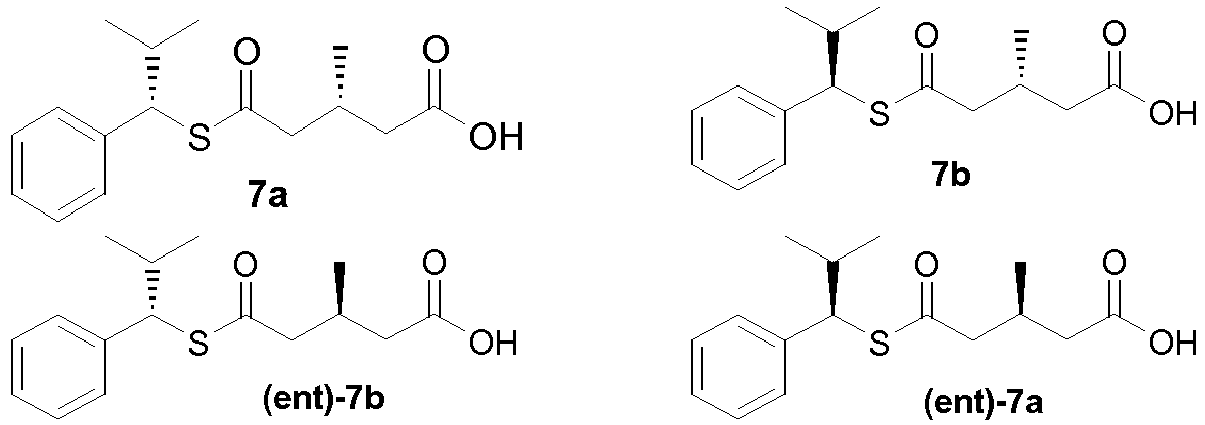
- Chromatogram of the thioesters 7a-b (derivatised as their o-nitrophenyl esters for analysis via CSP-HPLC) from the reaction of 1 with 3 in the presence of triethylamine and an achiral thiourea as catalysts. The chromatogram clearly identifies the enantiomeric relationship between the peaks at 16.2 and 23.1 min (7a and its enantiomer) and between those at 17.9 min and 48.0 min (7b and its enantiomer).
Peak No Result Ret. Time (min) 1 19.870 16.199 2 8.148 17.894 3 19.780 23.066 4 7.983 48.045 
- Chromatogram of the thioesters 7a-b (derivatised as their o-nitrophenyl esters for analysis via CSP-HPLC) from the reaction of (S)-1 (84.5% ee) with 3 in the presence of triethylamine and an achiral thiourea as catalysts. The chromatogram clearly allows the identification of the major diastereomer 7a derived from attack of the enantioenriched thiol on a single prochiral carbonyl group to give (R)-stereochemistry at the carbon chain. This is the sense of stereoinduction expected from previous work and confirmed by conversion of a mixture of thioester diastereomers derived from the addition of 22 to 3 catalysed by 18 to a lactone of known configuration (see below). The 84.5% ee relationship between the peaks at 17 and 48 min confirms the identity of ent-7a. Likewise, the larger of the two peaks associated with the 7b diastereomer must therefore be ent-7b (i.e. with (S)-stereochemistry at the carbon bound to the sulphur atom).
Peak No Result Ret. Time (min) 1 19.603 14.618 2 13.613 16.034 3 2.375 20.309 4 0.846 42.152 
- The sense of stereoinduction associated with the desymmetrisation reaction was determined by conversion of the mixture of thioester diastereomers derived from the addition of 22 to 3 (i.e. Table 2, entry 4) to the lactone shown below and comparison of the optical rotation of that lactone derivative with the literature data (Irwin, A. J. & Jones, J. B. Asymmetric syntheses via enantiotopically selective horse liver alcohol dehydrogenase catalyzed oxidations of diols containing a prochiral center. J. Am. Chem. Soc. 99, 556-561 (1977)).

- The mixture of thioester diastereomers (92.5 mg, 0.30 mmol) was dissolved in THF (5 mL) and LiOH (12.6 mg, 0.30 mmol) was added. The reaction was heated to 50 °C and stirred for 15 minutes. LiClO4 (159.6 mg, 1.50 mmol) and NaBH4 (56.7 mg, 1.50 mmol) were then added and the reaction mixture was stirred at 50 °C for 1 h. The solvent was concentrated in vacuo, HCl (10 N, 5 mL) was added and the mixture was stirred at room temperature for 3 h. The desired product was extracted with CHCl3 (3x10 mL), the combined extracts were dried (MgSO4), concentrated in vacuo and purified by flash-chromatographyto give the lactone shown above as a colourless oil (22.0 mg, 0.19 mmol, 64% yield). [α]20 D = -16.5 (c 0.22, CHCl3), Lit. [α]27 D= -24.8 (c = 1.02, CHCl3; 90% ee, (S)-enantiomer). 1H NMR (400 MHz, CDCl3): δ 4.49-4.41 (m, 1 H), 4.28 (td, J = 10.5 and 3.5 Hz, 1 H), 2.76-2.65 (m, 1 H), 2.18-2.08 (m, 2H), 2.00-1.90 (m, 1 H), 1.61-1.49 (m, 1 H), 1.09 (d, J = 6.0 Hz, 3H). 13C NMR (100 MHz, CDCl3): δ 171.0 (q), 68.4, 38.1, 30.5, 26.4, 21.3.
- By obtaining the (-) enantiomer of the lactone it is certain (from a comparison with the literature value for the (S) enantiomer of the lactone [Irwin, A. J. & Jones, J. B. Asymmetric syntheses via enantiotopically selective horse liver alcohol dehydrogenase catalyzed oxidations of diols containing a prochiral center. J. Am. Chem. Soc. 99, 556-561 (1977).]) that the major diastereomer derived from the addition of 22 to 3 possessed (R)-stereochemistry at the new stereocentre (which was the 3-position of the glutaric anhydride).
- Chromatogram of the thioesters 7a-b (derivatised as their o-nitrophenyl esters for analysis via CSP-HPLC) from the reaction of 1 with 3 in the presence of
catalyst 18 under the conditions outlined in Table 1 entry 19. The chromatogram clearly identifies (7a + ent-7a) as the major diastereomer (89:11 dr) and allows the calculation of ee esterA, ee esterB, ee desymm, C and S.Peak No Result Ret. Time (min) 1 0.441 13.880 2 44.742 15.063 3 5.069 18.735 4 0.392 38.049 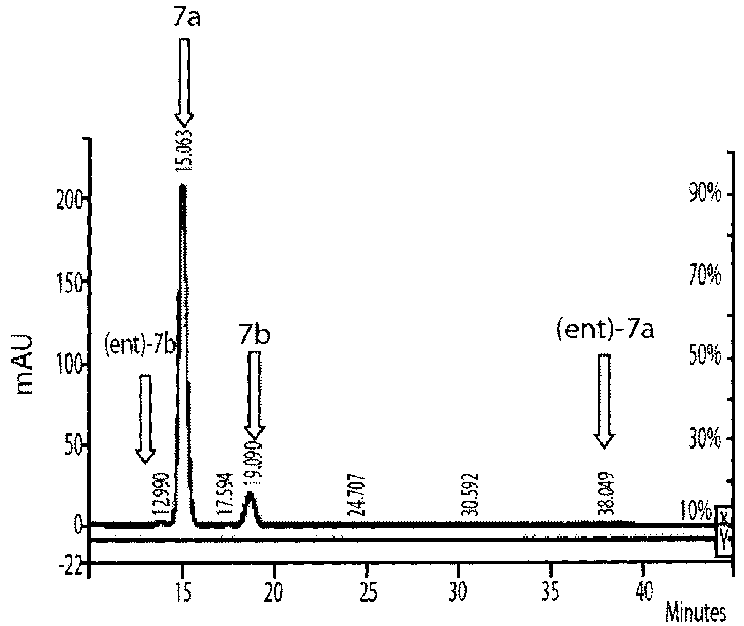
-






- Note: C calculated this way correlated precisely (within experimental error) with the conversion levels measured by 1H NMR spectroscopy in all cases.

- A 20 mL reaction vial containing a stirring bar was charged with 3-isobutylglutaric anhydride (4) (102.1 mg, 0.60 mmol) and 18 (47.2 mg, 0.080 mmol). The reaction vial was flushed with argon and fitted with a septum. MTBE was then injected (4.0 mL, 0.2M) and the solution cooled to -30° C. 28 (0.30 mmol) was added dropwise via syringe and the resulting solution was stirred for 48 h. The mixture was the immediately loaded onto a column and the 'slow reacting' thiol enantiomer separated from the mixture by flash-chromatography (71.0 mg, 0.39 mmol, 98.7% ee as determined by CSP-HPLC after derivatisation as per general procedure B). The hemithioester product (29) was suspended in aq. NH3 (3 mL) and stirred at room temperature for 4 h. The reaction was then diluted with CH2Cl2 (10.0 mL) and H2O (5.0 mL) and transferred to a separating funnel. The organic and aqueous layers were separated and the aqueous layer was extracted with CH2Cl2 (2 x 10.0 mL). The combined organic layers were then dried over MgSO4 and the solvent removed under reduced pressure affording the 'fast reacting' (S)-thiol enantiomer (62.4 mg, 0.35 mmol, 95.5% ee as determined by CSP-HPLC after derivatisation as per general procedure B) after flash chromatography. Conversion = 50.8%, S Factor = 226.
- The aqueous layer was then acidified by addition of HCl (8 N) and extracted with EtOAc (5 x 15 mL). The combined organic phases were then dried over magnesium sulphate and the solvent was removed under reduced pressure to afford the desired hemiamide as a white solid (71.2 mg, 0.38 mmol, 97.0% ee as determined by CSP-HPLC after transformation to the corresponding o-nitrophenoxy ester, as per the procedure reported below).
- 1H NMR spectrum of (S)-30 (400 MHz, DMSO-d6): δ 12.0 (br s, 1 H), 7.27 (s, 1 H), 6.74 (s, 1 H), 2.22-1.91 (m, 5H), 1.66-1.51 (m, 1 H), 1.09 (app t, J 6.6, 2H), 0.81 (d, J 6.6, 6H). 13C NMR(100 MHz, DMSO-d6): δ 174.3 (q), 173.9 (q), 43.6, 40.2, 39.2, 30.1, 25.0, 23.2, 23.1. HRMS (m/z): [M+Na]+calcd. for C9H17NO3Na 210.1106; found, 210.1114.
- The words "comprises/comprising" and the words "having/including" when used herein with reference to the present invention are used to specify the presence of stated features, integers, steps or components but do not preclude the presence or addition of one or more other features, integers, steps, components or groups thereof.
- It is appreciated that certain features of the invention, which are, for clarity, described in the context of separate embodiments, may also be provided in combination in a single embodiment. Conversely, various features of the invention which are, for brevity, described in the context of a single embodiment, may also be provided separately or in any suitable subcombination.
Claims (15)
- A method of resolving a mixture of stereoisomers of a thiol comprising the step of preferentially acylating one thiol stereoisomer in the presence of a bifunctional organocatalyst, wherein the bifunctional organocatalyst is a chiral organic molecule comprising between 5 and 60 carbon atoms, having a Lewis acid moiety and a Lewis base moiety, within the molecule, which is used in a sub-stoichiometric loading relative to the mixture of stereoisomers of the thiol.
- A method according to Claim 1 wherein the mixture of stereoisomers of the thiol is an enantiomeric mixture of the thiol.
- A method according to Claim 1 or 2 wherein the thiols are selected from the group consisting of primary thiols and secondary thiols.
- A method according to any preceding Claim wherein the bifunctional organocatalyst comprises a cinchona alkaloid.
- A method according to Claim 4 wherein the cinchona alkaloid is substituted with a urea, thiourea or sulfonamide functional group.
- A method according to any one of Claims 1 to 3 wherein the bifunctional organocatalyst is selected from the group consisting of:


 wherein X can be O or S;Z can be a C1 to C5 carbon chain optionally comprising at least one C-C unsaturated bond, and optionally substituted one or more times with at least one of a halogen, cyano, CF3, NO2, C1-C5 ketone, C1-C5 ester, C1-C10 amide, C1-C5 sulfone, C1-C5 sulfoxide and combinations thereof;M can be H, OH, or OMe;B can be C1-C15 alkyl, C3-C15 cycloalkyl, C5-C15 aryl, C5-C15 heteroaryl or combinations thereof, optionally substituted one or more times with at least one of a halogen, cyano, CF3, NO2, C1-C5 ketone, C1-C5 ester, C1-C10 amide, C1-C5 sulfone, C1-C5 sulfoxide, C1-C5 alkyl and combinations thereof;R1 and R2 can be the same or different and may comprise C1-C15 alkyl, or R1 and R2 may together with N define a C3-C15 heterocyclic ring, wherein each may be optionally substituted one or more times with at least one of a halogen, cyano, CF3, NO2, C1-C5 ketone, C1-C5 ester, C1-C10 amide, C1-C5 sulfone, C1-C5 sulfoxide, C1-C5 alkyl and combinations thereof;R3 and R4 can be the same or different and may comprise C1-C15 alkyl, or R3 and R4 may together define a C3-C15 cycloalkyl ring, a C5-C15 aryl ring, or a C5-C15 heteroaryl ring wherein each may be optionally substituted one or more times with at least one of a halogen, cyano, CF3, NO2, C1-C5 ketone, C1-C5 ester, C1-C10 amide, C1-C5 sulfone, C1-C5 sulfoxide, C1-C5 alkyl and combinations thereof; andR5 and R6 can be the same or different and may comprise C1-C15 alkyl, or R5 and R6 may together define a C3-C15 cycloalkyl ring, C5-C15 aryl ring, or a C5-C15 heteroaryl ring wherein each may be optionally substituted one or more times with at least one of a halogen, cyano, CF3, NO2, C1-C5 ketone, C1-C5 ester, C1-C10 amide, C1-C5 sulfone, C1-C5 sulfoxide, C1-C5 alkyl and combinations thereof.
 - A method according to any preceding Claim wherein the step of acylating the thiol comprises reacting the thiol with an organic anhydride.
- A method according to Claim 7 wherein the organic anhydride is selected from the group consisting of:
 wherein R1 and R2 are the same or different and are selected from the group consisting of C1-C20 alkyl, C3-C20 cycloalkyl, C5-C20 aryl, C5-C20 heteroaryl and combinations thereof, optionally substituted with at least one of a halogen, cyano, or C1-C5 fluoroalkyl;R3 and R4 are the same or different and are selected from the group consisting of H, C1-C20 alkyl, C3-C20 cycloalkyl, C5-C20 aryl, C5-C20 heteroaryl and combinations thereof, optionally substituted with at least one of a halogen, cyano, or C1-C5 fluoroalkyl, such that at least one of R3 and R4 is H;R5 and R6 are the same or different and are selected from the group consisting of H, C1-C20 alkyl, C3-C20 cycloalkyl, C5-C20 aryl, C5-C20 heteroaryl and combinations thereof, optionally substituted with at least one of a halogen, cyano, or C1-C5 fluoroalkyl; andn is 0-5.
 - A process for the preparation of enantioenriched 3-(aminomethyl)-5-methylhexanoic acid comprising the steps of:i) preferentially acylating one thiol enantiomer of an enantiomeric mixture of the thiol with 3-isobutylglutaric anhydride in the presence of a bifunctional organocatalyst; wherein the bifunctional organocatalyst is a chiral organic molecule comprising between 5 and 60 carbon atoms, having a Lewis acid moiety and a Lewis base moiety, within the molecule, which is used in a sub-stoichiometric loading relative to the mixture of the thiol andii) converting the thioester functional group into an amine.
- A process according to Claim 9 wherein the step of converting the thioester functional group into an amine comprises:i) aminolysis of the thioester functional group to yield an amide; andii) subjecting the amide product of step i) to a Hofmann rearrangement.
- A molecule having the general structure:
 wherein Z can be a C1 to C5 carbon chain optionally comprising at least one C-C unsaturated bond, and optionally substituted one or more times with at least one of a halogen, cyano, CF3, NO2, C1-C5 ketone, C1-C5 ester, C1-C10 amide, C1-C5 sulfone, C1-C5 sulfoxide and combinations thereof; andM can be H, OH, or OMe.
 - Use of a molecule according to Claim 11 as an acylation catalyst in the resolution of a mixture of stereoisomers of a thiol.
- A method of desymmetrising at least one of a prochiral anhydride or a meso anhydride comprising the steps of:(i) adding the prochiral anhydride or meso anhydride to a mixture of enantiomeric thiols; and(ii) adding a bifunctional organocatalyst to the mixture of the prochiral anhydride and the enantiomeric thiols; wherein the bifunctional organocatalyst is a chiral organic molecule comprising between 5 and 60 carbon atoms, having a Lewis acid moiety and a Lewis base moiety, within the molecule, which is used in a sub-stoichiometric loading relative to the mixture of enantiomeric thiols.
- A method according to Claim 13 wherein the prochiral anhydride is of the general formula:
 wherein R3 and R4 are the same or different and are selected from the group consisting of H, C1-C20 alkyl, C3-C20 cycloalkyl, C5-C20 aryl, C5-C20 heteroaryl and combinations thereof, optionally substituted with at least one of a halogen, cyano, or C1-C5 fluoroalkyl, such that at least one of R3 and R4 is H; andn is 1; andthe meso anhydride is of the general formula:
- A method according to Claim 13 wherein the thiols are selected from the group consisting of primary thiols and secondary thiols.
Priority Applications (1)
| Application Number | Priority Date | Filing Date | Title |
|---|---|---|---|
| EP10787133.7A EP2509933B1 (en) | 2009-12-09 | 2010-12-07 | Kinetic resolution |
Applications Claiming Priority (3)
| Application Number | Priority Date | Filing Date | Title |
|---|---|---|---|
| EP09178565A EP2332895A1 (en) | 2009-12-09 | 2009-12-09 | Kinetic Resolution |
| EP10787133.7A EP2509933B1 (en) | 2009-12-09 | 2010-12-07 | Kinetic resolution |
| PCT/EP2010/069097 WO2011070028A1 (en) | 2009-12-09 | 2010-12-07 | Kinetic resolution |
Publications (2)
| Publication Number | Publication Date |
|---|---|
| EP2509933A1 EP2509933A1 (en) | 2012-10-17 |
| EP2509933B1 true EP2509933B1 (en) | 2016-04-20 |
Family
ID=42313011
Family Applications (2)
| Application Number | Title | Priority Date | Filing Date |
|---|---|---|---|
| EP09178565A Withdrawn EP2332895A1 (en) | 2009-12-09 | 2009-12-09 | Kinetic Resolution |
| EP10787133.7A Not-in-force EP2509933B1 (en) | 2009-12-09 | 2010-12-07 | Kinetic resolution |
Family Applications Before (1)
| Application Number | Title | Priority Date | Filing Date |
|---|---|---|---|
| EP09178565A Withdrawn EP2332895A1 (en) | 2009-12-09 | 2009-12-09 | Kinetic Resolution |
Country Status (3)
| Country | Link |
|---|---|
| US (2) | US8946429B2 (en) |
| EP (2) | EP2332895A1 (en) |
| WO (1) | WO2011070028A1 (en) |
Families Citing this family (4)
| Publication number | Priority date | Publication date | Assignee | Title |
|---|---|---|---|---|
| EP2332895A1 (en) * | 2009-12-09 | 2011-06-15 | The Provost, Fellows and Scholars of the College of the Holy and Undivided Trinity of Queen Elizabeth near Dublin | Kinetic Resolution |
| JP5943319B2 (en) * | 2011-12-01 | 2016-07-05 | 国立大学法人 名古屋工業大学 | Heteroarenesulfonylated quinaalkaloid amine compounds |
| CN104119255B (en) * | 2013-04-23 | 2015-12-23 | 中国科学院大连化学物理研究所 | A kind of method preparing the Cycloene derivate of polyfluorinated alkyl |
| GB201501144D0 (en) * | 2015-01-23 | 2015-03-11 | Avexxin As | Process for the preparation of a polyunsaturated ketone compound |
Family Cites Families (2)
| Publication number | Priority date | Publication date | Assignee | Title |
|---|---|---|---|---|
| ATE554182T1 (en) * | 2007-10-16 | 2012-05-15 | Dsm Ip Assets Bv | METHOD FOR PRODUCING AN ENANTIOMERIC AND/OR DIASTEREOMERIC ENRICHED ESTERS, THIOESTERS, ALCOHOL OR THIOLS |
| EP2332895A1 (en) * | 2009-12-09 | 2011-06-15 | The Provost, Fellows and Scholars of the College of the Holy and Undivided Trinity of Queen Elizabeth near Dublin | Kinetic Resolution |
-
2009
- 2009-12-09 EP EP09178565A patent/EP2332895A1/en not_active Withdrawn
-
2010
- 2010-12-07 WO PCT/EP2010/069097 patent/WO2011070028A1/en not_active Ceased
- 2010-12-07 EP EP10787133.7A patent/EP2509933B1/en not_active Not-in-force
- 2010-12-07 US US13/515,092 patent/US8946429B2/en not_active Expired - Fee Related
-
2014
- 2014-09-25 US US14/496,157 patent/US9346755B2/en not_active Expired - Fee Related
Non-Patent Citations (2)
| Title |
|---|
| A. PESCHIULLI, ET AL.: "Kinetic Resolution of Thiols", SYNFACTS, vol. 2010, no. 07, 22 June 2010 (2010-06-22), pages 0825 - 0825, XP055158171, ISSN: 1861-1958, DOI: 10.1055/s-0029-1220116 * |
| A. PESCHIULLI, ET AL.: "Synergistic organocatalysis in the kinetic resolution of secondary thiols with concomitant desymmetrisation of an anhydride", NATURE CHEMISTRY, vol. 2, no. 5, 1 May 2010 (2010-05-01), Nature Publishng Group, GB, pages 380 - 384, XP008124429, ISSN: 1755-4330, DOI: 10.1038/nchem.584 * |
Also Published As
| Publication number | Publication date |
|---|---|
| EP2332895A1 (en) | 2011-06-15 |
| US9346755B2 (en) | 2016-05-24 |
| WO2011070028A1 (en) | 2011-06-16 |
| EP2509933A1 (en) | 2012-10-17 |
| US20150073170A1 (en) | 2015-03-12 |
| US20120277437A1 (en) | 2012-11-01 |
| US8946429B2 (en) | 2015-02-03 |
Similar Documents
| Publication | Publication Date | Title |
|---|---|---|
| Guan et al. | Enantioselective oxysulfenylation and oxyselenenylation of olefins catalyzed by chiral Brønsted acids | |
| US9346755B2 (en) | Kinetic resolution | |
| Guizzetti et al. | Chiral Lewis base promoted trichlorosilane reduction of ketimines. An enantioselective organocatalytic synthesis of chiral amines | |
| Tanaka et al. | Enantioselective amination of silylketene acetals with (N-arylsulfonylimino) phenyliodinanes catalyzed by chiral dirhodium (II) carboxylates: asymmetric synthesis of phenylglycine derivatives | |
| Kobayashi et al. | A ligand-accelerated chiral Lewis acid catalyst in asymmetric Michael addition of thiols to α, β-unsaturated carbonyls | |
| Pei et al. | Organocatalytic diastereo-and enantioselective sulfa-Michael addition to α, β-disubstituted nitroalkenes | |
| Zhang et al. | Enantioselective desymmetrization of meso-aziridines with aromatic thiols catalyzed by chiral bifunctional quaternary phosphonium salts derived from α-amino acids | |
| CN102197021B (en) | Method for producing fluorosulfuric acid ester | |
| Schwab et al. | Organocatalytic asymmetric aldol reactions mediated by a cysteine-derived prolinamide | |
| JP2013515045A (en) | Process for the production of dithiocarbamates from polyols, in particular glycerol type polyols | |
| Sasaki et al. | Synthesis of α, α-difluoro-β-hydroxy ketone via the La (OTf) 3-catalyzed aldol reaction of carbonyl compounds with difluoroenol O-Boc esters | |
| Verma et al. | Dicationic ionic liquids as effective catalysts in solvent free strecker synthesis | |
| KR20040081157A (en) | Novel optically active compounds, method for kinetic optical resolution of carboxylic acid derivatives and catalysts therefor | |
| Tseng et al. | Asymmetric conjugate addition of thiols to chiral methacryloyloxazolidinones | |
| Younai et al. | Influence of chiral thiols on the diastereoselective synthesis of γ-lactams from cyclic anhydrides | |
| Takagi et al. | Disulfonimide catalyzed asymmetric intramolecular hydroamination of alkenyl thioureas: Concentration effect in the hydroamination | |
| Skarżewski et al. | A new and efficient route to homochiral γ-hydroxysulfoxides and γ-hydroxysulfones | |
| EP2391600B1 (en) | Intermediates in the enantioselective synthesis of 3-(aminomethyl)-5-methyl-hexanoic acid | |
| RU2725878C1 (en) | Chiral myrtanyl sulphonamides | |
| Šebesta et al. | Enantioselective Michael additions of aldehydes to nitroalkenes catalyzed with ionically tagged organocatalyst | |
| EP4186882A1 (en) | Method for producing optically active compound | |
| Tanikaga et al. | Baker's yeast-mediated reduction of cyclohexanones containing a nitro or a sulfonyl group at C-3 | |
| Laars et al. | Cyclic amino acid salts as catalysts for the asymmetric Michael reaction | |
| WO2015063791A1 (en) | Novel process for total synthesis of venlafaxine | |
| EP1666458A1 (en) | Optically active 3,3 -dithiobis(2-amino-2-methylpropioni c acid) derivative and process for producing optically active 2-amino-3-mercapto-2-methyl-propionic acid derivative |
Legal Events
| Date | Code | Title | Description |
|---|---|---|---|
| PUAI | Public reference made under article 153(3) epc to a published international application that has entered the european phase |
Free format text: ORIGINAL CODE: 0009012 |
|
| 17P | Request for examination filed |
Effective date: 20120618 |
|
| AK | Designated contracting states |
Kind code of ref document: A1 Designated state(s): AL AT BE BG CH CY CZ DE DK EE ES FI FR GB GR HR HU IE IS IT LI LT LU LV MC MK MT NL NO PL PT RO RS SE SI SK SM TR |
|
| DAX | Request for extension of the european patent (deleted) | ||
| 17Q | First examination report despatched |
Effective date: 20130628 |
|
| REG | Reference to a national code |
Ref country code: DE Ref legal event code: R079 Ref document number: 602010032590 Country of ref document: DE Free format text: PREVIOUS MAIN CLASS: C07B0053000000 Ipc: C07B0057000000 |
|
| RIC1 | Information provided on ipc code assigned before grant |
Ipc: C07C 229/08 20060101ALI20150828BHEP Ipc: C07C 319/12 20060101ALI20150828BHEP Ipc: C07C 323/16 20060101ALI20150828BHEP Ipc: C07C 227/32 20060101ALI20150828BHEP Ipc: C07C 323/07 20060101ALI20150828BHEP Ipc: C07C 321/10 20060101ALI20150828BHEP Ipc: C07B 57/00 20060101AFI20150828BHEP Ipc: C07C 327/28 20060101ALI20150828BHEP Ipc: C07C 319/28 20060101ALI20150828BHEP Ipc: C07C 231/18 20060101ALI20150828BHEP Ipc: C07D 453/04 20060101ALI20150828BHEP Ipc: C07C 319/02 20060101ALI20150828BHEP Ipc: C07C 327/22 20060101ALI20150828BHEP Ipc: C07C 233/05 20060101ALI20150828BHEP |
|
| GRAP | Despatch of communication of intention to grant a patent |
Free format text: ORIGINAL CODE: EPIDOSNIGR1 |
|
| INTG | Intention to grant announced |
Effective date: 20151002 |
|
| GRAS | Grant fee paid |
Free format text: ORIGINAL CODE: EPIDOSNIGR3 |
|
| GRAA | (expected) grant |
Free format text: ORIGINAL CODE: 0009210 |
|
| INTG | Intention to grant announced |
Effective date: 20160229 |
|
| AK | Designated contracting states |
Kind code of ref document: B1 Designated state(s): AL AT BE BG CH CY CZ DE DK EE ES FI FR GB GR HR HU IE IS IT LI LT LU LV MC MK MT NL NO PL PT RO RS SE SI SK SM TR |
|
| REG | Reference to a national code |
Ref country code: GB Ref legal event code: FG4D |
|
| REG | Reference to a national code |
Ref country code: CH Ref legal event code: EP |
|
| REG | Reference to a national code |
Ref country code: AT Ref legal event code: REF Ref document number: 792270 Country of ref document: AT Kind code of ref document: T Effective date: 20160515 |
|
| REG | Reference to a national code |
Ref country code: IE Ref legal event code: FG4D |
|
| REG | Reference to a national code |
Ref country code: DE Ref legal event code: R096 Ref document number: 602010032590 Country of ref document: DE |
|
| REG | Reference to a national code |
Ref country code: LT Ref legal event code: MG4D |
|
| REG | Reference to a national code |
Ref country code: AT Ref legal event code: MK05 Ref document number: 792270 Country of ref document: AT Kind code of ref document: T Effective date: 20160420 |
|
| REG | Reference to a national code |
Ref country code: NL Ref legal event code: MP Effective date: 20160420 |
|
| REG | Reference to a national code |
Ref country code: FR Ref legal event code: PLFP Year of fee payment: 7 |
|
| PG25 | Lapsed in a contracting state [announced via postgrant information from national office to epo] |
Ref country code: NL Free format text: LAPSE BECAUSE OF FAILURE TO SUBMIT A TRANSLATION OF THE DESCRIPTION OR TO PAY THE FEE WITHIN THE PRESCRIBED TIME-LIMIT Effective date: 20160420 Ref country code: NO Free format text: LAPSE BECAUSE OF FAILURE TO SUBMIT A TRANSLATION OF THE DESCRIPTION OR TO PAY THE FEE WITHIN THE PRESCRIBED TIME-LIMIT Effective date: 20160720 Ref country code: LT Free format text: LAPSE BECAUSE OF FAILURE TO SUBMIT A TRANSLATION OF THE DESCRIPTION OR TO PAY THE FEE WITHIN THE PRESCRIBED TIME-LIMIT Effective date: 20160420 Ref country code: FI Free format text: LAPSE BECAUSE OF FAILURE TO SUBMIT A TRANSLATION OF THE DESCRIPTION OR TO PAY THE FEE WITHIN THE PRESCRIBED TIME-LIMIT Effective date: 20160420 Ref country code: PL Free format text: LAPSE BECAUSE OF FAILURE TO SUBMIT A TRANSLATION OF THE DESCRIPTION OR TO PAY THE FEE WITHIN THE PRESCRIBED TIME-LIMIT Effective date: 20160420 |
|
| PG25 | Lapsed in a contracting state [announced via postgrant information from national office to epo] |
Ref country code: AT Free format text: LAPSE BECAUSE OF FAILURE TO SUBMIT A TRANSLATION OF THE DESCRIPTION OR TO PAY THE FEE WITHIN THE PRESCRIBED TIME-LIMIT Effective date: 20160420 Ref country code: RS Free format text: LAPSE BECAUSE OF FAILURE TO SUBMIT A TRANSLATION OF THE DESCRIPTION OR TO PAY THE FEE WITHIN THE PRESCRIBED TIME-LIMIT Effective date: 20160420 Ref country code: HR Free format text: LAPSE BECAUSE OF FAILURE TO SUBMIT A TRANSLATION OF THE DESCRIPTION OR TO PAY THE FEE WITHIN THE PRESCRIBED TIME-LIMIT Effective date: 20160420 Ref country code: LV Free format text: LAPSE BECAUSE OF FAILURE TO SUBMIT A TRANSLATION OF THE DESCRIPTION OR TO PAY THE FEE WITHIN THE PRESCRIBED TIME-LIMIT Effective date: 20160420 Ref country code: GR Free format text: LAPSE BECAUSE OF FAILURE TO SUBMIT A TRANSLATION OF THE DESCRIPTION OR TO PAY THE FEE WITHIN THE PRESCRIBED TIME-LIMIT Effective date: 20160721 Ref country code: SE Free format text: LAPSE BECAUSE OF FAILURE TO SUBMIT A TRANSLATION OF THE DESCRIPTION OR TO PAY THE FEE WITHIN THE PRESCRIBED TIME-LIMIT Effective date: 20160420 Ref country code: ES Free format text: LAPSE BECAUSE OF FAILURE TO SUBMIT A TRANSLATION OF THE DESCRIPTION OR TO PAY THE FEE WITHIN THE PRESCRIBED TIME-LIMIT Effective date: 20160420 Ref country code: PT Free format text: LAPSE BECAUSE OF FAILURE TO SUBMIT A TRANSLATION OF THE DESCRIPTION OR TO PAY THE FEE WITHIN THE PRESCRIBED TIME-LIMIT Effective date: 20160822 |
|
| PG25 | Lapsed in a contracting state [announced via postgrant information from national office to epo] |
Ref country code: BE Free format text: LAPSE BECAUSE OF FAILURE TO SUBMIT A TRANSLATION OF THE DESCRIPTION OR TO PAY THE FEE WITHIN THE PRESCRIBED TIME-LIMIT Effective date: 20160420 Ref country code: IT Free format text: LAPSE BECAUSE OF FAILURE TO SUBMIT A TRANSLATION OF THE DESCRIPTION OR TO PAY THE FEE WITHIN THE PRESCRIBED TIME-LIMIT Effective date: 20160420 |
|
| REG | Reference to a national code |
Ref country code: DE Ref legal event code: R097 Ref document number: 602010032590 Country of ref document: DE |
|
| PG25 | Lapsed in a contracting state [announced via postgrant information from national office to epo] |
Ref country code: EE Free format text: LAPSE BECAUSE OF FAILURE TO SUBMIT A TRANSLATION OF THE DESCRIPTION OR TO PAY THE FEE WITHIN THE PRESCRIBED TIME-LIMIT Effective date: 20160420 Ref country code: SK Free format text: LAPSE BECAUSE OF FAILURE TO SUBMIT A TRANSLATION OF THE DESCRIPTION OR TO PAY THE FEE WITHIN THE PRESCRIBED TIME-LIMIT Effective date: 20160420 Ref country code: RO Free format text: LAPSE BECAUSE OF FAILURE TO SUBMIT A TRANSLATION OF THE DESCRIPTION OR TO PAY THE FEE WITHIN THE PRESCRIBED TIME-LIMIT Effective date: 20160420 Ref country code: CZ Free format text: LAPSE BECAUSE OF FAILURE TO SUBMIT A TRANSLATION OF THE DESCRIPTION OR TO PAY THE FEE WITHIN THE PRESCRIBED TIME-LIMIT Effective date: 20160420 Ref country code: DK Free format text: LAPSE BECAUSE OF FAILURE TO SUBMIT A TRANSLATION OF THE DESCRIPTION OR TO PAY THE FEE WITHIN THE PRESCRIBED TIME-LIMIT Effective date: 20160420 |
|
| PGFP | Annual fee paid to national office [announced via postgrant information from national office to epo] |
Ref country code: GB Payment date: 20161018 Year of fee payment: 7 Ref country code: DE Payment date: 20161031 Year of fee payment: 7 Ref country code: FR Payment date: 20161024 Year of fee payment: 7 |
|
| PLBE | No opposition filed within time limit |
Free format text: ORIGINAL CODE: 0009261 |
|
| STAA | Information on the status of an ep patent application or granted ep patent |
Free format text: STATUS: NO OPPOSITION FILED WITHIN TIME LIMIT |
|
| PG25 | Lapsed in a contracting state [announced via postgrant information from national office to epo] |
Ref country code: SM Free format text: LAPSE BECAUSE OF FAILURE TO SUBMIT A TRANSLATION OF THE DESCRIPTION OR TO PAY THE FEE WITHIN THE PRESCRIBED TIME-LIMIT Effective date: 20160420 |
|
| 26N | No opposition filed |
Effective date: 20170123 |
|
| PG25 | Lapsed in a contracting state [announced via postgrant information from national office to epo] |
Ref country code: SI Free format text: LAPSE BECAUSE OF FAILURE TO SUBMIT A TRANSLATION OF THE DESCRIPTION OR TO PAY THE FEE WITHIN THE PRESCRIBED TIME-LIMIT Effective date: 20160420 |
|
| REG | Reference to a national code |
Ref country code: CH Ref legal event code: PL |
|
| PG25 | Lapsed in a contracting state [announced via postgrant information from national office to epo] |
Ref country code: MC Free format text: LAPSE BECAUSE OF FAILURE TO SUBMIT A TRANSLATION OF THE DESCRIPTION OR TO PAY THE FEE WITHIN THE PRESCRIBED TIME-LIMIT Effective date: 20160420 |
|
| REG | Reference to a national code |
Ref country code: IE Ref legal event code: MM4A |
|
| PG25 | Lapsed in a contracting state [announced via postgrant information from national office to epo] |
Ref country code: LU Free format text: LAPSE BECAUSE OF NON-PAYMENT OF DUE FEES Effective date: 20161207 Ref country code: LI Free format text: LAPSE BECAUSE OF NON-PAYMENT OF DUE FEES Effective date: 20161231 Ref country code: CH Free format text: LAPSE BECAUSE OF NON-PAYMENT OF DUE FEES Effective date: 20161231 |
|
| PG25 | Lapsed in a contracting state [announced via postgrant information from national office to epo] |
Ref country code: IE Free format text: LAPSE BECAUSE OF NON-PAYMENT OF DUE FEES Effective date: 20161207 |
|
| PG25 | Lapsed in a contracting state [announced via postgrant information from national office to epo] |
Ref country code: CY Free format text: LAPSE BECAUSE OF FAILURE TO SUBMIT A TRANSLATION OF THE DESCRIPTION OR TO PAY THE FEE WITHIN THE PRESCRIBED TIME-LIMIT Effective date: 20160420 Ref country code: HU Free format text: LAPSE BECAUSE OF FAILURE TO SUBMIT A TRANSLATION OF THE DESCRIPTION OR TO PAY THE FEE WITHIN THE PRESCRIBED TIME-LIMIT; INVALID AB INITIO Effective date: 20101207 |
|
| PG25 | Lapsed in a contracting state [announced via postgrant information from national office to epo] |
Ref country code: MK Free format text: LAPSE BECAUSE OF FAILURE TO SUBMIT A TRANSLATION OF THE DESCRIPTION OR TO PAY THE FEE WITHIN THE PRESCRIBED TIME-LIMIT Effective date: 20160420 Ref country code: IS Free format text: LAPSE BECAUSE OF FAILURE TO SUBMIT A TRANSLATION OF THE DESCRIPTION OR TO PAY THE FEE WITHIN THE PRESCRIBED TIME-LIMIT Effective date: 20160420 Ref country code: TR Free format text: LAPSE BECAUSE OF FAILURE TO SUBMIT A TRANSLATION OF THE DESCRIPTION OR TO PAY THE FEE WITHIN THE PRESCRIBED TIME-LIMIT Effective date: 20160420 |
|
| REG | Reference to a national code |
Ref country code: DE Ref legal event code: R119 Ref document number: 602010032590 Country of ref document: DE |
|
| PG25 | Lapsed in a contracting state [announced via postgrant information from national office to epo] |
Ref country code: BG Free format text: LAPSE BECAUSE OF FAILURE TO SUBMIT A TRANSLATION OF THE DESCRIPTION OR TO PAY THE FEE WITHIN THE PRESCRIBED TIME-LIMIT Effective date: 20160420 |
|
| GBPC | Gb: european patent ceased through non-payment of renewal fee |
Effective date: 20171207 |
|
| PG25 | Lapsed in a contracting state [announced via postgrant information from national office to epo] |
Ref country code: MT Free format text: LAPSE BECAUSE OF NON-PAYMENT OF DUE FEES Effective date: 20161207 |
|
| REG | Reference to a national code |
Ref country code: FR Ref legal event code: ST Effective date: 20180831 |
|
| PG25 | Lapsed in a contracting state [announced via postgrant information from national office to epo] |
Ref country code: FR Free format text: LAPSE BECAUSE OF NON-PAYMENT OF DUE FEES Effective date: 20180102 Ref country code: DE Free format text: LAPSE BECAUSE OF NON-PAYMENT OF DUE FEES Effective date: 20180703 Ref country code: AL Free format text: LAPSE BECAUSE OF FAILURE TO SUBMIT A TRANSLATION OF THE DESCRIPTION OR TO PAY THE FEE WITHIN THE PRESCRIBED TIME-LIMIT Effective date: 20160420 |
|
| PG25 | Lapsed in a contracting state [announced via postgrant information from national office to epo] |
Ref country code: GB Free format text: LAPSE BECAUSE OF NON-PAYMENT OF DUE FEES Effective date: 20171207 |