EP2509266A1 - Method of pooling resources of a computer network - Google Patents
Method of pooling resources of a computer network Download PDFInfo
- Publication number
- EP2509266A1 EP2509266A1 EP11305394A EP11305394A EP2509266A1 EP 2509266 A1 EP2509266 A1 EP 2509266A1 EP 11305394 A EP11305394 A EP 11305394A EP 11305394 A EP11305394 A EP 11305394A EP 2509266 A1 EP2509266 A1 EP 2509266A1
- Authority
- EP
- European Patent Office
- Prior art keywords
- vertex
- independent
- edges
- paths
- subpaths
- Prior art date
- Legal status (The legal status is an assumption and is not a legal conclusion. Google has not performed a legal analysis and makes no representation as to the accuracy of the status listed.)
- Withdrawn
Links
Images


Classifications
-
- G—PHYSICS
- G06—COMPUTING OR CALCULATING; COUNTING
- G06F—ELECTRIC DIGITAL DATA PROCESSING
- G06F17/00—Digital computing or data processing equipment or methods, specially adapted for specific functions
- G06F17/10—Complex mathematical operations
-
- H—ELECTRICITY
- H04—ELECTRIC COMMUNICATION TECHNIQUE
- H04L—TRANSMISSION OF DIGITAL INFORMATION, e.g. TELEGRAPHIC COMMUNICATION
- H04L45/00—Routing or path finding of packets in data switching networks
- H04L45/24—Multipath
-
- H—ELECTRICITY
- H04—ELECTRIC COMMUNICATION TECHNIQUE
- H04L—TRANSMISSION OF DIGITAL INFORMATION, e.g. TELEGRAPHIC COMMUNICATION
- H04L45/00—Routing or path finding of packets in data switching networks
- H04L45/24—Multipath
- H04L45/245—Link aggregation, e.g. trunking
-
- H—ELECTRICITY
- H04—ELECTRIC COMMUNICATION TECHNIQUE
- H04L—TRANSMISSION OF DIGITAL INFORMATION, e.g. TELEGRAPHIC COMMUNICATION
- H04L41/00—Arrangements for maintenance, administration or management of data switching networks, e.g. of packet switching networks
- H04L41/14—Network analysis or design
- H04L41/145—Network analysis or design involving simulating, designing, planning or modelling of a network
-
- Y—GENERAL TAGGING OF NEW TECHNOLOGICAL DEVELOPMENTS; GENERAL TAGGING OF CROSS-SECTIONAL TECHNOLOGIES SPANNING OVER SEVERAL SECTIONS OF THE IPC; TECHNICAL SUBJECTS COVERED BY FORMER USPC CROSS-REFERENCE ART COLLECTIONS [XRACs] AND DIGESTS
- Y02—TECHNOLOGIES OR APPLICATIONS FOR MITIGATION OR ADAPTATION AGAINST CLIMATE CHANGE
- Y02D—CLIMATE CHANGE MITIGATION TECHNOLOGIES IN INFORMATION AND COMMUNICATION TECHNOLOGIES [ICT], I.E. INFORMATION AND COMMUNICATION TECHNOLOGIES AIMING AT THE REDUCTION OF THEIR OWN ENERGY USE
- Y02D30/00—Reducing energy consumption in communication networks
- Y02D30/50—Reducing energy consumption in communication networks in wire-line communication networks, e.g. low power modes or reduced link rate
Definitions
- the invention relates to a method of pooling resources of a computer network.
- Teletraffic engineering is the application of traffic engineering theory to telecommunications. Teletraffic engineers use their basic knowledge of statistics including queuing theory, the nature of traffic, their practical models, their measurements and simulations to make predictions and to plan telecommunication networks such as the telephone network or the Internet. Teletraffic engineering methods aim to provide reliable service at lower cost.
- Resource pooling means making a collection of networked resources behave as though they make up a single pooled resource.
- the general method of resource pooling is to build mechanisms for shifting load between various parts of the network.
- resource pooling is often the only practical way to achieve resilience at acceptable cost. As such, resource pooling is a cost-effective way to achieve flexibility and high utilization.
- a conventional resource pooling mechanism can be found in content delivery networks.
- content delivery network or content distribution network is meant a system of computers containing copies of data, placed at various points in a network so as to maximize bandwidth for access to the data from clients throughout the network.
- a client accesses a nearby copy of the data, as opposed to all clients accessing the same central server, so as to avoid bottlenecks near that server.
- the CDN effectively pools the CPU cycles, bandwidth and reliability of the servers employed. If a hot spot develops, traffic can be moved to less overloaded servers or network links. If a server dies, it is just dropped from the pool. This mechanism enables CDNs to move large amounts of traffic from one part of the Internet to another, independently of any traffic engineering performed by upstream Internet service providers (ISPs).
- ISPs upstream Internet service providers
- the present invention was made in view of the prior art described above, and the object of some embodiments is to provide a practical method capable of pooling resources of a computer network.
- a method of pooling resources of a computer network and finding a representation of the "weight" of the resource pool in form of different metrics, wherein each node of the computer network is represented by a vertex of a weighted graph the method comprising the steps of identifying a plurality of paths from a start vertex to an end vertex, finding a longest common subpath from the start vertex to a split vertex, finding a plurality of independent subpaths from the split vertex to a join vertex, and concatenating the edges traversed by the longest common subpath and each of the independent subpaths.
- the basic idea is to define an efficient algorithm that identifies a generic resource pool constituted by a set of paths between two end points (e.g. node X and Y in example Figure 1 ).
- the resource pool can be based on the resource pool(s) from different components to achieve best possible effectiveness and to avoid conflicts with each other. Based on this the resources are identified and selected for resource pooling and aggregated and concatenated on lower layers.
- the method defines an algorithm, which aggregates, concatenates and abstracts a set of paths (resource pool).
- the set of paths can be a result of specific routing or path calculation algorithms.
- the algorithm does not only generate aggregated, concatenated and/or abstracted capacity, but also delay, packet loss and even energy metrics etc. This is supported from network resource ontologies (docket 806410) and enables the representation of metrics of heterogeneous physical resources at each network layer/level.
- the resource pooling has been defined to support cross-layer advertisement of aggregated/concatenated and abstracted metric values (docket 805545). This abstract resource information is available at each network level/layer especially to support resource allocation.
- the resource pool comprises either
- multipath transport mechanisms can deliver the resource pooling. It is possible to achieve resource pooling using the routing system if routers can make a choice of more than one path for traffic forwarding to a destination.
- the ResourceObjects get immediate information about current link characteristics, e. g. link degradation etc.
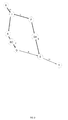
- Figure 1 shows an exemplary network with the end user node X and the end node Y.
- the nodes of the core network consist of the nodes A, B, C, D, E, F, G, H and I.
- the resources of the core network represent the nodes of the resource pool for communication between the end user nodes X and Y.
- the numbers at the edges represent the link capacities.
- an algorithm according to an embodiment of the invention may perform the following steps:
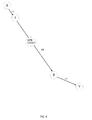
- Figure 4 shows the final result of the resource pooling of the network example.
- the abstracted resource pool information of lower layer resources is determined with the resource pool algorithm and advertised to adjacent (vertical and horizontal) ResourceObjects. This process leads to the abstraction of lower layer resource information to higher network levels.
- the resource pool information serves as a generic basis for network components in order to apply different methods, e.g. resource allocation, routing decisions etc.
- program storage devices e.g., digital data storage media, which are machine or computer readable and encode machine-executable or computer-executable programs of instructions, wherein said instructions perform some or all of the steps of said above-described methods.
- the program storage devices may be, e.g., digital memories, magnetic storage media such as a magnetic disks and magnetic tapes, hard drives, or optically readable digital data storage media.
- the embodiments are also intended to cover computers programmed to perform said steps of the above-described methods.
Landscapes
- Engineering & Computer Science (AREA)
- Physics & Mathematics (AREA)
- Mathematical Physics (AREA)
- Theoretical Computer Science (AREA)
- Data Mining & Analysis (AREA)
- General Physics & Mathematics (AREA)
- Pure & Applied Mathematics (AREA)
- Mathematical Optimization (AREA)
- Algebra (AREA)
- Computational Mathematics (AREA)
- Databases & Information Systems (AREA)
- Software Systems (AREA)
- General Engineering & Computer Science (AREA)
- Mathematical Analysis (AREA)
- Computer Networks & Wireless Communication (AREA)
- Signal Processing (AREA)
- Data Exchanges In Wide-Area Networks (AREA)
Abstract
Method of pooling resources of a computer network, wherein each node of the computer network is represented by a vertex of a weighted graph, the method comprising the steps of identifying a plurality of paths from a start vertex to an end vertex, finding a longest common subpath from the start vertex to a split vertex, finding a plurality of independent subpaths from the split vertex to a join vertex, and concatenating the edges traversed by the longest common subpath and each of the independent subpaths.
Description
- The invention relates to a method of pooling resources of a computer network.
- This section introduces aspects that may be helpful in facilitating a better understanding of the invention. Accordingly, the statements of this section are to be read in this light and are not to be understood as admissions about what is in the prior art or what is not in the prior art.
- In media technology, teletraffic engineering is the application of traffic engineering theory to telecommunications. Teletraffic engineers use their basic knowledge of statistics including queuing theory, the nature of traffic, their practical models, their measurements and simulations to make predictions and to plan telecommunication networks such as the telephone network or the Internet. Teletraffic engineering methods aim to provide reliable service at lower cost.
- As demands on the Internet grow, network operators specifically make use of teletraffic engineering to balance load and improve resilience against failures. These endeavors are reinforced by the challenges of managing wide-area traffic patterns, such as occur in peer-to-peer applications or globally distributed server farms.
- To this end, within the field of teletraffic engineering, an architectural principle has emerged that is commonly referred to as resource pooling. In this context, Resource pooling means making a collection of networked resources behave as though they make up a single pooled resource. The general method of resource pooling is to build mechanisms for shifting load between various parts of the network. In many networks, resource pooling is often the only practical way to achieve resilience at acceptable cost. As such, resource pooling is a cost-effective way to achieve flexibility and high utilization.
- A conventional resource pooling mechanism can be found in content delivery networks. By content delivery network or content distribution network (CDN) is meant a system of computers containing copies of data, placed at various points in a network so as to maximize bandwidth for access to the data from clients throughout the network. A client accesses a nearby copy of the data, as opposed to all clients accessing the same central server, so as to avoid bottlenecks near that server. In doing so, the CDN effectively pools the CPU cycles, bandwidth and reliability of the servers employed. If a hot spot develops, traffic can be moved to less overloaded servers or network links. If a server dies, it is just dropped from the pool. This mechanism enables CDNs to move large amounts of traffic from one part of the Internet to another, independently of any traffic engineering performed by upstream Internet service providers (ISPs).
- A downside of state-of-the-art resource pooling mechanisms such as implemented in CDNs lies in their lack of support for heterogeneous resources. As a consequence, conflicts may occur where network components take incompatible approaches to resource pooling.
- The present invention was made in view of the prior art described above, and the object of some embodiments is to provide a practical method capable of pooling resources of a computer network.
- According to an embodiment there is provided a method of pooling resources of a computer network and finding a representation of the "weight" of the resource pool in form of different metrics, wherein each node of the computer network is represented by a vertex of a weighted graph, the method comprising the steps of identifying a plurality of paths from a start vertex to an end vertex, finding a longest common subpath from the start vertex to a split vertex, finding a plurality of independent subpaths from the split vertex to a join vertex, and concatenating the edges traversed by the longest common subpath and each of the independent subpaths.
- Some embodiments of apparatus and/or methods in accordance with embodiments of the present invention are now described, by way of example only, and with reference to the accompanying drawings, in which:
-
Figure 1 schematically illustrates a network example with end user nodes X and Y and capacity values at the edges (links). -
Figure 2 schematically illustrates the network example with end user nodes X and Y after reaching the joint hops D and E. -
Figure 3 schematically illustrates the network example with end user nodes X and Y after concatenation and aggregation at the joint hops D and E. -
Figure 4 schematically illustrates the final resource pool result of the network example. - Hereinafter, the best mode for carrying out a method according to an embodiment is described in detail.
- The basic idea is to define an efficient algorithm that identifies a generic resource pool constituted by a set of paths between two end points (e.g. node X and Y in example
Figure 1 ). - The resource pool can be based on the resource pool(s) from different components to achieve best possible effectiveness and to avoid conflicts with each other. Based on this the resources are identified and selected for resource pooling and aggregated and concatenated on lower layers.
- The method defines an algorithm, which aggregates, concatenates and abstracts a set of paths (resource pool). The set of paths can be a result of specific routing or path calculation algorithms.
- Additionally, the algorithm does not only generate aggregated, concatenated and/or abstracted capacity, but also delay, packet loss and even energy metrics etc. This is supported from network resource ontologies (docket 806410) and enables the representation of metrics of heterogeneous physical resources at each network layer/level.
- The resource pooling has been defined to support cross-layer advertisement of aggregated/concatenated and abstracted metric values (docket 805545). This abstract resource information is available at each network level/layer especially to support resource allocation.
- As the algorithm should only be performed during design time or on the management plane, the complexity and performance should not be a topic in this case.
- The resource pool comprises either
- the total resources of the whole network or network domain or
- a pre-defined subset of resources of the network or network domain, which is defined from
- o the resource pool(s) of an existing mechanism (e.g. routing mechanism)
- o the cut set of the resource pools of several mechanisms or
- o the set union of the resource pools of several mechanisms
- For example, multipath transport mechanisms can deliver the resource pooling. It is possible to achieve resource pooling using the routing system if routers can make a choice of more than one path for traffic forwarding to a destination.
- In order to define the resources for the generic resource pool, the algorithm
- 1. identifies either all possible disjunctive or partially disjunctive paths or a subset of all possible disjunctive or partially disjunctives paths between two end user nodes, e.g. selected from an existing routing mechanism, starting at hop = X with hopCount = 1.
- 2. The algorithm searches for a (first) cycle for each path by traversing the nodes along the (partially) disjunctive paths until the path joins at a joint hop. As soon as the cycle reaches a joint hop
- a. the algorithm first performs resource concatenation of the edges along the path either starting at the split hop forward to the joint hop or backward starting from the joint hop until the split hop.
- b. the algorithm the performs aggregation of the disjunctive and concatenated edges (links).
- 3. If the algorithm
- a. has reached the end point (hop = Y), the iteration stops.
- b. has not yet reached the end point (hop Y), the number of hopCount is increased by one and the algorithm continues at 2.
- The ResourceObjects get immediate information about current link characteristics, e. g. link degradation etc.
-
Figure 1 shows an exemplary network with the end user node X and the end node Y. The nodes of the core network consist of the nodes A, B, C, D, E, F, G, H and I. In this case the resources of the core network represent the nodes of the resource pool for communication between the end user nodes X and Y. The numbers at the edges represent the link capacities. - In this scenario, an algorithm according to an embodiment of the invention may perform the following steps:
- 1. Identify the disjunctive or partially disjunctive paths between end user node X and end user node Y for the resource pool. Based on the example of
Figure 1 the mechanism identifies the complete set of all possible disjunctive or partially disjunctive paths between X and Y:- a. X → I → F → H → E → Y
- b. X → I → F → G → E → Y
- c. X → I → A → B → D → E → Y
- d. X → I → A → C → D → E → Y
- 2. The algorithm searches for a (first) cycle for each path by traversing the nodes along the (partially) disjunctive paths in parallel until the path joins at a joint hop E respectively D in
Figure 2 . In the example the (partially) disjunctive paths are- a. X → I → F → H → E
- b. X → I → F → G → E
- c. X → I → A → B → D
- d. X → I → A → C → D
- a. 2
- b. 3
- c. 4
- d. 3
- e. X → I → F → GH → E
- f. X → I → A → BC → D
- e. 5
- f. 7
- 3. In the next step the algorithm traverses one more node on the path f. (
Figure 3 ) until the passage ends in node E, which is a joint hop of both paths:- e. X → I → F → GH → E
- f. X → I → A → BC → D → E
In this example, concatenation (minimum capacity values along the paths e. and f.) results to the following capacity values:- e. 5
- f. 6
- g. X → I →
AFBCDGH → E 11
- 4. Then the algorithm traverses one more node and performs concatenation (minimum of the capacity values along the path g.), which results in the final resource pool capacity value 11:
- g. X → I → AFBCDGH → E →
Y 11
- g. X → I → AFBCDGH → E →
- 5. The iteration stops, as the algorithm has reached the end point Y.
-
Figure 4 shows the final result of the resource pooling of the network example. - Based on the set or subset of resources the abstracted resource pool information of lower layer resources is determined with the resource pool algorithm and advertised to adjacent (vertical and horizontal) ResourceObjects. This process leads to the abstraction of lower layer resource information to higher network levels. The resource pool information serves as a generic basis for network components in order to apply different methods, e.g. resource allocation, routing decisions etc.
- A person of skill in the art would readily recognize that steps of various above-described methods can be performed by programmed computers. Herein, some embodiments are also intended to cover program storage devices, e.g., digital data storage media, which are machine or computer readable and encode machine-executable or computer-executable programs of instructions, wherein said instructions perform some or all of the steps of said above-described methods. The program storage devices may be, e.g., digital memories, magnetic storage media such as a magnetic disks and magnetic tapes, hard drives, or optically readable digital data storage media. The embodiments are also intended to cover computers programmed to perform said steps of the above-described methods.
- The description merely illustrates the principles of the invention. It will thus be appreciated that those skilled in the art will be able to devise various arrangements that, although not explicitly described or shown herein, embody the principles of the invention and are included within its spirit and scope. Furthermore, all examples recited herein are principally intended expressly to be only for pedagogical purposes to aid the reader in understanding the principles of the invention and the concepts contributed by the inventor(s) to furthering the art, and are to be construed as being without limitation to such specifically recited examples and conditions. Moreover, all statements herein reciting principles, aspects, and embodiments of the invention, as well as specific examples thereof, are intended to encompass equivalents thereof.
Claims (15)
- Method of pooling resources and quantifying resource pools of a computer network, wherein each node of the computer network is represented by a vertex of a weighted graph, the method comprising the steps of identifying a plurality of paths from a start vertex to an end vertex, finding a longest common subpath from the start vertex to a split vertex, finding a plurality of independent subpaths from the split vertex to a join vertex, and concatenating the edges traversed by the longest common subpath and each of the independent subpaths.
- Method as in claim 1 wherein the edges of the independent subpaths are traversed from the split vertex to the join vertex.
- Method as in claim 1 wherein the edges of the independent subpaths are traversed from the join vertex to the split vertex.
- Method as in any of the preceding claims further comprising the step of concatenating the edges traversed by each of the independent subpaths and subsequently aggregating the edges traversed by each of the independent subpaths.
- Method as in claim 4 wherein the step of concatenating the edges comprises calculating the concatenated weight depending on the metric of the edges for each independent subpath.
- Method as in claim 4 wherein the step of aggregating the edges comprises calculating the aggregated weight of the concatenated weight of the edges for each independent subpath.
- Method as in any of the preceding claims wherein the paths from the start vertex to the end vertex are identified by means of a multipath routing algorithm.
- Method as in any of the preceding claims wherein the step of identifying the paths from the start vertex to the end vertex comprises finding an intersection of the sets of paths computed by a plurality of routing algorithms.
- Method as in any of claims 1 to 7 wherein the step of identifying the paths from the start vertex to the end vertex comprises finding a union of the sets of paths computed by a plurality of routing algorithms.
- Method as in any of the preceding claims wherein the weight of an edge between a first vertex and a second vertex of the graph is associated with a metric of a communications channel between the node represented by the first vertex and the node represented by the second vertex.
- Method as in claim 10 wherein the metric is based on at least one of the following: a capacity of the communications channel, a delay imposed by the communications channel, a packet loss of the communications channel, and an energy consumption associated with the communications channel.
- Method as in claim 10 or 11 comprising the subsequent step of advertising the metric.
- Method as in any of claims 10 to 12 wherein the nodes and the communications channel form part of a network resource ontology.
- Method as in any of the preceding claims wherein the longest common subpath and the independent subpaths are found by traversing each of the plurality of paths from the start vertex to the end vertex.
- Method as in any of the preceding claims wherein the graph takes the form of an acyclic directed graph.
Priority Applications (1)
| Application Number | Priority Date | Filing Date | Title |
|---|---|---|---|
| EP11305394A EP2509266A1 (en) | 2011-04-05 | 2011-04-05 | Method of pooling resources of a computer network |
Applications Claiming Priority (1)
| Application Number | Priority Date | Filing Date | Title |
|---|---|---|---|
| EP11305394A EP2509266A1 (en) | 2011-04-05 | 2011-04-05 | Method of pooling resources of a computer network |
Publications (1)
| Publication Number | Publication Date |
|---|---|
| EP2509266A1 true EP2509266A1 (en) | 2012-10-10 |
Family
ID=44118428
Family Applications (1)
| Application Number | Title | Priority Date | Filing Date |
|---|---|---|---|
| EP11305394A Withdrawn EP2509266A1 (en) | 2011-04-05 | 2011-04-05 | Method of pooling resources of a computer network |
Country Status (1)
| Country | Link |
|---|---|
| EP (1) | EP2509266A1 (en) |
Citations (3)
| Publication number | Priority date | Publication date | Assignee | Title |
|---|---|---|---|---|
| US20030012145A1 (en) * | 2001-07-13 | 2003-01-16 | Nigel Bragg | Routing for a communications network |
| EP2175611A1 (en) * | 2008-02-27 | 2010-04-14 | Huawei Technologies Co., Ltd. | Conversion method and application server of composite scheme of web service |
| WO2010063321A1 (en) * | 2008-12-03 | 2010-06-10 | Telefonaktiebolaget L M Ericsson (Publ) | Generating network topology parameters and monitoring a communications network domain |
-
2011
- 2011-04-05 EP EP11305394A patent/EP2509266A1/en not_active Withdrawn
Patent Citations (3)
| Publication number | Priority date | Publication date | Assignee | Title |
|---|---|---|---|---|
| US20030012145A1 (en) * | 2001-07-13 | 2003-01-16 | Nigel Bragg | Routing for a communications network |
| EP2175611A1 (en) * | 2008-02-27 | 2010-04-14 | Huawei Technologies Co., Ltd. | Conversion method and application server of composite scheme of web service |
| WO2010063321A1 (en) * | 2008-12-03 | 2010-06-10 | Telefonaktiebolaget L M Ericsson (Publ) | Generating network topology parameters and monitoring a communications network domain |
Similar Documents
| Publication | Publication Date | Title |
|---|---|---|
| Chen et al. | Minimizing inter-server communications by exploiting self-similarity in online social networks | |
| CN102388595B (en) | Resource matching method and device in VPC migration | |
| Bęben et al. | Multi-criteria decision algorithms for efficient content delivery in content networks | |
| Zhu et al. | Overlay networks with linear capacity constraints | |
| CN111629390B (en) | Network slice orchestration method and device | |
| Thar et al. | Online caching and cooperative forwarding in information centric networking | |
| Zhu et al. | Energy-efficient graph reinforced vNFC deployment in elastic optical inter-DC networks | |
| Ren et al. | On efficient delay-aware multisource multicasting in NFV-enabled softwarized networks | |
| Mohammadi et al. | Taxonomy of traffic engineering mechanisms in software-defined networks: a survey | |
| Pu | ProNDN: MCDM‐Based Interest Forwarding and Cooperative Data Caching for Named Data Networking | |
| Xiaoqiang et al. | An in-network caching scheme based on betweenness and content popularity prediction in content-centric networking | |
| Lao et al. | Algorithms and trade-offs in multicast service overlay design | |
| Lv et al. | A smart ACO‐inspired named data networking forwarding scheme with clustering analysis | |
| CN115426360A (en) | Graph theory-based hierarchical self-adaptive load balancing method and system | |
| CN101860469A (en) | Method and device for grouping nodes in a point-to-point technical network | |
| CN118869567B (en) | Collective communication processing method, collective communication processing device, computer equipment and storage medium | |
| Kwon et al. | Adaptive tree-based P2P video streaming multicast system under high peer-churn rate | |
| Huo | Packet‐level‐based traffic aggregation to optimize NDN content delivery | |
| Wang et al. | DTN-balance: a forwarding-capacity and forwarding-queue aware routing for self-organizing DTNs | |
| Wu et al. | Optimization algorithms for proxy server placement in content distribution networks | |
| EP2509266A1 (en) | Method of pooling resources of a computer network | |
| García et al. | Multicast routing and virtual network function placement in NFV-SDN networks: A genetic algorithms approach | |
| Lawey et al. | Energy-efficient peer selection mechanism for BitTorrent content distribution | |
| Yang et al. | Replica placement in content delivery networks with stochastic demands and M/M/1 servers | |
| Papafili et al. | A novel game-theoretic framework for modeling interactions of ISPs anticipating users' reactions |
Legal Events
| Date | Code | Title | Description |
|---|---|---|---|
| PUAI | Public reference made under article 153(3) epc to a published international application that has entered the european phase |
Free format text: ORIGINAL CODE: 0009012 |
|
| AK | Designated contracting states |
Kind code of ref document: A1 Designated state(s): AL AT BE BG CH CY CZ DE DK EE ES FI FR GB GR HR HU IE IS IT LI LT LU LV MC MK MT NL NO PL PT RO RS SE SI SK SM TR |
|
| AX | Request for extension of the european patent |
Extension state: BA ME |
|
| 17P | Request for examination filed |
Effective date: 20130410 |
|
| STAA | Information on the status of an ep patent application or granted ep patent |
Free format text: STATUS: THE APPLICATION IS DEEMED TO BE WITHDRAWN |
|
| 18D | Application deemed to be withdrawn |
Effective date: 20130411 |