EP2508155A1 - Bodily fluid treatment article - Google Patents
Bodily fluid treatment article Download PDFInfo
- Publication number
- EP2508155A1 EP2508155A1 EP10833107A EP10833107A EP2508155A1 EP 2508155 A1 EP2508155 A1 EP 2508155A1 EP 10833107 A EP10833107 A EP 10833107A EP 10833107 A EP10833107 A EP 10833107A EP 2508155 A1 EP2508155 A1 EP 2508155A1
- Authority
- EP
- European Patent Office
- Prior art keywords
- coloring material
- display elements
- longitudinal direction
- bodily fluid
- graphics
- Prior art date
- Legal status (The legal status is an assumption and is not a legal conclusion. Google has not performed a legal analysis and makes no representation as to the accuracy of the status listed.)
- Withdrawn
Links
- 210000001124 body fluid Anatomy 0.000 title claims abstract description 26
- 239000000463 material Substances 0.000 claims abstract description 63
- 238000004040 coloring Methods 0.000 claims abstract description 62
- 239000002250 absorbent Substances 0.000 claims abstract description 29
- 230000002745 absorbent Effects 0.000 claims abstract description 24
- 239000000976 ink Substances 0.000 description 8
- 239000004745 nonwoven fabric Substances 0.000 description 8
- 239000008280 blood Substances 0.000 description 6
- 210000004369 blood Anatomy 0.000 description 6
- 230000002175 menstrual effect Effects 0.000 description 6
- 238000007639 printing Methods 0.000 description 6
- 239000000835 fiber Substances 0.000 description 5
- 238000010521 absorption reaction Methods 0.000 description 4
- 239000011248 coating agent Substances 0.000 description 4
- 238000000576 coating method Methods 0.000 description 4
- 238000000034 method Methods 0.000 description 4
- 239000006096 absorbing agent Substances 0.000 description 3
- 230000005906 menstruation Effects 0.000 description 3
- 238000001035 drying Methods 0.000 description 2
- 210000000056 organ Anatomy 0.000 description 2
- 210000002700 urine Anatomy 0.000 description 2
- XLYOFNOQVPJJNP-UHFFFAOYSA-N water Substances O XLYOFNOQVPJJNP-UHFFFAOYSA-N 0.000 description 2
- 229920000742 Cotton Polymers 0.000 description 1
- 239000004831 Hot glue Substances 0.000 description 1
- 230000015572 biosynthetic process Effects 0.000 description 1
- 239000003086 colorant Substances 0.000 description 1
- 230000006835 compression Effects 0.000 description 1
- 238000007906 compression Methods 0.000 description 1
- 239000013078 crystal Substances 0.000 description 1
- 230000007423 decrease Effects 0.000 description 1
- 230000000694 effects Effects 0.000 description 1
- -1 for example Substances 0.000 description 1
- 238000007646 gravure printing Methods 0.000 description 1
- 238000010438 heat treatment Methods 0.000 description 1
- 238000007641 inkjet printing Methods 0.000 description 1
- 239000002245 particle Substances 0.000 description 1
- 239000000049 pigment Substances 0.000 description 1
- 239000002985 plastic film Substances 0.000 description 1
- 229920006255 plastic film Polymers 0.000 description 1
- 229920000642 polymer Polymers 0.000 description 1
- 238000006116 polymerization reaction Methods 0.000 description 1
- 239000011347 resin Substances 0.000 description 1
- 229920005989 resin Polymers 0.000 description 1
- 238000007650 screen-printing Methods 0.000 description 1
- 238000007493 shaping process Methods 0.000 description 1
- 238000009281 ultraviolet germicidal irradiation Methods 0.000 description 1
Images


Classifications
-
- A—HUMAN NECESSITIES
- A61—MEDICAL OR VETERINARY SCIENCE; HYGIENE
- A61F—FILTERS IMPLANTABLE INTO BLOOD VESSELS; PROSTHESES; DEVICES PROVIDING PATENCY TO, OR PREVENTING COLLAPSING OF, TUBULAR STRUCTURES OF THE BODY, e.g. STENTS; ORTHOPAEDIC, NURSING OR CONTRACEPTIVE DEVICES; FOMENTATION; TREATMENT OR PROTECTION OF EYES OR EARS; BANDAGES, DRESSINGS OR ABSORBENT PADS; FIRST-AID KITS
- A61F13/00—Bandages or dressings; Absorbent pads
- A61F13/15—Absorbent pads, e.g. sanitary towels, swabs or tampons for external or internal application to the body; Supporting or fastening means therefor; Tampon applicators
- A61F13/84—Accessories, not otherwise provided for, for absorbent pads
-
- A—HUMAN NECESSITIES
- A61—MEDICAL OR VETERINARY SCIENCE; HYGIENE
- A61F—FILTERS IMPLANTABLE INTO BLOOD VESSELS; PROSTHESES; DEVICES PROVIDING PATENCY TO, OR PREVENTING COLLAPSING OF, TUBULAR STRUCTURES OF THE BODY, e.g. STENTS; ORTHOPAEDIC, NURSING OR CONTRACEPTIVE DEVICES; FOMENTATION; TREATMENT OR PROTECTION OF EYES OR EARS; BANDAGES, DRESSINGS OR ABSORBENT PADS; FIRST-AID KITS
- A61F13/00—Bandages or dressings; Absorbent pads
- A61F13/15—Absorbent pads, e.g. sanitary towels, swabs or tampons for external or internal application to the body; Supporting or fastening means therefor; Tampon applicators
- A61F13/51—Absorbent pads, e.g. sanitary towels, swabs or tampons for external or internal application to the body; Supporting or fastening means therefor; Tampon applicators characterised by the outer layers of the pads
- A61F13/511—Topsheet, i.e. the permeable cover or layer facing the skin
- A61F13/513—Topsheet, i.e. the permeable cover or layer facing the skin characterised by its function or properties, e.g. stretchability, breathability, rewet, visual effect; having areas of different permeability
- A61F13/51394—Topsheet, i.e. the permeable cover or layer facing the skin characterised by its function or properties, e.g. stretchability, breathability, rewet, visual effect; having areas of different permeability creating a visual effect, e.g. having a printed or coloured topsheet, printed or coloured sub-layer but being visible from the topsheet, other than embossing for purposes of bonding, wicking, acquisition, leakage-prevention
-
- A—HUMAN NECESSITIES
- A61—MEDICAL OR VETERINARY SCIENCE; HYGIENE
- A61F—FILTERS IMPLANTABLE INTO BLOOD VESSELS; PROSTHESES; DEVICES PROVIDING PATENCY TO, OR PREVENTING COLLAPSING OF, TUBULAR STRUCTURES OF THE BODY, e.g. STENTS; ORTHOPAEDIC, NURSING OR CONTRACEPTIVE DEVICES; FOMENTATION; TREATMENT OR PROTECTION OF EYES OR EARS; BANDAGES, DRESSINGS OR ABSORBENT PADS; FIRST-AID KITS
- A61F13/00—Bandages or dressings; Absorbent pads
- A61F13/15—Absorbent pads, e.g. sanitary towels, swabs or tampons for external or internal application to the body; Supporting or fastening means therefor; Tampon applicators
- A61F13/45—Absorbent pads, e.g. sanitary towels, swabs or tampons for external or internal application to the body; Supporting or fastening means therefor; Tampon applicators characterised by the shape
- A61F13/47—Sanitary towels, incontinence pads or napkins
- A61F13/472—Sanitary towels, incontinence pads or napkins specially adapted for female use
-
- A—HUMAN NECESSITIES
- A61—MEDICAL OR VETERINARY SCIENCE; HYGIENE
- A61F—FILTERS IMPLANTABLE INTO BLOOD VESSELS; PROSTHESES; DEVICES PROVIDING PATENCY TO, OR PREVENTING COLLAPSING OF, TUBULAR STRUCTURES OF THE BODY, e.g. STENTS; ORTHOPAEDIC, NURSING OR CONTRACEPTIVE DEVICES; FOMENTATION; TREATMENT OR PROTECTION OF EYES OR EARS; BANDAGES, DRESSINGS OR ABSORBENT PADS; FIRST-AID KITS
- A61F13/00—Bandages or dressings; Absorbent pads
- A61F13/15—Absorbent pads, e.g. sanitary towels, swabs or tampons for external or internal application to the body; Supporting or fastening means therefor; Tampon applicators
- A61F13/84—Accessories, not otherwise provided for, for absorbent pads
- A61F2013/8497—Accessories, not otherwise provided for, for absorbent pads having decorations or indicia means
Definitions
- the present invention relates to bodily fluid absorbent articles such as menstruation napkins, urine absorbent pads, panty liners or the like.
- Bodily fluid absorbent articles such as menstruation napkins characterized by being locally colored are known.
- PTL 1 discloses a bodily fluid absorbent article including an absorbent core sandwiched between a topsheet and a backsheet and having a top surface and bottom surface.
- This bodily fluid absorbent article of the prior art has a colored region and a non-colored region wherein the colored region can be seen through the topsheet from the surface thereof. By forming such colored region, it is possible to make menstrual blood which has soiled the napkin less noticeable.
- the colored region is in the middle of the wearing article in a longitudinal direction as well as in a transverse direction.
- Such colored region uses at least a light color and a dark color to create a shade and thereby to make absorbed menstrual blood less noticeable.
- the description concerning the formation of the colored region is limited to utilization of light and dark colors and no description of the other concepts or ideas can be found.
- An object of the present invention is to provide a bodily fluid absorbent article having visually recognizable display elements formed by coloring material wherein an average mass of coloring material per a predetermined area gradually increases outward as viewed in a longitudinal direction.
- a bodily fluid absorbent article having a longitudinal direction, a transverse direction, a skin-facing side and a garment-facing side and including a liquid-pervious topsheet lying on the skin-facing side, a liquid-impervious backsheet lying on the garment-facing side and an intermediate layer sandwiched between the top- and backsheets.
- the feature of the present invention resides in that display elements are formed of coloring material applied to at least one of the topsheet and the intermediate layer so that an average mass of coloring material gradually increases outwardly as viewed in the longitudinal direction.
- the term "intermediate layer” used herein includes, for example, a liquid-pervious fibrous nonwoven fabric sheet, a liquid-absorbent fibrous nonwoven fabric sheet and an absorbent member including fluff pulp fibers and the like.
- an average mass of coloring material per a predetermined area gradually increases from an imaginary longitudinal center line bisecting a width dimension in the transverse direction outwardly as seen in the transverse direction.
- a non-display region including none of the display elements is defined in a middle region of the article as viewed in the longitudinal direction.
- the display elements are formed of a plurality of graphics and the graphics lying closer to an outer edge of the article are larger than the graphics lying closer to the middle of the article as viewed in at least one of the longitudinal direction and the transverse direction.
- predetermined area corresponds to (a full width dimension of the bodily fluid absorbent article in the transverse direction) x (a predetermined dimension of the bodily fluid absorbent article in the longitudinal direction).
- an average mass of coloring material per the predetermined area is larger in the region of the larger graphic than in the region of the smaller graphic.
- a density of coloring material is higher in the graphic lying closer to an outer edge of the article than in the graphic lying closer to the middle of the article as viewed in at least one of the longitudinal direction and the transverse direction.
- the term "predetermined area" may be construed also to be the predetermined area in the respective graphics.
- the visually recognizable display elements are formed of coloring material applied to at least one of the topsheet and the intermediate layer so that an average mass of coloring material gradually increases outwardly as viewed in the longitudinal direction of the article.
- the average mass of coloring material applied to the topsheet or the intermediate layer gradually decreases inwardly as viewed in the longitudinal direction of the article and therefore absorption of bodily fluids would not be counteracted by the presence of coloring material.
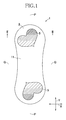
- FIGs 1 and 2 illustrate a first embodiment of the panty liner 1 wherein Fig. 1 is a plan view of the panty liner 1 and Fig. 2 is a sectional view taken along the line II-II in Fig. 1 .
- the panty liner 1 has a longitudinal direction Y, a transverse direction X, an imaginary longitudinal center line P-P bisecting a width dimension of the panty liner 1 in the transverse direction X and an imaginary transverse center line Q-Q bisecting a dimension of the panty liner 1 in the longitudinal direction Y and is formed almost symmetrically about these imaginary longitudinal and transverse center lines P-P, Q-Q.
- the panty liner 1 includes a liquid-pervious topsheet 2 lying on a skin-facing side, a liquid-impervious backsheet 3 lying on a garment-facing side and a second sheet 4 sandwiched between the top- and backsheets 2, 3 so as to define an intermediate layer.
- the topsheet 2 may be formed, for example, of an air-through fibrous nonwoven fabric or a spun laced fibrous nonwoven fabric made of hydrophilic fibers having a mass per unit area preferably in a range of about 10 to about 100g/m 2 , more preferably in a range of about 20 to about 50g/m 2 and even more preferably of about 30g/m 2 .
- the second sheet 4 may be formed, for example, of a liquid-absorbent sheet such as a spun laced fibrous nonwoven fabric, an air laid fibrous nonwoven fabric or a tissue paper each made of hydrophilic fibers such as cotton and having a mass per unit area preferably in a range of about 14 to about 100g/m 2 , more preferably in a range of about 20 to about 50g/m 2 and even more preferably of about 40g/m 2 .
- the backsheet 3 may be formed, for example, of a plastic film or a fibrous nonwoven fabric having a mass per unit area preferably in a range of about 10 to 50g/m 2 and more preferably of about 35g/m 2 .
- the backsheet 3 is desirably air-permeable.
- the respective sheets are uniform in shape as well as in size and have a width dimension in the transverse direction X gradually reduced toward the imaginary transverse center line Q-Q.
- the panty liner 1 as has been described above is formed with display elements 5 adapted to be visually recognized through the topsheet 2.
- Each of these display elements 5 is defined by a graphic.
- These display elements 5 are coated with coloring material in a gradation such that the color density gradually increases from the imaginary transverse center line Q-Q towards the outer periphery of the article as viewed in the longitudinal direction Y.
- a density of coloring material in each of the display elements gradually increases from the inner zone towards the outer zone thereof.
- Such gradation of the coloring material density ensures that the average mass of the coloring material per the predetermined area in the display elements 5 gradually increases from the imaginary transverse center line Q-Q towards the periphery of the article as viewed in the longitudinal direction Y.
- predetermined area used herein means respective predetermined areas defined by a sub-area extending inwardly and a sub-area extending outwardly as viewed in the longitudinal direction within the same graphic.
- the sheet may be coated with coloring material in a striped pattern with the stripe intervals gradually reducing as in the illustrated embodiment.
- the sheet may be coated with coloring material in a dotted pattern with the dot intervals gradually reducing.
- a coating amount of the coloring material may be gradually increased to obtain a desired gradation. No particular method is specified so long as the density of the coloring material may be gradually increased outwardly in the longitudinal direction Y.
- the display elements 5 may be formed on the surface 41 of the second sheet 4 facing the topsheet 2, for example, by flexographic printing.
- the coloring material for example, water-based ink may be used.
- resin contained in a vehicle may be polymerized in a step of drying the ink. Polymerization may be carried out by various means such as drying, UV irradiation, electron irradiation and heating.
- Color phase, color saturation and color brightness of the coloring material are not specified so long as the display elements 5 may be visually recognized through the topsheet 2.
- the coloring material having a color phase other than white for example, red, blue or yellow may be used.
- the display elements may be visually recognizable by differentiating the color saturation and/or the color brightness from that or those of the panty liner 1. It is also possible to configure the display elements 5 so that the display elements 5 may not be visually recognized unless absorption of menstrual blood occurs and the white graphics become visually recognizable upon absorption of menstrual blood.
- each of the display elements 5 may include visually unrecognizable portions so long as the display element 5 as a whole is visually recognizable.
- the function of the display elements according to the present invention may be obtained even when each of the display elements 5 is formed by partially using the same color as the panty liner 1, i.e., the visually unrecognizable color so long as the display elements 5 are visually recognizable in their entirety.
- the coloring material density of the display elements 5 may be adjusted to be relatively low on the inside and relatively high on the outside as viewed in the longitudinal direction Y to ensure that the mass of the coloring material may be smaller in the vicinity of the middle region 11 defined about the imaginary transverse center line Q-Q than the mass of the coloring material on the outside thereof.
- the coloring material defining the display elements 5 becomes liquid-impervious and will deteriorate liquid-perviousness of the sheet coated with coloring material as the density of the coloring material increases.
- the liquid-perviousness of this sheet would not be deteriorated due to the presence of the color material since the mass of the coloring material is gradually reduced from the outside toward the inside of the article.
- the bodily fluid absorbent article such as the panty liner 1 is usually put on the wearer's body so that the middle region 11 thereof may be aligned with the wearer's excreting organ, it is essential to prevent the liquid-perviousness of the middle region 11 from being deteriorated.
- the liquid-perviousness of the sheet is appropriately restricted on the outside region of the sheet to prevent bodily fluids from running outward. Furthermore, in the region of the sheet coated with the coloring material, bodily fluids absorbed on the side under the layer of the coloring material can be effectively hidden so that such bodily fluids are not visually recognizable through the side of the top sheet 2.
- a non-display region having none of the display elements 5 is defined.
- the non-display region extends around the intersection of the imaginary longitudinal center line P-P and the imaginary transverse center line Q-Q and preferably has a width dimension of about 20mm or larger in the transverse direction X and a dimension of about 30mm or longer in the longitudinal direction Y.
- the middle region 11 is preferably adapted to be put in direct contact with the wearer's excreting organ and kept in close contact with the wearer's body. If such middle region 11 is formed with the display elements, the wearer's skin might be soiled with the coloring material. However, the middle region 11 is the non-display region according to this embodiment and therefore the wearer is free from such apprehension.
- the display elements 5 are located symmetrically about the intersection of the imaginary longitudinal center line P-P and the imaginary transverse center line Q-Q. By locating the display elements 5 in such point symmetric relationship, the middle region is free from the presence of the display elements and creates aesthetic and neat impression.
- the display elements 5 are formed on the surface 41 of the second sheet 4 by printing according to the present embodiment, it is possible to form them on the skin-facing side 21 of the topsheet 2 or the garment-facing side 22 of the topsheet 2 which is facing the second sheet 4.
- any suitable measures are preferably taken to prevent the wearer's skin from being soiled with ink.
- a total luminous reflectance is preferably adjusted so that the display elements 5 may be visually recognized through the topsheet 2.
- Fig. 3 is a view similar to Fig. 1 , illustrating a second embodiment.
- This second embodiment is characterized by a plurality of graphics 51, 52, 53 having different sizes as the display elements 5.
- the other aspects are similar to those of the first embodiment.
- the components similar to those of the first embodiment are designated by the similar reference numerals and will not be repetitively described in detail.
- the graphics 51, 52, 53 are arranged to have respective areas gradually enlarged from the imaginary transverse center line Q-Q outwardly as viewed in the longitudinal direction Y. Specifically, the graphic 51 lying closest to the imaginary transverse center line Q-Q has the smallest area, the graphic 52 lying immediately outside the graphic 51 has an area smaller than that of the graphic 51 and the graphic 53 lying outside the graphic 52 has an area larger than that of the graphic 52. In the graphics 51, 52, 53, a density of the coloring material is substantially uniform. However, the sizes of the respective graphics are gradually enlarged as viewed outwardly in the longitudinal direction Y so that, in the panty liner 1 as a whole, the mass of coloring material per the predetermined area gradually increases outwardly as viewed in the longitudinal direction Y.
- predetermined area means (a full width dimension of the panty liner 1 in the transverse direction X) x (a predetermined dimension of the panty liner 1 in the longitudinal direction Y) and the average mass of the coloring material in this predetermined area gradually increases outwardly as viewed in the longitudinal direction Y.
- the sizes of the respective graphics may be differentiated to increase the mass of coloring material in gradation more easily than by differentiating the coating coloring material or differentiating an interval between each pair of the adjacent coating line of the coloring material. While the density of the coloring material in the respective graphics 51, 52, 53 is uniform according to this embodiment, it is possible to differentiate the density of coloring material in the respective graphics one from another. In this way, a gradation of the mass among these graphics 51, 52, 53 can be emphasized.
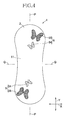
- Fig. 4 is a view similar to Fig. 1 , illustrating a third embodiment.
- This third embodiment is characterized by a plurality of graphics 54, 55 having different sizes as the display elements 5.
- the other aspects are similar to those of the first embodiment.
- the components similar to those of the first embodiment are designated by the same reference numerals and will not be repetitively described in detail.
- the graphic 55 is located lateral to the graphic 54 in the longitudinal direction Y as well as in the transverse direction X wherein the graphic 55 has an area larger than that of the graphic 54 and a coating amount of the coloring material in the graphic 55 is larger than that in the graphic 54.
- the mass of the coloring material per the predetermined area may be gradually increased outwardly in the longitudinal direction Y as well as in the transverse direction X. Both the size of the graphics and the amount of the coloring material may be differentiated to emphasize the gradation defining the mass of the coloring material.
- the present invention is not limited to such particular arrangement and it is possible to form the graphics on any one of these two locations.
- the present invention is not limited to such point symmetric location of the graphics but it is also possible to locate the graphics in an asymmetric arrangement.
- a flexographic printing has been exemplarily described above as means for forming the display elements 5
- the other printing methods such as a gravure printing, an ink jet printing and a screen printing may be selectively used to form the display elements 5.
- the types of ink for such printing not only water-based inks and oil-based inks, but also UV inks may be used. Printing methods suitable for respective types of ink may be selectively used and pigment and vehicles commonly used in the related technical field may be used.
- the topsheet 2, the second sheet 4 and the backsheet 3 are not limited to those used in this embodiment but may be selected from other various types of sheets. While a liquid-absorbent single sheet is used as the second sheet 4 in this embodiment, it is possible to layer two or more sheets to form the second sheet 4. It is also possible to use a liquid-pervious sheet as the second sheet 4. As the liquid-pervious sheet, for example, a hydrophilic air-through nonwoven fabric having a mass per unit area in a range of about 10 to about 100g/m 2 , preferably in a range of about 20 to 50g/m 2 and more preferably of about 30g/m 2 may be used. It is also possible to use a laminate of liquid-pervious sheet and liquid-absorbent sheet as the second sheet 4. These sheets 2, 4, 3 are bonded together on surfaces thereof facing one another by the intermediary of bonding means such as hot melt adhesive.
- the present invention is not limited to this but, for example, an absorber may be also used as the intermediate layer.
- the absorber compression molded fluff pulp fibers may be used and such fluff pulp fibers may be directly sandwiched between the topsheet 2 and the backsheet 3 to obtain the bodily fluid absorbent article.
- the display elements 5 are desirably formed on the topsheet 2. It is also possible to use fluff pulp and/or super-absorbent polymer particles wrapped with tissue paper as the absorber.
- the dimension of the panty liner 1 in the longitudinal direction Y is assumed in a range of about 90 to about 200mm in the first and second embodiments, the present invention is not limited to such range and may be set to other various dimensions.
- a dimension of each display element 5 in the longitudinal direction Y is preferably set to a relatively small dimension so that the correspondingly large non-display region extending in the middle zone 11 may be ensured.
- Such dimensional relationship particularly in the panty liner 1 dimensioned to be relatively large in the longitudinal direction Y, magnifies the dimension in the longitudinal direction Y thereof and thereby provides the wearer with a sense of reassurance.
- the bodily fluid absorbent article is not limited to the panty liner and may be implemented in other forms such as menstruation napkins and urine absorbent pads.
Landscapes
- Health & Medical Sciences (AREA)
- Epidemiology (AREA)
- Engineering & Computer Science (AREA)
- Biomedical Technology (AREA)
- Heart & Thoracic Surgery (AREA)
- Vascular Medicine (AREA)
- Life Sciences & Earth Sciences (AREA)
- Animal Behavior & Ethology (AREA)
- General Health & Medical Sciences (AREA)
- Public Health (AREA)
- Veterinary Medicine (AREA)
- Absorbent Articles And Supports Therefor (AREA)
Abstract
Description
- The present invention relates to bodily fluid absorbent articles such as menstruation napkins, urine absorbent pads, panty liners or the like.
- Bodily fluid absorbent articles such as menstruation napkins characterized by being locally colored are known. For example, PTL 1 discloses a bodily fluid absorbent article including an absorbent core sandwiched between a topsheet and a backsheet and having a top surface and bottom surface. This bodily fluid absorbent article of the prior art has a colored region and a non-colored region wherein the colored region can be seen through the topsheet from the surface thereof. By forming such colored region, it is possible to make menstrual blood which has soiled the napkin less noticeable.
- {PTL 1}
JP 2005-512682 A - According to the disclosure of PTL 1, the colored region is in the middle of the wearing article in a longitudinal direction as well as in a transverse direction. Such colored region uses at least a light color and a dark color to create a shade and thereby to make absorbed menstrual blood less noticeable. However, the description concerning the formation of the colored region is limited to utilization of light and dark colors and no description of the other concepts or ideas can be found.
- An object of the present invention is to provide a bodily fluid absorbent article having visually recognizable display elements formed by coloring material wherein an average mass of coloring material per a predetermined area gradually increases outward as viewed in a longitudinal direction.
- According to the present invention, there is provided a bodily fluid absorbent article having a longitudinal direction, a transverse direction, a skin-facing side and a garment-facing side and including a liquid-pervious topsheet lying on the skin-facing side, a liquid-impervious backsheet lying on the garment-facing side and an intermediate layer sandwiched between the top- and backsheets.
- In the bodily fluid absorbent article, the feature of the present invention resides in that display elements are formed of coloring material applied to at least one of the topsheet and the intermediate layer so that an average mass of coloring material gradually increases outwardly as viewed in the longitudinal direction. The term "intermediate layer" used herein includes, for example, a liquid-pervious fibrous nonwoven fabric sheet, a liquid-absorbent fibrous nonwoven fabric sheet and an absorbent member including fluff pulp fibers and the like.
- According to one embodiment of the present invention, an average mass of coloring material per a predetermined area gradually increases from an imaginary longitudinal center line bisecting a width dimension in the transverse direction outwardly as seen in the transverse direction.
- According to another embodiment of the present invention, a non-display region including none of the display elements is defined in a middle region of the article as viewed in the longitudinal direction.
- According to still another embodiment of the present invention, the display elements are formed of a plurality of graphics and the graphics lying closer to an outer edge of the article are larger than the graphics lying closer to the middle of the article as viewed in at least one of the longitudinal direction and the transverse direction. It should be understood here that the term "predetermined area" used herein corresponds to (a full width dimension of the bodily fluid absorbent article in the transverse direction) x (a predetermined dimension of the bodily fluid absorbent article in the longitudinal direction). When a relatively large graphic is located closer to the outer periphery of the article and a relatively small graphic is located closer to the middle of the article as viewed in the longitudinal direction of the article, an average mass of coloring material per the predetermined area is larger in the region of the larger graphic than in the region of the smaller graphic.
- According to yet another embodiment of the present invention, a density of coloring material is higher in the graphic lying closer to an outer edge of the article than in the graphic lying closer to the middle of the article as viewed in at least one of the longitudinal direction and the transverse direction. The term "predetermined area" may be construed also to be the predetermined area in the respective graphics. As a consequence of comparing a density of coloring material in the graphic lying closer to the outer periphery of the article with a density of coloring material in the graphic lying closer to the middle of the article, the density of coloring material should be higher in the graphic lying closer to the outer periphery of the article than in the graphic lying closer to the middle of the article.
- The visually recognizable display elements are formed of coloring material applied to at least one of the topsheet and the intermediate layer so that an average mass of coloring material gradually increases outwardly as viewed in the longitudinal direction of the article. With such an arrangement, the average mass of coloring material applied to the topsheet or the intermediate layer gradually decreases inwardly as viewed in the longitudinal direction of the article and therefore absorption of bodily fluids would not be counteracted by the presence of coloring material.
-
- {
Fig. 1} Fig. 1 is a plan view of a panty liner as a first embodiment of the present invention. - {
Fig. 2} Fig. 2 is a sectional view taken along the line II-II inFig. 1 . - {
Fig. 3} Fig. 3 is a plan view of the panty liner as a second embodiment of the present invention. - {
Fig. 4} Fig. 4 is a plan view of a panty liner as a third embodiment of the present invention. - Now the bodily fluid absorbent article according to the present invention will be described in detail taking a panty liner 1 for an example thereof.
Figs 1 and2 illustrate a first embodiment of the panty liner 1 whereinFig. 1 is a plan view of the panty liner 1 andFig. 2 is a sectional view taken along the line II-II inFig. 1 . The panty liner 1 has a longitudinal direction Y, a transverse direction X, an imaginary longitudinal center line P-P bisecting a width dimension of the panty liner 1 in the transverse direction X and an imaginary transverse center line Q-Q bisecting a dimension of the panty liner 1 in the longitudinal direction Y and is formed almost symmetrically about these imaginary longitudinal and transverse center lines P-P, Q-Q. - The panty liner 1 includes a liquid-
pervious topsheet 2 lying on a skin-facing side, a liquid-impervious backsheet 3 lying on a garment-facing side and asecond sheet 4 sandwiched between the top- andbacksheets topsheet 2 may be formed, for example, of an air-through fibrous nonwoven fabric or a spun laced fibrous nonwoven fabric made of hydrophilic fibers having a mass per unit area preferably in a range of about 10 to about 100g/m2, more preferably in a range of about 20 to about 50g/m2 and even more preferably of about 30g/m2. Thesecond sheet 4 may be formed, for example, of a liquid-absorbent sheet such as a spun laced fibrous nonwoven fabric, an air laid fibrous nonwoven fabric or a tissue paper each made of hydrophilic fibers such as cotton and having a mass per unit area preferably in a range of about 14 to about 100g/m2, more preferably in a range of about 20 to about 50g/m2 and even more preferably of about 40g/m2. Thebacksheet 3 may be formed, for example, of a plastic film or a fibrous nonwoven fabric having a mass per unit area preferably in a range of about 10 to 50g/m2 and more preferably of about 35g/m2. Thebacksheet 3 is desirably air-permeable. - In the panty liner 1, the respective sheets are uniform in shape as well as in size and have a width dimension in the transverse direction X gradually reduced toward the imaginary transverse center line Q-Q. By shaping the panty liner 1 in this manner, it is possible to prevent the panty liner 1 from being irregularly deformed in the wearer's crotch region and thereby to keep the panty liner 1 in close contact with the wearer's body.
- The panty liner 1 as has been described above is formed with
display elements 5 adapted to be visually recognized through thetopsheet 2. Each of thesedisplay elements 5 is defined by a graphic. Thesedisplay elements 5 are coated with coloring material in a gradation such that the color density gradually increases from the imaginary transverse center line Q-Q towards the outer periphery of the article as viewed in the longitudinal direction Y. In other words, a density of coloring material in each of the display elements gradually increases from the inner zone towards the outer zone thereof. Such gradation of the coloring material density ensures that the average mass of the coloring material per the predetermined area in thedisplay elements 5 gradually increases from the imaginary transverse center line Q-Q towards the periphery of the article as viewed in the longitudinal direction Y. The term "predetermined area" used herein means respective predetermined areas defined by a sub-area extending inwardly and a sub-area extending outwardly as viewed in the longitudinal direction within the same graphic. - As one of the methods to obtain a gradually increasing density of coloring material, the sheet may be coated with coloring material in a striped pattern with the stripe intervals gradually reducing as in the illustrated embodiment. Alternatively, the sheet may be coated with coloring material in a dotted pattern with the dot intervals gradually reducing. In addition, a coating amount of the coloring material may be gradually increased to obtain a desired gradation. No particular method is specified so long as the density of the coloring material may be gradually increased outwardly in the longitudinal direction Y.
- The
display elements 5 may be formed on thesurface 41 of thesecond sheet 4 facing thetopsheet 2, for example, by flexographic printing. As the coloring material, for example, water-based ink may be used. To prevent such coloring material from running off together with bodily fluids such as menstrual blood, resin contained in a vehicle may be polymerized in a step of drying the ink. Polymerization may be carried out by various means such as drying, UV irradiation, electron irradiation and heating. - Color phase, color saturation and color brightness of the coloring material are not specified so long as the
display elements 5 may be visually recognized through thetopsheet 2. In the white panty liner 1, the coloring material having a color phase other than white, for example, red, blue or yellow may be used. Even when the color phase of coloring material having the same color phase as that of the panty liner 1 is used, the display elements may be visually recognizable by differentiating the color saturation and/or the color brightness from that or those of the panty liner 1. It is also possible to configure thedisplay elements 5 so that thedisplay elements 5 may not be visually recognized unless absorption of menstrual blood occurs and the white graphics become visually recognizable upon absorption of menstrual blood. For example, it is possible to use a white coloring material so that the white graphics may emerge or change from white to the other color upon absorption of menstrual blood. Furthermore, each of thedisplay elements 5 may include visually unrecognizable portions so long as thedisplay element 5 as a whole is visually recognizable. Specifically, the function of the display elements according to the present invention may be obtained even when each of thedisplay elements 5 is formed by partially using the same color as the panty liner 1, i.e., the visually unrecognizable color so long as thedisplay elements 5 are visually recognizable in their entirety. - The coloring material density of the
display elements 5 may be adjusted to be relatively low on the inside and relatively high on the outside as viewed in the longitudinal direction Y to ensure that the mass of the coloring material may be smaller in the vicinity of themiddle region 11 defined about the imaginary transverse center line Q-Q than the mass of the coloring material on the outside thereof. In a dried condition, the coloring material defining thedisplay elements 5 becomes liquid-impervious and will deteriorate liquid-perviousness of the sheet coated with coloring material as the density of the coloring material increases. However, at least in the middle region of the sheet coated with the coloring material, in the present invention, the liquid-perviousness of this sheet would not be deteriorated due to the presence of the color material since the mass of the coloring material is gradually reduced from the outside toward the inside of the article. Considering that the bodily fluid absorbent article such as the panty liner 1 is usually put on the wearer's body so that themiddle region 11 thereof may be aligned with the wearer's excreting organ, it is essential to prevent the liquid-perviousness of themiddle region 11 from being deteriorated. - By gradually increasing the mass of coloring material from the inside towards the outside as viewed in the longitudinal direction Y, the liquid-perviousness of the sheet is appropriately restricted on the outside region of the sheet to prevent bodily fluids from running outward. Furthermore, in the region of the sheet coated with the coloring material, bodily fluids absorbed on the side under the layer of the coloring material can be effectively hidden so that such bodily fluids are not visually recognizable through the side of the
top sheet 2. - In the
middle region 11, a non-display region having none of thedisplay elements 5 is defined. The non-display region extends around the intersection of the imaginary longitudinal center line P-P and the imaginary transverse center line Q-Q and preferably has a width dimension of about 20mm or larger in the transverse direction X and a dimension of about 30mm or longer in the longitudinal direction Y. Themiddle region 11 is preferably adapted to be put in direct contact with the wearer's excreting organ and kept in close contact with the wearer's body. If suchmiddle region 11 is formed with the display elements, the wearer's skin might be soiled with the coloring material. However, themiddle region 11 is the non-display region according to this embodiment and therefore the wearer is free from such apprehension. - The
display elements 5 are located symmetrically about the intersection of the imaginary longitudinal center line P-P and the imaginary transverse center line Q-Q. By locating thedisplay elements 5 in such point symmetric relationship, the middle region is free from the presence of the display elements and creates aesthetic and neat impression. - While the
display elements 5 are formed on thesurface 41 of thesecond sheet 4 by printing according to the present embodiment, it is possible to form them on the skin-facingside 21 of thetopsheet 2 or the garment-facingside 22 of thetopsheet 2 which is facing thesecond sheet 4. When thedisplay elements 5 are formed on the skin-facingside 21 of thetopsheet 2, any suitable measures are preferably taken to prevent the wearer's skin from being soiled with ink. When thedisplay elements 5 are formed on thesecond sheet 4, a total luminous reflectance is preferably adjusted so that thedisplay elements 5 may be visually recognized through thetopsheet 2. -
Fig. 3 is a view similar toFig. 1 , illustrating a second embodiment. This second embodiment is characterized by a plurality ofgraphics display elements 5. The other aspects are similar to those of the first embodiment. The components similar to those of the first embodiment are designated by the similar reference numerals and will not be repetitively described in detail. - The
graphics graphics - The sizes of the respective graphics may be differentiated to increase the mass of coloring material in gradation more easily than by differentiating the coating coloring material or differentiating an interval between each pair of the adjacent coating line of the coloring material. While the density of the coloring material in the
respective graphics graphics -
Fig. 4 is a view similar toFig. 1 , illustrating a third embodiment. This third embodiment is characterized by a plurality ofgraphics display elements 5. The other aspects are similar to those of the first embodiment. The components similar to those of the first embodiment are designated by the same reference numerals and will not be repetitively described in detail. - The graphic 55 is located lateral to the graphic 54 in the longitudinal direction Y as well as in the transverse direction X wherein the graphic 55 has an area larger than that of the graphic 54 and a coating amount of the coloring material in the graphic 55 is larger than that in the graphic 54.
- In the way as has been described above, the mass of the coloring material per the predetermined area may be gradually increased outwardly in the longitudinal direction Y as well as in the transverse direction X. Both the size of the graphics and the amount of the coloring material may be differentiated to emphasize the gradation defining the mass of the coloring material.
- While two graphics or two sets of graphics are located symmetrically about the intersection of the imaginary longitudinal center line P-P and the imaginary transverse center line Q-Q in the first and second embodiments, the present invention is not limited to such particular arrangement and it is possible to form the graphics on any one of these two locations. The present invention is not limited to such point symmetric location of the graphics but it is also possible to locate the graphics in an asymmetric arrangement.
- While a flexographic printing has been exemplarily described above as means for forming the
display elements 5, the other printing methods such as a gravure printing, an ink jet printing and a screen printing may be selectively used to form thedisplay elements 5. Regarding the types of ink for such printing, not only water-based inks and oil-based inks, but also UV inks may be used. Printing methods suitable for respective types of ink may be selectively used and pigment and vehicles commonly used in the related technical field may be used. - The
topsheet 2, thesecond sheet 4 and thebacksheet 3 are not limited to those used in this embodiment but may be selected from other various types of sheets. While a liquid-absorbent single sheet is used as thesecond sheet 4 in this embodiment, it is possible to layer two or more sheets to form thesecond sheet 4. It is also possible to use a liquid-pervious sheet as thesecond sheet 4. As the liquid-pervious sheet, for example, a hydrophilic air-through nonwoven fabric having a mass per unit area in a range of about 10 to about 100g/m2, preferably in a range of about 20 to 50g/m2 and more preferably of about 30g/m2 may be used. It is also possible to use a laminate of liquid-pervious sheet and liquid-absorbent sheet as thesecond sheet 4. Thesesheets - While the embodiments in which the
second sheet 4 is used as the intermediate layer have been described above, the present invention is not limited to this but, for example, an absorber may be also used as the intermediate layer. As the absorber, compression molded fluff pulp fibers may be used and such fluff pulp fibers may be directly sandwiched between thetopsheet 2 and thebacksheet 3 to obtain the bodily fluid absorbent article. In this case, thedisplay elements 5 are desirably formed on thetopsheet 2. It is also possible to use fluff pulp and/or super-absorbent polymer particles wrapped with tissue paper as the absorber. - While the dimension of the panty liner 1 in the longitudinal direction Y is assumed in a range of about 90 to about 200mm in the first and second embodiments, the present invention is not limited to such range and may be set to other various dimensions. When the dimension of the panty liner 1 in the longitudinal direction is set to a relatively large value, a dimension of each
display element 5 in the longitudinal direction Y is preferably set to a relatively small dimension so that the correspondingly large non-display region extending in themiddle zone 11 may be ensured. Such dimensional relationship, particularly in the panty liner 1 dimensioned to be relatively large in the longitudinal direction Y, magnifies the dimension in the longitudinal direction Y thereof and thereby provides the wearer with a sense of reassurance. - For the display elements, various graphics, for example, snow crystal marks or floral motifs may be used. The bodily fluid absorbent article is not limited to the panty liner and may be implemented in other forms such as menstruation napkins and urine absorbent pads.
-
- 1
- panty liner (bodily fluid absorbent article)
- 2
- topsheet
- 3
- backsheet
- 4
- second sheet (intermediate layer)
- 5
- display elements
- 51
- graphic
- 52
- graphic
- 53
- graphic
- 54
- graphic
- 55
- graphic
- 11
- middle region
- X
- transverse direction
- Y
- longitudinal direction
Claims (5)
- A bodily fluid absorbent article having a longitudinal direction, a transverse direction, a skin-facing side and a garment-facing side and comprising a liquid-pervious topsheet lying on the skin-facing side, a liquid-impervious backsheet lying on the garment-facing side and an intermediate layer sandwiched between the top- and backsheets, wherein:display elements are formed of coloring material applied to at least one of the topsheet and the intermediate layer so that an average mass of the coloring material per a predetermined area gradually increases outwardly as viewed in the longitudinal direction.
- The bodily fluid absorbent article according to Claim 1, wherein an average mass of the coloring material per the predetermined area gradually increases from an imaginary longitudinal center line bisecting a width dimension in the transverse direction outwardly as seen in the transverse direction.
- The bodily fluid absorbent article according to Claim 1 or 2, wherein a non-display region including none of the display elements is defined in a middle region of the article as viewed in the longitudinal direction.
- The bodily fluid absorbent article according to any one of Claims 1 through 3, wherein the display elements are formed of a plurality of graphics and the graphics lying closer to an outer edge of the article are larger than the graphics lying closer to the middle of the article as viewed in at least one of the longitudinal direction and the transverse direction.
- The bodily fluid absorbent article according to any one of Claims 1 through 4, wherein a density of the coloring material is higher in the graphics lying closer to an outer edge of the article than in the graphics lying closer to the middle of the article as viewed in at least one of the longitudinal direction and the transverse direction.
Applications Claiming Priority (2)
| Application Number | Priority Date | Filing Date | Title |
|---|---|---|---|
| JP2009272385A JP5498138B2 (en) | 2009-11-30 | 2009-11-30 | Body fluid treatment supplies |
| PCT/JP2010/070432 WO2011065260A1 (en) | 2009-11-30 | 2010-11-17 | Bodily fluid treatment article |
Publications (2)
| Publication Number | Publication Date |
|---|---|
| EP2508155A1 true EP2508155A1 (en) | 2012-10-10 |
| EP2508155A4 EP2508155A4 (en) | 2013-12-25 |
Family
ID=44066365
Family Applications (1)
| Application Number | Title | Priority Date | Filing Date |
|---|---|---|---|
| EP10833107.5A Withdrawn EP2508155A4 (en) | 2009-11-30 | 2010-11-17 | Bodily fluid treatment article |
Country Status (6)
| Country | Link |
|---|---|
| US (1) | US20120232515A1 (en) |
| EP (1) | EP2508155A4 (en) |
| JP (1) | JP5498138B2 (en) |
| CN (1) | CN102639092A (en) |
| TW (1) | TW201200112A (en) |
| WO (1) | WO2011065260A1 (en) |
Families Citing this family (7)
| Publication number | Priority date | Publication date | Assignee | Title |
|---|---|---|---|---|
| EP1295711B1 (en) | 2001-09-19 | 2006-04-12 | The Procter & Gamble Company | A color printed laminated structure, absorbent article comprising the same and process for manufacturing the same |
| JP7043257B2 (en) * | 2014-10-27 | 2022-03-29 | ザ プロクター アンド ギャンブル カンパニー | Absorbent article with performance signal |
| JP2018201672A (en) * | 2017-05-31 | 2018-12-27 | 日本製紙クレシア株式会社 | Absorbent article |
| JP2018201674A (en) * | 2017-05-31 | 2018-12-27 | 日本製紙クレシア株式会社 | Manufacturing method for absorbent article |
| JP7304130B2 (en) | 2017-10-30 | 2023-07-06 | 日本製紙クレシア株式会社 | absorbent article |
| MY201037A (en) * | 2018-07-02 | 2024-01-31 | Unicharm Corp | Absorbent-article package piece and package for absorbent-article package piece |
| JP7153611B2 (en) * | 2019-06-25 | 2022-10-14 | ユニ・チャーム株式会社 | ABSORBENT ARTICLE, NONWOVEN SHEET, AND METHOD FOR MANUFACTURING NONWOVEN SHEET |
Family Cites Families (14)
| Publication number | Priority date | Publication date | Assignee | Title |
|---|---|---|---|---|
| USD413167S (en) * | 1998-02-12 | 1999-08-24 | The Procter & Gamble Company | Pattern |
| US7520873B2 (en) * | 2001-10-12 | 2009-04-21 | Kimberly-Clark Worldwide, Inc. | Disposable absorbent article having a color gradation feature |
| US7270651B2 (en) * | 2001-12-19 | 2007-09-18 | The Procter & Gamble Company | Absorbent article |
| US7402157B2 (en) * | 2001-12-19 | 2008-07-22 | The Procter & Gamble Company | Absorbent article having perception of depth |
| JP3930741B2 (en) * | 2002-01-22 | 2007-06-13 | ユニ・チャーム株式会社 | Absorbent articles |
| US20040015145A1 (en) * | 2002-07-16 | 2004-01-22 | The Procter & Gamble Company | Absorbent article having a graphic visible through body contacting surface |
| US8039685B2 (en) * | 2004-12-15 | 2011-10-18 | The Procter & Gamble Company | Absorbent article having a functional enhancement indicator |
| EP1779874A1 (en) * | 2005-10-26 | 2007-05-02 | The Procter & Gamble Company | Sanitary article with ink to increase the hydrophobicity of certain area |
| USD566266S1 (en) * | 2006-10-02 | 2008-04-08 | The Procter & Gamble Company | Backsheet for diaper |
| JP5039513B2 (en) * | 2006-12-28 | 2012-10-03 | 花王株式会社 | Absorbent articles |
| US20090157021A1 (en) * | 2007-12-14 | 2009-06-18 | Sullivan Suzanne K | Articles with informative patterns, and methods of making the same |
| USD614293S1 (en) * | 2008-05-07 | 2010-04-20 | The Procter & Gamble Company | Sanitary towel |
| US8162910B2 (en) * | 2008-05-07 | 2012-04-24 | The Procter & Gamble Company | Absorbent article having colored regions |
| USD646381S1 (en) * | 2008-10-17 | 2011-10-04 | Kimberly-Clark Worldwide, Inc. | Printed absorbent pad |
-
2009
- 2009-11-30 JP JP2009272385A patent/JP5498138B2/en not_active Expired - Fee Related
-
2010
- 2010-11-17 EP EP10833107.5A patent/EP2508155A4/en not_active Withdrawn
- 2010-11-17 WO PCT/JP2010/070432 patent/WO2011065260A1/en not_active Ceased
- 2010-11-17 US US13/508,143 patent/US20120232515A1/en not_active Abandoned
- 2010-11-17 CN CN2010800540692A patent/CN102639092A/en active Pending
- 2010-11-29 TW TW099141219A patent/TW201200112A/en unknown
Also Published As
| Publication number | Publication date |
|---|---|
| US20120232515A1 (en) | 2012-09-13 |
| JP2011110379A (en) | 2011-06-09 |
| WO2011065260A1 (en) | 2011-06-03 |
| CN102639092A (en) | 2012-08-15 |
| TW201200112A (en) | 2012-01-01 |
| EP2508155A4 (en) | 2013-12-25 |
| JP5498138B2 (en) | 2014-05-21 |
Similar Documents
| Publication | Publication Date | Title |
|---|---|---|
| US20200078233A1 (en) | Absorbent article having functional enhancement indicators | |
| US11554052B2 (en) | Absorbent article having a functional enhancement indicator | |
| EP1827343B2 (en) | A package comprising an array of feminine hygiene articles | |
| US20120232515A1 (en) | Bodily fluid absorbent article | |
| US20070087169A1 (en) | Absorbent articles having visually distinct embossments | |
| US10653569B2 (en) | Absorbent article | |
| JP5693273B2 (en) | Absorbent articles | |
| US20140200539A1 (en) | Array of absorbent articles having functional enhancement indicators | |
| JP6710126B2 (en) | Absorbent article | |
| JP7117919B2 (en) | absorbent article | |
| WO2017110696A1 (en) | Absorbent article |
Legal Events
| Date | Code | Title | Description |
|---|---|---|---|
| PUAI | Public reference made under article 153(3) epc to a published international application that has entered the european phase |
Free format text: ORIGINAL CODE: 0009012 |
|
| 17P | Request for examination filed |
Effective date: 20120614 |
|
| AK | Designated contracting states |
Kind code of ref document: A1 Designated state(s): AL AT BE BG CH CY CZ DE DK EE ES FI FR GB GR HR HU IE IS IT LI LT LU LV MC MK MT NL NO PL PT RO RS SE SI SK SM TR |
|
| DAX | Request for extension of the european patent (deleted) | ||
| A4 | Supplementary search report drawn up and despatched |
Effective date: 20131126 |
|
| RIC1 | Information provided on ipc code assigned before grant |
Ipc: A61F 13/511 20060101ALI20131120BHEP Ipc: A61F 13/472 20060101ALI20131120BHEP Ipc: A61F 13/84 20060101ALI20131120BHEP Ipc: A61F 13/513 20060101ALI20131120BHEP Ipc: A61F 13/15 20060101AFI20131120BHEP |
|
| STAA | Information on the status of an ep patent application or granted ep patent |
Free format text: STATUS: THE APPLICATION HAS BEEN WITHDRAWN |
|
| 18W | Application withdrawn |
Effective date: 20140206 |