EP2506383A2 - System and method for operating capacitor banks - Google Patents
System and method for operating capacitor banks Download PDFInfo
- Publication number
- EP2506383A2 EP2506383A2 EP12161675A EP12161675A EP2506383A2 EP 2506383 A2 EP2506383 A2 EP 2506383A2 EP 12161675 A EP12161675 A EP 12161675A EP 12161675 A EP12161675 A EP 12161675A EP 2506383 A2 EP2506383 A2 EP 2506383A2
- Authority
- EP
- European Patent Office
- Prior art keywords
- curve
- capacitor bank
- power
- capacitor
- algorithm
- Prior art date
- Legal status (The legal status is an assumption and is not a legal conclusion. Google has not performed a legal analysis and makes no representation as to the accuracy of the status listed.)
- Granted
Links
Images



Classifications
-
- H—ELECTRICITY
- H02—GENERATION; CONVERSION OR DISTRIBUTION OF ELECTRIC POWER
- H02J—ELECTRIC POWER NETWORKS; CIRCUIT ARRANGEMENTS OR SYSTEMS FOR SUPPLYING OR DISTRIBUTING ELECTRIC POWER; SYSTEMS FOR STORING ELECTRIC ENERGY
- H02J3/00—Circuit arrangements for AC mains or AC distribution networks
- H02J3/18—Arrangements for adjusting, eliminating or compensating reactive power in networks
- H02J3/1821—Arrangements for adjusting, eliminating or compensating reactive power in networks using shunt compensators
- H02J3/1828—Arrangements for adjusting, eliminating or compensating reactive power in networks using shunt compensators with stepwise control, e.g. switched capacitor banks
-
- G—PHYSICS
- G06—COMPUTING OR CALCULATING; COUNTING
- G06Q—INFORMATION AND COMMUNICATION TECHNOLOGY [ICT] SPECIALLY ADAPTED FOR ADMINISTRATIVE, COMMERCIAL, FINANCIAL, MANAGERIAL OR SUPERVISORY PURPOSES; SYSTEMS OR METHODS SPECIALLY ADAPTED FOR ADMINISTRATIVE, COMMERCIAL, FINANCIAL, MANAGERIAL OR SUPERVISORY PURPOSES, NOT OTHERWISE PROVIDED FOR
- G06Q10/00—Administration; Management
- G06Q10/06—Resources, workflows, human or project management; Enterprise or organisation planning; Enterprise or organisation modelling
-
- G—PHYSICS
- G06—COMPUTING OR CALCULATING; COUNTING
- G06Q—INFORMATION AND COMMUNICATION TECHNOLOGY [ICT] SPECIALLY ADAPTED FOR ADMINISTRATIVE, COMMERCIAL, FINANCIAL, MANAGERIAL OR SUPERVISORY PURPOSES; SYSTEMS OR METHODS SPECIALLY ADAPTED FOR ADMINISTRATIVE, COMMERCIAL, FINANCIAL, MANAGERIAL OR SUPERVISORY PURPOSES, NOT OTHERWISE PROVIDED FOR
- G06Q50/00—Information and communication technology [ICT] specially adapted for implementation of business processes of specific business sectors, e.g. utilities or tourism
-
- G—PHYSICS
- G06—COMPUTING OR CALCULATING; COUNTING
- G06Q—INFORMATION AND COMMUNICATION TECHNOLOGY [ICT] SPECIALLY ADAPTED FOR ADMINISTRATIVE, COMMERCIAL, FINANCIAL, MANAGERIAL OR SUPERVISORY PURPOSES; SYSTEMS OR METHODS SPECIALLY ADAPTED FOR ADMINISTRATIVE, COMMERCIAL, FINANCIAL, MANAGERIAL OR SUPERVISORY PURPOSES, NOT OTHERWISE PROVIDED FOR
- G06Q50/00—Information and communication technology [ICT] specially adapted for implementation of business processes of specific business sectors, e.g. utilities or tourism
- G06Q50/06—Energy or water supply
-
- H—ELECTRICITY
- H02—GENERATION; CONVERSION OR DISTRIBUTION OF ELECTRIC POWER
- H02J—ELECTRIC POWER NETWORKS; CIRCUIT ARRANGEMENTS OR SYSTEMS FOR SUPPLYING OR DISTRIBUTING ELECTRIC POWER; SYSTEMS FOR STORING ELECTRIC ENERGY
- H02J3/00—Circuit arrangements for AC mains or AC distribution networks
- H02J3/003—Load forecast, e.g. methods or systems for forecasting future load demand
-
- H—ELECTRICITY
- H02—GENERATION; CONVERSION OR DISTRIBUTION OF ELECTRIC POWER
- H02J—ELECTRIC POWER NETWORKS; CIRCUIT ARRANGEMENTS OR SYSTEMS FOR SUPPLYING OR DISTRIBUTING ELECTRIC POWER; SYSTEMS FOR STORING ELECTRIC ENERGY
- H02J3/00—Circuit arrangements for AC mains or AC distribution networks
- H02J3/38—Arrangements for feeding a single network from two or more generators or sources in parallel; Arrangements for feeding already energised networks from additional generators or sources in parallel
- H02J3/381—Dispersed generators
-
- H—ELECTRICITY
- H02—GENERATION; CONVERSION OR DISTRIBUTION OF ELECTRIC POWER
- H02J—ELECTRIC POWER NETWORKS; CIRCUIT ARRANGEMENTS OR SYSTEMS FOR SUPPLYING OR DISTRIBUTING ELECTRIC POWER; SYSTEMS FOR STORING ELECTRIC ENERGY
- H02J2101/00—Supply or distribution of decentralised, dispersed or local electric power generation
- H02J2101/20—Dispersed power generation using renewable energy sources
-
- H—ELECTRICITY
- H02—GENERATION; CONVERSION OR DISTRIBUTION OF ELECTRIC POWER
- H02J—ELECTRIC POWER NETWORKS; CIRCUIT ARRANGEMENTS OR SYSTEMS FOR SUPPLYING OR DISTRIBUTING ELECTRIC POWER; SYSTEMS FOR STORING ELECTRIC ENERGY
- H02J2101/00—Supply or distribution of decentralised, dispersed or local electric power generation
- H02J2101/20—Dispersed power generation using renewable energy sources
- H02J2101/22—Solar energy
- H02J2101/24—Photovoltaics
-
- H—ELECTRICITY
- H02—GENERATION; CONVERSION OR DISTRIBUTION OF ELECTRIC POWER
- H02J—ELECTRIC POWER NETWORKS; CIRCUIT ARRANGEMENTS OR SYSTEMS FOR SUPPLYING OR DISTRIBUTING ELECTRIC POWER; SYSTEMS FOR STORING ELECTRIC ENERGY
- H02J2101/00—Supply or distribution of decentralised, dispersed or local electric power generation
- H02J2101/20—Dispersed power generation using renewable energy sources
- H02J2101/28—Wind energy
-
- Y—GENERAL TAGGING OF NEW TECHNOLOGICAL DEVELOPMENTS; GENERAL TAGGING OF CROSS-SECTIONAL TECHNOLOGIES SPANNING OVER SEVERAL SECTIONS OF THE IPC; TECHNICAL SUBJECTS COVERED BY FORMER USPC CROSS-REFERENCE ART COLLECTIONS [XRACs] AND DIGESTS
- Y02—TECHNOLOGIES OR APPLICATIONS FOR MITIGATION OR ADAPTATION AGAINST CLIMATE CHANGE
- Y02E—REDUCTION OF GREENHOUSE GAS [GHG] EMISSIONS, RELATED TO ENERGY GENERATION, TRANSMISSION OR DISTRIBUTION
- Y02E10/00—Energy generation through renewable energy sources
- Y02E10/50—Photovoltaic [PV] energy
- Y02E10/56—Power conversion systems, e.g. maximum power point trackers
-
- Y—GENERAL TAGGING OF NEW TECHNOLOGICAL DEVELOPMENTS; GENERAL TAGGING OF CROSS-SECTIONAL TECHNOLOGIES SPANNING OVER SEVERAL SECTIONS OF THE IPC; TECHNICAL SUBJECTS COVERED BY FORMER USPC CROSS-REFERENCE ART COLLECTIONS [XRACs] AND DIGESTS
- Y02—TECHNOLOGIES OR APPLICATIONS FOR MITIGATION OR ADAPTATION AGAINST CLIMATE CHANGE
- Y02E—REDUCTION OF GREENHOUSE GAS [GHG] EMISSIONS, RELATED TO ENERGY GENERATION, TRANSMISSION OR DISTRIBUTION
- Y02E10/00—Energy generation through renewable energy sources
- Y02E10/70—Wind energy
- Y02E10/76—Power conversion electric or electronic aspects
-
- Y—GENERAL TAGGING OF NEW TECHNOLOGICAL DEVELOPMENTS; GENERAL TAGGING OF CROSS-SECTIONAL TECHNOLOGIES SPANNING OVER SEVERAL SECTIONS OF THE IPC; TECHNICAL SUBJECTS COVERED BY FORMER USPC CROSS-REFERENCE ART COLLECTIONS [XRACs] AND DIGESTS
- Y02—TECHNOLOGIES OR APPLICATIONS FOR MITIGATION OR ADAPTATION AGAINST CLIMATE CHANGE
- Y02E—REDUCTION OF GREENHOUSE GAS [GHG] EMISSIONS, RELATED TO ENERGY GENERATION, TRANSMISSION OR DISTRIBUTION
- Y02E40/00—Technologies for an efficient electrical power generation, transmission or distribution
- Y02E40/30—Reactive power compensation
-
- Y—GENERAL TAGGING OF NEW TECHNOLOGICAL DEVELOPMENTS; GENERAL TAGGING OF CROSS-SECTIONAL TECHNOLOGIES SPANNING OVER SEVERAL SECTIONS OF THE IPC; TECHNICAL SUBJECTS COVERED BY FORMER USPC CROSS-REFERENCE ART COLLECTIONS [XRACs] AND DIGESTS
- Y02—TECHNOLOGIES OR APPLICATIONS FOR MITIGATION OR ADAPTATION AGAINST CLIMATE CHANGE
- Y02E—REDUCTION OF GREENHOUSE GAS [GHG] EMISSIONS, RELATED TO ENERGY GENERATION, TRANSMISSION OR DISTRIBUTION
- Y02E40/00—Technologies for an efficient electrical power generation, transmission or distribution
- Y02E40/70—Smart grids as climate change mitigation technology in the energy generation sector
-
- Y—GENERAL TAGGING OF NEW TECHNOLOGICAL DEVELOPMENTS; GENERAL TAGGING OF CROSS-SECTIONAL TECHNOLOGIES SPANNING OVER SEVERAL SECTIONS OF THE IPC; TECHNICAL SUBJECTS COVERED BY FORMER USPC CROSS-REFERENCE ART COLLECTIONS [XRACs] AND DIGESTS
- Y04—INFORMATION OR COMMUNICATION TECHNOLOGIES HAVING AN IMPACT ON OTHER TECHNOLOGY AREAS
- Y04S—SYSTEMS INTEGRATING TECHNOLOGIES RELATED TO POWER NETWORK OPERATION, COMMUNICATION OR INFORMATION TECHNOLOGIES FOR IMPROVING THE ELECTRICAL POWER GENERATION, TRANSMISSION, DISTRIBUTION, MANAGEMENT OR USAGE, i.e. SMART GRIDS
- Y04S10/00—Systems supporting electrical power generation, transmission or distribution
- Y04S10/50—Systems or methods supporting the power network operation or management, involving a certain degree of interaction with the load-side end user applications
Definitions
- the invention relates generally to an electric power grid and more specifically to control of capacitor bank switching in the power grid.
- the basic structure of an electric power system comprises various hardware elements such as generators, transformers, and real-time monitoring equipment, and software such as power flow analysis software, fault detection software, and restoration software for generation, transmission, and distribution of electricity.
- Capacitor banks in the power grid are often used to provide leading reactive power compensation or power factor correction.
- the use of capacitor banks has increased because they are relatively inexpensive, easy and quick to install, and can be deployed virtually anywhere in the network.
- Capacitor bank installation has other beneficial effects on the system such as: improvement of the voltage at the load, better voltage regulation, reduction of losses, and reduction or postponement of investments in transmission.
- Optimizing capacitor bank switching helps electric delivery companies minimize the cost of installing and maintaining equipment on a distribution feeder and achieve better performance from the available capacitor banks.
- a method of operating capacitor banks in a power grid includes obtaining a reactive power shortage curve forecast for a time period and generating at least one capacitor bank power schedule curve to supply reactive power to the power grid during the time period.
- the method further includes updating the at least one capacitor bank power schedule curve to generate an optimized capacitor bank power schedule curve for reducing the area between the reactive power shortage curve and the capacitor bank power schedule curve.
- the method further includes providing switching signal commands for operating capacitor banks based on the optimized capacitor bank power schedule curve.
- a power grid system including a plurality of capacitor banks and a capacitor bank switching system.
- the capacitor bank switching system includes a load forecast module to obtain a reactive power shortage curve for a time period and a capacitor bank scheduling module for generating at least one capacitor bank power schedule curve to supply reactive power to the power grid during the time period.
- the capacitor bank switching system also includes an optimization module to update the at least one capacitor bank power schedule curve and generate an optimized capacitor bank power schedule curve to reduce the area between the reactive power shortage curve and the capacitor bank power schedule curve.
- the capacitor bank switching system further includes a control circuitry to provide switching signal commands for operating capacitor banks based on the optimized capacitor bank power schedule.
- a computer-readable medium comprising non-transitory computer-readable instructions of a computer program that, when executed by a processor, cause the processor to perform a method of operating capacitor banks in a power grid.
- the method includes obtaining a reactive power shortage curve forecast for a time period and generating at least one capacitor bank power schedule curve to supply reactive power to the power grid during the time period.
- the method further includes updating the at least one capacitor bank power schedule curve to generate an optimized capacitor bank power schedule curve for reducing the area between the reactive power shortage curve and the capacitor bank power schedule curve.
- the method further includes providing switching signal commands for operating capacitor banks based on the optimized capacitor bank power schedule curve.
- FIG. 1 illustrates a single line diagram of an overall electric system 10 from generation to utilization.
- the electric system 10 includes a generating station 12, a transmission substation 14, local substations or distribution substations 16 and loads 18.
- Generating station 12 may comprise a hydropower generating station, a thermal power generating station, a wind power generating station, or a solar power generating station, for example.
- Generating station 12 generates electricity at a generating station voltage which is typically in the range of 4 kV to 13 kV.
- the generating station voltage is stepped up to a higher transmission level voltage such as 110 kV and above by a generating station transformer (not shown) for more efficient transfer of the electricity.
- the electricity at the transmission level voltage is transmitted to transmission substation 14 by primary transmission lines 20 that are configured to carry electricity long distances.
- a reduction in voltage occurs for distribution to other points in the system through secondary transmission lines 22.
- Further voltage reductions for commercial and industrial or residential loads 18 may occur at distribution substation 16.
- the distribution substation 16 may supply electricity at voltages in the range of 4 kV to 69 kV, for example.
- the voltages may further by reduced by one or two more levels at distribution substation 16 or other local substations (not shown) receiving power from distribution substation 16 to supply the electricity to residential loads at lower voltages such as 120 V or 240 V.
- Capacitor banks may be placed anywhere in the system such as at the transmission substation or distribution substation, for example.
- a utility control center 24 is used in the system 10 for operation and maintenance of generating station 12, transmission substation 14, and distribution substations 16.
- Utility control center 24 receives data from these components and also provides control signals to these components.
- Loads 18 may communicate with their respective distribution substations 16 and thus the utility control center 24 may also receive and transmit information to and from the loads 18.
- Components of the utility control center 24 include a supervisory control and data acquisition (SCADA) system 26, an energy management system (EMS) 28, a demand response management system (DRMS) 30, and a distribution management system (DMS) 32. In one embodiment, some of these components may be provided separately in system 10 rather than being integrated in the utility control center 24.
- SCADA supervisory control and data acquisition
- EMS energy management system
- DRMS demand response management system
- DMS distribution management system
- SCADA usually refers to basic control and monitoring of field devices including breakers, switches, capacitors, reclosers, and transformers.
- EMS 28 coordinates and optimizes power generation and transmission
- DMS 32 coordinates power distribution.
- EMS 28 and DMS 32 include applications such as automatic generation control (AGC), load forecasting, capacitor bank switching controls, engineering load flow modeling, economic dispatch, energy accounting, interchange transactions, reserve calculations (spin and non-spin), and VAR/voltage control.
- DRMS 30 controls peak demand and produces other economies without major inconvenience to the customer.
- DRMS 30 is added as a function of the EMS 28 because of its use in controlling overall peak demand and generation requirements.
- Further DMS 32 includes functions and capabilities that may improve the reliability and efficiency of the power distribution system.
- Fig. 2 shows a capacitor unit 110 which is a building block of a capacitor bank 120.
- Capacitor bank 120 is configured using one or more series groups of parallel connected capacitor units 110 per phase.
- Capacitor unit 110 is made up of individual capacitor elements 112, arranged in parallel/ series connected groups, within a steel enclosure 114.
- an internal discharge device 116 in capacitor unit 110 is used when needed to reduce residual voltage.
- an appropriately sized resistor may be used for reducing the unit residual voltage by 50 V or less in 5 minutes.
- Capacitor units 110 are available in a variety of voltage ratings, typically 240 V to 24940V, and sizes 2.5 kvar to about 1000 kvar, for example.
- Fig. 3 shows a method 50 of operating capacitor banks in the power grid in accordance with an embodiment of the present invention.
- the method may be employed by the DMS 32 or EMS 28 ( FIG. 1 ), for example, and includes obtaining a forecast for reactive power shortage in step 52.
- the reactive power shortage forecast may be obtained by subtracting total reactive power being generated by reactive power sources from the total reactive power demand for a time period or period of interest based on a desired power factor.
- the reactive power sources may include capacitor banks that are already connected to the system.
- the reactive power forecast may be determined in terms of MVA loading which is indicative of active as well as reactive power for a particular zone.
- the period of interest may be an hour, a day, a week, or any other suitable time determined by the user or the operator.
- the reactive power forecast is determined for k time steps into the future, where k is again a number determined by the operator.
- reactive power forecasting methods may include similar day approaches, various regression models, time series approaches, neural networks, expert systems, fuzzy logic, and statistical learning algorithms.
- At least one capacitor bank power schedule curve may be generated to supply power to the power grid during the period of interest.
- the at least one capacitor bank power schedule curve may comprise a curve representative of reactive from scheduling of a single capacitor bank. For example, if a capacitor bank with a rating of 100 kVAr is scheduled to operate from morning 8 to 11 then the capacitor bank power schedule curve will be a rectangle with amplitude of 100 kVAr for that period. In a given zone there may be a number of capacitor banks having similar and/or different ratings.
- the capacitor bank power schedule curve refers to a power curve obtained from the reactive power generated by the capacitor banks as the capacitor banks are switched on in accordance with the switching schedule.
- the capacitor banks may be switched in multiple different combinations for the period of interest resulting into a plurality of potential capacitor bank power schedule curves.
- all such capacitor bank power schedule curves of different combinations of capacitor banks may be determined.
- the capacitor bank power schedule curve may either be an under-coverage curve or an over-coverage curve. In an under-coverage curve, the limits of the capacitor bank power schedule curve are within the reactive power shortage curve, whereas, in an over-coverage curve, the limits of the capacitor bank power schedule curve are outside of the reactive power shortage curve.
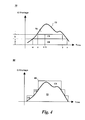
- FIG. 4 describes under-coverage and over-coverage curves in more detail.
- the at least one capacitor bank power schedule curve is updated to generate an optimized capacitor bank power schedule curve for reducing or minimizing the area between the reactive power shortage curve and the capacitor bank power schedule curve.
- Updating the at least one capacitor bank power schedule curve includes adding more capacitor banks into the system at different times. Optimization techniques such as dynamic programming, a greedy algorithm, or a branch and bound algorithm may be employed to determine the optimized capacitor bank power schedule curve. Reducing the area between the reactive power shortage curve and the capacitor bank power schedule curve has been found to result in reactive power compensation being achievable with less capacitor bank switching events as compared with convention capacitor bank control embodiments. For example, rather than switching a particular capacitor bank 7-8 times during the time period, the optimization technique may result in switching the capacitor bank only once or twice throughout the time period.
- the information may be utilized in step 58 for operating the capacitor banks by providing appropriate switching signal commands to the capacitor banks.
- FIG. 4 shows graphical illustrations 70, 80 of under-coverage and over-coverage capacitor bank power schedule curves respectively.
- a reactive power shortage curve is shown by curve 72.
- two capacitor banks are used to supply the reactive power demand over a period of time whereas in plot 80, three capacitor banks are used as shown.
- a capacitor bank power curve 74 generated by two capacitor banks is within the bounds of reactive power shortage curve 72 and is hence an under-coverage curve
- a capacitor bank power curve 82 is outside of the limits of reactive power shortage curve 72 and hence represents an over-coverage curve.
- capacitor bank curve 74 is generated with two capacitor banks supplying reactive power from time w to z .
- a first capacitor bank CB1 of rating p kVAr is switched on from time w to z whereas, a second capacitor bank CB2 of rating q kVAr is switched on from time x to y which is shorter than the time w to z .
- the resultant capacitor bank curve 74 has an amplitude of p kVAr from time w to x and y to z when it is operating alone whereas the amplitude goes up to p+q kVAr from time x to y when both capacitor banks are supplying reactive power to the grid.
- FIG. 5 describes a branch and bound optimization method 90 of minimizing the area between the reactive power shortage curve and the capacitor bank power schedule curve with reduced capacitor banks switchings.
- the branch-and-bound (BB) method is based on the idea of intelligently enumerating all the feasible points of a combinatorial optimization problem.
- BB method we try to construct a proof that a solution is optimal based on successive partitioning of the solution space.
- the branch in BB corresponds to the partitioning process, and the bound refers to the lower bounds that are used to construct a proof of optimality without exhaustive search.
- CBs capacitor banks
- CB1 with capacity of 200 kVAr
- CB 2 with 200 kVAr
- CB3 with 60 kVAr
- CB4 again with 200 kVAr respectively.
- the circles in Fig. 5 correspond to subsets of CBs.
- the circle at the top in step 92 is the starting point, the empty subset (i.e., No CBs).
- the selected circle is labeled as parent and its children are found by adding one CB at a time that has not been in the subset yet. Further, at each step a number of subsets are selected for further investigation into the next step.
- the subsets selected depend on their cost and beam width.
- the beam width here refers to the number of branches which are selected by the operator and is part of bounding the algorithm.
- the cost is generally a representation of area difference between the reactive power shortage curve and the capacitor bank power schedule curve. For example, the more the area difference, the higher the cost.
- Step 94 of FIG. 5 shows four subsets with only one parent CB (CB1 or CB2 or CB3 or CB4) i.e., only one capacitor bank is supplying power to the grid for a particular period of time.
- step 94 only a pre-defined number of these ordered subsets are selected. In one embodiment, only the subsets with minimal costs are selected. In the example shown, the beam width selected is 2. Thus, at each step only 2 subsets are selected and the cost of the ordered subset at each step is determined. Bounding the number of branches off the parent CB based on the beam width decreases the complexity of the algorithm compared to a more exhaustive search. However, such bounding may leads to a suboptimal solution. The optimality of the solution increases with the increased beam width. Thus, the operator selects the beam width based on the optimal solution requirement.
- the length l i is calculated by finding points in time where the cumulative reactive power supplied by the i th CB and CBs prior to i th CB in schedule is lower than the reactive power shortage curve.
- step 94 it is first determined which of the subsets 1 (CB1), 2 (CB2), 3 (CB3) and 4 (CB4) have lower costs. If the peak reactive power shortage curve is a parabolic curve with peak of 660 kVAr, then the cost of subset 1, 2, and 4 may be lower compared any combination including subset 3. Thus, subset 3 is discarded due to its high cost. Further, since the beam width is 2, even though subset 4 has similar cost as that of subset 1 and subset 2, it is discarded too. Referring back to FIG. 4 , subset 1 is selected means at first level CB1 is assumed to be operated from a time period w to z .
- step 96 has two subsets with two starting capacitor banks CB1 and CB2 respectively.
- remaining capacitor banks CB2, CB3 and CB4 are added to that subset for updating the capacitor bank scheduling curve.
- the cost of each of these combinations or updated curves i.e., CB1 + CB2 or CB1 + CB3, or CB1 + CB4 is again determined and the lowest cost combination or combinations are selected as subsets for further calculations in step 98 with beam width of 2.
- CB2 and CB 4 are added to the two different subsets or branches respectively.
- BB algorithm takes into account the under-coverage curve.
- the method is similar to the under-coverage curve algorithm except that the optimization problem is formulated to minimize the difference between the area covered by CBs and the shortage curve instead of the difference between the shortage curve and CBs and the length is calculated based on mechanisms similar to those of under-coverage curve.
- the curve may be split into 6 curves of 4 hours each, and the above algorithm may then be employed on each of the curves separately.
- the number of capacitor bank switching events i.e., how many times a capacitor bank is being switched on and off and to restrict the number of events per time period to a number decided by the operator. This may be necessary because capacitor bank lifetime depends on the number of switching events per day.
Landscapes
- Engineering & Computer Science (AREA)
- Business, Economics & Management (AREA)
- Economics (AREA)
- Human Resources & Organizations (AREA)
- Strategic Management (AREA)
- Health & Medical Sciences (AREA)
- Theoretical Computer Science (AREA)
- Marketing (AREA)
- Tourism & Hospitality (AREA)
- Physics & Mathematics (AREA)
- General Business, Economics & Management (AREA)
- General Physics & Mathematics (AREA)
- Power Engineering (AREA)
- Entrepreneurship & Innovation (AREA)
- General Health & Medical Sciences (AREA)
- Primary Health Care (AREA)
- Water Supply & Treatment (AREA)
- Development Economics (AREA)
- Educational Administration (AREA)
- Public Health (AREA)
- Game Theory and Decision Science (AREA)
- Operations Research (AREA)
- Quality & Reliability (AREA)
- Supply And Distribution Of Alternating Current (AREA)
- Control Of Electrical Variables (AREA)
Abstract
Description
- The invention relates generally to an electric power grid and more specifically to control of capacitor bank switching in the power grid.
- The basic structure of an electric power system comprises various hardware elements such as generators, transformers, and real-time monitoring equipment, and software such as power flow analysis software, fault detection software, and restoration software for generation, transmission, and distribution of electricity.
- In general, power system operators ensure the quality of the power supplied to the customers by maintaining the load bus voltages within their permissible limits. Any changes to the system configuration or in power demands can result in higher or lower voltages in the system. This situation can be improved by reallocating the reactive power generated in the system by adjusting transformer taps, changing generator voltages, and by switching VAR sources such as capacitor banks or static VAR compensators (SVCs).
- Capacitor banks in the power grid are often used to provide leading reactive power compensation or power factor correction. The use of capacitor banks has increased because they are relatively inexpensive, easy and quick to install, and can be deployed virtually anywhere in the network. Capacitor bank installation has other beneficial effects on the system such as: improvement of the voltage at the load, better voltage regulation, reduction of losses, and reduction or postponement of investments in transmission.
- Optimizing capacitor bank switching helps electric delivery companies minimize the cost of installing and maintaining equipment on a distribution feeder and achieve better performance from the available capacitor banks. There are various algorithms available for optimizing capacitor bank switching. However, most of these algorithms are combined with voltage control algorithms and thus lead to long convergence times. Further most of these algorithms result in certain capacitor banks being switched on and off more times in a day than desired. Frequent switching of capacitor banks degrades switching contacts of the capacitor banks and increases maintenance requirements and decreases lifetime.
- Therefore, there is a need for an improved optimization approach to capacitor bank switching.
- In accordance with an embodiment of the present invention, a method of operating capacitor banks in a power grid is provided. The method includes obtaining a reactive power shortage curve forecast for a time period and generating at least one capacitor bank power schedule curve to supply reactive power to the power grid during the time period. The method further includes updating the at least one capacitor bank power schedule curve to generate an optimized capacitor bank power schedule curve for reducing the area between the reactive power shortage curve and the capacitor bank power schedule curve. The method further includes providing switching signal commands for operating capacitor banks based on the optimized capacitor bank power schedule curve.
- In accordance with another embodiment of the present invention a power grid system including a plurality of capacitor banks and a capacitor bank switching system is provided. The capacitor bank switching system includes a load forecast module to obtain a reactive power shortage curve for a time period and a capacitor bank scheduling module for generating at least one capacitor bank power schedule curve to supply reactive power to the power grid during the time period. The capacitor bank switching system also includes an optimization module to update the at least one capacitor bank power schedule curve and generate an optimized capacitor bank power schedule curve to reduce the area between the reactive power shortage curve and the capacitor bank power schedule curve. The capacitor bank switching system further includes a control circuitry to provide switching signal commands for operating capacitor banks based on the optimized capacitor bank power schedule.
- In accordance with yet another embodiment of the present invention, a computer-readable medium comprising non-transitory computer-readable instructions of a computer program that, when executed by a processor, cause the processor to perform a method of operating capacitor banks in a power grid is provided. The method includes obtaining a reactive power shortage curve forecast for a time period and generating at least one capacitor bank power schedule curve to supply reactive power to the power grid during the time period. The method further includes updating the at least one capacitor bank power schedule curve to generate an optimized capacitor bank power schedule curve for reducing the area between the reactive power shortage curve and the capacitor bank power schedule curve. The method further includes providing switching signal commands for operating capacitor banks based on the optimized capacitor bank power schedule curve.
- These and other features, aspects, and advantages of the present invention will become better understood when the following detailed description is read with reference to the accompanying drawings in which like characters represent like parts throughout the drawings, wherein:
-
FIG. 1 is a diagrammatical representation of an overall electric system; -
FIG. 2 is a diagrammatical representation of a capacitor bank and a capacitor unit; -
FIG. 3 is a flow chart representing a method of operating capacitor banks in a power grid in accordance with an embodiment of the present invention; -
FIG. 4 is a graphical representation of under-coverage and over-coverage capacitor bank power schedule curves; and -
FIG. 5 is a graphical representation describing a branch and bound optimization method in accordance with an embodiment of the present invention. -
FIG. 1 illustrates a single line diagram of an overallelectric system 10 from generation to utilization. Theelectric system 10 includes agenerating station 12, atransmission substation 14, local substations ordistribution substations 16 andloads 18. Generatingstation 12 may comprise a hydropower generating station, a thermal power generating station, a wind power generating station, or a solar power generating station, for example. Generatingstation 12 generates electricity at a generating station voltage which is typically in the range of 4 kV to 13 kV. The generating station voltage is stepped up to a higher transmission level voltage such as 110 kV and above by a generating station transformer (not shown) for more efficient transfer of the electricity. - The electricity at the transmission level voltage is transmitted to
transmission substation 14 byprimary transmission lines 20 that are configured to carry electricity long distances. Attransmission substation 14, a reduction in voltage occurs for distribution to other points in the system throughsecondary transmission lines 22. Further voltage reductions for commercial and industrial orresidential loads 18 may occur atdistribution substation 16. Thedistribution substation 16 may supply electricity at voltages in the range of 4 kV to 69 kV, for example. The voltages may further by reduced by one or two more levels atdistribution substation 16 or other local substations (not shown) receiving power fromdistribution substation 16 to supply the electricity to residential loads at lower voltages such as 120 V or 240 V. Capacitor banks (not shown) may be placed anywhere in the system such as at the transmission substation or distribution substation, for example. - A
utility control center 24 is used in thesystem 10 for operation and maintenance ofgenerating station 12,transmission substation 14, anddistribution substations 16.Utility control center 24 receives data from these components and also provides control signals to these components.Loads 18 may communicate with theirrespective distribution substations 16 and thus theutility control center 24 may also receive and transmit information to and from theloads 18. Components of theutility control center 24 include a supervisory control and data acquisition (SCADA)system 26, an energy management system (EMS) 28, a demand response management system (DRMS) 30, and a distribution management system (DMS) 32. In one embodiment, some of these components may be provided separately insystem 10 rather than being integrated in theutility control center 24. - As will be appreciated by those skilled in the art, SCADA usually refers to basic control and monitoring of field devices including breakers, switches, capacitors, reclosers, and transformers.
EMS 28 coordinates and optimizes power generation and transmission, whereasDMS 32 coordinates power distribution. EMS 28 and DMS 32 include applications such as automatic generation control (AGC), load forecasting, capacitor bank switching controls, engineering load flow modeling, economic dispatch, energy accounting, interchange transactions, reserve calculations (spin and non-spin), and VAR/voltage control. DRMS 30 controls peak demand and produces other economies without major inconvenience to the customer. In some embodiments,DRMS 30 is added as a function of theEMS 28 because of its use in controlling overall peak demand and generation requirements.Further DMS 32 includes functions and capabilities that may improve the reliability and efficiency of the power distribution system. -
Fig. 2 shows acapacitor unit 110 which is a building block of acapacitor bank 120. Capacitorbank 120 is configured using one or more series groups of parallel connectedcapacitor units 110 per phase.Capacitor unit 110 is made up ofindividual capacitor elements 112, arranged in parallel/ series connected groups, within asteel enclosure 114. In one embodiment aninternal discharge device 116 incapacitor unit 110 is used when needed to reduce residual voltage. For example, an appropriately sized resistor may be used for reducing the unit residual voltage by 50 V or less in 5 minutes.Capacitor units 110 are available in a variety of voltage ratings, typically 240 V to 24940V, and sizes 2.5 kvar to about 1000 kvar, for example. -
Fig. 3 shows amethod 50 of operating capacitor banks in the power grid in accordance with an embodiment of the present invention. The method may be employed by theDMS 32 or EMS 28 (FIG. 1 ), for example, and includes obtaining a forecast for reactive power shortage instep 52. The reactive power shortage forecast may be obtained by subtracting total reactive power being generated by reactive power sources from the total reactive power demand for a time period or period of interest based on a desired power factor. In one embodiment, the reactive power sources may include capacitor banks that are already connected to the system. The reactive power forecast may be determined in terms of MVA loading which is indicative of active as well as reactive power for a particular zone. In one embodiment, the period of interest may be an hour, a day, a week, or any other suitable time determined by the user or the operator. In another embodiment, the reactive power forecast is determined for k time steps into the future, where k is again a number determined by the operator. As will be appreciated by those skilled in the art, reactive power forecasting methods may include similar day approaches, various regression models, time series approaches, neural networks, expert systems, fuzzy logic, and statistical learning algorithms. - In
step 54, at least one capacitor bank power schedule curve may be generated to supply power to the power grid during the period of interest. In one example, the at least one capacitor bank power schedule curve may comprise a curve representative of reactive from scheduling of a single capacitor bank. For example, if a capacitor bank with a rating of 100 kVAr is scheduled to operate from morning 8 to 11 then the capacitor bank power schedule curve will be a rectangle with amplitude of 100 kVAr for that period. In a given zone there may be a number of capacitor banks having similar and/or different ratings. Thus, in such a scenario, the capacitor bank power schedule curve refers to a power curve obtained from the reactive power generated by the capacitor banks as the capacitor banks are switched on in accordance with the switching schedule. Since there are a numbers of capacitor banks, the capacitor banks may be switched in multiple different combinations for the period of interest resulting into a plurality of potential capacitor bank power schedule curves. Thus, instep 54 all such capacitor bank power schedule curves of different combinations of capacitor banks may be determined. The capacitor bank power schedule curve may either be an under-coverage curve or an over-coverage curve. In an under-coverage curve, the limits of the capacitor bank power schedule curve are within the reactive power shortage curve, whereas, in an over-coverage curve, the limits of the capacitor bank power schedule curve are outside of the reactive power shortage curve.FIG. 4 describes under-coverage and over-coverage curves in more detail. - In
step 56, the at least one capacitor bank power schedule curve is updated to generate an optimized capacitor bank power schedule curve for reducing or minimizing the area between the reactive power shortage curve and the capacitor bank power schedule curve. Updating the at least one capacitor bank power schedule curve includes adding more capacitor banks into the system at different times. Optimization techniques such as dynamic programming, a greedy algorithm, or a branch and bound algorithm may be employed to determine the optimized capacitor bank power schedule curve. Reducing the area between the reactive power shortage curve and the capacitor bank power schedule curve has been found to result in reactive power compensation being achievable with less capacitor bank switching events as compared with convention capacitor bank control embodiments. For example, rather than switching a particular capacitor bank 7-8 times during the time period, the optimization technique may result in switching the capacitor bank only once or twice throughout the time period. Once the optimized capacitor bank power schedule curve is determined, the information may be utilized instep 58 for operating the capacitor banks by providing appropriate switching signal commands to the capacitor banks. -
FIG. 4 showsgraphical illustrations plots curve 72. Inplot 70, two capacitor banks are used to supply the reactive power demand over a period of time whereas inplot 80, three capacitor banks are used as shown. Further, inplot 70, a capacitorbank power curve 74 generated by two capacitor banks is within the bounds of reactivepower shortage curve 72 and is hence an under-coverage curve, whereas in plot 80 a capacitorbank power curve 82 is outside of the limits of reactivepower shortage curve 72 and hence represents an over-coverage curve. - To describe under coverage curve in more detail,
capacitor bank curve 74 is generated with two capacitor banks supplying reactive power from time w to z. A first capacitor bank CB1 of rating p kVAr is switched on from time w to z whereas, a second capacitor bank CB2 of rating q kVAr is switched on from time x to y which is shorter than the time w to z. Thus, the resultantcapacitor bank curve 74 has an amplitude of p kVAr from time w to x and y to z when it is operating alone whereas the amplitude goes up to p+q kVAr from time x to y when both capacitor banks are supplying reactive power to the grid. -
FIG. 5 describes a branch and boundoptimization method 90 of minimizing the area between the reactive power shortage curve and the capacitor bank power schedule curve with reduced capacitor banks switchings. The branch-and-bound (BB) method is based on the idea of intelligently enumerating all the feasible points of a combinatorial optimization problem. As will be appreciated by those skilled in the art, in BB method, we try to construct a proof that a solution is optimal based on successive partitioning of the solution space. The branch in BB corresponds to the partitioning process, and the bound refers to the lower bounds that are used to construct a proof of optimality without exhaustive search. For this particular example assume that there is a set of four capacitor banks (CBs) in a particular zone, CB1 with capacity of 200 kVAr,CB 2 with 200 kVAr, CB3 with 60 kVAr and CB4 again with 200 kVAr respectively. The circles inFig. 5 correspond to subsets of CBs. The circle at the top instep 92 is the starting point, the empty subset (i.e., No CBs). At each step, the selected circle is labeled as parent and its children are found by adding one CB at a time that has not been in the subset yet. Further, at each step a number of subsets are selected for further investigation into the next step. The subsets selected (represented by the circles that are not crossed out) depend on their cost and beam width. The beam width here refers to the number of branches which are selected by the operator and is part of bounding the algorithm. The cost is generally a representation of area difference between the reactive power shortage curve and the capacitor bank power schedule curve. For example, the more the area difference, the higher the cost. -
Step 94 ofFIG. 5 , shows four subsets with only one parent CB (CB1 or CB2 or CB3 or CB4) i.e., only one capacitor bank is supplying power to the grid for a particular period of time. Instep 94, only a pre-defined number of these ordered subsets are selected. In one embodiment, only the subsets with minimal costs are selected. In the example shown, the beam width selected is 2. Thus, at each step only 2 subsets are selected and the cost of the ordered subset at each step is determined. Bounding the number of branches off the parent CB based on the beam width decreases the complexity of the algorithm compared to a more exhaustive search. However, such bounding may leads to a suboptimal solution. The optimality of the solution increases with the increased beam width. Thus, the operator selects the beam width based on the optimal solution requirement. - For determining the cost of the ordered subset, the following equation may be used.

wherein A is the area under the reactive power shortage curve, D is the total number of capacitor banks in the subset, and pi is the profit or actual reactive power supplied by an ith capacitor bank over a certain period of time. In one embodiment, the profit pi of a capacitor bank can be determined by following equation:
wherein wi is the weight or capacity of the ith capacitor bank, and li is the length or the time duration for which the capacitor bank may be switched on to supply the reactive power to the grid during reactive power shortage. The length li is calculated by finding points in time where the cumulative reactive power supplied by the ith CB and CBs prior to ith CB in schedule is lower than the reactive power shortage curve. - For example, in the embodiment of
FIG. 5 , instep 94 it is first determined which of the subsets 1 (CB1), 2 (CB2), 3 (CB3) and 4 (CB4) have lower costs. If the peak reactive power shortage curve is a parabolic curve with peak of 660 kVAr, then the cost ofsubset combination including subset 3. Thus,subset 3 is discarded due to its high cost. Further, since the beam width is 2, even thoughsubset 4 has similar cost as that ofsubset 1 andsubset 2, it is discarded too. Referring back toFIG. 4 ,subset 1 is selected means at first level CB1 is assumed to be operated from a time period w to z. - Now the
step 96 has two subsets with two starting capacitor banks CB1 and CB2 respectively. With respect to the subset starting with capacitor bank CB1 instep 96, remaining capacitor banks CB2, CB3 and CB4 are added to that subset for updating the capacitor bank scheduling curve. The cost of each of these combinations or updated curves (i.e., CB1 + CB2 or CB1 + CB3, or CB1 + CB4) is again determined and the lowest cost combination or combinations are selected as subsets for further calculations instep 98 with beam width of 2. As can be seen fromFIG. 5 , CB2 andCB 4 are added to the two different subsets or branches respectively. Similar calculations and branching (not shown) may also be done for the subset starting with CB2 inStep 94. Cost calculation and updating the subset with more capacitor banks to reduce the cost is repeated insteps FIG. 4 , it can be seen that atlevel 2, capacitor bank CB2 is added to CB1 from time period x to y to increase the total reactive power to p+q kVAr and minimize the area between reactive power shortage curve and capacitor bank reactive power curve. The steps are repeated until one is short of number capacitor banks or the area difference achieved is minimum. - The above description of BB algorithm takes into account the under-coverage curve. For the over-coverage curve, the method is similar to the under-coverage curve algorithm except that the optimization problem is formulated to minimize the difference between the area covered by CBs and the shortage curve instead of the difference between the shortage curve and CBs and the length is calculated based on mechanisms similar to those of under-coverage curve.
- In certain embodiments, it may be necessary to divide the reactive power shortage curve in multiple curves of small durations. For example, rather than having a single 24 hour curve, the curve may be split into 6 curves of 4 hours each, and the above algorithm may then be employed on each of the curves separately. In such situations it is helpful to calculate the number of capacitor bank switching events, i.e., how many times a capacitor bank is being switched on and off and to restrict the number of events per time period to a number decided by the operator. This may be necessary because capacitor bank lifetime depends on the number of switching events per day.
- While only certain features of the invention have been illustrated and described herein, many modifications and changes will occur to those skilled in the art. It is, therefore, to be understood that the appended claims are intended to cover all such modifications and changes as fall within the scope of the invention as defined in the accompanying claims.
Claims (15)
- A method (50) for operating capacitor banks in a power grid comprising:obtaining (52) a reactive power shortage curve forecast for a time period;generating (54) at least one capacitor bank power schedule curve to supply reactive power to the power grid during the time period;updating (56) the at least one capacitor bank power schedule curve to generate an optimized capacitor bank power schedule curve for reducing the area between the reactive power shortage curve and the capacitor bank power schedule curve; andproviding (58) switching signal commands for operating capacitor banks based on the optimized capacitor bank power schedule curve.
- The method of claim 1, wherein obtaining (52) the reactive power shortage curve forecast comprises utilizing at least one of a regression algorithm, a time series algorithm, a neutral network algorithm, a fuzzy logic algorithm or a statistical learning algorithm.
- The method of claim 1 or claim 2, wherein updating the at least one capacitor bank power schedule curve comprises utilizing an optimization technique to optimize the capacitor bank power schedule curve.
- The method of claim 3, wherein the optimization technique comprises a dynamic programming algorithm, a greedy algorithm or a branch and bound (BB) algorithm.
- The method of claim 4, wherein the branch and bound (BB) algorithm comprises identifying at least one least cost capacitor bank subset.
- The method of claim 5, wherein the identifying at least one least cost capacitor bank subset comprises: updating the at least one capacitor bank subset by adding child capacitor banks to parent capacitor banks; and/or is based on an area difference between the reactive power shortage curve and the capacitor bank power schedule curve, and/or constraining a capacitor bank subset based on a beam width.
- The method of any one of claims 1 to 6, wherein the capacitor bank power schedule curve comprises an under-coverage curve or an over-coverage curve.
- The method of claim 10, wherein, when the capacitor bank scheduling curve comprises under-coverage curve, the BB algorithm: reduces the difference between the reactive power shortage curve and the capacitor bank scheduling curve, or reduces the difference between the capacitor bank scheduling curve and the reactive power shortage curve.
- The method of claim 1 further comprising dividing the reactive power shortage curve in multiple curves of small durations during the time period, or wherein preferably a number of switching signal commands for at least one capacitor bank during the time period are restricted.
- A computer-readable medium comprising non-transitory computer-readable instructions of a computer program that, when executed by a processor, cause the processor to perform the method (50) of operating capacitor banks in a power grid of any one of claims 1 to 9.
- A power grid system comprising:a plurality of capacitor banks (120);a capacitor bank switching system (50) comprising:a load forecast module (52) to obtain a reactive power shortage curve for a time period;a capacitor bank scheduling module (54) for generating at least one capacitor bank power schedule curve to supply reactive power to the power grid during the time period;an optimization module (56) for updating the at least one capacitor bank power schedule curve and generating an optimized capacitor bank power schedule curve to reduce the area between the reactive power shortage curve and the capacitor bank power schedule curve; anda control circuitry (58) for providing switching signal commands for operating capacitor banks based on the optimized capacitor bank power schedule.
- The power grid system of claim 11, wherein the optimization module (56) comprises an optimization technique to optimize the capacitor bank power schedule curve.
- The power grid system of claim 12, wherein the optimization technique comprises a dynamic programming algorithm, a greedy algorithm or a branch and bound (BB) algorithm.
- The power grid system of any one of claims 11 to 13, wherein the branch and bound (BB) algorithm identifies at least one least cost capacitor bank subset.
- The power grid system of claim 14, wherein at least one least cost capacitor bank subset is identified based on an area difference between the reactive power shortage curve and the capacitor bank power schedule curve.
Applications Claiming Priority (1)
| Application Number | Priority Date | Filing Date | Title |
|---|---|---|---|
| US13/076,475 US8922175B2 (en) | 2011-03-31 | 2011-03-31 | System and method for operating capacitor banks |
Publications (3)
| Publication Number | Publication Date |
|---|---|
| EP2506383A2 true EP2506383A2 (en) | 2012-10-03 |
| EP2506383A3 EP2506383A3 (en) | 2015-08-19 |
| EP2506383B1 EP2506383B1 (en) | 2016-10-26 |
Family
ID=46044338
Family Applications (1)
| Application Number | Title | Priority Date | Filing Date |
|---|---|---|---|
| EP12161675.9A Not-in-force EP2506383B1 (en) | 2011-03-31 | 2012-03-28 | System and method for operating capacitor banks |
Country Status (3)
| Country | Link |
|---|---|
| US (1) | US8922175B2 (en) |
| EP (1) | EP2506383B1 (en) |
| JP (1) | JP6063632B2 (en) |
Cited By (4)
| Publication number | Priority date | Publication date | Assignee | Title |
|---|---|---|---|---|
| WO2015039464A1 (en) * | 2013-09-18 | 2015-03-26 | 江苏省电力公司南京供电公司 | Global optimization scheduling strategy library based on timescale |
| EP2602898A3 (en) * | 2011-11-28 | 2015-05-13 | General Electric Company | System and method for reactive power compensation in power networks |
| CN106972504A (en) * | 2017-04-28 | 2017-07-21 | 华南理工大学 | Interval idle work optimization method based on genetic algorithm |
| EP3149841A4 (en) * | 2014-05-28 | 2017-11-22 | Gridco Inc. | A multi-function power regulator for prioritizing functions and allocating resources thereof |
Families Citing this family (14)
| Publication number | Priority date | Publication date | Assignee | Title |
|---|---|---|---|---|
| CN103328991B (en) * | 2011-02-16 | 2015-12-16 | Abb研究有限公司 | The method and apparatus that in Capacitor banks, internal fault detects is connected for Y-Y |
| US9184589B2 (en) * | 2013-02-27 | 2015-11-10 | Mitsubishi Electric Research Laboratories, Inc. | Method for optimizing power flows in electric power networks |
| CN103557117B (en) * | 2013-11-19 | 2016-07-06 | 大唐山东清洁能源开发有限公司 | Power curves of wind-driven generator sets acquisition device |
| CN104200276B (en) * | 2014-07-14 | 2017-12-05 | 河海大学 | A kind of intelligent distribution network reconstructing method of feature based load injection |
| US10585445B2 (en) * | 2015-02-02 | 2020-03-10 | Opus One Solutions Energy Corporation | Systems and methods for volt/VAR control in electric power management and automation systems |
| CN105275742B (en) * | 2015-11-09 | 2018-03-16 | 国家电网公司 | A kind of control method of Wind turbines adaptive environment |
| CN105846443B (en) * | 2016-03-18 | 2018-03-27 | 国网江苏省电力公司电力科学研究院 | The electric network reactive compensation Optimizing Configuration System and method solved based on more knapsack problems |
| US9806690B1 (en) * | 2016-09-30 | 2017-10-31 | AEP Transmission Holding Company, LLC | Subsynchronous oscillation relay |
| WO2020136576A1 (en) * | 2018-12-28 | 2020-07-02 | Abb Schweiz Ag | Power quality monitoring in a distribution grid |
| CN112598149B (en) * | 2020-11-03 | 2023-10-31 | 上海电力大学 | A distribution network grid construction method based on differentiated load matching |
| KR102556773B1 (en) * | 2020-11-23 | 2023-07-20 | 한국전력공사 | Apparatus for scheduling of energy storage system and method thereof |
| CN114665610B (en) * | 2022-05-25 | 2022-08-09 | 广东电网有限责任公司佛山供电局 | Capacitor monitoring method, system and equipment based on reactive power acquisition |
| US12362561B1 (en) | 2024-09-25 | 2025-07-15 | Eygs Llp | Systems and methods for causing switchovers in electrical networks based on system average interruption duration index (SAIDI) values |
| US12308647B1 (en) * | 2024-11-27 | 2025-05-20 | Eygs Llp | Systems and methods for correcting reactive power anomalies in electrical networks based on distribution measurements |
Family Cites Families (22)
| Publication number | Priority date | Publication date | Assignee | Title |
|---|---|---|---|---|
| US4365190A (en) | 1981-03-19 | 1982-12-21 | Asi Systems, Inc. | Automatic var controller |
| JPS5959025A (en) * | 1982-09-29 | 1984-04-04 | 株式会社日立製作所 | Generator operation deciding system |
| US4645997A (en) | 1985-03-13 | 1987-02-24 | Kollmorgen Technologies Corporation | Transient free solid state automatic power factor correction |
| JPH0734624B2 (en) | 1987-09-21 | 1995-04-12 | 三菱電機株式会社 | Voltage-reactive power controller |
| US5670864A (en) * | 1995-05-26 | 1997-09-23 | Pacific Scientific Company | Adaptive automatic power capacitor for controlling controller a capacitor bank of a power distribution system |
| JPH09182295A (en) * | 1995-12-27 | 1997-07-11 | Mitsubishi Electric Corp | Power factor correction device |
| JPH09327129A (en) * | 1996-06-04 | 1997-12-16 | Nissin Electric Co Ltd | Control apparatus for power factor |
| ATE263449T1 (en) | 1997-12-09 | 2004-04-15 | Robert Wallace Beckwith | ADAPTIVE MULTIFUNCTIONAL CONTROLS FOR TAP SWITCHES AND CAPACITORS |
| JP3791188B2 (en) * | 1998-06-22 | 2006-06-28 | 株式会社日立製作所 | Voltage reactive power control device |
| JP2000184592A (en) * | 1998-12-15 | 2000-06-30 | Toshiba Corp | Power supply / demand plan creation device and recording medium for recording processing program of the device |
| US7804280B2 (en) | 2006-11-02 | 2010-09-28 | Current Technologies, Llc | Method and system for providing power factor correction in a power distribution system |
| JP2008271750A (en) * | 2007-04-24 | 2008-11-06 | Toshiba Corp | Power system voltage reactive power control method, apparatus and program |
| JP4658089B2 (en) * | 2007-05-23 | 2011-03-23 | 三菱電機株式会社 | Generator operation plan formulation device, operation plan formulation method, and program for executing the device and method |
| US8589490B2 (en) * | 2008-01-16 | 2013-11-19 | Janos Tapolcai | System, method, and computer program for solving mixed integer programs with peer-to-peer applications |
| US8000913B2 (en) * | 2008-01-21 | 2011-08-16 | Current Communications Services, Llc | System and method for providing power distribution system information |
| US20090265042A1 (en) | 2008-04-17 | 2009-10-22 | Mollenkopf James D | System and Method for Providing Voltage Regulation in a Power Distribution System |
| CN101350525A (en) * | 2008-08-13 | 2009-01-21 | 田田 | Method for configuring main change reactive compensation capacitor set of transformer substation |
| WO2010045726A1 (en) | 2008-10-20 | 2010-04-29 | Deborah Lynn Fallis | Single phase power factor correction system and method |
| JP5409319B2 (en) * | 2009-03-18 | 2014-02-05 | 三菱電機株式会社 | Reactive power compensator |
| US8744638B2 (en) * | 2009-09-11 | 2014-06-03 | General Electric Company | Method and system for demand response in a distribution network |
| US20110093127A1 (en) * | 2009-10-16 | 2011-04-21 | David L. Kaplan | Distributed energy resources manager |
| CN102055200A (en) * | 2010-12-31 | 2011-05-11 | 华北电网有限公司 | Method for calculating capacity configuration of reactive power compensation capacitor device of transformer substation |
-
2011
- 2011-03-31 US US13/076,475 patent/US8922175B2/en not_active Expired - Fee Related
-
2012
- 2012-03-28 EP EP12161675.9A patent/EP2506383B1/en not_active Not-in-force
- 2012-03-29 JP JP2012075354A patent/JP6063632B2/en not_active Expired - Fee Related
Non-Patent Citations (1)
| Title |
|---|
| None |
Cited By (5)
| Publication number | Priority date | Publication date | Assignee | Title |
|---|---|---|---|---|
| EP2602898A3 (en) * | 2011-11-28 | 2015-05-13 | General Electric Company | System and method for reactive power compensation in power networks |
| US9252596B2 (en) | 2011-11-28 | 2016-02-02 | General Electric Company | System and method for reactive power compensation in power networks |
| WO2015039464A1 (en) * | 2013-09-18 | 2015-03-26 | 江苏省电力公司南京供电公司 | Global optimization scheduling strategy library based on timescale |
| EP3149841A4 (en) * | 2014-05-28 | 2017-11-22 | Gridco Inc. | A multi-function power regulator for prioritizing functions and allocating resources thereof |
| CN106972504A (en) * | 2017-04-28 | 2017-07-21 | 华南理工大学 | Interval idle work optimization method based on genetic algorithm |
Also Published As
| Publication number | Publication date |
|---|---|
| JP6063632B2 (en) | 2017-01-18 |
| JP2012217331A (en) | 2012-11-08 |
| US8922175B2 (en) | 2014-12-30 |
| EP2506383B1 (en) | 2016-10-26 |
| US20120249092A1 (en) | 2012-10-04 |
| EP2506383A3 (en) | 2015-08-19 |
Similar Documents
| Publication | Publication Date | Title |
|---|---|---|
| EP2506383B1 (en) | System and method for operating capacitor banks | |
| Henderson et al. | Electric power grid modernization trends, challenges, and opportunities | |
| Chen et al. | Multi-time step service restoration for advanced distribution systems and microgrids | |
| KR102101108B1 (en) | Reactive power control methods, devices and systems | |
| Valverde et al. | Model predictive control of voltages in active distribution networks | |
| US8531173B2 (en) | System and method for operating a tap changer | |
| Kim et al. | Reactive power ancillary service of synchronous DGs in coordination with voltage control devices | |
| Ke et al. | Sizing the battery energy storage system on a university campus with prediction of load and photovoltaic generation | |
| Khodaei et al. | Microgrid-based co-optimization of generation and transmission planning in power systems | |
| AU2017277641A1 (en) | Method and apparatus for controlling power flow in a hybrid power system | |
| Eluri et al. | Challenges of res with integration of power grids, control strategies, optimization techniques of microgrids: A review | |
| Bedawy et al. | An effective coordination strategy for voltage regulation in distribution system containing high intermittent photovoltaic penetrations | |
| Lachovicz et al. | Impacts of PV-STATCOM reactive power dispatch in the allocation of capacitors bank and voltage regulators on active distribution networks | |
| Karagiannopoulos et al. | Co-optimisation of planning and operation for active distribution grids | |
| Andreotti et al. | Decision theory criteria for the planning of distributed energy storage systems in the presence of uncertainties | |
| Ishii et al. | Optimal smart functions of large-scale PV inverters in distribution systems | |
| Therapontos et al. | RES curtailments in Cyprus: A review of technical constraints and solutions | |
| Armendariz et al. | Comparative study of optimal controller placement considering uncertainty in PV growth and distribution grid expansion | |
| Jannati-Oskuee et al. | Risk-based joint flexible distribution network expansion planning and allocation of EV parking lots | |
| Bhattarai et al. | Overvoltage mitigation using coordinated control of demand response and grid-tied photovoltaics | |
| Madureira et al. | Coordinated voltage control in distribution systems under the smart grid concept | |
| Kuppannagari et al. | Optimal discrete net-load balancing in smart grids with high PV penetration | |
| Chobanov | Continuity of power supply in smart grid with PV penetration | |
| Wanik et al. | Intelligent management of distributed generators reactive power for loss minimization and voltage control | |
| Jha et al. | Enhancing conservation voltage reduction using coordinated control of medium and low voltage controllable devices |
Legal Events
| Date | Code | Title | Description |
|---|---|---|---|
| PUAI | Public reference made under article 153(3) epc to a published international application that has entered the european phase |
Free format text: ORIGINAL CODE: 0009012 |
|
| AK | Designated contracting states |
Kind code of ref document: A2 Designated state(s): AL AT BE BG CH CY CZ DE DK EE ES FI FR GB GR HR HU IE IS IT LI LT LU LV MC MK MT NL NO PL PT RO RS SE SI SK SM TR |
|
| AX | Request for extension of the european patent |
Extension state: BA ME |
|
| PUAL | Search report despatched |
Free format text: ORIGINAL CODE: 0009013 |
|
| AK | Designated contracting states |
Kind code of ref document: A3 Designated state(s): AL AT BE BG CH CY CZ DE DK EE ES FI FR GB GR HR HU IE IS IT LI LT LU LV MC MK MT NL NO PL PT RO RS SE SI SK SM TR |
|
| AX | Request for extension of the european patent |
Extension state: BA ME |
|
| RIC1 | Information provided on ipc code assigned before grant |
Ipc: F03D 9/00 20060101ALI20150716BHEP Ipc: G01R 19/25 20060101ALI20150716BHEP Ipc: G06Q 50/06 20120101ALI20150716BHEP Ipc: G05F 1/70 20060101ALI20150716BHEP Ipc: H02J 3/18 20060101AFI20150716BHEP Ipc: H02J 3/38 20060101ALI20150716BHEP |
|
| 17P | Request for examination filed |
Effective date: 20160219 |
|
| RBV | Designated contracting states (corrected) |
Designated state(s): AL AT BE BG CH CY CZ DE DK EE ES FI FR GB GR HR HU IE IS IT LI LT LU LV MC MK MT NL NO PL PT RO RS SE SI SK SM TR |
|
| GRAP | Despatch of communication of intention to grant a patent |
Free format text: ORIGINAL CODE: EPIDOSNIGR1 |
|
| INTG | Intention to grant announced |
Effective date: 20160808 |
|
| RIN1 | Information on inventor provided before grant (corrected) |
Inventor name: KROK, MICHAEL JOSEPH Inventor name: GENC, SAHIKA |
|
| GRAS | Grant fee paid |
Free format text: ORIGINAL CODE: EPIDOSNIGR3 |
|
| GRAA | (expected) grant |
Free format text: ORIGINAL CODE: 0009210 |
|
| AK | Designated contracting states |
Kind code of ref document: B1 Designated state(s): AL AT BE BG CH CY CZ DE DK EE ES FI FR GB GR HR HU IE IS IT LI LT LU LV MC MK MT NL NO PL PT RO RS SE SI SK SM TR |
|
| REG | Reference to a national code |
Ref country code: GB Ref legal event code: FG4D |
|
| REG | Reference to a national code |
Ref country code: CH Ref legal event code: EP |
|
| REG | Reference to a national code |
Ref country code: AT Ref legal event code: REF Ref document number: 840645 Country of ref document: AT Kind code of ref document: T Effective date: 20161115 |
|
| REG | Reference to a national code |
Ref country code: IE Ref legal event code: FG4D |
|
| REG | Reference to a national code |
Ref country code: DE Ref legal event code: R096 Ref document number: 602012024509 Country of ref document: DE |
|
| REG | Reference to a national code |
Ref country code: LT Ref legal event code: MG4D |
|
| PG25 | Lapsed in a contracting state [announced via postgrant information from national office to epo] |
Ref country code: LV Free format text: LAPSE BECAUSE OF FAILURE TO SUBMIT A TRANSLATION OF THE DESCRIPTION OR TO PAY THE FEE WITHIN THE PRESCRIBED TIME-LIMIT Effective date: 20161026 |
|
| REG | Reference to a national code |
Ref country code: NL Ref legal event code: MP Effective date: 20161026 |
|
| REG | Reference to a national code |
Ref country code: AT Ref legal event code: MK05 Ref document number: 840645 Country of ref document: AT Kind code of ref document: T Effective date: 20161026 |
|
| REG | Reference to a national code |
Ref country code: FR Ref legal event code: PLFP Year of fee payment: 6 |
|
| PG25 | Lapsed in a contracting state [announced via postgrant information from national office to epo] |
Ref country code: NO Free format text: LAPSE BECAUSE OF FAILURE TO SUBMIT A TRANSLATION OF THE DESCRIPTION OR TO PAY THE FEE WITHIN THE PRESCRIBED TIME-LIMIT Effective date: 20170126 Ref country code: LT Free format text: LAPSE BECAUSE OF FAILURE TO SUBMIT A TRANSLATION OF THE DESCRIPTION OR TO PAY THE FEE WITHIN THE PRESCRIBED TIME-LIMIT Effective date: 20161026 Ref country code: SE Free format text: LAPSE BECAUSE OF FAILURE TO SUBMIT A TRANSLATION OF THE DESCRIPTION OR TO PAY THE FEE WITHIN THE PRESCRIBED TIME-LIMIT Effective date: 20161026 Ref country code: GR Free format text: LAPSE BECAUSE OF FAILURE TO SUBMIT A TRANSLATION OF THE DESCRIPTION OR TO PAY THE FEE WITHIN THE PRESCRIBED TIME-LIMIT Effective date: 20170127 |
|
| PG25 | Lapsed in a contracting state [announced via postgrant information from national office to epo] |
Ref country code: RS Free format text: LAPSE BECAUSE OF FAILURE TO SUBMIT A TRANSLATION OF THE DESCRIPTION OR TO PAY THE FEE WITHIN THE PRESCRIBED TIME-LIMIT Effective date: 20161026 Ref country code: IS Free format text: LAPSE BECAUSE OF FAILURE TO SUBMIT A TRANSLATION OF THE DESCRIPTION OR TO PAY THE FEE WITHIN THE PRESCRIBED TIME-LIMIT Effective date: 20170226 Ref country code: PT Free format text: LAPSE BECAUSE OF FAILURE TO SUBMIT A TRANSLATION OF THE DESCRIPTION OR TO PAY THE FEE WITHIN THE PRESCRIBED TIME-LIMIT Effective date: 20170227 Ref country code: NL Free format text: LAPSE BECAUSE OF FAILURE TO SUBMIT A TRANSLATION OF THE DESCRIPTION OR TO PAY THE FEE WITHIN THE PRESCRIBED TIME-LIMIT Effective date: 20161026 Ref country code: PL Free format text: LAPSE BECAUSE OF FAILURE TO SUBMIT A TRANSLATION OF THE DESCRIPTION OR TO PAY THE FEE WITHIN THE PRESCRIBED TIME-LIMIT Effective date: 20161026 Ref country code: ES Free format text: LAPSE BECAUSE OF FAILURE TO SUBMIT A TRANSLATION OF THE DESCRIPTION OR TO PAY THE FEE WITHIN THE PRESCRIBED TIME-LIMIT Effective date: 20161026 Ref country code: FI Free format text: LAPSE BECAUSE OF FAILURE TO SUBMIT A TRANSLATION OF THE DESCRIPTION OR TO PAY THE FEE WITHIN THE PRESCRIBED TIME-LIMIT Effective date: 20161026 Ref country code: HR Free format text: LAPSE BECAUSE OF FAILURE TO SUBMIT A TRANSLATION OF THE DESCRIPTION OR TO PAY THE FEE WITHIN THE PRESCRIBED TIME-LIMIT Effective date: 20161026 Ref country code: AT Free format text: LAPSE BECAUSE OF FAILURE TO SUBMIT A TRANSLATION OF THE DESCRIPTION OR TO PAY THE FEE WITHIN THE PRESCRIBED TIME-LIMIT Effective date: 20161026 Ref country code: BE Free format text: LAPSE BECAUSE OF FAILURE TO SUBMIT A TRANSLATION OF THE DESCRIPTION OR TO PAY THE FEE WITHIN THE PRESCRIBED TIME-LIMIT Effective date: 20161026 |
|
| REG | Reference to a national code |
Ref country code: DE Ref legal event code: R097 Ref document number: 602012024509 Country of ref document: DE |
|
| PG25 | Lapsed in a contracting state [announced via postgrant information from national office to epo] |
Ref country code: RO Free format text: LAPSE BECAUSE OF FAILURE TO SUBMIT A TRANSLATION OF THE DESCRIPTION OR TO PAY THE FEE WITHIN THE PRESCRIBED TIME-LIMIT Effective date: 20161026 Ref country code: SK Free format text: LAPSE BECAUSE OF FAILURE TO SUBMIT A TRANSLATION OF THE DESCRIPTION OR TO PAY THE FEE WITHIN THE PRESCRIBED TIME-LIMIT Effective date: 20161026 Ref country code: DK Free format text: LAPSE BECAUSE OF FAILURE TO SUBMIT A TRANSLATION OF THE DESCRIPTION OR TO PAY THE FEE WITHIN THE PRESCRIBED TIME-LIMIT Effective date: 20161026 Ref country code: EE Free format text: LAPSE BECAUSE OF FAILURE TO SUBMIT A TRANSLATION OF THE DESCRIPTION OR TO PAY THE FEE WITHIN THE PRESCRIBED TIME-LIMIT Effective date: 20161026 Ref country code: CZ Free format text: LAPSE BECAUSE OF FAILURE TO SUBMIT A TRANSLATION OF THE DESCRIPTION OR TO PAY THE FEE WITHIN THE PRESCRIBED TIME-LIMIT Effective date: 20161026 |
|
| PG25 | Lapsed in a contracting state [announced via postgrant information from national office to epo] |
Ref country code: IT Free format text: LAPSE BECAUSE OF FAILURE TO SUBMIT A TRANSLATION OF THE DESCRIPTION OR TO PAY THE FEE WITHIN THE PRESCRIBED TIME-LIMIT Effective date: 20161026 Ref country code: SM Free format text: LAPSE BECAUSE OF FAILURE TO SUBMIT A TRANSLATION OF THE DESCRIPTION OR TO PAY THE FEE WITHIN THE PRESCRIBED TIME-LIMIT Effective date: 20161026 Ref country code: BG Free format text: LAPSE BECAUSE OF FAILURE TO SUBMIT A TRANSLATION OF THE DESCRIPTION OR TO PAY THE FEE WITHIN THE PRESCRIBED TIME-LIMIT Effective date: 20170126 |
|
| PLBE | No opposition filed within time limit |
Free format text: ORIGINAL CODE: 0009261 |
|
| STAA | Information on the status of an ep patent application or granted ep patent |
Free format text: STATUS: NO OPPOSITION FILED WITHIN TIME LIMIT |
|
| 26N | No opposition filed |
Effective date: 20170727 |
|
| REG | Reference to a national code |
Ref country code: CH Ref legal event code: PL |
|
| PG25 | Lapsed in a contracting state [announced via postgrant information from national office to epo] |
Ref country code: MC Free format text: LAPSE BECAUSE OF FAILURE TO SUBMIT A TRANSLATION OF THE DESCRIPTION OR TO PAY THE FEE WITHIN THE PRESCRIBED TIME-LIMIT Effective date: 20161026 Ref country code: SI Free format text: LAPSE BECAUSE OF FAILURE TO SUBMIT A TRANSLATION OF THE DESCRIPTION OR TO PAY THE FEE WITHIN THE PRESCRIBED TIME-LIMIT Effective date: 20161026 |
|
| REG | Reference to a national code |
Ref country code: IE Ref legal event code: MM4A |
|
| PG25 | Lapsed in a contracting state [announced via postgrant information from national office to epo] |
Ref country code: LU Free format text: LAPSE BECAUSE OF NON-PAYMENT OF DUE FEES Effective date: 20170328 |
|
| PG25 | Lapsed in a contracting state [announced via postgrant information from national office to epo] |
Ref country code: CH Free format text: LAPSE BECAUSE OF NON-PAYMENT OF DUE FEES Effective date: 20170331 Ref country code: LI Free format text: LAPSE BECAUSE OF NON-PAYMENT OF DUE FEES Effective date: 20170331 Ref country code: IE Free format text: LAPSE BECAUSE OF NON-PAYMENT OF DUE FEES Effective date: 20170328 |
|
| REG | Reference to a national code |
Ref country code: FR Ref legal event code: PLFP Year of fee payment: 7 |
|
| PGFP | Annual fee paid to national office [announced via postgrant information from national office to epo] |
Ref country code: GB Payment date: 20180327 Year of fee payment: 7 |
|
| PGFP | Annual fee paid to national office [announced via postgrant information from national office to epo] |
Ref country code: FR Payment date: 20180326 Year of fee payment: 7 |
|
| PGFP | Annual fee paid to national office [announced via postgrant information from national office to epo] |
Ref country code: DE Payment date: 20180328 Year of fee payment: 7 |
|
| PG25 | Lapsed in a contracting state [announced via postgrant information from national office to epo] |
Ref country code: MT Free format text: LAPSE BECAUSE OF NON-PAYMENT OF DUE FEES Effective date: 20170328 |
|
| PG25 | Lapsed in a contracting state [announced via postgrant information from national office to epo] |
Ref country code: HU Free format text: LAPSE BECAUSE OF FAILURE TO SUBMIT A TRANSLATION OF THE DESCRIPTION OR TO PAY THE FEE WITHIN THE PRESCRIBED TIME-LIMIT; INVALID AB INITIO Effective date: 20120328 |
|
| REG | Reference to a national code |
Ref country code: DE Ref legal event code: R119 Ref document number: 602012024509 Country of ref document: DE |
|
| PG25 | Lapsed in a contracting state [announced via postgrant information from national office to epo] |
Ref country code: CY Free format text: LAPSE BECAUSE OF NON-PAYMENT OF DUE FEES Effective date: 20161026 |
|
| GBPC | Gb: european patent ceased through non-payment of renewal fee |
Effective date: 20190328 |
|
| PG25 | Lapsed in a contracting state [announced via postgrant information from national office to epo] |
Ref country code: MK Free format text: LAPSE BECAUSE OF FAILURE TO SUBMIT A TRANSLATION OF THE DESCRIPTION OR TO PAY THE FEE WITHIN THE PRESCRIBED TIME-LIMIT Effective date: 20161026 |
|
| PG25 | Lapsed in a contracting state [announced via postgrant information from national office to epo] |
Ref country code: DE Free format text: LAPSE BECAUSE OF NON-PAYMENT OF DUE FEES Effective date: 20191001 Ref country code: GB Free format text: LAPSE BECAUSE OF NON-PAYMENT OF DUE FEES Effective date: 20190328 |
|
| PG25 | Lapsed in a contracting state [announced via postgrant information from national office to epo] |
Ref country code: FR Free format text: LAPSE BECAUSE OF NON-PAYMENT OF DUE FEES Effective date: 20190331 |
|
| PG25 | Lapsed in a contracting state [announced via postgrant information from national office to epo] |
Ref country code: TR Free format text: LAPSE BECAUSE OF FAILURE TO SUBMIT A TRANSLATION OF THE DESCRIPTION OR TO PAY THE FEE WITHIN THE PRESCRIBED TIME-LIMIT Effective date: 20161026 |
|
| PG25 | Lapsed in a contracting state [announced via postgrant information from national office to epo] |
Ref country code: AL Free format text: LAPSE BECAUSE OF FAILURE TO SUBMIT A TRANSLATION OF THE DESCRIPTION OR TO PAY THE FEE WITHIN THE PRESCRIBED TIME-LIMIT Effective date: 20161026 |