EP2506131A2 - Mouse with switchable operation modes and method thereof - Google Patents
Mouse with switchable operation modes and method thereof Download PDFInfo
- Publication number
- EP2506131A2 EP2506131A2 EP11171478A EP11171478A EP2506131A2 EP 2506131 A2 EP2506131 A2 EP 2506131A2 EP 11171478 A EP11171478 A EP 11171478A EP 11171478 A EP11171478 A EP 11171478A EP 2506131 A2 EP2506131 A2 EP 2506131A2
- Authority
- EP
- European Patent Office
- Prior art keywords
- mouse
- microprocessor
- switch
- logic
- signal
- Prior art date
- Legal status (The legal status is an assumption and is not a legal conclusion. Google has not performed a legal analysis and makes no representation as to the accuracy of the status listed.)
- Withdrawn
Links
Images

Classifications
-
- G—PHYSICS
- G06—COMPUTING OR CALCULATING; COUNTING
- G06F—ELECTRIC DIGITAL DATA PROCESSING
- G06F3/00—Input arrangements for transferring data to be processed into a form capable of being handled by the computer; Output arrangements for transferring data from processing unit to output unit, e.g. interface arrangements
- G06F3/01—Input arrangements or combined input and output arrangements for interaction between user and computer
- G06F3/03—Arrangements for converting the position or the displacement of a member into a coded form
- G06F3/033—Pointing devices displaced or positioned by the user, e.g. mice, trackballs, pens or joysticks; Accessories therefor
- G06F3/0354—Pointing devices displaced or positioned by the user, e.g. mice, trackballs, pens or joysticks; Accessories therefor with detection of two-dimensional [2D] relative movements between the device, or an operating part thereof, and a plane or surface, e.g. 2D mice, trackballs, pens or pucks
- G06F3/03543—Mice or pucks
-
- G—PHYSICS
- G06—COMPUTING OR CALCULATING; COUNTING
- G06F—ELECTRIC DIGITAL DATA PROCESSING
- G06F3/00—Input arrangements for transferring data to be processed into a form capable of being handled by the computer; Output arrangements for transferring data from processing unit to output unit, e.g. interface arrangements
- G06F3/01—Input arrangements or combined input and output arrangements for interaction between user and computer
- G06F3/03—Arrangements for converting the position or the displacement of a member into a coded form
- G06F3/033—Pointing devices displaced or positioned by the user, e.g. mice, trackballs, pens or joysticks; Accessories therefor
- G06F3/038—Control and interface arrangements therefor, e.g. drivers or device-embedded control circuitry
- G06F3/0383—Signal control means within the pointing device
-
- G—PHYSICS
- G06—COMPUTING OR CALCULATING; COUNTING
- G06F—ELECTRIC DIGITAL DATA PROCESSING
- G06F3/00—Input arrangements for transferring data to be processed into a form capable of being handled by the computer; Output arrangements for transferring data from processing unit to output unit, e.g. interface arrangements
- G06F3/01—Input arrangements or combined input and output arrangements for interaction between user and computer
- G06F3/048—Interaction techniques based on graphical user interfaces [GUI]
- G06F3/0484—Interaction techniques based on graphical user interfaces [GUI] for the control of specific functions or operations, e.g. selecting or manipulating an object, an image or a displayed text element, setting a parameter value or selecting a range
- G06F3/0485—Scrolling or panning
Definitions
- This invention is relative to a mouse with switchable operation modes and method thereof, in particular, relative to switch the firmware stored in a microprocessor by a switch signal.
- Mouse is one kind of the input equipment of the computer peripherals. According to the popularity of graphic operation system, the mouse is the basic input equipment of the computer. The merits of the mouse include controlling the cursor of the window by moving the mouse, selecting the command from the window command list by clicking the mouse and other operation of the application programs, like document process, game and web page browsing.
- mouse there are several types of the mouse. There are mechanical mouse, optical machinery mouse and optical mouse classified by different position principles. There are infrared mouse and laser mouse classified by different light source. There is another classification by the number of the button of the mouse, for example, single button mouse (like the mouse of MAC system), standard two buttons, three buttons with scroll wheel or multiplex mouse with more than three buttons.
- the former mouse is popular with the most users because they are light, endurable, reasonable price and easy to apply for internet.
- the mouse often configures a scroll wheel for user to browse the web page. User browses the web page in vertical direction by scrolling the wheel.
- the scroll method of the present mouse is dependent on the scroll wheel of the mouse body.
- the web page is long, user has to scroll the wheel repeatedly. It is an inconvenience for user's application.
- This invention provides a mouse with switchable operation modes and method thereof to fit the requirement of slim mouse with original function.
- the mouse with switchable operation modes and method thereof automatically switch the operation modes of the mouse by a switch signal in this invention.
- This invention provides a mouse with switchable operation modes and method thereof to fit the requirement of slim mouse with original function.
- the mouse with switchable operation modes and method thereof automatically switch the operation modes of the mouse by a switch signal in this invention.
- This invention discloses a method to switch the operation modes of a mouse.
- the method furthermore includes the following steps.
- a second switch produces a second switch signal to trigger a microprocessor to execute a second logic.
- the microprocessor receives a displacement signal
- the mouse executes a speed page scroll function according to the displacement signal and the second logic.
- the mouse controls the cursor under normal operation.
- the mouse includes a first switch, a microprocessor and a sensor.
- the first switch optionally produces a first switch signal.
- the microprocessor electrically connects with the first switch and the microprocessor executes a first logic after receiving the first switch signal.
- the sensor electrically connects with the microprocessor.
- the sensor produces a displacement signal according to the moving path of the mouse.
- the sensor transmits the displacement signal to the microprocessor.
- the microprocessor receives the displacement signal, the mouse executes the page scroll function according to the displacement signal and the first logic.
- the mouse with switchable operation modes and switch method thereof of this invention produces the first switch signal by the first switch to switch a firmware stored in the microprocessor.
- the operation mode of the mouse is switchable automatically between the cursor control function and the page scroll function by the trigger of the first switch signal.
- the mouse with switchable operation modes and switch method thereof of this invention saves the space of the scroll wheel.
- the mouse is switchable between the cursor control function and the page scroll function by the trigger of the first switch signal.
- Fig.1 illustrates a flow chart of an embodiment according to the present disclosure.
- the flow chart describes a switch method of the operation modes of a mouse.
- the switch method in this disclosure is applicable to the mouse which utilizes the cursor control function and the page scroll function.
- the mouse adopting the method disclosed in this invention could execute both the cursor control function and the page scroll function without the scroll wheel.
- the switch method of the operation modes of the mouse in this invention mainly includes the following steps.
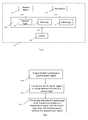
- FIG.2 illustrates a block chart of an embodiment of the mouse according to the present disclosure.
- a mouse 200 includes a first switch 202, a microprocessor 204 and a sensor 206.
- the type of the mouse 200 includes but not limited to the optical mouse and mechanical.
- the mouse 200 executes the cursor control function under normal operation. In other words, user could control the cursor of the window by moving the mouse 200.
- the first switch 202 is disposed on the housing of the mouse 200.
- the first switch 202 includes either a physical button or any virtual button with touch control function.
- the first switch 202 is not limited to the embodiments of the present disclosure.
- the first switch 202 electrically connects with the microprocessor 204 and the first switch 202 optionally produces a first switch signal SW1.
- the microprocessor 204 executes the initial logic 10 normally before receiving the first switch signal SW1.
- the microprocessor 204 executes the first logic 11 after receiving the first switch signal SW1 when the first switch 202 produces the first switch signal SW1 to enable or trigger the microprocessor 204.
- the sensor 206 electrically connects with the microprocessor 204 and the sensor 206 transmits a corresponding displacement signal DS to the microprocessor 204 according to the moving path of the mouse.
- the mouse 200 which is an optical type, to produce a moving path.
- the sensor 206 detects the path of the refraction light in the mouse body 200, thereafter the sensor 206 produces the displacement signal DS.
- the sensor 206 receives the refraction change of the light after refraction (Doppler Effect) to judge the movement of the mouse.
- the sensor 206 collects the pattern produced by the refraction light and the sensor 206 judges the movement of the mouse by checking the pattern.
- a sensor 206 produces a displacement signal DS by detecting the trackball under a mechanical mouse 200.
- the present disclosure is not limited to the type of the mouse 200 and the detection mechanism of the sensor 206. Any sensor which produces the displacement signal DS according to the moving path of the mouse 200 falls within the scope of the present disclosure.
- the sensor 206 could be a CMOS or a CCD but not limited to these two types.
- a method for capturing a displacement signal DS by a microprocessor 204 is to read the surface quality value (SQUAL) of the surface that a mouse 200 is placed on.
- the microprocessor 204 calculates the average of the surface quality value to obtain the displacement signal DS.
- a sensor 206 collects the light from the bottom of the mouse 200 and forms the pattern.
- a digital signal processing chip (not shown) inside the microprocessor 204 detects the characteristics of the pattern and calculates the surface quality value according to the quantity of these characteristics.
- the displacement signal DS is corresponding to the displacement per unit time of the mouse 200.
- the microprocessor 204 executes an initial logic 10 under normal condition (before receiving a first switch signal SW1).
- the microprocessor 204 receives the displacement signal DS
- the mouse 200 executes the cursor control function according to the initial logic 10 and the displacement signal DS.
- step S102 describes the process that a first switch 202 produces a first switch signal SW1 to enable (or trigger) a microprocessor 204.
- Step S104 describes the process that a executable firmware stored in the microprocessor 204 is switched from an initial logic 10 to a first logic 11 by the first switch signal SW1.
- Step S106 describes that the operation mode of a mouse 200 is switched to the page scroll function according to a displacement signal DS and the first logic 11 when the microprocessor 204 receives the displacement signal DS.
- a threshold value saved in a microprocessor 204 according to one embodiment of this invention.
- the mouse 200 executes a speed page scroll function after comparison done by the microprocessor 204.
- the setting of the threshold value is dependent on the design or application requirement.
- Fig.3 illustrates a block chart of a mouse with switchable operation modes of an embodiment of the present disclosure.
- a mouse 200' further includes a second switch 302 and a second logic 12 saved in a microprocessor 204 of the mouse 200'.
- a first switch 202 and the second switch 302 are disposed on the housing of the mouse 200'.
- the first switch 202 and the second switch 302 both include either the physical button or other virtual button with touch control function.
- Fig.4 illustrates a flow chart of a method of switching the operation modes of a mouse of an embodiment of the present disclosure.
- the method of switching the operation mode of the mouse includes the following steps.
- a second switch 302 electrically connects with a microprocessor 204.
- the step S402 describes the process that the second switch 302 optionally produces a second switch signal SW2 and transmits the second switch signal SW2 to the microprocessor 204.
- the step S404 describes the process that the microprocessor 204 switches the executable firmware to a second logic 12 when the microprocessor 204 receives the second switch signal SW2.
- the Step S406 describes the process that a mouse 200' executes the speed page scroll function according to the second logic 12 and a displacement signal DS received by the microprocessor 204 when the second switch 302 produces a second switch signal SW2 to trigger the microprocessor 204.
- a executable firmware saved in a microprocessor 204 includes an initial logic 10, a first logic 11 and a second logic 12.
- the executable firmware could be compiled by program designer in advance. These logics could be further rewritten and controlled by the software of the operation system of the mouse to fit the purpose of the human interface device (HID) in the actual application.
- HID human interface device
- user also could add other logic in the executable firmware according to the teaching of the present disclosure.
- User switches the operation modes by a specific switch signal.
- the present disclosure discloses a mouse with switchable operation mode and a method thereof.
- the present disclosure saves the space of the scroll wheel of the mouse and switches the operation mode to the corresponding operation mode by a switch signal.
- the present disclosure enhances the convenience of application and achieves the purpose of light and slim products.
- the former mouse with switchable operation modes and the method thereof in the present disclosure further achieves the speed page scroll function and the purpose of human interface device (HID) by setting a threshold vale in the microprocessor or by setting the second switch to produce a second switch signal.
- HID human interface device
Landscapes
- Engineering & Computer Science (AREA)
- General Engineering & Computer Science (AREA)
- Theoretical Computer Science (AREA)
- Human Computer Interaction (AREA)
- Physics & Mathematics (AREA)
- General Physics & Mathematics (AREA)
- Position Input By Displaying (AREA)
- User Interface Of Digital Computer (AREA)
Abstract
Description
- This invention is relative to a mouse with switchable operation modes and method thereof, in particular, relative to switch the firmware stored in a microprocessor by a switch signal.
- Mouse is one kind of the input equipment of the computer peripherals. According to the popularity of graphic operation system, the mouse is the basic input equipment of the computer. The merits of the mouse include controlling the cursor of the window by moving the mouse, selecting the command from the window command list by clicking the mouse and other operation of the application programs, like document process, game and web page browsing.
- Generally speaking, there are several types of the mouse. There are mechanical mouse, optical machinery mouse and optical mouse classified by different position principles. There are infrared mouse and laser mouse classified by different light source. There is another classification by the number of the button of the mouse, for example, single button mouse (like the mouse of MAC system), standard two buttons, three buttons with scroll wheel or multiplex mouse with more than three buttons.
- The former mouse is popular with the most users because they are light, endurable, reasonable price and easy to apply for internet. The mouse often configures a scroll wheel for user to browse the web page. User browses the web page in vertical direction by scrolling the wheel.
- However, according to more and more progressive technology, user asks for the electrical products with more light weight and slim size. The scroll wheel occupies too large space of the mouse body to satisfy the trend of slim product. It is necessary to improve the present scroll function of the scroll wheel to fit the requirement of slim mouse in the future application.
- In addition, the scroll method of the present mouse is dependent on the scroll wheel of the mouse body. When the web page is long, user has to scroll the wheel repeatedly. It is an inconvenience for user's application.
- This invention provides a mouse with switchable operation modes and method thereof to fit the requirement of slim mouse with original function. The mouse with switchable operation modes and method thereof automatically switch the operation modes of the mouse by a switch signal in this invention.
- This invention provides a mouse with switchable operation modes and method thereof to fit the requirement of slim mouse with original function. The mouse with switchable operation modes and method thereof automatically switch the operation modes of the mouse by a switch signal in this invention.
- This invention discloses a method to switch the operation modes of a mouse. The method furthermore includes the following steps. A second switch produces a second switch signal to trigger a microprocessor to execute a second logic. When the microprocessor receives a displacement signal, the mouse executes a speed page scroll function according to the displacement signal and the second logic.
- This invention discloses a mouse with switchable operation modes. The mouse controls the cursor under normal operation. The mouse includes a first switch, a microprocessor and a sensor. The first switch optionally produces a first switch signal. The microprocessor electrically connects with the first switch and the microprocessor executes a first logic after receiving the first switch signal. The sensor electrically connects with the microprocessor. The sensor produces a displacement signal according to the moving path of the mouse. The sensor transmits the displacement signal to the microprocessor. When the microprocessor receives the displacement signal, the mouse executes the page scroll function according to the displacement signal and the first logic.
- The mouse with switchable operation modes and switch method thereof of this invention produces the first switch signal by the first switch to switch a firmware stored in the microprocessor. The operation mode of the mouse is switchable automatically between the cursor control function and the page scroll function by the trigger of the first switch signal.
- The mouse with switchable operation modes and switch method thereof of this invention saves the space of the scroll wheel. The mouse is switchable between the cursor control function and the page scroll function by the trigger of the first switch signal.
- Further objects and advantages are apparent in the drawings and in the detailed description which follows.
-
-
Fig.1 illustrates the flow chart of an method of switching the operation modes of a mouse of one embodiment of the present disclosure. -
Fig.2 illustrates the block chart of a mouse of one embodiment of the present disclosure. -
Fig.3 illustrates the block chart of a mouse of one embodiment of the present disclosure. -
Fig.4 illustrates the flow chart of a method of switching the operation modes of a mouse of one embodiment of the present disclosure. -
Fig.1 illustrates a flow chart of an embodiment according to the present disclosure. The flow chart describes a switch method of the operation modes of a mouse. The switch method in this disclosure is applicable to the mouse which utilizes the cursor control function and the page scroll function. The mouse adopting the method disclosed in this invention could execute both the cursor control function and the page scroll function without the scroll wheel. The switch method of the operation modes of the mouse in this invention mainly includes the following steps. - Step S102: A first switch produces a first switch signal;
- Step S104: A microprocessor is triggered to execute a first logic; and
- Step S106: The mouse executes the page scroll function according to a displacement signal and the first logic when the microprocessor receives the displacement signal.
-
Fig.2 illustrates a block chart of an embodiment of the mouse according to the present disclosure. Amouse 200 includes afirst switch 202, amicroprocessor 204 and asensor 206. According to the embodiment of this disclosure, the type of themouse 200 includes but not limited to the optical mouse and mechanical. Themouse 200 executes the cursor control function under normal operation. In other words, user could control the cursor of the window by moving themouse 200. Thefirst switch 202 is disposed on the housing of themouse 200. Thefirst switch 202 includes either a physical button or any virtual button with touch control function. Thefirst switch 202 is not limited to the embodiments of the present disclosure. - The
first switch 202 electrically connects with themicroprocessor 204 and thefirst switch 202 optionally produces a first switch signal SW1. There is aninitial logic 10 and afirst logic 11 temporarily saved in themicroprocessor 204. In this embodiment, themicroprocessor 204 executes theinitial logic 10 normally before receiving the first switch signal SW1. Themicroprocessor 204 executes thefirst logic 11 after receiving the first switch signal SW1 when thefirst switch 202 produces the first switch signal SW1 to enable or trigger themicroprocessor 204. - The
sensor 206 electrically connects with themicroprocessor 204 and thesensor 206 transmits a corresponding displacement signal DS to themicroprocessor 204 according to the moving path of the mouse. In one embodiment, when user moves themouse 200, which is an optical type, to produce a moving path. Thesensor 206 detects the path of the refraction light in themouse body 200, thereafter thesensor 206 produces the displacement signal DS. For example, thesensor 206 receives the refraction change of the light after refraction (Doppler Effect) to judge the movement of the mouse. Or thesensor 206 collects the pattern produced by the refraction light and thesensor 206 judges the movement of the mouse by checking the pattern. - In the other embodiments, a
sensor 206 produces a displacement signal DS by detecting the trackball under amechanical mouse 200. The present disclosure is not limited to the type of themouse 200 and the detection mechanism of thesensor 206. Any sensor which produces the displacement signal DS according to the moving path of themouse 200 falls within the scope of the present disclosure. For example, thesensor 206 could be a CMOS or a CCD but not limited to these two types. - Generally speaking, a method for capturing a displacement signal DS by a
microprocessor 204 is to read the surface quality value (SQUAL) of the surface that amouse 200 is placed on. Themicroprocessor 204 calculates the average of the surface quality value to obtain the displacement signal DS. For example, asensor 206 collects the light from the bottom of themouse 200 and forms the pattern. Thereafter, a digital signal processing chip (not shown) inside themicroprocessor 204 detects the characteristics of the pattern and calculates the surface quality value according to the quantity of these characteristics. By this way, the displacement signal DS is corresponding to the displacement per unit time of themouse 200. - The
microprocessor 204 executes aninitial logic 10 under normal condition (before receiving a first switch signal SW1). When themicroprocessor 204 receives the displacement signal DS, themouse 200 executes the cursor control function according to theinitial logic 10 and the displacement signal DS. - According to one embodiment of the present disclosure, step S102 describes the process that a
first switch 202 produces a first switch signal SW1 to enable (or trigger) amicroprocessor 204. Step S104 describes the process that a executable firmware stored in themicroprocessor 204 is switched from aninitial logic 10 to afirst logic 11 by the first switch signal SW1. Step S106 describes that the operation mode of amouse 200 is switched to the page scroll function according to a displacement signal DS and thefirst logic 11 when themicroprocessor 204 receives the displacement signal DS. - For the requirement of the user browsing a long page, there is a threshold value saved in a
microprocessor 204 according to one embodiment of this invention. When the displacement per unit time of amouse 200 exceeds the threshold value, themouse 200 executes a speed page scroll function after comparison done by themicroprocessor 204. By this way, the method of switching the operation mode of the mouse in the present disclosure could be further applied for speedy browsing. The setting of the threshold value is dependent on the design or application requirement. -
Fig.3 illustrates a block chart of a mouse with switchable operation modes of an embodiment of the present disclosure. The difference from the former mouse is that a mouse 200' further includes asecond switch 302 and asecond logic 12 saved in amicroprocessor 204 of the mouse 200'. Afirst switch 202 and thesecond switch 302 are disposed on the housing of the mouse 200'. Thefirst switch 202 and thesecond switch 302 both include either the physical button or other virtual button with touch control function. -
Fig.4 illustrates a flow chart of a method of switching the operation modes of a mouse of an embodiment of the present disclosure. The method of switching the operation mode of the mouse includes the following steps. - Step S402: A second switch produces a second switch signal;
- Step S404: The second switch signal triggers a microprocessor to execute a second logic; and
- Step S406: The mouse executes the speed page scroll function according to a displacement signal and the second logic when the microprocessor receives the displacement signal.
- A
second switch 302 electrically connects with amicroprocessor 204. The step S402 describes the process that thesecond switch 302 optionally produces a second switch signal SW2 and transmits the second switch signal SW2 to themicroprocessor 204. The step S404 describes the process that themicroprocessor 204 switches the executable firmware to asecond logic 12 when themicroprocessor 204 receives the second switch signal SW2. The Step S406 describes the process that a mouse 200' executes the speed page scroll function according to thesecond logic 12 and a displacement signal DS received by themicroprocessor 204 when thesecond switch 302 produces a second switch signal SW2 to trigger themicroprocessor 204. - According to another embodiment of this invention, a executable firmware saved in a
microprocessor 204 includes aninitial logic 10, afirst logic 11 and asecond logic 12. The executable firmware could be compiled by program designer in advance. These logics could be further rewritten and controlled by the software of the operation system of the mouse to fit the purpose of the human interface device (HID) in the actual application. - In other words, there are different programs temporarily saved in the
initial logic 10, thefirst logic 11 and thesecond logic 12. End user could select each one of them as an executable firmware by amicroprocessor 204 and themicroprocessor 204 is rewritten and controlled by the software of the operation system. By this way, user determines the operation mode of the mouse and switches the operation mode between the cursor control function, page scroll function and the speed page scroll function. - In order to enlarge the application range of the mouse of the present disclosure , user also could add other logic in the executable firmware according to the teaching of the present disclosure. User switches the operation modes by a specific switch signal.
- To sum up, the present disclosure discloses a mouse with switchable operation mode and a method thereof. The present disclosure saves the space of the scroll wheel of the mouse and switches the operation mode to the corresponding operation mode by a switch signal. The present disclosure enhances the convenience of application and achieves the purpose of light and slim products.
- Secondly, the former mouse with switchable operation modes and the method thereof in the present disclosure further achieves the speed page scroll function and the purpose of human interface device (HID) by setting a threshold vale in the microprocessor or by setting the second switch to produce a second switch signal.
- While the preferred embodiment of the invention has been described, it will be understood that numerous modifications and changes will occur to those skilled in the art. It is therefore intended by the appended claims to define the true scope of the invention.
Claims (10)
- A method switching operation modes of a mouse and being applicable to the mouse with a cursor control function and a page scroll function; wherein the mouse executes the cursor control function in normal operation, the mouse comprises a microprocessor, and the operation modes are switched by the microprocessor; the method comprising the following steps:producing a first switch signal by a first switch;executing a first logic by triggering the microprocessor; andexecuting the page scroll function according to a displacement signal and the first logic by the mouse when the microprocessor receives the displacement signal.
- The method of claim 1, further comprising the following steps before the step of producing the first switch signal by the first switch :executing an initial logic normally by the microprocessor; andexecuting the cursor control function according to the initial logic and the displacement signal by the mouse when the microprocessor receives the displacement signal.
- The method of claim 2, wherein the initial logic and the first logic are saved in the firmware of the microprocessor.
- The method of claim 1, wherein the step of capturing displacement signal further comprises the following steps:reading a surface quality value (SQUAL) of a surface continuously by the microprocessor and the surface which is the mouse placed on; andobtaining the displacement signal by calculating the average of the surface quality value per unit time by the microprocessor, wherein the displacement signal is corresponding to the displacement of the mouse per unit time.
- The method of claim 4, wherein the mouse executes a speed page scroll function when the displacement per unit time exceeds a threshold value.
- The method of claim 1 further comprising the following steps:producing a second switch signal by a second switch;executing a second logic by triggering the microprocessor; andexecuting the speed page scroll function according to the second logic and the displacement signal by the mouse when the microprocessor receives the displacement signal.
- A mouse with switchable operation modes and executing a cursor control function, the mouse comprising:a first switch optionally producing a first switch signal;a microprocessor electrically connecting with the first switch, receiving the first switch signal, and executing a first logic; anda sensor electrically connecting with the microprocessor and transmitting a displacement signal to the microprocessor according to the moving path of the mouse;wherein the mouse executes the page scroll function according to the first logic and the displacement signal when the microprocessor receives the displacement signal.
- The mouse of claim 7, wherein the microprocessor executes an initial logic before receiving the first switch signal, and the mouse executes the cursor control function according to the initial logic and the displacement signal.
- The mouse of claim 7, wherein the displacement signal is generated corresponding to the displacement of the mouse per unit time, and the mouse executes a speed page scroll function when the displacement per unit time exceeds a threshold value.
- The mouse of claim 7, wherein the mouse further comprises a second switch electrically connecting with the microprocessor, the second switch optionally produces a second switch signal, the second switch signal triggers the microprocessor to execute a second logic, the microprocessor receives the second logic and the displacement signal, and the mouse executes a speed page scroll function according to the second logic and the displacement signal.
Applications Claiming Priority (1)
| Application Number | Priority Date | Filing Date | Title |
|---|---|---|---|
| TW100110825A TWI544368B (en) | 2011-03-29 | 2011-03-29 | Method for switching mouse and switch mode of operation with mode of operation |
Publications (2)
| Publication Number | Publication Date |
|---|---|
| EP2506131A2 true EP2506131A2 (en) | 2012-10-03 |
| EP2506131A3 EP2506131A3 (en) | 2015-04-29 |
Family
ID=44508741
Family Applications (1)
| Application Number | Title | Priority Date | Filing Date |
|---|---|---|---|
| EP20110171478 Withdrawn EP2506131A3 (en) | 2011-03-29 | 2011-06-27 | Mouse with switchable operation modes and method thereof |
Country Status (4)
| Country | Link |
|---|---|
| US (1) | US20120249426A1 (en) |
| EP (1) | EP2506131A3 (en) |
| JP (1) | JP2012208908A (en) |
| TW (1) | TWI544368B (en) |
Families Citing this family (3)
| Publication number | Priority date | Publication date | Assignee | Title |
|---|---|---|---|---|
| WO2018132061A1 (en) | 2017-01-10 | 2018-07-19 | Razer (Asia-Pacific) Pte. Ltd. | Input devices and methods for providing a scrolling input to an application |
| CN110017761A (en) * | 2019-04-22 | 2019-07-16 | 广定科技(上海)有限公司 | A kind of man-machine interaction method and electronic ruler of electronic ruler |
| US12105901B2 (en) | 2019-12-05 | 2024-10-01 | Razer (Asia-Pacific) Pte. Ltd. | Input device and a method for providing a scrolling input to a computing device |
Family Cites Families (13)
| Publication number | Priority date | Publication date | Assignee | Title |
|---|---|---|---|---|
| JPH0697430B2 (en) * | 1992-12-22 | 1994-11-30 | 財団法人国際メディア研究財団 | Coordinate point designating means and screen display device using the same |
| JPH1165811A (en) * | 1997-08-11 | 1999-03-09 | Internatl Business Mach Corp <Ibm> | Information processor displaying mouse cursor, mouse cursor and control method for information processor displaying mouse cursor |
| JP2003067131A (en) * | 2001-08-30 | 2003-03-07 | Toshiba Corp | Mouse with scroll function |
| US7168047B1 (en) * | 2002-05-28 | 2007-01-23 | Apple Computer, Inc. | Mouse having a button-less panning and scrolling switch |
| TWI234105B (en) * | 2002-08-30 | 2005-06-11 | Ren-Guang King | Pointing device, and scanner, robot, mobile communication device and electronic dictionary using the same |
| US20050030279A1 (en) * | 2003-08-08 | 2005-02-10 | Liang Fu | Multi-functional pointing and control device |
| TWI234733B (en) * | 2003-11-17 | 2005-06-21 | Primax Electronics Ltd | Cursor control device |
| US20050225533A1 (en) * | 2004-04-13 | 2005-10-13 | Annie Cheng | Mouse |
| US8081159B2 (en) * | 2005-02-24 | 2011-12-20 | Avago Technologies Ecbu Ip (Singapore) Pte. Ltd. | Programmable lift response for an optical navigation device |
| US8228198B2 (en) * | 2005-08-19 | 2012-07-24 | Adasa Inc. | Systems, methods, and devices for commissioning wireless sensors |
| JP4770368B2 (en) * | 2005-09-29 | 2011-09-14 | 株式会社ケンウッド | Electronic device, control method and program for electronic device |
| JP2007102366A (en) * | 2005-09-30 | 2007-04-19 | Mitsumi Electric Co Ltd | mouse |
| US9134899B2 (en) * | 2011-03-14 | 2015-09-15 | Microsoft Technology Licensing, Llc | Touch gesture indicating a scroll on a touch-sensitive display in a single direction |
-
2011
- 2011-03-29 TW TW100110825A patent/TWI544368B/en not_active IP Right Cessation
- 2011-06-27 EP EP20110171478 patent/EP2506131A3/en not_active Withdrawn
- 2011-06-29 US US13/171,492 patent/US20120249426A1/en not_active Abandoned
- 2011-07-21 JP JP2011159854A patent/JP2012208908A/en active Pending
Non-Patent Citations (1)
| Title |
|---|
| None |
Also Published As
| Publication number | Publication date |
|---|---|
| EP2506131A3 (en) | 2015-04-29 |
| JP2012208908A (en) | 2012-10-25 |
| US20120249426A1 (en) | 2012-10-04 |
| TW201239688A (en) | 2012-10-01 |
| TWI544368B (en) | 2016-08-01 |
Similar Documents
| Publication | Publication Date | Title |
|---|---|---|
| KR101499301B1 (en) | System and method of controlling three dimensional virtual objects on a portable computing device | |
| KR101710972B1 (en) | Method and apparatus for controlling terminal device by using non-touch gesture | |
| KR102169206B1 (en) | Haptic feedback control system | |
| US9298266B2 (en) | Systems and methods for implementing three-dimensional (3D) gesture based graphical user interfaces (GUI) that incorporate gesture reactive interface objects | |
| US20130222338A1 (en) | Apparatus and method for processing a plurality of types of touch inputs | |
| US20120194478A1 (en) | Electronic Device with None-touch Interface and None-touch Control Method | |
| KR20150107755A (en) | Using distance between objects in touchless gestural interfaces | |
| US20120287065A1 (en) | Electronic device | |
| KR20120073104A (en) | Information processing device, method of processing information, and computer program storage device | |
| CN107390931B (en) | Response control method and device for touch operation, storage medium and mobile terminal | |
| CN103634639B (en) | A kind of TV control method and TV remote controller | |
| US20130257761A1 (en) | Method for operating an electronic device | |
| US20120249426A1 (en) | Mouse with switchable operation modes and method thereof | |
| CN108376030B (en) | Electronic equipment control method and device and electronic equipment | |
| US20070091075A1 (en) | Method for window operation on a touchpad using a touch defined original point | |
| TWI509472B (en) | Method of adjusting cpi of a navigating device and related navigating device and terminal device | |
| CN113835664A (en) | Information processing method and device and electronic equipment | |
| CN111093030B (en) | Equipment control method and electronic equipment | |
| CN108427534B (en) | Method and device for controlling screen to return to desktop | |
| CN110955377A (en) | Control method of virtual object and related device | |
| CN110389698B (en) | Page control method, device, input device and server | |
| CN108459818A (en) | The method and apparatus for controlling unlocking screen | |
| CN101561741B (en) | Computer Windows page scrolling method | |
| CN210466360U (en) | page control device | |
| US20130050082A1 (en) | Mouse and method for determining motion of a cursor |
Legal Events
| Date | Code | Title | Description |
|---|---|---|---|
| PUAI | Public reference made under article 153(3) epc to a published international application that has entered the european phase |
Free format text: ORIGINAL CODE: 0009012 |
|
| AK | Designated contracting states |
Kind code of ref document: A2 Designated state(s): AL AT BE BG CH CY CZ DE DK EE ES FI FR GB GR HR HU IE IS IT LI LT LU LV MC MK MT NL NO PL PT RO RS SE SI SK SM TR |
|
| AX | Request for extension of the european patent |
Extension state: BA ME |
|
| RAP1 | Party data changed (applicant data changed or rights of an application transferred) |
Owner name: GIGA-BYTE TECHNOLOGY CO., LTD. |
|
| PUAL | Search report despatched |
Free format text: ORIGINAL CODE: 0009013 |
|
| AK | Designated contracting states |
Kind code of ref document: A3 Designated state(s): AL AT BE BG CH CY CZ DE DK EE ES FI FR GB GR HR HU IE IS IT LI LT LU LV MC MK MT NL NO PL PT RO RS SE SI SK SM TR |
|
| AX | Request for extension of the european patent |
Extension state: BA ME |
|
| RIC1 | Information provided on ipc code assigned before grant |
Ipc: G06F 3/038 20130101ALI20150325BHEP Ipc: G06F 3/048 20130101AFI20150325BHEP Ipc: G06F 3/033 20130101ALI20150325BHEP |
|
| 17P | Request for examination filed |
Effective date: 20151029 |
|
| RBV | Designated contracting states (corrected) |
Designated state(s): AL AT BE BG CH CY CZ DE DK EE ES FI FR GB GR HR HU IE IS IT LI LT LU LV MC MK MT NL NO PL PT RO RS SE SI SK SM TR |
|
| STAA | Information on the status of an ep patent application or granted ep patent |
Free format text: STATUS: EXAMINATION IS IN PROGRESS |
|
| 17Q | First examination report despatched |
Effective date: 20171215 |
|
| STAA | Information on the status of an ep patent application or granted ep patent |
Free format text: STATUS: THE APPLICATION IS DEEMED TO BE WITHDRAWN |
|
| 18D | Application deemed to be withdrawn |
Effective date: 20180426 |