EP2503038A1 - A fabric for an air-bag and method for manufacturing the fabric - Google Patents
A fabric for an air-bag and method for manufacturing the fabric Download PDFInfo
- Publication number
- EP2503038A1 EP2503038A1 EP11169951A EP11169951A EP2503038A1 EP 2503038 A1 EP2503038 A1 EP 2503038A1 EP 11169951 A EP11169951 A EP 11169951A EP 11169951 A EP11169951 A EP 11169951A EP 2503038 A1 EP2503038 A1 EP 2503038A1
- Authority
- EP
- European Patent Office
- Prior art keywords
- filaments
- warp
- fabric
- yarns
- yarn
- Prior art date
- Legal status (The legal status is an assumption and is not a legal conclusion. Google has not performed a legal analysis and makes no representation as to the accuracy of the status listed.)
- Granted
Links
Images
Classifications
-
- D—TEXTILES; PAPER
- D03—WEAVING
- D03D—WOVEN FABRICS; METHODS OF WEAVING; LOOMS
- D03D1/00—Woven fabrics designed to make specified articles
- D03D1/02—Inflatable articles
-
- D—TEXTILES; PAPER
- D03—WEAVING
- D03D—WOVEN FABRICS; METHODS OF WEAVING; LOOMS
- D03D15/00—Woven fabrics characterised by the material, structure or properties of the fibres, filaments, yarns, threads or other warp or weft elements used
- D03D15/50—Woven fabrics characterised by the material, structure or properties of the fibres, filaments, yarns, threads or other warp or weft elements used characterised by the properties of the yarns or threads
- D03D15/58—Woven fabrics characterised by the material, structure or properties of the fibres, filaments, yarns, threads or other warp or weft elements used characterised by the properties of the yarns or threads characterised by the coefficients of friction
-
- D—TEXTILES; PAPER
- D06—TREATMENT OF TEXTILES OR THE LIKE; LAUNDERING; FLEXIBLE MATERIALS NOT OTHERWISE PROVIDED FOR
- D06M—TREATMENT, NOT PROVIDED FOR ELSEWHERE IN CLASS D06, OF FIBRES, THREADS, YARNS, FABRICS, FEATHERS OR FIBROUS GOODS MADE FROM SUCH MATERIALS
- D06M10/00—Physical treatment of fibres, threads, yarns, fabrics or fibrous goods made from such materials, e.g. by ultrasonic waves, corona discharge, irradiation, electric currents or magnetic fields; Physical treatment combined with treatment with chemical compounds or elements
-
- D—TEXTILES; PAPER
- D06—TREATMENT OF TEXTILES OR THE LIKE; LAUNDERING; FLEXIBLE MATERIALS NOT OTHERWISE PROVIDED FOR
- D06M—TREATMENT, NOT PROVIDED FOR ELSEWHERE IN CLASS D06, OF FIBRES, THREADS, YARNS, FABRICS, FEATHERS OR FIBROUS GOODS MADE FROM SUCH MATERIALS
- D06M23/00—Treatment of fibres, threads, yarns, fabrics or fibrous goods made from such materials, characterised by the process
- D06M23/08—Processes in which the treating agent is applied in powder or granular form
Definitions
- THIS INVENTION relates to a method for manufacturing an air-bag, and in particular concerns a method for weaving a fabric for use in the production of air-bags.
- vehicle air-bags are generally formed from woven nylon fabric.
- the fabric is typically manufactured by drawing a number of parallel warp yarns from a reel, and weaving weft yarns across the warp yarns, generally at right angles thereto.
- a first weft yarn will be woven into the warp yarn so that it passes over and under alternate warp yarns.
- the next weft yarn will be introduced so that it passes over the warp yarns that the first weft yarn passed under, and vice versa.
- the warp yarns are subject to friction and abrasion as they pass through the loom, through coming into contact with neighbouring yarns and against components of the loom. It is therefore necessary to protect the warp yarns from damage during the weaving process.
- each warp yarn from a relatively large number of filaments (for example, around 140 filaments). These filaments are extruded and gathered together to form the yarn, and the yarn is nipped at periodic intervals to form points of entanglement. These periodic entanglement points may be provided at a spacing of around 20 to 30 per metre of yarn.
- the warp yarns then have coating applied to protect them during the weaving process.
- This coating is known as the "size”, and is applied by passing the yarn through a size bath.
- the size may form around 0.5 to 2% by weight of the finished yarn.
- the size is removed from the fabric during a scouring process, in which chemicals are applied to the fabric to dissolve the size and wash the size away.
- one aspect of the present invention provides a fabric formed from interwoven warp and weft yarns which are arranged to be substantially perpendicular to one another, wherein the warp yarns are formed from multiple filaments which are twisted together to form the warp yarns, with a degree of twist greater than about 40 turns per metre.
- the weft yarns are substantially untwisted.
- the degree of twist of the weft yarns is less than about 5 turns per metre.
- every successive warp yarn is formed from filaments that are twisted together.
- the degree of twist of the filaments forming the warp yarns is less than about 200 turns per metre.
- the warp yarns have periodic entanglement points, at which the filaments forming the yarn are entangled together.
- Another aspect of the present invention provides a method of forming warp yarns for use in manufacturing a fabric for an air-bag, including the steps of: providing a bundle of filaments; gathering the bundle of filaments together; and twisting the filaments together, by a degree of twist greater than around 40 turns per metre, to form the yarn.
- the method further comprises the step of applying periodic entanglement points to the bundle of filaments, prior to the twisting step, the filaments being entangled with one another at the entanglement points.
- a further aspect of the present invention provides a method of weaving a fabric, comprising the steps of: providing a plurality of warp yarns, each comprising a bundle of filaments that are twisted together with a degree of twist of about 40 turns per metre; providing a plurality of weft yarns; and weaving the warp and weft yarns together to form a fabric, so that the warp and weft yarns are arranged to be substantially perpendicular to one another.
- the weft yarns are formed from filaments which are substantially not twisted together
- the warp and weft yarns are of around 400 to 600 decitex.
- Another aspect of the present invention provides an airbag formed from a fabric according to any one of claims 1 to 7.
- a further aspect of the present invention provides an air-bag module comprising an air-bag according to claim 13.
- Another aspect of the present invention provides a vehicle comprising an airbag module according to claim 14.
- a yarn 1 which is suitable for use as a warp yarn in embodiments of the present invention.
- the yarn 1 is formed from a number of individual filaments 2 which are twisted together to form the yarn 1.
- Either "S" or "Z"-twists i.e. right-or left-handed twists) may be used to form the yarn 1.
- the yarn 1 consists of a bundle of around 96 to 120 filaments 2.
- the number of filaments 2 in the yarn 1 may be as high as 180 or even higher, however.
- the degree of twist of the yarns 2 is between around 40 and 200 turns per metre of the yarn 1. If the degree of twist is less than around 40 turns per metre, it has been found that there is generally insufficient consolidation of the filaments 2 that make up the yarn 1.
- the degree of twist is greater than around 200 turns per metre, it has been found that the resulting yarn becomes too heavy, stiff and unwieldy to be woven effectively into a fabric. In addition the high level of twist will reduce the throughput of the twisting machine, thus increasing the cost.
- the filaments 2 forming the yarn are extruded in the normal (or any suitable) manner, and are nipped at periodic intervals to form entanglement points.
- the bundle of filaments is then sent to a twisting machine, which twists the filaments together to form the yarn 1.
- the yarn 1 may be passed through a size bath so that a suitable finish or lubricant can be applied to the yarn 1.
- the finished yarn 1 is then wound on to a bobbin, which can then be used to transport the yarn 1 to its destination.
- the yarn 1 is then used as warp yarns in a weaving process to form a fabric, as discussed above.
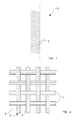
- Figure 2 shows a close-up view of a region of woven fabric 3 embodying the present invention.
- Figure 2 is a schematic figure and the size and spacing of the yarns forming the fabric 3 is exaggerated for the purpose of clarity.
- the fabric 3 is formed from a series of warp yarns 4, which run vertically in figure 2 , and weft yarns 5, which run horizontally in figure 2 .
- each warp yarn 4 passes alternately over and under each alternate weft yarn 5 that is encountered along the length of the warp yarn 4.
- each weft yarn 5 passes alternately over and under each warp yarn 4 that is encountered along the length of the weft yarn 5.
- Each warp yarn 4 is formed from a bundle of twisted filaments, as shown in figure 1 .
- Each weft yarn 5 is substantially untwisted, comprising a bundle of filaments which are generally parallel to one another, and have a degree of twist which is less than about 5 turns per metre.
- Fabrics embodying the present invention will have warp yarns that are more robust, in which the filaments forming the warp yarns hold together more readily, and are more resistant to damage through friction and abrasion during the weaving process. This means that a reduced amount of size, or no size, may be applied to the warp yarns prior to the weaving process beginning, thus reducing the cost of the finished fabric, both in the amount of size that has to be added to the warp yarns prior to weaving and also in the degree of scouring that needs to be performed to remove the size from the fabric after weaving has been completed.
- Polyester is stiffer than nylon, and periodic entanglements cannot be applied to polyester as effectively. Periodic entanglements can generally only be applied to polyester yarns with a frequency of around 9 to 20 entanglements per metre. Also, because the filaments forming the yarn are stiffer, the entanglement points do not bind the filaments together as reliably.
- the size that is used for coating nylon yarns can generally not be applied directly to polyester yarns.
- the size required to coat polyester yarns is more expensive, and present scouring machines are not configured to remove this size effectively. It is therefore desirable to use as little size as possible, or no size, and as discussed above a reduction in the required amount of size can be achieved by forming the warp yarns from twisted filaments.
- the weft yarns are substantially untwisted. This is because the weft yarns are, in general, not subject to friction and/or abrasion to the same degree as warp yarns during the weaving process, and are not as prone to breakage of filaments. The twisting stage, which inevitably increases the cost of yarn, need therefore not be applied to the weft yarns.
- weft yarns do not have any size applied thereto.
- the weft yarns may have a relatively small amount of finish or lubricant, for instance around 0.5% of "spin finish" from the manufacturing stage.
- one or both of the warp and weft yarns are formed to have a density of around 400 to 600 decitex.
- the decitex may be considerably higher, for instance up to around 1800 decitex, or may be lower, for instance around 167 decitex.
- Embodiments of the invention provide air-bag modules including air-bags formed entirely or partially from fabrics as described above.
Landscapes
- Engineering & Computer Science (AREA)
- Textile Engineering (AREA)
- Woven Fabrics (AREA)
- Air Bags (AREA)
Abstract
Description
- THIS INVENTION relates to a method for manufacturing an air-bag, and in particular concerns a method for weaving a fabric for use in the production of air-bags.
- Currently vehicle air-bags are generally formed from woven nylon fabric. The fabric is typically manufactured by drawing a number of parallel warp yarns from a reel, and weaving weft yarns across the warp yarns, generally at right angles thereto. A first weft yarn will be woven into the warp yarn so that it passes over and under alternate warp yarns. The next weft yarn will be introduced so that it passes over the warp yarns that the first weft yarn passed under, and vice versa.
- These fabrics are generally prepared using large, dedicated weaving looms, which will be well-understood by those skilled in the art.
- The warp yarns are subject to friction and abrasion as they pass through the loom, through coming into contact with neighbouring yarns and against components of the loom. It is therefore necessary to protect the warp yarns from damage during the weaving process.
- In general, this is achieved by forming each warp yarn from a relatively large number of filaments (for example, around 140 filaments). These filaments are extruded and gathered together to form the yarn, and the yarn is nipped at periodic intervals to form points of entanglement. These periodic entanglement points may be provided at a spacing of around 20 to 30 per metre of yarn.
- The warp yarns then have coating applied to protect them during the weaving process. This coating is known as the "size", and is applied by passing the yarn through a size bath. Typically, the size may form around 0.5 to 2% by weight of the finished yarn.
- Once the yarn has been woven into a fabric, the size is removed from the fabric during a scouring process, in which chemicals are applied to the fabric to dissolve the size and wash the size away.
- It is an object of the present invention to provide an improved method for weaving fabric for use in vehicle air-bags.
- Accordingly, one aspect of the present invention provides a fabric formed from interwoven warp and weft yarns which are arranged to be substantially perpendicular to one another, wherein the warp yarns are formed from multiple filaments which are twisted together to form the warp yarns, with a degree of twist greater than about 40 turns per metre.
- Advantageously, the weft yarns are substantially untwisted.
- Preferably, the degree of twist of the weft yarns is less than about 5 turns per metre.
- Conveniently, every successive warp yarn is formed from filaments that are twisted together.
- Advantageously, the degree of twist of the filaments forming the warp yarns is less than about 200 turns per metre.
- Preferably, the warp yarns have periodic entanglement points, at which the filaments forming the yarn are entangled together.
- Conveniently, fewer than about 20 entanglement points per metre of warp yarn are formed.
- Another aspect of the present invention provides a method of forming warp yarns for use in manufacturing a fabric for an air-bag, including the steps of: providing a bundle of filaments; gathering the bundle of filaments together; and twisting the filaments together, by a degree of twist greater than around 40 turns per metre, to form the yarn.
- Advantageously, the method further comprises the step of applying periodic entanglement points to the bundle of filaments, prior to the twisting step, the filaments being entangled with one another at the entanglement points.
- A further aspect of the present invention provides a method of weaving a fabric, comprising the steps of: providing a plurality of warp yarns, each comprising a bundle of filaments that are twisted together with a degree of twist of about 40 turns per metre; providing a plurality of weft yarns; and weaving the warp and weft yarns together to form a fabric, so that the warp and weft yarns are arranged to be substantially perpendicular to one another.
- Preferably, the weft yarns are formed from filaments which are substantially not twisted together
- Conveniently, the warp and weft yarns are of around 400 to 600 decitex.
- Another aspect of the present invention provides an airbag formed from a fabric according to any one of claims 1 to 7.
- A further aspect of the present invention provides an air-bag module comprising an air-bag according to claim 13.
- Another aspect of the present invention provides a vehicle comprising an airbag module according to claim 14.
- In order that the present invention may be more readily understood, embodiments thereof will now be described, by way of example, with reference to the accompanying drawings, in which:
-
Figure 1 is a schematic view of a warp yarn suitable for use with the present invention; and -
Figure 2 is a schematic view of a fabric embodying the present invention. - With reference firstly to
figure 1 , a yarn 1 is shown which is suitable for use as a warp yarn in embodiments of the present invention. The yarn 1 is formed from a number ofindividual filaments 2 which are twisted together to form the yarn 1. Either "S" or "Z"-twists (i.e. right-or left-handed twists) may be used to form the yarn 1. - In preferred embodiments the yarn 1 consists of a bundle of around 96 to 120
filaments 2. The number offilaments 2 in the yarn 1 may be as high as 180 or even higher, however. - Preferably, the degree of twist of the
yarns 2 is between around 40 and 200 turns per metre of the yarn 1. If the degree of twist is less than around 40 turns per metre, it has been found that there is generally insufficient consolidation of thefilaments 2 that make up the yarn 1. - On the other hand, if the degree of twist is greater than around 200 turns per metre, it has been found that the resulting yarn becomes too heavy, stiff and unwieldy to be woven effectively into a fabric. In addition the high level of twist will reduce the throughput of the twisting machine, thus increasing the cost.
- In order to form the yarn 1, the
filaments 2 forming the yarn are extruded in the normal (or any suitable) manner, and are nipped at periodic intervals to form entanglement points. The bundle of filaments is then sent to a twisting machine, which twists the filaments together to form the yarn 1. Before or after this twisting process the yarn 1 may be passed through a size bath so that a suitable finish or lubricant can be applied to the yarn 1. The finished yarn 1 is then wound on to a bobbin, which can then be used to transport the yarn 1 to its destination. - The yarn 1 is then used as warp yarns in a weaving process to form a fabric, as discussed above.
-
Figure 2 shows a close-up view of a region ofwoven fabric 3 embodying the present invention.Figure 2 is a schematic figure and the size and spacing of the yarns forming thefabric 3 is exaggerated for the purpose of clarity. - The
fabric 3 is formed from a series of warp yarns 4, which run vertically infigure 2 , and weftyarns 5, which run horizontally infigure 2 . As will be understood by those skilled in the art, each warp yarn 4 passes alternately over and under eachalternate weft yarn 5 that is encountered along the length of the warp yarn 4. Similarly, eachweft yarn 5 passes alternately over and under each warp yarn 4 that is encountered along the length of theweft yarn 5. - Each warp yarn 4 is formed from a bundle of twisted filaments, as shown in
figure 1 . Eachweft yarn 5 is substantially untwisted, comprising a bundle of filaments which are generally parallel to one another, and have a degree of twist which is less than about 5 turns per metre. - Fabrics embodying the present invention will have warp yarns that are more robust, in which the filaments forming the warp yarns hold together more readily, and are more resistant to damage through friction and abrasion during the weaving process. This means that a reduced amount of size, or no size, may be applied to the warp yarns prior to the weaving process beginning, thus reducing the cost of the finished fabric, both in the amount of size that has to be added to the warp yarns prior to weaving and also in the degree of scouring that needs to be performed to remove the size from the fabric after weaving has been completed.
- It is anticipated that the present invention will be a particular application to fabrics formed from polyester. As mentioned above, conventional fabrics for vehicle air-bags are formed from nylon, and the majority of looms and other weaving equipment are configured to process yarns formed from filaments of nylon. However, nylon is relatively expensive, and it would be preferable to employ cheaper materials such as polyester.
- Polyester is stiffer than nylon, and periodic entanglements cannot be applied to polyester as effectively. Periodic entanglements can generally only be applied to polyester yarns with a frequency of around 9 to 20 entanglements per metre. Also, because the filaments forming the yarn are stiffer, the entanglement points do not bind the filaments together as reliably.
- In addition, the size that is used for coating nylon yarns can generally not be applied directly to polyester yarns. The size required to coat polyester yarns is more expensive, and present scouring machines are not configured to remove this size effectively. It is therefore desirable to use as little size as possible, or no size, and as discussed above a reduction in the required amount of size can be achieved by forming the warp yarns from twisted filaments.
- In embodiments of the invention the weft yarns are substantially untwisted. This is because the weft yarns are, in general, not subject to friction and/or abrasion to the same degree as warp yarns during the weaving process, and are not as prone to breakage of filaments. The twisting stage, which inevitably increases the cost of yarn, need therefore not be applied to the weft yarns.
- In addition, in preferred embodiments the weft yarns do not have any size applied thereto. However, the weft yarns may have a relatively small amount of finish or lubricant, for instance around 0.5% of "spin finish" from the manufacturing stage.
- In preferred embodiments, one or both of the warp and weft yarns are formed to have a density of around 400 to 600 decitex. However, the decitex may be considerably higher, for instance up to around 1800 decitex, or may be lower, for instance around 167 decitex.
- It is anticipated that fabrics embodying the present invention will find utility in various forms of vehicle air-bag, including (but not limited to) internal passenger protection air-bags and external pedestrian protection air-bags.
- Embodiments of the invention provide air-bag modules including air-bags formed entirely or partially from fabrics as described above.
- When used in this specification and claims, the terms "comprises" and "comprising" and variations thereof mean that the specified features, steps or integers are included. The terms are not to be interpreted to exclude the presence of other features, steps or components.
- The features disclosed in the foregoing description, or the following claims, or the accompanying drawings, expressed in their specific forms or in terms of a means for performing the disclosed function, or a method or process for attaining the disclosed result, as appropriate, may, separately, or in any combination of such features, be utilised for realising the invention in diverse forms thereof.
Claims (15)
- A fabric formed from interwoven warp and weft yarns which are arranged to be substantially perpendicular to one another, wherein the warp yarns are formed from multiple filaments which are twisted together to form the warp yarns, with a degree of twist greater than about 40 turns per metre.
- A fabric according to claim 1, wherein the weft yarns are substantially untwisted.
- A fabric according to claim 2, wherein the degree of twist of the weft yarns is less than about 5 turns per metre.
- A fabric according to any preceding claim, wherein every successive warp yarn is formed from filaments that are twisted together.
- A fabric according to any preceding claim, wherein the degree of twist of the filaments forming the warp yarns is less than about 200 turns per metre.
- A fabric according to any preceding claim, wherein the warp yarns have periodic entanglement points, at which the filaments forming the yarn are entangled together.
- A fabric according to claim 6, wherein fewer than about 20 entanglement points per metre of warp yarn are formed.
- A method of forming warp yarns for use in manufacturing a fabric for an air-bag, including the steps of:providing a bundle of filaments;gathering the bundle of filaments together; andtwisting the filaments together, by a degree of twist greater than around 40 turns per metre, to form the yarn.
- A method according to claim 8, further comprising the step of applying periodic entanglement points to the bundle of filaments, prior to the twisting step, the filaments being entangled with one another at the entanglement points.
- A method of weaving a fabric, comprising the steps of:providing a plurality of warp yarns, each comprising a bundle of filaments that are twisted together with a degree of twist of about 40 turns per metre;providing a plurality of weft yarns; andweaving the warp and weft yarns together to form a fabric, so that the warp and weft yarns are arranged to be substantially perpendicular to one another.
- A method according to claim 10, wherein the weft yarns are formed from filaments which are substantially not twisted together
- A method according to claim 10 or 11, wherein the warp and weft yarns are of around 400 to 600 decitex.
- An airbag formed from a fabric according to any one of claims 1 to 7.
- An air-bag module comprising an air-bag according to claim 13.
- A vehicle comprising an air-bag module according to claim 14.
Priority Applications (1)
| Application Number | Priority Date | Filing Date | Title |
|---|---|---|---|
| EP11169951.8A EP2503038B1 (en) | 2011-03-23 | 2011-06-15 | A fabric for an air-bag and method for manufacturing the fabric |
Applications Claiming Priority (2)
| Application Number | Priority Date | Filing Date | Title |
|---|---|---|---|
| EP11159477.6A EP2503037B1 (en) | 2011-03-23 | 2011-03-23 | A fabric for use in the manufacture of an inflatable air-bag |
| EP11169951.8A EP2503038B1 (en) | 2011-03-23 | 2011-06-15 | A fabric for an air-bag and method for manufacturing the fabric |
Publications (2)
| Publication Number | Publication Date |
|---|---|
| EP2503038A1 true EP2503038A1 (en) | 2012-09-26 |
| EP2503038B1 EP2503038B1 (en) | 2022-10-26 |
Family
ID=44080210
Family Applications (2)
| Application Number | Title | Priority Date | Filing Date |
|---|---|---|---|
| EP11159477.6A Active EP2503037B1 (en) | 2011-03-23 | 2011-03-23 | A fabric for use in the manufacture of an inflatable air-bag |
| EP11169951.8A Active EP2503038B1 (en) | 2011-03-23 | 2011-06-15 | A fabric for an air-bag and method for manufacturing the fabric |
Family Applications Before (1)
| Application Number | Title | Priority Date | Filing Date |
|---|---|---|---|
| EP11159477.6A Active EP2503037B1 (en) | 2011-03-23 | 2011-03-23 | A fabric for use in the manufacture of an inflatable air-bag |
Country Status (1)
| Country | Link |
|---|---|
| EP (2) | EP2503037B1 (en) |
Citations (3)
| Publication number | Priority date | Publication date | Assignee | Title |
|---|---|---|---|---|
| EP0095537A1 (en) * | 1982-06-02 | 1983-12-07 | Teijin Limited | High twist polyester multi-filament yarn and fabric made therefrom |
| EP0442373A1 (en) * | 1990-02-12 | 1991-08-21 | Hoechst Aktiengesellschaft | Web for airbags |
| US5236775A (en) * | 1990-02-12 | 1993-08-17 | Hoechst Aktiengesellschaft | Fabric for airbag |
Family Cites Families (9)
| Publication number | Priority date | Publication date | Assignee | Title |
|---|---|---|---|---|
| US2245641A (en) * | 1938-11-09 | 1941-06-17 | Celanese Corp | Composite yarn and fabric made of or containing such yarn |
| US3761346A (en) * | 1969-12-29 | 1973-09-25 | Owens Corning Fiberglass Corp | Composite linear material and process of making such material |
| JPS6228435A (en) * | 1985-07-23 | 1987-02-06 | 中興化成工業株式会社 | Sound absorbing material |
| DE58904745D1 (en) * | 1989-06-30 | 1993-07-22 | Elastic Berger Gmbh & Co | BELT FOR SAFETY BELTS. |
| JP3085811B2 (en) * | 1992-06-02 | 2000-09-11 | 鐘紡株式会社 | Low air permeability fabric and method for producing the same |
| US6790796B2 (en) * | 2001-10-05 | 2004-09-14 | Albany International Corp. | Nonwovens forming or conveying fabrics with enhanced surface roughness and texture |
| AU2003298642A1 (en) * | 2002-12-09 | 2004-06-30 | Milliken And Company | Treatment of filament yarns to provide spun-like characteristics and yarns and fabrics produced thereby |
| US20050186873A1 (en) * | 2004-02-24 | 2005-08-25 | Milliken & Company | Treated textile substrate and method for making a textile substrate |
| EP2500454B1 (en) * | 2011-03-16 | 2015-05-13 | Autoliv Development AB | A fabric for use in the manufacture of an inflatable air-bag |
-
2011
- 2011-03-23 EP EP11159477.6A patent/EP2503037B1/en active Active
- 2011-06-15 EP EP11169951.8A patent/EP2503038B1/en active Active
Patent Citations (3)
| Publication number | Priority date | Publication date | Assignee | Title |
|---|---|---|---|---|
| EP0095537A1 (en) * | 1982-06-02 | 1983-12-07 | Teijin Limited | High twist polyester multi-filament yarn and fabric made therefrom |
| EP0442373A1 (en) * | 1990-02-12 | 1991-08-21 | Hoechst Aktiengesellschaft | Web for airbags |
| US5236775A (en) * | 1990-02-12 | 1993-08-17 | Hoechst Aktiengesellschaft | Fabric for airbag |
Also Published As
| Publication number | Publication date |
|---|---|
| EP2503037A1 (en) | 2012-09-26 |
| EP2503037B1 (en) | 2021-04-28 |
| EP2503038B1 (en) | 2022-10-26 |
Similar Documents
| Publication | Publication Date | Title |
|---|---|---|
| EP3208371B1 (en) | Elastic composite yarns and woven fabrics made therefrom, and methods and apparatus for making the same | |
| US10434445B2 (en) | Woven geotextile filtration fabrics including core-sheath spun yarns | |
| KR20150016593A (en) | Synthetic-fiber rope | |
| CN102470700B (en) | Steel-fabric hybrid reinforcement for radial tires | |
| JP6434543B2 (en) | Adhesive tape for covering cables in automobiles, especially winding tape | |
| MX2011005126A (en) | Protective tube and related manufacturing method. | |
| US20200030728A1 (en) | Woven geotextile filtration fabrics including core-sheath spun yarns | |
| AU2021266240A1 (en) | High thread/ yarn count woven textile fabric and process of preparation thereof | |
| US12264420B2 (en) | Method for thermal molding of filament product | |
| US20160039610A1 (en) | Fiber Reinforcement Layer for Conveyor Belts | |
| EP2503038B1 (en) | A fabric for an air-bag and method for manufacturing the fabric | |
| JP4908432B2 (en) | Weave fabric for manufacturing reinforcing fiber cord and method for manufacturing reinforcing fiber cord | |
| JP5206346B2 (en) | Interwoven fabric for belt covers of pneumatic radial tires | |
| JP4922873B2 (en) | Interwoven fabric, and manufacturing method of interlaced fabric and reinforcing fiber cord | |
| CN103225155B (en) | Mineral filtering canvas made from polypropylene short fibers | |
| KR101358394B1 (en) | Manufacturing method of polymeric strap and polymeric strap using the same | |
| JP2023065986A (en) | Yarns, Braids, Ropes, and Yarn Manufacturing Methods | |
| US9771672B2 (en) | Re-weaving machine and re-woven tire cord fabric | |
| JP2005281930A (en) | Cord woven fabric and winding method thereof | |
| US11613831B2 (en) | High thread/yarn count woven textile fabric and process of preparation thereof | |
| CN100355639C (en) | Yarn package and its manufacturing method | |
| JP2010090506A (en) | Tire cord fabric, and method for producing fibrous cord | |
| AU2014250467B8 (en) | Fiber-reinforced layer for conveyor belt | |
| RU2084568C1 (en) | Device for fabrication of single-layer clothes | |
| KNITTING | Classification of Fabrics |
Legal Events
| Date | Code | Title | Description |
|---|---|---|---|
| PUAI | Public reference made under article 153(3) epc to a published international application that has entered the european phase |
Free format text: ORIGINAL CODE: 0009012 |
|
| AK | Designated contracting states |
Kind code of ref document: A1 Designated state(s): AL AT BE BG CH CY CZ DE DK EE ES FI FR GB GR HR HU IE IS IT LI LT LU LV MC MK MT NL NO PL PT RO RS SE SI SK SM TR |
|
| AX | Request for extension of the european patent |
Extension state: BA ME |
|
| 17P | Request for examination filed |
Effective date: 20130322 |
|
| STAA | Information on the status of an ep patent application or granted ep patent |
Free format text: STATUS: EXAMINATION IS IN PROGRESS |
|
| 17Q | First examination report despatched |
Effective date: 20180212 |
|
| REG | Reference to a national code |
Ref country code: DE Ref legal event code: R079 Ref document number: 602011073389 Country of ref document: DE Free format text: PREVIOUS MAIN CLASS: D03D0015000000 Ipc: D06M0010000000 |
|
| GRAP | Despatch of communication of intention to grant a patent |
Free format text: ORIGINAL CODE: EPIDOSNIGR1 |
|
| STAA | Information on the status of an ep patent application or granted ep patent |
Free format text: STATUS: GRANT OF PATENT IS INTENDED |
|
| RIC1 | Information provided on ipc code assigned before grant |
Ipc: D03D 1/02 20060101ALN20220727BHEP Ipc: D03D 15/00 20060101ALN20220727BHEP Ipc: D03D 15/58 20210101ALI20220727BHEP Ipc: D06M 23/08 20060101ALI20220727BHEP Ipc: D06M 10/00 20060101AFI20220727BHEP |
|
| INTG | Intention to grant announced |
Effective date: 20220809 |
|
| GRAS | Grant fee paid |
Free format text: ORIGINAL CODE: EPIDOSNIGR3 |
|
| GRAA | (expected) grant |
Free format text: ORIGINAL CODE: 0009210 |
|
| STAA | Information on the status of an ep patent application or granted ep patent |
Free format text: STATUS: THE PATENT HAS BEEN GRANTED |
|
| AK | Designated contracting states |
Kind code of ref document: B1 Designated state(s): AL AT BE BG CH CY CZ DE DK EE ES FI FR GB GR HR HU IE IS IT LI LT LU LV MC MK MT NL NO PL PT RO RS SE SI SK SM TR |
|
| REG | Reference to a national code |
Ref country code: GB Ref legal event code: FG4D |
|
| REG | Reference to a national code |
Ref country code: CH Ref legal event code: EP |
|
| REG | Reference to a national code |
Ref country code: DE Ref legal event code: R096 Ref document number: 602011073389 Country of ref document: DE |
|
| REG | Reference to a national code |
Ref country code: AT Ref legal event code: REF Ref document number: 1527098 Country of ref document: AT Kind code of ref document: T Effective date: 20221115 |
|
| REG | Reference to a national code |
Ref country code: IE Ref legal event code: FG4D |
|
| REG | Reference to a national code |
Ref country code: LT Ref legal event code: MG9D |
|
| REG | Reference to a national code |
Ref country code: NL Ref legal event code: MP Effective date: 20221026 |
|
| REG | Reference to a national code |
Ref country code: AT Ref legal event code: MK05 Ref document number: 1527098 Country of ref document: AT Kind code of ref document: T Effective date: 20221026 |
|
| PG25 | Lapsed in a contracting state [announced via postgrant information from national office to epo] |
Ref country code: NL Free format text: LAPSE BECAUSE OF FAILURE TO SUBMIT A TRANSLATION OF THE DESCRIPTION OR TO PAY THE FEE WITHIN THE PRESCRIBED TIME-LIMIT Effective date: 20221026 |
|
| PG25 | Lapsed in a contracting state [announced via postgrant information from national office to epo] |
Ref country code: SE Free format text: LAPSE BECAUSE OF FAILURE TO SUBMIT A TRANSLATION OF THE DESCRIPTION OR TO PAY THE FEE WITHIN THE PRESCRIBED TIME-LIMIT Effective date: 20221026 Ref country code: PT Free format text: LAPSE BECAUSE OF FAILURE TO SUBMIT A TRANSLATION OF THE DESCRIPTION OR TO PAY THE FEE WITHIN THE PRESCRIBED TIME-LIMIT Effective date: 20230227 Ref country code: NO Free format text: LAPSE BECAUSE OF FAILURE TO SUBMIT A TRANSLATION OF THE DESCRIPTION OR TO PAY THE FEE WITHIN THE PRESCRIBED TIME-LIMIT Effective date: 20230126 Ref country code: LT Free format text: LAPSE BECAUSE OF FAILURE TO SUBMIT A TRANSLATION OF THE DESCRIPTION OR TO PAY THE FEE WITHIN THE PRESCRIBED TIME-LIMIT Effective date: 20221026 Ref country code: FI Free format text: LAPSE BECAUSE OF FAILURE TO SUBMIT A TRANSLATION OF THE DESCRIPTION OR TO PAY THE FEE WITHIN THE PRESCRIBED TIME-LIMIT Effective date: 20221026 Ref country code: ES Free format text: LAPSE BECAUSE OF FAILURE TO SUBMIT A TRANSLATION OF THE DESCRIPTION OR TO PAY THE FEE WITHIN THE PRESCRIBED TIME-LIMIT Effective date: 20221026 Ref country code: AT Free format text: LAPSE BECAUSE OF FAILURE TO SUBMIT A TRANSLATION OF THE DESCRIPTION OR TO PAY THE FEE WITHIN THE PRESCRIBED TIME-LIMIT Effective date: 20221026 |
|
| PG25 | Lapsed in a contracting state [announced via postgrant information from national office to epo] |
Ref country code: RS Free format text: LAPSE BECAUSE OF FAILURE TO SUBMIT A TRANSLATION OF THE DESCRIPTION OR TO PAY THE FEE WITHIN THE PRESCRIBED TIME-LIMIT Effective date: 20221026 Ref country code: PL Free format text: LAPSE BECAUSE OF FAILURE TO SUBMIT A TRANSLATION OF THE DESCRIPTION OR TO PAY THE FEE WITHIN THE PRESCRIBED TIME-LIMIT Effective date: 20221026 Ref country code: LV Free format text: LAPSE BECAUSE OF FAILURE TO SUBMIT A TRANSLATION OF THE DESCRIPTION OR TO PAY THE FEE WITHIN THE PRESCRIBED TIME-LIMIT Effective date: 20221026 Ref country code: IS Free format text: LAPSE BECAUSE OF FAILURE TO SUBMIT A TRANSLATION OF THE DESCRIPTION OR TO PAY THE FEE WITHIN THE PRESCRIBED TIME-LIMIT Effective date: 20230226 Ref country code: HR Free format text: LAPSE BECAUSE OF FAILURE TO SUBMIT A TRANSLATION OF THE DESCRIPTION OR TO PAY THE FEE WITHIN THE PRESCRIBED TIME-LIMIT Effective date: 20221026 Ref country code: GR Free format text: LAPSE BECAUSE OF FAILURE TO SUBMIT A TRANSLATION OF THE DESCRIPTION OR TO PAY THE FEE WITHIN THE PRESCRIBED TIME-LIMIT Effective date: 20230127 |
|
| P01 | Opt-out of the competence of the unified patent court (upc) registered |
Effective date: 20230507 |
|
| REG | Reference to a national code |
Ref country code: DE Ref legal event code: R097 Ref document number: 602011073389 Country of ref document: DE |
|
| PG25 | Lapsed in a contracting state [announced via postgrant information from national office to epo] |
Ref country code: SM Free format text: LAPSE BECAUSE OF FAILURE TO SUBMIT A TRANSLATION OF THE DESCRIPTION OR TO PAY THE FEE WITHIN THE PRESCRIBED TIME-LIMIT Effective date: 20221026 Ref country code: RO Free format text: LAPSE BECAUSE OF FAILURE TO SUBMIT A TRANSLATION OF THE DESCRIPTION OR TO PAY THE FEE WITHIN THE PRESCRIBED TIME-LIMIT Effective date: 20221026 Ref country code: EE Free format text: LAPSE BECAUSE OF FAILURE TO SUBMIT A TRANSLATION OF THE DESCRIPTION OR TO PAY THE FEE WITHIN THE PRESCRIBED TIME-LIMIT Effective date: 20221026 Ref country code: DK Free format text: LAPSE BECAUSE OF FAILURE TO SUBMIT A TRANSLATION OF THE DESCRIPTION OR TO PAY THE FEE WITHIN THE PRESCRIBED TIME-LIMIT Effective date: 20221026 Ref country code: CZ Free format text: LAPSE BECAUSE OF FAILURE TO SUBMIT A TRANSLATION OF THE DESCRIPTION OR TO PAY THE FEE WITHIN THE PRESCRIBED TIME-LIMIT Effective date: 20221026 |
|
| PG25 | Lapsed in a contracting state [announced via postgrant information from national office to epo] |
Ref country code: SK Free format text: LAPSE BECAUSE OF FAILURE TO SUBMIT A TRANSLATION OF THE DESCRIPTION OR TO PAY THE FEE WITHIN THE PRESCRIBED TIME-LIMIT Effective date: 20221026 Ref country code: AL Free format text: LAPSE BECAUSE OF FAILURE TO SUBMIT A TRANSLATION OF THE DESCRIPTION OR TO PAY THE FEE WITHIN THE PRESCRIBED TIME-LIMIT Effective date: 20221026 |
|
| PLBE | No opposition filed within time limit |
Free format text: ORIGINAL CODE: 0009261 |
|
| STAA | Information on the status of an ep patent application or granted ep patent |
Free format text: STATUS: NO OPPOSITION FILED WITHIN TIME LIMIT |
|
| 26N | No opposition filed |
Effective date: 20230727 |
|
| PG25 | Lapsed in a contracting state [announced via postgrant information from national office to epo] |
Ref country code: SI Free format text: LAPSE BECAUSE OF FAILURE TO SUBMIT A TRANSLATION OF THE DESCRIPTION OR TO PAY THE FEE WITHIN THE PRESCRIBED TIME-LIMIT Effective date: 20221026 |
|
| PG25 | Lapsed in a contracting state [announced via postgrant information from national office to epo] |
Ref country code: MC Free format text: LAPSE BECAUSE OF FAILURE TO SUBMIT A TRANSLATION OF THE DESCRIPTION OR TO PAY THE FEE WITHIN THE PRESCRIBED TIME-LIMIT Effective date: 20221026 |
|
| PG25 | Lapsed in a contracting state [announced via postgrant information from national office to epo] |
Ref country code: MC Free format text: LAPSE BECAUSE OF FAILURE TO SUBMIT A TRANSLATION OF THE DESCRIPTION OR TO PAY THE FEE WITHIN THE PRESCRIBED TIME-LIMIT Effective date: 20221026 |
|
| REG | Reference to a national code |
Ref country code: CH Ref legal event code: PL |
|
| REG | Reference to a national code |
Ref country code: BE Ref legal event code: MM Effective date: 20230630 |
|
| PG25 | Lapsed in a contracting state [announced via postgrant information from national office to epo] |
Ref country code: LU Free format text: LAPSE BECAUSE OF NON-PAYMENT OF DUE FEES Effective date: 20230615 |
|
| REG | Reference to a national code |
Ref country code: IE Ref legal event code: MM4A |
|
| PG25 | Lapsed in a contracting state [announced via postgrant information from national office to epo] |
Ref country code: LU Free format text: LAPSE BECAUSE OF NON-PAYMENT OF DUE FEES Effective date: 20230615 |
|
| PG25 | Lapsed in a contracting state [announced via postgrant information from national office to epo] |
Ref country code: IE Free format text: LAPSE BECAUSE OF NON-PAYMENT OF DUE FEES Effective date: 20230615 |
|
| PG25 | Lapsed in a contracting state [announced via postgrant information from national office to epo] |
Ref country code: IE Free format text: LAPSE BECAUSE OF NON-PAYMENT OF DUE FEES Effective date: 20230615 Ref country code: CH Free format text: LAPSE BECAUSE OF NON-PAYMENT OF DUE FEES Effective date: 20230630 |
|
| PG25 | Lapsed in a contracting state [announced via postgrant information from national office to epo] |
Ref country code: IT Free format text: LAPSE BECAUSE OF FAILURE TO SUBMIT A TRANSLATION OF THE DESCRIPTION OR TO PAY THE FEE WITHIN THE PRESCRIBED TIME-LIMIT Effective date: 20221026 Ref country code: BE Free format text: LAPSE BECAUSE OF NON-PAYMENT OF DUE FEES Effective date: 20230630 |
|
| PG25 | Lapsed in a contracting state [announced via postgrant information from national office to epo] |
Ref country code: BG Free format text: LAPSE BECAUSE OF FAILURE TO SUBMIT A TRANSLATION OF THE DESCRIPTION OR TO PAY THE FEE WITHIN THE PRESCRIBED TIME-LIMIT Effective date: 20221026 |
|
| PG25 | Lapsed in a contracting state [announced via postgrant information from national office to epo] |
Ref country code: BG Free format text: LAPSE BECAUSE OF FAILURE TO SUBMIT A TRANSLATION OF THE DESCRIPTION OR TO PAY THE FEE WITHIN THE PRESCRIBED TIME-LIMIT Effective date: 20221026 |
|
| PGFP | Annual fee paid to national office [announced via postgrant information from national office to epo] |
Ref country code: DE Payment date: 20250626 Year of fee payment: 15 |
|
| PGFP | Annual fee paid to national office [announced via postgrant information from national office to epo] |
Ref country code: GB Payment date: 20250618 Year of fee payment: 15 |
|
| PGFP | Annual fee paid to national office [announced via postgrant information from national office to epo] |
Ref country code: FR Payment date: 20250624 Year of fee payment: 15 |
|
| PG25 | Lapsed in a contracting state [announced via postgrant information from national office to epo] |
Ref country code: CY Free format text: LAPSE BECAUSE OF FAILURE TO SUBMIT A TRANSLATION OF THE DESCRIPTION OR TO PAY THE FEE WITHIN THE PRESCRIBED TIME-LIMIT; INVALID AB INITIO Effective date: 20110615 |
|
| PG25 | Lapsed in a contracting state [announced via postgrant information from national office to epo] |
Ref country code: HU Free format text: LAPSE BECAUSE OF FAILURE TO SUBMIT A TRANSLATION OF THE DESCRIPTION OR TO PAY THE FEE WITHIN THE PRESCRIBED TIME-LIMIT; INVALID AB INITIO Effective date: 20110615 |
|
| PG25 | Lapsed in a contracting state [announced via postgrant information from national office to epo] |
Ref country code: TR Free format text: LAPSE BECAUSE OF FAILURE TO SUBMIT A TRANSLATION OF THE DESCRIPTION OR TO PAY THE FEE WITHIN THE PRESCRIBED TIME-LIMIT Effective date: 20221026 |