EP2501852B1 - Method for the processing of cellulose fibres - Google Patents
Method for the processing of cellulose fibres Download PDFInfo
- Publication number
- EP2501852B1 EP2501852B1 EP10777090.1A EP10777090A EP2501852B1 EP 2501852 B1 EP2501852 B1 EP 2501852B1 EP 10777090 A EP10777090 A EP 10777090A EP 2501852 B1 EP2501852 B1 EP 2501852B1
- Authority
- EP
- European Patent Office
- Prior art keywords
- cellulose fibres
- composition
- refining
- twin screw
- cellulose
- Prior art date
- Legal status (The legal status is an assumption and is not a legal conclusion. Google has not performed a legal analysis and makes no representation as to the accuracy of the status listed.)
- Active
Links
Images


Classifications
-
- D—TEXTILES; PAPER
- D21—PAPER-MAKING; PRODUCTION OF CELLULOSE
- D21B—FIBROUS RAW MATERIALS OR THEIR MECHANICAL TREATMENT
- D21B1/00—Fibrous raw materials or their mechanical treatment
- D21B1/04—Fibrous raw materials or their mechanical treatment by dividing raw materials into small particles, e.g. fibres
- D21B1/12—Fibrous raw materials or their mechanical treatment by dividing raw materials into small particles, e.g. fibres by wet methods, by the use of steam
- D21B1/30—Defibrating by other means
- D21B1/34—Kneading or mixing; Pulpers
-
- D—TEXTILES; PAPER
- D21—PAPER-MAKING; PRODUCTION OF CELLULOSE
- D21B—FIBROUS RAW MATERIALS OR THEIR MECHANICAL TREATMENT
- D21B1/00—Fibrous raw materials or their mechanical treatment
- D21B1/04—Fibrous raw materials or their mechanical treatment by dividing raw materials into small particles, e.g. fibres
- D21B1/12—Fibrous raw materials or their mechanical treatment by dividing raw materials into small particles, e.g. fibres by wet methods, by the use of steam
-
- D—TEXTILES; PAPER
- D21—PAPER-MAKING; PRODUCTION OF CELLULOSE
- D21B—FIBROUS RAW MATERIALS OR THEIR MECHANICAL TREATMENT
- D21B1/00—Fibrous raw materials or their mechanical treatment
- D21B1/04—Fibrous raw materials or their mechanical treatment by dividing raw materials into small particles, e.g. fibres
- D21B1/12—Fibrous raw materials or their mechanical treatment by dividing raw materials into small particles, e.g. fibres by wet methods, by the use of steam
- D21B1/30—Defibrating by other means
-
- D—TEXTILES; PAPER
- D21—PAPER-MAKING; PRODUCTION OF CELLULOSE
- D21D—TREATMENT OF THE MATERIALS BEFORE PASSING TO THE PAPER-MAKING MACHINE
- D21D1/00—Methods of beating or refining; Beaters of the Hollander type
- D21D1/20—Methods of refining
- D21D1/34—Other mills or refiners
-
- D—TEXTILES; PAPER
- D21—PAPER-MAKING; PRODUCTION OF CELLULOSE
- D21D—TREATMENT OF THE MATERIALS BEFORE PASSING TO THE PAPER-MAKING MACHINE
- D21D1/00—Methods of beating or refining; Beaters of the Hollander type
- D21D1/20—Methods of refining
- D21D1/34—Other mills or refiners
- D21D1/38—Other mills or refiners with horizontal shaft
Definitions
- the invention according to the present invention relates to a method in the field of manufacture of paper or board.
- compositions comprising cellulose fibres into compositions comprising dedefibrillated cellulose fibres for paper making purposes is known.
- a composition comprising defibrillated cellulose fibres obtained by the method according to the invention can now economically be used in producing a wide range of paper and board products, for example, absorbent papers, newsprint, printings and writing, laminating bases, packaging papers such as fluting, liners and carton board.
- Ball mills are used for preparing cellulose of several tens of microns in dimension. Studies have indicated that such ball milling breaks the chemical bonds of the cellulose during the dividing process.
- Finely divided celluloses are also produced in the traditional processes used in manufacturing fibreboard and paper pulp. Normally, however, these traditional processes involve the use of additional chemical treatment to cellulose pulps, as for example, acid hydrolysis, which chemically alter or degrade the prepared cellulose pulps.
- GB2066145 describes a process for preparing micro-fibrillated cellulose, comprising passing a liquid suspension of fibrous cellulose through an orifice in which the suspension is subjected to a pressure drop of at least 3000 psi and a high velocity shearing action followed by a high velocity decelerating impact and repeating the passage of said suspension through the orifice until the cellulose suspension becomes a substantially stable suspension.
- the process converts the cellulose into micro-fibrillated cellulose without substantial chemical change.
- a particularly suitable device for carrying out the process is a high pressure homogenizer.
- the liquid suspension comprising fibrous cellulose preferably contains no more than 10% by weight of cellulose.
- EP0402866 describes micro-fibrillated material comprising fibres having a variety of thicknesses, having a Schopper's Riegler of 40° SR or greater when the fibres are formed in a filter sheet.
- the materials are obtained using a high-pressure homogenizer.
- a high-pressure homogenizer For example, it is described that using refined linter (Vackai HVE) as a raw material, a 2 % suspension of cellulose in water is obtained by pre-treatment so that it can pass through the nozzle of the apparatus.
- the suspension is charged into a high-pressure homogenizer (Gaulin 15M-8TA) at ordinary temperature, and treated at a pressure of 500 kg/cm 2 G for four times.
- the resultant suspension of micro-fibrous material is diluted to a concentration of 0.2 %.
- US 6379594 describes a process for producing a work piece, comprising providing raw cellulose-containing and fibrous material; adding water to the raw material; finely chopping the raw material in a machine by continuously grinding the raw material with a total energy expenditure of at least 0.5 kWh/kg, based on dry weight of the raw material, into a micro fiber pulp having an increased internal fibre surface and an increased degree of interlinking; forming the microfiber pulp to provide a shaped body; and drying the body by removing water there from to harden and form a work piece, without admixture of bonding agents to the microfiber pulp and without use of external pressure.
- a mouldable microfiber pulp with very diverse fibre lengths and fibril sizes develops, which pulp has the characteristic of hardening to form a subsequently deformable fibre material with high density (up to a specific gravity of 1.5) and strength without the admixture of adhesives or chemical additives and without the use of pressure, through drying and the associated shrinkage.
- the examples disclose that the cellulose-containing materials used in the method are taken up in watery solutions with a dry substance between 5 and 8 % by weight.
- DE 2916754 discloses a method for the treatment of a composition comprising cellulose fibres into a composition comprising cellulose microfibers the method comprising the steps of:a) providing a composition comprising cellulose fibres;b) admixing aqueous solvent to said composition comprising cellulose fibres to provide a pulp suspension comprising cellulose fibres;c) feeding said pulp suspension comprising cellulose fibres into a refining step comprising a mechanical fibrillation process executed using a refining counter-rotating twin screw;d) refining said pulp suspension to provide a composition comprising cellulose microfibers; and wherein said obtained composition comprising refined cellulose fibres at the end of the step d) can be formed into a range of papers or boards.
- the current invention relates to a method and apparatus for the manufacture of paper, including the refining of cellulose fibres, achieved through single or multiple passes of a pre-processed cellulose fibre suspension in water (paper making term 'stock',) with a preferred solid material consistency range of 35 - 60% through processing apparatus.
- pulping In pulping, lignin is removed from ligno-cellulosic materials to render the fibres suitable for paper and board making.
- defibrillation the purpose is to raise a nap of individual fibrils making up the outer surface or wall of the fibre whilst, at the same time, attempting to maintain both the condition of the interior of the fibre and the fibre length.
- the aim of the present invention is therefore to provide a method which allows a material which can be provided for subsequent use, such as for quality paper, or as a binding agent to be manufactured while, at the same time, reducing the liquid which is required to be used in the suspension and, in turn, reduce the requirement for energy usage in the refining (or beating) process.
- the invention concerns a method having the steps as defined in claim 1.
- the particular paper of a wide range of papers and boards is selected and the fibre solvent mixture is selected accordingly.
- Refining, or beating is the mechanical action which causes de-fibrillation.
- This treatment of the said pulp suspension comprising cellulose fibres by said refining twin screw provides a composition comprising refined cellulose fibres; and wherein said obtained composition comprising refined cellulose fibres at the end of the refining step has a given Schopper-Riegler value with lower energy input/energy costs in comparison to those methods described in the art.
- materials comprising cellulose fibres comprise any suitable material, for example, and not limited to paper, recycled paper, and ligno-cellulosic fibre sources including, but not confined to pulps made from hardwoods and softwoods, cotton linter, hemp stems, flax stems cereal straws (wheat, barley, rye, oats and rice, abaca, bagasse, bamboo, wood waste and cotton waste).
- ligno-cellulosic fibre sources including, but not confined to pulps made from hardwoods and softwoods, cotton linter, hemp stems, flax stems cereal straws (wheat, barley, rye, oats and rice, abaca, bagasse, bamboo, wood waste and cotton waste).
- the presence of fibres and associated fibrils are an essential part of any suitable material.
- Such materials may be pre-treated before being applied in the method according to the invention.
- Such pre-treatment may include removal of toxic or unwanted materials, chopping, hammer milling or pinning of the material, washing, and chemical treatments either singly or combinations thereof.
- pre-treatment may comprise the use of a paper shredder with interchangeable hammer mill linked to extraneous (contrary) material separation (wood, metal, stones, plastic, etc) and a cleaning system, including dust removal (all known to the skilled person).
- a paper shredder with interchangeable hammer mill linked to extraneous (contrary) material separation wood, metal, stones, plastic, etc
- a cleaning system including dust removal (all known to the skilled person).
- the composition comprising cellulose fibres is (and preferably while being subjected to disintegration in the feeding system) being mixed with an aqueous solution, including tap water or deionised water with or without the addition of steam.
- Said mixing can for example be performed by dry feeding the composition comprising cellulose fibres into a twin screw machine.
- the aqueous solution may comprise additional materials, for example additives such as described below (but not limited to):
- the mixing with the aqueous solution/liquid may be performed by any means known to the skilled person, however preferably, preparing the pulp is achieved by feeding the composition comprising cellulose fibres to a first twin screw (preferably counter-rotating) that is fitted with a water (or steam) feed system, preferably a metered water feed system.
- a water (or steam) feed system preferably a metered water feed system.
- the twin screw the liquid and the composition comprising cellulose fibres are processed into a crumb suitable for feeding into the following refining stage.
- the counter rotating twin screw employed in the feeding step of the method is fitted with a water and/or steam inlet with the objective of softening (lubricating) the fibres thereby minimising fibre damage.
- a co-rotating twin screw apparatus can be used at a speed of 250 RPM and a set temperature of about 50°C, but this temperature and screw speed can be varied according to the fibres being treated, depending on the liquid addition rate and necessity.
- the consistency of the pulp can be varied from 10 to 80% and more typically 35-60% solids content, which is advantageous in comparison to the methods described in the art, in which the use of much lower consistencies has been reported in traditional processes to prepare refined cellulose fibres within, for example, the pulp, paper and board making industries
- the pulp suspension provided in step b) is provided with a consistency of at least 30%; and preferably between, and including 40% and 60%.
- the consistency value is chosen to give the fibre characteristics required for the end product
- the obtained pulp suspension comprising cellulose fibres is fed into a refining step comprising a mechanical de-fibrillation process executed using a refining twin screw and refining said pulp suspension comprising cellulose fibres with at least the use of said refining twin screw, to provide a composition comprising refined cellulose fibres with properties such as fibre length, refining degree (°SR), drainage and bonding properties.
- a refining step comprising a mechanical de-fibrillation process executed using a refining twin screw and refining said pulp suspension comprising cellulose fibres with at least the use of said refining twin screw, to provide a composition comprising refined cellulose fibres with properties such as fibre length, refining degree (°SR), drainage and bonding properties.
- twin screw configurations can suitably be used in the method according to the invention, a twin screw configuration as described in the examples below can be used.
- the cellulose fibres made up of layers of micro-fibres called fibrils, are refined so that the fibrils are partially de-fibrillated/unravelled from the parent fibre thus creating a greater number of potential bonding sites, thereby promoting hydrogen bonding between the fibres and/or fibrils.
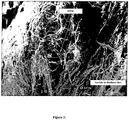
- This action is well-known as de-fibrillation, and can be witnessed from the photomicrograph in Figure 1 and Figure 2 .
- the material thus obtained can suitably be used in subsequent steps of the method according to the invention for the production of, but not limited to, paper and board forming processes, can become a component in hybrid materials, can be moulded into shapes for packaging (egg boxes, fruit trays, packing delicate electronic equipment, etc.) Therefore, typical industry end uses include; but are not confined to, paper and board manufacturing, flexible filter membranes, interior board products (decorative and industrial laminates), automotive industry (oil filter paper,) lighting (lampshade parchment), disposable consumer goods (toilet and facial tissues, domestic and industrial wipes), casings and packaging.
- composition comprising refined cellulose fibres has a Schopper-Riegler value (SR), preferably measured in accordance with the method described in detail in Example 2, of between 18 and 75°, depending upon the requirements of the end product.
- SR Schopper-Riegler value
- the traditional refining operation in the paper and board industries is carried out in the consistency range 4-8% which means that vast quantities of water must be pumped around the mill refining system.
- refining is carried out at up to 35% consistency but this is where special fibre characteristics are required for sack kraft i.e. the fibres are given a twist which increases the stretch properties of the final paper.
- the twin screw refines more efficiently above 35% consistency and the process defibrillates the fibres as required by paper and board manufacturers to promote fibre-to-fibre bonding rather than merely imparting a twist.
- the reduced amount of water usage is also of benefit in countries where water supply is limited.
- a method and apparatus by which Ligno-cellulosic materials can be efficiently processed (de-fibrillated) using a twin screw conveyor system with solids content between 50 and 60% to give a material which has a Schopper-Riegler value lying between 35 and 75°.
- this processed material can subsequently be used to form a finished product or, alternatively to be used as a binding or bonding agent provided as a part of a finished product.
- the processed material is used to bind finely divided, non-processed ligno-cellulosic material together and be formed into, a finished article such as flat boards or 3-dimentional objects as a result of the application of heat and/or pressure thereto.
- the ratios of processed to unprocessed ligno-cellulosic materials range from 5/95 to 95/5.
- the processed ligno-cellulosic material can be used to bind conventional filler materials such as talc, calcium carbonate and/or china clay as well as fine sand, powdered glass, powdered charcoal and finely divided inorganic and organic pigments.
- the preferred ratio of the processed ligno-cellulosic material to pigment or filler is provided in the range of 70/30 to 30/70.
- the following procedure describes how the Schopper-Riegler (SR) test is performed on pulp stock suspensions.
- the pulp stock suspension is achieved by adding a specific amount of tap water to the refined material coming out of the co-rotating twin screw apparatus.
- the details of the pulp stock suspension preparation are described in the test method section below.
- the test measures the rate of water drainage from the pulp fibres under standard conditions. This provides an indication of the degree of fibrillation (fraying) and hydration (water absorption) of the fibres. More beaten pulp suspensions are more defibrillated and hydrated and the water drains more slowly; the SR value is higher.
- the Schopper-Riegler test apparatus with 2 special measuring cylinders
- the Schopper-Riegler [SR] apparatus is accepted standard equipment used in the pulp, paper and board making and allied industries measuring the drainage rate of a paper or board making stock and hence the degree of fibrillation and hydration of fibres.
- the SR devices have to be constructed in a specific method so that the value of identically defibrillated fibres will be consistent when measured with any calibrated SR apparatus of any brands/make including 1 litre measuring cylinder, Mercury in glass thermometer and a Jug (approx 1 litre).
- the Schopper-Riegler apparatus was checked daily before use as follows:
- the mean of the two readings is then calculated and a report of the SR value to the nearest whole number is provided.
- a first example of an aspect of the invention is now provided in which a twin screw apparatus is used and the method according to the invention is performed with a co-rotating intermeshing twin screw as the twin screw refining system.
- the laboratory trials have been carried out using a twin screw refining system which is a conventional twin screw apparatus, co-rotating and intermeshing.
- the barrel internal diameter is 24mm.
- the screw outer diameter (OD) is 23.6mm and the screw internal diameter (ID) is 13.3mm.
- the Centre Line Distance is 18.75mm.
- the pitch is positive with respect to rotation, although negative elements can be used.
- the screw design is a bi-lobal type. The configuration of this twin screw is given in Table 1 below.
- the Table 1 gives the number and type of screw elements of each screw in successive order from the inlet side - upper side of table - to the outlet side - lower side of table - of the screw. From this table follows that the total L/D ratio of the screw is 40:1 and that the diameter D of each screw element is 23.6 mm and the diameter of barrel is 24 mm.
- the apparatus is usually [by the skilled man] referred to as a "24 mm" extruder.
- Table 1 Configuration of twin screw refining system.
- Tables below show energy usage to refine cellulose-containing and fibrous material to microfiber pulp having an increased internal fibre surface and an increased degree of interlinking, and having properties as described in the above detailed description.
- Table 2 Energy usage to refine cellulose-containing and fibrous material to 75 SR having an increased internal fibre surface and an increased degree of interlinking via a Voith double disk refiner technology (the "traditional" technology).
- Type of fibrous material Energy Usage kWh/kg Recycled White paper 1.539 kWh/kg (0.520kWh/kg) Bleached Hemp pulp (Celesa) 1.628 kWh/kg (0.782kWh/kg) Hard wood Kraft pulp (Eucalyptus) 1.569 kWh/kg (0.700kWh/kg)
- Power (in Watts) is equal to SPEED x TORQUE.
- SPECIFIC ENERGY mechanical is power divided by output.
- Power consumption measurements: Power (in kW) Torque (in Nm displayed on the "23 mm" co-rotating twin screw apparatus) x SS (screw speed) divided by maximum SS and torque.
- Example describes a method of preparing refined fibre compositions according to the invention and there is provided a step by step description as to how 1 kg of white recycled paper is processed to the desired refining levels using a co-rotating twin screw apparatus:
- the decrease in the Schopper-Riegler is thought to be due to the formation of fibrous debris as the mechanical action progressively destroys the fibres.
- the example shown in Figure 3 is the 'refining curve' for white waste paper. The sheet density reaches a maximum but does not begin to decrease in line with the refining curve.
- the method gives significant energy and time saving when compared to traditional defibrillating methods, for example, single disc, multi-disc, or conical refiners. There is much less water involved in the twin screw refining process compared to traditional beating or refining methods.
- the paper or board which is formed can be used for many different purposes such as, for example, writing, printing, graphics, for packing purposes.
Landscapes
- Engineering & Computer Science (AREA)
- Life Sciences & Earth Sciences (AREA)
- Wood Science & Technology (AREA)
- Mechanical Engineering (AREA)
- Paper (AREA)
Description
- The invention according to the present invention relates to a method in the field of manufacture of paper or board.
- The treatment of compositions comprising cellulose fibres into compositions comprising dedefibrillated cellulose fibres for paper making purposes is known. A composition comprising defibrillated cellulose fibres obtained by the method according to the invention can now economically be used in producing a wide range of paper and board products, for example, absorbent papers, newsprint, printings and writing, laminating bases, packaging papers such as fluting, liners and carton board.
- Processes for opening, beating or defibrillating pulp fibres to obtain fibrillation, increased surface area, increased accessibility and fine particle size have long been known. Ball mills are used for preparing cellulose of several tens of microns in dimension. Studies have indicated that such ball milling breaks the chemical bonds of the cellulose during the dividing process.
- It is also known to grind cellulose in water under pressure to produce a micro-cellulose with a particle size of less than one micron. In the case of cellulose derivatives, cold milling of the derivatives in liquid nitrogen is also disclosed in the prior art. Sonic pulverization with a ball mill is also a known method of producing cellulose in extremely fine particle size.
- Finely divided celluloses are also produced in the traditional processes used in manufacturing fibreboard and paper pulp. Normally, however, these traditional processes involve the use of additional chemical treatment to cellulose pulps, as for example, acid hydrolysis, which chemically alter or degrade the prepared cellulose pulps.
- In the paper industry, it is known that paper strengths are directly related to the amount of beating or refining which the fibres receive prior to formation. However, beating and refining as practiced in the paper industry are relatively inefficient processes and large amounts of energy are expended to gain relatively minor amounts of fibre opening and fibrillation.
-
GB2066145 EP0402866 describes micro-fibrillated material comprising fibres having a variety of thicknesses, having a Schopper's Riegler of 40° SR or greater when the fibres are formed in a filter sheet. The materials are obtained using a high-pressure homogenizer. For example, it is described that using refined linter (Vackai HVE) as a raw material, a 2 % suspension of cellulose in water is obtained by pre-treatment so that it can pass through the nozzle of the apparatus. The suspension is charged into a high-pressure homogenizer (Gaulin 15M-8TA) at ordinary temperature, and treated at a pressure of 500 kg/cm2 G for four times. The resultant suspension of micro-fibrous material is diluted to a concentration of 0.2 %. -
US 6379594 describes a process for producing a work piece, comprising providing raw cellulose-containing and fibrous material; adding water to the raw material; finely chopping the raw material in a machine by continuously grinding the raw material with a total energy expenditure of at least 0.5 kWh/kg, based on dry weight of the raw material, into a micro fiber pulp having an increased internal fibre surface and an increased degree of interlinking; forming the microfiber pulp to provide a shaped body; and drying the body by removing water there from to harden and form a work piece, without admixture of bonding agents to the microfiber pulp and without use of external pressure. In this way, a mouldable microfiber pulp with very diverse fibre lengths and fibril sizes develops, which pulp has the characteristic of hardening to form a subsequently deformable fibre material with high density (up to a specific gravity of 1.5) and strength without the admixture of adhesives or chemical additives and without the use of pressure, through drying and the associated shrinkage. The examples disclose that the cellulose-containing materials used in the method are taken up in watery solutions with a dry substance between 5 and 8 % by weight. -
DE 2916754 discloses a method for the treatment of a composition comprising cellulose fibres into a composition comprising cellulose microfibers the method comprising the steps of:a) providing a composition comprising cellulose fibres;b) admixing aqueous solvent to said composition comprising cellulose fibres to provide a pulp suspension comprising cellulose fibres;c) feeding said pulp suspension comprising cellulose fibres into a refining step comprising a mechanical fibrillation process executed using a refining counter-rotating twin screw;d) refining said pulp suspension to provide a composition comprising cellulose microfibers; and wherein said obtained composition comprising refined cellulose fibres at the end of the step d) can be formed into a range of papers or boards. - However, the above processes have only limited application as the materials obtained have the disadvantage of requiring high energy input to be efficient, relatively low consistency (3 - 15% is usual) and significant processing time if SR values above 50° are required. It is therefore an object of the current invention to provide for a more economically and environmentally friendly method for providing compositions comprising refined cellulose fibres, for example comparable to those described in
US 6379594 . - The current invention relates to a method and apparatus for the manufacture of paper, including the refining of cellulose fibres, achieved through single or multiple passes of a pre-processed cellulose fibre suspension in water (paper making term 'stock',) with a preferred solid material consistency range of 35 - 60% through processing apparatus.
- The difference between pulping and defibrillation should also be appreciated. In pulping, lignin is removed from ligno-cellulosic materials to render the fibres suitable for paper and board making. In defibrillation the purpose is to raise a nap of individual fibrils making up the outer surface or wall of the fibre whilst, at the same time, attempting to maintain both the condition of the interior of the fibre and the fibre length.
- Methods and apparatus for the manufacture of paper are known and have been used as indicated above for many years. However, the paper making industry has been, conventionally, a relatively slow moving industry in terms of new development. Part of the paper making process as already described, requires the fibrillation of fibres to raise or detach fibrils from the main body of the, typically cellulose fibres, thereby increasing the effective bonding area thereby encouraging more bonding between the cellulose fibres and hence allow the formation of the paper once wetted and dried. Originally the process was undertaken by the beating of the fibres by hand or in a water-powered stamping mill in order to promote subsequent bonding of the fibres. Subsequently, a machine known as a Hollander beater was used in place of manual labour. However, even this apparatus was slow and subsequently, refining apparatus has been used including rotating plates with bars, which operate at a quicker speed then the previous apparatus but has a disadvantage in that it is required to be operated with relatively dilute suspensions of the fibres which means that a large quantity of liquid subsequently needs to be handled in this refining stage. This, in turn, means operation of the apparatus is required for a greater period of time and hence greater energy usage. In turn, this has meant that the costs involved in the manufacture of paper have increased to such an extent that, in certain, countries where energy is expensive, the manufacture of paper has almost ceased and led to paper being imported from countries where the energy required in the manufacturing process is cheaper.
- The aim of the present invention is therefore to provide a method which allows a material which can be provided for subsequent use, such as for quality paper, or as a binding agent to be manufactured while, at the same time, reducing the liquid which is required to be used in the suspension and, in turn, reduce the requirement for energy usage in the refining (or beating) process.
- The invention concerns a method having the steps as defined in
claim 1. - In one embodiment the particular paper of a wide range of papers and boards, is selected and the fibre solvent mixture is selected accordingly.
- Refining, or beating, is the mechanical action which causes de-fibrillation. This treatment of the said pulp suspension comprising cellulose fibres by said refining twin screw (with energy consumptions as shown in the Examples) provides a composition comprising refined cellulose fibres; and wherein said obtained composition comprising refined cellulose fibres at the end of the refining step has a given Schopper-Riegler value with lower energy input/energy costs in comparison to those methods described in the art.
- Within the context of the current invention "materials comprising cellulose fibres" comprise any suitable material, for example, and not limited to paper, recycled paper, and ligno-cellulosic fibre sources including, but not confined to pulps made from hardwoods and softwoods, cotton linter, hemp stems, flax stems cereal straws (wheat, barley, rye, oats and rice, abaca, bagasse, bamboo, wood waste and cotton waste). As will be understood by the skilled person, the presence of fibres and associated fibrils are an essential part of any suitable material.
- It will be understood by the skilled person that such materials may be pre-treated before being applied in the method according to the invention. Such pre-treatment may include removal of toxic or unwanted materials, chopping, hammer milling or pinning of the material, washing, and chemical treatments either singly or combinations thereof.
- For example, pre-treatment may comprise the use of a paper shredder with interchangeable hammer mill linked to extraneous (contrary) material separation (wood, metal, stones, plastic, etc) and a cleaning system, including dust removal (all known to the skilled person).
- In a next step of the method, the composition comprising cellulose fibres is (and preferably while being subjected to disintegration in the feeding system) being mixed with an aqueous solution, including tap water or deionised water with or without the addition of steam.. Said mixing can for example be performed by dry feeding the composition comprising cellulose fibres into a twin screw machine.
- As will be understood by the skilled person, if required, the aqueous solution may comprise additional materials, for example additives such as described below (but not limited to):
- Wetting agents to accelerate water penetration into the raw material and/or starches and similar material used to modify the properties of the end product.
- The mixing with the aqueous solution/liquid may be performed by any means known to the skilled person, however preferably, preparing the pulp is achieved by feeding the composition comprising cellulose fibres to a first twin screw (preferably counter-rotating) that is fitted with a water (or steam) feed system, preferably a metered water feed system. In the twin screw the liquid and the composition comprising cellulose fibres are processed into a crumb suitable for feeding into the following refining stage. Preferably the counter rotating twin screw employed in the feeding step of the method is fitted with a water and/or steam inlet with the objective of softening (lubricating) the fibres thereby minimising fibre damage.
- In general, for the fibre treatment and refining procedures, a co-rotating twin screw apparatus can be used at a speed of 250 RPM and a set temperature of about 50°C, but this temperature and screw speed can be varied according to the fibres being treated, depending on the liquid addition rate and necessity. The consistency of the pulp can be varied from 10 to 80% and more typically 35-60% solids content, which is advantageous in comparison to the methods described in the art, in which the use of much lower consistencies has been reported in traditional processes to prepare refined cellulose fibres within, for example, the pulp, paper and board making industries
- According to the invention, the pulp suspension provided in step b) is provided with a consistency of at least 30%; and preferably between, and including 40% and 60%. The consistency value is chosen to give the fibre characteristics required for the end product
- It has surprisingly been found that by providing a pulp suspension with a consistency of at least 30%, and preferably between and including 40% and 60%, the method according to the invention can be performed in a highly economical fashion, reducing energy requirement in the production of the material as well as reducing the processing time and reducing the amount of processing water.
- It is noted that this is in strong contrast to the methods known in the art. For example,
US6379594 describes the use of cellulose-containing materials in the method described therein, taken up in watery solutions with a dry substance between 5 and 8 % by weight. - In a next step of the method according to the invention, the obtained pulp suspension comprising cellulose fibres is fed into a refining step comprising a mechanical de-fibrillation process executed using a refining twin screw and refining said pulp suspension comprising cellulose fibres with at least the use of said refining twin screw, to provide a composition comprising refined cellulose fibres with properties such as fibre length, refining degree (°SR), drainage and bonding properties.
- Although the skilled person will understand that various twin screw configurations can suitably be used in the method according to the invention, a twin screw configuration as described in the examples below can be used.
- During the operating of the twin screw, the cellulose fibres, made up of layers of micro-fibres called fibrils, are refined so that the fibrils are partially de-fibrillated/unravelled from the parent fibre thus creating a greater number of potential bonding sites, thereby promoting hydrogen bonding between the fibres and/or fibrils. This action is well-known as de-fibrillation, and can be witnessed from the photomicrograph in
Figure 1 andFigure 2 . - In addition, it has been found that by the use of a twin screw, materials of higher consistency than those reported in the art can advantageously be utilized, as described herein. Moreover, there is a significant reduction in processing time in comparison to, for example, the method described in
US 6379594 (from hours to minutes when expressed at the time required for obtaining equal amounts of a composition comprising micro-fibres), as well as a reduction on energy consumption. - It will be appreciated by the skilled person that based on the teaching disclosed herein; he will be capable of determining the proper operational parameters for obtaining a composition comprising a chosen mixture of refined cellulose fibres with a range of characteristics suitable for the particular desired end product.
- The material thus obtained can suitably be used in subsequent steps of the method according to the invention for the production of, but not limited to, paper and board forming processes, can become a component in hybrid materials, can be moulded into shapes for packaging (egg boxes, fruit trays, packing delicate electronic equipment, etc.) Therefore, typical industry end uses include; but are not confined to, paper and board manufacturing, flexible filter membranes, interior board products (decorative and industrial laminates), automotive industry (oil filter paper,) lighting (lampshade parchment), disposable consumer goods (toilet and facial tissues, domestic and industrial wipes), casings and packaging.
- In another preferred embodiment there is provided that the composition comprising refined cellulose fibres has a Schopper-Riegler value (SR), preferably measured in accordance with the method described in detail in Example 2, of between 18 and 75°, depending upon the requirements of the end product.
- By the method and use of apparatus according to the invention, it is now possible to provide for a range of paper and board making stocks and the manufacture of bonding agent material in a manner that is both economically and environmentally advantageous as well as time saving.
- The traditional refining operation in the paper and board industries is carried out in the consistency range 4-8% which means that vast quantities of water must be pumped around the mill refining system. For special fibre applications, refining is carried out at up to 35% consistency but this is where special fibre characteristics are required for sack kraft i.e. the fibres are given a twist which increases the stretch properties of the final paper. The twin screw refines more efficiently above 35% consistency and the process defibrillates the fibres as required by paper and board manufacturers to promote fibre-to-fibre bonding rather than merely imparting a twist.
- The reduced amount of water usage is also of benefit in countries where water supply is limited.
- It is possible to modify the fibre as it is being refined by the addition of chemicals, as the amount of liquid used is relatively low.
- In one embodiment of the invention there is provided a method and apparatus by which Ligno-cellulosic materials can be efficiently processed (de-fibrillated) using a twin screw conveyor system with solids content between 50 and 60% to give a material which has a Schopper-Riegler value lying between 35 and 75°.
- In one embodiment this processed material can subsequently be used to form a finished product or, alternatively to be used as a binding or bonding agent provided as a part of a finished product. In one embodiment the processed material is used to bind finely divided, non-processed ligno-cellulosic material together and be formed into, a finished article such as flat boards or 3-dimentional objects as a result of the application of heat and/or pressure thereto.
- In one embodiment the ratios of processed to unprocessed ligno-cellulosic materials range from 5/95 to 95/5.
- In a further embodiment the processed ligno-cellulosic material can be used to bind conventional filler materials such as talc, calcium carbonate and/or china clay as well as fine sand, powdered glass, powdered charcoal and finely divided inorganic and organic pigments.
- In this embodiment the preferred ratio of the processed ligno-cellulosic material to pigment or filler is provided in the range of 70/30 to 30/70.
- Specific embodiments of the invention are now described with reference to the accompanying drawings; wherein
-
Figure 1 illustrates an SEM image of hemp fibres, defibrillated to a high degree -
Figure 2 illustrates an SEM image of hemp fibres, defibrillated to a high degree and -
Figure 3 illustrates the SR and density curve of co-rotating twin screw refined white waste paper material. This highly refined material has a "broad" SR range of between 60 and 90 SR and a "broad" density range of between 850 and 1450 kgm-3. The square points relate to the Schopper Reigler graph and the triangular points relate to the Density graph - The following procedure describes how the Schopper-Riegler (SR) test is performed on pulp stock suspensions. For the purpose of the experiments described herein the pulp stock suspension is achieved by adding a specific amount of tap water to the refined material coming out of the co-rotating twin screw apparatus. The details of the pulp stock suspension preparation are described in the test method section below. The test measures the rate of water drainage from the pulp fibres under standard conditions. This provides an indication of the degree of fibrillation (fraying) and hydration (water absorption) of the fibres. More beaten pulp suspensions are more defibrillated and hydrated and the water drains more slowly; the SR value is higher.
- Schopper-Riegler test apparatus with 2 special measuring cylinders The cylinders are calibrated in SR such that 1000 ml = 0 SR and 0 ml = 100 SR. The Schopper-Riegler [SR] apparatus is accepted standard equipment used in the pulp, paper and board making and allied industries measuring the drainage rate of a paper or board making stock and hence the degree of fibrillation and hydration of fibres. The SR devices have to be constructed in a specific method so that the value of identically defibrillated fibres will be consistent when measured with any calibrated SR apparatus of any brands/make including 1 litre measuring cylinder, Mercury in glass thermometer and a Jug (approx 1 litre). The Schopper-Riegler apparatus was checked daily before use as follows:
- 1. Place the 2 special measuring cylinders under the rear orifices of the Schopper-Riegler tester.
- 2. Rinse the apparatus with water 20°C. Ensure that the body of the apparatus is correctly positioned. Lower the sealing cone by means of handle. Pour 1 litre of tap or de-ionised water into the body of the tester. If water leaks from the apparatus the position of the sealing cone requires adjusting. Discard the water, adjust the sealing cone and re-test.
- 3. Press the release lever and wait for all the water to drain.
- 4. Check the SR number corresponding to the volume of water collected in the cylinder from the front orifice. This should be 4.
- 5. If the SR value of the water is greater than 4, clean the wire in the body thoroughly, check the temperature and the water used and re-test. The wire may be cleaned using acetone and a soft brush, followed by thorough rinsing.
- The Test Method used was as follows in which the following steps were used:
- 1. Calculate the exact solid content of the co-rotating twin screw refined stock via Metler Toledo HG53-P Moisture Analyzer or any other recognised standard method for moisture determination.
- 2. Take the equivalent of 2 dry grams of twin screw refined stock, add to 500ml of tap water, stir with magnetic stirrer and sonicate with the aid of a standard sonicator or disintegrate with the aid of a standard pulp disintegrator until complete fibre dispersion has been achieved.
- 3. Check the temperature of the water and pulp suspension, and adjust to 20 ± 0.5° C if necessary, before carrying out this test.
- 4. Position the two cylinders as described above. Ensure that the body is correctly positioned and lower the sealing cone suing the handle.
- 5. Ensure that the stock solution is thoroughly mixed and then measure the volume calculated in
step 2. Dilute to 1000 ml with water at 20°C. - 6. Mix the pulp stock thoroughly and pour rapidly and smoothly into the body. Pour the stock against the shaft and wings of the sealing cone to avoid a vortex.
- 7. Raise the sealing
cone 5 seconds after all the stock was added, by pressing the release lever. - 8. When the water has finished draining, record on the SOP PTS the SR value equivalent to the volume of water collected from the front orifice.
- 9. Remove the body of the SR, and wash all fibres from the wire. Empty and replace the cylinders.
- 10. Repeat the test (
steps 1 to 9) with a second portion of stock. - 11. If the two readings differ by more than 4% (1 unit for SR value of 25), repeat the measurement using another portion of pulp. The two closest values are then used.
- The mean of the two readings is then calculated and a report of the SR value to the nearest whole number is provided.
- A first example of an aspect of the invention is now provided in which a twin screw apparatus is used and the method according to the invention is performed with a co-rotating intermeshing twin screw as the twin screw refining system. The laboratory trials have been carried out using a twin screw refining system which is a conventional twin screw apparatus, co-rotating and intermeshing. The barrel internal diameter is 24mm. The screw outer diameter (OD) is 23.6mm and the screw internal diameter (ID) is 13.3mm. The Centre Line Distance is 18.75mm. The pitch is positive with respect to rotation, although negative elements can be used. The screw design is a bi-lobal type. The configuration of this twin screw is given in Table 1 below. The Table 1 gives the number and type of screw elements of each screw in successive order from the inlet side - upper side of table - to the outlet side - lower side of table - of the screw. From this table follows that the total L/D ratio of the screw is 40:1 and that the diameter D of each screw element is 23.6 mm and the diameter of barrel is 24 mm. The apparatus is usually [by the skilled man] referred to as a "24 mm" extruder.
Table 1: Configuration of twin screw refining system. Number Type L/D (length/diameter ratio) Cumulative Total ratio 6 1 D FS (Diameter Feed Screw) 6 6 2 60 F 0.5 6.5 1 D/2 60F 0.5 7 1 D/2 30 F 0.5 7.5 2 D/2 90 A 1 8.5 6 1 D FS 6 14.5 1 D/2 30F 0.5 15 7 30 F 1.75 16.75 7 D/2 60F 3.5 20.25 9 1 D FS 9 29.25 2 30 F 0.5 29.75 1 D/2 30F 0.5 30.25 6 30 F 1.5 31.75 6 90 A 1.5 33.25 5 1 D FS 5 38.25 1 Alpha Beta D/4 0.25 38.5 1 1.5 D EXT 1.5 40 - Concerning the nomenclature used for the type indications in Table 1 above:
- D stands for Diameter; FS stands for Feed Screw; F stands for Forwarding; A stands for Alternating; Alpha-Beta is transition element between the bi-lobal elements and the final pressure generating uni-lobal discharge screw; EXT stands for Extrusion screw; D/2 stands for half the diameter; D/4 stands for quarter of Diameter; the
numbers 1, 1.5 are overall L/D ratios of the elements, 30, 60, 90 are the angle in degrees between consecutive mixing elements. - In a further example of the invention there is provided a method whereby the energy usage to refine a cellulosic material suspension in water to a de-fibrillated pulp having an increased internal fibre surface and an increased degree of interlinking is described.
- The Tables below show energy usage to refine cellulose-containing and fibrous material to microfiber pulp having an increased internal fibre surface and an increased degree of interlinking, and having properties as described in the above detailed description.
Table 2: Energy usage to refine cellulose-containing and fibrous material to 75 SR having an increased internal fibre surface and an increased degree of interlinking via a Voith double disk refiner technology (the "traditional" technology). Type of fibrous material Energy Usage kWh/kg Recycled White paper 1.539 kWh/kg (0.520kWh/kg) Bleached Hemp pulp (Celesa) 1.628 kWh/kg (0.782kWh/kg) Hard wood Kraft pulp (Eucalyptus) 1.569 kWh/kg (0.700kWh/kg) - All the values shown represent the gross Specific Refining energy. The NET energy values for the double disk refiner are shown in brackets ().
Table 3: Energy usage to refine cellulosic fibrous material to 75SR having an increased internal fibre surface and an increased degree of interlinking via twin screw technology. Type of fibrous material Energy Usage kWh/kg Twin screw refiner Energy Usage kWh/kg Voith double disk refiner Recycled best white paper 0.218 1.539 kWh/kg (0.520kWh/kg) Mixed coloured waste paper 0.218 N/A Soft Wood Kraft Pulp 0.236 N/A - All the values shown represent the GROSS Specific Refining energy. Difference between NET and GROSS specific refining energy has shown to be considerably larger for the disk refiner than for the twin screw refiner where such difference is negligible. The NET energy values for the double disk refiner are shown in brackets ( ).
- Power (in Watts) is equal to SPEED x TORQUE. SPECIFIC ENERGY (mechanical) is power divided by output. Power consumption measurements: Power (in kW) = Torque (in Nm displayed on the "23 mm" co-rotating twin screw apparatus) x SS (screw speed) divided by maximum SS and torque.
- As can be witnessed from the above tables, it has now become possible, in comparison to the methods in the prior art, to refine cellulose fibres to a high degree of de-fibrillation having an increased internal fibre surface and an increased degree of interlinking, and having properties as described in the above detailed description, with reduced energy requirement. This allows for a more economically feasible and continuous production of such materials according to the invention.
- The next Example now describes a method of preparing refined fibre compositions according to the invention and there is provided a step by step description as to how 1 kg of white recycled paper is processed to the desired refining levels using a co-rotating twin screw apparatus:
- 1. 1 kg of R12 (best white paper) is mixed with an aqueous solution (i.e. tap water) to a consistency of 45%. The mixing with the aqueous solution/liquid may be performed by any means known to the skilled person, however preferably, preparing the pulp is achieved by feeding the composition comprising cellulose fibres to a first twin screw that is fitted with a water (or steam) feed system, preferably a metered water feed system. In the twin screw the liquid and the composition comprising cellulose fibres are processed into a pulp. Preferably a counter rotating twin screw is applied in this step of the method to soften (lubricate) the fibres thereby minimising fibre damage.
- 2. The mixed material is manually introduced in the co-rotating twin screw (the characteristics and layout of which has been described in the previous example) at a feed rate of 3kg/hour. The co-rotating twin screw operates at a rotational speed of 250rpm and at a fixed temperature of 50°C.
- 3. The material "passed" one time through the co-rotating twin screw refiner is collected and fed through a second time.
- 4. The material is "passed" a second time through the co-rotating twin screw refiner and the resulting product is collected and fed through a third and final time.
- 5. The refining level of the co-rotating twin screw refined material is tested after each pass via the Schopper-Riegler (SR) method.
- In the next example there is provided examples of micro-fibre compositions produced in a method comprising the method according to the invention. Results obtained with various materials are shown in Table 4 below.
Stage Process Description Equipment Type 1 Fibre Preparation. Paper shredder with interchangeable hammer mill suitable for pre-preparing long fibred pulps (hemp, flax, cotton, abaca) and flash dried pulps, linked to extraneous (contrary) material separation (wood, metal, stones, plastic, etc) and cleaning system including dust removal. Raw fibre reduction and transport system to prepare fibre for entry into the following Twin Screw 1. If feasible, buffer storage facilities should be created.Separate line to deal with conventional dry sheet pulp (e.g. bleached softwood kraft, bleached hemp, bleached hardwood) involving a suitable dry disintegration process. Stage Process Description Equipment Type 2 Twin Screw 1. (Feeding System)Counter rotating twin screw with a metered water and/or steam feed system to soften (lubricate) fibres during the reduction period thereby minimising fibre damage. Fibre reduction system capable of producing fibre suitable for de-fibrillisation in a second twin screw. Stage Process Description Equipment Type and additional details of the various parameters used. 3 Twin Screw 2.Co- rotating twin screw 'refiner'. Process material produced in Stage 2.Configuration twin screw refiner as described herein. Refining stage capable of creating material having the characteristics as defined in the claims and description from prepared fibre stock. Operational speed: 250 RPM Operational temperature: 50 C. Properties and characteristics of a number of fibrous materials processed via twin screw refiner are shown below. Where appropriate this stage should also be capable of inducing and collecting liquid extracts from the fibres during the refining process as well as venting volatiles. Energy usage for a selection of fibrous materials processed via twin screw refiner are given in Table 2 above. This twin screw unit is able to accept a metered amount of water and/or low pressure steam. It is possible to heat the barrel or, in certain cases, cool it. It is envisaged that a maximum temperature of 150°C will be employed with cooling facility able to bring the temperature down to ambient. A screw speed range from 10 up to 500rpm (the screw speed of the apparatus can be altered depending of processing needs) is suitable. Table 5: Details regarding examples of twin screw refined material, obtained as described above. Fibre Type Solid Content (%) Pass# SR value/0SR Density/kgm -3 White waste paper 45% 1 73 921 White waste paper 45% 2 81.5 1230 White waste paper 45% 3 82.5 1270 White waste paper 45% 4 69.5 1340 White waste paper 45% 5 56 1330 Mixed Coloured Paper 45% 1 65 1170 Mixed Coloured Paper 45% 2 71.5 1260 Mixed Coloured Paper 45% 3 76 1370 Mixed Coloured Paper 45% 4 74 1420 Mixed Coloured Paper 45% 5 72 1450 Soft Wood Kraft Pulp 45% 1 72 1110 Soft Wood Kraft Pulp 45% 2 78 1130 Soft Wood Kraft Pulp 45% 3 72 1230 - Using a known technology, namely a twin screw extrusion machine, in a novel way to defibrillate (refine) cellulosic feedstocks to produce a range of papers, boards.
- Referring to
Figure 3 , in the experiments with the twin screw refining equipment it has been found that the Schopper-Riegler degree will begin to fall after reaching a maximum value. This maximum value will depend upon the type of cellulosic material being processed. For the purpose of the examples given above covering the use of this equipment in the pulp, paper, board and allied industries it is only the ascending part of the curve which is of interest. This is not the case when considering the production of floor tiles, wall boards and high strength sheet material, and similar products which are outside the scope of this patent. - The decrease in the Schopper-Riegler is thought to be due to the formation of fibrous debris as the mechanical action progressively destroys the fibres. The example shown in
Figure 3 is the 'refining curve' for white waste paper. The sheet density reaches a maximum but does not begin to decrease in line with the refining curve. - The method gives significant energy and time saving when compared to traditional defibrillating methods, for example, single disc, multi-disc, or conical refiners. There is much less water involved in the twin screw refining process compared to traditional beating or refining methods. The paper or board which is formed can be used for many different purposes such as, for example, writing, printing, graphics, for packing purposes.
Claims (4)
- Method for the treatment of a composition comprising cellulose fibres into a composition comprising cellulose microfibers, the method comprising the steps of:a) Providing a composition comprising cellulose fibres;b) Admixing aqueous solvent to said composition comprising cellulose fibres to provide a pulp suspension comprising cellulose fibres;c) Feeding said pulp suspension comprising cellulose fibres into a refining step (d) comprising a mechanical fibrillation process executed using a refining co-rotating twin screw;d) Refining said pulp suspension comprising cellulose fibres with at least the use of said refining twin screw, to provide a composition comprising cellulose microfibers; and wherein said obtained composition comprising refined cellulose microfibers at the end of step d) can be formed into a range of papers or boards,wherein said cellulose fibres are reduced in size in step c), and further wherein the composition comprising refined cellulose fibres has a Schopper-Riegler value (SR) upon leaving the refining twin screw of at least 35SR,
and wherein in step b) a pulp suspension is provided with a consistency of > 35%. - Method according to claim 1 wherein the composition comprising refined cellulose fibres has a Schopper-Riegler value (SR) upon leaving the refining twin screw of between 35 and 75SR.
- Method according to any of the previous claims wherein the composition comprising cellulose fibres of step a) is selected from the group consisting of paper, waste paper, recycled paper and pulps made from, but not confined to, softwoods, hardwoods, hemp, flax, cotton linters, abaca, wood waste, cereal straws, bagasse and bamboo.
- Method according to one of the preceding claims wherein said composition comprising refined cellulose fibres is formed into a 2 dimensional shape.
Priority Applications (1)
| Application Number | Priority Date | Filing Date | Title |
|---|---|---|---|
| PL10777090T PL2501852T3 (en) | 2009-11-05 | 2010-11-05 | Method for the processing of cellulose fibres |
Applications Claiming Priority (2)
| Application Number | Priority Date | Filing Date | Title |
|---|---|---|---|
| GBGB0919422.6A GB0919422D0 (en) | 2009-11-05 | 2009-11-05 | Apparatus and method for the manufacture of paper and/or card |
| PCT/GB2010/051852 WO2011055148A1 (en) | 2009-11-05 | 2010-11-05 | Apparatus and method for the processing of cellulose fibres |
Publications (2)
| Publication Number | Publication Date |
|---|---|
| EP2501852A1 EP2501852A1 (en) | 2012-09-26 |
| EP2501852B1 true EP2501852B1 (en) | 2017-02-22 |
Family
ID=41501965
Family Applications (1)
| Application Number | Title | Priority Date | Filing Date |
|---|---|---|---|
| EP10777090.1A Active EP2501852B1 (en) | 2009-11-05 | 2010-11-05 | Method for the processing of cellulose fibres |
Country Status (6)
| Country | Link |
|---|---|
| US (1) | US8752776B2 (en) |
| EP (1) | EP2501852B1 (en) |
| ES (1) | ES2624956T3 (en) |
| GB (1) | GB0919422D0 (en) |
| PL (1) | PL2501852T3 (en) |
| WO (1) | WO2011055148A1 (en) |
Families Citing this family (15)
| Publication number | Priority date | Publication date | Assignee | Title |
|---|---|---|---|---|
| ES2386045B1 (en) | 2012-05-03 | 2013-04-18 | Saica Pack, S.L. | PROCEDURE FOR OBTAINING NANOFIBRILLED CELLULOSE FROM RECOVERED PAPER |
| EP2925517A1 (en) * | 2012-11-30 | 2015-10-07 | Innventia AB | Sandwich material |
| FI127682B (en) | 2013-01-04 | 2018-12-14 | Stora Enso Oyj | A method of producing microfibrillated cellulose |
| CN104109977A (en) * | 2013-05-20 | 2014-10-22 | 何星灯 | Water-sand base paper making method |
| EP3075715A1 (en) | 2015-04-03 | 2016-10-05 | Redco NV | Cellulose fiber mixtures and uses thereof for the production of fiber cement compositions and products |
| FR3035611B1 (en) * | 2015-04-28 | 2019-08-09 | Centre Technique Du Papier | METHOD AND DEVICE FOR MANUFACTURING LAMINATED MATERIAL COMPRISING A FIBRILED CELLULOSE LAYER |
| WO2016196983A1 (en) * | 2015-06-04 | 2016-12-08 | Bruce Crossley | Method of producing cellulose nanofibrils |
| ES2709765T5 (en) | 2015-09-15 | 2022-11-14 | Smurfit Kappa Paper Holdings France | Use of cellulosic fiber pulp |
| CA3001114C (en) * | 2015-10-16 | 2024-04-16 | General Mills, Inc. | Paperboard product including refined cellulose |
| DE102016116650A1 (en) | 2016-09-06 | 2018-03-08 | Papiertechnische Stiftung | Compound with a dry matter |
| WO2019058392A1 (en) * | 2017-09-22 | 2019-03-28 | Council Of Scientific & Industrial Research | Shaped objects for use in security applications |
| GB201818583D0 (en) * | 2018-11-14 | 2018-12-26 | Zelfo Tech Gmbh | Biomass properties extraction apparatus and/or method |
| EP3747614A1 (en) | 2019-06-04 | 2020-12-09 | Lenzing Aktiengesellschaft | Method for providing a prepared cellulose-comprising material with predetermined fibre length distribution |
| CN112609513A (en) * | 2020-12-28 | 2021-04-06 | 滁州卷烟材料厂 | Corrugated paper ring crush strength additive and corrugated paper |
| IT202200026532A1 (en) * | 2022-12-22 | 2024-06-22 | Lucense S C A R L | PAPER PRODUCTION MIXTURE, ESPECIALLY FOR RECYCLED PAPER AND ITS MANUFACTURING PROCEDURE |
Family Cites Families (9)
| Publication number | Priority date | Publication date | Assignee | Title |
|---|---|---|---|---|
| DE1180349B (en) * | 1957-07-02 | 1964-10-29 | Calor & Sjoegren Ab | Device for processing a mass of material in particle or suspension form |
| SE408920B (en) * | 1977-12-06 | 1979-07-16 | Mo Och Domsjoe Ab | DEVICE FOR DEBIBRYING AND CONDITIONING CELLULOSE MATERIAL |
| SE422089B (en) * | 1978-05-03 | 1982-02-15 | Defibrator Ab | SET AND DEVICE FOR MANUFACTURING FIBER MASS OF LIGNOCELLULOSALLY MATERIAL |
| GB2066145B (en) | 1979-12-26 | 1983-05-25 | Itt | Microfibrillated cellulose |
| SE447738B (en) * | 1983-11-30 | 1986-12-08 | Frotator Ab | DEVICE FOR CELLULO SAMSON TREATMENT WITH A CONSISTENCY ABOUT THE FLATABILITY LIMIT WITH TRANSPORT SCREW FOR A WORKING ZONE |
| DE69007684T2 (en) | 1989-06-14 | 1994-07-14 | Daicel Chem | Organic microfibrillated material for filters. |
| US5762756A (en) * | 1994-11-21 | 1998-06-09 | The Black Clawson Company | Methods and apparatus for pulping and deinking |
| AT405847B (en) * | 1996-09-16 | 1999-11-25 | Zellform Ges M B H | METHOD FOR PRODUCING BLANKS OR SHAPED BODIES FROM CELLULOSE FIBERS |
| EP0979895A1 (en) | 1998-08-12 | 2000-02-16 | Instituut Voor Agrotechnologisch Onderzoek (Ato-Dlo) | Method and device for refining fibres |
-
2009
- 2009-11-05 GB GBGB0919422.6A patent/GB0919422D0/en not_active Ceased
-
2010
- 2010-11-05 ES ES10777090.1T patent/ES2624956T3/en active Active
- 2010-11-05 PL PL10777090T patent/PL2501852T3/en unknown
- 2010-11-05 US US13/508,321 patent/US8752776B2/en active Active
- 2010-11-05 EP EP10777090.1A patent/EP2501852B1/en active Active
- 2010-11-05 WO PCT/GB2010/051852 patent/WO2011055148A1/en not_active Ceased
Non-Patent Citations (1)
| Title |
|---|
| None * |
Also Published As
| Publication number | Publication date |
|---|---|
| GB0919422D0 (en) | 2009-12-23 |
| PL2501852T3 (en) | 2017-08-31 |
| ES2624956T3 (en) | 2017-07-18 |
| US8752776B2 (en) | 2014-06-17 |
| EP2501852A1 (en) | 2012-09-26 |
| WO2011055148A1 (en) | 2011-05-12 |
| US20130192776A1 (en) | 2013-08-01 |
Similar Documents
| Publication | Publication Date | Title |
|---|---|---|
| US8752776B2 (en) | Apparatus and method for the processing of cellulose fibres | |
| CA2766294C (en) | Method and apparatus for defibrillating cellulose fibres | |
| US11390995B2 (en) | Cannabis fiber, absorbent cellulosic structures containing cannabis fiber and methods of making the same | |
| JP6622219B2 (en) | Highly efficient production of nanofibrillated cellulose | |
| US20150041087A1 (en) | Articles of manufacture made from pulp composition | |
| Sheikhi et al. | An optimum mixture of virgin bagasse pulp and recycled pulp (OCC) for manufacturing fluting paper | |
| JP2012036508A (en) | Manufacturing method for microfibrous cellulose | |
| AU2012301811A1 (en) | Pulp composition | |
| US20230295881A1 (en) | Molded pulp article and processes of making same | |
| CN102812182A (en) | Method for improving the properties of a paper product and forming an additive component and the corresponding paper product and additive component and use of the additive component | |
| JP2023540959A (en) | Microfibrillated cellulose-containing pulp sheet with improved mechanical properties | |
| EP4496923A2 (en) | Molded pulp article and processes for making them | |
| CN110924227B (en) | Method for making bamboo pulp household paper and household paper | |
| CN114808537B (en) | Preparation method of household paper and household paper | |
| JPH0941288A (en) | Readily biodegradable complex and art paper product using the same | |
| CN1985048A (en) | Process for sheeting raw cotton linters | |
| KR100627996B1 (en) | Composition for dissociation of wet paper | |
| JP2024178548A (en) | Manufacturing method of cellulose nanofiber | |
| JP2022541699A (en) | Composition of microfibrillated cellulose with increased tensile properties and method of producing same | |
| CN115807359A (en) | A clean production process of high quantitative and high strength corrugated base paper | |
| US20020068160A1 (en) | Absorbent composites: manufacture of pseudo-fiber TM natural fibers and forming of multi-fiber composites for heat, sound, fluids and odor absorbency | |
| HK40092957A (en) | Microfibrillated cellulose containing pulp sheets with improved mechanical properties | |
| JPH03501394A (en) | Improvement method for papermaking |
Legal Events
| Date | Code | Title | Description |
|---|---|---|---|
| PUAI | Public reference made under article 153(3) epc to a published international application that has entered the european phase |
Free format text: ORIGINAL CODE: 0009012 |
|
| 17P | Request for examination filed |
Effective date: 20120706 |
|
| AK | Designated contracting states |
Kind code of ref document: A1 Designated state(s): AL AT BE BG CH CY CZ DE DK EE ES FI FR GB GR HR HU IE IS IT LI LT LU LV MC MK MT NL NO PL PT RO RS SE SI SK SM TR |
|
| DAX | Request for extension of the european patent (deleted) | ||
| RAP1 | Party data changed (applicant data changed or rights of an application transferred) |
Owner name: INTERFACE EUROPEAN MANUFACTURING B.V. |
|
| RAP1 | Party data changed (applicant data changed or rights of an application transferred) |
Owner name: ZELFO TECHNOLOGY GMBH |
|
| RAP1 | Party data changed (applicant data changed or rights of an application transferred) |
Owner name: BASF SE |
|
| 17Q | First examination report despatched |
Effective date: 20131025 |
|
| GRAP | Despatch of communication of intention to grant a patent |
Free format text: ORIGINAL CODE: EPIDOSNIGR1 |
|
| INTG | Intention to grant announced |
Effective date: 20160919 |
|
| GRAS | Grant fee paid |
Free format text: ORIGINAL CODE: EPIDOSNIGR3 |
|
| GRAA | (expected) grant |
Free format text: ORIGINAL CODE: 0009210 |
|
| AK | Designated contracting states |
Kind code of ref document: B1 Designated state(s): AL AT BE BG CH CY CZ DE DK EE ES FI FR GB GR HR HU IE IS IT LI LT LU LV MC MK MT NL NO PL PT RO RS SE SI SK SM TR |
|
| REG | Reference to a national code |
Ref country code: GB Ref legal event code: FG4D |
|
| REG | Reference to a national code |
Ref country code: CH Ref legal event code: EP |
|
| REG | Reference to a national code |
Ref country code: AT Ref legal event code: REF Ref document number: 869379 Country of ref document: AT Kind code of ref document: T Effective date: 20170315 |
|
| REG | Reference to a national code |
Ref country code: IE Ref legal event code: FG4D |
|
| REG | Reference to a national code |
Ref country code: DE Ref legal event code: R096 Ref document number: 602010040221 Country of ref document: DE |
|
| REG | Reference to a national code |
Ref country code: SE Ref legal event code: TRGR |
|
| REG | Reference to a national code |
Ref country code: LT Ref legal event code: MG4D |
|
| REG | Reference to a national code |
Ref country code: NL Ref legal event code: MP Effective date: 20170222 |
|
| REG | Reference to a national code |
Ref country code: AT Ref legal event code: MK05 Ref document number: 869379 Country of ref document: AT Kind code of ref document: T Effective date: 20170222 |
|
| REG | Reference to a national code |
Ref country code: ES Ref legal event code: FG2A Ref document number: 2624956 Country of ref document: ES Kind code of ref document: T3 Effective date: 20170718 |
|
| PG25 | Lapsed in a contracting state [announced via postgrant information from national office to epo] |
Ref country code: HR Free format text: LAPSE BECAUSE OF FAILURE TO SUBMIT A TRANSLATION OF THE DESCRIPTION OR TO PAY THE FEE WITHIN THE PRESCRIBED TIME-LIMIT Effective date: 20170222 Ref country code: NO Free format text: LAPSE BECAUSE OF FAILURE TO SUBMIT A TRANSLATION OF THE DESCRIPTION OR TO PAY THE FEE WITHIN THE PRESCRIBED TIME-LIMIT Effective date: 20170522 Ref country code: GR Free format text: LAPSE BECAUSE OF FAILURE TO SUBMIT A TRANSLATION OF THE DESCRIPTION OR TO PAY THE FEE WITHIN THE PRESCRIBED TIME-LIMIT Effective date: 20170523 Ref country code: LT Free format text: LAPSE BECAUSE OF FAILURE TO SUBMIT A TRANSLATION OF THE DESCRIPTION OR TO PAY THE FEE WITHIN THE PRESCRIBED TIME-LIMIT Effective date: 20170222 |
|
| PG25 | Lapsed in a contracting state [announced via postgrant information from national office to epo] |
Ref country code: NL Free format text: LAPSE BECAUSE OF FAILURE TO SUBMIT A TRANSLATION OF THE DESCRIPTION OR TO PAY THE FEE WITHIN THE PRESCRIBED TIME-LIMIT Effective date: 20170222 Ref country code: BG Free format text: LAPSE BECAUSE OF FAILURE TO SUBMIT A TRANSLATION OF THE DESCRIPTION OR TO PAY THE FEE WITHIN THE PRESCRIBED TIME-LIMIT Effective date: 20170522 Ref country code: AT Free format text: LAPSE BECAUSE OF FAILURE TO SUBMIT A TRANSLATION OF THE DESCRIPTION OR TO PAY THE FEE WITHIN THE PRESCRIBED TIME-LIMIT Effective date: 20170222 Ref country code: PT Free format text: LAPSE BECAUSE OF FAILURE TO SUBMIT A TRANSLATION OF THE DESCRIPTION OR TO PAY THE FEE WITHIN THE PRESCRIBED TIME-LIMIT Effective date: 20170622 Ref country code: LV Free format text: LAPSE BECAUSE OF FAILURE TO SUBMIT A TRANSLATION OF THE DESCRIPTION OR TO PAY THE FEE WITHIN THE PRESCRIBED TIME-LIMIT Effective date: 20170222 Ref country code: RS Free format text: LAPSE BECAUSE OF FAILURE TO SUBMIT A TRANSLATION OF THE DESCRIPTION OR TO PAY THE FEE WITHIN THE PRESCRIBED TIME-LIMIT Effective date: 20170222 |
|
| PG25 | Lapsed in a contracting state [announced via postgrant information from national office to epo] |
Ref country code: SK Free format text: LAPSE BECAUSE OF FAILURE TO SUBMIT A TRANSLATION OF THE DESCRIPTION OR TO PAY THE FEE WITHIN THE PRESCRIBED TIME-LIMIT Effective date: 20170222 Ref country code: RO Free format text: LAPSE BECAUSE OF FAILURE TO SUBMIT A TRANSLATION OF THE DESCRIPTION OR TO PAY THE FEE WITHIN THE PRESCRIBED TIME-LIMIT Effective date: 20170222 Ref country code: CZ Free format text: LAPSE BECAUSE OF FAILURE TO SUBMIT A TRANSLATION OF THE DESCRIPTION OR TO PAY THE FEE WITHIN THE PRESCRIBED TIME-LIMIT Effective date: 20170222 Ref country code: EE Free format text: LAPSE BECAUSE OF FAILURE TO SUBMIT A TRANSLATION OF THE DESCRIPTION OR TO PAY THE FEE WITHIN THE PRESCRIBED TIME-LIMIT Effective date: 20170222 |
|
| REG | Reference to a national code |
Ref country code: DE Ref legal event code: R097 Ref document number: 602010040221 Country of ref document: DE |
|
| REG | Reference to a national code |
Ref country code: FR Ref legal event code: PLFP Year of fee payment: 8 |
|
| PG25 | Lapsed in a contracting state [announced via postgrant information from national office to epo] |
Ref country code: SM Free format text: LAPSE BECAUSE OF FAILURE TO SUBMIT A TRANSLATION OF THE DESCRIPTION OR TO PAY THE FEE WITHIN THE PRESCRIBED TIME-LIMIT Effective date: 20170222 Ref country code: DK Free format text: LAPSE BECAUSE OF FAILURE TO SUBMIT A TRANSLATION OF THE DESCRIPTION OR TO PAY THE FEE WITHIN THE PRESCRIBED TIME-LIMIT Effective date: 20170222 |
|
| PLBE | No opposition filed within time limit |
Free format text: ORIGINAL CODE: 0009261 |
|
| STAA | Information on the status of an ep patent application or granted ep patent |
Free format text: STATUS: NO OPPOSITION FILED WITHIN TIME LIMIT |
|
| 26N | No opposition filed |
Effective date: 20171123 |
|
| PG25 | Lapsed in a contracting state [announced via postgrant information from national office to epo] |
Ref country code: SI Free format text: LAPSE BECAUSE OF FAILURE TO SUBMIT A TRANSLATION OF THE DESCRIPTION OR TO PAY THE FEE WITHIN THE PRESCRIBED TIME-LIMIT Effective date: 20170222 |
|
| PG25 | Lapsed in a contracting state [announced via postgrant information from national office to epo] |
Ref country code: MC Free format text: LAPSE BECAUSE OF FAILURE TO SUBMIT A TRANSLATION OF THE DESCRIPTION OR TO PAY THE FEE WITHIN THE PRESCRIBED TIME-LIMIT Effective date: 20170222 |
|
| PG25 | Lapsed in a contracting state [announced via postgrant information from national office to epo] |
Ref country code: LI Free format text: LAPSE BECAUSE OF NON-PAYMENT OF DUE FEES Effective date: 20171130 Ref country code: CH Free format text: LAPSE BECAUSE OF NON-PAYMENT OF DUE FEES Effective date: 20171130 |
|
| PG25 | Lapsed in a contracting state [announced via postgrant information from national office to epo] |
Ref country code: LU Free format text: LAPSE BECAUSE OF NON-PAYMENT OF DUE FEES Effective date: 20171105 |
|
| REG | Reference to a national code |
Ref country code: BE Ref legal event code: MM Effective date: 20171130 |
|
| REG | Reference to a national code |
Ref country code: IE Ref legal event code: MM4A |
|
| PG25 | Lapsed in a contracting state [announced via postgrant information from national office to epo] |
Ref country code: MT Free format text: LAPSE BECAUSE OF NON-PAYMENT OF DUE FEES Effective date: 20171105 |
|
| PG25 | Lapsed in a contracting state [announced via postgrant information from national office to epo] |
Ref country code: IE Free format text: LAPSE BECAUSE OF NON-PAYMENT OF DUE FEES Effective date: 20171105 |
|
| PG25 | Lapsed in a contracting state [announced via postgrant information from national office to epo] |
Ref country code: BE Free format text: LAPSE BECAUSE OF NON-PAYMENT OF DUE FEES Effective date: 20171130 |
|
| REG | Reference to a national code |
Ref country code: GB Ref legal event code: 732E Free format text: REGISTERED BETWEEN 20190503 AND 20190508 |
|
| PG25 | Lapsed in a contracting state [announced via postgrant information from national office to epo] |
Ref country code: HU Free format text: LAPSE BECAUSE OF FAILURE TO SUBMIT A TRANSLATION OF THE DESCRIPTION OR TO PAY THE FEE WITHIN THE PRESCRIBED TIME-LIMIT; INVALID AB INITIO Effective date: 20101105 |
|
| PG25 | Lapsed in a contracting state [announced via postgrant information from national office to epo] |
Ref country code: CY Free format text: LAPSE BECAUSE OF NON-PAYMENT OF DUE FEES Effective date: 20170222 |
|
| PG25 | Lapsed in a contracting state [announced via postgrant information from national office to epo] |
Ref country code: MK Free format text: LAPSE BECAUSE OF FAILURE TO SUBMIT A TRANSLATION OF THE DESCRIPTION OR TO PAY THE FEE WITHIN THE PRESCRIBED TIME-LIMIT Effective date: 20170222 |
|
| PG25 | Lapsed in a contracting state [announced via postgrant information from national office to epo] |
Ref country code: TR Free format text: LAPSE BECAUSE OF FAILURE TO SUBMIT A TRANSLATION OF THE DESCRIPTION OR TO PAY THE FEE WITHIN THE PRESCRIBED TIME-LIMIT Effective date: 20170222 |
|
| PG25 | Lapsed in a contracting state [announced via postgrant information from national office to epo] |
Ref country code: AL Free format text: LAPSE BECAUSE OF FAILURE TO SUBMIT A TRANSLATION OF THE DESCRIPTION OR TO PAY THE FEE WITHIN THE PRESCRIBED TIME-LIMIT Effective date: 20170222 Ref country code: IS Free format text: LAPSE BECAUSE OF FAILURE TO SUBMIT A TRANSLATION OF THE DESCRIPTION OR TO PAY THE FEE WITHIN THE PRESCRIBED TIME-LIMIT Effective date: 20170622 |
|
| P01 | Opt-out of the competence of the unified patent court (upc) registered |
Effective date: 20230510 |
|
| P01 | Opt-out of the competence of the unified patent court (upc) registered |
Effective date: 20230526 |
|
| PGFP | Annual fee paid to national office [announced via postgrant information from national office to epo] |
Ref country code: DE Payment date: 20241127 Year of fee payment: 15 |
|
| PGFP | Annual fee paid to national office [announced via postgrant information from national office to epo] |
Ref country code: FI Payment date: 20241126 Year of fee payment: 15 |
|
| PGFP | Annual fee paid to national office [announced via postgrant information from national office to epo] |
Ref country code: GB Payment date: 20241127 Year of fee payment: 15 |
|
| PGFP | Annual fee paid to national office [announced via postgrant information from national office to epo] |
Ref country code: FR Payment date: 20241126 Year of fee payment: 15 |
|
| PGFP | Annual fee paid to national office [announced via postgrant information from national office to epo] |
Ref country code: IT Payment date: 20241122 Year of fee payment: 15 |
|
| PGFP | Annual fee paid to national office [announced via postgrant information from national office to epo] |
Ref country code: SE Payment date: 20241127 Year of fee payment: 15 |
|
| PGFP | Annual fee paid to national office [announced via postgrant information from national office to epo] |
Ref country code: ES Payment date: 20260102 Year of fee payment: 16 |
|
| PGFP | Annual fee paid to national office [announced via postgrant information from national office to epo] |
Ref country code: PL Payment date: 20260102 Year of fee payment: 16 |