EP2500974A1 - Electrolyte for rechargeable lithium battery, and rechargeable lithium battery including the same - Google Patents
Electrolyte for rechargeable lithium battery, and rechargeable lithium battery including the same Download PDFInfo
- Publication number
- EP2500974A1 EP2500974A1 EP12158494A EP12158494A EP2500974A1 EP 2500974 A1 EP2500974 A1 EP 2500974A1 EP 12158494 A EP12158494 A EP 12158494A EP 12158494 A EP12158494 A EP 12158494A EP 2500974 A1 EP2500974 A1 EP 2500974A1
- Authority
- EP
- European Patent Office
- Prior art keywords
- optionally
- carbonate
- chemical formula
- lithium salt
- electrolyte
- Prior art date
- Legal status (The legal status is an assumption and is not a legal conclusion. Google has not performed a legal analysis and makes no representation as to the accuracy of the status listed.)
- Granted
Links
Images


Classifications
-
- H—ELECTRICITY
- H01—ELECTRIC ELEMENTS
- H01M—PROCESSES OR MEANS, e.g. BATTERIES, FOR THE DIRECT CONVERSION OF CHEMICAL ENERGY INTO ELECTRICAL ENERGY
- H01M10/00—Secondary cells; Manufacture thereof
- H01M10/05—Accumulators with non-aqueous electrolyte
- H01M10/056—Accumulators with non-aqueous electrolyte characterised by the materials used as electrolytes, e.g. mixed inorganic/organic electrolytes
- H01M10/0564—Accumulators with non-aqueous electrolyte characterised by the materials used as electrolytes, e.g. mixed inorganic/organic electrolytes the electrolyte being constituted of organic materials only
- H01M10/0566—Liquid materials
-
- H—ELECTRICITY
- H01—ELECTRIC ELEMENTS
- H01M—PROCESSES OR MEANS, e.g. BATTERIES, FOR THE DIRECT CONVERSION OF CHEMICAL ENERGY INTO ELECTRICAL ENERGY
- H01M10/00—Secondary cells; Manufacture thereof
- H01M10/05—Accumulators with non-aqueous electrolyte
- H01M10/056—Accumulators with non-aqueous electrolyte characterised by the materials used as electrolytes, e.g. mixed inorganic/organic electrolytes
- H01M10/0564—Accumulators with non-aqueous electrolyte characterised by the materials used as electrolytes, e.g. mixed inorganic/organic electrolytes the electrolyte being constituted of organic materials only
- H01M10/0566—Liquid materials
- H01M10/0567—Liquid materials characterised by the additives
-
- H—ELECTRICITY
- H01—ELECTRIC ELEMENTS
- H01M—PROCESSES OR MEANS, e.g. BATTERIES, FOR THE DIRECT CONVERSION OF CHEMICAL ENERGY INTO ELECTRICAL ENERGY
- H01M10/00—Secondary cells; Manufacture thereof
- H01M10/05—Accumulators with non-aqueous electrolyte
- H01M10/052—Li-accumulators
-
- H—ELECTRICITY
- H01—ELECTRIC ELEMENTS
- H01M—PROCESSES OR MEANS, e.g. BATTERIES, FOR THE DIRECT CONVERSION OF CHEMICAL ENERGY INTO ELECTRICAL ENERGY
- H01M10/00—Secondary cells; Manufacture thereof
- H01M10/05—Accumulators with non-aqueous electrolyte
- H01M10/052—Li-accumulators
- H01M10/0525—Rocking-chair batteries, i.e. batteries with lithium insertion or intercalation in both electrodes; Lithium-ion batteries
-
- H—ELECTRICITY
- H01—ELECTRIC ELEMENTS
- H01M—PROCESSES OR MEANS, e.g. BATTERIES, FOR THE DIRECT CONVERSION OF CHEMICAL ENERGY INTO ELECTRICAL ENERGY
- H01M10/00—Secondary cells; Manufacture thereof
- H01M10/05—Accumulators with non-aqueous electrolyte
- H01M10/056—Accumulators with non-aqueous electrolyte characterised by the materials used as electrolytes, e.g. mixed inorganic/organic electrolytes
- H01M10/0564—Accumulators with non-aqueous electrolyte characterised by the materials used as electrolytes, e.g. mixed inorganic/organic electrolytes the electrolyte being constituted of organic materials only
- H01M10/0566—Liquid materials
- H01M10/0568—Liquid materials characterised by the solutes
-
- H—ELECTRICITY
- H01—ELECTRIC ELEMENTS
- H01M—PROCESSES OR MEANS, e.g. BATTERIES, FOR THE DIRECT CONVERSION OF CHEMICAL ENERGY INTO ELECTRICAL ENERGY
- H01M4/00—Electrodes
- H01M4/02—Electrodes composed of, or comprising, active material
- H01M4/36—Selection of substances as active materials, active masses, active liquids
- H01M4/48—Selection of substances as active materials, active masses, active liquids of inorganic oxides or hydroxides
-
- H—ELECTRICITY
- H01—ELECTRIC ELEMENTS
- H01M—PROCESSES OR MEANS, e.g. BATTERIES, FOR THE DIRECT CONVERSION OF CHEMICAL ENERGY INTO ELECTRICAL ENERGY
- H01M10/00—Secondary cells; Manufacture thereof
- H01M10/05—Accumulators with non-aqueous electrolyte
- H01M10/056—Accumulators with non-aqueous electrolyte characterised by the materials used as electrolytes, e.g. mixed inorganic/organic electrolytes
- H01M10/0564—Accumulators with non-aqueous electrolyte characterised by the materials used as electrolytes, e.g. mixed inorganic/organic electrolytes the electrolyte being constituted of organic materials only
- H01M10/0566—Liquid materials
- H01M10/0569—Liquid materials characterised by the solvents
-
- Y—GENERAL TAGGING OF NEW TECHNOLOGICAL DEVELOPMENTS; GENERAL TAGGING OF CROSS-SECTIONAL TECHNOLOGIES SPANNING OVER SEVERAL SECTIONS OF THE IPC; TECHNICAL SUBJECTS COVERED BY FORMER USPC CROSS-REFERENCE ART COLLECTIONS [XRACs] AND DIGESTS
- Y02—TECHNOLOGIES OR APPLICATIONS FOR MITIGATION OR ADAPTATION AGAINST CLIMATE CHANGE
- Y02E—REDUCTION OF GREENHOUSE GAS [GHG] EMISSIONS, RELATED TO ENERGY GENERATION, TRANSMISSION OR DISTRIBUTION
- Y02E60/00—Enabling technologies; Technologies with a potential or indirect contribution to GHG emissions mitigation
- Y02E60/10—Energy storage using batteries
-
- Y—GENERAL TAGGING OF NEW TECHNOLOGICAL DEVELOPMENTS; GENERAL TAGGING OF CROSS-SECTIONAL TECHNOLOGIES SPANNING OVER SEVERAL SECTIONS OF THE IPC; TECHNICAL SUBJECTS COVERED BY FORMER USPC CROSS-REFERENCE ART COLLECTIONS [XRACs] AND DIGESTS
- Y02—TECHNOLOGIES OR APPLICATIONS FOR MITIGATION OR ADAPTATION AGAINST CLIMATE CHANGE
- Y02T—CLIMATE CHANGE MITIGATION TECHNOLOGIES RELATED TO TRANSPORTATION
- Y02T10/00—Road transport of goods or passengers
- Y02T10/60—Other road transportation technologies with climate change mitigation effect
- Y02T10/70—Energy storage systems for electromobility, e.g. batteries
Definitions
- This disclosure relates to an electrolyte for a rechargeable lithium battery and a rechargeable lithium battery including the same.
- Lithium rechargeable batteries have recently drawn attention as a power source for small portable electronic devices. They use an organic electrolyte solution and thereby, have twice as high discharge voltage as a conventional battery using an alkali aqueous solution and accordingly, have high energy density.
- This rechargeable lithium battery is used by injecting an electrolyte into a battery cell including a positive electrode including a positive active material that can intercalate and deintercalate lithium, and a negative electrode including a negative active material that can intercalate and deintercalate lithium.
- a rechargeable lithium battery for a hybrid electric vehicle (HEV) and an electric vehicle (EV) is increasingly required, as an environmentally-friendly electric vehicle is increasingly expected.
- This battery for an electric vehicle should have high power output at a room temperature and a low temperature and excellent characteristic at a high temperature, which can be accomplished by adding an appropriate additive to form an excellent solid electrolyte interface (SEI) on the surface of a negative electrode.
- SEI solid electrolyte interface
- One embodiment of the present invention provides an electrolyte for a rechargeable lithium battery having excellent output characteristic during a cycle at a high temperature and when allowed to stand as well as at a room temperature and a low temperature.
- Another embodiment of the present invention provides a rechargeable lithium battery including the electrolyte.
- an electrolyte for a rechargeable lithium battery which includes at least one first lithium salt; at least one second lithium salt represented by the following Chemical Formula 1, Chemical Formula 3-1 or Chemical Formula 3-2, or a combination thereof; at least one non-aqueous organic solvent; and at least one additive including a compound represented by the following Chemical Formula 9.
- Chemical Formula 1 a first lithium salt
- Chemical Formula 3-1 or Chemical Formula 3-2 a second lithium salt represented by the following Chemical Formula 1, Chemical Formula 3-1 or Chemical Formula 3-2, or a combination thereof
- at least one non-aqueous organic solvent and at least one additive including a compound represented by the following Chemical Formula 9.
- the at least one second lithium salt may include at least one selected from the compounds represented by the following Chemical Formulae 4 to 8.
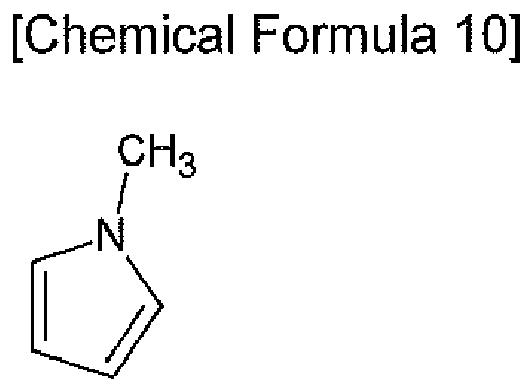
- the additive may include at least one selected from the compounds represented by the following Chemical Formulas 10 to 13.
- the at least one compound represented by Chemical Formula 9 is or and the at least one second lithium salt is
- the second lithium salt may optionally be included in an amount ranging from 0.1 to 10 wt% based on the total weight of the electrolyte, optionally between 0.5 and 5 wt%, optionally between 0.5 and 1.5 wt%, and optionally between 0.75 and 2 wt%.
- the additive may optionally be included in an amount ranging from 0.005 to 3 wt% based on the total weight of the electrolyte, optionally between 0.01 and 1 wt%, optionally between 0.03 and 0.5 wt%, optionally between 0.03 and 0.1 wt%.
- the first lithium salt may optionally include LiPF 6 , LiBF 4 , LiBF 6 , LiSbF 6 , LiAsF 6 , LiSO 3 CF 3 , LiN(CF 3 SO 2 ) 2 , LiN(C 2 F 5 SO 2 ) 2 , LiClO 4 , LiAlO 2 , LiAlCl 4 , or a combination thereof.
- the first lithium salt and the second lithium salt may optionally be mixed in a weight ratio ranging from 1:9 to 9:1, optionally between 1:5 and 5:1, optionally between 1:3 and 3:1.
- the compound represented by Chemical Formula 9 and the second lithium salt may optionally be mixed in a weight ratio ranging from 0.005:1 to 1:1, optionally between 0.03:1 and 0.6:1, optionally between 0.05:1 and 0.3:1.
- the non-aqueous organic solvent may optionally include a linear carbonate compound, a cyclic carbonate compound, an ester-based compound, an ether-based compound, a ketone-based compound, or a combination thereof.
- the at least one non-aqueous solvent is a carbonate selected from the group consisting of diethyl carbonate (DEC), ethylmethyl carbonate (EMC), dimethyl carbonate (DMC), dipropyl carbonate (DPC), ethylpropyl carbonate (MPC), ethylpropyl carbonate (EPC), methylethyl carbonate (MEC), ethylene carbonate (EC), propylene carbonate (PC), butylene carbonate (BC), fluoroethylene carbonate (FEC), vinylethylene carbonate (VEC), or a combination thereof.
- DEC diethyl carbonate
- EMC dimethyl carbonate
- DPC dipropyl carbonate
- MPC ethylpropyl carbonate
- MEC
- the at least one non-aqueous solvent comprises a mixture of at least one linear carbonate and at least one cyclic carbonate, optionally 50 to 99 wt% of the at least one linear carbonate and 1 to 50 wt% of the at least one cyclic carbonate compound based on the total amount of the non-aqueous organic solvent, optionally more than 60 wt% of the at least one linear carbonate and less than 40 wt% of the cyclic carbonate compound, optionally 60 to 80 wt% of the at least one linear carbonate and 20 to 40 wt% of the at least one cyclic carbonate compound.
- a rechargeable lithium battery that includes a positive electrode including a positive active material; a negative electrode including a negative active material; and the electrolyte of any embodiment of the present invention.
- the positive active material may optionally include at least one selected from the lithium metal oxides represented by the following Chemical Formulas 14 to 16.
- Chemical Formula 14 Li x MO 2 (M is at least one transition element, and 0 ⁇ x ⁇ 1)
- Cyhemical Formula 15 Li y M 2 O 4 (M is at least one transition element, and, 0 ⁇ y ⁇ 2)
- the negative active material may optionally include a carbon-based active material, a Si-based active material, or a combination thereof.
- the electrolyte for a rechargeable lithium battery affords a rechargeable lithium battery having excellent cycle-life at a high temperature during the cycle and, when allowed to stand, an excellent output characteristic at room temperature and at low temperature.
- the electrolyte for a rechargeable lithium battery includes a lithium salt, at least one non-aqueous organic solvent and at least one additive.
- the lithium salt supplies lithium ions in the battery, and allows the basic operation of a rechargeable lithium battery and improves lithium ion transportation between positive and negative electrodes.
- the lithium salt includes a mixture of at least one first and at least one second lithium salts.
- the first lithium salt may optionally include LiPF 6 , LiBF 4 , LiBF 6 , LiSbF 6 , LiAsF 6 , LiSO 3 CF 3 , LiN(CF 3 SO 2 ) 2 , LiN(C 2 F 5 SO 2 ) 2 , LiClO 4 , LiAlO 2 , LiAlCl 4 , or a combination thereof, preferably LiPF 6 , LiBF 4 , or LiBF 6 .
- the first lithium salt is optionally included at a concentration ranging from 0.8M to 1.3M in the electrolyte, optionally between 1 M and 1.3M, optionally between 1M and 1.2M.
- the first lithium salt may optionally be included in an amount ranging from 11 to 16 wt% based on the total weight of the electrolyte, optionally between 13 and 16 wt%, and optionally between 13 and 15 wt%.
- the second lithium salt may optionally include a compound represented by the following Chemical Formula 1, Chemical Formula 3-1 or Chemical Formula 3-2, or a combination thereof.
- Chemical Formula 1 Chemical Formula 1
- R 1 /R 2 and R 3 /R 4 form a five-membered ring, optionally where I and n are both 1 in at least one of the rings.
- both of R 1 /R 2 and R 3 /R 4 form a five-membered ring and I and n are both 1 in both of the rings.
- R 13 and R 16 are both hydrogen and optionally R 14 and R 15 are both H or form a six-membered ring. In one embodiment, optionally R 13 to R 16 are all hydrogen. In one embodiment R 14 and R 15 form a six-membered ring.
- the second lithium salt may in particular include at least one selected from the compounds represented by the following Chemical Formulas 4 to 8 but is not limited thereto.
- lithium is oxidized from a lithium metal oxide into lithium ions at a positive electrode, and the lithium ions are intercalated with carbon at a negative electrode during the initial charge.
- lithium ions with strong reactivity reduce an electrolyte on the interface and form a layer on the surface of a negative electrode.
- the layer is called the solid electrolyte interface (SEI).
- the layer plays the role of preventing the reaction of a negative electrode with an electrolyte during the charge and discharge and simultaneously, passing lithium ions moving from a positive electrode as an ion tunnel. Accordingly, organic solvent molecules of the solvated lithium ions are intercalated with carbon at the negative electrode and thus, prevent structural collapse of the negative electrode.
- an excellent layer with excellent output characteristic at a room temperature and a low temperature may be formed on the surface of the negative electrode surface.
- the second lithium salt includes a negative ion including hetero atom or halogen atom having a co-ordination bond with boron (B) and phosphorous (P) atoms and a lithium positive ion.
- B boron
- P phosphorous
- the second lithium salt may be included in an amount ranging from 0.1 to 10 wt% based on the total weight of the electrolyte, optionally between 0.5 and 5 wt%, optionally between 0.5 and 1.5 wt%, and optionally between 0.75 and 2 wt%.
- a rechargeable lithium battery may have excellent output characteristic at a room temperature and a low temperature.
- a first lithium salt and the second lithium salt may be mixed in a weight ratio ranging from 1:9 to 9:1, optionally between 1:5 and 5:1, optionally between 1:3 and 3:1.
- the additive may include a compound represented by the following Chemical Formula 9.
- Chemical Formula 9 a compound represented by the following Chemical Formula 9.
- the additive may in particular include at least one selected from the compounds represented by the following Chemical Formulas 10 to 13 but is not limited thereto.
- substituted when used above relates to the presence of at least one, preferably between one and five, most preferably one, two or three of a substituent in the place of a hydrogen atom selected from the group consisting of halogen atoms, hydroxyl groups, nitro groups, cyano groups, amino groups, amidino groups, hydrazino groups, hydrazono groups, carboxyl groups and salts thereof, sulfonic acid groups and salts thereof, phosphoric acid groups and salts thereof, C 1 -C 10 alkyl groups, C 1 -C 10 alkoxy groups, C 2 -C 10 alkenyl groups, C 2 -C 10 alkynyl groups, C 6 -C 16 aryl groups, and C 4 -C 16 heteroaryl groups or combinations thereof.
- the substituent is selected from halogen atoms, hydroxyl groups, C 1 -C 10 alkyl groups, C 1 -C 10 alkoxy groups, C 2 -C 10 alkenyl groups and C 6 -C 16 aryl groups.
- a lithium rechargeable battery may have excellent output characteristic at a room temperature and a low temperature but capacity deterioration during the cycle at a high temperature and when allowed to stand.
- the capacity deterioration may occur when a layer on the surface of a negative electrode reacts with intercalated lithium ions, when the residue of a second lithium salt is oxidized at a positive electrode during the charge and discharge at a high temperature, and when these two cases are combined.
- the additive is a ⁇ -bond-conjugated compound and is believed to become P-doped with positive charges and, thus, forms a conductive polymer layer. Accordingly, since the conductive polymer layer prevents oxidation of an electrolyte at a high temperature or a high voltage, the electrolyte including the additive may improve cycle-life of a lithium rechargeable battery during the cycle at a high temperature and when allowed to stand.
- the additive may be included in an amount ranging from 0.005 to 3 wt% based on the total weight of the electrolyte, optionally between 0.01 and 1 wt%, optionally between 0.03 and 0.5 wt%, optionally between 0.03 and 0.1 wt%.
- the additive a compound represented by Chemical Formula 9, and the second lithium salt may be mixed in a weight ratio ranging from 0.005:1 to 1:1, optionally between 0.03:1 and 0.6:1, optionally between 0.05:1 and 0.3:1.
- the electrolyte may improve cycle-life of a lithium rechargeable battery during the cycle at a high temperature and when allowed to stand.
- the non-aqueous organic solvent acts as a medium for transmitting ions taking part in the electrochemical reaction of the battery.
- the non-aqueous organic solvent may include a linear carbonate compound, a cyclic carbonate compound, an ester-based compound, an ether-based compound, a ketone-based compound, or a combination thereof.
- the linear carbonate compound may include diethyl carbonate (DEC), ethylmethyl carbonate (EMC), dimethyl carbonate (DMC), dipropyl carbonate (DPC), methylpropyl carbonate (MPC), ethylpropyl carbonate (EPC), methylethyl carbonate (MEC), or a combination thereof.
- DEC diethyl carbonate
- EMC ethylmethyl carbonate
- DMC dimethyl carbonate
- DPC dipropyl carbonate
- MPC methylpropyl carbonate
- MEC methylethyl carbonate
- the cyclic carbonate compound may optionally include ethylene carbonate (EC), propylene carbonate (PC), butylene carbonate (BC), fluoroethylene carbonate (FEC), vinylethylene carbonate (VEC), or a combination thereof.
- EC ethylene carbonate
- PC propylene carbonate
- BC butylene carbonate
- FEC fluoroethylene carbonate
- VEC vinylethylene carbonate
- the at least one non-aqueous solvent comprises a mixture of at least one linear carbonate and at least one cyclic carbonate, optionally 50 to 99 wt% of the at least one linear carbonate and 1 to 50 wt% of the at least one cyclic carbonate compound based on the total amount of the non-aqueous organic solvent, optionally more than 60 wt% of the at least one linear carbonate and less than 40 wt% of the cyclic carbonate compound, optionally 60 to 80 wt% of the at least one linear carbonate and 20 to 40 wt% of the at least one cyclic carbonate compound.
- a solvent having a high dielectric constant and simultaneously low viscosity may be provided.
- the ester-based compound may optionally include methylacetate, ethylacetate, n-propylacetate, dimethylacetate, methylpropionate, ethylpropionate, ⁇ -butyrolactone, decanolide, valerolactone, mevalonolactone, caprolactone, and the like.
- the ether-based compound may optionally include dibutylether, tetraglyme, diglyme, dimethoxyethane, 2-methyltetrahydrofuran, tetrahydrofuran, and the like.
- the ketone-based compound may optionally include cyclohexanone and the like.
- the non-aqueous organic solvent may optionally further include an alcohol-based compound, aprotic solvent, and the like.
- the alcohol-based compound may include ethanol, isopropyl alcohol, and the like.
- the non-aqueous organic solvent may be used singularly or as a mixture.
- the mixture ratio can be controlled in accordance with desirable battery performance.
- the present invention also encompasses a rechargeable lithium battery comprising the electrolyte of any embodiment of the present invention.
- FIG. 1 is a schematic view of a rechargeable lithium battery according to one embodiment of the present invention.
- the rechargeable lithium battery 100 includes an electrode assembly including a positive electrode 114, a negative electrode 112 facing the positive electrode 114, a separator 113 between the positive electrode 114 and negative electrode 112, and an electrolyte (as described above) (not shown) impregnating the positive electrode 114, negative electrode 112, and separator 113, a battery case 120 housing the electrode assembly, and a sealing member 140 sealing the battery case.
- an electrode assembly including a positive electrode 114, a negative electrode 112 facing the positive electrode 114, a separator 113 between the positive electrode 114 and negative electrode 112, and an electrolyte (as described above) (not shown) impregnating the positive electrode 114, negative electrode 112, and separator 113, a battery case 120 housing the electrode assembly, and a sealing member 140 sealing the battery case.
- the positive electrode 114 may optionally include a current collector and a positive active material layer on the current collector.
- the positive active material layer may optionally include a positive active material, a binder, and selectively, a conductive material.
- the current collector may optionally be Al but is not limited thereto.
- the positive active material may optionally include at least one selected from the lithium metal oxides represented by the following Chemical Formula 14 to 16 but is not limited thereto and may include any positive active material known to be used for a rechargeable lithium battery.
- Chemical Formula 14 Li x MO 2 (M is at least one transition element, and specifically Ni, Co, Mn, Al or a combination thereof, and 0 ⁇ x ⁇ 1)
- Chemical Formula 15 Li y M 2 O 4 (M is at least one transition element and specifically, Ni, Co, Mn, Al, or a combination thereof, and 0 ⁇ y ⁇ 2)
- the binder improves binding properties of the positive active material particles to each other and to a current collector.
- the binder include at least one selected from the group consisting of polyvinyl alcohol, carboxylmethyl cellulose, hydroxypropyl cellulose, diacetyl cellulose, polyvinylchloride, carboxylated polyvinylchloride, polyvinylfluoride, an ethylene oxide-containing polymer, polyvinylpyrrolidone, polyurethane, polytetrafluoroethylene, polyvinylidenefluoride, polyethylene, polypropylene, styrene-butadiene rubber, acrylated styrene-butadiene rubber, an epoxy resin, nylon, and the like, but is not limited thereto.
- the conductive material improves electrical conductivity of a negative electrode.
- Any electrically conductive material can be used as a conductive agent unless it causes a chemical change.
- the conductive material include natural graphite, artificial graphite, carbon black, acetylene black, ketjen black, a carbon fiber, a metal powder or a metal fiber including copper, nickel, aluminum, silver, and the like, and a polyphenylene derivative, and the like.
- the negative electrode 112 includes a negative current collector and a negative active material layer disposed thereon.
- the negative current collector may optionally include a copper foil.
- the negative active material layer may include a negative active material, a binder, and optionally a conductive material.
- the negative active material optionally includes a carbon-based active material, a Si-based active material, or a combination thereof, and without limitation, any negative active material in a rechargeable lithium battery may be used.
- the carbon-based active material may optionally include crystalline carbon, amorphous carbon or a mixture thereof.
- the crystalline carbon may be non-shaped, or sheet, flake, spherical, or fiber shaped natural graphite or artificial graphite.
- the amorphous carbon may be a soft carbon (sintered carbon at a low temperature), a hard carbon, mesophase pitch carbonized products, fired coke, and the like.
- the Si-based active material may optionally include Si, SiO x (0 ⁇ x ⁇ 2), a Si-Y alloy (wherein Y is an element selected from the group consisting of an alkali metal, an alkaline-earth metal, a group 13 element, a group 14 element, a transition element, a rare earth element, and combinations thereof, and is not Si), Sn, SnO 2 , a Sn-Y alloy (wherein Y is an element selected from the group consisting of an alkali metal, an alkaline-earth metal, a group 13 element, a group 14 element, a transition element, a rare earth element, and combinations thereof and is not Sn), or mixtures thereof. At least one of these materials may be mixed with SiO 2 .
- the element Y may be selected from the group consisting of Mg, Ca, Sr, Ba, Ra, Sc, Y, Ti, Zr, Hf, Rf, V, Nb, Ta, Db, Cr, Mo, W, Sg, Tc, Re, Bh, Fe, Pb, Ru, Os, Hs, Rh, Ir, Pd, Pt, Cu, Ag, Au, Zn, Cd, B, Al, Ga, Sn, In, Ti, Ge, P, As, Sb, Bi, S, Se, Te, Po, and a combination thereof.
- the binder improves binding properties of the negative active material particles to each other and to a current collector.
- the binder include at least one selected from the group consisting of polyvinyl alcohol, carboxylmethyl cellulose, hydroxypropyl cellulose, diacetyl cellulose, polyvinylchloride, carboxylated polyvinylchloride, polyvinylfluoride, an ethylene oxide-containing polymer, polyvinylpyrrolidone, polyurethane, polytetrafluoroethylene, polyvinylidenefluoride, polyethylene, polypropylene, styrene-butadiene rubber, acrylated styrene-butadiene rubber, an epoxy resin, nylon, and the like, but is not limited thereto.
- the conductive material improves electrical conductivity of a negative electrode.
- Any electrically conductive material can be used as a conductive agent unless it causes a chemical change.
- the conductive material include a carbon-based material such as natural graphite, artificial graphite, carbon black, acetylene black, ketjen black, a carbon fiber, and the like; a metal-based material of a metal powder or a metal fiber including copper, nickel, aluminum, silver, and the like; a conductive polymer such as polyphenylene derivative, and the like; or a mixture thereof.
- the negative and positive electrodes 112 and 114 may be fabricated by a method including mixing the active material, a conductive material, and a binder into an active material composition, and coating the composition on a current collector.
- Ethylene carbonate (EC), ethylmethyl carbonate (EMC), and dimethyl carbonate (DMC) were mixed in a weight ratio of 2:4:4.
- LiPF 6 with a concentration of 1.15M was added to the solution, and a second lithium salt and an additive as described in the following Table 1 were also added thereto, preparing an electrolyte.
- the second lithium salt and the additive were added to in an amount of 1 wt% and 0.05 wt% respectively based on the total weight of the electrolyte respectively.
- LiNi 0.5 Co 0.2 Mn 0.3 O 2 as a positive active material, polyvinylidene fluoride (PVDF) as a binder, and carbon as a conductive material were mixed in a weight ratio of 86:9:5. The mixture was dispersed into N-methyl-2-pyrrolidone to prepare a positive active material layer composition.
- the positive active material layer composition was coated on a 15 ⁇ m-thick aluminum foil and then, dried and compressed, fabricating a positive electrode.
- a negative active material layer composition was prepared by mixing modified natural graphite as a negative active material, a binder, and a thickener in a weight ratio of 98:1:1 in an aqueous system.
- the negative active material layer composition was coated on a 10 ⁇ m-thick copper foil and then, dried and compressed, fabricating a negative electrode.
- the positive and negative electrodes and a 25 ⁇ m-thick polyethylene separator interposed therebetween were wound and compressed together, fabricating a rechargeable lithium battery.
- the electrolytes prepared according to Examples 1 and 2 and Comparative Examples 1 to 3 were respectively used.
- the cells were CC charged with a 0.2C current up to 3.6V and discharged down to 2.8V discharge during the first cycle and CC charged with a 0.2C current up to 4.5V and discharged down 2.8V during the second cycle, which was their initial formation condition. As a result, an oxide film was formed on the surface of a positive electrode.
- the initial capacity and the capacity after being allowed to stand for 10 days were measured by CC-CV charging the cells with a 0.5C current up to 4.2V and then, discharging with a 0.2C current and being cut off at 2.8V.
- the capacity retention (%) was calculated as a percentage of discharge capacity after being allowed to stand for 10 days against initial capacity.
- the resistance was measured as follows. First of all, the cells in SOC of 50% were applied with 10 different discharge currents for 10 seconds and then, measured regarding voltage at that time. Their DC-IR values can be calculated from the following equation 1 after acquiring a current value (I max ) at 2.1V from a current-voltage value. In particular, the 10 different discharge currents were 0.6A, 1A, 1.4A, 1.6A, 1.8A, 2A, 2.2A, 2.4A, 2.6A, and 2.8A.
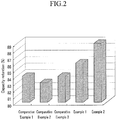
- FIG. 2 is a graph showing capacity retentions of the rechargeable lithium batteries according to Examples 1 and 2 and Comparative Examples 1 to 3 when allowed to stand at a high temperature.
- FIG. 3 is a graph showing capacity change of the rechargeable lithium batteries of Examples 1 and 2 and Comparative Examples 1 to 3 during the cycles at a high temperature.
- the cells including both a lithium salt and an additive according to Examples 1 and 2 were identified to have excellent cycle-life during the high temperature cycle compared with the cells according to Comparative Examples 1 to 3.
Landscapes
- Chemical & Material Sciences (AREA)
- Engineering & Computer Science (AREA)
- Chemical Kinetics & Catalysis (AREA)
- Electrochemistry (AREA)
- General Chemical & Material Sciences (AREA)
- Manufacturing & Machinery (AREA)
- Inorganic Chemistry (AREA)
- Condensed Matter Physics & Semiconductors (AREA)
- General Physics & Mathematics (AREA)
- Physics & Mathematics (AREA)
- Materials Engineering (AREA)
- Secondary Cells (AREA)
- Battery Electrode And Active Subsutance (AREA)
Abstract


Description
- This disclosure relates to an electrolyte for a rechargeable lithium battery and a rechargeable lithium battery including the same.
- Lithium rechargeable batteries have recently drawn attention as a power source for small portable electronic devices. They use an organic electrolyte solution and thereby, have twice as high discharge voltage as a conventional battery using an alkali aqueous solution and accordingly, have high energy density.
- This rechargeable lithium battery is used by injecting an electrolyte into a battery cell including a positive electrode including a positive active material that can intercalate and deintercalate lithium, and a negative electrode including a negative active material that can intercalate and deintercalate lithium.
- Recently, a rechargeable lithium battery for a hybrid electric vehicle (HEV) and an electric vehicle (EV) is increasingly required, as an environmentally-friendly electric vehicle is increasingly expected. This battery for an electric vehicle should have high power output at a room temperature and a low temperature and excellent characteristic at a high temperature, which can be accomplished by adding an appropriate additive to form an excellent solid electrolyte interface (SEI) on the surface of a negative electrode.
- One embodiment of the present invention provides an electrolyte for a rechargeable lithium battery having excellent output characteristic during a cycle at a high temperature and when allowed to stand as well as at a room temperature and a low temperature.
- Another embodiment of the present invention provides a rechargeable lithium battery including the electrolyte.
- According to one embodiment of the present invention, provided is an electrolyte for a rechargeable lithium battery, which includes at least one first lithium salt; at least one second lithium salt represented by the following Chemical Formula 1, Chemical Formula 3-1 or Chemical Formula 3-2, or a combination thereof; at least one non-aqueous organic solvent; and at least one additive including a compound represented by the following Chemical Formula 9.

- R1 and R2 are each independently F, or R1 and R2 are linked to a substituent represented by the following Chemical Formula 2 to form a ring, and
- R3 and R4 are linked to a substituent represented by the following Chemical Formula 2 to form a ring.
- R5 and R6 are each independently O or S,
- X and Y are each independently hydrogen or F,
- I and n are independently 0 or 1, and
- m is an integer ranging from 0 to 5.
- R7 and R8 are each independently F, or R7 and R8 are linked to a substituent represented by the above
Chemical Formula 2 to form a ring, - R9 and R10 are linked to a substituent represented by the above Chemical Formula 2 to form a ring, and
- R11 and R12 are each independently F.

- R17 and R18 are each independently O, S or NR (wherein R is a substituted or unsubstituted C1 to C5 alkyl group), and
- R19 and R20 are each independently F.
- A is S, O, or NR (wherein, R is hydrogen, or a substituted or unsubstituted C1 to C20 alkyl group), and
- R13 to R16 are each independently hydrogen, a halogen, a substituted or unsubstituted C1 to C20 alkyl group, or a substituted or unsubstituted C1 to C20 alkoxy group, and R14 and R15 are linked by a substituent represented by Chemical Formula 2 to form a ring.
- The at least one second lithium salt may include at least one selected from the compounds represented by the following Chemical Formulae 4 to 8.


- The additive may include at least one selected from the compounds represented by the following Chemical Formulas 10 to 13.




- In a preferred embodiment of the present invention, the at least one compound represented by Chemical Formula 9 is


- The second lithium salt may optionally be included in an amount ranging from 0.1 to 10 wt% based on the total weight of the electrolyte, optionally between 0.5 and 5 wt%, optionally between 0.5 and 1.5 wt%, and optionally between 0.75 and 2 wt%.
- The additive may optionally be included in an amount ranging from 0.005 to 3 wt% based on the total weight of the electrolyte, optionally between 0.01 and 1 wt%, optionally between 0.03 and 0.5 wt%, optionally between 0.03 and 0.1 wt%.
- The first lithium salt may optionally include LiPF6, LiBF4, LiBF6, LiSbF6, LiAsF6, LiSO3CF3, LiN(CF3SO2)2, LiN(C2F5SO2)2, LiClO4, LiAlO2, LiAlCl4, or a combination thereof.
- In a preferred embodiment of the present invention the first lithium salt and the second lithium salt may optionally be mixed in a weight ratio ranging from 1:9 to 9:1, optionally between 1:5 and 5:1, optionally between 1:3 and 3:1.
- In a preferred embodiment of the present invention the compound represented by Chemical Formula 9 and the second lithium salt may optionally be mixed in a weight ratio ranging from 0.005:1 to 1:1, optionally between 0.03:1 and 0.6:1, optionally between 0.05:1 and 0.3:1.
- The non-aqueous organic solvent may optionally include a linear carbonate compound, a cyclic carbonate compound, an ester-based compound, an ether-based compound, a ketone-based compound, or a combination thereof. In a preferred embodiment of the present invention the at least one non-aqueous solvent is a carbonate selected from the group consisting of diethyl carbonate (DEC), ethylmethyl carbonate (EMC), dimethyl carbonate (DMC), dipropyl carbonate (DPC), ethylpropyl carbonate (MPC), ethylpropyl carbonate (EPC), methylethyl carbonate (MEC), ethylene carbonate (EC), propylene carbonate (PC), butylene carbonate (BC), fluoroethylene carbonate (FEC), vinylethylene carbonate (VEC), or a combination thereof.
- In a preferred embodiment of the present invention the at least one non-aqueous solvent comprises a mixture of at least one linear carbonate and at least one cyclic carbonate, optionally 50 to 99 wt% of the at least one linear carbonate and 1 to 50 wt% of the at least one cyclic carbonate compound based on the total amount of the non-aqueous organic solvent, optionally more than 60 wt% of the at least one linear carbonate and less than 40 wt% of the cyclic carbonate compound, optionally 60 to 80 wt% of the at least one linear carbonate and 20 to 40 wt% of the at least one cyclic carbonate compound.
- According to another embodiment of the present invention, a rechargeable lithium battery is provided that includes a positive electrode including a positive active material; a negative electrode including a negative active material; and the electrolyte of any embodiment of the present invention.
- The positive active material may optionally include at least one selected from the lithium metal oxides represented by the following Chemical Formulas 14 to 16.
[Chemical Formula 14] LixMO2 (M is at least one transition element, and 0≤x≤1)
[Chemical Formula 15] LiyM2O4 (M is at least one transition element, and, 0≤y≤2)
[Chemical Formula 16] xLi2MnO3· (1-x)LiMn2-yMyO4 (M is at least one transition element, 0<x<1, and 0≤y<1)
- The negative active material may optionally include a carbon-based active material, a Si-based active material, or a combination thereof.
- Hereinafter, further embodiments will be described in the detailed description.
- The electrolyte for a rechargeable lithium battery affords a rechargeable lithium battery having excellent cycle-life at a high temperature during the cycle and, when allowed to stand, an excellent output characteristic at room temperature and at low temperature.
-
-
FIG. 1 is a schematic view showing a rechargeable lithium battery according to one embodiment of the present invention. -
FIG. 2 is a graph showing capacity retention of the rechargeable lithium batteries according to Examples 1 and 2 and Comparative Examples 1 to 3 at a high temperature and when allowed to stand. -
FIG. 3 is graph showing capacity change of rechargeable lithium batteries according to Examples 1 and 2 and Comparative Examples 1 to 3 at a high temperature during the cycle. - Embodiments will hereinafter be described in detail. However, these embodiments are only illustrative, and the present invention is not limited thereto.
- The electrolyte for a rechargeable lithium battery according to one embodiment includes a lithium salt, at least one non-aqueous organic solvent and at least one additive.
- The lithium salt supplies lithium ions in the battery, and allows the basic operation of a rechargeable lithium battery and improves lithium ion transportation between positive and negative electrodes.
- The lithium salt includes a mixture of at least one first and at least one second lithium salts.
- The first lithium salt may optionally include LiPF6, LiBF4, LiBF6, LiSbF6, LiAsF6, LiSO3CF3, LiN(CF3SO2)2, LiN(C2F5SO2)2, LiClO4, LiAlO2, LiAlCl4, or a combination thereof, preferably LiPF6, LiBF4, or LiBF6.
- In a preferred embodiment of the present invention the first lithium salt is optionally included at a concentration ranging from 0.8M to 1.3M in the electrolyte, optionally between 1 M and 1.3M, optionally between 1M and 1.2M.
- In a preferred embodiment of the present invention the first lithium salt may optionally be included in an amount ranging from 11 to 16 wt% based on the total weight of the electrolyte, optionally between 13 and 16 wt%, and optionally between 13 and 15 wt%.
- The second lithium salt may optionally include a compound represented by the following
Chemical Formula 1, Chemical Formula 3-1 or Chemical Formula 3-2, or a combination thereof.
Chemical Formula 1, - R1 and R2 are each independently F, or R1 and R2 are linked to a substituent represented by the following
Chemical Formula 2 to form a ring, and - R3 and R4 are linked to a substituent represented by the following
Chemical Formula 2 to form a ring. - R5 and R6 are each independently O or S,
- X and Y are each independently hydrogen or F,
- I and n are independently 0 or 1, and
- m is an integer ranging from 0 to 5.
- R7 and R8 are each independently F, or R7 and R8 are linked to a substituent represented by the above
Chemical Formula 2 to form a ring, - R9 and R10 are linked to a substituent represented by the above
Chemical Formula 2 to form a ring, and - R11 and R12 are each independently F.
- In a preferred embodiment of the present invention in
Chemical Formula 1, at least one of R1/R2 and R3/R4 form a five-membered ring, optionally where I and n are both 1 in at least one of the rings. Optionally, both of R1/R2 and R3/R4 form a five-membered ring and I and n are both 1 in both of the rings. - In a preferred embodiment of the present invention in Chemical Formula 9, R13 and R16 are both hydrogen and optionally R14 and R15 are both H or form a six-membered ring. In one embodiment, optionally R13 to R16 are all hydrogen. In one embodiment R14 and R15 form a six-membered ring.
- The second lithium salt may in particular include at least one selected from the compounds represented by the following Chemical Formulas 4 to 8 but is not limited thereto.

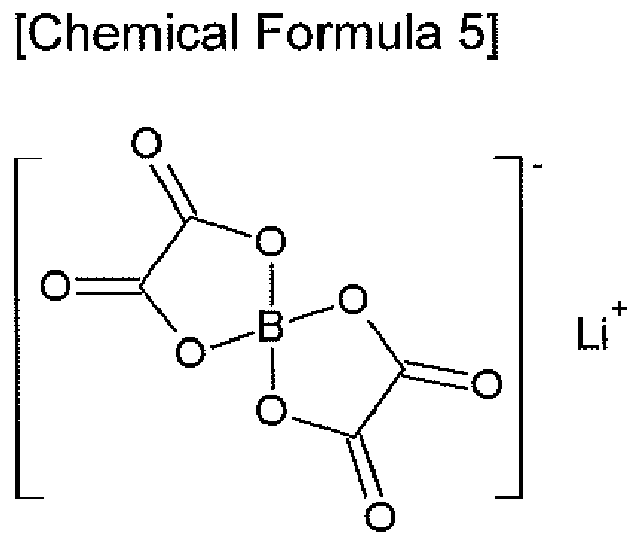


- In a rechargeable lithium battery, lithium is oxidized from a lithium metal oxide into lithium ions at a positive electrode, and the lithium ions are intercalated with carbon at a negative electrode during the initial charge. Herein, lithium ions with strong reactivity reduce an electrolyte on the interface and form a layer on the surface of a negative electrode. The layer is called the solid electrolyte interface (SEI).
- The layer plays the role of preventing the reaction of a negative electrode with an electrolyte during the charge and discharge and simultaneously, passing lithium ions moving from a positive electrode as an ion tunnel. Accordingly, organic solvent molecules of the solvated lithium ions are intercalated with carbon at the negative electrode and thus, prevent structural collapse of the negative electrode.
- When the second lithium salt is added to an electrolyte, an excellent layer with excellent output characteristic at a room temperature and a low temperature may be formed on the surface of the negative electrode surface.
- In particular, the second lithium salt includes a negative ion including hetero atom or halogen atom having a co-ordination bond with boron (B) and phosphorous (P) atoms and a lithium positive ion. When the second lithium salt is added to an electrolyte, it is reduced at a lower potential than the non-aqueous organic solvent and thus, accomplishes excellent output characteristic of a lithium rechargeable battery at a room temperature and a low temperature.
- The second lithium salt may be included in an amount ranging from 0.1 to 10 wt% based on the total weight of the electrolyte, optionally between 0.5 and 5 wt%, optionally between 0.5 and 1.5 wt%, and optionally between 0.75 and 2 wt%. When the second lithium salt is included within the range, a rechargeable lithium battery may have excellent output characteristic at a room temperature and a low temperature.
- In addition, a first lithium salt and the second lithium salt may be mixed in a weight ratio ranging from 1:9 to 9:1, optionally between 1:5 and 5:1, optionally between 1:3 and 3:1.
- The additive may include a compound represented by the following Chemical Formula 9.

- A is S, O, or NR (wherein, R is hydrogen or a substituted or unsubstituted C1 to C20 alkyl group),
- R13 to R16 are each independently, hydrogen, halogen, substituted or unsubstituted C1 to C20 an alkyl group, or substituted or unsubstituted C1 to C20 alkoxy group, and
- R14 and R15 are optionally linked to each other by a substituent represented by
Chemical Formula 2 to form a ring. - The additive may in particular include at least one selected from the compounds represented by the following
Chemical Formulas 10 to 13 but is not limited thereto.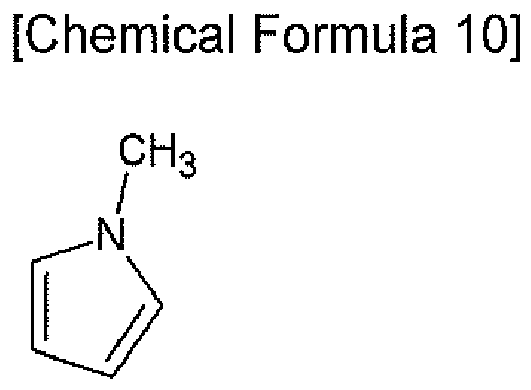


- The term "substituted" when used above relates to the presence of at least one, preferably between one and five, most preferably one, two or three of a substituent in the place of a hydrogen atom selected from the group consisting of halogen atoms, hydroxyl groups, nitro groups, cyano groups, amino groups, amidino groups, hydrazino groups, hydrazono groups, carboxyl groups and salts thereof, sulfonic acid groups and salts thereof, phosphoric acid groups and salts thereof, C1-C10 alkyl groups, C1-C10 alkoxy groups, C2-C10 alkenyl groups, C2-C10 alkynyl groups, C6-C16 aryl groups, and C4-C16 heteroaryl groups or combinations thereof. Preferably the substituent is selected from halogen atoms, hydroxyl groups, C1-C10 alkyl groups, C1-C10 alkoxy groups, C2-C10 alkenyl groups and C6-C16 aryl groups. Preferably, there are one or two substitutents present.
- When the aforementioned second lithium salt is included in an electrolyte, a lithium rechargeable battery may have excellent output characteristic at a room temperature and a low temperature but capacity deterioration during the cycle at a high temperature and when allowed to stand.
- The capacity deterioration may occur when a layer on the surface of a negative electrode reacts with intercalated lithium ions, when the residue of a second lithium salt is oxidized at a positive electrode during the charge and discharge at a high temperature, and when these two cases are combined.
- The additive is a π-bond-conjugated compound and is believed to become P-doped with positive charges and, thus, forms a conductive polymer layer. Accordingly, since the conductive polymer layer prevents oxidation of an electrolyte at a high temperature or a high voltage, the electrolyte including the additive may improve cycle-life of a lithium rechargeable battery during the cycle at a high temperature and when allowed to stand.
- The additive may be included in an amount ranging from 0.005 to 3 wt% based on the total weight of the electrolyte, optionally between 0.01 and 1 wt%, optionally between 0.03 and 0.5 wt%, optionally between 0.03 and 0.1 wt%.
- In a preferred embodiment of the present invention the additive, a compound represented by Chemical Formula 9, and the second lithium salt may be mixed in a weight ratio ranging from 0.005:1 to 1:1, optionally between 0.03:1 and 0.6:1, optionally between 0.05:1 and 0.3:1.
- When the additive is included within the above ranges, the electrolyte may improve cycle-life of a lithium rechargeable battery during the cycle at a high temperature and when allowed to stand.
- The non-aqueous organic solvent acts as a medium for transmitting ions taking part in the electrochemical reaction of the battery.
- The non-aqueous organic solvent may include a linear carbonate compound, a cyclic carbonate compound, an ester-based compound, an ether-based compound, a ketone-based compound, or a combination thereof.
- Optionally, the linear carbonate compound may include diethyl carbonate (DEC), ethylmethyl carbonate (EMC), dimethyl carbonate (DMC), dipropyl carbonate (DPC), methylpropyl carbonate (MPC), ethylpropyl carbonate (EPC), methylethyl carbonate (MEC), or a combination thereof.
- The cyclic carbonate compound may optionally include ethylene carbonate (EC), propylene carbonate (PC), butylene carbonate (BC), fluoroethylene carbonate (FEC), vinylethylene carbonate (VEC), or a combination thereof.
- In a preferred embodiment of the present invention the at least one non-aqueous solvent comprises a mixture of at least one linear carbonate and at least one cyclic carbonate, optionally 50 to 99 wt% of the at least one linear carbonate and 1 to 50 wt% of the at least one cyclic carbonate compound based on the total amount of the non-aqueous organic solvent, optionally more than 60 wt% of the at least one linear carbonate and less than 40 wt% of the cyclic carbonate compound, optionally 60 to 80 wt% of the at least one linear carbonate and 20 to 40 wt% of the at least one cyclic carbonate compound. Within the above range, a solvent having a high dielectric constant and simultaneously low viscosity may be provided.
- The ester-based compound may optionally include methylacetate, ethylacetate, n-propylacetate, dimethylacetate, methylpropionate, ethylpropionate, γ-butyrolactone, decanolide, valerolactone, mevalonolactone, caprolactone, and the like.
- The ether-based compound may optionally include dibutylether, tetraglyme, diglyme, dimethoxyethane, 2-methyltetrahydrofuran, tetrahydrofuran, and the like.
- The ketone-based compound may optionally include cyclohexanone and the like.
- The non-aqueous organic solvent may optionally further include an alcohol-based compound, aprotic solvent, and the like. The alcohol-based compound may include ethanol, isopropyl alcohol, and the like.
- The non-aqueous organic solvent may be used singularly or as a mixture. When the organic solvent is used as a mixture, the mixture ratio can be controlled in accordance with desirable battery performance.
- The present invention also encompasses a rechargeable lithium battery comprising the electrolyte of any embodiment of the present invention.
-
FIG. 1 is a schematic view of a rechargeable lithium battery according to one embodiment of the present invention. - Referring to
FIG. 1 , therechargeable lithium battery 100 includes an electrode assembly including apositive electrode 114, anegative electrode 112 facing thepositive electrode 114, aseparator 113 between thepositive electrode 114 andnegative electrode 112, and an electrolyte (as described above) (not shown) impregnating thepositive electrode 114,negative electrode 112, andseparator 113, abattery case 120 housing the electrode assembly, and a sealingmember 140 sealing the battery case. - The
positive electrode 114 may optionally include a current collector and a positive active material layer on the current collector. The positive active material layer may optionally include a positive active material, a binder, and selectively, a conductive material. - The current collector may optionally be Al but is not limited thereto.
- The positive active material may optionally include at least one selected from the lithium metal oxides represented by the following Chemical Formula 14 to 16 but is not limited thereto and may include any positive active material known to be used for a rechargeable lithium battery.
[Chemical Formula 14] LixMO2 (M is at least one transition element, and specifically Ni, Co, Mn, Al or a combination thereof, and 0≤x≤1)
[Chemical Formula 15] LiyM2O4 (M is at least one transition element and specifically, Ni, Co, Mn, Al, or a combination thereof, and 0≤y≤2)
[Chemical Formula 16] xLi2MnO3· (1-x)LiMn2-yMyO4 (M is at least one transition element, and specifically Ni, Co, Mn, Al, or a combination thereof, 0<x<1, and 0≤y<1)
- The binder improves binding properties of the positive active material particles to each other and to a current collector. Examples of the binder include at least one selected from the group consisting of polyvinyl alcohol, carboxylmethyl cellulose, hydroxypropyl cellulose, diacetyl cellulose, polyvinylchloride, carboxylated polyvinylchloride, polyvinylfluoride, an ethylene oxide-containing polymer, polyvinylpyrrolidone, polyurethane, polytetrafluoroethylene, polyvinylidenefluoride, polyethylene, polypropylene, styrene-butadiene rubber, acrylated styrene-butadiene rubber, an epoxy resin, nylon, and the like, but is not limited thereto.
- The conductive material improves electrical conductivity of a negative electrode. Any electrically conductive material can be used as a conductive agent unless it causes a chemical change. Examples of the conductive material include natural graphite, artificial graphite, carbon black, acetylene black, ketjen black, a carbon fiber, a metal powder or a metal fiber including copper, nickel, aluminum, silver, and the like, and a polyphenylene derivative, and the like.
- The
negative electrode 112 includes a negative current collector and a negative active material layer disposed thereon. - The negative current collector may optionally include a copper foil.
- The negative active material layer may include a negative active material, a binder, and optionally a conductive material.
- The negative active material optionally includes a carbon-based active material, a Si-based active material, or a combination thereof, and without limitation, any negative active material in a rechargeable lithium battery may be used.
- The carbon-based active material may optionally include crystalline carbon, amorphous carbon or a mixture thereof. The crystalline carbon may be non-shaped, or sheet, flake, spherical, or fiber shaped natural graphite or artificial graphite. The amorphous carbon may be a soft carbon (sintered carbon at a low temperature), a hard carbon, mesophase pitch carbonized products, fired coke, and the like.
- The Si-based active material may optionally include Si, SiOx (0 < x < 2), a Si-Y alloy (wherein Y is an element selected from the group consisting of an alkali metal, an alkaline-earth metal, a group 13 element, a group 14 element, a transition element, a rare earth element, and combinations thereof, and is not Si), Sn, SnO2, a Sn-Y alloy (wherein Y is an element selected from the group consisting of an alkali metal, an alkaline-earth metal, a group 13 element, a group 14 element, a transition element, a rare earth element, and combinations thereof and is not Sn), or mixtures thereof. At least one of these materials may be mixed with SiO2. The element Y may be selected from the group consisting of Mg, Ca, Sr, Ba, Ra, Sc, Y, Ti, Zr, Hf, Rf, V, Nb, Ta, Db, Cr, Mo, W, Sg, Tc, Re, Bh, Fe, Pb, Ru, Os, Hs, Rh, Ir, Pd, Pt, Cu, Ag, Au, Zn, Cd, B, Al, Ga, Sn, In, Ti, Ge, P, As, Sb, Bi, S, Se, Te, Po, and a combination thereof.
- The binder improves binding properties of the negative active material particles to each other and to a current collector. Examples of the binder include at least one selected from the group consisting of polyvinyl alcohol, carboxylmethyl cellulose, hydroxypropyl cellulose, diacetyl cellulose, polyvinylchloride, carboxylated polyvinylchloride, polyvinylfluoride, an ethylene oxide-containing polymer, polyvinylpyrrolidone, polyurethane, polytetrafluoroethylene, polyvinylidenefluoride, polyethylene, polypropylene, styrene-butadiene rubber, acrylated styrene-butadiene rubber, an epoxy resin, nylon, and the like, but is not limited thereto.
- The conductive material improves electrical conductivity of a negative electrode. Any electrically conductive material can be used as a conductive agent unless it causes a chemical change. Examples of the conductive material include a carbon-based material such as natural graphite, artificial graphite, carbon black, acetylene black, ketjen black, a carbon fiber, and the like; a metal-based material of a metal powder or a metal fiber including copper, nickel, aluminum, silver, and the like; a conductive polymer such as polyphenylene derivative, and the like; or a mixture thereof.
- The negative and
positive electrodes - The electrode manufacturing method is well known, and thus is not described in detail in the present specification. The electrode manufacturing method is well known, and thus is not described in detail in the present specification.
- The
separator 113 may be a single layer or a multilayer, for example may be made of polyethylene, polypropylene, polyvinylidene fluoride or a combination thereof. - Hereinafter, the embodiments are illustrated in more detail with reference to examples. However, the following are illustrative embodiments and are not limiting.
- Furthermore, what is not described in this specification can be sufficiently understood by those who have knowledge in this field and will not be illustrated here.
- Ethylene carbonate (EC), ethylmethyl carbonate (EMC), and dimethyl carbonate (DMC) were mixed in a weight ratio of 2:4:4. LiPF6 with a concentration of 1.15M was added to the solution, and a second lithium salt and an additive as described in the following Table 1 were also added thereto, preparing an electrolyte. Herein, the second lithium salt and the additive were added to in an amount of 1 wt% and 0.05 wt% respectively based on the total weight of the electrolyte respectively.
Table 1 Second Lithium salt Additive Example 1 lithium difluoro(oxalato)borate (LiDFOB) Thiophene Example 2 LiDFOB N-methylpyrrole Comparative Example 1 LiDFOB - Comparative Example 2 LiDFOB Biphenyl Comparative Example 3 LiDFOB Succinonitrile - LiNi0.5Co0.2Mn0.3O2 as a positive active material, polyvinylidene fluoride (PVDF) as a binder, and carbon as a conductive material were mixed in a weight ratio of 86:9:5. The mixture was dispersed into N-methyl-2-pyrrolidone to prepare a positive active material layer composition. The positive active material layer composition was coated on a 15µm-thick aluminum foil and then, dried and compressed, fabricating a positive electrode.
- On the other hand, a negative active material layer composition was prepared by mixing modified natural graphite as a negative active material, a binder, and a thickener in a weight ratio of 98:1:1 in an aqueous system. The negative active material layer composition was coated on a 10µm-thick copper foil and then, dried and compressed, fabricating a negative electrode.
- The positive and negative electrodes and a 25µm-thick polyethylene separator interposed therebetween were wound and compressed together, fabricating a rechargeable lithium battery. Herein, the electrolytes prepared according to Examples 1 and 2 and Comparative Examples 1 to 3 were respectively used.
- Each rechargeable lithium battery cell according to Examples 1 and 2 and Comparative Examples 1 to 3 was fully charged at 60°C (state of charge (SOC) = 100%) and allowed to stand for 10 days and then, evaluated regarding cycle-life when allowed to stand at a high temperature. The result is provided in the following Table 2 and
FIG. 2 . - The cells were CC charged with a 0.2C current up to 3.6V and discharged down to 2.8V discharge during the first cycle and CC charged with a 0.2C current up to 4.5V and discharged down 2.8V during the second cycle, which was their initial formation condition. As a result, an oxide film was formed on the surface of a positive electrode.
- The initial capacity and the capacity after being allowed to stand for 10 days were measured by CC-CV charging the cells with a 0.5C current up to 4.2V and then, discharging with a 0.2C current and being cut off at 2.8V.
- The capacity retention (%) was calculated as a percentage of discharge capacity after being allowed to stand for 10 days against initial capacity.
- The resistance was measured as follows. First of all, the cells in SOC of 50% were applied with 10 different discharge currents for 10 seconds and then, measured regarding voltage at that time. Their DC-IR values can be calculated from the
following equation 1 after acquiring a current value (Imax) at 2.1V from a current-voltage value. In particular, the 10 different discharge currents were 0.6A, 1A, 1.4A, 1.6A, 1.8A, 2A, 2.2A, 2.4A, 2.6A, and 2.8A.
- Then, the resistance increasing rate (%) was calculated as a percentage of DC-IR after being allowed to stand for 10 days against initial DC-IR.
Table 2 Initial capacity (mAh) Capacity after being allowed to stand for 10 days (mAh) Capacity retention (%) Resistance increasing ratio (%) Example 1 91.51 79.08 86 10 Example 2 90.04 79.79 89 11 Comparative Example 1 90.5 75.90 84 9 Comparative Example 2 89.38 73.74 83 10 Comparative Example 3 88.79 74.96 84 9 -
FIG. 2 is a graph showing capacity retentions of the rechargeable lithium batteries according to Examples 1 and 2 and Comparative Examples 1 to 3 when allowed to stand at a high temperature. - Referring to
FIG. 2 and Table 2, the cells including a lithium salt and an additive according to Examples 1 and 2 had excellent cycle-life when allowed to stand at a high temperature compared with the cells according to Comparative Examples 1 to 3. - Each rechargeable lithium battery according to Examples 1 and 2 and Comparative Examples 1 to 3 was charged and discharged at 45°C under a 1C/1C condition. Each rechargeable lithium battery was 100 times charged and discharged and measured regarding capacity retention according a cycle at a high temperature to evaluate cycle-life. The results are provided in the following Table 3 and
FIG. 3 Table 3 Initial capacity (mAh) 100th capacity (mAh) Capacity retention (%) Example 1 90.11 81.11 90 Example 2 89.41 81.68 91 Comparative Example 1 88.46 78.41 89 Comparative Example 2 88.80 80.03 90 Comparative Example 3 88.35 79.00 89 -
FIG. 3 is a graph showing capacity change of the rechargeable lithium batteries of Examples 1 and 2 and Comparative Examples 1 to 3 during the cycles at a high temperature. - Referring to
FIG. 3 and Table 3, the cells including both a lithium salt and an additive according to Examples 1 and 2 were identified to have excellent cycle-life during the high temperature cycle compared with the cells according to Comparative Examples 1 to 3. - While this disclosure has been described in connection with what is presently considered to be practical exemplary embodiments, it is to be understood that the invention is not limited to the disclosed embodiments, but, on the contrary, is intended to cover various modifications and equivalent arrangements included within the scope of the appended claims.


R19 and R20 are each independently F.
Claims (15)
- An electrolyte for a lithium rechargeable battery comprising:(i) at least one non-aqueous organic solvent;(ii) at least one first lithium salt;(iii) at least one second lithium salt represented by Chemical Formula 1, Chemical Formula 3-1, or Chemical Formula 3-2:
 R1 and R2 are each F, or R1 and R2 are linked by a substituent represented by the following Chemical Formula 2 to form a ring, andR3 and R4 are linked by a substituent represented by the following Chemical Formula 2 to form a ring,
 R5 and R6 are each independently O or S,X and Y are each independently hydrogen or F,I and n are independently 0 or 1, and m is an integer ranging from 0 to 5,
 R7 and R8 are each F, or R7 and R8 are linked to a substituent represented by the above Chemical Formula 2 to form a ring,R9 and R10 are linked to a substituent represented by the above Chemical Formula 2 to form a ring, andR11 and R12 are each F,
 R17 and R18 are each independently O, S or NR (wherein R is a substituted or unsubstituted C1 to C5 alkyl group), andR19 and R20 are each independently F; and(iv) at least one compound represented by Chemical Formula 9:
 A is S, O, or NR (wherein, R is hydrogen, or a substituted or unsubstituted C1 to C20 alkyl group), andR13 to R16 are each independently hydrogen, a halogen, a substituted or unsubstituted C1 to C20 alkyl group, or a substituted or unsubstituted C1 to C20 alkoxy group, optionally R14 and R15 are linked by a substituent represented by Chemical Formula 2 to form a ring.
 - An electrolyte according to claim 1, wherein the second lithium salt is included in an amount ranging from 0.1 to 10 wt% based on the total weight of the electrolyte, optionally between 0.5 and 5 wt%, optionally between 0.5 and 1.5 wt%, and optionally between 0.75 and 2 wt%.
- An electrolyte according to claim 1 or 2, wherein the compound represented by Chemical Formula 9 is included in an amount ranging from 0.005 to 3 wt% based on the total weight of the electrolyte, optionally between 0.01 and 1 wt%, optionally between 0.03 and 0.5 wt%, optionally between 0.03 and 0.1 wt%.
- An electrolyte according to any of claims 1 to 3, wherein the first lithium salt is included at a concentration ranging from 0.8M to 1.3M in the electrolyte, optionally between 1.0 M and 1.3M, optionally between 1.0 M and 1.2M.
- An electrolyte according to any of claims 1 to 4, wherein the first lithium salt is selected from the group consisting of LiPF6, LiBF4, LiBF6, LiSbF6, LiAsF6, LiSO3CF3, LiN(CF3SO2)2, LiN(C2F5SO2)2, LiClO4, LiAlO2, LiAlCl4, or a combination thereof.
- An electrolyte according to any of claims 1 to 5, wherein the first lithium salt and the second lithium salt is mixed in a weight ratio ranging from 1:9 to 9:1, optionally between 1:5 and 5:1, optionally between 1:3 and 3:1.
- An electrolyte according to any of claims 1 to 6, wherein the compound represented by Chemical Formula 9 and the second lithium salt is mixed in a weight ratio ranging from 0.005:1 to 1:1, optionally between 0.03:1 and 0.6:1, optionally between 0.05:1 and 0.3:1.
- An electrolyte according to any of claims 1 to 7, wherein the at least one non-aqueous solvent is selected from the group consisting of at least one linear carbonate compound, at least one cyclic carbonate compound, at least one ester-based compound, at least one ether-based compound, at least one ketone-based compound, or a combination thereof, optionally wherein the at least one non-aqueous solvent is a carbonate selected from the group consisting of diethyl carbonate (DEC), ethylmethyl carbonate (EMC), dimethyl carbonate (DMC), dipropyl carbonate (DPC), methylpropyl carbonate (MPC), ethylpropyl carbonate (EPC), methylethyl carbonate (MEC), ethylene carbonate (EC), propylene carbonate (PC), butylene carbonate (BC), fluoroethylene carbonate (FEC), vinylethylene carbonate (VEC), or a combination thereof.
- An electrolyte according to claim 8, wherein the at least one non-aqueous solvent comprises a mixture of at least one linear carbonate and at least one cyclic carbonate, optionally 50 to 99 wt% of the at least one linear carbonate and 1 to 50 wt% of the at least one cyclic carbonate compound based on the total amount of the non-aqueous organic solvent, optionally more than 60 wt% of the at least one linear carbonate and less than 40 wt% of the cyclic carbonate compound, optionally 60 to 80 wt% of the at least one linear carbonate and 20 to 40 wt% of the at least one cyclic carbonate compound.
- An electrolyte according to any preceding claim, wherein in Chemical Formula 1, at least one of R1/R2 and R3/R4 form a five-membered ring, optionally where I and n are both 1 in at least one of the rings.
- An electrolyte according to any preceding claim, wherein in Chemical Formula 9, R13 and R16 are both hydrogen and optionally R14 and R15 are both H or form a six-membered ring.
- An electrolyte according to any preceding claim, wherein the at least one compound represented by Chemical Formula 9 is selected from the compounds represented by the following Chemical Formulas 10 to 13 or mixtures thereof:


- An electrolyte according to any preceding claim, wherein the least one second lithium salt is selected from the compounds represented by the following Chemical Formulas 4 to 5 or mixtures thereof:


- An electrolyte according to any preceding claim, wherein the least one second lithium salt is selected from the compounds represented by the following Chemical Formulas 6 to 8 or mixtures thereof:


- An electrolyte according to any preceding claim, wherein the at least one compound represented by Chemical Formula 9 is


Applications Claiming Priority (2)
| Application Number | Priority Date | Filing Date | Title |
|---|---|---|---|
| US201161452512P | 2011-03-14 | 2011-03-14 | |
| US13/363,271 US9184466B2 (en) | 2011-03-14 | 2012-01-31 | Electrolyte for rechargeable lithium battery, and rechargeable lithium battery including the same |
Publications (2)
| Publication Number | Publication Date |
|---|---|
| EP2500974A1 true EP2500974A1 (en) | 2012-09-19 |
| EP2500974B1 EP2500974B1 (en) | 2017-01-04 |
Family
ID=45936725
Family Applications (1)
| Application Number | Title | Priority Date | Filing Date |
|---|---|---|---|
| EP12158494.0A Active EP2500974B1 (en) | 2011-03-14 | 2012-03-07 | Electrolyte for rechargeable lithium battery, and rechargeable lithium battery including the same |
Country Status (3)
| Country | Link |
|---|---|
| US (1) | US9184466B2 (en) |
| EP (1) | EP2500974B1 (en) |
| KR (1) | KR20120104930A (en) |
Cited By (2)
| Publication number | Priority date | Publication date | Assignee | Title |
|---|---|---|---|---|
| CN103730692A (en) * | 2013-07-18 | 2014-04-16 | 江西优锂新材股份有限公司 | Method for preparing non-aqueous electrolyte suitable for high-energy density lithium ion batteries |
| CN111261932A (en) * | 2018-12-03 | 2020-06-09 | 中国科学院苏州纳米技术与纳米仿生研究所 | Ionic plastic crystal-polymer-inorganic composite electrolyte membrane, its preparation method and application |
Families Citing this family (10)
| Publication number | Priority date | Publication date | Assignee | Title |
|---|---|---|---|---|
| WO2014175225A1 (en) * | 2013-04-25 | 2014-10-30 | 三井化学株式会社 | Nonaqueous electrolyte solution for batteries, novel compound, polymer electrolyte, and lithium secondary battery |
| KR101683211B1 (en) * | 2013-11-14 | 2016-12-06 | 삼성에스디아이 주식회사 | Electrolyte for rechargeable lithium battery, and rechargeable lithium battery including the same |
| WO2015179831A1 (en) * | 2014-05-23 | 2015-11-26 | Battelle Energy Alliance, Llc | Electrolyte solutions including a phosphoranimine compound, and energy storage devices including same |
| CN104577200A (en) * | 2015-02-06 | 2015-04-29 | 宁德新能源科技有限公司 | Electrolyte additive and application thereof |
| JP7003394B2 (en) * | 2016-09-06 | 2022-01-20 | 株式会社村田製作所 | Batteries for secondary batteries, secondary batteries, battery packs, electric vehicles, power storage systems, power tools and electronic devices |
| CN112635821B (en) * | 2019-10-08 | 2021-12-10 | 惠州比亚迪电池有限公司 | Lithium battery electrolyte and lithium battery |
| CN111416149B (en) * | 2020-02-28 | 2022-04-12 | 合肥国轩高科动力能源有限公司 | Additive for lithium battery electrolyte and lithium battery containing electrolyte |
| US12113169B2 (en) * | 2020-03-13 | 2024-10-08 | Ningde Amperex Technology Limited | Electrochemical device and electronic device containing same |
| WO2023055144A1 (en) | 2021-09-30 | 2023-04-06 | 주식회사 엘지에너지솔루션 | Nonaqueous electrolyte comprising additive for nonaqueous electrolyte, and lithium secondary battery containing same |
| CN116190790A (en) * | 2023-01-04 | 2023-05-30 | 广州鹏辉能源科技股份有限公司 | Electrolyte additives for high-voltage lithium secondary batteries, non-aqueous electrolytes, high-voltage lithium secondary batteries and electrical equipment |
Citations (3)
| Publication number | Priority date | Publication date | Assignee | Title |
|---|---|---|---|---|
| US20050019670A1 (en) * | 2003-07-17 | 2005-01-27 | Khalil Amine | Long life lithium batteries with stabilized electrodes |
| US20060134527A1 (en) * | 2004-12-16 | 2006-06-22 | The University Of Chicago | Long life lithium batteries with stabilized electrodes |
| WO2010137571A1 (en) * | 2009-05-27 | 2010-12-02 | 株式会社Gsユアサ | Non-aqueous electrolyte secondary battery and method for producing a non-aqueous electrolyte secondary battery |
Family Cites Families (6)
| Publication number | Priority date | Publication date | Assignee | Title |
|---|---|---|---|---|
| KR100390099B1 (en) | 2000-09-28 | 2003-07-04 | 가부시끼가이샤 도시바 | Nonaqueous electrolyte and nonaqueous electrolyte secondary cell |
| CN1319204C (en) * | 2002-04-15 | 2007-05-30 | 日立麦克赛尔株式会社 | Ion-conductive electrolyte and cell employing the same |
| US20050100786A1 (en) | 2003-09-19 | 2005-05-12 | Ryu Duk H. | Nonaqueous lithium secondary battery with cyclability and/or high temperature safety improved |
| JP4703203B2 (en) | 2005-02-03 | 2011-06-15 | 三洋電機株式会社 | Nonaqueous electrolyte secondary battery |
| KR101033697B1 (en) | 2007-10-17 | 2011-05-09 | 주식회사 엘지화학 | Electrolyte Additive for Lithium Secondary Battery, Non-Aqueous Electrolyte and Lithium Secondary Battery Containing the Electrolyte Additive |
| JP2009176534A (en) | 2008-01-23 | 2009-08-06 | Sanyo Electric Co Ltd | Non-aqueous electrolyte secondary battery |
-
2012
- 2012-01-31 US US13/363,271 patent/US9184466B2/en active Active
- 2012-02-06 KR KR1020120011961A patent/KR20120104930A/en not_active Ceased
- 2012-03-07 EP EP12158494.0A patent/EP2500974B1/en active Active
Patent Citations (4)
| Publication number | Priority date | Publication date | Assignee | Title |
|---|---|---|---|---|
| US20050019670A1 (en) * | 2003-07-17 | 2005-01-27 | Khalil Amine | Long life lithium batteries with stabilized electrodes |
| US20060134527A1 (en) * | 2004-12-16 | 2006-06-22 | The University Of Chicago | Long life lithium batteries with stabilized electrodes |
| WO2010137571A1 (en) * | 2009-05-27 | 2010-12-02 | 株式会社Gsユアサ | Non-aqueous electrolyte secondary battery and method for producing a non-aqueous electrolyte secondary battery |
| EP2437340A1 (en) * | 2009-05-27 | 2012-04-04 | GS Yuasa International Ltd. | Non-aqueous electrolyte secondary battery and method for producing a non-aqueous electrolyte secondary battery |
Cited By (3)
| Publication number | Priority date | Publication date | Assignee | Title |
|---|---|---|---|---|
| CN103730692A (en) * | 2013-07-18 | 2014-04-16 | 江西优锂新材股份有限公司 | Method for preparing non-aqueous electrolyte suitable for high-energy density lithium ion batteries |
| CN111261932A (en) * | 2018-12-03 | 2020-06-09 | 中国科学院苏州纳米技术与纳米仿生研究所 | Ionic plastic crystal-polymer-inorganic composite electrolyte membrane, its preparation method and application |
| CN111261932B (en) * | 2018-12-03 | 2021-08-24 | 中国科学院苏州纳米技术与纳米仿生研究所 | Ionic plastic crystal-polymer-inorganic composite electrolyte membrane, its preparation method and application |
Also Published As
| Publication number | Publication date |
|---|---|
| US9184466B2 (en) | 2015-11-10 |
| US20120237836A1 (en) | 2012-09-20 |
| KR20120104930A (en) | 2012-09-24 |
| EP2500974B1 (en) | 2017-01-04 |
Similar Documents
| Publication | Publication Date | Title |
|---|---|---|
| EP2500974B1 (en) | Electrolyte for rechargeable lithium battery, and rechargeable lithium battery including the same | |
| US12266762B2 (en) | Electrolyte additive for lithium secondary battery, electrolyte for lithium secondary battery including the same, and lithium secondary battery | |
| EP3205655B1 (en) | Organic electrolyte solution of 3,3,9,9-tetraoxide-2,4,8,10-tetraoxa-3,9-dithiaspiro[5.5]undecane for use in a lithium battery | |
| US11539075B2 (en) | Electrolyte for lithium secondary battery, and lithium secondary battery comprising same | |
| US9196928B2 (en) | Electrolyte solution for rechargeable lithium battery, and rechargeable lithium battery including the same | |
| EP3139436B1 (en) | Electrolyte and lithium battery including the electrolyte | |
| KR20120109407A (en) | Electrode for lithium rechargeable battery, lithium rechargeable battery including the same, and method of manufacturing lithium rechargeable battery | |
| US20120208080A1 (en) | Electrolyte for rechargeable lithium battery, and rechargeable lithium battery including the same | |
| US9564657B2 (en) | Electrolyte for rechargeable lithium battery, and rechargeable lithium battery including same | |
| KR20200047199A (en) | Lithium battery | |
| US12597640B2 (en) | Organic electrolytic solution and lithium battery including the same | |
| US12218309B2 (en) | Electrolyte additive for lithium secondary battery, electrolyte for lithium secondary battery including the same, and lithium secondary battery including electrolyte | |
| US20220407054A1 (en) | Lithium battery | |
| EP2869364A2 (en) | Rechargeable lithium battery | |
| KR102903849B1 (en) | Electrolyte composition for lithium secondary battery and lithium secondary battery including the same | |
| US11264644B2 (en) | Lithium battery | |
| US11637322B2 (en) | Lithium battery | |
| KR20200073119A (en) | Electrolyte for lithium secondary battery and lithium secondary battery including the same | |
| US9966633B2 (en) | Electrolyte for rechargeable lithium battery and rechargeable lithium battery including same | |
| US11145900B2 (en) | Lithium battery | |
| EP2866292A1 (en) | lithium battery comprising tricynoalkylborate electrolyte additive. | |
| KR20180042739A (en) | Additive for electrolyte of lithium secondary battery and electrolyte of lithium secondary battery and lithium secondary battery including the same | |
| US11335952B2 (en) | Lithium battery | |
| US10205171B2 (en) | Negative electrode for rechargeable lithium battery and rechargeable lithium battery including same | |
| KR20170058707A (en) | Electrolyte additives for rechargeable lithium battery, electrolyte for rechargeable lithium battery, and rechargeable lithium battery including the same |
Legal Events
| Date | Code | Title | Description |
|---|---|---|---|
| PUAI | Public reference made under article 153(3) epc to a published international application that has entered the european phase |
Free format text: ORIGINAL CODE: 0009012 |
|
| 17P | Request for examination filed |
Effective date: 20120329 |
|
| AK | Designated contracting states |
Kind code of ref document: A1 Designated state(s): AL AT BE BG CH CY CZ DE DK EE ES FI FR GB GR HR HU IE IS IT LI LT LU LV MC MK MT NL NO PL PT RO RS SE SI SK SM TR |
|
| AX | Request for extension of the european patent |
Extension state: BA ME |
|
| RAP1 | Party data changed (applicant data changed or rights of an application transferred) |
Owner name: SAMSUNG SDI CO., LTD. Owner name: ROBERT BOSCH GMBH |
|
| 17Q | First examination report despatched |
Effective date: 20150914 |
|
| GRAP | Despatch of communication of intention to grant a patent |
Free format text: ORIGINAL CODE: EPIDOSNIGR1 |
|
| RIC1 | Information provided on ipc code assigned before grant |
Ipc: H01M 10/0569 20100101ALI20160509BHEP Ipc: H01M 10/0568 20100101ALI20160509BHEP Ipc: H01M 10/0525 20100101AFI20160509BHEP Ipc: H01M 10/0567 20100101ALI20160509BHEP |
|
| INTG | Intention to grant announced |
Effective date: 20160613 |
|
| GRAJ | Information related to disapproval of communication of intention to grant by the applicant or resumption of examination proceedings by the epo deleted |
Free format text: ORIGINAL CODE: EPIDOSDIGR1 |
|
| GRAR | Information related to intention to grant a patent recorded |
Free format text: ORIGINAL CODE: EPIDOSNIGR71 |
|
| GRAS | Grant fee paid |
Free format text: ORIGINAL CODE: EPIDOSNIGR3 |
|
| INTC | Intention to grant announced (deleted) | ||
| GRAA | (expected) grant |
Free format text: ORIGINAL CODE: 0009210 |
|
| INTG | Intention to grant announced |
Effective date: 20161124 |
|
| AK | Designated contracting states |
Kind code of ref document: B1 Designated state(s): AL AT BE BG CH CY CZ DE DK EE ES FI FR GB GR HR HU IE IS IT LI LT LU LV MC MK MT NL NO PL PT RO RS SE SI SK SM TR |
|
| REG | Reference to a national code |
Ref country code: GB Ref legal event code: FG4D |
|
| REG | Reference to a national code |
Ref country code: CH Ref legal event code: EP |
|
| REG | Reference to a national code |
Ref country code: AT Ref legal event code: REF Ref document number: 860058 Country of ref document: AT Kind code of ref document: T Effective date: 20170115 |
|
| REG | Reference to a national code |
Ref country code: IE Ref legal event code: FG4D |
|
| REG | Reference to a national code |
Ref country code: FR Ref legal event code: PLFP Year of fee payment: 6 |
|
| REG | Reference to a national code |
Ref country code: DE Ref legal event code: R096 Ref document number: 602012027284 Country of ref document: DE |
|
| REG | Reference to a national code |
Ref country code: LT Ref legal event code: MG4D Ref country code: NL Ref legal event code: MP Effective date: 20170104 |
|
| REG | Reference to a national code |
Ref country code: AT Ref legal event code: MK05 Ref document number: 860058 Country of ref document: AT Kind code of ref document: T Effective date: 20170104 |
|
| PG25 | Lapsed in a contracting state [announced via postgrant information from national office to epo] |
Ref country code: NL Free format text: LAPSE BECAUSE OF FAILURE TO SUBMIT A TRANSLATION OF THE DESCRIPTION OR TO PAY THE FEE WITHIN THE PRESCRIBED TIME-LIMIT Effective date: 20170104 |
|
| PG25 | Lapsed in a contracting state [announced via postgrant information from national office to epo] |
Ref country code: IS Free format text: LAPSE BECAUSE OF FAILURE TO SUBMIT A TRANSLATION OF THE DESCRIPTION OR TO PAY THE FEE WITHIN THE PRESCRIBED TIME-LIMIT Effective date: 20170504 Ref country code: NO Free format text: LAPSE BECAUSE OF FAILURE TO SUBMIT A TRANSLATION OF THE DESCRIPTION OR TO PAY THE FEE WITHIN THE PRESCRIBED TIME-LIMIT Effective date: 20170404 Ref country code: LT Free format text: LAPSE BECAUSE OF FAILURE TO SUBMIT A TRANSLATION OF THE DESCRIPTION OR TO PAY THE FEE WITHIN THE PRESCRIBED TIME-LIMIT Effective date: 20170104 Ref country code: FI Free format text: LAPSE BECAUSE OF FAILURE TO SUBMIT A TRANSLATION OF THE DESCRIPTION OR TO PAY THE FEE WITHIN THE PRESCRIBED TIME-LIMIT Effective date: 20170104 Ref country code: GR Free format text: LAPSE BECAUSE OF FAILURE TO SUBMIT A TRANSLATION OF THE DESCRIPTION OR TO PAY THE FEE WITHIN THE PRESCRIBED TIME-LIMIT Effective date: 20170405 Ref country code: HR Free format text: LAPSE BECAUSE OF FAILURE TO SUBMIT A TRANSLATION OF THE DESCRIPTION OR TO PAY THE FEE WITHIN THE PRESCRIBED TIME-LIMIT Effective date: 20170104 |
|
| PG25 | Lapsed in a contracting state [announced via postgrant information from national office to epo] |
Ref country code: LV Free format text: LAPSE BECAUSE OF FAILURE TO SUBMIT A TRANSLATION OF THE DESCRIPTION OR TO PAY THE FEE WITHIN THE PRESCRIBED TIME-LIMIT Effective date: 20170104 Ref country code: AT Free format text: LAPSE BECAUSE OF FAILURE TO SUBMIT A TRANSLATION OF THE DESCRIPTION OR TO PAY THE FEE WITHIN THE PRESCRIBED TIME-LIMIT Effective date: 20170104 Ref country code: BG Free format text: LAPSE BECAUSE OF FAILURE TO SUBMIT A TRANSLATION OF THE DESCRIPTION OR TO PAY THE FEE WITHIN THE PRESCRIBED TIME-LIMIT Effective date: 20170404 Ref country code: RS Free format text: LAPSE BECAUSE OF FAILURE TO SUBMIT A TRANSLATION OF THE DESCRIPTION OR TO PAY THE FEE WITHIN THE PRESCRIBED TIME-LIMIT Effective date: 20170104 Ref country code: PL Free format text: LAPSE BECAUSE OF FAILURE TO SUBMIT A TRANSLATION OF THE DESCRIPTION OR TO PAY THE FEE WITHIN THE PRESCRIBED TIME-LIMIT Effective date: 20170104 Ref country code: SE Free format text: LAPSE BECAUSE OF FAILURE TO SUBMIT A TRANSLATION OF THE DESCRIPTION OR TO PAY THE FEE WITHIN THE PRESCRIBED TIME-LIMIT Effective date: 20170104 Ref country code: ES Free format text: LAPSE BECAUSE OF FAILURE TO SUBMIT A TRANSLATION OF THE DESCRIPTION OR TO PAY THE FEE WITHIN THE PRESCRIBED TIME-LIMIT Effective date: 20170104 Ref country code: PT Free format text: LAPSE BECAUSE OF FAILURE TO SUBMIT A TRANSLATION OF THE DESCRIPTION OR TO PAY THE FEE WITHIN THE PRESCRIBED TIME-LIMIT Effective date: 20170504 |
|
| REG | Reference to a national code |
Ref country code: DE Ref legal event code: R097 Ref document number: 602012027284 Country of ref document: DE |
|
| PG25 | Lapsed in a contracting state [announced via postgrant information from national office to epo] |
Ref country code: IT Free format text: LAPSE BECAUSE OF FAILURE TO SUBMIT A TRANSLATION OF THE DESCRIPTION OR TO PAY THE FEE WITHIN THE PRESCRIBED TIME-LIMIT Effective date: 20170104 Ref country code: CZ Free format text: LAPSE BECAUSE OF FAILURE TO SUBMIT A TRANSLATION OF THE DESCRIPTION OR TO PAY THE FEE WITHIN THE PRESCRIBED TIME-LIMIT Effective date: 20170104 Ref country code: EE Free format text: LAPSE BECAUSE OF FAILURE TO SUBMIT A TRANSLATION OF THE DESCRIPTION OR TO PAY THE FEE WITHIN THE PRESCRIBED TIME-LIMIT Effective date: 20170104 Ref country code: SK Free format text: LAPSE BECAUSE OF FAILURE TO SUBMIT A TRANSLATION OF THE DESCRIPTION OR TO PAY THE FEE WITHIN THE PRESCRIBED TIME-LIMIT Effective date: 20170104 Ref country code: RO Free format text: LAPSE BECAUSE OF FAILURE TO SUBMIT A TRANSLATION OF THE DESCRIPTION OR TO PAY THE FEE WITHIN THE PRESCRIBED TIME-LIMIT Effective date: 20170104 |
|
| REG | Reference to a national code |
Ref country code: CH Ref legal event code: PL |
|
| PLBE | No opposition filed within time limit |
Free format text: ORIGINAL CODE: 0009261 |
|
| STAA | Information on the status of an ep patent application or granted ep patent |
Free format text: STATUS: NO OPPOSITION FILED WITHIN TIME LIMIT |
|
| PG25 | Lapsed in a contracting state [announced via postgrant information from national office to epo] |
Ref country code: DK Free format text: LAPSE BECAUSE OF FAILURE TO SUBMIT A TRANSLATION OF THE DESCRIPTION OR TO PAY THE FEE WITHIN THE PRESCRIBED TIME-LIMIT Effective date: 20170104 Ref country code: SM Free format text: LAPSE BECAUSE OF FAILURE TO SUBMIT A TRANSLATION OF THE DESCRIPTION OR TO PAY THE FEE WITHIN THE PRESCRIBED TIME-LIMIT Effective date: 20170104 Ref country code: MC Free format text: LAPSE BECAUSE OF FAILURE TO SUBMIT A TRANSLATION OF THE DESCRIPTION OR TO PAY THE FEE WITHIN THE PRESCRIBED TIME-LIMIT Effective date: 20170104 |
|
| 26N | No opposition filed |
Effective date: 20171005 |
|
| REG | Reference to a national code |
Ref country code: IE Ref legal event code: MM4A |
|
| PG25 | Lapsed in a contracting state [announced via postgrant information from national office to epo] |
Ref country code: LU Free format text: LAPSE BECAUSE OF NON-PAYMENT OF DUE FEES Effective date: 20170307 |
|
| REG | Reference to a national code |
Ref country code: FR Ref legal event code: PLFP Year of fee payment: 7 |
|
| PG25 | Lapsed in a contracting state [announced via postgrant information from national office to epo] |
Ref country code: IE Free format text: LAPSE BECAUSE OF NON-PAYMENT OF DUE FEES Effective date: 20170307 Ref country code: SI Free format text: LAPSE BECAUSE OF FAILURE TO SUBMIT A TRANSLATION OF THE DESCRIPTION OR TO PAY THE FEE WITHIN THE PRESCRIBED TIME-LIMIT Effective date: 20170104 Ref country code: LI Free format text: LAPSE BECAUSE OF NON-PAYMENT OF DUE FEES Effective date: 20170331 Ref country code: CH Free format text: LAPSE BECAUSE OF NON-PAYMENT OF DUE FEES Effective date: 20170331 |
|
| REG | Reference to a national code |
Ref country code: BE Ref legal event code: MM Effective date: 20170331 |
|
| PG25 | Lapsed in a contracting state [announced via postgrant information from national office to epo] |
Ref country code: BE Free format text: LAPSE BECAUSE OF NON-PAYMENT OF DUE FEES Effective date: 20170331 |
|
| PG25 | Lapsed in a contracting state [announced via postgrant information from national office to epo] |
Ref country code: MT Free format text: LAPSE BECAUSE OF NON-PAYMENT OF DUE FEES Effective date: 20170307 |
|
| PG25 | Lapsed in a contracting state [announced via postgrant information from national office to epo] |
Ref country code: HU Free format text: LAPSE BECAUSE OF FAILURE TO SUBMIT A TRANSLATION OF THE DESCRIPTION OR TO PAY THE FEE WITHIN THE PRESCRIBED TIME-LIMIT; INVALID AB INITIO Effective date: 20120307 |
|
| PG25 | Lapsed in a contracting state [announced via postgrant information from national office to epo] |
Ref country code: CY Free format text: LAPSE BECAUSE OF NON-PAYMENT OF DUE FEES Effective date: 20170104 |
|
| PG25 | Lapsed in a contracting state [announced via postgrant information from national office to epo] |
Ref country code: MK Free format text: LAPSE BECAUSE OF FAILURE TO SUBMIT A TRANSLATION OF THE DESCRIPTION OR TO PAY THE FEE WITHIN THE PRESCRIBED TIME-LIMIT Effective date: 20170104 |
|
| PG25 | Lapsed in a contracting state [announced via postgrant information from national office to epo] |
Ref country code: TR Free format text: LAPSE BECAUSE OF FAILURE TO SUBMIT A TRANSLATION OF THE DESCRIPTION OR TO PAY THE FEE WITHIN THE PRESCRIBED TIME-LIMIT Effective date: 20170104 |
|
| PG25 | Lapsed in a contracting state [announced via postgrant information from national office to epo] |
Ref country code: AL Free format text: LAPSE BECAUSE OF FAILURE TO SUBMIT A TRANSLATION OF THE DESCRIPTION OR TO PAY THE FEE WITHIN THE PRESCRIBED TIME-LIMIT Effective date: 20170104 |
|
| P01 | Opt-out of the competence of the unified patent court (upc) registered |
Effective date: 20230530 |
|
| PGFP | Annual fee paid to national office [announced via postgrant information from national office to epo] |
Ref country code: GB Payment date: 20260303 Year of fee payment: 15 |
|
| PGFP | Annual fee paid to national office [announced via postgrant information from national office to epo] |
Ref country code: DE Payment date: 20260305 Year of fee payment: 15 |
|
| PGFP | Annual fee paid to national office [announced via postgrant information from national office to epo] |
Ref country code: FR Payment date: 20260309 Year of fee payment: 15 |